Free AI Agent Generator, 50+ Real AI Agent Examples
Create professional AI Agents instantly with our Free AI Agent Generator. Explore 50+ real AI Agent examples and use cases today.
No Examples available yet
Check back soon, or browse other Examples to generate with.
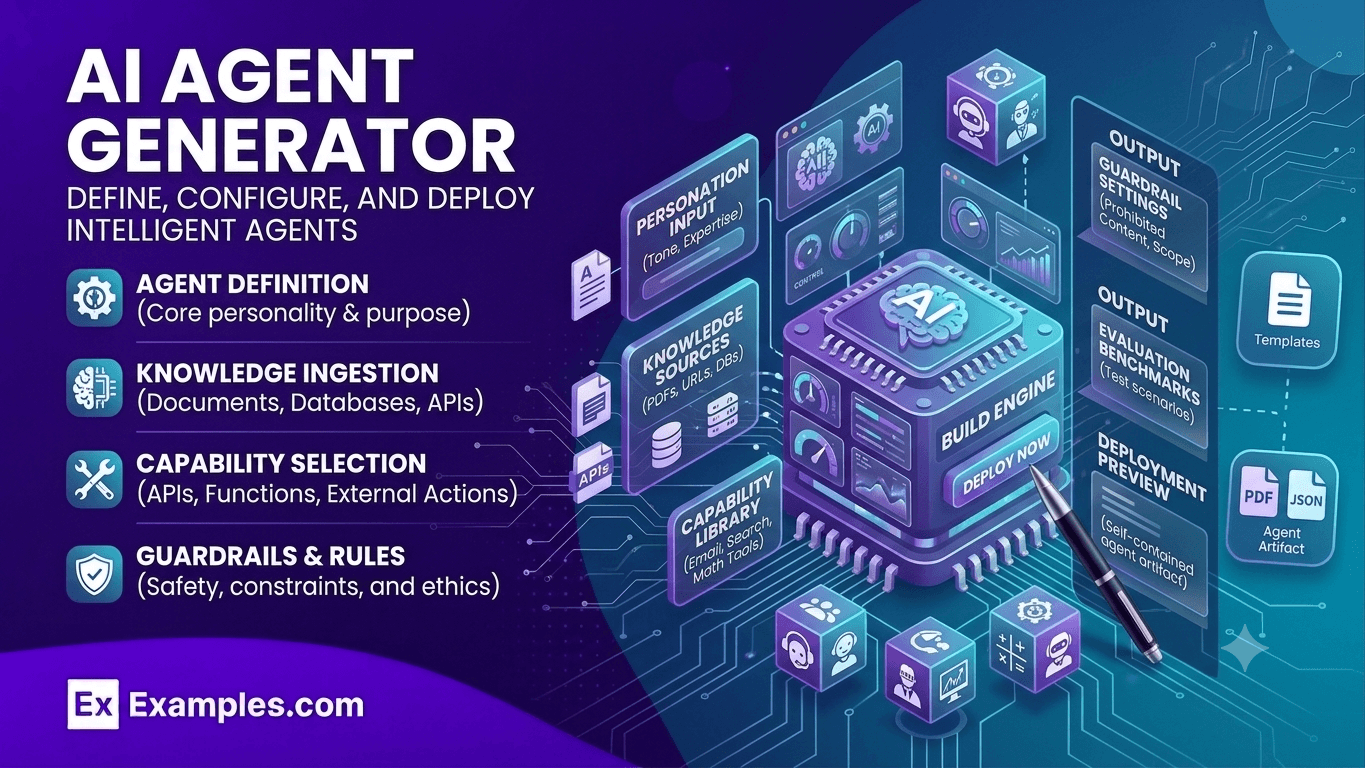
An AI Agent is an intelligent software system that can understand goals, process information, make decisions, and perform tasks autonomously with minimal human intervention. Whether you need a customer service agent, sales agent, marketing agent, research agent, finance agent, healthcare agent, or enterprise automation agent, a well-designed AI Agent helps improve efficiency, automate workflows, enhance decision-making, and deliver smarter user experiences. Explore real AI Agent examples, customize professional AI Agent templates, and create intelligent AI solutions tailored to your specific business needs quickly and confidently.
 Explore 50+ real AI Agent examples and create intelligent AI solutions faster with ready-to-use templates and workflows.
Popular Types Of AI Agents
Customer Service AI Agent
A Customer Service AI Agent helps businesses automate customer support by answering questions, resolving common issues, providing personalized assistance, and improving customer experiences through intelligent conversations.
Sales AI Agent
A Sales AI Agent assists sales teams by identifying leads, qualifying prospects, managing customer interactions, recommending products, and automating follow-up activities to improve sales performance.
Data Analysis AI Agent
A Data Analysis AI Agent processes large amounts of data, identifies patterns, generates insights, creates reports, and supports faster data-driven business decisions.
Workflow Automation AI Agent
A Workflow Automation AI Agent automates repetitive business processes, manages tasks, connects multiple tools, and improves operational efficiency across departments.
Research AI Agent
A Research AI Agent collects information, analyzes documents, summarizes findings, and helps professionals conduct faster research and knowledge discovery.
HR AI Agent
An HR AI Agent supports human resource teams by automating recruitment, employee onboarding, candidate screening, answering employee queries, and managing workforce processes.
How Do I Generate AI Agents Using Real AI Agent Examples?
Creating an AI Agent becomes easier when you start with real AI Agent examples. By exploring existing AI Agent templates, workflows, and use cases, you can understand how intelligent systems are designed, customized, and deployed for different business needs.
Follow these steps to generate an AI Agent:
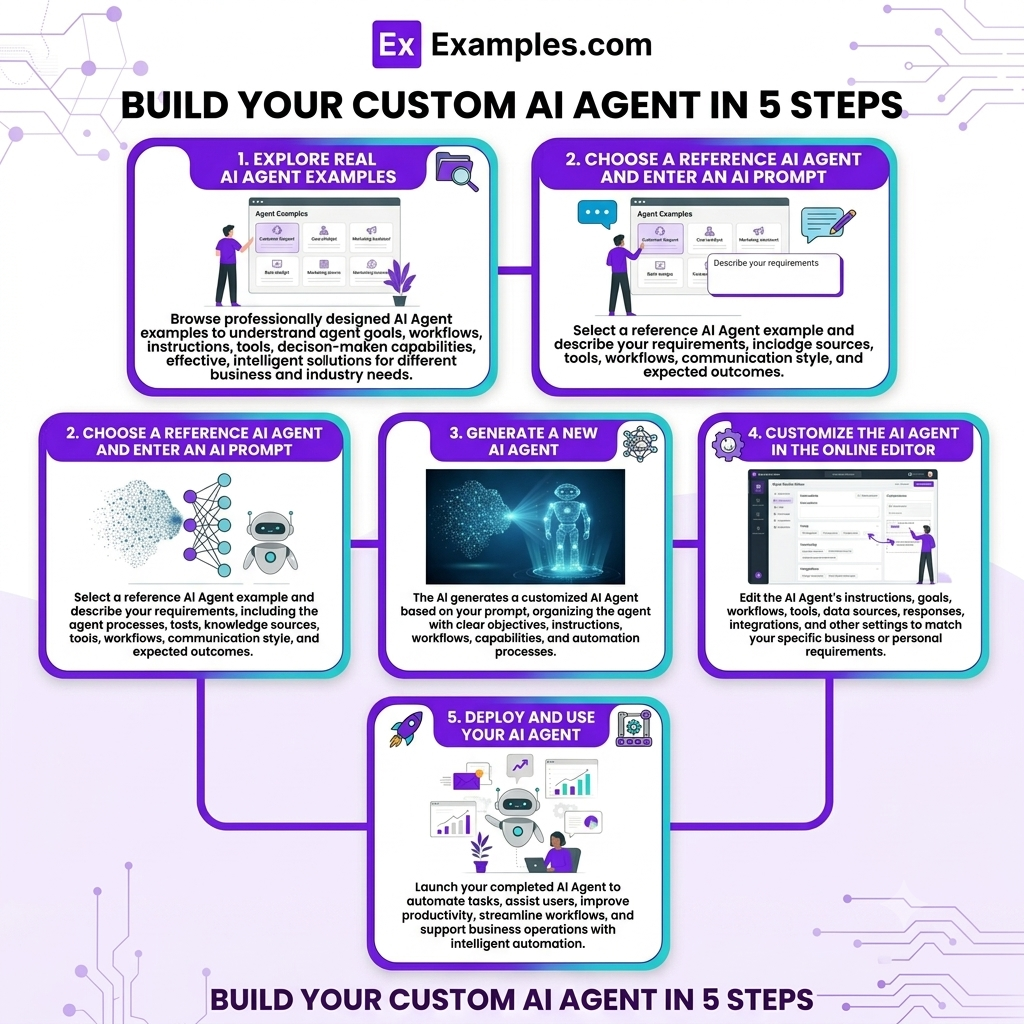
1. Explore Real AI Agent Examples Browse professionally designed AI Agent examples to understand agent goals, workflows, instructions, tools, decision-making processes, and automation capabilities. Reviewing real AI Agent examples helps you create effective, intelligent solutions for different business and industry needs. 2. Choose A Reference AI Agent And Enter An AI Prompt Select a reference AI Agent example and describe your requirements, including the agent purpose, tasks, knowledge sources, tools, workflows, communication style, and expected outcomes. 3. Generate A New AI Agent The AI generates a customized AI Agent based on your prompt, organizing the agent with clear objectives, instructions, workflows, capabilities, and automation processes. 4. Customize The AI Agent In The Online Editor Edit the AI Agent’s instructions, goals, workflows, tools, data sources, responses, integrations, and other settings to match your specific business or personal requirements. 5. Deploy And Use Your AI Agent Launch your completed AI Agent to automate tasks, assist users, improve productivity, streamline workflows, and support business operations with intelligent automation.
Explore 50+ real AI Agent examples and create intelligent AI solutions faster with ready-to-use templates and workflows.
How Do I Customize An AI Agent Online?
Customize your AI Agent by updating its goals, instructions, workflows, knowledge sources, tools, integrations, communication style, and automation settings to match your specific requirements. You can also add or remove capabilities, modify agent behavior, connect external tools, and personalize the AI Agent for business or personal use. Once complete, test the AI Agent, make final improvements, and deploy it for automation, assistance, decision-making, or workflow management.AI Agent Editing Features
AI Agent Creation
Generate professionally designed AI Agent instructions, goals, workflows, and capabilities based on your requirements.
Smart Workflow Editing
Add, remove, or modify AI Agent workflows, tasks, and automation processes to match your business needs.
Automatic Configuration
Automatically organize AI Agent settings, instructions, tools, and workflows for efficient performance.
AI Agent Customization
Update agent goals, knowledge sources, responses, integrations, permissions, and other AI Agent settings with ease.
Collaboration And Testing
Share your AI Agent for testing, feedback, review, and improvement before deployment.
Instant Deployment Options
Deploy your completed AI Agent for automation, customer support, business operations, or personal productivity.
Which Essential Elements Should Every AI Agent Include?
AI Agent Purpose: Clearly define the primary goal, tasks, and outcomes the AI Agent is designed to achieve.
Agent Instructions: Provide detailed instructions, rules, and guidelines that control how the AI Agent operates.
Knowledge Sources: Connect relevant documents, databases, and information sources to improve AI Agent accuracy.
Tools And Integrations: Add APIs, applications, and external tools that allow the AI Agent to perform actions.
Workflow And Decision Process: Define how the AI Agent analyzes information, makes decisions, and completes tasks.
Memory And Context: Enable the AI Agent to remember important information and maintain relevant conversations.
Testing And Deployment: Evaluate performance, improve responses, and launch the AI Agent for real-world use.
How Do I Build A Better AI Agent?
Define Clear Goals: Create a specific purpose and expected outcomes for your AI Agent.
Choose The Right Instructions: Provide clear guidelines to control the AI Agent’s behavior and responses.
Add Relevant Knowledge: Connect accurate data sources and information to improve performance.
Integrate Useful Tools: Enable the AI Agent to access applications, systems, and automation platforms.
Optimize Workflows: Design efficient processes that help the AI Agent complete tasks effectively.
Test And Improve: Review performance, fix errors, and continuously enhance the AI Agent.
Why Should I Use Real AI Agent Examples Before Creating My Own?
- Save time by using proven AI Agent structures and workflows.
- Understand how professional AI Agents are designed and configured.
- Identify essential instructions, tools, and automation capabilities.
- Reduce development errors and missing functionality.
- Customize AI Agents for specific business requirements.
- Create intelligent, efficient, and professional AI solutions with confidence.
What Common AI Agent Mistakes Should I Avoid?
- Using unclear or incomplete instructions.
- Choosing incorrect knowledge sources.
- Adding unnecessary tools and integrations.
- Failing to define specific goals and workflows.
- Not testing AI Agent responses before deployment.
- Ignoring security, privacy, and performance improvements.
How Can AI Agents Improve Your Business?
1
Automate Repetitive Tasks
AI Agents can handle routine activities, reduce manual work, and improve operational efficiency.
2
Improve Customer Experiences
AI Agents provide instant responses, personalized assistance, and continuous support.
3
Increase Productivity
AI Agents help employees complete tasks faster by automating workflows and providing intelligent assistance.
4
Support Better Decisions
AI Agents analyze information, generate insights, and help businesses make data-driven decisions.
5
Create Scalable Automation
Well-designed AI Agents help organizations improve processes and scale operations efficiently.