Nvidia
SWOT Analysis
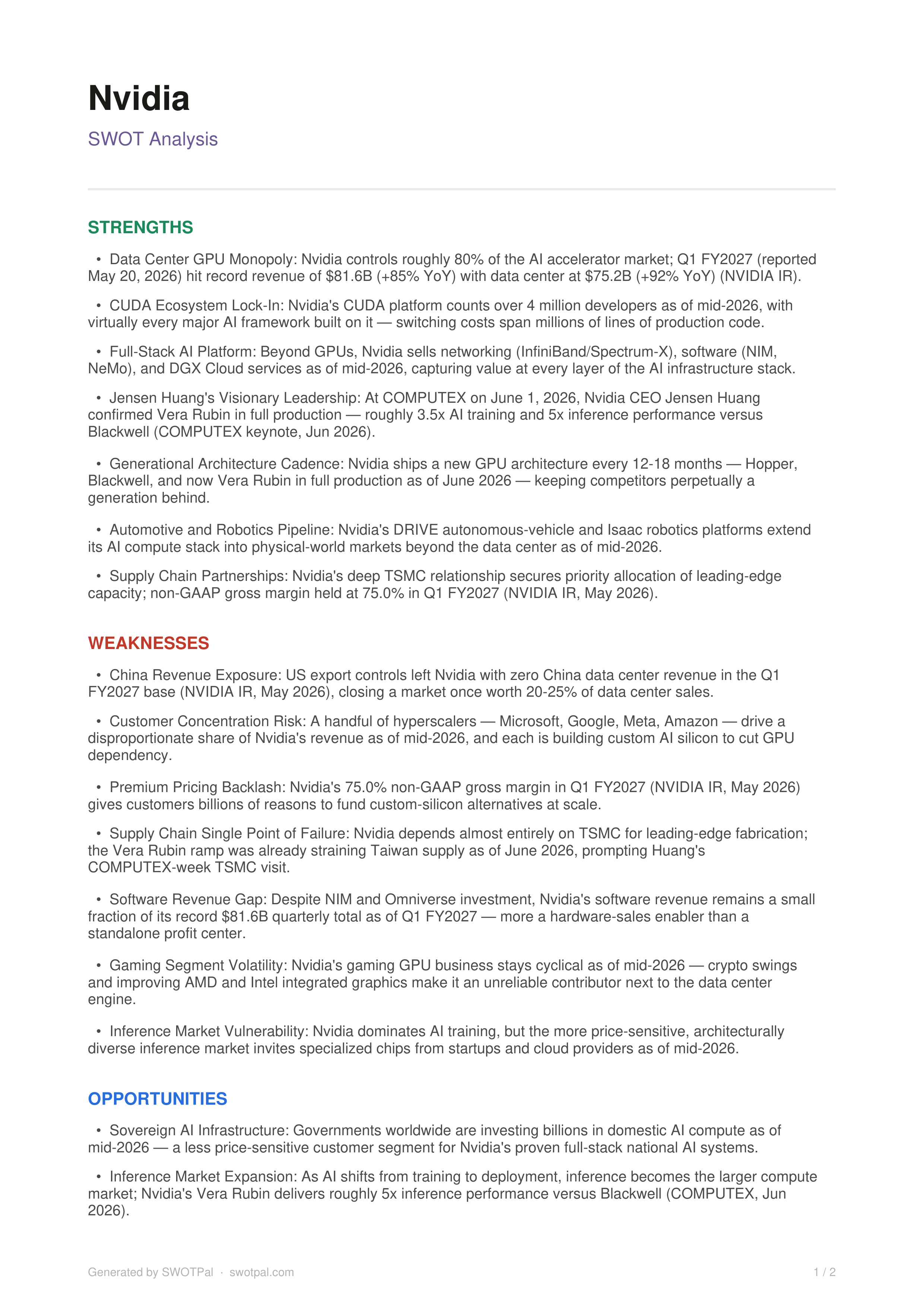
STRENGTHS
• Data Center GPU Monopoly: Nvidia controls roughly 80% of the AI accelerator market; Q1 FY2027 (reported
May 20, 2026) hit record revenue of $81.6B (+85% YoY) with data center at $75.2B (+92% YoY) (NVIDIA IR).
• CUDA Ecosystem Lock-In: Nvidia's CUDA platform counts over 4 million developers as of mid-2026, with
virtually every major AI framework built on it — switching costs span millions of lines of production code.
• Full-Stack AI Platform: Beyond GPUs, Nvidia sells networking (InfiniBand/Spectrum-X), software (NIM,
NeMo), and DGX Cloud services as of mid-2026, capturing value at every layer of the AI infrastructure stack.
• Jensen Huang's Visionary Leadership: At COMPUTEX on June 1, 2026, Nvidia CEO Jensen Huang
confirmed Vera Rubin in full production — roughly 3.5x AI training and 5x inference performance versus
Blackwell (COMPUTEX keynote, Jun 2026).
• Generational Architecture Cadence: Nvidia ships a new GPU architecture every 12-18 months — Hopper,
Blackwell, and now Vera Rubin in full production as of June 2026 — keeping competitors perpetually a
generation behind.
• Automotive and Robotics Pipeline: Nvidia's DRIVE autonomous-vehicle and Isaac robotics platforms extend
its AI compute stack into physical-world markets beyond the data center as of mid-2026.
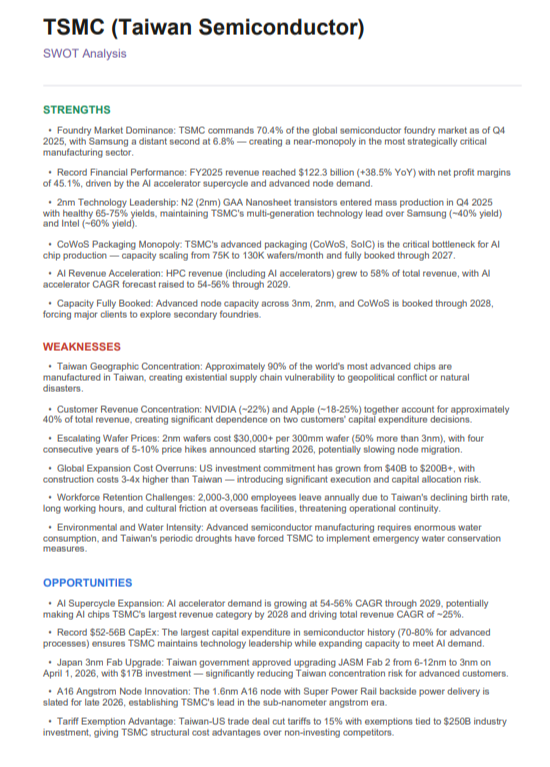
• Supply Chain Partnerships: Nvidia's deep TSMC relationship secures priority allocation of leading-edge
capacity; non-GAAP gross margin held at 75.0% in Q1 FY2027 (NVIDIA IR, May 2026).
WEAKNESSES
• China Revenue Exposure: US export controls left Nvidia with zero China data center revenue in the Q1
FY2027 base (NVIDIA IR, May 2026), closing a market once worth 20-25% of data center sales.
• Customer Concentration Risk: A handful of hyperscalers — Microsoft, Google, Meta, Amazon — drive a
disproportionate share of Nvidia's revenue as of mid-2026, and each is building custom AI silicon to cut GPU
dependency.
• Premium Pricing Backlash: Nvidia's 75.0% non-GAAP gross margin in Q1 FY2027 (NVIDIA IR, May 2026)
gives customers billions of reasons to fund custom-silicon alternatives at scale.
• Supply Chain Single Point of Failure: Nvidia depends almost entirely on TSMC for leading-edge fabrication;
the Vera Rubin ramp was already straining Taiwan supply as of June 2026, prompting Huang's
COMPUTEX-week TSMC visit.
• Software Revenue Gap: Despite NIM and Omniverse investment, Nvidia's software revenue remains a small
fraction of its record $81.6B quarterly total as of Q1 FY2027 — more a hardware-sales enabler than a
standalone profit center.
• Gaming Segment Volatility: Nvidia's gaming GPU business stays cyclical as of mid-2026 — crypto swings
and improving AMD and Intel integrated graphics make it an unreliable contributor next to the data center
engine.
• Inference Market Vulnerability: Nvidia dominates AI training, but the more price-sensitive, architecturally
diverse inference market invites specialized chips from startups and cloud providers as of mid-2026.
OPPORTUNITIES
• Sovereign AI Infrastructure: Governments worldwide are investing billions in domestic AI compute as of
mid-2026 — a less price-sensitive customer segment for Nvidia's proven full-stack national AI systems.
• Inference Market Expansion: As AI shifts from training to deployment, inference becomes the larger compute
market; Nvidia's Vera Rubin delivers roughly 5x inference performance versus Blackwell (COMPUTEX, Jun
2026).
Generated by SWOTPal · swotpal.com
1 / 2
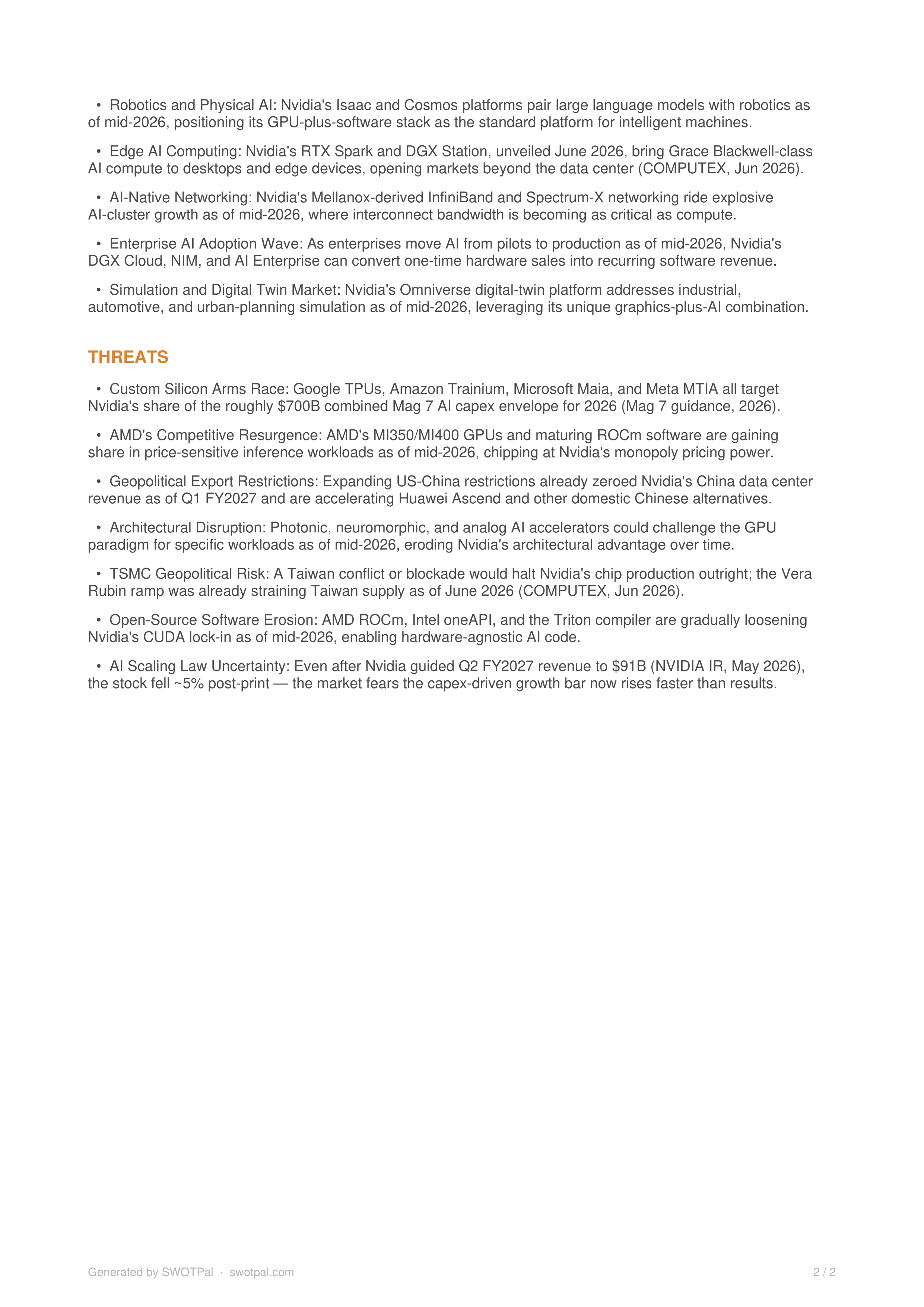
• Robotics and Physical AI: Nvidia's Isaac and Cosmos platforms pair large language models with robotics as
of mid-2026, positioning its GPU-plus-software stack as the standard platform for intelligent machines.
• Edge AI Computing: Nvidia's RTX Spark and DGX Station, unveiled June 2026, bring Grace Blackwell-class
AI compute to desktops and edge devices, opening markets beyond the data center (COMPUTEX, Jun 2026).
• AI-Native Networking: Nvidia's Mellanox-derived InfiniBand and Spectrum-X networking ride explosive
AI-cluster growth as of mid-2026, where interconnect bandwidth is becoming as critical as compute.
• Enterprise AI Adoption Wave: As enterprises move AI from pilots to production as of mid-2026, Nvidia's
DGX Cloud, NIM, and AI Enterprise can convert one-time hardware sales into recurring software revenue.
• Simulation and Digital Twin Market: Nvidia's Omniverse digital-twin platform addresses industrial,
automotive, and urban-planning simulation as of mid-2026, leveraging its unique graphics-plus-AI combination.
THREATS
• Custom Silicon Arms Race: Google TPUs, Amazon Trainium, Microsoft Maia, and Meta MTIA all target
Nvidia's share of the roughly $700B combined Mag 7 AI capex envelope for 2026 (Mag 7 guidance, 2026).
• AMD's Competitive Resurgence: AMD's MI350/MI400 GPUs and maturing ROCm software are gaining
share in price-sensitive inference workloads as of mid-2026, chipping at Nvidia's monopoly pricing power.
• Geopolitical Export Restrictions: Expanding US-China restrictions already zeroed Nvidia's China data center
revenue as of Q1 FY2027 and are accelerating Huawei Ascend and other domestic Chinese alternatives.
• Architectural Disruption: Photonic, neuromorphic, and analog AI accelerators could challenge the GPU
paradigm for specific workloads as of mid-2026, eroding Nvidia's architectural advantage over time.
• TSMC Geopolitical Risk: A Taiwan conflict or blockade would halt Nvidia's chip production outright; the Vera
Rubin ramp was already straining Taiwan supply as of June 2026 (COMPUTEX, Jun 2026).
• Open-Source Software Erosion: AMD ROCm, Intel oneAPI, and the Triton compiler are gradually loosening
Nvidia's CUDA lock-in as of mid-2026, enabling hardware-agnostic AI code.
• AI Scaling Law Uncertainty: Even after Nvidia guided Q2 FY2027 revenue to $91B (NVIDIA IR, May 2026),
the stock fell ~5% post-print — the market fears the capex-driven growth bar now rises faster than results.
Generated by SWOTPal · swotpal.com
2 / 2