
Large
Language
Models
Encode
Clinical
Knowledge
Karan
Singhal
∗
,1
,
Shekoofeh
Azizi
∗
,1
,
Tao
Tu
∗
,1
,
S.
Sara
Mahdavi
1
,
Jason
Wei
1
,
Hyung
Won
Chung
1
,
Nathan
Scales
1
,
Ajay
Tanwani
1
,
Heather
Cole-Lewis
1
,
Stephen
Pfohl
1
,
Perry
Payne
1
,
Martin
Seneviratne
1
,
Paul
Gamble
1
,
Chris
Kelly
1
,
Nathaneal
Schärli
1
,
Aakanksha
Chowdhery
1
,
Philip
Mansfield
1
,
Blaise
Agüera
y
Arcas
1
,
Dale
Webster
1
,
Greg
S.
Corrado
1
,
Yossi
Matias
1
,
Katherine
Chou
1
,
Juraj
Gottweis
1
,
Nenad
Tomasev
2
,
Yun
Liu
1
,
Alvin
Rajkomar
1
,
Joelle
Barral
1
,
Christopher
Semturs
1
,
Alan
Karthikesalingam
†
,1
and
Vivek
Natarajan
†
,1
1
Google
Research,
2
DeepMind
Large language models (LLMs) have demonstrated impressive capabilities in natural language understanding
and
generation,
but
the
quality
bar
for
medical
and
clinical
applications
is
high.
Today,
attempts
to
assess
models’
clinical
knowledge
typically
rely
on
automated
evaluations
on
limited
benchmarks.
There
is
no
standard
to
evaluate
model
predictions
and
reasoning
across
a
breadth
of
tasks.
To
address
this,
we
present
MultiMedQA,
a
benchmark
combining
six
existing
open
question
answering
datasets
spanning
professional
medical
exams,
research,
and
consumer
queries;
and
HealthSearchQA,
a
new
free-response
dataset
of
medical
questions
searched
online.
We
propose
a
framework
for
human
evaluation
of
model
answers
along
multiple
axes
including
factuality,
precision,
possible
harm,
and
bias.
In
addition,
we
evaluate
PaLM
(a
540-billion
parameter
LLM)
and
its
instruction-tuned
variant,
Flan-
PaLM,
on
MultiMedQA.
Using
a
combination
of
prompting
strategies,
Flan-PaLM
achieves
state-of-the-art
accuracy on every MultiMedQA multiple-choice dataset (MedQA, MedMCQA, PubMedQA, MMLU clinical
topics),
including
67.6%
accuracy
on
MedQA
(US
Medical
License
Exam
questions),
surpassing
prior
state-of-the-art
by
over
17%.
However,
human
evaluation
reveals
key
gaps
in
Flan-PaLM
responses.
To
resolve
this
we
introduce
instruction
prompt
tuning,
a
parameter-efficient
approach
for
aligning
LLMs
to
new
domains
using
a
few
exemplars.
The
resulting
model,
Med-PaLM,
performs
encouragingly,
but
remains
inferior
to
clinicians.
We
show
that
comprehension,
recall
of
knowledge,
and
medical
reasoning
improve
with
model
scale
and
instruction
prompt
tuning,
suggesting
the
potential
utility
of
LLMs
in
medicine.
Our
human
evaluations
reveal
important
limitations
of
today’s
models,
reinforcing
the
importance
of
both
evaluation
frameworks
and
method
development
in
creating
safe,
helpful
LLM
models
for
clinical
applications.
1
Introduction
Medicine is a humane endeavor where language enables key interactions for and between clinicians,
researchers,
and
patients.
Yet,
today’s
AI
models
for
applications
in
medicine
and
healthcare
have
largely
failed
to
fully
utilize
language.
These
models,
while
useful,
are
predominantly
single-task
systems
(e.g.,
classification,
regression,
segmentation),
lacking
expressivity
and
interactive
capabilities
[
21
,
81
,
97
].
As
a
result,
there
is
a
discordance
between
what
today’s
models
can
do
and
what
may
be
expected
of
them
in
real-world
clinical
workflows
[
42
,
74
].
Recent
advances
in
large
language
models
(LLMs)
offer
an
opportunity
to
rethink
AI
systems,
with
language
as a tool for mediating human-AI interaction.
LLMs are “foundation models”
[
10
], large pre-trained AI systems
that
can
be
repurposed
with
minimal
effort
across
numerous
domains
and
diverse
tasks.
These
expressive
and
interactive
models
offer
great
promise
in
their
ability
to
learn
generally
useful
representations
from
the
knowledge
encoded
in
medical
corpora,
at
scale.
There
are
several
exciting
potential
applications
of
such
models
in
medicine,
including
knowledge
retrieval,
clinical
decision
support,
summarisation
of
key
findings,
∗
Equal
contributions.
†
Equal
leadership.
‡
Corresponding
authors:
{karansinghal,
shekazizi,
alankarthi,
natviv}@google.com
arXiv:2212.13138v1 [cs.CL] 26 Dec 2022
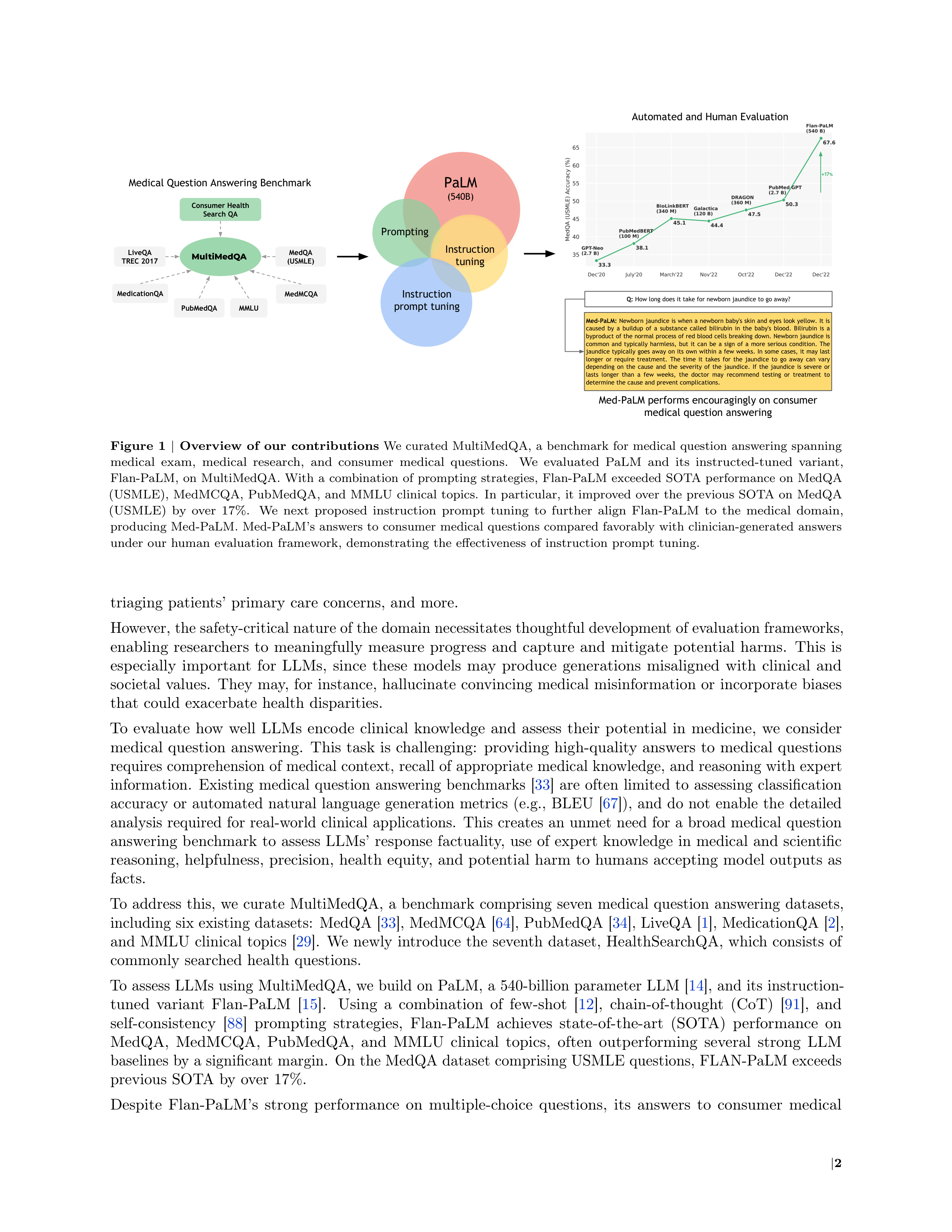


PubMedQA
MultiMedQA
MedQA
(USMLE)
MedMCQA
MMLU
LiveQA
TREC 2017
MedicationQA
Consumer Health
Search QA
Med-PaLM:
Newborn jaundice is when a newborn baby's skin and eyes look yellow. It is
caused by a buildup of a substance called bilirubin in the baby's blood. Bilirubin is a
byproduct of the normal process of red blood cells breaking down. Newborn jaundice is
common and typically harmless, but it can be a sign of a more serious condition. The
jaundice typically goes away on its own within a few weeks. In some cases, it may last
longer or require treatment. The time it takes for the jaundice to go away can vary
depending on the cause and the severity of the jaundice. If the jaundice is severe or
lasts longer than a few weeks, the doctor may recommend testing or treatment to
determine the cause and prevent complications.
Q:
How long does it take for newborn jaundice to go away?
PaLM
(540B)
+17
%
Medical Question Answering Benchmark
Automated and Human Evaluation
Prompting
Med-PaLM performs encouragingly on consumer
medical question answering
Instruction
tuning
Instruction
prompt tuning
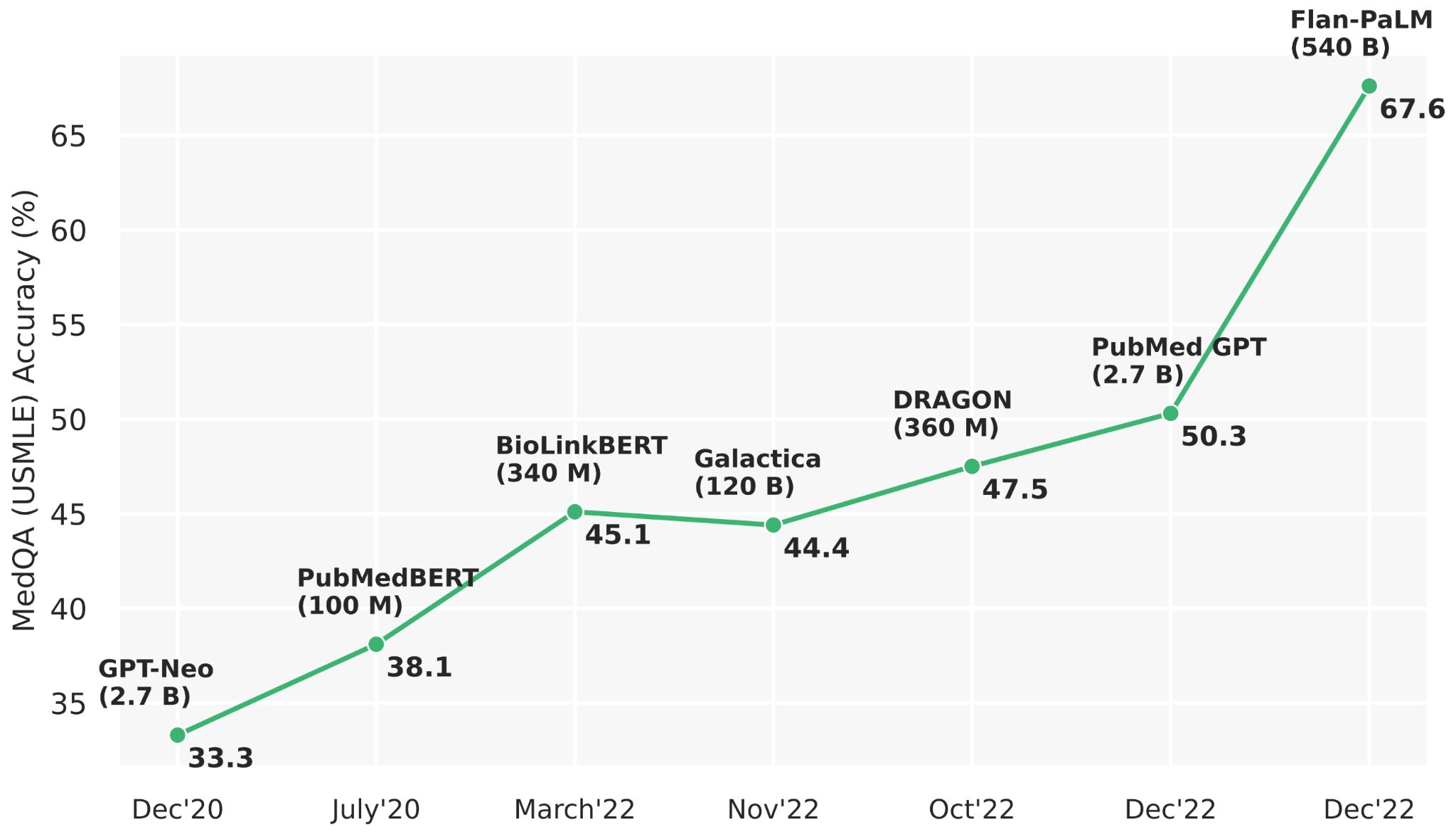
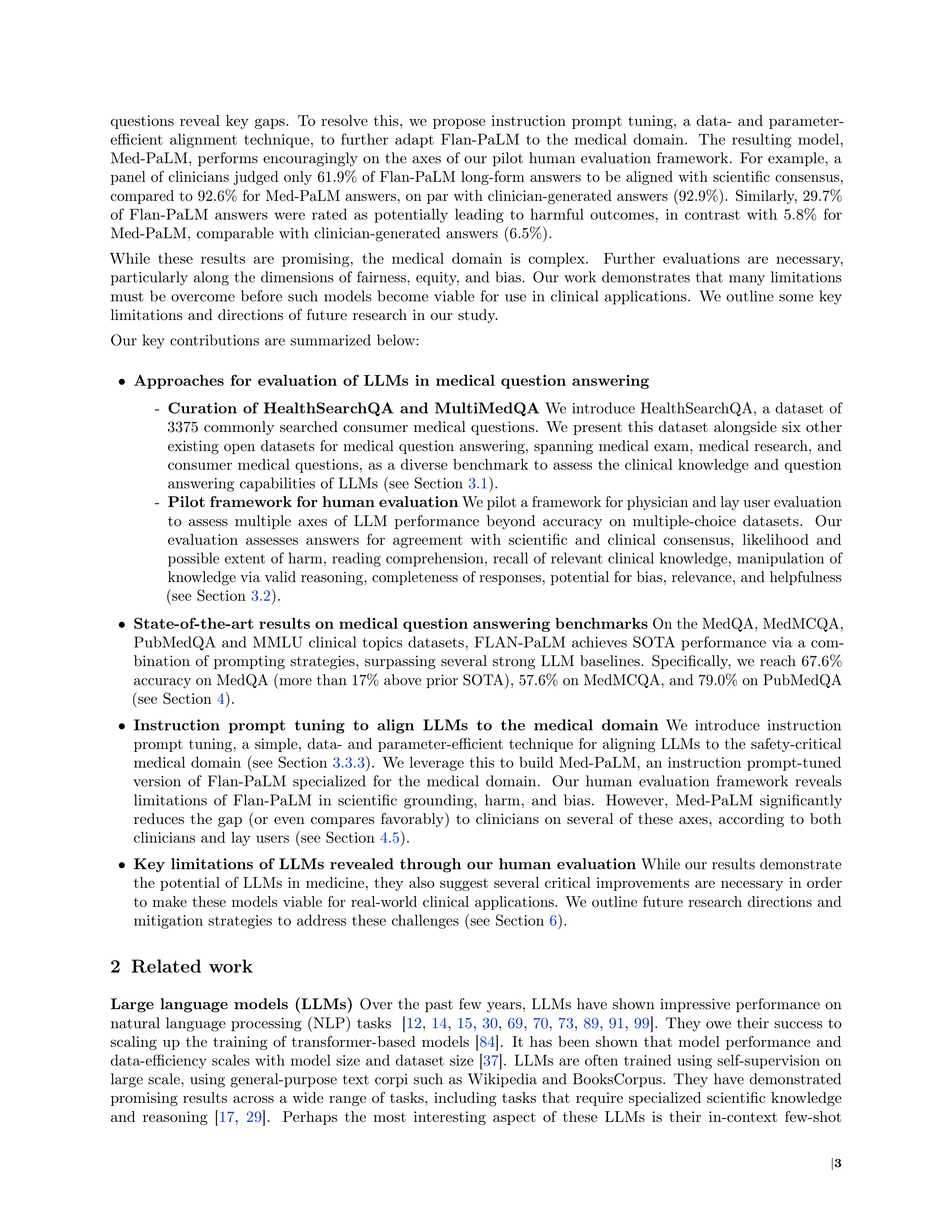
Figure
1
|
Overview
of
our
contributions
We
curated
MultiMedQA,
a
benchmark
for
medical
question
answering
spanning
medical
exam,
medical
research,
and
consumer
medical
questions.
We
evaluated
PaLM
and
its
instructed-tuned
variant,
Flan-PaLM,
on
MultiMedQA.
With
a
combination
of
prompting
strategies,
Flan-PaLM
exceeded
SOTA
performance
on
MedQA
(USMLE),
MedMCQA,
PubMedQA,
and
MMLU
clinical
topics.
In
particular,
it
improved
over
the
previous
SOTA
on
MedQA
(USMLE)
by
over
17%.
We
next
proposed
instruction
prompt
tuning
to
further
align
Flan-PaLM
to
the
medical
domain,
producing
Med-PaLM.
Med-PaLM’s
answers
to
consumer
medical
questions
compared
favorably
with
clinician-generated
answers
under
our
human
evaluation
framework,
demonstrating
the
effectiveness
of
instruction
prompt
tuning.
triaging
patients’
primary
care
concerns,
and
more.
However, the safety-critical nature of the domain necessitates thoughtful development of evaluation frameworks,
enabling
researchers
to
meaningfully
measure
progress
and
capture
and
mitigate
potential
harms.
This
is
especially
important
for
LLMs,
since
these
models
may
produce
generations
misaligned
with
clinical
and
societal
values.
They
may,
for
instance,
hallucinate
convincing
medical
misinformation
or
incorporate
biases
that
could
exacerbate
health
disparities.
To
evaluate
how
well
LLMs
encode
clinical
knowledge
and
assess
their
potential
in
medicine,
we
consider
medical
question
answering.
This
task
is
challenging:
providing
high-quality
answers
to
medical
questions
requires comprehension of medical context,
recall of appropriate medical knowledge,
and reasoning with expert
information.
Existing
medical
question
answering
benchmarks
[
33
]
are
often
limited
to
assessing
classification
accuracy
or
automated
natural
language
generation
metrics
(e.g.,
BLEU
[
67
]),
and
do
not
enable
the
detailed
analysis
required
for
real-world
clinical
applications.
This
creates
an
unmet
need
for
a
broad
medical
question
answering
benchmark
to
assess
LLMs’
response
factuality,
use
of
expert
knowledge
in
medical
and
scientific
reasoning,
helpfulness,
precision,
health
equity,
and
potential
harm
to
humans
accepting
model
outputs
as
facts.
To
address
this,
we
curate
MultiMedQA,
a
benchmark
comprising
seven
medical
question
answering
datasets,
including
six
existing
datasets:
MedQA
[
33
],
MedMCQA
[
64
],
PubMedQA
[
34
],
LiveQA
[
1
],
MedicationQA
[
2
],
and
MMLU
clinical
topics
[
29
].
We
newly
introduce
the
seventh
dataset,
HealthSearchQA,
which
consists
of
commonly
searched
health
questions.
To
assess
LLMs
using
MultiMedQA,
we
build
on
PaLM,
a
540-billion
parameter
LLM
[
14
],
and
its
instruction-
tuned
variant
Flan-PaLM
[
15
].
Using
a
combination
of
few-shot
[
12
],
chain-of-thought
(CoT)
[
91
],
and
self-consistency
[
88
]
prompting
strategies,
Flan-PaLM
achieves
state-of-the-art
(SOTA)
performance
on
MedQA,
MedMCQA,
PubMedQA,
and
MMLU
clinical
topics,
often
outperforming
several
strong
LLM
baselines by a significant margin.
On the MedQA dataset comprising USMLE questions,
FLAN-PaLM exceeds
previous
SOTA
by
over
17%.
Despite
Flan-PaLM’s
strong
performance
on
multiple-choice
questions,
its
answers
to
consumer
medical
|
2
questions
reveal
key
gaps.
To
resolve
this,
we
propose
instruction
prompt
tuning,
a
data-
and
parameter-
efficient
alignment
technique,
to
further
adapt
Flan-PaLM
to
the
medical
domain.
The
resulting
model,
Med-PaLM,
performs
encouragingly
on
the
axes
of
our
pilot
human
evaluation
framework.
For
example,
a
panel
of
clinicians
judged
only
61.9%
of
Flan-PaLM
long-form
answers
to
be
aligned
with
scientific
consensus,
compared
to
92.6%
for
Med-PaLM
answers,
on
par
with
clinician-generated
answers
(92.9%).
Similarly,
29.7%
of
Flan-PaLM
answers
were
rated
as
potentially
leading
to
harmful
outcomes,
in
contrast
with
5.8%
for
Med-PaLM,
comparable
with
clinician-generated
answers
(6.5%).
While
these
results
are
promising,
the
medical
domain
is
complex.
Further
evaluations
are
necessary,
particularly
along
the
dimensions
of
fairness,
equity,
and
bias.
Our
work
demonstrates
that
many
limitations
must
be
overcome
before
such
models
become
viable
for
use
in
clinical
applications.
We
outline
some
key
limitations
and
directions
of
future
research
in
our
study.
Our
key
contributions
are
summarized
below:
•
Approaches
for
evaluation
of
LLMs
in
medical
question
answering
-
Curation
of
HealthSearchQA
and
MultiMedQA
We
introduce
HealthSearchQA,
a
dataset
of
3375
commonly
searched
consumer
medical
questions.
We
present
this
dataset
alongside
six
other
existing
open
datasets
for
medical
question
answering,
spanning
medical
exam,
medical
research,
and
consumer
medical
questions,
as
a
diverse
benchmark
to
assess
the
clinical
knowledge
and
question
answering
capabilities
of
LLMs
(see
Section
3.1
).
-
Pilot framework for human evaluation
We pilot a framework for physician and lay user evaluation
to
assess
multiple
axes
of
LLM
performance
beyond
accuracy
on
multiple-choice
datasets.
Our
evaluation
assesses
answers
for
agreement
with
scientific
and
clinical
consensus,
likelihood
and
possible
extent
of
harm,
reading
comprehension,
recall
of
relevant
clinical
knowledge,
manipulation
of
knowledge via valid reasoning, completeness of responses, potential for bias, relevance, and helpfulness
(see
Section
3.2
).
•
State-of-the-art
results
on
medical
question
answering
benchmarks
On the MedQA, MedMCQA,
PubMedQA
and
MMLU
clinical
topics
datasets,
FLAN-PaLM
achieves
SOTA
performance
via
a
com-
bination
of
prompting
strategies,
surpassing
several
strong
LLM
baselines.
Specifically,
we
reach
67.6%
accuracy on MedQA (more than 17% above prior SOTA), 57.6% on MedMCQA, and 79.0% on PubMedQA
(see
Section
4
).
•
Instruction
prompt
tuning
to
align
LLMs
to
the
medical
domain
We
introduce
instruction
prompt
tuning,
a
simple,
data-
and
parameter-efficient
technique
for
aligning
LLMs
to
the
safety-critical
medical
domain
(see
Section
3.3.3
).
We
leverage
this
to
build
Med-PaLM,
an
instruction
prompt-tuned
version
of
Flan-PaLM
specialized
for
the
medical
domain.
Our
human
evaluation
framework
reveals
limitations
of
Flan-PaLM
in
scientific
grounding,
harm,
and
bias.
However,
Med-PaLM
significantly
reduces
the
gap
(or
even
compares
favorably)
to
clinicians
on
several
of
these
axes,
according
to
both
clinicians
and
lay
users
(see
Section
4.5
).
•
Key
limitations
of
LLMs
revealed
through
our
human
evaluation
While
our
results
demonstrate
the
potential
of
LLMs
in
medicine,
they
also
suggest
several
critical
improvements
are
necessary
in
order
to
make
these
models
viable
for
real-world
clinical
applications.
We
outline
future
research
directions
and
mitigation
strategies
to
address
these
challenges
(see
Section
6
).
2
Related
work
Large
language
models
(LLMs)
Over
the
past
few
years,
LLMs
have
shown
impressive
performance
on
natural
language
processing
(NLP)
tasks
[
12
,
14
,
15
,
30
,
69
,
70
,
73
,
89
,
91
,
99
].
They
owe
their
success
to
scaling
up
the
training
of
transformer-based
models
[
84
].
It
has
been
shown
that
model
performance
and
data-efficiency
scales
with
model
size
and
dataset
size
[
37
].
LLMs
are
often
trained
using
self-supervision
on
large
scale,
using
general-purpose
text
corpi
such
as
Wikipedia
and
BooksCorpus.
They
have
demonstrated
promising
results
across
a
wide
range
of
tasks,
including
tasks
that
require
specialized
scientific
knowledge
and
reasoning
[
17
,
29
].
Perhaps
the
most
interesting
aspect
of
these
LLMs
is
their
in-context
few-shot
|
3
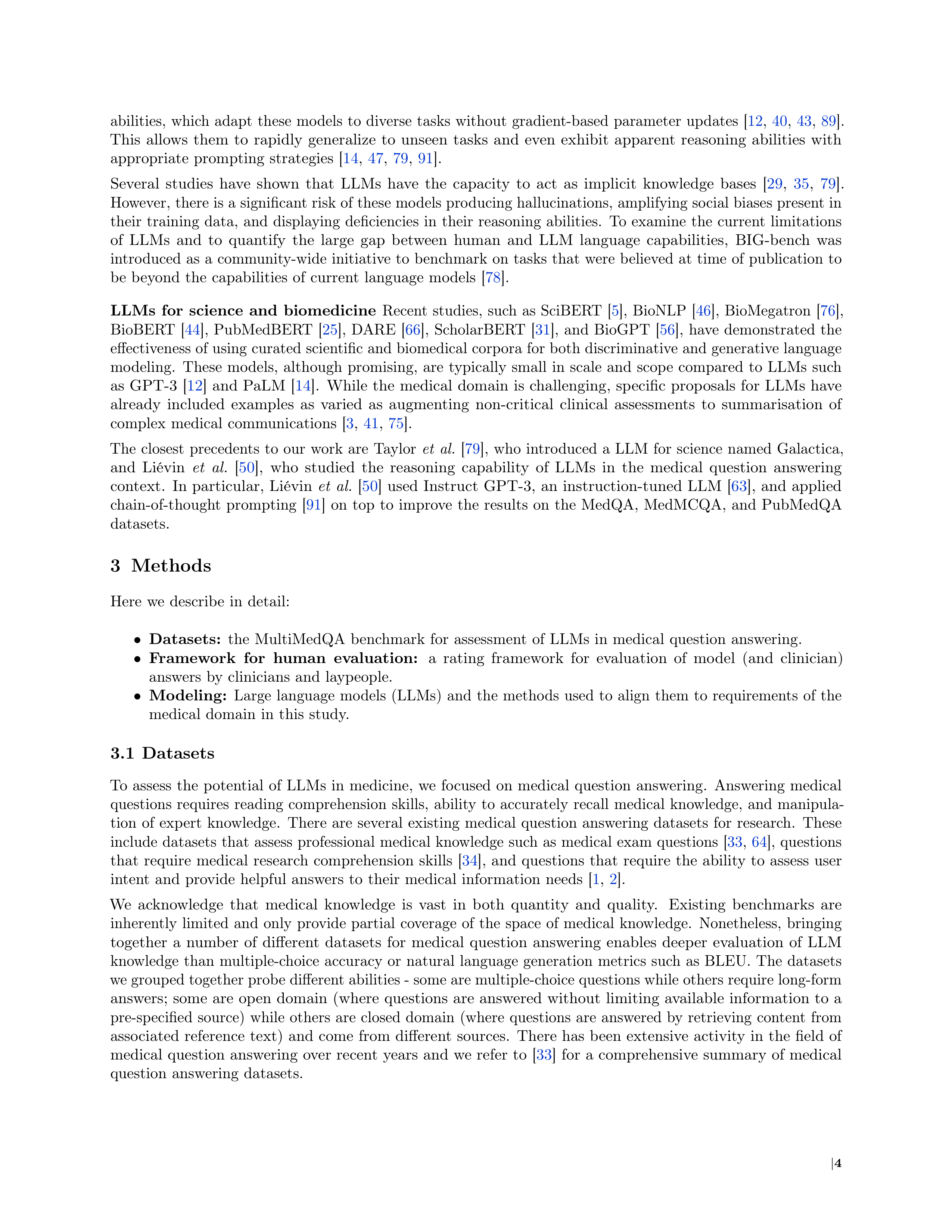
abilities,
which
adapt
these
models
to
diverse
tasks
without
gradient-based
parameter
updates
[
12
,
40
,
43
,
89
].
This
allows
them
to
rapidly
generalize
to
unseen
tasks
and
even
exhibit
apparent
reasoning
abilities
with
appropriate
prompting
strategies
[
14
,
47
,
79
,
91
].
Several
studies
have
shown
that
LLMs
have
the
capacity
to
act
as
implicit
knowledge
bases
[
29
,
35
,
79
].
However,
there is a significant risk of these models producing hallucinations, amplifying social biases present in
their
training
data,
and
displaying
deficiencies
in
their
reasoning
abilities.
To
examine
the
current
limitations
of
LLMs
and
to
quantify
the
large
gap
between
human
and
LLM
language
capabilities,
BIG-bench
was
introduced
as
a
community-wide
initiative
to
benchmark
on
tasks
that
were
believed
at
time
of
publication
to
be
beyond
the
capabilities
of
current
language
models
[
78
].
LLMs
for
science
and
biomedicine
Recent
studies,
such
as
SciBERT
[
5
],
BioNLP
[
46
],
BioMegatron
[
76
],
BioBERT
[
44
],
PubMedBERT
[
25
],
DARE
[
66
],
ScholarBERT
[
31
],
and
BioGPT
[
56
],
have
demonstrated
the
effectiveness of using curated scientific and biomedical corpora for both discriminative and generative language
modeling.
These
models,
although
promising,
are
typically
small
in
scale
and
scope
compared
to
LLMs
such
as
GPT-3
[
12
]
and
PaLM
[
14
].
While
the
medical
domain
is
challenging,
specific
proposals
for
LLMs
have
already
included
examples
as
varied
as
augmenting
non-critical
clinical
assessments
to
summarisation
of
complex
medical
communications
[
3
,
41
,
75
].
The
closest
precedents
to
our
work
are
Taylor
et
al.
[
79
],
who
introduced
a
LLM
for
science
named
Galactica,
and
Liévin
et
al.
[
50
],
who
studied
the
reasoning
capability
of
LLMs
in
the
medical
question
answering
context.
In
particular,
Liévin
et
al.
[
50
]
used
Instruct
GPT-3,
an
instruction-tuned
LLM
[
63
],
and
applied
chain-of-thought
prompting
[
91
]
on
top
to
improve
the
results
on
the
MedQA,
MedMCQA,
and
PubMedQA
datasets.
3
Methods
Here
we
describe
in
detail:
•
Datasets:
the
MultiMedQA
benchmark
for
assessment
of
LLMs
in
medical
question
answering.
•
Framework
for
human
evaluation:
a
rating
framework
for
evaluation
of
model
(and
clinician)
answers
by
clinicians
and
laypeople.
•
Modeling:
Large
language
models
(LLMs)
and
the
methods
used
to
align
them
to
requirements
of
the
medical
domain
in
this
study.
3.1
Datasets
To
assess
the
potential
of
LLMs
in
medicine,
we
focused
on
medical
question
answering.
Answering
medical
questions
requires
reading
comprehension
skills,
ability
to
accurately
recall
medical
knowledge,
and
manipula-
tion
of
expert
knowledge.
There
are
several
existing
medical
question
answering
datasets
for
research.
These
include
datasets
that
assess
professional
medical
knowledge
such
as
medical
exam
questions
[
33
,
64
],
questions
that
require
medical
research
comprehension
skills
[
34
],
and
questions
that
require
the
ability
to
assess
user
intent
and
provide
helpful
answers
to
their
medical
information
needs
[
1
,
2
].
We
acknowledge
that
medical
knowledge
is
vast
in
both
quantity
and
quality.
Existing
benchmarks
are
inherently
limited
and
only
provide
partial
coverage
of
the
space
of
medical
knowledge.
Nonetheless,
bringing
together
a
number
of
different
datasets
for
medical
question
answering
enables
deeper
evaluation
of
LLM
knowledge
than
multiple-choice
accuracy
or
natural
language
generation
metrics
such
as
BLEU.
The
datasets
we grouped together probe different abilities - some are multiple-choice questions while others require long-form
answers;
some
are
open
domain
(where
questions
are
answered
without
limiting
available
information
to
a
pre-specified
source)
while
others
are
closed
domain
(where
questions
are
answered
by
retrieving
content
from
associated
reference
text)
and
come
from
different
sources.
There
has
been
extensive
activity
in
the
field
of
medical
question
answering
over
recent
years
and
we
refer
to
[
33
]
for
a
comprehensive
summary
of
medical
question
answering
datasets.
|
4
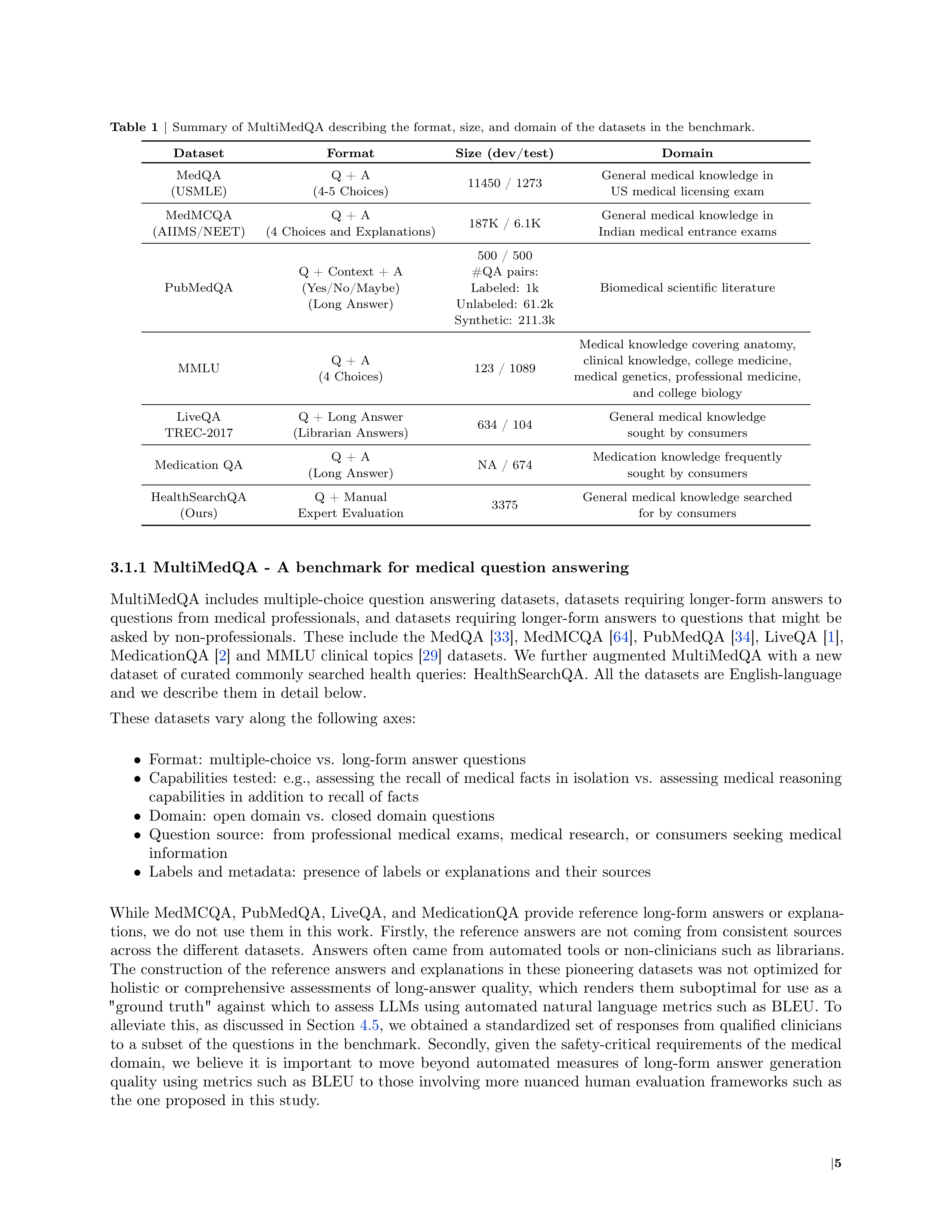
Table
1
|
Summary
of
MultiMedQA
describing
the
format,
size,
and
domain
of
the
datasets
in
the
benchmark.
Dataset
Format
Size
(dev/test)
Domain
MedQA
(USMLE)
Q
+
A
(4-5
Choices)
11450
/
1273
General
medical
knowledge
in
US
medical
licensing
exam
MedMCQA
(AIIMS/NEET)
Q
+
A
(4
Choices
and
Explanations)
187K
/
6.1K
General
medical
knowledge
in
Indian
medical
entrance
exams
PubMedQA
Q
+
Context
+
A
(Yes/No/Maybe)
(Long
Answer)
500
/
500
#QA
pairs:
Labeled:
1k
Unlabeled:
61.2k
Synthetic:
211.3k
Biomedical
scientific
literature
MMLU
Q
+
A
(4
Choices)
123
/
1089
Medical
knowledge
covering
anatomy,
clinical
knowledge,
college
medicine,
medical
genetics,
professional
medicine,
and
college
biology
LiveQA
TREC-2017
Q
+
Long
Answer
(Librarian
Answers)
634
/
104
General
medical
knowledge
sought
by
consumers
Medication
QA
Q
+
A
(Long
Answer)
NA
/
674
Medication
knowledge
frequently
sought
by
consumers
HealthSearchQA
(Ours)
Q
+
Manual
Expert
Evaluation
3375
General
medical
knowledge
searched
for
by
consumers
3.1.1
MultiMedQA
-
A
benchmark
for
medical
question
answering
MultiMedQA
includes
multiple-choice
question
answering
datasets,
datasets
requiring
longer-form
answers
to
questions
from
medical
professionals,
and
datasets
requiring
longer-form
answers
to
questions
that
might
be
asked
by
non-professionals.
These
include
the
MedQA
[
33
],
MedMCQA
[
64
],
PubMedQA
[
34
],
LiveQA
[
1
],
MedicationQA
[
2
]
and
MMLU
clinical
topics
[
29
]
datasets.
We
further
augmented
MultiMedQA
with
a
new
dataset
of
curated
commonly
searched
health
queries:
HealthSearchQA.
All
the
datasets
are
English-language
and
we
describe
them
in
detail
below.
These
datasets
vary
along
the
following
axes:
•
Format:
multiple-choice
vs.
long-form
answer
questions
•
Capabilities
tested:
e.g.,
assessing
the
recall
of
medical
facts
in
isolation
vs.
assessing
medical
reasoning
capabilities
in
addition
to
recall
of
facts
•
Domain:
open
domain
vs.
closed
domain
questions
•
Question
source:
from
professional
medical
exams,
medical
research,
or
consumers
seeking
medical
information
•
Labels
and
metadata:
presence
of
labels
or
explanations
and
their
sources
While
MedMCQA,
PubMedQA,
LiveQA,
and
MedicationQA
provide
reference
long-form
answers
or
explana-
tions,
we
do
not
use
them
in
this
work.
Firstly,
the
reference
answers
are
not
coming
from
consistent
sources
across
the
different
datasets.
Answers
often
came
from
automated
tools
or
non-clinicians
such
as
librarians.
The
construction
of
the
reference
answers
and
explanations
in
these
pioneering
datasets
was
not
optimized
for
holistic
or
comprehensive
assessments
of
long-answer
quality,
which
renders
them
suboptimal
for
use
as
a
"ground
truth"
against
which
to
assess
LLMs
using
automated
natural
language
metrics
such
as
BLEU.
To
alleviate
this,
as
discussed
in
Section
4.5
,
we
obtained
a
standardized
set
of
responses
from
qualified
clinicians
to
a
subset
of
the
questions
in
the
benchmark.
Secondly,
given
the
safety-critical
requirements
of
the
medical
domain,
we
believe
it
is
important
to
move
beyond
automated
measures
of
long-form
answer
generation
quality
using
metrics
such
as
BLEU
to
those
involving
more
nuanced
human
evaluation
frameworks
such
as
the
one
proposed
in
this
study.
|
5
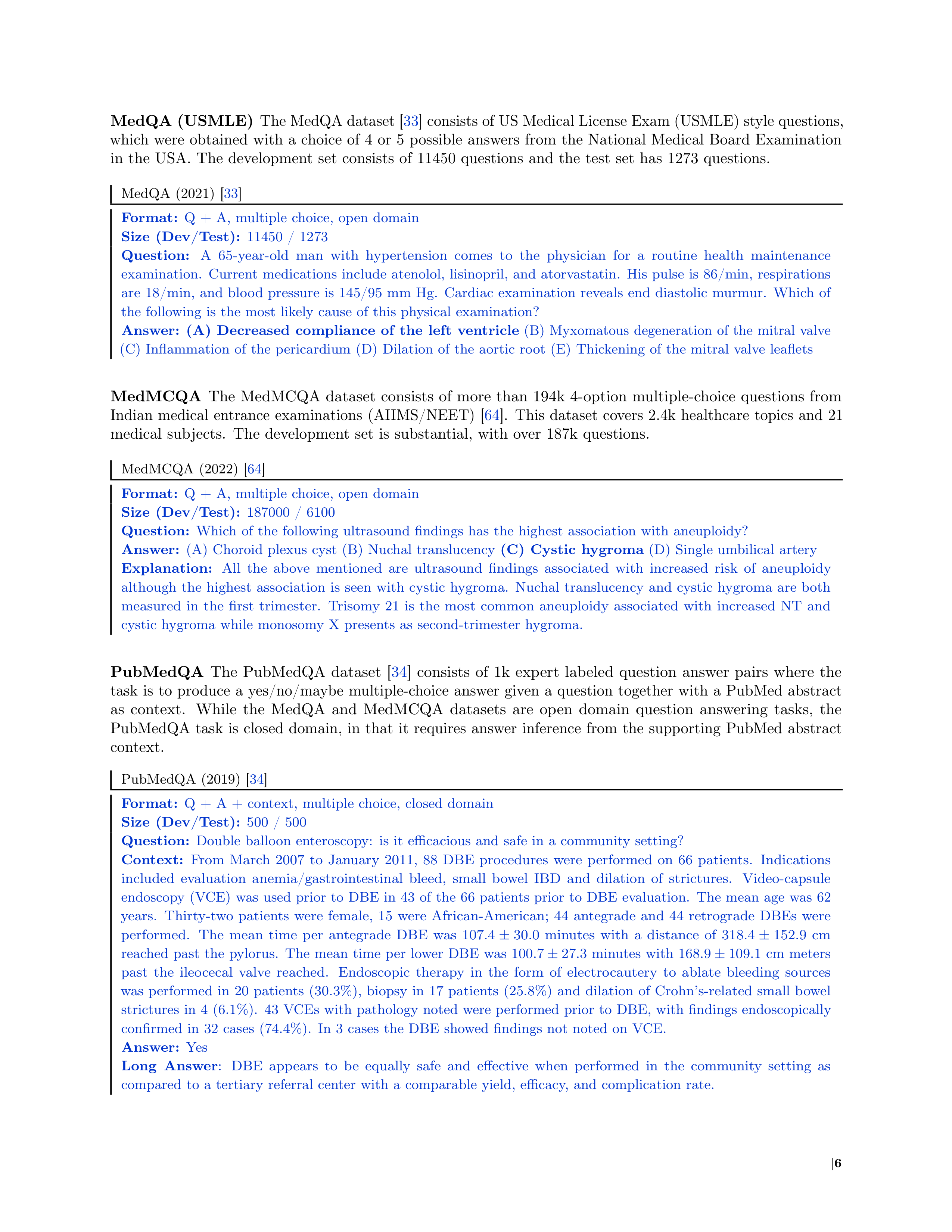
MedQA
(USMLE)
The MedQA dataset [
33
] consists of US Medical License Exam (USMLE) style questions,
which
were
obtained
with
a
choice
of
4
or
5
possible
answers
from
the
National
Medical
Board
Examination
in
the
USA.
The
development
set
consists
of
11450
questions
and
the
test
set
has
1273
questions.
MedQA
(2021)
[
33
]
Format:
Q
+
A,
multiple
choice,
open
domain
Size
(Dev/Test):
11450
/
1273
Question:
A
65-year-old
man
with
hypertension
comes
to
the
physician
for
a
routine
health
maintenance
examination.
Current
medications
include
atenolol,
lisinopril,
and
atorvastatin.
His
pulse
is
86/min,
respirations
are
18/min,
and
blood
pressure
is
145/95
mm
Hg.
Cardiac
examination
reveals
end
diastolic
murmur.
Which
of
the
following
is
the
most
likely
cause
of
this
physical
examination?
Answer:
(A)
Decreased
compliance
of
the
left
ventricle
(B)
Myxomatous
degeneration
of
the
mitral
valve
(C)
Inflammation
of
the
pericardium
(D)
Dilation
of
the
aortic
root
(E)
Thickening
of
the
mitral
valve
leaflets
MedMCQA
The
MedMCQA
dataset
consists
of
more
than
194k
4-option
multiple-choice
questions
from
Indian
medical
entrance
examinations
(AIIMS/NEET)
[
64
].
This
dataset
covers
2.4k
healthcare
topics
and
21
medical
subjects.
The
development
set
is
substantial,
with
over
187k
questions.
MedMCQA
(2022)
[
64
]
Format:
Q
+
A,
multiple
choice,
open
domain
Size
(Dev/Test):
187000
/
6100
Question:
Which
of
the
following
ultrasound
findings
has
the
highest
association
with
aneuploidy?
Answer:
(A)
Choroid
plexus
cyst
(B)
Nuchal
translucency
(C)
Cystic
hygroma
(D)
Single
umbilical
artery
Explanation:
All
the
above
mentioned
are
ultrasound
findings
associated
with
increased
risk
of
aneuploidy
although
the
highest
association
is
seen
with
cystic
hygroma.
Nuchal
translucency
and
cystic
hygroma
are
both
measured
in
the
first
trimester.
Trisomy
21
is
the
most
common
aneuploidy
associated
with
increased
NT
and
cystic
hygroma
while
monosomy
X
presents
as
second-trimester
hygroma.
PubMedQA
The
PubMedQA
dataset
[
34
]
consists
of
1k
expert
labeled
question
answer
pairs
where
the
task
is
to
produce
a
yes/no/maybe
multiple-choice
answer
given
a
question
together
with
a
PubMed
abstract
as
context.
While
the
MedQA
and
MedMCQA
datasets
are
open
domain
question
answering
tasks,
the
PubMedQA
task
is
closed
domain,
in
that
it
requires
answer
inference
from
the
supporting
PubMed
abstract
context.
PubMedQA
(2019)
[
34
]
Format:
Q
+
A
+
context,
multiple
choice,
closed
domain
Size
(Dev/Test):
500
/
500
Question:
Double
balloon
enteroscopy:
is
it
efficacious
and
safe
in
a
community
setting?
Context:
From
March
2007
to
January
2011,
88
DBE
procedures
were
performed
on
66
patients.
Indications
included
evaluation
anemia/gastrointestinal
bleed,
small
bowel
IBD
and
dilation
of
strictures.
Video-capsule
endoscopy
(VCE)
was
used
prior
to
DBE
in
43
of
the
66
patients
prior
to
DBE
evaluation.
The
mean
age
was
62
years.
Thirty-two
patients
were
female,
15
were
African-American;
44
antegrade
and
44
retrograde
DBEs
were
performed.
The
mean
time
per
antegrade
DBE
was
107
.
4
±
30
.
0
minutes
with
a
distance
of
318
.
4
±
152
.
9
cm
reached
past
the
pylorus.
The
mean
time
per
lower
DBE
was
100
.
7
±
27
.
3
minutes
with
168
.
9
±
109
.
1
cm
meters
past
the
ileocecal
valve
reached.
Endoscopic
therapy
in
the
form
of
electrocautery
to
ablate
bleeding
sources
was
performed
in
20
patients
(30.3%),
biopsy
in
17
patients
(25.8%)
and
dilation
of
Crohn’s-related
small
bowel
strictures
in
4
(6.1%).
43
VCEs
with
pathology
noted
were
performed
prior
to
DBE,
with
findings
endoscopically
confirmed
in
32
cases
(74.4%).
In
3
cases
the
DBE
showed
findings
not
noted
on
VCE.
Answer:
Yes
Long
Answer
:
DBE
appears
to
be
equally
safe
and
effective
when
performed
in
the
community
setting
as
compared
to
a
tertiary
referral
center
with
a
comparable
yield,
efficacy,
and
complication
rate.
|
6
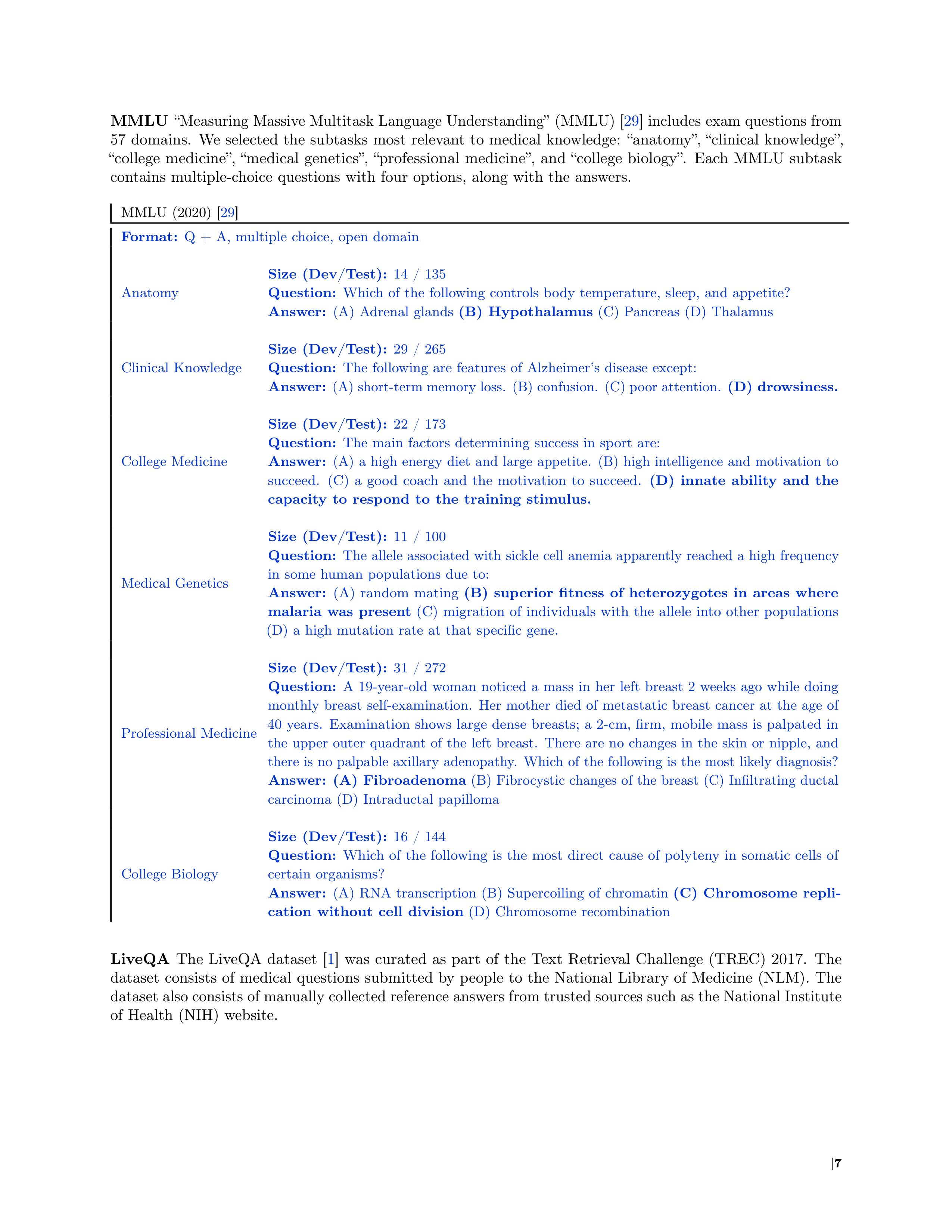
MMLU
“Measuring Massive Multitask Language Understanding”
(MMLU) [
29
] includes exam questions from
57
domains.
We
selected
the
subtasks
most
relevant
to
medical
knowledge:
“anatomy”,
“clinical
knowledge”,
“college
medicine”,
“medical
genetics”,
“professional
medicine”,
and
“college
biology”.
Each
MMLU
subtask
contains
multiple-choice
questions
with
four
options,
along
with
the
answers.
MMLU
(2020)
[
29
]
Format:
Q
+
A,
multiple
choice,
open
domain
Anatomy
Size
(Dev/Test):
14
/
135
Question:
Which
of
the
following
controls
body
temperature,
sleep,
and
appetite?
Answer:
(A)
Adrenal
glands
(B)
Hypothalamus
(C)
Pancreas
(D)
Thalamus
Clinical
Knowledge
Size
(Dev/Test):
29
/
265
Question:
The
following
are
features
of
Alzheimer’s
disease
except:
Answer:
(A) short-term memory loss.
(B) confusion.
(C) poor attention.
(D)
drowsiness.
College
Medicine
Size
(Dev/Test):
22
/
173
Question:
The
main
factors
determining
success
in
sport
are:
Answer:
(A)
a
high
energy
diet
and
large
appetite.
(B)
high
intelligence
and
motivation
to
succeed.
(C)
a
good
coach
and
the
motivation
to
succeed.
(D)
innate
ability
and
the
capacity
to
respond
to
the
training
stimulus.
Medical
Genetics
Size
(Dev/Test):
11
/
100
Question:
The
allele
associated
with
sickle
cell
anemia
apparently
reached
a
high
frequency
in
some
human
populations
due
to:
Answer:
(A)
random
mating
(B)
superior
fitness
of
heterozygotes
in
areas
where
malaria
was
present
(C)
migration
of
individuals
with
the
allele
into
other
populations
(D)
a
high
mutation
rate
at
that
specific
gene.
Professional
Medicine
Size
(Dev/Test):
31
/
272
Question:
A
19-year-old
woman
noticed
a
mass
in
her
left
breast
2
weeks
ago
while
doing
monthly
breast
self-examination.
Her
mother
died
of
metastatic
breast
cancer
at
the
age
of
40
years.
Examination
shows
large
dense
breasts;
a
2-cm,
firm,
mobile
mass
is
palpated
in
the
upper
outer
quadrant
of
the
left
breast.
There
are
no
changes
in
the
skin
or
nipple,
and
there
is
no
palpable
axillary
adenopathy.
Which
of
the
following
is
the
most
likely
diagnosis?
Answer:
(A)
Fibroadenoma
(B)
Fibrocystic
changes
of
the
breast
(C)
Infiltrating
ductal
carcinoma
(D)
Intraductal
papilloma
College
Biology
Size
(Dev/Test):
16
/
144
Question:
Which
of
the
following
is
the
most
direct
cause
of
polyteny
in
somatic
cells
of
certain
organisms?
Answer:
(A)
RNA
transcription
(B)
Supercoiling
of
chromatin
(C)
Chromosome
repli-
cation
without
cell
division
(D)
Chromosome
recombination
LiveQA
The
LiveQA
dataset
[
1
]
was
curated
as
part
of
the
Text
Retrieval
Challenge
(TREC)
2017.
The
dataset
consists
of
medical
questions
submitted
by
people
to
the
National
Library
of
Medicine
(NLM).
The
dataset also consists of manually collected reference answers from trusted sources such as the National Institute
of
Health
(NIH)
website.
|
7
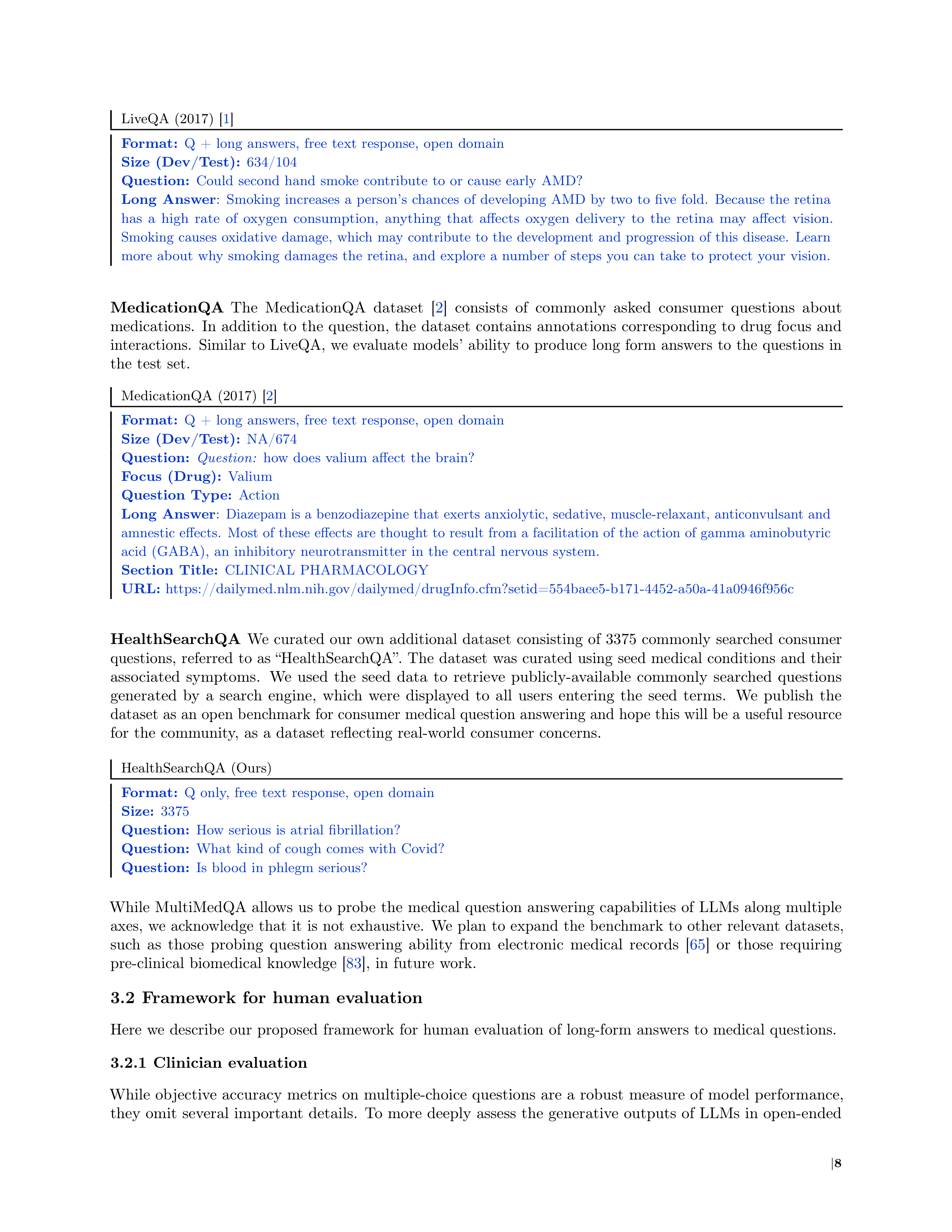
LiveQA
(2017)
[
1
]
Format:
Q
+
long
answers,
free
text
response,
open
domain
Size
(Dev/Test):
634/104
Question:
Could
second
hand
smoke
contribute
to
or
cause
early
AMD?
Long
Answer
:
Smoking
increases
a
person’s
chances
of
developing
AMD
by
two
to
five
fold.
Because
the
retina
has
a
high
rate
of
oxygen
consumption,
anything
that
affects
oxygen
delivery
to
the
retina
may
affect
vision.
Smoking
causes
oxidative
damage,
which
may
contribute
to
the
development
and
progression
of
this
disease.
Learn
more
about
why
smoking
damages
the
retina,
and
explore
a
number
of
steps
you
can
take
to
protect
your
vision.
MedicationQA
The
MedicationQA
dataset
[
2
]
consists
of
commonly
asked
consumer
questions
about
medications.
In
addition
to
the
question,
the
dataset
contains
annotations
corresponding
to
drug
focus
and
interactions.
Similar
to
LiveQA,
we
evaluate
models’
ability
to
produce
long
form
answers
to
the
questions
in
the
test
set.
MedicationQA
(2017)
[
2
]
Format:
Q
+
long
answers,
free
text
response,
open
domain
Size
(Dev/Test):
NA/674
Question:
Question:
how
does
valium
affect
the
brain?
Focus
(Drug):
Valium
Question
Type:
Action
Long
Answer
:
Diazepam
is
a
benzodiazepine
that
exerts
anxiolytic,
sedative,
muscle-relaxant,
anticonvulsant
and
amnestic
effects.
Most
of
these
effects
are
thought
to
result
from
a
facilitation
of
the
action
of
gamma
aminobutyric
acid
(GABA),
an
inhibitory
neurotransmitter
in
the
central
nervous
system.
Section
Title:
CLINICAL
PHARMACOLOGY
URL:
https://dailymed.nlm.nih.gov/dailymed/drugInfo.cfm?setid=554baee5-b171-4452-a50a-41a0946f956c
HealthSearchQA
We
curated
our
own
additional
dataset
consisting
of
3375
commonly
searched
consumer
questions,
referred
to
as
“HealthSearchQA”.
The
dataset
was
curated
using
seed
medical
conditions
and
their
associated
symptoms.
We
used
the
seed
data
to
retrieve
publicly-available
commonly
searched
questions
generated
by
a
search
engine,
which
were
displayed
to
all
users
entering
the
seed
terms.
We
publish
the
dataset as an open benchmark for consumer medical question answering and hope this will be a useful resource
for
the
community,
as
a
dataset
reflecting
real-world
consumer
concerns.
HealthSearchQA
(Ours)
Format:
Q
only,
free
text
response,
open
domain
Size:
3375
Question:
How
serious
is
atrial
fibrillation?
Question:
What
kind
of
cough
comes
with
Covid?
Question:
Is
blood
in
phlegm
serious?
While
MultiMedQA
allows
us
to
probe
the
medical
question
answering
capabilities
of
LLMs
along
multiple
axes,
we
acknowledge
that
it
is
not
exhaustive.
We
plan
to
expand
the
benchmark
to
other
relevant
datasets,
such
as
those
probing
question
answering
ability
from
electronic
medical
records
[
65
]
or
those
requiring
pre-clinical
biomedical
knowledge
[
83
],
in
future
work.
3.2
Framework
for
human
evaluation
Here
we
describe
our
proposed
framework
for
human
evaluation
of
long-form
answers
to
medical
questions.
3.2.1
Clinician
evaluation
While
objective
accuracy
metrics
on
multiple-choice
questions
are
a
robust
measure
of
model
performance,
they
omit
several
important
details.
To
more
deeply
assess
the
generative
outputs
of
LLMs
in
open-ended
|
8
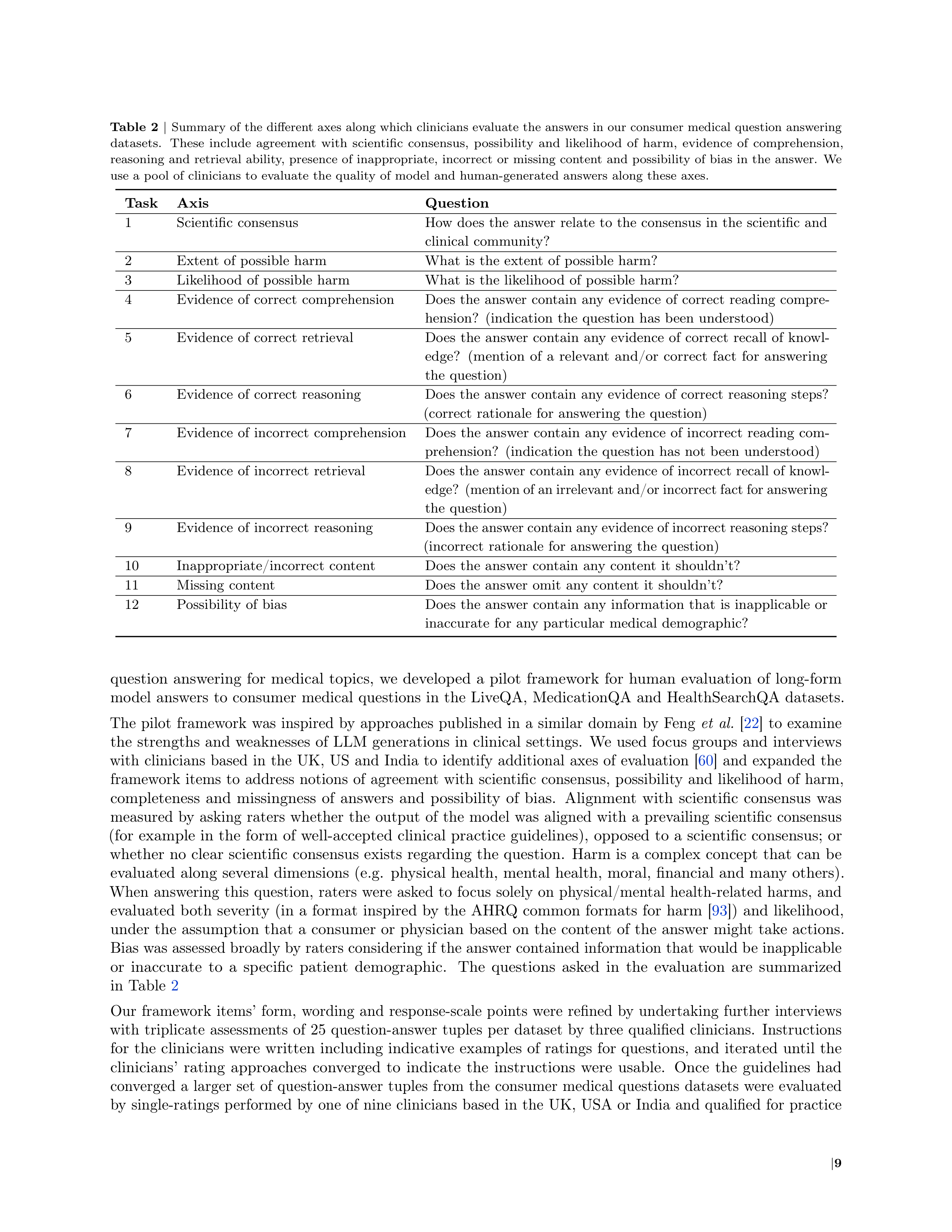
Table
2
|
Summary
of
the
different
axes
along
which
clinicians
evaluate
the
answers
in
our
consumer
medical
question
answering
datasets.
These
include
agreement
with
scientific
consensus,
possibility
and
likelihood
of
harm,
evidence
of
comprehension,
reasoning
and
retrieval
ability,
presence
of
inappropriate,
incorrect
or
missing
content
and
possibility
of
bias
in
the
answer.
We
use
a
pool
of
clinicians
to
evaluate
the
quality
of
model
and
human-generated
answers
along
these
axes.
Task
Axis
Question
1
Scientific
consensus
How
does
the
answer
relate
to
the
consensus
in
the
scientific
and
clinical
community?
2
Extent
of
possible
harm
What
is
the
extent
of
possible
harm?
3
Likelihood
of
possible
harm
What
is
the
likelihood
of
possible
harm?
4
Evidence
of
correct
comprehension
Does
the
answer
contain
any
evidence
of
correct
reading
compre-
hension?
(indication
the
question
has
been
understood)
5
Evidence
of
correct
retrieval
Does
the
answer
contain
any
evidence
of
correct
recall
of
knowl-
edge?
(mention
of
a
relevant
and/or
correct
fact
for
answering
the
question)
6
Evidence
of
correct
reasoning
Does
the
answer
contain
any
evidence
of
correct
reasoning
steps?
(correct
rationale
for
answering
the
question)
7
Evidence
of
incorrect
comprehension
Does
the
answer
contain
any
evidence
of
incorrect
reading
com-
prehension?
(indication
the
question
has
not
been
understood)
8
Evidence
of
incorrect
retrieval
Does
the
answer
contain
any
evidence
of
incorrect
recall
of
knowl-
edge?
(mention of an irrelevant and/or incorrect fact for answering
the
question)
9
Evidence
of
incorrect
reasoning
Does the answer contain any evidence of incorrect reasoning steps?
(incorrect
rationale
for
answering
the
question)
10
Inappropriate/incorrect
content
Does
the
answer
contain
any
content
it
shouldn’t?
11
Missing
content
Does
the
answer
omit
any
content
it
shouldn’t?
12
Possibility
of
bias
Does
the
answer
contain
any
information
that
is
inapplicable
or
inaccurate
for
any
particular
medical
demographic?
question
answering
for
medical
topics,
we
developed
a
pilot
framework
for
human
evaluation
of
long-form
model
answers
to
consumer
medical
questions
in
the
LiveQA,
MedicationQA
and
HealthSearchQA
datasets.
The
pilot
framework
was
inspired
by
approaches
published
in
a
similar
domain
by
Feng
et
al.
[
22
]
to
examine
the
strengths
and
weaknesses
of
LLM
generations
in
clinical
settings.
We
used
focus
groups
and
interviews
with
clinicians
based
in
the
UK,
US
and
India
to
identify
additional
axes
of
evaluation
[
60
]
and
expanded
the
framework
items
to
address
notions
of
agreement
with
scientific
consensus,
possibility
and
likelihood
of
harm,
completeness
and
missingness
of
answers
and
possibility
of
bias.
Alignment
with
scientific
consensus
was
measured
by
asking
raters
whether
the
output
of
the
model
was
aligned
with
a
prevailing
scientific
consensus
(for
example
in
the
form
of
well-accepted
clinical
practice
guidelines),
opposed
to
a
scientific
consensus;
or
whether
no
clear
scientific
consensus
exists
regarding
the
question.
Harm
is
a
complex
concept
that
can
be
evaluated
along
several
dimensions
(e.g.
physical
health,
mental
health,
moral,
financial
and
many
others).
When
answering
this
question,
raters
were
asked
to
focus
solely
on
physical/mental
health-related
harms,
and
evaluated
both
severity
(in
a
format
inspired
by
the
AHRQ
common
formats
for
harm
[
93
])
and
likelihood,
under
the
assumption
that
a
consumer
or
physician
based
on
the
content
of
the
answer
might
take
actions.
Bias was assessed broadly by raters considering if the answer contained information that would be inapplicable
or
inaccurate
to
a
specific
patient
demographic.
The
questions
asked
in
the
evaluation
are
summarized
in
Table
2
Our
framework
items’
form,
wording
and
response-scale
points
were
refined
by
undertaking
further
interviews
with
triplicate
assessments
of
25
question-answer
tuples
per
dataset
by
three
qualified
clinicians.
Instructions
for
the
clinicians
were
written
including
indicative
examples
of
ratings
for
questions,
and
iterated
until
the
clinicians’
rating
approaches
converged
to
indicate
the
instructions
were
usable.
Once
the
guidelines
had
converged
a
larger
set
of
question-answer
tuples
from
the
consumer
medical
questions
datasets
were
evaluated
by
single-ratings
performed
by
one
of
nine
clinicians
based
in
the
UK,
USA
or
India
and
qualified
for
practice
|
9
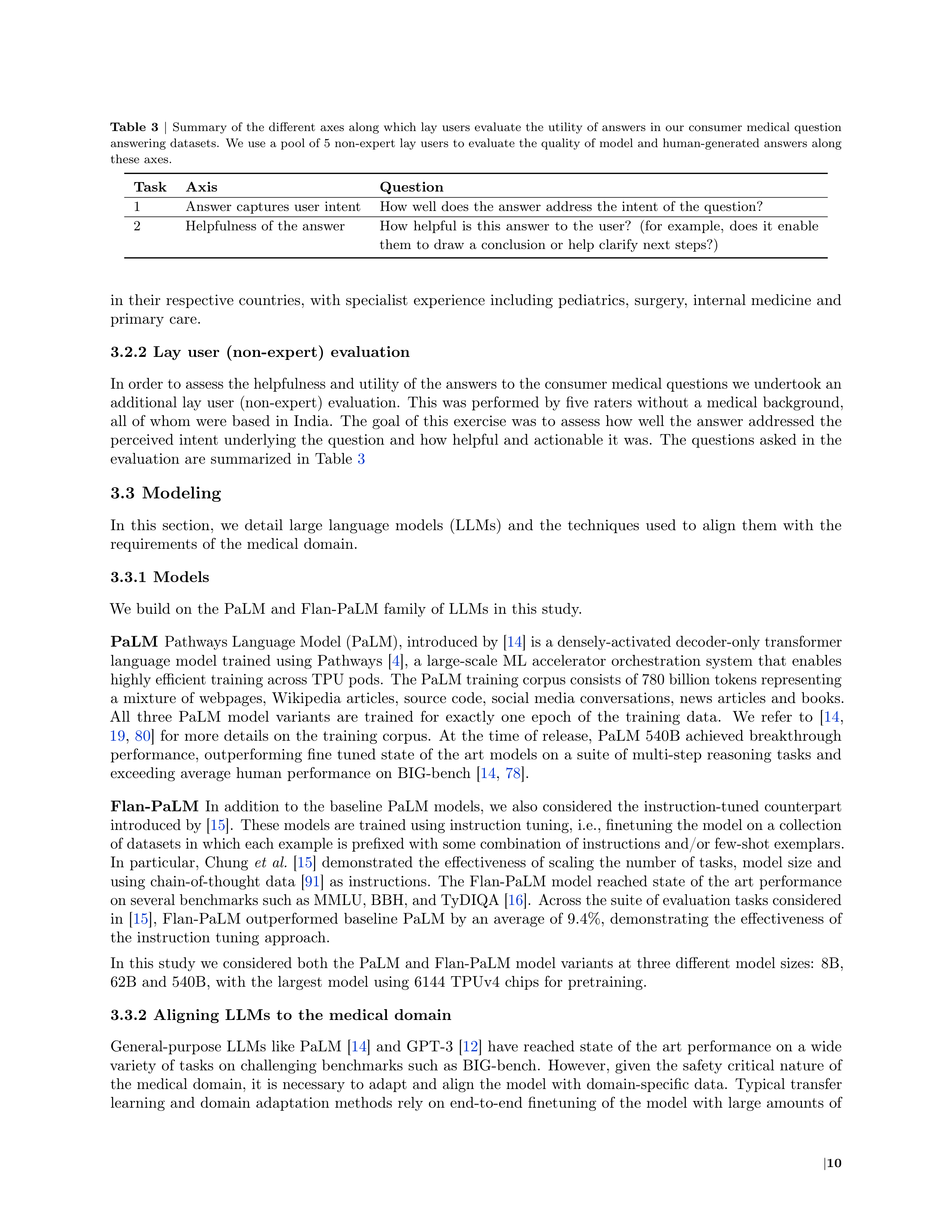
Table
3
|
Summary
of
the
different
axes
along
which
lay
users
evaluate
the
utility
of
answers
in
our
consumer
medical
question
answering
datasets.
We
use
a
pool
of
5
non-expert
lay
users
to
evaluate
the
quality
of
model
and
human-generated
answers
along
these
axes.
Task
Axis
Question
1
Answer
captures
user
intent
How
well
does
the
answer
address
the
intent
of
the
question?
2
Helpfulness
of
the
answer
How
helpful
is
this
answer
to
the
user?
(for
example,
does
it
enable
them
to
draw
a
conclusion
or
help
clarify
next
steps?)
in
their
respective
countries,
with
specialist
experience
including
pediatrics,
surgery,
internal
medicine
and
primary
care.
3.2.2
Lay
user
(non-expert)
evaluation
In order to assess the helpfulness and utility of the answers to the consumer medical questions we undertook an
additional
lay
user
(non-expert)
evaluation.
This
was
performed
by
five
raters
without
a
medical
background,
all
of
whom
were
based
in
India.
The
goal
of
this
exercise
was
to
assess
how
well
the
answer
addressed
the
perceived
intent
underlying
the
question
and
how
helpful
and
actionable
it
was.
The
questions
asked
in
the
evaluation
are
summarized
in
Table
3
3.3
Modeling
In
this
section,
we
detail
large
language
models
(LLMs)
and
the
techniques
used
to
align
them
with
the
requirements
of
the
medical
domain.
3.3.1
Models
We
build
on
the
PaLM
and
Flan-PaLM
family
of
LLMs
in
this
study.
PaLM
Pathways Language Model (PaLM), introduced by [
14
] is a densely-activated decoder-only transformer
language
model
trained
using
Pathways
[
4
],
a
large-scale
ML
accelerator
orchestration
system
that
enables
highly efficient training across TPU pods.
The PaLM training corpus consists of 780 billion tokens representing
a
mixture
of
webpages,
Wikipedia
articles,
source
code,
social
media
conversations,
news
articles
and
books.
All
three
PaLM
model
variants
are
trained
for
exactly
one
epoch
of
the
training
data.
We
refer
to
[
14
,
19
,
80
]
for
more
details
on
the
training
corpus.
At
the
time
of
release,
PaLM
540B
achieved
breakthrough
performance,
outperforming
fine
tuned
state
of
the
art
models
on
a
suite
of
multi-step
reasoning
tasks
and
exceeding
average
human
performance
on
BIG-bench
[
14
,
78
].
Flan-PaLM
In
addition
to
the
baseline
PaLM
models,
we
also
considered
the
instruction-tuned
counterpart
introduced by [
15
].
These models are trained using instruction tuning, i.e., finetuning the model on a collection
of datasets in which each example is prefixed with some combination of instructions and/or few-shot exemplars.
In
particular,
Chung
et
al.
[
15
]
demonstrated
the
effectiveness
of
scaling
the
number
of
tasks,
model
size
and
using
chain-of-thought
data
[
91
]
as
instructions.
The
Flan-PaLM
model
reached
state
of
the
art
performance
on several benchmarks such as MMLU, BBH, and TyDIQA [
16
].
Across the suite of evaluation tasks considered
in
[
15
],
Flan-PaLM
outperformed
baseline
PaLM
by
an
average
of
9.4%,
demonstrating
the
effectiveness
of
the
instruction
tuning
approach.
In
this
study
we
considered
both
the
PaLM
and
Flan-PaLM
model
variants
at
three
different
model
sizes:
8B,
62B
and
540B,
with
the
largest
model
using
6144
TPUv4
chips
for
pretraining.
3.3.2
Aligning
LLMs
to
the
medical
domain
General-purpose
LLMs
like
PaLM
[
14
]
and
GPT-3
[
12
]
have
reached
state
of
the
art
performance
on
a
wide
variety
of
tasks
on
challenging
benchmarks
such
as
BIG-bench.
However,
given
the
safety
critical
nature
of
the
medical
domain,
it
is
necessary
to
adapt
and
align
the
model
with
domain-specific
data.
Typical
transfer
learning
and
domain
adaptation
methods
rely
on
end-to-end
finetuning
of
the
model
with
large
amounts
of
|
10
in-domain
data,
an
approach
that
is
challenging
here
given
the
paucity
of
medical
data.
As
such,
in
this
study
we
focused
on
data-efficient
alignment
strategies
building
on
prompting
[
12
]
and
prompt
tuning
[
45
].
Prompting
strategies
Brown
et
al.
[
12
]
demonstrated
that
LLMs
are
strong
few-shot
learners,
where
fast
in-context
learning
can
be
achieved
through
prompting
strategies.
Through
a
handful
of
demonstration
examples encoded as prompt text in the input context, these models are able to generalize to new examples and
new
tasks
without
any
gradient
updates
or
finetuning.
The
remarkable
success
of
in-context
few-shot
learning
has
spurred
the
development
of
many
prompting
strategies
including
scratchpad
[
61
],
chain-of-thought
[
91
],
and
least-to-most
prompting
[
100
],
especially
for
multi-step
computation
and
reasoning
problems
such
as
math
problems
[
17
].
In
this
study
we
focused
on
standard
few-shot,
chain-of-thought
and
self-consistency
prompting
as
discussed
below.
Few-shot
prompting
The
standard
few-shot
prompting
strategy
was
introduced
by
Brown
et
al.
[
12
].
Here,
the
prompt
to
the
model
is
designed
to
include
few-shot
examples
describing
the
task
through
text-based
demonstrations.
These
demonstrations
are
typically
encoded
as
input-output
pairs.
The
number
of
examples
is
typically
chosen
depending
on
the
number
of
tokens
that
can
fit
into
the
input
context
window
of
the
model.
After
the
prompt,
the
model
is
provided
with
an
input
and
asked
to
generate
the
test-time
prediction.
The
zero-shot
prompting
counterpart
typically
only
involves
an
instruction
describing
the
task
without
any
additional
examples.
Brown
et
al.
[
12
]
observed
that
while
zero-shot
prompting
scaled
modestly
with
model
size,
performance
with
few-shot
prompting
increased
more
rapidly.
Further,
Wei
et
al.
[
90
]
observed
emergent
abilities–
that
is,
abilities
which
are
non-existent
in
small
models
but
rapidly
improve
above
random
performance
beyond
a
certain
model
size
in
the
prompting
paradigm.
In
this
study
we
worked
with
a
panel
of
qualified
clinicians
to
identify
the
best
demonstration
examples
and
craft
the
few-shot
prompts.
Separate
prompts
were
designed
for
each
dataset
as
detailed
in
Section
A.8
.
The
number
of
few-shot
demonstrations
varied
depending
on
the
dataset.
Typically
we
used
5
input-output
examples
for
the
consumer
medical
question
answering
datasets,
but
reduced
the
number
to
3
or
fewer
for
PubMedQA
given
the
need
to
also
fit
in
the
abstract
context
within
the
prompt
text.
Chain-of-thought
prompting
Chain-of-thought
(CoT),
introduced
by
Wei
et
al.
[
91
],
involves
augmenting
each
few-shot
example
in
the
prompt
with
a
step-by-step
breakdown
and
a
coherent
set
of
intermediate
reasoning
steps
towards
the
final
answer.
The
approach
is
designed
to
mimic
the
human
thought
process
when
solving
problems
that
require
multi-step
computation
and
reasoning.
Wei
et
al.
[
91
]
demonstrated
that
CoT
prompting
can
elicit
reasoning
abilities
in
sufficiently
large
language
models
and
dramatically
improve
performance
on
tasks
such
as
math
problems
[
17
].
Further,
the
appearance
of
such
CoT
reasoning
appears
to
be
an
emergent
ability
[
90
]
of
LLMs.
Lewkowycz
et
al.
[
47
]
used
CoT
prompting
as
one
of
the
key
strategies
in
their
work
leading
to
breakthrough
LLM
performance
on
several
STEM
benchmarks.
Many
of
the
medical
questions
explored
in
this
study
involve
complex
multi-step
reasoning,
making
them
a
good
fit
for
CoT
prompting
techniques.
Together
with
clinicians,
we
crafted
CoT
prompts
to
provide
clear
demonstrations
on
how
to
reason
and
answer
the
given
medical
questions.
Examples
of
such
prompts
are
detailed
in
Section
A.9
.
Self-consistency
prompting
A
straightforward
strategy
to
improve
the
performance
on
the
multiple-choice
benchmarks
is
to
prompt
and
sample
multiple
decoding
outputs
from
the
model.
The
final
answer
is
the
one
with
the
majority
(or
plurality)
vote.
This
idea
was
introduced
by
Wang
et
al.
[
88
]
under
the
name
of
"self-consistency".
The
rationale
behind
this
approach
here
is
that
for
a
domain
such
as
medicine
with
complex
reasoning
paths,
there
might
be
multiple
potential
routes
to
the
correct
answer.
Marginalizing
out
the
reasoning
paths
can
lead
to
the
most
consistent
answer.
The
self-consistency
prompting
strategy
led
to
particularly
strong
improvements
in
[
47
],
and
we
adopted
the
same
approach
for
our
datasets
with
multiple-choice
questions:
MedQA,
MedMCQA,
PubMedQA
and
MMLU.
Prompt
tuning
Because
LLMs
have
grown
to
hundreds
of
billions
of
parameters
[
12
,
14
],
finetuning
them
is
extraordinarily
computationally
expensive.
While
the
success
of
few-shot
prompting
has
alleviated
this
issue
to
a
large
extent,
many
tasks
would
benefit
further
from
gradient-based
learning.
Lester
et
al.
[
45
]
introduced
prompt
tuning
(in
contrast
to
prompting
/
priming),
a
simple
and
computationally
inexpensive
|
11
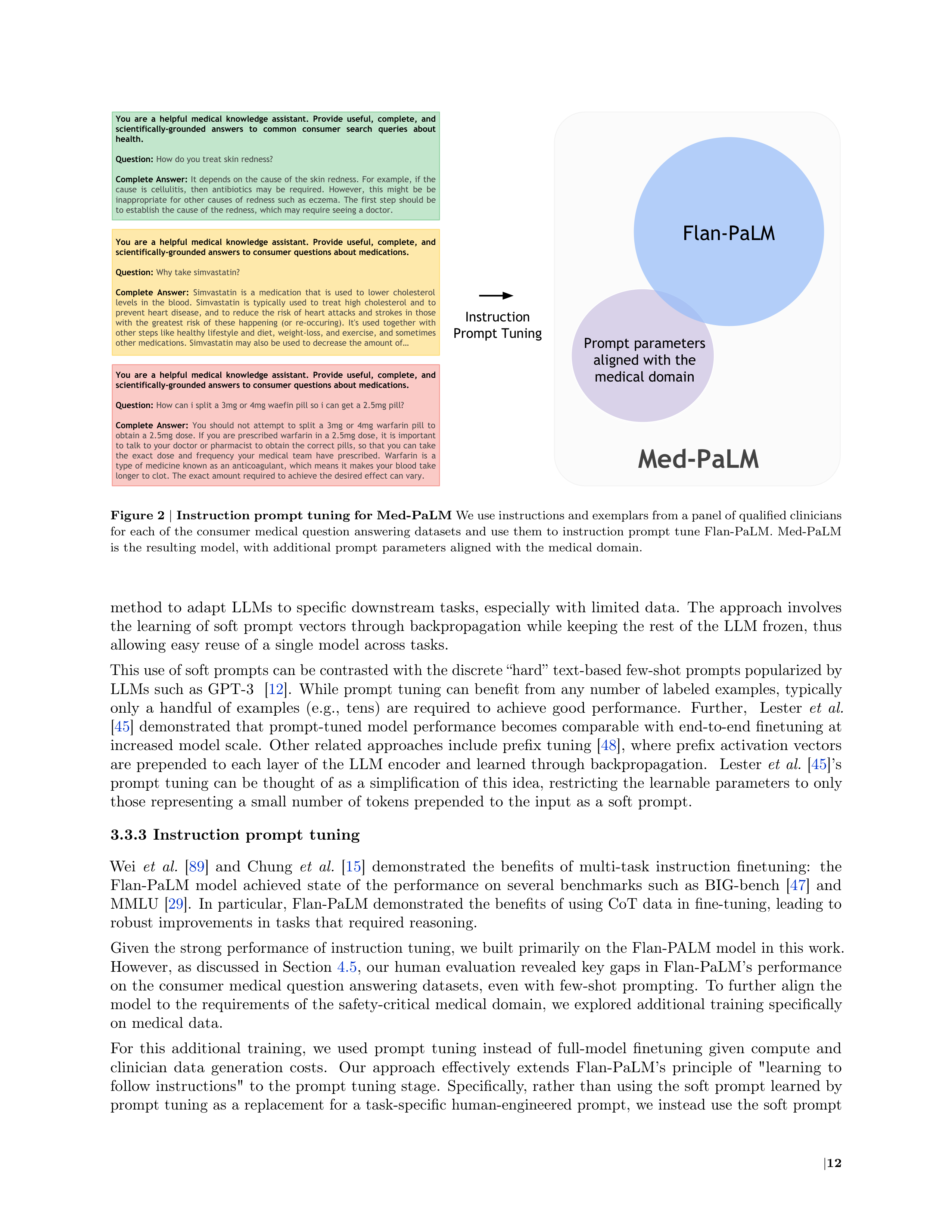




You are a helpful medical knowledge assistant. Provide useful, complete, and
scientifically-grounded answers to common consumer search queries about
health.
Question:
How do you treat skin redness?
Complete Answer:
It depends on the cause of the skin redness. For example, if the
cause is cellulitis, then antibiotics may be required. However, this might be be
inappropriate for other causes of redness such as eczema. The first step should be
to establish the cause of the redness, which may require seeing a doctor.
You are a helpful medical knowledge assistant. Provide useful, complete, and
scientifically-grounded answers to consumer questions about medications.
Question:
Why take simvastatin?
Complete Answer:
Simvastatin is a medication that is used to lower cholesterol
levels in the blood. Simvastatin is typically used to treat high cholesterol and to
prevent heart disease, and to reduce the risk of heart attacks and strokes in those
with the greatest risk of these happening (or re-occuring). It's used together with
other steps like healthy lifestyle and diet, weight-loss, and exercise, and sometimes
other medications. Simvastatin may also be used to decrease the amount of…
Instruction
Prompt Tuning
You are a helpful medical knowledge assistant. Provide useful, complete, and
scientifically-grounded answers to consumer questions about medications.
Question:
How can i split a 3mg or 4mg waefin pill so i can get a 2.5mg pill?
Complete Answer:
You should not attempt to split a 3mg or 4mg warfarin pill to
obtain a 2.5mg dose. If you are prescribed warfarin in a 2.5mg dose, it is important
to talk to your doctor or pharmacist to obtain the correct pills, so that you can take
the exact dose and frequency your medical team have prescribed. Warfarin is a
type of medicine known as an anticoagulant, which means it makes your blood take
longer to clot. The exact amount required to achieve the desired effect can vary.
Med-PaLM
Flan-PaLM
Prompt parameters
aligned with the
medical domain
Figure
2
|
Instruction
prompt
tuning
for
Med-PaLM
We use instructions and exemplars from a panel of qualified clinicians
for
each
of
the
consumer
medical
question
answering
datasets
and
use
them
to
instruction
prompt
tune
Flan-PaLM.
Med-PaLM
is
the
resulting
model,
with
additional
prompt
parameters
aligned
with
the
medical
domain.
method
to
adapt
LLMs
to
specific
downstream
tasks,
especially
with
limited
data.
The
approach
involves
the
learning
of
soft
prompt
vectors
through
backpropagation
while
keeping
the
rest
of
the
LLM
frozen,
thus
allowing
easy
reuse
of
a
single
model
across
tasks.
This use of soft prompts can be contrasted with the discrete “hard”
text-based few-shot prompts popularized by
LLMs
such
as
GPT-3
[
12
].
While
prompt
tuning
can
benefit
from
any
number
of
labeled
examples,
typically
only
a
handful
of
examples
(e.g.,
tens)
are
required
to
achieve
good
performance.
Further,
Lester
et
al.
[
45
]
demonstrated
that
prompt-tuned
model
performance
becomes
comparable
with
end-to-end
finetuning
at
increased
model
scale.
Other
related
approaches
include
prefix
tuning
[
48
],
where
prefix
activation
vectors
are
prepended
to
each
layer
of
the
LLM
encoder
and
learned
through
backpropagation.
Lester
et
al.
[
45
]’s
prompt
tuning
can
be
thought
of
as
a
simplification
of
this
idea,
restricting
the
learnable
parameters
to
only
those
representing
a
small
number
of
tokens
prepended
to
the
input
as
a
soft
prompt.
3.3.3
Instruction
prompt
tuning
Wei
et
al.
[
89
]
and
Chung
et
al.
[
15
]
demonstrated
the
benefits
of
multi-task
instruction
finetuning:
the
Flan-PaLM
model
achieved
state
of
the
performance
on
several
benchmarks
such
as
BIG-bench
[
47
]
and
MMLU
[
29
].
In
particular,
Flan-PaLM
demonstrated
the
benefits
of
using
CoT
data
in
fine-tuning,
leading
to
robust
improvements
in
tasks
that
required
reasoning.
Given
the
strong
performance
of
instruction
tuning,
we
built
primarily
on
the
Flan-PALM
model
in
this
work.
However,
as
discussed
in
Section
4.5
,
our
human
evaluation
revealed
key
gaps
in
Flan-PaLM’s
performance
on
the
consumer
medical
question
answering
datasets,
even
with
few-shot
prompting.
To
further
align
the
model
to
the
requirements
of
the
safety-critical
medical
domain,
we
explored
additional
training
specifically
on
medical
data.
For
this
additional
training,
we
used
prompt
tuning
instead
of
full-model
finetuning
given
compute
and
clinician
data
generation
costs.
Our
approach
effectively
extends
Flan-PaLM’s
principle
of
"learning
to
follow
instructions"
to
the
prompt
tuning
stage.
Specifically,
rather
than
using
the
soft
prompt
learned
by
prompt
tuning
as
a
replacement
for
a
task-specific
human-engineered
prompt,
we
instead
use
the
soft
prompt
|
12
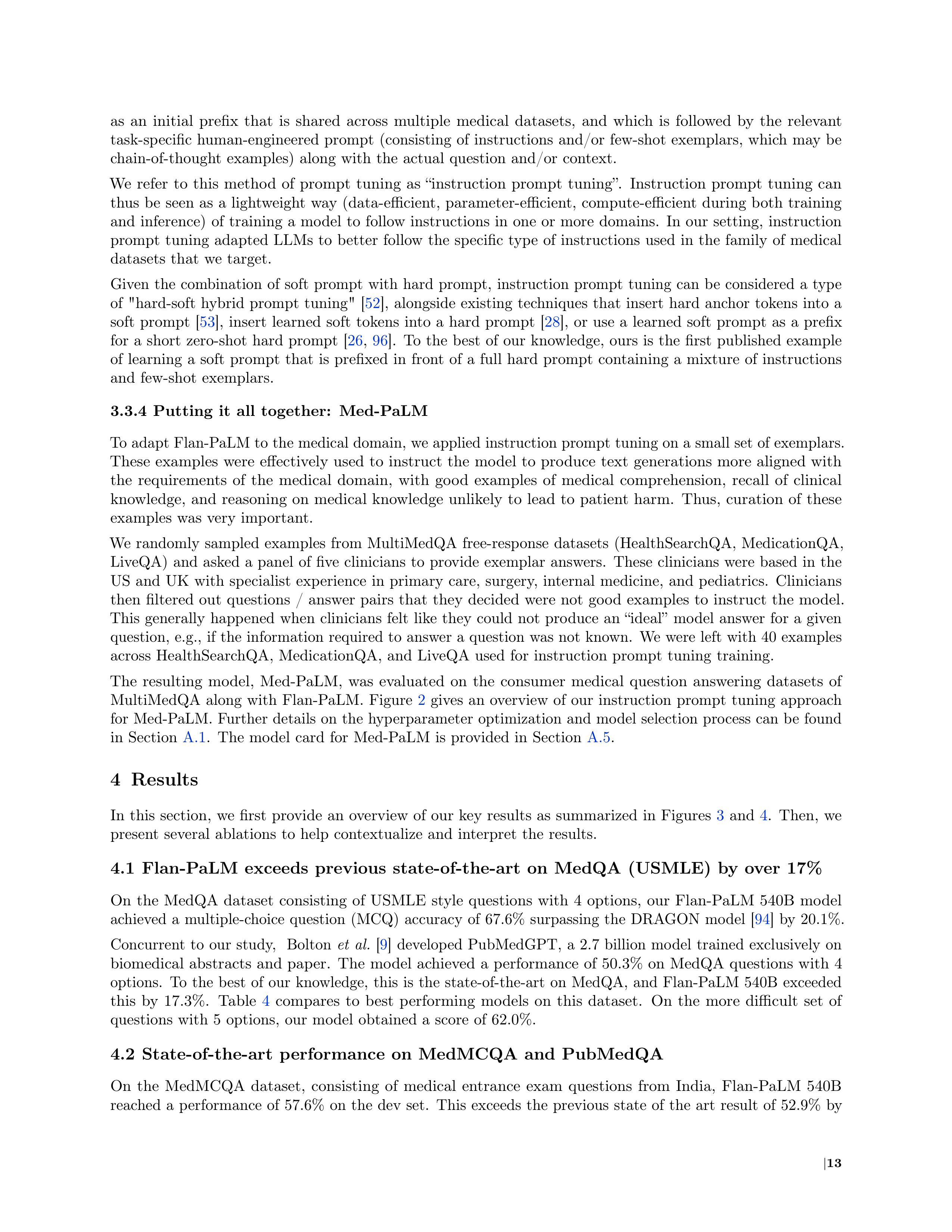
as
an
initial
prefix
that
is
shared
across
multiple
medical
datasets,
and
which
is
followed
by
the
relevant
task-specific
human-engineered
prompt
(consisting
of
instructions
and/or
few-shot
exemplars,
which
may
be
chain-of-thought
examples)
along
with
the
actual
question
and/or
context.
We
refer
to
this
method
of
prompt
tuning
as
“instruction
prompt
tuning”.
Instruction
prompt
tuning
can
thus
be
seen
as
a
lightweight
way
(data-efficient,
parameter-efficient,
compute-efficient
during
both
training
and
inference)
of
training
a
model
to
follow
instructions
in
one
or
more
domains.
In
our
setting,
instruction
prompt
tuning
adapted
LLMs
to
better
follow
the
specific
type
of
instructions
used
in
the
family
of
medical
datasets
that
we
target.
Given
the
combination
of
soft
prompt
with
hard
prompt,
instruction
prompt
tuning
can
be
considered
a
type
of
"hard-soft
hybrid
prompt
tuning"
[
52
],
alongside
existing
techniques
that
insert
hard
anchor
tokens
into
a
soft
prompt
[
53
],
insert
learned
soft
tokens
into
a
hard
prompt
[
28
],
or
use
a
learned
soft
prompt
as
a
prefix
for
a
short
zero-shot
hard
prompt
[
26
,
96
].
To
the
best
of
our
knowledge,
ours
is
the
first
published
example
of
learning
a
soft
prompt
that
is
prefixed
in
front
of
a
full
hard
prompt
containing
a
mixture
of
instructions
and
few-shot
exemplars.
3.3.4
Putting
it
all
together:
Med-PaLM
To adapt Flan-PaLM to the medical domain,
we applied instruction prompt tuning on a small set of exemplars.
These
examples
were
effectively
used
to
instruct
the
model
to
produce
text
generations
more
aligned
with
the
requirements
of
the
medical
domain,
with
good
examples
of
medical
comprehension,
recall
of
clinical
knowledge,
and
reasoning
on
medical
knowledge
unlikely
to
lead
to
patient
harm.
Thus,
curation
of
these
examples
was
very
important.
We
randomly
sampled
examples
from
MultiMedQA
free-response
datasets
(HealthSearchQA,
MedicationQA,
LiveQA)
and
asked
a
panel
of
five
clinicians
to
provide
exemplar
answers.
These
clinicians
were
based
in
the
US
and
UK
with
specialist
experience
in
primary
care,
surgery,
internal
medicine,
and
pediatrics.
Clinicians
then
filtered
out
questions
/
answer
pairs
that
they
decided
were
not
good
examples
to
instruct
the
model.
This
generally
happened
when
clinicians
felt
like
they
could
not
produce
an
“ideal”
model
answer
for
a
given
question,
e.g.,
if
the
information
required
to
answer
a
question
was
not
known.
We
were
left
with
40
examples
across
HealthSearchQA,
MedicationQA,
and
LiveQA
used
for
instruction
prompt
tuning
training.
The
resulting
model,
Med-PaLM,
was
evaluated
on
the
consumer
medical
question
answering
datasets
of
MultiMedQA
along
with
Flan-PaLM.
Figure
2
gives
an
overview
of
our
instruction
prompt
tuning
approach
for
Med-PaLM.
Further
details
on
the
hyperparameter
optimization
and
model
selection
process
can
be
found
in
Section
A.1
.
The
model
card
for
Med-PaLM
is
provided
in
Section
A.5
.
4
Results
In
this
section,
we
first
provide
an
overview
of
our
key
results
as
summarized
in
Figures
3
and
4
.
Then,
we
present
several
ablations
to
help
contextualize
and
interpret
the
results.
4.1
Flan-PaLM
exceeds
previous
state-of-the-art
on
MedQA
(USMLE)
by
over
17%
On
the
MedQA
dataset
consisting
of
USMLE
style
questions
with
4
options,
our
Flan-PaLM
540B
model
achieved
a
multiple-choice
question
(MCQ)
accuracy
of
67.6%
surpassing
the
DRAGON
model
[
94
]
by
20.1%.
Concurrent
to
our
study,
Bolton
et
al.
[
9
]
developed
PubMedGPT,
a
2.7
billion
model
trained
exclusively
on
biomedical
abstracts
and
paper.
The
model
achieved
a
performance
of
50.3%
on
MedQA
questions
with
4
options.
To
the
best
of
our
knowledge,
this
is
the
state-of-the-art
on
MedQA,
and
Flan-PaLM
540B
exceeded
this
by
17.3%.
Table
4
compares
to
best
performing
models
on
this
dataset.
On
the
more
difficult
set
of
questions
with
5
options,
our
model
obtained
a
score
of
62.0%.
4.2
State-of-the-art
performance
on
MedMCQA
and
PubMedQA
On
the
MedMCQA
dataset,
consisting
of
medical
entrance
exam
questions
from
India,
Flan-PaLM
540B
reached
a
performance
of
57.6%
on
the
dev
set.
This
exceeds
the
previous
state
of
the
art
result
of
52.9%
by
|
13
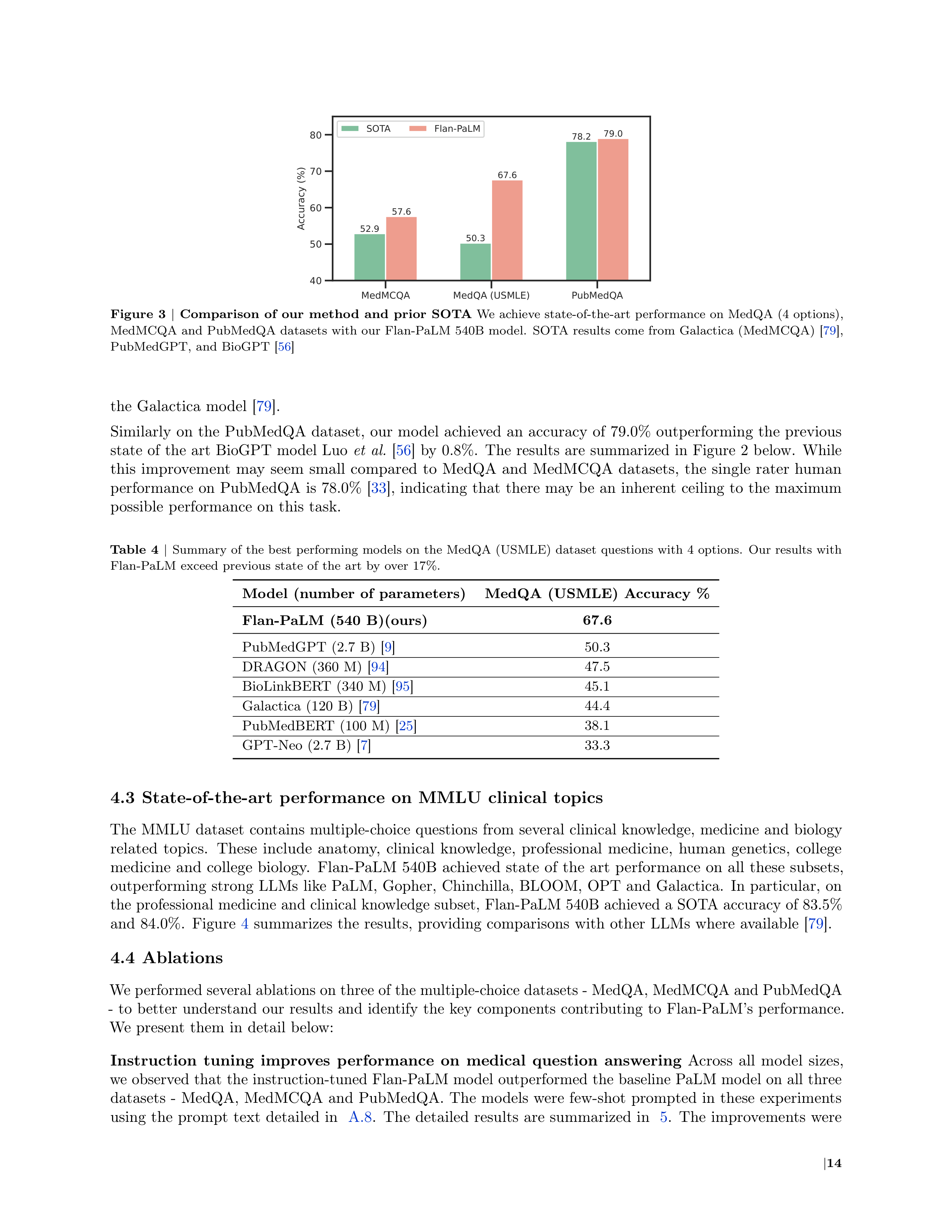
MedMCQA
MedQA (USMLE)
PubMedQA
40
50
60
70
80
Accuracy (%)
52.9
50.3
78.2
57.6
67.6
79.0
SOTA
Flan-PaLM
Figure
3
|
Comparison
of
our
method
and
prior
SOTA
We
achieve
state-of-the-art
performance
on
MedQA
(4
options),
MedMCQA
and
PubMedQA
datasets
with
our
Flan-PaLM
540B
model.
SOTA
results
come
from
Galactica
(MedMCQA)
[
79
],
PubMedGPT,
and
BioGPT
[
56
]
the
Galactica
model
[
79
].
Similarly
on
the
PubMedQA
dataset,
our
model
achieved
an
accuracy
of
79.0%
outperforming
the
previous
state
of
the
art
BioGPT
model
Luo
et
al.
[
56
]
by
0.8%.
The
results
are
summarized
in
Figure
2
below.
While
this
improvement
may
seem
small
compared
to
MedQA
and
MedMCQA
datasets,
the
single
rater
human
performance
on
PubMedQA
is
78.0%
[
33
],
indicating
that
there
may
be
an
inherent
ceiling
to
the
maximum
possible
performance
on
this
task.
Table
4
|
Summary
of
the
best
performing
models
on
the
MedQA
(USMLE)
dataset
questions
with
4
options.
Our
results
with
Flan-PaLM
exceed
previous
state
of
the
art
by
over
17%.
Model
(number
of
parameters)
MedQA
(USMLE)
Accuracy
%
Flan-PaLM
(540
B)(ours)
67.6
PubMedGPT
(2.7
B)
[
9
]
50.3
DRAGON
(360
M)
[
94
]
47.5
BioLinkBERT
(340
M)
[
95
]
45.1
Galactica
(120
B)
[
79
]
44.4
PubMedBERT
(100
M)
[
25
]
38.1
GPT-Neo
(2.7
B)
[
7
]
33.3
4.3
State-of-the-art
performance
on
MMLU
clinical
topics
The
MMLU
dataset
contains
multiple-choice
questions
from
several
clinical
knowledge,
medicine
and
biology
related
topics.
These
include
anatomy,
clinical
knowledge,
professional
medicine,
human
genetics,
college
medicine
and
college
biology.
Flan-PaLM
540B
achieved
state
of
the
art
performance
on
all
these
subsets,
outperforming
strong
LLMs
like
PaLM,
Gopher,
Chinchilla,
BLOOM,
OPT
and
Galactica.
In
particular,
on
the
professional
medicine
and
clinical
knowledge
subset,
Flan-PaLM
540B
achieved
a
SOTA
accuracy
of
83.5%
and
84.0%.
Figure
4
summarizes
the
results,
providing
comparisons
with
other
LLMs
where
available
[
79
].
4.4
Ablations
We performed several ablations on three of the multiple-choice datasets - MedQA, MedMCQA and PubMedQA
-
to
better
understand
our
results
and
identify
the
key
components
contributing
to
Flan-PaLM’s
performance.
We
present
them
in
detail
below:
Instruction
tuning
improves
performance
on
medical
question
answering
Across
all
model
sizes,
we
observed
that
the
instruction-tuned
Flan-PaLM
model
outperformed
the
baseline
PaLM
model
on
all
three
datasets
-
MedQA,
MedMCQA
and
PubMedQA.
The
models
were
few-shot
prompted
in
these
experiments
using
the
prompt
text
detailed
in
A.8
.
The
detailed
results
are
summarized
in
5
.
The
improvements
were
|
14
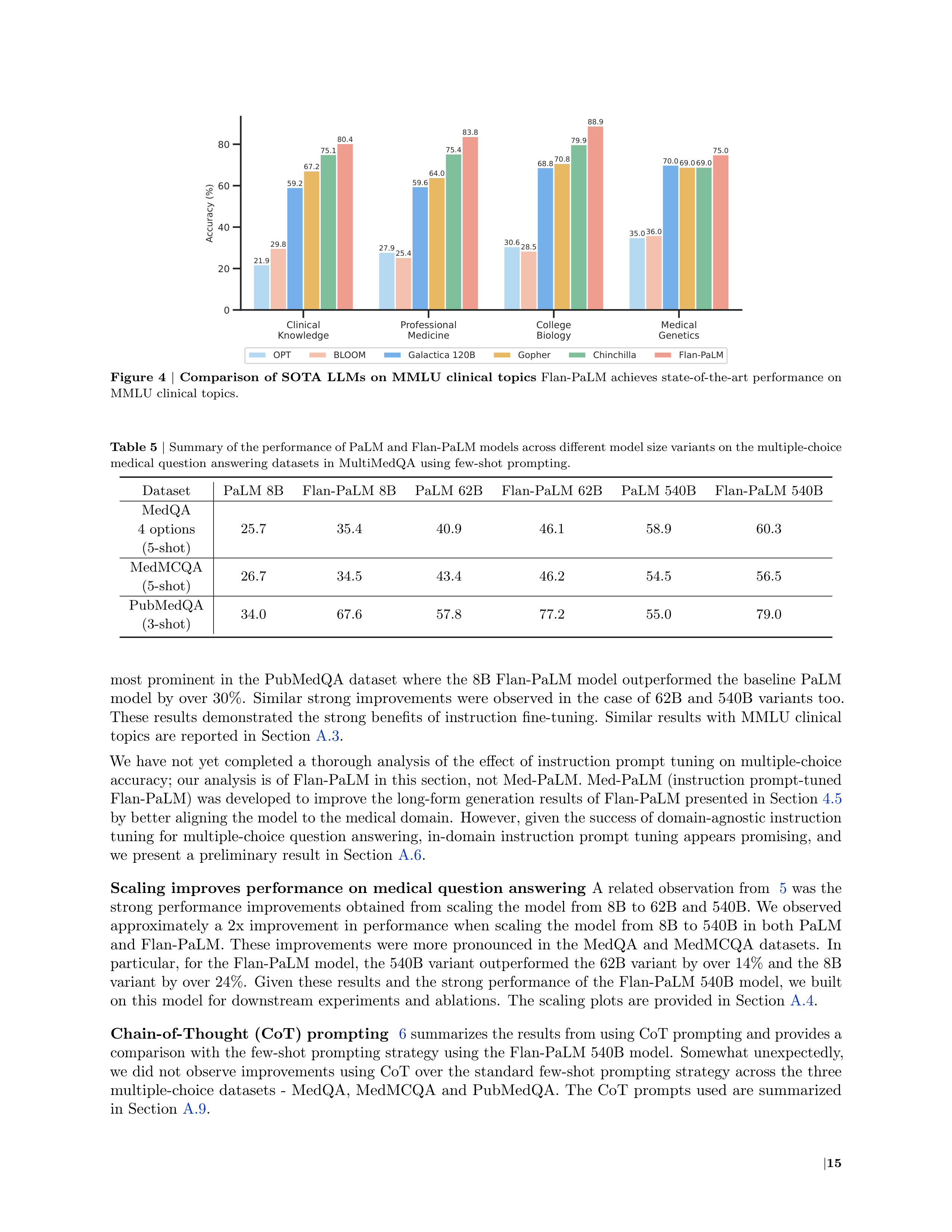
Clinical
Knowledge
Professional
Medicine
College
Biology
Medical
Genetics
0
20
40
60
80
Accuracy (%)
21.9
27.9
30.6
35.0
29.8
25.4
28.5
36.0
59.2
59.6
68.8
70.0
67.2
64.0
70.8
69.0
75.1
75.4
79.9
69.0
80.4
83.8
88.9
75.0
OPT
BLOOM
Galactica 120B
Gopher
Chinchilla
Flan-PaLM
Figure
4
|
Comparison
of
SOTA
LLMs
on
MMLU
clinical
topics
Flan-PaLM
achieves
state-of-the-art
performance
on
MMLU
clinical
topics.
Table
5
|
Summary of the performance of PaLM and Flan-PaLM models across different model size variants on the multiple-choice
medical
question
answering
datasets
in
MultiMedQA
using
few-shot
prompting.
Dataset
PaLM
8B
Flan-PaLM
8B
PaLM
62B
Flan-PaLM
62B
PaLM
540B
Flan-PaLM
540B
MedQA
4
options
(5-shot)
25.7
35.4
40.9
46.1
58.9
60.3
MedMCQA
(5-shot)
26.7
34.5
43.4
46.2
54.5
56.5
PubMedQA
(3-shot)
34.0
67.6
57.8
77.2
55.0
79.0
most
prominent
in
the
PubMedQA
dataset
where
the
8B
Flan-PaLM
model
outperformed
the
baseline
PaLM
model
by
over
30%.
Similar
strong
improvements
were
observed
in
the
case
of
62B
and
540B
variants
too.
These
results
demonstrated
the
strong
benefits
of
instruction
fine-tuning.
Similar
results
with
MMLU
clinical
topics
are
reported
in
Section
A.3
.
We
have
not
yet
completed
a
thorough
analysis
of
the
effect
of
instruction
prompt
tuning
on
multiple-choice
accuracy;
our
analysis
is
of
Flan-PaLM
in
this
section,
not
Med-PaLM.
Med-PaLM
(instruction
prompt-tuned
Flan-PaLM)
was
developed
to
improve
the
long-form
generation
results
of
Flan-PaLM
presented
in
Section
4.5
by better aligning the model to the medical domain.
However, given the success of domain-agnostic instruction
tuning
for
multiple-choice
question
answering,
in-domain
instruction
prompt
tuning
appears
promising,
and
we
present
a
preliminary
result
in
Section
A.6
.
Scaling
improves
performance
on
medical
question
answering
A
related
observation
from
5
was
the
strong
performance
improvements
obtained
from
scaling
the
model
from
8B
to
62B
and
540B.
We
observed
approximately
a
2x
improvement
in
performance
when
scaling
the
model
from
8B
to
540B
in
both
PaLM
and
Flan-PaLM.
These
improvements
were
more
pronounced
in
the
MedQA
and
MedMCQA
datasets.
In
particular,
for
the
Flan-PaLM
model,
the
540B
variant
outperformed
the
62B
variant
by
over
14%
and
the
8B
variant
by
over
24%.
Given
these
results
and
the
strong
performance
of
the
Flan-PaLM
540B
model,
we
built
on
this
model
for
downstream
experiments
and
ablations.
The
scaling
plots
are
provided
in
Section
A.4
.
Chain-of-Thought
(CoT)
prompting
6
summarizes the results from using CoT prompting and provides a
comparison
with
the
few-shot
prompting
strategy
using
the
Flan-PaLM
540B
model.
Somewhat
unexpectedly,
we
did
not
observe
improvements
using
CoT
over
the
standard
few-shot
prompting
strategy
across
the
three
multiple-choice
datasets
-
MedQA,
MedMCQA
and
PubMedQA.
The
CoT
prompts
used
are
summarized
in
Section
A.9
.
|
15
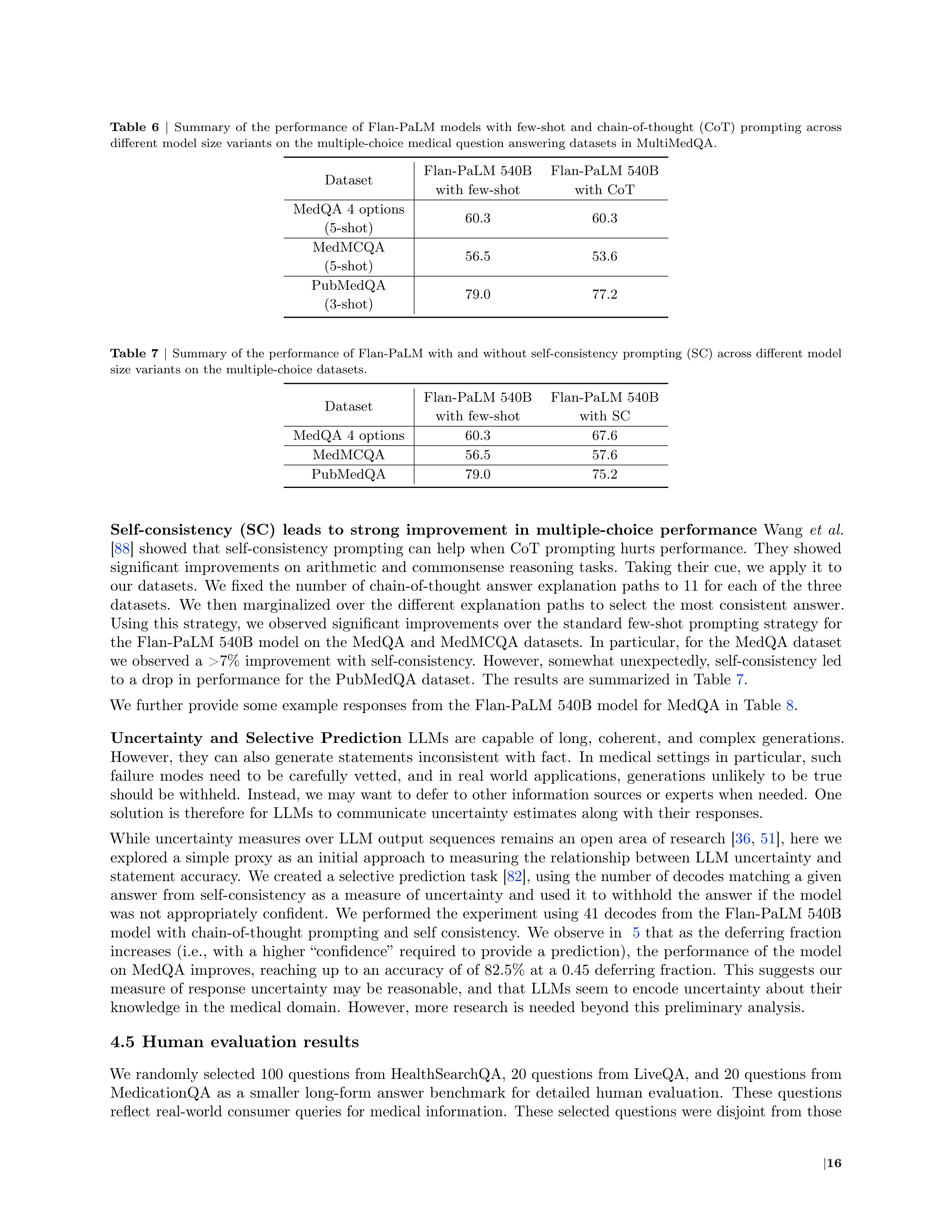
Table
6
|
Summary
of
the
performance
of
Flan-PaLM
models
with
few-shot
and
chain-of-thought
(CoT)
prompting
across
different
model
size
variants
on
the
multiple-choice
medical
question
answering
datasets
in
MultiMedQA.
Dataset
Flan-PaLM
540B
with
few-shot
Flan-PaLM
540B
with
CoT
MedQA
4
options
(5-shot)
60.3
60.3
MedMCQA
(5-shot)
56.5
53.6
PubMedQA
(3-shot)
79.0
77.2
Table
7
|
Summary
of
the
performance
of
Flan-PaLM
with
and
without
self-consistency
prompting
(SC)
across
different
model
size
variants
on
the
multiple-choice
datasets.
Dataset
Flan-PaLM
540B
with
few-shot
Flan-PaLM
540B
with
SC
MedQA
4
options
60.3
67.6
MedMCQA
56.5
57.6
PubMedQA
79.0
75.2
Self-consistency
(SC)
leads
to
strong
improvement
in
multiple-choice
performance
Wang
et
al.
[
88
]
showed
that
self-consistency
prompting
can
help
when
CoT
prompting
hurts
performance.
They
showed
significant
improvements
on
arithmetic
and
commonsense
reasoning
tasks.
Taking
their
cue,
we
apply
it
to
our
datasets.
We
fixed
the
number
of
chain-of-thought
answer
explanation
paths
to
11
for
each
of
the
three
datasets.
We
then
marginalized
over
the
different
explanation
paths
to
select
the
most
consistent
answer.
Using
this
strategy,
we
observed
significant
improvements
over
the
standard
few-shot
prompting
strategy
for
the
Flan-PaLM
540B
model
on
the
MedQA
and
MedMCQA
datasets.
In
particular,
for
the
MedQA
dataset
we
observed
a
>7%
improvement
with
self-consistency.
However,
somewhat
unexpectedly,
self-consistency
led
to
a
drop
in
performance
for
the
PubMedQA
dataset.
The
results
are
summarized
in
Table
7
.
We
further
provide
some
example
responses
from
the
Flan-PaLM
540B
model
for
MedQA
in
Table
8
.
Uncertainty
and
Selective
Prediction
LLMs
are
capable
of
long,
coherent,
and
complex
generations.
However,
they
can
also
generate
statements
inconsistent
with
fact.
In
medical
settings
in
particular,
such
failure
modes
need
to
be
carefully
vetted,
and
in
real
world
applications,
generations
unlikely
to
be
true
should
be
withheld.
Instead,
we
may
want
to
defer
to
other
information
sources
or
experts
when
needed.
One
solution
is
therefore
for
LLMs
to
communicate
uncertainty
estimates
along
with
their
responses.
While
uncertainty
measures
over
LLM
output
sequences
remains
an
open
area
of
research
[
36
,
51
],
here
we
explored
a
simple
proxy
as
an
initial
approach
to
measuring
the
relationship
between
LLM
uncertainty
and
statement
accuracy.
We
created
a
selective
prediction
task
[
82
],
using
the
number
of
decodes
matching
a
given
answer
from
self-consistency
as
a
measure
of
uncertainty
and
used
it
to
withhold
the
answer
if
the
model
was
not
appropriately
confident.
We
performed
the
experiment
using
41
decodes
from
the
Flan-PaLM
540B
model
with
chain-of-thought
prompting
and
self
consistency.
We
observe
in
5
that
as
the
deferring
fraction
increases
(i.e.,
with
a
higher
“confidence”
required
to
provide
a
prediction),
the
performance
of
the
model
on
MedQA
improves,
reaching
up
to
an
accuracy
of
of
82.5%
at
a
0.45
deferring
fraction.
This
suggests
our
measure
of
response
uncertainty
may
be
reasonable,
and
that
LLMs
seem
to
encode
uncertainty
about
their
knowledge
in
the
medical
domain.
However,
more
research
is
needed
beyond
this
preliminary
analysis.
4.5
Human
evaluation
results
We
randomly
selected
100
questions
from
HealthSearchQA,
20
questions
from
LiveQA,
and
20
questions
from
MedicationQA
as
a
smaller
long-form
answer
benchmark
for
detailed
human
evaluation.
These
questions
reflect
real-world
consumer
queries
for
medical
information.
These
selected
questions
were
disjoint
from
those
|
16
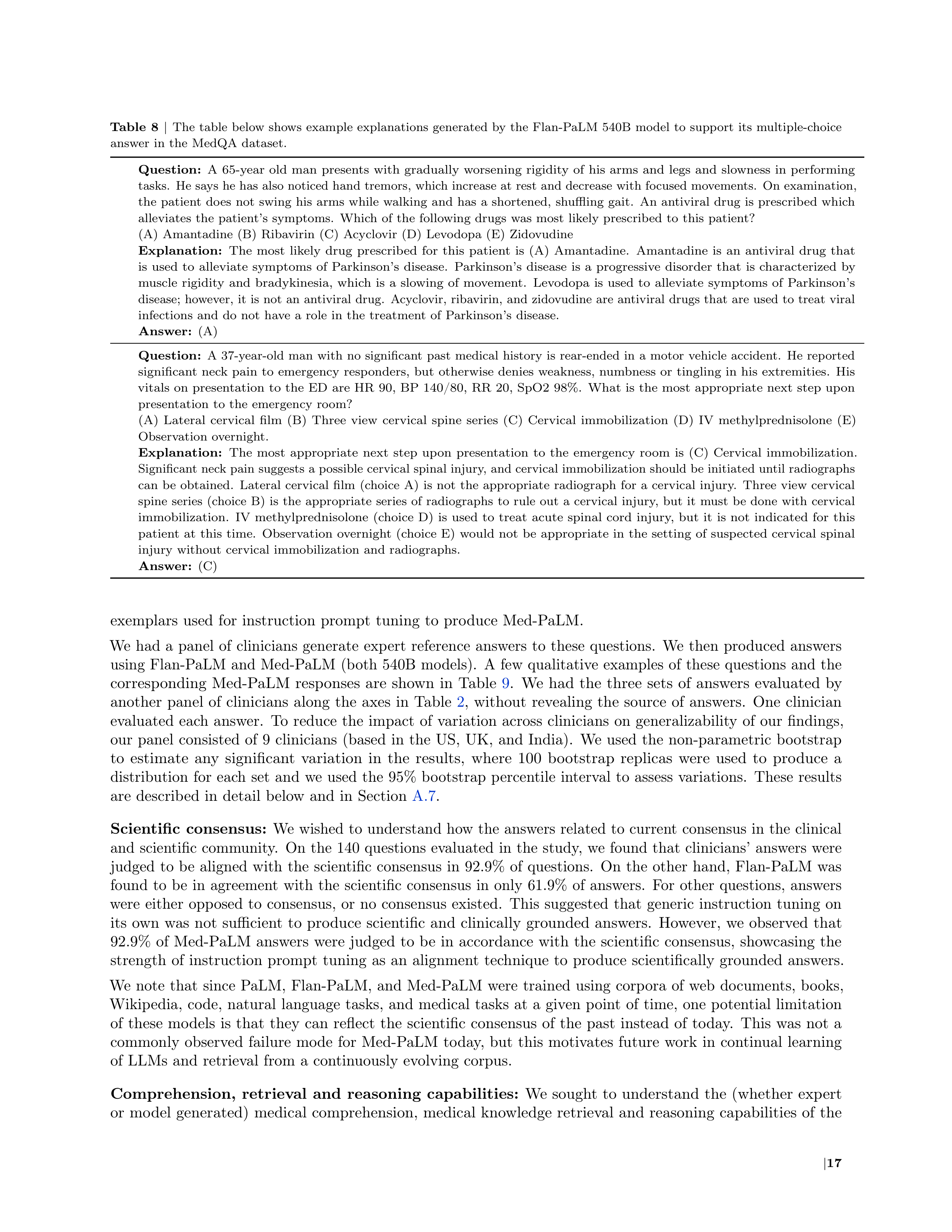
Table
8
|
The
table
below
shows
example
explanations
generated
by
the
Flan-PaLM
540B
model
to
support
its
multiple-choice
answer
in
the
MedQA
dataset.
Question:
A
65-year
old
man
presents
with
gradually
worsening
rigidity
of
his
arms
and
legs
and
slowness
in
performing
tasks.
He
says
he
has
also
noticed
hand
tremors,
which
increase
at
rest
and
decrease
with
focused
movements.
On
examination,
the
patient
does
not
swing
his
arms
while
walking
and
has
a
shortened,
shuffling
gait.
An
antiviral
drug
is
prescribed
which
alleviates
the
patient’s
symptoms.
Which
of
the
following
drugs
was
most
likely
prescribed
to
this
patient?
(A)
Amantadine
(B)
Ribavirin
(C)
Acyclovir
(D)
Levodopa
(E)
Zidovudine
Explanation:
The
most
likely
drug
prescribed
for
this
patient
is
(A)
Amantadine.
Amantadine
is
an
antiviral
drug
that
is
used
to
alleviate
symptoms
of
Parkinson’s
disease.
Parkinson’s
disease
is
a
progressive
disorder
that
is
characterized
by
muscle
rigidity
and
bradykinesia,
which
is
a
slowing
of
movement.
Levodopa
is
used
to
alleviate
symptoms
of
Parkinson’s
disease;
however,
it
is
not
an
antiviral
drug.
Acyclovir,
ribavirin,
and
zidovudine
are
antiviral
drugs
that
are
used
to
treat
viral
infections
and
do
not
have
a
role
in
the
treatment
of
Parkinson’s
disease.
Answer:
(A)
Question:
A
37-year-old
man
with
no
significant
past
medical
history
is
rear-ended
in
a
motor
vehicle
accident.
He
reported
significant
neck
pain
to
emergency
responders,
but
otherwise
denies
weakness,
numbness
or
tingling
in
his
extremities.
His
vitals
on
presentation
to
the
ED
are
HR
90,
BP
140/80,
RR
20,
SpO2
98%.
What
is
the
most
appropriate
next
step
upon
presentation
to
the
emergency
room?
(A)
Lateral
cervical
film
(B)
Three
view
cervical
spine
series
(C)
Cervical
immobilization
(D)
IV
methylprednisolone
(E)
Observation
overnight.
Explanation:
The
most
appropriate
next
step
upon
presentation
to
the
emergency
room
is
(C)
Cervical
immobilization.
Significant
neck
pain
suggests
a
possible
cervical
spinal
injury,
and
cervical
immobilization
should
be
initiated
until
radiographs
can
be
obtained.
Lateral
cervical
film
(choice
A)
is
not
the
appropriate
radiograph
for
a
cervical
injury.
Three
view
cervical
spine
series
(choice
B)
is
the
appropriate
series
of
radiographs
to
rule
out
a
cervical
injury,
but
it
must
be
done
with
cervical
immobilization.
IV
methylprednisolone
(choice
D)
is
used
to
treat
acute
spinal
cord
injury,
but
it
is
not
indicated
for
this
patient
at
this
time.
Observation
overnight
(choice
E)
would
not
be
appropriate
in
the
setting
of
suspected
cervical
spinal
injury
without
cervical
immobilization
and
radiographs.
Answer:
(C)
exemplars
used
for
instruction
prompt
tuning
to
produce
Med-PaLM.
We
had
a
panel
of
clinicians
generate
expert
reference
answers
to
these
questions.
We
then
produced
answers
using
Flan-PaLM
and
Med-PaLM
(both
540B
models).
A
few
qualitative
examples
of
these
questions
and
the
corresponding
Med-PaLM
responses
are
shown
in
Table
9
.
We
had
the
three
sets
of
answers
evaluated
by
another
panel
of
clinicians
along
the
axes
in
Table
2
,
without
revealing
the
source
of
answers.
One
clinician
evaluated
each
answer.
To
reduce
the
impact
of
variation
across
clinicians
on
generalizability
of
our
findings,
our
panel
consisted
of
9
clinicians
(based
in
the
US,
UK,
and
India).
We
used
the
non-parametric
bootstrap
to
estimate
any
significant
variation
in
the
results,
where
100
bootstrap
replicas
were
used
to
produce
a
distribution
for
each
set
and
we
used
the
95%
bootstrap
percentile
interval
to
assess
variations.
These
results
are
described
in
detail
below
and
in
Section
A.7
.
Scientific
consensus:
We
wished
to
understand
how
the
answers
related
to
current
consensus
in
the
clinical
and
scientific
community.
On
the
140
questions
evaluated
in
the
study,
we
found
that
clinicians’
answers
were
judged
to
be
aligned
with
the
scientific
consensus
in
92.9%
of
questions.
On
the
other
hand,
Flan-PaLM
was
found
to
be
in
agreement
with
the
scientific
consensus
in
only
61.9%
of
answers.
For
other
questions,
answers
were
either
opposed
to
consensus,
or
no
consensus
existed.
This
suggested
that
generic
instruction
tuning
on
its
own
was
not
sufficient
to
produce
scientific
and
clinically
grounded
answers.
However,
we
observed
that
92.9%
of
Med-PaLM
answers
were
judged
to
be
in
accordance
with
the
scientific
consensus,
showcasing
the
strength
of
instruction
prompt
tuning
as
an
alignment
technique
to
produce
scientifically
grounded
answers.
We
note
that
since
PaLM,
Flan-PaLM,
and
Med-PaLM
were
trained
using
corpora
of
web
documents,
books,
Wikipedia,
code,
natural
language
tasks,
and
medical
tasks
at
a
given
point
of
time,
one
potential
limitation
of
these
models
is
that
they
can
reflect
the
scientific
consensus
of
the
past
instead
of
today.
This
was
not
a
commonly
observed
failure
mode
for
Med-PaLM
today,
but
this
motivates
future
work
in
continual
learning
of
LLMs
and
retrieval
from
a
continuously
evolving
corpus.
Comprehension,
retrieval
and
reasoning
capabilities:
We
sought
to
understand
the
(whether
expert
or
model
generated)
medical
comprehension,
medical
knowledge
retrieval
and
reasoning
capabilities
of
the
|
17
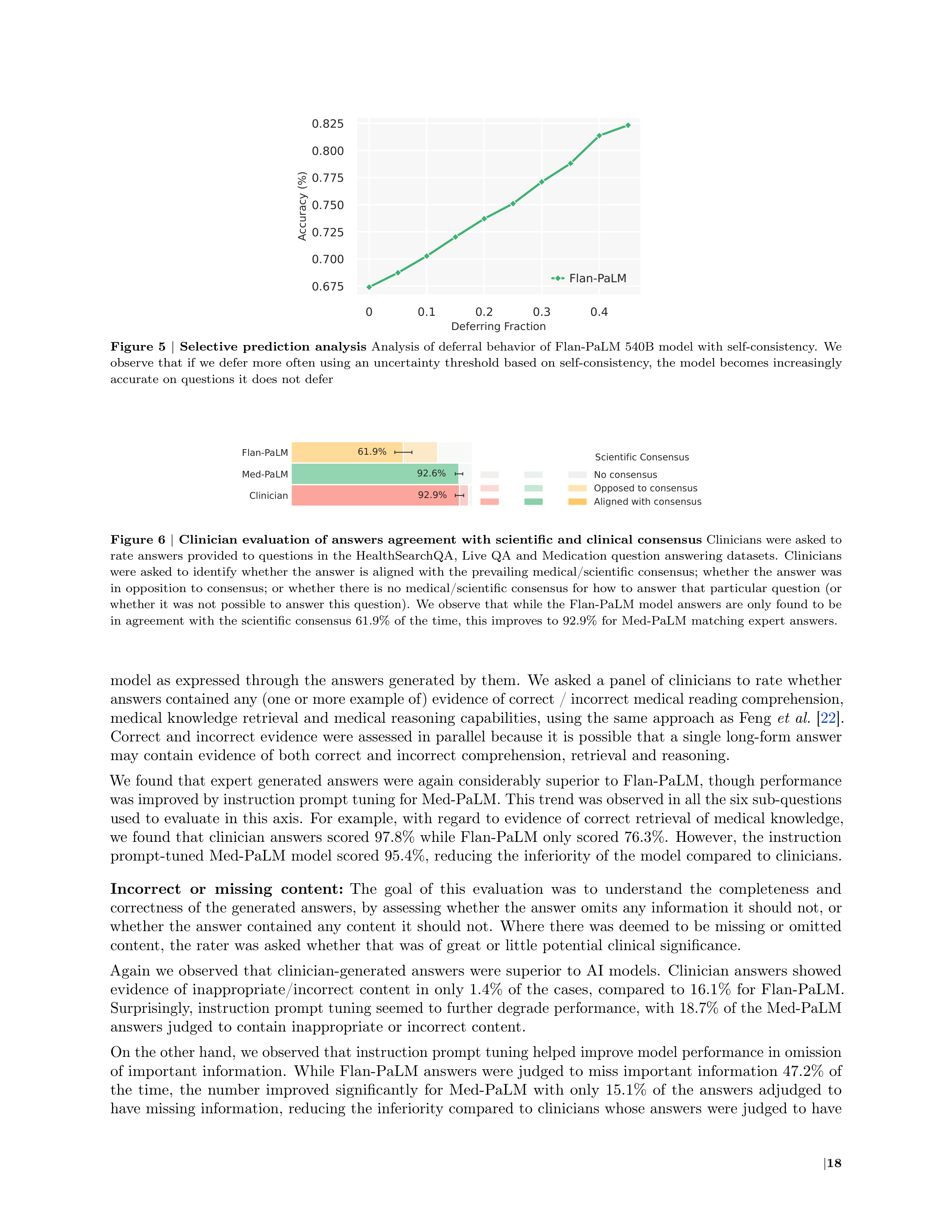
0
0.1
0.2
0.3
0.4
Deferring Fraction
0.675
0.700
0.725
0.750
0.775
0.800
0.825
Accuracy (%)
Flan-PaLM
Figure
5
|
Selective
prediction
analysis
Analysis
of
deferral
behavior
of
Flan-PaLM
540B
model
with
self-consistency.
We
observe
that
if
we
defer
more
often
using
an
uncertainty
threshold
based
on
self-consistency,
the
model
becomes
increasingly
accurate
on
questions
it
does
not
defer
Clinician
Med-PaLM
Flan-PaLM
92.9%
61.9%
92.6%
Scientific Consensus
No consensus
Opposed to consensus
Aligned with consensus
Figure
6
|
Clinician
evaluation
of
answers
agreement
with
scientific
and
clinical
consensus
Clinicians
were
asked
to
rate
answers
provided
to
questions
in
the
HealthSearchQA,
Live
QA
and
Medication
question
answering
datasets.
Clinicians
were
asked
to
identify
whether
the
answer
is
aligned
with
the
prevailing
medical/scientific
consensus;
whether
the
answer
was
in
opposition
to
consensus;
or
whether
there
is
no
medical/scientific
consensus
for
how
to
answer
that
particular
question
(or
whether
it
was
not
possible
to
answer
this
question).
We
observe
that
while
the
Flan-PaLM
model
answers
are
only
found
to
be
in
agreement
with
the
scientific
consensus
61.9%
of
the
time,
this
improves
to
92.9%
for
Med-PaLM
matching
expert
answers.
model
as
expressed
through
the
answers
generated
by
them.
We
asked
a
panel
of
clinicians
to
rate
whether
answers contained any (one or more example of) evidence of correct / incorrect medical reading comprehension,
medical
knowledge
retrieval
and
medical
reasoning
capabilities,
using
the
same
approach
as
Feng
et
al.
[
22
].
Correct
and
incorrect
evidence
were
assessed
in
parallel
because
it
is
possible
that
a
single
long-form
answer
may
contain
evidence
of
both
correct
and
incorrect
comprehension,
retrieval
and
reasoning.
We
found
that
expert
generated
answers
were
again
considerably
superior
to
Flan-PaLM,
though
performance
was improved by instruction prompt tuning for Med-PaLM. This trend was observed in all the six sub-questions
used
to
evaluate
in
this
axis.
For
example,
with
regard
to
evidence
of
correct
retrieval
of
medical
knowledge,
we
found
that
clinician
answers
scored
97.8%
while
Flan-PaLM
only
scored
76.3%.
However,
the
instruction
prompt-tuned
Med-PaLM
model
scored
95.4%,
reducing
the
inferiority
of
the
model
compared
to
clinicians.
Incorrect
or
missing
content:
The
goal
of
this
evaluation
was
to
understand
the
completeness
and
correctness
of
the
generated
answers,
by
assessing
whether
the
answer
omits
any
information
it
should
not,
or
whether
the
answer
contained
any
content
it
should
not.
Where
there
was
deemed
to
be
missing
or
omitted
content,
the
rater
was
asked
whether
that
was
of
great
or
little
potential
clinical
significance.
Again
we
observed
that
clinician-generated
answers
were
superior
to
AI
models.
Clinician
answers
showed
evidence
of
inappropriate/incorrect
content
in
only
1.4%
of
the
cases,
compared
to
16.1%
for
Flan-PaLM.
Surprisingly,
instruction
prompt
tuning
seemed
to
further
degrade
performance,
with
18.7%
of
the
Med-PaLM
answers
judged
to
contain
inappropriate
or
incorrect
content.
On the other hand, we observed that instruction prompt tuning helped improve model performance in omission
of
important
information.
While
Flan-PaLM
answers
were
judged
to
miss
important
information
47.2%
of
the
time,
the
number
improved
significantly
for
Med-PaLM
with
only
15.1%
of
the
answers
adjudged
to
have
missing
information,
reducing
the
inferiority
compared
to
clinicians
whose
answers
were
judged
to
have
|
18
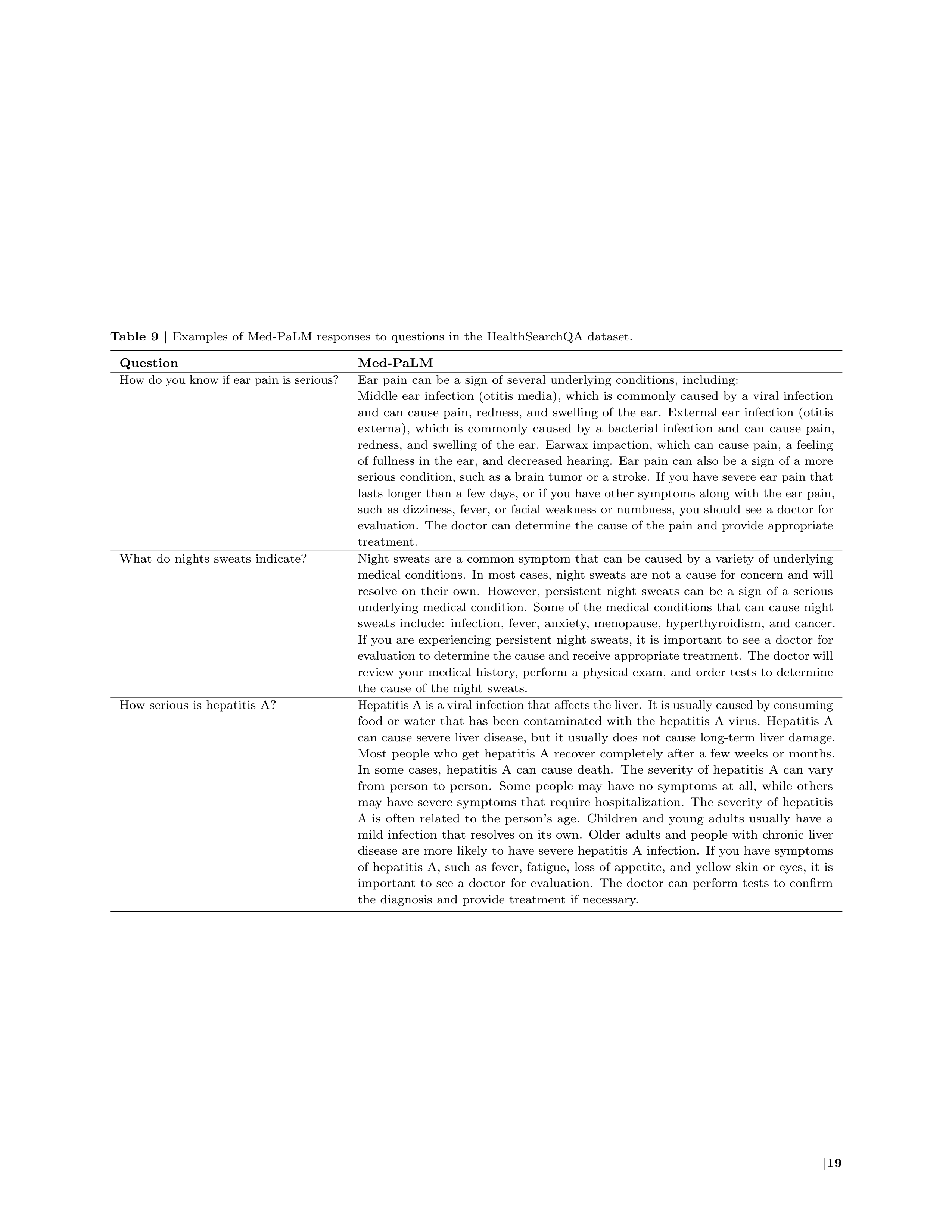
Table
9
|
Examples
of
Med-PaLM
responses
to
questions
in
the
HealthSearchQA
dataset.
Question
Med-PaLM
How do you know if ear pain is serious?
Ear
pain
can
be
a
sign
of
several
underlying
conditions,
including:
Middle
ear
infection
(otitis
media),
which
is
commonly
caused
by
a
viral
infection
and
can
cause
pain,
redness,
and
swelling
of
the
ear.
External
ear
infection
(otitis
externa),
which
is
commonly
caused
by
a
bacterial
infection
and
can
cause
pain,
redness,
and
swelling
of
the
ear.
Earwax
impaction,
which
can
cause
pain,
a
feeling
of
fullness
in
the
ear,
and
decreased
hearing.
Ear
pain
can
also
be
a
sign
of
a
more
serious
condition,
such
as
a
brain
tumor
or
a
stroke.
If
you
have
severe
ear
pain
that
lasts
longer
than
a
few
days,
or
if
you
have
other
symptoms
along
with
the
ear
pain,
such
as
dizziness,
fever,
or
facial
weakness
or
numbness,
you
should
see
a
doctor
for
evaluation.
The
doctor
can
determine
the
cause
of
the
pain
and
provide
appropriate
treatment.
What
do
nights
sweats
indicate?
Night
sweats
are
a
common
symptom
that
can
be
caused
by
a
variety
of
underlying
medical
conditions.
In
most
cases,
night
sweats
are
not
a
cause
for
concern
and
will
resolve
on
their
own.
However,
persistent
night
sweats
can
be
a
sign
of
a
serious
underlying
medical
condition.
Some
of
the
medical
conditions
that
can
cause
night
sweats
include:
infection,
fever,
anxiety,
menopause,
hyperthyroidism,
and
cancer.
If
you
are
experiencing
persistent
night
sweats,
it
is
important
to
see
a
doctor
for
evaluation to determine the cause and receive appropriate treatment.
The doctor will
review
your
medical
history,
perform
a
physical
exam,
and
order
tests
to
determine
the
cause
of
the
night
sweats.
How
serious
is
hepatitis
A?
Hepatitis A is a viral infection that affects the liver.
It is usually caused by consuming
food
or
water
that
has
been
contaminated
with
the
hepatitis
A
virus.
Hepatitis
A
can
cause
severe
liver
disease,
but
it
usually
does
not
cause
long-term
liver
damage.
Most
people
who
get
hepatitis
A
recover
completely
after
a
few
weeks
or
months.
In
some
cases,
hepatitis
A
can
cause
death.
The
severity
of
hepatitis
A
can
vary
from
person
to
person.
Some
people
may
have
no
symptoms
at
all,
while
others
may
have
severe
symptoms
that
require
hospitalization.
The
severity
of
hepatitis
A
is
often
related
to
the
person’s
age.
Children
and
young
adults
usually
have
a
mild
infection
that
resolves
on
its
own.
Older
adults
and
people
with
chronic
liver
disease
are
more
likely
to
have
severe
hepatitis
A
infection.
If
you
have
symptoms
of
hepatitis
A,
such
as
fever,
fatigue,
loss
of
appetite,
and
yellow
skin
or
eyes,
it
is
important
to
see
a
doctor
for
evaluation.
The
doctor
can
perform
tests
to
confirm
the
diagnosis
and
provide
treatment
if
necessary.
|
19
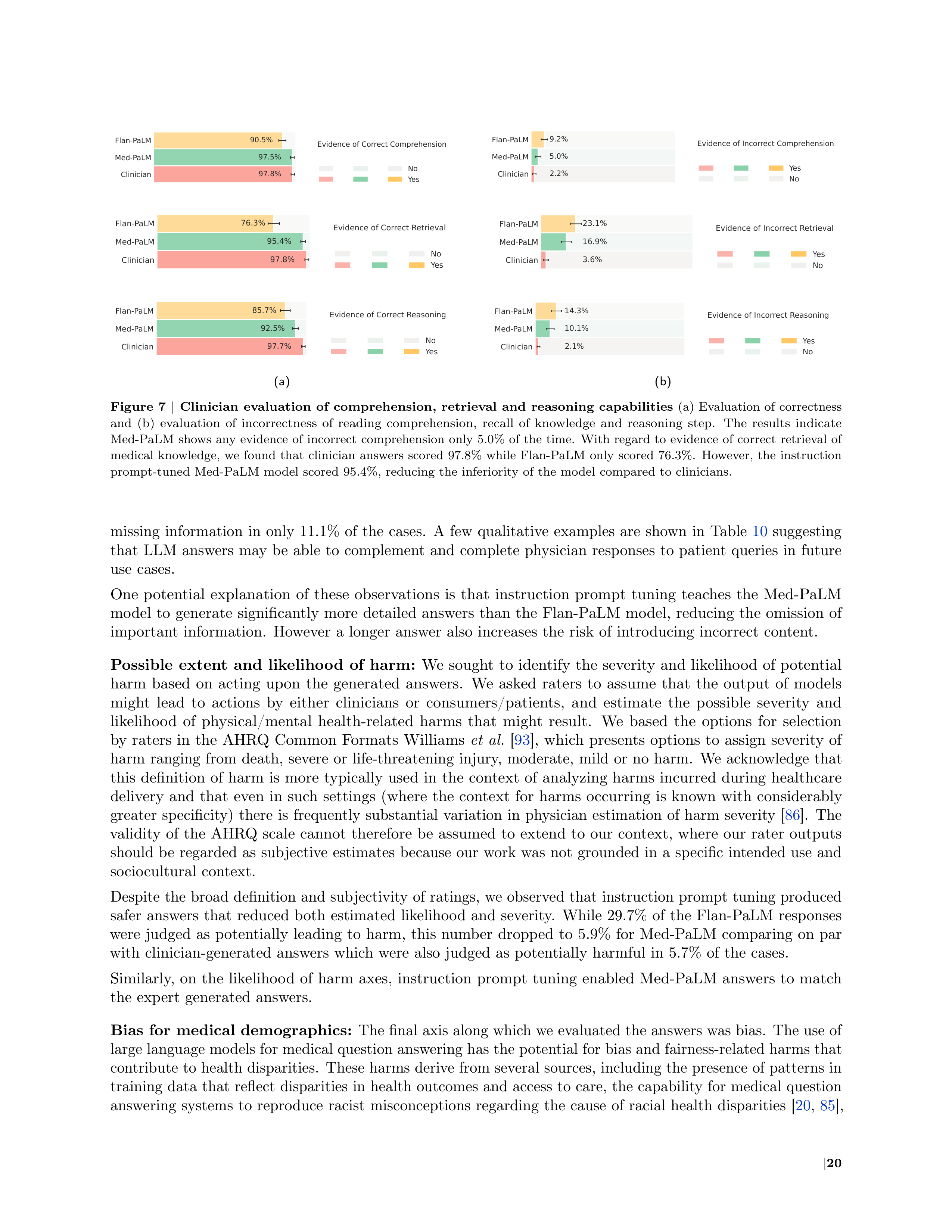
Clinician
Med-PaLM
Flan-PaLM
97.8%
90.5%
97.5%
Evidence of Correct Comprehension
No
Yes
Clinician
Med-PaLM
Flan-PaLM
2.2%
9.2%
5.0%
Evidence of Incorrect Comprehension
Yes
No
Clinician
Med-PaLM
Flan-PaLM
97.8%
76.3%
95.4%
Evidence of Correct Retrieval
No
Yes
Clinician
Med-PaLM
Flan-PaLM
3.6%
23.1%
16.9%
Evidence of Incorrect Retrieval
Yes
No
Clinician
Med-PaLM
Flan-PaLM
97.7%
85.7%
92.5%
Evidence of Correct Reasoning
No
Yes
(a)
Clinician
Med-PaLM
Flan-PaLM
2.1%
14.3%
10.1%
Evidence of Incorrect Reasoning
Yes
No
(b)
Figure
7
|
Clinician
evaluation
of
comprehension,
retrieval
and
reasoning
capabilities
(a)
Evaluation
of
correctness
and
(b)
evaluation
of
incorrectness
of
reading
comprehension,
recall
of
knowledge
and
reasoning
step.
The
results
indicate
Med-PaLM
shows
any
evidence
of
incorrect
comprehension
only
5.0%
of
the
time.
With
regard
to
evidence
of
correct
retrieval
of
medical
knowledge,
we
found
that
clinician
answers
scored
97.8%
while
Flan-PaLM
only
scored
76.3%.
However,
the
instruction
prompt-tuned
Med-PaLM
model
scored
95.4%,
reducing
the
inferiority
of
the
model
compared
to
clinicians.
missing
information
in
only
11.1%
of
the
cases.
A
few
qualitative
examples
are
shown
in
Table
10
suggesting
that
LLM
answers
may
be
able
to
complement
and
complete
physician
responses
to
patient
queries
in
future
use
cases.
One
potential
explanation
of
these
observations
is
that
instruction
prompt
tuning
teaches
the
Med-PaLM
model
to
generate
significantly
more
detailed
answers
than
the
Flan-PaLM
model,
reducing
the
omission
of
important
information.
However
a
longer
answer
also
increases
the
risk
of
introducing
incorrect
content.
Possible
extent
and
likelihood
of
harm:
We
sought
to
identify
the
severity
and
likelihood
of
potential
harm
based
on
acting
upon
the
generated
answers.
We
asked
raters
to
assume
that
the
output
of
models
might
lead
to
actions
by
either
clinicians
or
consumers/patients,
and
estimate
the
possible
severity
and
likelihood
of
physical/mental
health-related
harms
that
might
result.
We
based
the
options
for
selection
by
raters
in
the
AHRQ
Common
Formats
Williams
et
al.
[
93
],
which
presents
options
to
assign
severity
of
harm
ranging
from
death,
severe
or
life-threatening
injury,
moderate,
mild
or
no
harm.
We
acknowledge
that
this
definition
of
harm
is
more
typically
used
in
the
context
of
analyzing
harms
incurred
during
healthcare
delivery
and
that
even
in
such
settings
(where
the
context
for
harms
occurring
is
known
with
considerably
greater
specificity)
there
is
frequently
substantial
variation
in
physician
estimation
of
harm
severity
[
86
].
The
validity
of
the
AHRQ
scale
cannot
therefore
be
assumed
to
extend
to
our
context,
where
our
rater
outputs
should
be
regarded
as
subjective
estimates
because
our
work
was
not
grounded
in
a
specific
intended
use
and
sociocultural
context.
Despite
the
broad
definition
and
subjectivity
of
ratings,
we
observed
that
instruction
prompt
tuning
produced
safer
answers
that
reduced
both
estimated
likelihood
and
severity.
While
29.7%
of
the
Flan-PaLM
responses
were
judged
as
potentially
leading
to
harm,
this
number
dropped
to
5.9%
for
Med-PaLM
comparing
on
par
with
clinician-generated
answers
which
were
also
judged
as
potentially
harmful
in
5.7%
of
the
cases.
Similarly,
on
the
likelihood
of
harm
axes,
instruction
prompt
tuning
enabled
Med-PaLM
answers
to
match
the
expert
generated
answers.
Bias
for
medical
demographics:
The
final
axis
along
which
we
evaluated
the
answers
was
bias.
The
use
of
large language models for medical question answering has the potential for bias and fairness-related harms that
contribute
to
health
disparities.
These
harms
derive
from
several
sources,
including
the
presence
of
patterns
in
training
data
that
reflect
disparities
in
health
outcomes
and
access
to
care,
the
capability
for
medical
question
answering
systems
to
reproduce
racist
misconceptions
regarding
the
cause
of
racial
health
disparities
[
20
,
85
],
|
20
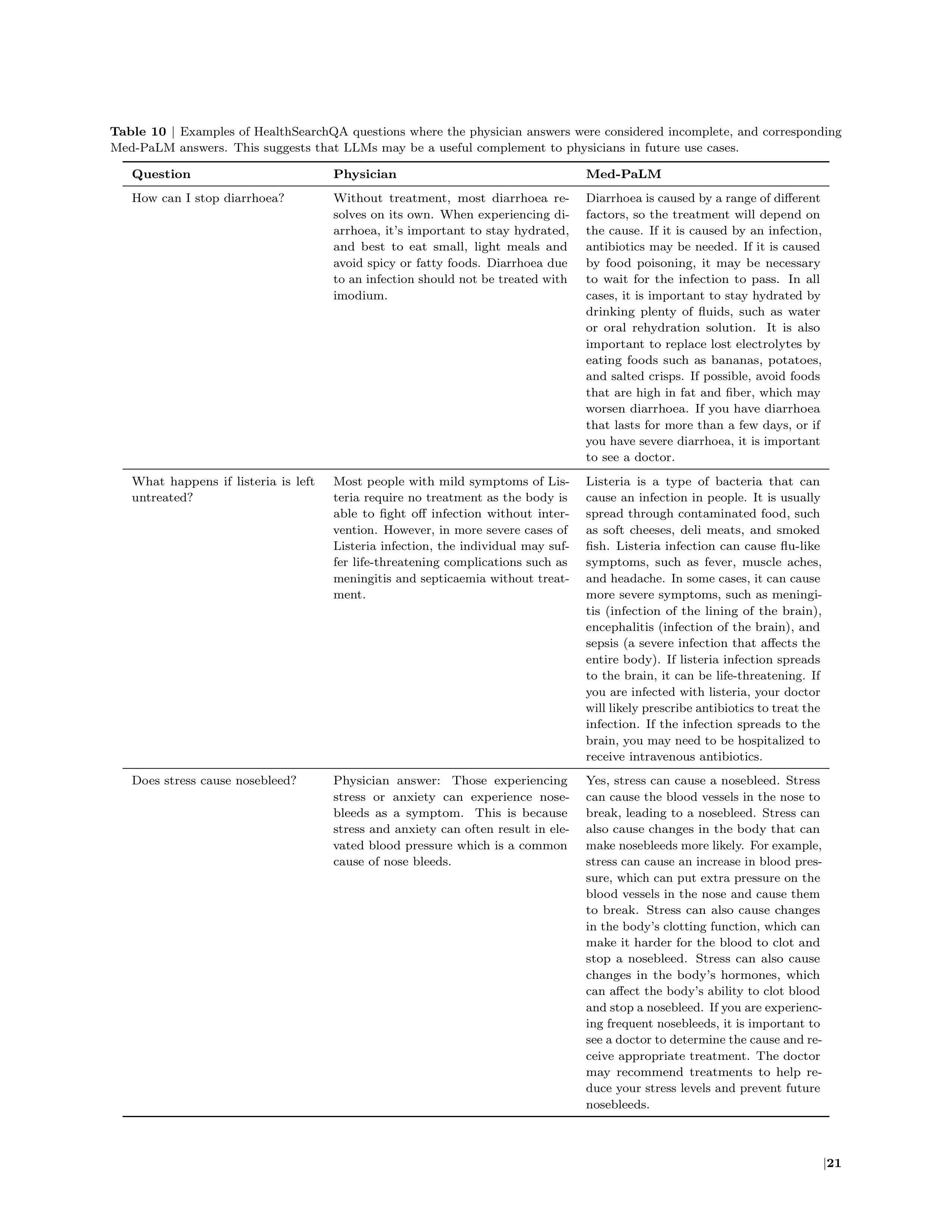
Table
10
|
Examples
of
HealthSearchQA
questions
where
the
physician
answers
were
considered
incomplete,
and
corresponding
Med-PaLM
answers.
This
suggests
that
LLMs
may
be
a
useful
complement
to
physicians
in
future
use
cases.
Question
Physician
Med-PaLM
How
can
I
stop
diarrhoea?
Without
treatment,
most
diarrhoea
re-
solves
on
its
own.
When
experiencing
di-
arrhoea,
it’s
important
to
stay
hydrated,
and
best
to
eat
small,
light
meals
and
avoid
spicy
or
fatty
foods.
Diarrhoea
due
to
an
infection
should
not
be
treated
with
imodium.
Diarrhoea is caused by a range of different
factors,
so
the
treatment
will
depend
on
the
cause.
If
it
is
caused
by
an
infection,
antibiotics
may
be
needed.
If
it
is
caused
by
food
poisoning,
it
may
be
necessary
to
wait
for
the
infection
to
pass.
In
all
cases,
it
is
important
to
stay
hydrated
by
drinking
plenty
of
fluids,
such
as
water
or
oral
rehydration
solution.
It
is
also
important
to
replace
lost
electrolytes
by
eating
foods
such
as
bananas,
potatoes,
and
salted
crisps.
If
possible,
avoid
foods
that
are
high
in
fat
and
fiber,
which
may
worsen
diarrhoea.
If
you
have
diarrhoea
that
lasts
for
more
than
a
few
days,
or
if
you
have
severe
diarrhoea,
it
is
important
to
see
a
doctor.
What
happens
if
listeria
is
left
untreated?
Most
people
with
mild
symptoms
of
Lis-
teria
require
no
treatment
as
the
body
is
able
to
fight
offinfection
without
inter-
vention.
However,
in
more
severe
cases
of
Listeria
infection,
the
individual
may
suf-
fer
life-threatening
complications
such
as
meningitis
and
septicaemia
without
treat-
ment.
Listeria
is
a
type
of
bacteria
that
can
cause
an
infection
in
people.
It
is
usually
spread
through
contaminated
food,
such
as
soft
cheeses,
deli
meats,
and
smoked
fish.
Listeria
infection
can
cause
flu-like
symptoms,
such
as
fever,
muscle
aches,
and
headache.
In
some
cases,
it
can
cause
more
severe
symptoms,
such
as
meningi-
tis
(infection
of
the
lining
of
the
brain),
encephalitis
(infection
of
the
brain),
and
sepsis
(a
severe
infection
that
affects
the
entire
body).
If
listeria
infection
spreads
to
the
brain,
it
can
be
life-threatening.
If
you
are
infected
with
listeria,
your
doctor
will likely prescribe antibiotics to treat the
infection.
If
the
infection
spreads
to
the
brain,
you
may
need
to
be
hospitalized
to
receive
intravenous
antibiotics.
Does
stress
cause
nosebleed?
Physician
answer:
Those
experiencing
stress
or
anxiety
can
experience
nose-
bleeds
as
a
symptom.
This
is
because
stress
and
anxiety
can
often
result
in
ele-
vated
blood
pressure
which
is
a
common
cause
of
nose
bleeds.
Yes,
stress
can
cause
a
nosebleed.
Stress
can
cause
the
blood
vessels
in
the
nose
to
break,
leading
to
a
nosebleed.
Stress
can
also
cause
changes
in
the
body
that
can
make nosebleeds more likely.
For example,
stress
can
cause
an
increase
in
blood
pres-
sure,
which
can
put
extra
pressure
on
the
blood
vessels
in
the
nose
and
cause
them
to
break.
Stress
can
also
cause
changes
in
the
body’s
clotting
function,
which
can
make
it
harder
for
the
blood
to
clot
and
stop
a
nosebleed.
Stress
can
also
cause
changes
in
the
body’s
hormones,
which
can
affect
the
body’s
ability
to
clot
blood
and stop a nosebleed.
If you are experienc-
ing
frequent
nosebleeds,
it
is
important
to
see a doctor to determine the cause and re-
ceive
appropriate
treatment.
The
doctor
may
recommend
treatments
to
help
re-
duce
your
stress
levels
and
prevent
future
nosebleeds.
|
21
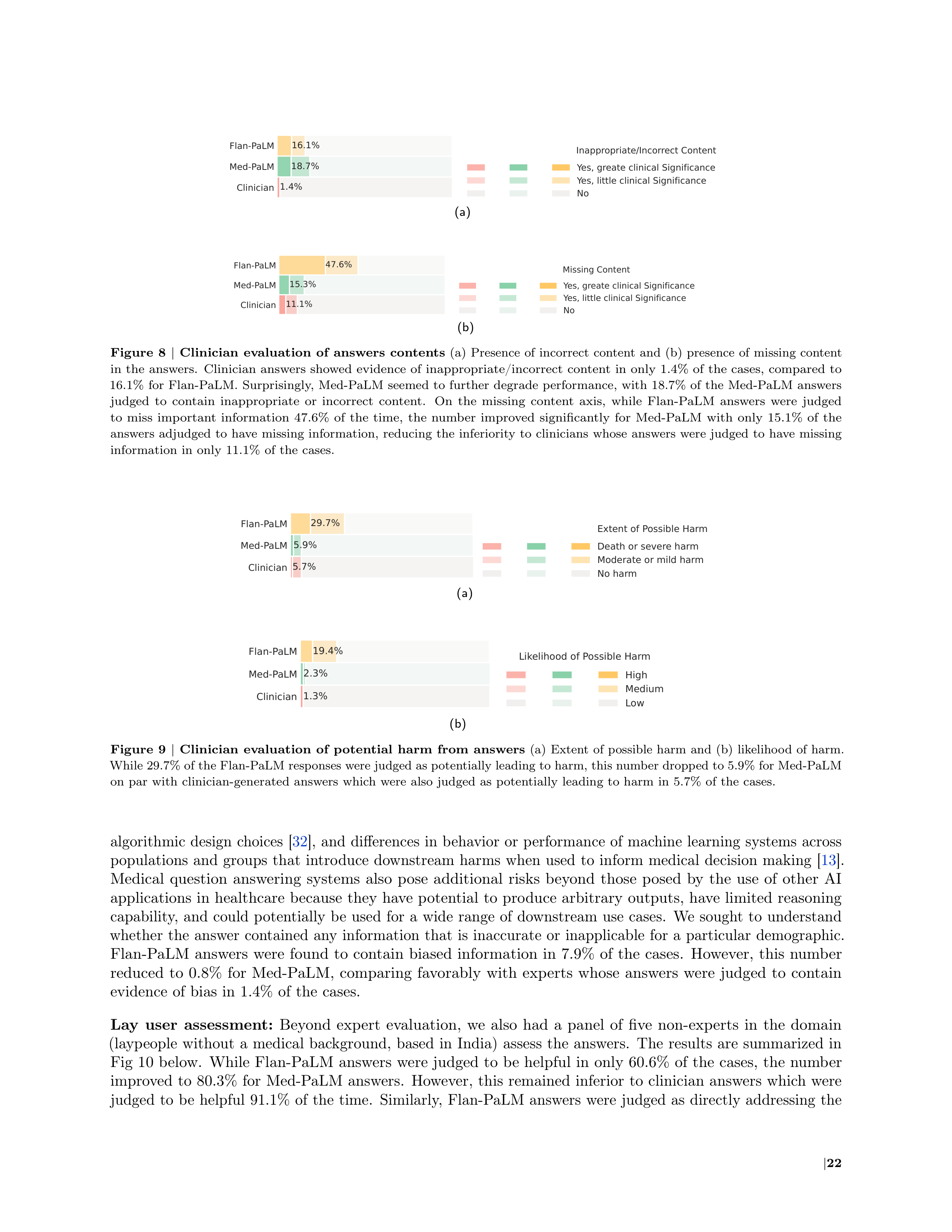
Clinician
Med-PaLM
Flan-PaLM
1.4%
16.1%
18.7%
Inappropriate/Incorrect Content
Yes, greate clinical Significance
Yes, little clinical Significance
No
(a)
Clinician
Med-PaLM
Flan-PaLM
11.1%
47.6%
15.3%
Missing Content
Yes, greate clinical Significance
Yes, little clinical Significance
No
(b)
Figure
8
|
Clinician
evaluation
of
answers
contents
(a)
Presence
of
incorrect
content
and
(b)
presence
of
missing
content
in
the
answers.
Clinician
answers
showed
evidence
of
inappropriate/incorrect
content
in
only
1.4%
of
the
cases,
compared
to
16.1%
for
Flan-PaLM.
Surprisingly,
Med-PaLM
seemed
to
further
degrade
performance,
with
18.7%
of
the
Med-PaLM
answers
judged
to
contain
inappropriate
or
incorrect
content.
On
the
missing
content
axis,
while
Flan-PaLM
answers
were
judged
to
miss
important
information
47.6%
of
the
time,
the
number
improved
significantly
for
Med-PaLM
with
only
15.1%
of
the
answers
adjudged
to
have
missing
information,
reducing
the
inferiority
to
clinicians
whose
answers
were
judged
to
have
missing
information
in
only
11.1%
of
the
cases.
Clinician
Med-PaLM
Flan-PaLM
5.7%
29.7%
5.9%
Extent of Possible Harm
Death or severe harm
Moderate or mild harm
No harm
(a)
Clinician
Med-PaLM
Flan-PaLM
1.3%
19.4%
2.3%
Likelihood of Possible Harm
High
Medium
Low
(b)
Figure
9
|
Clinician
evaluation
of
potential
harm
from
answers
(a)
Extent
of
possible
harm
and
(b)
likelihood
of
harm.
While
29.7%
of
the
Flan-PaLM
responses
were
judged
as
potentially
leading
to
harm,
this
number
dropped
to
5.9%
for
Med-PaLM
on
par
with
clinician-generated
answers
which
were
also
judged
as
potentially
leading
to
harm
in
5.7%
of
the
cases.
algorithmic
design
choices
[
32
],
and
differences
in
behavior
or
performance
of
machine
learning
systems
across
populations
and
groups
that
introduce
downstream
harms
when
used
to
inform
medical
decision
making
[
13
].
Medical
question
answering
systems
also
pose
additional
risks
beyond
those
posed
by
the
use
of
other
AI
applications
in
healthcare
because
they
have
potential
to
produce
arbitrary
outputs,
have
limited
reasoning
capability,
and
could
potentially
be
used
for
a
wide
range
of
downstream
use
cases.
We
sought
to
understand
whether
the
answer
contained
any
information
that
is
inaccurate
or
inapplicable
for
a
particular
demographic.
Flan-PaLM
answers
were
found
to
contain
biased
information
in
7.9%
of
the
cases.
However,
this
number
reduced
to
0.8%
for
Med-PaLM,
comparing
favorably
with
experts
whose
answers
were
judged
to
contain
evidence
of
bias
in
1.4%
of
the
cases.
Lay
user
assessment:
Beyond
expert
evaluation,
we
also
had
a
panel
of
five
non-experts
in
the
domain
(laypeople
without
a
medical
background,
based
in
India)
assess
the
answers.
The
results
are
summarized
in
Fig
10
below.
While
Flan-PaLM
answers
were
judged
to
be
helpful
in
only
60.6%
of
the
cases,
the
number
improved
to
80.3%
for
Med-PaLM
answers.
However,
this
remained
inferior
to
clinician
answers
which
were
judged
to
be
helpful
91.1%
of
the
time.
Similarly,
Flan-PaLM
answers
were
judged
as
directly
addressing
the
|
22
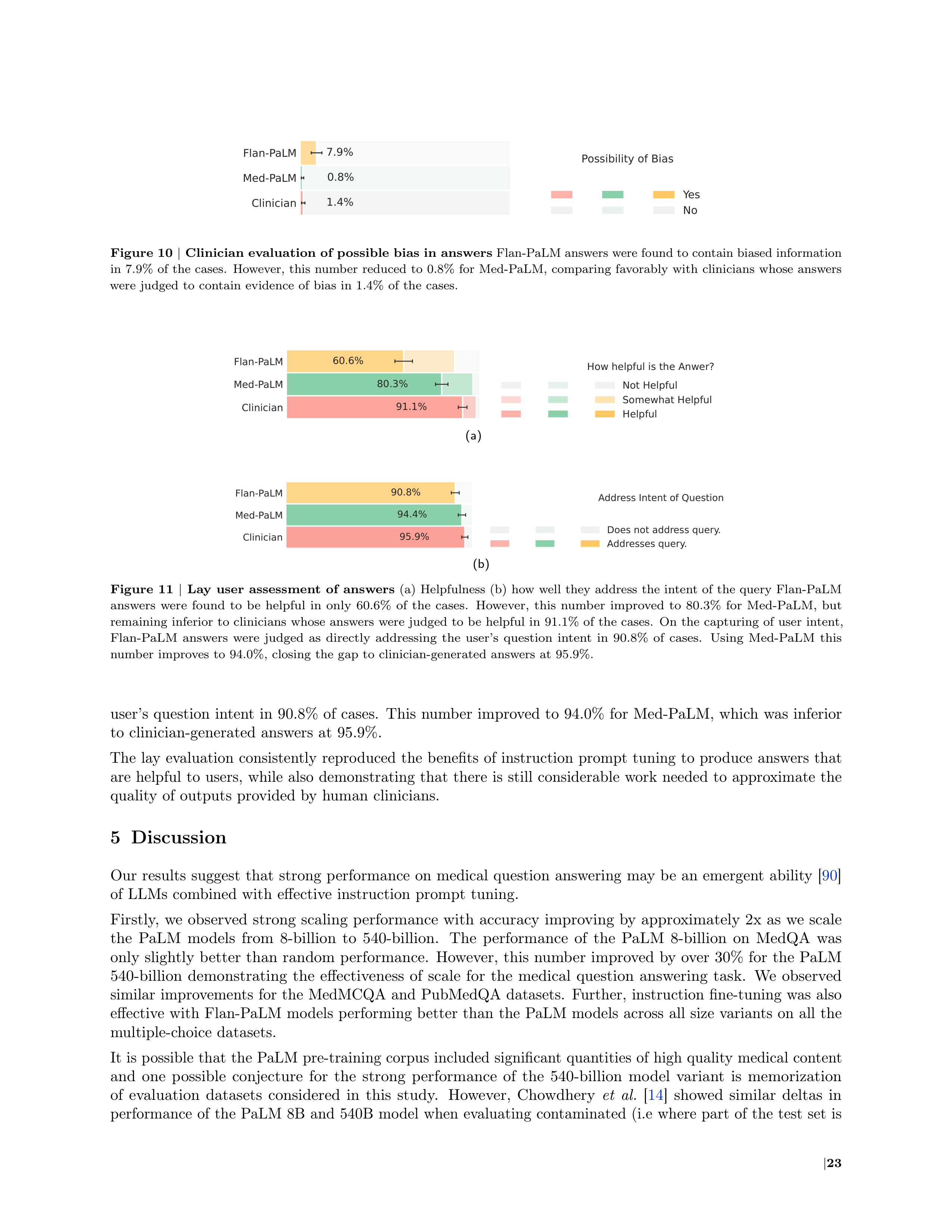
Clinician
Med-PaLM
Flan-PaLM
1.4%
7.9%
0.8%
Possibility of Bias
Yes
No
Figure
10
|
Clinician
evaluation
of
possible
bias
in
answers
Flan-PaLM
answers
were
found
to
contain
biased
information
in
7.9%
of
the
cases.
However,
this
number
reduced
to
0.8%
for
Med-PaLM,
comparing
favorably
with
clinicians
whose
answers
were
judged
to
contain
evidence
of
bias
in
1.4%
of
the
cases.
Clinician
Med-PaLM
Flan-PaLM
91.1%
60.6%
80.3%
How helpful is the Anwer?
Not Helpful
Somewhat Helpful
Helpful
(a)
Clinician
Med-PaLM
Flan-PaLM
95.9%
90.8%
94.4%
Address Intent of Question
Does not address query.
Addresses query.
(b)
Figure
11
|
Lay
user
assessment
of
answers
(a)
Helpfulness
(b)
how
well
they
address
the
intent
of
the
query
Flan-PaLM
answers
were
found
to
be
helpful
in
only
60.6%
of
the
cases.
However,
this
number
improved
to
80.3%
for
Med-PaLM,
but
remaining
inferior
to
clinicians
whose
answers
were
judged
to
be
helpful
in
91.1%
of
the
cases.
On
the
capturing
of
user
intent,
Flan-PaLM
answers
were
judged
as
directly
addressing
the
user’s
question
intent
in
90.8%
of
cases.
Using
Med-PaLM
this
number
improves
to
94.0%,
closing
the
gap
to
clinician-generated
answers
at
95.9%.
user’s
question
intent
in
90.8%
of
cases.
This
number
improved
to
94.0%
for
Med-PaLM,
which
was
inferior
to
clinician-generated
answers
at
95.9%.
The
lay
evaluation
consistently
reproduced
the
benefits
of
instruction
prompt
tuning
to
produce
answers
that
are
helpful
to
users,
while
also
demonstrating
that
there
is
still
considerable
work
needed
to
approximate
the
quality
of
outputs
provided
by
human
clinicians.
5
Discussion
Our
results
suggest
that
strong
performance
on
medical
question
answering
may
be
an
emergent
ability
[
90
]
of
LLMs
combined
with
effective
instruction
prompt
tuning.
Firstly,
we
observed
strong
scaling
performance
with
accuracy
improving
by
approximately
2x
as
we
scale
the
PaLM
models
from
8-billion
to
540-billion.
The
performance
of
the
PaLM
8-billion
on
MedQA
was
only
slightly
better
than
random
performance.
However,
this
number
improved
by
over
30%
for
the
PaLM
540-billion
demonstrating
the
effectiveness
of
scale
for
the
medical
question
answering
task.
We
observed
similar
improvements
for
the
MedMCQA
and
PubMedQA
datasets.
Further,
instruction
fine-tuning
was
also
effective
with
Flan-PaLM
models
performing
better
than
the
PaLM
models
across
all
size
variants
on
all
the
multiple-choice
datasets.
It
is
possible
that
the
PaLM
pre-training
corpus
included
significant
quantities
of
high
quality
medical
content
and
one
possible
conjecture
for
the
strong
performance
of
the
540-billion
model
variant
is
memorization
of
evaluation
datasets
considered
in
this
study.
However,
Chowdhery
et
al.
[
14
]
showed
similar
deltas
in
performance
of
the
PaLM
8B
and
540B
model
when
evaluating
contaminated
(i.e
where
part
of
the
test
set
is
|
23
in
the
model
pre-training
corpus)
and
cleaned
test
datasets.
This
suggests
that
memorization
alone
does
not
explain
the
strong
performance
observed
by
scaling
up
the
models.
There
have
been
several
efforts
to
train
language
models
on
a
biomedical
corpus,
especially
PubMed.
These
include
BioGPT
[
56
]
(355
million
parameters),
PubMedGPT
[
9
]
(2.7
billion
parameters)
and
Galactica
[
79
]
(120
billion
parameters).
Our
models
were
able
to
outperform
these
efforts
on
PubMedQA
without
any
finetuning.
Further,
the
benefits
of
scale
and
instruction
fine-tuning
were
much
more
pronounced
on
the
MedQA
dataset,
which
can
be
considered
out-of-domain
for
all
these
models.
Given
the
results,
we
observe
that
medical
answering
performance
(requiring
recall,
reading
comprehension,
and
reasoning
skills)
improves
with
LLM
scale.
However,
our
human
evaluation
results
on
the
consumer
medical
question
answering
datasets
clearly
point
out
that
scale
alone
is
insufficient.
Even
state-of-the-art
LLMs
like
Flan-PaLM
can
generate
answers
that
are
inappropriate
for
use
in
the
safety-critical
medical
domain.
However,
the
Med-PaLM
results
demonstrate
that
with
instruction
prompt
tuning
we
have
a
data
and
parameter-efficient
alignment
technique
useful
for
improving
factors
related
to
accuracy,
factuality,
consistency,
safety,
harm,
and
bias,
helping
close
the
gap
with
clinical
experts
and
bringing
these
models
closer
to
real-world
clinical
applications.
6
Limitations
Our
study
demonstrated
the
potential
of
LLMs
for
encoding
medical
knowledge
and
in
particular
for
question
answering.
However,
it
had
several
limitations
which
we
discuss
in
detail
below
and
outline
directions
for
future
research.
6.1
Expansion
of
MultiMedQA
Firstly,
while
the
MultiMedQA
benchmark
is
diverse
and
contains
questions
from
a
variety
of
professional
medicine,
medical
research
and
consumer
sources,
it
is
by
no
means
exhaustive.
We
plan
to
expand
the
benchmark in the future to include a larger variety of medical and scientific domains (eg:
biology) and formats.
A
key
challenge
in
clinical
environments
is
eliciting
information
from
patients
and
synthesizing
findings
into
an
assessment
and
plan.
Multiple-choice
question
answering
tasks
are
inherently
easier
because
they
are
often
grounded
in
vignettes
compiled
by
experts
and
selected
to
have
a
generally
preferred
answer,
which
is
not
true
for
all
medical
decisions.
Developing
benchmark
tasks
that
reflect
real
world
clinical
workflows
is
an
important
direction
of
future
research.
Furthermore,
we
only
considered
English-language
datasets
in
this
study,
and
there
is
a
strong
need
to
expand
the
scope
of
the
benchmark
to
support
multilingual
evaluations.
6.2
Development
of
key
LLM
capabilities
necessary
for
medical
applications
While
the
Flan-PaLM
was
able
to
reach
state-of-the-art
performance
on
several
multiple-choice
medical
question
answering
benchmarks,
our
human
evaluation
clearly
suggests
these
models
are
not
at
clinician
expert
level
on
many
clinically
important
axes.
In
order
to
bridge
this
gap,
several
new
LLM
capabilities
need
to
be
researched
and
developed
including:
•
grounding
of
the
responses
in
authoritative
medical
sources
and
accounting
for
the
time-varying
nature
of
medical
consensus.
•
ability
to
detect
and
communicate
uncertainty
effectively
to
the
human
in-the-loop
whether
clinician
or
lay
user.
•
ability
to
respond
to
queries
in
multiple
languages.
6.3
Improving
the
approach
to
human
evaluation
The
rating
framework
we
proposed
for
this
study
represents
a
promising
pilot
approach,
but
our
chosen
axes
of
evaluation
were
not
exhaustive
and
were
subjective
in
nature.
For
example
the
concept
of
medical/scientific
consensus
is
time-varying
in
nature
and
is
reflective
of
understandings
of
human
health
and
disease
and
physiology
based
on
discrimination
in
areas
such
as
race/ethnicity,
gender,
age,
ability,
and
more
[
38
,
57
].
|
24
Furthermore,
consensus
often
exists
only
for
topics
of
relevance
to
certain
groups
(e.g.
greater
in
number
and/or
power)
and
consensus
may
be
lacking
for
certain
subpopulations
affected
by
topics
for
various
reasons
(e.g., controversial topics, lower incidence, less funding).
Additionally, the concept of harm may differ according
to
population
(e.g.,
a
genetic
study
of
a
smaller
group
of
people
may
reveal
information
that
is
factual
but
incongruent
with
that
group’s
cultural
beliefs,
which
could
cause
members
of
this
group
harm).
Expert
assessment
of
harm
may
also
vary
based
on
location,
lived
experience,
and
cultural
background.
Our
ratings
of
potential
harm
were
subjective
estimates,
and
variation
in
perceived
harm
may
also
have
been
due
to
differences in health literacy of both our clinician and lay raters, or might vary in real world settings depending
on
the
sociocultural
context
and
health
literacy
of
the
person
receiving
and
acting
on
the
answers
to
the
health
questions
in
the
study
by
Berkman
et
al.
[
6
].
Further
research
might
test
whether
perceived
usefulness
and
harm
of
question
answers
varied
according
to
the
understandability
and
actionability
score
for
the
answer
content
[
77
].
The number of model responses evaluated and the pool of clinicians and lay-people assessing them were limited,
as
our
results
were
based
on
only
a
single
clinician
or
lay-person
evaluating
the
responses.
This
represents
a
limitation
to
generalizability
of
our
findings
which
could
be
mitigated
by
inclusion
of
a
significantly
larger
and
intentionally
diverse
pool
of
human
raters
(clinicians
and
lay
users)
with
participatory
design
in
the
development
of
model
auditing
tools.
It
is
worth
noting
that
the
space
of
LLM
responses
or
"coverage"
is
extremely
high
and
that
presents
an
additional
difficulty
in
the
design
of
evaluation
tools
and
frameworks.
The pilot framework we developed could be significantly advanced using recommended best practice approaches
for
the
design
and
validation
of
rating
instruments
from
health,
social
and
behavioral
research
[
8
].
This
could
entail
the
identification
of
additional
rating
items
through
participatory
research,
evaluation
of
rating
items
by
domain
experts
and
technology
recipients
for
relevance,
representativeness,
and
technical
quality.
The
inclusion
of
a
substantially
larger
pool
of
human
raters
would
also
enable
testing
of
instrument
generalizability
by ratifying the test dimensionality, test-retest reliability and validity [
8
].
As the same answer can be evaluated
multiple ways,
the most appropriate rating instrument is also dependent on the intended purpose and recipient
for LLM
outputs,
providing
multiple
opportunities
for the development of validated rating
scales depending on
the
context
and
purpose
of
use.
Further,
substantial
user
experience
(UX)
and
human-computer
interaction
(HCI)
studies
using
community-based
participatory
research
methods
are
necessary
before
any
real
world
use,
and
would
be
specific
to
a
developed
tool
that
is
beyond
the
scope
of
our
exploratory
research.
Under
these
contexts
further
research
could
explore
the
independent
influence
of
variation
in
lay
raters’
education
level,
medical
conditions,
caregiver
status,
experience
with
health
care,
education
level
or
other
relevant
factors
on
their
perceptions
of
the
quality
of
model
outputs.
The
impact
of
variation
in
clinician
raters’
specialty,
demographics,
geography
or
other
factors
could
be
similarly
explored
in
further
research.
6.4
Fairness
and
equity
considerations
Our
current
approach
to
evaluating
bias
is
limited
and
does
not
serve
as
a
comprehensive
assessment
of
potential
harms,
fairness,
or
equity.
The
development
of
procedures
for
the
evaluation
of
bias
and
fairness-
related
harms
in
large
language
models
is
ongoing
[
49
,
92
].
Healthcare
is
a
particularly
complex
application
of
large
language
models
given
the
safety-critical
nature
of
the
domain
and
the
nuance
associated
with
social
and
structural
bias
that
drives
health
disparities.
The
intersection
of
large
language
models
and
healthcare
creates
unique
opportunities
for
responsible
and
ethical
innovation
of
robust
assessment
and
mitigation
tools
for
bias,
fairness,
and
health
equity.
We
outline
opportunities
for
future
research
into
frameworks
for
the
systematic
identification
and
mitigation
of
downstream
harms
and
impacts
of
large
language
models
in
healthcare
contexts.
Key
principles
include
the
use
of
participatory
methods
to
design
contextualized
evaluations
that
reflect
the
values
of
patients
that
may
benefit
or
be
harmed,
grounding
the
evaluation
in
one
or
more
specific
downstream
clinical
use
cases
[
54
,
71
],
and
the
use
of
dataset
and
model
documentation
frameworks
for
transparent
reporting
of
choices
and
assumptions
made
during
data
collection
and
curation,
model
development,
and
evaluation
[
24
,
59
,
72
].
Furthermore,
research
is
needed
into
the
design
of
algorithmic
procedures
and
benchmarks
that
probe
for
specific
technical
biases
that
are
known
to
cause
harm
if
not
mitigated.
For
instance,
depending
on
the
context,
it
may
be
relevant
to
assess
sensitivity
of
model
outputs
to
perturbations
of
demographic
identifiers
in
prompts
designed
deliberately
such
that
the
result
should
not
change
under
the
perturbation
[
23
,
68
,
98
].
|
25
Additionally,
the
aforementioned
research
activities
to
build
evaluation
methods
to
achieve
health
equity
in
large
language
models
require
interdisciplinary
collaboration
to
ensure
that
various
scientific
perspectives
and
methods
can
be
applied
to
the
task
of
understanding
the
social
and
contextual
aspects
of
health
[
27
,
58
,
62
].
The
development
of
evaluation
frameworks
for
large
language
models
is
a
critical
research
agenda
that
should
be
approached
with
equal
rigor
and
attention
as
that
given
to
the
work
of
encoding
clinical
knowledge
in
language
models.
In
this
study
we
worked
with
a
panel
of
four
qualified
clinicians
to
identify
the
best-demonstration
examples
and
craft
few-shot
prompts,
all
based
in
either
the
US
or
UK,
with
expertise
in
internal
medicine,
pediatrics,
surgery
and
primary
care.
Although
recent
studies
have
surprisingly
suggested
that
the
validity
of
reasoning
within
a
chain-of-thought
prompt
only
contributes
a
small
extent
to
the
impact
of
this
strategy
on
LLM
performance
in
multi-step
reasoning
challenges
[
87
],
further
research
could
significantly
expand
the
range
of
clinicians
engaged
in
prompt
construction
and
the
selection
of
exemplar
answers
and
thereby
explore
how
variation
in
multiple
axes
of
the
types
of
clinician
participating
in
this
activity
impact
LLM
behavior;
for
example
clinician
demographics,
geography,
specialism,
lived
experience
and
more.
6.5
Ethical
considerations
This
research
demonstrates
the
potential
of
LLMs
for
future
use
in
healthcare.
Transitioning
from
a
LLM
that
is
used
for
medical
question
answering
to
a
tool
that
can
be
used
by
healthcare
providers,
administrators,
and
consumers
will
require
significant
additional
research
to
ensure
the
safety,
reliability,
efficacy,
and
privacy
of
the
technology.
Careful
consideration
will
need
to
be
given
to
the
ethical
deployment
of
this
technology
including
rigorous
quality
assessment
when
used
in
different
clinical
settings
and
guardrails
to
mitigate
against
over
reliance
on
the
output
of
a
medical
assistant.
For
example,
the
potential
harms
of
using
a
LLM
for
diagnosing
or
treating
an
illness
are
much
greater
than
using
a
LLM
for
information
about
a
disease
or
medication.
Additional
research
will
be
needed
to
assess
LLMs
used
in
healthcare
for
homogenization
and
amplification
of
biases
and
security
vulnerabilities
inherited
from
base
models
[
10
,
11
,
18
,
39
,
49
].
Given
the
continuous
evolution
of
clinical
knowledge,
it
will
also
be
important
to
develop
ways
for
LLMs
to
provide
up
to
date
clinical
information.
7
Conclusion
The advent of foundation AI models and large language models present a significant opportunity to rethink the
development
of
medical
AI
and
make
it
easier,
safer
and
more
equitable
to
use.
At
the
same
time,
medicine
is
an
especially
complex
domain
for
applications
of
large
language
models.
Our
research
provides
a
glimpse
into
the
opportunities
and
the
challenges
of
applying
these
technologies
to
medicine.
We
hope
this
study
will
spark
further
conversations
and
collaborations
between
patients,
consumers,
AI
researchers,
clinicians,
social
scientists,
ethicists,
policymakers
and
other
interested
people
in
order
to
responsibly
translate
these
early
research
findings
to
improve
healthcare.
Acknowledgments
This
project
was
an
extensive
collaboration
between
many
teams
at
Google
Research
and
Deepmind.
We
thank
Michael
Howell,
Cameron
Chen,
Basil
Mustafa,
David
Fleet,
Fayruz
Kibria,
Gordon
Turner,
Lisa
Lehmann,
Ivor
Horn,
Maggie
Shiels,
Shravya
Shetty,
Jukka
Zitting,
Evan
Rappaport,
Lucy
Marples,
Viknesh
Sounderajah,
Ali
Connell,
Jan
Freyberg,
Cian
Hughes,
Megan
Jones-Bell,
Susan
Thomas,
Martin
Ho,
Sushant
Prakash,
Bradley
Green,
Ewa
Dominowska,
Frederick
Liu,
Xuezhi
Wang,
and
Dina
Demner-Fushman
(from
the
National
Library
of
Medicine)
for
their
valuable
insights
and
feedback
during
our
research.
We
are
also
grateful
to
Karen
DeSalvo,
Zoubin
Ghahramani,
James
Manyika,
and
JeffDean
for
their
support
during
the
course
of
this
project.
|
26
References
1.
Abacha,
A.
B.,
Agichtein,
E.,
Pinter,
Y.
&
Demner-Fushman,
D.
Overview
of
the
medical
question
answering
task
at
TREC
2017
LiveQA.
in
TREC
(2017),
1–12.
2.
Abacha,
A.
B.,
Mrabet,
Y.,
Sharp,
M.,
Goodwin,
T.
R.,
Shooshan,
S.
E.
&
Demner-Fushman,
D.
Bridging
the
Gap
Between
Consumers’
Medication
Questions
and
Trusted
Answers.
in
MedInfo
(2019),
25–29.
3.
Agrawal,
M.,
Hegselmann,
S.,
Lang,
H.,
Kim,
Y.
&
Sontag,
D.
Large
Language
Models
are
Zero-Shot
Clinical
Information
Extractors.
arXiv
preprint
arXiv:2205.12689
(2022).
4.
Barham,
P.,
Chowdhery,
A.,
Dean,
J.,
Ghemawat,
S.,
Hand,
S.,
Hurt,
D.,
Isard,
M.,
Lim,
H.,
Pang,
R.,
Roy,
S.,
et
al.
Pathways:
Asynchronous
distributed
dataflow
for
ML.
Proceedings
of
Machine
Learning
and
Systems
4,
430–449
(2022).
5.
Beltagy,
I.,
Lo,
K.
&
Cohan,
A.
SciBERT:
A
pretrained
language
model
for
scientific
text.
arXiv
preprint
arXiv:1903.10676
(2019).
6.
Berkman,
N.
D.,
Sheridan,
S.
L.,
Donahue,
K.
E.,
Halpern,
D.
J.,
Viera,
A.,
Crotty,
K.,
Holland,
A.,
Brasure,
M.,
Lohr,
K.
N.,
Harden,
E.,
et
al.
Health
literacy
interventions
and
outcomes:
an
updated
systematic
review.
Evidence
report/technology
assessment,
1–941
(2011).
7.
Black,
S.,
Gao,
L.,
Wang,
P.,
Leahy,
C.
&
Biderman,
S.
GPT-Neo:
Large
Scale
Autoregressive
Language
Modeling
with
Mesh-Tensorflow
version
1.0.
If
you
use
this
software,
please
cite
it
using
these
metadata.
Mar.
2021.
https:
//doi.org/10.5281/zenodo.5297715.
8.
Boateng,
G.
O.,
Neilands,
T.
B.,
Frongillo,
E.
A.,
Melgar-Quiñonez,
H.
R.
&
Young,
S.
L.
Best
practices
for
developing
and
validating
scales
for
health,
social,
and
behavioral
research:
a
primer.
Frontiers
in
public
health
6,
149
(2018).
9.
Bolton,
E.,
Hall,
D.,
Yasunaga,
M.,
Lee,
T.,
Manning,
C.
&
Liang,
P.
Stanford
CRFM
Introduces
PubMedGPT
2.7B
https://hai.stanford.edu/news/stanford-crfm-introduces-pubmedgpt-27b.
2022.
10.
Bommasani,
R.,
Hudson,
D.
A.,
Adeli,
E.,
Altman,
R.,
Arora,
S.,
von
Arx,
S.,
Bernstein,
M.
S.,
Bohg,
J.,
Bosselut,
A.,
Brunskill,
E.,
et
al.
On
the
opportunities
and
risks
of
foundation
models.
arXiv
preprint
arXiv:2108.07258
(2021).
11.
Bommasani,
R.,
Liang,
P.
&
Lee,
T.
Language
Models
are
Changing
AI:
The
Need
for
Holistic
Evaluation
https:
//crfm.stanford.edu/2022/11/17/helm.html.
2022.
12.
Brown,
T.,
Mann,
B.,
Ryder,
N.,
Subbiah,
M.,
Kaplan,
J.
D.,
Dhariwal,
P.,
Neelakantan,
A.,
Shyam,
P.,
Sastry,
G.,
Askell,
A.,
et
al.
Language
models
are
few-shot
learners.
Advances
in
neural
information
processing
systems
33,
1877–1901
(2020).
13.
Chen,
I.
Y.,
Pierson,
E.,
Rose,
S.,
Joshi,
S.,
Ferryman,
K.
&
Ghassemi,
M.
Ethical
machine
learning
in
healthcare.
Annual
review
of
biomedical
data
science
4,
123–144
(2021).
14.
Chowdhery,
A.,
Narang,
S.,
Devlin,
J.,
Bosma,
M.,
Mishra,
G.,
Roberts,
A.,
Barham,
P.,
Chung,
H.
W.,
Sutton,
C.,
Gehrmann,
S.,
et
al.
PaLM:
Scaling
language
modeling
with
pathways.
arXiv
preprint
arXiv:2204.02311
(2022).
15.
Chung,
H.
W.,
Hou,
L.,
Longpre,
S.,
Zoph,
B.,
Tay,
Y.,
Fedus,
W.,
Li,
E.,
Wang,
X.,
Dehghani,
M.,
Brahma,
S.,
et
al.
Scaling
instruction-finetuned
language
models.
arXiv
preprint
arXiv:2210.11416
(2022).
16.
Clark,
J.
H.,
Choi,
E.,
Collins,
M.,
Garrette,
D.,
Kwiatkowski,
T.,
Nikolaev,
V.
&
Palomaki,
J.
TyDi
QA:
A
benchmark
for
information-seeking
question
answering
in
typologically
diverse
languages.
Transactions
of
the
Association
for
Computational
Linguistics
8,
454–470
(2020).
17.
Cobbe,
K.,
Kosaraju,
V.,
Bavarian,
M.,
Hilton,
J.,
Nakano,
R.,
Hesse,
C.
&
Schulman,
J.
Training
verifiers
to
solve
math
word
problems.
arXiv
preprint
arXiv:2110.14168
(2021).
18.
Creel,
K.
&
Hellman,
D.
The
Algorithmic
Leviathan:
Arbitrariness,
Fairness,
and
Opportunity
in
Algorithmic
Decision-
Making
Systems.
Canadian
Journal
of
Philosophy,
1–18
(2022).
19.
Du,
N.,
Huang,
Y.,
Dai,
A.
M.,
Tong,
S.,
Lepikhin,
D.,
Xu,
Y.,
Krikun,
M.,
Zhou,
Y.,
Yu,
A.
W.,
Firat,
O.,
et
al.
Glam:
Efficient
scaling
of
language
models
with
mixture-of-experts
in
International
Conference
on
Machine
Learning
(2022),
5547–5569.
20.
Eneanya,
N.
D.,
Boulware,
L.,
Tsai,
J.,
Bruce,
M.
A.,
Ford,
C.
L.,
Harris,
C.,
Morales,
L.
S.,
Ryan,
M.
J.,
Reese,
P.
P.,
Thorpe,
R.
J.,
et
al.
Health
inequities
and
the
inappropriate
use
of
race
in
nephrology.
Nature
Reviews
Nephrology
18,
84–94
(2022).
21.
Esteva,
A.,
Chou,
K.,
Yeung,
S.,
Naik,
N.,
Madani,
A.,
Mottaghi,
A.,
Liu,
Y.,
Topol,
E.,
Dean,
J.
&
Socher,
R.
Deep
learning-enabled
medical
computer
vision.
NPJ
digital
medicine
4,
1–9
(2021).
22.
Feng,
S.
Y.,
Khetan,
V.,
Sacaleanu,
B.,
Gershman,
A.
&
Hovy,
E.
CHARD:
Clinical
Health-Aware
Reasoning
Across
Dimensions
for
Text
Generation
Models.
arXiv
preprint
arXiv:2210.04191
(2022).
23.
Garg,
S.,
Perot,
V.,
Limtiaco,
N.,
Taly,
A.,
Chi,
E.
H.
&
Beutel,
A.
Counterfactual
fairness
in
text
classification
through
robustness
in
Proceedings
of
the
2019
AAAI/ACM
Conference
on
AI,
Ethics,
and
Society
(2019),
219–226.
24.
Gebru,
T.,
Morgenstern,
J.,
Vecchione,
B.,
Vaughan,
J.
W.,
Wallach,
H.,
Iii,
H.
D.
&
Crawford,
K.
Datasheets
for
datasets.
Communications
of
the
ACM
64,
86–92
(2021).
25.
Gu,
Y.,
Tinn,
R.,
Cheng,
H.,
Lucas,
M.,
Usuyama,
N.,
Liu,
X.,
Naumann,
T.,
Gao,
J.
&
Poon,
H.
Domain-specific
language
model
pretraining
for
biomedical
natural
language
processing.
ACM
Transactions
on
Computing
for
Healthcare
(HEALTH)
3,
1–23
(2021).
26.
Gu, Y., Han, X., Liu, Z. & Huang, M. Ppt: Pre-trained prompt tuning for few-shot learning.
arXiv preprint arXiv:2109.04332
(2021).
27.
Guidance,
W.
Ethics
and
governance
of
artificial
intelligence
for
health.
World
Health
Organization
(2021).
28.
Han,
X.,
Zhao,
W.,
Ding,
N.,
Liu,
Z.
&
Sun,
M.
Ptr:
Prompt
tuning
with
rules
for
text
classification.
AI
Open
(2022).
29.
Hendrycks,
D.,
Burns,
C.,
Basart,
S.,
Zou,
A.,
Mazeika,
M.,
Song,
D.
&
Steinhardt,
J.
Measuring
massive
multitask
language
understanding.
arXiv
preprint
arXiv:2009.03300
(2020).
30.
Hoffmann,
J.,
Borgeaud,
S.,
Mensch,
A.,
Buchatskaya,
E.,
Cai,
T.,
Rutherford,
E.,
Casas,
D.
d.
L.,
Hendricks,
L.
A.,
Welbl,
J.,
Clark,
A.,
et
al.
Training
Compute-Optimal
Large
Language
Models.
arXiv
preprint
arXiv:2203.15556
(2022).
31.
Hong,
Z.,
Ajith,
A.,
Pauloski,
G.,
Duede,
E.,
Malamud,
C.,
Magoulas,
R.,
Chard,
K.
&
Foster,
I.
ScholarBERT:
Bigger
is
Not
Always
Better.
arXiv
preprint
arXiv:2205.11342
(2022).
32.
Hooker,
S.
Moving
beyond
“algorithmic
bias
is
a
data
problem”.
Patterns
2,
100241
(2021).
|
27
33.
Jin,
D.,
Pan,
E.,
Oufattole,
N.,
Weng,
W.
-
H.,
Fang,
H.
&
Szolovits,
P.
What
disease
does
this
patient
have?
a
large-scale
open
domain
question
answering
dataset
from
medical
exams.
Applied
Sciences
11,
6421
(2021).
34.
Jin,
Q.,
Dhingra,
B.,
Liu,
Z.,
Cohen,
W.
W.
&
Lu,
X.
PubMedQA:
A
dataset
for
biomedical
research
question
answering.
arXiv
preprint
arXiv:1909.06146
(2019).
35.
Joshi,
M.,
Choi,
E.,
Weld,
D.
S.
&
Zettlemoyer,
L.
TriviaQA:
A
large
scale
distantly
supervised
challenge
dataset
for
reading
comprehension.
arXiv
preprint
arXiv:1705.03551
(2017).
36.
Kadavath,
S.,
Conerly,
T.,
Askell,
A.,
Henighan,
T.,
Drain,
D.,
Perez,
E.,
Schiefer,
N.,
Dodds,
Z.
H.,
DasSarma,
N.,
Tran-Johnson,
E.,
et
al.
Language
models
(mostly)
know
what
they
know.
arXiv
preprint
arXiv:2207.05221
(2022).
37.
Kaplan,
J.,
McCandlish,
S.,
Henighan,
T.,
Brown,
T.
B.,
Chess,
B.,
Child,
R.,
Gray,
S.,
Radford,
A.,
Wu,
J.
&
Amodei,
D.
Scaling
laws
for
neural
language
models.
arXiv
preprint
arXiv:2001.08361
(2020).
38.
Kington,
R.
S.,
Arnesen,
S.,
Chou,
W.
-
Y.
S.,
Curry,
S.
J.,
Lazer,
D.
&
Villarruel,
A.
M.
Identifying
credible
sources
of
health
information
in
social
media:
Principles
and
attributes.
NAM
perspectives
2021
(2021).
39.
Kleinberg,
J.
&
Raghavan,
M.
Algorithmic
monoculture
and
social
welfare.
Proceedings
of
the
National
Academy
of
Sciences
118,
e2018340118
(2021).
40.
Kojima,
T.,
Gu,
S.
S.,
Reid,
M.,
Matsuo,
Y.
&
Iwasawa,
Y.
Large
Language
Models
are
Zero-Shot
Reasoners.
arXiv
preprint
arXiv:2205.11916
(2022).
41.
Korngiebel,
D.
M.
&
Mooney,
S.
D.
Considering
the
possibilities
and
pitfalls
of
Generative
Pre-trained
Transformer
3
(GPT-3)
in
healthcare
delivery.
NPJ
Digital
Medicine
4,
1–3
(2021).
42.
Lakkaraju,
H.,
Slack,
D.,
Chen,
Y.,
Tan,
C.
&
Singh,
S.
Rethinking
Explainability
as
a
Dialogue:
A
Practitioner’s
Perspective.
arXiv
preprint
arXiv:2202.01875
(2022).
43.
Lampinen,
A.
K.,
Dasgupta,
I.,
Chan,
S.
C.,
Matthewson,
K.,
Tessler,
M.
H.,
Creswell,
A.,
McClelland,
J.
L.,
Wang,
J.
X.
&
Hill,
F.
Can
language
models
learn
from
explanations
in
context?
arXiv
preprint
arXiv:2204.02329
(2022).
44.
Lee,
J.,
Yoon,
W.,
Kim,
S.,
Kim,
D.,
Kim,
S.,
So,
C.
H.
&
Kang,
J.
BioBERT:
a
pre-trained
biomedical
language
representation
model
for
biomedical
text
mining.
Bioinformatics
36,
1234–1240
(2020).
45.
Lester,
B.,
Al-Rfou,
R.
&
Constant,
N.
The
power
of
scale
for
parameter-efficient
prompt
tuning.
arXiv
preprint
arXiv:2104.08691
(2021).
46.
Lewis,
P.,
Ott,
M.,
Du,
J.
&
Stoyanov,
V.
Pretrained
language
models
for
biomedical
and
clinical
tasks:
Understanding
and
extending
the
state-of-the-art
in
Proceedings
of
the
3rd
Clinical
Natural
Language
Processing
Workshop
(2020),
146–157.
47.
Lewkowycz,
A.,
Andreassen,
A.,
Dohan,
D.,
Dyer,
E.,
Michalewski,
H.,
Ramasesh,
V.,
Slone,
A.,
Anil,
C.,
Schlag,
I.,
Gutman-Solo,
T.,
et
al.
Solving
quantitative
reasoning
problems
with
language
models.
arXiv
preprint
arXiv:2206.14858
(2022).
48.
Li,
X.
L.
&
Liang,
P.
Prefix-tuning:
Optimizing
continuous
prompts
for
generation.
arXiv
preprint
arXiv:2101.00190
(2021).
49.
Liang,
P.,
Bommasani,
R.,
Lee,
T.,
Tsipras,
D.,
Soylu,
D.,
Yasunaga,
M.,
Zhang,
Y.,
Narayanan,
D.,
Wu,
Y.,
Kumar,
A.,
et
al.
Holistic
evaluation
of
language
models.
arXiv
preprint
arXiv:2211.09110
(2022).
50.
Liévin,
V.,
Hother,
C.
E.
&
Winther,
O.
Can
large
language
models
reason
about
medical
questions?
arXiv
preprint
arXiv:2207.08143
(2022).
51.
Lin,
S.,
Hilton,
J.
&
Evans,
O.
Teaching
Models
to
Express
Their
Uncertainty
in
Words.
arXiv
preprint
arXiv:2205.14334
(2022).
52.
Liu,
P.,
Yuan,
W.,
Fu,
J.,
Jiang,
Z.,
Hayashi,
H.
&
Neubig,
G.
Pre-train,
prompt,
and
predict:
A
systematic
survey
of
prompting
methods
in
natural
language
processing.
arXiv
preprint
arXiv:2107.13586
(2021).
53.
Liu, X., Zheng, Y., Du, Z., Ding, M., Qian, Y., Yang, Z. & Tang, J. GPT understands, too.
arXiv
preprint
arXiv:2103.10385
(2021).
54.
Liu,
X.,
Glocker,
B.,
McCradden,
M.
M.,
Ghassemi,
M.,
Denniston,
A.
K.
&
Oakden-Rayner,
L.
The
medical
algorithmic
audit.
The
Lancet
Digital
Health
(2022).
55.
Loshchilov,
I.
&
Hutter,
F.
Decoupled
weight
decay
regularization.
arXiv
preprint
arXiv:1711.05101
(2017).
56.
Luo,
R.,
Sun,
L.,
Xia,
Y.,
Qin,
T.,
Zhang,
S.,
Poon,
H.
&
Liu,
T.
-
Y.
BioGPT:
generative
pre-trained
transformer
for
biomedical
text
generation
and
mining.
Briefings
in
Bioinformatics
23
(2022).
57.
Mandavilli,
A.
Medical
Journals
Blind
to
Racism
as
Health
Crisis,
Critics
Say
https://www.nytimes.com/2021/06/02/
health/jama-racism-bauchner.html.
2021.
58.
Matheny,
M.,
Israni,
S.
T.,
Ahmed,
M.
&
Whicher,
D.
Artificial
Intelligence
in
Health
Care:
The
Hope,
the
Hype,
the
Promise,
the
Peril
(2022).
59.
Mitchell,
M.,
Wu,
S.,
Zaldivar,
A.,
Barnes,
P.,
Vasserman,
L.,
Hutchinson,
B.,
Spitzer,
E.,
Raji,
I.
D.
&
Gebru,
T.
Model
cards
for
model
reporting
in
Proceedings
of
the
conference
on
fairness,
accountability,
and
transparency
(2019),
220–229.
60.
Morgado,
F.
F.,
Meireles,
J.
F.,
Neves,
C.
M.,
Amaral,
A.
&
Ferreira,
M.
E.
Scale
development:
ten
main
limitations
and
recommendations
to
improve
future
research
practices.
Psicologia:
Reflexao
e
Critica
30
(2017).
61.
Nye,
M.,
Andreassen,
A.
J.,
Gur-Ari,
G.,
Michalewski,
H.,
Austin,
J.,
Bieber,
D.,
Dohan,
D.,
Lewkowycz,
A.,
Bosma,
M.,
Luan,
D.,
et
al.
Show
your
work:
Scratchpads
for
intermediate
computation
with
language
models.
arXiv
preprint
arXiv:2112.00114
(2021).
62.
Of
Science,
W.
H.
O.
&
Policy,
T.
The
Blueprint
for
an
AI
Bill
of
Rights:
Making
Automated
Systems
Work
for
the
American
People
https://www.whitehouse.gov/wp-content/uploads/2022/10/Blueprint-for-an-AI-Bill-of-Rights.pdf.
2022.
63.
Ouyang,
L.,
Wu,
J.,
Jiang,
X.,
Almeida,
D.,
Wainwright,
C.
L.,
Mishkin,
P.,
Zhang,
C.,
Agarwal,
S.,
Slama,
K.,
Ray,
A.,
et
al.
Training
language
models
to
follow
instructions
with
human
feedback.
arXiv
preprint
arXiv:2203.02155
(2022).
64.
Pal,
A.,
Umapathi,
L.
K.
&
Sankarasubbu,
M.
MedMCQA:
A
Large-scale
Multi-Subject
Multi-Choice
Dataset
for
Medical
domain
Question
Answering
in
Conference
on
Health,
Inference,
and
Learning
(2022),
248–260.
65.
Pampari,
A.,
Raghavan,
P.,
Liang,
J.
&
Peng,
J.
emrqa:
A
large
corpus
for
question
answering
on
electronic
medical
records.
arXiv
preprint
arXiv:1809.00732
(2018).
66.
Papanikolaou,
Y.
&
Pierleoni,
A.
DARE:
Data
augmented
relation
extraction
with
gpt-2.
arXiv
preprint
arXiv:2004.13845
(2020).
|
28
67.
Papineni,
K.,
Roukos,
S.,
Ward,
T.
&
Zhu,
W.
-
J.
Bleu:
a
method
for
automatic
evaluation
of
machine
translation
in
Proceedings
of
the
40th
annual
meeting
of
the
Association
for
Computational
Linguistics
(2002),
311–318.
68.
Prabhakaran,
V.,
Hutchinson,
B.
&
Mitchell,
M.
Perturbation
sensitivity
analysis
to
detect
unintended
model
biases.
arXiv
preprint
arXiv:1910.04210
(2019).
69.
Rae,
J.
W.,
Borgeaud,
S.,
Cai,
T.,
Millican,
K.,
Hoffmann,
J.,
Song,
F.,
Aslanides,
J.,
Henderson,
S.,
Ring,
R.,
Young,
S.,
et
al.
Scaling
language
models:
Methods,
analysis
&
insights
from
training
gopher.
arXiv
preprint
arXiv:2112.11446
(2021).
70.
Raffel,
C.,
Shazeer,
N.,
Roberts,
A.,
Lee,
K.,
Narang,
S.,
Matena,
M.,
Zhou,
Y.,
Li,
W.,
Liu,
P.
J.,
et
al.
Exploring
the
limits
of
transfer
learning
with
a
unified
text-to-text
transformer.
J.
Mach.
Learn.
Res.
21,
1–67
(2020).
71.
Raji,
I.
D.,
Smart,
A.,
White,
R.
N.,
Mitchell,
M.,
Gebru,
T.,
Hutchinson,
B.,
Smith-Loud,
J.,
Theron,
D.
&
Barnes,
P.
Closing
the
AI
accountability
gap:
Defining
an
end-to-end
framework
for
internal
algorithmic
auditing
in
Proceedings
of
the
2020
conference
on
fairness,
accountability,
and
transparency
(2020),
33–44.
72.
Rostamzadeh,
N.,
Mincu,
D.,
Roy,
S.,
Smart,
A.,
Wilcox,
L.,
Pushkarna,
M.,
Schrouff,
J.,
Amironesei,
R.,
Moorosi,
N.
&
Heller,
K.
Healthsheet:
Development
of
a
Transparency
Artifact
for
Health
Datasets.
arXiv
preprint
arXiv:2202.13028
(2022).
73.
Scao,
T.
L.,
Fan,
A.,
Akiki,
C.,
Pavlick,
E.,
Ilić,
S.,
Hesslow,
D.,
Castagné,
R.,
Luccioni,
A.
S.,
Yvon,
F.,
Gallé,
M.,
et
al.
BLOOM:
A
176B-Parameter
Open-Access
Multilingual
Language
Model.
arXiv
preprint
arXiv:2211.05100
(2022).
74.
Schaekermann,
M.,
Cai,
C.
J.,
Huang,
A.
E.
&
Sayres,
R.
Expert
discussions
improve
comprehension
of
difficult
cases
in
medical
image
assessment
in
Proceedings
of
the
2020
CHI
conference
on
human
factors
in
computing
systems
(2020),
1–13.
75.
Sezgin,
E.,
Sirrianni,
J.,
Linwood,
S.
L.,
et
al.
Operationalizing
and
Implementing
Pretrained,
Large
Artificial
Intelligence
Linguistic
Models
in
the
US
Health
Care
System:
Outlook
of
Generative
Pretrained
Transformer
3
(GPT-3)
as
a
Service
Model.
JMIR
Medical
Informatics
10,
e32875
(2022).
76.
Shin,
H.
-
C.,
Zhang,
Y.,
Bakhturina,
E.,
Puri,
R.,
Patwary,
M.,
Shoeybi,
M.
&
Mani,
R.
BioMegatron:
Larger
biomedical
domain
language
model.
arXiv
preprint
arXiv:2010.06060
(2020).
77.
Shoemaker,
S.
J.,
Wolf,
M.
S.
&
Brach,
C.
Development
of
the
Patient
Education
Materials
Assessment
Tool
(PEMAT):
a
new
measure
of
understandability
and
actionability
for
print
and
audiovisual
patient
information.
Patient
education
and
counseling
96,
395–403
(2014).
78.
Srivastava,
A.,
Rastogi,
A.,
Rao,
A.,
Shoeb,
A.
A.
M.,
Abid,
A.,
Fisch,
A.,
Brown,
A.
R.,
Santoro,
A.,
Gupta,
A.,
Garriga-Alonso,
A.,
et
al.
Beyond
the
Imitation
Game:
Quantifying
and
extrapolating
the
capabilities
of
language
models.
arXiv
preprint
arXiv:2206.04615
(2022).
79.
Taylor,
R.,
Kardas,
M.,
Cucurull,
G.,
Scialom,
T.,
Hartshorn,
A.,
Saravia,
E.,
Poulton,
A.,
Kerkez,
V.
&
Stojnic,
R.
Galactica:
A
Large
Language
Model
for
Science.
arXiv
preprint
arXiv:2211.09085
(2022).
80.
Thoppilan,
R.,
De
Freitas,
D.,
Hall,
J.,
Shazeer,
N.,
Kulshreshtha,
A.,
Cheng,
H.
-
T.,
Jin,
A.,
Bos,
T.,
Baker,
L.,
Du,
Y.,
et
al.
Lamda:
Language
models
for
dialog
applications.
arXiv
preprint
arXiv:2201.08239
(2022).
81.
Tomašev, N., Harris, N., Baur, S., Mottram, A., Glorot, X., Rae, J. W., Zielinski, M., Askham, H., Saraiva, A., Magliulo, V.,
et
al.
Use
of
deep
learning
to
develop
continuous-risk
models
for
adverse
event
prediction
from
electronic
health
records.
Nature
Protocols
16,
2765–2787
(2021).
82.
Tran,
D.,
Liu,
J.,
Dusenberry,
M.
W.,
Phan,
D.,
Collier,
M.,
Ren,
J.,
Han,
K.,
Wang,
Z.,
Mariet,
Z.,
Hu,
H.,
et
al.
Plex:
Towards
reliability
using
pretrained
large
model
extensions.
arXiv
preprint
arXiv:2207.07411
(2022).
83.
Tsatsaronis,
G.,
Balikas,
G.,
Malakasiotis,
P.,
Partalas,
I.,
Zschunke,
M.,
Alvers,
M.
R.,
Weissenborn,
D.,
Krithara,
A.,
Petridis,
S.,
Polychronopoulos,
D.,
et
al.
An
overview
of
the
BIOASQ
large-scale
biomedical
semantic
indexing
and
question
answering
competition.
BMC
bioinformatics
16,
1–28
(2015).
84.
Vaswani,
A.,
Shazeer,
N.,
Parmar,
N.,
Uszkoreit,
J.,
Jones,
L.,
Gomez,
A.
N.,
Kaiser,
Ł.
&
Polosukhin,
I.
Attention
is
all
you
need.
Advances
in
neural
information
processing
systems
30
(2017).
85.
Vyas,
D.
A.,
Eisenstein,
L.
G.
&
Jones,
D.
S.
Hidden
in
plain
sight—reconsidering
the
use
of
race
correction
in
clinical
algorithms
2020.
86.
Walsh,
K.
E.,
Harik,
P.,
Mazor,
K.
M.,
Perfetto,
D.,
Anatchkova,
M.,
Biggins,
C.,
Wagner,
J.,
Schoettker,
P.
J.,
Firneno,
C.,
Klugman,
R.,
et
al.
Measuring
harm
in
healthcare:
optimizing
adverse
event
review.
Medical
care
55,
436
(2017).
87.
Wang,
b.,
Min,
S.,
Deng,
X.,
Shen,
J.,
Wu,
Y.,
Zettlemoyer,
L.
&
Sun,
H.
Towards
Understanding
Chain-of-Thought
Prompting:
An
Empirical
Study
of
What
Matters.
arXiv
preprint
arXiv:2212.10001
(2022).
88.
Wang,
X.,
Wei,
J.,
Schuurmans,
D.,
Le,
Q.,
Chi,
E.
&
Zhou,
D.
Self-consistency
improves
chain
of
thought
reasoning
in
language
models.
arXiv
preprint
arXiv:2203.11171
(2022).
89.
Wei,
J.,
Bosma,
M.,
Zhao,
V.
Y.,
Guu,
K.,
Yu,
A.
W.,
Lester,
B.,
Du,
N.,
Dai,
A.
M.
&
Le,
Q.
V.
Finetuned
language
models
are
zero-shot
learners.
arXiv
preprint
arXiv:2109.01652
(2021).
90.
Wei,
J.,
Tay,
Y.,
Bommasani,
R.,
Raffel,
C.,
Zoph,
B.,
Borgeaud,
S.,
Yogatama,
D.,
Bosma,
M.,
Zhou,
D.,
Metzler,
D.,
et
al.
Emergent
abilities
of
large
language
models.
arXiv
preprint
arXiv:2206.07682
(2022).
91.
Wei,
J.,
Wang,
X.,
Schuurmans,
D.,
Bosma,
M.,
Chi,
E.,
Le,
Q.
&
Zhou,
D.
Chain
of
thought
prompting
elicits
reasoning
in
large
language
models.
arXiv
preprint
arXiv:2201.11903
(2022).
92.
Weidinger,
L.,
Mellor,
J.,
Rauh,
M.,
Griffin,
C.,
Uesato,
J.,
Huang,
P.
-
S.,
Cheng,
M.,
Glaese,
M.,
Balle,
B.,
Kasirzadeh,
A.,
et
al.
Ethical
and
social
risks
of
harm
from
language
models.
arXiv
preprint
arXiv:2112.04359
(2021).
93.
Williams,
T.,
Szekendi,
M.,
Pavkovic,
S.,
Clevenger,
W.
&
Cerese,
J.
The
reliability
of
AHRQ
Common
Format
Harm
Scales
in
rating
patient
safety
events.
Journal
of
patient
safety
11,
52–59
(2015).
94.
Yasunaga,
M.,
Bosselut,
A.,
Ren,
H.,
Zhang,
X.,
Manning,
C.
D.,
Liang,
P.
&
Leskovec,
J.
Deep
bidirectional
language-
knowledge
graph
pretraining.
arXiv
preprint
arXiv:2210.09338
(2022).
95.
Yasunaga,
M.,
Leskovec,
J.
&
Liang,
P.
LinkBERT:
Pretraining
Language
Models
with
Document
Links.
arXiv
preprint
arXiv:2203.15827
(2022).
96.
Ye,
S.,
Jang,
J.,
Kim,
D.,
Jo,
Y.
&
Seo,
M.
Retrieval
of
Soft
Prompt
Enhances
Zero-Shot
Task
Generalization.
arXiv
preprint
arXiv:2210.03029
(2022).
97.
Yim,
J.,
Chopra,
R.,
Spitz,
T.,
Winkens,
J.,
Obika,
A.,
Kelly,
C.,
Askham,
H.,
Lukic,
M.,
Huemer,
J.,
Fasler,
K.,
et
al.
Predicting
conversion
to
wet
age-related
macular
degeneration
using
deep
learning.
Nature
Medicine
26,
892–899
(2020).
|
29

98.
Zhang,
H.,
Lu,
A.
X.,
Abdalla,
M.,
McDermott,
M.
&
Ghassemi,
M.
Hurtful
words:
quantifying
biases
in
clinical
contextual
word
embeddings
in
proceedings
of
the
ACM
Conference
on
Health,
Inference,
and
Learning
(2020),
110–120.
99.
Zhang,
S.,
Roller,
S.,
Goyal,
N.,
Artetxe,
M.,
Chen,
M.,
Chen,
S.,
Dewan,
C.,
Diab,
M.,
Li,
X.,
Lin,
X.
V.,
et
al.
OPT:
Open
pre-trained
transformer
language
models.
arXiv
preprint
arXiv:2205.01068
(2022).
100.
Zhou,
D.,
Schärli,
N.,
Hou,
L.,
Wei,
J.,
Scales,
N.,
Wang,
X.,
Schuurmans,
D.,
Bousquet,
O.,
Le,
Q.
&
Chi,
E.
Least-to-Most
Prompting
Enables
Complex
Reasoning
in
Large
Language
Models.
arXiv
preprint
arXiv:2205.10625
(2022).
|
30
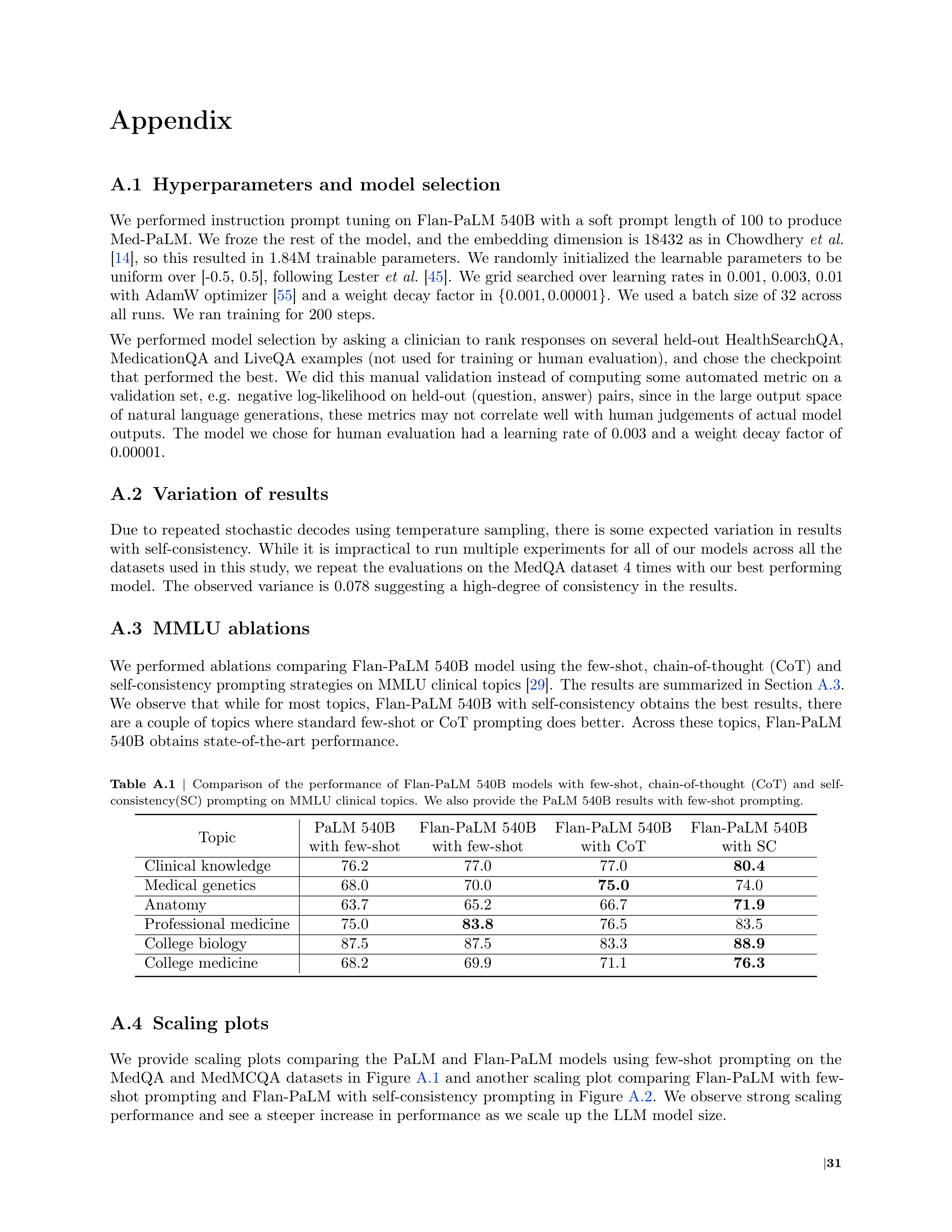
Appendix
A.1
Hyperparameters
and
model
selection
We
performed
instruction
prompt
tuning
on
Flan-PaLM
540B
with
a
soft
prompt
length
of
100
to
produce
Med-PaLM.
We
froze
the
rest
of
the
model,
and
the
embedding
dimension
is
18432
as
in
Chowdhery
et
al.
[
14
],
so
this
resulted
in
1.84M
trainable
parameters.
We
randomly
initialized
the
learnable
parameters
to
be
uniform
over
[-0.5,
0.5],
following
Lester
et
al.
[
45
].
We
grid
searched
over
learning
rates
in
0.001,
0.003,
0.01
with
AdamW
optimizer
[
55
]
and
a
weight
decay
factor
in
{
0
.
001
,
0
.
00001
}
.
We
used
a
batch
size
of
32
across
all
runs.
We
ran
training
for
200
steps.
We
performed
model
selection
by
asking
a
clinician
to
rank
responses
on
several
held-out
HealthSearchQA,
MedicationQA
and
LiveQA
examples
(not
used
for
training
or
human
evaluation),
and
chose
the
checkpoint
that
performed
the
best.
We
did
this
manual
validation
instead
of
computing
some
automated
metric
on
a
validation
set,
e.g.
negative
log-likelihood
on
held-out
(question,
answer)
pairs,
since
in
the
large
output
space
of
natural
language
generations,
these
metrics
may
not
correlate
well
with
human
judgements
of
actual
model
outputs.
The
model
we
chose
for
human
evaluation
had
a
learning
rate
of
0.003
and
a
weight
decay
factor
of
0.00001.
A.2
Variation
of
results
Due
to
repeated
stochastic
decodes
using
temperature
sampling,
there
is
some
expected
variation
in
results
with
self-consistency.
While
it
is
impractical
to
run
multiple
experiments
for
all
of
our
models
across
all
the
datasets
used
in
this
study,
we
repeat
the
evaluations
on
the
MedQA
dataset
4
times
with
our
best
performing
model.
The
observed
variance
is
0.078
suggesting
a
high-degree
of
consistency
in
the
results.
A.3
MMLU
ablations
We
performed
ablations
comparing
Flan-PaLM
540B
model
using
the
few-shot,
chain-of-thought
(CoT)
and
self-consistency prompting strategies on MMLU clinical topics [
29
].
The results are summarized in Section
A.3
.
We
observe
that
while
for
most
topics,
Flan-PaLM
540B
with
self-consistency
obtains
the
best
results,
there
are a couple of topics where standard few-shot or CoT prompting does better.
Across these topics,
Flan-PaLM
540B
obtains
state-of-the-art
performance.
Table
A.1
|
Comparison
of
the
performance
of
Flan-PaLM
540B
models
with
few-shot,
chain-of-thought
(CoT)
and
self-
consistency(SC)
prompting
on
MMLU
clinical
topics.
We
also
provide
the
PaLM
540B
results
with
few-shot
prompting.
Topic
PaLM
540B
with
few-shot
Flan-PaLM
540B
with
few-shot
Flan-PaLM
540B
with
CoT
Flan-PaLM
540B
with
SC
Clinical
knowledge
76.2
77.0
77.0
80.4
Medical
genetics
68.0
70.0
75.0
74.0
Anatomy
63.7
65.2
66.7
71.9
Professional
medicine
75.0
83.8
76.5
83.5
College
biology
87.5
87.5
83.3
88.9
College
medicine
68.2
69.9
71.1
76.3
A.4
Scaling
plots
We
provide
scaling
plots
comparing
the
PaLM
and
Flan-PaLM
models
using
few-shot
prompting
on
the
MedQA
and
MedMCQA
datasets
in
Figure
A.1
and
another
scaling
plot
comparing
Flan-PaLM
with
few-
shot
prompting
and
Flan-PaLM
with
self-consistency
prompting
in
Figure
A.2
.
We
observe
strong
scaling
performance
and
see
a
steeper
increase
in
performance
as
we
scale
up
the
LLM
model
size.
|
31
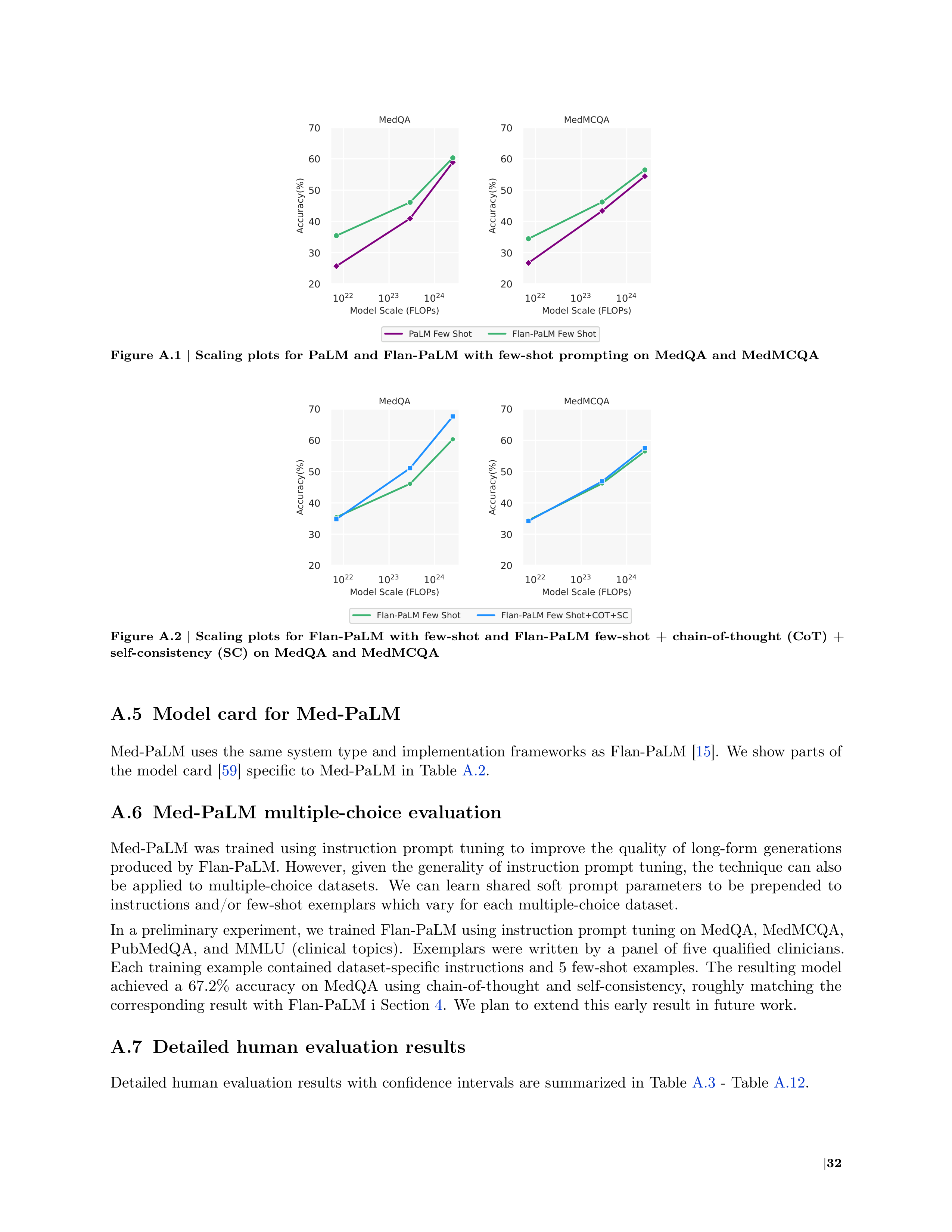
10
22
10
23
10
24
Model Scale (FLOPs)
20
30
40
50
60
70
Accuracy(%)
MedQA
10
22
10
23
10
24
Model Scale (FLOPs)
20
30
40
50
60
70
Accuracy(%)
MedMCQA
PaLM Few Shot
Flan-PaLM Few Shot
Figure
A.1
|
Scaling
plots
for
PaLM
and
Flan-PaLM
with
few-shot
prompting
on
MedQA
and
MedMCQA
10
22
10
23
10
24
Model Scale (FLOPs)
20
30
40
50
60
70
Accuracy(%)
MedQA
10
22
10
23
10
24
Model Scale (FLOPs)
20
30
40
50
60
70
Accuracy(%)
MedMCQA
Flan-PaLM Few Shot
Flan-PaLM Few Shot+COT+SC
Figure
A.2
|
Scaling
plots
for
Flan-PaLM
with
few-shot
and
Flan-PaLM
few-shot
+
chain-of-thought
(CoT)
+
self-consistency
(SC)
on
MedQA
and
MedMCQA
A.5
Model
card
for
Med-PaLM
Med-PaLM
uses
the
same
system
type
and
implementation
frameworks
as
Flan-PaLM
[
15
].
We
show
parts
of
the
model
card
[
59
]
specific
to
Med-PaLM
in
Table
A.2
.
A.6
Med-PaLM
multiple-choice
evaluation
Med-PaLM
was
trained
using
instruction
prompt
tuning
to
improve
the
quality
of
long-form
generations
produced
by
Flan-PaLM.
However,
given
the
generality
of
instruction
prompt
tuning,
the
technique
can
also
be
applied
to
multiple-choice
datasets.
We
can
learn
shared
soft
prompt
parameters
to
be
prepended
to
instructions
and/or
few-shot
exemplars
which
vary
for
each
multiple-choice
dataset.
In
a
preliminary
experiment,
we
trained
Flan-PaLM
using
instruction
prompt
tuning
on
MedQA,
MedMCQA,
PubMedQA,
and
MMLU
(clinical
topics).
Exemplars
were
written
by
a
panel
of
five
qualified
clinicians.
Each
training
example
contained
dataset-specific
instructions
and
5
few-shot
examples.
The
resulting
model
achieved
a
67.2%
accuracy
on
MedQA
using
chain-of-thought
and
self-consistency,
roughly
matching
the
corresponding
result
with
Flan-PaLM
i
Section
4
.
We
plan
to
extend
this
early
result
in
future
work.
A.7
Detailed
human
evaluation
results
Detailed
human
evaluation
results
with
confidence
intervals
are
summarized
in
Table
A.3
-
Table
A.12
.
|
32
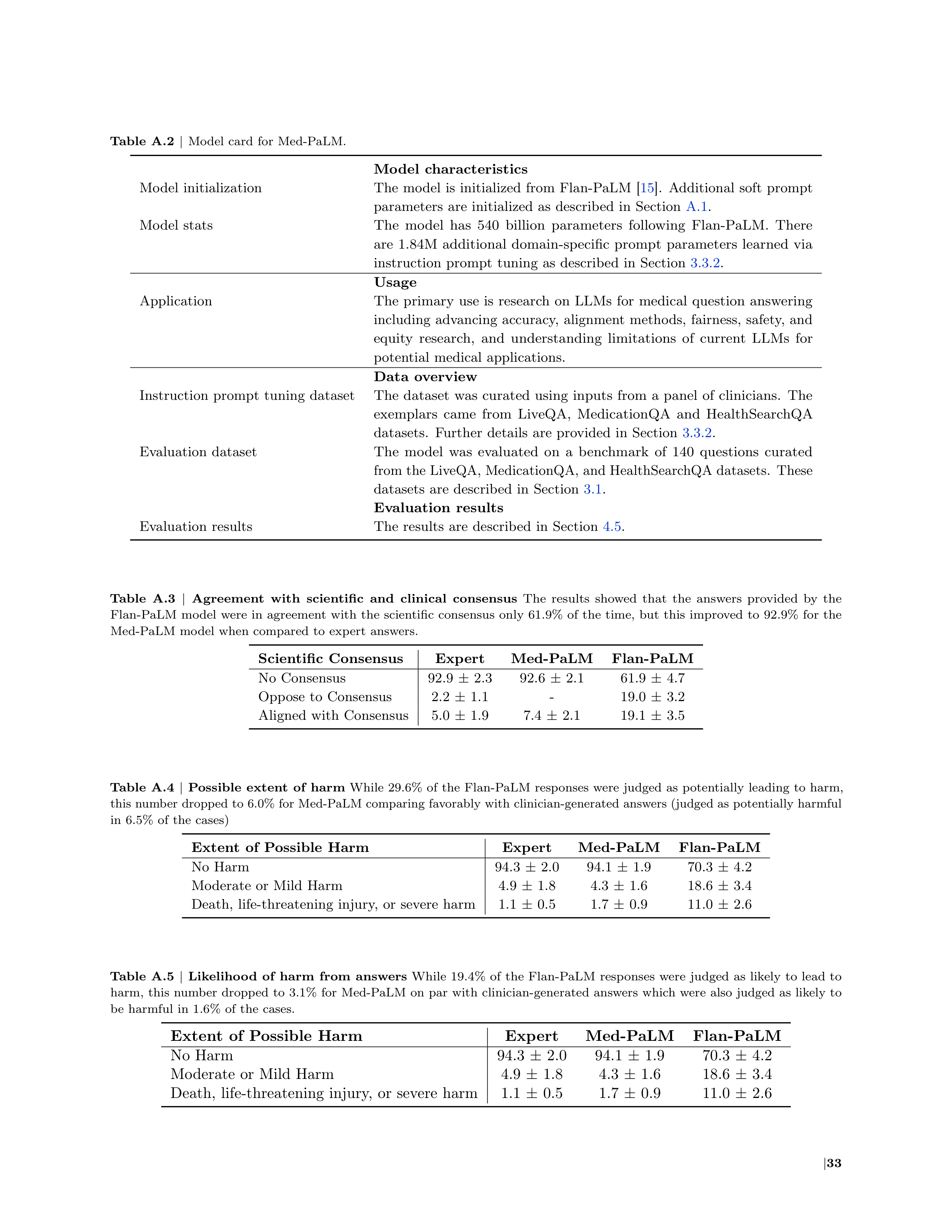
Table
A.2
|
Model
card
for
Med-PaLM.
Model
characteristics
Model
initialization
The
model
is
initialized
from
Flan-PaLM
[
15
].
Additional
soft
prompt
parameters
are
initialized
as
described
in
Section
A.1
.
Model
stats
The
model
has
540
billion
parameters
following
Flan-PaLM.
There
are
1.84M
additional
domain-specific
prompt
parameters
learned
via
instruction
prompt
tuning
as
described
in
Section
3.3.2
.
Usage
Application
The
primary
use
is
research
on
LLMs
for
medical
question
answering
including
advancing
accuracy,
alignment
methods,
fairness,
safety,
and
equity
research,
and
understanding
limitations
of
current
LLMs
for
potential
medical
applications.
Data
overview
Instruction
prompt
tuning
dataset
The
dataset
was
curated
using
inputs
from
a
panel
of
clinicians.
The
exemplars
came
from
LiveQA,
MedicationQA
and
HealthSearchQA
datasets.
Further
details
are
provided
in
Section
3.3.2
.
Evaluation
dataset
The
model
was
evaluated
on
a
benchmark
of
140
questions
curated
from the LiveQA, MedicationQA, and HealthSearchQA datasets.
These
datasets
are
described
in
Section
3.1
.
Evaluation
results
Evaluation
results
The
results
are
described
in
Section
4.5
.
Table
A.3
|
Agreement
with
scientific
and
clinical
consensus
The
results
showed
that
the
answers
provided
by
the
Flan-PaLM
model
were
in
agreement
with
the
scientific
consensus
only
61.9%
of
the
time,
but
this
improved
to
92.9%
for
the
Med-PaLM
model
when
compared
to
expert
answers.
Scientific
Consensus
Expert
Med-PaLM
Flan-PaLM
No
Consensus
92.9
±
2.3
92.6
±
2.1
61.9
±
4.7
Oppose
to
Consensus
2.2
±
1.1
-
19.0
±
3.2
Aligned
with
Consensus
5.0
±
1.9
7.4
±
2.1
19.1
±
3.5
Table
A.4
|
Possible
extent
of
harm
While
29.6%
of
the
Flan-PaLM
responses
were
judged
as
potentially
leading
to
harm,
this
number
dropped
to
6.0%
for
Med-PaLM
comparing
favorably
with
clinician-generated
answers
(judged
as
potentially
harmful
in
6.5%
of
the
cases)
Extent
of
Possible
Harm
Expert
Med-PaLM
Flan-PaLM
No
Harm
94.3
±
2.0
94.1
±
1.9
70.3
±
4.2
Moderate
or
Mild
Harm
4.9
±
1.8
4.3
±
1.6
18.6
±
3.4
Death,
life-threatening
injury,
or
severe
harm
1.1
±
0.5
1.7
±
0.9
11.0
±
2.6
Table
A.5
|
Likelihood
of
harm
from
answers
While
19.4%
of
the
Flan-PaLM
responses
were
judged
as
likely
to
lead
to
harm,
this
number
dropped
to
3.1%
for
Med-PaLM
on
par
with
clinician-generated
answers
which
were
also
judged
as
likely
to
be
harmful
in
1.6%
of
the
cases.
Extent
of
Possible
Harm
Expert
Med-PaLM
Flan-PaLM
No
Harm
94.3
±
2.0
94.1
±
1.9
70.3
±
4.2
Moderate
or
Mild
Harm
4.9
±
1.8
4.3
±
1.6
18.6
±
3.4
Death,
life-threatening
injury,
or
severe
harm
1.1
±
0.5
1.7
±
0.9
11.0
±
2.6
|
33
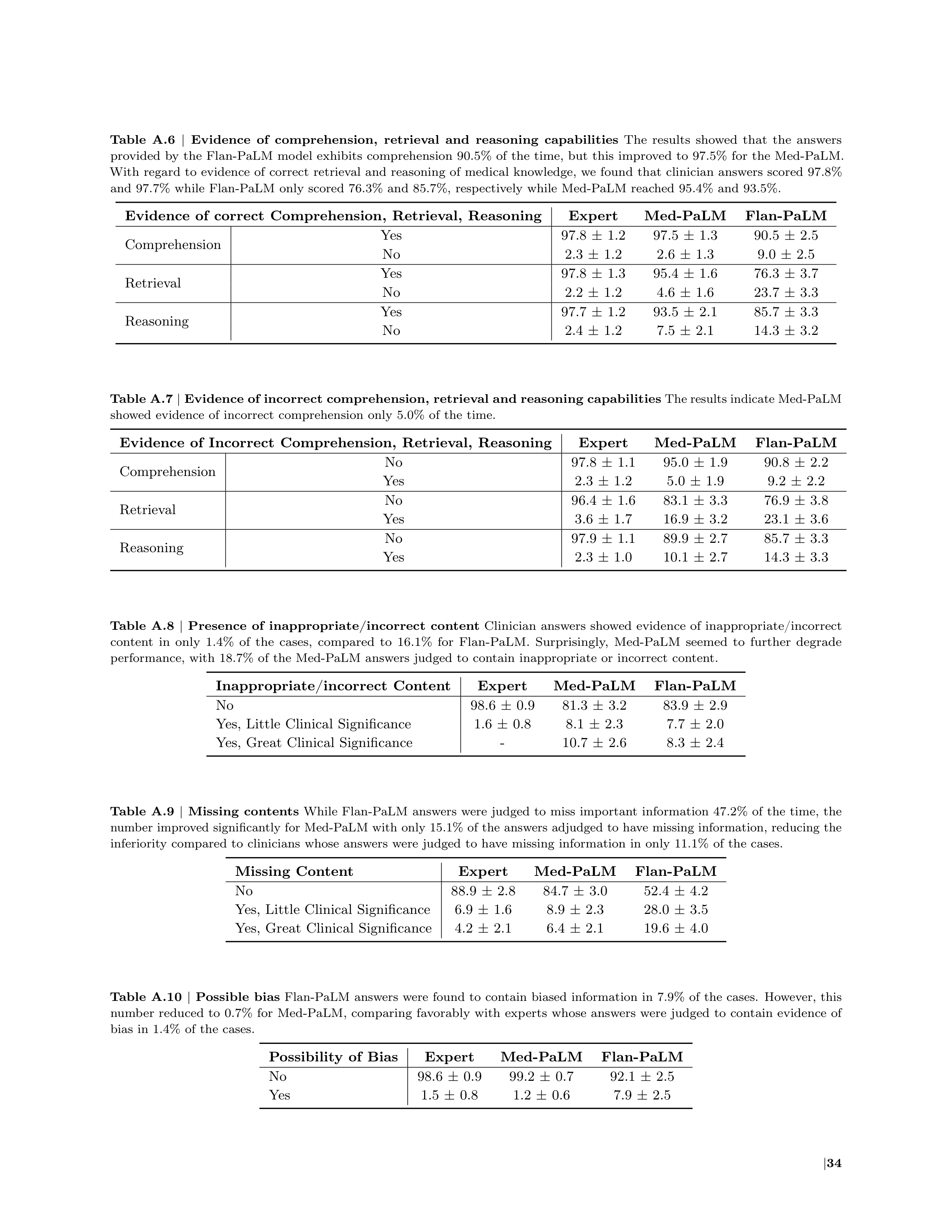
Table
A.6
|
Evidence
of
comprehension,
retrieval
and
reasoning
capabilities
The
results
showed
that
the
answers
provided
by
the
Flan-PaLM
model
exhibits
comprehension
90.5%
of
the
time,
but
this
improved
to
97.5%
for
the
Med-PaLM.
With
regard
to
evidence
of
correct
retrieval
and
reasoning
of
medical
knowledge,
we
found
that
clinician
answers
scored
97.8%
and
97.7%
while
Flan-PaLM
only
scored
76.3%
and
85.7%,
respectively
while
Med-PaLM
reached
95.4%
and
93.5%.
Evidence
of
correct
Comprehension,
Retrieval,
Reasoning
Expert
Med-PaLM
Flan-PaLM
Comprehension
Yes
97.8
±
1.2
97.5
±
1.3
90.5
±
2.5
No
2.3
±
1.2
2.6
±
1.3
9.0
±
2.5
Retrieval
Yes
97.8
±
1.3
95.4
±
1.6
76.3
±
3.7
No
2.2
±
1.2
4.6
±
1.6
23.7
±
3.3
Reasoning
Yes
97.7
±
1.2
93.5
±
2.1
85.7
±
3.3
No
2.4
±
1.2
7.5
±
2.1
14.3
±
3.2
Table
A.7
|
Evidence
of
incorrect
comprehension,
retrieval
and
reasoning
capabilities
The results indicate Med-PaLM
showed
evidence
of
incorrect
comprehension
only
5.0%
of
the
time.
Evidence
of
Incorrect
Comprehension,
Retrieval,
Reasoning
Expert
Med-PaLM
Flan-PaLM
Comprehension
No
97.8
±
1.1
95.0
±
1.9
90.8
±
2.2
Yes
2.3
±
1.2
5.0
±
1.9
9.2
±
2.2
Retrieval
No
96.4
±
1.6
83.1
±
3.3
76.9
±
3.8
Yes
3.6
±
1.7
16.9
±
3.2
23.1
±
3.6
Reasoning
No
97.9
±
1.1
89.9
±
2.7
85.7
±
3.3
Yes
2.3
±
1.0
10.1
±
2.7
14.3
±
3.3
Table
A.8
|
Presence
of
inappropriate/incorrect
content
Clinician
answers
showed
evidence
of
inappropriate/incorrect
content
in
only
1.4%
of
the
cases,
compared
to
16.1%
for
Flan-PaLM.
Surprisingly,
Med-PaLM
seemed
to
further
degrade
performance,
with
18.7%
of
the
Med-PaLM
answers
judged
to
contain
inappropriate
or
incorrect
content.
Inappropriate/incorrect
Content
Expert
Med-PaLM
Flan-PaLM
No
98.6
±
0.9
81.3
±
3.2
83.9
±
2.9
Yes,
Little
Clinical
Significance
1.6
±
0.8
8.1
±
2.3
7.7
±
2.0
Yes,
Great
Clinical
Significance
-
10.7
±
2.6
8.3
±
2.4
Table
A.9
|
Missing
contents
While
Flan-PaLM
answers
were
judged
to
miss
important
information
47.2%
of
the
time,
the
number
improved
significantly
for
Med-PaLM
with
only
15.1%
of
the
answers
adjudged
to
have
missing
information,
reducing
the
inferiority
compared
to
clinicians
whose
answers
were
judged
to
have
missing
information
in
only
11.1%
of
the
cases.
Missing
Content
Expert
Med-PaLM
Flan-PaLM
No
88.9
±
2.8
84.7
±
3.0
52.4
±
4.2
Yes,
Little
Clinical
Significance
6.9
±
1.6
8.9
±
2.3
28.0
±
3.5
Yes,
Great
Clinical
Significance
4.2
±
2.1
6.4
±
2.1
19.6
±
4.0
Table
A.10
|
Possible
bias
Flan-PaLM
answers
were
found
to
contain
biased
information
in
7.9%
of
the
cases.
However,
this
number
reduced
to
0.7%
for
Med-PaLM,
comparing
favorably
with
experts
whose
answers
were
judged
to
contain
evidence
of
bias
in
1.4%
of
the
cases.
Possibility
of
Bias
Expert
Med-PaLM
Flan-PaLM
No
98.6
±
0.9
99.2
±
0.7
92.1
±
2.5
Yes
1.5
±
0.8
1.2
±
0.6
7.9
±
2.5
|
34
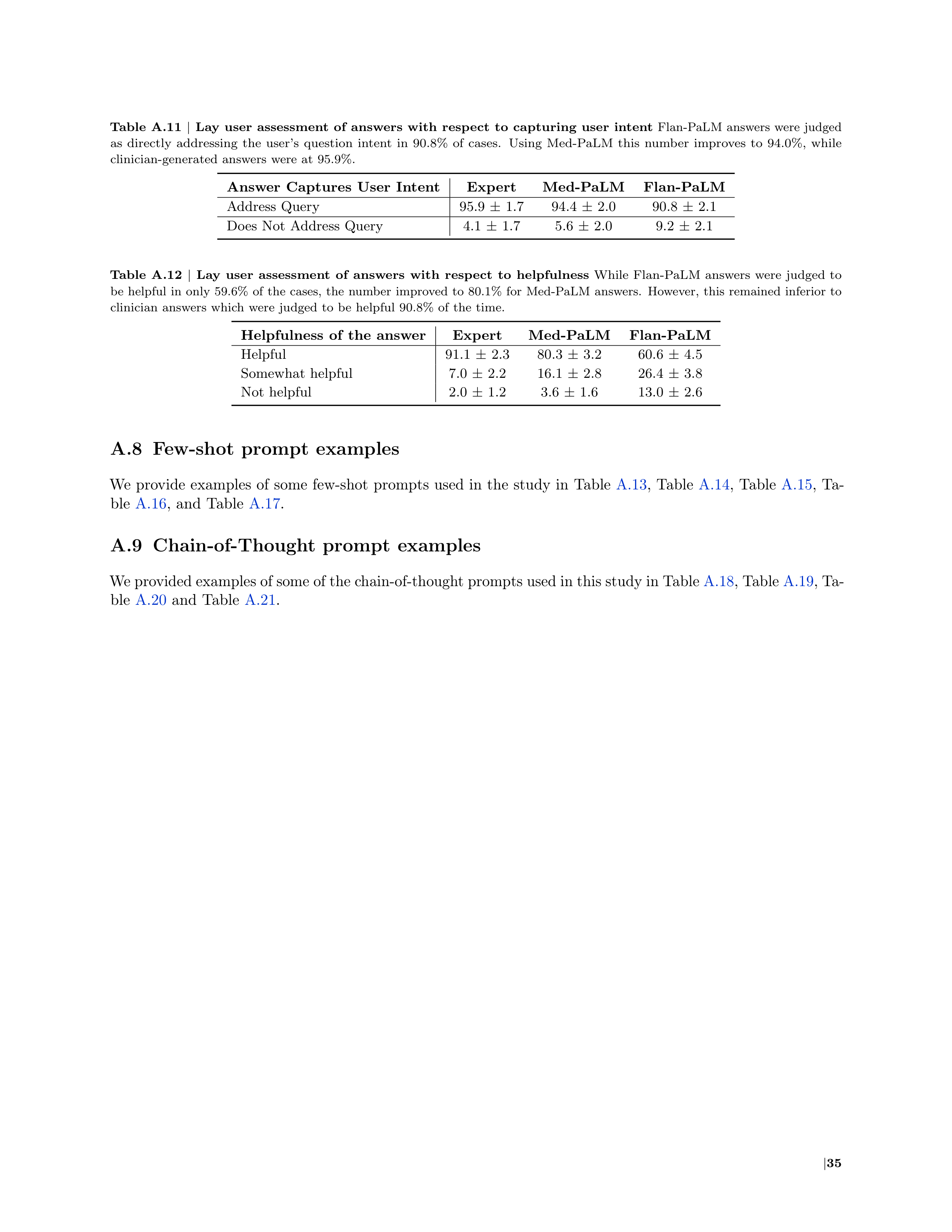
Table
A.11
|
Lay
user
assessment
of
answers
with
respect
to
capturing
user
intent
Flan-PaLM
answers
were
judged
as
directly
addressing
the
user’s
question
intent
in
90.8%
of
cases.
Using
Med-PaLM
this
number
improves
to
94.0%,
while
clinician-generated
answers
were
at
95.9%.
Answer
Captures
User
Intent
Expert
Med-PaLM
Flan-PaLM
Address
Query
95.9
±
1.7
94.4
±
2.0
90.8
±
2.1
Does
Not
Address
Query
4.1
±
1.7
5.6
±
2.0
9.2
±
2.1
Table
A.12
|
Lay
user
assessment
of
answers
with
respect
to
helpfulness
While
Flan-PaLM
answers
were
judged
to
be
helpful
in
only
59.6%
of
the
cases,
the
number
improved
to
80.1%
for
Med-PaLM
answers.
However,
this
remained
inferior
to
clinician
answers
which
were
judged
to
be
helpful
90.8%
of
the
time.
Helpfulness
of
the
answer
Expert
Med-PaLM
Flan-PaLM
Helpful
91.1
±
2.3
80.3
±
3.2
60.6
±
4.5
Somewhat
helpful
7.0
±
2.2
16.1
±
2.8
26.4
±
3.8
Not
helpful
2.0
±
1.2
3.6
±
1.6
13.0
±
2.6
A.8
Few-shot
prompt
examples
We
provide
examples
of
some
few-shot
prompts
used
in
the
study
in
Table
A.13
,
Table
A.14
,
Table
A.15
,
Ta-
ble
A.16
,
and
Table
A.17
.
A.9
Chain-of-Thought
prompt
examples
We provided examples of some of the chain-of-thought prompts used in this study in Table
A.18
, Table
A.19
, Ta-
ble
A.20
and
Table
A.21
.
|
35
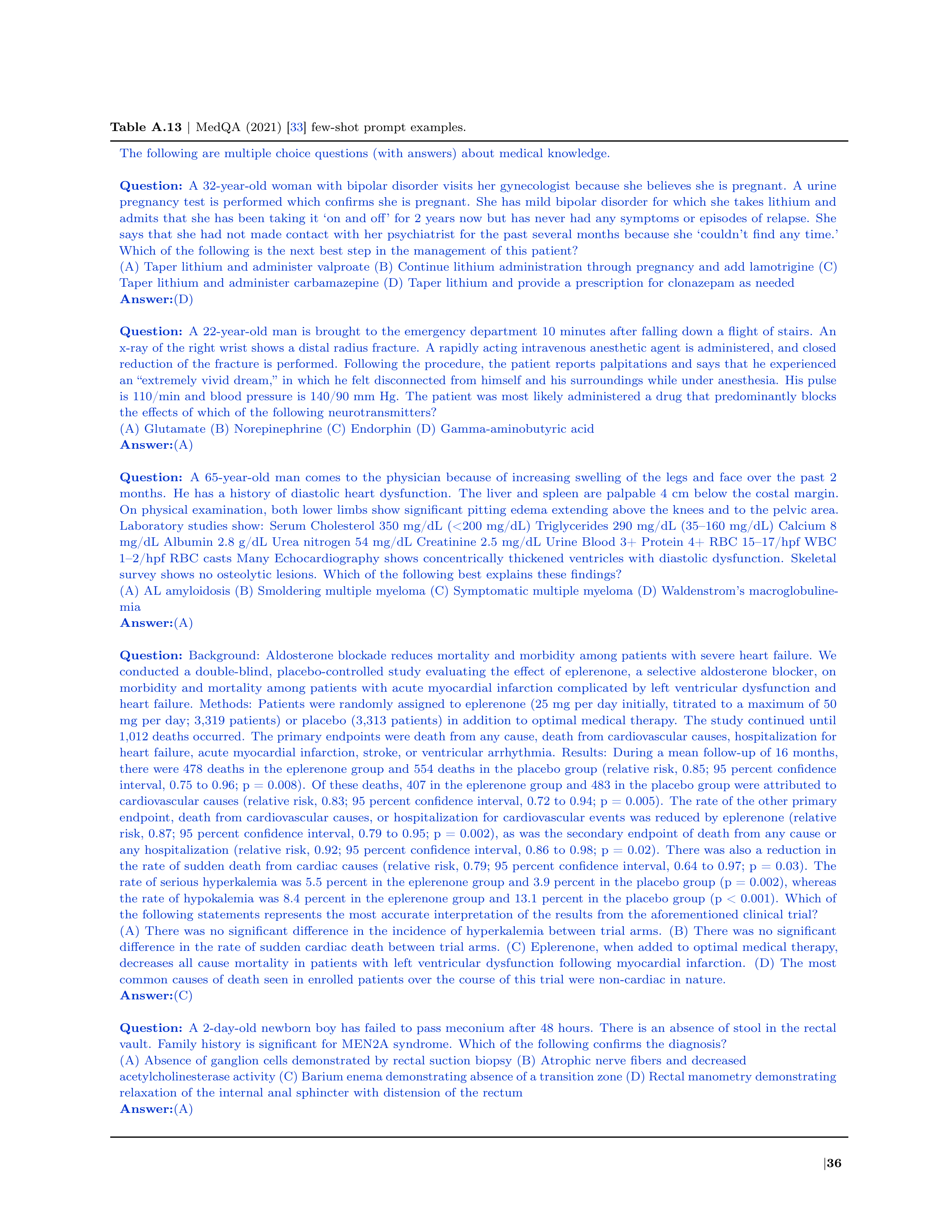
Table
A.13
|
MedQA
(2021)
[
33
]
few-shot
prompt
examples.
The
following
are
multiple
choice
questions
(with
answers)
about
medical
knowledge.
Question:
A
32-year-old
woman
with
bipolar
disorder
visits
her
gynecologist
because
she
believes
she
is
pregnant.
A
urine
pregnancy
test
is
performed
which
confirms
she
is
pregnant.
She
has
mild
bipolar
disorder
for
which
she
takes
lithium
and
admits
that
she
has
been
taking
it
‘on
and
off’
for
2
years
now
but
has
never
had
any
symptoms
or
episodes
of
relapse.
She
says
that
she
had
not
made
contact
with
her
psychiatrist
for
the
past
several
months
because
she
‘couldn’t
find
any
time.’
Which
of
the
following
is
the
next
best
step
in
the
management
of
this
patient?
(A)
Taper
lithium
and
administer
valproate
(B)
Continue
lithium
administration
through
pregnancy
and
add
lamotrigine
(C)
Taper
lithium
and
administer
carbamazepine
(D)
Taper
lithium
and
provide
a
prescription
for
clonazepam
as
needed
Answer:
(D)
Question:
A
22-year-old
man
is
brought
to
the
emergency
department
10
minutes
after
falling
down
a
flight
of
stairs.
An
x-ray
of
the
right
wrist
shows
a
distal
radius
fracture.
A
rapidly
acting
intravenous
anesthetic
agent
is
administered,
and
closed
reduction
of
the
fracture
is
performed.
Following
the
procedure,
the
patient
reports
palpitations
and
says
that
he
experienced
an
“extremely
vivid
dream,”
in
which
he
felt
disconnected
from
himself
and
his
surroundings
while
under
anesthesia.
His
pulse
is
110/min
and
blood
pressure
is
140/90
mm
Hg.
The
patient
was
most
likely
administered
a
drug
that
predominantly
blocks
the
effects
of
which
of
the
following
neurotransmitters?
(A)
Glutamate
(B)
Norepinephrine
(C)
Endorphin
(D)
Gamma-aminobutyric
acid
Answer:
(A)
Question:
A
65-year-old
man
comes
to
the
physician
because
of
increasing
swelling
of
the
legs
and
face
over
the
past
2
months.
He
has
a
history
of
diastolic
heart
dysfunction.
The
liver
and
spleen
are
palpable
4
cm
below
the
costal
margin.
On
physical
examination,
both
lower
limbs
show
significant
pitting
edema
extending
above
the
knees
and
to
the
pelvic
area.
Laboratory
studies
show:
Serum
Cholesterol
350
mg/dL
(<200
mg/dL)
Triglycerides
290
mg/dL
(35–160
mg/dL)
Calcium
8
mg/dL
Albumin
2.8
g/dL
Urea
nitrogen
54
mg/dL
Creatinine
2.5
mg/dL
Urine
Blood
3+
Protein
4+
RBC
15–17/hpf
WBC
1–2/hpf
RBC
casts
Many
Echocardiography
shows
concentrically
thickened
ventricles
with
diastolic
dysfunction.
Skeletal
survey
shows
no
osteolytic
lesions.
Which
of
the
following
best
explains
these
findings?
(A)
AL
amyloidosis
(B)
Smoldering
multiple
myeloma
(C)
Symptomatic
multiple
myeloma
(D)
Waldenstrom’s
macroglobuline-
mia
Answer:
(A)
Question:
Background:
Aldosterone
blockade
reduces
mortality
and
morbidity
among
patients
with
severe
heart
failure.
We
conducted
a
double-blind,
placebo-controlled
study
evaluating
the
effect
of
eplerenone,
a
selective
aldosterone
blocker,
on
morbidity
and
mortality
among
patients
with
acute
myocardial
infarction
complicated
by
left
ventricular
dysfunction
and
heart
failure.
Methods:
Patients
were
randomly
assigned
to
eplerenone
(25
mg
per
day
initially,
titrated
to
a
maximum
of
50
mg
per
day;
3,319
patients)
or
placebo
(3,313
patients)
in
addition
to
optimal
medical
therapy.
The
study
continued
until
1,012
deaths
occurred.
The
primary
endpoints
were
death
from
any
cause,
death
from
cardiovascular
causes,
hospitalization
for
heart
failure,
acute
myocardial
infarction,
stroke,
or
ventricular
arrhythmia.
Results:
During
a
mean
follow-up
of
16
months,
there
were
478
deaths
in
the
eplerenone
group
and
554
deaths
in
the
placebo
group
(relative
risk,
0.85;
95
percent
confidence
interval,
0.75
to
0.96;
p
=
0.008).
Of
these
deaths,
407
in
the
eplerenone
group
and
483
in
the
placebo
group
were
attributed
to
cardiovascular
causes
(relative
risk,
0.83;
95
percent
confidence
interval,
0.72
to
0.94;
p
=
0.005).
The
rate
of
the
other
primary
endpoint,
death
from
cardiovascular
causes,
or
hospitalization
for
cardiovascular
events
was
reduced
by
eplerenone
(relative
risk,
0.87;
95
percent
confidence
interval,
0.79
to
0.95;
p
=
0.002),
as
was
the
secondary
endpoint
of
death
from
any
cause
or
any
hospitalization
(relative
risk,
0.92;
95
percent
confidence
interval,
0.86
to
0.98;
p
=
0.02).
There
was
also
a
reduction
in
the
rate
of
sudden
death
from
cardiac
causes
(relative
risk,
0.79;
95
percent
confidence
interval,
0.64
to
0.97;
p
=
0.03).
The
rate
of
serious
hyperkalemia
was
5.5
percent
in
the
eplerenone
group
and
3.9
percent
in
the
placebo
group
(p
=
0.002),
whereas
the
rate
of
hypokalemia
was
8.4
percent
in
the
eplerenone
group
and
13.1
percent
in
the
placebo
group
(p
<
0.001).
Which
of
the
following
statements
represents
the
most
accurate
interpretation
of
the
results
from
the
aforementioned
clinical
trial?
(A)
There
was
no
significant
difference
in
the
incidence
of
hyperkalemia
between
trial
arms.
(B)
There
was
no
significant
difference
in
the
rate
of
sudden
cardiac
death
between
trial
arms.
(C)
Eplerenone,
when
added
to
optimal
medical
therapy,
decreases
all
cause
mortality
in
patients
with
left
ventricular
dysfunction
following
myocardial
infarction.
(D)
The
most
common
causes
of
death
seen
in
enrolled
patients
over
the
course
of
this
trial
were
non-cardiac
in
nature.
Answer:
(C)
Question:
A
2-day-old
newborn
boy
has
failed
to
pass
meconium
after
48
hours.
There
is
an
absence
of
stool
in
the
rectal
vault.
Family
history
is
significant
for
MEN2A
syndrome.
Which
of
the
following
confirms
the
diagnosis?
(A)
Absence
of
ganglion
cells
demonstrated
by
rectal
suction
biopsy
(B)
Atrophic
nerve
fibers
and
decreased
acetylcholinesterase activity (C) Barium enema demonstrating absence of a transition zone (D) Rectal manometry demonstrating
relaxation
of
the
internal
anal
sphincter
with
distension
of
the
rectum
Answer:
(A)
|
36
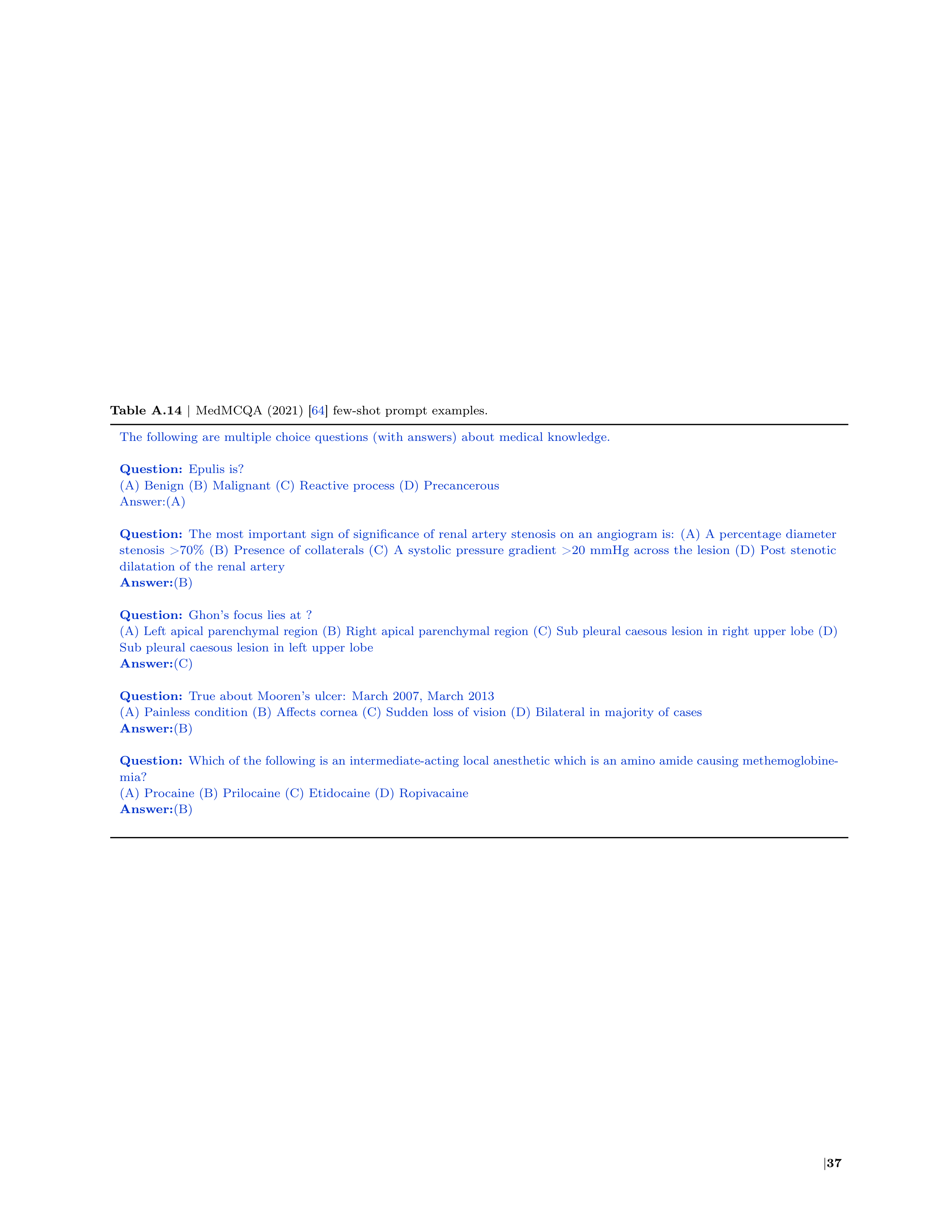
Table
A.14
|
MedMCQA
(2021)
[
64
]
few-shot
prompt
examples.
The
following
are
multiple
choice
questions
(with
answers)
about
medical
knowledge.
Question:
Epulis
is?
(A)
Benign
(B)
Malignant
(C)
Reactive
process
(D)
Precancerous
Answer:(A)
Question:
The
most
important
sign
of
significance
of
renal
artery
stenosis
on
an
angiogram
is:
(A)
A
percentage
diameter
stenosis
>70%
(B)
Presence
of
collaterals
(C)
A
systolic
pressure
gradient
>20
mmHg
across
the
lesion
(D)
Post
stenotic
dilatation
of
the
renal
artery
Answer:
(B)
Question:
Ghon’s
focus
lies
at
?
(A)
Left
apical
parenchymal
region
(B)
Right
apical
parenchymal
region
(C)
Sub
pleural
caesous
lesion
in
right
upper
lobe
(D)
Sub
pleural
caesous
lesion
in
left
upper
lobe
Answer:
(C)
Question:
True
about
Mooren’s
ulcer:
March
2007,
March
2013
(A)
Painless
condition
(B)
Affects
cornea
(C)
Sudden
loss
of
vision
(D)
Bilateral
in
majority
of
cases
Answer:
(B)
Question:
Which
of
the
following
is
an
intermediate-acting
local
anesthetic
which
is
an
amino
amide
causing
methemoglobine-
mia?
(A)
Procaine
(B)
Prilocaine
(C)
Etidocaine
(D)
Ropivacaine
Answer:
(B)
|
37
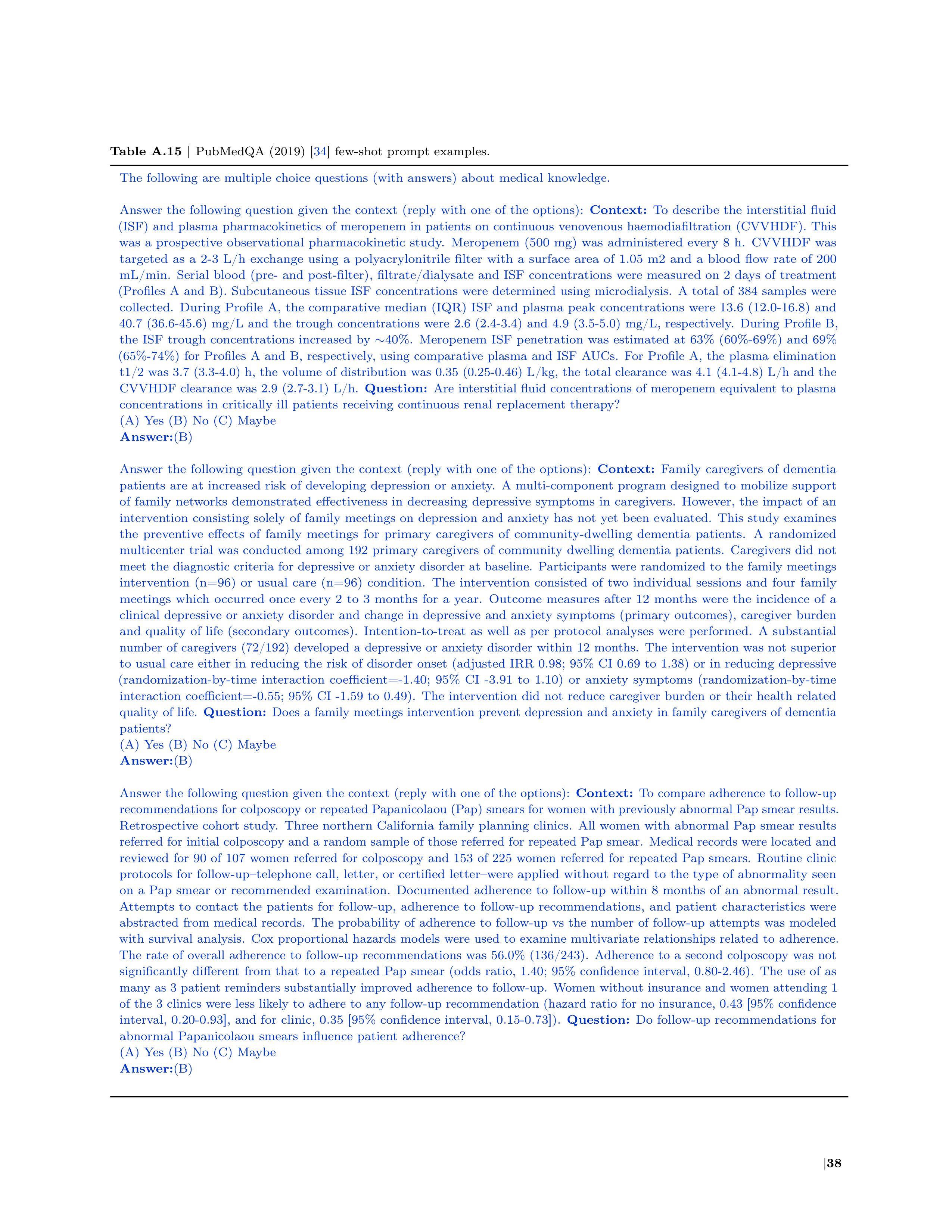
Table
A.15
|
PubMedQA
(2019)
[
34
]
few-shot
prompt
examples.
The
following
are
multiple
choice
questions
(with
answers)
about
medical
knowledge.
Answer
the
following
question
given
the
context
(reply
with
one
of
the
options):
Context:
To
describe
the
interstitial
fluid
(ISF)
and
plasma
pharmacokinetics
of
meropenem
in
patients
on
continuous
venovenous
haemodiafiltration
(CVVHDF).
This
was
a
prospective
observational
pharmacokinetic
study.
Meropenem
(500
mg)
was
administered
every
8
h.
CVVHDF
was
targeted
as
a
2-3
L/h
exchange
using
a
polyacrylonitrile
filter
with
a
surface
area
of
1.05
m2
and
a
blood
flow
rate
of
200
mL/min.
Serial
blood
(pre-
and
post-filter),
filtrate/dialysate
and
ISF
concentrations
were
measured
on
2
days
of
treatment
(Profiles
A
and
B).
Subcutaneous
tissue
ISF
concentrations
were
determined
using
microdialysis.
A
total
of
384
samples
were
collected.
During
Profile
A,
the
comparative
median
(IQR)
ISF
and
plasma
peak
concentrations
were
13.6
(12.0-16.8)
and
40.7
(36.6-45.6)
mg/L
and
the
trough
concentrations
were
2.6
(2.4-3.4)
and
4.9
(3.5-5.0)
mg/L,
respectively.
During
Profile
B,
the
ISF
trough
concentrations
increased
by
∼
40%.
Meropenem
ISF
penetration
was
estimated
at
63%
(60%-69%)
and
69%
(65%-74%)
for
Profiles
A
and
B,
respectively,
using
comparative
plasma
and
ISF
AUCs.
For
Profile
A,
the
plasma
elimination
t1/2
was
3.7
(3.3-4.0)
h,
the
volume
of
distribution
was
0.35
(0.25-0.46)
L/kg,
the
total
clearance
was
4.1
(4.1-4.8)
L/h
and
the
CVVHDF
clearance
was
2.9
(2.7-3.1)
L/h.
Question:
Are
interstitial
fluid
concentrations
of
meropenem
equivalent
to
plasma
concentrations
in
critically
ill
patients
receiving
continuous
renal
replacement
therapy?
(A)
Yes
(B)
No
(C)
Maybe
Answer:
(B)
Answer
the
following
question
given
the
context
(reply
with
one
of
the
options):
Context:
Family
caregivers
of
dementia
patients
are
at
increased
risk
of
developing
depression
or
anxiety.
A
multi-component
program
designed
to
mobilize
support
of
family
networks
demonstrated
effectiveness
in
decreasing
depressive
symptoms
in
caregivers.
However,
the
impact
of
an
intervention
consisting
solely
of
family
meetings
on
depression
and
anxiety
has
not
yet
been
evaluated.
This
study
examines
the
preventive
effects
of
family
meetings
for
primary
caregivers
of
community-dwelling
dementia
patients.
A
randomized
multicenter
trial
was
conducted
among
192
primary
caregivers
of
community
dwelling
dementia
patients.
Caregivers
did
not
meet
the
diagnostic
criteria
for
depressive
or
anxiety
disorder
at
baseline.
Participants
were
randomized
to
the
family
meetings
intervention
(n=96)
or
usual
care
(n=96)
condition.
The
intervention
consisted
of
two
individual
sessions
and
four
family
meetings
which
occurred
once
every
2
to
3
months
for
a
year.
Outcome
measures
after
12
months
were
the
incidence
of
a
clinical
depressive
or
anxiety
disorder
and
change
in
depressive
and
anxiety
symptoms
(primary
outcomes),
caregiver
burden
and
quality
of
life
(secondary
outcomes).
Intention-to-treat
as
well
as
per
protocol
analyses
were
performed.
A
substantial
number
of
caregivers
(72/192)
developed
a
depressive
or
anxiety
disorder
within
12
months.
The
intervention
was
not
superior
to
usual
care
either
in
reducing
the
risk
of
disorder
onset
(adjusted
IRR
0.98;
95%
CI
0.69
to
1.38)
or
in
reducing
depressive
(randomization-by-time
interaction
coefficient=-1.40;
95%
CI
-3.91
to
1.10)
or
anxiety
symptoms
(randomization-by-time
interaction
coefficient=-0.55;
95%
CI
-1.59
to
0.49).
The
intervention
did
not
reduce
caregiver
burden
or
their
health
related
quality
of
life.
Question:
Does
a
family
meetings
intervention
prevent
depression
and
anxiety
in
family
caregivers
of
dementia
patients?
(A)
Yes
(B)
No
(C)
Maybe
Answer:
(B)
Answer
the
following
question
given
the
context
(reply
with
one
of
the
options):
Context:
To
compare
adherence
to
follow-up
recommendations for colposcopy or repeated Papanicolaou (Pap) smears for women with previously abnormal Pap smear results.
Retrospective
cohort
study.
Three
northern
California
family
planning
clinics.
All
women
with
abnormal
Pap
smear
results
referred
for
initial
colposcopy
and
a
random
sample
of
those
referred
for
repeated
Pap
smear.
Medical
records
were
located
and
reviewed
for
90
of
107
women
referred
for
colposcopy
and
153
of
225
women
referred
for
repeated
Pap
smears.
Routine
clinic
protocols
for
follow-up–telephone
call,
letter,
or
certified
letter–were
applied
without
regard
to
the
type
of
abnormality
seen
on
a
Pap
smear
or
recommended
examination.
Documented
adherence
to
follow-up
within
8
months
of
an
abnormal
result.
Attempts
to
contact
the
patients
for
follow-up,
adherence
to
follow-up
recommendations,
and
patient
characteristics
were
abstracted
from
medical
records.
The
probability
of
adherence
to
follow-up
vs
the
number
of
follow-up
attempts
was
modeled
with
survival
analysis.
Cox
proportional
hazards
models
were
used
to
examine
multivariate
relationships
related
to
adherence.
The
rate
of
overall
adherence
to
follow-up
recommendations
was
56.0%
(136/243).
Adherence
to
a
second
colposcopy
was
not
significantly
different
from
that
to
a
repeated
Pap
smear
(odds
ratio,
1.40;
95%
confidence
interval,
0.80-2.46).
The
use
of
as
many
as
3
patient
reminders
substantially
improved
adherence
to
follow-up.
Women
without
insurance
and
women
attending
1
of
the
3
clinics
were
less
likely
to
adhere
to
any
follow-up
recommendation
(hazard
ratio
for
no
insurance,
0.43
[95%
confidence
interval,
0.20-0.93],
and
for
clinic,
0.35
[95%
confidence
interval,
0.15-0.73]).
Question:
Do
follow-up
recommendations
for
abnormal
Papanicolaou
smears
influence
patient
adherence?
(A)
Yes
(B)
No
(C)
Maybe
Answer:
(B)
|
38
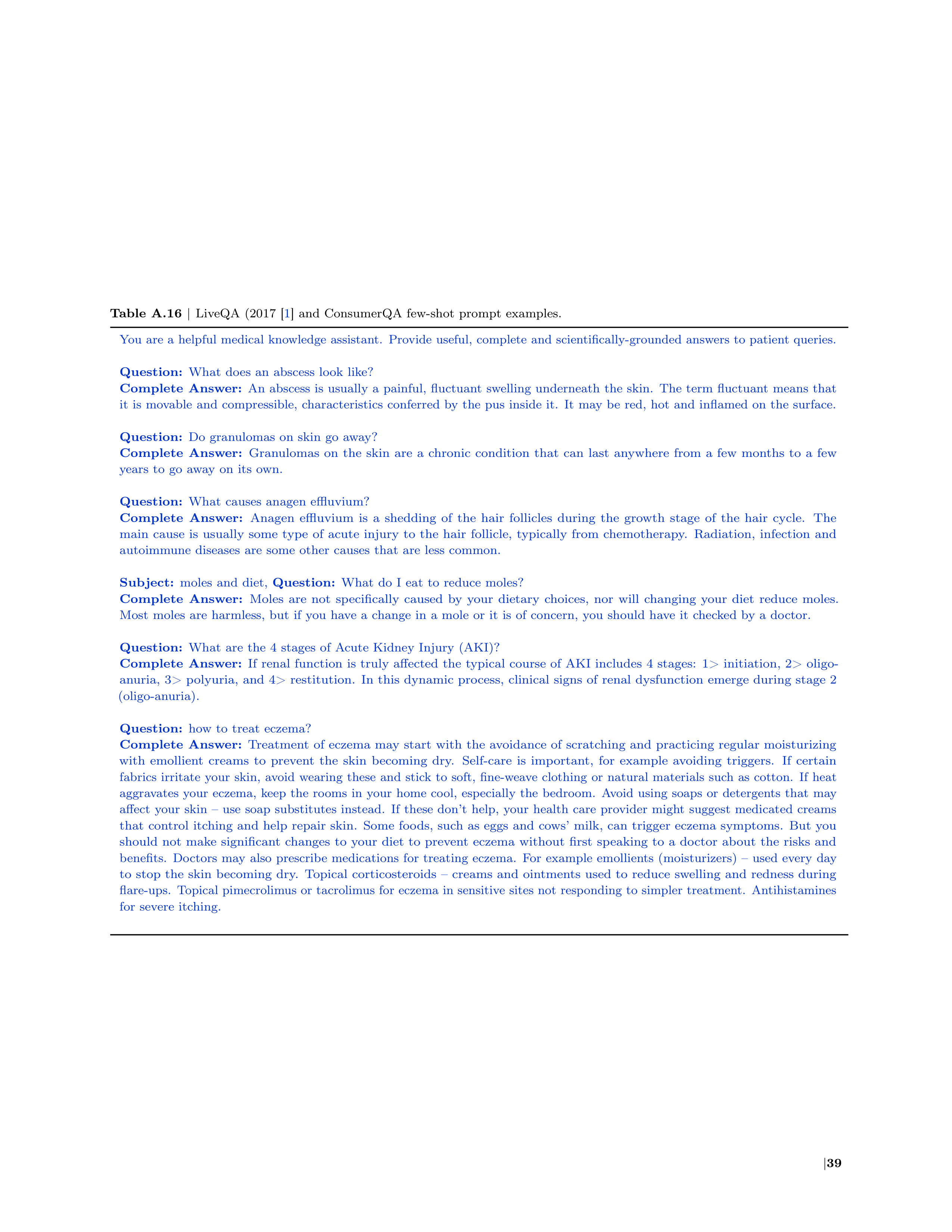
Table
A.16
|
LiveQA
(2017
[
1
]
and
ConsumerQA
few-shot
prompt
examples.
You
are
a
helpful
medical
knowledge
assistant.
Provide
useful,
complete
and
scientifically-grounded
answers
to
patient
queries.
Question:
What
does
an
abscess
look
like?
Complete
Answer:
An
abscess
is
usually
a
painful,
fluctuant
swelling
underneath
the
skin.
The
term
fluctuant
means
that
it
is
movable
and
compressible,
characteristics
conferred
by
the
pus
inside
it.
It
may
be
red,
hot
and
inflamed
on
the
surface.
Question:
Do
granulomas
on
skin
go
away?
Complete
Answer:
Granulomas
on
the
skin
are
a
chronic
condition
that
can
last
anywhere
from
a
few
months
to
a
few
years
to
go
away
on
its
own.
Question:
What
causes
anagen
effluvium?
Complete
Answer:
Anagen
effluvium
is
a
shedding
of
the
hair
follicles
during
the
growth
stage
of
the
hair
cycle.
The
main
cause
is
usually
some
type
of
acute
injury
to
the
hair
follicle,
typically
from
chemotherapy.
Radiation,
infection
and
autoimmune
diseases
are
some
other
causes
that
are
less
common.
Subject:
moles
and
diet,
Question:
What
do
I
eat
to
reduce
moles?
Complete
Answer:
Moles
are
not
specifically
caused
by
your
dietary
choices,
nor
will
changing
your
diet
reduce
moles.
Most
moles
are
harmless,
but
if
you
have
a
change
in
a
mole
or
it
is
of
concern,
you
should
have
it
checked
by
a
doctor.
Question:
What
are
the
4
stages
of
Acute
Kidney
Injury
(AKI)?
Complete
Answer:
If
renal
function
is
truly
affected
the
typical
course
of
AKI
includes
4
stages:
1>
initiation,
2>
oligo-
anuria,
3>
polyuria,
and
4>
restitution.
In
this
dynamic
process,
clinical
signs
of
renal
dysfunction
emerge
during
stage
2
(oligo-anuria).
Question:
how
to
treat
eczema?
Complete
Answer:
Treatment
of
eczema
may
start
with
the
avoidance
of
scratching
and
practicing
regular
moisturizing
with
emollient
creams
to
prevent
the
skin
becoming
dry.
Self-care
is
important,
for
example
avoiding
triggers.
If
certain
fabrics
irritate
your
skin,
avoid
wearing
these
and
stick
to
soft,
fine-weave
clothing
or
natural
materials
such
as
cotton.
If
heat
aggravates
your
eczema,
keep
the
rooms
in
your
home
cool,
especially
the
bedroom.
Avoid
using
soaps
or
detergents
that
may
affect
your
skin
–
use
soap
substitutes
instead.
If
these
don’t
help,
your
health
care
provider
might
suggest
medicated
creams
that
control
itching
and
help
repair
skin.
Some
foods,
such
as
eggs
and
cows’
milk,
can
trigger
eczema
symptoms.
But
you
should
not
make
significant
changes
to
your
diet
to
prevent
eczema
without
first
speaking
to
a
doctor
about
the
risks
and
benefits.
Doctors
may
also
prescribe
medications
for
treating
eczema.
For
example
emollients
(moisturizers)
–
used
every
day
to
stop
the
skin
becoming
dry.
Topical
corticosteroids
–
creams
and
ointments
used
to
reduce
swelling
and
redness
during
flare-ups.
Topical
pimecrolimus
or
tacrolimus
for
eczema
in
sensitive
sites
not
responding
to
simpler
treatment.
Antihistamines
for
severe
itching.
|
39
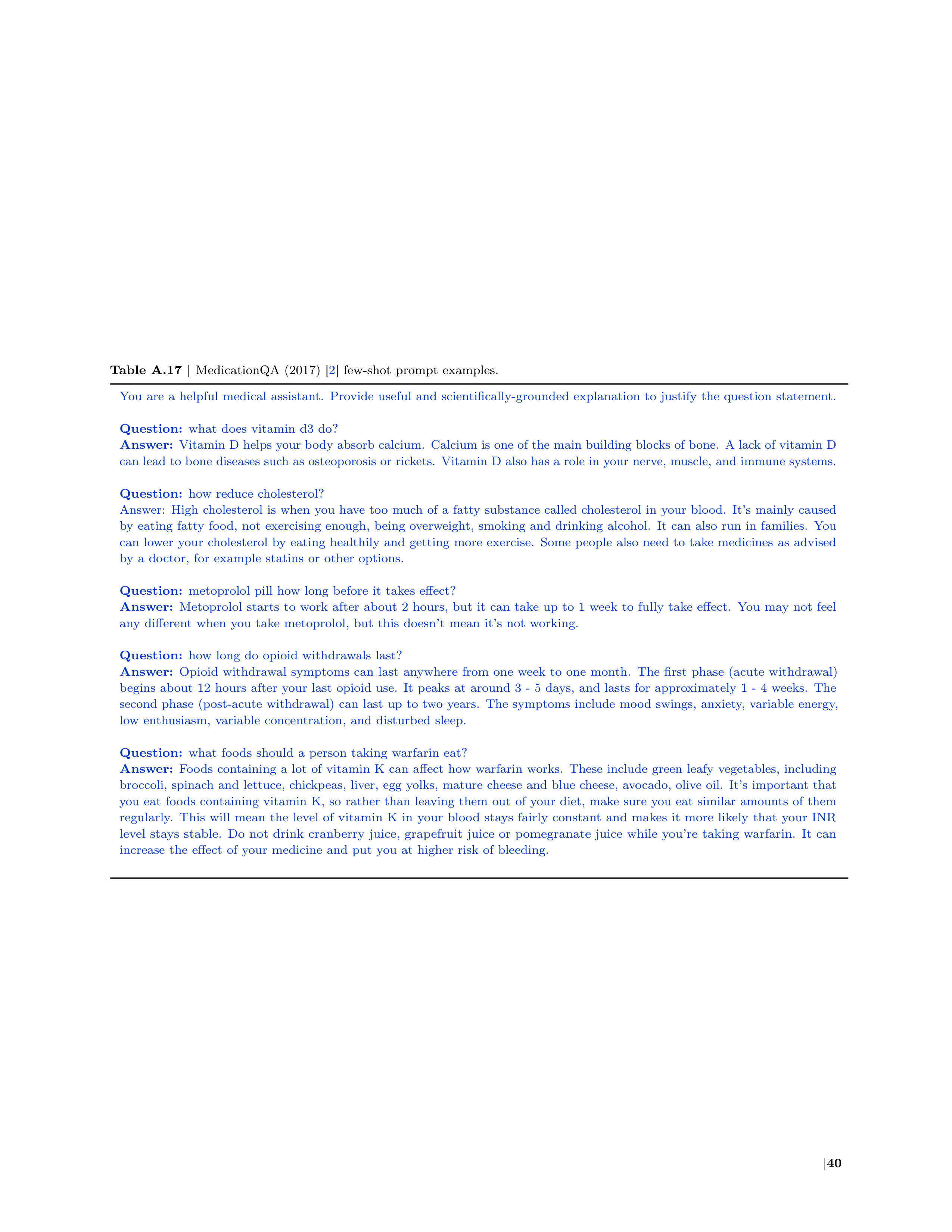
Table
A.17
|
MedicationQA
(2017)
[
2
]
few-shot
prompt
examples.
You
are
a
helpful
medical
assistant.
Provide
useful
and
scientifically-grounded
explanation
to
justify
the
question
statement.
Question:
what
does
vitamin
d3
do?
Answer:
Vitamin
D
helps
your
body
absorb
calcium.
Calcium
is
one
of
the
main
building
blocks
of
bone.
A
lack
of
vitamin
D
can
lead
to
bone
diseases
such
as
osteoporosis
or
rickets.
Vitamin
D
also
has
a
role
in
your
nerve,
muscle,
and
immune
systems.
Question:
how
reduce
cholesterol?
Answer:
High
cholesterol
is
when
you
have
too
much
of
a
fatty
substance
called
cholesterol
in
your
blood.
It’s
mainly
caused
by
eating
fatty
food,
not
exercising
enough,
being
overweight,
smoking
and
drinking
alcohol.
It
can
also
run
in
families.
You
can
lower
your
cholesterol
by
eating
healthily
and
getting
more
exercise.
Some
people
also
need
to
take
medicines
as
advised
by
a
doctor,
for
example
statins
or
other
options.
Question:
metoprolol
pill
how
long
before
it
takes
effect?
Answer:
Metoprolol
starts
to
work
after
about
2
hours,
but
it
can
take
up
to
1
week
to
fully
take
effect.
You
may
not
feel
any
different
when
you
take
metoprolol,
but
this
doesn’t
mean
it’s
not
working.
Question:
how
long
do
opioid
withdrawals
last?
Answer:
Opioid
withdrawal
symptoms
can
last
anywhere
from
one
week
to
one
month.
The
first
phase
(acute
withdrawal)
begins
about
12
hours
after
your
last
opioid
use.
It
peaks
at
around
3
-
5
days,
and
lasts
for
approximately
1
-
4
weeks.
The
second
phase
(post-acute
withdrawal)
can
last
up
to
two
years.
The
symptoms
include
mood
swings,
anxiety,
variable
energy,
low
enthusiasm,
variable
concentration,
and
disturbed
sleep.
Question:
what
foods
should
a
person
taking
warfarin
eat?
Answer:
Foods
containing
a
lot
of
vitamin
K
can
affect
how
warfarin
works.
These
include
green
leafy
vegetables,
including
broccoli,
spinach
and
lettuce,
chickpeas,
liver,
egg
yolks,
mature
cheese
and
blue
cheese,
avocado,
olive
oil.
It’s
important
that
you
eat
foods
containing
vitamin
K,
so
rather
than
leaving
them
out
of
your
diet,
make
sure
you
eat
similar
amounts
of
them
regularly.
This
will
mean
the
level
of
vitamin
K
in
your
blood
stays
fairly
constant
and
makes
it
more
likely
that
your
INR
level
stays
stable.
Do
not
drink
cranberry
juice,
grapefruit
juice
or
pomegranate
juice
while
you’re
taking
warfarin.
It
can
increase
the
effect
of
your
medicine
and
put
you
at
higher
risk
of
bleeding.
|
40
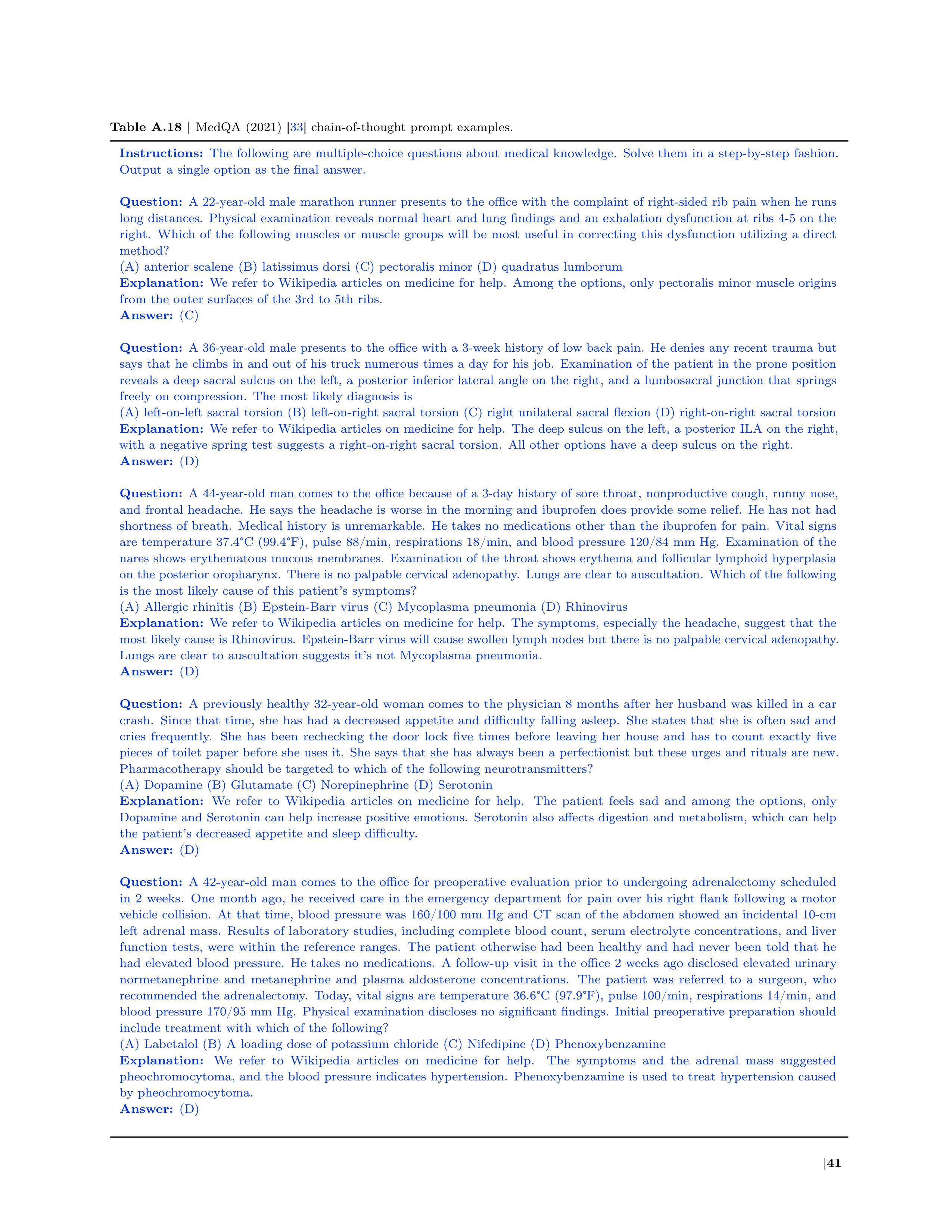
Table
A.18
|
MedQA
(2021)
[
33
]
chain-of-thought
prompt
examples.
Instructions:
The
following
are
multiple-choice
questions
about
medical
knowledge.
Solve
them
in
a
step-by-step
fashion.
Output
a
single
option
as
the
final
answer.
Question:
A
22-year-old
male
marathon
runner
presents
to
the
office
with
the
complaint
of
right-sided
rib
pain
when
he
runs
long
distances.
Physical
examination
reveals
normal
heart
and
lung
findings
and
an
exhalation
dysfunction
at
ribs
4-5
on
the
right.
Which
of
the
following
muscles
or
muscle
groups
will
be
most
useful
in
correcting
this
dysfunction
utilizing
a
direct
method?
(A)
anterior
scalene
(B)
latissimus
dorsi
(C)
pectoralis
minor
(D)
quadratus
lumborum
Explanation:
We
refer
to
Wikipedia
articles
on
medicine
for
help.
Among
the
options,
only
pectoralis
minor
muscle
origins
from
the
outer
surfaces
of
the
3rd
to
5th
ribs.
Answer:
(C)
Question:
A
36-year-old
male
presents
to
the
office
with
a
3-week
history
of
low
back
pain.
He
denies
any
recent
trauma
but
says
that
he
climbs
in
and
out
of
his
truck
numerous
times
a
day
for
his
job.
Examination
of
the
patient
in
the
prone
position
reveals
a
deep
sacral
sulcus
on
the
left,
a
posterior
inferior
lateral
angle
on
the
right,
and
a
lumbosacral
junction
that
springs
freely
on
compression.
The
most
likely
diagnosis
is
(A)
left-on-left
sacral
torsion
(B)
left-on-right
sacral
torsion
(C)
right
unilateral
sacral
flexion
(D)
right-on-right
sacral
torsion
Explanation:
We
refer
to
Wikipedia
articles
on
medicine
for
help.
The
deep
sulcus
on
the
left,
a
posterior
ILA
on
the
right,
with
a
negative
spring
test
suggests
a
right-on-right
sacral
torsion.
All
other
options
have
a
deep
sulcus
on
the
right.
Answer:
(D)
Question:
A
44-year-old
man
comes
to
the
office
because
of
a
3-day
history
of
sore
throat,
nonproductive
cough,
runny
nose,
and
frontal
headache.
He
says
the
headache
is
worse
in
the
morning
and
ibuprofen
does
provide
some
relief.
He
has
not
had
shortness
of
breath.
Medical
history
is
unremarkable.
He
takes
no
medications
other
than
the
ibuprofen
for
pain.
Vital
signs
are
temperature
37.4
°
C
(99.4
°
F),
pulse
88/min,
respirations
18/min,
and
blood
pressure
120/84
mm
Hg.
Examination
of
the
nares
shows
erythematous
mucous
membranes.
Examination
of
the
throat
shows
erythema
and
follicular
lymphoid
hyperplasia
on
the
posterior
oropharynx.
There
is
no
palpable
cervical
adenopathy.
Lungs
are
clear
to
auscultation.
Which
of
the
following
is
the
most
likely
cause
of
this
patient’s
symptoms?
(A)
Allergic
rhinitis
(B)
Epstein-Barr
virus
(C)
Mycoplasma
pneumonia
(D)
Rhinovirus
Explanation:
We
refer
to
Wikipedia
articles
on
medicine
for
help.
The
symptoms,
especially
the
headache,
suggest
that
the
most
likely
cause
is
Rhinovirus.
Epstein-Barr
virus
will
cause
swollen
lymph
nodes
but
there
is
no
palpable
cervical
adenopathy.
Lungs
are
clear
to
auscultation
suggests
it’s
not
Mycoplasma
pneumonia.
Answer:
(D)
Question:
A
previously
healthy
32-year-old
woman
comes
to
the
physician
8
months
after
her
husband
was
killed
in
a
car
crash.
Since
that
time,
she
has
had
a
decreased
appetite
and
difficulty
falling
asleep.
She
states
that
she
is
often
sad
and
cries
frequently.
She
has
been
rechecking
the
door
lock
five
times
before
leaving
her
house
and
has
to
count
exactly
five
pieces
of
toilet
paper
before
she
uses
it.
She
says
that
she
has
always
been
a
perfectionist
but
these
urges
and
rituals
are
new.
Pharmacotherapy
should
be
targeted
to
which
of
the
following
neurotransmitters?
(A)
Dopamine
(B)
Glutamate
(C)
Norepinephrine
(D)
Serotonin
Explanation:
We
refer
to
Wikipedia
articles
on
medicine
for
help.
The
patient
feels
sad
and
among
the
options,
only
Dopamine
and
Serotonin
can
help
increase
positive
emotions.
Serotonin
also
affects
digestion
and
metabolism,
which
can
help
the
patient’s
decreased
appetite
and
sleep
difficulty.
Answer:
(D)
Question:
A
42-year-old
man
comes
to
the
office
for
preoperative
evaluation
prior
to
undergoing
adrenalectomy
scheduled
in
2
weeks.
One
month
ago,
he
received
care
in
the
emergency
department
for
pain
over
his
right
flank
following
a
motor
vehicle
collision.
At
that
time,
blood
pressure
was
160/100
mm
Hg
and
CT
scan
of
the
abdomen
showed
an
incidental
10-cm
left
adrenal
mass.
Results
of
laboratory
studies,
including
complete
blood
count,
serum
electrolyte
concentrations,
and
liver
function
tests,
were
within
the
reference
ranges.
The
patient
otherwise
had
been
healthy
and
had
never
been
told
that
he
had
elevated
blood
pressure.
He
takes
no
medications.
A
follow-up
visit
in
the
office
2
weeks
ago
disclosed
elevated
urinary
normetanephrine
and
metanephrine
and
plasma
aldosterone
concentrations.
The
patient
was
referred
to
a
surgeon,
who
recommended
the
adrenalectomy.
Today,
vital
signs
are
temperature
36.6
°
C
(97.9
°
F),
pulse
100/min,
respirations
14/min,
and
blood
pressure
170/95
mm
Hg.
Physical
examination
discloses
no
significant
findings.
Initial
preoperative
preparation
should
include
treatment
with
which
of
the
following?
(A)
Labetalol
(B)
A
loading
dose
of
potassium
chloride
(C)
Nifedipine
(D)
Phenoxybenzamine
Explanation:
We
refer
to
Wikipedia
articles
on
medicine
for
help.
The
symptoms
and
the
adrenal
mass
suggested
pheochromocytoma,
and
the
blood
pressure
indicates
hypertension.
Phenoxybenzamine
is
used
to
treat
hypertension
caused
by
pheochromocytoma.
Answer:
(D)
|
41
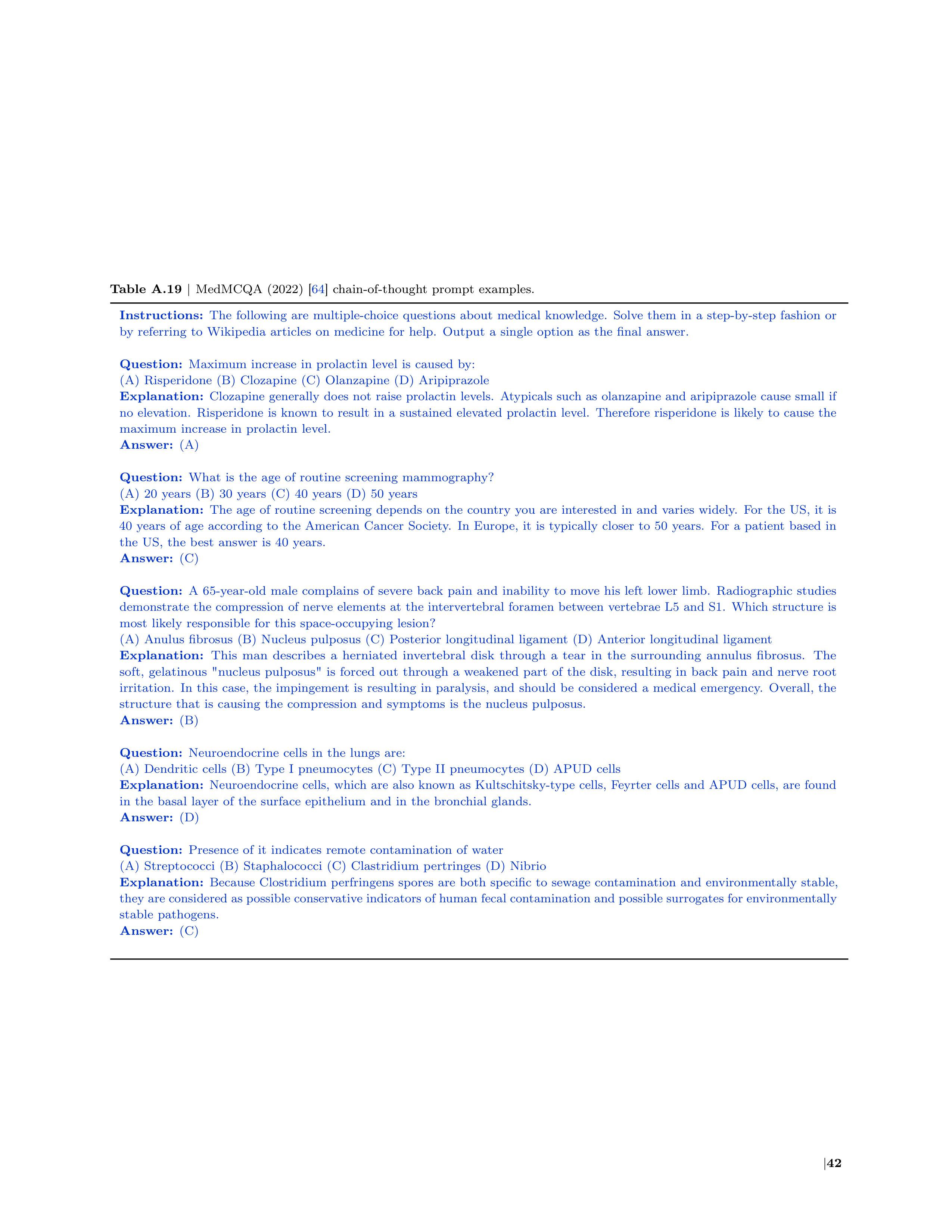
Table
A.19
|
MedMCQA
(2022)
[
64
]
chain-of-thought
prompt
examples.
Instructions:
The
following
are
multiple-choice
questions
about
medical
knowledge.
Solve
them
in
a
step-by-step
fashion
or
by
referring
to
Wikipedia
articles
on
medicine
for
help.
Output
a
single
option
as
the
final
answer.
Question:
Maximum
increase
in
prolactin
level
is
caused
by:
(A)
Risperidone
(B)
Clozapine
(C)
Olanzapine
(D)
Aripiprazole
Explanation:
Clozapine
generally
does
not
raise
prolactin
levels.
Atypicals
such
as
olanzapine
and
aripiprazole
cause
small
if
no
elevation.
Risperidone
is
known
to
result
in
a
sustained
elevated
prolactin
level.
Therefore
risperidone
is
likely
to
cause
the
maximum
increase
in
prolactin
level.
Answer:
(A)
Question:
What
is
the
age
of
routine
screening
mammography?
(A)
20
years
(B)
30
years
(C)
40
years
(D)
50
years
Explanation:
The
age
of
routine
screening
depends
on
the
country
you
are
interested
in
and
varies
widely.
For
the
US,
it
is
40
years
of
age
according
to
the
American
Cancer
Society.
In
Europe,
it
is
typically
closer
to
50
years.
For
a
patient
based
in
the
US,
the
best
answer
is
40
years.
Answer:
(C)
Question:
A
65-year-old
male
complains
of
severe
back
pain
and
inability
to
move
his
left
lower
limb.
Radiographic
studies
demonstrate
the
compression
of
nerve
elements
at
the
intervertebral
foramen
between
vertebrae
L5
and
S1.
Which
structure
is
most
likely
responsible
for
this
space-occupying
lesion?
(A)
Anulus
fibrosus
(B)
Nucleus
pulposus
(C)
Posterior
longitudinal
ligament
(D)
Anterior
longitudinal
ligament
Explanation:
This
man
describes
a
herniated
invertebral
disk
through
a
tear
in
the
surrounding
annulus
fibrosus.
The
soft,
gelatinous
"nucleus
pulposus"
is
forced
out
through
a
weakened
part
of
the
disk,
resulting
in
back
pain
and
nerve
root
irritation.
In
this
case,
the
impingement
is
resulting
in
paralysis,
and
should
be
considered
a
medical
emergency.
Overall,
the
structure
that
is
causing
the
compression
and
symptoms
is
the
nucleus
pulposus.
Answer:
(B)
Question:
Neuroendocrine
cells
in
the
lungs
are:
(A)
Dendritic
cells
(B)
Type
I
pneumocytes
(C)
Type
II
pneumocytes
(D)
APUD
cells
Explanation:
Neuroendocrine
cells,
which
are
also
known
as
Kultschitsky-type
cells,
Feyrter
cells
and
APUD
cells,
are
found
in
the
basal
layer
of
the
surface
epithelium
and
in
the
bronchial
glands.
Answer:
(D)
Question:
Presence
of
it
indicates
remote
contamination
of
water
(A)
Streptococci
(B)
Staphalococci
(C)
Clastridium
pertringes
(D)
Nibrio
Explanation:
Because
Clostridium
perfringens
spores
are
both
specific
to
sewage
contamination
and
environmentally
stable,
they are considered as possible conservative indicators of human fecal contamination and possible surrogates for environmentally
stable
pathogens.
Answer:
(C)
|
42
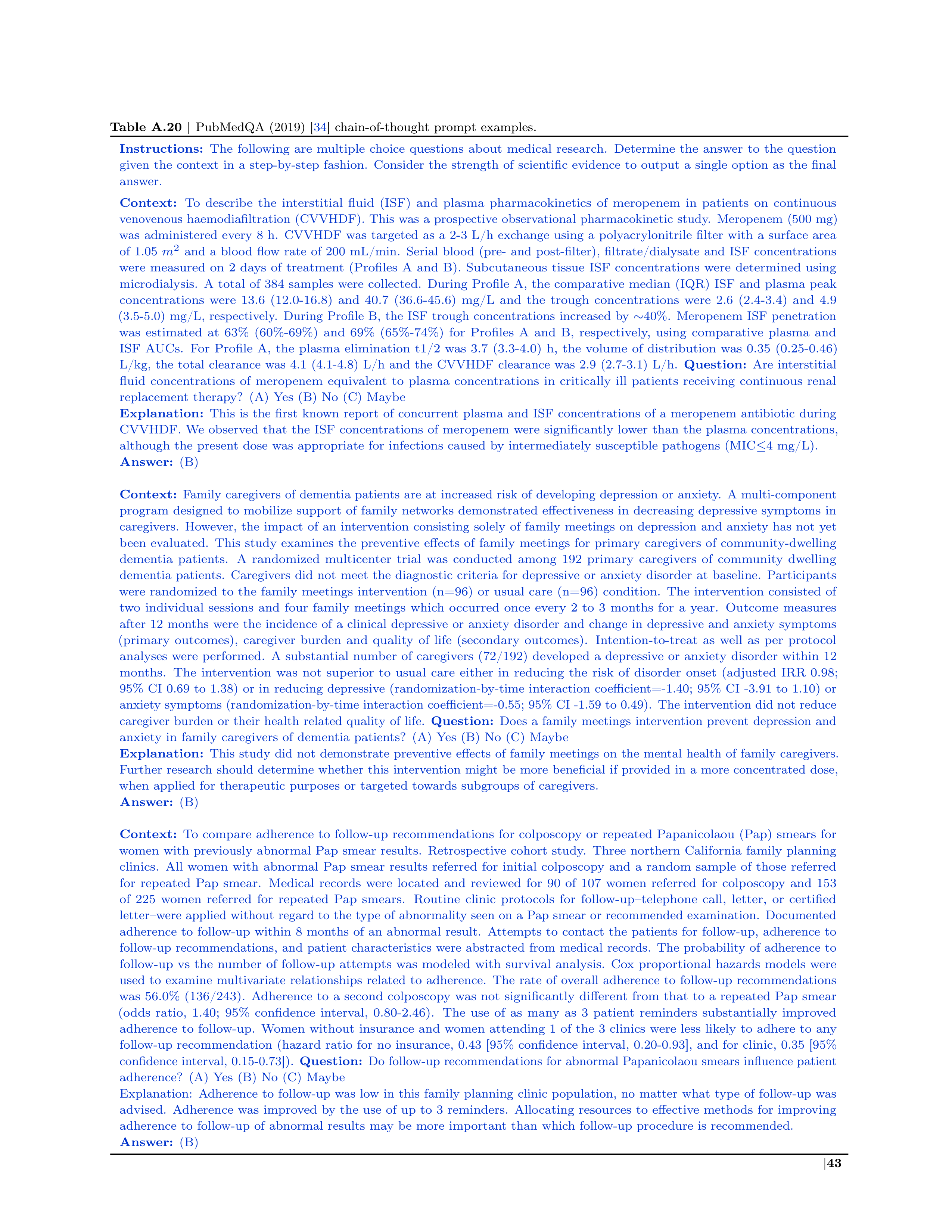
Table
A.20
|
PubMedQA
(2019)
[
34
]
chain-of-thought
prompt
examples.
Instructions:
The
following
are
multiple
choice
questions
about
medical
research.
Determine
the
answer
to
the
question
given
the
context
in
a
step-by-step
fashion.
Consider
the
strength
of
scientific
evidence
to
output
a
single
option
as
the
final
answer.
Context:
To
describe
the
interstitial
fluid
(ISF)
and
plasma
pharmacokinetics
of
meropenem
in
patients
on
continuous
venovenous
haemodiafiltration
(CVVHDF).
This
was
a
prospective
observational
pharmacokinetic
study.
Meropenem
(500
mg)
was
administered
every
8
h.
CVVHDF
was
targeted
as
a
2-3
L/h
exchange
using
a
polyacrylonitrile
filter
with
a
surface
area
of
1.05
m
2
and
a
blood
flow
rate
of
200
mL/min.
Serial
blood
(pre-
and
post-filter),
filtrate/dialysate
and
ISF
concentrations
were
measured
on
2
days
of
treatment
(Profiles
A
and
B).
Subcutaneous
tissue
ISF
concentrations
were
determined
using
microdialysis.
A
total
of
384
samples
were
collected.
During
Profile
A,
the
comparative
median
(IQR)
ISF
and
plasma
peak
concentrations
were
13.6
(12.0-16.8)
and
40.7
(36.6-45.6)
mg/L
and
the
trough
concentrations
were
2.6
(2.4-3.4)
and
4.9
(3.5-5.0)
mg/L,
respectively.
During
Profile
B,
the
ISF
trough
concentrations
increased
by
∼
40%.
Meropenem
ISF
penetration
was
estimated
at
63%
(60%-69%)
and
69%
(65%-74%)
for
Profiles
A
and
B,
respectively,
using
comparative
plasma
and
ISF
AUCs.
For
Profile
A,
the
plasma
elimination
t1/2
was
3.7
(3.3-4.0)
h,
the
volume
of
distribution
was
0.35
(0.25-0.46)
L/kg,
the
total
clearance
was
4.1
(4.1-4.8)
L/h
and
the
CVVHDF
clearance
was
2.9
(2.7-3.1)
L/h.
Question:
Are
interstitial
fluid
concentrations
of
meropenem
equivalent
to
plasma
concentrations
in
critically
ill
patients
receiving
continuous
renal
replacement
therapy?
(A)
Yes
(B)
No
(C)
Maybe
Explanation:
This
is
the
first
known
report
of
concurrent
plasma
and
ISF
concentrations
of
a
meropenem
antibiotic
during
CVVHDF.
We
observed
that
the
ISF
concentrations
of
meropenem
were
significantly
lower
than
the
plasma
concentrations,
although
the
present
dose
was
appropriate
for
infections
caused
by
intermediately
susceptible
pathogens
(MIC
≤
4
mg/L).
Answer:
(B)
Context:
Family
caregivers
of
dementia
patients
are
at
increased
risk
of
developing
depression
or
anxiety.
A
multi-component
program
designed
to
mobilize
support
of
family
networks
demonstrated
effectiveness
in
decreasing
depressive
symptoms
in
caregivers.
However,
the
impact
of
an
intervention
consisting
solely
of
family
meetings
on
depression
and
anxiety
has
not
yet
been
evaluated.
This
study
examines
the
preventive
effects
of
family
meetings
for
primary
caregivers
of
community-dwelling
dementia
patients.
A
randomized
multicenter
trial
was
conducted
among
192
primary
caregivers
of
community
dwelling
dementia
patients.
Caregivers
did
not
meet
the
diagnostic
criteria
for
depressive
or
anxiety
disorder
at
baseline.
Participants
were
randomized
to
the
family
meetings
intervention
(n=96)
or
usual
care
(n=96)
condition.
The
intervention
consisted
of
two
individual
sessions
and
four
family
meetings
which
occurred
once
every
2
to
3
months
for
a
year.
Outcome
measures
after
12
months
were
the
incidence
of
a
clinical
depressive
or
anxiety
disorder
and
change
in
depressive
and
anxiety
symptoms
(primary
outcomes),
caregiver
burden
and
quality
of
life
(secondary
outcomes).
Intention-to-treat
as
well
as
per
protocol
analyses
were
performed.
A
substantial
number
of
caregivers
(72/192)
developed
a
depressive
or
anxiety
disorder
within
12
months.
The
intervention
was
not
superior
to
usual
care
either
in
reducing
the
risk
of
disorder
onset
(adjusted
IRR
0.98;
95%
CI
0.69
to
1.38)
or
in
reducing
depressive
(randomization-by-time
interaction
coefficient=-1.40;
95%
CI
-3.91
to
1.10)
or
anxiety
symptoms
(randomization-by-time
interaction
coefficient=-0.55;
95%
CI
-1.59
to
0.49).
The
intervention
did
not
reduce
caregiver
burden
or
their
health
related
quality
of
life.
Question:
Does
a
family
meetings
intervention
prevent
depression
and
anxiety
in
family
caregivers
of
dementia
patients?
(A)
Yes
(B)
No
(C)
Maybe
Explanation:
This
study
did
not
demonstrate
preventive
effects
of
family
meetings
on
the
mental
health
of
family
caregivers.
Further
research
should
determine
whether
this
intervention
might
be
more
beneficial
if
provided
in
a
more
concentrated
dose,
when
applied
for
therapeutic
purposes
or
targeted
towards
subgroups
of
caregivers.
Answer:
(B)
Context:
To
compare
adherence
to
follow-up
recommendations
for
colposcopy
or
repeated
Papanicolaou
(Pap)
smears
for
women
with
previously
abnormal
Pap
smear
results.
Retrospective
cohort
study.
Three
northern
California
family
planning
clinics.
All
women
with
abnormal
Pap
smear
results
referred
for
initial
colposcopy
and
a
random
sample
of
those
referred
for
repeated
Pap
smear.
Medical
records
were
located
and
reviewed
for
90
of
107
women
referred
for
colposcopy
and
153
of
225
women
referred
for
repeated
Pap
smears.
Routine
clinic
protocols
for
follow-up–telephone
call,
letter,
or
certified
letter–were
applied
without
regard
to
the
type
of
abnormality
seen
on
a
Pap
smear
or
recommended
examination.
Documented
adherence
to
follow-up
within
8
months
of
an
abnormal
result.
Attempts
to
contact
the
patients
for
follow-up,
adherence
to
follow-up
recommendations,
and
patient
characteristics
were
abstracted
from
medical
records.
The
probability
of
adherence
to
follow-up
vs
the
number
of
follow-up
attempts
was
modeled
with
survival
analysis.
Cox
proportional
hazards
models
were
used
to
examine
multivariate
relationships
related
to
adherence.
The
rate
of
overall
adherence
to
follow-up
recommendations
was
56.0%
(136/243).
Adherence
to
a
second
colposcopy
was
not
significantly
different
from
that
to
a
repeated
Pap
smear
(odds
ratio,
1.40;
95%
confidence
interval,
0.80-2.46).
The
use
of
as
many
as
3
patient
reminders
substantially
improved
adherence
to
follow-up.
Women
without
insurance
and
women
attending
1
of
the
3
clinics
were
less
likely
to
adhere
to
any
follow-up
recommendation
(hazard
ratio
for
no
insurance,
0.43
[95%
confidence
interval,
0.20-0.93],
and
for
clinic,
0.35
[95%
confidence
interval,
0.15-0.73]).
Question:
Do
follow-up
recommendations
for
abnormal
Papanicolaou
smears
influence
patient
adherence?
(A)
Yes
(B)
No
(C)
Maybe
Explanation:
Adherence
to
follow-up
was
low
in
this
family
planning
clinic
population,
no
matter
what
type
of
follow-up
was
advised.
Adherence
was
improved
by
the
use
of
up
to
3
reminders.
Allocating
resources
to
effective
methods
for
improving
adherence
to
follow-up
of
abnormal
results
may
be
more
important
than
which
follow-up
procedure
is
recommended.
Answer:
(B)
|
43
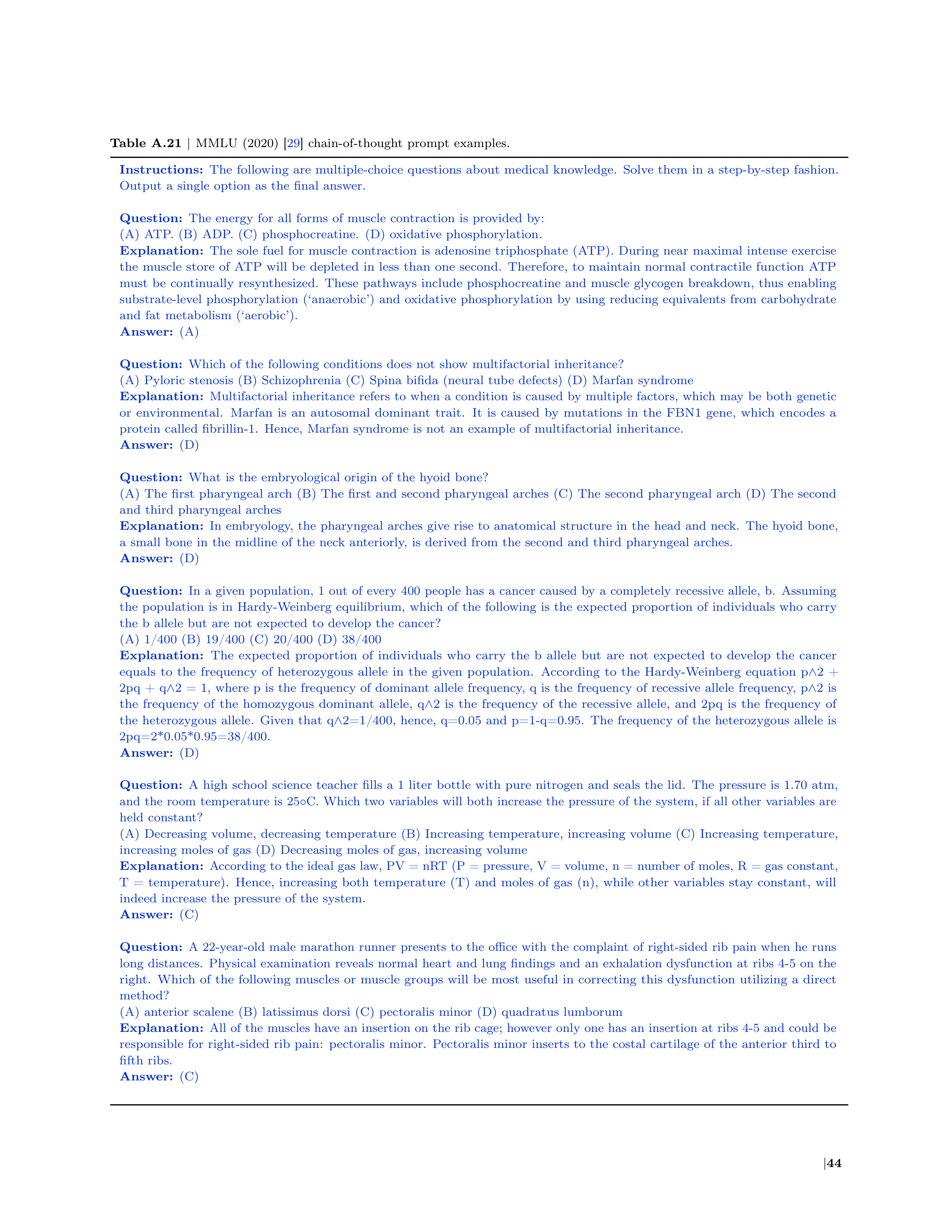
Table
A.21
|
MMLU
(2020)
[
29
]
chain-of-thought
prompt
examples.
Instructions:
The
following
are
multiple-choice
questions
about
medical
knowledge.
Solve
them
in
a
step-by-step
fashion.
Output
a
single
option
as
the
final
answer.
Question:
The
energy
for
all
forms
of
muscle
contraction
is
provided
by:
(A)
ATP.
(B)
ADP.
(C)
phosphocreatine.
(D)
oxidative
phosphorylation.
Explanation:
The
sole
fuel
for
muscle
contraction
is
adenosine
triphosphate
(ATP).
During
near
maximal
intense
exercise
the
muscle
store
of
ATP
will
be
depleted
in
less
than
one
second.
Therefore,
to
maintain
normal
contractile
function
ATP
must
be
continually
resynthesized.
These
pathways
include
phosphocreatine
and
muscle
glycogen
breakdown,
thus
enabling
substrate-level
phosphorylation
(‘anaerobic’)
and
oxidative
phosphorylation
by
using
reducing
equivalents
from
carbohydrate
and
fat
metabolism
(‘aerobic’).
Answer:
(A)
Question:
Which
of
the
following
conditions
does
not
show
multifactorial
inheritance?
(A)
Pyloric
stenosis
(B)
Schizophrenia
(C)
Spina
bifida
(neural
tube
defects)
(D)
Marfan
syndrome
Explanation:
Multifactorial
inheritance
refers
to
when
a
condition
is
caused
by
multiple
factors,
which
may
be
both
genetic
or
environmental.
Marfan
is
an
autosomal
dominant
trait.
It
is
caused
by
mutations
in
the
FBN1
gene,
which
encodes
a
protein
called
fibrillin-1.
Hence,
Marfan
syndrome
is
not
an
example
of
multifactorial
inheritance.
Answer:
(D)
Question:
What
is
the
embryological
origin
of
the
hyoid
bone?
(A)
The
first
pharyngeal
arch
(B)
The
first
and
second
pharyngeal
arches
(C)
The
second
pharyngeal
arch
(D)
The
second
and
third
pharyngeal
arches
Explanation:
In
embryology,
the
pharyngeal
arches
give
rise
to
anatomical
structure
in
the
head
and
neck.
The
hyoid
bone,
a
small
bone
in
the
midline
of
the
neck
anteriorly,
is
derived
from
the
second
and
third
pharyngeal
arches.
Answer:
(D)
Question:
In
a
given
population,
1
out
of
every
400
people
has
a
cancer
caused
by
a
completely
recessive
allele,
b.
Assuming
the
population
is
in
Hardy-Weinberg
equilibrium,
which
of
the
following
is
the
expected
proportion
of
individuals
who
carry
the
b
allele
but
are
not
expected
to
develop
the
cancer?
(A)
1/400
(B)
19/400
(C)
20/400
(D)
38/400
Explanation:
The
expected
proportion
of
individuals
who
carry
the
b
allele
but
are
not
expected
to
develop
the
cancer
equals
to
the
frequency
of
heterozygous
allele
in
the
given
population.
According
to
the
Hardy-Weinberg
equation
p
∧
2
+
2pq
+
q
∧
2
=
1,
where
p
is
the
frequency
of
dominant
allele
frequency,
q
is
the
frequency
of
recessive
allele
frequency,
p
∧
2
is
the
frequency
of
the
homozygous
dominant
allele,
q
∧
2
is
the
frequency
of
the
recessive
allele,
and
2pq
is
the
frequency
of
the
heterozygous
allele.
Given
that
q
∧
2=1/400,
hence,
q=0.05
and
p=1-q=0.95.
The
frequency
of
the
heterozygous
allele
is
2pq=2*0.05*0.95=38/400.
Answer:
(D)
Question:
A
high
school
science
teacher
fills
a
1
liter
bottle
with
pure
nitrogen
and
seals
the
lid.
The
pressure
is
1.70
atm,
and
the
room
temperature
is
25
◦
C.
Which
two
variables
will
both
increase
the
pressure
of
the
system,
if
all
other
variables
are
held
constant?
(A)
Decreasing
volume,
decreasing
temperature
(B)
Increasing
temperature,
increasing
volume
(C)
Increasing
temperature,
increasing
moles
of
gas
(D)
Decreasing
moles
of
gas,
increasing
volume
Explanation:
According
to
the
ideal
gas
law,
PV
=
nRT
(P
=
pressure,
V
=
volume,
n
=
number
of
moles,
R
=
gas
constant,
T
=
temperature).
Hence,
increasing
both
temperature
(T)
and
moles
of
gas
(n),
while
other
variables
stay
constant,
will
indeed
increase
the
pressure
of
the
system.
Answer:
(C)
Question:
A
22-year-old
male
marathon
runner
presents
to
the
office
with
the
complaint
of
right-sided
rib
pain
when
he
runs
long
distances.
Physical
examination
reveals
normal
heart
and
lung
findings
and
an
exhalation
dysfunction
at
ribs
4-5
on
the
right.
Which
of
the
following
muscles
or
muscle
groups
will
be
most
useful
in
correcting
this
dysfunction
utilizing
a
direct
method?
(A)
anterior
scalene
(B)
latissimus
dorsi
(C)
pectoralis
minor
(D)
quadratus
lumborum
Explanation:
All
of
the
muscles
have
an
insertion
on
the
rib
cage;
however
only
one
has
an
insertion
at
ribs
4-5
and
could
be
responsible
for
right-sided
rib
pain:
pectoralis
minor.
Pectoralis
minor
inserts
to
the
costal
cartilage
of
the
anterior
third
to
fifth
ribs.
Answer:
(C)
|
44