
MASTER SERVICES AGREEMENT
Between
DISNEYLAND PARK
A Division of
Walt Disney Parks and Resorts U.S.
(“Employer”)
And
THE MASTER SERVICES COUNCIL
(“UNION”)
June 17,
2024
– June 16,
2027
MASTER SERVICES AGREEMENT
Between
DISNEYLAND PARK
A Division of
Walt Disney Parks and Resorts U.S.
(“Employer”)
And
THE MASTER SERVICES COUNCIL
(“UNION”)
June 17,
2024
–
June 16,
2027
I
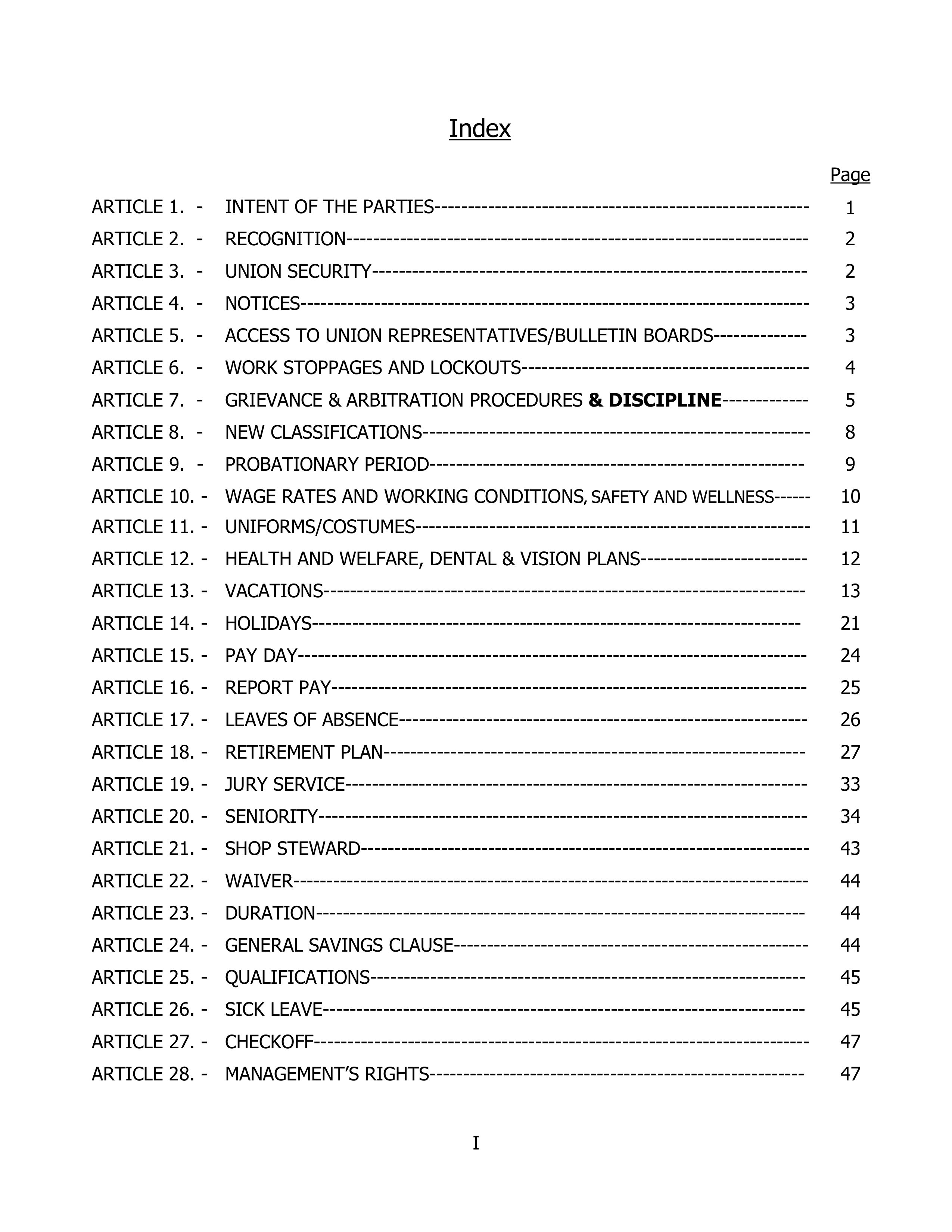
Index
ARTICLE 1. -
INTENT OF THE PARTIES--------------------------------------------------------
Page
1
ARTICLE 2. -
RECOGNITION---------------------------------------------------------------------
2
ARTICLE 3. -
UNION SECURITY-----------------------------------------------------------------
2
ARTICLE 4. -
NOTICES----------------------------------------------------------------------------
3
ARTICLE 5. -
ACCESS TO UNION REPRESENTATIVES/BULLETIN BOARDS--------------
3
ARTICLE 6. -
WORK STOPPAGES AND LOCKOUTS-------------------------------------------
4
ARTICLE 7. -
GRIEVANCE & ARBITRATION PROCEDURES
& DISCIPLINE
-------------
5
ARTICLE 8. -
NEW CLASSIFICATIONS----------------------------------------------------------
8
ARTICLE 9. -
PROBATIONARY PERIOD--------------------------------------------------------
9
ARTICLE 10. - WAGE RATES AND WORKING CONDITIONS
,
SAFETY AND WELLNESS------
10
ARTICLE 11. - UNIFORMS/COSTUMES-----------------------------------------------------------
11
ARTICLE 12. - HEALTH AND WELFARE, DENTAL & VISION PLANS-------------------------
12
ARTICLE 13. - VACATIONS------------------------------------------------------------------------
13
ARTICLE 14. - HOLIDAYS-------------------------------------------------------------------------
21
ARTICLE 15. - PAY DAY----------------------------------------------------------------------------
24
ARTICLE 16. - REPORT PAY-----------------------------------------------------------------------
25
ARTICLE 17. - LEAVES OF ABSENCE-------------------------------------------------------------
26
ARTICLE 18. - RETIREMENT PLAN---------------------------------------------------------------
27
ARTICLE 19. - JURY SERVICE---------------------------------------------------------------------
33
ARTICLE 20. - SENIORITY-------------------------------------------------------------------------
34
ARTICLE 21. - SHOP STEWARD-------------------------------------------------------------------
43
ARTICLE 22. - WAIVER-----------------------------------------------------------------------------
44
ARTICLE 23. - DURATION-------------------------------------------------------------------------
44
ARTICLE 24. - GENERAL SAVINGS CLAUSE-----------------------------------------------------
44
ARTICLE 25. - QUALIFICATIONS-----------------------------------------------------------------
45
ARTICLE 26. - SICK LEAVE------------------------------------------------------------------------
45
ARTICLE 27. - CHECKOFF--------------------------------------------------------------------------
47
ARTICLE 28. - MANAGEMENT’S RIGHTS--------------------------------------------------------
47
II
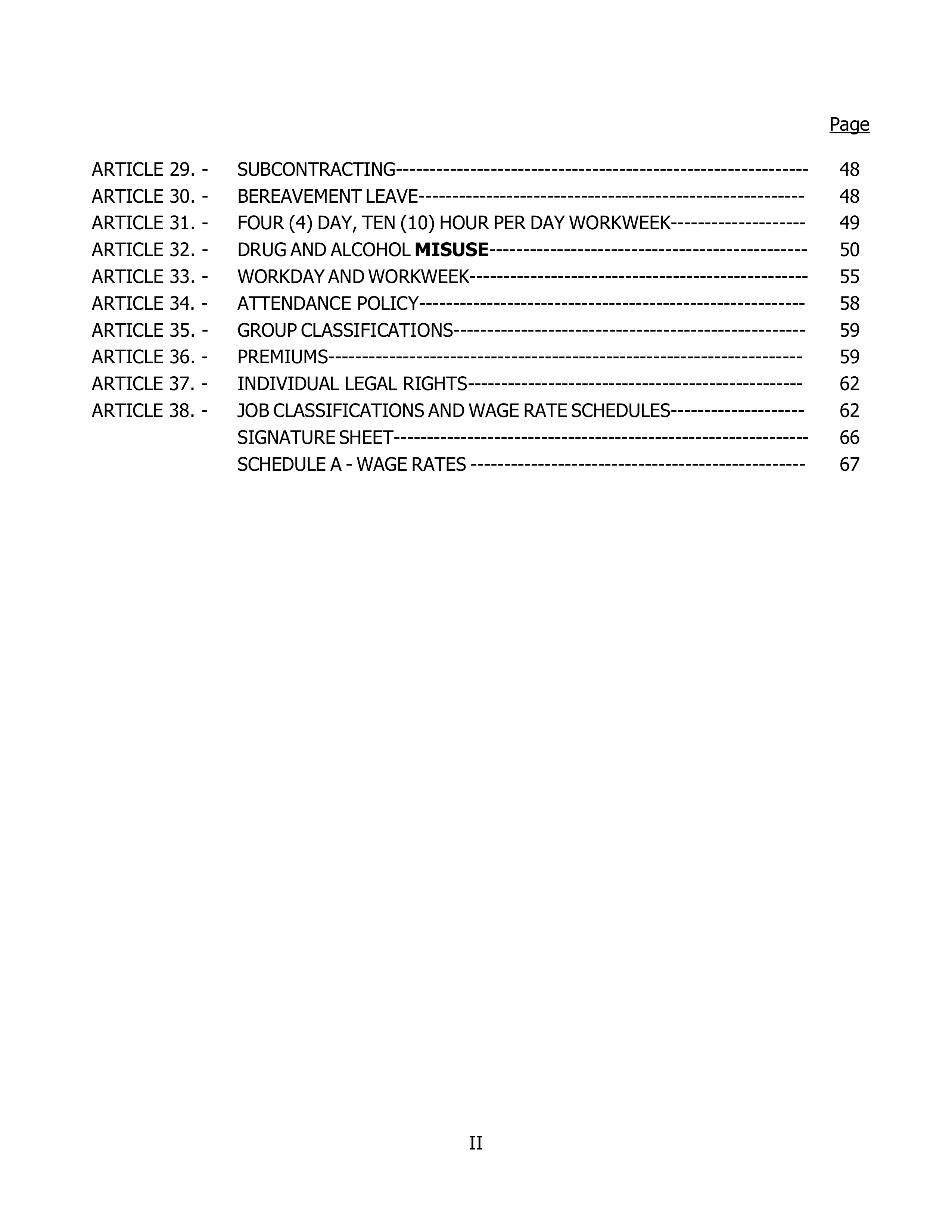
ARTICLE 29. -
SUBCONTRACTING-------------------------------------------------------------
Page
48
ARTICLE 30. -
BEREAVEMENT LEAVE---------------------------------------------------------
48
ARTICLE 31. -
FOUR (4) DAY, TEN (10) HOUR PER DAY WORKWEEK--------------------
49
ARTICLE 32. -
DRUG AND ALCOHOL
MISUSE
-----------------------------------------------
50
ARTICLE 33. -
WORKDAY AND WORKWEEK--------------------------------------------------
55
ARTICLE 34. -
ATTENDANCE POLICY---------------------------------------------------------
58
ARTICLE 35. -
GROUP CLASSIFICATIONS----------------------------------------------------
59
ARTICLE 36. -
PREMIUMS----------------------------------------------------------------------
59
ARTICLE 37. -
INDIVIDUAL LEGAL RIGHTS--------------------------------------------------
62
ARTICLE 38. -
JOB CLASSIFICATIONS AND WAGE RATE SCHEDULES--------------------
62
SIGNATURE SHEET--------------------------------------------------------------
66
SCHEDULE A - WAGE RATES --------------------------------------------------
67
1
MASTER SERVICES AGREEMENT
Between
Walt Disney Parks and Resorts U.S. d.b.a., Disneyland Park
(Hereinafter referred to as the “Employer”)
And
TEAMSTERS AUTOMOTIVE, INDUSTRIAL, THEME PARK, SERVICE SECTOR, AND
ALLIED WORKERS LOCAL NO. 495; SERVICE EMPLOYEES INTERNATIONAL UNION –
UNITED SERVICE WORKERS WEST,
UNITED FOOD AND COMMERCIAL WORKERS
UNION LOCAL NO.324, AND BAKERY, CONFECTIONERY, TOBACCO WORKERS AND
GRAIN MILLERS INTERNATIONAL UNION, LOCAL NO. 83 AFL-CIO
(Hereinafter collectively referred to as the “Union”)
For the purpose of collective bargaining the aforementioned Unions shall serve as a single
unit.
Amending Agreement entered into June 17,
2021
. Amendment shall be effective as of
June 17,
2024
, or at subsequent dates as set forth in this Agreement, hereinafter entitled
the
2024
Agreement.
WITNESSETH:
ARTICLE 1
INTENT OF THE PARTIES
1.A
It is the intent of the parties of this Agreement to promote an increasing spirit of
harmony between the Employer, party of the first part, and the employees of the
aforementioned Employer, members of the Unions, parties of the second part.
There shall be no cessation of work through strikes against the Employer or
lockouts by the Employer for the duration and term of this Agreement and all
employees covered by this Agreement shall perform the work customarily
performed by them and will cooperate and work with members of the other
organizations, both independent and those affiliated with the AFL-CIO, without
regard to past, present or future disputes based on jurisdictional claims.
1.B
Jurisdiction
1.B.1 All jurisdictional disputes between the Master Services Unions shall be
determined between the involved Unions and no jurisdictional stoppages
or slow-downs shall be imposed upon Disneyland as a result.
2
1.B.2 The Employer agrees to notify the Unions signatory to this Agreement prior
to the acquisition of any concessionaire or lease department operating
within the Park and performing work or services customarily performed by
one (1) or more of the Unions signatory to this Agreement. The Employer
further agrees to discuss with said Unions the issue of which Union(s) shall
represent the employees performing work in the classifications listed in
Article 38 of this Agreement.
1.C
The Employer and the Union agree there shall be no discrimination against any
employee or prospective employee on any basis prohibited now or in the future
by
Employer
policy or local, state or federal law.
Both the Employer and the Union recognize their mutual obligation to comply and
foster compliance with the Americans with Disabilities Act Amendments Act
(ADAAA). Nothing in this agreement shall be construed as inconsistent with, or
as requiring Employer to act in any way inconsistent with, such Act.
ARTICLE 2
RECOGNITION
The Employer recognizes the Unions parties to this Agreement as the sole collective
bargaining representatives of all of the Employer's employees who are in the classifications
of work listed in Schedule A at Disneyland, located at Anaheim, California, except
salaried supervisory employees, office and administrative employees, nurses, and any
other classification of employees excluded under the Labor Management Relations Act of
1947, as amended.
ARTICLE 3
UNION SECURITY
3.A
The Employer agrees that all employees on the Employer's payroll as of the effective
date of this Agreement, or who are subsequently employed by the Employer,
shall become and remain members of the appropriate Union in good standing
within thirty-one (31) days of the effective date of this Agreement or their date of
employment, whichever is the later, as a condition of continued employment.
3.B
The Employer agrees to notify the Union of new employees that have been hired at
the time that such employees start to work. The Employer also agrees to notify
the Union promptly when any employee leaves the employment of the Employer.
3.C
All new employees shall be notified before commencing employment that the
Employer is operating under a Union contract.
3
3.D
The Union will advise the Employer, in writing, when any regular employee has
failed to acquire or maintain Union membership as required by this Agreement.
The Union shall notify the employee and the Employer that the employee has
fourteen (14) days in which to comply with paragraph A, above, or be subject to
termination at the end of fourteen (14) calendar days.
3.E
The Employer will provide a Union Representative the opportunity to meet with
new employees at the conclusion of Operations orientation at a location
designated by the
Employer
. The purpose of the meeting is for distribution of
Union literature which shall be reviewed by the Employer prior to distribution.
The meeting with the Union Representative shall be on paid Employer time of no
longer than fifteen (15) minutes and Article 33 (H) shall not apply. Union
Representatives present at new employee orientation shall not be on paid
Employer time.
ARTICLE 4
NOTICES
The Employer agrees to recognize the various craft jurisdictions of work of the Union
parties hereto but shall not be required to recognize any conflicting areas of work
jurisdiction. All notices given under this Agreement shall be given by and to the Employer
on the one side and each signatory Local Union on the other. The Parties agree that all
notices referenced herein may be sent electronically, at the discretion of the Employer.
ARTICLE 5
ACCESS TO UNION REPRESENTATIVES/BULLETIN BOARDS
Representatives of each signatory Local Union, designated in writing to the Employer by
letter from an authorized officer of such signatory Local Union, shall be permitted to
enter the Disneyland area to make proper investigation for the purpose of determining
that this agreement is being complied with by the Employer and for the presentation and
handling of grievances. Such representatives, who shall not be more than three (3) in
number for each Local Union, shall comply with the security regulations of the Employer,
and shall not unnecessarily interrupt the performance of employee work assignments.
The Employer shall provide bulletin boards in areas which are frequented by
employees for the posting of official Union notices and a list thereof. The minimum size
of the bulletin boards will be 2’ high by 3’ wide for a single bulletin board or 3’ high by 4’
wide for a double board. The boards shall be covered with glass and under lock
and free of obstructions. These boards shall be used for the display of the following
notices: Union meetings, Union appointments, Union elections and official Union social
affairs. The Union agrees not to post material of a derogatory nature regarding the
Employer or its personnel. It is agreed that no Union matter of any kind shall be posted
in and about the premises of the Disneyland Resort except on said boards.
4
ARTICLE 6
WORK STOPPAGES AND LOCKOUTS
6.A
No Strike - No Lockout
During the existence of this Agreement, there shall be no strikes, picketing, work
stoppages or disruptive activity by the Union or by an employee, and there
shall be no lockout by the Employer.
6.B
Failure to Cross Picket Line - Violation of Agreement
Failure of any employee covered by this Agreement to cross any picket line
established at Disneyland is a violation of this Agreement and may result in the
immediate discharge of any employee who commits such violation.
6.C
Union's Responsibility to Prevent Work Stoppage, Strike or Disruptive Activity
The Union shall not encourage or condone a work stoppage, strike or disruptive
activity at the Disneyland Resort and shall undertake all possible steps to prevent
or to terminate any strike, work stoppage, or disruptive activity. No employee
shall engage in activities that violate this Article. Any employee who participates
in or encourages any activities which interfere with the normal operation of the
Disneyland Resort shall be subject to disciplinary action, including discharge. The
Union shall not be liable for acts of employees for which it has no responsibility.
The failure of the Employer to exercise this right in any instance, shall not be
deemed a waiver of this right in any other instances, nor shall the Employer’s right
to discipline all employees for any other cause be in any way affected by this
paragraph 6.C.
6.D
Disputes With Concessionaires
Disputes between the Union parties hereto and any concessionaire operating in
the Disneyland Resort shall be so handled as not to interfere with the Employer's
business or the business of any other concessionaire not a party to such disputes.
No picketing or concerted action against any one or more of the concessionaires
will be conducted at the Disneyland Resort or near or around the entrance or exits
of the Disneyland Resort. "Concessionaire" as used herein includes a
concessionaire and also a licensee, lessee, contractor, or subcontractor. In the
event any other organization pickets at or near the Disneyland Resort, the Unions
signatory hereto agree to use their best efforts to see that such picket line does
not affect the operations of the Employer or concessionaires who are not involved
in the dispute.
5
ARTICLE 7
GRIEVANCE & ARBITRATION PROCEDURES
& DISCIPLINE
7.A
STEP 1
7.A.1
Any employee who believes they have a specific justifiable request or
complaint in regard to wages, hours, conditions of employment or
interpretation of this Agreement, shall discuss the same with their
immediate supervisor with, or without, a Union Representative being
present, as the employee may elect in an attempt to settle the issue. If
an employee discusses an issue with their Supervisor without a Union
Representative being present, and a satisfactory solution is not reached,
the employee may request the Union Representative's presence to assist
in resolving the issue. Any solution or settlement shall be consistent with
the terms and provisions of this Agreement. Any issue not raised within
fifteen (15) working days after its occurrence, shall be deemed waived or
abandoned. If the issue is not settled within three (3) working days
after its presentation to the Supervisor, the employee or the Union
Representative may proceed to Step 2 of the Grievance Procedure.
7.A.2
Once the Employer has an opportunity to become aware of an occurrence,
discipline will be presented and discussed within twenty-one (21)
calendar days, based on employee availability. The Employer reserves
the right to extend an investigation, when necessary, due to extenuating
circumstances, and/or employee availability, and shall notify the Union of
such extension.
7.A.3
In the case of suspension or discharge, either party may unilaterally waive
Steps 1 and/or 2 and proceed directly to the next appropriate Step. In
all other grievances, the parties may mutually agree to waive Steps 1
and/or 2 and proceed directly to the next appropriate Step.
7.A.4
Should the Employer feel that there is a just complaint the matter shall be
taken up with the Union Representative and if a satisfactory settlement is
not reached, the Employer may proceed in an attempt to settle the issue
in the same manner as outlined herein for the adjustment of an
employee complaint.
7.A.5
Verbal or written warnings concerning employee misconduct with respect
to safety and guest courtesy shall not be considered as a basis for
further disciplinary action after eighteen (18) months from the date of
issue. The use of verbal or written warnings as a basis for further
discipline in all other matters shall be limited to twelve (12) months from
the date of issue.
6
The employee so notified shall be required to sign such notice, but such
signing shall in no way constitute agreement with the contents of such
notice. Anytime an employee signs a disciplinary memorandum, they
shall automatically be given a copy. A copy of the warning notice will be
sent to the Union.
7.A.6
Employees receiving written safe work practices and/or training
information or materials from the Employer may be required to sign for
receipt of such information and/or material in order to document that
employees have been given said information and/or materials.
7.A.7
The Employer will provide a written notice of termination, stating the
reason(s) for termination, to Regular employees who have passed their
probationary period and are terminated by the Employer. This written
notice will be given to the employee at the time of termination, at which
time the Employee will also be verbally provided the specific incident(s)
leading to the termination. The written notice
shall be signed by the
employee in acknowledgement that a copy of the notice has been
received by the employee. This notice requirement will apply only to
employees who are terminated in person by the Employer. Said
requirement shall not apply to employees who are terminated by other
means, such as by telephone, letter, fax, etc., or for employees who fail
to appear for a termination meeting with management. The failure of
the Employer to provide the written notice of termination to the employee
shall not be a basis for the discharge to be set aside under the provisions
of this agreement.
7.A.8
Recording Devices: The Parties agree that no recording devices of any kind
shall be permitted to be utilized during Step 1, 2, or 3 of the grievance
procedure.
7.A.9
Periodically the Employer places an employee on investigatory
suspension for the purposes of adequately investigating the facts
surrounding an incident. When this occurs and the Employer ultimately
determines that the affected employee should receive no disciplinary
action or disciplinary action for less than the time that the employee was
on investigatory suspension, the employee will be paid for the scheduled
shifts that they may have missed, including scheduled overtime and
premiums.
7.A.10 When an employee is placed on an investigatory suspension, the
Employer will inform the employee of the specific
issue(s) being
investigated. However, failure to specifically inform any employee of
issues being investigated shall not preclude the Employer from
proceeding with appropriate discipline as a result of such investigation,
nor preclude the Employer from expanding such investigation into areas
not communicated to the employee at the time of the investigatory
suspension.
7
7.B
STEP 2
Any complaint not settled pursuant to Step 1, must be presented to the employee's
Division Head within five (5) working days from the date of the Supervisor's
decision under Step 1. The Division Head or their designated representative
and the Union Representative shall meet within three (3) working days after
invocation of Step 2, in an attempt to settle the complaint. If a satisfactory
solution is not arrived at within two (2) working days after the parties have met,
Step 3 of the Grievance Procedure may be invoked, within seven (7) working days.
7.C
STEP 3
Upon invocation of Step 3, the
Employer
and the Union agree to expedite the
grievance process. Any complaint not resolved under Step 2 shall be reduced
to writing, setting forth the Article of the Agreement alleged to have been
violated, t h e date, those involved and t h e location and presented to the Labor
Relations office. The Labor Relations Representative and the Union Business
Representative shall meet within five (5) working days to attempt to settle the same.
The answer to a grievance shall be reduced to writing and forwarded to the
grievant's Representative within five (5) working days after the parties have met.
If a satisfactory solution was not arrived at in Step 3, then Step 4 may be invoked
within seven (7) working days following receipt of the unsatisfactory written
answer by notifying the Employer’s Labor Relations Representative in writing.
7.D
STEP 4
7.D.1
Should the parties fail to reach agreement as provided for in Step 3, the
Employer
and the Union agree to expedite the grievance process. The
Union and the Employer shall meet within five (5) working days after a
timely demand for Step 4 has been invoked to select a mutually-agreed-
upon Arbitrator from the permanent jointly selected panel (
Joseph Duffy,
Guy Prihar, Kathy Fragnoli,
Kenneth Perea, Fred Horowitz, , John
LaRocco, and
Jan Stiglitz) of seven (7)
to hear and determine the specific
grievance. Said Arbitrator shall expeditiously meet to consider the
grievance in accordance with the provisions of Step 4.
7.D.2
In the event an Arbitrator cannot be mutually agreed upon within five (5)
working days after the written demand for arbitration has been served, the
Union shall first strike one (1) name from the list and the Employer shall
then strike one (1) name, thus alternating until the remaining name shall
be the Arbitrator. The Arbitrator selected shall be the sole Arbitrator to
hear and determine the matter. The Arbitrator shall expeditiously meet
to consider and decide the grievance and shall be encouraged by both
parties to render an immediate, oral "bench" decision upon hearing and
considering all evidence presented, followed by a timely written
confirmation of the decision. The Arbitrator may, upon request and
8
mutual agreement of both parties to the dispute receive additional time to
deliberate on the matters presented, but in no case shall the decision by
delayed beyond five (5) working days following the close of the hearing,
unless either party requests the filing of post- hearing briefs, in which
case said briefs shall be submitted to the Arbitrator within fourteen (14)
days from the close of the hearing. The Arbitrator shall have ten (10)
working days from the receipt of the post-hearing briefs to notify the
parties in writing as to the final decision. The decision of the Arbitrator
shall be reduced to writing by the Arbitrator and shall be final and
binding on the Employer, the Union and the aggrieved employee. If an
arbitrator is permanently no longer available, the Employer and the Union
may meet and agree on a new individual as a replacement.
7.D.3 Any expense incurred when witnesses are used, other than employees
who are on duty, shall be borne by the party requesting the witnesses to
appear. For the purposes of this Article, time spent as a witness shall
not be construed as working time under the provisions of this Agreement.
7.D.4 The Arbitrator shall have no authority to modify, add to, or take away
any of the terms of this Agreement. Jurisdictional disputes shall not
be subject to the Grievance and Arbitration Procedures set forth. It is
agreed that any grievances, except as provided herein, involving the
interpretation or application of this Agreement, or any supplements or
amendments thereto, will be subject to arbitration.
7.D.5
All expenses and fees of the Arbitrator shall be borne by the party
against whom the Arbitrator makes a decision.
7.D.6
Any grievance shall be deemed to be waived or abandoned, unless all
the steps and time limits are properly invoked within the periods specified
unless otherwise mutually agreed upon.
7.D.7
In the event that a grievance is scheduled for arbitration, all other Union
Locals signatory to this Agreement shall be sent notice by the Local
involved in the grievance of the nature and details of the grievance.
ARTICLE 8
NEW CLASSIFICATIONS
If the Employer hereafter establishes any new or substantially changed job classification or
work operation, it will give as much notice thereof to the Unions as is possible. The
question of proper classification and wage rate shall be negotiated with the Employer and
the affected Union. If not resolved by the parties either party may request arbitration of
the proper classification and rate under the procedures set forth in Article 7, preceding.
Pending resolution of the problem by arbitration, the Employer may install the new
or substantially changed classification or work operation at the rate which it has proposed.
In the event any higher rate is agreed upon by the parties or awarded after arbitration, it
shall be effective retroactively as of the date the classification or operation was installed.
9
ARTICLE 9
PROBATIONARY PERIOD
9.A
All new Regular Full-Time employees employed after the effective date of this
Agreement will be considered probationary employees for a period not to exceed
sixty (60) calendar days. All new Casual Regular employees who are first
employed after the effective date of this Agreement will be considered
probationary employees for a period of one hundred twenty (120) calendar days.
The above referenced probationary periods may be extended for thirty (30) days
by mutual agreement of the Employer and the Union. If a Casual Temporary
employee converts to Casual Regular status and has continuous service within
the same job classification, the Casual Temporary employee’s time accrued will
count towards their probationary period.
Probationary employees shall be compensated in accordance with the terms of
this Agreement. However, probationary employees will accrue no rights for the
future until they have successfully completed their probationary period. At such
time, except for Casual Temporary employees and new Casual Regular employees,
all of their respective rights shall date back through their most recent date of hire.
Furthermore, neither the provisions of the Grievance Procedure nor
holiday
benefits shall be available to probationary employees. Casual Temporary
employees returning for their fourth (4th) consecutive and subsequent summer
seasons may utilize the provisions of the Grievance and Arbitration Procedure, as
stated in Article 7.
Any probationary period interrupted by any leave of absence(s) shall automatically
be extended by the same number of days as such leave of absence(s).
9.B
Regular eligible employees who have been continuously on the payroll for six (6)
months or longer and who are terminated will receive payment for unused vacation
and unused sick leave pay provided for in Article 13, Vacation Pay, Article 26, Sick
Leave.
9.C
In the event an employee who has become a Regular employee is laid off (not
dismissed or voluntarily terminated) before they have
completed the period required
to be eligible for vacation and sick leave benefits, the record of their vacation and
eligibility will be retained and added to any future hours of employment at
Disneyland, provided that they are rehired within one (1) year from the date of their
most recent layoff date.
9.D
A Casual Temporary employee, as defined hereinafter, will not be eligible for
Holiday, Vacation, or Sick Leave benefits unless such Casual Temporary employee(s)
should be converted to a Regular employee(s) status in accordance with eligibility
requirements in Articles 13, 14, and 26. Casual Temporary employees shall receive
pay rates in accordance with Schedule A of this Agreement.
10
9.E
Casual Temporary employees shall be considered probationary employees until
they have completed the applicable probationary period as a Regular employee as
stated in paragraph A above. However, Casual Temporary employees who are
converted to a Regular employment status as provided for in Article 20.C., who
have worked for the Employer two (2) or more consecutive summer seasons shall
not be required to serve the probationary period referred to in paragraph A above.
The Summer season, for the purpose of this paragraph only, is defined as beginning
work for the Employer no later than July 1 and being employed through Labor Day
week.
9.F
Casual Temporary employees shall be defined as those hired primarily to
supplement the Regular personnel during the Christmas, Easter, and Summer
seasons (as defined in Article 20.C.) or when Regular personnel are not available
at straight-time hours. Casual Temporary employees shall not be used to
circumvent promotion into Regular job openings.
ARTICLE 10
WAGE RATES AND WORKING CONDITIONS, SAFETY AND WELLNESS
10.A
Attached hereto and marked as Schedule A are the classifications, wage rates
and special conditions which shall be supplements to this Agreement for the
Unions signatory thereto. Additional Unions may become signatory to Schedule A
of this Agreement by the execution of an agreement signed by such Unions, the
Employer, and all other signatory Local Unions to this Agreement, setting forth
its wage rates and special conditions. Additional Local Unions and Councils
may become a party to this Agreement without becoming a party to Schedule A by
signing this Agreement with the consent of the Employer and all signatory Local
Unions.
10.B
The Employer is committed to providing a safe and healthy workplace and
promoting the health and well-being of employees. The Employer will follow all
local, state and federal workplace safety laws and regulations.
10.C
Where the Employer, for safety purposes, requires the use of protective clothing,
shoes, or other safety devices, they will be furnished without cost to the employees.
The Union agrees to notify its members that they are required to use the devices
furnished.
10.D
Health and safety will be a standing agenda item at all shop steward meetings with
management, which will occur once every other month upon Union request.
10.E
Upon receipt of notification of a potential safety/hazard condition the Employer will
take prompt action to assess the concern and determine what corrections, if any,
are necessary to ensure a safe working environment.
11
10.F
The Employer may implement workplace safety and wellness initiatives and other
voluntary programs contributing to the health and well-being of employees. The
Employer shall notify the Union prior to implementation of such programs and upon
request by the Union shall negotiate over the effects of such programs.
10.G The Employer, Union, and employees recognize the importance of a safe
and violence free work environment. Incidents of disruptive or
aggressive behavior by Guests or employees should be immediately
reported to leadership and/or Security. Consistent with the Employer’s
commitment to protect the safety and well-being of its employees, the
Employer will take seriously and thoroughly investigate all complaints
of disruptive, abusive, aggressive, or harassing behavior by Guests or
employees. Employees have the right to contact and/or speak to law
enforcement. Consistent with this paragraph, the Employer shall fully
comply with the California Workplace Violence Prevention Law (SB
553).
10.H During any weather or environmental conditions that present a health
or safety hazard to the employees, the Employer will modify operations
as appropriate.
ARTICLE 11
UNIFORMS/COSTUMES
11.A If the Employer requires an employee to wear a uniform or costume, it will be
furnished at the Employer's expense. Shoes shall be furnished at the employee's
cost even if uniformity is required, provided such shoes can be purchased in a
regular retail outlet. The
Employer
will provide a wide range of costume sizes.
In cases of extreme weather, the
Employer
shall authorize a temporary and
appropriate themed costume exception.
11.B
The cost of maintaining, cleaning, or laundering the clothing furnished under this
Article to the employees shall be paid by the Employer. Such clothing, shoes,
and other devices will at all times remain the property of the Employer and the
employee who is issued any of these items will be fully responsible for seeing that
they are properly cared for.
11.C
11.C.1 Employer agrees to post, three (3) weeks prior to commencement, notices
of intent to clear all lockers on a specified date. Such clear-out shall be
for the purposes of fumigation and repair of locker facilities.
11.C.2
Employer
property recovered during such clear-out will be returned to
the Costuming Department.
12
11.C.3 Personal property recovered during such clear-out will be identified by the
name of the employee and retained for a period of thirty (30) days, or until
such time as claimed by the employee owning such personal property,
whichever occurs first. If an employee is on an extended Leave of
Absence, the thirty (30) day
period becomes effective on the date the
employee returns to work.
11.C.4 In the event the Employer deems it necessary to inspect an employee's
locker, other than during pre-notified clear-out periods, the following
personnel shall be present when such inspection occurs:
11.C.4.a The employee and/or their duly appointed Union Representative.
11.C.4.b A member of management from other than the area of the
inspecting Supervisor or the employee.
11.C.4.c The Employer agrees to post three (3) days prior to
commencement notices of intent to open lockers for fumigation
purposes in the event of an immediate health or safety problem.
A Shop Steward shall be present when such lockers are opened
and inspected.
11.D With respect to clothing furnished by the Employer, all new employees hired on
or after 3/15/02, may, at the sole discretion of the Employer, be required to
take their costumes home with them at the end of their shift. Further, the
Employer may designate all or some costumes to be cleaned or maintained
(where washable in a washing machine, not dry-cleaned) by the employees
who shall take normal and reasonable care in so doing. Nothing herein shall
be construed as requiring the Employer to provide lockers for employee use.
Such clothing, shoes and other devices will, at all times remain the property of
the Employer and the employee who is issued any of these items will be fully
responsible for seeing that they are properly cared for.
ARTICLE 12
HEALTH AND WELFARE, DENTAL & VISION PLANS
12.A The Employer agrees to offer Health & Welfare coverage, on the same basis as
offered to non-bargaining unit employees (including its salaried employees) of
the Employer, including participation in the Employer's Flex Benefit Plan known
as Signature, to all eligible employees. Eligible employees shall be defined as
Regular Full-Time employees,
as outlined in Article 35. Eligible employee’s coverage
shall become effective no later than
the first day of the month following completion
of sixty (60) days of continuous service as a Regular employee,
or as subject
to
federal/state mandates.
12.B Eligible employees shall have an option, on an annual basis, to determine the
type of coverage they desire under the Employer’s Signature Plan.
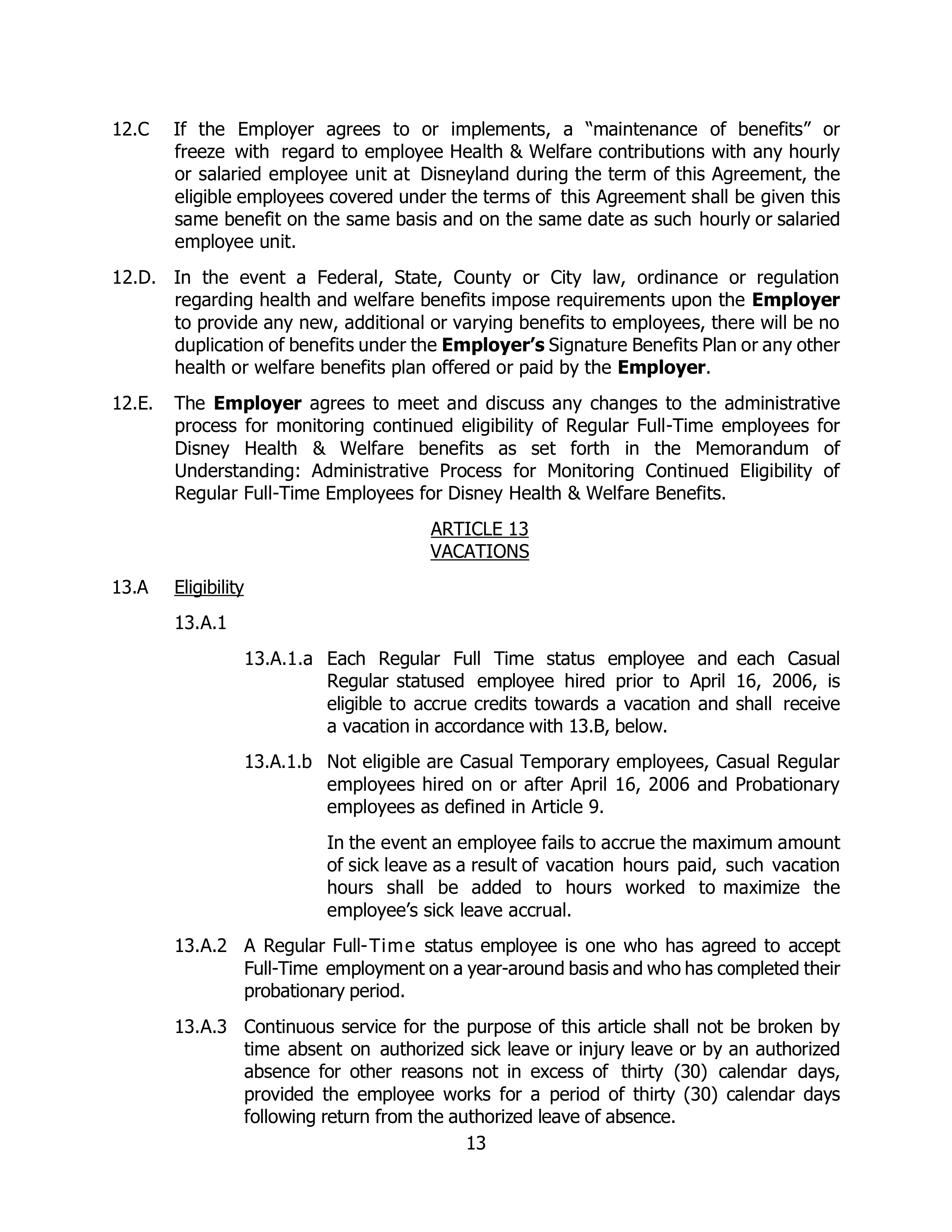
13
12.C If the Employer agrees to or implements, a “maintenance of benefits” or
freeze with regard to employee Health & Welfare contributions with any hourly
or salaried employee unit at Disneyland during the term of this Agreement, the
eligible employees covered under the terms of this Agreement shall be given this
same benefit on the same basis and on the same date as such hourly or salaried
employee unit.
12.D. In the event a Federal, State, County or City law, ordinance or regulation
regarding health and welfare benefits impose requirements upon the
Employer
to provide any new, additional or varying benefits to employees, there will be no
duplication of benefits under the
Employer’s
Signature Benefits Plan or any other
health or welfare benefits plan offered or paid by the
Employer
.
12.E.
The
Employer
agrees to meet and discuss
any changes
to the administrative
process for monitoring continued eligibility of Regular Full-Time employees for
Disney Health & Welfare benefits as set forth in the
Memorandum of
Understanding:
Administrative Process for Monitoring Continued Eligibility of
Regular Full-Time Employees for Disney Health & Welfare Benefits.
ARTICLE 13
VACATIONS
13.A
Eligibility
13.A.1
13.A.1.a Each Regular Full Time status employee and each Casual
Regular statused employee hired prior to April 16, 2006, is
eligible to accrue credits towards a vacation and shall receive
a vacation in accordance with 13.B, below.
13.A.1.b Not eligible are Casual Temporary employees, Casual Regular
employees hired on or after April 16, 2006 and Probationary
employees as defined in Article 9.
In the event an employee fails to accrue the maximum amount
of sick leave as a result of vacation hours paid, such vacation
hours shall be added to hours worked to maximize the
employee’s sick leave accrual.
13.A.2 A Regular Full-Time status employee is one who has agreed to accept
Full-Time employment on a year-around basis and who has completed their
probationary period.
13.A.3 Continuous service for the purpose of this article shall not be broken by
time absent on authorized sick leave or injury leave or by an authorized
absence for other reasons not in excess of thirty (30) calendar days,
provided the employee works for a period of thirty (30) calendar days
following return from the authorized leave of absence.
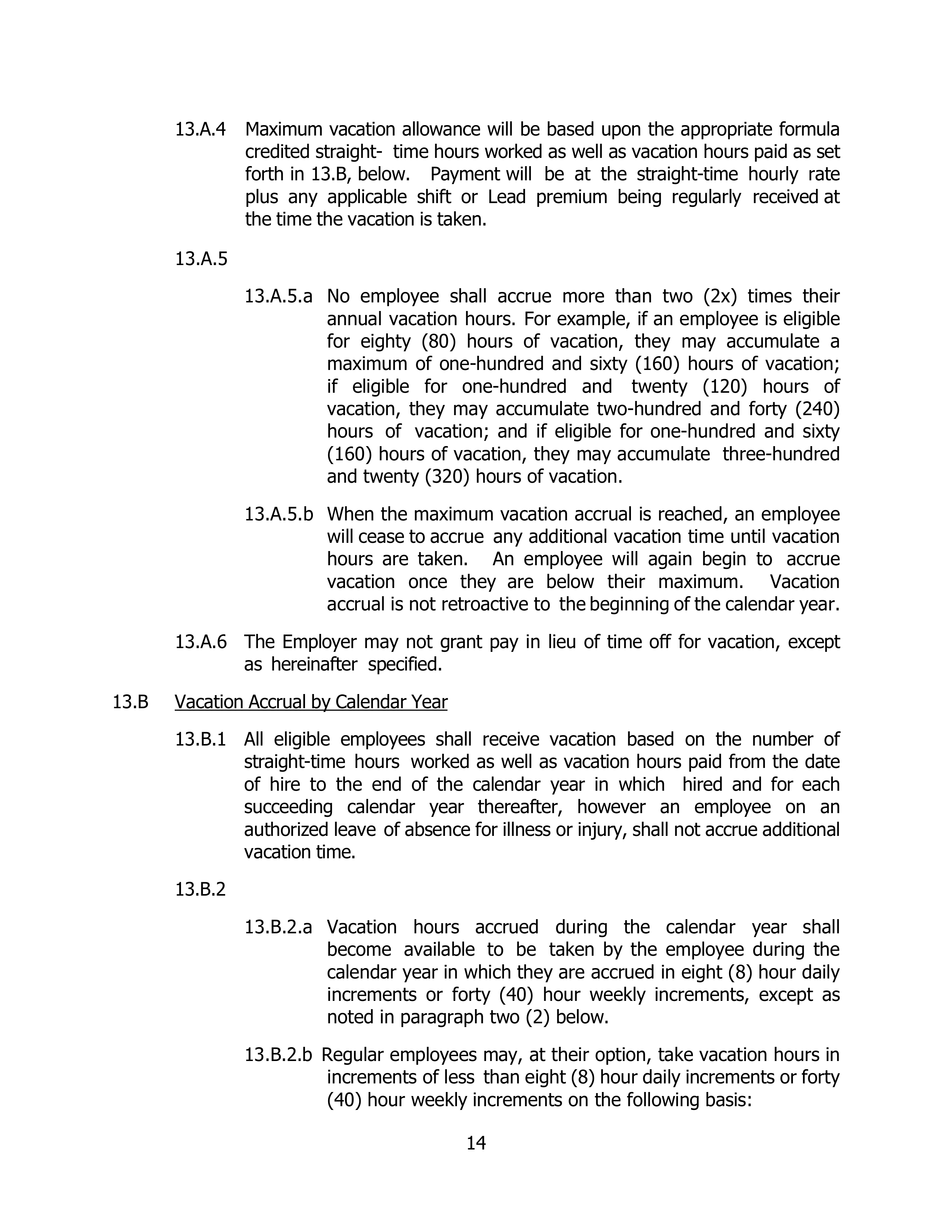
14
13.A.4 Maximum vacation allowance will be based upon the appropriate formula
credited straight- time hours worked as well as vacation hours paid as set
forth in 13.B, below. Payment will be at the straight-time hourly rate
plus any applicable shift or Lead premium being regularly received at
the time the vacation is taken.
13.A.5
13.A.5.a No employee shall accrue more than two (2x) times their
annual vacation hours. For example, if an employee is eligible
for eighty (80) hours of vacation, they may accumulate a
maximum of one-hundred and sixty (160) hours of vacation;
if eligible for one-hundred and twenty (120) hours of
vacation, they may accumulate two-hundred and forty (240)
hours of vacation; and if eligible for one-hundred and sixty
(160) hours of vacation, they may accumulate three-hundred
and twenty (320) hours of vacation.
13.A.5.b When the maximum vacation accrual is reached, an employee
will cease to accrue any additional vacation time until vacation
hours are taken. An employee will again begin to accrue
vacation once they are
below their maximum. Vacation
accrual is not retroactive to the beginning of the calendar year.
13.A.6 The Employer may not grant pay in lieu of time off for vacation, except
as hereinafter specified.
13.B
Vacation Accrual by Calendar Year
13.B.1 All eligible employees shall receive vacation based on the number of
straight-time hours worked as well as vacation hours paid from the date
of hire to the end of the calendar year in which hired and for each
succeeding calendar year thereafter, however an employee on an
authorized leave of absence for illness or injury, shall not accrue additional
vacation time.
13.B.2
13.B.2.a Vacation hours accrued during the calendar year shall
become available to be taken by the employee during the
calendar year in which they are accrued in eight (8) hour daily
increments or forty (40) hour weekly increments, except as
noted in paragraph two (2) below.
13.B.2.b Regular employees may, at their option, take vacation hours in
increments of less than eight (8) hour daily increments or forty
(40) hour weekly increments on the following basis:
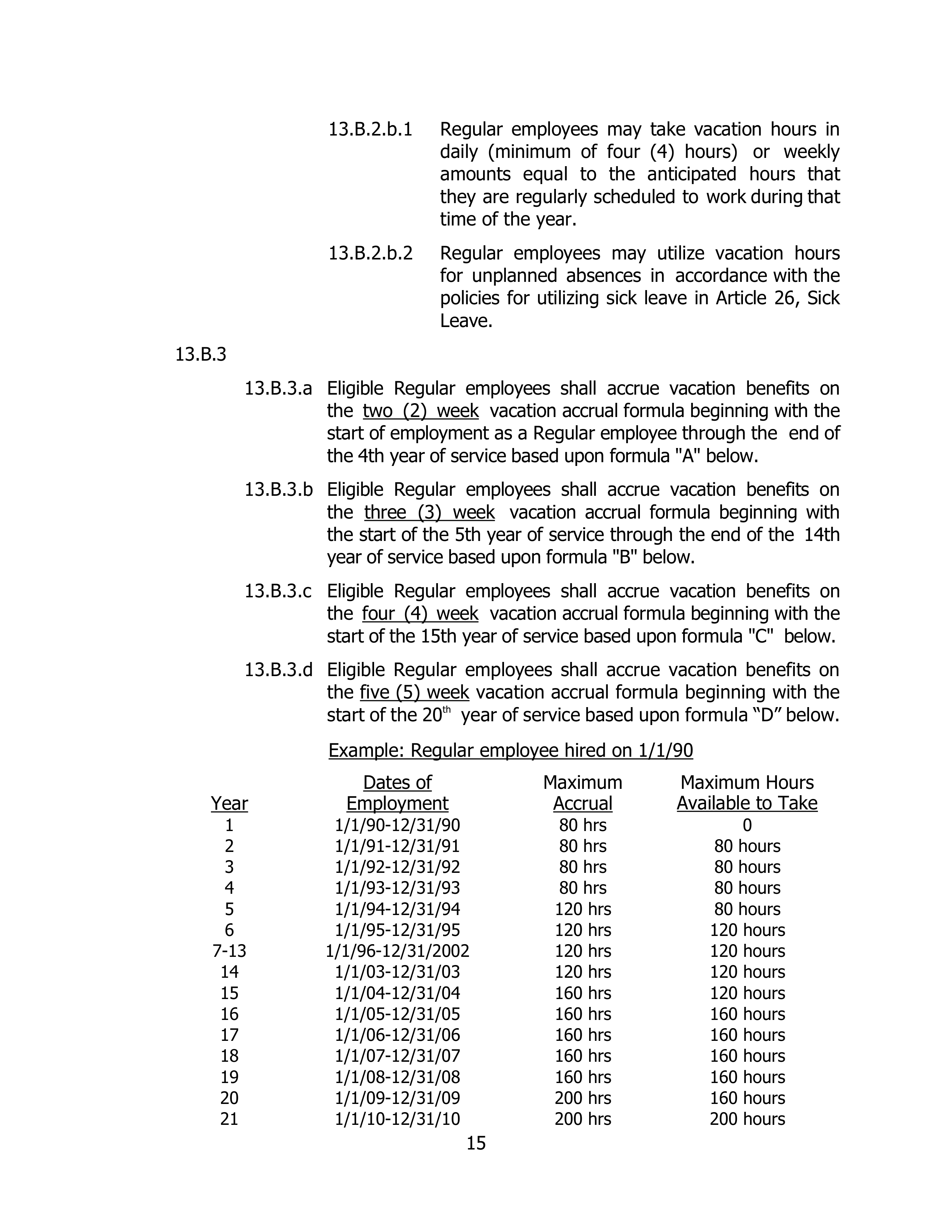
15
13.B.2.b.1 Regular employees may take vacation hours in
daily (minimum of four (4) hours) or weekly
amounts equal to the anticipated hours that
they are regularly scheduled to work during that
time of the year.
13.B.2.b.2 Regular employees may utilize vacation hours
for unplanned absences in accordance with the
policies for utilizing sick leave in Article 26, Sick
Leave.
13.B.3
13.B.3.a Eligible Regular employees shall accrue vacation benefits on
the two (2) week vacation accrual formula beginning with the
start of employment as a Regular employee through the end of
the 4th year of service based upon formula "A" below.
13.B.3.b Eligible Regular employees shall accrue vacation benefits on
the three (3) week vacation accrual formula beginning with
the start of the 5th year of service through the end of the 14th
year of service based upon formula "B" below.
13.B.3.c Eligible Regular employees shall accrue vacation benefits on
the four (4) week vacation accrual formula beginning with the
start of the 15th year of service based upon formula "C" below.
13.B.3.d Eligible Regular employees shall accrue vacation benefits on
the five (5) week vacation accrual formula beginning with the
start of the 20
th
year of service based upon formula “D” below.
Example: Regular employee hired on 1/1/90
Year
Dates of
Employment
Maximum
Accrual
Maximum Hours
Available to Take
1
1/1/90-12/31/90
80 hrs
0
2
1/1/91-12/31/91
80 hrs
80 hours
3
1/1/92-12/31/92
80 hrs
80 hours
4
1/1/93-12/31/93
80 hrs
80 hours
5
1/1/94-12/31/94
120 hrs
80 hours
6
1/1/95-12/31/95
120 hrs
120 hours
7-13
1/1/96-12/31/2002
120 hrs
120 hours
14
1/1/03-12/31/03
120 hrs
120 hours
15
1/1/04-12/31/04
160 hrs
120 hours
16
1/1/05-12/31/05
160 hrs
160 hours
17
1/1/06-12/31/06
160 hrs
160 hours
18
1/1/07-12/31/07
160 hrs
160 hours
19
1/1/08-12/31/08
160 hrs
160 hours
20
1/1/09-12/31/09
200 hrs
160 hours
21
1/1/10-12/31/10
200 hrs
200 hours
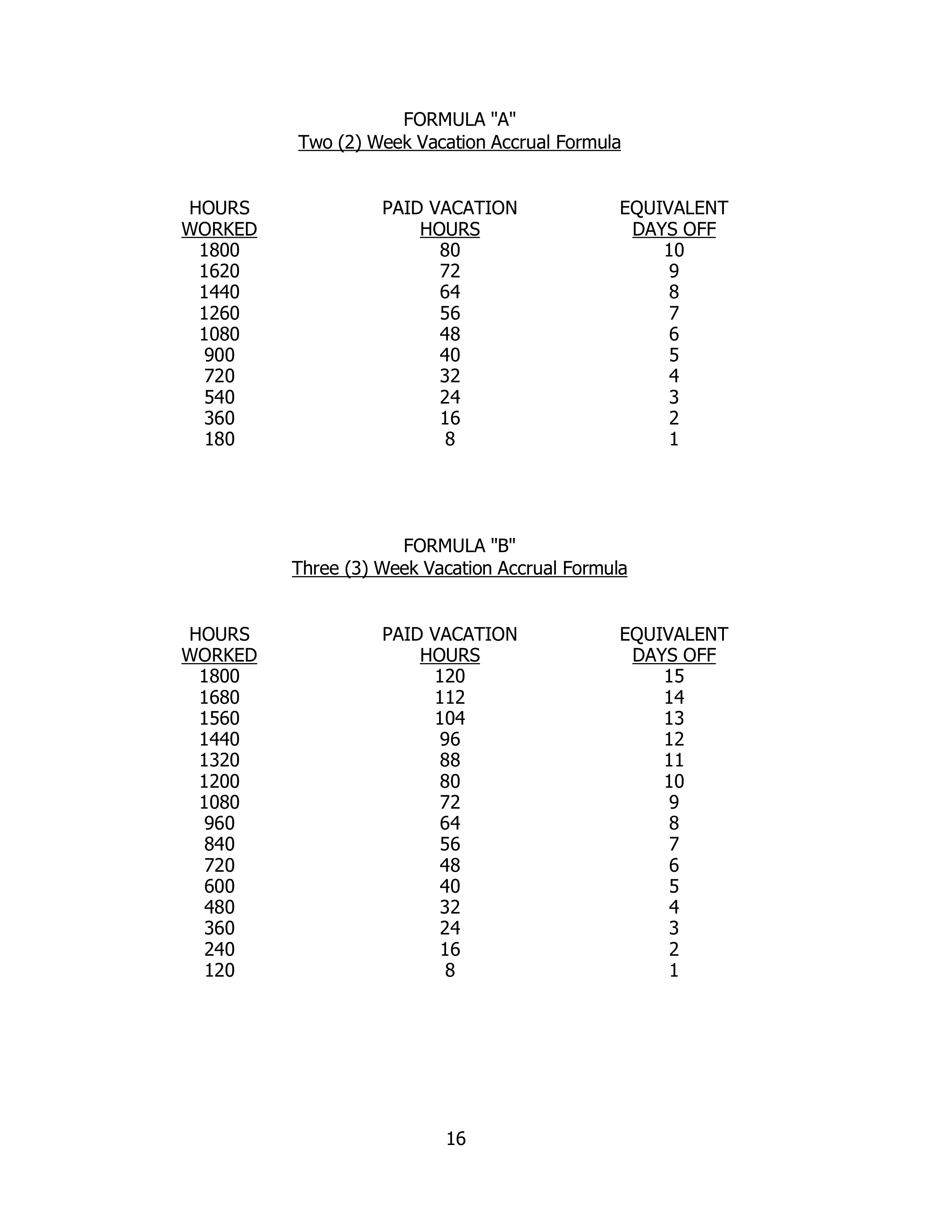
16
FORMULA "A"
Two (2) Week Vacation Accrual Formula
HOURS
WORKED
PAID VACATION
HOURS
EQUIVALENT
DAYS OFF
1800
80
10
1620
72
9
1440
64
8
1260
56
7
1080
48
6
900
40
5
720
32
4
540
24
3
360
16
2
180
8
1
FORMULA "B"
Three (3) Week Vacation Accrual Formula
HOURS
WORKED
PAID VACATION
HOURS
EQUIVALENT
DAYS OFF
1800
120
15
1680
112
14
1560
104
13
1440
96
12
1320
88
11
1200
80
10
1080
72
9
960
64
8
840
56
7
720
48
6
600
40
5
480
32
4
360
24
3
240
16
2
120
8
1
17
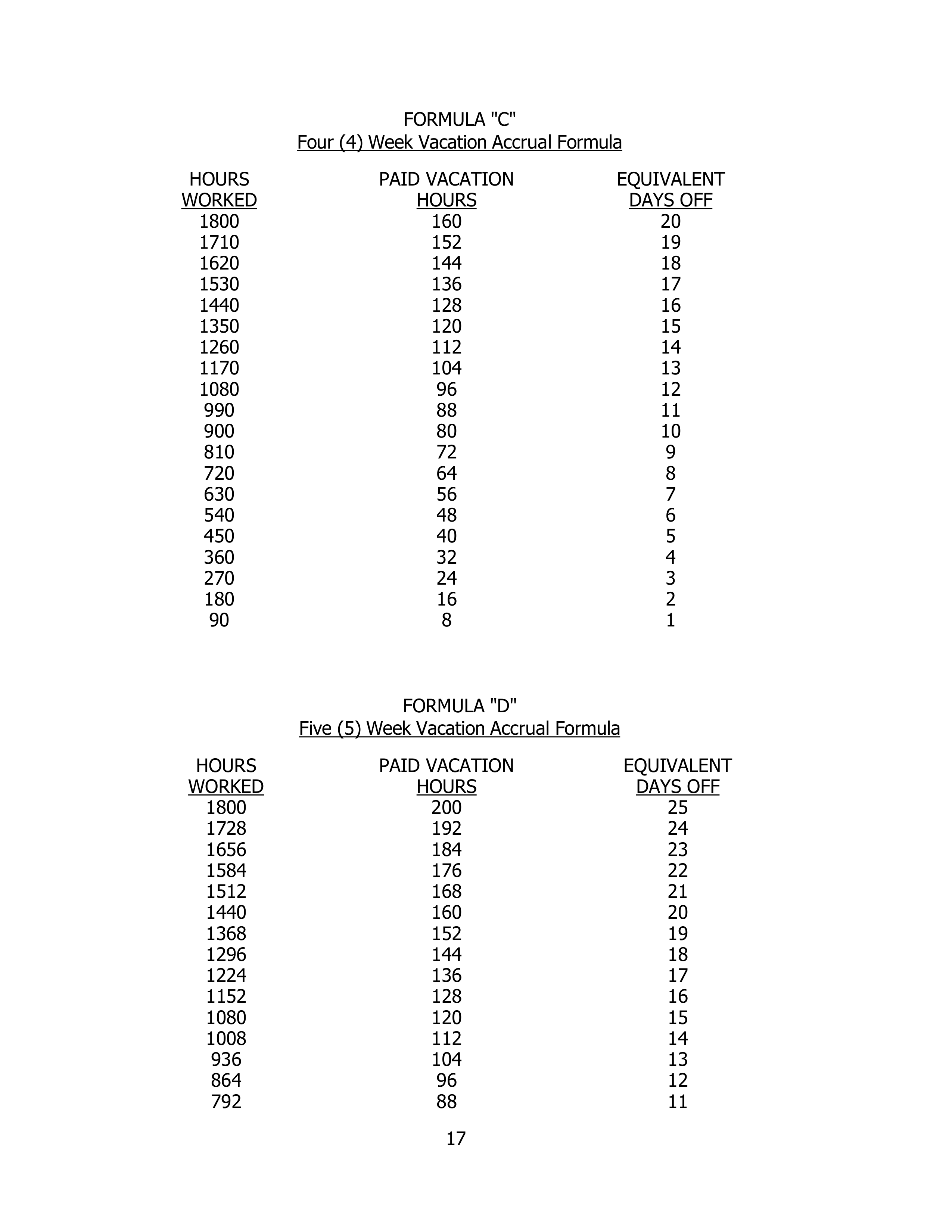
FORMULA "C"
Four (4) Week Vacation Accrual Formula
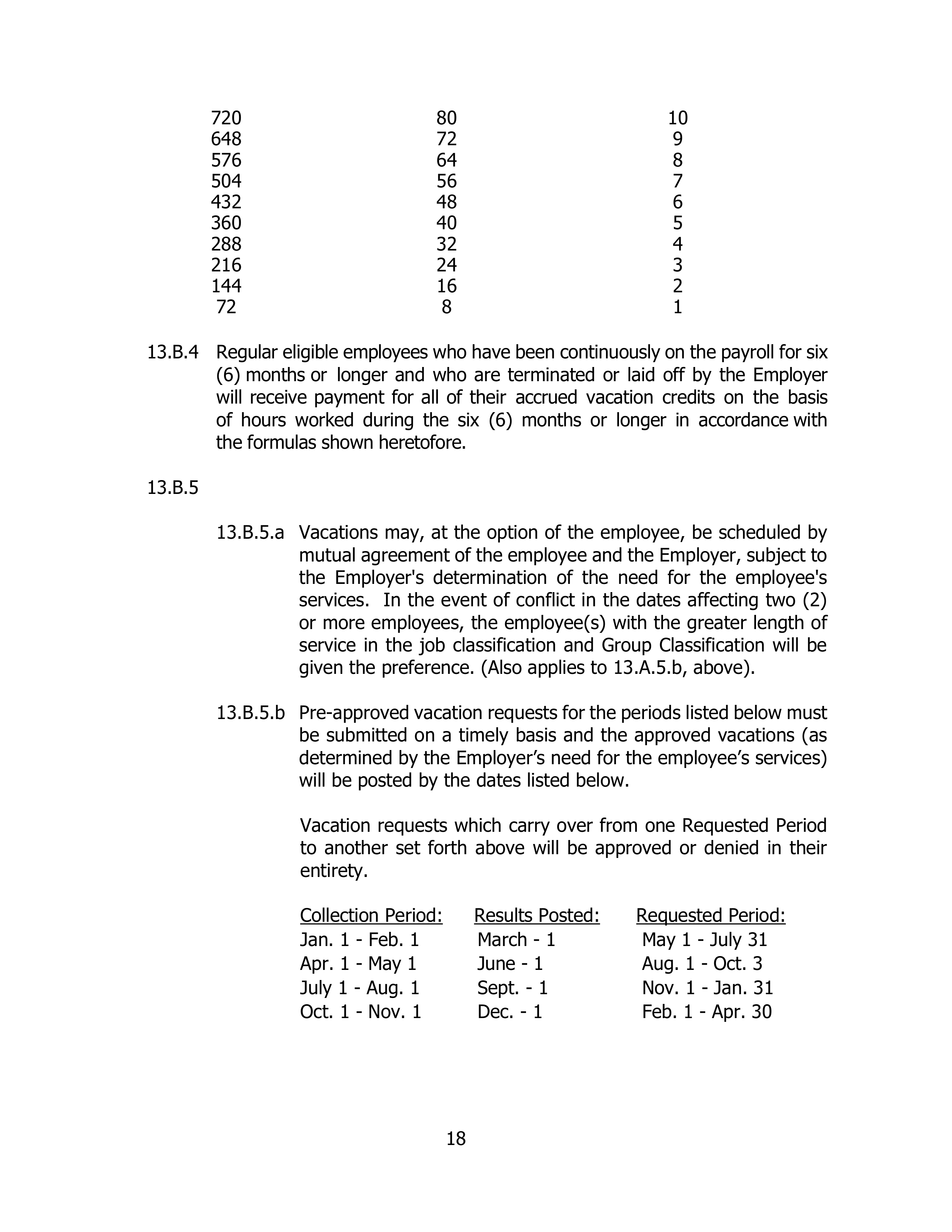
FORMULA "D"
Five (5) Week Vacation Accrual Formula
HOURS
WORKED
PAID VACATION
HOURS
EQUIVALENT
DAYS OFF
1800
160
20
1710
152
19
1620
144
18
1530
136
17
1440
128
16
1350
120
15
1260
112
14
1170
104
13
1080
96
12
990
88
11
900
80
10
810
72
9
720
64
8
630
56
7
540
48
6
450
40
5
360
32
4
270
24
3
180
16
2
90
8
1
HOURS
WORKED
PAID VACATION
HOURS
EQUIVALENT
DAYS OFF
1800
200
25
1728
192
24
1656
184
23
1584
176
22
1512
168
21
1440
160
20
1368
152
19
1296
144
18
1224
136
17
1152
128
16
1080
120
15
1008
112
14
936
104
13
864
96
12
792
88
11
18
13.B.4 Regular eligible employees who have been continuously on the payroll for six
(6) months or longer and who are terminated or laid off by the Employer
will receive payment for all of their accrued vacation credits on the basis
of hours worked during the six (6) months or longer in accordance with
the formulas shown heretofore.
13.B.5
13.B.5.a Vacations may, at the option of the employee, be scheduled by
mutual agreement of the employee and the Employer, subject to
the Employer's determination of the need for the employee's
services. In the event of conflict in the dates affecting two (2)
or more employees, the employee(s) with the greater length of
service in the job classification and Group Classification will be
given the preference. (Also applies to 13.A.5.b, above).
13.B.5.b Pre-approved vacation requests for the periods listed below must
be submitted on a timely basis and the approved vacations (as
determined by the Employer’s need for the employee’s services)
will be posted by the dates listed below.
Vacation requests which carry over from one Requested Period
to another set forth above will be approved or denied in their
entirety.
Collection Period:
Results Posted:
Requested Period:
Jan. 1 - Feb. 1
March - 1
May 1 - July 31
Apr. 1 - May 1
June - 1
Aug. 1 - Oct. 3
July 1 - Aug. 1
Sept. - 1
Nov. 1 - Jan. 31
Oct. 1 - Nov. 1
Dec. - 1
Feb. 1 - Apr. 30
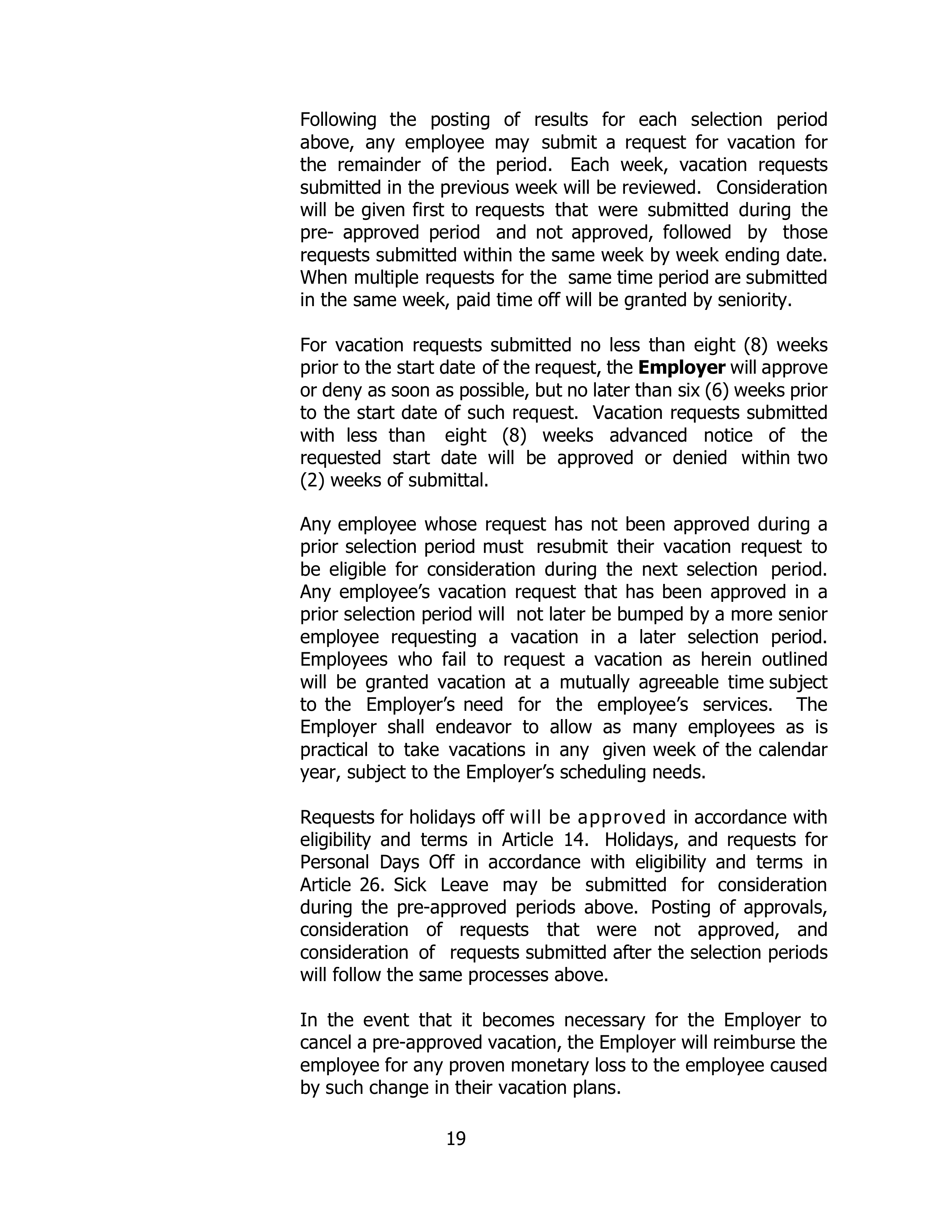
720
80
10
648
72
9
576
64
8
504
56
7
432
48
6
360
40
5
288
32
4
216
24
3
144
16
2
72
8
1
19
Following the posting of results for each selection period
above, any employee may submit a request for vacation for
the remainder of the period. Each week, vacation requests
submitted in the previous week will be reviewed. Consideration
will be given first to requests that were submitted during the
pre- approved period and not approved, followed by those
requests submitted within the same week by week ending date.
When multiple requests for the same time period are submitted
in the same week, paid time off will be granted by seniority.
For vacation requests submitted no less than eight (8) weeks
prior to the start date of the request, the
Employer
will approve
or deny as soon as possible, but no later than six (6) weeks prior
to the start date of such request. Vacation requests submitted
with less than eight (8) weeks advanced notice of the
requested start date will be approved or denied within two
(2) weeks of submittal.
Any employee whose request has not been approved during a
prior selection period must resubmit their vacation request to
be eligible for consideration during the next selection period.
Any employee’s vacation request that has been approved in a
prior selection period will not later be bumped by a more senior
employee requesting a vacation in a later selection period.
Employees who fail to request a vacation as herein outlined
will be granted vacation at a mutually agreeable time subject
to the Employer’s need for the employee’s services. The
Employer shall endeavor to allow as many employees as is
practical to take vacations in any given week of the calendar
year, subject to the Employer’s scheduling needs.
Requests for holidays off will be approved
in accordance with
eligibility and terms in Article 14. Holidays, and requests for
Personal Days Off in accordance with eligibility and terms in
Article 26. Sick Leave may be submitted for consideration
during the pre-approved periods above. Posting of approvals,
consideration of requests that were not approved, and
consideration of requests submitted after the selection periods
will follow the same processes above.
In the event that it becomes necessary for the Employer to
cancel a pre-approved vacation, the Employer will reimburse the
employee for any proven monetary loss to the employee caused
by such change in their vacation plans.
20
13.B.5.c Vacations shall be scheduled to commence on any day, except
that in the case of Casual Regular employees, the vacation shall
be scheduled to commence at a mutually agreeable time.
13.B.5.d Vacations granted by the Employer utilizing the pre-approved
vacation request process described in 13.B.5.b, above, will not be
canceled without four (4) weeks prior notice, except in the case
of force majeure.
13.B.6 The Employer may elect that some or all employees take their vacations
at one time and during a period when Disneyland is closed. In the event
the Employer does so, employees will be given vacations at the time of the
shutdown, on a pro-rata basis of vacation accrued to that time, and in
accordance with the formulas shown heretofore. This will include pro-rata
vacations for Regular employees of less than six (6) months' continuous
service.
13.B.7 Upon the request of an eligible employee, the Employer shall provide
payment of up to one-half (½) of an employee’s total accrued vacation to a
maximum of three (3) weeks (120 hours) on an annual basis.
Such request for payment will be accepted two (2x) times per calendar
year during any payroll week of the calendar year.
13.B.8 An eligible employee must utilize accrued vacation in excess of two (2)
weeks while on Family Care Leave, and may request that all accrued
vacation be utilized while on Family Care Leave.
13.B.9 Upon the request of the employee, accrued vacation hours as outlined
herein may be paid to eligible employees until such time as State
Disability or Workers Compensation benefits begin. When State
Disability or Workers Compensation benefits begin any accrued vacation
hours shall be integrated with State Disability or Workers Compensation
benefits, paying the difference between State Disability or Workers
Compensation benefits and the employee’s full wages for time missed
from work until such time as the employee has been released from
Disability and returns to work, or until such time as accrued vacation hours
have been used up, whichever comes first.
13.B.10 Casual Regular – Paid Days Off:
Effective January 1
st
of each year, Casual Regular (CR) employees, hired
on or after April 16, 2006, who have been paid the required number of
hours and have the required years of continuous service as a Casual
Regular employee, shall be eligible for Paid Days Off (PDO) in accordance
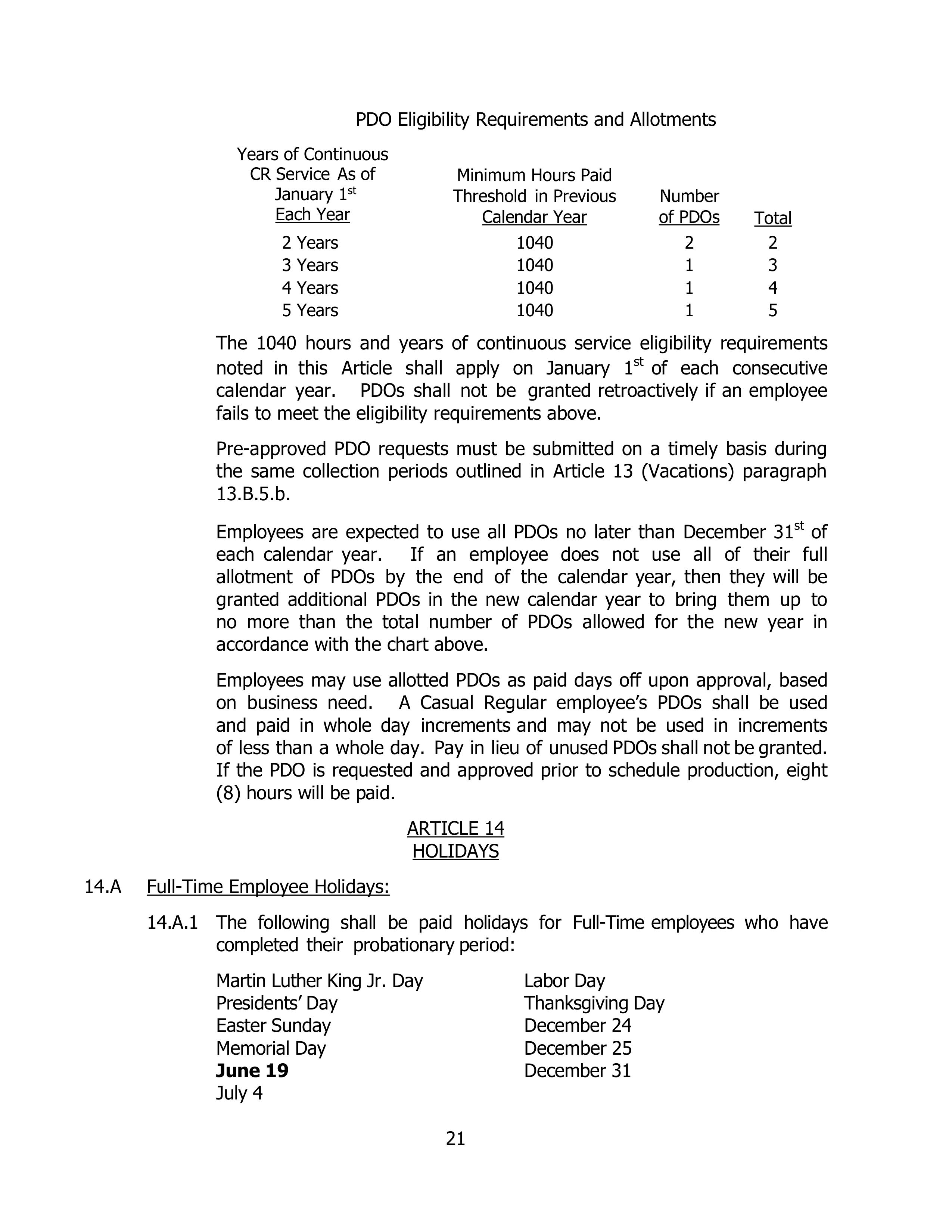
with the chart
below:
21
PDO Eligibility Requirements and Allotments
Years of Continuous
CR Service As of
January 1
st
Each Year
Minimum Hours Paid
Threshold in Previous
Calendar Year
Number
of PDOs
Total
2 Years
1040
2
2
3 Years
1040
1
3
4 Years
1040
1
4
5 Years
1040
1
5
The 1040 hours and years of continuous service eligibility requirements
noted in this Article shall apply on January 1
st
of each consecutive
calendar year. PDOs shall not be granted retroactively if an employee
fails to meet the eligibility requirements above.
Pre-approved PDO requests must be submitted on a timely basis during
the same collection periods outlined in Article 13 (Vacations) paragraph
13.B.5.b.
Employees are expected to use all PDOs no later than December 31
st
of
each calendar year. If an employee does not use all of their full
allotment of PDOs by the end of the calendar year, then they will be
granted additional PDOs in the new calendar year to bring them up to
no more than the total number of PDOs allowed for the new year in
accordance with the chart above.
Employees may use allotted PDOs as paid days off upon approval, based
on business need. A Casual Regular employee’s PDOs shall be used
and paid in whole day increments and may not be used in increments
of less than a whole day. Pay in lieu of unused PDOs shall not be granted.
If the PDO is requested and approved prior to schedule production, eight
(8) hours will be paid.
ARTICLE 14
HOLIDAYS
14.A Full-Time Employee Holidays:
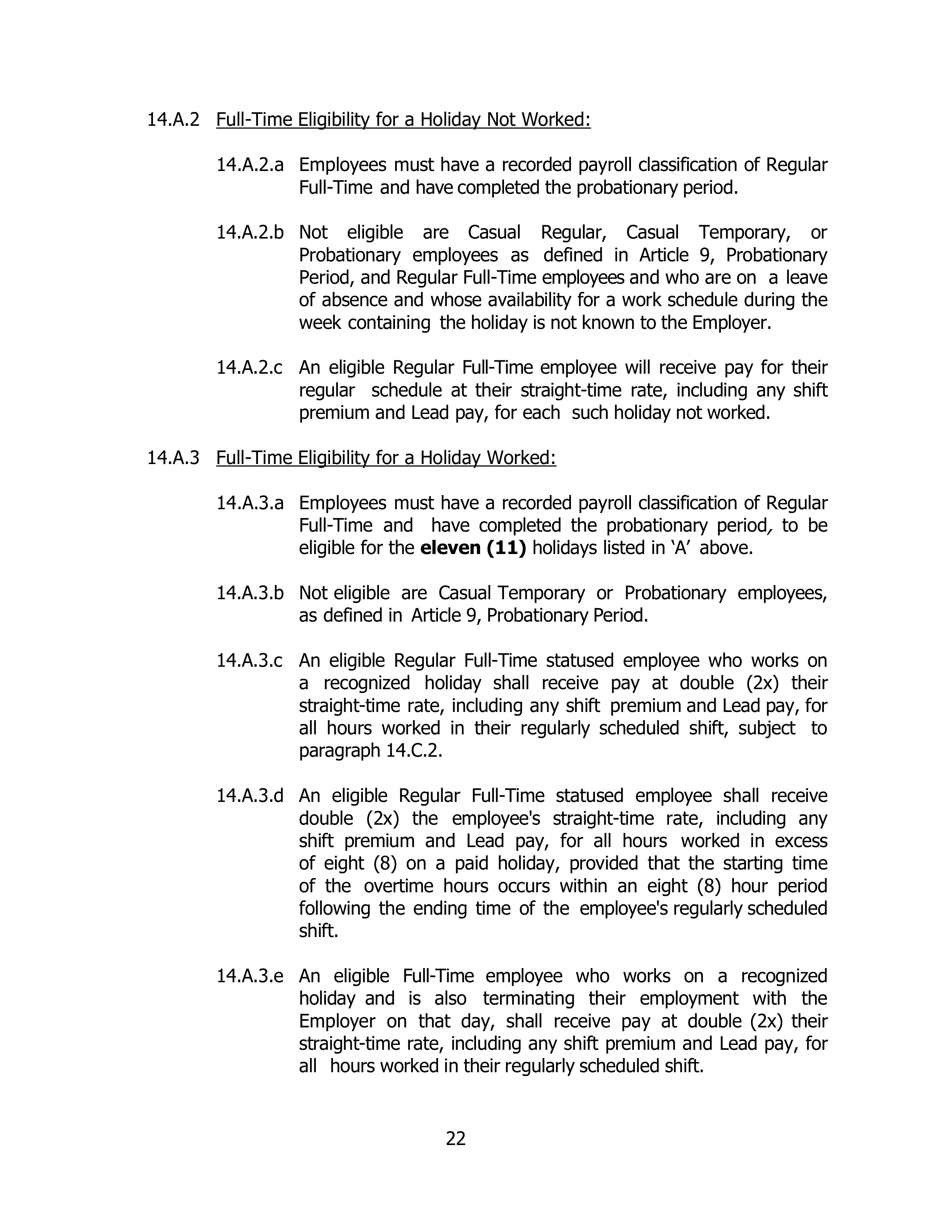
14.A.1 The following shall be paid holidays for Full-Time employees who have
completed their probationary period:
Martin Luther King Jr. Day
Labor Day
Presidents’
Day
Thanksgiving Day
Easter Sunday
December 24
Memorial Day
December 25
June 19
December 31
July 4
22
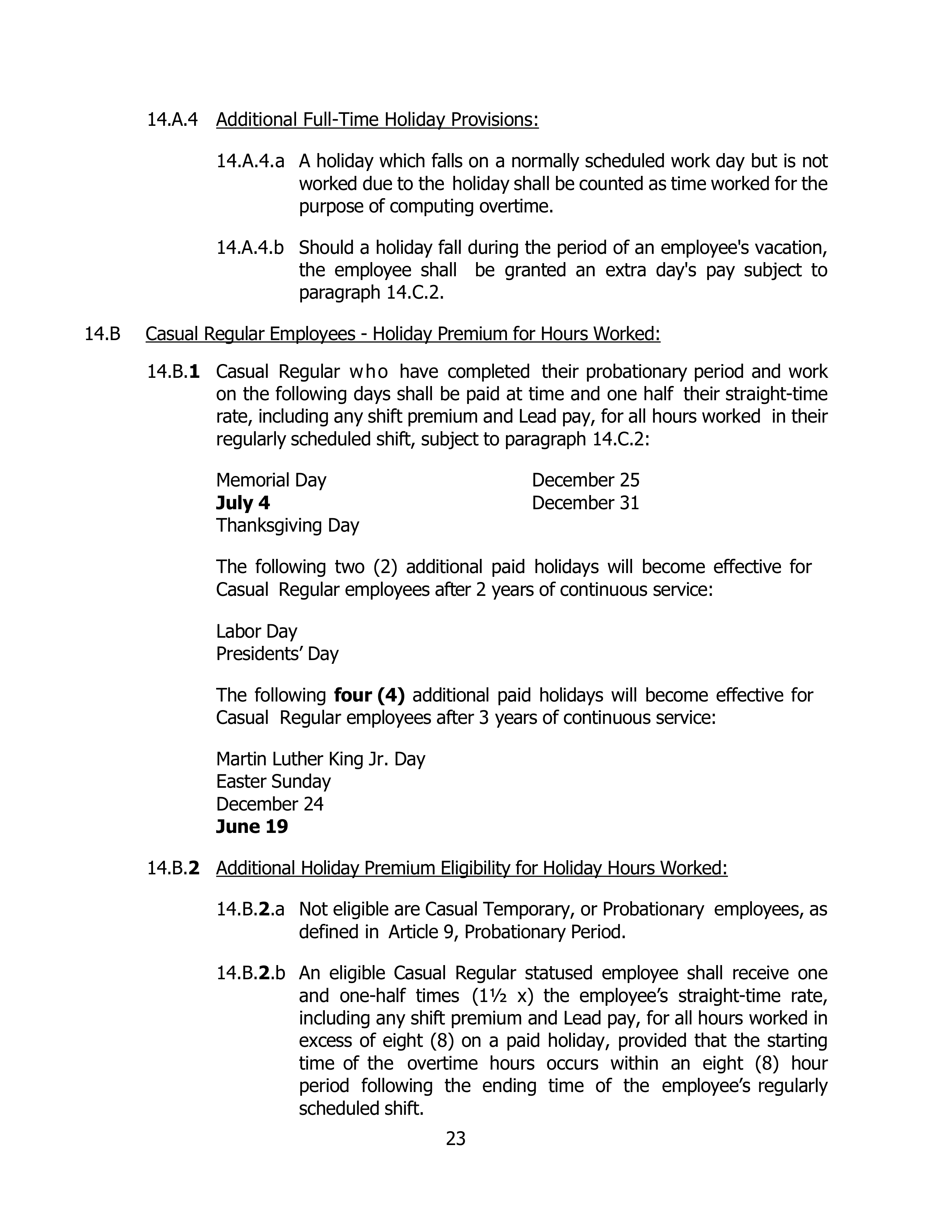
14.A.2 Full-Time
Eligibility for a Holiday Not Worked:
14.A.2.a Employees must have a recorded payroll classification of Regular
Full-Time and have completed the probationary period.
14.A.2.b Not eligible are Casual Regular, Casual Temporary, or
Probationary employees as defined in Article 9, Probationary
Period, and Regular Full-Time employees and who are on a leave
of absence and whose availability for a work schedule during the
week containing the holiday is not known to the Employer.
14.A.2.c An eligible Regular Full-Time
employee will receive pay for their
regular schedule at their straight-time rate, including any shift
premium and Lead pay, for each such holiday not worked.
14.A.3 Full-Time
Eligibility for a Holiday Worked:
14.A.3.a Employees must have a recorded payroll classification of Regular
Full-Time and have completed the probationary period, to be
eligible for the
eleven (11)
holidays listed in ‘A’
above.
14.A.3.b Not eligible are Casual Temporary or Probationary employees,
as defined in Article 9, Probationary Period.
14.A.3.c An eligible Regular Full-Time statused employee who works on
a recognized holiday shall receive pay at double (2x) their
straight-time rate, including any shift premium and Lead pay, for
all hours worked in their regularly scheduled shift, subject to
paragraph 14.C.2.
14.A.3.d An eligible Regular Full-Time statused employee shall receive
double (2x) the employee's straight-time rate, including any
shift premium and Lead pay, for all hours worked in excess
of eight (8) on a paid holiday, provided that the starting time
of the overtime hours occurs within an eight (8) hour period
following the ending time of the employee's regularly scheduled
shift.
14.A.3.e An eligible Full-Time
employee who works on a recognized
holiday and is also terminating their employment with the
Employer on that day, shall receive pay at double (2x) their
straight-time rate, including any shift premium and Lead pay, for
all hours worked in their regularly scheduled shift.
23
14.A.4 Additional Full-Time Holiday Provisions:
14.A.4.a A holiday which falls on a normally scheduled work day but is not
worked due to the holiday shall be counted as time worked for the
purpose of computing overtime.
14.A.4.b Should a holiday fall during the period of an employee's vacation,
the employee shall be granted an extra day's pay subject to
paragraph 14.C.2.
14.B Casual Regular Employees - Holiday Premium for Hours Worked:
14.B.
1
Casual Regular who have completed their probationary period and work
on the following days shall be paid at time and one half their straight-time
rate, including any shift premium and Lead pay, for all hours worked in their
regularly scheduled shift, subject to paragraph 14.C.2:
Memorial Day
December 25
July 4
December 31
Thanksgiving Day
The following two (2) additional paid holidays will become effective for
Casual Regular employees after 2 years of continuous service:
Labor Day
Presidents’ Day
The following
four (4)
additional paid holidays will become effective for
Casual Regular employees after 3 years of continuous service:
Martin Luther King Jr. Day
Easter Sunday
December 24
June 19
14.B.
2
Additional Holiday Premium Eligibility for Holiday Hours Worked:
14.B.
2
.a Not eligible are Casual Temporary, or Probationary employees, as
defined in Article 9, Probationary Period.
14.B.
2
.b An eligible Casual Regular statused employee shall receive one
and one-half times (1½ x) the employee’s straight-time rate,
including any shift premium and Lead pay, for all hours worked in
excess of eight (8) on a paid holiday, provided that the starting
time of the overtime hours occurs within an eight (8) hour
period following the ending time of the employee’s regularly
scheduled shift.
24
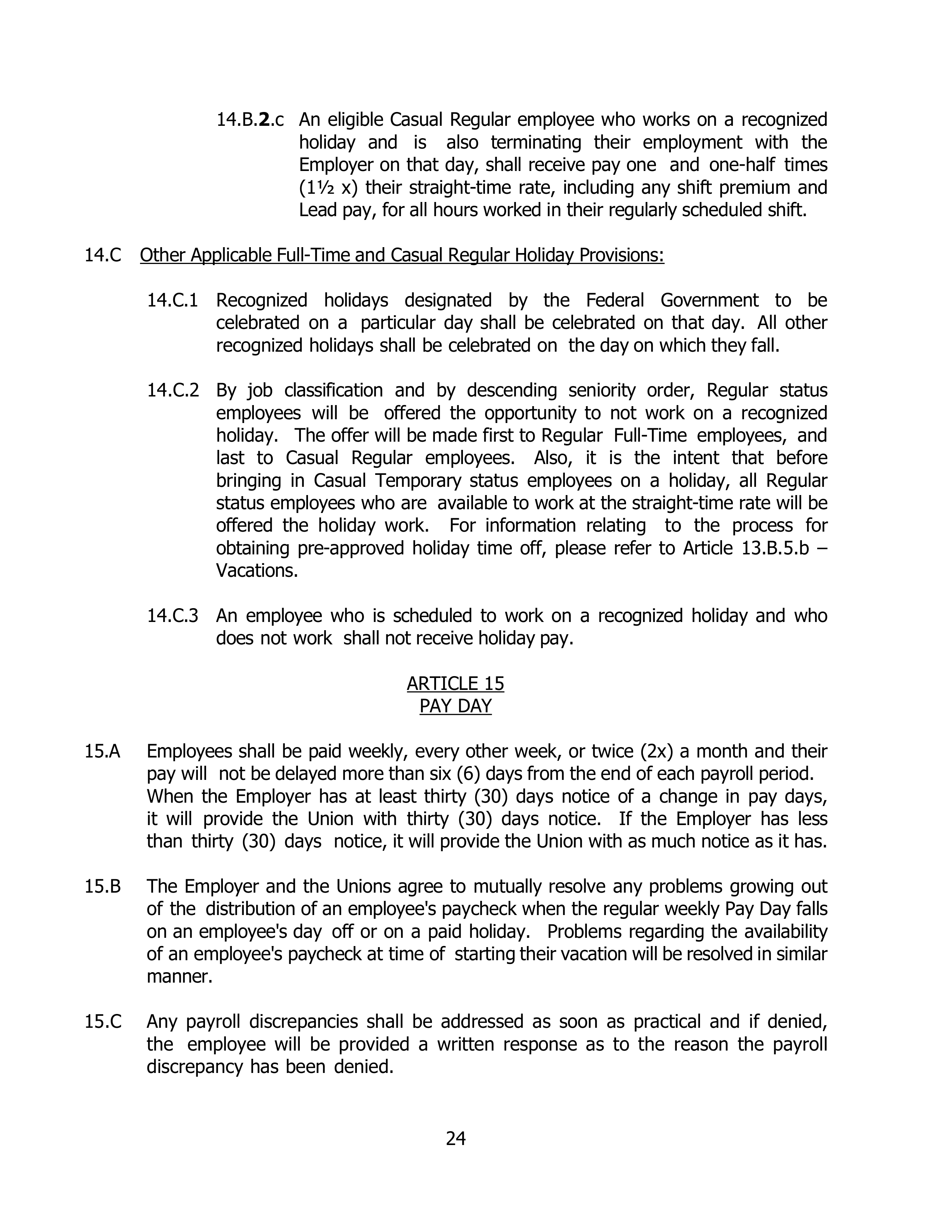
14.B.
2
.c An eligible Casual Regular employee who works on a recognized
holiday and is also terminating their employment with the
Employer on that day, shall receive pay one and one-half times
(1½ x) their straight-time rate, including any shift premium and
Lead pay, for all hours worked in their regularly scheduled shift.
14.C Other Applicable Full-Time and Casual Regular Holiday Provisions:
14.C.1
Recognized holidays designated by the Federal Government to be
celebrated on a particular day shall be celebrated on that day. All other
recognized holidays shall be celebrated on the day on which they fall.
14.C.2
By job classification and by descending seniority order, Regular status
employees will be offered the opportunity to not work on a recognized
holiday. The offer will be made first to Regular Full-Time employees, and
last to Casual Regular employees. Also, it is the intent that before
bringing in Casual Temporary status employees on a holiday, all Regular
status employees who are available to work at the straight-time rate will be
offered the holiday work. For information relating to the process for
obtaining pre-approved holiday time off, please refer to Article 13.B.5.b –
Vacations.
14.C.3
An employee who is scheduled to work on a recognized holiday and who
does not work shall not receive holiday pay.
ARTICLE 15
PAY DAY
15.A Employees shall be paid weekly, every other week, or twice (2x) a month and their
pay will not be delayed more than six (6) days from the end of each payroll period.
When the Employer has at least thirty (30) days notice of a change in pay days,
it will provide the Union with thirty (30) days notice. If the Employer has less
than thirty (30) days notice, it will provide the Union with as much notice as it has.
15.B The Employer and the Unions agree to mutually resolve any problems growing out
of the distribution of an employee's paycheck when the regular weekly Pay Day falls
on an employee's day off or on a paid holiday. Problems regarding the availability
of an employee's paycheck at time of starting their vacation will be resolved in similar
manner.
15.C Any payroll discrepancies shall be addressed as soon as practical and if denied,
the employee will be provided a written response as to the reason the payroll
discrepancy has been denied.
25
ARTICLE 16
REPORT PAY
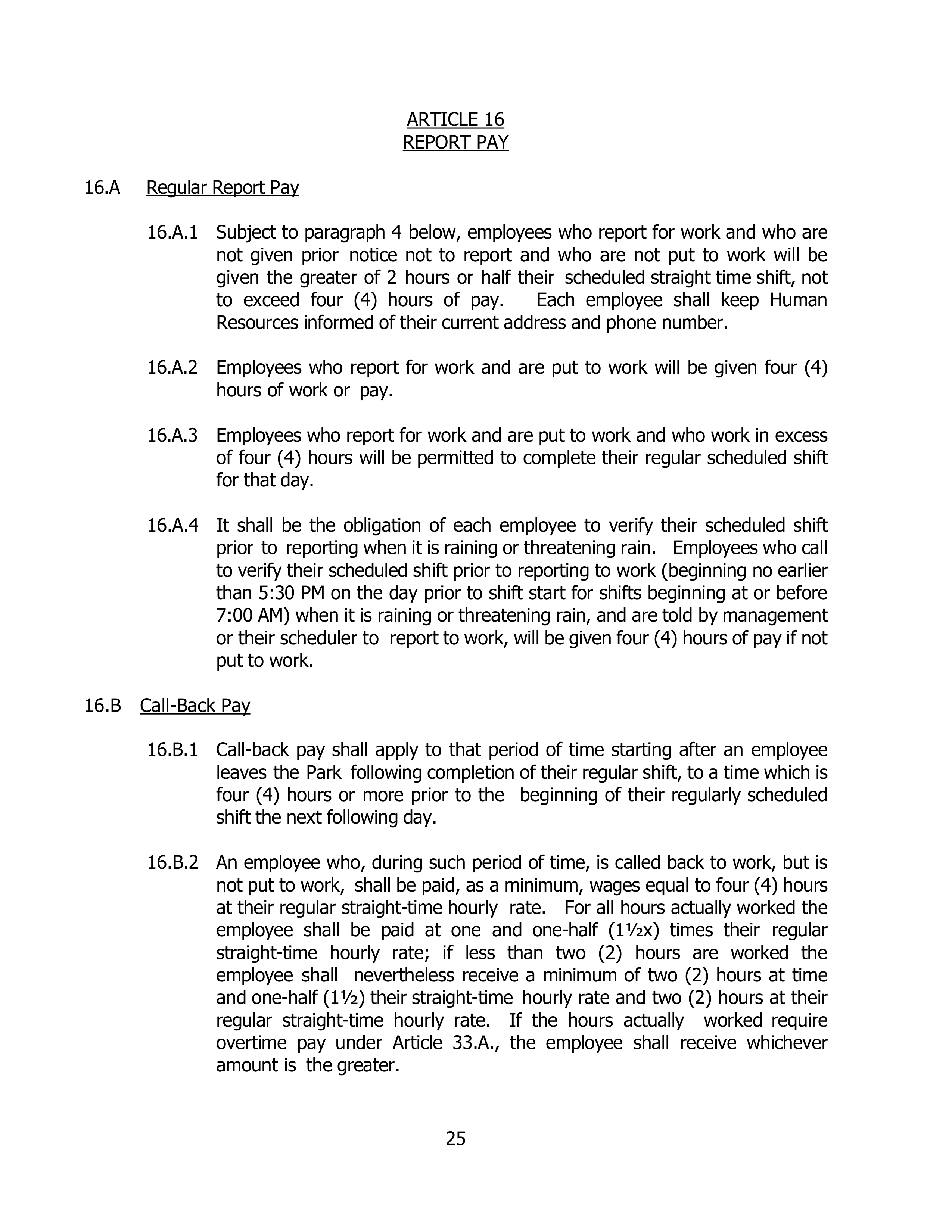
16.A
Regular Report Pay
16.A.1 Subject to paragraph 4 below, employees who report for work and who are
not given prior notice not to report and who are not put to work will be
given the greater of 2 hours or half their scheduled straight time shift, not
to exceed four (4) hours of pay. Each employee shall keep Human
Resources informed of their current address and phone number.
16.A.2 Employees who report for work and are put to work will be given four (4)
hours of work or pay.
16.A.3 Employees who report for work and are put to work and who work in excess
of four (4) hours will be permitted to complete their regular scheduled shift
for that day.
16.A.4 It shall be the obligation of each employee to verify their scheduled shift
prior to reporting when it is raining or threatening rain. Employees who call
to verify their scheduled shift prior to reporting to work (beginning no earlier
than 5:30 PM on the day prior to shift start for shifts beginning at or before
7:00 AM) when it is raining or threatening rain, and are told by management
or their scheduler to report to work, will be given four (4) hours of pay if not
put to work.
16.B Call-Back Pay
16.B.1 Call-back pay shall apply to that period of time starting after an employee
leaves the Park following completion of their regular shift, to a time which is
four (4) hours or more prior to the beginning of their regularly scheduled
shift the next following day.
16.B.2 An employee who, during such period of time, is called back to work, but is
not put to work, shall be paid, as a minimum, wages equal to four (4) hours
at their regular straight-time hourly rate. For all hours actually worked the
employee shall be paid at one and one-half (1½x) times their regular
straight-time hourly rate; if less than two (2) hours are worked the
employee shall nevertheless receive a minimum of two (2) hours at time
and one-half (1½) their straight-time hourly rate and two (2) hours at their
regular straight-time hourly rate. If the hours actually worked require
overtime pay under Article 33.A., the employee shall receive whichever
amount is the greater.
26
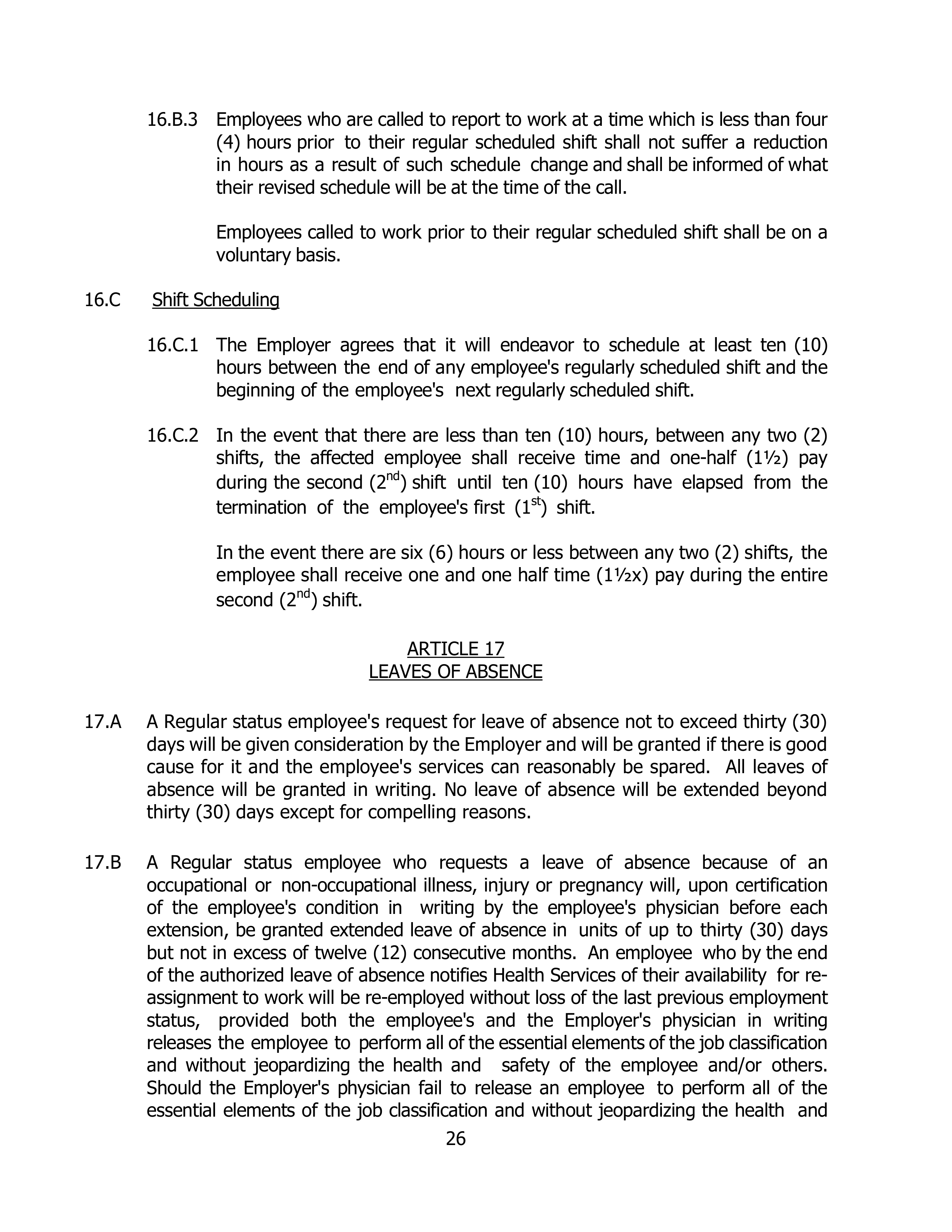
16.B.3 Employees who are called to report to work at a time which is less than four
(4) hours prior to their regular scheduled shift shall not suffer a reduction
in hours as a result of such schedule change and shall be informed of what
their revised schedule will be at the time of the call.
Employees called to work prior to their regular scheduled shift shall be on a
voluntary basis.
16.C
Shift Scheduling
16.C.1 The Employer agrees that it will endeavor to schedule at least ten (10)
hours between the end of any employee's regularly scheduled shift and the
beginning of the employee's next regularly scheduled shift.
16.C.2 In the event that there are less than ten (10) hours, between any two (2)
shifts, the affected employee shall receive time and one-half (1½) pay
during the second (2
nd
) shift until ten (10) hours have elapsed from the
termination of the employee's first (1
st
) shift.
In the event there are six (6) hours or less between any two (2) shifts, the
employee shall receive one and one half time (1½x) pay during the entire
second (2
nd
) shift.
ARTICLE 17
LEAVES OF ABSENCE
17.A
A Regular status employee's request for leave of absence not to exceed thirty (30)
days will be given consideration by the Employer and will be granted if there is good
cause for it and the employee's services can reasonably be spared. All leaves of
absence will be granted in writing. No leave of absence will be extended beyond
thirty (30) days except for compelling reasons.
17.B
A Regular status employee who requests a leave of absence because of an
occupational or non-occupational illness, injury or pregnancy will, upon certification
of the employee's condition in writing by the employee's physician before each
extension, be granted extended leave of absence in units of up to thirty (30) days
but not in excess of twelve (12) consecutive months. An employee who by the end
of the authorized leave of absence notifies Health Services of their availability for re-
assignment to work will be re-employed without loss of the last previous employment
status, provided both the employee's and the Employer's physician in writing
releases the employee to perform all of the essential elements of the job classification
and without jeopardizing the health and safety of the employee and/or others.
Should the Employer's physician fail to release an employee to perform all of the
essential elements of the job classification and without jeopardizing the health and
27
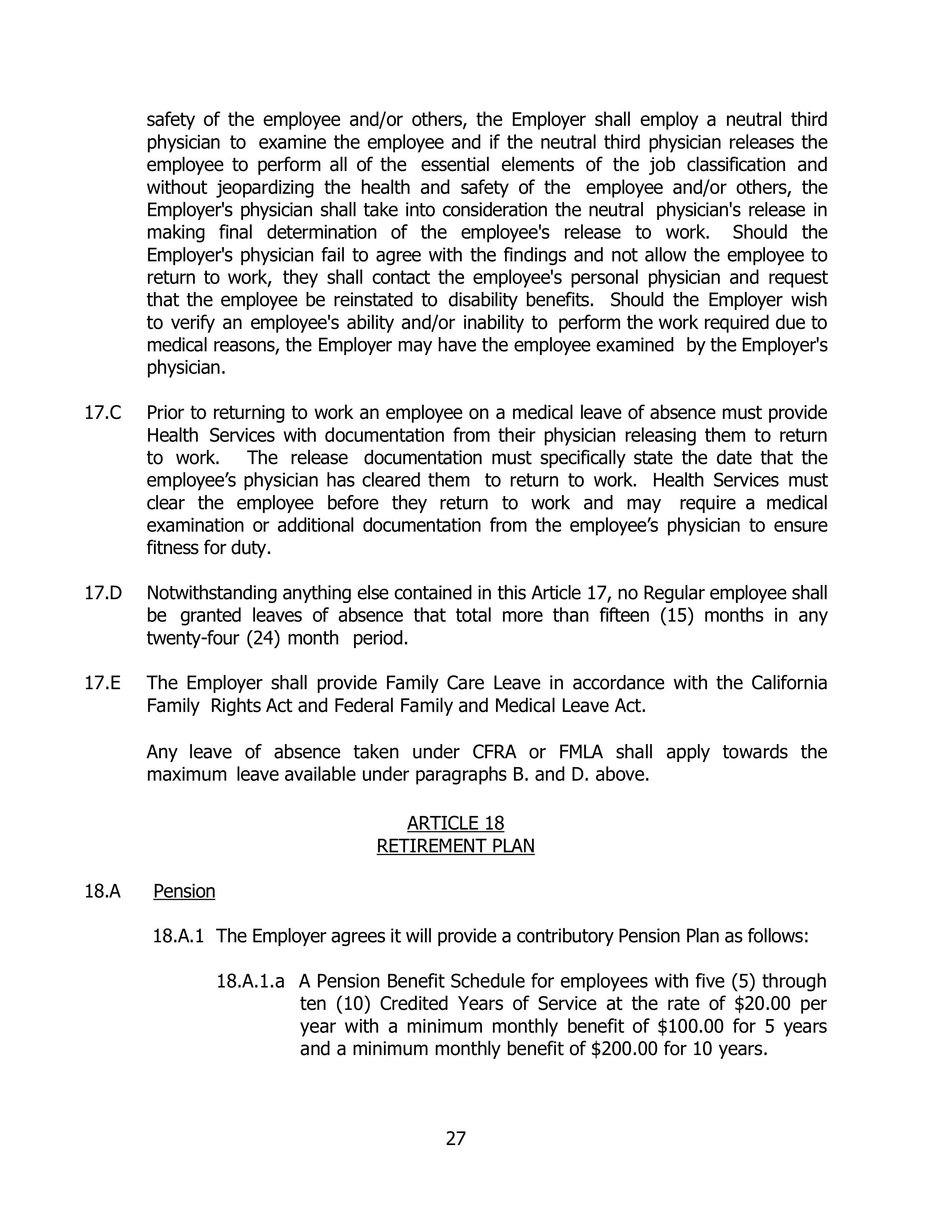
safety of the employee and/or others, the Employer shall employ a neutral third
physician to examine the employee and if the neutral third physician releases the
employee to perform all of the essential elements of the job classification and
without jeopardizing the health and safety of the employee and/or others, the
Employer's physician shall take into consideration the neutral physician's release in
making final determination of the employee's release to work. Should the
Employer's physician fail to agree with the findings and not allow the employee to
return to work, they shall contact the employee's personal physician and request
that the employee be reinstated to disability benefits. Should the Employer wish
to verify an employee's ability and/or inability to perform the work required due to
medical reasons, the Employer may have the employee examined by the Employer's
physician.
17.C
Prior to returning to work an employee on a medical leave of absence must provide
Health Services with documentation from their physician releasing them to return
to work. The release documentation must specifically state the date that the
employee’s physician has cleared them to
return to work. Health Services must
clear the employee before they return to work and may require a medical
examination or additional documentation from the employee’s physician to ensure
fitness for duty.
17.D
Notwithstanding anything else contained in this Article 17, no Regular employee shall
be granted leaves of absence that total more than fifteen (15) months in any
twenty-four (24) month period.
17.E
The Employer shall provide Family Care Leave in accordance with the California
Family Rights Act and Federal Family and Medical Leave Act.
Any leave of absence taken under CFRA or FMLA shall apply towards the
maximum leave available under paragraphs B. and D. above.
ARTICLE 18
RETIREMENT PLAN
18.A
Pension
18.A.1 The Employer agrees it will provide a contributory Pension Plan as follows:
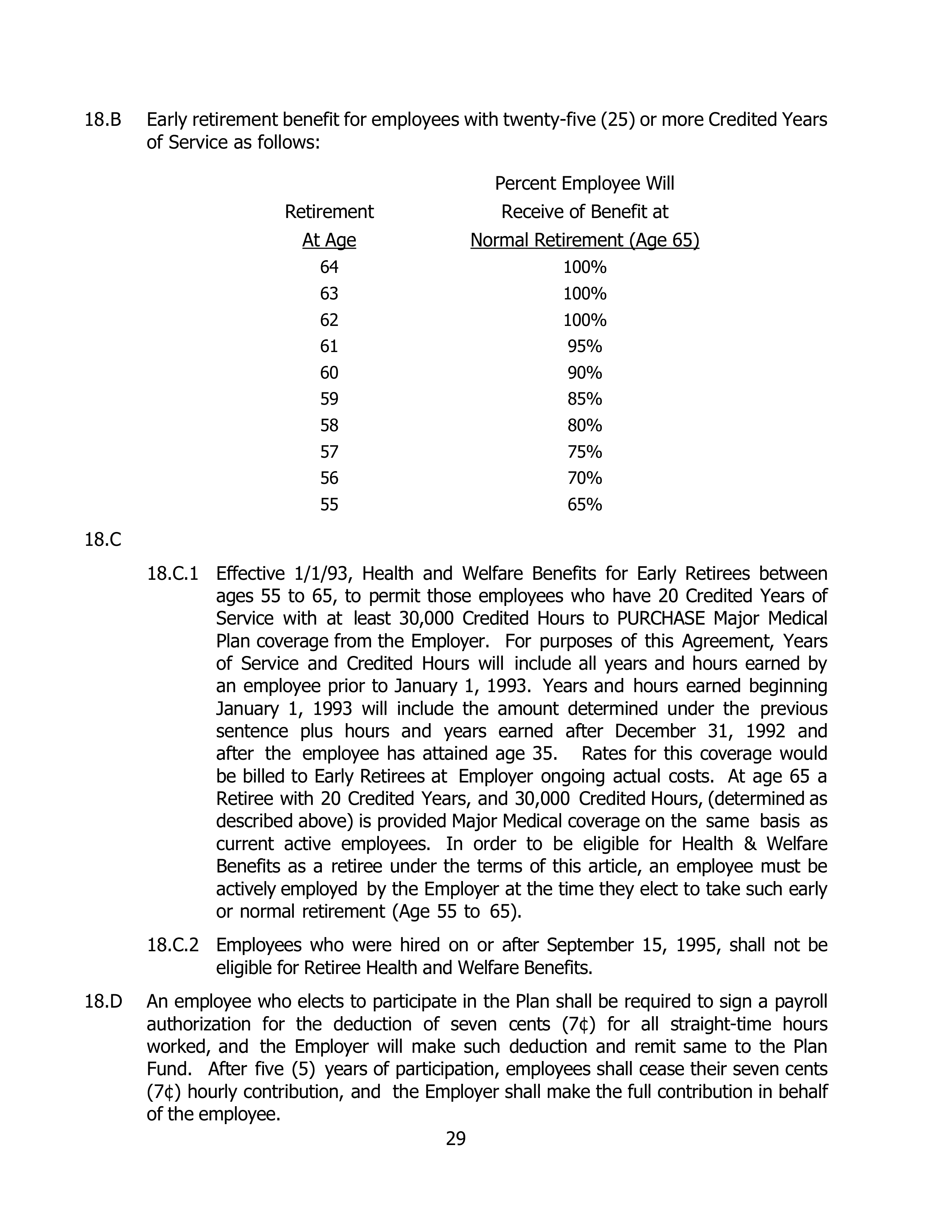
18.A.1.a A Pension Benefit Schedule for employees with five (5) through
ten (10) Credited Years of Service at the rate of $20.00 per
year with a minimum monthly benefit of $100.00 for 5 years
and a minimum monthly benefit of $200.00 for 10 years.
28
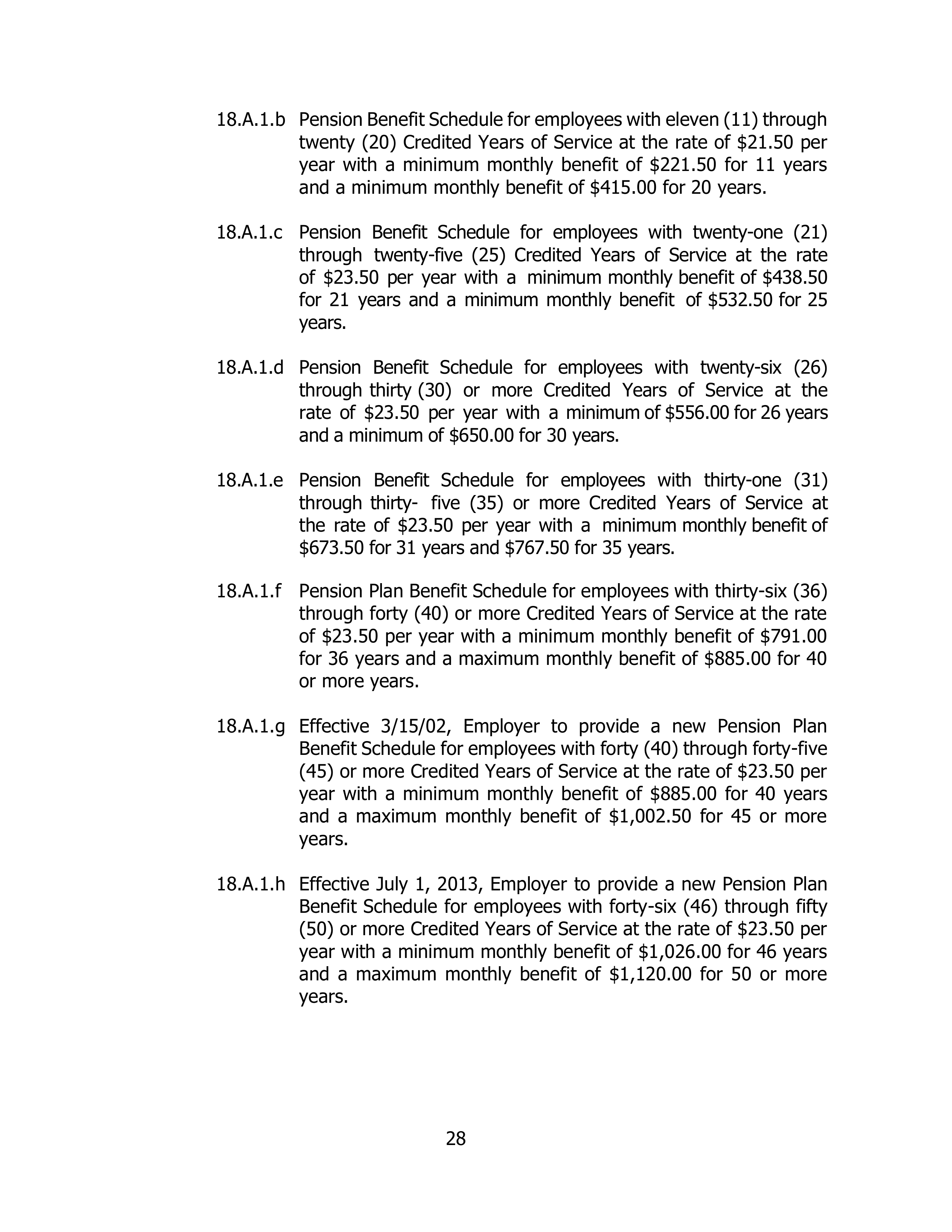
18.A.1.b Pension Benefit Schedule for employees with eleven (11) through
twenty (20) Credited Years of Service at the rate of $21.50 per
year with a minimum monthly benefit of $221.50 for 11 years
and a minimum monthly benefit of $415.00 for 20 years.
18.A.1.c Pension Benefit Schedule for employees with twenty-one (21)
through twenty-five (25) Credited Years of Service at the rate
of $23.50 per year with a minimum monthly benefit of $438.50
for 21 years and a minimum monthly benefit of $532.50 for 25
years.
18.A.1.d Pension Benefit Schedule for employees with twenty-six (26)
through thirty (30) or more Credited Years of Service at the
rate of $23.50 per year with a minimum of $556.00 for 26 years
and a minimum of $650.00 for 30 years.
18.A.1.e Pension Benefit Schedule for employees with thirty-one (31)
through thirty- five (35) or more Credited Years of Service at
the rate of $23.50 per year with a minimum monthly benefit of
$673.50 for 31 years and $767.50 for 35 years.
18.A.1.f Pension Plan Benefit Schedule for employees with thirty-six (36)
through forty (40) or more Credited Years of Service at the rate
of $23.50 per year with a minimum monthly benefit of $791.00
for 36 years and a maximum monthly benefit of $885.00 for 40
or more years.
18.A.1.g Effective 3/15/02, Employer to provide a new Pension Plan
Benefit Schedule for employees with forty (40) through forty-five
(45) or more Credited Years of Service at the rate of $23.50 per
year with a minimum monthly benefit of $885.00 for 40 years
and a maximum monthly benefit of $1,002.50 for 45 or more
years.
18.A.1.h Effective July 1, 2013, Employer to provide a new Pension Plan
Benefit Schedule for employees with forty-six (46) through fifty
(50) or more Credited Years of Service at the rate of $23.50 per
year with a minimum monthly benefit of $1,026.00 for 46 years
and a maximum monthly benefit of $1,120.00 for 50 or more
years.
29
18.B
Early retirement benefit for employees with twenty-five (25) or more Credited Years
of Service as follows:
Retirement
At Age
Percent Employee Will
Receive of Benefit at
Normal Retirement (Age 65)
64
100%
63
100%
62
100%
61
95%
60
90%
59
85%
58
80%
57
75%
56
70%
55
65%
18.C
18.C.1 Effective 1/1/93, Health and Welfare Benefits for Early Retirees between
ages 55 to 65, to permit those employees who have 20 Credited Years of
Service with at least 30,000 Credited Hours to PURCHASE Major Medical
Plan coverage from the Employer. For purposes of this Agreement, Years
of Service and Credited Hours will include all years and hours earned by
an employee prior to January 1, 1993. Years and hours earned beginning
January 1, 1993 will include the amount determined under the previous
sentence plus hours and years earned after December 31, 1992 and
after the employee has attained age 35. Rates for this coverage would
be billed to Early Retirees at Employer ongoing actual costs. At age 65 a
Retiree with 20 Credited Years, and 30,000 Credited Hours, (determined as
described above) is provided Major Medical coverage on the same basis as
current active employees. In order to be eligible for Health & Welfare
Benefits as a retiree under the terms of this article, an employee must be
actively employed by the Employer at the time they elect to take such early
or normal retirement (Age 55 to 65).
18.C.2 Employees who were hired on or after September 15, 1995, shall not be
eligible for Retiree Health and Welfare Benefits.
18.D
An employee who elects to participate in the Plan shall be required to sign a payroll
authorization for the deduction of seven cents (7¢) for all straight-time hours
worked, and the Employer will make such deduction and remit same to the Plan
Fund. After five (5) years of participation, employees shall cease their seven cents
(7¢) hourly contribution, and the Employer shall make the full contribution in behalf
of the employee.
30
18.E
For participation purposes, an employee shall be given a year of service for each
anniversary year (measured from employment date) ending on or after March 1,
1981, in which they have
at least 750 hours of service. For benefit accrual and
vesting purposes an employee shall be given a Credited Year of Service for each
Plan Year ending after March 1, 1981, in which they have
at least 750 hours of
service. All prior years will be on the prior 1,000 hour basis. For full benefit accrual
in a year, 1,500 hours are required.
18.F
Qualified participants, without additional cost to the participant, are covered by the
spouse’s pre-retirement income protection benefit upon the completion of five (5) or
more Credited Years and 7,500 Credited Hours of service.
If a participating employee becomes eligible for this benefit and dies, the
participant’s spouse will receive a lifetime benefit in an amount equal to one-half
of the benefit the participant would have received under the Joint and 50% Survivor
basis. Payments to the spouse may begin, at the election of the spouse, on the
first day of any month following the later of; the date of the employee’s death or
the date the employee would have attained age fifty-five (55), but not later than age
sixty-five (65).
18.G
Any participating employee who attains age sixty-five (65) as an active employee
becomes immediately vested in their accrued benefit. The benefit payable to such a
participant upon retirement will be based on the participant’s completed Credited
Years and Credited Hours of service and the Pension Benefit Schedule in paragraph
18.J. below. If a participant’s credited years are less than five credited years, the
participant’s benefit will be a pro rata amount of benefit on the schedule for 5 years.
18.H
The Plan, as established, shall be administered by a seven (7) member administrative
committee. One member of the committee shall be selected by the Unions signatory
to this Agreement.
18.I
It is agreed that the current provisions of the Pension Plan relative to benefits,
qualifications of employees and rates of contribution, as amended effective
September 15, 1992, shall not be changed prior to September 15, 1995 except
for any improvements negotiated as provided under this Article 19 or as may be
required by federal regulations.
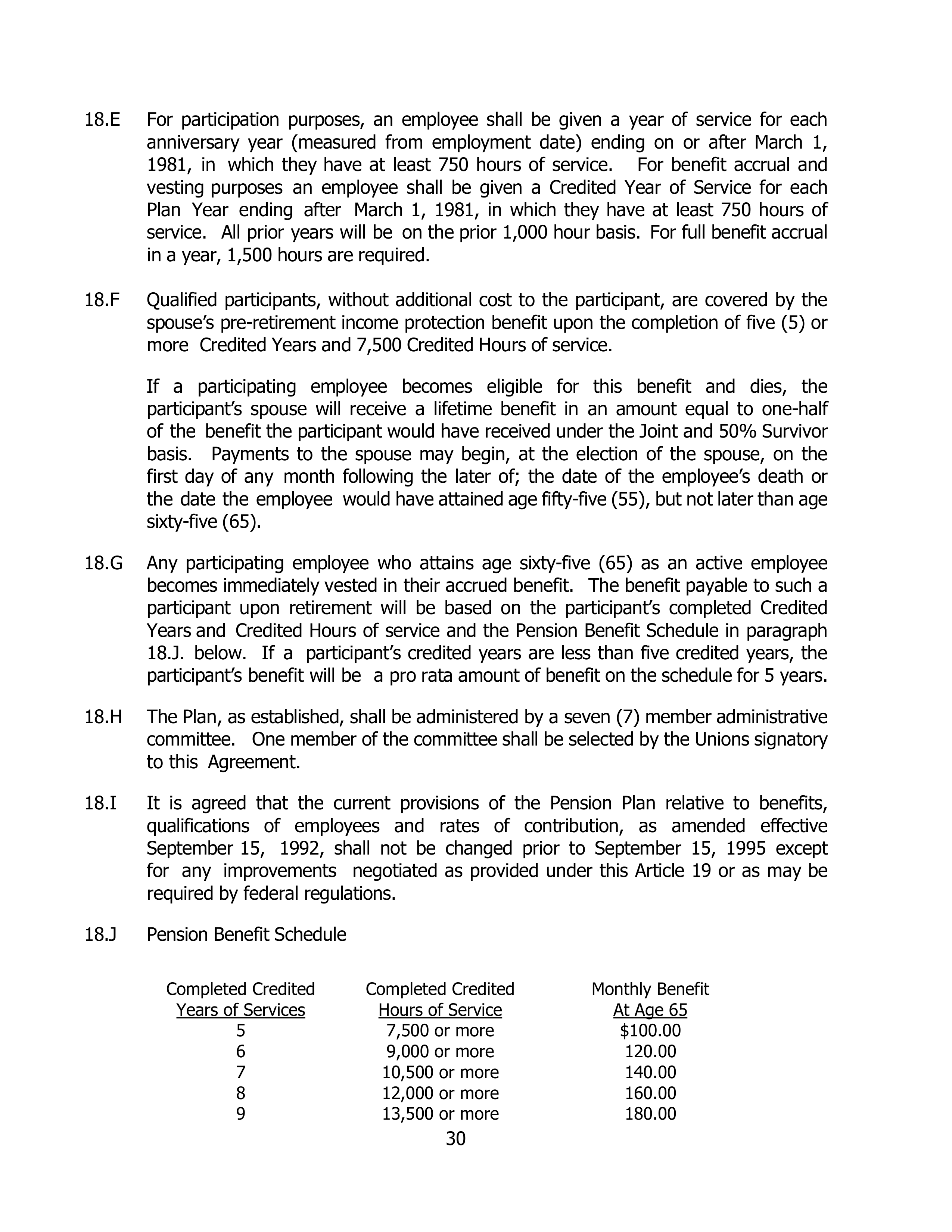
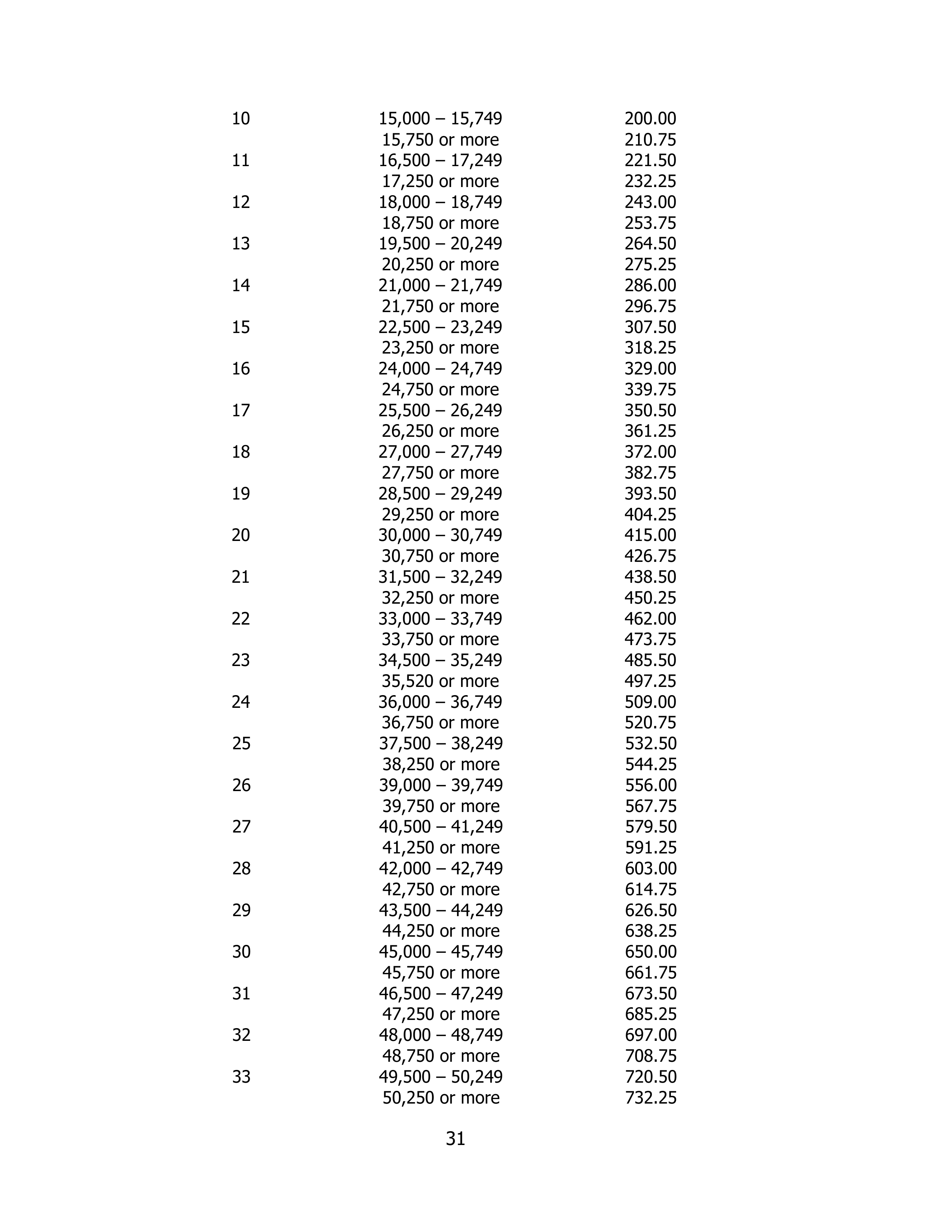
18.J
Pension Benefit Schedule
Completed Credited
Years of Services
Completed Credited
Hours of Service
Monthly Benefit
At Age 65
5
7,500 or more
$100.00
6
9,000 or more
120.00
7
10,500 or more
140.00
8
12,000 or more
160.00
9
13,500 or more
180.00
31
25
37,500 – 38,249
532.50
38,250 or more
544.25
26
39,000 – 39,749
556.00
39,750 or more
567.75
27
40,500 – 41,249
579.50
41,250 or more
591.25
28
42,000 – 42,749
603.00
42,750 or more
614.75
29
43,500 – 44,249
626.50
44,250 or more
638.25
30
45,000 – 45,749
650.00
45,750 or more
661.75
31
46,500 – 47,249
673.50
47,250 or more
685.25
32
48,000 – 48,749
697.00
48,750 or more
708.75
33
49,500 – 50,249
720.50
50,250 or more
732.25
10
15,000 – 15,749
15,750 or more
200.00
210.75
11
16,500 – 17,249
17,250 or more
221.50
232.25
12
18,000 – 18,749
18,750 or more
243.00
253.75
13
19,500 – 20,249
20,250 or more
264.50
275.25
14
21,000 – 21,749
21,750 or more
286.00
296.75
15
22,500 – 23,249
23,250 or more
307.50
318.25
16
24,000 – 24,749
24,750 or more
329.00
339.75
17
25,500 – 26,249
26,250 or more
350.50
361.25
18
27,000 – 27,749
27,750 or more
372.00
382.75
19
28,500 – 29,249
29,250 or more
393.50
404.25
20
30,000 – 30,749
30,750 or more
415.00
426.75
21
31,500 – 32,249
32,250 or more
438.50
450.25
22
33,000 – 33,749
33,750 or more
462.00
473.75
23
34,500 – 35,249
35,520 or more
485.50
497.25
24
36,000 – 36,749
36,750 or more
509.00
520.75
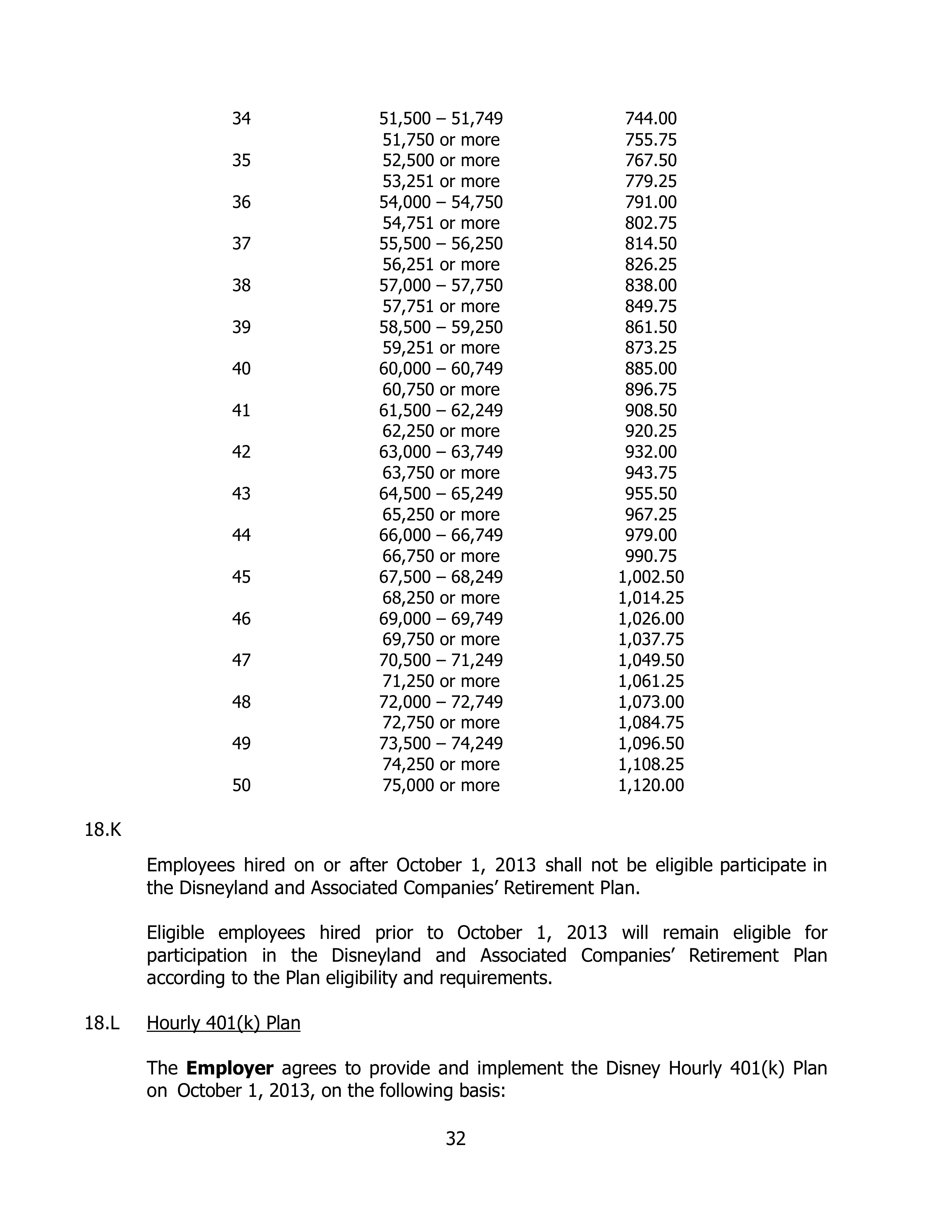
32
34
51,500 – 51,749
744.00
51,750 or more
755.75
35
52,500 or more
767.50
53,251 or more
779.25
36
54,000 – 54,750
791.00
54,751 or more
802.75
37
55,500 – 56,250
814.50
56,251 or more
826.25
38
57,000 – 57,750
838.00
57,751 or more
849.75
39
58,500 – 59,250
861.50
59,251 or more
873.25
40
60,000 – 60,749
885.00
60,750 or more
896.75
41
61,500 – 62,249
908.50
62,250 or more
920.25
42
63,000 – 63,749
932.00
63,750 or more
943.75
43
64,500 – 65,249
955.50
65,250 or more
967.25
44
66,000 – 66,749
979.00
66,750 or more
990.75
45
67,500 – 68,249
1,002.50
68,250 or more
1,014.25
46
69,000 – 69,749
1,026.00
69,750 or more
1,037.75
47
70,500 – 71,249
1,049.50
71,250 or more
1,061.25
48
72,000 – 72,749
1,073.00
72,750 or more
1,084.75
49
73,500 – 74,249
1,096.50
74,250 or more
1,108.25
50
75,000 or more
1,120.00
18.K
Employees hired on or after October 1, 2013 shall not be eligible participate in
the Disneyland and Associated Companies’ Retirement Plan.
Eligible employees hired prior to October 1, 2013 will remain eligible for
participation in the Disneyland and Associated Companies’ Retirement Plan
according to the Plan eligibility and requirements.
18.L
Hourly 401(k) Plan
The
Employer
agrees to provide and implement the Disney Hourly 401(k) Plan
on October 1, 2013, on the following basis:
33
18.L.1 Eligible employees as defined in paragraph (2) below may contribute up
to fifty percent (50%) of their annual hourly straight time wages on a
pretax basis, up to the maximum provided by Federal Law. The
Employer will make a matching contribution equal to seventy-five
percent (75%) of the first four (4%) percent of the employee contribution,
for a maximum Employer contribution of three percent (3%) of straight
time wages up to the IRS maximum. The Employer matching funds
may be invested by the employee in any of the investment option(s)
available under the Disney hourly 401(k) plan.
18.L.2 All Employees over the age of eighteen (18) are eligible to make
contributions to the 401(k) plan.
18.L.3 The
Employer
reserves and retains the right to administer the Plan
internally or through the use of an outside administrator, to change or
modify the investment choices available to the participants of the Plan, to
charge an administrative fee directly to participant accounts, to charge
transaction fees directly to a participant account (for example, loan setup
and ongoing processing fees), to modify the Plan as necessary to remain
in compliance with applicable law, and to make any other design decision,
change or modification to the Plan deemed appropriate by the Employer,
with the exception of vesting requirements, eligibility for participation
and Employer matching contributions.
ARTICLE 19
JURY SERVICE
19.A
Whenever a Regular status employee covered by this Agreement with one (1) or
more years' seniority is summoned for Jury Service and makes prompt application to
their department head and is directed to Human Resources and is then excused from
regularly scheduled work and reports for Jury Service and furnishes the Employer
with a certification of Jury Service, signed by an official of the court reflecting Jury
pay received, the employee shall be paid the difference between Jury pay received
and the amount they would have normally received for their regularly scheduled
shift at their regularly scheduled straight-time hourly rate as provided below.
19.B
Any employee who is called for Jury Service and loses time from work, but is not
accepted, released or their services are terminated, must report to their job promptly,
provided that three (3) hours or more of work time remains on their regularly
scheduled shift.
19.C
An employee who is working on either the second (2
nd
) or the third (3
rd
) shift at the
time of receiving official notice to report for active Jury service shall promptly notify
their supervisor of the fact. The employee shall then as soon as possible be
temporarily rescheduled to work on the first (1
st
) shift for the duration of their period
of Jury service. When an employee is notified that their Jury service obligation has
expired, they shall promptly notify their supervisor of the fact. At least eight (8)
hours of non-work time shall elapse between the old and the new shift.
34
19.D
Jury service pay shall not exceed twenty (20) working days in any one (1) calendar
year.
19.E
The Employer reserves the right not to excuse any eligible employee for Jury service
when such employee's services are needed by the Employer because qualified
replacements are not available or the employee's absence would result in a hardship
to the Employer if the Employer can get the employee excused from Jury service.
19.F
Any eligible employee who is selected to serve on a trial that requires the employee
to be in court Monday through Friday shall, if the employee so requests with three
(3) days prior notice, be allowed to take either Saturday or Sunday as an authorized
day off without pay. The selection of which day is allowed off shall be determined
by the Employer based upon the need for the employee's services.
ARTICLE 20
SENIORITY
20.A
20.A.1.a. The principles of seniority shall be observed in furloughs, layoffs,
recalls, and scheduling of hours on a weekly basis according to
job and group classification and availability by department,
provided additional training is not required. Employees changing
their availability shall not be able to claim hours regularly
assigned other employees but will be entitled to additional hours
as they become available. The parties hereto recognize that
there may be certain deviations from these principles. The
Employer agrees in such instances to discuss proposed
deviations from the application of the seniority principles with the
appropriate Union Representative. The applicable seniority date
within job and group classification for the purpose of layoff,
furlough, and recall shall be the “scheduling seniority” date.
20.A.1.b The Employer shall adhere to the following principles of seniority
when recalling employees from layoff and furlough:
20.A.1.b.1
Recall shall be implemented by park, job
classification, and group classification (Full-Time,
Casual Regular, Casual Temporary). If positions
remain after location/scheduling group, recall will
be by classification seniority.
20.A.1.b.2
Job knowledge may be contemplated in recall. The
Union may request the reason for job knowledge
decisions, and any disputes will be subject to the
Article 7 grievance process.
35
20.A.1.b.3
The Employer will provide the Union at least three
(3) calendar days’ advance notice of recall
including a list of employees to be recalled.
20.A.1.b.4
The employee will be notified of their recall at least
seven (7) calendar days before their required
report to work date.
20.A.1.b.5
The Unions and the Employer shall negotiate any
further details regarding layoff, furlough, and recall
procedures consistent with the above provisions.
20.A.1.c. Selection to Regular Full-Time Group Classification Criteria for Full-
Time Conversions/Openings
The following is the selection criteria for Full-Time openings
under the Disneyland Master Services Agreement.
Where skill and ability, qualifications, work record, and
demonstrated performance
meet the requirements of the
job
, the principles of seniority shall be observed when making
the final determination as to which
employee
(s) shall be
selected for Regular Full-Time positions.
Work record must be clear of all of the following:
•
6 months for attendance discipline
•
6 months for general discipline
•
12 months for safety and courtesy discipline
The
following
factors
will
be
included
in
the
determination of meeting job requirements
:
•
Exhibits excellent Guest Service skills.
•
Meets performance measures where applicable and/or
has specific job skills,
e.g., Distribution Center,
Merchandise Back of House, Seamstress, etc.
A minimum of 1 year relevant work experience is preferred.
Selection Process
The Employer will post Regular Full-Time openings. The
Employer will consider all Regular Full-Time and Casual Regular
employees
for these opening(s) who apply in writing to their
area management and who also meet the selection criteria
referenced above. If there are no
employees
who meet
the selection criteria, the Employer, may hire directly from the
external market to fill the available opening(s).
36
The Employer will select qualified
employees
in the following
order:
•
Current Casual Regular
employees
previously recast
from a Regular Full Time position through the medical
accommodation process due to an occupational injury or
illness.
•
Current Regular Full Time
employees
being recast
through medical accommodation process due to an
occupational injury or illness.
•
Casual
Regular
employees
from
the
same
job
classification (e.g., Attractions CR to Attractions RFT)
who
have averaged thirty (30) or more hours per week during the
preceding twelve (12) months.
•
All other Casual Regular
employees
in the same
classification.
•
Current Regular Full-Time employees from another job
classification within the Master Services Agreement. (For
example, an RFT Merchandise to an RFT Attractions. In this
example, this employee will be placed at the bottom of the
RFT Attractions job classification for seniority and
scheduling purposes).
•
Casual Regular
employees
from another job classification
within the Master Services Agreement (e.g., CR Custodial
to Merchandise RFT)
•
All Casual Temporary employees.
Any Casual Regular
employee
who accepts a RFT role
under a different classification within the Master Services
Agreement must remain in that classification for a period
of eighteen (18) months prior to transferring to a RFT role
in a different classification.
Grievance Procedure
•
Any dispute on the application of the seniority principle
shall be subject to the grievance procedure.
20.A.2 In the event that more than one (1) employee has the same group
classification seniority date, the employee with the most seniority in the
lower permanent group classification shall be scheduled the greater number
of straight-time hours, provided additional training is not required.
37
20.A.3 Additional Work
20.A.3.a If the Employer deems it necessary to utilize overtime on the
posted schedule, the principles of seniority shall be observed to
distribute additional hours first to qualified (job knowledge and
skills and ability) employees who have advised the Employer in
writing or electronically
of their availability and preference for
overtime; and second, in reverse seniority order to qualified,
available employees if involuntary overtime is required.
20.A.3.b If the Employer deems it necessary to add shifts to the posted
schedule, the Employer will call, on a seniority basis by job and
group classification employees who have advised the Employer of
their interest in
additional straight-time hours for that specific
day or specific work week
to distribute additional hours first to
qualified (job knowledge and skills and ability); and second, on
an overtime basis as defined in 20.A.3.a above.
20.A.3.c If the Employer deems it necessary to extend shifts during the
course of daily operations, due regard will be given to seniority by
location or grouping of locations in close physical proximity where
costume changes are not required.
20.A.4 The principles of seniority shall be considered in the selection of working
leads and general leads. However, the final selection shall be at the discretion
of the Employer.
20.A.5 It is further agreed that the seniority principle as herein outlined shall be
by job classification and shall not apply where employees are being
transferred and/or promoted from a bargaining unit classification to a
non-bargaining unit classification. When this occurs the employee shall
maintain their classification seniority for a period of fifty-two (52) consecutive
payroll weeks for purposes of transferring back to such classification. The
above referenced fifty-two (52) weeks may be extended by mutual agreement
of the parties.
20.A.6 Any dispute on the application of the seniority principle shall be subject
to the grievance procedure.
20.A.7 Employees on layoff for twelve (12) months or less who are recalled will
maintain their seniority date and their continuous service date for purposes
of Employer benefits.
20.A.8 A Regular employee who accepts an assignment to a higher group
classification, other than a temporary assignment, shall be given a new
seniority date for that group classification which is identical to the date of
conversion to the new classification.
38
20.A.9 When an employee is permanently transferred to another classification
within the Disneyland Park
and thereafter is laid off, such employee may
exercise their seniority to the extent of their length of service to return
(bump)
to their most recent prior job
classification which would not be
subject to layoff provided both positions are covered under this Agreement
and the employee has remained continuously employed prior to layoff. The
Employer and Union will meet and agree on the determination of
employees eligible for bumping rights under this provision.
20.A.10 A Casual Regular employee who has been converted to Regular Full-Time,
as in Article 20.A.1.c., preceding, may in lieu of layoff accept Casual Regular
employment with retention of their Regular Full-Time rate and seniority
date for the purpose of reclaiming a Regular Full-Time position. Regular
Full-Time employees who have held such position for six (6) months or
longer and elect to accept Casual Regular employment in lieu of layoff shall
have precedence over those employees having a Casual Regular seniority
date. Regular Full-Time employees who have held such position for less
than six (6) months and elect to accept Casual Regular employment in lieu
of layoff shall utilize their previously held Casual Regular seniority date for
scheduling purposes.
20.A.11 Any employee who accepts a position with the Union as an official, other
than a shop steward under this Agreement, will be terminated, but shall be
entitled to return to their former position with no loss of seniority if they
return to their former position within fifty-two (52) consecutive payroll
weeks from the date of accepting such position with the Union. The above
referenced fifty-two (52) weeks may be extended by mutual agreement of
the parties.
20.A.12 Training
20.A.12.a The Employer will determine the necessary training and cross-
training of its employees, in each job classification, dependent
on the Employer’s need.
20.A.12.b Employees who are interested in receiving additional training or
cross-training in other work locations, within their job
classification, shall make this interest known to the Employer, in
writing on an appropriate form provided by the Employer.
20.A.12.b.1 Where skill and ability, qualifications work record,
and demonstrated performance are relatively
equal, the principles of seniority and the
submission of a cross-training interest form
shall
be observed when making the final determination
39
of which employees will be trained or cross-trained
in additional work locations, subject to the
determination by the Employer, that the selected
employee(s) possesses the availability, proper
work status, and seniority that would likely result
in the employee(s) being scheduled in a different
location. Any employee who fails to receive the
additional training on the basis of seniority will be
provided the specific reasons upon their request.
20.A.12.b.2 In addition, the Training language referred in
Article 20.A.12.c.1 above shall also be utilized in
determining which
employees
will be trained or
cross-trained for the purposes of scheduling
Flexibility of Job Classifications (Article 38.C) and
Interchangeability between Disneyland Park and
Disney California Adventure (Article 20.E).
20.A.13 The Employer shall make the determination of the number of shifts and
appropriate shift starting and ending times in each job classification based
upon the needs of the business.
In making such determination it is not the intent of the Employer to
restrict the number of eight (8) hour shifts nor to limit the number of eight
(8) hour shifts with early start times, other than is dictated by legitimate
business needs. An average of at least fifty percent (50%) of opening shifts
(defined as the first shifts of the day) over a
three
(3) month period across
the Disneyland Park in job classifications covered by this agreement shall
be eight (8) hours or longer.
20.B Temporary Full-Time or Temporary Part-Time employment is defined as follows:
20.B.1 Employment during that period of time which is defined in subsection C.1.,
as the summer season.
20.B.2 During the winter season, which is that period of time not included in the
summer season, a Regular employee may be assigned intermittently to a
higher Group Classification, but not to exceed a period of four (4)
consecutive workweeks, otherwise a Regular job opening will be deemed
to exist, unless the position filled is one created by a leave of absence
or vacation.
20.C
Conversion from Casual Temporary to Regular status:
20.C.1 The summer season is deemed to begin with the week containing May 1st
and ends on the last Sunday in September.
40
20.C.2 The Christmas season is deemed to begin on Monday two (2) weeks
preceding the week which contains Christmas Day (December 25), and ends
on the Sunday following New Year's Day (January 1).
20.C.3 The Spring Break season is deemed to begin two (2) weekends (Friday,
Saturday and Sunday) preceding Easter Sunday and ends the next Sunday
that follows Easter Sunday. The two (2) weeks preceding Easter Sunday
shall be available to be counted towards eligibility for attaining a higher
group classification.
20.C.4 An employee who is hired on a Casual Temporary status shall either be laid
off not later than the ending of the summer season or shall be converted
to Regular status the next following week, unless worked under the
provisions of C6 below.
20.C.5 A Casual Temporary employee, who is converted to Regular status, shall
receive a seniority date which is identical with their conversion date.
20.C.6 Casual Temporary employees shall be defined as those hired primarily to
supplement the Regular personnel during the Christmas, Easter, and
summer seasons, or when Regular personnel are not available at straight-
time hours. Casual Temporary employees shall not be used to circumvent
promotion into Regular job openings.
20.C.7 Casual Regular employees shall be defined as those who are hired primarily
to work one of the following options:
20.C.7.a
Weekends (Friday 5pm to closing Sunday) and Holiday Periods;
20.C.7.b
Weekdays (Monday through Thursday after 5pm) and Holiday
Periods; or
20.C.7.c
Seven Day (After 5pm Monday through Friday, all day Saturday
and Sunday) and Holiday Periods.
20.C.8 Seniority shall be separate for Regular Full-Time, and Casual Regular group
classifications.
20.C.9 Casual Regular employees are required to be fully available for work
assignments during the as specified above in subsection 20.C.
Holiday Periods are defined as the week before and the week after Easter,
the week containing Thanksgiving, the week before the week of Christmas
Day through the week after the week containing New Year’s Day, and the
other individual named holidays in Article 14.B.1.
Casual Regular employees who make known to the Employer their
unavailability for work assignments outside of the times defined above,
shall not be required to work nor shall they be able to claim more hours
on a seniority basis.
41
Casual Regular employees willing to accept work assignments outside of the
times defined above may make that interest known to the Employer. Such
work assignments will be provided based on business need and will be
scheduled in seniority order after all employees regularly in the work
assignments defined above have been scheduled.
Casual Regular employees will be given the opportunity a minimum of four
(4) times per year following the full-time conversion process to change their
availability as defined above based on business need and seniority with the
exception that the Seven Day option will be available to all Casual Regular
employees upon request.
The Employer agrees to excuse Casual Regular employees from work if the
employee provides proof of conflicting class exam schedules and provides
alternate availability. The employees shall provide reasonable notice of
their class and exam schedules to the Employer to facilitate scheduling.
20.D
The Employer will give consideration to seniority for scheduled days off and shift
preferences (i.e., shift starting times). Scheduling of days off and shift preferences
shall not be arbitrary or capricious in nature and under no circumstances, will
scheduled days off or shift preference be used as a form of disciplinary action
against an employee
.
20.E
Interchangeability of
employees
between Disneyland Park and Disney California
Adventure.
Disneyland Park may utilize employees from Disney California Adventure or utilize
Disneyland Park employees at Disney California Adventure, including Downtown
Disney & Hotel Stores, when Regular employees are not available at straight time
rates of pay.
20.F
Disneyland Resort College Program
20.F.1 The Disneyland Resort College Program (“DRCP”) is a unique internship
that blends learning components with a paid work experience.
20.F.2 The Program components consist of the Disney College Program and the
Disney Career Start Program.
20.F.2.a The Disney College Program is offered to students who are
currently enrolled in a college or university.
20.F.2.b The Disney Career Start Program is offered to recent high
school graduates.
20.F.2.c Both programs are generally scheduled for a five (5) to seven
(7) month period of time and are generally scheduled to
coincide with the spring and fall semesters of each school year
based on the needs of the business.
42
20.F.2.d As part of the requirements in the Disneyland Resort College
Program, all participants must meet the same standards as other
employees.
20.F.3 Work Status
20.F.3.a Disneyland Resort College Program employees will be statused
as Casual Regular employees under the Agreement. However,
this Disneyland Resort
College Program section of the
agreement will take precedence over any Casual Regular terms
and conditions set forth in this agreement where there is an
actual or perceived difference in Casual Regular terms and
conditions of employment. All other terms and conditions
contained in the agreement pertaining to Casual Regular
employees will remain in effect and apply to Disneyland Resort
College Program employees.
20.F.4 Rate of Pay
20.F.4.a An employee working under the Disneyland Resort College
Program will be paid the Regular Start Rate during the duration
of their entire five (5) to seven (7) month program.
20.F.5 Hours Worked Per Week
20.F.5.a Disneyland Resort College Program employees must be fully
available to work an average of up to thirty two (32) hours per
week during non-Peak seasons, and up to forty (40) hours or
more per week during Peak seasons as defined in Article 20.C
(Seniority), based on the needs of the business.
20.F.6 Benefits
20.F.6.a An employee working under the Disneyland Resort College
Program will be eligible to receive the benefits available to
non-DRCP Casual Regular employees after completing the one
hundred twenty (120) day Casual Regular probationary period
as defined in Article 9., Probationary Period.
20.F.6.b However, under no circumstances will a Disneyland Resort
College Program employee be eligible for the Disney Signature
Health & Welfare Benefit Program while they are
employed
under the terms and conditions of the Disneyland Resort
College Program.
43
20.F.7 Seniority
20.F.7.a Any and all employees working under the Disneyland Resort
College Program will be assigned a scheduling seniority date
of three years prior to the start date of the College Program in
which they are enrolled.
20.F.7.b Seniority after completing the Disneyland Resort College Program
20.F.7.b.1
A Disneyland Resort College Program employee
who completes the Program may apply for either a
Regular Full-Time or Casual Regular position. If
selected, the employee will be given a new
scheduling seniority date based on their new hire
date.
ARTICLE 21
SHOP STEWARD
21.A
The Union shall have the right to designate Shop Stewards. The Local Union shall,
in writing, notify the Labor Relations office of the Employer as to the identity of the
designated Shop Stewards. The Shop Stewards shall have the right to receive,
but not to promote complaints or differences and to discuss and assist in the
adjustment of the same with the appropriate Supervisor. The Employer will not
discriminate against the Shop Stewards in the proper performance of Union duties
provided that such duties do not unreasonably interfere with regular work or with the
work of other employees and the Shop Stewards shall not leave their work station
without first notifying their appropriate Supervisor as to the intent, the reason
therefore, where they can be reached and the estimated time they will be gone.
21.B
Where the complaint or difference involves more than one (1) employee, it must be
presented to Management by the Shop Steward alone for the employees involved
unless presented outside of regular working hours, or unless the division head
involved gives permission for other employees or more than one Shop
Steward
to
attend such presentation.
21.C The Employer agrees upon discharge of an employee, to promptly notify the Shop
Steward. The Employer will notify the Union in the event of the layoff or discharge
of a Shop Steward in advance of the termination, if possible.
21.D An employee may request that a steward be
present during an investigatory
conference with supervision. When operationally feasible, the steward provided will
be from the employee’s Union.
44
ARTICLE 22
WAIVER
The Unions agree that in the event of any violation of Article 1 or Article 6 of this
Agreement by any signatory Union they will in good faith inform their members that such
action by the other Union is a violation of this Agreement and instruct their members that
they are to continue to perform work for the Employer in the usual manner. After they have
done so, no signatory Union or Council shall be liable in damages for any violation of the
provisions of Article 1 or Article 6 of this Agreement so long as they do not assist or participate
in such violation.
ARTICLE 23
DURATION
23.A This Agreement shall be in full force and effect from June 17,
2024
to June 16,
2027
,
and from year to year thereafter, subject to the right of either party to terminate
same on June 16,
2027
, or at any anniversary of June 16, following June 16,
2027
, upon the giving of written notice of termination not less than ninety (90)
days next preceding the effective date of such termination.
23.B Either party shall have the right to open this Agreement for revision or amendment
without termination upon the giving of ninety (90) days written notice of intention
to revise or amend prior to the expiration of the Term.
Except by mutual agreement, negotiations on all such proposals and/or revisions
shall commence no later than May 1,
2027
, or on May 1, of any subsequent year,
providing the steps for revision or amendment have been timely instituted in
accordance with this paragraph.
23.C It is agreed that Disneyland and the Unions signatory to this Agreement shall be and
each of them are hereby precluded from raising issues pertaining to wages and
working conditions during the period commencing June 17,
2024
to June 16,
2027
,
or thereafter, except as shown in Article 8, heretofore.
ARTICLE 24
GENERAL SAVINGS CLAUSE
It is not the intent of either party hereto to violate any laws or any rulings or regulations
of any Governmental authority or agency having jurisdiction of the subject matter of this
Agreement and the parties hereto agree that in the event any provisions of this Agreement
are held or constituted to be void as being in contravention of any such laws, rulings or
regulations, nevertheless, the remainder of this Agreement shall remain in full force and
effect, unless the parts so found to be void are wholly inseparable from the remaining
portion of this Agreement.
45
ARTICLE 25
QUALIFICATIONS
25.A Each of the parties hereto warrants and agrees that it is under no disability of
any kind, whether arising out of its compliance status within the meaning of the
National Labor Relations Act or out of the provision of its Articles of Incorporation,
Constitution, By-Laws, or otherwise, that will prevent it from fully and completely
carrying out and performing each and all of the terms and conditions of this
Agreement, and, further, that it will not by the adoption or amendment of any
provision of its Articles of Incorporation, Constitution, or By-Laws, or by any contract
or any means whatsoever take any action that will prevent or impede it in the full
and complete performance of each and every term and condition hereof. The
warranties and agreements contained in this paragraph are made by each of the
signatories hereto on their own behalf and on behalf of each organization for which
they are acting hereunder. The individuals signing this Agreement in their official
capacity and the signatories hereto hereby guarantee and warrant their authority to
act for and bind the respective parties or organizations whom their signatures purport
to represent, and the Local Unions on whose behalf the said parties are signing the
said Agreement.
25.B
This Agreement contains all of the covenants, stipulations, and provisions agreed
upon by the parties hereto, and no agent or representative of either party has
authority to make and none of the parties shall be bound by nor liable for any
statement, representation, promise, inducement, or agreement not set forth herein;
that any provision in the working rules of the Unions, with reference to the relations
between the Employer and its employees, in conflict with the terms of this Agreement
shall be deemed to be waived and any such rules or regulations which may
hereinafter be adopted by the Unions shall have no application to the work hereunder.
ARTICLE 26
SICK LEAVE
26.A Each Regular Full-Time statused employee will accrue credits toward sick leave and
will be entitled to sick leave in accordance with the formula of
all hours paid in
active status
as described hereinafter. Upon completion of the aforementioned
requirements,
one (1) hour
of sick leave accrual shall be accrued for each
thirty
(30)
hours worked, up to a maximum of
eighty (80)
hours in any twelve (12)
month period. On or after the first ninety (90) days of employment, said sick leave
benefit may be used at any time after accrual without regard to the anniversary
year.
26.B
Unused sick leave may be accumulated up to a maximum of two hundred (200) work
hours. Subject to the amendment outlined in the next following paragraph, sick leave
may be used only for absences due to illness or injury,
or for any purpose in
accordance with applicable State, Local, or Federal Law,
except that upon
46
termination an employee with unused sick leave credits will be paid all such credits
at the employee's regular straight-time rate. Employees will not be entitled to sick
leave pay for illness occurring during vacation or on days on which they are not
scheduled to work.
An eligible employee who accrues in excess of two hundred (200) hours of unused
sick leave will, when requested, be granted additional paid vacation hours equaling
the amount of excess hours. Sick leave credits will be accrued on a floating calendar
year basis.
26.C Sick leave will be paid for the number of hours in the employee's regularly scheduled
shift at the time the sick leave was taken, except as set forth in paragraph F of this
Article. "Continuous service" for the purpose of this Article shall be computed in the
same manner as for vacation.
26.D If six (6) or more consecutive regularly scheduled shifts of sick leave are applied
for, the Employer may request a physician's written statement certifying the nature
and length of the illness and, if so requested, must accompany the request for sick
leave pay. The Employer may require proof of illness in any case if it desires and an
employee not furnishing such proof will not be entitled to sick leave pay.
26.E
In the event an employee incurs a non-occupational illness while at work and the
employee cannot complete their shift, the employee may apply under the provisions
of paragraph D of this Article for sick leave pay covering the unworked balance of
their
regularly scheduled shift, in units of one (1) hour.
26.F
Upon the request of the employee, full sick leave benefits as outlined herein may be
paid to eligible employees until such time as State Disability or Workers
Compensation benefits begin. When State Disability or Workers Compensation
benefits begin any accrued sick leave benefits shall be integrated with State
Disability or Workers Compensation benefits, paying the difference between State
Disability or Workers Compensation benefits and the employee's full wages for time
missed from work until such time as the employee has been released from Disability
and returns to work, or until such time as the sick leave benefits have been used up,
whichever occurs first.
26.G
Eligible employees who have accrued sick leave may utilize sick leave to care for an
ill or injured dependent or as personal days off
, or for any purpose in accordance
with applicable State, Local, or Federal Law.
For information relating to the
process for obtaining pre- approved time off utilizing sick pay, please refer to Article
13.B.2.b – Vacations.
26.H
Upon the request of an eligible employee, the Employer shall provide for payment of
up to all accrued Sick Leave in excess of ninety-six (96) hours. Such request for
payment of an accrued Sick Leave will be accepted two (2x) times per calendar
year during any payroll week of the calendar year.
47
ARTICLE 27
CHECKOFF
27.A
The Employer agrees to withhold, on a weekly basis, the authorized monthly dues,
initiation fees
,
and/or weekly shift fees of the appropriate Union for each employee
who signs a written authorization for such deduction. The money so withheld will
be paid over promptly through direct deposit into the Union’s bank account certified
to the Employer in writing by electronic transfer.
27.B
The Unions will give the Employer a written statement of the authorized monthly
dues, initiation fees, and/or weekly shift fees to be withheld and agree that the
Employer will suffer no loss because of any withholding from employee’s pay
pursuant to this Article.
ARTICLE 28
MANAGEMENT ’S R IG HTS
The operation of the business including but not limited to: its right to determine
qualifications; to establish and change work schedules and assignments; to lay off, or
otherwise release employees from duty for lack of work; to determine the product, price,
method of operation and supervision of the workforce; to create, add, amend, alter,
terminate and/or rescind any or all Resort-wide employee privileges and perquisites
(including, but not limited to; employee discounts, complimentary admission, Main Entrance
Passes, recognition awards, celebrations, etc.); to establish, modify and enforce policies
and rules, including standards of conduct and personal appearance; to determine hours of
operation and appropriate equipment and supplies required; to alter, relocate, suspend
and/or discontinue all or any part of its operations; select and direct employees; determine
the number of classifications and employees required; to institute technological changes;
and otherwise to take such measures as Management may reasonably determine to be
necessary to the orderly, efficient and economical operation of the business,
but shall not
be used so as to defeat any provision of this Agreement. Except as provided in Article 3,
(Union Security), of this Agreement the Employer has the right to establish standards of
employment and to hire, discipline
discharge or suspend an employee for any just cause
which it deems sufficient, but shall not exercise this right so as to defeat any provision of
this Agreement. Furthermore, no employee shall be discharged or discriminated against
because of Union membership or proper activity on behalf of the Union.
The employer shall make reasonable efforts to give the Union
at least thirty (30) days’
notice of major operational changes or work rules; however, failure to provide such notice
will not affect the
Employer’s
right to implement such changes.
48
ARTICLE 29
SUBCONTRACTING
29.A
During the term of this Agreement, the Employer agrees that it will not subcontract
work for the purpose of evading its obligations under this Agreement. However, it is
understood and agreed that the Employer shall have the right to subcontract when:
29.A.1 Where such work is required to be sublet to maintain a legitimate
manufacturer's warranty; or,
29.A.2 Where the subcontracting of work will not result in the termination or layoff,
or the failure to recall from layoff, any permanent employee qualified and
classified to do the work; or,
29.A.3 Where the employees of the Employer lack the skills or qualifications or the
Employer does not possess the requisite equipment for carrying out the work;
or,
29.A.4 Where, because of size, complexity, or time of completion, it is
impractical or uneconomical to do the work with Employer equipment and
personnel.
Notwithstanding anything contained elsewhere in this Article 29
the
Employer may subcontract a portion of its operation on either a temporary
or permanent basis as long as 90% of its operations, functions and facilities
subject to this Agreement are staffed and operated according to the terms
of this Agreement.
ARTICLE 30
BEREAVEMENT LEAVE
30.A
A Regular statused employee bereaved by the death of a member of their immediate
family may take
time off with pay.
30.B
The deceased must have been a spouse, eligible
domestic partner, child,
step/foster child, parent, step/foster parent,
sibling, grandchild, grandparent, or
parent-in-law. If a closer than normal relationship or responsibility existed between
the employee and a relative other than those named, consideration will be given
toward payment of the bereavement benefit.
30.C
Paid bereavement leave may be taken
up to a maximum of five (5) days for each
occurrence. Payment is available only for scheduled work shifts which the individual
misses and will be based on the employee's current rate. The relationship of the
deceased must be noted on the request for bereavement pay status.
30.D
Bereavement leave benefits may not be accumulated, nor will any employee be paid
in lieu of any unused Bereavement Leave.
30.E
An employee who is on an authorized leave of absence is not eligible for
Bereavement Leave.
49
ARTICLE 31
FOUR (4) DAY, TEN (10) HOUR PER DAY WORKWEEK
31.A
The Employer shall have the right to establish a four (4) day, ten (10) hour
per day workweek in any and all departments and/or locations as determined by
the Employer. The Union may present to the Employer a request to establish a four
(4), ten (10) hour per day workweek in any and all departments covered under this
agreement, however, the final decision shall be based upon business needs as
determined by the Employer. The Union may request the reason for the denial of a
particular request.
31.B
The Employer shall give employees assigned to a four (4) day, ten (10) hour
per day workweek, five (5) days notice of such assignment. The five (5) day notice
shall include the day notice is given.
31.C
In assigning employees to a four (4) day, ten hour per day workweek, the Employer
will select employees, including volunteers for such assignment, utilizing the
principles of seniority where skill and ability are relatively equal.
31.D All employees assigned to a four (4) day, ten (10) hour per day workweek shall be
scheduled for three (3) days off in the workweek, at least two (2) days of which will
be consecutive days off. The Employer will endeavor to schedule three (3)
consecutive days off in the workweek, where possible. However, the final schedule
shall be at the discretion of the Employer.
31.E
All time worked over ten (10) hours in any one (1) day or forty (40) hours in any
one (1) workweek shall be compensated for at the rate of one and one-half times
(1½x) the employee's regular rate, including any applicable premium rate. All time
worked over twelve (12) consecutive hours in any one (1) day shall be
compensated for at the rate of two times (2x) the employees regular straight-time
classification rate, including any applicable premium rate.
31.F
31.F.1. When a holiday falls on an eligible employee's (as defined in Article 14)
regularly scheduled day of work, and they are
not required to work on
that day, and their regularly scheduled workweek consists of four (4), ten
(10) hour days, they shall be paid as a holiday premium, ten (10) hours'
pay at their regular straight-time rate of pay including any shift premium
and/or lead pay for that day and that shall be considered as ten (10) hours
worked for the purposes of computing overtime in that workweek.
31.F.2 When a holiday falls on an eligible employee's (as defined in Article 14)
regularly scheduled day of work and the employee works that day, they
shall be paid two times (2x), if they are
a Regular Full or Part-Time employee,
and one and one half times (1½x), if they are
a Casual Regular employee,
their regular straight-time rate of pay for all hours worked in that day.
50
31.F.3 When a holiday falls on an eligible employee's (as defined in Article 14)
regular day of rest, and they do
not work, they shall receive a holiday
premium of eight (8) hours' pay at their straight-time rate of pay including
any shift premium and/or lead pay.
31.F.4 In the event a holiday falls on an eligible employee's (as defined in Article
14) regular day off, and the employee is required to work, they shall be
paid at two times (2x) their rate of pay for all hours worked.
ARTICLE 32
DRUG AND ALCOHOL
MISUSE
32.A
Employees may not report to work or be at work while under the
influence of legal or illegal forms of drugs or alcohol.
The Employer and the
Union recognize that it must endeavor to provide safe and efficient operations for
the protection and benefit of the general public, its guests and its employees. As
part of its effort to achieve that goal, it must require that its work be performed by
employees
not impaired by or
who do not use illegal drugs or misuse alcohol
and/or legal forms of drugs
as follows. In implementing this Drug and
Alcohol
section
, the Employer and the Union encourage employees with a substance
abuse problem to voluntarily come forward and seek medical treatment, as it is
the goal of this procedure to offer employees the opportunity to seek treatment
for substance abuse in order that they may avoid the necessity of discipline by
the Employer for illegal use/misuse of drugs and/or alcohol. Notwithstanding this
objective, the Employer retains the right to discipline employees who violate this
section
, consistent with the above stated goals. For purposes of this Agreement,
the terms "drugs" or "drug tests" shall include both drugs and alcohol, as appropriate.
This section does not prohibit employees from the lawful use and
possession of prescribed medications. Employees must, however, consult
with their doctors about the medication’s effect on their fitness for duty
and ability to work safely; including their ability to remain alert, think
clearly, and quickly respond in emergency situations; and should discuss
any work restrictions with the Employer’s Health Services Department.
32.B
Bargaining unit employees will be subject to drug testing under the following
circumstances:
32.B.1 Drug tests for bargaining unit employees may be required where there is an
objective reasonable suspicion that an employee has an in-system presence
of drugs on the job. For purposes of this Agreement, the terms "employee"
or "bargaining unit employee" includes not only persons employed in
positions covered by the collective bargaining agreement, but also persons
being recalled into such positions.
32.B.2 Drug tests for bargaining unit employees may be required as part of a post-
mishap investigation in cases where:
32.B.2.a The individual(s) subject to testing is directly linked to the mishap.
51
32.B.2.b The mishap resulted in death, injury requiring medical treatment
other than basic first aid, or property damage estimated to exceed
$5,000.
31.B.2.c Testing associated with a mishap will take place as soon as
possible, under the circumstances.
32.B.3 In the event that any government agency duly concerned with Disneyland
advises the Employer that employees in specified classifications will be
required to undergo job certification physical examinations, including drug
tests as a condition of future employment, the Union shall be given
immediate notice of any such requirement or proposed requirement. Such
testing shall be conducted in accordance with the procedures established
by this Agreement and shall not commence until the Union and the
Employer have had a reasonable opportunity to discuss the impact of the
government directive.
32.C
An employee will not be tested under paragraph B-1 above unless their conduct
or other related circumstances provide an objective reasonable basis to believe that
the employee may have ingested drugs or alcohol and/or is suffering from
impairment of some sort while on the job site. (An objective reasonable basis would
include, but not be limited to, slurred speech, unsteady gait, glazed eyes, dilated
pupils, odor of alcohol, and/or erratic behavior.) Such observation will be
confirmed by another member of management wherever possible.
32.D
Any employee directed for testing shall be entitled to request the presence of a
Union representative in pre-test meetings with management. Provided a Union
representative has been requested, no specimen will be collected until the Union
representative can discuss the matter with management and/or the employee. The
Union agrees that the procedures described in Article 32.C and 32.D shall not
operate in a manner that will impede timely collection of a biological specimen.
Refusal to provide a biological specimen will result in immediate discharge without
an opportunity at a later date to reconsider/retract the refusal.
32.E
Any employee who tests negative to any drug test under this Agreement (other than
random tests as a follow-up to rehabilitation) shall be compensated for any
scheduled hours lost, at the appropriate wage rate. Hours lost under such
circumstances shall be treated as time worked for purposes of overtime premium
eligibility.
32.F
Specimen collection for a drug test will be accomplished in a manner compatible
with employee dignity and privacy. Specimen collection shall be accomplished at the
laboratory facilities designated by the Employer. There will be no strip searches or
opposite sex observation. In the usual case, the Employer will not observe specimen
production, but the Union agrees that specimen production may be closely monitored
in those cases where the Employer has an objective reason to believe that the
employee may attempt to contaminate a test specimen.
52
32.G
Test specimens shall be sent only to Laboratory facilities certified by an appropriate
federal or state agency. If a dispute should arise over the selection of drug test
Laboratories, such dispute shall be subject to the grievance and arbitration
procedure. The Laboratory(s) selected must, upon request, identify the drugs tested
for, the methods used, the manufacturers of the test, the analytical limits and levels
used, the methods of reporting results and the chain of custody procedures used to
produce forensically acceptable test results. To be qualified under this article, the
laboratory must participate in a program of "blind proficiency" testing where they
analyze samples sent by an independent party. The laboratory(s) selected will
make such results available to an authorized representative of the Employer and
the affected employee. At the employee's request, the Manager of Labor Relations,
will report test results to the Union Business Manager. All samples will be tested
twice. The first test may be a screening test, but positive screen test results may be
confirmed by the Gas Chromatography/Mass Spectrometry (GC/MS) or an equivalent
scientifically accepted method of confirmation. All final positive tests results will
be reviewed by a toxicologist or a physician prior to release and only confirmed
results will be reported to the employer.
32.H
The standard drug test thresholds for positive screen and GC/MS confirmation tests
shall be the same as those called out in the Federal Register, and may be modified
whenever changed by the Department of Health and Human Services as advances
in technology or other considerations warrant identification of these substances at
other concentrations.
DRUG
Marijuana
Cocaine
Opiates
Amphetamines
Phencyclidine
In the event that the Employer elects to utilize tests other than the EMIT screen or
the GC/MS Confirmation, the Employer will give the Union written notice of the test
methodology used and the threshold levels employed. Positive thresholds for any
other test methodologies will be reviewed with the Union before they are applied.
Any dispute over the acceptability of such alternative test methodologies or the
positive test threshold to be applied shall be resolved through the grievance and
arbitration procedure.
32.I
The laboratory shall preserve a sufficient aliquot specimen as to permit independent
confirmatory testing by the Union and follow-up re-testing at the request of the
Union or the employer. The laboratory shall endeavor to notify the employer and
the Union of positive test results within two (2) working days after receipt of the
specimen. The Union or employee may request a re-test within three (3) working
days from notice of positive test result. Additionally, or as an alternative, the Union
may have the sample tested at a certified laboratory of its choice. Should any test
53
result be negative, the Employer and the Union may jointly select a third certified
laboratory and have the sample tested. The results of the various tests will be
considered by the Employer in determining the appropriate disciplinary action.
32.J
Initial tests and re-tests requested by the Employer will be paid by the Employer; costs
of re-tests for reconciliation will be split between the employee and the
Employer
.
In the event the Employer test is proven to be a false positive, the employee
shall be reimbursed for cost of test procedures paid for by the employee.
32.K
The drug test laboratory and the specimen collection facility must: establish and
maintain a forensically acceptable chain of custody.
32.L
When required, alcohol testing will be conducted using breath samples although
blood samples may be required under exceptional circumstances. Blood samples
will be taken at an appropriate medical facility. Where employees are required
under this policy to submit samples for alcohol testing, the medical facility and
laboratory will use the same or equivalent chain of custody procedures and exercise
the same or an equivalent level of professional care and scientifically accepted
standards and procedures in the collection and testing of samples for the presence
of alcohol as with urine samples for the presence of drugs. For the purposes of
this policy, if a test reveals the presence of alcohol at a level of .08% or more by
weight, it shall be presumed that the employee has violated this policy. If the test
reveals the presence of alcohol in excess of .05% by weight, but less than .08%,
the results of the test will be considered along with all other relevant information
(e.g. employee conduct, speech, performance, etc.) in determining whether the
employee is in violation of this policy. If a test reveals the presence of alcohol of less
than .05% by weight, it shall be presumed that the employee is not under the
influence of alcohol in violation of this policy.
32.M
Test results shall be communicated by the laboratory to the Employers medical
officials or Manager of Labor Relations. The Employer shall be responsible for
maintaining confidentiality of test records and test results will be communicated to
job site management strictly on a "need to know" basis. Employee drug test
records shall not be released outside Health Services
unless
required by
administrative action initiated by the employee or the Union. The employee shall
be entitled to written notification of positive drug test results. Copies of such reports
will be provided to the Union when authorized by the affected employee.
32.N
When and if it becomes necessary to impose discipline for drug-related conduct
or job performance, discipline will be judged by the contractual just cause standard
and will be subject to the grievance/arbitration procedure. Except to the extent the
employee(s) withholds consent as to particular documents personal to them, the
Employer agrees to provide the Union with whatever documentation or information
the Union reasonably requires to process the grievance and/or arbitration. By
establishing this drug policy, neither the Employer nor the Union waive any legal
rights. The parties agree that this drug policy shall not diminish the rights of
individual employees under state or federal law relating to drug testing.
54
32.O
The employer recognizes that employees have a right to privacy and that any adverse
action taken against an employee for off-duty conduct shall take into account the
employee's right to privacy, the impact of the employee's conduct on their job
performance, and the Employer’s image and reputation. Any disciplinary action
for such drug-related conduct will be subject to the grievance procedure with respect
to any alleged off-duty related conduct. The Employer will attempt to balance
the employee's right to privacy in their off-duty time with other legitimate job-
related concerns in weighing the contractual propriety of disciplinary action.
32.P
At the determination of the
Employer
, a random drug/alcohol testing program
may be implemented for certain positions within this Agreement. If such a decision
is made, the
Employer
will meet with the Union to mutually agree to which
positions will be subjected to such random drug/alcohol testing. Such positions that
are deemed to be subject to a random drug/alcohol testing pool will include testing
of the previously mentioned list of drugs in H above and tested at the same levels as
the Federal Register. The
Employer
will provide thirty (30) days advance notice to
Union and employees before instituting the random drug/alcohol testing program.
If such employee whom is subject to the random drug/alcohol testing pool is
subsequently tested and has a positive drug result, such employee will be offered
a one-time opportunity to be referred to the
Employer’s
Employee Assistance
Program (EAP) for rehabilitation. Said employee shall be placed on a leave of
absence [not to exceed the time limits as outlined in Article 17 (Leave of Absence)]
until their rehabilitation program is completed or until they provide medical
documentation that their presence on the job will not jeopardize their own health
and safety, or the health and safety of others. They may be subject to further
testing for up to one year, in addition to being placed back in the random drug
pool. Should said employee test positive in a future drug/alcohol test subsequent
to such return to work, said employee will be terminated.
If any employee refuses to participate in the random drug/alcohol program or
refuses to submit to a requested test as outlined above, such employee shall be
terminated.
32.Q
Any employee who voluntarily comes forward and/or admits to the use of drugs will
not be subject to discipline but will be referred to the Employer’s Employee
Assistance Program (EAP) for rehabilitation. Said employee shall be placed on a
leave of absence [not to exceed the time limits as outlined in Article 17 (Leave of
Absence)] until their rehabilitation program is completed or until they provide
medical documentation that their presence on the job will not jeopardize their own
health and safety, or the health and safety of others.
55
ARTICLE 33
WORKDAY AND WORKWEEK
33.A Scheduling and Definition
33.A.1 As a matter of general practice, employee work schedules will be posted
electronically by Sunday preceding the effective date of the new work
schedule. The Employer shall send a time and date stamped copy (in .pdf
format) of work schedules to the representative affiliates. Upon request
by an employee, the Employer shall print the employee’s individual
schedule.
It shall be the responsibility of each employee to check their
schedule. There shall be no split shifts and all time worked shall be
continuous except for the meal periods.
33.A.2 For all Full-Time employees the regular workday shall be eight (8) hours
and for all employees the regular workweek shall be from 12:00 a.m.
(midnight) on Sunday through 11:59 p.m. the following Saturday.
The regular workweek may be changed by the Employer upon the giving of
two (2) weeks notice to the Union.
33.A.3 All time worked over eight (8) hours in any one (1) day or forty (40) hours
in any one (1) workweek shall be compensated for at the rate of one and
one-half (1½) times the employee's regular straight-time classification rate,
including any applicable premium rate, subject to the modification outlined
in paragraph 4 of this subsection. All time worked over twelve (12)
consecutive hours in any one (1) day shall be compensated for at the rate of
two (2) times the employee's regular straight-time classification rate,
including any applicable premium rate.
33.A.4 Each Full-Time employee shall be assigned two (2) consecutive days off.
However, the Employer may grant two (2) non-consecutive days off to an
employee who requests such a schedule. Any Full-Time employee who
works five (5) straight-time days in the workweek and who is off work on
the first (1st) of their two (2) days off but is required to work on the second
(2nd) of their two (2) days off in that workweek shall receive double time
(2x) pay for that day. Regular Part-Time employees who are temporarily
assigned to work a regular Full-Time schedule will also be eligible for this
benefit.
33.A.5 All employees who work on each of seven (7) consecutive days in the
workweek at the Employer's request will be paid for the seventh (7th) day
at the rate of twice (2x) their regular rate even if their total time is less than
forty (40) hours.
56
33.A.6 Casual Regular employees not eligible to accrue vacation may request
unpaid time off to be considered for approval after Pre-approved
vacation requests have been considered as stated in Article 13.B.5.b.
After the posting period, consideration will be given first to requests that
were submitted during the Pre- approved period and not approved,
followed by those requests submitted within the same week by week-
ending date. When multiple requests for the same time period are
submitted in the same week, paid time off will be granted before unpaid
time off. Such requests will be considered in advance of the schedule.
33.B
The Payroll week will be Sunday through Saturday. When the Employer has at least
thirty (30) days notice of a change in payroll weeks, it will provide the Union with
thirty (30) days notice. If the Employer has less than thirty (30) days notice, it will
provide the Union with as much notice as it has.
The Employer will use its best efforts to avoid scheduling any employee to work
more than seven (7) consecutive days in any combination of workweeks unless
requested to do so by the employee.
In the event the Employer’s need for employees necessitates scheduling an
employee(s) for more than seven (7) consecutive days in any combination of
workweeks, the Employer will attempt to alter such schedule for any employee(s)
who so requests. In making their revised schedule, the Employer will attempt to
approximate an equivalent number of hours.
33.C
After the schedule has been posted, the Employer will endeavor to provide as
much notice as practical of a change in the employee’s schedule, including
overtime.
Once the Employer has posted a schedule and deems it necessary to switch an
employee’s shift to another day, and/or switch their days off, the Employer will first
contact the employee(s) affected by the move of the shift and confirm they are
available for the new shift. This provision will not apply when an entire schedule,
or significant portion thereof, is reposted due to unforeseeable circumstance.
33.D Pyramiding Premiums:
33.D.1 When two (2) or more premium or penalty rates apply to the same hour of
work, the higher will be paid, and there will be no pyramiding of any premium
or penalty rates, except as indicated below in number 2.
33.D.2 Working Lead, General Lead, or a Trainer will receive both the highest skill
and ability premium and the Working Lead, General Lead, or Trainer
premium when the requirements of 33.D.2.a and 33.D.2.b are met.
57
33.D.2.a When an employee receiving Working Lead, General Lead, or
Trainer premium possesses the job knowledge to perform the
function; and
33.D.2.b When an employee receiving Working Lead, General Lead, or
Trainer premium is leading or training employees receiving a
specific skill and ability premium.
33.D.2.c No employee will receive more than two (2) premiums at any
given time.
33.E
Each employee shall receive a fifteen (15) minute rest period in each half of each
employee's work shift. Such rest periods shall be as close to the midpoint of the
half shift as is practicable. The actual schedule of the rest periods shall be
determined by the Employer. An additional rest period will be scheduled for every
two (2) hours worked, or major fraction thereof, beyond eight (8) hours.
33.F
All Regular employees who are to be laid off shall be given five (5) days' advance
notice of such layoff.
33.G
In the event an employee incurs a serious occupational illness or injury, and Health
Services excuses the employee from further work on that day, they shall be paid
the unworked balance of their regular scheduled shift.
33.H
Each employee employed under the terms of this agreement will be relieved of
all duties and released twenty (20) minutes prior and shall be paid to the end of their
assigned shift. This paid early departure time is to compensate employees for all pre-
shift or post-shift work-related activities which might occur.
33.I
Employees required to stay beyond their scheduled shift due to a “slow close” (“slow
close” is defined as a situation where the operating hours of Disneyland Park are
informally extended by management) are to be notified at least two (2) hours in
advance of the end of their shift that they will be required to work a “slow close.”
Employees not so notified shall not be required to work beyond their scheduled
shift. Employees required to work beyond the end of their scheduled shift for all
other reasons will be given as much notice as possible.
Employees required to stay beyond their scheduled shifts for reasons other than
a “slow close” are to be notified at least one (1) hour in advance of the end of their
scheduled shift, when management is aware at least one and one half (1 ½)
hours prior to the end of the employee’s shift that the shift is going to be extended.
When management is aware at least one and one half (1 ½) hours prior to the
end of the employee’s shift that the shift is going to be extended, and one hour
advance notice is not given, the employee shall be paid at one and one half (1 ½)
times the employee’s regular straight time rate of pay for all extended hours under
eight (8) hours and two (2) times the employee’s regular straight time rate of pay
for over eight (8) hours.
58
33.J
Meal periods will be provided in accordance with applicable CA Labor Code. Where
applicable, the meal period may be waived by written mutual consent of both the
employee and the Employer.
An employee may request that the above referenced meal period be from one-half
(½) hour to one (1) hour in duration with the final determination to be made by the
Employer.
33.K
The Employer will provide adequate paid time for those employees who are
required to verify, before leaving the Currency Services office, the amount of cash
and admission media given to them. The Employer will also provide adequate paid
time for those employees who are required to drop off cash at the Currency Services
office at the end of their shift.
33.L
The Unions party to this Agreement agree to cooperate fully with the Employer to
assist the Employer in meeting its obligations as imposed by the S.C.A.Q.M.D.
(
South Coast
Air Quality Management District) and agrees to consider the
implementation of suggested methods which would enable the Employer to meet
such obligations.
33.M
When the Employer requests the appearance of an employee in a legal
proceeding, the employee shall receive straight-time pay for time spent in such
proceeding (not to include travel time). Payment under this provision shall not be
counted as time worked under this Agreement.
33.N
Employees required to park at a designated parking lot where the Employer
provides a “shuttle” service to transfer employees from the designated parking lot
to the work place, shall not be held responsible for any tardies that occur as a
result of the “shuttle” service having a mechanical breakdown, malfunction,
becoming nonoperational due to driver negligence, or other reasons beyond the
control of the employees after boarding the “shuttle.”
33.O
The Employer agrees to implement in this Agreement any Paid Travel Time for
Off-site Parking that may be negotiated with any other collective bargaining
Agreement at the Disneyland Resort, in the same manner and on the same date
that it becomes effective in any other said Agreements.
ARTICLE 34
ATTENDANCE POLICY
Employees must report to work for each scheduled shift, be on time and remain for the full
shift. Absenteeism and tardiness may subject the employee to disciplinary action in
accordance with the Disneyland Resort attendance policy. The Employer will notify the
Union and, upon request, meet and confer in good faith and will give due consideration to
the Union’s expression of concerns and suggestions for any change to the attendance policy
at least sixty (60) days prior to implementation, and, if requested, will bargain with the
Union over the impacts of such changes. Any such effects bargaining, however, shall not
alter or limit the Employer’s right to implement the policy change sixty (60) days after the
notice to the Union.
59
Absences due to work-related injuries, FMLA and/or CFRA leave, paid sick time, authorized
early release from shifts, and approved leave of absence (where the Employer is given
reasonable advanced notice), shall not result in discipline. Attendance discipline will not be
considered as a basis for other disciplinary action after twelve (12) months from the date
of issue.
ARTICLE 35
GROUP CLASSIFICATIONS
35.A
It is recognized that the total number of hours of work in a workweek are divided into
two (2) Group Classifications.
Regular Full-Time
Regularly scheduled to work a minimum of thirty (30) hours per
week up to forty (40) hours per week. Such hours shall be
worked in five (5) days of the workweek or four (4) days of the
workweek when assigned to a four (4) day, ten (10) hour per day
workweek, as determined by the Employer.
Casual Regular
Regularly scheduled to work less than thirty (30) hours* per
week, subject to need and availability.
*A Casual Regular employee may work in excess of thirty (30) hours per week and
still maintain the Casual Regular status provided that the employee is not regularly
scheduled to work five (5) days in the workweek.
The above defines the classifications of work, but is not a guarantee of hours,
except as outlined in the Job Classifications Memorandum of Understanding.
Employees will be scheduled in accordance with Article 20.A.1 and 20.A.2 above.
ARTICLE 36
PREMIUMS
36.A
36.A.1 Any shift which begins at or after 7:00 p.m. and before 10:00 p.m. will be
paid a shift premium of fifteen cents (15¢) per hour in addition to the regular
straight-time rate.
36.A.2 Any shift which begins at or after 10:00 p.m. and before 5:00 a.m. will be
paid a shift premium of seventy-five (75¢) cents per hour in addition to
the regular straight-time rate.
36.A.3 An employee who is contacted by the Employer after completing a work
shift and is required to report for work for their next scheduled shift the
following day at a time prior to the original scheduled start time, and that
original start time would have resulted in a shift premium, shall still be
entitled to the shift premium for the hours worked during that shift.
60
36.B
36.B.1 Employees assigned the responsibility of directly leading other employees
shall receive a Working Lead premium of
one dollar and seventy-five
($1.75)
cents per hour, in addition to their individual statused base rate of
pay, and employees assigned as General Leads shall receive two dollars
($2.00) per hour, in addition to their individual statused base rate of pay.
Working Leads are not supervisors or managers and have no authority to
make personnel decisions such as hiring, terminations, transfers,
promotions or disciplinary action.
36.B.2 Employees assigned to other significant duties and responsibilities above
and beyond those assigned to employees working in the same location(s)
that do not include the responsibility of directly leading other employees,
shall receive a Support premium of one dollar and seventy-five ($1.75)
cents per hour.
36.B.3 Employees shall receive Lead or Support
premiums only if they are in fact
assigned by the Employer to perform these duties and nothing in this
Agreement nor any past practice shall require the Employer to assign any
minimum number of employees to perform Lead or Support
duties nor
preclude the Employer from performing supervisory or administrative
duties with management personnel that previously and or currently is being
performed by Leads. General Lead is defined as a lead person assigned to
duties which include being in charge of one or more Working Leads.
36.B.4 Employees assigned as “Schedulers,” shall receive one dollar and seventy-
five ($1.75) cents per hour in addition to their individual statused base rate
of pay. Employees shall receive the Scheduler premium only if they are in
fact assigned by the Employer to perform Scheduler duties.
36.C
Employees assigned to perform special work service in the stroller or wheelchair
shop to receive fifty (50¢) cents per hour for all hours or fraction thereof worked, in
one-hour increments, in addition to their regular straight-time hourly rate of pay.
(See Premium Schedule below).
36.D
Employees selected and assigned by the Employer to act as Trainers shall receive
a premium of one dollar and seventy-five ($1.75) cents per hour
in addition to their
individual statused base rate, to be paid in one (1) hour increments. Employees
assigned as Trainers that are receiving a Lead or Support
premium, shall not also
be eligible for the Trainer premium. Also, Working Leads that are leading Trainers
or Support, shall not receive the Trainer or Support
Premium in addition to the Lead
Premium.
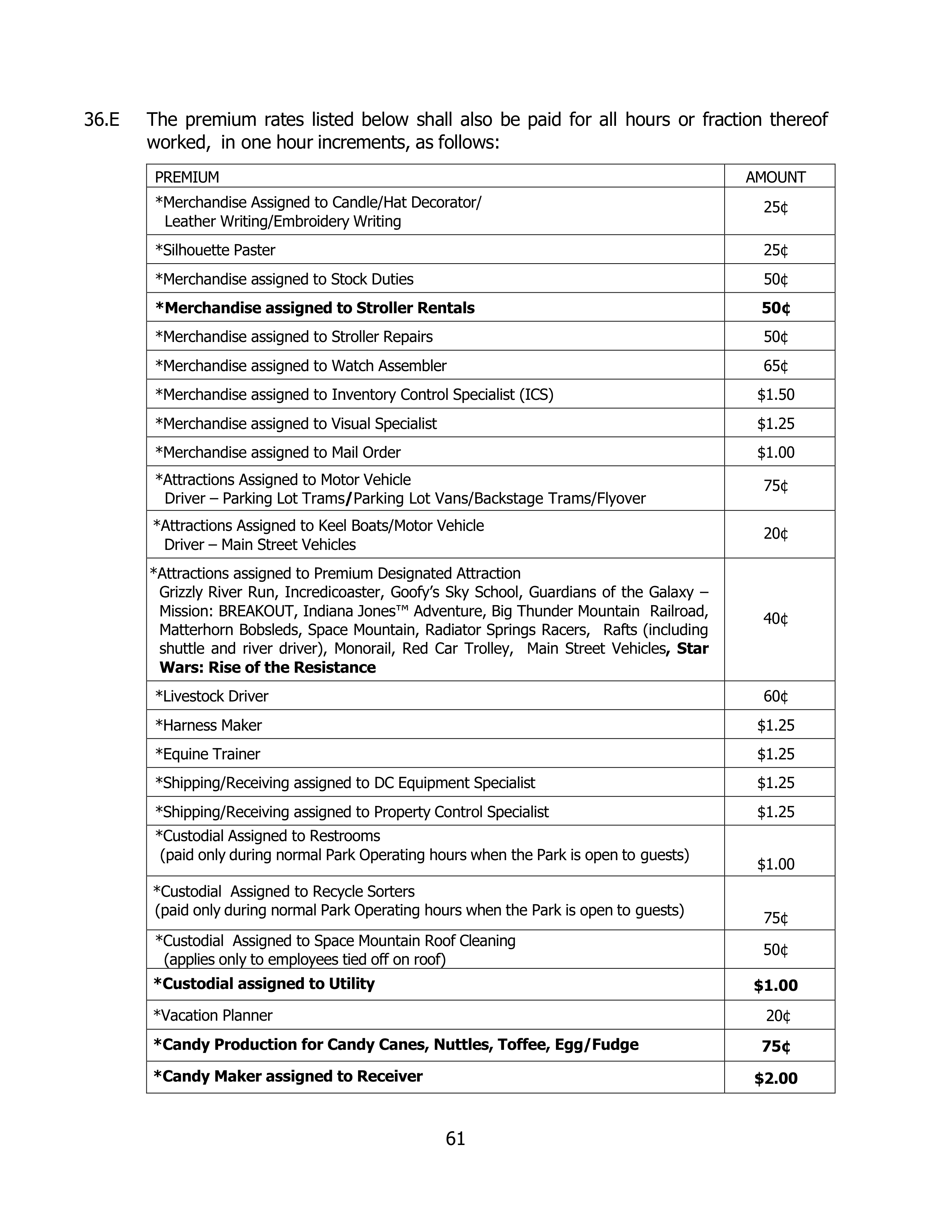
61
36.E
The premium rates listed below shall also be paid for all hours or fraction thereof
worked, in one hour increments, as follows:
PREMIUM
AMOUNT
*Merchandise Assigned to Candle/Hat Decorator/
Leather Writing/Embroidery Writing
25¢
*Silhouette Paster
25¢
*Merchandise assigned to Stock Duties
50¢
*Merchandise assigned to Stroller Rentals
50¢
*Merchandise assigned to Stroller Repairs
50¢
*Merchandise assigned to Watch Assembler
65¢
*Merchandise assigned to Inventory Control Specialist (ICS)
$1.50
*Merchandise assigned to Visual Specialist
$1.25
*Merchandise assigned to Mail Order
$1.00
*Attractions Assigned to Motor Vehicle
Driver – Parking Lot Trams
/
Parking Lot Vans/Backstage Trams/Flyover
75¢
*Attractions Assigned to Keel Boats/Motor Vehicle
Driver – Main Street Vehicles
20¢
*Attractions assigned to Premium Designated Attraction
Grizzly River Run, Incredicoaster, Goofy’s Sky School, Guardians of the
Galaxy –
Mission: BREAKOUT, Indiana Jones™ Adventure, Big Thunder Mountain Railroad,
Matterhorn Bobsleds, Space Mountain, Radiator Springs Racers, Rafts (including
shuttle and river driver), Monorail, Red Car Trolley, Main Street Vehicles
, Star
Wars: Rise of the Resistance
40¢
*Livestock Driver
60¢
*Harness Maker
$1.25
*Equine Trainer
$1.25
*Shipping/Receiving assigned to DC Equipment Specialist
$1.25
*Shipping/Receiving assigned to Property Control Specialist
$1.25
*Custodial Assigned to Restrooms
(paid only during normal Park Operating hours when the Park is open to guests)
$1.00
*Custodial Assigned to Recycle Sorters
(paid only during normal Park Operating hours when the Park is open to guests)
75¢
*Custodial Assigned to Space Mountain Roof Cleaning
(applies only to employees tied off on roof)
50¢
*Custodial assigned to Utility
$1.00
*Vacation Planner
20¢
*Candy Production for Candy Canes, Nuttles, Toffee, Egg/Fudge
75¢
*Candy Maker assigned to Receiver
$2.00
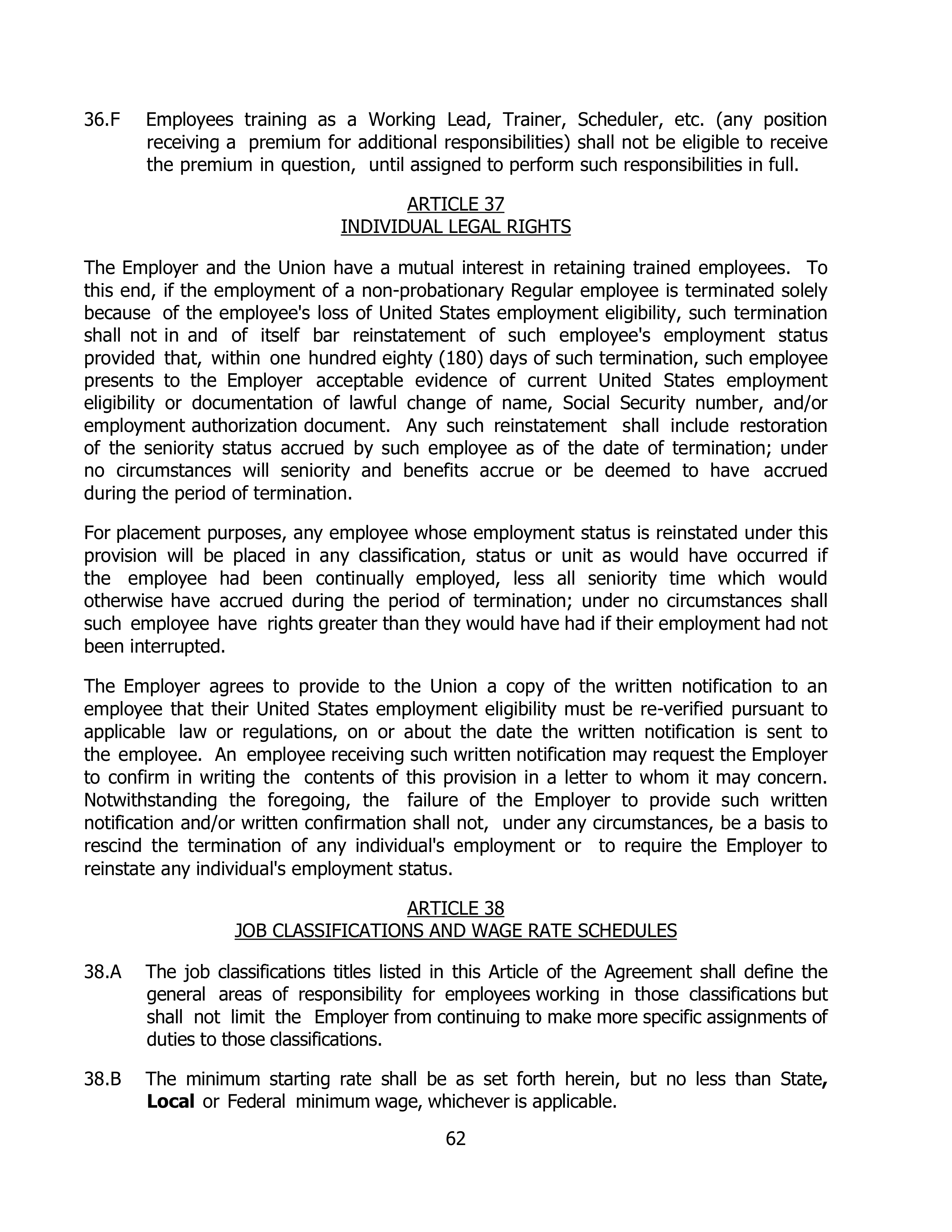
62
36.F Employees training as a Working Lead, Trainer, Scheduler, etc. (any position
receiving a premium for additional responsibilities) shall not be eligible to receive
the premium in question, until assigned to perform such responsibilities in full.
ARTICLE 37
INDIVIDUAL LEGAL RIGHTS
The Employer and the Union have a mutual interest in retaining trained employees. To
this end, if the employment of a non-probationary Regular employee is terminated solely
because of the employee's loss of United States employment eligibility, such termination
shall not in and of itself bar reinstatement of such employee's employment status
provided that, within one hundred eighty (180) days of such termination, such employee
presents to the Employer acceptable evidence of current United States employment
eligibility or documentation of lawful change of name, Social Security number, and/or
employment authorization document. Any such reinstatement shall include restoration
of the seniority status accrued by such employee as of the date of termination; under
no circumstances will seniority and benefits accrue or be deemed to have accrued
during the period of termination.
For placement purposes, any employee whose employment status is reinstated under this
provision will be placed in any classification, status or unit as would have occurred if
the employee had been continually employed, less all seniority time which would
otherwise have accrued during the period of termination; under no circumstances shall
such employee have rights greater than they would have had if their employment had not
been interrupted.
The Employer agrees to provide to the Union a copy of the written notification to an
employee that their United States employment eligibility must be re-verified pursuant to
applicable law or regulations, on or about the date the written notification is sent to
the employee. An employee receiving such written notification may request the Employer
to confirm in writing the contents of this provision in a letter to whom it may concern.
Notwithstanding the foregoing, the failure of the Employer to provide such written
notification and/or written confirmation shall not, under any circumstances, be a basis to
rescind the termination of any individual's employment or to require the Employer to
reinstate any individual's employment status.
ARTICLE 38
JOB CLASSIFICATIONS AND WAGE RATE SCHEDULES
38.A The job classifications titles listed in this Article of the Agreement shall define the
general areas of responsibility for employees working in those classifications but
shall not limit the Employer from continuing to make more specific assignments of
duties to those classifications.
38.B The minimum starting rate shall be as set forth herein, but no less than State
,
Local
or Federal minimum wage, whichever is applicable.
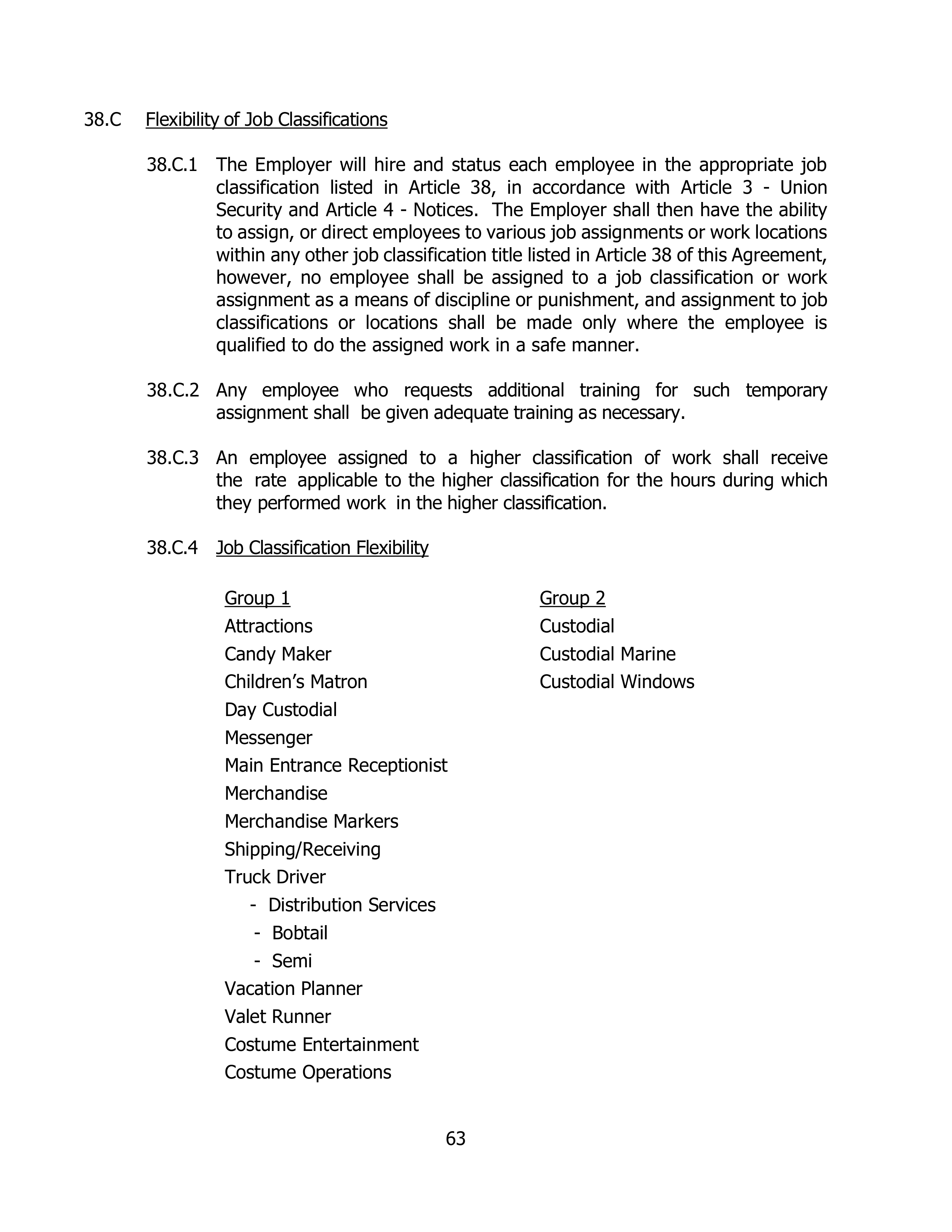
63
38.C Flexibility of Job Classifications
38.C.1 The Employer will hire and status each employee in the appropriate job
classification listed in Article 38, in accordance with Article 3 - Union
Security and Article 4 - Notices. The Employer shall then have the ability
to assign, or direct employees to various job assignments or work locations
within any other job classification title listed in Article 38 of this Agreement,
however, no employee shall be assigned to a job classification or work
assignment as a means of discipline or punishment, and assignment to job
classifications or locations shall be made only where the employee is
qualified to do the assigned work in a safe manner.
38.C.2 Any employee who requests additional training for such temporary
assignment shall be given adequate training as necessary.
38.C.3 An employee assigned to a higher classification of work shall receive
the rate applicable to the higher classification for the hours during which
they performed work in the higher classification.
38.C.4 Job Classification Flexibility
Group 1
Group 2
Attractions
Custodial
Candy Maker
Custodial Marine
Children’s Matron
Custodial Windows
Day Custodial
Messenger
Main Entrance Receptionist
Merchandise
Merchandise Markers
Shipping/Receiving
Truck Driver
- Distribution Services
- Bobtail
- Semi
Vacation Planner
Valet Runner
Costume Entertainment
Costume Operations
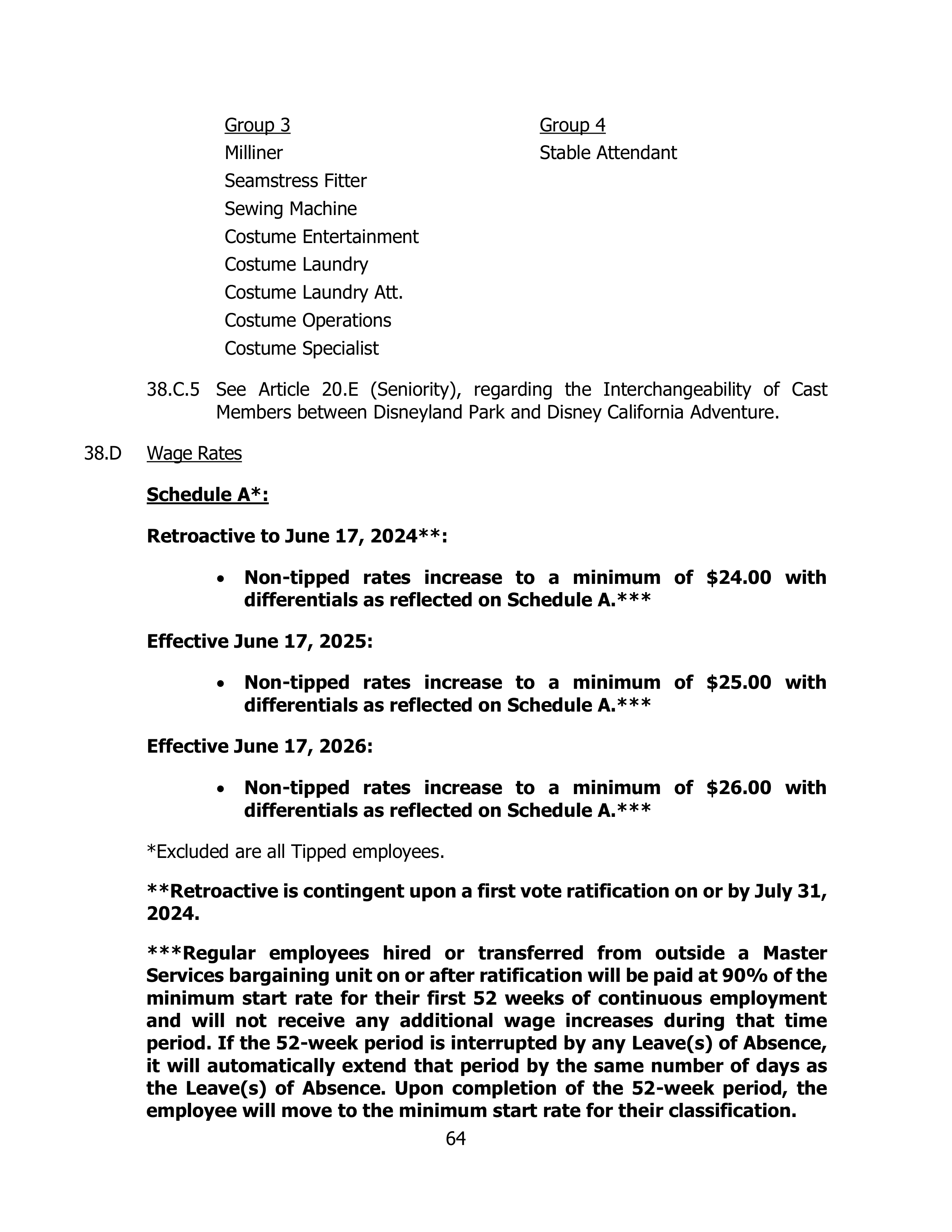
64
Group 3
Group 4
Milliner
Stable Attendant
Seamstress Fitter
Sewing Machine
Costume Entertainment
Costume Laundry
Costume Laundry Att.
Costume Operations
Costume Specialist
38.C.5 See Article 20.E (Seniority), regarding the Interchangeability of Cast
Members between Disneyland Park and Disney California Adventure.
38.D
Wage Rates
Schedule A*:
Retroactive to June 17, 2024**:
•
Non-tipped rates increase to a minimum of $24.00 with
differentials as reflected on Schedule A.***
Effective June 17, 2025:
•
Non-tipped rates increase to a minimum of $25.00 with
differentials as reflected on Schedule A.***
Effective June 17, 2026:
•
Non-tipped rates increase to a minimum of $26.00 with
differentials as reflected on Schedule A.***
*Excluded are all Tipped employees.
**Retroactive is contingent upon a first vote ratification on or by July 31,
2024.
***Regular employees hired or transferred from outside a Master
Services bargaining unit on or after ratification will be paid at 90% of the
minimum start rate for their first 52 weeks of continuous employment
and will not receive any additional wage increases during that time
period. If the 52-week period is interrupted by any Leave(s) of Absence,
it will automatically extend that period by the same number of days as
the Leave(s) of Absence. Upon completion of the 52-week period, the
employee will move to the minimum start rate for their classification.
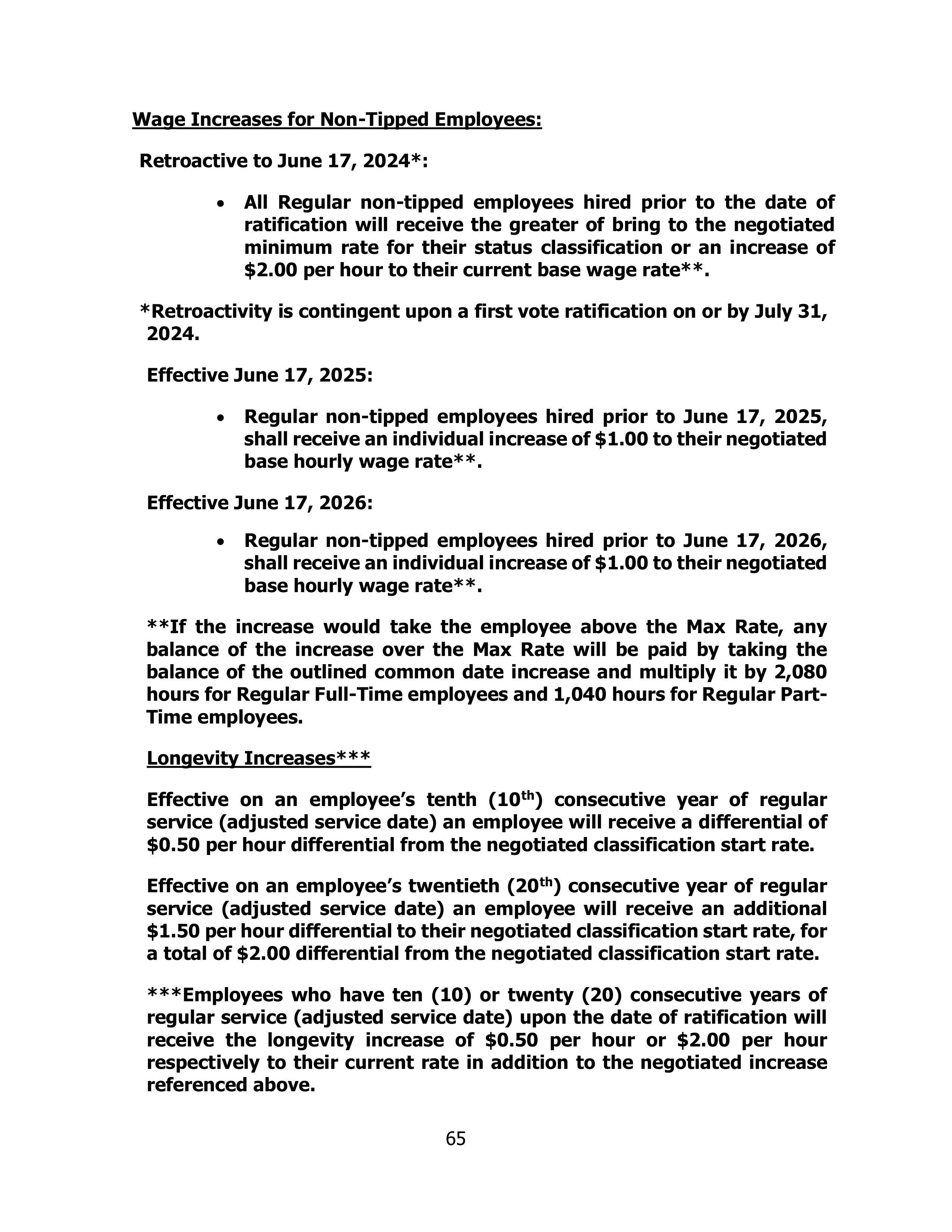
65
Wage Increases for Non-Tipped Employees:
Retroactive to June 17, 2024*:
•
All Regular non-tipped employees hired prior to the date of
ratification will receive the greater of bring to the negotiated
minimum rate for their status classification or an increase of
$2.00 per hour to their current base wage rate**.
*Retroactivity is contingent upon a first vote ratification on or by July 31,
2024.
Effective June 17, 2025:
•
Regular non-tipped employees hired prior to June 17, 2025,
shall receive an individual increase of $1.00 to their negotiated
base hourly wage rate**.
Effective June 17, 2026:
•
Regular non-tipped employees hired prior to June 17, 2026,
shall receive an individual increase of $1.00 to their negotiated
base hourly wage rate**.
**If the increase would take the employee above the Max Rate, any
balance of the increase over the Max Rate will be paid by taking the
balance of the outlined common date increase and multiply it by 2,080
hours for Regular Full-Time employees and 1,040 hours for Regular Part-
Time employees.
Longevity Increases***
Effective on an employee’s tenth (10
th
) consecutive year of regular
service (adjusted service date) an employee will receive a differential of
$0.50 per hour differential from the negotiated classification start rate.
Effective on an employee’s twentieth (20
th
) consecutive year of regular
service (adjusted service date) an employee will receive an additional
$1.50 per hour differential to their negotiated classification start rate, for
a total of $2.00 differential from the negotiated classification start rate.
***Employees who have ten (10) or twenty (20) consecutive years of
regular service (adjusted service date) upon the date of ratification will
receive the longevity increase of $0.50 per hour or $2.00 per hour
respectively to their current rate in addition to the negotiated increase
referenced above.
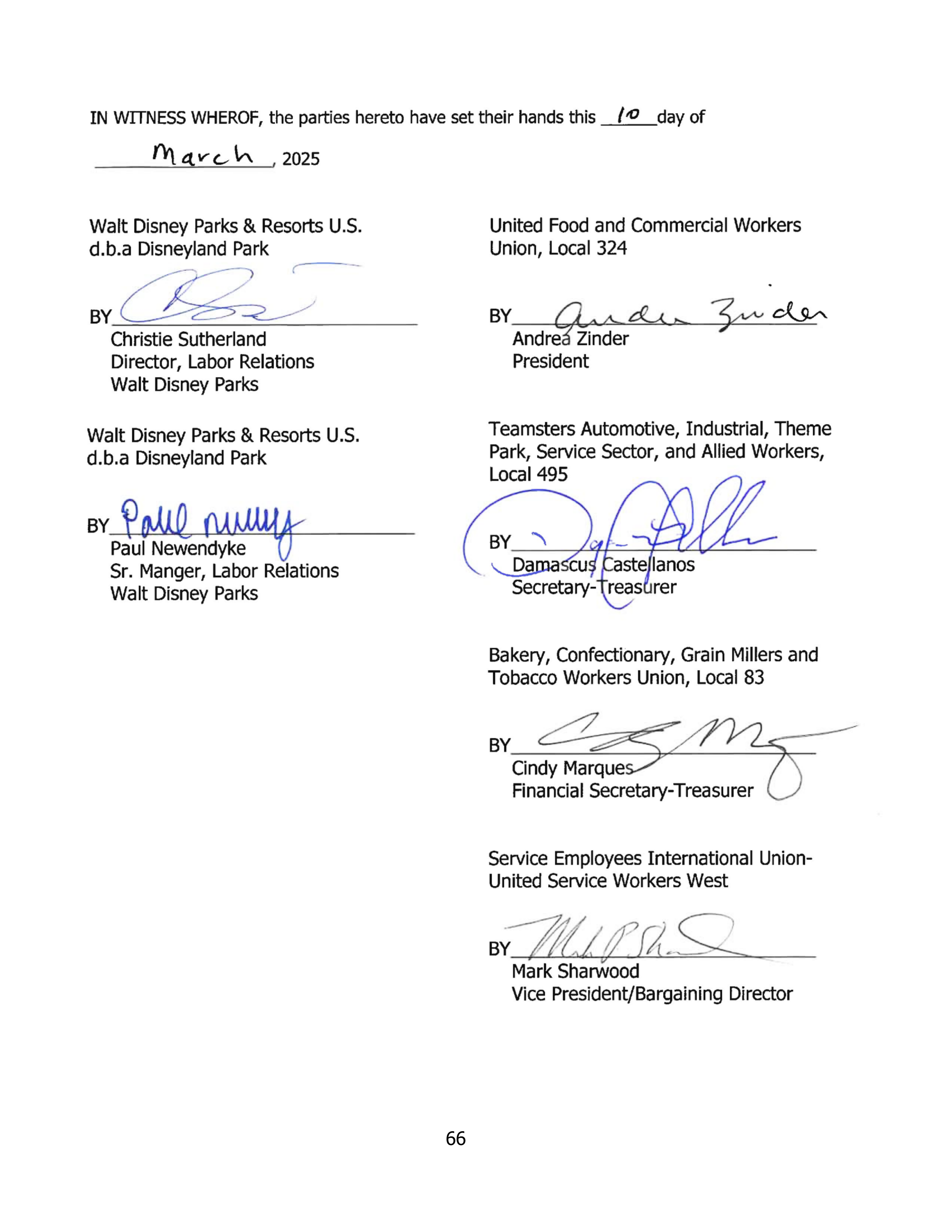
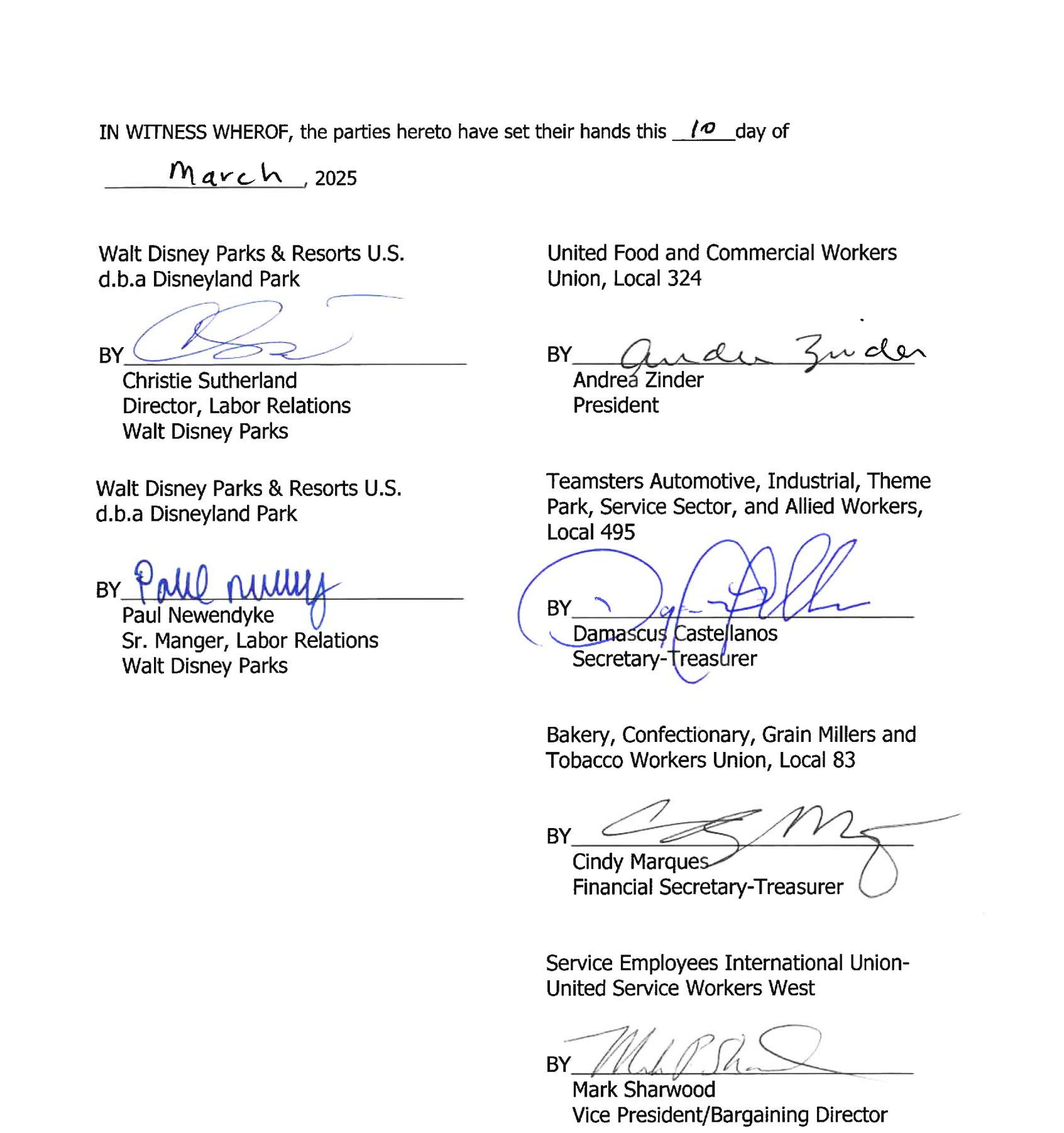
66
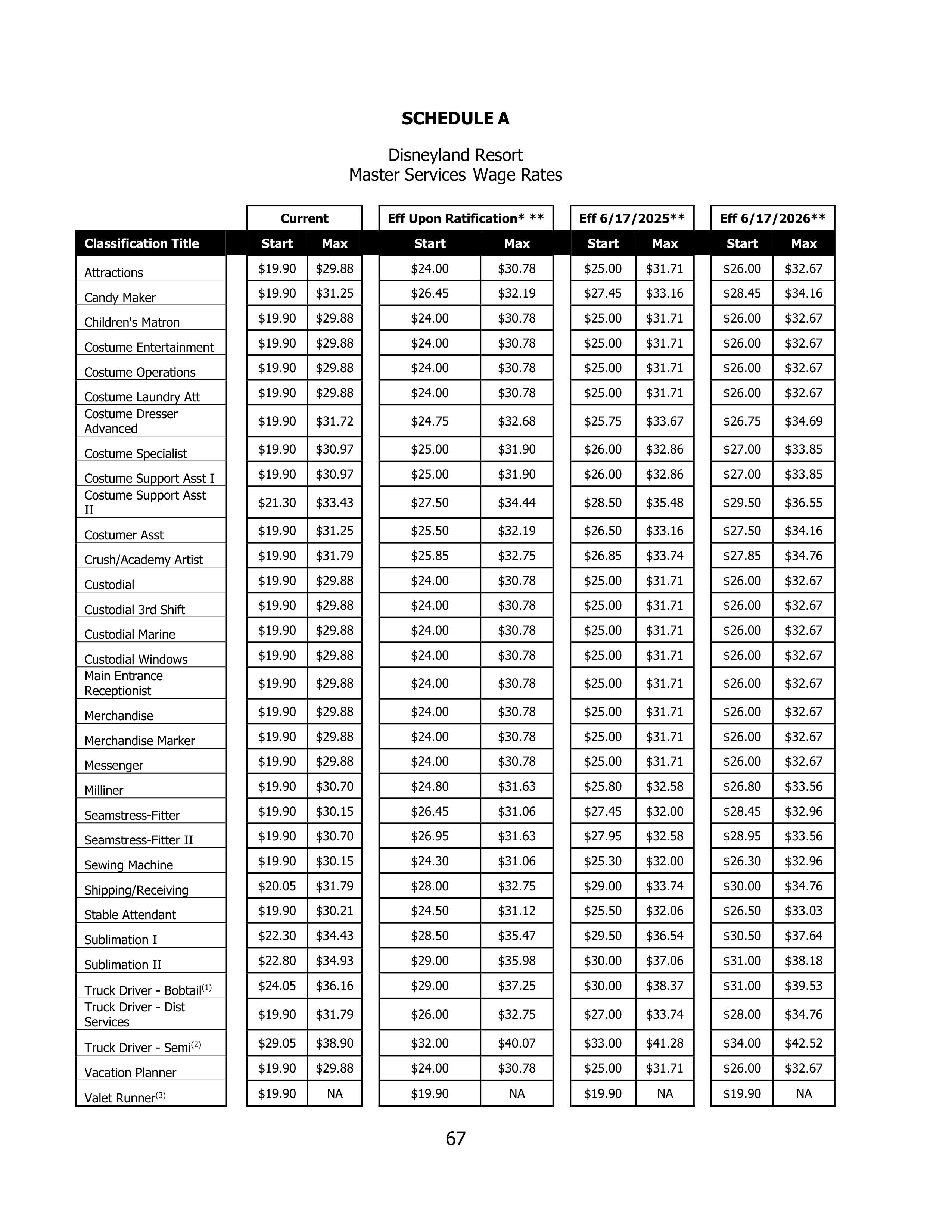
67
SCHEDULE A
Disneyland Resort
Master Services Wage Rates
Current
Eff Upon Ratification* **
Eff 6/17/2025**
Eff 6/17/2026**
Classification Title
Start
Max
Start
Max
Start
Max
Start
Max
Attractions
$19.90
$29.88
$24.00
$30.78
$25.00
$31.71
$26.00
$32.67
Candy Maker
$19.90
$31.25
$26.45
$32.19
$27.45
$33.16
$28.45
$34.16
Children's Matron
$19.90
$29.88
$24.00
$30.78
$25.00
$31.71
$26.00
$32.67
Costume Entertainment
$19.90
$29.88
$24.00
$30.78
$25.00
$31.71
$26.00
$32.67
Costume Operations
$19.90
$29.88
$24.00
$30.78
$25.00
$31.71
$26.00
$32.67
Costume Laundry Att
$19.90
$29.88
$24.00
$30.78
$25.00
$31.71
$26.00
$32.67
Costume Dresser
Advanced
$19.90
$31.72
$24.75
$32.68
$25.75
$33.67
$26.75
$34.69
Costume Specialist
$19.90
$30.97
$25.00
$31.90
$26.00
$32.86
$27.00
$33.85
Costume Support Asst I
$19.90
$30.97
$25.00
$31.90
$26.00
$32.86
$27.00
$33.85
Costume Support Asst
II
$21.30
$33.43
$27.50
$34.44
$28.50
$35.48
$29.50
$36.55
Costumer Asst
$19.90
$31.25
$25.50
$32.19
$26.50
$33.16
$27.50
$34.16
Crush/Academy Artist
$19.90
$31.79
$25.85
$32.75
$26.85
$33.74
$27.85
$34.76
Custodial
$19.90
$29.88
$24.00
$30.78
$25.00
$31.71
$26.00
$32.67
Custodial 3rd Shift
$19.90
$29.88
$24.00
$30.78
$25.00
$31.71
$26.00
$32.67
Custodial Marine
$19.90
$29.88
$24.00
$30.78
$25.00
$31.71
$26.00
$32.67
Custodial Windows
$19.90
$29.88
$24.00
$30.78
$25.00
$31.71
$26.00
$32.67
Main Entrance
Receptionist
$19.90
$29.88
$24.00
$30.78
$25.00
$31.71
$26.00
$32.67
Merchandise
$19.90
$29.88
$24.00
$30.78
$25.00
$31.71
$26.00
$32.67
Merchandise Marker
$19.90
$29.88
$24.00
$30.78
$25.00
$31.71
$26.00
$32.67
Messenger
$19.90
$29.88
$24.00
$30.78
$25.00
$31.71
$26.00
$32.67
Milliner
$19.90
$30.70
$24.80
$31.63
$25.80
$32.58
$26.80
$33.56
Seamstress-Fitter
$19.90
$30.15
$26.45
$31.06
$27.45
$32.00
$28.45
$32.96
Seamstress-Fitter II
$19.90
$30.70
$26.95
$31.63
$27.95
$32.58
$28.95
$33.56
Sewing Machine
$19.90
$30.15
$24.30
$31.06
$25.30
$32.00
$26.30
$32.96
Shipping/Receiving
$20.05
$31.79
$28.00
$32.75
$29.00
$33.74
$30.00
$34.76
Stable Attendant
$19.90
$30.21
$24.50
$31.12
$25.50
$32.06
$26.50
$33.03
Sublimation I
$22.30
$34.43
$28.50
$35.47
$29.50
$36.54
$30.50
$37.64
Sublimation II
$22.80
$34.93
$29.00
$35.98
$30.00
$37.06
$31.00
$38.18
Truck Driver - Bobtail
(1)
$24.05
$36.16
$29.00
$37.25
$30.00
$38.37
$31.00
$39.53
Truck Driver - Dist
Services
$19.90
$31.79
$26.00
$32.75
$27.00
$33.74
$28.00
$34.76
Truck Driver - Semi
(2)
$29.05
$38.90
$32.00
$40.07
$33.00
$41.28
$34.00
$42.52
Vacation Planner
$19.90
$29.88
$24.00
$30.78
$25.00
$31.71
$26.00
$32.67
Valet Runner
(3)
$19.90
NA
$19.90
NA
$19.90
NA
$19.90
NA
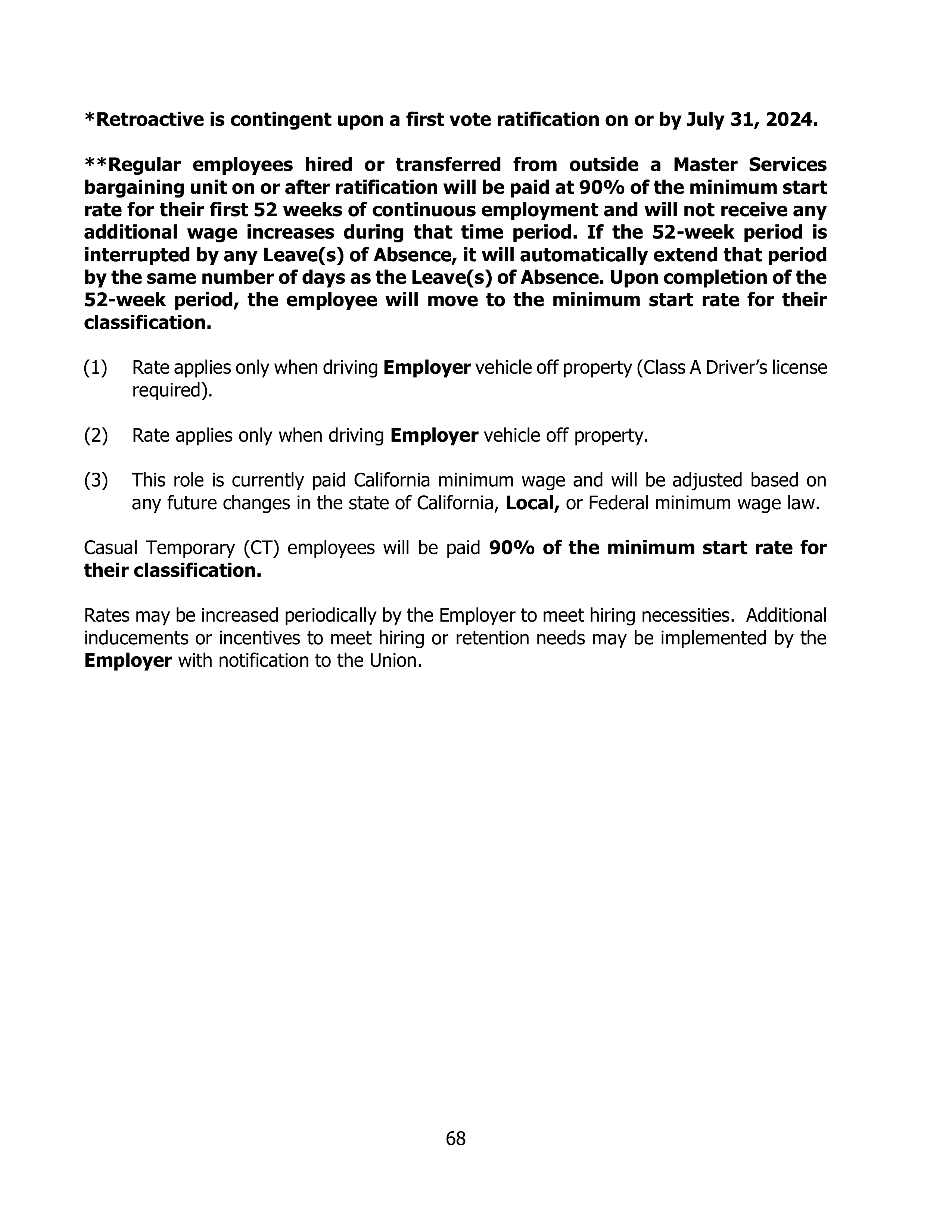
68
*Retroactive is contingent upon a first vote ratification on or by July 31, 2024.
**Regular employees hired or transferred from outside a Master Services
bargaining unit on or after ratification will be paid at 90% of the minimum start
rate for their first 52 weeks of continuous employment and will not receive any
additional wage increases during that time period. If the 52-week period is
interrupted by any Leave(s) of Absence, it will automatically extend that period
by the same number of days as the Leave(s) of Absence. Upon completion of the
52-week period, the employee will move to the minimum start rate for their
classification.
(1) Rate applies only when driving
Employer
vehicle off property (Class A Driver’s license
required).
(2) Rate applies only when driving
Employer
vehicle off property.
(3) This role is currently paid California minimum wage and will be adjusted based on
any future changes in the state of California,
Local,
or Federal minimum wage law.
Casual Temporary (CT) employees will be paid
90% of the minimum start rate for
their classification.
Rates may be increased periodically by the Employer to meet hiring necessities. Additional
inducements or incentives to meet hiring or retention needs may be implemented by the
Employer
with notification to the Union.
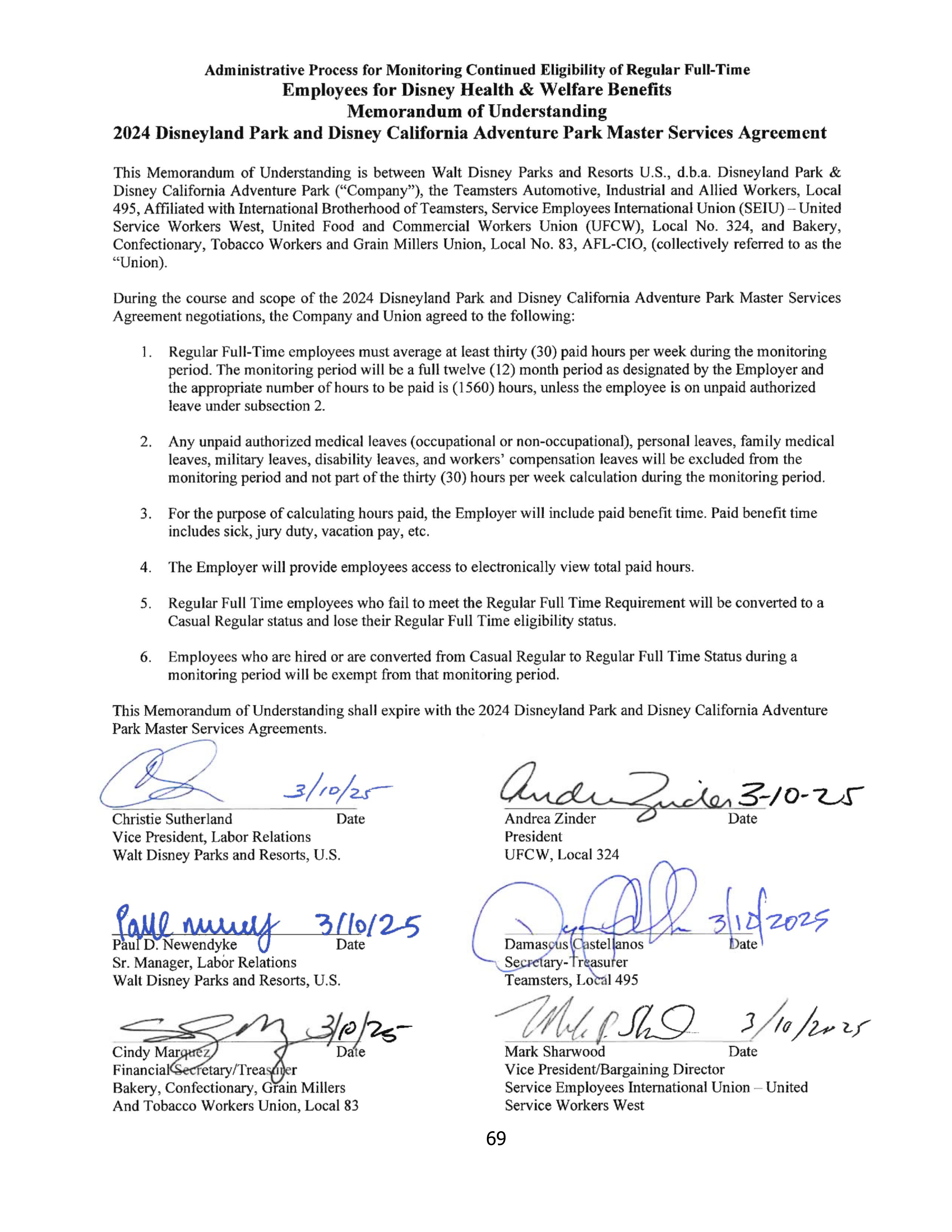
69
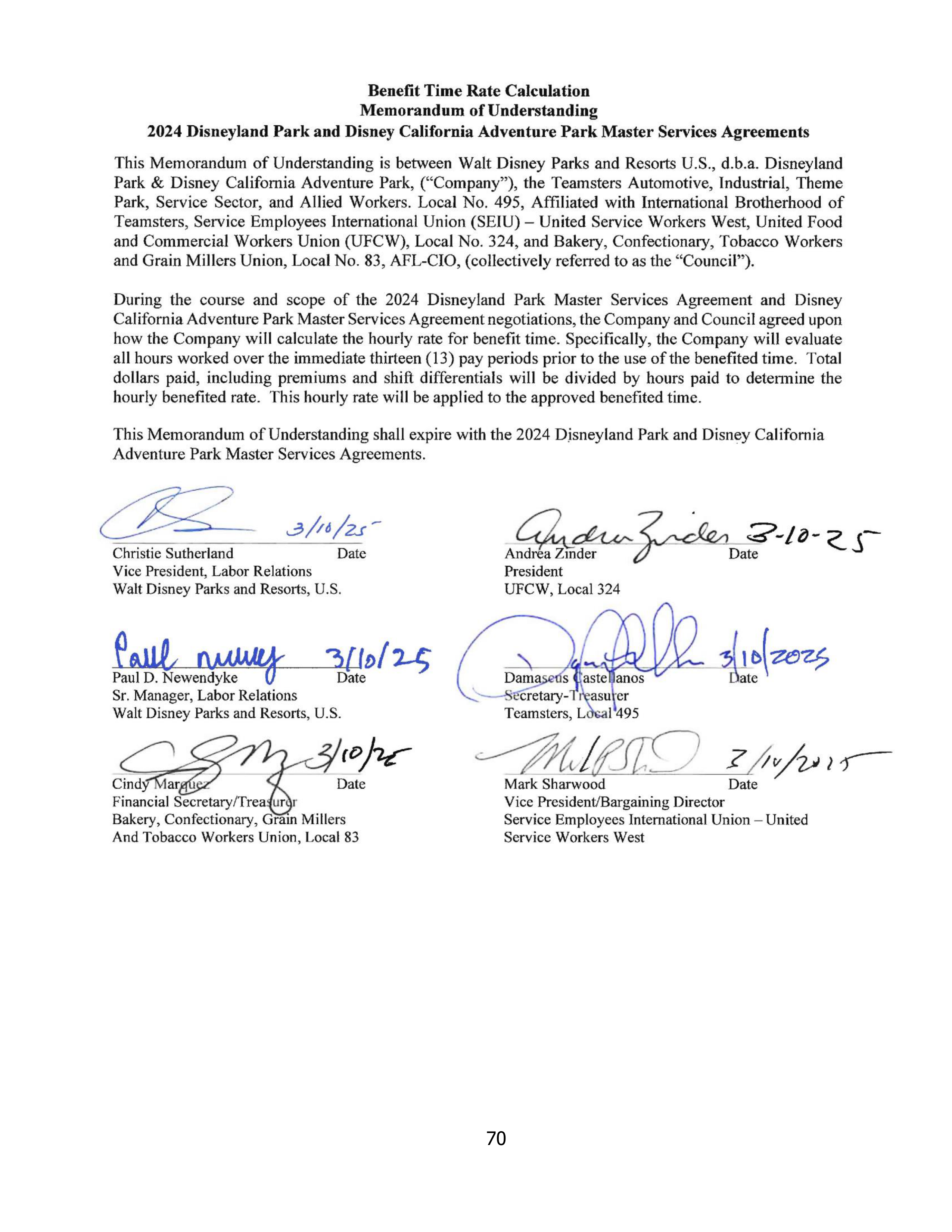
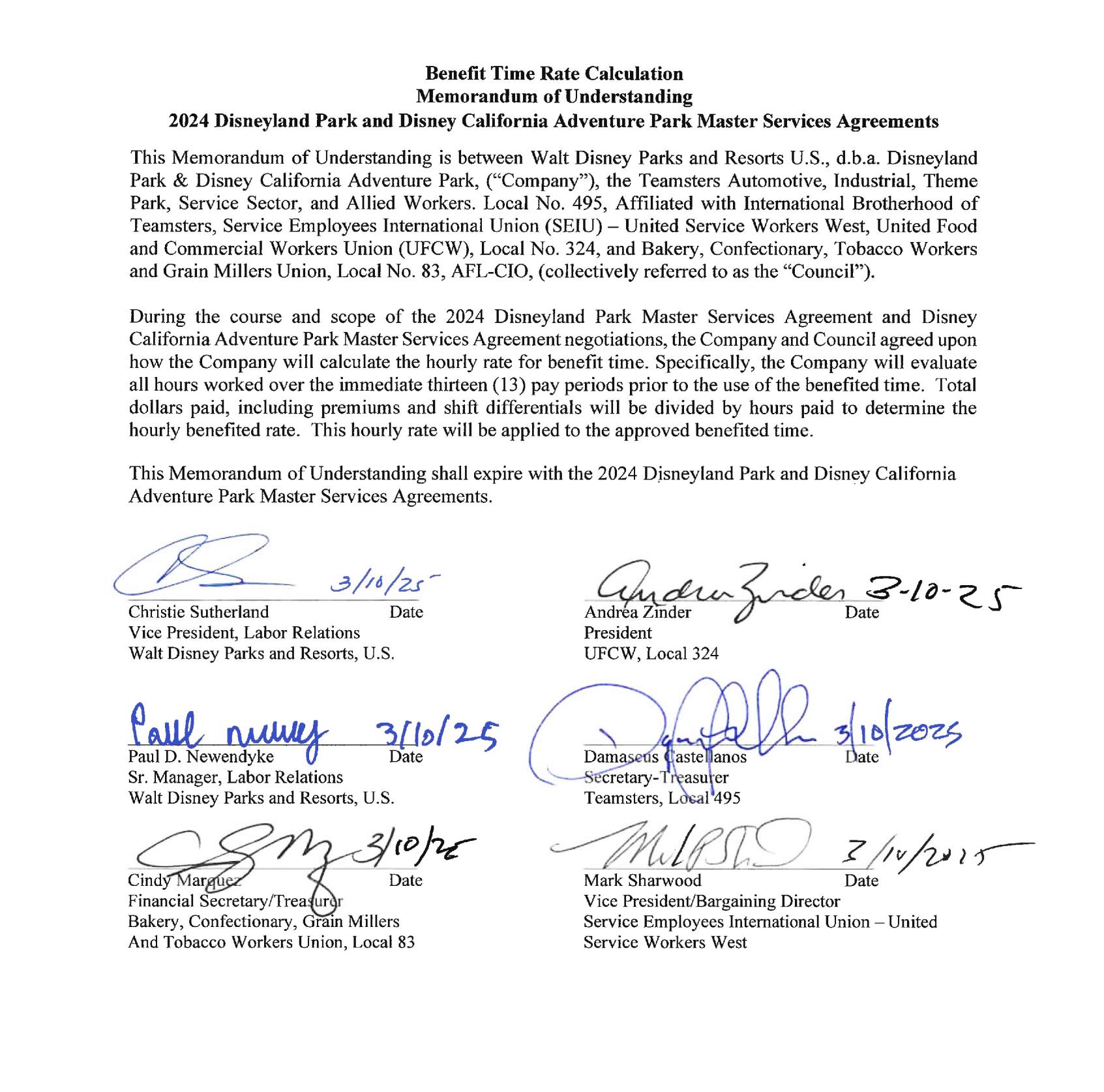
70
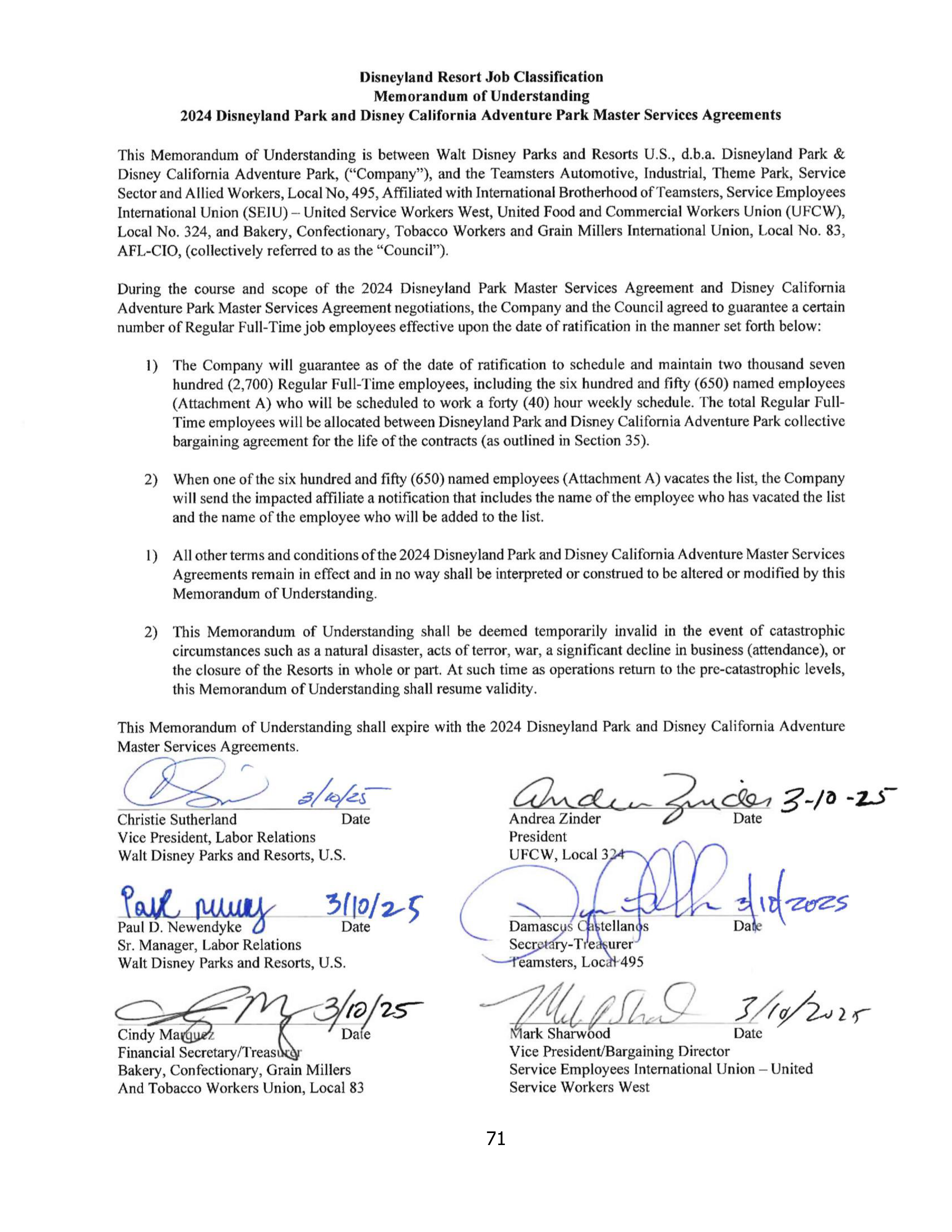
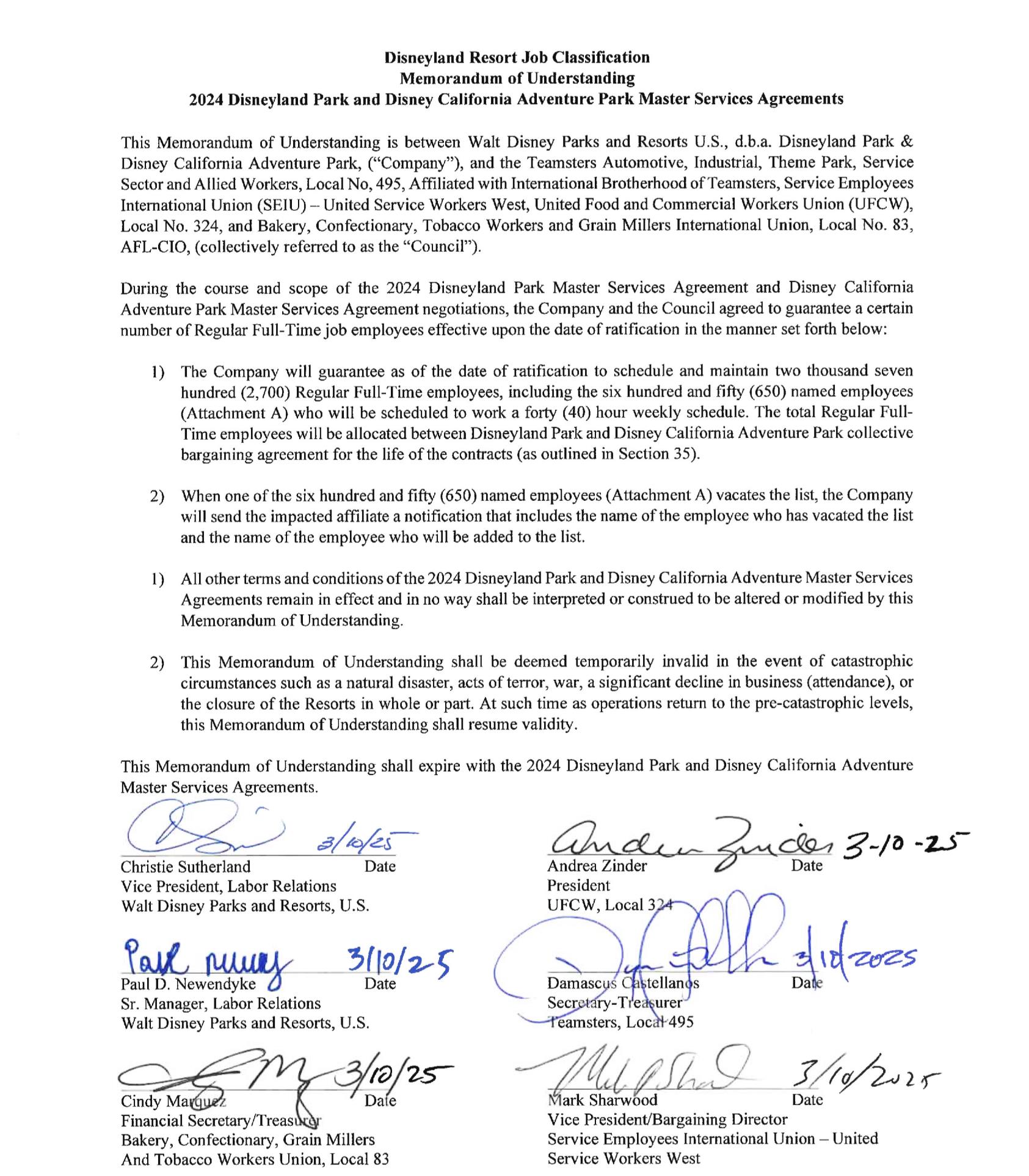
71
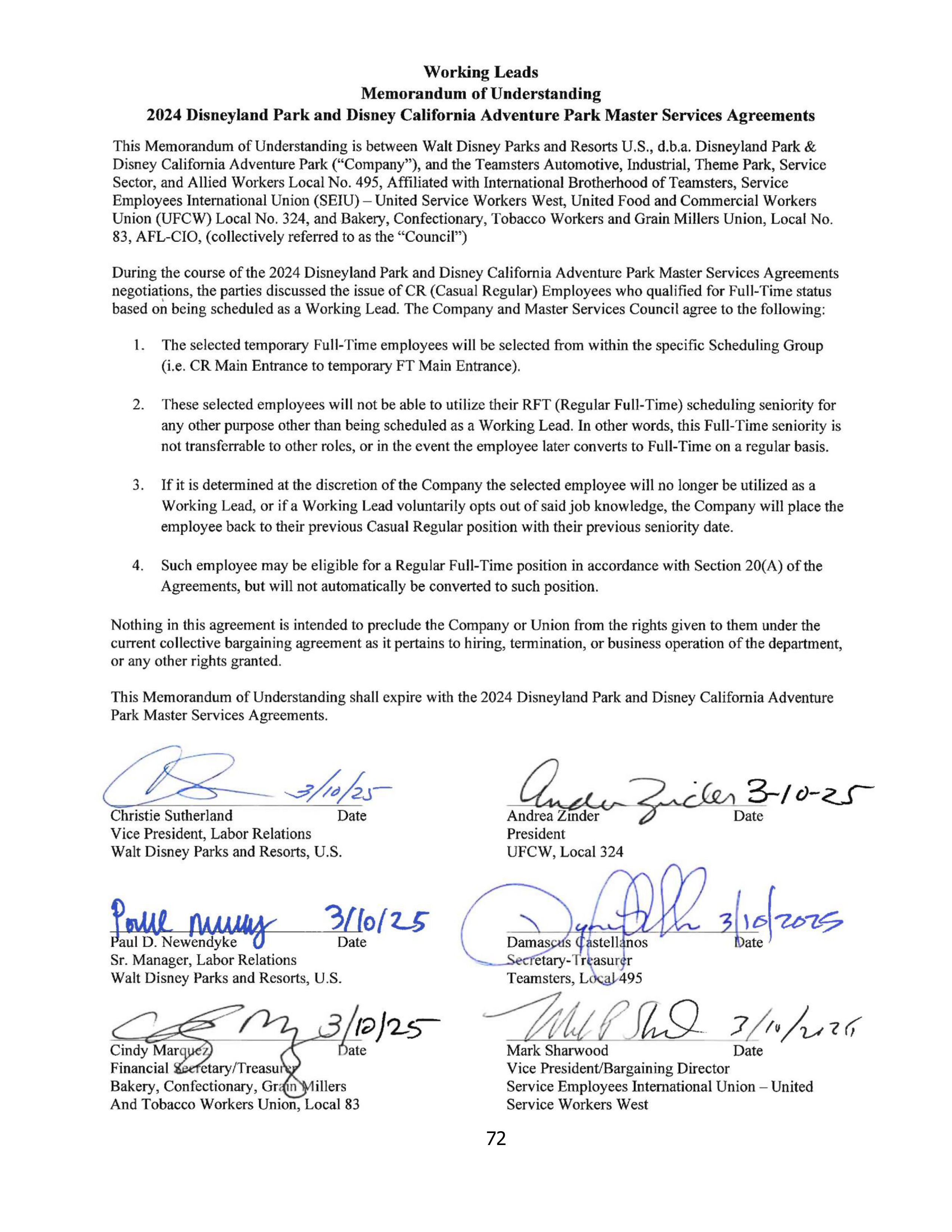
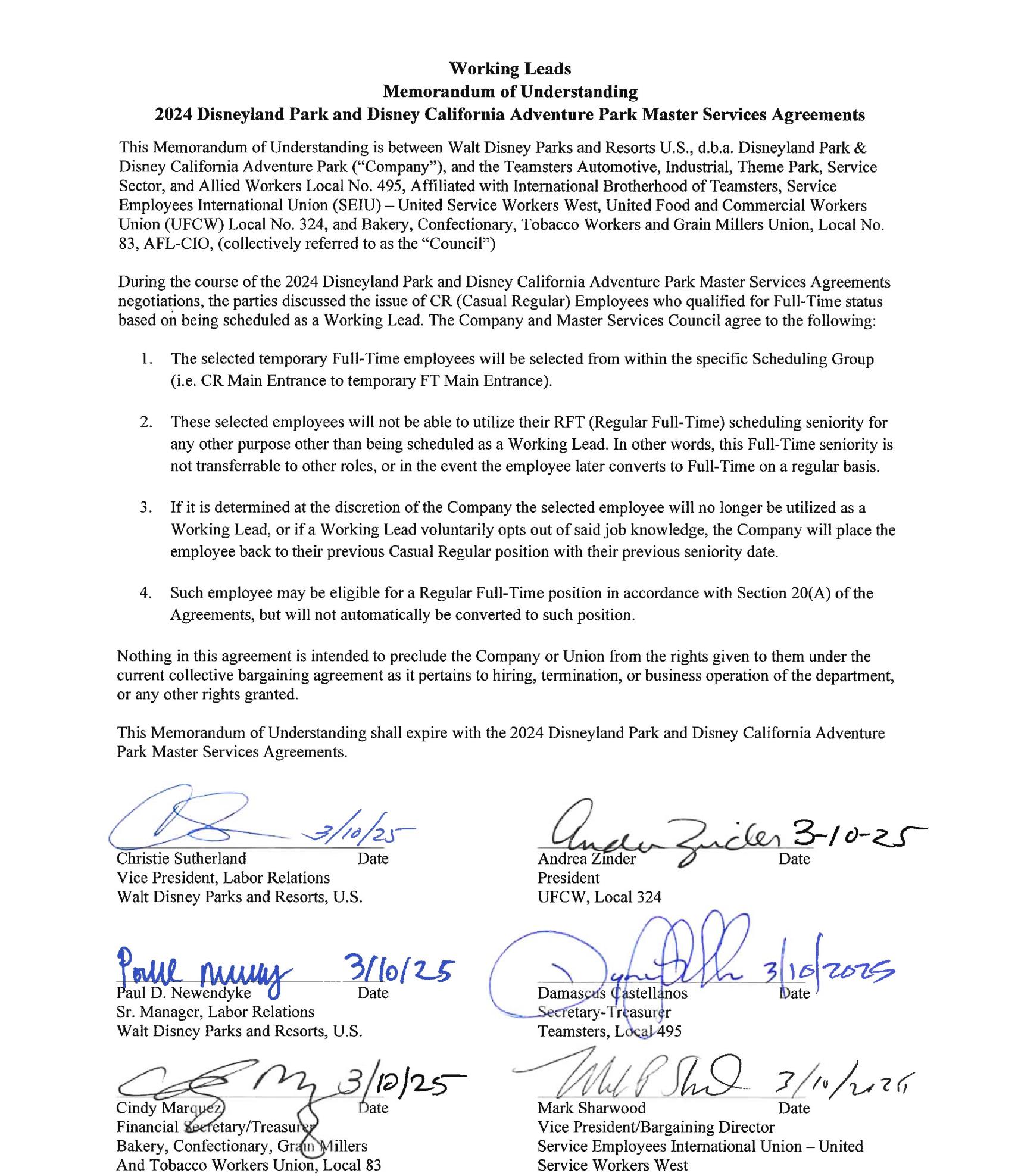
72
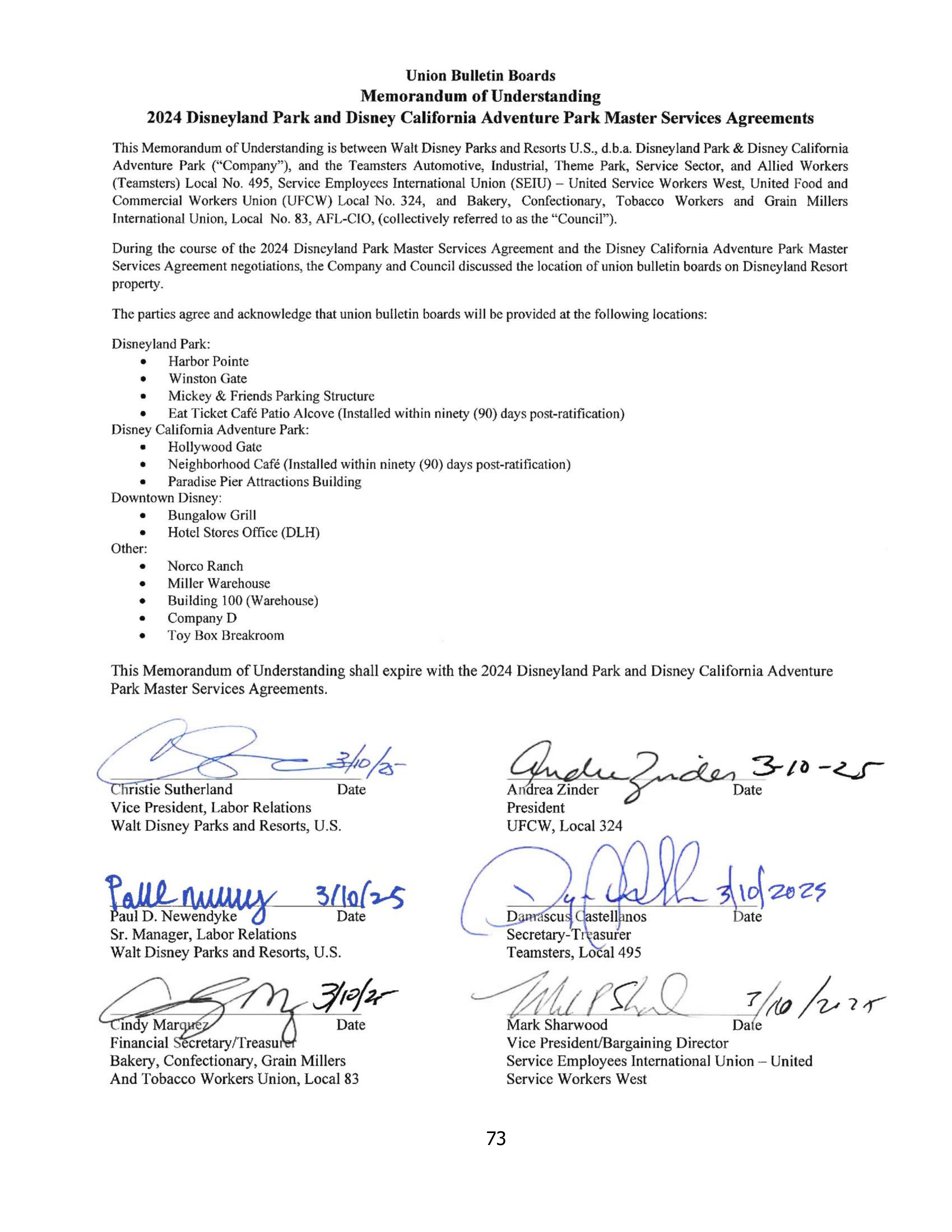
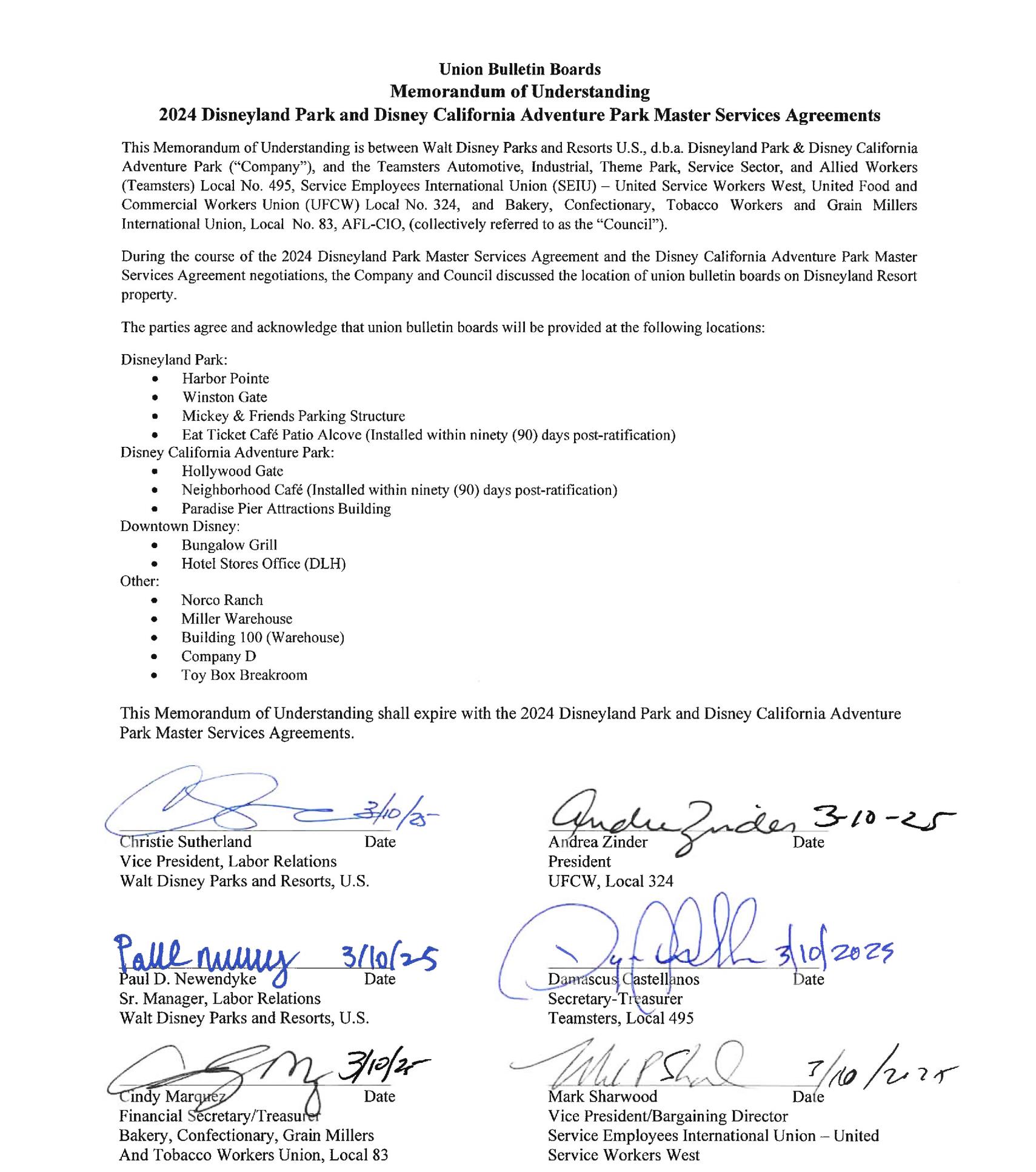
73
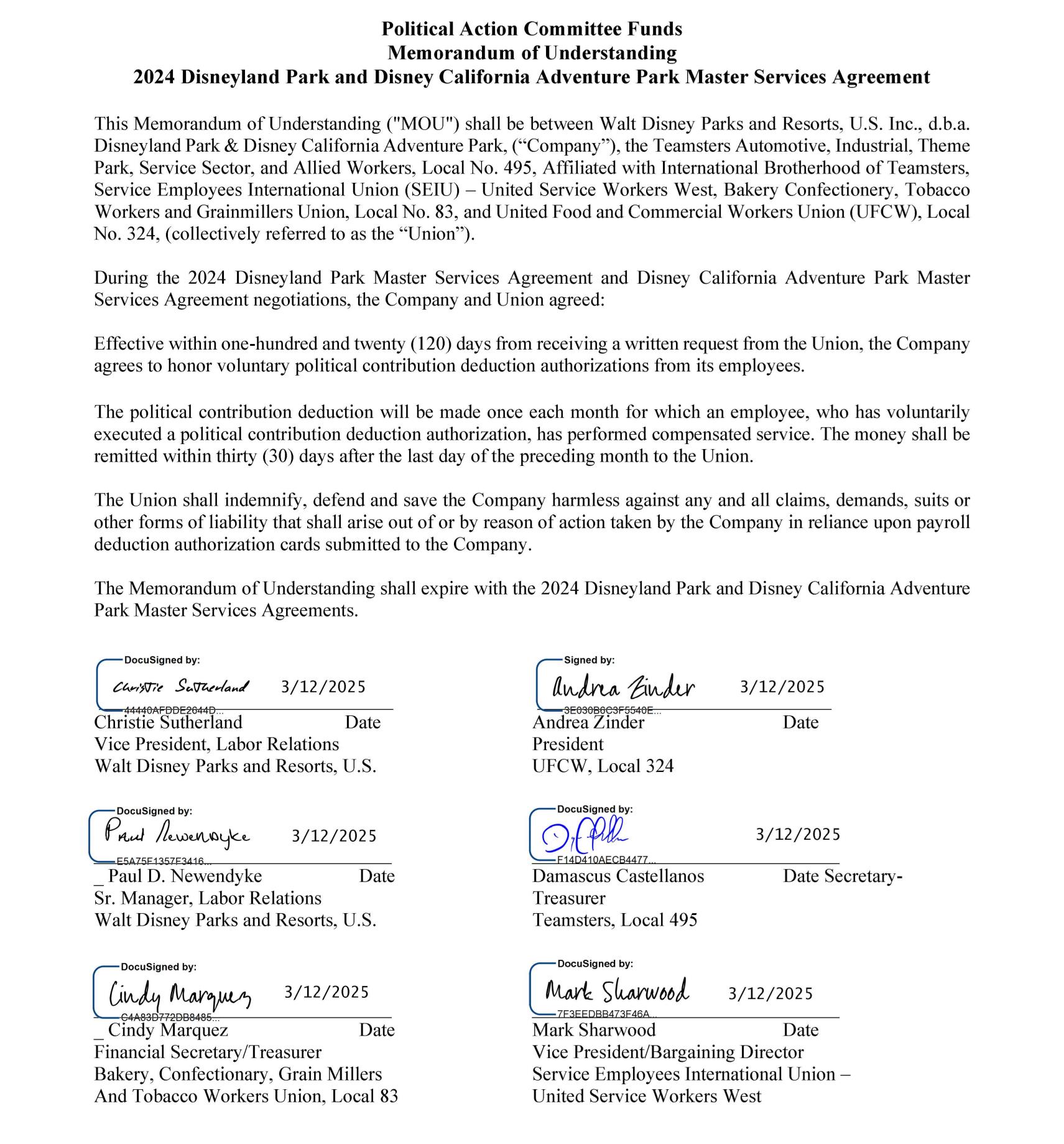
74
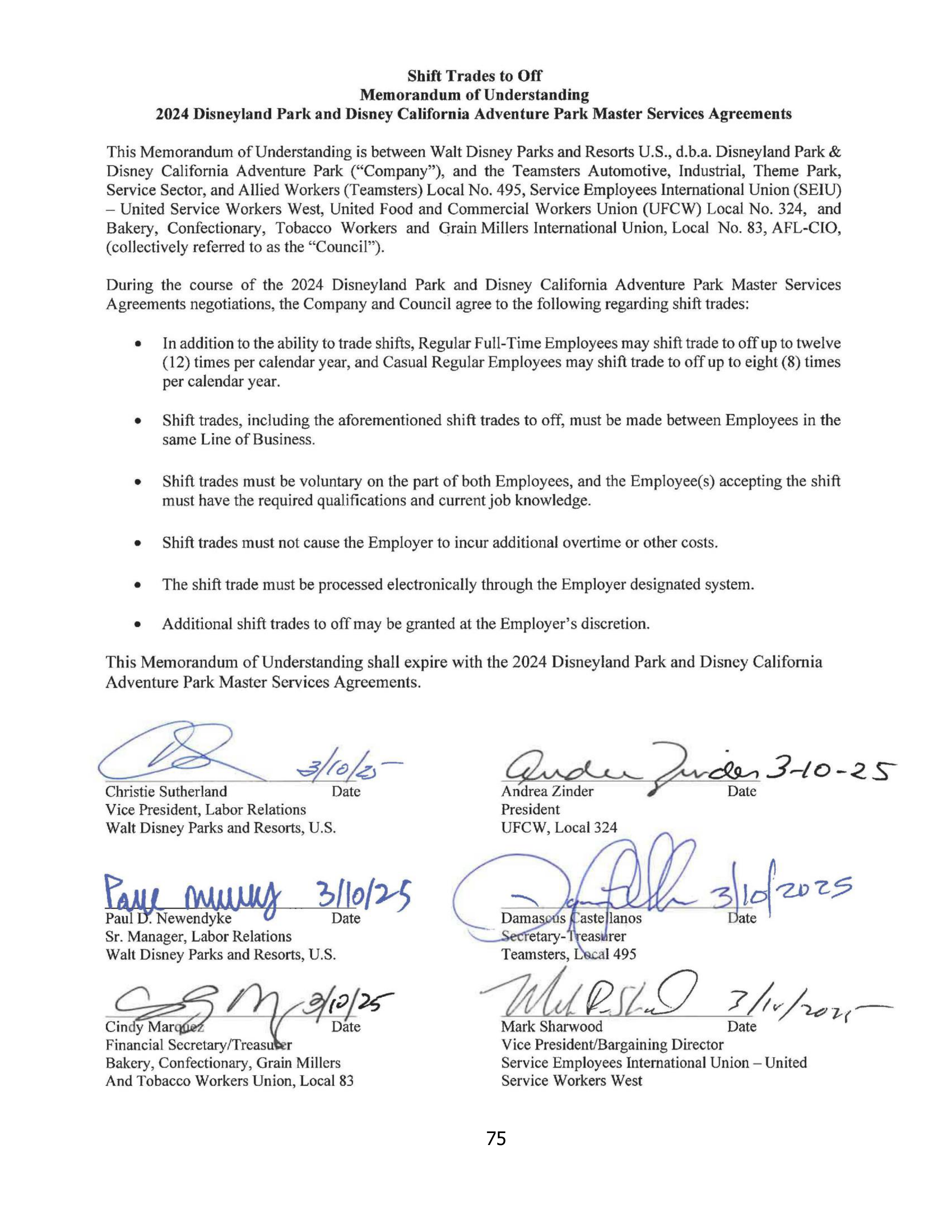
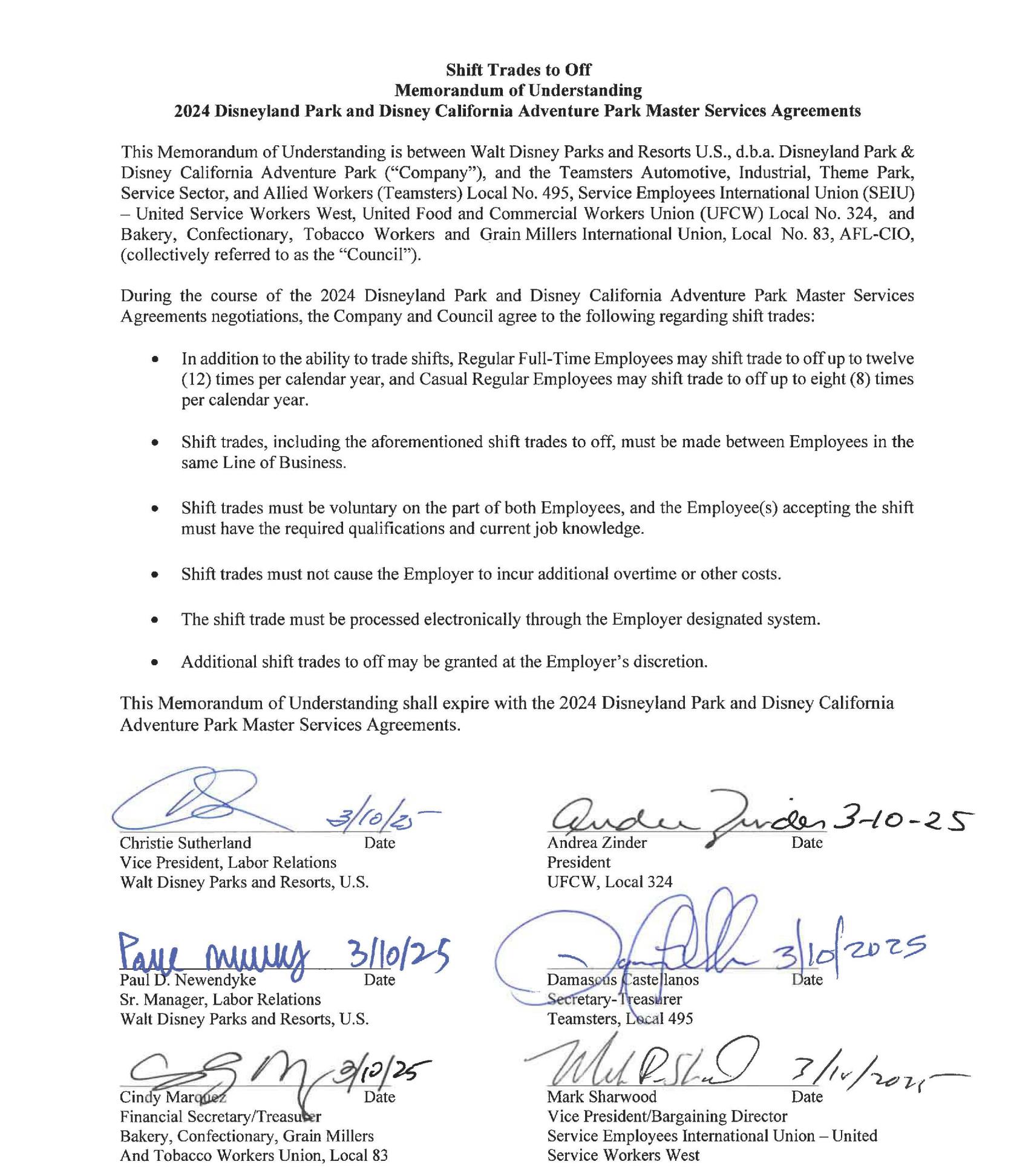
75
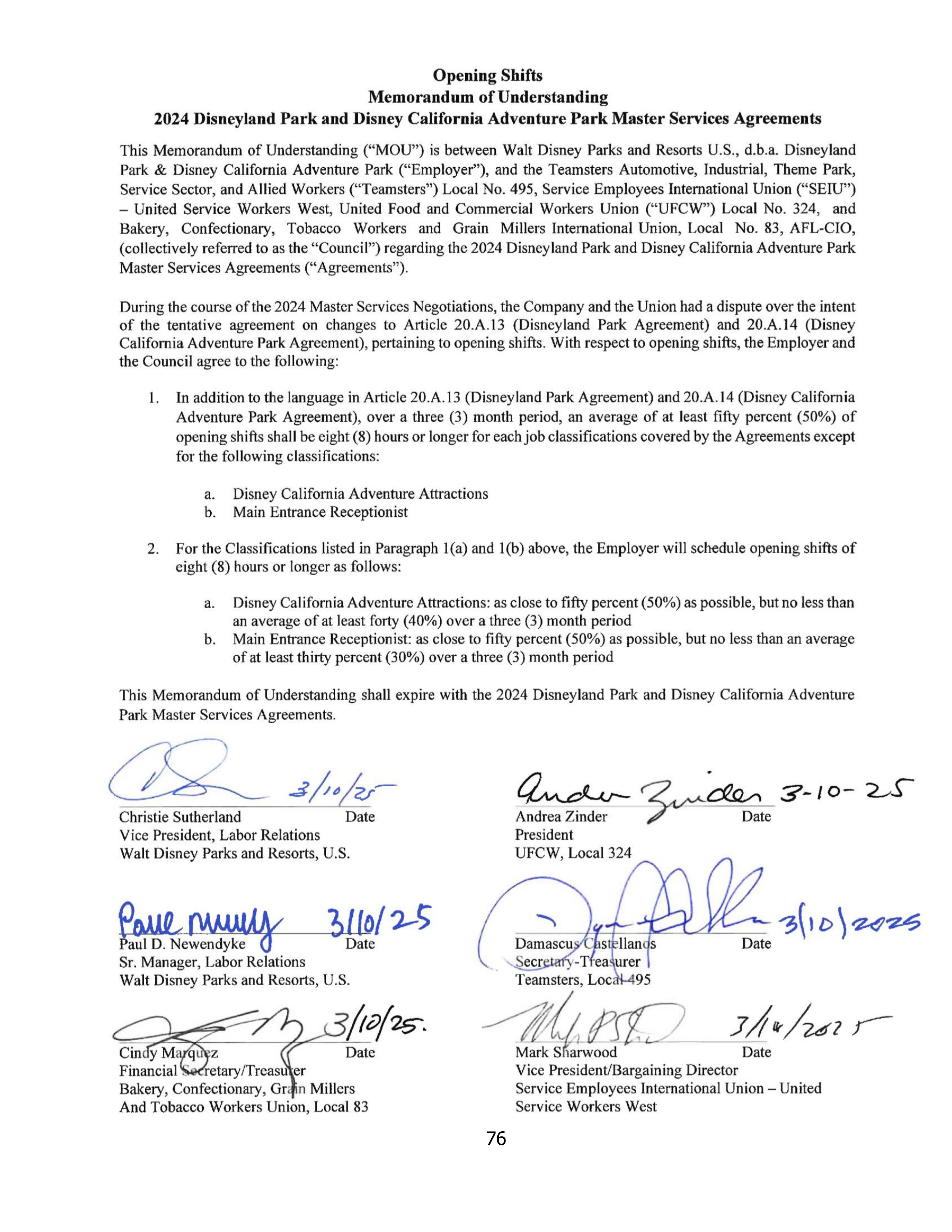
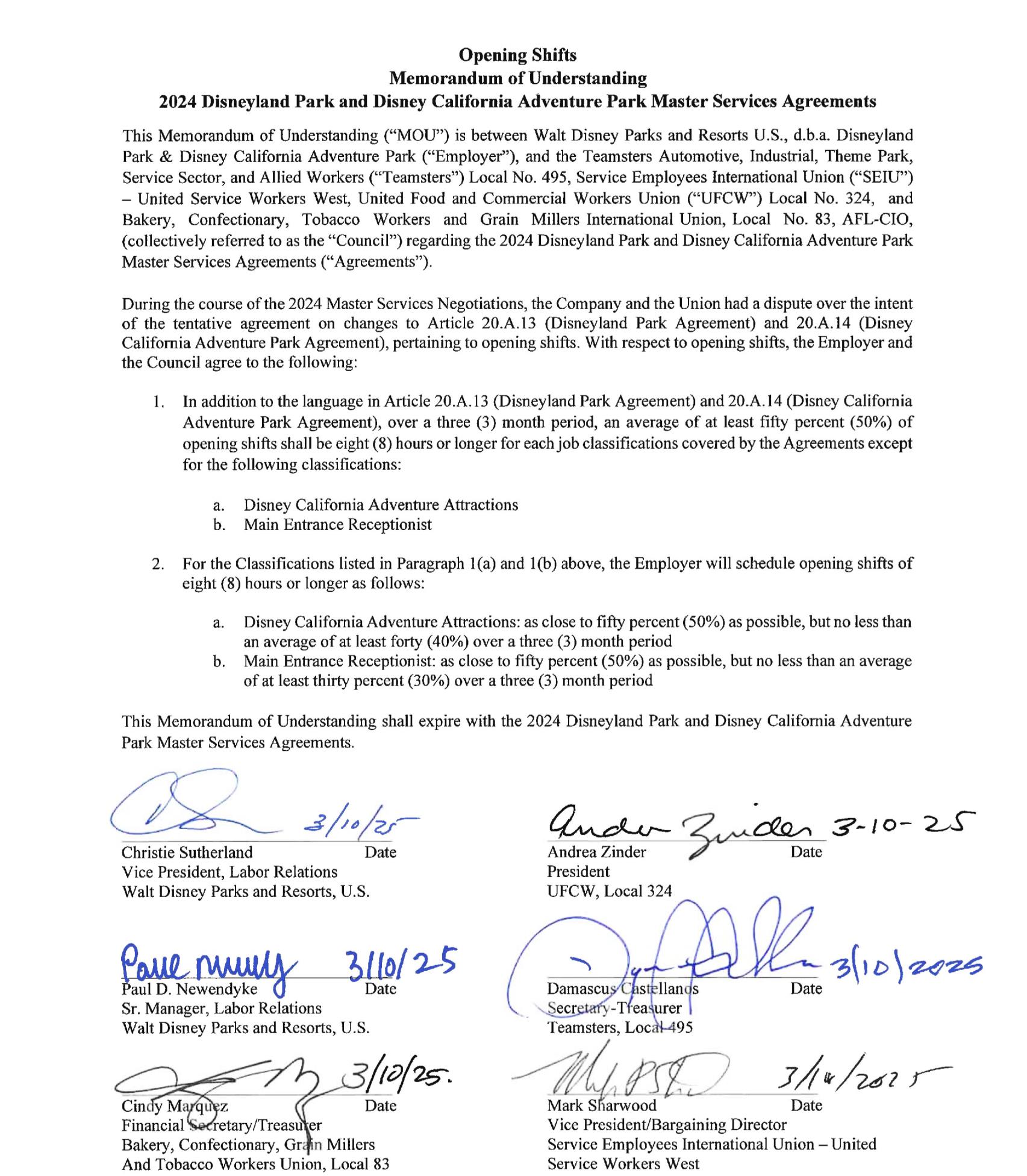
76
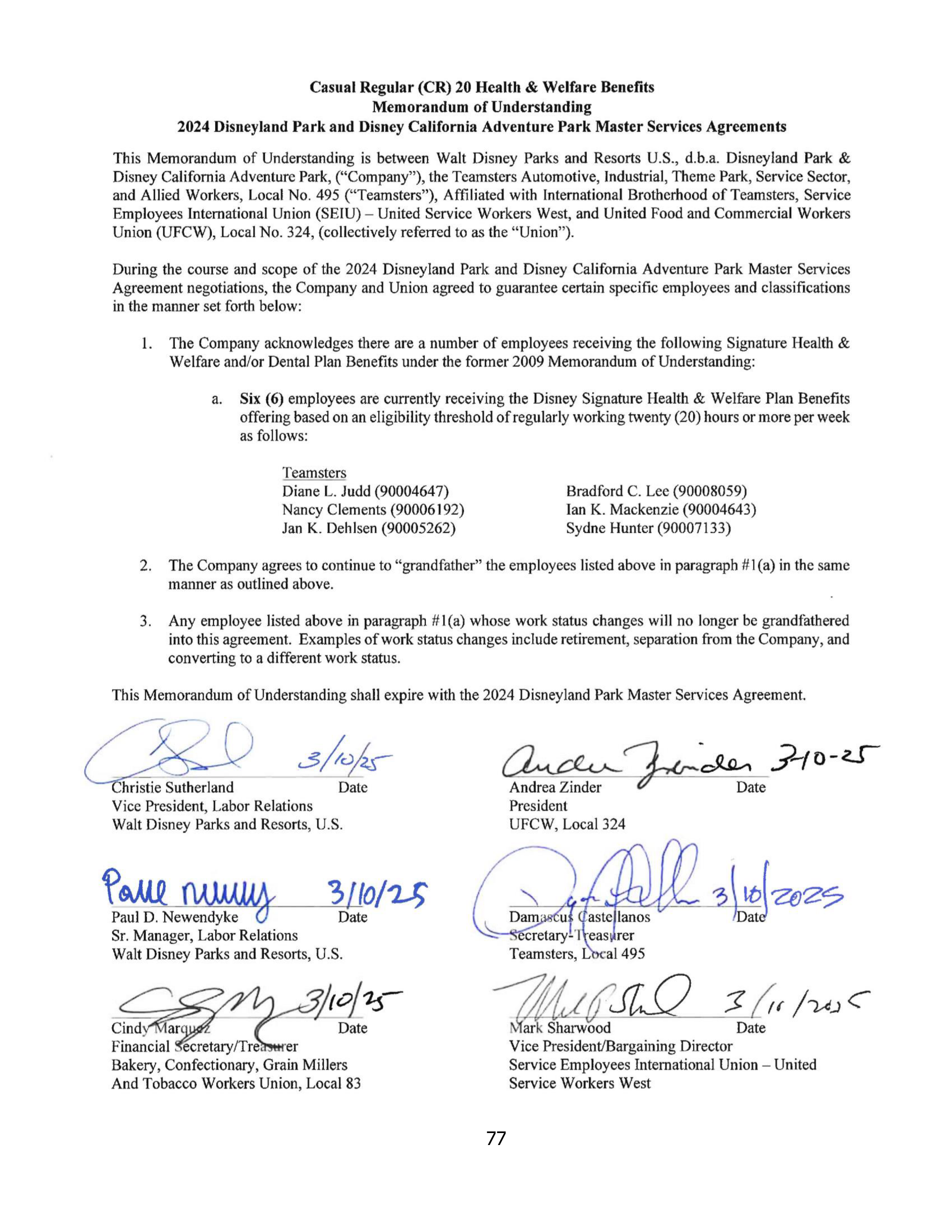
77
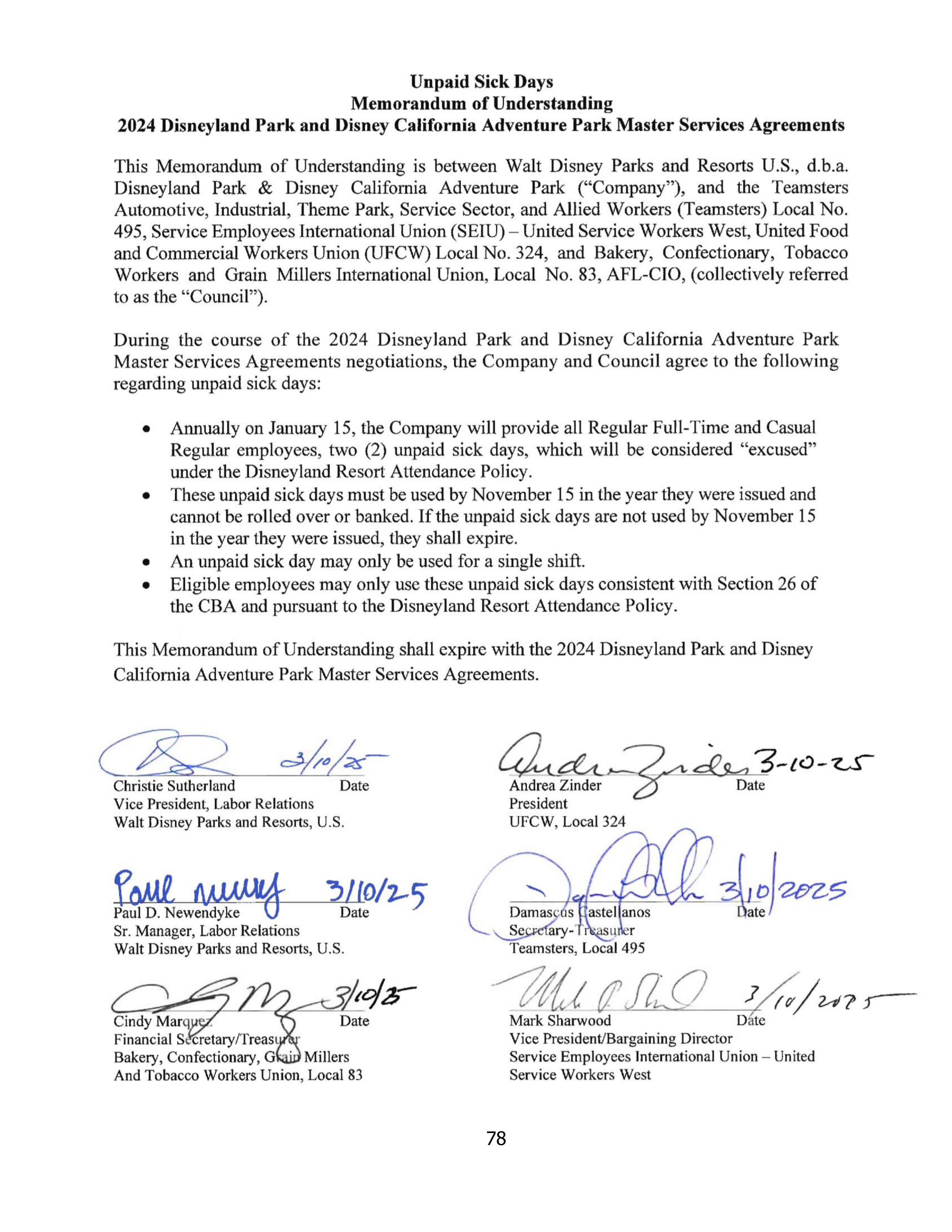
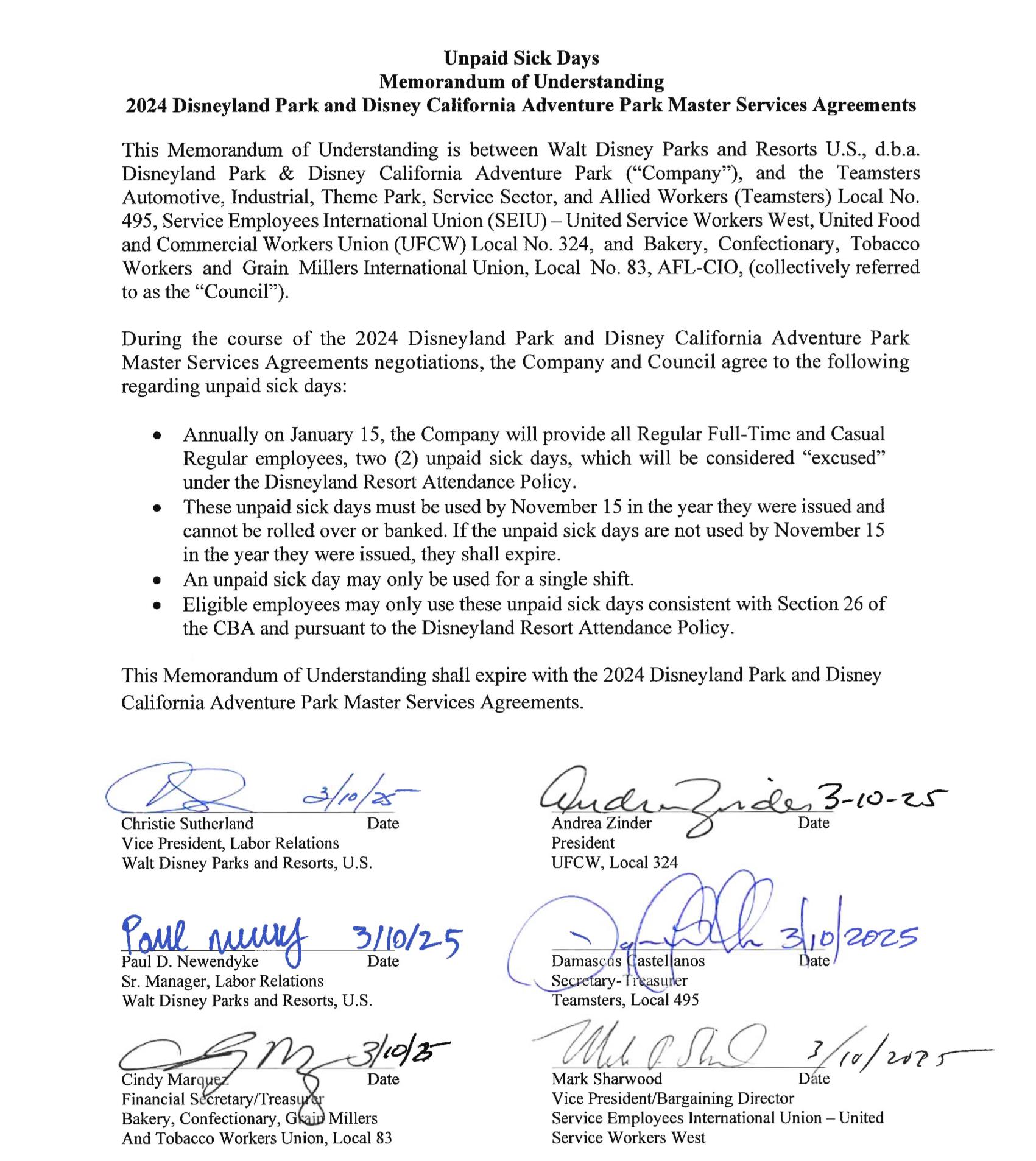
78
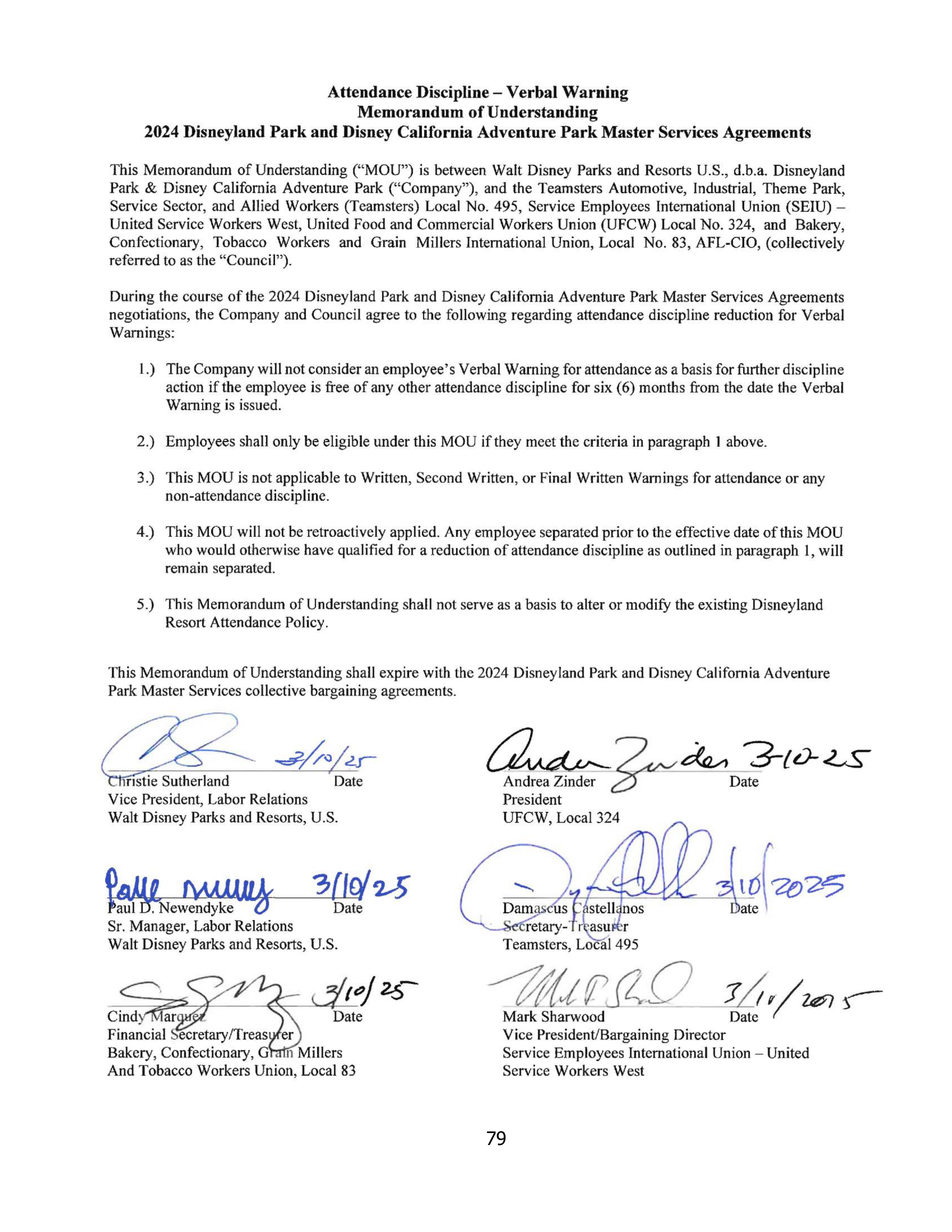
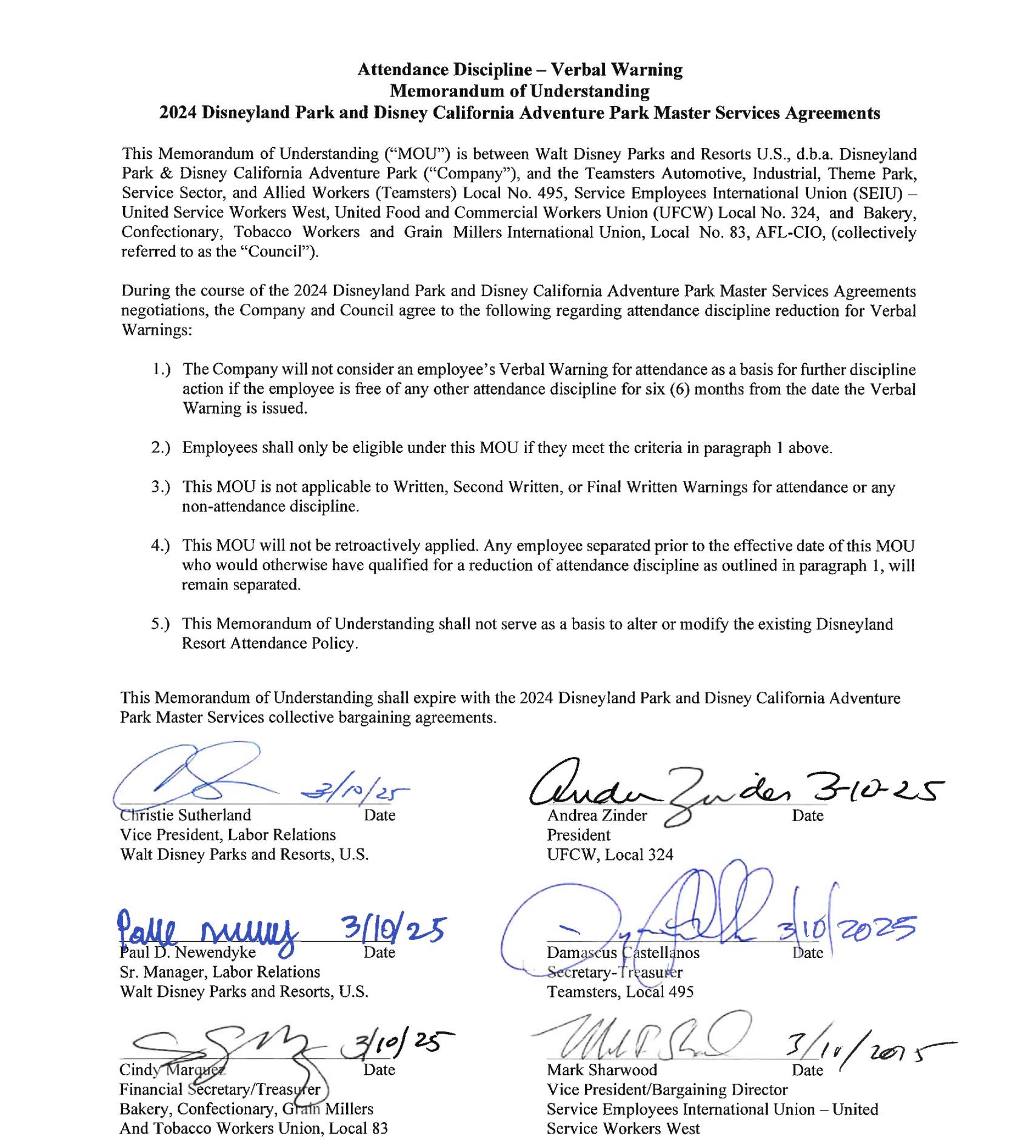
79
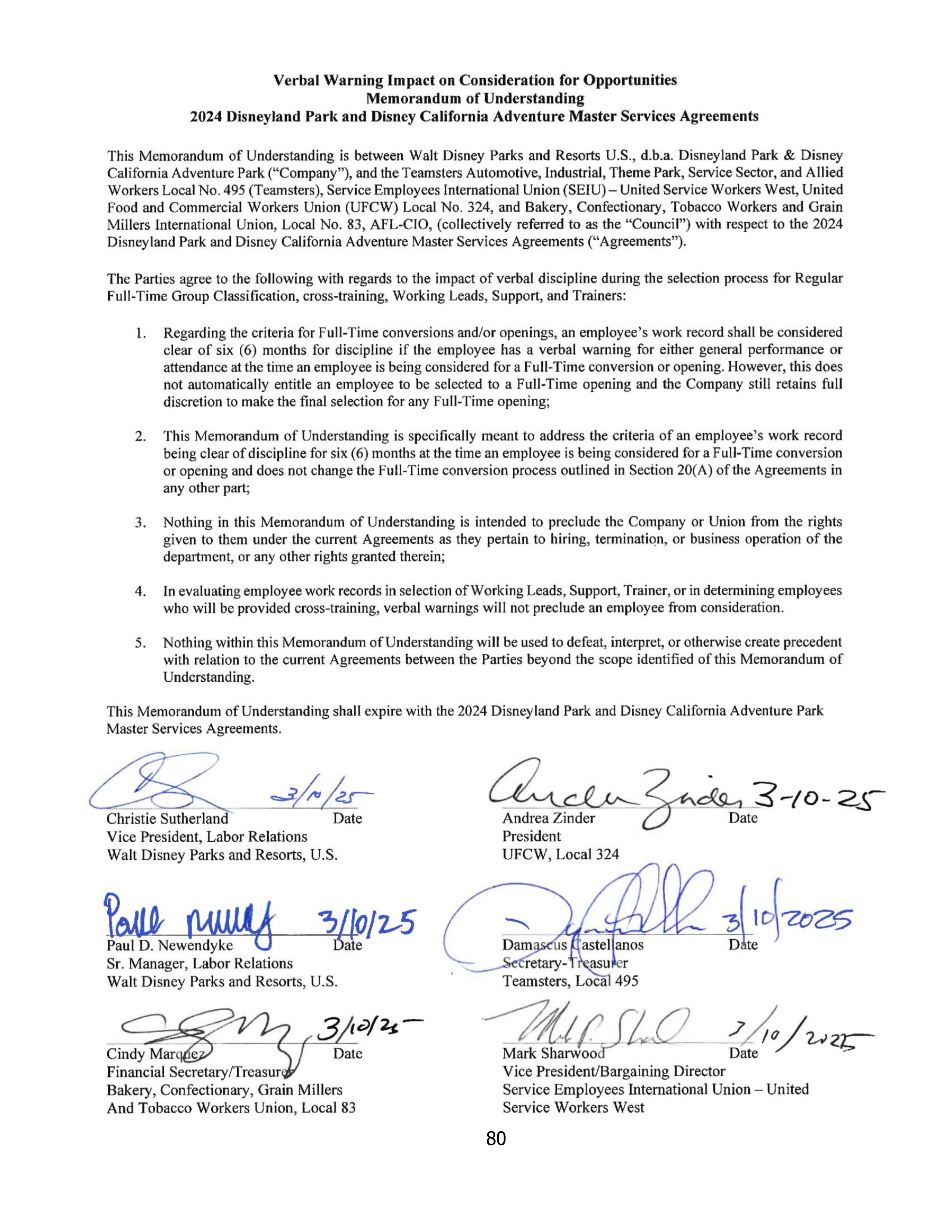
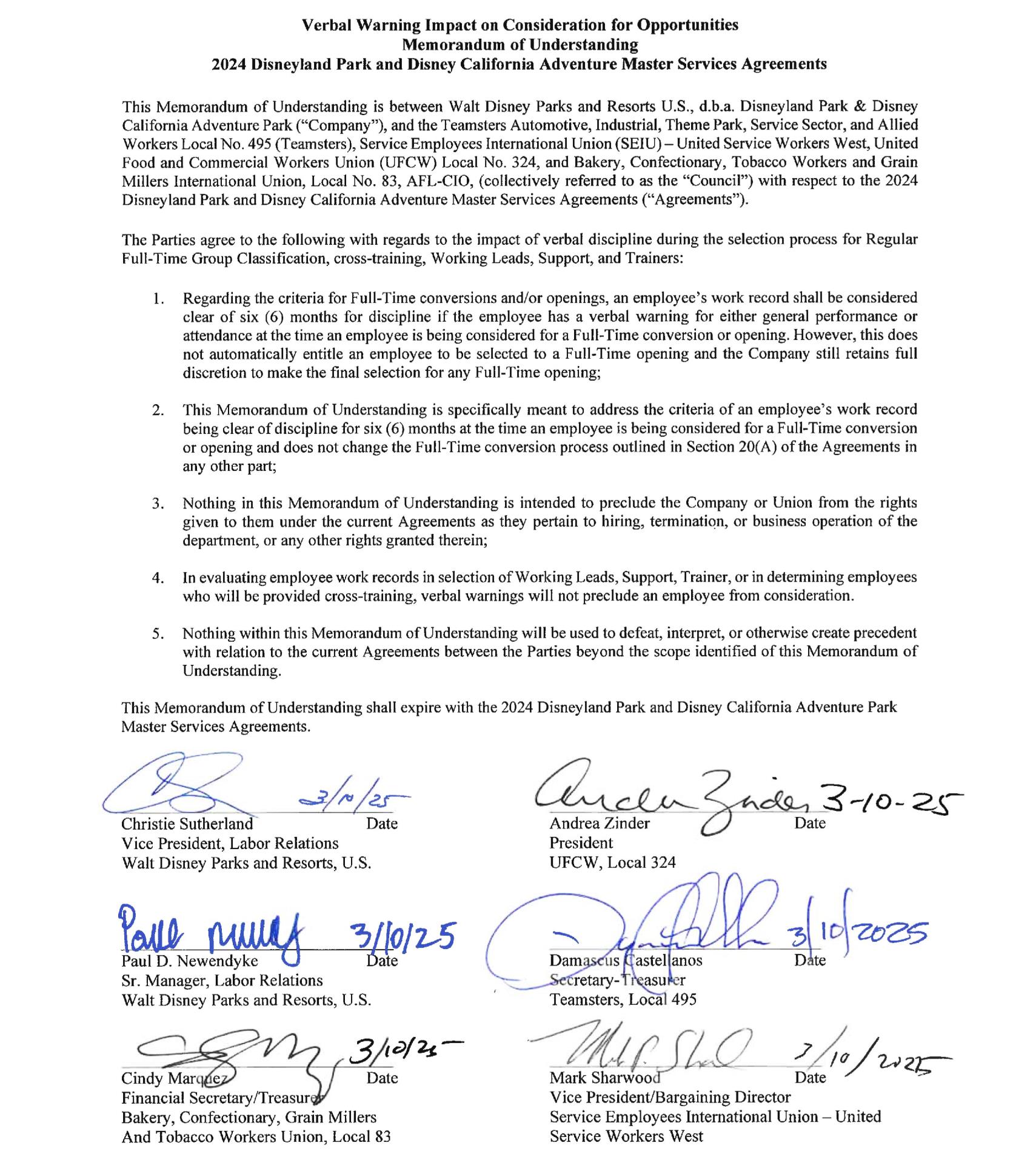
80
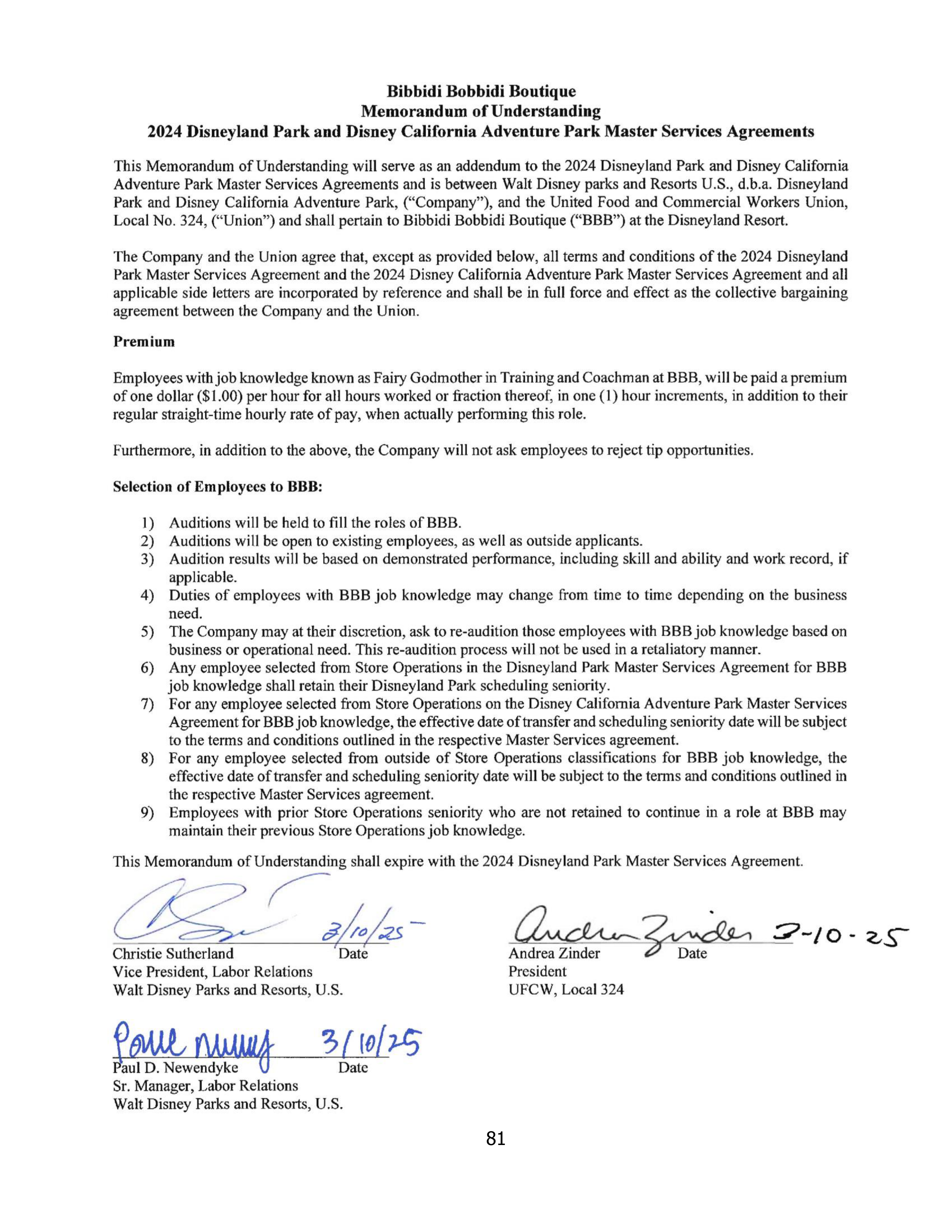
81
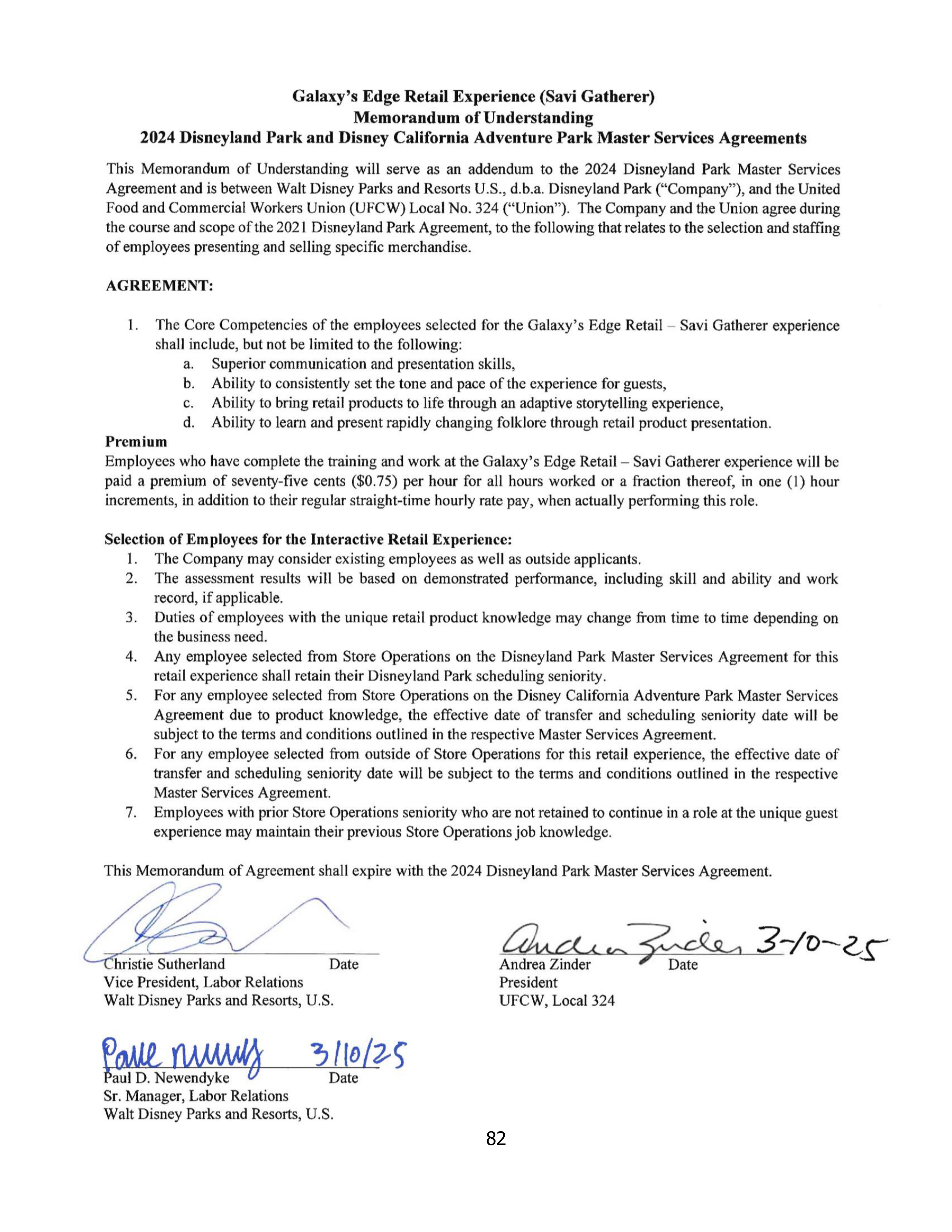
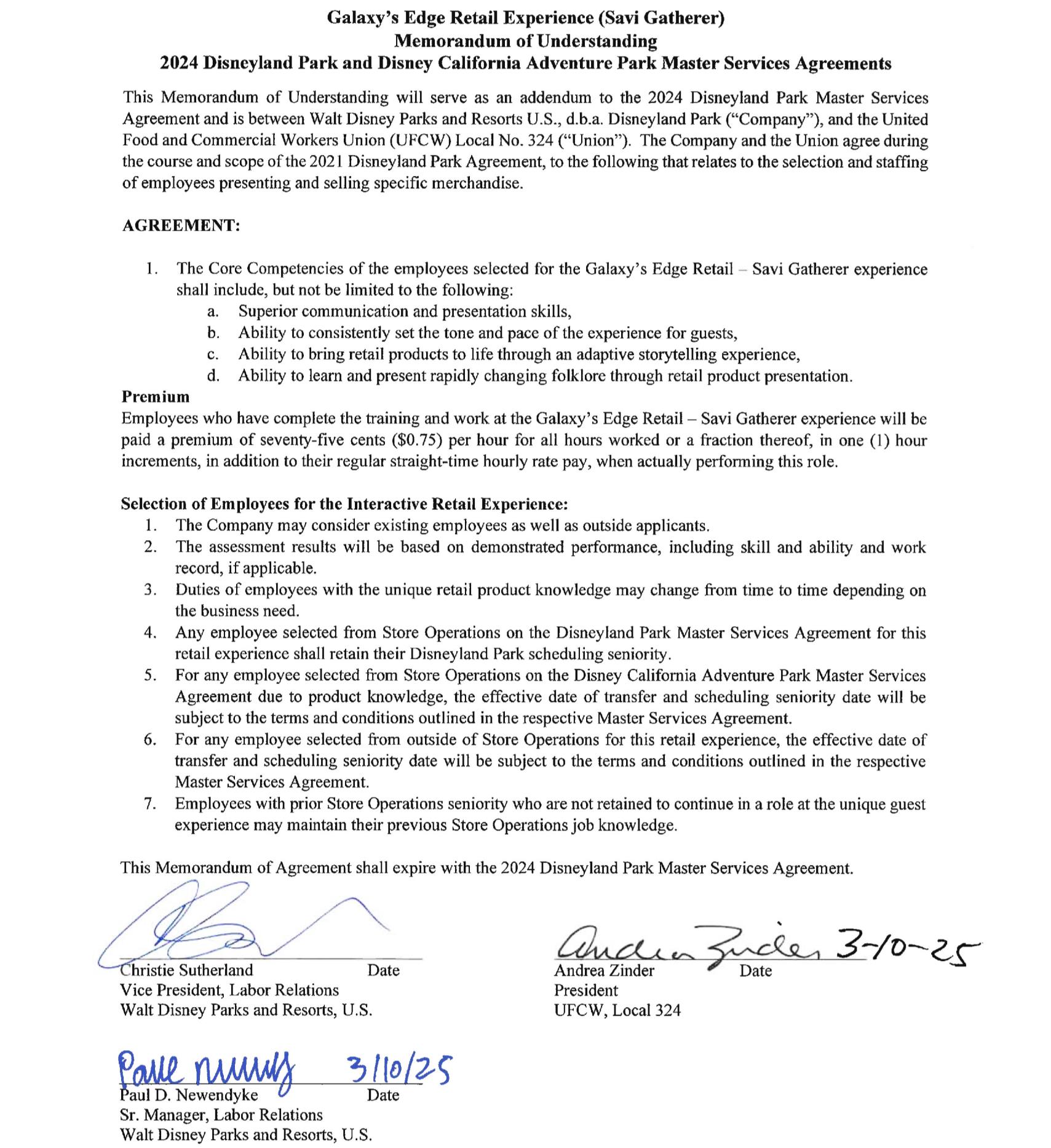
82
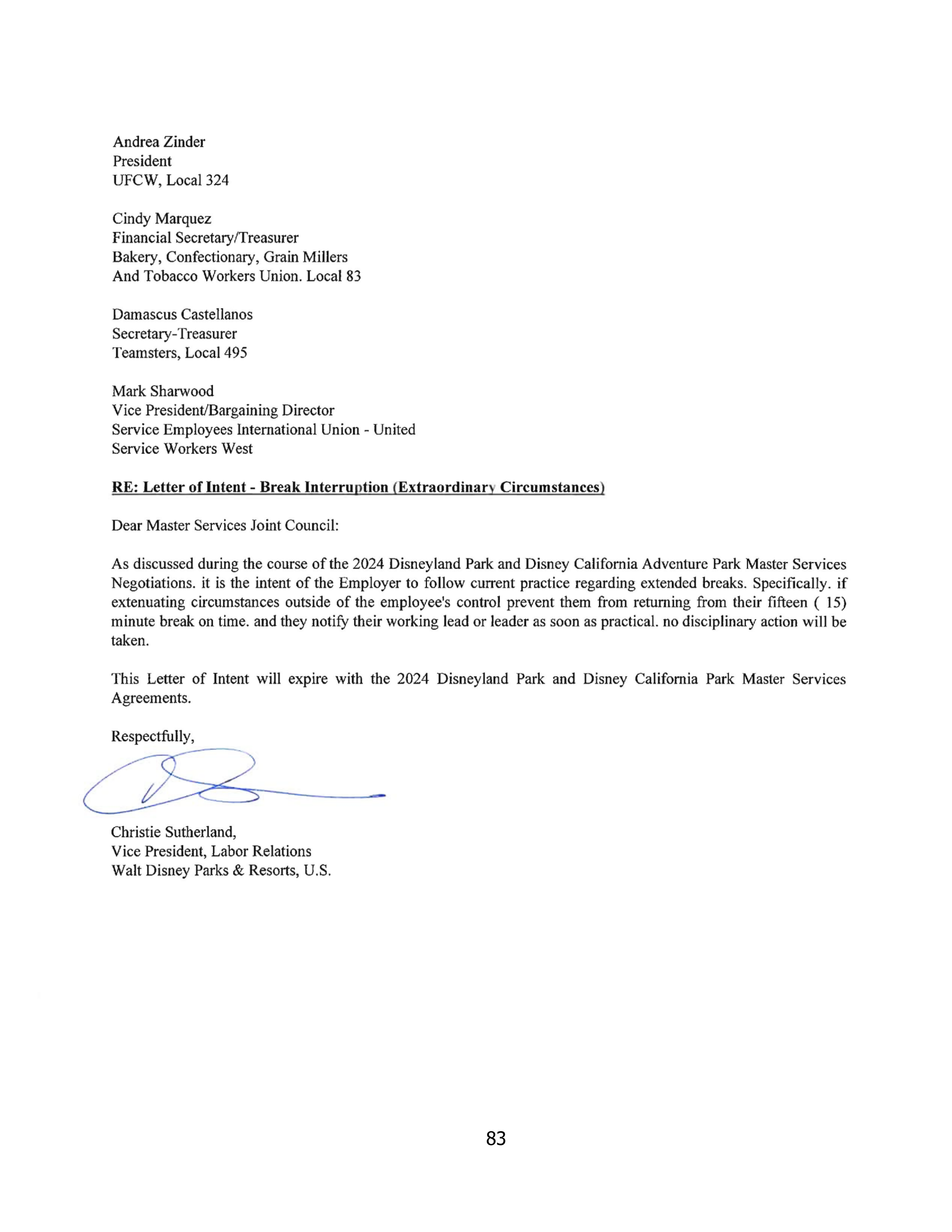
83
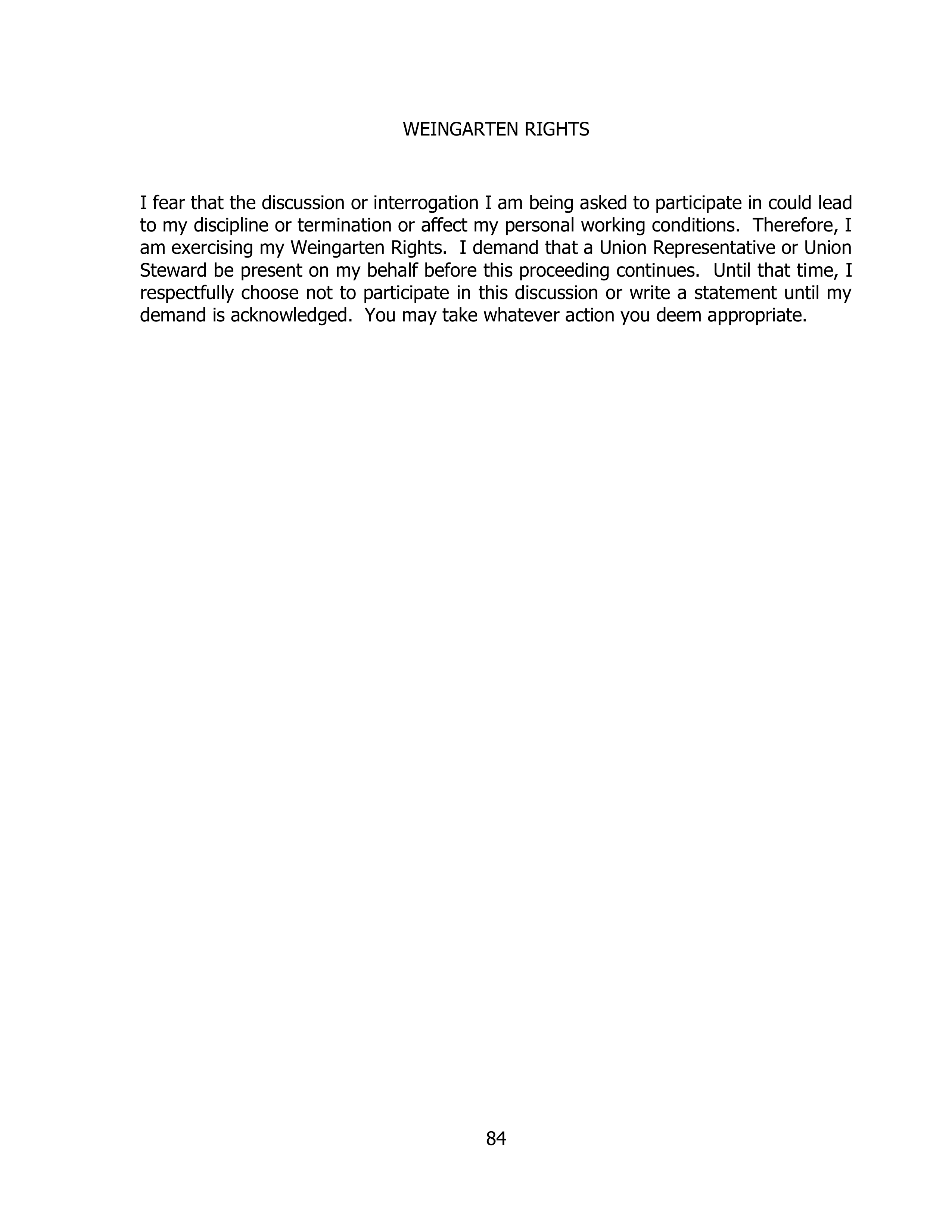
84
WEINGARTEN RIGHTS
I fear that the discussion or interrogation I am being asked to participate in could lead
to my discipline or termination or affect my personal working conditions. Therefore, I
am exercising my Weingarten Rights. I demand that a Union Representative or Union
Steward be present on my behalf before this proceeding continues. Until that time, I
respectfully choose not to participate in this discussion or write a statement until my
demand is acknowledged. You may take whatever action you deem appropriate.
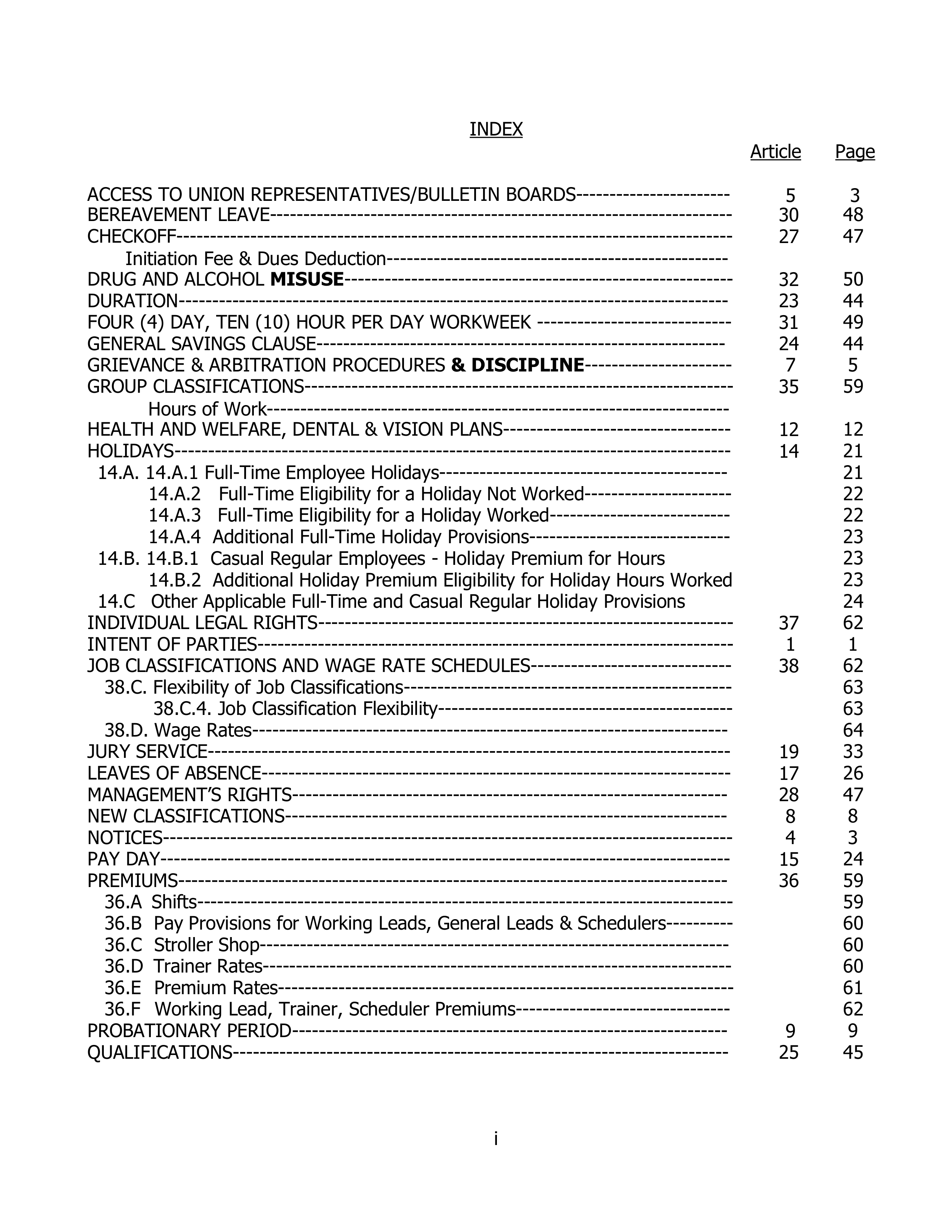
i
INDEX
ACCESS TO UNION REPRESENTATIVES/BULLETIN BOARDS-----------------------
Article
5
Page
3
BEREAVEMENT LEAVE---------------------------------------------------------------------
30
48
CHECKOFF-----------------------------------------------------------------------------------
Initiation Fee & Dues Deduction---------------------------------------------------
27
47
DRUG AND ALCOHOL
MISUSE
----------------------------------------------------------
32
50
DURATION----------------------------------------------------------------------------------
23
44
FOUR (4) DAY, TEN (10) HOUR PER DAY WORKWEEK -----------------------------
31
49
GENERAL SAVINGS CLAUSE-------------------------------------------------------------
24
44
GRIEVANCE & ARBITRATION PROCEDURES
& DISCIPLINE
----------------------
7
5
GROUP CLASSIFICATIONS----------------------------------------------------------------
Hours of Work---------------------------------------------------------------------
35
59
HEALTH AND WELFARE, DENTAL & VISION PLANS----------------------------------
12
12
HOLIDAYS-----------------------------------------------------------------------------------
14
21
14.A. 14.A.1 Full-Time Employee Holidays-------------------------------------------
21
14.A.2 Full-Time
Eligibility for a Holiday Not Worked----------------------
22
14.A.3 Full-Time
Eligibility for a Holiday Worked---------------------------
22
14.A.4 Additional Full-Time Holiday Provisions------------------------------
23
14.B. 14.B.1 Casual Regular Employees - Holiday Premium for Hours
23
14.B.2 Additional Holiday Premium Eligibility for Holiday Hours Worked
23
14.C Other Applicable Full-Time and Casual Regular Holiday Provisions
24
INDIVIDUAL LEGAL RIGHTS--------------------------------------------------------------
37
62
INTENT OF PARTIES-----------------------------------------------------------------------
1
1
JOB CLASSIFICATIONS AND WAGE RATE SCHEDULES------------------------------
38
62
38.C. Flexibility of Job Classifications-------------------------------------------------
63
38.C.4. Job Classification Flexibility--------------------------------------------
63
38.D. Wage Rates-----------------------------------------------------------------------
64
JURY SERVICE------------------------------------------------------------------------------
19
33
LEAVES OF ABSENCE----------------------------------------------------------------------
17
26
MANAGEMENT’S RIGHTS-----------------------------------------------------------------
28
47
NEW CLASSIFICATIONS------------------------------------------------------------------
8
8
NOTICES-------------------------------------------------------------------------------------
4
3
PAY DAY-------------------------------------------------------------------------------------
15
24
PREMIUMS----------------------------------------------------------------------------------
36
59
36.A Shifts--------------------------------------------------------------------------------
59
36.B Pay Provisions for Working Leads, General Leads & Schedulers----------
60
36.C Stroller Shop----------------------------------------------------------------------
60
36.D Trainer Rates----------------------------------------------------------------------
60
36.E Premium Rates--------------------------------------------------------------------
61
36.F Working Lead, Trainer, Scheduler Premiums--------------------------------
62
PROBATIONARY PERIOD-----------------------------------------------------------------
9
9
QUALIFICATIONS--------------------------------------------------------------------------
25
45
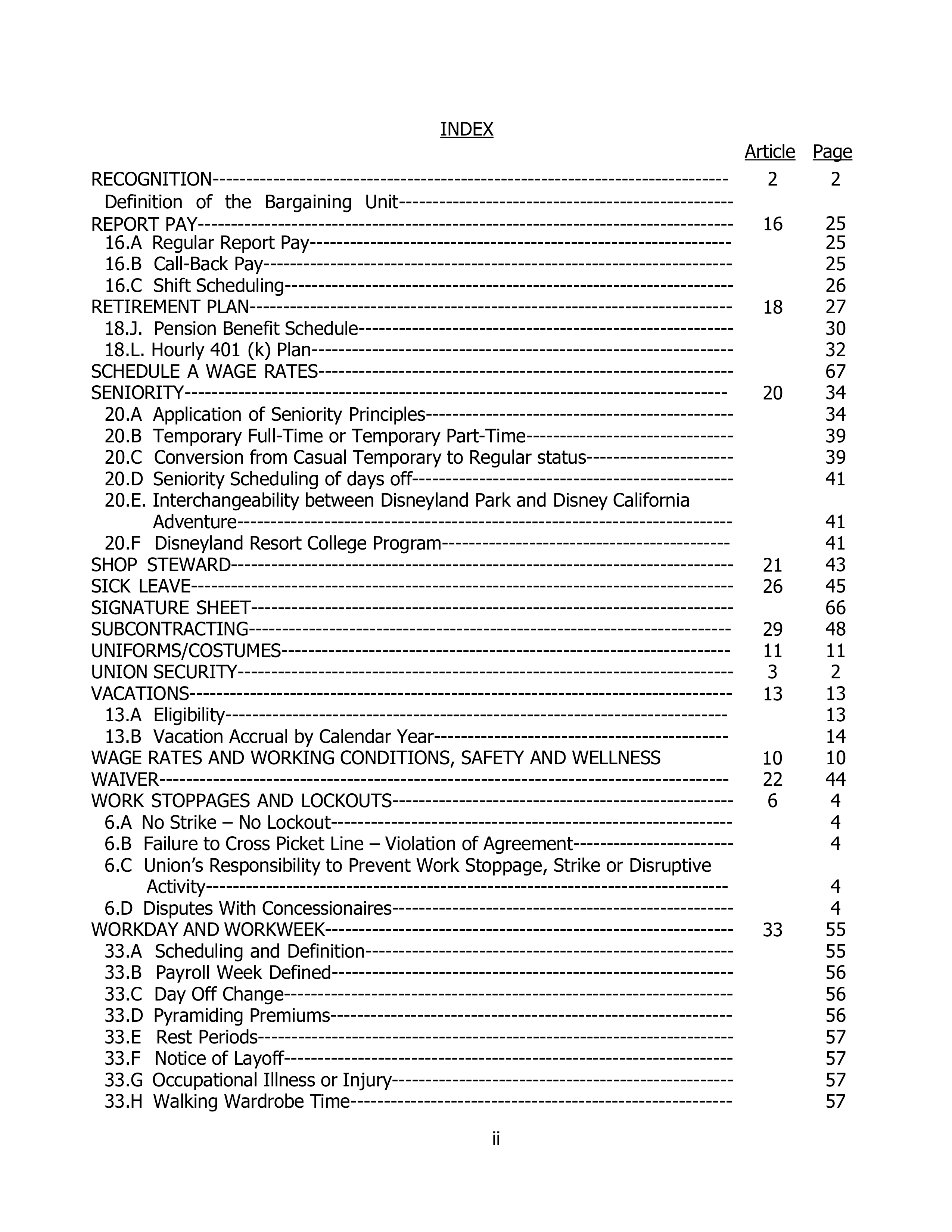
ii
INDEX
Article Page
RECOGNITION-----------------------------------------------------------------------------
Definition of the Bargaining Unit--------------------------------------------------
REPORT PAY--------------------------------------------------------------------------------
2
16
2
25
16.A Regular Report Pay---------------------------------------------------------------
25
16.B Call-Back Pay----------------------------------------------------------------------
25
16.C Shift Scheduling-------------------------------------------------------------------
26
RETIREMENT PLAN------------------------------------------------------------------------
18
27
18.J. Pension Benefit Schedule--------------------------------------------------------
30
18.L. Hourly 401 (k) Plan---------------------------------------------------------------
32
SCHEDULE A WAGE RATES--------------------------------------------------------------
67
SENIORITY---------------------------------------------------------------------------------
20
34
20.A Application of Seniority Principles----------------------------------------------
34
20.B Temporary Full-Time or Temporary Part-Time-------------------------------
39
20.C Conversion from Casual Temporary to Regular status----------------------
39
20.D Seniority Scheduling of days off------------------------------------------------
41
20.E. Interchangeability between Disneyland Park and Disney California
Adventure--------------------------------------------------------------------------
41
20.F Disneyland Resort College Program-------------------------------------------
41
SHOP STEWARD---------------------------------------------------------------------------
21
43
SICK LEAVE---------------------------------------------------------------------------------
26
45
SIGNATURE SHEET------------------------------------------------------------------------
66
SUBCONTRACTING------------------------------------------------------------------------
29
48
UNIFORMS/COSTUMES-------------------------------------------------------------------
11
11
UNION SECURITY--------------------------------------------------------------------------
3
2
VACATIONS---------------------------------------------------------------------------------
13
13
13.A Eligibility---------------------------------------------------------------------------
13
13.B Vacation Accrual by Calendar Year--------------------------------------------
14
WAGE RATES AND WORKING CONDITIONS, SAFETY AND WELLNESS
10
10
WAIVER-------------------------------------------------------------------------------------
22
44
WORK STOPPAGES AND LOCKOUTS---------------------------------------------------
6
4
6.A No Strike – No Lockout------------------------------------------------------------
4
6.B Failure to Cross Picket Line – Violation of Agreement------------------------
4
6.C Union’s Responsibility to Prevent Work Stoppage, Strike or Disruptive
Activity------------------------------------------------------------------------------
4
6.D Disputes With Concessionaires---------------------------------------------------
4
WORKDAY AND WORKWEEK-------------------------------------------------------------
33
55
33.A Scheduling and Definition-------------------------------------------------------
55
33.B Payroll Week Defined------------------------------------------------------------
56
33.C Day Off Change-------------------------------------------------------------------
56
33.D Pyramiding Premiums------------------------------------------------------------
56
33.E Rest Periods-----------------------------------------------------------------------
57
33.F Notice of Layoff-------------------------------------------------------------------
57
33.G Occupational Illness or Injury---------------------------------------------------
57
33.H Walking Wardrobe Time---------------------------------------------------------
57
iii
INDEX
Article Page
33.I Slow Close------------------------------------------------------------------------
33
57
33.J Meal Period-----------------------------------------------------------------------
58
33.K Paid Time for Cash & Media Counting----------------------------------------
58
33.L SCAQMD Requirements--------------------------------------------------------
58
33.M Legal Proceedings Appearance------------------------------------------------
58
33.N Tardies as a Result of Shuttle Service----------------------------------------
58
33.O Offsite Parking-------------------------------------------------------------------
58