





COLLECTIVE
BARGAINING
AGREEMENT
Effective June1, 2021 – June 30, 2024
between
and
STARBUCKS COFFEE CANADA, INC.
(VICTORIA, B.C.)
COLLECTIVE AGREEMENT
Between
STARBUCKS COFFEE CANADA, INC. (VICTORIA, B.C.)
and
UNITED STEEL, PAPER AND FORESTRY, RUBBER, MANUFACTURING, ENERGY,
ALLIED INDUSTRIAL AND SERVICE WORKERS INTERNATIONAL UNION (UNITED
STEELWORKERS)
ON BEHALF OF LOCAL NO. 2009
Cope<W3
ErroB
&
Omissions Excepted
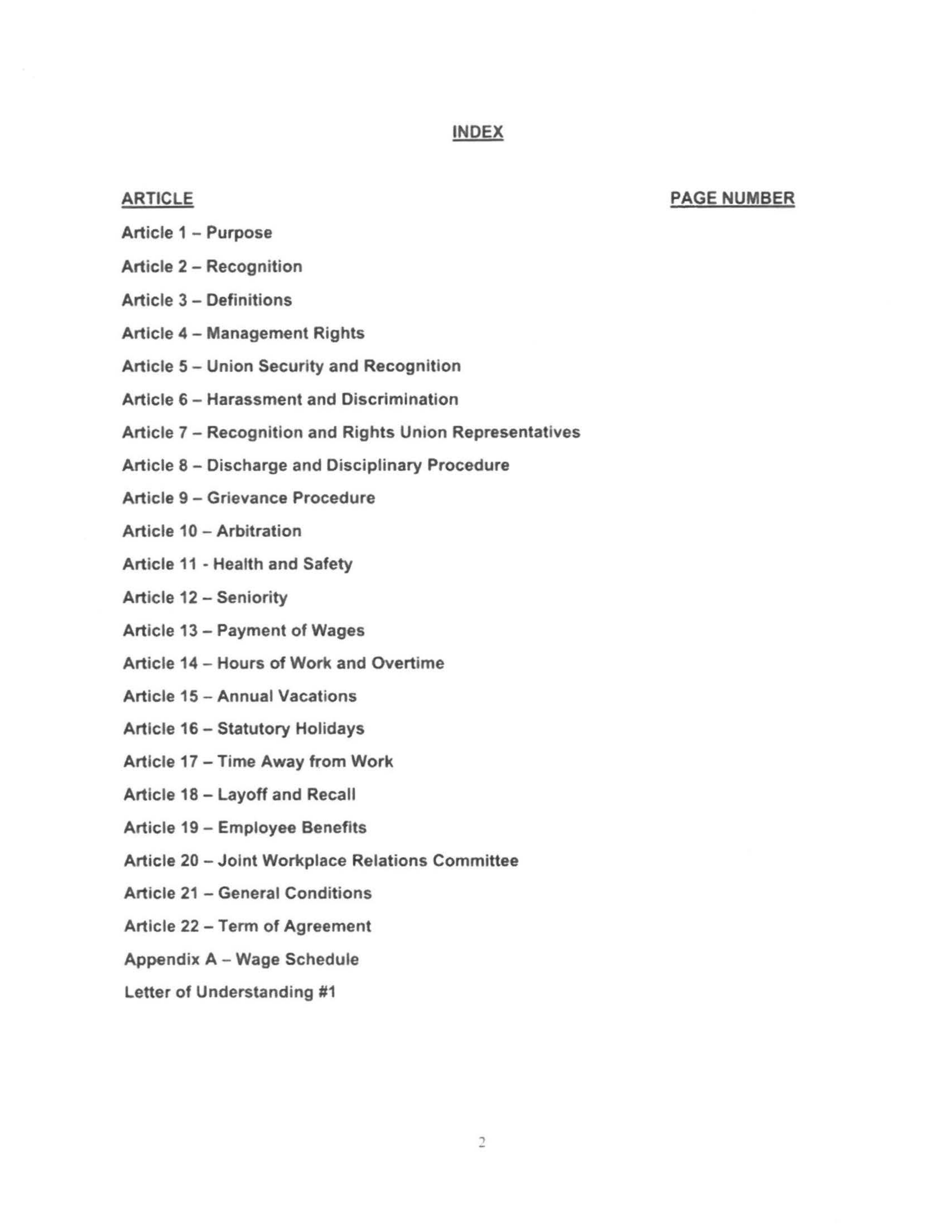
INDEX
ARTICLE
Article 1 -
Purpose
Article 2 -
Recognition
Article 3 -
Definitions
Article 4 -
Management Rights
Article 5 -
Union Security and Recognition
Article 6 -
Harassment and Discrimination
Article 7 -
Recognition and Rights Union Representatives
Article 8 -
Discharge and Disciplinary Procedure
Article 9 -
Grievance Procedure
Article 10 -
Arbitration
Article 11 -
Health and Safety
Article 12 -
Seniority
Article 13 -
Payment of
Wages
Article 14 -
Hours of Work and Overtime
Article 15 -
Annual Vacations
Artlcle 16 -
Statutory Holidays
Article 17 -
Time
Away
from Work
Article 18 -
Layoff and Recall
Article 19 -
Employee Benefits
Article 20 -
Joint Workplace Relations Committee
Article 21 -
General Conditions
Artlcle 22 -
Term of Agreement
Appendix A -
Wage Schedule
Letter of Understanding #1
2
PAGE NUMBER
ARTICLE 1 -
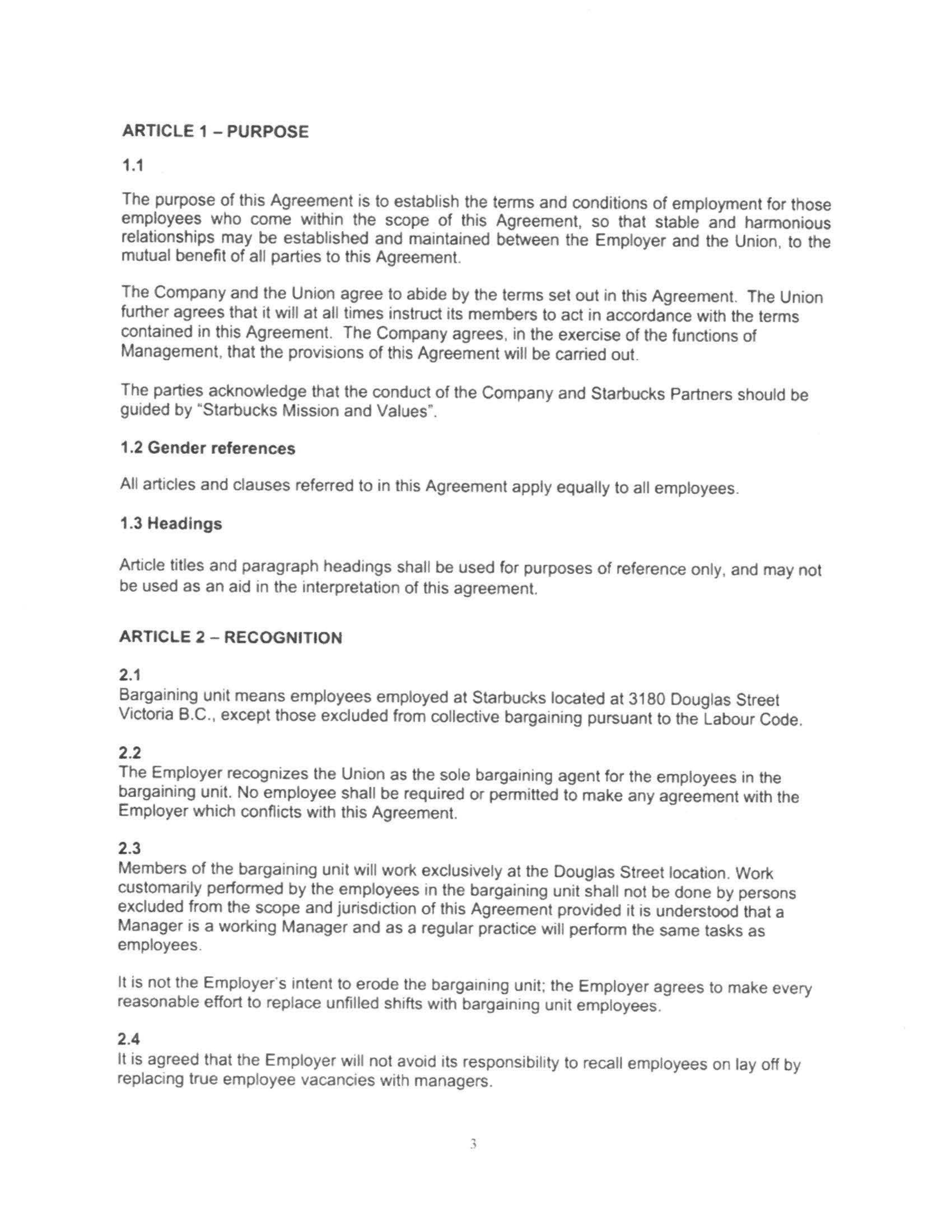
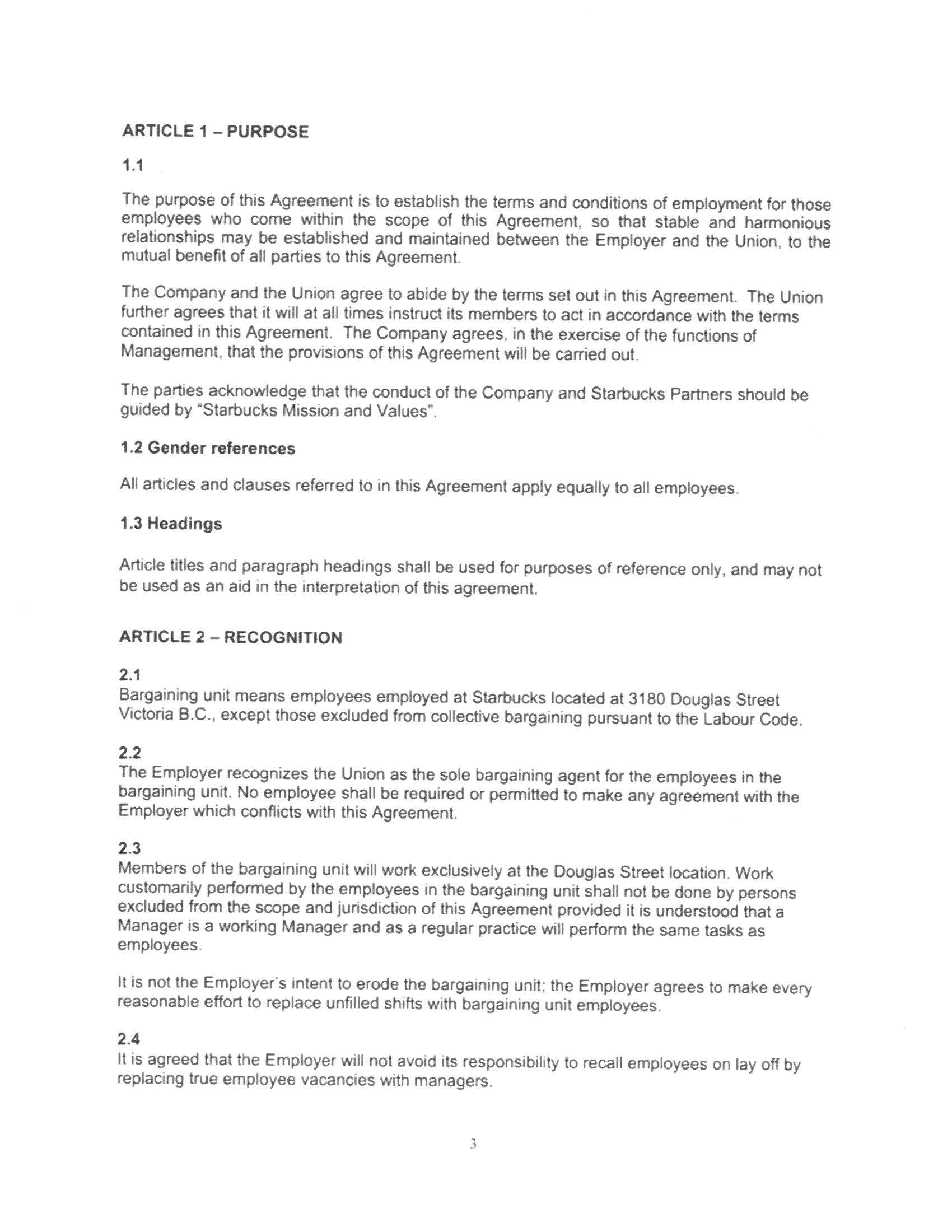
PURPOSE
1.1
The purpose of this Agreement is to establish the terms and conditions of employment for those
employees who come within the scope of this Agreement, so that stable and harmonious
relationships may be established and maintained between the Employer and the Union, to the
mutual benefit of all parties to this Agreement.
The Company and the Union agree to abide by the terms set out in this Agreement. The Union
further agrees that it will at all times instruct its members to act in accordance with the terms
contained in this Agreement. The Company agrees. in the exercise of the functions of
Management. that the provisions of this Agreement will
be
carried out.
The parties acknowledge that the conduct of the Company and Starbucks Partners should be
guided by "Starbucks Mission and Values".
1.2 Gender references
All articles and clauses referred to in this Agreement apply equally to all employees.
1.3 Headings
Article titles and paragraph headings shall be used for purposes of reference only, and may not
be used as an aid in the interpretation of this agreement.
ARTICLE 2 -
RECOGNITION
2.1
Bargaining unit means employees employed at Starbucks located at 3180 Douglas Street
Victoria B.C., except those excluded from collective bargaining pursuant to the Labour Code.
2.2
The Employer recognizes the Union as the sole bargaining agent for the employees in the
bargaining unit. No employee shall be required or permitted to make any agreement with the
Employer which conflicts with this Agreement.
2.3
Members of the bargaining unit will work exclusively at the Douglas Street location. Work
customarily performed by the employees in the bargaining unit shall not be done by persons
excluded from the scope and jurisdiction of this Agreement provided it is understood that a
Manager is a working Manager and as a regular practice will perform the same tasks as
employees.
It
is not the Employer's intent to erode the bargaining unit; the Employer agrees to make every
reasonable effort to replace unfilled shifts with bargaining unit employees.
2.4
It is agreed that the Employer will not avoid its responsibility to recall employees on lay off by
replacmg true employee vacancies with managers.
3
ARTICLE 3
-
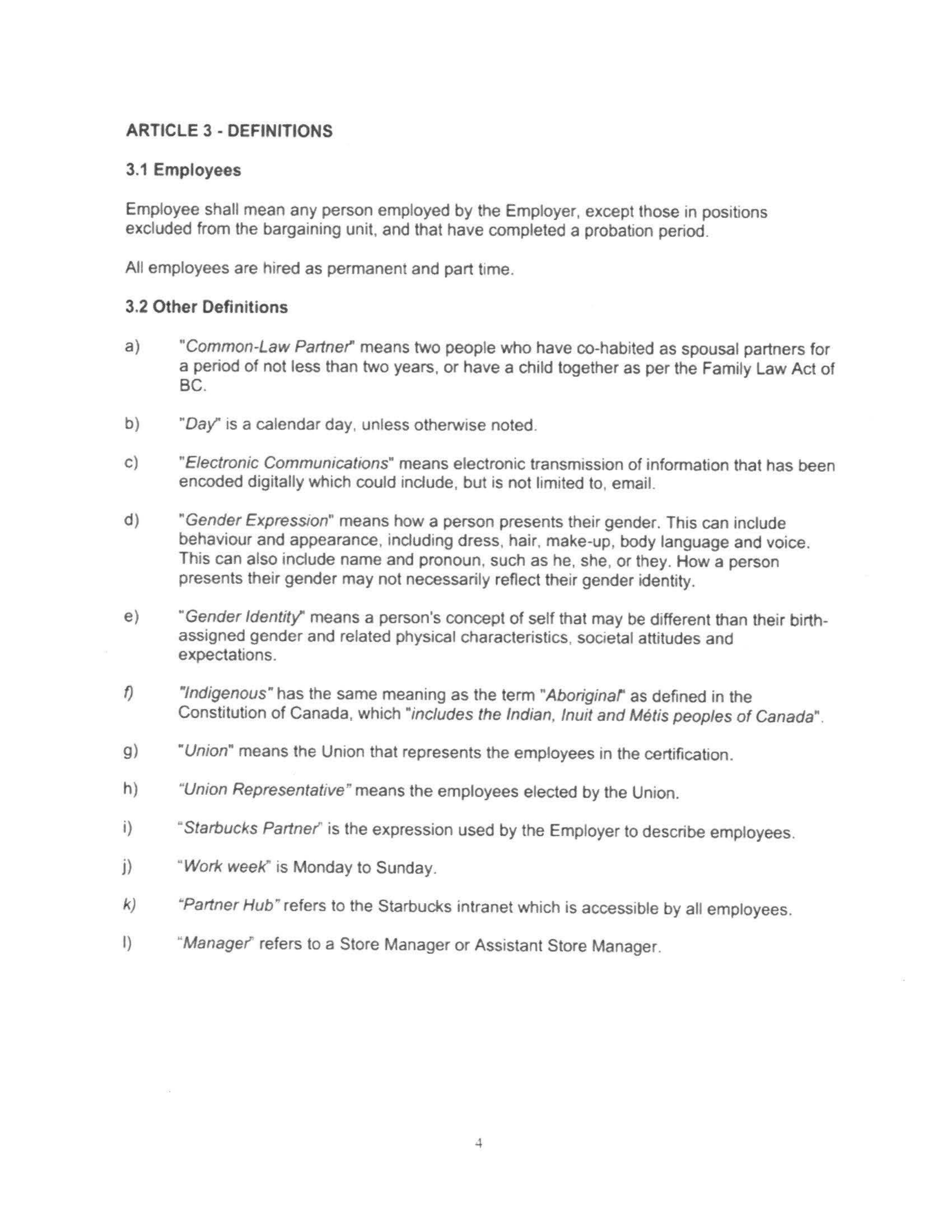
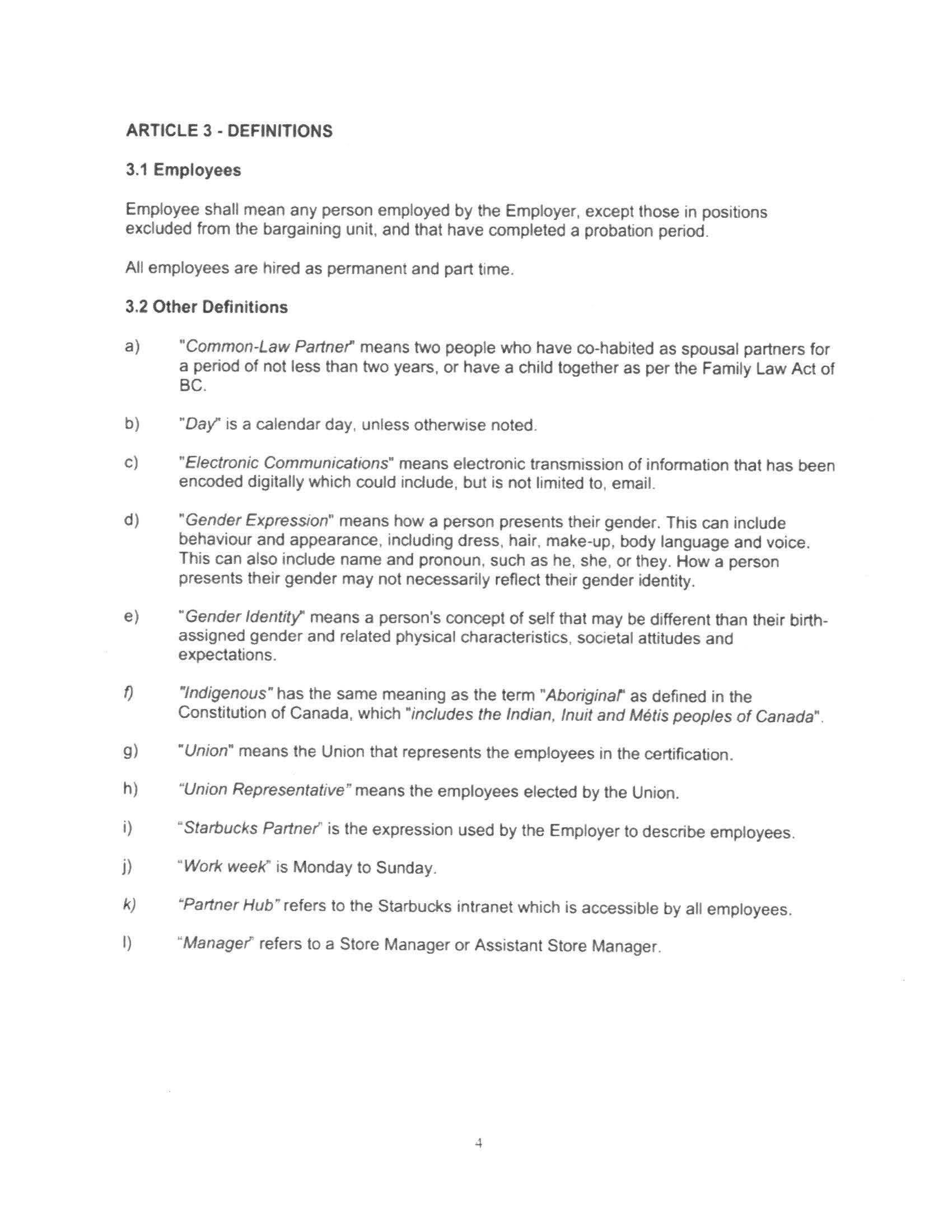
DEFINITIONS
3.1 Employees
Employee shall mean any person employed by the Employer, except those in positions
excluded from the bargaining unit, and that have completed a probation period.
All employees are hired as permanent and part time.
3.2 Other Definitions
a)
"Common-Law Partner"
means two people who have oo-habited as spousal partners for
a period of not less than two years. or have a child together as per the Family Law Act of
BC.
b)
"Day"
is a calendar day, unless otherwise noted.
c)
"Electronic Communications·
means electronic transmission of information that has been
encoded digitally which could include, but is not limited to, email.
d)
"Gender Express,on"
means how a person presents their gender. This can include
behaviour and appearance, including dress, hair. make-up, body language and voice.
This can also include name and pronoun, such as he, she, or they. How a person
presents their gender may not necessarily reflect their gender identity.
e)
"Gender Identity"
means a person's concept of self that may be different than their birth-
assigned gender and related physical characteristics, societal attitudes and
expectations.
f)
"Indigenous"
has the same meaning as the term
"Aboriginar
as defined in the
Constitution of Canada, which
·;ncludes the Indian, Inuit and Matis peoples of Canada".
g)
"Union"
means the Union that represents the employees in the certification.
h)
"Union Representative"
means the employees elected by the Union.
i)
·starbucks Partner"
is the expression used by the Employer to describe employees.
j)
·worlc
weeK'
is Monday to Sunday.
k)
•Partner Hub"
refers to the Starbucks intranet which is accessible by all employees.
I)
·Manager"
refers to a Store Manager or Assistant Store Manager.
ARTICLE 4
-
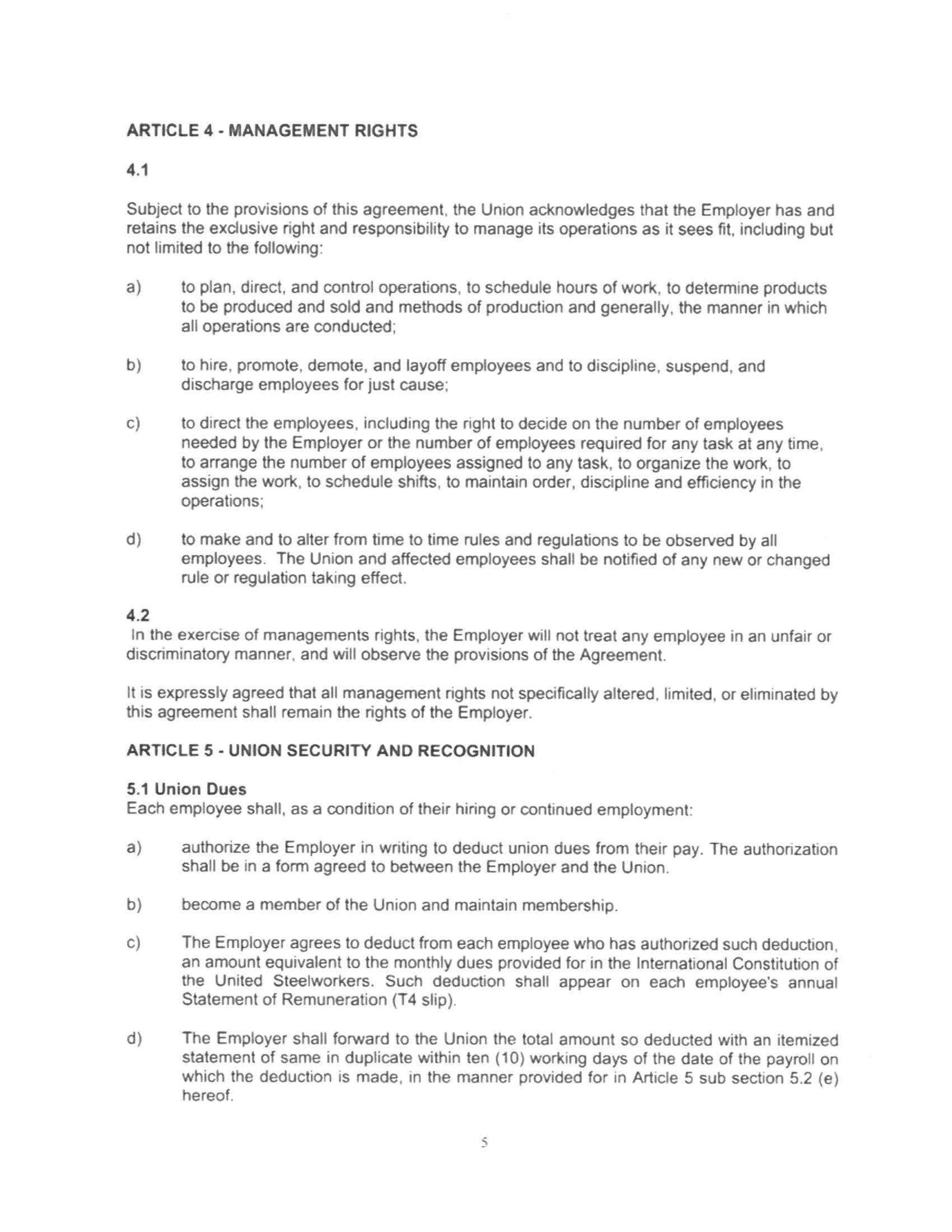
MANAGEMENT RIGHTS
4.1
Subject to the provisions of this agreement, the Union acknowledges that the Employer has and
retains the exclusive right and responsibility to manage its operations as it sees fit, including but
not limited to the following:
a)
to plan, direct, and control operations, to schedule hours of work, to determine products
to be produced and sold and methods of production and generally, the manner in which
all operations are conducted;
b)
to hire, promote, demote, and layoff employees and to discipline, suspend, and
discharge employees for just cause;
c)
to direct the employees, including the right to decide on the number of employees
needed by the Employer or the number of employees required for any task at any time,
to arrange the number of employees assigned to any task, to organize the work, to
assign the work, to schedule shifts, to maintain order, discipline and efficiency in the
operations;
d)
to make and to alter from time to lime rules and regulations to be observed by all
employees. The Union and
affected
employees shall be notified of any new or changed
rule or regulation taking effect.
4.2
In the exercise of managements rights, the Employer
will
not treat any employee in an unfair or
discriminatory manner, and will observe the provisions of the Agreement.
It is expressly agreed that all management rights not specifically altered, limited, or eliminated by
this agreement shall remain the rights of the Employer.
ARTICLE 5
-
UNION SECURITY ANO RECOGNITION
5.1 Union Dues
Each employee shall, as a condition of their hiring or continued employment:
a)
authorize the Employer in writing to deduct union dues from their pay. The authorization
shall be in a form agreed to between the Employer and the Union.
b)
become a member of the Union and maintain membership.
c)
The Employer agrees to deduct from each employee who has authorized such deduction,
an amount equivalent to the monthly dues provided for in the International Constitution of
the United Steelworkers. Such deduction shall appear on each employee's annual
Statement of Remuneration (T4 slip).
d)
The Employer shall forward to the Union the total amount so deducted with an itemized
statement of same in duplicate within ten (10) working days of the date of the payroll on
which the deduction is made, in the manner provided for in Article 5 sub section 5.2 (e)
hereof.
5
e)
Total earnings shall be deemed to include base rate earnings including vacation pay,
statutory holiday pay, overtime pay, call-in and reporting pay, but shall not include any
Workers' Compensation
payments, and payments under any benevolent, sickness or
accident plans.
f)
The reference period shall be the two (2) week period immediately prior to the payday in
which the dues are deducted.
g)
Dues shall be deducted each pay period and forwarded to the union together with a
complete summary of the union dues to the person and in the manner as advised from
time to time by the Union. The duplicate itemized statement shall be forwarded to the
union.
5.2 Humanity Fund
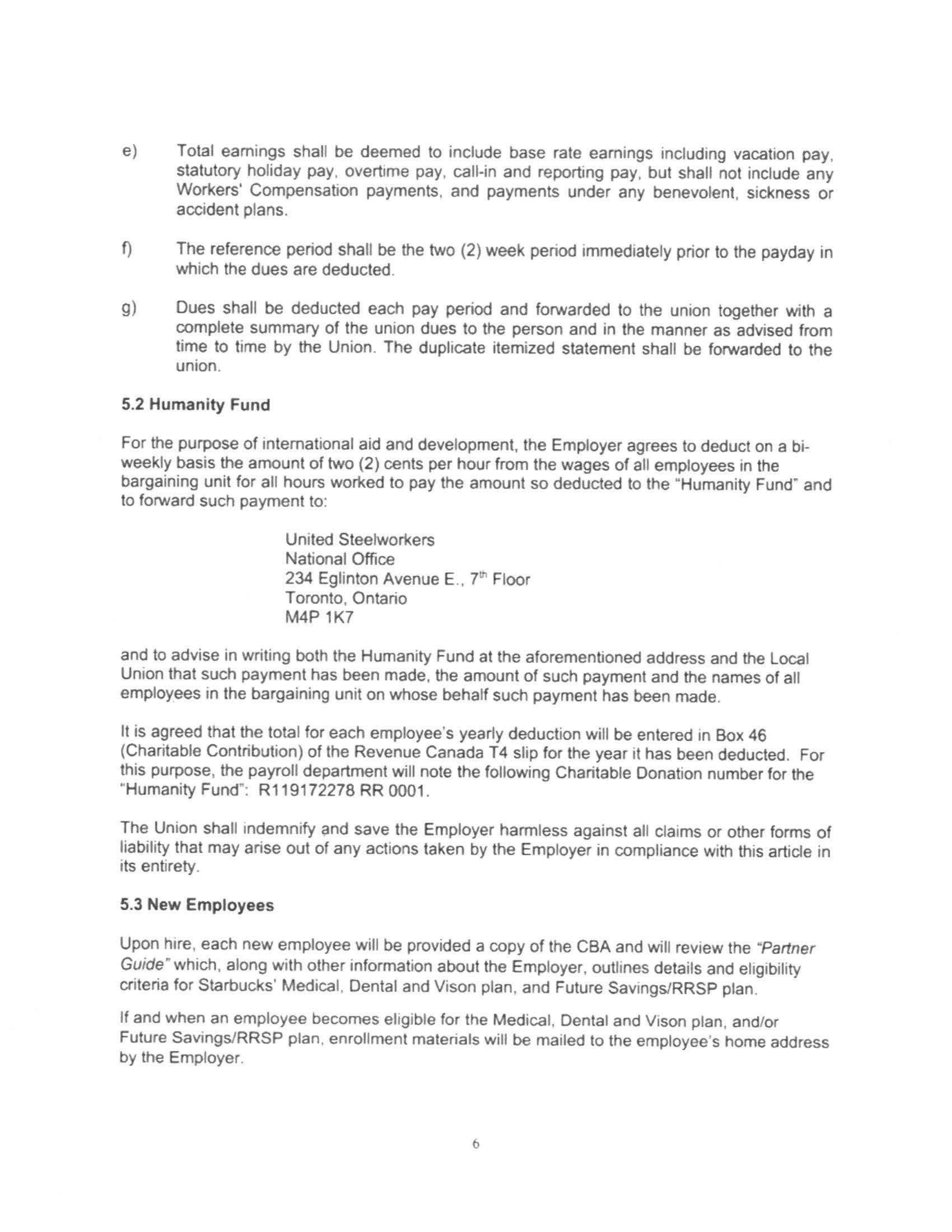
For the purpose of international aid and development, the Employer agrees to deduct on a bi-
weekly basis the amount of two (2) cents per hour from the wages of all employees in the
bargaining unit for all hours worked to pay the amount so deducted to the "Humanity Fund" and
to forward such payment to:
United Steelworkers
National Office
234 Eglinton Avenue E., 71t1 Floor
Toronto, Ontario
M4P 1K7
and to advise in writing both the Humanity Fund at the aforementioned address and the Local
Union that such payment has been made, the amount of such payment and the names of all
employees in the bargaining unit on whose behalf such payment has been made.
It
is agreed that the total for each employee's yearly deduction will be entered in Box 46
(Charitable Contribution) of the Revenue Canada T4 slip for the year it has been deducted. For
this purpose, the payroll department will note the following Charitable Donation number for the
"Humanity Fundw: R 119172278 RR 0001.
The Union shall indemnify and save the Employer harmless against all claims or other forms of
liability that may arise out of any actions taken by the Employer in compliance with this article in
its entirety.
5.3
New Employees
Upon hire, each new employee will be provided a copy of the CBA and will review the
MPartner
Guide~which, along with other information about the Employer, outlines details and eligibility
criteria for Starbucks' Medical, Dental and Vison plan, and Future Savings/RRSP plan.
If and when an employee becomes eligible for the Medical, Dental and Vison plan, and/or
Future Savings/RRSP plan, enrollment materials
will
be mailed to the employee's home address
by the Employer.
6
Employees may reference the
"Partner
Hub"
and select the
"Benefits~
tab to review benefits
details and eligibility.
5.4 Union Insignia
All employees shall have the right to wear or display the recognized insignia of the Union in the
store and while on or off duty. The Union insignia will be reasonable in size.
ARTICLE 6-
HARASSMENT AND DISCRIMINATION
Preamble
The Employer and the Union agree that every person working at Starbucks has the nght to work
in an environment free from harassment. The parties will jointly support efforts to prevent and
address harassment. The Employer will make every effort to ensure that no employee is
subjected to harassment.
The parties agree that no discrimination. sexual harassment or harassment will be tolerated on
the basis of race. colour. religion. sex, national origin or place of origin. age, disability, sexual
orientation, marital status, veteran status. gender identity and expression, genetic information or
any other basis prohibited by law.
6.1 Harassment and Bullying Defined
a)
Harassment Defined
Harassment prohibited by this policy includes but is not l1mrted to;
•
Unwelcome physical. verbal or nonverbal behavior or contact
•
Harassment involving workplace violence or a threat of violence
•
Improper use of authority to endanger or undermine an employee's job, job
performance, or career with the Employer
•
Any inappropriate conduct or comment by a person or employee to an employee that the
person knew or reasonably ought to have known would cause that employee to
be
humilrated or intimidated
Prohibited harassment may include, but is not hmited to, the following examples:
•
Physical harassment such as touching, kissing or groping.
•
Verbal harassment such as threats. degrading comments, epithets, slurs. sexual teasing
and requests for sexual favors.
•
Nonverbal harassment such as obscene gestures or leering.
•
Written communications that could offend individuals in a particular group such as
references to facial, racial or ethnic stereotypes or cancatures
•
Derogatory posters, electronic images, photographs, cartoons, drawings or gestures;
pornographic materials.
7
Appropriate actions taken by a Manager to assess, evaluate, transfer, discipline or
discharge an employee are not considered harassment. Further. the exercise of
appropriate Union representation will not constitute harassment.
b)
Sexual Harassment Defined
Sexual harassment prohibited by this policy includes any unwanted sexual advances,
requests for sexual favours or visual, verbal or physical conduct of a sexual nature
when:
•
Submission to or rejection of such conduct is used as a basis for employment decisions
affecting the employee; or
•
Such conduct has the purpose or effect of unreasonably interfering with an employee's
work performance or creating an intimidating, hostile or offensive working environment.
Such behaviours include. but
Is
not limited to:
•
Unwanted sexual advances or propositions.
•
Offering employment benefits in exchange for sexual favours.
•
Leering, making sexual gestures, displaying sexually suggestive objects or pictures.
cartoons, calendars or posters.
•
Making or using derogatory comments, comments about an employee's body or dress.
slurs. epithets or sexually suggestive jokes.
•
Written communications of a sexual nature distributed in hard copy or via a computer
network, suggestive or obscene letters. notes or invitations.
•
Physical conduct such as unwanted touching, assault, impeding or blocking movements.
•
Retaliating or threatening retaliation after a negative response to sexual advances or for
reporting or threatening to report sexual harassment.
Sexual harassment can occur between persons of the same or opposite sex.
c)
Bullying Defined
Bullying is a form of prohibited harassment that involves unwanted aggressive behavior
characterized by verbal, physical, social or psychological intimidation that is typically
repetitive and involves an imbalance of power.
Examples of bullying include. but is not limited to;
•
verbal abuse. such as the use of patently offensive. demeaning, and harmful derogatory
remarks. insults or epithets
•
verbal or physical conduct that is threatening, intimidating or obscene
•
pushing, shoving, kicking, poking. tripping, assaulting, or threatening physical assault, or
intentionally damaging a person's work area or property
8
•
sabotaging or deliberately subverting, obstructing, or disrupting another person's work
performance
•
inappropriate conduct or comment by a person towards a partner that the person knew
or reasonably ought to have known that would cause that partner to be humiliated or
intimidated
Reasonable actions taken by a manager to assess, evaluate, manage the performance
of, transfer. discipline or discharge an employee do not constitute bullying.
6.2 Reporting a Complaint
An employee who believes they have been subjected to behaviour prohibited by this policy
should make their feelings known to the offending employee, if comfortable doing so. The
employee should also immediately report the offensive behaviour, preferably in writing, to their
manager, higher-level manager or Partner Resources. Employees may also contact the Ethics
&
Compliance department directly at 1-800-611-7792 or www.starbucks.com/helpline.
If any employee becomes aware of harassing. retaliatory or threatening conduct engaged in or
experienced by an employee, the observing employee should immediately report that
information, preferably in writing, to the appropriate Manager.
6.3 Investigation
When made aware of a situation that may violate this policy, the Employer will conduct an
immediate, thorough and objective investigation. At all steps of an investigation a Union
Representative shall be present when requested by an employee.
In all circumstances, an individual who is accused of harassment will
be
informed of the
allegations made against them and all the particulars supporting the allegations as soon as
practicable. The individual will also be provided with the opportunity to fully respond to the
allegations and have their responses properly considered.
The Employer will share the outcome of the investigation with all parties, and the Union.
6.4 Discipline
Any employee found to have engaged in prohibited harassment will be subject to discipline, up
to and including discharge from employment.
In the event a complaint is determined to be of a frivolous, vindictive or vexatious nature, the
Employer may take appropriate action which may include discipline up to and including
discharge from employment.
6.5 Retaliation Prohibited
The parties agree that retaliation against any employee for reporting harassment or for
participating in an investigation will not be tolerated.
6.6 Privacy and Confidentiality
The Employer will protect the confidentiality of those involved to the extent possible, consistent
with the need to investigate and resolve the situation or complaint.
Q
All individuals involved in the harassment complaint process will comply with all requirements of
privacy laws in order to protect personal information.
ARTICLE 7-RECOGNITION
AND RIGHTS UNION REPRESENTATIVES
7.1
The Union is entitled to appoint or elect from among the employees two (2) Union
Representatives. If at anytime during the term of this agreement either party believes the
number of Union Representatives should increase or decrease, the parties agree to discuss.
Only upon mutual agreement shall the number of Union Representatives change.
7.2
The Employer agrees to recognize the duly appointed or elected Union Representative provided
that the Union has first advised the Employer in writing of the names of the employees so
appointed or elected. The Union agrees to advise the Employer in writing of any changes made
from time to time.
7.3
The Union Representative's first obligation is the fulfillment of their job responsibilities as an
employee. Union Representatives shall obtain permission from the Employer before leaving
their work station to perform Union duties. Leave from work for this purpose shall be paid and
shall not be unreasonably withheld. On resuming normal duties, Union Representatives shall
notify a supervisor. Union Representatives will make every effort to perform Union duties
outside of working hours.
7.4
In case of a grievance, on any shift not more than one (1) Union Representative may investigate
and/or submit a grievance according to the grievance procedure provided herein.
7.5
The Union Representative shall not be discriminated against or disciplined solely for the proper
performance of their duties on behalf of the Union.
7.6
Under no circumstances shall a Union Representative take an action or issue any instructions
which will interfere with the operations or affairs of the Employer, or with the management of or
direction of the workforce.
ARTICLE 8
-
DISCHARGE AND DISCIPLINARY PROCEDURE
8.1
The Employer retains the right to discipline an employee, up to and including discharge for just
cause. When the Employer has established that an infraction has been committed by an
employee and that disciplinary action ,s warranted, they will be disciplined within a timely manner.
In the event the employee is absent, the discipline will be issued upon their return to work.
8.2
The Employer supports progressive discipline in the workplace and agrees to adopt a
progressive approach to minor disciplinary offences which may include verbal or written
warnings to short periods of suspension prior to invoking discharge.
10
The foregoing process does not apply to serious infractions which will receive a disciplinary
response of longer periods of suspension or discharge without regard to an employee's prior
disciplinary record.
Discipline beyond a verbal warning shall be forwarded to the Union.
A Union representative shall be present at any step of the disciplinary procedure. Should an
employee refuse Union representation they must sign a waiver with the Union and Employer
present. All discipline shall be administered by Management.
8.3
There shall be only one employee personnel file and the employee shall have access to review
their file at a mutually agreed upon time.
An employee may opt to have the Union President or their designate of Local 2009 review their
file on their behalf after written permission has been granted.
Under no circumstances shall the employee file be removed from the Employer's premises by an
employee or Union Representative.
8.4
Any discipline recorded against an employee shall automatically be cancelled after twelve (12)
months for a written warning and eighteen (18) months for suspension and may not be held
against the employee thereafter, so long as the employee has no subsequent discipline over the
same twelve (12) month or eighteen (18) month period, whichever is applicable.
8.5
In the event of a claim that an employee has been disciplined unjustly or unreasonably by any
means other than discharge, the grievance shall be filed at Step 1 of the
grievance procedure.
8.6
In the event of a claim that an employee has been discharged unjustly or unreasonably, the
grievance shall be filed at Step 2 of the grievance procedure within ten (10) working days.
ARTICLE 9
-
GRIEVANCE PROCEDURE
Any grievance which arises directly between the Employer and the Union concerning the
interpretation. application, administration, or alleged violation of the provisions of the Agreement
may be submitted by either of the parties to the other.
9.1 Grievance Procedure
Step 1
To avoid the development of minor complaints into a grievance, the parties wish that complaints
arising from the interpretation or implementation of this agreement be discussed verbally between
the employee and/or the authorized Union representative and the store manager or designate
within seven (7) working days of the knowledge of the event that gave rise to the grievance.
11
Step 2
Whenever a grievance concerning the implementation or interpretation of the collective
agreement arises, the employee and/or the Union, or the Employer shall, within ten (10) days,
submit the reason in writing together
with
the nature of the grievance, the facts concerning the
matter and the remedy sought, to the Employer or the Union, after step one (1} has been
completed without resolve. The Employer or the Union shall render a decision in writing within
seven {7) working days of receipt of the written grievance.
Step
3
If the decision of the Employer or Union is not acceptable, the other party shall request within
seven (7) working days of receipt of the decision, a meeting with the Union servicing
representative, or designate, Union Representative and management. A decision in writing will
be sent to the Union or the Employer, as the case may be, within seven (7) working days of the
meeting. Failing resolve, either party may refer the grievance to arbitration pursuant to Article 10
herein.
Any mutually agreed upon decision of the parties at any step in the grievance procedure will
be
final and binding upon the Employer, the Union and the employee(s) involved.
9.2 Time Limits and Abandonment
a)
In the event that a person who normally files grievances is not available within the time
limits specified, the Employer and the Union agree that the time limits for filing will be
extended by mutual agreement until such time as the griever can speak with such
person.
b)
By mutual agreement the parties may extend the time limits in Article 9 and shall do so in
writing.
ARTICLE 10 -ARBITRATION
10.1 Referral
to Arbitration
a)
Within thirty (30) calendar days of referral to arbitration, the Employer and the Union
shall endeavour to agree upon the selection of an acceptable arbitrator to hear and
render a decision on the matter(s) in dispute.
If the Parties are unable to agree upon the selection of an Arbitrator, the Parties will
apply within ten (10) calendar days of their failure to agree, to the Minister of Labour
pursuant to the Labour Relations Code for the appointment of an Arbitrator.
b)
Once an Arbitrator has been selected or appointed, the Arbitrator shall convene a
hearing, consider the submissions and evidence of the Parties and render their decision
that shall be final and binding upon the Parties.
c}
Each Party shall bear the costs of their representatives and one-half ( 1/2) the cost of the
Arbitrator.
10.2
Decision of Arbitrator
12
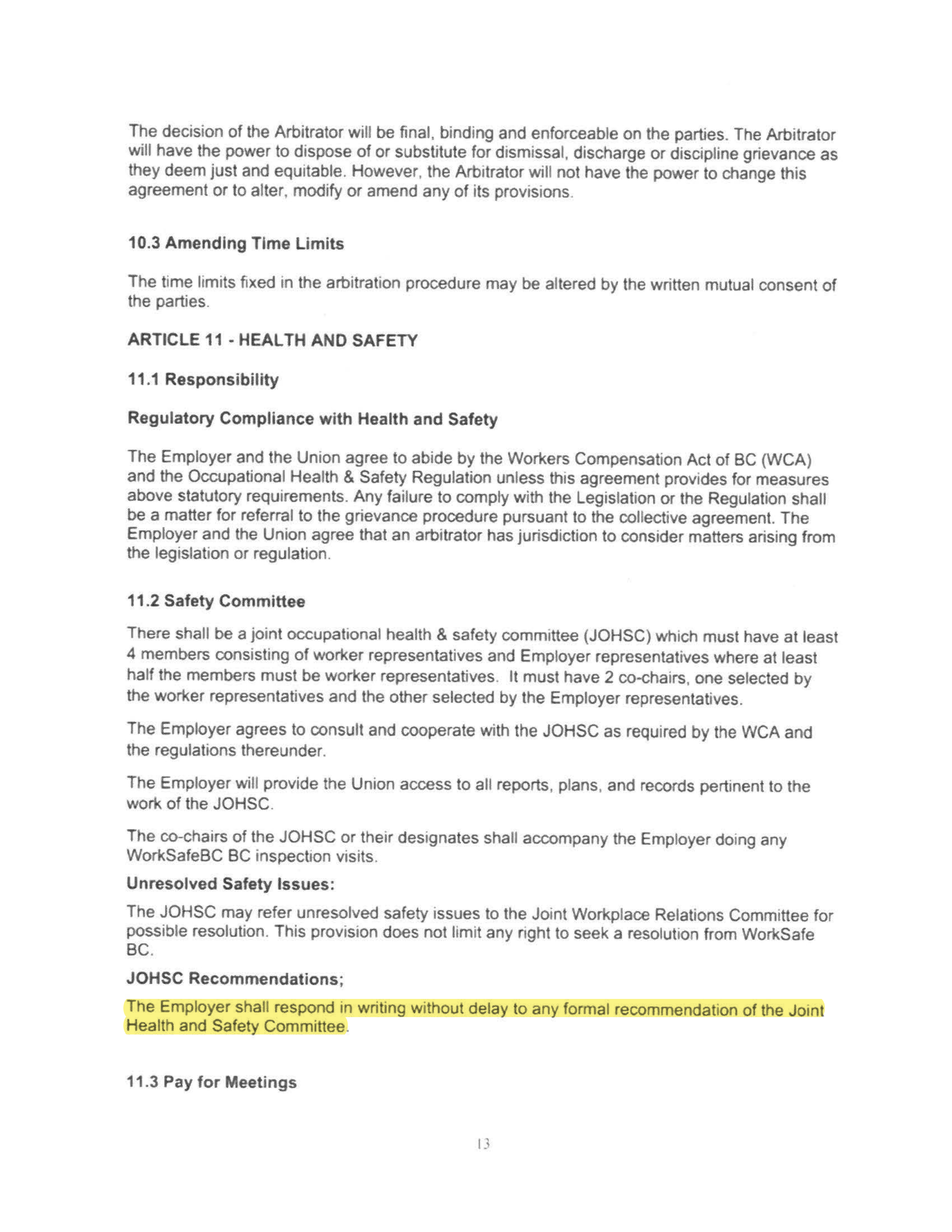
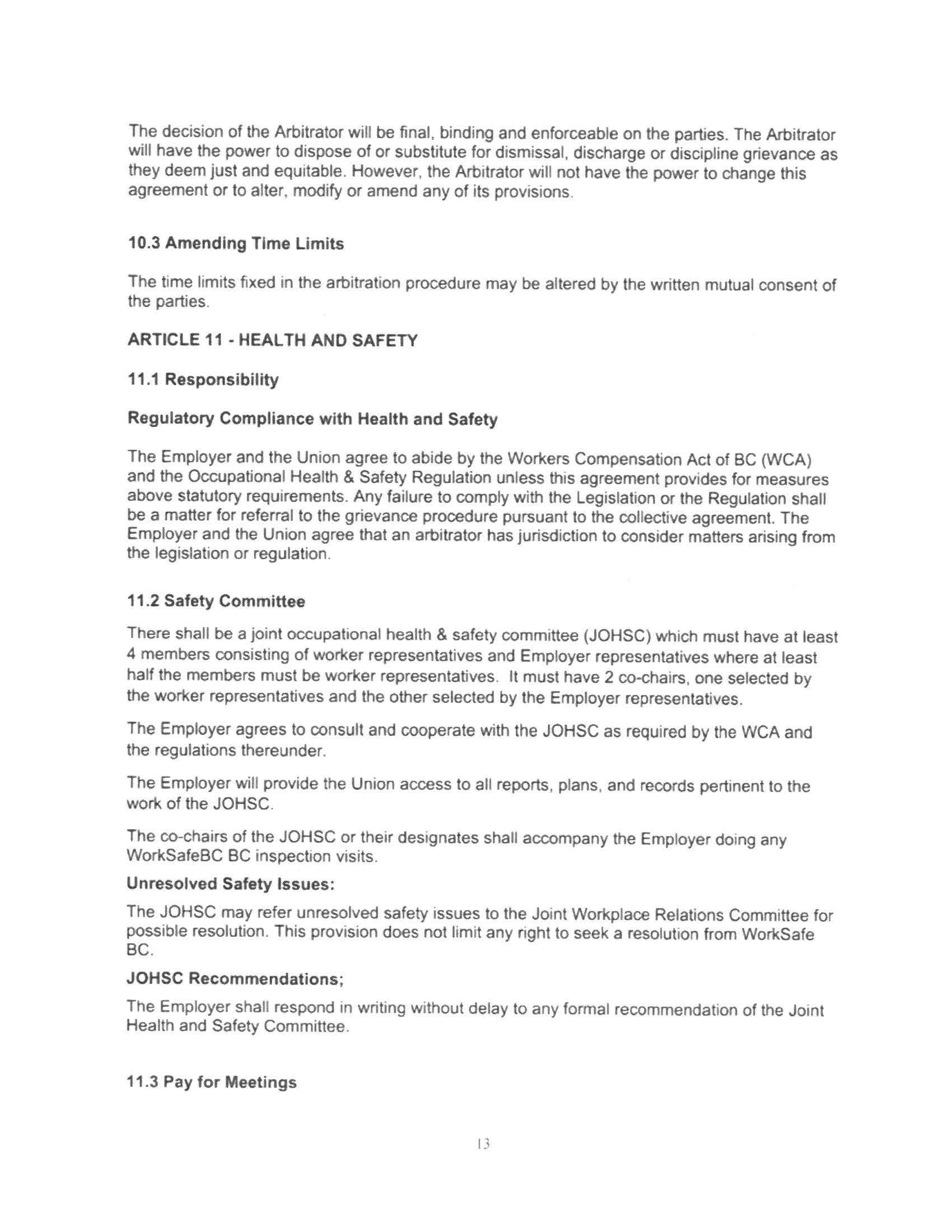
The decision of the Arbitrator will be final. binding and enforceable on the parties. The Arbitrator
will have the power to dispose of or substitute for dismissal, discharge or discipline grievance as
they deem just and equitable. However, the Arbitrator will not have the power to change this
agreement or to alter, modify or amend any of its provisions.
10.3 Amending Time
Limits
The time limits fixed in the arbitration procedure may be altered by the written mutual consent of
the parties.
ARTICLE 11
-
HEALTH AND SAFETY
11.1 Responsibility
Regulatory Compliance with Health and Safety
The Employer and the Union agree to abide by the Workers Compensation Act of BC (WCA)
and the Occupational Health
&
Safety Regulation unless this agreement provides for measures
above statutory requirements. Any failure to comply with the Legislation or the Regulation shall
be a matter for referral to the grievance procedure pursuant to the collective agreement. The
Employer and the Union agree that an arbitrator has jurisdiction to consider matters arising from
the legislation or regulation.
11.2 Safety Committee
There shall be a joint occupational health
&
safety committee (JOHSC) which must have at least
4 members consisting of worker representatives and Employer representatives where at least
half the members must be worker representatives.
It must have
2
co-chairs, one selected by
the worker representatives and the other selected by the Employer representatives.
The Employer agrees to consult and cooperate with the JOHSC as required
by
the WCA and
the regulations thereunder.
The Employer will provide the Union access to all reports, plans, and records pertinent to the
work of the JOHSC.
The co-chairs of the JOHSC or their designates shall accompany the Employer doing any
WorkSafeBC BC inspection visits.
Unresolved Safety Issues:
The JOHSC may refer unresolved safety issues to the Joint Workplace Relations Committee
for
possible resolution. This provision does not limit any right to seek a resolution from WorkSafe
BC.
JOHSC Recommendations;
The Employer shall respond in writing without delay to any formal recommendation of the Joint
Health and Safety Committee.
11.3 Pay for Meetings
13
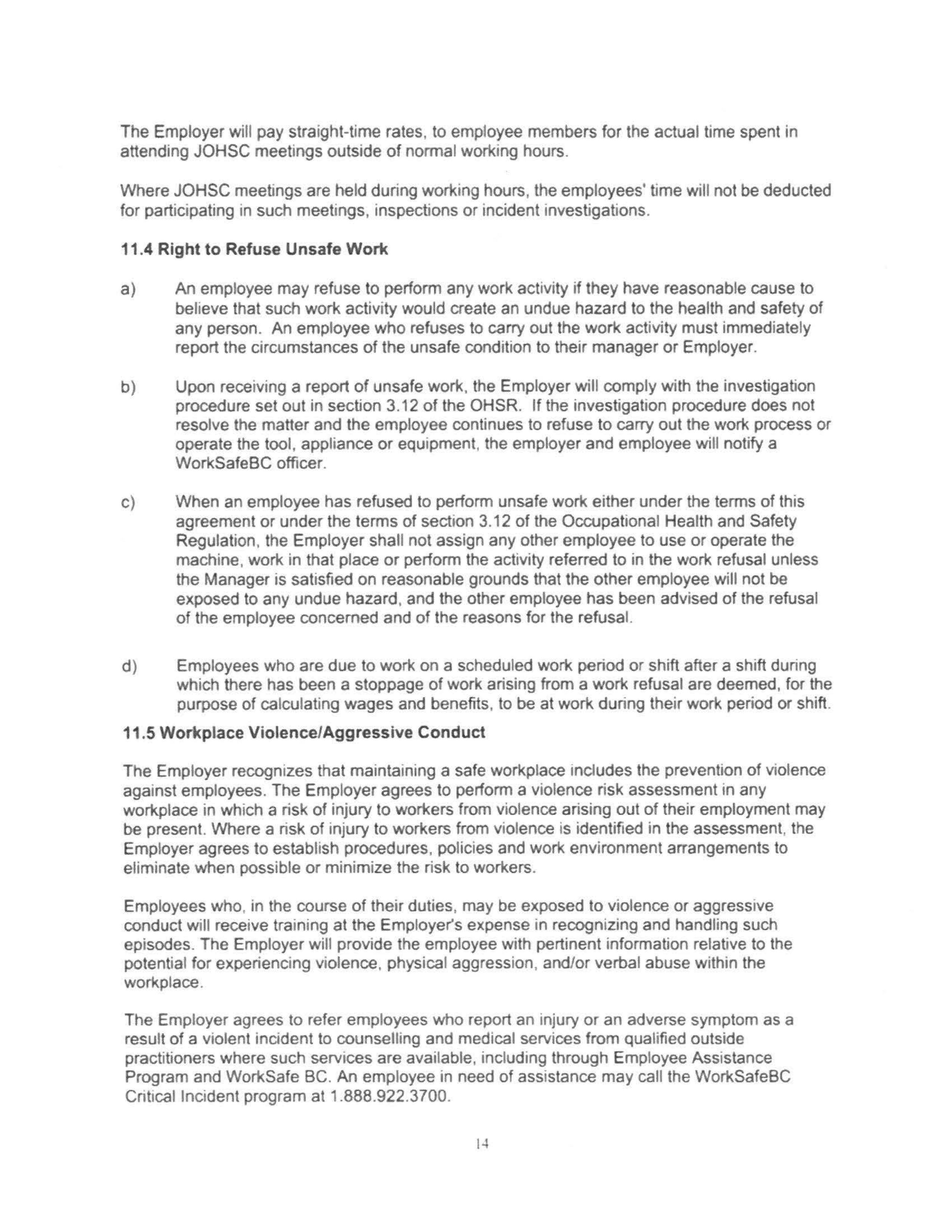
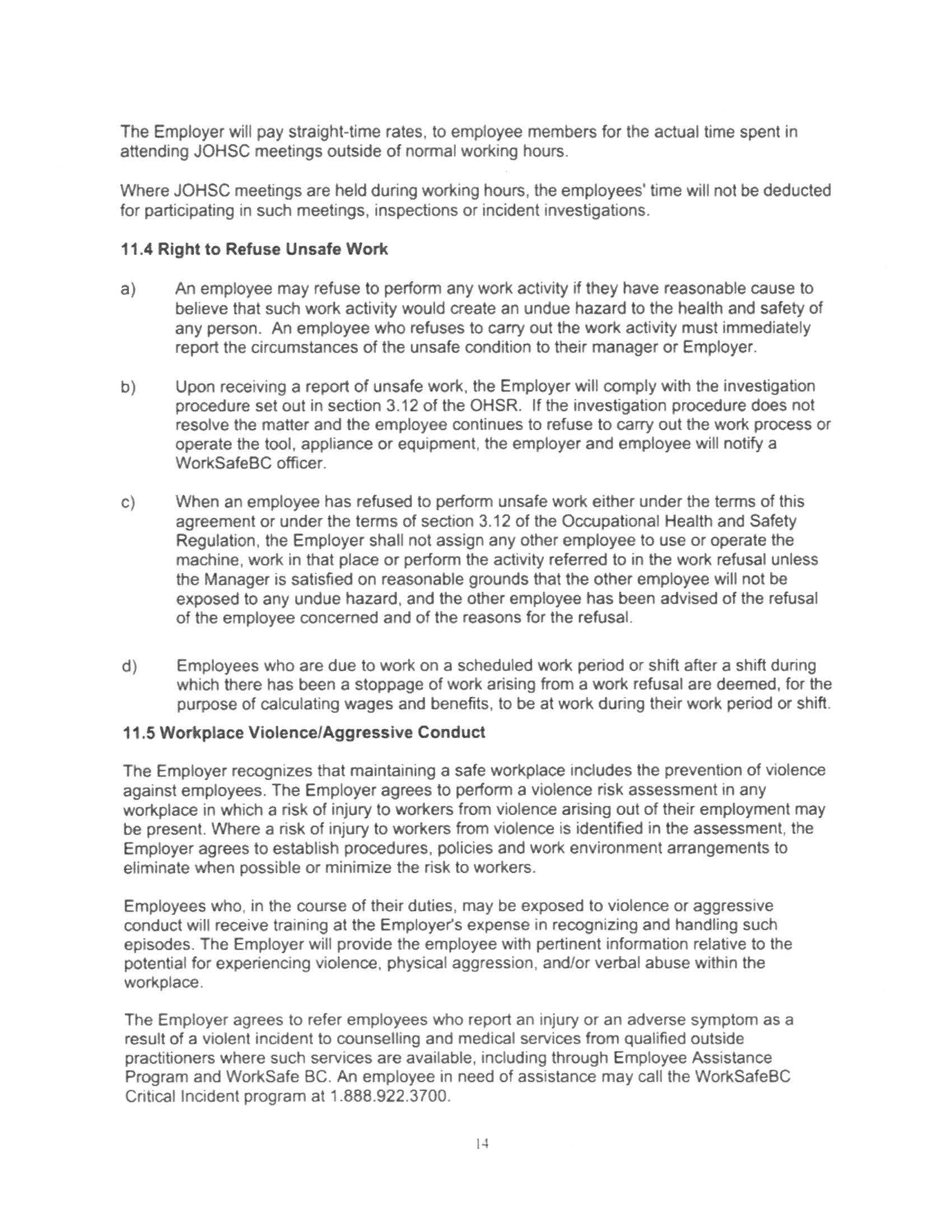
The Employer will pay straight-time rates, to employee members for the actual time spent in
attending JOHSC meetings outside of normal working hours.
Where JOHSC meetings are held during working hours, the employees' time will not be deducted
for participating in such meetings, inspections or incident investigations.
11.4 Right to Refuse Unsafe Work
a}
An
employee may refuse to perform any work activity if they have reasonable cause to
believe that such work activity would create an undue hazard to the health and safety of
any person. An employee who refuses to carry out the work activity must immediately
report the circumstances of the unsafe condition to their manager or Employer.
b}
Upon receiving a report of unsafe work. the Employer will comply with the investigation
procedure set out in section 3.12 of the OHSR. If the investigation procedure does not
resolve the matter and the employee continues to refuse to carry out the work process or
operate the tool, appliance or equipment, the employer and employee will notify a
WorkSafeBC officer.
c)
When an employee has refused to perform unsafe work either under the terms of this
agreement or under the terms of section 3.12 of the Occupational Health and Safety
Regulation, the Employer shall not assign any other employee to use or operate the
machine, work in that place or perform the activity referred to in the work refusal unless
the Manager is satisfied on reasonable grounds that the other employee will not be
exposed to any undue hazard, and the other employee has been advised of the refusal
of the employee concerned and of the reasons for the refusal.
d}
Employees who are due to work on a scheduled work period or shift after a shift during
which there has been a stoppage of work arising from a work refusal are deemed, for the
purpose of calculating wages and benefits, to be at work during their work period or shift.
11.5 Workplace Violence/Aggressive Conduct
The Employer recognizes that maintaining a safe workplace includes the prevention of violence
against employees. The Employer agrees to perform a violence risk assessment in any
workplace in which a risk of injury to workers from violence arising out of their employment may
be present. Where a risk of injury to workers from violence is identified in the assessment, the
Employer agrees to establish procedures, policies and work environment arrangements to
eliminate when possible or minimize the risk to workers.
Employees who, in the course of their duties, may be exposed to violence or aggressive
conduct will receive training at the Employer's expense in recognizing and handling such
episodes. The Employer will provide the employee with pertinent information relative to the
potential for experiencing violence. physical aggression, and/or verbal abuse within the
workplace.
The Employer agrees to refer employees who report an injury or an adverse symptom as a
result of a violent incident to counselling and medical services from qualified outside
practitioners where such services are available, including through Employee Assistance
Program and WorkSafe BC.
An
employee in need of assistance may call the WorkSafeBC
Critical Incident program at 1.888.922.3700.
1-t
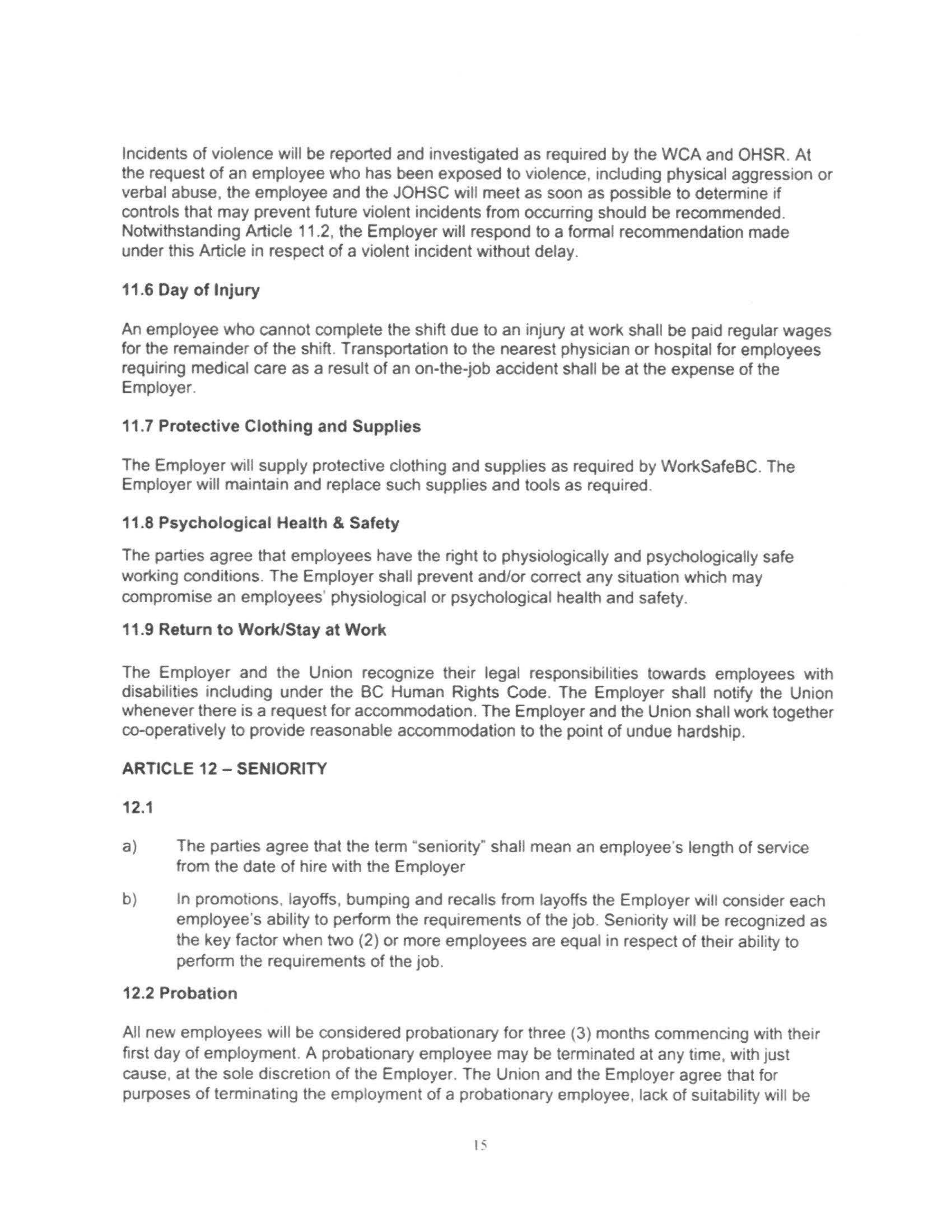
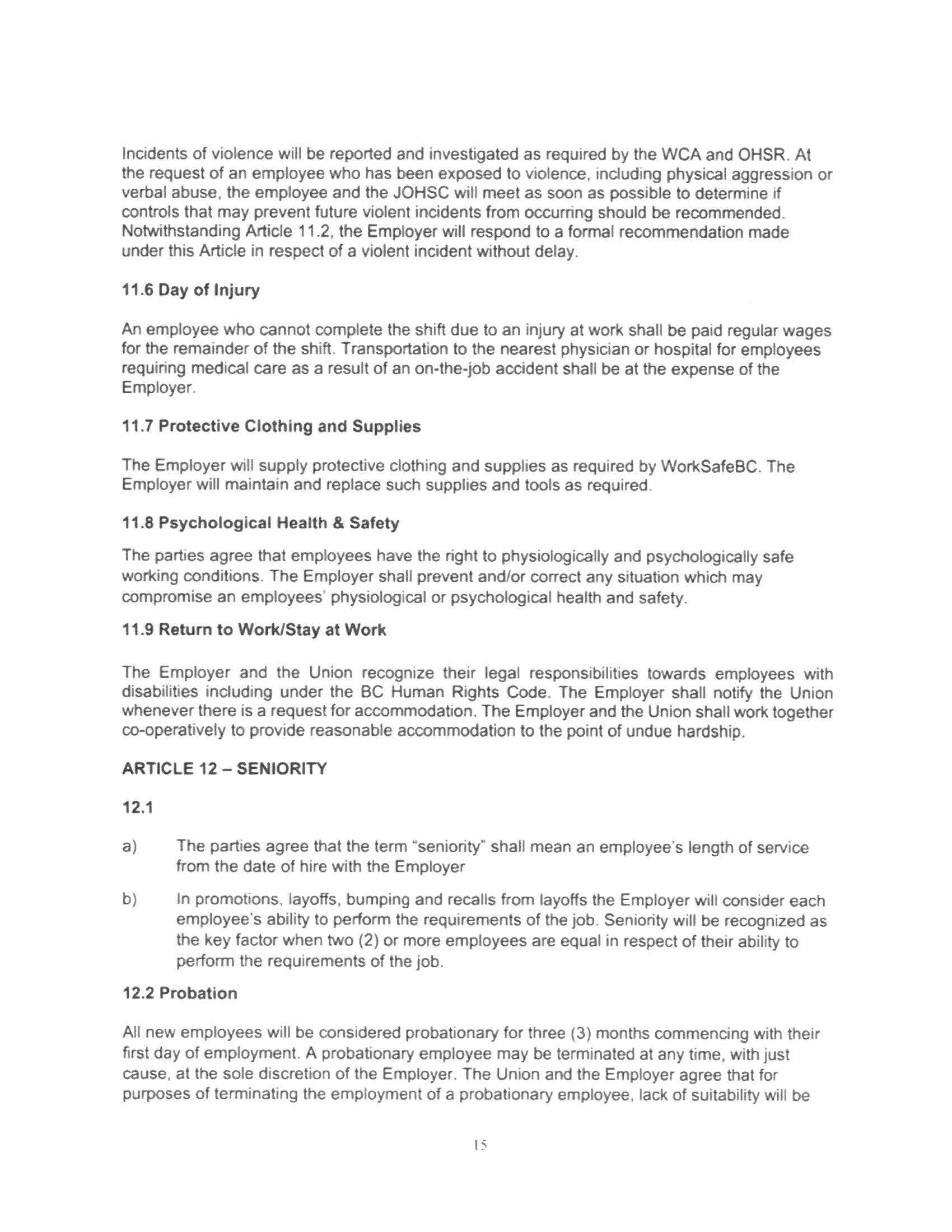
Incidents of violence will be reported and investigated as required by the WCA and OHSR. At
the request of an employee who has been exposed to violence, including physical aggression or
verbal abuse, the employee and the JOHSC will meet as soon as possible to determine if
controls that may prevent future violent incidents from occurring should
be
recommended.
Notwithstanding Article 11.2, the Employer will respond to a formal recommendation made
under this Article in respect of a violent incident without delay.
11.6 Day
of
Injury
An
employee
who
cannot complete the shift due to an injury at work shall
be
paid regular wages
for the remainder of the shift. Transportation to the nearest physician or hospital for employees
requiring medical care as a result of an on-the-job accident shall be at the expense of the
Employer.
11.7 Protective Clothing and Supplies
The Employer will supply protective clothing and supplies as required by WorkSafeBC. The
Employer will maintain and replace such supplies and tools as required.
11.8 Psychological Health
&
Safety
The parties agree that employees have the right to physiologically and psychologically safe
working conditions. The Employer shall prevent and/or correct any situation which may
compromise an employees· physiological or psychological health and safety.
11.9 Return to Work/Stay at Work
The Employer and the Union recognize their legal responsibilities towards employees with
disabilities including under the BC Human Rights Code. The Employer shall notify the Union
whenever there is a request for accommodation. The Employer and the Union shall won< together
co-operatively to provide reasonable accommodation to the point of undue hardship.
ARTICLE 12
-
SENIORITY
12.1
a}
The parties agree that the term ~seniority· shall mean an employee's length of service
from the date of hire with the Employer
b)
In promotions, layoffs, bumping and recalls from layoffs the Employer will consider each
employee's ability to perform the requirements of the job. Seniority will be recognized as
the key factor when two (2) or more employees are equal in respect of their ability to
perform the requirements of the job.
12.2 Probation
All new employees will be considered probationary for three (3) months commencing with their
first day of employment. A probationary employee may be terminated at any time, with just
cause, at the sole discretion of the Employer. The Union and the Employer agree that for
purposes of terminating the employment of a probationary employee, lack of suitability will be
15
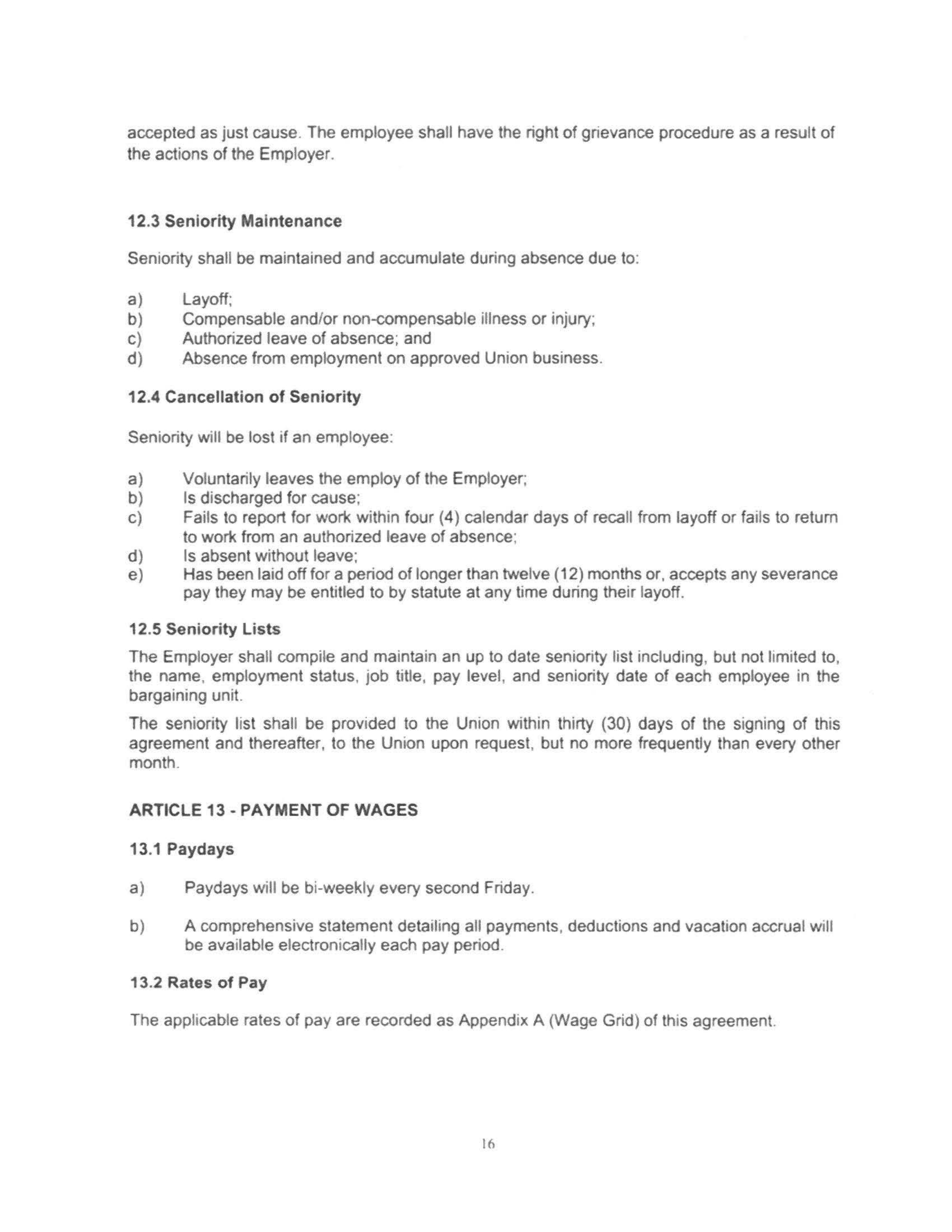
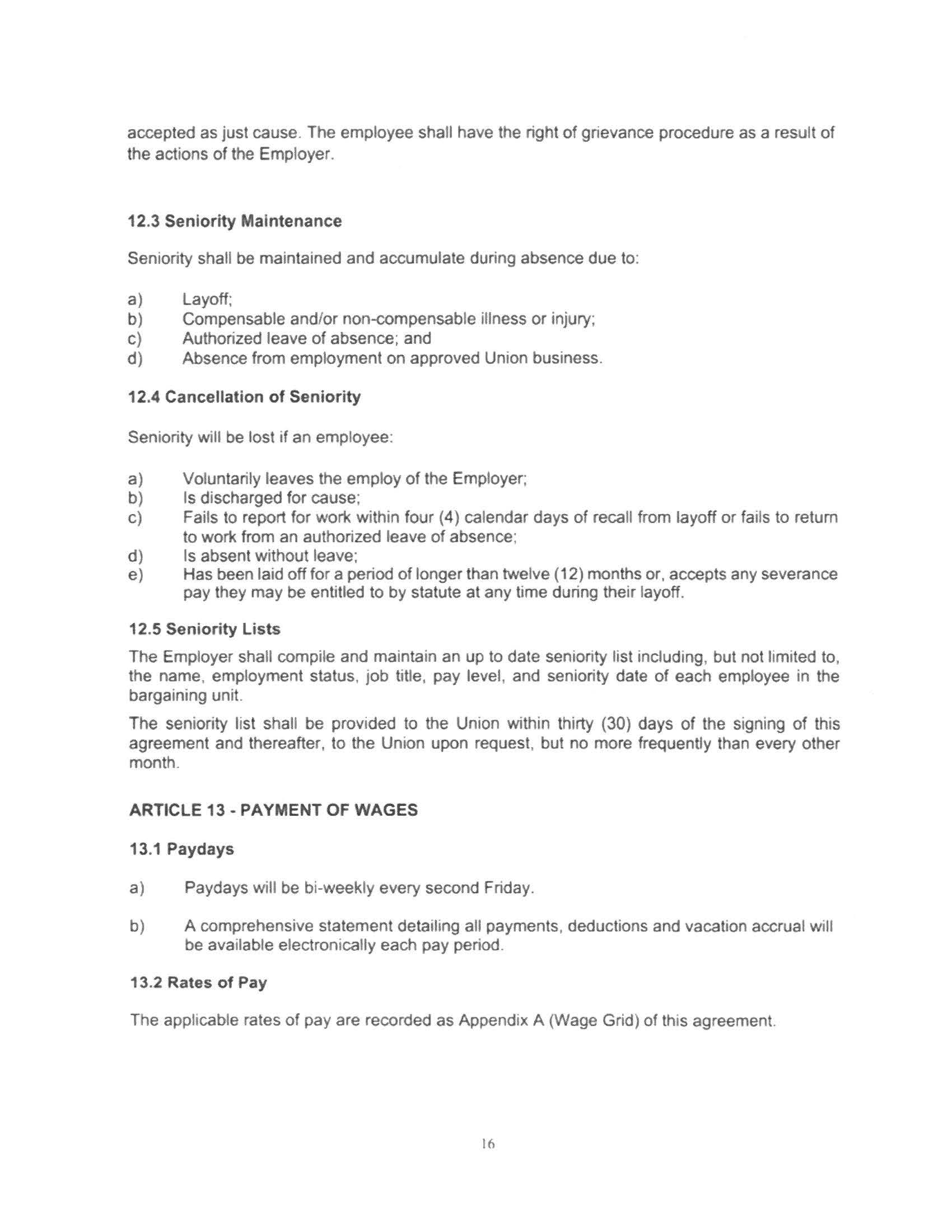
accepted as just cause. The employee shall have the right of grievance procedure as a result of
the actions of the Employer.
12.3 Seniority Maintenance
Seniority shall be maintained and accumulate during absence due to:
a)
Layoff;
b)
Compensable and/or non-compensable illness or injury;
c)
Authorized leave of absence; and
d)
Absence from employment on approved Union business.
12.4 Cancellation of Seniority
Seniority will be lost if an employee:
a)
Voluntarily leaves the employ of the Employer;
b)
Is discharged for cause;
c)
Fails to report for work within four (4) calendar days of recall from layoff or fails to return
to work from an authorized leave of absence;
d)
Is absent without leave;
e)
Has been laid off for a period of longer than twelve (12) months or, accepts any severance
pay they may be entitled to by statute at any time during their layoff.
12.5 Seniority Lists
The Employer shall compile and maintain an up to date seniority list including, but not limited to,
the name, employment status, job title, pay level, and seniority date of each employee in the
bargaining unit.
The seniority list shall be provided to the Union within thirty (30) days
of
the signing of this
agreement and thereafter, to the Union upon request, but no more frequently than every other
month.
ARTICLE 13
-
PAYMENT OF WAGES
13.1 Paydays
a)
Paydays will be bi-weekly every second Friday.
b)
A comprehensive statement detailing all payments, deductions and vacation accrual will
be available electronically each pay period.
13.2 Rates of Pay
The applicable rates of pay are recorded as Appendix A (Wage Grid) of this agreement.
In
ARTICLE 14-
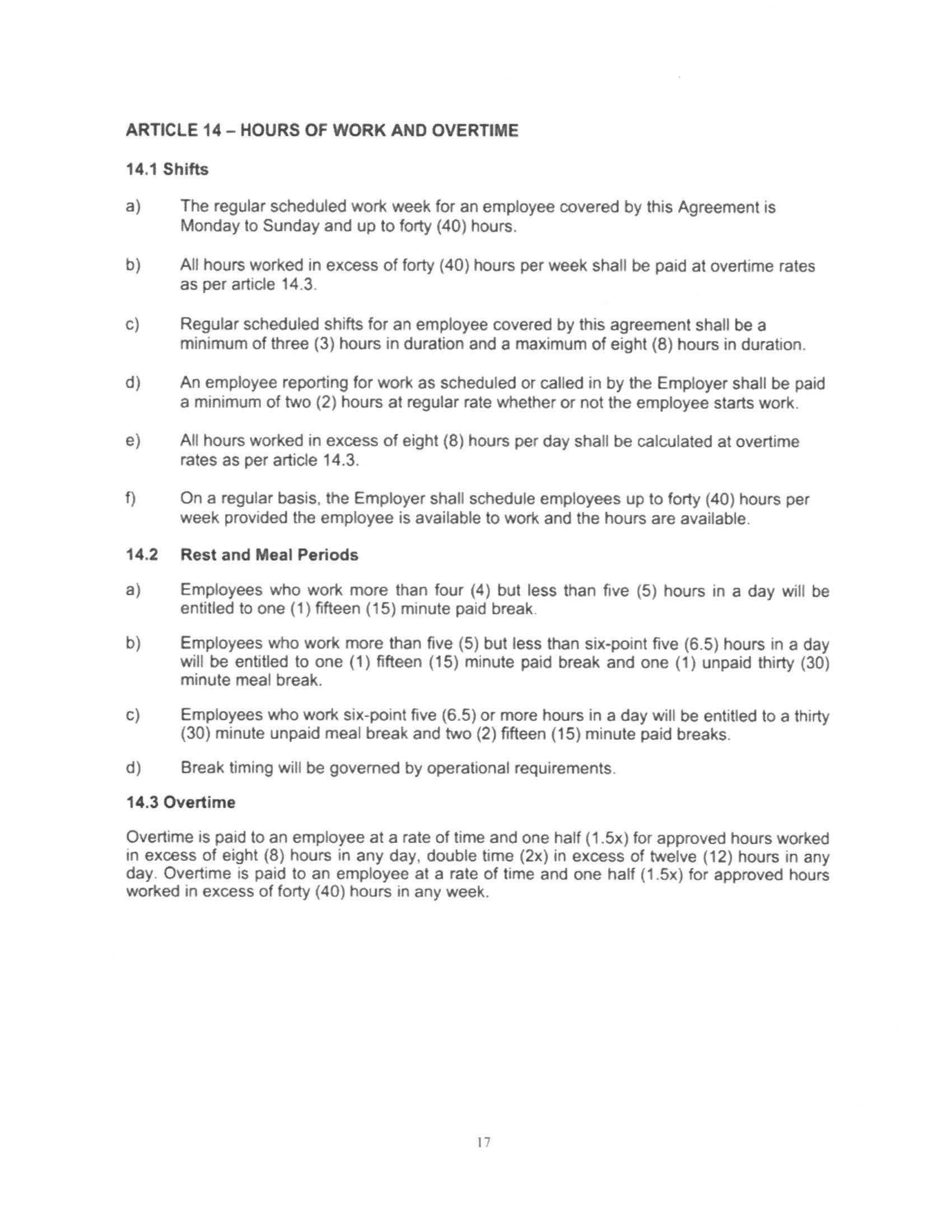
HOURS OF WORK ANO OVERTIME
14.1 Shifts
a)
The regular scheduled work week for an employee covered by this Agreement is
Monday to Sunday and up to forty (40) hours.
b)
All hours worked in excess of forty (40) hours per week shall
be
paid at overtime rates
as per article 14.3.
c)
Regular scheduled shifts for an employee covered by this agreement shall be a
minimum of three (3) hours in duration and a maximum of eight (8) hours in duration.
d)
An employee reporting for work as scheduled or called in by the Employer shall be paid
a minimum of two (2) hours at regular rate whether or not the employee starts work.
e)
All hours worked in excess of eight (8) hours per day shall be calculated at overtime
rates as per article 14.3.
f)
On a regular basis, the Employer shall schedule employees up to forty (40) hours per
week provided the employee is available to work and the hours are available.
14.2
Rest and Meal Periods
a)
Employees who work
more
than four (4) but less than five (5) hours in a day will be
entitled to one (1) fifteen (15) minute paid break.
b)
Employees who work more than five (5) but less than six-point five (6.5) hours in a day
will
be
entitled to one (1) fifteen (15) minute paid break and one (1) unpaid thirty (30)
minute meal break.
c)
Employees who work six-point five (6.5) or more hours in a day will be entitled to a thirty
(30) minute unpaid meal break and two (2) fifteen (15) minute paid breaks.
d)
Break timing will be governed by operational requirements.
14.3 Overtime
Overtime is paid to an employee at a rate of time and one half ( 1.5x) for approved hours worked
in excess of eight (8) hours in any day, double time (2x) in excess of twelve (12) hours in any
day. Overtime is paid to an employee at a rate of time and one half (1.5x) for approved hours
worked in excess of forty (40) hours in any week.
17
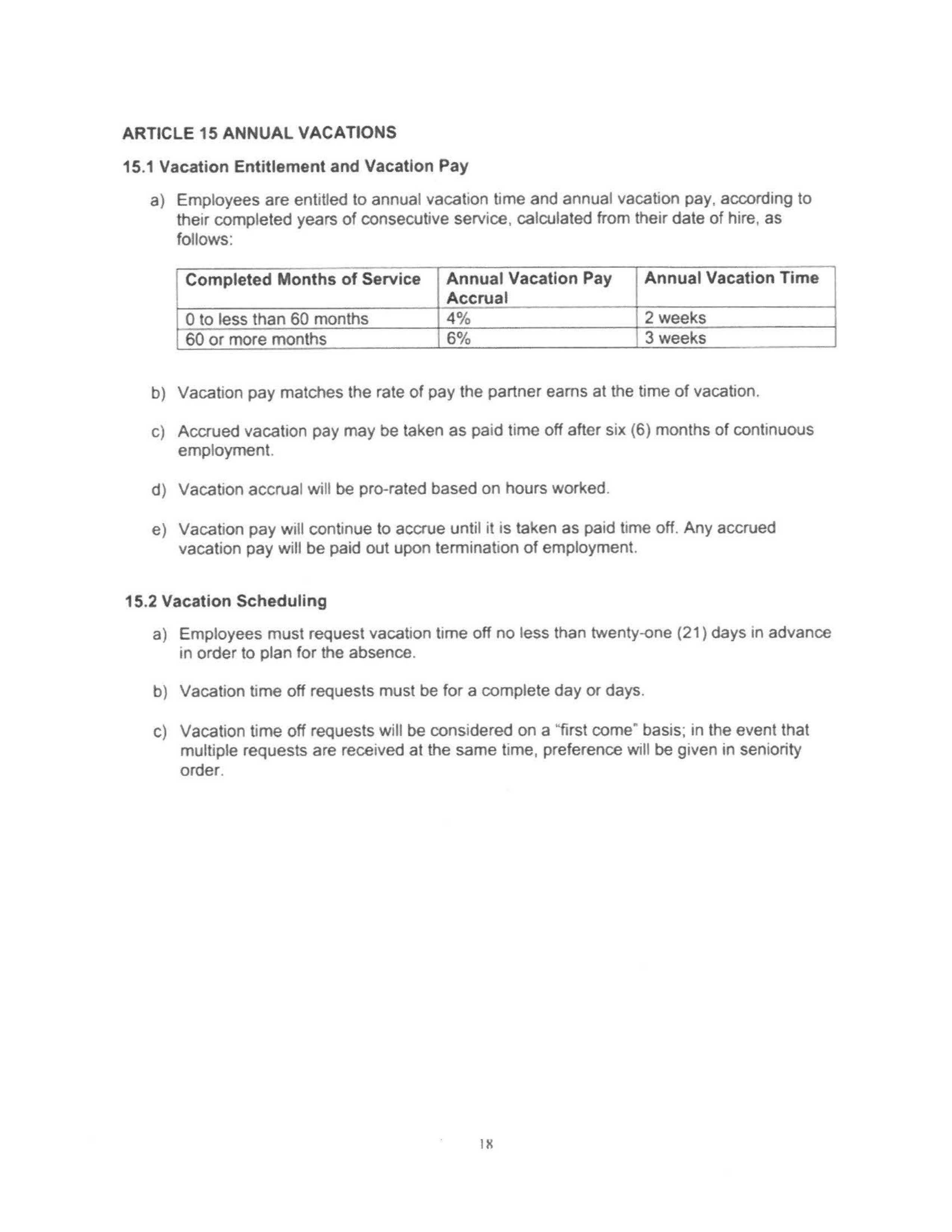
ARTICLE 15 ANNUAL VACATIONS
15.1 Vacation Entitlement and Vacation Pay
a) Employees are entitled to annual vacation time and annual vacation pay, according to
their completed years of consecutive service, calculated from their date of hire, as
follows:
Completed Months of Service
Annual Vacation Pay
Annual Vacation Time
Accrual
0 to less than 60 months
4%
2 weeks
60 or more months
6%
3 weeks
b) Vacation pay matches the rate of pay the partner earns at the time of vacation.
c) Accrued vacation pay may be taken as paid time off after six (6) months of continuous
employment.
d) Vacation accrual will
be
pro-rated based on hours worked.
e) Vacation pay will continue to accrue until it is taken as paid time off. Any accrued
vacation pay will be paid out upon termination of employment.
15.2 Vacation Scheduling
a) Employees must request vacation time off no less than twenty-one (21) days in advance
in order to plan for the absence.
b) Vacation time off requests must be for a complete day or days.
c) Vacation time off requests will be considered on a "first come· basis: in the event that
multiple requests are received at the same time, preference will be given in seniority
order.
1K
ARTICLE 16 -
STATUTORY HOLIDAYS
16.1 Paid Statutory Holidays
There will be ten (10) Paid Statutory Holidays as follows:
New Year's Day
Family Day
Good Friday
Victoria Day
Canada Day
British Columbia Day
Labour Day
Thanksgiving Day
Remembrance Day
Christmas Day
In addition to the above, any other statutory holiday declared or proclaimed by the Federal
Government or the Government of the Province of British Columbia shall be deemed to be a Paid
Statutory Holiday for the purposes of this Agreement.
16.2 Entitlement
No employee is entitled to be paid for a holiday on which they do not work when they were not
entitled to wages for at least fifteen ( 15) days during the sixty (60) calendar days immediately
preceding the holiday.
16.3 Holiday Falling on Day of Rest
An employee who qualifies for holiday pay in accordance with Clause 16.2 and is not required by
the Employer to work on any of the above holidays shall be paid the equivalent of the wages they
would have earned at this regular basic hourly rate for their normal hours of work. Normal hours
of work are calculated as an average of the hours worked by the employee in the thirty (30) days
immediately preceding the statutory holiday.
16.4 Holiday Falling on a Workday
An employee who qualifies for holiday pay in accordance with Clause 16.2 and is required by the
Employer to work any of the above holidays shall be paid one and one half (1.5x} times their
regular basic hourly rate for all time worked on such holiday.
16.5 Absent on Day of Holiday
No employee is entitled to be paid for a holiday on which they did not report for
work
after having
been scheduled or called to work for that day.
19
ARTICLE 17 -
TIME
AWAY
FROM WORK
17
.1 Paid Leave
-
Bereavement Leave
In the event of a death in the immediate family of an employee. the Employer shall grant up to
two
(2)
days off with pay at the employee's normal straight time rate where the employee was
scheduled to work. If overnight travel is required, the Employer shall grant up to two (2)
additional consecutive scheduled days off with pay. for a total of four ( 4) days of time away from
work.
The term "immediate family" shall mean partner (including common-law partner) parents,
children, siblings, siblings-in-law, grandparents, grandparents-in-law, grandchildren, parents-in-
law, aunts and uncles. All ·steps· are included as "immediate family.
In the event of the death of anyone who is considered to be like a close relative regardless of
whether or not they are related by blood, adoption, marriage, or common law partnership an
employee shall
be
entitled to request unpaid time off consistent with the timelines described in
the paragraph above. Such requests will not be unreasonably denied.
17 .2
Jury
Duty
a)
If an employee is summoned or subpoenaed for Jury Selection, Jury Duty or as a Crown
Witness in a Provincial or Supreme Court proceeding, the employee shall immediately
provide their store manager a copy of the summons or subpoena and make
arrangements with the store manager for the time away from work.
b)
The Employer will pay the partner's regular wages for all missed scheduled shifts over a
two (2) week period for jury or witness duty. Jury/witness pay under this policy is
available only if the partner actually missed work or a scheduled shift as a result of the
jury or witness duty. Time off for jury or witness duty in excess of two (2) weeks is
unpaid.
c)
An employee discharged from such duty before the end of their regularly scheduled shift
shall contact the Employer and advise the Employer of their discharge from duty. The
employee may
be
required to report to their shift upon his discharge from duty.
d)
17.2 in its entirety shall not apply to probationary employees.
17 .3 Union
Leave
a)
Employees who have been elected or appointed by the Union to attend Union
conventions or schools shall be granted a leave of absence without pay for this purpose.
The Union shall give the Employer twenty-one (21) days' notice in writing. Subject to
operational requirements, leave will not be unreasonably denied if notice of less than
twenty-one (21) days is given.
b)
Upon application to, and upon receiving the permission of the Union President or
designate in each specific case, official representatives of the Union may be granted
time off for the purpose of collective bargaining with the Employer or for the purpose of
settling a grievance.
In the event of collective bargaining, the Employer agrees to provide the Union with
Wage Rate Verification forms to facilitate wage reimbursement by the Union directly to
20
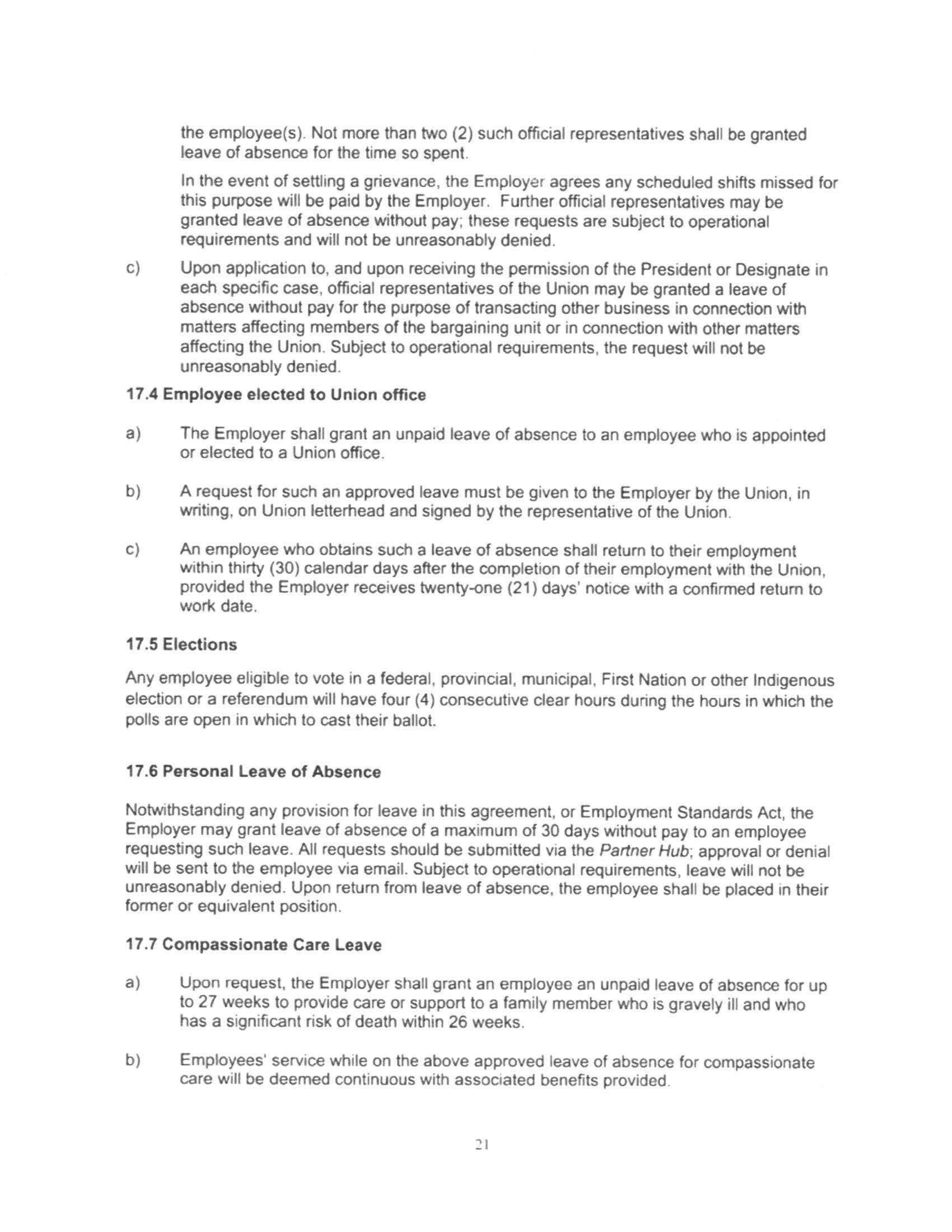
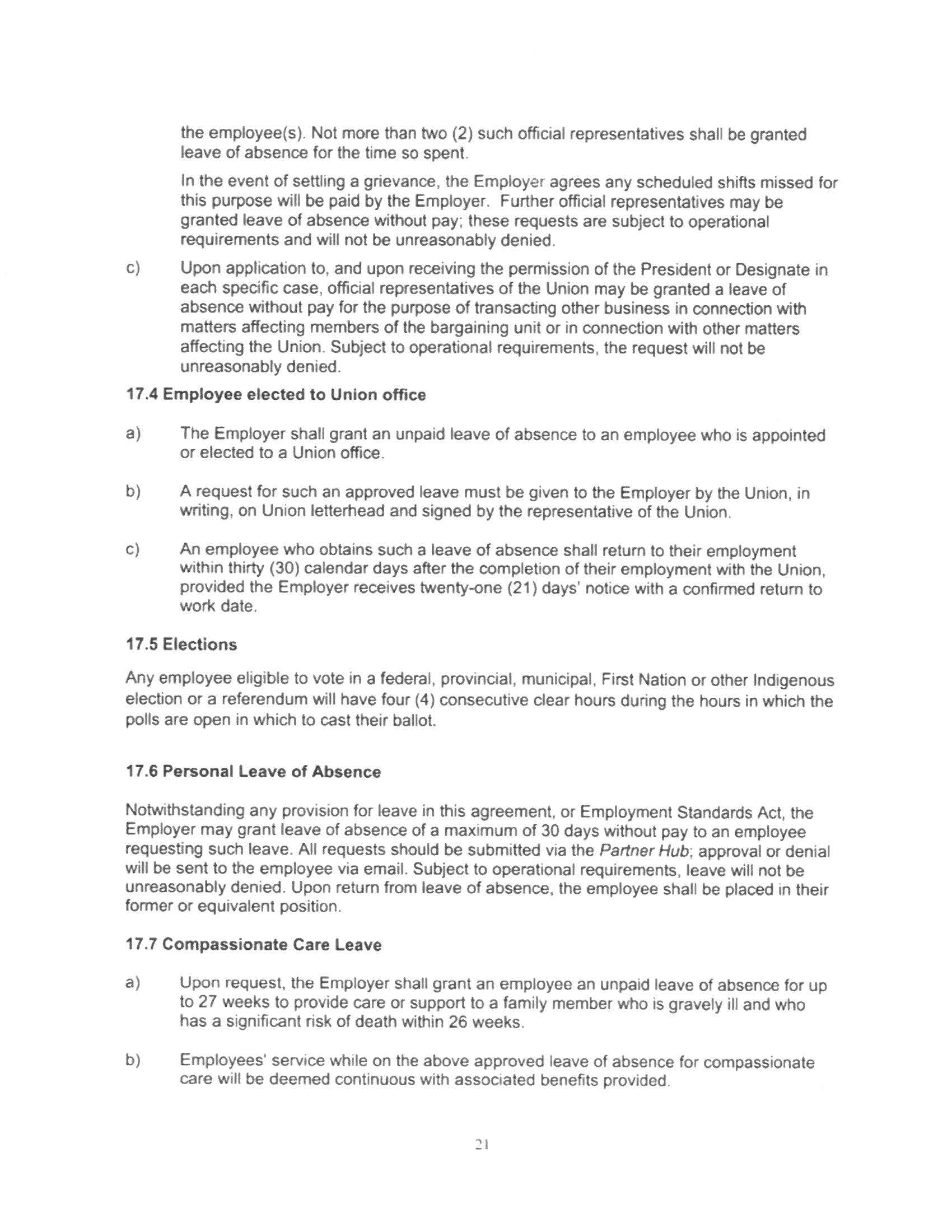
the employee(s). Not more than two (2) such official representatives shall be granted
leave of absence for the time so spent.
In the event of settling a grievance, the Employer agrees any scheduled shifts missed for
this purpose will
be
paid by the Employer. Further official representatives may be
granted leave of absence without pay; these requests are subject to operational
requirements and will not
be
unreasonably denied.
c)
Upon application to, and upon receiving the permission of the President or Designate in
each specific case, official representatives of the Union
may
be
granted a leave of
absence without pay for the purpose of transacting other business in connection with
matters affecting members of the bargaining unit or in connection with other matters
affecting the Union. Subject to operational requirements, the request will not
be
unreasonably denied.
17.4 Employee elected to Union office
a)
The Employer shall grant an unpaid leave of absence to an employee who is appointed
or elected to a Union office.
b)
A request for such an approved leave must be given to the Employer by the Union, in
writing, on Union letterhead and signed by the representative of the Union.
c)
An
employee who obtains such a leave of absence shall return to their employment
within thirty (30) calendar days after the completion of their employment with the Union,
provided the Employer receives twenty-one (21) days' notice with a confirmed return to
work date.
17 .5 Elections
Any employee eligible to vote in a federal, provincial, municipal, First Nation or other Indigenous
election or a referendum will have four (4) consecutive clear hours during the hours in which the
polls are open in which to cast their ballot.
17 .6 Personal
Leave of
Absence
Notwithstanding any provision for leave in this agreement, or Employment Standards Act, the
Employer may grant leave of absence of a maximum of 30 days without pay to an employee
requesting such leave. All requests should be submitted via the
Partner Hub;
approval or denial
will be sent to the employee via email. Subject to operational requirements, leave will not
be
unreasonably denied. Upon return from leave of absence, the employee shall be placed in their
former or equivalent position.
17. 7
Compassionate Care Leave
a)
Upon request, the Employer shall grant an employee an unpaid leave of absence for up
to 27 weeks to provide care or support to a family member who is gravely ill and who
has a significant risk of death within 26 weeks.
b)
Employees' service while on the above approved leave of absence for compassionate
care will be deemed continuous with associated benefits provided.
21
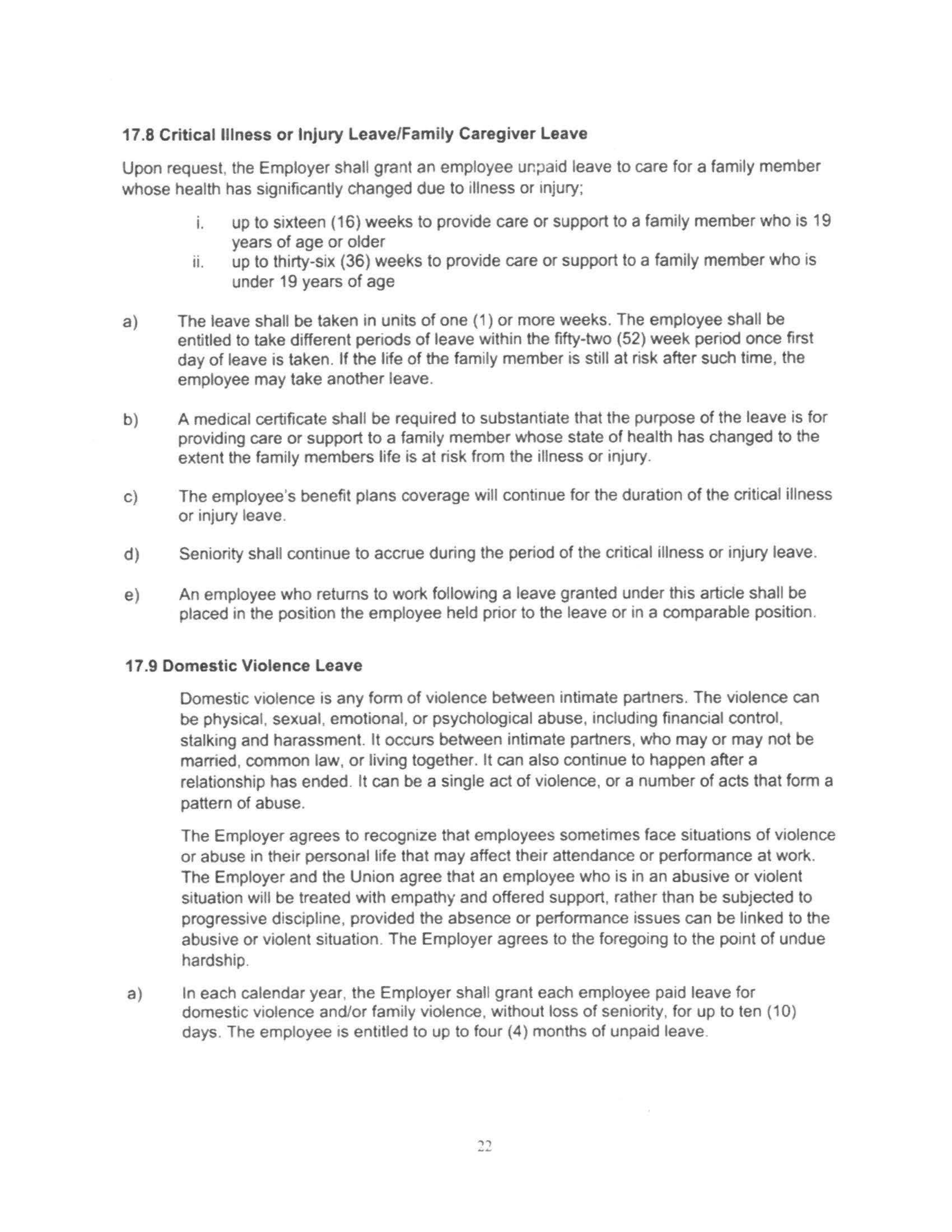
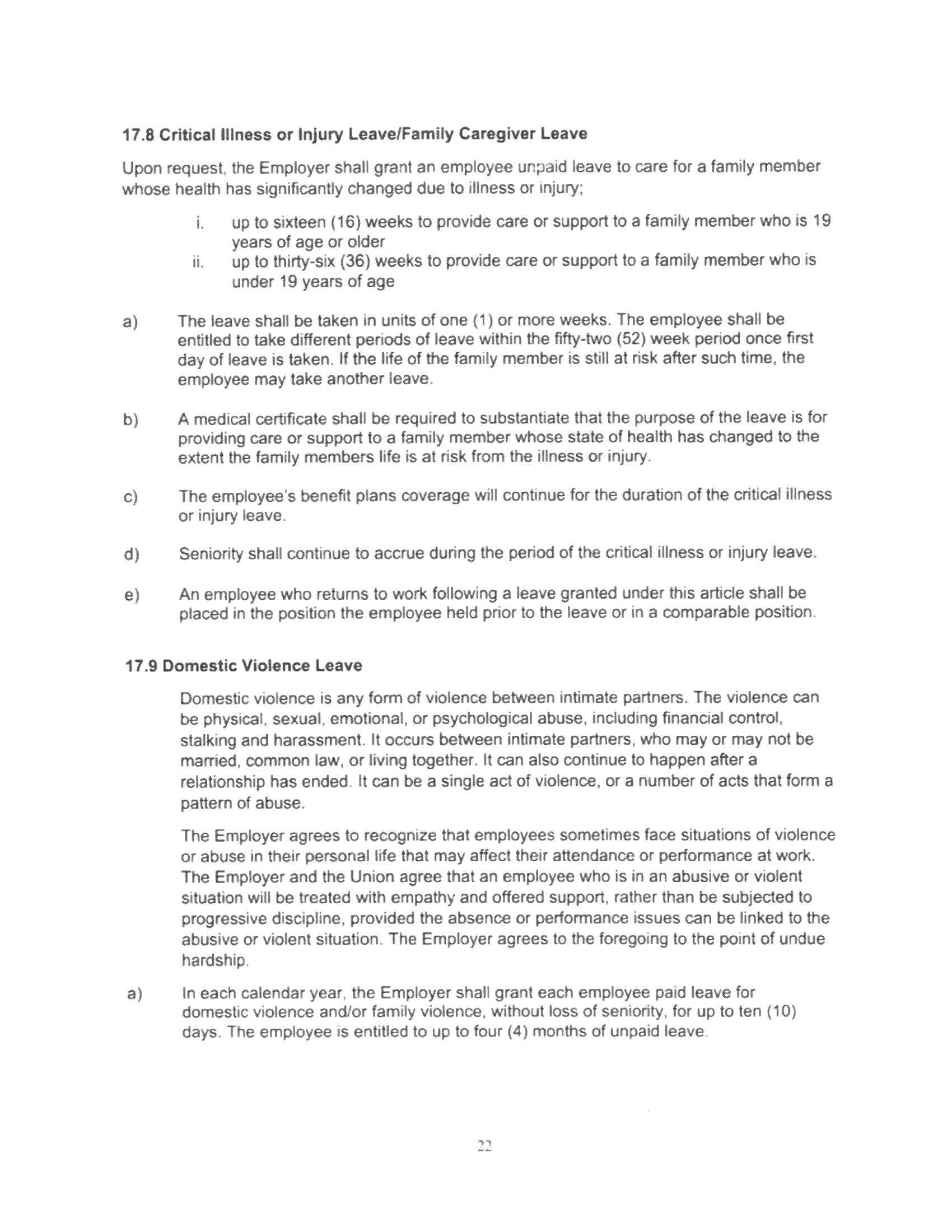
17.8 Critical Illness or Injury Leave/Family Caregiver Leave
Upon request, the Employer shall grant an employee un;:>aid leave to care for a family member
whose health has significantly changed due to illness or injury;
i.
up to sixteen (16) weeks to provide care or support to a family member who is 19
years of age or older
ii.
up to thirty-six (36) weeks to provide care or support to a family member who is
under 19 years of age
a)
The leave shall be taken in units of one (1) or more weeks. The employee shall be
entitled to take different periods of leave within the fifty-two (52) week period once first
day of leave is taken. If the life of the family member is still at risk after such time. the
employee may take another leave.
b)
A medical certificate shall be required to substantiate that the purpose of the leave is for
providing care or support to a family member whose state of health has changed to the
extent the family members life is at risk from the illness or injury.
c)
The employee's benefit plans coverage will continue for the duration of the critical illness
or injury leave.
d)
Seniority shall continue to accrue during the period of the critical illness or injury leave.
e)
An employee who returns to work following a leave granted under this article shall be
placed in the position the employee held prior to the leave or in a comparable position.
17
.9 Domestic Violence Leave
Domestic violence is any fonn of violence between intimate partners. The violence can
be physical, sexual. emotional, or psychological abuse, including financial control.
stalking and harassment.
It
occurs between intimate partners. who may or may not be
married, common law. or living together. It can also continue to happen after a
relationship has ended. It can be a single act of violence, or a number of acts that form a
pattern of abuse.
The Employer agrees to recognize that employees sometimes face situations of violence
or abuse in their personal life that may affect their attendance or performance at work.
The Employer and the Union agree that an employee who is in an abusive or violent
situation will be treated with empathy and offered support, rather than be subjected to
progressive discipline. provided the absence or performance issues can be linked to the
abusive or violent situation. The Employer agrees to the foregoing to the point of undue
hardship.
a)
In each calendar year, the Employer shall grant each employee paid leave for
domestic violence and/or family violence. without loss of seniority, for up to ten (10)
days. The employee ,s entitled to up to four (4) months of unpaid leave.
b)
Further to the above, the Employer agrees that requests for, vacation and any other paid
or unpaid leaves of absence submitted by employees. in order for them to deal with
issues related to domestic violence, shall not
be
unreasonably denied.
c)
The Joint Health and Safety committee. will develop and recommend strategies,
including risk assessments, safety plans, training and a timely and effective process for
resolving concerns.
d)
The Employer will provide for counselling and referral to appropriate support services.
e)
It is further agreed that privacy and confidentiality should be maintained, and the Union
and/or Employer should not disclose more personal information than is reasonably
necessary to protect workers from injury. This means sharing only reasonably necessary
information and only with those who need to know. All personal information concerning
domestic violence should be kept confidential and no information should be kept on the
employee's personnel file without their express written permission.
f)
The Employer will protect the employees from adverse action or discrimination in the
workplace or related to the workplace on the basis of their disclosure, experience, or
perceived experience of domestic violence.
17 .1 O
Religious Observations
Employees may request up to two (2) days off without pay per calendar year to observe spiritual
or holy days. Such leave shall not be unreasonably withheld. A minimum of twenty-one days
(21) notice is required for time off requests under this provision unless this is impossible due to
the unpredictable nature of the spiritual or holy day, in which case as much notice as possible
shall
be
provided.
Employees granted time off under this provision may use accrued vacation pay, if available, in
which case the days taken shall be considered days worked for purpose of entitlement to
statutory holiday pay.
23
ARTICLE 18 • LAYOFF AND RECALL
18.1 Definition of a Layoff
"Layotr
is:
A cessation of employment or elimination of a job resulting from a reduction of the amount of
work and/or hours required to be done or closure by the Employer.
18.2 Lay-off
a)
In the event that a reduction in the workforce is deemed necessary, the Employer will lay
off in reverse order of seniority providing that the remaining employees have the
requirements to perform the remaining job functions.
b)
As much notice as possible, but in any event, not less than fourteen {14) days shall be
given to each employee to be laid off. The notice shall be given in writing, except no
notice shall be given to those employees who are recalled from lay off for periods of less
than twenty-one (21) days' work.
c)
In the event of work shortages, the Union and the Employer shall attempt to meet by
telephone or otherwise, to discuss alternatives to lay off. Thereafter, the layoffs will
proceed unless the parties mutually agree to an alternative process.
18.3 Recall from Lay-off
a}
Employees on layoff will be recalled in order of seniority provided that the employee has
the requirements to perform the required job functions.
b)
The Employer will contact the employee by telephone and provide the employee with a
verbal notice of recall. If the Employer cannot reach the employee by telephone. then
the Employer will send an emailed notice of recall to the employee. CC to the Union.
Employees will have 24 hours from the time of the call and/or email to respond to the
Employer and accept the recall. Failure of the employee to accept recall, by
communicating with the Employer by telephone or email, will result in that employee
being bypassed.
c)
An employee being recalled to work must return to work as soon as possible after the
notice of recall but in any event not longer than five (5) calendar days after they accept
the recall to work as outlined in 18.3(b).
18.4 Medical Benefits while on Lay-off
Employees in receipt of benefits coverage who are laid off and elect to be placed on the lay-off
recall list will have their medical benefits coverage maintained for three (3) months following the
date of lay-off. Thereafter, the employee may elect to maintain their medical benefits coverage
provided by the Employer during their recall period provided they pay to the Employer monthly in
advance the total cost of the premiums for that coverage.
2-t
ARTICLE 19
-
EMPLOYEE BENEFITS
All Partner benefits shall remain as listed on Starbucks benefits website;
www.starbucksbenefits.ca, and are subject to change at the Employer's sole discretion. The
Union will be advised in a timely way of any material change
to
benefits.
Any change to benefits by the Employer is not intended to diminish the overall comprehensive
package of benefits available to support employees.
19.1 Extended Health and Dental Plan
The Employer will provide an Extended Health
&
Dental Plan for eligible employees. The
extended health plan provides coverage for eligible expenses associated with paramedical
services, mental health, hospitalization, eye exams, prescription lenses, frames and contacts,
prescription drugs and emergency out-of-province medical. The dental plan covers preventative,
basic and major services, as well as orthodontia for dependent children.
a)
Following hire, eligibility is established after the employee is paid a minimum of 160
hours in two consecutive calendar months.
b)
To remain eligible, employees must be paid
at
least 240 hours per calendar quarter.
Eligibility is determined by the hours reported on the last pay cheque received in the
calendar quarter. Paid calendar quarters are:
1) January-March
2) April-June
3) July-September
4)
October-December
c)
Employees can monitor hours for benefits eligibility with the 'QTD (Quarter to Date)
Hours' under the 'Other Benefits Information' section of their pay statements.
19.2 Registered Retirement Savings and Deferred Profit-Sharing Plan (RRSP/DPSP)
The Employer offers a Registered Retirement Savings and Deferred Profit Sharing Plan
(RRSP/DPSP) for eligible employees.
a)
Employees are eligible to enroll if they are age 18 or older; and have completed at least
90 days of service.
b)
The Employer will match employee RRSP contributions, dollar for dollar, up to a
maximum of 4% of eligible pay each pay period.
c)
Employee contributions are made via bi-weekly payroll deductions.
d)
Employee RRSP contributions are 100% vested. Company DPSP contnbutions vest
100% after two (2) years of employment with Starbucks.
25
19.3 Tuition Reimbursement Plan
The Employer offers a reimbursement plan which covers up to a maximum $1,000 per annual
calendar year for tuition, books and fees. This plan is subject to change at the Employer's sole
discretion.
Eligibility requirements:
1) Have a minimum of 6 months of continuous service as of the start of the
course/semester;
2) Be eligible for the Extended Health and Dental Plan at the start of the
course/semester;
3} Take courses at an accredited educational institution towards a certificate,
diploma or degree program;
4) Be an employee on the payroll and actively employed with Starbucks Canada
when reimbursement is processed;
5) Earn at least a "C" grade (or "pass" in pass/fail course}; and
6) Submit the application for reimbursement and all required supporting
documentation within 90 days of course completion.
ARTICLE 20
-
JOINT WORKPLACE RELATIONS COMMITTEE
20.1
The parties included in this agreement will form a Joint Workplace Relations Committee of two
(2) members appointed by the Employer and of two (2) members appointed by the Union.
The Employer representatives should be:
1 . Store Manager or designate
2. Partner Resources representative or designate
The Union representatives should be:
1. Union Representative
2. Member from Local 2009 or District 3 Representative.
The first meeting shall be held as soon as practicable after the ratification of the collective
agreement and the appointment of the Union Representatives. Meetings will continue for the life
of this agreement, after the initial meeting, on a quarterly basis during work hours. Either party
may submit issues for discussion one week prior to the meeting.
The committee will be responsible for appointing one of the Union Representatives to record
minutes of meeting; minutes shall be approved by both the Union and the Employer.
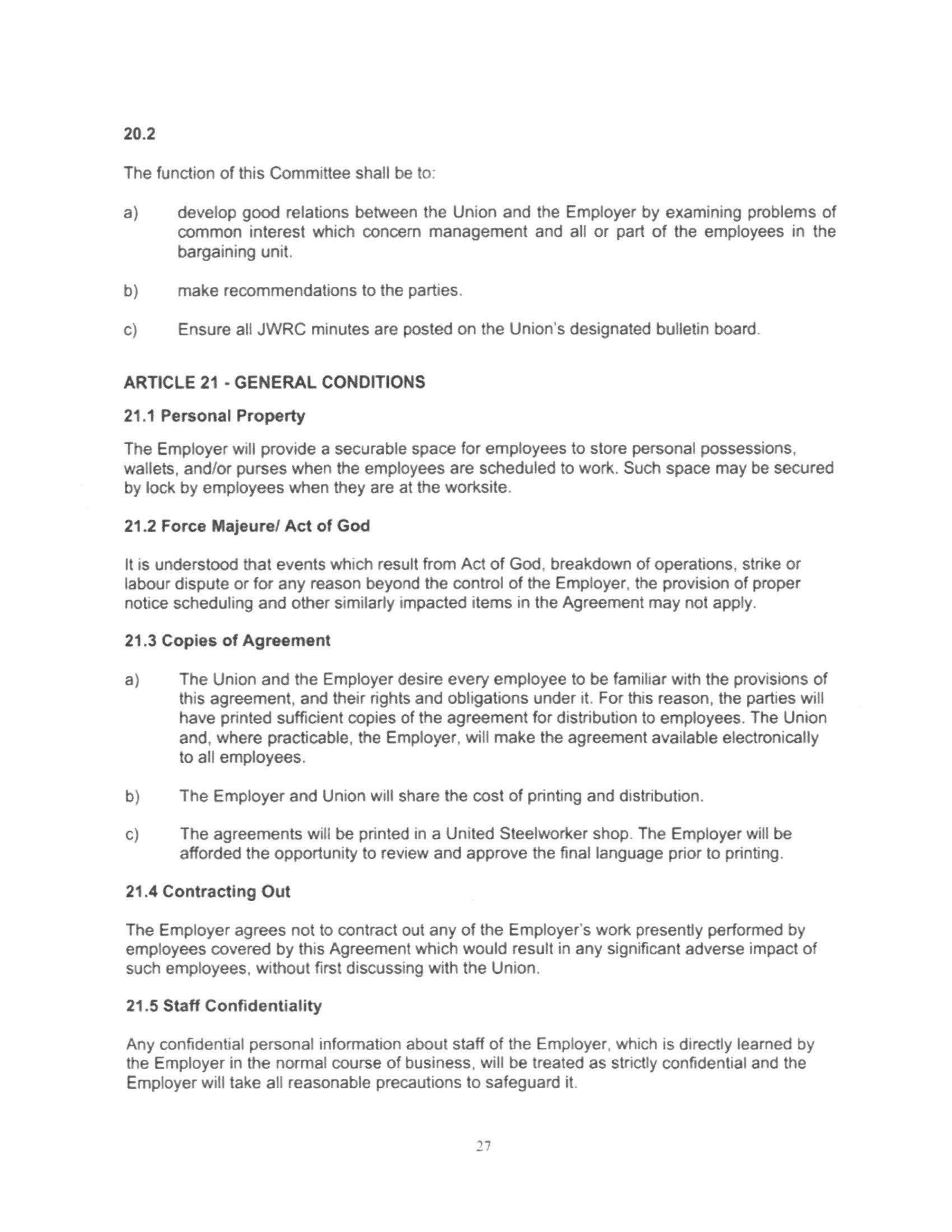
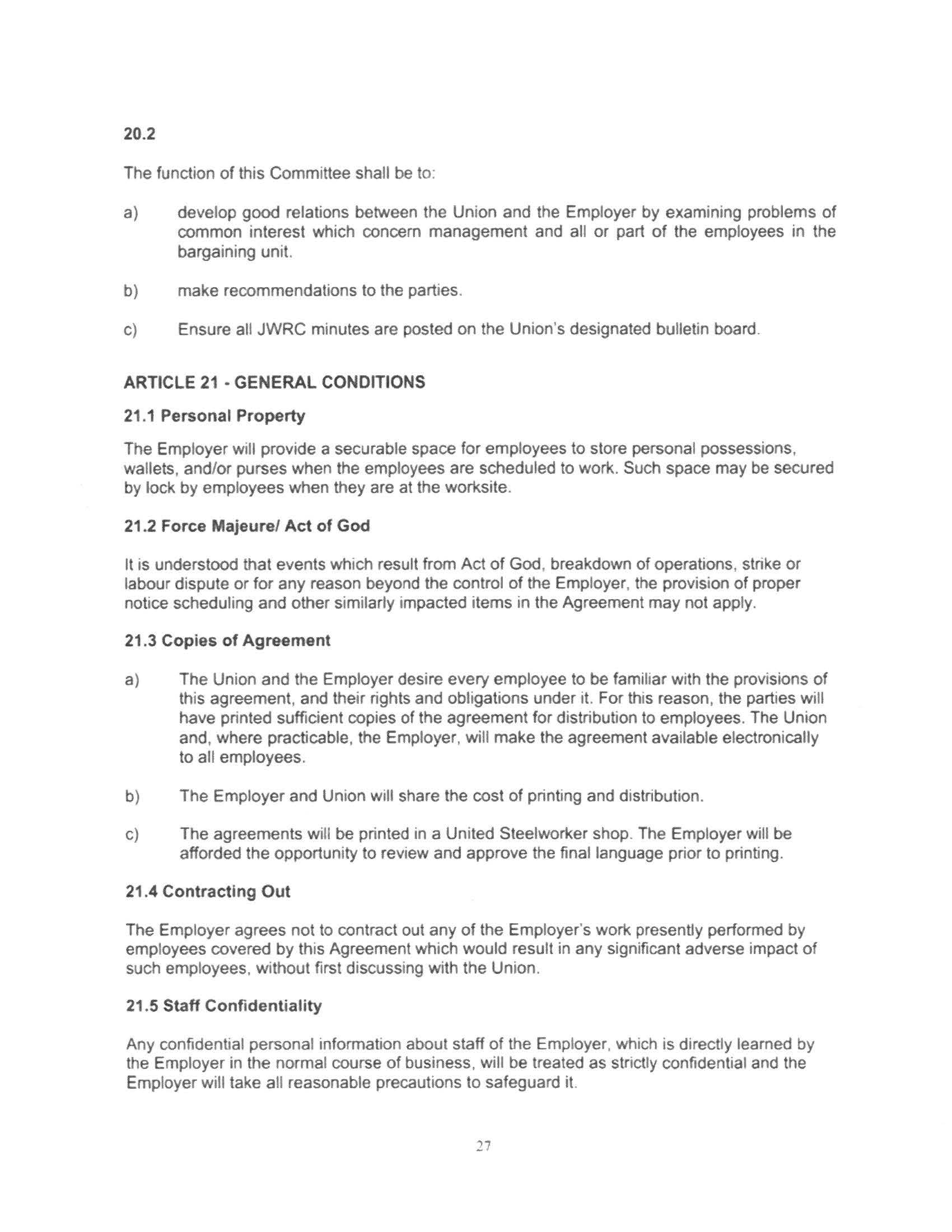
20.2
The function of this Committee shall
be
to:
a)
develop good relations between the Union and the Employer by examining problems of
common interest which concern management and all or part of the employees in the
bargaining unit.
b)
make recommendations to the parties.
c)
Ensure all JWRC minutes are posted on the Union's designated bulletin board.
ARTICLE 21
-
GENERAL CONDITIONS
21.1 Personal Property
The Employer will provide a securable space for employees to store personal possessions,
wallets, and/or purses when the employees are scheduled to work. Such space may be secured
by lock by employees when they are at the worksite.
21.2
Force Majeure/ Act of God
It is understood that events which result from Act of God, breakdown of operations, strike or
labour dispute or for any reason beyond the control of the Employer, the provision of proper
notice scheduling and other similarly impacted items in the Agreement may not apply.
21.3
Copies of Agreement
a)
The Union and the Employer desire every employee to be familiar with the provisions of
this agreement, and their rights and obligations under it. For this reason, the parties will
have printed sufficient copies of the agreement for distribution to employees. The Union
and, where practicable, the Employer, will make the agreement available electronically
to all employees.
b)
The Employer and Union will share the cost of printing and distribution.
c)
The agreements will be printed in a United Steelworker shop. The Employer will be
afforded the opportunity to review and approve the final language prior to printing.
21.4
Contracting Out
The Employer agrees not to contract out any of the Employer's work presently performed by
employees covered by this Agreement which would result in any significant adverse impact of
such employees. without first discussing with the Union.
21.5 Staff
Confidentiality
Any confidential personal information about staff of the Employer, which is directly learned by
the Employer in the normal course of business, will be treated as strictly confidential and the
Employer will take all reasonable precautions to safeguard
it.
27
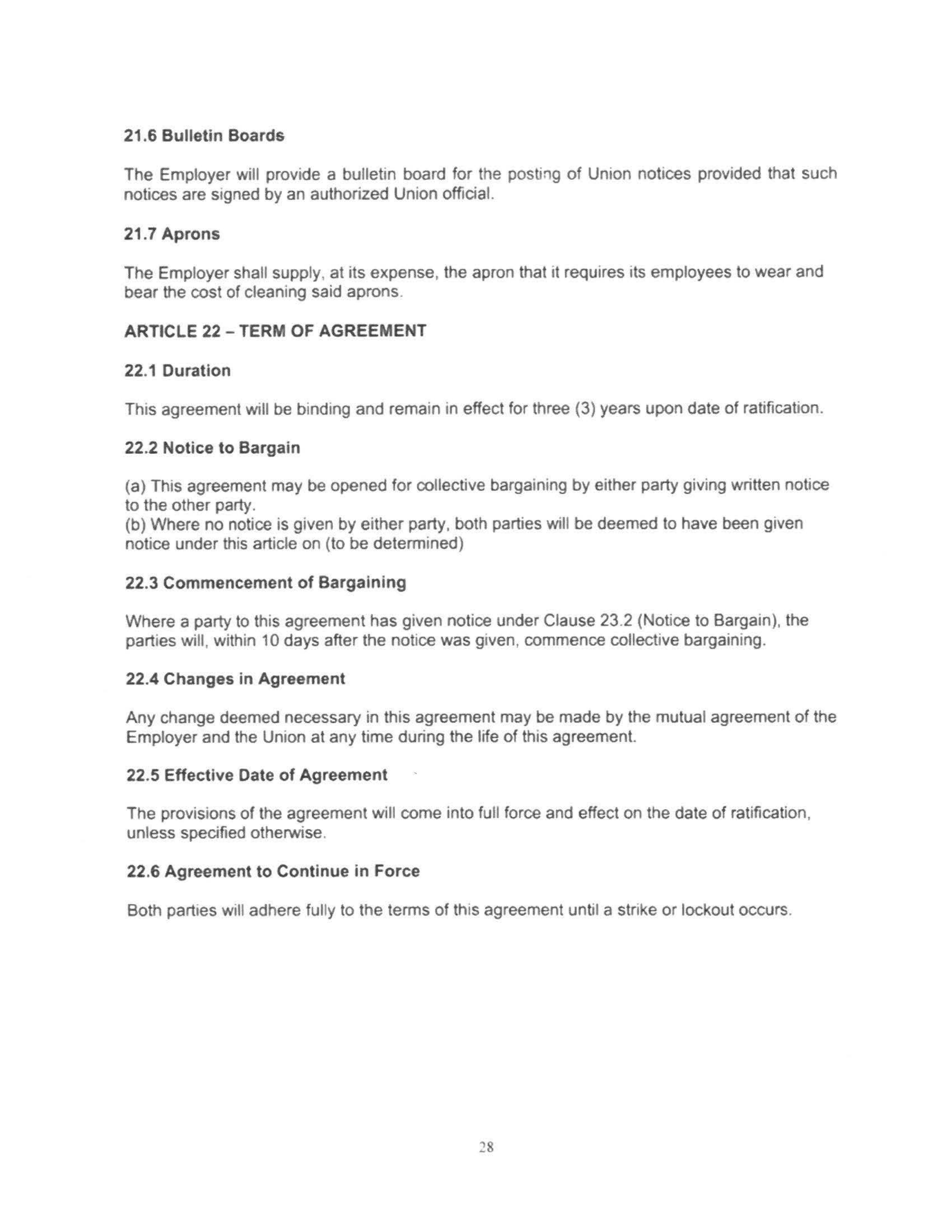
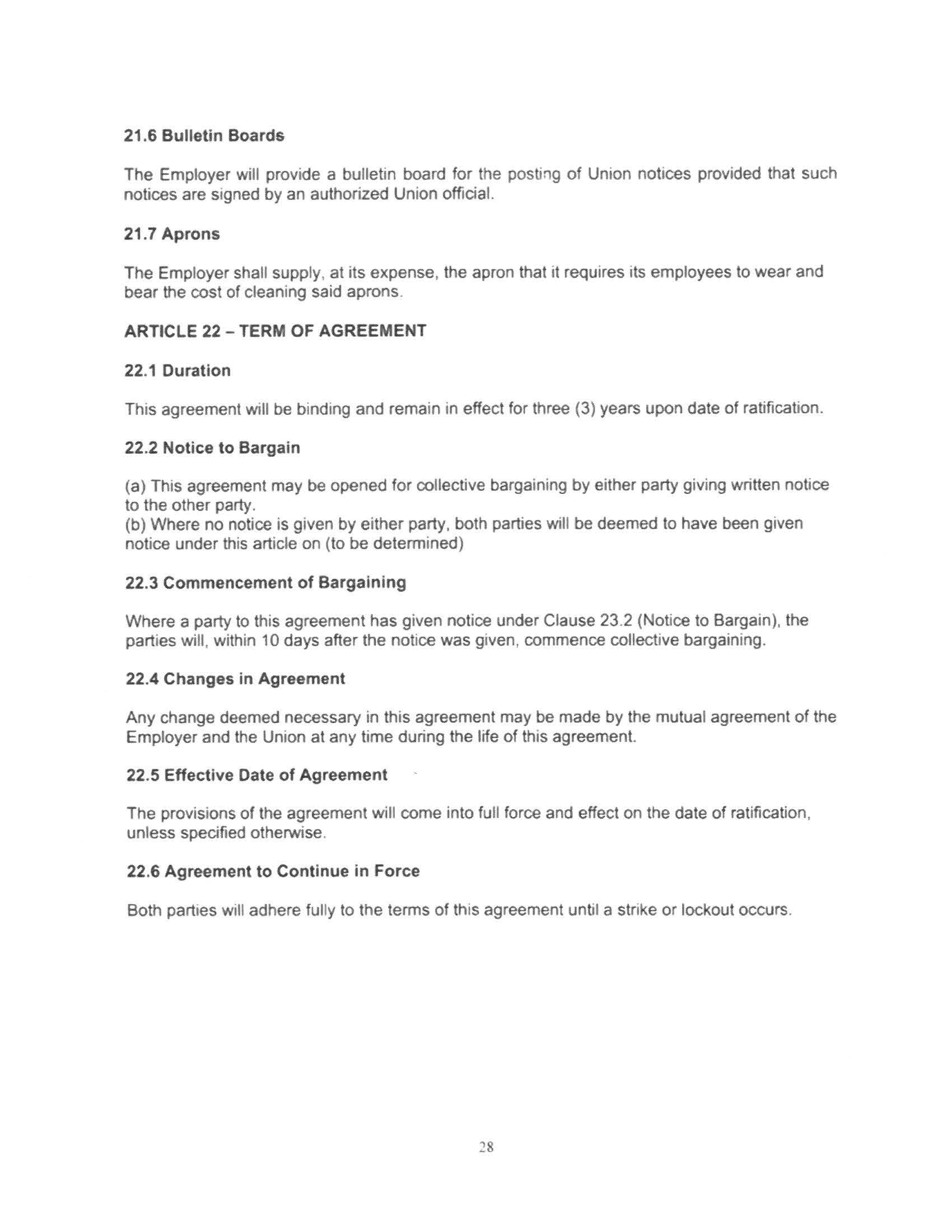
21.6 Bulletin Boards
The Employer
will
provide a bulletin board for the posting of Union notices provided that such
notices are signed by an authorized Union official.
21.7 Aprons
The Employer shall supply, at its expense, the apron that it requires its employees to wear and
bear the cost of cleaning said aprons.
ARTICLE 22 -
TERM OF AGREEMENT
22.1 Duration
This agreement will be binding and remain in effect for three (3) years upon date of ratification.
22.2 Notice to Bargain
(a) This agreement may be opened for collective bargaining by either party giving written notice
to the other party.
(b) Where no notice is given
by
either party. both parties will be deemed to have been given
notice under this article on (to be determined)
22.3 Commencement of Bargaining
Where a party to this agreement has given notice under Clause 23.2 (Notice to Bargain). the
parties will, within 10 days after the notice was given, commence collective bargaining.
22.4 Changes in Agreement
Any change deemed necessary in this agreement may be made by the mutual agreement of the
Employer and the Union at any time during the life of this agreement.
22.5 Effective Date of Agreement
The provisions of the agreement will come into full force and effect on the date of ratification,
unless specified otherwise.
22.6 Agreement to Continue in Force
Both parties will adhere fully to the terms of this agreement until a strike or lockout occurs.
28
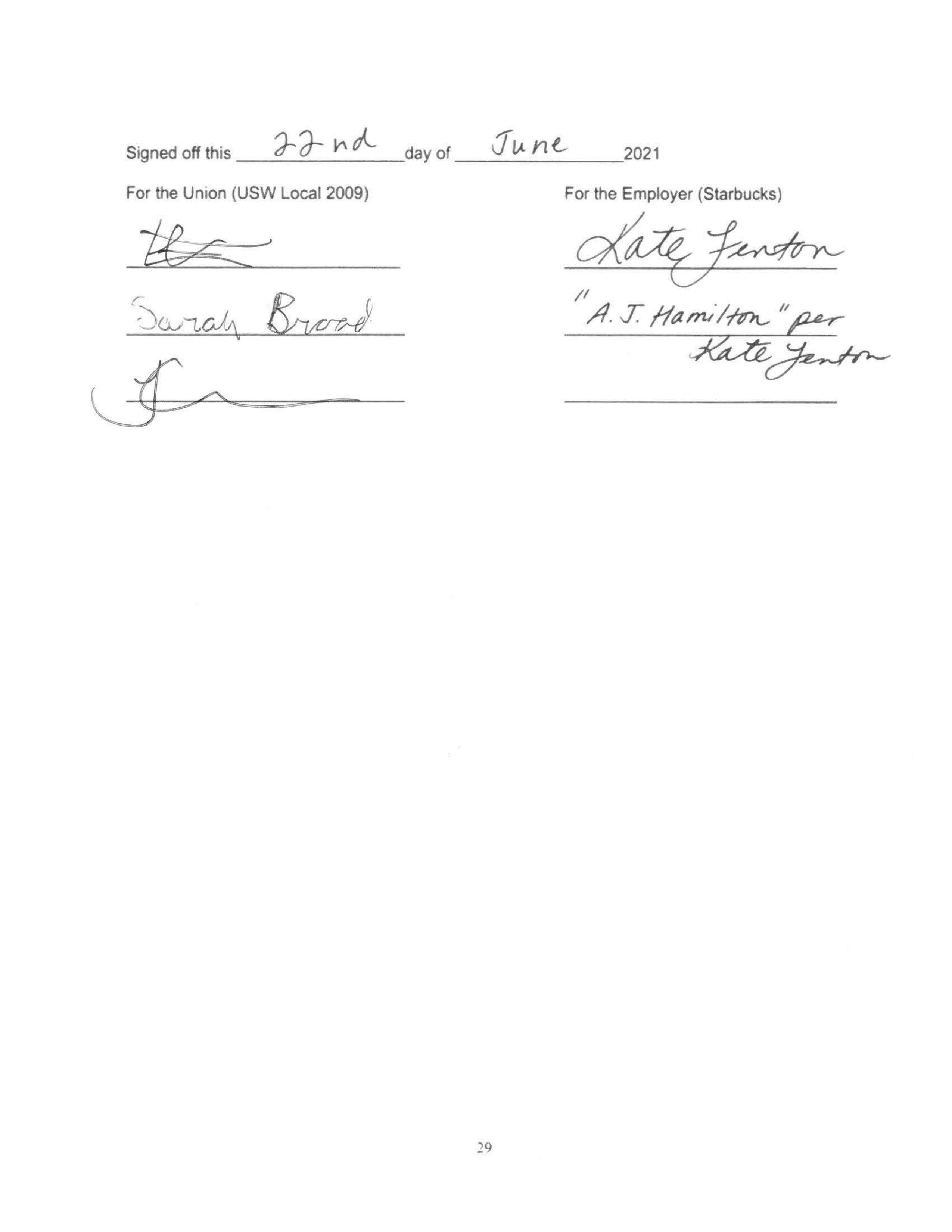
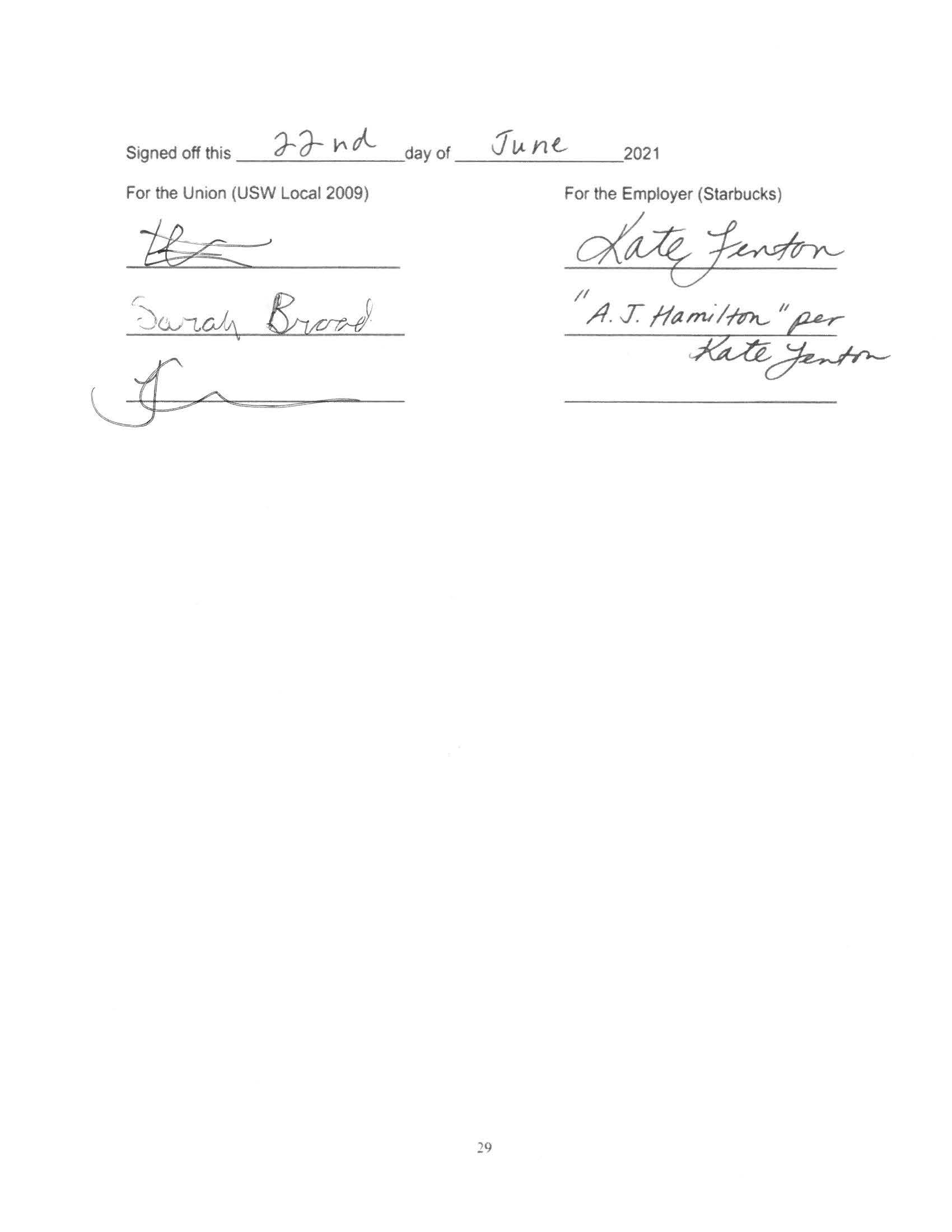
Signed off this __
'J-_d"-
__
"'_rl.-
__
day of
__
(f_t,.c._n_e.,,
___
2021
For the Union (USW Local 2009)
For the Employer (Starbucks)
a(~~
/I
A.
J.
Ila~/~
lier
~~
29
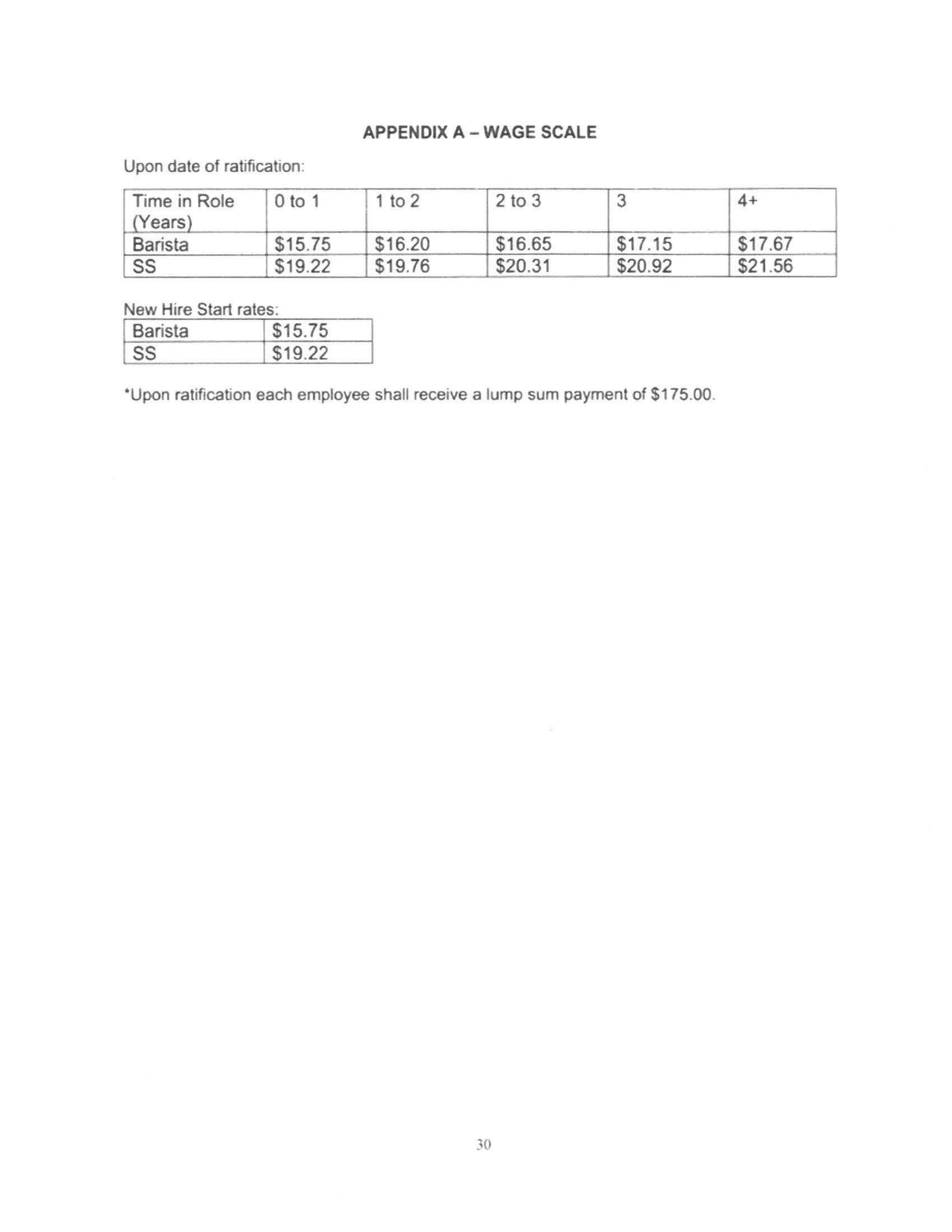
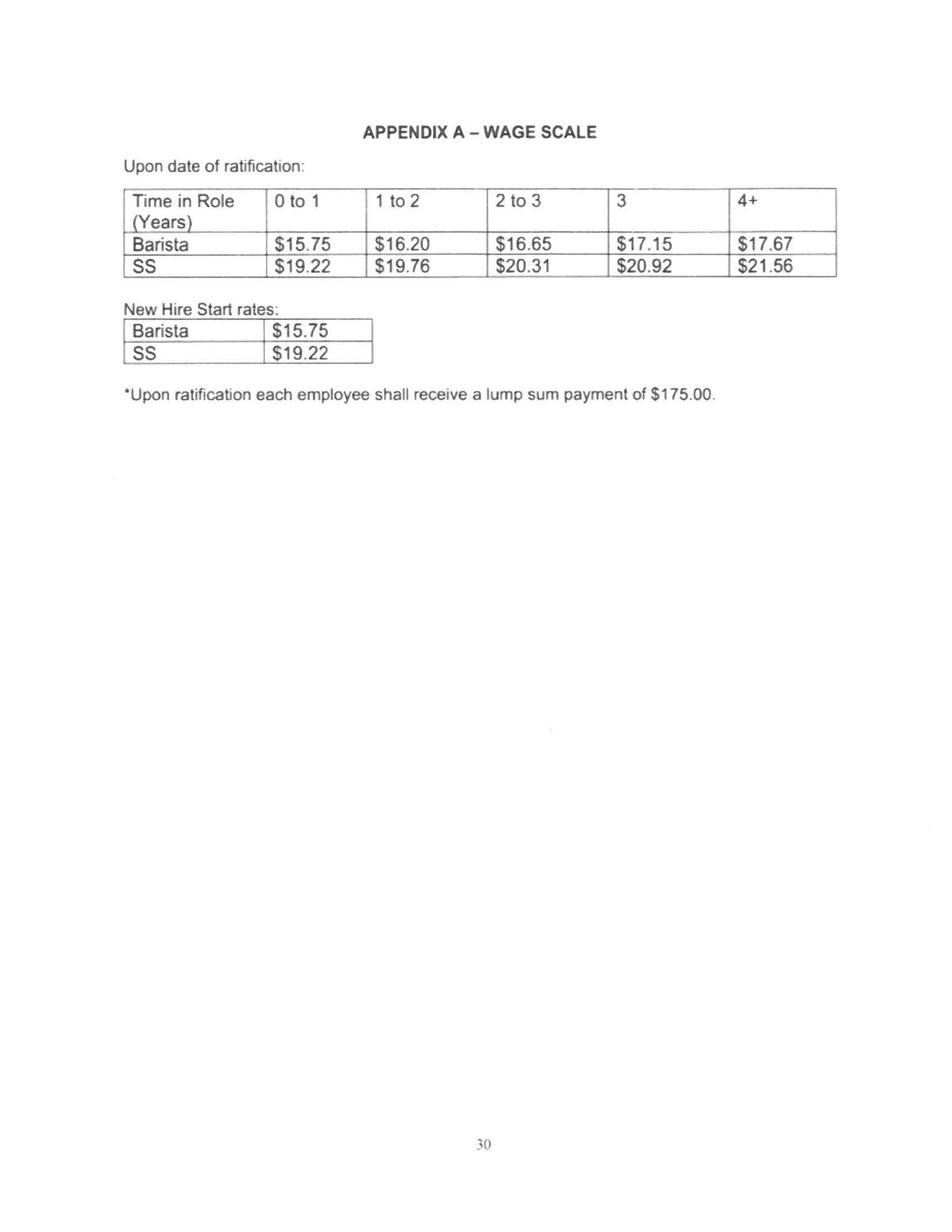
APPENDIX A -
WAGE SCALE
Upon date of ratification:
Time in Role
0
to
1
1 to 2
2 to 3
3
4+
(Years)
Barista
$15.75
$16.20
$16.65
$17.15
$17.67
ss
$19.22
$19.76
$20.31
$20.92
$21.56
New Hire Start rates:
IBarista
1$15.75
ss
$19.22
•upon ratification each employee shall receive a lump sum payment of $175.00.
30
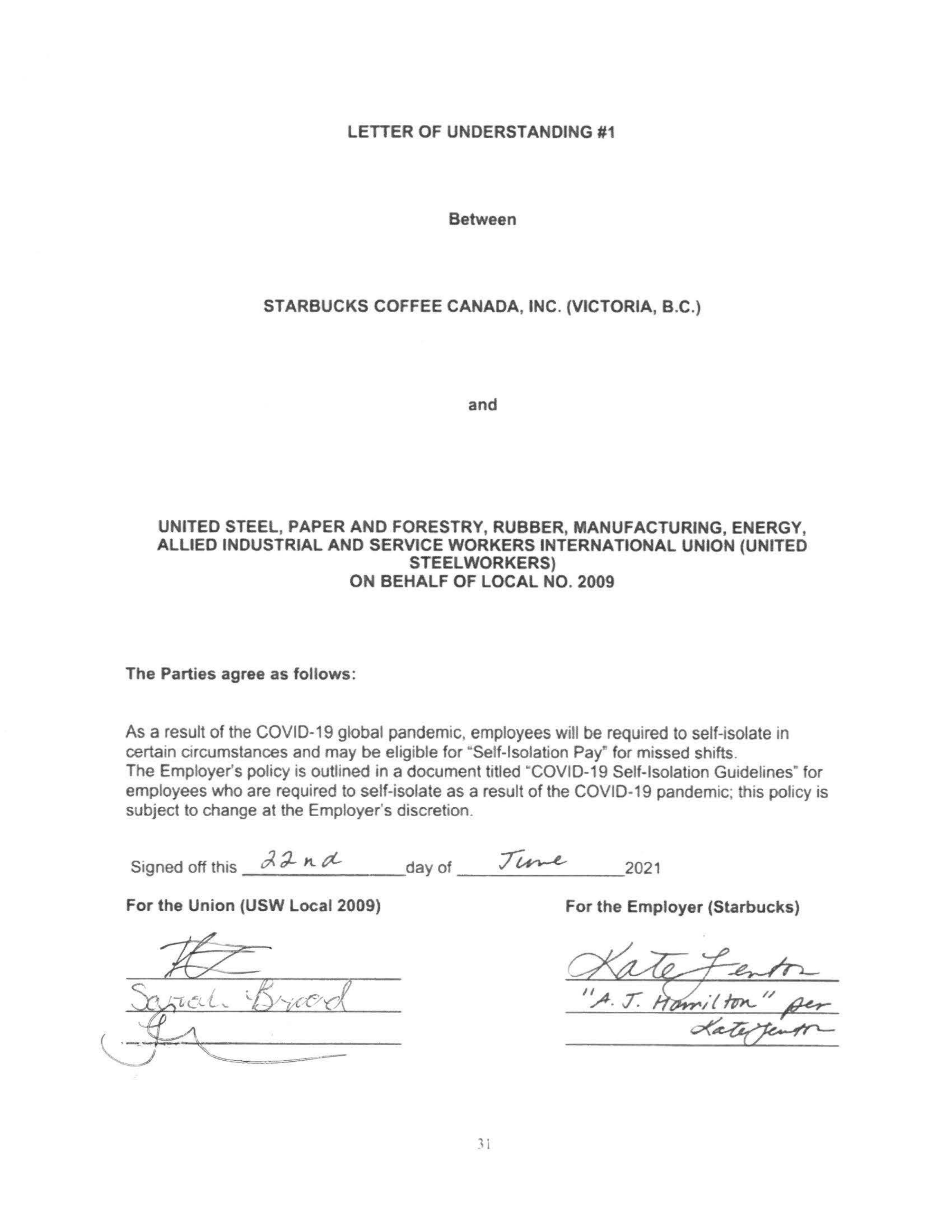
LETTER OF UNDERSTANDING #1
Between
STARBUCKS COFFEE CANADA, INC. (VICTORIA, B.C.)
and
UNITED STEEL, PAPER AND FORESTRY, RUBBER, MANUFACTURING, ENERGY,
ALLIED INDUSTRIAL ANO SERVICE WORKERS INTERNATIONAL UNION (UNITED
STEELWORKERS)
ON BEHALF OF LOCAL NO. 2009
The Parties agree as follows:
As a result of
the
COVID-19 global pandemic, employees will
be
required to self-isolate in
certain circumstances and may be eligible for "Self-Isolation Pay~ for missed shifts.
The Employer's policy is outlined in a document titled MCOVID-19 Self-Isolation Guidelines· for
employees who are required to self-isolate as a result of the COVI0-19 pandemic; this policy is
subject to change at the Employer's discretion.
Signed off this
_J._:J-_1t._~
____
day of __
7Z_~
____
2021
For the Union (USW Local 2009)
For the Employer (Starbucks)
31