Today, climate change and air quality are two
major concerns. Governments on both sides of
the Atlantic are committed to reducing the
effects of man-made air pollutants. More
stringent standards are being put in place to
limit emissions of noxious gases and
particulates released by industries and
combustion engines. The aim is to reduce
carbon dioxide emissions and greenhouse
gases to 1990
levels.
To support
this goal, the US
Environmental
Protection Agency (EPA), the California Air
Resources Board (CARB) and the European
Commission have enacted similar standards
that have led to a staged introduction of
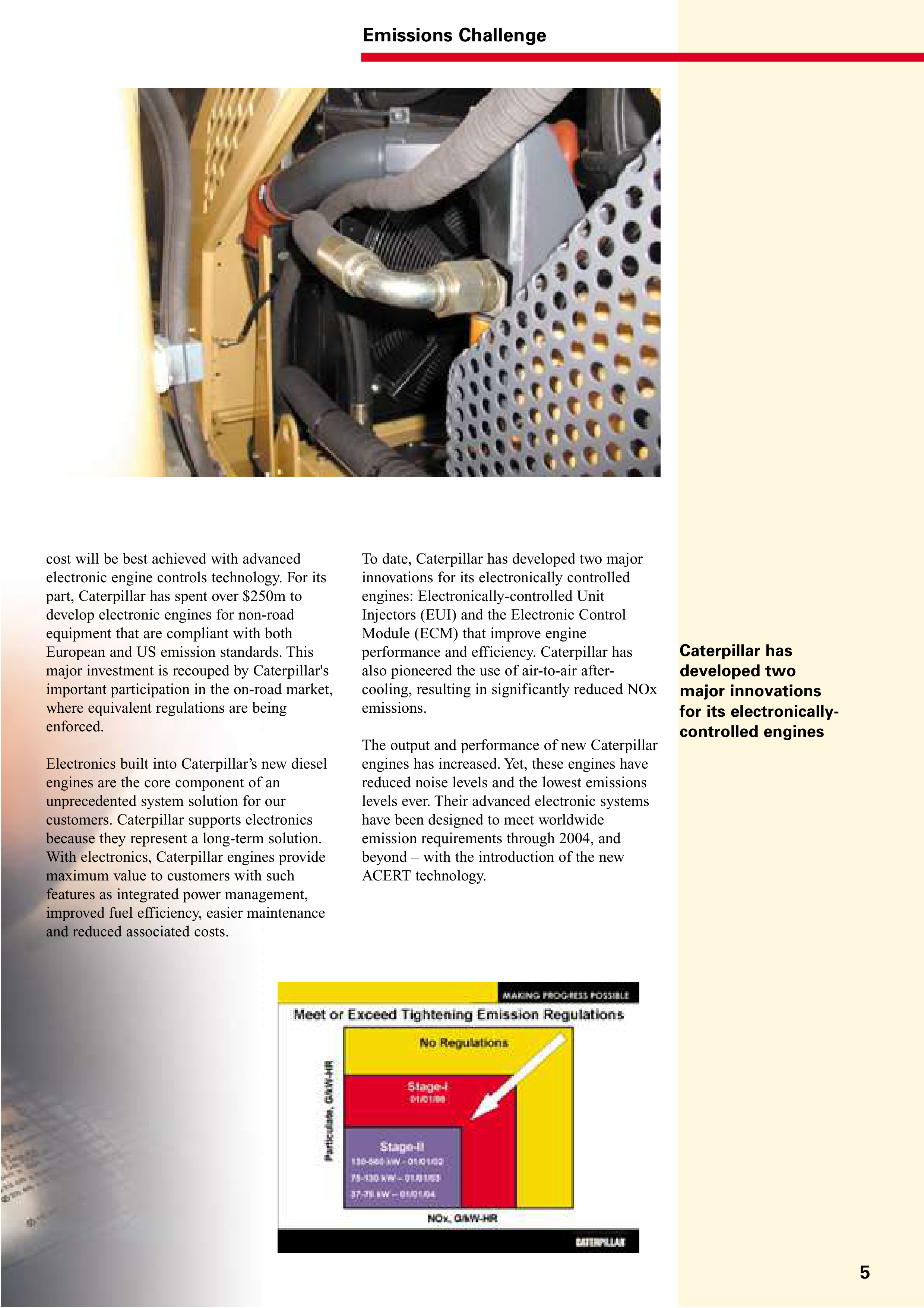
emissions regulations. In Europe, Stage I
began in 1999, Stage II in 2001. By 2004, all
new off-highway equipment from 18 to 560
kW sold into the European Union must
conform to Stage II emissions regulations.
Stage II standards set unprecedented engine
emission limits. Technological changes brought
about by these new standards represent the
most important development in industrial
diesel engines for many years.
Diesel is ubiquitous and plays a vital role in a
wide range of activities of critical importance
to the economy. The challenge for construction
equipment and engine manufacturers is to
maintain and improve power and performance
levels of diesel engines whilst achieving the
lower emissions standards. The greatest step
for significant advances in fuel economy and
emissions reduction is the use of next-
generation "clean diesel engines".
Increasingly, the latest diesel
technology is being recognized
as having environmental
advantages over other
combustion engines. As the
world's most efficient
internal combustion engine,
diesel offers greater safety,
more durability and
reliability, more power and
better fuel efficiency – up
to 45-60 % – than gasoline
or natural gas alternatives. It
also emits smaller amounts
of CO, hydrocarbons and
CO2 than gasoline engines.
Great progress has already
been accomplished in the
reduction of particulate matter
and nitrogen oxides (NOx)
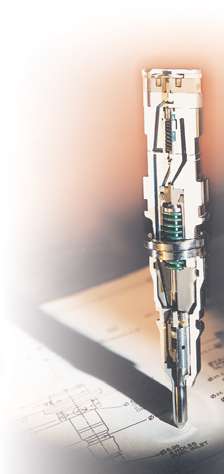
with solutions that Caterpillar
has largely contributed to
develop, such as improved fuel
delivery and combustion
chamber design, turbo charging
and electronic fuel injection.
Meeting tomorrow’s stricter
standards and delivering value in
terms of performance, fuel
efficiency, reliability and operating
Emissions Challenge
4
Diesel Engines For New
Emissions Challenges
Governments on
both sides of the
Atlantic are
committed to
reducing the
effects of man-
made air
pollutants.
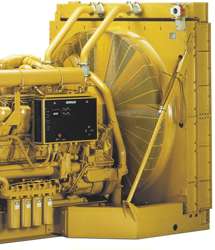
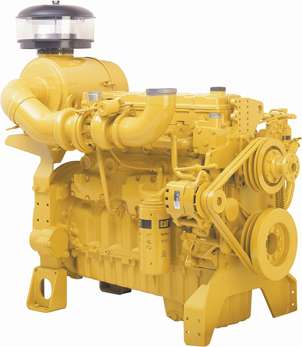
Caterpillar is meeting the forthcoming emissions regulations with
a new range of electronically controlled engines. These engines
offer increased performance, while having reduced noise levels
and the lowest emissions levels ever.