VOLVO GROUP MAGAZINE 4.2016
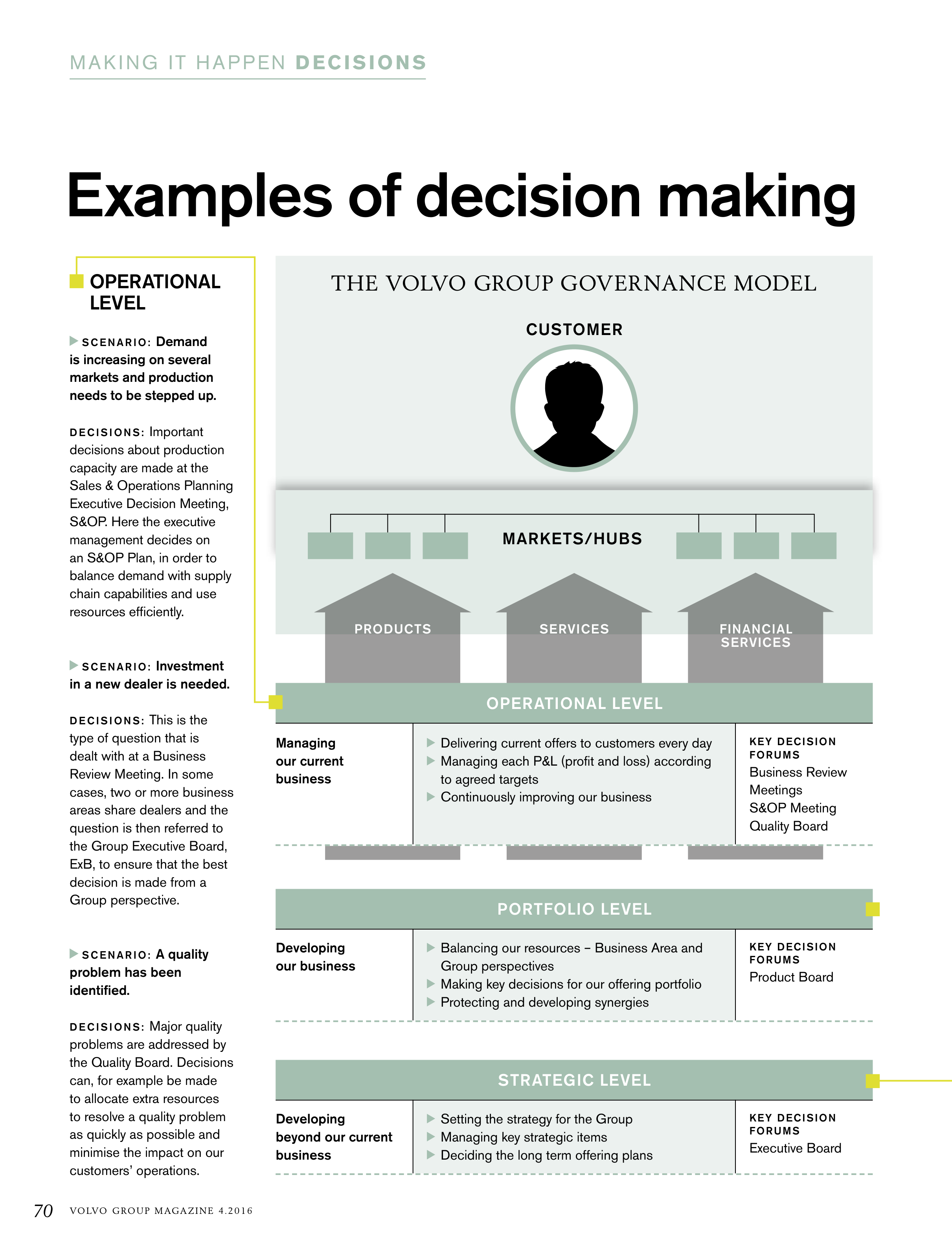
PORTFOLIO LEVEL
S CE NARIO:
It’s time to
S CE N A RIO:
How should
define the targets and
the R&D resources be
activities for next year for
allocated between different
each individual business
types of projects and
area.
business areas?
D E C I S I O N S :
At Business
DE CIS ION S :
The Product
Review Meetings (BRM), t
op
Board is where the executive
managers discuss
business
management creates an
development for their
overall balance for the
respective business areas,
Volvo Group’s development
and set targets and activities.
resources from both
Business Area and Group
perspectives. Key decisions
related to the offer portfolio,
as well as the protection and
development of synergies,
are made here.
The Quality Board is where
the executive management
addresses quality-related
matters in order to support
rapid decision-making and
customer focus in this area.
STRATEGIC LEVEL
S C ENARIOS:
The Group’s overarching strategy is
reviewed.
A new country has been identified in which
it could be interesting to sell the Group’s
products.
The framework for how much the Group
can afford to spend and invest in various
areas has to be defined for the years to
come.
Future targets need to be set for the next
year for each individual business area.
DECISIONS:
Strategic decision are made at
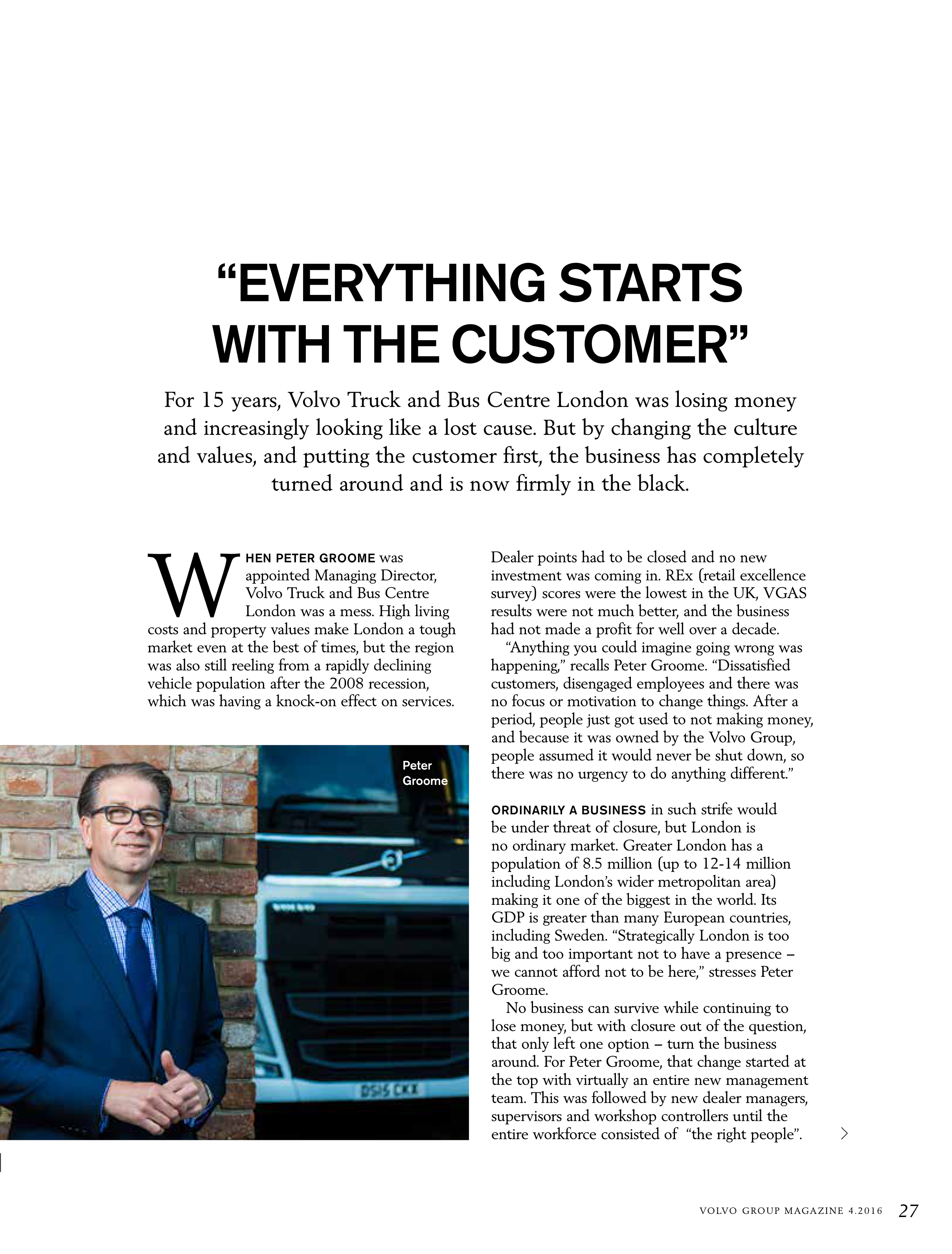
the very highest management level, by the Volvo
Group’s President and CEO, Martin Lundstedt,
and his management team, the Group Executive
Board (ExB). They meet for a whole day once a
month and, in between, they have short weekly
checks to monitor the situation. Strategic
decisions that impact the entire Group are made
at this level. They can include the areas in which
the Group is going to do business, the way the
different brands are going to be positioned in
relation to one another and whether the time has
come to enter a new market or leave an existing
one. The Executive Board also sets the financial
targets for the different parts of the Group and
approves long-term plans that set the direction
for future product offers and determine the
industrial structure, for example.
What is the greatest difference
compared with before?
There are now precisely defined
decision-making forums for different
questions/areas at top executive level.
Large parts of the top executive team
allocate a full week a month to this.
What are the greatest benefits of
the new model?
It will now be clearer who makes
which decisions and there will be
a clearly defined focus on the most
important questions.
Where can I find more information
about the decisions that are made?
There is plenty of information on
Violin. In the Volvo Group Principles
for Operational Governance,
governance is described in greater
detail.
QUESTIONS
AND ANSWERS
3
FACTS AND
GLOSSARY
AB Volvo Board of Directors
The ultimate decision-makers are
the shareholders. They appoint the
Board of Directors, which in turn
appoints the President and CEO.
Business Areas
The Volvo Group has 10 business
areas: Renault Trucks, Mack
Trucks, UD Trucks, Volvo Trucks,
Group Trucks Asia and JVs, Volvo
CE, Volvo Buses, Volvo Penta,
Governmental Sales and Volvo
Financial Services. The business
areas are responsible for driving
the business and realising their
business objectives.
Business Area Business Review
Meetings (BRM)
These review meetings are
established in all business areas
and are the forums at which top
managers discuss operational and
strategic topics, with an emphasis
on their individual BA.
Group Executive Board (ExB)
The highest decision-making body
within the Volvo Group, led by the
Group President and CEO.
Product Board
Where the executive management
creates an overall balance for the
Group’s development resources.
Quality Board
Where the executive management
addresses quality-related issues
in order to support rapid decision-
making and customer focus.
S&OP Meeting
The Sales & Operations Planning
Executive Decision Meeting is
where the executive management
decides on a S&OP plan that
optimises the Volvo Group’s overall
chain capabilities, drive
profitability. The purpose it to
balance demand with supply
capacity management
and provide directions
for sales and
operations.
71