
BAEN502DST
Media and Communication Skills
B.A.
(Fifth Semester)
Directorate of Distance Education
Maulana Azad National Urdu University
Hyderabad-32, Telangana- India
©
Maulana Azad National Urdu University, Hyderabad
Course:
Media and Communication Skills
ISBN: 978-81-968517-9-8
First Edition: December, 2023
Publisher
:
Registrar, Maulana Azad National Urdu University, Hyderabad
Publication
:
2023
Copies
:
500
Price
:
310/-
(The price of the book is included in admission fee of distance mode students)
Copy Editing :
Mr. S M Fasiullah, DDE, MANUU, Hyderabad
Title Page
:
Dr. Mohd Akmal Khan, DDE, MANUU, Hyderabad
Printer
:
Print Time & Business Enterprises, Hyderabad
Media and Communication Skills
for
B.A.
5
th
Semester
On behalf of the Registrar, Published by:
Directorate of Distance Education
Maulana Azad National Urdu University
Gachibowli, Hyderabad-500032 (TS), India
Director:
dir.dde@manuu.edu.in
Publication:
ddepublication@manuu.edu.in
Phone number: 040-23008314
Website:
www.manuu.edu.in
© All rights reserved. No part of this publication may reproduced or transmitted in any form or by any means, electronically or
mechanically, including photocopying, recording or any information storage or retrieval system, without prior permission from
the publisher (registrar@manuu.edu.in)

(SLM Based on UGC CBCS)
Editorial Board
Dr. Gulfishaan Habeeb
(Programme Coordinator)
Professor of English,
DDE, MANUU, Hyderabad.
Mr. Syed Husain Abbas Rizvi
Assistant Professor,
Department of MCJ, MANUU
Dr. Mudasir Ahmad Gori
Assistant Professor of English (Contractual),
GDC DOORU, J&K
Dr. Shah Alam
Assistant Professor of English (Contractual)/
Guest Faculty, DDE, MANUU
Mr. S M Fasiullah
Assistant Professor of English (Contractual)/
Guest Faculty, DDE, MANUU
Programme Coordinator
Dr. Gulfishaan Habeeb
Professor of English, DDE, MANUU, Hyderabad
Content Writers
Unit No.
Dr. Kaifia Ancer Laskar
, Asst. Professor, Department of Journalism
and Mass Communication, Aliah University, Kolkata
1,2,3,4,5,
6,7,8
Dr. Meraj Ahmad Mubaraki
, Asst. Professor, Department of Mass
Communication and Journalism, MANUU
9,10,11,12
21,22,23,24
Dr. Mohammad Reyaz
, Asst. Professor, Department of Journalism and
Mass Communication, Aliah University, Kolkata
13,14,15,16,
17,18,19,20
Proofreaders:
First
: Ms. Khadija Begum & Mr. Wasim Ahmad Sheergojri
Second : Mr. Wasim Ahmad Sheergojri & Ms. Khadija Begum
Final : Dr. Mudasir Ahmad Gori & S M Fasiullah
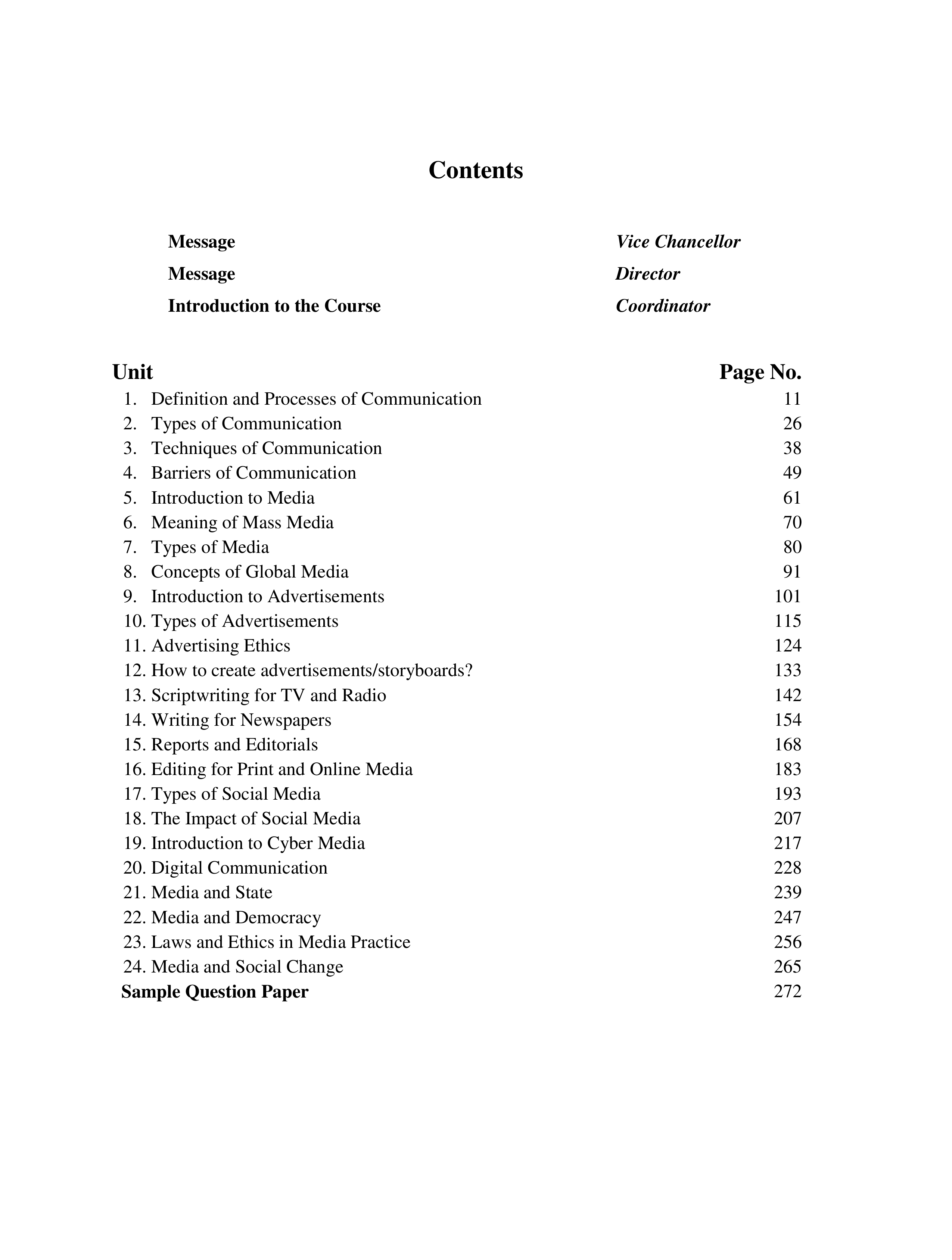
Contents
Message
Vice Chancellor
Message
Director
Introduction to the Course
Coordinator
Unit
Page No.
1.
Definition and Processes of Communication
11
2.
Types of Communication
26
3.
Techniques of Communication
38
4.
Barriers of Communication
49
5.
Introduction to Media
61
6.
Meaning of Mass Media
70
7.
Types of Media
80
8.
Concepts of Global Media
91
9.
Introduction to Advertisements
101
10.
Types of Advertisements
115
11.
Advertising Ethics
124
12.
How to create advertisements/storyboards?
133
13.
Scriptwriting for TV and Radio
142
14.
Writing for Newspapers
154
15.
Reports and Editorials
168
16.
Editing for Print and Online Media
183
17.
Types of Social Media
193
18.
The Impact of Social Media
207
19.
Introduction to Cyber Media
217
20.
Digital Communication
228
21.
Media and State
239
22.
Media and Democracy
247
23.
Laws and Ethics in Media Practice
256
24.
Media and Social Change
265
Sample Question Paper
272
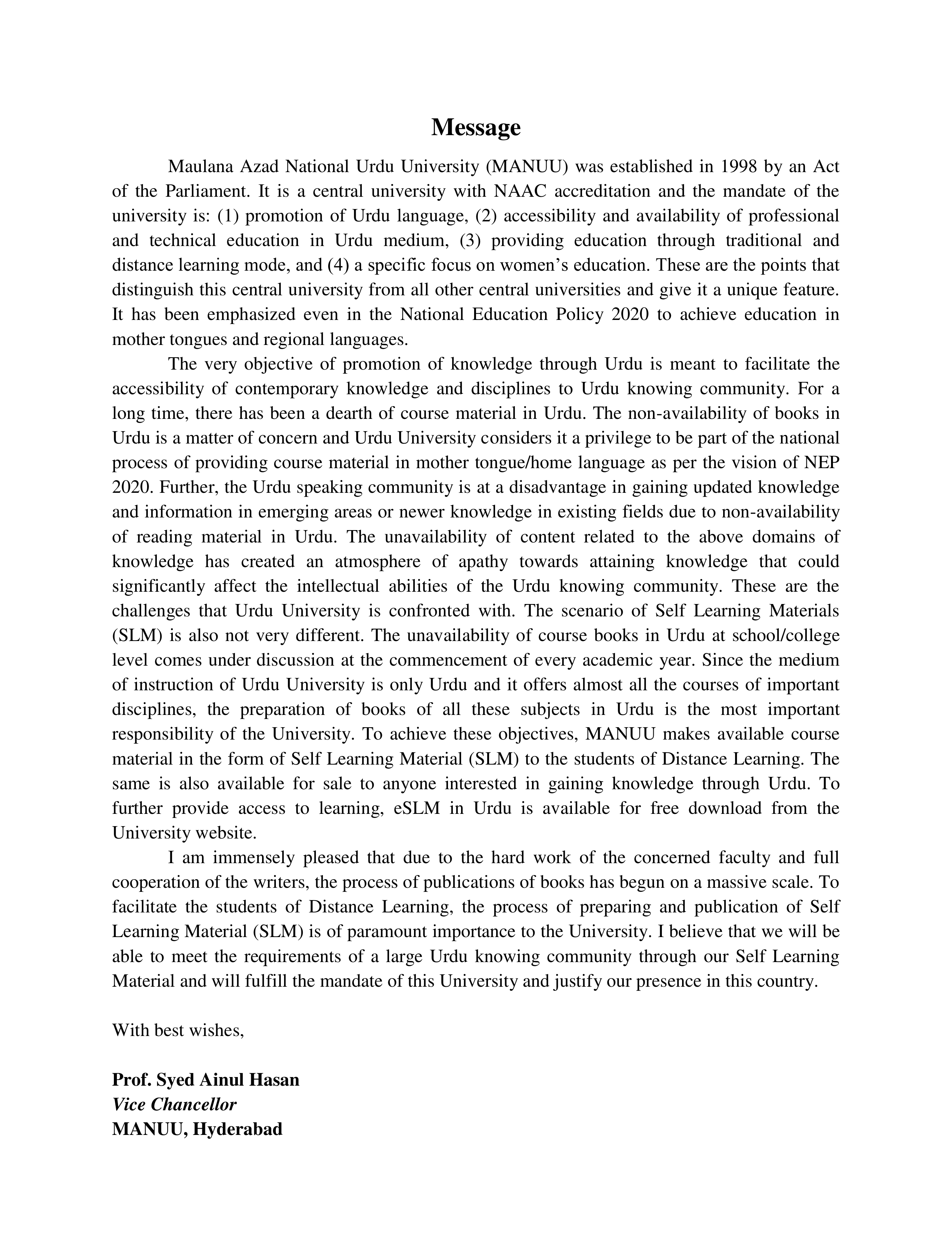
Message
Maulana Azad National Urdu University (MANUU) was established in 1998 by an Act
of the Parliament. It is a central university with NAAC accreditation and the mandate of the
university is: (1) promotion of Urdu language, (2) accessibility and availability of professional
and technical education in Urdu medium, (3) providing education through traditional and
distance learning mode, and (4) a specific focus on women‘s education. These are the points that
distinguish this central university from all other central universities and give it a unique feature.
It has been emphasized even in the National Education Policy 2020 to achieve education in
mother tongues and regional languages.
The very objective of promotion of knowledge through Urdu is meant to facilitate the
accessibility of contemporary knowledge and disciplines to Urdu knowing community. For a
long time, there has been a dearth of course material in Urdu. The non-availability of books in
Urdu is a matter of concern and Urdu University considers it a privilege to be part of the national
process of providing course material in mother tongue/home language as per the vision of NEP
2020. Further, the Urdu speaking community is at a disadvantage in gaining updated knowledge
and information in emerging areas or newer knowledge in existing fields due to non-availability
of reading material in Urdu. The unavailability of content related to the above domains of
knowledge has created an atmosphere of apathy towards attaining knowledge that could
significantly affect the intellectual abilities of the Urdu knowing community. These are the
challenges that Urdu University is confronted with. The scenario of Self Learning Materials
(SLM) is also not very different. The unavailability of course books in Urdu at school/college
level comes under discussion at the commencement of every academic year. Since the medium
of instruction of Urdu University is only Urdu and it offers almost all the courses of important
disciplines, the preparation of books of all these subjects in Urdu is the most important
responsibility of the University. To achieve these objectives, MANUU makes available course
material in the form of Self Learning Material (SLM) to the students of Distance Learning. The
same is also available for sale to anyone interested in gaining knowledge through Urdu. To
further provide access to learning, eSLM in Urdu is available for free download from the
University website.
I am immensely pleased that due to the hard work of the concerned faculty and full
cooperation of the writers, the process of publications of books has begun on a massive scale. To
facilitate the students of Distance Learning, the process of preparing and publication of Self
Learning Material (SLM) is of paramount importance to the University. I believe that we will be
able to meet the requirements of a large Urdu knowing community through our Self Learning
Material and will fulfill the mandate of this University and justify our presence in this country.
With best wishes,
Prof. Syed Ainul Hasan
Vice Chancellor
MANUU, Hyderabad
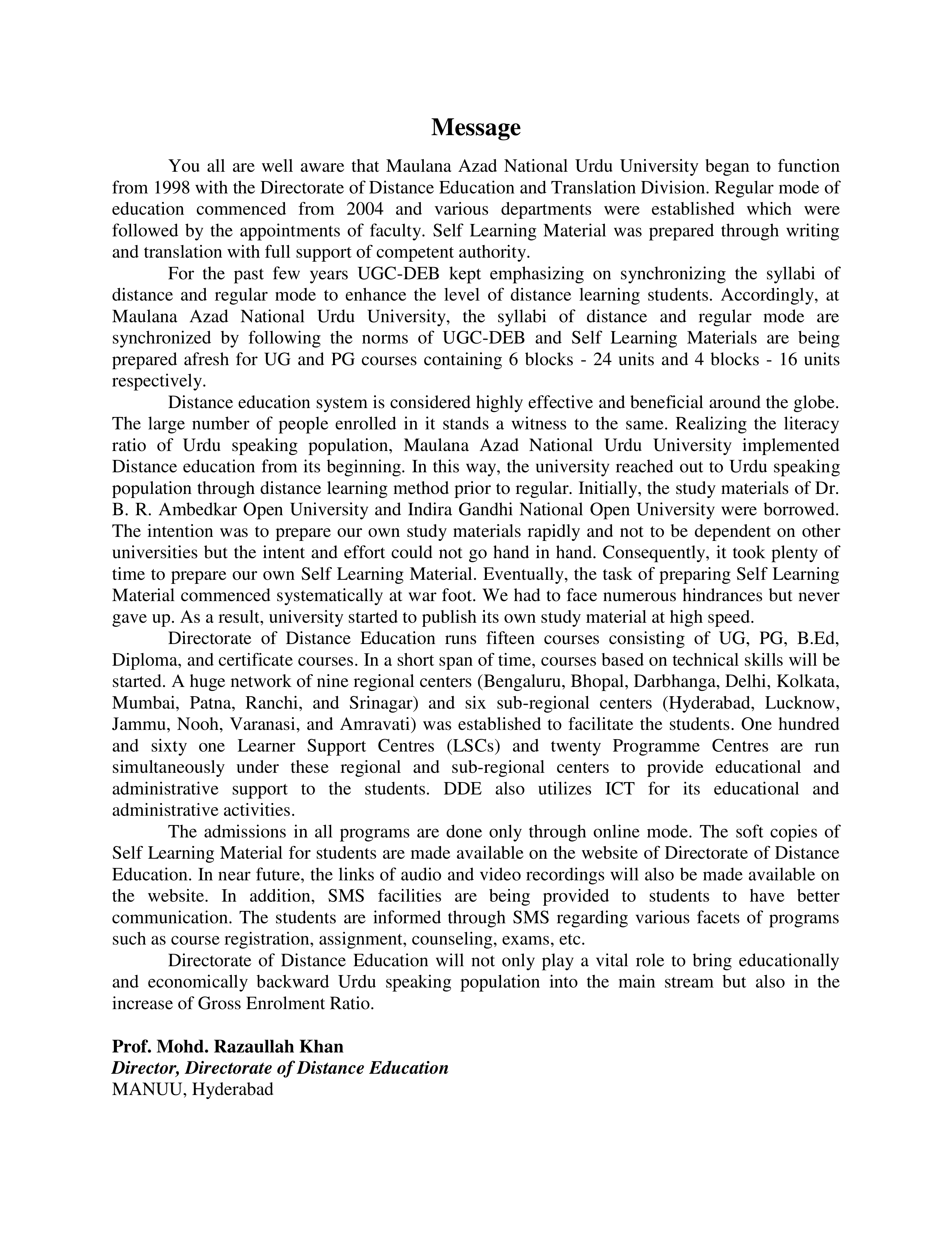
Message
You all are well aware that Maulana Azad National Urdu University began to function
from 1998 with the Directorate of Distance Education and Translation Division. Regular mode of
education commenced from 2004 and various departments were established which were
followed by the appointments of faculty. Self Learning Material was prepared through writing
and translation with full support of competent authority.
For the past few years UGC-DEB kept emphasizing on synchronizing the syllabi of
distance and regular mode to enhance the level of distance learning students. Accordingly, at
Maulana Azad National Urdu University, the syllabi of distance and regular mode are
synchronized by following the norms of UGC-DEB and Self Learning Materials are being
prepared afresh for UG and PG courses containing 6 blocks - 24 units and 4 blocks - 16 units
respectively.
Distance education system is considered highly effective and beneficial around the globe.
The large number of people enrolled in it stands a witness to the same. Realizing the literacy
ratio of Urdu speaking population, Maulana Azad National Urdu University implemented
Distance education from its beginning. In this way, the university reached out to Urdu speaking
population through distance learning method prior to regular. Initially, the study materials of Dr.
B. R. Ambedkar Open University and Indira Gandhi National Open University were borrowed.
The intention was to prepare our own study materials rapidly and not to be dependent on other
universities but the intent and effort could not go hand in hand. Consequently, it took plenty of
time to prepare our own Self Learning Material. Eventually, the task of preparing Self Learning
Material commenced systematically at war foot. We had to face numerous hindrances but never
gave up. As a result, university started to publish its own study material at high speed.
Directorate of Distance Education runs fifteen courses consisting of UG, PG, B.Ed,
Diploma, and certificate courses. In a short span of time, courses based on technical skills will be
started. A huge network of nine regional centers (Bengaluru, Bhopal, Darbhanga, Delhi, Kolkata,
Mumbai, Patna, Ranchi, and Srinagar) and six sub-regional centers (Hyderabad, Lucknow,
Jammu, Nooh, Varanasi, and Amravati) was established to facilitate the students. One hundred
and sixty one Learner Support Centres (LSCs) and twenty Programme Centres are run
simultaneously under these regional and sub-regional centers to provide educational and
administrative support to the students. DDE also utilizes ICT for its educational and
administrative activities.
The admissions in all programs are done only through online mode. The soft copies of
Self Learning Material for students are made available on the website of Directorate of Distance
Education. In near future, the links of audio and video recordings will also be made available on
the website. In addition, SMS facilities are being provided to students to have better
communication. The students are informed through SMS regarding various facets of programs
such as course registration, assignment, counseling, exams, etc.
Directorate of Distance Education will not only play a vital role to bring educationally
and economically backward Urdu speaking population into the main stream but also in the
increase of Gross Enrolment Ratio.
Prof. Mohd. Razaullah Khan
Director, Directorate of Distance Education
MANUU, Hyderabad
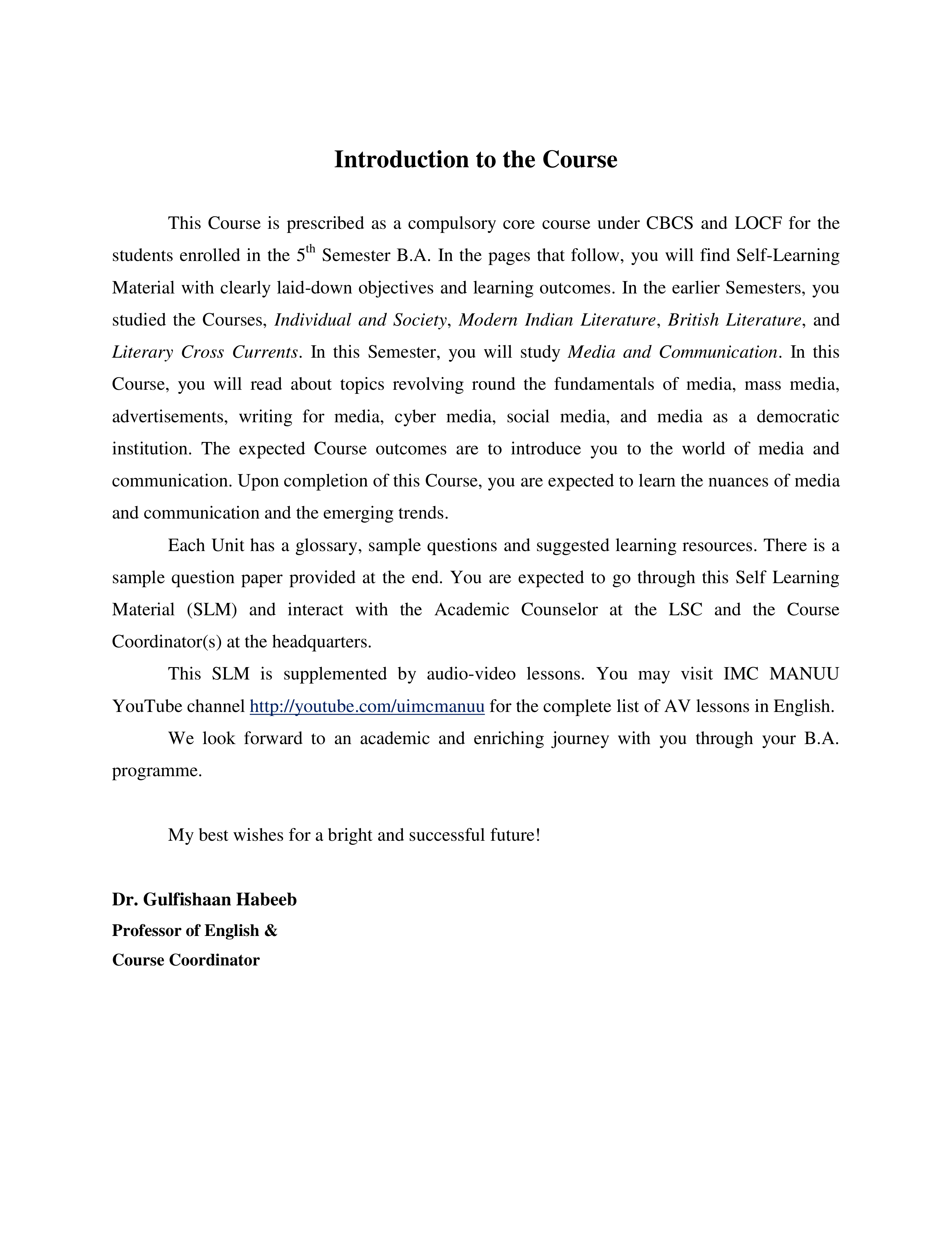
Introduction to the Course
This Course is prescribed as a compulsory core course under CBCS and LOCF for the
students enrolled in the 5
th
Semester B.A. In the pages that follow, you will find Self-Learning
Material with clearly laid-down objectives and learning outcomes. In the earlier Semesters, you
studied the Courses,
Individual and Society
,
Modern Indian Literature
,
British Literature
, and
Literary Cross Currents
. In this Semester, you will study
Media and Communication
. In this
Course, you will read about topics revolving round the fundamentals of media, mass media,
advertisements, writing for media, cyber media, social media, and media as a democratic
institution. The expected Course outcomes are to introduce you to the world of media and
communication. Upon completion of this Course, you are expected to learn the nuances of media
and communication and the emerging trends.
Each Unit has a glossary, sample questions and suggested learning resources. There is a
sample question paper provided at the end. You are expected to go through this Self Learning
Material (SLM) and interact with the Academic Counselor at the LSC and the Course
Coordinator(s) at the headquarters.
This SLM is supplemented by audio-video lessons. You may visit IMC MANUU
YouTube channel
http://youtube.com/uimcmanuu
for the complete list of AV lessons in English.
We look forward to an academic and enriching journey with you through your B.A.
programme.
My best wishes for a bright and successful future!
Dr. Gulfishaan Habeeb
Professor of English &
Course Coordinator
Media and Communication Skills

11
Unit - 1: Definition and Process of Communication
Structure:
1.0
Introduction
1.1
Objectives
1.2
Definition and Process of Communication
1.2.1
Definitions
1.2.2
Need and Significance
1.2.3
Functions of Communication
1.2.4
Process of Communication
1.2.5
Elements of Communication Process
1.2.6
Let Us Sum Up
1.3
Learning Outcomes
1.4
Keywords
1.5
Sample Questions
1.6
Suggested Learning Resources
1.0 Introduction
The process of sending and receiving messages consisting of ideas, information, feelings, and
attitudes from one person to another using any medium or channel is known as communication.
The channel/medium may be text, human voice, printed paper, sound, visual, body language or
airwaves. Communication is one of the basic needs for human beings to survive. The term
―communication‖ is explained and defined in as many ways as possible depending upon various
perspectives. In this Unit, we will learn about the different meanings of communication. We
would also understand the various functions of communication.
1.1 Objectives
The objectives of this Unit are to:
overview the meaning of communication and its functions.
analyse various communication channels around them.
describe the elements of communication.
12
identify the basic processes of communication.
1.2 Definition and Process of Communication
You know, the word "communication" has an interesting backstory. It comes from the
Latin word "Communis" which basically means "making things common." So, in everyday
terms, communication is all about sharing and making ideas or feelings common among people.
We do this by talking, using body language, and expressing ourselves.
Think of it like this: just as we need food, clothing, and a place to live, we also need to
communicate. It's how we connect with others and build relationships. We chat in different
languages, and this need to talk and connect starts right from the moment we're born. Babies, for
example, communicate by crying to let us know what they need.
As we grow up, we get better at talking and expressing ourselves not just with words but
also with gestures and expressions. This helps us understand more complicated messages. And
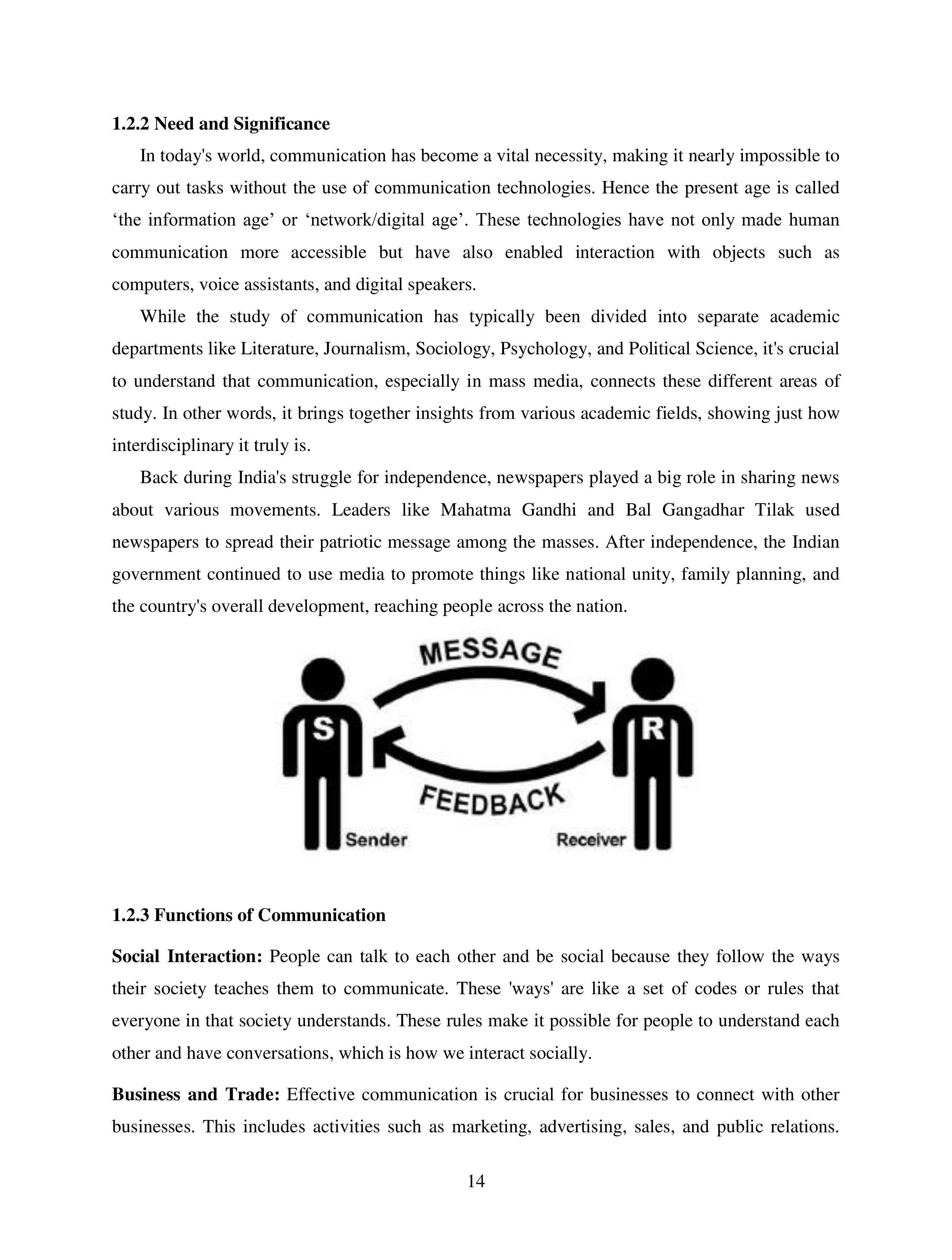
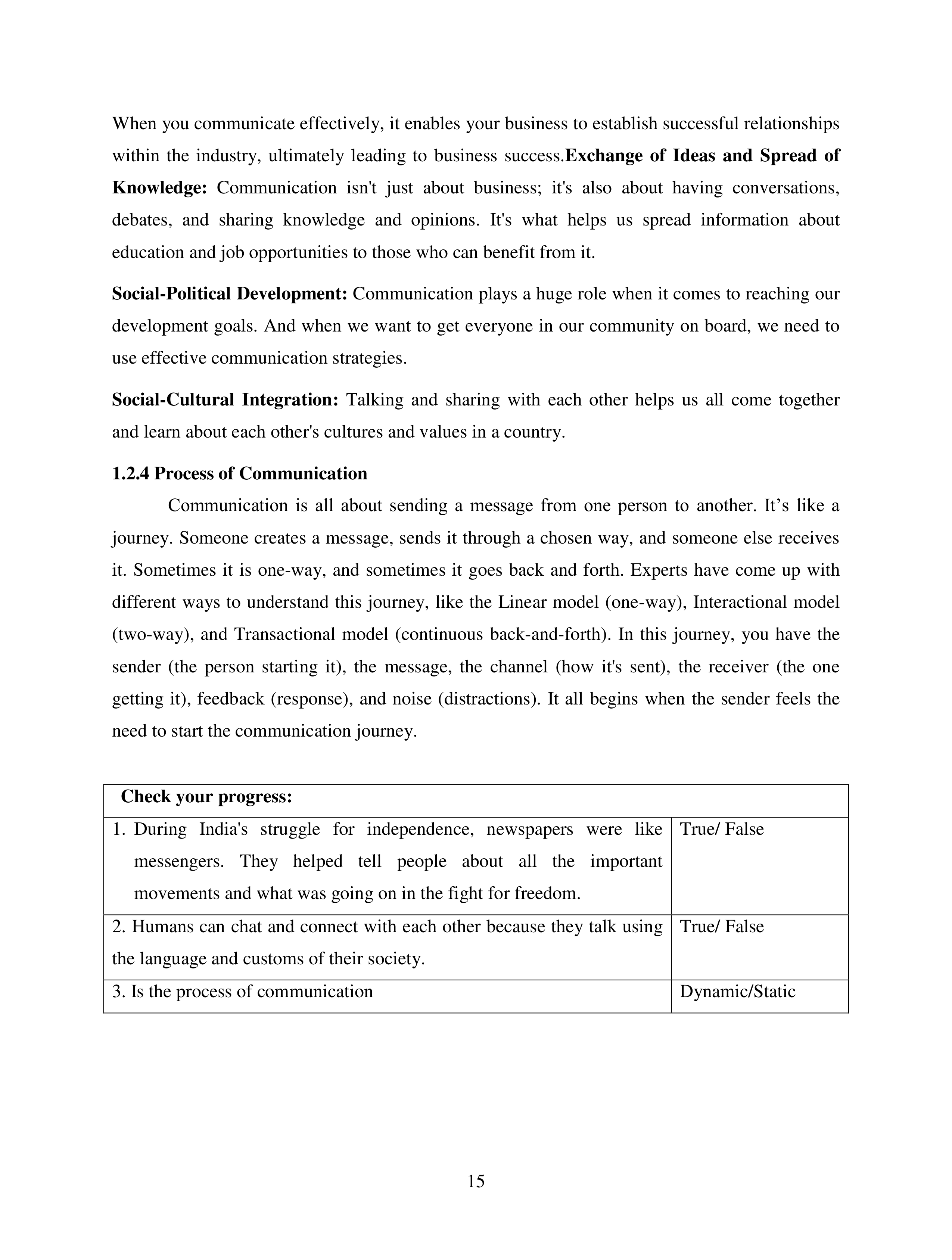
remember, in this whole communication process, there are two main players: the person sending
the message and the one receiving it. It's like a two-way street where information flows between
them.
Moreover, communication is not just a one-on-one thing; it happens between two
individuals, groups, or even entire nations. And it comes in various shapes and sizes, each with
its own level of significance.
But why do we communicate in the first place? Well, it's all about sharing and receiving
stuff like ideas, information, knowledge, experiences, thoughts, suggestions, opinions, feelings,
and attitudes. So, whether it is a casual chat with a friend, a big parade, a wedding celebration, or
even a festival, all of these are forms of communication events.
Now, in the modern world, we have all sorts of tools to help us communicate. Keval J.
Kumar, in 2021, pointed out that newspapers, radio, cinema, and TV are what we call
'communication media.' You can add phones, computers, satellites, and the internet to that list as
'communication technologies.' And let's not forget the folks who gather and share information in
the form of news, videos, and more
–
they're the 'communication professionals.' So, from one-
on-one talks to global broadcasts, it's all part of the fascinating world of communication!
Certainly, people have countless ways to express themselves and connect with others.
Sometimes, it's as simple as clapping, whistling, chanting slogans, or sharing laughter
–
all of
13
these are modes of communication. And it's not just about words; some folks convey their
thoughts with body language, touch, or even eye contact.
In fact, human communication is this amazing mix of all these forms of expression. It's how we
connect, understand, and share our experiences with one another. But here's an interesting thing:
the harshest punishment for someone can be isolation from all forms of human communication.
Imagine being cut off from everyone, unable to connect or express yourself
–
that's tough.
And we got a glimpse of this during the COVID-19 pandemic when many countries had
to impose nationwide lockdowns. Social distancing and isolation became necessary to curb the
virus, but it came at a cost. People missed that essential human connection, and it took a toll on
mental health. We never realized just how vital communication is for our well-being and
happiness. It is a reminder of how much we need each other.
1.2.1 Definitions
1. ―Communication is the exchange of meanings between individuals through a common system
of symbols‖. (I.A.
Richards)
2. ―The tra
nsmission of information, ideas, attitudes or emotion from one person or group to
another primarily through symbols‖. (Theodorson and Theordorson)
3. ―Communication is a social interaction through messages‖. (Grabner, 1967)
4. ―One mind affecting another‖.
(Claude Shannon)
5. ―The mechanism through which human relations exist and develop‖. (Wilbur Schramm)
Check your progress:
1.
The term communication has been derived from the Latin
word ―Communis‖ meaning?
Common/ Information
2. Communication is the exchange of meanings between
individuals through a common system of symbols.
True/ False
3. Can we call reporters as communication professionals?
Yes/No
4. Is isolation from human communication described as a severe
punishment in the text?
True/ False
14
1.2.2 Need and Significance
In today's world, communication has become a vital necessity, making it nearly impossible to
carry out tasks without the use of communication technologies. Hence the present age is called
‗the information age‘ or ‗network/digital age‘. These technologies have not only made human
communication more accessible but have also enabled interaction with objects such as
computers, voice assistants, and digital speakers.
While the study of communication has typically been divided into separate academic
departments like Literature, Journalism, Sociology, Psychology, and Political Science, it's crucial
to understand that communication, especially in mass media, connects these different areas of
study. In other words, it brings together insights from various academic fields, showing just how
interdisciplinary it truly is.
Back during India's struggle for independence, newspapers played a big role in sharing news
about various movements. Leaders like Mahatma Gandhi and Bal Gangadhar Tilak used
newspapers to spread their patriotic message among the masses. After independence, the Indian
government continued to use media to promote things like national unity, family planning, and
the country's overall development, reaching people across the nation.
1.2.3 Functions of Communication
Social Interaction:
People can talk to each other and be social because they follow the ways
their society teaches them to communicate. These 'ways' are like a set of codes or rules that
everyone in that society understands. These rules make it possible for people to understand each
other and have conversations, which is how we interact socially.
Business and Trade:
Effective communication is crucial for businesses to connect with other
businesses. This includes activities such as marketing, advertising, sales, and public relations.
15
When you communicate effectively, it enables your business to establish successful relationships
within the industry, ultimately leading to business success.
Exchange of Ideas and Spread of
Knowledge:
Communication isn't just about business; it's also about having conversations,
debates, and sharing knowledge and opinions. It's what helps us spread information about
education and job opportunities to those who can benefit from it.
Social-Political Development:
Communication plays a huge role when it comes to reaching our
development goals. And when we want to get everyone in our community on board, we need to
use effective communication strategies.
Social-Cultural Integration:
Talking and sharing with each other helps us all come together
and learn about each other's cultures and values in a country.
1.2.4
Process of Communication
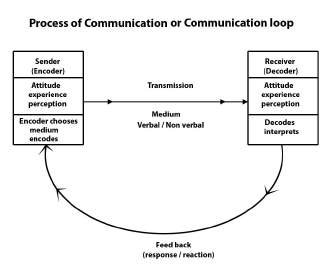
Communication is all about sending a message from one person to another. It‘s like a
journey. Someone creates a message, sends it through a chosen way, and someone else receives
it. Sometimes it is one-way, and sometimes it goes back and forth. Experts have come up with
different ways to understand this journey, like the Linear model (one-way), Interactional model
(two-way), and Transactional model (continuous back-and-forth). In this journey, you have the
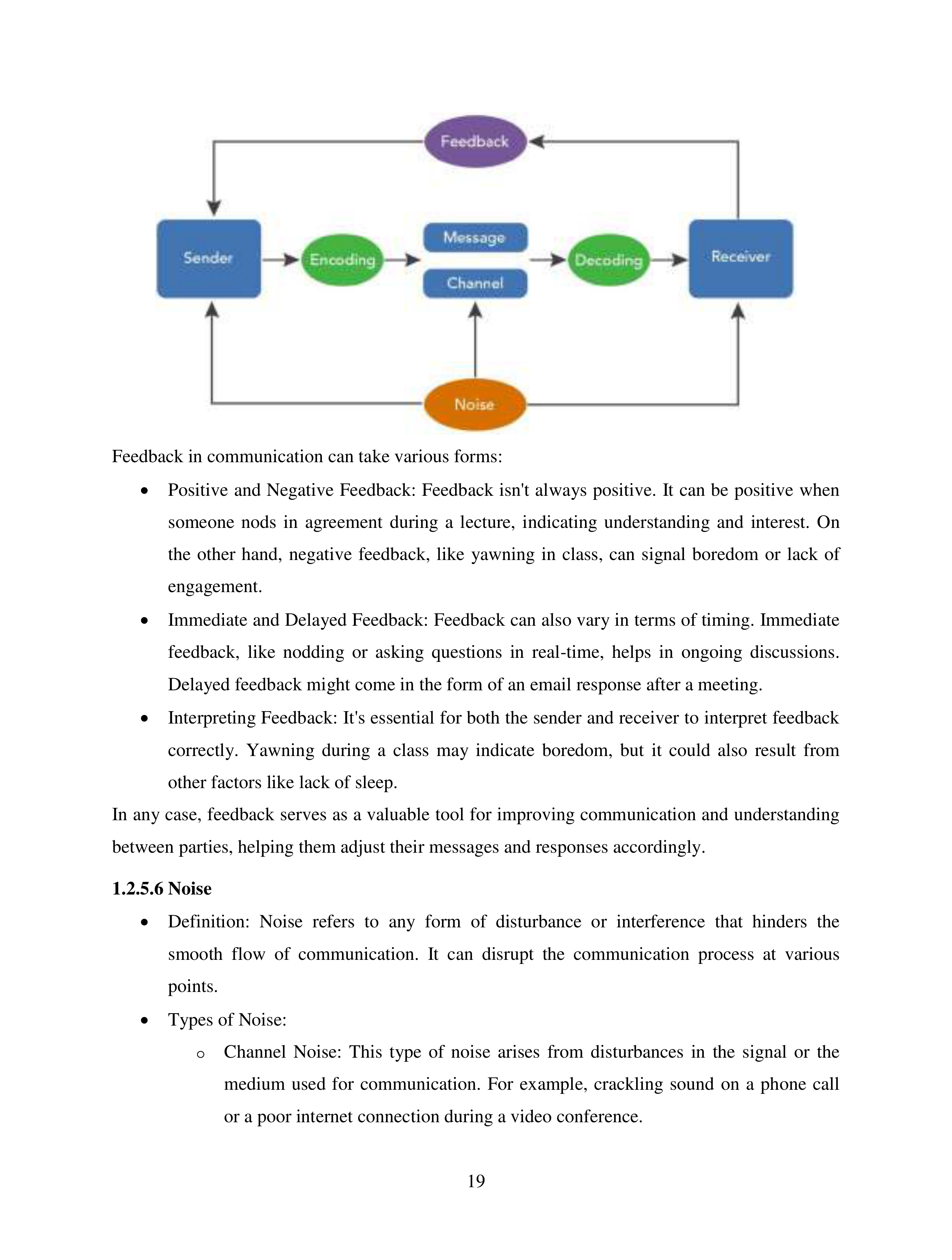
sender (the person starting it), the message, the channel (how it's sent), the receiver (the one
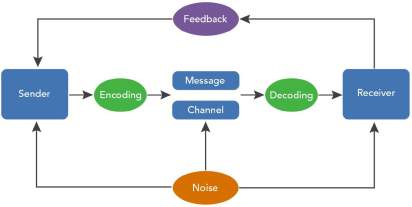
getting it), feedback (response), and noise (distractions). It all begins when the sender feels the
need to start the communication journey.
Check your progress:
1.
During India's struggle for independence, newspapers were like
messengers. They helped tell people about all the important
movements and what was going on in the fight for freedom.
True/ False
2. Humans can chat and connect with each other because they talk using
the language and customs of their society.
True/ False
3. Is the process of communication
Dynamic/Static
16
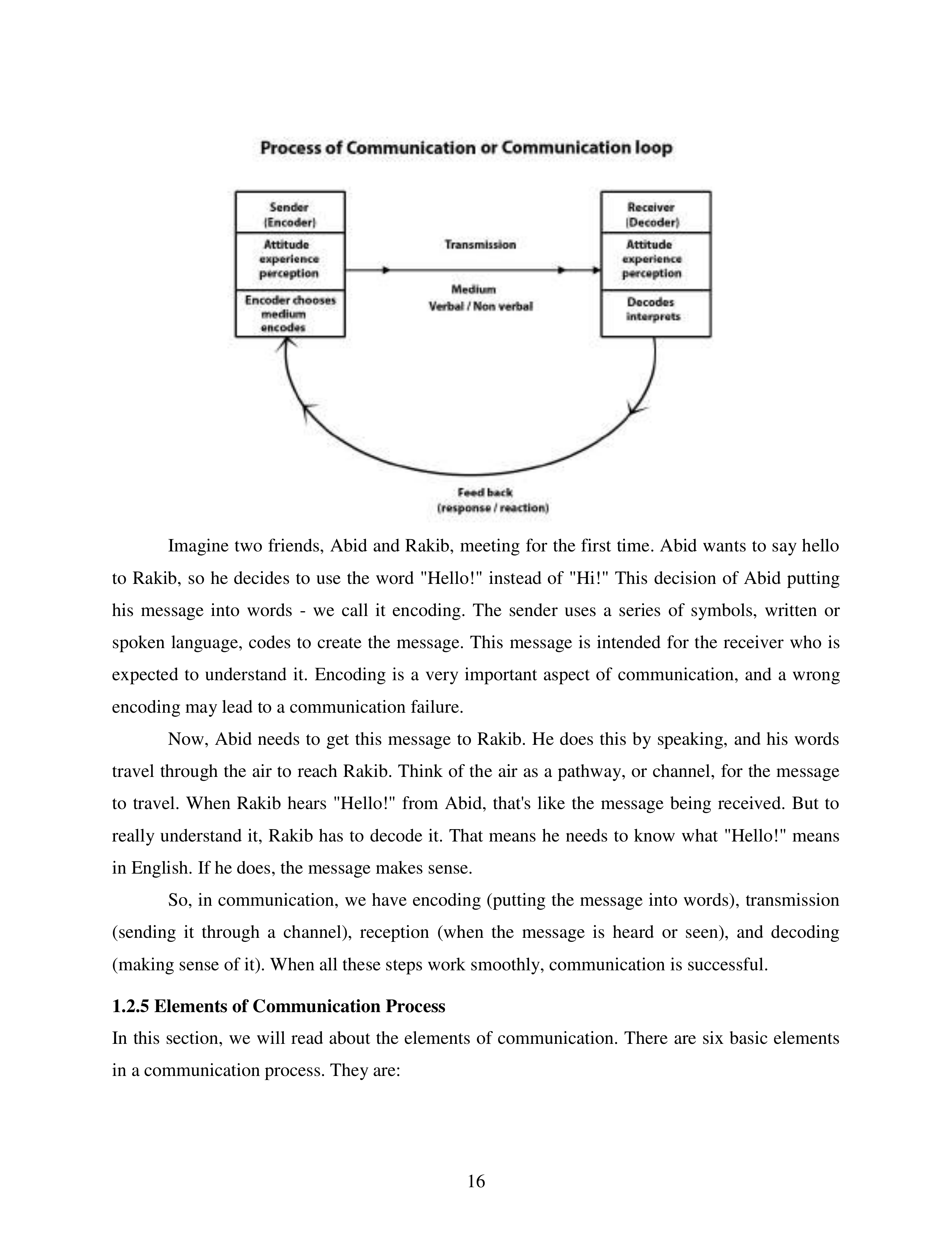
Imagine two friends, Abid and Rakib, meeting for the first time. Abid wants to say hello
to Rakib, so he decides to use the word "Hello!" instead of "Hi!" This decision of Abid putting
his message into words - we call it encoding. The sender uses a series of symbols, written or
spoken language, codes to create the message. This message is intended for the receiver who is
expected to understand it. Encoding is a very important aspect of communication, and a wrong
encoding may lead to a communication failure.
Now, Abid needs to get this message to Rakib. He does this by speaking, and his words
travel through the air to reach Rakib. Think of the air as a pathway, or channel, for the message
to travel. When Rakib hears "Hello!" from Abid, that's like the message being received. But to
really understand it, Rakib has to decode it. That means he needs to know what "Hello!" means
in English. If he does, the message makes sense.
So, in communication, we have encoding (putting the message into words), transmission
(sending it through a channel), reception (when the message is heard or seen), and decoding
(making sense of it). When all these steps work smoothly, communication is successful.
1.2.5 Elements of Communication Process
In this section, we will read about the elements of communication. There are six basic elements
in a communication process. They are:
17
1.2.5.1 Sender
In communication, we have a sender who's like the source of the message. This can be
one person or a whole group of people. They create a message that they want to share with
someone else either on purpose or by accident. For example, think of a reporter on the news.
They are the sender because they are sharing a message with viewers. Or when a singer performs
on stage, they are also the sender, sharing their message through music. Even in a classroom, a
teacher or a student can be the sender when they are trying to get a message across.
When the sender makes the message, it is called encoding. This depends on the sender's
skills, what they know, the situation, and what they believe. And how they encode the message
can affect how well the other person, the receiver, understands it.
1.2.5.2 Message
Message is basically any idea or information encoded in a definite way. It can be in many
forms, like words, symbols, or even how we use our body. When you send a message, it is meant
to make sense to the person receiving it. Messages can be divided into two types: verbal and non-
verbal. Verbal messages are when we use spoken or written words. Non-verbal messages are all
the other ways we communicate without talking, like through our actions, how we move, what
we wear, the tone of our voice or our behaviour.
So, whether it is words on a page, spoken words, or just how we act, messages are how
we share what we are thinking with someone else.
1.2.5.3 Channel
When someone wants to send a message to another person, that message must travel
through something to reach its destination. We call this in-between thing the "channel." Imagine
them like roads for your message to travel on. Communication channels can be of different
types. Some are mechanical, like newspapers or printed materials. Others are audio-visual, like
TV or online videos. We also have new media, which includes things like social media and
websites. Plus, there are natural channels, like the airwaves through which radio signals travel.
Our natural communication channels are our five senses:
Touch: For physical contact and non-verbal communication.
Hearing: For spoken words and sounds.
Taste: To experience flavours and sensations.
Sight: To process what we see in the world.
18
Smell: Triggering memories and emotions through scents.
So, whether it's through a printed book, a YouTube video, a delicious meal, or a friendly hug,
we use these channels to send and receive messages in our everyday lives. Communication is all
about using the right channel to convey the intended message effectively.
1.2.5.4 Receiver
Let us learn now about the Receiver in Communication:
Definition: The receiver is the person or entity to whom the message is directed. They
play a crucial role in the communication process.
Decoding and Interpretation: The receiver's job is to decode the message and make sense
of it. They do this based on their knowledge of the language and the code used in the
message.
Importance: The receiver is equally important as the sender and the message itself.
Without a receiver, communication wouldn't serve its purpose.
Feedback: The receiver may respond to the message with feedback. This can be in the
form of questions, comments, or actions, closing the communication loop.
In summary, the receiver is a vital part of communication. They decode, interpret, and often
respond to the message, ensuring effective and meaningful communication.
1.2.5.5 Feedback
Definition: Feedback occurs when the receiver responds to the sender, either verbally or
non-verbally, through the same communication channel.
Importance: Feedback is crucial because it helps the sender understand how their
message is received and interpreted. Without feedback, communication can break down.
Role Reversal: During feedback, the receiver becomes the sender, providing their own
message or response. This makes communication a continuous loop.
Continuous Process: Communication continues until both parties decide to stop. Each
exchange of feedback keeps the conversation going.
Variation: In one-on-one or small group communication, feedback is more immediate and
direct. In mass communication (like TV or theatre), it's often less immediate but still
present, like applause from a theatre audience.
In essence, feedback is a vital part of effective communication. It helps both parties understand
each other and keeps the conversation going until they decide to conclude it.
19
Feedback in communication can take various forms:
Positive and Negative Feedback: Feedback isn't always positive. It can be positive when
someone nods in agreement during a lecture, indicating understanding and interest. On
the other hand, negative feedback, like yawning in class, can signal boredom or lack of
engagement.
Immediate and Delayed Feedback: Feedback can also vary in terms of timing. Immediate
feedback, like nodding or asking questions in real-time, helps in ongoing discussions.
Delayed feedback might come in the form of an email response after a meeting.
Interpreting Feedback: It's essential for both the sender and receiver to interpret feedback
correctly. Yawning during a class may indicate boredom, but it could also result from
other factors like lack of sleep.
In any case, feedback serves as a valuable tool for improving communication and understanding
between parties, helping them adjust their messages and responses accordingly.
1.2.5.6 Noise
Definition: Noise refers to any form of disturbance or interference that hinders the
smooth flow of communication. It can disrupt the communication process at various
points.
Types of Noise:
o
Channel Noise: This type of noise arises from disturbances in the signal or the
medium used for communication. For example, crackling sound on a phone call
or a poor internet connection during a video conference.
20
o
Semantic Noise: Semantic noise is related to language and meaning. It occurs
when there is a barrier in understanding due to differences in language, jargon, or
cultural references between the sender and receiver.
Impact on Communication: Noise can significantly affect communication by distorting
the message or causing misunderstandings. It can occur at any stage of the
communication process, including the source, message, channel, or receiver.
Minimizing Noise: Effective communication requires minimizing noise. This can be
achieved by using clear and concise language, choosing appropriate communication
channels, and ensuring a common understanding between sender and receiver.
In summary, noise is a common challenge in communication, and it can take different forms. To
have effective communication, it's essential to identify and minimize noise to ensure the message
is accurately received and understood.
1.2.5.7 Effect
Let us explore the concept of communication effects and its different types in a clear and
concise manner:
Definition: Communication effects are the ultimate consequences or outcomes of the
communication process. They represent the impact that communication has on the
receiver.
Importance of Feedback: To properly analyze the effects of communication, feedback is
essential. It helps in understanding how the message influenced the receiver and whether
it achieved the intended purpose.
Types of Communication Effects:
Cognitive Effects: These effects involve the modification of the receiver's
knowledge or understanding. For example, after reading an informative article,
the cognitive effect may be an increase in knowledge about a particular topic.
Affective Effects: Affective effects are related to emotions. They reflect how
communication can impact the receiver's emotions. For instance, watching a
funny movie can result in feelings of entertainment, relaxation, or humour among
the audience.
Behavioural Effects: These are the changes in the receiver's actions or practices as
a result of communication. An example is how political campaigns can influence
voters' behaviour, leading them to vote for a particular candidate.
21
Strategic Communication: Some forms of communication, like advertising, are strategic
and aim to achieve specific effects, such as increasing sales or building brand image.
In summary, communication effects are the end results of communication, and they can
fall into three main categories: cognitive, affective, and behavioural. Feedback is crucial for
evaluating these effects and ensuring that communication achieves its intended impact.
Check your progress:
1. Encoding is not an important aspect of communication and a wrong encoding
will not lead to communication failure
True/ False
2. Disturbance during the communication it is called noise or communication
barrier
True/ False
3. Communication always requires a sender and a receiver.
True/ False
4. Noise in communication can only occur at the receiver's end.
True/ False
5. Feedback is not necessary for effective communication.
True/ False
6. Affective effects of communication are related to changes in behaviour.
True/ False
7. Advertising is a form of communication that aims to influence consumer
behaviour.
True/ False
8. Semantic noise refers to disturbances in the signal or medium of
communication.
True/ False
9. Cognitive effects of communication involve changes in the receiver's emotions. True/ False
10. Communication is a one-way process, always starting with the sender.
True/ False
11. Communication can only occur through spoken or written words.
True/ False
12. The receiver in communication can also provide feedback.
True/ False
1.2.6 Let Us Sum Up
Communication is the process of sending and receiving messages or information through
various channels, including printed, audiovisual, airwaves, and body language.
Theodorson and Theordorson defined communication as the transmission of information,
ideas, attitudes, or emotions primarily using symbols.
Communication involves a sender designing a message and sending it through a specific
channel to a receiver. It can be one-way or cyclical.
22
Six basic elements of the communication process are Sender, Message, Channel,
Receiver, Noise, and Feedback.
Feedback is essential to assess the impact or effect of communication.
1.3 Learning Outcomes
After successfully reading this lesson, Learners should achieve the following learning outcomes:
Learners should have a comprehensive understanding of what communication is,
including its definition and various forms of channels through which it occurs.
Learners should be able to identify and describe the six basic elements of the
communication process, including the sender, message, channel, receiver, noise, and
feedback.
Learners should recognize the significance of feedback in the communication process and
understand how it helps assess the impact and effectiveness of messages.
Learners should be familiar with the concept of noise in communication and be able to
distinguish between channel noise and semantic noise, as well as understand their
implications.
Learners should be able to categorize communication effects into cognitive effects,
affective effects, and behavioural effects, and provide examples of each.
Learners should understand the importance of encoding messages and how it can affect
successful communication, as well as the role of decoding in message interpretation.
Learners should recognize the role of the five senses (touch, hearing, taste, sight, and
smell) as natural communication channels and how they contribute to human interaction.
Learners should be equipped with strategies for minimizing noise in communication to
enhance clarity and effectiveness.
Learners should appreciate the interdisciplinary nature of communication and how it
connects various academic fields, such as literature, journalism, sociology, psychology,
and political science.
Learners should grasp the importance of communication in social, cultural, and political
development, as well as its role in promoting understanding among individuals from
different cultures.
23
Overall, the lesson should provide learners with a foundational knowledge of communication, its
elements, and its broader implications in various aspects of life and society.
1.4 Keywords
Communication, Channel, Theodorson and Theordorson, Sender/Source, Message,
Receiver, Noise, Channel noise, Semantic noise, Feedback, Effect/Impact, Encoding,
Transmission, Decoding, Verbal Message, Non-verbal Message, Social Interaction, Business and
Trade, Exchange of Ideas and Spread of Knowledge, Social-Political Development, Social-
Cultural Integration, Linear Model, Interactional Model, Transactional Model
1.5 Sample Questions
Objective Questions
1. Which of these is not an element of communication?
a)
Sender
b)
Message
c)
Communis
d)
Channel
2. Where do we get feedback from?
a)
Channel
b)
Message
c)
Noise
d)
Receiver
3. Why is feedback important in communication?
a)
It helps create more noise in the communication process
b)
It allows the sender to dominate the conversation
c)
It helps assess the impact and effectiveness of communication
d)
It is unnecessary in effective communication
4. What does the term "encoding" refer to in communication?
a)
The process of decoding a message
24
b)
Putting the message into words or symbols
c)
The act of receiving a message
d)
The use of non-verbal communication
5. Which category of communication effects involves changes in the receiver's emotions?
a)
Cognitive effects
b)
Affective effects
c)
Behavioural effects
d)
Linguistic effects
Short Answer Questions
1.
What do you understand by the process of communication?
2.
What is the need and significance of communication?
3.
What is the importance of feedback in a communication process?
4.
Define "noise" in communication and provide examples of both channel noise and
semantic noise.
5.
Give examples of different communication channels mentioned in the lesson, both
mechanical and natural.
Long Answer Questions
1.
Discuss the elements of communication.
2.
Define and explain the process of mass communication.
3.
Elaborately discuss the functions of mass media.
4.
Discuss the significance of intercultural communication and its role in a diverse global
society. How can effective intercultural communication enhance understanding among
individuals from different cultures?
5.
Explore the role of communication in social, cultural, and political development, as
mentioned in the lesson. How can effective communication contribute to these areas, and
why is it crucial?
25
1.6 Suggested Learning Resources
Aggarwal, Vir Bala, and V. S. Gupta.
Handbook of Journalism and Mass Communication
. New
Delhi: Concept Publishing Company, 2001.
Beebe, Steven A., Susan J. Beebe, and Diana K. Ivy.
Communication: Principles for a lifetime
.
Boston, MA: Allyn & Bacon, 2010.
Ghosh, Subir.
Mass Communication Today: In the Indian Context
. Profile Books (GB), 1996.
Kumar, Keval J.
Mass Communication in India
. Jaico Publishing House, 2020.
McQuail, Denis.
Mass Communication Theory: An Introduction
. Sage Publications, Inc, 1987.
26
Unit - 2: Types of Communication
Structure
2.0
Introduction
2.1
Objectives
2.2
Types of Communication
2.2.1
Types of communication depending on size
2.2.1.1
Intrapersonal Communication
2.2.1.2
Interpersonal Communication
2.2.1.3
Group Communication
2.2.1.4
Public Communication
2.2.1.5
Mass Communication
2.2.2
Let Us Sum Up
2.3
Learning Outcomes
2.4
Keywords
2.5
Sample Questions
2.6
Suggested Learning Resources
2.0 Introduction
Communication is essentially the sharing of information, ideas and messages using various
modes of channels and involving various numbers of participants in the communication process.
It is the key to social interactions, establishing relationships, both personal as well as
professional. Communication further helps in socialisation and democratic participation of
individuals. The basic need for communication can be traced back to human civilisation with
reference to cave drawings and artefacts.
Communication can be differentiated into various types depending on the language and the
number of participants involved. While on the one hand, there are verbal and non-verbal forms
of communication, there are also intra, interpersonal, group, public and mass communication
depending on the number of participants in the communication process.
27
2.1 Objectives
The objectives of this Unit are to help the learners to:
overview the various types of communication
analyse the use of various communication types
describe the effectiveness of one type of communication over the other
identify the barriers in each of the types of communication
2.2 Types of Communication
Communication is segmented into various types depending on the communication channels
and based on the purpose. While the communication channel classifies communication into two
types such as verbal and non-verbal, the purpose of communication leads to either formal
communication or non-formal communication. While use of spoken or written language refers to
verbal communication, use of body gestures, sign language constitutes the non-verbal form of
communication. Further, the flow of communication within an organisation is denoted by the
term
―
network of communication.
‖
This network of communication may be formal or informal
depending on its purpose. When the communication is held at regular intervals and is regulated
by the organisation where it takes place, it is called formal communication. For example, when
managers communicate with superiors or subordinates through a formal hierarchy of
communication channels within the organisation. This form of communication flow chart is
often represented in the organisational structure of any organisation. When the managers
communicate with their colleagues casually without following the hierarchy during break-time or
casual socialisation, it is called informal communication. Sometimes informal communication is
more effective in overcoming the barriers in communication between the sender and the receiver.
Check your progress:
1.
Which form of communication uses body gestures?
Verbal/Non-verbal
2.
When we communicate with friends and colleagues during a cup
of coffee, what form of communication is it called?
Formal/ Informal
28
2.2.1 Types of communication depending on size
The size of a social group has an immense influence in the process of communication and
its effectiveness. Such a typology of communication is identified as Intra-personal
communication, Interpersonal communication, Group Communication, Public communication,
and Mass Communication.
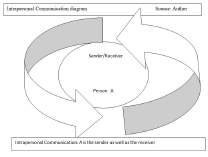
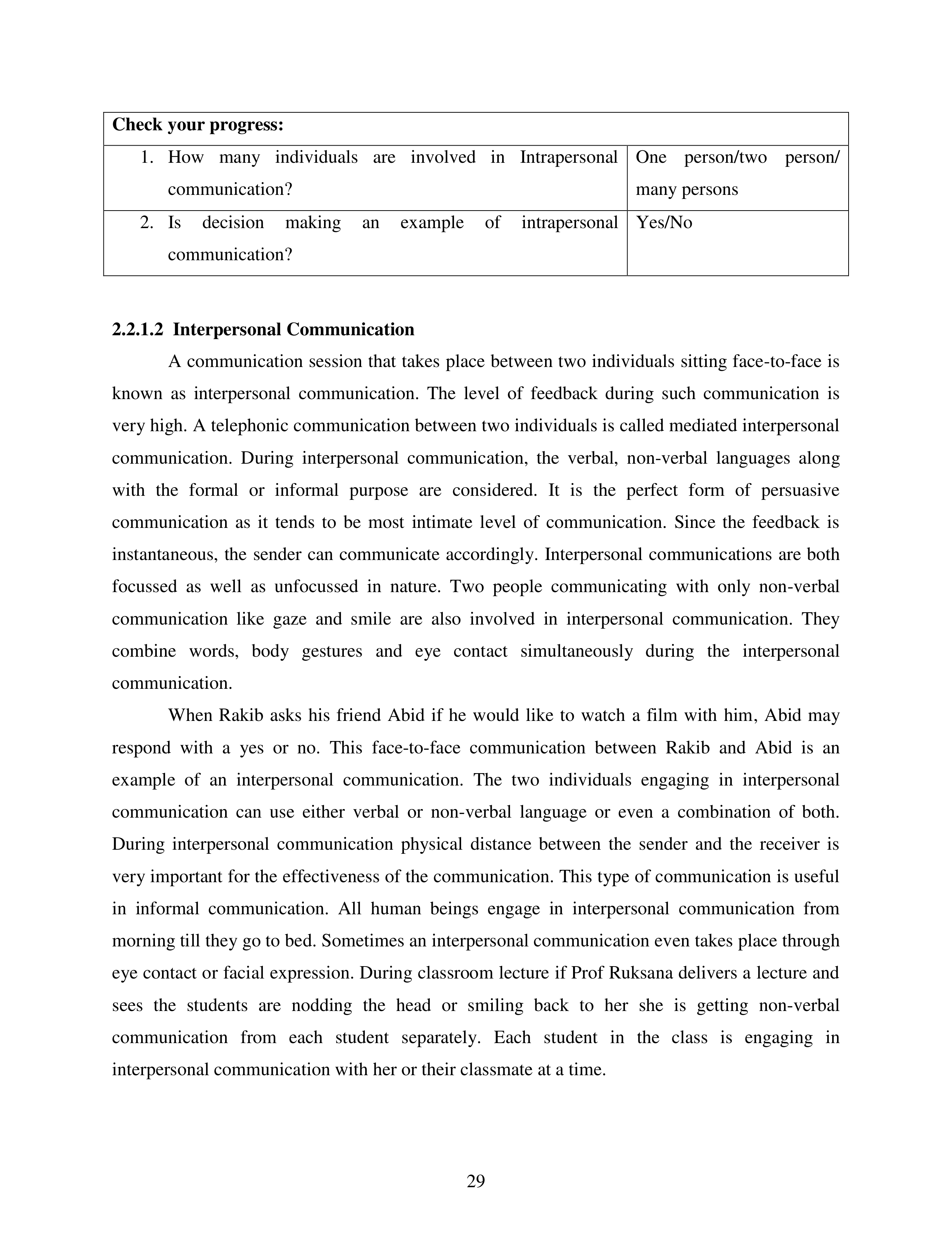
2.2.1.1 Intrapersonal Communication
When the communication takes place within an individual through reflection, meditation,
contemplation it is known as intrapersonal communication. Here the sender and the receiver of
the communication is the same person. During prayers or meditation, a person gets involved in
this form of communication. To take any decision of an action, the individual takes part in
intrapersonal communication with himself/herself. For example, if there is a release of a new
Hindi film in a nearby cinema theatre, Rakib engages in an intrapersonal communication with
himself about whether he wants to go to watch the film or not. The sender as well as the receiver
in this communication process is one person that is Rakib. The time taken in this intrapersonal
communication in reaching a decision is instantaneous. Even if Rakib decides that he wants to
watch the film with his friends his decision is a result of his intrapersonal communication.
Hence, throughout the day we engage in intrapersonal communication countless number of
times. Again, when Abid agrees to watch the film with Rakib, his decision is prompted after
Abid‘s intrapersonal communication.
Hence, without an effective intrapersonal communication
system an individual cannot function properly. However, if the individual does not have a sound
mind there will be difficulty in the intrapersonal communication. If the individual is suffering
from any physical illness or is disturbed, then also the intrapersonal communication will face
barriers. Hence, intrapersonal communication faces both physical as well as psychological
barriers.
29
Check your progress:
1.
How many individuals are involved in Intrapersonal
communication?
One person/two person/
many persons
2.
Is
decision
making
an
example
of
intrapersonal
communication?
Yes/No
2.2.1.2 Interpersonal Communication
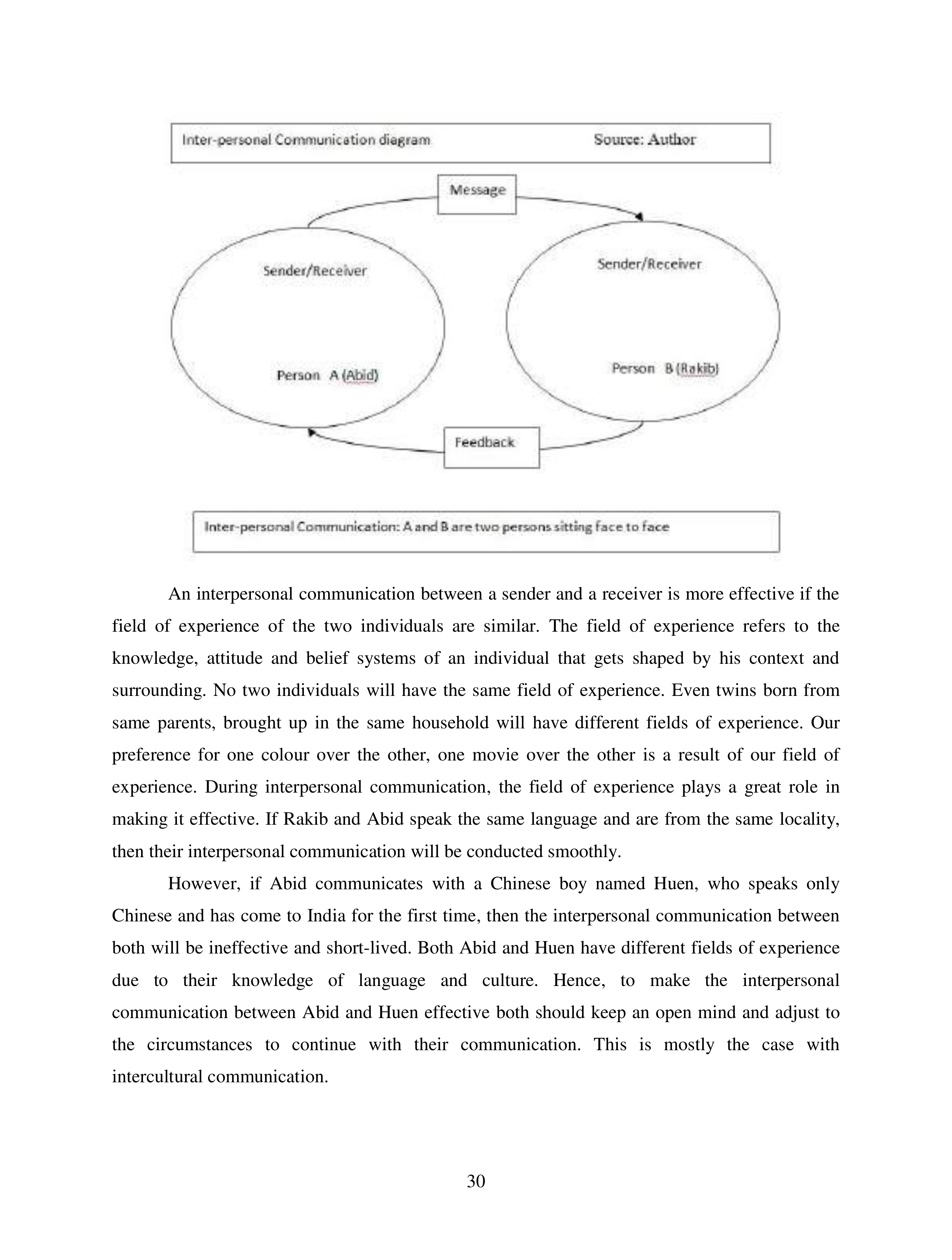
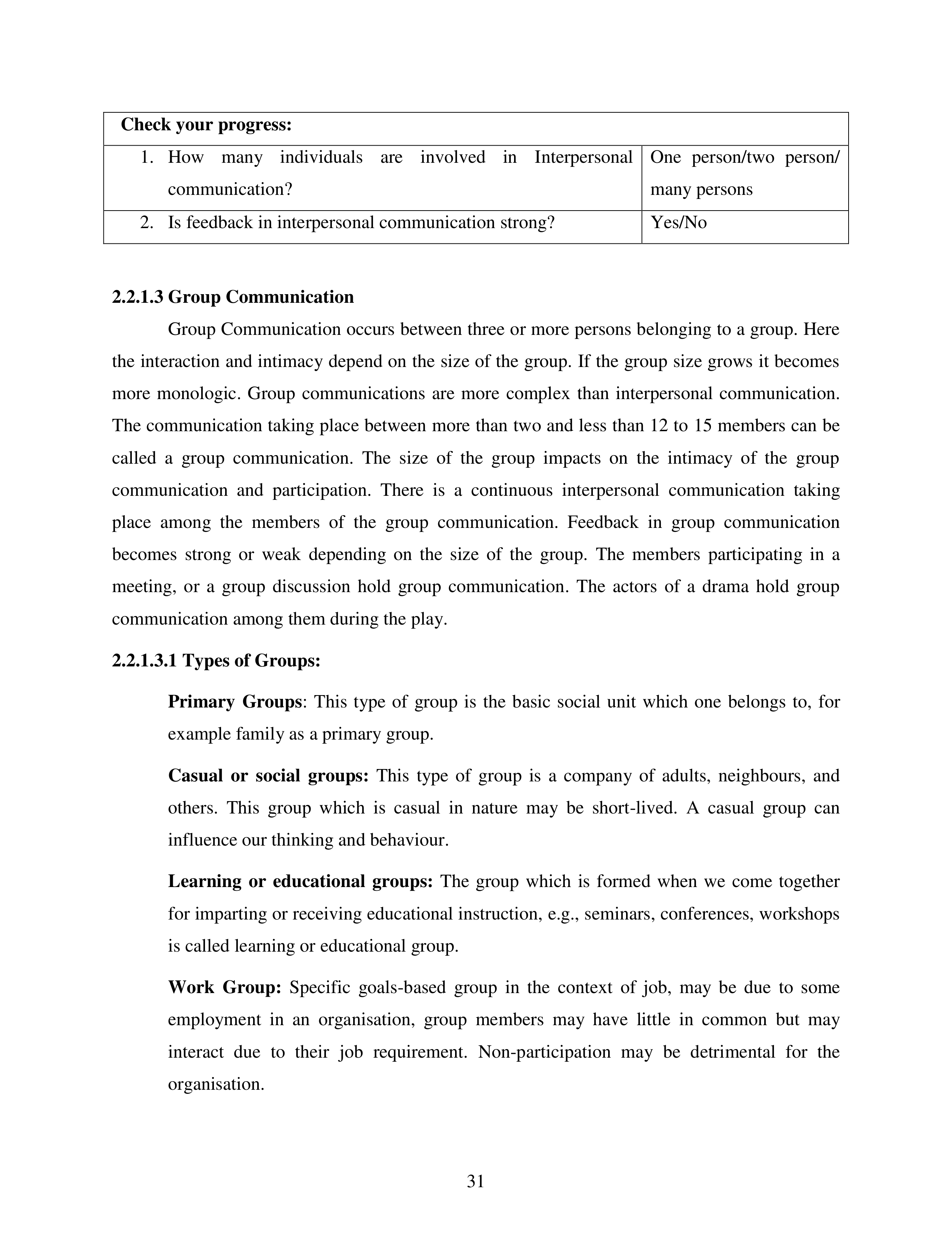
A communication session that takes place between two individuals sitting face-to-face is
known as interpersonal communication. The level of feedback during such communication is
very high. A telephonic communication between two individuals is called mediated interpersonal
communication. During interpersonal communication, the verbal, non-verbal languages along
with the formal or informal purpose are considered. It is the perfect form of persuasive
communication as it tends to be most intimate level of communication. Since the feedback is
instantaneous, the sender can communicate accordingly. Interpersonal communications are both
focussed as well as unfocussed in nature. Two people communicating with only non-verbal
communication like gaze and smile are also involved in interpersonal communication. They
combine words, body gestures and eye contact simultaneously during the interpersonal
communication.
When Rakib asks his friend Abid if he would like to watch a film with him, Abid may
respond with a yes or no. This face-to-face communication between Rakib and Abid is an
example of an interpersonal communication. The two individuals engaging in interpersonal
communication can use either verbal or non-verbal language or even a combination of both.
During interpersonal communication physical distance between the sender and the receiver is
very important for the effectiveness of the communication. This type of communication is useful
in informal communication. All human beings engage in interpersonal communication from
morning till they go to bed. Sometimes an interpersonal communication even takes place through
eye contact or facial expression. During classroom lecture if Prof Ruksana delivers a lecture and
sees the students are nodding the head or smiling back to her she is getting non-verbal
communication from each student separately. Each student in the class is engaging in
interpersonal communication with her or their classmate at a time.
30
An interpersonal communication between a sender and a receiver is more effective if the
field of experience of the two individuals are similar. The field of experience refers to the
knowledge, attitude and belief systems of an individual that gets shaped by his context and
surrounding. No two individuals will have the same field of experience. Even twins born from
same parents, brought up in the same household will have different fields of experience. Our
preference for one colour over the other, one movie over the other is a result of our field of
experience. During interpersonal communication, the field of experience plays a great role in
making it effective. If Rakib and Abid speak the same language and are from the same locality,
then their interpersonal communication will be conducted smoothly.
However, if Abid communicates with a Chinese boy named Huen, who speaks only
Chinese and has come to India for the first time, then the interpersonal communication between
both will be ineffective and short-lived. Both Abid and Huen have different fields of experience
due to their knowledge of language and culture. Hence, to make the interpersonal
communication between Abid and Huen effective both should keep an open mind and adjust to
the circumstances to continue with their communication. This is mostly the case with
intercultural communication.
31
Check your progress:
1.
How many individuals are involved in Interpersonal
communication?
One person/two person/
many persons
2.
Is feedback in interpersonal communication strong?
Yes/No
2.2.1.3 Group Communication
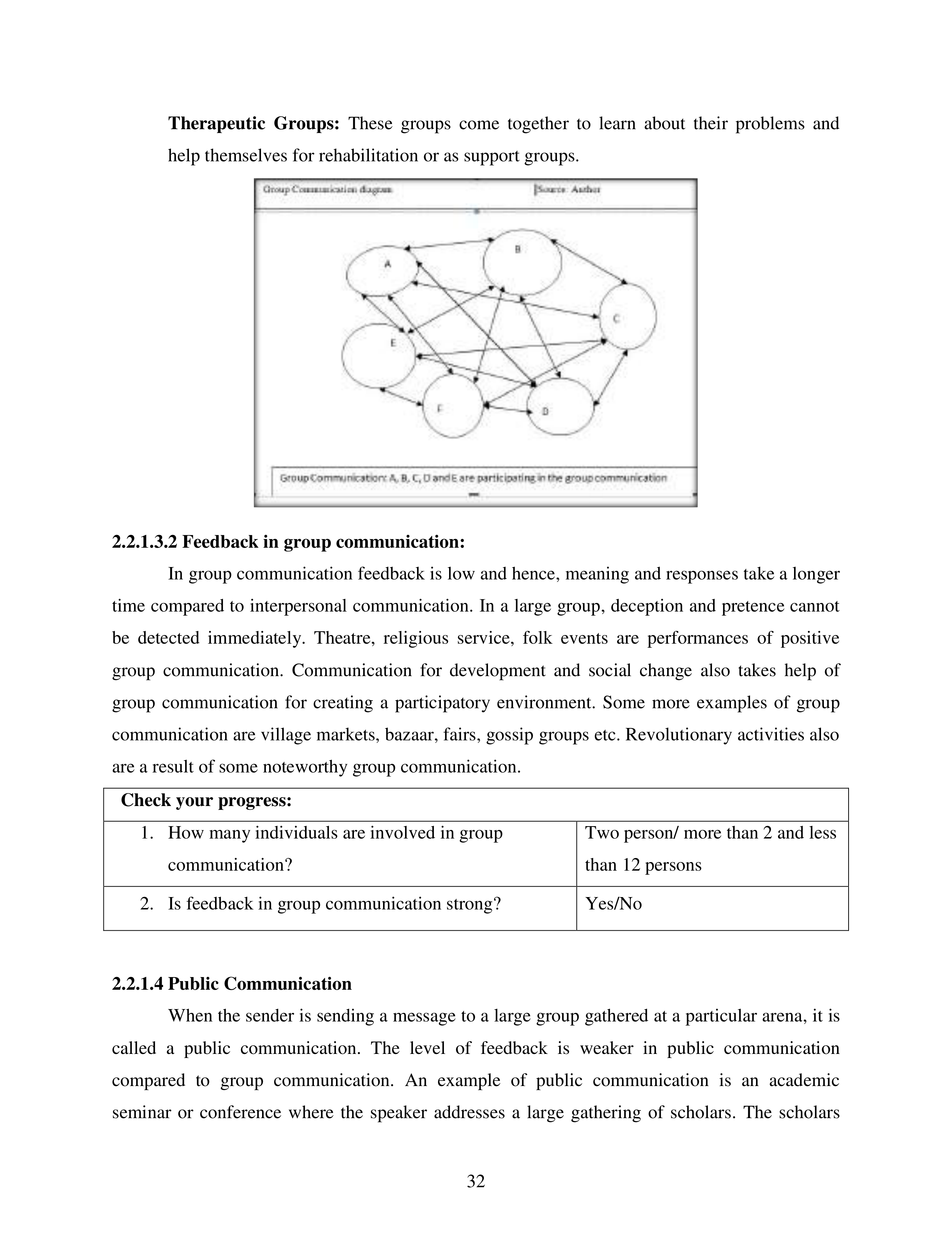
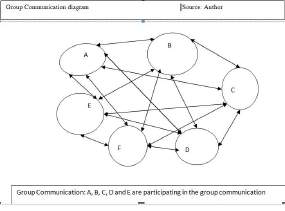
Group Communication occurs between three or more persons belonging to a group. Here
the interaction and intimacy depend on the size of the group. If the group size grows it becomes
more monologic. Group communications are more complex than interpersonal communication.
The communication taking place between more than two and less than 12 to 15 members can be
called a group communication. The size of the group impacts on the intimacy of the group
communication and participation. There is a continuous interpersonal communication taking
place among the members of the group communication. Feedback in group communication
becomes strong or weak depending on the size of the group. The members participating in a
meeting, or a group discussion hold group communication. The actors of a drama hold group
communication among them during the play.
2.2.1.3.1 Types of Groups:
Primary Groups
: This type of group is the basic social unit which one belongs to, for
example family as a primary group.
Casual or social groups:
This type of group is a company of adults, neighbours, and
others. This group which is casual in nature may be short-lived. A casual group can
influence our thinking and behaviour.
Learning or educational groups:
The group which is formed when we come together
for imparting or receiving educational instruction, e.g., seminars, conferences, workshops
is called learning or educational group.
Work Group:
Specific goals-based group in the context of job, may be due to some
employment in an organisation, group members may have little in common but may
interact due to their job requirement. Non-participation may be detrimental for the
organisation.

32
Therapeutic Groups:
These groups come together to learn about their problems and
help themselves for rehabilitation or as support groups.
2.2.1.3.2 Feedback in group communication:
In group communication feedback is low and hence, meaning and responses take a longer
time compared to interpersonal communication. In a large group, deception and pretence cannot
be detected immediately. Theatre, religious service, folk events are performances of positive
group communication. Communication for development and social change also takes help of
group communication for creating a participatory environment. Some more examples of group
communication are village markets, bazaar, fairs, gossip groups etc. Revolutionary activities also
are a result of some noteworthy group communication.
Check your progress:
1.
How many individuals are involved in group
communication?
Two person/ more than 2 and less
than 12 persons
2.
Is feedback in group communication strong?
Yes/No
2.2.1.4 Public Communication
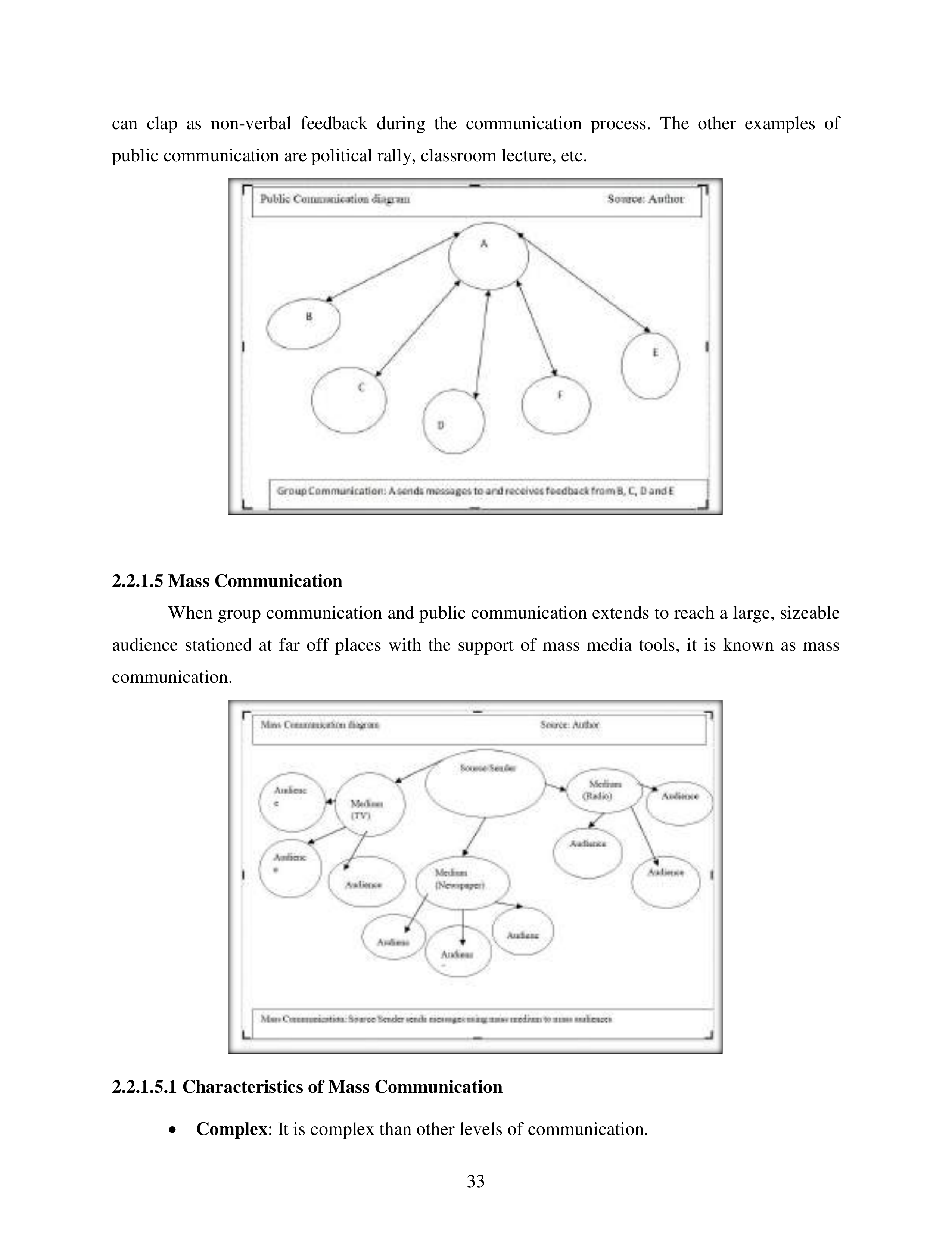
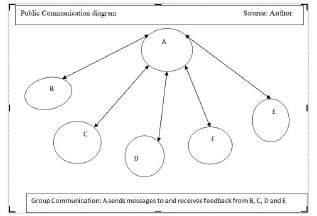
When the sender is sending a message to a large group gathered at a particular arena, it is
called a public communication. The level of feedback is weaker in public communication
compared to group communication. An example of public communication is an academic
seminar or conference where the speaker addresses a large gathering of scholars. The scholars


33
can clap as non-verbal feedback during the communication process. The other examples of
public communication are political rally, classroom lecture, etc.
2.2.1.5 Mass Communication
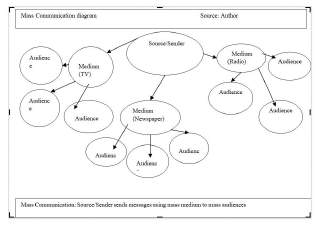
When group communication and public communication extends to reach a large, sizeable
audience stationed at far off places with the support of mass media tools, it is known as mass
communication.
2.2.1.5.1 Characteristics of Mass Communication
Complex
: It is complex than other levels of communication.
34
Empathy
: The successful sender is one who finds the right method of expression to
establish empathy with the largest possible number of individuals in the audience.
Audience
: large-diversified-anonymous.
Distanced
: Face-to-face interaction is impossible.
Mass Medium
: A mass medium makes it possible for the message to reach far
beyond the proximity of the sender.
Limited sensory channels
: We can only see or hear, senses like touch or other senses
do not work unlike other types of communication.
Impersonal communication
: All throughout the mass communication process is
impersonal.
Gate Keeper
: Gate keeping is very much an important element of mass
communication. An editor receives, perceives, and edits the information before
sending it to his/her audiences.
Delayed Feedback
: The feedback is not immediate like interpersonal communication
or group communication.
Mass communication is the dissemination of ideas, messages, and information by an
identified sender to a large, diversified, heterogeneous and anonymous audience through a tool
of mass media for a desired effect. The strategy of using mass communication for dissemination
of messages is much more difficult than interpersonal communication or group communication.
The reach of mass communication is instantaneous and vast. Mass communication also faces
barriers of communication given the distant of the sender from the masses. Factors like ideology,
knowledge, awareness, and context of the message may have different impact on different group
of audiences of the same message.
The process of mass communication uses different types of media to send the messages
to the large, scattered audience instantly. These forms of mass media help the message and
information reach every corner of the world. Hence, these mass media tools are very powerful in
impacting the lives of audiences. These mass media tools, and the messages imparted through
them helps inform, educate, entertain and persuade people. Some examples of the mass media
are newspapers, books, magazines, radio, television, film, satellite TV and internet.
The 1940s and 1950s saw the beginnings of increased research into the functions of mass
communications. Post Second World War, there was widespread interest in trying to understand
35
the impact of mass media messages on society. Political parties rely on mass media to promote
their ideologies, plans, programs, and manifestos. With the help of mass media, they try to create
public opinion in their favour. From the above discussion, we can conclude that mass
communication has diversified objectives. Different messages have different aims. However,
mass communication is mainly dedicated to ensuring the well-being of all classes of people in
society. Mass communication aims at persuading people to bring a change in their beliefs,
opinions, attitudes, and thinking on several issues like smoking, voting, religious convictions,
donation, dowry culture, etc.
Check your progress:
1.
Is the sender in mass communication is identified?
Yes/No
2.
Does Mass Communication use a mass medium to reach the
huge, diversified, and scattered audience?
Yes/No
2.2.2 Let Us Sum Up
Communication is the sending and receiving of messages and information between
individuals. It can be informal form of communication or formal form of communication
depending on the purpose of the communication. Again, the communication can be segmented
into five types depending on the size of the group of communication. If one person
communicates within himself or herself, it is called intrapersonal communication. This type of
communication can range from dreaming to meditating or even decision making. The other type
of communication that involves two individuals sitting face-to-face is called interpersonal
communication. Interpersonal communication is more dialogic and two-way form of
communication.
Both the sender and the receiver take turns performing the functions of both sender as
well as receiver. Again, talking in a group of more than 2 and less than 12 to 15 members make it
a group communication. Here, due to the size of the group participants, the feedback is little
delayed, and the intimacy is lesser compared to the interpersonal communication. Public
communication takes place is a more formal and structured environment. A classroom lecture,
seminar or academic conferences are examples of public communication. The balance between
the sending of and receiving of messages in public communication is not even. The receivers
might simply respond by clapping or laughing.
36
Further, when communication takes place with the help of a mechanical device by the
sender to reach a large audience who are scattered around the globe is called mass
communication. In Mass Communication, the sender is identified while the receivers of the
message remain anonymous to the sender. Every individual engages in some type of
communication from morning till night. The most common function of mass communication is
entertainment. Some examples of mass media are newspaper, magazines, radio, television, film
and internet. It is also used to persuade people, educate, and transmit culture among them.
2.3 Learning Outcomes
At the end of this Unit, you should have understood the different types of
communication.
2.4 Keywords
Verbal
language,
Non-verbal
language,
Intrapersonal
communication,
Interpersonal
communication, Group communication, public communication, mass communication, Mass
Media
2.5 Sample Questions
Objective Questions
1. Which of these is not a type of communication based on size and number of participants?
a)
Public communication
b)
Mass communication
c)
Interpersonal communication
d)
Informal communication
2. Which of the following is not a characteristic of mass communication?
a)
Audience
b)
Limited sensory channel
c)
Immediate feedback
37
d)
Impersonal communication
Short Answer Questions
1.
What type of communication takes place between the interviewer and interviewee in a
job interview? Justify.
2.
What is the difference between interpersonal communication and group communication?
3.
What are the different types of groups that can get involved in group communication?
Long Answer Questions
1.
Explain Intrapersonal communication and Interpersonal communication with the help of
examples?
2.
Explain in detail the importance of mass communication?
3.
Discuss the different types of communication.
2.6 Suggested Learning Resources
Aggarwal, Vir Bala, and V. S. Gupta.
Handbook of Journalism and Mass Communication
. New
Delhi: Concept Publishing Company, 2001.
Beebe, Steven A., Susan J. Beebe, and Diana K. Ivy.
Communication: Principles for a lifetime
.
Boston, MA: Allyn & Bacon, 2010.
Ghosh, Subir.
Mass Communication Today: In the Indian Context
. Profile Books (GB), 1996.
Kumar, Keval J.
Mass Communication in India
. Jaico Publishing House, 2020.
McQuail, Denis.
Mass Communication Theory: An Introduction
. Sage Publications, Inc, 1987.
38
Unit - 3: Techniques of Communication
Structure
3.0
Introduction
3.1
Objectives
3.2
Techniques of Communication
3.2.1
Verbal Communication
3.2.2
Non-Verbal Communication
3.2.3
Some Forms of Non-verbal Communication Techniques
3.2.4
Strategies of Communication
3.2.5
Let Us Sum Up
3.3
Learning Outcomes
3.4
Keywords
3.5
Sample Questions
3.6
Suggested Learning Resources
3.0 Introduction
Communication is an important means of sharing and receiving information, ideas and
messages between individuals and group of individuals. Mass Communication is the sending of
information to a large, diversified, and scattered mass audience for the desired effect. Hence, the
techniques used in creating and sending these messages in very important for their proper
reception and effect. The techniques of communication range from the use of verbal and non-
verbal language to various types of visuals and audio presentations. This Unit discusses the
importance of using various techniques of communication. This Unit also deals with defining
and explaining a range of various techniques of communication.
3.1 Objectives
The objectives of this Unit are to:
get an overview of the meaning of techniques of communication
understand the various types of communication techniques used by communicators.
39
identify the significance and scope of techniques of communication.
utilise various techniques of communication in different circumstances to communicate
effectively.
3.2 Techniques of Communication
Human beings are known to communicate with each other using varied forms of
language and techniques. This is a necessary requirement given the need for effective and barrier
free communication. Many countries have fought battles due to miscommunication.
Communities have clashed with each other due to lack of proper communication with each other.
A leader who can communicate successfully with his/her audience is able to influence more.
Hence, knowledge and proper use of communication techniques is a necessity for individuals. If
a reporter goes for covering any incident and fails to use his/her communication skills to
establish sources for the report, then the communication technique used by him/her is a failure.
During an interview, the interviewee is judged more on his/her communication skills and
techniques rather than their knowledge. The use of proper communication techniques is also
important for corporate houses to meet any crisis. For example, when Maggi was accused of
having lead content in the instant noodles, it was its communication techniques that helped it
face the crisis. It immediately used various forms of communication both written as well as
audio-visual to reach out to its customers to regain their trust i
n it. Any company‘s brand image
and identity depend solely on its communication techniques. Hence, as individuals too we need
to know of the various communication techniques that will benefit in creating an impression
among our peers and acquaintances.
3.2.1 Verbal Communication
Verbal communication is also called oral or written communication. In simple terms, it is
the use of written or spoken languages to communicate with the receiver/ receivers. Verbal
communication consists of two segments written communication and oral communication. Since
ancient times, the written word has earned more importance for formal communication. Even
today when something is communicated in the written formal it holds more value as it can be
referred to again at a future date. It is known that today‘s written communication is tomorrow‘s
history. Hence, letters written by our national leaders, freedom fighters, kings or historical
figures form the base for historical documents. Some examples of written communication are
40
letters, e-mails, faxes, memos, reports, and other written messages. It can be written using pen
and paper or typed in a computer or device. Another form of verbal communication is oral or
visual communication. Oral communication is the use of spoken words, exclamation, sounds etc
while visual communication involves the use of pictures or images. Pictures such as
photographs, paintings, graphs, animation, and videos are some of examples of visual
communication.
Written Communication can be used in many ways in the contemporary times. It is one of
the most common forms of formal communication. Every day, we come across newspaper which
used written communication to inform us about various incidents. We also use written
communication through mails and letters for official communication. Social media account such
as Facebook, Twitter use written communication as well as messaging apps like WhatsApp,
Telegram etc. However, written communication plays little role in solving personal issues among
individuals die to its formal nature. Hence, individuals must use informal non-verbal
communication also at times to create a two-way successful communication.
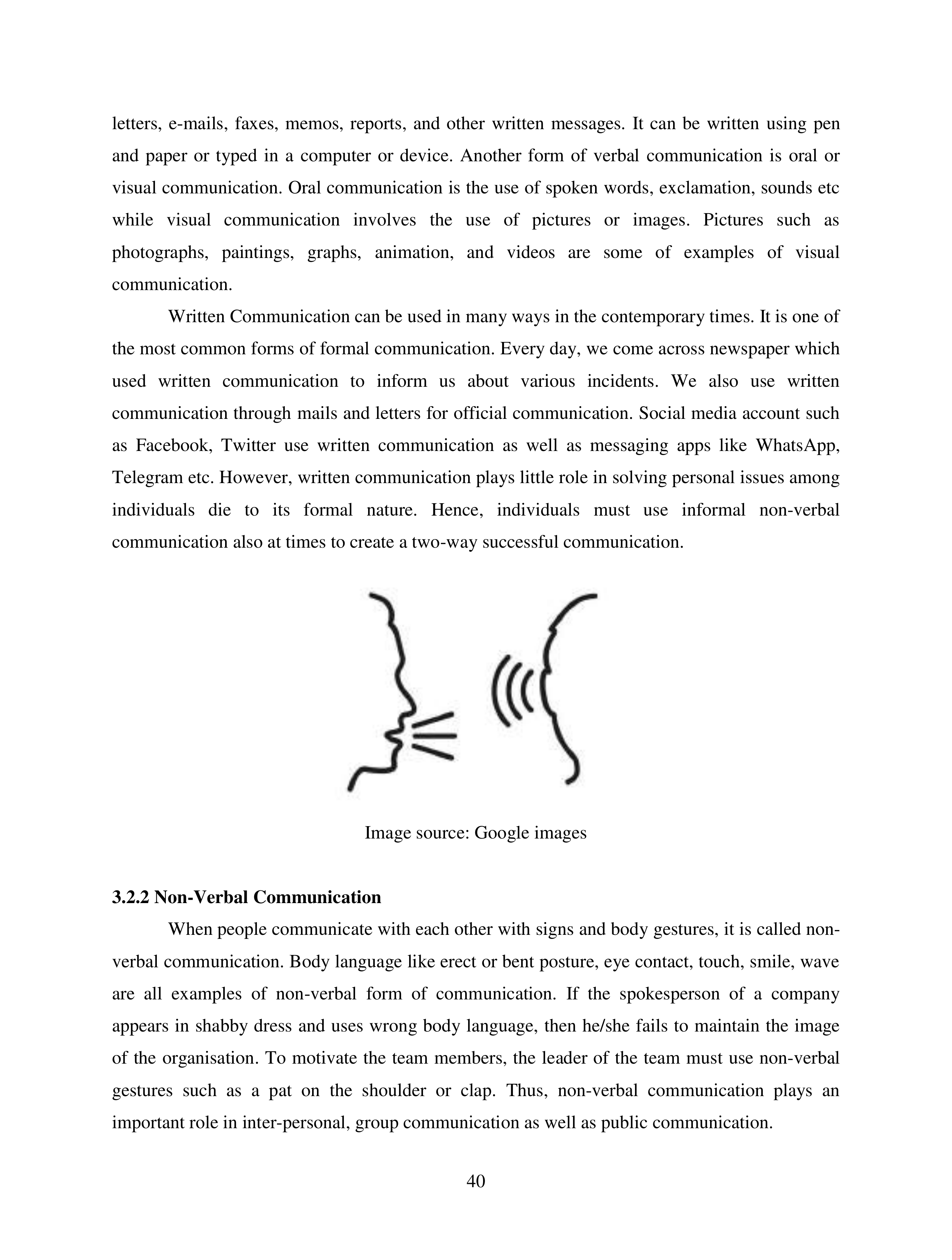
Image source: Google images
3.2.2
Non-Verbal Communication
When people communicate with each other with signs and body gestures, it is called non-
verbal communication. Body language like erect or bent posture, eye contact, touch, smile, wave
are all examples of non-verbal form of communication. If the spokesperson of a company
appears in shabby dress and uses wrong body language, then he/she fails to maintain the image
of the organisation. To motivate the team members, the leader of the team must use non-verbal
gestures such as a pat on the shoulder or clap. Thus, non-verbal communication plays an
important role in inter-personal, group communication as well as public communication.
41
Check your progress:
1. Verbal communication consists of two segments
written communication and oral communication.
True/ False
2. Use of signs and body gestures is called non-verbal
communication
True/ False
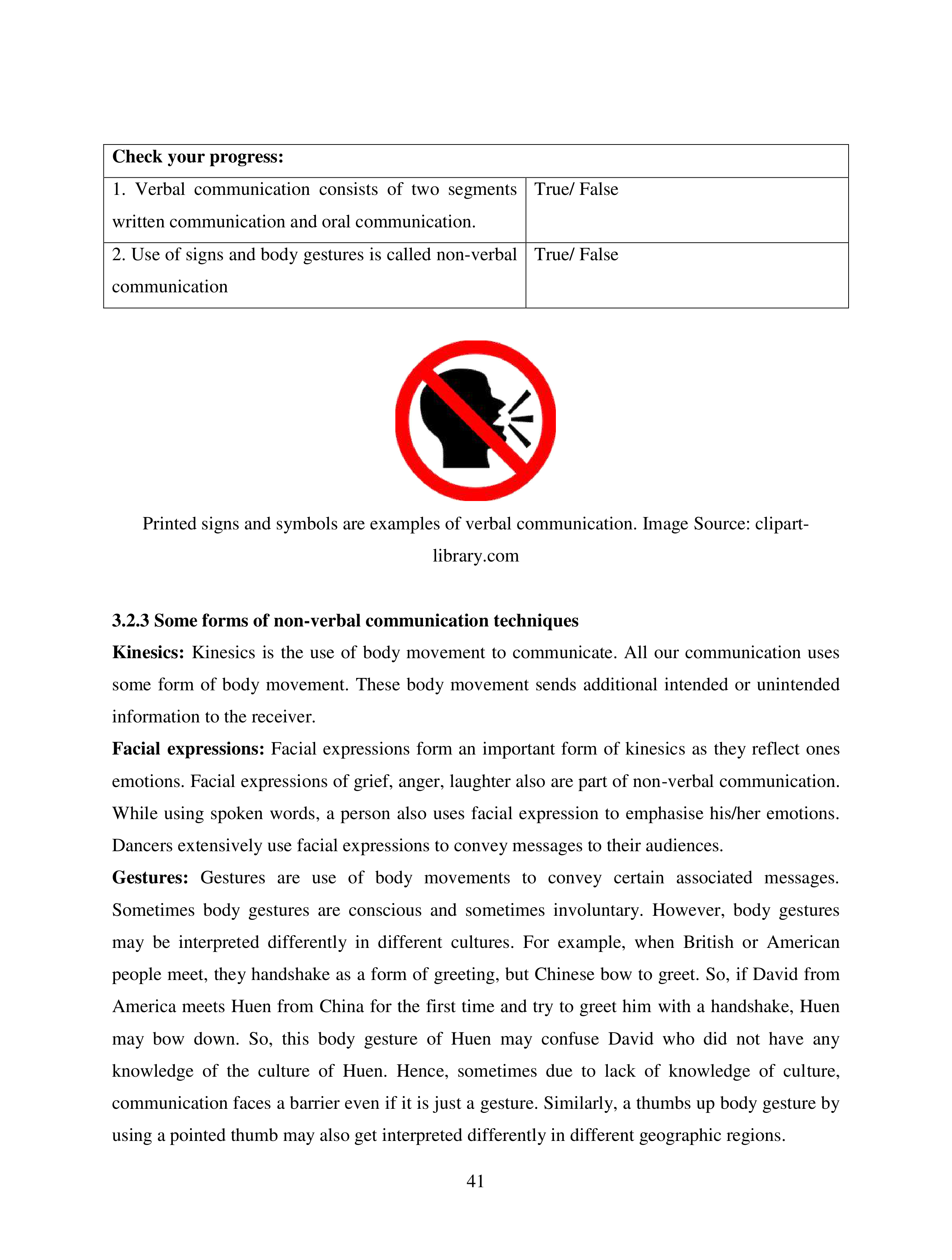
Printed signs and symbols are examples of verbal communication. Image Source: clipart-
library.com
3.2.3 Some forms of non-verbal communication techniques
Kinesics:
Kinesics is the use of body movement to communicate. All our communication uses
some form of body movement. These body movement sends additional intended or unintended
information to the receiver.
Facial expressions:
Facial expressions form an important form of kinesics as they reflect ones
emotions. Facial expressions of grief, anger, laughter also are part of non-verbal communication.
While using spoken words, a person also uses facial expression to emphasise his/her emotions.
Dancers extensively use facial expressions to convey messages to their audiences.
Gestures:
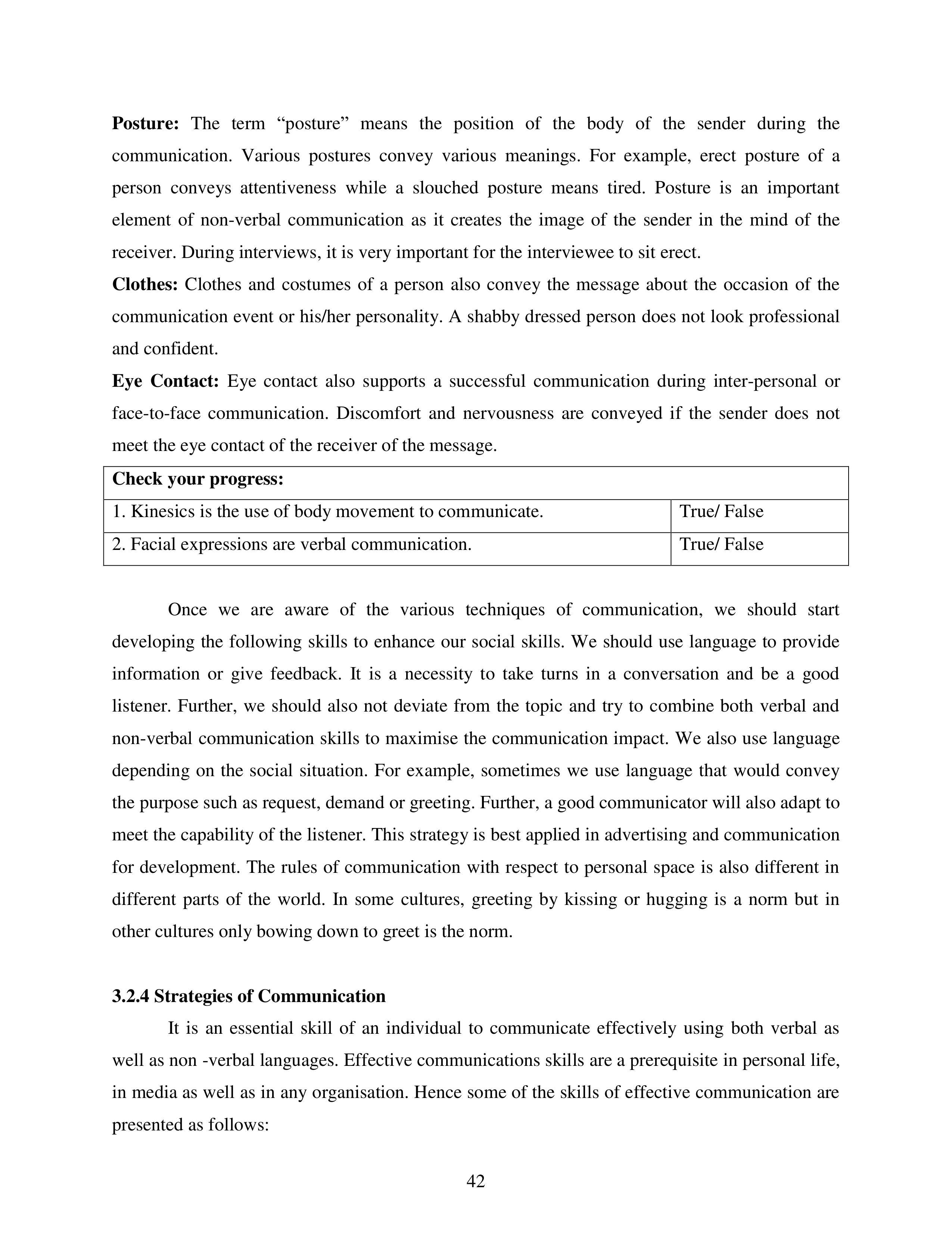
Gestures are use of body movements to convey certain associated messages.
Sometimes body gestures are conscious and sometimes involuntary. However, body gestures
may be interpreted differently in different cultures. For example, when British or American
people meet, they handshake as a form of greeting, but Chinese bow to greet. So, if David from
America meets Huen from China for the first time and try to greet him with a handshake, Huen
may bow down. So, this body gesture of Huen may confuse David who did not have any
knowledge of the culture of Huen. Hence, sometimes due to lack of knowledge of culture,
communication faces a barrier even if it is just a gesture. Similarly, a thumbs up body gesture by
using a pointed thumb may also get interpreted differently in different geographic regions.
42
Posture:
The term
―
posture
‖
means the position of the body of the sender during the
communication. Various postures convey various meanings. For example, erect posture of a
person conveys attentiveness while a slouched posture means tired. Posture is an important
element of non-verbal communication as it creates the image of the sender in the mind of the
receiver. During interviews, it is very important for the interviewee to sit erect.
Clothes:
Clothes and costumes of a person also convey the message about the occasion of the
communication event or his/her personality. A shabby dressed person does not look professional
and confident.
Eye Contact:
Eye contact also supports a successful communication during inter-personal or
face-to-face communication. Discomfort and nervousness are conveyed if the sender does not
meet the eye contact of the receiver of the message.
Check your progress:
1. Kinesics is the use of body movement to communicate.
True/ False
2. Facial expressions are verbal communication.
True/ False
Once we are aware of the various techniques of communication, we should start
developing the following skills to enhance our social skills. We should use language to provide
information or give feedback. It is a necessity to take turns in a conversation and be a good
listener. Further, we should also not deviate from the topic and try to combine both verbal and
non-verbal communication skills to maximise the communication impact. We also use language
depending on the social situation. For example, sometimes we use language that would convey
the purpose such as request, demand or greeting. Further, a good communicator will also adapt to
meet the capability of the listener. This strategy is best applied in advertising and communication
for development. The rules of communication with respect to personal space is also different in
different parts of the world. In some cultures, greeting by kissing or hugging is a norm but in
other cultures only bowing down to greet is the norm.
3.2.4 Strategies of Communication
It is an essential skill of an individual to communicate effectively using both verbal as
well as non -verbal languages. Effective communications skills are a prerequisite in personal life,
in media as well as in any organisation. Hence some of the skills of effective communication are
presented as follows:
43
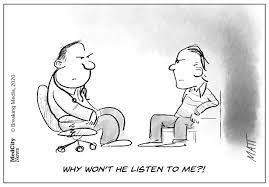
Listening:
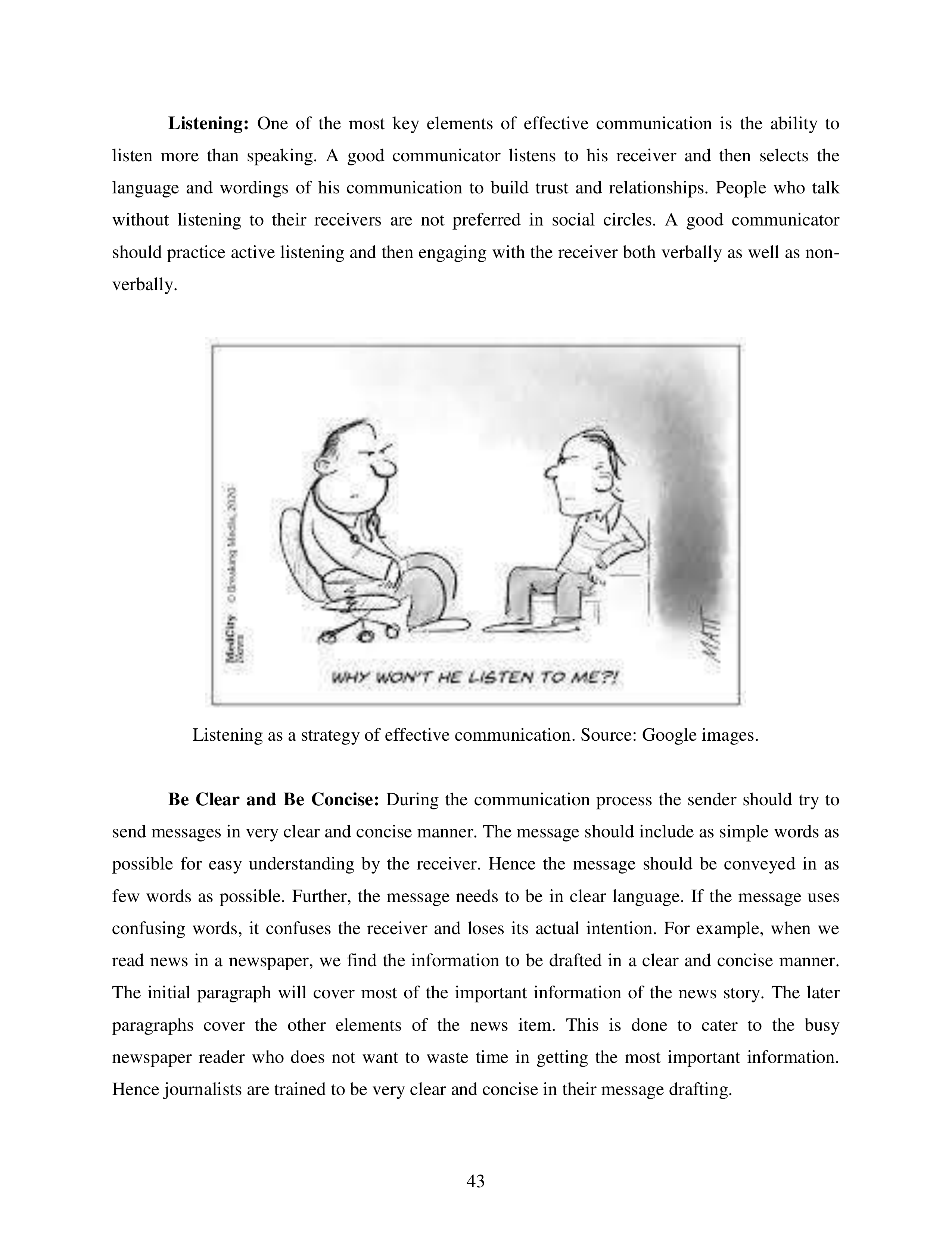
One of the most key elements of effective communication is the ability to
listen more than speaking. A good communicator listens to his receiver and then selects the
language and wordings of his communication to build trust and relationships. People who talk
without listening to their receivers are not preferred in social circles. A good communicator
should practice active listening and then engaging with the receiver both verbally as well as non-
verbally.
Listening as a strategy of effective communication. Source: Google images.
Be Clear and Be Concise:
During the communication process the sender should try to
send messages in very clear and concise manner. The message should include as simple words as
possible for easy understanding by the receiver. Hence the message should be conveyed in as
few words as possible. Further, the message needs to be in clear language. If the message uses
confusing words, it confuses the receiver and loses its actual intention. For example, when we
read news in a newspaper, we find the information to be drafted in a clear and concise manner.
The initial paragraph will cover most of the important information of the news story. The later
paragraphs cover the other elements of the news item. This is done to cater to the busy
newspaper reader who does not want to waste time in getting the most important information.
Hence journalists are trained to be very clear and concise in their message drafting.
44
Be Personable:
For successful interpersonal communication, the sender needs to be
conscious of letting the fear and discomfort, if any, of the listener. Hence, when communicating
face-to-face with someone, it is advised to use a friendly tone and have a smiling face. This will
help the receiver to open and engage more during the communication. In group, public or mass
communication the sender must gather information about the preference and dislikes of his/her
audience to have effective communication.
Be Confident:
Another strategy for successful communication is to be confident in
delivering the message. All successful national leaders are good communicators. Leaders like
Mahatma Gandhi, Pandit Jawahar Lal Nehru communicated with the masses with utter
confidence so that the mass audience would trust in them and follow their ideals for the fight
against the British. Confidence also comes from knowledge about communication. If the
communicator lacks knowledge on the subject or issue of the communication event, their
receivers will not be interested in listening to them anymore.
Empathy:
Another requisite element of a successful communication is having empathy.
Empathy means to have the ability to understand and share the feelings of the receiver of the
message. Empathy helps in communicating with the receiver by feeling one with his/her
emotions and context. For example, if a journalist goes to cover an incident of accidental death
of a male member of a family. He should avoid asking questions to the wife or children of the
deceased when they are mourning. It is very important to respect their emotions at that moment
and avoid asking them embarrassing questions or creating emotional distress. But during
unethical reporting in television, we often see this kind of misbehaviour from the reporters who
ask questions like how they are feeling about the death of the male member of their house.
Always Have an Open Mind:
To communicate effectively, the sender needs to keep an
open mind. In this way, they can relate to the target group and be involved. Hence the message
should not be sender-centric but receiver centric. This will maximize its effect. This can be
achieved only if there is ample knowledge about the receivers, their age, education, and interests.
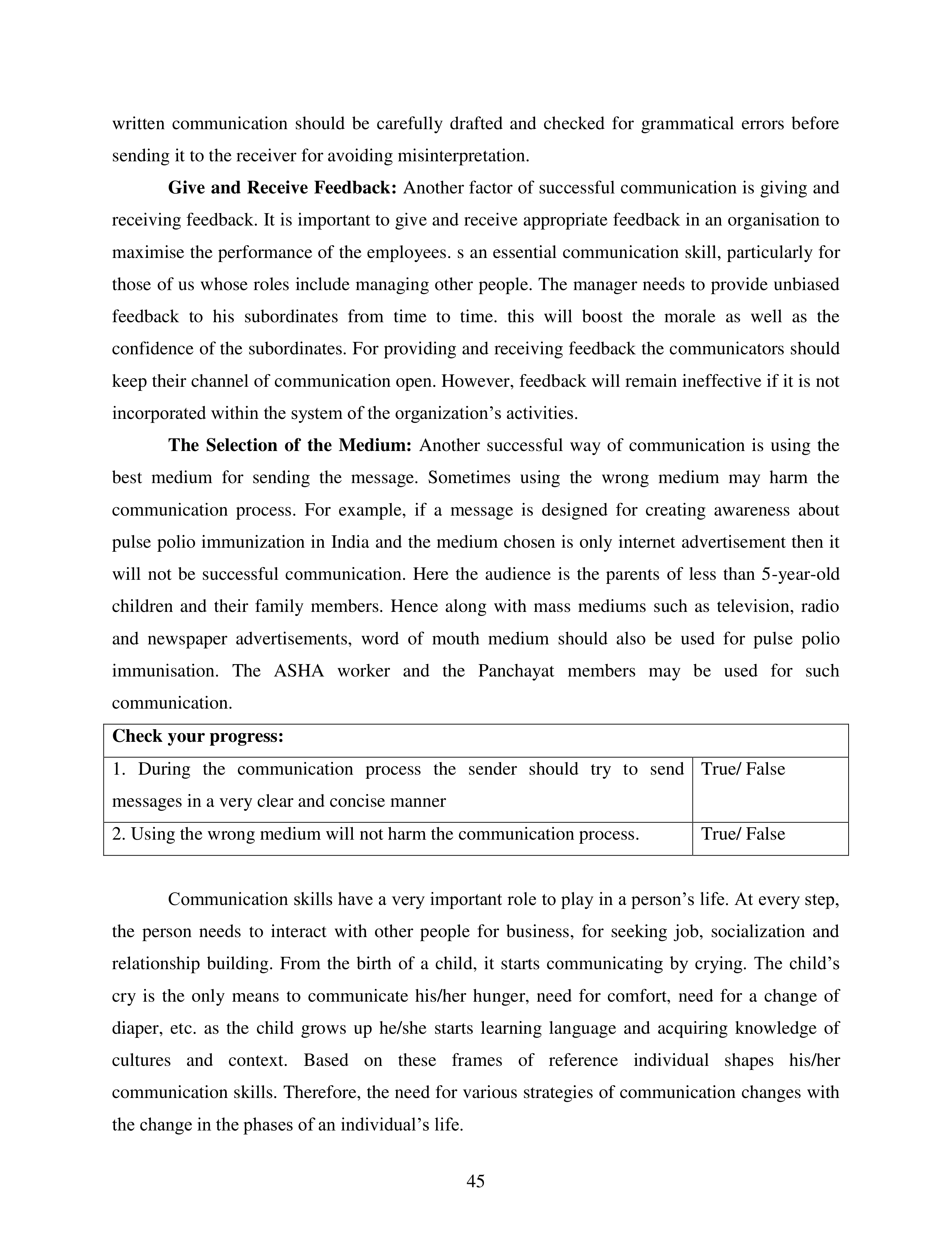
Convey Respect:
Conveying respect during communication with the receivers is another
very important factor for achieving successful communication. It will make the receivers engage
more openly in the communication if they feel their views are respected. Listening before
speaking and listening enough is the best way to show respect in communication. One should
avoid interfering while others speak during communication. This will dull the atmosphere and
force the other participants in the communication to withdraw from the communication. Even
45
written communication should be carefully drafted and checked for grammatical errors before
sending it to the receiver for avoiding misinterpretation.
Give and Receive Feedback:
Another factor of successful communication is giving and
receiving feedback. It is important to give and receive appropriate feedback in an organisation to
maximise the performance of the employees. s an essential communication skill, particularly for
those of us whose roles include managing other people. The manager needs to provide unbiased
feedback to his subordinates from time to time. this will boost the morale as well as the
confidence of the subordinates. For providing and receiving feedback the communicators should
keep their channel of communication open. However, feedback will remain ineffective if it is not
incorporated within the system of the organization‘s activities.
The Selection of the Medium:
Another successful way of communication is using the
best medium for sending the message. Sometimes using the wrong medium may harm the
communication process. For example, if a message is designed for creating awareness about
pulse polio immunization in India and the medium chosen is only internet advertisement then it
will not be successful communication. Here the audience is the parents of less than 5-year-old
children and their family members. Hence along with mass mediums such as television, radio
and newspaper advertisements, word of mouth medium should also be used for pulse polio
immunisation. The ASHA worker and the Panchayat members may be used for such
communication.
Check your progress:
1. During the communication process the sender should try to send
messages in a very clear and concise manner
True/ False
2. Using the wrong medium will not harm the communication process.
True/ False
Communication skills have a very important role to play in a person‘s life. At every step,
the person needs to interact with other people for business, for seeking job, socialization and
relationship building. From the birth of a child, it starts communica
ting by crying. The child‘s
cry is the only means to communicate his/her hunger, need for comfort, need for a change of
diaper, etc. as the child grows up he/she starts learning language and acquiring knowledge of
cultures and context. Based on these frames of reference individual shapes his/her
communication skills. Therefore, the need for various strategies of communication changes with
the change in the phases of an individual‘s life.
46
Possessing good communication skills is as important as possessing proper motor skills.
It is needed to ensure that our messages are understood by everyone around us. Possessing good
communication skills will also ensure better opportunities and the development of confidence.
Communication skills help us develop and maintain friendships and goodwill in society. If a
company faces a crisis
, it is the communication skills of the company‘s crisis communication
expert to handle the situation properly to safeguard its image. It will be easier for the company to
spring back into action and manage its image and corporate identity through good public
relations skills. In other words, its communication skills.
Communication should be always receiver centric. The communicator‘s ability to listen
to its intended audience by recurrently taking feedback and conducting research on the various
socio-demographic factors helps in strengthening communication strategies. During the
nationwide lockdown during the COVID-19 pandemic in the year 2020, people suffered from
mental anxiety and depression due to a lack of communication.
Strategic use of both verbal, as well as non-verbal communication, falls under the
purview of good communication skills. During the election campaign, we notice that the political
leaders use sloganeering, pamphlets, and audiovisual tools along with their expressions, body
gestures, and voice to reach out to their prospective voters. If the political leader is successful in
using the strategies of communication properly then they can hope to receive better results than
their rivals who lack communication skills.
A student who communicates more in class will have better chances of not suffering from
mental stress and anxiety. He/she should communicate their worries to their teacher and seek
help and guidance. This is only possible if the student knows his/ her strength in communication.
Good communication also helps an employee develop himself /herself as a leader at the
workplace. Strategic use of communication also develops good relations and camaraderie with
all fellow employees. This is achieved with the proper use of non-verbal as well as verbal
communication skills.
Good teachers can communicate effectively with their students making a lifelong impact
on the student‘s life. Hence if someone desires to choose teaching
as a career in his/her life they
should start developing good communication skills. In order to communicate with the students
without confusing them a person needs to learn the techniques of communication. It is not that
communication techniques are needed for media and journalism professionals but for everyone
irrespective of the job profile.
47
Check your progress:
1. Communication should be always receiver centric.
True/ False
2. Communication skills do not help us develop and maintain friendships and
goodwill in society.
True/ False
3.2.5 Let Us Sum Up
In this Unit we have come across the need for and importance of learning various
techniques of communication. We have understood that there are two broad umbrellas of
communication techniques: verbal consists of written, spoken, or visual messages, while non-
verbal consists of body gestures, facial expressions and even eye contact. Once we are aware of
the various techniques of communication, we should start developing the following skills to
enhance our social skills. We should use language to provide information or give feedback. It is a
necessity to take turns in a conversation and be a good listener. Further, we should also not
deviate from the topic and try to combine both verbal and non-verbal communication skills to
maximize the communication impact. We also use language depending on the social situation. In
business management and media, marketing, advertising, and sales are the departments that must
be excellent in communication. Their success will ensure products and services are sold resulting
in profits. Hence using strategic communication ensures getting new customers as well as
retaining older customers.
3.3 Learning Outcomes
At the end of this Unit, you should have been able to understand the techniques of
communication and effective strategies for communication.
3.4 Keywords
Techniques of communication, verbal, Non-verbal, Kinesics, body gestures, Concise, Listening,
Empathy
48
3.5 Sample Questions
Objective Questions
1. Which of these is not a form of verbal communication?
a)
Written letters
b)
Smile
c)
Pictures
d)
Video
2. Which of these is not a non-verbal form of communication?
a)
Kinesics
b)
Facial expression
c)
Photograph
d)
Gestures
Short Answer Questions
1.
What do you understand by verbal communication?
2.
What is the need and significance of non-verbal communication?
3.
What is the importance of empathy in communication?
Long Answer Questions
1.
Discuss in detail the different types of non-verbal communication.
2.
Explain the nine techniques of communication.
3.
Examine the strategies for communication.
3.6 Suggested Learning Resources
Aggarwal, Vir Bala, and V. S. Gupta.
Handbook of Journalism and Mass Communication
. New
Delhi: Concept Publishing Company, 2001.
Beebe, Steven A., Susan J. Beebe, and Diana K. Ivy.
Communication: Principles for a lifetime
.
Boston, MA: Allyn & Bacon, 2010.
Ghosh, Subir.
Mass Communication Today: In the Indian Context
. Profile Books (GB), 1996.
Kumar, Keval J.
Mass Communication in India
. Jaico Publishing House, 2020.
McQuail, Denis.
Mass Communication Theory: An Introduction
. Sage Publications, Inc, 1987.
49
Unit - 4: Barriers of Communication
Structure
4.0
Introduction
4.1
Objectives
4.2
Barriers of Communication
4.2.1
Kinds of Barriers to Effective Communication
4.2.1.1
Physical Barriers
4.2.1.2
Linguistic/Semantic Barriers
4.2.1.3
Cultural Barriers
4.2.1.4
Psychological Barriers
4.2.1.5
Mechanical Barriers
4.2.2
Overcoming Communication Barriers
4.2.2.1
Eliminating Differences in Perception
4.2.2.2
Language
4.2.2.3
Reduction in volume of disturbing sounds
4.2.2.4
Active Listening
4.2.2.5
Emotional State
4.2.2.6
Proper Media Selection
4.2.2.7
Provide Constructive Feedback
4.2.2.8
Flexibility in setting goals
4.2.3
Let Us Sum Up
4.3
Learning Outcomes
4.4
Keywords
4.5
Sample Questions
4.6
Suggested Learning Resources
4.0 Introduction
The process of sending and receiving messages, ideas, and information from one person to
another using any channel is known as communication. The channel may be printed paper,
audio-visual medium, airwaves, or even body language. Communication is one of the basic
needs o
f human beings to survive. Hence the term ―communication‖
is explained and defined in
as many ways as possible from various perspectives. In this Unit, we will learn that during any
communication event there are possible chances of barriers and obstacles that do occur.
50
Sometimes these barriers can be avoidable and sometimes cannot be avoidable. In this Unit, we
will study the barriers to effective communication, barriers to effective communication within an
organization, and procedures for overcoming them.
4.1 Objectives
The objectives of this Unit are to:
get an overview of the meaning of barriers to effective communication
understand what causes the barriers to effective communication
analyse various types of communication barriers
identify the basic steps to overcome the barriers to effective communication
4.2 Barriers of Communication
The term barrier means a disturbance or a rupture in a process. Hence barriers to effective
communication means the disturbances that either occur in the channel, message or within the
sender and receiver during the communication process. Although this may be the result of
different reasons the most primary ones are due to physical barriers, system design faults, or
additional barriers.
4.2.1 Kinds of Barriers to Effective Communication
It has been found that there are several barriers to effective communication. These barriers are
of different kinds and possess various kinds of characteristics. Some of them are physical
barriers, mechanical barriers, linguistic barriers, psychological barriers, etc. The barriers in the
communication process are also termed noise. The term noise does not always mean loud sound
but any kind of interference in the form of mechanical, linguistic, psychological, or physical.
Sometimes the noise appears in the sender or receiver due to their different context and
psychological background, personal biases. Sometimes the noise appears in the message if the
language used to create the message is not like the receiver. Further, if there is any error in the
channel due to technical fault the message will also suffer from poor reception by the
receiver/audience. Below we will discuss some of the most important barriers to effective
communication:
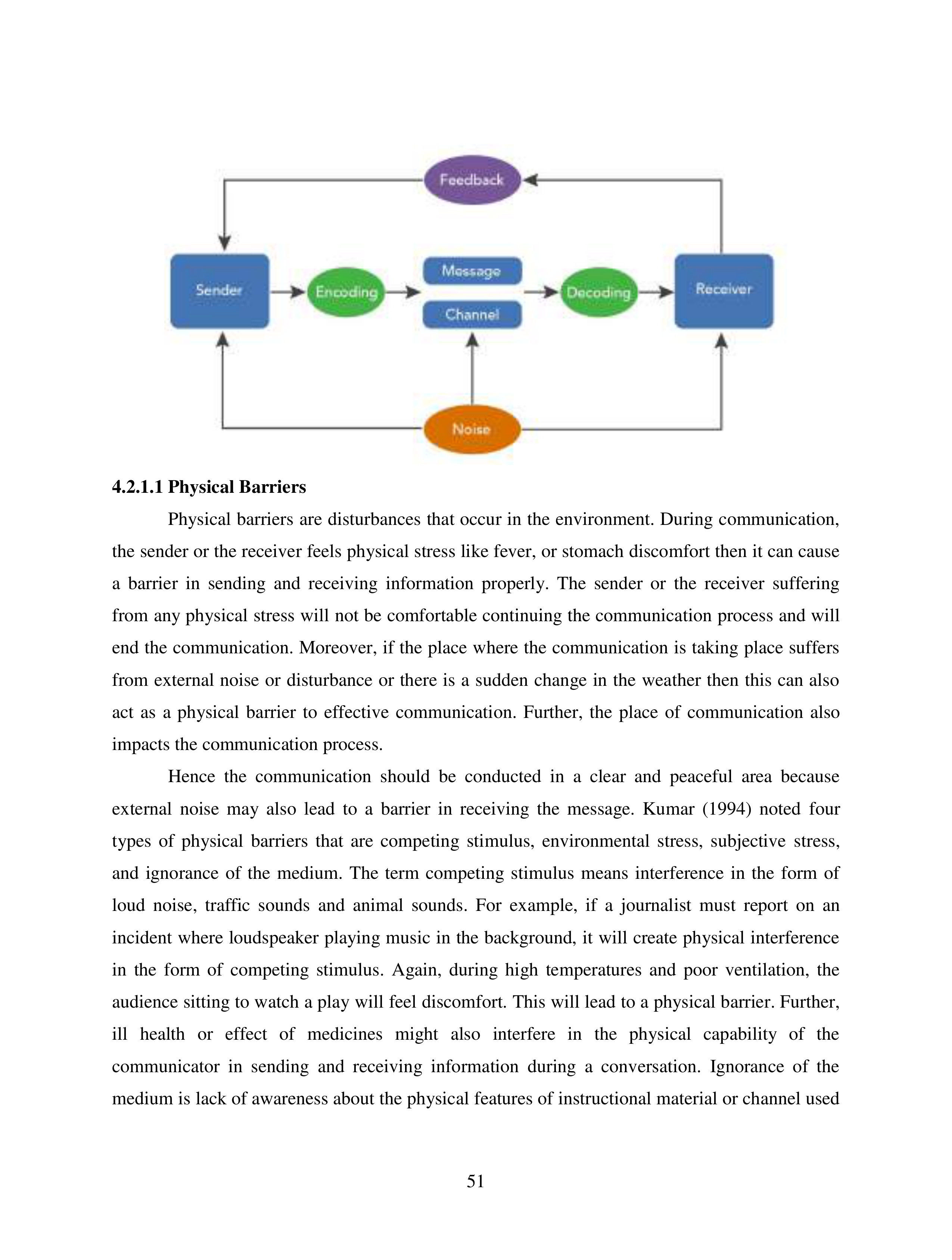
51
4.2.1.1 Physical Barriers
Physical barriers are disturbances that occur in the environment. During communication,
the sender or the receiver feels physical stress like fever, or stomach discomfort then it can cause
a barrier in sending and receiving information properly. The sender or the receiver suffering
from any physical stress will not be comfortable continuing the communication process and will
end the communication. Moreover, if the place where the communication is taking place suffers
from external noise or disturbance or there is a sudden change in the weather then this can also
act as a physical barrier to effective communication. Further, the place of communication also
impacts the communication process.
Hence the communication should be conducted in a clear and peaceful area because
external noise may also lead to a barrier in receiving the message. Kumar (1994) noted four
types of physical barriers that are competing stimulus, environmental stress, subjective stress,
and ignorance of the medium. The term competing stimulus means interference in the form of
loud noise, traffic sounds and animal sounds. For example, if a journalist must report on an
incident where loudspeaker playing music in the background, it will create physical interference
in the form of competing stimulus. Again, during high temperatures and poor ventilation, the
audience sitting to watch a play will feel discomfort. This will lead to a physical barrier. Further,
ill health or effect of medicines might also interfere in the physical capability of the
communicator in sending and receiving information during a conversation. Ignorance of the
medium is lack of awareness about the physical features of instructional material or channel used
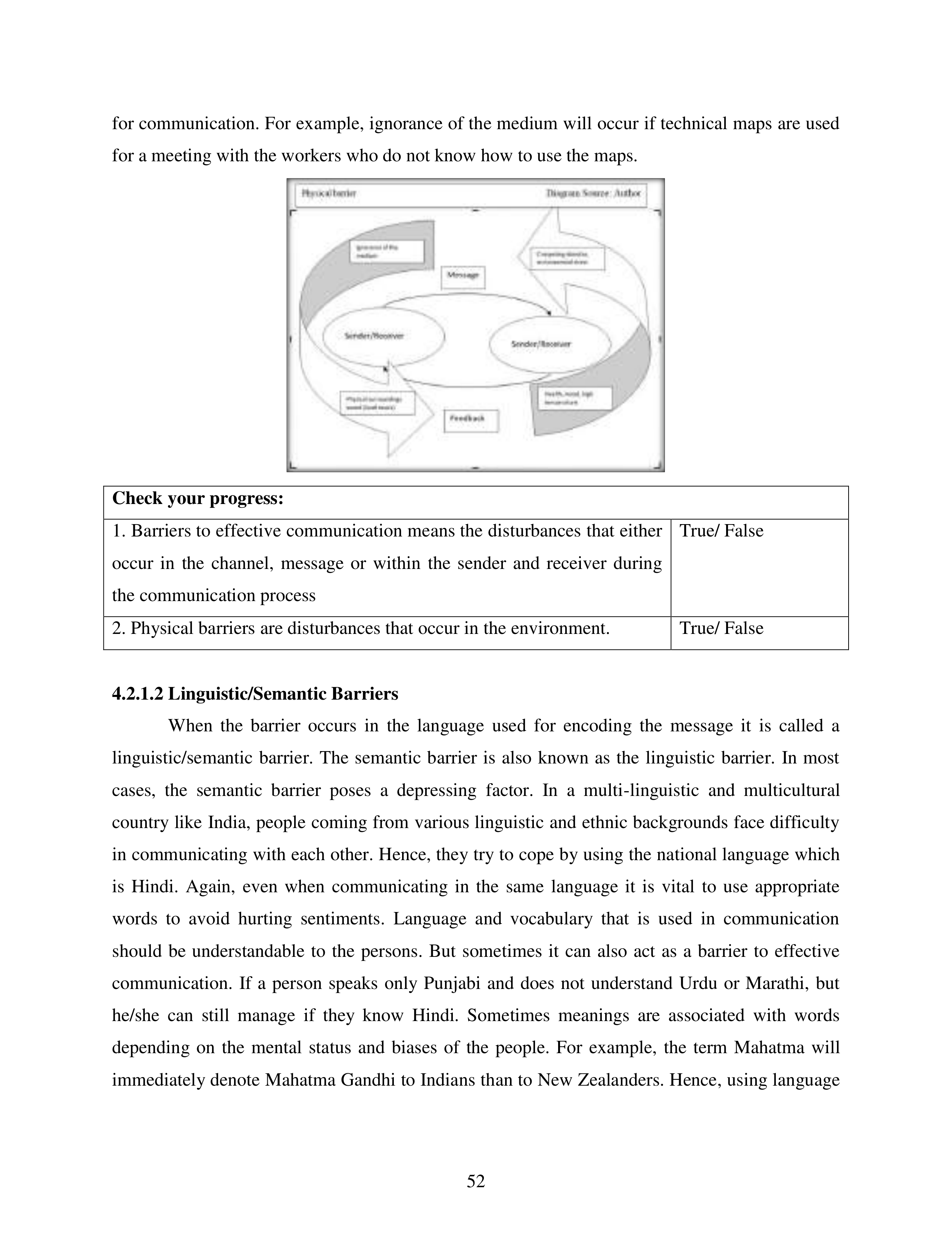

52
for communication. For example, ignorance of the medium will occur if technical maps are used
for a meeting with the workers who do not know how to use the maps.
Check your progress:
1. Barriers to effective communication means the disturbances that either
occur in the channel, message or within the sender and receiver during
the communication process
True/ False
2. Physical barriers are disturbances that occur in the environment.
True/ False
4.2.1.2 Linguistic/Semantic Barriers
When the barrier occurs in the language used for encoding the message it is called a
linguistic/semantic barrier. The semantic barrier is also known as the linguistic barrier. In most
cases, the semantic barrier poses a depressing factor. In a multi-linguistic and multicultural
country like India, people coming from various linguistic and ethnic backgrounds face difficulty
in communicating with each other. Hence, they try to cope by using the national language which
is Hindi. Again, even when communicating in the same language it is vital to use appropriate
words to avoid hurting sentiments. Language and vocabulary that is used in communication
should be understandable to the persons. But sometimes it can also act as a barrier to effective
communication. If a person speaks only Punjabi and does not understand Urdu or Marathi, but
he/she can still manage if they know Hindi. Sometimes meanings are associated with words
depending on the mental status and biases of the people. For example, the term Mahatma will
immediately denote Mahatma Gandhi to Indians than to New Zealanders. Hence, using language
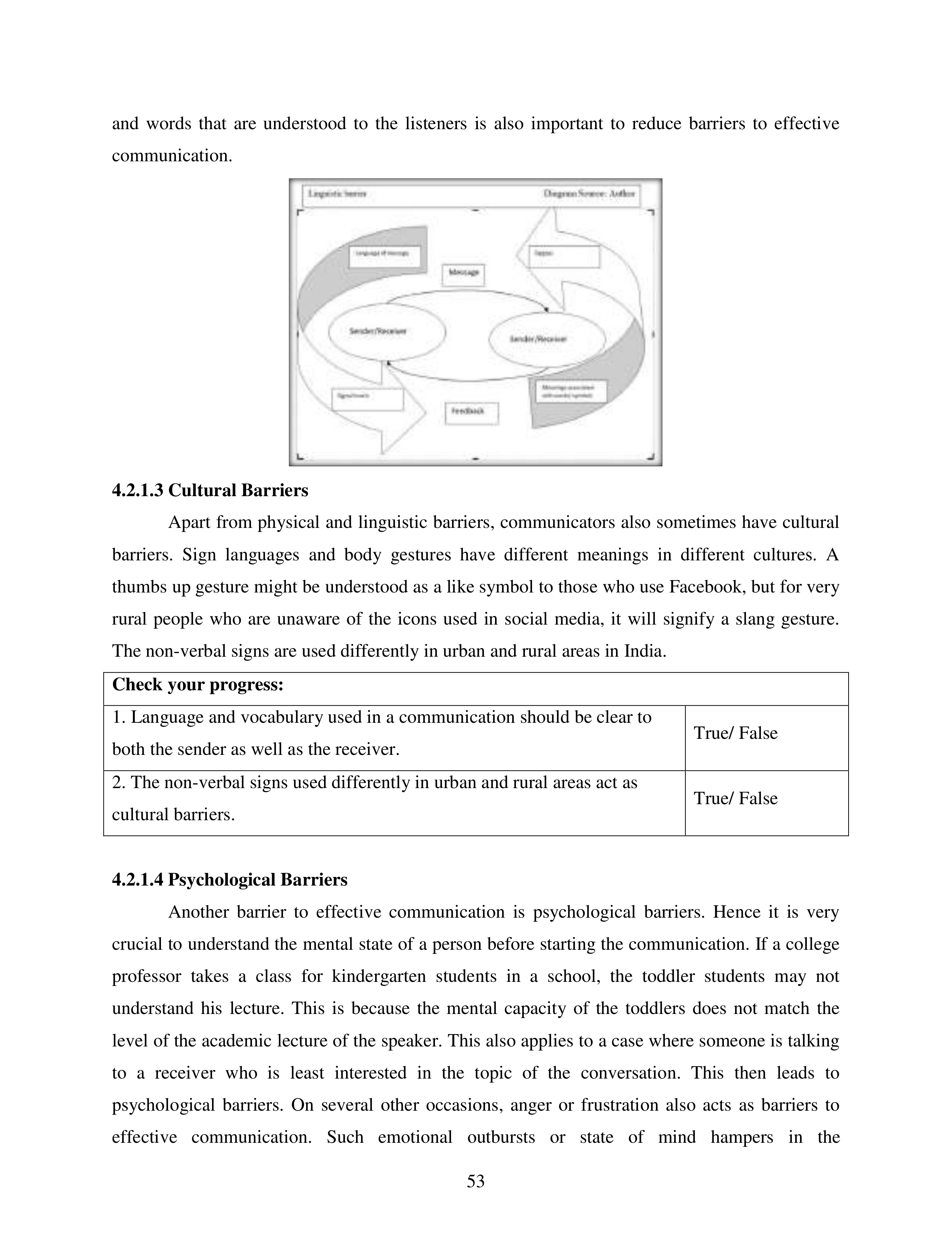

53
and words that are understood to the listeners is also important to reduce barriers to effective
communication.
4.2.1.3 Cultural Barriers
Apart from physical and linguistic barriers, communicators also sometimes have cultural
barriers. Sign languages and body gestures have different meanings in different cultures. A
thumbs up gesture might be understood as a like symbol to those who use Facebook, but for very
rural people who are unaware of the icons used in social media, it will signify a slang gesture.
The non-verbal signs are used differently in urban and rural areas in India.
Check your progress:
1. Language and vocabulary used in a communication should be clear to
both the sender as well as the receiver.
True/ False
2. The non-verbal signs used differently in urban and rural areas act as
cultural barriers.
True/ False
4.2.1.4 Psychological Barriers
Another barrier to effective communication is psychological barriers. Hence it is very
crucial to understand the mental state of a person before starting the communication. If a college
professor takes a class for kindergarten students in a school, the toddler students may not
understand his lecture. This is because the mental capacity of the toddlers does not match the
level of the academic lecture of the speaker. This also applies to a case where someone is talking
to a receiver who is least interested in the topic of the conversation. This then leads to
psychological barriers. On several other occasions, anger or frustration also acts as barriers to
effective communication. Such emotional outbursts or state of mind hampers in the
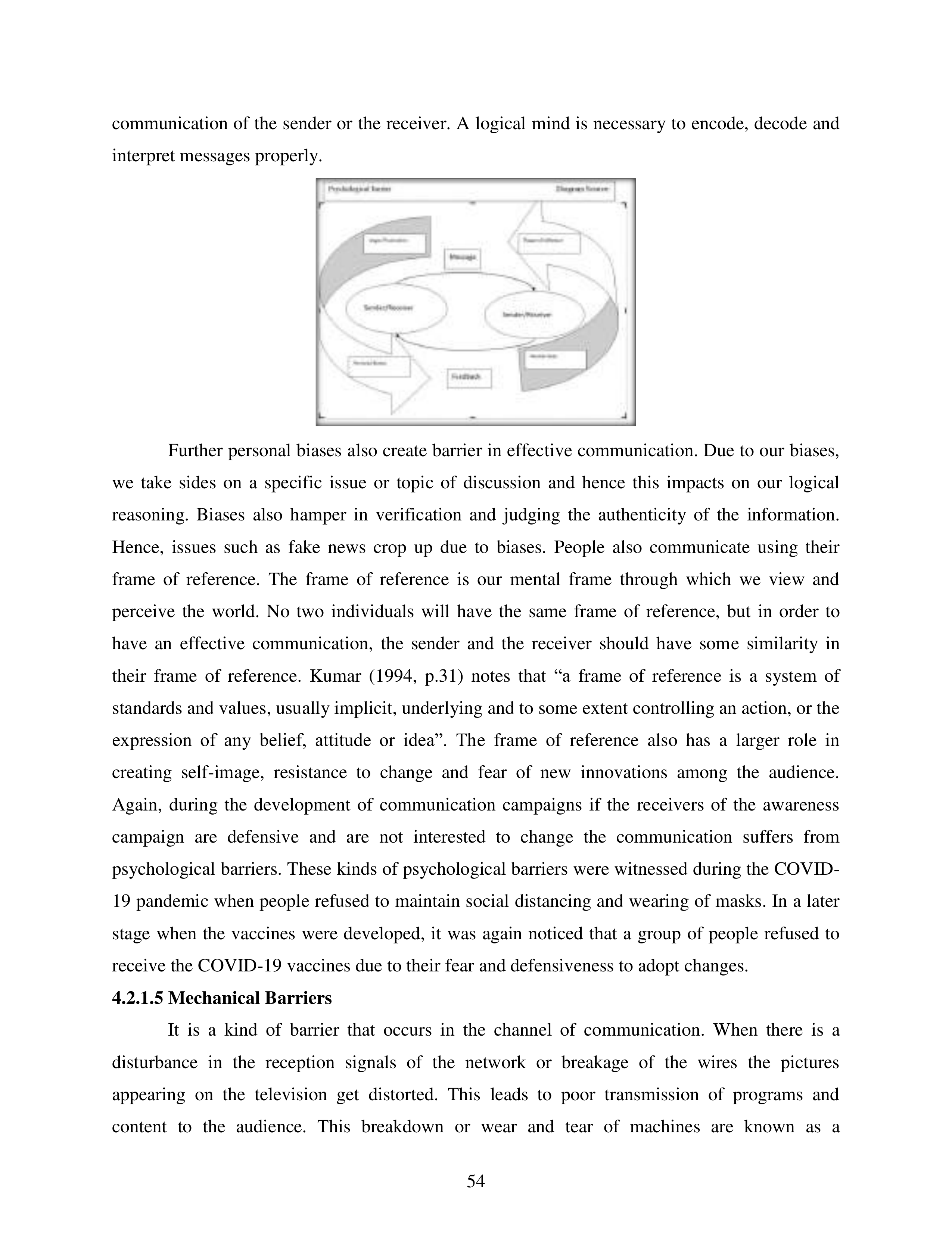

54
communication of the sender or the receiver. A logical mind is necessary to encode, decode and
interpret messages properly.
Further personal biases also create barrier in effective communication. Due to our biases,
we take sides on a specific issue or topic of discussion and hence this impacts on our logical
reasoning. Biases also hamper in verification and judging the authenticity of the information.
Hence, issues such as fake news crop up due to biases. People also communicate using their
frame of reference. The frame of reference is our mental frame through which we view and
perceive the world. No two individuals will have the same frame of reference, but in order to
have an effective communication, the sender and the receiver should have some similarity in
their frame of reference. Kumar (1994, p.31) notes that
―a
frame of reference is a system of
standards and values, usually implicit, underlying and to some extent controlling an action, or the
expression of any belief, attitude or idea‖. Th
e frame of reference also has a larger role in
creating self-image, resistance to change and fear of new innovations among the audience.
Again, during the development of communication campaigns if the receivers of the awareness
campaign are defensive and are not interested to change the communication suffers from
psychological barriers. These kinds of psychological barriers were witnessed during the COVID-
19 pandemic when people refused to maintain social distancing and wearing of masks. In a later
stage when the vaccines were developed, it was again noticed that a group of people refused to
receive the COVID-19 vaccines due to their fear and defensiveness to adopt changes.
4.2.1.5 Mechanical Barriers
It is a kind of barrier that occurs in the channel of communication. When there is a
disturbance in the reception signals of the network or breakage of the wires the pictures
appearing on the television get distorted. This leads to poor transmission of programs and
content to the audience. This breakdown or wear and tear of machines are known as a
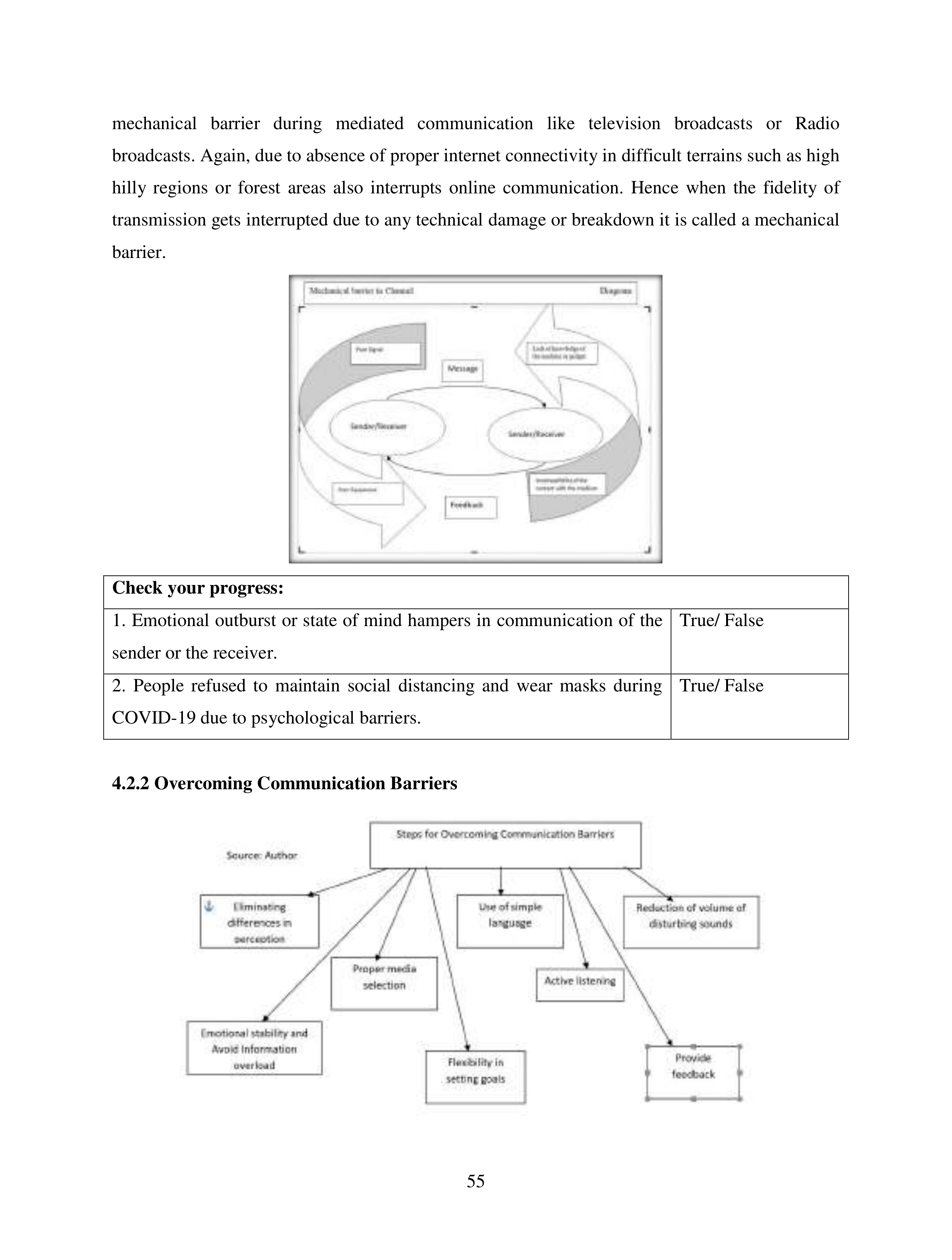

55
mechanical barrier during mediated communication like television broadcasts or Radio
broadcasts. Again, due to absence of proper internet connectivity in difficult terrains such as high
hilly regions or forest areas also interrupts online communication. Hence when the fidelity of
transmission gets interrupted due to any technical damage or breakdown it is called a mechanical
barrier.
Check your progress:
1. Emotional outburst or state of mind hampers in communication of the
sender or the receiver.
True/ False
2. People refused to maintain social distancing and wear masks during
COVID-19 due to psychological barriers.
True/ False
4.2.2 Overcoming Communication Barriers
56
There are steps to reduce the interference and disturbances that appear during the process
of communication. These steps are listed in the above diagram and which are explained as
follows:
4.2.2.1 Eliminating Differences in Perception
–
During the communication process, the
sender and receiver should try to eliminate their differences in perception. This can be ensured if
their frame of reference intersects on certain common grounds of understanding. Further, during
the communication pr
ocess, the receiver should be more empathetic toward the receiver‘s
knowledge level and capacity of understanding the message. These factors will help in reducing
the barriers to communication. As both the sender and receiver take turns of both encoding and
decoding the messages, the responsibility to communicate without conflicting perceptions lies on
them.
4.2.2.2 Language
–
Language plays a huge role in the communication process. It can be
verbal language such as written, spoken, pictorial, visual, audio-visual. It may be non-verbal
language too like body gestures, facial expressions, posture and eye contact. Different
individuals hailing from different ethnic and regional backgrounds have different knowledge and
understanding of different languages both verbal as well non-verbal. Hence the communicators
should try to encode their message in a universal language. An awareness campaign on hand
sanitisation during COVID 19 pandemic will be accessed by more mass audience if
conceptualised in Hindi language. But the same message will have more impact on the audience
of West Bengal if it is created in Bengali language. Use of jargons, complicated words should be
avoided.
4.2.2.3 Reduction in volume of disturbing sounds
–
Ambience sound is the
surrounding sound
that we hear around us. It can be the cawing of the crow, a plane‘s sound,
horns from the traffic on the road or a loud music playing in the locality. Sometimes these
ambiance sound causes barrier in effective communication. If we are talking to someone over
telephone and there is a piece of loud music being played in our neighbour‘s place, we will not
be able to hear what the person at the other end is speaking. Similarly, a loud cawing of a crow
during a recorded interview taken by a journalist will also hamper the quality of the recording.
Hence it is necessary to identify the sources of noise and then take adequate steps to reduce them
or change the location of communication.
4.2.2.4 Active Listening
–
Another step of reducing the barrier in communication is
listening to the message and the sender. Active listening is listening to the speaker with some
57
prior knowledge on the subject. The continuous engagement of the listener during the
communication process by asking questions and repeating for clarifications would minimise
barriers of communication.
4.2.2.5 Emotional State
–
in order to avoid psychological barriers, the communicator
should have a balanced state of mind and emotion. Feeling of distress, uneasiness and anxiety
should not be reflected through body language or verbal language used by the communicator.
This will immediately hamper the reception of the message. Further too much information
should not be disseminated at one go. This will confuse the listeners and make them feel
overloaded with information.
4.2.2.6 Proper Media Selection
–
for ensuring a smooth communication system the
medium or channel of communication selected should be proper. Selection of media should be
made depending on the target audience and time required for the message dissemination. Hence
in order to broadcast a news of national importance should be sent through mass media channels
such as newspapers, radio or television. Again, the medium selected for a niche audience to
access the information is the internet. But if a behaviour change communication message is
intended then the medium should be face-to-face communication
4.2.2.7 Provide Constructive Feedback
–
Barriers to effective communication can also
be minimised by providing constructive feedback. Continuous feedback from the
receiver/audience will help improve the quality of content of the message. For example, negative
feedback will do more harm than not providing feedback at all. So, we should keep the objective
of providing feedback in mind. The feedback should be targeted for bringing change in the
content of the message or to encourage the communicator to continue to deliver such contents.
For example, ratings in online news portals, likes and subscription and comments can act as
engaging ways to provide feedback to YouTube influencer and online entertainment and lifestyle
content creators.
4.2.2.8 Flexibility in setting goals
–
the last but not the least point in eliminating barriers
in communication are flexibility in setting goals of the communication process. The goals set
should be realistic and not too ambitious.
4.2.3 Let Us Sum Up
Effective communication is necessary for various reasons. Using mass media as a
channel for communication leads to spaces for barriers in language, cultural, semantic and even
58
mechanical. So, at different points of time during the communication process, be it linear
communication or non-linear model of communication the competing stimulus, phycological
barriers and cultural barriers always emerge from somewhere to disturb. But to curb the menace
of all the above-mentioned barriers, we the try to keep our perceptions as bias-free as possible.
There are many kinds of barriers occurring at different elements of the communication process.
When the barrier occurs in either the sender or the receiver, it is most of the time a physical
barrier, psychological barrier, or cultural barrier. When the barrier occurs in the channel it is
called a linguistic or semantic barrier. When there is a difference of opinion between the sender
and receiver of the message due to personal biases and ideological differences, it is called a
psychological barrier to effective communication. Anger, frustration, and favouring a particular
ideology also hamper a smooth communication process. However, these barriers can be
overcome to a large extent by taking certain measures such as designing the message by keeping
the receiver‘s knowledge, attitude, and practices in mind. Further, the use of simple languag
e,
avoiding jargon and technical words, and avoiding double-meaning verbal and non-verbal
language can reduce the barriers. Another important step to improve the communication process
in subsequent stages is to take continuous feedback from the audience, or the receiver.
It is essential to overcome the barriers by identifying the causes that give rise to them,
some of the barriers are avoidable whereas some are unavoidable. Some of the barriers can be
avoided by keeping an open mind, reducing personal biases, learning more languages, and
constructing a message receiver-centric. Again, developing the writing and speaking skills of
these communicators is also a necessity for reducing semantic and linguistic barriers. Finally, it
can be stated that barriers do come up within the course of communication, but in order to
effectively communicate, individuals should possess efficient speaking and listening skills.
Always use of simple language should be encouraged and thereby avoiding the usage of
technical terms and jargon.
4.3 Learning Outcomes
At the end of this Unit, you should have understood the different kinds of barriers to
effective communication and you should have also learned how to overcome the communication
barriers.
59
4.4 Keywords
Barriers to communication, physical barriers, psychological barriers, linguistic barriers,
mechanical barriers, avoiding jargons, listening, empathy
4.5 Sample Questions
Objective Questions
1. Which of these is not a form of physical barrier?
a)
Environmental stress
b)
Physical ill-health
c)
Frame of reference
d)
Ignorance of the medium
2. Which of these is not a psychological barrier?
a)
Ill-health
b)
Frame of reference
c)
Loud sound
d)
Defensiveness and fear
Short Answer Questions
1.
What do you understand by physical barriers?
2.
What is the significance of frame of reference?
3.
What do you mean by mechanical barrier?
Long Answer Questions
1.
Discuss with examples the barriers to effective communication.
2.
Explain the steps in reducing the barriers to effective communication. Justify with
examples.
60
4.6 Suggested Learning Resources
Aggarwal, Vir Bala, and V. S. Gupta.
Handbook of Journalism and Mass Communication
. New
Delhi: Concept Publishing Company, 2001.
Beebe, Steven A., Susan J. Beebe, and Diana K. Ivy.
Communication: Principles for a lifetime
.
Boston, MA: Allyn & Bacon, 2010.
Ghosh, Subir.
Mass Communication Today: In the Indian Context
. Profile Books (GB), 1996.
Kumar, Keval J.
Mass Communication in India
. Jaico Publishing House, 2020.
McQuail, Denis.
Mass Communication Theory: An Introduction
. Sage Publications, Inc, 1987.
61
Unit - 5: Introduction to Media
Structure
5.0
Introduction
5.1
Objectives
5.2
Introduction to Media
5.2.1
Need and Significance of Media
5.2.2
Criticism faced by the Media
5.2.3
Basic Types of Media
5.2.4
Functions of Media
5.2.5
Let Us Sum Up
5.3
Learning Outcomes
5.4
Keywords
5.5
Sample Questions
5.6
Suggested Learning Resources
5.0 Introduction
The process of communication has five major elements without which the process cannot
complete. Harold D Lasswell notes that in a communication process:
Who (sender)
Says what (Message)
In which Channel (Media/channel)
To whom (Receiver/audience)
With what effect (effect)?
Like the importance of sender, message, audience and effect the channel of
communication plays a very important role in both content delivery as well as content reception.
In the case of mass communication, the medium or channel of communication are mass medium.
In this Unit we will learn about the role and uses of mass medium in mass communication.
62
5.1 Objectives
The objectives of this Unit are to:
overview the meaning of mass media.
describe the power and reach of media.
identify the impact of negative use of media.
analyse various roles and functions of mass media
5.2 Introduction to Media
Media are the technological tools used in sending and sharing information or messages to
a large, diversified audience scattered around the earth. Media can be used to educate, inform,
entertain, and mould public opinion. Simple words spoken over radio can have more reach than a
person using a microphone in an auditorium. With the use of radio, television, newspapers, and
internet the impact of any mass-mediated message gets multiplied. For example, if a drama is
performed in a college auditorium it will be only watched by the students or audience present
within the auditorium. The geographic reach is limited in this case of public communication. But
if the same drama is recorded in a camera and broadcast over television or internet it can reach a
wide audience across the globe. Moreover, due to the technology used in mass media programs
the impact also gets intensified.
India has witnessed a rapid growth of various mass media platforms such as newspapers,
magazines, radio, television, online platforms, and films. This media also shapes the opinions
and attitude of people. While on one hand mass media can give voice to the voiceless, on the
other hand it can also exclude the marginalised from proper coverage. Some media are one way
and have lesser scope for feedback like newspaper and television programs. While others like
online news portals and web-blogs have more scope for immediate feedback and interaction with
the audience.
Wilbur Scramm defined mass medium as ―a working group org
anised around some
device for circulating the same message at about the same time to a large number of people.
‖
However, his definition means that folk medium and interpersonal communication are excluded
from the ambit of mass media. Moreover, mass medium is targeted towards mass audience, it is
63
mass produced for mass consumption. Mass medium is involved in revenue generation and
earning profits and hence it is sometimes also associated with mass media industry.
Check your progress:
1. Media are the technological tools used in sending and sharing information.
True/ False
2. Media has no role in shaping the opinions and attitudes of people
True/ False
5.2.1 Need and Significance of Media
Media in its various forms such as newspapers, radio, television, film, and internet plays
an immense role in shaping the opinion and attitude of people. These people who engage with
media with a reason to receive information are known as audiences. Hence when mass audience
follows the information and messages prompted for a desired change or effect, it can be used
both for positive as well as negative impact. During World War I and World War II, media was
used for propaganda. Media not only helps set the agenda for the public and work for
propaganda, but it can also help in facilitating social change.
When the media sheds light on certain incident over the others and portrays it as
important, it frames the public attention. In this way, media can spotlight certain messages or
information to be important for people to think about. Media is heavily used in a democracy as it
is considered as the fourth estate. Issues of importance for the citizens are also brought forth to
draw the attention of the policymakers and the government. In a democracy, media forces the
government to become answerable to its citizens. The agenda-setting function of media helps
create debates and critical thinking among the masses regarding the issues of political
participation. For example, during elections the prominent issues of development in a country are
often raised in media debates and news. Voters become aware of the level of success or failure of
political parties in ensuring development during their tenure or in their electoral manifesto.
Hence, they make their voting decision based on their awareness of these issues from the media.
However, it is also true that sometimes media also acts negatively and serves the interests
of a particular section of people in the country who own the media. Media can also reinforce
stereotypes about sexual, ethnic, and religious minorities through its lopsided portrayal. For
example, films, soap operas and advertisements show women in subordinate roles. Women are
shown to always work inside the home or perform household chores like cooking, washing,
caregiving etc. Rarely we see women working as doctors, scientists, engineers, pilots, etc. This
64
stereotyped representation also impacts on the perception of women and their roles in society
among young girls and men. women are often portrayed in subordinate roles to men.
Check your progress:
1. During World War I and World War II, media was used for propaganda.
True/ False
2. Media has no role in reinforcing stereotypes about sexual, ethnic, and
religious minorities through its lopsided portrayal.
True/ False
5.2.2 Criticism faced by the Media
Being treated as the fourth estate of democracy, media enjoys tremendous power in
forming public opinion. Hence, free and fair ownership is a necessity for their unbiased coverage
of an issue. Media is supposed to act like a watchdog, but sometimes it is criticised to act like a
lap dog. This means if media is dominated by a powerful section of elite owners or political
parties, the monitoring and surveillance function of media will be biased. In performing its
watchdog role sometimes, the press and media face ban or censorship from the government.
During British rule, the Indian vernacular press was severely censured to avoid the spread of
nationalistic feelings. Even after independence, during the emergency period, Indian press faced
severe censorship. Hence, the conflict between media and the state is a good practice for
ensuring its role in the democracy as the fourth estate. But sometimes the media acts at the
behest of the state and filters information for its audience and conveys only favourable
information and image of the state and government. This destroys the actual need for the media
in a democracy as it avoids accuracy, balanced and diverse reporting. Hence, political
interference can confuse the audience and polarise public opinion.
Further, ownership of media also influences the way the media organisation functions.
The ideology of the management gets reflected in the kind of reporting and representation the
media organisation gives. While privately owned media organisation looks for maximising their
profits, the government-owned media tries to keep a favourable environment towards the
government among its masses. A government-owned media organisation wors as a mouthpiece
of the government and never criticises its policies.
Check your progress:
1. Free and fair ownership is a necessity for their unbiased coverage of an issue.
True/ False
2. Privately owned media organisation do not want to maximise their profits.
True/ False
65
5.2.3 Basic Types of Media
Keval J Kumar in his book,
Mass Communication in India
considers that the mass media
are the tools of transmitting messages to a large group pf people scattered at different
geographical location instantaneously. However, the production of these mass mediated
communication through mass media requires a lot of expertise and technological tools and
resources. They are expensive infrastructure such as the cinema, radio, television, video, cable,
computers, and satellites. Since the management requires expertise and huge resources, hence,
they are managed by institutions like the government or well-financed private commercial firms.
Moreover, they require expert media professionals in the roles of journalists, camera persons,
editors, and other roles.
Although audiences are surrounded by numerous kinds of mass media options, not even
one of them has seen a decline in their share of the audience. Newspapers are still preferred due
to their in-depth coverage. Due to the low level of literacy rate in most of developing countries, it
has not penetrated the rural masses. Keval J. Kumar in his book states that in India thousands of
copies of newspapers and magazines are printed every day and are circulated in several cities
across the country.
Hence, due to its reach even to the illiterate and marginalised sections because of the low-
cost, radio remains the most popular media among both urban as well as rural masses. While the
public service broadcaster All India Radio caters to the rural audience, FM radios are very
popular among the urban audience. Radio has a wide reach and capacity to include diverse
programs, from information to entertainment and phone-in programs.
With the rapid expansion of films and television in diverse languages, popular culture has
taken a very prominent role in people‘s lives. Although people are immersed in media from their
mornings to night, access is still restricted to the poor, illiterate and marginalised. Hence, we
come across terms such as information rich and information poor. It is here that the alternative
forms of media such as folk media and community media perform the functions of the mass
media for them. These forms of media do not have a mass reach, but they are meant for the
underprivileged sections of society who lack access to the mass media tools. Moreover, for
communication for development and social change folk media and community media have an
upper hand then the mass media due to their strong feedback factor.
66
5.2.4 Functions of Media
Dennis McQuail noted three major functions of media: they are surveillance of the
environment, interpretation of the information and prescription for the conduct, and the
transmission of heritage. Media act as tools of communication that help in storing and delivering
information to a large diversified, heterogenous, and anonymous audience. The various kinds of
media are print media, publishing, news media, cinema, television, radio, and advertising.
5.2.4.1 Surveillance:
As surveillance is one of the major functions of media, it refers to
the collection and distribution of information to the audience. It also means the news production
and dissemination function.
5.2.4.2 Correlation:
This function involves the debate and discussion and interpretation
of the received information for better opinion formulation of the public. News editorials are best
examples of the correlation functions of a newspaper and magazine. The debate and discussion
programs by the Editor of a television or radio news channel also performs the correlation
function of media.
5.2.4.3 Transmitting the social heritage
: Media also performs the function of
transmitting values by educating the masses. It spreads the knowledge of traditions and social
norms in society from one generation to the next. Traditional knowledge can be conserved if they
are spread through the help of media.
5.2.4.4 Entertainment:
Another important function of media is providing entertainment
to its audience. Audiences are released from their tensions and stress by watching or reading
entertaining content in mass media. Soap operas on television and radio, films, and music often
serve this function for the audience.
5.2.4.5 Marketing:
Mass media also serve the marketing function for various products
and services. Advertisements are best delivered through mass media tools. These advertising
messages influence consumers through their creative appeals. Advertisements not only target to
increase the awareness about the product or services among the masses but also create a desire in
them for the product or service.
Mass media has a great role in forming public opinion. Media has hence, become an
essential need of the masses. It is also considered as the fourth estate of democracy due to its
watchdog function. Media also plays a gatekeeper‘s role in filtering the important messages for
us from the unimportant ones. But unbiased filtration and gatekeeping is the sole of maintaining
the integrity of media.
67
Check your progress:
1. Surveillance functions refers to the collection and distribution of
information to the audience.
True/ False
2. Media do not transmit values by educating the masses.
True/ False
5.2.5 Let Us Sum Up
The channel of communication plays a very important role in both content delivery as
well as content reception. In the case of mass communication, the medium or channel of
communication are mass medium. In this Unit, we learned about the role and uses of mass
medium in mass communication. We also received an overview of the meaning of mass media,
its power and reach. Media are the technological tools used in sending and sharing information
or messages to a large, diversified audience scattered around the earth. Media can be used to
educate, inform, entertain, and mould public opinion. We understood the power and reach of
media. For example, with the use of radio, television, newspapers and internet the impact of any
mass-mediated message gets multiplied. if the same drama is recorded in a camera and broadcast
over television or the internet it can reach a wide audience across the globe.
Moreover, due to the technology used in mass media programs the impact also gets
intensified. India has witnessed a rapid growth of various mass media platforms such as
newspapers, magazines, radio, television, online platforms, and films. Apart from the above we
also identified the impact of the negative use of media. The mass audience follows the
information and messages prompted for a desired change or effect; hence, it can be used both for
positive as well as negative impact. During World War I and World War II, media was used for
propaganda. However, it is also true that sometimes the media also acts negatively and serves the
interests of a particular section of people in the country who own the media. The media can also
reinforce stereotypes about sexual, ethnic, and religious minorities through its lopsided portrayal.
Media not only helps set the agenda for the public and works for propaganda, but it can also help
in facilitating social change. We now know the various roles and functions of mass media. Media
is heavily used in a democracy as it is considered as the fourth estate. Issues of importance for
the citizens are also brought forth to draw the attention of the policymakers and the government.
68
5.3 Learning Outcomes
At the end of this Unit, you should have gained knowledge about the need for and
significance of media. You should have also gained understanding about the types of media and
the functions of media.
5.4 Keywords
Media, Fourth Estate, Public Opinion, Surveillance Function, Entertainment Function,
Transmission of Values
5.5 Sample Questions
Objective Questions
1. Which of these is a form of mass media?
a)
Body gesture
b)
Television
c)
Fourth estate
d)
Transmission
2. Which of these is not a function of mass media?
a)
Entertainment
b)
Transmission
c)
Public opinion
d)
Surveillance
Short Answer Questions
1.
What do you understand by media?
2.
What is the need of mass media?
3.
What role does media play in marketing?
Long Answer Questions
1.
Discuss criticisms received by media.
2.
Discuss the basic types of media.
69
3.
Elaborately discuss the functions of mass media.
5.6 Suggested Learning Resources
Aggarwal, Vir Bala, and V. S. Gupta.
Handbook of Journalism and Mass Communication
. New
Delhi: Concept Publishing Company, 2001.
Beebe, Steven A., Susan J. Beebe, and Diana K. Ivy.
Communication: Principles for a lifetime
.
Boston, MA: Allyn & Bacon, 2010.
Ghosh, Subir.
Mass Communication Today: In the Indian Context
. Profile Books (GB), 1996.
Kumar, Keval J.
Mass Communication in India
. Jaico Publishing House, 2020.
McQuail, Denis.
Mass Communication Theory: An Introduction
. Sage Publications, Inc, 1987.
70
Unit - 6: Meaning of Mass Media
Structure
6.0
Introduction
6.1
Objectives
6.2
Meaning of Mass Media
6.2.1
Advantages of Mass Media
6.2.2
Limitations of Mass Media
6.2.3
Uses of Mass Media in Modern Society
6.2.4
Misuse of Mass Media
6.2.5
Regulations of Media
6.2.6
Four Eras of Media Theory
6.2.7
Let Us Sum Up
6.3
Learning Outcomes
6.4
Keywords
6.5
Sample Questions
6.6
Suggested Learning Resources
6.0 Introduction
Mass media are the technical tools to facilitate the dissemination of information to a wide
audience at one time. Although the audience scattered at different places on the globe are
heterogeneous, they are bound by their desire to receive the functions of mass media. Further,
with the advancement of technology and newer content, mass media now caters to segregated
sections of audiences. This Unit is divided into three sections, the first discusses the advantages
and disadvantages of mass media. The second section explains the uses and limitations of mass
media in society. The final section presents a summary of the Unit along with questions for the
learners to check their progress.
6.1 Objectives
The objectives of this Unit are to:
understand the meaning of mass media
71
discuss the advantages and disadvantages of usage of mass media
describe the limitations and way forward in the uses of mass media in modern society
6.2 Meaning of Mass Media
Mass media has been performing various important functions for its audience. While on
one hand it entertains and informs the people, on the other hand it transmits values and tries to
help maintain order in the societal norms. Mass media is also responsible for providing its
additional services to mobilisation and facilitation of social change and development. In India
too during the early years after freedom, western communication scholars were engaged in using
mass media for development purposes. Hence, it was noted that mass media also plays a role in
shaping the knowledge, attitude, and practice of the masses. Mass media also uses the
nationalistic symbols to unite and maintain the solidarity within the state.
6.2.1
Advantages of Mass Media
The use of mass media for the dissemination of messages and information has earned
certain advantages over physical and word-of-mouth communication. Some of these advantages
are listed below:
Mass media educates people on issues of health, sanitation, family planning, hygiene,
and others.
Mass media can send information faster than word of mouth or human-to-human
communication. Due to its vast reach, the impact of the message also multiplies. Mass
media helps people get updates on global events.
Mass media also helps people present their talents. Many reality shows have given
platform to people to showcase their talents in singing, dancing and even comedy.
Dance India Dance
program,
Dance Deewane and Dance Plus
are some of such
reality shows in television that help participants showcase their dancing talents.
Similarly, there are shows such as
Indian Idol, SaReGaMaPa
that are singing talent
hunt shows.
Mass media also helps children and adults get information and knowledge about new
things from quiz programs such
Kaun Banega Crorepati
and from Discovery, Nat
geo channels. There are various sections in newspapers as well as magazines
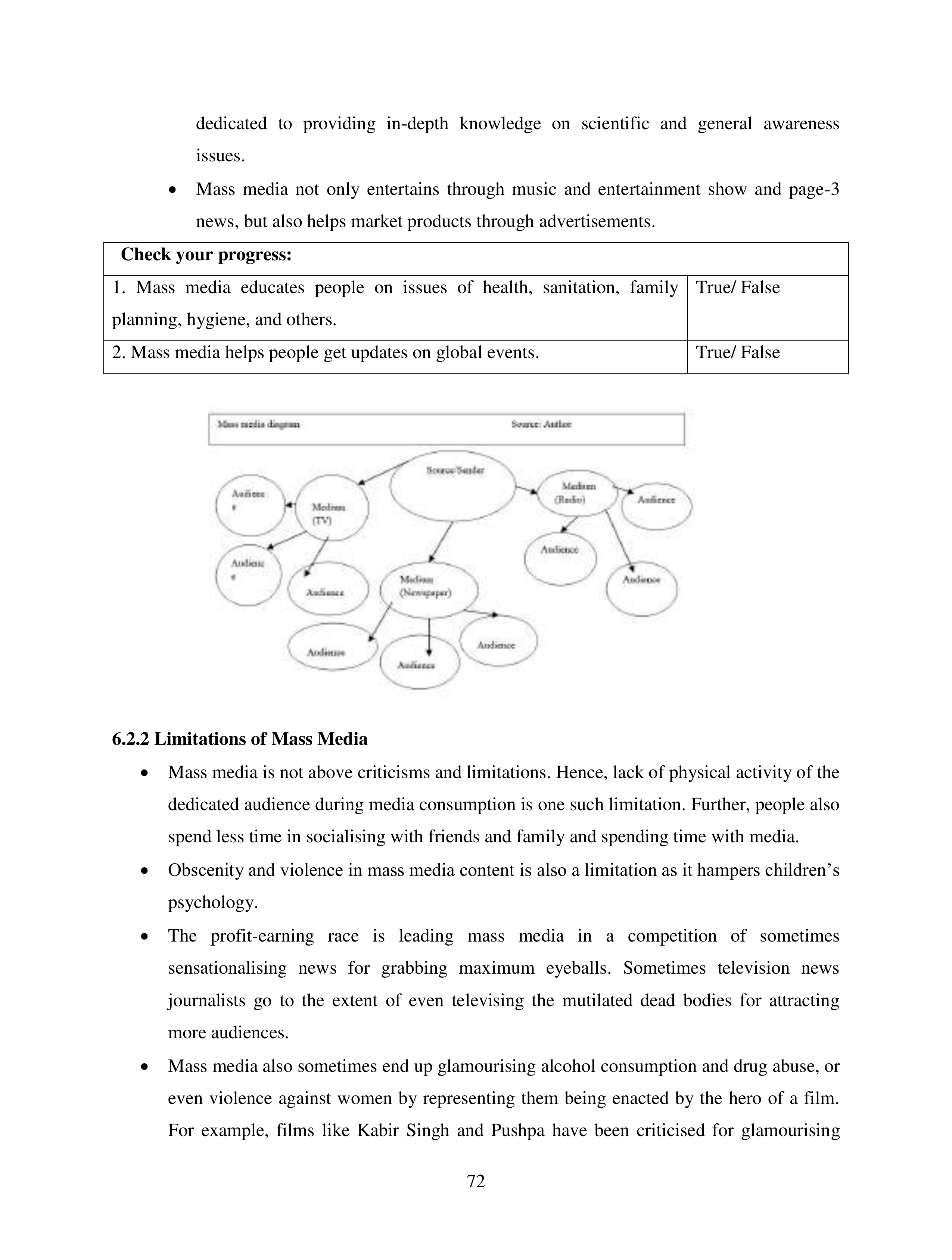
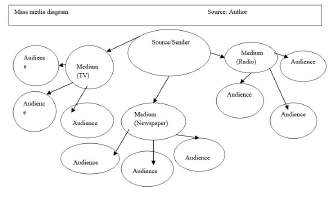
72
dedicated to providing in-depth knowledge on scientific and general awareness
issues.
Mass media not only entertains through music and entertainment show and page-3
news, but also helps market products through advertisements.
Check your progress:
1. Mass media educates people on issues of health, sanitation, family
planning, hygiene, and others.
True/ False
2. Mass media helps people get updates on global events.
True/ False
6.2.2 Limitations of Mass Media
Mass media is not above criticisms and limitations. Hence, lack of physical activity of the
dedicated audience during media consumption is one such limitation. Further, people also
spend less time in socialising with friends and family and spending time with media.
Obscenity and violence in mass media content is also a limitation as it hampers children‘s
psychology.
The profit-earning race is leading mass media in a competition of sometimes
sensationalising news for grabbing maximum eyeballs. Sometimes television news
journalists go to the extent of even televising the mutilated dead bodies for attracting
more audiences.
Mass media also sometimes end up glamourising alcohol consumption and drug abuse, or
even violence against women by representing them being enacted by the hero of a film.
For example, films like Kabir Singh and Pushpa have been criticised for glamourising
73
alcohol consumption and smoking. Young children sometimes try to copy the stunts
performed in action films and advertisements and get hurt.
Check your progress:
1.
During World War I and World War II, media was used for
propaganda.
True/ False
2.
Media has no role in reinforcing stereotypes about sexual, ethnic and
religious minorities through its lopsided portrayal.
True/ False
6.2.3 Uses of Mass Media in Modern Society
As discussed above, out of the many important uses of mass media, creating public opinion
is its most important use. Unlike folk and traditional media, mass media has a huge reach and
hence the content generated for mass media is also designed keeping the mass audience in mind.
This widespread reach of mass media makes it a powerful and most sought-after industry in
today‘s world. We are engulfed in mass media in so many ways that our thinking is literally
dependent on the images created by mass media. Hence, our decision of product buying or
voting is heavily influenced by mass media messages. Let us now look at some uses of mass
media in modern society.
Advocacy: It is the strategic use of communication through mass media to make the
desired change in people‘s
behaviour. The behaviour may be towards the
advancement of society or towards community strengthening. Some examples of
advocacy communication through mass media are political communication, public
service announcements of pulse polio immunization of Amitabh Bachchan, and
Swach Bharat
movement.
Entertainment: Mass media also entertains us with its range of contents. It can be
radio, television, cinema, or OTT content, people are immersed in them for receiving
their daily dose of entertainment.
Journalism: We have often synonymously used journalism with mass media.
Although it is only a section of mass media, it takes up a huge role and responsibility
of mass media. The job of collecting, analysing, editing, and presenting the story to us
in an objective manner is journalism. Known as the fourth estate in a democracy, it
acts as a watchdog.
74
Check your progress:
1. Free and fair ownership is a necessity for their unbiased coverage of an
issue.
True/ False
2. Privately owned media organisation do not want to maximise their profits.
True/ False
6.2.4 Misuse of Mass Media
Mass media has both uses and misuse. It can be used for positive changes in society and
individuals, but it can also be used for polarisation. With the advent of digital technology, mass
media has reached nook and corner of the world. Hence, if it is used with any negative intention,
the result will also be devastating. Some of these disadvantages of mass media are listed below:
Information Overload:
The bombardment of information from various media sources,
especially digital media, sometimes causes confusion. The audiences face difficulty in
filtering out the necessary information from the bulk. This information overload is
considered a disadvantage of mass media.
Unreliability:
Unverified and misinformation has become a recent misuse of mass
media. People can easily spread fake information over the internet, sometimes even
making it go viral. This impacts the overall reliability in mass media. Sometimes fake
news is intentionally crafted for malicious gains by the sender.
Obscene Content:
Obscenity and indecency in media content is another disadvantage for
unsupervised media consumption by the young audience. Mass media content is plenty of
vulgar and abusive words, especially those targeting the youths. Consequently, this will
have a negative impact on society.
Check your progress:
1. The bombardment of information from digital media causes confusion.
True/ False
2. Mass media content targeting youths are plenty of vulgar and abusive words.
True/ False
6.2.5 Regulations of Media
Media regulations are enforced to run media effectively and ensure the freedom of
expression for the integrity of a country. Every country has its own set of reasonable restrictions
imposed on its media. For successful democratic governance, the media and the government are
answerable to each other. The Indian Constitution has granted this freedom by way of
Fundamental Rights. While Article 19 I(A) in the Indian constitution ensures freedom of
75
expression, Article 19(2) empowers the State to enforce reasonable restrictions on the exercise of
the right to freedom of speech and expression based on eight grounds. These are:
Defamation:
This refers to making statements that are harmful to a person‘s reputation.
Contempt of court:
Contempt of court is an expression of distrust and disregard in mass
media against the judgment of the court of law. Contempt of court is punishable by law.
Decency or morality
: Further, Sections 292 to 294 of the Indian Penal Code also ensure
the dignity and morality of both the sender and the receiver.
Security of the state:
For safeguarding the security of the state, Article 19(2) is enforced.
This article enforces fair limitations on the freedom of speech and expression.
Friendly relations with other states:
Another important feature of regulations is
preventing the mass media from disturbing friendly relations with other countries. Any
kind of misinformation about a friendly country should not be spread in media. This will
bring threat to the diplomatic relations of our country. This in turn can hamper the
political and economic position four country.
Incitement to an offence:
If a person incites violence through his/her speech in a rally, it
refers to incitement to an offence. Citizens of a country and mass media cannot incite any
violence in the country. If found so it will be a punishable offence. Although mass media
is expected to maintain reasonable restrain during coverage of communal conflicts. But is
disheartening to witness that now a days some o the media houses through their television
broadcasting and newspaper reporting sensationalise the story to gain more TRP.
Check your progress:
1. Defamation refers to making statements that are harmful to a person‘s
reputation.
True/ False
2. The Indian Constitution has granted freedom of expression as a Fundamental
Rights under Article 19 I(A).
True/ False
6.2.6 Four Eras of Media Theory
Dennis K. Davis and Stanley J. Baran stated that scholars have struggled to find out the
nature of media's effect on its audience. They assume that while sometimes media effects are
strong while at other times they are not. Media was hence, considered as magic multipliers by
some scholars. They had the power to multiply the reach and effect of the message on its
audience. However, the role media plays on our lives cannot be explained in these plain words.
76
So, with the proliferation of more and more media technologies like television and mobile
phones acting as smart devices, the impact can be manifold.
In the second half of the nineteenth century, media theorists developed the Mass Society
Theory that assumed media has the power to enslave the audience through its deep impact. Mass
Society theory claimed that media would deprive individuals of traditional belief systems and
create chaos in the social order. Theories that were developed during this era are the propaganda
theory and the magic bullet theory. Propaganda theory uses media to influence attitudes and
behaviours of audience. During both the two World Wars and the Cold War propaganda was
heavily used. The basic characteristics of propaganda are appealing to emotions, repeating
simple ideas, and criticism of the opposition.
In contemporary times too we come across US propaganda against Russia in Hollywood
films and majoritarian propaganda against minorities in Indian films. The magic bullet theory is
also known as the hypodermic needle theory. It assumes that media has direct and immediate
effect on its audience. This theory was popular during the 1940s and 1950s because people radio
and television became very popular during that time. A very important example of magic bullet
theory is the radio broadcast of H.G Wells ―War of the Worlds.‖ People fled homes after the
broadcast of this radio drama thinking that aliens have attacked Earth.
One of the mass communication theorists, Paul Lazarsfield overturned some of the
assumptions of mass society theory through his social science survey research studies. By the
mid-1950s, Lazarsfield and his colleagues concluded that media was not so powerful as its
influence depended on numerous other factors like family, friends, and religious community.
They also termed it as Limited Effects theory and claimed that rather than working as an
unsettling agent, media often reinforced and strengthened the existing social order.
In the third era of media theory critical cultural theorist developed the British Cultural
Studies school of thought. They were primarily the European theorists who considered the
quantitative research findings of Limited Effects were simple and toned down. Hence neo-
Marxists assumptions that media was used by the powerful to gain more power over the audience
formed the foundation of this era of media theory. They viewed media to marginalise the voice
of the opposition by presenting the dominant view as a rational and logical way of societal
structure. This is also evident even today when we see a dominant ideology of food habits,
dressing, way of life, political, and religious views in the media content. These values are
77
favoured by the elites and are veiled into the various media content that are consumed by
audiences.
In the fourth era of media theory, we come across the meaning-making perspectives of
the audience. This era cantered
on the audience‘s uses and gratifications from mass media. It
considered audiences to be active in using media to create meaningful experiences for
themselves.
Check your progress:
1. Mass Society Theory assumed media have the power to enslave the
audience through its deep impact.
True/ False
2. The third era of media theory critical cultural theorists developed the
British Cultural Studies school of thought.
True/ False
6.2.7 Let Us Sum Up
In this Unit, we have come across various advantages and limitations of media. While
there are various forms of mass media, their reach and access have different impacts. Media
helps educate and entertain people. They also spread information about health matters, and
environmental conservation. However, Mass media also has certain limitations. It sometimes
turns out addictive. Children often spend too much time watching cartoons or other
children‘s
programs. Similarly, people spending too much time with media tend to socialise less with
family and friends.
Mass media also is used to create public opinion. Hence, it can both create positive or
negative public opinion. The widespread reach and popularity of media makes them more
powerful. Hence, the strategic use of communication for change of behaviour or advancement of
society is ensured using mass media. Social messages using advertisements, and education-
entertainment shows. During elections media is extensively used for political communication.
The ―Chai Pe Charcha‖, ―Abki Bar Modi Sarkar‖ were some of the exam
ples of political
communication used through mass media during the 2014 Lok Sabha elections. Again, slogans
like ―Fir ek bar Modi Sarka‖ was popularised using mass media during the 2019 Lok Sabha
elections in India. Hence, for making any voting decisions or buying decisions, we are dependent
on mass-mediated messages.
Although there are certain disadvantages of mass media like information overload and
spread of fake news. Adequate media literacy will help audience filter out the necessary
78
information from unnecessary and misinformation. Over the years mass media theory has also
undergone certain transformations and development. We have come across four eras of media
theory in this unit. These theories are developed and redeveloped during specific social and
political period and under specific technological and media context.
6.3 Learning Outcomes
At the end of this Unit, you should have understood the advantages of mass media, its
limitations, its uses and misuse and also the regulations governing mass media.
6.4 Keywords
Media, Education-Entertainment, Freedom of expression, Defamation, Information overload,
Fake news, Political communication, Media theory
6.5 Sample Questions
Objective Questions
1. Which of these is not an advantage of mass media use?
a)
Entertainment
b)
Education
c)
Information overload
d)
Vast reach
2. Which of these is not a limitation to freedom of expression?
1.
Defamation
2.
Misinformation about a friendly nation
3.
Contempt of court
4.
Mass society
Short Answer Questions
1.
What is advocacy?
2.
What is information overload?
79
3.
What is defamation?
Long Answer Questions
1.
What are the advantages of mass media?
2.
What are the limitations of media?
3.
What are regulations of mass media?
6.6 Suggested Learning Resources
Aggarwal, Vir Bala, and V. S. Gupta.
Handbook of Journalism and Mass Communication
. New
Delhi: Concept Publishing Company, 2001.
Beebe, Steven A., Susan J. Beebe, and Diana K. Ivy.
Communication: Principles for a lifetime
.
Boston, MA: Allyn & Bacon, 2010.
Ghosh, Subir.
Mass Communication Today: In the Indian Context
. Profile Books (GB), 1996.
Kumar, Keval J.
Mass Communication in India
. Jaico Publishing House, 2020.
McQuail, Denis.
Mass Communication Theory: An Introduction
. Sage Publications, Inc, 1987.
80
Unit - 7: Types of Media
Structure
7.0
Introduction
7.1
Objectives
7.2
Types of Media
7.2.1
Print Media
7.2.2
Electronic Media
7.2.3
Television and Audio-visual Media
7.2.4
Out of Home Media (OOH)
7.2.5
Let Us Sum Up
7.3
Learning Outcomes
7.4
Keywords
7.5
Sample Questions
7.6
Suggested Learning Resources
7.0 Introduction
The different types of mass media are print media, broadcast media, and the Internet. Each of
these types of media uses different technologies to deliver information to mass audiences. This
Unit is divided into three sections, the first discusses the different classifications, technologies
used, and uses of different types of mass media. The second section explains the advantages and
disadvantages of these different forms of mass media tools and their content. The final section
presents a summary of the Unit along with questions for the learners to check their progress.
7.1 Objectives
The objectives of this Unit are to:
understand the classification of different mass media
discuss the advantages and disadvantages of various types of mass media
describe the limitations of each of these types of media in modern society
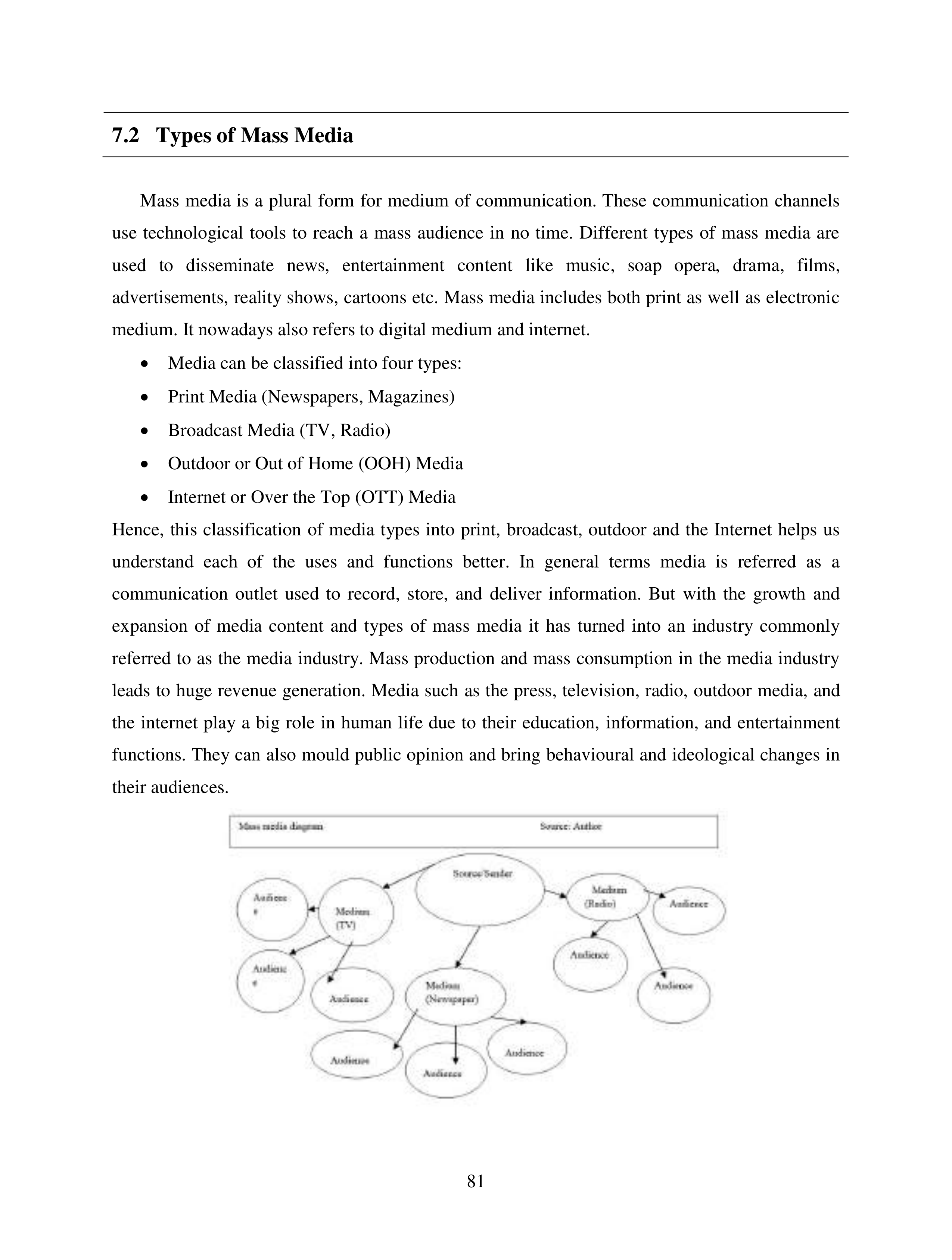
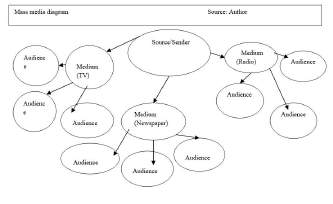
81
7.2 Types of Mass Media
Mass media is a plural form for medium of communication. These communication channels
use technological tools to reach a mass audience in no time. Different types of mass media are
used to disseminate news, entertainment content like music, soap opera, drama, films,
advertisements, reality shows, cartoons etc. Mass media includes both print as well as electronic
medium. It nowadays also refers to digital medium and internet.
Media can be classified into four types:
Print Media (Newspapers, Magazines)
Broadcast Media (TV, Radio)
Outdoor or Out of Home (OOH) Media
Internet or Over the Top (OTT) Media
Hence, this classification of media types into print, broadcast, outdoor and the Internet helps us
understand each of the uses and functions better. In general terms media is referred as a
communication outlet used to record, store, and deliver information. But with the growth and
expansion of media content and types of mass media it has turned into an industry commonly
referred to as the media industry. Mass production and mass consumption in the media industry
leads to huge revenue generation. Media such as the press, television, radio, outdoor media, and
the internet play a big role in human life due to their education, information, and entertainment
functions. They can also mould public opinion and bring behavioural and ideological changes in
their audiences.
82
7.2.1 Print Media
Print media deliver messages to its audiences in printed form. Among all forms of print
media like books, magazines, brochures, pamphlets, and newspapers, newspapers usually occupy
centre stage. Due to its wide reach newspapers have always remained the most preferred form of
media until the emergence of radio and television. The earliest newspaper to have been published
was in 59 BC in Rome called Acta Diurna (Daily Events). It was a wall newspaper. However,
after the development of ink, the earliest known newspaper was printed in China. Moreover,
after the development of printing press in 1451 by Johannes Gutenberg printing of books and
newspapers started in mass.
Hence, people depended on newspapers for their daily needs of information,
entertainment, and political participation. Usually, a newspaper carries a combination of news
stories from politics to current affairs, from entertainment to business news, from cartoon strips
to sports news. Newspapers are further categorised into dailies, weeklies, fortnightly and evening
papers. They are also classified into broadsheets and tabloids depending on their size and nature
of the content. Broadsheets are usually larger standard-sized printed newspapers, while a tabloid
is a smaller format carrying entertainment or sensational news.
Broadsheet newspapers are more intellectual in content than their tabloid counterparts.
They carry in-depth analysis and political stories.
They don‘t give much space to celebrity news
items or entertainment content. On the other hand, tabloids pay little attention to important news
items about politics, business, or economic policies. Tabloids devote much of their space in
covering crime stories, scandals, celebrity news, and fashion trends. Tabloids are more used as
entertainment and leisure reading than newspaper which is used as daily tool for accessing news.
Newspapers have a strong command in building public opinion through their news
coverage. Apart from this it also helps update the knowledge of its reader and advertises and
promotes various goods and services. While radio and television news send the news to their
audience faster than the newspaper, due to its in-depth analysis and coverage, it still is preferred
among readers to learn more about the news being already covered by electronic media. With the
emergence of the internet, printed newspapers had to face stiff competition. But most
newspapers all around the world are also available in both the broadsheet format as well as
online versions or web portals.
Newspapers also print supplements along with their regular broadsheet. Sometimes these
supplements are published every day, sometimes on weekends. These supplements cover specific
83
sections such as education, science, and technology, business and industry, management, sports
and games, cultural events, and entertainment. On special occasions such as national festivals or
religious festivals, these supplements are also published. Some newspapers are exclusively
devoted to covering economic and business news such as The Economic Times, Business
Standard etc. Newspapers earn their major revenue from advertisements. Hence, some
newspapers have their own in-house news-gathering personnel, while the smaller newspapers
depend on news agencies like Reuters, Agence France Presse, and PTI for both international as
well as national news.
A newspaper organisation is run by a group of expert and experienced staff in
administration and news gathering and editing. There are an editorial department with reporters,
editors at various levels, analysts, and feature writers. Then there is the advertising and revenue
department that looks after advertisement space selling. The third section is the production and
circulation section that looks after the printing and distribution of the newspaper.
Check your progress:
1. The earliest newspaper is called Acta Diurna.
True/ False
2. Newspapers are further categorised into dailies, weeklies, fortnightly and
evening papers.
True/ False
Magazines are another type of print media available for the readers. Magazines cater to
audiences who are interested in a specific subject and area of information. There are various
types of magazines covering on topics like current affairs, business, finance, consumers, gadgets,
self-help, luxury, lifestyle, beauty, fashion, entertainment, travel, etc. Some of the very popular
magazines covering political, economic and policy subjects in India are The Frontline, The
Outlook, The India Today. Further, magazines like The Femina, Filmfare, GQ, Grasim
concentrate on covering lifestyle, film, and fashion. Magazines also are published in various
intervals. Some magazines are published weekly, some are fortnightly, others are bi-monthly,
quarterly, half-yearly, or yearly. These magazines also are best options for advertisers to reach
the specific audiences interested in specific products or services depending on their socio-
demographic factors. There are language based regional magazines, while some are seasonal and
festival magazines published by certain media houses.
The paper quality and images in magazines are far better than those used in newspapers
due to its advertisements. The readers will be lured into looking the advertised products in a
84
magazine and for more days as its shelf life is more than a newspaper. Magazines are read at
salons, parlours, waiting lounges, during travel and in leisure time. Due to the emergence of the
internet and the availability of various online portals covering similar content, printed magazines
have been facing tough competition to keep up their publication. Some magazines have ceased to
publish while some have both an online presence as well a printed copy.
Check your progress:
1. Magazines do not cater to audiences who are interested in a specific
subject and area. of information.
True/ False
2. There are various types of magazines covering on topics like current
affairs, business, finance, consumers, gadgets, self-help, luxury, lifestyle,
beauty, fashion, entertainment, travel, etc.
True/ False
Another type of print media for spreading information is booklets and brochures. They
are known as promotional literature. They can be used for the promotion of a product or an
organization. Booklets and brochures are usually available as pre-sales or after-sales information
materials. They are available in malls and stores. Unlike newspapers and magazines, booklets
and brochures are distributed free to their readers who can be prospective consumers. They
include information about the specifications of newly launched products or services, discount
offers, or other schemes which seem profitable for the buyers. These brochures have an impact
on the decision-making of the buyers. Further, booklets and brochures are also provided with
products for after-sales information, maintenance, and customer service facilities.
For example, when we buy a television or a mobile phone, usually we find a booklet
along with it in the carton which has images of similar products and easy usage information. It
consists of information about usage directions, cleaning, and storage instructions. These booklets
also have series of ―'how to‖ images which help the users in getting maximum information about
the product. The details of the company, its brand image and logo are also prominently
represented in the booklet for easy recall of the consumer.
Check your progress:
1. Booklets and brochures are usually available as pre-sales or after-sales
information materials.
True/ False
2. Booklets and brochures consists of information about usage directions,
cleaning, and storage instructions.
True/ False
85
7.2.2 Electronic Media
In the early part of the twentieth century radio broadcasting started during the World War
I and World War II. It was majorly used for propaganda during the war by both the sides. Keval
J Kumar states that after the wars, radio was started to be used for commercial listening. Radio
stations were set up for the first time in Pittsburg, New York, and Chicago in the 1920s. they
were primarily used to broadcast news about elections, sports and opera performances.
Subsequently many other stations were set up in various parts of the world. In India, Indian State
Broadcasting Service (ISBS), with Lionel Fielden acting as its first Controller was turned into
Akash Vani or All India Radio (AIR) in 1936. Hence at present we have the public service
broadcaster under the Prasar Bharati ―All India Radio‖ (AIR) located at various places across the
length and breadth of India.
Radio stations broadcast news in both the vernacular languages as well in Hindi and
English. Programs include news analysis, entertainment programmes of various kinds, music
programs for all section of the people. Talk shows, phone-in programs, news, and sports
commentary get adequate broadcasts. In recent times, radio broadcasting use satellites for
program distribution. Hence, use of advanced technologies and computers have given radio
programming a face-lift. A radio stations performance does not only depend on the nature of the
programs but also the marketing and popularity among their audience. Like a newspaper
organisation, the radio stations also have a set of personnel who look after the gathering, editing
and presentation of news programs. There are various responsibilities in a radio station like the
directors, programme specialists, managers of different categories, besides artists, musicians,
script writers, journalists, field workers, engineers, technologists, news readers and
commentators, etc.
Check your progress:
1. During World War I and World War II, radio was majorly used for
propaganda during the war.
True/ False
2. Radio stations broadcast news in both the vernacular languages as well
in Hindi and English.
True/ False
7.2.3 Television and Audio-visual Media
Television plays a very important role in our daily lives. While radio serves as only an
audio medium, television has both audio-visual content. place in our daily lives today. Compared
86
to newspapers, radio, and film, television is a young mass medium. It has a high reach and
transmission among the mass audience. With the development of high-end satellites and
multimedia technologies, the television broadcast has become even more sophisticated. It
broadcasts programs of all sorts for different sections of audiences like news (both national as
well as international). Further, it also broadcasts soap operas, films, music shows, reality shows,
game shows etc. Compared to newspapers, television becomes a preferred medium for the
illiterate audience. However, it is a bit costlier than radio and requires electricity for running,
hence, radio is still preferred in rural and interiors of our country.
Television industry has witnessed exponential growth in the past two decades. Apart
from the public service broadcaster Doordarshan, there are hundreds of international and national
commercial television broadcasts through satellite in India. These channels range from General
entertainment channels to news channels, sports channels to the music channel, and cartoon
channels to youth-oriented lifestyle channels. However, with the plethora of options for
entertainment and news, these television channels also carry the inherent messages of
stereotypes, ideological biases, and exclusion of disadvantaged groups in the representation.
The soap operas have been heavily stereotyping joint family system, kinship, and gender
roles. The stereotypical representation or even complete absence of disadvantaged groups like
Dalits, Muslims, LGBTQA community and persons with disabilities have been repeatedly
criticised by researchers. Serials like Naagin, Nazar and Brahmarakshash reinforce superstitions
and dogmatic beliefs among the audience. The production of visual effects and cinematography
in television programs has also seen immense improvement since its initial days. A bunch of
technicians and experts are entrusted to create and edit this mesmerising audio-visual content for
television.
Check your progress:
1. Television has both audio-visual content.
True/ False
2. The stereotypical representation of disadvantaged groups like Dalits,
Muslims, LGBTQA community and persons with disabilities have been
repeatedly criticised by researchers.
True/ False
7.2.4 Out of Home Media (OOH)
Another very important media that has seen a rise in the past decade is Out of Home
(OOH) media. Billboards are known to be the most prominent forms of OOH media in use for
87
ambient promotions. Billboards are large-sized advertisements put up at strategic locations for
commuters to see. Their height, size and strategic locations make people see them. Usually, they
attract their target audience by their colours, designs and creative depictions or graphics. While
earlier billboards were either painted or printed sheets put up, nowadays we come across neon
signs, videos, and cut-outs that extend out from the boards. They also use 3D rubber, plastic
balloon, objects, etc for drawing the attention of the audience. We also find billboards to use
unusual locations to promote their product or services.
Check your progress:
1. Billboards are known to be the most prominent forms of OOH media
True/ False
2. Billboards‘
height, size and strategic locations make people see them.
True/ False
7.2.4 Over the Top (OTT) and Digital Media
OTT or Over-the-Top has taken the world by storm during the pandemic. This term refers
to the new delivery of film and entertainment content over internet across many devices. OTT
content has become very preferable for the young audience and the old alike due to the
availability of diverse content. For example, OTT streaming refers to the subscription-based
access of entertainment content on smartphone, laptop or smart tv through the internet. OTT
platforms like Amazon Prime, Disney+Hotstar, NETFLIX, Zee5, Alt Balaji etc are few examples
that provide entertainment content.
There are millions of active internet users around the world. Hence, we can say that the
world is dependent on digital media. Advertisements and marketing have used digital media to
target its niche consumers and market to promote their products. Sites, YouTube, podcasts, and
Instagram are used for marketing and promotion. Digital media can be defined as any form of
media that depends on the internet and electronic devices for the distribution of information.
However, with the continuous changes in technology audiences are also reaping the
benefits of digital media. During the pandemic-induced nationwide lockdown, various ed-tech
companies, learning management system software and applications were used by schools and
colleges for continuing the education system. Apps like MS Teams, Google Classroom, Google
meet, Zoom, were used by educational institutions for conducting online classes. Although
digital media can be criticised for increasing the digital divide, the digital divide means the
difference in knowledge and information between those having access to digital media and those
who do not have access. There are certain benefits of digital media too such as facilitating social
88
interaction. Digital media also opens opportunities for small businesses through opening
opportunities of online marketing and also directly accessing the consumers.
Check your progress:
1. OTT refers to the new delivery of film and entertainment content over
internet across many devices.
True/ False
2. OTT platforms like Amazon Prime, Disney+Hotstar, NETFLIX, Zee5, Alt
Balaji etc are few examples that provide entertainment content.
True/ False
7.2.5 Let Us Sum Up
In this Unit, we have come across various types of media. Books, newspapers, radio,
social media platforms, booklets, and streaming services are various forms of mass media.
Originally, print media referred to newspapers, which were the primary sources of information.
Further, this type of media expanded to journals, books, and magazines. With the help of an
electronic broadcasting medium, audio and video content is distributed to a dispersed audience.
Television, radio, video, and games appeal to heterogeneous audiences, people who differ in age,
background, views, goals, and interests.
Brands use unusual locations and items to promote their products. Therefore, places like
bus stops, public transport, and buildings can serve creative companies as places for promotion.
This is known as outdoor media. Further, with the huge penetration of the internet and
smartphone devices, today there are billions of active Internet users around the world. Hence,
digital media has become synonymous with a popular form of mass media. From accessing
news, to watching entertainment content, audiences are glued to their smart devices like
smartphones, smart TV sets, and tabs. Even digital media is hugely popular among marketers for
brand promotions and advertisements. YouTube, podcasts, Instagram marketing, and Facebook
advertising are used to advertise and market the products and services by different corporate
organisations.
7.3 Learning Outcomes
At the end of this Unit, you should have become familiar with the different types of
media and their uses and limitations.
89
7.4 Keywords
Media, Newspaper, magazines, radio, television, Out of Home (OTH), Over the Top (OTT)
7.5 Sample Questions
Objective Questions
1. Which of these is not type of mass media?
a)
Newspaper
b)
Radio
c)
Information overload
d)
Television
2. Which of these is not a newspaper from India?
a)
The Dawn
b)
The Telegraph
c)
The Times of India
d)
The Hindu
Short Answer Questions
1.
What is newspaper?
2.
State the development of radio in India.
3.
What do you understand by Out of Home media?
Long Answer Questions
1.
What are the various types of print media?
2.
What are the limitations of television? Explain in your own words.
3.
Explain OOH and OTT in your own words.
90
7.6 Suggested Learning Resources
Aggarwal, Vir Bala, and V. S. Gupta.
Handbook of Journalism and Mass Communication
. New
Delhi: Concept Publishing Company, 2001.
Beebe, Steven A., Susan J. Beebe, and Diana K. Ivy.
Communication: Principles for a lifetime
.
Boston, MA: Allyn & Bacon, 2010.
Ghosh, Subir.
Mass Communication Today: In the Indian Context
. Profile Books (GB), 1996.
Kumar, Keval J.
Mass Communication in India
. Jaico Publishing House, 2020.
McQuail, Denis.
Mass Communication Theory: An Introduction
. Sage Publications, Inc., 1987.
91
Unit - 8: Concepts of Global Media
Structure
8.0
Introduction
8.1
Objectives
8.2
Concepts of Global Media
8.2.1
Global Media and Globalisation
8.2.2
Classification of Global Media
8.2.3
International News Agencies
8.2.4
International Television Networks
8.2.5
Digital Divide and Information Imbalance
8.2.6
Let Us Sum Up
8.3
Learning Outcomes
8.4
Keywords
8.5
Sample Questions
8.6
Suggested Learning Resources
8.0 Introduction
The term global media refers to the reach and impact of international media globally. It
is, hence, a mix of different international newspapers, news agencies, television channels and
media organization communicating on a global scale. Information can be shared and accessed by
people across the world at the same time. Mohammad Reyaz in his article in 2016 says that the
globalization of news started long before the globalization of the whole media industry.
Development of new technologies such as telegraph ‗newswire‘, news agency services were
started to supply news information to the newspapers of the western countries.
This Unit is divided into three sections, first we explain the concept of global media,
globalization, and global village. The second section explains the different global media
organizations and their impact on culture and society. This section also introduces the concepts
of digital divide, the global north and global south divide, the NAM and NWICO. The third
section presents a summary of the Unit along with questions for the learners to check their
progress.
92
8.1 Objectives
The objectives of this Unit are to:
understand the concept of globalisation, global village and North - South flow of
information
discuss the various transnational media networks and news services
describe the limitations and influence of global media on India
8.2 Concepts of Global Media
8.2.1 Global Media and Globalisation
The term global media refers to a mix of different international newspapers, news agencies,
television channels and media organizations communicating on a global scale. Similarly,
globalization refers to the integration of the world. This integration of the world or coming
together has happened in many stages. The development of transport and communication has
integrated the world with improved trade and commerce, political relations, and cultural
exchanges. Similarly, the development of media technology and rise of global media
organizations and transnational media has also integrated the whole world. This bond has created
connectivity and turned distant societies into one global society or more particularly a global
village.
The term global village was coined by Marshall McLuhan. In his books
The Gutenberg
Galaxy: The Making of Typographic Man
(1962) and
Understanding Media
(1964) McLuhan
associated the term global village to integration of people personal interactions using mass
media. Hence, internet and electronic communications as modern scientific technological
initiatives bring together groups and communities residing in various parts of the world. The
term global village is, hence, multidimensional as it includes both integration of politics-
business-trade relations and lifestyle, consumption patterns, sports, tourism, entertainment,
relationships with society and nature. Globalization also leads to the emergence of new political
systems in the world, migrations and mobility and formation of international bodies such as the
UN. Concepts like the global village, networked society, post-industrial society, age of the
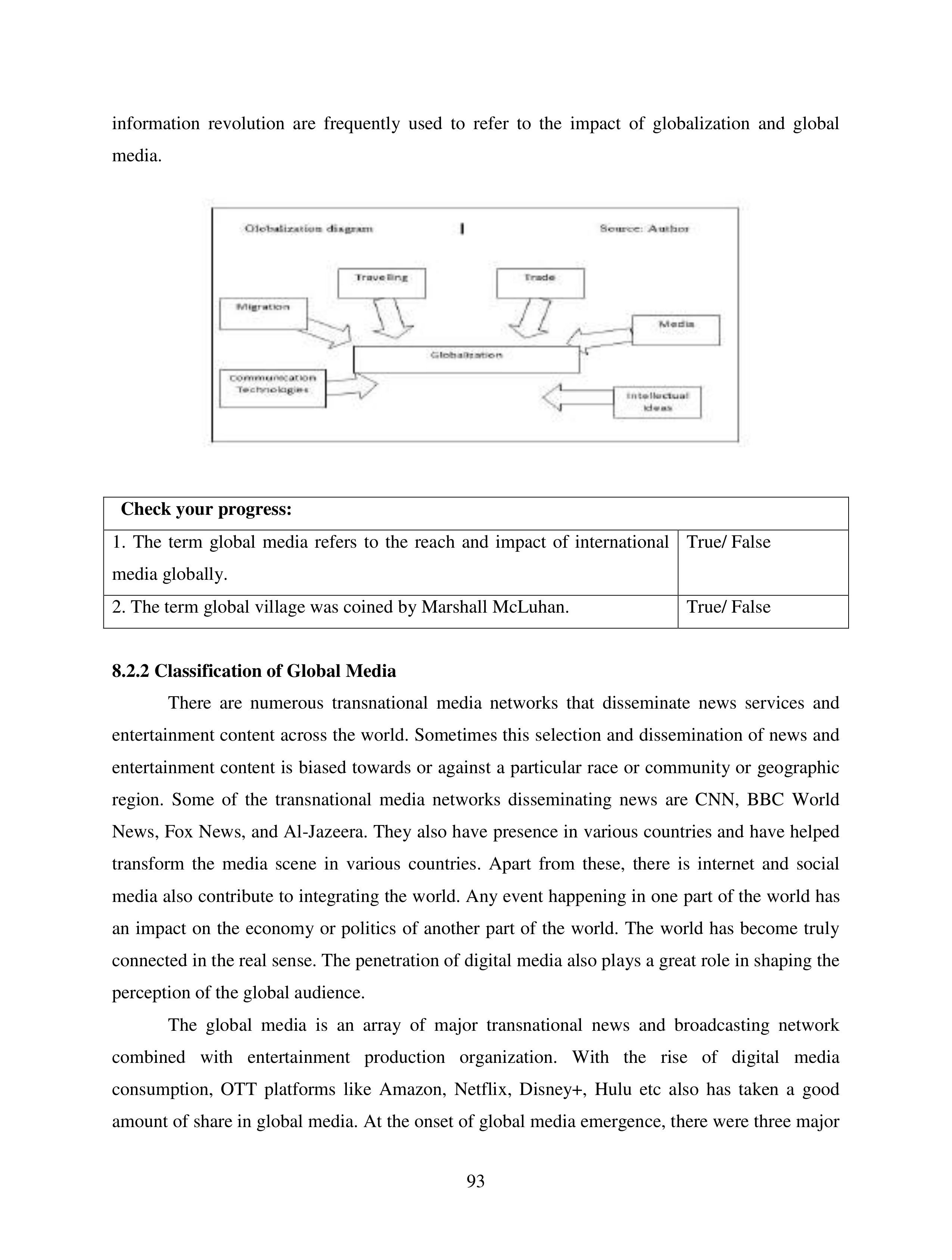
93
information revolution are frequently used to refer to the impact of globalization and global
media.
Check your progress:
1. The term global media refers to the reach and impact of international
media globally.
True/ False
2. The term global village was coined by Marshall McLuhan.
True/ False
8.2.2 Classification of Global Media
There are numerous transnational media networks that disseminate news services and
entertainment content across the world. Sometimes this selection and dissemination of news and
entertainment content is biased towards or against a particular race or community or geographic
region. Some of the transnational media networks disseminating news are CNN, BBC World
News, Fox News, and Al-Jazeera. They also have presence in various countries and have helped
transform the media scene in various countries. Apart from these, there is internet and social
media also contribute to integrating the world. Any event happening in one part of the world has
an impact on the economy or politics of another part of the world. The world has become truly
connected in the real sense. The penetration of digital media also plays a great role in shaping the
perception of the global audience.
The global media is an array of major transnational news and broadcasting network
combined with entertainment production organization. With the rise of digital media
consumption, OTT platforms like Amazon, Netflix, Disney+, Hulu etc also has taken a good
amount of share in global media. At the onset of global media emergence, there were three major
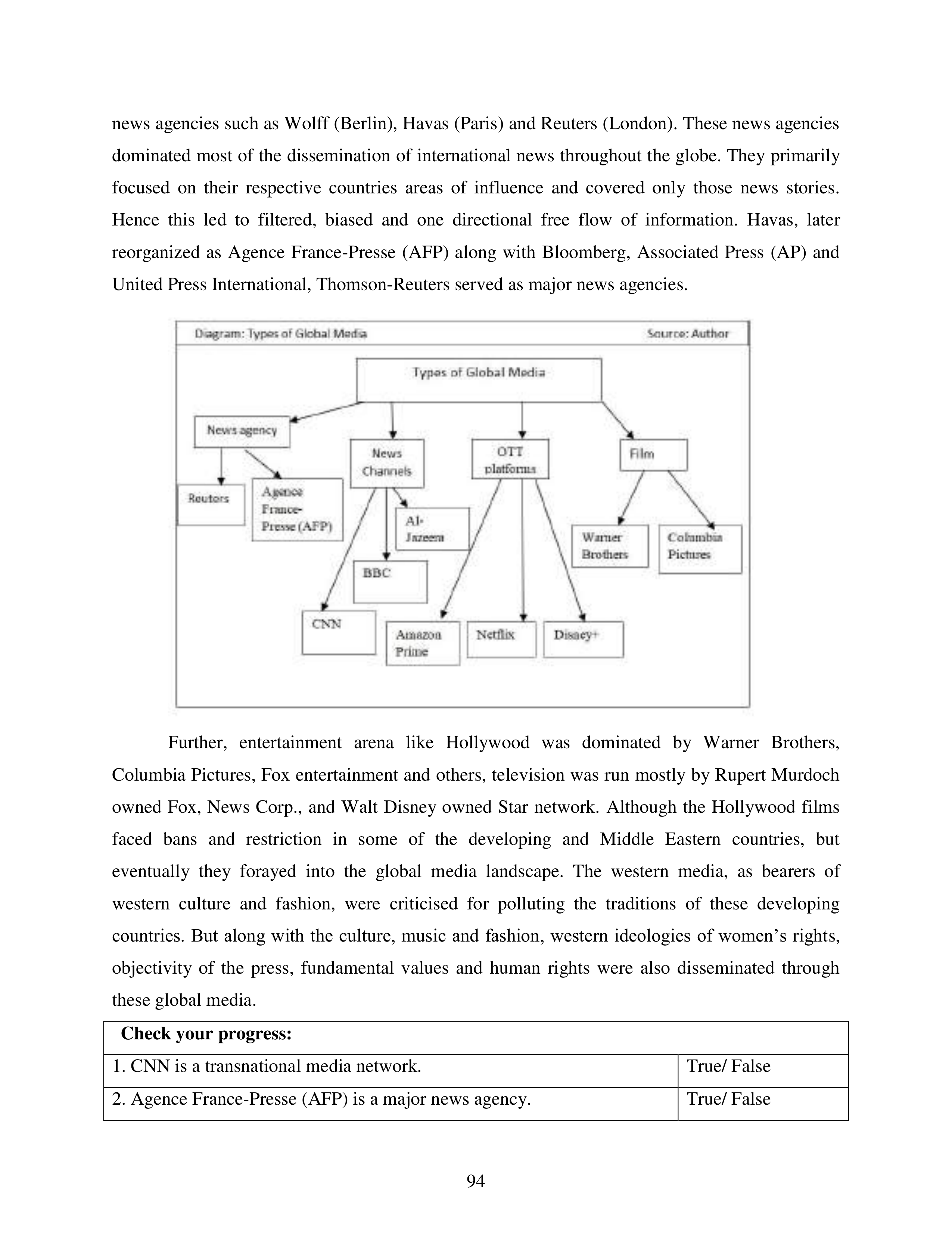
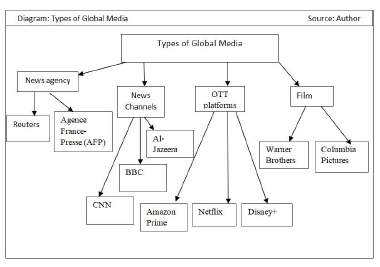
94
news agencies such as Wolff (Berlin), Havas (Paris) and Reuters (London). These news agencies
dominated most of the dissemination of international news throughout the globe. They primarily
focused on their respective countries areas of influence and covered only those news stories.
Hence this led to filtered, biased and one directional free flow of information. Havas, later
reorganized as Agence France-Presse (AFP) along with Bloomberg, Associated Press (AP) and
United Press International, Thomson-Reuters served as major news agencies.
Further, entertainment arena like Hollywood was dominated by Warner Brothers,
Columbia Pictures, Fox entertainment and others, television was run mostly by Rupert Murdoch
owned Fox, News Corp., and Walt Disney owned Star network. Although the Hollywood films
faced bans and restriction in some of the developing and Middle Eastern countries, but
eventually they forayed into the global media landscape. The western media, as bearers of
western culture and fashion, were criticised for polluting the traditions of these developing
countries. But along with the culture, music and fashion, western ideologies of women‘s right
s,
objectivity of the press, fundamental values and human rights were also disseminated through
these global media.
Check your progress:
1. CNN is a transnational media network.
True/ False
2. Agence France-Presse (AFP) is a major news agency.
True/ False

95
8.2.3 International News Agencies
Reuters
is an international news agency. It was
established by Paul Reuter and is owned by
Thomson Reuters. Reuters is headquartered in
London,
United
Kingdom.
Around
2,500
journalists and 600 photojournalists are working as
its employees at various locations worldwide. It is in about 200 locations worldwide. It is also
one of the top 5 news agencies in the world.
The Associated Press
is another international news agency. It is headquartered in New York
City, America. The Associated Press was founded in the year 1846. Its news reports are
subscribed by various newspapers and broadcasters across the world.
Agence France-Presse
is also an international news agency. It was founded in 1835 by Charles-
Louis Havas. Earlier it was known as Havas. It is headquartered in Paris, France. It is the world's
oldest news agency and is owned by the French government.
United Press International
is another international news agency. It is an American news agency
founded in 1907. United Press International provides print, photographs and audio-visual news
material to newspapers and broadcasters across the world. It is headquartered in Washington,
D.C., United States.
Bloomberg News
is an international news agency established in 1990 by Mike Bloomberg. It is
headquartered in New York City. It was established to provide financial news reporting to
various newspapers and broadcasters across the world. During its initial years its main motto was
to provide concise, timely financial news.
8.2.4 International Television Networks
The Fox Broadcasting Company
is a commercial broadcast television network. It is an
American organisation with its headquarters in New York City. It is owned by Fox Corporation
of Rupert Murdoch.
The Cable News Network
another multinational cable news channel. It is owned by
CNN Global. It is headquartered in the U.S. This organisation is also a part of Warner Brothers‘
Discovery. It was founded by Ted Turner and Reese Schonfeld in 1 June 1980. It started
functioning as a 24-hour cable news channel.
96
MTV
is a music channel under the flagship of MTV Entertainment Group. It is a part of
Paramount Media Networks. It is headquartered in New York City. It is a leading youth
entertainment channel. In India MTV runs famous shows such as MTV Roadies, MTV
Splitsvilla, etc.
BBC World News
is another international English-language television network. It is a
public corporation of the UK government's Department for Digital, Culture, Media, and Sport. It
runs several channels in news, children entertainment and digital services like BBC News, Sport
etc.
Cartoon Network
is a children
‘s
entertainment channel. It primarily runs cartoon shows.
Cartoon Network is an American cable television channel owned by Warner Brothers. Some of
the popular shows in Cartoon Network are shows as The Amazing World of Gumball, Craig of
the Creek, Teen Titans Go!, and We Baby Bears.
Disney Channel
is another kid
‘
s programming entertainment channel. It was founded
under the The Walt Disney Company in 1983.
It is an American cartoon channel for children.
Disney also produces animation and action-adventure films. While Disney channel produces and
broadcasts entertainment content for adolescents, Disney Junior is targeted for the pre-schoolers.
Disney also has its OTT presence in the form of Disney +. In India Disney+ has collaborated
with Disney+Hotstar to distribute films and content.
Nickelodeon
is a popular international cartoon channel for kids. It is mostly watched by
the primary school children. However, its sister channel Nick Jr. Is also another cartoon channel
for pre-school kids. Some famous cartoon shows of Nick Jr are Masha and the Bear, Dora the
explorer, Peppa Pig, etc.
Home Box Office
(HBO) is a popular English entertainment television channel. It
primarily distributes Hollywood films and television content. It was founded by Charles Dolan
on 8 November 1972 in New York. It is also owned by Warner Brothers. Some popular HBO
series are Game of Thrones, House of Dragons, Euphoria, etc.
8.2.5 Digital Divide and Information Imbalance
The impact of global media is multidimensional. While on one hand it has integrated the
whole world into a small space where everybody is connected. The global audience has been
enriched with a plethora of information and values. On the other hand, it has also created
disparity among the audience with respect to access and reach of information. The free flow of
97
information from these transnational and digital media outlets have led to an ever-increasing
disparity between the information rich and the information poor. The people who have adequate
information through their access to various digital and social media or traditional mass media are
known as information rich. Further, the individuals who lack the information due to
inaccessibility of digital media and other global media are known as information poor.
The digital divide is witnessed across region, race, and gender, between rich countries
and poor countries. Economy of a nation can be related to the information richness or
information poorness of it. Another factor governing the news and information flow was the
control of some major news agencies in the global information flow. These news agencies are
Associated Press (AP), United Press International (UPI), Agence France Press (AFP) and
Routers. Hence, the one-way flow of news, cinema and entertainment from the big developed
nations to the smaller developing and underdeveloped nations made them dependent nations. The
UNESCO survey in 1960s resulted in the acknowledgement of digital divide among nations.
Consequently, the Non-Aligned Movement was organised that consisted of developing and
underdeveloped nations of Asia, Africa and Latin created the demand for a new international
information order. As a result of the NAM efforts and the MacBride Commission report in 1980,
UNESCO advocated the establishment of a New World Information and Communication Order
(NWICO). The major focus of NWICO was to democratise communication flow and emphasise
the media‘s advocacy role. Media should aid oppressed people in achieving freedom and access
to information and freedom of expression.
The global media has helped in the exchange of entertainment and cultural content
among nations. These has not only opened avenues for revenue and profit but has also opened
spaces for diverse content and genre. There are positive aspects of globalisation and global
media, more specifically international networks. But sometimes the free and unbalanced flow of
information can be criticised to cause cultural imperialism. There are manipulation and
orientation of world views as the accepted norm in a modern and civilised world. Indigenous
culture and traditional knowledge are deemed rustic and unimportant by the modern
communication networks. But in the contemporary times there have been some improvements in
both content creation and dissemination keeping the indigenous target audience in mind. While
earlier representation in most international media was one dimensional, focussing only on the
white European, stereotyping African Americans, Arabs, and Asians. Some improvements have
98
been noticed in providing adequate representation to these groups in films, news, and other
entertainment genre.
Check your progress:
1. The Fox Broadcasting Company is an American commercial broadcast
television network.
True/ False
2. Home Box Office is an American pay television network founded by
Charles Dolan on 8 November 1972 in New York.
True/ False
8.2.6 Let Us Sum Up
In this Unit we learnt about the global media, different types of global media. We have
understood the definition and scope of globalisation and global village. The advantages of
globalisation are multidimensional. It has reduced the time and distance between the people
living around the world with the advancement in communication technologies and transportation.
Further, digital media has also opened the scope for trade, policy exchanges, cultural and
traditional exchanges between nations.
There are numerous numbers of transnational media networks that disseminate news
services and entertainment content across the world. Sometimes this selection and dissemination
of news and entertainment content is biased towards or against a particular race or community or
geographic region. Some of the transnational media networks disseminating news are CNN,
BBC World News, Fox News, and Al-Jazeera. The global media is an array of major
transnational news and broadcasting network combined with entertainment production
organization. With the rise of digital media consumption, OTT platforms like Amazon, Netflix,
Disney+, Hulu etc also has taken a good amount of share in global media. Further, entertainment
genre like Hollywood was dominated by Warner Brothers, Columbia Pictures, Fox entertainment
and others, television was run mostly by Rupert Murdoch owned Fox, News Corp., and Walt
Disney owned Star network.
Globalisation also leads to emergence of new political systems in the world, migrations
and mobility and formation of international bodies such as the UN. While on one hand it has
integrated the whole world into a small space where everybody is connected. The global
audience has been enriched with a plethora of information and values. On the other hand, it has
also created disparity among the audience with respect to access and reach of information.
99
8.3 Learning Outcomes
At the end of this Unit, you should have gained an insight into the global position of mass
media, the various international news agencies, television networks and internet platforms. You
should have also learned about the divide and the ways to overcome it.
8.4 Keywords
Globalisation, International news agencies, International television networks, Digital Divide,
OTT, NAM, NWICO
8.5 Sample Questions
Objective Questions:
1. Which of these is not an international news agency?
a)
AFP
b)
Reuters
c)
CNN
d)
UPI
2. Which of these is not an international OTT platform?
a)
Netflix
b)
Hulu
c)
Cartoon Network
d)
Amazon Prime
Short Answer Questions
1.
What is globalisation?
2.
State the impact of globalisation on media.
3.
What do you know about Agence France Presse?
Long Answer Questions
1.
Briefly discuss the classifications of global media.
2.
Discuss in details some prominent international television networks.
100
3.
Explain digital divide and Information imbalance in your own words.
8.6 Suggested Learning Resources
Herrick, D. F. (2012).
Media management in the age of giants: Business dynamics of journalism
.
UNM Press.
McChesney, R. W. (2000).
The global media giants. Critical studies in media commercialism
.
Palmer, M. (2019).
International News Agencies: A History
. Cham, Switzerland: Palgrave
Macmillan.
Reyaz, M. (2013).
Glocalization and the Media: Studies from the South. International Studies
,
50(3), 240-254.
101
Unit - 9: Introduction to Advertisements
Structure
9.0
Introduction
9.1
Objectives
9.2
Introduction to Advertisements
9.2.1
The Need to Advertise
9.2.2
A Brief History of Advertising
9.2.3
Advertising and the Industrial Revolution
9.2.4
Advertising in India
9.2.5
Advertising in the 20
th
Century
9.2.6
Advertising Films
9.2.7
Research in Advertising
9.2.8
Advertising and Indian Television
9.2.9
Advertising, Advertisement, and Advertising Agencies
9.2.10
Let Us Sum Up
9.3
Learning Outcomes
9.4
Glossary
9.5
Sample Questions
9.6
Suggested Learning Resources
9.0 Introduction
You are familiar with advertising. You must have seen advertisements on Television.
You must have heard ad (short for advertising) jingles on the radio. You must have seen
countless number of advertisements in the newspapers, magazines, banners, and posters. On
walls. Behinds buses. Painted on auto-rickshaws. Every time you open a website or a video on
YouTube
, you see an advertisement. You email is filled with unsolicited emails selling you
something or the other. Your phone often receives SMS informing you about some product or
service. This is why we say that advertising is present everywhere at once. Advertising is
ubiquitous! Let‘s face it. Advertising is inescapable. We can‘t run away from it.
Some of us
don‘t like advertisement. We get irritated or disturbed when advertisements are broadcast or
when we find a newspaper to be full of print advertisements. But do you know that without the
102
advertisement there would be no newspaper, no popular television serials, no cartoon channels
for children, not even news channel.
Creating content for newspapers, TV channels and or radio stations is a very costly affair.
The cost of producing a newspaper or a magazine is way much higher than what you pay for the
newspaper or the magazine. Reporters, journalists, news writers, TV artists and production units
must be paid salaries. Technical costs must be borne. Who pays for all of them. You only pay a
small fraction of the cost of producing a newspaper or a TV serial. Then who pays the rest of the
money needed for producing media‘s content? Its advertisements! Newspapers sell their space to
advertisers. So do owners of TV channels and radio stations. Therefore, advertisements make
much of our news, entertainment, and infotainment free of cost. This lesson will introduce you to
advertising. How did it evolve in the West and in India over the years?
To understand advertising, we need to understand the process of communication.
Communication needs four elements. A sender, a message, a channel (through which the
message is to be conveyed) and a receiver. Therefore, if advertising is communication, then it
needs a sender (which can be a manufacturing company selling a product or an organization
selling services such as a spa or a saloon or even a bank selling life insurance policies).
Advertising needs a channel through which the message can be passed on. That medium can be
television, or radio, a poster, or a banner or even the internet. It needs a message. This message
can be a song or a slogan or a tagline. It can be a radio jingle. And finally, it needs to
communicate this message to someone that is the receiver of the message. Advertising is directed
to all buyers - actual or potential buyer. That is, advertising needs to reach out not just to people
who are buying the product or service, but it also needs to communicate with people who may
buy the product or the service sometime soon.
9.1 Objectives
The objectives of the Unit are as follows:
to familiarize the students with the concept of advertising
to narrate the evolution of advertising
to narrate the history of advertising in India and the West
to correlate advertising with the Industrial Revolution
103
9.2 Introduction to Advertisements
First, we will start with the definition. Advertising is a paid-for-communication. Now
let‘s see how the experts define advertising. According to S.A. Chunawalla and K.C. Sethia, ‗an
advertisement is a form of persuasive communication with the public‘
(Chunawalla & Sethia,
2010, p. 15). Here the intention of the advertising is to influence or convince the public about the
efficiency of the product or service. Advertising is also defined as ‗an organized method of
communicating information about a product or service which a company or individual wants to
sell to the people‘
(Vilanilam & Verghese, 2004, p. 4).
9.2.1 The Need to Advertise
All companies manufacturing goods and commodities essentially do so because they
need to
sell them to consumers., i.e., us. Whether it‘s a hawker in a busy Indian bazaar hawking
his wares to the passersby on the road or an American multinational company spending billions
of dollars on its product launch campaign, they do so primarily to stimulate demand. As Sean
Brierley notes, ‗the fundamental reasons why businesses advertise are to do with the company‘
s
micro-
economic needs to stimulate demand and generate profits‘
(Brierley, 2002, p. 6).
From these definitions let‘s move to the other part of advertising. That is, we can say that
advertising is paid form of communication. We need to pay money to publish or broadcast our
advertisement. Besides, all advertisements generally identity their sponsor, that is, who paid for
their broadcast or publishing can be known from the advertisement itself. We must also realize
that advertisements are not neutral, that is, they will speak for and on behalf of their sponsor
(individual or organization etc.,). Advertisements also need the medium of communication for
their distribution such as television, radio, magazine, newspapers, radio etc.
9.2.2 A Brief History of Advertising
Advertising existed in ancient times in a very crude form. In ancient Greece, people were
hired to shout announcement about the arrival of merchants selling their merchandise. In India,
town criers would be paid money to announce the same. In the ancient markets of India and
China and the Middle East, hawkers would shout in the marketplace to advertise their products
and or services. But advertising, as we know it today is, essentially a modern phenomenon, and
is closely tied up with (the sale and purchase of) product and dissemination of information.
Therefore, it relates to both the Industrial Revolution and the development of the modern means
of mass communication such as newspapers, television, radio and now the Internet.
104
Let‘s understand how advertisin
g became essential in the modern world. In ancient times,
the world had a very small population. People mostly lived mostly in towns and villages.
Artisans and craftsmen would make products with their own hands and then sell them either
from their own home
s or proceed to the village markets. Village fairs or ‗mela‘ became places in
which people would buy and sell products. With small population, buyers were generally known
to the sellers in the villages. At times most of these merchants, traders and brokers would buy
these products made by artisans and then proceed to sell them to distant lands across seas and
oceans. But this was a costly and extremely dangerous affair. Therefore, with limited means of
travels and comforts, craftsmen would prefer to sell their products to these merchants and traders
instead of undertaking difficult journeys on their own. Production could keep pace with the small
populations in the cities and villages.
Then came the invention of the printing press. The printing press had a very significant
impact on the development of advertising. Johannes Gutenberg reportedly invented movable
types in 1447 and ushered in the Print Revolution. Individual alphabets were made with metal.
They were inserted in blocks. The blocks were then painted with ink or colour. Then the
alphabets were pressed against paper. This was how early books were printed. Earlier
information could be carried through word of mouth and depended on memory. But printing
changed that. Before the invention of the movable types, books (and other print materials) would
be handwritten, and this would be a time-consuming affair. Producing books was limited to the
Christian missionaries who made use of block printing to print copies of the Bible. Since the
production process was time consuming, books were expensive and only the rich could afford to
buy and keep them. But with the invention of the movable type, books (of all types not just
religious) could be produced much more quickly and much more easily. Over a period, books
became available for cheap. The printing press came to acquire more finesse and the newspaper
was born.
As James. E. Norris in his book
Advertising
notes that by the beginning of the 17
th
century newspapers were carrying out advertisements. In 1625, the English newspaper
Weekly
News of London
was carrying small advertisements of a personal and retail nature. Among the
other daily newspapers that began to publish advertisements were ‗
Daily Courant
in 1702, the
Revue
in 1704 and the
Examiner
, the
Tatler
, and the
Spectator’
(Norrris, 1980, p. 5)
.
The same
situation began to emerge in the American colonies. By the 1830s, newspapers like James
105
Gordon Bennett‘s
New York Herald
, Benjamin Day‘s
New York Sun
and Horace Greeley‘s
Tribune were well established and reputed newspapers.
9.2.3 Advertising and the Industrial Revolution
The newspaper then became the principle means of disseminating advertisements. The
industrial revolution supplemented the print revolution. Let‘s talk about
the Industrial revolution.
Sean Brierley notes that ‗the roots of mass advertising are embedded in the industrial revolution‘
(Brierley, 2002, p. 6). And Britain which was at the forefront of the industrial revolution was the
first country to introduce mass advertising techniques.
The Industrial revolution occurred from the mid-eighteen century to the mid-nineteenth
century and was a new transition in the process of making things. It happened mostly in the
United States, England, and continental Europe. It marked the transition of production from
human hands to machines and machine-driven technology. Its effects were felt across the textile
industry, chemicals industry, agriculture, mining industry and transportation. The industrial
revolution has created modern day America and Europe. The efficient machines could produce
large volumes of cheap goods and commodities in a much shorter time. Machines ushered in the
Industrial Revolution. With machines, the factories could make things in large quantities in much
less time.
The Industrial Revolution produced the problem of plenty. That is, consumption of goods
could not keep up with the production of goods. Machine could produce more goods and
commodities much quicker than human consumption. And industrialists had two choices. They
could either sell their products to the existing consumers or alternatively seek out new consumers
to buy them. When domestic markets become flooded with unsold goods then manufacturers
often resorted to expand their markets abroad. They would often merge their companies, to cut
down on losses. This created oligopolies where two or three companies may control the entire
market for a particular product or commodity. Companies also tried to find new geographical
markets by exporting their goods and commodities abroad. For all this to happen, manufacturers
and sellers needed a medium to inform buyers both old and new, about their produce across large
areas. Therefore, as Brierley notes, ‗advertising emerg
ed as a tool to try to stimulate the
consumer markets to pay for over-
produced good‘
(Brierley, 2002, p. 7).
Thus, modern advertising was born. But Brierley notes that for the Industrial Revolution
the problem was not one of over-production as much as under-consumption. Except for the
middle-class, there were few buyers from other classes. Hence it was only with the development
106
of the idea of the Welfare state - that is, poor citizens must be provided with low-cost housing,
free health, and education so that poor people could save enough money to spend on industrially
produced goods and commodities. Therefore, advertising picked up only after the Second World
War when the idea of a welfare state started to gain ground in much of the world.
But let us get back to the moment when manufacturing companies were over-producing
goods and commodities. To distribute their goods and commodities industrialists and
manufacturers had to arrange for the distribution of their products over a large geographical area
and bring the finish product / commodity much closer to the actual consumers. This could only
be possible by having a large distributors network. Therefore, manufacturers used wholesalers as
intermediaries to distribute their goods and commodities. But since there were many companies
manufacturing the same goods and commodities how could they force the distributors, they sell
their products? This could be done if the manufacturing companies and industrialists could
communicate directly with the consumers and force the distributors to stock their products and
commodities. Herein comes advertising.
It could communicate directly with the consumers. If the manufacturers could
communicate directly with the consumers or the end-users of their goods and commodities and
convey a sense that the consumer was buying a unique brand, then they could force the
distributors to stock their products. How could branding a product (such as giving it a name,
design, identity) made such a big differ
ence? Brierley notes that ‗branding [could] add value to
the products over and above their use value: it [could] restrict the power of wholesalers and re-
asserted the manufacturer‘s power to control prices‘
(Brierley, 2002, p. 10). Once the consumers
began demanding a certain brand from the retailers, the distributors were forced to stock the
products that were advertised.
The print media became the conduit for carrying advertisements. However quite early on,
most of these advertisements were in the form of simple announcement only. It was difficult to
differentiate one product from the other. Differences between products could be established
through different pricing, packaging, and the use of unique logos etc. It was only around the late
nineteenth and the beginning of the twentieth century that advertisements transformed from
merely informing consumers about products and services to actively persuading them to buy it
through branding. Advertisements transformed from ‗information‘ copy to ‗persuasion‘ copy and
advertising professionals like Theodore F. MacManus (1872-1940), Thomas J. Barratt (1841-
1914), James Walter Thompson (1847-1928), Edward Jordan (1882-1958), John Orr Young
107
(1886-1976), David Mackenzie Ogilvy (1911-1999), Rosser Reeves (1910-1984) marked this
transition period in which ads were transformed from providing information to persuading
consumers.
By the 1920s advertising had achieved the status of a professional discipline. New
research techniques were being introduced in the field of advertising to understand the ways in
which consumers behaved, and to make advertising more precise and exact in terms of reaching
out to its target audience. Advertising agencies that had already emerged by this time, now began
to flourish, and consolidate.
9.2.4 Advertising in India
In the Indian subcontinent, modern advertising as we know it, began towards the end of
the eighteenth century with the publication of
Hickey’s Bengal Gazette
which started publication
from Calcutta (now Kolkata) in January 1780. This was a newspaper started by James Augustus
Hickey and was the first ever newspaper to be published from India.
Hickey’s Bengal Gazette
mostly ‗advertised trade, legal notices as we
ll as matters of personal nature like people looking
for employment‘
(Chaudhuri, 2007). But the circulation of newspapers at this time was mostly
limited to the English people and newspapers were dependent on government patronage. Since
Hickey’s Gazette
often published scurrilous gossip as news, Hickey was sent to prison and his
press was confiscated. However soon enough, newspapers like
Asiatic Mirror
,
Oriental Star,
Bengal Hurkaru
started publication
.
As Arun Chaudhuri notes,
‗towards the end of the 18
th
century advertisements carrying
illustrations were quite common‘
(Chaudhuri, 2007, p. 8), and all the newspapers in the three
presidencies of Bombay, Calcutta and Madras carried ‗advertisemen
ts on transfers, situations
wanted and situation vacant‘
(Chaudhuri, 2007, p. 17). So, what was being advertised in the
newspapers towards the end of the nineteenth century in India? Arun Chaudhuri writes that
newspapers would carry news about the arrival and departure of ships to England or to the ports
of the Far East. As he notes, ‗books occupied a lot of advertising space... there were
advertisements on a whole host of things that came in from Europe
—
hats, clothes,
handkerchiefs, wines, and tobacco‘
(Chaudhuri, 2007, p. 51). It is generally assumed that the
advertisements were mostly composed by the editor.
9.2.5 Advertising in the 20
th
Century
Towards the end of the nineteenth century, photography became popular in India. And
with time, advertising developed and began to appear in various other forms. Advertisers began
108
to experiment with typography, fonts, and started inserting text, pictures, illustrations, diagrams
etc into the advertising copy. Newspapers began to develop their infrastructure for inserting
advertisements in their sheets. Print advertisements began to carry illustrations regularly, and
‗artists working for newspapers here did t
he entire studio related work that has to precede
printing an advertisement in a
newspaper‘
(Chaudhuri, 2007, p. 97). Illustrations were generally
reproduced from wooden blocks. The artists were either traditional artisans or the newly minted
students from art schools such as the Bombay Art School which was established by the Parsi
entrepreneur Sir Jamshedji Jeejeebhoy.
In 1854, a wealthy Bengali merchant Hiralal Seal started the School of Industrial Art in
Calcutta which taught etching, engraving on wood, metal, and stone; art that would have
extensive use in the advertising industry, because while the advertisements in the newspapers
were composed using movable types, the illustrations were reproduced from wooden blocks.
This was followed by the development of the lithography in India. This method of printing
allowed for a wide range of experimentations with colours. But printing in colour was a costly
affair and most newspapers would refrain from using it. With the development of the consumer
market and a growing middle class that was gaining employment in the colonial administration,
advertisements in newspapers began to offer a wide variety of consumer products such as
bicycles, gramophones, foods, beverages and even toys. Brands developed and brand marketing
picked up pace.
With the beginning of the twentieth century advertisements for motorcars began to appear
in India, and ‗by the first decade of the
20
th
century it had become a common practice to have a
picture alongside the text for advertisement
—
even when advertisements were small in size‘
(Chaudhuri, 2007, p. 130). Getting ad, proofreading the ad copy, and printing demanded
undivided attention and eventually in 1905, B. Dattaram set up the first advertising agency in
India. An emerging Indian middle class was beginning to exercise it choice when it came to
consumer products such as clothes, hair oils, tooth powders, books, tobacco, pipes, and patent
medicines. But the overall trends in advertising in India followed the trends set in the USA and
the United Kingdom. Print advertising remained the most important source of revenue for the
newspapers.
However, the rising tide of Indian nationalism began to gather steam towards the
beginning of the twentieth century. The Indian freedom struggle also affected the business of
printing and publishing. The Swadeshi movement resulted in the publication of many dailies,
109
weeklies, and monthlies and even bi-monthlies. The new century introduced a new avenue for
the placement of advertisements: the outdoors. The post first world war period saw a great
development in the field of outdoor advertising. Hoardings and billboards began to dot the
landscape of Indian cities.
By the 1920s cinema was introduced in India. And a new medium was born. However,
advertising films would become popular much later. The print advertisements began to mature
and instead of highlighting the utility of the product or the commodity they began to emphasize
upon the I
ndian consumers‘ aspirations and lifestyles. In 1928, another renowned advertising
agency DJ Keymer began to operate from the city of Calcutta and a year later in 1929 the famous
advertising agency J Walter Thompson opened its office in Bombay. In 1931, J Walter
Thompson (JWT) produced India‘s first advertising film —
an ad film for General Motors. One
of the most popular advertising agencies in a post-colonial India was Clarion Advertising
Services Private Limited which was formed after the Advertising agency DJ Keymer shut its
Calcutta office. Clarion Advertising agency went on to work for big clients like the ITC
(Imperial Tobacco Company) and Dunlop, the tyre manufacturing company.
9.2.6 Advertising Films
But while Indian films had reached an unparalleled level of finishing, ad films were still a
far way off, because the technical difficulties involved in producing a film remained a constraint‘
(Chaudhuri, 2014, p. 177). Therefore, few ad films were produced in the 1950s. Another reason
why advertising agencies mostly preferred placing advertisements in the print medium (such as
newspapers and magazines) was because advertising agencies ‗lacked the infrastructure to
handle film production‘
(Chaudhuri, 2014, p. 178). While the print advertising copy could be
visualized immediately, ad films required screenplay, the dialogues that would accompany the
visuals. Besides the scenes so written had to shot with a movie camera. Then the film had to be
edited and dubbed before it could be released in theatres. This was the reason why sometimes
film producers and directors could directly approach the clients with the offer of making their
advertisement films.
While the artists of the advertising industry came from finishing schools like the JJ
School of Arts in Bombay there were no training institutes that could train the technicians in the
art of filmmaking. Therefore, most of the ad agencies would prefer to outsource the film-making
part of the advertisement to well-known film producers in return for a commission. This was to
change with the inauguration of the Film & Television Institute of India (FTII) in Pune in 1960.
110
The institute was placed under the Ministry of Information & Broadcasting. From the 1960s,
advertising agencies began to provide full spectrum of services to their clients ranging from
making advertisements, running public relations campaigns, to managing public events.
9.2.7 Research in Advertising
Very little attention had been paid to research in advertising and consumer behaviour in
post-independence India. Advertising and consumer research go hand in hand. Hindustan Lever
Limited (HLL) was the first company to employ marketing research in the country. It was
necessary to know about consumer preferences. With knowledge about consumer preferences,
companies could design, shape or reshape and even introduce new products as per the
requirements of its consumer base, and consequently ‗by the early 1960s, JWT and
Clarion
opened independent marketing research departments to provide deeper insight into consumer
psyche for clients‘
(Chaudhuri, 2014, p. 107).
Money began to be spent on understanding the consumer behaviour. This helped the
advertising agencies to mark their target audiences more accurately through proper and scientific
media planning. And with such research in advertising, ‗advertising professionals were coming
round to the opinion that in order to be effecti
ve, a campaign had to be engaging; to be ‗fun‘; that
a direct sales pitch was not enough‘
(Chaudhuri, 2014, p. 252). Some of the most famous
advertising professionals in India have been Subhas Ghosal, R.P. Gupta, Bal Mundkar, Nargis
Wadia, S. K. Kooka, Umesh Rao, Arup Ray, Alyque Padamsee, Gerson daCunha, Kersey
Katrak, Ayaz Peerbhoy, among others.
9.2.8 Advertising and Indian Television
With the coming of the radio, popular radio programmes that broadcast songs from Hindi
films began to garner great number of advertisements. With the growing popularity of radio
programmes, the government of India created
Vividh Bharati
, as a popular radio channel catering
to the entertainment needs of the Indian listeners. Television became popular from the mid-1980s
when serials like
Hum Log
(Vasudev, 1984-1985),
Yeh Jo Hai Zindagi
(Shah, 1984),
Idhar
Udhar
(Mahendroo, 1985),
Buniyaad
(Sippy & Swarup, 1986-1987),
Ramayana
(Sagar, 1987)
and
Mahabharata
(Chopra & Chopra, 1988) were telecast. Indian viewers began to connect with
the medium of television in a way never seen before in India.
Then came liberalization. Liberalization was a shot in the arm for the advertising
industry. With liberalization and deregulation, foreign brands made an entry into Indian markets.
And the Indian consumer markets saw a overabundance of consumer products, each vying for
111
the viewers‘ attention. A well
-off Indian middle class meant that a readymade consumer market
was available. To absorb the advertising budgets of the companies on offer, Indian newspapers
began to introduce newspaper supplements which would be full of advertisements. The 1990s
also saw the introduction of the satellite television channels. The state broadcasting channel
Doordarshan
began to face stiff competition from private TV channels like ZEE TV, Star Plus,
Sony which began to broadcast television serials. And with television, advertisements could be
shot like short movies or films.
Now with the internet, online advertisements have combined all the elements of the print,
radio, and television. Online advertisements often carry hyperlinks that direct the consumers and
buyers to the websites selling the products. Often you must have noticed unwanted / unsolicited
emails. These are known as spam mails or simply spam. Receiving unsolicited emails is so
common these days that Gmail actually has a folder by the name of spam wherein all unsolicited
emails are received and then deleted after a certain period of time.
James E. Norris speaks of two significant changes in the field of advertising. One was the
realization in the beginning of the twentieth century that advertising must behave responsibly
towards society in general and to business in particular. This meant that advertising as a business
and as a profession must honour some ethical principles. It must respect public taste and honesty
in its operations. The second significant change was the emergence of the advertising agency in
the early 1900s. Manufacturers were mostly concerned with making things and selling then.
They had no idea about how to communicate with people effectively. Herein came in the
advertising agencies. They began to offer services that would allow the manufacturers and sellers
to reach out to more and more people in an effective manner.
For big manufacturers advertising also became the means of restricting the entry of other
competitors into the market. For example, big manufacturers could adopt several techniques to
maintain their own hold on the market and prevent their competitors from finding a foothold in
the market. They could control the distribution outlets. They could sell their own goods and
commodities at a very low price to drive away competition. They could control the patent for a
good or commodity and prevent any imitator from entering the market. And then the big
manufacturers could also resort to increased budget for advertising thereby making it difficult for
their competitors to make any profit. As Brierley notes, ‗the prohi
bitive coast of advertising can
be anti-
competitive‘
(Brierley, 2002, p. 9) because a new entrant in the market must invest more
money to compete with already established brands.
112
While advertising has a simple function that of communicating information about
products, services, and ideas to buyers, sometimes advertisements can become controversial.
When does it happen? Advertisement become controversial when they give you misleading
information about a product. Or when they use unfair means of selling a product or service or an
idea. We will discuss these points later.
9.2.9 Advertising, Advertisement, and Advertising Agencies
Let‘s differentiate between advertising, advertisements,
advertiser, and advertising
agencies. Advertising is the activity or profession of producing advertisements for commercial
products or services whereas advertisements are the messages that are produced. An advertiser is
the person or an organization on whose behalf the advertisement is created. He or she pays for
creating the advertisements. And since not all of us can prepare an advertisement on our own, we
need people who can do so on our behalf. Herein comes the advertising agencies. They produce
TV advertisements, radio jingles of print advertisement for their clients. Advertising works when
someone (the advertiser that is, a company or an individual) needs to communicate
advertisement.
9.2.10 Let Us Sum Up
In this Unit, we discussed the evolution of advertising both in India and in the West. We
understood how advertising is essentially a modern phenomenon which emerged towards the
beginning of the industrial revolution. We have understood how advertising evolved over the last
century and has become a presence everywhere at once.
9.3 Learning Outcomes
It is expected that after reading the Unit you should be able to define advertising,
comprehend the ways in which it has evolved both in India and the West, and understand how
the industrial revolution played an important role in consolidating the practice of advertising.
Moreover, you should be able to know the history of advertising in post-independence India.
9.4 Glossary
SMS
–
Short Messaging Services
113
Etching
–
Selectively dissolve the surface of something with a solvent to produce a desired
design or effect or an impression made from an etched plate
Surfeit
–
A supply or amount of something that is more than needed; an excessive amount
Engraving
–
Making engraved or etched plates and printing designs from them
9.5 Sample Questions
Objective Questions
1.
SMS stands for ____________ (a) short messaging service (b) smart messaging service
(c) small messaging service (d) smart message short
2.
OTT stands for _______________ (a) Over the Top (b) Over the Temple (c) On the
Television (d) Over the Television
3.
Communication process needs sender, message, channel and _________ (a)
communicator (b) advertiser (c) receiver (d) encoder
4.
All advertisements generally identity their ___________ (a) sponsors (b) clients (c)
public (d) Board of Directors
5.
In ancient Greece, people were hired to announce the arrival of merchants selling their
merchandise. (T/F)
6.
An advertisement is a form of persuasive communication with the public. (T/F)
7.
_______________________ invented movable types.
8.
The English newspaper
_____________
was carrying small advertisements of a personal
and retail nature.
9.
The roots of mass advertising are embedded in the __________________.
10.
With the development of the idea of the _________ poor citizens were to be provided
with low-cost housing, free health and education.
Short Answer Questions
1.
What are the four elements of the communication process?
2.
Define Advertising.
3.
What are the fundamental reasons for advertising?
4.
How did people in ancient Greece advertise their products?
5.
Who invented the movable types?
114
Long Answer Questions
1.
How did advertising develop over time in the West?
2.
Examine the role of the Industrial Revolution in the evolution of advertising.
3.
Explore the emergence of advertising in India.
9.6 Suggested Learning Resources
Brierley, S. (2002).
The Advertising Handbook.
New York: Routledge.
Chaudhuri, A. (2007).
Indian Advertising 1780 to 1950 A.D.
New Delhi: Tata McGraw-Hill
Publishing Company Limited.
Chaudhuri, A. (2014).
Indian Advertising: Laughter and Tears 1950 - 2013.
New Delhi: Niyogi
Books.
115
Unit - 10: Types of Advertisements
Structure
10.0
Introduction
10.1
Objectives
10.2
Types of Advertisements
10.2.1
Classification based on the Media Used
10.2.2
Classification based on Geographical Area / Reach
10.2.3
Classification based on Target Audience
10.2.4
Other Types of Advertising
10.3
Learning Outcomes
10.4
Glossary
10.5
Sample Questions
10.6
Suggested Learning Resources
10.0 Introduction
How do we make sense of so many advertisements that we get to see every day on our
television sets, in our homes, our streets and roads, on our buses and other means of transport?
There are many ways of classifying advertisements. For example, we can classify advertisements
based on the medium through which the advertisement is broadcast or disseminated. We can also
classify advertisements based on the target audience of the advertisement. This means classifying
advertisements based on the people for whom it is made. In this Unit, we will learn about the
different types of advertisements.
10.1 Objectives
The objectives of the Unit are to:
be familiar with the different types of advertising
study the classification of advertising based on the media used
understand the classification of advertising based on geographic area
explore the classification of advertising based on the target audience
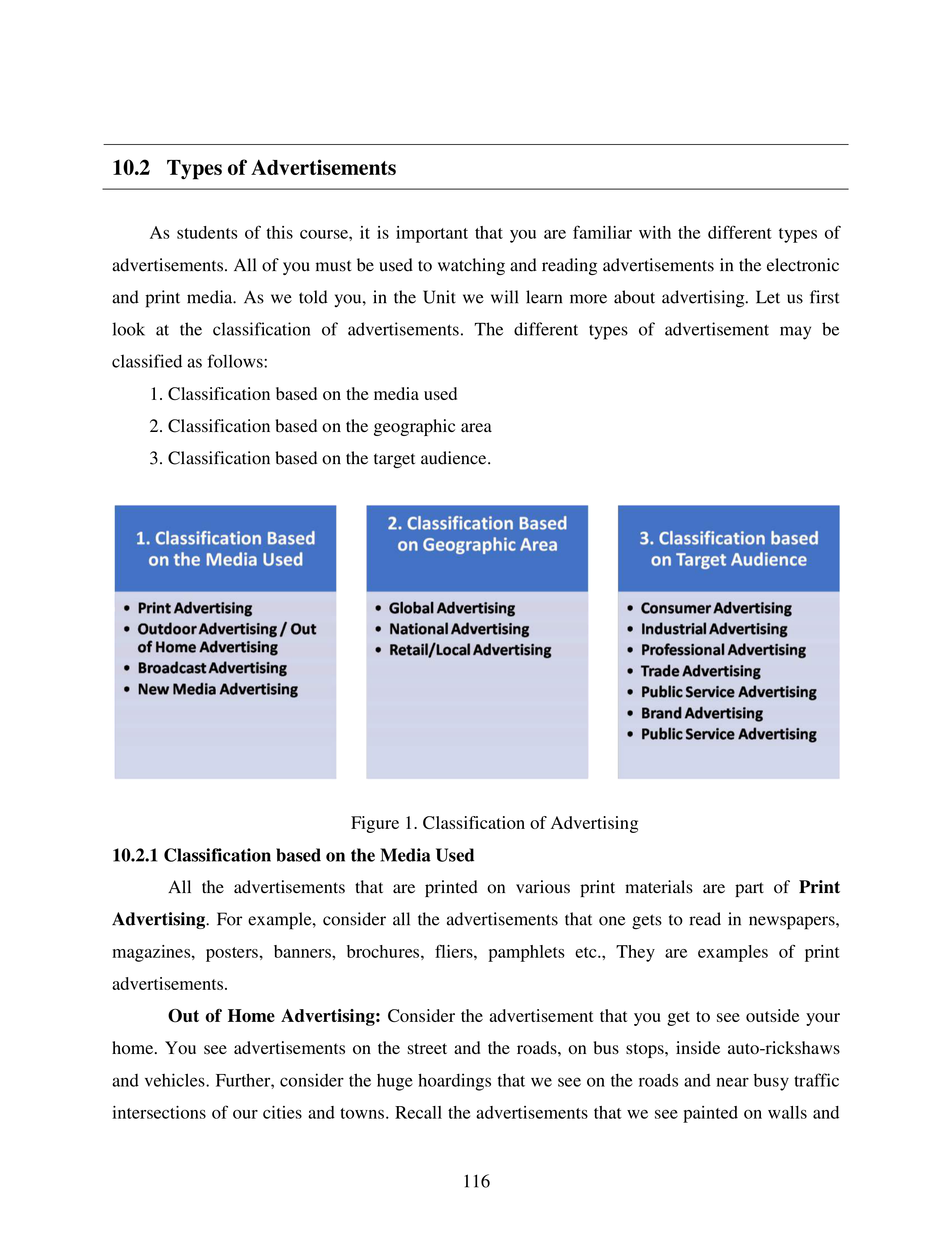
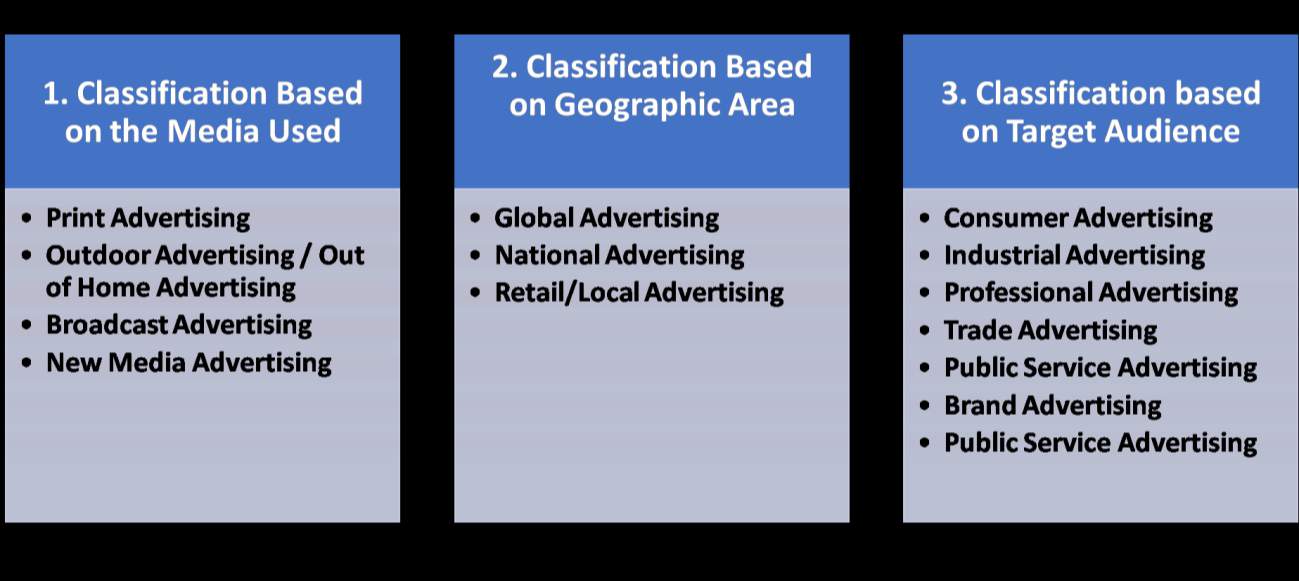
116
10.2 Types of Advertisements
As students of this course, it is important that you are familiar with the different types of
advertisements. All of you must be used to watching and reading advertisements in the electronic
and print media. As we told you, in the Unit we will learn more about advertising. Let us first
look at the classification of advertisements. The different types of advertisement may be
classified as follows:
1. Classification based on the media used
2. Classification based on the geographic area
3. Classification based on the target audience.
Figure 1. Classification of Advertising
10.2.1 Classification based on the Media Used
All the advertisements that are printed on various print materials are part of
Print
Advertising
. For example, consider all the advertisements that one gets to read in newspapers,
magazines, posters, banners, brochures, fliers, pamphlets etc., They are examples of print
advertisements.
Out of Home Advertising:
Consider the advertisement that you get to see outside your
home. You see advertisements on the street and the roads, on bus stops, inside auto-rickshaws
and vehicles. Further, consider the huge hoardings that we see on the roads and near busy traffic
intersections of our cities and towns. Recall the advertisements that we see painted on walls and
117
other public places. You must have seen huge balloons with advertising messages floating in
busy areas of your city. All these advertisements qualify as out-of-home advertising. Another
name for
Out-Of-Home (OOH) advertising
is Outdoor advertising.
Broadcast Advertising:
Next, consider the advertisements that are broadcast
electronically. They are deemed as Broadcast Advertising. An advertisement on the radio must
be broadcast several times before it sinks into people‘s mind. In much the same way, an
advertisement on television is broadcast several times a day over a long period of time before
people can remember the advertisement. Advertisements on television are for products that have
a national/regional presence, that is, they are available for purchase throughout the region or the
country. In contrast advertisements on the local radio channels/local television channels are
essentially for small businesses spread out over a small geographical area.
New Media Advertising:
The New Media Advertising uses the media tool such as social
media and other online platforms to communicate its advertising messages. The new media
advertisement combines the best of the print, the television, and the radio advertisements. You
must have encountered this advertisement whenever you go online to check your email or when
you log into your social media accounts on Instagram, Facebook, or Twitter etc.
10.2.2 Classification based on Geographical Area / Reach
Local Advertising:
Let us move on to the next major classification of advertisement.
Sometimes advertisement can also be classified based on their geographical reach. If an
advertisement is available only locally, that is, it is placed in such a way that only people near
about the advertisement can read or see it then it is deemed as a local advertisement. An example
is the advertisement that we see inside shops. They have limited reach. They are also called as
retail / local advertisements. The advertisements of your local grocery shop or the jewellery shop
in your neighbourhood will be called local advertisements or retail advertising. This is a cost-
effective mean of reaching out to the buyers in the neighbourhood.
National Advertising:
The there are some advertisements that have a national reach.
These are advertisements for products that have a national presence. Such advertisements
represent National Advertising. Therefore, correspondingly these advertisements are available
across the country. Consumer products available nationally, that is across the country will resort
to national advertising.
Global Advertising:
Advertisements that reach beyond the borders of a country and are
available across many countries are deemed to be examples of Global Advertising. Do you know
118
that many big multi-national companies often make advertisements that can be printed, or
broadcast across many countries simultaneously? Generally, these advertisements require huge
sums of money and finances.
10.2.3 Classification based on Target Audience
What is the target audience? To answer this question, you must find out who your
advertisement is meant for? Who is your potential buyer? Who, do you think, will be interested
in buying your product, service, or idea? If you know the answer to this question, you will know
who or what your target audience is. As Wells, Moriarty & Burnett note,
―
character of the target
audience has a direct bearing on the overall advertising strategy, especially the creative and the
media strategy
‖
(Wells, Moriarty, & Burnett, 2007, p. 16).
Brierley points out that because of the nature of the communication process, advertisers
deal in masses, not individuals. The purpose of classifying and positioning consumers is to
―
measure those things that consumers have in common, to target advertising and marketing
campaigns at them, and to measure and predict the human behaviours
‖
(Brierley, 2002, p. 27).
This eventually led the advertising agencies to find more and more about the consumers so that
they could be targeted with advertising messages more accurately. But this is easier said than
done. And advertising agencies must incur huge amount of expenses to find out about the target
audience for a particular product or commodity.
The purchaser of a product or a commodity may not always be its end-user. For example,
parents buy cereals, nappies, and creams but the product is for the use of the child. However,
with newer technologies it is becoming easier to understand consumer behaviour and as such
advertising agencies and manufacturing companies, shopping malls, airlines and social
networking websites can gather a lot of personal information about their buyers. With this
information, they are better able to find their target audiences. Consider for example an ordinary
toothpaste and a toothpaste for sensitive teeth. While the campaign for the former may include
everyone, the campaign for the sensitive toothpaste must target people with tooth sensitivity
only.
Consumer Advertising:
We are mostly familiar with consumer products hence we are
familiar with consumer product advertising. Advertisements for consumer products for example
such as shampoos, hair oils, food stuff etc is Consumer Advertising. Much of consumer
advertising is targeted at individual and families. The intention of consumer advertising is mostly
to introduce or reintroduce daily use consumer products, such as toothpastes, cooking oils etc.
119
Our television, radio and newspapers are full of consumer advertising. These can be anything
from mobiles and automobiles and household appliances, to home electronic devices, clothes,
books and even movies.
Trade Advertising:
Not all forms of advertising are directed at the ordinary household
consumers alone. For there are some advertisements that are directed towards other wholesalers
and retailers. It is called Trade Advertising. But why wholesalers and retailers? For this we must
understand that not all products reach us directly. Even though when we buy a product or
commodity from the market, the shopkeeper must buy the same product from a wholesaler. And
in turn the wholesaler must place the order for purchase from the manufacturing company.
In many instances, the product or the commodity reaches the consumers through this way
only. Companies often must resort to trade advertising. In trade advertising the target audience
are the wholesalers and retailers. In this way, through advertising they expect the traders to stock
the product or commodity in their shops and warehouses. In trade advertising the message is
directed toward other traders / dealers / brokers / sellers rather than to the consumers directly.
What kind of advertising appeal do they make on their advertisements to the wholesalers
and traders? Since the wholesalers and retailers are not going to use the product themselves but
instead would like to buy the product or commodity in bulk to resell it, the advertising appeal
would not harp or emphasize upon the product or commodity‘
s usefulness. Instead, in these
types of advertisements, the advertising message emphasizes upon profits margins, discounts,
bulk purchase offers, promotional support etc. Again, these advertisements would not appear in
television or radio. Instead, these types of advertisements appear in trade journal or magazines,
so that they can target the wholesalers and retailers.
Professional Advertising:
Professional Advertising is directed at professionals, for
example, computer engineers, doctors, civil engineers etc. Pharmaceuticals companies, medical
equipment manufacturers resort to advertising to health professionals. Computer periphery
manufacturers may want to communicate their messages to Information-Technology (IT)
companies and professionals. Cement manufacturers and building material manufacturers may
want to communicate to builders, construction companies and civil engineers. These
advertisements are informational and deal about the efficacy of product advertised. The
circulation of these type of advertisements is restricted to their target audience only. As such
these advertisements appear in niche journals only.
120
Brand Advertising:
Brand Advertising is perhaps the most visible form of advertising
we are familiar with. These advertisements focus on building log-term brand identity or image of
the company. Very often, celebrities from the film industry or sports are chosen as brand
ambassadors for a product or service.
Industrial Advertising:
Industrial Advertising refers to advertising messages that are
directed at manufacturers buying raw materials or equipment used in their own manufacturing
process. Consider for example, a company that manufactures cars must purchase car tires on a
bulk basis. So therefore, a car tire manufacturing company would like to advertise its product to
a company which is in the business of car manufacturing. The same goes for the car paint. A
paint manufacturing company would like to advertise its brand of paint to a car manufacturing
company. It makes sense, as the car manufacturing would need regular supply of the product if it
is in the business of selling cars. Business to business advertising is advertising messages sent
from one business to another.
In industrial advertising, advertisements may be sent through direct mail such as
brochures, postcards, or catalogues etc. A company manufacturing office stationery items may
want to advertise its products directly in offices in the business district instead of resorting to
television advertising which may be costly for it. In this form of advertising, the message is
aimed at reaching employees of a business who are responsible for making purchase decisions
such the decision of buying office stationery or furniture. In business-to-business advertising the
advertising message is designed and directed toward other businesses rather than to the end
consumer.
Public Service Advertising:
You may be familiar with the pulse polio campaigns run by
the Department of Health and Family Welfare under the aegis of the Ministry of Health and
Family Welfare. This is by far the best example of Public Service Advertising. The public
service advertisements are designed to generate awareness on certain issues among the public.
The intent
ion of these advertising campaigns is to bring about a change in people‘s attitude
towards issues of public concern such as for example the immunization of children with polio
vaccines. The intention of this type of advertising is not to earn profit but to bring about a change
for the betterment of the society.
Other examples of social advertising campaigns are family planning campaigns, HIV-
AIDS awareness campaigns, consumer awareness campaigns,
Swachh Bharat Abhiyan
etc. Some
of the themes of the public
service advertising have been concerned with women‘s safety, water
121
conservation, wildlife protection, promotion of tourism etc. The intention of these advertise
campaign is to reach to the largest group possible so that citizens may become aware of them.
10.2.4 Other Types of Advertising
At times of elections, you must have seen advertisements on television endorsing one
political party or the other. At other times, you must have seen print advertisements in the
leading national dailies pitching one political party or the other. This is perfectly normal in
democracies. In democracies, political parties need to reach out to their electorates and make
them see their point of view. Such type of advertising is called
Political Advertising,
and they
may co
mmunicate either a candidate‘s or a political party‘s point of view. Such form of
advertising is common in much of the western world.
You must have also seen
Financial Advertising
. Public limited companies often must
enlist investors. They must convince the investors about investing in them. These advertisements
carry details about the company such as their credit rating (that is how secure the company is as
an investment), the details of the public offer, the risk factors that go with the company etc. This
is an example of financial advertising.
10.3 Learning Outcomes
At the end of this Unit, you should have become familiar with the types of advertising,
the different mediums that are used for advertising, and you must have also become familiar with
the concept of target audiences used in advertising.
10.4 Glossary
Brochures
: A small book usually having a paper cover
Retail
: The selling of goods to consumers; usually in small quantities and not for resale
Efficacy
: Capacity or power to produce a desired effect
Electorates
: The body of enfranchised citizens; those qualified to vote
Immunization
: The act of making immune (especially by inoculation)
122
10.5 Sample Questions
Objective Questions
1.
Paper-based advertising would qualify as (a) Outdoor Advertising (b) Street Advertising
(c) Social Advertising (d) Print Advertising
2.
The flagship toothpaste brand of Colgate-Palmolive Company is (a) Rexona (b) Prudent
(c) Pepsodent (d) Colgate.
3.
The __________________are designed to generate awareness on certain issues among
the public.
4.
Character of the __________________ has a direct bearing on the overall advertising
strategy, especially the creative and the media strategy.
5.
Professional Advertising is directed at _______________________.
6.
We can classify advertisements based on the medium through which the advertisement is
broadcast or disseminated. (T/F)
7.
Another name for Out-Of-Home (OOH) advertising is ____________ advertising.
8.
The local radio channels are essential for small businesses spread out over a small
geographical area. (T/F)
9.
Character of the target audience has a direct bearing on the overall advertising strategy.
(T/F)
10.
The purchaser of a product or a commodity may not always be its end-user. (T/F)
Short Answer Questions
1.
What is consumer advertising?
2.
Define print advertising.
3.
What is meant by out-of-home adverting?
4.
What do we mean by industrial advertising?
5.
What is broadcast advertising?
Long Answer Questions
1.
Discuss in detail the classification of advertising based on the medium used.
2.
Examine the classification of advertisements based on their geographical reach.
3.
What is target audience? How is advertising classified based on target audience?
123
10.6 Suggested Learning Resources
Brierley, S. (2002).
The Advertising Handbook.
New York: Routledge.
Chaudhuri, A. (2007).
Indian Advertising 1780 to 1950 A.D.
New Delhi: Tata McGraw-Hill
Publishing Company Limited .
Chaudhuri, A. (2014).
Indian Advertising: Laughter and Tears 1950 - 2013.
New Delhi: Niyogi
Books .
Wells, W., Moriarty, S., & Burnett, J. (2007).
Advertising Principles and Practices
. New Delhi:
Prentice Hall of India Limited.
124
Unit - 11: Advertising Ethics
Structure
11.0
Introduction
11.1
Objectives
11.2
Advertising Ethics
11.2.1
Surrogate Advertising
11.2.2
The Advertising Standards Council of India
11.2.3
Advertising Agencies Association of India (AAAI)
11.2.4
Revisiting the Ethical Part in Advertising
11.3
Learning Outcomes
11.4
Keywords
11.5
Sample Questions
11.6
Suggested Learning Resources
11.0 Introduction
Every profession or business seeks to adopt and honour some moral and ethical
principles. Likewise advertising also grapples with many moral and ethical issues. Is it all right
to advertise products that in the long run may damage a person‘s health? Should advertising be
allowed to use pictures and texts that may be deemed as offensive to certain people or groups? Is
it proper to advertise inside schools and other educational places? Can advertising make
exaggerated claims about the efficacy of a product or a service? Is it all right to make claims in
advertising which are not true?
11.1 Objectives
The objectives of this Unit are to:
introduce the concept of ethics in advertising
explain the idea of surrogate advertising
familiarize you with the working of the various agencies and associations associated with
the field of advertising in India
125
11.2 Advertising Ethics
Now we know what we mean by advertising. But what does ethics mean? What is
advertising ethics? Ethics means that branch of human knowledge that deals with moral
principles. Ethics tells us about the distinction between right and wrong. When we say something
is ‗unethical‘, we generally mean to say that morally it is not right. We also need to distinguish
between what is legal and what is moral. By legal we mean that something is permitted as per
law. Therefore, what is illegal is not sanctioned by law. Likewise, what is ethical is generally
thought to be fair, decent, and principled. Unethical means that something is not right morally.
But we must understand the difference between ethical and legal. Consider for example, being
disrespectful to your elders may be unethical but not illegal. You break no law if you do not
show respect to elders, but it will be an unacceptable social behaviour.
Let us consider for example, that what is ethical may not have universal values. Ethical
judgments are based upon certain values and interests that are not universally agreed upon.
Different cultural systems may possibly have different interpretations of what is ethical and what
is not ethical. Sometimes cases have come across of advertisement that made dubious claims
about their products. At other times, certain advertisements were found to be deeply offensive
and vulgar.
Wells, Moriarty, and Burnett (2007) speak of the six issues that essentially deals with the
question of ethics in advertising. They are advertisements that are offensive, objectionable,
unpleasant, or distasteful; advertisements that perpetuate stereotyping of individuals, races,
castes, communities, or nationalities; advertisements that create body image problems for the
consumers; advertisements that deploy dubious targeting strategies; advertisements that make
dubious claims; advertisements that sell controversial products.
Offensive advertising generally makes use of inappropriate visuals that may be racist,
communal, or sexual. While we cannot agree on what constitutes good taste, but visuals that are
explicitly sexual, display nudity, make vulgar comments or suggestion or imply sexual
innuendos or suggestions are generally deemed to be offensive.
Critics have pointed out that advertising also promotes wasteful consumption which
drains the resources of a poor country and perpetuate materialism. Consumers swayed by visuals
126
in the advertisements often buy things they do not need. And scare resource like wealth are
squandered on wasteful expenditures.
Some advertisements perpetuate and or reinforce stereotypes about castes, communities,
or gender. A stereotype
―
is a representation of a cultural group that emphasizes a trait or group of
traits that may or may not communicate an accurate representation of the group
‖
(Wells,
Moriarty, & Burnett, 2007, p. 76). A stereotype is a visual shorthand. Advertising often resorts to
visual shorthand to convey meaning to save on time. But stereotypes end up perpetuating
formulaic concepts and images. Women are generally shown as younger and playing supportive
role for men; elderly women are mostly absent in advertisements.
Advertisements often feature men and women with perfect bodies and personalities. As
Wells, Moriarty and Burnett note,
―
advertising has been criticized for glorifying glamorous looks
in both men and women
‖
(Wells, Moriarty, & Burnett, 2007, p. 79). Advertising plays on
people‘s insecurities about the way they look,
to sell grooming products. Sometimes advertising
targets children which is the most vulnerable group. Children are often unaware of the
genuineness of the advertising messages and may fall prey to fake claims. Being young, children
are unable to evaluate the claims.
Not all the claims made in advertising may be true. Advertisements are prone to making
tall claims about the efficacy of products and services of their clients or sponsors. To crack down
on the dubious claims being made by quacks who were promising cure for every disease, the
Government of India passed
The Drugs and Magic Remedies (Objectionable Advertisements)
Act, 1954
(India)
.
This act prohibited advertisements of certain drugs for treatment of certain
diseases and disorders, besides prohibiting other misleading advertisements relating to magic
remedies.
Finally, another problem area is advertising for products which are controversial such as
chewing tobacco, cigarettes, and alcohol. In 2003, the government of India passed
The
Cigarettes and Other Tobacco Products (Prohibition of Advertisement and Regulation of Trade
and Commerce, Production, Supply and Distribution) Act, 2003
. The Act not only prohibits the
advertisement of cigarettes and tobacco related products but also provides for the regulation of
trade and commerce, production, supply, and distribution of cigarettes and other tobacco
products.
127
11.2.1 Surrogate Advertising
Another problematic area is that of surrogate advertising. Surrogate advertisements are
indirect advertisement of goods or services whose direct advertising is prohibited by law. This is
a form of advertising which is used to promote products like cigarettes and alcohol, in the
disguise of another product. For instance, companies manufacturing and selling products like
cigarettes and alcohol may resort to launching brands with similar sounding names and looks.
Their intention is to subconsciously remind the buyers about their product. It becomes difficult to
control these forms of advertisements because the message in these advertisements is subtle and
hidden. For example, a banned product may be sold under the brand name of a music CD
(compact disc) or DVD (digital video disc), playing cards, apple juice, fashion and clothing line
and even drinking water!
In June 2022, the Department of Consumer Affairs which functions under Ministry of
Consumer Affairs, Food and Public Distribution issued
Guidelines for Prevention of Misleading
Advertisements and Endorsements for Misleading Advertisements, 2022
. The Central Consumer
Protection Authority (CCPA) has defined
‗surrogate advertisement‘
as advertisement for goods,
product or service, whose advertising is otherwise prohibited or restricted by law, and which
circumvent prohibitions or restrictions by portraying their advertisement to be for goods, product
or service, which are not prohibited by law (Affairs, 2022).
11.2.2 The Advertising Standards Council of India
To deal with the issue and challenges of ethics in advertising the Advertising Standards
Council of India (ASCI) has adopted a code for self-regulation in advertising. A few words about
the council. The Advertising Standards Council of India was established in 1985. It is a
voluntary self-regulatory organization. It aims to promote honest advertising and fair
competition. while it seeks to protect the interests of the consumers it deals with all those who
are concerned with the profession of advertising such as advertising agencies, the media, and the
advertisers (that is people on whose behalf advertisements are placed in the media). Its principal
aim
is to maintain and enhance people‘s confidence in the profession of advertising. If
advertisements go on making false claims, they will lose people‘s confidence, and advertising as
an art and service will suffer enormously. Therefore, preventing harmful or false advertisements
from public circulation serves advertising in the long run!
Honouring ethics builds trust among consumers of the product or the services. If a
company lies or uses deception to sell its product or services, then people will eventually stop
128
buying the product or using its services. Being ethical is profitable in the long run. Trust is
earned by being ethical. So, should commitment to ethics be voluntary or should it be imposed
from outside? It is generally held that while laws should be imposed (as they have the sanction of
the state) commitment to ethics should be voluntary and self-imposed. So, the profession of
advertising also works under certain ethical principles. Most of these ethical principles have been
framed by organizations that seek to protect and advance the interest of advertising.
The Advertising Standards Council of India (ASCI) works through self-regulation. This
means that its members, who are mostly advertising agencies and advertisers adhere to certain
moral principles when creating and or broadcasting advertisements. The council promotes the
idea that advertisements should be truthful and honest to the buyers and consumers. Secondly the
advertisements should be within the limits of decency and acceptable standards of public taste.
Thirdly advertisements should not be used to promote products that are harmful or injurious to
society or individuals. Fourthly advertisements should be free from plagiarism and promote fair
competition. That is, to increase sale and sell its products, it need not run down its competitors
unfairly. These are the ethical practices adopted by the Advertising Standards Council of India
(ASCI).
11.2.3 Advertising Agencies Association of India (AAAI)
The Advertising Agencies Association of India (AAAI) is a national organization of
advertising agencies formed in 1945 to promote their interests also seeks to ‗encourage and
preserve a high standard of professionalism in all aspects of marketing communications‘ and to
‗encourage and maintain a high level of business and professional integrity amongst advertising
agencies and their suppliers‘
(Advertising Agencies Association of India, 2016).
In 2021, the computer giant company
Microsoft
came out in support of ethics framed by
the Institute of Advertising Ethics. The following is an excerpt from the principal guidelines
issued by the Institute of Advertising Ethics. They are as follows:
PRINCIPLE 1
: Advertising, public relations, marketing communications, news,
and editorial all share a common objective of truth and high ethical standards in
serving the public.
PRINCIPLE 2
: Advertising, public relations, and all marketing communications
professionals have an obligation to exercise the highest personal ethics in the
creation and dissemination of commercial information to consumers.
129
PRINCIPLE 3
: Advertisers should clearly distinguish advertising, public
relations, and corporate communications from news and editorial content and
entertainment, both online and offline.
PRINCIPLE 4
: Advertisers should clearly disclose all material conditions, such
as payment or receipt of a free product, affecting endorsements in social and
traditional channels, as well as the identity of endorsers, all in the interest of full
disclosure and transparency.
PRINCIPLE 5
: Advertisers should treat consumers fairly based on the nature of
the audience to whom the ads are directed, and the nature of the product or
service advertised.
PRINCIPLE 6
: Advertisers should
never compromise consumers’ personal
privacy in marketing communications, and their choices as to whether to
participate in providing their information should be transparent and easily made.
PRINCIPLE 7
: Advertisers should follow federal, state, and local advertising
laws, and cooperate with industry self-regulatory programs for the resolution of
advertising practices.
PRINCIPLE 8
: Advertisers and their agencies, and online and offline media,
should discuss privately potential ethical concerns, and members of the team
creating ads should be given permission to express internally their ethical
concerns.
PRINCIPLE 9
: Trust between advertising and public relations business partners,
including clients, and their agencies, media vendors, and third-party suppliers,
should be built upon transparency and full disclosure of business ownership and
arrangements, agency remuneration and rebates, and media incentives (Depalma,
2021).
However, these are not the only issues concerning ethics in advertising. Of late,
advertising has been involved in the issue of diversity and body image issues. For example,
critics have pointed out that advertising promotes and glorifies glamorous look in men and
women. Some advertisements are aimed at promoting ideal body images which are difficult to
attain for the ordinary people. Advertisements are also accused of promoting insecurities among
people about their colour, shape, height and looks. These insecurities are then used to push
beauty products.
130
At other times, critics have also pointed out that stereotypical images of races and
communities have also been used in advertisements. Critics have also pointed out that there is no
diversity of races, minority ethnic communities and cultures when it comes to representation in
advertising. Moreover, advertising to children remains another problematic area. Children are
unable to differentiate between facts and exaggerated claims being made on behalf of the
product. Therefore, they may fall prey to these sorts of advertising.
11.2.4 Revisiting the Ethical Part in Advertising
One of the first principles of ethics in advertising is to ensure that the advertising
message is true. The message is not a half-truth or misleading in any way. The basic ingredient
in any advertising is and should be speaking truth to the people. An advertising that is true to
itself will earn trust for itself and for the field of advertising as well. Even more important is to
ensure that there is no misleading wordplay that misleads the consumer. A wordplay is a
repartee, wit on banter, such as: Relief f
rom headaches …
temporarily.
As Norris writes, ‗you
should get into the habit of judging a piece of copy not by what it actually says, but by what the
reader is most likely to think it says… in advertising it doesn‘t pay to kid others‘
(Norris, 1990, p.
457).
Another important principle to remember is to ensure that the advertising message is
within the limits of decency. An advertisement that appears vulgar or is deemed to be as such
will damage the product and the reputa
tion of the advertising agency. As Norris reminds, ‗an ad
that says something that is offensive to people, even unintentionally, turns people off‘
(Norris,
1990, p. 459).
11.3 Learning Outcomes
At the end of this Unit, you should have learned about advertising ethics and understood
the difference between law and ethics, the necessity of ethics and the various codes of ethics in
advertising.
11.4 Keywords
Unethical
: Not conforming to approved standards of social or professional behaviour
131
Offensive
: Causing anger or annoyance
Dubious
: Open to doubt or suspicion
Inappropriate
: Not suitable for a particular occasion etc
Innuendo
: An indirect (and usually malicious) implication
11.5 Sample Questions
Objective Questions
1.
__________________ means that something is not right morally.
2.
_______________________
act prohibits advertisements of certain drugs for treatment
of certain diseases and disorders and prohibits misleading advertisements.
3.
_____________ are indirect advertisement of goods or services whose direct
advertising is prohibited by law.
4.
ASCI stands for ____________________________________
5.
The AAAI stands for _____________________________________
6.
Unethical means that something is not right morally. (T/F)
7.
We cannot agree on what constitutes good taste. (T/F)
8.
A stereotype is a visual shorthand. (T/F)
9.
____________ are often unaware of the genuineness of the advertising messages and
may fall prey to fake claims.
10.
______________ advertisements are indirect advertisement of goods or services
whose direct advertising is prohibited by law.
Short Answer Questions
1.
What is ethics?
2.
What do you understand by unethical?
3.
What is surrogate advertising?
4.
How do advertising regulating bodies work?
5.
What is a misleading advertisement?
Long Answer Questions
1.
Differentiate between law and ethics.
2.
What are the issues that essentially deal with the question of ethics in advertising?
3.
Describe the ethical principles prescribed by the Advertising Standards Council of India.
132
11.6 Suggested Learning Resources
Affairs, D. O. (2022, June 10).
The Guidelines for Prevention of Misleading Advertisements and
Endorsements for Misleading Advertisements, 2022.
Retrieved December 02, 2022, from
Consumer Affairs: https://consumeraffairs.nic.in/en/latestnews/guidelines-prevention-
misleading-advertisements-and-endorsements-misleading
Wells, W., Moriarty, S., & Burnett, J. (2007).
Advertising Principles and Practices .
New Delhi:
Prentice Hall of India Private Limited.
133
Unit - 12: How to create advertisements/storyboards?
Structure
12.0
Introduction
12.1
Objectives
12.2
How to create advertisements/storyboards?
12.2.1
Understanding the Working of an Advertising Agency
12.2.2
Departments of an Advertising Agency
12.2.3
Client-Agency Relationship
12.2.4
Creating a Print Advertisement
12.2.5
Creating a Radio Advertisement
12.2.6
Revival of the Radio in India
12.2.7
Creating a TV Advertisement through Storyboards
12.3
Learning Outcomes
12.4
Glossary
12.5
Sample Questions
12.6
Suggested Learning Resources
12.0 Introduction
While you must have seen or heard a variety of advertisements on television, radios, in
magazines and newspapers, an advertisement generally is prepared differently for different
mediums. Since it needs expertise and knowledge of the medium to make advertisements, herein
comes the advertising agencies. Before understanding the ways in which advertisements are
made, we need to know about the advertising agencies. From B. Dattaram, the first Indian
advertising agency that was established in Bombay in 1905, advertising agencies have come a
long way.
12.1 Objectives
The objectives of the Unit are as follows:
to understand how advertisements are made
to gain an idea about the working of an advertising agency
134
to appreciate the client-advertising agency relationship
to understand how advertisements for print, radio and television are made
to comprehend what is a story board
12.2 How to create advertisements/storyboards?
12.2.1 Understanding the Working of an Advertising Agency
In India we have indigenous advertising agencies as well Indian branches of foreign
advertising agencies. Let us understand the various department of a typical advertising agency.
Not everyone working in an advertising agency is directly involved in making an advertisement.
Therefore, there are different departments tasked with different responsibilities of an advertising
agency. However, the bigger the advertising agency, the greater number of departments it will
have. Smaller advertising agencies tend to have fewer departments and staff members are
required to multi-task. A typically big advertising agency will have a board of directors. They
will oversee the working of a General Manager (GM) or the President of the advertising agency.
To assist the President of the advertising agency there will be several vice-presidents,
each looking after one area such as marketing services, management & finance services, creative
services, and accounting services. Each senior official will be responsible for one aspect of
creating an advertisement. But not everyone will be engaged in the creative aspect of it. For
example, not everyone who makes a film gets to act in front of the camera. There are people who
work behind the camera as well. Likewise, there are various departments in an advertising
agency and not every department is tasked with creating an advertisement.
12.2.2 Departments of an Advertising Agency
First let us look at the
Contact Department
. This department is tasked with the
responsibility to find new clients but also to manage the existing clientele. It is headed by a
senior executive. They are the first point-of-contact for the client if they want the agency to make
an advertisement for them. And as such, this department represents the advertising agency to the
client. The contact department supplies necessary information about the agency to the clients.
Their main task is not just to add new clients but also to retain old ones. They usually work as a
liaison
between the client and the advertising agency. Sales promotion is their responsibility.
135
The
Accounts and Finance Department
looks after the accounting matters such as
preparing invoices. An invoice is an itemized statement of money owed for services rendered by
the advertising agency. The account & finance department is tasked with the responsibility of
sending regular reminders for the payment of bills to the clients. Clearing the bills for services
rendered to the advertising company is also the task of this department. Filing income tax returns
and paying taxes in a timely manner is again the responsibility of this department.
The
Art Department
is where all the creative action of an advertising agency takes
place. It is packed to capacity with artists and creative people. The main responsibility of this
department is to turn the advertising message into a self-communication imagery such as a
photograph or an illustration etc. This department prepares the visuals and the layout for the print
advertisements. It is usually headed by an Art Director. But in some agencies the artwork is often
outsourced to freelance artists.
The
Copy Department
prepares attractive advertising copies and is headed by the Copy
Chief. Typically, people such as copy writers and copy supervisors work in the copy department.
This is the largest department in an advertising agency.
No advertising agency can work without knowing anything about the product, the
consumer market and consumer preferences. So, for this task, advertising agencies have a
Research Department
. This department is tasked with the responsibility of gathering critical
information about consumer preferences and audience choices and learn about the more effective
means of reaching out to the consumers. The staff who work in this department may include
investigators, statisticians, analysts, data collectors, field workers etc. Their job is to make sense
of the data gathered from the field and present it to the advertising agency which can shape and
reshape its advertising strategy based according to the ground realities. The research department
comes under the supervision of the marketing services of an advertising agency. Big advertising
companies generally prefer to have their subsidiary companies do the data collection.
The
Public Relations Department
is tasked with maintaining cordial relationships
between the clients, and the media. It also addresses the complaints of the clients and tries to
solve them as soon as possible. Besides the task of the PR department is to earn goodwill for the
ad agency and maintain its reputation. While the PR department is headed by the Public
Relations Officer (PRO), it essentially functions under the management.
The
Production Department
comes into play after the Copy and the Art departments
have done their work. The production department produces final advertisements for the market.
136
The
Media Department
is responsible for selecting the best medium for the advertisement and
deciding the media plan for the client. An advertisement may be broadcast over the television
and radio and may also be released in newspapers and magazines at the same time. All these
decisions are taken after considering the nature of the product. The media department schedules
the advertisement over the medium chosen. An advertising agency may not always have all these
departments. Big advertising agencies may go for more staff members and departments while
smaller advertising agencies may work with smaller teams and fewer departments.
12.2.3 Client-Agency Relationship
Happy clients prefer to stay with their advertising agencies. This happens only when the
advertising agency and the client understand each other well. For this to happen, both the client
and the advertising agency need to be honest with each other. The building block of a good
client-agency relationship is trust and transparency. Both the client and the advertising agency
should have clearly defined goals as to what the advertising campaign is required to achieve. The
client must provide all the necessary information about the product or service to the advertising
agency to help it understand the product better. This helps the advertising agency to frame its
advertising campaign.
The client should know that unnecessary bargains may affect the quality of work
produced by the advertising agency. The bills of the advertising agency should be cleared on
time. The advertising agency must be given sufficient time to develop an advertising campaign.
On the other hand, the advertising agency must honestly strive to provide what the client is
paying for. The client‘s involvement at every stage becomes necessary to avoid confusions and
arguments. It should not make advertisements for the client‘s competitors. The advertising
agency must always discuss the fees and the services it will provide in advance to avoid disputes
later. If the advertising agency is undergoing any big change within, then it must be conveyed to
the client.
To launch a successful ad campaign, the agency must know the client‘s business, its
strength, its weaknesses, and its unique selling point (USP). The goals that are to be achieved
must be clearly communicated to the client. The client must know clearly what the advertising
campaign will and will not be able to achieve.
12.2.4 Creating a Print Advertisement
A print advertisement that is to be published in a magazine or a newspaper or as a flyer,
brochure or poster must not only be colourful and eye-catching, but the text must also connect
137
with the reader. The building block of a print advertisement may include illustrations or graphics,
a tagline (a tagline is a brief phrase that conveys the brands‘ message and or value), a body copy
(a body copy is the text that explains the details of the main idea of the advertisement), perhaps a
background image, and of course the name and logo (a logo can be shapes texts and or images
that depicts the name of the company). All these elements must be arranged in such a way that
no part overwhelms the other parts; each complements the other.
We will reiterate the ways in which a print advertisement is made. A print advertisement
is first visualized through a series of rough drawings. In the rough sketches or drawings, the
advertising agency tries to place all the required elements of the advertisement. This may include
the slogan, the logo, the tagline, and even pictures or illustrations. Care is taken to ensure that all
the elements complement each other. There must be harmony between all the elements of the
print advertisement. If not, then one element may completely overshadow the other elements,
and readers may be diverted from the message of the advertisement.
Hence a print advertisement goes through many stages before it is ready for the printing
press. In the initial stage, the client comes with a brief. The brief is what the client wants the
advertising agency to do for it. It could be designing a print advertisement for the launch of a
new product or the re-launch of an old product. Advertisement agencies often resort to mind-
mapping. Mind-mapping involves finding all possible ideas that go with the brief and
expectations. The advertising agency and the client must understand each other and their
expectations from each other. Once the brief has been finalized the agency moves on to the
ideation stage. This is the stage when ideas come to life!
The advertising agency sketches several advertising copies. The basic spread and layout
of the design is chalked out. The elements of the advertising copy such as the slogans, the
illustrations are finalized. Often the artists give a full presentation to the internal members of the
advertising agency and inputs are taken from the concerned members. At the third stage of the
print advertising copy is shared with the concerned client and the feedback is taken. All the
designs are subjective and what may look good to the advertising agency may not always
impress the client. But once the client is happy with the general concept of the advertising copy,
then the advertising agency proceeds on to the final stage. The suggestions of the client are
incorporated into the advertising copy and then the artwork is finalized. Then the advertising
copy is ready to go to print.
138
12.2.5 Creating a Radio Advertisement
For radio advertisements, the main idea of the advertisement is to be conveyed aurally.
Therefore, radio advertisements are made for the ear! We generally listen to radio when we are
doing something. In radio advertising, the client buys airtime, and the radio advertisement may
be made on nominal charges. Therefore, compared to television advertisement, an advertisement
on the radio is much more affordable.
There are different types of radio advertisement. Consider for example the
Radio Live
Reads
. In this type of advertisement, the Radio Jockey (RJ) reads out your advertisement in a
conversational style. This is an effective means of communication because the listeners are
familiar with the RJ and therefore are more likely to engage with the advertisement. In the
Radio
Sponsorship
Advertisements, the RJ may read out the names of the sponsors before, during and
after the radio programme. The sponsored programme could be a news programme or a sporting
event or even news about the traffic. By far, we are most familiar with the third type of radio
advertisements:
The Radio Jingle
. In this type of advertisement, the advertisement is sung out
like a song. These types of advertisements come often at regular intervals throughout the day.
Radio Testimonials
are another form of radio advertisements. In this type of advertisements, an
ordinary person shares his or her experience about the use of a particular product or service.
Finally, there‘s another type of radio advertisement, the
Straight Read
. In this type of radio
advertisement, the announcer, or the Radio Jockey (RJ) simply reads out the benefits of using a
particular brand or a product.
12.2.6 Revival of the Radio in India
The late 1990s has seen a revival of the radio. Many cities in India have two or three FM
radio stations. While the reach of these FM radio stations is limited since they are available on
within the vicinity of the city limits, they have become important conduit for the dissemination
of the advertising messages. FM radio stations have a variety of programmes with which they
engage with their listeners. Since the radio advertisements are played out throughout the day,
these advertisements often become popular among the youth.
A good script can engage with the audience effectively. Besides, being a cost-effective
means of advertising, radio jingles have great recall value because of their repetitions. Listeners
tend to remember radio advertisements for a long time. The advertising price on a radio station is
influenced by several factors such as the production costs, the listener base, the time duration of
the radio advertisement as well as the frequency of the broadcast on the radio station. First the
139
script is prepared. The advertising message is dubbed and recorded often to the accompaniment
of music. Often, a radio advertisement is prepared as a jingle - that is, the entire advertisement is
prepared as a short song based on an easily recognizable tune, because people find it easy to
remember advertisements if they sound like songs!
12.2.7 Creating a TV Advertisement through Storyboards
An advertisement for the television is prepared much like a film. A television
advertisement goes through three stages: pre-production, production, and post-production. In the
pre-production stages, the concept of the advertisement is detailed out. That is, exactly what
message do the advertisers want to emphasize and convey through their advertisement. This
concept is then developed into a story. But a story must be written down in the format of
screenplay. And the screenplay is essentially dialogue and descriptions of characters and the sets.
How does it translate into visuals? How does the director visual these sequences? Herein comes
the storyboards.
Have you ever read a comic strip like
Chacha Chaudhury
, or
Tinkle
or
Tintin
. That is
much like your storyboard! Storyboards are sketches or illustrations that are handmade either by
the directors or by other artists to give the technical crews (such as the camera crew) and the
actors an idea about what the sequence to be shot will consist of or look like. It is essentially
visualizing a scene as seen through the eye of the camera.
A storyboard is ‗a shot
-by-shot visual programming of the suggested action of the
script...it demonstrates graphic visualization for the producer, director of photography and the
director of special effects‘
(Hart, 1999, p. 24). But it is to be remembered that a storyboard is
required not just for shooting film or ad-films but also animations. Among the things that are to
be included in a storyboard are the direction in which the characters are moving, close-ups of
faces if the shot requires a close up-shot of the characters. The storyboard is essentially there to
help the film makers visualize their scene and see how it will look before getting down to the
task of shooting.
This allows all the stakeholders such as the camera crews and the actors to see how the
scene will be shot with the camera. So therefore, a storyboard is sequential art just like a comic
strip and is concerned with the illustration or depiction of a storyline. It also represents the line of
dynamic movements dictated by a given script. By going through the storyboards, the camera
crew can see how the given scene has been visualized by the director and how that shot is to be
shot, through which shot or what camera angle. So, through the storyboard ‗enough detailed
140
information is presented to satisfy the director‘s needs plus those image indicators that the
director of photography wi
ll want to interpret for the director‘
(Hart, 1999, p. 41). But why is it
used? Because a film can be visualized in any number of ways by the camera crew, the artists,
the director, and the special effects team. And each one of them will come out with a different
visualization for the same scene!
During the production stage, the studio is booked, technicians are hired, and the shooting
takes place. Later, in the post-production stage, the editing of the advertisement takes place.
Music track is laid over the visual, dubbing is carried out and the ad is now complete. Now for
the broadcasting part. Advertising agencies often provide a package deal in which they not only
prepare the advertisement but also take care of the television slots for broadcasting the
advertisements.
12.3 Learning Outcomes
At the end of this Unit, you should know how different departments of an advertising
agency work, the journey of an advertisement from conceptualization to visualization, and the
idea of a story board and how it is important for making advertising films.
12.4 Glossary
Liaison
–
A channel for communication between groups
Subsidiary
–
Functioning in a supporting capacity
Flyer
–
An advertisement (printed on a page or in a leaflet) intended for wide distribution
Jingle
–
A comic verse of irregular measure
12.5 Sample Questions
Objective Questions
1.
_______ was the first Indian advertising agency that was established in Bombay in 1905.
2.
The
_______
is tasked with the responsibility to find new clients and manage the existing
clientele.
141
3.
The
_________
is where all the creative action of an advertising agency takes place.
4.
The
_________
prepares attractive advertising copies and is headed by the Copy Chief.
5.
The
_________
is tasked with maintaining cordial relationships between the clients, and
the media.
6.
The
________
department of an ad agency looks after the accounting matters such as
preparing invoices.
7.
The
__________
department of an ad agency is tasked with maintaining cordial
relationships between the clients, and the media.
8.
Both the _________ and the advertising agency should have clearly defined goals as to
what the advertising campaign is required to achieve.
9.
A ___________ advertisement is first visualized through a series of rough drawings.
10.
There must be ____________ between all the elements of the print advertisement.
Short Answer Questions
1.
Describe the function of the copy department.
2.
Explain the need of a research department in an ad agency.
3.
What is the role of the ad agency‘s art department?
4.
What is a radio jingle?
5.
What is a storyboard?
Long Answer Questions
1.
What is the process of creating an advertisement for print?
2.
Explain the stages through which a television advertisement is created.
3.
Describe the different types of advertisements for a radio.
12.6 Suggested Learning Resources
Brierley, S. (2002).
The Advertising Handbook
. New York: Routledge.
Chaudhuri, A. (2007).
Indian Advertising 1780 to 1950 A.D
. New Delhi: Tata McGraw-Hill
Publishing Company Limited.
Chaudhuri, A. (2014).
Indian Advertising: Laughter and Tears 1950 - 2013
. New Delhi: Niyogi
Books.
Hart, J. (1999).
The Art of the Storyboard: Storyboarding for Film, TV, and Animation
.
Burlington: Focal Press - An imprint of Elsevier.
142
Unit - 13: Scriptwriting for TV and Radio
Structure
13.0
Introduction
13.1
Objectives
13.2
Scriptwriting for TV and Radio
13.2.1
Understanding the format of production in Radio and TV
13.2.2
Difference between print and broadcast language
13.2.3
Writing script for radio
13.2.4
Let Us Sum Up
13.3
Learning Outcomes
13.4
Keywords
13.5
Sample Questions
13.6
Suggested Learning Resources
13.0 Introduction
Mass media is used to disseminate information to a large and diverse group of audiences
for the desired impact. But along with the selection of a particular mass medium, the format in
which the message is designed is also important to maximize the effect depending on the target
audience. Hence, just like printed newspapers follow specific guidelines for writing to
disseminate the most important information within the limited space available, radio and
television broadcasts follow somewhat similar guidelines. Although, it can be added here that
writing for radio and television is different from writing for print, given the difference in
technology. Prioritizing content depending on the time and space available is similarly followed
in all the mediums. Scriptwriting is like news or editorial writing for print media, but due to the
fleeting nature of the broadcast media, the language is simpler.
13.1 Objectives
The objectives of this Unit are to:
overview of the importance of script writing
143
get acquainted with the different guidelines to be followed for scriptwriting for radio
learn rules for writing scripts for television
conceptualize and write scripts for radio and television
13.2 Scriptwriting for TV and Radio
Scriptwriting is a shot-by-shot description for a television production or a radio
production. Some radio programs are unscripted, while some are scripted. Scriptwriting starts
with thorough research and recce on the subject or story. The scriptwriter should also consider
the target audience, the language, the budget, and logistical support before writing the script.
Sometimes even a very well-written script fails due to a lack of infrastructure and proper
execution. Broadcast scriptwriting also refers to writing for eyes and ears. It is impossible to
pause and rewind the live broadcast and listen to it once again to clarify any doubts. Hence, a
radio or television script cannot use difficult, confusing language. It should also use short and
simple sentences. There is an unsaid rule in scriptwriting for radio and television as "KISS" -
Keep it short and simple.
Check your progress:
1. Scriptwriting starts with thorough research and recce on the subject or story
True/ False
2. Broadcast scriptwriting also refers to writing for eyes and ears.
True/ False
13.2.1
Understanding the format of production in Radio and TV
When we wake up in the morning, we either crave for the early morning newspaper or
turn on the television. Some people have the habit of listening to radio broadcast. With the
emergence of the internet, we can now access all forms of electronic as well as print news on our
smartphones. As we enjoy these formats of news and entertainment sources, a basic idea about
how they are crafted will also ensure better literacy around how media messages impact their
audience.
At the very onset, we should clear ourselves that while print newspapers are only for our
eyes, radio and television content is produced for our eyes and ears. Hence the element of sound
and visuals also complement the news and program delivery. Therefore, unlike the writing style
144
of newspapers and magazines, radio and television programs are more conversational and
directed toward the audience.
As listeners, it would be helpful if we understood how news programs are scripted. While
going through this unit, you would be advised to watch and listen to some television and radio
programs to reflect on your learned points. In this unit, learners will also understand why specific
programs are scripted while others are unscripted. The main mantra in radio or television is to
catch the audience's attention.
13.2.2
Difference between print and broadcast language
The language used in print newspapers differs from the broadcast language used in radio
and television. This is due to the difference in the format of the medium. While print mediums
can be read repeatedly at one's own pace and time, radio or television broadcasts are fleeting
mediums. Hence, the language used in these broadcasts should be clear, concise, and
straightforward. The script for radio and television is written for the ears and eyes. Writing for
radio is even more difficult than writing for television. In television, much information can be
presented with visuals, but radio scripts ultimately depend upon audio. This makes radio writing
more challenging than any other kind of writing.
Have you come across any radio or television news program or reporting using difficult
words that are hard to pronounce and even to listen? This kind of jargon, technical terms, and
long words that are difficult to pronounce and easy to grasp are avoided in radio and television
scripts.
13.2.3 Some basic points to be noted while writing scripts for radio and television:
The language used in children's programs will differ from that used for youth or news-
based programs.
In print media, space constraint decides the report's length; in radio and television, the
time and duration of the program are considered while writing the script.
One golden rule used in radio and television scriptwriting is using one idea per sentence.
Each sentence should also be very brief with simple language. As human beings, we do
not use long sentences when we talk or hold conversations. Hence, in radio and
television, conversation style of language should be used.
Sentences should also be simple and direct. Moreover, in print media reports, readers can
be provided with a lot of information they may read depending on their convenience. But
145
in the case of radio and television, the audience cannot be loaded with many details to
avoid losing interest in the program.
The script writer for radio or television should also practice reading the script aloud. This
will help understand the transitions, timing, information flow, etc.
Check your progress:
1. Radio writing is more challenging than any other kind of writing.
True/ False
2. Radio and television scripts should use one idea per sentence.
True/ False
13.2.3
Writing script for radio
As mass media consumers, we come across different media formats such as print
newspapers, magazines, radio, television, or even film. Each of these mediums has a different
presentation style for its content. This presentation style is dependent on the kind of audience
they are targeting, and the technology being used. While print media publishes hard news,
opinion pieces, articles, human interest stories, photo features, travelogues, and even short
stories, these are presented on radio and television differently. Any program production for radio
uses spoken word, music, transitions, and sound effect. Since radio does not have the liberty to
use visuals, the script for radio entirely depends on the sound elements to give a visual
description to the audience.
13.2.3.1 Rules for writing script for radio
The different kinds of programs produced for radio are:
Radio Talk Shows,
Interviews,
Panel Discussions,
News Bulletin,
Music Shows,
Radio Drama,
Radio Documentary,
Phone In Programs Etc.
Each of these programs is produced depending on the requirement and preferences of the
audience at a different time of the day. This is very different from the print medium, which
dedicates content to its audience according to pages. Unlike the advertisements in newspapers
146
and magazines, radio advertisements are of 10 seconds or 30 seconds duration in between the
programs. Accordingly, a radio talk show may be 4 to 9 minutes long, and a radio documentary
may be 15 minutes duration. The script for each of these program formats is written accordingly.
Some programs, like the panel discussion or phone-in programs, may be unscripted. At the same
time, interviews, radio dramas, and news bulletins are scripted. Furter, live broadcasts like
sporting commentary or live reporting from an incident are unscripted and spontaneous. Hence,
the presenter should be knowledgeable enough to describe the event or happenings in lively
language with adequate information for the optimum use of the duration provided.
In the case of the print medium, written words, images, and graphical representation
enhance the reading experience. However, in radio, the audience depends on the sound effect,
ambiance sound, background music, and voice modulation of the presenter to experience and
visualize the event. The language used in print media is different from the aural medium. As
learners, you should use words like 'yesterday,' 'last week,' or ‗last month‘ instead of dates in the
radio script. Again due to the absence of visuals on the radio, the script should use visual
examples from real life for the listeners to imagine the length or height of something. For
example, ―The trade centre is as tall as Qutub Minar and as huge as a football field" should be
used to describe the area of "the trade centre" instead of giving its measurement in square feet.
Complex sentences should always be avoided in radio and television scripts. The listeners
will not be able to follow the meaning once the sentence completes, and they cannot rewind it to
listen again. Again, while describing the quantity of anything, instead of the exact denomination,
an approximate figure should be quoted for the ease of the listeners. For example, when the
script needs to include information about the number of people voting for the assembly election,
instead of "about 16 and half lakh of voters have cast their votes" it is better to use "more than 16
lakhs voters have cast their votes.
‖
13.2.3.2
Sample radio script
Script on domestic violence during COVID-19 crisis (Shadow pandemic)
(Duration 22 minutes):
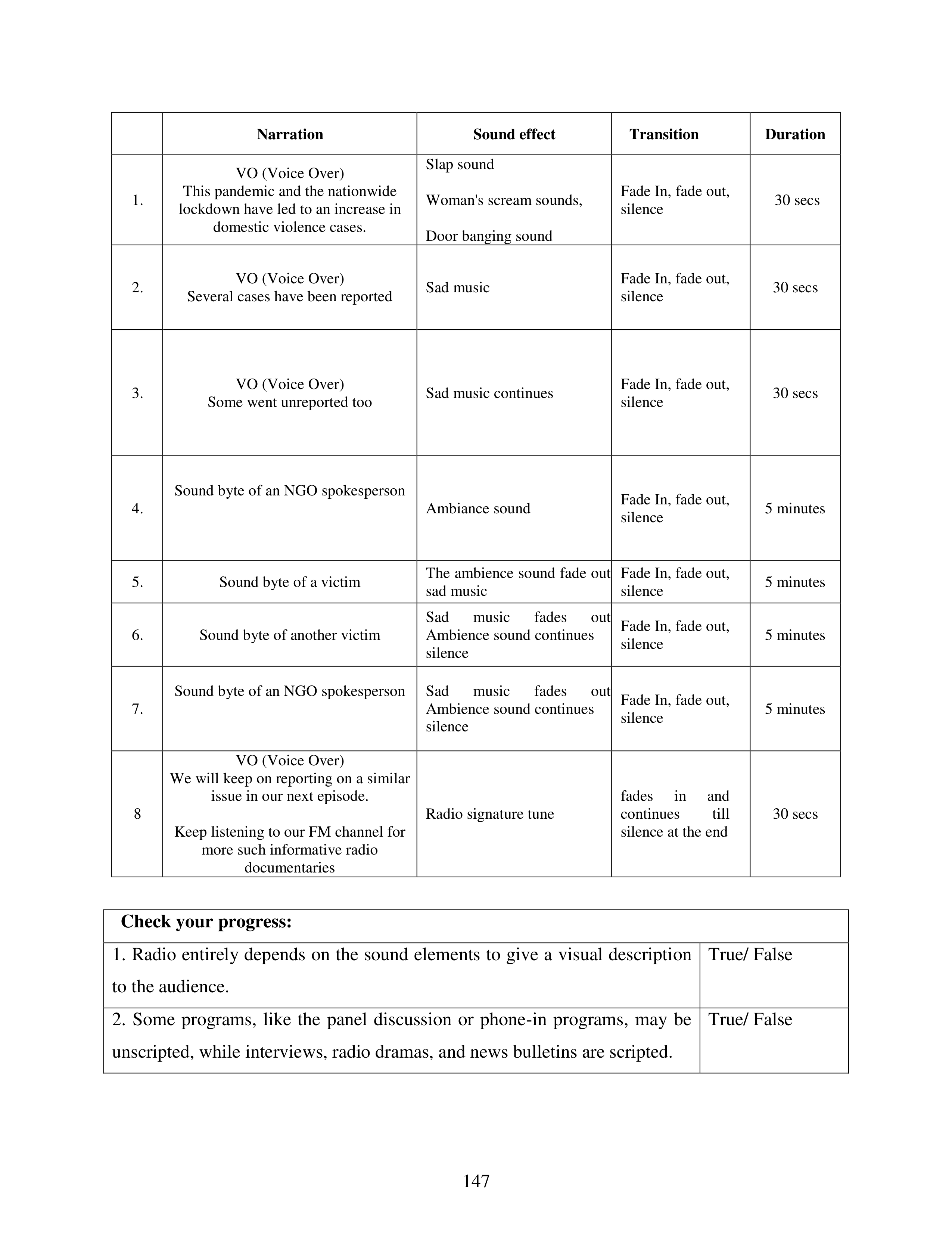
147
Narration
Sound effect
Transition
Duration
1.
VO (Voice Over)
This pandemic and the nationwide
lockdown have led to an increase in
domestic violence cases.
Slap sound
Woman's scream sounds,
Door banging sound
Fade In, fade out,
silence
30 secs
2.
VO (Voice Over)
Several cases have been reported
Sad music
Fade In, fade out,
silence
30 secs
3.
VO (Voice Over)
Some went unreported too
Sad music continues
Fade In, fade out,
silence
30 secs
4.
Sound byte of an NGO spokesperson
Ambiance sound
Fade In, fade out,
silence
5 minutes
5.
Sound byte of a victim
The ambience sound fade out
sad music
Fade In, fade out,
silence
5 minutes
6.
Sound byte of another victim
Sad
music
fades
out
Ambience sound continues
silence
Fade In, fade out,
silence
5 minutes
7.
Sound byte of an NGO spokesperson
Sad
music
fades
out
Ambience sound continues
silence
Fade In, fade out,
silence
5 minutes
8
VO (Voice Over)
We will keep on reporting on a similar
issue in our next episode.
Keep listening to our FM channel for
more such informative radio
documentaries
Radio signature tune
fades
in
and
continues
till
silence at the end
30 secs
Check your progress:
1. Radio entirely depends on the sound elements to give a visual description
to the audience.
True/ False
2. Some programs, like the panel discussion or phone-in programs, may be
unscripted, while interviews, radio dramas, and news bulletins are scripted.
True/ False
148
13.2.4
Rules for writing script for television
In today‘s world, television has a vital role to play in our daily lives. The audience is
engulfed in television, from watching entertainment shows to television news debates. Due to its
audio-visual nature, it dramatically moulds our perception of everything from consumable goods
to political ideologies. Hence, the scriptwriters for television are responsible for deciding which
visuals to show and which to avoid. Television production contents are somewhat like the radio
programs, such as news bulletins, soap operas, documentaries, music shows, panel discussions,
interviews, etc.
The language used in television scripts is like the language written for radio. As
television has the advantage of visuals assisting the presenter or spoken words, a detailed
description can be avoided in TV scripts. Once the script gets ready with simple language, one
idea per sentence, it is edited with the inclusion of visuals, graphics, and bytes of resource
persons. There are also various kinds of news content, such as breaking news or flash, dry anchor
read, anchor-visuals, anchor-live, etc.
Check your progress:
1. Television does not impact moulding our perception about everything
from consumable goods to political ideologies.
True/ False
2. The language used in television scripts is like the language written in
newspapers.
True/ False
13.2.4.1 Breaking News or Flash
When the news covers an incident as soon as it takes place and is presented as quickly as
possible, it is called breaking news or flash. This breaking news or flash news is not a detailed
report, only some preliminary information in a sentence or two. The breaking news is provided
to inform the audience about the latest happenings.
13.2.4.2 Dry Anchor Read
Another news bulletin format is when the news presenter reads the news without any
visuals. This usually happens as a follow-up of breaking news when the news presenter receives
additional information for the ground reporting but without the visual materials. Sometimes
graphics are put in to enhance the viewing experience of the audience.
149
13.2.4.3 Anchor-Live
After the breaking news is broadcast and the presenter has presented the anchor-dry read
as well, and some live phone link is established on the ground, it is called anchor-live. The
bulletin producer may conduct a live telephone interview or live phone report from the ground
reporter from the place of the incident. In this case, the news report does not have any visuals to
support the story.
13.2.4.4 Anchor-Visuals
In the live broadcast, the anchor presents the news with appropriate supporting visuals
when more visuals are received in the newsroom. This stage of news presentation is called
anchor-visuals.
Television scripts are written like radio scripts, the only difference being that you are
writing for the ears and eyes here. So, it is easier compared to radio script writing. As most of the
description will be provided through visuals and sound bites, the presenter is not burdened to
speak in detail. Active voice should be preferred for writing a television script rather than passive
voice. One golden rule for writing a television script is to avoid "by" in a sentence.
Example:
―The head of the department has uploaded a notice to the website.‖ (Ac
tive voice)
"A notice has been uploaded to the website by the head of the department." (Passive voice)
Hence, this makes the script active and conveys the message easily to the listeners. Further,
present tense should be used even if reporting in the evening news bulleting about an incident
that happened in the morning. This will make the news sound fresh and new.
Check your progress:
1. Breaking news or flash news is a report with some preliminary
information in a sentence or two about the incident when it happens.
True/ False
2. Active voice should be preferred for writing a television script rather
than passive voice.
True/ False
13.2.4 Let Us Sum Up
As we have come across different formats of writing scripts for the broadcast media, both
television and radio, we can now state it is very different from that print media. Although the
news elements and the inverted pyramid style are followed in both print and broadcast formats,
the language is more active in the latter. A newspaper or magazine reader can flip back the page
150
and read the printed text again, but it is not possible in the case of a live news bulletin. The
listener of radio and television programs cannot go back and forth once and if they have access
to recorded content. Hence, radio and television broadcasts must be appropriately understood by
the listeners as and when they listen. The main mantra for a good script for both radio and
television is the use of simple and short sentences in active voice. Heavy words and jargon or
technical terms should be avoided as far as possible for easy understanding by the listeners.
Although visuals support television content to help the audience understand the news
better, radio completely depends on sound elements and the presenter's voice. Hence, radio
scripts are the most difficult to write as they are meant for the ears only with no support of
visuals. Every script should be written after thorough research on the target audience and the
topic. This will keep the listeners interested till the end of the program. But writing scripts for
television is challenging as the audience remembers anything shown on television more. Hence,
there is no scope for the mistake. The scriptwriter should check everything before broadcasting
it. Moreover, the scriptwriter decides the choice of visuals and graphics to enhance the story and
make it visually attractive. Hence, the spoken words should be complemented by the visuals, and
they should align with the theme.
13.3 Learning Outcomes
At the end of this Unit, you should have become aware about scriptwriting for radio and
television.
13.4 Keywords
Script Writing, Radio, Television, Radio talk shows, News bulletin, panel discussions, Dry
–
anchor, Anchor-visuals
13.5 Sample Questions
Objective Questions
1. Which of these is not a program format of radio?
151
a)
Radio Talk Shows
b)
Columns
c)
Panel Discussions
d)
News Bulletin
2. What decides the length of a report on the radio?
a)
Space
b)
Duration
c)
Presenter
d)
Visuals
3. What should be used in the language for writing radio and television scripts?
a)
Active voice
b)
Weather
c)
Use of heavy words
d)
Use of jargon
4. When the news presenter reads the news without any visuals, it is known as:
a)
Anchor lead
b)
Dry Anchor
c)
Anchor-Visual
d)
Anchor
5. When the news presenter presents some live phone link from the ground, it is called:
a)
Anchor live
b)
Dry Anchor
c)
Anchor-Visual
d)
Anchor
6. The listener of radio and television programs can:
a)
Go back and forth to the program
b)
Not go back and forth through the program
c)
Understand technical words
d)
Understand complex sentences
7. The Script should have the following:
a)
One idea per sentence
b)
Maximum idea per sentence
152
c)
Passive language
d)
Uncommon words
8. The Anchor
–
visuals are:
a)
Anchor presents the news with his/her face on the screen.
b)
Anchor is visually pleasing
c)
Anchor presents the news with appropriate supporting visuals
d)
Anchor presents the news without visuals
9. Which of these is not a format for a radio program?
a)
Photo feature
b)
Radio Drama
c)
Radio Documentary
d)
Phone In Programs
10. The rule of radio and tv scriptwriting is KISS which means:
a)
Keep it Short and Simple
b)
Knowledge Information Short Script
c)
Keep it a Short script
d)
Knowledge Information Simple Script
Short Answer Questions
1.
What do you understand by writing for broadcasting?
2.
What are the different kinds of radio programs?
3.
What is the difference between writing for radio and writing for television?
4.
Why should we use active language in radio scripts?
5.
Why can radio listeners not rewind and listen to radio broadcasts repeatedly?
Long Answer Questions
1.
Discuss in detail the rules of script writing for radio.
2.
Elaborately write about scriptwriting for television.
3.
Explain the difference between writing for broadcast media and print media.
Activity
1)
Write a short script for a 4-minute radio program on pulse polio immunization.
153
13.6 Suggested Learning Resources
Berger, Arthur Asa.
Scripts: Writing for Radio and Television
. Sage: 1990.
IMC
MANUU
Production
-
AV/E-content
Script
Writing
Techniques:
https://www.youtube.com/watch?v=8GUiBrQgpMw
Tips for Writing TV Scripts: YouTube -
https://www.youtube.com/watch?v=fLoB75fCy90
154
Unit - 14: Writing for Newspapers
Structure
14.0
Introduction
14.1
Objectives
14.2
Writing for Newspapers
14.2.1
Hard News and Soft News
14.2.2
Nutgraph
14.2.3
Inverted Pyramid Style
14.2.4
Other Writing Formats
14.2.5
Writing Headline and Lead
14.2.6
Tips for Writing Good Newspaper Reports/Articles
14.2.7
Let Us Sum Up
14.3
Learning Outcomes
14.4
Keywords
14.5
Sample Questions
14.6
Suggested Learning Resources
14.0 Introduction
Before learning about newspaper reporting and writing tools, we should know the basics
of news and news reporting. It is often said that ―News is what somebody wants suppressed, rest
all is publicity.‖ News is also an update on new events and occurrences, or new developments to
an event, something unusual or extraordinary, and above all, is of human interest. Thus, news
gathering requires some degree of investigation no matter what topic you are writing on.
Otherwise, you are reduced to being a stenographer and thus end up doing PR for someone.
News gathering and writing, therefore, require you to be bold and brave and have a 'nose for
news,' besides command over the language.
14.1 Objectives
The objectives of this unit are to:
understand what news is and how news-report writing differs from other forms of writing
155
examine the difference between Hard News and Soft News
explain Nutgraph
explore Inverted Pyramid Style and other forms of writing
learn about writing Headline and Lead
know important points to keep in mind in newspaper writing
14.2 Writing for Newspapers
Let us now look at the various aspects of writing for newspapers. In the earlier Units, you
have already studied about reporting and presenting news. In this Unit, we will concentrate on
the writing process for newspapers. If you wish to take up a career in newspaper reporting, you
will find this information very useful.
14.2.1 Hard News and Soft News
A piece of breaking news, some sensational political development, a mishap, or news
related to conflicts, politics, crime, or businesses are usually clubbed as 'Hard News.'
Announcements of election dates, a politician ditching his party to join another, an accident,
reports on casualties due to a natural calamity, an incident of murder, etc., are examples of hard
news.
Soft news, on the other hand, includes lesser important stories, that is, reports that are not
very critical or urgent. A feature on the life and works of Anand Kumar, a teacher in Bihar, who
prepare students, many of them from a poorer background, for engineering entrance tests; the
story of an animal lover in your city who feeds street dogs and other straying animals; are
examples of human-interest stories that may be important but are not urgent and hence comprise
soft news. Entertainment, fashion, glamour world updates, and other related reports are also
clubbed under soft news. Timeliness is very crucial for hard news as the information may turn
"stale" in a few days. Hence, it must be reported immediately. Soft news, in contrast, usually has
a longer shelf-life.
It should be noted here that these distinctions are more for our understanding and are not
always definitive. Some stories combine some elements of hard and soft news to present a
holistic picture, what we sometimes call the Big Story. For example, breaking news (i.e., hard
news) on the collapse of a flyover or bridge in Kolkata or Morbi (Gujarat) can be a news peg
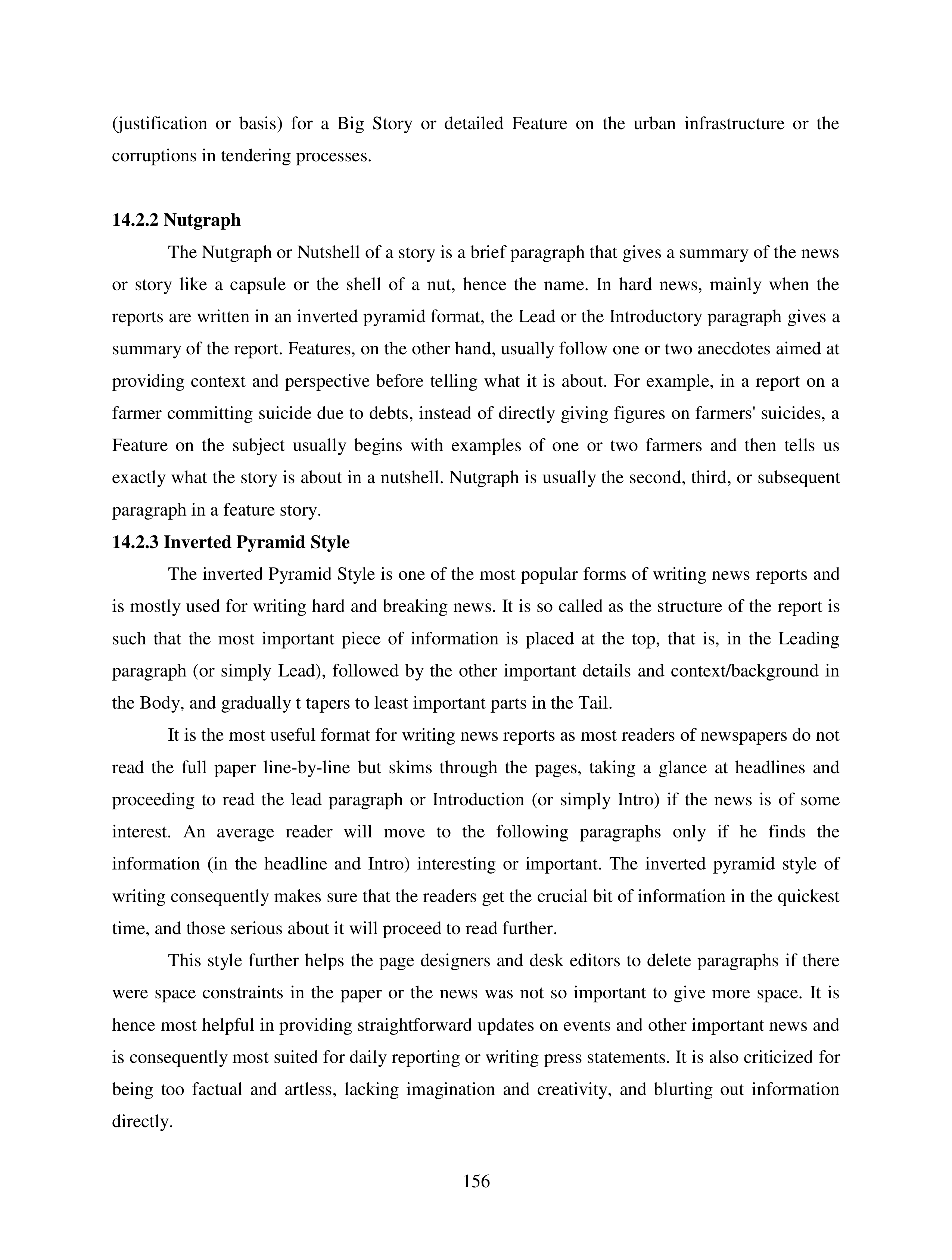
156
(justification or basis) for a Big Story or detailed Feature on the urban infrastructure or the
corruptions in tendering processes.
14.2.2 Nutgraph
The Nutgraph or Nutshell of a story is a brief paragraph that gives a summary of the news
or story like a capsule or the shell of a nut, hence the name. In hard news, mainly when the
reports are written in an inverted pyramid format, the Lead or the Introductory paragraph gives a
summary of the report. Features, on the other hand, usually follow one or two anecdotes aimed at
providing context and perspective before telling what it is about. For example, in a report on a
farmer committing suicide due to debts, instead of directly giving figures on farmers' suicides, a
Feature on the subject usually begins with examples of one or two farmers and then tells us
exactly what the story is about in a nutshell. Nutgraph is usually the second, third, or subsequent
paragraph in a feature story.
14.2.3 Inverted Pyramid Style
The inverted Pyramid Style is one of the most popular forms of writing news reports and
is mostly used for writing hard and breaking news. It is so called as the structure of the report is
such that the most important piece of information is placed at the top, that is, in the Leading
paragraph (or simply Lead), followed by the other important details and context/background in
the Body, and gradually t tapers to least important parts in the Tail.
It is the most useful format for writing news reports as most readers of newspapers do not
read the full paper line-by-line but skims through the pages, taking a glance at headlines and
proceeding to read the lead paragraph or Introduction (or simply Intro) if the news is of some
interest. An average reader will move to the following paragraphs only if he finds the
information (in the headline and Intro) interesting or important. The inverted pyramid style of
writing consequently makes sure that the readers get the crucial bit of information in the quickest
time, and those serious about it will proceed to read further.
This style further helps the page designers and desk editors to delete paragraphs if there
were space constraints in the paper or the news was not so important to give more space. It is
hence most helpful in providing straightforward updates on events and other important news and
is consequently most suited for daily reporting or writing press statements. It is also criticized for
being too factual and artless, lacking imagination and creativity, and blurting out information
directly.
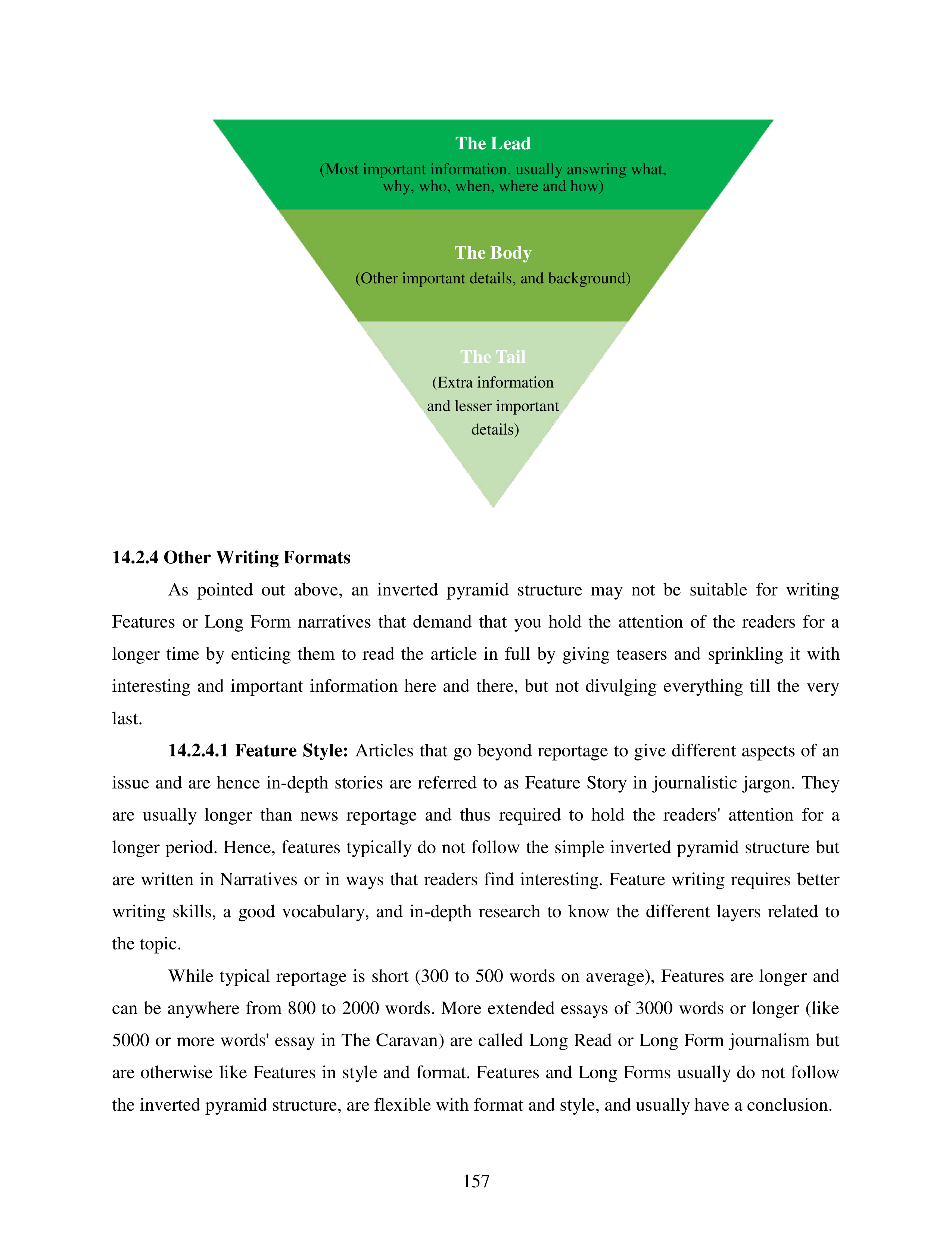



157
The Lead
(Most important information. usually answring what,
why, who, when, where and how)
The Body
(Other important details, and background)
The Tail
(Extra information
and lesser important
details)
14.2.4 Other Writing Formats
As pointed out above, an inverted pyramid structure may not be suitable for writing
Features or Long Form narratives that demand that you hold the attention of the readers for a
longer time by enticing them to read the article in full by giving teasers and sprinkling it with
interesting and important information here and there, but not divulging everything till the very
last.
14.2.4.1 Feature Style:
Articles that go beyond reportage to give different aspects of an
issue and are hence in-depth stories are referred to as Feature Story in journalistic jargon. They
are usually longer than news reportage and thus required to hold the readers' attention for a
longer period. Hence, features typically do not follow the simple inverted pyramid structure but
are written in Narratives or in ways that readers find interesting. Feature writing requires better
writing skills, a good vocabulary, and in-depth research to know the different layers related to
the topic.
While typical reportage is short (300 to 500 words on average), Features are longer and
can be anywhere from 800 to 2000 words. More extended essays of 3000 words or longer (like
5000 or more words' essay in The Caravan) are called Long Read or Long Form journalism but
are otherwise like Features in style and format. Features and Long Forms usually do not follow
the inverted pyramid structure, are flexible with format and style, and usually have a conclusion.
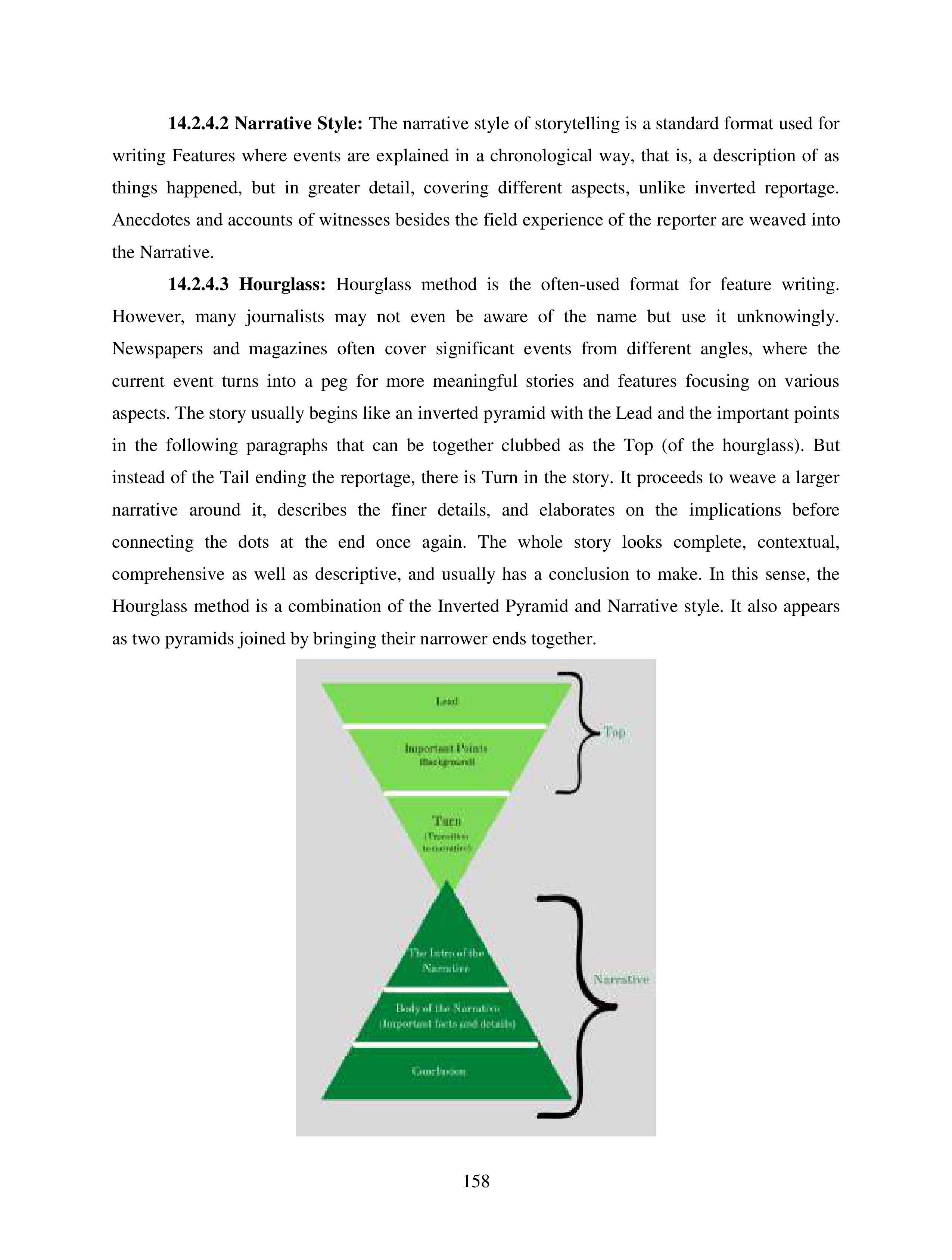
158
14.2.4.2 Narrative Style:
The narrative style of storytelling is a standard format used for
writing Features where events are explained in a chronological way, that is, a description of as
things happened, but in greater detail, covering different aspects, unlike inverted reportage.
Anecdotes and accounts of witnesses besides the field experience of the reporter are weaved into
the Narrative.
14.2.4.3 Hourglass:
Hourglass method is the often-used format for feature writing.
However, many journalists may not even be aware of the name but use it unknowingly.
Newspapers and magazines often cover significant events from different angles, where the
current event turns into a peg for more meaningful stories and features focusing on various
aspects. The story usually begins like an inverted pyramid with the Lead and the important points
in the following paragraphs that can be together clubbed as the Top (of the hourglass). But
instead of the Tail ending the reportage, there is Turn in the story. It proceeds to weave a larger
narrative around it, describes the finer details, and elaborates on the implications before
connecting the dots at the end once again. The whole story looks complete, contextual,
comprehensive as well as descriptive, and usually has a conclusion to make. In this sense, the
Hourglass method is a combination of the Inverted Pyramid and Narrative style. It also appears
as two pyramids joined by bringing their narrower ends together.
159
14.2.4.4 Diamond Structure:
The diamond structure usually begins with an anecdote
that acts as a ―hook‖ and
weaves in many details, like multiple pyramids are merged. However,
they all progressively taper to one endpoint, connecting different dots to the hook or the anecdote
with which the story had begun. This is also a commonly used format for writing brief Features
and OpEd pieces.
14.2.4.5 Christmas Tree:
Christmas tree style is another format of writing features,
particularly long forms, where the lead or Intro of the story lays down a base to a series of twists
and turns and is full of anecdotes, trivia, fine points, and details that are largely ignored by most
observers. The narrative built must be exciting and enticing to hold the attention of the readers
for a reasonably long time.
Long reads can sometimes run into 15-20 pages or more (like in
New Yorker
or
The
Caravan
), but even in standard weekly magazines, stories are sometimes up to 4-5 pages. They
cover different aspects in detail and weave a narrative while connecting them to the larger thread.
Hence not just the subject has to be very pertinent. However, the investigation/research behind it
must be very thorough, and finally, the writing style, the command over language, and
vocabulary have to be impeccable. Christmas tree format may resemble the Diamond structure to
an extent. But the latter is very condensed, while the former is spread like a Christmas tree and
covers every possible aspect in detail.
14.2.4.6 Section Technique:
Section technique resembles a lot of inverted pyramid style,
but instead of one inverted pyramid, there are a series of stories neatly written in different
sections, each usually just connected by a common theme or a thread. For example, on
Independence Day, a newspaper may have a full-page story on what independence means to
people, where experiences of a working woman, a farmer, a doctor, a student, a homemaker, a
corporate employee, a business tycoon, etc. are published. These stories have no direct link with
one another and are usually separated by asterisks or in separate boxes. Sometimes, a brief Intro
is written to explain the theme or thread following it. Unlike the Christmas tree format, each
section is clearly independent here with its own Intro or Lead, Body, and Kicker or ending.
14.2.4.7 List Technique:
The list technique begins with a summary lead, then gives a
brief background
–
till here it resembles an inverted pyramid only
–
but then it proceeds to give a
list of key points (bullet points), sometimes chronologically. This is a very handy method of
writing a background story, usually placed in a Box or giving a chorology of events. For
example, when the Supreme Court finally announced the verdict in the long-pending Babri
160
Mosque-Ram Temple title suit, most papers gave a timeline of the case highlighting the
important twists and turns chronologically for readers understanding.
14.2.4.8 Five Boxes:
The five boxes story usually have the following: (i) an enticing
Lead or ―hook‖ that may be an an
ecdote, an image or a description; (ii) nutgraph; (iii) a
paragraph that functions like a second Lead by introducing the remaining points; (iv) other
details and background information; and finally (v) Conclusion that has to be Kicker whether it
is a quotation, a comment, a summary of the events, or an image.
14.2.4.9 Interpretive Journalism:
As the name suggests, Interpretive Journalism
requires going beyond basic reportage to provide a breakup of what is happening, interpreting
the facts and data available on board. By dissecting information related to events, a journalist
tries to give context to the event as well as explain the possible implications. While sometimes,
there are allegations of being biased, Interpretive Journalism often helps reveal new facts,
unearth scams, and help general readers understand things in simple language. It is used to write
analytical pieces, Explainers, and OpEds.
14.2.4.10
Literary Journalism:
Literary journalism is the mid-way bridge between
literature and journalism. While literature is fiction purely based on imaginations or those
inspired by real-life events but still qualifies as fiction, journalism is said to be a reportage of
events. On the other hand, literary Journalism is based on facts. It qualifies as non-fiction, but the
language used is literary, filled with metaphor, figurative language, and vocabulary intended to
impress. Journalists working on literary-journalistic pieces must have impeccable language
skills, vocabulary, and creative imaginations to become good literary journalists. One must
remember, though, that literary journalism is journalism nonetheless and hence requires all the
skills and features for a good reportage. It must be based on solid research, thorough interviews,
and investigations and is fact-driven.
14.2.5 Writing Headline and Lead
14.2.5.1 Headlines:
The first thing a reader looks at in a newspaper story is the title of
each report or story, called the headline. How interesting and informative the headline is, alone
decides whether the reader will proceed to read the information further or move to another
headline. The story's headline is the most important part of a news report. It is usually a phrase,
not a complete sentence, though sometimes quotations are also used as headlines. It is generally
written in bold and bigger font size to make it distinct and grab attention. It may occasionally run
161
into three or more columns. Often the headlines are also aimed at giving an angle to the report
based on the position of the media/editor.
In the age of online media, where news portals' revenue depends on the number of hits it
gets on their pages, headlines are aimed at enticing readers/browsers to click on them. Instead of
revealing too much, it is aimed at creating excitement and consequently acts as bait to induce
them to click on them to check the news. Such eye-catching headlines are termed "clickbait."
Based on what it encompasses, headlines can be of a variety of types: Label headline,
Descriptive headline, Quotation headline, Comment headline, and Question headline.
Headlines are sometimes supplanted by a 1-2 lines Subheading to give a glimpse of the
story and supplement the headline. While headlines are usually a phrase and not complete
sentences, subheading is often complete sentence.
14.2.5.1.1
Dos and Do Nots for writing a good headline:
Good headlines are eye-catching but do not get overboard in creating sensation or get
repetitive.
Remember your intended readers, for example, if they are serious and educated readers or
common masses. This will explain why headlines in The Times of India are much
simpler and why they are intriguing and exciting in The Indian Express. In The Hindu, it
is often straightforward and factual.
Headlines are mainly in the present tense and avoid auxiliary verbs.
Jargons should be avoided, although popular acronyms can be used.
Numerals should be used instead of words.
14.2.5.2 Lead:
The opening paragraph of a story or news report is called the Lead in journalistic
language. Journalists and editors also refer to it as Intro (short for Introduction). The Intro or
Lead of a news report is considered the second most important part of an article, after the
headline, as a good lead determines whether the reader will further read the piece or be turned
off. In inverted pyramid style reportage, the Lead gives the breaking news in a few lines, usually
answering the 5 Ws (what, when, where, why, who) and 1 H (how) questions.
14.2.5.2.1 Based on the structure or contents, the Intro or Lead can be classified as
follows:
162
Summary/Digest/Capsule Lead
–
Gives a summary of the news report, best suited for
inverted pyramid-style news. As the story's main points are given in a crisp paragraph, it
is also referred to as Digest or Capsule Lead.
Punch/Caption Lead
–
When a lead is so written, it has a high impact on the reader and
makes the reader think about the subject. Caption lead becomes handy when the report is
hard-hitting or aims to create sensation or excitement.
Circumstance Lead
–
Circumstances surrounding the story are described instead of
directly giving news. It is handy in writing narrative and features.
Descriptive Lead-
When the Intro is descriptive or explanatory, it is called a Descriptive
Lead.
Astonisher Lead
–
When the Intro is written in such a way that in a few lines (not
exceeding 30 words or so), it captures the attention of the reader by telling something
unexpected, it is called Astonisher Lead.
Historical Lead
–
When references to some historical events are drawn.
Literary (allusion) Lead
–
when references to some literary texts are drawn in the Intro
of a story/
Quotation Lead
–
Begins with a quotation by a person related to the story that either is a
critical take on the subject, sets the story's tone, or gives a perspective to the event.
Although it has become cliché, sometimes quotations from famous personalities in
history, like a couplet of Mirza Ghalib or lines from the plays Shakespeare, are also used
if it helps tell the story better (especially if it is a narrative or literary piece). Quotations
can be either Direct or Indirect.
Question Lead
–
When the Intro begins with one or a handful of questions, set the tone
of the story.
Staccato Lead
–
When short sentences, phrases, clipped words/dialogues are used in an
Intro of a story, separated by punctuations (commas, dashes, or marks of exclamations) to
set the mood of the story, they are called Staccato Lead. This kind of lead is not very
common but is sometimes used in features, long forms, narrative or literary pieces for an
impact.
Contrast Lead
–
When two things, persons, or events are compared at the beginning of
the story to create a contrast, it is called Contrast Lead. The two events or figures can be
contemporary, or someone/something from present times can be compared with
163
historical/mythical events/persons. For example, when a politician makes a hasty decision
that impacts millions without considering the impact on people, he is compared to
Muhammad Tughlaq, or a xenophobic leader is often compared to Hitler.
You Lead
–
When the writer addresses the reader directly in the Lead, it is called You
Lead.
14.2.6 Tips for Writing Good Newspaper Reports/Articles
Make sure that the article is newsworthy; that is, it is relevant and adds to the debate on
the subject. More significantly, the readers find it Interesting.
The headline should be captivating. Write a working headline at the start, but revisit it
after you have finished writing the whole report, and make sure it best describes your
story; else, revise/rewrite it.
For a story/report to be good, keep the focus on one idea, and be clear about what you
intend to say. If you are unclear about the subject/story, you will not be able to write a
good story.
After the headline, devote some time to writing the Intro or Lead. Decide carefully what
kinds of leads would best suit your story.
If you are writing a Feature, the Nutgraph would be as critical; hence devote some time to
writing a crisp and comprehensive paragraph that gives the main story.
Articles should be exciting and of human interest.
Newspapers are mostly read by common readers who may not be knowledgeable or
experts. Hence use simple language and avoid jargon as much as possible (if used,
explain it in the following sentence) unless you work for a magazine that caters to certain
kinds of readers. Keeping in mind the demography of readers is hence crucial.
Write short, simple, and crisp sentences as much as possible; and small paragraphs.
Each report should answer the 5 Ws and 1 H; otherwise, it will be considered incomplete.
As much as possible, use Active Voice in sentences.
Self-edit your copies before sending them to the editor. Read the article carefully to make
it concise and engaging; check if some paragraphs would make better sense if placed
elsewhere.
164
Check for typos and grammatical mistakes. There are many online software to check your
basic grammar and punctuation; take help from those (check Grammarly.com if you have
not yet).
Cross-check all data and vital information provided in the story, and be sure about the
sources of the data (Are they reliable enough lest you are held responsible for forgery and
manipulation?)
Use quotes liberally in news reports instead of writing what may be labeled as biased
opinions/interpretations. But cross-check if the person is saying it is true (the information
provided is critical). Quotations need to be attributed appropriately as well.
14.2.7 Let Us Sum Up
News is an update on new events and occurrences or new developments to an event, and
above all, it is of human interest. But one should remember that information and sources that are
too forthcoming are often aimed at publicity. Journalists should hence have a nose for news and
have clarity on the subject before proceeding to write. In this age of over-flow of information, it
has become even more imperative to conduct thorough research and investigation due to the
abundance of fake news and disinformation. Based on the type of news, it can be hard or soft
news. Hard and breaking news is often written using the inverted pyramid structure. In contrast,
soft news features various other techniques, including hourglass, diamond structure, Christmas
tree structure, Section style, etc., used. These are written in narrative style or sometimes using
literary or figurative language.
The headline is one of the most important parts of a news report as it determines whether
the reader will further read the story. Headlines need to be creative and attractive to grab the
reader's attention (what we call in internet lingo as click-bait). Sometimes subheading is used to
supplement the headline. After the headline, the Introductory paragraph
–
called Lead or Intro -
is most crucial as it gives a glimpse of the article. Based on the content and type, leads can be
categorized as Digest/Summary Lead, Astonisher Lead, Contrast Lead, Quotation Lead, Staccato
Lead, Punch Lead, Question Lead, Historical Lead, You Lead, Circumstance Lead, etc.
Some of the essential and handy tips for writing a good newspaper article include keeping
a focus on one idea or theme, having clarity on the subject, avoiding jargon, using simple
sentences, taking the help of software to check grammar, and self-editing, and cross-checking
data and facts. Further, avoid your biases from creeping in, and attribute quotes appropriately.
165
14.3 Learning Outcomes
At the end of this Unit, you should have become well-versed with the different formats of
writing for newspapers.
14.4 Keywords
Newspaper, Reporting, Hard News, Soft News, Feature, Lead, Tips for writing
14.5 Sample Questions
Objective Questions
1. Which of the following is not true?
a)
News is often what somebody is trying to hide.
b)
Information that comes easily is often meant for publicity.
c)
Human interest stories always find readers.
d)
A good journalist should have a nose for news.
2.
The phrase ‗Nose for News‘ implies:
a)
A journalist who pokes his nose in every matter without proper understanding.
b)
A journalist misses the important subject as he is busy chasing trivial issues.
c)
An instant understanding of the newsworthiness of a thing or event.
d)
Reports about the nose in particular and health issues in general
3. Hard news is so called as:
a)
They cover difficult and scientific subjects.
b)
The language of the report is so complicated that it is difficult to understand.
c)
It is news about important and breaking events.
d)
Reports are very long, sometimes above 2000 words or more.
4. Timeliness of a news report refers to:
a)
An event that happened sometime in the past, like a month or a year ago.
b)
A historical event that is, something that happened a few centuries ago.
c)
The immediacy of the event, that something that has just happened.
166
d)
Something that has not happened yet, but may happen soon.
5. Nutgraph refers to:
a)
The concluding paragraph of the news report.
b)
Use of Infographics in a news report.
c)
The news peg of that becomes the basis for in-depth stories.
d)
A concise paragraph that gives the focus of the news story.
6. In the Inverted Pyramid structure, the most important parts of the story comes at:
a)
In the Lead
b)
Main Body
c)
Tail
d)
Subhead
7. Which of the following is not a type of Lead?
a)
Astonisher
b)
Diamond
c)
Digest
d)
Caption
8. Which of the following is not a format of news-story writing?
a)
Hourglass
b)
Five Boxes
c)
Christmas Tree
d)
Staccato
9.
Clickbait is a kind of……………. That allures readers to click on links.
a)
Feature
b)
Soft Story
c)
Headline
d)
Lead
10.
Attributing Quotes correctly is considered …………….in journalism.
a)
Ethical practice
b)
Harming sources
c)
Unethical
d)
Passing the buck
167
Short Answer Questions
1.
Distinguish between hard news and soft news.
2.
What do you understand from Narrative Journalism?
3.
What do you understand from the Hourglass format of writing?
4.
List down some of the points we should remember when writing a headline.
5.
Write a short note on the Inverted Pyramid Style.
Long Answer Questions
1.
What is the importance of a Lead? Briefly describe different kinds of leads used in news
report writing.
2.
What points one needs to keep in mind to become a good news writer?
3.
Briefly elaborate on some of the formats used in writing features.
Activity
1)
Take any newspaper and try to identify hard and soft news. Further, see if you can
identify the kinds of Leads that have been used.
2)
Have you ever written any news reports? Try to write a reportage using the Inverted
Pyramid style; and a feature on someone in your neighbourhood doing interesting or
noble work.
14.6 Suggested Learning Resources
Carole Rich (2010).
Writing and Reporting News: A Coaching Method,
Wadsworth.
David Winterson (2010).
Reporting and Editing Process,
Centrum Press.
K. M. Shrivastava (1987).
News Reporting and Editing,
Sterling Publishers.
Virbala Aggarwal (2012).
Handbook of Journalism and Mass Communication
, Concept.
168
Unit - 15: Reports and Editorials
Structure
15.0
Introduction
15.1
Objectives
15.2
Reports and Editorials
15.2.1
News Reports
15.2.2
Beat Reporting
15.2.3
Data Journalism
15.2.4
Feature
15.2.5
Opinion Columns or Commentaries
15.2.6
Review writing
15.2.7
Interviews
15.2.8
Obituaries
15.2.9
Letters to the Editor
15.2.10
Let Us Sum Up
15.3
Learning Outcomes
15.4
Keywords
15.5
Sample Questions
15.6
Suggested Learning Resources
15.0 Introduction
In the last Unit, you learned about different formats we may use for writing news reports.
We also briefly learned about hard and soft news and features. In this Unit, you will learn about
different types of newspaper writing. The newspapers give us daily and new updates on
important events. They also publish commentaries and editorials, in-depth articles, and features
to provide readers with a better understanding of important events and occurrences. Moreover,
they also publish interviews with famous personalities, politicians, government ministers, etc.
Accordingly, articles published in newspapers can be categorised as: News Reports (hard news
or soft news), Features, Editorials, OpEds (Perspective/Commentary/Opinion Articles), and
Analytical Pieces, Reviews (Film reviews, book reviews, etc.), Interviews, Letter to Editor and
Obituaries. Data Journalism has become another popular segment cutting across different beats
in the last decade.
169
15.1 Objectives
The objectives of this Unit are to understand:
the different types of newspaper writing
news reports and beat reporting
features, editorials, OpEds, and analytical pieces
the characteristics of editorial writing
how to write good analytical and perspective pieces
opinion columns in the age of the internet
book and film reviews
letter to the editor and obituaries
15.2 Reports and Editorials
Different kinds of articles are published in the newspapers. Let us look at each one of
these articles:
15.2.1 News Reports
–
Quick updates on new events, incidents, or new development,
often presented in the inverted pyramid style, where the most important bit of information is at
the top. As discussed in the earlier unit, this news can be hard news or soft news. A piece of
breaking news, new political development, an accident or disaster, crime-related news, or
business or international affairs are usually dubbed as 'Hard News.' News related to lifestyle,
entertainment, celebrity, or something which does not require immediacy is termed 'Soft News'.
15.2.2 Beat Reporting
–
Like every other field, journalism too requires specialisation. A
reporter covering crime needs to have knowledge of penal codes and criminal procedure, or
similarly, to report on international relations, one needs to understand international politics and
diplomacy, and so on. It should be mentioned here that one need not be a lawyer to report on
crime, or a doctor to report on health, or have master‘s in international relations to become a
diplomatic journalist. But one should have at least a basic understanding of the field. These
journalistic specialisations or genres are called ―Beat‖ in journalistic jargon. Thus crime, politics,
business, health, sports, environment, foreign affairs, and diplomacy, investigation, education,
170
government, aviation, infrastructure, districts, rural, entertainment, fashion, etc. While crime,
sports, politics, business, and entertainment have always been popular and important beats, in
recent years, environment and health have emerged as critical beats too. During the corona
pandemic, practically every reporter was doing stories related to it. Still, the demand for health-
beat reporters increased manifold as they would understand the nuances of health guidelines
issued, the challenges the administration faced, and the health-related repercussions of the
disease due to their long years of experience.
15.2.2.1 Investigative Reporting
–
Any type of reporting requires some degree of
research and investigation. But most leading newspapers also have a dedicated team of
investigative journalists, who work on special stories once they get a clue of some wrongdoing,
corruption or scam from ―sources‖ or whistle
-blowers for weeks and months, sometimes over a
year or so, to get a ―scoop‖ or exc
lusive investigative story. Journalists working on investigative
stories must be sharp and the best in their field. While investigative reports are time-consuming
and sometimes reach a dead end, getting a scoop is considered a career highlight for any
journalist. You get recognition and may receive awards, but it can sometimes get risky. There
have been many instances when journalists have been arrested or even murdered because of their
stories.
15.2.2.2 Entertainment Journalism
–
Entertainment journalism, sometimes called Page
3, includes all aspects of entertainment, popular culture, lifestyle, gossip about celebrities'
personal lives, etc. It is sometimes referred to as "Page 3" journalism as traditional news related
to popular culture and entertainment came on page 3 of newspapers.
15.2.2.3 Business Journalism
–
Business is considered one of the most important beat in
any newspaper. Journalists working on the business beat track developments related to
businesses and finances and the overall economy of the country. While there are newspapers,
sometimes called ―Pink Papers,‖ that focus on business news, like
The Economic Times, The
Business Standard, The Hindu Business Line,
etc.; other newspapers like
Times of India, The
Indian Express, Deccan Chronicle
, etc. have few dedicated pages daily for news related to
businesses, stock market, and other economic related affairs.
15.2.2.4 Crime Reporting
–
Crime is considered one of the most popular beats in any
newspaper. Traditionally when a ―Cub Reporter‖ joins
the newspaper afresh, she/he would be
asked to work for sometimes on the crime beat as this beat finds itself at the intersection of
society, politics, and businesses. Young reporters learn the tricks of the game here as you get to
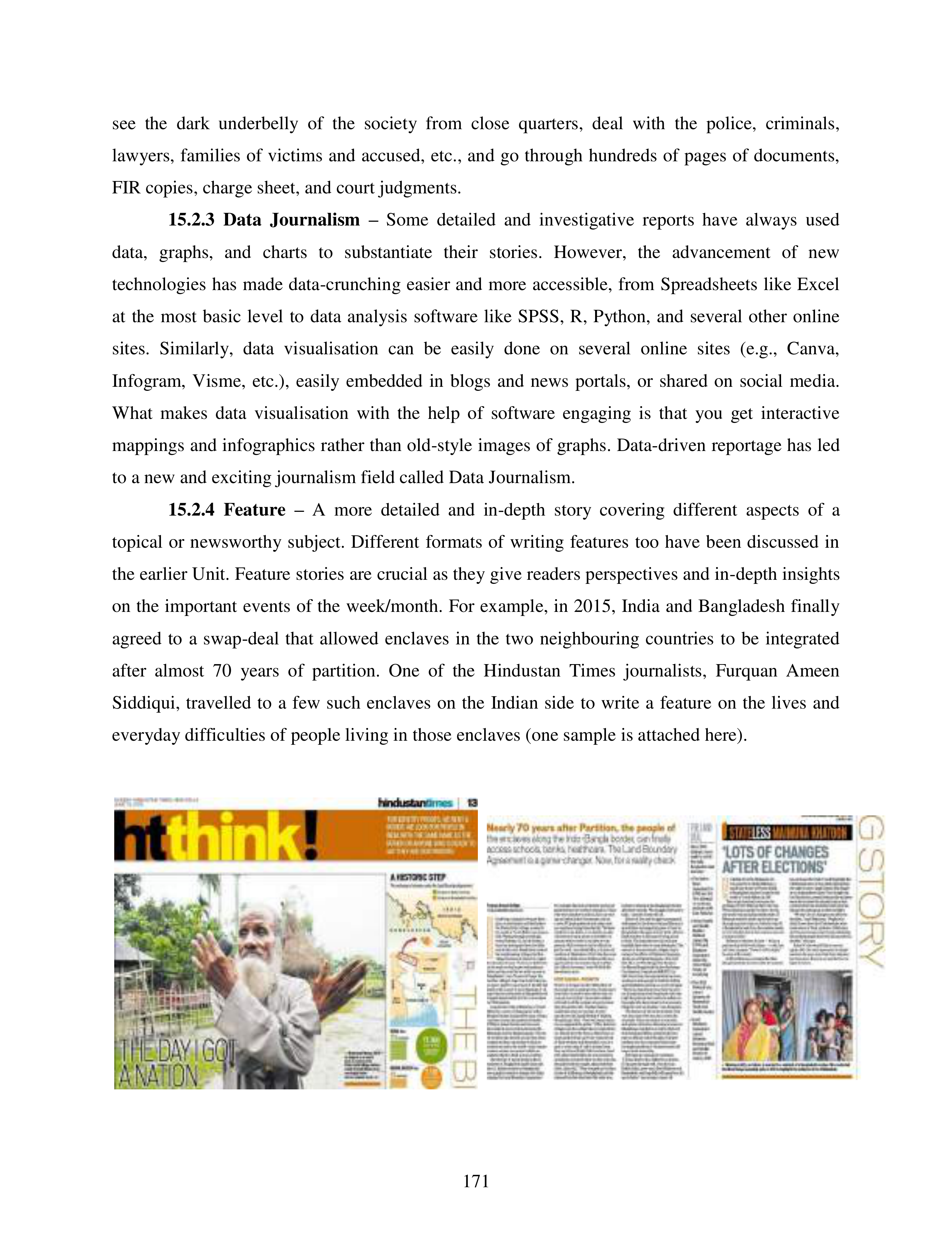


171
see the dark underbelly of the society from close quarters, deal with the police, criminals,
lawyers, families of victims and accused, etc., and go through hundreds of pages of documents,
FIR copies, charge sheet, and court judgments.
15.2.3 Data Journalism
–
Some detailed and investigative reports have always used
data, graphs, and charts to substantiate their stories. However, the advancement of new
technologies has made data-crunching easier and more accessible, from Spreadsheets like Excel
at the most basic level to data analysis software like SPSS, R, Python, and several other online
sites. Similarly, data visualisation can be easily done on several online sites (e.g., Canva,
Infogram, Visme, etc.), easily embedded in blogs and news portals, or shared on social media.
What makes data visualisation with the help of software engaging is that you get interactive
mappings and infographics rather than old-style images of graphs. Data-driven reportage has led
to a new and exciting journalism field called Data Journalism.
15.2.4 Feature
–
A more detailed and in-depth story covering different aspects of a
topical or newsworthy subject. Different formats of writing features too have been discussed in
the earlier Unit. Feature stories are crucial as they give readers perspectives and in-depth insights
on the important events of the week/month. For example, in 2015, India and Bangladesh finally
agreed to a swap-deal that allowed enclaves in the two neighbouring countries to be integrated
after almost 70 years of partition. One of the Hindustan Times journalists, Furquan Ameen
Siddiqui, travelled to a few such enclaves on the Indian side to write a feature on the lives and
everyday difficulties of people living in those enclaves (one sample is attached here).
172
15.2.5 Opinion Columns or Commentaries
–
News reports are based on actual events,
statements, and facts and are supposed to be objective and free from the reporter or editor's
biases. Opinion columns or articles, in contrast, are analysis of news reports based on available
data, documents, and events and usually has a tilt based on the ideology or point of view of the
reporter, Editor, or newspaper. Opinion pieces or Commentary are broadly of two kinds
–
Editorial and OpEd (Opposite the Editorial). Most newspapers usually have two middle pages
assigned for Opinion columns
–
the left page is called the editorial, and the right page is OpEd.
Opinion pieces that broadly express the Editor's point of view and the newspaper/media are
called Editorials.
The Left-most column(s) on the Editorial pages are usually without a byline (name of the
author) as it is considered as the viewpoint of the newspaper, while some other columns are
written by experts and columnists that broadly agree with the standpoint of the newspaper on the
subject. Articles on the OpEd pages are usually opinions, and analytical pieces that appear on the
―Opposite the Editorial‖ page figuratively too, are viewpoints that are not in agreement with the
paper but are still encouraged for nuanced debate and discussion on the subject. Based on the
nature and purpose of Opinion columns, they can have one of the following objectives: Interpret
or Explain the situation/event, persuade, criticise, appreciate, or indulge in campaign and
advocacy.
Reviews of films, books, or match analyses are opinion pieces too, but often they have
other assigned pages in a newspaper. Usually, they do not appear in the opinion columns,
although sometimes they may if the issue is very relevant, for example, when the match-fixing
scandal came up or on the retirement of Sachin Tendulkar, many papers published columns in
Opinion pages.
In terms of format and analysis, all opinion and analytical articles and commentaries are
the same, although there is no one-fixed format for writing them. Nevertheless, Opinion columns
too will have an Introduction or Lead, the main Body (usually divided into a few paragraphs),
and a definitive conclusion. However, they differ from one another based on the standpoint of
the newspaper. For example, a column critiquing the economic policy of the BJP government by
a professor with left-leaning may appear on the OpEd page of
The Indian Express
or
The
Pioneer
, but a similar article may be published in the Editorial section of
The Hindu
or
The Wire
.
It should also be noted here that even though similar categories are present in online media, those
divisions are often blurred, and articles are seen as "Opinion" columns. Blogs (discussed in detail
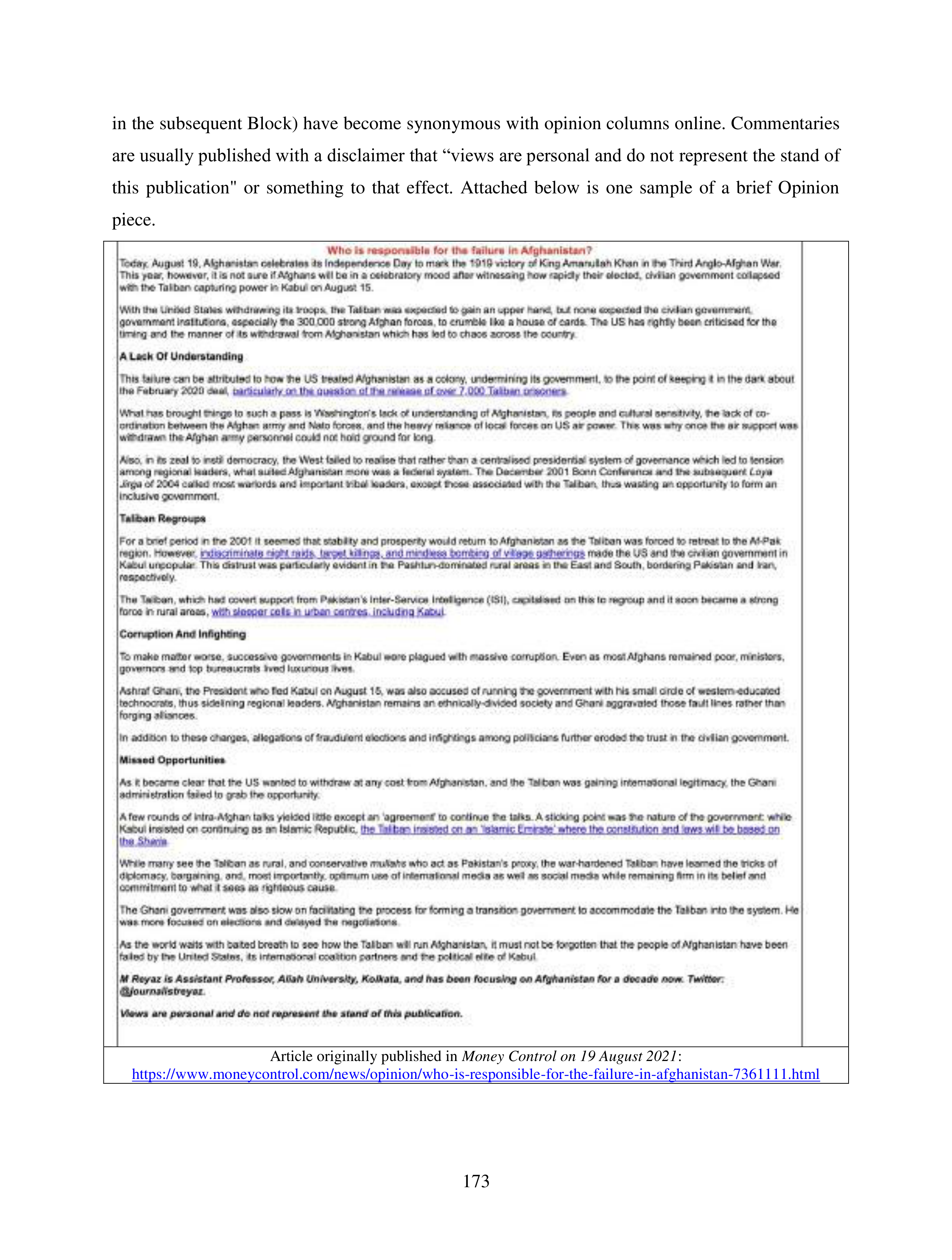
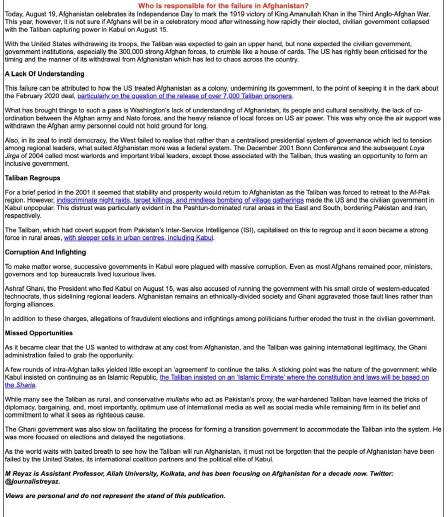
173
in the subsequent Block) have become synonymous with opinion columns online. Commentaries
are usually published with a disclaimer that ―views are personal and do not repre
sent the stand of
this publication" or something to that effect. Attached below is one sample of a brief Opinion
piece.
Article originally published in
Money Control on 19 August 2021
:
https://www.moneycontrol.com/news/opinion/who-is-responsible-for-the-failure-in-afghanistan-7361111.html
174
15.2.5.1 Characteristics of Editorial Writing
A good opinion column will be readable and comprehensive. Even though experts write
opinion columns, they are meant to explain, in brief, the subject to the general reader
(unless it is published in some academic journal) and more importantly, convince them of
the viewpoint of the writer.
While the writer has the freedom to argue in favour of his/her standpoint, those must be
factual and written lucidly to be convincing.
While analytical, Editorials and other opinion columns can be critical of the policies or
standpoints of the government, minister, or any community leader as long as a valid
argument is presented against them.
It should also be remembered that critical columns are necessary for the government for
course corrections on policy matters. However, the objective of being critical is to
encourage discussions on the subject. Hence, the criticism should be constructive and
factual because of ideological differences.
Opinion columns usually have a recent news/event as its peg; that is, they are an
explanation or analysis of recent news and hence have a very short shelf-life.
A good editorial or opinion piece will focus on issues rather than personalities and will
avoid name-calling, besides being factual and supported by data.
Good editorials engage issues, not personalities, and refrain from name-calling or other
petty persuasion tactics.
15.2.5.2 Points to Keep in Mind When Writing an Opinion Piece
Choose a newsworthy (something that has been in the news in the last few days) and an
exciting topic.
Also, keep the deadline in mind, as once the news cycle ends and a new, more
newsworthy event occurs, newspapers or online portals may not be too keen to publish
analysis on the stale topic.
Do background research and collect information.
If required, talk to relevant people, although it is not essential for writing Opinion pieces
like news reports.
Write your opinion in a clear, lucid style. It should be crisp and convincing.
If you are countering an Opinion, state it briefly and clearly before refuting it.
175
The refutation should be convincing and factual.
If the article or position you are otherwise refuting has some positive takeaways,
acknowledge that as well, lest you appear blinkered by your ideology.
Reiterate the key phrases and points in the article, so it is registered in the reader's mind
and reinforced.
If your Opinion piece discusses some problem, do not just criticise it; offer practical,
doable solutions too.
The concluding paragraph should have a solid punch to leave an impact and should
connect with the Intro.
Opinion pieces should ideally be not very long. Newspapers‘ columns usually have fixed
word limits (500, 600, 800). Editorials are usually 500 words. Online articles can be
longer, but they should not be made so just for the heck of it unless the article or topic
demands it.
15.2.5.3 Editorials in the Age of the Internet
–
In the age of cyber media, the style and
format of writing commentaries and opinion columns have changed too. To begin with, most
newspapers had daily two page fixed for commentaries (Editorial and OpEds), and thus only a
select number of opinions and articles could be published. Editors had the difficult job selecting
them and were often accused of biases and favouritism. The space-limitation has become
redundant with the coming of online-news portals and the online versions of traditional papers. If
they so wish, editors can publish as many articles daily as they wish, and articles can also be
slightly longer if required. OpEds have become synonymous with Blogs, although both are not
exactly the same.
Moreover, it has been found that articles with clear standpoints, if argued well, and those
that make some controversial or sensational remarks tend to get more hits online as they are
shared within particular echo chambers or social circles subscribing to a particular ideology and
belief. Online editors hence prefer shorter articles that make substantial and convincing
arguments and have some lines that attract the readers' attention, and they share them on social
media. They often put clickbait headlines.
15.2.6 Review writing
–
Most newspapers and magazines have allocated spaces for film
and book reviews on certain days of the week. Film reviews usually come on Fridays, while
Book reviews come on Sundays. While reviews are also a kind of opinion and analytical piece,
they require specialised skills and subject expertise. For example, if a new book on the political
176
developments in Telangana is published, usually it will be reviewed by an author, professor,
expert, or senior journalist who has followed Telangana politics for many years and has written
extensively on it (articles or books). Similarly, weekly film reviews are written by film
reviewers, occasionally by professors and researchers working on the areas of cinema or mass
communication or on topics covered in that film. For example, a medieval historian may write an
analytical piece on the depiction of Alauddin Khalji in
Padmawat
or Akbar in
Jodha Akbar
.
A sample of a book review, originally published in
The Open Magazine
in
August 2018: https://openthemagazine.com/lounge/books/lets-talk/
15.2.7 Interviews
–
Newspapers sometimes publish interviews of newsmakers to get
their point of view on the news, or sometimes interviews of famous personalities are also done
on their works, achievements, and life in general. Interview-based reports can be published in
two ways
–
in Q&A format or written in the form of a story/article with quotes used at places.
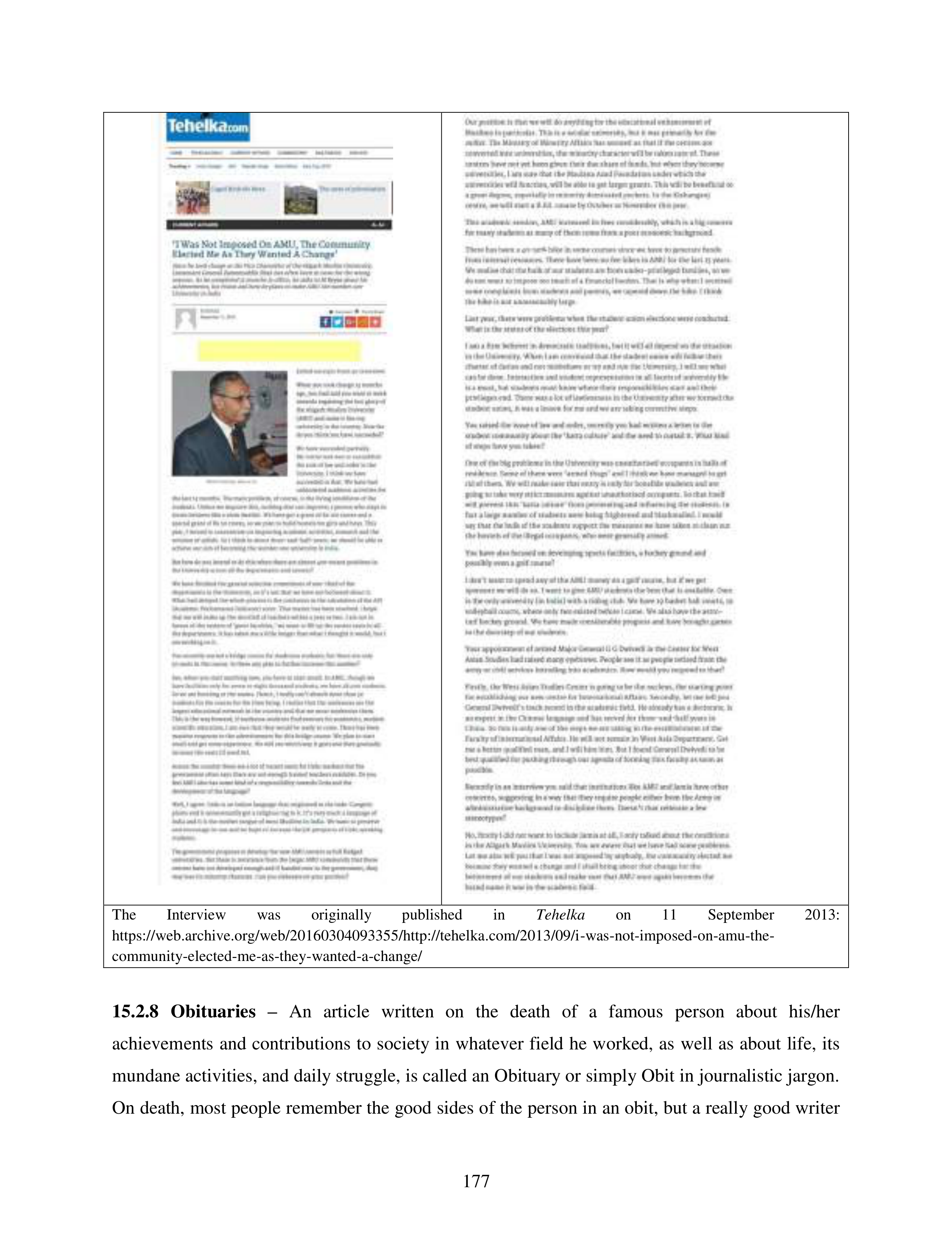
177
The
Interview
was
originally
published
in
Tehelka
on
11
September
2013:
https://web.archive.org/web/20160304093355/http://tehelka.com/2013/09/i-was-not-imposed-on-amu-the-
community-elected-me-as-they-wanted-a-change/
15.2.8 Obituaries
–
An article written on the death of a famous person about his/her
achievements and contributions to society in whatever field he worked, as well as about life, its
mundane activities, and daily struggle, is called an Obituary or simply Obit in journalistic jargon.
On death, most people remember the good sides of the person in an obit, but a really good writer
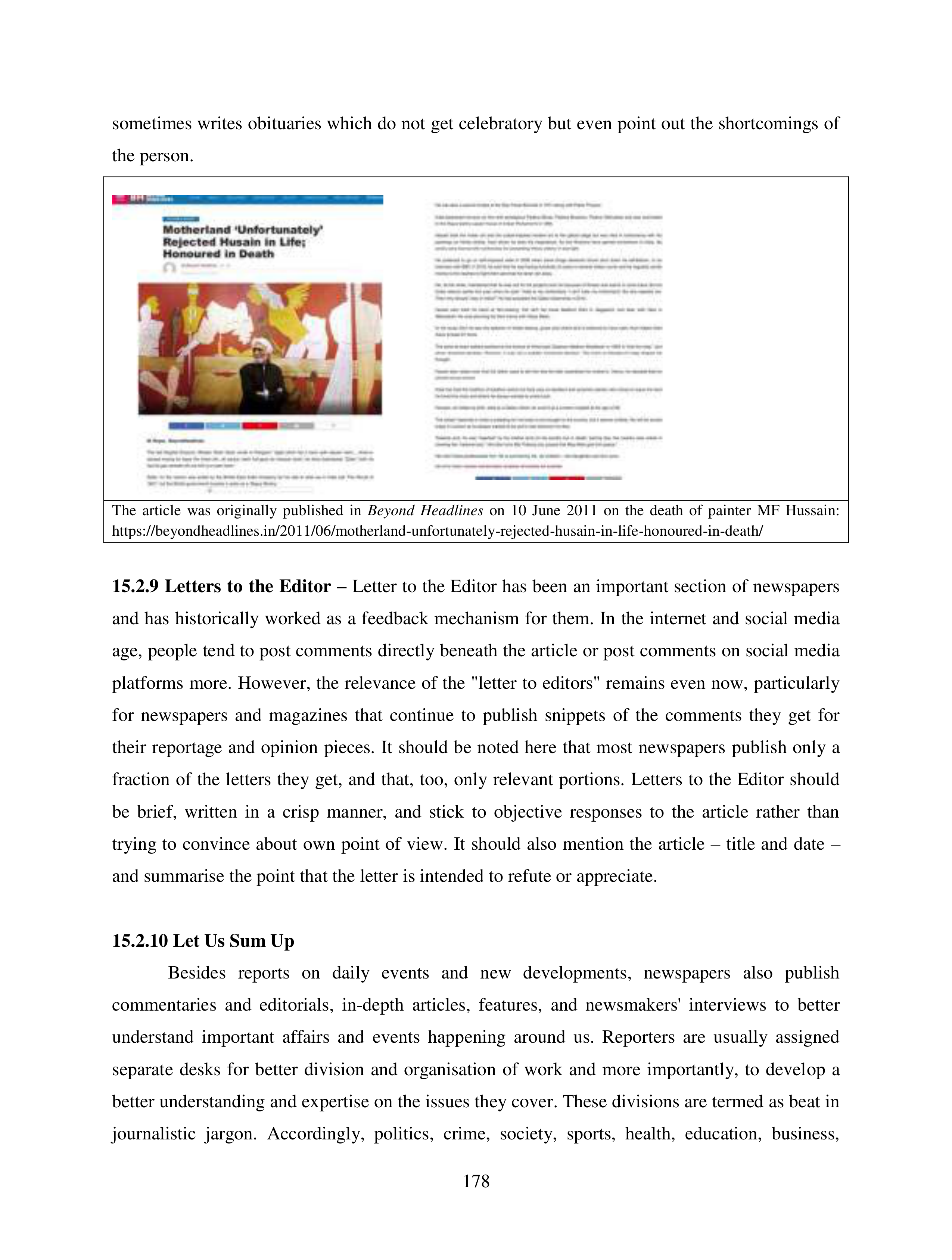

178
sometimes writes obituaries which do not get celebratory but even point out the shortcomings of
the person.
The article was originally published in
Beyond Headlines
on 10 June 2011 on the death of painter MF Hussain:
https://beyondheadlines.in/2011/06/motherland-unfortunately-rejected-husain-in-life-honoured-in-death/
15.2.9 Letters to the Editor
–
Letter to the Editor has been an important section of newspapers
and has historically worked as a feedback mechanism for them. In the internet and social media
age, people tend to post comments directly beneath the article or post comments on social media
platforms more. However, the relevance of the "letter to editors" remains even now, particularly
for newspapers and magazines that continue to publish snippets of the comments they get for
their reportage and opinion pieces. It should be noted here that most newspapers publish only a
fraction of the letters they get, and that, too, only relevant portions. Letters to the Editor should
be brief, written in a crisp manner, and stick to objective responses to the article rather than
trying to convince about own point of view. It should also mention the article
–
title and date
–
and summarise the point that the letter is intended to refute or appreciate.
15.2.10 Let Us Sum Up
Besides reports on daily events and new developments, newspapers also publish
commentaries and editorials, in-depth articles, features, and newsmakers' interviews to better
understand important affairs and events happening around us. Reporters are usually assigned
separate desks for better division and organisation of work and more importantly, to develop a
better understanding and expertise on the issues they cover. These divisions are termed as beat in
journalistic jargon. Accordingly, politics, crime, society, sports, health, education, business,
179
entertainment, lifestyle, etc., are different beats. Features provide detailed reportage from
different perspectives, while commentaries and editorials help us analyze them. Writing
perspective pieces or opinion columns requires expertise on the subject matter, a better grasp of
situations, and, more significantly, sharp analytical skills to see beyond the obvious. Book and
film reviews are also sorts of analytical articles, but usually, they are published separately from
the two opinion pages
–
Editorial and OpEd. Obituaries, letters to the editors, and classifieds
(paid spaces/ads) are other categories found in newspapers.
15.3 Learning Outcomes
At the end of this Unit, you should have learned about reports and editorials.
15.4 Keywords
Beat reporting, Editorial, Feature, Book Review, Commentary, OpEd, Data journalism, crime
reporting, business journalism
15.5 Sample Questions
Objective Questions
1. Which one of the following is paid by contributors in newspapers?
a)
OpEd
b)
Classified
c)
Feature
d)
Soft news
2.
What does ‗Scoop‘ mean in journalism?
a)
Special kind of spoon used for taking out and measuring ice cream
b)
Soft news
c)
Exclusive news
d)
Content marketing software
3. What does Page 3 stand for?
180
a)
Entertainment and lifestyle journalism
b)
Special investigation
c)
News related to corporate
d)
Anchor stories
4.
What does ―Pink Paper‖ mean?
a)
Magazines that focus on fashion, celebrities, and entertainment
b)
Newspapers are called Pink Papers
c)
Business newspapers are called Pink papers
d)
None of the above
5.
What does ―Cub Reporter‖ mean?
a)
Reporters covering wild-life
b)
Young and inexperienced journalist
c)
Reporters covering the crime beat
d)
None of the above
6. Why do opinionated articles tend to get more hits online?
a)
Experts and intellectuals read commentaries.
b)
Famous columnists share their articles on social media.
c)
People like and share articles that subscribe to their viewpoints.
d)
People like controversies.
7. Which of the following is not Pink Paper?
a)
Financial Times.
b)
Wall Street Journal
c)
Washington Post.
d)
The Economic Times
8. What does Obit stand for?
a)
Obituaries
b)
Orbit, implying office circle
c)
Yellow Journalism
d)
News flash on the margin of the front page
9. Pick the odd one out.
a)
Commentaries
b)
Feature
181
c)
Data Journalism
d)
Scoop
10. Why does the editorial have no byline?
a)
Writers want to remain anonymous, fearing the government's crackdown.
b)
Columns are published without a byline.
c)
The viewpoint of the newspaper.
d)
That is not correct; names are mentioned at the end.
Short Answer Questions
1.
What do you understand from beat reporting?
2.
What is Data Journalism?
3.
Write a short note on crime reporting.
4.
How has cyber media influenced OpEds?
5.
Write a short note on Boo Review writing.
Long Answer Questions
1.
What is the difference between Editorial and OpEd? Elaborate on some of the features of
opinion pieces suggesting ways to write good columns.
2.
Elaborate on how commentaries are different from news reports.
3.
Film reviews are different from Page3 reporting. Explain.
Activity
1)
Have you ever written letters to the Editor? Try sending a few brief and concise letters to
editors. Who knows, they may publish your letter.
2)
Take any national daily and try to mark reports under different beats. See how many
beats you can count in a paper.
3)
Quickly go through the Data Journalism handbook (name and URL provided in the
Reading List) and see if you can visualise infographics from any raw data.
4)
Try writing an analytical column on any pertinent issue and send it to some online media
for publication.
182
15.6 Suggested Learning Resources
Carole Rich (2010).
Writing and Reporting News: A Coaching Method,
Wadsworth.
C. Gillan and H. Evans (2010).
Essential English for journalists, editors, and writers
. Random
House.
K. M. Shrivastava (1987).
News Reporting and Editing,
Sterling Publishers.
R.M. Knight (2010).
Journalistic writing: Building the skills, honing the craft
. Marion Street
Press.
The
Data
Journalism
Handbook
1
,
produced
by
European
Journalism
Centre,
https://datajournalism.com/read/handbook/one
183
Unit - 16: Editing for Print and Online Media
Structure
16.0
Introduction
16.1
Objectives
16.2
Editing for Print and Online Media
16.2.1
Understanding the importance of editing
16.2.2
Difference between print and online language
16.2.3
Importance of style sheet in editing
16.2.4
Let Us Sum Up
16.3
Learning Outcomes
16.4
Keywords
16.5
Sample Questions
16.6
Suggested Learning Resources
16.0 Introduction
News organisations disseminate news reports gathered and drafted primarily by reporters,
but these reports are polished by editors. A news report cannot go out to print or in an online
page without being verified and screened by the editors. There are editors at various levels
performing various jobs to make the final report go into publication. Hence, editing plays a vital
role in a news organisation. The hurried reports filed by reporters for both print and online media
are edited, maintaining the style sheet of the organisation. The team of editors examines the
reports, checks their headlines, orientation of the story, all attributions, and language used in it.
In this way, some stories are chucked out, giving space to only the most newsworthy stories and
pictures in print and online format. In this Unit, we will learn about the importance of editing in
print and online media and various editing techniques.
16.1 Objectives
The objectives of this Unit are to help the learners to:
overview of the importance of editing for print and online media
184
get acquainted with the different guidelines to be followed for editing
learn the use of language and space in providing balance to the story.
understand the disadvantages of poor editing for print and online media.
16.2 Editing for Print and Online Media
Editing is an integral part of newspaper production. It refines the reports filed by the
reporters and makes them readable by placing them in designated spaces depending on their
news worth. Usually, reporters covering various incidents file their reports in an unpolished
manner. The sub-editor fine-tunes these reports, checking the newspaper's grammar, facts and
attribution, and style guide before sending it to print. The desk editors or sub-editors polish the
final copy by editing and keeping only the necessary portion of the news report depending on the
space available in the newspaper. Some news reports are also received from the news agencies,
and if the editing is not performed, all the newspapers will publish the story in the same
language. Hence, in the case of news agency stories, the headlines and language are sometimes
changed, keeping at par with the newspaper's style and ideological leanings. Despite all these
efforts of the sub-editor or the desk editor, the news report is credited to either the news agencies
or the reporter.
Check your progress:
1. Editing refines the reports filed by the reporters and makes them readable.
True/ False
2. Some news reports are received from news agencies that require editing.
True/ False
16.2.1
Understanding the importance of editing
Editing is essential for various reasons. Some of these reasons are cited below:
Editing also helps tighten the report by removing unnecessary words or sentences while
keeping the information desired to be sent intact. This is also helpful in placing the stories
within the space allotted for them in the newspaper. The report filed may be a lengthy
one, but through proper editing, it can be shortened as per requirement without losing its
news worth.
Editing helps bring clarity to the report's language depending on the readers' preference
and cognitive level.
185
Editing is also necessary to check the syntax, grammar, and spelling errors.
Editing is also necessary to maintain the balance and flow of the report. The report needs
to be drafted abiding by the style guide of the news organisation. The editor should also
check the facts, names, and attribution mentioned within the story before sending it for
publication.
Editing also helps in writing catchy headlines to the drawing attention of the readers.
Further, it also helps select appropriate pictures from the available pictures clicked by the
reporter to complement the news report.
Check your progress:
1. Editing also helps tighten the report by removing unnecessary words or
sentences.
True/ False
2. Editing does not help maintain the report's balance and flow.
True/ False
16.2.2
Difference between print and online language
Editing is a skilful exercise of aligning the grammar correctly and providing a balance to
the report. In the case of a print report, as the text are static and cannot be used for navigating to
other related pages, the report may not include keywords. As most newspapers these days have
online portals and publish their news items, using keywords in the news report is an added
advantage. Further, editing technique for both print and online media is not similar. The pictures
and text should be used to optimize the appearance of these news items in Google searches.
Hence, the headlines, captions, and lead paragraphs written for online news articles should be
keyword rich. The readers should find the report during their searches of related keywords used
in the report. This method of incorporating "keywords" within the text ensures more readers find
the article during their searches.
The techniques of writing interesting headlines or leads that attract the audience in a print
newspaper will not help the online appear in search engine searches. While in the newspaper,
readers select the news story from the way it is presented in the broadsheet, in Google searches,
multiple other stories are presented because of the keyword search. Hence, the headline of the
story should inform the search engines about the content of the story. It is the editor's job to edit
the same story for both print and online media, simultaneously keeping this point in mind.
Instead of using abstract and literary language, online articles should use concrete ideas.
186
If you are searching for any news article online, as a frequent internet user you just type a
particular keyword instead of the whole headline. Hence, the editor of an online news portal
should think like a user. The article should avoid literary catchphrases in titles to make it user-
friendly and easily searchable. The article should be user-friendly having a lot of other access
points using titles, artwork, body text, and credits. In an online article, the following elements
play an important role in attracting the reader. Pictures, graphics, and visuals draw the attention
of the reader. Hence, even before reading the headline or body of the content, the reader gets an
idea about the story from its accompanying visuals. Due to the paucity of space in online
newspapers, ample use of visuals and graphics is possible, unlike in printed newspapers.
Check your progress:
1. The headlines, captions, and lead paragraphs written for online news articles
should be keyword rich.
True/ False
2. Pictures, graphics, and visuals are not important in an online report.
True/ False
Rules for editing:
Editing is a meticulous job of cleaning, tightening, and removing unnecessary words
from the report to make it concise and readable for the common readers. The rules for copy
editing can be summarised into 5 Cs like:
a) clear
b) concise
c) consistent
d) comprehensible
e) correct.
Readers do not prefer to read a news story that lacks clarity. Hence, edit the report to give
it a balanced structure that is readable and easy to follow.
While the wordy or text-heavy report is not preferred, a report lacking important
information around 5Ws and 1 H is also not acceptable. The editor's job is to check if the
report has 5Ws and 1 Hs in its lead para.
Headlines should be checked and edited to make them crisp and appropriate. To make it
attractive, if the headline loses its meaning, then it is poor editing.
The editor should edit and remove inappropriate, biased language from the report. This
will give readers a negative impression of the news organization's policies.
187
The editor should ensure the use of correct information. Any erroneous facts being
published will leave a wrong impression among the readers and hamper the image of the
news organisation.
The editor should also check the legal repercussions of the report to be published and
check for the removal of defamatory language.
The editor should communicate with the reporter in the case of confusing reports, verify
their sources, consult with the senior editorial staff, and correct the language and facts, if
required, to meet the newspaper's style. If the editor only checks the language and
corrects spellings, then the job is half done.
The editor should make it a habit to always follow a dictionary and a thesaurus to find
correct meanings and alternative words. A good pocket-sized dictionary or seeking help
from an online dictionary is a good choice for clarification of doubts.
Check your progress:
1. Editing gives the report a balanced structure that is readable and easy to
follow.
True/ False
2. The editor is not responsible for checking the legal repercussions of the
report to be published.
True/ False
16.2.3
Importance of style sheet in editing
Before starting your career in the newspaper as a sub-editor or desk editor, you should be
aware of specific guidelines that each newspaper or news organization follows in its style of
reporting. This guidance is in the form of style books or do‘s and don‘
ts in each organization.
Sometimes these style guides are also available in the form of booklets. These stylebooks are
drafted and finalized by the editorial team of the newspaper and are followed by the sub-editor
religiously.
These style books are:
A document that guides the language and punctuation editing.
Sub-editors and reporters follow these guidelines while writing the news story.
It helps online and print newspaper maintains their distinct style and identity.
It helps the editor or reporter to clear their doubts while reporting a story and draft the
story in a balanced manner.
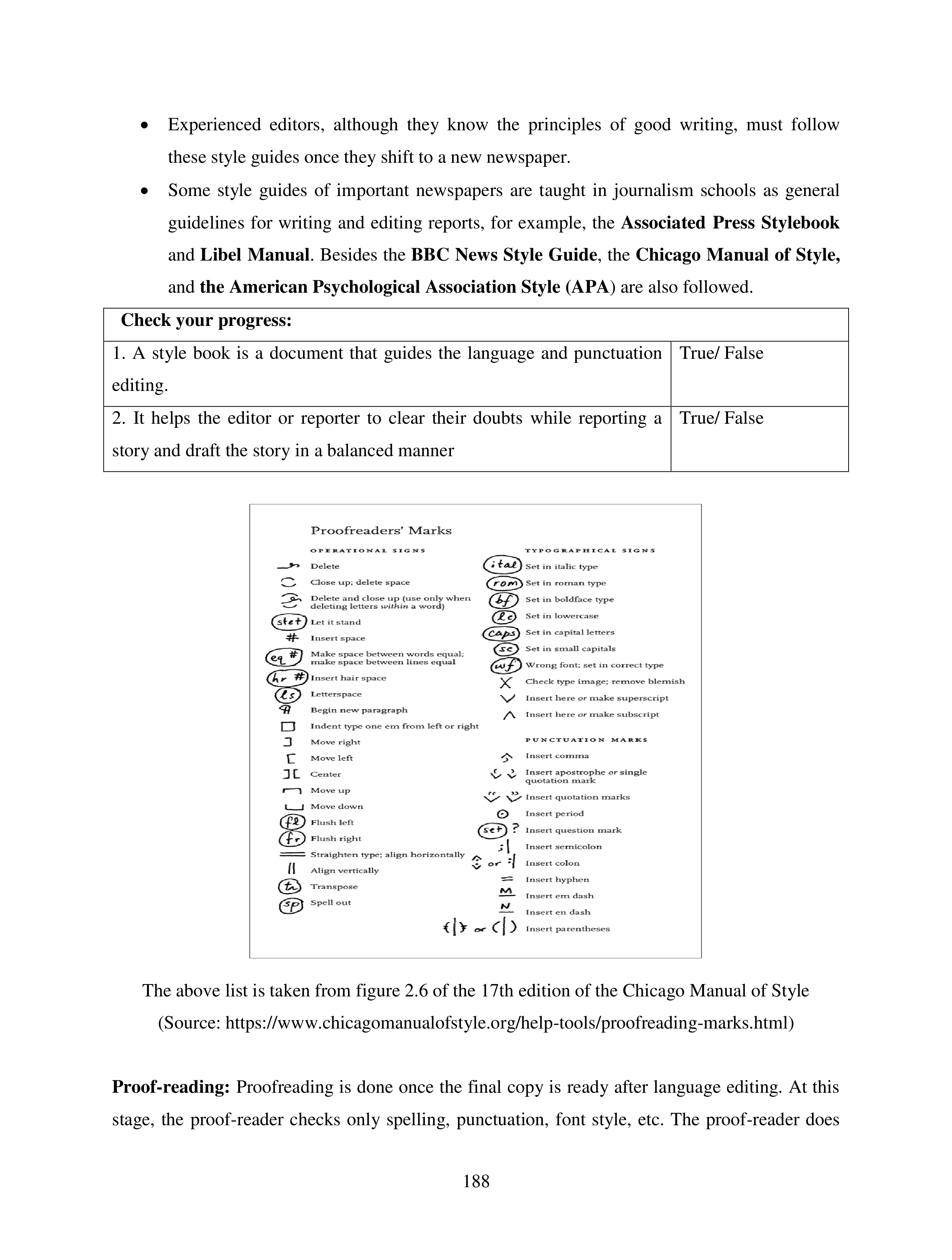
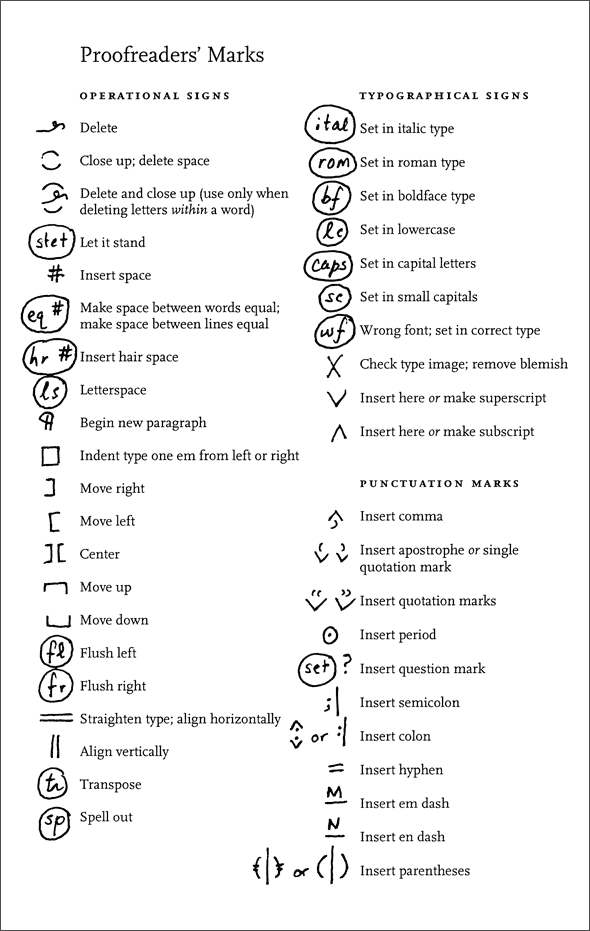
188
Experienced editors, although they know the principles of good writing, must follow
these style guides once they shift to a new newspaper.
Some style guides of important newspapers are taught in journalism schools as general
guidelines for writing and editing reports, for example, the
Associated Press Stylebook
and
Libel Manual
. Besides the
BBC News Style Guide
, the
Chicago Manual of Style,
and
the American Psychological Association Style (APA
) are also followed.
Check your progress:
1. A style book is a document that guides the language and punctuation
editing.
True/ False
2. It helps the editor or reporter to clear their doubts while reporting a
story and draft the story in a balanced manner
True/ False
The above list is taken from figure 2.6 of the 17th edition of the Chicago Manual of Style
(Source: https://www.chicagomanualofstyle.org/help-tools/proofreading-marks.html)
Proof-reading:
Proofreading is done once the final copy is ready after language editing. At this
stage, the proof-reader checks only spelling, punctuation, font style, etc. The proof-reader does
189
not make any changes in the structure or language of the report. The proof-reader uses some
symbols in the proof copy for corrections accordingly before the copy makes it to final print.
These symbols are presented above in the figure (source: Chicago Manual of Style).
16.2.4 Let Us Sum Up
In this Unit, we learned about the importance of editing in a newspaper or an online news
portal. We have also learned the difference between editing in print and online media and how
similar they are in certain respects. Moreover, we have also understood the basic guidelines for
editing a news story. We have realised how important an editor's job is in making a story clear
and presentable with correction of language, and the use of appropriate pictures, images, and
graphics. We have also learned the importance of keywords in an online story, which helps
navigate other related content.
Further, in the last section of this unit, we have come across the concept of the style guide
and the use of a dictionary and thesaurus in good editing. As editors, now you will be able to
notice if a newspaper report has any factual or grammatical errors. The editor should also build
up their sources to verify the facts stated in the news report by the reporter.
16.3 Learning Outcomes
At the end of this Unit, you should have gained an understanding into editing for print
and online media.
16.4 Keywords
Editing, Concise, Clarity, Attribution, Verification, Keywords, Style books, Proof-reading
190
16.5 Sample Questions
Objective Questions
1. Which of these is the job of the editor?
(a)
Polishing the report.
(b)
Writing the report.
(c)
Clicking pictures for the report.
(d)
Taking interviews.
2. Which of the following is not done by editors?
a)
Check their headlines.
b)
Check the orientation of the story.
c)
Check the attributions.
d)
Getting first-hand information from the ground.
3. Editing helps in _________.
a)
Creating the story.
b)
Conducting interviews.
c)
Tightening the report by removing unnecessary words or sentences.
d)
Filing the report for a news organisation.
4. What helps fit the reports within the available space in a newspaper?
a)
Making the story attractive.
b)
Editing and removing unnecessary words and phrases.
c)
Use of heavy words.
d)
Use of jargon.
5. Editing brings ____________.
a)
Popularity in the newspaper.
b)
Authority to the newspaper.
c)
The clarity in the language of the report.
d)
Popularity to the editor.
6. An editor should ensure______________.
a)
Use of technical terms.
b)
Lengthy reports.
c)
Keywords in an online news story.
191
d)
Use complex literary language in an online news story.
7. The online report can be made user-friendly by___________.
a)
Using lengthy sentences.
b)
Using controversial words in the title.
c)
Using unrelated stories in the headline.
d)
Avoiding literary catchphrases in titles.
8. Which of these is not related to editing?
(a)
clear
(b)
concise
(c)
clever.
(d)
correct
9. Which of these should be ensured during editing?
(a)
Correct attributions and facts.
(b)
Knowledge of reporter.
(c)
Biased reporting.
(d)
Building sources.
10. Which of the following is not guided by a style book?
(a)
To maintain a distinct style and identity of the organisation.
(b)
To guide the language and punctuation editing.
(c)
To draft the story in a balanced manner.
(d)
To practice biased reporting.
Short Answer Questions
1.
What do you understand by editing for print media?
2.
Why is editing important for newspapers?
3.
What is the difference between print and online news editing?
4.
What are the 5 Cs of editing?
5.
What is proofreading?
Long Answer Questions
1.
Discuss in detail the rules of editing.
2.
Elaborately discuss the importance of a style book in a news organisation.
192
3.
As a regular internet user, how do you search for news stories in the internet? What do
you expect from an online news story? Explain the difference between any news story
you have read online and its printed version in a newspaper.
16.6 Suggested Learning Resources
‗The Chicago Manual of Style, 17th Edition‘.
The Chicago Manual of Style Online
,
https://www.chicagomanualofstyle.org.
Ravindran, RK. (1999).
Handbook of Reporting and Editing.
Anmol Publications Pvt. Limited.
Saxena, A. (2007).
Fundamentals of Reporting and Editing.
Kanishka Publishers.
Singh, B. P. (2011).
News Editing,
Anmol Publication.
193
Unit - 17: Types of Social Media
Structure
17.0
Introduction
17.1
Objectives
17.2
Types of Social Media
17.2.1
Brief History
17.2.2
Different Types of Social Media
17.2.2.1
Social Networks
17.2.2.2
Professional networks
17.2.2.3
Blogging
17.2.2.4
Micro-blogging
17.2.2.5
Video Sharing/Streaming
17.2.2.6
Audio Streaming/Podcasting
17.2.2.7
Photo Sharing
17.2.2.8
Social Gaming
17.2.2.9
Collaborative projects
17.2.2.10
Social Bookmarking
17.2.3
Let Us Sum Up
17.3
Learning Outcomes
17.4
Keywords
17.5
Sample Questions
17.6
Suggested Learning Resources
17.0 Introduction
We often refer to internet-based media or cyber media as New Media, but the term new is
relative for each age. Only about half a century ago, television was considered a new media.
However, there are slight distinctions between internet-based or cyber media and social media.
While social media sites are part of the broader cyber media, not all cyber media can be termed
as social media. New portals like
The Wire, Scroll.in,
etc. are part of the cyber media but are not
simply social media networks, although all of them may have separate accounts of different
social media platforms. The term 'social media' implies any medium or platform that encourages
sociability online, that is, a medium that helps users virtually interact and engage. These can be a
194
website, an application or App, or a software program used for social networking, for example,
Facebook, Twitter, YouTube, TikTok, etc.
17.1 Objectives
The objectives of this Unit are to acquaint the Learners with:
basic concepts of cyber media and social media
brief history and developments of various social media platforms
different types of social media based on functionalities
17.2 Social Media
The term 'social media' came into vogue to define interactive technologies or software
that created, facilitated, and encouraged sharing of ideas or information within a network of
people or virtual communities. The scope of social media gradually expanded to incorporate
various online platforms that connect people in some way, from video streaming sites like
YouTube to personal blogs.
According to Merriam-
Webster Dictionary, social media are ―forms of electronic
communications (such as websites for social networking and microblogging) through which
users create online communities to share information, ideas, personal messages, and other
content (such as videos).‖ Carr and Hayes define social media as "Internet
-based channels that
allow users to interact opportunistically and selectively self-present, either in real-time or
asynchronously, with both broad and narrow audiences who derive value from user-generated
content and the perception of interaction with others."
The advent of print, no doubt, was revolutionary and led to new consciousness from
Europe to the rest of the world. Television and radio also helped reach the vast population, but
the response or feedback mechanism in all of them remained restricted. Cyber media, on the
other hand, allows for greater participation and engagement. For example, if you read an article
in the Times of India with which you do not agree or have some contentions, you can post your
comments there. In fact, you can post as many comments as possible or respond to other
comments on the article too.
195
Further, readers can share their comments on their own social media accounts or go to the
Timeline of the media platforms or the reporter and editor and put comments there as well.
Consequently, while newspapers have readers, television has an audience, and radio has
listeners, that is, a user remains a consumer. However, on social media, you are a user or a
browser and not just a passive consumer. Even a common user with very little technical skill can
also be a content creator on social media. You can start your own blogs and write articles, use
Twitter to share your brief views, or make host videos on TikTok and share it with the world. A
user can thus be a Prosumer (Producer+Consumer) if he so wishes, particularly on social media.
Social media imitates the real world in the virtual space and is thus a reflection of reality
though it may or may not always be accurate. Research shows that many people create fake
profiles on social media, and often their alter-ego is reflected in the virtual world due to the
anonymity the internet provides. Further, social media has become a dangerous source of
misinformation.
The common features of social media platforms are:
custom-made profile,
virtual social networks,
internet-based,
user-generated contents
interactivity
Check your progress:
1. Online Social Networks imitate the real world in virtual space.
True/ False
2. Social media has made access to information more participatory.
True/ False
17.2.1 Brief History
In the first generation of websites, often called Web 1.0, contents were primarily static
and read-only. The beginning of the 21
st
century also heralded the era of Web 2.0, where new
generations of software and programs made websites more interactive and user-friendly. The
content generation too did not remain one-way as has been the norm with most mass media
innovations, from newspapers to radio and television. Web 2.0 thus truly revolutionised the
methods of communication and made it more democratic and participatory than any medium has
ever been.
196
GeoCities (1994), Classmates.com (1995), and SixDegrees.com (1997) were pioneers in
social media platforms as we understand the term today, although Weblogs, Email Services, and
Online Messaging services too did contribute towards the creation of the virtual networked
publics. In fact, SixDegrees, founded by Andrew Weinreich, is often regarded as the first social
network platform in a true sense that allowed users to create profiles in their own names and list
their friends and family members. At the end of 2000, when it was shut down after it lost its
sheen despite initial success, it had over a million users. SixDegrees was relaunched after a few
years and currently positions itself as ―The Most Exclusive Invite Only Social Network Where
You Will Meet Amazing People Based on Your Interests,‖ but it has not been able to gain the
same popularity. The 2000s saw the launch of My Space, Friendster, Hi 5, Orkut, Facebook, and
LinkedIn, among others. Although My Space and Orkut (owned by Google) got initial success,
Facebook pushed all informal social media platforms down by the end of the first decade of the
21
st
century. LinkedIn and Twitter also created their own niche spaces, former as a professional
network and later for micro-blogging. Blogger, the first interactive blogging site, was launched
in 1999 and was acquired by Google in 2003.
Check your progress:
1. In Web 1.0, the contents were primarily dynamic, allowing greater
interactivity.
True/ False
2. SixDegrees is regarded as the first social network platform
True/ False
3. Now defunct, Orkut was owned by Microsoft.
True/ False
17.2.2 Different Types of Social Media
Based on their usage and functionality, social media can be categorised into various domains:
Social networks
Professional/Business Networks
Blogging
Microblogging
Video Streaming
Audio Streaming/Podcasting
Photo Sharing
Collaborative projects
197
Social Gaming
Social Bookmarking
It should be mentioned here that these divisions are more for understanding than rigid
blocks and may overlap or fall into more than one category. Below are brief descriptions of a few
popular examples.
17.2.2.1 Social Networks
Popular social networking platforms in India include Facebook, Instagram, Snap Chat,
Google+. Each successful social media platform has its USP that made them famous in the first
place. However, the common feature of these social networks is that, as the name suggest, they
are used for socialising, and are often meant for informal settings. However, professionals, too,
may be using them among their networks.
Facebook:
Facebook was launched by Mark Zuckerberg, a young Harvard College
student, along with his fellow college friends Dustin Moskovitz, Eduardo Saverin, Chris Hughes,
and Andrew McCollum in 2004. It started as a virtual social network for college students, and its
membership was initially only for Harvard students, and gradually expanded to other American
universities and, finally, from 2006 to anyone above age 13. As of the second quarter of 2022,
Facebook has2.93 billion monthly active users, according to Statista. India alone accounts for
239.65 million Facebook users and thus is their biggest market, ahead of the United States even.
(Screenshot of various social media apps)
Facebook has become a popular social networking site for young and old alike, but have
also been accused of data manipulation and data theft in recent years. Facebook later acquired
Instagram and messaging service WhatsApp. In 2022, the parent company was rebranded as
Meta.
198
Besides allowing users to create a personal profile, Facebook also has the option of
creating Pages for a wider reach for businesses, institutions, organisations, or even individuals. It
also allows for the creation of Groups based on shared interests which can be private or public.
Facebook also has a Messenger option and has enabled video chat/conference options too. After
acquiring Instagram, it has also allowed for syncing of Messenger of both platforms besides
enabling sharing tools. Facebook generates revenues from advertainments and has also opened a
marketplace for prospective buyers and sellers.
Instagram-
Instagram started primarily as Photo and (short) video-sharing social
networking but has now enabled longer video-sharing options as Reels. It was first launched for
iOS only in October 2010 by Kevin Systrom and Mike Krieger and allowed only square (1:1
aspect ratio) photos and videos. It became an instant hit, and within two months, it got over one
million users and crossed the 10 million-mark in a year. By the middle of 2018, Instagram had
over a billion users. By April 2012, it was launched for Android, and in 2016 window versions
were also launched.
Meanwhile, in April 2012, Facebook Inc. acquired it, and gradually its services have been
integrated with Facebook, allowing users to share the same posts from one to another. Even
Messenger of both Facebook and Instagram have now been integrated. Instagram is now a
subsidiary of Meta after Facebook Inc has been rebranded.
These are US-based social networks, but several countries like China and Russia have
their own social networks. Sina Weibo is often referred to as the "Twitter of China." RenRen was
once pitted as a counterpart to Facebook, but it has stagnated. Russian social networks like VK
(
VKontakte
) and OK (
Odnoklassniki
) are popular in Russia and some of the countries of the
former Soviet republics.
17.2.2.2 Professional networks
Professional or business networking sites also function the same way as social networks,
except that the networks here are primarily professional and linked to businesses. LinkedIn is
one of the most famous and certainly the biggest business-networking and employment-oriented
platform. Functionally, it is very similar to Facebook but is used more for professional
networking, finding suitable candidates, job hunting, etc.
LinkedIn was launched in December 2002 by Reid Hoffman in California, along with the
support of teams from PayPal and Socialnet.com. By August 2004, it reached a million users and
by 2007 crossed the 10 million-mark. The company was acquired by Microsoft Corp in 2016 and
199
is now its subsidiary. As of 2022, the company claims to have over 850 million users across
more than 200 countries. Not all of them are active regularly on the platform though. The United
States has the highest number of LinkedIn users, followed by India and China.
17.2.2.3 Blogging
A blog is short for Web Log or simply Weblog. Web log or Blog is an online diary or
journal of an individual, a group or community, or an organisation. Based on the interest,
purpose, or objective for which a Blog has been launched, a Blog can just be an online platform
to share our ideas or opinions, photographs or videos on a topic or multiple topics. It can also be
a record of events or updates of a group, party, or organisation.
For example, someone interested in food or fashion can start a food or fashion blog, a
heritage enthusiast can maintain a blog on heritage sites, documenting their history and
importance through write-ups and photographs.
If one has access to the internet (and a good mobile camera), one can start blogging
without spending any extra money on blogging platforms like Blogger.com, WordPress,
Medium, Tumblr, Wix, and Weebly. Free blogs usually have a sub-domain that runs on the main
website (e.g. http://double-dolphin.blogspot.com/). One can take an annual domain subscription
and have a unique domain name of choice too. Blog posts can have social media links to share
them on other platforms besides the comment section to engage readers.
It should be noted here that with the technological advancements, the difference between a
website and a professionally run blog is blurred when it comes to technology, thus making its use
more widespread through user-friendly dashboards of the blogging platforms. Many people also
use their social media and business network accounts like LinkedIn and Facebook as blogs,
writing long posts and inviting comments.
When blogging is done entirely through video, that is, instead of texts and photos, crisp
videos are used for blogging; it is sometimes also referred to as Vlog, where V stands for video.
Vlogging can be done on the platforms mentioned above as well, but video-streaming sites like
YouTube, Facebook, and Instagram Reel are more suitable for them. Vlogging has become very
popular in the past few years with quality smartphones available at affordable rates.
17.2.2.4 Micro-blogging
As the name suggests, microblogging implies very brief blogs. The term became popular
with the launch of Twitter, a social media platform that initially allowed only 140 characters in
200
one tweet. Microblogs are usually quick and concise responses to a new development and is
aimed at direct interaction with the audience.
The advantages of micro-blogging are that one can write small posts at regular intervals, and
hence can be less time-consuming. One can quickly respond to new developments or breaking
news and is mobile-friendly. However, not everything can be said in a few words. Thus, there are
occasions when politicians and celebrities are marred into controversies because their single
tweet or social media post was misconstrued out of context. Although Twitter is the most popular
micro-blogging platform, Chinese Sina Weibo, and Russian VK are also important
microblogging networks.
Jack Dorsey, Biz Stone, Noah Glass, and Evan Williams cofounded Twitter in 2006 in
California, and by 2012 it had over 100 million users worldwide. At the beginning of 2022,
Twitter had over 396.5 million users. With about 8.85% of the total social media user base,
Twitter is the 16
th
most popular social media worldwide.
Twitter initially allowed only 140 characters tweets, but it was doubled in 2017, and now users
can send up to 280 characters tweets. It also allows audio and video tweets, but it is restricted in
duration for general users.
Twitter did not have Edit options like Facebook, Instagram, etc., to edit your post; hence,
once posted, tweets cannot be changed even if there is a typo or spelling error. In September
2022, Twitter rolled out the Edit button option for select verified users for 30 minutes to make
minor corrections. This has been the most-sort request to Twitter by influential users, and in the
testing phase Twitter will label ―Edited Tweets‖ with an ―icon, timestamp, and label so it‘s clear
to readers that the original Tweet has been modified.‖ In fact, Twitter made it clear that ―Tapping
the label will take
viewers to the Tweet‘s Edit History, which includes past versions of the
Tweet.‖
17.2.2.5 Video Sharing/Streaming
Online platforms that allow users to upload and save videos watch uploaded videos and
can even allow video live streaming will fall under this category of online video platform (OVF).
The most significant advantage of using an OVF for sharing videos is that it saves the internet
bandwidth and thus practically eliminates the cost of video-hosting. These videos can easily be
embedded on any website or blog and shared easily on all social media and messaging platforms.
Founded in 1997 by Chase Norlin, ShareYourWorld.com was the first video-sharing
website, but due to the slow internet then, it could not gain much success. Launched in 2004,
201
South Korea-based Pandora TV was the first video-sharing site to give users unlimited upload
spaces and attached advertisements for revenue generation.
YouTube
was launched in 2005 by Steve Chen, Jawed Karim, and Chad Hurley and is
headquartered in California. In October 2006, it was acquired by Google and has since become a
subsidiary of its parent company Alphabet. YouTube is undoubtedly the largest and most popular
video-sharing website, with 2.1 billion monthly active users as of September 2022. India has
more YouTube users than any other country in the world, with an estimated 225 million accounts
(the USA is second with 197 million users). Anyone with a Gmail account can launch a
YouTube channel, and once verified with a One-Time password (OTP), users can upload videos
of any length or even live-streaming.
France-based
Daily Motion
is another video-sharing platform, like YouTube. Both these
platforms allow users to upload videos for free, and the revenue generated from advertisements
seen while watching videos are shared with the content generators. In contrast, Vimeo is another
American video-sharing platform based on the subscription model and charges content-producers
for its tailor-made software, video-editing tools, and video sharing. Many documentary
filmmakers and producers of quality content prefer Vimeo over free platforms. As of 2021 end,
Vimeo has 260 million users, and about 1.6 million of them are subscribers.
Launched in 2017, the Chinese App
TikTok
, which specializes in short videos, became
an instant hit among amateur content creators and revolutionized the way video-watching habits
of social media users. It made instant social media stars in nooks and corners of the country and
worldwide. As of 2021, TikTok crossed over a billion users worldwide and is believed to be one
the fastest growing App in the world. However, it has also faced criticism for leaking data to the
Chinese government, impacting people's minds psychologically, spreading misinformation, etc.,
and has faced complete or partial bans in many countries, including India, Iran, Pakistan,
Indonesia, Afghanistan, etc.
Facebook and Instagram have also enabled video sharing and live streaming options and
now occupy a large market share. While Facebook has emerged as an essential platform for Live
videos, Instagram particularly caught up with short videos and Reels.
Live streaming has emerged as another vital function, particularly after the pandemic
when webinars have come into vogue. Twitter integrated Periscope for live streaming, while
202
Twitch, LiveStream, StreamYard, YouNow, and TikTok Live, besides applications like Zoom,
have become essential streaming platforms.
17.2.2.6 Audio Streaming/Podcasting
Audio streaming and sharing, often called Podcasts, have become popular too in the past
decade. SoundCloud, Anchor.fm, Castbox, Audioboom, Buzzsprout, Transistor, Apple Podcast,
PodBean, etc. are some podcasting platforms. Sound Cloud allows for limited hours of free
uploading but starts charging for Pro-level services, while Anchor.fm works more like a
YouTube kind of model. While many media in India and across the world have increasingly
started podcasting, SunoIndia, Audiomatic, Headphone, Awaz.com, Khabri, etc. are some of the
Indian podcasting platforms.
You can also listen to podcasts on Google Podcasts, Apple Podcasts, Spotify, etc. Club
House and Twitter Spaces are the two latest entrants in the audio-streaming space that allows for
online webinars or discussions in audio mode only. While for Club House, one needs to
download a spate App and make accounts for hosting and listening to discussions, Twitter
Spaces can be hosted by regular Twitter users, and anyone with a Twitter account can participate
in those discussions.
17.2.2.7 Photo Sharing
Some social networks specialize in photo sharing and archiving. Flickr is undoubtedly
one of the most famous image-hosting platforms, although it also allows for video sharing.
Launched in 2004, it was once very popular among amateur and professional photographers for
keeping, sharing, and arching Photographs online. Social media platforms like Instagram and
Facebook can also do the same function and get more traction online.
17.2.2.8 Social Gaming
High-speed internet connectivity has allowed for playing online games with and against
each other virtually. For example, you can team up and play Fifa multiple players with two
players attached to the same gaming console or remotely connected in two places. Alternatively,
you can choose an opponent from available interested players online and play games virtually.
Social gaming has led to the emergence of virtual networks of peers having common interests
though psychologists have cautioned against teenage getting manipulated through those virtual
social networks.
203
Some games are also played online through social networks, sometimes enabled through
Facebook, for example, Mafia Wars, FarmVille, etc.
17.2.2.9 Collaborative projects
When a group of like-minded people, or those with similar objectives, come together to
work on a project, it is termed a collaborative project. Wikipedia is the best example of a
collaborative project where contributors, writers, photographers, record keepers, etc., from across
the world voluntarily come together and work to make information accessible for free. Open-
source software and browsers, like Mozilla Firefox, are some other examples.
17.2.2.10 Social Bookmarking
Social Bookmarking is an application that allows users to discover online resources,
organize, annotate, edit, tag, and share web documents. Interested users can check those publicly
available bookmarks by searching keywords or based on popularity. Social bookmarking tools
are handy for students and researchers in finding resources online and have advantages over
traditional search engines. Launched in 2003, Delicious made social bookmarking popular,
though it has now stopped service after Pinboard acquired it in 2017, offering similar
subscription services.
Some of the popular social bookmarks include:
Flipboard:
A content aggregator site that lets users collect, categorize and group content
from multiple sources, and share them.
Pinboard:
Personal management with the help of tags
Digg:
News Aggregator
Diigo:
For bookmarking Web Pages and highlighting key points for ready references
Pinterest:
Aggregator and bookmark for images that has both mobile and online versions
available
Pocket:
For saving web resources using tags for future references and sharing.
Reddit:
Posts that can either be text or a web link for voting and engaging in comments
and threads.
Scoop.
It is a content curation website that allows professionals and businesses to
research any topic and publish content.
204
Check your progress:
1. Twitter earlier allowed tweets of only 160 characters.
True/ False
2. Vimeo is a video streaming site that has a subscription model.
True/ False
3. Twitter Spaces are used for video conferences
True/ False
4. Wikipedia is a good example of a collaborative project.
True/ False
5. VK is referred to as the "Twitter of China
True/ False
17.2.3 Let Us Sum Up
Any medium or platform that encourages sociability online, that is, a medium that helps
users virtually interact and engage, can be termed social media. These can be a website, an
application or App, or a software program used for social networking, for example, Facebook,
Twitter, TikTok, YouTube, etc. Based on their functionalities, social media can classify as social
networks, video streaming sites, social bookmarking, business networks, etc.
Social media allows greater participation and engagement and hence is considered more
democratic, although there are also greater chances of spreading misinformation online.
Nonetheless, even a common user with very little technical skill can become a creator of content
on social media and can start a blog and write articles or use Twitter to share their opinion.
However, social media has also increased misinformation across the world.
17.3 Learning Outcomes
At the end of this Unit, you should have become aware about the different types of social media.
17.4 Keywords
Social Media, Facebook, YouTube, Social Bookmarking, Instagram, Blog, Twitter, IG Reel
205
17.5 Sample Questions
Objective Questions
1. Which one is NOT a Blogging platform?
a)
WordPress
b) Medium
c) Tumblr
d) Flipboard
2. Which one of these is a subsidiary of Alphabet?
a)
Facebook
b) WhatsApp
c) YouTube
d) Instagram
3. VK is a popular social media platform based in:
a)
France
b) Russia
c) China
d) Saudi Arabia
4. Which one of these is not a typical Vlogging medium?
a)
TikTok
b) YouTube
c) Instagram
d) LinkedIn
5. Which one of these can be used for audio-only webinars?
a)
Club House
b) YouTube
c) We Chat
d) Medium
Short Answer Questions
1.
Write a short note on Social Bookmarking.
2.
What do you understand from the term social media influencer?
3.
Write a short note on Podcast.
4.
What do you understand from the term microblogging?
Long Answer Questions
1.
What do you understand from the term social media? How is social media different from
cyber media?
2.
Elaborate on the evolution of social media?
206
Activity
1.
If you still do not have accounts on the following social media, try setting up one and
check if you enjoy browsing it: Facebook, Instagram, Twitter.
2.
Try any of these Blog platforms, and make some posts of your interests, who knows you
can be the next social media influencer: WordPress, Blogger, Medium.
17.6 Suggested Learning Resources
Kawasaki, Guy and Peg Fitzpatrick.
The Art of Social Media: Power Tips for Power Users.
Portfolio: 2014.
Social Media: Britannica -
https://www.britannica.com/topic/social-media
5 Types of Social Media: YouTube -
https://www.youtube.com/watch?v=AH5B6eZ1AZg
207
Unit - 18: The Impact of Social Media
Structure
18.0
Introduction
18.1
Objectives
18.2
The Impact of Social Media
18.2.1
Impact of Social Media on Society and Politics
18.2.2
Alternative Spaces for Groups and Individuals on the Margins
18.2.3
Political Manipulations
18.2.4
Fake News and Misinformation
18.2.5
Impact on Businesses and Social Media Marketing
18.2.6
How Social Media Impact the News Cycle and Media
18.2.7
Social Media Stars
18.2.8
Concerns about Data Security
18.2.9
Let Us Sum Up
18.3
Learning Outcomes
18.4
Keywords
18.5
Sample Questions
18.6
Suggested Learning Resources
18.0 Introduction
When social media began to make its presence felt in the first few years, social scientists and
communication experts began to term it democratizing, participatory, emancipatory, and saw the
new media as a revolutionizing tool heralding new dawn. From the Arab Spring to Occupy Wall
Street and the anti-corruption Anna Hazare-led movement in India, commentators wrote
celebratory columns on the role of cyber media and social media in those movements. The
internet, they argued, has truly made the earth a global village, and that social media has created
a network society.
However, as the years passed, we also saw the flip side of social media and its role in
disinformation campaigns worldwide. World over, right-wing forces have manipulated social
media to spread hatred as the new age has already been termed the Age of Rage. Psychologists
have also pointed to how the use of social media can be addictive, and how it may impact the
child's psychology, making them more vulnerable and increasing their anxieties. Whatever views
208
one may have on social media, there is no denying that it has impacted practically every aspect
of our lives, society, politics, how businesses are done, and even our shopping habits. Let us
discuss them one by one.
18.1 Objectives
The objectives of this Unit are to explore the following:
impact of social media on society and politics
impact of social media on youth, in particular
positive aspects of the social media
how social media has spread fake news and increased hatred
impact on businesses and social media marketing
how social media impact the news cycle and media
social media influencers
concerns about Data Security
18.2 The Impact of Social Media
18.2.1 Impact of Social Media on Society and Politics
Social media has greatly impacted and revolutionized our interactions with peers and
society. Research shows that for teenagers in their formative years, peer validation and negative
comments influence their psyche. Young and old alike want to keep a positive virtual presence,
and many take extreme steps. While social media may have developed on social networks and an
individual may have hundreds, if not thousands, of "Friends" online, it has also increased the
isolationist tendencies and anxieties among them.
Cyberbullying of teenagers, particularly young women, is another phenomenon that has
become a cause of concern in recent years. Spreading photoshop pictures and deep-fake videos
of a girl because she refused your advances, or maligning her image by sharing personal or false
information amount to cyberbullying. It is a punishable crime but is quite rampant, as is the fake
emails and messages on social media promising to get you good jobs, or announcing that you
have won lakhs and crores in some lottery, or princess of some small country going through civil
209
war is waiting for you. One needs to be careful of these abuses of social media, otherwise, one
too becomes a victim of a hoax. Cyberbullying has also led to increased anxieties, and there have
been instances of extreme cases when for revenge or teaching lessons to female journalists and
activists, they were virtually "auctioned" as a game online where their photographs were shared,
and derogatory words were used against them.
It is not, though, that social media have only negative aspects. In this age of
globalization, as our family and friends travel and settle across the world for jobs and better
opportunities, social media often becomes an easy way of keeping in touch. You see someone
achieving something or travelling to a new place, and you "like" and "comment," thus engaging
in a brief interaction. Similarly, it reminds you of someone's birthday or anniversary, and you
may wish him or her and exchange words. Because of social media, even if you have not directly
spoken with someone for months, or even years because of your busy life, you remain updated
about each other.
Check your progress:
1. Validation from peers on social media has become a source of
gratification for many.
True/ False
2. Spreading Photoshop pictures and deep-fake videos of a girl cannot be
termed cyberbullying.
True/ False
18.2.2 Alternative Spaces for Groups and Individuals on the Margins
The internet and social media have made the world a global village, and virtual social
networks have become part of our lives. The rapidly globalizing world has thus helped build and
strengthen what scholars like Jan van Dijk and Manuel Castells termed the "network society."
Consequently, social media have emerged as an important public sphere and encouraged
"internet activism." There is no doubt that the internet, in general, and social media, in particular,
have given forums to voices that were often ignored. Social media groups and pages focussing
on communities or issues have successfully created a niche audience for themselves. YouTube
channel
Dalit Camera, Round Table India
, or
The Mooknayak
have successfully highlighted the
concerns and issues of Dalits and other backward communities.
Similarly, websites like
TwoCircles.net, Maktoob Media, Muslim Mirror
, and others,
keep focus on Indian Muslims. Websites focusing on other niche areas, for example, The News
Minute focusing on South India, Live Law, and Bar & Bench focussing on legal matters, etc.
210
There are similarly Facebook pages and groups with thousands, and sometimes lakhs of
members/followers that encourage debate on specific issues. These became possible as virtual
social networks encouraged people to voice their points of view ope
nly as a ―community‖ and
consequently helped in mobilizing large groups once they were able to create momentum. The
Arab Spring of 2010-11, the anti-corruption movement led by Anna Hazare and Arvind Kejriwal
in India, the Shahbag protests in Bangladesh in 2013, the Gezi Park protests in Turkey in 2013,
the anti-Hijab campaign in Iran in 2022, and several such movements across the world owed a
large degree of their success to social media and cyber media.
18.2.3 Political Manipulations
Social media has also changed how elections are fought, and parties that adapted to new
methods of campaigning and reaching out to the masses have had greater successes worldwide.
The successes of the Bharatiya Janata Party (BJP) in the last decade and the Aam Aadmi Party
(AAP) in electoral politics are attributed to a large degree by how they managed their social
media campaigns. There have, however, also been allegations on political parties and big tech
companies like Facebook of collusion and sharing of what is termed as Big Data that helped
them manipulate elections' outcomes by selectively targeting groups and communities and
influencing their views through political advertisements and showing them certain kinds of posts
only, giving rise to what is called as ―filter bubbles‖.
In 2018, international media like
The Guardian
and the
New York T
imes revealed how
an international political consulting company Cambridge Analytica collected the Facebook data
of millions of users without their consent and used them to manipulate the election. They were
accused of interfering in the 2016 Presidential elections in the USA, which Donald Trump won,
and interfering in the Brexit referendum in the same year. The 2019 documentary,
The Great
Hack
on Netflix, was based on the misuse of Facebook data by Cambridge Analytica. Similar
allegations of manipulation of Big Data and hijacking social media have also been labelled by
parties and activists in India.
Check your progress:
1. Social media played a significant role in the Anna Hazare-led anti-
corruption movement.
True/ False
2. Cambridge Analytica leaked data from Facebook to manipulate voters
during elections in many countries.
True/ False
211
18.2.4 Fake News and Misinformation
As mentioned above, social media can also be manipulative and used for propaganda
through consistent disinformation and misinformation campaigns. Rumours always spread like
wildfire, but social media like Facebook and WhatsApp spread them even faster to the most
significant number of people than has ever been possible. What has become even more lethal is
when people with vested interests or political parties mainly use social media for their
disinformation campaigns. The difference between misinformation and disinformation is that the
former is often done unknowingly and unintentionally, that is the sender naively believes it to be
true, while the latter is intentionally spread despite knowing it to be false. These are generally
termed fake news in common parlance.
Laskar and Reyaz define
‗fake news‘ as ―baseless allegations or conjectures published in
the guise of a genuine story with a deliberate aim to misinform a particular section of its
audience for the desired effect,‖ adding further, ―these are conventionally, intentionally and
verifiably false viral posts based on fictitious accounts made to look like news reports/news
articles to mislead the reader.‖
Spreading misinformation for propaganda is not a new or recent phenomenon, but the
term fake news has gained currency in recent years and has damaged the credibility of social
media sites. From once being hailed as democratizing and participatory, social media is blamed
mainly for spreading hatred against ethnic and religious minorities and has further deepened the
social fault lines. To make matters worse, political parties have exploited the medium to spread
their propaganda, and thus social media have been blamed for contributing to rising
authoritarianism and religious fundamentalism.
During the COVID-19 pandemic, fake news received such a massive spike, forcing
researchers and policymakers to caution against what has been termed an Infodemic, and they
have advocated in favour of increasing media literacy. Even educated people fall for hoax
messages and fake claims, and they share those on social media without verifying them if it
aligns with their ideological biases. For example, during the lockdown in 2020, several false
claims attributed to members of a particular organization were spread on social media, most of
which were later found to be false or propaganda against the group. In the past, there have been
occasions when such rumour mongering has led to communal tensions in several parts of the
country. The WhatsApp forwards on child kidnappers have created such a panic in India
‘s
hinterland that it has led to many cases of lynching.
212
Another term that has become popular in the recent decade is "post-truth." The
Cambridge Dictionary defines Post Truth as "relating to a situation in which people are more
likely to accept an argument based on their emotions and beliefs, rather than one based on facts."
The current age is hence often referred to as the Post Truth Era, where what may be true based
on objective facts and figures are less important than what people believe to be true or are made
to believe since the latter shape not only public opinion but also policies.
18.2.5
Impact on Businesses and Social Media Marketing
Like every other thing, the impact of social media can be seen in businesses too. Social
and cyber media have emerged as important media for advertisements and marketing for most
products. Prospective buyers are often lured into buying new products from promotional see on
social media or because they saw a positive review by a social media influencer, celebrity, or
expert.
Online advertisements use a complex algorithm of AI (artificial intelligence) to target a
particular section of the audience. For example, you browse for budget mobile phones under
fifteen thousand rupees online. The next moment you see every website you open showing
Flipkart or Amazon ads with budget mobile phones. Facebook or Instagram also similarly use AI
based on your browsing and social media habits to show you ads or reels to entice you to buy
some product.
Further, all companies create social media pages to advertise their products and reach
millions of users. Social media platforms like Facebook have, in fact, created a dedicated section
called "Marketplace." Instagram too, allows sellers to create pages for sale and use clickbait to
take them to their Shopping page. Similarly, WhatsApp Business allows the option of putting
catalogues or menus and has now enabled the Payment option.
Further, professional networking sites like LinkedIn and job-portals like Naukri.com,
TimesJobs.com, etc. help with recruitment. In fact, companies use their social media accounts as
well to advertise for their vacancies to reach prospective candidates.
Check your progress:
1. When vested interests intentionally spread unverified information,
knowing it to be false, it is called disinformation.
True/ False
2. Post-Truth Era is when what may be accurate based on objective facts and
figures are less important than what people believe to be true or are made to
believe since the latter shape not only public opinion but also policies.
True/ False
213
3. Reviews on social media greatly influence our purchasing choices.
True/ False
18.2.6 How Social Media Impact the News Cycle and Media
Social media has evolved into a critical public sphere, often influencing, and shaping
public opinion. Social media trends and hashtags often shape the headlines of newspapers and
determine the prime-time panel discussions on news channels. Concerns have, however, been
expressed on how IT cells of different political parties or members of groups try to hijack the
hashtags and social media trends.
More importantly, social media has increasingly become a news source for many people.
Research shows that most users' mobile-screen time has grown over the last few years. On
average, Indians spend nearly five hours on mobile phones, mainly on messaging apps, short
videos, and browsing social media posts. All media organizations target social media users to
reach larger audiences and readers.
18.2.7 Social Media Stars
Every few months, social media get viral content making new social media stars
overnight. The viral video of
Bachpan ka pyaar
brought instant fame for a young boy from a
village in Chhattisgarh, Sahdev Dirdo landing him with the opportunity to be part of a song with
singer Badshah. Similarly,
Kacha Badam
made Bhuban Badyakar, a peanut seller from a village
in West Bengal social media star bringing him fame and some money.
Besides, TikTok started a new phenomenon that has led to the rise in video content on
social media. From celebrities to village folks, everyone seems to have turned into amateur
actors and have started producing short videos, dancing to the tunes of popular numbers,
mimicking viral dialogues, and even making short films and series. Then there are social media
influencers, those with thousands and lakhs of followers on social media because of the
interesting or informative content they post regularly, from many stand-up comedians to teachers
like Khan Sir and others like Dhruv Rathee who have become famous by making simple videos.
18.2.8 Concerns about Data Security
An important point to note about social media is that most of it is free; that is, users
hardly pay any money to use them, whether it is messaging Apps like WhatsApp and Telegram,
mail services like Gmail, or social networks like Facebook, Instagram, etc. Critics have noted,
with concerns, that ―if you are not paying for the product, (then) you are the product!‖
It implies
that social media platforms provide these free services to collect meta-data of individual users
214
that collectively form what we know as Big Data. A complex algorithm is used to exploit this bid
data with the help of artificial intelligence or AI for targeted marketing products and political
manipulations. The 2020 Netflix documentary
The Social Dilemma
delves into this aspect of
social media.
Experts have also flagged the concerns of data breach and data privacy as there are
occasions when a particular site is hacked and all personal information, including private
photographs, contact details, and at times even bank and credit card details get into the hands of
fraudsters. There are occasions when you get luring mail or short message giving you some
exciting offers and requesting you to click on links that lead to fraud or data being hacked. One
hence needs to be extra cautious when using social media.
Check your progress:
1. In this age of social media, trending hashtags often influence the news
cycle and topics of panel discussions.
True/ False
2. People with a large number of following on social media are often called
Social Media influencers.
True/ False
3. Data privacy is at huge risk on social media and has even put people's
lives at risk.
True/ False
18.2.9 Let Us Sum Up
Social media was once hailed as a new public sphere that encouraged "internet activism."
It was appreciated for its role in ushering in positive changes and appeared democratizing and
participatory medium. Cyber and social media truly made the world a global village and turned it
into a ―network society.‖ However, social media soon showed its ugly side when it became th
e
primary platform for spreading fake news, propaganda, and hatred against vulnerable
communities. The current age is often referred to as the Post Truth Era where what may be true
based on objective facts and figures are less important than what people believe to be true or are
made to believe since the latter shape not only public opinion but also policies.
Social media has also increased peer pressure on people as they seem to extract some
gratification from validation from social media friends. Cyberbullying has also increased
anxieties, besides fraudsters trying to cheat people using social media platforms. Hence experts
have raised concerns regarding online data privacy.
215
However, social media have also changed many people's lives, making them celebrities
overnight or allowing them an alternate source of income from videos they make. Besides, social
media marketing has been a proffered option for companies as prospective buyers often choose
products based on online reviews. More significantly, increasingly, social media has shaped the
news cycle and has also emerged as an important source of news for most people.
18.3 Learning Outcomes
At the end of this Unit, you should have become aware about the impact of social media.
18.4 Keywords
Social Media, Cyberbullying, Fake News, Post Truth, Social media Influencer, Network Society,
Alternative Media
18.5 Sample Questions
Objective Questions
1. Which of the following movements did not use social media for mobilization?
a) Occupy Wall Street
b) Chipko Movement
c) Arab Spring
d) Shahbag Movement
2.
In the Post Truth Era, …………. becomes more important than facts.
a) belief
b) data
c) leaders
d) research
3. The full form of AI is:
a) Artificially Intelligent
b) Artificial Intelligence
c) Artificially Intelligence
d) Advanced Intelligence
4. The Netflix documentary
The Social Dilemma
is on:
a) Rise of the Facebook Empire
b) Cambridge Analytica Data leak controversy
c) Fake news infodemic
d) Dangers of AI-based manipulations of individuals
216
Short Answer Questions
1.
Write a short note on Cyberbullying.
2.
What do you understand from the term post-truth?
3.
Write a short note on Social Media Marketing.
4.
Explain how social media impact the news cycle.
Long Answer Questions
1.
Elaborate on how social media and Big Data have impacted the electoral campaigns.
2.
Fake news infomdemic has become lethal in the post-truth era. Elucidate.
Activity
1.
As part of the previous unit's activity, you were asked to set up different social media
profiles. Do you think you have got addicted to social media? If you are asked to go through
social media detoxification by deleting or disabling your accounts or at least stop using them
for a month or so. Can you do it? Try it and note down the changes you observe.
2.
If you have access to Netflix, check the two documentaries mentioned above
–
The Social
Dilemma
and
The Great Hack
.
18.6 Suggested Learning Resources
K. A. Laskar and M Reyaz (2021). Mapping the Fake News Infodemic Amidst the COVID-19
Pandemic: A study of Indian Fact-checking Websites.
Journal of Arab & Muslim Media
Research
, Vol. 14, No. 1, pp. 93-116. https://doi.org/10.1386/jammr_00026_1.
Manuel Castells (2000),
The Rise of the Network Society
, Oxford: Blackwell Publishers.
M Reyaz (2021). ‗New Media, Identity and Minorities: The Role of Internet in Mainstreaming of
Muslims in India‘. In
Inhabiting Cyberspace in India: Theory, Perspectives, and
Challenges
, edited by Simi Malhotra, Kanika Sharma, & Sakshi Dogra, pp. 57-68.
Singapore: Springer. https://doi.org/10.1007/978-981-15-9934-7_6.
Richard Kahn and Douglas Kellner( 2005), ‗Oppositional politics and the internet: A critical/
reconstructive approach,‘
Cultural Politics
1 (1): 75
–
100.
Van Dijk (2006),
The network society: Social aspects of new media
. London: Sage Publications.
Zoetanya Sujon (2021),
The Social Media Age,
Sage Publications
.
217
Unit - 19: Introduction to Cyber Media
Structure
19.0
Introduction
19.1
Objectives
19.2
Introduction to Cyber Media
19.2.1
Characteristics of Cyber Media
19.2.2
Different Types of Cyber or Digital Media
19.2.3
Business/Professional Management System
19.2.4
Let Us Sum Up
19.3
Learning Outcomes
19.4
Keywords
19.5
Sample Questions
19.6
Suggested Learning Resources
19.0 Introduction
Cyber media, online media, digital media, web media, etc., usually mean the same thing,
that is, media or platforms related to the internet and communication technologies. For example,
online news portals like Scroll.in and The Wire, e-commerce websites like Amazon and Flipkart,
e-learning platforms like Byju's and Unacademy, Payment gateways like PayPal and PhonePe,
interactive maps like Google Maps, browsers like Chrome and Mozilla Firefox, Email services
like Gmail and Outlook, social media like Facebook and TikTok, PMS or Project Management
System like Jira, Zoho Projects, Trello, Microsoft Project, etc. are all broadly part of cyber or
digital media as they work through internet services.
Social media is consequently part of cyber or digital media. However, not all cyber media
platforms can be termed social media. Cyber media has practically impacted every aspect of our
life, from how we communicate to banking services to how we do shopping, or how we book a
taxi via Uber and Ola or study online. In fact, manufacturing industries have increasingly also
turned to automation and robotization with the help of highly sophisticated software.
218
19.1 Objectives
The objectives of this Unit are to:
provide brief Introduction to Cyber Media
understand the characteristics of Cyber Media
study different Types of Cyber Media
examine the impact of Cyber Media
explain Cyber Crimes
19.2 Introduction to Cyber Media
The dictionary meaning of cyber is ―connected with electronic communication networks,
especia
lly the Internet.‖ In other words, it is a medium or platform for information exchange
using digital or world-wide-web. Organizations or people use cyber media to communicate with
readers or audiences and make their work automated, faster and smoother.
The term ‗cyber‘ is usually used as a prefix to things or ideas related to the internet, like
cybercafé, cyberspace, cybercrime, cybersecurity, cyber-attack, or cyber media. Cyber cafes
were thus businesses that allowed people to browse the internet on a computer for an hourly
charge or some subscription. Cyberspace is the virtual space or "cloud" where electronic data are
stored digitally. Cyber Media thus implies online or digital media. The term is derived from
'cybernetics' that Norbert Wiener coined.
19.2.1 Characteristics of Cyber Media
Multimedia
–
An important feature of cyber media is its ability to integrate various
mediums. For example, newspapers can only print texts or photographs, TV can broadcast
videos, and radio only has sound. On the other hand, online media can facilitate multimedia
stories with a combination of texts, photographs, infographics, podcasts, and videos.
Interactivity
–
Cybermedia, in contrast to traditional media, is considered interactive.
Not just the social media and news portals with Comment sections, but even an average website
usually has a Chat/Contact page that allows browsers/readers to reach out to the content creators
or writers.
219
Accessibility
–
Online media are usually available across the globe via the world wide
web or the internet and is thus not limited to a particular geography or borders unless the
respective governments put in some firewalls. A browser can therefore browse the websites of
Al
Jazeera
or
The Quint
from India, London, or New York. There is no restriction on time as well.
For example, TV programmes usually have a schedule on which programmes are broadcast, but
on OTT platforms, one can log in anytime according to his convenience and, if one wishes, can
binge-watch the whole season in one go instead of waiting for the next episode.
Another advantage of a digital system is that users can log in remotely and access the
network and hence work from home, on the go, during vacation, or practically anywhere so long
as he has access to the internet. Suppose you are a network engineer, for example. You do not
have the restriction of sitting at a workstation with a computer to access the database. If you have
a laptop and smooth internet connectivity, then wherever you are, that place is your workstation.
It is not just office work; universities allow students to access the library's online database
remotely, or you can do banking transactions, pay electricity bills, or shop online on the go.
Scalability
–
Fast internet service, AI, sophisticated project management systems, supply
chain management software, integrated financial management system, etc., have helped integrate
the working environment and have helped companies in scaling up and expanding their bases
besides making workouts more efficient.
Prompt services
–
Sophisticated online communication system has enabled the faster,
smoother, and more prompt transfer of information and goods.
No restriction on space/memory
–
Virtual cloud space allows users to store data online.
Most services give a certain GB of free data storage and then charge a subscription fee.
Maintaining and archiving records have thus become more systematic. Earlier companies needed
to maintain several registers and store them carefully, year-on-year. Tailormade software has
reduced time spent on them as one needs to just make entries and many complex calculations are
done automatically. Accessing these data remotely and, more importantly, finding old records
with keywords have made the work easier besides saving them digitally.
19.2.2 Different Types of Cyber or Digital Media
Based on their functionality, cyber media or digital media can be of different types:
Social Media (already discussed in the first two units of this block)
Digital Communications (will be discussed in detail in the subsequent unit)
Websites
220
Search Engines and Aggregators
News Portals
E-learning
E-Contents
E-Commerce
E-Banking and Payment Gateways
Business/Professional Management System (HRMS, IFMS, PMS, etc.).
19.2.2.1 Websites:
Websites comprise a specific domain name that opens a digital diary of a sort
and has a collection of virtual pages, usually on different aspects of the same theme or topic, and
those or systemically organized and linked to one another. For example, the website of Maulana
Azad National Urdu University (MANUU) has a fixed domain (https://manuu.edu.in/). It has
different pages containing information on the university, various university departments,
seminars, other events, admission, examinations, library, etc.
Initially, most websites were ―static‖; that is, web page information was not updated in
real-time. By contrast, news and other websites are usually "dynamic" in nature and can be
updated in real-time. Most websites these days are hybrid of the two; that is, even static websites
may have some sections which can be updated regularly. For example, a school or university
websites usually have most of its pages as static which are updated once and may not require the
daily update. However, the Notice section or Admission and Examination sections remain
dynamic. Most websites also have contact sections and shortcuts to their social media pages.
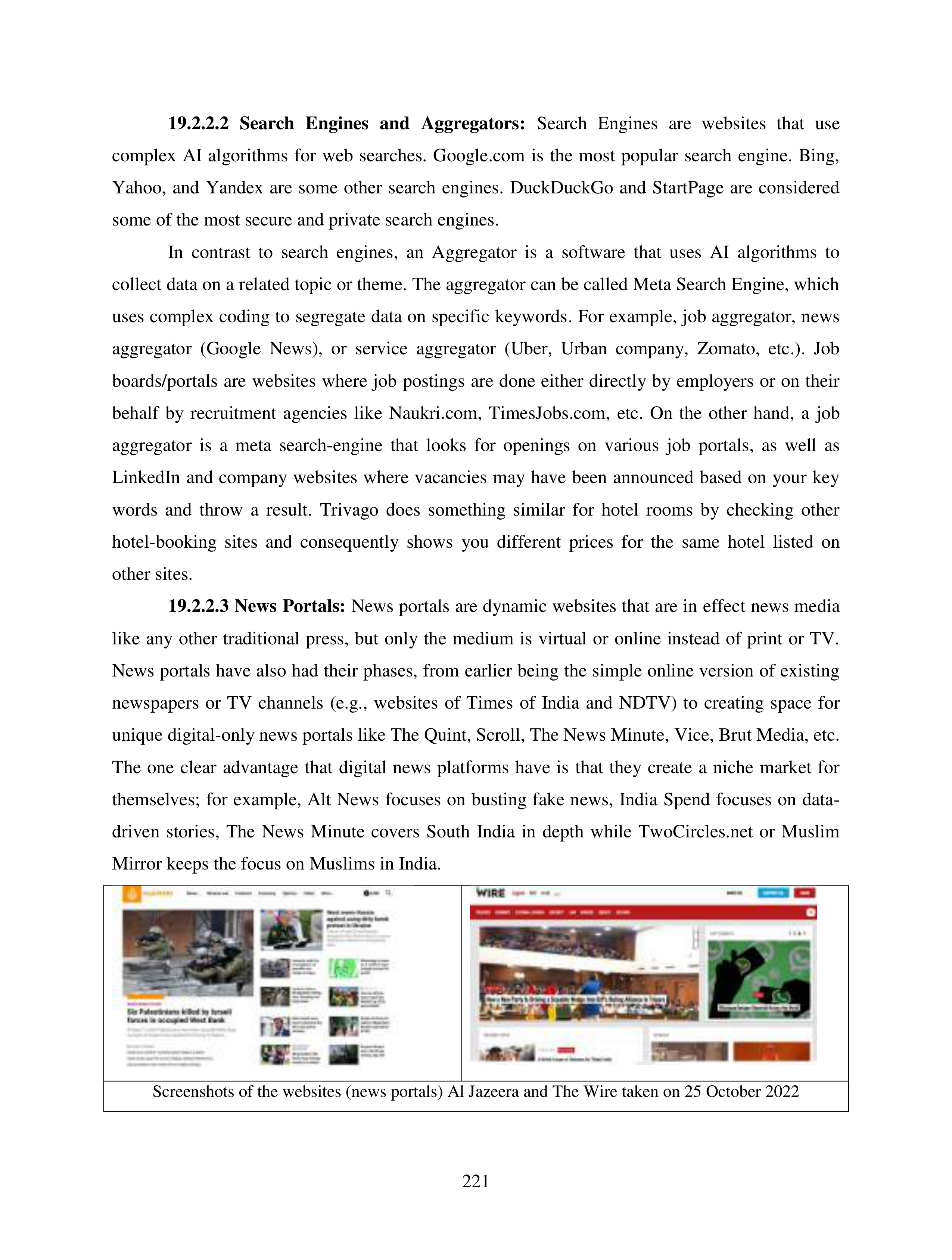


221
19.2.2.2 Search Engines and Aggregators:
Search Engines are websites that use
complex AI algorithms for web searches. Google.com is the most popular search engine. Bing,
Yahoo, and Yandex are some other search engines. DuckDuckGo and StartPage are considered
some of the most secure and private search engines.
In contrast to search engines, an Aggregator is a software that uses AI algorithms to
collect data on a related topic or theme. The aggregator can be called Meta Search Engine, which
uses complex coding to segregate data on specific keywords. For example, job aggregator, news
aggregator (Google News), or service aggregator (Uber, Urban company, Zomato, etc.). Job
boards/portals are websites where job postings are done either directly by employers or on their
behalf by recruitment agencies like Naukri.com, TimesJobs.com, etc. On the other hand, a job
aggregator is a meta search-engine that looks for openings on various job portals, as well as
LinkedIn and company websites where vacancies may have been announced based on your key
words and throw a result. Trivago does something similar for hotel rooms by checking other
hotel-booking sites and consequently shows you different prices for the same hotel listed on
other sites.
19.2.2.3 News Portals:
News portals are dynamic websites that are in effect news media
like any other traditional press, but only the medium is virtual or online instead of print or TV.
News portals have also had their phases, from earlier being the simple online version of existing
newspapers or TV channels (e.g., websites of Times of India and NDTV) to creating space for
unique digital-only news portals like The Quint, Scroll, The News Minute, Vice, Brut Media, etc.
The one clear advantage that digital news platforms have is that they create a niche market for
themselves; for example, Alt News focuses on busting fake news, India Spend focuses on data-
driven stories, The News Minute covers South India in depth while TwoCircles.net or Muslim
Mirror keeps the focus on Muslims in India.
Screenshots of the websites (news portals) Al Jazeera and The Wire taken on 25 October 2022
222
19.2.2.4 E-learning:
Although the real potentials of E-learning (where E implies
Electronic) could only be realized during the pandemic, e-learning had gradually begun to take
shape in the last decade. Educational institutions and governments have been encouraging online
courses with recorded video tutorials, online-study materials, doubt-clearing sessions via video
conferencing, and online evaluation tests. While video conferencing platforms like Zoom,
Google Meet, MS Team, Cisco Webex, etc. are important tools for video-conferencing, Learning
Management Systems (LMS) are software that integrates the different aspects of learning
activities from imparting video lectures to sharing study materials, taking attendance, giving tests
and even evaluating them, and are hence very useful. Some popular LMS include Google
Classroom, Canvas, Moodle (open source), Blackboard Learn, Schoology, etc.
Private ed-tech companies like Udemy, Byju's, Unacademy, and White hat Jr, among
others, offer several short-term online courses. The UGC launched many online professional
courses in the last decade, including under the aegis of Massive Open Online Courses (MOOCs)
that offered free online courses on some subjects at UG and PG levels. After the pandemic, they
have allowed some universities to run online UG and PG courses like Distance mode and have
made those degrees be awarded as equivalent to regular courses.
While concerns have been raised on the quality of online courses, for students who want
to supplement their studies with add-ons or those students who cannot take admission in regular
courses, these online courses can be beneficial. Even for regular students, e-learning and LMS
are increasingly becoming part of the package.
19.2.2.5 E-Content:
The rise of cyber media and websites has made it necessary for
practically every business to have their websites, which has given rise to a new kind of
professional known as 'content writers'. Say a website like Bank Bazar will have contents about
different baking and insurance products with hyperlinks to buy from them from their official
sites. Similarly, travel ticket and hotel booking platforms like MakeMyTrip or Yaatra.com have
details about different hot and off-beat destinations, places of interest, how to reach, things and
food to try, Dos and Donts, etc. Similarly, companies giving loans to buy Fast-moving consumer
goods (FMCG) products like
Bajaj Finserv
have details and reviews of different mobiles,
televisions, refrigerators, laptops, etc. with Amazon, Flipkart, or other links to purchase them
through their websites. Besides easy-to-read languages, e-contents usually comprise keywords
that increase their chances of getting more Hits. It should be mentioned here that e-content is a
generic term and can be used for even online study materials and general contents found online.
223
19.2.2.7 E-Commerce:
Electronic commerce or E-commerce is the process of
purchasing and selling goods and services online.
E-commerce is not simply an online shop,
although online shopping is a term that is often used. E-commerce integrates internet marketing,
mobile commerce, supply chain management, inventory management, online banking, electronic
fund transfer systems, automated data collection, and artificial intelligence or AI.
Like regular businesses, e-commerce can also be B2B (Business to Business), B2C
(Business to Consumer), C2C (Consumer to Consumer), and so on. One of the most popular
forms of e-commerce or m-commerce (m for Mobile) is an online marketplace like Amazon and
Flipkart. Vendors can list their products online, and consumers can purchase those delivered to
their doorsteps or at designated delivery points. Everything under the sun, from mobile phones
and laptops to books and spices, is available on these E-commerce websites. There are product-
specific delivery Apps like Blinkit and BigBasket for groceries, vegetables, fruits and FMCG
products; Nykaa for fashion and wellness products, mainly targeting women customers;
LensKart for eyeglasses, lenses, and other optical products; Urban Company for availing
different kinds of services including haircut, appliances repair, hose cleaning, pesticides,
MakeMyTrip or IRCTC for booking travel tickets and hotels.
App-based taxi aggregators like Uber and Ola use GPS locations to book the nearest cab
for you and send it to your pickup point. Food delivery Apps like Zomato, Swiggy, and
Magicpin are similar restaurants and cafés aggregators that allow you to book food items online
and get them delivered to your doorsteps.
19.2.2.8 E-Banking, UPI, and Payment Gateways:
E-banking
–
and now increasingly
mobile banking
–
has made the whole banking process smooth and fast, making it possible for
different kinds of services. To withdraw money, you do not need to visit the bank-branch even
and can withdraw money from ATMs. If you must
transfer money to someone‘s account, you
can transfer them online via different modes of fund-transfer - National Electronic Fund Transfer
(NEFT), Real Time Gross Settlement (RTGS), Immediate Payment Service (IMPS), or Unified
Payments Interface (UPI).
UPI is an instant-payment system that allows peer-to-peer and person-to-merchant
transactions and has become very popular in India in the last couple of years. PhonePe, GPay,
BHIM, PayTM, and Amazon Pay are some of the popular UPIs, although several other banks
have launched their own UPI services. While UPI is linked to your bank account and the money
is directly transferred to the beneficiary, an E-wallet or digital wallet is a virtual money purse
224
where you transfer money in advance from your account, and that money can be used for online
payments from paying bills to purchasing from e-commerce websites. PayTM, PhonePe and Ola
Money are some of the e-wallet services available in India.
For E-commerce, one needs merchant services that facilitate the processing of payments
for online transactions. PayPal, RazorPay, PayUBiz, BillDesk, CCAvenue, and Instamojo are
some of the popular payment gateways. In shops and other places where payments are made
through Debit or Credit cards, POS (Point of Sale) Machines are used for swiping the card and
completing the transactions, often after giving a PIN. These POS machines are also connected
via the internet (GPRS or Wifi) to the seller‘s bank account.
19.2.3 Business/Professional Management System
Integrated and advanced software networks have made practically every aspect of our
business and professional work more systematic and efficient, besides making a centralized
management system possible. There is a specialized software system for different admin,
management, and manufacturing aspects, including integrated finance management, human
resource management, project management, supply chain management, etc.
19.2.3.1 Features of Professional Management Systems:
Some of the standard features of these professional management systems include:
Centralized management
Efficient
Helps keep track of inventories
Faster and smoother
Scalability
Saves time
Easy to track
More organized data collection and documentation
All data in one place
Instant reports can be generated at any given time
Better project planning
Scheduling work
Task allocation
Encourages collaboration and teamwork
225
Better communication
Easy to use
19.2.3.1 Types of professional management systems
Based on the nature of work, professional management systems can be of the following
types:
Project Management System (PMS)
–
Jira, Zoho Projects, and Microsoft Project,
Hotel Operating System (HOS) or Property Management System (PMS)
Integrated financial management system (IFMS)
Human Resource Management System (HRMS)
Supply Chain Management System
Warehouse Management Software Systems (WMS)
Fleet Management System (FMS) for managing commercial vehicles (useful for
transpiration companies and institutions having a large number of vehicles)
Inventory management system
Process Control System
School information management systems
19.2.4 Let Us Sum Up
Online media, digital media, web media, and cyber media are generic names that imply
any internet-based communication platform accessed through computer or mobile phones. From
websites and news portals to social media, digital payment gateways to project management
systems, E-learning platforms to E-commerce websites all comprise cyber media. Integrated
software systems have made our work easier and brought services to our doorsteps. From
booking cabs on Uber to food on Zomato, from making online purchases on Flipkart to booking
flight tickets on MakeMyTrip, from scheduling repairing of an air conditioner on Urban
Company to completing an online diploma in social media marketing, cyber media have indeed
brought services to fingertips. More significantly, centralized digital management systems like
integrated HRMS, PMS, WMS, FMS, etc. have made those services possible together.
226
19.3 Learning Outcomes
At the end of this Unit, you should have understood cyber media.
19.4 Keywords
Cybermedia, digital communication, payment gateway, project management system, E-
commerce, E-learning
19.5 Sample Questions
Objective Questions
1. Which of the following does not imply online electronic communication?
a)
New Media
b) Cyber Media
c) Digital Media
d) Multimedia
2. Cloud, where electronic data are stored digitally, is also called:
a) Cybermedia
b) Cyberspace
c) Cyberdrive
d) Cybernetics
3. Which of these is not a news portal:
a) The Print
b) Wired
c) Vice
d) Google News
4. Which of these is not a search engine?
a) Bing
b) DuckDuckGo
c) Tor
d) Yandex
5. Which of these is not a type of website?
a) Dynamic
b) Static
c) Hybrid
d) Kinetic
6. Which of these is not an Edu-Tech company?
a) Udemy
b) Byju‘s
c) Unacademy
d) Verge
7.) The full form of MOOC is:
227
a) Mass Open Optimal Communication
b) Massive Open Online Content
c) Massive Online Open Course
d) Massive Online Open Communication
8. What is the full form of UPI?
a) Unified Pay Interface
b) Unified Payment Interface
c) Unique Payment Interface
d) Union Pay Interface
9. Which of these is not a Project Management System?
a) Jira
b) Zoho
c) Trello
d) Microsoft Teams
10. What is the full form of LMS?
a) Literature Multi Stage
b) Learning Management System
c) Learning Managing System
d) None of the above
Short Answer Questions
1.
What are the advantages of cyber media?
2.
Distinguish between Search Engines and Aggregator. What are their uses?
3.
Write a short note on content writing.
4.
What do you understand from Static and Dynamic websites? Elucidate.
5.
What do you understand from LMS? How is it useful?
Long Answer Questions
1.
Elaborate with examples of how a project management system can help streamline and
expand businesses.
2.
Explain how digital communication has revolutionized the banking system.
3.
What do you understand from E-commerce? Elaborate on how technology has changed
the way businesses are done.
19.6 Suggested Learning Resources
Abhay Chawla (2021),
New Media and Online Journalism: Handbook for Media Studies,
Pearson Education
.
Michael Branding (2021).
Social Media Marketing,
My Publishing Empire Ltd.
Steve Hill and Paul Lashmar (2014),
Online Journalism: The Essential Guide,
Sage.
Stuart Allan (2006),
Online News: Journalism and the Internet
, McGraw-Hill Education
.
228
Unit - 20: Digital Communication
Structure
20.0
Introduction
20.1
Objectives
20.2
Digital Communication
20.2.1
Different Types of Digital Communication
20.2.1.1
Email
20.2.1.2
Instant Messaging
20.2.1.3
Chatbots
20.2.1.4
Video Calling and Conferences
20.2.1.5
Concerns of Data Privacy and VPN
20.2.2
Let Us Sum Up
20.3
Learning Outcomes
20.4
Keywords
20.5
Sample Questions
20.6
Suggested Learning Resources
20.0 Introduction
Communication can be loosely defined as the transmission of information from one
person (sender) to an individual or a group (receiver) in the form of signals
–
gestures, sounds, or
both. If these signals need to be sent to a long distance or relayed to many people at one time, we
need to turn them into electric signals. Earlier, these signals were sent in analog form through
wires like telephones. However, there are chances of distortions, interferences, disturbance, and
security breaches. If the same electric signals are converted into digital forms (that is, binaries of
0 and 1), they can be broadcast to a larger audience much more safely and clearly.
Communication that involves the digital transmission of signals or codes is broadly
termed digital communication. Digital data are transferred from point to point through
communication channels like fiber optics, wireless communication channels, computer buses,
etc.
229
20.1 Objectives
The objectives of this Unit are to cover the following topics:
understanding of Digital Communication
features of digital communication
different types of digital communication
Email, Messaging and Video Conferencing
Live Chats and Chatbots
concerns about Data privacy and VPN
20.2 Digital Communication
Some of the features of digital communication are:
One can choose whom to talk to and when to speak and respond. You are not always
bound by time. You can leave a video or audio message, and the person can respond
according to convenience.
In digit al communication, data are transmitted instantly without any delay.
Usually, one must make a digital account on any platform to use its service; that is, your
unique digital ID containing your basic personal information. These are primarily
password-protected.
Through video conferences, one can see as they talk to a person sitting thousands of
kilometers away. But these interactions are still virtual as the person is not physically
with you.
The use of emojis has grown manifold with digital communication when people use a
particular kind of emoticons to express their feelings, particularly during chatting.
Digital data can be stored, copied, edited, and reused. Messages sent on social media,
photographs and videos shared, and likes and comments on others' posts are all encoded
as data (sometimes encrypted) and stored in the servers of the concerned service
providers, whether WhatsApp or Facebook, or Gmail.
230
Digital communication helps you connect, network, and meet with liked minded people,
share information, discuss, and collaborate if you wish to, virtually or in real life. One
can connect virtually and remotely even if you are in two different continents.
Most digital communication platforms are inexpensive, and often cost nothing more than
a decent internet service and a smartphone or computer. Some services may require you
to buy subscriptions.
20.2.1 Different Types of Digital Communication
Based on its nature and functionality, digital communication can be of different types.
These include (but are not limited to):
Email (Gmail, MS Outlook, Yahoo Mail, Proton Mail)
Instant Messaging (Messenger, WhatsApp, WeChat, Telegram, Signal)
Chatbots
Video calling (Zoom, Skype, Google Hangout)
Online Meetings (Zoom, Google Meet, MS Teams)
Social Media (already discussed in Unit 1)
Blogging (already discussed in Unit 1)
20.2.1.1 Email:
Electronic mail (E-mail), or simply email was conceptualized as a digital
mailing service that will transmit messages or information within seconds across continents and
thus make physical mailing/postal services redundant. Most email services allow the user to
compose emails, save them as a draft, send or schedule them, receive emails, and store them.
Emailing within a small group or network had begun by the 1960s itself, and in 1971 ARPANET
(Advanced Research Projects Agency Network) in the United States used ―@‖ to denote and
define email Ids of different individuals. Emailing services within organisation and networks had
begun by 1970s at least in companies like CompuServe, IBM, Xerox, Hewlett-Packard, etc., and
in 1983 Simple Mail Transfer Protocol (SMTP) was established by ARPANET. However, the
email services as we know them today really started in a big way by the middle of the 1990s with
the launch of free webmail services like Hotmail and RocketMail in 1996.
In 1996, Hotmail was founded by Sabeer Bhatia and Jack Smith while RocketMail was
launched by Four11 Corporation. Interestingly, while Microsoft purchased HotMail in 1997,
Yahoo acquired RocketMail in the same year (rebranding it as still running Yahoo Mail).
Microsoft ran Hotmail as MS Hotmail while they also had a separate Outlook mailing service.
231
Microsoft Outlook started as a mail-client in 1997 and a personal information management
service and used more by paid subscribers as a mailing platform for their institutional email
services. In 2007, MS decided to phase out Hotmail brand by launching Windows Live Mail in
2007 and later integrating it with Windows Live Web Messenger. By 2013, MS decided to have
one Outlook.com service for all Email, and by 2015, it was brought under the Office365
package. Hotmail and RocketMail were disrupters for emailing services in the mid-1990s, and
almost a decade later, Gmail (from the stable of Google.com) created similar ripples in the
market. Now practically everyone has at least one Gmail id.
On April 2004, when Gmail launched, it provided 1 GB of free data to all users (which
was doubled on its first anniversary in 2005), which was significantly higher than all its
competitors. Gmail also had a more simplified interface and many added features, including the
ability to send bigger attachments. Users can now have up to 25 GB of free data (and pay more if
they want more data storage).
Gmail, Outlook, AOL mailing services, and Yahoo Mail remain among the top free mail
service providers. But increasingly, there have been demands for more secure email services,
even if they charge you certain subscription fees, particularly among those who are concerned
about the breach of data privacy or deal with important or sensitive information that they do not
want the service providers, their clients, or governments to see. Among such clients, Proton Mail
has gained a reputation in the last few years. Launched in 2014, Proton Mail is end-to-end
encrypted Swiss-based webmail. It provides initial services for free, like Gmail (but the data
limit is still 1GB), and charges for ―Plus‖ and ―Unlimited‖ access.
Other than these free email services, one can now easily have email ids of one‘s liking.
For example, if someone named Reyaz buys a subscription of a domain name (say Reyaz.com),
then he can set up email ids like mail@reyaz.com or contact@reyaz.com, or
anything@reyaz.com). Similarly, one can have an institutional id of the firm, company, or NGO.
Generally, you need a mail-client to access those emails. There are several free mail-clients
available in the market, but MS Outlook, eM Client, Mail Bird, Zoho, and Gmail (for a
subscription) are more popular.
20.2.1.2 Instant Messaging:
Online messaging services are used for sending and
receiving Instant Messages (IM) in real-time and have given rise to the phenomenon of online
chatting. Instant messaging services began in the 1990s and use the "push" to send technology
that makes it markedly different from emailing. Besides, emojis or emoticons are added to
232
express emotions, mainly by youngsters. IM applications are sometimes called Chat Apps,
Messaging Apps, Social Media Messenger, etc. Some of the popular voice-over-IP (VoIP) and
IM Apps are WhatsApp, Telegram, WeChat, Signal, Facebook Messenger, Google Hangout, etc.
SMS or ―Short Messaging Service‖ also sends messages instantly. However, it uses the
Mobile network and usually charges you per SMS of certain characters (or use an SMS pack). In
contrast, IM Apps use internet service and are otherwise free. IM had another advantage over
SMS because it allowed for group chat and thus caught the attention instantly.
Internet Relay Chat (ICQ), AIM (AOL‘s IM), Yahoo Messenger, and MSN Messenger
(Windows Live Messenger), among others, were some of the earlier experiments with online
instant messaging. Yahoo and MSN messenger services became relatively popular by the 1990s
and early 2000s for new internet users and those still learning online chatting. However, IM, by
its nature, is a platform made for mobile phones with internet facilities (what we call Smart
Phones). Hence, those IM services were ahead of time. BlackBerry launched the instant
messaging service for its phones in 2005 and became an instant hit. BlackBerry Messenger, more
famous by its acronym BBM, later also allowed video calls. However, the App was available
exclusively for BlackBerry sets, attaching some degrees of exclusivity and status symbols for
many.
The launch of android phones first and later WhatsApp IM, revolutionized the mobile
market in general and messaging services in particular. Viber (2010), Line (2011), and We Chat
(2011
–
China based) are some other IM Apps launched around the same period. Before
WhatsApp started calling services, Viber and Hike ( another VoIP free App launched by an
Indian Kavin Bharti Mittal in 2012 and was shut down in 2021) were more popular in India for
making calls to other countries, particularly gulf nations, where WA calling is still barred in most
countries.
WhatsApp:
WhatsApp is an American instant messaging, voice-over-IP (VoIP) App
owned by Meta Inc. (Facebook), although it was founded by two former employees of Yahoo,
Brian Acton, and Jan Koum, in 2009. It was acquired by Facebook (Meta Inc) in February 2014.
With over 2 billion active users, WA remains the most popular IM App, followed by We Chat of
China, with 1.3 billion. WA clicked over others because it kept improving and even borrowing
features from other social media platforms
–
not just IM Apps
–
bringing it into the league of
social media platforms, not just IM App. It started with instant messaging and soon allowed
attachment services for the photo (and later even PDF documents and videos). The next major
233
feature added to WA was (audio) calling service over IP, and later video calls too. WA today
allows group conversation, and status posting (similar to SnapChat and Instagram stories). It has
now added the feature of snaps being deleted after the receiver has seen them (like SnapChat).
WA also promises to be end-to-end encrypted, and there is also an integration of some of the
features with other Meta Apps. Another feature added to WA is the "Payment" option, while in
WA Business, there are even more added features.
WeChat:
WeChat is an IM and mobile payment App developed by the Chinese company
Tencent Holdings. It is regarded as the ―Super app‖ or the single ―app for everything‖ as its
features include messaging services, Public Account, Enterprise WeChat (like WA Business),
social feeds ―Moments‖ (like
stories/status), We Chat Pay Digital, "Mini Programs" that allow
users to have own sub-
app within the main WeChat App, ―WeChat Channels‖ for sharing short
video clips, etc.
In June 2020, the Government of India blocked We Chat, TikTok, and other Chinese
apps. WeChat is also banned in Russia. President Trump had announced to ban on the app in the
United States, but later it was revoked by President Joe Biden.
Telegram:
Telegram is Russia's response to the IM market, although its international
headquarter is registered in the British Virgin Islands, and operations are mostly managed from
Dubai. It was developed by two brothers, Nikolai Durov and Pavel Durov, in 2013 and is a cross-
platform enabled like WA or We Chat and claims that its chatting texts are completely
encrypted. However, questions have been raised in the West against its abuse by the Russian
government. It also allows audio, and video calls and sharing of large files
–
that is, even full
feature-length films can be easily sent through Telegram as an attachment. The most popular
feature of Telegram is "Channels" which allows groups and organizations to easily broadcast the
same message to a large group. These
―channels‖ are public, and Telegram users can add
themselves easily by searching. For example, if you are interested, you can join the telegram
channel of The Print or Alt News or search for channels that send interesting news daily. Besides
emojis and stickers, Telegram also has the "Poll" option, and one can do quick surveys using the
platform.
Signal:
Many of you may not have heard about the messaging app Signal, which is also a
cross-platform IM and VoIP service app. The features of Signal are similar to WhatsApp or
Telegram. However, unlike others, it is owned by the non-profit Signal Foundation and is fully
encrypted. It has been recommended by many experts as one of the most secure messaging
234
services. It is often used by those who are concerned about breaches of data privacy or dealing
with sensitive information.
Slack:
Slack is an IM designed septically for business and professional communication.
Within Slack, you can form groups and subgroups based on assigned tasks and have discussions
over a thread, all of which help co-workers better communicate over different projects in an
organized manner. It was launched in 2013 by a Canadian software company.
20.2.1.3 Chatbots:
Chatbots are software that helps conduct live-chat for a company or
organizatio
n on behalf of an actual human. It is like programmed robots (hence ―bots‖) or
―dialogue system‖ that chats on behalf of the organization, responding with standard responses
as fed into the database. From the organization's point of view, chatbots can be helpful as it
reduces the human workforce (and hence the cost behind it) and does a decent job of finding
responses from the database of FAQs (frequently asked questions), although it can sometimes get
frustrating for a complainant if you are looking for a specific answer that is not fed in the system.
However, malicious chatbots (that is, programmes so coded) are used by rivals to disrupt your
online event or conversation in chatrooms/webinars by sending spam (unwanted links, often
pornographic content). Besides websites and Apps, chatbots can also be set via IM apps like
WhatsApp and Telegram.
20.2.1.4 Video Calling and Conferences:
Although most IM apps like WhatsApp,
Telegram, Signal, etc, have also added features of video calling, they did not initially begin as
video calling apps. Although experiments with video conferencing had begun many decades
earlier, it was not until the 1990s that IP-based video-calls could be successful.
Videoconferencing via computers and laptops with the help of webcams and headphones soon
caught up and was used widely for formal interviews and personal conversations with family and
friends living abroad. Apple‘s iChat (later discontinued) and Skype became famous. Skype was
originally developed by Niklas Zennström of Sweden and Janus Friis of Denmark in 2003 but
was later acquired by Microsoft in 2011. Apple also launched FaceTime later for video-calling.
Google Hangout, Google Duo, and Zoom also became popular in the last decade. Although these
apps have messaging/chatting options too, they are primarily used for video calls/conferences,
and messaging features are used as a supplement during the conversation if required.
Zoom is an American video-conferencing app launched in 2013 by Eric Yuan, a former
employee of Cisco (that specialized in video conferencing for businesses) and had already turned
profitable by 2019. Zoom allows unlimited one-to-one video calling and recording. However, if
235
it's a video conference with more than two people, then only 40 minutes of capping and a
maximum of 100 participants are permissible (several tailor-made subscription options are
available beyond that). Further, one can directly broadcast from Zoom to video streaming
platforms like YouTube or Facebook, a feature still not enabled in Google Meet. However,
YouTube is part of the same parent company Alphabet.
During the pandemic, video conferencing apps (usually with a large group of percipients)
like Google Meet, MS Teams, and Zoom, besides hosts of other apps (like LiveStream, and
Stream Yard specifically for webinars) caught the attention of internet users. In fact, the COVID-
19 pandemic has made Zoom, Google Meet and webinars household names, and even a primary
school student can easily log into these apps and attend sessions/classes.
20.2.1.5 Concerns of Data Privacy and VPN:
Although digital communication has
revolutionized the way human beings communicate, from social media interactions to chatting
and internet-protocol-based audio and video calling, experts have also expressed concerns about
the security of a large amount of data that all of willing or unintentionally contribute to, called
Digital Footprint. Big Data, as it is called, is bound to be misused by companies looking for
specific markets as well as governments. There have been direct links between the control over
digital data and the rising authoritarianism worldwide, forcing many to become sensitive to
sharing data online. Virtual private network (VPN) is a software that allows users to bypass
firewalls and obscure their digital footprint, thus making it difficult for agencies to track them
online.
Internet browsers like Tor work similarly. However, there are paid as well as some free
services of VPN available that many people use to make their online identity invisible. It is like
using, say Internet calling card from Canada to use it in Dubai to call someone in India. So, the
person receiving a call in India will get the ISD extension of Canada and not UAE. Similarly,
VPN bounces your IP address from the server in one country to a few others in such a haphazard
way that tracking the system's IP address from where the user originally logged in becomes
extremely difficult, even though it is not impossible to trace them. There are different kinds of
VPNs that work in different ways, but the result is like what is explained above.
20.2.2 Let Us Sum Up
Communication that involves the digital transmission of signals or codes is broadly
termed as digital communication. Digital data are transferred from point to point through
236
communication channels like fiber optics, wireless communication channels, computer buses,
etc. In digital communication, data are transmitted instantly without delay, and users generally
have a unique digital ID for logging and sharing information online. Digital communication
encompasses social media interactions, email services, instant messaging, internet-protocol-
based audio, and video calls, video-conferencing and webinars, online chatting, blogging, etc.
However, as social media platforms like Facebook, Instagram and blogging have already been
discussed in the Unit 1 of this block, the focus of the present unit was on other modes of digital
communication, including Email, instant messaging, IP based audio and video calls, chatbots,
etc. This unit also gave a brief background on the evolution of important and popular
communication apps, including Gmail and Proton Mail (for emailing), WhatsApp, Telegram,
WeChat and Signal (for IM), Skype, Zoom, and other video callings/conferencing apps, etc.
20.3 Learning Outcomes
At the end of this Unit, you should have gained an understanding into digital
communication. You should have learned about the different instant messaging services and the
internet protocol.
20.4 Keywords
Digital, Instant messaging, VPN, Internet protocol, Digital communication
20.5 Sample Questions
Objective Questions
1. Which of the following is not an important component of communication?
a) Sender
b) Receiver
c) Leader
d) Signal
2. The binaries of 0,1 are associated with __________ transmission
a) Data
b) Digital
c) signal
d) internet
237
3. Which of the following is not required for digital communication?
a) Time-bound
b) internet
c) Unique ID
d) Office
4. Which of the following is not an Email service?
a) Mail.com
b) Outlook
c) Proton
d) Slack
5. Which of the following is not an IM platform?
a) Signal
b) Messenger
c) Hangout
d) TikTok
6. Which of the following is not suitable for Live video conferencing?
a) Zoom
b) Google Meet
c) Stream Yard
d) WhatsApp Video
7. Dialogue-system that lets company have live chats are called:
a) Chatbots
b) Instant Messaging
c) Siri
d) WhatsApp Business
8. I in IM stands for:
a) Immediate
b) Instantly
c) Instant
d) Important
9. Microsoft Hotmail was cofounded by:
a) Bill Gates
b) Sabeer Bhatia
c) Mark Zuckerberg
d) Eric Yuan
10. The full form of VPN is:
a) Vast Public Network
b) Virtual Public Net
c) Virtual Private Network
d) Void Private Network
Short Answer Questions
1.
Explain how digital communication is different from analog communication.
2.
What are the important features of Digital Communication?
3.
Write a short note on the use of chatbots.
4.
Explain the usage of VPN.
5.
How is SMS different from IM?
Long Answer Questions
1.
Write an essay on the evolution and use of the emailing service.
238
2.
Video conferencing apps emerged as an important tool during the COVID-19 pandemic.
Discuss with examples.
3.
Write an essay on the evolution of instant messaging software. What are its advantages?
20.6 Suggested Learning Resources
Chris Thomas 2022, November 1), ‗The 10 Most Essential Digital Communication Channels for
Business,‘
Talkative
, https://gettalkative.com/info/communication-channels
Lauryn Preston (n.d.), ‗What is Digital Media?‘
https://www.digitallogic.co/blog/what-is-digital-
media/
Leah A Lievrouw and Sonia Livingstone (2005).
The Handbook of New Media,
Sage.
239
Unit - 21: Media and State
Structure
21.0
Introduction
21.1
Objectives
21.2
Media and State
21.2.1
Harold Innis and the Bias of Communication
21.2.2
The Four Theories of the Press
21.2.3
Growing Interest in Media Effects
21.2.4
The Four Phases of Media Affects
21.3
Learning Outcomes
21.4
Glossary
21.5
Sample Questions
21.6
Suggested Learning Resources
21.0 Introduction
The role of the state regarding the press has been either to protect the freedom of the
press or to restrict it. But to properly understand the ways in which the state and the press
interact with each other, we must understand that the press doesn‘t and cannot operate in a
vacuum. And a press is invariably influenced by its surroundings.
21.1 Objectives
The objectives of this Unit are to understand:
the relationship between the state and the media
how the relationship between the media and the state have evolved
the theories of Harold Adam Innis
the four theories of the press
the four phases of the study on media effects
240
21.2 Media and State
The press imbibes the dominant values of its political and socio-economic system. Its
principal assignments and tasks
—
that of reporting, collating, disseminating news and
information arises from and is aimed at the public. There must be laws that protect its
functioning. And at the same time there must be guidelines and or roadmaps that prevent the
press from committing excesses of its own.
21.2.1 Harold Innis and the Bias of Communication
One of the first theorists who spoke of the media‘s influence upon the organization of the
state‘s powers was Harold Innis (1894 –
1952). Innis taught political economy at the University
of Toronto and has made lasting contribution in the fields of communication theories, and the
role of the media in shaping the state. His two books on communications are
Empire and
Communications
(1950) and
The Bias of Communication
(1951). His major ideas suggest that the
shape of the state and its institutions are majorly influenced by the medium of communication.
Innis suggested that the means of communication (and transportation) influenced the ways in
which empires and states developed and functioned. Innis sought to answer the questions such as
how did the media technologies operate? How did they contribute to the formation of the state
systems and societies? And most importantly, how did the media and its accompanying
technologies facilitate the structures and organizations of power at various times in human
history? Harold Adams Innis has shown that the
medium
through which information is circulated
in a society is more important and therefore has more impact than the content itself.
Innis presented the idea of the inherent bias of communication and media technologies.
He divided the media into time-biased and space-biased media. Each of these media have
favoured one form of power over another at some point of time in human history. Consider for
example the time-biased media. Harold Innis included the stone tablets, hand-written
manuscripts and even the oral tradition of communication as time-binding media. While we no
longer need stone tablets and clay-stones to communicate, yet for a very long time in human
history they were the only means of communication available to humans. These forms of
communication could last a longtime but made no room for change or innovation. They could
last generations but had a limited reach. They favoured stability and the extension of traditions.
In ancient times, they favoured the central authorities in large empires. How? For example, the
stone edicts issued by the emperor, or the king had to be honoured and left little or no room for
241
political autonomy for the governors or people who ruled on behalf of the king or the emperor.
This also allowed for political stability. Traditions formed in this way would last generations and
favoured social, political
status-quo
.
Innis wrote that mediums like such as parchment, clay or stone could survive for a long
time and were thus durable in character. Whereas mediums such as papyrus and paper were less
durable and light in character. Thus, they were more suitable for the administration and trade.
In contrast, was the space-biased media such as papyrus and the paper. This form of
communication was short-lived. Messages conveyed through it could spread out over a large
geographical area but didn‘t last long to survive the ravages of time. Since it didn‘t survi
ve for
too long, they favoured innovation and decentralization. For example, messages (edicts, orders,
decrees) from the central authority that were communicated through papyrus or paper did not last
too long and opened space for autonomy for the governors from the central authorities. The
space-based media favoured autonomy and decentralization.
Harold Innis presented the example of the ways in which media technologies brought far-
reaching changes in medieval Europe. Again, consider the ways in which the use of paper and
the printing press ushered in a new age of reason and debate in Europe. Before the printing press
came into existence, the Medieval church exercised unlimited powers over the faithful
Christians. The Bible was handwritten, and this made it expensive. This meant that only a few
had access to it. The medieval church thus exercised complete monopoly over religious edicts
which could only be communicated by the clergy class.
Then came the printing press around the 1450s. With this invention, bookmaking became
cheaper and thus accessible to more people. The faithful Christians were encouraged to read the
Bible and thus the monopoly that the church exercised over religious knowledge was finally
weakened. Dan Laughey notes, ‗Christian beliefs coul
d be gleaned first hand, rather than from
more corruptible, second-
hand sources such as the clergymen‘
(Laughey, 2008, p. 32). However,
many critics have criticized the sweeping generalizations that were offered by Harold Innis
regarding communication technologies. Critics have pointed out that Innis generalized many of
the contentions regarding the interactivity between the state and the media technologies, and his
theories had limited capabilities beyond the Western world.
21.2.2 The Four Theories of the Press
Let us look at the other ideas and theories that speak of the state and the media. We will
use the four theories of the press to understand the possible interactions that takes place between
242
the press and the state in modern times. In 1956, communication scholars Fred S. Siebert,
Theodore Peterson and Wilbur Schramm presented their theories related to the functioning of the
press.
Fred S. Siebert was teaching at the School of Journalism and Communications at the
University of Illinois. Theodore Peterson was associated with the University of Illinois. Wilbur
Schramm was teaching at the Stanford University.
Each of the theories outlines the ways in which the press normatively functioned within a
given political system. We must remember that the four theories of the press were presented at a
time when the world was divided into warring camps led by the United States of America (USA)
on the one side and the Union of the Socialist Republics (USSR) on the other. The second world
war had ended with the defeat of Japan and Germany, but a new war phase of hostility called the
Cold War had begun between camps led by the USA and the USSR. A war hysteria had been
building up in the world and the rivalry between the two superpowers was felt across much of
the globe.
Their formulation regarding the normative functioning of the press is called the four
theories of the press. By normative, we mean relating to or dealing with the norms. The scholars
theorized about the ways in which the press of the day supposedly operated in given political
systems. They proposed the four theories which are as follows: 1. Authoritarian theory
2. Libertarian theory 3. Social responsibility theory and 4. Communist Soviet theory. We will
take up the theories now. The theories focus on the philosophies behind the different types of the
press in existence in the world after the end of the Second World War. The theories presented a
comparative study of the different press system that existed then. As the authors noted, ‗the press
always takes on the form and coloration of the social and political structure within which it
operates‘
(Siebert, Schramm, & Peterson, 1963, p. 1).
In the authoritarian theory of the press, the theorists proposed that authoritarianism
requires proper and direct control over the press. The press must follow the command of those in
power. To understand this, we must understand authoritarianism as the rejection of political
plurality. In authoritarianism, the ruling elite preserves power for itself and refuses to share it
democratically with the people. Additionally, the media is regarded as adjunct to power. The
press becomes merely an extension of the authority of the state. Therefore, in authoritarian states,
the press functions directly under the tutelage of the government. The press is bereft of any
power to criticize the state and its functioning. Control of the press may not always be direct.
And sometimes the government may exercise control through a variety of means such as law and
243
legislation, suspension of publication, taxation, an enforceable code of conduct etc. The media is
‗free‘
if it does not question those in au
thority, avoids criticizing the power structure, and doesn‘t
deviate from the norms.
The Libertarian theory regards the press as a marketplace of ideas where there should be
minimum checks and balances on the power of the media. Truth will eventually come out from
the competitive exposure of alternative points of views. The press acts as the watchdog of liberty
and as a means of control of abuse of power. The state shuns all censorship, and the press adopts
various forms of self-regulation without the control of the state. The ownership of the press is
open to all, and the press is under compulsion to publish anything. Further, there are no legal
restrictions of the collection of information.
In the Social-Responsibility theory, the press is envisaged as having limited freedom.
While the press is relatively free in its operations, it has certain social responsibilities. The theory
envisages the right to freedom of speech and expression as not an absolute right. This theory
imagines that ‗one‘s right to fre
e expression must be balanced against the private rights of others
and against vital society interest‘
(Siebert, Schramm, & Peterson, 1963).The media functions
freely albeit it must reconcile freedom with responsibility. While the theory accepts that a press
is essential for the exercise of democratic politics, the press must also abide by certain standards
of conduct and codes. So therefore, while the press functions under private ownership it is
responsible to the society at large.
Lastly, the authors proposed the Soviet-communist theory. The theory envisaged the state
control of the press under the communist states of the USSR and East Europe. It conceived of
state ownership of the press. Freedom of the press is restricted like in the authoritarian systems,
but the press is owned by the government, instead of being privately owned. The theory
envisages that the press must advance the interests of the working class and must not be privately
owned. The principal functions of the press should be education, information, motivation,
mobilization. And the press must endeavour to present the world to its readers through the
Marxist-
Leninist principles. Finally in accord with working class solidarity, the press ‗should
support progress
ive movements at home and abroad‘
(McQuail, 1991, p. 119).
21.2.3 Growing Interest in Media Effects
One of the reasons why researchers were interested in the media was to find, study and
analyse the effects that the media purportedly had on people. However, research interest in the
media and its effects began to gain ground only towards the end of the First World War. It was
244
believed that if the press and the media could influence people‘s attitudes,
perceptions, and
b
eliefs, if it could influence the people‘s consumption habits through advertising, then it could
also influence its voting habits. This ultimately became the concern for the media researchers
immediately after the end of the Second World War.
21.2.4 The Four Phases of Media Affects
Denis McQuail (2010) summarized the research into the effects of the media into four
phases. In the first phase beginning from the 1900s to the outbreak of the Second World War,
researchers deemed the media as an all-powerful entity that could overthrow governments,
inspire,
and instigate revolutions. It was further assumed that media‘s content affected people to
act in similar ways. However, Denis McQuail has pointed out, that these views were not based
any scientific investigations but on fear and reverence of the press and the enormous popularity
that the media had among the common people.
Beginning from the 1930s, the second phase suggested that media was not the all-
powerful entity that it was assumed to be. With scientific tools and more comprehensive methods
of investigations, media researchers like Paul Lazarsfeld and J. Klapper posited that there was
‗no direct link between media stimulus [media messages] and audience response‘
(Jensen, 2012,
p. 154). Large scale mass communication field experiments were conducted to ascertain the
extent of media‘s influence. The results showed that media had a very limited role in influencing
people. Findings like these led to the development of the limited-effects media theory. Some of
the highlights of the findings of this period were that media rarely had a direct influence on
individuals. The potency of the media‘s message was weakened by the receiver‘s family, friends,
coworkers, and social groups. Opinion leaders appeared more influential that the media itself.
People did not wholeheartedly agree with the media. Instead, they sought out those media (and
messages) that agreed with them.
The third phase began from the 1960s. This period was marked by assertions that the
media was indeed powerful not because of the influence that it exercised on the individual but on
the society. These claims were driven by the political economy approach. This period is marked
by the emergence of large multinational media conglomerate in much of the developed world,
and they wielded powerful influence over governments. Even if the media‘s messages had
limited appeal, the media conglomerate wielded disproportionate influence over public affairs,
owning to their size and reach.
245
The fourth phase beginning from the 1980s onwards is marked by the view that media‘s
content (and message) is ‗negotiated‘ by the consumers, audiences, readers, spectatorship alike.
Qualitative reception studies by Ian Eng, Stuart Hall among others have explored the ways in
which meaning in the media‘s message is negotiated by the receivers. This phase has lately seen
the introduction of social media platforms, internet access and connectivity, digital divide, and
data colonialism. Jensen notes, this phase may require us to reconsider our understanding of
media‘s ‗effects‘
considering
the effects of a dense arrangement of ‗networked forms of
communication in the case of mobile, ubiquitous and pervasive media‘
(Jensen, 2012, p. 155).
21.3 Learning Outcomes
At the end of this unit, you know about the ways in which the media and political system
interact and influence with each other, the ideas of Harold Adams Innis and the bias of
communication and the four theories of the press.
21.4 Glossary
Imbibe
–
take in, absorb
Vacuum
–
The absence of matter; An empty area or space
Status-quo
–
The existing state of affairs
Tutelage
–
The training or instruction provided by a teacher or tutor
Eschew
–
Avoid and stay away from deliberately; stay clear of
Hysteria
–
State of violent mental agitation.
Normative
–
Relating to or dealing with norms.
Authoritarianism
–
A form of government in which the ruler is an absolute dictator (not
restricted by a constitution, laws or opposition etc.).
Bereft
–
Not present or included (despite being expected, required or desired)
21.5 Sample Questions
Objective Questions
1.
The Bias of Communication
was authored by __________________.
246
2.
The
_______
through which knowledge and information is circulated has more impact of
societies than the character or
__________
of that knowledge of information.
3.
______________ and ________ posited that there was no direct link between media
stimulus [media messages] and audience response.
4.
Qualitative reception studies by ______ and __________ among others have explored the
ways in which meaning in the media‘s message is negotiated by the receivers.
5.
___________ has summarized the research into the effects of the media into four phases.
6.
___________ has shown that the medium through which knowledge and information is
circulated has more impact of societies than the character or
content
of that information.
7.
___________ that emphasize time are those that are durable in character.
8.
In the authoritarian theory of the press, authoritarianism requires proper and direct
control over the press. (T/F)
9.
The Libertarian theory regards the press as a marketplace of ideas where there should be
minimum checks and balances on the power of the media. (T/F)
10.
In the Social-Responsibility theory, the press is envisaged as having limited freedom.
(T/F)
Short Answer Questions
1.
Who wrote
Empire and Communications
and
The Bias of Communication
?
2.
Who presented the idea of the inherent bias of communication and media technologies?
3.
Who proposed the four theories related to the functioning of the press?
4.
What is the Libertarian theory of the press?
5.
Who has summarized the research into the effects of the media into four phases?
Long Answer Questions
1.
Describe the bias of communication as espoused by Harold Adam Innis.
2.
Explain the four theories of the press.
3.
What are the four phases of the study in media effects?
21.6 Suggested Learning Resources
Laughey, D. (2008).
Key Themes in Media Theory
(Indian Reprint, 2008 ed.). New Delhi: Raat
Publications.
McQuail, D. (2010).
Mass Communication Theory.
London: Sage Publications.
247
Unit - 22: Media and Democracy
Structure
22.0
Introduction
22.1
Objectives
22.2
Media and Democracy
22.2.1
Development of the Media
22.2.2
Emergence of Democratic Governments
22.2.3
The Frankfurt School
22.2.4
Louis Althusser and the Ideological State Apparatus
22.2.5
Noam Chomsky, Edward S. Herman &the Politics Economy Approach
22.2.6
Stuart Hall and the Encoding / Decoding of Messages
22.2.7
The Unfinished Business of Media and Democracy
22.3
Learning Outcomes
22.4
Glossary
22.5
Sample Questions
22.6
Suggested Learning Resources
22.0 Introduction
Democracy is government of the people, by the people, for the people. And the media are
just means of communication and transferring meaning (through texts such as a news reports,
editorials, opinion pieces in newspapers or magazines or TV channels, films stories, radio
broadcasts etc.,). By the word ‗meaning‘ we mean sense or understanding. Carah and Louw
define meaning as ‗the elementary block of human communication [wherein] meanings take
shape in language, images, gestures, and rituals. Meanings indicate how we make sense of
ourselves, each other,
and the world we live in‘
(Carah & Louw, 2015, p. 3). Further Carah and
Louw add that ‗meanings are created via the negotiation we undertake with each other to create
social relationships, institutions and even shared ways
of life‘
(Carah & Louw, 2015, p. 3).
248
22.1 Objectives
The Objectives of this Unit are as follows:
to highlight the importance of media in a democracy
understand the development of the media
examine the emergence of democratic governments
to study the Frankfurt School and their contributions to media studies
to discuss Louis Althusser and the ideological state apparatus
to study Noam Chomsky and the political economy approach
to understand Stuart Hall and the encoding and decoding of messages
22.2 Media and Democracy
Why is the media important in a democracy? How we act and react to meanings (and
events) essentially depends on how we understand and make sense of meaning (and events). And
herein come the media. Much of our perceptions about people, places and events are shaped by
what we see on television and the internet, read in newspapers, magazines, and hear on the radio.
So therefore, what we understand about the world and the people in it depends largely on what
the media tell us about them. And there‘s a distinct
possibility that those who have the resources
to own, organize and regulate the media can also shape our perceptions about people, places and
events based on their own interests. Therefore, the media is central to democracy because it can
generate and influence consent and organize our participation in public life.
22.2.1 Development of the Media
Graham Murdock writes that ‗many of the social institutions and patterns of everyday life
with which we are familiar assumed their present forms in the four decades between 1880 and
1920‘
(Murdock, 2012, p. 49). Consider for example the invention of the wireless telegraphy.
This invention allowed for a vast amount of information to travel over long distances. Words
could be converted into electrical signals, made to travel over land or sea and then the electrical
signals could be reconverted back into words. These ingenious methods of conveying messages
transformed the newspaper industry. In much the same way, the invention of the modern
photography allowed the modern society to ‗show‘ rather than ‗tell‘. Photography could convey
249
what words couldn‘t. A picture could be worth a thousand words. The invention of the
Gramophone revolutionized the ways in which music could be produced and consumed. With a
gramophone, an artist could now be present in different places at the same time! And then the
invention of the cinema was to change the world forever. These inventions could also facilitate
the operations of the big businesses (that had come to dominate the world economy after the
Industrial Revolution), and the modern states (that were promising welfare schemes such as
cheap housing, jobs, education, better health services, pensions, etc., for their citizens). The
modern states systems wedded to the idea of public welfare and responsible governments were
making strides by promising greater economic assistance for their citizens. Importantly, since
governments were to be run on public opinion, modern communication and media systems could
facilitate the ways in which government sought public support for their actions.
22.2.2 Emergence of Democratic Governments
The Industrial Revolution bequeathed us with the factory system that symbolized ‗mass
production of standardized good‘
(Murdock, 2012, p. 50). At the heart of the modern economic
system was the consumer, whose wants and desires were central to the mass production system.
The modern practices of advertising and public relations developed and flourished in the
twentieth century largely as part of coordinated efforts of the big multi-national companies to
communicate with the sovereign consumer. As Murdock notes ‗modern governments too were in
the business of selling‘
(Murdock, 2012, p. 50). With the emergence of democracies in much of
Europe, governments were now required to win public approval through the voting system.
Governments were now required to run only on public opinion and political parties were required
to win public support for themselves. The popular media became the arena where public policies
could be discussed and talked over to win public support. But we must remember that even
though much of the popular media of the time became the place for discussing public policies,
the media itself remained privately owned, and there was distinct possibility of public opinion
being shaped by the class that owned the popular media. So even though the popular media
became the conduit for discussing public affairs, the media itself was being run for profit because
it remained in the hands of a few. Much of the critical discourse related to the development of
the press which began in the latter half of the 20
th
century has been about its ownership.
22.2.3 The Frankfurt School
Media researchers have sought to observe the functioning of the press in modern
democracies. One of the earliest attempts to study the popular mass media was by the Frankfurt
250
School. The Frankfurt School denotes a group of intellectuals who were associated with the
Institute for Social Research in Frankfurt in Germany during the 1930s and were using new
methods to study the popular culture, media, and society during the inter-war period. Some of the
intellectuals associated with the School were Walter Benjamin, Max Horkheimer, Erich Fromm,
T. W. Adorno, Herbert Marcuse and Leo Lowenthal. Members of the school developed inter-
disciplinary approach to the study of large corporations and the monopolies that they wielded,
the industrialization of culture, the rise of fascism, the decline of personal liberties, and the
individual within the capitalist system. Eventually many of the German intellectuals had to seek
refuge in the United States when the Nazis came to power in Germany. In the USA, these
intellectuals became associated with the Columbia University. After the end of the Second World
War, they resumed their intellectual pursuits. The Frankfurt School intellectuals were the first
theorists to examine the role that popular media played in shaping thoughts, behaviours, and
politics. They presented media as an instrument of power wielded by those in authority to
maintain the
status-quo
. They examined the politics of cultural texts such advertising, films,
newspapers, and radio broadcast, etc.
The philosophers of the Frankfurt School drew attention to the culture industry which
they defined as institutions that produced meaning and which used it manage mass populations.
The Frankfurt theorists referred to the commercialization and industrialization of culture under
the capitalist system. They noted that the content of the popular media was no different from the
mass-produced commodity items being churned out by the factory system. But most importantly,
the culture industry provided the means of legitimacy to exploitative capitalist societies. In the
view of the Frankfurt School intellectuals, the popular mass media was an important agent of
socialization and essentially mediated politics covertly even as they wielded a wide range of
political, social, economic, and cultural effects on people. Mass culture produced by the mass
media was essentially pushing individuals to conformity to the dominant patterns of thoughts,
actions and behaviours leaving no room for the individual to exercise dissent.
As Germans living in the era when Nazism was coming to the fore, they witnessed
firsthand the rise of authoritarianism in Germany and the popular mass media which played a
crucial role legitimizing Fascism. While in exile in America, they saw the American popular
culture as espoused by its popular media to be no different. The American popular culture and
the popular media were equally ideologically driven, and their principal task was to promote
251
values of the American capitalist system. The only role that the mass media offered to
individuals was to be passive and silent consumers.
In retrospect, while the Frankfurt School intellectuals did in fact introduce new
revolutionary ideas about the functioning of Western democracies and the mass media within
them, they generally didn‘t consider that the individual could in fact present resist the dominant
messages in the mass media.
22.2.4 Louis Althusser and the Ideological State Apparatus
A similar approach towards the popular media and popular culture is espoused by the
French philosopher Louis Althusser (1918-1990). Louis Althusser wrote extensively on the ways
in which ideologies function in each society. According to Althusser, for the state to exist it must
continuously reproduce the conditions for its existence. These conditions can be produced either
through force or through consent. The state can reproduce the conditions of its existence through
force or what Althusser calls ‗the Repressive State Apparatuses (RSA)‘ such as the state
institutions that can hand out punishment to people. On the other hand, the same objective may
also be achieved without resorting to violence or coercion. This may be done by inserting an
individual in his or her given position through Ideological State Apparatuses (ISA) such as the
family, religious organizations, educational institutions, and the media. In this way, the state, the
ruling class, and the hegemonic power of the state reproduces itself - by hiding forms of
repression and inserting individuals into the power structure through the ideological state
apparatuses.
Views such as those expressed by the Frankfurt School intellectuals and thinkers like
Louis Althusser are limited because they generally assume that audiences as passive recipient of
messages only and imagine the individual as a helpless being who can be manipulated by large
corporations and is unable to offer resistance or express dissent. These views essentially
generalize an individual as a helpless consume
r of media‘s messages with no role in the process
of meaning-making. This view accorded a limited role to the individual in participating in a
democracy. However, over the course of the latter part of the twentieth century, new ideas were
being developed coupled with the introduction of newer media technologies.
Some media scholars saw that even though the large corporations owned the media, the
roles of the large corporation in the process of meaning-
making were limited. They couldn‘t
exercise complete control over the ways in which the public interpreted the meaning of the
messages of the media. That is, the audience was heterogeneous and could even interpret
252
meaning in ways that could be contrary to expectations of the intention of the senders. The
audie
nce (as the consumer of the media‘s messages) could not be overwhelmed by the large
corporations, or the oppressive governments as had been envisaged by the Frankfurt School.
22.2.5 Noam Chomsky, Edward S. Herman &the Politics Economy Approach
Noam Chomsky is a linguist, philosopher, and social critic and a professor of linguist,
whereas Edward S. Herman (1925 - 2017) was a media scholar and an economist. Together they
authored the book
Manufacturing Consent: The Political Economy of the Mass Media
published
in 1988. The book contributes the propaganda model and outlines the ways in which media
operates in democracies specifically in America. In the book, the authors argue that the
American mass media was a powerful ideological institution that could carry out propaganda
function through the market forces, self-censorship, without resorting to coercion.
The two authors outlined the way in which news is filtered at various stages before
reaching the public. The first filter was the ownership of the media. Since news gathering and
news broadcasting is hugely expensive, not everyone can operate a news or media outlet. Media
outlets need vast resources to be economically viable, and for this they need large corporations to
finance them. Thereby the ownership shifts to big corporations.
The second filter is that of advertising. Since revenues comes from advertising not
subscriptions, the media outlet become more amenable to the interests of their advertisers. The
advertisers‘ choices could decide the success
and failure of the media. The free market restricts
the free press more than an oppressive government.
The third filter is the sourcing of news. The authors point out that news is heavily subsidized by
the large bureaucracies of the state. Since gathering news is expensive, and the media cannot
have reporters everywhere, they are open to getting news directly from bureaucracies (as press
releases). The authors noted that large bureaucracies could finance
the mass media, and thus gain
access to the media. Through their contribution they could reduce the cost of gathering and
producing news.
The fourth filter is the flak which refers to ‗negative responses to media statements or
program (Chomsky & Herman, 1988, p. 26)
‘. Media outlets are afraid of receiving flak as it may
drive away advertisers and even lead to expensive lawsuits. Finally, the last filter is of using anti-
communism as a mechanism for the control of the press. Chomsky and Herman pointed out that
the fear of
Communism had ‗contributed to elevating opposition to communism to a first
principle of Western ideology and politics (Chomsky & Herman, 1988, p. 29).
253
22.2.6 Stuart Hall and the Encoding / Decoding of Messages
Let us talk about the views of Stuart Hall (1932-2014). Hall was a Jamaica-born British
cultural theorist and one of the founding members of the British Cultural Studies or the
Birmingham School of Cultural Studies. His ideas are more explicitly mentioned in the
communication model that he proposed. This model is known as the Encoding/Decoding model.
When sending a message, a sender may use signs, words, visuals, videos, and images which s/he
believes can be understood in exactly the way the sender wants. But a message when received
may also be interpreted in ways that the sender did not want to. A message may also be
interpreted contrary to the intention of the sender. The receiver may interpret meaning that may
be different from the intention of the sender. This was idea quite different from those espoused
by the Frankfurt thinkers.
A second major innovation in the idea that viewers could make their meaning from a
given message was the introduction of new media technologies that could allow interactivity
between end-users and producers of media messages. When the Frankfurt School had expressed
its views, the popular media played a hegemonic role as the only producer of meaning. However,
with the coming of the internet and social interactivity platforms and the social media, the
audience could now play an active role in creating content and meaning for itself and for others
as well. With newer media technologies, the audiences can participate in meaning-making and
the monopoly so far exercised by big corporations and oppressive governments has been lost.
22.2.7 The Unfinished Business of Media and Democracy
This is not the end of the debate on media and democracy. While the social media and the
interactive media have been liberatory, the social media and the participatory media have often
been accused of storing large amount of information about their end-users. This information is
then used by the multinational companies to fashion messages and meanings that are tailor-made
often with grave social, economic, and political implications. In this way, the end-user is still
subjected to manipulation albeit in a new form of control. As Carah and Louw note, ‗the more
audiences participate, the more they contribute to the development of networks, flows of
meaning and collections of data that enable the more reflexive and real-time management of
audiences‘
(Carah & Louw, 2015, p. 6). In other words, the more the citizens used social media
to organize, the easier it was to monitor their opinions online. Thus, while the interactive media
has allowed for greater transparency of social and political institutions, they have also developed
254
their own vast network of surveillance through which large corporations and governments can
monitor their online behaviours.
22.3 Learning Outcomes
At the end of this Unit, you should have learned about media and democracy, the ideas of
the Frankfurt School, Louis Althusser, Stuart Hall and familiarized yourself with the interactions
between media and democracy.
22.4 Glossary
Ingenious
–
Showing inventiveness and skill
Bequeath
–
Leave or give by will after one's death
Sovereign
–
Greatest in status, authority or power
Conduit
–
A passage or a medium
Political economy
–
The branch of social science that deals with the production and distribution
and consumption of goods and services and their management
Fascism
–
Extreme right-wing, authoritarian, intolerant, racist or nationalistic views or
behaviour
22.5 Sample Questions
Objective Questions
1.
_____________ revolutionized the ways in which music could be produced and
consumed.
2.
____________________ wrote extensively on the ways in which ideologies function in
each society.
3.
Frankfurt School refers to a group of German intellectuals who were associated with the
____________ in the German city of Frankfurt.
4.
The state can reproduce the conditions of its existence through force or what Althusser
calls __________________________.
255
5.
Noam
Chomsky
and
Edward
S.
Herman
have
authored
the
book
______________________________
in 1988.
6.
________ revolutionized the ways in which music could be produced and consumed.
7.
The fourth filter is the flak which refers to ‗negative responses to media statements or
program. (T/F)
8.
Meanings are created via the negotiation we undertake with each other to create social
relationships, institutions, and even shared ways of life. (T/F)
9.
Much of our perceptions about people, places and events are shaped by what we see read
and hear. (T/F)
10.
The modern practices of advertising and public relations developed and flourished in the
twentieth century. (T/F)
Short Answer Questions
1.
What is democracy?
2.
What has the Industrial Revolution bequeathed us?
3.
What is encoding / decoding of messages?
4.
Name some of the intellectuals associated with the Frankfurt School.
5.
How many news filters were proposed by Chomsky and Hermann in their propaganda
model?
Long Answer Questions
1.
What is the major contribution of the Frankfurt School in media studies?
2.
Analyze the contribution of Stuart Hall in communication studies.
3.
Discuss the contributions of Louis Althusser in understanding popular culture.
22.6 Suggested Learning Resources
Carah, N., & Louw, E. (2015).
Media & Society: Production, Content & Participation
. London:
Sage.
Chomsky, N., & Herman, E. S. (1988).
Manufacturing Consent: The Political Economy of the
Mass Media.
New York: Pantheon Books.
256
Unit - 23: Laws and Ethics in Media Practice
Structure
23.0
Introduction
23.1
Objectives
23.2
Laws and Ethics in Media Practice
23.2.1
The Press and the Indian Constitution
23.2.2
Press Council of India (PCI)
23.2.3
The Prasar Bharati Broadcast Code
23.3
Learning Outcomes
23.4
Glossary
23.5
Sample Questions
23.6
Suggested Learning Resources
23.0 Introduction
Ethics has been defined as the philosophical study of moral values and rules and is
usually relegated to the domain of the private. That is, its enforcement is often left to individual
will. Consider for example the ethics of being kind to strangers. While its morally and ethically
right to be kind to strangers, to respect your elders, legally there are no laws that would require
people to be so. Law is the domain of the state and its machinery. Ethics is the domain of the
individual and his or her conscience. Principles have evolved time as to what is ethically right
and wrong, permissible, and impermissible. Sometimes, law and ethics overlap, sometimes they
do not.
23.1 Objectives
The objectives of this Unit are as follows:
to help understand the difference between law and ethics
study the need for ethics in media and media practices
understand the role of the Press Council of India
examine the guidelines as issued by the press council from time to time
257
23.2 Laws and Ethics in Media Practice
Every business, profession must deal with moral and ethical questions as to what is right
and or wrong. And journalism is no different. Consider for example the Hippocratic Oath. It is an
oath taken by physicians to observe medical ethics deriving from Hippocrates - regarded as the
father of medicine and the author of the Hippocratic oath (circa 460-377 BC). Among the many
things that a physician swears by he or she also swears that ‗Whatever I see or hear in the lives of
my patients... I will keep secret‘
(Government of USA, 2012). So therefore, whatever the
physician hears or sees in the lives of his or her patients is privileged communication, and the
physician is not supposed to disclose it.
Again, consider advertising which also functions certain moral and ethical principles
regarding questions as to what should be advertised and how it should be advertised. In a similar
manner journalism and media practices also function under certain moral and ethical
considerations. During his or her work a journalist may often receive information that concerns
the public good. But very often disclosing the source of their information may prove detrimental
not just to their profession, but also to the safety of their source. And journalists are required to
protect their sources. However, at times, a journalist may be required by law to reveal his or her
source to serve law enforcement and the cause of justice. As Paranjoy Guha Thakurta notes,
‗journalism is concerned with promoting ethical decision
-
making and behaviour‘
(Thakurta,
2018, p. 3). The journalist both reports on the society and for the society. As Guha points out,
‗the function of the mass media –
sourcing, reporting and dissemination of information
—
both
arises from and targets the public (Thakurta, 2018, p. 3).
Should there be ethical regulations on the functioning of the press? We must also know
that like any other institution, the press is also required to pay taxes, submit to financial audits,
follow traffic regulations.
23.2.1 The Press and the Indian Constitution
The C
onstitution of India does not explicitly mention the word ‗press‘ but the
Supreme
Court has observed that the freedom of the press in implicit in Article 19(1)(a) of the Indian
constitution which guarantees freedom of speech and expression, albeit with certain restrictions.
Let us examine article 19 of the Indian constitution.
258
Article 19(1)(a) gives freedom of speech and expression to the citizens of India. The right
as guaranteed by the constitution also implies the right to propagate those views and expressions.
This right is available to everyone not just journalists.
The first amendment to the US constitution asks the Congress not to make any law respecting an
establishment of religion. It also prohibits any restrictions on the free exercise of religion. It
prohibits any abridgement of the freedom of speech, or of the press; or the right of the people
peaceably to assemble, and to petition the Government for a redress of grievances (United States
Government).
The first amendment to the US constitution mentions the word ‗press‘ explicitly, the
Indian constitution does not. During the constituent assembly debates, the founding fathers of the
Indian Republic assumed that giving rights to the press would eventually create a dual form of
rights; those available to the citizens and those given exclusively to the press. In the spirit of the
times, which was to create an equal society with equal r
ights for everyone, the Republic‘s
founding fathers ushered in an age of equality in which the ordinary citizen had as much rights as
the press. Let‘s examine the reasonable restrictions on the right to freedom of speech and
expression as mentioned in the Indian constitution. As per Article 19(2), the reasonable
restrictions that can be imposed on exercise of the freedom of speech and expression relate to:
sovereignty and integrity of India,
the security of the state,
friendly relations with foreign states,
public order, decency, or morality,
in relation to contempt of court,
defamation,
incitement to an offence.
As such the press operates and exercises its freedom in much the same circumstances as an
ordinary Indian citizen. There is no privilege for any particular section of the population. Who
decides on the reasonableness of the restrictions that can be imposed on the right to freedom of
speech and expression? That is for the Indian courts to decide.
Democratic states tend not to encroach upon the liberty of the press. They facilitate the
functioning of the press through self-regulation. That is, the press is given the liberty to regulate
its own behaviour without external control or monitoring.
259
23.2.2 Press Council of India (PCI)
The Press Council of India (PCI) is a semi-judicial autonomous body with the directive to
preserve the freedom of the press and to maintain and improve the standards of newspapers and
the news agencies in India.
The PCI came into existence with the Indian Press Council Act, 1965. However, it was
abolished during the Emergency that was imposed on the country in 1975. The Press Council Act
was re-enacted in 1978 and the Press Council has continued to function since then. What was the
need for a press council? And what purposes and functions does it serve?
The press is regarded as the fourth pillar of a democracy. The other pillars being the
legislature, the judiciary, and the executive. While the legislature is tasked with making laws
that reflect the will of the People; an impartial executive administers the law. An independent
judiciary dispenses justice and acts as a check on the abuse of power. An independent press
could watch over all the others pillars and brings to notice abuses of power and corruption.
If the press is to exercise its role of effectively and function as the watchdog of public
interest, then it must have a secure and guaranteed freedom of expression, unchained and
unimpeded by any authority. But it can claim this role only if it exercises its own powers with a
due sense of responsibility. Therefore, to act responsibly and with due care for the public
interest, the press must also hold firmly to standards of journalistic ethics and maintain high
standards of its own professional conduct. If it is to act as a watchdog, then it must put its own
house in order first. But who will define what is journalistic ethics? This has been left to the
press alone. As a well-intentioned initiative the government passed the Press Council Act of
India 1978 which led to the establishment of the Press Council. Herein as per its mandate, the
Press Council was given the following objectives and functions. They are as follows:
a.
to preserve the freedom of the Press as well as to maintain and improve the standards
of Indian newspapers and news agencies
b.
to assist newspapers and news agencies to uphold their autonomy
c.
to build up code of conduct for newspapers, news agencies and journalists
d.
to make sure that the press adhered to the maintenance of high standards of public
taste and to nurtured both the rights and responsibilities of citizenship
e.
to support a sense of responsibility and public service among all engaged in
journalism
260
f.
to evaluate developments that were likely to limit the supply and dissemination of
news of public interest
g.
to review cases of help received by any newspaper or news agency in India from any
foreign source
h.
to carry out studies of foreign newspapers, their circulation and impact
i.
to promote functional relationship among all engaged in the production or publication
of newspapers / news agencies
j.
to concern itself with developments such as concentration of ownership of
newspapers and news agencies which may affect the freedom of the press
k.
to undertake studies as entrusted to the Council and to express opinion on any matter
referred to it by the Central Government
l.
to do such other acts as may be incidental or conducive to the discharge of the above
functions (Government of India)
The Power to Censure:
The Press Council functions without fear or favour. It has been given the right to censure
or to rebuke formally in case where the press was found exceeding its duty. This is called the
power to censure. If the Council believes that a newspaper / news agency / editor / journalist has
violated any standards of journalistic ethics, then the Council may censure the newspaper / the
news agency / the editor / journalist and disapprove their conduct. This becomes a potent tool in
the hands of the Council to disapprove misconduct in the press.
The Composition of the Press Council:
The composition of the Press Council allows it to be representative of broad sections of
the society. The Council consists of a chairman and 28 other members.
The chairman of the press council of India is nominated by a committee made up of the
Chairman of Rajya Sabha, (in practice the Vice President), the Speaker of the Lok Sabha and a
person elected by the members of the Council. Thirteen (13) members are nominated from
among the working journalists out of which six should be editors of newspapers and the
remaining seven should be working journalists. Six (6) members are nominated from among
people who own the business of managing newspapers. One member is nominated from the news
agencies. Three (3) members should have special knowledge in the fields of education and
science, law and literature and culture. To fulfil this criterion, one member each is nominated by
261
the University Grants Commission (UGC), the Bar Council of India and the Sahitya Academy.
The Speaker from Lok Sabha nominates five (5) MPs. Two are nominated from the Rajya Sabha.
PCI Guidelines:
The Press Council Act of 1978 requires the press council to build code of conduct for
newspapers, news agencies and journalists.
And from time to time, the Press Council of India has
issued guidelines to help the press maintain the standards of journalism. The Press Council has
emphasized upon the principles of accuracy and fairness and issued guidelines pertaining to
advertisements, astrological predictions, references to caste, religion, and community. It has
cautioned against criticizing judicial acts, and reporting news pertaining to judicial proceedings.
The Council has emphasized upon the need to separate conjecture, comments, and facts.
It has also issued guidelines for journalists when reporting communal clashes and disputes and
cautioned against the glorification of social evils. The council has restated the norms and
parameters for investigative journalism, and the right of the press to comment on public officials,
the issue of privacy of public figures, and issued procedures for reporting on suicide, natural
calamities, child abandonment etc.
The press can register its compliant of harassment against any state or central
government, organization or even an individual with the Press Council of India. Similarly, the
Press Council can also receive complaints against the press for any violation of the ethical
principles.
Given this situation, we must also understand that the state and its laws may
simultaneously both restrict and facilitate the functioning of the press. Whereas laws such as
those relating to defamation and sedition may sometimes restrict the functioning of the press, at
other times, laws such as those relating to the right to information have enabled the press to ferret
out corruption in public places and place them in the public domain. As such, what are the ways
in which the press and the state act and interact with each other? We can reach conclusion
through an examination of some of the laws that operate upon the press in India. These are not an
exhaustive list of the laws that operate on the press in India, but it will give a fair idea about the
eco-system within which the press operates in India.
23.2.3 The Prasar Bharati Broadcast Code
In a similar vein, the Broadcasting Corporation of India or the Prasar Bharati notified in
May 2022, the programme code of Prasar Bharati (All India Radio and Doordarshan). The
programme code does not permit any program that offends good taste, is indecent or defamatory;
262
contains censure of friendly countries; attacks religions or communities; is disapproving of
religious groups or which encourages communal attitudes or stirs up violence, or is likely to be
harmful to public order; encourages anti-national attitude; affects the sovereignty and integrity of
India and the security of the State; qualifies as contempt of Court; casts slurs on the integrity of
the President, Governors and the Judiciary; depicts the National Flag, National Emblem,
National Anthem and Map of India improperly; may cause discord in Centre-State relations;
contains unwarranted publicity or glorification of individuals and institutions/organizations; is in
breach of general orders issued by the Central Government for regulating content under relevant
statutory provisions; is likely to provoke an offence or disregards the Copyright Act,1957; insults
individual in person or certain groups, and affects the social, public and moral life of the country;
promotes superstition, dogma or blind belief and hampers development of scientific temper and
spirit of inquiry; worsens social inequities and evils like caste, child marriage, dowry, alcohol
and substance abuse; presents certain ethnic, linguistic and regional groups in a slanderous way;
slanders women by being indecent, or derogatory to women, or is likely to corrupt, or injure the
public morality; portrays violence against children, women and senior citizens; advocates
ecological spoliation or has been produced by causing cruelty to animals and destruction of the
environment (Prasar Bharati, 2022).
Section C of the Norms of Journalistic Conduct issued by the Press Council of India
speaks about certain laws related to the Indian press. They are quite numerous and only some of
the laws pertaining to the press have been reiterated here. They are as follows:
The Press and Registration of Books Act,1867
requires for the regulation of the printing-
presses and newspapers and for the registration of books and newspapers.
The Official Secrets Act, 1923 (Act No.1923)
The Drugs and Magic Remedies (Objectionable Advertisements) Act, 1954
seeks to
control the advertisement of certain drugs, and prohibits the advertisement of remedies
alleged to possess magic qualities.
The Working Journalists and Other Newspapers Employees (Conditions of Service and
Miscellaneous Provision) Act,1955
seeks to regulate service conditions of working
journalists and people employed in the press.
The Young Persons (Harmful Publications) Act, 1956
seeks to prevent the distribution of
publications harmful to young people.
The Copyright Act, 1957
imparts protection to copyright.
263
The Contempt of Courts Act, 1971
seeks to define the powers of courts in cases of
contempt of courts.
The Indecent Representation of Women (Prohibition) Act, 1986
seeks to prohibit indecent
representation of women.
Right to Information Act, 2005
seeks to provide right to information to citizens to
promote accountability in public authority.
23.3 Learning Outcomes
At the end of this Unit, you should know about the laws and ethics related to the press in
India, the Press Council of India, its composition and it powers, journalistic codes and issued by
the Press Council.
23.4 Glossary
Privilege
–
A special advantage, immunity or benefit not enjoyed by all
Amendment
–
A statement added to revise or improve a document (a bill or constitution etc.)
Reasonable
–
Showing reason or sound judgment
Ferret
–
Search and discover through persistent investigation
Exhaustive
–
Performed comprehensively and completely; not superficial or partial
Defamatory
–
(used of statements) harmful and often untrue; tending to discredit or malign
Conjecture
–
Speculation; an opinion based on incomplete evidence.
Contempt
–
Lack of respect
23.5 Sample Questions
Objective Questions
1.
The Hippocratic Oath refers to medical ethics. (T/F)
2.
Democratic states tend to facilitate the functioning of the press through self-regulation.
(T/F)
3.
In India, the Press Council of India is a quasi-judicial autonomous body. (T/F)
264
4.
The Press Council consists of a chairman and _____ other members.
5.
The press is regarded as the fourth pillar of a democracy.
6.
Article ____ guarantees freedom of speech and expression to all Indian citizens.
7.
Press Council has been given the right to censure or to rebuke formally. (T/F)
8.
______ members have special knowledge in the fields of education and science, law and
literature and culture.
9.
The Press Council Act mandates the press council to build code of conduct. (T/F)
10.
The press can register its compliant of harassment with the Press Council of India. (T/F)
Short Answer Questions
1.
What is ethics?
2.
Which act guarantees the freedom of the press in India?
3.
What is the First amendment of the US Constitution?
4.
How many members are there in the Press Council of India?
5.
Which act
mandates the Press Council to build code of conduct?
Long Answer Questions
1.
Evaluate the powers of the Press Council of India?
2.
What is meant by censure? How can the Press Council use it?
3.
Describe the composition of the Press Council of India.
23.6 Suggested Learning Resources
Thakurta, P. G. (2018).
Media Ethics: Truth, Fairness and Objectivity
. New Delhi: Oxford
University Press.
265
Unit - 24: Media and Social Change
Structure
24.0
Introduction
24.1
Objectives
24.2
Media and Social Change
24.2.1
Daniel Lerner and the Passing Away of Traditional Society
24.2.2
Everett M. Rogers and the Diffusion of Innovations
24.2.3
Wilbur Schramm and National Development
24.2.4
Satellite Television Instructional Experiment
24.3
Learning Outcomes
24.4
Glossary
24.5
Sample Questions
24.6
Suggested Learning Resources
24.0 Introduction
Towards the end of the Second World War, there were several attempts by governments
the world over to harness the power of the media for social change, to promote technical
advancement and to use the media for disseminating messages related to health, education,
family planning etc.
24.1 Objectives
The objectives of this Unit are to understand:
the interactions between media and social change
the concept of national development through the mass media
field experiments such as the Satellite Instructional Television Experiment (SITE), the
Kheda Communication Project (KCP) and The Jhabua Development Communication
Project (JDCP)
266
24.2 Media and Social Change
Scholars like Daniel Lerner (1917-1980), Wilbur Schramm (1907-1987) and Everett M.
Rogers (1931-2004) have proposed the idea that media could be harnessed for the process of
modernization and that that media could be used as an agent of socialization and
democratization. The media could aid governments‘ efforts in population control measures, raise
awareness about health and sanitization and disease control. Ideas such as these led to the
evolution of the field of development communication which refers to the use of communication
to facilitate social, political and economic and cultural development.
24.2.1 Daniel Lerner and the Passing Away of Traditional Society
Daniel Lerner is well known for his theory of modernization. He conducted field
experiments in the Middle East and presented his views in the book
Passing of a Traditional
Society: Modernizing the Middle East
published in 1964. According to the theory as proposed by
Daniel Lerner, poor countries could effectively modernize and become developed if they could
effect change in the personalities of their people. The crucial aspects of modernity were
rationality and empathy (or understanding and entering another's feelings) which could allow
people to adapt modernity efficiently in a rapidly changing world. Modernization meant
urbanism (the culture or way of life of people who live in cities), high levels of literacy, the
participation of the media and, of course empathy. For Lerner, the modern mass media was the
key to modernization, and the radio, television, newspapers, and magazines could act as a
catalyst for the process of modernization. If the mass media in newly independent countries
could inform the masses about the modern world and the about the experiences of modernity
itself
—
empathic individuals would begin to yearn for modernity and would help in
transforming their traditional societies into modern societies.
24.2.2 Everett M. Rogers and the Diffusion of Innovations
Another scholar who has contributed to the field of development communication was
Everett M. Rogers (1931-2004). Everett M. Rogers proposed the theory of Diffusion of
Innovations. Diffusion means the act of dispersing or diffusing something. Innovation means
novelty or the act of starting something for the first time. The basic premise states that any new
information (or innovation such as adopting birth control measures, or new farming techniques
or acquiring new habits of health and or hygiene etc.,) will spread in each social system in a
gradual and staggered manner. The adopters or users of the innovation can be divided into
267
innovators
,
early adopters
,
early majority
,
late majority
, and the
laggards
. The innovators are
willing to try out the innovation and are willing to take risk with the innovation. The early
adopters know about the need to change and are comfortable with new ideas. The early majority
may adopt the innovation only after seeing the proof that the innovation works. The late majority
are doubtful and will adopt the innovation only after it has been accepted by the majority.
Finally, the laggards will be the last to adopt the change and innovation. So therefore, the
communication process for development must be aware of these categories of people and the
communication message must be suitably designed to meet the needs of the different groups. For
example, the innovators need very little convincing for adopting change. The early adopters do
not need information to change. The early majority needs to be convinced through the success
stories of others. The late majority might need information and information about how many
people have adopted the innovation successfully. Finally, the laggards, must be convinced
through facts and figures, pressure through peer-groups and fear appeals.
24.2.3 Wilbur Schramm and National Development
Wilbur Schramm is credited for establishing the field of communication studies and
bestowing upon the field of communication studies the respectability and legitimacy of a subject.
Schramm is credited with institutionalizing research in the field of communication. He visited
countries like El Salvador, India, Samoa, Indonesia, Tanzania, Uganda, Niger, Pakistan, and
Israel. As Arvind Singhal has noted, Schramm believed that communication could play an
important role in the national development of the newly independent nations by adding on to the
information resources of schools, helping the development agency field workers to make new
contact with the loc
al population, and to encourage people ‗to expose themselves and their
children to learning opportunities‘
(Singhal, 1987, p. 19).
Wilbur Schramm was interested in applying new scholarly perspectives to the field of
communication and in designing communication campaigns for the public, keeping in mind the
cultural context of the receivers. For Schramm, national development didn‘t mean national
wealth as measured through the Gross Domestic Product (GDP). He looked upon national
development as a process of social transformation which involved changes in the economic and
social structures. According to Schramm, there was interdependence between the communication
system and the social, political, and economic structures especially if the country was going
through the complex process of social change.
268
For Schramm, social change was national development. Further, Schramm posited that
economic growth could be accelerated by the processes of communication development. As he
noted, that when a country embarked upon economic development it required quicker
information from the farther away parts and quicker orders to more scattered centers. Knowledge
had to be gathered from all across the country and had to shared more widely throughout the
country. Information had to be communicated more swiftly ‗because the national system is
moving towards a level of functioning that will always require wide and swift
communication‘
(Schramm, 1963, p. 34). With better communication system a country would be
able to take informed decisions more quickly and accurately.
Schramm also emphasized that is a development program should be designed to take care
of local sensitivities and be acceptable to the people at large. According to Schramm, mass
media could be used to ‗widen horizons, raise aspirations, focus attentio
n, create a climate for
development, and feed the interpersonal channels‘
(Westley, 1974, p. 27). For Schramm, the
media could provide a modern society with different means for solving problems. But critiques
have said that the models of development espoused by Wilbur Schramm did not consider the
diversities of developing countries and largely measured the indices of development on the
standards set up by Western Europe and north American countries.
Schramm also noted that development of communication may not necessarily led to
democratic politics. He noted that efficient communication could work well for a dictator if
when seized the monopoly over communication. But communication development could also
provide ‗the conditions for wider participation if the political philosophy permits it‘
(Schramm,
1963, p. 55). However, Schr
amm‘s model of development met with limited success in the Third
World countries. Schramm reportedly undertook many fields trip to El Salvador for the
educational television project and headed a team that was ‗invited by the Indian government to
counsel on
developing the infrastructure for mass communication India‘
(Singhal, 1987, p. 18).
The team recommended the establishment of the Indian Institute of Mass Communication
(IIMC).
24.2.4 Satellite Television Instructional Experiment
One of first field experiments conducted in India to test the feasibility of using mass
communication for the purpose of development was the Satellite Instructional Television
Experiment (SITE) conducted in the 1970s. It was jointly designed by Indian Space Research
Organization (ISRO) and National the Aeronautical Space Administration (NASA) of the USA.
269
The purpose of the project was to broadcast development messages to rural spectatorship in
India. The objective was to educate people by broadcasting messages through satellites and gain
some expertise in the field of satellite communication. The satellite experiment ran for a year and
covered 2400 villages in 20 districts across the states of Bihar, Karnataka, Andhra Pradesh,
Madhya Pradesh, Rajasthan, and Orissa. Under the experiment, television programmes had two
broad categories: (a) educational programmes that essentially targeted the school going children
(b) instructional programmes that was meant for illiterate or newly educated adults. The
instructional programmes were broadcast for four hours each day for over a year. They broadcast
TV programmes related to improved methods of agriculture, family planning, nutrition, health,
and hygiene etc. The TV programmes were broadcast in Hindi, Oriya, Telegu and Kannada. The
overall objectives were to understand the role of the development communication on rural
communities; the degree of change in knowledge, attitude of the audiences, the acceptability and
benefits derived from TV as a medium; the socio-economic background of the audiences; and the
maintenance and functioning of the satellite television.
24.2.5 Kheda Communication Project (KCP)
Another elaborate field experiment in development communication was the Kheda
Communication Project (KCP), managed by the Space Applications Centre, Ahmedabad, and
Development and Education Communication Unit (DECU) of Space Application Center (CAS).
The Development and Educational Communication Unit is an arm of Indian Space Research
Organization and aims to impart training to personnel for using satellite-based communication
systems.
It was a participatory development programme launched in Kheda, district in the Indian
state of Gujarat. The project was launched in 1975 and continued till 1990. About 650 television
sets in public places across Kheda to ensure that they remained accessible to everyone.
Audiences were encouraged to participate in the content development. The broadcast
programmes dealt with social issues like alcoholism, minimum wages for workers, the evils of
caste discrimination, family planning, widow remarriage, gender equality and the advantages of
cooperatives societies. TV serials, folk dramas and even puppet shows were used to
communicate development messages to the people. In 1985 the Kheda Communication Project
received that International Programme for the Development of Communication (IPDC) - United
Nations
Educational
Scientific
Cultural
Organization
(UNESCO)
Prize
for
Rural
Communication. The project came to an end in 1990.
270
24.2.6 The Jhabua Development Communication Project (JDCP)
The Jhabua Development Communication Project was launched in the mid-1990s in
Madhya Pradesh‘s Jhabua, and its main objective was to provide satellite
-based development
communication support to rural development projects in Jhabua. While the area is rich in mineral
resources, the population which is predominantly tribal has low levels of literacy and high infant
mortality rates. Agriculture remains the principal occupation of the people. The development
communication programme was launched by the Development and Education Communication
Unit (DECU) of Space Application Center (CAS), Ahmadabad. Entertainment programmes with
development messages were broadcast to the population. Television sets, satellite dish, and video
cassette recorders (VCR) were extensively used in the project and installed in places easily
accessible to everyone. Programmes on topics such an agriculture, rural development, Panchayati
Raj, forestry, health and education were broadcast to the population. Talkback terminals were
installed and used to ensure that the audience could provide feedback on the programmes directly
to the media producers. Assessment revealed major knowledge gains by JDCP viewers in the
development programmes.
24.3 Learning Outcomes
At the end of this Unit, you should have gained an understanding of media and social change.
24.4 Glossary
Innovation
–
The act of starting something for the first time; introducing something new
Feasibility
–
The quality of being doable
24.5 Sample Questions
Objective Questions
1.
Daniel Lerner presented his views in the book
______________
published in 1964.
2.
________________ proposed the theory of Diffusion of Innovations.
3.
Schramm posited that economic growth could be accelerated by the processes of_____.
271
4.
______________________ was one of first field experiments conducted in India to test
the feasibility of using mass communication for the purpose of development.
5.
According to Daniel Lerner, the crucial aspects of modernity were rationality and
empathy. (T/F)
6.
For ___________________ the modern mass media was the key to modernization.
7.
For Everett M. Rogers any innovation will spread in a given social system in a gradual
and staggered manner. (T/F)
8.
The innovators are willing to try out the innovation and are willing to take risk with the
innovation. (T/F)
9.
Wilbur Schramm looked upon national development as an ongoing process of social
transformation. (T/F).
10.
According to Schramm, a better communication system in a country would enable it to
take informed decisions quickly and accurately. (T/F)
Short Answer Questions
1.
Who proposed the Diffusion of Innovations theory?
2.
What does SITE stand for?
3.
What does UNESCO stand for?
4.
What does the KCP stand for?
5.
Who wrote the book
Passing of a Traditional Society: Modernizing the Middle East
published in 1964?
Long Answer Type Question
1.
Describe the ideas expressed by Daniel Lerner in his book Passing Away of a Traditional
Society.
2.
Explain the theory of Diffusion of Innovations as defined by Everett M. Rogers.
3.
Can the mass media be used for the process of national development? Give your views.
24.6 Suggested Learning Resources
Laughey, D. (2008).
Key Themes in Media Theory
(Indian Reprint, 2008 ed.). New Delhi: Raat
Publications.
McQuail, D. (2010).
Mass Communication Theory.
London: Sage Publications.



272
Note: This question paper consists of three parts: Part
–
A, Part-B and Part-C. Number of
words to answers each question is only indicative. Attempt all parts.
Part
–
A
contains 10 compulsory questions of multiple choice/fill in the blank/very short
answer type question. Answer all questions. Each question carries 1 mark. (10x1=10 marks)
Part-B
contains 08 questions of which students are supposed to answer 05 questions.
Answer each question in approximately 200 words. Each question carries 06 marks.
(5x6=30 marks)
Part-C
contains 05 questions of which students are supposed to answer 03 questions.
Answer each question in approximately 500 words. Each question carries 10 marks.
(3x10=30 marks)
Part
–
A
i.
Body language is a form of verbal communication. (True / False)
ii.
Oral communication is also known as verbal communication.
(True / False)
iii.
Pointing fingers while talking is not a good gesture of communication.(True / False)
iv.
Written communication is a form of non-verbal communication.
(True / False)
v.
Maintaining eye contact while giving a speech is a means of effective communication.
vi.
In the magic bullet theory, what is considered as a gun?
a)
Media
b) Audience
c) Message
d) All the above
vii.
Media effect can be assessed at
level.
a)
community
b) family
c) societal
d) All the above
viii.
Good me
dia criticism should always……………………………………
[
]
a.
warn us that ads sell us things we don't need
b.
condemn our emotional reactions to media
c.
reveal negative aspects of media
d.
offer analysis based on reason
ix.
Media acts as a ________ mirror to society. [
]
a)
limited
b) selective
c) discriminating
d) None of these
x.
Media literacy means the ability to…………………………………………….
a) prepare for a career in media
b) understand and use media
c) create professional media
d) read and write
Maulana Azad National Urdu University
Programme: BA
V Semester Examination
BAEN502DST: Media & Communication Skills
Time: 3 Hours
Total Marks: 70
273
Part-B
2. Explain the types of media with examples.
3. Define media and discuss its advantages.
4. Write a short note on ethics in media.
5. Discuss how print media is different from cyber media.
6. Write a short note on communication barriers.
7.
Explain why ‗Writing‘ is the most important of all
the communication skills.
8. Write a brief note on verbal communication.
9. Briefly comment on online advertisements.
Part-C
10. Explain the correlation between newspapers and advertisements with appropriate examples.
11.
‗Media is a powerful means of communication‘. Discuss.
12.
What are the merits and demerits of ‗Social Media‘? Explain.
13.
Write an essay on ‗Media Writing‘ with suitable examples.
14. Write a comprehensive note on promotional advertisements with examples.
****