


www.systemique.com
© Henry Roux de Bézieux
Communication skills for Project Managers
- 1 -
www.systemique.com
Survival kit :
Communication skills for Project Managers
The people skills project managers need to get along with the
job : active listening, effective talking and group dynamics.
By :
Henry Roux de Bezieux
FIT-Engineer, Masters in Adult Education, Business
Consultant and FranceManagement Director.
Version 1.0
© July 2004
FranceManagement, 6 rue du Labech,
34110 Vic la Gardiole, FRANCE
Tel +33 (0)4 67 74 19 55, Mobile +33 (0)6 87 21 33 23,
E-mail
: info@systemique.com





www.systemique.com
© Henry Roux de Bézieux
Communication skills for Project Managers
- 2 -
Licence Agreement
This work, entitled “Communication skills for Project Managers” is protected by copyright :
• © 2004, Henry Roux de Bézieux.
You are free :
* to copy, distribute, display, and use the work.
* to make derivative and modified works based on this one.
Under the following conditions :
.
• Attribution :
- You must give the original author credit.
- In case you have changed some of this work, added, deleted or modified parts
of it, you must give the original author credit along with giving yourself credit
for the changes you have made.
• Non Commercial :
- You may not use this work for commercial purpose, i.e. you may not sell it or
sell the rights to it.
- You may not publish this work in books or magazines or in any media that
would pay you a fee or royalties for publication.
- You may nevertheless use this work within the framework of paying services
(like training or coaching) so long as you respect the share alike condition
below and provide free access to it.
• Share alike :
- You may distribute this work or the work resulting of a transformation,
adaptation or change of this work only under a license identical to this one and
free of charge.
- For any use or redistribution of this work or any adapted work, you must
make clear the terms of this license to others.
Any of these conditions can be waived if you get written permission from the author, Henry Roux de Bézieux.
This license does not apply to Screenbeans and other graphic elements which are protected by their author’s own
copyrights and license agreements.
This license is adapted from the creative commons attribution / non-commercial / share alike license. The full
legal license can be consulted on : http://creativecommons.org/licenses/by-nc-sa/2.0/legalcode

www.systemique.com
© Henry Roux de Bézieux
Communication skills for Project Managers
- 3 -
Table of Contents
Page
1.
Why train project managers in communication
skills ?
4
2.
What is excellent communication ?
5
2.1.
Language : Alfred Korzybsky’s. General Semantics.
5
2.2.
Non verbals : Antonio Damasio and the Descartes Error
6
2.3.
Consciousness : Piaget’s Genetic Psychology
6
2.4.
Interdependence : 3
rd
Generation Systemics
7
2.5.
Balancing skills : Porter’s attitudes
8
3.
Listening skills
9
3.1.
Basics : Active listening
9
3.2.
Observing : Sensory acuity tools
10
3.3.
Points of view : Perceptual positions
11
3.4.
Movie talk : Listening to representational systems
12
3.5.
Questioning : Wording the right questions
14
3.6.
Questioning : Process interviewing
16
3.7.
Questioning : Sensemaking questions
17
3.8.
Listening skills : A question of attitude
18
4.
Talking skills
19
4.1.
Setting the agenda : Framing the interaction
19
4.2.
Choosing the right style : Marston’s colours
20
4.3.
Movie talk and metaphors : Planting pictures into minds.
21
4.4.
Getting feed-back : Closing communication loops
22
4.5.
Language skills : Wording things right
23
4.6.
Body talk : Being congruent
24
5.
Group dynamics
26
5.1.
Pacing and leading : Adapting to others
28
5.2.
Group dynamics : Satir’s positions
29
5.3.
A systems approach : Checkland’s SSM
32
Bibliography
34


www.systemique.com
© Henry Roux de Bézieux
Communication skills for Project Managers
- 4 -
1. Why train project managers in communication skills ?
In the traditional perspective, projects were viewed as an essentially
technical
process. The focus was on
technical
questions like strategy orientations, goals, planning, scheduling, resources, etc.
Not so today.
It is presently recognised that project management involves both a
technical
and a
human
,
relational
,
communication
process. Project management is about leading people, getting people together, listening to
people, persuading people, getting ideas into people’s heads, getting people to share ideas, etc.
In a model like the People CMM (Capability Maturity Model)
1
, communication skills are considered essential
from level 2 onwards (the “managed” level). The purpose of communication at that level is “to ensure that the
workforce has the skills to share information and coordinate their activities efficiently. (…) This process area
establishes a culture for openly sharing information and concerns across organizational levels and among
dependent units”.
As organizations mature, initial communication skills form essential stepping stones towards more advanced
skills : participatory culture and workgroup development at Maturity Level 3 (the “defined” organization).
Empowered workgroups and competency integration at Maturity Level 4 (the “predictable” organization).
Continuous innovation and improvement at Maturity Level 5 (the “optimizing” organization).
What do improved communication skills mean to project managers ? Here are the main answers :
• Improved communication skills mean improved project acceptance :
- Better listening skills mean improved understanding of requirements, user involvement, and thus
project design.
- Better talking skills mean better understanding and less resistance to projects.
- Better discussion skills mean improved relationships and higher levels of trust.
• Improved communication skills mean improved team performance :
- Openness in communication leads to a more cooperative spirit between team members.
- Understanding of communication processes eliminates potential sources of error.
- Sharing of common communication tools enhances team spirit.
Experience shows that communication can also be fun rather than a cause of stress.
And that’s something else that was forgotten in the traditional perspective and is
considered important today.
1
Source : Carnegie Mellon,
http://www.sei.cmu.edu/publications/documents/01.reports/01mm001.html


www.systemique.com
© Henry Roux de Bézieux
Communication skills for Project Managers
- 5 -
2. What is excellent communication ?
The great rhetoric tradition goes back 2500 years to ancient Greece. “Communication”, it was considered then,
was about convincing your peers by the sheer strength of your oratory powers. An essential skill if you were
presenting in front of the Athenian Senate. Or to a modern corporate boardroom today.
A more scientific approach to communication appeared in the late 19
th
century with linguistics and in the mid
20
th
century with cybernetics
2
. Initially focused on machines (automata, computers) cybernetics was applied to
human systems (teams, businesses) in the 1970’s, which eventually lead to the development of so called “3
rd
generation systemics” (the science of social systems). Well known authors in this field include Karl E. Weick
3
and Peter Checkland
4
.
The models in this manual relate these approaches to business communications and project management.
Although this section is more theoretical than the rest of the manual, it is recommended reading as it provides
useful frames and insights into the “hands on” approaches developed later.
2.1. Language : Alfred Korzybsky’s General Semantics.
Born in Poland, Alfred Korzybsky
5
emigrated to the USA where he
developed a specific linguistic
approach called “General Semantics”
in the 1950’s. He contributed 2
essential insights to the field :
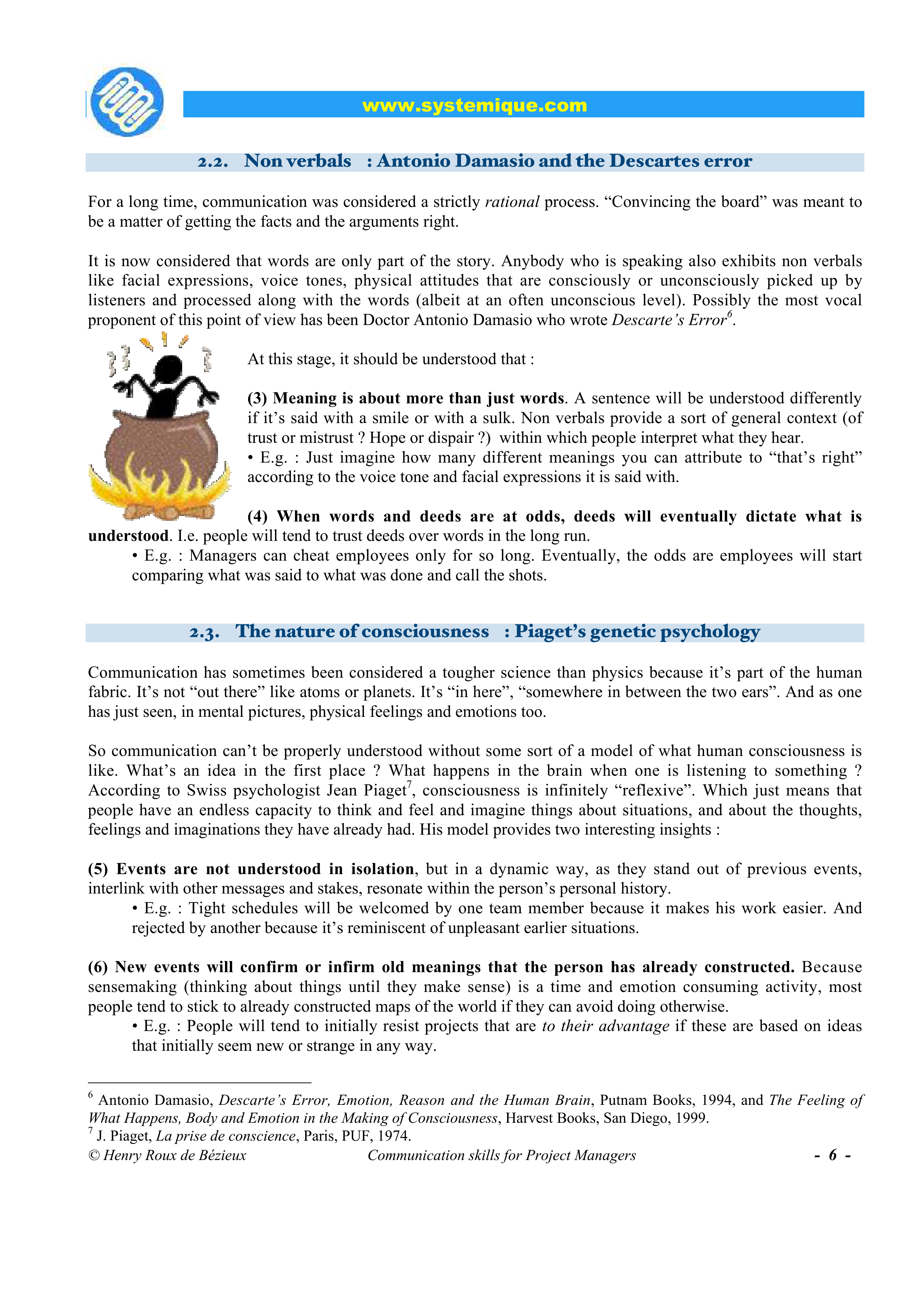
(1) “The map is not the territory”
.
People’s opinions, ideas, memories
and presentations are
linguistic maps
that relate to reality (the territory) but
should not be confused with it.
Although maps of the same territory
may look alike, each person will produce maps that are slightly or significantly different.
• E.g. : A situation that is perceived as chaotic by one team member will be perceived as rich in
opportunities by another.
(2) Messages are likely to be understood differently by the talker and by the listener.
People carry their own
references around with them (memories, contexts, situations they have faced, knowledge acquired, …) and tend
to interpret messages
in the light
of these. Thus, two people with different references can come to vastly different
conclusions as to what a message really means.
• When a project manager says “excellent work” to a team member, he could understand it as meaning
“
I’m really happy with your contribution
” while the team member could understand “
he is being nice
because he wants to give me more work
”.
2
The science of information, control and feed-back in both animals and machine. Developed during and after World War II
by Norbert Wiener. Led to the development of computers and all other automata presently in use.
3
Karl E. Weick, Sensemaking in Organizations, Sage Publications, Thousand Oaks California, 1995.
4
Peter Checkland and Jim Scholes, Soft Systems Methodology in Action, John Wiley & Sons, Chichester UK, 1999.
5
Alfred Korzybsky,
Selections from Science and Sanity
, The International Non Artistotelian Library Publishing Company,
USA, 1954.
Representations of the
event (a linguistic +
sensory map)
Event in the
world


www.systemique.com
© Henry Roux de Bézieux
Communication skills for Project Managers
- 6 -
2.2. Non verbals : Antonio Damasio and the Descartes error
For a long time, communication was considered a strictly
rational
process. “Convincing the board” was meant to
be a matter of getting the facts and the arguments right.
It is now considered that words are only part of the story. Anybody who is speaking also exhibits non verbals
like facial expressions, voice tones, physical attitudes that are consciously or unconsciously picked up by
listeners and processed along with the words (albeit at an often unconscious level). Possibly the most vocal
proponent of this point of view has been Doctor Antonio Damasio who wrote
Descarte’s Error
6
.
At this stage, it should be understood that :
(3) Meaning is about more than just words
. A sentence will be understood differently
if it’s said with a smile or with a sulk. Non verbals provide a sort of general context (of
trust or mistrust ? Hope or dispair ?) within which people interpret what they hear.
• E.g. : Just imagine how many different meanings you can attribute to “that’s right”
according to the voice tone and facial expressions it is said with.
(4) When words and deeds are at odds, deeds will eventually dictate what is
understood
. I.e. people will tend to trust deeds over words in the long run.
• E.g. : Managers can cheat employees only for so long. Eventually, the odds are employees will start
comparing what was said to what was done and call the shots.
2.3. The nature of consciousness : Piaget’s genetic psychology
Communication has sometimes been considered a tougher science than physics because it’s part of the human
fabric. It’s not “out there” like atoms or planets. It’s “in here”, “somewhere in between the two ears”. And as one
has just seen, in mental pictures, physical feelings and emotions too.
So communication can’t be properly understood without some sort of a model of what human consciousness is
like. What’s an idea in the first place ? What happens in the brain when one is listening to something ?
According to Swiss psychologist Jean Piaget
7
, consciousness is infinitely “reflexive”. Which just means that
people have an endless capacity to think and feel and imagine things about situations, and about the thoughts,
feelings and imaginations they have already had. His model provides two interesting insights :
(5) Events are not understood in isolation
, but in a dynamic way, as they stand out of previous events,
interlink with other messages and stakes, resonate within the person’s personal history.
• E.g. : Tight schedules will be welcomed by one team member because it makes his work easier. And
rejected by another because it’s reminiscent of unpleasant earlier situations.
(6) New events will confirm or infirm old meanings that the person has already constructed.
Because
sensemaking (thinking about things until they make sense) is a time and emotion consuming activity, most
people tend to stick to already constructed maps of the world if they can avoid doing otherwise.
• E.g. : People will tend to initially resist projects that are
to their advantage
if these are based on ideas
that initially seem new or strange in any way.
6
Antonio Damasio,
Descarte’s Error, Emotion, Reason and the Human Brain
, Putnam Books, 1994, and
The Feeling of
What Happens, Body and Emotion in the Making of Consciousness
, Harvest Books, San Diego, 1999.
7
J. Piaget,
La prise de conscience
, Paris, PUF, 1974.


www.systemique.com
© Henry Roux de Bézieux
Communication skills for Project Managers
- 7 -
Piaget’s infinitely reflexive consciousness :
2.4. Understanding interdependence : 3
rd
generation systemics
Systemics can be loosely defined as the “science of systems”… Systems : those bothersome, complex, ever-
changing, unpredictable, chaotic sets, collections, arrays of miscellaneous elements interacting with each other in
ways not always well understood.
Mechanical
and
electronic
systems like wrist watches that need to be precisely
controlled.
Biological and natural
systems like the weather and its fabled butterfly effect (how the flapping of
the wings of a butterfly over Brazil could cause a hurricane in Texas…).
Social
systems like that mix of
employees, factory workers, clerks, office workers, consultants, clients, suppliers, lawyers, regulators, managers
and leaders which are referred to as organizations …
Systemic laws tend to govern the behavior in groups of people like project teams, business units and
corporations. Within these, whatever anybody says or does is to some degree dependant on what everybody else
has said or done. The way people communicate with one and another dictates a large share of the responses they
get. This has two important consequences :
(7) A person’s communication is always rational from their point of view.
This may sound surprising since
the same communication may sound irrational from the outside. What it means is that people are mostly reacting
to influences which, although invisible, are dictating their behavior.
Outside
influences include other team
members, corporate strategy but also family members, friends and foes, etc. Influences from the
inside
include
past memories, reference experiences, hopes and disappointments, undigested emotions, etc.
• E.g. : People who feel angry about things when they seem to be going well are possibly reacting to
earlier, “undigested” experiences.
(8) The response one gets from other people should always be evaluated in the light of the way one has
communicated with them
. This does not mean that other people’s behavior is a direct consequence of one’s
own. People do have a measure of choice ! But yes, it does mean one’s own behavior is a contributing factor.
• E.g. : Are excessive control and managerial incoherence contributing to passive employee behaviour ?
Representations of the
event (a linguistic +
sensory map)
Events in the
world
Thoughts, pictures and feelings about these representations
Thoughts, pictures and feelings about these thoughts, pictures and feelings
History
Culture,
etc.

www.systemique.com
© Henry Roux de Bézieux
Communication skills for Project Managers
- 8 -
2.5. Balancing skills : Porter’s attitudes
Communication is not about one person doing all the talking, and the rest just listening. American psychologist
Cialdini
8
showed that the cornerstone to great influence is mutual trust. And that requires balancing relationships
out. Giving as much attention to listening as to talking. Being as skilled in receptivity (receiving…) as in
emissivity (emitting messages…). To help balance both polarities, the following tool was adapted from Michael
Porter’s work, best known for his contributions to the fields of marketing and business strategy
9
.
RECEPTIVE
ATTITUDES
1) Listening :
Simply being present to somebody. Showing concern. Taking time
out to listen. Showing by appropriate verbal and non verbal responses that one has
heard.
2) Questioning :
Reacting to what has just been said, asking questions, getting
more details, conducting an interview, finding things out…
3) Reformulating :
Summing up what has just been said by a neutral statement.
“
So you think we should do this…
”. “
So when this happened, you did that…
”. Saying
something in echo to what has just been said. Reformulating should always be done in a
neutral and impartial way.
EMISSIVE
ATTITUDES
4) Interpreting :
Sensemaking, explaining what things could or ought to mean,
saying how things should be understood and seen, saying “
this is due to that
” and “
this
will be the consequence of that
”, “
the situation is like this…
” etc.
5) Directing :
Saying what should be done, giving orders, directing other people,
making decisions for other people. Providing solutions, showing the way that should be
taken, deciding what should be done, solving a problem, etc.
Saying “
this is the way you
should do things…
”, “
this is the best solution to this problem…
”, etc.
6) Evaluating :
Passing judgment over, giving feed-back on, saying what’s right
and what isn’t, evaluating behaviour and / or results, saying “
you are right because…
”,
“
this is wrong because…
”, “
this is better than that…
”
7) Helping :
Providing moral or material assistance, seeking to help people out,
sustain their moral, lessen blows, saying things like “
I will always be there to help you
”,
“
things aren’t so bad, I am sure you will come up with something
”…
None of these attitudes are good or bad by themselves. All of them can come in handy. The point is that overuse
of any given attitude (and particularly the emissive ones) tends to throw relationships out of balance.
When learning communication skills, attention should be given to learning both emissive and receptive types of
skills.
8
Robert B. Cialdini,
Influence, Science and Practice
, Allyn & Bacon; 4th edition, USA, 2000.
9
Michael Porter,
Competitive Strategy: Techniques for Analyzing Industries and Competitors
, Free Press, USA,
1998.

www.systemique.com
© Henry Roux de Bézieux
Communication skills for Project Managers
- 9 -
3. Listening skills : Discovering other people’s perspective
Over the last 30 years or so, the focus in business communication has been on “getting the message out”. Indeed,
lots of the present day training programs have been developed by large “communication businesses”, i.e.
advertising companies.
Undoubtedly, being able to get one’s point across and persuade others is an asset. But this skill needs to be
balanced out. When team members are all bent on getting
their
point of view to prevail, over-communication
appears : everybody’s talking, nobody’s listening. Team spirit invariably suffers.
Discovering other people’s perspective is about understanding what’s on their mind… Giving them a chance to
wield some influence… Setting up balanced relationships in which both partners get a fair hearing… Setting up
a climate of trust … Being able to handle real issues and face difficulties… Being able to shift the focus of
attention from the opinions to the facts, the processes, the meanings, the consequences, the solutions, etc.
3.1. Basics : Active Listening
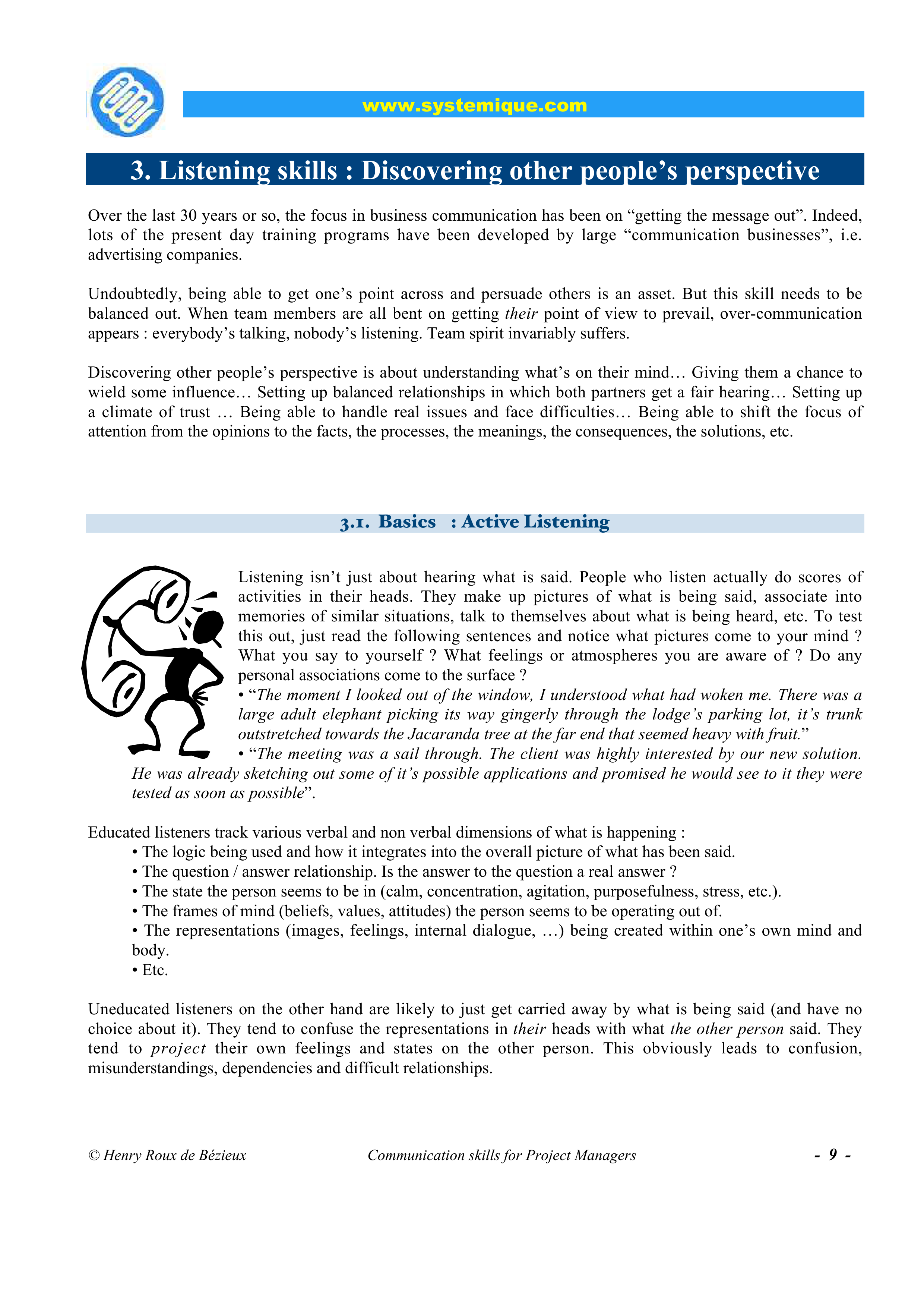
Listening isn’t just about hearing what is said. People who listen actually do scores of
activities in their heads. They make up pictures of what is being said, associate into
memories of similar situations, talk to themselves about what is being heard, etc. To test
this out, just read the following sentences and notice what pictures come to your mind ?
What you say to yourself ? What feelings or atmospheres you are aware of ? Do any
personal associations come to the surface ?
• “
The moment I looked out of the window, I understood what had woken me. There was a
large adult elephant picking its way gingerly through the lodge’s parking lot, it’s trunk
outstretched towards the Jacaranda tree at the far end that seemed heavy with fruit.
”
• “
The meeting was a sail through. The client was highly interested by our new solution.
He was already sketching out some of it’s possible applications and promised he would see to it they were
tested as soon as possible
”.
Educated listeners track various verbal and non verbal dimensions of what is happening :
• The logic being used and how it integrates into the overall picture of what has been said.
• The question / answer relationship. Is the answer to the question a real answer ?
• The state the person seems to be in (calm, concentration, agitation, purposefulness, stress, etc.).
• The frames of mind (beliefs, values, attitudes) the person seems to be operating out of.
• The representations (images, feelings, internal dialogue, …) being created within one’s own mind and
body.
• Etc.
Uneducated listeners on the other hand are likely to just get carried away by what is being said (and have no
choice about it). They tend to confuse the representations in
their
heads with what
the other person
said. They
tend to
project
their own feelings and states on the other person. This obviously leads to confusion,
misunderstandings, dependencies and difficult relationships.

www.systemique.com
© Henry Roux de Bézieux
Communication skills for Project Managers
- 10 -
3.2. Observing : Sensory acuity tools
Sensory acuity is about paying attention with one’s senses (eyes, ears, feelings…) while somebody else is
talking. Rather than
just
focusing on words and meanings, sensory acuity helps pick up the somewhat less
conscious messages being transmitted non verbally.
What are the main parameters that can be observed ?
Eyes
Focus
Focused
————— Defocused
Pupil Dilation
Dilated
————— Undilated
Breathing
Rate
Fast
————— Slow
Location
High
————— Low
Amplitude
Deep
————— Superficial
Skin Colour
Light
————— Dark
Skin Tonus or Muscle Tone
Shiny
————— Not shiny
Face: Lower Lip Size
Lines
————— No lines
Voice
Rhythm
Fast
————— Slow
Volume
Low
————— Loud
Pitch
High
————— Low
Gestures
Voluntary
Hand, arm and head movements, etc.
Involuntary
Hands twitching, feet tap tapping, eyes blinking, etc.
Posture
Position of body (back, legs, arms, neck, head…), position shifts.
What’s the theory behind sensory acuity ?
According to cognitive psychology, when people think of a particular topic or memory, they tend to go into the
particular “state” associated with the thought or event. “States” are fairly stable, they affect both the mind and
the body and can to a certain degree be observed from the outside.
• E.g. a state of confusion : hands and voice shaking slightly, sweat visible on the forehead, etc.
• E.g. a state of creativity : eyes popping upwards and searching around, voice trailing off, etc.
What’s the point of developing sensory acuity ?
Sensory acuity is used to
make guesses
at what state a person is in, notice state shifts and more generally take
states into account when conducting an interview, chairing a meeting or just being attentive to somebody.
It should be noted that one cannot know somebody else’s state for certain. States often share common observable
characteristics with one another (e.g. fatigue and boredom both lead to yawning). It follows that one should be
wary of hasty conclusions. In case of doubt, it’s easy enough to state that something has been noticed and ask the
person about it.



www.systemique.com
© Henry Roux de Bézieux
Communication skills for Project Managers
- 11 -
My point of
view
Other person’s
point of view
Meta point of
view
Systems point
of view
2
4
3
1
3.3. Points of view : Perceptual positions
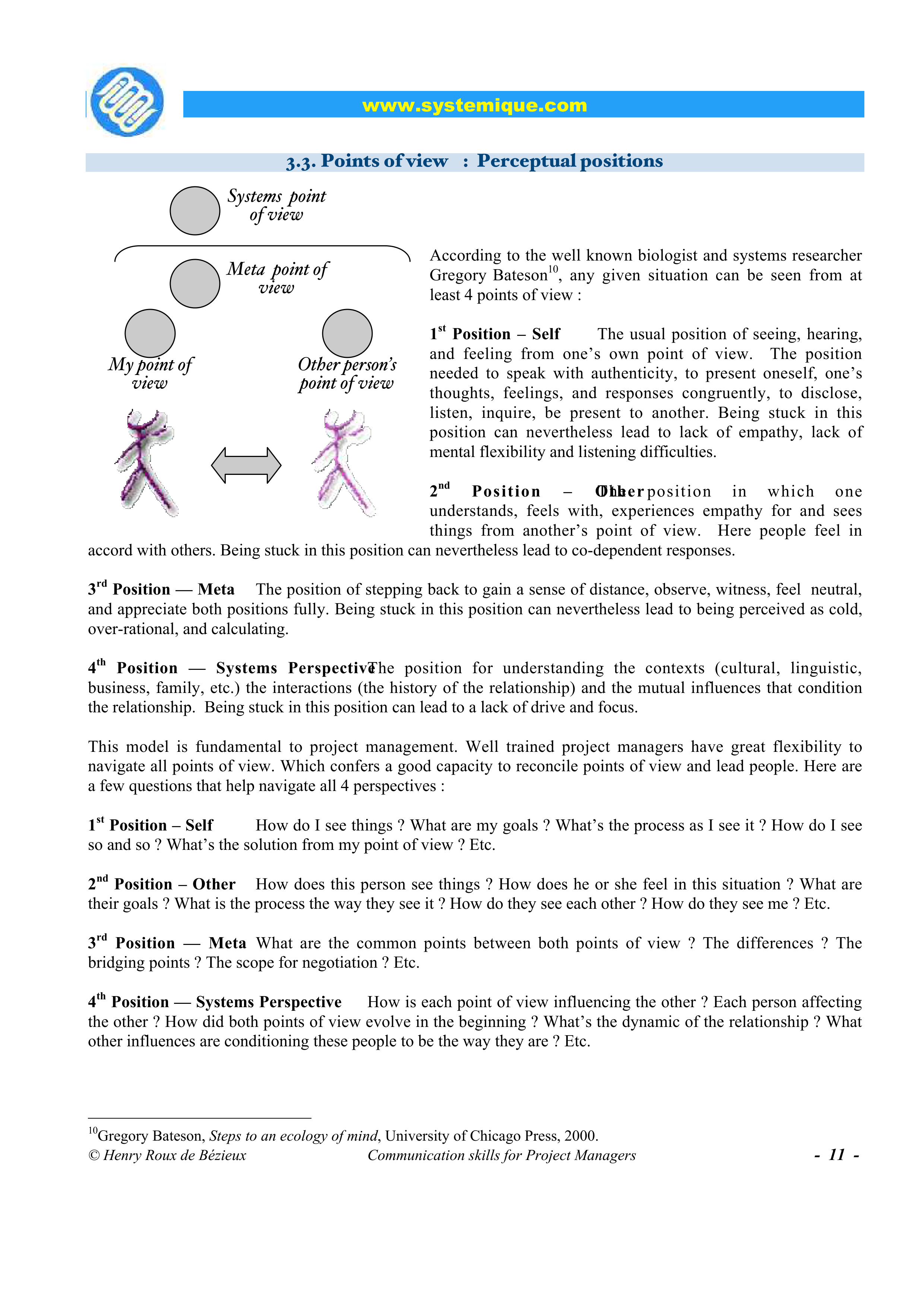
According to the well known biologist and systems researcher
Gregory Bateson
10
, any given situation can be seen from at
least 4 points of view :
1
st
Position – Self
The usual position of seeing, hearing,
and feeling from one’s own point of view. The position
needed to speak with authenticity, to present oneself, one’s
thoughts, feelings, and responses congruently, to disclose,
listen, inquire, be present to another. Being stuck in this
position can nevertheless lead to lack of empathy, lack of
mental flexibility and listening difficulties.
2
nd
Position
–
Other
The
position
in
which
one
understands, feels with, experiences empathy for and sees
things from another’s point of view. Here people feel in
accord with others. Being stuck in this position can nevertheless lead to co-dependent responses.
3
rd
Position — Meta
The position of stepping back to gain a sense of distance, observe, witness, feel neutral,
and appreciate both positions fully. Being stuck in this position can nevertheless lead to being perceived as cold,
over-rational, and calculating.
4
th
Position — Systems Perspective
The position for understanding the contexts (cultural, linguistic,
business, family, etc.) the interactions (the history of the relationship) and the mutual influences that condition
the relationship. Being stuck in this position can lead to a lack of drive and focus.
This model is fundamental to project management. Well trained project managers have great flexibility to
navigate all points of view. Which confers a good capacity to reconcile points of view and lead people. Here are
a few questions that help navigate all 4 perspectives :
1
st
Position – Self
How do I see things ? What are my goals ? What’s the process as I see it ? How do I see
so and so ? What’s the solution from my point of view ? Etc.
2
nd
Position – Other
How does this person see things ? How does he or she feel in this situation ? What are
their goals ? What is the process the way they see it ? How do they see each other ? How do they see me ? Etc.
3
rd
Position — Meta
What are the common points between both points of view ? The differences ? The
bridging points ? The scope for negotiation ? Etc.
4
th
Position — Systems Perspective
How is each point of view influencing the other ? Each person affecting
the other ? How did both points of view evolve in the beginning ? What’s the dynamic of the relationship ? What
other influences are conditioning these people to be the way they are ? Etc.
10
Gregory Bateson,
Steps to an ecology of mind
, University of Chicago Press, 2000.

www.systemique.com
© Henry Roux de Bézieux
Communication skills for Project Managers
- 12 -
3.4. Movie talk : Listening to representational systems
How does one know that a person is using any given system of representation to create movies in their mind?
Each system has its own linguistic cues : words and expressions that are specific to each representational system.
Learning to
listen
for these enables one to detect how the person is processing information
11
.
VISUAL
admire
appear
foresee
scan
attractive
form
see
blurred
gaze
shin
bright
glance
show
clear
glare
sight
cloudy
gleam
sight
see
colorful
glow
sparkle
conceal
graphic
dark
hazy
staring
dawn
illuminate
strobe
disappear
imagine
surface
display
obscure
twinkle
envision
observe
vanish
exhibit
look
veil
expose
peer
view
eyed
perspective
visualize
faced
picture
view
flash
preview
vivid
focus
reflect
watch
Expressions
:
seeing eye to eye
appears to me
mental picture
got an eyeful
beyond a shadow of a
doubt
mind's eye
bird's eye view
naked eye
catch a glimpse of
paint a picture
clear cut
photographic
pretty as a picture
crystal clear
plainly seen
dim view
a sight for sore eyes
see to it
flashed on
short sighted
get a perspective
showing off
get a scope on
make a scene
horse of a different color
hazy idea
snap shot
image
staring off in space
take a peek
in light of
tunnel vision
In person
under your nose
in view of
AUDITORY
announce
harmonize
request
answer
harsh
resonance
argue
hear
sing
asked
hum
shout
attune
inquire
shriek
call
insult
shrill
chatter
lecture
sighs
cheer
listen
silences
complain
loud
silent
crescendo
melodious
sound(s)
cry
mention
stammer
deaf
mumble
talk
discuss
noisy
tell
echo
outspoken
translate
explain
overtones
expression
question
utter
growl
quiet
vocal
grumble
recite
yell
gurgling
reply
11
This section relies on the insights of General Semantics and its derivatives, Neuro Linguistinc Programing and
NeuroSemantics. See Alfred Korzybski,
Science and Sanity
, The International Non Aristotelian Library Publishing
Company, New York, 1954.

www.systemique.com
© Henry Roux de Bézieux
Communication skills for Project Managers
- 13 -
Expressions
:
be all ears
make music
be heard
manner of speaking
blabber mouth
pay attention to
clear as a bell
power of speech
clearly expressed
purrs like a kitten
call on
outspoken
describe in detail
rap session
ear full
rings a bell
express yourself
state your purpose
give an account of
tattle-tale
give me your ear to tell
the truth
grant me an audience
tongue-tied
heard voices
tune in / tune out
hidden messages
utterly
hold your tongue
unheard of
idle talk
voice an opinion
inquire into
well formed
key note speaker
word for word
loud and clear
KINESTHETIC
angle
grapple
skip
beat
grasps
slip
bends
grinds
smooth
bounce
hard
soft
break
hold
solid
brush
hug
spike
burdened
hurt
stuffed
carry
impression
thick
clumsy
irritate
sweep
comfortable
mushy
concrete
movement
touch
crouching
pinch
trample
crumble
plush
tremble
exciting
pressure
twist
feel
pull
budge
firm
rub
unfeeling
fits
run
warm
flop
scramble
wash
force
scrape
weigh
grab
shaky
work
Expressions
:
all washed up
hot-head
be felt
keep your shirt on
boils down to
know-how
catch on
lay the cards on the table
chip off the old block
light headed
come to grips with
control yourself
make contact
connect with
moment of panic
pressure
pain-in-the-neck
cool / calm / collected
pull some strings
hold it, hold on
firm foundations
sharp as a tack
floating on thin air
under handed
slip through
get a hold of
slipped my mind
topsy turvy
get a handle on
smooth operator
get a load of this
heated argument
start from scratch
get in touch with
stiff upper lip
hang in there
get the drift of
throw out
hand in hand
tap into
hands on
turn around
DIGITAL
conscious
know
learn
aware
task
believe
motivate
change
nice
clear
notice
conceive
perceive
consider
process
decide
question
experience
meaning
evaluation
significance
compute
count
account
Expressions
:
This makes sense
I understand you
it can be argued this way
this reasoning is wrong
I question his perceptions
the rationale is …
this doesn’t compute
communication process


www.systemique.com
© Henry Roux de Bézieux
Communication skills for Project Managers
- 14 -
3.5. Questioning : Wording the right questions
Asking questions is such an everyday event that most people don’t give it a second thought. But it’s not as
simple as it sounds. Yes off course, questions are about finding things out. What are the different types of
questions and how should they be worded ? What kind of question should one ask to elicit what kind of
information ?
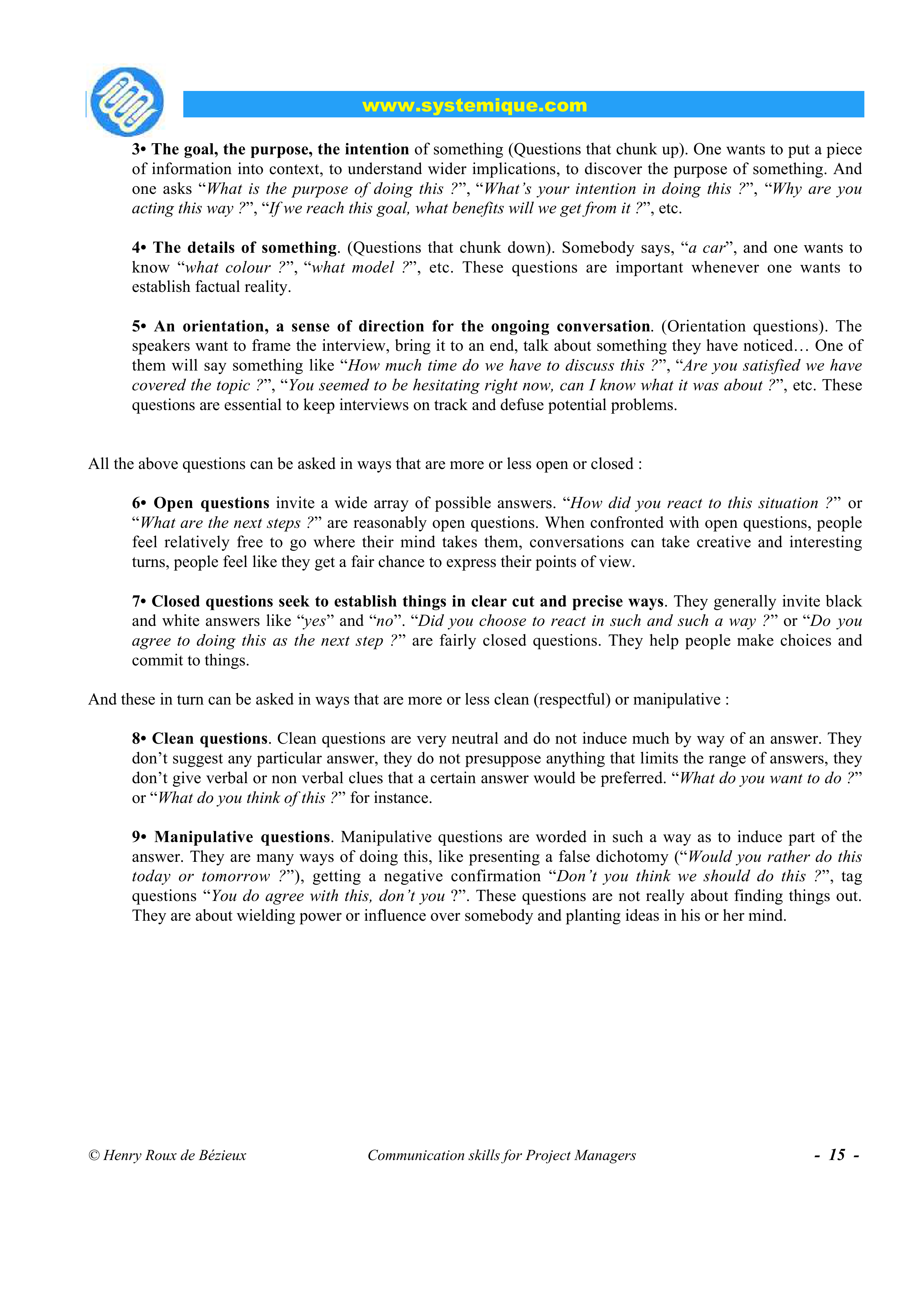
Clarifying what one is looking for and wording questions accordingly :
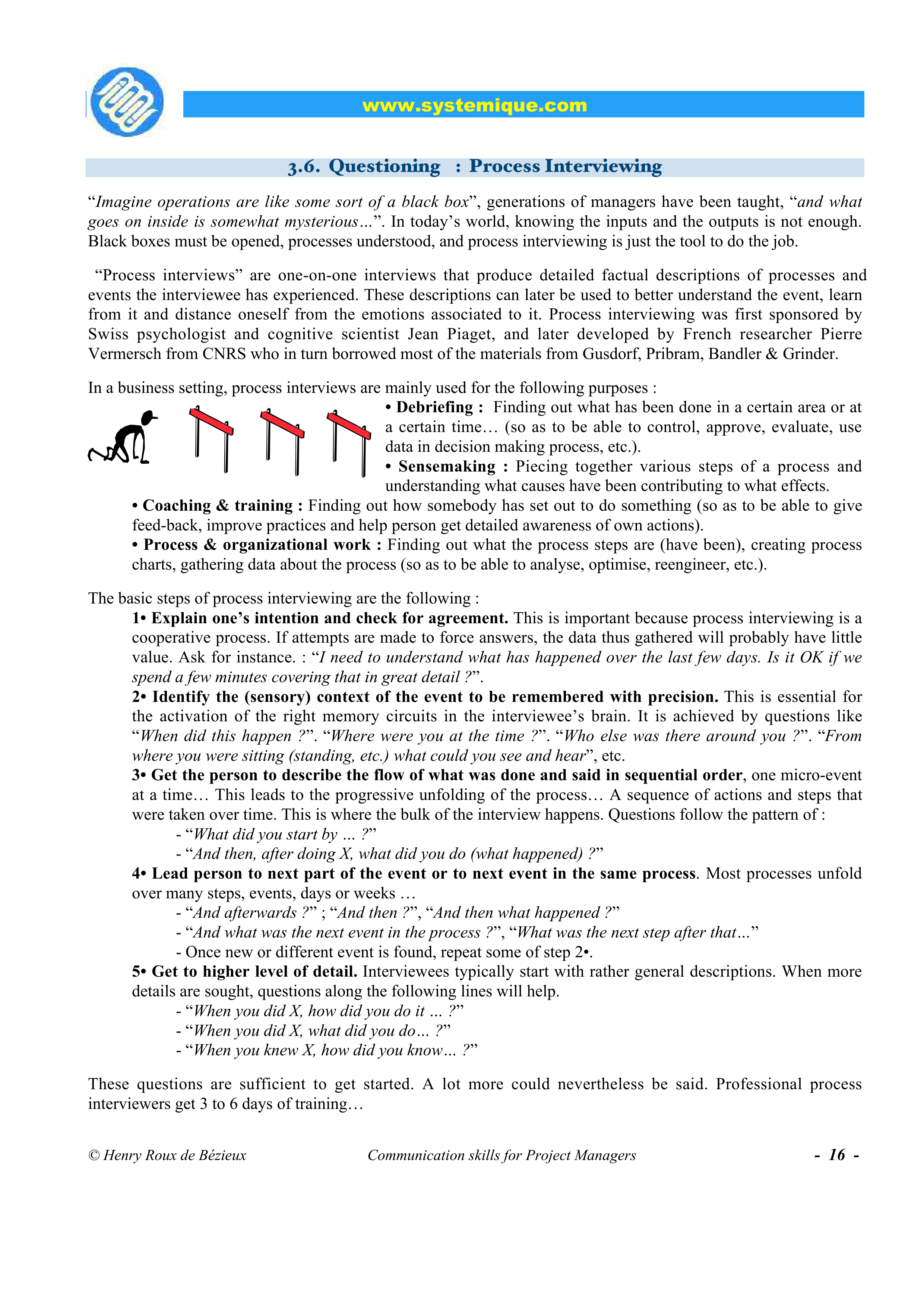
Five different types of questions can be differentiated according to the type of information that is sought :
1• A description
(Descriptive questions). “
What happened ?
”, “
What did she tell you ?
”, “
What did you
do on this trip ?
”, “
How did we get into this situation ?
”, “
When this event happened, how did it start ?
”,
etc. Getting the facts straight is essential. These are the questions that do the job. One can further
distinguish in between two types of descriptive questions :
• The 4W + H : What, Where, When, Who and How : all these questions go after the facts.
• Process interviewing questions seek to establish how something happened, a situation developed,
the history of something (large scale process) or the action strategy (small scale process) - (see
further on in this manual).
2• An interpretation, an opinion
(Interpretative questions). These questions are not about the bare facts,
but about the higher mental representations people carry around in their heads : ideas, opinions, concepts,
evaluations, judgments, etc. “
What do you think of this ?
”, “
What’s your opinion about … ?
”, “
If this were
to succeed, what would it mean to you ?
”, “
How do you think this relates to that ?
”. Two further subsets of
questions can be differentiated :
• Sensemaking questions. These questions seek to establish the sense, the meaning of something to
somebody. E.g. “
In the context of your career, what could this mean to you ?
”.
• Relationship questions. These questions seek to establish how a person relates something to
something else. E.g. “
What’s the relationship between our performance this year and that of last
year ?
”.
4
Chunk down
?
3
Chunk up
7
Closed
6
Open
5
Orientation
1
Descriptive
2
Interpretative
9
Manipulative
8
Clean

www.systemique.com
© Henry Roux de Bézieux
Communication skills for Project Managers
- 15 -
3• The goal, the purpose, the intention
of something (Questions that chunk up). One wants to put a piece
of information into context, to understand wider implications, to discover the purpose of something. And
one asks “
What is the purpose of doing this ?
”, “
What’s your intention in doing this ?
”, “
Why are you
acting this way ?
”, “
If we reach this goal, what benefits will we get from it ?
”, etc.
4• The details of something
. (Questions that chunk down). Somebody says, “
a car
”, and one wants to
know “
what colour ?
”, “
what model ?
”, etc. These questions are important whenever one wants to
establish factual reality.
5• An orientation, a sense of direction for the ongoing conversation
. (Orientation questions). The
speakers want to frame the interview, bring it to an end, talk about something they have noticed… One of
them will say something like “
How much time do we have to discuss this ?
”, “
Are you satisfied we have
covered the topic ?
”, “
You seemed to be hesitating right now, can I know what it was about ?
”, etc. These
questions are essential to keep interviews on track and defuse potential problems.
All the above questions can be asked in ways that are more or less open or closed :
6• Open questions
invite a wide array of possible answers. “
How did you react to this situation ?
” or
“
What are the next steps ?
” are reasonably open questions. When confronted with open questions, people
feel relatively free to go where their mind takes them, conversations can take creative and interesting
turns, people feel like they get a fair chance to express their points of view.
7• Closed questions seek to establish things in clear cut and precise ways
. They generally invite black
and white answers like “
yes
” and “
no
”. “
Did you choose to react in such and such a way ?
” or “
Do you
agree to doing this as the next step ?
” are fairly closed questions. They help people make choices and
commit to things.
And these in turn can be asked in ways that are more or less clean (respectful) or manipulative :
8• Clean questions
. Clean questions are very neutral and do not induce much by way of an answer. They
don’t suggest any particular answer, they do not presuppose anything that limits the range of answers, they
don’t give verbal or non verbal clues that a certain answer would be preferred. “
What do you want to do ?
”
or “
What do you think of this ?
” for instance.
9• Manipulative questions
. Manipulative questions are worded in such a way as to induce part of the
answer. They are many ways of doing this, like presenting a false dichotomy (“
Would you rather do this
today or tomorrow ?
”), getting a negative confirmation “
Don’t you think we should do this ?
”, tag
questions “
You do agree with this, don’t you
?”. These questions are not really about finding things out.
They are about wielding power or influence over somebody and planting ideas in his or her mind.

www.systemique.com
© Henry Roux de Bézieux
Communication skills for Project Managers
- 16 -
3.6. Questioning : Process Interviewing
“
Imagine operations are like some sort of a black box
”, generations of managers have been taught, “
and what
goes on inside is somewhat mysterious…
”. In today’s world, knowing the inputs and the outputs is not enough.
Black boxes must be opened, processes understood, and process interviewing is just the tool to do the job.
“Process interviews” are one-on-one interviews that produce detailed factual descriptions of processes and
events the interviewee has experienced. These descriptions can later be used to better understand the event, learn
from it and distance oneself from the emotions associated to it. Process interviewing was first sponsored by
Swiss psychologist and cognitive scientist Jean Piaget, and later developed by French researcher Pierre
Vermersch from CNRS who in turn borrowed most of the materials from Gusdorf, Pribram, Bandler & Grinder.
In a business setting, process interviews are mainly used for the following purposes :
• Debriefing :
Finding out what has been done in a certain area or at
a certain time… (so as to be able to control, approve, evaluate, use
data in decision making process, etc.).
• Sensemaking :
Piecing together various steps of a process and
understanding what causes have been contributing to what effects.
• Coaching & training :
Finding out how somebody has set out to do something (so as to be able to give
feed-back, improve practices and help person get detailed awareness of own actions).
• Process & organizational work :
Finding out what the process steps are (have been), creating process
charts, gathering data about the process (so as to be able to analyse, optimise, reengineer, etc.).
The basic steps of process interviewing are the following :
1• Explain one’s intention and check for agreement.
This is important because process interviewing is a
cooperative process. If attempts are made to force answers, the data thus gathered will probably have little
value. Ask for instance. : “
I need to understand what has happened over the last few days. Is it OK if we
spend a few minutes covering that in great detail ?
”.
2• Identify the (sensory) context of the event to be remembered with precision.
This is essential for
the activation of the right memory circuits in the interviewee’s brain. It is achieved by questions like
“
When did this happen ?
”. “
Where were you at the time ?
”. “
Who else was there around you ?
”. “
From
where you were sitting (standing, etc.) what could you see and hear
”, etc.
3• Get the person to describe the flow of what was done and said in sequential order
, one micro-event
at a time… This leads to the progressive unfolding of the process… A sequence of actions and steps that
were taken over time. This is where the bulk of the interview happens. Questions follow the pattern of :
- “
What did you start by … ?
”
- “
And then, after doing X, what did you do (what happened) ?
”
4• Lead person to next part of the event or to next event in the same process
. Most processes unfold
over many steps, events, days or weeks …
- “
And afterwards ?
” ; “
And then ?
”, “
And then what happened ?
”
- “
And what was the next event in the process ?
”, “
What was the next step after that…
”
- Once new or different event is found, repeat some of step 2•.
5• Get to higher level of detail.
Interviewees typically start with rather general descriptions. When more
details are sought, questions along the following lines will help.
- “
When you did X, how did you do it … ?
”
- “
When you did X, what did you do… ?
”
- “
When you knew X, how did you know… ?
”
These questions are sufficient to get started. A lot more could nevertheless be said. Professional process
interviewers get 3 to 6 days of training…

www.systemique.com
© Henry Roux de Bézieux
Communication skills for Project Managers
- 17 -
3.7. Questioning : Sense making questions
People are mostly educated to think that events have well established (and scientifically proven) meanings.
Business is different. It’s about uncertainty : all events have multiple possible meanings from multiple different
points of view. What do people really think about a situation ? What sense do they make of things ? How many
different interpretations are there ? Are people going with the flow and just repeating what they were asked to
believe ? Do they harbour any doubts or misgivings ?
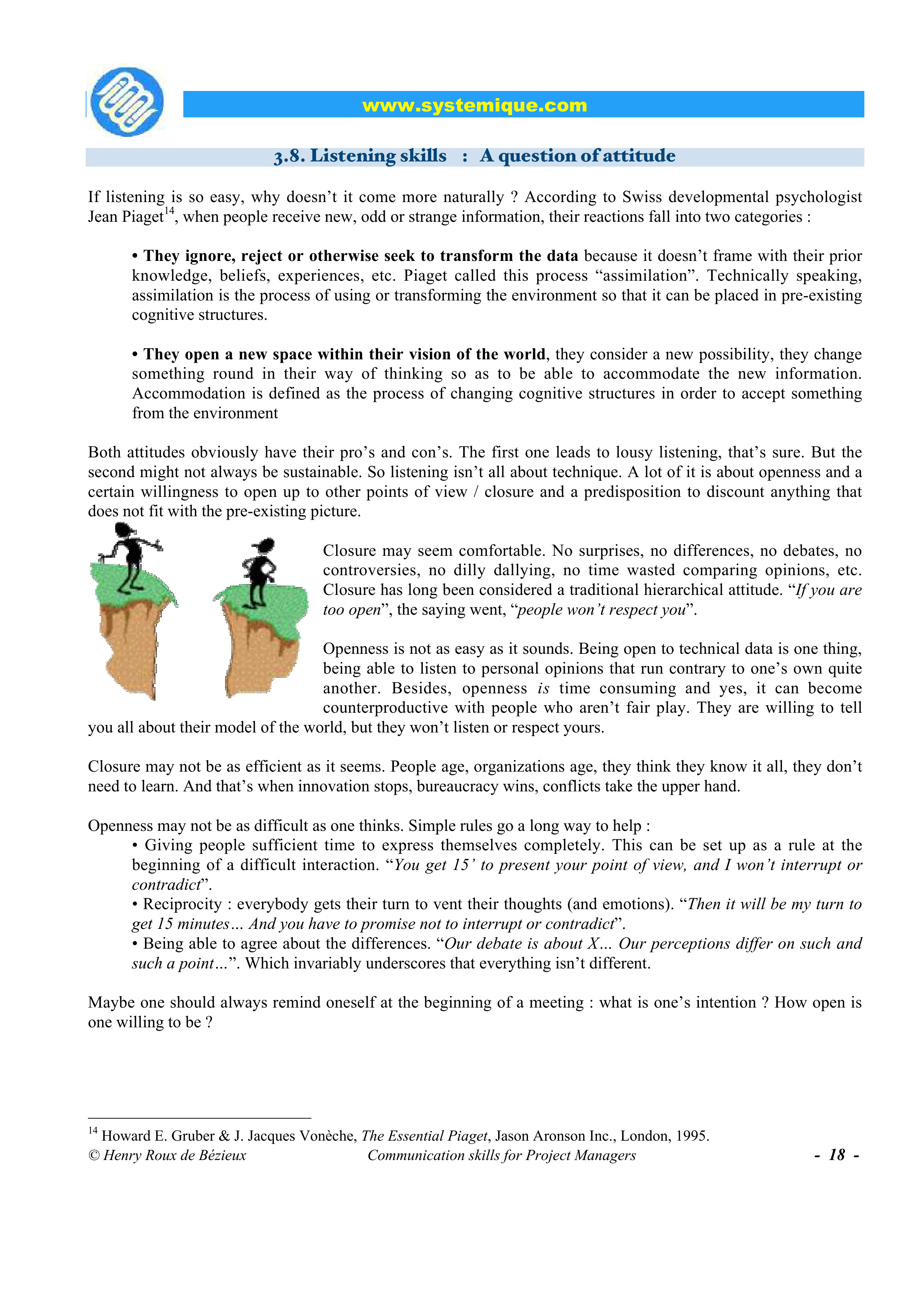
A lot of business time is spent making sense of events before appropriate action can be taken. Here is a model
and a mapping process that helps improve sensemaking.
• The model builds on Karl E. Weick’s work
12
and shows how sensemaking happens.
- Any event is likely to give rise to multiple possible meanings.
- Each possible meaning in turn has many derived meanings and implies other things at other levels.
- The sensemaking process tends to weed out possibilities until only one or a few remain.
• The mapping process comes from Neurosemantics and was designed by L. Michael Hall
13
. It
involves the following steps :
- Tracing the contours of what one is talking about.
- Identifying and drawing multiple first level meanings of what the situation means to the person.
- Exploring the derived meanings along all branches and drawing these into the map.
- Checking the map by submitting it to the interviewee and asking for feedback and confirmation.
12
Karl E. Weick,
Sensemaking in Organizations
, Sage Publications, Thousand Oaks, California, 1995.
13
L. Michael Hall,
The User’s Manual for the Brain
, Crown House Publishing, 2003, UK.
First
level
meaning
1
First
level
meaning
2
First
level
meaning
3
First
level
meaning
4
Situation, Event,
Goal, Etc.
“
This topic ? This situation ? This project
” … “
What does it mean ?
” “
What do
you think or feel about that ?
”
(
)
Derived
meaning
1
Derived
meaning
2
Derived
meaning
3
Derived
meaning
4
Values
Beliefs
Roles
Principles
Decisions
Analogies
Images
Expectations
Goals
Contexts
“
And what does that
mean ?
”
“
And what do you think
or feel about that ?
”

www.systemique.com
© Henry Roux de Bézieux
Communication skills for Project Managers
- 18 -
3.8. Listening skills : A question of attitude
If listening is so easy, why doesn’t it come more naturally ? According to Swiss developmental psychologist
Jean Piaget
14
, when people receive new, odd or strange information, their reactions fall into two categories :
• They ignore, reject or otherwise seek to transform the data
because it doesn’t frame with their prior
knowledge, beliefs, experiences, etc. Piaget called this process “assimilation”. Technically speaking,
assimilation is the process of using or transforming the environment so that it can be placed in pre-existing
cognitive structures.
• They open a new space within their vision of the world
, they consider a new possibility, they change
something round in their way of thinking so as to be able to accommodate the new information.
Accommodation is defined as the process of changing cognitive structures in order to accept something
from the environment
Both attitudes obviously have their pro’s and con’s. The first one leads to lousy listening, that’s sure. But the
second might not always be sustainable. So listening isn’t all about technique. A lot of it is about openness and a
certain willingness to open up to other points of view / closure and a predisposition to discount anything that
does not fit with the pre-existing picture.
Closure may seem comfortable. No surprises, no differences, no debates, no
controversies, no dilly dallying, no time wasted comparing opinions, etc.
Closure has long been considered a traditional hierarchical attitude. “
If you are
too open
”, the saying went, “
people won’t respect you
”.
Openness is not as easy as it sounds. Being open to technical data is one thing,
being able to listen to personal opinions that run contrary to one’s own quite
another. Besides, openness
is
time consuming and yes, it can become
counterproductive with people who aren’t fair play. They are willing to tell
you all about their model of the world, but they won’t listen or respect yours.
Closure may not be as efficient as it seems. People age, organizations age, they think they know it all, they don’t
need to learn. And that’s when innovation stops, bureaucracy wins, conflicts take the upper hand.
Openness may not be as difficult as one thinks. Simple rules go a long way to help :
• Giving people sufficient time to express themselves completely. This can be set up as a rule at the
beginning of a difficult interaction. “
You get 15’ to present your point of view, and I won’t interrupt or
contradict
”.
• Reciprocity : everybody gets their turn to vent their thoughts (and emotions). “
Then it will be my turn to
get 15 minutes… And you have to promise not to interrupt or contradict
”.
• Being able to agree about the differences. “
Our debate is about X… Our perceptions differ on such and
such a point…
”. Which invariably underscores that everything isn’t different.
Maybe one should always remind oneself at the beginning of a meeting : what is one’s intention ? How open is
one willing to be ?
14
Howard E. Gruber & J. Jacques Vonèche,
The Essential Piaget
, Jason Aronson Inc., London, 1995.

www.systemique.com
© Henry Roux de Bézieux
Communication skills for Project Managers
- 19 -
4. Talking skills : Getting one’s point of view across
4.1. Setting the agenda : Framing the interaction
Communication is not only about what happens during an interaction. Oftentimes, it’s about what happened
before
. How the interaction was framed in the first place. For great communication to happen, people need to
agree about what is to be discussed, how it should be discussed, what the value of discussing it is, etc.
Framing is a nice way to set things up in the beginning. Setting a frame means holding “the talks about the
talks”, discussing what should be discussed and how it should be discussed.
Framing has three major purposes :
• Paving the way for smooth and efficient communication by setting down the rules and the agenda.
• Creating goodwill between the communication partners.
• Creating the right kind of context to tackle potentially difficult or sensitive issues.
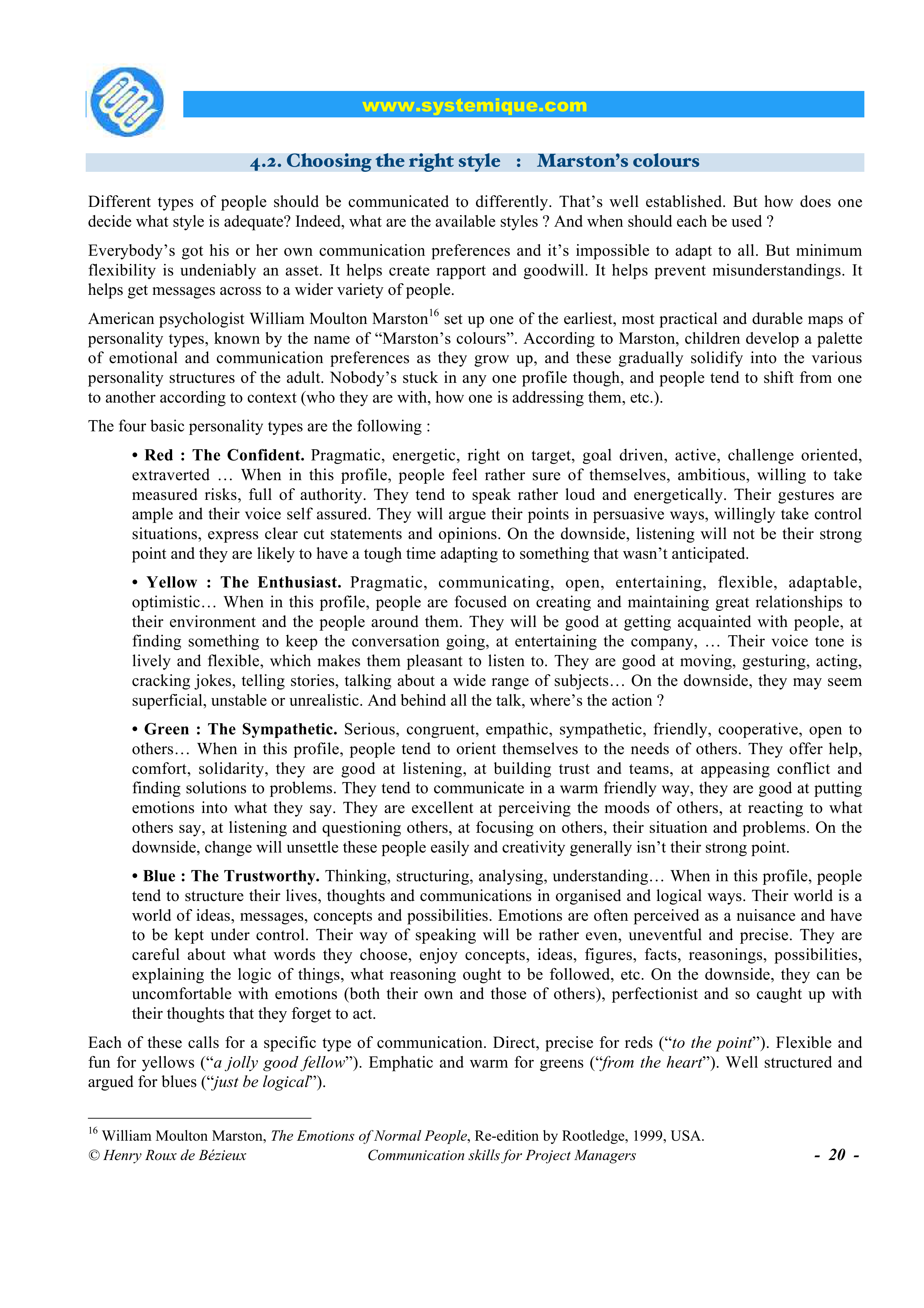
Framing is mostly done in an informal way. If possible, lawyers should be kept out of it ! Framing means
creating a minimum agreement on the following, as outlined in the above drawing from Berenice McCarthy’s
15
4-Mat model.
(1) Why communication is needed.
(2) What should be discussed.
(3) How things should be discussed (With whom ? By following what outline ? What rules ? Etc.).
(4) Where and when and for how long and over how much time (minutes / days / months) things should be
discussed.
In all cases, it is recommended to be clear about what one suggests, to request explicit agreement, to be open to
whatever suggestions the other party would like to make. To start the framing agreement, one can ask questions
like :
“
I would like to suggest we talk about this… For such and such a reason… Do you agree ?
”.
15
Berenice McCarthy,
About Learning
, Wauconda, IL: About Learning, Inc., 1996.
COMMENT ?
POURQUOI ?
OU ET DANS
QUOI ?
QUOI ?
Faits
Intuition
Adaptation
active
(Perceveurs)
Observation
réflective
(Jugeurs)
WHY ?
WHERE
AND WHEN ?
HOW ?
WHAT ?
Intuition
Facts
Reflective
Observation
Active
Adaptation

www.systemique.com
© Henry Roux de Bézieux
Communication skills for Project Managers
- 20 -
4.2. Choosing the right style : Marston’s colours
Different types of people should be communicated to differently. That’s well established. But how does one
decide what style is adequate? Indeed, what are the available styles ? And when should each be used ?
Everybody’s got his or her own communication preferences and it’s impossible to adapt to all. But minimum
flexibility is undeniably an asset. It helps create rapport and goodwill. It helps prevent misunderstandings. It
helps get messages across to a wider variety of people.
American psychologist William Moulton Marston
16
set up one of the earliest, most practical and durable maps of
personality types, known by the name of “Marston’s colours”. According to Marston, children develop a palette
of emotional and communication preferences as they grow up, and these gradually solidify into the various
personality structures of the adult. Nobody’s stuck in any one profile though, and people tend to shift from one
to another according to context (who they are with, how one is addressing them, etc.).
The four basic personality types are the following :
• Red : The Confident.
Pragmatic, energetic, right on target, goal driven, active, challenge oriented,
extraverted … When in this profile, people feel rather sure of themselves, ambitious, willing to take
measured risks, full of authority. They tend to speak rather loud and energetically. Their gestures are
ample and their voice self assured. They will argue their points in persuasive ways, willingly take control
situations, express clear cut statements and opinions. On the downside, listening will not be their strong
point and they are likely to have a tough time adapting to something that wasn’t anticipated.
• Yellow : The Enthusiast.
Pragmatic, communicating, open, entertaining, flexible, adaptable,
optimistic… When in this profile, people are focused on creating and maintaining great relationships to
their environment and the people around them. They will be good at getting acquainted with people, at
finding something to keep the conversation going, at entertaining the company, … Their voice tone is
lively and flexible, which makes them pleasant to listen to. They are good at moving, gesturing, acting,
cracking jokes, telling stories, talking about a wide range of subjects… On the downside, they may seem
superficial, unstable or unrealistic. And behind all the talk, where’s the action ?
• Green : The Sympathetic.
Serious, congruent, empathic, sympathetic, friendly, cooperative, open to
others… When in this profile, people tend to orient themselves to the needs of others. They offer help,
comfort, solidarity, they are good at listening, at building trust and teams, at appeasing conflict and
finding solutions to problems. They tend to communicate in a warm friendly way, they are good at putting
emotions into what they say. They are excellent at perceiving the moods of others, at reacting to what
others say, at listening and questioning others, at focusing on others, their situation and problems. On the
downside, change will unsettle these people easily and creativity generally isn’t their strong point.
• Blue : The Trustworthy.
Thinking, structuring, analysing, understanding… When in this profile, people
tend to structure their lives, thoughts and communications in organised and logical ways. Their world is a
world of ideas, messages, concepts and possibilities. Emotions are often perceived as a nuisance and have
to be kept under control. Their way of speaking will be rather even, uneventful and precise. They are
careful about what words they choose, enjoy concepts, ideas, figures, facts, reasonings, possibilities,
explaining the logic of things, what reasoning ought to be followed, etc. On the downside, they can be
uncomfortable with emotions (both their own and those of others), perfectionist and so caught up with
their thoughts that they forget to act.
Each of these calls for a specific type of communication. Direct, precise for reds (“
to the point
”). Flexible and
fun for yellows (“
a jolly good fellow
”). Emphatic and warm for greens (“
from the heart
”). Well structured and
argued for blues (“
just be logical
”).
16
William Moulton Marston,
The Emotions of Normal People
, Re-edition by Rootledge, 1999, USA.

www.systemique.com
© Henry Roux de Bézieux
Communication skills for Project Managers
- 21 -
4.3. Movie talk and metaphors : Planting pictures into minds
It’s one thing to say “
our goal is to increase sales by 37%
” and quite another to say “
when we get to our goal,
the phone should be ringing ever so often with people wanting to make appointments. Anxious people pleading
so we can take them as early as possible. People booking weeks ahead just to be sure they can come…
”.
Because large tracts of the brain work with images, sounds and physical feelings, neurons need to be fed with the
sensory stimulation rather than just abstract data. Just compare what comes to mind when the following is read :
Abstract Language
Sensory Language
• “
Mister X and I agreed that we would do this and
that”
.
• “
When I got to the meeting with Mister X, I found him
poured over vast spreadsheets. It seemed to me he was
in a slight state of stress, he was somewhat agitated
and his hands were twitching…
”
• “
The main deliverable will be a full report to top
management…
”
• “
The CEO called me on the phone last week and
asked for a full report to top management. He sounded
a little out of sorts and unhappy with the whole affair.
He said it was not his choice to launch this procedure.
But since things had already gone this far, the business
now needed to find the adequate response…
”.
Movie talk is about enriching the dialogue with sensory representations
.
• Why ? To liven conversation up. To provide pragmatic illustrations. To stimulate the sensory areas of
the brain. To create rich (multimodal) representations of something. To improve memorisation.
• How ?
* When talking, provide a blend of pictures (images of what one has seen, what one plans, how the
situation could be, etc.), auditory representations (vivid rendering of dialogues, etc.), kinaesthetics
(representations of what was felt in certain circumstances, of what is felt in the present, of what
would be felt if…), etc.
* When listening, invite the other person to switch over to movie talk by adequate questions. E.g.
“
when this happened, what was it like ? What did you see ? Etc.
”.
Metaphors go one step further and weave sensory representations into an interesting and relevant story.
• Why ? To get somebody’s attention. To provide an alternative description. To provide a stereotype for
understanding a situation. To give indications about the process of something.
• How ? By telling a story (short or long) that relates back to the topic. “
This situation is like what
happened in such and such a context…
”. “
Is this like what happened to so and so ?
”. “
That reminds me of
a time when…
”. “
A somewhat similar process in a different context would be…
”, etc.
Excellent talkers are real artists. They know when to switch in and out of movie talk. When to use a metaphor.
Mastering this takes a little time and practise. This way of talking also has a positive side effect : it makes
communication more fun. More lively. A metaphor a day keeps the doctor away.

www.systemique.com
© Henry Roux de Bézieux
Communication skills for Project Managers
- 22 -
4.4. Getting feed-back : Closing communication loops
The human brain requests closure. Closure is about getting the answers to one’s questions, finding out what the
end of the stories are, checking whether commitments have been held, being able to gather coherent information
and make sense of situations. Without adequate closure, people will feel left out, in the dark, in a state of
confusion, etc. And on the other hand attempt to create their own closure by relying on guesswork, hunches,
intuitions, etc. In both cases this leads to frequent projections, interpretations, misunderstandings,
miscommunication, discomfort and conflict.
Some 20
th
century management practises, designed along the “divide to reign” principle made it difficult for
subordinates to close loops. E.g. :
• Part of the picture was communicated to each person, but nobody was given a comprehensive
understanding of things.
• Real stakes and motivations were left in the dark while “socially acceptable” stakes and motivations
were presented.
• Real issues and questions were artfully dodged and side stepped when raised by subordinates.
• Whistle blowing was actively discouraged and whistle blowers mostly hushed up.
• Controversy was generally avoided, even when it was mostly intellectual.
These practises, it was recognised, lead to below average employee involvement and creativity whilst generating
above average rates of conflict and workplace stress.
Technically speaking, the idea of communication loops comes from cybernetics and can be illustrated by the
following dialogue :
1. Person A asks a question. E.g. : “
When
are you going to do this?
”
2. Person B gets the message.
3. Person B responds. E.g. : “
I’ll have it
done by Monday
”.
4. Person A gets the message.
5. Person A confirms that he’s got the message. E.g. : “
OK, that’s fine
”.
6. Person B gets the confirmation.
If all 6 steps are present, then the loop has been closed. If one step is missing, then a loop is left open and one
cannot be sure what the consequences will be. Maybe person A thinks he’s got the answer to his question, but
it’s not the one B gave ? Maybe B thinks person A didn’t get the answer (even though he did) and feels obliged
to communicate the message again and again ? Etc.
In the business context, closing loops is one of the basics of creating trust and goodwill amongst team members.
It involves :
• Giving straight and honest answers to questions.
• Setting up briefings and informations flows in such ways that people can gain adequate insights into
things.
• Accepting that people remind one of one’s own commitments.
• Having adequate practises to check information and see to it that sensitive topics are adequately
discussed.
TRANSMITTER
RECEPTOR
1
3
6
5
4
2


www.systemique.com
© Henry Roux de Bézieux
Communication skills for Project Managers
- 23 -
4.5. Language skills : Wording things right
“Wording things right” sounds like something only lawyers should bother about. It isn’t. Project managers who
care about how they are understood should master this skill too
17
. Here are the basic rules :
1) The map is not the territory.
Words are
not
the things they stand for. This is true even with simple things
like chairs. The word “chair” stands for a whole class of objects that share common properties but can be very
different from one another. When it comes to abstract words like “project”, “management” or “communication”,
people tend to put these words to an astonishing variety of uses.
• Consequence #1 : In case of doubt, check words out.
Major disagreements arise when people think
they are talking about the same thing and they aren’t. Take a minute to check how the other person means
a word, and how that compares to the way you mean it.
• Consequence #2 : If possible, reuse the other person’s words.
When discussing somebody’s idea,
attempt to use
their
word for it. This will make it easier for
them
to understand. If somebody is talking
about “the office”, don’t say “the workplace”, “the factory”, or whatever. Just say “the office”.
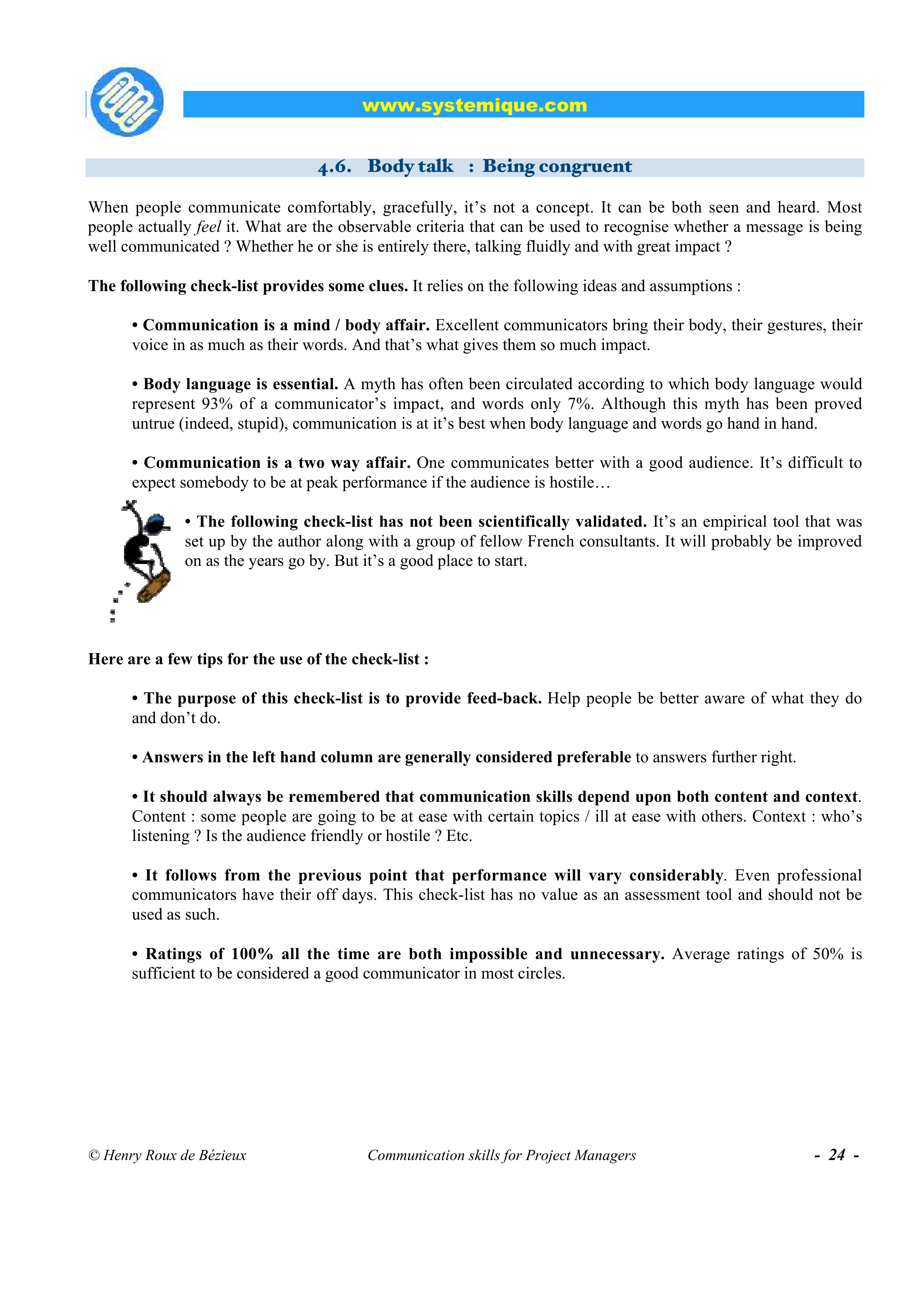
2) There is no such thing as a negative.
The logical brain is good at negatives. It understands that when “the
appointment is cancelled”, that means “no appointment”. On the other hand, the sensory areas of the brain are
not good at dealing with negatives. If one says, “
don’t think of a pink elephant
”, then the image of a pink
elephant tends to come to mind. If one says “
don’t worry about this aspect of things
” then worry is nevertheless
suggested. This is an important point because the
sensory
areas of the brain are
better connected to the action circuits than the logical areas. I.e., whatever is
suggested in a sensory mode tends to filter over into action.
• Consequence #3 : Use positives wherever possible.
Rather than say “
don’t think
of a pink elephant
”, say “
think of a blue balloon
”. Rather than “
this isn’t going to
be a tough appointment.
”, say “
this should be a sail through
”.
3) Words translate into sensory representations.
Lots of words connect up with
images, sounds or feelings within people. Actually, even though this happens both fast and mostly
unconsciously, the brain accesses hundreds of pictures, feelings, etc. just in order to be able to understand what
is being said. Being aware of this, it’s best to communicate the desired sensory representations intentionally.
• Consequence #4 : Use visual words when one wants person to picture things.
“
Just take a minute to
imagine
what the situation would
look
like next year ? Etc
.”.
• Consequence #5 : Use auditory words when one wants person to represent things auditorily.
“
When
you
talk
to this person
,
what would you like to
say
? What should the
tone
of the
conversation
be?
”.
• Consequence #6 : Use kinaesthetic words for access to feelings and states.
“
How
good
is the boss
going to
feel
about this, I wonder. Is it going to
weigh
in his mind ? Or will he just
shrug if off
?
”.
4) Differentiate states and processes.
Part of the mind thinks of
things
in a static way. “
The chair is up in front
of the table
” or “
The boss has a dynamic personality
”. Education is mostly based on this type of thinking which
only accounts for 50% of the brain’s potential. The rest of the brain handles processes : sequences of actions,
events, pictures that move down timelines… “
I saw him put the chair there before the boss entered
” or “
the boss
gave an energetic handshake and then blasted off. I thought “Whoa, what an energetic personality” …
”.
• Consequence #7 : Use what is most adapted to circumstances.
Process descriptions provide the best
insights, understandings and solutions but they are more time consuming. Ordinary static talking gets to
the point and proves faster but with wider margins of error and potential of misunderstanding.
17
The tools presented here originated with Alfred Krozybsky’s General Semantics. Alfred Krozybsky,
Science and Sanity
,
The International Non Aristotelian Library Publishing Company, New York, 1954.


www.systemique.com
© Henry Roux de Bézieux
Communication skills for Project Managers
- 24 -
4.6. Body talk : Being congruent
When people communicate comfortably, gracefully, it’s not a concept. It can be both seen and heard. Most
people actually
feel
it. What are the observable criteria that can be used to recognise whether a message is being
well communicated ? Whether he or she is entirely there, talking fluidly and with great impact ?
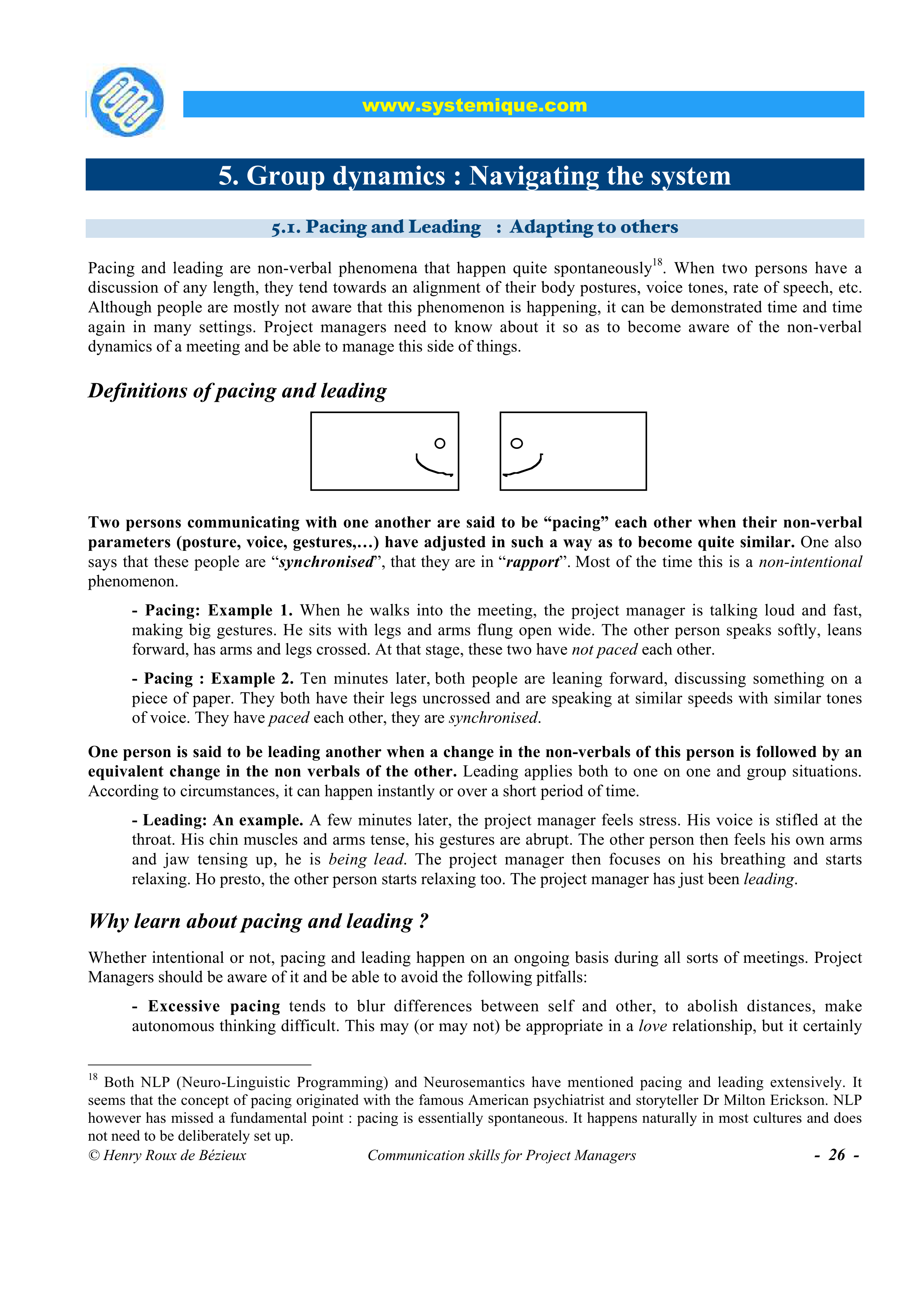
The following check-list provides some clues.
It relies on the following ideas and assumptions :
• Communication is a mind / body affair.
Excellent communicators bring their body, their gestures, their
voice in as much as their words. And that’s what gives them so much impact.
• Body language is essential.
A myth has often been circulated according to which body language would
represent 93% of a communicator’s impact, and words only 7%. Although this myth has been proved
untrue (indeed, stupid), communication is at it’s best when body language and words go hand in hand.
• Communication is a two way affair.
One communicates better with a good audience. It’s difficult to
expect somebody to be at peak performance if the audience is hostile…
• The following check-list has not been scientifically validated.
It’s an empirical tool that was
set up by the author along with a group of fellow French consultants. It will probably be improved
on as the years go by. But it’s a good place to start.
Here are a few tips for the use of the check-list :
• The purpose of this check-list is to provide feed-back.
Help people be better aware of what they do
and don’t do.
• Answers in the left hand column are generally considered preferable
to answers further right.
• It should always be remembered that communication skills depend upon both content and context
.
Content : some people are going to be at ease with certain topics / ill at ease with others. Context : who’s
listening ? Is the audience friendly or hostile ? Etc.
• It follows from the previous point that performance will vary considerably
. Even professional
communicators have their off days. This check-list has no value as an assessment tool and should not be
used as such.
• Ratings of 100% all the time are both impossible and unnecessary.
Average ratings of 50% is
sufficient to be considered a good communicator in most circles.

www.systemique.com
© Henry Roux de Bézieux
Communication skills for Project Managers
- 25 -
Check-List
What is the communicator doing
/ not doing ?
A) Physical Attitude
A1) Verticality
Good
Average
Poor
A2) Openness
Yes
Scared
Closed
A3) Dynamism
Fluid
More or less
Slow
A4) Emotions
Under control
Excessive
Paralysing
A5) Use of space
Excellent
Satisfying
Poor
B) Voice
B1) Power
Appropriate.
Sometimes
appropriate.
Mostly
inappropriate.
B2) Rhythm
Flexible,
appropriate.
Sometimes
appropriate.
Rigid, mostly
inappropriate.
B3) Diction
Good
Average
Poor
B4) Tone
Varied
Average
Poor
C) Gestures & Expressions
C1) Gestures
Expressive
Artificial
Non existent
C2) Movements
Justified
Random
Inappropriate
C3) Nervous movements
None
Occasional
Bothersome
C4) Eyes
Present
Appropriate
Empty, absent.
Fleeing, shifty.
C5) Facial Expression
Open
Closed
Absent
D) Words & Behaviour
D1) Verbal / non verbal coherence
(authenticity)
Excellent
Average
Poor
D2) Use of “I”, “you”, “we”…
Fluid
and
appropriate.
Occasional
fixations.
Total fixation on
one or the other.
D3) Delicate topics
Are talked about
i n
a
d i r e c t
professional way
Are talked about
with difficulty
Are dismissed,
left out, talked away.
D4) Coherence between words / deeds
Excellent
Approximate
Poor
D5) Listening capacity
Excellent
OK
Poor
D6) Adaptability to the other person
and flexibility
Excellent
adaptability
and
flexibility
A certain measure
of adaptability
Rigid attitude, no
pacing and leading.
D7) Initiative and creativity in
communication
Manages
exchange in creative
appropriate way.
Occasionally
manages interaction.
Only very seldom
manages interaction.

www.systemique.com
© Henry Roux de Bézieux
Communication skills for Project Managers
- 26 -
5. Group dynamics : Navigating the system
5.1. Pacing and Leading : Adapting to others
Pacing and leading are non-verbal phenomena that happen quite spontaneously
18
. When two persons have a
discussion of any length, they tend towards an alignment of their body postures, voice tones, rate of speech, etc.
Although people are mostly not aware that this phenomenon is happening, it can be demonstrated time and time
again in many settings. Project managers need to know about it so as to become aware of the non-verbal
dynamics of a meeting and be able to manage this side of things.
Definitions of pacing and leading
Two persons communicating with one another are said to be “pacing” each other when their non-verbal
parameters (posture, voice, gestures,…) have adjusted in such a way as to become quite similar.
One also
says that these people are “
synchronised
”, that they are in “
rapport
”.
Most of the time this is a
non-intentional
phenomenon.
- Pacing: Example 1.
When he walks into the meeting, the project manager is talking loud and fast,
making big gestures. He sits with legs and arms flung open wide. The other person speaks softly, leans
forward, has arms and legs crossed. At that stage, these two have
not paced
each other.
- Pacing : Example 2.
Ten minutes later,
both people are leaning forward, discussing something on a
piece of paper. They both have their legs uncrossed and are speaking at similar speeds with similar tones
of voice. They have
paced
each other, they are
synchronised
.
One person is said to be leading another when a change in the non-verbals of this person is followed by an
equivalent change in the non verbals of the other.
Leading applies both to one on one and group situations.
According to circumstances, it can happen instantly or over a short period of time.
- Leading: An example.
A few minutes later, the project manager feels stress. His voice is stifled at the
throat. His chin muscles and arms tense, his gestures are abrupt. The other person then feels his own arms
and jaw tensing up, he is
being lead
. The project manager then focuses on his breathing and starts
relaxing. Ho presto, the other person starts relaxing too. The project manager has just been
leading
.
Why learn about pacing and leading ?
Whether intentional or not, pacing and leading happen on an ongoing basis during all sorts of meetings. Project
Managers should be aware of it and be able to avoid the following pitfalls:
- Excessive pacing
tends to blur differences between self and other, to abolish distances, make
autonomous thinking difficult. This may (or may not) be appropriate in a
love
relationship, but it certainly
18
Both NLP (Neuro-Linguistic Programming) and Neurosemantics have mentioned pacing and leading extensively. It
seems that the concept of pacing originated with the famous American psychiatrist and storyteller Dr Milton Erickson. NLP
however has missed a fundamental point : pacing is essentially spontaneous. It happens naturally in most cultures and does
not need to be deliberately set up.

www.systemique.com
© Henry Roux de Bézieux
Communication skills for Project Managers
- 27 -
isn’t for professional relationships. Managers should know how to
decrease
pacing so as to maintain
adequate distances between self and other.
- Insufficient pacing
can lead to insufficient trust. If trained in communication skills, project managers
can give nature a little help and
deliberately
adjust some of the non verbal parameters of their
communication so as to reach minimum pacing.
- Brutal interruptions of pacing
, whether intentional or not can lead to a sudden feeling of estrangement
and interrupt the free flow of conversation. Although these mishaps can be repaired, they should if
possible be avoided.
How pacing happens
Spontaneous and deliberate pacing happen in one or more of the following channels :
- Physiology
: “
The other person looks like me, I look like him or her
”. This type of pacing can be very
powerful. Indeed, it’s easy to observe this happening between friends sitting at the terrace of a café, but it
sometimes is
too
powerful and can be felt as intrusive if used too deliberately. Physiological pacing relies
mainly on the five following parameters:
* Posture.
The position of the body, and specifically, that of the spine (upright, leaning forward,
backward), of the arms and legs (open or closed (crossed)).
* Gestures.
Reproducing the same type of gesture associated to the same type of meaning. This has
to be done when one is oneself speaking (and not at the same time as the other person).
* Face expression :
muscle tension, including lips, forehead, eyebrows, jaw muscles…
* Eye lids :
Adjusting speed, rhythm, frequency of beating.
* Breathing :
Adjusting rhythm, amplitude, location of breathing (top, middle, lower part of lungs).
- Auditory
. “
My voice is like the other person’s voice, his voice sounds like mine.
”. This channel is a lot
more discrete than physiology. It’s both powerful and elegant and can be modulated almost word by word.
It relies mainly on changes of the following five parameters:
* Voice
volume
(loud - weak)
* Voice
tone
(high - low)
* Voice
speed
(fast - slow)
* Voice
rhythm
(regular - irregular - etc.)
* Voice
melody
(nasal - guttural - etc).
- Predicates and Representation systems
. “
The other person and I are using the same kind of words
belonging to the same type of representational channel: visual words, auditory words, kinaesthetic words,
digital words, …
”. This channel is not directly
non verbal
, but it does refer to the sensory dimension of
language. It can be used in two very specific ways:
* Simply reformulating what the other person has just said means… using the same key words…
And thus has a distinct effect of pacing.
* Changing the type of words one is using, e.g. going from visual descriptive words to digital words
is an efficient way of loosening, or even interrupting rapport.
When deliberately pacing someone else, one will adjust one or a few of the above parameters to make them
similar to that of the other person. This is useful when both people have very different non-verbal attitudes and
spontaneous pacing cannot set in. The more similarities, the stronger the pacing effect. Pacing can be
uncomfortable to the other person if it is done in a way that is too deliberate and visible. If one just
allows
natural pacing to set in over time, this will never feel uncomfortable.
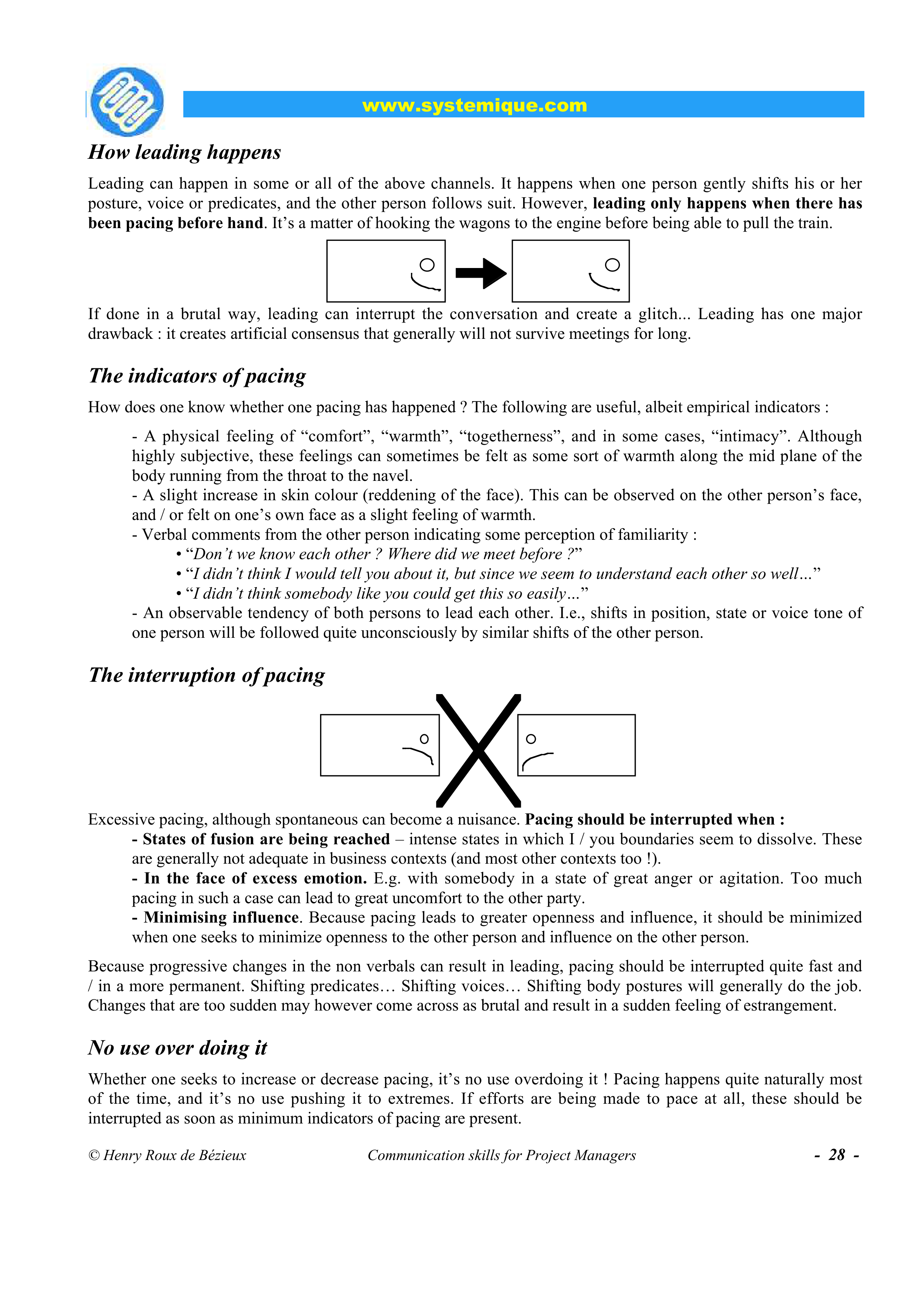

www.systemique.com
© Henry Roux de Bézieux
Communication skills for Project Managers
- 28 -
How leading happens
Leading can happen in some or all of the above channels. It happens when one person gently shifts his or her
posture, voice or predicates, and the other person follows suit. However,
leading only happens when there has
been pacing before hand
. It’s a matter of hooking the wagons to the engine before being able to pull the train.
If done in a brutal way, leading can interrupt the conversation and create a glitch... Leading has one major
drawback : it creates artificial consensus that generally will not survive meetings for long.
The indicators of pacing
How does one know whether one pacing has happened ? The following are useful, albeit empirical indicators :
- A physical feeling of “comfort”, “warmth”, “togetherness”, and in some cases, “intimacy”. Although
highly subjective, these feelings can sometimes be felt as some sort of warmth along the mid plane of the
body running from the throat to the navel.
- A slight increase in skin colour (reddening of the face). This can be observed on the other person’s face,
and / or felt on one’s own face as a slight feeling of warmth.
- Verbal comments from the other person indicating some perception of familiarity :
• “
Don’t we know each other ? Where did we meet before ?
”
• “
I didn’t think I would tell you about it, but since we seem to understand each other so well…
”
• “
I didn’t think somebody like you could get this so easily…
”
- An observable tendency of both persons to lead each other. I.e., shifts in position, state or voice tone of
one person will be followed quite unconsciously by similar shifts of the other person.
The interruption of pacing
Excessive pacing, although spontaneous can become a nuisance.
Pacing should be interrupted when :
- States of fusion are being reached
– intense states in which I / you boundaries seem to dissolve. These
are generally not adequate in business contexts (and most other contexts too !).
- In the face of excess emotion.
E.g. with somebody in a state of great anger or agitation. Too much
pacing in such a case can lead to great uncomfort to the other party.
- Minimising influence
. Because pacing leads to greater openness and influence, it should be minimized
when one seeks to minimize openness to the other person and influence on the other person.
Because progressive changes in the non verbals can result in leading, pacing should be interrupted quite fast and
/ in a more permanent. Shifting predicates… Shifting voices… Shifting body postures will generally do the job.
Changes that are too sudden may however come across as brutal and result in a sudden feeling of estrangement.
No use over doing it
Whether one seeks to increase or decrease pacing, it’s no use overdoing it ! Pacing happens quite naturally most
of the time, and it’s no use pushing it to extremes. If efforts are being made to pace at all, these should be
interrupted as soon as minimum indicators of pacing are present.
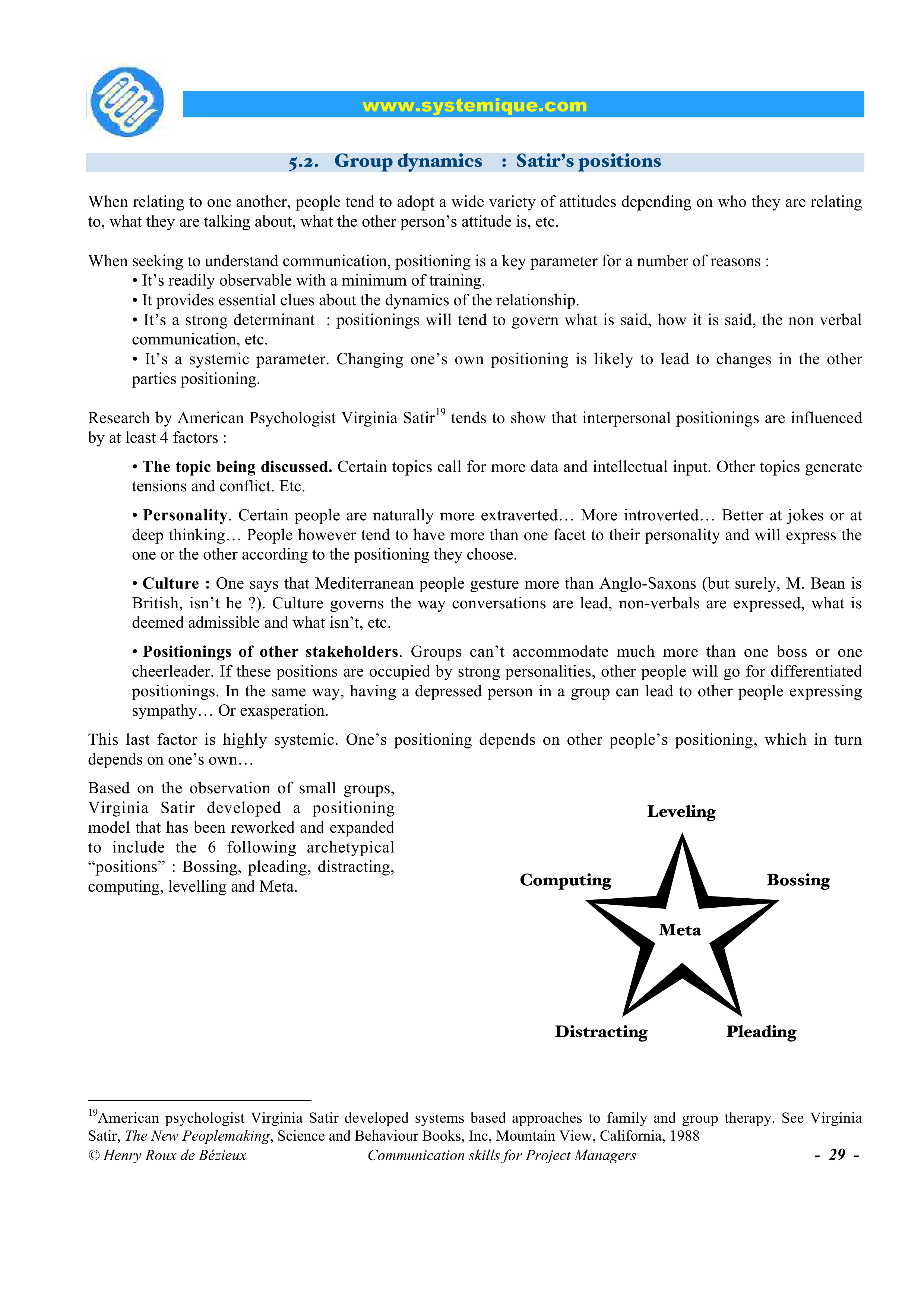

www.systemique.com
© Henry Roux de Bézieux
Communication skills for Project Managers
- 29 -
5.2. Group dynamics : Satir’s positions
When relating to one another, people tend to adopt a wide variety of attitudes depending on who they are relating
to, what they are talking about, what the other person’s attitude is, etc.
When seeking to understand communication, positioning is a key parameter for a number of reasons :
• It’s readily observable with a minimum of training.
• It provides essential clues about the dynamics of the relationship.
• It’s a strong determinant : positionings will tend to govern what is said, how it is said, the non verbal
communication, etc.
• It’s a systemic parameter. Changing one’s own positioning is likely to lead to changes in the other
parties positioning.
Research by American Psychologist Virginia Satir
19
tends to show that interpersonal positionings are influenced
by at least 4 factors :
•
The topic being discussed.
Certain topics call for more data and intellectual input. Other topics generate
tensions and conflict. Etc.
•
Personality
. Certain people are naturally more extraverted… More introverted… Better at jokes or at
deep thinking… People however tend to have more than one facet to their personality and will express the
one or the other according to the positioning they choose.
•
Culture :
One says that Mediterranean people gesture more than Anglo-Saxons (but surely, M. Bean is
British, isn’t he ?). Culture governs the way conversations are lead, non-verbals are expressed, what is
deemed admissible and what isn’t, etc.
•
Positionings of other stakeholders
. Groups can’t accommodate much more than one boss or one
cheerleader. If these positions are occupied by strong personalities, other people will go for differentiated
positionings. In the same way, having a depressed person in a group can lead to other people expressing
sympathy… Or exasperation.
This last factor is highly systemic. One’s positioning depends on other people’s positioning, which in turn
depends on one’s own…
Based on the observation of small groups,
Virginia Satir developed a positioning
model that has been reworked and expanded
to include the 6 following archetypical
“positions” : Bossing, pleading, distracting,
computing, levelling and Meta.
19
American psychologist Virginia Satir developed systems based approaches to family and group therapy. See Virginia
Satir,
The New Peoplemaking
, Science and Behaviour Books, Inc, Mountain View, California, 1988
✩
Bossing
Pleading
Computing
Leveling
Distracting
Meta
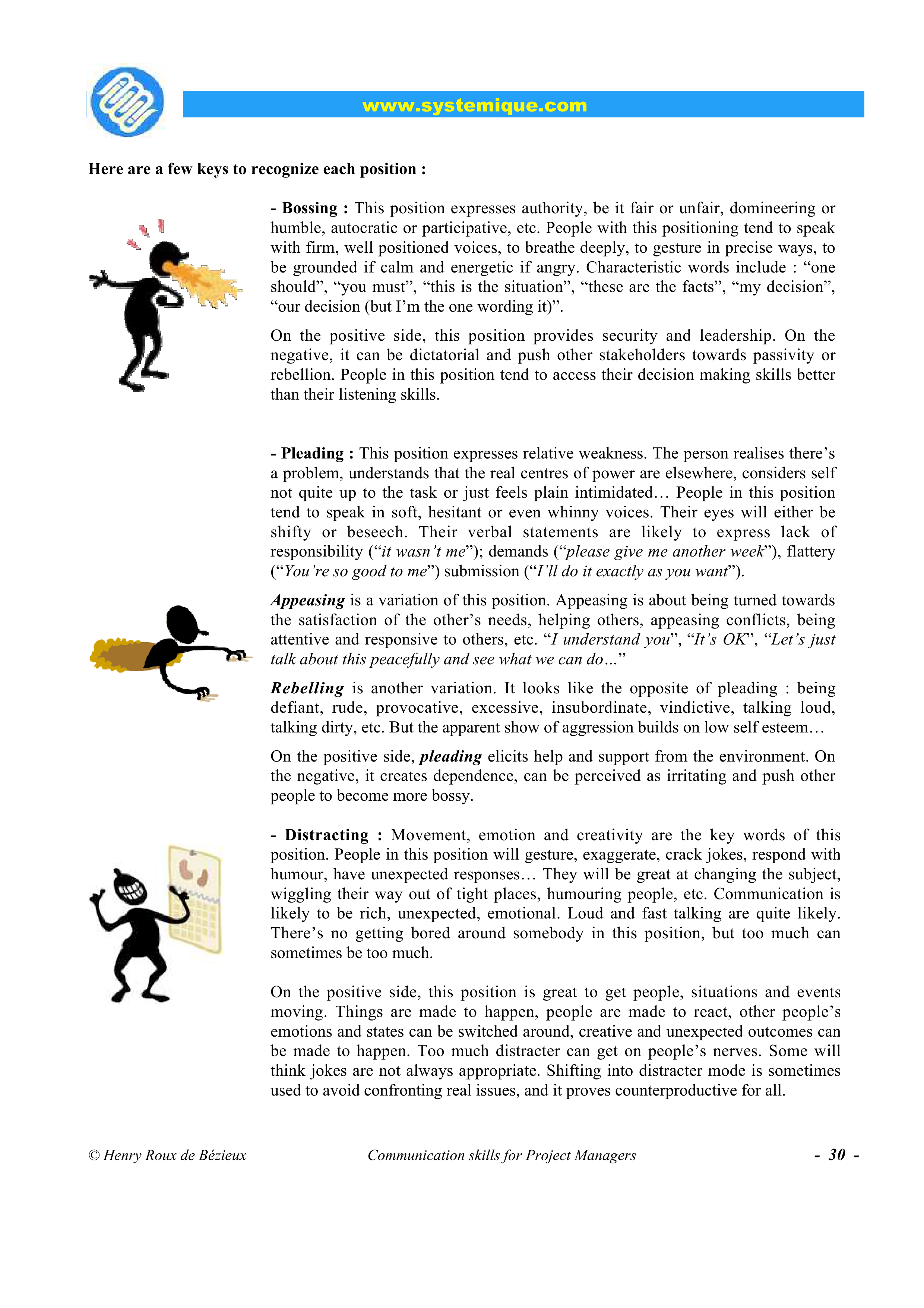

















































































www.systemique.com
© Henry Roux de Bézieux
Communication skills for Project Managers
- 30 -
Here are a few keys to recognize each position :
- Bossing :
This position expresses authority, be it fair or unfair, domineering or
humble, autocratic or participative, etc. People with this positioning tend to speak
with firm, well positioned voices, to breathe deeply, to gesture in precise ways, to
be grounded if calm and energetic if angry. Characteristic words include : “one
should”, “you must”, “this is the situation”, “these are the facts”, “my decision”,
“our decision (but I’m the one wording it)”.
On the positive side, this position provides security and leadership. On the
negative, it can be dictatorial and push other stakeholders towards passivity or
rebellion. People in this position tend to access their decision making skills better
than their listening skills.
- Pleading :
This position expresses relative weakness. The person realises there’s
a problem, understands that the real centres of power are elsewhere, considers self
not quite up to the task or just feels plain intimidated… People in this position
tend to speak in soft, hesitant or even whinny voices. Their eyes will either be
shifty or beseech. Their verbal statements are likely to express lack of
responsibility (“
it wasn’t me
”); demands (“
please give me another week
”), flattery
(“
You’re so good to me
”) submission (“
I’ll do it exactly as you want
”).
Appeasing
is a variation of this position. Appeasing is about being turned towards
the satisfaction of the other’s needs, helping others, appeasing conflicts, being
attentive and responsive to others, etc. “
I understand you
”, “
It’s OK
”, “
Let’s just
talk about this peacefully and see what we can do…
”
Rebelling
is another variation. It looks like the opposite of pleading : being
defiant, rude, provocative, excessive, insubordinate, vindictive, talking loud,
talking dirty, etc. But the apparent show of aggression builds on low self esteem…
On the positive side,
pleading
elicits help and support from the environment. On
the negative, it creates dependence, can be perceived as irritating and push other
people to become more bossy.
- Distracting :
Movement, emotion and creativity are the key words of this
position. People in this position will gesture, exaggerate, crack jokes, respond with
humour, have unexpected responses… They will be great at changing the subject,
wiggling their way out of tight places, humouring people, etc. Communication is
likely to be rich, unexpected, emotional. Loud and fast talking are quite likely.
There’s no getting bored around somebody in this position, but too much can
sometimes be too much.
On the positive side, this position is great to get people, situations and events
moving. Things are made to happen, people are made to react, other people’s
emotions and states can be switched around, creative and unexpected outcomes can
be made to happen. Too much distracter can get on people’s nerves. Some will
think jokes are not always appropriate. Shifting into distracter mode is sometimes
used to avoid confronting real issues, and it proves counterproductive for all.



www.systemique.com
© Henry Roux de Bézieux
Communication skills for Project Managers
- 31 -
- Computing :
This position is about being rational and logical. People in this
position tend to set emotions aside, use abstract words and focus on processes,
outcomes, assumptions, reasonings… Voice tone tends to be rather flat and
unexpressive. Gestures, if any, will be small. Verbals will reflect mental activity
“
I am thinking of
”, “
the next step will be to plan our process
” and inner dialogue
“
I was just telling myself that…
”. This position is widely held in the business
world. Indeed, a lot of further training is about being able to think and talk in
these ways for protracted lengths of time.
On the positive side, this position is ideally suited to thinking things through and
impressing one’s audience with superior mental skills. On the downside, it’s
perceived as rather cold, calculating and can get downright abstract, hazy and un-
pragmatic.
- Levelling :
This position is about saying things in a perfectly congruent and
flowing way. When levelling, words and facial expressions match perfectly, the
person is perceived as honest and sincere, feelings are shown without becoming
intrusive or excessive, the relationship flows freely and easily. When levelling,
people will be able to talk freely about all dimensions of what is at hand : the task
and the issues, but also themselves, the other person, the relationship, etc. When
levelling, anything that is said is a “truth of the person at that moment”. Criticism
can be expressed, but it will not seem threatening or blaming. Joy and aliveness
will seem both congruent and appropriate, etc.
On the positive side, levelling is the only position that stands a chance of building
real bridges, healing ruptures and breaking impasses between people. Levelling
relationships are experienced as extremely worthwhile and tend to contribute to
the resources and sense of worth of all concerned. On the downside, levelling is
difficult or impossible to initiate with somebody who is bent on lying or
dissimulating. It also takes a sense of self worth and correct communication skills.
- Meta :
This position has been drawn in the middle of all. Indeed, “being meta”
is about being attentive to what is happening rather than being 100% in the flow
of events. People in a meta position will be observing what is happening, occupied
thinking about it, seeking to understand it, feeling things about the situation, etc.
There are obviously many ways to
think
and
feel
about an ongoing situation. To
one person, going meta may mean “
comparing this situation to a past one very
much like it…
” and to another “
trying to guess how one’s present behaviour has
affected other people’s attitude…
”. People in a meta position will tend to ask
questions that show they are attentive to the ongoing process. “
I don’t know how
to interpret your silence…
”; “
How can we discuss this delicate topic ?
”, etc.
Most people learn to go meta only later in life. It’s a great position to understand
ongoing processes, make sense of situations and find creative ways of making
things happen. It’s also helpful in getting past one’s spontaneous first reactions
and accessing more appropriate (but less immediate) reactions. On the downside,
people in the meta position can seem aloof, distant and lacking in spontaneity.

www.systemique.com
© Henry Roux de Bézieux
Communication skills for Project Managers
- 32 -
5.3. A systems approach : Checkland’s Soft Systems Methodology
Created by the British Academic Peter Checkland, Soft Systems Methodology is an innovative approach to
project design and project management. A must for dealing elegantly with complex situations.
Do this, do that, think of this, think of that… The management game is about running from one spot to another.
Things get tricky because management situations are so unstable. In this ever-changing environment, yesterday’s
solutions tend to become tomorrow’s problems. Goals change and disappear …
In an attempt to make sense of this type of volatility, Soft Systems Methodology (SSM) represents “
a structured
way of dealing with confused issues and situations
”. This approach was developed by British researcher, Peter
Checkland
20
, who started off working on hard systems and operational research. SSM soon evolved into a
distinctive approach with its own toolkit and got its name from its focus on human and social systems with their
share of subjectivity, unpredictability, volatility and disorder. How does one play the game when the rules aren’t
well established ? Soft Systems Methodology’s ambition is to help organisations make collective sense of the
situation.
Controversies: Get two opposing teams and the game is on
Controversies provide the Soft System Methodology’s main fuel. How can sense be made of a confused
situation ? Throw in a controversy. How to determine which goals are worth pursuing ? Just set up a
controversy. How to choose the best action plan ? Controversies again !
There’s nothing academic, however, about this type of debate. To ensure that the debates are meaningful, SSM
makes use of specific visual tools that can be used as a basis for discussion. Each of these charts, diagrams,
drawings and representations is likely to present one of a few alternative points of view.
> Managers and decision makers are encouraged to express their points of agreement and disagreement.
> The very presence of multiple points of view frees up speech and empowers people to present bolder
suggestions and projects.
Although Soft Systems Methodology generally requires somebody in the role of “Master of Ceremonies”, the
ingredients of the debate itself do not need to be contributed from the outside. They can come from a variety of
sources :
> The members of the project team, the select few.
> Management, with or without the help of a coach or consultant.
> The very actors and clients of the work process, the stakeholders of the situation themselves.
20
Peter Checkland,
Soft Systems Metholodoly in Action
, John Wiley and Sons Ltd., Chichester (UK), 1999.
1• Read prepared
charts and
understand their
contents.
4• Draw new charts
%
of the situation, the
goals, the solutions
&
.
3• Modify the
charts to better
reflect what has been
said.
2• Express one’s
points of agreement
and disagreement.
5• Create a shared
vision of the
situation, goals and
desirable solutions.
6• Act according to
a detailed, shared
and well examined
action plan.
A simple activity model depicting the way SSM charts are used

www.systemique.com
© Henry Roux de Bézieux
Communication skills for Project Managers
- 33 -
Activity models : Remember games are about action
Management is not for ayatollahs and philosophers. So as to make sure that SSM’s debaters keep their feet on
the ground, SSM relies on activity charts directly inherited from reengineering and organisational analysis.
> Process charts show the flow of
what people do
, and how their work transforms inputs into outputs.
> Quantifiable indicators supplement precise measures to quantify things.
> SSM’s focus is on simplicity. Charts are essentially communication tools.
> Charts should be corrected and redrawn as the debate changes and opinions evolve.
Causality charts : Think in circles so you can walk straight
If games were straightforward, they wouldn’t be fun. A good game has its ups and downs. Its decisive moments
and its unpredictable reversals. The best players understand how to stay a few moves ahead of the game.
Causality charts are diagrams that represent the logic of a situation. Where are the causes and where are the
effects ? What connects apparently unrelated phenomena ? What are the subtle connexions ? The long term
ones ? How are they woven into systemic circles : one phenomenon ends up being its own cause. “
Wealth
attracts wealth
”,
as the saying
goes. “
Poorly
debated
decision
making
” can for
instance
be
shown to lead to
“
Ill
planned
actions
”, etc., as
in the example below. And ultimately full cycle back to “
poorly debated decision making
”. When things behave
along such circular lines, it’s generally confusing. Typically, each business function and unit will have its own,
fragmented causal map. By linking these and closing the circles, SSM ensures no such bugs will deteriorate the
reasoning or serve as a basis for ineffective (counter productive) action.
Who are we playing with ? Going after the more subtle dimensions
Sports is an outdoors activity. And really confused situations tend to happen on slippery playing fields. SSM
uses specific types of maps to go after the more subjective (and subtle) social, psychological and political aspects
of things. Roles maps show how the various actors and institutions are positioned. Cultural maps describe the
mostly unsaid do’s and don’ts of the organizational culture. Value maps chart those abstractions that drive
behaviour. Political maps deal with power, stakes and territories.
It’s a gentleman’s game
Wasting time is not a popular sport in the corporate world. And yet this is what so many corporations end up
doing time and time again. “
Let’s rush this thing through and get to the action
” the managers chime in. OK,
OK ! “
What’s the rush ?
”. By structuring projects and decision making around lively debates, Soft Systems
Methodology starts off using up valuable time. And it produces solutions that are usually easier to implement, do
not drum up much resistance and end up saving eons of valuable time.
SSM can’t be played without a minimum of honesty. If cover-up, fraud or deceit are the names of the game
forget SSM. There won’t be a valuable controversy and nothing will come of it. Remember, SSM wasn’t
invented by the politburo. It’s a gentleman’s game.
Poorly debated
decision making
Actions that are ill
planned and thought
out
Weak buy in, sluggish
implementation,
superficial consensus.
Problems, resistance
and opposition surface
late and delay change
Management has
increasingly pessimistic
view of change

www.systemique.com
© Henry Roux de Bézieux
Communication skills for Project Managers
- 34 -
Bibliography
• Gregory Bateson,
Steps to an Ecology of Mind,
University of Chicago Press, Chicago, 2000.
• Peter Checkland and Jim Scholes, Soft Systems Methodology in Action, John Wiley & Sons, Chichester UK,
1999.
• Peter Checkland,
Soft Systems Metholodoly in Action
, John Wiley and Sons Ltd., Chichester (UK), 1999.
• Robert B. Cialdini,
Influence, Science and Practice
, Allyn & Bacon; 4th edition, USA, 2000.
• Antonio Damasio,
Descarte’s Error, Emotion, Reason and the Human Brain
, Putnam Books, 1994
• Antonio Damasio,
The Feeling of What Happens, Body and Emotion in the Making of Consciousness
, Harvest
Harcourt, New York, 1999.
• L. Michael Hall,
The User’s Manual for the Brain
, Crown House Publishing, 2003, UK.
• Howard E. Gruber & J. Jacques Vonèche,
The Essential Piaget
, Jason Aronson Inc., London, 1995.
• Sid Jacobson, Solution States :
A course in Solving Problems in Business with the Power of NLP
, Crown House
Publishing, London, 2001.
• Alfred Krozybsky,
Science and Sanity
, The International Non Aristotelian Library Publishing Company, New
York, 1954
• Joseph LeDoux,
The Emotional Brain
, Touchstone, Simon & Schuster, New-York, 1996.
• David Lipset,
The Legacy of a Scientist
, Beacon Press, Boston, 1980.
• Berenice McCarthy,
About Learning
, Wauconda, IL: About Learning, Inc., 1996.
• William Moulton Marston,
The Emotions of Normal People
, Re-edition by Rootledge, 1999, USA.
• J. Piaget,
La prise de conscience
, Paris, PUF, 1974.
• Michael Porter,
“Attitudes, Values, beliefs, and the Microeconomics of Prosperity,” in Culture Matters: How
Values Shape Human Progress,
(L.E. Harrison, S.P. Huntington, eds.), New York: Basic Books (2000)
• Virginia Satir,
The New People Making
, Science and Behaviour Books Inc, 1988, USA.
• Virginia Satir et al,
Family Therapy and Beyond
, Science and Behaviour Books Inc, 1991, USA.
• Karl E. Weick, Sensemaking in Organizations, Sage Publications, Thousand Oaks California, 1995.
Books, San Diego, 1999.