
Elevance Health
EXECUTIVE AGREEMENT PLAN
(Amended and Restated as of March 1, 2024)
TABLE OF CONTENTS
ARTICLE 1 PURPOSE AND INTENT 1
1.1 Purpose and Intent 1
ARTICLE 2 ELIGIBILITY AND PARTICIPATION 1
2.1 Participation 1
2.2 Termination of Participation 1
ARTICLE 3 SEVERANCE BENEFITS 2
3.1 Eligible Separation from Service 2
3.2 Severance Pay 2
3.3 Other Benefits During Severance Period 4
3.4 Payment 6
3.5 Waiver and Release 6
3.6 Restrictive Covenants and Intellectual Property 7
3.7 Return of Consideration 7
3.8 Equitable Relief and Other Remedies 8
3.9 Survival of Provisions 9
3.10 Cooperation 9
ARTICLE 4 ADDITIONAL CHANGE IN CONTROL BENEFITS 9
4.1 Equity Vesting Upon Change in Control 9
4.2 Guaranteed Annual Bonus for Year of Change in Control 10
4.3 Equity Vesting Upon Termination Without Cause or for Good Reason (With Change in
Control) 10
4.4 Pro-Rata Bonus Payment Upon Termination Without Cause or for Good Reason (With Change
in Control) 11
4.5 Amount Based on Qualified and Supplemental 401(k) Match 12
4.6 Certain Taxes 12
ARTICLE 5 CLAIMS 12
5.1 Good Reason Determinations 12
5.2 Claims Procedure 13
5.3 Claim Review Procedure 13
ARTICLE 6 ADMINISTRATION 13
6.1 Committee 13
6.2 Committee Membership 14
6.3 Duties 14
6.4 Binding Authority 15
6.5 Indemnification 15
6.6 Information 15
ARTICLE 7 GENERAL PROVISIONS 15
7.1 No Property Interest 15
7.2 Other Rights 15
i
7.3 Amendment or Termination 16
7.4 Successors 16
7.5 Severability 16
7.6 No Employment Rights 16
7.7 Transferability of Rights 16
7.8 Beneficiary 17
7.9 Company Action 17
7.10 Entire Document 17
7.11 Plan Year 17
7.12 Governing Law 17
ARTICLE 8 DEFINITIONS 18
8.1 Definitions 18
EXHIBIT A – EMPLOYMENT AGREEMENT
EXHIBIT B – WAIVER AND RELEASE
EXHIBIT C – RESTRICTIVE COVENANTS AND INTELLECTUAL PROPERTY
ii
Elevance Health
Executive Agreement Plan
(Amended and Restated as of March 1, 2024)
ARTICLE 1
PURPOSE AND INTENT
1.1 Purpose and Intent. Elevance Health, Inc., an Indiana corporation with its principal
place of business in Indianapolis, Indiana (“Elevance Health”), maintains the Elevance Health
Executive Agreement Plan (the “Plan”), most recently amended and restated effective June 28,
2022. The Plan is hereby amended and restated effective March 1, 2024. Words and phrases
used with initial capitals in the Plan and not otherwise defined when first used are defined in
Article 8.
The Plan is intended to provide certain key executive employees of Elevance Health
and its subsidiaries and affiliates (collectively, the “Company”) compensation if they are
involuntarily terminated with an Eligible Separation of Service, as that term is defined below,
so as to attract and retain such employees and motivate them to enhance the value of the
Company. The Plan is intended to be an unfunded welfare plan subject to the Employee
Retirement Income Security Act of 1974, as amended (“ERISA”) or, to the extent it is
determined to be a pension plan subject to ERISA, an unfunded pension plan maintained
primarily for the purpose of providing deferred compensation to a select group of management
or highly compensated employees. Participation in the Plan does not affect the at-will nature
of the Participant’s employment with the Company.
ARTICLE 2
ELIGIBILITY AND PARTICIPATION
2.1 Participation. An Executive (as defined in Article 8) shall become a Participant
(“Participant”) upon mutual execution by the Executive and the Company of an agreement,
substantially in the form attached as Exhibit A (“Employment Agreement”) within the time
period stated below. Each such executed Employment Agreement shall form part of this Plan
and is incorporated into this Plan by this reference. As soon as practicable after the date an
individual becomes an Executive, the Committee or its delegate shall deliver a copy of the Plan
to the Executive, advise the Executive of his or her eligibility, and offer him or her for a period
of forty- five (45) days the opportunity to enter into an Employment Agreement. If an Executive
does not enter into an Employment Agreement within such forty-five (45) day period, the
Executive shall have no further opportunity to become a Participant in the Plan unless either
the Chief Executive Officer or the Chief Human Resources Officer of the Company or his or
her delegate, in his or her sole discretion, in writing, affords the Executive a new or extended
opportunity to become a Participant in the Plan.
2.2 Termination of Participation. A Participant’s participation in the Plan shall
automatically terminate, without notice to or consent of the Participant, upon the earliest to
occur of the following events:
1
(a) termination of the Participant’s employment with the Company for any reason that
is not an Eligible Separation from Service as defined below;
(b) the one-year anniversary of a written notice (pursuant to the terms of the
Employment Agreement) of the termination of the Participant’s Employment Agreement.
ARTICLE 3
SEVERANCE BENEFITS
3.1 Eligible Separation from Service. Each Participant shall be entitled to Severance
Pay and other benefits under the Plan in the amount set forth in Sections 3.2 and 3.3 (and, if
applicable, Sections 4.3, 4.4, and 4.5) (collectively, “Severance Benefits”) only if the
Participant incurs an Eligible Separation from Service while a Participant. Entitlement to
Severance Benefits is subject to the terms and conditions of this Plan, including the
Participant’s compliance with Section 3.6 hereof and the Participant’s execution and delivery
of a valid and unrevoked Waiver and Release Agreement as required by Section 3.5. For this
purpose, an “Eligible Separation from Service” is:
(a) a Separation from Service by reason of a termination of the Participant’s
employment by the Company for any reason other than death, disability, Cause, or Transfer of
Business; or
(b) a Separation from Service by reason of a termination of the Participant’s
employment by the Participant for Good Reason.
Severance Benefits shall be payable with respect to a Separation from Service only if the
separation meets the above definition of Eligible Separation from Service. For avoidance of
doubt, none of the following shall be an Eligible Separation from Service: (i) termination of
the Participant’s employment upon death or disability, (ii) termination of the Participant’s
employment by the Company for Cause or upon Transfer of Business, or (iii) any voluntary
resignation that does not constitute a termination of the Participant’s employment for Good
Reason.
3.2 Severance Pay.
(a) The aggregate amount of severance pay (“Severance Pay”) to which a Participant
who incurs an Eligible Separation from Service is entitled under the Plan shall be the product
of the amount described in clause (i), multiplied by the applicable percentage described in
clause (ii), with such product then reduced by the amount, if any, described in clause (iii), each
as set forth below and taking into account clause (iv) below. Severance Pay shall be payable,
as described in Section 3.4, over the applicable period (“Severance Period”) described in clause
(iv) and specified in the table that follows. For the avoidance of doubt, Severance Pay is
calculated and expressed in the aggregate and not as an annual amount.
(i) If a Vice President, Senior Vice President, Executive Vice President, or Chief
Executive Officer, the amount described in this clause is the sum of the Participant’s
2
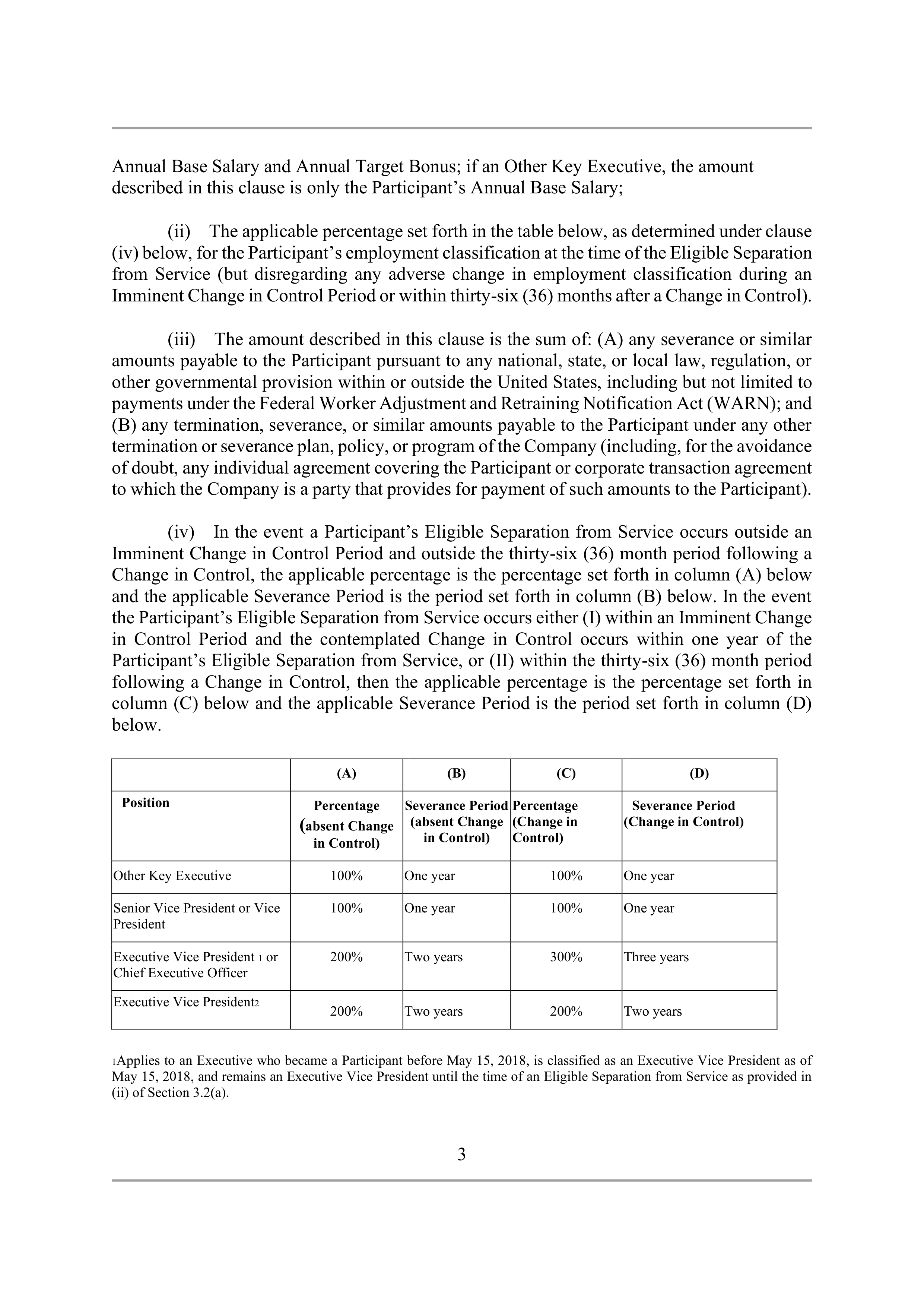
Annual Base Salary and Annual Target Bonus; if an Other Key Executive, the amount
described in this clause is only the Participant’s Annual Base Salary;
(ii) The applicable percentage set forth in the table below, as determined under clause
(iv) below, for the Participant’s employment classification at the time of the Eligible Separation
from Service (but disregarding any adverse change in employment classification during an
Imminent Change in Control Period or within thirty-six (36) months after a Change in Control).
(iii) The amount described in this clause is the sum of: (A) any severance or similar
amounts payable to the Participant pursuant to any national, state, or local law, regulation, or
other governmental provision within or outside the United States, including but not limited to
payments under the Federal Worker Adjustment and Retraining Notification Act (WARN); and
(B) any termination, severance, or similar amounts payable to the Participant under any other
termination or severance plan, policy, or program of the Company (including, for the avoidance
of doubt, any individual agreement covering the Participant or corporate transaction agreement
to which the Company is a party that provides for payment of such amounts to the Participant).
(iv) In the event a Participant’s Eligible Separation from Service occurs outside an
Imminent Change in Control Period and outside the thirty-six (36) month period following a
Change in Control, the applicable percentage is the percentage set forth in column (A) below
and the applicable Severance Period is the period set forth in column (B) below. In the event
the Participant’s Eligible Separation from Service occurs either (I) within an Imminent Change
in Control Period and the contemplated Change in Control occurs within one year of the
Participant’s Eligible Separation from Service, or (II) within the thirty-six (36) month period
following a Change in Control, then the applicable percentage is the percentage set forth in
column (C) below and the applicable Severance Period is the period set forth in column (D)
below.
(A)
(B)
(C)
(D)
Position
Percentage
(
absent Change
in Control)
Severance Period
(absent Change
in Control)
Percentage
(Change in
Control)
Severance Period
(Change in Control)
Other Key Executive
100%
One year
100%
One year
Senior Vice President or Vice
President
100%
One year
100%
One year
Executive Vice President
1
or
Chief Executive Officer
200%
Two years
300%
Three years
Executive Vice President
2
200%
Two years
200%
Two years
1
Applies to an Executive who became a Participant before May 15, 2018, is classified as an Executive Vice President as of
May 15, 2018, and remains an Executive Vice President until the time of an Eligible Separation from Service as provided in
(ii) of Section 3.2(a).
3
2
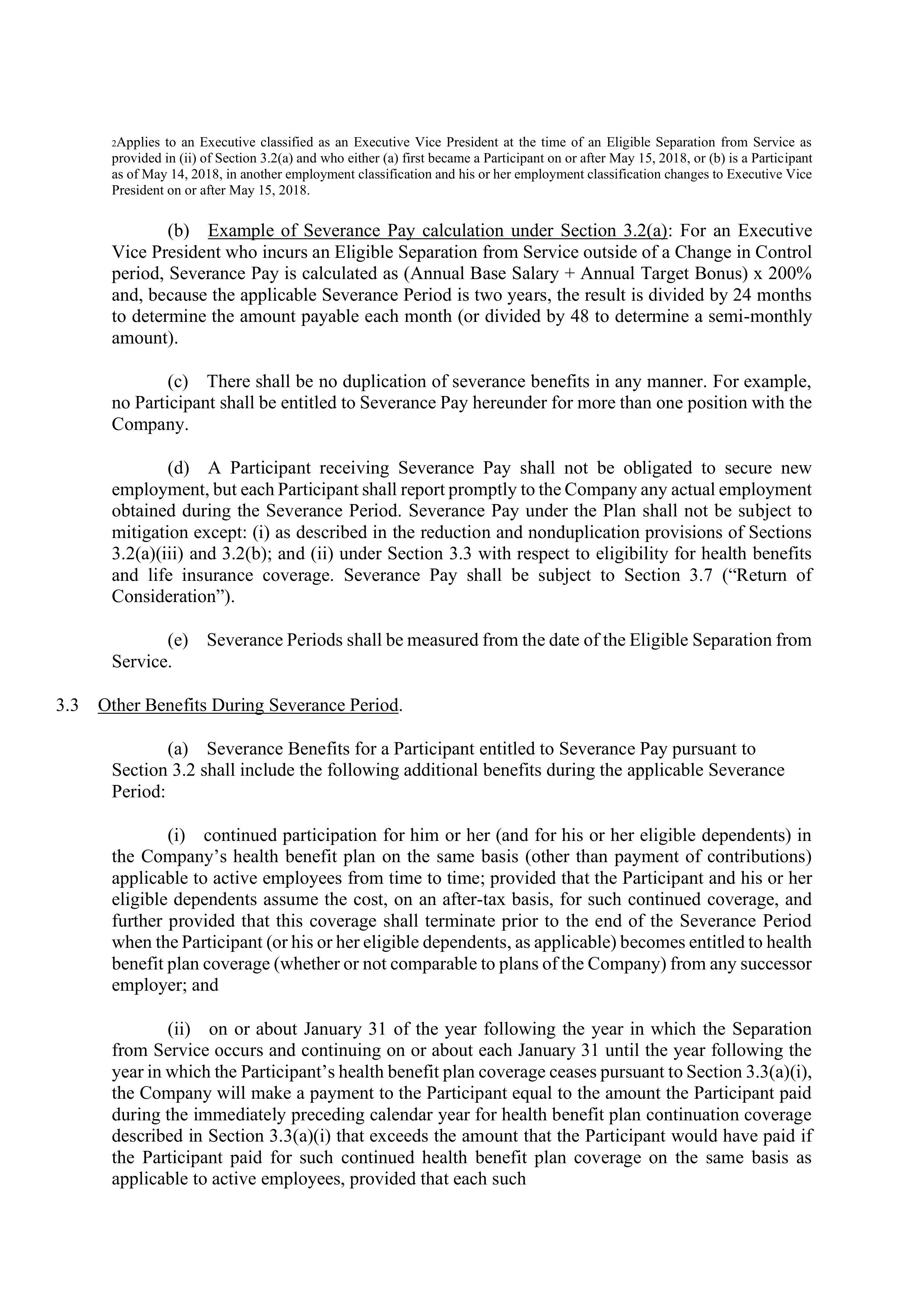
Applies to an Executive classified as an Executive Vice President at the time of an Eligible Separation from Service as
provided in (ii) of Section 3.2(a) and who either (a) first became a Participant on or after May 15, 2018, or (b) is a Participant
as of May 14, 2018, in another employment classification and his or her employment classification changes to Executive Vice
President on or after May 15, 2018.
(b) Example of Severance Pay calculation under Section 3.2(a): For an Executive
Vice President who incurs an Eligible Separation from Service outside of a Change in Control
period, Severance Pay is calculated as (Annual Base Salary + Annual Target Bonus) x 200%
and, because the applicable Severance Period is two years, the result is divided by 24 months
to determine the amount payable each month (or divided by 48 to determine a semi-monthly
amount).
(c) There shall be no duplication of severance benefits in any manner. For example,
no Participant shall be entitled to Severance Pay hereunder for more than one position with the
Company.
(d) A Participant receiving Severance Pay shall not be obligated to secure new
employment, but each Participant shall report promptly to the Company any actual employment
obtained during the Severance Period. Severance Pay under the Plan shall not be subject to
mitigation except: (i) as described in the reduction and nonduplication provisions of Sections
3.2(a)(iii) and 3.2(b); and (ii) under Section 3.3 with respect to eligibility for health benefits
and life insurance coverage. Severance Pay shall be subject to Section 3.7 (“Return of
Consideration”).
(e) Severance Periods shall be measured from the date of the Eligible Separation from
Service.
3.3 Other Benefits During Severance Period.
(a) Severance Benefits for a Participant entitled to Severance Pay pursuant to
Section 3.2 shall include the following additional benefits during the applicable Severance
Period:
(i) continued participation for him or her (and for his or her eligible dependents) in
the Company’s health benefit plan on the same basis (other than payment of contributions)
applicable to active employees from time to time; provided that the Participant and his or her
eligible dependents assume the cost, on an after-tax basis, for such continued coverage, and
further provided that this coverage shall terminate prior to the end of the Severance Period
when the Participant (or his or her eligible dependents, as applicable) becomes entitled to health
benefit plan coverage (whether or not comparable to plans of the Company) from any successor
employer; and
(ii) on or about January 31 of the year following the year in which the Separation
from Service occurs and continuing on or about each January 31 until the year following the
year in which the Participant’s health benefit plan coverage ceases pursuant to Section 3.3(a)(i),
the Company will make a payment to the Participant equal to the amount the Participant paid
during the immediately preceding calendar year for health benefit plan continuation coverage
described in Section 3.3(a)(i) that exceeds the amount that the Participant would have paid if
the Participant paid for such continued health benefit plan coverage on the same basis as
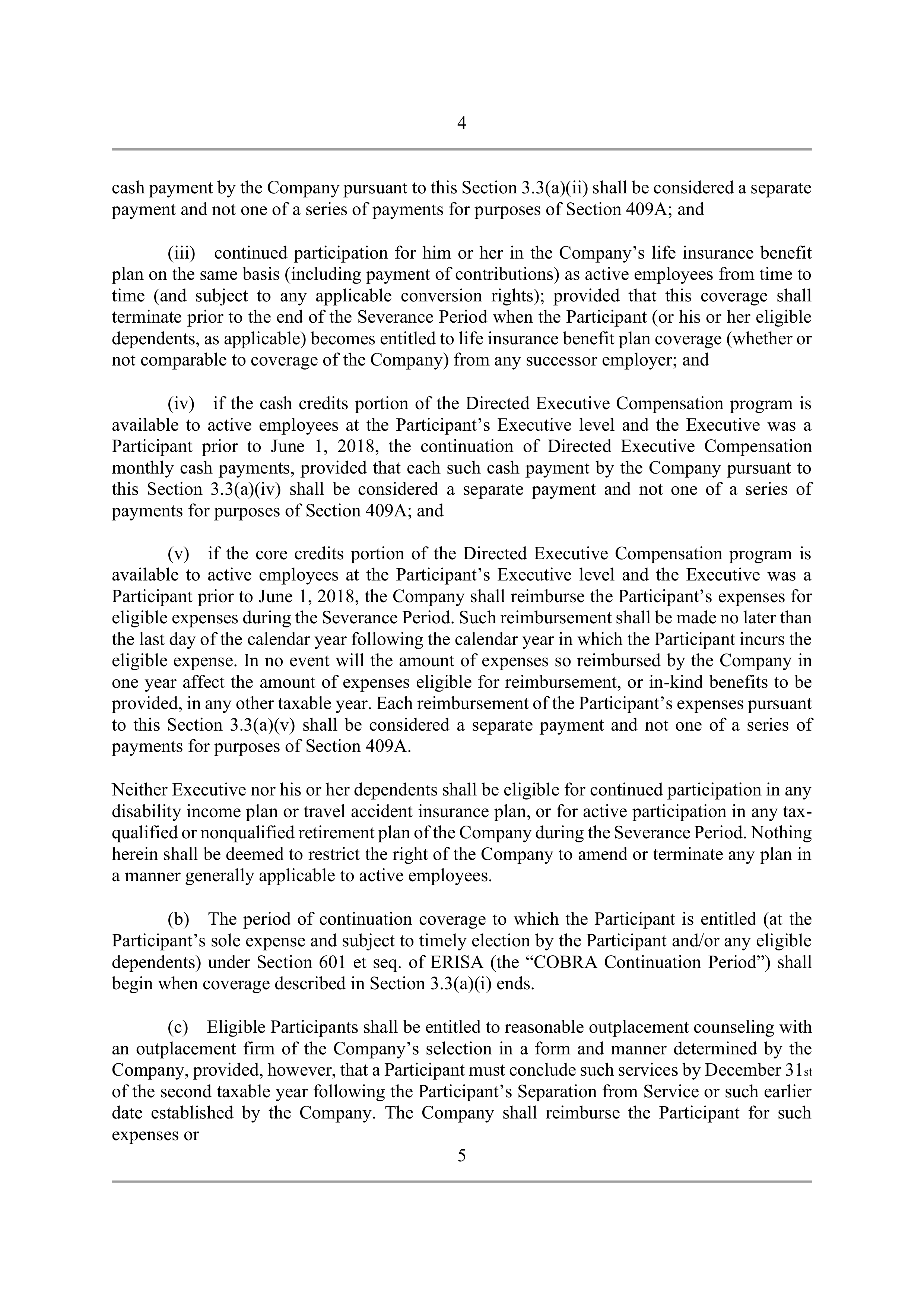
applicable to active employees, provided that each such
4
cash payment by the Company pursuant to this Section 3.3(a)(ii) shall be considered a separate
payment and not one of a series of payments for purposes of Section 409A; and
(iii) continued participation for him or her in the Company’s life insurance benefit
plan on the same basis (including payment of contributions) as active employees from time to
time (and subject to any applicable conversion rights); provided that this coverage shall
terminate prior to the end of the Severance Period when the Participant (or his or her eligible
dependents, as applicable) becomes entitled to life insurance benefit plan coverage (whether or
not comparable to coverage of the Company) from any successor employer; and
(iv) if the cash credits portion of the Directed Executive Compensation program is
available to active employees at the Participant’s Executive level and the Executive was a
Participant prior to June 1, 2018, the continuation of Directed Executive Compensation
monthly cash payments, provided that each such cash payment by the Company pursuant to
this Section 3.3(a)(iv) shall be considered a separate payment and not one of a series of
payments for purposes of Section 409A; and
(v) if the core credits portion of the Directed Executive Compensation program is
available to active employees at the Participant’s Executive level and the Executive was a
Participant prior to June 1, 2018, the Company shall reimburse the Participant’s expenses for
eligible expenses during the Severance Period. Such reimbursement shall be made no later than
the last day of the calendar year following the calendar year in which the Participant incurs the
eligible expense. In no event will the amount of expenses so reimbursed by the Company in
one year affect the amount of expenses eligible for reimbursement, or in-kind benefits to be
provided, in any other taxable year. Each reimbursement of the Participant’s expenses pursuant
to this Section 3.3(a)(v) shall be considered a separate payment and not one of a series of
payments for purposes of Section 409A.
Neither Executive nor his or her dependents shall be eligible for continued participation in any
disability income plan or travel accident insurance plan, or for active participation in any tax-
qualified or nonqualified retirement plan of the Company during the Severance Period. Nothing
herein shall be deemed to restrict the right of the Company to amend or terminate any plan in
a manner generally applicable to active employees.
(b) The period of continuation coverage to which the Participant is entitled (at the
Participant’s sole expense and subject to timely election by the Participant and/or any eligible
dependents) under Section 601 et seq. of ERISA (the “COBRA Continuation Period”) shall
begin when coverage described in Section 3.3(a)(i) ends.
(c) Eligible Participants shall be entitled to reasonable outplacement counseling with
an outplacement firm of the Company’s selection in a form and manner determined by the
Company, provided, however, that a Participant must conclude such services by December 31
st
of the second taxable year following the Participant’s Separation from Service or such earlier
date established by the Company. The Company shall reimburse the Participant for such
expenses or
5
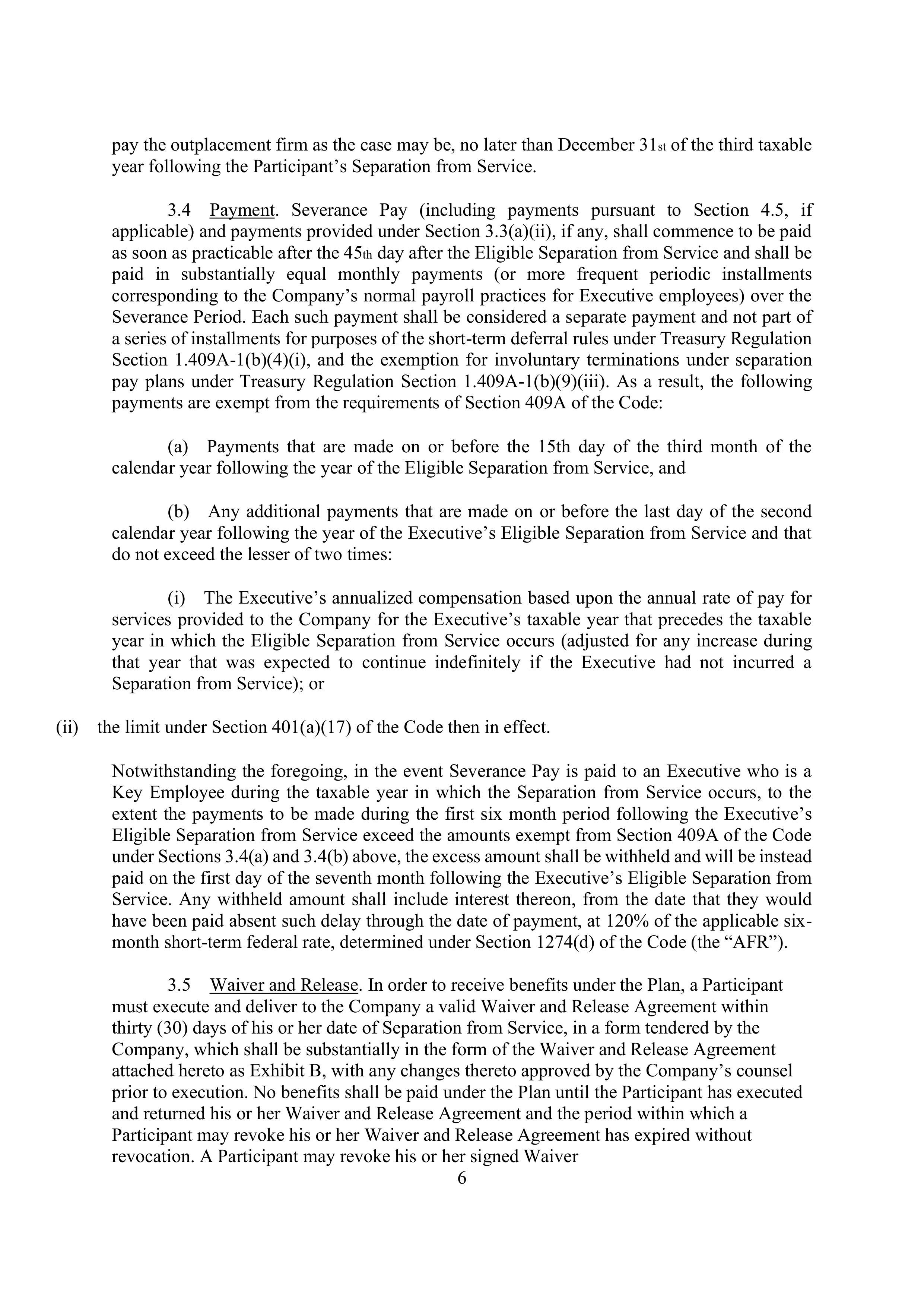
pay the outplacement firm as the case may be, no later than December 31
st
of the third taxable
year following the Participant’s Separation from Service.
3.4 Payment. Severance Pay (including payments pursuant to Section 4.5, if
applicable) and payments provided under Section 3.3(a)(ii), if any, shall commence to be paid
as soon as practicable after the 45
th
day after the Eligible Separation from Service and shall be
paid in substantially equal monthly payments (or more frequent periodic installments
corresponding to the Company’s normal payroll practices for Executive employees) over the
Severance Period. Each such payment shall be considered a separate payment and not part of
a series of installments for purposes of the short-term deferral rules under Treasury Regulation
Section 1.409A-1(b)(4)(i), and the exemption for involuntary terminations under separation
pay plans under Treasury Regulation Section 1.409A-1(b)(9)(iii). As a result, the following
payments are exempt from the requirements of Section 409A of the Code:
(a) Payments that are made on or before the 15th day of the third month of the
calendar year following the year of the Eligible Separation from Service, and
(b) Any additional payments that are made on or before the last day of the second
calendar year following the year of the Executive’s Eligible Separation from Service and that
do not exceed the lesser of two times:
(i) The Executive’s annualized compensation based upon the annual rate of pay for
services provided to the Company for the Executive’s taxable year that precedes the taxable
year in which the Eligible Separation from Service occurs (adjusted for any increase during
that year that was expected to continue indefinitely if the Executive had not incurred a
Separation from Service); or
(ii) the limit under Section 401(a)(17) of the Code then in effect.
Notwithstanding the foregoing, in the event Severance Pay is paid to an Executive who is a
Key Employee during the taxable year in which the Separation from Service occurs, to the
extent the payments to be made during the first six month period following the Executive’s
Eligible Separation from Service exceed the amounts exempt from Section 409A of the Code
under Sections 3.4(a) and 3.4(b) above, the excess amount shall be withheld and will be instead
paid on the first day of the seventh month following the Executive’s Eligible Separation from
Service. Any withheld amount shall include interest thereon, from the date that they would
have been paid absent such delay through the date of payment, at 120% of the applicable six-
month short-term federal rate, determined under Section 1274(d) of the Code (the “AFR”).
3.5 Waiver and Release. In order to receive benefits under the Plan, a Participant
must execute and deliver to the Company a valid Waiver and Release Agreement within
thirty (30) days of his or her date of Separation from Service, in a form tendered by the
Company, which shall be substantially in the form of the Waiver and Release Agreement
attached hereto as Exhibit B, with any changes thereto approved by the Company’s counsel
prior to execution. No benefits shall be paid under the Plan until the Participant has executed
and returned his or her Waiver and Release Agreement and the period within which a
Participant may revoke his or her Waiver and Release Agreement has expired without
revocation. A Participant may revoke his or her signed Waiver
6
and Release Agreement within seven (7) days (or such other period provided by law) after
signing the Waiver and Release Agreement. Any such revocation must be made in writing
and must be received by the Company within such seven (7) day (or such other) period. A
Participant who does not submit a signed Waiver and Release Agreement to the Company
within thirty (30) days of his or her Separation from Service shall not be eligible to receive
any Severance Benefits under the Plan. A Participant who timely revokes his or her Waiver
and Release Agreement shall not be eligible to receive any Severance Benefits under the
Plan.
3.6 Restrictive Covenants and Intellectual Property. Without limiting his or her other
duties and obligations hereunder, each Participant agrees, as a condition of participation in this
Plan, to comply with the following:
(a) Before Acceptance of an Equity Award. If the Participant has not yet accepted an
Equity Award (as defined in Article 8) when the Participant signs an Employment Agreement
to become a Participant in this Plan, the Participant agrees to comply with the restrictive
covenants and intellectual property obligations set forth in Exhibit C of this Plan, to the extent
applicable to the Participant under the terms of Exhibit C.
(b) Upon and After Acceptance of an Equity Award. The Participant agrees that, upon
accepting an Equity Award (whether before or after signing an Employment Agreement to
become a Participant in this Plan), the Participant becomes bound by restrictive covenant(s)
and intellectual property obligations as applicable to the Participant under the terms of the
Equity Award agreement. The Participant further agrees that such covenant(s) and obligations
are deemed to be incorporated herein by reference immediately upon Participant’s acceptance
of each Equity Award throughout the Participant’s participation in this Plan and shall thereupon
supersede the restrictive covenants and intellectual property obligations set forth in Exhibit C
or any previously granted Equity Award. The Participant expressly acknowledges and agrees
that compliance with the restrictive covenants and intellectual property obligations in his or her
most recently accepted Equity Award containing such provisions becomes, upon acceptance of
the Equity Award, a condition of entitlement to Severance Benefits under this Plan, without
regard to the Plan amendment and notice provisions in Section 7.3 of this Plan.
A Participant’s compliance with or violation of this Section 3.6 shall be determined by the
Company (and not by the Committee or any other party acting as a fiduciary of this Plan).
3.7 Return of Consideration.
(a) If at any time a Participant breaches any provision of Section 3.6 or Section 3.10,
the Company shall cease to provide any further Severance Pay or other benefits under the Plan
and the Participant shall repay to the Company all Severance Pay and other benefits previously
received under the Plan. Any amount subject to potential repayment pursuant to this Section
3.7 shall be held by the Participant in constructive trust for the benefit of the Company and
shall, upon written notice from the Company, within 10 days of such notice, be paid by the
Participant to the Company. The return of consideration under this Section 3.7 is meant to
reimburse the Company for some of the harm caused by Participant’s wrongful conduct;
however, it is not a full measure of the damage caused by Participant’s conduct and does not
preclude the Company from seeking
7
the recovery of any and all damages caused by Participant or from seeking injunctive relief,
including relief provided under any other plan or agreement (including, but not limited to,
Equity Award agreements).
(b) The amount to be repaid pursuant to this Section 3.7 shall be determined on a
gross basis, without reduction for any taxes incurred. The Company shall have the right to
offset such amount against any amounts otherwise owed to the Participant by the Company
(whether as wages, vacation pay, or pursuant to any benefit plan or other compensatory
arrangement other than any amount pursuant to any nonqualified deferred compensation plan
under Section 409A of the Code).
3.8 Equitable Relief and Other Remedies. As a condition of participation in this Plan:
(a) The Participant acknowledges that each provision of Section 3.6 and 3.7 of the Plan
(i) is reasonable and necessary to preserve the legitimate business interests of the Company, its
present and potential business activities, and the economic benefits derived therefrom; (ii) will
not prevent him or her from earning a livelihood in the Participant’s chosen business; and (iii)
is not an undue restraint on the trade of the Participant or any of the public interests that may
be involved.
(b) The Participant agrees that, in the event of the Participant’s breach of Section 3.6
or 3.10, the Company will be damaged beyond the amounts otherwise to be provided under
this Plan and the Employment Agreement, and the amount of such damage may be difficult to
measure. The Participant agrees that if the Participant commits or threatens to commit a breach
of any of the covenants and agreements applicable to Participant under Sections 3.6 or 3.10,
then, to the extent permitted by applicable law, the Company shall have the right to seek and
obtain all appropriate injunctive and other equitable remedies, without posting bond therefor,
except as required by law, in addition to any other rights and remedies that may be available at
law or under this Plan, it being acknowledged and agreed that any such breach would cause
irreparable injury to the Company and that money damages alone would not provide an
adequate remedy.
(c) The parties agree that any covenants contained or incorporated herein are
severable. The parties further agree that the Company’s rights under Section 3.7 should be
enforced to the fullest extent permitted by law irrespective of whether the Company seeks
equitable relief in addition to relief provided therein or if a court or arbitrator deems equitable
relief to be inappropriate.
(d) EACH PARTY, TO THE FULLEST EXTENT PERMITTED BY APPLICABLE
LAW, HEREBY IRREVOCABLY WAIVES ALL RIGHT TO TRIAL BY JURY AS TO
ANY
ISSUE
RELATING
HERETO
IN
ANY
ACTION,
PROCEEDING,
OR
COUNTERCLAIM ARISING OUT OF OR RELATING TO THIS PLAN (INCLUDING THE
EMPLOYMENT AGREEMENT AND INCLUDING ANY COVENANTS CONTAINED OR
INCORPORATED HEREIN).
(e) In the event of a breach of Participant’s obligations under Section 3.6 or 3.10, the
prevailing party shall be entitled to the recovery of its reasonable attorneys’ fees and expenses
(including not only costs of court, but also expert fees, travel expenses, and other expenses
incurred), and any other legal or equitable relief allowed by law.
8
3.9 Survival of Provisions. The obligations contained in Sections 3.6, 3.7, 3.8 and
Section 3.10 shall survive the cessation of the Participant’s employment with the Company,
regardless of the Participant’s entitlement to Severance Pay and other benefits hereunder or
under the Employment Agreement and shall be fully enforceable thereafter.
3.10 Cooperation. Upon the receipt of reasonable notice from the Company
(including from outside counsel to the Company), the Participant agrees that while employed
by the Company and for two years (or, if longer, for so long as any claim referred to in this
Section remains pending) after the termination of Participant’s employment for any reason, the
Participant will respond and provide information with regard to matters in which the Participant
has knowledge as a result of the Participant’s employment with the Company, and will provide
reasonable assistance to the Company, its affiliates and their respective representatives in
defense of any claims that may be made against the Company or its affiliates, and will assist
the Company and its affiliates in the prosecution of any claims that may be made by the
Company or its affiliates, to the extent that such claims may relate to the period of the
Participant’s employment with the Company (or any predecessor); provided, that with respect
to periods after the termination of the Participant’s employment, the Company shall reimburse
the Participant for any out-of-pocket expenses incurred in providing such assistance and if the
Participant is required to provide more than ten (10) hours of assistance per week after his
termination of employment then the Company shall pay the Participant a reasonable amount of
money for his services at a rate agreed to between the Company and the Participant; and
provided further that after the Participant’s termination of employment with the Company such
assistance shall not unreasonably interfere with the Participant’s business or personal
obligations. The Participant agrees to promptly inform the Company if the Participant becomes
aware of any lawsuits involving such claims that may be filed or threatened against the
Company or its affiliates. The Participant also agrees to promptly inform the Company (to the
extent the Participant is legally permitted to do so) if the Participant is asked to assist in any
investigation of the Company or its affiliates (or their actions), regardless of whether a lawsuit
or other proceeding has then been filed against the Company or its affiliates with respect to
such investigation and shall not do so unless legally required. Provided, however, the
Participant is not required to inform the Company of any investigation by a governmental
agency or entity resulting from the reporting of possible violations of federal securities law or
regulation to any governmental agency or entity, and the Participant may participate in such
investigation, without informing the Company.
ARTICLE 4
ADDITIONAL CHANGE IN CONTROL BENEFITS
4.1 Equity Vesting Upon Change in Control.
(a) If the conditions of Section 4.1(b) are satisfied, then as of the date of the Change
in Control, all Options and SARs of a Participant shall become fully and immediately
exercisable, all Restricted Stock shall become fully vested and nonforfeitable and forthwith
delivered to a Participant if not previously delivered, and there shall be paid out in cash to the
Participant within 30 days following the effective date of the Change in Control the value of
the Performance Shares
9
to which the Participant would have been entitled if performance achieved 100% of the target
performance goals established for such Performance Shares.
(b) Both of the following conditions must be satisfied in order for Section 4.1(a) to
apply:
(i) A Change in Control must occur, and
(ii) on or prior to such Change in Control either Elevance Health has not confirmed
the continuation of the following awards without economic change, or the successor to
Elevance Health in such Change in Control has not, on or prior to such Change in Control,
assumed and continued the following awards without economic change:
(A) any and all outstanding options (“Options”) to purchase Common Stock (or stock that has been
converted into Common Stock),
(B) any and all stock appreciation rights (“SARs”) based on appreciation in the value of Common
Stock,
(C) any and all restricted Common Stock (or deferred rights thereto, including restricted stock units),
regardless of whether such restrictions are scheduled to lapse based on service or performance
or both (“Restricted Stock”), and
(D) any outstanding awards providing for the payment of a variable number of shares of Common
Stock dependent on the achievement of performance goals, or of an amount based on the fair
market value of such shares or the appreciation thereof (“Performance Shares”),
in each case, awarded to a Participant under any Plan, contract or arrangement for Options,
SARs, Restricted Stock, or Performance Shares.
4.2 Guaranteed Annual Bonus for Year of Change in Control. This Section 4.2 does
not apply to Participants who are classified as Other Key Executives. If a Change in Control
occurs, each Participant’s annual bonus for the fiscal year in which the Change in Control
occurs shall be in an amount (“Guaranteed Amount”) equal to the greater of (a) the
Participant’s Target Bonus for such fiscal year, or (b) the bonus that is determined in the
ordinary course under each annual bonus or short-term incentive plan (as determined by the
Committee in its sole discretion) (a “Bonus Plan”) covering the Participant for the fiscal year
in which the Change in Control occurs. The Guaranteed Amount shall be paid in a lump sum
at the normal time for the payment of a bonus under the applicable Bonus Plan.
4.3 Equity Vesting Upon Termination Without Cause or for Good Reason (With
Change in Control). This Section 4.3 does not apply to Participants who are classified as Other
Key Executives.
10
(a) If the conditions of Section 4.3(b) are satisfied, then as of the date of the
Participant’s Eligible Separation from Service (i) all Pre-Change (as defined below) Options
and Pre-Change SARs of such Participant shall become fully and immediately exercisable, (ii)
all Pre- Change Restricted Stock shall become fully vested and nonforfeitable and forthwith
delivered to the Participant if not previously delivered, and (iii) there shall be paid out in cash
to the Participant within 45 days following the Separation from Service the value of the Pre-
Change Performance Shares to which the Participant would have been entitled if performance
achieved 100% of the target performance goals established for such Performance Shares.
(b) Both of the following conditions must be satisfied in order for Section 4.3(a) to
apply:
(i) the Participant must have had a Separation from Service within the thirty- six
(36) month period following a Change in Control by reason of (A) a termination of the
Participant’s employment by the Company other than for Cause, death, or disability, or (B) a
termination of the Participant’s employment by the Participant for Good Reason; and
(ii) the Participant must have executed and delivered a valid Waiver and Release
Agreement as required by Section 3.5, and the period for revoking such Waiver and Release
Agreement must have elapsed.
(c) For purposes of this Section 4.3 a “Pre-Change” Option, SAR, Restricted Stock, or
Performance Share means (i) an award of an Option, SAR, Restricted Stock or Performance
Share which was outstanding on both the date of the Change in Control and the date of the
Eligible Separation from Service, and (ii) an award of an Option, SAR, Restricted Stock or
Performance Share assumed and continued by a successor to Elevance Health in such Change
in Control without economic change.
4.4 Pro-Rata Bonus Payment Upon Termination Without Cause or for Good Reason
(With Change in Control). This Section 4.4 does not apply to Participants who are classified as
Other Key Executives.
(a) If the conditions of Section 4.4(b) are satisfied, then for the fiscal year in which
the Participant’s Eligible Separation from Service occurs, the Participant shall be entitled to a
pro-rata bonus (the “Pro-Rata Bonus”) equal to the product of the applicable amount described
in (i), multiplied by the fraction determined in (ii):
(i) the applicable amount is the Guaranteed Amount described in Section 4.2 for the
fiscal year in which the Eligible Separation from Service occurs, and
(ii) a fraction, the numerator of which is the number of days in such fiscal year before
the date of the Eligible Separation from Service, and the denominator of which is the total
number of days in such fiscal year.
The Pro-Rata Bonus shall be paid in a lump sum at the normal time for payment of a
bonus under the applicable Bonus Plan.
11
(b) Both of the following conditions must be satisfied in order for Section 4.4(a) to
apply:
(i) the Participant must have had an Eligible Separation from Service within the
thirty-six (36) month period following a Change in Control by reason of (A) a termination of
the Participant’s employment by the Company other than for Cause, death, or disability, or (B)
a termination of the Participant’s employment by the Participant for Good Reason; and
(ii) the Participant must have executed and delivered a valid Waiver and Release
Agreement as required by Section 3.5, and the period for revoking such Waiver and Release
Agreement must have elapsed.
4.5 Amount Based on Qualified and Supplemental 401(k) Match. This Section 4.5
does not apply to Participants who are classified as Other Key Executives. If the conditions of
Section 4.4(b) are satisfied, Severance Pay pursuant to Section 3.2 shall be increased by an
amount equal to the value of employer matching contributions to the Participant’s qualified
and supplemental 401(k) accounts, as if Severance Pay had been considered eligible earnings
in those programs. This amount is equal to the product of:
(a) Severance Pay, multiplied by
(b) the maximum matching contribution percentage applicable to the Participant
under the Company’s 401(k) plan.
4.6 Certain Taxes. If it is determined that any benefit received or deemed received by
the Participant from the Company pursuant to this Plan or otherwise (collectively, “Payments”)
is or will become subject to any excise tax under Section 4999 of the Code or any similar tax
payable under any United States federal, state, local or other law, but not including any tax
payable under Section 409A of the Code (such excise tax and all such similar taxes collectively,
“Excise Taxes”), then the Participant shall receive in respect of such Payments whichever of
(a) or (b) below would result in the Participant retaining, after application of all applicable
income taxes, Excise Taxes, and other taxes (“All Applicable Taxes”), the greater after-tax
amount (the “After-Tax Benefit”); where:
(a) is the Payments; and
(b) is a reduced amount of Payments sufficient to avoid the imposition of Excise Taxes.
ARTICLE 5
CLAIMS
5.1 Good Reason Determinations. Any Participant who believes he or she has a right
to resign for Good Reason may apply to the Committee for written confirmation that an event
constituting Good Reason has occurred with respect to such Participant. The Committee shall
confirm or deny in writing that Good Reason exists within 21 days following receipt of any
such
12
application. Any confirmation of Good Reason by the Committee shall be binding on the
Company. For purposes of this Section 5.1, reference to the Committee includes the
Committee’s delegate.
5.2 Claims Procedure. If any Participant has (a) a claim for benefits under the Plan
(including the Employment Agreement), (b) a claim for clarification of his or her rights under
the Plan (including the Employment Agreement), to the extent not provided for in Section 5.1,
or (c) a claim for breach by the Company of its obligations under Plan (including the
Employment Agreement), then the Participant (or his or her designee) (a “Claimant”) may file
with the Committee a written claim setting forth the amount and nature of the claim, supporting
facts, and the Claimant’s address. A claim shall be filed within six (6) months of (i) the date
on which the claim first arises or (ii) if later, the earliest date on which the Participant knows
or should know of the facts giving rise to a claim. The Committee shall notify the Claimant of
its decision in writing (including via email) within 60 days after its receipt of a claim, unless
otherwise agreed by the Claimant. In special circumstances the Committee may extend for a
further 60 days the deadline for its decision, provided the Committee notifies the Claimant of
the need for the extension within 60 days after its receipt of a claim. If a claim is denied, the
written notice of denial shall set forth the reasons for such denial, refer to pertinent provisions
of the Plan or Employment Agreement on which the denial is based, describe any additional
material or information necessary for the Claimant to realize the claim, and explain the claim
review procedure under the Plan.
5.3 Claim Review Procedure. A Claimant whose claim has been denied (or such
Claimant’s duly authorized representative) may file, within 60 days after notice of such denial
is received by the Claimant, a written request for review of such claim by the Committee. If a
request is so filed, the Committee shall review the claim and notify the Claimant in writing of
its decision within 45 days after receipt of such request, unless otherwise agreed by the
Claimant. In special circumstances, the Committee may extend for up to 45 additional days the
deadline for its decision, provided the Committee notifies the Claimant of the need for the
extension within 45 days after its receipt of the request for review. The notice of the final
decision of the Committee shall include the reasons for its decision and specific references to
the provisions of the Plan or Employment Agreement on which the decision is based. The
decision of the Committee shall be final and binding on all parties.
ARTICLE 6
ADMINISTRATION
6.1 Committee. The Chief Human Resources Officer of Elevance Health (“CHRO”)
shall appoint not less than three (3) members of a committee, to serve at the pleasure of the
CHRO to administer this Plan. Members of the Committee may but need not be employees of
the Company and may but need not be Participants in the Plan. A member of the Committee
who is a Participant shall not vote or act upon any matter which relates solely to such member
as a Participant, and a member of the Committee shall not vote or act upon any matter that
relates solely to a Participant who is the direct manager or a direct report of the Committee
member. All decisions of the Committee shall be by a vote or written evidence of intention of
the majority of its members and all decisions of the Committee shall be final and binding.
13
6.2 Committee Membership. Any member of the Committee may resign at any time
by giving thirty days’ advance written notice to the CHRO and to the remaining members (if
any) of the Committee. A member of the Committee who at the time of his or her appointment
to the Committee was an employee or director of the Company, and who for any reason
becomes neither an employee nor director of the Company, shall cease to be a member of the
Committee effective on the date he or she is neither an employee nor a director of the Company
unless the CHRO affirmatively continues his or her appointment as a member of the
Committee. If there is any vacancy in the membership of the Committee, the remaining
members shall constitute the full Committee. The CHRO may fill any vacancy in the
membership of the Committee, or enlarge the Committee, by giving written notice of
appointment to the person so appointed and to the other members (if any) of the Committee,
effective as stated in such written notice. However, the CHRO shall not be required to fill any
vacancy in the membership of the Committee if there remain at least three members of the
Committee. Any notice required by this Section may be waived by the person entitled thereto.
6.3 Duties. The Committee shall have the power and duty in its sole and absolute
discretion to do all things necessary or convenient to effect the intent and purposes of the Plan,
whether or not such powers and duties are specifically set forth herein, and, by way of
amplification and not limitation of the foregoing, the Committee shall have the power in its
sole and absolute discretion to:
(a) provide rules for the management, operation, and administration of the Plan, and,
from time to time, amend or supplement such rules;
(b) construe the Plan in its sole and absolute discretion to the fullest extent permitted
by law, which construction shall be final and binding;
(c) correct any defect, supply any omission, or reconcile any inconsistency in the Plan
in such manner and to such extent as it shall deem appropriate in its sole discretion to carry the
same into effect;
(d) make determinations relevant to a Participant’s eligibility for benefits under the
Plan, including but not limited to determinations as to Eligible Separation from Service, Cause
(except as otherwise provided in Section 8.1.3), Good Reason, and Transfer of Business;
(e) enforce the Plan in accordance with its terms and the Committee’s construction of
the Plan as provided in subsection (b) above;
(f) delegate any of its powers to any individual(s) it authorizes in writing; and
(g) do all other acts and things necessary or proper in its judgment to carry out the
purposes of the Plan in accordance with its terms and intent.
Notwithstanding the foregoing, the Committee shall not have the authority to resolve a matter
that relates solely to the rights or benefits of one or more executive officers (and not to all
participants generally), which authority shall be reserved exclusively to the Compensation and
Talent Committee of the Board of Directors.
14
6.4 Binding Authority. The decisions of the Committee or its duly authorized delegate
within the powers conferred by the Plan shall be final and conclusive for all purposes of the
Plan and shall not be subject to any appeal or review other than pursuant to Sections 5.2 and
5.3.
6.5 Indemnification. The Company shall indemnify and hold harmless each member
of the Committee, any delegate of the Committee in the performance of functions delegated by
the Committee, and each other officer or employee of the Company acting on behalf of the
Committee or the Company with respect to this Plan, against any and all expenses and liabilities
arising out of his or her own membership on the Committee, service as Plan Administrator, or
other actions respecting this Plan on behalf of the Company, except for expenses and liabilities
arising out of such person’s gross negligence or willful misconduct. A person indemnified
under this Section who seeks indemnification hereunder (“Indemnitee”) shall tender to the
Company a request that the Company defend any claim with respect to which the Indemnitee
seeks indemnification under this Section and shall fully cooperate with the Company in the
defense of such claim. If the Company shall fail to timely assume the defense of such claim,
then the Indemnitee may control the defense of such claim. However, no settlement of any
claim otherwise indemnified under this Section shall be subject to indemnity hereunder unless
the Company consents in writing to such settlement.
6.6 Information. The Company and each Participant shall furnish to the Committee
in writing all information the Committee may deem appropriate for the exercise of its powers
and duties in the administration of the Plan. Such information may include, but shall not be
limited to, the names of all Participants, their earnings and their dates of birth, employment,
retirement, or death. Such information shall be conclusive for all purposes of the Plan, and the
Committee shall be entitled to rely thereon without any investigation thereof.
ARTICLE 7
GENERAL PROVISIONS
7.1 No Property Interest. The Plan is unfunded. Severance Pay shall be paid
exclusively from the general assets of the Company and any liability of the Company to any
person with respect to benefits payable under the Plan shall give rise solely to a claim as an
unsecured creditor against the general assets of the Company. Any Participant who may have
or claim any interest in or right to any compensation, payment or benefit payable hereunder,
shall rely solely upon the unsecured promise of the Company for the payment thereof, and
nothing herein contained shall be construed to give to or vest in the Participant or any other
person now or at any time in the future, any right, title, interest or claim in or to any specific
asset, fund, reserve, account, insurance or annuity policy or contract, or other property of any
kind whatsoever owned by the Company, or in which the Company may have any right, title
or interest now or at any time in the future.
7.2 Other Rights. Except as specifically provided herein, the Plan shall not affect or
impair the rights or obligations of the Company or a Participant under any other written plan,
contract, arrangement, or pension, profit sharing or other compensation plan. Participation in
the Plan is voluntary, and no Executive shall be required to enter into an Employment
Agreement.
15
7.3 Amendment or Termination. The Plan, including but not limited to any provision
of the Plan incorporated by reference into an Employment Agreement, may be amended,
modified, suspended, or terminated unilaterally by Elevance Health at any time; provided,
however, that no such amendment, modification, suspension, or termination shall adversely
affect the rights to which a Participant would be entitled under his or her Employment
Agreement if the Participant incurred a Separation from Service immediately prior to the
amendment or termination unless: (a) the affected Participant approves such amendment in
writing, (b) the amendment is effective no earlier than one (1) year after the Participant has
received written notice of the amendment, or (c) the amendment is required (as determined by
the Committee) by law (including any provision of the Code) whether such requirement
impacts the Company or any Participant. The proviso in the first sentence shall not apply to
provisions incorporated by reference pursuant to Section 3.6. An amendment of the Plan
(including any Employment Agreement) that (i) does not adversely affect the rights to which a
Participant would be entitled under the Plan or Employment Agreement, or (ii) is required by
law (as described above), may be approved by the CHRO. No amendment or termination of
the Plan shall accelerate (or defer) the time of any payment under the Plan that is “deferred
compensation” subject to Section 409A of the Code if such acceleration (or deferral) would
subject such deferred compensation to additional tax or penalties under Section 409A.
7.4 Successors. All obligations of Elevance Health under the Plan shall be binding on
any successor to Elevance Health, whether the existence of such successor is the result of a
direct or indirect purchase, merger, consolidation, or otherwise, of all or substantially all of the
business and/or assets of Elevance Health, and any such successor shall be required to perform
the obligations of Elevance Health under the Plan in the same manner and to the same extent
that Elevance Health would be required to perform such obligations if no such succession had
taken place.
7.5 Severability. If any term or condition of the Plan shall be invalid or unenforceable
to any extent or in any application, then the remainder of the Plan, with the exception of such
invalid or unenforceable provision, shall not be affected thereby and shall continue in effect
and application to its fullest extent. If, however, the Committee determines in its sole discretion
that any term or condition of the Plan (including any Employment Agreement) which is invalid
or unenforceable is material to the interests of the Company, the Committee may declare the
Plan (including any Employment Agreement) null and void in its entirety or may declare any
affected Employment Agreement null and void in its entirety.
7.6 No Employment Rights. Neither the establishment of the Plan, any provisions of
the Plan, nor any action of the Committee shall be held or construed to confer upon any
employee the right to a continuation of employment by the Company. Subject to any benefits
that may be due under the terms of the Plan (including the Employment Agreement), the
Company reserves the right to dismiss any employee, or otherwise deal with any employee to
the same extent as though the Plan had not been adopted.
7.7 Transferability of Rights. The Company shall have the right to transfer all of its
rights and obligations under the Plan (including an Employment Agreement) with respect to
one or more Participants to any purchaser of all or any part of the Company’s business in a
Transfer of Business or otherwise without the consent of any Participant. No Participant or
spouse of a
16
Participant shall have any right to commute, encumber, transfer, or otherwise dispose of or
alienate any present or future right or expectancy which the Participant or such spouse may
have at any time to receive payments of benefits hereunder, which benefits, and the right
thereto, are expressly declared to be non-assignable and nontransferable, except to the extent
required by law. Any attempt to transfer or assign a benefit, or any rights granted hereunder,
by a Participant or the spouse of a Participant shall, in the sole discretion of the Committee
(after consideration of such facts as it deems pertinent), be grounds for terminating any rights
of the Participant or his or her spouse to any portion of the Plan benefits not previously paid.
7.8 Beneficiary. Any payment due under this Plan after the death of the Participant
shall be paid to the Participant’s beneficiary under the Company’s group term life insurance
benefit. If and to the extent Section 409A permits acceleration of payments of deferred
compensation upon death, the Committee in its sole discretion may accelerate and pay in a
lump sum, discounted at a rate approved by the payee, any Severance Pay payable after the
death of a Participant.
7.9 Company Action. Any action required or permitted of Elevance Health (or the
Company) under this Plan shall be duly and properly taken if taken by the Compensation and
Talent Committee of the Board of Directors, or by any officer of Elevance Health to which the
Compensation Committee has delegated (generally or specifically) and not withdrawn the right
or power to take such action.
7.10 Entire Document. The Plan (including applicable Employment Agreements), as
amended and restated herein and including all exhibits hereto and documents incorporated by
reference herein, supersedes all prior versions of the Plan, any contradictory provisions of an
employment agreement entered into between the Company and any Participant pursuant to a
prior version of the Plan, and any and all prior practices, understandings, agreements,
descriptions, and non-written arrangements respecting severance, except for written
employment or severance contracts signed by the Company with individuals other than
Participants. Notwithstanding the foregoing and for the avoidance of doubt, this Plan makes
reference to certain compensation elements that may be subject to the Elevance Health, Inc.
Incentive Compensation Recoupment Policy, as amended from time to time (the “Policy”);
nothing in this Plan is intended to affect, or shall be construed as affecting, the Policy’s
application to any Participant.
7.11 Plan Year. The fiscal records of the Plan shall be kept on the basis of a plan year,
which is the calendar year.
7.12 Governing Law. This is an employee benefit plan subject to ERISA and shall be
governed by and construed in accordance with ERISA and, to the extent applicable and not
preempted by ERISA, the law of the State of Indiana applicable to contracts made and to be
performed entirely within that State, without regard to its conflict of law principles.
17
ARTICLE 8
DEFINITIONS
8.1 Definitions. The following words and phrases as used herein shall have the
following meanings, unless a different meaning is required by the context:
8.1.1 “Annual Base Salary” means the highest annualized rate of regular
salary in effect for the Participant (a) during the one-year period before Separation from Service
or, if higher, (b) during the period commencing one year prior to a Change in Control and
ending upon Separation from Service.
8.1.2 “Board of Directors” means the Board of Directors of Elevance Health.
8.1.3 “Cause”, unless otherwise defined for purposes of termination of
employment in a written employment agreement between the Company and the Participant,
shall mean any act or failure to act on the part of the Participant which constitutes:
(i) fraud, embezzlement, theft, or dishonesty against the Company;
(ii) material violation of law in connection with or in the course of the Participant’s
duties or employment with the Company;
(iii) commission of any felony
(iv) violation of Section 3.6 of the Plan, as determined by the Company (and not by
the Committee or any other party acting as an ERISA fiduciary);
(v) any other material breach of the Employment Agreement;
(vi) material breach of any written employment policy of the Company;
(vii) conduct which tends to bring the Company into substantial public disgrace or
disrepute; or
(viii) a material violation of the Company’s Standards of Ethical Business Conduct;
provided, however, that with respect to a termination of employment during an
Imminent Change in Control Period or within the thirty-six (36) month period after a Change
in Control, clauses (f) and (h) shall apply only if such material breach or violation is grounds
for immediate termination under the terms of such written employment policy or standards,
and clauses (d), (e), and (g) shall apply only if such violation, breach, or conduct is willful.
8.1.4 “Change in Control” means the first to occur of the following events
with respect to Elevance Health:
18
(a) any person (as such term is used in Rule 13d-5 of the Securities and Exchange
Commission (“SEC”) under the Securities Exchange Act of 1934 (the “Exchange Act”) or
group (as such term is defined in Section 13(d) of the Exchange Act), other than a subsidiary
of Elevance Health or any employee benefit plan (or any related trust) of the Company,
becomes the beneficial owner (as defined in Rule 13d-3 under the Exchange Act) of 20% or
more of the common stock of Elevance Health (“Common Stock”) or of other voting securities
representing 20% or more of the combined voting power of all voting securities of Elevance
Health; provided, however, that (i) no Change in Control shall be deemed to have occurred
solely by reason of any such acquisition by a corporation with respect to which, after such
acquisition, more than 80% of both the common stock of such corporation and the combined
voting power of the voting securities of such corporation are then beneficially owned, directly
or indirectly, by the persons who were the Beneficial Owners of the Common Stock and other
voting securities of Elevance Health immediately before such acquisition, in substantially the
same proportion as their ownership of the Common Stock and other voting securities of
Elevance Health immediately before such acquisition; (ii) if any person or group owns 20% or
more but less than 30% of the combined voting power of the Common Stock and other voting
securities of Elevance Health and such person or group has a “No Change in Control
Agreement” (as defined below) with the Company, no Change in Control shall be deemed to
have occurred solely by reason of such ownership for so long as the No Change in Control
Agreement remains in effect and such person or group is not in violation of the No Change in
Control Agreement; and (iii) once a Change in Control occurs under this subsection (a), the
occurrence of the next Change in Control (if any) under this subsection (a) shall be determined
by reference to a person or group other than the person or group whose acquisition of Beneficial
Ownership created such prior Change in Control unless the original person or group has in the
meantime ceased to own 20% or more of the Common Stock of Elevance Health or other voting
securities representing 20% or more of the combined voting power of all voting securities of
Elevance Health; or
(b) within any period of thirty-six (36) or fewer consecutive months individuals who,
as of the first day of such period were members of the Board of Directors of Elevance Health
(the “Incumbent Directors”) cease for any reason to constitute at least 75% of the members of
the Board; provided, however, that (i) any individual who becomes a Member of the Board of
Directors after the first day of such period whose nomination for election to the Board was
approved by a vote or written consent of at least 75% of the Members of the Board of Directors
who are then Incumbent Directors shall be considered an Incumbent Director, but excluding,
for this purpose, any such individual whose initial assumption of office is in connection with
an actual or threatened election contest relating to the election of the directors of the Company
(as such terms are used in Rule 14a-11 of the SEC under the Exchange Act) or an Imminent
Change in Control or other transaction described in subsection (a) above or (c) below; and (ii)
once a Change in Control occurs under this subsection (b), the occurrence of the next Change
in Control (if any) under this subsection (b) shall be determined by reference to a period of
thirty-six- (36) or fewer consecutive months beginning not earlier than the date immediately
after the date of such prior Change in Control; or
19
(c) closing of a transaction that is any of the following:
(i) merger, reorganization or consolidation of Elevance Health (“Merger”), after
which (A) the individuals and entities who were the respective beneficial owners of the
Common Stock and other voting securities of Elevance Health immediately before such Merger
do not beneficially own, directly or indirectly, more than 60% of, respectively, the Common
Stock or the combined voting power of the common stock and voting securities of the
corporation resulting from such Merger, in substantially the same proportion as their ownership
of the Common Stock and other voting securities of Elevance Health immediately before such
Merger;
(ii) a Merger after which individuals who were members of the Board of Directors of
Elevance Health immediately before the Merger do not comprise a majority of the members of
the board of directors of the corporation resulting from such Merger;
(iii) a sale or other disposition by Elevance Health of all or substantially all of the
assets owned by it (a “Sale”) after which the individuals and entities who were the respective
beneficial owners of the Common Stock and other voting securities of Elevance Health
immediately before such Sale do not beneficially own, directly or indirectly, more than 60%
of, respectively, the Common Stock or the combined voting power of the common stock and
voting securities of the transferee in such Sale in substantially the same proportion as their
ownership of the Common Stock and other voting securities of Elevance Health immediately
before such Sale; or
(iv) a Sale after which individuals who were members of the Board of Directors of
Elevance Health immediately before the Sale do not comprise a majority of the members of
the board of directors of the transferee corporation.
8.1.5 “Code” means the Internal Revenue Code of 1986, as amended from
time to time.
8.1.6 “Committee” means a committee appointed by the Chief Human
Resources Officer of Elevance Health to administer this Plan.
8.1.7 “Common Stock” has the meaning set forth in Section 8.1.4.
8.1.8 “Eligible Separation from Service” has the meaning set forth in Section
3.1.
8.1.9 "Equity Award” means an award granted under the 2017 Elevance
Health Incentive Compensation Plan (as amended and restated from time to time) or any
predecessor or successor plan thereto.
8.1.10 “Executive” means any person employed in the United States by
Elevance Health or a Subsidiary in a position of Vice President, Senior Vice President,
Executive Vice
20
President, or Chief Executive Officer (“CEO”); provided, however, that any person who
becomes so employed by virtue of an acquisition, merger, or similar transaction shall not be an
Executive for purposes of this Plan unless and until designated as such by the Chief Human
Resources Officer of Elevance Health. In addition, the Chief Executive Officer of Elevance
Health, in her or his sole discretion, may expressly designate, in writing, any person employed
by Elevance Health or a Subsidiary (a) outside the United States in an aforenamed position, or
(b) in a position below that of Vice President (the latter category to be referred to as an “Other
Key Executive”), as an Executive eligible to participate in the Plan.
8.1.11 “Good Reason” for a termination of employment shall mean, for
Participants who are classified as the Company’s CEO, Executive Vice President, Senior Vice
President, or Vice President:
(a) The occurrence of an event described in clause (c)(ii) or (c)(v) below within the
thirty-six (36) month period after a Change in Control; or
(b) The occurrence of an event described in clause (c)(i), (c)(iii), or (c)(iv) below at
any time (i.e., regardless of a Change in Control).
(c) Events:
(i) A material reduction during any twenty-four (24) consecutive month period in the
Participant’s Annual Salary, or in the Participant’s annual total cash compensation (including
Annual Salary and Target Bonus), but excluding in either case any reduction both (A)
applicable to management employees generally, and
(B) and not implemented during an Imminent Change in Control Period or within the thirty-six
(36) month period after a Change in Control;
(ii) A material adverse change, without the Participant’s prior consent, in the
Participant’s position, duties, or responsibilities as an Executive of the Company and provided,
however, that this clause shall not apply in connection with a Transfer of Business if the
position offered to the Participant by the transferee is substantially comparable in position,
duties, and responsibilities with the position, duties, and responsibilities of the Participant prior
to such Transfer of Business;
(iii) The Company’s material breach of this Plan or the Employment Agreement;
(iv) A change, without the Participant’s prior consent, in the Participant’s principal
work location to a location more than 50 miles from the Participant’s prior work location and
more than 50 miles from the Participant’s principal residence as of the date of such change in
work location;
(v) The failure of any successor to the Company by merger, consolidation, or
acquisition of all or substantially all of the business of the Company or by Transfer of Business
to assume the Company’s obligations under this Plan (including any Employment
Agreements).
21
Notwithstanding the foregoing provisions of this definition, Good Reason shall not exist if the
Participant has in his or her sole discretion agreed in writing that such event shall not be Good
Reason. In addition, a Separation from Service shall not be considered to be for Good Reason
unless: (A) within sixty (60) days of the occurrence of the event(s) claimed to be Good Reason
the Participant notifies the Committee in writing of the reasons he or she believes that Good
Reason exists; (B) the Company has failed to correct a circumstance that would otherwise be
Good Reason within thirty (30) days of receipt of such notice; and (C) the Participant
terminates his or her employment within sixty (60) days of such thirty (30) day period (or, if
earlier, within 60 days of the date the Committee confirms to the Participant pursuant to Section
5.1 that Good Reason exists).
8.1.12 “Imminent Change in Control Period” means the period:
(a) beginning on the date of (i) the public announcement (whether by advertisement,
press release, press interview, public statement, SEC filing or otherwise) of a proposal or offer
which, if consummated, would be a Change in Control, (ii) the making to a director or executive
officer of the Company of a written proposal which, if consummated, would be a Change in
Control, or (iii) approval by the Board of Directors or the stockholders of Elevance Health of
a transaction that, upon closing, would be a Change in Control; and
(b) ending upon the first to occur of (i) a public announcement that the prospective
Change in Control contemplated by the event(s) described in paragraph (a) has been terminated
or abandoned, (ii) the occurrence of the contemplated Change in Control, or (iii) the first annual
anniversary of the beginning of the Imminent Change in Control Period.
8.1.13 “Key Employee” means for the period January 1 through December
31, each individual identified by the Company as of the immediately preceding September 30
as a “key employee,” as defined under Code Section 416(i), disregarding Code Section
416(i)(5).
8.1.14 “No Change in Control Agreement” means a legal, binding and
enforceable agreement executed by and in effect between a person or all members of a group
and Elevance Health that provides that: (a) such person or group shall be bound by the
agreement for the time period of not less than five (5) years from its date of execution; (b) such
person or group shall not acquire beneficial ownership or voting control equal to a percentage
of the Common Stock or the voting power of other voting securities of Elevance Health that
exceeds a percentage specified in the agreement which percentage shall in all events be less
than 30%; (c) such person or group may not designate for election as directors a number of
directors in excess of 25% of the number of directors on the Board; and (d) such person or
group shall vote the Common Stock and other voting securities of Elevance Health in all
matters in the manner directed by the majority of the Incumbent Directors. If any agreement
described in the preceding sentence is violated by such person or group or is amended in a
fashion such that it no longer satisfies the requirements of the preceding sentence, such
agreement shall, as of the date of such violation or amendment, be treated for purposes hereof
as no longer constituting a No Change in Control Agreement.
22
8.1.15 “Participant” means any Executive who is eligible to participate in the
Plan, has become a Participant in accordance with Section 2.1, and has not had such
participation terminated pursuant to Section 2.2.
8.1.16 "Pre-Change” (with respect to Options, SARs, Restricted Stock, and
Performance Shares) shall have the meaning set forth in Section 4.3(c).
8.1.17 “Separation from Service” means a termination of the Participant’s
employment with the Company which constitutes a “separation from service” within the
meaning of Section 409A(a)(2)(A)(i) of the Code. Notwithstanding the preceding sentence, a
Separation from Service shall not include:
(i) The disposition by the Company of the subsidiary or affiliate that employs the
Participant if such employing subsidiary or affiliate adopts this Plan and continues (by
assignment or otherwise) to be the employer of the Participant under the Employment
Agreement; or
(ii) A termination of employment in a Transfer of Business in connection with which
the Participant receives a bona fide offer of employment from the transferee (or an affiliate of
the transferee), whether or not accepted, for which purpose a bona fide offer of employment is
an offer of employment effective on the closing of the Transfer of Business on terms that does
not have an effect described in clauses (c)(i), (c)(ii), (c)(iv) or (c)(v) of this Plan’s definition of
Good Reason.
A Participant shall cooperate with the transferee in a Transfer of Business by completing such
employment applications and providing such other information as the transferee may need in
order to make a bona fide offer of employment. A Participant who fails to provide such
cooperation shall be deemed to have received and rejected a bona fide offer of employment.
8.1.18 “Subsidiary” means a business entity that is at least eighty percent
(80%) owned, directly or indirectly, by Elevance Health, Inc.
8.1.19 “Target Bonus” means the Target Bonus Percentage times the Annual
Salary.
8.1.20 “Target Bonus Percentage” means the sum of the highest annualized target
bonus percentage(s) (as a percentage of salary) in effect for the Participant:
(a) during the one-year period before Separation from Service; or
(b) if higher, during the period commencing one year prior to a Change in Control
and ending upon Separation of Service,
under each regular annual bonus or a short-term incentive plan including but not limited to
Elevance Health’s Annual Incentive Plan or successor plans and any sales incentive plans (as
determined by the Committee in its sole discretion) covering the Participant.
23
8.1.21
"Transfer
of Business" means a transfer of the Participant's position to
another entity, as part of either:
(a) A transfer to such entity as a going concern of all or part of the business function of the
Company in which the Participant was employed; or
(b) An outsourcing to another entity of a business function of the Company in which the
Participant
was
employed.
IN WITNESS WHEREOF, this amended and restated Plan is executed as of the date set forth
below by the authorized delegate of the Company.
ELEVANCE HEALTH, INC.
________________________________________
Michael J. Berry
Vice President, Total Rewards
Date: __________________________________
24
EXHIBIT A
EMPLOYMENT AGREEMENT
EMPLOYMENT AGREEMENT
(the “Agreement”) dated as of ______________
(the “Agreement Date”), between Elevance Health Inc., an Indiana corporation (“Elevance
Health”) with its headquarters and principal place of business in Indianapolis, Indiana
(Elevance Health, together with its subsidiaries and affiliates are collectively referred to herein
as the “Company”),
and _______________________ (the “Executive”).
W I T N E S S E T H
WHEREAS
, the Company desires to retain the services of Executive and to provide
Executive an opportunity to receive severance to which Executive is not otherwise entitled in
return for the diligent and loyal performance of Executive’s duties and Executive’s agreement
to reasonable and limited restrictions on Executive’s post-employment conduct to protect the
Company’s investments in its intellectual property, employee workforce, customer
relationships, and goodwill;
WHEREAS
, the Company has established the Elevance Health Executive Agreement
Plan (“Plan”) to provide certain benefits for participants who enter into an employment
agreement in the form of this Agreement;
WHEREAS
, Executive is not required to execute this Agreement as a condition of
continued employment and remains an employee at will regardless of whether Executive signs
the Agreement; rather, Executive is entering into this Agreement to enjoy the substantial
additional payments and benefits available under the Plan; and
NOW THEREFORE
, in consideration of the foregoing, of the mutual promises
contained herein and of other good and valuable consideration, the receipt and sufficiency of
which are hereby acknowledged, the parties hereto hereby agree as follows. Capitalized terms
not otherwise defined herein shall have the meanings assigned to them in the Plan.
1.
POSITION/DUTIES
.
(a) Executive shall serve in the position communicated to Executive in writing by or
on behalf of the Company’s senior leadership, provided the Company may from time to time
assign Executive such other positions, duties, authorities, and/or responsibilities as are
commensurate with Executive’s skills and talents.
(b) Executive shall comply with Company policies and procedures, and shall devote
all of Executive’s business time, energy, skill, best efforts, and undivided business loyalty to
the performance of Executive’s duties with the Company. Executive further agrees that while
employed by the Company, Executive shall not perform any services for remuneration for or
on behalf of any other entity without the advance written consent of the Company.
2.
EMPLOYMENT PERIOD.
Executive’s employment under this Agreement shall
commence on the Agreement Date listed above and shall terminate in accordance with the
25
termination provisions of Section 6 of this Agreement. Either party may notify the other in
writing of the termination of this Agreement without terminating Executive’s employment with
the Company; in such event, Executive (a) shall remain an employee at will of the Company,
and (b) shall, until the earlier of the Executive’s termination of employment or the one-year
anniversary of such notice, remain covered by this Agreement and a Participant in the Plan.
3.
BASE SALARY
. The Company agrees to pay Executive at the annual base salary
rate communicated to Executive in writing by or on behalf of the Company’s senior leadership,
payable in accordance with the regular payroll practices of the Company. Executive’s base
salary shall be subject to annual review by the Company.
4.
BONUS
. Executive shall be eligible to receive consideration for an annual bonus
upon such terms as adopted from time to time by the Company. The target bonus for which
Executive is eligible for the year in which this Agreement is executed, in accordance with the
terms of the applicable bonus plan/policy, has been communicated to Executive in writing by
or on behalf of the Company’s senior leadership.
5.
BENEFITS
. Executive, his or her spouse or domestic partner, and eligible
dependents shall be entitled to participate in any employee benefit plan that the Company has
adopted or may adopt, maintain, or contribute to for the benefit of its executives at a level
commensurate with Executive’s position, subject to satisfying the applicable eligibility and
contribution requirements therefor. Notwithstanding the foregoing, the Company may modify
or terminate any employee benefit plan at any time in accordance with its terms.
6.
TERMINATION
. Executive’s employment and the Employment Period shall
terminate on the first of the following to occur:
(a)
DISABILITY
. Subject to applicable law, upon 10 days’ prior written notice by
the Company to Executive of termination due to Disability. “Disability” shall have the meaning
defined in the Company’s Long Term Disability Plan.
(b)
DEATH
. Automatically on the date of death of Executive.
(c)
CAUSE
. The Company may terminate Executive’s employment hereunder for
Cause immediately upon written notice by the Company to Executive of a termination for
Cause. “Cause” shall have the meaning defined for that term in the Plan.
(d)
WITHOUT CAUSE
. Upon written notice by the Company to Executive of an
involuntary termination without Cause, other than for death or Disability.
(e)
BY EXECUTIVE
. Upon at least thirty (30) days’ advance written notice by the
Executive to the Company with or without Good Reason as defined in the Plan. If the Executive
fails to provide this advance notice, the Executive will immediately forfeit any vested but
unexercised Options granted on or after July 1, 2018.
26
7.
CONSEQUENCES OF TERMINATION
. Executive’s entitlement to payments
and benefits upon a termination of employment that constitutes an Eligible Separation from
Service shall be as set forth in the Plan.
8.
RELEASE
. Any and all amounts payable and benefits or additional rights
provided pursuant to this Agreement beyond Accrued Benefits shall be payable only if
Executive delivers to the Company and does not revoke a general release of all claims in a form
tendered by the Company which shall be substantially similar to the form attached as Exhibit
B to the Plan or such other form acceptable to the Company within the applicable time period
set forth in the Plan.
9.
RESTRICTIVE COVENANTS AND INTELLECTUAL PROPERTY
.
Executive acknowledges that he or she has been given an opportunity to review the Plan
including, as applicable, Restrictive Covenants and Intellectual Property as set forth in
Appendix C of the Plan, and agrees to comply with the covenants and obligations applicable
to Executive under Sections 3.6 and 3.10 of the Plan, and acknowledges that such covenants
and obligations, and the remedies for violation thereof, as set forth in the Plan, are reasonable
and necessary to preserve the legitimate business interests of the Company, its present and
potential business activities, and the economic benefits derived therefrom; will not prevent
Executive from earning a livelihood in Executive’s chosen business; and are not an undue
restraint on the trade of Executive, or any of the public interest that may be involved.
Executive’s obligations contained in this Section 9 and in Section 10 below shall survive the
cessation of the Employment Period and Executive’s employment with the Company and shall
be fully enforceable thereafter.
10.
COOPERATION
. While employed by the Company and for two years (or, if
longer, for so long as any claim referred to in Section 3.10 of the Plan remains pending) after
the termination of Executive’s employment for any reason, Executive will provide cooperation
and assistance to the Company as provided in Section 3.10 of the Plan.
11.
NOTIFICATION OF EXISTENCE OF AGREEMENT
. Executive agrees that
in the event that Executive is offered employment with another employer (including service as
a partner of any partnership or service as an independent contractor) at any time during the
existence of this Agreement, or such other period in which post termination obligations of this
Agreement apply, Executive shall immediately advise said other employer (or partnership) of
the existence of Executive’s obligations under this Agreement and the Plan and shall
immediately provide said employer (or partnership or service recipient) with a copy of the Plan
and the covenants incorporated by reference into Section 3.6 of the Plan.
12.
NOTIFICATION OF SUBSEQUENT EMPLOYMENT
. Executive shall
report promptly to the Company any employment with another employer (including service as
a partner of any partnership or service as an independent contractor or establishment of any
business as a sole proprietor) obtained during the period in which Executive’s post-termination
obligations set forth in Section 9 of this Agreement and Section 3.6 of the Plan apply.
13.
NOTICE
. For the purpose of this Agreement, notices and all other
communications provided for in this Agreement shall be in writing and shall be deemed to have
been duly given (i) on the date of delivery if delivered by hand, (ii) on the date of transmission,
if
27
delivered by confirmed e-mail, (iii) on the first business day following the date of deposit if
delivered by guaranteed overnight delivery service, or (iv) on the fourth business day following
the date delivered or mailed by United States registered or certified mail, return receipt
requested, postage prepaid, addressed as follows:
If to Executive:
At the address (or to the facsimile number) shown on the records of the Company
If to the Company:
Chief Human Resources Officer Elevance Health, Inc.
220 Virginia Avenue
Indianapolis, IN 46204
or to such other address as either party may have furnished to the other in writing in
accordance herewith, except that notices of change of address shall be effective only upon
receipt.
14.
SECTION HEADINGS; INCONSISTENCY
. The section headings used in this
Agreement are included solely for convenience and shall not affect, or be used in connection
with, the interpretation of this Agreement. In the event of any inconsistency between the terms
of this Agreement and any form, award, plan or policy of the Company, the terms of this
Agreement shall control.
15.
SUCCESSORS AND ASSIGNS - BINDING EFFECT
. This Agreement shall
be binding upon and inure to the benefit of the parties and their successors and permitted
assigns, as the case may be. The Company may assign this Agreement to any affiliate of the
Company and to any successor or assign of all or a substantial portion of the Company’s
business. Executive may not assign or transfer any of his or her rights or obligations under this
Agreement.
16.
SEVERABILITY
. The provisions of this Agreement shall be deemed severable,
and the invalidity or unenforceability of any provision shall not affect the validity or
enforceability of the other provisions hereof.
17.
DISPUTE RESOLUTION
. The dispute resolution provisions set forth in the
Plan (including but not limited to the ERISA claims procedures the jury trial waiver set forth
therein) shall apply to and govern any dispute arising out of or relating to this Agreement.
18.
GOVERNING LAW
. This Agreement forms part of an employee benefit plan
subject to the Employee Retirement Income Security Act of 1974 (“ERISA”) and shall be
governed by and construed in accordance with ERISA and, to the extent applicable and not
preempted by ERISA, the law of the State of Indiana applicable to contracts made and to be
performed entirely within that State, without regard to its conflicts of law principles.
19.
MISCELLANEOUS
. No provision of this Agreement may be waived, modified,
or discharged unless such waiver, modification or discharge is agreed to in writing and signed
by
28
Executive and such officer or director as may be designated by the Company. No waiver by
either party hereto at any time of any breach by the other party hereto of, or compliance with,
any condition or provision of this Agreement to be performed by such other party shall be
deemed a waiver of similar or dissimilar provisions or conditions at the same or at any prior or
subsequent time. This Agreement and the Plan and together with all exhibits thereto, and
documents incorporated therein by reference, sets forth the entire agreement of the parties
hereto in respect of the subject matter contained herein. No agreements or representations, oral
or otherwise, express or implied, with respect to the subject matter hereof have been made by
either party which are not expressly set forth in this Agreement.
20.
OTHER EMPLOYMENT ARRANGEMENTS
. Except as provided in Section
2.1(a)(i) of the Plan, any severance or change in control plan or agreement (other than the Plan)
or other similar agreements or arrangements between Executive and the Company shall,
effective as of the Agreement Date, be superseded by this Agreement and the Plan and shall
therefore terminate and be null and void and of no force or effect. For the avoidance of doubt,
the preceding sentence shall not apply to outstanding Equity Awards held by the Participant on
the Agreement Date.
IN WITNESS WHEREOF
, the parties hereto have executed this Agreement as of
the date first written above.
ELEVANCE HEALTH
,
INC.
By:_________________________________
Chief Human Resources Officer
Date:
__________________________________
EXECUTIVE
____________________________________
Print Name
Date:
____________________________________
29
EXHIBIT B
WAIVER AND RELEASE
This is a Waiver and Release (“Release”) between ______________ (“Executive”) and
Elevance Health, Inc. (the “Company”). The Company and the Executive agree that they have
entered into this Release voluntarily, and that it is intended to be a legally binding commitment
between them.
1. In consideration for the promises made herein by the Executive, the Company
agrees as follows:
(a) Severance Pay. The Company will pay to the Executive the Severance Pay and
other benefits as defined in, and pursuant to the terms and conditions of, the Elevance Health
Executive Agreement Plan (the “Plan”). The Company will also pay Executive accrued but
unused vacation pay for his or her accrued but unused vacation days.
(b) Unemployment Compensation. The Company will not contest the decision of the
appropriate regulatory commission regarding unemployment compensation that may be due to
the Executive.
2. In consideration for and contingent upon the Executive’s right to receive the
severance pay and other benefits described in the Plan and the Employment Agreement and
this Release, Executive hereby agrees as follows:
(a) General Waiver and Release. Except as provided in Paragraph 2.(k) below,
Executive and any person acting through or under the Executive hereby release, waive and
forever discharge the Company, its past subsidiaries and its past and present affiliates, and their
respective successors and assigns, and their respective present or past officers, trustees,
directors, shareholders, executives and agents of each of them, from any and all claims,
demands, actions, liabilities and other claims for relief and remuneration whatsoever (including
without limitation attorneys’ fees and expenses), whether known or unknown, absolute,
contingent or otherwise (each, a “Claim”), arising or which could have arisen up to and
including the date of his execution of this Release, arising out of or relating to Executive’s
employment or cessation and termination of employment, or any other written or oral
agreement, any change in Executive’s employment status, any benefits or compensation, any
tortious injury, breach of contract, wrongful discharge (including any Claim for constructive
discharge), infliction of emotional distress, slander, libel or defamation of character, and any
Claims arising under Title VII of the Civil Rights Act of 1964 (as amended by the Civil Rights
Act of 1991), the Americans With Disabilities Act, the Rehabilitation Act of 1973, the Equal
Pay Act, the Older Workers Benefits Protection Act, the Age Discrimination in Employment
Act, the Employee Retirement Income Security Act of 1974, or any other federal, state or local
statute, law, ordinance, regulation, rule or executive order, any tort or contract claims, and any
of the claims, matters and issues which could have been asserted by Executive against the
Company or its subsidiaries and affiliates in any legal, administrative or other proceeding.
Executive agrees that if any action is brought in his or her name before any court or
administrative body, Executive will not accept any payment of monies in connection therewith.
30
(b) Waiver Under Section 1542 of the California Civil Code. Executive, for
Executive’s predecessors, successors and assigns, hereby waives all rights which Executive
may have under Section 1542 of the Civil Code of the State of California, which reads as
follows:
“A general release does not extend to claims that the creditor or releasing party does not know
or suspect to exist in his or her favor at the time of executing the release and that, if known by
him or her, would have materially affected his or her settlement with the debtor or released
party.”
I have read this code section, and I am now aware of it. I freely, knowingly, and expressly
waive and relinquish any rights or benefits I may have because of this statute and/or other state
or federal statutes or common law principles which are similar, or which have a similar
purpose, and acknowledge that I am releasing claims I know about as well as claims I may not
know about. This waiver is not a mere recital but is a knowing waiver of the rights and benefits
otherwise available under said Section 1542.
(c) For Montana Associates Only. I expressly waive all rights under Montana Code
Annotated Section 28-1-1602 which provides: “A general release does not extend to claims
that the creditor does not know or suspect to exist in the creditor’s favor at the time of executing
the release, which, if known by the creditor, must have materially affected the creditor’s
settlement with the debtor.” I understand that I am referred to in this statute as the “creditor”
and the Company or other Releasees are referred to as the “debtor.”
(d) For North Dakota Associates Only. I expressly waive all rights that I may have
under any state or local statute, executive order, regulation, common law and/or public policy
relating to unknown claims, including but not limited to North Dakota Century Code Section
9-13-02.
(e) For South Dakota Associates Only. I expressly waive all rights that I may have
under any state or local statute, executive order, regulation, common law and/or public policy
relating to unknown claims, including but not limited to South Dakota Codified Laws Section
20-7-11.
(f) Executive acknowledges that he or she has received all leaves (paid or unpaid) to
which Executive is entitled. By making this Agreement, Executive acknowledges that the
Company does not admit that it has done anything wrong, and the Company specifically states
that it has not violated or abridged any federal, state, or local law or ordinance, or any right or
obligation that it may owe or may have owed Executive. Company policy encourages reporting
within the Company possible violations of any law by or on behalf of the Company, and no
one has interfered with Executive’s opportunity to report such violations.
(g) Executive has returned all Company property, information and/or documents in
Executive’s possession or control to the Company. Executive further agrees that he or she has
not retained and will not retain any copies, duplicates, reproductions, or excerpts of any such
property whether in hard copy, electronic format, or otherwise.
31
(h) Miscellaneous. Executive agrees that this Release specifies payment from the
Company to himself or herself, the total of which meets or exceeds any and all funds due him
or her by the Company, and that he or she will not seek to obtain any additional funds from the
Company with the exception of non-reimbursed business expenses. This covenant does not
preclude the Executive from seeking workers compensation, unemployment compensation, or
benefit payments under the Company’s other employee benefit plans that could be due him or
her.
(i) Restrictive Covenants and Intellectual Property. Executive warrants that Executive
has, and will continue to, comply fully with the restrictive covenants and other obligations set
forth or incorporated by reference into Section 3.6 of the Plan.
(j) THE COMPANY AND THE EXECUTIVE AGREE THAT THE
SEVERANCE BENEFITS DESCRIBED IN THIS RELEASE AND THE PLAN ARE
CONTINGENT UPON THE EXECUTIVE SIGNING THIS RELEASE. THE
EXECUTIVE FURTHER UNDERSTANDS AND AGREES THAT IN SIGNING THIS
RELEASE, EXECUTIVE IS RELEASING POTENTIAL LEGAL CLAIMS AGAINST
THE COMPANY. THE EXECUTIVE UNDERSTANDS AND AGREES THAT IF HE
OR SHE DECIDES NOT TO SIGN THIS RELEASE, OR IF HE OR SHE REVOKES
THIS RELEASE, THAT HE OR SHE WILL IMMEDIATELY REFUND TO THE
COMPANY ANY AND ALL SEVERANCE BENEFITS HE OR SHE MAY HAVE
ALREADY RECEIVED.
(k) The waiver contained in Paragraphs 2(a) through 2(e) above does not apply to any
Claims with respect to:
(i) Any claims under employee benefit plans (other than the Plan) subject to the
Employee Retirement Income Security Act of 1974 (“ERISA”) in accordance with the terms
of the applicable employee benefit plan,
(ii) Any Claim under or based on a breach of this Release,
(iii) Rights or Claims that may arise under the Age Discrimination in Employment
Act after the date that Executive signs this Release,
(iv) Any right to indemnification or directors’ and officers’ liability insurance
coverage to which the Executive is otherwise entitled in accordance with the Company’s
articles or by-laws.
EXECUTIVE ACKNOWLEDGES THAT HE OR SHE HAS READ AND IS
VOLUNTARILY
SIGNING
THIS
RELEASE.
EXECUTIVE
ALSO
ACKNOWLEDGES THAT HE OR SHE IS HEREBY ADVISED TO CONSULT WITH
AN ATTORNEY, HE OR SHE HAS BEEN GIVEN AT LEAST 30 DAYS TO
CONSIDER THIS RELEASE BEFORE THE DEADLINE FOR SIGNING IT, AND HE
OR SHE UNDERSTANDS THAT HE OR SHE MAY REVOKE THE RELEASE
WITHIN SEVEN (7) DAYS (FOR MINNESOTA EXECUTIVES, 15 DAYS) AFTER
SIGNING IT. IF NOT REVOKED WITHIN SUCH PERIOD, THIS RELEASE WILL
BECOME EFFECTIVE ON THE
32
EIGHTH (8
th
) DAY (FOR MINNESOTA EXECUTIVES, SIXTEENTH (16
TH
) DAY)
AFTER IT IS SIGNED BY EXECUTIVE.
BY SIGNING BELOW, BOTH THE COMPANY AND EXECUTIVE AGREE THAT
THEY UNDERSTAND AND ACCEPT EACH PART OF THIS RELEASE.
ELEVANCE HEALTH
, INC.
By:__________________________________
Print Name
Date:
___________________________________
EXECUTIVE
_____________________________________
Print Name
Date:
_____________________________________
33
EXHIBIT C
RESTRICTIVE COVENANTS AND INTELLECTUAL PROPERTY
Pursuant to Section 3.6 of the Plan and Paragraph 9 of the Employment Agreement, the
provisions of this Exhibit C (including Appendix A hereto) apply to a Participant who has not
yet accepted an Equity Award, and, upon acceptance of an Equity Award, these provisions
shall be superseded by the restrictive covenants and intellectual property provisions applicable
to the Participant under such Equity Award.
For purposes of this Exhibit C, “Company” shall mean Elevance Health, Inc. and its
Subsidiaries and Affiliates. Participant acknowledges that Participant has the right to consult
with counsel at Participant’s sole expense. As a condition of participating in the Plan and
entering into the Employment Agreement, which Participant and the Company agree is fair and
reasonable consideration, Participant agrees as follows, subject to any applicable provisions of
Appendix A of this Exhibit C.
(a) Confidentiality.
Participant recognizes that the Company derives substantial economic value from
information created and used in its business which is not generally known by the public,
including, but not limited to, plans, designs, concepts, computer programs, formulae, and
equations; product fulfillment and supplier information; customer and supplier lists, and
confidential business practices of the Company and any of its customers, vendors, business
partners or suppliers; profit margins and the prices and discounts the Company obtains or has
obtained or at which it sells or has sold or plans to sell its products or services (except for public
pricing lists); manufacturing, assembling, labor and sales plans and costs; business and
marketing plans, ideas, or strategies; confidential financial performance and projections;
employee compensation; employee staffing and recruiting plans and employee personal
information; and other confidential concepts and ideas related to the Company’s business
(collectively, “Confidential Information”). Participant expressly acknowledges and agrees that
by virtue of his/her employment with the Company, Participant will have access to and will
use in the course of Participant’s duties certain Confidential Information and that Confidential
Information constitutes trade secrets and confidential and proprietary business information of
the Company, all of which is the exclusive property of the Company. For purposes of this
Exhibit, Confidential Information includes, but is not limited to, information that constitutes a
trade secret under applicable state or federal law. Confidential Information does not include
information that Participant establishes by clear and convincing evidence is or may become
known to Participant or to the public from sources outside the Company and through means
other than a breach of Participant’s obligations under the Plan and the Employment Agreement.
Participant agrees that Participant will not for himself or herself or for any other person
or entity, directly or indirectly, without the prior written consent of the Company, while
employed by the Company and thereafter: (A) use Confidential Information for the benefit of
any person or entity other than the Company or its affiliates; (B) remove, copy, duplicate or
otherwise reproduce any document or tangible item embodying or pertaining to any of the
Confidential Information, except as required to perform Participant’s duties for the Company
or its affiliates; or (C) while
34
employed and thereafter, publish, release, disclose or deliver or otherwise make available to
any third party any Confidential Information by any communication, including oral,
documentary, electronic or magnetic information transmittal device or media. Upon
Termination, Participant shall return all Confidential Information and all other property of the
Company. This obligation of non-disclosure and non-use of information shall continue to exist
for so long as such information remains Confidential Information.
(b) Non-Competition.
During any period in which Participant is employed by the Company, and during a
period of time after Participant’s Termination (the “Restriction Period”) which, unless
otherwise limited by applicable state law, is (i) twenty-four (24) months for Executive Vice
Presidents and the President & Chief Executive Officer, and (ii) the greater of the period of
severance or twelve (12) months for all other Participants, Participant will not, without prior
written consent of the Company, directly or through the direction or control of others, obtain a
Competitive Position or perform a Restricted Activity in the Restricted Territory for a
Competitor, as those terms are defined herein.
(i) Competitive Position means any employment or performance of services
with a Competitor (A) the same as or similar to the services that Participant performed for the
Company in the last twenty-four (24) months of Participant’s employment with Company (the
“Look Back Period”), or (B) in the performance of which Participant will likely use any
Confidential Information of the Company.
(i) Restricted Territory means any geographic area in which the Company does
business and which Participant provided services in, had responsibility for, had a material
presence or influence in, or had access to Confidential Information about, such business, within
the Look Back Period.
(ii) Restricted Activity means any activity for which Participant had
responsibility for the Company or about which Participant had Confidential Information within
the Look Back Period.
(iii) Competitor means any entity or individual (other than the Company) engaged
in any one or more of the following: management of network-based managed care plans and
programs; administration of managed care services; provision of health insurance, long-term
care insurance, dental, life, or disability insurance; administration of flexible spending
accounts, COBRA continuation coverage, coordination of benefits, or subrogation services; or
the provision, delivery, or administration of health benefit plans or health care services such as
pharmacy benefits management (including Specialty pharmacy), value-based care delivery,
behavioral health, palliative care, care for chronic and complex conditions, digital healthcare
platforms, medical benefits management solutions, or health care research (including health
economics and outcomes); or any other aspects of the business or products or services offered
by the Company, as to which Participant had responsibilities or received Confidential
Information about, during the Look Back Period.
35
(iv) The restrictions contained in this subsection (b) shall not apply to attorneys
who accept a Competitive Position that consists of practicing law.
(v) If Participant receives an offer of a Competitive Position with a Competitor,
as those terms are defined above, Participant shall notify the Company’s Chief Human
Resources Officer, within five business days of receiving the offer and such notification shall
include a detailed description of the job responsibilities and the identity of the Competitor. The
description must be specific enough for the Company to determine whether Participant’s new
opportunity constitutes a violation of this provision.
(c) Non-Solicitation of Customers.
During any period in which Participant is employed by the Company, and during the
Restriction Period after Participant’s Termination, Participant will not, either individually or
as an employee, partner, consultant, independent contractor, owner, agent, or in any other
capacity, directly or through the direction or control of others, for a Competitor of the Company
as defined in subsection (b) above:
(i) Solicit business from any client, account, or medical care provider of the
Company that Participant had contact with, participated in contact with, had or shared
responsibility for, or had access to Confidential Information about, during the Look Back
Period; or
(ii) Solicit business from any client, account, or medical care provider that the
Company pursued, and Participant had contact with, responsibility for, or knowledge of
Confidential Information about, by reason of Participant’s employment with the Company,
during the Look Back Period.
For purposes of this paragraph (c), an individual policyholder in a plan maintained by
the Company or by a client or account of the Company under which individual policies are
issued, or a certificate holder in such plan under which group policies are issued, shall not be
considered a client or account subject to this restriction solely by reason of being such a
policyholder or certificate holder.
(d) Non-Solicitation of Employees.
During any period in which Participant is employed by the Company, and during the
Restriction Period after Participant’s Termination, Participant will not, either individually or
as an employee, partner, independent contractor, owner, agent, or in any other capacity, directly
or indirectly solicit, hire, attempt to solicit or hire, or participate in any attempt to solicit or
hire, for any non-Company entity:
(i) Any officer or employee of the Company whom the Participant knows to
have access to or possession of Confidential Information that would give an unfair advantage
to a Competitor;
36
(ii) Any officer or employee of the Company who, on or at any time during
the six (6) months immediately preceding the date of such solicitation or hire, held the position
of Director or above with Company;
(iii) Any officer or employee of the Company to whom Participant reported,
or who reported to Participant, on or at any time during the six (6) months immediately
preceding the dates of such solicitation or hire; or
(iv) Any person who is or was an officer or employee of the Company during
the six (6) months immediately preceding the date of such solicitation or hire, or whom the
Participant was involved in recruiting while the Participant was employed by the Company.
(e) Non-Disparagement.
Subject to the limitations in section (f) below, Participant agrees that he/she will not,
nor will he/she cause or assist any other person to, make any statement to a third party or take
any action which is intended to or would reasonably have the effect of disparaging or harming
the Company or the business reputation of the Company’s directors, employees, officers, or
managers, or make any verbal or written statement to any media outlet regarding the Company.
(f) Limitations.
Nothing in this Exhibit prohibits Participant from (i) disclosing Workplace Conduct or
the existence of a settlement involving Workplace Conduct that concerns conduct that
Participant reasonably believes under state, federal, or common law to be illegal harassment,
illegal retaliation, a wage & hour violation, or sexual assault, or that is recognized as against a
clear mandate of public policy; (ii) disclosing Workplace Conduct that Participant has reason
to believe is otherwise unlawful; or (iii) reporting possible violations of law or regulation to
any governmental agency or entity, including but not limited to the Department of Justice, the
Securities and Exchange Commission, the Congress, and any agency Inspector General, or
making other disclosures that are protected under the whistleblower provisions of any federal,
state, or local law or regulation. “Workplace Conduct” means conduct occurring in the
workplace, at work-related events coordinated by or through the Company, or between
Employees, or between the Company and any Employee, off the workplace premises.
Participant does not need the prior authorization of the Company to make any such reports or
disclosures and Participant is not required to notify the Company that Participant has made
such reports or disclosures. Disclosures protected by this section (f) may include a disclosure
of trade secret information provided that it must comply with the restrictions in the Defend
Trade Secrets Act of 2016 (DTSA). The DTSA provides that no individual will be held
criminally or civilly liable under Federal or State trade secret law for the disclosure of a trade
secret that: (i) is made in confidence to a Federal, State, or local government official, either
directly or indirectly, or to an attorney; and made solely for the purpose of reporting or
investigating a suspected violation of law; or, (ii) is made in a complaint or other document if
such filing is under seal so that it is not made public. Also, an individual who pursues a lawsuit
for retaliation by an employer for reporting a suspected violation of the law may disclose the
trade secret to the attorney of the individual and use the trade secret information in the court
proceeding, if the individual files any document containing the trade secret under seal, and does
not disclose the trade secret, except as permitted by court order. If Participant is covered by
Section 7 of the
37
National Labor Relations Act (NLRA) because Participant is not in a supervisor or
management role, nothing in this Agreement shall prohibit Participant from using information
Participant acquires regarding the wages, benefits, or other terms and conditions of
employment at the Company for any purpose protected under the NLRA.
(g) Assignment of Intellectual Property.
Participant agrees that he or she is expected to use his or her inventive and creative
capacities for the benefit of the Company and to contribute, where possible, to the Company’s
intellectual property in the ordinary course of employment.
(i) “Inventions” mean any inventions, discoveries, improvements, designs,
processes, machines, products, innovations, business methods or systems, know how, ideas or
concepts, and related technologies or methodologies, whether or not shown or described in
writing or reduced to practice and whether patentable or not. “Works” mean original works of
authorship, including, but not limited to: literary works (including all written material), mask
works, computer programs, formulas, tests, notes, data compilations, databases, artistic and
graphic works (including designs, graphs, drawings, blueprints, and other works), recordings,
models, photographs, slides, motion pictures, and audio visual works; whether copyrightable
or not, and regardless of the form or manner in which documented or recorded. “Trademarks”
mean any trademarks, service marks, trade dress or names, symbols, special wording, or
devices used to identify a business or its business activities whether subject to trademark
protection or not. The foregoing terms are collectively referred to herein as “Intellectual
Property.”
(ii) Participant assigns to the Company or its nominee Participant’s entire
right, title and interest in and to all Inventions that are made, conceived, or reduced to practice
by Participant, alone or jointly with others, during Participant’s employment with the Company
(whether during working hours or not) that: (A) relate to the Company’s business or the
Company’s actual or anticipated research or development; (B) involve the use or assistance of
any tools, time, material, personnel, information, or facility of the Company; or (C) result from
or relate to any work, services, or duties undertaken by Participant for the Company.
(iii) Participant recognizes that all Works and Trademarks conceived, created,
or reduced to practice by Participant, alone or jointly with others, during Participant’s
employment shall to the fullest extent permissible by law be considered the Company’s sole
and exclusive property and “works made for hire” as defined in the U.S. Copyright Laws for
purposes of United States law and the law of any other country adhering to the “works made
for hire” or similar notion or doctrine, and will be considered the Company’s property from the
moment of creation or conception forward for all purposes without the need for any further
action or agreement by Participant or the Company. If any such Works, Trademarks, or portions
thereof shall not be legally qualified as a works made for hire in the United States or elsewhere
or shall subsequently be held to not be a work made for hire or not the exclusive property of
the Company, Participant hereby assigns to the Company all of Participant’s rights, title, and
interest, past, present, and future, to such Works or Trademarks. Participant will not engage in
any unauthorized publication or use of such Company Works or Trademarks, nor will
Participant use same to compete with or otherwise cause damage to the business interests of
the Company.
38
(iv) It is the purpose and intent of this subsection (g) to convey to the
Company all of the rights (inclusive of moral rights) and interests of every kind, that Participant
may hold in Inventions, Works, Trademarks, and other intellectual property that are covered
by clauses (g)(i) through (g)(iii) above (“Company Intellectual Property”), past, present, and
future; and Participant waives any right that Participant may have to assert moral rights or other
claims contrary to the foregoing understanding. It is understood that this means that in addition
to the original work product (be it invention, plan, idea, know how, concept, development,
discovery, process, method, or any other legally recognized item that can be legally owned),
the Company exclusively owns all rights in any and all derivative works, copies,
improvements, patents, registrations, claims, or other embodiments of ownership or control
arising or resulting from an item of assigned Company Intellectual Property everywhere such
may arise throughout the world. The decision whether or not to commercialize or market any
Company Intellectual Property is within the Company's sole discretion and for the Company’s
sole benefit and no royalty will be due to Participant as a result of the Company's efforts to
commercialize or market any such invention. In the event that there is any Invention, Work,
Trademark, or other form of intellectual property that is incorporated into any product or
service of the Company that Participant retains any ownership of or rights in despite the
assignments created by this Agreement, then Participant hereby grants to the Company and its
assigns a nonexclusive, perpetual, irrevocable, fully paid-up, royalty-free, worldwide license
to the use and control of any such item that is so incorporated and any derivatives thereof,
including all rights to make, use, sell, reproduce, display, modify, or distribute the item and its
derivatives. All assignments of rights provided for in this Agreement are understood to be fully
completed and immediately effective and enforceable assignments by Participant of all
intellectual property rights in Company Intellectual Property. When requested to do so by the
Company, either during or subsequent to employment with the Company, Participant will (A)
execute all documents requested by the Company to affirm or effect the vesting in the Company
of the entire right, title and interest in and to the Company Intellectual Property at issue, and
all patent, trademark, and/or copyright applications filed or issuing on such property; (B)
execute all documents requested by the Company for filing and obtaining of patents,
trademarks and/or copyrights; and (C) provide assistance that the Company reasonably requires
to protect its right, title and interest in the Company Intellectual Property, including, but not
limited to, providing declarations and testifying in administrative and legal proceedings with
regard to Company Intellectual Property.
(v) Power of Attorney: Participant hereby irrevocably appoints the Company
as his or her agent and attorney in fact to execute any documents and take any action necessary
for applications, registrations, or similar measures needed to secure the issuance of letters
patent, copyright or trademark registration, or other legal establishment of the Company’s
ownership and control rights in Company Intellectual Property in the event that Participant’s
signature or other action is necessary and cannot be secured due to Participant’s physical or
mental incapacity or for any other reason.
(vi) Participant will make and maintain, and not destroy, notes and other
records related to the conception, creation, discovery, and other development of Company
Intellectual Property. These records shall be considered the exclusive property of the Company
and are covered by clauses (g)(i) through (g)(v) above. During employment and for a period of
one (1) year thereafter, Participant will promptly disclose to the Company (without revealing
the trade secrets of any third party) any Intellectual Property that Participant creates, conceives,
or contributes to, alone or with others, that involve, result from, relate to, or may reasonably be
39
anticipated to have some relationship to the line of business the Company is engaged in or its
actual or anticipated research or development activity.
(vii) Participant will not claim rights in, or control over, any Invention, Work,
or Trademark as something excluded from section (g) because it was conceived or created prior
to being employed by the Company (a “Prior Work”) unless such item is identified in
reasonable detail in a separate writing, signed and submitted by Participant with the execution
of the Employment Agreement. Participant will not incorporate any such Prior Work into any
work or product of the Company without prior written authorization from the Company to do
so; and, if such incorporation does occur, Participant grants the Company and its assigns a
nonexclusive, perpetual, irrevocable, fully paid-up, royalty-free, worldwide license to the use
and control of any such item that is so incorporated and any derivatives thereof, including all
rights to make, use, sell, reproduce, display, modify, or distribute the item and its derivatives.
(viii) The assignment provisions in this section (g) are limited to only those
inventions that lawfully can be assigned by an employee to an employer. Some examples of
state laws limiting the scope of assignable inventions are Delaware Code Title 19 Section 805;
Kansas Statutes Section 44-130; Minnesota Statutes 13A Section 181.78; North Carolina
General Statutes Article 10A, Chapter 66, Commerce and Business, Section 66-57.1; Utah
Code Sections 34-39-l through 34-39-3, "Employment Inventions Act"; and Washington Rev.
Code, Title 49 RCW: Labor Regulations, Chapter 49.44.140. NOTICE: By accepting this
Agreement, Participant acknowledges that to the extent one of the foregoing laws applies,
Participant’s assignment pursuant to this section (g) will not apply to an invention for which
no equipment, supplies, facility, or trade secret information of the Company was used and
which was developed entirely on Participant’s own time, unless: (A) the invention relates
directly to the business of the Company or to the Company's actual or anticipated research or
development; or (B) the invention results from any work performed by Participant for the
Company. Similarly, to the extent California Labor Code Section 2870 or Illinois
765ILCS1060/1-3 "Participants Patent Act" controls, then the notice in the preceding sentence
applies, absent the word “directly” in clause (A).
40
APPENDIX A
Alabama:
If Alabama law is deemed to apply, then the following applies to Participant: (a) Section 7(d) is rewritten as
follows: “While employed and for a period of twelve (12) months from Termination, Participant will not
participate in soliciting any Covered Employee of the Company who is in a Sensitive Position to leave the
employment of the Company on behalf of (or for the benefit of) a Competitor nor will Participant knowingly assist
a Competitor in efforts to hire a Covered Employee away from the Company. As used in this Section 7(d), a
“Covered Employee” is an Employee with whom Participant worked, as to whom Participant had supervisory
responsibilities, or regarding which Participant received Confidential Information during the Look Back Period.
An Employee in a “Sensitive Position” refers to an Employee who is uniquely essential to the management,
organization, or service of the business;” and (b) Section 7(c) is limited to prohibiting the solicitation of persons
or entities who have a current business relationship with the Company.
Arizona:
If Arizona law is deemed to apply, then the following applies to Participant: (a) Participant’s nondisclosure
obligation in Section 7 shall extend for a period of three (3) years after Participant’s Termination as to Confidential
Information that does not qualify for protection as a trade secret. Trade secret information shall be protected from
disclosure as long as the information at issue continues to qualify as a trade secret; and (b) the restrictions in
Section 7(c) shall be limited to the Restricted Territory.
Arkansas, Connecticut, Montana, and South Carolina:
If Arkansas, Connecticut, Montana, or South Carolina law is deemed to apply, then the following applies to
Participant: Participant’s nondisclosure obligation in Section 7 shall extend for a period of three (3) years after
Participant’s Termination as to Confidential Information that does not qualify for protection as a trade secret.
Trade secret information shall be protected from disclosure as long as the information at issue continues to qualify
as a trade secret.
California:
If California law is deemed to apply, then the following applies to Participant: (a) the noncompetition restriction
in Section 7(b) shall not apply; (b) the Employee non-solicitation restrictions in Section 7(d) shall not apply; and
(c) Section 7(c) shall be limited to situations where Participant is aided in his or her conduct by the use or
disclosure of the Company’s trade secrets (as defined by applicable law). The preceding sentence supersedes any
contradictory provision in any prior agreements between Participant and the Company regarding noncompetition
or non-solicitation.
Colorado:
If Colorado law is deemed to apply, then the following applies to Participant:
(a) Section 7(b) shall apply only if Participant earns Annualized Cash Compensation equivalent to or greater
than the Threshold Amount for Highly Compensated Workers and to the extent that the conduct in violation of
Section 7(b) is aided by Participant’s use or disclosure of the Company’s trade secrets.
(b) Section 7(c) shall apply only if Participant earns Annualized Cash Compensation equivalent to or greater
than sixty percent (60%) of the Threshold Amount for Highly Compensated Workers and to the extent that the
conduct in violation of Section 7(c) is aided by Participant’s use or disclosure of the Company’s trade secrets.
(c) Section 7(d) shall not apply.
(d) “Annualized Cash Compensation” means: (1) the amount of gross salary or wage amount, the fee amount,
or other compensation amount for the full year, if the worker was employed or engaged for a full year; or (2) the
compensation that the worker would have earned, based on the worker’s gross salary or wage amount, fee, or
other compensation if the worker was not employed or engaged for a full year. In determining whether a worker’s
cash compensation exceeds the threshold amount, where the worker has been employed for less than a calendar
year, the worker’s cash compensation exceeds the threshold amount if the worker would reasonably expect to earn
more than the threshold amount during a calendar year of employment.
41
(e) “Threshold Amount for Highly Compensated Workers” means the greater of the threshold amount for highly
compensated workers as determined by the Division of Labor Standards and Statistics in the Department of Labor
and Employment, as of August 10, 2022, or the date Participant accepts this Agreement.
(f) Nothing contained in this Agreement shall be construed to prohibit Participant from disclosing information
that:
(1) arises from Participant’s general training, knowledge, skill, or experience, whether gained on the job or
otherwise;
(2) is readily ascertainable to the public; or (3) a worker otherwise has a right to disclose as legally protected
conduct.
(g) Participant acknowledges that Participant received notice of this Agreement (including, but not limited to,
the provisions of Section 7: (1) before Participant accepted the Company’s offer of employment (if Participant is
a new hire); or (2) at least fourteen (14) days before the earlier of (I) Participant’s acceptance of this Agreement,
or (II) the effective date of any additional compensation or change in the terms or conditions of employment that
provides consideration for the covenants in Section 7.
Georgia:
If Participant resides in Georgia and is subject to Georgia law, then Section 7(d) shall be limited to targeting for
solicitation or hire Employees who are located within the Restricted Territory.
Illinois:
If Participant resides in Illinois and is subject to Illinois law, then:
(a) The provisions of Section 7(c) shall apply only if Participant’s Earnings, as defined by the Illinois Freedom
to Work Act, exceed $45,000 per year in 2022-2026, $47,500 per year in 2027-2031, $50,000 per year in 2032-
2036, and $52,500 beginning on January 1, 2037;
(b) The provisions of Section 7(d) shall apply only if Participant’s Earnings, as defined by the Illinois Freedom
to Work Act, exceed $45,000 per year in 2022-2026, $47,500 per year in 2027-2031, $50,000 per year in 2032-
2036, and $52,500 beginning on January 1, 2037;
(c) The provisions of Section 7(b) shall apply only if Participant’s Earnings, as defined by the Illinois Freedom
to Work Act, exceed $75,000 per year in 2022-2026, $80,000 per year in 2027-2031, $85,000 per year in 2032-
2036, and $90,000 beginning on January 1, 2037;
(d) The provisions of Section 7(b) shall not apply if Participant is covered by a collective bargaining agreement
under the Illinois Public Relations Act;
(e) Participant’s nondisclosure obligation in Section 7 shall extend for a period of three (3) years after
Participant’s Termination as to Confidential Information that does not qualify for protection as a trade secret.
Trade secret information shall be protected from disclosure as long as the information at issue continues to qualify
as a trade secret;
(f) Participant acknowledges that Participant has been advised to consult with an attorney about this Agreement
and has been given an opportunity to do so; and
(g) If Participant is a new hire, Participant acknowledges that Participant has been provided a copy of this
Agreement at least 14 calendar days before the commencement of employment. If Participant is an existing
Employee, Participant acknowledges that Participant has been given at least 14 calendar days to review this
Agreement.
Indiana:
If Participant resides in Indiana and is subject to Indiana law, then the restrictions on Participant under Section
7(d) shall apply only with respect to soliciting, hiring, attempting to solicit or hire, or participating in any attempt
to solicit or hire individuals who themselves had access to Confidential Information in the prior six months.
Louisiana:
If Louisiana law is deemed to apply, then the following applies to Participant: (a) the “Restricted Territory”
defined in Section 7 of the Agreement is understood to cover the following parishes in Louisiana and all counties
outside Louisiana where Participant had responsibilities for the Company: Acadia, Allen, Ascension, Assumption,
Avoyelles, Beauregard, Bienville, Bossier, Caddo, Calcasieu, Caldwell, Cameron, Catahoula, Claiborne,
Concordia, DeSoto, East
42
Baton Rouge, East Carroll, East Feliciana, Evangeline, Franklin, Grant, Iberia, Iberville, Jackson, Jefferson,
Jefferson Davis, LaSalle, Lafayette, Lafourche, Lincoln, Livingston, Madison, Morehouse, Natchitoches, Orleans,
Ouachita, Plaquemines, Pointe Coupee, Rapides, Red River, Richland, Sabine, St. Bernard, St. Charles, St.
Helena, St. James, St. John The Baptist, St. Landry, St. Martin, St. Mary, St. Tammany, Tangipahoa, Tensas,
Terrebonne, Union, Vermilion, Vernon, Washington, Webster, West Baton Rouge, West Carroll, West Feliciana,
Winn; and (b) the restrictions in Section 7(c) (as well as Section 7(b)) shall be limited to the foregoing parishes
and counties.
Maine:
If Maine law is deemed to apply, then the following applies to Participant: (a) Participant acknowledges that if
Participant is a new hire Participant received a copy of this Agreement prior to receiving a formal offer of
employment from the Company and was given at least three business days to consider the Agreement before
signing; (b) Section 7(b) will not take effect until one year of employment or a period of six months from the date
the agreement is signed, whichever is later; and (c) Section 7(b) shall not apply if Participant earns at or below
400% of the federal poverty level.
Maryland:
If Maryland law is deemed to apply, then the following applies to Participant: Section 7(b) shall not apply if
Participant earns equal to or less than $15/hour or $31,200 annually.
Massachusetts:
If Participant resides or works in Massachusetts for at least the thirty days preceding Participant’s Termination,
then the Company will notify Participant within ten (10) business days of Participant’s Termination whether the
Company decides to waive Section 7(b) or make these provisions enforceable by paying Participant garden leave
as provided by the Massachusetts Noncompetition Agreement Act, G.L. c. 149, S. 24L. In addition, if
Massachusetts law is deemed to apply, then the following applies to Participant:
(a) Section 7(b) will not apply if Participant’s employment is terminated without “cause” or if Participant is
terminated as part of a reduction in force. Participant further understands that for the limited purpose of the
application of the non-competition clause in Section 7(b) of the Agreement, “cause” to terminate Participant’s
employment exists if Participant has (i) committed, admitted committing, or plead guilty to a felony or crime
involving moral turpitude, fraud, theft, misappropriation, or dishonesty, (ii) violated a material term of this
Agreement or Company policy, (iii) engaged in insubordination, or failed or refused to perform assigned duties
of Participant’s position despite reasonable opportunity to perform, (iv) failed to exercise reasonable care and
diligence in the exercise of Participant’s duties for the Company, or (iv) engaged in conduct or omissions that
Participant knew, or should have known (with the exercise of reasonable care), would cause, or be likely to cause,
harm to the Company or its reputation in the business community;
(b) Participant acknowledges that Participant has been advised to consult with an attorney about this Agreement
and has been given an opportunity to do so;
(c) the Restricted Period applicable to Section 7(b) shall be limited to a period of one year following Participant’s
Termination (as well as while Participant is employed by the Company); however, if Participant breaches Section
7(b) of this Agreement, and also breaches Participant’s fiduciary duty to the Company and/or has unlawfully
taken, physically or electronically, any Company records, then such Restricted Period shall be extended to a period
of two
(2) years from Termination;
(d) Participant acknowledges that (i) if Participant is being initially hired by the Company, that Participant
received a copy of this Agreement prior to receiving a formal offer of employment from the Company or at least
ten (10) business days before commencement of Participant’s employment by the Company, whichever came
first; or (ii) if Participant was already employed by the Company at the time of signing this Agreement, that
Participant was provided a copy hereof at least ten (10) business days before the effective date of this Agreement;
(e) the tolling language Section 10(b) shall only apply to any breach of Section 7(c) and (d) (i.e., the tolling
language shall not apply to Section 7(b)); and
(f) Section 7(b) shall not apply to Participant following Termination if Participant is: classified as non-exempt
under the FLSA; 18 years or younger; or an undergraduate or graduate student in an internship or other short-term
employment relationship while enrolled in college or graduate school.
43
Minnesota:
If Minnesota law is deemed to apply, then the restrictions in Section 7(b) shall be limited to situations in which
Participant is aided in his or her conduct by the use or disclosure of Confidential Information.
Nebraska:
If Nebraska law is deemed to apply, then the following applies to Participant: (a) Section 7(c) is limited to the
solicitation of persons or entities with which Participant did business and had personal business-related contact
during the Look Back Period; and (b) Section 7(b) is limited to restricting Participant from working for a Company
client or account with whom the Participant did business and had personal business-related contact during the
Look Back Period.
Nevada:
If Nevada law is deemed to apply, then the following applies to Participant: (a) Section 7 does not preclude
Participant from providing services to any former client or customer of the Company if: (1) Participant did not
solicit the former customer or client; (2) the customer or client voluntarily chose to leave and seek services from
Participant; and (3) Participant is otherwise complying with the limitations in this Agreement as to time and scope
of activity to be restrained; and (b) Section 7(b) does not apply if Participant is paid solely an hourly wage,
exclusive of tips or gratuities.
New Hampshire:
If New Hampshire law is deemed to apply, then the following applies to Participant: (a) Section 7(b) does not
apply if Participant earns an hourly rate less than or equal to 200 percent of the federal minimum wage; and (b)
Participant acknowledges that Participant was given a copy of this Agreement prior to a change in job
classification or the offer of employment.
New York:
If New York law is deemed to apply, then the following applies to Participant: Section 7(c) shall be modified to
exclude those clients or customers who became a client or customer of the Company as a result of Participant’s
independent contact and business development efforts with the customer or client prior to and independent from
his/her employment with the Company.
North Carolina:
If North Carolina law is deemed to apply, then the following applies to Participant: (a) the Look Back Period shall
be calculated looking back twenty-four (24) months from the date of enforcement and not from the date
Participant’s employment ends; and (b) Participant’s nondisclosure obligation in Section 7 shall extend for a
period of three (3) years after Participant’s Termination as to Confidential Information that does not qualify for
protection as a trade secret. Trade secret information shall be protected from disclosure as long as the information
at issue continues to qualify as a trade secret.
North Dakota:
If North Dakota law is deemed to apply, then the following applies to Participant: (a) the noncompetition
restriction in Section 7(b) shall not apply; and (b) Section 7(c) shall be limited to situations where Participant is
aided in his or her conduct by the use or disclosure of the Company’s trade secrets (as defined by applicable law).
Oklahoma:
If Oklahoma law is deemed to apply, then the following applies to Participant: (i) Section 7(c) is limited to
preclude only the direct solicitation of established customers of the Company for the purpose of doing any business
that would compete with the Company’s business; and (ii) the noncompetition restrictions in Section 7(b) shall
not apply.
Oregon:
If Oregon law is deemed to apply, then the following applies to Participant: the restrictions in Section 7(b) shall
apply only if: (a) Participant is engaged in administrative, executive or professional work and performs
predominantly intellectual, managerial, or creative tasks, exercises discretion and independent judgment and earns
a salary or is otherwise exempt from Oregon's minimum wage and overtime laws; (b) the Company has a
"protectable interest" (meaning, access to trade secrets or competitively sensitive confidential business or
professional information); and (c) the total amount of Participant's annual gross salary and commission, calculated
on an annual basis, at the time of Participant's Termination, exceeds $100,533 adjusted annually for inflation
pursuant to the Consumer Price Index for
44
All Urban Consumers, West Region (All Items), as published by the Bureau of Labor Statistics of the United
States Department of Labor immediately preceding the calendar year of Participant’s Termination. However, if
Participant does not meet requirements of either (a) or (c) (or both), the Company may, on a case-by-case basis,
decide to make Section 7(b) enforceable as to Participant (as allowed by Oregon law), by agreeing in writing to
pay Participant, during the period of time Participant is restrained from competing, the greater of: (i) compensation
equal to at least 50 percent of Participant’s annual gross base salary and commissions at the time of Termination;
or (ii) fifty percent of $100,533 adjusted annually for inflation pursuant to the Consumer Price Index for All Urban
Consumers, West Region (All Items), as published by the Bureau of Labor Statistics of the United States
Department of Labor immediately preceding the calendar year of Participant’s Termination. If Participant is an
existing Employee, Participant acknowledges that this Agreement was entered into upon a subsequent bona fide
advancement of Participant by the Company; namely the Company is conferring upon Participant equity awards
that, if accepted by Participant, will supplement Participant’s compensation.
Puerto Rico:
If Puerto Rico law is deemed to apply, then the following applies to Participant: (a) the Restricted Period and the
Look Back Period in Section 7 shall be, in each case, only a period of twelve (12) months; (b) the Restricted
Territory shall be limited to the territory of Puerto Rico; (c) the customer restriction in Section 7(c) shall be limited
to clients, accounts, and medical care providers that were personally serviced by Participant during the Look Back
Period and had an active business relationship with the Company within the last thirty (30) days prior to
Participant’s Termination; and (d) the tolling provision in Section 10(b) shall not apply.
Rhode Island:
If Rhode Island law is deemed to apply, then Section 7(b) shall not apply to Participant following Termination if
Participant is: classified as non-exempt under the FLSA; an undergraduate or graduate student in an internship or
short-term employment relationship; 18 years of age or younger; or a low wage Participant (defined as earning
less than 250% of the federal poverty level).
Utah:
If Utah law is deemed to apply, then the following applies to Participant: (a) the Restricted Period applicable to
Section 7(b) shall be limited to a period of one year following Termination (as well as while Participant is
employed by the Company).
Virginia:
If Virginia law is deemed to apply, then the following applies to Participant: (a) Section 7(b)-(d) shall not apply
if Participant is a “low wage Participant.” A “low wage Participant” refers to a Participant whose average weekly
earnings (calculated by dividing Participant's earnings during the period of 52 weeks immediately preceding
Termination by 52, or if Participant worked fewer than 52 weeks, by the number of weeks that Participant was
actually paid during the 52-week period) are less than the average weekly wage of the Commonwealth of Virginia
as determined pursuant to subsection B of Virginia Code § 65.2-500. "Low-wage Participant" includes interns,
students, apprentices, or trainees employed, with or without pay, at a trade or occupation in order to gain work or
educational experience. "Low-wage Participant" also includes an individual who has independently contracted
with another person to perform services independent of an employment relationship and who is compensated for
such services by such person at an hourly rate that is less than the median hourly wage for the Commonwealth of
Virginia for all occupations as reported, for the preceding year, by the Bureau of Labor Statistics of the U.S.
Department of Labor. However, "low-wage Participant" does not include any Participant whose earnings are
derived, in whole or in predominant part, from sales commissions, incentives, or bonuses paid to Participant by
the Company; (b) Section 7 does not preclude Participant from providing services to any client or customer of the
Company if Participant did not initiate contact with or solicit the former customer or client; and (c) Participant’s
nondisclosure obligation in Section 7(a) shall extend for a period of three (3) years after Participant’s Termination
as to Confidential Information that does not qualify for protection as a trade secret. Trade secret information shall
be protected from disclosure as long as the information at issue continues to qualify as a trade secret.
Washington (state):
If Participant resides in Washington at the time this Agreement is entered, Participant acknowledges that
Participant was given at least ten (10) business days to consider this Agreement before accepting it.
In addition, if Washington law controls, then for so long as Washington law controls, the Agreement will be
modified and applied as follows:
45
(a) Section 7(b) shall apply following Termination only if Participant’s annualized earnings from the Company
exceed
$100,000.00 per year (adjusted annually in accordance with Section 5 of Washington HP 1450), and Section 7(b)
shall apply during employment only if Participant earns at least twice the Washington minimum hourly wage
(subject to the common law duty of loyalty and the Company’s Code of Conduct);
(b) for purposes of the application of the non-competition provision in Section 7(b), Participant understands that
the non-competition provision will not be enforced against Participant if Participant is terminated from
employment without “cause” or if Participant is laid off, unless the Company pays Participant during the
Restricted Period an amount equal to Participant’s base salary at Termination less any compensation earned by
Participant during the Restricted Period. Participant further understands that for the limited purpose of the
application of the non-competition clause in Section 7(b) of the Agreement, “cause” to terminate Participant’s
employment exists if Participant has (i) committed, admitted committing, or plead guilty to a felony or crime
involving moral turpitude, fraud, theft, misappropriation, or dishonesty, (ii) violated a material term of this
Agreement or Company policy, (iii) engaged in insubordination, or failed or refused to perform assigned duties
of my position despite reasonable opportunity to perform, (iv) failed to exercise reasonable care and diligence in
the exercise of Participant’s duties for the Company, or (iv) engaged in conduct or omissions that Participant
knew, or should have known (with the exercise of reasonable care), would cause, or be likely to cause, harm to
the Company or its reputation in the business community; and
(c) Participant further acknowledges that if Participant is a new Employee, Participant has had advance notice
of the terms of this Agreement prior to accepting the Company’s offer of employment.
Washington, D.C.:
Participant acknowledges that Participant was given a copy of Washington, D.C., Council Bill 24-256 (“Bill 24-
256”) prior to or contemporaneously with accepting this Agreement.
If Participant is a “Covered Employee” as defined by Bill 24-256 and Participant is not a “Highly Compensated
Employee,” as defined by Bill 24-256, the following applies to Participant: (1) Section 7(b) shall not apply; (2)
“Confidential Information” shall, in all instances, be limited to information owned or possessed by the Company
which is not available to the general public and which the Company has taken reasonable steps to ensure is
protected from improper disclosure; (3) Participant is precluded, during Participant’s employment with the
Company, from accepting money or a thing of value for performing work for a person other than the Company,
where doing so can reasonably be concluded to result in (a) Participant’s disclosure or use of Confidential
Information or “Proprietary employer information,” as defined by Bill 24-256; (b) a conflict with the Company’s
established rules regarding conflicts of interest, or (c) impairment of the Company’s ability to comply with federal
law, the law of the District of Columbia, or a contract or grant agreement.
If Participant is a “Covered Participant” as defined by Bill 24-256 and Participant is a “Highly Compensated
Participant,” as defined by Bill 24-256, the following applies to Participant: (1) Participant acknowledges that
Participant was given a copy of this Agreement at least 14 days before Participant commenced employment with
the Company (if Participant is a new hire) or Participant was given a copy of this Agreement at least 14 days
before Participant was required to accept this Agreement (if Participant is an existing Employee); (2)
“Confidential Information” shall, in all instances, be limited to information owned or possessed by the Company
which is not available to the general public and which the Company has taken reasonable steps to ensure is
protected from improper disclosure; (3) the Restricted Period for purposes of the non-competition provision in
Section 7(b) shall be limited to a period of twelve (12) months following Termination (and while Participant is
employed by the Company); and (4) Participant is notified that The District of Columbia Ban on Non-Compete
Agreements Amendment Act of 2020 limits the use of non-compete agreements. It allows employers to request
non-compete agreements from “highly compensated employees” under certain conditions. The Company has
determined that you are a highly compensated employee. For more information about the Ban on Non-Compete
Agreements Amendment Act of 2020, contact the District of Columbia Department of Employment Services
(DOES).


Wisconsin:
If Wisconsin law is deemed to apply, then the following applies to Participant: (a) Participant’s nondisclosure
obligation in Section 7 shall extend for a period of three (3) years after Participant’s Termination as to Confidential
Information that does not qualify for protection as a trade secret. Trade secret information shall be protected from
disclosure as long as the information at issue continues to qualify as a trade secret; (b) the tolling provision in
Section 10(b) shall not apply; and (c) Section 7(d) is rewritten as follows: “While employed and for a period of
twelve (12) months following Termination, Participant will not participate in soliciting any “Covered Employee”
of the Company
46
that is in a “Sensitive Position” to leave the employment of the Company on behalf of (or for the benefit of) a
Competitor; nor will Participant knowingly assist a Competitor in efforts to hire a Covered Employee away from
the Company. As used in this Section 7(d), a “Covered Employee” is an Employee with whom Participant worked,
as to whom Participant had supervisory responsibilities, or regarding whom Participant received Confidential
Information during the Look Back Period. A Participant in a “Sensitive Position” refers to an Employee who is in
a management, supervisory, sales, research and development, or similar role where the Employee is provided
Confidential Information or is involved in business dealings with the Company’s clients.”
47