

STATE OF MICHIGAN
ENTERPRISE PROCUREMENT
Department of Technology, Management, and Budget
525 W. ALLEGAN ST., LANSING, MICHIGAN 48913
P.O. BOX 30026 LANSING, MICHIGAN 48909
CONTRACT CHANGE NOTICE
Change Notice Number
6
to
071B3200076
Contract Number
fitzpatrickj@Michigan.gov
John Fitzpatrick
DTMB
517-241-5697
todd.hoffman@pwc.com
Todd Hoffman
New York, NY 10017
PricewaterhouseCoopers Public Sector LLP
*******7312
917-664-6188
300 Madison Ave.
NEW CONTRACTOR
yeatesj@michigan.gov
Jillian Yeates
DTMB
(517) 284-7019
Contract
Administrator
STATE CONTACTS
$1,940,000.00
April 24, 2013
February 10, 2017
CONSULTING SERVICES FOR POST-EMPLOYEE-SURVEY CHANGE MANAGEMENT ACTIVITIES -DTMB/ OE
February 10, 2015
INITIAL AVAILABLE OPTIONS
EXPIRATION DATE BEFORE
2 - 2 Year
PAYMENT TERMS
DELIVERY TIMEFRAME
Net 45
ALTERNATE PAYMENT OPTIONS
EXTENDED PURCHASING
P-Card Direct Voucher (DV)
☐
Other
☐
Yes
☒
No
MINIMUM DELIVERY REQUIREMENTS
DESCRIPTION OF CHANGE NOTICE
OPTION
LENGTH OF OPTION
EXTENSION
LENGTH OF EXTENSION
REVISED EXP. DATE
☒
2 Years
☐
February 10, 2019
CURRENT VALUE
VALUE OF CHANGE NOTICE
ESTIMATED AGGREGATE CONTRACT VALUE
N/A
$0.00
$1,940,000.00
Effective February 1, 2017, the State is exercising the final option years. The revised contract expiration date is February 10,
2019. In addition, Article 2, Terms and Conditions, is hereby replaced with the attached Standard Contract Terms. Please note
that the Vendor has been changed to PricewaterhouseCoopers Public Sector, LLP.
All other terms, conditions, specifications and pricing remain the same. Per contractor and agency agreement, and DTMB
Procurement approval.
INITIAL EXPIRATION DATE
INITIAL EFFECTIVE DATE
N/A
DESCRIPTION
CONTRACT SUMMARY
Program
Manager
todd.hoffman@pwc.com
Todd Hoffman
Houston, TX 77002
PRICEWATERHOUSECOOPERS
*******8324
713-356-8440
1201 Louisiana
CURRENT CONTRACTOR

This STANDARD CONTRACT (“
Contract
”) is agreed to between the State of Michigan (the
“
State
”)
and PricewaterhouseCoopers, LLP (“
Contractor
”), a Delaware limited liability
partnership. This Contract is effective on April 2, 2013 (“
Effective Date
”), and unless terminated,
expires on February 10, 2015.
This Contract may be renewed for up to two additional two-year period(s). Renewal must be by
written agreement of the parties
.
The parties agree as follows:
1. Duties of Contractor.
Contractor must perform the services and provide the deliverables
described in
Exhibit A – Statement of Work
(the “
Contract Activities
”). An obligation to
provide delivery of any commodity is considered a service and is a Contract Activity.
Contractor must furnish all labor, equipment, materials, and supplies necessary for the
performance of the Contract Activities, and meet operational standards, unless otherwise
specified in Exhibit A.
Contractor must: (a) perform the Contract Activities in a timely, professional, safe, and
workmanlike manner consistent with standards in the trade, profession, or industry; (b) meet
or exceed the material performance and operational standards, and specifications of the
Statement of Work (SOW); (c) provide all Contract Activities in good quality, with no material
defects in accordance with the warranties stated herein; (d) not interfere with the State’s
operations; (e) obtain and maintain all necessary licenses, permits or other authorizations
necessary for the performance of the Contract; (f) cooperate with the State, including the
State’s quality assurance personnel, and any third party to achieve the objectives of the
Contract; (g) return to the State any State-furnished equipment or other resources in the same
condition as when provided when no longer required for the Contract; (h) not make any media
releases without prior written authorization from the State; (i) assign to the State any claims
resulting from state or federal antitrust violations to the extent that those violations concern
materials or services supplied by third parties toward fulfillment of the Contract; and (j) comply
with all State physical and IT security policies and standards which will be made available
upon request.
Contractor must also be clearly identifiable while on State property by wearing identification
issued by the State, and clearly identify themselves whenever making contact with the State.
2. Notices.
All notices and other communications required or permitted under this Contract must
be in writing and will be considered given and received: (a) when verified by written receipt if
sent by courier; (b) when actually received if sent by mail without verification of receipt; or (c)
when verified by automated receipt or electronic logs if sent by facsimile or email.
STATE OF MICHIGAN
STANDARD CONTRACT TERMS
If to State:
If to Contractor:
Jillian Yeates
DTMB Procurement
Constitution Hall
525 W. Allegan, 1
st
Floor
Lansing, MI 48913
YeatesJ
@michigan.gov
(517) 284-7019
Todd Hoffman
Partner
1000 Louisiana Street
Houston, TX 77002
todd.hoffman@pwc.com
(917) 664-6188
3. Contract Administrator.
The Contract Administrator for each party is the only person
authorized to modify any terms and conditions of this Contract (each a “
Contract
Administrator
”):
State:
Contractor:
Jillian Yeates
DTMB Procurement
Constitution Hall
525 W. Allegan, 1
st
Floor
Lansing, MI 48933
YeatesJ@michigan.gov
(517) 284-7019
Todd Hoffman
Partner
1000 Louisiana Street
Houston, TX 77002
todd.hoffman@pwc.com
(917) 664-6188
4. Program Manager.
The Program Manager for each party will monitor and coordinate the
day-to-day activities of the Contract (each a “
Program Manager
”):
State:
Contractor:
John Fitzpatrick
DTMB
fitzpatrickj@michigan.gov
(517) 241-5697
Robert Tate
5. Performance Guarantee
. Contractor must at all times have financial resources sufficient, in
the reasonable opinion of the State, to ensure performance of the Contract and must provide
proof upon request. The State may require a performance bond (as specified in Exhibit A) if,
in the opinion of the State, it will ensure performance of the Contract.
6. Insurance Requirements.
Contractor must maintain the insurances identified below and is
responsible for all deductibles. All required insurance must: (a) protect the State from claims
that may arise out of, are alleged to arise out of, or result from Contractor's or a subcontractor's
performance; (b) be primary and non-contributing to any comparable liability insurance
(including self-insurance) carried by the State; and (c) be provided by an company with an
A.M. Best rating of "A" or better and a financial size of VII or better.
Required Limits
Additional Requirements
Commercial General Liability Insurance
Minimal Limits:
$1,000,000 Each Occurrence Limit
$1,000,000 Personal & Advertising
Injury Limit
Contractor must add “the State of Michigan, its
departments, divisions, agencies, offices,
commissions, officers, employees, and agents”
as additional insureds.
$2,000,000 General Aggregate Limit
$2,000,000 Products/Completed
Operations
Deductible Maximum:
$50,000 Each Occurrence
Automobile Liability Insurance
Minimal Limits:
$1,000,000 Per Occurrence
Contractor must have their policy: (1) add “the
State of Michigan, its departments, divisions,
agencies, offices, commissions, officers,
employees, and agents” as additional insureds;
and (2) include Hired and Non-Owned
automobiles.
Workers' Compensation Insurance
Minimal Limits:
Coverage according to applicable
laws governing work activities.
Waiver of subrogation, except where waiver is
prohibited by law.
Employers Liability Insurance
Minimal Limits:
$500,000 Each Accident
$500,000 Each Employee by
Disease
$500,000 Aggregate Disease.
Professional Liability (Errors and Omissions) Insurance
Minimal Limits:
$2,000,000 Per Claim
$2,000,000 Aggregate
Contractor must have their policy (1) cover
information security and privacy liability, privacy
notification costs, regulatory defense and
penalties, and website media content liability;
and (2) be renewed on an annual basis with
terms that will comply with the requirements of
this section.
If any of the required policies provide
claim-made
coverage, the Contractor must: (a) provide
coverage with a retroactive date before the effective date of the contract or the beginning of
Contract Activities; (b) maintain coverage and provide evidence of coverage for at least three
(3) years after completion of the Contract Activities; and (c) if coverage is canceled or not
renewed, and not replaced with another claims-made policy form with a retroactive date prior
to the contract effective date, Contractor must purchase extended reporting coverage for a
minimum of three (3) years after completion of work.
Contractor must: (a) provide insurance certificates to the Contract Administrator, containing
the agreement or purchase order number, at Contract formation and within 20 calendar days
of the expiration date of the applicable policies; (b) require that subcontractors maintain the
required insurances contained in this Section; (c) notify the Contract Administrator within 5
business days if any insurance is cancelled; and (d) waive all rights against the State for
damages covered by insurance to the extent of the insurance limits. Failure to maintain the
required insurance does not limit this waiver.
This Section
is not intended to and is not be construed in any manner as waiving, restricting
or limiting the liability of either party for any obligations under this Contract (including any
provisions hereof requiring Contractor to indemnify, defend and hold harmless the State).
7. MiDEAL Administrative Fee and Reporting.
Contractor must pay an administrative fee of
1% on all MiDEAL payments made to Contractor under the Contract. Administrative fee
payments must be made by check payable to the State of Michigan and mailed to:
Department of Technology, Management and Budget
Financial Services – Cashier Unit
Lewis Cass Building
320 South Walnut St.
P.O. Box 30681
Lansing, MI 48909
Contractor must submit an itemized purchasing activity report, which includes at a minimum,
the name of the purchasing entity and the total dollar volume in sales. Reports should be
mailed to DTMB-Procurement.
The administrative fee and purchasing activity report are due within 30 calendar days from
the last day of each calendar quarter.
8. Extended Purchasing Program.
This Contract is extended to MiDEAL members. MiDEAL
members include local units of government, school districts, universities, community colleges,
and
nonprofit
hospitals.
A
current
list
of
MiDEAL
members
is
available
at
www.michigan.gov/mideal
. Upon written agreement between the State and Contractor, this
Contract may also be extended to: (a) State of Michigan employees and (b) other states
(including governmental subdivisions and authorized entities).
If extended, Contractor must supply all Contract Activities at the established Contract prices
and terms. The State reserves the right to negotiate additional discounts based on any
increased volume generated by such extensions.
Any SOW between Contractor and MiDEAL member will be independently negotiated by the
parties. Contractor must submit invoices to, and receive payment from, extended purchasing
program members on a direct and
individual basis.
9. Independent Contractor.
Contractor is an independent contractor and assumes all rights,
obligations and liabilities applicable to Contractor as set forth in this Contract. Contractor, its
employees, and agents will not be considered employees of the State. No partnership or joint
venture relationship is created by virtue of this Contract. Contractor, and not the State, is
responsible for the payment of wages, benefits and taxes of Contractor’s employees and any
subcontractors. Prior performance does not modify Contractor’s status as an independent
contractor.
Contractor hereby acknowledges that, upon full payment thereof, and except for
any Contractor Technology contained therein, the State will be the sole and exclusive owner
of all right, title, and interest in the Contract Activities which Contractor creates for delivery to
the State (“Deliverables”) and all associated intellectual property rights, if any. Except for
Contractor Technology, such Deliverables are works made for hire as defined in Section 101
of the Copyright Act of 1976. Except for Contractor Technology, to the extent any Deliverables
and related intellectual property do not qualify as works made for hire under the Copyright
Act, Contractor will, and hereby does, immediately upon full payment thereof, assign, transfer
and otherwise convey to the State, irrevocably and in perpetuity, throughout the universe, all
right, title and interest in and to the Deliverables, including all intellectual property rights
therein, and grants to the State, the right to use, for the State’s internal business purposes,
any Contractor Technology included in the Deliverables in connection with its use of the
Deliverables. Except for the foregoing license grant, Contractor or its licensors retain all rights
in and to all Contractor Technology. “Contractor Technology” means all works of authorship,
materials, information and other intellectual property created prior to or independently of the
performance of the Services, or created by Contractor or its subcontractors as a tool for their
use in performing the Services, plus any modifications or enhancements thereto and
derivative works based thereon. Any pre-existing software applications of Contractor, whether
embedded in a Deliverable or stand alone, will be independently licensed. The State may
grant Contractor a license in work made for hire under the terms of the applicable SOW.
10. Subcontracting.
Contractor may not delegate any of its obligations under the Contract
without the prior written approval of the State. Contractor must notify the State at least 15
calendar days before the proposed delegation, and provide the State any information it
requests to determine whether the delegation is in its best interest. If approved, Contractor
must: (a) be the sole point of contact regarding all contractual matters, including payment and
charges for all Contract Activities; (b) make all payments to the subcontractor; and (c)
incorporate the terms and conditions contained in this Contract in any subcontract with a
subcontractor. Contractor remains responsible for the completion of the Contract Activities,
compliance with the terms of this Contract, and the acts and omissions of the subcontractor.
The State, in its sole discretion, may require the replacement of any subcontractor. If the State
requests replacement of a subcontractor, the State must provide written reasonable detail
outlining the reasons for the replacement request. Unless the State has requested
replacement of the subcontractor due to performance issues, the State agrees to negotiate
an equitable adjustment in schedule or other terms that may be affected by the State’s
required replacement.
11. Staffing.
The State’s Contract Administrator may require Contractor to remove or reassign
personnel by providing a notice to Contractor. If the State removes or reassigns personnel,
the State must provide written reasonable detail outlining the reasons for the removal or
reassignment request. Unless the State has requested removal or reassignment due to
performance issues, the State agrees to negotiate an equitable adjustment in schedule or
other terms that may be affected by the State’s required removal or reassignment.
12. Background Checks.
Upon request, Contractor must perform background checks on all
employees and subcontractors and its employees prior to their assignment. The scope is at
the discretion of the State and documentation must be provided as requested, unless the
Contractor’s employee has refused to undergo the background check or share the results of
such background check, in which case that individual will not be allowed to perform services
under the contract. Contractor is responsible for all costs associated with the requested
background checks. The State, in its sole discretion, may also perform background checks.
13. Assignment.
Contractor may not assign or otherwise transfer any of its rights, or delegate
or otherwise transfer any of its obligations or performance, under this Contract, in each case
whether voluntarily, involuntarily, by operation of law or otherwise, without the State’s prior
written consent. However, Contractor may assign the Contract to an Affiliate so long as (a)
Contractor provides the State thirty (30) days prior written notice of such assignment, (b) the
Affiliate is adequately capitalized and can provide adequate assurances that the Affiliate can
perform the Contract and applicable Statement of Work, and (c) a Change Notice will be
executed by the parties if necessary under DTMB contracting policies. No delegation or
other transfer will relieve Contractor of any of its obligations or performance under this
Contract. Any purported assignment, delegation, or transfer in violation of this
Section 13
is
void
.
14. Change of Control.
Contractor will notify, at least 90 calendar days before the effective date,
the State of a change in Contractor’s organizational structure or ownership. For purposes of
this Contract, a change in control means any of the following: (a) a sale of more than 50% of
Contractor’s stock; (b) a sale of substantially all of Contractor’s assets; (c) a change in a
majority of Contractor’s board members; (d) consummation of a merger or consolidation of
Contractor with any other entity; (e) a change in ownership through a transaction or series of
transactions; (f) or the board (or the stockholders) approves a plan of complete liquidation. A
change of control does not include any consolidation or merger effected exclusively to change
the domicile of Contractor, or any transaction or series of transactions principally for bona fide
equity financing purposes.
In the event of a change of control, Contractor must require the successor to assume this
Contract and all of its obligations under this Contract.
15. Ordering.
Contractor is not authorized to begin performance until receipt of authorization as
identified in Exhibit A.
16. Acceptance.
Contract Activities are subject to inspection and testing by the State within 30
calendar days of the State’s receipt of them (“
State Review Period
”), unless otherwise
provided in Exhibit A. If the Contract Activities do not meet the requirements set forth in the
SOW, the State will notify Contractor by the end of the State Review Period that either: (a) the
Contract Activities are accepted, but noted deficiencies must be corrected; or (b) the Contract
Activities are rejected. If the State finds material deficiencies, it may: (i) reject the Contract
Activities without performing any further inspections; (ii) demand performance at no additional
cost; or (iii) terminate this Contract in accordance with Section 23, Termination for Cause.
Within 10 business days from the date of Contractor’s receipt of notification of acceptance
with deficiencies or rejection of any Contract Activities, Contractor must cure, at no additional
cost, the deficiency and deliver acceptable Contract Activities to the State in accordance with
the requirements of the SOW. If acceptance with deficiencies or rejection of the Contract
Activities impacts the content or delivery of other non-completed Contract Activities, the
parties’ respective Program Managers must determine an agreed to number of days for re-
submission that minimizes the overall impact to the Contract. However, nothing herein affects,
alters, or relieves Contractor of its obligations to correct deficiencies in accordance with the
time response standards set forth in this Contract.
If Contractor is unable or refuses to correct the deficiency within the time response standards
set forth in this Contract, the State may cancel the order in whole or in part. If the State
cancels the order in whole or in part, the State shall be entitled to the cost of the Deliverable
that was rejected, including any costs paid by the State for associated Services.
Notwithstanding the foregoing provisions of this section, acceptance of this Contract activity
should be deemed given by the State if the State has not delivered to Contractor a notice of
deficiencies for such Contract activity prior to the expiration of any period of the State services
thereof as set forth in this section.
17. Reserved.
18. Reserved.
19.
Reserved.
20. Terms of Payment.
Invoices must conform to the requirements communicated from time-to-
time by the State. All undisputed amounts are payable within 45 days of the State’s receipt.
Contractor may only charge for Contract Activities performed as specified in Exhibit A.
Invoices must include an itemized statement of all charges. If payment for undisputed
amounts is not received within forty-five (45) days of receipt of an invoice Contractor may
suspend or terminate the Services upon fifteen (15) days’ notice if not paid within such notice
period. The State is exempt from State sales tax for direct purchases and may be exempt
from federal excise tax, if Services purchased under this Agreement are for the State’s
exclusive use. Notwithstanding the foregoing, all prices are inclusive of taxes, and Contractor
is responsible for all sales, use and excise taxes, and any other similar taxes, duties and
charges of any kind imposed by any federal, state, or local governmental entity on any
amounts payable by the State under this Contract.
The State has the right to withhold payment of any disputed amounts until the parties agree
as to the validity of the disputed amount, provided that the State timely pays all undisputed
amounts owing to Contractor. The State will notify Contractor of any dispute in writing, within
a reasonable time, not to exceed 45 days of the State’s receipt of invoice and agrees to work
together with the Contractor through the dispute resolution process set forth herein. Payment
by the State will not constitute a waiver of any rights as to Contractor’s continuing obligations,
including claims for deficiencies or substandard Contract Activities. Contractor’s acceptance
of final payment by the State constitutes a waiver of all claims by Contractor against the State
for payment under the SOW, other than those claims previously filed in writing on a timely
basis and still disputed.
The State will only disburse payments under this Contract through Electronic Funds Transfer
(EFT). Contractor must register with the State at
http://www.michigan.gov/cpexpress
to
receive electronic fund transfer payments. If Contractor does not register, the State is not
liable for failure to provide payment.
Without prejudice to any other right or remedy it may have, the State reserves the right to set
off at any time any amount then due and owing to it by Contractor against any amount payable
by the State to Contractor under this Contract.
21. Liquidated Damages.
Liquidated damages, if applicable, will be assessed as described in
Exhibit A.
22. Stop Work Order.
The State may suspend any or all activities under the Contract at any
time. The State will provide Contractor a written stop work order within 5 business days
detailing the suspension. Contractor must comply with the stop work order upon receipt.
Within 30 calendar days, or any longer period agreed to by Contractor, the State will either:
(a) issue a notice authorizing Contractor to resume work, or (b) terminate the Contract or
purchase order. The State will not pay for Contract Activities, Contractor’s lost profits, or any
additional compensation during a stop work period. Upon resumption the parties may execute
a change order to address the impact of such suspension on fees, schedule, staffing, and
scope.
23. Termination for Cause.
The State may terminate this Contract for cause, in whole or in part,
if Contractor, as determined by the State: (a) violates the State’s security standards; (b)
becomes insolvent, petitions for bankruptcy court proceedings, or has an involuntary
bankruptcy proceeding filed against it by any creditor; (c) breaches any of its material duties
or obligations; or (d) fails to cure a breach within 30 calendar days. Any reference to specific
breaches being material breaches within this Contract will not be construed to mean that other
breaches are not material.
If the State terminates this Contract under this Section, the State will issue a termination notice
specifying whether Contractor must: (a) cease performance immediately, or (b) continue to
perform for a specified period. If it is later determined that Contractor was not in breach of the
Contract, the termination will be deemed to have been a Termination for Convenience,
effective as of the same date, and the rights and obligations of the parties will be limited to
those provided in Section 24, Termination for Convenience.
The State will only pay for amounts due to Contractor for Contract Activities accepted by the
State on or before the date of termination, subject to the State’s right to set off any amounts
owed by the Contractor for the State’s reasonable costs in terminating this Contract. The
Contractor must pay all reasonable costs incurred by the State in terminating this Contract for
cause, including administrative costs, attorneys’ fees, court costs, transition costs, and any
costs the State incurs to procure the Contract Activities from other sources, subject to the
limitation of liability set forth in Section 29.
24. Termination for Convenience.
The State may terminate this Contract in whole or in part
without penalty and for any reason with 15 calendar days prior written notice, including but
not limited to, appropriation or budget shortfalls. The termination notice will specify whether
Contractor must: (a) cease performance of the Contract Activities immediately, or (b) continue
to perform the Contract Activities in accordance with Section 25, Transition Responsibilities.
If the State terminates this Contract for convenience, the State will pay for completed and
accepted work and all reasonable costs, as determined by the State, for State approved
Transition Responsibilities. Contractor may terminate the SOW if it is legally obligated to, by
giving the State 30 calendar days prior written notice.
25. Transition Responsibilities.
Upon termination or expiration of this Contract for any reason,
Contractor must, for a period of time specified by the State (not to exceed 60 calendar days),
provide all reasonable transition assistance requested by the State, to allow for the expired or
terminated portion of the Contract Activities to continue without interruption or adverse effect,
and to facilitate the orderly transfer of such Contract Activities to the State or its designees.
Such transition assistance may include, but is not limited to: (a) continuing to perform the
Contract Activities at the established Contract rates; (b) taking all reasonable and necessary
measures to transition performance of the work, including all applicable Contract Activities,
training, equipment, software, leases, reports and other documentation, to the State or the
State’s designee; (c) taking all necessary and appropriate steps, or such other action as the
State may direct, to preserve, maintain, protect, or return to the State all materials, data,
property, and confidential information provided directly or indirectly to Contractor by any entity,
agent, vendor, or employee of the State; (d) transferring title in and delivering to the State, at
the State’s discretion, all completed or partially completed deliverables prepared under this
Contract as of the Contract termination date; and (e) preparing an accurate accounting from
which the State and Contractor may reconcile all outstanding accounts (collectively,
“
Transition Responsibilities
”). This Contract will automatically be extended through the end
of the transition period.
26. Indemnification.
Contractor must defend, indemnify and hold the State, its departments,
divisions, agencies, offices, commissions, officers, and employees harmless, without
limitation, from and against any and all actions, claims, losses, liabilities, damages, costs,
attorney fees, and expenses (including those required to establish the right to indemnification),
arising out of or relating to third party claims: (a) any infringement, misappropriation, or other
violation of any intellectual property right or other right of any third party; and (b) any bodily
injury, death, or damage to real or tangible personal property occurring to the extent due to
action or inaction by Contractor (or any of Contractor’s employees, agents, subcontractors, or
by anyone else for whose acts any of them may be liable).
The State will notify Contractor in writing if indemnification is sought; however, failure to do so
will not relieve Contractor, except to the extent that Contractor is materially prejudiced.
Contractor must, to the satisfaction of the State, demonstrate its financial ability to carry out
these obligations.
The State is entitled to: (i) regular updates on proceeding status; (ii) participate in the defense
of the proceeding; (iii) employ its own counsel; and to (iv) retain control of the defense if the
State deems necessary. Contractor will not, without the State’s written consent (not to be
unreasonably withheld), settle, compromise, or consent to the entry of any judgment in or
otherwise seek to terminate any claim, action, or proceeding. To the extent that any State
employee, official, or law may be involved or challenged, the State may, at its own expense,
control the defense of that portion of the claim.
Any litigation activity on behalf of the State, or any of its subdivisions under this Section, must
be coordinated with the Department of Attorney General. An attorney designated to represent
the State may not do so until approved by the Michigan Attorney General and appointed as a
Special Assistant Attorney General.
27. Infringement Remedies.
If, in either party’s opinion, any piece of equipment, software,
commodity, or service supplied by Contractor or its subcontractors, or its operation, use or
reproduction, is likely to become the subject of a copyright, patent, trademark, or trade secret
infringement claim, Contractor must, at its expense: (a) procure for the State the right to
continue using the equipment, software, commodity, or service, or if this option is not
reasonably available to Contractor, (b) replace or modify the same so that it becomes non-
infringing; or (c) accept its return by the State with appropriate credits to the State against
Contractor’s charges and reimburse the State for the infringing deliverable.
Notwithstanding the preceding paragraph of this Section 28, Contractor will have no liability
or obligation regarding infringement arising solely from (a) use of equipment, software,
commodity, or service in a manner other than its intended use as reflected in the SOW, (b)
Contractor’s compliance with any designs, specifications, or instructions of the State, (c)
modifications to equipment, software, commodity, or service by the State without the prior
knowledge and approval of Contractor, or (d) the State’s failure to use modifications or
enhancements made available at no cost to the State by Contractor, provided Contractor has
given the State written notice and such modification or enhancement will not negatively impact
the equipment, software, commodity, or service.
28. Limitation of Liability.
a. Disclaimer of Damages. NEITHER PARTY WILL BE LIABLE, REGARDLESS OF THE
FORM OF ACTION, WHETHER IN CONTRACT, TORT, NEGLIGENCE, STRICT
LIABILITY OR BY STATUTE OR OTHERWISE, FOR ANY CLAIM RELATED TO OR
ARISING UNDER THIS CONTRACT FOR CONSEQUENTIAL, INCIDENTAL,
INDIRECT,
PUNITIVE,
OR
SPECIAL
DAMAGES,
INCLUDING WITHOUT
LIMITATION LOST PROFITS AND LOST BUSINESS OPPORTUNITIES.
b. Limitation of Liability. IN NO EVENT WILL EITHER PARTY’S AGGREGATE
LIABILITY TO THE OTHER PARTY UNDER THIS CONTRACT, REGARDLESS OF
THE FORM OF ACTION, WHETHER IN CONTRACT, TORT, NEGLIGENCE, STRICT
LIABILITY OR BY STATUTE OR OTHERWISE, FOR ANY CLAIM RELATED TO OR
ARISING UNDER THIS CONTRACT, EXCEED THE MAXIMUM AMOUNT OF FEES
SPECIFIED IN THE SOW.
c. Exceptions. Subsections a (Disclaimer of Damages) and b (Limitation of Liability)
above, shall not apply to:
i. Contractor’s obligation to indemnify under
Section 26
of this Contract
;
ii. Contractor’s obligations under
Section 31
of this Contract (State Data),
subject to the special limitation set forth in Section 31 below; and
iii. damages arising from either party’s recklessness, bad faith, or intentional
misconduct.
29. Disclosure of Litigation, or Other Proceeding.
Contractor must notify the State within 14
calendar days of receiving notice of any litigation, arbitration, or other proceeding that directly
affects the Contract (collectively, “
Proceeding
”) involving Contractor, a subcontractor, or an
officer or director of Contractor or subcontractor, that arises during the term of the Contract,
including: (a) a criminal Proceeding; (b) a parole or probation Proceeding; (c) a Proceeding
under the Sarbanes-Oxley Act; (d) a civil Proceeding involving: (1) a claim that might
reasonably be expected to adversely affect Contractor’s viability or financial stability; or (2) a
governmental or public entity’s claim or written allegation of fraud; or (e) a Proceeding
involving any license that Contractor is required to possess in order to perform under this
Contract.
30. Reserved.
31. State Data.
a. Ownership. The State’s data (“
State Data
,” which will be treated by Contractor as
Confidential Information) includes: (a) the State’s data collected, used, processed,
stored, or generated as the result of the Contract Activities; (b) personally identifiable
information (“
PII
“) collected, used, processed, stored, or generated as the result of the
Contract Activities, including, without limitation, any information that identifies an
individual, such as an individual’s social security number or other government-issued
identification number, date of birth, address, telephone number, biometric data,
mother’s maiden name, email address, credit card information, or an individual’s name
in combination with any other of the elements here listed; and, (c) personal health
information (“
PHI
”) collected, used, processed, stored, or generated as the result of
the Contract Activities, which is defined under the Health Insurance Portability and
Accountability Act (HIPAA) and its related rules and regulations. State Data is and will
remain the sole and exclusive property of the State and all right, title, and interest in
the same is reserved by the State. This Section survives the termination of this
Contract.
b. Contractor Use of State Data. Contractor is provided a limited license to State Data
for the sole and exclusive purpose of providing the Contract Activities, including a
license to collect, process, store, generate, and display State Data only to the extent
necessary in the provision of the Contract Activities. Contractor must: (a) keep and
maintain State Data in confidence, using such degree of care as is appropriate and
consistent with its obligations as further described in this Contract and applicable law
to avoid unauthorized access, use, disclosure, or loss; (b) use and disclose State Data
solely and exclusively for the purpose of providing the Contract Activities, such use
and disclosure being in accordance with this Contract, any applicable Statement of
Work, and applicable law; and (c) not use, sell, rent, transfer, distribute, or otherwise
disclose or make available State Data for Contractor’s own purposes or for the benefit
of anyone other than the State without the State’s prior written consent. This Section
survives the termination of this Contract.
c. Extraction of State Data. Contractor must, within five (5) business days of the State’s
request, provide the State, without charge and without any conditions or contingencies
whatsoever (including but not limited to the payment of any fees due to Contractor),
an extract of the State Data in the format specified by the State.
d. Backup and Recovery of State Data. Contractor’s backup and recovery obligations
will be set forth in Exhibit A.
e. Loss of Data. In the event of any act, error or omission, negligence, misconduct, or
breach by Contractor that compromises or is suspected to compromise the security,
confidentiality, or integrity of State Data or the physical, technical, administrative, or
organizational safeguards put in place by Contractor that relate to the protection of the
security, confidentiality, or integrity of State Data, Contractor must, as applicable: (a)
notify the State as soon as practicable but no later than twenty-four (24) hours of
becoming aware of such occurrence; (b) cooperate with the State in investigating the
occurrence, including making available all relevant records, logs, files, data reporting,
and other materials required to comply with applicable law or as otherwise required by
the State; (c) in the case of PII or PHI, at the State’s sole election, (i) notify the affected
individuals who comprise the PII or PHI as soon as practicable but no later than is
required to comply with applicable law, or, in the absence of any legally required
notification period, within 5 calendar days after the State provides contact information
for the affected individuals; or (ii) reimburse the State for any costs in notifying the
affected individuals; (d) in the case of PII, provide third-party credit and identity
monitoring services to each of the affected individuals who comprise the PII for the
period required to comply with applicable law, or, in the absence of any legally required
monitoring services, for no less than twenty-four (24) months following the date of
notification to such individuals; (e) perform or take any other actions required to comply
with applicable law as a result of the occurrence; (f) without limiting Contractor’s
obligations of indemnification as further described in this Contract, indemnify, defend,
and hold harmless the State for any and all third party claims (except for fines levied
against the State), including reasonable attorneys’ fees, costs, and expenses
incidental thereto, which may be suffered by, accrued against, charged to, or
recoverable from the State in connection with the occurrence; (g) be responsible for
recreating lost State Data in the manner and on the schedule set by the State without
charge to the State; and, (h) provide to the State a detailed plan within 10 calendar
days of the occurrence describing the measures Contractor will undertake to prevent
a future occurrence. Notification to affected individuals, as described above, must
comply with applicable law, be written in plain language, and contain, at a minimum:
name and contact information of Contractor’s representative; a description of the
nature of the loss; a list of the types of data involved; the known or approximate date
of the loss; how such loss may affect the affected individual; what steps Contractor
has taken to protect the affected individual; what steps the affected individual can take
to protect himself or herself; contact information for major credit card reporting
agencies; and, information regarding the credit and identity monitoring services to be
provided by Contractor. This Section survives the termination of this Contract.
Notwithstanding anything to the contrary in this section, Contractor’s aggregate liability
under this section shall be the greater of (i) $1,000,000.00, or (ii) the value of the SOW.
32. Non-Disclosure of Confidential Information.
The parties acknowledge that each party may
be exposed to or acquire communication or data of the other party that is confidential,
privileged communication not intended to be disclosed to third parties. The provisions of this
Section survive the termination of this Contract.
a. Meaning of Confidential Information. For the purposes of this Contract, the term
“
Confidential Information
” means all information and documentation of a party that:
(a) has been marked “confidential” or with words of similar meaning, at the time of
disclosure by such party; (b) if disclosed orally or not marked “confidential” or with
words of similar meaning, was subsequently summarized in writing by the disclosing
party and marked “confidential” or with words of similar meaning; and, (c) should
reasonably be recognized as confidential information of the disclosing party. The term
“Confidential Information” does not include any information or documentation that was:
(a) subject to disclosure under the Michigan Freedom of Information Act (FOIA); (b)
already in the possession of the receiving party without an obligation of confidentiality;
(c) developed independently by the receiving party, as demonstrated by the receiving
party, without violating the disclosing party’s proprietary rights; (d) obtained from a
source other than the disclosing party without an obligation of confidentiality; or, (e)
publicly available when received, or thereafter became publicly available (other than
through any unauthorized disclosure by, through, or on behalf of, the receiving party).
For purposes of this Contract, in all cases and for all matters, State Data is deemed to
be Confidential Information.
b. Obligation of Confidentiality. The parties agree to hold all Confidential Information in
confidence and not to copy, reproduce, sell, transfer, or otherwise dispose of, give or
disclose such Confidential Information to third parties other than employees, agents,
or subcontractors of a party who have a need to know in connection with this Contract
or to use such Confidential Information for any purposes whatsoever other than the
performance of this Contract. The parties agree to advise and require their respective
employees, agents, and subcontractors of their obligations to keep all Confidential
Information confidential. Disclosure to a subcontractor is permissible where: (a) use
of a subcontractor is authorized under this Contract; (b) the disclosure is necessary or
otherwise naturally occurs in connection with work that is within the subcontractor's
responsibilities; and (c) Contractor obligates the subcontractor in a written contract to
maintain the State's Confidential Information in confidence. At the State's request, any
employee of Contractor or any subcontractor may be required to execute a separate
agreement to be bound by the provisions of this Section. If Contractor notifies the State
of a legal obligation to disclose confidential information, and the State provides written
consent, the Contractor may disclose such confidential information to a third party.
Further, the parties may disclose confidential information in accordance to the terms
of the SOW.
c. Cooperation to Prevent Disclosure of Confidential Information. Each party must use
reasonable efforts to assist the other party in identifying and preventing any
unauthorized use or disclosure of any Confidential Information. Without limiting the
foregoing, each party must advise the other party promptly in the event either party
learns or has reason to believe that any person who has had access to Confidential
Information has violated or intends to violate the terms of this section and each party
will cooperate with the other party in seeking injunctive or other equitable relief against
any such person.
d. Remedies for Breach of Obligation of Confidentiality. Each party acknowledges that
breach of its obligation of confidentiality may give rise to irreparable injury to the other
party, which damage may be inadequately compensable in the form of monetary
damages. Accordingly, a party may seek and obtain injunctive relief against the
breach or threatened breach of the foregoing undertakings, in addition to any other
legal remedies which may be available, to include, in the case of the State, at the sole
election of the State, the immediate termination, without liability to the State, of this
Contract or any Statement of Work corresponding to the breach or threatened breach.
e. Surrender of Confidential Information upon Termination. Upon termination of this
Contract or a Statement of Work, in whole or in part, each party must, within 5 calendar
days from the date of termination, return to the other party any and all Confidential
Information received from the other party, or created or received by a party on behalf
of the other party, which are in such party’s possession, custody, or control; provided,
however, that Contractor must return State Data to the State following the timeframe
and procedure described further in this Contract. Should Contractor or the State
determine that the return of any non-State Data Confidential Information is not feasible,
such party must destroy the non-State Data Confidential Information and must certify
the same in writing within 5 calendar days from the date of termination to the other
party.
33. Data Privacy and Information Security
.
a. Undertaking by Contractor. Without limiting Contractor’s obligation of confidentiality
as further described, Contractor is responsible for establishing and maintaining a data
privacy and information security program, including physical, technical, administrative,
and organizational safeguards, that is designed to: (a) protect the security and
confidentiality of the State Data; (b) protect against any anticipated threats or hazards
to the security or integrity of the State Data; (c) protect against unauthorized
disclosure, access to, or use of the State Data; (d) provide for the proper disposal of
State Data; and (e) require that all employees, agents, and subcontractors of
Contractor, if any, comply with all of the foregoing. In no case will the safeguards of
Contractor’s data privacy and information security program be less stringent than the
safeguards used by the State, and Contractor must at all times comply with all
applicable
State
IT
policies
and
standards,
which
are
available
at
http://www.michigan.gov/dtmb/0,4568,7-150-56355_56579_56755---,00.html
.
b. Right of Audit by the State. Without limiting any other audit rights of the State, the
State has the right to review Contractor’s data privacy and information security
program prior to the commencement of Contract Activities and from time to time during
the term of this Contract with 15 days prior written notice. During the providing of the
Contract Activities, on an ongoing basis from time to time and without notice, the State,
at its own expense, is entitled to perform, or to have performed, an on-site audit of
Contractor’s data privacy and information security program. In lieu of an on-site audit,
upon request by the State, Contractor agrees to complete, within 60 calendar days of
receipt, an audit questionnaire provided by the State regarding Contractor’s data
privacy and information security program. To the extent the State uses a third party
auditor, the State will not use a direct competitor of the Contractor, unless it is
unreasonable not to.
c. Audit Findings. With respect to State Data, Contractor must implement any required
safeguards as identified by the State or by any audit of Contractor’s data privacy and
information security program.
d. State’s Right to Termination for Deficiencies. The State reserves the right, at its sole
election, to immediately terminate this Contract or a Statement of Work without
limitation and without liability if the State determines that Contractor fails or has failed
to meet its obligations under this Section.
34. Reserved.
35. Reserved.
36. Records Maintenance, Inspection, Examination, and Audit.
The State or its designee
may audit Contractor to verify compliance with this Contract. Contractor must retain, and
provide to the State or its designee and the auditor general upon request, all financial and
accounting records (other than Contractor’s internal costs to provide services) related to the
Contract through the term of the Contract and for 4 years after the latter of termination,
expiration, or final payment under this Contract or any extension (“
Audit Period
”). If an audit,
litigation, or other action involving the records is initiated before the end of the Audit Period,
Contractor must retain the records until all issues are resolved.
Within 10 calendar days of providing notice, the State and its authorized representatives or
designees have the right to enter and inspect Contractor's premises or any other places where
Contract Activities are being performed, and examine, copy, and audit all records (other than
Contractor’s internal costs to provide services) related to this Contract. Contractor must
cooperate and provide reasonable assistance. If any financial errors are revealed, the amount
in error must be reflected as a credit or debit on subsequent invoices until the amount is paid
or refunded. Any remaining balance at the end of the Contract must be paid or refunded
within 45 calendar days.
This Section applies to Contractor, any parent, affiliate, or subsidiary organization of
Contractor, and any subcontractor that performs Contract Activities in connection with this
Contract.
37. Warranties and Representations.
Contractor represents and warrants: (a) Contractor is the
owner or licensee of any Contract Activities that it licenses, sells, or develops and Contractor
has the rights necessary to convey title, ownership rights, or licensed use; (b) all Contract
Activities are delivered free from any security interest, lien, or encumbrance and will continue
in that respect; (c) the Contract Activities will not knowingly infringe the patent, trademark,
copyright, trade secret, or other proprietary rights of any third party; (d) Contractor must assign
or otherwise transfer to the State or its designee any manufacturer's warranty for the Contract
Activities; (e) the Contract signatory has the authority to enter into this Contract; (f) to
Contractor’s knowledge, all information furnished by Contractor in connection with the
Contract fairly and accurately represents Contractor's business, properties, finances, and
operations as of the dates covered by the information, and Contractor will inform the State of
any material adverse changes; and (g) to Contractor’s knowledge, all information furnished
and representations made in connection with the award of this Contract is true, accurate, and
complete, and contains no false statements or omits any fact that would make the information
misleading. A material breach of this Section is considered a material breach of this Contract,
which entitles the State to terminate this Contract under Section 23, Termination for Cause.
TO THE EXTENT PERMITTED BY LAW, THE CONTRACTOR EXPRESSLY DISCLAIMS
ANY WARRANTIES NOT LISTED HEREIN.
38. Conflicts and Ethics.
Contractor will uphold high ethical standards and is prohibited from:
(a) holding or acquiring an interest that would conflict with this Contract; (b) doing anything
that creates an appearance of impropriety with respect to the award or performance of the
Contract; (c) attempting to influence or appearing to influence any State employee by the
direct or indirect offer of anything of value; or (d) paying or agreeing to pay any person, other
than employees and consultants working for Contractor, any consideration contingent upon
the award of the Contract. Contractor must immediately notify the State of any violation or
potential violation of these standards. This Section applies to Contractor, any parent, affiliate,
or subsidiary organization of Contractor, and any subcontractor that performs Contract
Activities in connection with this Contract.
39. Compliance with Laws.
The parties must comply with all federal, state and local laws, rules
and regulations in connection with this Contract.
40. Reserved
41. Nondiscrimination.
Under the Elliott-Larsen Civil Rights Act, 1976 PA 453, MCL 37.2101,
et seq
., and the Persons with Disabilities Civil Rights Act, 1976 PA 220, MCL 37.1101,
et seq
.,
Contractor and its subcontractors agree not to discriminate against an employee or applicant
for employment with respect to hire, tenure, terms, conditions, or privileges of employment, or
a matter directly or indirectly related to employment, because of race, color, religion, national
origin, age, sex, height, weight, marital status, or mental or physical disability. Breach of this
covenant is a material breach of this Contract.
42. Unfair Labor Practice.
Under MCL 423.324, the State may void any Contract with a
Contractor or subcontractor who appears on the Unfair Labor Practice register compiled under
MCL 423.322.
43. Governing Law.
This Contract is governed, construed, and enforced in accordance with
Michigan law, excluding choice-of-law principles, and all claims relating to or arising out of this
Contract are governed by Michigan law, excluding choice-of-law principles. Any dispute
arising from this Contract must be resolved in Michigan Court of Claims. Contractor consents
to venue in Ingham County, and waives any objections, such as lack of personal jurisdiction
or
forum non conveniens
. Contractor must appoint agents in Michigan to receive service of
process.
44. Non-Exclusivity.
Nothing contained in this Contract is intended nor will be construed as
creating any requirements contract with Contractor. This Contract does not restrict the State
or its agencies from acquiring similar, equal, or like Contract Activities from other sources.
45. Force Majeure.
Neither party will be in breach of this Contract because of any failure arising
from any disaster or acts of god that are beyond their control and without their fault or
negligence. Each party will use commercially reasonable efforts to resume performance.
Contractor will not be relieved of a breach or delay caused by its subcontractors. If immediate
performance is necessary to ensure public health and safety, the State may immediately
contract with a third party.
46. Dispute Resolution.
The parties will endeavor to resolve any Contract dispute in accordance
with this provision. The dispute will be referred to the parties' respective Contract
Administrators or Program Managers. Such referral must include a description of the issues
and all supporting documentation. The parties must submit the dispute to a senior executive
if unable to resolve the dispute within 15 business days. The parties will continue performing
while a dispute is being resolved, unless the dispute precludes performance. A dispute
involving payment does not preclude performance.
Litigation to resolve the dispute will not be instituted until after the dispute has been elevated
to the parties’ senior executive and either concludes that resolution is unlikely, or fails to
respond within 15 business days. The parties are not prohibited from instituting formal
proceedings: (a) to avoid the expiration of statute of limitations period; (b) to preserve a
superior position with respect to creditors; or (c) where a party makes a determination that a
temporary restraining order or other injunctive relief is the only adequate remedy. This Section
does not limit the State’s right to terminate the Contract.
47. Media Releases.
News releases (including promotional literature and commercial
advertisements) pertaining to the Contract or project to which it relates must not be made
without prior written State approval, and then only in accordance with the explicit written
instructions of the State.
48. Website Incorporation.
The State is not bound by any content on Contractor’s website
unless expressly incorporated directly into this Contract.
49. Order of Precedence.
In the event of a conflict between the terms and conditions of the
Contract, the exhibits, a purchase order, or an amendment, the order of precedence is: (a)
the Contract terms (b) Exhibit A and (c) any other exhibits.
50. Severability.
If any part of this Contract is held invalid or unenforceable, by any court of
competent jurisdiction, that part will be deemed deleted from this Contract and the severed
part will be replaced by agreed upon language that achieves the same or similar objectives.
The remaining Contract will continue in full force and effect.
51. Waiver.
Failure to enforce any provision of this Contract will not constitute a waiver.
52. Survival.
The provisions of this Contract that impose continuing obligations, including
warranties and representations, termination, transition, insurance coverage, indemnification,
and confidentiality, will survive the expiration or termination of this Contract.
53.
Entire Contract and Modification.
This Contract is the entire agreement and replaces all
previous agreements between the parties for the Contract Activities. This Contract may not
be amended except by signed agreement between the parties (a “
Contract Change Notice
”).

Revised 5/4/2016
CONTRACT CHANGE NOTICE
Change Notice Number
5
.
to
Contract Number
071B3200076
CONTRACTOR
PRICEWATERHOUSECOOPERS
STATE
Program
Manager
John Fitzpatrick
DTMB
1201 Louisiana
517-241-5697
Houston, TX 77002
fitzpatrickj@Michigan.gov
Todd Hoffman
Contract
Administrator
Jillian Yeates
DTMB
713-356-8440
(517) 284-7019
todd.hoffman@pwc.com
yeatesj@michigan.gov
*******8324
DESCRIPTION
:
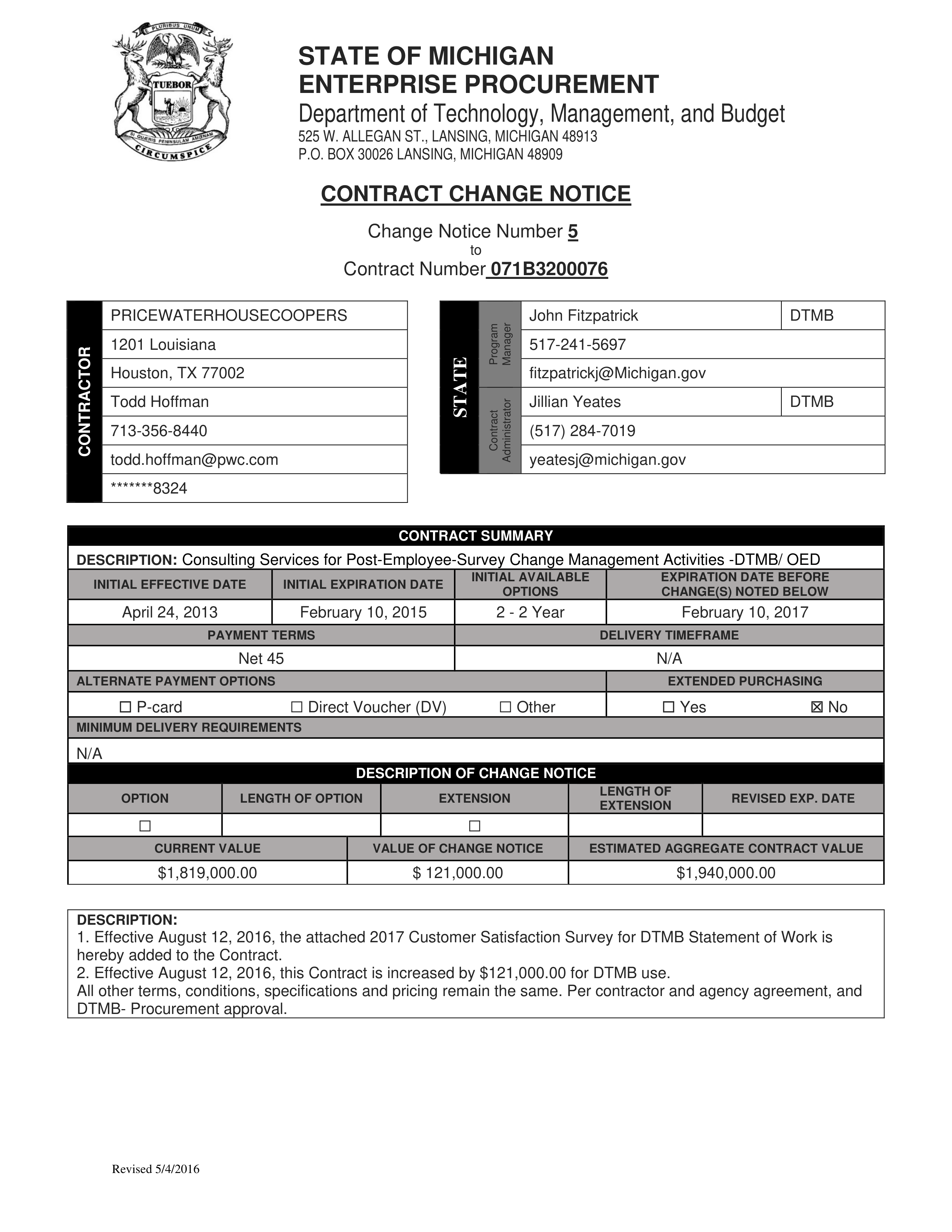
1. Effective August 12, 2016, the attached 2017 Customer Satisfaction Survey for DTMB Statement of Work is
hereby added to the Contract.
2. Effective August 12, 2016, this Contract is increased by $121,000.00 for DTMB use.
All other terms, conditions, specifications and pricing remain the same. Per contractor and agency agreement, and
DTMB- Procurement approval.
STATE OF MICHIGAN
ENTERPRISE PROCUREMENT
Department of Technology, Management, and Budget
525 W. ALLEGAN ST., LANSING, MICHIGAN 48913
P.O. BOX 30026 LANSING, MICHIGAN 48909
CONTRACT SUMMARY
DESCRIPTION
:
Consulting Services for Post-Employee-Survey Change Management Activities -DTMB/ OED
INITIAL EFFECTIVE DATE
INITIAL EXPIRATION DATE
INITIAL AVAILABLE
OPTIONS
EXPIRATION DATE BEFORE
CHANGE(S) NOTED BELOW
April 24, 2013
February 10, 2015
2 - 2 Year
February 10, 2017
PAYMENT TERMS
DELIVERY TIMEFRAME
Net 45
N/A
ALTERNATE PAYMENT OPTIONS
EXTENDED PURCHASING
☐
P-card
☐
Direct Voucher (DV)
☐
Other
☐
Yes
☒
No
MINIMUM DELIVERY REQUIREMENTS
N/A
DESCRIPTION OF CHANGE NOTICE
OPTION
LENGTH OF OPTION
EXTENSION
LENGTH OF
EXTENSION
REVISED EXP. DATE
☐
☐
CURRENT VALUE
VALUE OF CHANGE NOTICE
ESTIMATED AGGREGATE CONTRACT VALUE
$1,819,000.00
$ 121,000.00
$1,940,000.00
2
Contract 071B3200076
Change Notice No. 5
2017 Customer Satisfaction Survey for DTMB
Statement of Work
Survey Scope
Overview
>>
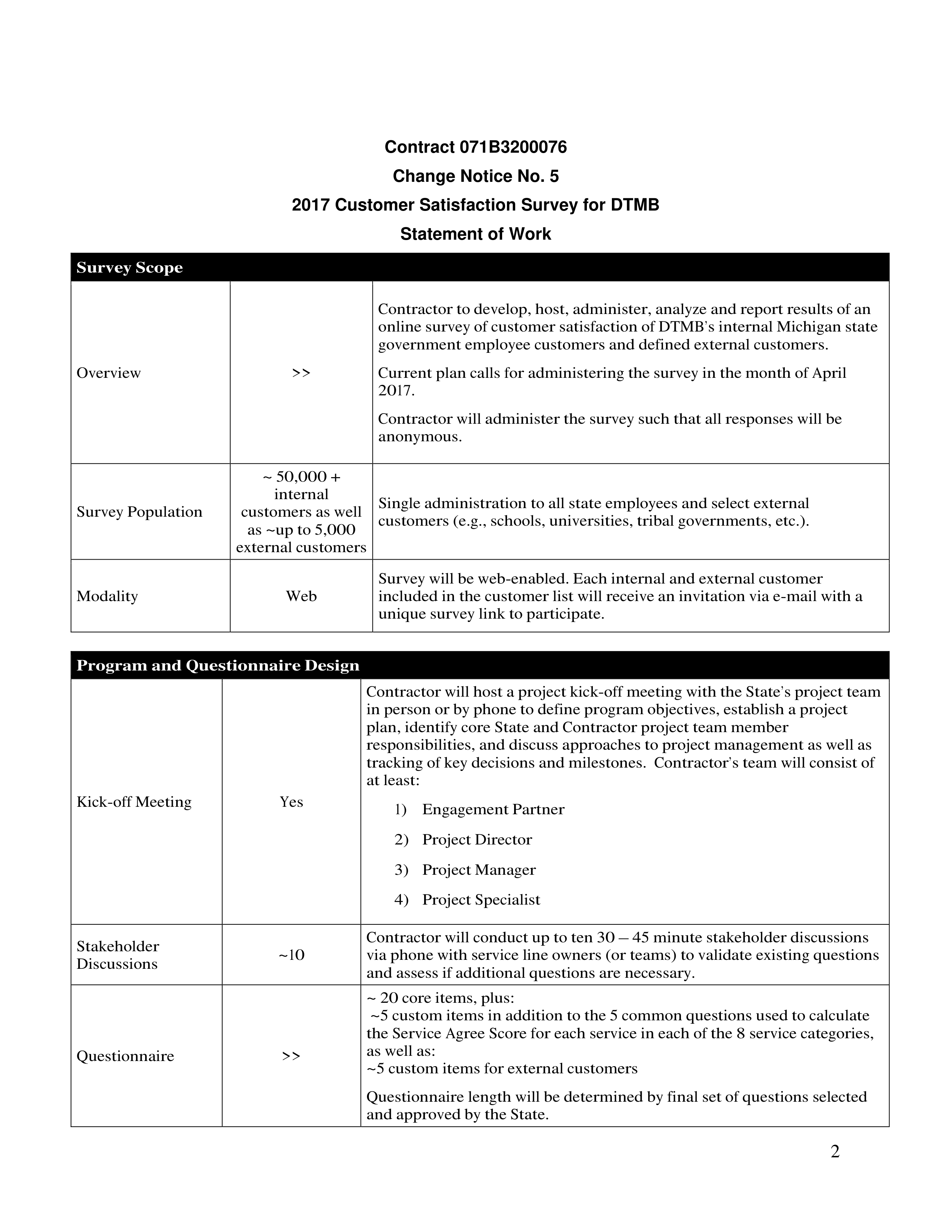
Contractor to develop, host, administer, analyze and report results of an
online survey of customer satisfaction of DTMB’s internal Michigan state
government employee customers and defined external customers.
Current plan calls for administering the survey in the month of April
2017.
Contractor will administer the survey such that all responses will be
anonymous.
Survey Population
~ 50,000 +
internal
customers as well
as ~up to 5,000
external customers
Single administration to all state employees and select external
customers (e.g., schools, universities, tribal governments, etc.).
Modality
Web
Survey will be web-enabled. Each internal and external customer
included in the customer list will receive an invitation via e-mail with a
unique survey link to participate.
Program and Questionnaire Design
Kick-off Meeting
Yes
Contractor will host a project kick-off meeting with the State’s project team
in person or by phone to define program objectives, establish a project
plan, identify core State and Contractor project team member
responsibilities, and discuss approaches to project management as well as
tracking of key decisions and milestones. Contractor’s team will consist of
at least:
1)
Engagement Partner
2)
Project Director
3)
Project Manager
4)
Project Specialist
Stakeholder
Discussions
~10
Contractor will conduct up to ten 30 – 45 minute stakeholder discussions
via phone with service line owners (or teams) to validate existing questions
and assess if additional questions are necessary.
Questionnaire
>>
~ 20 core items, plus:
~5 custom items in addition to the 5 common questions used to calculate
the Service Agree Score for each service in each of the 8 service categories,
as well as:
~5 custom items for external customers
Questionnaire length will be determined by final set of questions selected
and approved by the State.
Program and Questionnaire Design
Estimated time for a customer to complete the survey is ~10 minutes for
core questions, and approximately 5 additional minutes for each service
area selected.
Questionnaire
Versions
>>
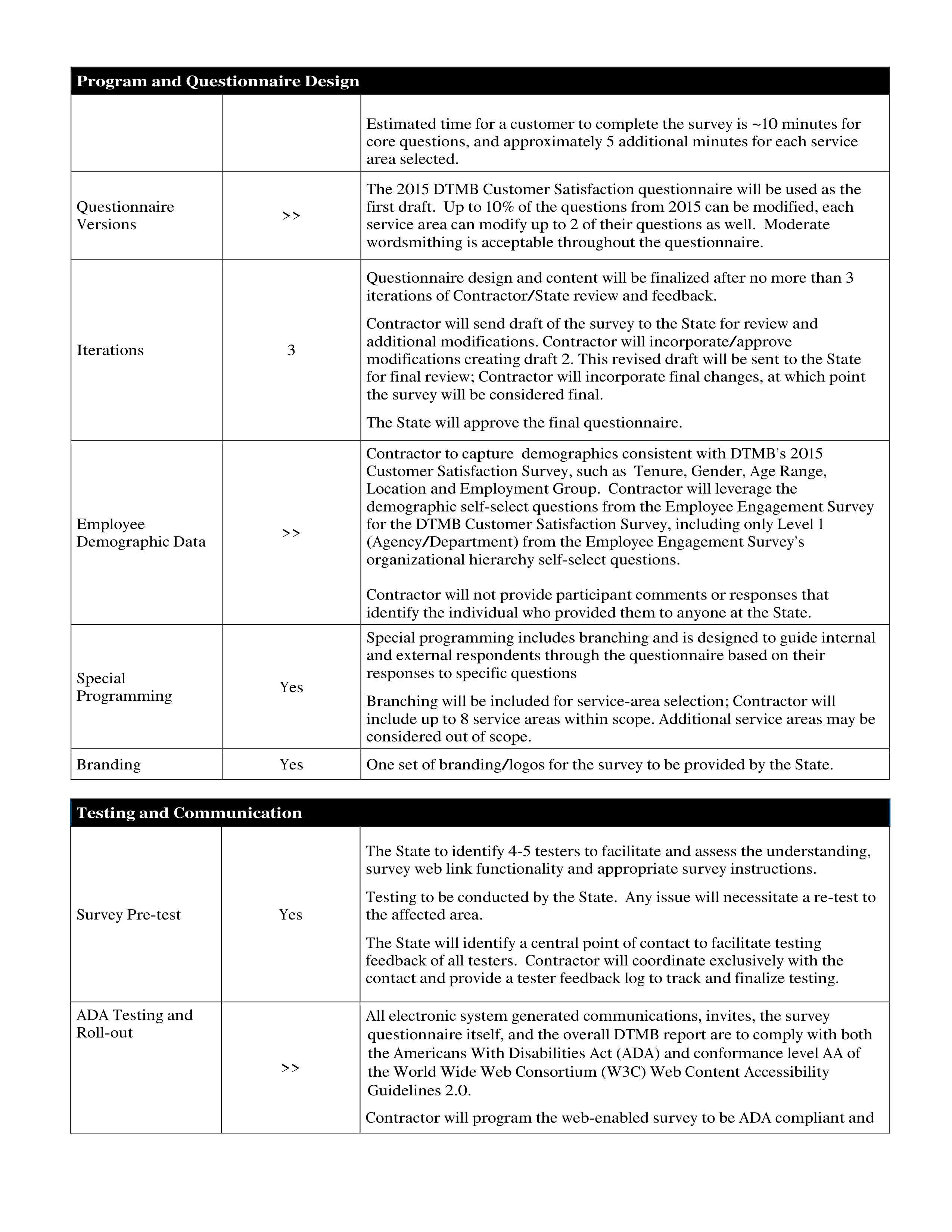
The 2015 DTMB Customer Satisfaction questionnaire will be used as the
first draft. Up to 10% of the questions from 2015 can be modified, each
service area can modify up to 2 of their questions as well. Moderate
wordsmithing is acceptable throughout the questionnaire.
Iterations
3
Questionnaire design and content will be finalized after no more than 3
iterations of Contractor/State review and feedback.
Contractor will send draft of the survey to the State for review and
additional modifications. Contractor will incorporate/approve
modifications creating draft 2. This revised draft will be sent to the State
for final review; Contractor will incorporate final changes, at which point
the survey will be considered final.
The State will approve the final questionnaire.
Employee
Demographic Data
>>
Contractor to capture demographics consistent with DTMB’s 2015
Customer Satisfaction Survey, such as Tenure, Gender, Age Range,
Location and Employment Group. Contractor will leverage the
demographic self-select questions from the Employee Engagement Survey
for the DTMB Customer Satisfaction Survey, including only Level 1
(Agency/Department) from the Employee Engagement Survey’s
organizational hierarchy self-select questions.
Contractor will not provide participant comments or responses that
identify the individual who provided them to anyone at the State.
Special
Programming
Yes
Special programming includes branching and is designed to guide internal
and external respondents through the questionnaire based on their
responses to specific questions
Branching will be included for service-area selection; Contractor will
include up to 8 service areas within scope. Additional service areas may be
considered out of scope.
Branding
Yes
One set of branding/logos for the survey to be provided by the State.
Testing and Communication
Survey Pre-test
Yes
The State to identify 4-5 testers to facilitate and assess the understanding,
survey web link functionality and appropriate survey instructions.
Testing to be conducted by the State. Any issue will necessitate a re-test to
the affected area.
The State will identify a central point of contact to facilitate testing
feedback of all testers. Contractor will coordinate exclusively with the
contact and provide a tester feedback log to track and finalize testing.
ADA Testing and
Roll-out
>>
All electronic system generated communications, invites, the survey
questionnaire itself, and the overall DTMB report are to comply with both
the Americans With Disabilities Act (ADA) and conformance level AA of
the World Wide Web Consortium (W3C) Web Content Accessibility
Guidelines 2.0.
Contractor will program the web-enabled survey to be ADA compliant and
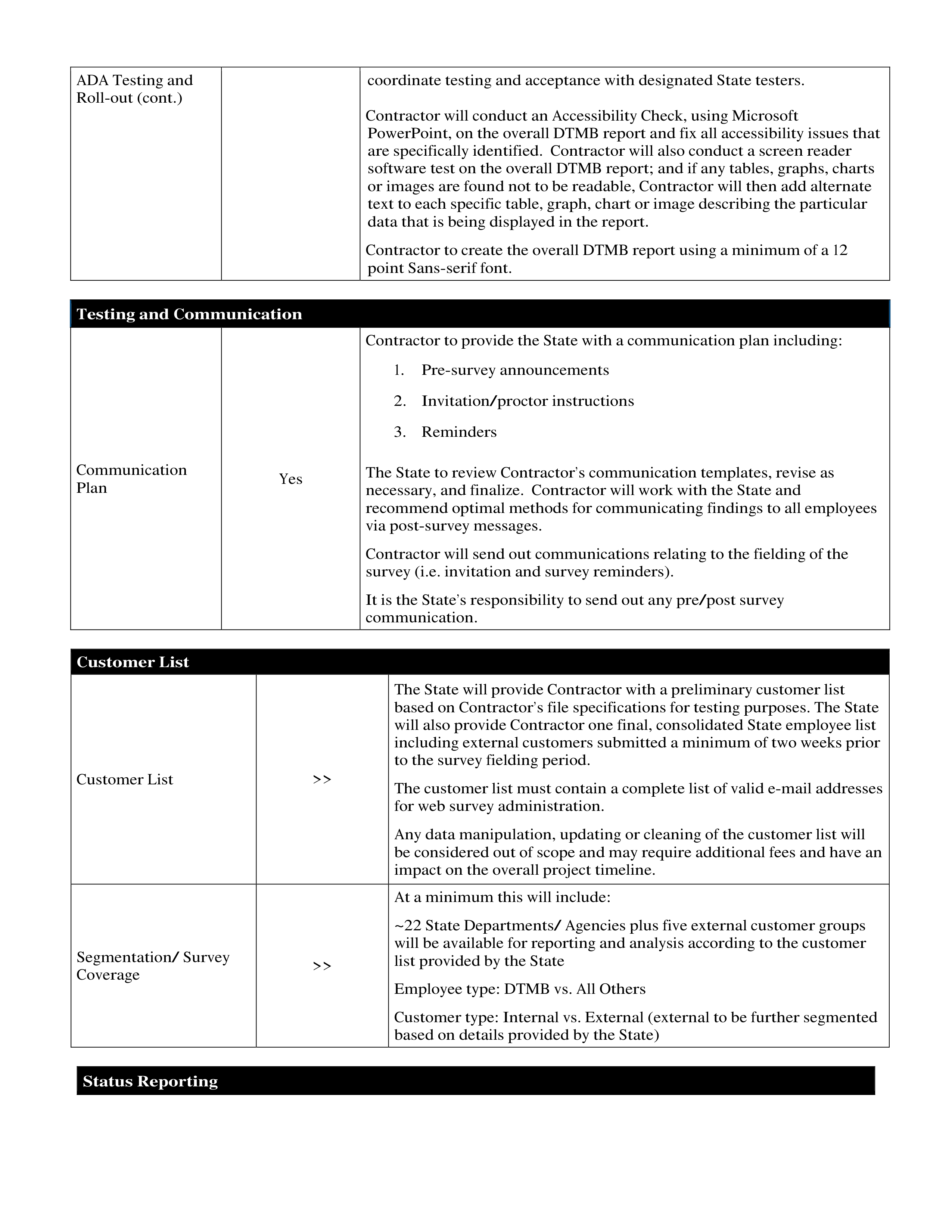
ADA Testing and
Roll-out (cont.)
coordinate testing and acceptance with designated State testers.
Contractor will conduct an Accessibility Check, using Microsoft
PowerPoint, on the overall DTMB report and fix all accessibility issues that
are specifically identified. Contractor will also conduct a screen reader
software test on the overall DTMB report; and if any tables, graphs, charts
or images are found not to be readable, Contractor will then add alternate
text to each specific table, graph, chart or image describing the particular
data that is being displayed in the report
.
Contractor to create the overall DTMB report using a minimum of a 12
point Sans-serif font.
Testing and Communication
Communication
Plan
Yes
Contractor to provide the State with a communication plan including:
1.
Pre-survey announcements
2.
Invitation/proctor instructions
3.
Reminders
The State to review Contractor’s communication templates, revise as
necessary, and finalize. Contractor will work with the State and
recommend optimal methods for communicating findings to all employees
via post-survey messages.
Contractor will send out communications relating to the fielding of the
survey (i.e. invitation and survey reminders).
It is the State’s responsibility to send out any pre/post survey
communication.
Customer List
Customer List
>>
The State will provide Contractor with a preliminary customer list
based on Contractor’s file specifications for testing purposes. The State
will also provide Contractor one final, consolidated State employee list
including external customers submitted a minimum of two weeks prior
to the survey fielding period.
The customer list must contain a complete list of valid e-mail addresses
for web survey administration.
Any data manipulation, updating or cleaning of the customer list will
be considered out of scope and may require additional fees and have an
impact on the overall project timeline.
Segmentation/ Survey
Coverage
>>
At a minimum this will include:
~22 State Departments/ Agencies plus five external customer groups
will be available for reporting and analysis according to the customer
list provided by the State
Employee type: DTMB vs. All Others
Customer type: Internal vs. External (external to be further segmented
based on details provided by the State)
Status Reporting
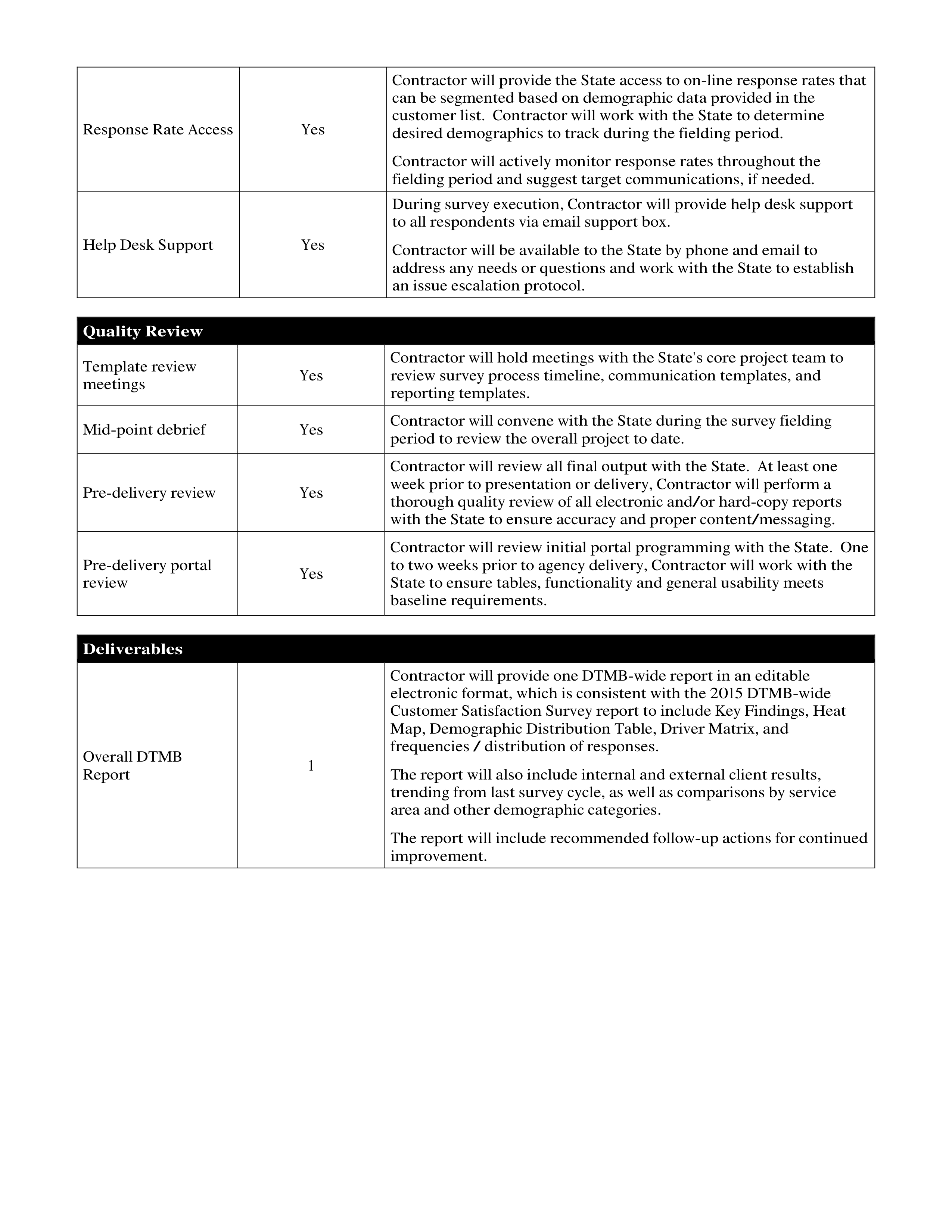
Response Rate Access
Yes
Contractor will provide the State access to on-line response rates that
can be segmented based on demographic data provided in the
customer list. Contractor will work with the State to determine
desired demographics to track during the fielding period.
Contractor will actively monitor response rates throughout the
fielding period and suggest target communications, if needed.
Help Desk Support
Yes
During survey execution, Contractor will provide help desk support
to all respondents via email support box.
Contractor will be available to the State by phone and email to
address any needs or questions and work with the State to establish
an issue escalation protocol.
Quality Review
Template review
meetings
Yes
Contractor will hold meetings with the State’s core project team to
review survey process timeline, communication templates, and
reporting templates.
Mid-point debrief
Yes
Contractor will convene with the State during the survey fielding
period to review the overall project to date.
Pre-delivery review
Yes
Contractor will review all final output with the State. At least one
week prior to presentation or delivery, Contractor will perform a
thorough quality review of all electronic and/or hard-copy reports
with the State to ensure accuracy and proper content/messaging.
Pre-delivery portal
review
Yes
Contractor will review initial portal programming with the State. One
to two weeks prior to agency delivery, Contractor will work with the
State to ensure tables, functionality and general usability meets
baseline requirements.
Deliverables
Overall DTMB
Report
1
Contractor will provide one DTMB-wide report in an editable
electronic format, which is consistent with the 2015 DTMB-wide
Customer Satisfaction Survey report to include Key Findings, Heat
Map, Demographic Distribution Table, Driver Matrix, and
frequencies / distribution of responses.
The report will also include internal and external client results,
trending from last survey cycle, as well as comparisons by service
area and other demographic categories.
The report will include recommended follow-up actions for continued
improvement.
Deliverables
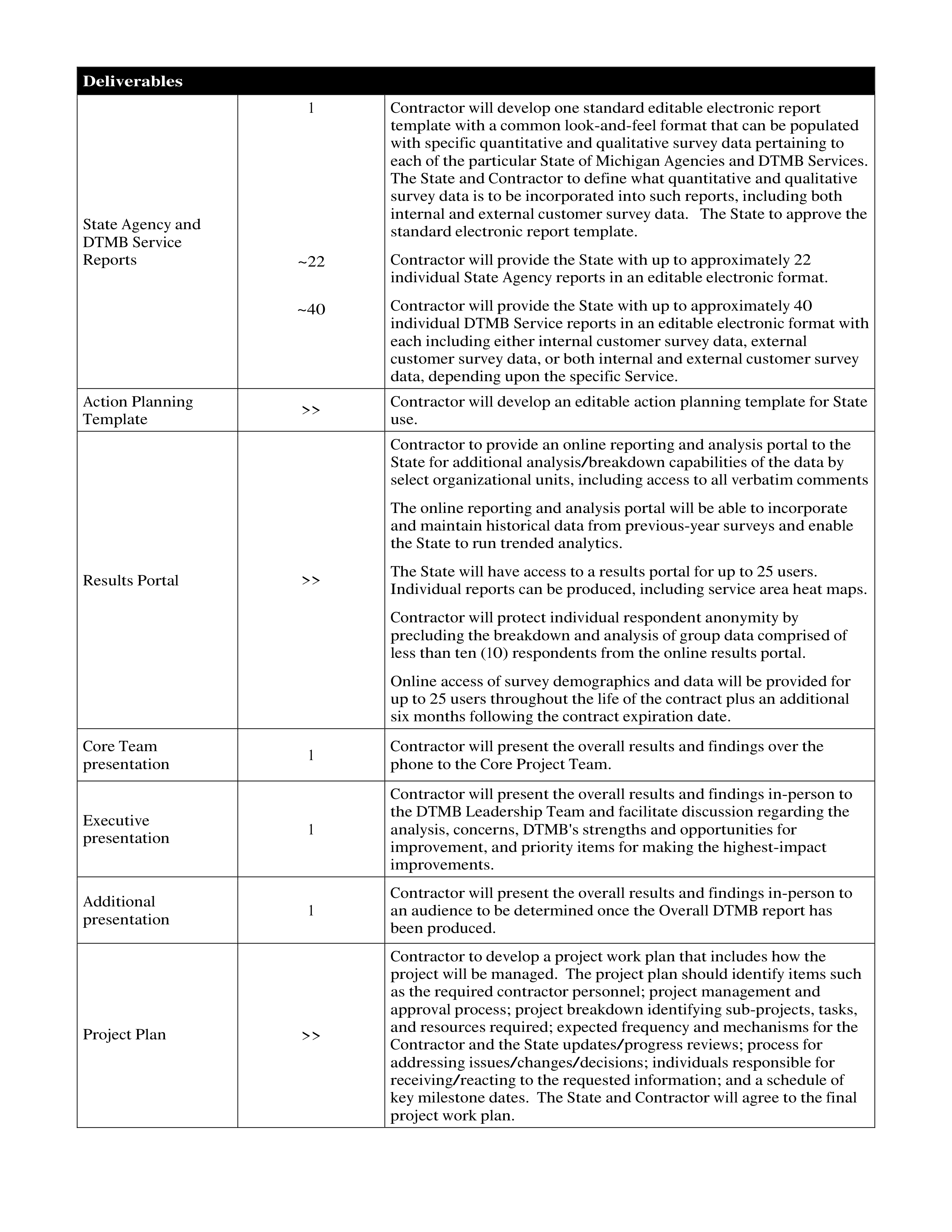
State Agency and
DTMB Service
Reports
1
~22
~40
Contractor will develop one standard editable electronic report
template with a common look-and-feel format that can be populated
with specific quantitative and qualitative survey data pertaining to
each of the particular State of Michigan Agencies and DTMB Services.
The State and Contractor to define what quantitative and qualitative
survey data is to be incorporated into such reports, including both
internal and external customer survey data. The State to approve the
standard electronic report template.
Contractor will provide the State with up to approximately 22
individual State Agency reports in an editable electronic format.
Contractor will provide the State with up to approximately 40
individual DTMB Service reports in an editable electronic format with
each including either internal customer survey data, external
customer survey data, or both internal and external customer survey
data, depending upon the specific Service.
Action Planning
Template
>>
Contractor will develop an editable action planning template for State
use.
Results Portal
>>
Contractor to provide an online reporting and analysis portal to the
State for additional analysis/breakdown capabilities of the data by
select organizational units, including access to all verbatim comments
The online reporting and analysis portal will be able to incorporate
and maintain historical data from previous-year surveys and enable
the State to run trended analytics.
The State will have access to a results portal for up to 25 users.
Individual reports can be produced, including service area heat maps.
Contractor will protect individual respondent anonymity by
precluding the breakdown and analysis of group data comprised of
less than ten (10) respondents from the online results portal.
Online access of survey demographics and data will be provided for
up to 25 users throughout the life of the contract plus an additional
six months following the contract expiration date.
Core Team
presentation
1
Contractor will present the overall results and findings over the
phone to the Core Project Team.
Executive
presentation
1
Contractor will present the overall results and findings in-person to
the DTMB Leadership Team and facilitate discussion regarding the
analysis, concerns, DTMB's strengths and opportunities for
improvement, and priority items for making the highest-impact
improvements.
Additional
presentation
1
Contractor will present the overall results and findings in-person to
an audience to be determined once the Overall DTMB report has
been produced.
Project Plan
>>
Contractor to develop a project work plan that includes how the
project will be managed. The project plan should identify items such
as the required contractor personnel; project management and
approval process; project breakdown identifying sub-projects, tasks,
and resources required; expected frequency and mechanisms for the
Contractor and the State updates/progress reviews; process for
addressing issues/changes/decisions; individuals responsible for
receiving/reacting to the requested information; and a schedule of
key milestone dates. The State and Contractor will agree to the final
project work plan.
Deliverables
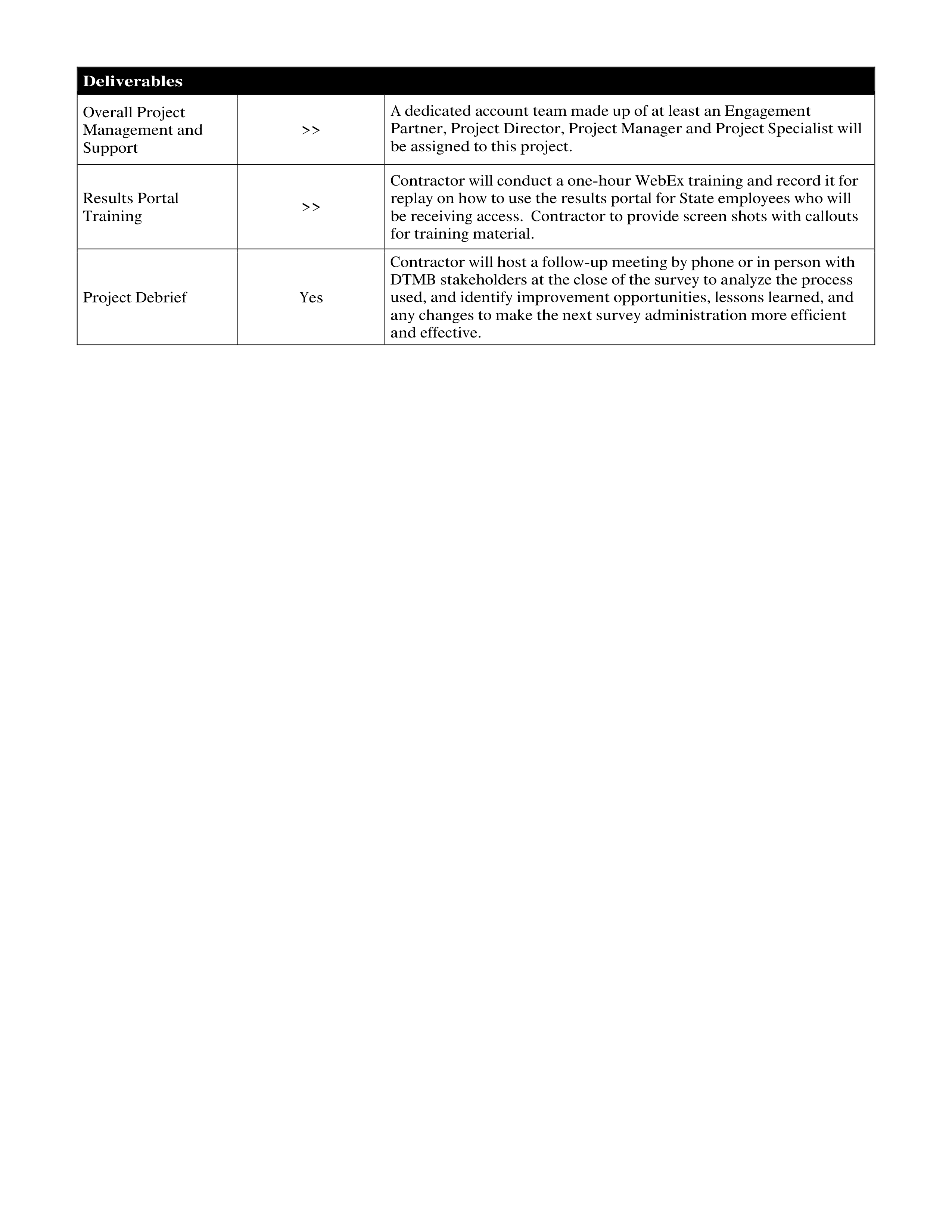
Overall Project
Management and
Support
>>
A dedicated account team made up of at least an Engagement
Partner, Project Director, Project Manager and Project Specialist will
be assigned to this project.
Results Portal
Training
>>
Contractor will conduct a one-hour WebEx training and record it for
replay on how to use the results portal for State employees who will
be receiving access. Contractor to provide screen shots with callouts
for training material.
Project Debrief
Yes
Contractor will host a follow-up meeting by phone or in person with
DTMB stakeholders at the close of the survey to analyze the process
used, and identify improvement opportunities, lessons learned, and
any changes to make the next survey administration more efficient
and effective.

Fees and Expenses
The fee for services relative to this project will be $121,000.
Form No. DTMB-3521 (Rev. 7/2015)
AUTHORITY: Act 431 of 1984
COMPLETION: Required
PENALTY: Contract change will not be executed unless form is filed
STATE OF MICHIGAN
DEPARTMENT OF TECHNOLOGY, MANAGEMENT AND BUDGET
PROCUREMENT
P.O. BOX 30026, LANSING, MI 48909
OR
525 W. ALLEGAN, LANSING, MI 48933
CHANGE NOTICE NO.
4
to
CONTRACT NO.
071B3200076
between
THE STATE OF MICHIGAN
and
NAME & ADDRESS OF CONTRACTOR
PRIMARY CONTACT
EMAIL
PricewaterhouseCoopers, LLP
Todd Hoffman
todd.hoffman@pwc.com
1201 Louisiana, Suite 2900
PHONE
CONTRACTOR’S TAX ID NO.
(LAST FOUR DIGITS ONLY)
Houston, TX 77002
(713) 356-8440
8324
STATE CONTACTS
AGENCY
NAME
PHONE
EMAIL
PROGRAM MANAGER / CCI
DTMB
John Fitzpatrick
(517) 241‐5697
fitzpatrickj@michigan.gov
CONTRACT ADMINISTRATOR
DTMB
Jillian Yeates
(517) 284‐7019
yeatesj@michigan.gov
CONTRACT SUMMARY
DESCRIPTION
:
Prequalification – Consulting Services for Post Employee Survey Change Management Activities –
Department of Technology, Management and Budget
INITIAL EFFECTIVE DATE
INITIAL EXPIRATION
DATE
INITIAL AVAILABLE
OPTIONS
EXPIRATION DATE BEFORE
CHANGE(S) NOTED BELOW
February 11, 2013
February 10, 2015
2, two‐year
February 10, 2017
PAYMENT TERMS
DELIVERY TIMEFRAME
Net 45
N/A
ALTERNATE PAYMENT OPTIONS
EXTENDED PURCHASING
☐
P-card
☐
Direct Voucher (DV)
☐
Other
☐
Yes
☒
No
MINIMUM DELIVERY REQUIREMENTS
N/A
DESCRIPTION OF CHANGE NOTICE
EXERCISE OPTION?
LENGTH OF OPTION
EXERCISE EXTENSION?
LENGTH OF
EXTENSION
REVISED EXP. DATE
☐
☐
CURRENT VALUE
VALUE OF CHANGE NOTICE
ESTIMATED AGGREGATE CONTRACT VALUE
$1,520,000.00
$299,000.00
$1,819,000.00
DESCRIPTION
:
1. Effective September 10, 2015, the attached Performance Measurement and Management System Statement of Work and
proposal is hereby added to the Contract.

2. Effective September 10, 2015, this Contract is hereby increased by $299,000.00.
All other terms, conditions, specifications and pricing remain the same. Per vendor and agency agreement, and DTMB
Procurement approval.
STATE OF MICHIGAN
Contract 071B3200076
Change Notice 4
Prequalification Program- Consulting Services for Post-Employee Survey Change Management Activities
Performance Measurement and Management System
EXHIBIT A
STATEMENT OF WORK
CONTRACT ACTIVITIES
Project Request
The Office of Good Government (OGG) seeks a contractor who can support the reinvention of the State government
by developing and deploying an effective performance measurement and performance management system. The
purpose of the system is to align the services and programs of executive branch departments/agencies to a clear set
of State-wide goals.
Background
The State of Michigan’s Office of Good Government (OGG) is charged with creating and sustaining an environment
that enables and fosters the continuous reinvention of State government. The OGG operates using four areas of
focus: (1) Change Management, (2) Employee Engagement, (3) Performance Management, and (4) Service/Process
Optimization. The four areas of focus are connected and interdependent. The simultaneous and successful
execution of each area drives reinvention.
OGG activities and programs are performed in partnership with people from across State government and from the
private sector. Principal partners include the following:
Good Government Leadership Team – The Good Government Leadership Team includes senior level
executives in State government who provide strategic direction for the OGG.
Department Directors – Department Directors are responsible for driving and promoting good government
principles in their respective departments.
Good Government Champions – Good Government Champions are appointed by Department Directors and
are responsible for working closely with the OGG to execute good government initiatives and programs.
State Employees – Each State employee is encouraged to become a good government “champion” by
participating in OGG programs and events and by driving reinvention wherever they work.
External partners – External partners provide expertise and participate in OGG events to help State
government in its reinvention journey.
Since its inception in 2011, the OGG has had an important impact on State government operations and State
government employees. Through the use of dashboards and scorecards, the OGG has helped institutionalize the
use of data to drive decision-making and to promote transparency and accountability. 9 dashboards are published on
the Open Michigan website (
www.michigan.gov/openmichigan
) and provide an assessment of the State’s
performance in key areas including economic strength, health and education, value for money government, quality of
life, and public safety. Approximately 600 scorecards are maintained and updated at department, division, bureau,
office, and unit levels using a State of Michigan software application called MiResults. 23 department-level
scorecards are updated monthly and are posted to the Open Michigan website.
Through statewide employee surveys conducted in 2012 and 2013, the OGG has helped benchmark employee
perceptions, identify effective practices, and highlight areas for improvement. Following the 2013 employee survey,
each department developed action plans to address employee feedback. These plans are maintained and updated in
the MiResults system. Examples include: more visible and accessible senior leaders; implementation of self-directed
workgroups and cross-functional teams; enhanced career development programs; integration of employee
engagement plans in department strategic plans; establishing employee recognition programs; improved
communications. The next employee survey will be conducted in 2015 and will provide valuable information to
measure progress since the 2013 survey.
2
1.1 Requirements
A. Scope of Work
This Project will begin with the Executive Office.
1.
Project Goal:
Support the reinvention of State government by developing and deploying an effective
performance measurement and performance management system that aligns the services and
programs of executive branch departments/agencies to a clear set of State-wide goals.
2.
Project Objectives:
a.
At the Executive Office level, create a shared understanding of what the State is trying to
accomplish, what beliefs govern its behavior, how it will measure its overall success, what work it
must do well to be successful, who owns what work, and how to determine if the work is being
effectively managed.
b.
At the Executive Office level, identify gaps between current and desired organizational
performance, and identify, prioritize and sequence the initiatives that must be successful for the
State to achieve its longer-term goals.
B. Work and Deliverables
Executive Office
1.
Kick-off Meeting
Contractor must participate in a Kick-off Meeting. The contractor will meet with OGG leadership and
key stakeholders from the Executive Office to form a steering team and to align on the projects goals,
objectives, and approach. This session has a dual purpose of defining the lines of communication and
formalizing overall expectations related to logistics, protocols, and deliverable timelines.
Contractor will create a detailed work plan that integrates the flexibility and governance required for a
large undertaking such as this, with the rigor of ensuring timely completion of deliverables by the dates
specified. The detailed activities will be comprised of, but not limited to the following activities:
a.
Assemble Contractor, Subcontractor, OGG and Executive Office:
Contractor will conduct a
kick-off meeting with key project stakeholders and State leadership to confirm the project’s goals,
objectives and approach.
b.
Develop project plan:
During the first week of the engagement, the Contractor will develop a plan
incorporating the State’s input and adding in more detailed information.
c.
Create project status reporting process and template:
Contractor will also identify a status
reporting process that is acceptable to the State. Contractor will leverage the project plan to
measure the team’s progress against the identified weekly tasks and deliverables, and will
communicate this to the steering committee in a weekly status report.
d.
Create project governance structure:
The Project Governance Structure will detail the
composition of the Steering Committee (e.g., internal and external stakeholders) and any advisory
roles or bodies. It will also articulate when the Steering Committee will convene, meeting agendas
and criteria needed for decisions to be escalated to the Steering Committee level.
e.
Create communication strategy
The Contractor will develop a communications and engagement
strategy and plan as the foundation of the delivery of messages and stakeholder activities. The
strategy provides a framework that includes the key components that comprehensively deliver
messages and activities to all stakeholders, while the plan manages the development and delivery
of all messages and activities.
f.
Establish key stakeholder interview schedule:
Contractor and the State’s Project Manager will
identify the key resources to interview to help inform the fundamentals map and breakthrough
strategy, including senior level management and staff.
2.
NOW Management System Training
All State staff identified as part of the project team will receive raining on the NOW Management
System within the first two weeks of the project initiation. This training will be led by Contractor and
Subcontractor, including the professionals who authored the methodologies.
3.
NOW Management Fundamentals Map
The Subcontractor, will lead the Phase I work with the Executive Office in order to establish the
standards for work to be done across the state. Throughout this process there will be project team
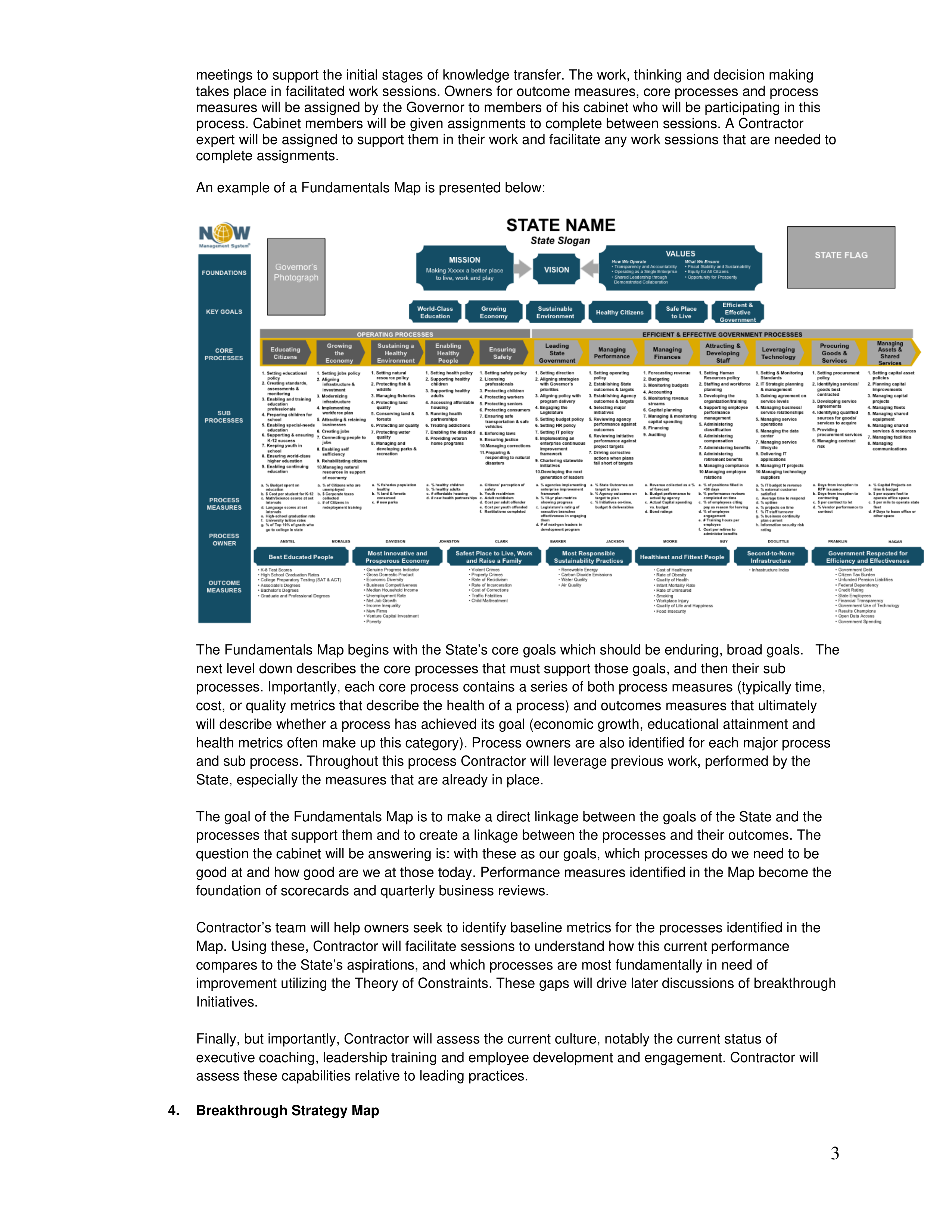
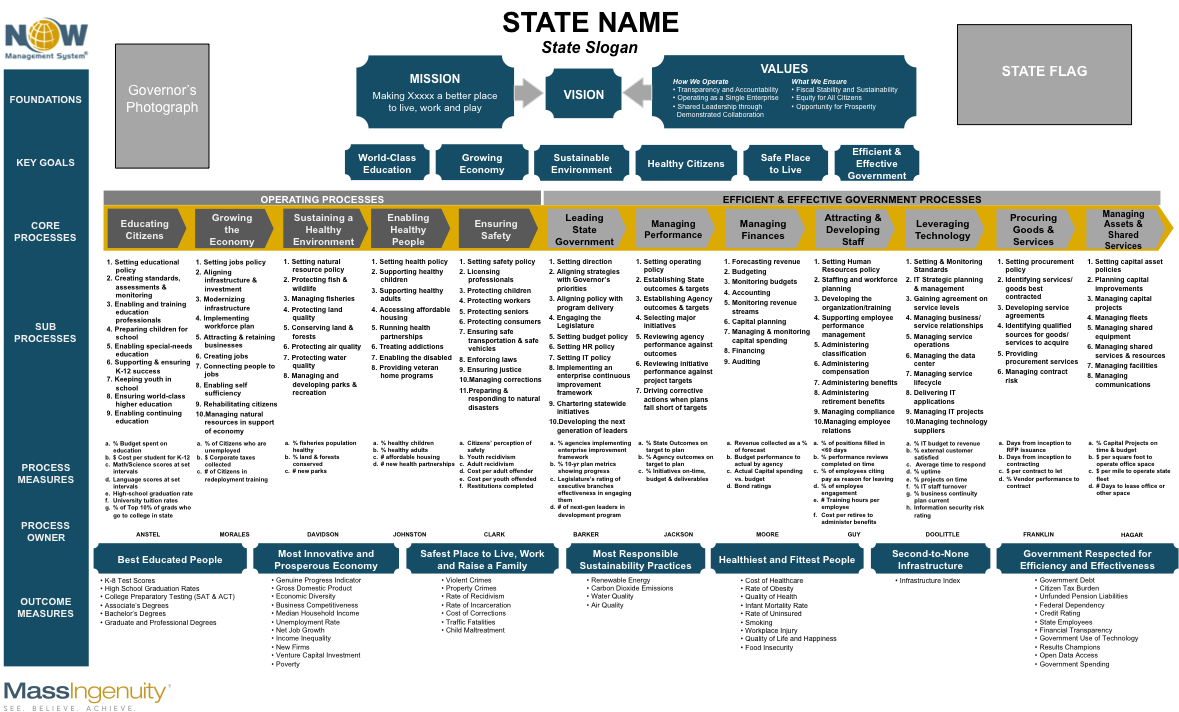
3
meetings to support the initial stages of knowledge transfer.
The work, thinking and decision making
takes place in facilitated work sessions. Owners for outcome measures, core processes and process
measures will be assigned by the Governor to members of his cabinet who will be participating in this
process. Cabinet members will be given assignments to complete between sessions. A Contractor
expert will be assigned to support them in their work and facilitate any work sessions that are needed to
complete assignments.
An example of a Fundamentals Map is presented below:
The Fundamentals Map begins with the State’s core goals which should be enduring, broad goals. The
next level down describes the core processes that must support those goals, and then their sub
processes. Importantly, each core process contains a series of both process measures (typically time,
cost, or quality metrics that describe the health of a process) and outcomes measures that ultimately
will describe whether a process has achieved its goal (economic growth, educational attainment and
health metrics often make up this category). Process owners are also identified for each major process
and sub process. Throughout this process Contractor will leverage previous work, performed by the
State, especially the measures that are already in place.
The goal of the Fundamentals Map is to make a direct linkage between the goals of the State and the
processes that support them and to create a linkage between the processes and their outcomes. The
question the cabinet will be answering is: with these as our goals, which processes do we need to be
good at and how good are we at those today. Performance measures identified in the Map become the
foundation of scorecards and quarterly business reviews.
Contractor’s team will help owners seek to identify baseline metrics for the processes identified in the
Map. Using these, Contractor will facilitate sessions to understand how this current performance
compares to the State’s aspirations, and which processes are most fundamentally in need of
improvement utilizing the Theory of Constraints. These gaps will drive later discussions of breakthrough
Initiatives.
Finally, but importantly, Contractor will assess the current culture, notably the current status of
executive coaching, leadership training and employee development and engagement. Contractor will
assess these capabilities relative to leading practices.
4.
Breakthrough Strategy Map
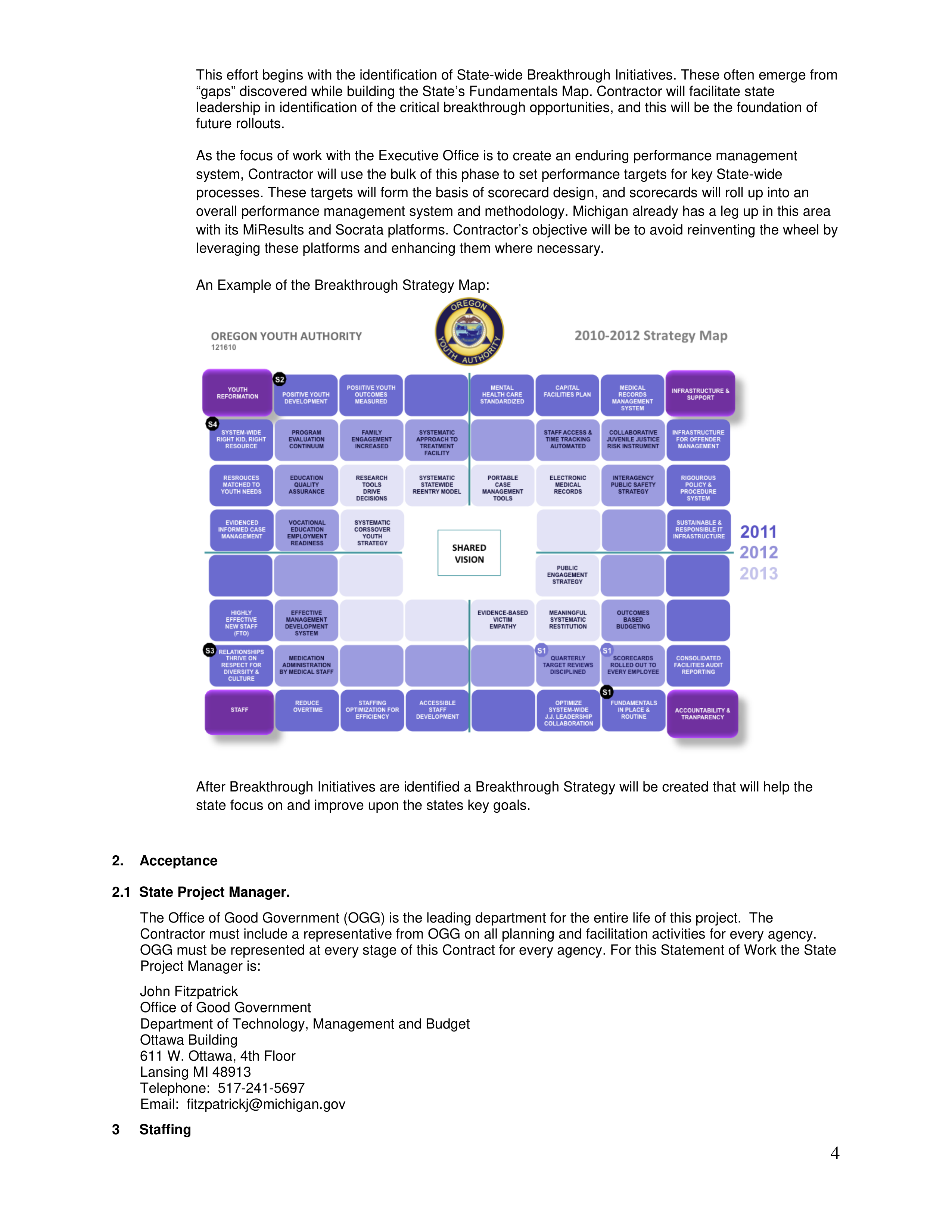
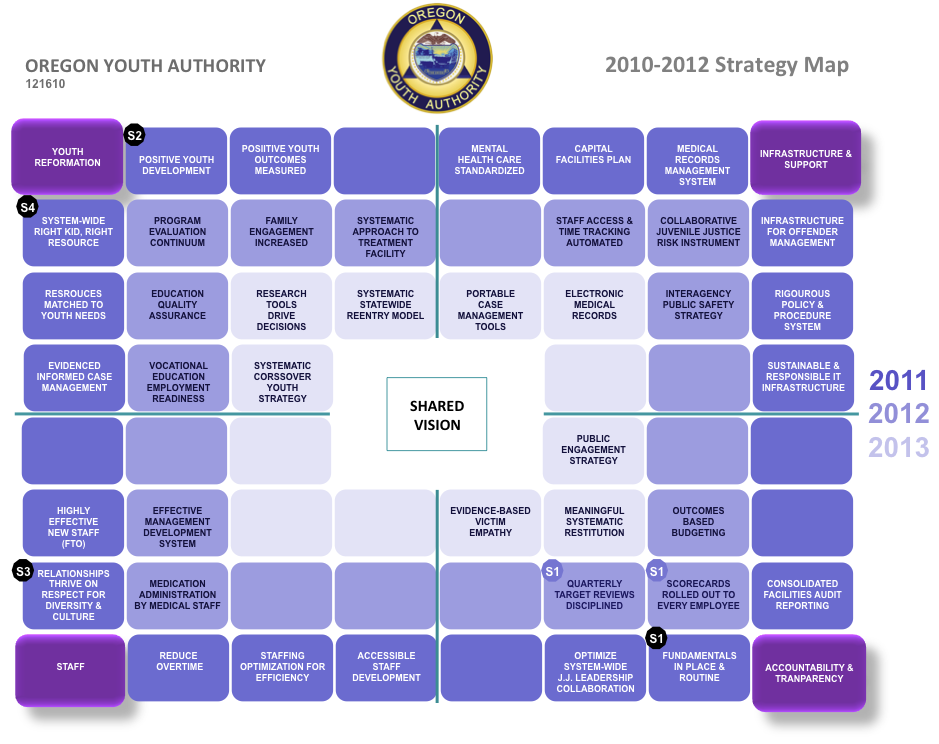
4
This effort begins with the identification of State-wide Breakthrough Initiatives. These often emerge from
“gaps” discovered while building the State’s Fundamentals Map. Contractor will facilitate state
leadership in identification of the critical breakthrough opportunities, and this will be the foundation of
future rollouts.
As the focus of work with the Executive Office is to create an enduring performance management
system, Contractor will use the bulk of this phase to set performance targets for key State-wide
processes. These targets will form the basis of scorecard design, and scorecards will roll up into an
overall performance management system and methodology. Michigan already has a leg up in this area
with its MiResults and Socrata platforms. Contractor’s objective will be to avoid reinventing the wheel by
leveraging these platforms and enhancing them where necessary.
An Example of the Breakthrough Strategy Map:
After Breakthrough Initiatives are identified a Breakthrough Strategy will be created that will help the
state focus on and improve upon the states key goals.
2. Acceptance
2.1 State Project Manager.
The Office of Good Government (OGG) is the leading department for the entire life of this project. The
Contractor must include a representative from OGG on all planning and facilitation activities for every agency.
OGG must be represented at every stage of this Contract for every agency. For this Statement of Work the State
Project Manager is:
John Fitzpatrick
Office of Good Government
Department of Technology, Management and Budget
Ottawa Building
611 W. Ottawa, 4th Floor
Lansing MI 48913
Telephone: 517-241-5697
Email: fitzpatrickj@michigan.gov
3 Staffing
5
3.1 Contractor Representative
The Contractor must appoint an
individual, specifically assigned to State of Michigan accounts, that will respond
to State inquiries regarding the Contract Activities, answering questions related to ordering and delivery, etc. (the
“Contractor Representative”).
Contractor's Representative:
Todd Hoffman, Principal
PricewaterhouseCoopers LLP
1201 Louisiana, Suite 2900 Houston, TX 77002
Email: todd.hoffman@us.pwc.com
Office: 713-356-8440 | Mobile: 917-664-6188
The Contractor must notify the Contract Administrator at least 30 calendar days before removing or assigning a
new Contractor Representative.
3.2 Work Hours
The Contractor must provide Contract Activities during the State’s normal working hours Monday – Friday 7:00
a.m. to 6:00 p.m. EST.
3.3 Key Personnel
The Contractor must appoint individuals who will be directly responsible for the day-to-day operations of the
Contract (“Key Personnel”). Key Personnel must be specifically assigned to the State account, be
knowledgeable on the contractual requirements, and respond to State inquires within 24 hours.
Contractor’s Key Personnel must be on-site to engage in key facilitation sessions.
The State has the right to recommend and approve in writing the initial assignment, as well as any proposed
reassignment or replacement, of any Key Personnel. Before assigning an individual to any Key Personnel
position, Contractor will notify the State of the proposed assignment, introduce the individual to the State’s
Project Manager, and provide the State with a resume and any other information about the individual reasonably
requested by the State. The State reserves the right to interview the individual before granting written approval.
In the event the State finds a proposed individual unacceptable, the State will provide a written explanation
including reasonable detail outlining the reasons for the rejection. The State may require a 30-calendar day
training period for replacement personnel.
Contractor will not remove any Key Personnel from their assigned roles on this Contract without the prior written
consent of the State. The Contractor’s removal of Key Personnel without the prior written consent of the State is
an unauthorized removal (“
Unauthorized Removal
”). An Unauthorized Removal does not include replacing Key
Personnel for reasons beyond the reasonable control of Contractor, including illness, disability, leave of absence,
personal emergency circumstances, resignation, or for cause termination of the Key Personnel’s employment.
Any Unauthorized Removal may be considered by the State to be a material breach of this Contract, in respect
of which the State may elect to terminate this Contract for cause under Termination for Cause in the Standard
Terms.
The Contractor must identify the Key Personnel, indicate where they will be physically located, describe the
functions they will perform, and provide current chronological résumés:
Deliverable
Key Personal Assigned; not all resources are
dedicated full-time to the project
1.
Kick-Off Meeting
Todd Hoffman (PwC), Chris O’Brien (PwC), Michael
Tosh (PwC), John Bernard (MI), Julia Joggerst (PwC),
Tom Moore (MI)
2.
NOW Management Training
John Bernard (MI), Julia Joggerst (PwC), Tom Moore
(MI)
3.
NOW Management Fundamentals Map
Todd Hoffman (PwC), Chris O’Brien (PwC), Michael
Tosh (PwC), John Bernard (MI), Julia Joggerst (PwC),
Tom Moore (MI)
4.
Breakthrough Strategy Map
Todd Hoffman (PwC), Chris O’Brien (PwC), Michael
Tosh (PwC), John Bernard (MI), Julia Joggerst (PwC),
Tom Moore (MI)
3.4 Organization Chart
The Contractor must provide an overall organizational chart that details staff members, by name and title, and
subcontractors:
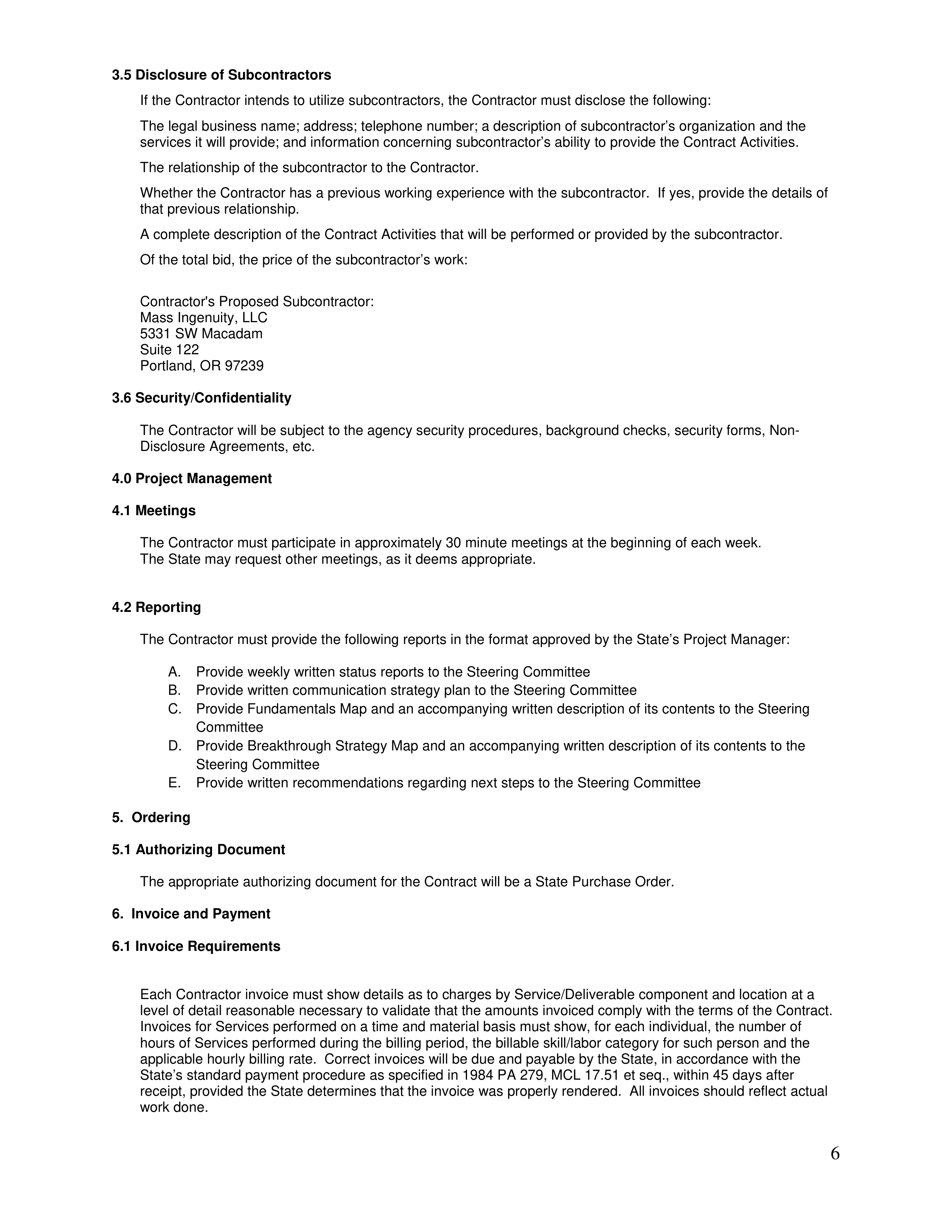
6
3.5 Disclosure of Subcontractors
If the Contractor intends to utilize subcontractors, the Contractor must disclose the following:
The legal business name; address; telephone number; a description of subcontractor’s organization and the
services it will provide; and information concerning subcontractor’s ability to provide the Contract Activities.
The relationship of the subcontractor to the Contractor.
Whether the Contractor has a previous working experience with the subcontractor. If yes, provide the details of
that previous relationship.
A complete description of the Contract Activities that will be performed or provided by the subcontractor.
Of the total bid, the price of the subcontractor’s work:
Contractor's Proposed Subcontractor:
Mass Ingenuity, LLC
5331 SW Macadam
Suite 122
Portland, OR 97239
3.6 Security/Confidentiality
The Contractor will be subject to the agency security procedures, background checks, security forms, Non-
Disclosure Agreements, etc.
4.0 Project Management
4.1 Meetings
The Contractor must participate in approximately 30 minute meetings at the beginning of each week.
The State may request other meetings, as it deems appropriate.
4.2 Reporting
The Contractor must provide the following reports in the format approved by the State’s Project Manager:
A. Provide weekly written status reports to the Steering Committee
B. Provide written communication strategy plan to the Steering Committee
C. Provide Fundamentals Map and an accompanying written description of its contents to the Steering
Committee
D. Provide Breakthrough Strategy Map and an accompanying written description of its contents to the
Steering Committee
E. Provide written recommendations regarding next steps to the Steering Committee
5. Ordering
5.1 Authorizing Document
The appropriate authorizing document for the Contract will be a State Purchase Order.
6. Invoice and Payment
6.1 Invoice Requirements
Each Contractor invoice must show details as to charges by Service/Deliverable component and location at a
level of detail reasonable necessary to validate that the amounts invoiced comply with the terms of the Contract.
Invoices for Services performed on a time and material basis must show, for each individual, the number of
hours of Services performed during the billing period, the billable skill/labor category for such person and the
applicable hourly billing rate. Correct invoices will be due and payable by the State, in accordance with the
State’s standard payment procedure as specified in 1984 PA 279, MCL 17.51 et seq., within 45 days after
receipt, provided the State determines that the invoice was properly rendered. All invoices should reflect actual
work done.

7
All invoices submitted to the State must include: (a) date; (b) purchase order; (c) quantity; (d) description of the
Contract Activities; and (e) pricing in accordance with Exhibit C pricing. No other expenses will be paid.
6.2 Payment Methods
The State will make payment for Contract Activities after completion and acceptance of deliverables.
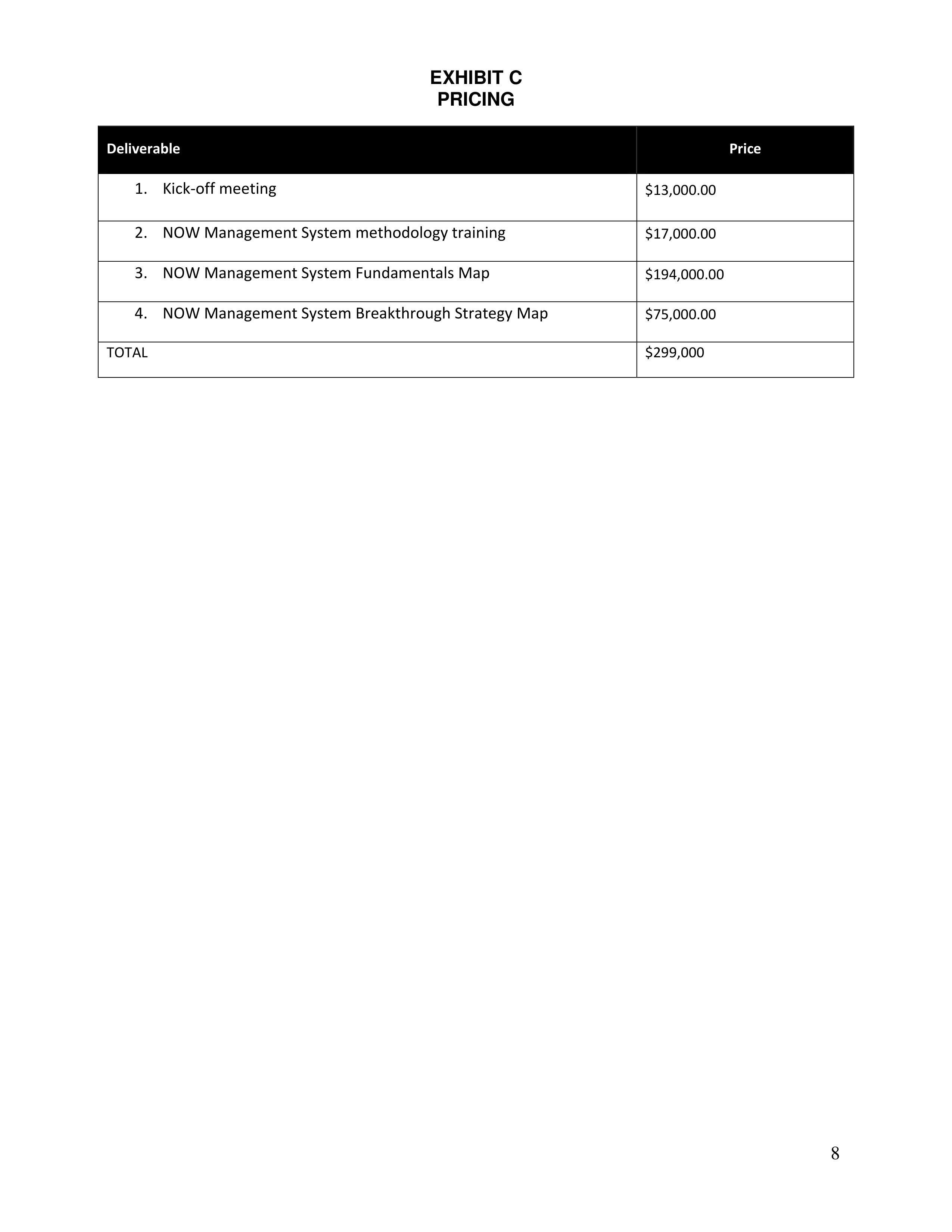
8
EXHIBIT C
PRICING
Deliverable
Price
1.
Kick‐off meeting
$13,000.00
2.
NOW Management System methodology training
$17,000.00
3.
NOW Management System Fundamentals Map
$194,000.00
4.
NOW Management System Breakthrough Strategy Map
$75,000.00
TOTAL
$299,000
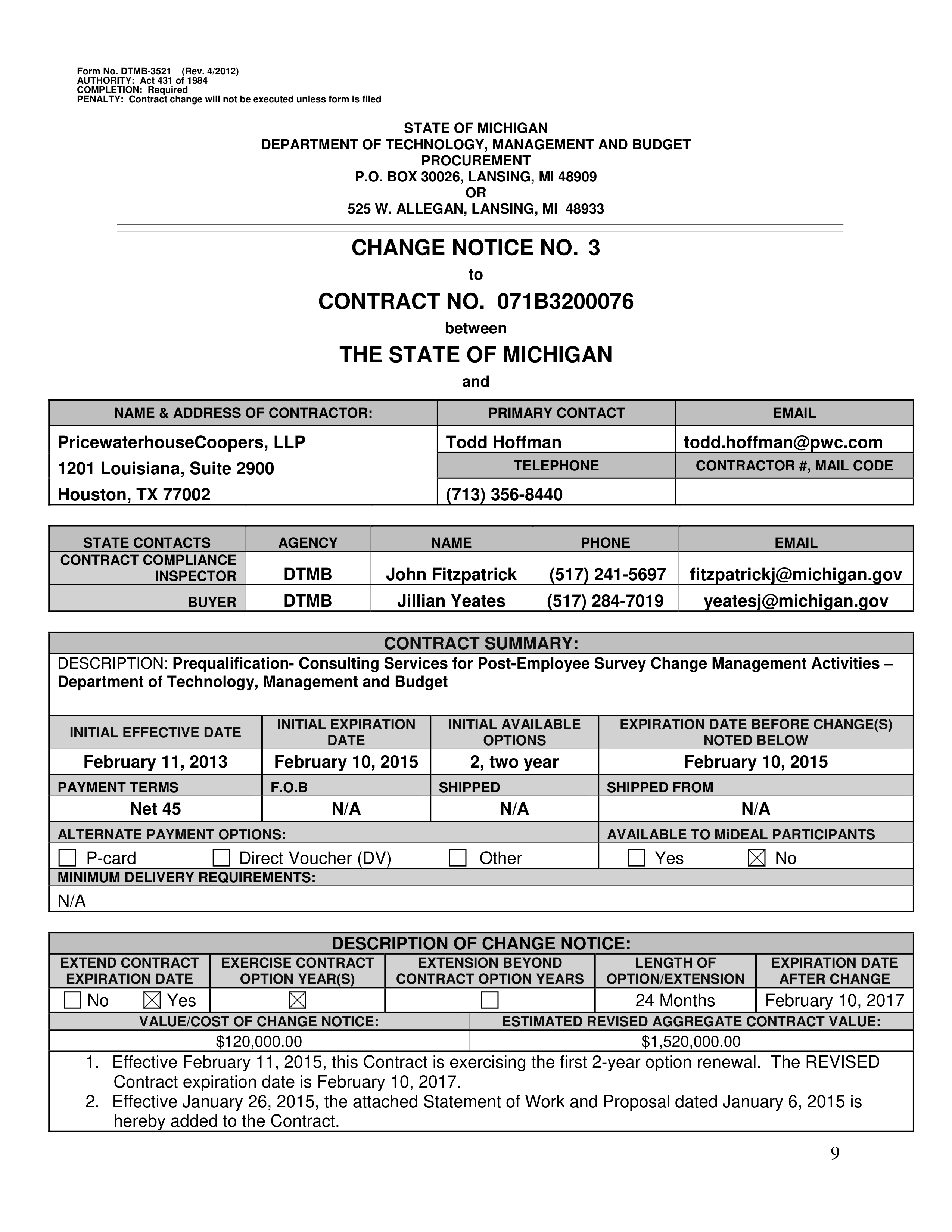
9
Form No. DTMB-3521 (Rev. 4/2012)
AUTHORITY: Act 431 of 1984
COMPLETION: Required
PENALTY: Contract change will not be executed unless form is filed
STATE OF MICHIGAN
DEPARTMENT OF TECHNOLOGY, MANAGEMENT AND BUDGET
PROCUREMENT
P.O. BOX 30026, LANSING, MI 48909
OR
525 W. ALLEGAN, LANSING, MI 48933
CHANGE NOTICE NO.
3
to
CONTRACT NO. 071B3200076
between
THE STATE OF MICHIGAN
and
NAME & ADDRESS OF CONTRACTOR:
PRIMARY CONTACT
EMAIL
PricewaterhouseCoopers, LLP
Todd Hoffman
todd.hoffman@pwc.com
1201 Louisiana, Suite 2900
TELEPHONE
CONTRACTOR #, MAIL CODE
Houston, TX 77002
(713) 356-8440
STATE CONTACTS
AGENCY
NAME
PHONE
EMAIL
CONTRACT COMPLIANCE
INSPECTOR
DTMB
John Fitzpatrick
(517) 241-5697
fitzpatrickj@michigan.gov
BUYER
DTMB
Jillian Yeates
(517) 284-7019
yeatesj@michigan.gov
CONTRACT SUMMARY
:
DESCRIPTION:
Prequalification- Consulting Services for Post-Employee Survey Change Management Activities –
Department of Technology, Management and Budget
INITIAL EFFECTIVE DATE
INITIAL EXPIRATION
DATE
INITIAL AVAILABLE
OPTIONS
EXPIRATION DATE BEFORE CHANGE(S)
NOTED BELOW
February 11, 2013
February 10, 2015
2, two year
February 10, 2015
PAYMENT TERMS
F.O.B
SHIPPED
SHIPPED FROM
Net 45
N/A
N/A
N/A
ALTERNATE PAYMENT OPTIONS
:
AVAILABLE TO MiDEAL PARTICIPANTS
P-card
Direct Voucher (DV)
Other
Yes
No
MINIMUM DELIVERY REQUIREMENTS:
N/A
DESCRIPTION OF CHANGE NOTICE:
EXTEND CONTRACT
EXPIRATION DATE
EXERCISE CONTRACT
OPTION YEAR(S)
EXTENSION BEYOND
CONTRACT OPTION YEARS
LENGTH OF
OPTION/EXTENSION
EXPIRATION DATE
AFTER CHANGE
No
Yes
24 Months
February 10, 2017
VALUE/COST OF CHANGE NOTICE:
ESTIMATED REVISED AGGREGATE CONTRACT VALUE:
$120,000.00
$1,520,000.00
1. Effective February 11, 2015, this Contract is exercising the first 2-year option renewal. The REVISED
Contract expiration date is February 10, 2017.
2. Effective January 26, 2015, the attached Statement of Work and Proposal dated January 6, 2015 is
hereby added to the Contract.

10
3. Effective January 26, 2015, this Contract is hereby INCREASED by $120,000.00.
4. Please note the buyer and Contract Administrator has been changed to Jillian Yeates.
All other terms, conditions, specifications, and pricing remain the same. Per vendor and agency agreement,
and DTMB Procurement approval.
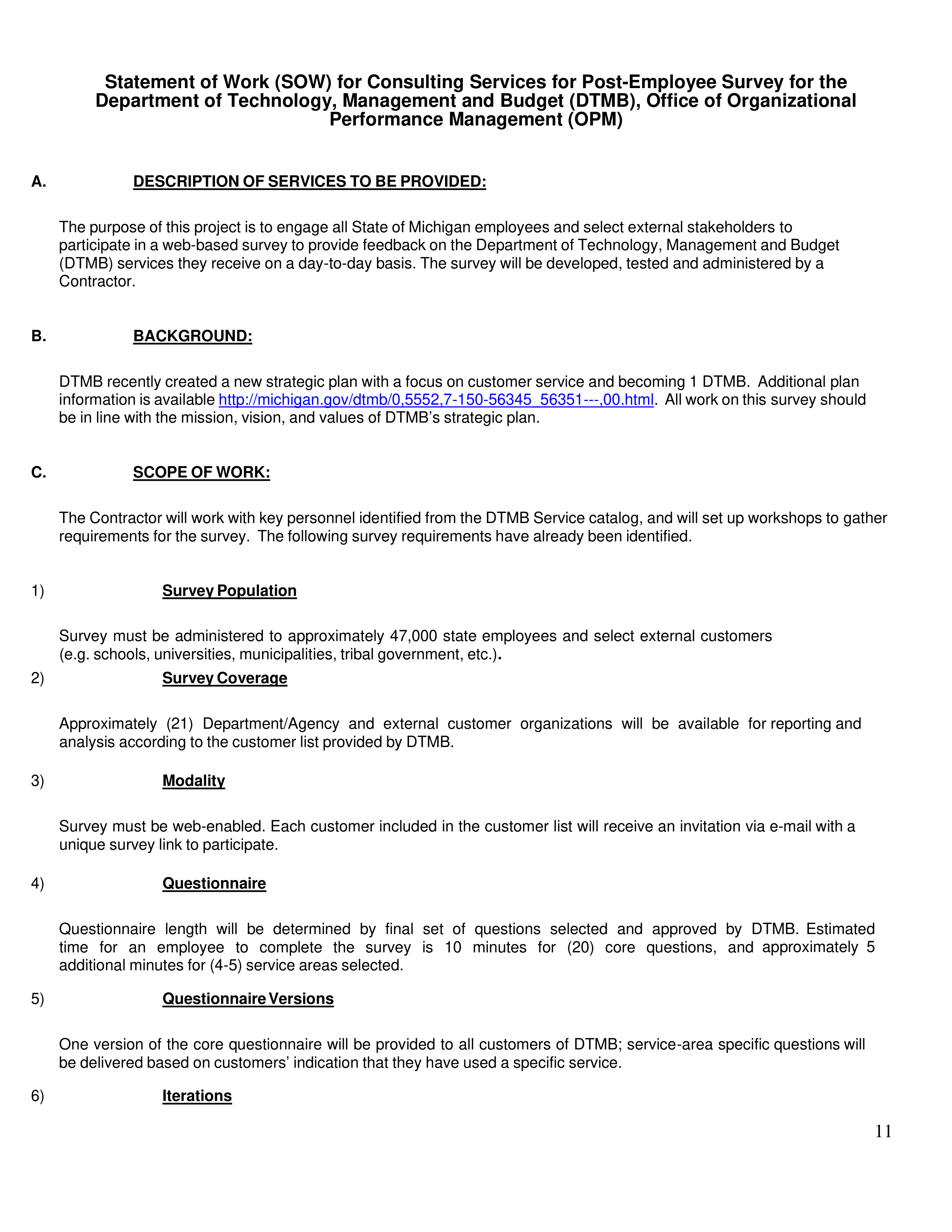
11
Statement of Work (SOW) for Consulting Services for Post-Employee Survey for the
Department of Technology, Management and Budget (DTMB), Office of Organizational
Performance Management (OPM)
A.
DESCRIPTION OF SERVICES TO BE PROVIDED:
The purpose of this project is to engage all State of Michigan employees and select external stakeholders to
participate in a web-based survey to provide feedback on the Department of Technology, Management and Budget
(DTMB) services they receive on a day-to-day basis. The survey will be developed, tested and administered by a
Contractor.
B.
BACKGROUND:
DTMB recently created a new strategic plan with a focus on customer service and becoming 1 DTMB. Additional
plan
information is available
http://michigan.gov/dtmb/0,5552,7-150-56345_56351---,00.html
. All work on this
survey should
be in line with the mission, vision, and values of DTMB’s strategic plan.
C.
SCOPE OF WORK:
The Contractor will work with key personnel identified from the DTMB Service catalog, and will set up workshops to
gather
requirements for the survey. The following survey requirements have already been identified.
1)
Survey Population
Survey must be administered to approximately 47,000 state employees and select external customers
(e.g. schools, universities, municipalities, tribal government, etc.)
.
2)
Survey Coverage
Approximately (21) Department/Agency and external customer organizations will be available for
reporting and
analysis according to the customer list provided by DTMB.
3)
Modality
Survey must be web-enabled. Each customer included in the customer list will receive an invitation via
e-mail with a
unique survey link to participate.
4)
Questionnaire
Questionnaire length will be determined by final set of questions selected and approved by DTMB.
Estimated
time for an employee to complete the survey is 10 minutes for (20) core questions, and
approximately 5
additional minutes for (4-5) service areas selected.
5)
Questionnaire Versions
One version of the core questionnaire will be provided to all customers of DTMB; service-area specific
questions will
be delivered based on customers’ indication that they have used a specific service.
6)
Iterations
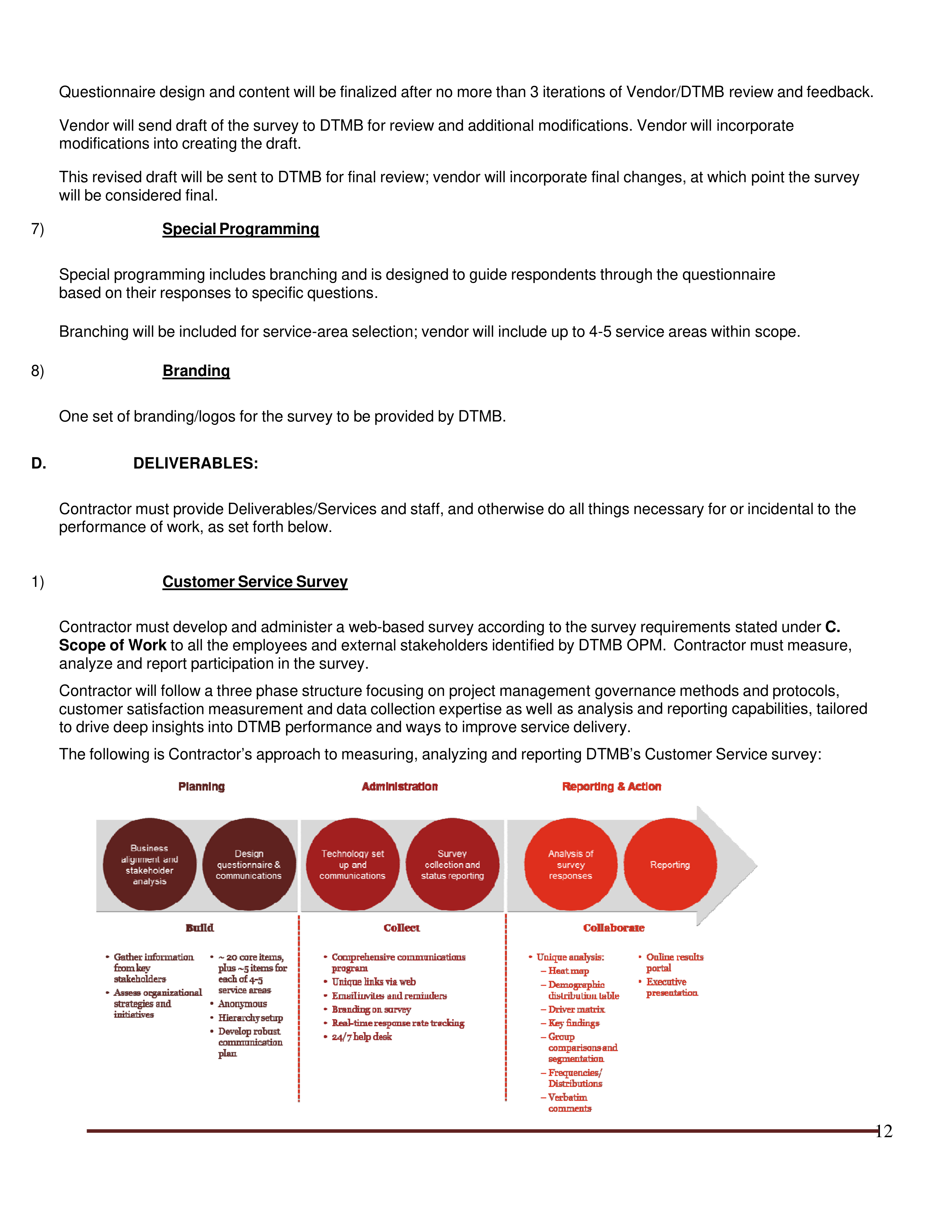





































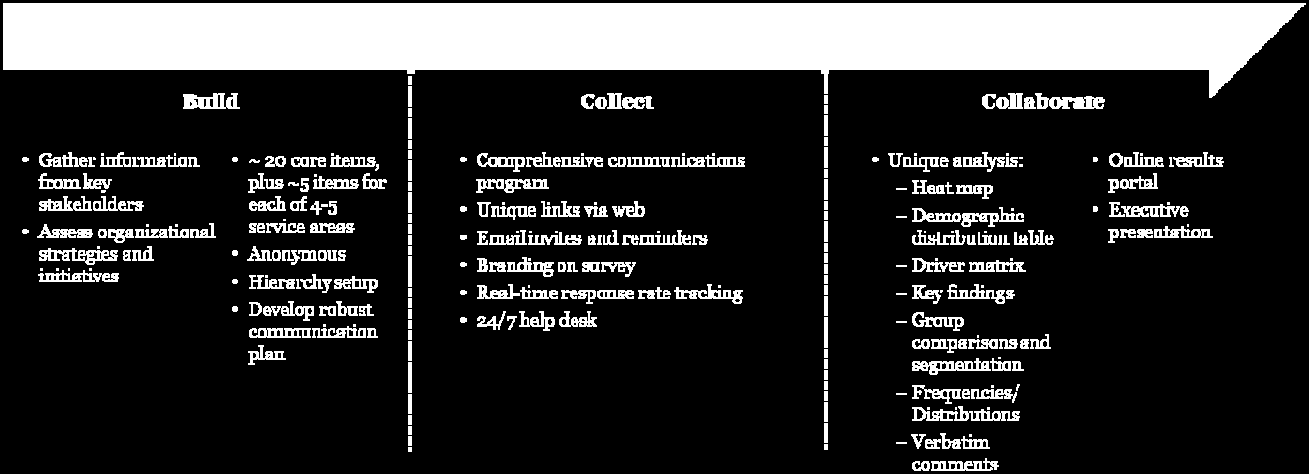
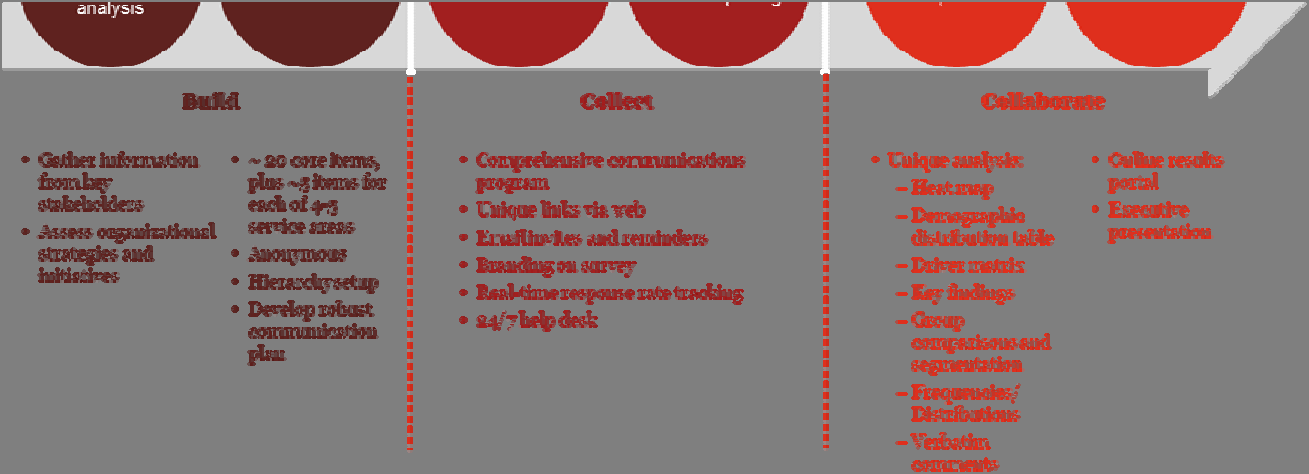
12
Questionnaire design and content will be finalized after no more than 3 iterations of Vendor/DTMB
review and feedback.
Vendor will send draft of the survey to DTMB for review and additional modifications. Vendor will
incorporate
modifications into creating the draft.
This revised draft will be sent to DTMB for final review; vendor will incorporate final changes, at which
point the survey
will be considered final.
7)
Special Programming
Special programming includes branching and is designed to guide respondents through the
questionnaire
based on their responses to specific questions.
Branching will be included for service-area selection; vendor will include up to 4-5 service areas within
scope.
8)
Branding
One set of branding/logos for the survey to be provided by DTMB.
D.
DELIVERABLES:
Contractor must provide Deliverables/Services and staff, and otherwise do all things necessary for or incidental to
the
performance of work, as set forth below.
1)
Customer Service Survey
Contractor must develop and administer a web-based survey according to the survey requirements
stated under
C.
Scope of Work
to all the employees and external stakeholders identified by DTMB
OPM. Contractor must measure,
analyze and report participation in the survey.
Contractor will follow a three phase structure focusing on project management
governance methods and protocols,
customer satisfaction measurement and data collection expertise as well
as analysis and reporting capabilities, tailored
to drive deep insights into DTMB
performance and ways to improve service delivery.
The following is Contractor’s approach to measuring, analyzing and reporting DTMB’s Customer Service survey:
13
Survey Planning
Project Planning and Tracking
: Contractor will begin the process by understanding the project’s goals and
objectives through targeted stakeholder discussions. In order to establish an effective measurement strategy,
Contractor
wants to know what was done in the past as well as how the study supports, and integrates with DTMB’s
strategic
plan to drive an aligned vision and the way it serves its sponsors. These discussions will include:
A review of the past data collection processes to help inform the current study’s objectives and identify any
best practice activities.
A kick-off meeting with DTMB’s project team to define the program’s objectives, establish key milestones and
identify core team members and responsibilities. Contractor wants to use this time to map the relationships
across the
various service lines and agencies that will be a part of the study’s scope.
Supporting the project key milestones will be an extensive project plan, detailing the sequence, duration and
decision-
points on all activities. This project plan will ensure all tasks and outcomes are closely monitored and
managed,
including a weekly status report that will be shared with the DTMB Project Team.
Modality and Branding
: Contractor will utilize a branded (DTMB logo) web based survey that will be conducted by
way of an email invitation. Within the invite will be a unique survey link extending the invitation to participate.
Contractor will send up to two email reminders to those that do not initially take the survey to ensure getting
as much
coverage as possible within respondent population.
Survey Design
: Contractor uses a proven and structured approach to gather and analyze customer satisfaction
feedback that will also be fully customized to DTMB’s services, processes, technologies, and culture to maximize
survey participation, and the fullest understanding of results. Contractor has built upon the limitations seen in
traditional surveys and customized Contractor’s model and approach to produce sound, actionable insights.
While Contractor offers standardized tools, templates, and best practices samples throughout the entire project that
can
be considered “off the shelf,” customization is not only possible but is core to Contractor’s model and
encouraged.
As part of the questionnaire design process, Contractor engages in a structured, collaborative, and iterative process to
customize the final survey questionnaire content. Information gathered during the pre-kickoff call, the kick-off
meeting,
and subsequent stakeholder discussions will be used in conjunction with Contractor’s expertise to create the
survey
instrument. Survey development will include both general performance assessments as well as questions
evaluating
experiences across DTMB service lines. Contractor will align the survey questions to the "customer journey"
and ask
the right questions about the right customer touchpoints. Whether an employee is receiving IT support
or
a manager
needs to get a background check completed, specific questions are needed to inform the long-term
customer
experience strategy. Contractor will ask both open-ended and close-ended questions to bring qualitative and
quantitative results together into a complete picture.
Contractor uses techniques that solicit categorical information from the customer on open-ended questions that help to
bucket answers into themes or dimensions within the survey, allowing for greater analytical capabilities.
Furthermore,
Contractor’s "Survey within a Survey" approach permits DTMB to ask customized questions based on
certain
interaction characteristics, like service line area or support request, and collect more pointed information
specific to that
customer's experience. Overall DTMB customer satisfaction is an interconnected set of
experiences across various
touch point interactions that Contractor will be assessing. There will be two distinct portions of
the survey:
There will be a core set of questions (approximately 20) that every customer will have the opportunity to
answer. These questions will be typical service related items that will be more general in nature and relevant
independent of the types of services utilized.
Contractor will also develop banks of questions that will group service lines into broader service areas.
Contractor suggests
each service area subsection be no more than 3-5 questions - Contractor’s "Survey within a
Survey" approach
permits DTMB to ask customized questions that are specific to that consumer's experience.
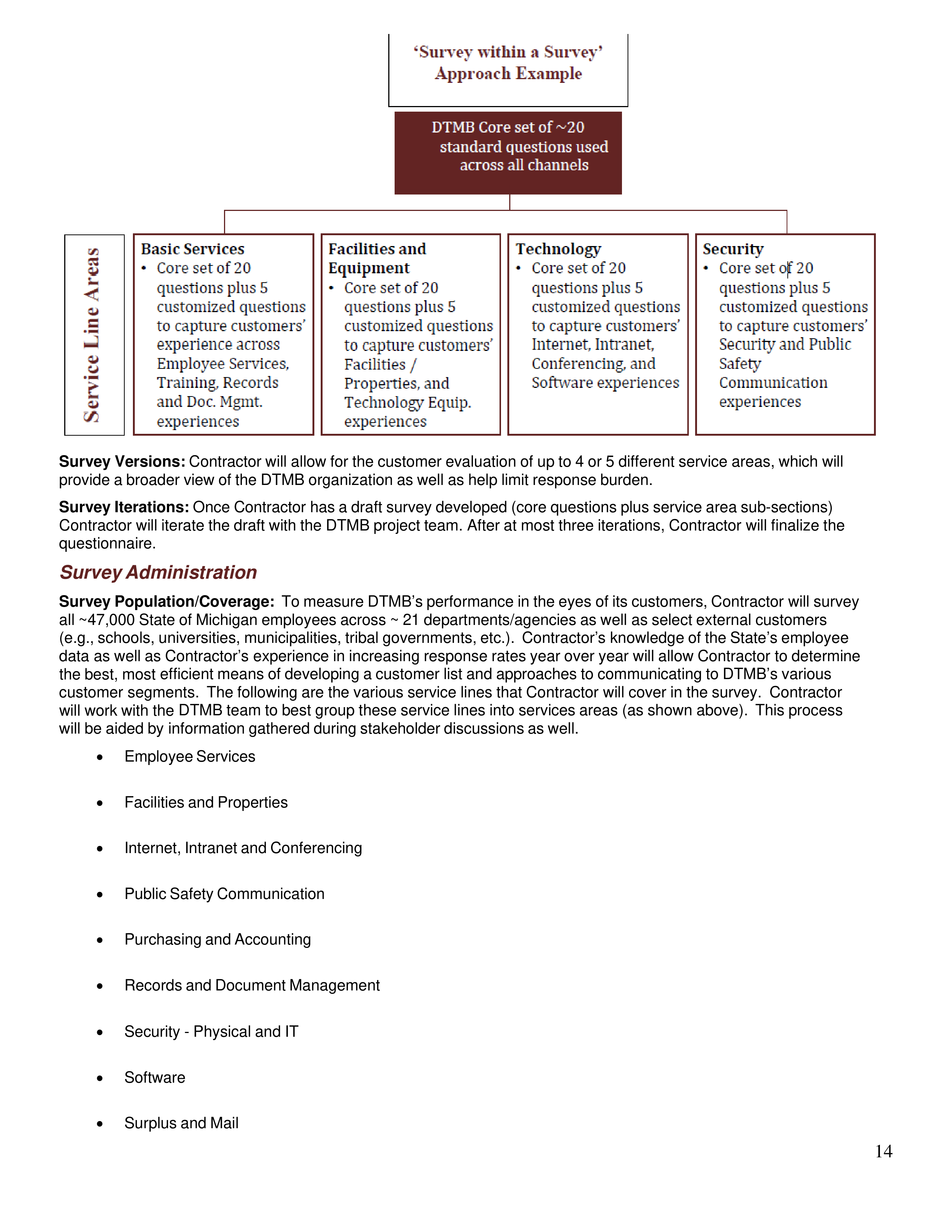
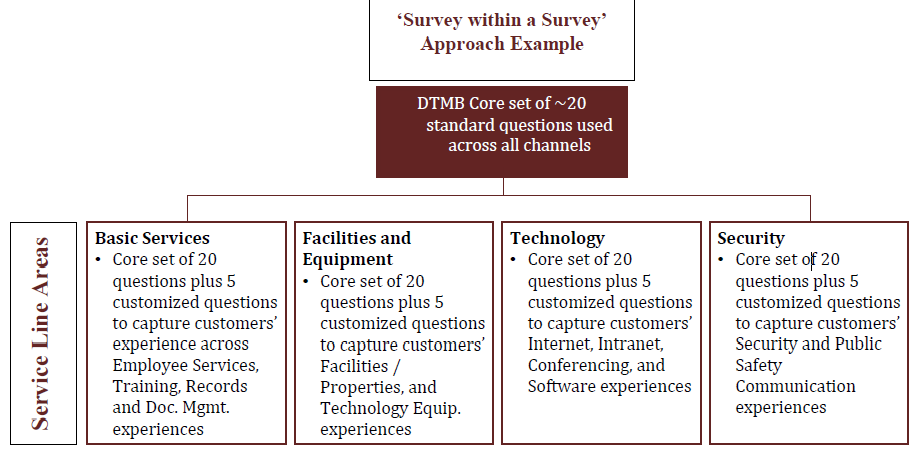
14
Survey Versions:
Contractor will allow for the customer evaluation of up to 4 or 5 different service areas, which will
provide a broader view of the DTMB organization as well as help limit response burden.
Survey Iterations:
Once Contractor has a draft survey developed (core questions plus service area sub-sections)
Contractor
will iterate the draft with the DTMB project team. After at most three iterations, Contractor will finalize the
questionnaire.
Survey Administration
Survey Population/Coverage:
To measure DTMB’s performance in the eyes of its customers, Contractor will survey
all ~47,000 State of Michigan employees across ~ 21 departments/agencies as well as select external customers
(e.g., schools, universities, municipalities, tribal governments, etc.). Contractor’s knowledge of the State’s employee
data
as well as Contractor’s experience in increasing response rates year over year will allow Contractor to determine
the best, most
efficient means of developing a customer list and approaches to communicating to DTMB’s various
customer
segments. The following are the various service lines that Contractor will cover in the survey. Contractor
will work with the
DTMB team to best group these service lines into services areas (as shown above). This process
will be aided by
information gathered during stakeholder discussions as well.
Employee Services
Facilities and Properties
Internet, Intranet and Conferencing
Public Safety Communication
Purchasing and Accounting
Records and Document Management
Security - Physical and IT
Software
Surplus and Mail
15
System Access, Data and Reporting
Technology Equipment
Training
Vehicles and Parking
Sample and segmentation definition:
DTMB serves a wide range of customers who reach out to DTMB on a
variety
of issues. It is critical to separate out customer populations in a deliberate way and target a representative
sample
based on volume and service line/area usage to generate a high confidence level in the conclusions
drawn.
Contractor will segment the groups across service lines, and use demographic information to drive segmentation
analysis.
Special Programming:
Supporting Contractor’s “Survey within a Survey” approach (as described above) Contractor
will
include special survey programing and logic to determine which of the service area subsections each respondent
will be asked to answer. The survey branching will be driven by the respondent’s particular service line/area
experience.
Data Collection and Communications:
Contractor will also work closely with DTMB’s team to determine and collect
the appropriate information to include in the survey's customer data file, based on reporting expectations and
availability of data in HR systems. Contractor will develop a customized communication plan to build support,
credibility, and
participation in the entire survey process.
Once Contractor is collecting data, Contractor will provide DTMB with access to an online, real-time response rate
tracker, which
allows DTMB to view response rates by demographics such as by department/agency or external
customer
entity. In addition, Contractor will actively monitor response rates and suggest targeted communications if
needed. Contractor’s system allows for multiple sessions (i.e., leave survey and come back to finish at a later time)
and is set up with
the expected completion time to be 10-15 minutes.
Survey Reporting and Action
Reporting: Data Quality Process and Roll-out
Contractor ensures the data is processed accurately and the reports are sent in a timely manner. Contractor has
multiple
layers of quality checks. A sample of our quality checks is below:
Data Collection:
Staff competency requirements; documented procedures for data collection; customer list
template reviews with DTMB; controlled access to spreadsheets
Data Cleaning:
Testing procedures for any changes to spreadsheets; error checking; multiple levels of data
consistency review; include partial responses (e.g., respondents who started the survey but did not
complete)
based on threshold determined by Contractor and DTMB teams
Report Development:
Management review of analyses; comparison between reports and source file;
comparison between reports and reporting portal
As part of the results rollout process, Contractor will provide DTMB with tools and templates to use as you
embark on action planning. Depending upon the level of support needed, Contractor is well positioned to
provide strategic and tactical support in driving remediation activities.
To maximize the impact of survey results, Contractor offers a comprehensive approach to taking action:
Plan:
Establishing Senior Leadership commitment to a process of follow-up within the organization
Determine the type of training and support individual managers need to enable them to effectively utilize
16
findings and recommendations from this effort
Educate:
Help Senior Leadership 'own the data' and be empowered by knowing and understanding results
Provide Core Team/Service Line process owners with training to provide direction or facilitate certain
activities
Equip Local/Key Managers with the understanding, resources, skills, and tools they need to action plan and
drive meaningful and sustainable change
Assess Progress:
Accountability
Monitoring progress
2)
Stakeholder Focus Group
Contractor must conduct a focus group with service line owners to identify key questions to include in
the service
area-specific items.
Contractor will meet with service line owners (either individually or in focus group) to inform the survey design
process and gather input regarding objectives, process, the service level customer experience(s) and their role
as it
pertains to results and next-steps actions.
Contractor will begin this process by understanding the program’s goals and objectives through targeted stakeholder
discussions and focus groups. In order to establish an effective customer satisfaction survey strategy, Contractor will
want
to gain clarity on what was done in the past as well as how the study integrates with DTMB’s objective of being
“one DTMB”, value propositions, overall strategy and unique services offered.
These discussions/focus groups will include:
An assessment of goals and objectives of research overall and at a service line level, by asking the
following
like questions:
o
What questions does the team hope to answer through this project?
o
What defines success of this project for the service line owners?
o
Who will be expected to act on the data?
o
What’s the question we want answered?
o
What about the “customer journey” do we want to learn?
o
Which customers are we most interested in?
Discuss and confirm:
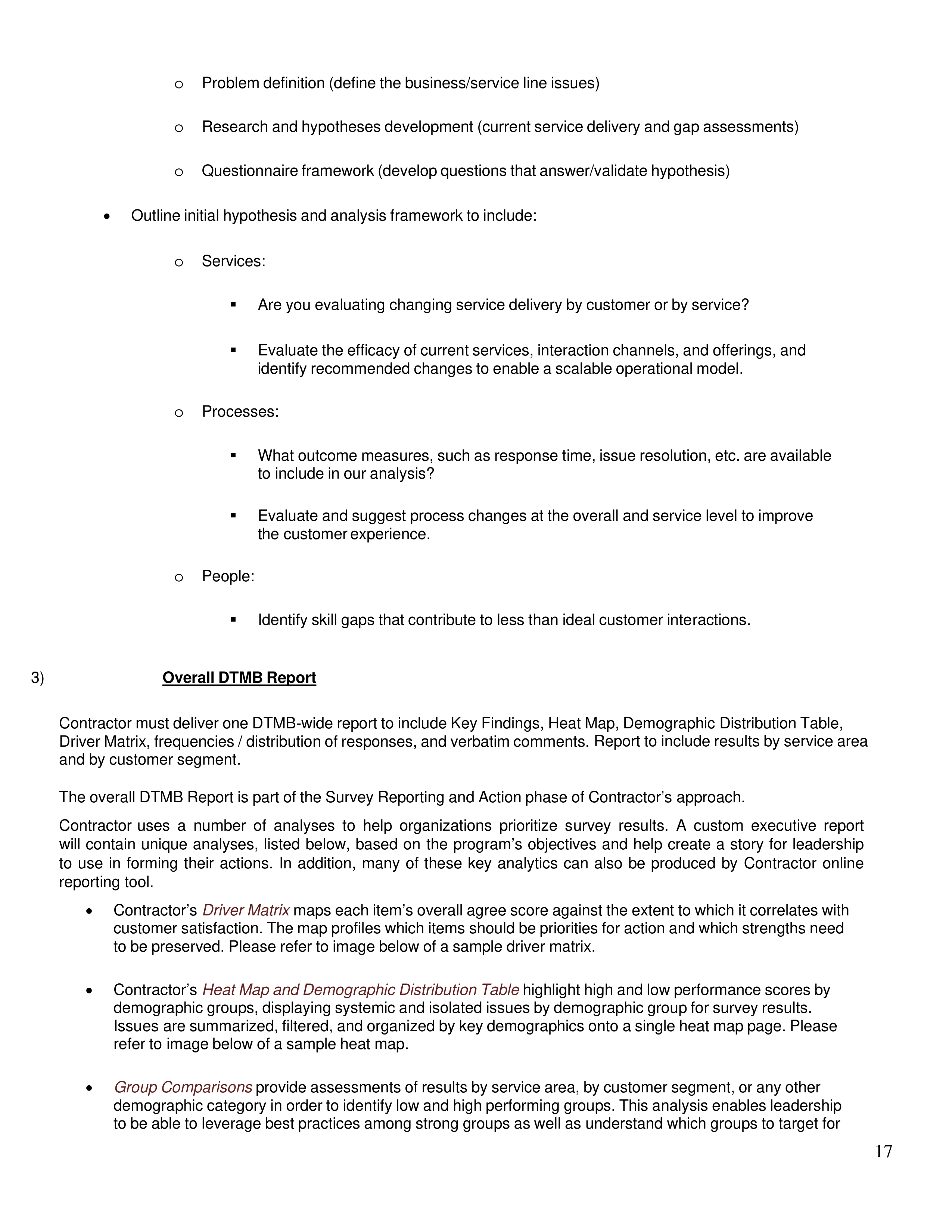
17
o
Problem definition (define the business/service line issues)
o
Research and hypotheses development (current service delivery and gap assessments)
o
Questionnaire framework (develop questions that answer/validate hypothesis)
Outline initial hypothesis and analysis framework to include:
o
Services:
Are you evaluating changing service delivery by customer or by service?
Evaluate the efficacy of current services, interaction channels, and offerings, and
identify recommended changes to enable a scalable operational model.
o
Processes:
What outcome measures, such as response time, issue resolution, etc. are available
to
include in our analysis?
Evaluate and suggest process changes at the overall and service level to improve
the
customer experience.
o
People:
Identify skill gaps that contribute to less than ideal customer interactions.
3)
Overall DTMB Report
Contractor must deliver one DTMB-wide report to include Key Findings, Heat Map, Demographic
Distribution Table,
Driver Matrix, frequencies / distribution of responses, and verbatim comments.
Report to include results by service area
and by customer segment.
The overall DTMB Report is part of the Survey Reporting and Action phase of Contractor’s approach.
Contractor uses a number of analyses to help organizations prioritize survey results. A custom executive report
will
contain unique analyses, listed below, based on the program’s objectives and help create a story for leadership
to
use in forming their actions. In addition, many of these key analytics can also be produced by Contractor online
reporting
tool.
Contractor’s
Driver Matrix
maps each item’s overall agree score against the extent to which it correlates with
customer satisfaction. The map profiles which items should be priorities for action and which strengths need
to be preserved. Please refer to image below of a sample driver matrix.
Contractor’s
Heat Map and Demographic Distribution Table
highlight high and low performance scores by
demographic groups, displaying systemic and isolated issues by demographic group for survey results.
Issues
are summarized, filtered, and organized by key demographics onto a single heat map page. Please
refer to
image below of a sample heat map.
Group Comparisons
provide assessments of results by service area, by customer segment, or any other
demographic category in order to identify low and high performing groups. This analysis enables leadership
to be able to leverage best practices among strong groups as well as understand which groups to target for
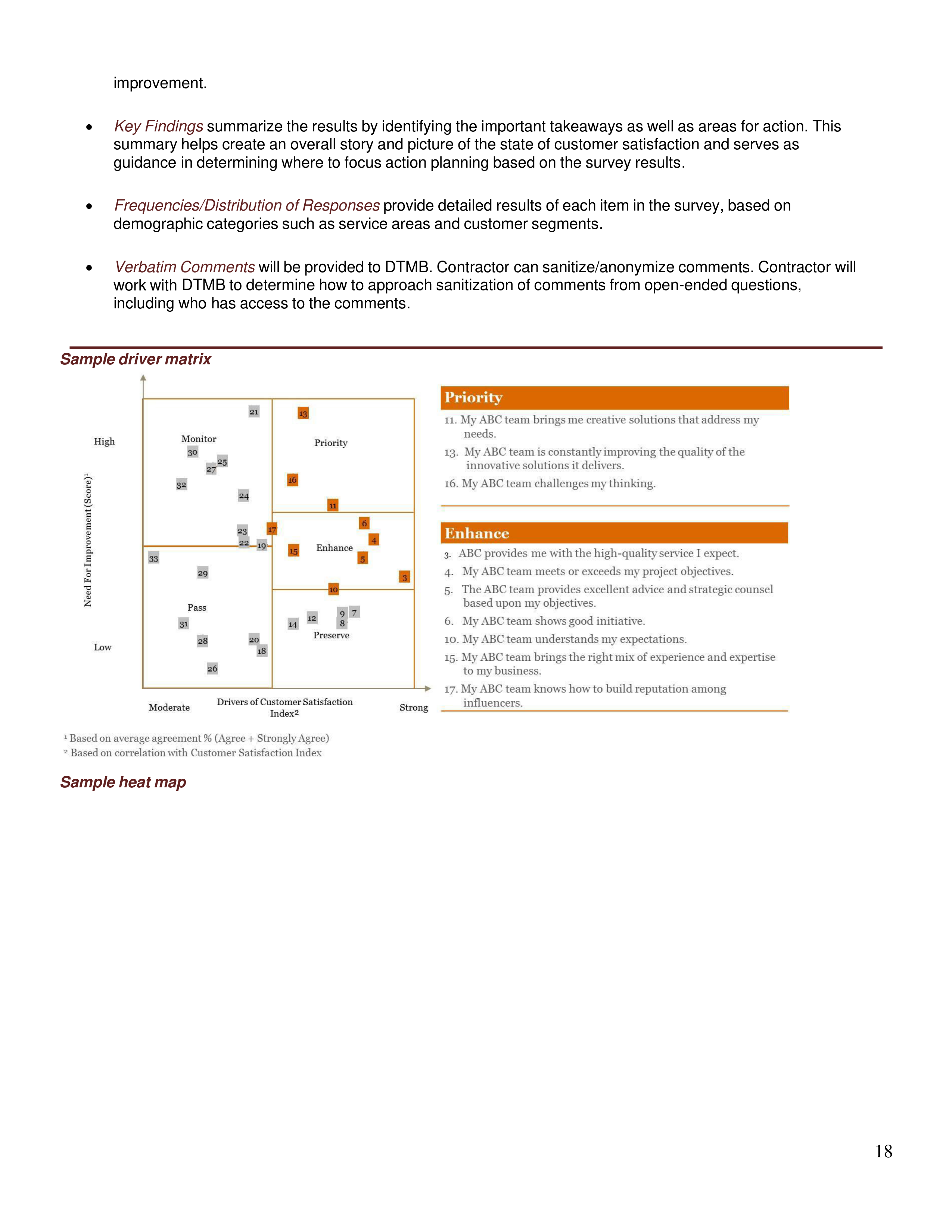
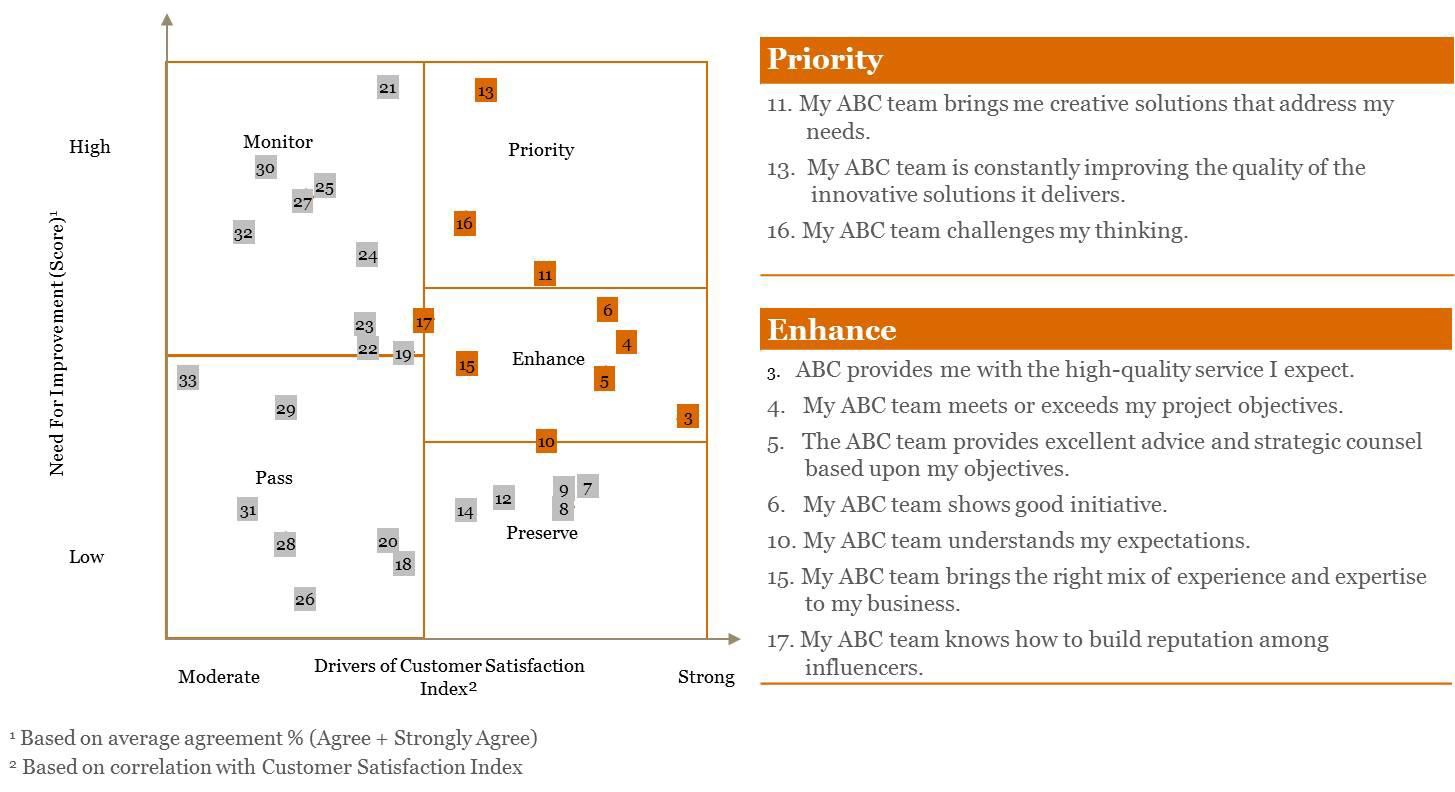
18
improvement.
Key Findings
summarize the results by identifying the important takeaways as well as areas for action. This
summary helps create an overall story and picture of the state of customer satisfaction and serves as
guidance
in determining where to focus action planning based on the survey results.
Frequencies/Distribution of Responses
provide detailed results of each item in the survey, based on
demographic categories such as service areas and customer segments.
Verbatim Comments
will be provided to DTMB. Contractor can sanitize/anonymize comments. Contractor will
work with
DTMB to determine how to approach sanitization of comments from open-ended questions,
including who
has access to the comments.
Sample driver matrix
Sample heat map
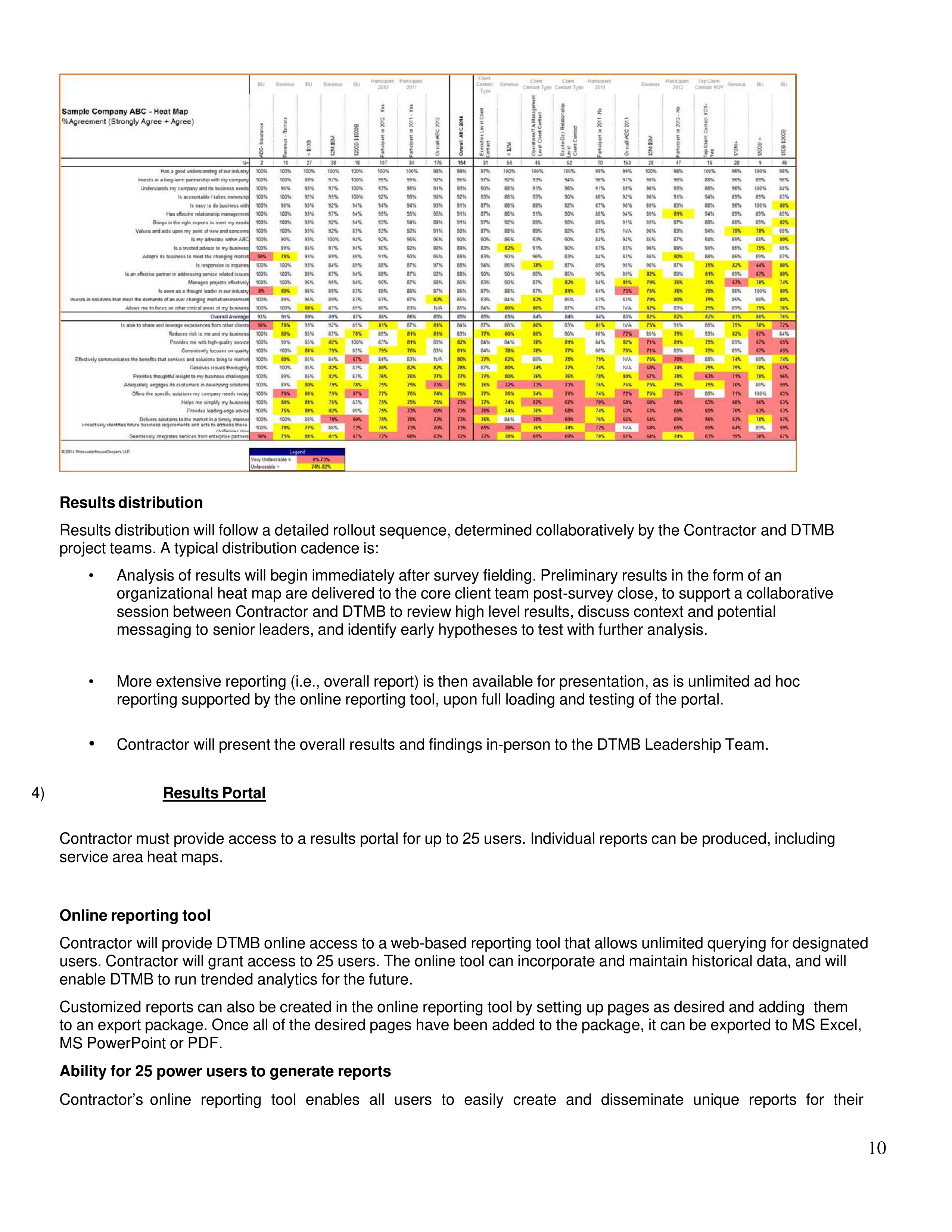
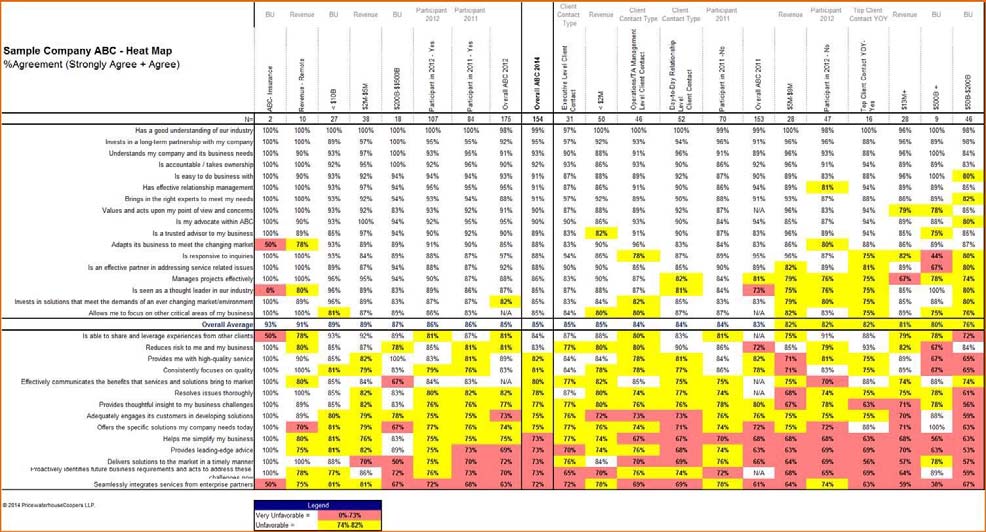
10
Results distribution
Results distribution will follow a detailed rollout sequence, determined collaboratively by the Contractor and DTMB
project teams. A typical distribution cadence is:
•
Analysis of results will begin immediately after survey fielding. Preliminary results in the form of an
organizational heat map are delivered to the core client team post-survey close, to support a collaborative
session between Contractor and DTMB to review high level results, discuss context and potential
messaging to
senior leaders, and identify early hypotheses to test with further analysis.
•
More extensive reporting (i.e., overall report) is then available for presentation, as is unlimited ad hoc
reporting supported by the online reporting tool, upon full loading and testing of the portal.
•
Contractor will present the overall results and findings in-person to the DTMB Leadership Team.
4)
Results Portal
Contractor must provide access to a results portal for up to 25 users. Individual reports can be
produced, including
service area heat maps.
Online reporting tool
Contractor will provide DTMB online access to a web-based reporting tool that allows unlimited querying for designated
users. Contractor will grant access to 25 users. The online tool can incorporate and maintain historical data, and will
enable DTMB to run trended analytics for the future.
Customized reports can also be created in the online reporting tool by setting up pages as desired and adding
them
to an export package. Once all of the desired pages have been added to the package, it can be exported to MS
Excel,
MS PowerPoint or PDF.
Ability for 25 power users to generate reports
Contractor’s online reporting tool enables all users to easily create and disseminate unique reports for their
11
specific
(service) populations. Automated reports are customizable based on DTMB’s needs and can be ‘assigned’
to specific
users (service owners, key stakeholders, etc.). Data can be dynamically reported by segment and
demographic.
Using the online reporting tool, DTMB can combine groups or filter almost any field provided in the
customer
data file (e.g., business unit, location, role, gender, age, tenure) and then generate reports for those groups.
As this tool is web-based, ad hoc reports can be developed on demand (24/7). The online tool offers a wide variety
of
reporting capabilities: frequencies and cross tabulations; trend analysis; heat maps and demographics
distributions
tables; drivers of customer satisfaction and prioritization; data export capabilities (MS Excel, MS
PowerPoint,
PDF); and dynamic report creation.
Any field provided in the customer data file can be filtered on for the purposes of analysis and reporting (e.g.,
department, location, length of service, etc.), and fields can also be grouped. To maximize accuracy of the analysis
by demographic data and to minimize the amount of information respondents need to provide, Contractor’s system is
built
upon using a customer demographic list feed so that the demographic information is automatically linked to the
respondent’s survey submission. This allows DTMB’s team to select virtually any demographic data of interest for
post survey analysis.
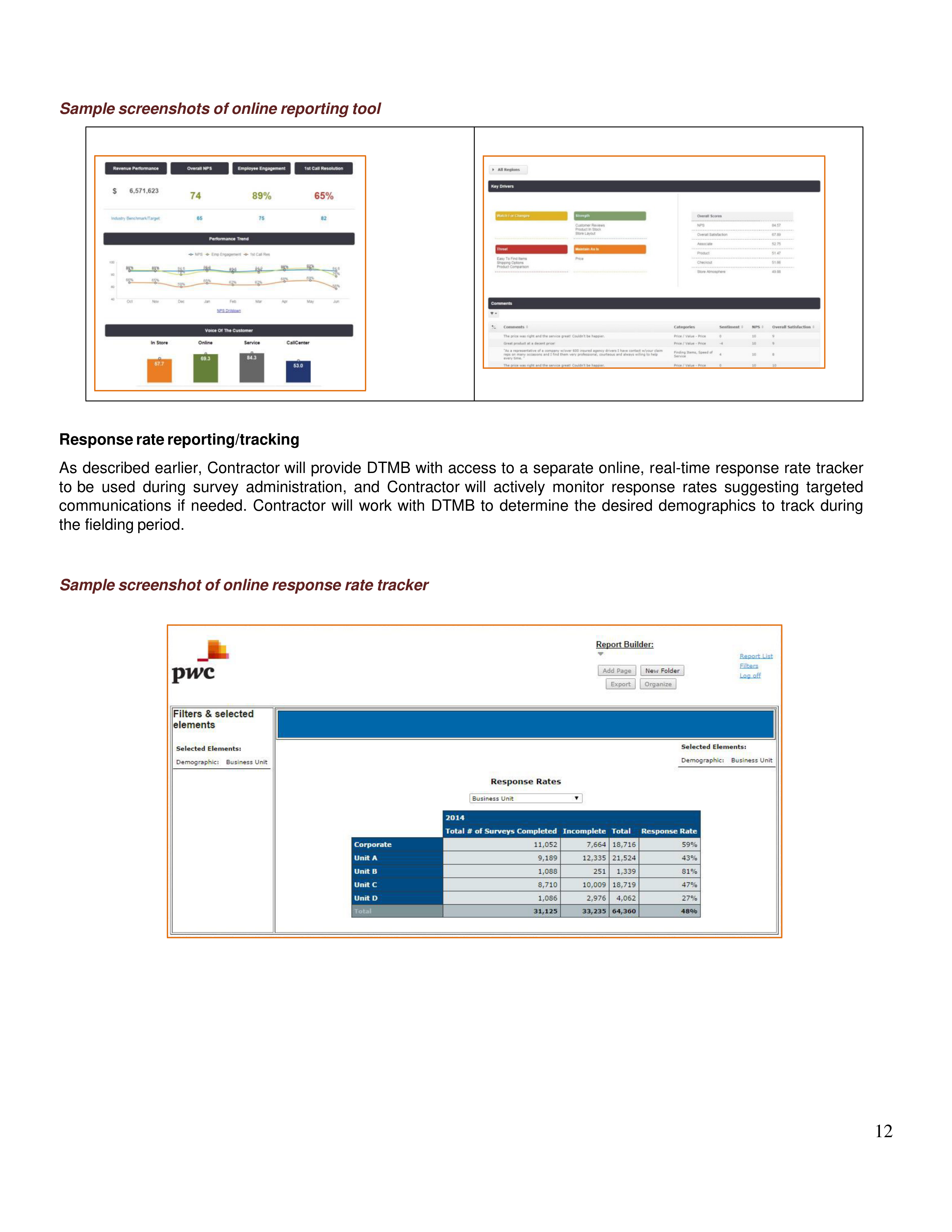
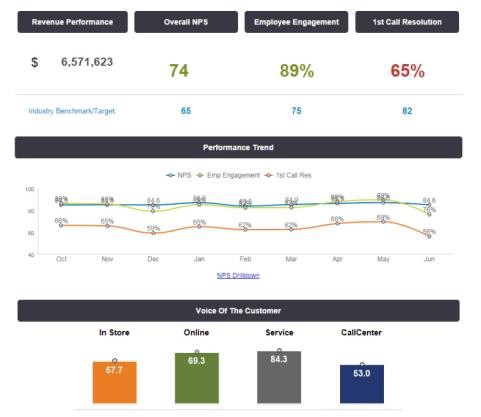
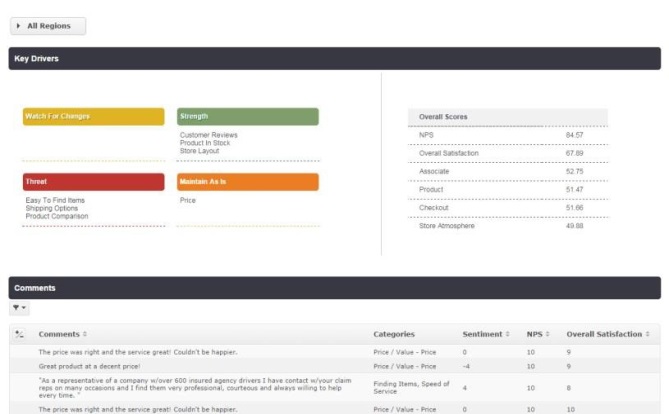
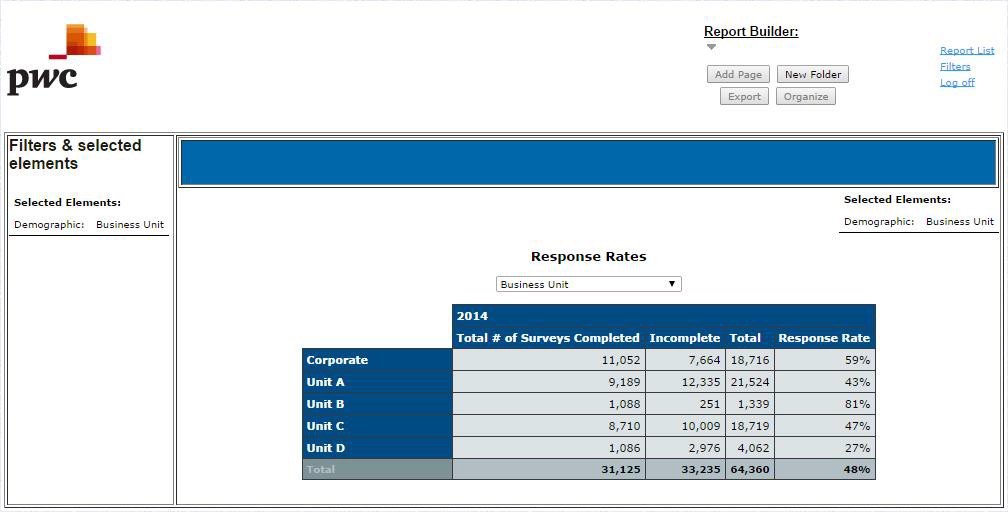
12
Sample screenshots of online reporting tool
Response rate reporting/tracking
As described earlier, Contractor will provide DTMB with access to a separate online, real-time response rate tracker
to
be used during survey administration, and Contractor will actively monitor response rates suggesting targeted
communications if needed. Contractor will work with DTMB to determine the desired demographics to track during
the
fielding period.
Sample screenshot of online response rate tracker
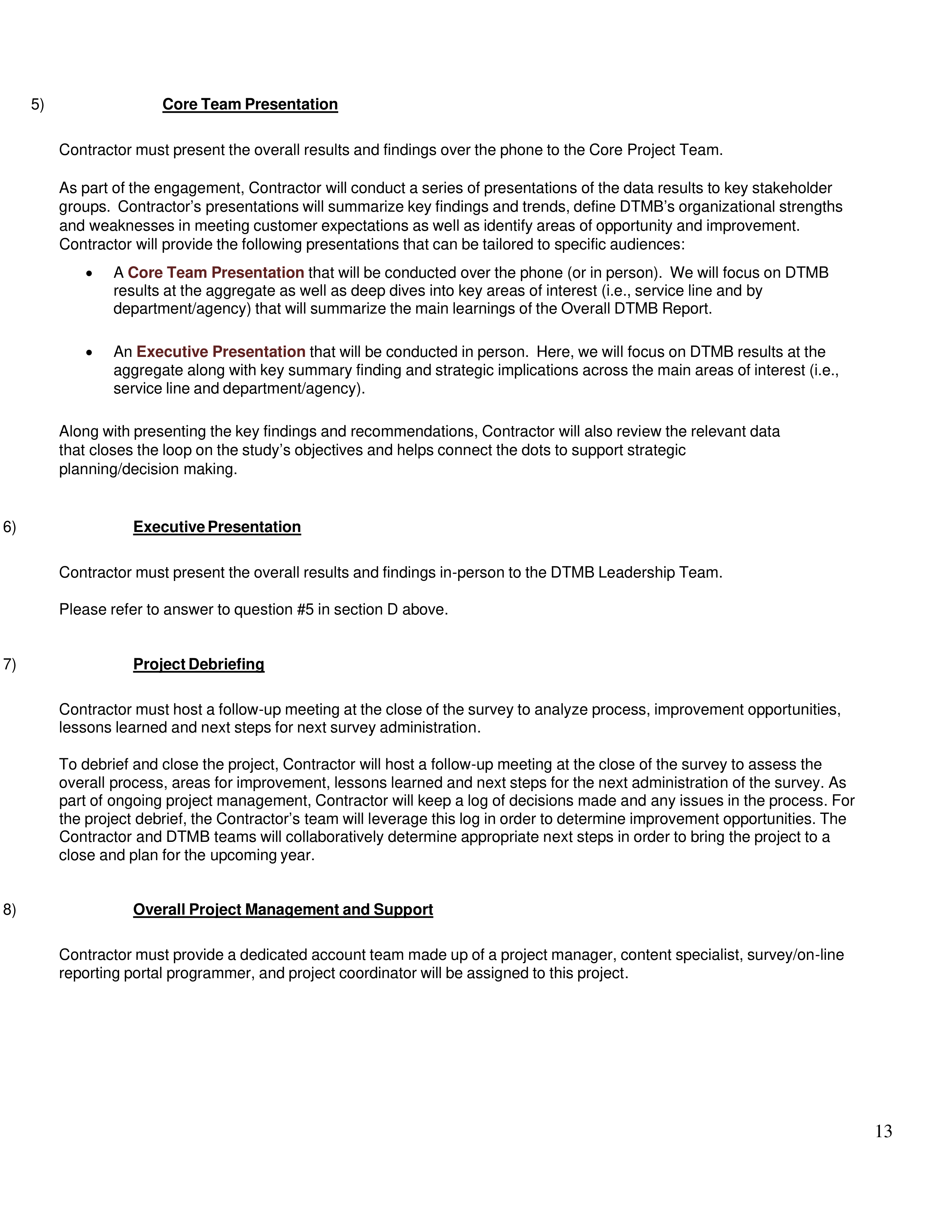
13
5)
Core Team Presentation
Contractor must present the overall results and findings over the phone to the Core Project Team.
As part of the engagement, Contractor will conduct a series of presentations of the data results to key stakeholder
groups. Contractor’s presentations will summarize key findings and trends, define DTMB’s organizational strengths
and
weaknesses in meeting customer expectations as well as identify areas of opportunity and improvement.
Contractor will
provide the following presentations that can be tailored to specific audiences:
A
Core Team Presentation
that will be conducted over the phone (or in person). We will focus on DTMB
results at the aggregate as well as deep dives into key areas of interest (i.e., service line and by
department/agency) that will summarize the main learnings of the Overall DTMB Report.
An
Executive Presentation
that will be conducted in person. Here, we will focus on DTMB results at the
aggregate along with key summary finding and strategic implications across the main areas of interest (i.e.,
service line and department/agency).
Along with presenting the key findings and recommendations, Contractor will also review the relevant data
that
closes the loop on the study’s objectives and helps connect the dots to support strategic
planning/decision
making.
6)
Executive Presentation
Contractor must present the overall results and findings in-person to the DTMB Leadership Team.
Please refer to answer to question #5 in section D above.
7)
Project Debriefing
Contractor must host a follow-up meeting at the close of the survey to analyze process, improvement opportunities,
lessons learned and next steps for next survey administration.
To debrief and close the project, Contractor will host a follow-up meeting at the close of the survey to assess the
overall
process, areas for improvement, lessons learned and next steps for the next administration of the survey. As
part of
ongoing project management, Contractor will keep a log of decisions made and any issues in the process. For
the project
debrief, the Contractor’s team will leverage this log in order to determine improvement opportunities. The
Contractor and DTMB
teams will collaboratively determine appropriate next steps in order to bring the project to a
close and plan for the
upcoming year.
8)
Overall Project Management and Support
Contractor must provide a dedicated account team made up of a project manager, content specialist, survey/on-line
reporting portal programmer, and project coordinator will be assigned to this project.
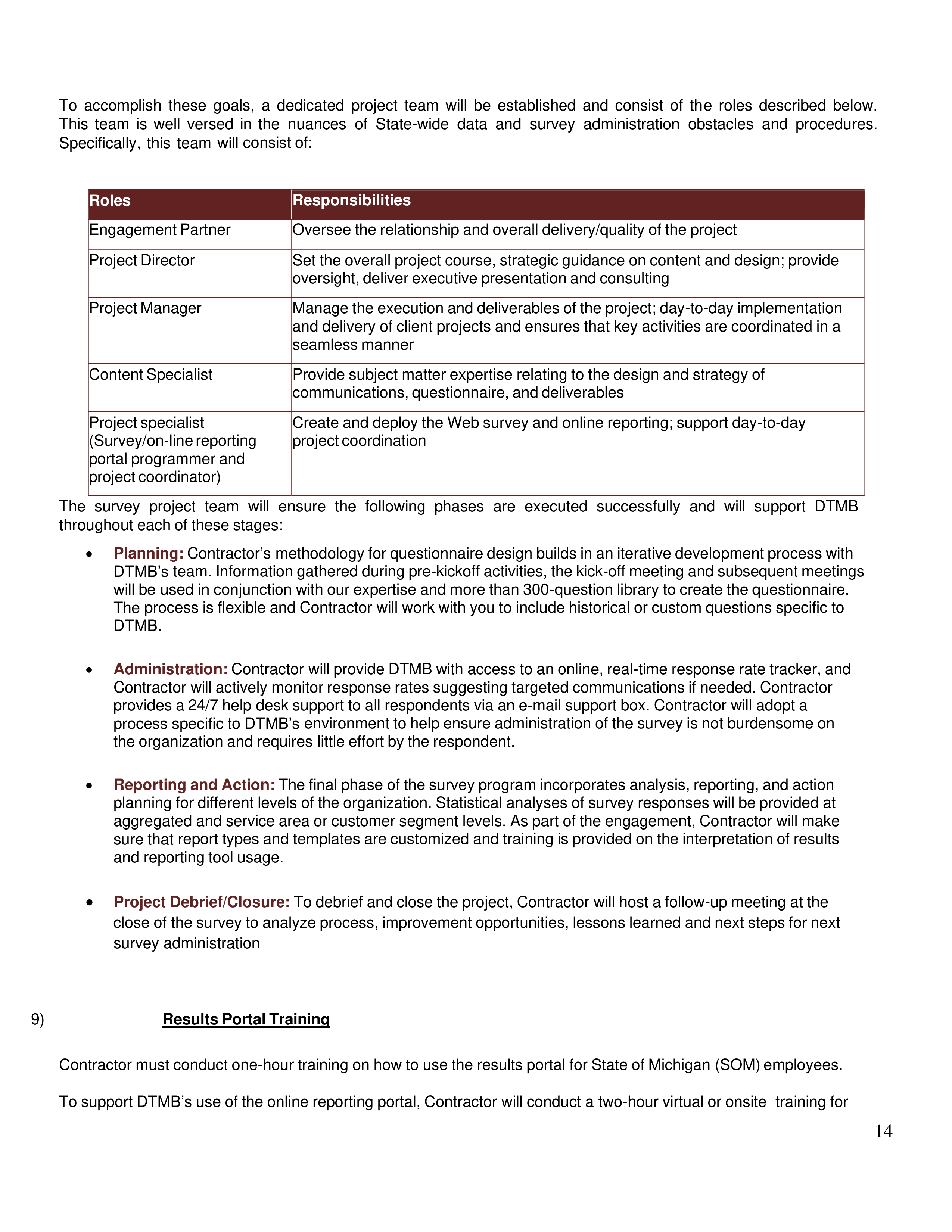
14
To accomplish these goals, a dedicated project team will be established and consist of the roles described below.
This team is well versed in
the nuances of State-wide data and survey administration obstacles and procedures.
Specifically, this team will
consist of:
Roles
Responsibilities
Engagement Partner
Oversee the relationship and overall delivery/quality of the project
Project Director
Set the overall project course, strategic guidance on content and design; provide
oversight, deliver executive presentation and consulting
Project Manager
Manage the execution and deliverables of the project; day-to-day implementation
and delivery of client projects and ensures that key activities are coordinated in a
seamless manner
Content Specialist
Provide subject matter expertise relating to the design and strategy of
communications, questionnaire, and deliverables
Project specialist
(Survey/on-line reporting
portal programmer and
project coordinator)
Create and deploy the Web survey and online reporting; support day-to-day
project coordination
The survey project team will ensure the following phases are executed successfully and will support DTMB
throughout each of these stages:
Planning:
Contractor’s methodology for questionnaire design builds in an iterative development process with
DTMB’s
team. Information gathered during pre-kickoff activities, the kick-off meeting and subsequent meetings
will be
used in conjunction with our expertise and more than 300-question library to create the questionnaire.
The
process is flexible and Contractor will work with you to include historical or custom questions specific to
DTMB.
Administration:
Contractor will provide DTMB with access to an online, real-time response rate tracker, and
Contractor will actively monitor response rates suggesting targeted communications if needed. Contractor
provides a 24/7 help
desk support to all respondents via an e-mail support box. Contractor will adopt a
process specific to DTMB’s
environment to help ensure administration of the survey is not burdensome on
the organization and requires
little effort by the respondent.
Reporting and Action:
The final phase of the survey program incorporates analysis, reporting, and action
planning for different levels of the organization. Statistical analyses of survey responses will be provided at
aggregated and service area or customer segment levels. As part of the engagement, Contractor will make
sure that
report types and templates are customized and training is provided on the interpretation of results
and
reporting tool usage.
Project Debrief/Closure:
To debrief and close the project, Contractor will host a follow-up meeting at the
close of
the survey to analyze process, improvement opportunities, lessons learned and next steps for next
survey
administration
9)
Results Portal Training
Contractor must conduct one-hour training on how to use the results portal for State of Michigan
(SOM) employees.
To support DTMB’s use of the online reporting portal, Contractor will conduct a two-hour virtual or onsite
training for
15
DTMB employees receiving portal access. The format of these trainings is based on DTMB’s
preferences. The
training will cover how to navigate through each page in the online portal, apply filters, export ad-
hoc reports, create
heat maps, and interpret results. Participants in the training will have the opportunity to ask
questions. The training will also be recorded for individuals who are unable to attend.
E.
CONTRACTOR ROLES AND RESPONSIBILITIES:
1)
Contractor must host a project kick-off meeting with DTMB’s project team to define program objectives,
establish a project plan and identify core team members and responsibilities.
2)
Contractor must identify Issues before, during and after the survey is announced and resolve them in a
timely manner.
3)
Contractor must identify staff that will be performing the service including their resumes, highlighting
their work with surveys.
Kick-off Meeting:
After an agreement is executed and a joint project team will be assembled, Contractor will initiate Contractor’s
formal work with
DTMB through a detailed project kickoff meeting. During this session, Contractor will begin with
a discussion about
DTMB’s project objectives, followed by a strategic and tactical design approach in addressing
customer satisfaction
questionnaire design, communications, customer list/demographics, organizational hierarchy (if
deemed necessary),
data report formats and project management accountabilities. If desired, Contractor will share
an initial version of the
questionnaire, consisting of both standardized and custom items, and begin a discussion
to codify the steps and
stakeholders needed to finalize the questionnaire during this meeting. Furthermore,
Contractor will detail discussion points
and objectives of stakeholder discussions to inform overall program approach
and questionnaire design process.
Sample kick-off meeting agenda:
Project overview: review project teams, expectations, survey objectives, survey scope and
deliverables
Survey process and timeline: review key decisions and
milestones
Survey planning: review questionnaire, customer list, hierarchy, communication plan, stakeholder discussions
Survey administration: discuss execution, support, response rate tracking, reminders
Reporting and action: discuss reporting, online portal, results dissemination and presentations
Action items and next steps
Note: Sample questionnaire, sample communication plan, and suggested demographics for customer list
typically
provided for kick-off meeting.
Support and Help Desk Process:

16
During survey execution, Contractor provides 24/7 help desk support to all respondents via an e-mail support box.
Contractor’s project team will also be available by phone and email to address any needs or questions that may arise
during the
survey and reporting period.
Contractor’s team will respond to issues/requests that arise within 24 hours. Contractor also works with each client to
design a proper
escalation protocol in the event the respondent's issue is more suitable for a DTMB team member to
respond. In that
event, Contractor would direct the DTMB team member to that individual respondent, depending on
the issue. Further,
upon deploying the survey, detailed attention is given to customer/employee participation and
follow-up. Contractor will be
attentive to initial bounce-back and undeliverable e-mails, so that in working with DTMB
Contractor can quickly correct this
contact information while the momentum of the survey deployment is strong.
17
Project Team:
Todd Hoffman – Partner
Engagement Partner
Todd will provide engagement oversight of project quality overall, timelines and budget. He will
ensure that our
services fully meet your expectations
Robert Tate – Managing Director
Project Director
Robert will provide engagement oversight of project quality overall, and will be the lead project
architect covering
overall program approach, survey design, reporting and analysis
Jason Campbell – Manager
Content Specialist
Jason will provide subject matter expertise relating to the design and strategy of
communications, questionnaire, and
deliverables
Talia Rozensher – Senior Associate
Project Manager
Talia will serve as the Project Manager, managing the execution and deliverables of the project
JoiAnda Bruce – Associate
Project Specialist
Joi will help create and deploy the Web survey and online reporting, as well as support day-to-
day project
coordination
.
F.
PROJECT PLAN:
The project plan will be managed by Anila Francis, Project Manager, from the DTMB Office of Enterprise Portfolio
Management.
As described earlier, listed below is a high-level plan that outlines the key milestones in the project:
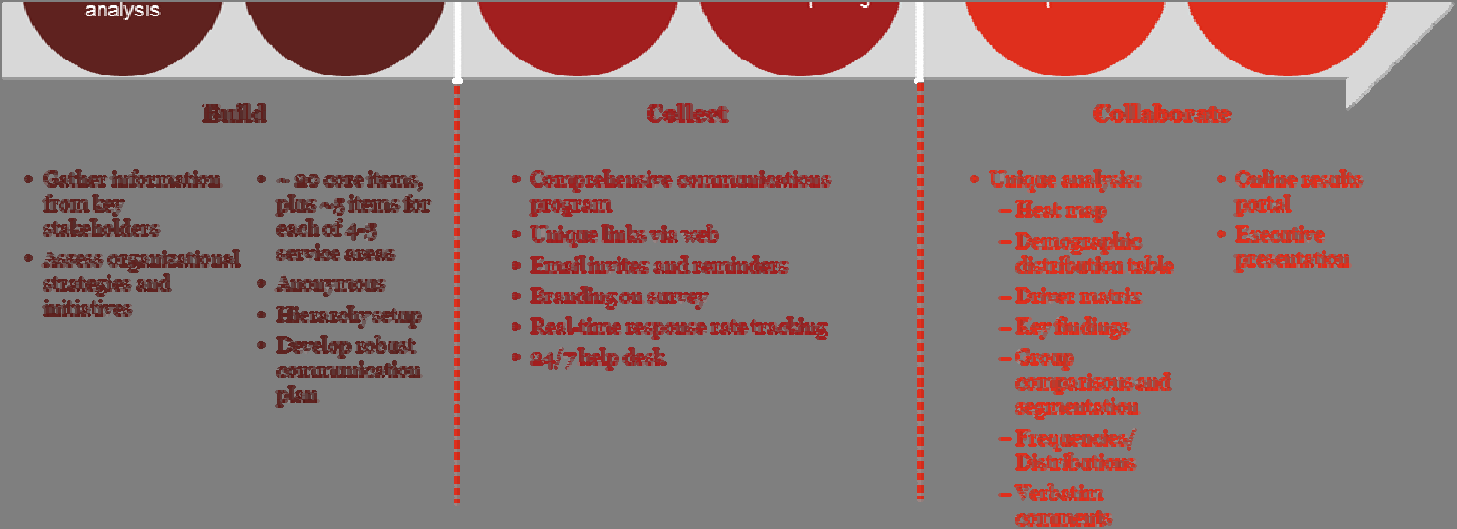







































18
Contractor will develop a detailed project plan, describing project steps, schedule, roles and responsibilities for each
step,
and information requirements. Contractor will use the project plan throughout the process to check progress
against
the initial goals and objectives set by the team. Contractor and DTMB will also arrange a regular schedule for
joint team
calls to review important milestones and provide updates. As part of the regular team sessions, Contractor
will keep a log
of decisions made and outstanding items along with roles/responsibilities and expected timing.
Contractor will review
the decisions log during each call to determine status, next steps, roles/responsibilities, and
any impact on the
project plan.
Draft timeline:
Project kick-off meeting
January 12, 2015
Stakeholder Interviews/Focus Groups
January 13-15, 2015
Questionnaire review and final approval
January 22, 2015
Communications review and final approval
January 22, 2015
Customer list and hierarchy finalization and delivery
January 26, 2015
Survey programming
January 23-30, 2015
Survey testing
February 2-4, 2015
Survey administration
February 9-23, 2015
Results analysis
February 24-March 20, 2015
Core team review of preliminary results
March 20, 2015
Results presentation
March 31, 2015
Online results portal access and training
April 3, 2015
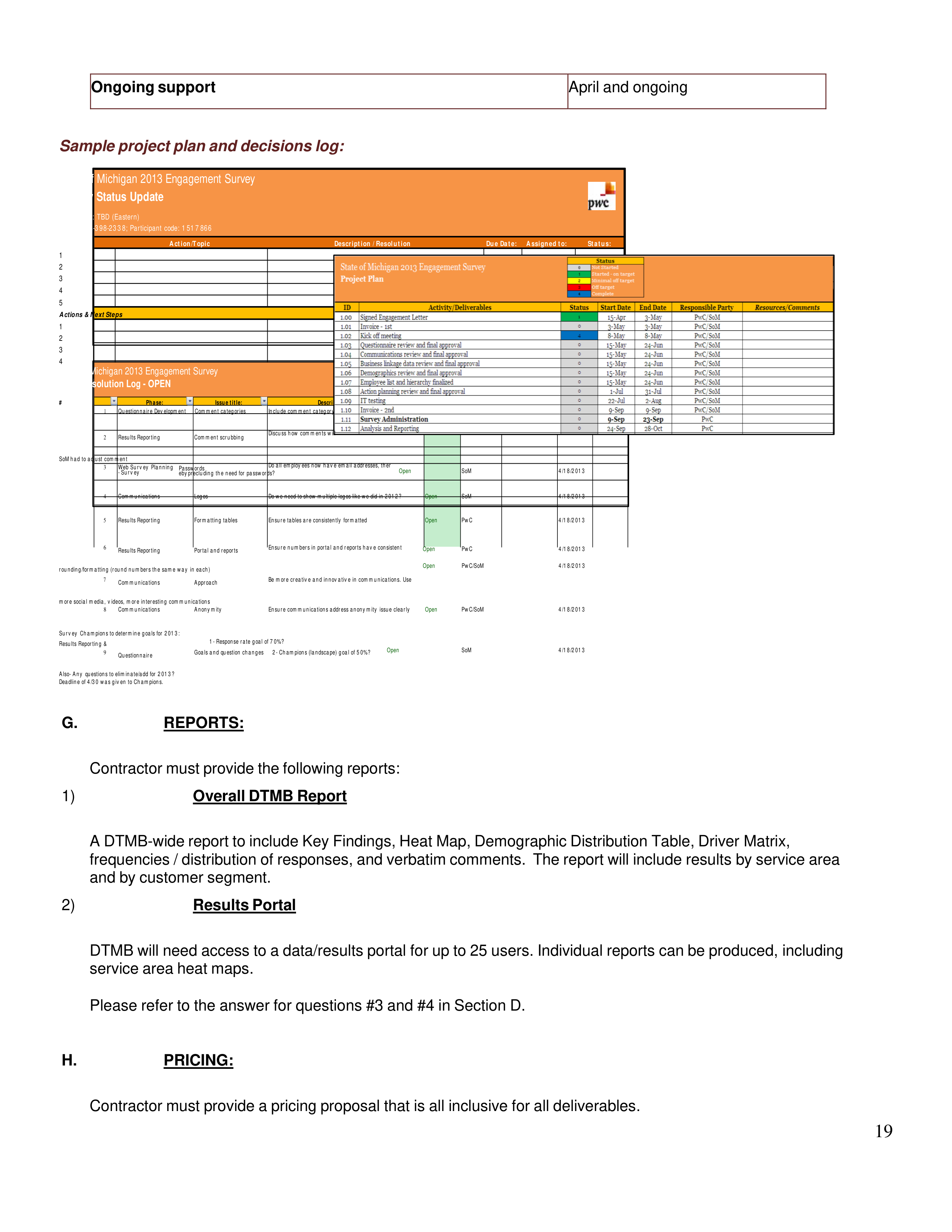


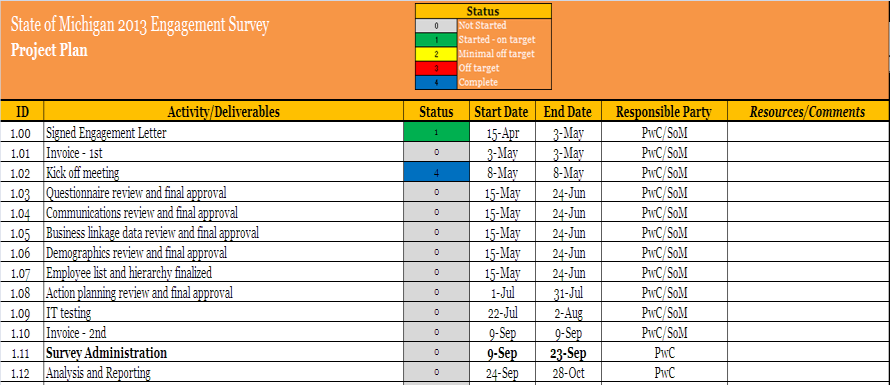


19
5
o:
pt ion of issu e:
St a t u s: A ssign ed t
Resolu t ion :
Ra ised Resolv ed
dr opdow n th is y ea r ?
Open
Pw C/SoM
4 /1 8 /2 01 3
be scr u bbed th is y ea r ? La st y ea r ,
Open
Pw C/SoM
4 /1 8 /2 01 3
s to a h u g e ex ten t befor e pr ov idin g
Ongoing support
April and ongoing
Sample project plan and decisions log:
State of Michigan 2013 Engagement Survey
Weekly Status Update
TIME/DATE: TBD (Eastern)
Dial-in: 888-3 98-23 3 8; Participant code: 1 51 7 866
#
A ct ion /T opic
Descr ipt ion / Resol u t ion
Du e Da t e: A ssign ed t o:
St a t u s:
1
2
3
4
5
A ctions & Next Steps
1
2
3
4
State of Michigan 2013 Engagement Survey
Issue Resolution Log - OPEN
#
Ph a se:
Issu e t it le:
Descri
1
Qu estion n a ir e Dev elopm en t Com m en t ca teg or ies
In clu de com m en t ca teg or y
2
Resu lts Repor tin g
Com m en t scr u bbin g
Discu ss h ow com m en ts w ill
SoM h a d to a dju st com m en t
3
Web Su r v ey Pla n n in g
- Su r v ey
Pa ssw or ds
Do a ll em ploy ees n ow h a v e em a il a ddr esses, th er
eby pr eclu din g th e n eed for pa ssw or ds?
Open
SoM
4 /1 8 /2 01 3
4
Com m u n ica tion s
Log os
Do w e n eed to sh ow m u ltiple log os like w e did in 2 01 2 ?
Open
SoM
4 /1 8 /2 01 3
5
Resu lts Repor tin g
For m a ttin g ta bles
En su r e ta bles a r e con sisten tly for m a tted
Open
Pw C
4 /1 8 /2 01 3
6
Resu lts Repor tin g
Por ta l a n d r epor ts
En su r e n u m ber s in por ta l a n d r epor ts h a v e con sisten t
r ou n din g /for m a ttin g (r ou n d n u m ber s th e sa m e w a y in ea ch )
7
Com m u n ica tion s
A ppr oa ch
Be m or e cr ea tiv e a n d in n ov a tiv e in com m u n ica tion s. Use
m or e socia l m edia , v ideos, m or e in ter estin g com m u n ica tion s
Open
Pw C
4 /1 8 /2 01 3
Open
Pw C/SoM
4 /1 8 /2 01 3
8
Com m u n ica tion s
A n on y m ity
En su r e com m u n ica tion s a ddr ess a n on y m ity issu e clea r ly
Open
Pw C/SoM
4 /1 8 /2 01 3
Su r v ey Ch a m pion s to deter m in e g oa ls for 2 01 3 :
Resu lts Repor tin g &
1 - Respon se r a te g oa l of 7 0%?
9
Qu estion n a ir e
Goa ls a n d qu estion ch a n g es 2 - Ch a m pion s (la n dsca pe) g oa l of 5 0%?
A lso- A n y qu estion s to elim in a te/a dd for 2 01 3 ?
Dea dlin e of 4 /3 0 w a s g iv en to Ch a m pion s.
Open
SoM
4 /1 8 /2 01 3
G.
REPORTS:
Contractor must provide the following reports:
1)
Overall DTMB Report
A DTMB-wide report to include Key Findings, Heat Map, Demographic Distribution Table, Driver
Matrix,
frequencies / distribution of responses, and verbatim comments. The report will include results
by service area
and by customer segment.
2)
Results Portal
DTMB will need access to a data/results portal for up to 25 users. Individual reports can be produced,
including
service area heat maps.
Please refer to the answer for questions #3 and #4 in Section D.
H.
PRICING:
Contractor must provide a pricing proposal that is all inclusive for all deliverables.
20
Please refer to the separate pricing and scope in Exhibit 1.
I.
OTHER:
The overall goal is to improve DTMB services to all customers. It is anticipated that the customer satisfaction
survey
will identify DTMB services that are well received by the customers, DTMB processes that need
improvement, and
activities that require correction due to not meeting service expectations.
In order to maintain anonymity, the vendor will hold the data.
Exhibit 1
Price Proposal
Pricing proposal and scope assumptions
Survey scope
Survey Population
~47,000 + External Customers
Single administration to all state
employees and select external
customers (e.g., schools,
universities, tribal governments,
etc.)
Modality
Web
Survey will be web-enabled. Each
customer included in the customer
list will receive an invitation via e-
mail with a unique survey link to
participate
Program and questionnaire design
Kick-off Meeting
Yes
PwC will host a project kick-off
meeting with DTMB’s project team
to define program objectives,
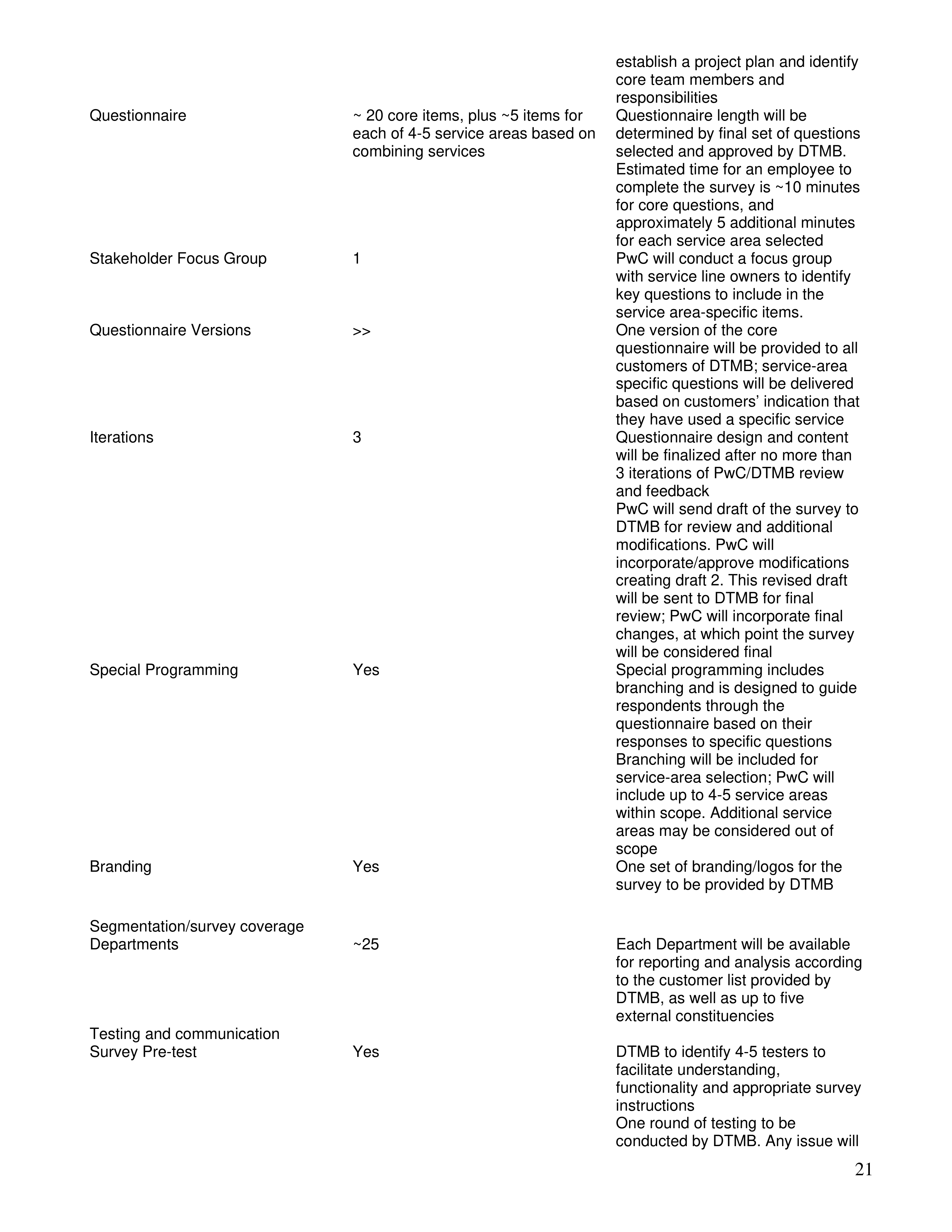
21
establish a project plan and identify
core team members and
responsibilities
Questionnaire
~ 20 core items, plus ~5 items for
each of 4-5 service areas based on
combining services
Questionnaire length will be
determined by final set of questions
selected and approved by DTMB.
Estimated time for an employee to
complete the survey is ~10 minutes
for core questions, and
approximately 5 additional minutes
for each service area selected
Stakeholder Focus Group
1
PwC will conduct a focus group
with service line owners to identify
key questions to include in the
service area-specific items.
Questionnaire Versions
>>
One version of the core
questionnaire will be provided to all
customers of DTMB; service-area
specific questions will be delivered
based on customers’ indication that
they have used a specific service
Iterations
3
Questionnaire design and content
will be finalized after no more than
3 iterations of PwC/DTMB review
and feedback
PwC will send draft of the survey to
DTMB for review and additional
modifications. PwC will
incorporate/approve modifications
creating draft 2. This revised draft
will be sent to DTMB for final
review; PwC will incorporate final
changes, at which point the survey
will be considered final
Special Programming
Yes
Special programming includes
branching and is designed to guide
respondents through the
questionnaire based on their
responses to specific questions
Branching will be included for
service-area selection; PwC will
include up to 4-5 service areas
within scope. Additional service
areas may be considered out of
scope
Branding
Yes
One set of branding/logos for the
survey to be provided by DTMB
Segmentation/survey coverage
Departments
~25
Each Department will be available
for reporting and analysis according
to the customer list provided by
DTMB, as well as up to five
external constituencies
Testing and communication
Survey Pre-test
Yes
DTMB to identify 4-5 testers to
facilitate understanding,
functionality and appropriate survey
instructions
One round of testing to be
conducted by DTMB. Any issue will
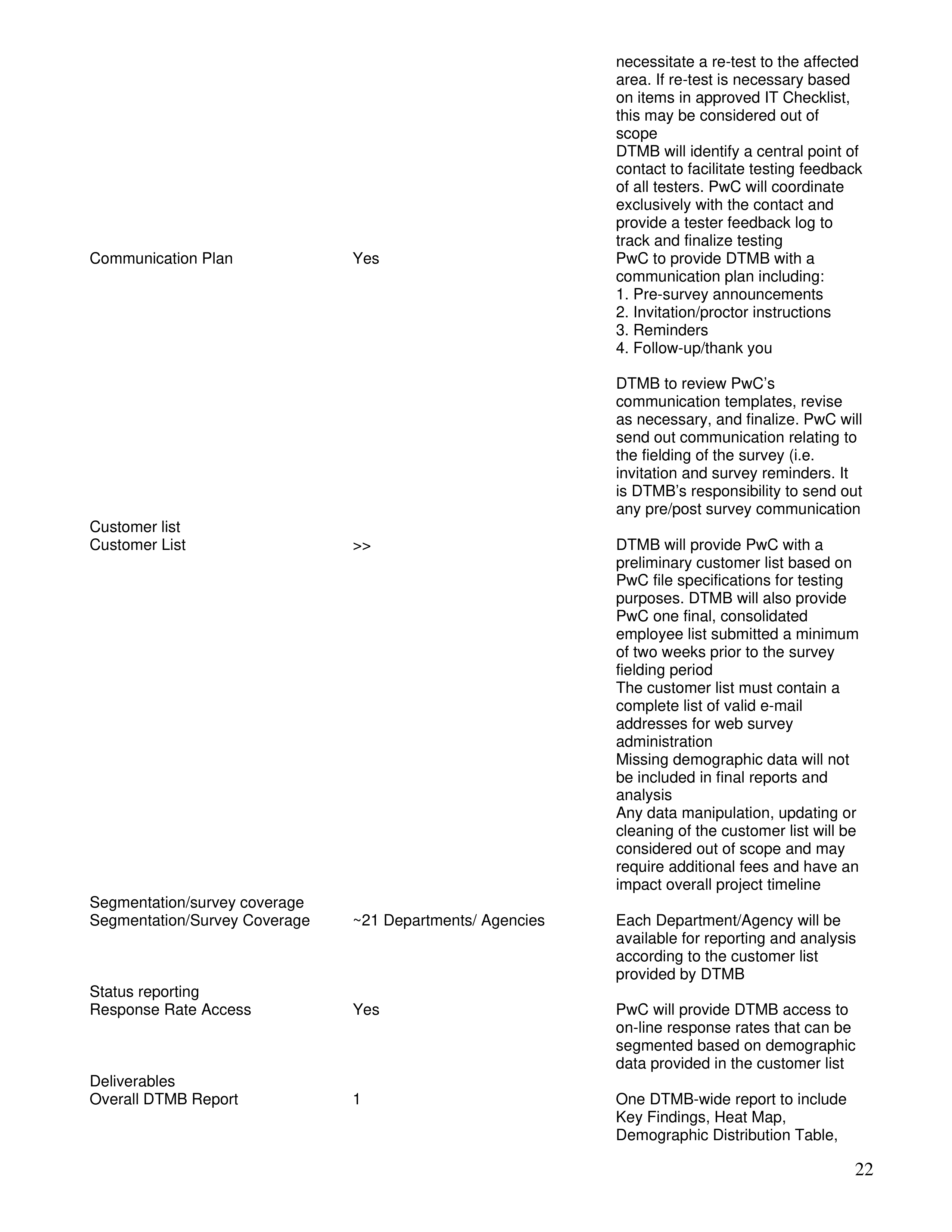
22
necessitate a re-test to the affected
area. If re-test is necessary based
on items in approved IT Checklist,
this may be considered out of
scope
DTMB will identify a central point of
contact to facilitate testing feedback
of all testers. PwC will coordinate
exclusively with the contact and
provide a tester feedback log to
track and finalize testing
Communication Plan
Yes
PwC to provide DTMB with a
communication plan including:
1. Pre-survey announcements
2. Invitation/proctor instructions
3. Reminders
4. Follow-up/thank you
DTMB to review PwC’s
communication templates, revise
as necessary, and finalize. PwC will
send out communication relating to
the fielding of the survey (i.e.
invitation and survey reminders. It
is DTMB’s responsibility to send out
any pre/post survey communication
Customer list
Customer List
>>
DTMB will provide PwC with a
preliminary customer list based on
PwC file specifications for testing
purposes. DTMB will also provide
PwC one final, consolidated
employee list submitted a minimum
of two weeks prior to the survey
fielding period
The customer list must contain a
complete list of valid e-mail
addresses for web survey
administration
Missing demographic data will not
be included in final reports and
analysis
Any data manipulation, updating or
cleaning of the customer list will be
considered out of scope and may
require additional fees and have an
impact overall project timeline
Segmentation/survey coverage
Segmentation/Survey Coverage
~21 Departments/ Agencies
Each Department/Agency will be
available for reporting and analysis
according to the customer list
provided by DTMB
Status reporting
Response Rate Access
Yes
PwC will provide DTMB access to
on-line response rates that can be
segmented based on demographic
data provided in the customer list
Deliverables
Overall DTMB Report
1
One DTMB-wide report to include
Key Findings, Heat Map,
Demographic Distribution Table,
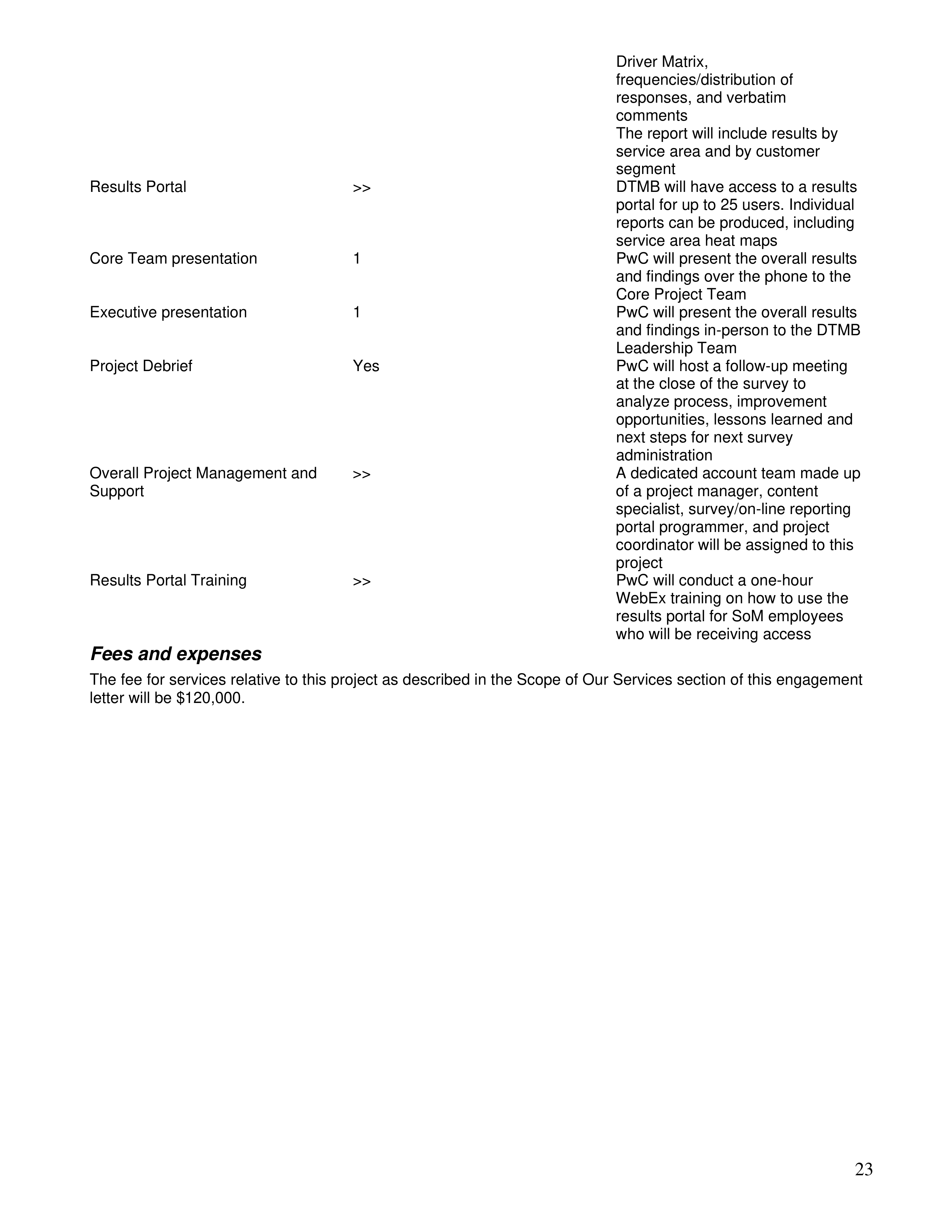
23
Driver Matrix,
frequencies/distribution of
responses, and verbatim
comments
The report will include results by
service area and by customer
segment
Results Portal
>>
DTMB will have access to a results
portal for up to 25 users. Individual
reports can be produced, including
service area heat maps
Core Team presentation
1
PwC will present the overall results
and findings over the phone to the
Core Project Team
Executive presentation
1
PwC will present the overall results
and findings in-person to the DTMB
Leadership Team
Project Debrief
Yes
PwC will host a follow-up meeting
at the close of the survey to
analyze process, improvement
opportunities, lessons learned and
next steps for next survey
administration
Overall Project Management and
Support
>>
A dedicated account team made up
of a project manager, content
specialist, survey/on-line reporting
portal programmer, and project
coordinator will be assigned to this
project
Results Portal Training
>>
PwC will conduct a one-hour
WebEx training on how to use the
results portal for SoM employees
who will be receiving access
Fees and expenses
The fee for services relative to this project as described in the Scope of Our Services section of this engagement
letter will be $120,000.
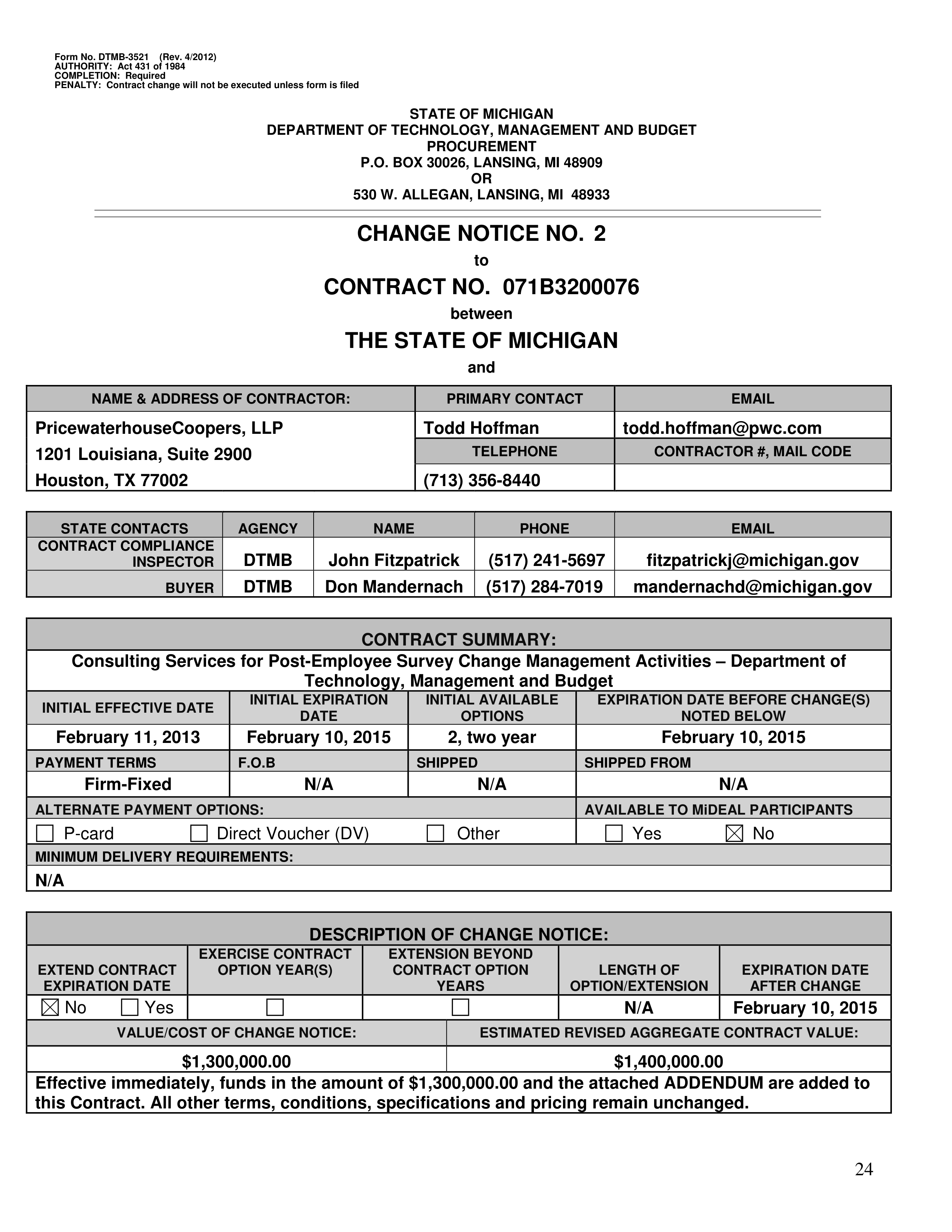
24
Form No. DTMB-3521 (Rev. 4/2012)
AUTHORITY: Act 431 of 1984
COMPLETION: Required
PENALTY: Contract change will not be executed unless form is filed
STATE OF MICHIGAN
DEPARTMENT OF TECHNOLOGY, MANAGEMENT AND BUDGET
PROCUREMENT
P.O. BOX 30026, LANSING, MI 48909
OR
530 W. ALLEGAN, LANSING, MI 48933
CHANGE NOTICE NO.
2
to
CONTRACT NO. 071B3200076
between
THE STATE OF MICHIGAN
and
NAME & ADDRESS OF CONTRACTOR:
PRIMARY CONTACT
EMAIL
PricewaterhouseCoopers, LLP
Todd Hoffman
todd.hoffman@pwc.com
1201 Louisiana, Suite 2900
TELEPHONE
CONTRACTOR #, MAIL CODE
Houston, TX 77002
(713) 356-8440
STATE CONTACTS
AGENCY
NAME
PHONE
EMAIL
CONTRACT COMPLIANCE
INSPECTOR
DTMB
John Fitzpatrick
(517) 241-5697
fitzpatrickj@michigan.gov
BUYER
DTMB
Don Mandernach
(517) 284-7019
mandernachd@michigan.gov
CONTRACT SUMMARY
:
Consulting Services for Post-Employee Survey Change Management Activities – Department of
Technology, Management and Budget
INITIAL EFFECTIVE DATE
INITIAL EXPIRATION
DATE
INITIAL AVAILABLE
OPTIONS
EXPIRATION DATE BEFORE CHANGE(S)
NOTED BELOW
February 11, 2013
February 10, 2015
2, two year
February 10, 2015
PAYMENT TERMS
F.O.B
SHIPPED
SHIPPED FROM
Firm-Fixed
N/A
N/A
N/A
ALTERNATE PAYMENT OPTIONS
:
AVAILABLE TO MiDEAL PARTICIPANTS
P-card
Direct Voucher (DV)
Other
Yes
No
MINIMUM DELIVERY REQUIREMENTS:
N/A
DESCRIPTION OF CHANGE NOTICE:
EXTEND CONTRACT
EXPIRATION DATE
EXERCISE CONTRACT
OPTION YEAR(S)
EXTENSION BEYOND
CONTRACT OPTION
YEARS
LENGTH OF
OPTION/EXTENSION
EXPIRATION DATE
AFTER CHANGE
No
Yes
N/A
February 10, 2015
VALUE/COST OF CHANGE NOTICE:
ESTIMATED REVISED AGGREGATE CONTRACT VALUE:
$1,300,000.00
$1,400,000.00
Effective immediately, funds in the amount of $1,300,000.00 and the attached ADDENDUM are added to
this Contract. All other terms, conditions, specifications and pricing remain unchanged.
25
Statement of Work (SOW) for Consulting Services for Post-Employee Survey for the
Department of Technology, Management and Budget (DTMB), Office of Good
Government
The State of Michigan (SoM) and the Contractor hereby agree that the following additional services will be
performed under the terms of this SOW and the current Contract:
Project Goal:
Support the reinvention of state government via good government initiatives by supporting the leaders
and managers with the knowledge, skills, and tools to sustainably impact employee engagement.
Project Objectives:
Assist the Office of Good Government (OGG) in developing a strategy that enables change to be
implemented consistently across the enterprise, throughout agencies and in a way that is sustainable.
Assist OGG to engage consistent agency action planning activities aligned with the objectives of Good
Government and in response to employee survey data.
Work with the OGG to develop OGG’s ability to consistently deploy the principles of Good Government to
SoM agencies.
Provide OGG personnel with the tools, techniques, and resources to execute change and promulgate the
principles of good government throughout the state.
Enhance OGG’s ability to communicate the principles of good government, reinvention efforts, and other
key changes, both internally and externally.
Scope of Our Services
Key Activities and Deliverables
Contractor’s Deliverables under this SOW are solely those items listed in the “Deliverables” sections below:
Project Management Office
Key Activities
Work with the OGG to develop an overall approach and operational model for OGG oversight and
management of enterprise and agency-level change activities using the Good Government (four-
quadrant) framework
Provide coordination, monitoring and measurement agency-level change activities
Define the Contractor’s role as Project Management Office (PMO) administrator and the role and
structure of the OGG related to activities of this project
Work with OGG to develop structure to identify and communicate agency successes and best practices
Work with OGG to develop overall project management standards (initiation, planning, execution,
monitoring and closing)
Deliverables
Overall master program timeline, including:
o Ownership of tasks
o Milestones and delivery dates at enterprise level
o Agency-level activities
Key performance metrics at the enterprise and agency levels, including:
26
o Outcome metrics (e.g., engagement scores, turnover, productivity data, etc.)
o Compliance metrics (e.g., accountability, implementation timeliness, etc.)
Structure for coordinating, monitoring, and reporting on agency-level change activities
Guide to project management standards
Project Management
Key Activities
Work with OGG to develop project plan, including:
o Finalized project requirements and deliverables
o Schedule, to include major phases, milestones, and timing of major deliverables
o Risk management plan
o Deliverable acceptance protocol
Work with OGG and additional SoM personnel as appropriate (e.g., contracting officers) to develop and
implement a governance model. The governance model will include gate reviews at the conclusion of
each major phase to:
o Capture best practices and lessons learned
o Confirm acceptance of deliverables
o Evaluate progress to date
o Review any project adjustments
Work with the OGG to develop a project organizational structure and staffing management plan for both
the Contractor and OGG, to include:
o Roles and responsibilities (both Contractor and OGG)
o Anticipated resource commitment for specified deliverables
o High level staffing plan for OGG, what needs and resources are necessary
Deliverables
Overall project plan
Project government model
Project organizational structure and staffing management plan
Change Management and Communications
Key Activities
Confirming alignment to vision and strategy
Confirm vision for Good Government with key stakeholders
Work with OGG to revise the Good Government execution strategy as required
Work with OGG to evaluate people, process, and technology requirements for operationalization of
change vision, assess current capabilities in these areas, and make recommendations for addressing
gaps
Assess and possibly refine current enterprise and agency specific scorecard key performance
indicators (KPIs). KPIs to be aligned and measure overall performance of government and if
customers of SoM are receiving good value for their tax dollars
Current state assessment of change and action planning activities
Assess OGG leadership progress with agency action plans through informal interviews and conversations
to assess the support required to effectively lead change
27
Assess agency stakeholders to evaluate how effective change management efforts have been to date, to
what degree the change initiatives have been integrated into day-to-day operations, and what support is
needed to further operationalize the changes
Work with OGG to integrate change adoption metrics and reporting for agency-level change management
monitoring
Work with OGG to develop a consistent action planning process for the enterprise and agencies to follow
Implementing and embedding change
Communications
Facilitate agency-level communication assessment to evaluate best modalities for communication by
stakeholder group within a specific agency, with documented agency-level findings to shape approach to
communication activities
Work with OGG to develop and document enterprise and agency-level communications strategy and plan
to include:
– Communications governance process with clear roles and responsibilities for messaging
– Initial key messages covering the why, what, and how for action planning and change in support of
OGG
– Communications and messaging approach to support OGG objectives and change management
efforts, to include development of new key messages and communication templates
– As directed by the developed enterprise communication plan, providing OGG with method for
discussing action planning process, timing and expectations with agencies
– Communications plan for OGG to specifically communicate reinvention efforts and Good
Government
Change agent network
Work with OGG to refine change agent network roles, responsibilities, and governance model to align
with change management activities and future state operational model
Training
Develop training materials to train OGG in change management techniques
Train OGG to facilitate 2012 and 2013 agency-level survey results reviews with agency directors and
leaders
Train OGG on communications tools and templates, including responsibility matrix, media effectiveness
maps, communications sequence and planning documents
Train OGG on principles and techniques for effective group facilitation
Provide agency manager training content to OGG on the action planning process including:
– How to review survey report and work with teams to reach a common understanding/interpretation of
the results
– How to identify strengths and opportunities for improvement
– How to generate ideas on addressing strengths and opportunities for improvement, and complete an
action planning template
Deliverables
Action planning templates (leadership and manager)
Change agent network documentation including identification of roles and responsibilities
Change management metrics and reporting
28
Training deck on action planning communication and the overall action planning process
Training deck on effective group facilitation
Communication assessment findings, to include recommendations for better communicating the
principles of good government
Communications strategy for both internal and external audiences
Communications plan including key messages covering the why, what, and how for action planning and
change
Communications governance model for OGG
Research
Key Activities
Analyze 2012 and 2013 Employee Survey results for context, and input into the need for change so that
OGG with the assistance of the PMO can address:
– Enterprise issues to preserve and improve
– Noteworthy positive and negative trends in drivers of engagement
– Unique issues at the agency level
Additionally, the above process will include the selection of non-survey, outcome measures (e.g.,
customer satisfaction, cost, measures that determine services/process optimization) to analyze with 2012
and 2013 Employee Survey results. This analysis will show at the enterprise and agency levels the
impact employee engagement has on various outcome measures
Contractor will run linkage analysis (with 2012 and 2013 Employee Survey results and selected outcome
measures) at the enterprise and agency level. Linkage analysis will be aligned with enterprise and
agency-level scorecards so that engagement and scorecard KPIs are aligned. Contractor to run up to five
enterprise outcome linkage analyses and up to two agency-level linkage analyses for each agency
Conduct additional/ad hoc analysis of agency-level 2012 and 2013 employee survey data to highlight
agency-level strengths and opportunities for improvement
Develop and document research approach and tools (qualitative and quantitative ) to gather additional
employee feedback, including:
– Survey and focus group communication templates and process documents associated with pulse
survey and focus group administration
– Focus group discussion guides/library of questions based on enterprise level issues
– Pulse survey questionnaire library based on enterprise level issues – including PwC’s action
planning accountability questions
– Reporting guidelines and templates for focus group and pulse survey results reports
Provide Contractor research, employee engagement market data, and action planning best practice
material and thought leadership
Provide data to OGG, PMO, and change management efforts as required
Deliverables
Survey results analysis of enterprise and agency issues to support PMO and OGG change management
approaches and activities
Linkage analysis of enterprise and agency-level outcome measures and 2012/2013 survey results
Qualitative and quantitative research tools, including pulse survey questions/questionnaires, focus group
discuss guides, research methods/guidelines and communications
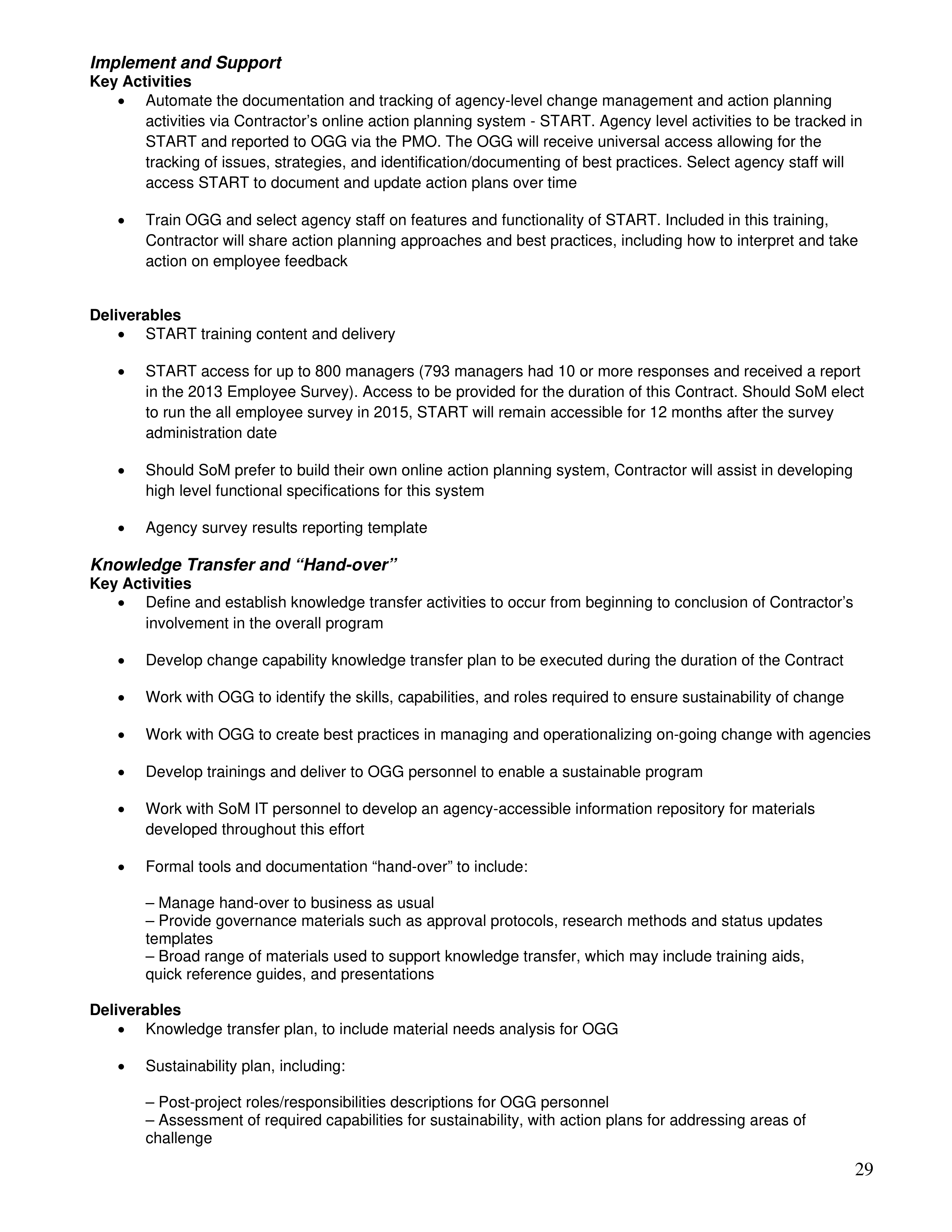
29
Implement and Support
Key Activities
Automate the documentation and tracking of agency-level change management and action planning
activities via Contractor’s online action planning system - START. Agency level activities to be tracked in
START and reported to OGG via the PMO. The OGG will receive universal access allowing for the
tracking of issues, strategies, and identification/documenting of best practices. Select agency staff will
access START to document and update action plans over time
Train OGG and select agency staff on features and functionality of START. Included in this training,
Contractor will share action planning approaches and best practices, including how to interpret and take
action on employee feedback
Deliverables
START training content and delivery
START access for up to 800 managers (793 managers had 10 or more responses and received a report
in the 2013 Employee Survey). Access to be provided for the duration of this Contract. Should SoM elect
to run the all employee survey in 2015, START will remain accessible for 12 months after the survey
administration date
Should SoM prefer to build their own online action planning system, Contractor will assist in developing
high level functional specifications for this system
Agency survey results reporting template
Knowledge Transfer and “Hand-over”
Key Activities
Define and establish knowledge transfer activities to occur from beginning to conclusion of Contractor’s
involvement in the overall program
Develop change capability knowledge transfer plan to be executed during the duration of the Contract
Work with OGG to identify the skills, capabilities, and roles required to ensure sustainability of change
Work with OGG to create best practices in managing and operationalizing on-going change with agencies
Develop trainings and deliver to OGG personnel to enable a sustainable program
Work with SoM IT personnel to develop an agency-accessible information repository for materials
developed throughout this effort
Formal tools and documentation “hand-over” to include:
– Manage hand-over to business as usual
– Provide governance materials such as approval protocols, research methods and status updates
templates
– Broad range of materials used to support knowledge transfer, which may include training aids,
quick reference guides, and presentations
Deliverables
Knowledge transfer plan, to include material needs analysis for OGG
Sustainability plan, including:
– Post-project roles/responsibilities descriptions for OGG personnel
– Assessment of required capabilities for sustainability, with action plans for addressing areas of
challenge
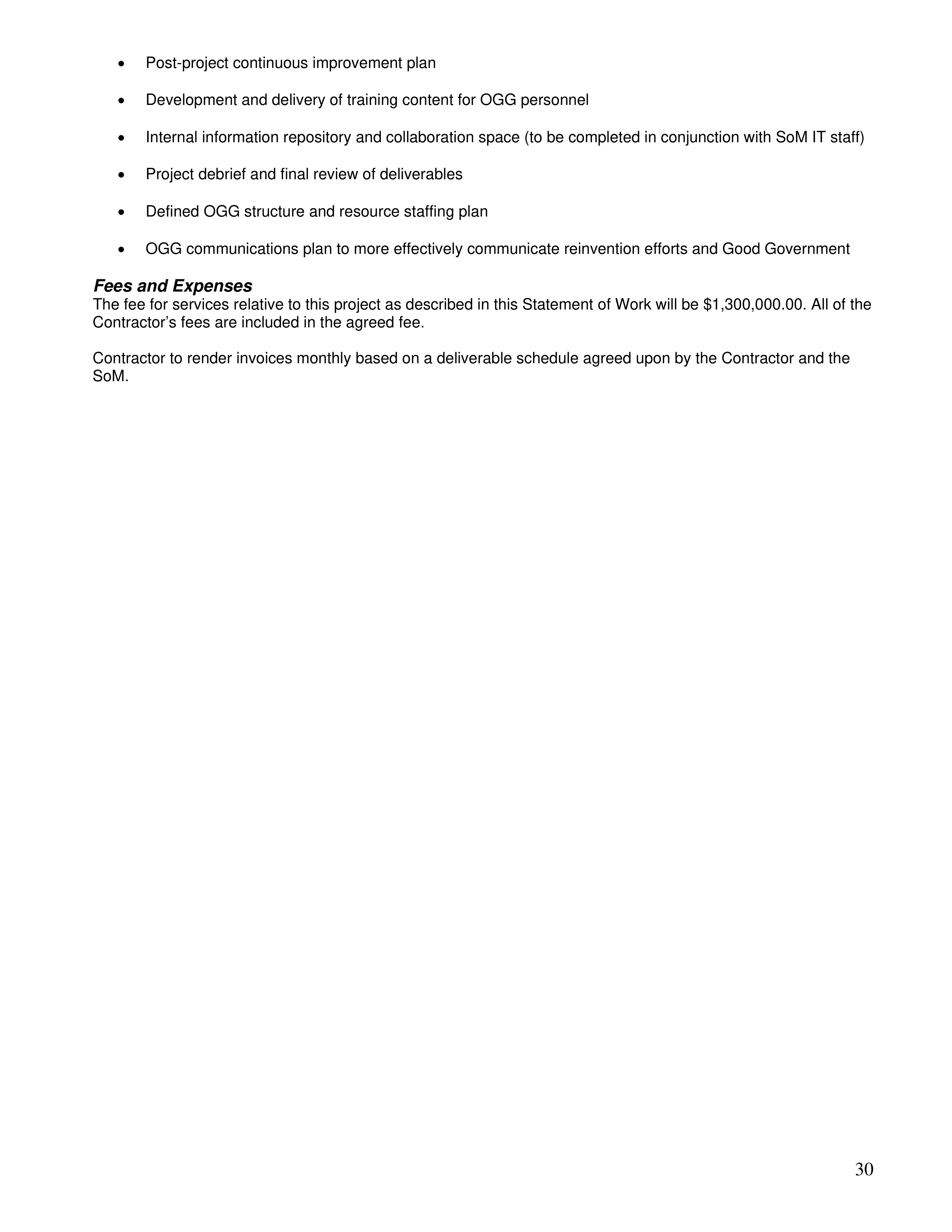
30
Post-project continuous improvement plan
Development and delivery of training content for OGG personnel
Internal information repository and collaboration space (to be completed in conjunction with SoM IT staff)
Project debrief and final review of deliverables
Defined OGG structure and resource staffing plan
OGG communications plan to more effectively communicate reinvention efforts and Good Government
Fees and Expenses
The fee for services relative to this project as described in this Statement of Work will be $1,300,000.00. All of the
Contractor’s fees are included in the agreed fee.
Contractor to render invoices monthly based on a deliverable schedule agreed upon by the Contractor and the
SoM.
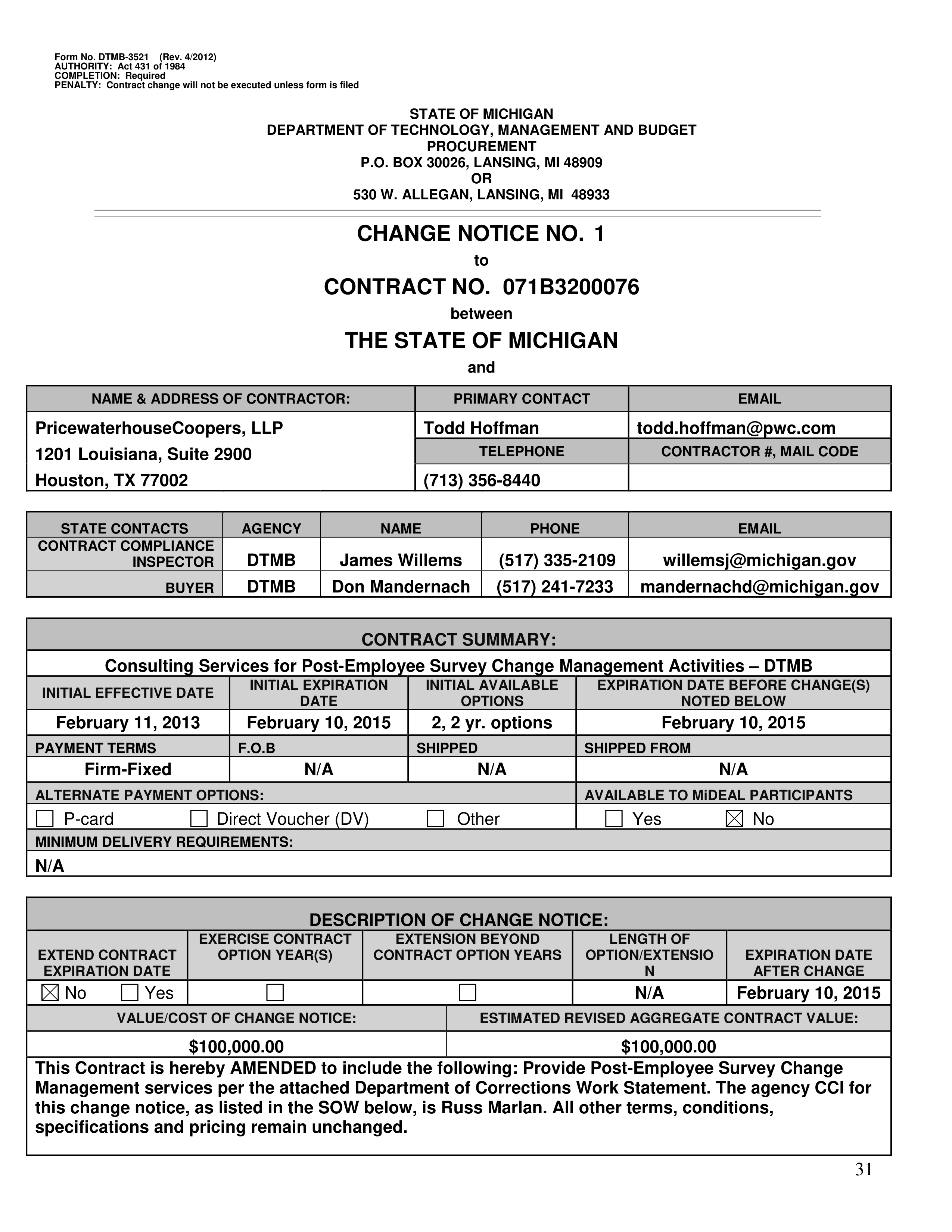
31
Form No. DTMB-3521 (Rev. 4/2012)
AUTHORITY: Act 431 of 1984
COMPLETION: Required
PENALTY: Contract change will not be executed unless form is filed
STATE OF MICHIGAN
DEPARTMENT OF TECHNOLOGY, MANAGEMENT AND BUDGET
PROCUREMENT
P.O. BOX 30026, LANSING, MI 48909
OR
530 W. ALLEGAN, LANSING, MI 48933
CHANGE NOTICE NO.
1
to
CONTRACT NO. 071B3200076
between
THE STATE OF MICHIGAN
and
NAME & ADDRESS OF CONTRACTOR:
PRIMARY CONTACT
EMAIL
PricewaterhouseCoopers, LLP
Todd Hoffman
todd.hoffman@pwc.com
1201 Louisiana, Suite 2900
TELEPHONE
CONTRACTOR #, MAIL CODE
Houston, TX 77002
(713) 356-8440
STATE CONTACTS
AGENCY
NAME
PHONE
EMAIL
CONTRACT COMPLIANCE
INSPECTOR
DTMB
James Willems
(517) 335-2109
willemsj@michigan.gov
BUYER
DTMB
Don Mandernach
(517) 241-7233
mandernachd@michigan.gov
CONTRACT SUMMARY
:
Consulting Services for Post-Employee Survey Change Management Activities – DTMB
INITIAL EFFECTIVE DATE
INITIAL EXPIRATION
DATE
INITIAL AVAILABLE
OPTIONS
EXPIRATION DATE BEFORE CHANGE(S)
NOTED BELOW
February 11, 2013
February 10, 2015
2, 2 yr. options
February 10, 2015
PAYMENT TERMS
F.O.B
SHIPPED
SHIPPED FROM
Firm-Fixed
N/A
N/A
N/A
ALTERNATE PAYMENT OPTIONS
:
AVAILABLE TO MiDEAL PARTICIPANTS
P-card
Direct Voucher (DV)
Other
Yes
No
MINIMUM DELIVERY REQUIREMENTS:
N/A
DESCRIPTION OF CHANGE NOTICE:
EXTEND CONTRACT
EXPIRATION DATE
EXERCISE CONTRACT
OPTION YEAR(S)
EXTENSION BEYOND
CONTRACT OPTION YEARS
LENGTH OF
OPTION/EXTENSIO
N
EXPIRATION DATE
AFTER CHANGE
No
Yes
N/A
February 10, 2015
VALUE/COST OF CHANGE NOTICE:
ESTIMATED REVISED AGGREGATE CONTRACT VALUE:
$100,000.00
$100,000.00
This Contract is hereby AMENDED to include the following: Provide Post-Employee Survey Change
Management services per the attached Department of Corrections Work Statement. The agency CCI for
this change notice, as listed in the SOW below, is Russ Marlan. All other terms, conditions,
specifications and pricing remain unchanged.
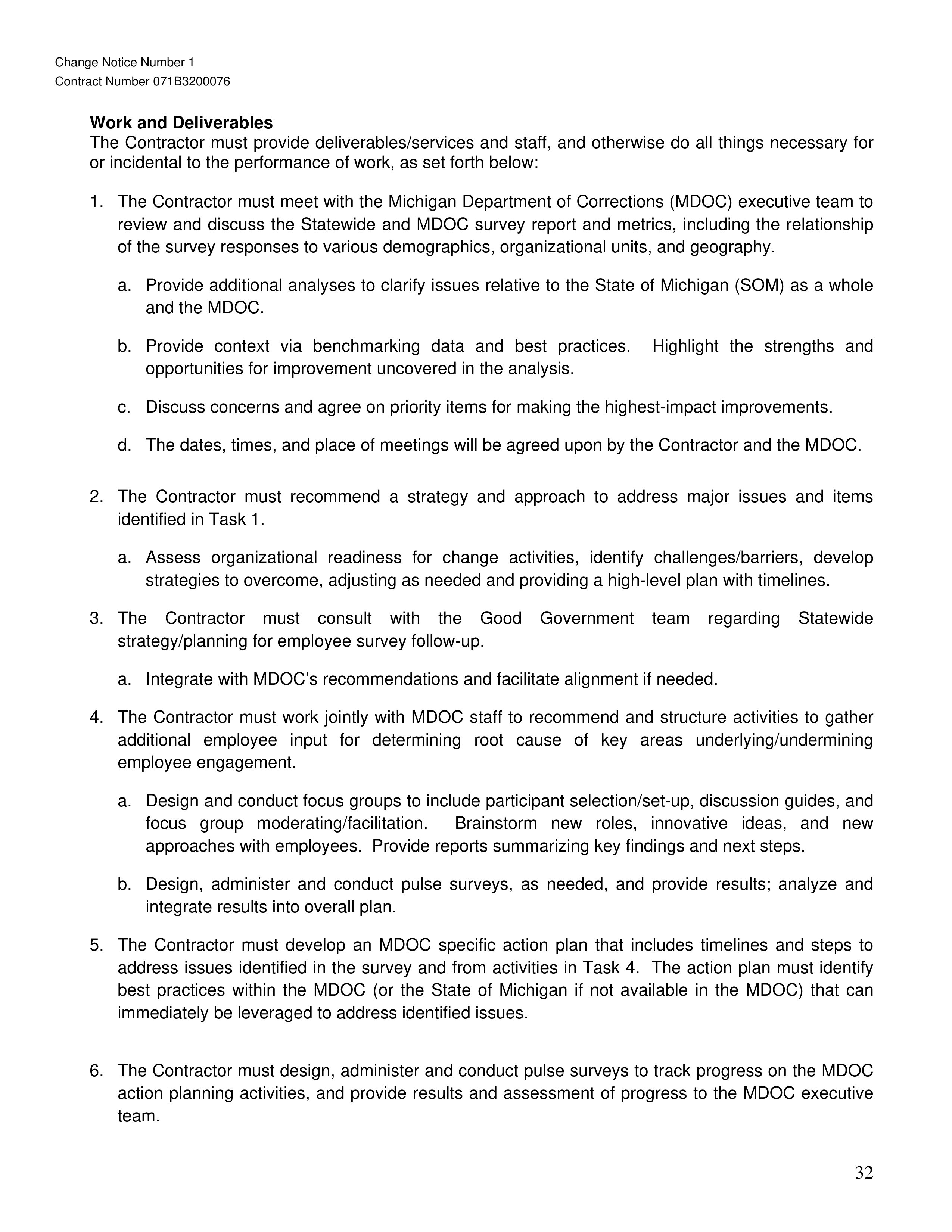
32
Change Notice Number 1
Contract Number 071B3200076
Work and Deliverables
The Contractor must provide deliverables/services and staff, and otherwise do all things necessary for
or incidental to the performance of work, as set forth below:
1. The Contractor must meet with the Michigan Department of Corrections (MDOC) executive team to
review and discuss the Statewide and MDOC survey report and metrics, including the relationship
of the survey responses to various demographics, organizational units, and geography.
a. Provide additional analyses to clarify issues relative to the State of Michigan (SOM) as a whole
and the MDOC.
b. Provide context via benchmarking data and best practices. Highlight the strengths and
opportunities for improvement uncovered in the analysis.
c. Discuss concerns and agree on priority items for making the highest-impact improvements.
d. The dates, times, and place of meetings will be agreed upon by the Contractor and the MDOC.
2. The Contractor must recommend a strategy and approach to address major issues and items
identified in Task 1.
a. Assess organizational readiness for change activities, identify challenges/barriers, develop
strategies to overcome, adjusting as needed and providing a high-level plan with timelines.
3. The Contractor must consult with the Good Government team regarding Statewide
strategy/planning for employee survey follow-up.
a. Integrate with MDOC’s recommendations and facilitate alignment if needed.
4. The Contractor must work jointly with MDOC staff to recommend and structure activities to gather
additional employee input for determining root cause of key areas underlying/undermining
employee engagement.
a. Design and conduct focus groups to include participant selection/set-up, discussion guides, and
focus group moderating/facilitation. Brainstorm new roles, innovative ideas, and new
approaches with employees. Provide reports summarizing key findings and next steps.
b. Design, administer and conduct pulse surveys, as needed, and provide results; analyze and
integrate results into overall plan.
5. The Contractor must develop an MDOC specific action plan that includes timelines and steps to
address issues identified in the survey and from activities in Task 4. The action plan must identify
best practices within the MDOC (or the State of Michigan if not available in the MDOC) that can
immediately be leveraged to address identified issues.
6. The Contractor must design, administer and conduct pulse surveys to track progress on the MDOC
action planning activities, and provide results and assessment of progress to the MDOC executive
team.
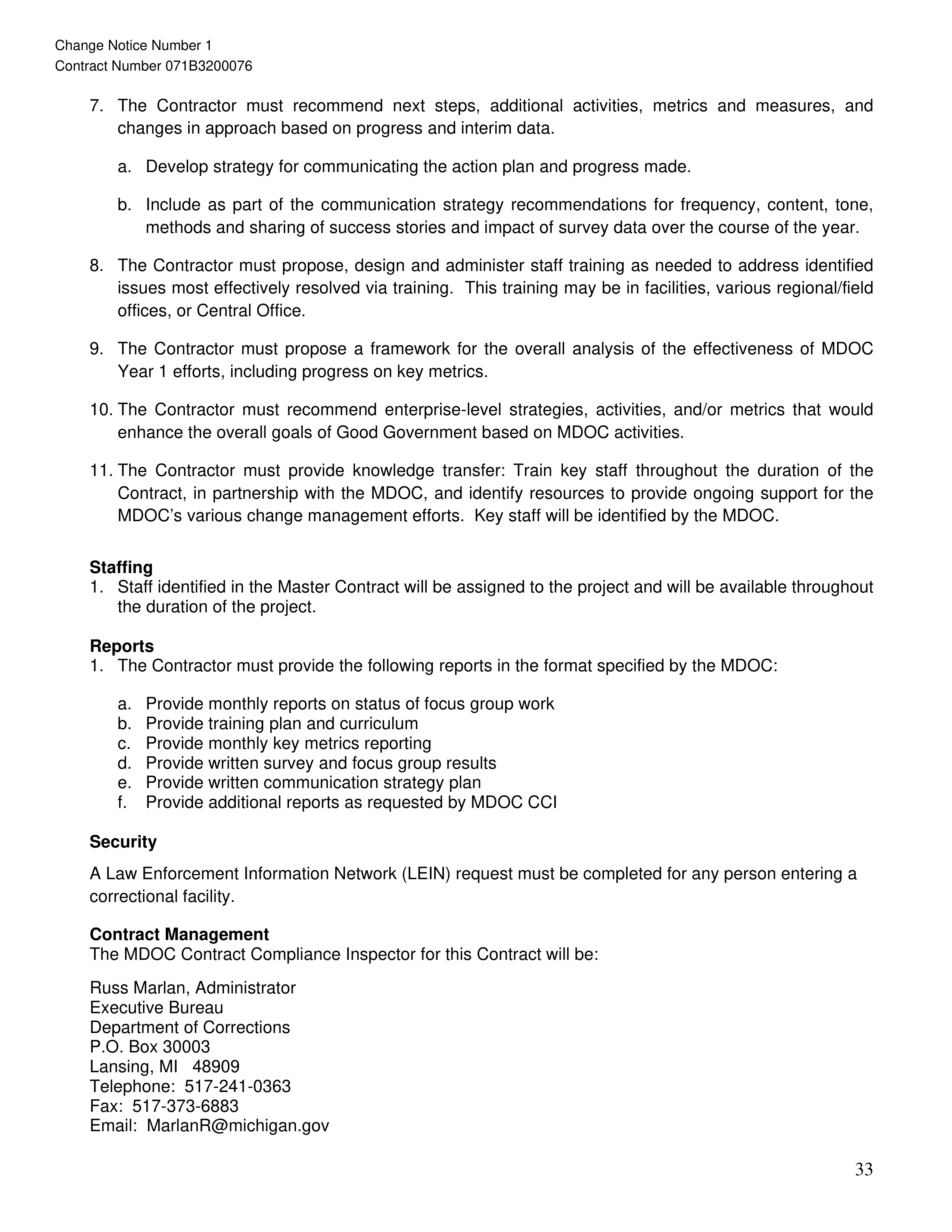
Change Notice Number 1
Contract Number 071B3200076
33
7. The Contractor must recommend next steps, additional activities, metrics and measures, and
changes in approach based on progress and interim data.
a. Develop strategy for communicating the action plan and progress made.
b. Include as part of the communication strategy recommendations for frequency, content, tone,
methods and sharing of success stories and impact of survey data over the course of the year.
8. The Contractor must propose, design and administer staff training as needed to address identified
issues most effectively resolved via training. This training may be in facilities, various regional/field
offices, or Central Office.
9. The Contractor must propose a framework for the overall analysis of the effectiveness of MDOC
Year 1 efforts, including progress on key metrics.
10. The Contractor must recommend enterprise-level strategies, activities, and/or metrics that would
enhance the overall goals of Good Government based on MDOC activities.
11. The Contractor must provide knowledge transfer: Train key staff throughout the duration of the
Contract, in partnership with the MDOC, and identify resources to provide ongoing support for the
MDOC’s various change management efforts. Key staff will be identified by the MDOC.
Staffing
1. Staff identified in the Master Contract will be assigned to the project and will be available throughout
the duration of the project.
Reports
1. The Contractor must provide the following reports in the format specified by the MDOC:
a. Provide monthly reports on status of focus group work
b. Provide training plan and curriculum
c. Provide monthly key metrics reporting
d. Provide written survey and focus group results
e. Provide written communication strategy plan
f.
Provide additional reports as requested by MDOC CCI
Security
A Law Enforcement Information Network (LEIN) request must be completed for any person entering a
correctional facility.
Contract Management
The MDOC Contract Compliance Inspector for this Contract will be:
Russ Marlan, Administrator
Executive Bureau
Department of Corrections
P.O. Box 30003
Lansing, MI 48909
Telephone: 517-241-0363
Fax: 517-373-6883
Email: MarlanR@michigan.gov
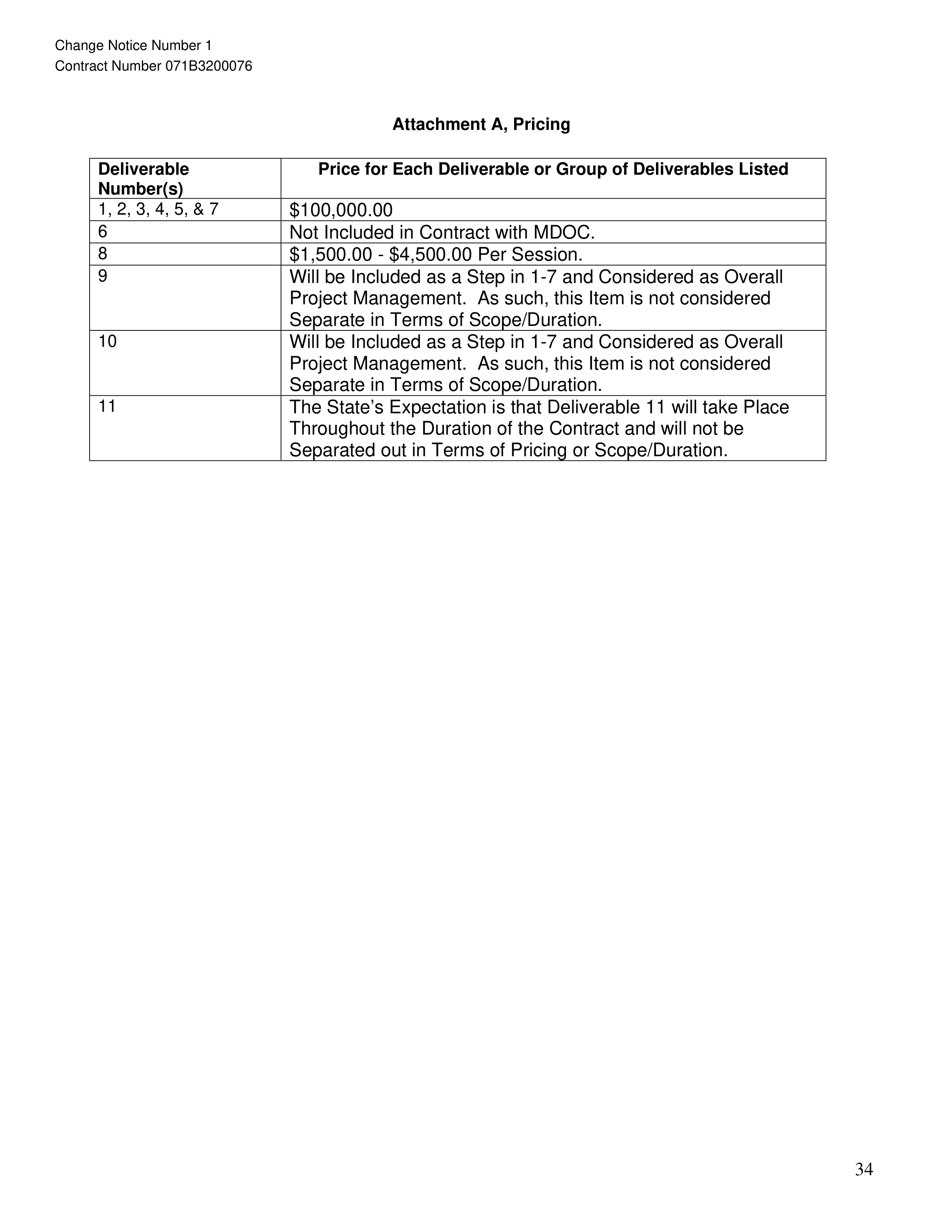
Change Notice Number 1
Contract Number 071B3200076
34
Attachment A, Pricing
Deliverable
Number(s)
Price for Each Deliverable or Group of Deliverables Listed
1, 2, 3, 4, 5, & 7
$100,000.00
6
Not Included in Contract with MDOC.
8
$1,500.00 - $4,500.00 Per Session.
9
Will be Included as a Step in 1-7 and Considered as Overall
Project Management. As such, this Item is not considered
Separate in Terms of Scope/Duration.
10
Will be Included as a Step in 1-7 and Considered as Overall
Project Management. As such, this Item is not considered
Separate in Terms of Scope/Duration.
11
The State’s Expectation is that Deliverable 11 will take Place
Throughout the Duration of the Contract and will not be
Separated out in Terms of Pricing or Scope/Duration.
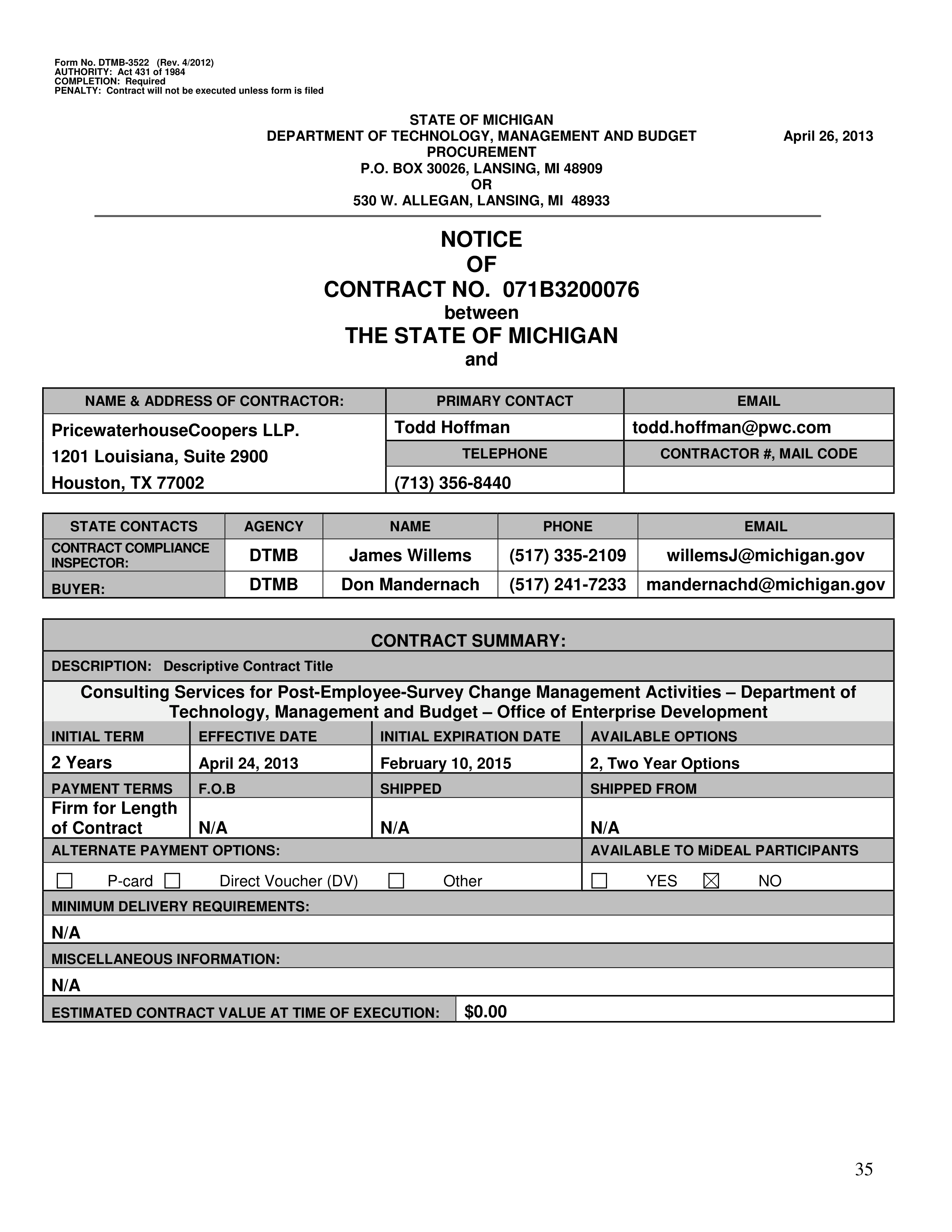
35
Form No. DTMB-3522 (Rev. 4/2012)
AUTHORITY: Act 431 of 1984
COMPLETION: Required
PENALTY: Contract will not be executed unless form is filed
STATE OF MICHIGAN
DEPARTMENT OF TECHNOLOGY, MANAGEMENT AND BUDGET
April 26, 2013
PROCUREMENT
P.O. BOX 30026, LANSING, MI 48909
OR
530 W. ALLEGAN, LANSING, MI 48933
NOTICE
OF
CONTRACT NO. 071B3200076
between
THE STATE OF MICHIGAN
and
NAME & ADDRESS OF CONTRACTOR:
PRIMARY CONTACT
EMAIL
PricewaterhouseCoopers LLP.
Todd Hoffman
todd.hoffman@pwc.com
1201 Louisiana, Suite 2900
TELEPHONE
CONTRACTOR #, MAIL CODE
Houston, TX 77002
(713) 356-8440
STATE CONTACTS
AGENCY
NAME
PHONE
EMAIL
CONTRACT COMPLIANCE
INSPECTOR:
DTMB
James Willems
(517) 335-2109
willemsJ@michigan.gov
BUYER:
DTMB
Don Mandernach
(517) 241-7233
mandernachd@michigan.gov
CONTRACT SUMMARY:
DESCRIPTION: Descriptive Contract Title
Consulting Services for Post-Employee-Survey Change Management Activities – Department of
Technology, Management and Budget – Office of Enterprise Development
INITIAL TERM
EFFECTIVE DATE
INITIAL EXPIRATION DATE
AVAILABLE OPTIONS
2 Years
April 24, 2013
February 10, 2015
2, Two Year Options
PAYMENT TERMS
F.O.B
SHIPPED
SHIPPED FROM
Firm for Length
of Contract
N/A
N/A
N/A
ALTERNATE PAYMENT OPTIONS:
AVAILABLE TO MiDEAL PARTICIPANTS
P-card
Direct Voucher (DV)
Other
YES
NO
MINIMUM DELIVERY REQUIREMENTS:
N/A
MISCELLANEOUS INFORMATION:
N/A
ESTIMATED CONTRACT VALUE AT TIME OF EXECUTION:
$0.00
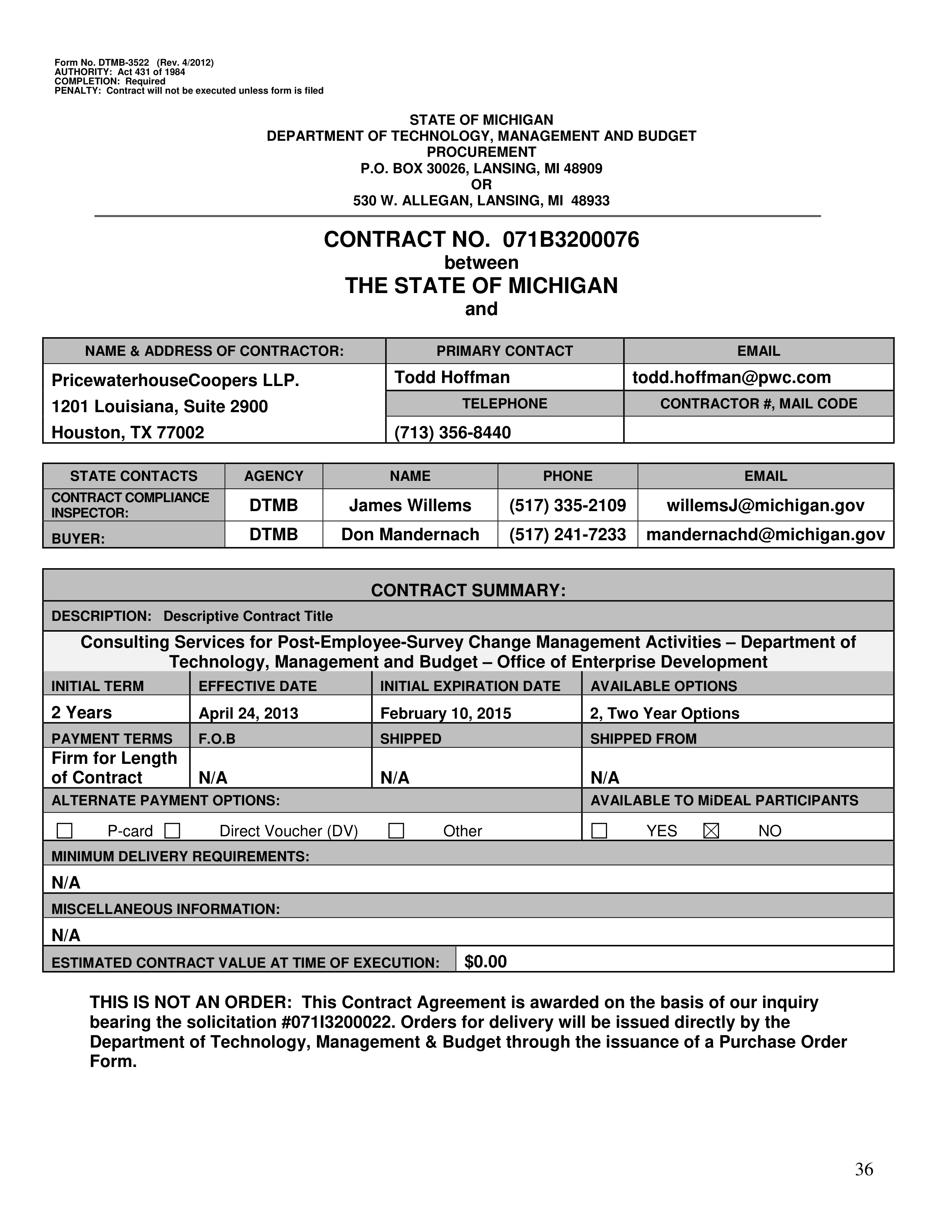
36
Form No. DTMB-3522 (Rev. 4/2012)
AUTHORITY: Act 431 of 1984
COMPLETION: Required
PENALTY: Contract will not be executed unless form is filed
STATE OF MICHIGAN
DEPARTMENT OF TECHNOLOGY, MANAGEMENT AND BUDGET
PROCUREMENT
P.O. BOX 30026, LANSING, MI 48909
OR
530 W. ALLEGAN, LANSING, MI 48933
CONTRACT NO. 071B3200076
between
THE STATE OF MICHIGAN
and
NAME & ADDRESS OF CONTRACTOR:
PRIMARY CONTACT
EMAIL
PricewaterhouseCoopers LLP.
Todd Hoffman
todd.hoffman@pwc.com
1201 Louisiana, Suite 2900
TELEPHONE
CONTRACTOR #, MAIL CODE
Houston, TX 77002
(713) 356-8440
STATE CONTACTS
AGENCY
NAME
PHONE
EMAIL
CONTRACT COMPLIANCE
INSPECTOR:
DTMB
James Willems
(517) 335-2109
willemsJ@michigan.gov
BUYER:
DTMB
Don Mandernach
(517) 241-7233
mandernachd@michigan.gov
CONTRACT SUMMARY:
DESCRIPTION: Descriptive Contract Title
Consulting Services for Post-Employee-Survey Change Management Activities – Department of
Technology, Management and Budget – Office of Enterprise Development
INITIAL TERM
EFFECTIVE DATE
INITIAL EXPIRATION DATE
AVAILABLE OPTIONS
2 Years
April 24, 2013
February 10, 2015
2, Two Year Options
PAYMENT TERMS
F.O.B
SHIPPED
SHIPPED FROM
Firm for Length
of Contract
N/A
N/A
N/A
ALTERNATE PAYMENT OPTIONS:
AVAILABLE TO MiDEAL PARTICIPANTS
P-card
Direct Voucher (DV)
Other
YES
NO
MINIMUM DELIVERY REQUIREMENTS:
N/A
MISCELLANEOUS INFORMATION:
N/A
ESTIMATED CONTRACT VALUE AT TIME OF EXECUTION:
$0.00
THIS IS NOT AN ORDER: This Contract Agreement is awarded on the basis of our inquiry
bearing the solicitation #071I3200022. Orders for delivery will be issued directly by the
Department of Technology, Management & Budget through the issuance of a Purchase Order
Form.
37
Form No. DTMB-3522 (Rev. 4/2012)
Notice of Contract #: 071B3200076
FOR THE CONTRACTOR:
FOR THE STATE:
PricewaterhouseCoopers LLC.
Firm Name
Signature
Jeff Brownlee, Chief Procurement Officer
Authorized Agent Signature
Name/Title
DTMB Procurement
Authorized Agent (Print or Type)
Enter Name of Agency
Date
Date


CONTRACT #071B3200076
38
STATE OF MICHIGAN
Department of Technology, Management and Budget
DTMB-Procurement
Contract No. 071B3200076
Prequalification Program:
Consulting Services for Post-Employee-Survey Change Management Activities
for all State Agencies/Organizational Units and the
Michigan Economic Development Corporation
Buyer Name: Don Mandernach
Telephone Number: 517-241-7233
E-Mail Address: mandernachd@michigan.gov
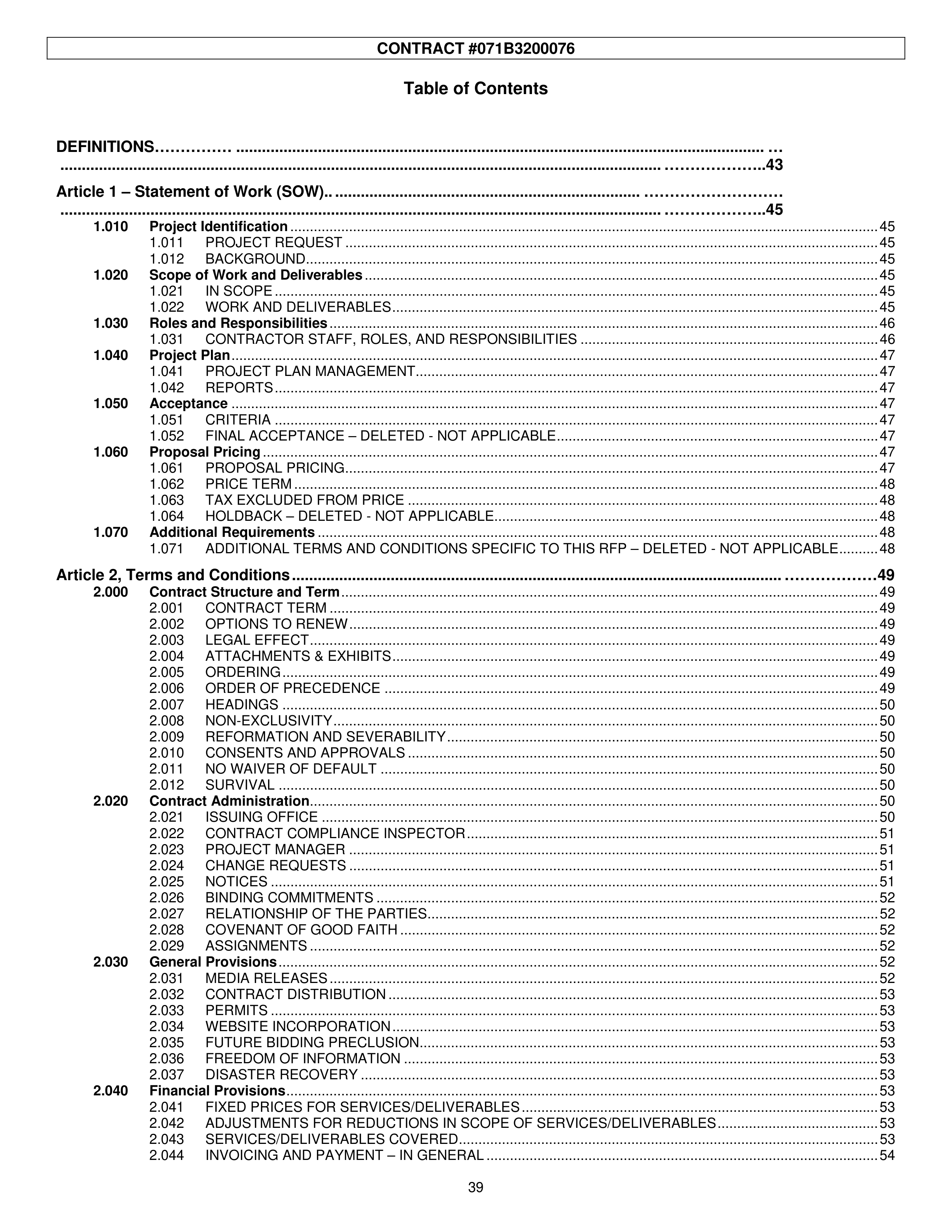
CONTRACT #071B3200076
39
Table of Contents
DEFINITIONS…………… ........................................................................................................................... …
............................................................................................................................................ ………………..43
Article 1 – Statement of Work (SOW).. ....................................................................... ………………………
............................................................................................................................................ ………………..45
1.010
Project Identification
...................................................................................................................................................... 45
1.011
PROJECT REQUEST ........................................................................................................................................ 45
1.012
BACKGROUND .................................................................................................................................................. 45
1.020
Scope of Work and Deliverables
................................................................................................................................... 45
1.021
IN SCOPE .......................................................................................................................................................... 45
1.022
WORK AND DELIVERABLES ............................................................................................................................ 45
1.030
Roles and Responsibilities
............................................................................................................................................ 46
1.031
CONTRACTOR STAFF, ROLES, AND RESPONSIBILITIES ............................................................................ 46
1.040
Project Plan
..................................................................................................................................................................... 47
1.041
PROJECT PLAN MANAGEMENT ...................................................................................................................... 47
1.042
REPORTS .......................................................................................................................................................... 47
1.050
Acceptance
..................................................................................................................................................................... 47
1.051
CRITERIA .......................................................................................................................................................... 47
1.052
FINAL ACCEPTANCE – DELETED - NOT APPLICABLE .................................................................................. 47
1.060
Proposal Pricing
............................................................................................................................................................. 47
1.061
PROPOSAL PRICING ........................................................................................................................................ 47
1.062
PRICE TERM ..................................................................................................................................................... 48
1.063
TAX EXCLUDED FROM PRICE ........................................................................................................................ 48
1.064
HOLDBACK – DELETED - NOT APPLICABLE.................................................................................................. 48
1.070
Additional Requirements
............................................................................................................................................... 48
1.071
ADDITIONAL TERMS AND CONDITIONS SPECIFIC TO THIS RFP – DELETED - NOT APPLICABLE .......... 48
Article 2, Terms and Conditions .................................................................................................................. ………………49
2.000
Contract Structure and Term
......................................................................................................................................... 49
2.001
CONTRACT TERM ............................................................................................................................................ 49
2.002
OPTIONS TO RENEW ....................................................................................................................................... 49
2.003
LEGAL EFFECT ................................................................................................................................................. 49
2.004
ATTACHMENTS & EXHIBITS ............................................................................................................................ 49
2.005
ORDERING ........................................................................................................................................................ 49
2.006
ORDER OF PRECEDENCE .............................................................................................................................. 49
2.007
HEADINGS ........................................................................................................................................................ 50
2.008
NON-EXCLUSIVITY ........................................................................................................................................... 50
2.009
REFORMATION AND SEVERABILITY .............................................................................................................. 50
2.010
CONSENTS AND APPROVALS ........................................................................................................................ 50
2.011
NO WAIVER OF DEFAULT ............................................................................................................................... 50
2.012
SURVIVAL ......................................................................................................................................................... 50
2.020
Contract Administration
................................................................................................................................................. 50
2.021
ISSUING OFFICE .............................................................................................................................................. 50
2.022
CONTRACT COMPLIANCE INSPECTOR ......................................................................................................... 51
2.023
PROJECT MANAGER ....................................................................................................................................... 51
2.024
CHANGE REQUESTS ....................................................................................................................................... 51
2.025
NOTICES ........................................................................................................................................................... 51
2.026
BINDING COMMITMENTS ................................................................................................................................ 52
2.027
RELATIONSHIP OF THE PARTIES ................................................................................................................... 52
2.028
COVENANT OF GOOD FAITH .......................................................................................................................... 52
2.029
ASSIGNMENTS ................................................................................................................................................. 52
2.030
General Provisions
......................................................................................................................................................... 52
2.031
MEDIA RELEASES ............................................................................................................................................ 52
2.032
CONTRACT DISTRIBUTION ............................................................................................................................. 53
2.033
PERMITS ........................................................................................................................................................... 53
2.034
WEBSITE INCORPORATION ............................................................................................................................ 53
2.035
FUTURE BIDDING PRECLUSION ..................................................................................................................... 53
2.036
FREEDOM OF INFORMATION ......................................................................................................................... 53
2.037
DISASTER RECOVERY .................................................................................................................................... 53
2.040
Financial Provisions
....................................................................................................................................................... 53
2.041
FIXED PRICES FOR SERVICES/DELIVERABLES ........................................................................................... 53
2.042
ADJUSTMENTS FOR REDUCTIONS IN SCOPE OF SERVICES/DELIVERABLES ......................................... 53
2.043
SERVICES/DELIVERABLES COVERED ........................................................................................................... 53
2.044
INVOICING AND PAYMENT – IN GENERAL .................................................................................................... 54
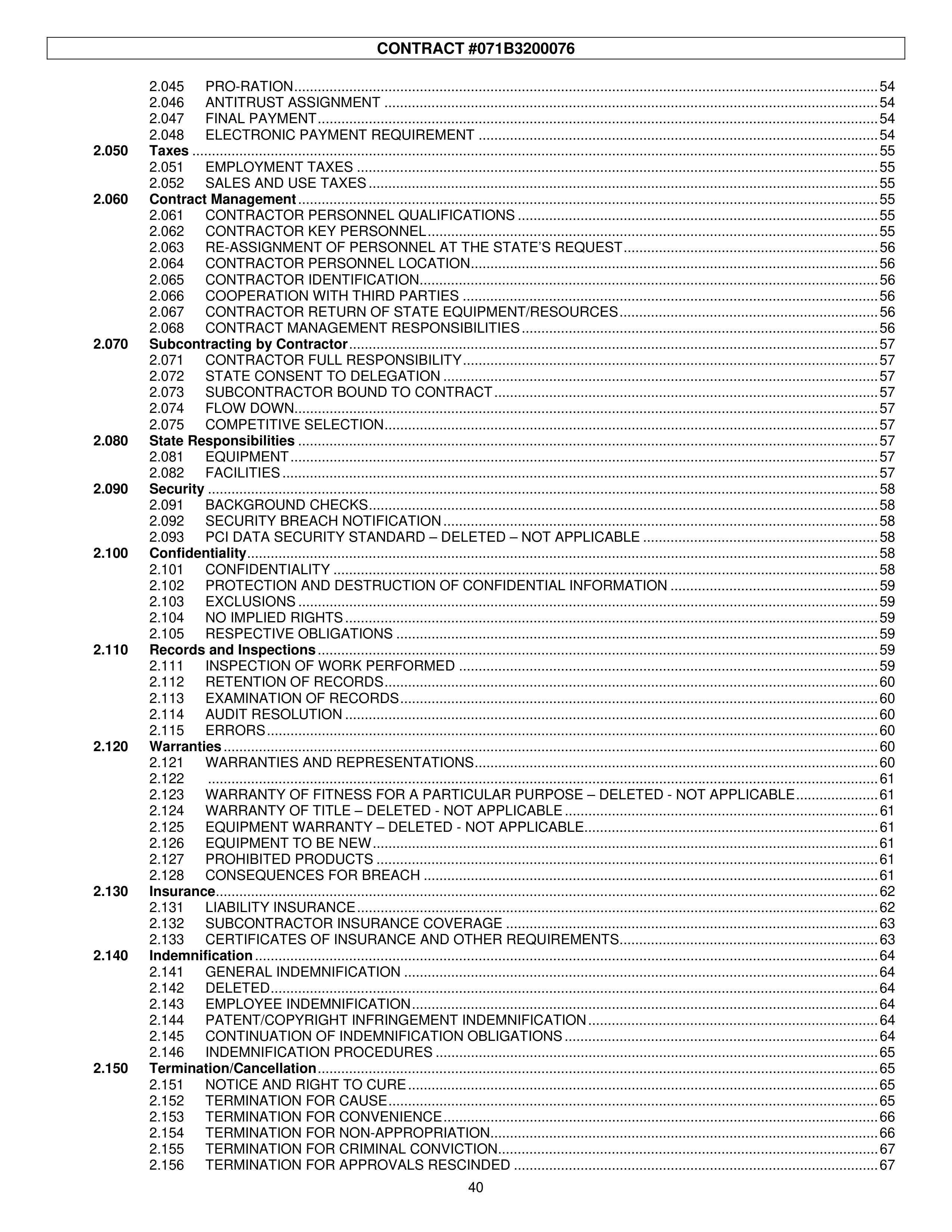
CONTRACT #071B3200076
40
2.045
PRO-RATION ..................................................................................................................................................... 54
2.046
ANTITRUST ASSIGNMENT .............................................................................................................................. 54
2.047
FINAL PAYMENT ............................................................................................................................................... 54
2.048
ELECTRONIC PAYMENT REQUIREMENT ...................................................................................................... 54
2.050
Taxes
............................................................................................................................................................................... 55
2.051
EMPLOYMENT TAXES ..................................................................................................................................... 55
2.052
SALES AND USE TAXES .................................................................................................................................. 55
2.060
Contract Management
.................................................................................................................................................... 55
2.061
CONTRACTOR PERSONNEL QUALIFICATIONS ............................................................................................ 55
2.062
CONTRACTOR KEY PERSONNEL ................................................................................................................... 55
2.063
RE-ASSIGNMENT OF PERSONNEL AT THE STATE’S REQUEST ................................................................. 56
2.064
CONTRACTOR PERSONNEL LOCATION ........................................................................................................ 56
2.065
CONTRACTOR IDENTIFICATION ..................................................................................................................... 56
2.066
COOPERATION WITH THIRD PARTIES .......................................................................................................... 56
2.067
CONTRACTOR RETURN OF STATE EQUIPMENT/RESOURCES .................................................................. 56
2.068
CONTRACT MANAGEMENT RESPONSIBILITIES ........................................................................................... 56
2.070
Subcontracting by Contractor
....................................................................................................................................... 57
2.071
CONTRACTOR FULL RESPONSIBILITY .......................................................................................................... 57
2.072
STATE CONSENT TO DELEGATION ............................................................................................................... 57
2.073
SUBCONTRACTOR BOUND TO CONTRACT .................................................................................................. 57
2.074
FLOW DOWN..................................................................................................................................................... 57
2.075
COMPETITIVE SELECTION .............................................................................................................................. 57
2.080
State Responsibilities
.................................................................................................................................................... 57
2.081
EQUIPMENT ...................................................................................................................................................... 57
2.082
FACILITIES ........................................................................................................................................................ 57
2.090
Security
........................................................................................................................................................................... 58
2.091
BACKGROUND CHECKS .................................................................................................................................. 58
2.092
SECURITY BREACH NOTIFICATION ............................................................................................................... 58
2.093
PCI DATA SECURITY STANDARD – DELETED – NOT APPLICABLE ............................................................ 58
2.100
Confidentiality
................................................................................................................................................................. 58
2.101
CONFIDENTIALITY ........................................................................................................................................... 58
2.102
PROTECTION AND DESTRUCTION OF CONFIDENTIAL INFORMATION ..................................................... 59
2.103
EXCLUSIONS .................................................................................................................................................... 59
2.104
NO IMPLIED RIGHTS ........................................................................................................................................ 59
2.105
RESPECTIVE OBLIGATIONS ........................................................................................................................... 59
2.110
Records and Inspections
............................................................................................................................................... 59
2.111
INSPECTION OF WORK PERFORMED ........................................................................................................... 59
2.112
RETENTION OF RECORDS .............................................................................................................................. 60
2.113
EXAMINATION OF RECORDS .......................................................................................................................... 60
2.114
AUDIT RESOLUTION ........................................................................................................................................ 60
2.115
ERRORS ............................................................................................................................................................ 60
2.120
Warranties
....................................................................................................................................................................... 60
2.121
WARRANTIES AND REPRESENTATIONS ....................................................................................................... 60
2.122
........................................................................................................................................................................... 61
2.123
WARRANTY OF FITNESS FOR A PARTICULAR PURPOSE – DELETED - NOT APPLICABLE ..................... 61
2.124
WARRANTY OF TITLE – DELETED - NOT APPLICABLE ................................................................................ 61
2.125
EQUIPMENT WARRANTY – DELETED - NOT APPLICABLE........................................................................... 61
2.126
EQUIPMENT TO BE NEW ................................................................................................................................. 61
2.127
PROHIBITED PRODUCTS ................................................................................................................................ 61
2.128
CONSEQUENCES FOR BREACH .................................................................................................................... 61
2.130
Insurance
......................................................................................................................................................................... 62
2.131
LIABILITY INSURANCE ..................................................................................................................................... 62
2.132
SUBCONTRACTOR INSURANCE COVERAGE ............................................................................................... 63
2.133
CERTIFICATES OF INSURANCE AND OTHER REQUIREMENTS .................................................................. 63
2.140
Indemnification
............................................................................................................................................................... 64
2.141
GENERAL INDEMNIFICATION ......................................................................................................................... 64
2.142
DELETED ........................................................................................................................................................... 64
2.143
EMPLOYEE INDEMNIFICATION ....................................................................................................................... 64
2.144
PATENT/COPYRIGHT INFRINGEMENT INDEMNIFICATION .......................................................................... 64
2.145
CONTINUATION OF INDEMNIFICATION OBLIGATIONS ................................................................................ 64
2.146
INDEMNIFICATION PROCEDURES ................................................................................................................. 65
2.150
Termination/Cancellation
............................................................................................................................................... 65
2.151
NOTICE AND RIGHT TO CURE ........................................................................................................................ 65
2.152
TERMINATION FOR CAUSE ............................................................................................................................. 65
2.153
TERMINATION FOR CONVENIENCE ............................................................................................................... 66
2.154
TERMINATION FOR NON-APPROPRIATION................................................................................................... 66
2.155
TERMINATION FOR CRIMINAL CONVICTION ................................................................................................. 67
2.156
TERMINATION FOR APPROVALS RESCINDED ............................................................................................. 67
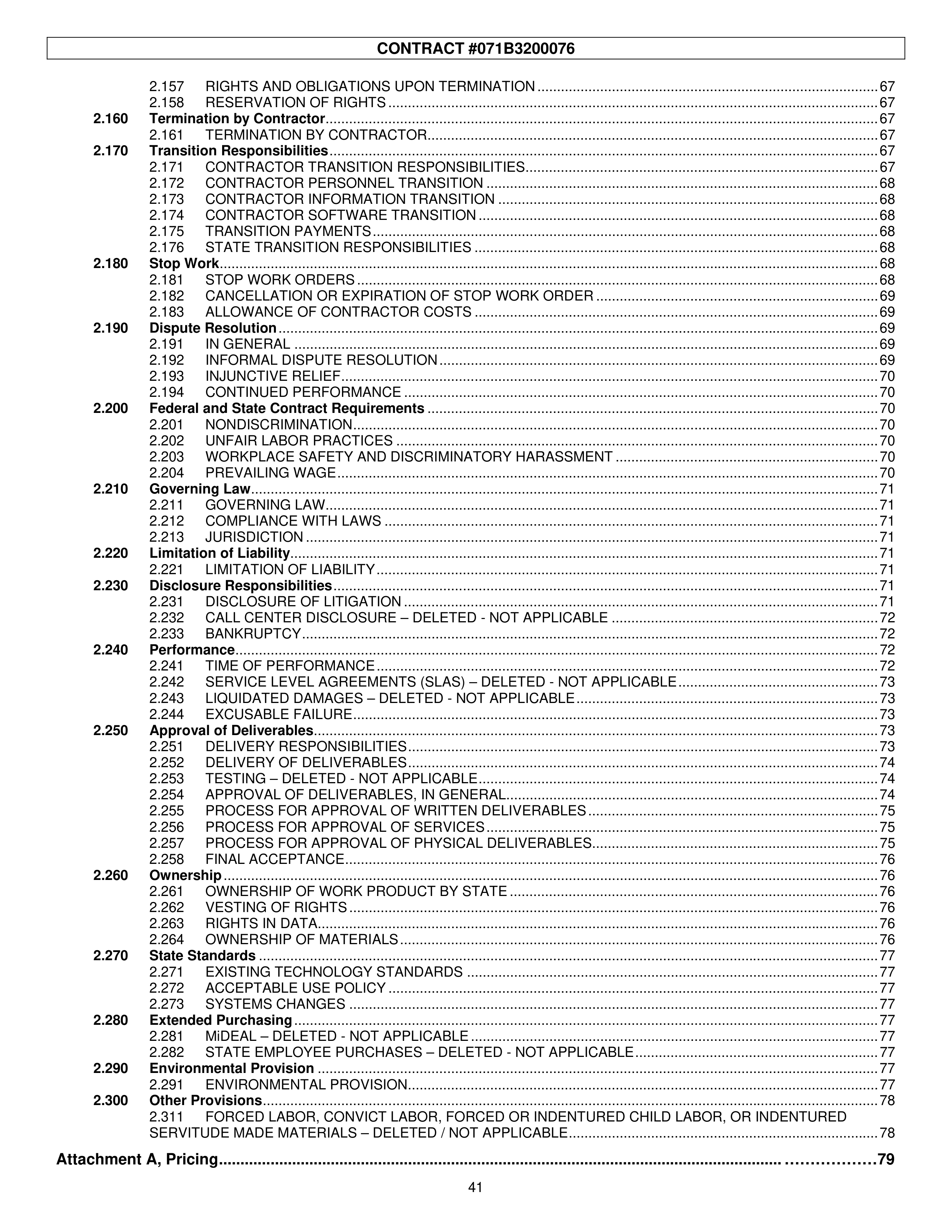
CONTRACT #071B3200076
41
2.157
RIGHTS AND OBLIGATIONS UPON TERMINATION ....................................................................................... 67
2.158
RESERVATION OF RIGHTS ............................................................................................................................. 67
2.160
Termination by Contractor
............................................................................................................................................. 67
2.161
TERMINATION BY CONTRACTOR ................................................................................................................... 67
2.170
Transition Responsibilities
............................................................................................................................................ 67
2.171
CONTRACTOR TRANSITION RESPONSIBILITIES .......................................................................................... 67
2.172
CONTRACTOR PERSONNEL TRANSITION .................................................................................................... 68
2.173
CONTRACTOR INFORMATION TRANSITION ................................................................................................. 68
2.174
CONTRACTOR SOFTWARE TRANSITION ...................................................................................................... 68
2.175
TRANSITION PAYMENTS ................................................................................................................................. 68
2.176
STATE TRANSITION RESPONSIBILITIES ....................................................................................................... 68
2.180
Stop Work
........................................................................................................................................................................ 68
2.181
STOP WORK ORDERS ..................................................................................................................................... 68
2.182
CANCELLATION OR EXPIRATION OF STOP WORK ORDER ........................................................................ 69
2.183
ALLOWANCE OF CONTRACTOR COSTS ....................................................................................................... 69
2.190
Dispute Resolution
......................................................................................................................................................... 69
2.191
IN GENERAL ..................................................................................................................................................... 69
2.192
INFORMAL DISPUTE RESOLUTION ................................................................................................................ 69
2.193
INJUNCTIVE RELIEF ......................................................................................................................................... 70
2.194
CONTINUED PERFORMANCE ......................................................................................................................... 70
2.200
Federal and State Contract Requirements
................................................................................................................... 70
2.201
NONDISCRIMINATION ...................................................................................................................................... 70
2.202
UNFAIR LABOR PRACTICES ........................................................................................................................... 70
2.203
WORKPLACE SAFETY AND DISCRIMINATORY HARASSMENT ................................................................... 70
2.204
PREVAILING WAGE .......................................................................................................................................... 70
2.210
Governing Law
................................................................................................................................................................ 71
2.211
GOVERNING LAW ............................................................................................................................................. 71
2.212
COMPLIANCE WITH LAWS .............................................................................................................................. 71
2.213
JURISDICTION .................................................................................................................................................. 71
2.220
Limitation of Liability
...................................................................................................................................................... 71
2.221
LIMITATION OF LIABILITY ................................................................................................................................ 71
2.230
Disclosure Responsibilities
........................................................................................................................................... 71
2.231
DISCLOSURE OF LITIGATION ......................................................................................................................... 71
2.232
CALL CENTER DISCLOSURE – DELETED - NOT APPLICABLE .................................................................... 72
2.233
BANKRUPTCY ................................................................................................................................................... 72
2.240
Performance
.................................................................................................................................................................... 72
2.241
TIME OF PERFORMANCE ................................................................................................................................ 72
2.242
SERVICE LEVEL AGREEMENTS (SLAS) – DELETED - NOT APPLICABLE ................................................... 73
2.243
LIQUIDATED DAMAGES – DELETED - NOT APPLICABLE ............................................................................. 73
2.244
EXCUSABLE FAILURE ...................................................................................................................................... 73
2.250
Approval of Deliverables
................................................................................................................................................ 73
2.251
DELIVERY RESPONSIBILITIES ........................................................................................................................ 73
2.252
DELIVERY OF DELIVERABLES ........................................................................................................................ 74
2.253
TESTING – DELETED - NOT APPLICABLE ...................................................................................................... 74
2.254
APPROVAL OF DELIVERABLES, IN GENERAL............................................................................................... 74
2.255
PROCESS FOR APPROVAL OF WRITTEN DELIVERABLES .......................................................................... 75
2.256
PROCESS FOR APPROVAL OF SERVICES .................................................................................................... 75
2.257
PROCESS FOR APPROVAL OF PHYSICAL DELIVERABLES......................................................................... 75
2.258
FINAL ACCEPTANCE ........................................................................................................................................ 76
2.260
Ownership
....................................................................................................................................................................... 76
2.261
OWNERSHIP OF WORK PRODUCT BY STATE .............................................................................................. 76
2.262
VESTING OF RIGHTS ....................................................................................................................................... 76
2.263
RIGHTS IN DATA ............................................................................................................................................... 76
2.264
OWNERSHIP OF MATERIALS .......................................................................................................................... 76
2.270
State Standards
.............................................................................................................................................................. 77
2.271
EXISTING TECHNOLOGY STANDARDS ......................................................................................................... 77
2.272
ACCEPTABLE USE POLICY ............................................................................................................................. 77
2.273
SYSTEMS CHANGES ....................................................................................................................................... 77
2.280
Extended Purchasing
..................................................................................................................................................... 77
2.281
MiDEAL – DELETED - NOT APPLICABLE ........................................................................................................ 77
2.282
STATE EMPLOYEE PURCHASES – DELETED - NOT APPLICABLE .............................................................. 77
2.290
Environmental Provision
............................................................................................................................................... 77
2.291
ENVIRONMENTAL PROVISION ........................................................................................................................ 77
2.300
Other Provisions
............................................................................................................................................................. 78
2.311
FORCED LABOR, CONVICT LABOR, FORCED OR INDENTURED CHILD LABOR, OR INDENTURED
SERVITUDE MADE MATERIALS – DELETED / NOT APPLICABLE ............................................................................... 78
Attachment A, Pricing ................................................................................................................................... ………………79

CONTRACT #071B3200076
42
CONTRACT #071B3200076
43
DEFINITIONS
24x7x365
means 24 hours a day, seven days a week, and 365 days a year (including the 366th day in a leap
year).
Additional Service
means any Services within the scope of the Contract, but not specifically provided under
any Statement of Work.
Audit Period
means the seven year period following Contractor’s provision of any work under the Contract.
Bidder(s)
are those companies that submit a proposal in response to this RFP.
Business Day
means any day other than a Saturday, Sunday or State-recognized legal holiday from 8:00am
EST through 5:00pm EST unless otherwise stated.
Blanket Purchase Order
is an alternate term for Contract.
CCI
means Contract Compliance Inspector.
Days
means calendar days unless otherwise specified.
Deleted – N/A
means that section is not applicable or included in this RFP. This is used as a placeholder to
maintain consistent numbering.
Deliverable
means physical goods and/or services required or identified in a Statement of Work.
DTMB
means the Michigan Department of Technology Management and Budget.
Environmentally Preferable Products
means a product or service that has a lesser or reduced effect on
human health and the environment when compared with competing products or services that serve the same
purpose. Such products or services may include, but are not limited to: those which contain recycled content,
minimize waste, conserve energy or water, and reduce the amount of toxics either disposed of or consumed.
Hazardous Material
means any material defined as hazardous under the latest version of federal Emergency
Planning and Community Right-to-Know Act of 1986 (including revisions adopted during the term of the
Contract).
Incident
means any interruption in any function performed for the benefit of a Plan Sponsor.
Key Personnel
means any personnel identified in
Section 1.031
as Key Personnel.
New Work
means any Services/Deliverables outside the scope of the Contract and not specifically provided
under any Statement of Work. “New Work” does not include Additional Service.
Ozone-depleting Substance
means any substance the Environmental Protection Agency designates in 40
CFR part 82 as: (1) Class I, including, but not limited to, chlorofluorocarbons, halons, carbon tetrachloride, and
methyl chloroform; or (2) Class II, including, but not limited to, hydrochlorofluorocarbons.
Post-Consumer Waste
means any product generated by a business or consumer which has served its
intended end use; and which has been separated or diverted from solid waste for the purpose of recycling into
a usable commodity or product, and which does not include post-industrial waste.
CONTRACT #071B3200076
44
Post-Industrial Waste
means industrial by-products which would otherwise go to disposal and wastes
generated after completion of a manufacturing process, but does not include internally generated scrap
commonly returned to industrial or manufacturing processes.
Recycling
means the series of activities by which materials that are no longer useful to the generator are
collected, sorted, processed, and converted into raw materials and used in the production of new products.
This definition excludes the use of these materials as a fuel substitute or for energy production.
Reuse
means using a product or component of municipal solid waste in its original form more than once.
RFP
means a Request for Proposal designed to solicit proposals for services.
Services
means any function performed for the benefit of the State by the Contractor or its Subcontractors
under this Contract, including functions performed under a Statement of Work, Purchase Order, Blanket
Purchase Order, Direct Voucher, and Procurement Card Order issued under this Contract.
SLA
means Service Level Agreement.
Source Reduction
means any practice that reduces the amount of any hazardous substance, pollutant, or
contaminant entering any waste stream or otherwise released into the environment prior to recycling, energy
recovery, treatment, or disposal.
State Location
means any physical location where the State performs work. State Location may include
state-owned, leased, or rented space.
Subcontractor
means a company selected by the Contractor to perform a portion of the Services, but does
not include independent contractors engaged by Contractor solely in a staff augmentation role.
Unauthorized Removal
means the Contractor’s removal of Key Personnel without the prior written consent of
the State.
Waste Prevention
means source reduction and reuse, but not recycling.
Pollution Prevention
means the practice of minimizing the generation of waste at the source and, when
wastes cannot be prevented, utilizing environmentally sound on-site or off-site reuse and recycling. The term
includes equipment or technology modifications, process or procedure modifications, product reformulation or
redesign, and raw material substitutions. Waste treatment, control, management, and disposal are not
considered pollution prevention, per the definitions under Part 143, Waste Minimization, of the Natural
Resources and Environmental Protection Act (NREPA), 1994 PA 451, as amended.
Work Product
refers to any data compilations, reports, and other media, materials, or other objects or works
of authorship created or produced by the Contractor as a result of an in furtherance of performing the services
required by the Contract.
CONTRACT #071B3200076
45
Article 1 – Statement of Work (SOW)
1.010
Project Identification
1.011 Project Request
This is a Pre-Qualified Contract to provide consulting services for post-employee-survey change management
activities for all State Agencies/Organizational Units and the Michigan Economic Development Corporation
(MEDC). The State of Michigan reserves the right to open up prequalification on an annual basis.
1.012 Background
An employee survey was administered to all State and MEDC employees in the spring of 2012 to measure
employee engagement and perceptions of diversity and inclusion, their job, supervision, leadership, work
environment, and communications. Information was obtained from over 27,000 employees representing 20
agencies/organizational units within the State and MEDC. Results were presented on both the Statewide and
agency levels. The survey, with its focus on employee engagement, is one of the foundational elements of the
Governor’s program to reinvent State government—“Good Government.” Agencies are responsible for
assessing and leveraging the results of this survey to establish goals and specific metrics and to track changes
in those metrics over the next year.
1.020
Scope of Work and Deliverables
1.021 In Scope
The Contractor is responsible for addressing change management activities in an agency by leveraging the
results of the employee survey to develop specific activities to better understand root-cause issues;
recommend a program of change management to address; and develop metrics/measures to monitor progress
and effectiveness. Activities must be agency-wide, can reflect a variety of organizational development
strategies, and are to be focused on any or all of the areas that were identified as significant opportunities in
the 2012 employee survey. The scope and duration of efforts can vary by agency and can include all or a
subset of the work and deliverables identified below.
When a State Agency/Organizational Unit or the MEDC establishes a need for services, a specific statement of
work will be formalized and proposals will be solicited from the prequalified Contractors utilizing a second tier
competitive selection process. The requesting State Agency/Organizational Unit or the MEDC will be
responsible for facilitating the second tier selection process for each specific statement of work that is issued.
The specific statement of work will identify, at a minimum, the period of performance, deliverables, specific
response information required and any special terms and conditions that are associated with the individual
statement of work. Price proposals for each specific statement of work must be provided on a deliverable(s)
basis (please reference
Attachment A
for the second tier competitive bidding process pricing proposal
format). The requesting State Agency/Organizational Unit or the MEDC will evaluate the bid responses and will
make an award recommendation to the Department of Technology, Management and Budget (DTMB). DTMB
will then review the award recommendation and, if approved, will add the associated statement of work and the
necessary funding to the selected Contractor’s primary Contract.
1.022 Work and Deliverables
The Contractor must provide Deliverables/Services and staff, and otherwise do all things necessary for or
incidental to the performance of work, as set forth below:
The Contractor may be required to perform any or all of the following activities, depending upon the request
from the State Agency/Organizational Unit or the MEDC during the second tier competitive bidding process:
1. Meet with agency executive team to review and discuss the statewide and agency survey report and
metrics, including the relationship of the survey responses to various demographics, organizational
units, and geography. Provide additional analyses to clarify issues relative to the State of Michigan
(SOM) as a whole and the individual agency. Provide context via benchmarking data and best
CONTRACT #071B3200076
46
practices. Highlight the strengths and opportunities for improvement uncovered in the analysis. Discuss
concerns and agree on priority items for making the highest-impact improvements.
2. Recommend strategy and approach to address major issues and items identified in Task 1. Assess
organizational readiness for change activities, identify challenges/barriers, develop strategies to
overcome, adjusting as needed and providing a high-level plan with timelines.
3. Consult with the Good Government team regarding statewide strategy/planning for employee survey
follow-up. Integrate with agency’s recommendations and facilitate alignment if needed.
4. Work jointly with agency staff to recommend and structure activities to gather additional employee input
for determining root cause of key areas underlying/undermining employee engagement.
c. Design and conduct focus groups to include participant selection/set-up, discussion guides, and
focus group moderating/facilitation. Brainstorm new roles, innovative ideas, and new
approaches with employees. Provide reports summarizing key findings and next steps.
d. Design, administer and conduct pulse surveys, as needed, and provide results; analyze and
integrate results into overall plan.
5. Develop an agency-specific action plan that includes timelines and steps to address issues identified in
the survey and from activities in Task 4. The action plan must identify best practices, within the agency
(or the SOM if not available in the agency), that can immediately be leveraged to address identified
issues.
6. Design, administer and conduct pulse surveys to track progress on agency action planning activities.
Provide results and assessment of progress to agency executive team.
7. Recommend next steps, additional activities, metrics and measures, and changes in approach based
on progress and interim data. Develop strategy for communicating the action plan and progress made.
Include as part of the communication strategy recommendations for frequency, content, tone, methods
and sharing of success stories and impact of survey data over the course of the year.
8. Propose, design and administer staff training as needed to address identified issues most effectively
resolved via training.
9. Propose a framework for the overall analysis of the effectiveness of agency Year 1 efforts, including
progress on key metrics.
10. Based on agency-level activities, recommend enterprise-level strategies, activities, and/or metrics that
would enhance the overall goals of Good Government.
11. Knowledge transfer: Train key staff throughout the duration of the Contract, in partnership with the
agency, and identify resources to provide ongoing support for the agency’s various change
management efforts.
1.030
Roles and Responsibilities
1.031 Contractor Staff, Roles, and Responsibilities
Key Personnel are listed below:
Todd Hoffman – Relationship Partner
Phone: (713) 356-8440
Email:
todd.hoffman@pwc.com
Robert Tate – Project Director
Phone: (408) 817-5896
Email: robert.tate@us.pwc.com
CONTRACT #071B3200076
47
If the proposed staff is unavailable at the time that the second tier competitive bid process is utilized the
Contractor must propose new staff members, in their response to the second tier competitive bid, that would be
assigned to the project. The new staff members will be evaluated per the instructions identified in the second
tier bid process.
1.040
Project Plan
1.041 Project Plan Management
The Contractor must use a standard project management methodology that lists tasks, timelines, and critical
dependencies. Weekly status reports must be provided to the agency project manager. Frequency of
meetings will be determined by the agency and the Contractor based on need, status/progress, issues or
challenges, and criticality of project stages.
If additional project plan management deliverables are required, they will be identified in the State
Agencies/Organizational Units or MEDC’s individual statements of work that will be issued during the second
tier competitive bidding process.
1.042 Reports
Weekly reports, based on tasks and timelines, must be provided to the agency. Areas where the Contractor
failed to meet timeframes must be highlighted and corrective action identified. Recommendations for changes
in course of action must be included when and where relevant.
If additional specific reports are required, they must be identified in the State Agencies/Organizational Units or
MEDC’s individual statements of work that will be issued during the second tier competitive bidding process.
1.050
Acceptance
1.051 Criteria
The following criteria will be used by the State to determine Acceptance of the Services or Deliverables
provided under this SOW:
Deliverables must be submitted in accordance to the project plan that is associated with each individual
statement of work that is awarded under the second tier competitive bid process. The deliverables will be
reviewed and accepted by the requesting State Agency/Organizational Unit or the MEDC
in accordance to the
requirements for each deliverable. The agency project manager will formally approve each deliverable on
behalf of the team.
Invoices must be submitted to the requesting State Agency/Organizational Unit or the MEDC in accordance
with the specific statement of work that is issued during the second tier competitive bidding process.
1.052 Final Acceptance – Deleted - Not Applicable
1.060
Proposal Pricing
1.061 Proposal Pricing
Final pricing per deliverable(s), per each individual statement of work, must be submitted during the second tier
competitive bidding process.
Contractors are encouraged to offer quick payment terms (i.e. _____% discount off invoice if paid within _____
days). This information can be noted on the Contractor’s price proposal during the second tier competitive
bidding process. This may be a factor considered in our award decision.
Contractor’s out-of-pocket expenses are not separately reimbursable by the State unless, on a case-by-case
basis for unusual expenses, the State has agreed in advance and in writing to reimburse Contractor for the
expense at the State’s current travel reimbursement rates. See
www.michigan.gov/dtmb
for current rates.
CONTRACT #071B3200076
48
1.062 Price Term
Prices quoted are firm for the entire length of the Contract.
1.063 Tax Excluded from Price
(a)
Sales Tax: For purchases made directly by the State, the State is exempt from State and Local Sales
Tax. Prices must not include the taxes. Exemption Certificates for State Sales Tax will be furnished upon
request.
(b)
Federal Excise Tax: The State may be exempt from Federal Excise Tax, or the taxes may be
reimbursable, if articles purchased under any resulting Contract are used for the State’s exclusive use.
Certificates showing exclusive use for the purposes of substantiating a tax-free or tax-reimbursable sale will be
sent upon request. If a sale is tax exempt or tax reimbursable under the Internal Revenue Code, prices must
not include the Federal Excise Tax.
1.064 Holdback – Deleted - Not Applicable
1.070 Additional Requirements
1.071 Additional Terms and Conditions specific to this RFP – Deleted - Not Applicable
CONTRACT #071B3200076
49
Article 2, Terms and Conditions
2.000
Contract Structure and Term
2.001 Contract Term
The Contract is for a period of two years beginning April 24, 2013 through February 10, 2015. All outstanding
Purchase Orders must also expire upon the termination (cancellation for any of the reasons listed in
Section
2.150
) of the Contract, unless otherwise extended under the Contract. Absent an early termination for any
reason, Purchase Orders issued but not expired, by the end of the Contract’s stated term, will remain in effect
for the balance of the fiscal year for which they were issued.
2.002 Options to Renew
The Contract may be renewed in writing by mutual agreement of the parties not less than 30 days before its
expiration. The Contract may be renewed for up to two additional two year periods.
2.003 Legal Effect
Contractor must show acceptance of the Contract by signing two copies of the Contract and returning them to
the Contract Administrator. The Contractor must not proceed with the performance of the work to be done
under the Contract, including the purchase of necessary materials, until both parties have signed the Contract
to show acceptance of its terms, and the Contractor receives a Contract release/purchase order that
authorizes and defines specific performance requirements.
Except as otherwise agreed in writing by the parties, the State assumes no liability for costs incurred by
Contractor or payment under the Contract, until Contractor is notified in writing that the Contract (or Change
Order) has been approved by the State Administrative Board (if required), approved and signed by all the
parties, and a Purchase Order against the Contract has been issued.
2.004 Attachments & Exhibits
All Attachments and Exhibits affixed to any and all Statement(s) of Work, or appended to or referencing the
Contract, are incorporated in their entirety and form part of the Contract.
2.005 Ordering
The State will issue a written Purchase Order, Blanket Purchase Order, Direct Voucher or Procurement Card
Order, which must be approved by the Contract Administrator or the Contract Administrator's designee, to
order any Services/Deliverables under the Contract. All orders are subject to the terms and conditions of the
Contract. No additional terms and conditions contained on either a Purchase Order or Blanket Purchase Order
apply unless they are also specifically contained in that Purchase Order's or Blanket Purchase Order's
accompanying Statement of Work. Exact quantities to be purchased are unknown, however, the Contractor
must furnish all such materials and services as may be ordered during the CONTRACT period. Quantities
specified, if any, are estimates based on prior purchases, and the State is not obligated to purchase in these or
any other quantities.
2.006 Order of Precedence
(a)
The Contract, including any Statements of Work and Exhibits, to the extent not contrary to the Contract,
each of which is incorporated for all purposes, constitutes the entire agreement between the parties with
respect to the subject matter and supersedes all prior agreements, whether written or oral, with respect to the
subject matter and as additional terms and conditions on the purchase order must apply as limited by
Section
2.005.
(b)
In the event of any inconsistency between the terms of the Contract and a Statement of Work, the
terms of the Statement of Work will take precedence (as to that Statement of Work only); provided, however,
that a Statement of Work may not modify or amend the terms of the Contract, which may be modified or
amended only by a formal Contract amendment.
CONTRACT #071B3200076
50
2.007 Headings
Captions and headings used in the Contract are for information and organization purposes. Captions and
headings, including inaccurate references, do not, in any way, define or limit the requirements or terms and
conditions of the Contract.
2.008 Non-exclusivity
The parties agree that a State agency is not required to procure the Deliverables/Services described in this
Contract from Contractor, and that any State agency may procure the Deliverables/Services under this
Contract from any other vendor or through any other contract vehicle.
2.009 Reformation and Severability
Each provision of the Contract is severable from all other provisions of the Contract and, if one or more of the
provisions of the Contract is declared invalid, the remaining provisions of the Contract remain in full force and
effect.
2.010 Consents and Approvals
Except as expressly provided otherwise in the Contract, if either party requires the consent or approval of the
other party for the taking of any action under the Contract, the consent or approval must be in writing and must
not be unreasonably withheld or delayed.
2.011 No Waiver of Default
If a party fails to insist upon strict adherence to any term of the Contract then the party has not waived the right
to later insist upon strict adherence to that term, or any other term, of the Contract.
2.012 Survival
Any provisions of the Contract that impose continuing obligations on the parties, including without limitation the
parties’ respective warranty, limitation of liability, indemnity and confidentiality obligations, survive the
expiration or termination of the Contract for any reason. Specific references to survival in the Contract are
solely for identification purposes and not meant to limit or prevent the survival of any other section.
2.013 Third Parties
Contractor is providing the Deliverables/ Services solely for the State’s use and benefit and pursuant to an
exclusive relationship with the State. Contractor disclaims any contractual or other responsibility or duty of care to
others based upon these Services or upon any Deliverables or advice provided.
2.020
Contract Administration
2.021 Issuing Office
The Contract is issued by the Department of Technology, Management and Budget, DTMB-Procurement on
behalf of all State Agencies/Organizational Units and the MEDC (collectively, including all other relevant State
of Michigan departments and agencies, the “State”). DTMB-Procurement is the sole point of contact in the
State with regard to all procurement and contractual matters relating to the Contract. DTMB-Procurement
is
the only State office authorized to change, modify, amend, alter or clarify the prices, specifications,
terms and conditions of the Contract.
The Contractor Administrator within DTMB-Procurement for the
Contract is:
Don Mandernach
Procurement
Department of Technology, Management and Budget
Mason Bldg, 2nd Floor
PO Box 30026
Lansing, MI 48909
mandernachd@michigan.gov
517-241-7233
CONTRACT #071B3200076
51
2.022 Contract Compliance Inspector
After DTMB-Procurement receives the properly executed Contract, it is anticipated that the Chief Procurement
Officer of DTMB-Procurement, in consultation with the applicable State Agency/Organizational Unit or the
MEDC, will direct the person named below, or any other person so designated, to monitor and coordinate the
activities for the Contract on a day-to-day basis during its term. However, monitoring of the Contract implies
no authority to change, modify, clarify, amend, or otherwise alter the prices, terms, conditions and
specifications of the Contract as that authority is retained by DTMB Procurement
. The CCI’s for the
Contract are:
TBD – Will be specified in each specific statement of work that is issued during the second tier
competitive selection process. The CCI’s will be specific to each State Agency/Organizational Unit or
the MEDC.
2.023 Project Manager
The following individual will oversee the project:
James Willems, State Administrative Manager, Office of Enterprise Development
Michigan Department of Technology, Management & Budget
Email: willemsJ@michigan.gov
Phone: (517) 335-2109
2.024 Change Requests
The State reserves the right to request, from time to time, any changes to the requirements and specifications
of the Contract and the work to be performed by the Contractor under the Contract. During the course of
ordinary business, it may become necessary for the State to discontinue certain business practices or create
Additional Services/Deliverables. At a minimum, to the extent applicable, the State would like the Contractor to
provide a detailed outline of all work to be done, including tasks necessary to accomplish the
services/deliverables, timeframes, listing of key personnel assigned, estimated hours for each individual per
task, and a cost justification.
If the Contractor does not so notify the State, the Contractor has no right to claim thereafter that it is entitled to
additional compensation for performing that service or providing that deliverable.
Change Requests:
(a)
By giving Contractor written notice within a reasonable time, the State must be entitled to accept
a Contractor proposal for Change, to reject it, or to reach another agreement with Contractor. Should
the parties agree on carrying out a Change, a written Contract Change Notice must be prepared and
issued under the Contract, describing the Change and its effects on the Services and any affected
components of the Contract (a “Contract Change Notice”).
(b)
No proposed Change may be performed until the proposed Change has been specified in a duly
executed Contract Change Notice issued by DTMB-Procurement and signed by both parties.
(c)
If the State requests or directs the Contractor to perform any activities that Contractor believes
constitute a Change, the Contractor must notify the State that it believes the requested activities are a
Change before beginning to work on the requested activities. If the Contractor fails to notify the State
before beginning to work on the requested activities, then the Contractor waives any right to assert any
claim for additional compensation or time for performing the requested activities. If the Contractor
commences performing work outside the scope of the Contract and then ceases performing that work,
the Contractor must, at the request of the State, retract any out-of-scope work that would adversely
affect the Contract.
2.025 Notices
Any notice given to a party under the Contract must be deemed effective, if addressed to the State contact as
noted in Section 2.021 and the Contractor’s contact as noted on the cover page of the contract, upon: (i)
delivery, if hand delivered; (ii) receipt of a confirmed transmission by facsimile if a copy of the notice is sent by
another means specified in this Section; (iii) the third Business Day after being sent by U.S. mail, postage pre-
paid, return receipt requested; or (iv) the next Business Day after being sent by a nationally recognized
overnight express courier with a reliable tracking system.
CONTRACT #071B3200076
52
Either party may change its address where notices are to be sent by giving notice according to this Section.
2.026 Binding Commitments
Representatives of Contractor must have the authority to make binding commitments on Contractor’s behalf
within the bounds set forth in the Contract. Contractor may change the representatives from time to time upon
written notice.
2.027 Relationship of the Parties
The relationship between the State and Contractor is that of client and independent contractor. No agent,
employee, or servant of Contractor or any of its Subcontractors must be deemed to be an employee, agent or
servant of the State for any reason. Contractor is solely and entirely responsible for its acts and the acts of its
agents, employees, servants and Subcontractors during the performance of the Contract.
2.028 Covenant of Good Faith
Each party must act reasonably and in good faith. Unless stated otherwise in the Contract, the parties must
not unreasonably delay, condition, or withhold the giving of any consent, decision, or approval that is either
requested or reasonably required of them in order for the other party to perform its responsibilities under the
Contract.
2.029 Assignments
(a)
Neither party may assign the Contract, or assign or delegate any of its duties or obligations under the
Contract, to any other party (whether by operation of law or otherwise), without the prior written consent of the
other party. Contractor is the U.S. firm of the global network of separate and independent
PricewaterhouseCoopers firms (exclusive of Contractor, the "Other PwC Firms"). Contractor may draw on the
resources of or contract with its subsidiaries, the Other PwC Firms, and third party contractors, in each case
within or outside of the United States (each, a "PwC Subcontractor") for internal, administrative, or regulatory
compliance purposes. The State may withhold consent from proposed assignments, subcontracts, or
novations when the transfer of responsibility would operate to decrease the State’s likelihood of receiving
performance on the Contract or the State’s ability to recover damages.
(b)
Contractor may not, without the prior written approval of the State, assign its right to receive payments
due under the Contract. If the State permits an assignment, the Contractor is not relieved of its responsibility
to perform any of its contractual duties, and the requirement under the Contract that all payments must be
made to one entity continues.
(c)
If the Contractor intends to assign the Contract or any of the Contractor's rights or duties under the
Contract, the Contractor must notify the State in writing at least 90 days before the assignment. The
Contractor also must provide the State with adequate information about the assignee within a reasonable
amount of time before the assignment for the State to determine whether to approve the assignment.
(d)
The State agrees that Contractor may provide information Contractor receives in connection with this
Contract to each PwC Subcontractor to perform the Services and/or for internal administrative and regulatory
compliance purposes. Contractor will be solely responsible for the provision of the Services and Deliverables
(including those performed by the PwC Subcontractors) and the PwC Subcontractors, their and Contractor's
respective partners, principals or employees (collectively the "Beneficiaries") shall have no liability or
obligations arising out of this Contract. The State agrees to bring any claim or other legal proceeding of any
nature arising from the Services or Deliverables against Contractor and not against the Beneficiaries. While
Contractor is entering into this Contract on its own behalf, this section also is intended for the benefit of each
PwC Subcontractor.
2.030
General Provisions
2.031 Media Releases
News releases (including promotional literature and commercial advertisements) pertaining to the RFP and
Contract or project to which it relates must not be made without prior written State approval, and then only in
CONTRACT #071B3200076
53
accordance with the explicit written instructions from the State. No results of the activities associated with the
RFP and Contract are to be released without prior written approval of the State and then only to persons
designated.
2.032 Contract Distribution
DTMB-Procurement retains the sole right of Contract distribution to all State agencies and local units of
government unless other arrangements are authorized by DTMB-Procurement.
2.033 Permits
Contractor must obtain and pay any associated costs for all required governmental permits, licenses and
approvals for the delivery, installation and performance of the Services. The State must pay for all costs and
expenses incurred in obtaining and maintaining any necessary easements or right of way.
2.034 Website Incorporation
The State is not bound by any content on the Contractor’s website, even if the Contractor’s documentation
specifically referenced that content and attempts to incorporate it into any other communication, unless the
State has actual knowledge of the content and has expressly agreed to be bound by it in a writing that has
been manually signed by an authorized representative of the State.
2.035 Future Bidding Preclusion
Contractor acknowledges that, to the extent the Contract involves the creation, research, investigation or
generation of a future RFP, it may be precluded from bidding on the subsequent RFP. The State reserves the
right to disqualify any bidder if the State determines that the bidder has used its position (whether as an
incumbent Contractor, or as a Contractor hired to assist with the RFP development, or as a Vendor offering
free assistance) to gain a competitive advantage on the RFP.
2.036 Freedom of Information
All information in any proposal submitted to the State by Contractor and the Contract is subject to the
provisions of the Michigan Freedom of Information Act, 1976 PA 442, MCL 15.231, et seq (the “FOIA”).
2.037 Disaster Recovery
Contractor and the State recognize that the State provides essential services in times of natural or man-made
disasters. Therefore, except as so mandated by Federal disaster response requirements, Contractor
personnel dedicated to providing Services/Deliverables under the Contract must provide the State with service
for repair and work around in the event of a natural or man-made disaster.
2.040
Financial Provisions
2.041 Fixed Prices for Services/Deliverables
Each Statement of Work or Purchase Order issued under the Contract must specify (or indicate by reference to
the appropriate Contract Exhibit) the firm, fixed prices for all Services/Deliverables, and the associated
payment milestones and payment amounts. The State may make progress payments to the Contractor when
requested as work progresses, but not more frequently than monthly, in amounts approved by the Contract
Administrator, after negotiation. Contractor must show verification of measurable progress at the time of
requesting progress payments.
2.042 Adjustments for Reductions in Scope of Services/Deliverables
If the scope of the Services/Deliverables under any Statement of Work issued under the Contract is
subsequently reduced by the State, the parties must negotiate an equitable reduction in Contractor’s charges
under such Statement of Work commensurate with the reduction in scope.
2.043 Services/Deliverables Covered
For all Services/Deliverables to be provided by Contractor (and its Subcontractors, if any) under the Contract,
the State must not be obligated to pay any amounts in addition to the charges specified in the Contract.
CONTRACT #071B3200076
54
2.044 Invoicing and Payment – In General
(a)
Each Statement of Work issued under the Contract must list (or indicate by reference to the appropriate
Contract Exhibit) the prices for all Services/Deliverables, equipment and commodities to be provided, and the
associated payment milestones and payment amounts.
(b)
Each Contractor invoice must show details as to charges by Service/Deliverable component and
location at a level of detail reasonably necessary to validate that the amounts invoiced comply with the terms of
the Contract. Invoices for Services performed on a time and materials basis must show, for each individual,
the number of hours of Services performed during the billing period, the billable skill/labor category for such
person and the applicable hourly billing rate. Prompt payment by the State is contingent on the Contractor’s
invoices showing the amount owed by the State minus any holdback amount to be retained by the State in
accordance with
Section 1.064
.
(c)
Correct invoices will be due and payable by the State, in accordance with the State’s standard payment
procedure as specified in 1984 PA 279, MCL 17.51 et seq., within 45 days after receipt, provided the State
determines that the invoice was properly rendered.
(d)
All invoices should reflect actual work done. Specific details of invoices and payments will be agreed
upon between the CCI and the Contractor. Twenty percent of the total price of each invoice will be held back
and will be issued as a final payment after final acceptance.
The specific payment schedule for any Contract(s) entered into, as the State and the Contractor(s) must
mutually agree upon. The schedule must show payment amount and must reflect actual work done by the
payment dates, less any penalty cost charges accrued by those dates. As a general policy, statements must
be forwarded to the designated representative by the 15th day of the following month.
The State may make progress payments to the Contractor when requested as work progresses, but not more
frequently than monthly, in amounts approved by the CCI, after negotiation. Contractor must show verification
of measurable progress at the time of requesting progress payments.
2.045 Pro-ration
To the extent there are any Services that are to be paid for on a monthly basis, the cost of such Services must
be pro-rated for any partial month.
2.046 Antitrust Assignment
The Contractor assigns to the State any claim for overcharges resulting from antitrust violations to the extent
that those violations concern materials or services supplied by third parties to the Contractor, toward fulfillment
of the Contract.
2.047 Final Payment
The making of final payment by the State to Contractor does not constitute a waiver by either party of any
rights or other claims as to the other party’s continuing obligations under the Contract, nor will it constitute a
waiver of any claims by one party against the other arising from unsettled claims or failure by a party to comply
with the Contract, including claims for Services and Deliverables not reasonably known until after acceptance
to be defective or substandard. Contractor’s acceptance of final payment by the State under the Contract must
constitute a waiver of all claims by Contractor against the State for payment under the Contract, other than
those claims previously filed in writing on a timely basis and still unsettled.
2.048 Electronic Payment Requirement
Electronic transfer of funds is required for payments on State contracts. The Contractor must register with the
State electronically at
http://www.cpexpress.state.mi.us
. As stated in 1984 PA 431, all contracts that the State
enters into for the purchase of goods and services must provide that payment will be made by Electronic Fund
Transfer (EFT).
CONTRACT #071B3200076
55
2.050
Taxes
2.051 Employment Taxes
Contractors are expected to collect and pay all applicable federal, state, and local employment taxes.
2.052 Sales and Use Taxes
Contractors are required to be registered and to remit sales and use taxes on taxable sales of tangible
personal property or services delivered into the State. Contractors that lack sufficient presence in Michigan to
be required to register and pay tax must do so as a volunteer. This requirement extends to: (1) all members of
any controlled group as defined in § 1563(a) of the Internal Revenue Code and applicable regulations of which
the company is a member, and (2) all organizations under common control as defined in § 414(c) of the
Internal Revenue Code and applicable regulations of which the company is a member that make sales at retail
for delivery into the State are registered with the State for the collection and remittance of sales and use taxes.
In applying treasury regulations defining “two or more trades or businesses under common control” the term
“organization” means sole proprietorship, a partnership (as defined in § 701(a)(2) of the Internal Revenue
Code), a trust, an estate, a corporation, or a limited liability company.
2.060
Contract Management
2.061 Contractor Personnel Qualifications
All persons assigned by Contractor to the performance of Services under the Contract must be employees of
Contractor or its majority-owned (directly or indirectly, at any tier) subsidiaries (or a State-approved
Subcontractor) and must be fully qualified to perform the work assigned to them. Contractor must include a
similar provision in any subcontract entered into with a Subcontractor. For the purposes of the Contract,
independent contractors engaged by Contractor solely in a staff augmentation role must be treated by the
State as if they were employees of Contractor for the Contract only; however, the State understands that the
relationship between Contractor and Subcontractor is an independent contractor relationship.
2.062 Contractor Key Personnel
(a)
The Contractor must provide the CCI with the names of the Key Personnel.
(b)
Key Personnel must be dedicated as defined in the Statement of Work to the Project for its duration in
the applicable Statement of Work with respect to other individuals designated as Key Personnel for that
Statement of Work.
(c)
The State reserves the right to recommend and approve in writing the initial assignment, as well as any
proposed reassignment or replacement, of any Key Personnel. Before assigning an individual to any Key
Personnel position, Contractor must notify the State of the proposed assignment, must introduce the individual
to the appropriate State representatives, and must provide the State with a resume and any other information
about the individual reasonably requested by the State. The State reserves the right to interview the individual
before granting written approval. In the event the State finds a proposed individual unacceptable, the State
must provide a written explanation including reasonable detail outlining the reasons for the rejection.
(d)
Contractor must not remove any Key Personnel from their assigned roles on the Contract without the
prior written consent of the State. The Contractor’s removal of Key Personnel without the prior written consent
of the State is an unauthorized removal (“Unauthorized Removal”). Unauthorized Removals does not include
replacing Key Personnel for reasons beyond the reasonable control of Contractor, including illness, disability,
leave of absence, personal emergency circumstances, resignation or for cause termination of the Key
Personnel’s employment. Unauthorized Removals does not include replacing Key Personnel because of
promotions or other job movements allowed by Contractor personnel policies or Collective Bargaining
Agreement(s) as long as the State receives prior written notice before shadowing occurs and Contractor
provides 30 days of shadowing unless parties agree to a different time period. The Contractor with the State
must review any Key Personnel replacements and appropriate transition planning must be established. Any
Unauthorized Removal may be considered by the State to be a material breach of the Contract, in respect of
which the State may elect to exercise its termination and cancellation rights.
CONTRACT #071B3200076
56
(e)
The Contractor must notify the Contract Compliance Inspector and the Contract Administrator at least
10 business days before redeploying non-Key Personnel, who are dedicated to primarily to the Project, to other
projects. If the State does not object to the redeployment by its scheduled date, the Contractor may then
redeploy the non-Key Personnel.
2.063 Re-assignment of Personnel at the State’s Request
The State reserves the right to require the removal from the Project of Contractor personnel found, in the
judgment of the State, to be unacceptable. The State’s request must be written with reasonable detail outlining
the reasons for the removal request. Additionally, the State’s request must be based on legitimate, good-faith
reasons. Replacement personnel for the removed person must be fully qualified for the position. If the State
exercises this right, and the Contractor cannot immediately replace the removed personnel, the State agrees to
an equitable adjustment in schedule or other terms that may be affected by the State’s required removal. If
any incident with removed personnel results in delay not reasonably anticipatable under the circumstances and
which is attributable to the State, the applicable SLAs for the affected Service will not be counted for a time as
agreed to by the parties.
2.064 Contractor Personnel Location
All staff assigned by Contractor to work on the Contract must perform their duties either primarily at
Contractor’s offices and facilities or at State facilities. Without limiting the generality of the foregoing, Key
Personnel must, at a minimum, spend at least the amount of time on-site at State facilities as indicated in the
applicable Statement of Work. Subject to availability, selected Contractor personnel may be assigned office
space to be shared with State personnel.
2.065 Contractor Identification
Contractor employees must be clearly identifiable while on State property by wearing a State-issued badge, as
required. Contractor employees are required to clearly identify themselves and the company they work for
whenever making contact with State personnel by telephone or other means.
2.066 Cooperation with Third Parties
Contractor must cause its personnel and the personnel of any Subcontractors to cooperate with the State and
its agents and other contractors including the State’s Quality Assurance personnel. As reasonably requested
by the State in writing, the Contractor must provide to the State’s agents and other contractors (provided such
agents and other contractors are bound by a confidentiality agreement protecting Contractor's Confidential
Information) reasonable access to Contractor’s Project personnel to the extent the access relates to activities
specifically associated with the Contract and will not interfere or jeopardize the safety or services of the
personnel. The State acknowledges that Contractor’s time schedule for the Contract is very specific and the
State will not unnecessarily or unreasonably interfere with, delay, or otherwise impede Contractor’s
performance under the Contract with the requests for access.
2.067 Contractor Return of State Equipment/Resources
The Contractor must return to the State any State-furnished equipment, facilities, and other resources when no
longer required for the Contract in the same condition as when provided by the State, reasonable wear and
tear excepted.
2.068 Contract Management Responsibilities
The Contractor must assume responsibility for all Services and Deliverables under the Contract, whether or not
that Contractor performs them. Further, the State considers the Contractor to be the sole point of contact with
regard to its Services and Deliverables, including payment of any and all charges resulting from the anticipated
Contract. If any part of the work is to be subcontracted, the Contract must include a list of Subcontractors,
including firm name and address, contact person and a complete description of work to be subcontracted. The
State reserves the right to approve Subcontractors and to require the Contractor to replace Subcontractors
found to be unacceptable. The Contractor is totally responsible for adherence by the Subcontractor to all
provisions of the Contract. Any change in Subcontractors must be approved by the State, in writing, prior to
such change.
CONTRACT #071B3200076
57
2.070
Subcontracting by Contractor
2.071 Contractor Full Responsibility
Contractor has full responsibility for the successful performance and completion of all of the Services and
Deliverables. The State will consider Contractor to be the sole point of contact with regard to all Contractor
Services and Deliverables contractual matters under the Contract, including payment of any and all charges for
Services and Deliverables.
2.072 State Consent to Delegation
Contractor must not delegate any duties under the Contract to a Subcontractor unless the DTMB-Procurement
has given written consent to such delegation. The State reserves the right of prior written approval of all
Subcontractors and to require Contractor to replace any Subcontractors found, in the reasonable judgment of
the State, to be unacceptable. The State’s request must be written with reasonable detail outlining the reasons
for the removal request. Additionally, the State’s request must be based on legitimate, good-faith reasons.
Replacement Subcontractor(s) for the removed Subcontractor must be fully qualified for the position. If the
State exercises this right, and the Contractor cannot immediately replace the removed Subcontractor, the State
will agree to an equitable adjustment in schedule or other terms that may be affected by the State’s required
removal. If any such incident with a removed Subcontractor results in delay not reasonable anticipatable under
the circumstances and which is attributable to the State, the applicable SLA for the affected Work will not be
counted for a time agreed upon by the parties.
2.073 Subcontractor Bound to Contract
In any subcontracts entered into by Contractor for the performance of the Services, Contractor must require
the Subcontractor, to the extent of the Services to be performed by the Subcontractor, to be bound to
Contractor by the terms of the Contract and to assume toward Contractor all of the obligations and
responsibilities that Contractor, by the Contract, assumes toward the State. The State reserves the right to
receive copies of and review all subcontracts, although Contractor may delete or mask any proprietary
information, including pricing, contained in such contracts before providing them to the State. The
management of any Subcontractor is the responsibility of Contractor, and Contractor must remain responsible
for the performance of its Subcontractors to the same extent as if Contractor had not subcontracted such
performance. Contractor must make all payments to Subcontractors or suppliers of Contractor. Except as
otherwise agreed in writing by the State and Contractor, the State will not be obligated to direct payments for
the Services other than to Contractor. The State’s written approval of any Subcontractor engaged by
Contractor to perform any obligation under the Contract will not relieve Contractor of any obligations or
performance required under the Contract.
2.074 Flow Down
Except where specifically approved in writing by the State on a case-by-case basis, Contractor must flow down
the obligations in
Sections 2.031, 2.060, 2.100, 2.110, 2.120, 2.130, 2.200
in all of its agreements with any
Subcontractors.
2.075 Competitive Selection
The Contractor must select Subcontractors (including suppliers) on a competitive basis to the maximum
practical extent consistent with the objectives and requirements of the Contract.
2.080
State Responsibilities
2.081 Equipment
The State must provide only the equipment and resources identified in the Statements of Work and other
Contract Exhibits.
2.082 Facilities
The State must designate space as long as it is available and as provided in the Statement of Work, to house
the Contractor’s personnel whom the parties agree will perform the Services/Deliverables at State facilities
(collectively, the “State Facilities”). The Contractor must have reasonable access to, and, unless agreed
otherwise by the parties in writing, must observe and comply with all rules and regulations relating to each of
CONTRACT #071B3200076
58
the State Facilities (including hours of operation) used by the Contractor in the course of providing the
Services. Contractor must not, without the prior written consent of the State, use any State Facilities or access
any State information systems provided for the Contractor’s use, or to which the Contractor otherwise gains
access in the course of performing the Services, for any purpose other than providing the Services to the
State.
2.083 Management Responsibilities
Contractor’s role is advisory only. Contractor expects that the State will provide timely, accurate, and complete
information and reasonable assistance and Contractor will perform the engagement on that basis.
2.090
Security
2.091 Background Checks
On a case-by-case basis, the State may investigate the Contractor's personnel before they may have access
to State facilities and systems. The scope of the background check is at the discretion of the State and the
results will be used to determine Contractor personnel eligibility for working within State facilities and systems.
The investigations will include Michigan State Police Background checks (ICHAT) and may include the
National Crime Information Center (NCIC) Finger Prints. Proposed Contractor personnel may be required to
complete and submit an RI-8 Fingerprint Card for the NCIC Finger Print Check. Any request for background
checks will be initiated by the State and will be reasonably related to the type of work requested.
All Contractor personnel must comply with the State’s security and acceptable use policies for State IT
equipment and resources. See
http://www.michigan.gov/dit.
Furthermore, Contractor personnel must agree to
the State’s security and acceptable use policies before the Contractor personnel will be accepted as a
resource to perform work for the State. The Contractor must present these documents to the prospective
employee before the Contractor presents the individual to the State as a proposed resource. Contractor staff
must comply with all Physical Security procedures in place within the facilities where they are working.
2.092 Security Breach Notification
If the Contractor breaches this Section, the Contractor must (i) promptly cure any deficiencies and (ii) comply
with any applicable federal and state laws and regulations pertaining to unauthorized disclosures. Contractor
and the State will cooperate to mitigate, to the extent practicable, the effects of any breach, intrusion, or
unauthorized use or disclosure. Contractor must report to the State, in writing, any use or disclosure of
Confidential Information, whether suspected or actual, other than as provided for by the Contract within 10
days of becoming aware of the use or disclosure or the shorter time period as is reasonable under the
circumstances.
2.093 PCI Data Security Standard – Deleted – Not Applicable
2.100
Confidentiality
2.101 Confidentiality
Contractor and the State each acknowledge that the other possesses, and will continue to possess,
confidential information that has been developed or received by it. As used in this Section, “Confidential
Information” of Contractor must mean all non-public proprietary information of Contractor (other than
Confidential Information of the State as defined below) which is marked confidential, restricted, proprietary, or
with a similar designation. “Confidential Information” of the State must mean any information which is retained
in confidence by the State (or otherwise required to be held in confidence by the State under applicable
federal, state and local laws and regulations) or which, in the case of tangible materials provided to Contractor
by the State under its performance under the Contract, is marked as confidential, proprietary, or with a similar
designation by the State. “Confidential Information” excludes any information (including the Contract) that is
publicly available under the Michigan FOIA.
CONTRACT #071B3200076
59
2.102 Protection and Destruction of Confidential Information
The State and Contractor must each use at least the same degree of care to prevent disclosing to third parties
the Confidential Information of the other as it employs to avoid unauthorized disclosure, publication, or
dissemination of its own confidential information of like character, but in no event less than reasonable care.
Neither Contractor nor the State will (i) make any use of the Confidential Information of the other except as
contemplated by the Contract, (ii) acquire any right in or assert any lien against the Confidential Information of
the other, or (iii) if requested to do so, refuse for any reason to promptly return the other party's Confidential
Information to the other party. Each party must limit disclosure of the other party’s Confidential Information to
employees and Subcontractors who must have access to fulfill the purposes of the Contract. Disclosure to,
and use by, a Subcontractor is permissible where (A) use of a Subcontractor is authorized under the Contract,
(B) the disclosure is necessary or otherwise naturally occurs in connection with work that is within the
Subcontractor's scope of responsibility, and (C) Contractor obligates the Subcontractor in a written Contract to
maintain the State’s Confidential Information in confidence. At the State's request, any employee of Contractor
and of any Subcontractor having access or continued access to the State’s Confidential Information may be
required to execute an acknowledgment that the employee has been advised of Contractor’s and the
Subcontractor’s obligations under this Section and of the employee’s obligation to Contractor or Subcontractor,
as the case may be, to protect the Confidential Information from unauthorized use or disclosure.
Promptly upon termination or cancellation of the Contract for any reason, upon request by the State,
Contractor must certify to the State that Contractor has destroyed all State Confidential Information, provided,
however, Contractor may retain its working papers or the State's Confidential Information to the extent
necessary to comply with applicable laws, rules, regulations, or professional standards. Contractor will notify
the State in writing of any Confidential Information it intends to retain after termination or cancellation of the
Contract. Any copies of the State’s Confidential Information so kept shall be retained in confidence under the
terms of the Contract.
2.103 Exclusions
Notwithstanding the foregoing, the provisions of
Section 2.100
will not apply to any particular information
which the State or Contractor can demonstrate (i) was, at the time of disclosure to it, in the public domain; (ii)
after disclosure to it, is published or otherwise becomes part of the public domain through no fault of the
receiving party; (iii) was in the possession of the receiving party at the time of disclosure to it without an
obligation of confidentiality; (iv) was received after disclosure to it from a third party who had a lawful right to
disclose the information to it without any obligation to restrict its further disclosure; or (v) was independently
developed by the receiving party without reference to Confidential Information of the furnishing party. Further,
the provisions of
Section 2.100
will not apply to any particular Confidential Information to the extent the
receiving party is required by law, rule, regulation, or professional standards to disclose the Confidential
Information, provided that the receiving party (i) promptly provides the furnishing party with notice of the legal
request, and (ii) assists the furnishing party in resisting or limiting the scope of the disclosure as reasonably
requested by the furnishing party.
2.104 No Implied Rights
Nothing contained in this Section must be construed as obligating a party to disclose any particular
Confidential Information to the other party, or as granting to or conferring on a party, expressly or impliedly, any
right or license to the Confidential Information of the other party.
2.105 Respective Obligations
The parties’ respective obligations under this Section must survive the termination or expiration of the Contract
for any reason.
2.110
Records and Inspections
2.111 Inspection of Work Performed
Upon request of the State of Michigan and no more than annually, PwC will accurately complete a security
self-assessment questionnaire related to the services being performed which do not violate internal
confidentiality disclosures. PwC agrees to meet with the State of Michigan to discuss any noted deficiencies
and reasonably treat them within a mutually agreed time frame between both parties. In addition, upon request
CONTRACT #071B3200076
60
of the State of Michigan, PwC will provide an annual independent auditor SSAE16 SOC3 executive summary
report and an External Security Document which is aligned to ISO27002:2005 controls.
2.112 Retention of Records
(a) The Contractor must retain all financial and accounting records related to this Contract for a period of 7
years after the Contractor performs any work under this Contract (Audit Period).
(b) If an audit, litigation, or other action involving the Contractor's records is initiated before the end of the
Audit Period, the Contractor must retain the records until all issues arising out of the audit, litigation, or other
action are resolved or until the end of the Audit Period, whichever is later.
2.113 Examination of Records
(a) The State, upon 10 days notice to the Contractor, may examine and copy any of the Contractor's records
that relate to this Contract any time during the Audit Period. The State does not have the right to review any
information deemed confidential by the Contractor if access would require the information to become publicly
available. This requirement also applies to the records of any parent, affiliate, or subsidiary organization of the
Contractor, or any Subcontractor that performs services in connection with this Contract.
The State shall not
audit any matters outside the scope of the Contract unless there is a legal basis for that audit.
(b) In addition to the rights conferred upon the State in paragraph (a) of this section and in accordance with
MCL 18.1470, DTMB or its designee may audit the Contractor to verify compliance with the Contract. The
financial and accounting records associated with the Contract shall be made available to DTMB or its designee
and the auditor general, upon request, during the term of the Contract and any extension of the Contract and
for 3 years after the later of the expiration date or final payment under the Contract.
2.114 Audit Resolution
If necessary, the Contractor and the State will meet to review any audit report promptly after its issuance. The
Contractor must respond to each report in writing within 30 days after receiving the report, unless the report
specifies a shorter response time. The Contractor and the State must develop, agree upon, and monitor an
action plan to promptly address and resolve any deficiencies, concerns, or recommendations in the report.
2.115 Errors
(a) If an audit reveals any financial errors in the records provided to the State, the amount in error must be
reflected as a credit or debit on the next invoice and subsequent invoices until the amount is paid or refunded
in full. However, a credit or debit may not be carried forward for more than four invoices or beyond the
termination of the Contract. If a balance remains after four invoices, the remaining amount will be due as a
payment or refund within 45 days of the last invoice on which the balance appeared or upon termination of the
Contract, whichever is earlier.
(b) In addition to other available remedies, if the difference between the State's actual payment and the
correct invoice amount, as determined by an audit, is greater than 10%, the Contractor must pay all reasonable
audit costs.
2.120
Warranties
2.121 Warranties and Representations
The Contractor represents and warrants:
(a)
It is capable in all respects of fulfilling and must fulfill all of its obligations under the Contract. The
performance of all obligations under the Contract must be provided in a timely, professional, and workman-like
manner in accordance with the Statements on Consulting Standards established by the American Institute of
Certified Public Accountants (AICPA). Accordingly, Contractor will not provide an audit or attest opinion or
other form of assurance, and will not verify or audit any information provided to Contractor.
CONTRACT #071B3200076
61
(b)
It is the lawful owner or licensee of any Deliverable licensed or sold to the State by Contractor or
developed by Contractor under the Contract, and Contractor has all of the rights necessary to convey to the
State the ownership rights or licensed use, as applicable, of any and all Deliverables. None of the Deliverables
provided by Contractor to the State under the Contract, nor their use by the State will infringe the patent,
copyright, trade secret, or other proprietary rights of any third party.
(c)
If, under the Contract, Contractor procures any equipment, software or other Deliverable for the State
(including equipment, software and other Deliverables manufactured, re-marketed or otherwise sold by
Contractor under Contractor’s name), then in addition to Contractor’s other responsibilities with respect to the
items in the Contract, Contractor must assign or otherwise transfer to the State or its designees, or afford the
State the benefits of, any manufacturer's warranty for the Deliverable.
(d)
The Contract signatory has the power and authority, including any necessary corporate authorizations,
necessary to enter into the Contract, on behalf of Contractor.
(e)
It is qualified and registered to transact business in all locations where required.
(f)
[Reserved]
(g)
If any of the certifications, representations, or disclosures made in the Contractor’s original bid
response change after the Contract start date, the Contractor must report those changes immediately to
DTMB-Procurement.
2.122 Warranty of Merchantability – Deleted - Not Applicable
2.123 Warranty of Fitness for a Particular Purpose – Deleted - Not Applicable
2.124 Warranty of Title – Deleted - Not Applicable
2.125 Equipment Warranty – Deleted - Not Applicable
2.126 Equipment to be New
If applicable to the Services/Deliverables under a Statement of Work, Purchase Order, Blanket Purchase
Order, Direct Voucher, or Procurement Card Order, all equipment provided under the Contract by Contractor
must be new where Contractor has knowledge regarding whether the equipment is new or assembled from
new or serviceable used parts that are like new in performance or has the option of selecting one or the other.
Equipment that is assembled from new or serviceable used parts that are like new in performance is
acceptable where Contractor does not have knowledge or the ability to select one or other, unless specifically
agreed otherwise in writing by the State.
2.127 Prohibited Products
If applicable to the Services/Deliverables under a Statement of Work, Purchase Order, Blanket Purchase
Order, Direct Voucher, or Procurement Card Order, the State will not accept salvage, distressed, outdated or
discontinued merchandise. Shipping of such merchandise to any State agency, as a result of an order placed
against the Contract, is considered default by the Contractor of the terms and conditions of the Contract and
may result in cancellation of the Contract by the State. The brand and product number offered for all items
must remain consistent for the term of the Contract, unless DTMB-Procurement has approved a change order
pursuant to
Section 2.024
.
2.128 Consequences for Breach
In addition to any remedies available in law, if the Contractor breaches any of the warranties contained in this
section, the breach may be considered as a default in the performance of a material obligation of the Contract.
CONTRACT #071B3200076
62
2.129 Conflicts of Interest
Contractor personnel directly performing Services or providing Deliverables under this Contract shall not
perform services in other agreements or working relationships that are in direct conflict with the Services
provided by such personnel under this Contract. "Direct conflict" is defined as those situations wherein such
personnel are unable to render impartial assistance, advice, or services to the State. Contractor will adhere to
the applicable provisions of the AICPA Ethics Code and applicable laws governing client confidentiality.
Contractor personnel performing Services or Deliverables under this Contract do not have any contractual,
financial, business, or other interest, direct or indirect, that would conflict in any manner or degree with
Contractor’s performance of its duties and responsibilities to the State under the Contract or otherwise create
an appearance of impropriety with respect to the award or performance of this Contract. Contractor must notify
the State about the nature of the conflict or appearance of impropriety within two days of learning about it.
2.130
Insurance
2.131 Liability Insurance
The Contractor must provide proof of the minimum levels of insurance coverage as indicated below. The
insurance must protect the State from claims which may arise out of or result from the Contractor’s
performance of Services under the terms of the Contract, or by anyone directly employed by Contractor.
The Contractor waives all rights against the State of Michigan and the departments, divisions, agencies,
offices, commissions, officers, and employees for which the Contractor is rendering services for recovery of
damages to the extent these damages are covered by the insurance policies the Contractor is required to
maintain under the Contract.
The commercial general liability and business automobile liability insurance coverage’s provided relative to the
Contract/Purchase Order are PRIMARY and NON-CONTRIBUTING to any comparable liability insurance
(including self-insurances) carried by the State
solely with regards to Contractor's actions in the performance of
this Contract.
The insurance must be written for not less than any minimum coverage specified in the Contract or required by
law, whichever is greater.
At the time of Contract signing, Contractor’s insurance providers for Commercial General Liability, auto, and
workers’ compensation coverage have an A.M. Best rating of A. Throughout the Contract term, all of the
Contractor’s insurance providers required under
Section 2.131
will have a minimum A- rating. All policies of
insurance required in the Contract must be issued by companies that have been approved to do business in
the State. See
www.michigan.gov/deleg
.
The Contractor is required to pay for and provide the type and amount of insurance checked
below:
1.
Commercial General Liability with the following minimum coverage:
$2,000,000 General Aggregate Limit other than Products/Completed Operations
$2,000,000 Products/Completed Operations Aggregate Limit
$1,000,000 Personal & Advertising Injury Limit
$1,000,000 Each Occurrence Limit
The Contractor must name the State of Michigan, its departments, divisions, agencies, offices, commissions,
officers, and employees for which the Contractor is rendering Services as ADDITIONAL INSUREDS on the
Commercial General Liability certificate. The Contractor also agrees to provide evidence that insurance
policies contain a waiver of subrogation by the insurance company.
2.
If a motor vehicle is used to provide services or products under the Contract, the Contractor
must have business automobile liability insurance covering hired and non-owned vehicles used in Contractor‘s
business for bodily injury and third party property damage as required by law, with a combined single limit of
$1,000,000.
CONTRACT #071B3200076
63
The Contractor must name the State of Michigan, its departments, divisions, agencies, offices, commissions,
officers, and employees for which the Contractor is rendering services as ADDITIONAL INSUREDS on the
business automobile liability certificate. The Contractor also agrees to provide evidence that insurance policies
contain a waiver of subrogation by the insurance company.
3.
Workers’ compensation coverage must be provided according to applicable laws governing the
employees and employers work activities in the state of the Contractor’s domicile. If the applicable coverage is
provided by a self-insurer, proof must be provided of approved self-insured authority by the jurisdiction of
domicile. For employees working outside of the state of qualification, Contractor must provide appropriate
certificates of insurance proving mandated coverage levels for the jurisdictions where the employees’ activities
occur.
The Contractor also agrees to provide evidence that insurance policies contain a waiver of subrogation by the
insurance company. This provision must not be applicable where prohibited or limited by the laws of the
jurisdiction in which the work is to be performed.
4.
Employers liability insurance with the following minimum limits:
$100,000 each accident
$100,000 each employee by disease
$500,000 aggregate disease
2.132 Subcontractor Insurance Coverage
Except where the State has approved in writing a Contractor subcontract with other insurance provisions,
Contractor must require all of its Subcontractors under the Contract to purchase and maintain the insurance
coverage as described in this Section for the Contractor in connection with the performance of work by those
Subcontractors. Alternatively, Contractor may include any Subcontractors under Contractor’s insurance on the
coverage required in this Section. Subcontractor must fully comply with the insurance coverage required in
this Section. Failure of Subcontractor to comply with insurance requirements does not limit Contractor’s
liability or responsibility.
2.133 Certificates of Insurance and Other Requirements
Contractor must furnish to DTMB-Procurement, certificate(s) of insurance verifying insurance coverage or
providing satisfactory evidence of self-insurance as required in this Section (the “Certificates”). The Certificate
must be on the standard “accord” form or equivalent.
THE CONTRACT OR PURCHASE ORDER NO. MUST
BE SHOWN ON THE CERTIFICATE OF INSURANCE TO ASSURE CORRECT FILING.
All Certificate(s) are
to be prepared and submitted by the Broker. All Certificate(s) must contain a provision indicating that should
any of the coverages afforded under the policies MUST NOT BE CANCELLED, MATERIALLY CHANGED, OR
NOT RENEWED notice will be delivered in accordance with policy provisions Before the Contract is signed,
and within 30 days after the insurance expiration date every year thereafter, the Contractor must provide
evidence that the State and its agents, officers and employees are listed as additional insureds under each
commercial general liability and commercial automobile liability policy. In the event the State approves the
representation of the State by the insurer’s attorney, the attorney may be required to be designated as a
Special Assistant Attorney General by the Attorney General of the State of Michigan.
The Contractor must maintain all required insurance coverage throughout the term of the Contract and any
extensions and, in the case of claims-made Commercial General Liability policies, must secure tail coverage
for at least three years following the expiration or termination for any reason of the Contract. The minimum
limits of coverage specified above are not intended, and must not be construed, to limit any liability or
indemnity of Contractor under the Contract to any indemnified party or other persons. Contractor is
responsible for all deductibles with regard to the insurance. If the Contractor fails to pay any premium for
required insurance as specified in the Contract, or if any insurer cancels or significantly reduces any required
insurance as specified in the Contract without the State’s written consent, then the State may, after the State
has given the Contractor at least 30 days written notice, pay the premium or procure similar insurance
coverage from another company or companies. The State may deduct any part of the cost from any payment
due the Contractor, or the Contractor must pay that cost upon demand by the State.
CONTRACT #071B3200076
64
2.140
Indemnification
2.141 General Indemnification
To the extent permitted by law, the Contractor must indemnify, defend and hold harmless the State from
liability, including all claims and losses, and all related costs and expenses (including reasonable attorneys’
fees and costs of investigation, litigation, settlement, judgments, interest and penalties), accruing or resulting to
any person, firm, or corporation that may be injured or damaged by the Contractor in the performance of the
Contract and that are attributable to the negligence or tortious acts of the Contractor or any of its
Subcontractors, or by anyone else for whose acts any of them may be liable.
2.142 Deleted – Not Applicable
2.143 Employee Indemnification
In any claims against the State of Michigan, its departments, divisions, agencies, sections, commissions,
officers, employees and agents, by any employee of the Contractor or any of its Subcontractors, the
indemnification obligation under the Contract must not be limited in any way by the amount or type of
damages, compensation or benefits payable by or for the Contractor or any of its Subcontractors under
worker’s disability compensation acts, disability benefit acts or other employee benefit acts. This
indemnification clause is intended to be comprehensive.
2.144 Patent/Copyright Infringement Indemnification
To the extent permitted by law, the Contractor must indemnify, defend and hold harmless the State from and
against all losses, liabilities, damages (including taxes), and all related costs and expenses (including
reasonable attorneys’ fees and costs of investigation, litigation, settlement, judgments, interest and penalties)
incurred in connection with any action or proceeding threatened or brought against the State to the extent that
the action or proceeding is based on a claim that any piece of equipment, software, commodity or service
supplied by the Contractor or its Subcontractors, or the operation of the equipment, software, commodity or
service, or the use or reproduction of any documentation provided with the equipment, software, commodity or
service infringes any United States patent, copyright, trademark or trade secret of any person or entity, which
is enforceable under the laws of the United States.
In addition, should the equipment, software, commodity, or service, or its operation, become or in the State’s or
Contractor’s opinion be likely to become the subject of a claim of infringement, the Contractor must at the
Contractor’s sole expense (i) procure for the State the right to continue using the equipment, software,
commodity or service or, if the option is not reasonably available to the Contractor, (ii) replace or modify to the
State’s satisfaction the same with equipment, software, commodity or service of equivalent function and
performance so that it becomes non-infringing, or, if the option is not reasonably available to Contractor, (iii)
accept its return by the State with appropriate credits to the State against the Contractor’s charges and
reimburse the State for any losses or costs incurred as a consequence of the State ceasing its use and
returning it.
Notwithstanding the foregoing, the Contractor has no obligation to indemnify or defend the State for, or to pay
any costs, damages or attorneys’ fees related to, any claim based upon (i) equipment developed based on
written specifications of the State; (ii) use of the equipment in a configuration other than implemented or
approved in writing by the Contractor, including, but not limited to, any modification of the equipment by the
State; or (iii) the combination, operation, or use of the equipment with equipment or software not supplied by
the Contractor under the Contract.
2.145 Continuation of Indemnification Obligations
The Contractor’s duty to indemnify under this Section continues in full force and effect, notwithstanding the
expiration or early cancellation of the Contract, with respect to any claims based on facts or conditions that
occurred before expiration or cancellation.
CONTRACT #071B3200076
65
2.146 Indemnification Procedures
The procedures set forth below must apply to all indemnity obligations under the Contract.
(a)
After the State receives notice of the action or proceeding involving a claim for which it will seek
indemnification, the State must promptly notify Contractor of the claim in writing and take or assist Contractor
in taking, as the case may be, any reasonable action to avoid the imposition of a default judgment against
Contractor. No failure to notify the Contractor relieves the Contractor of its indemnification obligations except
to the extent that the Contractor can prove damages attributable to the failure. Within 10 days following receipt
of written notice from the State relating to any claim, the Contractor must notify the State in writing whether
Contractor agrees to assume control of the defense and settlement of that claim (a “Notice of Election”). After
notifying Contractor of a claim and before the State receiving Contractor’s Notice of Election, the State is
entitled to defend against the claim, at the Contractor’s expense, and the Contractor will be responsible for any
reasonable costs incurred by the State in defending against the claim during that period.
(b)
If Contractor delivers a Notice of Election relating to any claim: (i) the State is entitled to participate in
the defense of the claim and to employ counsel at its own expense to assist in the handling of the claim and to
monitor and advise the State about the status and progress of the defense; (ii) the Contractor must, at the
request of the State, demonstrate to the reasonable satisfaction of the State, the Contractor’s financial ability to
carry out its defense and indemnity obligations under the Contract; (iii) the Contractor must periodically advise
the State about the status and progress of the defense and must obtain the prior written approval of the State
before entering into any settlement of the claim or ceasing to defend against the claim and (iv) to the extent
that any principles of Michigan governmental or public law may be involved or challenged, the State has the
right, at its own expense, to control the defense of that portion of the claim involving the principles of Michigan
governmental or public law. But the State may retain control of the defense and settlement of a claim by
notifying the Contractor in writing within 10 days after the State’s receipt of Contractor’s information requested
by the State under clause (ii) of this paragraph if the State determines that the Contractor has failed to
demonstrate to the reasonable satisfaction of the State the Contractor’s financial ability to carry out its defense
and indemnity obligations under this Section. Any litigation activity on behalf of the State, or any of its
subdivisions under this Section, must be coordinated with the Department of Attorney General. In the event
the insurer’s attorney represents the State under this Section, the insurer’s attorney may be required to be
designated as a Special Assistant Attorney General by the Attorney General of the State of Michigan.
(c)
If Contractor does not deliver a Notice of Election relating to any claim of which it is notified by the State
as provided above, the State may defend the claim in the manner as it may deem appropriate, at the cost and
expense of Contractor. If it is determined that the claim was one against which Contractor was required to
indemnify the State, upon request of the State, Contractor must promptly reimburse the State for all the
reasonable costs and expenses.
2.150
Termination/Cancellation
2.151 Notice and Right to Cure
If the Contractor materially breaches the Contract, and the State, in its sole discretion, determines that the
breach is curable, then the State must provide the Contractor with written notice of the breach and a time
period (not less than 30 days) to cure the Breach. The notice of breach and opportunity to cure is inapplicable
for successive or repeated breaches or if the State determines in its sole reasonable discretion that the breach
poses a serious and imminent threat to the health or safety of any person or the imminent loss, damage, or
destruction of any real or tangible personal property.
2.152 Termination for Cause
(a)
The State may terminate the Contract, for cause, by notifying the Contractor in writing, if the Contractor
(i) breaches any of its material duties or obligations under the Contract, or (ii) fails to cure a breach within the
time period specified in the written notice of breach provided by the State.
(b)
If the Contract is terminated for cause, the Contractor must pay all costs incurred by the State in
terminating the Contract, including but not limited to, State administrative costs, reasonable attorneys’ fees and
court costs, and any reasonable additional costs the State may incur to procure the Services/Deliverables
required by the Contract from other sources. Re-procurement costs are not consequential, indirect or
CONTRACT #071B3200076
66
incidental damages, and cannot be excluded by any other terms otherwise included in the Contract, provided
the costs are not in excess of 50% more than the prices for the Service/Deliverables provided under the
Contract.
(c)
If the State chooses to partially terminate the Contract for cause, charges payable under the Contract
will be equitably adjusted to reflect those Services/Deliverables that are terminated and the State must pay for
all Services/Deliverables for which Final Acceptance has been granted provided up to the termination date.
Services and related provisions of the Contract that are terminated for cause must cease on the effective date
of the termination.
(d)
If the State terminates the Contract for cause under this Section, and it is determined, for any reason,
that Contractor was not in breach of contract under the provisions of this section, that termination for cause
must be deemed to have been a termination for convenience, effective as of the same date, and the rights and
obligations of the parties must be limited to that otherwise provided in the Contract for a termination for
convenience.
2.153 Termination for Convenience
The State may terminate the Contract for its convenience, in whole or part, if the State determines that a
termination is in the State’s best interest. Reasons for the termination must be left to the sole discretion of the
State and may include, but not necessarily be limited to (a) the State no longer needs the Services or products
specified in the Contract, (b) relocation of office, program changes, changes in laws, rules, or regulations make
implementation of the Services no longer practical or feasible, (c) unacceptable prices for Additional Services
or New Work requested by the State, or (d) falsification or misrepresentation, by inclusion or non-inclusion, of
information material to a response to any RFP issued by the State. The State may terminate the Contract for
its convenience, in whole or in part, by giving Contractor written notice at least 30 days before the date of
termination. If the State chooses to terminate the Contract in part, Contractor will be paid for services
performed as of the termination date, and the charges payable under the Contract must be equitably adjusted
to reflect those Services/Deliverables that are terminated. Services and related provisions of the Contract that
are terminated for cause must cease on the effective date of the termination.
2.154 Termination for Non-Appropriation
(a)
Contractor acknowledges that, if the Contract extends for several fiscal years, continuation of the
Contract is subject to appropriation or availability of funds for the Contract. If funds to enable the State to
effect continued payment under the Contract are not appropriated or otherwise made available, the State must
terminate the Contract and all affected Statements of Work, in whole or in part, at the end of the last period for
which funds have been appropriated or otherwise made available by giving written notice of termination to
Contractor. The State must give Contractor at least 30 days advance written notice of termination for non-
appropriation or unavailability (or the time as is available if the State receives notice of the final decision less
than 30 days before the funding cutoff).
(b)
If funding for the Contract is reduced by law, or funds to pay Contractor for the agreed-to level of the
Services or production of Deliverables to be provided by Contractor are not appropriated or otherwise
unavailable, the State may, upon 30 days written notice to Contractor, reduce the level of the Services or the
change the production of Deliverables in the manner and for the periods of time as the State may elect. The
charges payable under the Contract will be equitably adjusted to reflect any equipment, services or
commodities not provided by reason of the reduction.
(c)
If the State terminates the Contract, eliminates certain Deliverables, or reduces the level of Services to
be provided by Contractor under this Section, the State must pay Contractor for all Work-in-Process performed
through the effective date of the termination or reduction in level, as the case may be and as determined by the
State, to the extent funds are available. This Section will not preclude Contractor from reducing or stopping
Services/Deliverables or raising against the State in a court of competent jurisdiction, any claim for a shortfall
in payment for Services performed or Deliverables finally accepted before the effective date of termination.
CONTRACT #071B3200076
67
2.155 Termination for Criminal Conviction
The State may terminate the Contract immediately for convenience and without further liability or penalty in the
event Contractor, a partner of Contractor, or an owner of a 25% or greater share of Contractor is convicted of a
criminal offense related to a Contractor State, public or private Contract or subcontract.
2.156 Termination for Approvals Rescinded
The State may terminate the Contract if any final administrative or judicial decision or adjudication disapproves
a previously approved request for purchase of personal services under Constitution 1963, Article 11, § 5, and
Civil Service Rule 7-1. In that case, the State must pay the Contractor for only the work completed to that point
under the Contract. Termination may be in whole or in part and may be immediate as of the date of the written
notice to Contractor or may be effective as of the date stated in the written notice.
2.157 Rights and Obligations upon Termination
(a)
If the State terminates the Contract for any reason, the Contractor must (a) stop all work as specified in
the notice of termination, (b) take any action that may be necessary, or that the State may direct, for
preservation and protection of Deliverables or other property derived or resulting from the Contract that may be
in Contractor’s possession, (c) return all State materials and property provided directly or indirectly to
Contractor by any entity, agent or employee of the State, (d) transfer title in, and deliver to, the State, unless
otherwise directed, all Deliverables intended to be transferred to the State at the termination of the Contract
and which are resulting from the Contract (which must be provided to the State on an “As-Is” basis except to
the extent the amounts paid by the State in respect of the items included compensation to Contractor for the
provision of warranty services in respect of the materials), and (e) take any action to mitigate and limit any
potential damages, or requests for Contractor adjustment or termination settlement costs, to the maximum
practical extent, including terminating or limiting as otherwise applicable those subcontracts and outstanding
orders for material and supplies resulting from the terminated Contract.
(b)
If the State terminates the Contract before its expiration for its own convenience, the State must pay
Contractor for all charges due for Services provided before the date of termination and, if applicable, as a
separate item of payment under the Contract, for Work In Process, on a percentage of completion basis at the
level of completion determined by the State. All completed or partially completed Deliverables prepared by
Contractor under the Contract, at the option of the State, becomes the State’s property, and Contractor is
entitled to receive equitable fair compensation for the Deliverables. Partially completed Deliverables provided
under this section are provided on an “As Is” basis to the State and will be marked as drafts. The State may
not rely on any partially completed Deliverables provided to the State, and Contractor disclaims all liability and
responsibility for any use of and/or reliance on such Deliverables. Regardless of the basis for the termination,
the State is not obligated to pay, or otherwise compensate, Contractor for any lost expected future profits,
costs or expenses incurred with respect to Services not actually performed for the State.
2.158 Reservation of Rights
Any termination of the Contract or any Statement of Work issued under it by a party must be with full
reservation of, and without prejudice to, any rights or remedies otherwise available to the party with respect to
any claims arising before or as a result of the termination.
2.160
Termination by Contractor
2.161 Termination by Contractor
Contractor may terminate the Contract with 30 days written notice if it is required to do so to comply with
applicable laws, regulations, or the AICPA Ethics Code.
2.170
Transition Responsibilities
2.171 Contractor Transition Responsibilities
If the State terminates the Contract, for convenience or cause, or if the Contract is otherwise dissolved, voided,
rescinded, nullified, expires or rendered unenforceable, the Contractor agrees to comply with direction
provided by the State to assist in the orderly transition of equipment, services, software, leases, etc. to the
CONTRACT #071B3200076
68
State or a third party designated by the State. If the Contract expires or terminates, the Contractor agrees to
make all reasonable efforts to effect an orderly transition of services within a reasonable period of time that in
no event will exceed 120 days. These efforts must include, but are not limited to, those listed in
Sections
2.171, 2.172, 2.173, 2.174, and 2.175.
2.172 Contractor Personnel Transition
The Contractor must work with the State, or a specified third party, to develop a transition plan setting forth the
specific tasks and schedule to be accomplished by the parties to effect an orderly transition. The Contractor
must allow as many personnel as practicable to remain on the job to help the State, or a specified third party,
maintain the continuity and consistency of the services required by the Contract. In addition, during or
following the transition period, in the event the State requires the Services of the Contractor’s Subcontractors
or vendors, as necessary to meet its needs, Contractor agrees to reasonably, and with good-faith, work with
the State to use the Services of Contractor’s Subcontractors or vendors. Contractor must notify all of
Contractor’s subcontractors of procedures to be followed during transition.
2.173 Contractor Information Transition
The Contractor agrees to provide reasonable detailed specifications for all Services/Deliverables needed by
the State, or specified third party, to properly provide the Services/Deliverables required under the Contract.
The Contractor must provide the State with asset management data generated from the inception of the
Contract through the date on which the Contractor is terminated in a comma-delineated format unless
otherwise requested by the State. The Contractor must deliver to the State any remaining owed reports and
documentation still in Contractor’s possession subject to appropriate payment by the State.
2.174 Contractor Software Transition
To the extent software is required to perform the Services and/or use the Deliverables, the Contractor must
reasonably assist the State in the acquisition of any Contractor software required to perform the Services/use
the Deliverables under the Contract. This must include any documentation being used by the Contractor to
perform the Services under the Contract. If the State transfers any software licenses to the Contractor, those
licenses must, upon expiration of the Contract, transfer back to the State at their current revision level. Upon
notification by the State, Contractor may be required to freeze all non-critical changes to Deliverables/Services.
2.175 Transition Payments
If the transition results from a termination for any reason, reimbursement must be governed by the termination
provisions of the Contract. If the transition results from expiration, the Contractor will be reimbursed for all
reasonable transition costs (i.e. costs incurred within the agreed period after contract expiration that result from
transition operations) at the rates agreed upon by the State. The Contractor must prepare an accurate
accounting from which the State and Contractor may reconcile all outstanding accounts.
2.176 State Transition Responsibilities
In the event that the Contract is terminated, dissolved, voided, rescinded, nullified, or otherwise rendered
unenforceable, the State agrees to perform the following obligations, and any others upon which the State and
the Contractor agree:
(a)
Reconciling all accounts between the State and the Contractor;
(b)
Completing any pending post-project reviews.
2.180
Stop Work
2.181 Stop Work Orders
The State may, at any time, by written stop work order to Contractor, require that Contractor stop all, or any
part, of the work called for by the Contract for a period of up to 90 calendar days after the stop work order is
delivered to Contractor, and for any further period to which the parties may agree. The stop work order must
be identified as a stop work order and must indicate that it is issued under this
Section
2.180
. Upon receipt of
the stop work order, Contractor must immediately comply with its terms and take all reasonable steps to
minimize incurring costs allocable to the work covered by the stop work order during the period of work
CONTRACT #071B3200076
69
stoppage. Within the period of the stop work order, the State must either: (a) cancel the stop work order; or
(b) terminate the work covered by the stop work order as provided in
Section
2.150
.
2.182 Cancellation or Expiration of Stop Work Order
The Contractor must resume work if the State cancels a Stop Work Order or if it expires. The parties will agree
upon an equitable adjustment in the delivery schedule, the Contract price, or both, and the Contract must be
modified, in writing, accordingly, if: (a) the stop work order results in an increase in the time required for, or in
Contractor’s costs properly allocable to, the performance of any part of the Contract; and (b) Contractor asserts
its right to an equitable adjustment within 30 calendar days after the end of the period of work stoppage;
provided that, if the State decides the facts justify the action, the State may receive and act upon a Contractor
proposal submitted at any time before final payment under the Contract. Any adjustment must conform to the
requirements of
Section
2.024
.
2.183 Allowance of Contractor Costs
If the stop work order is not canceled and the work covered by the stop work order is terminated for reasons
other than material breach, the termination must be deemed to be a termination for convenience under
Section
2.150
, and the State will pay reasonable costs resulting from the stop work order in arriving at the
termination settlement. For the avoidance of doubt, the State is not liable to Contractor for loss of profits
because of a stop work order issued under this
Section
2.180.
2.190
Dispute Resolution
2.191 In General
Any claim, counterclaim, or dispute between the State and Contractor arising out of or relating to the Contract
or any Statement of Work must be resolved as follows. For all Contractor claims seeking an increase in the
amounts payable to Contractor under the Contract, or the time for Contractor’s performance, Contractor must
submit a letter, together with all reasonable data supporting the claims, executed by Contractor’s Contract
Administrator or the Contract Administrator's designee certifying that (a) the claim is made in good faith, (b) the
amount claimed accurately reflects the adjustments in the amounts payable to Contractor or the time for
Contractor’s performance for which Contractor believes the State is liable and covers all costs of every type to
which Contractor is entitled from the occurrence of the claimed event, and (c) the claim and the supporting
data are current and complete to Contractor’s best knowledge and belief.
2.192 Informal Dispute Resolution
(a)
All disputes between the parties must be resolved under the Contract Management procedures in the
Contract. If the parties are unable to resolve any disputes after compliance with the processes, the parties
must meet with the Director of Procurement, DTMB, or designee, for the purpose of attempting to resolve the
dispute without the need for formal legal proceedings, as follows:
(i)
The representatives of Contractor and the State must meet as often as the parties reasonably
deem necessary to gather and furnish to each other all information with respect to the matter in issue
which the parties believe to be appropriate and germane in connection with its resolution. The
representatives must discuss the problem and negotiate in good faith in an effort to resolve the dispute
without the necessity of any formal proceeding.
(ii)
During the course of negotiations, all reasonable requests made by one party to another for
non-privileged information reasonably related to the Contract must be honored in order that each of the
parties may be fully advised of the other’s position.
(iii)
The specific format for the discussions will be left to the discretion of the designated State and
Contractor representatives, but may include the preparation of agreed upon statements of fact or
written statements of position.
(iv)
Following the completion of this process within 60 calendar days, the Director of Procurement,
DTMB, or designee, must issue a written opinion regarding the issue(s) in dispute within 30 calendar
days. The opinion regarding the dispute must be considered the State’s final action and the exhaustion
of administrative remedies.
CONTRACT #071B3200076
70
(b)
This Section must not be construed to prevent either party from instituting, and a party is authorized to
institute, formal proceedings earlier to avoid the expiration of any applicable limitations period, to preserve a
superior position with respect to other creditors, or under
Section 2.193
.
(c)
The State will not mediate disputes between the Contractor and any other entity, except state agencies,
concerning responsibility for performance of work under the Contract.
2.193 Injunctive Relief
The only circumstance in which disputes between the State and Contractor will not be subject to the provisions
of
Section
2.192
is where a party makes a good faith determination that a breach of the terms of the Contract
by the other party is the that the damages to the party resulting from the breach will be so immediate, so large
or severe and so incapable of adequate redress after the fact that a temporary restraining order or other
immediate injunctive relief is the only adequate remedy.
2.194 Continued Performance
Each party agrees to continue performing its obligations under the Contract while a dispute is being resolved
except to the extent the issue in dispute precludes performance (dispute over payment must not be deemed to
preclude performance) and without limiting either party’s right to terminate the Contract as provided in
Section
2.150
, as the case may be.
2.200
Federal and State Contract Requirements
2.201 Nondiscrimination
In the performance of the Contract, Contractor agrees not to discriminate against any employee or applicant for
employment, with respect to his or her hire, tenure, terms, conditions or privileges of employment, or any
matter directly or indirectly related to employment, because of race, color, religion, national origin, ancestry,
age, sex, height, weight, marital status, or physical or mental disability. Contractor further agrees that every
subcontract entered into for the performance of the Contract or any purchase order resulting from the Contract
must contain a provision requiring non-discrimination in employment, as specified here, binding upon each
Subcontractor. This covenant is required under the Elliot Larsen Civil Rights Act, 1976 PA 453, MCL 37.2101,
et
seq., and the Persons with Disabilities Civil Rights Act, 1976 PA 220, MCL 37.1101, et seq., and any breach
of this provision may be regarded as a material breach of the Contract.
2.202 Unfair Labor Practices
Under 1980 PA 278, MCL 423.321, et seq., the State must not award a Contract or subcontract to an employer
whose name appears in the current register of employers failing to correct an unfair labor practice compiled
under Section 2 of the Act. This information is compiled by the United States National Labor Relations Board.
A Contractor of the State, in relation to the Contract, must not enter into a contract with a Subcontractor,
manufacturer, or supplier whose name appears in this register. Under Section 4 of 1980 PA 278, MCL
423.324, the State may void any Contract if, after award of the Contract, the name of Contractor as an
employer or the name of the Subcontractor, manufacturer or supplier of Contractor appears in the register.
2.203 Workplace Safety and Discriminatory Harassment
In performing Services for the State, the Contractor must comply with the Department of Civil Services Rule 2-
20 regarding Workplace Safety and Rule 1-8.3 regarding Discriminatory Harassment. In addition, the
Contractor must comply with Civil Service regulations and any applicable agency rules provided to the
Contractor. For Civil Service Rules, see http://www.mi.gov/mdcs/0,1607,7-147-6877---,00.html.
2.204 Prevailing Wage
The rates of wages and fringe benefits to be paid each class of individuals employed by the Contractor, its
subcontractors, their subcontractors, and all persons involved with the performance of the Contract in privity of
contract with the Contractor must not be less than the wage rates and fringe benefits established by the
Michigan Department of Licensing and Regulatory Affairs, Wage and Hour Division, schedule of occupational
classification and wage rates and fringe benefits for the local where the work is to be performed. The term
CONTRACT #071B3200076
71
Contractor must include all general contractors, prime contractors, project managers, trade contractors, and all
of their contractors or subcontractors and persons in privity of contract with them.
The Contractor, its subcontractors, their subcontractors and all persons involved with the performance of the
Contract in privity of contract with the Contractor must keep posted on the work site, in a conspicuous place, a
copy of all wage rates and fringe benefits as prescribed in the contract. You must also post, in a conspicuous
place, the address and telephone number of the Michigan Department of Licensing and Regulatory Affairs, the
office responsible for enforcement of the wage rates and fringe benefits. The Contractor must keep an
accurate record showing the name and occupation of the actual wage and benefits paid to each individual
employed in connection with the Contract. This record must be available to the State upon request for
reasonable inspection.
If any trade is omitted from the list of wage rates and fringe benefits to be paid to each class of individuals by
the Contractor, it is understood that the trades omitted must also be paid not less than the wage rate and fringe
benefits prevailing in the local where the work is to be performed.
2.210
Governing Law
2.211 Governing Law
The Contract must in all respects be governed by, and construed according to, the substantive laws of the
State of Michigan without regard to any Michigan choice of law rules that would apply the substantive law of
any other jurisdiction to the extent not inconsistent with, or pre-empted by federal law.
2.212 Compliance with Laws
Contractor must comply with all applicable state, federal and local laws and ordinances in providing the
Services/Deliverables.
2.213 Jurisdiction
Any dispute arising from the Contract must be resolved in the State of Michigan. With respect to any claim
between the parties, Contractor consents to venue in Ingham County, Michigan, and irrevocably waives any
objections it may have to the jurisdiction on the grounds of lack of personal jurisdiction of the court or the laying
of venue of the court or on the basis of forum non conveniens or otherwise. Contractor agrees to appoint
agents in the State of Michigan to receive service of process.
2.220
Limitation of Liability
2.221 Limitation of Liability
Except to the extent determined to have resulted from Contractor's gross negligence or intentional misconduct,
Contractor's liability to pay damages for any losses incurred by the State as a result of breach of contract,
negligence, or other tort committed by Contractor, regardless of the theory of liability asserted, is limited in the
aggregate to three times the fees earned for the 12 months prior to the event giving rise to the liability. Neither
the Contractor nor the State is liable to each other, regardless of the form of action, for consequential,
incidental, indirect, or special damages. This limitation of liability does not apply to claims for infringement of
United States patent, copyright, trademark or trade secrets; to claims for personal injury or damage to property
caused by the gross negligence or willful misconduct of the Contractor; or to court costs or attorney’s fees
awarded by a court in addition to damages after litigation based on the Contract.
2.230
Disclosure Responsibilities
2.231 Disclosure of Litigation
(a)
Disclosure. Contractor must disclose any criminal litigation, investigations, or proceedings involving the
Contractor (and each Subcontractor) or any of its officers or directors of which it has notice which may have a
material adverse effect on Contractor's financial position or its ability to render services to clients. In addition,
each Contractor (and each Subcontractor) must notify the State of any civil litigation, arbitration or proceeding
which arises during the term of the Contract and extensions, to which Contractor (or, to the extent Contractor is
CONTRACT #071B3200076
72
aware, any Subcontractor) is a party, and which involves disputes that might reasonably be expected to
materially adversely affect the viability or financial stability of Contractor or any Subcontractor. The Contractor
must disclose in writing to the Contract Administrator any such litigation, investigation, arbitration or other
proceeding described in this section (collectively, "Proceeding") within 30 days of its occurrence, or the
Contractor team providing Services/Deliverables hereunder learning of such Proceeding, whichever is later.
(b)
Assurances. If any Proceeding disclosed to the State under this Section, or of which the State
otherwise becomes aware, during the term of the Contract would cause a reasonable party to be concerned
about:
(i)
the ability of Contractor (or a Subcontractor) to continue to perform the Contract according to its
terms and conditions, or
(ii)
whether Contractor (or a Subcontractor) in performing Services for the State is engaged in
conduct which is similar in nature to conduct alleged in the Proceeding, which conduct would constitute
a breach of the Contract or a violation of Michigan law, regulations or public policy, then the Contractor
must provide the State all reasonable assurances requested by the State to demonstrate that:
(a)
Contractor and its Subcontractors must be able to continue to perform the Contract and
any Statements of Work according to its terms and conditions, and
(b)
Contractor and its Subcontractors have not and will not engage in conduct in performing
the Services which is similar in nature to the conduct alleged in the Proceeding.
2.232 Call Center Disclosure – Deleted - Not Applicable
2.233 Bankruptcy
The State may, without prejudice to any other right or remedy, terminate the Contract, in whole or in part, and,
at its option, may take possession of the “Work in Process” and finish the Works in Process by whatever
appropriate method the State may deem expedient if:
(a)
the Contractor files for protection under the bankruptcy laws;
(b)
an involuntary petition is filed against the Contractor and not removed within 30 days;
(c)
the Contractor becomes insolvent or if a receiver is appointed due to the Contractor's
insolvency;
(d)
the Contractor makes a general assignment for the benefit of creditors; or
(e)
the Contractor or its affiliates are unable to provide reasonable assurances that the Contractor
or its affiliates can deliver the services under the Contract.
Contractor will fix appropriate notices or labels on the Work in Process to indicate ownership by the State.
Contractor must mark partially completed Deliverables as drafts; partially completed Deliverables marked as
draft will be provided to the State on an “As Is” basis. To the extent reasonably possible, materials and Work
in Process must be stored separately from other stock and marked conspicuously with labels indicating
ownership by the State.
2.240
Performance
2.241 Time of Performance
(a)
Contractor must use commercially reasonable efforts to provide the resources necessary to complete
all Services and Deliverables according to the time schedules contained in the Statements of Work and other
Exhibits governing the work, and with professional quality.
(b)
Without limiting the generality of
Section 2.241(a),
Contractor must notify the State in a timely manner
upon becoming aware of any circumstances that may reasonably be expected to jeopardize the timely and
successful completion of any Deliverables/Services on the scheduled due dates in the latest State-approved
delivery schedule and must inform the State of the projected actual delivery date.
(c)
If the Contractor believes that a delay in performance by the State has caused or will cause the
Contractor to be unable to perform its obligations according to specified Contract time periods, the Contractor
must notify the State in a timely manner and must use commercially reasonable efforts to perform its
CONTRACT #071B3200076
73
obligations according to the Contract time periods notwithstanding the State’s failure. Contractor will not be in
default for a delay in performance to the extent the delay is caused by the State.
2.242 Service Level Agreements (SLAs) – Deleted - Not Applicable
2.243 Liquidated Damages – Deleted - Not Applicable
2.244 Excusable Failure
Neither party will be liable for any default, damage, or delay in the performance of its obligations under the
Contract to the extent the default, damage or delay is caused by government regulations or requirements
(executive, legislative, judicial, military, or otherwise), power failure, lightning, earthquake, war, water or other
forces of nature or acts of God, delays or failures of transportation, equipment shortages, suppliers’ failures, or
acts or omissions of common carriers, fire; riots, civil disorders; strikes or other labor disputes, embargoes;
injunctions (provided the injunction was not issued as a result of any fault or negligence of the party seeking to
have its default or delay excused); or any other cause beyond the reasonable control of a party; provided the
non-performing party and its Subcontractors are without fault in causing the default or delay, and the default or
delay could not have been prevented by reasonable precautions and cannot reasonably be circumvented by
the non-performing party through the use of alternate sources, workaround plans or other means, including
disaster recovery plans.
If a party does not perform its contractual obligations for any of the reasons listed above, the non-performing
party will be excused from any further performance of its affected obligation(s) for as long as the circumstances
prevail. but the party must use commercially reasonable efforts to recommence performance whenever and to
whatever extent possible without delay. A party must promptly notify the other party in writing immediately
after the excusable failure occurs, and also when it abates or ends.
If any of the above-enumerated circumstances substantially prevent, hinder, or delay the Contractor’s
performance of the Services/provision of Deliverables for more than 10 Business Days, and the State
determines that performance is not likely to be resumed within a period of time that is satisfactory to the State
in its reasonable discretion, then at the State’s option: (a) the State may procure the affected
Services/Deliverables from an alternate source, and the State is not be liable for payment for the unperformed
Services/ Deliverables not provided under the Contract for so long as the delay in performance continues; (b)
the State may terminate any portion of the Contract so affected and the charges payable will be equitably
adjusted to reflect those Services/Deliverables terminated; or (c) the State may terminate the affected
Statement of Work without liability to Contractor as of a date specified by the State in a written notice of
termination to the Contractor, except to the extent that the State must pay for Services/Deliverables provided
through the date of termination.
The Contractor will not have the right to any additional payments from the State as a result of any Excusable
Failure occurrence or to payments for Services not rendered/Deliverables not provided as a result of the
Excusable Failure condition. Defaults or delays in performance by Contractor which are caused by acts or
omissions of its Subcontractors will not relieve Contractor of its obligations under the Contract except to the
extent that a Subcontractor is itself subject to an Excusable Failure condition described above and Contractor
cannot reasonably circumvent the effect of the Subcontractor’s default or delay in performance through the use
of alternate sources, workaround plans or other means.
2.250
Approval of Deliverables
2.251 Delivery Responsibilities
Unless otherwise specified by the State within an individual order, the following must be applicable to all orders
issued under the Contract.
(a)
Shipment responsibilities - Services performed/Deliverables provided under the Contract must be
delivered “F.O.B. Destination, within Government Premises.” The Contractor must have complete
responsibility for providing all Services/Deliverables to all site(s) unless otherwise stated. Actual delivery dates
must be specified on the individual purchase order.
CONTRACT #071B3200076
74
(b)
Delivery locations - Services must be performed/Deliverables must be provided at every State of
Michigan location within Michigan unless otherwise stated in the SOW. Specific locations will be provided by
the State or upon issuance of individual purchase orders.
(c)
Damage Disputes - At the time of delivery to State Locations, the State must examine all packages.
The quantity of packages delivered must be recorded and any obvious visible or suspected damage must be
noted at time of delivery using the shipper’s delivery document(s) and appropriate procedures to record the
damage. Where there is no obvious or suspected damage, all deliveries to a State Location must be opened
by the State and the contents inspected for possible internal damage not visible externally within 14 days of
receipt. Any damage must be reported to the Contractor within five days of inspection
2.252 Delivery of Deliverables
Where applicable, the Statements of Work/POs contain lists of the Deliverables to be prepared and delivered
by Contractor including, for each Deliverable, the scheduled delivery date and a designation of whether the
Deliverable is a document (“Written Deliverable”), a good (“Physical Deliverable”) or a Service. All
Deliverables must be completed and delivered for State review and written approval and, where applicable,
installed according to the State-approved delivery schedule and any other applicable terms and conditions of
the Contract.
2.253 Testing – Deleted - Not Applicable
2.254 Approval of Deliverables, In General
(a)
All Deliverables (Physical Deliverables and Written Deliverables) and Services require formal written
approval by the State, according to the following procedures. Formal approval by the State requires the State
to confirm in writing that the Deliverable meets its specifications. Formal approval may include the successful
completion of Testing as applicable in
Section 2.253
, to be led by the State with the support and assistance of
Contractor. The approval process will be facilitated by ongoing consultation between the parties, inspection of
interim and intermediate Deliverables and collaboration on key decisions.
(b)
The State’s obligation to comply with any State Review Period is conditioned on the timely delivery of
Deliverables/Services being reviewed.
(c)
Before commencement of its review or testing of a Deliverable/Service, the State may inspect the
Deliverable/Service to confirm that all components of the Deliverable/Service have been delivered without
material deficiencies. If the State determines that the Deliverable/Service has material deficiencies, the State
may refuse delivery of the Deliverable/Service without performing any further inspection or testing of the
Deliverable/Service. Otherwise, the review period will be deemed to have started on the day the State
receives the Deliverable or the Service begins, and the State and Contractor agree that the Deliverable/Service
is ready for use and, where applicable, certification by Contractor according to
Section 2.253
.
(d)
The State must approve in writing a Deliverable/Service after confirming that it conforms to and
performs according to its specifications without material deficiency. The State may, but is not be required to,
conditionally approve in writing a Deliverable/Service that contains material deficiencies if the State elects to
permit Contractor to rectify them post-approval. In any case, Contractor will be responsible for working
diligently to correct within a reasonable time at Contractor’s expense all deficiencies in the Deliverable/Service
that remain outstanding at the time of State approval.
(e)
If, after three opportunities (the original and two repeat efforts), the Contractor is unable to correct all
deficiencies preventing Final Acceptance of a Deliverable/Service, the State may: (i) demand that the
Contractor cure the failure and give the Contractor additional time to cure the failure at the sole expense of the
Contractor; or (ii) keep the Contract in force and do, either itself or through other parties, whatever the
Contractor has failed to do, and recover the difference between the cost to cure the deficiency and the contract
price plus an additional sum equal to 10% of the cost to cure the deficiency to cover the State’s general
expenses provided the State can furnish proof of the general expenses; or (iii) terminate the particular
CONTRACT #071B3200076
75
Statement of Work for default, either in whole or in part by notice to Contractor provided Contractor is unable to
cure the breach. Notwithstanding the foregoing, the State cannot use, as a basis for exercising its termination
rights under this Section, deficiencies discovered in a repeat State Review Period that could reasonably have
been discovered during a prior State Review Period.
(f)
The State, at any time and in its reasonable discretion, may halt the testing or approval process if the
process reveals deficiencies in or problems with a Deliverable/Service in a sufficient quantity or of a sufficient
severity that renders continuing the process unproductive or unworkable. If that happens, the State may stop
using the Service or return the applicable Deliverable to Contractor for correction and re-delivery before
resuming the testing or approval process.
2.255 Process For Approval of Written Deliverables
The State Review Period for Written Deliverables will be the number of days set forth in the applicable
Statement of Work following delivery of the final version of the Deliverable (and if the Statement of Work does
not state the State Review Period, it is by default five Business Days for Written Deliverables of 100 pages or
less and 10 Business Days for Written Deliverables of more than 100 pages). The duration of the State
Review Periods will be doubled if the State has not had an opportunity to review an interim draft of the Written
Deliverable before its submission to the State. The State agrees to notify Contractor in writing by the end of
the State Review Period either stating that the Deliverable is approved in the form delivered by Contractor or
describing any deficiencies that must be corrected before approval of the Deliverable (or at the State’s election,
after approval of the Deliverable). If the State notifies the Contractor about deficiencies, the Contractor must
correct the described deficiencies and within 30 Business Days resubmit the Deliverable in a form that shows
all revisions made to the original version delivered to the State. Contractor’s correction efforts must be made
at no additional charge. Upon receipt of a corrected Deliverable from Contractor, the State must have a
reasonable additional period of time, not to exceed the length of the original State Review Period, to review the
corrected Deliverable to confirm that the identified deficiencies have been corrected.
2.256 Process for Approval of Services
The State Review Period for approval of Services is governed by the applicable Statement of Work (and if the
Statement of Work does not state the State Review Period, it is by default 30 Business Days for Services).
The State agrees to notify the Contractor in writing by the end of the State Review Period either stating that the
Service is approved in the form delivered by the Contractor or describing any deficiencies that must be
corrected before approval of the Services (or at the State’s election, after approval of the Service). If the State
delivers to the Contractor a notice of deficiencies, the Contractor must correct the described deficiencies and
within 30 Business Days resubmit the Service in a form that shows all revisions made to the original version
delivered to the State. The Contractor’s correction efforts must be made at no additional charge. Upon
implementation of a corrected Service from Contractor, the State must have a reasonable additional period of
time, not to exceed the length of the original State Review Period, to review the corrected Service for
conformity and that the identified deficiencies have been corrected.
2.257 Process for Approval of Physical Deliverables
The State Review Period for approval of Physical Deliverables is governed by the applicable Statement of
Work (and if the Statement of Work does not state the State Review Period, it is by default 30 continuous
Business Days for a Physical Deliverable). The State agrees to notify the Contractor in writing by the end of
the State Review Period either stating that the Deliverable is approved in the form delivered by the Contractor
or describing any deficiencies that must be corrected before approval of the Deliverable (or at the State’s
election, after approval of the Deliverable). If the State delivers to the Contractor a notice of deficiencies, the
Contractor must correct the described deficiencies and within 30 Business Days resubmit the Deliverable in a
form that shows all revisions made to the original version delivered to the State. The Contractor’s correction
efforts must be made at no additional charge. Upon receipt of a corrected Deliverable from the Contractor, the
State must have a reasonable additional period of time, not to exceed the length of the original State Review
Period, to review the corrected Deliverable to confirm that the identified deficiencies have been corrected.
CONTRACT #071B3200076
76
2.258 Final Acceptance
Unless otherwise stated in the Article 1, Statement of Work or Purchase Order, “Final Acceptance” of each
Deliverable must occur when each Deliverable/Service has been approved by the State following the State
Review Periods identified in
Sections 2.251-2.257
. Payment will be made for Deliverables installed and
accepted. Upon acceptance of a Service, the State will pay for all Services provided during the State Review
Period that conformed to the acceptance criteria.
2.260
Ownership
2.261 Ownership of Work Product by State
The State owns all Written and Physical Deliverables prepared for and delivered to the State, except for those
items set forth in Section 2.265, as they are works made for hire by the Contractor for the State. The State
owns all United States and international copyrights, trademarks, patents, or other proprietary rights in the
Written and Physical Deliverables.
2.262 Vesting of Rights
With the sole exception of any preexisting licensed works identified in the SOW and the items in Section 2.265,
the Contractor assigns, and upon creation of each Deliverable automatically assigns, to the State, ownership of
all United States and international copyrights, trademarks, patents, or other proprietary rights in each and
every Deliverable, whether or not registered by the Contractor, insofar as any the Deliverable, by operation of
law, may not be considered work made for hire by the Contractor for the State. From time to time upon the
State’s request, the Contractor must confirm the assignment by execution and delivery of the assignments,
confirmations of assignment, or other written instruments as the State may request. The State may obtain and
hold in its own name all copyright, trademark, and patent registrations and other evidence of rights that may be
available for Deliverables.
2.263 Rights in Data
(a)
The State is the owner of all data made available by the State to the Contractor or its agents,
Subcontractors or representatives under the Contract. The Contractor must not use the State’s data for any
purpose other than providing the Services, nor will any part of the State’s data be disclosed, sold, assigned,
leased or otherwise disposed of to the general public or to specific third parties or commercially exploited by or
on behalf of the Contractor. No employees of the Contractor, other than those on a strictly need-to-know
basis, have access to the State’s data. Contractor must not possess or assert any lien or other right against
the State’s data. Without limiting the generality of this Section, the Contractor must only use personally
identifiable information as strictly necessary to provide the Services and must disclose the information only to
its employees who have a strict need-to-know the information. The Contractor must comply at all times with all
laws and regulations applicable to the personally identifiable information.
(b)
The State is the owner of all State-specific data under the Contract. The State may use the data
provided by the Contractor under the Contract for any purpose. The State must not possess or assert any lien
or other right against the Contractor’s data. Without limiting the generality of this Section, the State may use
personally identifiable information only as strictly necessary to utilize the Services and must disclose the
information only to its employees who have a strict need to know the information, except as provided by law.
The State must comply at all times with all laws and regulations applicable to the personally identifiable
information. Other material developed and provided to the State remains the State’s sole and exclusive
property.
2.264 Ownership of Materials
The State and the Contractor will continue to own their respective proprietary technologies developed before
entering into the Contract. Any hardware bought through the Contractor by the State, and paid for by the
State, will be owned by the State. Any commercial-off-the-shelf software licensed through the Contractor and
sold to the State will be licensed directly to the State.
CONTRACT #071B3200076
77
2.265 Ownership by Contractor
Contractor owns its working papers, pre-existing materials and any general skills, know-how, processes, or other
intellectual property (including a non-client specific version of any Services or Deliverables) which Contractor may
have discovered or created as a result of the Services or Deliverables, but Contractor hereby grants to the State a
perpetual, non-exclusive, royalty-free right and license to use all such materials and Deliverables in the conduct of
the State’s business.
2.270
State Standards
2.271 Existing Technology Standards
The Contractor must adhere to all existing standards as described within the comprehensive listing of the
State’s existing technology standards at
http://michigan.gov/cybersecurity/0,1607,7-217-34395_34476---
,00.html.
2.272 Acceptable Use Policy
To the extent that Contractor has access to the State computer system, Contractor must comply with the
State’s Acceptable Use Policy, see
http://michigan.gov/cybersecurity/0,1607,7-217-34395_34476---,00.html.
All Contractor employees must be required, in writing, to agree to the State’s Acceptable Use Policy before
accessing the State system. The State reserves the right to terminate Contractor’s access to the State system
if a violation occurs.
2.273 Systems Changes
Contractor is not responsible for and not authorized to make changes to any State systems without written
authorization from the Project Manager. Any changes Contractor makes to State systems with the State’s
approval must be done according to applicable State procedures, including security, access, and configuration
management procedures.
2.280
Extended Purchasing
2.281 MIDEAL – Deleted - Not Applicable
2.282 State Employee Purchases – Deleted - Not Applicable
2.290
Environmental Provision
2.291 Environmental Provision
Hazardous Materials:
For the purposes of this Section, “Hazardous Materials” is a generic term used to describe asbestos, ACBMs,
PCBs, petroleum products, construction materials including paint thinners, solvents, gasoline, oil, and any
other material the manufacture, use, treatment, storage, transportation, or disposal of which is regulated by the
federal, State, or local laws governing the protection of the public health, natural resources, or the
environment. This includes, but is not limited to, materials such as batteries and circuit packs, and other
materials that are regulated as (1) “Hazardous Materials” under the Hazardous Materials Transportation Act,
(2) “chemical hazards” under the Occupational Safety and Health Administration standards, (3) “chemical
substances or mixtures” under the Toxic Substances Control Act, (4) “pesticides” under the Federal Insecticide
Fungicide and Rodenticide Act, and (5) “hazardous wastes” as defined or listed under the Resource
Conservation and Recovery Act.
(a)
The Contractor must use, handle, store, dispose of, process, transport and transfer any material
considered a Hazardous Material according to all federal, State, and local laws. The State must provide a safe
and suitable environment for performance of Contractor’s Work. Before the commencement of Work, the State
must advise the Contractor of the presence at the work site of any Hazardous Material to the extent that the
State is aware of the Hazardous Material. If the Contractor encounters material reasonably believed to be a
Hazardous Material and which may present a substantial danger, the Contractor must immediately stop all
affected Work, notify the State in writing about the conditions encountered, and take appropriate health and
safety precautions.
CONTRACT #071B3200076
78
(b)
Upon receipt of a written notice, the State will investigate the conditions. If (a) the material is a
Hazardous Material that may present a substantial danger, and (b) the Hazardous Material was not brought to
the site by the Contractor, or does not result in whole or in part from any violation by the Contractor of any laws
covering the use, handling, storage, disposal of, processing, transport and transfer of Hazardous Materials, the
State must order a suspension of Work in writing. The State must proceed to have the Hazardous Material
removed or rendered harmless. In the alternative, the State must terminate the affected Work for the State’s
convenience.
(c)
Once the Hazardous Material has been removed or rendered harmless by the State, the Contractor
must resume Work as directed in writing by the State. Any determination by the Michigan Department of
Community Health or the Michigan Department of Environmental Quality that the Hazardous Material has
either been removed or rendered harmless is binding upon the State and Contractor for the purposes of
resuming the Work. If any incident with Hazardous Material results in delay not reasonable anticipatable under
the circumstances and which is attributable to the State, the applicable SLAs for the affected Work will not be
counted in
Section
2.242
for a time as mutually agreed by the parties.
(d)
If the Hazardous Material was brought to the site by the Contractor, or results in whole or in part from
any violation by the Contractor of any laws covering the use, handling, storage, disposal of, processing,
transport and transfer of Hazardous Material, or from any other act or omission within the control of the
Contractor, the Contractor must bear its proportionate share of the delay and costs involved in cleaning up the
site and removing and rendering harmless the Hazardous Material according to Applicable Laws to the
condition approved by applicable regulatory agency(ies).
Michigan has a Consumer Products Rule pertaining to labeling of certain products containing volatile organic
compounds. For specific details visit http://www.michigan.gov/deq/0,1607,7-135-3310_4108-173523--,00.html
Refrigeration and Air Conditioning:
The Contractor must comply with the applicable requirements of Sections 608 and 609 of the Clean Air Act (42
U.S.C. 7671g and 7671h) as each or both apply to the Contract.
Environmental Performance:
Waste Reduction Program: Contractor must establish a program to promote cost-effective waste reduction in
all operations and facilities covered by the Contract. The Contractor's programs must comply with applicable
Federal, State, and local requirements, specifically including Section 6002 of the Resource Conservation and
Recovery Act (42 U.S.C. 6962, et seq.).
2.300
Other Provisions
2.311 Forced Labor, Convict Labor, Forced or Indentured Child Labor, or Indentured Servitude Made
Materials – Deleted / Not Applicable
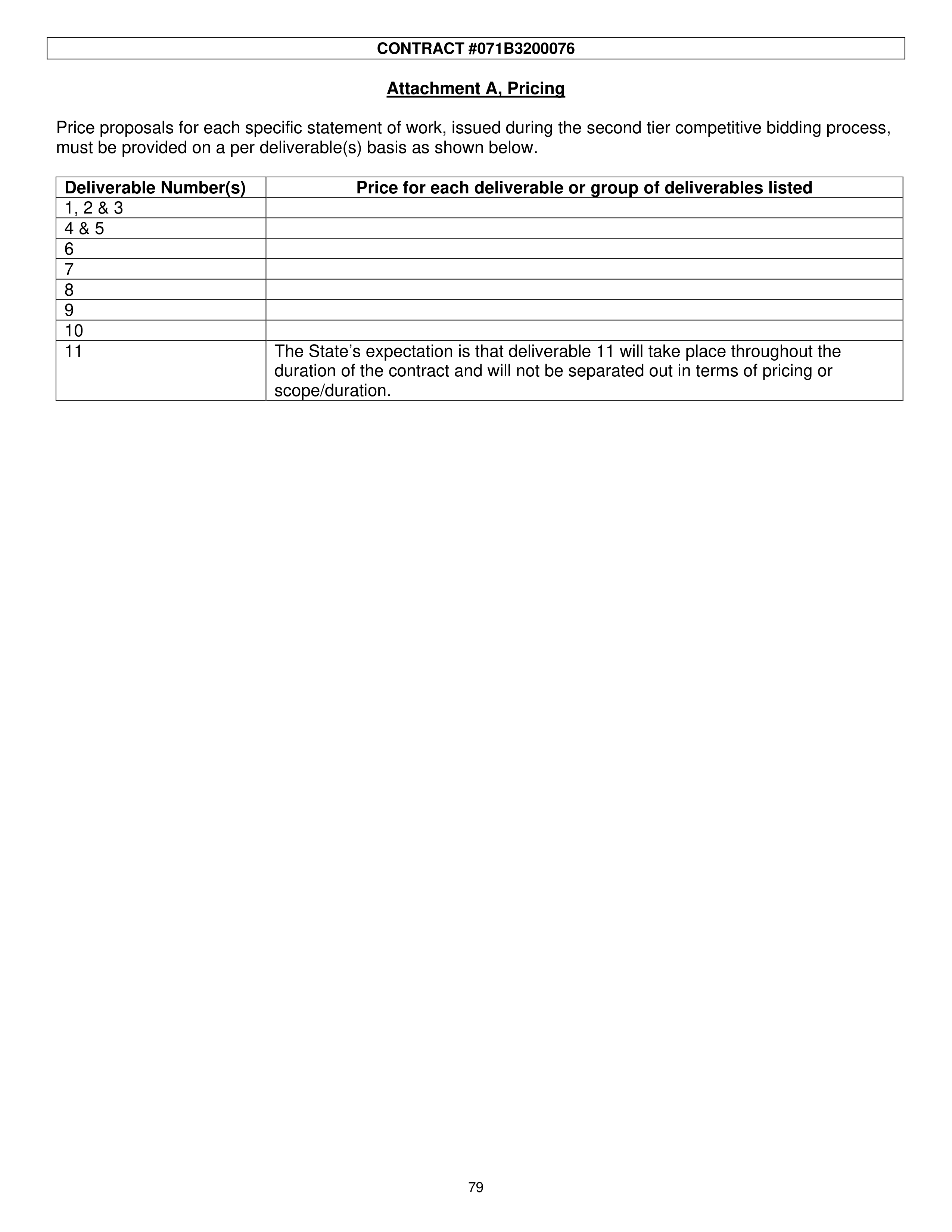
CONTRACT #071B3200076
79
Attachment A, Pricing
Price proposals for each specific statement of work, issued during the second tier competitive bidding process,
must be provided on a per deliverable(s) basis as shown below.
Deliverable Number(s)
Price for each deliverable or group of deliverables listed
1, 2 & 3
4 & 5
6
7
8
9
10
11
The State’s expectation is that deliverable 11 will take place throughout the
duration of the contract and will not be separated out in terms of pricing or
scope/duration.