
Important legal information and disclosures
Effective November 4, 2025
Deposit Account
Agreement
2
Deposit Account Agreement
Thank you for doing business with us
This Deposit Account Agreement applies to consumer and business accounts and, together with the following
documents, is your contract with Wells Fargo and constitutes the “Agreement” that governs your account with
Wells Fargo:
• The Consumer Account Fee and Information Schedule (“Consumer Schedule”) or the Business Account Fee
and Information Schedule (“Business Schedule”),
•
Our interest rate sheet for interest-bearing accounts,
•
Our privacy notice, and
•
Any additional disclosures, amendments, or addenda we provide to you.
In this Agreement, when we say “Wells Fargo,” “Bank,” “we,” “us,” and “our,” we are talking about Wells Fargo Bank,
N.A. “You” and “your” means each account owner, authorized signer, or any other person authorized to operate your
account. When we say “We may” or “Wells Fargo may” do something, that means you authorize us and agree to
such action.
This Agreement is applicable to new and existing accounts and replaces all prior agreements regarding your
account,
including any verbal or written statements or representations. When you sign an account application or
use your account, including any account service, you and anyone else identified as an owner or authorized signer on
your account consent to the terms of this Agreement. We regularly update this Agreement. You are responsible for
ensuring that any authorized signer is familiar with this Agreement. If you keep your account open after we change
this Agreement or end a fee waiver, you agree to the changes.
This Agreement contains dispute resolution provisions — including an arbitration agreement, class action
waiver, and jury trial waiver — that affect your legal rights. In arbitration, there may be less discovery and
appellate review than in court. Please review these provisions carefully.
We recommend you keep a copy of this Agreement — and any changes we provide to this Agreement — for as
long as your Wells Fargo accounts are open. You can get a copy of the current Agreement at wellsfargo.com, or by
visiting your local branch, or by phone at the numbers below.
This document contains various defined terms with specific meanings. Some terms are defined within the section
in which they are used. More frequently used terms are defined in the Glossary at the end of the document. As you
review this Agreement, be sure to check the Glossary for those definitions.
Class Action Waiver and Jury Trial Waiver
You and we each agree that any proceeding, whether in arbitration or in court, will be conducted only on an
individual basis and not in a class, collective, consolidated, private attorney general, or representative action. You
and we agree to waive any right to bring or to participate in such an action in arbitration or in court to the fullest
extent permitted by applicable law. Notwithstanding the foregoing, the parties retain the right to participate in a
class-wide settlement.
Jurisdiction
If the Arbitration Agreement is ever deemed unenforceable or void, or a dispute between the parties is not subject
to arbitration, or for any actions to enforce the Arbitration Agreement or seek entry of judgment on any arbitration
award, then, except for disputes brought in small claims court, the parties irrevocably consent to the exclusive
jurisdiction of the state or federal courts in the state whose laws govern your account, without regard to conflict of
laws principles.
3
Deposit Account Agreement
Table of Contents
Account Basics
..................................................................................................................................................
4
Statements and Notices
............................................................................................................................
5
Interest
.................................................................................................................................................................
7
Depositing Funds
.............................................................................................................................................
8
Availability of Funds Policy
.....................................................................................................................
11
Available Balance, Posting Transactions, and Overdraft
......................................................
13
Available balance
...........................................................................................................................................
13
How we process and post transactions to your account
..........................................................................
13
Standard overdraft coverage
.......................................................................................................................
14
Debit Card Overdraft Service
.....................................................................................................................
15
Overdraft Protection
....................................................................................................................................
15
Extra Day Grace Period
.................................................................................................................................
16
Returning your account to a positive balance
............................................................................................
16
Debit Cards and ATM Cards
....................................................................................................................
17
Fund Transfer Disclosures — General
...............................................................................................
22
Electronic Fund Transfer Services (Consumer accounts only)
..........................................
24
Other Account Services and Restrictions
......................................................................................
27
Time Accounts (CDs)
..................................................................................................................................
29
Protecting Your Account and Your Information
........................................................................
31
Closing Accounts
..........................................................................................................................................
33
Resolving Disputes Through Arbitration
.......................................................................................
35
Consumer Accounts Only: Resolving Disputes Through Arbitration
......................................................
35
Business Accounts Only: Resolving Disputes Through Arbitration
.........................................................
37
Additional Terms and Services
.............................................................................................................
39
Glossary
..............................................................................................................................................................
43
Questions? We’re here for you
Online
Visit
wellsfargo.com
or
wellsfargo.com/biz
Phone
Consumer Banking
1-800-869-3557
Business Banking
1-800-225-5935
Deaf or hard of hearing
customers
We accept all relay calls, including 711.
Mail
Wells Fargo, Customer Correspondence
PO Box 6995
Portland, OR 97228-6995
4
Deposit Account Agreement
Account Basics
This section applies to consumer accounts only unless otherwise noted.
Forms of account ownership:
You can open an account that you own alone, or with more than one
person. If the account is owned with more than one person, it’s considered a joint account.
For joint accounts
, we treat all owners, who are referred to in this Agreement as “co-owners,” as joint
tenants with right of survivorship (described below), unless:
• Applicable state laws require other treatment, or
• We agree with you in writing that the account is owned in some other way.
Regardless of how your account is owned, we don’t keep a separate record of each co-owner’s interest
in the account. We act on instructions from any co-owner (or a co-owner’s authorized representative)
without obtaining other co-owner’s consent, including withdrawing or transferring funds, making
payments, or closing the account.
Each co-owner has complete control over all of the funds in the account. We may pay out money from
the account upon the request or direction of any co-owner (or a co-owner’s authorized representative),
regardless of their contributions to the account, and whether any other co-owner is incapacitated or
deceased, or whether the account includes a right of survivorship. However, if one of the joint account
co-owners is a minor, we may permit the adult account co-owner to restrict the minor’s use of certain
payment services.
Each joint owner is individually and jointly responsible for any overdraft on your account, regardless of
who caused or benefited from the overdraft. If there’s a setoff, an enforcement of our security interest in
your account, or legal action (such as a third party garnishment, seizure, forfeiture, or tax levy) affecting
any co-owner, we may treat all funds in the account as belonging to the customer against whom the
setoff, enforcement of the security interest, or other legal action is directed. If your account is closed for
unsatisfactory handling, we may report all joint owners to the consumer reporting agencies.
Joint tenants with right of survivorship:
means that when one person dies, the account is owned by and
payable to the surviving co-owners.
A POD account is payable to the surviving beneficiaries you designated on your account when we receive
proof of your death or the death of the last surviving co-owner. An account titled “in trust for (ITF),”
“transfer on death (TOD),” or similar language is treated as a POD account.
You and any co-owner may change beneficiaries anytime by notifying us in writing. Generally, the
beneficiary(ies) must survive all owners in order to receive funds.
Uniform Transfers/Gifts to Minors Act account.
An account established under a state’s Uniform
Transfers/Gifts to Minors Act that is controlled by a custodian (an adult who holds the minor’s funds
in the account for safekeeping). We may disclose account information to the minor or their authorized
representative. When the minor reaches the age established by the UTMA/UGMA laws in your state, we
may pay the funds in the account to the minor without waiting for instructions from the custodian.
Minor by account.
One or more adults may open an account, as custodian (an adult who holds the
minor’s funds in the account for safekeeping) in the name of a minor. The minor owns the funds in the
account. The adult, as the custodian, has exclusive control of the account and the minor cannot make
deposits, withdrawals or transact on the account. If there’s more than one adult as the custodian on the
account, each may act independently. We’re not obligated to inquire about the use of the funds. When
the minor reaches the age of majority, they still will not be able to make deposits, withdrawals or transact
on the account except to close the account. If the adult as the custodian (or the last of the adults as the
custodian to survive) dies before the minor reaches the age of majority, we may transfer the funds to a
successor custodian according to the applicable Uniform Transfers/Gifts to Minors Act.
Account Ownership
Pay On Death (POD)
account
Accounts established
for minors
Account Basics
5
Deposit Account Agreement
If you want to transfer account ownership to another person, we must consent and note it in our records
before the transfer is valid and binding on us; however, we’re not responsible for determining whether
such transfer is legally valid. Assignment of your account is subject to our setoff rights (see Setoff and
security interest in the “Additional Terms and Services” section). This Agreement is binding on your
personal representatives, executors, administrators, and successors, as well as our successors and assigns.
Applies to both Consumer and Business Accounts:
If a customer identified in our records as an owner
or a co-owner of an account does not sign account-related documentation (including the account
application), we still may treat them as an owner or a co-owner of that account, in our sole discretion;
we’re not liable to anyone as a result.
Please notify us promptly if you learn or suspect an account owner or signer has been declared
incompetent by a court or other legal authority, or has died. When we receive proper notice, we may:
• Freeze the account until we receive documents verifying the incapacity or death and instructions
regarding the funds remaining in the account,
• Pay (without inquiring) any item authorized by the account owner before being declared legally
incompetent or deceased,
• Return or reverse deposits, and
• Apply funds in the account to any debt the account owner owes us before recognizing the rights of a
surviving joint owner or other person to any remaining funds.
If we release funds after the account owner’s death and have to pay tax or reclamation claims to a
government agency as a result, the account owner’s estate is responsible for reimbursing us.
Consumers and Sole Proprietors Only:
If an account owner dies or is declared legally incompetent, we
may comply with court orders and legal documents, and take direction from affiants, court-appointed
representatives, guardians, or conservators from your state of residence, even if different than where
the account was opened except as otherwise required by applicable law or court order. We may require
additional documentation be provided to us before complying with the directives. We
may
require
U.S.
court documents for customers residing outside of the U.S. at the time of incompetence or death.
For Business Account Owners:
Businesses must provide us documentation of any change in ownership
or control of a business upon the death or legal incompetence of a business owner.
Statements and Notices
We’ll make available to you a statement of your account activity for each statement period, using the
postal or email address associated with your account. We’ll do the same with notices. If your delivery
preference is electronic, we’ll notify you by email that your statement or notice is available online. You
must be at least 13 years old to receive online statements.
We’ll send statements and notices to one owner of a jointly owned account, and you agree that owner
is responsible for sharing copies of the information with all other owners. If you request that we send
notices to an authorized signer, the authorized signer has the same responsibility. Online statements are
available to each joint owner.
Your statement is considered received by you on the second business day after we mail it to you or, if your
delivery preference is electronic, when it’s available through online banking. You agree to this timing even
if the postal or email address you provided us is invalid.
Checking accounts get a monthly account statement. Savings accounts generally get a quarterly account
statement, but will get a monthly statement if you set up automatic transfers into your savings account,
have electronic fund transfer activity in the account, or have a combined statement for your checking and
savings accounts.
We may combine statements for accounts with at least one common owner, in which case we consider
the first account listed on your statement as your primary account. We’ll make available your account
statement through the address listed for your primary account. Statements for accounts in a combined
statement will be delivered according to the delivery preference of the primary account.
Any person with online access to the primary account will also have online viewing capability to all the
information on the combined statement.
Transfer of account
ownership
When an owner does
not sign account
documentation
Death or legal
incompetence of an
authorized signer or
account owner
Statement delivery
Combined statements
Account Basics | Statements and Notice
6
Deposit Account Agreement
If you prefer that we not combine your statements, let us know and we’ll keep them separate.
This will apply to subsequent statements only, and this option isn’t available for Prime Checking and
Premier Checking accounts.
We may change the statement period and fee period assigned to your account without advance notice. If
your account is interest-bearing, these changes won’t affect interest calculations, but they may affect the
date we post interest to your account.
For all accounts except analyzed business accounts, if the first new fee period created by our change is
fewer than 25 days, the Bank will automatically waive the monthly service fee for that period.
We don’t return your physical paid checks in your statements.
Instead, we make copies of your paid
checks available online, by calling us, or at our branches. If for any reason we can’t provide a copy of your
check, we aren’t liable for more than the face amount of the check.
You can enroll in our check image service.
With this service, you’ll receive images of your paid checks
on your statement. See the “Service Fees” section of the Consumer Schedule or Business Schedule for
specific applicable fees and additional details. This service isn’t available with consumer savings accounts
or Clear Access Banking.
If you have a combined statement, only the primary account is eligible for the monthly check image service.
When we provide a statement, we have made the check image available to you, even if we don’t send
originals or images with the statement. We’ll destroy original checks after a reasonable period of time
we determine. If for any reason we can’t provide a copy of your check, we won’t be liable for more than
the face amount of the check. We cannot provide originals or images of checks that are sent to us as
electronic transfers. Additionally, other banks may send us electronic images instead of original checks. In
that case, we may provide a copy of the image, but not the original check.
Your account statements or notices will be considered unclaimed or undeliverable if
• Two or more account statements or notices are returned to us through the mail because of an incorrect
address; or
•
We notify you electronically that your account statement is available for online viewing, and we receive
email notifications that our message is undeliverable.
In either event, we may
• Discontinue sending account statements and notices, and
•
Destroy account statements and notices returned to us as undeliverable.
We won’t attempt to re-deliver account statements and notices to you until you provide us with a valid
postal or electronic address.
You agree to promptly notify us of any change to your postal or email address. We’ll change your postal or
email address within a reasonable time after you request it. If you have a combined statement, any owner
of the primary account can change the address of all accounts included in the combined statement. Unless
you instruct otherwise, we may change the postal or electronic address only for the account(s) you specify
or for all or some of your other account(s) with us.
We may update your address in our records without a request from you if (1) we identify a need to rely
on another address you have provided us; or (2) we receive an address change notice from the U.S. Postal
Service or information from another party in the business of providing correct address details that does
not match the address in our records for your account or card.
You are obligated to:
•
Examine your account statement promptly and carefully, including as applicable, paid check images,
which you may separately choose to review (see “Check safekeeping and check image service” section of
this Agreement)
•
Notify us promptly of any errors.
•
Unless a shorter time period is defined in this Agreement, notify us within 30 days after we have made
your account statement available to you of any unauthorized transaction on your account. Note: If the
same person has made two or more unauthorized transactions and you fail to notify us of the first one
within this 30-day period, we won’t be responsible for unauthorized transactions made by the same
wrongdoer.
•
Notify us within six months after we have made your account statement available to you of any
unauthorized, missing, or altered endorsements on your items (such as, but not limited to, an
unauthorized or altered signature on the back of a check).
For specific information on unauthorized card transactions, see “Zero Liability protection” in the “Debit
Cards and ATM Cards” section of this Agreement.
Consumer accounts only:
Electronic fund transfers are subject to different time periods for notification
of errors, as described in the “Electronic Fund Transfer Services” section of this Agreement. Common
examples of electronic fund transfers are ATM, debit card, and Bill Pay transactions.
Changing statement
period and fee period for
checking and non-IRA
savings accounts
Check safekeeping and
check image service
Account statements
or notices returned or
undeliverable
Change of address
Your responsibility
to review account
statements and notices
and notify us of errors
Statements and Notice
7
Deposit Account Agreement
If you fail to notify us of any unauthorized transaction, error, or claim for a credit or refund within the time
frames specified in this Agreement, your account statement will be considered correct and we won’t be
responsible for any unauthorized transaction, error, or claim for transactions included in the applicable
statement.
A transaction is an unauthorized transaction when it’s
•
Missing a required signature or other evidence showing you have authorized it, or
•
Altered (for example, the amount of a check or the payee’s name is changed).
You can notify us of errors on your account statements by promptly
• Calling the telephone number listed on your account statement or in a notice, or
•
Submitting a written report (if instructed by us) as soon as possible, but in any event within the
specified time frames.
Actions we take when you report an unauthorized transaction: We investigate any reports of
unauthorized activity on your account. After you submit a claim, we may require you to:
•
Complete and return the claim form and any other documents we require,
• Notify law enforcement, and
•
Cooperate fully with us in our investigation.
We can reverse any credit made to your account resulting from a claim of unauthorized transaction or
error if you don’t cooperate fully with us in our investigation or recovery efforts, or we determine the
transaction was authorized.
For specific information on unauthorized card transactions, see “Zero Liability protection” in the “Debit
Cards and ATM Cards” section of this Agreement.
Consumer accounts only:
For specific information on unauthorized electronic fund transfers, see the
“Electronic Fund Transfer Services” section of this Agreement.
Interest
Calculating the applicable interest rate:
When you open an interest-bearing account, we provide a
rate sheet listing the current interest rate and Annual Percentage Yield (APY) for your account. Interest-
bearing accounts earn interest at a variable rate, except CDs. The interest rate may be as low as 0.00%,
and we may change the interest rate for variable-rate accounts at any time. The interest rate may vary
depending on your daily balances (tiered-rate account). We may pay the same interest rate on more than
one tier. The tiers and corresponding interest rates are disclosed in the rate sheet.
We calculate interest using the daily collected balance method, applying a daily periodic rate to the
collected balance in your account each day. Interest is calculated using a 365-day year, unless otherwise
noted for business accounts in the Business Schedule. Interest compounds daily. For interest-bearing
checking and savings accounts, it will be credited monthly.
Cash deposits begin accruing interest the same business day the deposit is credited to your account. If
you deposit an item such as a check, interest begins accruing on the business day we receive credit for the
item. For time accounts, interest begins to accrue on the business day you deposit non-cash items, such
as checks.
Annual Percentage Yield (APY) and Annual Percentage Yield Earned (APYE):
The Annual Percentage
Yield (APY) is a percentage rate reflecting the total amount of interest paid on an account based on
the interest rate and the frequency of compounding for a 365-day period. The Annual Percentage Yield
Earned (APYE) is an annualized rate that reflects the relationship between the amount of interest actually
earned on your account during the statement period and the average daily balance in the account for the
statement period.
We calculate both your APY and APYE according to formulas established by federal regulations. The APYE
appears on your account statement.
The right to require notice of withdrawal from your savings account:
We may require seven days
written notice before you withdraw money from your savings account.
Responsibility to notify
us of errors
Unauthorized
transactions
Statements and Notice | Interest
8
Deposit Account Agreement
Depositing Funds
There are many ways for you to deposit funds into your account: at branches, ATMs, via Bank by Mail,
and through the Wells Fargo Mobile® app. You should be aware of your responsibilities when you
make deposits.
We exercise ordinary care when collecting a deposited item but are not responsible for
any other bank’s treatment or loss of the item. If a deposited item is lost or destroyed during processing
or collection, you agree to provide all reasonable assistance to help us reconstruct the item.
It’s your responsibility, not ours, to confirm the accuracy of the amount you deposit.
If we identify
a discrepancy between the amount you declared and the actual amount received, we may adjust your
account by debiting or crediting the difference. We may also notify you of any such adjustments.
Notify us of a discrepancy.
You must notify us of any discrepancies within the applicable timeframe
outlined below. Failure to do so may result in the deposit being considered accurate as presented.
Consumer accounts
within 1 year after we have made your account statement available to you
Business accounts
within 30 days after we have made your account statement available to you
If you don’t notify us promptly:
If the actual deposit is less than the amount shown on your statement,
the difference remains your responsibility.
If the actual deposit is more, the excess amount is the property of the Bank.
While we don’t verify every transaction, we reserve the right to verify any transaction, including those for
which a receipt has been issued. We may reverse or adjust, at any time without prior notice to you, any
credit or debit we believe we have made to your account in error.
Analyzed business accounts:
You may request that the Bank adjust any deposit discrepancies identified
during verification.
We may, upon notice to you, send an item for collection instead of treating it as a deposit. This means we
send it to the issuer’s bank for payment, and your account won’t be credited for the item until we receive
payment. Our availability of funds policy does not apply to an item we send for collection.
We may decline all or part of a deposit, including cash, for any reason.
This could happen, for example,
if a payee isn’t a co-owner, authorized signer, or authorized representative on your account, we can’t verify
an endorsement, the check was issued from a credit account, the dollar amount of the deposit, the check
looks suspicious, or it’s a non-U.S. item. We do not accept cash deposits into a consumer deposit account
through the night depository. Use of the night depository is for business deposits only. If we decline a
deposit that you mailed to us, we may return it to you at your cost (including charging you for postage
and handling to return foreign currency coin or paper), or retain any invalid checks or other documents
included in the deposit without crediting your account, at our discretion. There are limits on the total
dollar amount of checks that can be deposited at Wells Fargo ATMs per transaction. We may decline ATM
check deposits that exceed $1 million. For security reasons there may also be limits on the dollar amount
or frequency of cash deposits you can make at Wells Fargo ATMs.
If we cannot verify an endorsement, we can also decline to pay, cash, or send the item for collection. We
can require that all endorsers be present and that you deposit the item instead of cashing it.
Non-account owners are not allowed to deposit cash into consumer accounts. For business accounts,
any person wanting to make a cash deposit must provide an acceptable form of identification before we
accept a cash deposit.
Use of the nightly depository is limited to business deposits only.
An endorsement is a signature, stamp, or other mark on the back of a check to transfer, restrict payment,
or make the signer responsible for the check. If you have not endorsed a check that you deposited to
your account, we may endorse it for you or deem it endorsed by you without further action on our part.
Any endorsement must be in the 1-1/2 inch area that starts on the top of the back of the check. Do not
sign or write anywhere else on the back of the check.
We are not obligated to follow restrictions or notations written on a check such as, “void after six months,”
“void over $50,” or “payment in full.” You’re responsible for any resulting loss or expense we incur.
Deposit accuracy
Verifying transactions
Sending an item
for collection
Our right to decline
deposits
Night Depository
(Business accounts only)
Requirements for
correct endorsement
Restrictions
on
checks
are not binding
Depositing Funds
9
Deposit Account Agreement
A substitute check is created from an original check; under federal law, it’s legally equivalent to the original
check and can even be used as proof of payment. A substitute check contains an accurate copy of the front
and back of the original and bears the legend: “This is a legal copy of your check. You can use it the same
way you would use an original check.” Any check may be returned to you in the form of a substitute check.
You agree that you won’t transfer a substitute check to us, by deposit or otherwise, if we would be the first
financial institution to take the substitute check, unless we have expressly agreed in writing to take it.
A non-U.S. item is an item:
• Payable in a currency other than U.S. dollars or
• Drawn on a financial institution that isn’t organized under U.S. law
We’re not required to accept a non-U.S. item for deposit or collection, but we may accept it on a
collection basis without your specific instruction to do so. We can reverse any amount we have credited
to your account and send the non-U.S. item on a collection basis even if we have taken physical
possession of the item.
If we accept a non-U.S. item, the U.S. dollar amount you receive for it will be determined by the applicable
exchange rate that is in effect at the time of deposit or our receipt of final payment (less any associated
fees) of the non-U.S. item. If the deposited non-U.S. item is returned for any reason,
we’ll charge the
amount against your account (or any other account you maintain with us)
at the applicable exchange
rate in effect at the time of the return. For information on the applicable exchange rate, see “Applicable
exchange rate” in the “Additional Terms and Services” section of this Agreement. Our availability of funds
policy does not apply to a non-U.S. item.
If an item you deposited or cashed is returned to us unpaid,
we can deduct the amount from any
account you have with us
. We can do this when we’re notified that the item will be returned and don’t
need to receive the actual item. We can do this even if the balance in your account isn’t sufficient to cover
the amount we hold or deduct, causing an overdraft. In addition, we’ll charge you all applicable fees and
reverse all interest accrued on the item.
We may place a hold on or charge your account for a deposit if a claim is made or we otherwise have
reason to believe the deposited item was altered, forged, unauthorized, missing a signature or has
a forged endorsement, or should not have been paid for any other reason.
When the claim is resolved,
we’ll either release the hold or deduct the amount of the item from your account. We’re not responsible if
we take, or fail to take, any action to recover payment of a returned deposited item.
If you breach any warranty you make to us under the laws governing your account with respect to any
item, you won’t be released or discharged from any liability for the breach so long as we notify you of the
breach within 120 days after we learn of the breach. If we fail to notify you within this 120 day period,
you’ll be released from liability and discharged only to the extent our failure to notify you within this time
period caused a loss to you.
If an electronic payment credited to your account, such as a direct deposit, is reversed,
we can deduct the
amount from any account you have with us,
at any time, without notifying you. You agree to promptly
repay any resulting overdrafts.
To use our Bank By Mail services, you first need to request your deposit kit through Wells Fargo Phone Bank
at 1-800-TO-WELLS (1-800-869-3557). We cannot accept cash or foreign checks by mail.
If you need to send deposits before your kit arrives,
write on the back of the check “for deposit only,
Wells Fargo” and include the account number to
which the check should be deposited, and mail to:
Wells Fargo
PO Box 77200
Minneapolis, MN 55480-7720
For accounts located in
Alaska
, send
deposits to:
Wells Fargo
PO Box 77040
Minneapolis, MN 55480-7740
For certain direct deposits, we may make those funds available to you up to one to two business days before we
receive the funds from the payor, which is typically your employer or its payroll service provider. Our ability to
provide early access to these funds may be limited by many factors, such as when we receive notice of payment
from your payor. Early Pay Day is not guaranteed, may vary between pay periods, and we may stop providing
it at any time without advance notice to you. Early Pay Day funds will be reflected in your account’s available
balance. It is always your obligation to verify that the funds are available in your account before spending them.
Deposits Available for Early Pay Day:
Not all direct deposits are eligible for Early Pay Day. Eligible direct
deposits are generally limited to electronic direct deposits such as your payroll, pension, and government
benefit payments that are made through the Automated Clearing House (ACH) network. Most other deposits
or credits to your account, such as deposits of funds from person-to-person payments services (e.g., Zelle®,
Venmo, or PayPal transfers), check or mobile deposits, instant payments processed through the RTP® network
or FedNow
℠
service, and other online transfers are not eligible for Early Pay Day.
Substitute checks
Our handling of
non-U.S.
items
Cashed/Deposited
items returned unpaid
Breach of a warranty
associated with an item
Reversal of an
electronic payment
Bank By Mail
About Early Pay Day
(Consumer accounts only)
Depositing Funds
10
Deposit Account Agreement
Early Pay Day and Interest on Your Account:
For interest-bearing accounts, interest on your incoming direct
deposit will begin accruing on the business day we receive credit for the deposit from your payor’s bank. For
example, if we make funds available to you through Early Pay Day two days early on Wednesday, interest on
those funds will not begin accruing until the day we receive the funds from your payor, in this example on Friday.
How Early Pay Day Impacts Overdraft and Overdraft Fees:
Early Pay Day funds are reflected in your account’s
available balance. We use your account’s available balance to determine if we will authorize and pay transactions
and assess overdraft fees. Your account’s ending daily balance will not reflect the funds made available to you
through Early Pay Day until the day those funds are received from your payor. For example, Early Pay Day funds
are added to your available balance on Wednesday, and you spend those funds while continuing to maintain a
positive available balance. We will pay those transactions based on the positive available balance, and you will
avoid any overdraft fees or returned items. In this example, the ending daily balance on your account will not
reflect the Early Pay Day funds until Friday, when the deposit posts to your account.
Other Terms and Conditions of Early Pay Day:
If a direct deposit is not made available early, it will be made available
in accordance with our Availability of Funds Policy described in this Agreement. Except as expressly set forth herein,
funds made available early are subject to the same terms and conditions as other deposits to your account.
If we’ve made funds available early and the payor reverses or requests a return of the deposit, or the funds are
otherwise uncollected by the Bank, you understand and agree that we may debit your account up to the amount
of the deposit that was previously made available — even if you have already withdrawn the funds or it creates
an overdraft on your account. In this instance, you are responsible for any fees assessed — including those
charged by merchants or third parties — as a result of the overdraft.
Available Balance is our most current record of the amount of money in your account available for your use or
withdrawal. Your available balance reflects pending deposits that are immediately available less any pending
withdrawals and any funds that have been placed on hold. Your available balance can change throughout the
day, for example as you withdraw, spend, or add funds, or we authorize your transactions.
We use available balance to authorize your transactions during the day and pay your transactions during
nightly processing. These may appear as “pending” throughout the day as we receive them. Overdraft
decisioning and assessment of overdraft fees is also based on available balance.
Ending daily balance/Posted balance reflects all posted deposits and withdrawals from the prior business
day’s nightly processing. Your ending daily balance is calculated once a day during nightly processing
(posting) and is the starting point for your available balance the following day. We use ending daily balance to
determine Monthly Service Fee waivers and your statements, where applicable, show ending daily balance.
Your account’s available balance and your account’s ending daily balance may sometimes be different as
available balance changes with transactions presented on your account and ending daily balance updates
during nightly processing.
Your Deposit Account
Balances
Depositing Funds
11
Deposit Account Agreement
Availability of Funds Policy
Our policy is to make funds from your check deposits to your checking or savings account (in this policy,
each account) available to you on the first business day after the day we receive your deposits. Incoming
wire transfers, electronic direct deposits, cash deposited at a teller window and at a Wells Fargo ATM, and
the first $400 of a day’s check deposits at a teller window, at a Wells Fargo ATM, and with the Wells Fargo
Mobile Banking app will be available on the day we receive the deposits. Certain electronic credit transfers,
such as those through card networks or funds transfer systems, will generally be available on the day we
receive the funds transfer. Once they are available, you can withdraw the funds in cash and we will use the
funds to pay checks and other items presented for payment and applicable fees that you have incurred.
Analyzed business accounts only:
The first $400 of a business day’s check deposits to an analyzed
account are not available to you on the day we receive the deposits. Check deposits to an analyzed
account are generally available on the first business day after we receive your deposits.
For determining the day your deposit is received by the Bank
, every day is a business day, except
Saturday, Sunday, and federal holidays. If you make a deposit before our established cutoff time on a
business day that we are open, we will consider that day to be the day your deposit is received by the Bank.
However, if you make a deposit after our cutoff time or on a day we are not open, we will consider the day
your deposit is received by the Bank to be the next business day we are open.
Our deposit cutoff times are as follows:
In some cases, we will not make the first $400 of a business day’s check deposits available to you on the
day we receive the deposits. Further, in some cases, we will not make all the funds that you deposit by
check available to you on the first business day after the day of your deposit.
Depending on the type of check that you deposit, funds may not be available until the second business
day after the day of your deposit. The first $275 of your deposit, however, may be available on the first
business day after the day of your deposit.
Except as otherwise explained in this paragraph, if we are not going to make all funds from your
deposit available on the business day of deposit or the first business day after the day of deposit,
we will notify you at the time you make your deposit. We will also tell you when the funds will be
available. If your deposit is not made directly to a Wells Fargo employee, or if we decide to take this
action after you have left the premises, we will mail you the notice by the first business day after we
receive your deposit.
If you need the funds from a deposit right away, you should ask us when the funds will be available.
In addition, funds you deposit by check may be delayed for a longer period under the following circumstances:
• We believe a check you deposit will not be paid
• You deposit checks totaling more than $6,725 on any one day
• You redeposit a check that has been returned unpaid
• You have overdrawn your account repeatedly in the last six months
• There is an emergency, such as failure of computer or communications equipment
We will notify you if we delay your ability to withdraw funds for any of these reasons, and we will tell you
when the funds will be available. The funds will generally be available no later than the seventh business
day after the day of your deposit.
If you are a new customer, the following special rules apply during the first 30 days your account is
open.
Incoming wire transfers, electronic direct deposits, and cash deposited at a teller window and at a
Wells Fargo ATM will be available on the day we receive the deposit. Funds from your check deposits will
be available on the business day after the day we receive the deposits; no funds from a business day’s
check deposits are available on the day we receive the deposits.
Your ability to
withdraw
funds
Determining the
day your deposit is
received by the Bank
Type of Deposit
Cutoff time
In branch
when the branch closes for business;
varies by location
At Wells Fargo ATMs
9 p.m. local time (Alaska 8 p.m.)
Checks deposited with the Wells Fargo Mobile app
9 p.m. Pacific Time
Electronic credits (such as direct deposits)
8 p.m. Pacific Time
Original Credit Transactions (OCT)
6 p.m. Pacific Time
Longer delays
may apply
Special rules for
new accounts
Availability of Funds Policy
12
Deposit Account Agreement
If we delay the availability of your deposit the following special rules may apply:
•
The first $6,725
of a day’s total deposits of cashier’s, certified, teller’s, traveler’s, and federal, state, and
local government checks, and U.S. Postal Service money orders made payable to you will be available
on the first business day after the day of your deposit, if your deposit meets certain conditions. For
example, the checks must be payable to you. If your deposit of these checks (other than U.S. Treasury
checks) is not made in person to one of our employees, the first $6,725 may not be available until the
second business day after the day of your deposit.
•
The excess over $6,725
and funds from all other check deposits will be available no later than the
seventh business day after the day of your deposit. The first $275 of a day’s total deposit of funds from
all other check deposits, however, may be available on the first business day after the day of your deposit.
We will notify you if we delay your ability to withdraw funds and we will tell you when the funds will be available.
If we cash a check for you that is drawn on another bank
, we may withhold the availability of a
corresponding amount of funds that are already in your account. Those funds will be available at the time
funds from the check we cash would have been available if you had deposited it.
If we accept a check for deposit that is drawn on another bank
, we may make funds from the deposit
available for withdrawal immediately but delay your ability to withdraw a corresponding amount of funds
that you have on deposit in another account with us. The funds in the other account would then not be
available until the time periods that are described in this policy.
Holds on other funds
Availability of Funds Policy
13
Deposit Account Agreement
Available Balance, Posting Transactions,
and Overdraft
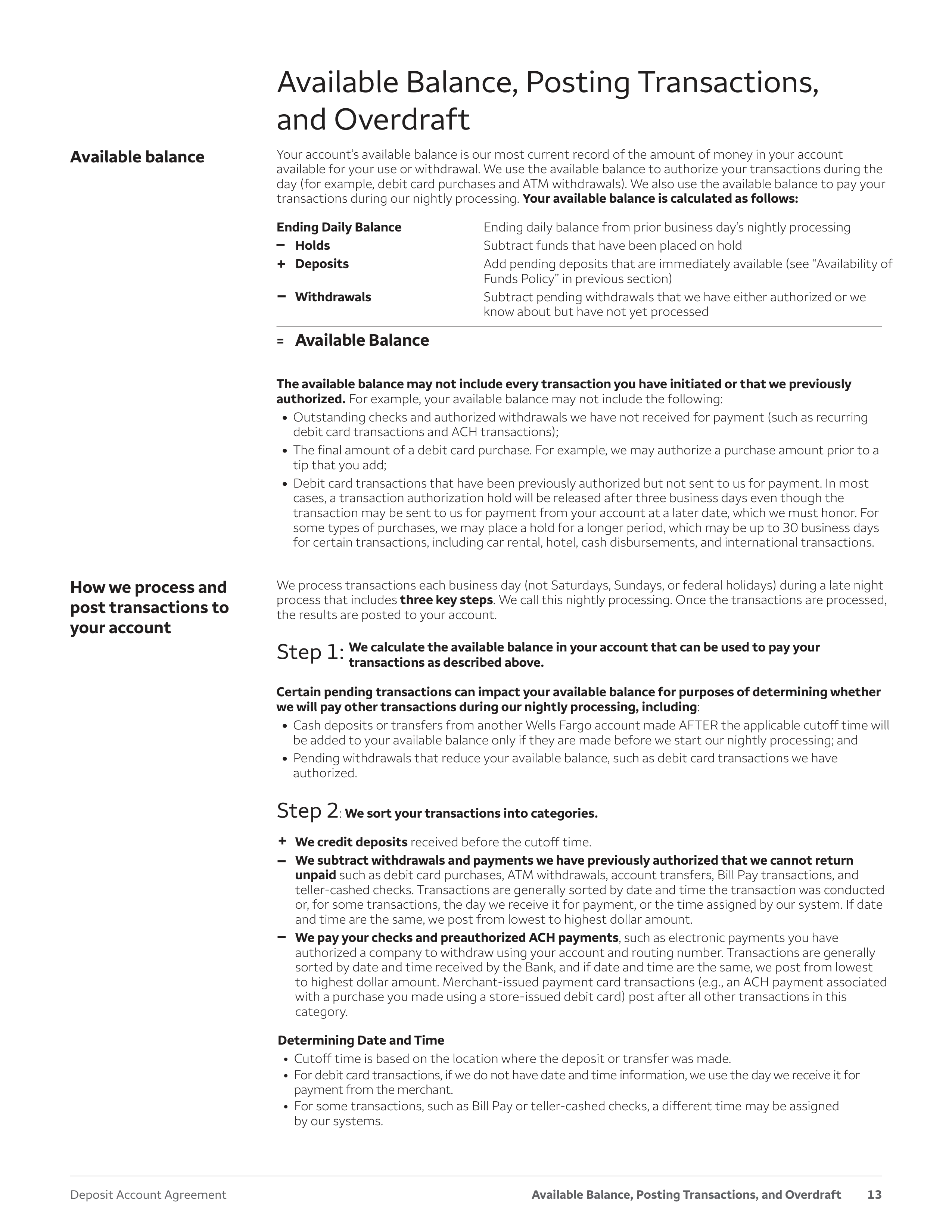
Your account’s available balance is our most current record of the amount of money in your account
available for your use or withdrawal. We use the available balance to authorize your transactions during the
day (for example, debit card purchases and ATM withdrawals). We also use the available balance to pay your
transactions during our nightly processing.
Your available balance is calculated as follows:
Ending Daily Balance
Ending daily balance from prior business day’s nightly processing
–
Holds
Subtract
funds that have been placed on hold
+
Deposits
Add pending deposits that are immediately available (see “Availability of
Funds Policy” in previous section)
–
Withdrawals
Subtract pending withdrawals that we have either authorized or we
know about but have not yet processed
=
Available Balance
The available balance may not include every transaction you have initiated or that we previously
authorized.
For example, your available balance may not include the following:
•
Outstanding checks and authorized withdrawals we have not received for payment (such as recurring
debit card transactions and ACH transactions);
•
The final amount of a debit card purchase. For example, we may authorize a purchase amount prior to a
tip that you add;
•
Debit card transactions that have been previously authorized but not sent to us for payment. In most
cases, a transaction authorization hold will be released after three business days even though the
transaction may be sent to us for payment from your account at a later date, which we must honor. For
some types of purchases, we may place a hold for a longer period, which may be up to 30 business days
for certain transactions, including car rental, hotel, cash disbursements, and international transactions.
We process transactions each business day (not Saturdays, Sundays, or federal holidays) during a late night
process that includes
three key steps
. We call this nightly processing. Once the transactions are processed,
the results are posted to your account.
Step 1:
We calculate the available balance in your account that can be used to pay your
transactions as described above.
Certain pending transactions can impact your available balance for purposes of determining whether
we will pay other transactions during our nightly processing, including
:
•
Cash deposits or transfers from another Wells Fargo account made AFTER the applicable cutoff time will
be added to your available balance only if they are made before we start our nightly processing; and
•
Pending withdrawals that reduce your available balance, such as debit card transactions we have
authorized.
Step 2
:
We sort your transactions into categories.
+
We credit deposits
received before the cutoff time.
–
We subtract withdrawals and payments we have previously authorized
that we cannot return
unpaid
such as debit card purchases, ATM withdrawals, account transfers, Bill Pay transactions, and
teller-cashed checks. Transactions are generally sorted by date and time the transaction was conducted
or, for some transactions, the day we receive it for payment, or the time assigned by our system. If date
and time are the same, we post from lowest to highest dollar amount.
–
We pay your checks and preauthorized ACH payments
, such as electronic payments you have
authorized a company to withdraw using your account and routing number. Transactions are generally
sorted by date and time received by the Bank, and if date and time are the same, we post from lowest
to highest dollar amount. Merchant-issued payment card transactions (e.g., an ACH payment associated
with a purchase you made using a store-issued debit card) post after all other transactions in this
category.
Determining Date and Time
• Cutoff time is based on the location where the deposit or transfer was made.
•
For debit card transactions, if we do not have date and time information, we use the day we receive it for
payment from the merchant.
• For some transactions, such as Bill Pay or teller-cashed checks, a different time may be assigned
by our systems.
Available balance
How we process and
post transactions to
your account
Available Balance, Posting Transactions, and Overdraft
14
Deposit Account Agreement
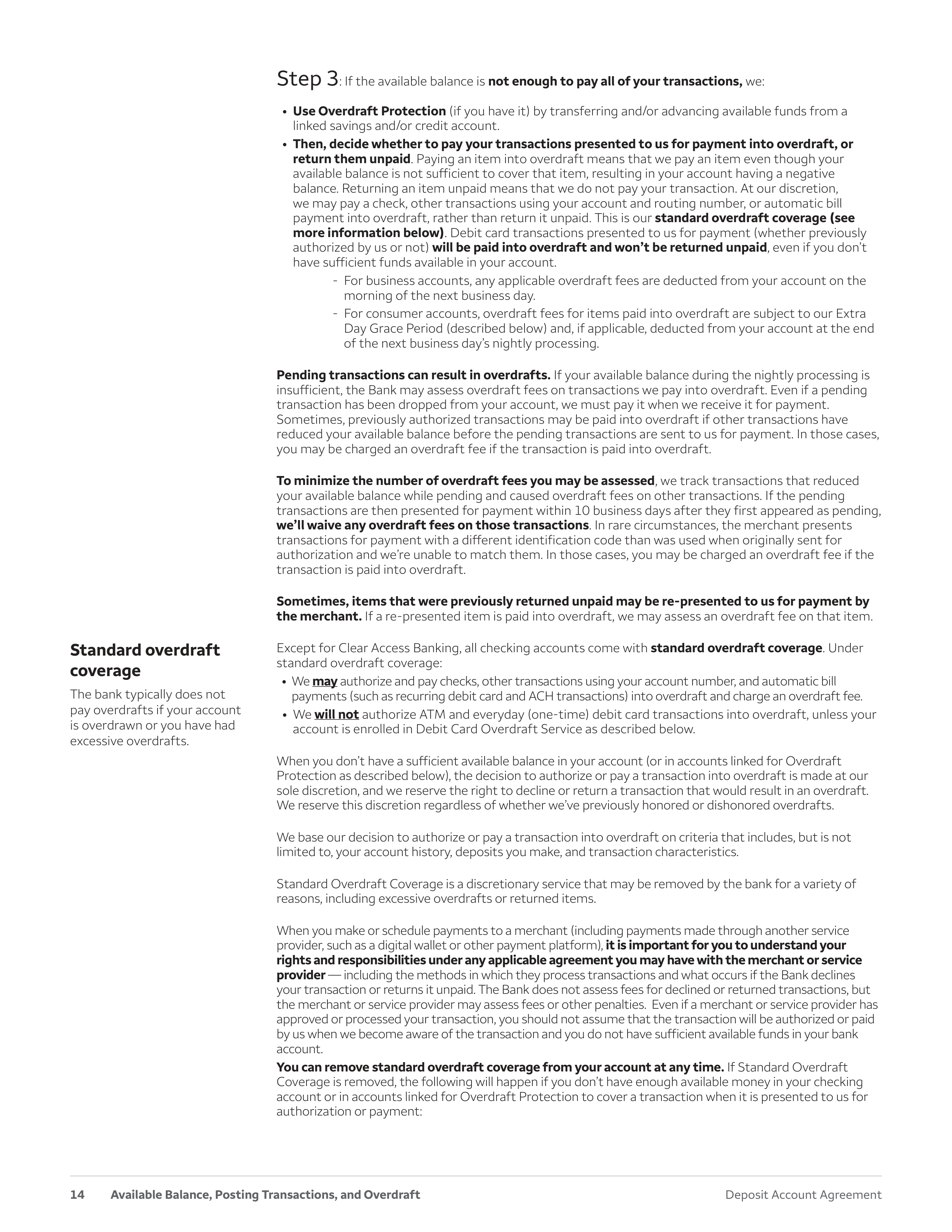
Step 3
:
If the available balance is
not enough to pay all of your transactions,
we:
•
Use Overdraft Protection
(if you have it) by transferring and/or advancing available funds from a
linked savings and/or credit account.
•
Then, decide whether to pay your transactions presented to us for payment into overdraft, or
return them unpaid
. Paying an item into overdraft means that we pay an item even though your
available balance is not sufficient to cover that item, resulting in your account having a negative
balance. Returning an item unpaid means that we do not pay your transaction. At our discretion,
we may pay a check, other transactions using your account and routing number, or automatic bill
payment into overdraft, rather than return it unpaid. This is our
standard overdraft coverage (see
more information below)
. Debit card transactions presented to us for payment (whether previously
authorized by us or not)
will be paid into overdraft and won’t be returned unpaid
, even if you don’t
have sufficient funds available in your account.
- For business accounts, any applicable overdraft fees are deducted from your account on the
morning of the next business day.
- For consumer accounts, overdraft fees for items paid into overdraft are subject to our Extra
Day Grace Period (described below) and, if applicable, deducted from your account at the end
of the next business day’s nightly processing.
Pending transactions can result in overdrafts.
If your available balance during the nightly processing is
insufficient, the Bank may assess overdraft fees on transactions we pay into overdraft. Even if a pending
transaction has been dropped from your account, we must pay it when we receive it for payment.
Sometimes, previously authorized transactions may be paid into overdraft if other transactions have
reduced your available balance before the pending transactions are sent to us for payment. In those cases,
you may be charged an overdraft fee if the transaction is paid into overdraft.
To minimize the number of overdraft fees you may be assessed
, we track transactions that reduced
your available balance while pending and caused overdraft fees on other transactions. If the pending
transactions are then presented for payment within 10 business days after they first appeared as pending,
we’ll waive any overdraft fees on those transactions
. In rare circumstances, the merchant presents
transactions for payment with a different identification code than was used when originally sent for
authorization and we’re unable to match them. In those cases, you may be charged an overdraft fee if the
transaction is paid into overdraft.
Sometimes, items that were previously returned unpaid may be re-presented to us for payment by
the merchant.
If a re-presented item is paid into overdraft, we may assess an overdraft fee on that item.
Except for Clear Access Banking, all checking accounts come with
standard overdraft coverage
. Under
standard overdraft coverage:
• We
may
authorize and pay checks, other transactions using your account number, and automatic bill
payments (such as recurring debit card and ACH transactions) into overdraft and charge an overdraft fee.
• We
will not
authorize ATM and everyday (one-time) debit card transactions into overdraft, unless your
account is enrolled in Debit Card Overdraft Service as described below.
When you don’t have a sufficient available balance in your account (or in accounts linked for Overdraft
Protection as described below), the decision to authorize or pay a transaction into overdraft is made at our
sole discretion, and we reserve the right to decline or return a transaction that would result in an overdraft.
We reserve this discretion regardless of whether we’ve previously honored or dishonored overdrafts.
We base our decision to authorize or pay a transaction into overdraft on criteria that includes, but is not
limited to, your account history, deposits you make, and transaction characteristics.
Standard Overdraft Coverage is a discretionary service that may be removed by the bank for a variety of
reasons, including excessive overdrafts or returned items.
When you make or schedule payments to a merchant (including payments made through another service
provider, such as a digital wallet or other payment platform),
it is important for you to understand your
rights and responsibilities under any applicable agreement you may have with the merchant or service
provider
— including the methods in which they process transactions and what occurs if the Bank declines
your transaction or returns it unpaid. The Bank does not assess fees for declined or returned transactions, but
the merchant or service provider may assess fees or other penalties. Even if a merchant or service provider has
approved or processed your transaction, you should not assume that the transaction will be authorized or paid
by us when we become aware of the transaction and you do not have sufficient available funds in your bank
account.
You can remove standard overdraft coverage from your account at any time.
If Standard Overdraft
Coverage is removed, the following will happen if you don’t have enough available money in your checking
account or in accounts linked for Overdraft Protection to cover a transaction when it is presented to us for
authorization or payment:
Standard overdraft
coverage
The bank typically does not
pay overdrafts if your account
is overdrawn or you have had
excessive overdrafts.
Available Balance, Posting Transactions, and Overdraft
15
Deposit Account Agreement
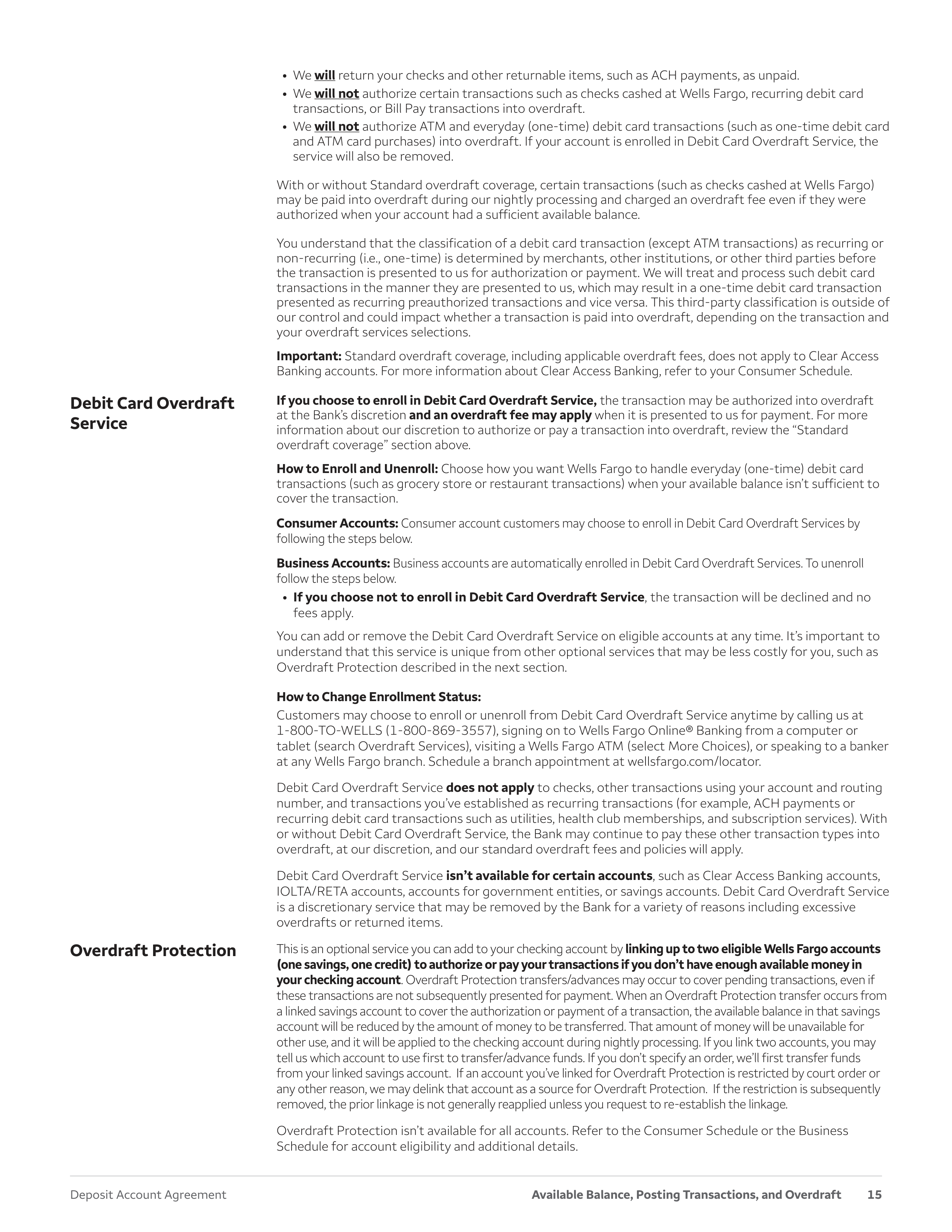
• We
will
return your checks and other returnable items, such as ACH payments, as unpaid.
• We
will not
authorize certain transactions such as checks cashed at Wells Fargo, recurring debit card
transactions, or Bill Pay transactions into overdraft.
• We
will not
authorize ATM and everyday (one-time) debit card transactions (such as one-time debit card
and ATM card purchases) into overdraft. If your account is enrolled in Debit Card Overdraft Service, the
service will also be removed.
With or without Standard overdraft coverage, certain transactions (such as checks cashed at Wells Fargo)
may be paid into overdraft during our nightly processing and charged an overdraft fee even if they were
authorized when your account had a sufficient available balance.
You understand that the classification of a debit card transaction (except ATM transactions) as recurring or
non-recurring (i.e., one-time) is determined by merchants, other institutions, or other third parties before
the transaction is presented to us for authorization or payment. We will treat and process such debit card
transactions in the manner they are presented to us, which may result in a one-time debit card transaction
presented as recurring preauthorized transactions and vice versa. This third-party classification is outside of
our control and could impact whether a transaction is paid into overdraft, depending on the transaction and
your overdraft services selections.
Important:
Standard overdraft coverage, including applicable overdraft fees, does not apply to Clear Access
Banking accounts. For more information about Clear Access Banking, refer to your Consumer Schedule.
If you choose to enroll in Debit Card Overdraft Service,
the transaction may be authorized into overdraft
at the Bank’s discretion
and an overdraft fee may apply
when it is presented to us for payment. For more
information about our discretion to authorize or pay a transaction into overdraft, review the “Standard
overdraft coverage” section above.
How to Enroll and Unenroll:
Choose how you want Wells Fargo to handle everyday (one-time) debit card
transactions (such as grocery store or restaurant transactions) when your available balance isn’t sufficient to
cover the transaction.
Consumer Accounts:
Consumer account customers may choose to enroll in Debit Card Overdraft Services by
following the steps below.
Business Accounts:
Business accounts are automatically enrolled in Debit Card Overdraft Services. To unenroll
follow the steps below.
•
If you choose not to enroll in Debit Card Overdraft Service
, the transaction will be declined and no
fees apply.
You can add or remove the Debit Card Overdraft Service on eligible accounts at any time. It’s important to
understand that this service is unique from other optional services that may be less costly for you, such as
Overdraft Protection described in the next section.
How to Change Enrollment Status:
Customers may choose to enroll or unenroll from Debit Card Overdraft Service anytime by calling us at
1-800-TO-WELLS (1-800-869-3557), signing on to Wells Fargo Online® Banking from a computer or
tablet (search Overdraft Services), visiting a Wells Fargo ATM (select More Choices), or speaking to a banker
at any Wells Fargo branch. Schedule a branch appointment at wellsfargo.com/locator.
Debit Card Overdraft Service
does not apply
to checks, other transactions using your account and routing
number, and transactions you’ve established as recurring transactions (for example, ACH payments or
recurring debit card transactions such as utilities, health club memberships, and subscription services). With
or without Debit Card Overdraft Service, the Bank may continue to pay these other transaction types into
overdraft, at our discretion, and our standard overdraft fees and policies will apply.
Debit Card Overdraft Service
isn’t available for certain accounts
, such as Clear Access Banking accounts,
IOLTA/RETA accounts, accounts for government entities, or savings accounts. Debit Card Overdraft Service
is a discretionary service that may be removed by the Bank for a variety of reasons including excessive
overdrafts or returned items.
This is an optional service you can add to your checking account by
linking up to two eligible Wells Fargo accounts
(one savings, one credit) to authorize or pay your transactions if you don’t have enough available money in
your checking account
. Overdraft Protection transfers/advances may occur to cover pending transactions, even if
these transactions are not subsequently presented for payment. When an Overdraft Protection transfer occurs from
a linked savings account to cover the authorization or payment of a transaction, the available balance in that savings
account will be reduced by the amount of money to be transferred. That amount of money will be unavailable for
other use, and it will be applied to the checking account during nightly processing. If you link two accounts, you may
tell us which account to use first to transfer/advance funds. If you don’t specify an order, we’ll first transfer funds
from your linked savings account. If an account you’ve linked for Overdraft Protection is restricted by court order or
any other reason, we may delink that account as a source for Overdraft Protection. If the restriction is subsequently
removed, the prior linkage is not generally reapplied unless you request to re-establish the linkage.
Overdraft Protection isn’t available for all accounts. Refer to the Consumer Schedule or the Business
Schedule for account eligibility and additional details.
Debit Card Overdraft
Service
Overdraft
Protection
Available Balance, Posting Transactions, and Overdraft
16
Deposit Account Agreement
Available Balance, Posting Transactions, and Overdraft
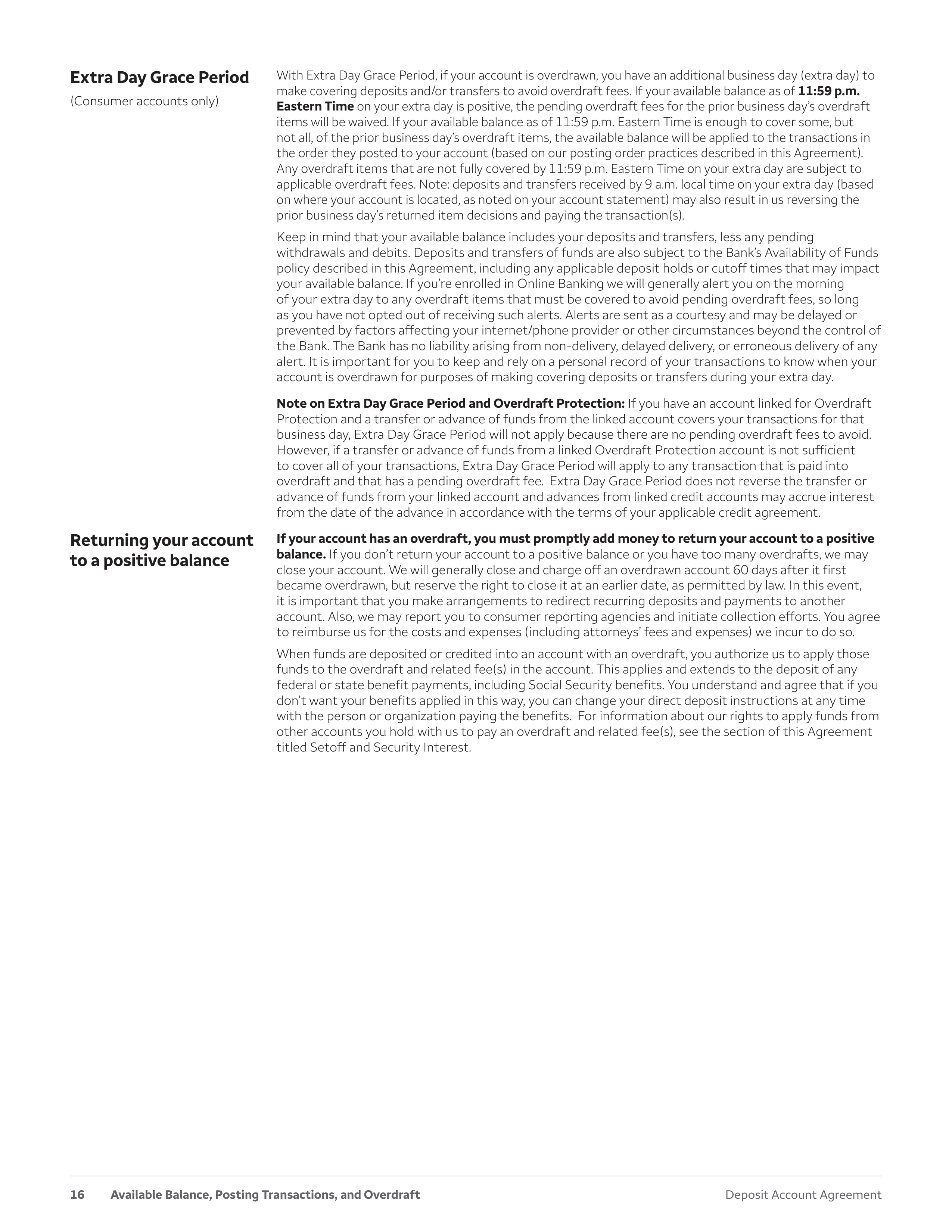
With Extra Day Grace Period, if your account is overdrawn, you have an additional business day (extra day) to
make covering deposits and/or transfers to avoid overdraft fees. If your available balance as of
11:59 p.m.
Eastern Time
on your extra day is positive, the pending overdraft fees for the prior business day’s overdraft
items will be waived. If your available balance as of 11:59 p.m. Eastern Time is enough to cover some, but
not all, of the prior business day’s overdraft items, the available balance will be applied to the transactions in
the order they posted to your account (based on our posting order practices described in this Agreement).
Any overdraft items that are not fully covered by 11:59 p.m. Eastern Time on your extra day are subject to
applicable overdraft fees. Note: deposits and transfers received by 9 a.m. local time on your extra day (based
on where your account is located, as noted on your account statement) may also result in us reversing the
prior business day’s returned item decisions and paying the transaction(s).
Keep in mind that your available balance includes your deposits and transfers, less any pending
withdrawals and debits. Deposits and transfers of funds are also subject to the Bank’s Availability of Funds
policy described in this Agreement, including any applicable deposit holds or cutoff times that may impact
your available balance. If you’re enrolled in Online Banking we will generally alert you on the morning
of your extra day to any overdraft items that must be covered to avoid pending overdraft fees, so long
as you have not opted out of receiving such alerts. Alerts are sent as a courtesy and may be delayed or
prevented by factors affecting your internet/phone provider or other circumstances beyond the control of
the Bank. The Bank has no liability arising from non-delivery, delayed delivery, or erroneous delivery of any
alert. It is important for you to keep and rely on a personal record of your transactions to know when your
account is overdrawn for purposes of making covering deposits or transfers during your extra day.
Note on Extra Day Grace Period and Overdraft Protection:
If you have an account linked for Overdraft
Protection and a transfer or advance of funds from the linked account covers your transactions for that
business day, Extra Day Grace Period will not apply because there are no pending overdraft fees to avoid.
However, if a transfer or advance of funds from a linked Overdraft Protection account is not sufficient
to cover all of your transactions, Extra Day Grace Period will apply to any transaction that is paid into
overdraft and that has a pending overdraft fee. Extra Day Grace Period does not reverse the transfer or
advance of funds from your linked account and advances from linked credit accounts may accrue interest
from the date of the advance in accordance with the terms of your applicable credit agreement.
If your account has an overdraft, you must promptly add money to return your account to a positive
balance.
If you don’t return your account to a positive balance or you have too many overdrafts, we may
close your account. We will generally close and charge off an overdrawn account 60 days after it first
became overdrawn, but reserve the right to close it at an earlier date, as permitted by law. In this event,
it is important that you make arrangements to redirect recurring deposits and payments to another
account. Also, we may report you to consumer reporting agencies and initiate collection efforts. You agree
to reimburse us for the costs and expenses (including attorneys’ fees and expenses) we incur to do so.
When funds are deposited or credited into an account with an overdraft, you authorize us to apply those
funds to the overdraft and related fee(s) in the account. This applies and extends to the deposit of any
federal or state benefit payments, including Social Security benefits. You understand and agree that if you
don’t want your benefits applied in this way, you can change your direct deposit instructions at any time
with the person or organization paying the benefits. For information about our rights to apply funds from
other accounts you hold with us to pay an overdraft and related fee(s), see the section of this Agreement
titled Setoff and Security Interest.
Extra Day Grace Period
(Consumer accounts only)
Returning
your
account
to a positive balance
17
Deposit Account Agreement
Debit Cards and ATM Cards
Debit Cards and ATM Cards
When you get a debit or ATM card from us, you’ll receive, and be required to agree to, additional terms
and conditions applicable to the card. In the event of a conflict between the terms and conditions and this
Agreement, the terms and conditions will control. Additional disclosures applicable to these services are
provided in the Consumer Schedule or Business Schedule, as applicable. When you use your debit or ATM
card, you authorize us to act on your instructions that we receive through any ATM, merchant or network
in which we participate.
We may issue a card to each account owner to access your accounts. If you don’t select a PIN when you
request your card, we’ll send a randomly selected PIN. If you don’t request a card but would like a PIN for
authentication purposes, we can provide a PIN for that purpose (a “cardless PIN”). A cardless PIN cannot
be used for purchases or ATM access (see “Telephone banking services” section for more details).
You should securely protect your card and PIN from loss or theft. Each cardholder must have his or her
own unique PIN and is responsible for keeping the PIN confidential. If the card or PIN is given to another
person, the account owner will, to the extent allowed by applicable law, be responsible for all transactions
made by that person or anyone else to whom that person gives the card or PIN.
Linking lets you add asset accounts you own (for example, checking and savings) to a debit or ATM
card, giving you the ability to perform transactions on multiple accounts with one card at Wells Fargo
ATMs. The money for purchases and payments made with your card is deducted from the primary linked
account. Using a card at a participating non-Wells Fargo ATM for cash withdrawals, balance inquiries, and
funds transfers is generally available for the primary linked checking and savings accounts. We can restrict
the number and type of asset accounts you can link to your card, as well as the frequency and availability
of such linking.
Some Wells Fargo ATMs in branches can operate in “Assisted-Service mode” during branch hours. When in
Assisted-Service mode, the ATM screen’s main menu will display an “I need assistance” option. When using
a Wells Fargo ATM in Assisted-Service mode, you may be able to use your consumer card to access and
perform transactions on your consumer accounts that are not linked to your card.
If you link more than one asset account to the card, you may designate a primary linked account. If you
don’t designate a primary linked account, the first account linked to your card is considered the primary
linked account. The primary linked account for a consumer debit card must be an eligible consumer
checking account. The primary linked account for a business debit card must be an eligible business
checking account.
If a primary linked account is closed or delinked for any reason, we’ll generally designate a linked secondary
account of the same account type, if you have one, as the new primary account. If you have a debit card
and none of your other linked accounts are checking accounts, or you have no other linked accounts,
your debit card will be closed and you can request an ATM card. You may link a new primary account of
a different type (consumer, business, individual brokerage, or commercial brokerage) than the previous
primary linked account, subject to our right to restrict changes to the primary account linked to your card.
Depending on the new primary linked account, you may be issued a new card type.
When you use your card to access any asset account, the agreements and disclosures applicable to that
asset account will apply to that card transaction. Additionally, the consumer protections described in the
“Electronic Fund Transfer Services” section of this Agreement don’t apply to transactions on business or
commercial brokerage accounts.
If you link your Wells Fargo credit card account or eligible line of credit account (linked credit account)
to your debit or ATM card, you may use the card to access the linked credit account at any Wells Fargo
ATM. You can use the card to obtain cash or transfer funds from the linked credit account, as long as the
linked credit account is in good standing and has available credit. Cash withdrawals and transfers of funds
from your linked credit account are treated as cash advances. Each of these transactions is subject to the
applicable credit card account agreement or line of credit account agreement, including daily limits and cash
advance fees.
There are many ways to use your debit and ATM cards
1
— using the physical cards or via mobile devices.
See the following descriptions.
You can use your debit and ATM cards:
• At merchants who accept payments through a network in which we participate
• To request cash back when making a physical card purchase with your PIN at merchants who offer
this service
Issuance of a card and
Personal Identification
Number (PIN)
Using a card to access
linked asset accounts
Non-Wells Fargo ATM operators
may not support display of all
linked accounts, and may not
support all functions.
Using a card to access
linked credit card and
line of credit accounts
at ATMs
Using your card
18
Deposit Account Agreement
Debit Cards and ATM Cards
In addition, with your debit card, you can also:
• Pay for purchases, or pay bills directly with your card, or through a mobile device at participating
merchants (see “Using your card through a mobile device” for more details)
At any ATM with your debit or ATM card you can:
• Withdraw cash, view account balances, and transfer funds between your accounts (fees may apply on
any of these actions at a non-Wells Fargo ATM
2
)
At most Wells Fargo ATMs
3
you can:
• Make deposits to your account (up to any deposit limits that may apply)
4
• Transfer funds from your eligible Wells Fargo credit accounts to your checking or savings accounts
5
• Make payments to your eligible Wells Fargo credit accounts
• Get a statement
6
of your account balances or the last 10 transactions
• Use your debit card through your mobile device to perform the ATM transactions listed above
In addition, with your debit card but not your ATM card, you can:
Send and receive electronic credit
transfers, such as those through card networks or funds transfer systems
7
1. Purchases using an ATM card are only available at merchants who accept payments through networks
in which we participate and require a PIN to authorize the purchase. A PIN is not required for debit card
transactions that can be processed without a PIN.
2. Non-Wells Fargo ATMs are ATMs that are not owned or operated by Wells Fargo or are not prominently
branded with the Wells Fargo name and logo. You can use your card at non-Wells Fargo ATMs that
display the Plus® logo to withdraw cash, check balances, and transfer funds between the accounts
linked to your card as primary checking and primary savings. Note: Some transactions may not be
available at all ATMs, may be different from those available at Wells Fargo ATMs, or may be limited to
any withdrawal limit(s) set by the non-Wells Fargo ATM.
3. While most Wells Fargo ATMs offer these additional features and services, some Wells Fargo ATMs are
limited to cash withdrawals, balance inquiries, and fund transfers between accounts linked to your card
as primary checking and primary savings. The features and services offered at a particular Wells Fargo
ATM will be displayed on the ATM screen.
4. A business deposit card can be issued to an authorized signer on business accounts. It can also be
issued to a non-authorized signer at the request of an authorized signer. At Wells Fargo ATMs, a
business deposit card and associated PIN can only be used to make ATM deposits, and can only be
linked to deposit accounts. When the card is used to make an ATM deposit, account balances are
neither displayed on the ATM screen nor printed on the ATM receipt. The card PIN cannot be used for
authentication for phone or online access.
5. Cash advance and ATM advance fees may apply. Refer to the applicable credit card account agreement or line
of credit account agreement for more details.
6. Statements at Wells Fargo ATMs should not be used in place of the account statement for balancing or
verifying the actual account balance.
7. If your debit card or debit card number is used to send and receive a credit transfer, the frequency and
dollar amount of those transfers may be limited by the applicable card network.
You can use the digital version of your debit card, if eligible, for card-not-present transactions like online
and in-app purchases, or for payments over the phone. You will not be able to use the digital version of
your debit card for in-store purchases or to access ATMs, unless you add the digital version of your debit
card to a Mobile Device (see “Using your card through a mobile device” for more details). Note that the
PIN for a digital version of your debit card will be the same as the PIN for your physical debit card.
Generally, we’re not responsible for damages resulting from an ATM or merchant terminal malfunction.
However, for applicable accounts, see “In case of errors or questions about your electronic fund transfers”
in the “Electronic Fund Transfer Services” section of this Agreement.
We may charge you a fee for making a transaction at a non-Wells Fargo ATM, including withdrawing cash.
In addition, the non-Wells Fargo ATM operator or network may charge you a fee, which is included in the
total amount withdrawn from your account and applies to your card’s daily ATM withdrawal limit. We may
waive our fee and/or reimburse the non-Wells Fargo ATM operator’s fee, in whole or in part, if allowed by
the terms of your account.
We’ll charge a fee if you make a teller-assisted cash disbursement at a non-Wells Fargo bank that accepts
Visa-branded cards. You may also be charged a fee by other banks and financial institutions for cash
disbursements at their branches. That fee may be added to your total disbursement and will apply to
your card’s daily ATM withdrawal limit. Some merchants may assess a fee when you use your card for a
purchase or for cash back. The merchant fee will be included in the total purchase amount and will apply to
your card’s daily purchase limit.
Using a digital version of
your debit card
ATM and merchant
terminal
malfunctions
Fees for use of card
Other applicable fees for
use of your card, and details
about certain fee waivers and
reimbursements, are described
in the Consumer Schedule and
Business Schedule.
19
Deposit Account Agreement
Debit Cards and ATM Cards
Unless otherwise specified, a “day” is defined as the 24-hour period from midnight to midnight, Pacific
Time. Transactions made in other time zones will be based on when received in Pacific Time. You may use
your card subject to your daily purchase limit, daily ATM withdrawal limit, and the available balance in your
account. The following rules apply:
Limits on dollar amounts:
Your card’s daily purchase limit is the maximum U.S. dollar amount of purchases
(including cash back, if any) that can be authorized each day from your primary linked account, less merchant
fees, if any. Note: If you use your card or card number to fund a digital wallet, brokerage, or other type of
account, these Account Funding Transactions (AFTs) will count against your card’s daily purchase limit. AFTs
may also be limited by the applicable card network. If your daily purchase limit is more than $99,999, you
may ask that the merchant process multiple transactions to complete a purchase above this amount.
Your card’s daily ATM withdrawal limit is the maximum amount of cash you can withdraw each day from
any combination of accessible accounts using your card, less any fees charged by the non-Wells Fargo
ATM operator or third party, if applicable. When you use a Wells Fargo ATM in Assisted-Service mode, your
card’s daily ATM withdrawal limit may not apply.
Limits for your card:
We provide you your daily ATM withdrawal and purchase limits when you receive
your card or a digital version of your card.
Note:
For security reasons there may be additional limits on the
amount, number, or type of transactions you can make using your card, including the geographic location
of the ATM or merchant.
There’s generally no limit on the number of times the card may be used each day as long as the applicable
daily ATM withdrawal limit and daily purchase limit are not exceeded, and there’s a sufficient available
balance in accounts you access for the transactions. If an ATM transaction or purchase would create an
overdraft on the account, we may, in our sole discretion, take any of the actions described in the “Available
Balance, Posting Transactions, and Overdraft” section of this Agreement.
We may limit the number of authorizations we allow during a period of time or refuse to authorize a
transaction when your card has been reported lost or stolen or when we notice out-of-pattern use of
your card or suspect fraudulent, suspicious, or unlawful activity. For security reasons, we cannot explain
the details of the authorization system. If you turn your card off, we will not authorize new everyday
(one-time) card transactions, including those made through a mobile device and ATM withdrawals, but
card transactions presented as recurring payments may still be authorized. If we don’t authorize the
transaction, we may notify the person who attempted the transaction that it has been refused. We will
not be responsible for failing to give an authorization under these circumstances. In our discretion, we may
allow or deny transactions or authorizations from merchants who are apparently engaged in or who are
identified as engaged in the internet gambling business.
Changes to your card limits:
We may, without telling you, increase your daily purchase or ATM withdrawal
limit based on account history, activity, and other factors. If we decrease the limits of your card, we’ll notify
you in accordance with applicable law.
When you use your debit card with your mobile device for transactions:
• Availability may be affected by your mobile carrier’s coverage area, and your mobile carrier may charge
you message and data rates, or other fees.
• Your debit card information is sent across wireless and computer networks.
• Information about your mobile device may be transmitted to us.
• You should secure the mobile device the same as you would cash, credit cards, and other valuable
information. Password protect and lock it to help prevent unauthorized transactions and notify us
promptly if it’s lost or stolen.
• When you make a purchase or payment using your mobile device, the merchant won’t provide an
option for cash back.
• A physical card may be required for access to Wells Fargo ATMs within secure locations.
• You can access Wells Fargo ATMs and participating non-Wells Fargo ATMs by holding your mobile
device close to the Contactless Symbol displayed on the ATM.
• When you access an ATM with your mobile device and card PIN, you can perform only one monetary
transaction per visit, such as a cash withdrawal or funds transfer.
• If you’re accessing a Wells Fargo ATM in Assisted-Service mode using your mobile device, your card’s daily
ATM withdrawal limit will apply and you won’t be able to access accounts that are not linked to your card.
• We may automatically provide third-party digital wallet operators with updated digital card number
information, such as when your card is replaced or reissued.
• In certain circumstances (such as when you set up recurring payments to a subscription service), another
unique identifier may be generated from your digital card number to be used for card transactions.
Third parties, such as merchants, card association networks, mobile carriers, digital wallet operators, mobile
device manufacturers, and software application providers may 1) use and receive your digital card number,
and information about your card transactions as necessary to effect, administer, or enforce the card
transaction, and 2) receive information about your mobile device. The third-party digital wallet operator may
use this information to display it to you or for its own purposes according to the terms, conditions, and other
agreements that the digital wallet operator may require you to accept. Please refer to the third-party digital
wallet operator’s privacy policy and terms and conditions for more detail about how the digital wallet operator
Daily limits
You can confirm your card’s daily
limits through online banking, our
mobile app, or by calling us.
When we approve a transaction
or purchase, we call that an
authorization.
Using your card through
a mobile device
A mobile device means a
smartphone, tablet, computer
or any hand-held or wearable
communication device and
any third-party application
within a device that allows
you to electronically store or
electronically present your debit
card or debit card number, which
is replaced with a unique “digital
card number,” to make debit card
transactions.
20
Deposit Account Agreement
will use and retain your information, as well as to review any fees that the third-party digital wallet operator
may charge. We are not responsible for a third party’s privacy practices or level of security. If a third-party digital
wallet operator displays a history of card transactions made through your mobile device, you understand that
the third-party transaction history does not reflect complete information about your card transactions.
We may, at any time, partially or fully restrict your ability to make debit card transactions through a mobile
device. We may also modify or terminate a debit card’s eligibility to be added to a mobile device, as well as our
participation with any third-party digital wallet operator. If you want to remove your digital card number from
your mobile device, contact us using the information listed in the “Questions? We’re here for you” section at the
beginning of this Agreement.
If you give your debit card number to a merchant with authorization to bill that card for recurring payments,
or to keep it on file for future purchases or payments, the merchant may receive updated card information
to process such payments. However, since not all merchants receive updated card information, we
recommend you notify each merchant of your new debit card number and/or expiration date to ensure your
payments continue uninterrupted. If you have a card on file with a merchant and want to cancel the payment
arrangement, be sure to cancel it directly with the merchant.
For all card purchase transactions, we may place a temporary hold on some or all of the funds in the account
linked to your card when we obtain an authorization request.
We refer to this temporary hold as an
authorization hold. The funds subject to the hold will be subtracted from your available balance.
We
generally release the hold within three business days from the time of authorization or until the transaction is
paid from your account. Note, however that the hold can be longer for certain types of transactions, including
up to 30 business days for car rental, hotel, cash disbursements, and international debit card transactions.
If the merchant does not submit the transaction for payment within the time allowed, we’ll release the
authorization hold. This means your available balance will increase until the transaction is submitted for
payment by the merchant and posted to your account. If this happens, we must honor the prior authorization
and will pay the transaction from your account. In some situations, the amount of the hold may differ from the
actual transaction amount since the merchant may not know the total amount you’ll spend. For example: A
restaurant submits the authorization request for your meal before you add a tip.
You might end up overdrawing your account even though the available balance appears to show there
are sufficient funds to cover your transaction.
For example: A merchant does not submit a one-time debit
card transaction for payment within three business days of authorization (or up to 30 business days); we
must release the authorization hold even though we’ll have to honor the transaction. When we receive it for
payment, it’s paid from the funds in the account and at that time it causes an overdraft.
You should record and track all of your transactions closely to confirm your available balance accurately reflects
how you spend funds from the account linked to your card.
If a debit card or ATM card purchase amount exceeds the current available balance in the primary linked
account when you’re making a purchase, you may be able to use your available balance to pay for a portion of
the total purchase. The transaction will be subject to a partial authorization daily purchase limit set by the Bank
and your card’s daily purchase limit.
We’ll first try to approve the full amount of the purchase with the available funds in your checking account,
account(s) linked for Overdraft Protection, and, if enrolled, using Debit Card Overdraft Service. If we don’t
approve the full amount of the purchase, we may approve a portion of the purchase using the remaining
available funds in your checking account. This is called a partial authorization. The remaining amount of the
purchase total would need to be covered by another form of payment, such as cash or another card. If you’re
unable/unwilling to provide an additional form of payment, and the transaction does not occur, the partial
authorization will be reversed by the merchant. Not all merchants are able to accept partial authorizations or
process transactions using multiple forms of payment.
If a card is used to make an ATM withdrawal or a purchase outside the United States, the network handling
the transaction will convert the local currency amount of the transaction to U.S. dollars (or, in the case of a
purchase only, the merchant handling the transaction may convert the currency). If the network converts
the currency, it will use either a rate selected by the network from the range of rates available in wholesale
currency markets for the applicable central processing date, which rate may vary from the rate the
network itself receives, or the government-mandated rate in effect for the applicable central processing
date. If the merchant handling the purchase converts the currency, the merchant will determine the
currency conversion rate. For each purchase transaction completed outside the United States, we may
also charge an international purchase transaction fee, which we base on the amount provided to us by the
network (for example, Visa, MasterCard) in U.S. dollars.
Card on file with
merchants
Authorization holds
for card transactions
Partial authorization
for card transactions
Transactions outside
the United States
Debit Cards and ATM Cards
21
Deposit Account Agreement
We may cancel or suspend your card or card banking access at any time without notice to you (for example,
if you fail to activate your card). We may decide not to issue a card to you or replace your card (for example, if
the card has not been used for a prolonged period of time). You may cancel your card or card banking access
at any time by calling the number on the back of your card. If the card is canceled, you must pay for any card
transactions made before the card is canceled, and you will immediately destroy the card after it is canceled.
With Zero Liability protection, you’ll have no liability for card transactions that you did not make or
authorize, subject to certain conditions and so long as those transactions occurred before the end of the
60-day period described hereafter.
If your account statement shows card transactions that you did not make or authorize, tell us at once. If
you don’t notify us within 60 days after the statement was mailed or was otherwise made available to you,
you’ll be liable for any additional unauthorized card transactions that occurred after the 60-day period
and before you provided notice to us (if we could have stopped those card transactions had you promptly
notified us). This will apply even to unauthorized card transactions that occur shortly before you notify us.
If a good reason (such as a long trip or hospital stay) kept you from telling us, we’ll extend the time period.
Zero Liability protection does not apply if we determine, based on substantial evidence, that you were
fraudulent or negligent in the handling of your card or account, or if your card transaction does not meet
Regulation E’s definition of an “unauthorized electronic fund transfer” (refer to the “Electronic Fund
Transfer Services” section of this Agreement). Moreover, if you do not notify us about an unauthorized
card transaction within 60 days from the time your statement was made available to you, Zero Liability
protection does not apply; note, however, that this does not impact your rights under Regulation E if there
is an unauthorized electronic fund transfer from your consumer account.
For card transactions from consumer accounts:
Your card comes with Wells Fargo’s Zero Liability
protection, which provides you with more liability protection than what Regulation E requires for cards
accessing consumer accounts (see “Liability for unauthorized electronic fund transfers according to
Regulation E” in the “Electronic Fund Transfer Services” section of this Agreement).
For card transactions from business accounts:
Your card comes with Wells Fargo’s Zero Liability protection,
but Regulation E does not apply.
Ending your card use
Your card is our property.
Zero Liability
protection
Debit Cards and ATM Cards
22
Deposit Account Agreement
Fund Transfer Disclosures — General
The following provisions are in addition to, and not in place of, any other agreements you have with us
regarding funds transfers to and from your account. The terms “funds transfer,” “funds transfer system,”
“payment order,” and “beneficiary” are used here as defined in Article 4A of the Uniform Commercial
Code — Funds Transfers, as adopted by the state whose laws govern your account. As used in these
provisions, a funds transfer does not include a transaction made using a Wells Fargo issued card.
Examples of funds transfers covered by these provisions are ACH transactions, remittance transfers, and
wire transfers (whether outgoing or incoming, foreign or domestic). Some consumer transfers referenced
in this section may also be electronic fund transfers subject to Regulation E Subpart A as described below.
If the transfer is governed by Reg E Subpart A, the provisions of the section of this Agreement titled
“Electronic Fund Transfer Services” control in the event of conflict with this section.
Funds transfers to or from your account will be governed by the rules of the funds transfer system(s)
through which the transfers are made (“system rules”), including Fedwire, the National Automated
Clearing House Association, the Electronic Check Clearing House Organization, any regional association
(each an “ACH”), the Clearing House Interbank Payments System (“CHIPS”), the Society for Worldwide
Interbank Financial Telecommunication (“SWIFT”), Real-Time Payments (“the RTP System”), FedNow
service, or other funds transfer system. We’re under no obligation to honor, in whole or in part, any
payment order or other instruction that could result in our contravention of applicable law, including,
without limitation, requirements of the U.S. Department of the Treasury’s Office of Foreign Assets
Control (“OFAC”) and the Financial Crimes Enforcement Network (“FinCEN”).
When acting upon your transfer instructions, we may use any means of transmission, funds transfer
system, clearing house, or intermediary bank that we reasonably select.
We’ll notify you of funds electronically debited from or credited to your account through the account
statement covering the period in which the transaction occurred. Unless required by law, we’re under no
obligation to provide you with any additional notice or receipt.
If an instruction or order to transfer funds describes the party to receive payment inconsistently by
name and account number, we’ll rely on the beneficiary account number even if the account number
identifies a party different from the named recipient. If an instruction or order to transfer funds describes
a participating financial institution inconsistently by name and identification number, the identification
number may be relied on as the proper identification of the financial institution.
You could lose funds if you provide incomplete or inaccurate information in your payment orders. We
have no obligation to detect errors you make in payment orders (for example, paying the wrong person
or the wrong amount). Just because we detect an error once, we won’t be obligated to detect future
errors. We’ll rely on the beneficiary account number and beneficiary bank identification number (e.g., IBAN
[International Bank Account Number], RTN [Routing Transit Number] or SWIFT BIC [Business Identifier
Code]) you provide with an instruction or order.
You’ll exercise ordinary care to determine whether a funds transfer to or from your account was either not
authorized or erroneous. Except for electronic fund transfers subject to Reg E Subpart A, you must notify
us of the facts within a reasonable time, not exceeding 14 days after (i) you have received your account
statement from us on which the funds transfer appears or (ii) you otherwise have notice of the funds
transfer, whichever is earlier. If you don’t notify us within 14 days, you are precluded from asserting we are
not entitled to retain payment for the funds transfer.
These additional terms apply to payments to or from your account that you transmit through an ACH:
• Your rights as to payments to or from your account will be based on the laws governing your account.
• When we credit your account for an ACH payment, the payment is provisional until we receive final
settlement through a Federal Reserve Bank or otherwise receive payment.
•
If we don’t receive final settlement or payment, we’re entitled to a refund from you for the amount credited
to your account and the sender of the payment will not be considered to have made the payment to you.
• For ACH debit entries that debit your non-Wells Fargo account and credit your Wells Fargo account,
Wells Fargo Bank generally holds those funds for 3-4 business days to make sure that the funds will
not be returned unpaid before we credit your Wells Fargo account. Longer holds may apply, or we may
return the funds to the sending bank and not make the funds available to your Wells Fargo Account, if
we – in our sole discretion – believe the transfer is irregular or suspicious.
• Any Originating Depository Financial Institution (ODFI) may initiate, pursuant to ACH Operating Rules,
ACH debit entries to your account for presentment or re-presentment of items you write or authorize.
Consumer accounts only:
Under the ACH Rules, the Bank can seek the return of an unauthorized
consumer ACH debit entry until midnight of the 60th calendar day following the business day the Bank
posted the ACH debit entry to your account. To ensure the Bank is able to meet this return deadline,
you must notify us no later than 15 days after we send or otherwise make available to you the account
statement that reflects the unauthorized transaction. This right of return is in addition to your rights
described in the “Electronic Fund Transfer Services” section of this Agreement.
Business accounts only:
Under the ACH Rules, the Bank can seek the return of an unauthorized non-
consumer ACH debit entry until midnight of the business day following the business day the Bank posted
Rules of funds
transfer
systems
Sending
funds
transfers/
Means of transmission
Notice of funds transfers
Reliance on identification
numbers
Erroneous payment
orders
Your duty to report
unauthorized
or
erroneous funds
transfers
ACH transactions
Return of ACH
debit entries
Fund Transfer Disclosures — General
23
Deposit Account Agreement
the ACH debit entry to your account. To ensure the Bank is able to meet this return deadline, you must
notify us no later than 3:00 p.m. Central Time on the business day following the business day the Bank
posted the ACH debit entry to your account. If you don’t notify us in a timely manner of the unauthorized
non-consumer ACH debit entry, we won’t be able to return it without the cooperation and agreement
of the originating bank and the originator of the debit entry. Any other effort to recover the funds must
occur solely between you and the originator of the entry.
For purchases and other transactions in consumer accounts not governed by Regulation E, you’re liable
for all losses relating to unauthorized funds transfers that don’t result solely from our negligence or
intentional misconduct, unless the laws governing your account require lesser liability.
The following additional terms apply to any instant payments we receive for credit to your account
through an instant payments network, which may be the RTP® network or FedNow service operated
by a third party, The Clearing House, or another third party network. The terms “sender,” “receiver,”
and “sending participant” are used here as defined in the system rules governing the RTP network and
FedNow service. In addition to the rules of the instant payments network, instant payments will be
governed by the laws of the state of New York, including New York’s version of Article 4A of the Uniform
Commercial Code, as applicable, without regard to its conflict of laws principles.
• Instant payments networks may be used only for eligible payments between a sender and receiver
whose accounts are located in the United States. You may not send or receive instant payments on
behalf of any person or entity not domiciled in the United States. Instant payments that are permitted
under the rules of the instant payments network and our requirements are considered eligible
payments for purposes of this Agreement.
•
Instant payments cannot be cancelled or amended by the sender. If we receive a message from a sending
participant requesting return of an instant payment received for credit to your account, we may notify
you of that request. You’re not obligated to comply with any such request for return of funds. Any dispute
between you and the sender of an instant payment should be resolved between you and the sender.
• If you don’t wish to accept an instant payment credit received to your account, you may request that we
return such payment to the sender. We may, at our sole discretion, attempt to honor such request but
will have no liability for our failure to do so.
•
Instant payments are typically completed within thirty (30) seconds of transmission of the instant payment
by the sender, unless the instant payment fails or is delayed due to a review by us or the sending participant,
such as for fraud, regulatory, or compliance purposes. Transaction limits imposed by the instant payments
network or sending participant may also prevent instant payments from being sent to your account.
We’re under no obligation to honor, in whole or in part, any payment order or other instruction that could result
in our contravention of applicable law, including, without limitation, requirements of the U.S. Department of the
Treasury’s Office of Foreign Assets Control (“OFAC”) and the Financial Crimes Enforcement Network (“FinCEN”).
Remittance transfers are initiated by consumers primarily for personal, family, or household purposes, and
are sent outside the United States and its territories. Each time you initiate a remittance transfer, you’ll
receive disclosures outlining additional rights provided by federal law. You also may obtain a copy of those
rights on wellsfargo.com or in any branch.
Incoming wire transfers received in a foreign currency for payment into your account will be converted
into U.S. dollars using the applicable exchange rate without prior notice to you. For more information, see
the “Applicable Exchange Rate” section of this account agreement.
If your outgoing international wire transfer is returned to Wells Fargo, you may be credited back a lesser
amount than the amount that was originally debited for your initial outgoing wire transfer. Fee(s) may be
charged by Wells Fargo or other financial institutions (for instance, by beneficiary and intermediary banks)
when a wire is returned. As a result, the amount of your returned wire may be different than the amount you
originally sent due to fees deducted. In addition, when a returned foreign currency wire is converted back
to U.S. dollars, the U.S. dollar amount credited back to you may be less than the original amount we debited
from your account due to fluctuation in the applicable exchange rate. You accept the risks of any unfavorable
change in the applicable exchange rate. Wells Fargo will not be liable to you for a sum in excess of the
amount that was originally debited for your initial outgoing wire transfer after it has been converted back to
the original currency, even if there are favorable changes in the foreign exchange markets.
You agree that we will follow a commercially reasonable security procedure of our choice to verify
the authenticity of an instruction we receive to send a funds transfer from your account. The security
procedure may vary depending on whether we receive the instruction in person, in writing, by phone,
or via online or mobile. If we offer, but you decline, an optional security procedure that is commercially
reasonable, then you agree that the security procedure chosen to verify the payment order is
commercially reasonable for your transaction. You agree to be bound by any funds transfer request that
Wells Fargo receives and verifies following a commercially reasonable security procedure, even if the
payment order was not authorized by you. More details about the security procedures may be found in
the applicable funds transfer agreement or Online Access Agreement.
Consumer accounts only:
This provision applies to fund transfers governed by Article 4A of the Uniform
Commercial Code and not electronic fund transfers governed by Regulation E, Subpart A (except
for certain “instant payments” where both may apply). For more information about your rights and
responsibilities related to electronic fund transfers as defined by Regulation E, please see the section of
this Agreement titled “Electronic Fund Transfer Services.”
Liability for transactions
not covered by
Regulation E
Receiving instant
payments
Remittance
transfers
Incoming
international
wire
transfers
Returned
international
wire
transfers
Funds Transfer
Security
Procedure
Fund Transfer Disclosures — General
24
Deposit Account Agreement
Electronic Fund Transfer Services
(Consumer accounts only)
The following provisions apply to electronic fund transfers to or from your consumer deposit account that
are governed by Subpart A of Regulation E.
We offer a variety of electronic fund transfer services you can use to access funds in your account(s) and
perform other transactions detailed in this section. Common examples of electronic fund transfers that are
subject to this section include debit card, ATM, and Automated Clearing House (ACH) transactions, direct
deposits, and certain online or mobile banking transactions. We describe some of these services in this
section and also provide certain disclosures that apply to the use of electronic fund transfer services with
your consumer account. Some of these services are also governed by separate agreements we give to you
at the time your card is mailed or added to a mobile device or you sign up for the service (e.g., ATM and debit
cards, online, and mobile banking).
Note:
Among other things, these provisions don’t apply to wire transfers or remittance transfers (e.g.,
ExpressSend® and consumer-initiated international wire transfers). Remittance transfers you send through
us are governed by a separate agreement you enter into when you sign up for the service or send the
remittance transfer. Refer to the “Funds Transfer Disclosures — General” section of this Agreement.
When you read this section, you’ll see references to Regulation E or Reg E. Regulation E sets forth the basic
rights, liabilities, and responsibilities of consumers who use electronic fund transfers and of the banks or other
persons who offer these services. It includes the actions you need to take if you believe your card, your card
number, your PIN, or other access device has been lost or stolen, or if you notice an error or unauthorized
electronic fund transfer on your account and the rules regarding your potential liability for these transfers. Your
responsibilities and protections under Regulation E are described in more detail below.
Where any words or terms used within this section are defined in Regulation E, they shall have the same
meanings when used in this section. For example, the term “unauthorized electronic fund transfer” as used
in this section shall mean an electronic fund transfer from your account that is initiated by a person other
than you without actual authority to initiate the transfer and from which you receive no benefit.
The following table summarizes the types of transactions to which Regulation E applies.
General rules for
electronic fund
transfer
services
Electronic fund transfer
Description
Transaction
covered by
Reg E
Card transactions
Debit and ATM cards
Use your Debit or ATM card to make purchases, withdrawals, payments, transfers, and
other transactions as described above in the “Debit Cards and ATM Cards” section of this
Agreement.
Electronic transfers, payments, credits, and electronic check conversions
Transfers
Send or receive transfers between your accounts or to other recipients
at Wells Fargo or other financial institutions
Payments
One-time or recurring payments from your account that you initiate
or preauthorize for withdrawal from your account
Credits
Manual or automatic electronic deposits to your account, such as payroll
or benefits payments
Electronic check
conversions
Electronic fund transfer using information from a check (e.g., the Bank’s routing number
and your account number)
Phone Bank transactions
Phone Bank transactions
Not under a written agreement or plan:
A request to the Phone Bank to make a
transaction to or from your account
Under a written agreement or plan:
The Phone Bank, under an agreement, can make
transactions to and from your account
We may reject a funds transfer request without any liability to you. Some examples may include, if you
don’t have enough available funds in your account for the funds transfer and applicable fees, if we are
unable to verify a payment order or person requesting the funds transfer, or if we are unable to complete
the request for any other reason. If required by law, we will notify you of our decision to reject the request.
Rejecting a Funds
Transfer Request
Fund Transfer Disclosures — General | Electronic Fund Transfer Services
25
Deposit Account Agreement
Tell us AT ONCE if you believe your card, card number, PIN, or other access device has been lost or
stolen,
or if you believe that an electronic fund transfer has been made by someone other than you and
without your permission. Telephoning is the best way of keeping your possible losses down. You could lose
all the money in your account (plus funds in any line of credit, savings account, or credit card linked to your
account or as part of an Overdraft Protection plan).
If you tell us within two business days after you learn of the loss or theft of your card, card number, PIN,
or other access device, you can lose no more than $50 if someone used your credentials without your
permission (however, see “Zero Liability protection” in the “Debit Cards and ATM Cards” section of this
Agreement).
If you
do NOT
tell us within two business days after you learn of the loss or theft of your card, card
number, PIN, or other access device, and we can prove we could have stopped someone from using your
credentials without your permission if you had told us, you could lose up to $500 (however, see “Zero
Liability protection” in the “Debit Cards and ATM Cards” section of this Agreement).
Also, if your account statement shows transfers that you did not make or authorize, including those made
by your card, card number, PIN, other access device, or other means, tell us at once. If you do not notify us
within 60 days after the statement was mailed or was otherwise made available to you, you will be liable
for any additional unauthorized electronic fund transfers that occurred after the 60-day period and before
you provided notice to us (if we can prove we could have stopped those transactions had you promptly
notified us). This will apply even to unauthorized electronic fund transfers that occur shortly before you
notify us. If a good reason (such as a long trip or hospital stay) kept you from telling us, we will extend the
time periods.
If you believe your card, card number, PIN, or other access device, has been lost or stolen, call us at
1-800-869-3557 or the number listed on your statement, or write to us at Wells Fargo, Customer
Correspondence, PO Box 6995, Portland, OR, 97228-6995.
You should also call the number or write to the address listed above if you believe a transfer has been
made by someone other than you and without your permission.
If you have arranged to have direct deposits made to your account at least once every 60 days from the
same person or company, you can check your online or mobile banking, enroll in account alerts, or call us at
1-800-869-3557 to find out whether or not the deposit has been made.
Right to stop payment:
If you have told us in advance to make regular (recurring) payments out of your
account, you can stop any of these payments. Here’s how: Call us at 1-800-869-3557, or write to us
at Wells Fargo, Customer Correspondence, PO Box 6995, Portland, OR, 97228-6995, in time for us to
receive your request
three business days or more
before the payment is scheduled to be made. If you
call, we may also require you to put your request in writing and get it to us within
14
days
after
you
call.
Notice of varying amounts:
If the amount of these regular (recurring) payments vary, the party you are
going to pay should tell you, 10 days before each payment, when it will be made and how much it will be.
(The party you are going to pay may allow you to choose to get this notice only when the payment would
differ by more than a certain amount from the previous payment, or when the amount would fall outside
certain limits that you set.)
Liability for failure to stop payment:
If you order us to stop one of these payments three business days
or more before the transfer is scheduled, and we do not do so, we will pay for your losses or damages.
Note:
We cannot stop payment on a purchase transaction unless it is a preauthorized electronic fund transfer.
You may authorize a merchant or other payee to make a one-time electronic payment from your account
using information from your check to 1) pay for purchases, or 2) pay bills.
You have the right to contact us to find out whether an electronic transfer has been credited or debited
to your account. Call us at 1-800-869-3557, or write to us at Wells Fargo, Customer Correspondence,
PO Box 6995, Portland, OR 97228-6995.
You can get a receipt at the time you make any transfer to or from your account using one of our ATMs or
when you use your card at a merchant terminal.
Liability for unauthorized
electronic fund transfers
according to Regulation E
Contact in the event of
unauthorized
electronic
fund
transfers
Preauthorized
credits
to your account
Handling
preauthorized
payments
Electronic check
conversion
Account inquiry
Receipts
Electronic Fund Transfer Services
26
Deposit Account Agreement
If we do not complete a transfer to or from your account on time or in the correct amount according to
our agreement with you, we will be liable for your losses or damages. However, there are some exceptions.
For instance, we will not be liable if:
• Through no fault of ours, you do not have enough money in your account to make the transfer,
• The transfer would go over the credit limit on a credit account linked for Overdraft Protection,
• The ATM where you are making the transfer does not have enough cash,
• The terminal or system was not working properly and you knew about the breakdown when you started
the transfer,
• Circumstances beyond our control (such as fire or flood) prevent the transfer, despite reasonable
precautions we have taken, or
• There is some other exception stated in our Agreement with you.
If you see an error or have questions about your electronic transfers, think your deposit statement or
receipt is wrong, or you need more information about a transfer listed on an account statement or receipt,
call us at 1-800-869-3557 or the number listed on your account statement, or write to us at Wells Fargo,
Customer Correspondence, PO Box 6995, Portland, OR, 97228-6995 as soon as you can. We must hear
from you no later than 60 days after we send the FIRST account statement on which the problem or error
appeared, and you should take the following actions:
• Tell us your name and account number (if any) and the dollar amount of the suspected error.
• Describe the error or the transfer you are unsure about, and explain as clearly as you can why you
believe it is an error, or why you need more information.
If you tell us in person or by phone, we may require that you send us your complaint or question in writing
within 10 business days.
We will determine whether an error occurred within 10 business days after we hear from you and will
correct any error promptly. If we need more time, however, we may take up to 45 days to investigate
your complaint or question. If we need more time, we will credit your account within 10 business days for
the amount you think is in error, so that you will have the use of the money during the time it takes us
to complete our investigation. If we ask you to put your complaint or question in writing and we do not
receive it within 10 business days, we may not credit your account.
For errors involving new accounts, point-of-sale transactions, or foreign-initiated transactions, we may
take up to 90 days to investigate your complaint or question. For new accounts, we may take up to 20
business days to credit your account for the amount you think is in error.
We will tell you the results within three business days after completing our investigation. If we decide that
there was no error, or an error occurred that is different from the one you described, we will send you a
written explanation. You may ask for copies of the documents that we used in our investigation.
Our liability for failure
to make transfers
In case of errors or
questions about your
electronic fund transfers
Investigations
Electronic Fund Transfer Services
27
Deposit Account Agreement
Other Account Services and Restrictions
You may use our automated phone system to get account information, transfer funds between Wells Fargo
accounts, or pay certain Wells Fargo credit bills. To access this service, you must have a valid PIN, either for
your debit or ATM card, or a cardless PIN issued for authentication purposes. If you don’t have a valid PIN,
we’ll ask you for information to verify your identity. We may cancel your cardless PIN at any time without
notice, including after six months of non-use. We may comply with any request of a caller using Wells Fargo’s
telephone banking services, provided we authenticate the caller in compliance with one of the identity
verification procedures described in this paragraph.
We may place reasonable restrictions on large cash withdrawals. These restrictions may include requiring
you to provide reasonable advance notice to ensure we have sufficient cash on hand. We don’t have any
obligation to provide security if you make a large cash withdrawal. If you want to deposit a large amount of
cash, we may require you to provide adequate security or exercise other options to mitigate possible risks.
We may act on the instructions of any one authorized signer on your account and not require multiple
signatures. If you have indicated that more than one signature is required to transact on your account, you
acknowledge and agree that such requirements are for your own control purposes only, and we won’t be
liable if a check or other transaction is processed without multiple signatures. We’re not responsible for
reviewing your checks or other transactions for multiple signatures.
We may pay the amount encoded on your check in U.S. dollars, even if you wrote the check in a foreign
currency or made a notation on the check’s face to pay it in a foreign currency. If we, in our sole discretion,
pay a check or other item in a foreign currency, the applicable exchange rate may apply. For information on
the applicable exchange rate, see “Applicable exchange rate” in the “Additional Terms and Services” section
of
this
Agreement.
The
encoded
amount is in the line along the bottom edge of the front of the check where
the account number is printed.
We may, without inquiry or liability, pay a check even if it:
•
Has special written instructions indicating we should refuse payment (e.g., “void after 30 days” or
“void over $100”),
•
Is stale-dated (i.e., the check’s date is more than six months in the past), even if we’re aware of the
check’s date,
•
Is post-dated (i.e., the check’s date is in the future), or
•
Isn’t dated.
If you use any device or machine to provide a faxed, electronic, computer generated or other mechanical
signature (including a stamp on a check) it will be treated as if you had actually signed it.
Under the ACH operating rules, certain types of ACH debit entries may only be presented on a consumer
account. We’ll have no obligation to pay, and no liability for paying, any consumer ACH debit entry on a
business account.
Your checks must meet our standards, including paper stock and dimensions; we may refuse checks
that don’t or that cannot be processed by our equipment. Checks must include our name and address as
provided by us. Certain check features, such as security features, may impair the quality of a check image.
We’re not responsible for losses that result from your failure to follow our check standards.
For these transactions, we require acceptable identification, which may include a fingerprint from the
person presenting your check. We may not honor the check if the person refuses to provide us with
requested identification. We may charge a fee for non-customers to cash a check.
When we transfer or present an electronic check or electronic returned check, we provide the
following warranties:
• Image Quality Warranty.
We guarantee that the electronic image accurately represents all of the
information on the front of the check as of the time that the original check is truncated, and the
electronic information includes an accurate record of all MICR line information required for a substitute
check and the amount of a check.
• No Double Debit Warranty.
We guarantee that the warrantee won’t receive a presentment of or
otherwise be charged for an electronic check, an electronic returned check, the original check, a
substitute check, or a paper or electronic representation of a paper substitute check, in a way that the
warrantee will be asked to pay a check that it has already paid.
Large cash withdrawals
or deposits
Checks with
multiple signatures
Checks with dates and
special instructions
Use of a facsimile or
mechanical signature
ACH debit entries
(Business accounts make note)
Acceptable form
for checks
Checks presented by a
non-customer
Electronic check
indemnifications
An “electronic check” and an
“electronic returned check”
means an electronic image
of a paper check or paper
returned check or the electronic
information derived from it.
Telephone banking
services
Other Account Services and Restrictions
28
Deposit Account Agreement
When we transfer an electronic check for collection or payment, we make the image quality warranty and
the no double debit warranty to the transferee bank, any subsequent collecting bank, the paying bank, and
the drawer. When we transfer an electronic returned check for return, we make the image quality warranty
and the no double debit warranty to the transferee returning bank, the depository bank, and the owner.
Indemnities applicable to electronic checks and electronic returned checks.
You will indemnify, defend,
and hold us harmless from all liabilities, obligations, demands, and costs (including fees of legal counsel
and accountants) awarded against or incurred by us (collectively, “losses and liabilities”), related to the
transfer or return of an electronic check or an electronic returned check on your behalf. If we suffer any
losses or liabilities related to a breach of the image quality warranty or the no double debit warranty, you
will reimburse us and not hold us responsible or liable.
Indemnities applicable to remote deposit capture services (including Wells Fargo Mobile Deposit)
.
If a depository bank accepts the original check from which an electronic check is created and suffers
losses due to the check having already been paid, we’re required to indemnify and reimburse that bank.
If we suffer any losses or liabilities related to that type of depository bank indemnity obligation, you will
indemnify and reimburse us and not hold us responsible or liable.
Indemnities applicable to electronically created items.
If we transfer or present an “electronically
created item” and receive settlement or other consideration for it, we’re required to indemnify and
reimburse each transferee bank, any subsequent collecting bank, the paying bank, and any subsequent
returning bank against losses that result from the fact that:
• The electronic image or electronic information is not derived from a paper check,
• The person on whose account the electronically created item is drawn didn’t authorize its issuance or
the payee stated on the item, or
• A person receives a transfer, presentment, or return of, or otherwise is charged for an electronically created
item in such a way that the person is asked to make payment based on an item it has paid.
If we suffer any losses or liabilities related to that type of electronically created item indemnity obligation,
you will indemnify and reimburse us and not hold us responsible or liable.
Requesting stop payment on a check
You may request a stop payment on a check if you allow us a reasonable amount of time to act on it; the
same is true if you ask us to cancel a stop payment order. You can request a stop payment on wellsfargo.com,
via our Mobile App, at a branch, or by calling us. We may review your account to see if the check has been
presented, and if so, that may impact your stop payment request.
To issue a stop payment order on a check, we may request the following information:
• Your bank account number
• The check number or range of numbers
• The check amount or amounts
• The date on the check
We may, in our sole discretion, use only a portion of this information to identify the check.
We are not responsible for stopping payment on a check if you provide incorrect or incomplete
information about the check.
Effective period for a stop payment order on a check
•
A stop payment order on a check is valid for six months.
We may pay a check once a stop payment
order expires. You must request a new stop payment order if you don’t want it to expire and we treat
each renewal as a new order.
•
Your responsibility after we accept a stop payment on a check.
Even if we return a check unpaid due to
a stop payment order, you may still be liable to the holder of the check (e.g., a check cashing business).
Stop payment orders on ACH debit entries
You may request a stop payment order for an ACH debit entry that has not already been paid from your
account. You can request a stop payment on wellsfargo.com, via our Mobile App, at a branch, or by calling
us. To be effective, a stop payment order must be received in a time and manner that gives the Bank a
reasonable opportunity to act on the applicable ACH debit entry. If you provide verbal instructions, we
may require confirmation in writing. If such written confirmation isn’t received, we may remove the stop
payment order after 14 days. An instruction to revoke a stop payment order must be received in a time
and manner that gives us a reasonable opportunity to act on it.
To place a stop payment order on an ACH debit entry, we may require that you provide the following
information: (i) your account number, (ii) amount of the ACH debit entry, (iii) effective date, and (iv)
merchant name. We may request additional information and may, at our sole discretion, use only a portion
of the required information in order to identify the ACH debit entry. ACH stop payment orders can be
based on information which identifies the Merchant or an amount and will stop all transactions that match
the applicable criteria.
If you provide information that is incorrect or subject to change (for example, if the merchant changes
its merchant identification (company ID) number or individual identification number), it may result in
payment of the ACH debit entry. You acknowledge this risk and agree that you’re responsible for notifying
the merchant of the ACH debit entry that your authorization has been revoked. Unless prohibited by
Stop payment
Applicable fees are described
in the Consumer Schedule and
Business Schedule.
Other Account Services and Restrictions
29
Deposit Account Agreement
law, you agree to indemnify and hold us harmless from, and against, any loss we incur as a result of our
paying an ACH debit entry, if any of the information relied on in the stop payment order is incorrect or
incomplete (or as a result of our not paying an ACH debit entry for which a valid stop payment order is in
effect).
Stopping payment on a preauthorized electronic fund transfer
If your account is a consumer account, you may stop payment on a preauthorized electronic fund transfer. See
“Handling preauthorized payments” in the “Electronic Fund Transfer Services” section of this Agreement.
A post-dated check is a check you issue with a date in the future. We’re not responsible for waiting to
honor the check unless you use a stop payment order for the check. You’re responsible for notifying us to
cancel the stop payment order when you’re ready to have that check paid.
You must not use your account or any relationship you may have with us for any illegal purpose, including
“restricted transactions” as defined in the Unlawful Internet Gambling Enforcement Act of 2006 and
its implementing regulation, Regulation GG. In our discretion, we may block or otherwise prevent those
transactions and, further, we may close the account or end our relationship with you.
Time Accounts (CDs)
CDs mature and are payable at the expiration of a specified term, which will be no less than ten calendar
days after the date of deposit. The CD’s maturity date is the last day of the term for the CD and is printed
on your receipt.
For new Certificate of Deposit (CD) accounts that are not fully funded due to the source funds not being
received or being returned unpaid, Wells Fargo may close the account. For existing Certificate of Deposit
(CD) accounts where additional funds are added to the account but those incremental funds are not received
or are returned unpaid, Wells Fargo may adjust the account balance and interest accrued accordingly.
You may withdraw funds from your CD on the maturity date without a penalty
. During the ten
calendar days after the maturity date, which we refer to as the grace period, you can change the term,
generally make withdrawals and additional deposits, or close the CD. No additional deposits to the CD are
allowed outside this grace period. You may be charged a penalty if you make a withdrawal at any other
time. See “Early withdrawal penalty and Regulation D penalty” in this section.
Unless you withdraw the funds, your CD will automatically renew at maturity:
• Typically for the same term unless we inform you at the time of account opening or prior to maturity of
a different renewal term, and
• At our standard interest rate in effect on the maturity date for a new CD of the same term and
amount, unless we have notified you otherwise.
At renewal, in addition to the interest rate and renewal term, we may change any other CD provision,
subject to providing you notice as required by law. Wells Fargo may redeem and close your CD, at our
option, if the balance falls below $1.00. This also applies to any CD that you may have within an IRA. We’ll
treat any interest that is deposited into your CD during the previous term as principal for your new term.
IRA CDs and ESA CDs
You may have multiple accounts within your Individual Retirement Account (IRA) or Education Savings
Account (ESA) plan. We no longer offer new IRAs or new ESAs. IRA CDs are only available for current IRA
customers, and ESA CDs are only available for current ESA customers.
Your IRA/ESA plan balance on December 31 of each year represents the fair market value of your account.
We report the fair market value, distributions from and contributions to your IRA/ESA, to the Internal
Revenue Service (IRS). If applicable, the IRS may impose penalties. Please consult your tax advisor.
Interest on your CD
The Annual Percentage Yield (APY) we disclose to you assumes the interest you earn will remain on
deposit until your CD matures. If you withdraw your earned interest before maturity, your account will
earn less interest over time and the actual APY will be less than the disclosed APY.
Post-dated
checks
Restricted
transactions
We may refer to a Time Account
as a CD or Certificate of Deposit,
even though we don’t issue a
paper certificate when opening
the account or require a paper
certificate to close the account.
Term
CD Interest payment options
*
Monthly
Quarterly
Semi-
Annually
Annually
At maturity
Less than 12 months (365 days)
X
X
X
Not available
X
12 months or more
X
X
X
X
Not available
*Interest payments for IRA/ESA CDs redeposit monthly into your CD.
With the exception of IRA/ESA CDs, you may choose to have your interest payments re-deposited into
your CD, transferred to a Wells Fargo checking or savings account, or paid by check if your CD has a
minimum balance of $5,000.
Other Account Services and Restrictions | Time Accounts (CDs)
30
Deposit Account Agreement
Early withdrawal penalty (Fixed Rate CDs and Fixed Rate IRA/ESA CDs):
Other than the Regulation D
penalty described below, any money you withdraw from your CD before the end of its term will be subject
to an early withdrawal penalty based on the length of the CD term.
* Some CD terms are based on days and others are based on months. Check your receipt for the term
applicable to your CD.
We calculate the early withdrawal penalty using the amount of principal you withdraw at your CD’s interest
rate at the time of withdrawal. The penalty is calculated by multiplying the interest rate by the amount of
principal withdrawn then dividing that total by 12 to arrive at one month’s interest. We’ll deduct your early
withdrawal penalty from your earned interest. If the penalty is greater than your earned interest, then
we’ll deduct the difference from the principal amount of your CD.
Regulation D Penalty
: The Regulation D penalty is seven days’ simple interest on the amount withdrawn
and applies to the following:
• Withdrawals made within seven days of account opening including the day the account was opened.
• Withdrawals made during the grace period, when additional deposits are made during the grace period
and the withdrawal exceeds the amount of the matured CD balance.
• Withdrawals within seven days of any prior withdrawal where the Bank’s early withdrawal penalty
is not applied.
Exceptions to the early withdrawal penalty and the Regulation D penalty (Fixed Rate CDs):
• Death of the CD owner
• Death of the grantor of a revocable family/living trust
• Court determination that a CD owner is legally incompetent
Exceptions to the early withdrawal penalty and the Regulation D penalty (Fixed Rate IRA/ESA CDs):
• Death of the IRA CD or ESA CD owner
• Court determination that an IRA CD or ESA CD owner is legally incompetent
• IRA or ESA owner becomes disabled
• IRA owner is age 59 ½ or older
• IRA or ESA owner requests a revocation in writing within seven days of plan opening
Early withdrawal
penalty and
Regulation D penalty
CD Term
Penalty
less than 90 days (or less than 3 months*)
1 month’s interest
90 through 365 days (or 3-12 months*)
3 months’ interest
Over 12 months through 24 months
6 months’ interest
Over 24 months
12 months’ interest
Time Accounts (CDs)
31
Deposit Account Agreement
Protecting Your Account and Your Information
You acknowledge that there’s a growing risk of losses resulting from fraud, including unauthorized items.
To help prevent fraud on your account, you agree to take reasonable steps to ensure the integrity of
your account and items drawn on your account or deposited to it. We recommend you take the following
preventive measures (not an exhaustive list):
• Reconcile your account statements when received and promptly notify us of any problem.
• Promptly notify us if you don’t receive an expected statement.
• Don’t provide your account and routing numbers to unknown persons. Fraudsters may use this
information to initiate fraudulent transactions against your account.
• Only write checks to people and businesses whom you know. Fraudsters may try to trick you by
pretending to be friends and family, indicating you have won the lottery or sweepstakes, through online
dating sites, or impersonating law enforcement.
• Don’t deposit checks from people whom you don’t know. Fraudsters often request that you deposit
a fake check into your account, then request that you return some of the funds. After you return
the funds, the check bounces, but you are still responsible to us for the full amount of the check you
deposited.
• Write your checks in a manner to prevent others from adding words, numbers or making other changes
without your authorization.
• Protect your checks from unauthorized use and theft by securing your supply of checks at all times (for
example, never leave checks in an unlocked vehicle, or out in a visible location unattended), using tamper
resistant checks, destroying checks you don’t intend to use, and not signing blank checks. Check-
related fraud is common. If you fail to take any of these preventive measures, we are not responsible for
any losses that you may incur.
Additional steps business customers should take to help reduce the risk of fraud on their accounts:
• Assign responsibilities for your business account to multiple individuals and periodically reassign duties.
Have different people reconcile statements and withdraw funds.
• Watch for checks cashed out of sequence or made out to cash as flags for embezzlement.
• Review activity for unexpected fluctuations such as the percentage of cash deposits to total deposit
size. Most businesses will keep a constant average.
• Notify us immediately when an authorized signer’s authority ends so that their name can be removed
from account access.
• Obtain insurance coverage for bank account fraud risks.
• Watch out for imposters impersonating vendors or if an alleged vendor changes their payment
instructions.
• Only send trusted employees to deliver checks or make deposits.
Wells Fargo services to help prevent fraud on analyzed business accounts include:
• Positive pay, positive pay with payee validation, or reverse positive pay
• ACH fraud filter, and
• Payment Authorization service.
In addition, we recommend you use certain industry best practices such as dual custody. With dual
custody, when one user initiates an action like a payment or a change in the set-up of a service, the action
does not take effect until a second user approves the action using a different computer or mobile device.
For analyzed business accounts:
If we have expressly recommended that you use a fraud prevention service or industry best practice and
you either (a) decide not to implement or use the recommended service or industry best practice or (b)
fail to use it in accordance with the applicable service description or our other applicable documentation,
then you are responsible for all losses that could have been prevented or mitigated by correct use of the
recommended service or best practice.
For non-analyzed business accounts:
We may expressly recommend that you follow the established process for lost or stolen business checking
or savings accounts. This may include (a) placement of an account restraint, (b) closure of your account to
mitigate further loss, or (c) a combination of both of these practices.
You are responsible for future losses that could have been prevented or mitigated by correct use of the
recommended process or best practice, unless the laws applicable to your account provide otherwise.
We separately reserve the right to close your account at any time and in our sole discretion if you fail to
implement the recommended process or best practice.
Nothing in this provision amends any other rights we may have under this Agreement, and you remain
obligated to notify us of any unauthorized activity on your account in accordance with this Agreement and
any other agreement you have with us.
Protection
against
unauthorized
items
Additional protections
for business accounts
Potential
consequences
if a business
customer does
not follow bank
recommendations
Protecting Your Account and Your Information
32
Deposit Account Agreement
Wells Fargo may collect, use, and retain personal or other information about you or your mobile device to
assist in verifying your identity. We may rely on such information provided to us by your wireless company,
and you authorize them to disclose:
• Your mobile number, name, address, email;
• Network status, customer type, customer role, billing type, mobile device identifiers (IMSI and IMEI),
and other subscriber and device details to Wells Fargo and our service providers for the duration of the
account relationship.
Review our Privacy Notice for how we treat your data. You represent that you’re the owner of the mobile
phone number or have the delegated legal authority to act on behalf of the mobile subscriber to provide
this consent.
Verifying your
identity with your
mobile device
and your wireless
company
Protecting Your Account and Your Information
33
Deposit Account Agreement
Closing Accounts
Closing Accounts
You can request to close your account at any time. To close, the account must be in good standing (for
example, it does not have a negative balance, or restrictions such as holds on funds, legal order holds, or
court blocks). At closing, we’ll assist you in withdrawing or transferring any remaining funds, bringing your
account balance to zero. All outstanding items need to be processed and posted to your account and all
deposits collected and posted to your account before it closes or items will be returned unpaid afterwards.
You must redirect or cancel all scheduled deposits to and payments from (recurring or one-time, in each
case) your account; otherwise, they may be returned unpaid after the account closes. We won’t be liable
for any loss or damage that may result from not honoring items or recurring deposits or payments that
are presented or received after your account is closed (such as additional fees charged by a merchant or
payee for a returned item).
During the process of closing your account:
• Interest-bearing accounts will stop earning interest.
• Overdraft Protection will be removed.
• All cards and linked accounts will be delinked.
• This Agreement continues to apply.
We may close your account at any time. If we close your account, we may send the remaining balance in
your account by mail or credit it to another account you keep with us.
All of your electronic banking privileges will be terminated if your account is closed, except that you can view
account activity, download statements and tax documents, and perform limited maintenance functions for at
least 90 days after closure unless your account has been closed due to the charge off of an overdrawn balance.
If you’re enrolled in online banking, refer to the Online Access Agreement for specific terms governing online
access to your account.
Accounts with a zero balance will continue to be charged applicable fees
(like the monthly service fee)
until you request to close your account. We may close an account with a zero balance on the fee period
ending date or at month end without prior notification to you. Once an account is closed (either by you or
us), no fees will be assessed on the account.
• To prevent closure by us, an account with a zero balance must have a qualifying transaction posted
within the last two months of the most recent fee period ending date. IOLTA and RETA accounts
require a qualifying transaction within ten months of the most recent fee period ending date.
• Examples of qualifying transactions are deposits and withdrawals made at a branch, ATM, online,
mobile, or via telephone; one-time and recurring transfers made at a branch, ATM, online, mobile, or via
telephone; automatic or electronic deposits, such as from payroll or government benefits; automatic or
electronic payments, including Bill Pay; one time and recurring purchases or payments made using a card
or mobile device; and checks paid from the account. IOLTA and RETA accounts are not eligible for ATM
cards or debit cards.
• Bank-originated transactions, like monthly service or other fees, are not considered qualifying
transactions that will prevent closure of an account with a zero balance.
If you close
your account
When we can close
your account
Electronic banking
privileges end when
account is closed
Closing your account if
the balance is zero
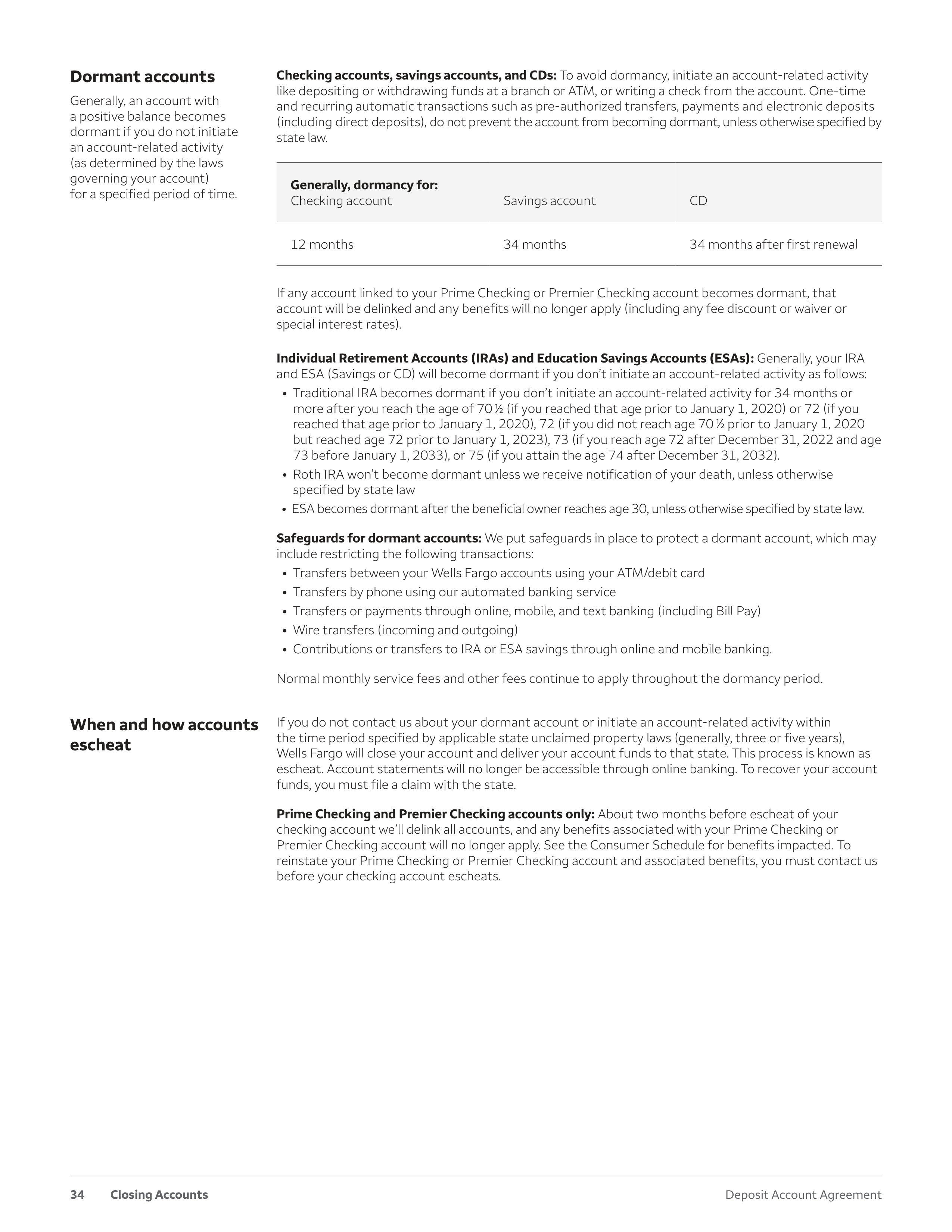
34
Deposit Account Agreement
Closing Accounts
Checking accounts, savings accounts, and CDs:
To avoid dormancy, initiate an account-related activity
like depositing or withdrawing funds at a branch or ATM, or writing a check from the account. One-time
and recurring automatic transactions such as pre-authorized transfers, payments and electronic deposits
(including
direct
deposits),
do not prevent the account from becoming dormant, unless otherwise specified by
state law.
If any account linked to your Prime Checking or Premier Checking account becomes dormant, that
account will be delinked and any benefits will no longer apply (including any fee discount or waiver or
special interest rates).
Individual Retirement Accounts (IRAs) and Education Savings Accounts (ESAs):
Generally, your IRA
and ESA (Savings or CD) will become dormant if you don’t initiate an account-related activity as follows:
• Traditional IRA becomes dormant if you don’t initiate an account-related activity for 34 months or
more after you reach the age of 70 ½ (if you reached that age prior to January 1, 2020) or 72 (if you
reached that age prior to January 1, 2020), 72 (if you did not reach age 70 ½ prior to January 1, 2020
but reached age 72 prior to January 1, 2023), 73 (if you reach age 72 after December 31, 2022 and age
73 before January 1, 2033), or 75 (if you attain the age 74 after December 31, 2032).
• Roth IRA won’t become dormant unless we receive notification of your death, unless otherwise
specified by state law
• ESA becomes dormant after the beneficial owner reaches age 30, unless otherwise specified by state law.
Safeguards for dormant accounts:
We put safeguards in place to protect a dormant account, which may
include restricting the following transactions:
• Transfers between your Wells Fargo accounts using your ATM/debit card
• Transfers by phone using our automated banking service
• Transfers or payments through online, mobile, and text banking (including Bill Pay)
• Wire transfers (incoming and outgoing)
• Contributions or transfers to IRA or ESA savings through online and mobile banking.
Normal monthly service fees and other fees continue to apply throughout the dormancy period.
If you do not contact us about your dormant account or initiate an account-related activity within
the time period specified by applicable state unclaimed property laws (generally, three or five years),
Wells Fargo will close your account and deliver your account funds to that state. This process is known as
escheat. Account statements will no longer be accessible through online banking. To recover your account
funds, you must file a claim with the state.
Prime Checking and Premier Checking accounts only:
About two months before escheat of your
checking account we’ll delink all accounts, and any benefits associated with your Prime Checking or
Premier Checking account will no longer apply. See the Consumer Schedule for benefits impacted. To
reinstate your Prime Checking or Premier Checking account and associated benefits, you must contact us
before your checking account escheats.
Dormant accounts
Generally, an account with
a positive balance becomes
dormant if you do not initiate
an account-related activity
(as determined by the laws
governing your account)
for a specified period of time.
When and how accounts
escheat
Generally, dormancy for:
Checking account
Savings account
CD
12 months
34 months
34 months after first renewal
35
Deposit Account Agreement
Consumer Accounts Only:
Resolving Disputes Through Arbitration
If you have a dispute with us, we hope to resolve it as quickly and easily as possible. First, discuss your
dispute with a banker. If your banker or another Wells Fargo employee is unable to resolve your dispute,
you agree that either Wells Fargo or you can initiate arbitration as described in this section.
Definition:
Arbitration means an impartial third party will hear the dispute between Wells Fargo and you
and provide a decision. Binding arbitration means the decision of the arbitrator is final and enforceable. A
dispute is any unresolved disagreement between Wells Fargo and you.
Wells Fargo and you each agree to waive the right to a jury trial or a trial in front of a judge in a public
court.
This Arbitration Agreement has only one exception: Either Wells Fargo or you may still take any
dispute to small claims court. Any disagreement over whether a dispute qualifies for small claims court
will be resolved by the small claims court in the first instance and otherwise by a court of competent
jurisdiction and any arbitration shall be stayed pending such resolution.
Arbitration is beneficial because it provides a legally binding decision in a more streamlined, cost-effective
manner than a typical court case. But, the benefit of arbitration is diminished if either Wells Fargo or you
refuse to submit to arbitration following a lawful demand. Thus, the party that does not agree to submit
to arbitration after a lawful demand must pay all of the other party’s costs and expenses for compelling
arbitration.
Neither Wells Fargo nor you will be entitled to join or consolidate disputes by or against others as a
representative or member of a class, to act in any arbitration in the interests of the general public,
or to act as a private attorney general.
If any provision related to a class action, class arbitration, private
attorney general action, other representative action, joinder, or consolidation is found to be illegal or
unenforceable, the entire Arbitration Agreement will be unenforceable.
Wells Fargo and you each agree that:
• The American Arbitration Association (AAA) will administer each arbitration and the selection of
arbitrators according to the AAA’s Consumer Arbitration Rules (AAA Rules).
• If there are any differences between the AAA Rules and this Arbitration Agreement, this Arbitration
Agreement applies.
• All issues are for the arbitrator to decide, except that issues relating to the scope and enforceability of
the Arbitration Agreement or whether a dispute can or must be brought in arbitration are for a court of
competent jurisdiction to decide.
• If the AAA is unavailable or unwilling to administer an arbitration consistent with this Arbitration
Agreement, the parties shall agree on an alternative administrator that will do so. If the parties are
unable to agree, they shall jointly petition a court of competent jurisdiction to appoint an administrator
that will do so.
• Wells Fargo and you are participating in commercial transactions involving the movement of money or
goods among states.
• The Federal Arbitration Act (Title 9 of the United States Code) governs this Arbitration Agreement and
any arbitration between Wells Fargo and you. If the Act or any part of it is inapplicable, unenforceable or
invalid, the state laws governing your relationship with Wells Fargo govern this Arbitration Agreement.
Either Wells Fargo or you may submit a dispute to binding arbitration at any time, regardless of whether
a lawsuit or other proceeding has previously begun. For information on initiating arbitration, contact the
AAA at 1-800-778-7879.
The party initiating arbitration must include in the arbitration demand all of the following information: (i)
the claimant’s name, address, telephone number, and email address; (ii) the applicable account holder’s
name (if different from the claimant) and account number; (iii) information sufficient to identify any
transaction at issue including the date and location of any such transaction, if applicable; (iv) a detailed
description of the nature and basis of the claims asserted; and (v) a detailed description of the nature
and basis of the relief sought, including a calculation for it. The demand must be personally signed by the
party initiating arbitration (and by counsel if the claimant is represented). By submitting an arbitration
demand, the claimant (and, counsel, if the claimant is represented) represent that, as in court, they are
complying with the requirements of Federal Rule of Civil Procedure 11(b). The arbitrator is authorized to
Arbitration Agreement
between you and
Wells Fargo
Applicable rules
Resolving Disputes Through Arbitration
36
Deposit Account Agreement
impose any sanctions available under Federal Rule of Civil Procedure 11 on represented parties and their
counsel. If the arbitrator finds that either the substance of your or Wells Fargo’s claim or the relief sought
was frivolous or was brought for an improper purpose (as measured by the standards set forth in Federal
Rule of Civil Procedure 11(b)), then Wells Fargo or you may also seek applicable fee-shifting. Either
Wells Fargo or you may request to have the arbitration conducted by a video or in-person hearing, or
through written submissions, except any dispute seeking $10,000 or more, or injunctive relief, shall have
a video or in-person hearing unless the parties agree otherwise. You and a Wells Fargo representative will
personally appear at any hearing (with counsel, if represented).
Each arbitrator must be a licensed attorney with expertise in the laws applicable to the dispute’s subject
matter. The arbitrator will make a decision regarding the dispute based on applicable law, including any
statutes of limitations. The arbitrator may award to either Wells Fargo or you any award or relief provided
for by law.
•
Setting the fees/expenses:
We will pay any costs that are required to be paid by us under the
arbitration administrator’s rules and procedures, and subject to applicable law. If the arbitrator rules
in your favor on any claim presented, we will reimburse you for arbitration filing fees you have paid up
to $700.00. Please check with the arbitration administrator to determine the fees applicable to any
arbitration you file.
•
Applying state law:
The laws governing your account may limit the amount of fees and expenses you
are required to pay in arbitration. Your arbitration fees and expenses will not exceed any applicable limits.
•
Paying for attorney/expert/witness fees:
Unless applicable laws state otherwise, each party will pay
its own attorney, expert, and witness fees. This rule applies no matter which party wins arbitration
Wells Fargo or you each can exercise any lawful rights or use other available remedies to:
• Preserve or obtain possession of property,
• Exercise self-help remedies, including setoff rights, or
• Obtain provisional or ancillary remedies such as injunctive relief, attachment, garnishment, or
appointment of a receiver by a court of competent jurisdiction.
• An arbitration will be held in the state whose laws govern your account.
Fees and expenses
Additional dispute
resolution
Resolving Disputes Through Arbitration
37
Deposit Account Agreement
Business Accounts Only:
Resolving Disputes Through Arbitration
If you have a dispute with us, we hope to resolve it as quickly and easily as possible. First, discuss your
dispute with a banker. If your banker or another Wells Fargo employee is unable to resolve your dispute,
you agree that either Wells Fargo or you can initiate arbitration as described in this section.
Definition:
Arbitration means an impartial third party will hear the dispute between Wells Fargo and you
and provide a decision. Binding arbitration means the decision of the arbitrator is final and enforceable.
A “dispute” is any unresolved disagreement between Wells Fargo and you. A “dispute” may also include a
disagreement about this Arbitration Agreement’s meaning, application, or enforcement.
Except as stated in “No waiver of self-help or provisional remedies” below, Wells Fargo and you agree,
at Wells Fargo’s or your request, to submit to binding arbitration all claims, disputes, and controversies
between or among Wells Fargo and you (and their respective employees, officers, directors, attorneys,
and other agents), whether in tort, contract or otherwise arising out of or relating in any way to your
account(s) and/or service(s), and their negotiation, execution, administration, modification, substitution,
formation, inducement, enforcement, default, or termination (each, a “dispute”).
DISPUTES SUBMITTED
TO ARBITRATION ARE NOT RESOLVED IN COURT BY A JUDGE OR JURY. TO THE EXTENT ALLOWED
BY APPLICABLE LAW, WELLS FARGO AND YOU EACH IRREVOCABLY AND VOLUNTARILY WAIVE
THE RIGHT EACH MAY HAVE TO A TRIAL BY JURY FOR ANY DISPUTE ARBITRATED UNDER THIS
AGREEMENT.
Aside from self-help remedies, this Arbitration Agreement has only one exception: Either Wells Fargo or
you may still take any dispute to small claims court. Arbitration is beneficial because it provides a legally
binding decision in a more streamlined, cost-effective manner than a typical court case. But, the benefit
of arbitration is diminished if either Wells Fargo or you refuse to submit to arbitration following a lawful
demand. Thus, the party that does not agree to submit to arbitration after a lawful demand by the other
party must pay all of the other party’s costs and expenses for compelling arbitration.
Wells Fargo and you agree that the resolution of any dispute arising pursuant to the terms of this
Agreement will be resolved by a separate arbitration proceeding and will not be consolidated with other
disputes or treated as a class. Neither Wells Fargo nor you will be entitled to join or consolidate disputes
by or against others as a representative or member of a class, to act in any arbitration in the interests of
the general public, or to act as a private attorney general. If any provision related to a class action, class
arbitration, private attorney general action, other representative action, joinder, or consolidation is found
to be illegal or unenforceable, the entire Arbitration Agreement will be unenforceable.
Wells Fargo and you each agree that the arbitration will:
• Proceed in a location mutually agreeable to Wells Fargo and you, or if the parties cannot agree, in a
location selected by the American Arbitration Association (AAA) in the state whose laws govern your
account
• Be governed by the Federal Arbitration Act (Title 9 of the United States Code), notwithstanding any
conflicting choice of law provision in any of the documents between Wells Fargo and you
• Be conducted by the AAA, or such other administrator as Wells Fargo and you will mutually agree
upon, in accordance with the AAA’s commercial dispute resolution procedures, unless the claim
or counterclaim is at least $1,000,000 exclusive of claimed interest, arbitration fees and costs in
which case the arbitration will be conducted in accordance with the AAA’s optional procedures for
large, complex commercial disputes (the commercial dispute resolution procedures or the optional
procedures for large, complex commercial disputes to be referred to, as applicable, as the “rules”).
If there is any inconsistency between the terms hereof and any such rules, the terms and procedures set
forth herein will control. Any party who fails or refuses to submit to arbitration following a lawful demand
by any other party will bear all costs and expenses incurred by such other party in compelling arbitration
of any dispute. Nothing contained herein will be deemed to be a waiver by Wells Fargo of the protections
afforded to it under 12 U.S.C. Section 91 or any similar applicable state law.
This arbitration requirement does not limit the right of Wells Fargo or you to:
1. Exercise self-help remedies, including setoff or
2. Obtain provisional or ancillary remedies such as injunctive relief or attachment, before, during, or after
the pendency of any arbitration proceeding. This exclusion does not constitute a waiver of the right or
obligation of either party to submit any dispute to arbitration or reference hereunder, including those
arising from the exercise of the actions detailed in (1) and (2) above.
Arbitration Agreement
between you and
Wells Fargo
Class action or
representative suit
not permitted
Applicable rules
No waiver of self-help or
provisional remedies
Resolving Disputes Through Arbitration
38
Deposit Account Agreement
Additional rules for an
arbitration proceeding
Any dispute in which the amount in controversy is $5,000,000 or less will be decided by a single arbitrator
selected according to the rules, and who will not render an award of greater than $5,000,000. Any dispute
in which the amount in controversy exceeds $5,000,000 will be decided by majority vote of a panel of
three arbitrators; provided however, that all three arbitrators must actively participate in all hearings
and deliberations. Each arbitrator will be a neutral attorney licensed in the state whose laws govern your
account, or a neutral, retired judge in such state, in either case with a minimum of ten years’ experience
in the substantive law applicable to the subject matter of the dispute to be arbitrated. The arbitrator(s)
will determine whether or not an issue is arbitratable and will give effect to the statutes of limitation in
determining any claim.
In any arbitration proceeding the arbitrator(s) will decide (by documents only or with a hearing at the
discretion of the arbitrator(s)) any pre-hearing motions which are similar to motions to dismiss for
failure to state a claim or motions for summary adjudication. The arbitrator(s) will resolve all disputes
in accordance with the substantive law of the state whose laws govern your account and may grant any
remedy or relief that a court of such state could order or grant within the scope hereof and such ancillary
relief as is necessary to make effective any award. The arbitrator(s) will also have the power to award
recovery of all costs and fees, to impose sanctions, and to take such other action as deemed necessary
to the same extent a judge could pursuant to the federal rules of civil procedure, the state rules of civil
procedure for the state whose laws govern your account, or other applicable law. Judgment upon the
award rendered by the arbitrator(s) may be entered in any court having jurisdiction. The institution and
maintenance of an action for judicial relief or pursuit of a provisional or ancillary remedy will not constitute
a waiver of the right of any party, including the plaintiff, to submit the controversy or claim to arbitration if
any other party contests such action for judicial relief.
In any arbitration proceeding, discovery will be permitted in accordance with the rules. All discovery will
be expressly limited to matters directly relevant to the dispute being arbitrated and must be completed
no later than 20 days before the hearing date. Any requests for an extension of the discovery periods, or
any discovery disputes, will be subject to final determination by the arbitrator upon a showing that the
request for discovery is essential for the party’s presentation and that no alternative means for obtaining
information is available.
The arbitrator will award all costs and expenses of the arbitration proceeding.
To the maximum extent practicable, the AAA, the arbitrator(s), Wells Fargo and you will take all action
required to conclude any arbitration proceeding within 180 days of the filing of the dispute with the AAA.
The arbitrator(s), Wells Fargo or you may not disclose the existence, content, or results thereof, except for
disclosures of information by Wells Fargo or you required in the ordinary course of business, by applicable
law or regulation, or to the extent necessary to exercise any judicial review rights set forth herein. If more
than one agreement for arbitration by or between Wells Fargo and you potentially applies to a dispute,
the arbitration agreement most directly related to your account or the subject matter of the dispute will
control. This arbitration agreement will survive the closing of your account or termination of any service or
the relationship between Wells Fargo and you.
Notwithstanding anything to the contrary, Wells Fargo and you each retains the right to pursue in small
claims court a dispute within that court’s jurisdiction. Further, this arbitration agreement will apply only to
disputes in which either party seeks to recover an amount of money (excluding attorneys’ fees and costs)
that exceeds the jurisdictional limit of the small claims court.
Arbitrator’s
qualifications
and power
Discovery
Fees and expenses
The right to pursue
claims in small
claims court
Resolving Disputes Through Arbitration
39
Deposit Account Agreement
Additional Terms and Services
This Agreement, your accounts, services and any related disputes are governed by United States law and
(when not superseded by United States law) the laws of the state where your account is located (without
regard to conflict of laws principles). We may move your account to a different state, and will notify you if
we do so.
Where your account is located:
• If you apply through one of our branches, then the account is located in the state where the branch is
located.
• If you apply online, phone or by mail, then the account is located in the state associated with your home
ZIP code at the time of account opening if we have a branch in that state when the account is opened.
• In all other cases, your account will be located in California.
For consumer and business accounts (except analyzed business accounts), your account statement
identifies which state’s terms and conditions apply.
English is the controlling language of our relationship with you, including the terms of this Agreement. Items
you write such as checks or withdrawal slips must be written in English. For your convenience, we may, but
are not obligated to (unless required by law), translate some forms, disclosures, and advertisements into
another language, but if there’s a discrepancy, the English version prevails over the translation.
Legal process includes any levy, garnishment or attachment, tax levy or withholding order, injunction,
restraining order, subpoena, search warrant, government agency request for information, forfeiture or
seizure, and other legal process relating to your account.
We may accept and act on any legal process we believe to be valid regardless of how and where it is
served, including if process is served in locations, states, or jurisdictions other than where the account was
opened or where the account, property, or records are located.
We may, but are not required to, provide notice of legal process relating to your accounts. We may comply with
legal process even though it affects the interests of only one owner or authorized signer of a joint account.
Regardless of any action we take, we are not waiving any rights of exemption you may have under any federal
or state laws. You are responsible for invoking any exemption rights not otherwise asserted on your behalf.
Any fees, expenses (including attorneys’ fees and expenses), or losses we incur as a result of responding to
legal process related to your account are your responsibility. We may charge these costs to any account
you maintain with us.
If legal process relates to an account or accounts that appear on a combined statement, we may release
the entire combined statement, even if that means that we release information related to accounts not
otherwise governed by this Agreement.
We may change the terms of this Agreement, including account fees and features, at any time by adding
new terms or conditions, or by modifying or deleting existing ones. If we’re required to notify you of
a change to this Agreement, we’ll describe the change and its effective date in a message within your
account statement or by any other appropriate means. We may agree in writing to waive a term of this
Agreement, including a fee, and we may revoke any waiver.
Any term of this Agreement that is inconsistent with the laws governing your account will be excluded to
the extent of such invalidity. The invalid term will be considered modified by us and applied in a manner
consistent with such laws. Such modification won’t affect the enforceability or validity of the remaining
terms of this Agreement.
Any notice you send us is effective once we receive it and have a reasonable opportunity to act on it.
We’re responsible for exercising ordinary care and complying with this Agreement.
When we take an item for processing by automated means, ordinary care does not require us to
examine the item. In all other cases, ordinary care requires only that we follow standards that don’t vary
unreasonably from the general standards followed by similarly situated banks.
Controlling language
Legal process
Changes to this
Agreement
Modification of
invalid terms
Timing of notices
Responsibilities and
liabilities between
Wells Fargo and you
Laws governing
your account
Additional Terms and Services
40
Deposit Account Agreement
Except to the extent we fail to exercise ordinary care or to comply with this Agreement, and to the extent
permitted by applicable federal or state laws, you agree to indemnify and hold us harmless from all claims,
demands, losses, liabilities, judgments, and expenses (including attorneys’ fees and expenses) arising out
of or in any way connected with our performance under this Agreement. This indemnification will survive
termination of this Agreement.
We won’t be liable for anything we do when following your instructions. In addition, we won’t be liable if we
don’t follow your instructions if we reasonably believe that your instructions would expose us to potential
loss or civil or criminal liability, or conflict with customary banking practices. In no event will either
Wells Fargo or you be liable to the other for any special, consequential, indirect, or punitive damages.
The limitation doesn’t apply where the laws governing your account prohibit it. We won’t have any liability
to you if your account does not have sufficient available funds to pay your items due to actions we have
taken in accordance with this Agreement.
Circumstances beyond your control or ours may arise and make it impossible for us to provide services
to you or for you to perform your duties under this Agreement. If this happens, neither Wells Fargo nor
you will be in breach of this Agreement. If we waive a right with respect to your account on one or more
occasions, it does not mean we’re obligated to waive the same right on any other occasion.
We’re permitted to either directly debit your account or bill you for our fees, expenses and taxes incurred
in connection with your account and any service. If the available funds in your account are not sufficient to
cover the debit, we may create an overdraft on your account.
Our setoff rights:
If you owe us any money, we have the right to apply funds in any of your accounts to
pay your debt. This is known as setoff. When we exercise this right, we reduce the funds in your account(s)
by the amount of the debt that is due or past due as allowed by the laws governing your account. Unless
required by law, we do not need to give you any prior notice to exercise our right of setoff.
A debt includes any amount you owe individually or together with someone else both now or in the future.
It includes any overdrafts and our fees. If your account is a joint account, we may setoff funds in it to pay
the debt of any joint owner.
If your account is an unmatured CD, then we may deduct an early withdrawal penalty. This may be due as a
result of our having exercised our right of setoff. See “Early withdrawal penalty and Regulation D penalty”
in the “Time Accounts (CDs)” section of this Agreement.
Consumer accounts only:
Our right to setoff extends to any federal or state benefit payments (including
Social Security benefits) deposited to your account, subject to applicable law. If we’re obligated to return
any federal or state benefits deposited to your accounts after you’re no longer eligible to receive them, we
may setoff against any of your accounts to recover the payments you were ineligible to receive. Our right
of setoff won’t apply if it would invalidate the tax-deferred status of any tax-deferred retirement account
(e.g., a SEP or an IRA) you keep with us.
Security interest:
In addition to granting us the right of setoff, and to ensure you pay us all amounts you
owe us under this Agreement (e.g., overdrafts and fees), you grant us a security interest in each account
you keep with us. By opening and keeping each account with us, you consent to our asserting our security
interest should the laws governing this Agreement require your consent. Our rights under this security
interest are in addition to and apart from any other rights under any other security interest you may have
granted to us.
You may not grant a security interest in, transfer, or assign your accounts to anyone other than us without
our written agreement.
U.S. Treasury regulations require us to determine the tax residency of all customers and payees who could
receive income that is reportable to the IRS. We accomplish this by obtaining a Form W-9 from all U.S.
taxpayers and a type of Form W-8 from all foreign customers.
•
We use Form W-9 to document U.S. tax residency and obtain a Taxpayer Identification Number (“TIN”)
from the primary owner of each account. Until we have received the Form W-9 and TIN, we‘re required
to apply backup withholding to any income earned.
•
Foreign individuals (also referred to as nonresident aliens) and foreign entities document their tax
residency outside the U.S. on the applicable type of Form W-8. That form also allows us to apply the
correct withholding rate or exemption to your income earned in the U.S. If you don’t provide a valid type
of Form W-8, we’re required to apply the 30% withholding rate, or in some cases, presume you’re an
uncertified U.S. taxpayer subject to backup withholding on all income and gross proceeds regardless of
whether or not it’s U.S. sourced.
Your obligation to
pay our fees
Setoff and security
interest
Tax identification
number certification
requirements
Additional Terms and Services
41
Deposit Account Agreement
•
Accounts jointly owned by at least one foreign individual or entity must provide a Form W-8 or Form
W-9, as applicable, for all of the joint owners.
•
Foreign individuals provide a Form W-8BEN. Foreign entities that are the beneficial owner of the
income provide a Form W-8BEN-E unless they can make a special withholding exemption claim and
instead provide either a Form W-8EXP or Form W-8ECI.
•
Entities that act as intermediaries or flow-through entities receiving income on behalf of someone
else provide a Form W-8IMY. In some cases, that Form W-8IMY must also include a withholding
statement that allocates the income to each of the beneficial owners and copies of the tax certification
documentation for those underlying beneficial owners.
If you own your account as an individual or sole proprietor, upon your death, we must be provided with the
estate’s or successor’s IRS Form W-9 or Form W-8. If these are not provided, we may either refuse to pay
interest earned on your account from the date of your death or apply backup withholding on the income
earned after the date of your death.
You’re responsible for paying applicable state and local sales taxes on your account fees. These taxes
vary by location. You also agree to pay an amount equal to any other applicable taxes, including backup
withholding tax. We will charge you for all the foregoing taxes and amounts. You also agree to pay an
amount equal to any other applicable taxes, including backup withholding tax.
In addition to any applicable fees, we make money when we convert one currency to another currency for
you. The exchange rate used when we convert one currency to another is set at our sole discretion, and it
includes a markup. The markup is designed to compensate us for several considerations including, without
limitation, costs incurred, market risks, and our desired return. The applicable exchange rate does not
include, and is separate from, any applicable fees. The exchange rate we provide to you may be different
from exchange rates you see elsewhere. Different customers may receive different rates for transactions
that are the same or similar. The applicable exchange rate may vary based on such factors including, but
not limited to, currency pair, transaction size, payment channel and product type, such as foreign currency
cash, checks, remittances, and wire transfers. Foreign exchange markets are dynamic, and rates fluctuate
over time based on market conditions, liquidity, and risks. We’re your arms-length counterparty on foreign
exchange transactions. We may refuse to process any request for a foreign exchange transaction.
Contacting you for servicing and collection:
We may contact you by phone, text, email, or mail to service
your account or collect amounts you owe us. You will provide us accurate and current contact information.
We can contact you at any address, phone number, or email address you provide.
When you give us a phone number, you expressly consent that we (and any party acting on our behalf)
may contact you by phone call or text message at that number. When we call you, you agree that we
may leave prerecorded or artificial voice messages. You also agree that we may use automatic telephone
dialing systems in connection with calls or text messages sent to any phone number you give us, even if
the receiving number is a mobile phone or other service for which the party called may be charged.
Monitoring communications:
We can monitor, record, and retain your communications with us at any
time without further notice to anyone, unless the laws governing your account require further notice.
Monitored and recorded communications include phone conversations, electronic messages and records,
and other data transmissions.
Communicating with authorized signers:
We may provide you or an authorized signer with
information about your account. When we receive information from an authorized signer, we treat it as a
communication from you. You agree to notify us promptly in writing if an authorized signer no longer has
authority on your account.
An adverse claim occurs when
•
Any person or entity makes a claim against your account or funds in your account,
•
We believe a conflict exists between or among your account’s owners, or
•
We believe a dispute exists over who has account ownership or authority to withdraw funds from your
account.
In these situations, we may take any of the following actions without any responsibility or liability to you:
•
Continue to rely on the documents we have on file for your account.
•
Honor the claim against your account funds if we’re satisfied the claim is valid.
•
Freeze all or a part of the funds in your account until we believe the dispute is resolved to our
satisfaction.
•
Close your account and send a check or other item for the available balance in your account payable to
you or to you and each person or entity who claimed the funds.
•
Pay the funds into an appropriate court and/or petition the court to resolve the dispute.
Your tax
responsibility
Applicable
exchange rate
Communications
about your
account
Adverse claims
against your
account
Additional Terms and Services
42
Deposit Account Agreement
We also may charge any account you keep with us for our fees and expenses in taking these actions
(including attorneys’ fees and expenses, and court costs).
In addition, if we believe, in our sole discretion, that you may lack the capacity to act on your account,
we may request a court take action to preserve or protect assets in your account(s). In such cases, we
may charge any account you keep with us for our fees and expenses in taking these actions (including
attorneys’ fees and expenses, and court costs).
If you have special insurance for employee fraud/embezzlement, we may require you to file your claim with
your insurance company before making any claim against us. In such event, we’ll consider your claim only
after we have reviewed your insurance company’s decision, and our liability to you, if any, will be reduced
by the amount your insurance company pays you.
If we suspect any suspicious, irregular, fraudulent, unauthorized or unlawful activities (“Questionable
Activities”), we may, in our sole discretion: prevent, delay or decline transactions account activities; freeze
all or some of the funds in any account with us that you keep or control; and/or otherwise restrict access
to your account(s).
•
If a state or federal agency requests us to restrict funds in your accounts, we will comply with their request
as permitted under state or federal law, and notify you, unless otherwise prohibited by applicable law.
•
If we suspect an owner is a victim of elder or vulnerable adult exploitation, we may file a report with
the appropriate investigative agency, under applicable state law. In addition, we may notify any or all
owners or authorized signers on your account, and, unless otherwise prohibited by applicable law, any
third party you designate as a contact for your account. We may also notify certain third parties who we
believe are closely associated with you about our concerns regarding the Questionable Activities.
With respect to Questionable Activities, we may continue to prevent, delay, or decline transactions and/
or account activities, freeze funds, or otherwise restrict access to your account, until the earlier of when
(i) our concerns about the Questionable Activities are resolved to our satisfaction, (ii) the time frame
set forth in applicable law, or (iii) we receive a Court order that provides us direction. Unless otherwise
required by applicable law to take any of the above actions, we may take these actions in our sole
discretion and without liability to you.
We can convert your account to another type of deposit account (by giving you any required notice) if:
•
You use it inappropriately or fail to meet or maintain the account’s requirements, including minimum
balance requirements, or
• We determine an account is inappropriate for you based on your use, or
•
We stop offering the type of account you have.
We can terminate or suspend specific services (for example, wire transfers) without closing your account
and without prior notice to you. You can discontinue using a service at any time.
We can obtain a credit or other report about you and/or your co-owners and authorized signers to help
us determine whether to open or keep an account. We can also obtain information from motor vehicle
departments, other state agencies, and public records.
Generally, if we don’t have your consent, we won’t share information about your account. However, we
may share information about your account in accordance with our separately provided Privacy Notice.
We may benefit from having the use of funds in customers’ non-interest-bearing accounts. We may use
these funds to reduce our borrowing from other sources, such as the Fed Funds market, or invest them
in short-term investments, such as our Federal Reserve Account. Our use of funds as described in this
paragraph has no effect or impact on your use of and access to funds in your account.
If you carry special
insurance for employee
fraud/embezzlement
(Business accounts only)
Restricting
access to your
account
Converting
accounts
Terminating or
suspending services
Obtaining credit reports
or other reports about you
Sharing information about
your account with others
Use of funds in
customers’
non-interest-bearing
accounts
Additional Terms and Services
43
Deposit Account Agreement
Glossary
Access device:
a card, code, or other means of access to a consumer’s account, or any combination thereof, that
may be used by you to initiate electronic fund transfers.
ACH transaction:
a deposit or payment transferred through the Automated Clearing House (ACH) network, an
electronic network used for financial transactions. ACH transfers are a type of Electronic Fund Transfer (EFT).
Analyzed business account:
a checking account for which fees are billed through account analysis. Some
analyzed accounts offer an earnings allowance to offset eligible fees. Examples of analyzed business accounts
include the following: Optimize Business Checking
℠
, Analyzed Business Checking, and Analyzed Interest on
Lawyers Trust Account (IOLTA).
Authorized signer:
a person who has authority to use your account even if they have not signed the account
application.
Available balance:
our most current record of the amount of money available for your use or withdrawal. For
more information, see the “Available Balance, Posting Transactions, and Overdraft” section in this Agreement.
Business account:
any deposit account, other than one of Wells Fargo’s commercial deposit accounts, which
isn’t established and kept for personal, family, or household purposes. Common examples of ownership include
an individual acting as a sole proprietor, a partnership, a limited partnership, a limited liability partnership, a
limited liability company, a corporation, a joint venture, a nonprofit corporation, an employee benefit plan, or a
governmental unit including an American Indian tribal entity.
Business day:
every day except Saturday, Sunday, and federal holidays.
Card:
every type of debit card and ATM card we may issue, except any prepaid cards or the business deposit card.
Collected balance:
the ending daily balance in your account after all credits and debits have posted, minus
deposited items that have not yet been collected from the originating financial institution. The collected balance
is the balance on which interest is calculated for all interest-bearing checking accounts and for all savings
accounts.
Consumer account:
any deposit account which is established and kept for personal, family, or household
purposes and isn’t intended for business use. A consumer account can be owned by one or more individuals.
Digital wallet:
a digital wallet is a way to carry your credit and debit card information in a secure digital form
on your mobile device (smartphone, smartwatch, tablet). Instead of using your physical plastic card to make
purchases, a digital wallet allows you to pay in stores, in apps, or online.
Direct deposit:
an automatic electronic deposit of your salary, pension, Social Security, or other regular income
deposited through the ACH network to your Wells Fargo deposit account by your employer or an outside
agency.
Endorsement:
a signature, stamp, or other mark on the back of a check to transfer, restrict payment, or make
the signer responsible for the check.
Fee period:
is the period used to calculate the monthly service fee. The fee period details are provided on the
Monthly Service Fee Summary located in your account statement.
Item:
any order, instruction, or authorization to withdraw or pay funds or money from or to an account.
Examples include a check, draft, money order, ACH, wire transfer, Bill Pay, other electronic transfer, ATM
withdrawal, teller withdrawal, debit card purchase, and fee.
Overdraft:
an available balance of less than $0.00 in your account.
Returned item / Non-sufficient funds (NSF):
a term used to indicate when an item presented for payment is
returned unpaid because the available balance in your deposit account is less than the amount of the item when
presented.
Glossary

Deposit products offered by Wells Fargo Bank, N.A. Member FDIC.
© 2025 Wells Fargo Bank, N.A.
CCB2018 (In-use 11/4/2025)