
Not for publication before June 16, 2021
18:30 Eastern Time
Remarks by Tiff Macklem
Governor of the Bank of Canada
Appearance before the
Standing Senate Committee on
Banking, Trade and Commerce
June 16, 2021
Ottawa, Ontario
Good afternoon, Chair and committee members. This is my first opportunity to
address this committee since being appointed Governor of the Bank of Canada,
and I am very pleased to be here. We consider these appearances to be an
important part of our accountability to Canadians, and I look forward to your
questions and perspectives.
To begin, I’d like to review for the committee the Bank of Canada’s actions since
the start of the pandemic. I will also provide our assessment of the progress
toward economic recovery.
Through the pandemic, the Bank of Canada has had two overarching goals. At
the beginning of the crisis, our objective was to restore financial market
functioning and keep credit flowing. As market functioning improved and
Canadians began to come out of the first lockdown, our focus shifted to providing
monetary policy stimulus to support the recovery, get Canadians back to work
and bring inflation back to our 2 percent target.
Fifteen months ago, the extreme uncertainty caused by the virus and associated
lockdowns triggered an unprecedented dash for cash in financial markets. With
many more sellers of financial assets than buyers, credit markets froze,
threatening access to credit for businesses and households. The Bank of
Canada acted quickly and in scale, providing liquidity and purchasing assets to
support the functioning of key Canadian financial markets. As a result, the Bank’s
balance sheet expanded rapidly as we purchased federal, provincial and
corporate bonds, commercial paper, bankers’ acceptances and mortgage bonds.
These new programs, 11 in all, were successful in restoring smooth functioning
across financial markets. Today, all but one of our exceptional programs have
been wound down or have ceased operations. The one remaining program is our
purchases of Government of Canada bonds, also known as quantitative easing
or QE, and I’ll come back to this in a moment.
To provide monetary stimulus, the Bank lowered our policy interest rate as far as
we effectively could, to 0.25 percent, in the spring of 2020. In the summer, we
added exceptional forward guidance, committing to hold our policy rate at its
effective lower bound until slack is absorbed so that we sustainably achieve our
2 percent inflation target. This commitment was supplemented and reinforced by
our QE program, which is helping to lower interest rates across the yield curve,
making it cheaper for households and businesses to borrow.
- 2 -
In April 2021, the Bank published our revised outlook for the Canadian economy
in the
Monetary Policy Report
(MPR), and economic developments since then
have been broadly in line with that outlook. I would highlight three key messages.
First, the economic recovery is making good progress. Canadian households and
businesses have shown impressive resilience to the pandemic, and with more
Canadians getting vaccinated, we anticipate better times ahead.
Second, a complete recovery will still take some time. The third wave of the virus
has been a setback. It has strained health care systems in some regions and has
again hit sectors where physical distancing is difficult. Important parts of the
economy remain very weak, and too many Canadians are still out of work.
Third, the Bank remains steadfast in its commitment
to support Canadian
households and businesses through the full length of the recovery. For working
Canadians, a complete recovery means a healthy job market with good
opportunities. And that includes low-wage workers, women and young people
who have been hit hard by this pandemic. A complete recovery means
companies have confidence that the pandemic is over and are investing to seize
new business opportunities. And for both households and businesses, a
complete recovery means they can count on inflation being sustainably at our
2 percent target. Let me elaborate on these themes.
Following a sharp bounce back in economic activity in the fall and winter, we’ve
seen choppiness in growth again in the second quarter of 2021. Renewed
lockdowns associated with the third wave of the pandemic dampened economic
activity early in the quarter, largely as anticipated. The ebb and flow of the virus
is mirrored by an ebb and flow of economic growth. Recent jobs data show that
workers in contact-sensitive sectors remain most affected, and the employment
rate remains well below its pre-pandemic level. Still, we have seen impressive
resilience and adaptability from Canadian households and businesses. They
have found new ways to shop, serve customers and work remotely.
Housing demand has been particularly strong, driven largely by the desire for
more living space and by low mortgage rates. All the while, limited supply has led
to a sharp increase in prices. As we explained in our May
Financial System
Review
, it is important to understand that the recent rapid increases in home
prices are not normal. Our analysis suggests that in some markets, price
expectations have become extrapolative—meaning people may be rushing to
buy partly because they expect prices to keep rising. This behaviour can
exaggerate near-term house price increases relative to fundamental demand.
There are also risks that some households may overstretch financially.
We welcome the revisions to the B-20 guideline issued by the Office of the
Superintendent of Financial Institutions, which altered the minimum floor
qualifying rate, as well as the parallel changes in the insured market. These
changes should help protect Canadians from overstretching. The federal budget
also included measures that will add supply. Overall, we expect the housing
market to be better balanced, but we will continue to watch this area closely.
- 3 -
Looking more broadly at the economy as a whole, we forecast strong
consumption-led growth in the second half of this year as vaccinations progress
further and restrictions ease. Fiscal stimulus from the federal and provincial
governments will also make an important contribution to growth. Strong foreign
demand and higher commodity prices are expected to drive exports and
business investment, leading to a more broad-based recovery. In our April MPR,
we projected that the economy will grow by around 6½ percent this year, about
3¾ percent in 2022 and 3¼ percent in 2023.
With this improved outlook, we are hopeful that the pandemic will end up causing
less labour market scarring and less lost capacity than we earlier feared. We
have therefore revised up our estimate of the economy’s potential output. But I
want to emphasize that considerable uncertainty surrounds this estimate. As the
recovery continues, we will be paying attention to a broad spectrum of indicators
of slack, including a range of labour market measures.
Our monetary policy remains grounded in our inflation-targeting framework. The
most recent data show that inflation remained above 3 percent in May. Inflation
will likely remain near the top of our 1 to 3 percent inflation-control target range
through the summer. This largely reflects base-year effects combined with much
stronger gasoline prices. As these base-year effects fade, Governing Council
expects the ongoing excess supply in the economy to pull inflation back down. In
our most recent policy announcement last week, Governing Council judged that
the economy still needs extraordinary monetary policy support. We remain
committed to holding the policy interest rate at the effective lower bound until
economic slack is absorbed so that the 2 percent inflation target is sustainably
achieved. Based on our latest projection, this is expected to happen sometime in
the second half of 2022, although this timing is unusually uncertain given the
difficulties in assessing the economy’s supply capacity.
Our forward guidance on our policy rate continues to be reinforced and
supplemented by the Bank’s QE program. In April, we adjusted our weekly
purchases of Government of Canada bonds to a target of $3 billion, down from
the previous minimum of $4 billion. This adjustment reflects the progress that we
had already seen toward economic recovery.
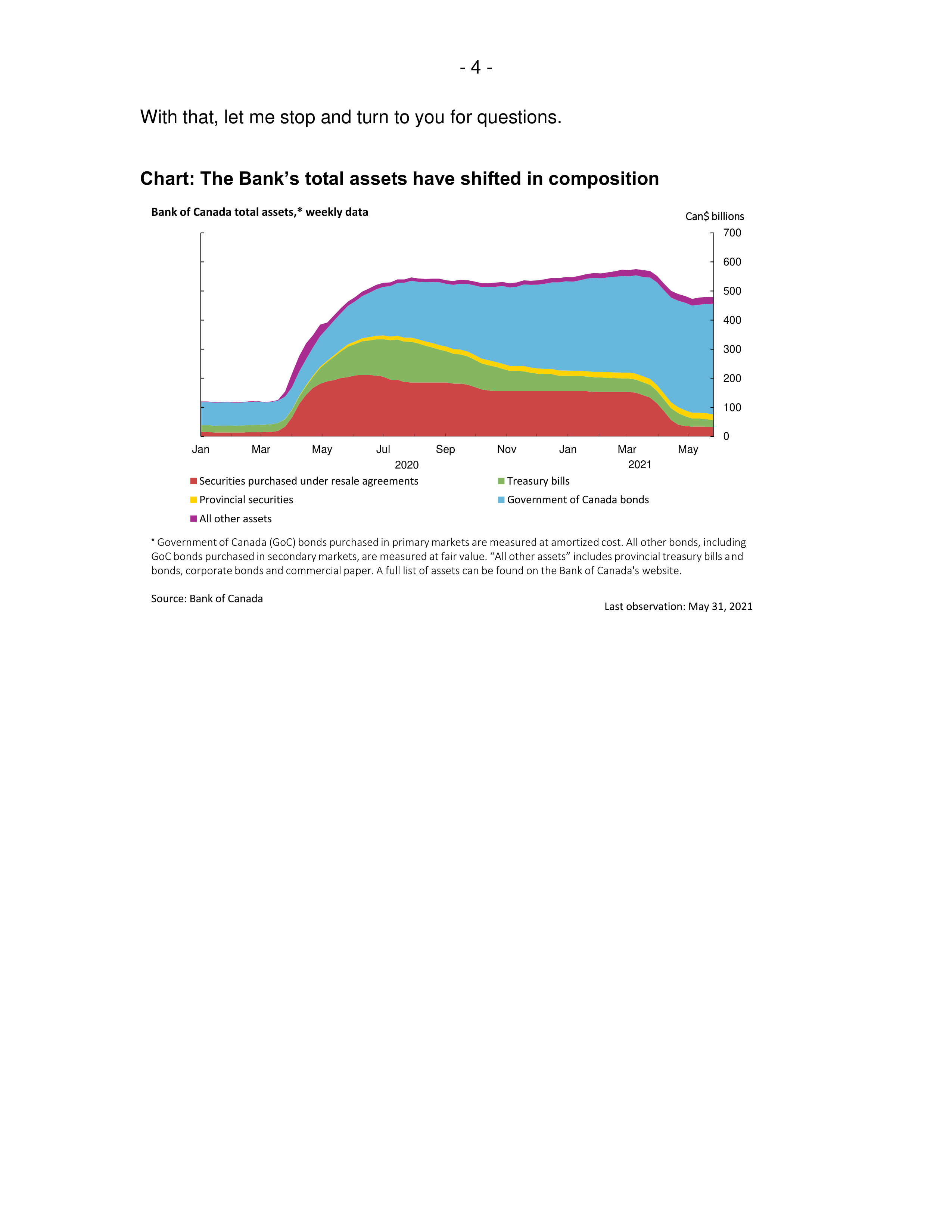
With the end of most of our extraordinary programs, the Bank’s balance sheet
has shrunk to about $475 billion from a peak of about $575 billion back in March.
Below you will see a chart that shows the evolution of the size and composition
of our balance sheet. The Bank currently holds more than $350 billion of
Government of Canada bonds, representing about 45 percent of the outstanding
stock of nominal bonds.
Looking ahead, further adjustments to the pace of net purchases will be guided
by our ongoing assessment of the strength and durability of the economic
recovery. If the recovery evolves in line with or stronger than our latest projection,
the economy won’t need as much QE stimulus over time. Further adjustments to
our QE program will be gradual, and we will be deliberate in both our assessment
of incoming data and the communication of our analysis.
We remain committed to providing the appropriate degree of monetary policy
stimulus to support the recovery and achieve the inflation objective.
- 4 -
With that, let me stop and turn to you for questions.
Chart: The Bank’s total assets have shifted in composition
0
100
200
300
400
500
600
700
Jan
Mar
May
Jul
Sep
Nov
Jan
Mar
May
Can$ billions
Securities purchased under resale agreements
Treasury bills
Provincial securities
Government of Canada bonds
All other assets
Bank of Canada total assets,* weekly data
Last observation: May 31, 2021
Source: Bank of Canada
*
Government of Canada (GoC) bonds purchased in primary markets are measured at amortized cost. All other bonds, including
GoC bonds purchased in secondary markets, are measured at fair value. “All other assets” includes provincial treasury bills and
bonds, corporate bonds and commercial paper. A full list of assets can be found on the Bank of Canada's website.
2021
2020