UK Covid-19
Inquiry
Opening
Statement
July 2022

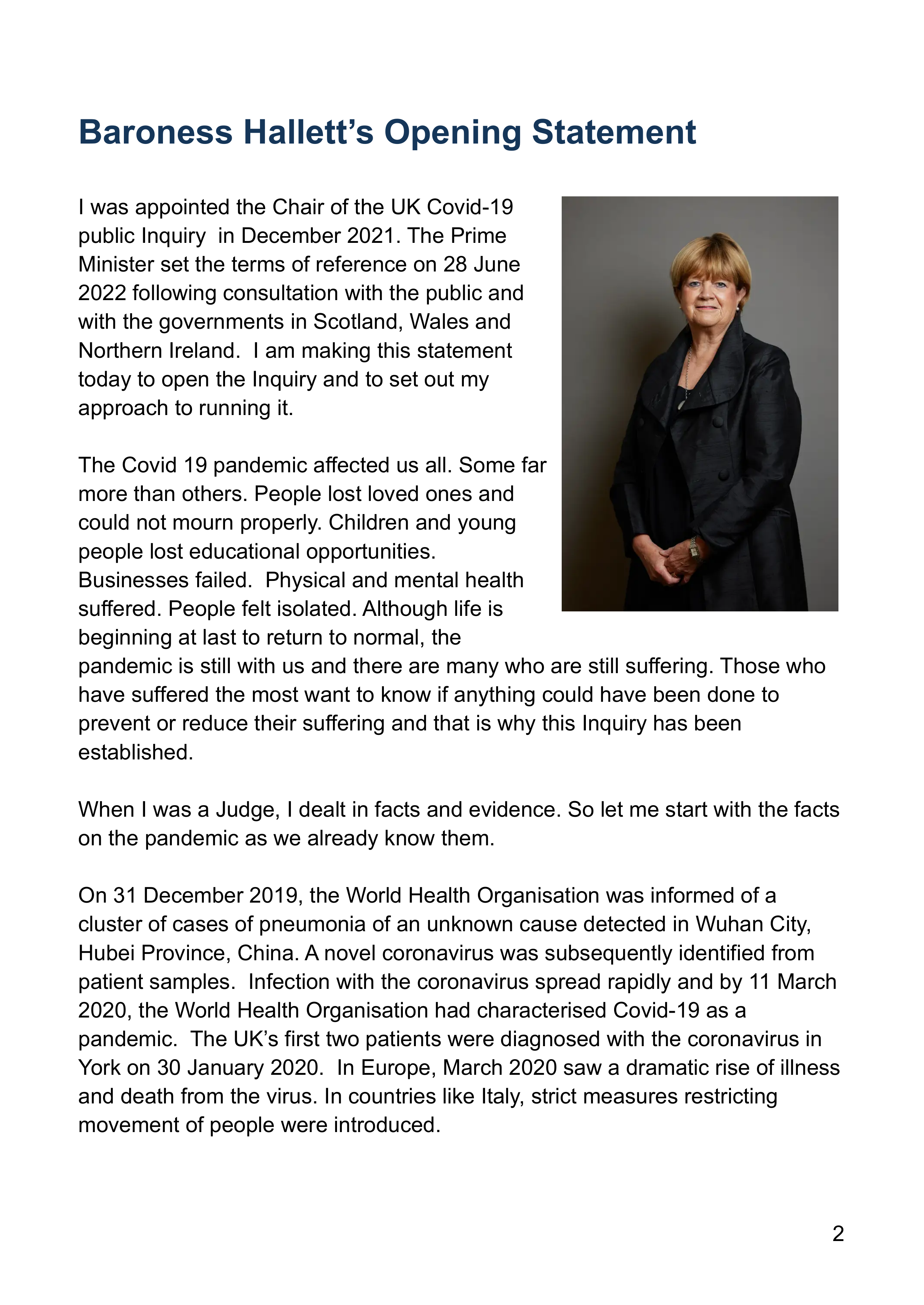
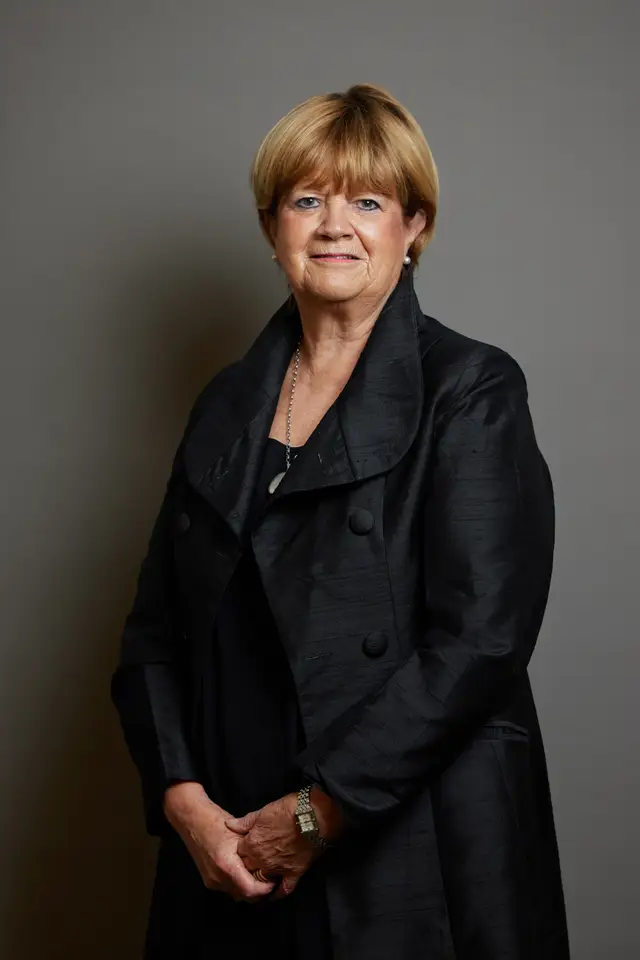
Baroness Hallett’s Opening Statement
I was appointed the Chair of the UK Covid-19
public Inquiry in December 2021. The Prime
Minister set the terms of reference on 28 June
2022 following consultation with the public and
with the governments in Scotland, Wales and
Northern Ireland. I am making this statement
today to open the Inquiry and to set out my
approach to running it.
The Covid 19 pandemic affected us all. Some far
more than others. People lost loved ones and
could not mourn properly. Children and young
people lost educational opportunities.
Businesses failed. Physical and mental health
suffered. People felt isolated. Although life is
beginning at last to return to normal, the
pandemic is still with us and there are many who are still suffering. Those who
have suffered the most want to know if anything could have been done to
prevent or reduce their suffering and that is why this Inquiry has been
established.
When I was a Judge, I dealt in facts and evidence. So let me start with the facts
on the pandemic as we already know them.
On 31 December 2019, the World Health Organisation was informed of a
cluster of cases of pneumonia of an unknown cause detected in Wuhan City,
Hubei Province, China. A novel coronavirus was subsequently identified from
patient samples. Infection with the coronavirus spread rapidly and by 11 March
2020, the World Health Organisation had characterised Covid-19 as a
pandemic. The UK’s first two patients were diagnosed with the coronavirus in
York on 30 January 2020. In Europe, March 2020 saw a dramatic rise of illness
and death from the virus. In countries like Italy, strict measures restricting
movement of people were introduced.
2
On 11 March 2020, in connection with that year’s annual budget, the then
Chancellor of the Exchequer announced a £12 billion package of emergency
support to help the UK cope with the expected impact of the virus. Five days
later, the Prime Minister urged everyone in the UK to work from home, to stop
non-essential contact with others, avoid pubs and restaurants and to give the
UK time to cope with the pandemic. On 17 March, the Chancellor announced
£330 billion of government backed loans and £20 billion in tax cuts and grants
for companies threatened with collapse. On 18 March, the government
announced the closure of schools from the end of that week. On 20 March, the
Chancellor announced that the government would pay up to 80% of the wages
of staff at risk of being made redundant.
On 23 March, the Prime Minister announced severe restrictions on the daily
lives of everyone in the UK, in what became known as the first national
lockdown. People were only permitted to leave home to buy food, to exercise,
to attend to a medical need or provide care to a vulnerable person, or to go to
work if working from home was not possible. Procurement and the sourcing and
supply of personal protective equipment (PPE) became matters of national
concern.
The months that followed saw a significant death toll (with official statistics
stating that more than 180,000 deaths involving Covid-19 had been registered
since 9 March 2020
1
) , businesses and schools closed, the introduction of
home-working and home-schooling for those who could, the country borrowing
enormous sums of money to provide support, events cancelled or postponed
and severe restrictions on attendance at funerals and religious services. The
restrictions imposed on every aspect of the life of the UK were unprecedented
in peacetime.
Lockdown measures were eased and some restrictions were reimposed
throughout the year and into the next including two further lockdowns in
October 2020 and January 2021. In December 2020, the first Covid-19 vaccine
was administered and a mass vaccination programme over months and years
followed. By the Spring of 2022, restrictions on national life started to be eased
1
https://www.ons.gov.uk/peoplepopulationandcommunity/birthsdeathsandmarriages/deaths/bulletins/deathsregist
eredweeklyinenglandandwalesprovisional/weekending1july2022
- 13 July 2022
3
throughout the four nations of the UK. Of course we hope, but cannot be
certain, that the worst effects of the Covid-19 pandemic are behind us and that
another pandemic is not around the corner.
It’s against this backdrop that this Inquiry was created.
It is my job and the task of this Inquiry to consider and report on the
preparations and the response to the pandemic in England, Wales, Scotland
and Northern Ireland. The Terms of Reference - which the Prime Minister set
last month -provide the broad outline of the issues the Inquiry will investigate.
They are extensive, as befits an inquiry into an event of this magnitude.
This is therefore a substantial task, which if it is to be done properly, will take
time and have a significant cost. The decision to establish the Inquiry was not
mine, but I do have responsibility for its conduct. I am determined to run the
Inquiry as thoroughly and as efficiently as possible, bearing in mind the
Inquiry’s wide-ranging terms of reference and the need for the inquiry process
to be rigorous and fair. With such a wide scope I need to be ruthless. It would
be impossible to call every witness relating to every event, issue or major
decision, so the Inquiry has to focus on the key issues.
One purpose of this Inquiry is to provide a factual narrative account of what
happened across the whole of the UK. Another is to learn lessons to inform
preparations for future pandemics in the UK. I am determined to undertake and
conclude the work of this Inquiry as speedily as possible so that lessons are
learned before another pandemic strikes.
This is a statutory inquiry, established under the 2005 Inquiries Act. This means
that it must take place in public, subject to any restrictions imposed to protect
against the risk of harm and damage to the public interest. I will conduct the
Inquiry impartially and openly in accordance with my statutory obligation to do
so. I will ensure that those most closely involved in its work and the wider public
receive regular updates about its progress.
I have the power to obtain evidence from across the four nations of the UK and
to compel the production of documents and appearance of witnesses. I will
treat all holders of evidence and witnesses fairly, as I am required to do, but
4
equally I will not hesitate to make my views clear about any person or
organisation who stands in the way of the Inquiry performing its task.
It is also important to make clear what powers I do not have. My role is to find
the facts, ascertain what went wrong (and what went well), and make
recommendations on what the UK must learn from the pandemic. I do not have
the power to prosecute or have proceedings brought against anyone, let alone
fine or imprison people as a result of their acts or omissions in respect of the
pandemic.
I would like now to turn to other sources of information that will be vital to this
inquiry; listening to people about their experiences, using research and talking
to experts to gather as wide a range of views as possible.
The Terms of Reference require the Inquiry to listen to and consider carefully
the experiences of bereaved families and others who have suffered hardship or
loss as a result of the pandemic. This is a significant and important task. The
Inquiry will do this in a number of different ways, including through a ‘listening
exercise’ which will begin later this year.
This listening exercise will be of huge value to the Inquiry by gathering
experiences of the pandemic from across the whole of the UK, including from
those most affected and from those whose voices are not always heard. It will
provide an opportunity for people to tell the Inquiry about their experience
without the formality of giving evidence or attending a public hearing, so that
everyone feels able to contribute to the Inquiry, if they wish, and to be heard.
My team have begun working on how they can make this as easy as possible,
for example online as well as through conversations across the UK.
Experiences shared with the Inquiry will be analysed and reports produced
highlighting the themes that emerge. There will be no restrictions on what
people can tell the Inquiry, although their individual accounts can not be
investigated. In this way we should learn far more about the impact of the
pandemic on the bereaved, on health and social care staff and carers, on
businesses, workers, careers, and livelihoods, on the criminal justice system,
on children, on academic achievement and on different communities across the
four nations.
5
The Inquiry will also review existing research about the pandemic from around
the world where this will help to understand the UK’s preparedness and
response to the pandemic and commission its own research into areas where
new academic analysis is needed. Research considered by the Inquiry will be
disclosed in its proceedings where appropriate and published on the Inquiry
website.
I will appoint groups of scientific and other experts to help the Inquiry in its
work, covering a range of different topics and views. This will be important to
ensure that the Inquiry benefits from the expertise available and understands
the range of views on key scientific and economic aspects of the pandemic.
The Inquiry is an independent fact finding exercise. It will make no
assumptions, but will be led by the evidence. The expert groups will be given
the task of creating joint reports, which can be used in evidence, setting out
where they agree and disagree about topics on which they are instructed to
assist. It will be up to me as the Inquiry Chair to decide how much weight to
give to them.
The teams leading our investigative work have already identified a number of
topics on which we will commission research and seek expert advice. I will
provide more details on our intended approach to research and expert advice
throughout the Inquiry. We will gather these experiences, reports, data and
research to inform the Inquiry’s investigative work and prepare for public
hearings.
As I mentioned earlier, the Inquiry’s Terms of Reference are wide-ranging and
demanding. We have given considerable thought as to how we can best
assemble and scrutinise the evidence and the Inquiry can ultimately reach
robust and fair conclusions.
To address the many different aspects of the pandemic that are covered by the
Terms of Reference, I have decided to group them into modules. I will have
teams, based across the UK, to investigate each one. They will obtain and
analyse evidence, making sure the Inquiry’s core participants are provided with
documents and are able to prepare for the public hearings. They will work
6
broadly in parallel. I will then conduct the public hearings for each module, one
after the other.
The Prime Minister has said he wishes to appoint two additional panel
members to assist me in hearing the evidence and making findings and
recommendations. However, I do not want to hold up the work until they are
appointed, so I have instructed the Inquiry Team to move forward with preparing
the modules.
Modules will be announced and opened in sequence, with those wishing to take
a formal role in the Inquiry invited to apply to become ‘core participants’ for
each module, rather than throughout the Inquiry as a whole. While I recognise
that some individuals, groups and organisations may apply and become core
participants in more than one module, dividing the Inquiry’s work and
designating them in this way will allow me to ensure that each module is as
manageable as possible and conducted as efficiently as possible. I invite
applicants to group themselves together with others with a similar interest,
wherever possible, to help manage the potentially large number of people and
organisations seeking core participant status.
I will open the first three modules and hold preliminary hearings this year, with
substantive public hearings beginning in late Spring 2023.
Module 1 will open today. It will consider the extent to which the risk of a
Coronavirus pandemic was properly identified and planned for and whether the
UK was ready for that eventuality. The module will look at the UK’s
preparedness for whole-system civil emergencies, including resourcing, the
system of risk management and pandemic readiness. It will scrutinise
government decision-making relating to planning and seek to identify lessons
from earlier incidents and simulations and international comparisons.
I am planning to hold the first preliminary hearing in this module in September
and the full public hearings for Module 1 will be starting in Spring next year.
Also starting today is the application process for those who wish to be
considered as Core Participants to Module 1. The deadline for applications will
be 16 August.
7
Module 2 will be split into parts. The first part will look at core political and
administrative governance and decision-making for the UK. It will cover the
initial UK response to the Covid-19 pandemic and address central Government
decision-making, including political and civil service performance and the
effectiveness of relationships with the governments in Scotland, Wales and
Northern Ireland, local authority and voluntary/community sectors. It will look at
the decision-making for non-pharmaceutical interventions (in other words the
lockdowns and all the other restrictions and requirements), as well as the use of
scientific expertise, data collection and modelling, government and public health
communications, including behavioural science, messaging and the
maintenance of confidence and Parliamentary oversight and regulatory control.
Having considered the picture from a UK-wide (and also English) perspective in
Module 2, Modules 2A, 2B and 2C will address the same overarching and
strategic issues from the perspective of Scotland, Wales and Northern Ireland.
Modules 2A, 2B and 2C will take place in Scotland, Wales and Northern Ireland
respectively.
Although an Inquiry has been established in Scotland under Lady Poole to look
at matters devolved to its government (and it remains possible that inquiries
will be established in Wales and Northern Ireland), my Inquiry’s remit is
UK-wide. Given the terms of the Inquiries Act 2005 and my Terms of Reference
it is inevitable that I will have to consider matters that are both reserved and
devolved where they overlap. However, when the Inquiry returns to each of]
the devolved nations in later modules to address those matters that are not
covered in Modules 2A, 2B and 2C, I it is my intention, in relation to Scottish
matters, to leave as many devolved issues as possible to the Scottish Inquiry.
In taking this approach, my primary consideration is to be clear to people
across the UK which Inquiry is responsible for looking at particular issues. I
must also be considerate to those organisations and individuals that will be
called to give evidence, and give them confidence that there will not be
repeated calls for the same material from different Inquiries. When my Inquiry
investigates issues relating specifically to Scotland, Wales, and Northern
Ireland, I will seek to minimise duplication of investigation, evidence gathering,
and reporting with any inquiries established by the governments in those
nations.
8
The Inquiry’s base for public hearings will be in London, but it will also spend
time hearing evidence about the response and impact of the pandemic in each
of the four nations that comprise the UK.
The Inquiry will open Module 2 in late August this year, hold the first preliminary
hearings in the autumn, and the public hearings for this module will begin in the
Summer of 2023 in London. Modules 2A, 2B and 2C, will take place thereafter.
Module 3 will examine the impact of Covid, and of the governmental and
societal responses to it, on healthcare systems generally and on patients,
hospital and other healthcare workers and staff. Among other issues, it will
investigate healthcare systems and governance, hospitals, primary care
(including GPs and dentists), the impact on NHS backlogs and non-Covid
treatment, the effects on healthcare provision of vaccination programmes and
Long-Covid diagnosis and support.
These are just the first modules that the Inquiry will investigate and the Inquiry
will publish more information about the later modules in coming months. Very
broadly, these are likely to cover both ‘system’ and ‘impact’ issues across the
UK, including: vaccines, therapeutics and anti-viral treatment across the UK,
the care sector, Government procurement and PPE, testing and tracing,
Government business and financial responses across the UK and impact on
business sectors, health inequalities and the impact of Covid-19, education and
children and young persons and the impact of Covid-19 on public services and
on other public sectors.
I repeat my promise from the Terms of Reference that when investigating all
these issues, inequalities will be at the forefront of the Inquiry’s investigations.
I know many people will wonder how long they will have to wait to hear about
my conclusions and recommendations. By running the Inquiry through modules,
I will be able to produce regular reports. I intend to ensure the reports are
focused on key analysis, findings and recommendations and are written in plain
language so they are easily understood by anyone who wishes to read them.
Where I make recommendations to people or organisations, I expect them to
consider and respond to them quickly, to ensure that the UK is as well prepared
9

as it can be to respond to the next pandemic and to protect the lives of its
people. The Inquiry will monitor implementation of the recommendations it
makes during its lifetime.
I want to finish where I began which is marking the importance of this inquiry to
those who suffered the most. During the public consultation earlier this year,
when I met families who had lost loved ones during the course of the pandemic,
I was struck by the devastating nature of their loss, exacerbated by the impact
of the restrictions in place at the time on their ability to grieve. I know that
others have suffered significant loss too as a result of the pandemic and every
person has had their life changed to some extent. For my part, I will do my very
best to undertake the Inquiry in a way that acknowledges this suffering and
seeks to reduce the scope for others to suffer in the same way in the future.
Given the breadth of my investigations, this will not be completed as quickly as
some might like. I make no apology for that. I am determined to ensure that the
Inquiry has access to the evidence it needs and has the time to analyse that
evidence properly before witnesses appear in front of me. I will try to ensure
that the order of modules makes sense and builds a picture of the pandemic;
not everyone will agree with that order but it will allow me to look in sufficient
depth at every issue that I believe needs scrutiny.
This Inquiry is our opportunity to reflect on all that took place during the
pandemic in the UK – both what can be improved and what was done well – so
that we are better equipped to deal with any future pandemics.
It is also an opportunity to provide a long lasting record of the devastating
impact of the pandemic on people across the UK.
Finally, the Inquiry team and I will try to find a way to commemorate those
whom we have lost in the most respectful and appropriate way possible.
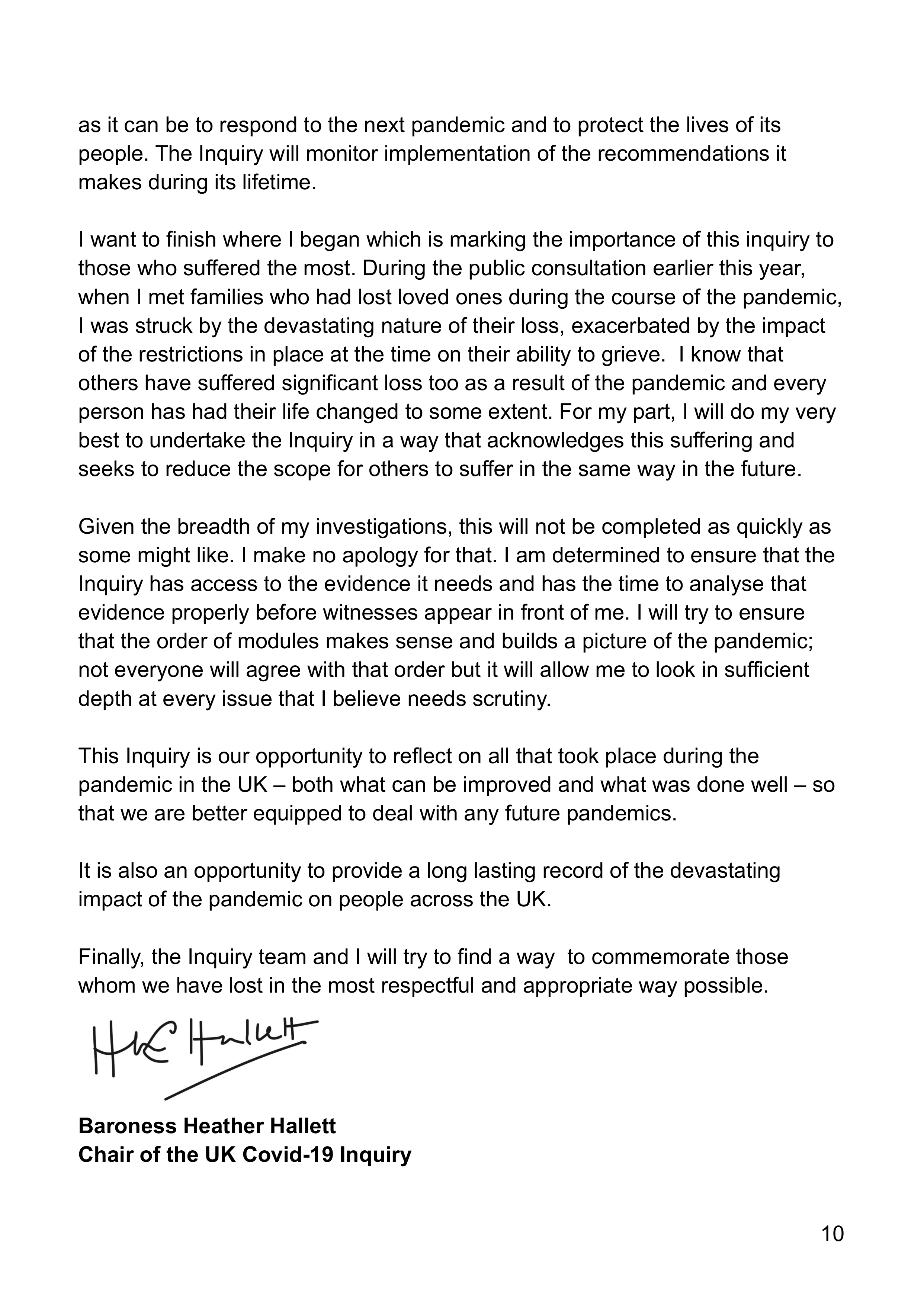
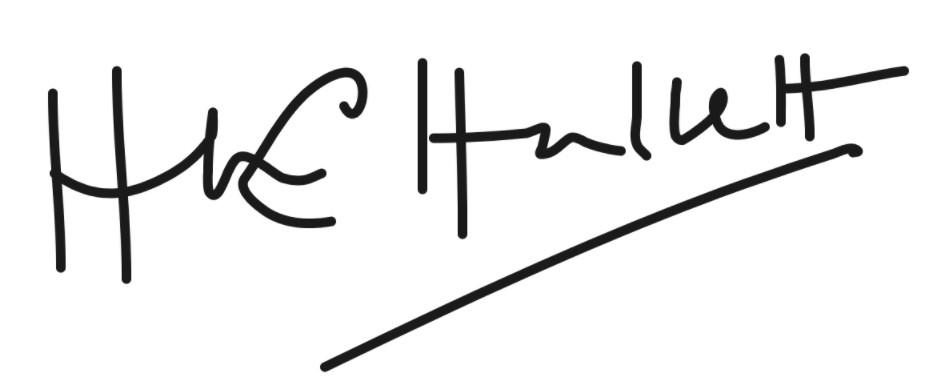
Baroness Heather Hallett
Chair of the UK Covid-19 Inquiry
10

© Crown copyright 2022
This publication is licensed under the terms of the Open Government Licence
v3.0 except where otherwise stated. To view this licence, visit
nationalarchives.gov.uk/doc/open-government-licence/version/3
Where we have identified any third party copyright information you will need to
obtain permission from the copyright holders concerned.
This publication is available at
https://covid19.public-inquiry.uk/
Any enquiries regarding this publication should be sent to us at
contact@covid19.public-inquiry.uk
.
11