Ratcliffe Opening Statement
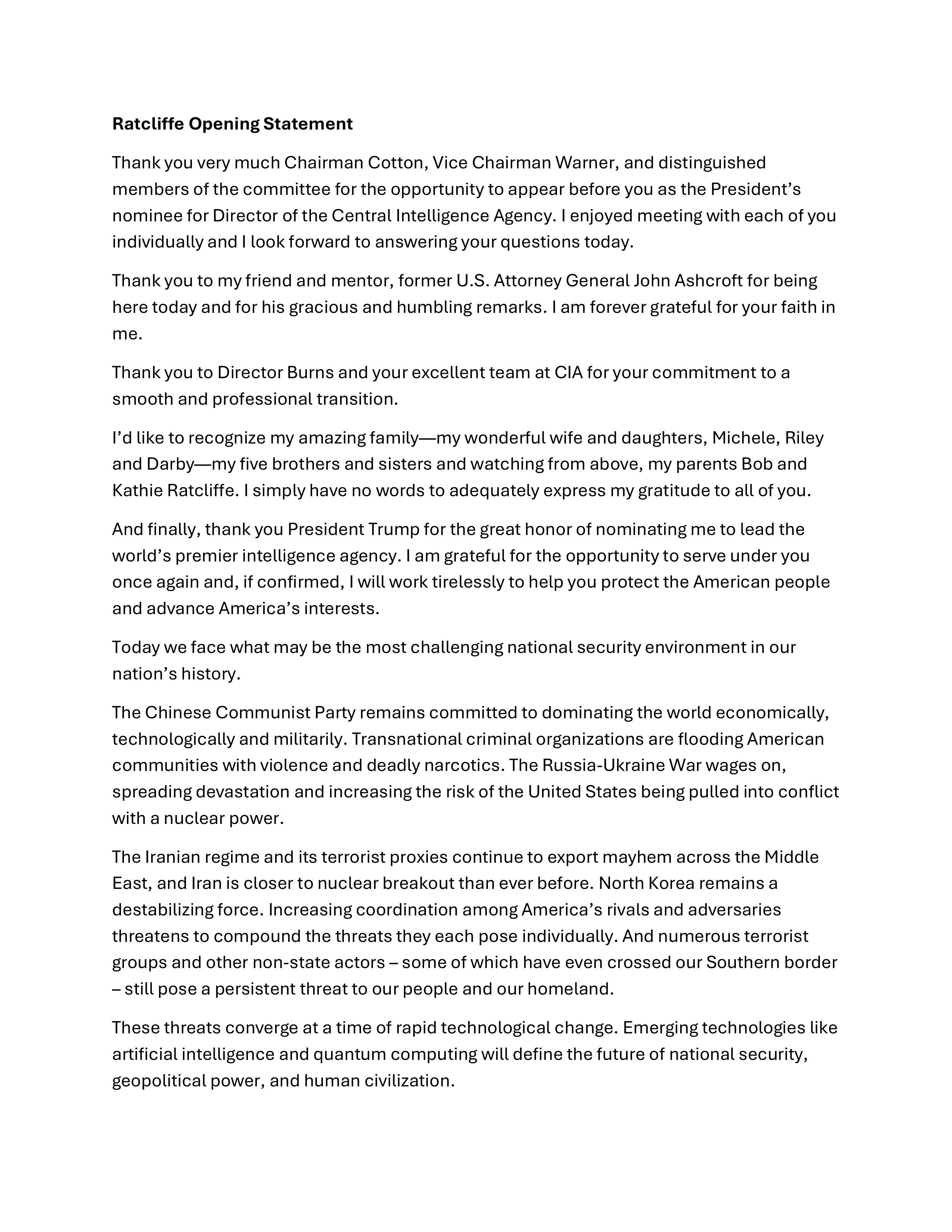
Thank you very much Chairman Cotton, Vice Chairman Warner, and distinguished
members of the committee for the opportunity to appear before you as the President’s
nominee for Director of the Central Intelligence Agency. I enjoyed meeting with each of you
individually and I look forward to answering your questions today.
Thank you to my friend and mentor, former U.S. Attorney General John Ashcroft for being
here today and for his gracious and humbling remarks. I am forever grateful for your faith in
me.
Thank you to Director Burns and your excellent team at CIA for your commitment to a
smooth and professional transition.
I’d like to recognize my amazing family—my wonderful wife and daughters, Michele, Riley
and Darby—my five brothers and sisters and watching from above, my parents Bob and
Kathie Ratcliffe. I simply have no words to adequately express my gratitude to all of you.
And finally, thank you President Trump for the great honor of nominating me to lead the
world’s premier intelligence agency. I am grateful for the opportunity to serve under you
once again and, if confirmed, I will work tirelessly to help you protect the American people
and advance America’s interests.
Today we face what may be the most challenging national security environment in our
nation’s history.
The Chinese Communist Party remains committed to dominating the world economically,
technologically and militarily. Transnational criminal organizations are flooding American
communities with violence and deadly narcotics. The Russia-Ukraine War wages on,
spreading devastation and increasing the risk of the United States being pulled into conflict
with a nuclear power.
The Iranian regime and its terrorist proxies continue to export mayhem across the Middle
East, and Iran is closer to nuclear breakout than ever before. North Korea remains a
destabilizing force. Increasing coordination among America’s rivals and adversaries
threatens to compound the threats they each pose individually. And numerous terrorist
groups and other non-state actors – some of which have even crossed our Southern border
– still pose a persistent threat to our people and our homeland.
These threats converge at a time of rapid technological change. Emerging technologies like
artificial intelligence and quantum computing will define the future of national security,
geopolitical power, and human civilization.
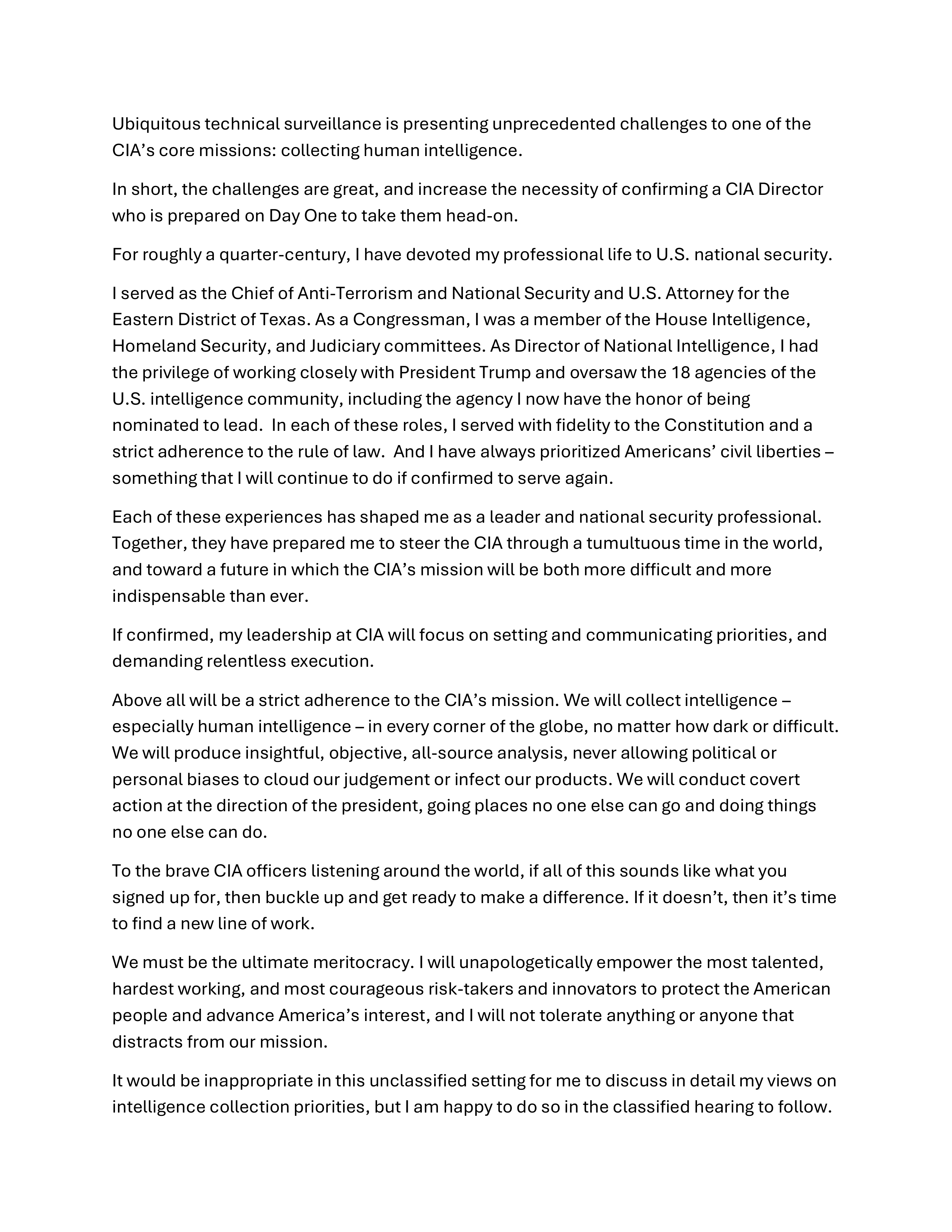
Ubiquitous technical surveillance is presenting unprecedented challenges to one of the
CIA’s core missions: collecting human intelligence.
In short, the challenges are great, and increase the necessity of confirming a CIA Director
who is prepared on Day One to take them head-on.
For roughly a quarter-century, I have devoted my professional life to U.S. national security.
I served as the Chief of Anti-Terrorism and National Security and U.S. Attorney for the
Eastern District of Texas. As a Congressman, I was a member of the House Intelligence,
Homeland Security, and Judiciary committees. As Director of National Intelligence, I had
the privilege of working closely with President Trump and oversaw the 18 agencies of the
U.S. intelligence community, including the agency I now have the honor of being
nominated to lead. In each of these roles, I served with fidelity to the Constitution and a
strict adherence to the rule of law. And I have always prioritized Americans’ civil liberties –
something that I will continue to do if confirmed to serve again.
Each of these experiences has shaped me as a leader and national security professional.
Together, they have prepared me to steer the CIA through a tumultuous time in the world,
and toward a future in which the CIA’s mission will be both more difficult and more
indispensable than ever.
If confirmed, my leadership at CIA will focus on setting and communicating priorities, and
demanding relentless execution.
Above all will be a strict adherence to the CIA’s mission. We will collect intelligence –
especially human intelligence – in every corner of the globe, no matter how dark or difficult.
We will produce insightful, objective, all-source analysis, never allowing political or
personal biases to cloud our judgement or infect our products. We will conduct covert
action at the direction of the president, going places no one else can go and doing things
no one else can do.
To the brave CIA officers listening around the world, if all of this sounds like what you
signed up for, then buckle up and get ready to make a difference. If it doesn’t, then it’s time
to find a new line of work.
We must be the ultimate meritocracy. I will unapologetically empower the most talented,
hardest working, and most courageous risk-takers and innovators to protect the American
people and advance America’s interest, and I will not tolerate anything or anyone that
distracts from our mission.
It would be inappropriate in this unclassified setting for me to discuss in detail my views on
intelligence collection priorities, but I am happy to do so in the classified hearing to follow.
However, if confirmed, there are several organizational priorities that I plan to focus on that
I’d like to discuss here.
The first is talent.
As you all are no doubt aware, the CIA has a remarkably low turnover rate among its
workforce. This shows the CIA’s success in attracting mission-focused public servants
who find deep meaning and value in the unique work they are privileged to do each day. But
in some cases, it also suggests that complacency is tolerated – and in the worst cases, bad
actors are not weeded out. High performers hate nothing more than mediocrity, and
nothing poisons a high-performance workplace culture more than leaders who don’t hold
team members accountable when they do not meet expectations. The CIA must be a place
that incentivizes and rewards meaningful contributions to our nation’s security and holds
accountable low performers and bad actors who are not focused on our mission.
It has been said that the CIA's World War II predecessor – the OSS – described its ideal
recruit as “a Ph.D. who could win a bar fight.” This sentiment is the essence of what
today’s CIA must recapture. But we must find that fighting spirit in recruits whose talents,
skill sets, and backgrounds are more varied than ever.
I will also work to develop pathways for mid-career professionals with highly sought-after
skills to fill gaps in the Agency’s workforce, and for CIA officers to do rotations in the
private sector that broaden their perspective.
I am committed to protecting and supporting the CIA’s workforce. We will fully investigate
workforce health and wellness issues, including Anomalous Health Incidents. Our officers
must embrace a culture of toughness and resilience. But we must also be clear that when
they put themselves in harm’s way, we will make sure they’re taken care of when they
return home. We owe that to America’s men and women in uniform, and we owe it to the
silent warriors who risk their lives in the shadows as well.
Altogether, these talent strategies will be particularly important in addressing another
organizational priority I will focus on: technology.
At the CIA, technology is both a tool and a target.
As a tool, technology is baked into nearly every facet of the Agency, from the spy gadgets
imagined and created by the Directorate of Science and Technology and used by the
Directorate of Operations, to the cyber capabilities deployed by the Directorate of Digital
Innovation, to how the Directorate of Support uses new tech tools to support our
workforce, to AI powered large language models used by the Directorate of Analysis.
But over the decades, as technological innovation has shifted more and more from the
public sector to the private sector, the CIA has struggled to keep pace.
As a target, technology is more important than ever, whether it’s understanding our
adversaries’ capabilities in AI and quantum computing, or their developments in
hypersonics and emerging space technologies, or their innovations in counterintelligence
and surveillance.
The recent creation of the Agency’s Transnational and Technology Mission Center was an
acknowledgement of this fact. And the recently created position of Chief Technology
Officer showed an effort to increase technological cohesion internally and to build bridges
with cutting edge technologists externally.
But much more has to be done. Because our adversaries – and one in particular, which I
will discuss now – understand that the nation who wins the race in the emerging
technologies of today, will dominate the world of tomorrow.
Which brings me to the need for the CIA to continue – and increase in intensity – its focus
on the threats posed by China and its ruling Chinese Communist Party.
As DNI, I dramatically increased the Intelligence Community’s resources devoted to
China. I openly warned the American people that from my unique vantage point as the
official who saw more U.S. intelligence than anyone else, I assessed that China was far
and away our top national security threat.
President Trump has been an incredible leader on this issue, and it is encouraging that a
bipartisan consensus has emerged in recent years. The recent creation of the CIA’s China
Mission Center is an example of the good work that must continue. The Agency must
provide the president and U.S. policymakers with the best possible intelligence to inform
their decision-making in hopes of preserving peace and spreading prosperity.
This is our once-in-a-generation challenge. The intelligence is clear. Our response must be
as well.
I am honored for the opportunity to appear before you today and I thank you for your
consideration of my nomination to be the Director of the CIA. I look forward to answering
your questions.