My Projects
Home
Free AI Personal Statement Generator
MBA Personal Statement
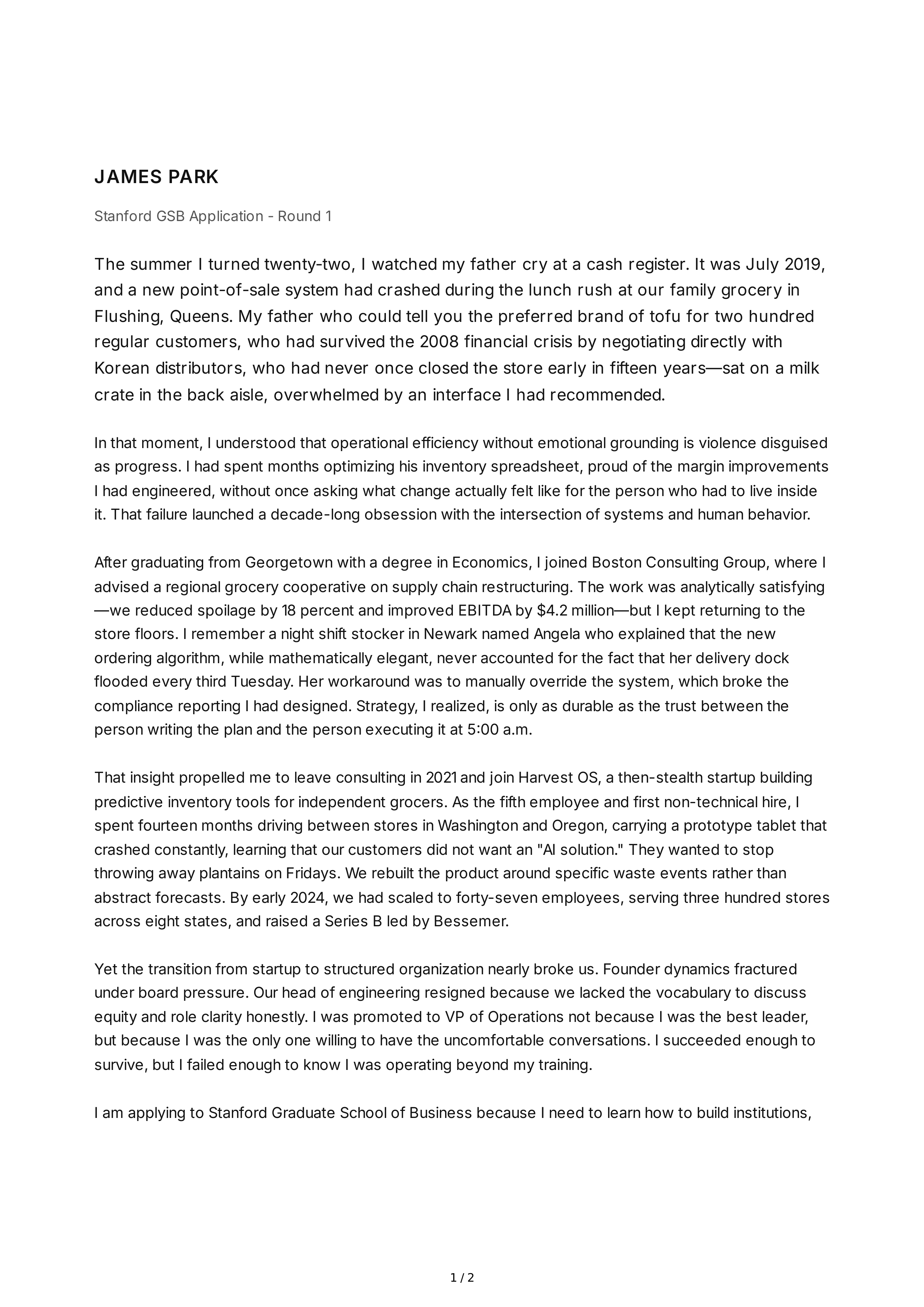
JAMES
PARK
Stanford
GSB
Application
-
Round
1
The
summer
I
turned
twenty
-
two
,
I
watched
my
father
cry
at
a
cash
register
.
It
was
July
2019,
and
a
new
point
-
of
-
sale
system
had
crashed
during
the
lunch
rush
at
our
family
grocery
in
Flushing
,
Queens
.
My
father
who
could
tell
you
the
preferred
brand
of
tofu
for
two
hundred
regular
customers
,
who
had
survived
the
2008
financial
crisis
by
negotiating
directly
with
Korean
distributors
,
who
had
never
once
closed
the
store
early
in
fifteen
years
—
sat
on
a
milk
crate
in
the
back
aisle
,
overwhelmed
by
an
interface
I
had
recommended
.
In
that
moment
,
I
understood
that
operational
efficiency
without
emotional
grounding
is
violence
disguised
as
progress
.
I
had
spent
months
optimizing
his
inventory
spreadsheet
,
proud
of
the
margin
improvements
I
had
engineered
,
without
once
asking
what
change
actually
felt
like
for
the
person
who
had
to
live
inside
it
.
That
failure
launched
a
decade
-
long
obsession
with
the
intersection
of
systems
and
human
behavior
.
After
graduating
from
Georgetown
with
a
degree
in
Economics
,
I
joined
Boston
Consulting
Group
,
where
I
advised
a
regional
grocery
cooperative
on
supply
chain
restructuring
.
The
work
was
analytically
satisfying
—
we
reduced
spoilage
by
18
percent
and
improved
EBITDA
by
$
4.2
million
—
but
I
kept
returning
to
the
store
floors
.
I
remember
a
night
shift
stocker
in
Newark
named
Angela
who
explained
that
the
new
ordering
algorithm
,
while
mathematically
elegant
,
never
accounted
for
the
fact
that
her
delivery
dock
flooded
every
third
Tuesday
.
Her
workaround
was
to
manually
override
the
system
,
which
broke
the
compliance
reporting
I
had
designed
.
Strategy
,
I
realized
,
is
only
as
durable
as
the
trust
between
the
person
writing
the
plan
and
the
person
executing
it
at
5:00
a
.
m
.
That
insight
propelled
me
to
leave
consulting
in
2021
and
join
Harvest
OS
,
a
then
-
stealth
startup
building
predictive
inventory
tools
for
independent
grocers
.
As
the
fifth
employee
and
first
non
-
technical
hire
,
I
spent
fourteen
months
driving
between
stores
in
Washington
and
Oregon
,
carrying
a
prototype
tablet
that
crashed
constantly
,
learning
that
our
customers
did
not
want
an
"
AI
solution
."
They
wanted
to
stop
throwing
away
plantains
on
Fridays
.
We
rebuilt
the
product
around
specific
waste
events
rather
than
abstract
forecasts
.
By
early
2024,
we
had
scaled
to
forty
-
seven
employees
,
serving
three
hundred
stores
across
eight
states
,
and
raised
a
Series
B
led
by
Bessemer
.
Yet
the
transition
from
startup
to
structured
organization
nearly
broke
us
.
Founder
dynamics
fractured
under
board
pressure
.
Our
head
of
engineering
resigned
because
we
lacked
the
vocabulary
to
discuss
equity
and
role
clarity
honestly
.
I
was
promoted
to
VP
of
Operations
not
because
I
was
the
best
leader
,
but
because
I
was
the
only
one
willing
to
have
the
uncomfortable
conversations
.
I
succeeded
enough
to
survive
,
but
I
failed
enough
to
know
I
was
operating
beyond
my
training
.
I
am
applying
to
Stanford
Graduate
School
of
Business
because
I
need
to
learn
how
to
build
institutions
,
1 / 2
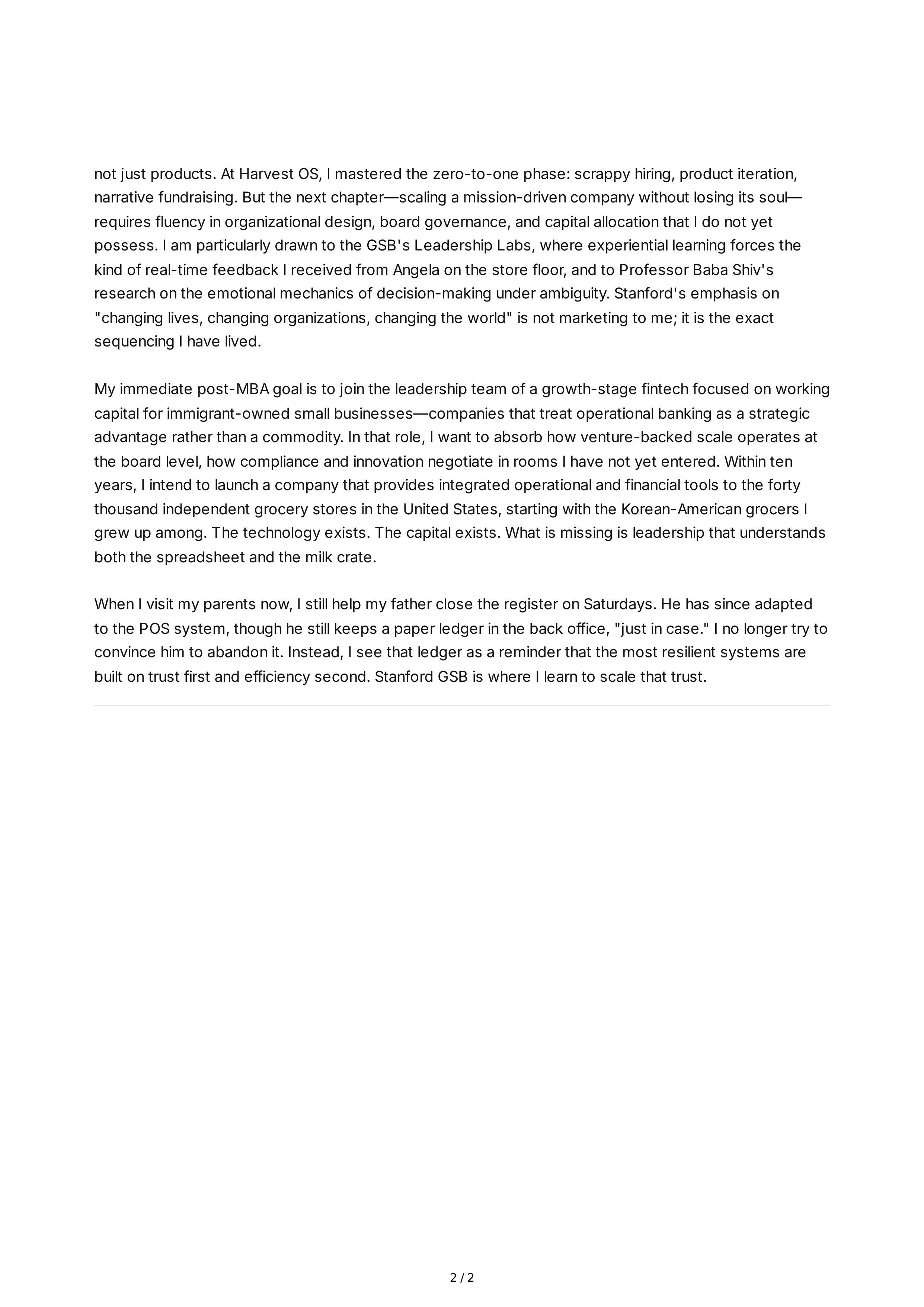
not
just
products
.
At
Harvest
OS
,
I
mastered
the
zero
-
to
-
one
phase
:
scrappy
hiring
,
product
iteration
,
narrative
fundraising
.
But
the
next
chapter
—
scaling
a
mission
-
driven
company
without
losing
its
soul
—
requires
fluency
in
organizational
design
,
board
governance
,
and
capital
allocation
that
I
do
not
yet
possess
.
I
am
particularly
drawn
to
the
GSB
'
s
Leadership
Labs
,
where
experiential
learning
forces
the
kind
of
real
-
time
feedback
I
received
from
Angela
on
the
store
floor
,
and
to
Professor
Baba
Shiv
'
s
research
on
the
emotional
mechanics
of
decision
-
making
under
ambiguity
.
Stanford
'
s
emphasis
on
"
changing
lives
,
changing
organizations
,
changing
the
world
"
is
not
marketing
to
me
;
it
is
the
exact
sequencing
I
have
lived
.
My
immediate
post
-
MBA
goal
is
to
join
the
leadership
team
of
a
growth
-
stage
fintech
focused
on
working
capital
for
immigrant
-
owned
small
businesses
—
companies
that
treat
operational
banking
as
a
strategic
advantage
rather
than
a
commodity
.
In
that
role
,
I
want
to
absorb
how
venture
-
backed
scale
operates
at
the
board
level
,
how
compliance
and
innovation
negotiate
in
rooms
I
have
not
yet
entered
.
Within
ten
years
,
I
intend
to
launch
a
company
that
provides
integrated
operational
and
financial
tools
to
the
forty
thousand
independent
grocery
stores
in
the
United
States
,
starting
with
the
Korean
-
American
grocers
I
grew
up
among
.
The
technology
exists
.
The
capital
exists
.
What
is
missing
is
leadership
that
understands
both
the
spreadsheet
and
the
milk
crate
.
When
I
visit
my
parents
now
,
I
still
help
my
father
close
the
register
on
Saturdays
.
He
has
since
adapted
to
the
POS
system
,
though
he
still
keeps
a
paper
ledger
in
the
back
office
, "
just
in
case
."
I
no
longer
try
to
convince
him
to
abandon
it
.
Instead
,
I
see
that
ledger
as
a
reminder
that
the
most
resilient
systems
are
built
on
trust
first
and
efficiency
second
.
Stanford
GSB
is
where
I
learn
to
scale
that
trust
.
2 / 2
Similar Examples
Generate Similar
Dental School Personal Statement
Generate Similar
Pharmacy School Personal Statement
Generate Similar
Physical Therapy Personal Statement
Generate Similar
Occupational Therapy Personal Statement
Generate Similar
Veterinary School Personal Statement
Generate Similar
Healthcare Administration Personal Statement
Generate Similar
Public Health Personal Statement
Generate Similar
Psychology Personal Statement
Generate Similar
Computer Science Personal Statement
Generate Similar
Software Engineering Personal Statement
Generate Similar
Data Science Personal Statement
Generate Similar
Artificial Intelligence Personal Statement
Generate Similar
Mechanical Engineering Personal Statement
Generate Similar
Civil Engineering Personal Statement
Generate Similar
Electrical Engineering Personal Statement
Generate Similar
Chemical Engineering Personal Statement
Generate Similar
Architecture Personal Statement
Generate Similar
Environmental Science Personal Statement
Generate Similar
Business Administration Personal Statement
Generate Similar
Finance Personal Statement
Generate Similar
Accounting Personal Statement
Generate Similar
Economics Personal Statement
Generate Similar
Marketing Personal Statement
Generate Similar
Human Resources Personal Statement
Generate Similar
Project Management Personal Statement
Generate Similar
Entrepreneurship Personal Statement
Generate Similar
Hospitality Management Personal Statement
Generate Similar
Supply Chain Management Personal Statement
Generate Similar
Law School Personal Statement
Generate Similar
Education Personal Statement
Generate Similar
English Literature Personal Statement
Generate Similar
Journalism Personal Statement
Generate Similar
Biology Personal Statement
Generate Similar
Fashion Design Personal Statement
Generate Similar
Film Studies Personal Statement
Generate Similar
Political Science Personal Statement
Generate Similar
Social Work Personal Statement
Generate Similar
International Relations Personal Statement