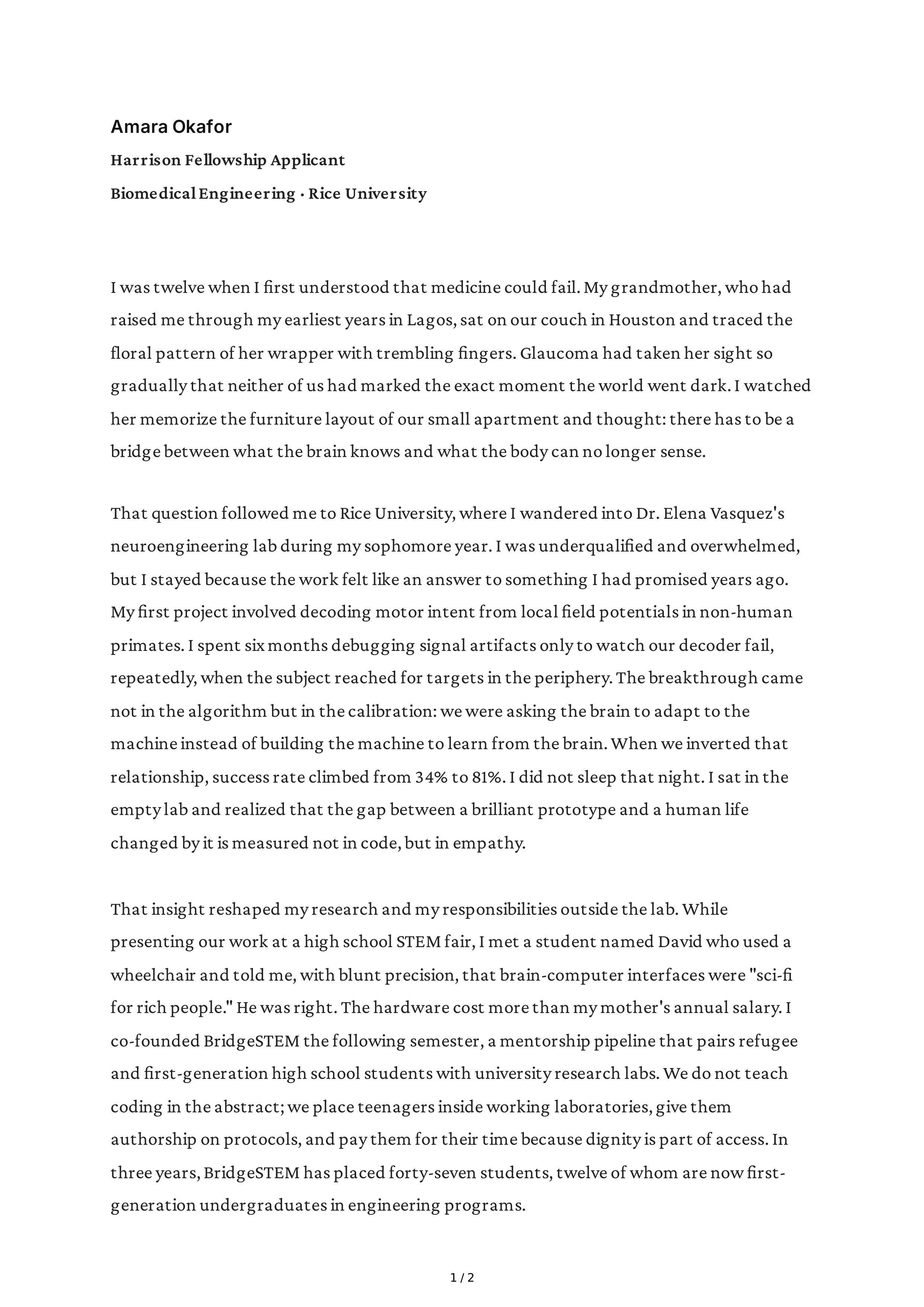
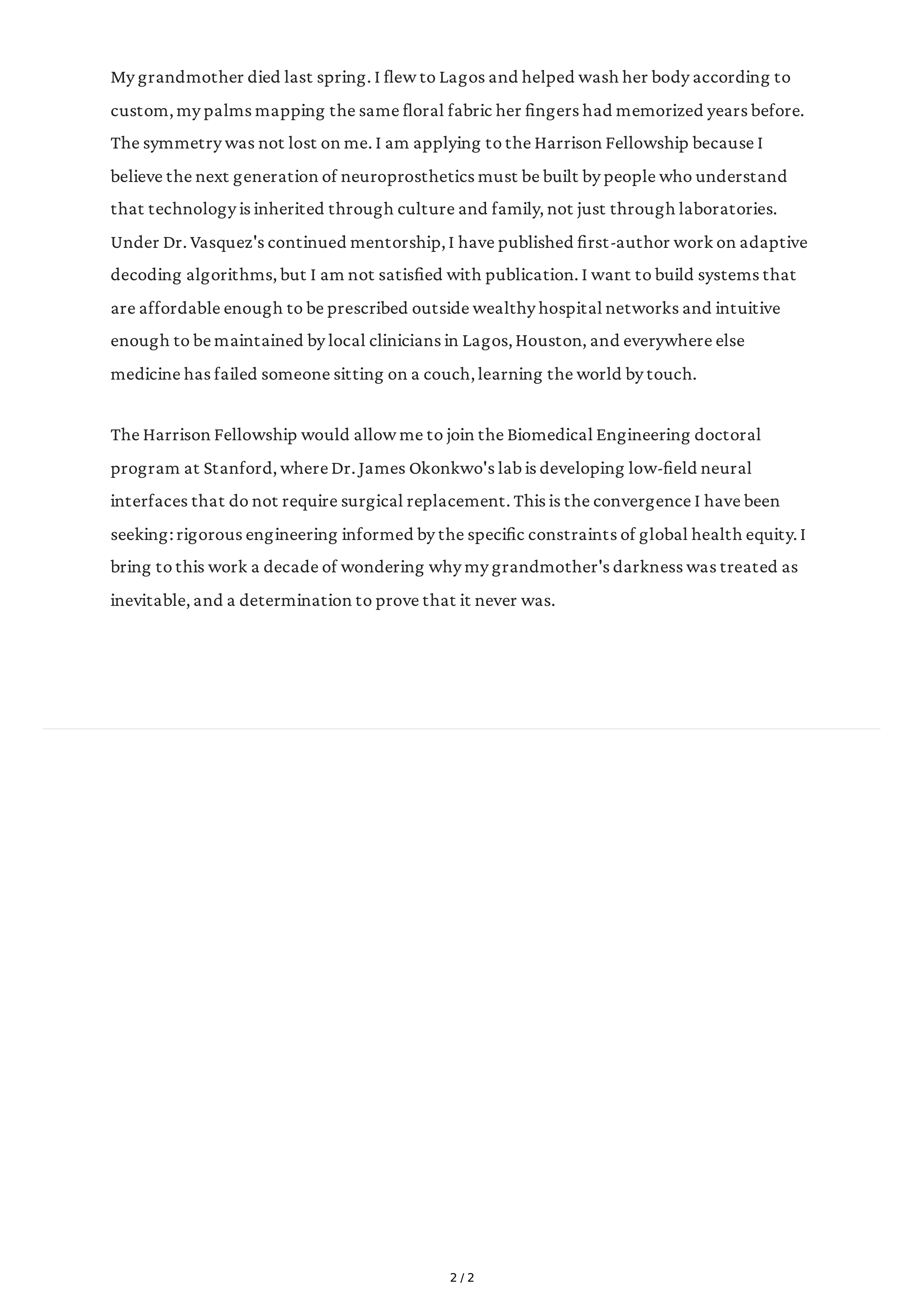
Amara
Okafor
Harrison Fellowship Applicant
Biomedical Engineering · Rice University
I was twelve when I first understood that medicine could fail. My grandmother, who had
raised me through my earliest years in Lagos, sat on our couch in Houston and traced the
floral pattern of her wrapper with trembling fingers. Glaucoma had taken her sight so
gradually that neither of us had marked the exact moment the world went dark. I watched
her memorize the furniture layout of our small apartment and thought: there has to be a
bridge between what the brain knows and what the body can no longer sense.
That question followed me to Rice University, where I wandered into Dr. Elena Vasquez's
neuroengineering lab during my sophomore year. I was underqualified and overwhelmed,
but I stayed because the work felt like an answer to something I had promised years ago.
My first project involved decoding motor intent from local field potentials in non-human
primates. I spent six months debugging signal artifacts only to watch our decoder fail,
repeatedly, when the subject reached for targets in the periphery. The breakthrough came
not in the algorithm but in the calibration: we were asking the brain to adapt to the
machine instead of building the machine to learn from the brain. When we inverted that
relationship, success rate climbed from 34% to 81%. I did not sleep that night. I sat in the
empty lab and realized that the gap between a brilliant prototype and a human life
changed by it is measured not in code, but in empathy.
That insight reshaped my research and my responsibilities outside the lab. While
presenting our work at a high school STEM fair, I met a student named David who used a
wheelchair and told me, with blunt precision, that brain-computer interfaces were "sci-fi
for rich people." He was right. The hardware cost more than my mother's annual salary. I
co-founded BridgeSTEM the following semester, a mentorship pipeline that pairs refugee
and first-generation high school students with university research labs. We do not teach
coding in the abstract; we place teenagers inside working laboratories, give them
authorship on protocols, and pay them for their time because dignity is part of access. In
three years, BridgeSTEM has placed forty-seven students, twelve of whom are now first-
generation undergraduates in engineering programs.
1 / 2