

Journal of Artificial Intelligence and Engineering Applications
Website:
https://ioinformatic.org/
15
th
June 2025. Vol. 4. No. 3; e-ISSN:
2808-4519
Utilization of Telegram Bot for Integrated Data
Visualization with Google Sheets at PT Telkom Cibitung
Renaldi Da Silva
1
, Ahmad Sinnun
2*
, Muhamad Tabrani
3
1,2,3
Fakultas Teknik & Informatika, Universitas Bina Sarana Informatika
aldynote5@gmail.com
1
,
ahmad.axn@bsi.ac.id
2*
,
muhammad.mtb@bsi.ac.id
3
Abstract
In today’s digital age, organizations demand real-time, accurate, and efficient access to data in order to support decision-making and
enhance operational workflows. This research focuses on the development and implementation of a Telegram Bot integrated with
Google Sheets to improve data visualization and internal coordination at PT Telkom Cibitung. Prior to this innovation, the process of
retrieving data from Google Sheets and sharing it via Telegram was conducted manually, leading to frequent errors, delays in
communication, and inefficiencies in data-driven tasks—particularly within the sales division.The study adopts a descriptive-analytical
method to examine existing workflows and to design a solution that automates data retrieval using a bot. The Telegram Bot was
programmed to fetch and present key data points directly from Google Sheets based on user input, reducing the dependency on manual
operations. The system was tested within the sales division and demonstrated significant improvements in speed, accuracy, and
usability.Based on the analysis and findings, it can be concluded that the integration of Telegram Bot with Google Sheets provides a
viable and scalable solution to the problems previously encountered at PT Telkom Cibitung. This approach not only eliminates the risk
of data misinterpretation and human error but also enhances interdepartmental coordination. The implementation of such automation
technology reflects a strategic move towards digital transformation and highlights the value of low-code solutions in business
environments with limited IT resources.
Keywords:
Telegram Bot, Google Sheets Integration, Data Visualization
1.
Introduction
In the era of digital transformation, automation has become the key to improving the operational efficiency of companies. No exception
for PT Telkom Cibitung, which is a branch of PT Telkom Indonesia, which is a State-Owned Enterprise (BUMN) engaged in
telecommunications services [1] One of its main tasks is to focus on managing production availability data, especially for the sales division.
Currently, data retrieval from the Google Sheets database is still done manually by employees, which is then shared via the Telegram
group. This is inefficient, especially if the amount of data is large and numerous. With the increasing popularity of Telegram and its Bot
features, a data retrieval automation solution is proposed to facilitate data access and increase productivity. This study proposes the
implementation of a Telegram Bot that is integrated withGoogle Sheetsusing node.js technology, as a practical solution to improve the
efficiency of the sales division at PT Telkom Cibitung. Previous studies have explored the use of Telegram Bots, but their implementation
in the workplace, especially in telecommunications companies, is still rare.
Telegram is a cloud-based messaging application designed for speed and security, has become a popular platform since it was founded by
Pavel Durov in 2013. The Telegram application has advantages in several features, especially in data security and the ability to send large
files, another superior feature is chatbot, this feature is very useful for businesses because it can be customized for various needs. Telegram
provides the Bot API feature which is a technologyopen-source, this allows developers to build bot applications that are integrated with
the Telegram system. By usingAPI In this, bots can be programmed to interact with various services such as Google Sheets, to send or
retrieve data automaticallyreal-time.
Google Sheetsis part of the serviceGoogle, which is an online spreadsheet application that is often used to store and manage data. This
service makes it easier for users to manage data analytically. With various innovative features developed,Google Sheetsenables strong
integration with Telegram bots to increase business efficiency in automated data management.
Research relevant to this topic, this research shows various implementations of Telegram Bot in various sectors. Such as:
1.
Research [2] explores the use of Telegram bots in distance learning, showing efficiency in managing file-based exams through
the Telegram platform.
2.
Research by [3], discusses the use ofGoogle Sheetsfor data management, which supports the use ofSheetsas an effective tool
in data management and analysis.
3.
Research [4] explores the application ofWebhookto automate data recap, which enables communicationreal-timebetween the
application and the server, improvingresponsivesystem.
4.
A study by [5] presents the implementation of a Telegram bot to disseminate real-time weather forecasts, emphasizing the
importance of APIs in delivering efficient information.
Journal of Artificial Intelligence and Engineering Applications
2261
5.
Research by [6] shows efficiency in credit transactions using Telegram bots, which automatically process requests and
payments, strengthening the ease of service with bot API integration.
All of this research shows that Teleram bot technology can be adapted for a variety of purposes, including integrated data visualization
withGoogle Sheets.
Therefore, this research is expected to be a basis for further research and provide benefits to the company. In this project, the main challenge
faced by the sales division of PT Telkom Cibitung is the process of manually retrieving data from Google sheets to the Telegram platform.
This manual method takes a long time and is prone to errors, which will later have an impact on the inaccuracy of information disseminated
in the Telegram group. This can hinder effective decision-making within the team. In addition, the separation between onsite and ondesk
work units further worsens the coordination flow, because information taken manually tends to be delayed in delivery. In this condition,
the manual work process not only slows down the distribution of information but also reduces the efficiency and productivity of the team
in carrying out more strategic tasks. Therefore, the use of Telegram bots integrated with Google Sheets is seen as an effective solution to
automate data retrieval, speed up the information distribution process, and improve work efficiency in the sales division as a whole.
2.
Theoretical Basis
To establish a robust conceptual and technical framework for understanding the proposed information system, it is essential to define the fundamental
concepts and supporting theories that underpin its design and analysis.
2.1. Fundamental Concepts (Information Systems and Digital Transformation)
A system can be defined as a network of interconnected procedures that collectively perform an activity or achieve a specific goal.
Alternatively, it can be viewed as a collection of several components that are interconnected, forming a unity to achieve certain objectives.
Systems possess distinct characteristics, including components (interacting parts forming a unified whole), a boundary (defining separation
from other systems), an environment (external influencing factors), an interface (connecting medium), input (energy introduced), output
(processed energy), a processor (transforms input to output), and a goal (the purpose that determines necessary inputs and generated
outputs). Understanding these characteristics is crucial for evaluating the completeness and robustness of any system design.
Information, a core output of any system, is defined as the result of data processing in a specific manner, rendering it more meaningful and
useful for the recipient. The value of information is determined by its benefits relative to the cost of obtaining it. The continuous
"Information Cycle" describes how data is transformed into information by a model, leading to decisions and actions by recipients, which
in turn generate new data.
The pervasive influence of Information Technology (IT) in reshaping various scientific fields and its indispensable role for businesses in
Indonesia cannot be overstated. Computerized systems, particularly database applications and information systems, are pivotal for
organizations, significantly enhancing decision-making processes, optimizing operational workflows, and facilitating the efficient
management of vast quantities of corporate data. This research exemplifies a practical application of these principles within a specific
corporate context, directly contributing to PT. Telkom Cibitung's broader digital transformation efforts.
2.2. Key Technologies
The proposed system's functionality is built upon the integration of several key technologies, each contributing specific capabilities
essential for real-time data visualization and efficient communication.
Telegram Bot API and its Capabilities:
Telegram is a cloud-based messaging application, widely recognized for its speed, security, and
robust features, including a highly adaptable chatbot functionality that has gained significant popularity since its inception in 2013. The
Telegram Bot API serves as an open-source, HTTP-based interface specifically designed for developers to build and connect bots with the
Telegram system.1 This API enables bots to be programmed for real-time interaction with various services, facilitating real-time
notifications, supporting multiplatform access, and handling diverse commands. The inherent data security features of Telegram, where an
intermediary server handles all encryption and communication with the Bot API, further bolster its appeal for corporate applications. The
ability to send and retrieve data in real-time is a core capability critically leveraged in this research.
Google Sheets API for Data Management:
Google Sheets, an integral component of Google services, functions as an online spreadsheet
application extensively utilized for storing and managing data. The Google Sheets API is a powerful RESTful interface that empowers
developers to programmatically interact with spreadsheet data, enabling operations that would typically be performed manually within the
Google Sheets user interface.1 Its functionalities include reading and writing spreadsheet data, appending new rows, formatting cells and
ranges, creating and managing worksheets, and performing batch updates. Crucially, it supports secure access authentication via OAuth
2.0, making it ideal for automating reporting and data synchronization while maintaining data integrity and privacy.1 This programmatic
control allows for the use of Google Sheets as a backend database for applications.
Node.js in Backend Development
: Node.js is a server-side runtime environment for JavaScript that has fundamentally transformed web
development by allowing developers to use a single language for both client-side and server-side programming, thereby fostering the
"JavaScript everywhere" paradigm.1 Its distinctive event-driven, non-blocking I/O architecture makes it
exceptionally well-suited for
building high-performance, real-time applications and efficiently managing numerous concurrent connections with minimal overhead.6 In
this project, Node.js plays a pivotal role in running the Telegram bot, facilitating its responsiveness and scalability. The choice of Node.js
is a strategic technical decision that directly addresses the business requirement for responsiveness and immediate data availability, as its
2262
Journal of Artificial Intelligence and Engineering Applications
architecture is inherently optimized for real-time operations and handling dynamic data flows.
Webhook for Real-time Communication
:The Webhook method is a highly efficient mechanism employed in the creation of Telegram
bots to facilitate real-time interaction between applications and servers, primarily through HTTP POST requests.1 This approach offers a
significantly faster communication mechanism for responding to and processing information compared to traditional Long-Polling
methods, which aligns perfectly with the project's real-time data needs. Webhooks enable a push-based notification system, where
information is sent immediately as an event occurs, significantly reducing data latency and server load compared to traditional polling
mechanisms.8 Successful implementation requires a securely defined URL (HTTPS) and the utilization of the Telegram API Token to
enable seamless and authenticated interaction.1 This strategic adoption of webhook-based communication patterns is becoming essential
for building truly responsive and efficient enterprise applications, allowing organizations to move from reactive data retrieval to proactive
information dissemination.
The seamless integration of these APIs—Telegram Bot API and Google Sheets API—forms the core of the proposed solution. This
integration represents a strategic leveraging of modular, extensible services provided by these APIs, which significantly reduces the
development burden. Developers can rapidly compose new business capabilities, such as real-time data access for sales, by assembling
functional components enabled by these robust, well-documented APIs.2 This inherent modularity of API-driven development directly
facilitates the principles of Rapid Application Development (RAD) by enabling quick assembly of functional components, thereby
accelerating the time-to-market for new solutions. This highlights how the widespread adoption and maturity of APIs are not just a technical
evolution but a fundamental shift in how organizations can achieve business agility, enabling rapid innovation and integration without
building every component from scratch.
2.3. Software Development Methodologies
The project employed a combination of two prominent software development methodologies to ensure both speed and adaptability
throughout the development lifecycle.
Rapid Application Development (RAD
): The Rapid Application Development (RAD) model was specifically utilized for its ability to
facilitate rapid prototyping and the quick generation of functional prototypes.1 This approach aligns with the project's objective of
delivering a practical and timely solution to PT. Telkom Cibitung's immediate operational challenges. RAD emphasizes a component-
based construction approach and accelerated development cycles, which were instrumental in the efficient creation of the Telegram bot,
particularly when integrated with modern technologies like Node.js.1 RAD's iterative nature allows for early accommodation of user needs
and rapid adaptation to feedback, which is crucial for validating the concept and ensuring early user buy-in for a novel internal tool.
Scrum Framework:
The Scrum framework was applied as a complementary agile methodology. Its iterative and incremental nature
proved invaluable for managing potentially evolving requirements and enhancing the overall adaptability of the project throughout its
development lifecycle.1 Scrum is particularly well-suited for developing object-oriented software in complex environments and its support
for gradual and progressive feature evolution was crucial for developing a system that needed to seamlessly integrate with existing company
workflows and respond effectively to continuous user feedback.1 This combined approach signifies a sophisticated understanding of
software development, where methodologies are pragmatically blended to address specific project constraints, such as the need for both
speed and adaptability.
3.
Research Methods
This study was conducted through a series of systematic stages to develop a Telegram bot integrated with Google Sheets, aiming to address
data visualization and communication inefficiencies at PT Telkom Cibitung. The methodological framework comprises research phases,
software requirement analysis, and algorithmic implementation, as detailed below. To ensure the system aligns with user needs and
organizational goals, the research follows several key stages:
3.1. Data Collection Techniques
a.
Observation: Direct observation was carried out within the sales division of PT Telkom Cibitung to gain a comprehensive
understanding of existing workflows and the manual data management practices that hinder operational efficiency.
b.
Literature Review: A review of academic and industrial literature concerning Telegram bots, data automation, and digital
transformation in telecommunication enterprises was conducted to strengthen the theoretical foundation of this study.
3.2. Software Development Models
The system was developed using two complementary software development methodologies:
a.
Rapid Application Development (RAD). RAD was adopted to facilitate the rapid prototyping of the Telegram bot using
component-based development. As described by [7], RAD allows accelerated system delivery through iterative refinements.
Node.js was selected as the development platform to optimize performance and reduce time-to-deploy.
b.
Scrum Framework. The Scrum methodology was employed to accommodate dynamic user requirements and evolving system
specifications. As an iterative and incremental model, Scrum supports continuous improvement and agile responses to feedback
throughout the development lifecycle [7]. [8].
3.3. Software Requirements Analysis
a.
Problem Identification. The primary issues identified include time-consuming manual data retrieval processes that are error-
Journal of Artificial Intelligence and Engineering Applications
2263
prone and impact decision-making accuracy. Additionally, the division of sales teams into onsite and ondesk units introduces
coordination challenges due to geographic separation.
b.
Requirements Analysis, Functional Requirements
•
The bot must retrieve data from Google Sheets.
•
It should transmit the data to a designated Telegram group.
•
Users must interact with the bot via predefined command inputs.
•
Non-Functional Requirements
•
The bot should perform reliably and without interruption.
•
Access to both Google Sheets and Telegram must be secure and private.
•
The bot must respond to commands promptly and efficiently.
•
System Requirements
•
Features for automatic data fetching from Google Sheets.
•
Telegram integration for real-time communication.
•
Command processing functionality from Telegram users.
•
User Requirements
•
User-friendly interface with intuitive access to desired data.
•
Fast and streamlined interaction for non-technical users.
3.4. Algorithmic Implementation
a.
Webhook Algorithm,The system employs a Webhook mechanism to facilitate real-time interactions between the Telegram bot
and the backend server via HTTP POST requests. Compared to the traditional long-polling method, Webhook offers faster and
more efficient data exchange [5]. To enable this process, a valid HTTPS endpoint is established, acting as a communication
channel for input-processing-output flows. The implementation utilizes the Telegram API token to authorize system-level bot
interactions [6]
b.
Data Processing Algorithm. Data processing leverages the Google Sheets API to enable dynamic access and manipulation of
spreadsheet data. The Telegram bot communicates with the API to retrieve, update, and display data as requested by users. This
interaction is secured via OAuth 2.0 authentication, ensuring proper authorization and secure access [7], [9]. The system
architecture is designed to maintain consistency and data integrity while automating frequent reporting tasks.
These supplementary stages provide a valuable framework for discussing the progression and maturity of the prototype, implying
that the "Implementation and Maintenance" phase is not a terminal point but rather a continuous cycle of refinement, aligning
with the concept of a "Matured Product." This section offers a comprehensive analysis of the existing logistics operations at the
UTD PMI Karawang, encompassing its historical context, current organizational structure, detailed operational procedures, and
the identified core shortcomings [10], [11].
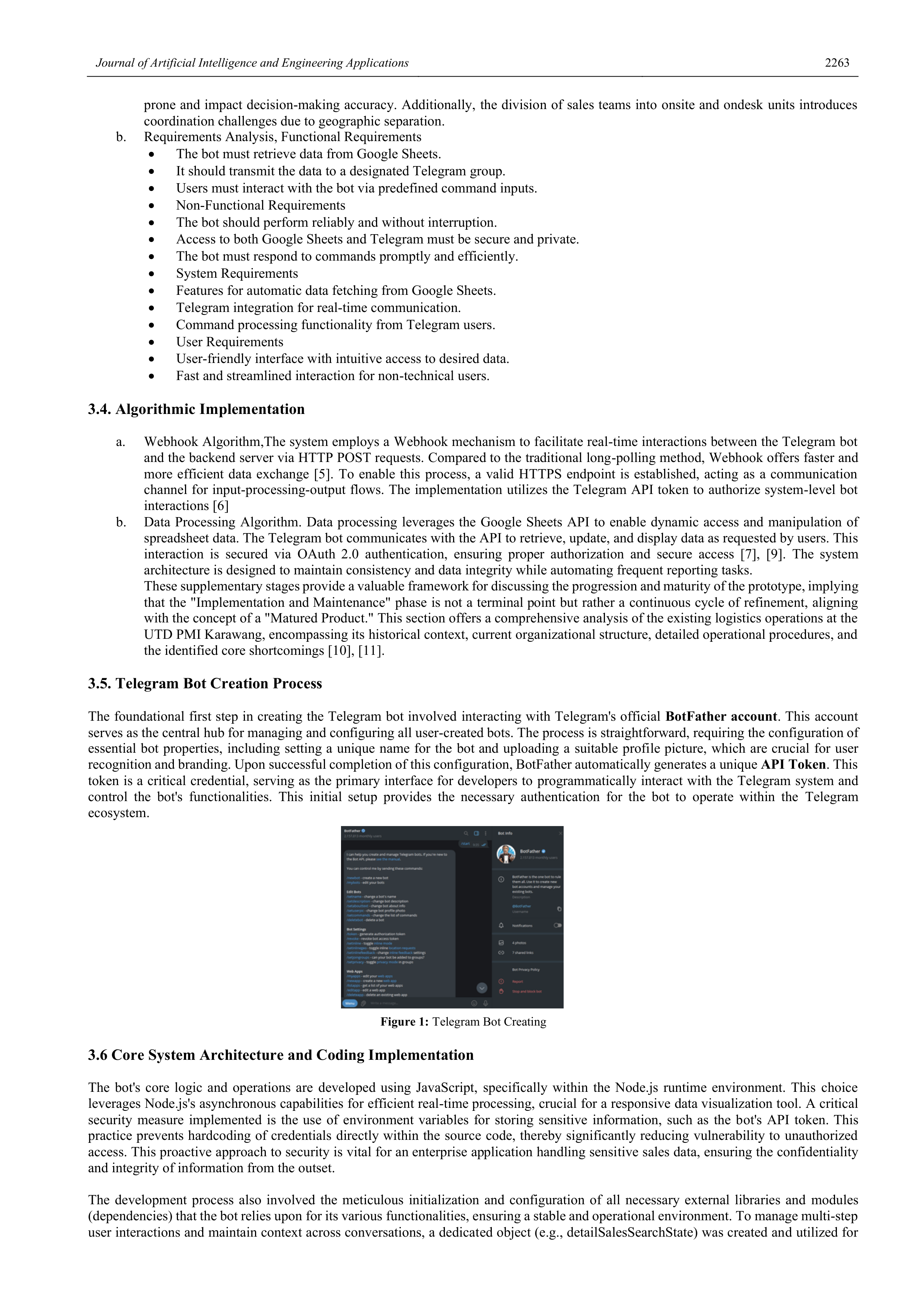
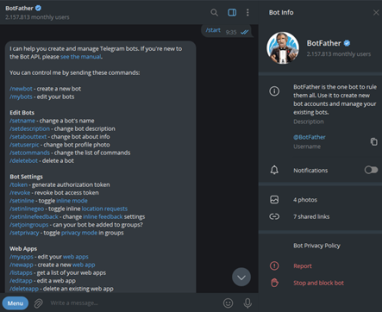
3.5. Telegram Bot Creation Process
The foundational first step in creating the Telegram bot involved interacting with Telegram's official
BotFather account
. This account
serves as the central hub for managing and configuring all user-created bots. The process is straightforward, requiring the configuration of
essential bot properties, including setting a unique name for the bot and uploading a suitable profile picture, which are crucial for user
recognition and branding. Upon successful completion of this configuration, BotFather automatically generates a unique
API Token
. This
token is a critical credential, serving as the primary interface for developers to programmatically interact with the Telegram system and
control the bot's functionalities. This initial setup provides the necessary authentication for the bot to operate within the Telegram
ecosystem.
3.6 Core System Architecture and Coding Implementation
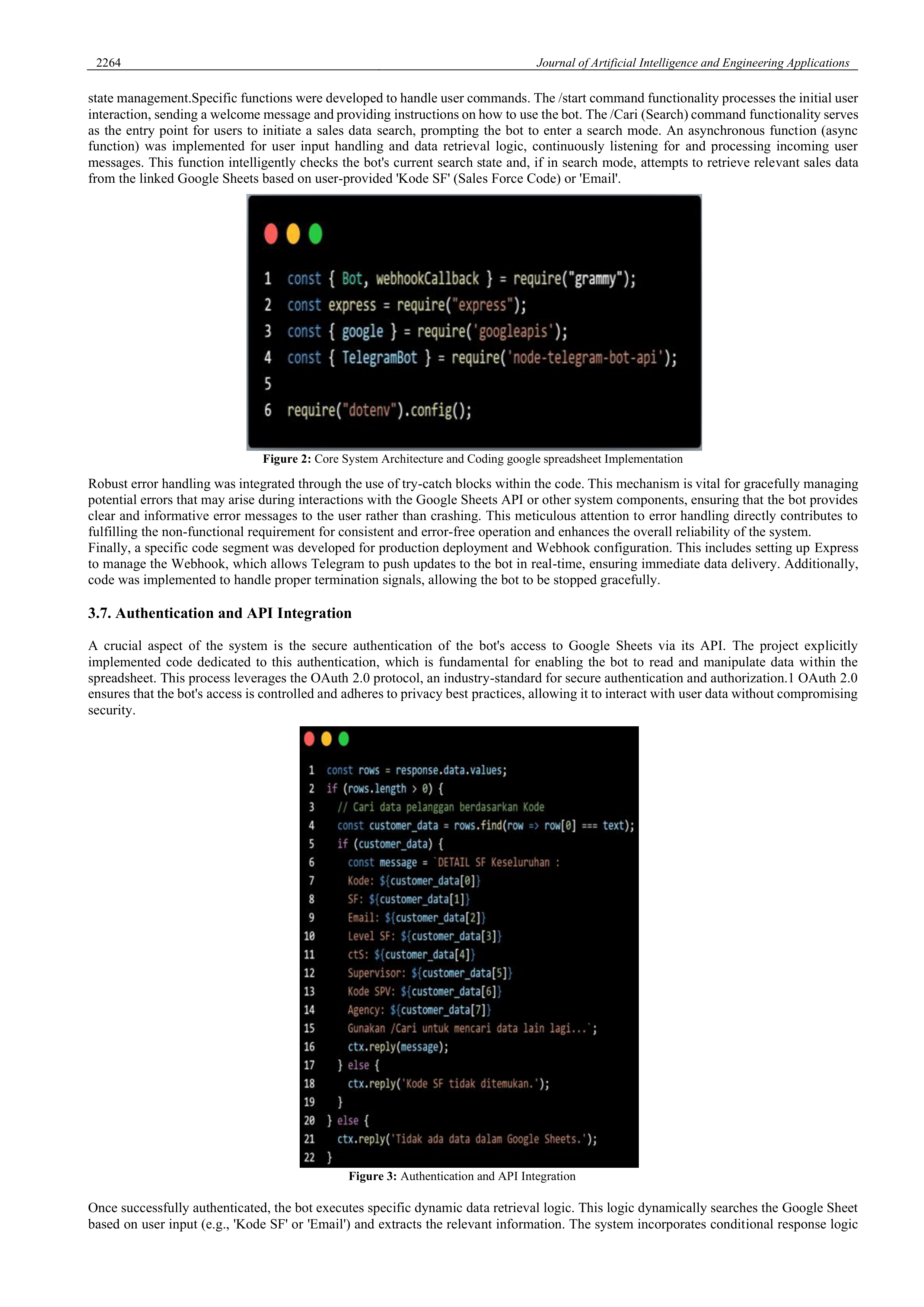
The bot's core logic and operations are developed using JavaScript, specifically within the Node.js runtime environment. This choice
leverages Node.js's asynchronous capabilities for efficient real-time processing, crucial for a responsive data visualization tool. A critical
security measure implemented is the use of environment variables for storing sensitive information, such as the bot's API token. This
practice prevents hardcoding of credentials directly within the source code, thereby significantly reducing vulnerability to unauthorized
access. This proactive approach to security is vital for an enterprise application handling sensitive sales data, ensuring the confidentiality
and integrity of information from the outset.
The development process also involved the meticulous initialization and configuration of all necessary external libraries and modules
(dependencies) that the bot relies upon for its various functionalities, ensuring a stable and operational environment. To manage multi-step
user interactions and maintain context across conversations, a dedicated object (e.g., detailSalesSearchState) was created and utilized for
Figure 1:
Telegram Bot Creating
2264
Journal of Artificial Intelligence and Engineering Applications
state management.Specific functions were developed to handle user commands. The /start command functionality processes the initial user
interaction, sending a welcome message and providing instructions on how to use the bot. The /Cari (Search) command functionality serves
as the entry point for users to initiate a sales data search, prompting the bot to enter a search mode. An asynchronous function (async
function) was implemented for user input handling and data retrieval logic, continuously listening for and processing incoming user
messages. This function intelligently checks the bot's current search state and, if in search mode, attempts to retrieve relevant sales data
from the linked Google Sheets based on user-provided 'Kode SF' (Sales Force Code) or 'Email'.
Robust error handling was integrated through the use of try-catch blocks within the code. This mechanism is vital for gracefully managing
potential errors that may arise during interactions with the Google Sheets API or other system components, ensuring that the bot provides
clear and informative error messages to the user rather than crashing. This meticulous attention to error handling directly contributes to
fulfilling the non-functional requirement for consistent and error-free operation and enhances the overall reliability of the system.
Finally, a specific code segment was developed for production deployment and Webhook configuration. This includes setting up Express
to manage the Webhook, which allows Telegram to push updates to the bot in real-time, ensuring immediate data delivery. Additionally,
code was implemented to handle proper termination signals, allowing the bot to be stopped gracefully.
3.7. Authentication and API Integration
A crucial aspect of the system is the secure authentication of the bot's access to Google Sheets via its API. The project explicitly
implemented code dedicated to this authentication, which is fundamental for enabling the bot to read and manipulate data within the
spreadsheet. This process leverages the OAuth 2.0 protocol, an industry-standard for secure authentication and authorization.1 OAuth 2.0
ensures that the bot's access is controlled and adheres to privacy best practices, allowing it to interact with user data without compromising
security.
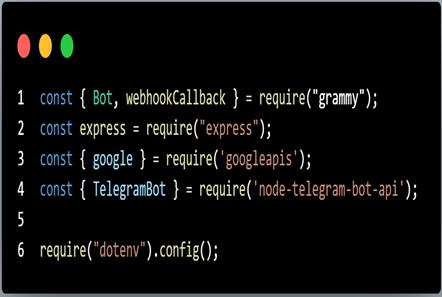
Once successfully authenticated, the bot executes specific dynamic data retrieval logic. This logic dynamically searches the Google Sheet
based on user input (e.g., 'Kode SF' or 'Email') and extracts the relevant information. The system incorporates conditional response logic
Figure 2:
Core System Architecture and Coding google spreadsheet Implementation
Figure 3:
Authentication and API Integration
Journal of Artificial Intelligence and Engineering Applications
2265
based on the outcome of the data retrieval. If the requested sales data is found within the Google Sheet, the bot will respond by displaying
the complete details to the user. Conversely, if the provided 'Kode SF' or 'Email' does not match any records, the bot will provide a clear
and informative error message indicating that the data was not found. This intelligent response mechanism enhances user experience by
providing immediate and relevant feedback.
4.
Results and Discussion
This section presents the findings from the system implementation and testing, discusses their implications for PT. Telkom Cibitung, and
details the supporting hardware and software environment.
4.1. Functional Testing and User Response Analysis
The interface design testing for the proposed system was rigorously conducted using the Black Box testing method.
1
This approach focused
exclusively on evaluating the functional requirements of the developed software by examining its inputs and outputs, without delving into
its internal structural details.
The initial basic functionality test involved the /start command. Upon receiving this command, the bot successfully responded by displaying
a welcome message and providing clear instructions for its usage, indicating proper initialization and responsiveness of the program.
Subsequently, the search functionality test (/Cari command) confirmed the bot's ability to correctly interpret and initiate multi-step
interactions, prompting the user to select a search method (either by "Kode SF" or "Email").
For valid data search scenarios, when users provided 'Kode SF' or 'Email' that existed within the Google Sheets database, the bot
successfully retrieved and displayed the complete sales details. This outcome validated the accuracy of data retrieval from Google Sheets
and the bot's ability to present comprehensive information. The testing also covered invalid data/command handling scenarios,
demonstrating the bot's robust error management. For non-existent 'Kode SF' or 'Email', the bot appropriately displayed an "Code or email
not found" message. Similarly, for commands not adhering to the provided instructions, the bot responded with an "Invalid command"
message.
The comprehensive series of tests collectively confirmed the high performance, reliability, and responsiveness of the Telegram bot
integrated with Google Sheets. This included successful validation of the Webhook functionality, ensuring real-time data communication.
The following table summarizes key testing scenarios and their outcomes:
Table1:
Key Testing Scenarios and Outcomes
Scenario
Expected Outcome
Actual Outcome
/start command
Welcome message/instructions
Successful
/Cari command
Prompt for search method
Successful
Valid 'Kode SF' search
Display sales details
Successful
Valid 'Email' search
Display sales details
Successful
Invalid 'Kode SF' / 'Email' search
"Code/email not found" message
Successful
Invalid command
"Invalid command" message
Successful
This systematic validation provides concrete, empirical evidence of the bot's functionality and reliability across different use cases, directly
supporting the claims regarding its performance and accuracy.
4.2 System Performance and Efficiency Gains
The implementation of the Telegram bot at PT. Telkom Cibitung yielded significant improvements in operational efficiency and
information access. The bot demonstrably accelerated the process of accessing sales data, drastically reducing the time previously
consumed by manual retrieval methods. This directly addresses one of the core problems identified in the introduction, where manual
processes were a major bottleneck.
The automation of data retrieval and dissemination led to a substantial improvement in the work efficiency of the sales division. By
offloading repetitive manual tasks, employees are now able to reallocate their time to more strategic and value-added activities. This
transformation in human capital utilization is not merely about process optimization but fundamentally redefines the role of employees,
liberating them to focus on more analytical or customer-facing tasks.
Furthermore, the automated retrieval mechanism inherently reduced the incidence of data errors, leading to more accurate and reliable
information being disseminated. This, in turn, fostered improved coordination and communication between the onsite and ondesk sales
units, mitigating previous bottlenecks caused by delayed information. The bot received overwhelmingly positive feedback from users at
PT. Telkom Cibitung. This high level of user acceptance and satisfaction is a strong indicator of the system's usability and its successful
integration into daily operations. The positive outcomes, such as faster information access, improved efficiency, and reduced errors, serve
as strong empirical validation for the chosen Rapid Application Development (RAD) and Scrum methodologies. The iterative and
incremental nature of these agile methods likely facilitated rapid testing, quick adjustments based on early user feedback, and continuous
refinement, ensuring the final product closely matched user needs and organizational requirements.
4.3 Hardware and Software Environment
The successful operation of the Telegram bot system requires specific hardware and software configurations for both the server and client
environments.
Table1:
Hardware and Software Specifications
Category
Component
Specification
2266
Journal of Artificial Intelligence and Engineering Applications
Hardware
Server CPU
Minimal 2 GHz
Server RAM
Minimal 4 GB
Server Storage
Minimal 100 GB
Client Device RAM
2 GB
Client Browser
Latest version
Software
Server OS
Windows Server / Linux
Client OS
Windows / Linux / Mac
Development Software
VSCode, Node.js
Application
Telegram
These specifications provide the essential practical context for the implemented solution, allowing other researchers, practitioners, or
organizations to assess feasibility and plan infrastructure if considering replication or adaptation.
5.
Conclusion
The implementation of the Telegram bot at PT. Telkom Cibitung has successfully addressed and significantly mitigated the previously
identified challenges associated with manual data retrieval and dissemination. This research clearly demonstrates the efficacy of the
automated solution in transforming operational workflows within the sales division.
The deployment of the bot has yielded several significant and measurable improvements. There has been a substantial reduction in both
the time required for and the errors inherent in data acquisition from Google Sheets, directly improving data quality and reliability. This
enhancement has, in turn, fostered improved coordination and facilitated more effective decision-making within the sales division, as
accurate and timely data is now readily available to both onsite and ondesk units. Overall work efficiency and productivity across the sales
team have seen a marked increase, as the burden of repetitive manual tasks has been alleviated. This shift allows employees to focus on
more strategic and value-added activities, contributing to higher employee satisfaction and better utilization of skilled labor. The
overwhelmingly positive user feedback and high acceptance rates from the employees at PT. Telkom Cibitung further underscore the
system's practical value and its successful integration into daily operations.
This research makes a significant contribution to advancing better data management practices within corporate settings and provides a
tangible, successful example of chatbot technology application in an enterprise environment. The solution's inherent design, leveraging
widely available and open-source technologies like Telegram Bot API, Google Sheets API, and Node.js, inherently supports its scalability
and replicability. This suggests that the developed solution is not a one-off, bespoke fix but a generalized and adaptable model for
addressing similar data access and visualization challenges across various industries, departments, or organizational scales. This offers a
practical blueprint for organizations seeking cost-effective, readily implementable, and adaptable solutions for internal data automation.
While the current implementation has achieved its primary objectives, it is acknowledged that the system can be further enhanced. Future
work could involve integrating the bot with additional enterprise resource planning (ERP) or customer relationship management (CRM)
systems to provide a more holistic view of sales operations. Developing more sophisticated data analysis and reporting features, such as
trend analysis or predictive analytics, would further empower decision-makers. Additionally, exploring the application of machine learning
for more intelligent data insights or advanced conversational capabilities could enhance the bot's utility and user experience. The
documented success of this Telegram bot in a corporate setting for internal operational efficiency and real-time data access signifies a shift
in the perceived and actual utility of chatbots, highlighting their growing importance as integral tools for internal operational efficiency
and intuitive interaction with enterprise systems.
References
[1]
Wijoyo, A., Bay, R., Karina, H., Panjaitan, D., Oktavia, S., & Gilang, R. (2023). PERANAN SISTEM INSFORMASI MANAJEMEN PEMASARAN
DI PT . TELKOM INDONESIA ( Studi Kasus : PT . TELKOM ). 1(3), 355–358.
[2]
Heri Khariono, Rizky Parlika, Kusuma, H. A., & Setyawan, D. A. (2021). Pemanfaatan Bot Telegram Sebagai E-Learning Ujian Berbasis File. Jurnal
Informatika Polinema, 7(4), 65–72.
https://doi.org/10.33795/jip.v7i4.696
[3]
Nursalim, K., & Yusuf Irianto, S. (2022). Analisis Bot Telegram Untuk Artificial Intelligence Helpdesk Online Pada PT Telkom Akses Witel
Lampung.
Prosiding
Seminar
Nasional
…,
210–216.
https://jurnal.darmajaya.ac.id/index.php/PSND/article/view/3248%0Ahttps://jurnal.darmajaya.ac.id/index.php/PSND/article/download/3248/1459
[4]
Utomo, A. B., Latipah, L., & Achlaq, M. M. (2023). Implementasi Telegram Bot untuk Proses Automatisasi Rekapan Data Menggunakan Metode
Webhook. Jurnal Ilmu Komputer Dan Bisnis, 14(2), 202–213. https://doi.org/10.47927/jikb.v14i2.532
[5]
Istiana, T., Indra A, R., Budhi Dharmawan, G. S., & Prakoso, B. (2020). Pengembangan Sistem Diseminasi Prakiraan Cuaca Menggunakan Aplikasi
Bot Telegram dengan Metode Webhook. Elektron : Jurnal Ilmiah, 12(1), 41–47.
https://doi.org/10.30630/eji.12.1.159
[6]
Nufusula, R., & Susanto, A. (2018). Rancang Bangun Chat Bot Pada Server Pulsa Mengunakan Telegram Bot API. Journal of Information System,
3(1), 80–88.
[7]
Lenardo, G. C., Herianto, & Irawan, Y. (2020). Pemanfaatan Bot Telegram sebagai Media Informasi Akademik di STMIK Hang Tuah Pekanbaru.
JTIM : Jurnal Teknologi Informasi Dan Multimedia, 1(4), 351–357. https://doi.org/10.35746/jtim.v1i4.59
[8]
Nastiti, S. D., Ramadan, D. N., & Tulloh, R. (2021). Sistem Monitoring Untuk Laporan Gangguan Indihome Dengan Bot Telegram. E-Proceeding of
Applied Science, 7(5), 1892–1907.
[9]
Salwa@jadibumn.id. (2024). Sales Telkom BUMN – Mengapa Profesi Sales di Telkom BUMN Layak Dicoba?
https://jadibumn.id/sales-telkom-
bumn/
[10]
Setiaji, H., & Paputungan, I. V. (2018). Design of Telegram Bots for Campus Information Sharing. IOP Conference Series: Materials Science and
Engineering, 325(1), 2–8.
https://doi.org/10.1088/1757-899X/325/1/012005
[11]
Susilo, B., Hanyokro Kusuma, G., Hayatul Fikri, M., Saputri, R., Aulia Putri, R., Rohimah, S., Luthfi Hamzah, M., & Sultan Syarif Kasim Riau, N.
(2023). Rancang Bangun Sistem Informasi Keuangan Pada Kantor Lurah Kotabaru Reteh Dengan Metode Rapid Application Develovment (Rad).
Jurnal Testing Dan Implementasi Sistem Informasi, 1(1), 17–28. https://journal.al-matani.com/index.php/jtisi/article/view/323