
Association for Information Systems
Association for Information Systems
AIS Electronic Library (AISeL)
AIS Electronic Library (AISeL)
AMCIS 2022 Proceedings
SIG Green - Green IS and Sustainability
Aug 10th, 12:00 AM
Examining GRI Sustainability Reports through the Lens of the
Examining GRI Sustainability Reports through the Lens of the
Stakeholder Theory
Stakeholder Theory
Kyle Nash
Minnesota State University, kylenashtx@gmail.com
Robin Wakefield
Baylor University, robin_wakefield@baylor.edu
Follow this and additional works at:
https://aisel.aisnet.org/amcis2022
Recommended Citation
Recommended Citation
Nash, Kyle and Wakefield, Robin, "Examining GRI Sustainability Reports through the Lens of the
Stakeholder Theory" (2022). AMCIS 2022 Proceedings. 7.
https://aisel.aisnet.org/amcis2022/sig_green/sig_green/7
This material is brought to you by the Americas Conference on Information Systems (AMCIS) at AIS Electronic
Library (AISeL). It has been accepted for inclusion in AMCIS 2022 Proceedings by an authorized administrator of
AIS Electronic Library (AISeL). For more information, please contact
elibrary@aisnet.org
.
Examining GRI Sustainability Reports
Twenty-eighth Americas Conference on Information Systems, Minneapolis, 2022
1
Examining GRI Sustainability Reports
through the Lens of the Stakeholder Theory
Completed Research
Kyle Nash
Minnesota State University, Mankato
kyle.nash@mnsu.edu
Robin L. Wakefield
Baylor University
robin_wakefield@baylor.edu
Abstract
Publishing a successful sustainability report is a rising concern among organizations seeking to meet the
expectations of their stakeholders. The purpose of this research is to examine how stakeholder engagement
influences Global Reporting Initiative’s (GRI) reporting processes. We use stakeholder theory to assert that
an organization’s sustainability practices are prompted by the demands of a variety of stakeholders. Cisco
GRI reports were chosen for analysis because in 2020 Cisco was ranked 4th amongst the global 100 most
sustainable corporations in the world. We conducted a longitudinal analysis of Cisco’s corporate social
responsibility reports from 2005 to 2020. Using text mining techniques and text statistical analysis we
identified the primary stakeholders in each year’s sustainability report and document stakeholder-related
sustainability practices. Our results demonstrate that organizational sustainability practices are a function
of the extent of engagement with core stakeholders. This study contributes to understanding how
stakeholders’ engagement relates to organizational sustainability reporting processes.
Keywords:
Global Reporting Initiative, GRI indicators, Stakeholder Theory, Cisco, Sustainability, and
Text Mining.
Introduction
Over the past two centuries, the rapid growth of the human population combined with technological
developments has placed unprecedented demands on the global environment. As a result of these pressures,
the earth is experiencing an accelerated loss of biodiversity and dramatic alterations to environmental
patterns and processes. In 1987, the topic of sustainability rose to the forefront when the World Commission
on Environment and Development (WCED) emphasized in their report that “
Humanity has the ability to
make a development sustainable – to ensure that it meets the needs of the present without compromising
the ability of future generations to meet their own needs
” (World Commission on Environment and
Development 1987). Following this declaration, organizational investing in sustainability practices and
methods accelerated. However, the lack of standardization in sustainability reporting posed a challenge for
organizations in communicating their efforts to maximize social responsibility and minimize the
environmental impact of their businesses.
Since then, several governing bodies developed guidelines for organizational sustainability reporting
practices. For example, the United Nations created a division that specializes primarily in sustainability
issues and reporting. Their reports identify and communicate critical environmental issues to raise
awareness and understanding of their implications for society, business, and governments. The most
prominent sustainability report produced is the Global Reporting Initiative (GRI). The GRI is the result of
efforts by researchers, industry, and consultants to leverage a multi-stakeholder approach from which to
address sustainability (“Global Reporting Initiative” 2020). Today, leading organizations with a clear
sustainability agenda understand how information systems’ capabilities can enable and empower
businesses’ sustainability strategies and elevate them to a high level. Every year, organizations such as
Cisco, IBM, Microsoft, and Apple document their sustainability strategies in a GRI report to highlight
corporate dedication to sustainability and to their ongoing efforts to improve the global environment.
Examining GRI Sustainability Reports
Twenty-eighth Americas Conference on Information Systems, Minneapolis, 2022
2
To address the sustainability challenge, organizations find they must work closely with their stakeholders
because stakeholders are environmentally conscious and often have expectations regarding organizational
sustainability practices. Thus, organizations must balance their profit maximizing goals with their
responsibility to protect the environment and satisfy the expectations of stakeholders. The disclosure of
organizational sustainability practices in standardized reports is the primary way that businesses inform
stakeholders and engage them in their sustainability efforts. The greater the engagement between the
organization and its stakeholders, the greater the need for the organization to disclose its sustainability
performance (Lenssen et al. 2011). Furthermore, organizations that attract stakeholders based on successful
sustainability outcomes have a responsibility to fulfill stakeholders' expectations and communicate their
environmental activities (Petrini and Pozzebon 2009). The challenge for organizations is to balance ethical,
responsible, and sustainable business practices with their capitalistic ventures (Freeman et al. 2010). Thus,
as stakeholders become more aware of organizational sustainability practices and demand greater
accountability, organizations’ engagement with stakeholders is evolving.
Our study explores how leading corporations use formal social responsibility reporting to communicate
sustainability strategy and meet stakeholder expectations. We use stakeholder theory to assert that
organizational sustainability practices are undertaken to meet the expectations of stakeholders. Our
primary research questions are: How do organizational sustainability practices change to meet the demands
of stakeholders? How are GRI reports an indicator of stakeholder engagement? We conduct a longitudinal
analysis of corporate social responsibility reports to demonstrate the evolution of sustainability practices
as a function of organizational engagement with primary stakeholders. Further, we want to understand the
relationship between stakeholders’ engagement and company revenue. Our paper is divided into several
sections. First, we present a background of the foundation for GRI indicators and stakeholder theory, prior
to discussing how GRI indicators influence the report writing process. Next, we explain the analytical
method for this study, followed by the results and discussion of the findings, limitations, and conclusion.
Background
Generally, sustainability research topics in the information systems, information technology, and
management disciplines have focused on four main themes (Sedera et al. 2017). Those themes were green
IT/IS conceptualization, green technology practices, green IT/IS adoption, and literature reviews. The
emphasis of many of these studies is on challenges posed by green IT/IS. More recently, the business focus
is on implementing IS capabilities to enable a sustainable business strategy (Boudreau et al. 2008) and
(Abraham and Dao 2017). The (Benitez-Amado and Walczuch 2012) study finds support for the argument
that IS and IT capabilities enable a proactive business strategy for sustainability. Moreover, IS/IT
capabilities may indirectly increase the organization’s performance with long-term advantage and greater
revenue. Environmentally conscious stakeholders are likely to favor organizations that appreciate
environmental sustainability and who share a similar vision of sustainability. As a result, organizations are
likely to shift sustainability priorities to attract stakeholders because sustainability continues to challenge
the global business landscape. Organizations continue to adapt and respond to growing sustainability
demands from stakeholders, the general public, and government regulators (Hu et al. 2016). Stakeholder
engagement has become a priority in the development of sustainability strategy and thus is a significant
force in organizational change.
In 1984, Freeman defined the stakeholder as “
any group or individual who can affect or is affected by the
achievement of an organization’s objectives
” (Freeman 1984). Freeman’s definition suggests a two-way
relationship between the organization and its stakeholders. With the advent of environmentalism,
stakeholder engagement for businesses became more critical (Freeman 2010) (Konar and Cohen 2001)
because stakeholders recognize their influence on organizations' decision-making (Freeman et al. 2010)
and business strategy. Engaging stakeholders via dialogue is likely to build trust and commitment as well
as promote a shared vision of organizational involvement in sustainability. Stakeholder engagement in
sustainability leads to the incorporation of sustainability principles and strategy that indirectly increases
performance and revenue (Del Giudice et al. 2021). However, stakeholder's engagement is a complex
interplay of shifting, ambiguous, and contested relationships that can affect the sustainability reporting
process because sustainability reporting activities are embedded in the stakeholder network through the
organization's policies and strategies. Because stakeholder engagement is a two-way process, the challenge
Examining GRI Sustainability Reports
Twenty-eighth Americas Conference on Information Systems, Minneapolis, 2022
3
for organizations is to build an engagement network that is fully understood by the stakeholders (Gao and
Zhang 2006).
Stakeholders often pressure the sustainability strategy of organizations to reduce negative impacts on the
environment while simultaneously increasing positive impact on production (Sarkis et al.
2011). Consequently, an organization needs a sustainability network team dedicated to scripting a GRI
report that addresses the variety of expectations held by a diverse set of stakeholders. This process takes
time and a clear understanding of stakeholders’ objectives and how the organization’s sustainability
strategy addresses the diversity of goals. The focus of stakeholder theory is on recognizing the unique
relationships between an organization and a diverse set of stakeholders to create value for all stakeholders.
We identify four types of stakeholders whose goals intertwine with organizations and their sustainability
strategies. These include
customer(s)
,
employee(s)
,
society
, and the
environment(al)
.
Customer(s)
refers to the characteristic group of individuals that transacts with an organization to receive
a product or service and whose transaction behavior conveys a right to influence the organizations’ practices
and methods. This involves the customers as a group who are recipients of the business’ benefits and who
influence standard practices in the industry (Friedman and Miles 2006) (Gadenne et al. 2009)(Ogden and
Watson 1999).
Employee(s)
address the dimension of personnel, individual contractors, and management
teams as critical assets in maintaining and delivering the long-term value of the business (Lynch-Fannon
2004) (Friedman and Miles 2006).
Society
refers to the larger social setting that permits the organization
to function in return for social benefits (Friedman and Miles 2006) (Freeman 1984). As for
the
environment(al)
stakeholder group, the story is different and complicated because ‘the environment’ is
an ambiguous entity. Researchers suggest stakeholder theory is often unable to distinguish among
individuals and groups that are stakeholders from those that are not (Phillips and Reichart 2000). This
complicates the ability of organizations to clearly identify the groups their sustainability strategies and
reports should address. Boutilier (2011) states: "
the natural environment can be affected by a company's
activities and, through channels such as climate change, can have an effect upon the company
" (Boutilier
2011). Thus, ‘environmental’ stakeholders may consist of facets directly and indirectly affected by
organizations’ sustainability strategies, yet unidentified as stakeholders.
Stakeholder theory suggests that the needs of shareholders cannot be met without satisfying the needs of
other stakeholders (Foster and Jonker, 2005; Hawkins, 2006; Jamali, 2008), thus offering a renewed
understanding of organizations’ relationships with multiple constituencies (Jonker and Foster, 2002). GRI
reporting is undertaken as a strategic plan by corporations to demonstrate the organization's sustainability
performance to stakeholders. It is part of the dialogue and relationship building with stakeholders. Hence,
stakeholder theory is a useful framework to evaluate GRI reporting to understand the relationship between
the organization and its various stakeholders regarding sustainability. In the past, GRI reporting provided
primarily subjective information strongly linked to the political structure of the organization. However, in
the last two decades, the disclosure of objective environmental and social information has increased in
amount and complexity indicating increased emphasis on stakeholder engagement.
The GRI is a public international independent standard organization that originated in 1997. The GRI’s
sustainability reporting guidelines are based on three factors - economic, environmental, and social impact.
The reporting guidelines focus on a wide range of topics including energy use, diversity in the workplace,
anti-corruption, and human rights. The GRI reporting guidelines enables any organization to increase
transparency with their stakeholders. The reporting standards help organizations improve relationships
with their stakeholders, enhance the organization’s reputation, and build customer trust. Currently, 80
percent of the world’s 250 largest companies report in accordance with GRI Standards (“FBRH” 2020).
Cisco, for example, is an organization dedicated to bettering the environment using sustainable business
strategies and has published GRI reports since 2005. Furthermore, Cisco has a dedicated sustainability
team that gathers the necessary data to write the GRI report following GRI standards.
In the GRI (G4- Sustainability Reporting Guidelines), there are three categories of indicators based on
economic, environmental, and social impact. In the GRI guidelines and protocols, each of these indicators
is divided into sub-categories or components that cover different facets of the categories within the
indicator. The GRI also lists 58 disclosures to provide the reporting organizations with an overview
understanding of stakeholder engagement during the reporting processes (Krumay and Brandtweiner
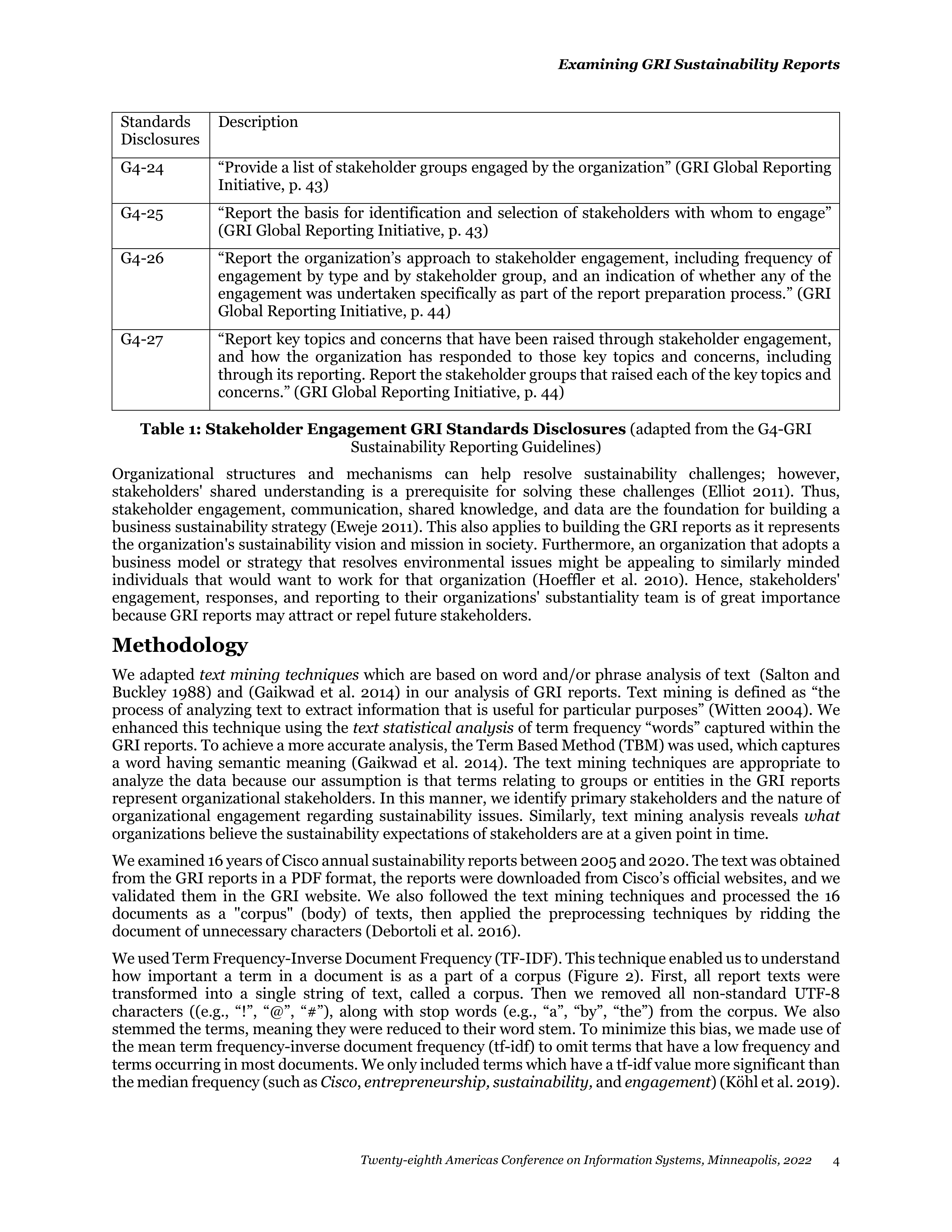
2014) and (GRI Global Reporting Initiative) see Table 1. Hence, every published report is a result of
stakeholders’ engagement and collaboration with the sustainability team.
Examining GRI Sustainability Reports
Twenty-eighth Americas Conference on Information Systems, Minneapolis, 2022
4
Standards
Disclosures
Description
G4-24
“Provide a list of stakeholder groups engaged by the organization” (GRI Global Reporting
Initiative, p. 43)
G4-25
“Report the basis for identification and selection of stakeholders with whom to engage”
(GRI Global Reporting Initiative, p. 43)
G4-26
“Report the organization’s approach to stakeholder engagement, including frequency of
engagement by type and by stakeholder group, and an indication of whether any of the
engagement was undertaken specifically as part of the report preparation process.” (GRI
Global Reporting Initiative, p. 44)
G4-27
“Report key topics and concerns that have been raised through stakeholder engagement,
and how the organization has responded to those key topics and concerns, including
through its reporting. Report the stakeholder groups that raised each of the key topics and
concerns.” (GRI Global Reporting Initiative, p. 44)
Table 1: Stakeholder Engagement GRI Standards Disclosures
(adapted from the G4-GRI
Sustainability Reporting Guidelines)
Organizational structures and mechanisms can help resolve sustainability challenges; however,
stakeholders' shared understanding is a prerequisite for solving these challenges (Elliot 2011). Thus,
stakeholder engagement, communication, shared knowledge, and data are the foundation for building a
business sustainability strategy (Eweje 2011). This also applies to building the GRI reports as it represents
the organization's sustainability vision and mission in society. Furthermore, an organization that adopts a
business model or strategy that resolves environmental issues might be appealing to similarly minded
individuals that would want to work for that organization (Hoeffler et al. 2010). Hence, stakeholders'
engagement, responses, and reporting to their organizations' substantiality team is of great importance
because GRI reports may attract or repel future stakeholders.
Methodology
We adapted
text mining techniques
which are based on word and/or phrase analysis of text (Salton and
Buckley 1988) and (Gaikwad et al. 2014) in our analysis of GRI reports. Text mining is defined as “the
process of analyzing text to extract information that is useful for particular purposes” (Witten 2004). We
enhanced this technique using the
text statistical analysis
of term frequency “words” captured within the
GRI reports. To achieve a more accurate analysis, the Term Based Method (TBM) was used, which captures
a word having semantic meaning (Gaikwad et al. 2014). The text mining techniques are appropriate to
analyze the data because our assumption is that terms relating to groups or entities in the GRI reports
represent organizational stakeholders. In this manner, we identify primary stakeholders and the nature of
organizational engagement regarding sustainability issues. Similarly, text mining analysis reveals
what
organizations believe the sustainability expectations of stakeholders are at a given point in time.
We examined 16 years of Cisco annual sustainability reports between 2005 and 2020. The text was obtained
from the GRI reports in a PDF format, the reports were downloaded from Cisco’s official websites, and we
validated them in the GRI website. We also followed the text mining techniques and processed the 16
documents as a "corpus" (body) of texts, then applied the preprocessing techniques by ridding the
document of unnecessary characters (Debortoli et al. 2016).
We used Term Frequency-Inverse Document Frequency (TF-IDF). This technique enabled us to understand
how important a term in a document is as a part of a corpus (Figure 2). First, all report texts were
transformed into a single string of text, called a corpus. Then we removed all non-standard UTF-8
characters ((e.g., “!”, “@”, “#”), along with stop words (e.g., “a”, “by”, “the”) from the corpus. We also
stemmed the terms, meaning they were reduced to their word stem. To minimize this bias, we made use of
the mean term frequency-inverse document frequency (tf-idf) to omit terms that have a low frequency and
terms occurring in most documents. We only included terms which have a tf-idf value more significant than
the median frequency (such as
Cisco
,
entrepreneurship, sustainability,
and
engagement
) (Köhl et al. 2019).
Examining GRI Sustainability Reports
Twenty-eighth Americas Conference on Information Systems, Minneapolis, 2022
5
Results
The text mining techniques we used are centered on words and/or phrase statistical analysis and how
important the word and/or phrase frequency is in the documents. We used R studio software to apply the
text mining techniques to find a significant term’s frequency and to match terms (i.e.,
customer(s
)), and
words or phrases (i.e.,
environment(al)
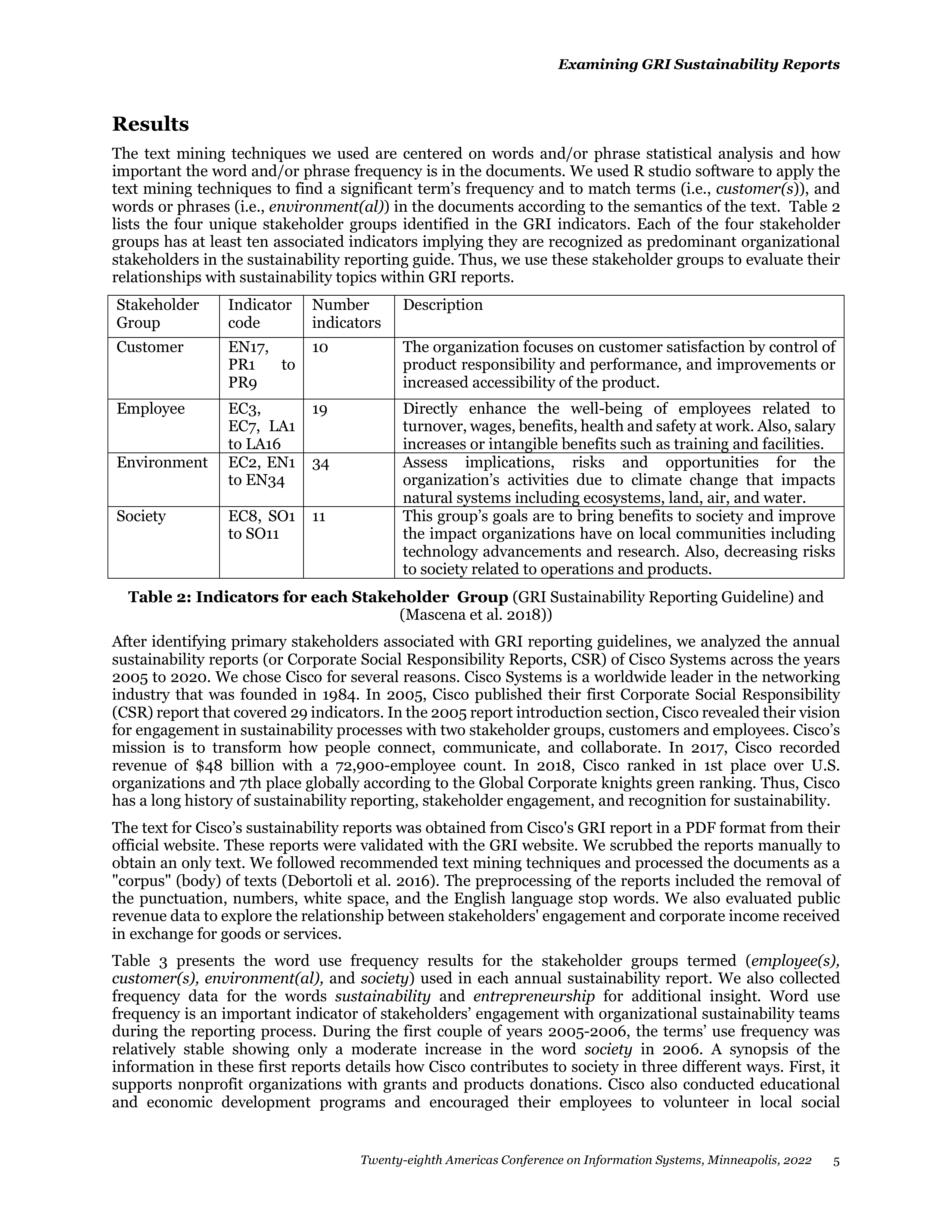
) in the documents according to the semantics of the text. Table 2
lists the four unique stakeholder groups identified in the GRI indicators. Each of the four stakeholder
groups has at least ten associated indicators implying they are recognized as predominant organizational
stakeholders in the sustainability reporting guide. Thus, we use these stakeholder groups to evaluate their
relationships with sustainability topics within GRI reports.
Stakeholder
Group
Indicator
code
Number
indicators
Description
Customer
EN17,
PR1
to
PR9
10
The organization focuses on customer satisfaction by control of
product responsibility and performance, and improvements or
increased accessibility of the product.
Employee
EC3,
EC7, LA1
to LA16
19
Directly enhance the well-being of employees related to
turnover, wages, benefits, health and safety at work. Also, salary
increases or intangible benefits such as training and facilities.
Environment
EC2, EN1
to EN34
34
Assess
implications,
risks
and
opportunities
for
the
organization’s activities due to climate change that impacts
natural systems including ecosystems, land, air, and water.
Society
EC8, SO1
to SO11
11
This group’s goals are to bring benefits to society and improve
the impact organizations have on local communities including
technology advancements and research. Also, decreasing risks
to society related to operations and products.
Table 2: Indicators for each Stakeholder Group
(GRI Sustainability Reporting Guideline) and
(Mascena et al. 2018))
After identifying primary stakeholders associated with GRI reporting guidelines, we analyzed the annual
sustainability reports (or Corporate Social Responsibility Reports, CSR) of Cisco Systems across the years
2005 to 2020. We chose Cisco for several reasons. Cisco Systems is a worldwide leader in the networking
industry that was founded in 1984. In 2005, Cisco published their first Corporate Social Responsibility
(CSR) report that covered 29 indicators. In the 2005 report introduction section, Cisco revealed their vision
for engagement in sustainability processes with two stakeholder groups, customers and employees. Cisco’s
mission is to transform how people connect, communicate, and collaborate. In 2017, Cisco recorded
revenue of $48 billion with a 72,900-employee count. In 2018, Cisco ranked in 1st place over U.S.
organizations and 7th place globally according to the Global Corporate knights green ranking. Thus, Cisco
has a long history of sustainability reporting, stakeholder engagement, and recognition for sustainability.
The text for Cisco’s sustainability reports was obtained from Cisco's GRI report in a PDF format from their
official website. These reports were validated with the GRI website. We scrubbed the reports manually to
obtain an only text. We followed recommended text mining techniques and processed the documents as a
"corpus" (body) of texts (Debortoli et al. 2016). The preprocessing of the reports included the removal of
the punctuation, numbers, white space, and the English language stop words. We also evaluated public
revenue data to explore the relationship between stakeholders' engagement and corporate income received
in exchange for goods or services.
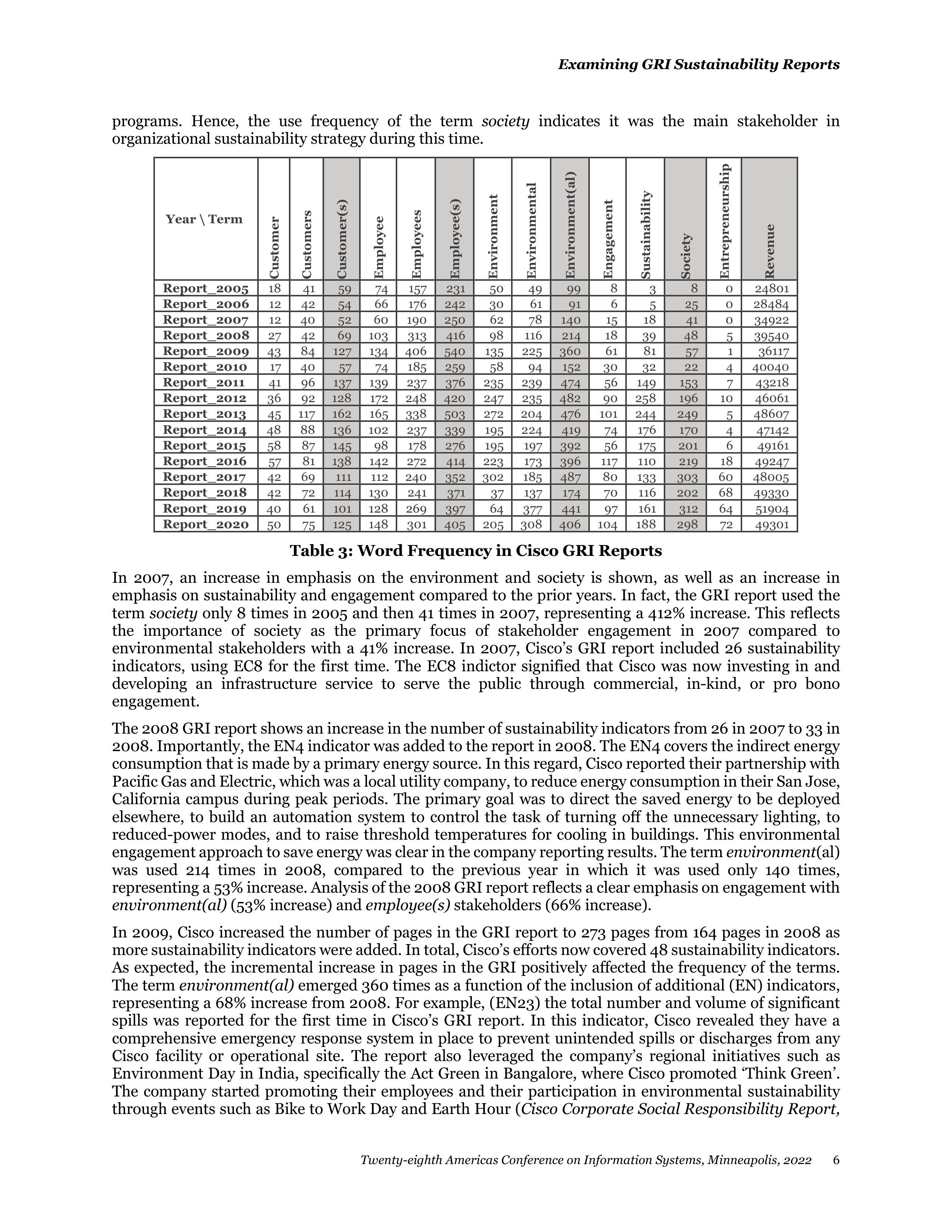
Table 3 presents the word use frequency results for the stakeholder groups termed (
employee(s),
customer(s), environment(al),
and
society
) used in each annual sustainability report. We also collected
frequency data for the words
sustainability
and
entrepreneurship
for additional insight
.
Word use
frequency is an important indicator of stakeholders’ engagement with organizational sustainability teams
during the reporting process. During the first couple of years 2005-2006, the terms’ use frequency was
relatively stable showing only a moderate increase in the word
society
in 2006. A synopsis of the
information in these first reports details how Cisco contributes to society in three different ways. First, it
supports nonprofit organizations with grants and products donations. Cisco also conducted educational
and economic development programs and encouraged their employees to volunteer in local social
Examining GRI Sustainability Reports
Twenty-eighth Americas Conference on Information Systems, Minneapolis, 2022
6
programs. Hence, the use frequency of the term
society
indicates it was the main stakeholder in
organizational sustainability strategy during this time.
Year \ Term
Customer
Customers
Customer(s)
Employee
Employees
Employee(s)
Environment
Environmental
Environment(al)
Engagement
Sustainability
Society
Entrepreneurship
Revenue
Report_2005
18
41
59
74
157
231
50
49
99
8
3
8
0
24801
Report_2006
12
42
54
66
176
242
30
61
91
6
5
25
0
28484
Report_2007
12
40
52
60
190
250
62
78
140
15
18
41
0
34922
Report_2008
27
42
69
103
313
416
98
116
214
18
39
48
5
39540
Report_2009
43
84
127
134
406
540
135
225
360
61
81
57
1
36117
Report_2010
17
40
57
74
185
259
58
94
152
30
32
22
4
40040
Report_2011
41
96
137
139
237
376
235
239
474
56
149
153
7
43218
Report_2012
36
92
128
172
248
420
247
235
482
90
258
196
10
46061
Report_2013
45
117
162
165
338
503
272
204
476
101
244
249
5
48607
Report_2014
48
88
136
102
237
339
195
224
419
74
176
170
4
47142
Report_2015
58
87
145
98
178
276
195
197
392
56
175
201
6
49161
Report_2016
57
81
138
142
272
414
223
173
396
117
110
219
18
49247
Report_2017
42
69
111
112
240
352
302
185
487
80
133
303
60
48005
Report_2018
42
72
114
130
241
371
37
137
174
70
116
202
68
49330
Report_2019
40
61
101
128
269
397
64
377
441
97
161
312
64
51904
Report_2020
50
75
125
148
301
405
205
308
406
104
188
298
72
49301
Table 3: Word Frequency in Cisco GRI Reports
In 2007, an increase in emphasis on the environment and society is shown, as well as an increase in
emphasis on sustainability and engagement compared to the prior years. In fact, the GRI report used the
term
society
only 8 times in 2005 and then 41 times in 2007, representing a 412% increase. This reflects
the importance of society as the primary focus of stakeholder engagement in 2007 compared to
environmental stakeholders with a 41% increase. In 2007, Cisco’s GRI report included 26 sustainability
indicators, using EC8 for the first time. The EC8 indictor signified that Cisco was now investing in and
developing an infrastructure service to serve the public through commercial, in-kind, or pro bono
engagement.
The 2008 GRI report shows an increase in the number of sustainability indicators from 26 in 2007 to 33 in
2008. Importantly, the EN4 indicator was added to the report in 2008. The EN4 covers the indirect energy
consumption that is made by a primary energy source. In this regard, Cisco reported their partnership with
Pacific Gas and Electric, which was a local utility company, to reduce energy consumption in their San Jose,
California campus during peak periods. The primary goal was to direct the saved energy to be deployed
elsewhere, to build an automation system to control the task of turning off the unnecessary lighting, to
reduced-power modes, and to raise threshold temperatures for cooling in buildings. This environmental
engagement approach to save energy was clear in the company reporting results. The term
environment
(al)
was used 214 times in 2008, compared to the previous year in which it was used only 140 times,
representing a 53% increase. Analysis of the 2008 GRI report reflects a clear emphasis on engagement with
environment(al)
(53% increase) and
employee(s)
stakeholders (66% increase).
In 2009, Cisco increased the number of pages in the GRI report to 273 pages from 164 pages in 2008 as
more sustainability indicators were added. In total, Cisco’s efforts now covered 48 sustainability indicators.
As expected, the incremental increase in pages in the GRI positively affected the frequency of the terms.
The term
environment(al)
emerged 360 times as a function of the inclusion of additional (EN) indicators,
representing a 68% increase from 2008. For example, (EN23) the total number and volume of significant
spills was reported for the first time in Cisco’s GRI report. In this indicator, Cisco revealed they have a
comprehensive emergency response system in place to prevent unintended spills or discharges from any
Cisco facility or operational site. The report also leveraged the company’s regional initiatives such as
Environment Day in India, specifically the Act Green in Bangalore, where Cisco promoted ‘Think Green’.
The company started promoting their employees and their participation in environmental sustainability
through events such as Bike to Work Day and Earth Hour (
Cisco Corporate Social Responsibility Report,
Examining GRI Sustainability Reports
Twenty-eighth Americas Conference on Information Systems, Minneapolis, 2022
7
2009). Furthermore, Cisco created a formal partnership with vendors who provide services with low impact
on the environment. For example, Cisco’s print jobs contract was awarded to Xerox, a company who uses
recycled paper stocks. Also, Cisco’s landscape services provider “Valley Crest and Scape Maintenance”
follows a standard process of recycling the waste oil used in landscape trucks and equipment, as they
recycled over 200 quarts of oil each year. The growth in use frequency of
environment(al)
is representative
of the engagement of this stakeholder in Cicso’s 2009 sustainability strategy.
In the 2010 report, while stakeholder engagement appears to decline from 2009, the sustainability
emphasis shows an alignment of the organization with two sustainability stakeholders, Cisco employees,
and society. This is clear through the frequent use of the terms “
collaborative
”, and “
entrepreneurship”
seeking to align activities and stakeholder engagement with broader business strategies and corporate
values. For example, Cisco’s management and the employees interacted informally through team meetings
and internal communications. This resulted in 85% of Cisco employees completing the annual pulse
employee survey in 2010, compared to the 80% in 2009. As a result, Cisco resources were more effectively
aligned with stakeholder goals as demonstrated by the frequency of term use.
In 2011, an increasing interest in sustainability research and reporting affected the reporting process in
general (Sedera et al. 2017). The year 2011 shows a substantive increase in all stakeholders’ engagement as
indicated in the word frequency of the GRI. For example, the average use of the term
society
in the reports
from 2005 to 2010 is 33.5, but in 2011 the term
society
is used 153 times in the report. Overall, in 2011,
most GRI reporting organizations changed reporting processes and Cisco adhered to these changes as well.
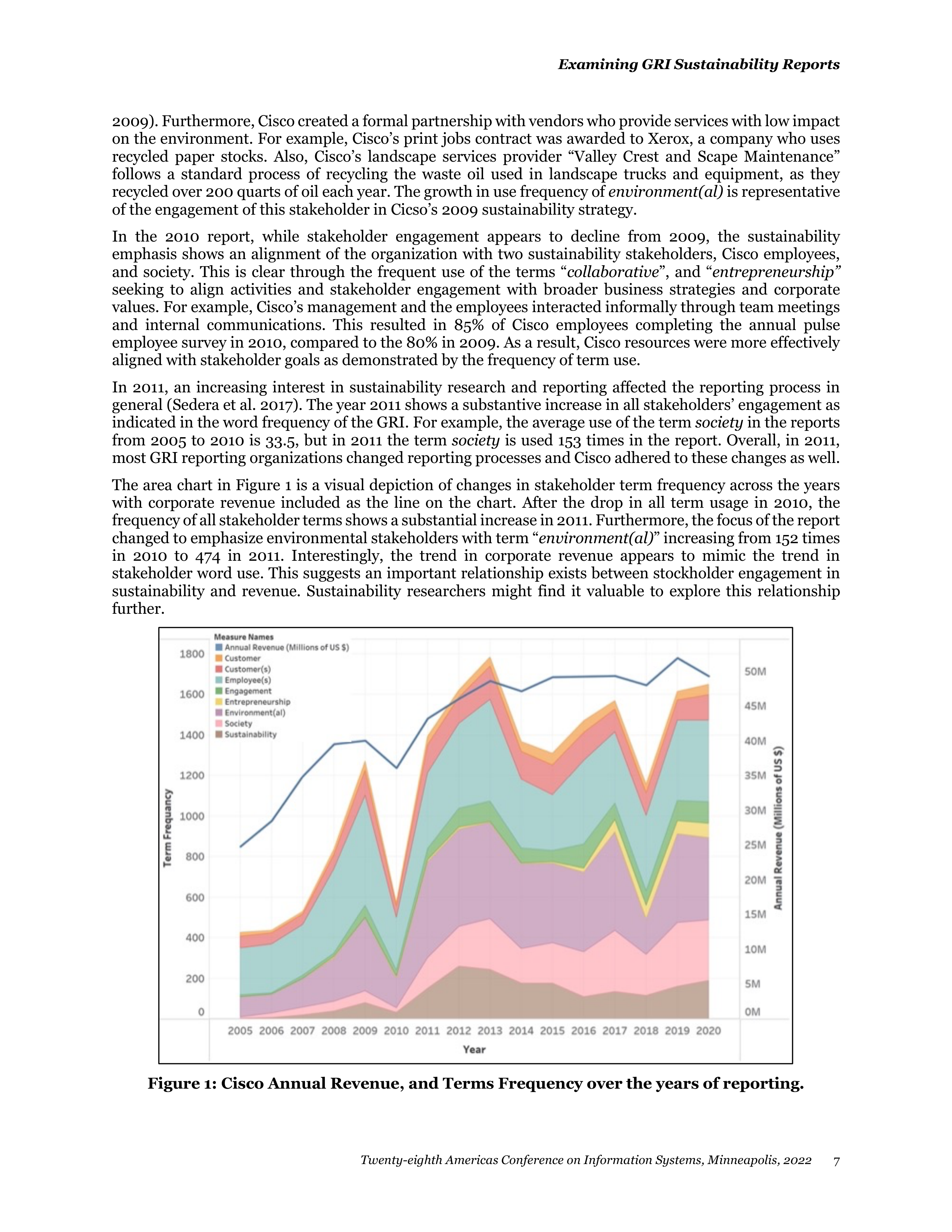
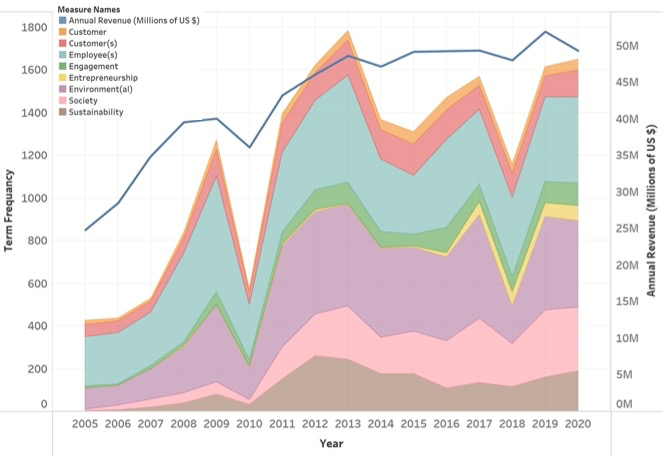
The area chart in Figure 1 is a visual depiction of changes in stakeholder term frequency across the years
with corporate revenue included as the line on the chart. After the drop in all term usage in 2010, the
frequency of all stakeholder terms shows a substantial increase in 2011. Furthermore, the focus of the report
changed to emphasize environmental stakeholders with term “
environment(al)
” increasing from 152 times
in 2010 to 474 in 2011. Interestingly, the trend in corporate revenue appears to mimic the trend in
stakeholder word use. This suggests an important relationship exists between stockholder engagement in
sustainability and revenue. Sustainability researchers might find it valuable to explore this relationship
further.
Figure 1: Cisco Annual Revenue, and Terms Frequency over the years of reporting.

Examining GRI Sustainability Reports
Twenty-eighth Americas Conference on Information Systems, Minneapolis, 2022
8
In 2012, Cisco integrated a new enterprise sustainability information system (SIS) into its network to
monitor and process their sustainability reporting metrics. The SIS system expanded and automated data
collection about sustainability. The SIS also had a noticeable improvement on data accuracy, and an
essential focus on more critical tasks such as evaluating and implementing mitigation projects. In 2013,
Cisco’s GRI report accentuated the water consumption indicators of sustainability (EN8, EN9, and EN10).
Additionally, they integrated a new SIS system that improved the company’s ability to track water
consumption data for most of their facilities’ operations. After examining the stakeholders’ terms frequency
in 2011, 2012, and 2013 reports, we found that the terms “employee(s),” “customer(s),” and
“environment(al),” were used more, but the term “society” saw the most significant increase (63%). In 2013,
corporate engagement and sustainability strategy focused on multiple stakeholders. Indeed, in 2013 Cisco
was ranked in the 20
th
position in the Corporate Knights Global 100 Most Sustainable Corporations list.
Since then, Cisco has maintained an enviable ranking as one of Corporate Knights’ top 100 ranked
companies (see Table 4) with several top-10 rankings.
Year
Global Corporate Knights Ranking
Overall Score
2013
20
58.6
2014
11
66.2
2015
69
56.4
2016
57
61.6
2017
3
71.5
2018
7
77.00
2019
14
76.12
2020
4
83.59
Table 4: Cisco Overall Score in Corporate Knights Ranking
(Corporate Knights website).
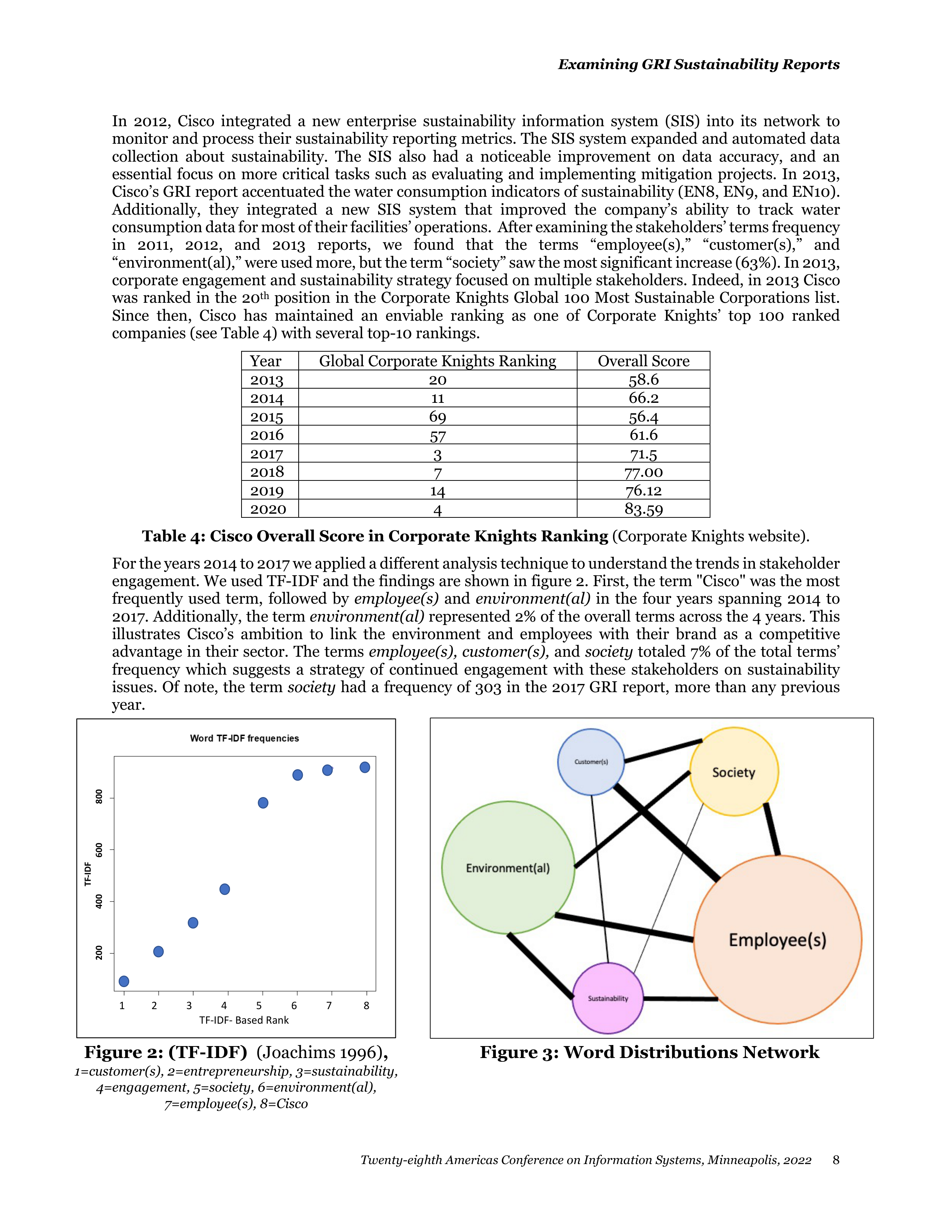
For the years 2014 to 2017 we applied a different analysis technique to understand the trends in stakeholder
engagement. We used TF-IDF and the findings are shown in figure 2. First, the term "Cisco" was the most
frequently used term, followed by
employee(s)
and
environment(al)
in the four years spanning 2014 to
2017. Additionally, the term
environment(al)
represented 2% of the overall terms across the 4 years. This
illustrates Cisco’s ambition to link the environment and employees with their brand as a competitive
advantage in their sector. The terms
employee(s), customer(s),
and
society
totaled 7% of the total terms’
frequency which suggests a strategy of continued engagement with these stakeholders on sustainability
issues. Of note, the term
society
had a frequency of 303 in the 2017 GRI report, more than any previous
year.
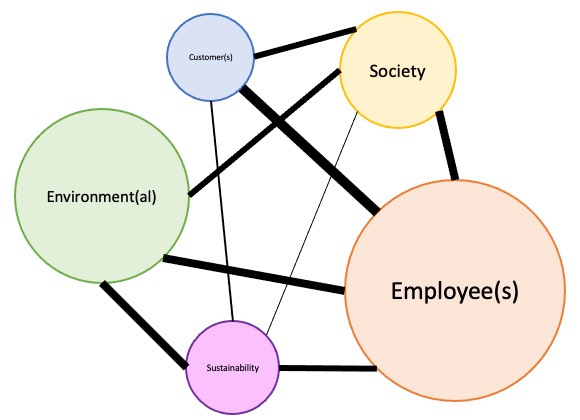
Figure 3: Word Distributions Network
Figure 2: (TF-IDF)
(Joachims 1996)
,
1=customer(s), 2=entrepreneurship, 3=sustainability,
4=engagement, 5=society, 6=environment(al),
7=employee(s), 8=Cisco
TF-IDF
200 400 600 800
1 2 3 4 5 6 7 8
TF-IDF- Based Rank
Examining GRI Sustainability Reports
Twenty-eighth Americas Conference on Information Systems, Minneapolis, 2022
9
As shown in Table 3, the term
entrepreneurship
was used fewer than ten times every year up to the year
2016 GRI report. In 2017, it appears the term
society
was leveraged with the term
entrepreneurship
in the
GRI as Cisco was executing a new approach to engage society. We found that the Cisco 2019 GRI report
approach was taken to a different level. The company shared their stakeholder engagement model
throughout the reporting process. We analyzed the term
engagement
combined with stakeholder groups
and the term was found to emerge with
employees
more than any other group under the internal
engagement emphasis within the company.
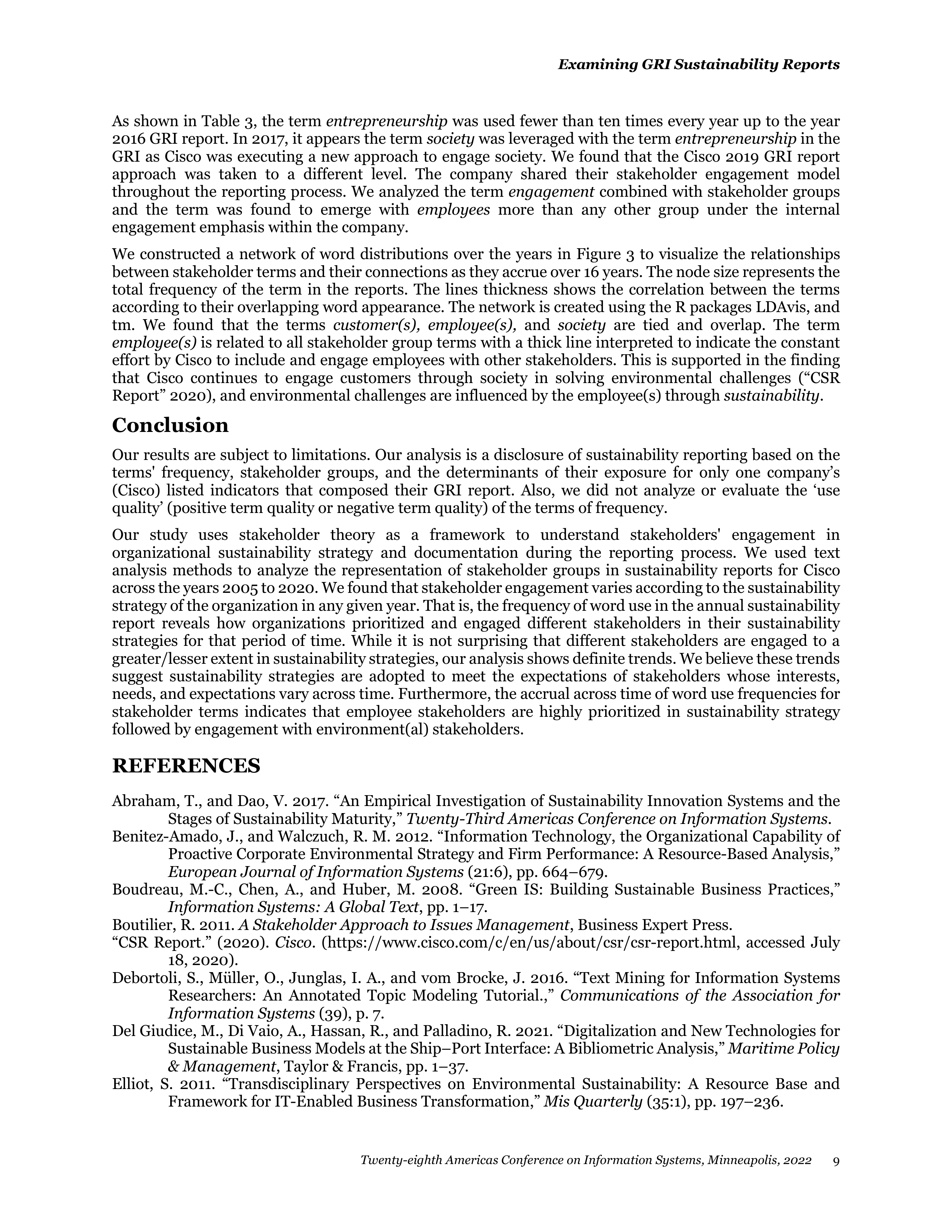
We constructed a network of word distributions over the years in Figure 3 to visualize the relationships
between stakeholder terms and their connections as they accrue over 16 years. The node size represents the
total frequency of the term in the reports. The lines thickness shows the correlation between the terms
according to their overlapping word appearance. The network is created using the R packages LDAvis, and
tm. We found that the terms
customer(s), employee(s),
and
society
are tied and overlap. The term
employee(s)
is related to all stakeholder group terms with a thick line interpreted to indicate the constant
effort by Cisco to include and engage employees with other stakeholders. This is supported in the finding
that Cisco continues to engage customers through society in solving environmental challenges (“CSR
Report” 2020), and environmental challenges are influenced by the employee(s) through
sustainability
.
Conclusion
Our results are subject to limitations. Our analysis is a disclosure of sustainability reporting based on the
terms' frequency, stakeholder groups, and the determinants of their exposure for only one company’s
(Cisco) listed indicators that composed their GRI report. Also, we did not analyze or evaluate the ‘use
quality’ (positive term quality or negative term quality) of the terms of frequency.
Our study uses stakeholder theory as a framework to understand stakeholders' engagement in
organizational sustainability strategy and documentation during the reporting process. We used text
analysis methods to analyze the representation of stakeholder groups in sustainability reports for Cisco
across the years 2005 to 2020. We found that stakeholder engagement varies according to the sustainability
strategy of the organization in any given year. That is, the frequency of word use in the annual sustainability
report reveals how organizations prioritized and engaged different stakeholders in their sustainability
strategies for that period of time. While it is not surprising that different stakeholders are engaged to a
greater/lesser extent in sustainability strategies, our analysis shows definite trends. We believe these trends
suggest sustainability strategies are adopted to meet the expectations of stakeholders whose interests,
needs, and expectations vary across time. Furthermore, the accrual across time of word use frequencies for
stakeholder terms indicates that employee stakeholders are highly prioritized in sustainability strategy
followed by engagement with environment(al) stakeholders.
REFERENCES
Abraham, T., and Dao, V. 2017. “An Empirical Investigation of Sustainability Innovation Systems and the
Stages of Sustainability Maturity,”
Twenty-Third Americas Conference on Information Systems
.
Benitez-Amado, J., and Walczuch, R. M. 2012. “Information Technology, the Organizational Capability of
Proactive Corporate Environmental Strategy and Firm Performance: A Resource-Based Analysis,”
European Journal of Information Systems
(21:6), pp. 664–679.
Boudreau, M.-C., Chen, A., and Huber, M. 2008. “Green IS: Building Sustainable Business Practices,”
Information Systems: A Global Text
, pp. 1–17.
Boutilier, R. 2011.
A Stakeholder Approach to Issues Management
, Business Expert Press.
“CSR Report.” (2020).
Cisco
. (https://www.cisco.com/c/en/us/about/csr/csr-report.html, accessed July
18, 2020).
Debortoli, S., Müller, O., Junglas, I. A., and vom Brocke, J. 2016. “Text Mining for Information Systems
Researchers: An Annotated Topic Modeling Tutorial.,”
Communications of the Association for
Information Systems
(39), p. 7.
Del Giudice, M., Di Vaio, A., Hassan, R., and Palladino, R. 2021. “Digitalization and New Technologies for
Sustainable Business Models at the Ship–Port Interface: A Bibliometric Analysis,”
Maritime Policy
& Management
, Taylor & Francis, pp. 1–37.
Elliot, S. 2011. “Transdisciplinary Perspectives on Environmental Sustainability: A Resource Base and
Framework for IT-Enabled Business Transformation,”
Mis Quarterly
(35:1), pp. 197–236.
Examining GRI Sustainability Reports
Twenty-eighth Americas Conference on Information Systems, Minneapolis, 2022
10
Eweje, G. 2011. “A Shift in Corporate Practice? Facilitating Sustainability Strategy in Companies,”
Corporate Social Responsibility and Environmental Management
(18:3), Wiley Online Library,
pp. 125–136.
“FBRH.”
2020.
(https://fbrh.co.uk/en/80-percent-of-the-world’s-250-largest-companies-report-
according-to-gri, accessed July 14, 2020).
Freeman, R. E. 1984.
Strategic Management: A Stakeholder Approach (Pitman, Boston, MA)
.
Freeman, R. E. 2010.
Strategic Management: A Stakeholder Approach
, Cambridge university press.
Freeman, R. E., Harrison, J. S., Wicks, A. C., Parmar, B. L., and De Colle, S. 2010.
Stakeholder Theory: The
State of the Art
, Cambridge University Press.
Friedman, A. L., and Miles, S. 2006.
Stakeholders: Theory and Practice
, OUP Oxford.
Gadenne, D. L., Kennedy, J., and McKeiver, C. 2009. “An Empirical Study of Environmental Awareness and
Practices in SMEs,”
Journal of Business Ethics
(84:1), Springer, pp. 45–63.
Gaikwad, S. V., Chaugule, A., and Patil, P. 2014. “Text Mining Methods and Techniques,”
International
Journal of Computer Applications
(85:17).
Gao, S. S., and Zhang, J. J. 2006. “Stakeholder Engagement, Social Auditing and Corporate Sustainability,”
Business Process Management Journal
(12:6), pp. 722–740.
“Global Reporting Initiative.” 2020. (https://www.globalreporting.org/Pages/default.aspx).
Hoeffler, S., Bloom, P. N., and Keller, K. L. 2010. “Understanding Stakeholder Responses to Corporate
Citizenship Initiatives: Managerial Guidelines and Research Directions,”
Journal of Public Policy
& Marketing
(29:1), pp. 78–88.
Hu, P. J.-H., Hu, H., Wei, C.-P., and Hsu, P.-F. 2016. “Examining Firms’ Green Information Technology
Practices: A Hierarchical View of Key Drivers and Their Effects,”
Journal of Management
Information Systems
(33:4), pp. 1149–1179.
Köhl, A., Fuger, S., Lang, M., Füller, J., and Stuchtey, M. 2019.
How Text Mining Algorithms for
Crowdsourcing Can Help Us to Identify Today’s Pressing Societal Issues
.
Konar, S., and Cohen, M. A. 2001. “Does the Market Value Environmental Performance?,”
Review of
Economics and Statistics
(83:2), MIT Press, pp. 281–289.
Krumay, B., and Brandtweiner, R. 2014. “INFORMATION SYSTEMS AND STAKEHOLDER
ENGAGEMENT–FIRST RESULTS FROM CONTENT ANALYSIS,”
Eighth Mediterranean
Conference on Information Systems
.
Lenssen, G., Blagov, Y., Bevan, D., Vurro, C., and Perrini, F. 2011. “Making the Most of Corporate Social
Responsibility Reporting: Disclosure Structure and Its Impact on Performance,”
Corporate
Governance: The International Journal of Business in Society.
Lynch-Fannon, I. 2004. “Employees as Corporate Stakeholders: Theory and Reality in a Transatlantic
Context,”
Journal of Corporate Law Studies
(4:1), Taylor & Francis, pp. 155–186.
Mascena, K. M. C. de, Fischmann, A. A., and Boaventura, J. M. G. 2018. “Stakeholder Prioritization in
Brazilian Companies Disclosing GRI Reports,”
BBR. Brazilian Business Review
(15:1), pp. 17–32.
Ogden, S., and Watson, R. 1999. “Corporate Performance and Stakeholder Management: Balancing
Shareholder and Customer Interests in the U.K. Privatized Water Industry,”
The Academy of
Management Journal
(42:5), Academy of Management, pp. 526–538.
Petrini, M., and Pozzebon, M. 2009. “Managing Sustainability with the Support of Business Intelligence:
Integrating Socio-Environmental Indicators and Organisational Context,”
The Journal of Strategic
Information Systems
(18:4), pp. 178–191.
Phillips, R., and Reichart, J. 2000. “The Environment as a Stakeholder? A Fairness-Based Approach,”
Journal of Business Ethics
(23:2), Dordrecht: Kluwer Academic Publishers, pp. 185–197.
(https://doi.org/10.1023/A:1006041929249).
Salton, G., and Buckley, C. 1988. “Term-Weighting Approaches in Automatic Text Retrieval,”
Information
Processing & Management
(24:5), pp. 513–523.
Sarkis, J., Zhu, Q., and Lai, K. 2011. “An Organizational Theoretic Review of Green Supply Chain
Management Literature,”
International Journal of Production Economics
(130:1), pp. 1–15.
Sedera, D., Lokuge, S., Tushi, B., and Tan, F. 2017. “Multi-Disciplinary Green IT Archival Analysis: A
Pathway for Future Studies,”
Communications of the Association for Information Systems
(41:1),
pp. 674–733.
Witten, I. H. 2004.
Text Mining.
World Commission on Environment and Development. 1987. “WCED Sustainable Development Knowledge
Platform.” (https://sustainabledevelopment.un.org/milestones/wced, accessed April 20, 2022).