Journal of Advanced Economic Research
/
V: 07 (ISS: 02) /
2022
PISSN : 2572-0198 / EISSN : 2676 -1572
Contribution of sustainable innovation to supporting competitiveness company
case of "Danone” company
Phd/S. Lamine Derar
1
*
, Dr. Adila Merimet
2
1
Endogenous development and good governance, University of Guelma, (Algeria)
2
Endogenous development and good governance, University of Guelma, (Algeria)
Received:
23/05/2022
Accepted:
28/09/2022
Published:
30/09/2022
*
Corresponding Author:
Lamine Derar-
derar.lamine@univ-guelma.dz
Abstract:
This study aims to show the role of innovation as a basic mechanism in enhancing the
sustainability of company, supporting its competitiveness, and building a new business model that
depends on sustainability and achieves profitability at the same time. And then to clarify the
contribution of sustainable innovation to support competitiveness through a case study of
"Danone” company which works in the field of food industry during the period (2009 - 2019).
The study concluded that the greater interest in integrating sustainable innovations into the
company production or commercial activity, the more positively this will be reflected on its
performance and consumer behavior towards its products, thus raising its market share, which
reflects an increase in company competitiveness.
Keywords:
sustainability, sustainable innovation, competitiveness, business model, Danone
company
Jel Classification Codes :
O30
.
Q
62
Journal of Advanced Economic Research,
El Oued University, El Oued, Algeria, Vol 07, Issue 2, Sep 2022
Contribution of sustainable innovation to supporting competitiveness company
case of "Danone” company
1. Introduction :
The implementation of a sustainable development model into practice has become a primary
goal of public policy in both developed and developing countries with the aim of supporting the
development effort, which the public authorities are no longer able to undertake on their own, on
one hand, and to ensure the sustainable management of the available natural resources and the
preservation of the ecosystem with its various components in an other hand. In this context, the
behavior development of economic agents, whether in their capacity as consumers or producers,
represents the engine of this new economy. Hence, institutions are called to develop socially
responsible behaviors, in the sense of integrating social and environmental concerns in their
production and commercial activities in their dealings with stakeholders voluntarily.
Entrepreneurial strategies related to the development of green or environmental innovations have
become an area of attraction for researchers and theorists in the field of economic sciences and
engineering which study the ways and methods of initiating, disseminating, and adopting these
strategies by the corporation, public authorities, and consumers.
For the enterprise that is at the center of this process, environmental sustainability is no longer just
an issue of corporate social responsibility (CSR) but has become essential for doing business,
beyond the opportunities and risks related to the environment. The strategies and approaches of
operating company’s across all sectors and functions underpin the choices of environmental
strategy, which increasingly define the company’s prospects and future in a highly competitive
market. In this regard, the World Economic Forum’s Global Risks Report 2020 notes that the top
five business risks are associated with challenges Environmental issues, including extreme weather
and climate action failures, so it is no surprise that investors and financial managers are increasingly
incorporating sustainability criteria into their investment decisions as a recent study by IBM showed
that nearly 80 percent of consumers indicate that sustainability is important to them. And that 60
percent are willing to change their shopping habits to reduce the environmental impact in the sense
of moving towards companies with environmental friendly products, and these forces together are
working to form a new corporate agenda, (Wayne s, 2020), from this standpoint it was necessary
The enterprise must integrate the environmental dimension into its innovative activity to a
competitive advantage that enables it to maintain its market share, and why not to increase it.
From the top, we can ask the following main question: How does sustainable innovation contribute
to enhancing company’s competitiveness? this problem can be broken down into the following sub-
questions:
What is the importance of the company’s transformation to sustainability?
What is meant by sustainable innovation and what is competitiveness?
What is Danone’s innovation strategy and what is its impact on its performance and
competitiveness?
Journal of Advanced Economic Research,
El Oued University, El Oued, Algeria, Vol 07, Issue 2, Sep 2022
63
Contribution of sustainable innovation to supporting competitiveness company
case of "Danone” company
The study aims to explain the importance of the environmental and social dimensions in enterprise’s
activity, highlighting the role of innovation as a basic mechanism in enhancing the sustainability of
the company and clarify the role of sustainable innovation in raising of its competitiveness ,to
answer previous questions, the following hypotheses can be put forward:
-The enterprise’s commitment to environmental requirements and social responsibility gives the
title of the sustainable company, which qualifies it to lead.
-Innovation represents a fundamental pillar of entrepreneurship and takes the form of sustainability
if it is linked to reducing the impact of economic activities on the environment.
-Sustainable innovation is the focus of Danone’s strategy for growth and sustainability, which has
qualified it for leadership in its field of activity and made it one of the largest global company’s
committed to the environment and society.
Many studies and researches have touched on this subject, from which we review:
1- In a study by M.D. Basseer Khalaf Khazal and M.A. Amer Rajab Diab on the impact of green
innovation in enhancing sustainable competitive advantage, the study aimed to analyze and
diagnose the relationship between green innovation (in products and processes) and sustainable
competitive advantage. The most important results are that the green innovation significantly affects
the sustainable competitive advantage, and the largest share of this effect wich on the part of
product innovation (Basseer khlaf, 2019).
2- In a study by Arild Aspelund, Fanny Hermundsdottir entitled Sustainability Innovation and
Company Competitiveness, the study aimed to determine the relationship between sustainability
innovations and competitiveness and to identify the contextual factors that mediate and modify this
relationship. The current study was a systematic review of the literature on this topic, including 100
publications. The study concluded that the vast majority of studies found positive relationships.
Hence, the results support the view that sustainability innovations can create win-win situations for
both the company and society. (Arild Aspelund, 2021).
3- In a joint study between Than Tiep and Muhammed Ikram for the purpose of revealing the
relationship between sustainability innovation and the performance of small and medium-sized
enterprises in southern Vietnam. The study concluded that sustainability innovation has an
important role in promoting competition between companies and supporting performance indicators
of companies with a sustainable orientation and that the competitiveness of companies mediates the
relationship between sustainability innovation and operational, environmental and financial
performance (Than Tiep, 2022).
Most of the studies that dealt with the subject of sustainable innovation and the competitiveness of
the enterprise were qualitative studies aimed at revealing the relationship between the enterprise’s
adoption of sustainable innovation and its competitiveness through cleaner production and social
responsibility, in this study we will try to reveal the contribution that sustainable innovation makes
64
Journal of Advanced Economic Research,
El Oued University, El Oued, Algeria, Vol 07, Issue 2, Sep 2022
Contribution of sustainable innovation to supporting competitiveness company
case of "Danone” company
to the competitiveness of the enterprise through its reflection on the business model and its
leadership in the sector of activity to which it belongs,
Structure Search
1 - The enterprise and the inevitability of the transition towards sustainability
2 - Sustainable innovation and enterprise competitiveness
3 - Danone case study
2. - Enterprise and the imperative of transition towards sustainability:
Innovations aimed at cultivating sustainability arouse enthusiasm and skepticism,
Muhammad Yunus’s “social work” and CK Prallahad’s “base of the pyramid” in particular have
come under discussion, with some activists seeing it as promising a bright future, and others seeing
it as glamor that will not change the substance. The debate remains, and a good way to understand
this is to look at the companies that took the lead and can now learn from their experience
.
I.1. The relationship of the social goal with the economic goal of business:
Returning to the two main reference models, “social work” as it’s defined by Muhammad
Yunus “a work which goal to solve some social, economic and environmental problems that affect
humanity: hunger, lack of housing, disease, pollution, Ignorance.” Organizations created for this
purpose should mainly generate profits; but those profits, in Yunus’ strict definition, are reinvested.
The term “base of the pyramid” (sometimes abbreviated B.O.P) derives from the work of C. K.
Prahalad and S. Hart and is used to denote a low-income population, It also refers to the economic
models designed to give this population access to a certain number of basic products and services. It
also relates to reconciling the struggle against poverty and the search for profit, and here we find
that the social goal meets the economic goal (Boubaker, 2015)
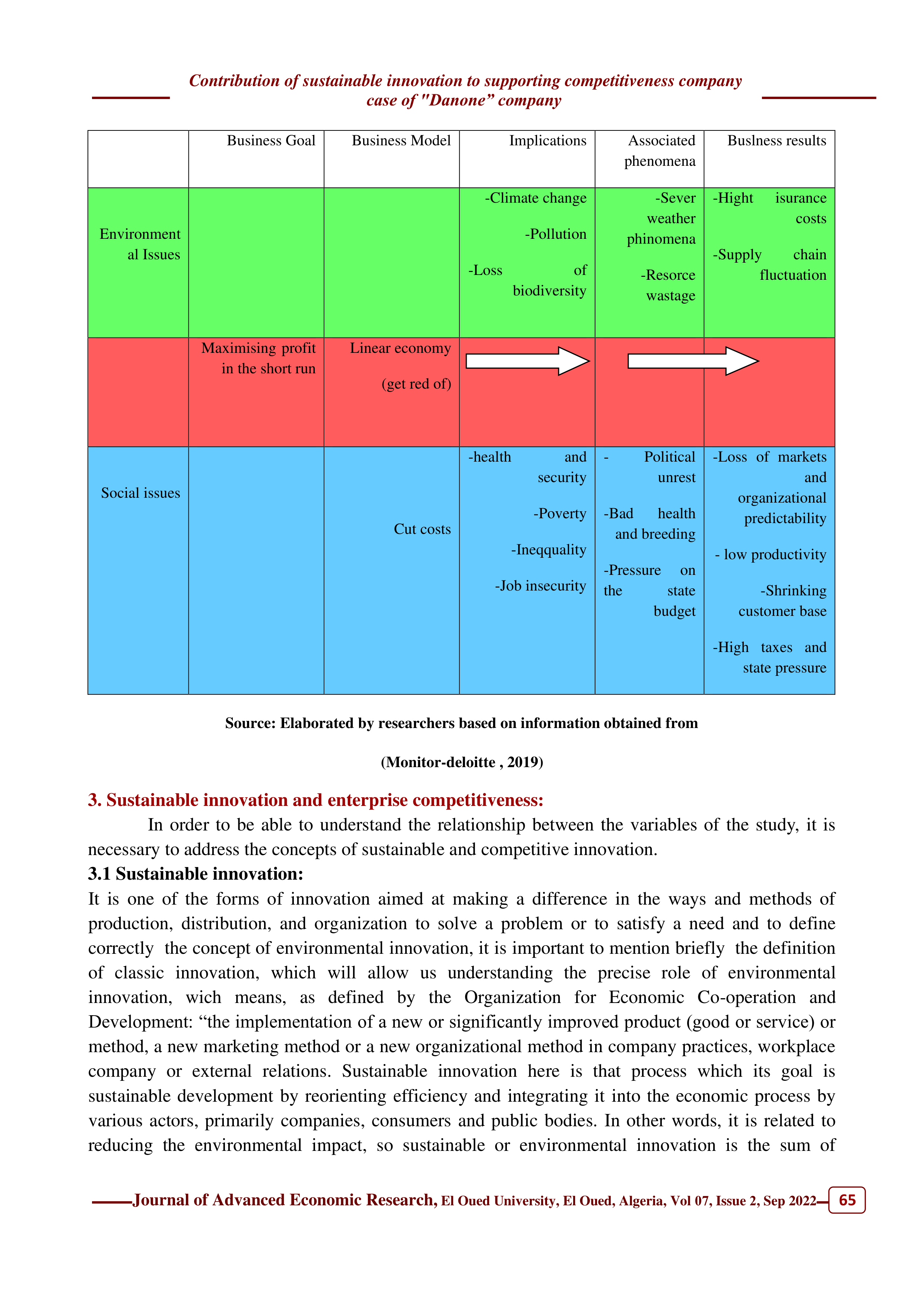
I.2. - The vicious circle of the profit maximization model in the short term::
The current business model of company, prefers maximizing profits in the short term without taking
into account its negative repercussions, the most important of which is the deterioration of the
environment and the depletion of resources. However, enterprises play a key role in the transition
process towards a new business model thanks to their ability to innovate and propose solutions to
the problems raised to the environment and society. To continue its activity, the enterprise not only
has to reduce the negative effects of its activities, but it must work positively to create common
values for the community. An enterprise that deviates from this path will see its market share
shrinking in favor of those that incorporate environmental and social dimensions into their plans,
and that can stand out in a highly competitive environment by developing a strong sustainability
advantage (Monitor-deloitte , 2019) This requires the enterprise to adopt a different way of thinking
in which sustainable development is integrated at the heart of the business strategy, as well as in its
culture and innovation process.
Table No. 01: The vicious circle of the profit maximization model in the short
run
Journal of Advanced Economic Research,
El Oued University, El Oued, Algeria, Vol 07, Issue 2, Sep 2022
65
Contribution of sustainable innovation to supporting competitiveness company
case of "Danone” company
Buslness results
Associated
phenomena
Implications
Business Model
Business Goal
-Hight
isurance
costs
-Supply
chain
fluctuation
-Sever
weather
phinomena
-Resorce
wastage
-Climate change
-Pollution
-Loss
of
biodiversity
Environment
al Issues
Linear economy
(get red of)
Maximising profit
in the short run
-Loss of markets
and
organizational
predictability
- low productivity
-Shrinking
customer base
-High taxes and
state pressure
-
Political
unrest
-Bad
health
and breeding
-Pressure
on
the
state
budget
-health
and
security
-Poverty
-Ineqquality
-Job insecurity
Cut costs
Social issues
Source: Elaborated by researchers based on information obtained from
(Monitor-deloitte , 2019)
3. Sustainable innovation and enterprise competitiveness:
In order to be able to understand the relationship between the variables of the study, it is
necessary to address the concepts of sustainable and competitive innovation.
3.1 Sustainable innovation:
It is one of the forms of innovation aimed at making a difference in the ways and methods of
production, distribution, and organization to solve a problem or to satisfy a need and to define
correctly the concept of environmental innovation, it is important to mention briefly the definition
of classic innovation, which will allow us understanding the precise role of environmental
innovation, wich means, as defined by the Organization for Economic Co-operation and
Development: “the implementation of a new or significantly improved product (good or service) or
method, a new marketing method or a new organizational method in company practices, workplace
company or external relations. Sustainable innovation here is that process which its goal is
sustainable development by reorienting efficiency and integrating it into the economic process by
various actors, primarily companies, consumers and public bodies. In other words, it is related to
reducing the environmental impact, so sustainable or environmental innovation is the sum of
66
Journal of Advanced Economic Research,
El Oued University, El Oued, Algeria, Vol 07, Issue 2, Sep 2022
Contribution of sustainable innovation to supporting competitiveness company
case of "Danone” company
products, services, processes and methods that allow reducing the impact of human and economic
activities in particular on the environment (gaseous pollution, waste disposal, waste of resources,
impact on biodiversity) on one hand and promoting Public health, combating poverty and
supporting energic security on the other hand (Boutillier, 2012).
Environmental innovation is also called “new or modified processes, technologies, systems,
and products that aim to avoid or reduce adverse effects on the environment.” (Kemp.R.Arundel,
1998), and give the “Lisbon Strategy” for sustainable development, environmental innovation is a
key concept that achieves economic efficiency while saving resources and energy and also ensures
the sustainable development necessary for the planet and future generations, In general,
environmental innovations aim to reduce the impact of human activities on nature while
maintaining the continuous nature of innovation to ensure its renewal and improvement (Boubaker,
2015, pp. 15-16). The goal of any environmental innovation is to change our consumption as well
as to develop technologies, products, and services that reduce our impact on the environment.
Environment and innovation come together to offer sustainable solutions that aim to make better
use of resources and seek to reduce the negative impact of our economic activities on the
environment.
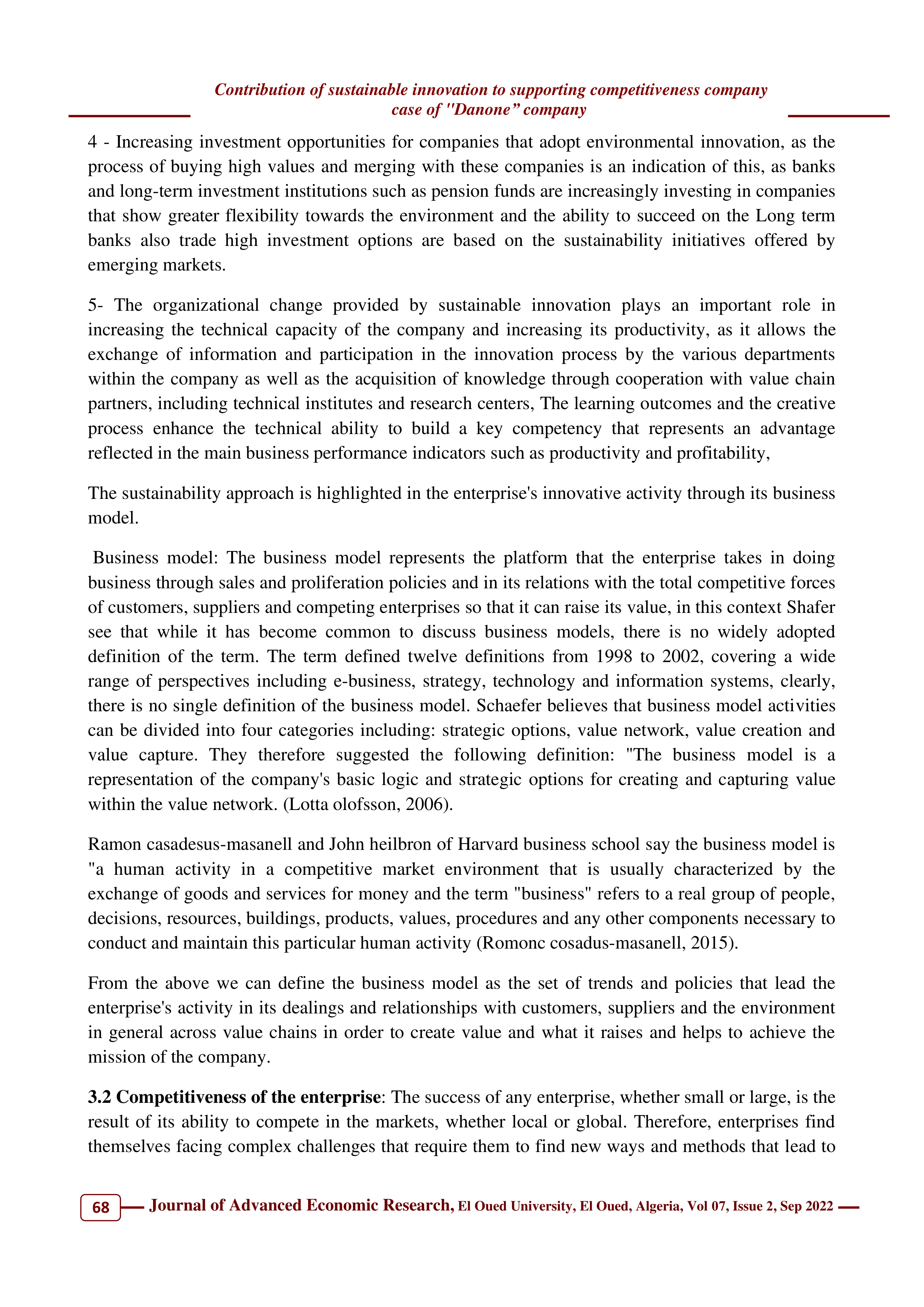
3.1.1 Causes and incentives of sustainable innovation:
Sustainable innovation represents one of
the mechanisms that have become of great interest to theorists as a treatment to reduce the waste of
resources and destruction of the environment as a result of the irrational exploitation of natural
resources, and for entrepreneurs and company owners to empower their organizations in a world in
which the levels of technological progress have converged between competing companies, and the
pressure on sources of supply and distribution outlets has intensified, these companies needed to
search for solutions to empower themselves amid strict environmental standards and a conscious
and demanding consumer, It has this through sustainable innovation, which makes it a set of edges
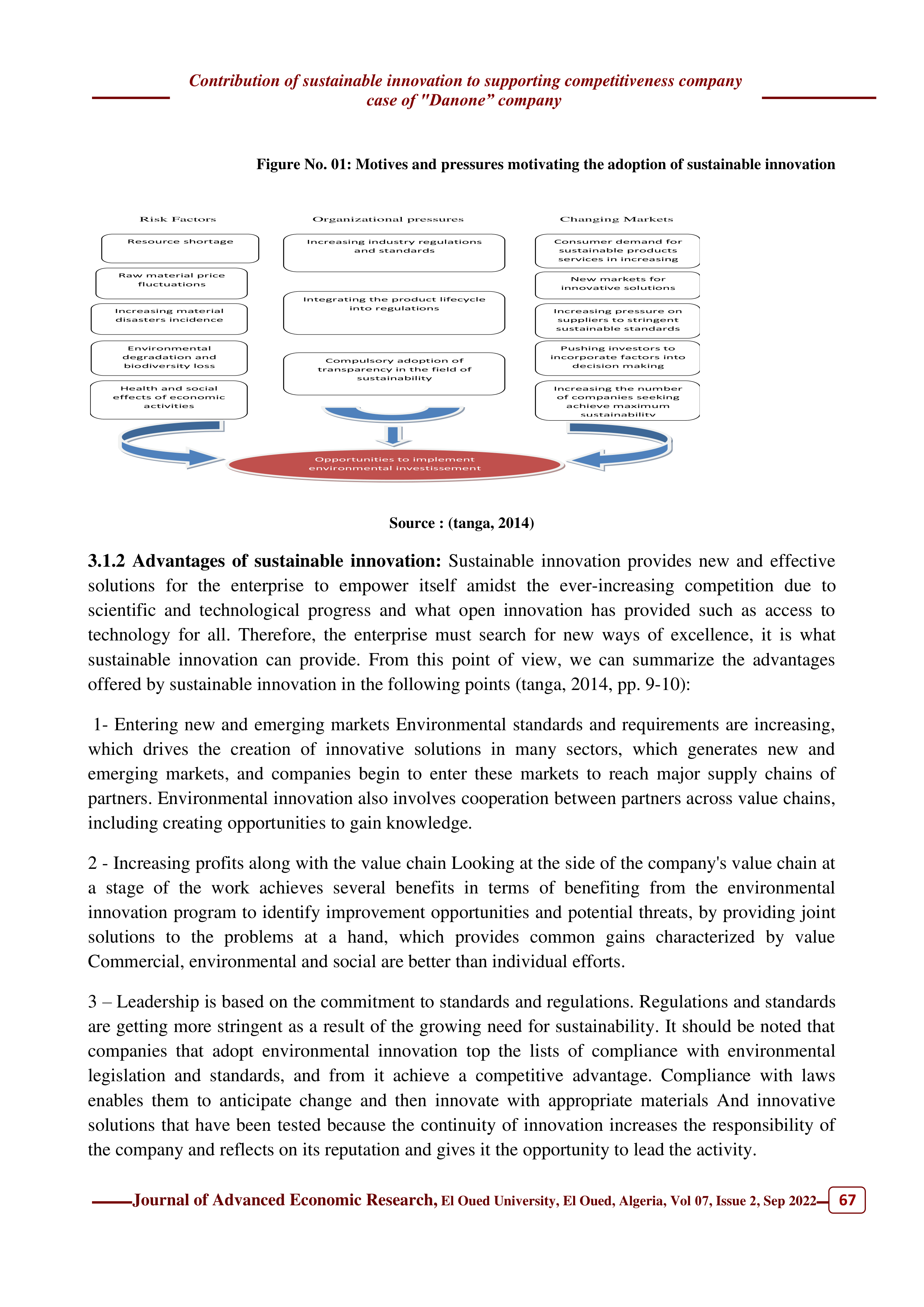
and pressures an urgent necessity for companies. We can explain them in the following figure
:
Journal of Advanced Economic Research,
El Oued University, El Oued, Algeria, Vol 07, Issue 2, Sep 2022
67
Contribution of sustainable innovation to supporting competitiveness company
case of "Danone” company
Figure No. 01: Motives and pressures motivating the adoption of sustainable innovation
Source : (tanga, 2014)
3.1.2 Advantages of sustainable innovation:
Sustainable innovation provides new and effective
solutions for the enterprise to empower itself amidst the ever-increasing competition due to
scientific and technological progress and what open innovation has provided such as access to
technology for all. Therefore, the enterprise must search for new ways of excellence, it is what
sustainable innovation can provide. From this point of view, we can summarize the advantages
offered by sustainable innovation in the following points (tanga, 2014, pp. 9-10):
1- Entering new and emerging markets Environmental standards and requirements are increasing,
which drives the creation of innovative solutions in many sectors, which generates new and
emerging markets, and companies begin to enter these markets to reach major supply chains of
partners. Environmental innovation also involves cooperation between partners across value chains,
including creating opportunities to gain knowledge.
2 - Increasing profits along with the value chain Looking at the side of the company's value chain at
a stage of the work achieves several benefits in terms of benefiting from the environmental
innovation program to identify improvement opportunities and potential threats, by providing joint
solutions to the problems at a hand, which provides common gains characterized by value
Commercial, environmental and social are better than individual efforts.
3 – Leadership is based on the commitment to standards and regulations. Regulations and standards
are getting more stringent as a result of the growing need for sustainability. It should be noted that
companies that adopt environmental innovation top the lists of compliance with environmental
legislation and standards, and from it achieve a competitive advantage. Compliance with laws
enables them to anticipate change and then innovate with appropriate materials And innovative
solutions that have been tested because the continuity of innovation increases the responsibility of
the company and reflects on its reputation and gives it the opportunity to lead the activity.
Risk Factors Organizational pressures Changing Markets
Consumer demand for
sustainable products
services in increasing
New markets for
innovative solutions
Increasing pressure on
suppliers to stringent
sustainable standards
Health and social
effects of economic
activities
Environmental
degradation and
biodiversity loss
Increasing industry regulations
and standards
Integrating the product lifecycle
into regulations
Compulsory adoption of
transparency in the field of
sustainability
Increasing material
disasters incidence
Raw material price
fluctuations
Resource shortage
Pushing investors to
incorporate factors into
decision making
Increasing the number
of companies seeking
achieve maximum
sustainability
Opportunities to implement
environmental investissement
68
Journal of Advanced Economic Research,
El Oued University, El Oued, Algeria, Vol 07, Issue 2, Sep 2022
Contribution of sustainable innovation to supporting competitiveness company
case of "Danone” company
4 - Increasing investment opportunities for companies that adopt environmental innovation, as the
process of buying high values and merging with these companies is an indication of this, as banks
and long-term investment institutions such as pension funds are increasingly investing in companies
that show greater flexibility towards the environment and the ability to succeed on the Long term
banks also trade high investment options are based on the sustainability initiatives offered by
emerging markets.
5- The organizational change provided by sustainable innovation plays an important role in
increasing the technical capacity of the company and increasing its productivity, as it allows the
exchange of information and participation in the innovation process by the various departments
within the company as well as the acquisition of knowledge through cooperation with value chain
partners, including technical institutes and research centers, The learning outcomes and the creative
process enhance the technical ability to build a key competency that represents an advantage
reflected in the main business performance indicators such as productivity and profitability,
The sustainability approach is highlighted in the enterprise's innovative activity through its business
model.
Business model: The business model represents the platform that the enterprise takes in doing
business through sales and proliferation policies and in its relations with the total competitive forces
of customers, suppliers and competing enterprises so that it can raise its value, in this context Shafer
see that while it has become common to discuss business models, there is no widely adopted
definition of the term. The term defined twelve definitions from 1998 to 2002, covering a wide
range of perspectives including e-business, strategy, technology and information systems, clearly,
there is no single definition of the business model. Schaefer believes that business model activities
can be divided into four categories including: strategic options, value network, value creation and
value capture. They therefore suggested the following definition: "The business model is a
representation of the company's basic logic and strategic options for creating and capturing value
within the value network. (Lotta olofsson, 2006).
Ramon casadesus-masanell and John heilbron of Harvard business school say the business model is
"a human activity in a competitive market environment that is usually characterized by the
exchange of goods and services for money and the term "business" refers to a real group of people,
decisions, resources, buildings, products, values, procedures and any other components necessary to
conduct and maintain this particular human activity (Romonc cosadus-masanell, 2015).
From the above we can define the business model as the set of trends and policies that lead the
enterprise's activity in its dealings and relationships with customers, suppliers and the environment
in general across value chains in order to create value and what it raises and helps to achieve the
mission of the company.
3.2 Competitiveness of the enterprise
: The success of any enterprise, whether small or large, is the
result of its ability to compete in the markets, whether local or global. Therefore, enterprises find
themselves facing complex challenges that require them to find new ways and methods that lead to
Journal of Advanced Economic Research,
El Oued University, El Oued, Algeria, Vol 07, Issue 2, Sep 2022
69
Contribution of sustainable innovation to supporting competitiveness company
case of "Danone” company
the development of their policies and strategies, to acquire and raise the profile of the enterprise.
their competitiveness to be competitive.
3.2.1 Definition of Competitiveness:
The concept of competitiveness occupied an important space
and position, despite the lack of agreement on a unified definition, economists unanimously agreed
that it represents the strategic element that presents a fundamental opportunity for development and
maximizing profitability. Where some defined it as: “the ability that the institution possesses at a
certain time to resist its competitors” (Mourad mahboub, 2007)While we find that competition
between enterprises means the ability to withstand competitors within the markets, this ability is
considered unstable due to the multiplicity of desires and needs of consumers in the presence of
severe and fierce competition, in addition to the permanence of the spirit of innovation and the
disparity of financial positions (hafs, 1997). Competitiveness is the ability to provide consumers
with products and services more efficiently and effectively than other competitors (Fares mazdour,
2003)
Accordingly, competitiveness can be defined as the capabilities that an organization possesses that
allow it to place its products and commodities in a market characterized by competition over a long
period.
It should be noted that there is a difference between the term competitiveness and competition,
which emerges in many studies is that the concept of competitiveness is broader than the concept of
competition, as competitiveness indicates the existence of dynamics between competitors and their
ability to dispose of their goods and services in a particular market, while competition indicates the
existence of An arrangement between competitors and the conditions under which the flow and
circulation of goods and services flow in a given market, but they overlap to a large extent within
what is known as advantage or competitiveness (borni, 2007)
3.2.2 Types of Competitiveness:
Competitiveness is divided objectively and temporally into the
following types (Lesca, 1982)
- Competitiveness of the enterprise: the competitiveness of the enterprise is evaluated based on the
margins of all products.
- Product competitiveness: Product competitiveness evaluation is often based on cost price as a
single indicator, but there are other, more significant indicators such as quality and after-sales
services. Product competitiveness is a necessary condition for the competitiveness of the enterprise,
but it is not sufficient.
- Competitiveness ability: It is represented in the future opportunities that extend over several cycles
of exploitation and in the long term.
- Momentary competitiveness: it may result from a passing opportunity in the market or
circumstances that led to making the enterprise in a monopolistic position, so it should not be
optimistic about it, as it depends on the positive results achieved during one accounting cycle.
70
Journal of Advanced Economic Research,
El Oued University, El Oued, Algeria, Vol 07, Issue 2, Sep 2022
Contribution of sustainable innovation to supporting competitiveness company
case of "Danone” company
3.2.3 Indicators for measuring competitiveness:
The competitiveness indicators of the enterprise
are subject to many variables and quantitative and qualitative factors, which can be measured
through:
A- Profitability: Profitability is a sufficient indicator of the current competitiveness. It is a measure
of the return in the form of profits obtained by shareholders for their investments in the institution.
It can be calculated through the following ratios (lahouel, 2008)
Return on equity: is the profitability of the capital provided by shareholders;
Return on capital: This ratio reflects the performance of the institution by focusing on the efficient
use of capital.
In addition, the future profitability of the enterprise depends on its current expenditures on research
and development and patents, as it is based primarily on the relative productivity of the enterprise
and the cost of production factors, as well as on the attractiveness of its products in the market in
the long run (kababi, 2008)
b- Production cost: The enterprise is not competitive according to the theoretical model of
competition, if the average cost of production exceeds the price of its products in the market, either
because of low productivity or high cost of production factors, or for both reasons, It can also be the
weakness of the average cost of production Compared to competitors, especially if the company
belongs to a sector with homogeneous products (Douis, 2005).
C- Total factor productivity: This indicator measures the efficiency with which the enterprise
transforms production factors into products. However, this indicator does not clarify the advantages
and disadvantages of the costs of these factors.
D- Market share: When the local market is protected, the product can acquire a larger market share
and be very profitable, without being competitive in the international market, so the costs of the
local product must be compared with the costs of international competition (Issa bahdi, 2015).
3- A
4.Case study of Danone company for the period (2009 – 2019)
It should be noted that the study period included ten (10) years, starting from the year 2009
to the end of 2019,The study stopped at the year 2019 due to the association of the year 2020 with
an exceptional circumstance represented in the spread of the Corona pandemic and the subsequent
quarantine procedures and border closures, which makes the disruption and interruption of supply
and supply chains, which makes the data for this year inexpressive.
4.1 company presentation
: With a mission to make food healthy for as many people as possible,
Danone is one of the world's leading companies in the food sector by developing the robustly
growing category of products geared toward nutrition and health, through its three business lines:
Dairy and Related Products Plant origin, mineral water, and specialized nutrition.
Journal of Advanced Economic Research,
El Oued University, El Oued, Algeria, Vol 07, Issue 2, Sep 2022
71
Contribution of sustainable innovation to supporting competitiveness company
case of "Danone” company
Danone is presented in more than 120 countries and has more than 100,000 employees, with a
turnover of 25.3 billion euros for the year 2019, Danone's portfolio consists of many international
brands (notably Actimel, Activia, Alpro, Aptamil, Danette, Danio, Danonino, Evian, Nutricia,
Nutrilon, and Volvic) as well as strong local and regional brands (eg AQUA, Blédina, Bonafont,
Cow & Gate, Mizone, Shokti, Silk and Vega). Danone aims to promote healthier and more
sustainable eating and consumption habits, in line with the "One planet one Health" vision, which
reflects the belief that human health and the health of the planet are inextricably linked. To
accelerate the food revolution and create sustainable and profitable long-term value for all
stakeholders, this regard Danone has set its goals for Horizon 2030 in line with the United Nations
Sustainable Development Goals for 2030, where Danone is committed to operating in an efficient,
responsible and inclusive manner, evidenced by its ambition to become one of the first companies A
B CorpTM-certified multinational for companies most committed to sustainability standards,
Danone has been ranked in key sustainable development indicators: Dow Jones Sustainability
Index, Vigeo Eiris, Sustainalytics, Ethibel Sustainability Index, MSCI Global Sustainability, MSCI
SRI Global Indices, FTSE4Good, and Bloomberg Equity Index Genders.
4-2 Danone’s business model
: Danone has set its goal to build a balanced, profitable, and
sustainable growth model by adopting a set of basic concepts (Danone, 2020):
4.2.1 Profitable growth is at the core of the business model:
Danone occupies a position in the
most dynamic categories of the food and beverage industry, enjoys a strong leadership position in
all its markets. The company relies on a unique portfolio of strong brands and strong
implementation capabilities in terms of innovation, brand activation, and development of new
distribution channels. As Danone strives to enhance its growth model through disciplined resource
allocation, efficiency gains, and cost optimization while always managing short, medium, and long-
term horizons, the company prefers long-term strategic growth opportunities over short-term
tactical plans.
4.2.2 Continuing the dual economic and social project with B Corp:
The cooperation with the
international non-profit organization B Lab to obtain the B Corp certification marks a new
milestone in the Danone dual economic and social project, which was first expressed by Antoine
Rebeaud in his 1972 speech in Marseille.
4.2.3 A New Approach to Strategic Resource Management:
As another example of its
committed and responsible company approach, Danone is diverting the upstream flow of its
business to improve its costs, protect the life cycles of its strategic resources (milk, water, and
plastic) and create leverage to create value and differentiate from competitors.
4.3 Research and Innovation at Danone
: The models implemented by Danone, through its
subsidiaries Grameen Danone in Bangladesh or Lématéki in Senegal, are real laboratories for
breakthrough innovations, which fundamentally challenge the entire value chain (Tavignot, 2014)):
Designing or manufacturing radically new products, such as the nutrient-enriched yogurt of
Bangladesh Shakti (a recipe developed to meet the nutritional needs of children - one yogurt = 30%
72
Journal of Advanced Economic Research,
El Oued University, El Oued, Algeria, Vol 07, Issue 2, Sep 2022
Contribution of sustainable innovation to supporting competitiveness company
case of "Danone” company
of the daily requirement for vitamin A, iron, zinc, and iodine), or a 'bag' of local cereals and a little
amount of milk stored at room temperature by an innovative and economical process that consumes
very little energy produced by Or Lémateki, a social company aimed at improving the nutrition of
Senegalese schoolchildren.
The supply chain is also undergoing a revolution with the implementation of local supply of
materials (milk and grain), and local distribution of products, particularly through a network of
pickup trucks and door-to-door women selling products.
4.3.1 Organization and management of innovation
: Danone’s research and innovation sector
includes about 1,700 people distributed between two international research centers in France and
the Netherlands and four specialized centers: Danone Packaging Research in France, Nutrition
Research in Singapore, Danone’s fresh dairy expertise in Spain, and Danone Technology Research
in Russia, in addition to local research teams in 55 branches of the company spread around the
world.
4.4 Contributing to the UN Sustainable Development Goals through Our 2030 Goals:
The
company’s goals for 2030 included a set of long-term goals that reflect the company’s reason for
existence, its brand model and the confidence in its relationships with all stakeholders, so the
company is strongly committed to respecting the sustainable development goals, in accordance with
the strategy adopted by it, which states that “Providing Health Through food for as many people as
possible” leads the company to focus its efforts on the sustainable development goals on which the
company’s activities have a direct impact, the most important of which are (Danone, 2020):
If the selected seven main axes (Goals 2, 3, 6, 8, 12, 13, and 17) embody Danone’s strategic
mission, the company nevertheless wishes to contribute to other goals, especially the first goal
“Eradication of Poverty”: the company implements assistance measures targeting the poor and the
most vulnerable population groups vulnerabilities, in particulary through investments in a group of
funds.
4.5 Danone Funds for Sustainable Innovation:
“One Planet, One Health” reflects the vision that
the health of people and the health of the planet are interlinked. To support people in adopting
healthier and more sustainable eating and drinking practices, through social innovation funds that
include the Danone Ecosystem Fund, the Danone Communities Fund, and the Livelihoods Funds.
This trend has grown in Danone's strategy by adopting the idea of social inclusion by establishing
the Fond des comminutes by "Emmanuel Faber" General Manager of Danone and Muhammad
Yunus, Director of Grameen Foundation Bangladesh (90% of the capital is invested in money
markets and 10% in social businesses). This fund has benefited from the expansion of Grameen
Danone and social projects for Danone in other developing countries. This experience is the
foundation for building a new business model in which social projects are held alongside profit-
oriented projects. The missions of these funds are based on the following activities (Danone, 2018):
4-5-1 Danone Communities Fund
: It aims to combat malnutrition, improves access to drinking
water, and reduces poverty in the areas where the company operates, by supporting local contractors
Journal of Advanced Economic Research,
El Oued University, El Oued, Algeria, Vol 07, Issue 2, Sep 2022
73
Contribution of sustainable innovation to supporting competitiveness company
case of "Danone” company
through capital and technical and managerial expertise. In 2017, on the occasion of the tenth
anniversary of its establishment, it launched two projects to develop the water network Drinking in
Haiti, Kenya, Rwanda, and Uganda. The outcome of the Fund's activity reached 2019 the
establishment of 12 social enterprises and 15 projects benefiting nearly 06 million people.
4.5.2 The Danone Ecosystem Fund:
was established in 2009 to support vulnerable economic
partners in the Danone value chain (from small farms, small contractors, and waste collectors).
These projects aim to address social and economic challenges, including environmental aspects as
well, as the project is jointly developed between Danone and another non-profit that gives Danone a
competitive advantage, fosters job creation and opens new careers for local communities, and helps
farmers transition from a subsistence model to a regenerative family farming model while
benefiting from the milk supply and reaching new consumers through street vendors.
4-5.3 Livelihood Funds:
An investment model to serve rural communities established in 2011 to
enhance food security and combat climate change for rural communities. The Livelihoods and
Livelihoods Carbon Funds invest in family farming in many projects in Africa, Asia,and Latin
America, and the Carbon Fund for Livelihoods Live environmental operations through agro-forestry
and rural energy projects for the benefit of vulnerable population groups in developing countries.
The results achieved have encouraged the creation of another fund in 2017 for 100 million euros
aimed at improving the living conditions of more than 02 million people and reducing the emission
of 25 million tons over the next 20 years, 09 projects were established, 130 million trees were
planted and 120,000 families were equipped with an improved cooking stove during 2017. In the
same context, the Livelihood Fund funded the 3000 family farms project in Madagascar to improve
the quality of the vanilla product, preserve biodiversity and raise farmers’ incomes. The project
benefits from 02 million Thanks to him, 200,000 farms are converted to sustainable agriculture.
4.6 Danone’s sustainable performance effectiveness:
The company’s sustainable performance
effectiveness card shows its commitment to progress in achieving the goals set according to four
main axes, including climate change, renewable agriculture, protection of water resources, and the
reuse of packaging materials according to a timetable ranging between 2020, 2025 and 2030, this
card Suspended until 2019, and it included good results in all axes related to the company’s activity
from the raw material to the workshops to the transmission and distribution chain, and this is shown
in the following table:
Table No. (02): Effectiveness of the sustainable performance of the company, suspended until December 31,
2019
Goals2030
Goals2025
Goals2020
Achievments2019
Field
50%
100%
_
-
_
50%
24.8 %
42.4%
1-climate change
-Carbon reduction
-Use of renewable energy
74
Journal of Advanced Economic Research,
El Oued University, El Oued, Algeria, Vol 07, Issue 2, Sep 2022
Contribution of sustainable innovation to supporting competitiveness company
case of "Danone” company
-
-
-
-
_
-
100%
_
80%
88
%
28 %
81%
2-Renewable agriculture
-protecting
soil
and
biodiversity
-Supporting new generations
of farmers
-Animal health promotion
_
_
-
_
100%
60%
100%
49%
3-Protect water resorces
-Aquariums and estuaries
-Economy in use of water
-
16%
100%
50%
-
-
80%
16
4-Use of packaging materials
-1OO% Recycled or reused
-Incorporating
recycled
materials
(Danone, 2020)
:
Source: Elaborated by researchers based on information obtained from
4.7
Effective economic performance of Danone:
In order to determine the effectiveness of the
company's economic performance, the development of the following elements should be reviewed
during the study period
:
4.7.1 The company’s market share:
Danone has been at the forefront in its field of activity with
its three branches alongside “Nestlé” and “Coca-Cola” for a long time until the year 2020. The
company ranks first in the world in dairy and plant-based products and second in mineral water This
prestigious position of the company comes as a result of its efforts in the field of continuous
innovation and the good organization of its various activities, driven by its commitments to
consumers about the quality and conformity of products on one hand, On the other hand, its
integration of the company’s economic goals with social and environmental goals through the value
chain, which strengthened its position among consumers in All over the world, at the same time, it
ranks first in Europe in medical nutrition products directed to certain categories of citizens who
suffer from some chronic diseases such as diabetes and aging diseases, which reflects the
company’s commitment to providing healthy food for all categories of consumers, and the
following figure illustrates this:
Figure No. (02): Danone's global position in the food market
Source: Elaborated by researchers based on information obtained from (Danone, 2020)
W0RLDWIDE
1
Milk and plant
based product
Botteld mineral
water of various size
Special
nutrition(Baby and
medical nutrition
BY PRODUCTS
Nr 1 Aptamil
Nr2 Nutrution
Nr3 Sgm
BY PRODUCTS
Nr1 Aqua
Nr2 Mizone
Nr3 Evian
BY PRODUCTS
Nr1 Activia
Nr2 Danone
Nr3 Inter-delight
W0RLDWIDE
2
W0RLDWIDE
2
Journal of Advanced Economic Research,
El Oued University, El Oued, Algeria, Vol 07, Issue 2, Sep 2022
75
Contribution of sustainable innovation to supporting competitiveness company
case of "Danone” company
4-7-2 Growth in the contribution of the company’s branches outside Europe and the country
of home in the turnover
: Due to the specificity of the products related to nutrition and health that
Danone provides to its consumers, It requires special production and storage conditions in terms of
the cold chain during transportation and storage operations, and challenge that the company raises
through food and health for all, bringing the product closer to The consumer and presenting it in the
best conditions prompted the company to establish production units near the various markets it
enters through partnership or purchase of incapacitated or bankrupt local units. The company also
worked to take advantage of the opportunities offered by these young markets related to the supply
of raw materials and labor related to the main activity of the company represented in milk products
and products of plant origin, and by applying the bilateral model of social and environmental
investment in the service of the economic goal, the company was able to reach large segments of
local communities, whether in developed or developing countries, by providing quality food
products with local raw materials and directed to treat specific problems such as poor Nutrition in
Asia, Africa, and Latin America and obesity in the North American countries On one hand, and
supporting the value chain and working with various partners to preserve resources and protect the
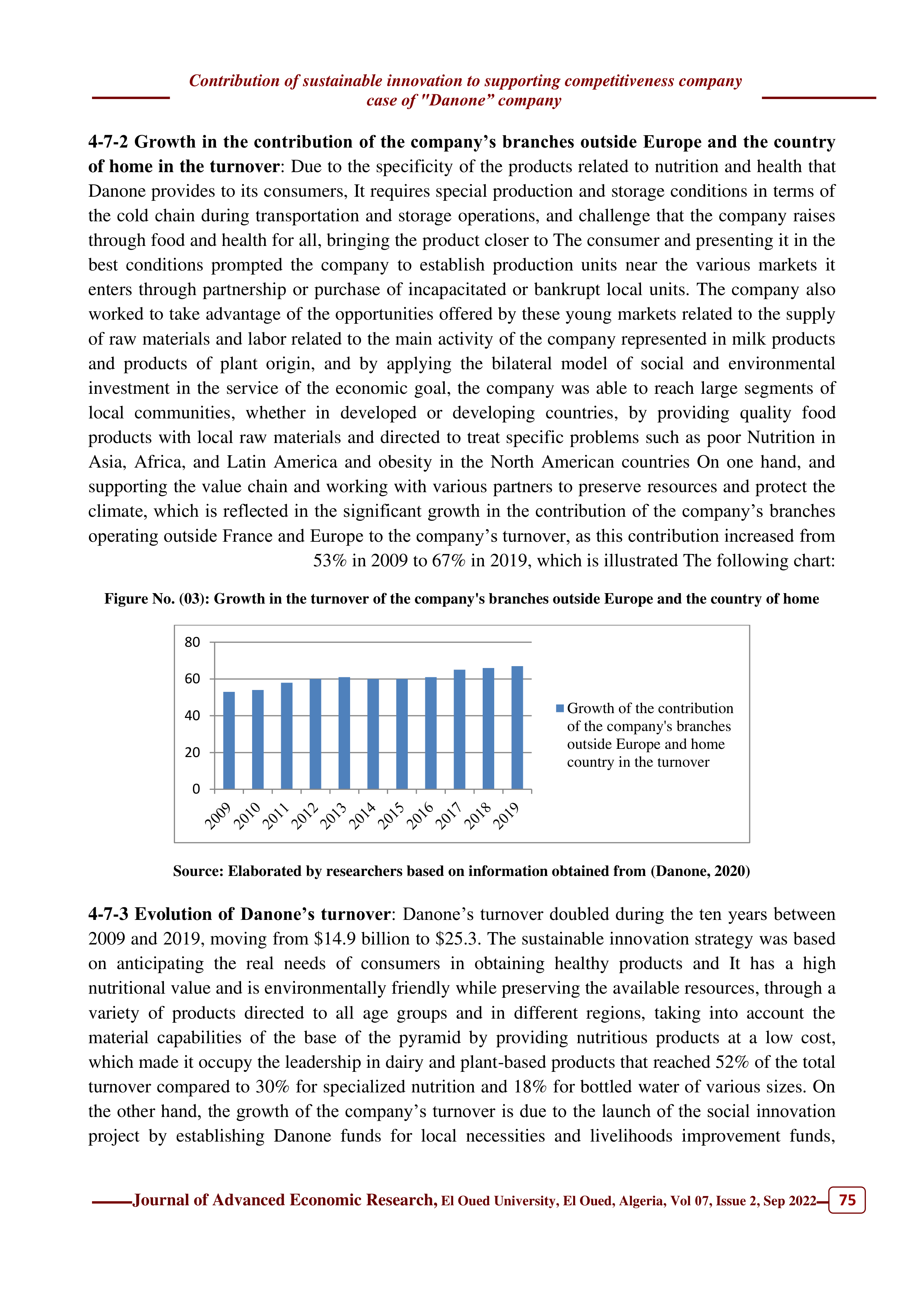
climate, which is reflected in the significant growth in the contribution of the company’s branches
operating outside France and Europe to the company’s turnover, as this contribution increased from
53% in 2009 to 67% in 2019, which is illustrated The following chart:
Figure No. (03): Growth in the turnover of the company's branches outside Europe and the country of home
Source: Elaborated by researchers based on information obtained from (Danone, 2020)
4-7-3 Evolution of Danone’s turnover
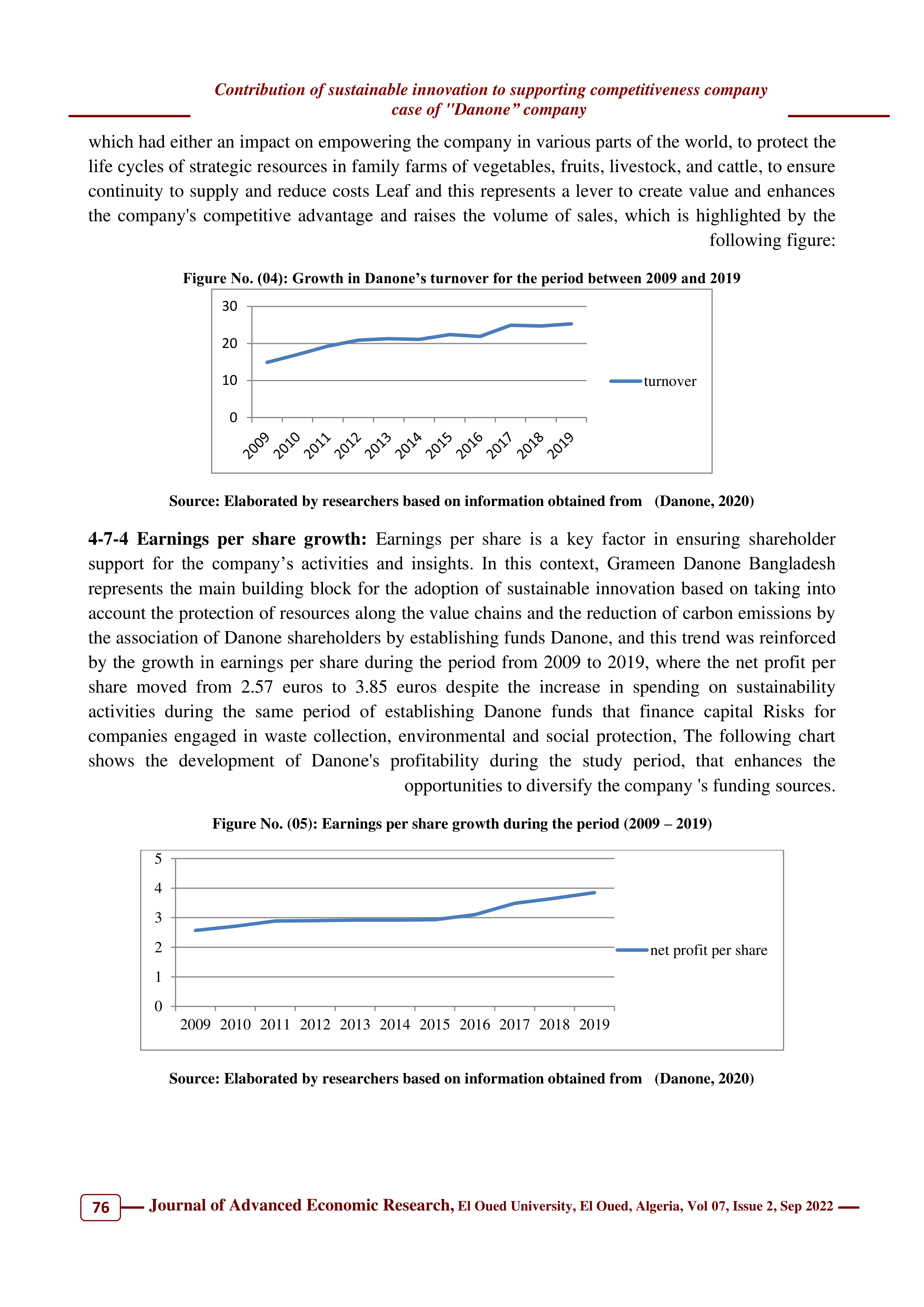
: Danone’s turnover doubled during the ten years between
2009 and 2019, moving from $14.9 billion to $25.3. The sustainable innovation strategy was based
on anticipating the real needs of consumers in obtaining healthy products and It has a high
nutritional value and is environmentally friendly while preserving the available resources, through a
variety of products directed to all age groups and in different regions, taking into account the
material capabilities of the base of the pyramid by providing nutritious products at a low cost,
which made it occupy the leadership in dairy and plant-based products that reached 52% of the total
turnover compared to 30% for specialized nutrition and 18% for bottled water of various sizes. On
the other hand, the growth of the company’s turnover is due to the launch of the social innovation
project by establishing Danone funds for local necessities and livelihoods improvement funds,
0
20
40
60
80
Growth of the contribution
of the company's branches
outside Europe and home
country in the turnover
76
Journal of Advanced Economic Research,
El Oued University, El Oued, Algeria, Vol 07, Issue 2, Sep 2022
Contribution of sustainable innovation to supporting competitiveness company
case of "Danone” company
which had either an impact on empowering the company in various parts of the world, to protect the
life cycles of strategic resources in family farms of vegetables, fruits, livestock, and cattle, to ensure
continuity to supply and reduce costs Leaf and this represents a lever to create value and enhances
the company's competitive advantage and raises the volume of sales, which is highlighted by the
following figure:
Figure No. (04): Growth in Danone’s turnover for the period between 2009 and 2019
Source: Elaborated by researchers based on information obtained from (Danone, 2020)
4-7-4 Earnings per share growth:
Earnings per share is a key factor in ensuring shareholder
support for the company’s activities and insights. In this context, Grameen Danone Bangladesh
represents the main building block for the adoption of sustainable innovation based on taking into
account the protection of resources along the value chains and the reduction of carbon emissions by
the association of Danone shareholders by establishing funds Danone, and this trend was reinforced
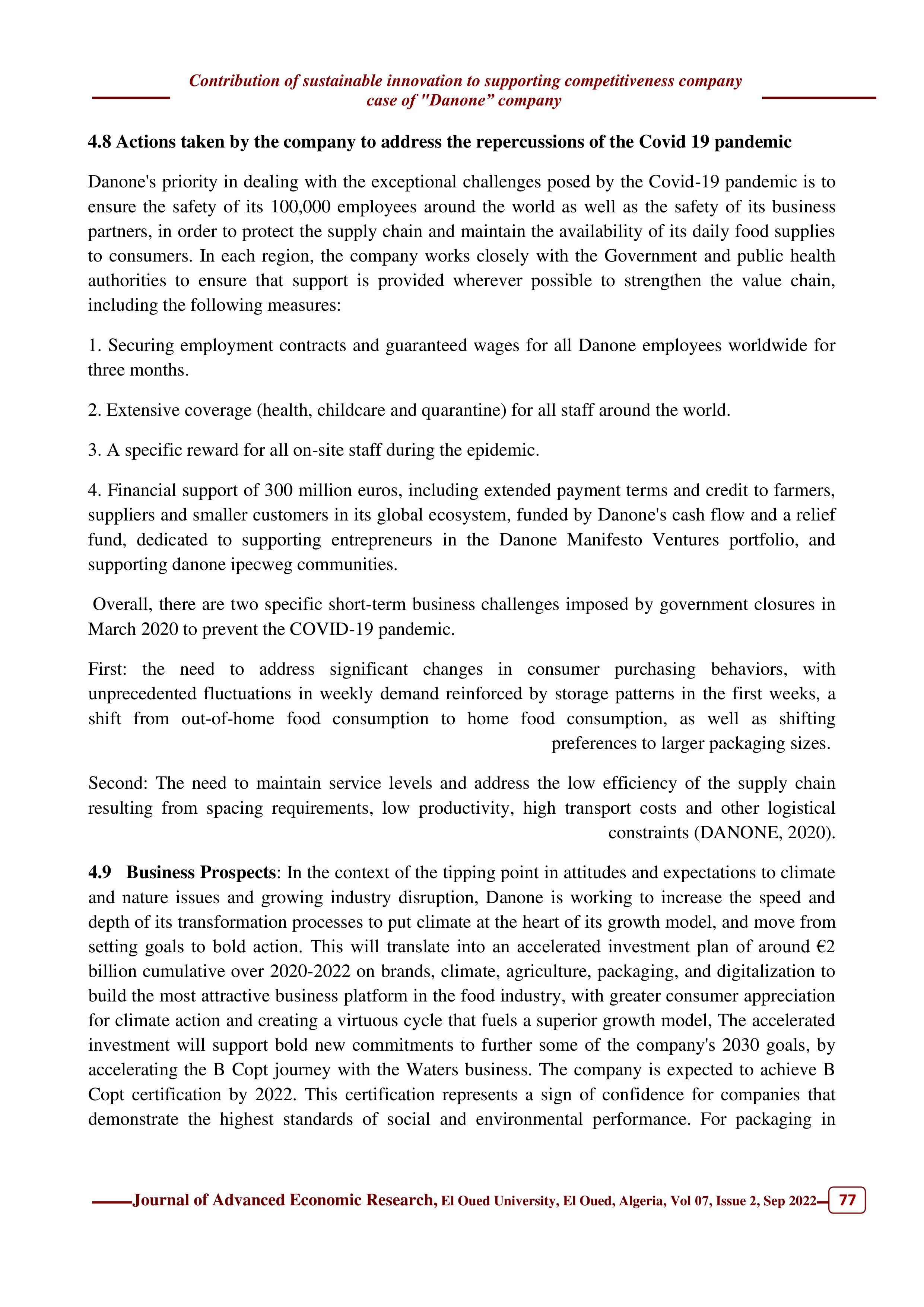
by the growth in earnings per share during the period from 2009 to 2019, where the net profit per
share moved from 2.57 euros to 3.85 euros despite the increase in spending on sustainability
activities during the same period of establishing Danone funds that finance capital Risks for
companies engaged in waste collection, environmental and social protection, The following chart
shows the development of Danone's profitability during the study period, that enhances the
opportunities to diversify the company 's funding sources.
Figure No. (05): Earnings per share growth during the period (2009 – 2019)
Source: Elaborated by researchers based on information obtained from (Danone, 2020)
0
10
20
30
turnover
0
1
2
3
4
5
2009
2010
2011
2012
2013
2014
2015
2016
2017
2018
2019
net profit per share
Journal of Advanced Economic Research,
El Oued University, El Oued, Algeria, Vol 07, Issue 2, Sep 2022
77
Contribution of sustainable innovation to supporting competitiveness company
case of "Danone” company
4.8 Actions taken by the company to address the repercussions of the Covid 19 pandemic
Danone's priority in dealing with the exceptional challenges posed by the Covid-19 pandemic is to
ensure the safety of its 100,000 employees around the world as well as the safety of its business
partners, in order to protect the supply chain and maintain the availability of its daily food supplies
to consumers. In each region, the company works closely with the Government and public health
authorities to ensure that support is provided wherever possible to strengthen the value chain,
including the following measures:
1. Securing employment contracts and guaranteed wages for all Danone employees worldwide for
three months.
2. Extensive coverage (health, childcare and quarantine) for all staff around the world.
3. A specific reward for all on-site staff during the epidemic.
4. Financial support of 300 million euros, including extended payment terms and credit to farmers,
suppliers and smaller customers in its global ecosystem, funded by Danone's cash flow and a relief
fund, dedicated to supporting entrepreneurs in the Danone Manifesto Ventures portfolio, and
supporting danone ipecweg communities.
Overall, there are two specific short-term business challenges imposed by government closures in
March 2020 to prevent the COVID-19 pandemic.
First: the need to address significant changes in consumer purchasing behaviors, with
unprecedented fluctuations in weekly demand reinforced by storage patterns in the first weeks, a
shift from out-of-home food consumption to home food consumption, as well as shifting
preferences to larger packaging sizes.
Second: The need to maintain service levels and address the low efficiency of the supply chain
resulting from spacing requirements, low productivity, high transport costs and other logistical
constraints (DANONE, 2020).
4.9 Business Prospects
: In the context of the tipping point in attitudes and expectations to climate
and nature issues and growing industry disruption, Danone is working to increase the speed and
depth of its transformation processes to put climate at the heart of its growth model, and move from
setting goals to bold action. This will translate into an accelerated investment plan of around €2
billion cumulative over 2020-2022 on brands, climate, agriculture, packaging, and digitalization to
build the most attractive business platform in the food industry, with greater consumer appreciation
for climate action and creating a virtuous cycle that fuels a superior growth model, The accelerated
investment will support bold new commitments to further some of the company's 2030 goals, by
accelerating the B Copt journey with the Waters business. The company is expected to achieve B
Copt certification by 2022. This certification represents a sign of confidence for companies that
demonstrate the highest standards of social and environmental performance. For packaging in
78
Journal of Advanced Economic Research,
El Oued University, El Oued, Algeria, Vol 07, Issue 2, Sep 2022
Contribution of sustainable innovation to supporting competitiveness company
case of "Danone” company
addition to the current goal of reaching 50% of used packaging materials worldwide by 2025,
Danone is now committed to reaching 100% in Europe as of 2025. (Danone, 2020)
5. Conclusion :
The new business model is based on the long-term strategic vision that aims to achieve long-
term growth and not profit maximization in the short term, which has led the world to deplete and
waste resources, in addition to its negative effects on the climate and environment on the one hand,
and its social effects that have resulted in more poverty, exploitation, and lack of Equality, d in this
context, the enterprise represents the main link whose responsible behavior towards this problem is
the key to its success and continuity, by integrating the procedures and processes related to
sustainability in the core of its strategy and embodying it through investment decisions and daily
activities of production and distribution by providing sustainable products that are environmentally
friendly and fulfill the desires of the consumer and make greater efforts to preserve biodiversity ,
protect , develop supply sources and value chains, this can only be achieved by adopting a
sustainable innovation approach, whether it is related to production, operations or methods of
organization and management, which is the case of Danone, the subject of the case study, the
company thus links its economic goals with sustainable development goals, which is highlighted by
the situation of companies that have adopted this approach, and they are now reaps its fruits by
pioneering its field of activity, as well as its position on the throne of companies that are committed
to standards and legislation related to sustainability, which has strengthened its position among
consumers and earned it a competitive advantage over its less committed by competitors, both in
terms of its reputation or in terms of securing stable and sustainable sources of supply, which
answers the problem raised and proves the validity of the hypotheses established. The study
concluded with the following results:
✓
The new solutions offered by innovation to environmental issues, resource economy, and
recycling in all sectors of economic activity generate new and emerging markets that
represent good opportunities for investment and expansion for enterprises.
✓
The enterprise 's commitment to integrating sustainable development goals in all its
environmental and social aspects within research and innovation programs allows for
obtaining adequate funding given the tendency of banks and investment funds toward this
type of company aiming for long-term success.
✓
Developing partnership with stakeholders through the enterprise 's value chains, including
institutes and research centers, enhances the company's technical capabilities and increases
its production efficiency.
✓
Continuous and responsible commitment of the enterprise to standards and legislation
related to the environment and climate, the protection of natural resources, biodiversity, and
all environmental requirements, allows permanent access to all developments related to this
matter for the institution to respond quickly and adapt its activities, which gives it a
competitive advantage over its peers.
✓
Innovation for sustainable production allows the enterprise to adapt to all consumer
requirements on one hand and direct its products to serve the sustainable development goals
Journal of Advanced Economic Research,
El Oued University, El Oued, Algeria, Vol 07, Issue 2, Sep 2022
79
Contribution of sustainable innovation to supporting competitiveness company
case of "Danone” company
aimed at enabling poor groups to access basic goods and services at reasonable quality and
prices by exploiting local raw materials resulting from the developed and upgraded sources
of supply.
Through what we have concluded from the results of the study, we can make the following
recommendations:
✓
The need to integrate the dimensions of sustainable development into the strategy of
enterprises, whether small or large, which is the case for Algerian institutions if they want to
empower themselves in the national or international market.
✓
Focusing on paying more attention to upgrading supply sources and value chains to avoid
supply disruption or disruption, thus avoiding the institution losing markets that it has made
great efforts to reach.
✓
Adopting sustainable innovation programs to benefit from what financial institutions,
governments, and international development institutions provide in terms of financing, tax
facilities, and financial aid that help them achieve their goals of growth and profitability.
✓
Paying more attention to social development, both within the company and its surroundings,
through social protection and training its workers to ensure their consensus around its goals,
on the other hand, contributing to social activities aimed at eliminating poverty,
malnutrition, and public health in a way that consolidates the image of the socially
responsible enterprise among consumers and society as a whole .
6. Referrals and references:
Arild Aspelund, F. H. (2021, January 20). Sustainability innovation and Firm cometitiveness.
Cleaner
production
, 281
(1).
Basseer khlaf, A. r. (2019). Green innovationand its impact on enhancing sustainable com petitive
adventage.
Journal of economics and Administratives Sciences
, 25
(112), pp. 133-148.
borni, L. (2007). The role of environmental management in achieving competitive advantages for industrial
enterprises.
Majister thesis
. Biskra, Algeria: Mohamed khieder University.
Boubaker, W. (2015).
Eco-innovation.Performance environnementale et impact economique sur les
entreprises : etude de cas des groupes papetiers.
Nice: universite Sophia Antipolis.
Boutillier. (2012).
L innovation verte de la theorie au donnes pratiques.
Bruxelle: Business and innovation
petre long.
DANONE. (2020, April 21).
DANONE: Resilience amid COVID-19
. Retrieved April 22, 2022, from
GlobeNewsWire:
https://www.globenewswire.com/news-release/2020/04/21/2019022/0/en/DANONE-
Resilience-amid-COVID-19.html
80
Journal of Advanced Economic Research,
El Oued University, El Oued, Algeria, Vol 07, Issue 2, Sep 2022
Contribution of sustainable innovation to supporting competitiveness company
case of "Danone” company
Danone. (2020).
Danone's growth brands model - Danone
. Retrieved 05 14, 2021, from World food
company
-
Danone:
https://www.danone.com/about-danone/sustainable-value-creation/our-unique-
growth-model.html
Danone. (2020).
Rapport Annnuel 2019 - Danone
. Retrieved 05 03, 2021, from World food company -
Danone:
https://www.danone.com/content/dam/danone-corp/danone-com/investors/fr-all-
publications/2019/integratedreports/rapport-annuel-danone-2019.pdf
Danone. (2018).
Rapport Annuel 2017 - Danone
. Retrieved 04 14, 2021, from World food company -
Danone: Rapport Annuel 2017 - Danone
Danone. (2020).
Rapports annuels archives - Danone
. Retrieved 05 10, 2021, from World food company -
Danone: https://www.danone.com/fr/integrated-annual-reports/integrated-annual-report-archives.html
Douis, M. t. (2005). Tthe patent is an indicateur to measure the ompetitivness of countries case of Algeria.
majister thesis
. Ouargla, Algeria: Kasdi merbah University.
Fares mazdour, K. r. (2003, april 22). Enhancing the competitivness of the economic entrprise and the
challenges of the new clima of the new climate.
ا
. Ouergla, Algeria.
hafs, A.-e. a. (1997).
competitiveness and game-changing.
Faculty of commerce Alexandria, Egypte: Chuaa.
Issa bahdi, S. g. (2015, decembre). competitovness of smal and medium industrial enterprises in Algeria in
light of the new economic opness.
Algerian journal of economic development
, p. 21.
kababi, K. (2008). Competitivness and the problem of integration in the global economy case stady of
Algeria,Morocco and Tunisia.
Masjister thesis
. Batna, Algeria: Hadj lakhdar University.
Kemp.R.Arundel. (1998). R ProgrammSurvey indicators for envvinmental innovation. (S. Group, Ed.)
IDEA
Project for EU-TSER Programme
, p. 25.
lahouel, S. (2008). Marketing and competitive advantages case stady case stady the saidal complex for the
pharmaceutical in algeria.
Majister thesis faculty of Economics and Management Sciences
. Batna, Algeria.
Lesca, H. (1982).
Structure et système d'information: Facteurs de compétitivité.
Paris: Masson.
Lotta olofsson, R. f. (2006). Business model tools and deffenition. (V. c. menbers, Ed.) p. 6.
Monitor-deloitte . (2019).
Metre le developpement durable au coeure de la strategie de l entreprise.
paris:
Monitor-deloitte cabinet des services en audit.
Mourad mahboub, T. d. (2007, November). Enhancing the Enteprises competitivness by achieving stratigic
success.
Journal of human Sciences
(12), p. 38.
Romonc cosadus-masanell, J. h. (2015). The business model: nature and benefits.
Business models and
modelling
, p. 4.
tanga, C. (2014). Feasibility stady for environmental managegent innovation.
United Nations Environment
,
8. Paris, France: European Commission.
Journal of Advanced Economic Research,
El Oued University, El Oued, Algeria, Vol 07, Issue 2, Sep 2022
81
Contribution of sustainable innovation to supporting competitiveness company
case of "Danone” company
Tavignot, B. F. (2014, 01 24).
Le cas Danone, ou comment l'innovation sociale peut aider une multinationale
à se réinventer - Paris Innovation Review
. Retrieved 04 25, 2021, from Paris Innovation Review:
http://parisinnovationreview.com/article/innovation-sociale-le-cas-danone-benedicte-faivre-tavignot-2
Than Tiep, M. I. (2022, january). Do sustainability innnovation and competitiveness heip improve firm
performence , evidence from the SMEs sector in Vietnam.
sustainability production and consumption
, 29
,
pp. 588-599.
Wayne s, a. a. (2020).
The rise ofthe sustainable entreprise.
IBM Istitute of business value. New york: IBM
Istitute of business value.