

Business Strategy and the Environment,
2026; 0:1–18
https://doi.org/10.1002/bse.70848
1
Business Strategy and the Environment
RESEARCH ARTICLE
OPEN ACCESS
A Critical Analysis of Microsoft's Rhetoric and Reality of
Sustainability Engagement
Omaima A. G. Hassan
1
| Iqbal Khadaroo
2
1
Department of Accounting and Finance, Aberdeen Business School, Robert Gordon University, Aberdeen, Scotland, UK |
2
IRC for Finance and Digital
Economy, KFUPM Business School, King Fahd University of Petroleum and Minerals, Dhahran, Saudi Arabia
Correspondence:
Omaima A. G. Hassan (
o.hassan@rgu.ac.uk
)
Received:
17 November 2025 |
Revised:
7 March 2026 |
Accepted:
17 March 2026
Keywords:
case study | CSR | ESG | greenwashing | Microsoft Corporation | sustainability practices
ABSTRACT
This study critically examines Microsoft's environmental, social and governance (ESG) rhetoric and operational reality, to offer
insights that extend beyond conventional greenwashing or bluewashing. Drawing on over 20 years of Microsoft's sustainability
reports (2003–2024), third-party ESG evaluations and media investigations, it employs automated content and discourse analyses
to investigate how sustainability language functions as a technology of legitimacy. Rather than treating rhetoric as a façade for
misconduct, we argue that it actively produces governance by shaping norms of accountability, moral responsibility and ethical
identity across global operations. Microsoft's case illustrates how sustainability narratives create coherence amid contradiction,
which enables reputational leadership to persist despite ESG controversies. By examining both sustainability rhetoric and actual
practice, this study reframes corporate responsibility as a discursive process that creates legitimacy through sustainability prac-
tices, not merely rhetoric. The study contributes to sustainability scholarship by demonstrating how rhetoric, power and moral
distance intersect within global value chains.
1 | Introduction
As environmental degradation, social inequality, digital gov-
ernance and value chain risks intensify, firms are increasingly
held accountable not only for their financial performance
but also for their sustainability engagement (Eccles and
Klimenko
2019
). Hence, corporate sustainability has devel-
oped from isolated philanthropic initiatives (Carroll
1979
) to
embedding environmental, social and governance (ESG) plans
in corporate strategy (e.g., Macellari et al.
2021
; Porter and
Kramer
2011
; Xiao et al.
2020
; Zerbini
2017
). Global frameworks
such as the UN Sustainable Development Goals and the Global
Reporting Initiative have amplified expectations for corporate
transparency and impact. Regulatory developments, such as the
EU Corporate Sustainability Reporting Directive (CSRD) and
mandatory human rights due diligence laws, further under-
score the shift from voluntary ESG to enforceable sustainability
governance.
However, empirical studies have shown that corporate ESG
strategies may serve as legitimacy tools rather than mecha-
nisms for structural reform (e.g., Del Gesso and Lodhi
2025
;
Hassan et al.
2024
; Lee and Raschke
2023
). In the technology
sector, firms face scrutiny for opaque supply chains, inade-
quate environmental stewardship and insufficient attention to
algorithmic bias or digital human rights (e.g., Bahangulu and
Owusu-Berko
2025
; Land and Aronson
2020
; Latonero
2018
;
Ozer
2019
). There is also growing concern about the gap be-
tween symbolic commitments and operational accountabil-
ity, especially in contexts with weak regulation or limited
stakeholder voice (Delmas and Burbano
2011
; Khanna and
Palepu
2010
). Hence, this study examines ESG rhetoric and
reality in the technology sector. It focuses on Microsoft, which
has positioned itself as a sustainability leader and is one of
the Magnificent Seven technology companies. Microsoft is
an interesting case to examine stakeholder engagement prac-
tices because it is frequently cited as an ESG leader due to
This is an open access article under the terms of the
Creative Commons Attribution
License, which permits use, distribution and reproduction in any medium,
provided the original work is properly cited.
© 2026 The Author(s).
Business Strategy and the Environment
published by ERP Environment and John Wiley & Sons Ltd.
2
Business Strategy and the Environment,
2026
its ambitious commitments to carbon negativity, ‘Artificial
Intelligence (AI) for Good’ and global accessibility. Yet inde-
pendent assessments such as the NewClimate Institute (
2025
)
have questioned Microsoft's ability to deliver on these goals,
given the rapid expansion of its digital infrastructure and the
energy intensity of its operations. Prior studies have unsur-
prisingly called for research to provide a more granular anal-
ysis of ESG practices, especially in high-risk domains such as
global value chains, where ethical stakes are high but external
oversight remains weak (Searcy
2016
).
In its sustainability reports and corporate blogs, Microsoft
has made bold commitments to achieve carbon negativity by
2030, full historical carbon removal by 2050 and the develop-
ment of ‘responsible AI’ aligned with human rights (Microsoft
Corporation
2025
). However, academic researchers (e.g.,
Sehgal et al.
2020
), non-profit organisations (e.g., NewClimate
Institute
2025
) and investigative journalists (e.g., The New
York Times, The New Yorker and The Guardian) have revealed
tensions and inconsistencies in Microsoft's ESG implementa-
tion. For example, despite its ‘AI for good’ framing, Microsoft
has partnered with OpenAI and other organisations whose
technologies have been linked to military intelligence applica-
tions (Associated Press
2025
). Moreover, recent investigations
have raised concerns that Microsoft's technology incubator
programmes have supported Chinese startups that were sub-
sequently implicated in surveillance and censorship activi-
ties, including operations in Xinjiang (Chiu
2024
; Murgia and
Yang
2019
). Under the United Nations Guiding Principles on
Business and Human Rights and the OECD Guidelines for
Multinational Enterprises, such relationships create a corpo-
rate responsibility to respect human rights throughout global
value chains (OECD
2024
; United Nations
2011
). Even where
Western firms do not directly participate in repression, they
may nonetheless contribute to or be linked with adverse human
rights impacts if their programmes enable or legitimise entities
engaged in unlawful surveillance. In high-risk contexts, such as
the application of AI for ethnic profiling or mass data collection,
companies are expected to conduct enhanced human rights due
diligence, use leverage to mitigate harms and ensure transpar-
ency and remediation when risks are identified (ibid.). Failure
to do so may undermine stated commitments to ethical AI gov-
ernance and expose firms to regulatory, reputational and nor-
mative accountability under evolving international standards of
corporate conduct.
This study contributes to the literature as follows. First, it in-
tegrates stakeholder theory (Freeman et al.
2010
) with con-
cepts of institutional voids (Khanna and Palepu
2010
) and
moral distance (Bauman
1993
; Crane
2013
) to provide deep in-
sights into the credibility, consistency and ethical significance
of Microsoft's ESG practices. Second, it adds to the distinc-
tion between symbolic and substantive debates within criti-
cal CSR literature (Delmas and Burbano
2011
) by contrasting
Microsoft's sustainability discourse and the strategic deploy-
ment of CSR rhetoric with operational reality (Banerjee
2012
).
It examines how Microsoft implements sustainability com-
mitments in diverse regulatory and institutional environ-
ments via a case study method that involves both quantitative
and qualitative analyses (e.g., de Freitas Netto et al.
2020
;
Zioło et al.
2024
). More specifically, it assesses Microsoft's
sustainability commitments not merely by their presence or
absence but by their depth, consistency and social impact
across global operations and by analysing whose interests are
served, whose voices are excluded and what mechanisms are
used to sustain legitimacy.
Third, although concerns about greenwashing and bluewash-
ing have long highlighted the gap between sustainability claims
and corporate behaviour (e.g., Berliner and Prakash
2015
; Lyon
and Montgomery
2015
; Macellari et al.
2021
; Zioło et al.
2024
;
de Freitas Netto et al.
2020
), this study advances the debate by
shifting focus from misrepresentation to discursive construc-
tion. Rather than treating rhetoric as a façade for underlying
misconduct, this study illustrates how sustainability language
operates as a form of governance, that is, a way of managing
legitimacy, allocating moral responsibility and defining what
counts as ethical conduct. This reframing matters because it re-
veals that the power of corporate sustainability lies not simply in
concealing contradictions but in normalising them. Fourth, this
study makes a methodological contribution to the literature by
developing a lexicon-based method to quantify strategic ambi-
guity in corporate reporting, directly addressing Selivanovskikh
et al.'s (
2025
) call for a standardised and quantitative measure-
ment approach. This technique supports reproducibility and en-
ables large-sample analysis.
The remainder of this paper is structured as follows: Section
2
presents an integrated stakeholder theoretical framework,
drawing on stakeholder engagement and concepts such as moral
distance and institutional voids. Section
3
explains the research
design. Section
4
analyses the findings. Section
5
critically dis-
cusses the findings in relation to the literature, and Section
6
concludes the paper by providing reflections and implications
for theory, practice and policy.
2 | An Integrated Stakeholder Engagement
Theoretical Framework
2.1 | Stakeholder Engagement in CSR Processes
Corporate sustainability has evolved beyond environmental
compliance or philanthropy to become a strategic instrument for
advancing firms' economic objectives, such as competitiveness,
risk management and signalling credibility to investors (e.g.,
Macellari et al.
2021
; Porter and Kramer
2011
; Xiao et al.
2020
;
Zerbini
2017
). This ‘win–win’ logic assumes that social and
financial goals can always be aligned. However, research in-
creasingly reveals a divergence between ESG performance and
discourse, raising concerns about ‘greenwashing’ and ‘blue-
washing’, which involve the selective disclosure of sustainability
information to appear more environmentally or socially respon-
sible than what reality actually is, to protect reputational capital
rather than improve substantive outcomes (e.g., Berliner and
Prakash
2015
; Lyon and Montgomery
2015
; Macellari et al.
2021
;
Zioło et al.
2024
; de Freitas Netto et al.
2020
). These concerns
are particularly salient for large technology firms, where ESG
discourse often obscures ethical risks embedded in digital oper-
ations and value chains (Amnesty International
2019
; Amnesty
International
2025
; Amnesty International
2006
; Land and
Aronson
2020
).
3
Business Strategy and the Environment,
2026
Stakeholder theory posits that firms have ethical responsibili-
ties to all those affected by their activities, not only sharehold-
ers (Freeman et al.
2010
). However, as large multinational tech
corporations have global reach and play a central role in digital
ecosystems, some stakeholders (such as communities, workers
and users in the Global South) may be structurally excluded or
displaced from decision-making processes. As Whelan (
2012
)
describes, ‘stakeholder invisibility’ occurs when organisations
formally acknowledge inclusion but, in practice, privilege pow-
erful actors such as investors, regulators and well-resourced
NGOs. This creates a condition where stakeholder engage-
ment becomes performative, legitimising corporate strategies
rather than redistributing decision-making power or address-
ing systemic inequities (Banerjee
2014
). Addressing this in-
visibility requires reconfiguring ESG governance from a
compliance-oriented model to a participatory, justice-centred
process that amplifies non-dominant perspectives and holds
firms accountable for the lived realities of their operations
(Dembek et al.
2020
). Accordingly, this study adopts an ex-
tended stakeholder perspective that includes non-market and
marginalised actors such as digital rights organisations, la-
bour groups and community-based advocates (Schneider and
Wallenburg
2012
).
2.2 | Institutional Voids and Moral Distance in
CSR Processes
Institutional voids (Khanna and Palepu
2010
) help illumi-
nate the structural conditions that enable weak accountability
in stakeholder engagement processes. Such voids, which are
marked by fragile legal systems, limited civil society engage-
ment and uneven regulatory enforcement, allow corporate be-
haviour to be shaped by discretionary ethics rather than binding
norms. Multinational corporations, which operate across under-
regulated jurisdictions, risk making ESG commitments appear
rhetorical and symbolic, rather than substantive. As London and
Hart (
2004
) note, institutional voids create ‘zones of strategic
ambiguity’, allowing corporations to diffuse responsibility and
selectively frame their ethical obligations. To address this, Mena
and Palazzo (
2012
) argue for prioritising output legitimacy (i.e.,
measurable social outcomes) over input legitimacy (i.e., internal
processes and voluntary reporting).
Institutional voids arise from both the limited regulatory capac-
ity of national governments and the absence of binding global
governance mechanisms capable of enforcing transnational
accountability (London and Hart
2004
). These gaps permit
firms to operate within a fragmented governance landscape,
where voluntary ESG frameworks replace formal oversight.
Banerjee (
2014
) contends that such contexts enable corporations
to construct the meaning of sustainability, transforming CSR
into a depoliticised legitimacy tool that masks systemic ineq-
uities. Weak and uneven regulation does not simply reveal the
limits of state authority but also actively reinforces corporate
power, granting firms the space to manage their public image
through self-regulation rather than democratic accountability.
Institutional voids thus both reflect and reproduce global gover-
nance asymmetries, allowing corporate sustainability discourse
to serve as a mechanism of legitimacy maintenance rather than
genuine social transformation.
The concept of moral distance (Bauman
1993
; Crane
2013
) fur-
ther explains how ethical accountability becomes obscured in
these complex digital networks: For instance, software develop-
ers in Seattle may be detached from how their technologies are
being used by military and authoritarian actors. Such detach-
ment renders corporate governance ethically hollow, allowing
firms to sustain legitimacy while distancing themselves from
the social consequences of their operations.
The integrated stakeholder engagement theoretical framework
developed in this section sheds light on the multi-layered na-
ture of CSR narratives. Stakeholder theory questions who are
seen and heard, whereas the concept of institutional voids helps
reveal the structural enablers of stakeholder engagement in
CSR processes, and the concept of moral distance exposes how
ethical responsibility is diluted through abstraction and scale.
This comprehensive framework provides an analytical lens for
examining Microsoft's sustainability rhetoric and operational
realities.
3 | Research Design
This study employs a qualitative single-case study approach,
focusing on Microsoft Corporation to critically examine its
sustainability rhetoric and operational reality across diverse
contexts. The case study methodology is well suited for investi-
gating complex phenomena in their real-life settings (Yin
2018
),
particularly when the boundaries between the phenomenon
(corporate sustainability) and the context (multinational busi-
ness) are fluid and contested. It enables us to contribute to the
scarce literature capturing actual rather than hypothetical dis-
connection between sustainability rhetoric and operational real-
ity (e.g., Bernini et al.
2024
; de Freitas Netto et al.
2020
; Huang
et al.
2025
; Lublóy et al.
2025
; Santos et al.
2024
).
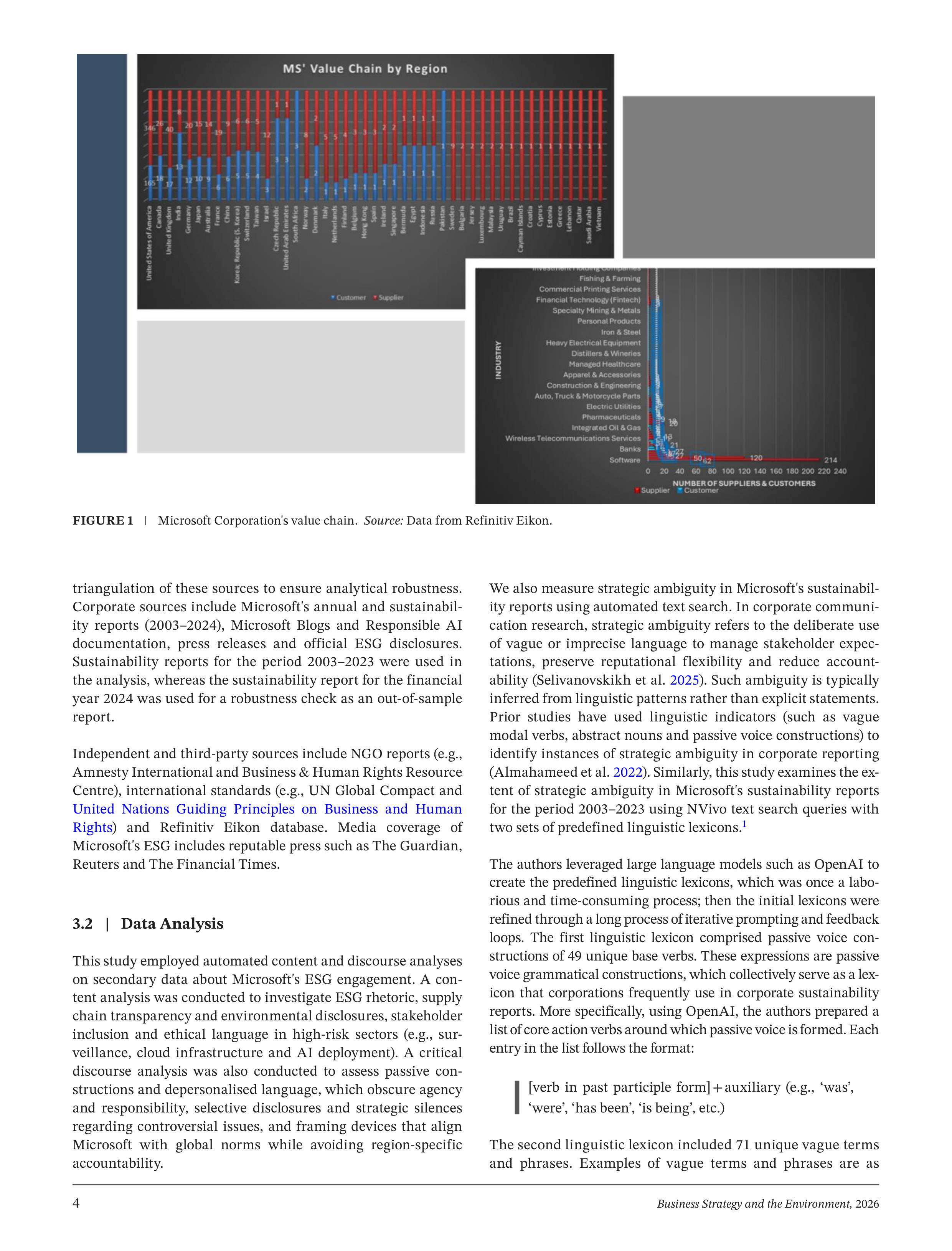
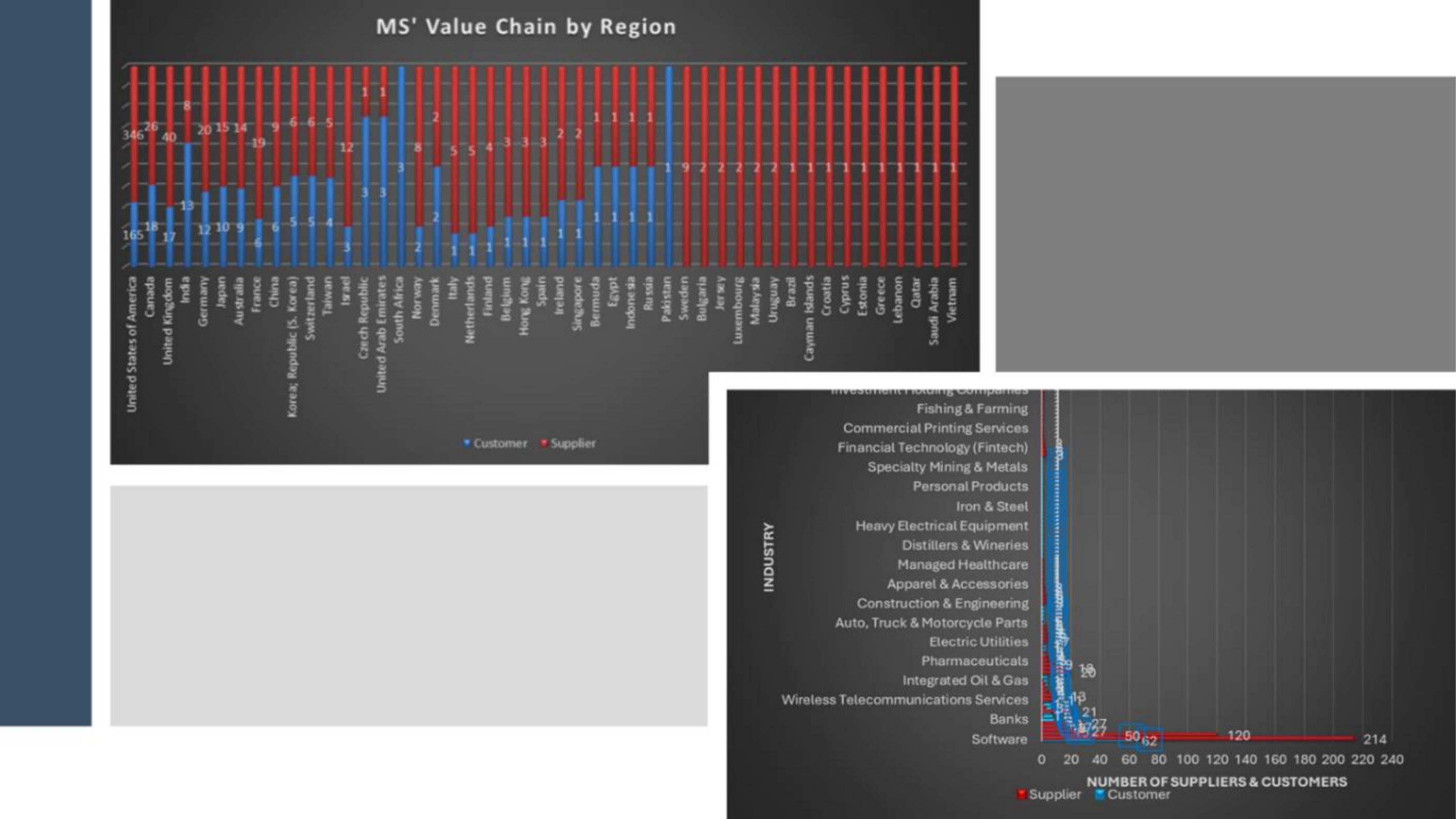
Microsoft, which was founded in 1975 by Bill Gates and Paul
Allen, is a dominant global multinational technology conglom-
erate that has prominence in ESG discourse due to its expansive
technological footprint (refer to Figure
1
, which provides an anal-
ysis of Microsoft's value chain by industry and region). Its oper-
ations are spread across the United States, followed by Canada,
the United Kingdom, India, Qatar, Vietnam, Pakistan and South
Africa, and are organised into three core segments: Productivity
and Business Processes, Intelligent Cloud and More Personal
Computing. The Productivity and Business Processes segment
covers productivity, communication and information services,
including Office Commercial, Office Consumer, LinkedIn and
Dynamics business solutions. The Intelligent Cloud segment en-
compasses server products and cloud services, such as Azure,
SQL Server, Windows Server, Visual Studio, System Centre,
GitHub and Nuance, along with enterprise support services, in-
dustry solutions and professional services. The More Personal
Computing segment focuses on Windows, devices, gaming and
search and news advertising.
3.1 | Data Sources
This study uses secondary data from corporate sources, third-
party sources and media investigations and incorporates a
4
Business Strategy and the Environment,
2026
triangulation of these sources to ensure analytical robustness.
Corporate sources include Microsoft's annual and sustainabil-
ity reports (2003–2024), Microsoft Blogs and Responsible AI
documentation, press releases and official ESG disclosures.
Sustainability reports for the period 2003–2023 were used in
the analysis, whereas the sustainability report for the financial
year 2024 was used for a robustness check as an out-of-sample
report.
Independent and third-party sources include NGO reports (e.g.,
Amnesty International and Business & Human Rights Resource
Centre), international standards (e.g., UN Global Compact and
United Nations Guiding Principles on Business and Human
Rights
) and Refinitiv Eikon database. Media coverage of
Microsoft's ESG includes reputable press such as The Guardian,
Reuters and The Financial Times.
3.2 | Data Analysis
This study employed automated content and discourse analyses
on secondary data about Microsoft's ESG engagement. A con-
tent analysis was conducted to investigate ESG rhetoric, supply
chain transparency and environmental disclosures, stakeholder
inclusion and ethical language in high-risk sectors (e.g., sur-
veillance, cloud infrastructure and AI deployment). A critical
discourse analysis was also conducted to assess passive con-
structions and depersonalised language, which obscure agency
and responsibility, selective disclosures and strategic silences
regarding controversial issues, and framing devices that align
Microsoft with global norms while avoiding region-specific
accountability.
We also measure strategic ambiguity in Microsoft's sustainabil-
ity reports using automated text search. In corporate communi-
cation research, strategic ambiguity refers to the deliberate use
of vague or imprecise language to manage stakeholder expec-
tations, preserve reputational flexibility and reduce account-
ability (Selivanovskikh et al.
2025
). Such ambiguity is typically
inferred from linguistic patterns rather than explicit statements.
Prior studies have used linguistic indicators (such as vague
modal verbs, abstract nouns and passive voice constructions) to
identify instances of strategic ambiguity in corporate reporting
(Almahameed et al.
2022
). Similarly, this study examines the ex-
tent of strategic ambiguity in Microsoft's sustainability reports
for the period 2003–2023 using NVivo text search queries with
two sets of predefined linguistic lexicons.
1
The authors leveraged large language models such as OpenAI to
create the predefined linguistic lexicons, which was once a labo-
rious and time-consuming process; then the initial lexicons were
refined through a long process of iterative prompting and feedback
loops. The first linguistic lexicon comprised passive voice con-
structions of 49 unique base verbs. These expressions are passive
voice grammatical constructions, which collectively serve as a lex-
icon that corporations frequently use in corporate sustainability
reports. More specifically, using OpenAI, the authors prepared a
list of core action verbs around which passive voice is formed. Each
entry in the list follows the format:
[verb in past participle form] + auxiliary (e.g., ‘was’,
‘were’, ‘has been’, ‘is being’, etc.)
The second linguistic lexicon included 71 unique vague terms
and phrases. Examples of vague terms and phrases are as
FIGURE 1
| Microsoft Corporation's value chain.
Source:
Data from Refinitiv Eikon.
5
Business Strategy and the Environment,
2026
follows: modal verbs such as may, might and could; intentions
without obligations such as aim to, strive to and aspire; buzz-
words and boosters such as transformational, best-in-class and
future-proof; abstract nouns and frameworks such as value
creation, roadmap and stakeholder engagement; and qualita-
tive judgements such as adequate, appropriate and significant.
In this context, we contribute to the literature by responding
to a recent research call by Selivanovskikh et al. (
2025
) to
follow a standardised and quantitative approach to measure
strategic ambiguity that would enhance replicability. Then,
we carried out an automated search of Microsoft's sustainabil-
ity reports using these linguistic lexicons via NVivo software.
In addition, trend analysis of ESG performance, language and
controversies was employed, and statistical correlations were
measured to explore patterns and potential relationships.
Our novel research methods enabled us to examine critically
how Microsoft constructs legitimacy, manages ESG risk and
engages in narrative control within its public sustainability
agenda. Reflexivity was maintained throughout the research
process by recognising the researchers' normative stance to-
wards corporate accountability. By cross-referencing corporate
narratives with independent assessments and media investiga-
tions, the study offers a critical and theoretically grounded per-
spective on ESG implementation by Microsoft.
4 | Analysis of Findings
This section presents the findings of our analysis of Microsoft's
sustainability reports, policy documents and independent
sources. Five themes emerged from the analysis: sustain-
ability rhetoric, ESG performance, strategic ambiguity, dig-
ital entanglement in conflict infrastructure and stakeholder
engagement.
4.1 | Microsoft's Sustainability Rhetoric: A
Content Analysis
An automated thematic analysis of Microsoft's sustainability
reports using NVivo resulted in the identification of 77 recur-
ring themes. Technology, Water, Carbon, Sustainability and
Energy ranked within the top 10 recurring themes based on the
total number of associated codes, indicating that these areas at-
tracted the greatest attention from Microsoft. In contrast, Cloud,
Supply Chain and Renewables were among the least recurring
themes, suggesting comparatively lower visibility in disclosures.
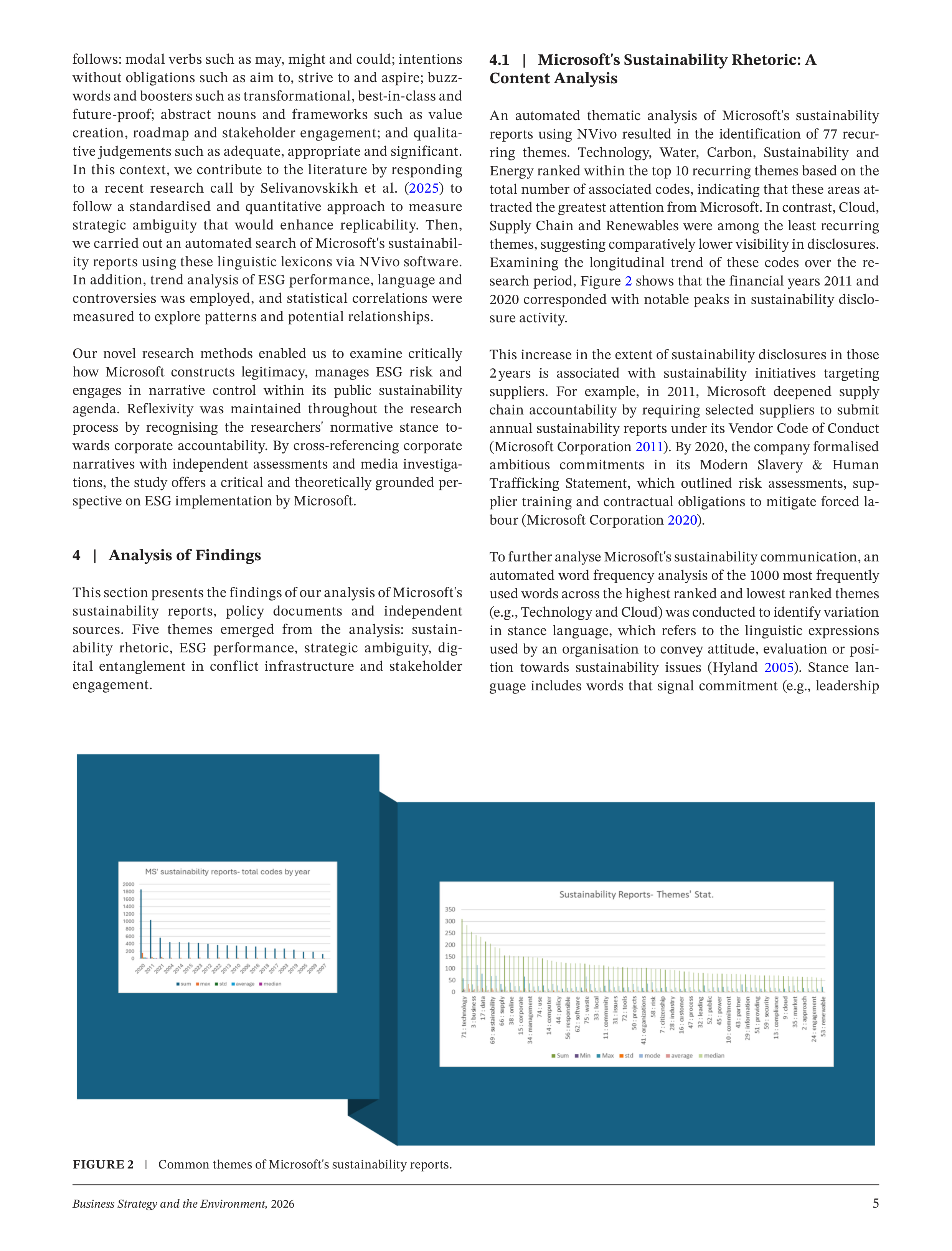
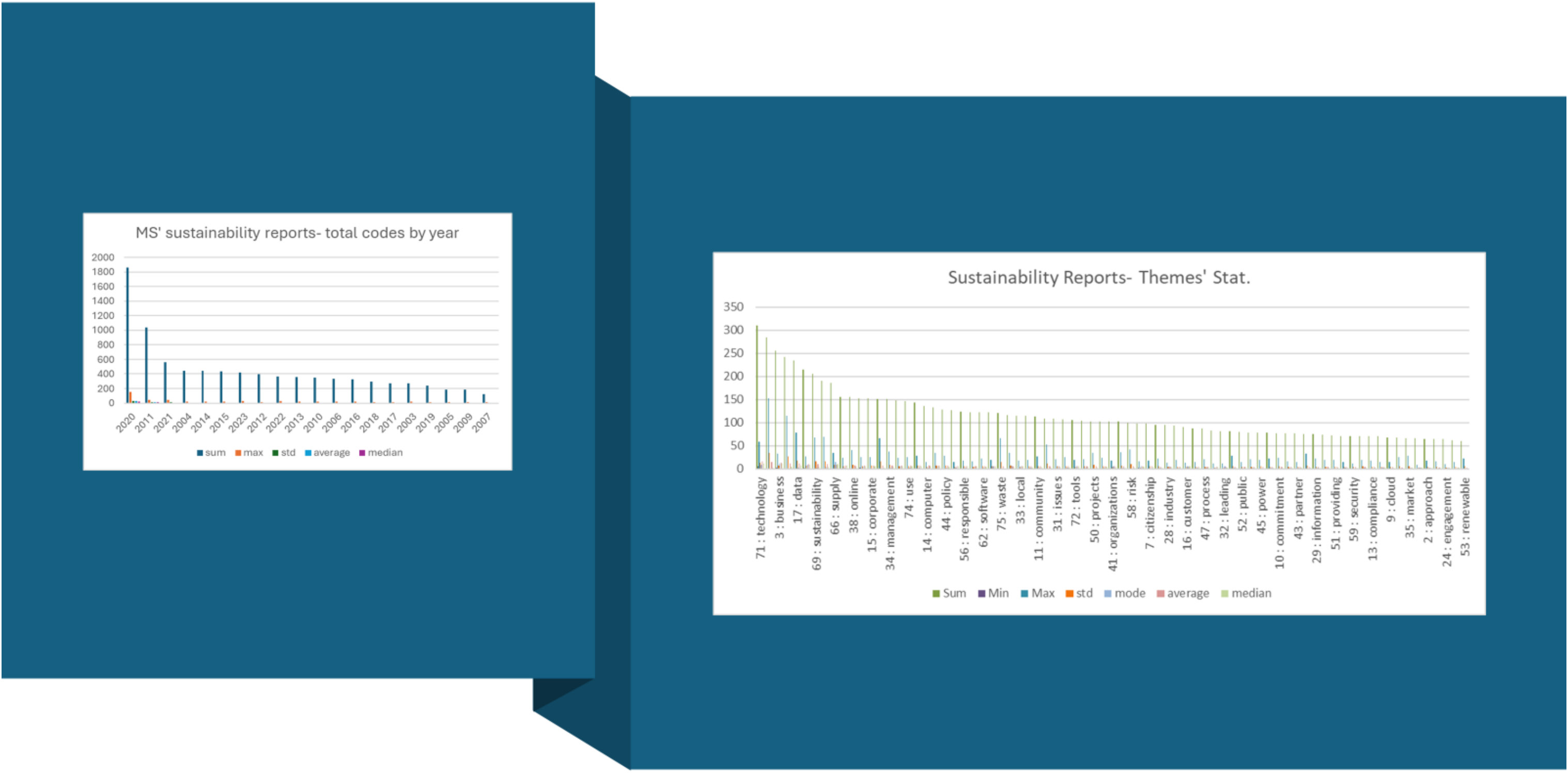
Examining the longitudinal trend of these codes over the re-
search period, Figure
2
shows that the financial years 2011 and
2020 corresponded with notable peaks in sustainability disclo-
sure activity.
This increase in the extent of sustainability disclosures in those
2 years is associated with sustainability initiatives targeting
suppliers. For example, in 2011, Microsoft deepened supply
chain accountability by requiring selected suppliers to submit
annual sustainability reports under its Vendor Code of Conduct
(Microsoft Corporation
2011
). By 2020, the company formalised
ambitious commitments in its Modern Slavery & Human
Trafficking Statement, which outlined risk assessments, sup-
plier training and contractual obligations to mitigate forced la-
bour (Microsoft Corporation
2020
).
To further analyse Microsoft's sustainability communication, an
automated word frequency analysis of the 1000 most frequently
used words across the highest ranked and lowest ranked themes
(e.g., Technology and Cloud) was conducted to identify variation
in stance language, which refers to the linguistic expressions
used by an organisation to convey attitude, evaluation or posi-
tion towards sustainability issues (Hyland
2005
). Stance lan-
guage includes words that signal commitment (e.g., leadership
FIGURE 2
| Common themes of Microsoft's sustainability reports.
6
Business Strategy and the Environment,
2026
and responsibility), caution (e.g., may, could and uncertainty) or
moral orientation (e.g., human rights, community and equality).
Analysing stance language helps reveal how Microsoft positions
itself discursively, as a responsible innovator, a global leader or a
cautious risk-managing actor.
Figure
3
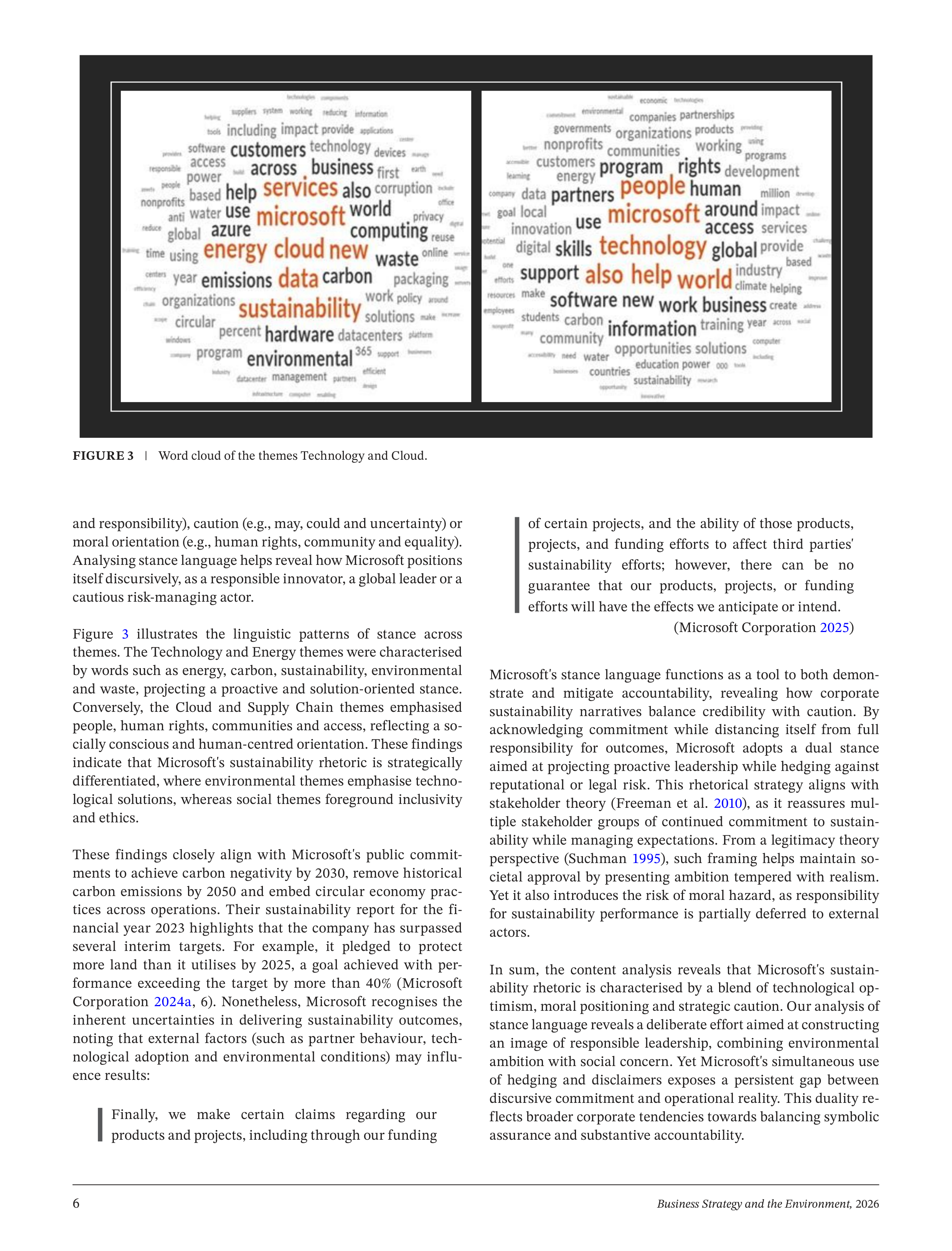
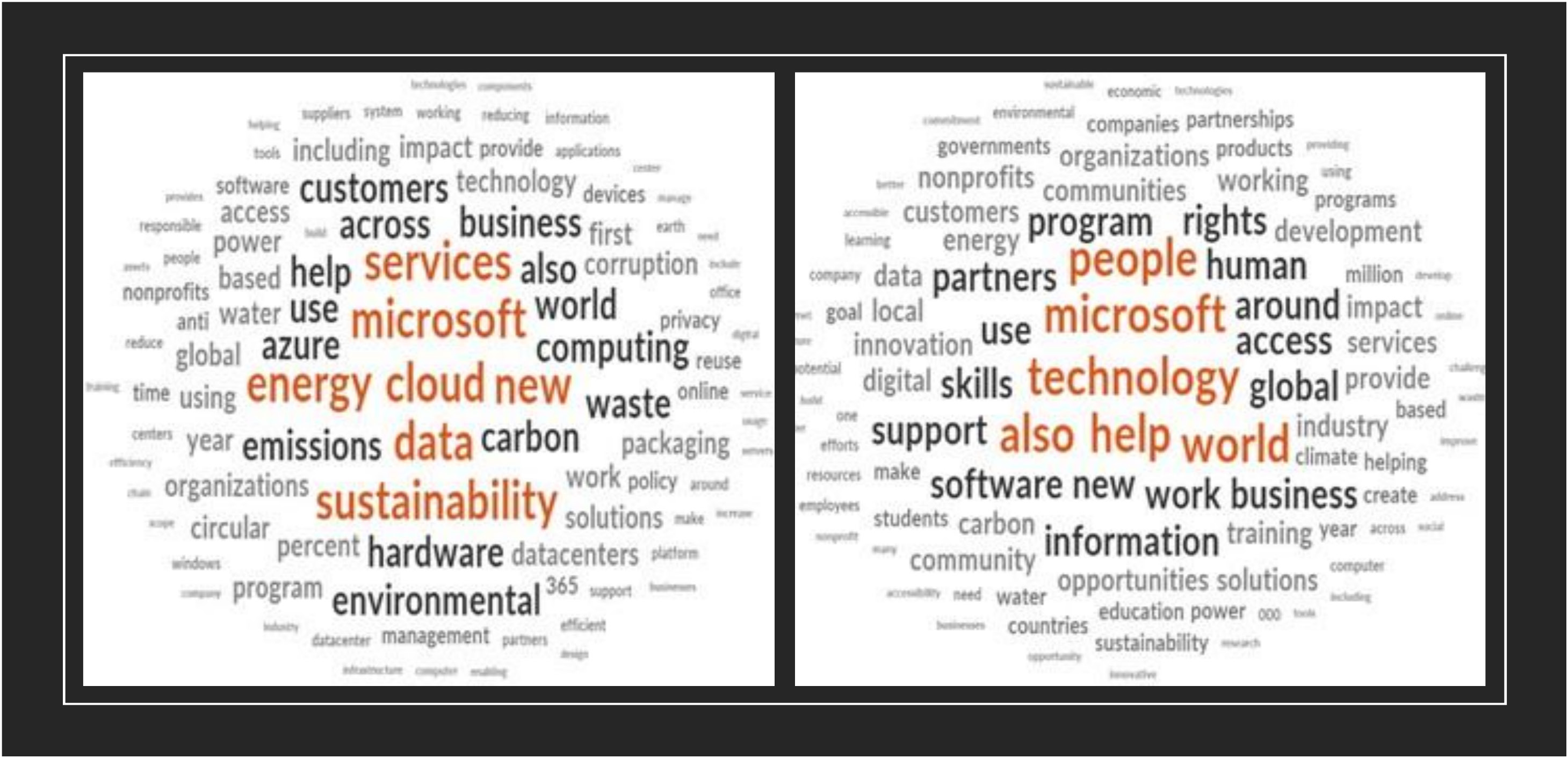
illustrates the linguistic patterns of stance across
themes. The Technology and Energy themes were characterised
by words such as energy, carbon, sustainability, environmental
and waste, projecting a proactive and solution-oriented stance.
Conversely, the Cloud and Supply Chain themes emphasised
people, human rights, communities and access, reflecting a so-
cially conscious and human-centred orientation. These findings
indicate that Microsoft's sustainability rhetoric is strategically
differentiated, where environmental themes emphasise techno-
logical solutions, whereas social themes foreground inclusivity
and ethics.
These findings closely align with Microsoft's public commit-
ments to achieve carbon negativity by 2030, remove historical
carbon emissions by 2050 and embed circular economy prac-
tices across operations. Their sustainability report for the fi-
nancial year 2023 highlights that the company has surpassed
several interim targets. For example, it pledged to protect
more land than it utilises by 2025, a goal achieved with per-
formance exceeding the target by more than 40% (Microsoft
Corporation
2024a
, 6). Nonetheless, Microsoft recognises the
inherent uncertainties in delivering sustainability outcomes,
noting that external factors (such as partner behaviour, tech-
nological adoption and environmental conditions) may influ-
ence results:
Finally, we make certain claims regarding our
products and projects, including through our funding
of certain projects, and the ability of those products,
projects, and funding efforts to affect third parties'
sustainability efforts; however, there can be no
guarantee that our products, projects, or funding
efforts will have the effects we anticipate or intend.
(Microsoft Corporation
2025
)
Microsoft's stance language functions as a tool to both demon-
strate and mitigate accountability, revealing how corporate
sustainability narratives balance credibility with caution. By
acknowledging commitment while distancing itself from full
responsibility for outcomes, Microsoft adopts a dual stance
aimed at projecting proactive leadership while hedging against
reputational or legal risk. This rhetorical strategy aligns with
stakeholder theory (Freeman et al.
2010
), as it reassures mul-
tiple stakeholder groups of continued commitment to sustain-
ability while managing expectations. From a legitimacy theory
perspective (Suchman
1995
), such framing helps maintain so-
cietal approval by presenting ambition tempered with realism.
Yet it also introduces the risk of moral hazard, as responsibility
for sustainability performance is partially deferred to external
actors.
In sum, the content analysis reveals that Microsoft's sustain-
ability rhetoric is characterised by a blend of technological op-
timism, moral positioning and strategic caution. Our analysis of
stance language reveals a deliberate effort aimed at constructing
an image of responsible leadership, combining environmental
ambition with social concern. Yet Microsoft's simultaneous use
of hedging and disclaimers exposes a persistent gap between
discursive commitment and operational reality. This duality re-
flects broader corporate tendencies towards balancing symbolic
assurance and substantive accountability.
FIGURE 3
| Word cloud of the themes Technology and Cloud.
7
Business Strategy and the Environment,
2026
4.2 | A Broader Assessment of Microsoft's ESG
Performance
This section analyses third-party assessment of Microsoft's
ESG performance using reports from three different sources,
namely, Refinitiv Eikon, Yahoo Finance and the NewClimate
Institute.
Refinitiv Eikon evaluates the ESG performance of many cor-
porations worldwide using a proprietary rule-based framework
that collects and analyses ESG data from publicly available
corporate disclosures, including annual reports, sustainability
reports and regulatory filings. Company ESG disclosures are
further divided into 10 specific categories, such as emissions,
resource use, human rights and board structure. Each category
score is derived from a weighted aggregation of relevant ESG
metrics selected from a broader set of over 630 publicly reported
indicators, allowing for granular and comparable evaluations
across firms and industries.
Refinitiv also benchmarks companies relative to their indus-
try peers and assigns aggregate ESG scores on a scale from 0
to 100, where higher scores indicate stronger ESG performance
and quality disclosure. It also produces an ESG Combined Score,
which incorporates real-time media monitoring and controversy
data to account for reputational risk. The methodology priori-
tises transparency, maintaining traceable links between raw
data and final scores, and is updated annually to ensure compa-
rability and accuracy.
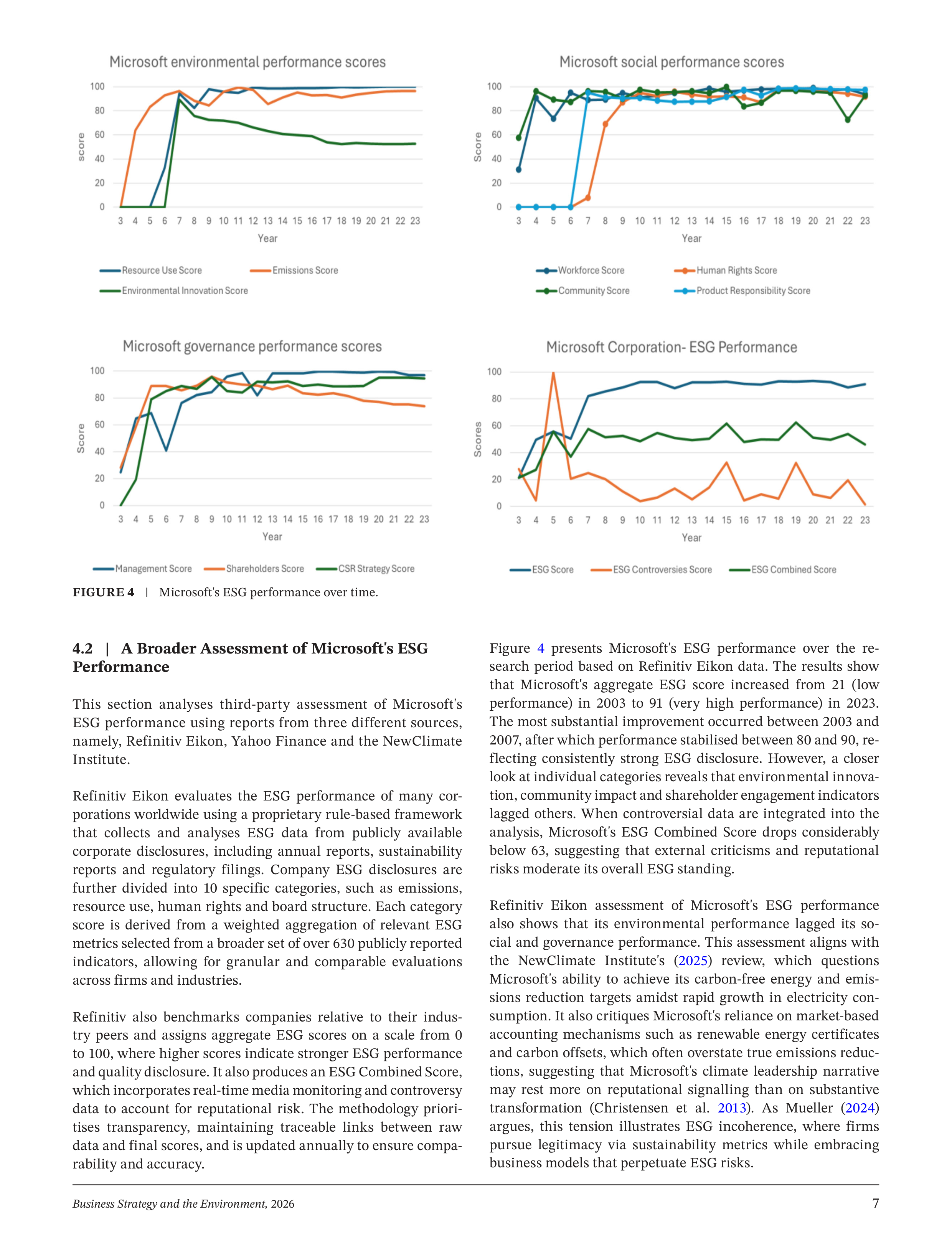
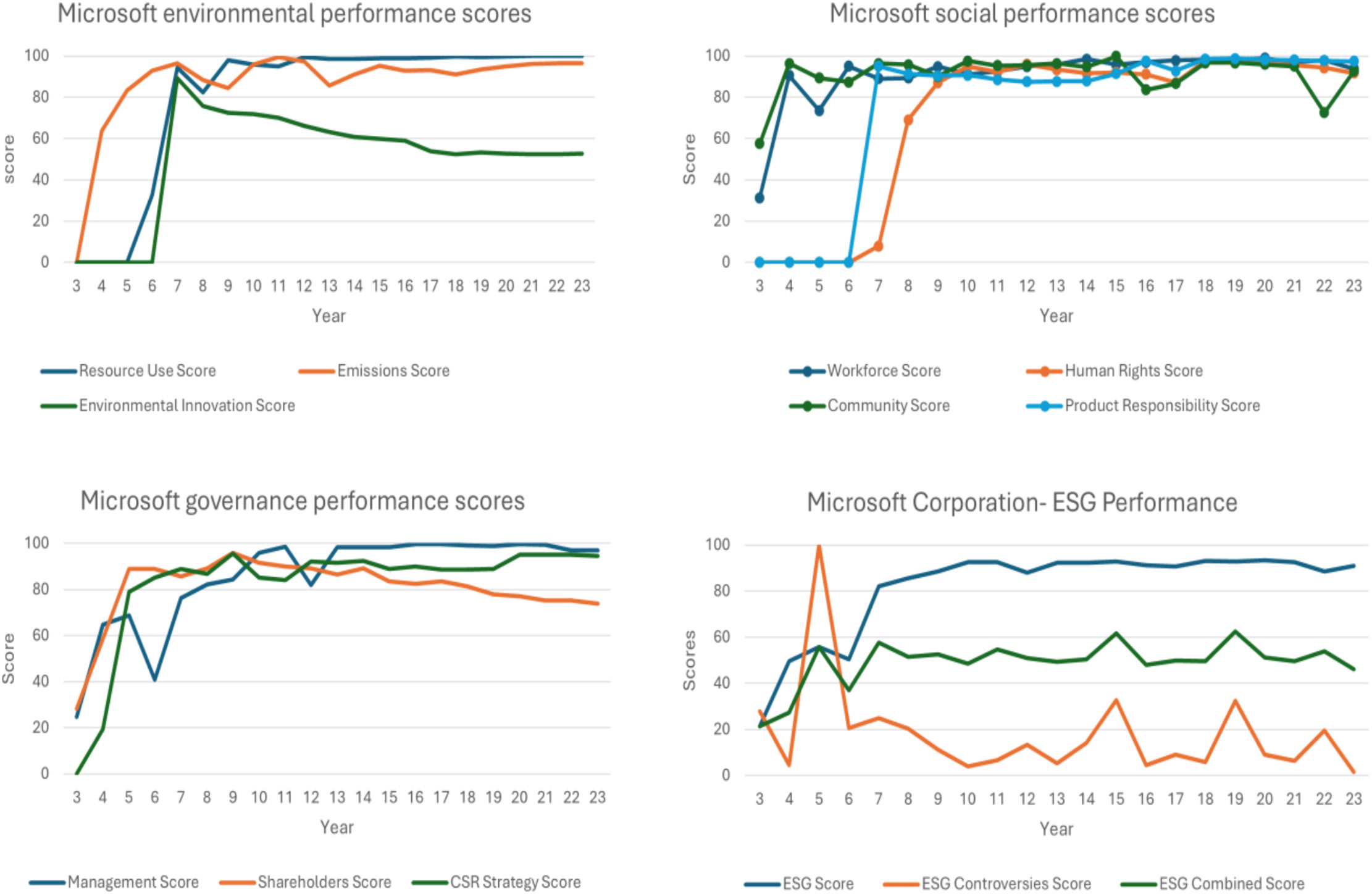
Figure
4
presents Microsoft's ESG performance over the re-
search period based on Refinitiv Eikon data. The results show
that Microsoft's aggregate ESG score increased from 21 (low
performance) in 2003 to 91 (very high performance) in 2023.
The most substantial improvement occurred between 2003 and
2007, after which performance stabilised between 80 and 90, re-
flecting consistently strong ESG disclosure. However, a closer
look at individual categories reveals that environmental innova-
tion, community impact and shareholder engagement indicators
lagged others. When controversial data are integrated into the
analysis, Microsoft's ESG Combined Score drops considerably
below 63, suggesting that external criticisms and reputational
risks moderate its overall ESG standing.
Refinitiv Eikon assessment of Microsoft's ESG performance
also shows that its environmental performance lagged its so-
cial and governance performance. This assessment aligns with
the NewClimate Institute's
(
2025
) review, which questions
Microsoft's ability to achieve its carbon-free energy and emis-
sions reduction targets amidst rapid growth in electricity con-
sumption. It also critiques Microsoft's reliance on market-based
accounting mechanisms such as renewable energy certificates
and carbon offsets, which often overstate true emissions reduc-
tions, suggesting that Microsoft's climate leadership narrative
may rest more on reputational signalling than on substantive
transformation (Christensen et al.
2013
). As Mueller (
2024
)
argues, this tension illustrates ESG incoherence, where firms
pursue legitimacy via sustainability metrics while embracing
business models that perpetuate ESG risks.
FIGURE 4
| Microsoft's ESG performance over time.
8
Business Strategy and the Environment,
2026
Refinitiv also performs an assessment of the ESG controversies
score, which reflects the company's exposure to ESG incidents
reported in global media. The score ranges from 1 to 100, with
higher values indicating fewer controversies. Figure
4
shows
that Microsoft has consistently gained a low ESG controversies
score, except for the year 2025. This indicates significant ESG
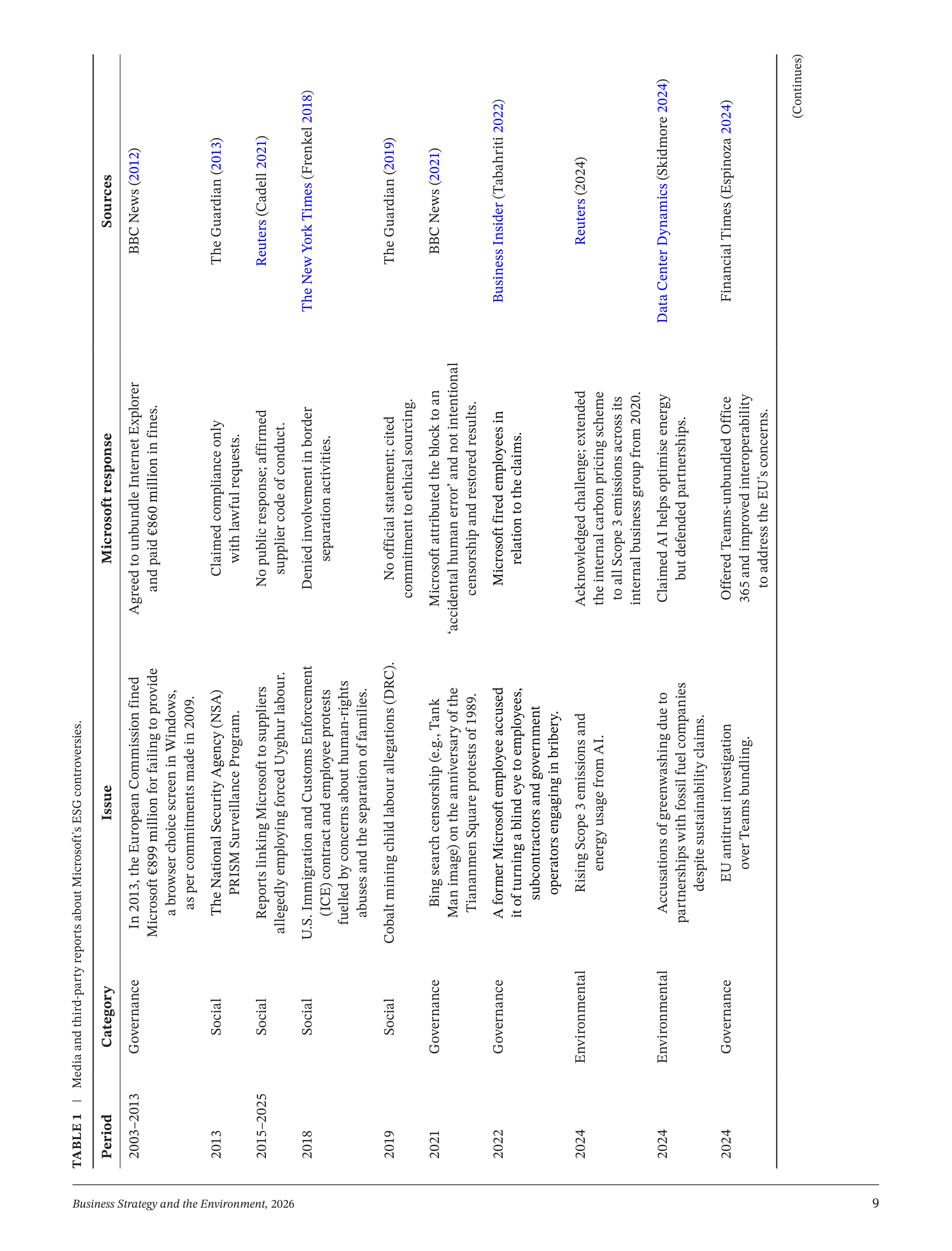
controversies. It aligns with data obtained from Yahoo Finance
(Figure
5
), which assigns Microsoft a controversy level of 3 on a
5-point scale, signifying the company's involvement in incidents
with potential adverse impacts on stakeholders, the environ-
ment or its operations.
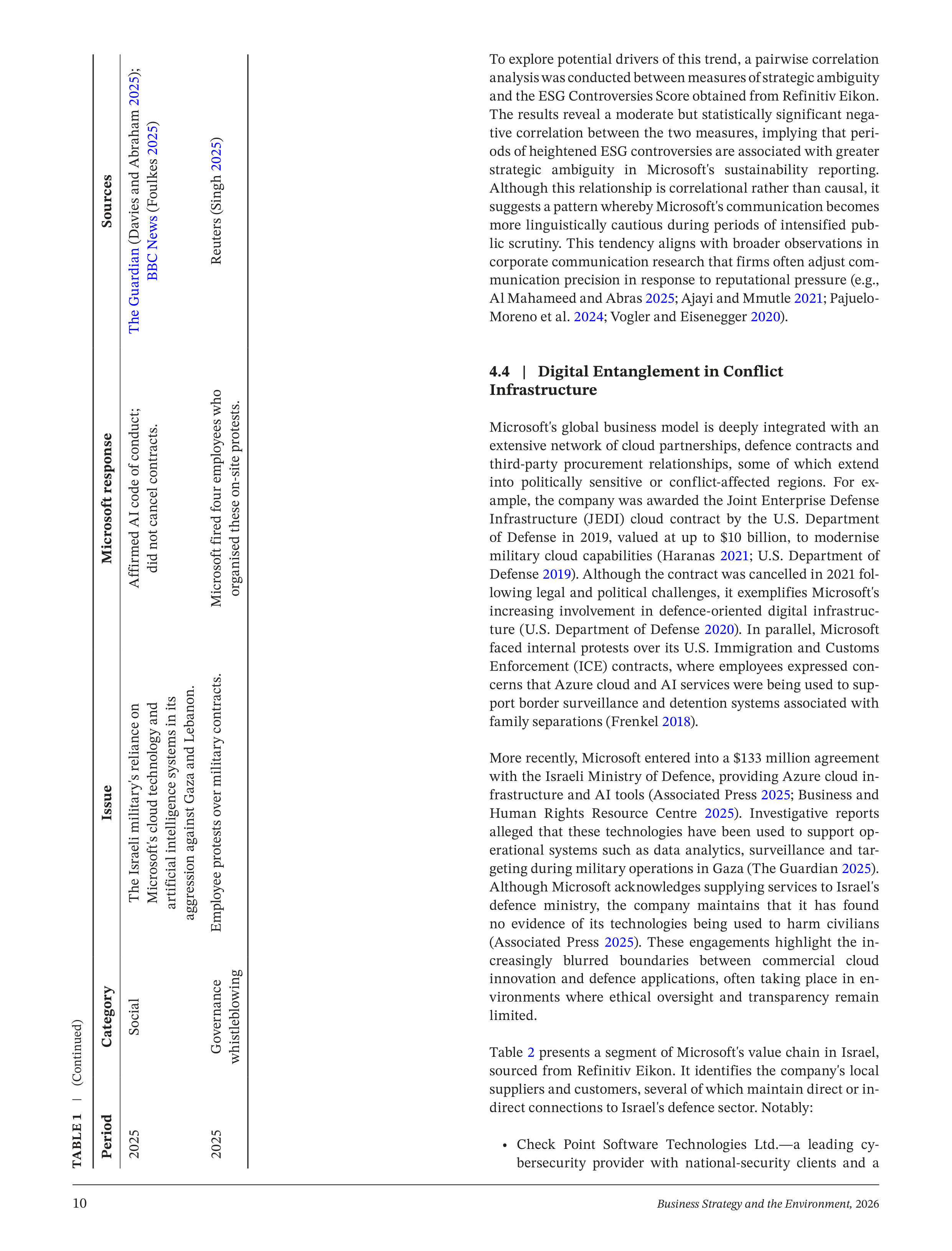
To contextualise these ratings, Table
1
outlines notable ESG-
related controversies reported in global media and third-party
investigations, indicating structural and ongoing challenges.
For example, despite Microsoft's ‘AI for Good’ initiative, the
company has partnered with organisations whose technolo-
gies have been linked to military and surveillance applications
(Davies and Abraham
2025
). Similarly, the Business and Human
Rights Resource Centre (
2020
) and
Reuters
(Cadell
2021
) have
reported links between Microsoft's supply chain and alleged
forced Uyghur labour. Such cases highlight the complexity of
maintaining consistent ESG performance within global and
technologically intensive operations.
These examples demonstrate that, although Microsoft has made
significant progress in formal ESG reporting, it continues to
face material challenges across all three pillars. The persistence
of such controversies suggests that Microsoft's strong ESG
scores primarily reflect advances in transparency and report-
ing systems, rather than uniform improvements across its ESG
practices.
4.3 | Strategic Ambiguity
Microsoft employs moralised and aspirational language in its
sustainability communication, describing its corporate values
as commitments to ‘empower every person and every organi-
sation on the planet to achieve more’ and to act as a ‘force for
good’ in society. However, the absence of operational detail or
measurable criteria for implementing these values generates
a gap between rhetoric and reality. The use of unqualified de-
scriptors (such as responsible, ethical and inclusive) enables
Microsoft to maintain an appearance of moral alignment
while avoiding engagement with complex operational contra-
dictions. For example, the company asserts that it promotes
human rights through ‘inclusive design’ in its AI and cloud ser-
vices but provides limited evidence of oversight mechanisms
or safeguards for deployment in high-risk contexts. Reports
have linked Microsoft's suppliers and strategic partners to
the use of forced Uyghur labour (Cadell
2021
), whereas more
recent investigations have revealed the use of its cloud tech-
nology and artificial intelligence systems in Israeli military
operations in Gaza (Business and Human Rights Resource
Centre
2025
; Davies and Abraham
2025
).
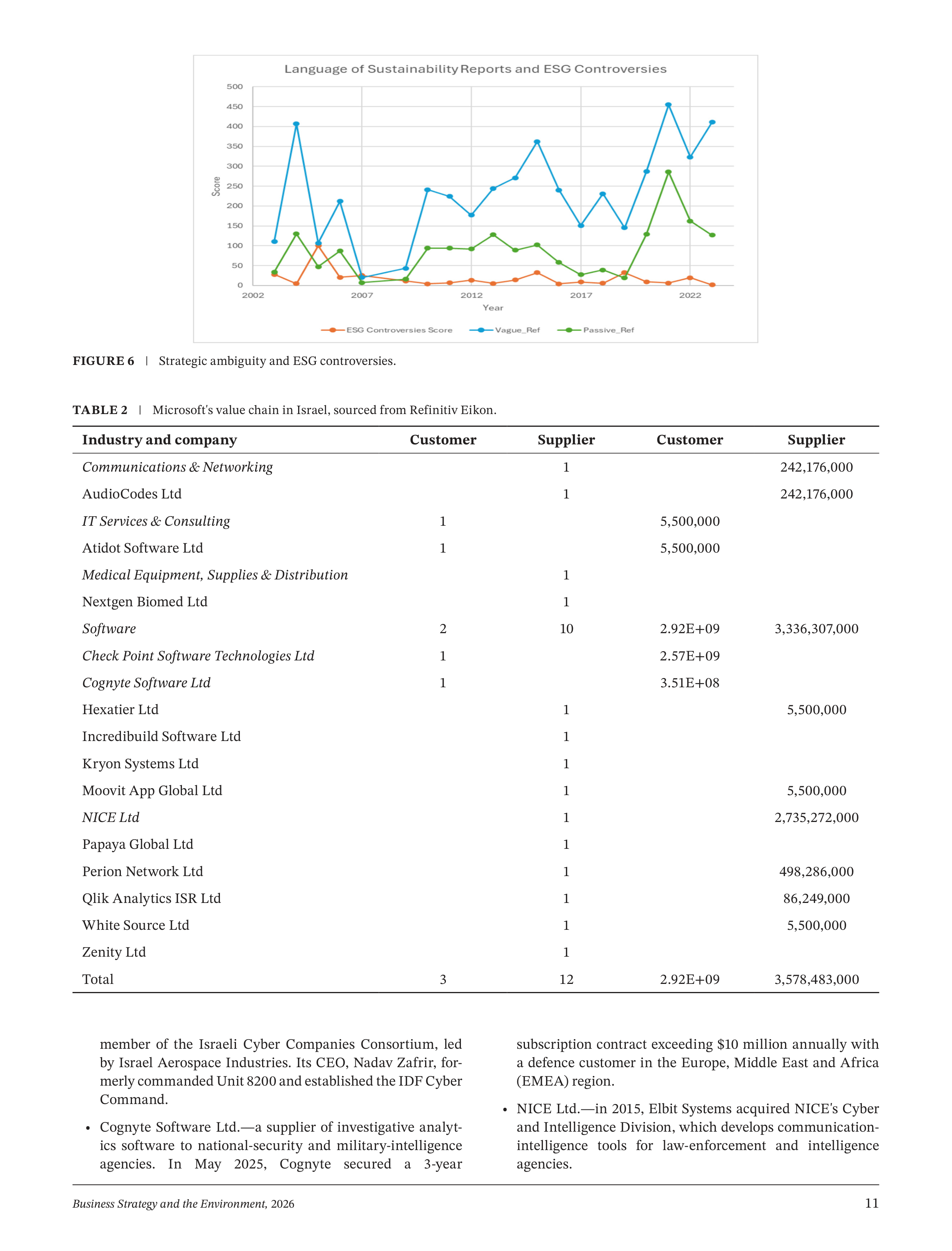
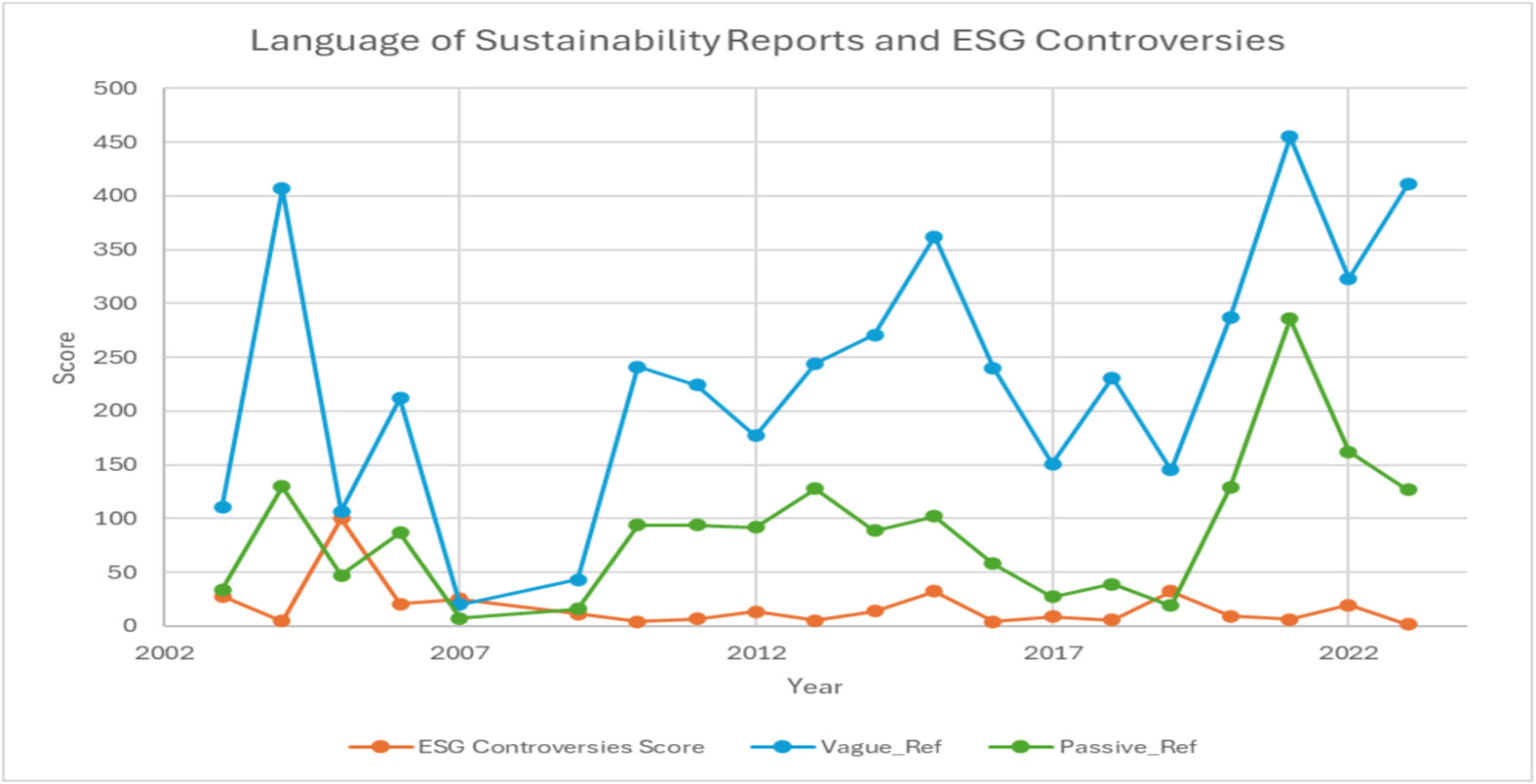
We used automated text search to examine the extent and trend
of strategic ambiguity (persistent use of passive and vague refer-
ences) in Microsoft's sustainability reports. Figure
6
shows that
the passive and vague reference indicators exhibit a strong pos-
itive correlation (Spearman's
ρ
, not tabulated), indicating that
they move closely together and can be treated as consistent mea-
sures of strategic ambiguity over time. The trend shows gradual
growth in ambiguous linguistic structures, suggesting that as
Microsoft's sustainability communication has expanded, its lan-
guage has also become increasingly abstract and indeterminate.
FIGURE 5
| Yahoo Finance's evaluation of MS's sustainability.
9
Business Strategy and the Environment,
2026
TABLE 1
| Media and third-party reports about Microsoft's ESG controversies.
Period
Category
Issue
Microsoft response
Sources
2003–2013
Governance
In 2013, the European Commission fined
Microsoft €
899 million
for failing to provide
a browser choice screen in Windows,
as per commitments made in 2009.
Agreed to unbundle Internet Explorer
and paid €
860 million
in fines.
BBC News (
2012
)
2013
Social
The National Security Agency
(NSA)
PRISM Surveillance Program.
Claimed compliance only
with lawful requests.
The Guardian (
2013
)
2015–2025
Social
Reports linking Microsoft to suppliers
allegedly employing forced Uyghur labour.
No public response; affirmed
supplier code of conduct.
Reuters
(Cadell
2021
)
2018
Social
U.S. Immigration and Customs Enforcement
(ICE) contract and employee protests
fuelled by concerns about human-rights
abuses and the separation of families.
Denied involvement in border
separation activities.
The New York Times
(
Frenkel
2018
)
2019
Social
Cobalt mining child labour allegations (DRC).
No official statement; cited
commitment to ethical sourcing.
The Guardian (
2019
)
2021
Governance
Bing search censorship (e.g., Tank
Man image) on the anniversary of the
Tiananmen Square protests of 1989.
Microsoft attributed the block to an
‘accidental human error’ and not intentional
censorship and restored results.
BBC News (
2021
)
2022
Governance
A former Microsoft employee accused
it of turning a blind eye to employees,
subcontractors and government
operators engaging in bribery.
Microsoft fired employees in
relation to the claims.
Business Insider
(
Tabahriti
2022
)
2024
Environmental
Rising Scope 3 emissions and
energy usage from AI.
Acknowledged challenge; extended
the internal carbon pricing scheme
to all Scope 3 emissions across its
internal business group from 2020.
Reuters
(2024)
2024
Environmental
Accusations of greenwashing due to
partnerships with fossil fuel companies
despite sustainability claims.
Claimed AI helps optimise energy
but defended partnerships.
Data Center Dynamics
(Skidmore
2024
)
2024
Governance
EU antitrust investigation
over Teams bundling.
Offered Teams-unbundled Office
365 and improved interoperability
to address the EU's concerns.
Financial Times (Espinoza
2024
)
(Continues)
10
Business Strategy and the Environment,
2026
To explore potential drivers of this trend, a pairwise correlation
analysis was conducted between measures of strategic ambiguity
and the ESG Controversies Score obtained from Refinitiv Eikon.
The results reveal a moderate but statistically significant nega-
tive correlation between the two measures, implying that peri-
ods of heightened ESG controversies are associated with greater
strategic ambiguity in Microsoft's sustainability reporting.
Although this relationship is correlational rather than causal, it
suggests a pattern whereby Microsoft's communication becomes
more linguistically cautious during periods of intensified pub-
lic scrutiny. This tendency aligns with broader observations in
corporate communication research that firms often adjust com-
munication precision in response to reputational pressure (e.g.,
Al Mahameed and Abras
2025
; Ajayi and Mmutle
2021
; Pajuelo-
Moreno et al.
2024
; Vogler and Eisenegger
2020
).
4.4 | Digital Entanglement in Conflict
Infrastructure
Microsoft's global business model is deeply integrated with an
extensive network of cloud partnerships, defence contracts and
third-party procurement relationships, some of which extend
into politically sensitive or conflict-affected regions. For ex-
ample, the company was awarded the Joint Enterprise Defense
Infrastructure (JEDI) cloud contract by the U.S. Department
of Defense in 2019, valued at up to $10 billion, to modernise
military cloud capabilities (Haranas
2021
; U.S. Department of
Defense
2019
). Although the contract was cancelled in 2021 fol-
lowing legal and political challenges, it exemplifies Microsoft's
increasing involvement in defence-oriented digital infrastruc-
ture (U.S. Department of Defense
2020
). In parallel, Microsoft
faced internal protests over its U.S. Immigration and Customs
Enforcement (ICE) contracts, where employees expressed con-
cerns that Azure cloud and AI services were being used to sup-
port border surveillance and detention systems associated with
family separations (Frenkel
2018
).
More recently, Microsoft entered into a $133 million agreement
with the Israeli Ministry of Defence, providing Azure cloud in-
frastructure and AI tools (Associated Press
2025
; Business and
Human Rights Resource Centre
2025
). Investigative reports
alleged that these technologies have been used to support op-
erational systems such as data analytics, surveillance and tar-
geting during military operations in Gaza (The Guardian
2025
).
Although Microsoft acknowledges supplying services to Israel's
defence ministry, the company maintains that it has found
no evidence of its technologies being used to harm civilians
(Associated Press
2025
). These engagements highlight the in-
creasingly blurred boundaries between commercial cloud
innovation and defence applications, often taking place in en-
vironments where ethical oversight and transparency remain
limited.
Table
2
presents a segment of Microsoft's value chain in Israel,
sourced from Refinitiv Eikon. It identifies the company's local
suppliers and customers, several of which maintain direct or in-
direct connections to Israel's defence sector. Notably:
•
Check Point Software Technologies Ltd.—a leading cy-
bersecurity provider with national-security clients and a
Period
Category
Issue
Microsoft response
Sources
2025
Social
The Israeli military's reliance on
Microsoft's cloud technology and
artificial intelligence systems in its
aggression against Gaza and Lebanon.
Affirmed AI code of conduct;
did not cancel contracts.
The Guardian
(Davies and Abraham
2025
);
BBC News
(Foulkes
2025
)
2025
Governance
whistleblowing
Employee protests over military contracts.
Microsoft fired four employees who
organised these on-site protests.
Reuters (Singh
2025
)
TABLE 1
| (Continued)
11
Business Strategy and the Environment,
2026
member of the Israeli Cyber Companies Consortium, led
by Israel Aerospace Industries. Its CEO, Nadav Zafrir, for-
merly commanded Unit 8200 and established the IDF Cyber
Command.
•
Cognyte Software Ltd.—a supplier of investigative analyt-
ics software to national-security and military-intelligence
agencies. In May 2025, Cognyte secured a 3-year
subscription contract exceeding $10 million annually with
a defence customer in the Europe, Middle East and Africa
(EMEA) region.
•
NICE Ltd.—in 2015, Elbit Systems acquired NICE's Cyber
and Intelligence Division, which develops communication-
intelligence tools for law-enforcement and intelligence
agencies.
FIGURE 6
| Strategic ambiguity and ESG controversies.
TABLE 2
| Microsoft's value chain in Israel, sourced from Refinitiv Eikon.
Industry and company
Customer
Supplier
Customer
Supplier
Communications & Networking
1
242,176,000
AudioCodes Ltd
1
242,176,000
IT Services & Consulting
1
5,500,000
Atidot Software Ltd
1
5,500,000
Medical Equipment, Supplies & Distribution
1
Nextgen Biomed Ltd
1
Software
2
10
2.92E+09
3,336,307,000
Check Point Software Technologies Ltd
1
2.57E+09
Cognyte Software Ltd
1
3.51E+08
Hexatier Ltd
1
5,500,000
Incredibuild Software Ltd
1
Kryon Systems Ltd
1
Moovit App Global Ltd
1
5,500,000
NICE Ltd
1
2,735,272,000
Papaya Global Ltd
1
Perion Network Ltd
1
498,286,000
Qlik Analytics ISR Ltd
1
86,249,000
White Source Ltd
1
5,500,000
Zenity Ltd
1
Total
3
12
2.92E+09
3,578,483,000


































































































































12
Business Strategy and the Environment,
2026
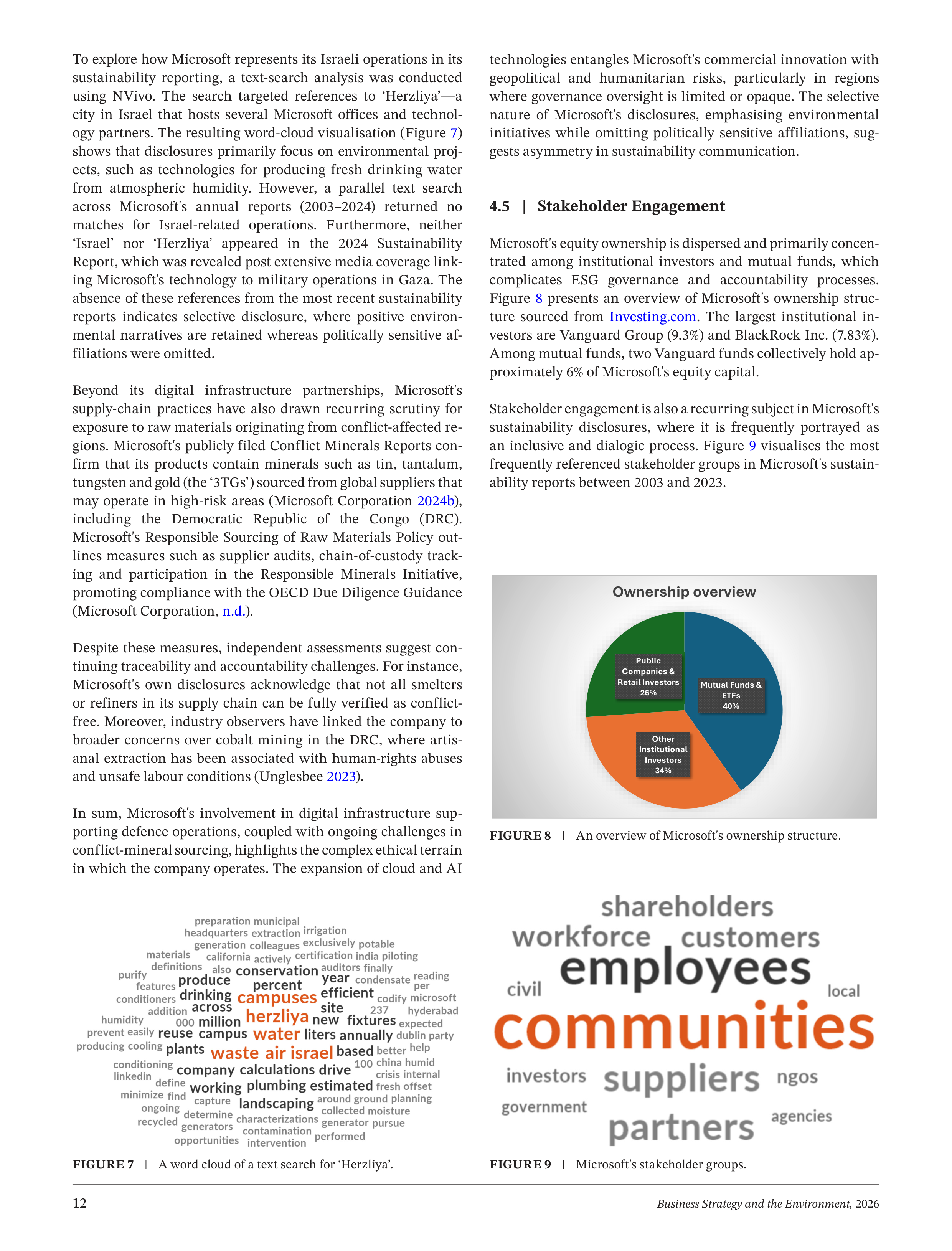
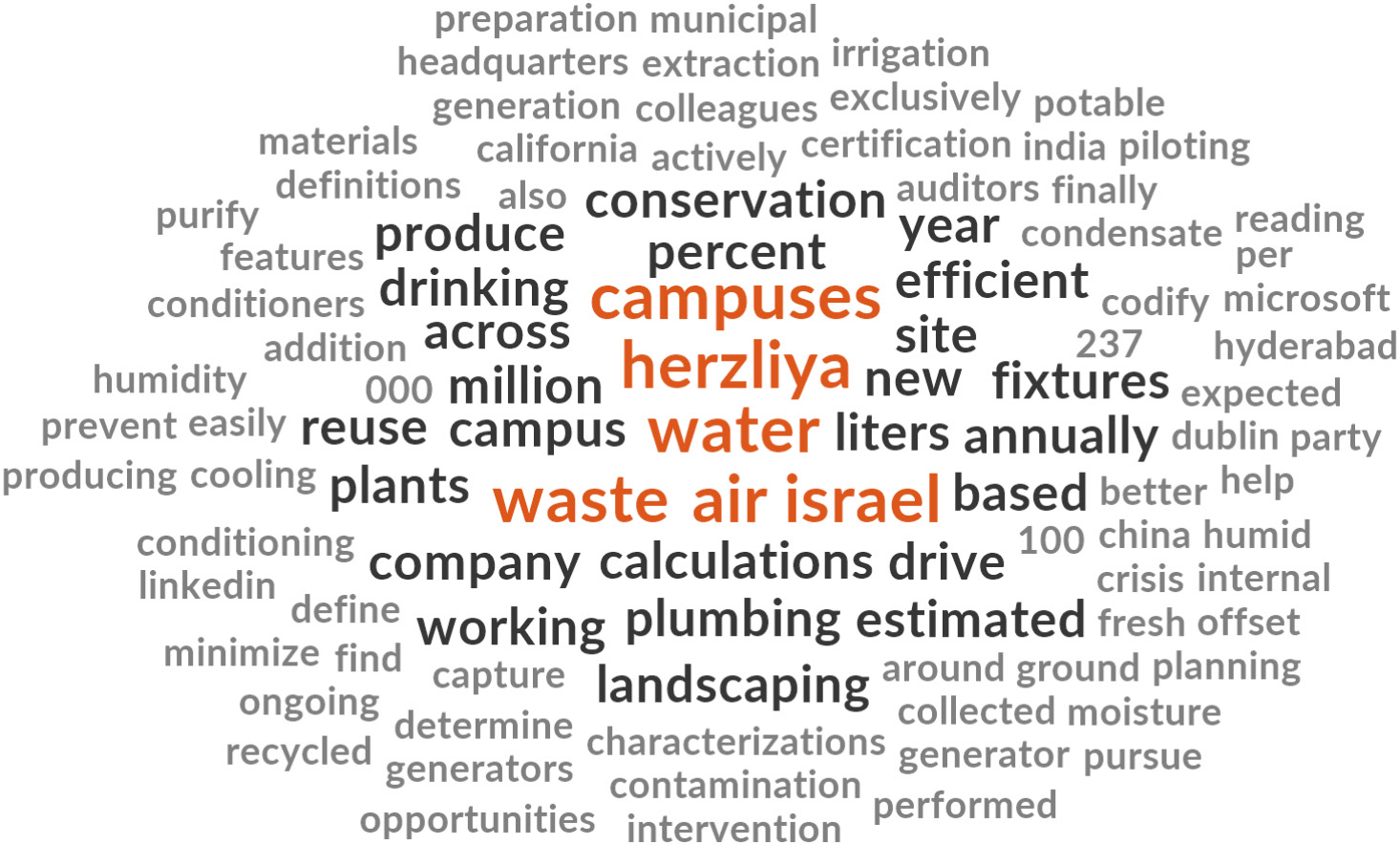
To explore how Microsoft represents its Israeli operations in its
sustainability reporting, a text-search analysis was conducted
using NVivo. The search targeted references to ‘Herzliya’—a
city in Israel that hosts several Microsoft offices and technol-
ogy partners. The resulting word-cloud visualisation (Figure
7
)
shows that disclosures primarily focus on environmental proj-
ects, such as technologies for producing fresh drinking water
from atmospheric humidity. However, a parallel text search
across Microsoft's annual reports (2003–2024) returned no
matches for Israel-related operations. Furthermore, neither
‘Israel’ nor ‘Herzliya’ appeared in the 2024 Sustainability
Report, which was revealed post extensive media coverage link-
ing Microsoft's technology to military operations in Gaza. The
absence of these references from the most recent sustainability
reports indicates selective disclosure, where positive environ-
mental narratives are retained whereas politically sensitive af-
filiations were omitted.
Beyond its digital infrastructure partnerships, Microsoft's
supply-chain practices have also drawn recurring scrutiny for
exposure to raw materials originating from conflict-affected re-
gions. Microsoft's publicly filed Conflict Minerals Reports con-
firm that its products contain minerals such as tin, tantalum,
tungsten and gold (the ‘3TGs’) sourced from global suppliers that
may operate in high-risk areas (Microsoft Corporation
2024b
),
including the Democratic Republic of the Congo (DRC).
Microsoft's Responsible Sourcing of Raw Materials Policy out-
lines measures such as supplier audits, chain-of-custody track-
ing and participation in the Responsible Minerals Initiative,
promoting compliance with the OECD Due Diligence Guidance
(Microsoft Corporation,
n.d.
).
Despite these measures, independent assessments suggest con-
tinuing traceability and accountability challenges. For instance,
Microsoft's own disclosures acknowledge that not all smelters
or refiners in its supply chain can be fully verified as conflict-
free. Moreover, industry observers have linked the company to
broader concerns over cobalt mining in the DRC, where artis-
anal extraction has been associated with human-rights abuses
and unsafe labour conditions (Unglesbee
2023
).
In sum, Microsoft's involvement in digital infrastructure sup-
porting defence operations, coupled with ongoing challenges in
conflict-mineral sourcing, highlights the complex ethical terrain
in which the company operates. The expansion of cloud and AI
technologies entangles Microsoft's commercial innovation with
geopolitical and humanitarian risks, particularly in regions
where governance oversight is limited or opaque. The selective
nature of Microsoft's disclosures, emphasising environmental
initiatives while omitting politically sensitive affiliations, sug-
gests asymmetry in sustainability communication.
4.5 | Stakeholder Engagement
Microsoft's equity ownership is dispersed and primarily concen-
trated among institutional investors and mutual funds, which
complicates ESG governance and accountability processes.
Figure
8
presents an overview of Microsoft's ownership struc-
ture sourced from
Investing.com
. The largest institutional in-
vestors are Vanguard Group (9.3%) and BlackRock Inc. (7.83%).
Among mutual funds, two Vanguard funds collectively hold ap-
proximately 6% of Microsoft's equity capital.
Stakeholder engagement is also a recurring subject in Microsoft's
sustainability disclosures, where it is frequently portrayed as
an inclusive and dialogic process. Figure
9
visualises the most
frequently referenced stakeholder groups in Microsoft's sustain-
ability reports between 2003 and 2023.
FIGURE 7
| A word cloud of a text search for ‘Herzliya’.
FIGURE 8
| An overview of Microsoft's ownership structure.
Mutual Funds &
ETFs
40%
Other
Institutional
Investors
34%
Public
Companies &
Retail Investors
26%
Ownership overview
FIGURE 9
| Microsoft's stakeholder groups.
13
Business Strategy and the Environment,
2026
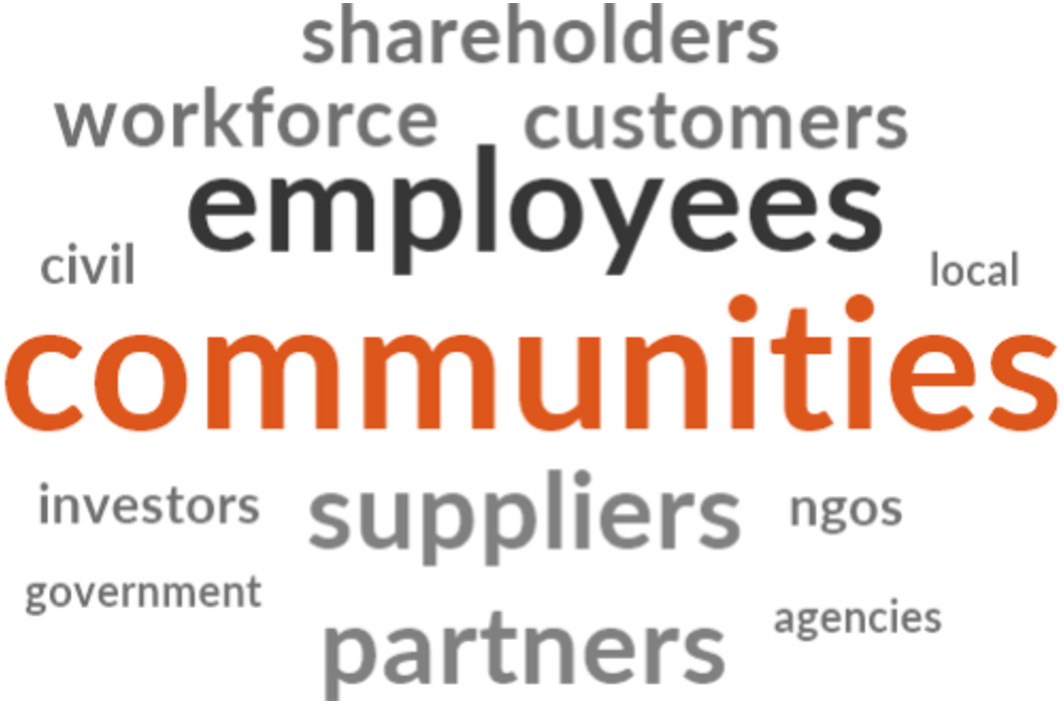
The word cloud highlights that communities feature most prom-
inently, followed by employees, customers and partners. In its
2022 Sustainability Report, Microsoft pledged to embed envi-
ronmental justice into its operations, particularly in communi-
ties facing structural inequities:
This includes looking at ways we can ensure our
replenishment investments support disadvantaged
communities, as well as the potential unintended
consequences of projects that could cause harm to
disadvantaged communities in the locations where
we operate.
(Microsoft Corporation
2022
, 36)
Despite these stated commitments, Microsoft's publicly avail-
able disclosures provide no evidence of engagement with
stakeholders in conflict-affected regions, such as local NGOs,
displaced communities or civil society organisations. This omis-
sion is particularly striking considering the company's involve-
ment in high-risk geopolitical contexts (Associated Press
2025
;
The Guardian
2025
). The absence of dialogue with affected
communities underscores a critical blind spot in Microsoft's
stakeholder-engagement strategy, revealing a disjunction be-
tween its inclusive sustainability rhetoric and operational reality
in conflict zones.
Moreover, the limitations of Microsoft's stakeholder engage-
ment extend beyond external communities to its internal
stakeholders. Although employees are consistently repre-
sented as a core stakeholder group, Microsoft's record on pro-
tecting internal dissent suggests otherwise. In April 2025,
during the company's 50th-anniversary celebrations, a soft-
ware engineer publicly protested Microsoft's military and
defence contracts, citing the use of AI technologies in oper-
ations that allegedly contributed to civilian harm. Following
the protest, multiple employees who voiced similar objections
were reportedly dismissed (Singh
2025
). These actions appear
inconsistent with the company's public assertion that ‘Both
Microsoft and LinkedIn have employee communities who
drive bottom-up sustainability initiatives to educate, inspire,
and activate every employee to advance the company's sus-
tainability goals’ (Microsoft Corporation
2021
, 9).
By marginalising critical or vulnerable stakeholder voices
(e.g., in conflict zones and internally), Microsoft's stakeholder-
engagement framework reproduces a top-down, technocratic
model of corporate sustainability. This approach prioritises in-
stitutional and market stakeholders over affected communities,
reinforcing the impression of an asymmetrical sustainability
strategy that privileges reputational legitimacy over participa-
tory accountability.
In sum, the findings illustrate a broader pattern of governance
asymmetry within Microsoft's sustainability architecture, in-
volving an imbalance between its rhetorical commitment to
inclusivity and the structural realities in decision-making
and accountability processes. Concentration of power among
institutional investors and senior leadership, which margin-
alises the voices of employees, local communities and conflict-
affected stakeholders, along with selective transparency (e.g.,
commercially providing AI and cloud services to military in-
stitutions while denying civilian harm), impedes stakeholder
accountability.
5 | Discussion
Although Microsoft has presented itself as a moral innovator
committed to human rights, climate action and social equity,
our findings show that its rhetorical discourse contradicts ac-
tual practices. Microsoft's sustainability rhetoric functions as
an instrument of strategic ambiguity and legitimacy aimed at
amplifying moral commitment, while deflecting scrutiny of
ESG practices that may conflict with or contradict stated values
(Leitch and Davenport
2007
).
In the next sub-sections, we further discuss the rhetoric–reality
gap through our theoretical framework, which integrates stake-
holder engagement in CSR processes, institutional voids and
moral distance, to explain how corporate sustainability commu-
nication operates as a mechanism of legitimacy maintenance,
moral distancing and power reproduction rather than as a cata-
lyst for systemic ethical transformation.
5.1 | Stakeholder Engagement in CSR Processes
Microsoft's sustainability rhetoric provided institutional and
governmental partners (such as the U.S. Department of Defense
and the Israeli Ministry of Defence) with sustained attention,
while marginalising the voices of communities affected by its
products, data infrastructure or supply chains. As Microsoft's
shareholder base is dispersed, neither shareholders nor civil
society actors could effectively shape corporate ethics and curb
the power of executives. The 2025 employee protests on the
back of Microsoft's military contracts underscore this imbal-
ance: Dissenting voices were marginalised and, in some cases,
silenced through termination (Singh
2025
). Such incidents show
how internal and external stakeholders who challenge profit-
ability are managed rather than engaged.
As Whelan (
2012
) and Banerjee (
2012
) argue, stakeholder theory
stripped of attention to power can become a managerial tool for
legitimisation. In Microsoft's case, stakeholder inclusivity is dis-
cursively claimed but selectively enacted, reinforcing legitimacy
while muting those most vulnerable to the company's impacts.
Our findings revealed that Microsoft's global impact extended be-
yond commercial activities to political positions, policy-making
and regulatory framework. Political CSR theory (Scherer and
Palazzo
2011
) conceptualises multinationals as quasi-political
actors that fill governance gaps traditionally occupied by states.
Microsoft exemplifies this transformation. Through its cyber-
security partnerships in Ukraine, AI-ethics collaborations and
participation in global frameworks such as the Partnership on
AI and the Rome Call for AI Ethics, the company has positioned
itself as a global norm-setter in digital governance.
However, this authority operates without democratic account-
ability; that is, Microsoft's influence originates from technical
expertise, market dominance and policy access rather than
14
Business Strategy and the Environment,
2026
from public consent (Latonero
2018
; Veale and Zuiderveen
Borgesius
2021
). Amnesty International (
2025
) warns that such
private governance regimes risk normalising human-rights
trade-offs by embedding them in proprietary systems. The result
is a legitimacy asymmetry: Corporations gain moral credibility
by shaping the very frameworks that evaluate them, blurring the
line between regulator and regulated.
Critical CSR research challenges the assumption that corporate
responsibility represents moral progress, arguing instead that
it often serves as a discourse of legitimation (Banerjee
2012
;
Christensen et al.
2013
). Microsoft's sustainability communica-
tions—filled with aspirational language about ‘responsible AI’,
‘inclusive design’ and ‘carbon negativity’—fit this description.
Behind this discourse lie practices such as the use of carbon
offsets, strategic partnerships with fossil-fuel firms and AI ap-
plications allegedly supporting surveillance or targeting opera-
tions (Davies and Abraham
2025
; NewClimate Institute
2025
;
Skidmore
2024
).
This
contrast
reveals
CSR's
performative
dimension.
Sustainability reports function as stylised narratives that
project transparency and morality, while masking structural
complicity (Boiral
2013
). In Microsoft's case, the rhetoric of
neutrality and ethical leadership serves as a form of strategic
ambiguity—allowing the company to maintain a reputation for
responsibility while avoiding direct accountability for contested
impacts. Such discursive manoeuvres exemplify what Lyon and
Montgomery
(
2015
) term ‘discursive closure’, where ethical
questions are managed through language rather than addressed
through structural reform.
5.2 | Institutional Voids and Moral Distance
Institutional voids, characterised by weak regulation, limited
transparency and underdeveloped civil-society oversight, were
strategically leveraged to sustain legitimacy with minimal
constraint (London and Hart
2004
; Khanna and Palepu
2010
).
Microsoft's sourcing of minerals from the conflict-ridden DRC
and its deployment of AI technologies in jurisdictions with lim-
ited human-rights protections illustrate how corporate sustain-
ability can operate through regulatory asymmetry. By adhering
publicly to global frameworks like the UN Global Compact
while disclosing little about local enforcement, Microsoft
demonstrates what Boiral (
2013
) calls symbolic conformity (i.e.,
publicly aligning with sustainability norms while sidestepping
substantive reform). These voids allow Microsoft to project ESG
leadership in international forums while maintaining opera-
tional opacity in high-risk regions.
Microsoft was morally distant (Bauman
1993
; Crane
2013
) from
the consequences of its actions. In Microsoft's globally dispersed
operations, moral responsibility became fragmented across en-
gineers, executives, suppliers and algorithmic systems, which
promoted the deployment and rationalisation of innovative tech-
nologies in surveillance or conflict settings. As Zuboff (
2019
)
argues, the logic of surveillance capitalism transforms ethical
judgement into technical governance, normalising detachment
from human impact. Within this context, Microsoft's sustain-
ability narrative reinforces an illusion of moral neutrality, where
commitments to inclusion and ethics are expressed in abstract,
universal terms devoid of context-sensitive accountability.
Moral distance and institutional voids produced an architecture
of accountability in which ethical breaches were reframed as
anomalies rather than systemic risks. Bridging this distance re-
quires re-embedding moral reflexivity into corporate decision-
making and giving affected communities meaningful agency in
shaping digital ethics.
Microsoft's case illustrates how corporate sustainability rheto-
ric functions as a strategic technology of legitimacy. Stakeholder
inclusion is proclaimed but hierarchically structured; political
power is exercised without a democratic mandate; CSR serves
reputational rather than redistributive ends; institutional weak-
nesses are navigated to sustain credibility; and moral responsi-
bility is diffused through abstraction.
Collectively, these dynamics reveal a persistent rhetoric–reality
gap: Sustainability is performed linguistically and symbolically,
whereas the material and ethical consequences of Microsoft's
global operations remain uneven and contested. Far from being
an anomaly, this gap reflects the structural condition of contem-
porary corporate sustainability, where language substitutes for
transformation and where moral discourse is mobilised to rec-
oncile profitability with legitimacy.
6 | Conclusions
This study has examined the decoupling between sustainability
rhetoric and operational reality in the case of Microsoft. Over
the past two decades, Microsoft has developed an increasingly
moralised discourse of empowerment, inclusivity and environ-
mental responsibility; yet this narrative coexists with ethically
contested practices. The analysis reveals that Microsoft's sus-
tainability communication serves as a strategic mechanism of
legitimacy, rather than a reflection of systemic transformation.
Extensive reporting and stakeholder references project transpar-
ency and inclusivity, but disclosure remains selectively framed,
excluding contentious issues such as military contracts, conflict-
linked supply chains and internal dissent. Stakeholder engage-
ment is hierarchical, privileging institutional actors while
marginalising communities most affected by its technologies.
Despite strong ESG ratings, Microsoft's material performance
demonstrates ESG incoherence, with commercial impera-
tives and digital expansion outweighing ethical commitments.
Responsibility within Microsoft's global operations was frag-
mented, producing moral distance that diffuses accountability
for downstream harms. Collectively, these patterns constitute
a form of governance asymmetry through which sustainability
rhetoric maintains legitimacy, mitigates reputational risk and
reproduces power without addressing the structural causes of
environmental and social harm.
This study has illustrated how sustainability governance is per-
formed through discourse. By analysing Microsoft's sustainabil-
ity rhetoric, it exposes how language governs, that is, how words
organise accountability, legitimise power and construct moral
authority. It suggests that the crisis of corporate sustainability
15
Business Strategy and the Environment,
2026
is not primarily informational but interpretive: Firms already
disclose extensively, but the meaning of that disclosure is
shaped by selective narratives that detach ethics from practice.
Understanding governance as a discursive process shifts the
focus from what firms report to how they define responsibility,
whose voices they include and whose realities remain invisible.
This reframing opens new pathways for enforcing accountabil-
ity through meaning, not just metrics.
This study advances theoretical understanding in several ways.
First, it extends stakeholder theory by highlighting the system-
atic exclusion of vulnerable and non-traditional stakeholders in
controversial settings. Second, it operationalises political CSR in
practice, revealing how corporations like Microsoft increasingly
fulfil quasi-governmental roles in under-governed spaces with-
out being subject to democratic accountability. Third, it enriches
critical CSR by demonstrating how sustainability rhetoric can
obscure complicity in structural harm. Finally, it introduces the
concepts of institutional voids and moral distance as explana-
tory mechanisms for corporate disengagement from ethical ob-
ligations in fragile contexts.
The findings have implications for both corporate practitioners
and policymakers. For corporations, the study highlights the
need to move beyond performative transparency towards prac-
tices that embed accountability in supply chains, partnerships
and technological design. Ethical governance requires not only
better reporting but also the redistribution of voice and over-
sight to those most affected by corporate conduct. From a policy
perspective, the findings underscore the need for more robust,
context-sensitive sustainability standards and mandatory due
diligence mechanisms. Voluntary self-regulation is insufficient
in high-risk settings. Policymakers should establish enforceable
guidelines for corporate behaviour in fragile regions, including
enhanced disclosure requirements, independent third-party au-
dits and sanctions for complicity in human rights violations.
The main limitation of this study stems from its reliance on pub-
licly available secondary data. Future studies may incorporate
direct testimony from different stakeholder groups or field-based
observations, which could offer deeper insights into the human
and ethical dimensions of corporate conduct. Interviews and
participatory methods would capture the voices of those directly
impacted by corporate decisions. Moreover, this study is based
on the case of Microsoft. Comparative studies across industries
and geopolitical contexts would provide a broader understand-
ing of how corporate sustainability frameworks function across
different politico-legal and socio-cultural settings. Future stud-
ies may also examine the role of civil society and international
institutions in shaping enforceable standards for business con-
duct in contested settings.
Our study calls for understanding sustainability as a regime of
meaning, rather than a set of metrics to open new possibilities
for holding corporations accountable not just for what they do
but for how they define what doing good means. If sustainability
is to mean more than strategic branding, it must confront power,
proximity and the ethics of consequence. For corporations like
Microsoft, this entails moving beyond generalised commit-
ments towards context-sensitive accountability that includes
those most affected by corporate conduct. The development of
an equitable/just sustainability framework may begin where the
risks are highest and the voices are quietest—not as a postscript
to global ESG narratives but as their moral foundation.
Acknowledgements
Generative AI (ChatGPT) was used to assist with summarising litera-
ture and support the refinement of theoretical arguments. All content of
this paper was critically reviewed and edited by the authors. Any error
or omission is the sole responsibility of the authors.
Funding
The authors have nothing to report.
Endnotes
1
These dictionaries are available from the principal author upon
request.
References
Ajayi, O. A., and T. Mmutle. 2021. “Corporate Reputation Through
Strategic Communication of Corporate Social Responsibility.”
Corporate
Communications: An International Journal
26, no. 5: 1–15.
https://doi.
org/10.1108/CCIJ-02-2020-0047
.
Al Mahameed, M., and A. Abras. 2025. “Using Sustainability Reporting
as a Business Communication Tool to Reshape Social Relations in
Times of Turmoil.”
Business Strategy and the Environment
34, no. 5:
5624–5643.
Almahameed, Y. S., K. B. Al Bataineh, and R. M. G. Ammari. 2022. “The
Use of Passive Voice in News Reports for Political Purposes.”
Journal of
Language Teaching and Research
13, no. 6: 1196–1202.
https://doi.org/
10.17507/jltr.1306.07
.
Amnesty International. 2006. “Undermining Freedom of Expression
in China: The Role of Yahoo!, Microsoft and Google. Amnesty
International UK, The Human Rights Action Centre.”
https://www.
amnesty.org/en/wp-content/uploads/2021/08/pol300262006en.pdf
.
Amnesty International. 2019. “Surveillance Giants: How the Business
Model of Google and Facebook Threatens Human Rights.” [online]
www.amnesty.org
.
https://www.amnesty.org/en/documents/pol30/
1404/2019/en/
.
Amnesty International. 2025. “Breaking Up With Big Tech: A Human
Rights-Based Argument for Tackling Big Tech's Market Power.”
Amnesty
International
.
https://www.amnesty.org/en/documents/
POL30/0226/2025/en/
.
Associated Press. 2025. “Microsoft Says It Provided AI to Israeli Military
for War but Denies Use to Harm People in Gaza.”
AP News
. May 16.
https://apnews.com/article/20b2adb438b39ee9cb6eb2f52c1ae44a
.
Bahangulu, J. K., and L. Owusu-Berko. 2025. “Algorithmic Bias,
Data Ethics, and Governance: Ensuring Fairness, Transparency and
Compliance in AI-Powered Business Analytics Applications.”
World
Journal of Advanced Research and Reviews
25, no. 2: 1746–1763.
https://
doi.org/10.30574/wjarr.2025.25.2.0571
.
Banerjee, S. B. 2012. “Corporate Social Responsibility: The Good, the
Bad and the Ugly.”
Critical Sociology
34, no. 1: 51–79.
https://doi.org/10.
1177/0896920507084623
.
Banerjee, S. B. 2014. “A Critical Perspective on Corporate Social
Responsibility: Toward a Global Governance Framework.”
Critical
Perspectives on International Business
10, no. 1/2: 84–95.
https://doi.org/
10.1108/cpoib-06-2013-0021
.
Bauman, Z. 1993.
Postmodern Ethics
. Vol. 34. Blackwell.
16
Business Strategy and the Environment,
2026
BBC News. 2012. “EU to Investigate Microsoft Over Anti-Trust
Agreement.” 17 Jul. Available at:
https://www.bbc.co.uk/news/techn
ology-18873042
.
BBC News. 2021. “Microsoft Says Error Caused ‘Tank Man’ Bing
Censorship.” June 5. Available at:
https://www.bbc.co.uk/news/world
-asia-57367100
.
Berliner, D., and A. Prakash. 2015. ““Bluewashing” the Firm? Voluntary
Regulations, Program Design, and Member Compliance With the
United Nations Global Compact.”
Policy Studies Journal
43, no. 1: 115–
138.
https://doi.org/10.1111/psj.12085
.
Bernini, F., M. Giuliani, and F. La Rosa. 2024. “Measuring Greenwashing:
A Systematic Methodological Literature Review.”
Business Ethics, the
Environment & Responsibility
33, no. 4: 649–667.
Boiral, O. 2013. “Sustainability Reports as Simulacra? A Counter-
Account of A and A+ GRI Reports.”
Accounting, Auditing &
Accountability Journal
26, no. 7: 1036–1071.
https://doi.org/10.1108/
AAAJ-04-2012-00998
.
Business & Human Rights Resource Centre. 2020. “Major Brands
Implicated in Report on Forced Labour Beyond Xinjiang - Business &
Human Rights Resource Centre.”
https://www.business-humanrights.
org/en/latest-news/major-brands-implicated-in-report-on-forced-labou
r-beyond-xinjiang/
.
Business & Human Rights Resource Centre. 2025. “Israel/OPT:
Microsoft Confirms It Provides Cloud & Artificial Services to Israeli
Defence Ministry Amid Ongoing War on Gaza.” Business & Human
Rights Resource Centre. May 16.
https://www.business-human
rights.org/en/latest-news/israelopt-microsoft-confirms-it-provides-
cloud-artificial-services-to-israeli-defence-ministry-amid-ongoi
ng-war-on-gaza
.
Cadell, C. 2021. “EXCLUSIVE US Electronics Firm Struck Deal to
Transport and Hire Uyghur Workers.”
Reuters
. October 8. Available at:
https://www.reuters.com/world/china/exclusive-us-electronics-firm-
struck-deal-transport-hire-uyghur-workers-2021-10-07/
.
Carroll, A. B. 1979. “A Three-Dimensional Conceptual Model of
Corporate Performance.”
Academy of Management Review
4, no. 4:
497–505.
Chiu, J. 2024. “Chinese Startups Supported by Microsoft and Google
Incubator Programs Worked With Police.”
Rest of World
.
https://resto
fworld.org/2024/microsoft-google-chinese-startup-incubator-police-
surveillance/
.
Christensen, L. T., M. Morsing, and O. Thyssen. 2013. “CSR as
Aspirational Talk.”
Organization
20, no. 3: 372–393.
https://doi.org/10.
1177/1350508413478310
.
Crane, A. 2013. “Modern Slavery as a Management Practice: Exploring
the Conditions and Capabilities for Human Exploitation.”
Academy
of Management Review
38, no. 1: 49–69.
https://doi.org/10.5465/amr.
2011.0145
.
Davies, H., and Y. Abraham. 2025. “Revealed: Microsoft Deepened Ties
With Israeli Military to Provide Tech Support During Gaza War.”
The
Guardian
.
https://www.theguardian.com/world/2025/jan/23/israeli-
military-gaza-war-microsoft?utm_source=chatgpt.com/
.
de Freitas Netto, S. V., M. F. F. Sobral, A. R. B. Ribeiro, and G. R. D.
L. Soares. 2020. “Concepts and Forms of Greenwashing: A Systematic
Review.”
Environmental Sciences Europe
32, no. 1: 19.
https://doi.org/10.
1186/s12302-020-0300-3
.
Del Gesso, C., and R. N. Lodhi. 2025. “Theories Underlying
Environmental, Social and Governance (ESG) Disclosure: A Systematic
Review of Accounting Studies.”
Journal of Accounting Literature
47, no.
2: 433–461.
https://doi.org/10.1108/JAL-08-2023-0143
.
Delmas, M. A., and V. C. Burbano. 2011. “The Drivers of Greenwashing.”
California Management Review
54, no. 1: 64–87.
https://doi.org/10.1525/
cmr.2011.54.1.64
.
Dembek, K., N. Sivasubramaniam, and D. A. Chmielewski. 2020.
“A Systematic Review of the Bottom/Base of the Pyramid Literature:
Cumulative Evidence and Future Directions.”
Journal of Business Ethics
165: 365–382.
https://doi.org/10.1007/s10551-019-04105-y
.
Eccles, R. G., and S. Klimenko. 2019. “The Investor Revolution:
Shareholders Are Getting Serious About Sustainability.”
Harvard
Business Review
97, no. 3: 106–116.
Espinoza, J. 2024. “EU Charges Microsoft With Antitrust Violations
Over Teams.”
Financial Times
. June 25. Available at:
https://www.ft.
com/content/eb83bb45-84b3-4c58-9589-684029d23243
.
Foulkes, I. 2025. “UN Expert Calls for Companies to Stop Doing
Business With Israel.”
BBC News
. July 3
https://www.bbc.co.uk/news/
articles/cx2039xpv87o
.
Freeman, R. E., J. S. Harrison, A. C. Wicks, B. L. Parmar, and S. De
Colle. 2010.
Stakeholder Theory: The State of the Art
. 1st ed. Cambridge
University Press.
Frenkel, S. 2018. “Microsoft Employees Protest Work With ICE, as Tech
Industry Mobilizes Over Immigration.”
The New York Times
, June 19.
https://www.nytimes.com/2018/06/19/technology/tech-companies-
immigration-border.html
.
Haranas, M. 2021. “Microsoft Azure Creates Top Secret Government
Cloud as JEDI Battle Rages on.”
CRN
. January 15.
https://www.crn.
com/news/cloud/microsoft-azure-creates-top-secret-government-cloud
-as-jedi-battle-rages-on
.
Hassan, O. A. G., P. Romilly, and I. Khadaroo. 2024. “The Impact of
Corporate Environmental Management Practices on Environmental
Performance.”
Business Ethics, the Environment & Responsibility
33:
449–467.
https://doi.org/10.1111/BEER.12618
.
Huang, Z., Y. Shi, and M. Jia. 2025. “Greenwashing: A Systematic
Literature Review.”
Accounting and Finance
65, no. 1: 857–882.
Hyland, K. 2005. “Stance and Engagement: A Model of Interaction in
Academic Discourse.”
Discourse Studies
7, no. 2: 173–192.
https://doi.
org/10.1177/1461445605050365
.
Khanna, T., and K. G. Palepu. 2010. “
Winning in Emerging Markets: A
Road Map for Strategy and Execution
.” Harvard Business Press.
Land, M. K., and J. D. Aronson. 2020. “Human Rights and Technology:
New Challenges for Justice and Accountability.”
Annual Review of Law
and Social Science
16, no. 1: 223–240.
https://doi.org/10.1146/annurev-
lawsocsci-060220-081955
.
Latonero, M. 2018. “Governing Artificial Intelligence: Upholding
Human Rights & Dignity.”
Data & Society
38: 25
https://uatdoctorado.
wordpress.com/wp-content/uploads/2025/02/datasociety_governing_
artificial_intelligence_upholding_human_rights.pdf
.
Lee, M. T., and R. L. Raschke. 2023. “Stakeholder Legitimacy in Firm
Greening and Financial Performance: What About Greenwashing
Temptations?”
Journal of Business Research
155: 113393.
https://doi.org/
10.1016/j.jbusres.2022.113393
.
Leitch, S. R., and S. Davenport. 2007. “Strategic Ambiguity as a
Discourse Practice: The Role of Keywords in the Discourse on
‘Sustainable’ Biotechnology.”
Discourse Studies
9, no. 1: 43–61.
https://
doi.org/10.1177/1461445607072106
.
London, T., and S. L. Hart. 2004. “Reinventing Strategies for Emerging
Markets: Beyond the Transnational Model.”
Journal of International
Business Studies
35, no. 5: 350–370.
https://doi.org/10.1057/palgrave.
jibs.8400099
.
Lublóy, Á., J. L. Keresztúri, and E. Berlinger. 2025. “Quantifying Firm-
Level Greenwashing: A Systematic Literature Review.”
Journal of
Environmental Management
373: 123399.
Lyon, T. P., and A. W. Montgomery. 2015. “The Means and End of
Greenwash.”
Organization & Environment
28, no. 2: 223–249.
https://
doi.org/10.1177/1086026615575332
.
17
Business Strategy and the Environment,
2026
Macellari, M., A. Yuriev, F. Testa, and O. Boiral. 2021. “Exploring
Bluewashing Practices of Alleged Sustainability Leaders Through a
Counter-Accounting Analysis.”
Environmental Impact Assessment
Review
86: 106489.
https://doi.org/10.1016/j.eiar.2020.106489
.
Mena, S., and G. Palazzo. 2012. “Input and Output Legitimacy of Multi-
Stakeholder Initiatives.”
Business Ethics Quarterly
22, no. 3: 527–556.
https://doi.org/10.5840/beq201222333
.
Microsoft
Corporation.
2011.
“Microsoft
to
Require
Annual
Sustainability Reporting by Vendors.”
Microsoft Source News
. October
13.
https://news.microsoft.com/source/2011/10/13/microsoft-to-requi
re-annual-sustainability-reporting-by-vendors/
.
Microsoft Corporation. 2020. “Modern Slavery and Human Trafficking
Statement.”
https://cdn-dynmedia-1.microsoft.com/is/content/micro
softcorp/microsoft/msc/documents/presentations/CSR/FY20-Modern-
Slavery-Human-Trafficking-Statement.pdf
.
Microsoft Corporation. 2021. “2021 Environmental Sustainability
Report.”
https://d110erj175o600.cloudfront.net/wp-content/uploads/
2022/03/14135114/2021-Environmental-Sustainability-Report.pdf
.
Microsoft Corporation. 2022. “2022 Environmental Sustainability
Report.”
https://dmc.partner.microsoft.com/cdn/assets/00b65c71-
a569-43a1-8366-45352e750057/content/2022%20Microsoft%20Env
ironmental%20Sustainability%20Report_23111723080904.pdf
.
Microsoft Corporation. 2024a. “2024 Environmental Sustainability
Report [PDF].” Microsoft.
https://cdn-dynmedia-1.microsoft.com/is/
content/microsoftcorp/microsoft/msc/documents/presentations/CSR/
Microsoft-2024-Environmental-Sustainability-Report.pdf
.
Microsoft Corporation. 2024b. “Conflict Minerals Report—Reporting
Year 2023.” Microsoft.
https://microsoft.gcs-web.com/static-files/911d6
fb7-7f8e-43f4-a987-b5cd62885e21
.
Microsoft Corporation. 2025. “2025 Environmental Sustainability
Report [PDF].”
https://www.microsoft.com/en-us/corporate-responsibi
lity/sustainability/report/microsoft.com+2blogs.microsoft.com+2
.
Microsoft Corporation. n.d. “Supply Chain Integrity.” Microsoft.
https://www.microsoft.com/en-us/corporate-responsibility/supply-
chain-integrity
.
Mueller, P. D. 2024. “The Incoherence of ESG: Why We Should
Disaggregate the Environmental, Social, and Governance Label.” AIER
Papers No. 4. American Institute for Economic Research.
Murgia, M., and Y. Yang. 2019. “Microsoft Worked With Chinese
Military University on Artificial Intelligence.”
Financial Times
.
https://
www.ft.com/content/9378e7ee-5ae6-11e9-9dde-7aedca0a081a
.
NewClimate Institute. 2025. “Corporate Climate Responsibility
Monitor 2025: Tech Sector.”
https://newclimate.org/resources/publi
cations/corporate-climate-responsibility-monitor-2025-tech-sector
.
Organisation for Economic Co-operation and Development (OECD).
2024. “OECD Due Diligence Guidance for Responsible Business
Conduct.” OECD. Available at:
https://www.oecd.org/en/publications/
oecd-due-diligence-guidance-for-responsible-business-conduct_15f5f
4b3-en.html
.
Ozer, N. 2019. “Face Recognition Tech Presents a Surveillance Issue
and Amazon Is Running Amok.” USA Today. January 20.
https://www.
usatoday.com/story/opinion/2019/01/20/face-recognition-surveillan
ce-issue-amazon-google-microsoft-column/2581992002/
.
Pajuelo-Moreno, M. L., M. J. Barroso-Méndez, and D. Gallardo-Vázquez.
2024. “Relationship Between Sustainability Disclosure and Corporate
Reputation: Evidence From a Meta-Analysis.”
Business Strategy and the
Environment
33, no. 8: 8593–8615.
Porter, M. E., and M. R. Kramer. 2011. “Creating Shared Value.”
Harvard Business Review
89, no. 1–2: 62–77.
Santos, C., A. Coelho, and A. Marques. 2024. “A Systematic Literature
Review on Greenwashing and Its Relationship to Stakeholders: State of
Art and Future Research Agenda.”
Management Review Quarterly
74,
no. 3: 1397–1421.
Scherer, A. G., and G. Palazzo. 2011. “The New Political Role of Business
in a Globalized World: A Review of a New Perspective on CSR and Its
Implications for the Firm, Governance, and Democracy.”
Journal of
Management Studies
48, no. 4: 899–931.
https://doi.org/10.1111/j.1467-
6486.2010.00950.x
.
Schneider, L., and C. M. Wallenburg. 2012. “Implementing Sustainable
Sourcing—Does Purchasing Need to Change?”
Journal of Purchasing
and Supply Management
18, no. 4: 243–257.
https://doi.org/10.1016/j.
pursup.2012.03.002
.
Searcy, C. 2016. “Measuring Enterprise Sustainability.”
Business
Strategy and the Environment
25, no. 2: 120–133.
https://doi.org/10.
1002/bse.1861
.
Sehgal, G., D. M. H. Kee, A. R. Low, et al. 2020. “Corporate Social
Responsibility: A Case Study of Microsoft Corporation.”
Asia Pacific
Journal of Management and Education
3, no. 1: 63–71.
Selivanovskikh, L., P. L. Giardino, M. Cristofaro, Y. Bao, W. Yuan, and
L. Wang. 2025. “Strategic Ambiguity: A Systematic Review, a Typology
and a Dynamic Capability View.”
Management Decision
63, no. 13: 123–
145.
https://doi.org/10.1108/MD-05-2024-1021
.
Singh, K. 2025. “Microsoft Fires Four Workers for On-Site Protests
Over Company's Ties to Israel.”
https://www.reuters.com/sustainabi
lity/society-equity/microsoft-fires-four-workers-on-site-protests-over-
companys-ties-israel-2025-08-29/
.
Skidmore, Z. 2024. “Microsoft Accused of ‘Greenwashing’ Due to Fossil
Fuel Partnerships.” Datacenterdynamics.com.
https://www.datacenter
dynamics.com/en/news/microsoft-accused-of-greenwashing-due-to-
fossil-fuel-partnerships/
.
Suchman, M. C. 1995. “Managing Legitimacy: Strategic and
Institutional Approaches.”
Academy of Management Review
20, no. 3:
571–610.
https://doi.org/10.2307/258788
.
Tabahriti, S. 2022. “Microsoft Fired Employees After Allegations of
Bribery in the Middle East and Africa, a Report Says.”
Business Insider
.
March
26.
https://www.businessinsider.com/microsoft-fired-emplo
yees-following-accusations-of-bribery-wsj-2022-3
.
The Guardian. 2013. “NSA Prism Program Taps in to User Data of
Apple, Google and Others.” June 6. Available at:
https://www.theguard-
ian.com/world/2013/jun/06/us-tech-giants-nsa-data
.
The Guardian. 2019. “Apple And Google Named in US Lawsuit Over
Congolese Child Cobalt Mining Deaths.” December 16. Available at:
https://www.theguardian.com/global-development/2019/dec/16/apple
-and-google-named-in-us-lawsuit-over-congolese-child-cobalt-minin
g-deaths
.
The Guardian. 2025. “Microsoft Blocks Israel's Use of Its Technology in
Mass Surveillance of Palestinians.” September 25.
https://www.thegu
ardian.com/world/2025/sep/25/microsoft-blocks-israels-use-of-its-
technology-in-mass-surveillance-of-palestinians
.
U.S. Department of Defense. 2019. “Contracts for Oct. 25, 2019.”
https://
www.defense.gov/News/Contracts/Contract/Article/1999639
.
U.S. Department of Defense. 2020. “DOD Reaffirms Original JEDI
Cloud Award to Microsoft.” September 4.
https://www.defense.gov/
News/Releases/Release/Article/2337557
.
Unglesbee, B. 2023. “Responsible Cobalt Sourcing “Will Take a
Coalition to Solve,” Microsoft Says.” Supply Chain Dive.
https://www.
supplychaindive.com/news/responsible-cobalt-sourcing--microsoft-
DRC-artisinal-mining/642852/
.
United Nations. 2011.
Guiding Principles on Business and Human
Rights: Implementing the United Nations “Protect, Respect and Remedy”
Framework
. Office of the High Commissioner for Human Rights
(OHCHR).
https://www.ohchr.org/sites/default/files/documents/publi
cations/guidingprinciplesbusinesshr_en.pdf
.
18
Business Strategy and the Environment,
2026
Veale, M., and F. Zuiderveen Borgesius. 2021. “Demystifying the Draft
EU Artificial Intelligence Act.”
Computer Law Review International
22,
no. 4: 97–112.
https://doi.org/10.9785/cri-2021-220402
.
Vogler, D., and M. Eisenegger. 2020. “CSR Communication, Corporate
Reputation, and the Role of the News Media as an Agenda-Setter in the
Digital Age.”
Business & Society
60, no. 8: 1957–1986.
https://doi.org/10.
1177/0007650320928969
.
Whelan, G. 2012. “The Political Perspective of Corporate Social
Responsibility: A Critical Research Agenda.”
Business Ethics Quarterly
22, no. 4: 709–737.
https://doi.org/10.5840/beq201222445
.
Xiao, M., F. L. Cooke, J. Xu, and H. Bian. 2020. “How Does HRM
Contribute to CSR? A Systematic Review and Research Agenda.”
Human Resource Management Review
30, no. 2: 100767.
Yin, R. K. 2018.
Case Study Research and Applications: Design and
Methods
. 6th ed. Sage Publications.
Zerbini, F. 2017. “CSR Initiatives as Market Signals: A Review and
Research Agenda.”
Journal of Business Ethics
146, no. 1: 1–23.
https://
doi.org/10.1007/s10551-015-2922-8
.
Zioło, M., I. Bąk, and A. Spoz. 2024. “Literature Review of Greenwashing
Research: State of the Art.”
Corporate Social Responsibility and
Environmental Management
31, no. 6: 5343–5356.
Zuboff, S. 2019.
The Age of Surveillance Capitalism: The Fight for a
Human Future at the New Frontier of Power
. PublicAffairs.