
Teaching case
Implementing sustainable IT strategy: the
case of Intel
Edward Curry
1
, Brian Donnellan
2
1
Digital Enterprise Research Institute, National University of Ireland, Galway, Ireland;
2
Innovation Value Institute, National University of Ireland, Maynooth, Ireland
Correspondence:
E
Curry,
Digital
Enterprise
Research
Institute,
National
University
of
Ireland,
IDA
Business
Park,
Lower
Dangan,
Galway,
Ireland.
Tel: +353 91 492973;
Fax: +353 91 495541;
E-mail: edcurry@acm.org
Abstract
Sustainable IT (Information Technology) involves the responsible management of resources
(both
IT
and
non-IT)
encompassing
environmental,
economic,
and
social
dimensions.
Sustainable
IT
has
the
potential
to
be
a
signi
fi
cant
contributor
to
an
organization
’
s
sustainability strategy. In this teaching case, we examine what Intel IT has done to transform
its
operations
with
Sustainable
IT,
resulting
in
the
avoidance
of
signi
fi
cant
CO
2
emissions
and
cost
savings.
This
teaching
case
challenges
the
reader
to
analyze
the
Sustainable
IT
capability
at
Intel.
The
case
includes
insights
into
strategic
and
operational
challenges
of
planning and managing Sustainable IT.
Journal of Information Technology Teaching Cases
(2014)
4,
41
–
48. doi:10.1057/jittc.2014.2;
published online 4 March 2014
Keywords:
teaching case; sustainable IT; green IT; IT management
Introduction
B
ill
Guyon
leads
the
Intel
IT
(Information
Technology)
Sustainability
Program
Of
fi
ce,
with
responsibility
for
coordinating
sustainability
initiatives
and
driving
Sus-
tainable IT within Intel. In the summer of 2012, Bill is looking
to
assess
the
progress
achieved
in
the
4
years
since
the
IT
Sustainability
Program
Of
fi
ce
was
founded,
and
to
develop
a
new IT Sustainability strategy for the next 5 years. The existing
strategy has positioned Intel as a leader in the emerging area of
Sustainable IT, achieved cost savings of over $114 million, and
avoidance of more than 87,500 metric tons of CO
2
emissions.
In
recognition
of
these
achievements,
Intel
IT
has
won
a
number of industrial awards for IT Sustainability.
Bill now needs to decide what the next strategic steps are for
Sustainable
IT
at Intel. Can
Intel
further
exploit
the
transfor-
mational and innovation potential of Sustainable IT within the
organization and across the wider extended-enterprise? What
opportunities
do
the
next
generation
of
Sustainable
IT
tech-
nologies present? Can Sustainable IT be a competitive advan-
tage for Intel?
Bill
must
present
the
strategy
to
senior
management
(including the CEO, CIO, COO, CSO, and senior leaders from
across
the
company)
to
secure
commitment
for
the
new
IT
Sustainability
strategy.
The
strategy
must
detail
why
Intel
should
further
develop
the
IT
Sustainability
capability
and
how
it
will
deliver
IT-enabled
Sustainability
bene
fi
ts
for
both
Intel
IT
and
wider
Intel
Organization.
The
strategy
needs
a
solid business case for sustainability covering the triple bottom
line
(Environmental,
Social,
and
Economic),
and
will
need
to
justify the required investment need for a long-term commit-
ment to Sustainable IT.
1
Sustainability
Sustainability now holds a signi
fi
cant position on the strategic
agenda of many large corporations and government agencies.
Sustainability is not only about
Corporate Social Responsibility
,
Sustainability
is
an
important
business
issue
affecting
new
products
and
services,
compliance,
cost
reduction
opportu-
nities,
the
organization
’
s
reputation,
and
revenue
generation.
Porter recognizes the role sustainability can play as part of an
organization
’
s
Competitive Strategy
with the concept of
‘
inno-
vation offsets
’ –
where companies can
‘
not only lower the net
costs
of
meeting
environmental
regulations,
but
can
lead
to
absolute
advantages
’
over
competitors
(Porter
and
Linde,
1995).
Banking
on
growing
consumer
demand
for
green
products
and
services,
some
retailers
have
developed
‘
sub-
brands
’
with a green angle. Increasingly, manufacturers across
industries
will
use
green
products
and
green
corporate
behavior
as
a
way
to
appeal
to
this
growing
segment
of
customers.
As
organizations
embrace
sustainability
agendas
they will need to develop relevant capabilities to deliver on the
promise.
Many
organizations
think
it
requires
a
signi
fi
cant
Journal of Information Technology Teaching Cases (2014) 4,
41
–
48
©
2014 JITTC Palgrave Macmillan All rights reserved 2043-8869/14
palgrave-journals.com/jittc/

transformational
change
program,
yet
the
ultimate
goal
is
to
embed
sustainability
into
business-as-usual
activities.
IT
departments that want to be key players within their organiza-
tion
’
s
sustainability
strategy
will
need
to
develop
signi
fi
cant
Sustainable IT capability.
Sustainable IT
Sustainable
IT
is
the
design,
production,
operation,
and
disposal
of
IT
and
IT-enabled
products
and
services
in
a
manner that is not harmful and may be positively bene
fi
cial to
the environment during the course of its whole-of-life (Elliot,
2007). Sustainable IT requires the responsible management of
resources (both IT and non-IT) encompassing environmental,
economic, and social dimensions. The
fi
rst wave of Sustainable
IT,
Greening
of
IT
,
aims
to
reduce
the
2%
of
global
Green-
house
Gas
(GHG)
emissions
for
which
IT
is
responsible
(Webb, 2008), by reducing the footprint of IT through actions
such
as
improving
the
energy
ef
fi
ciency
of
hardware
(proces-
sors
and
disk
drives)
and
reducing
waste
from
obsolete
hardware.
The
second
wave
of
Sustainable
IT,
Greening
by
IT
, also called
Green IT 2.0 (Murugesan
and
Laplante, 2011),
is
shifting
the
focus
toward
reducing
the
remaining
98%
by
focusing
on
the
innovative
use
of
IT
in
business
processes
to
deliver
positive
sustainability
bene
fi
ts
beyond
the
direct
footprint
of
IT,
such
as
monitoring
a
fi
rm
’
s
emissions
and
waste to manage them more ef
fi
ciently.
The
potential
of
Greening
by
IT
to
reduce
GHG
emissions
has been estimated at approximately 7.8 Gt CO
2
of savings in
2020, representing a 15% emission cut in 2020 and 600 billion
($946.5 billion) of cost savings (Webb, 2008). The use of IT for
Greening will play a key role in the delivery of bene
fi
ts that can
alleviate
at
least
fi
ve
times
the
GHG
footprint
of
IT
itself
(Enkvist
and
Rosander,
2007).
To
leverage
these
bene
fi
ts,
many
corporate
IT
departments
are
now
looking
at
develop-
ing
Sustainable
IT
capabilities
(Donnellan
et
al.
,
2011).
Unfortunately,
many
organizations
often
do
not
exploit
IT
’
s
full
potential
in
their
efforts
to
achieve
sustainability.
In
this
teaching
case,
we
examine
how
Intel
has
transformed
its
operations
with
Sustainable
IT,
resulting
in
the
avoidance
of
signi
fi
cant CO
2
emissions and cost savings. The case includes
insights
into
strategic
and
operational
challenges
of
planning
and managing a Sustainable IT program.
Sustainability at Intel
With emissions of 3,850,000 metric tons of CO
2
in 2007, Intel
Corporation knew it faced a long-term challenge to reduce its
absolute
environmental
footprint.
Left
untouched,
overall
emissions
would
increase
due
to
the
growth
of
the
company
and the increasing complexity of its design and manufacturing
processes. Recognizing that addressing these challenges would
be
a
strategic
priority
for
the
company
in
the
coming
years,
Intel chose to develop signi
fi
cant capabilities and a reputation
for leadership in the area of sustainability. At the start of 2008,
Intel
CEO
Paul
Otellini
set
out
an
ambitious
5-year
goal
to
reduce
environmental
impacts
in
key
areas
including
energy
ef
fi
ciency, water conservation, and a 20% emissions reduction
on 2007 levels by 2012.
Intel
CIO
Diane
Bryant
saw
an
opportunity
for
Intel
IT
to
play
a
key
role
in
enabling
Intel
to
achieve
their
corpo-
rate
sustainability
goals.
She
committed
Intel
IT
to
helping
the
business
deliver
their
objectives
through
the
use
of
Sustainable
IT
to
reduce
the
environmental
impacts
of
IT
operations, and
help transform the overall Intel organization.
Intel IT wanted to utilize Sustainable IT to:
●
align all IT processes and practices with the core principles
of
sustainability,
which
are
to
reduce,
reuse,
and
recycle;
and
●
fi
nd
innovative
ways
to
use
IT
in
business
processes
to
deliver
sustainability
bene
fi
ts
across
the
enterprise
and
beyond.
If Intel IT were going to deliver on this promise, the organiza-
tion
would
need
to
develop
signi
fi
cant
Sustainable
IT
capability.
Company background
Intel
Corporation
is
the
largest
semiconductor
manufacturer
in the world, with major facilities in the United States, Europe,
and Asia. Intel has changed the world dramatically since it was
founded
on
July
18,
1968;
the
company
invented
the
micro-
processor
that
made
possible
the
fi
rst
handheld
calculators
and
personal
computers
(PCs).
Founded
by
semiconductor
pioneers
Robert
Noyce
and
Gordon
Moore,
Intel
combines
advanced chip design capability with a leading-edge manufac-
turing capability. Intel is a portmanteau of Integrated Electro-
nics
(though
a
common
misconception
is
that
‘
Intel
’
is from the word intelligence).
By
the
early
21st
century,
Intel
’
s
microprocessors
were
found
in
more
than
80%
of
PCs
worldwide.
The
company
’
s
product
line
also
includes
motherboard
chipsets,
network
interface
controllers
and
integrated
circuits,
fl
ash
memory,
graphic chips, embedded processors, and other devices related
to communications and computing.
Sustainability
is
an
important
part
of
Intel
’
s
strategy
and
long-term goals. In economic terms, it brings value by helping
to mitigate risk, save costs, protects brand value, and develops
new products and market opportunities.
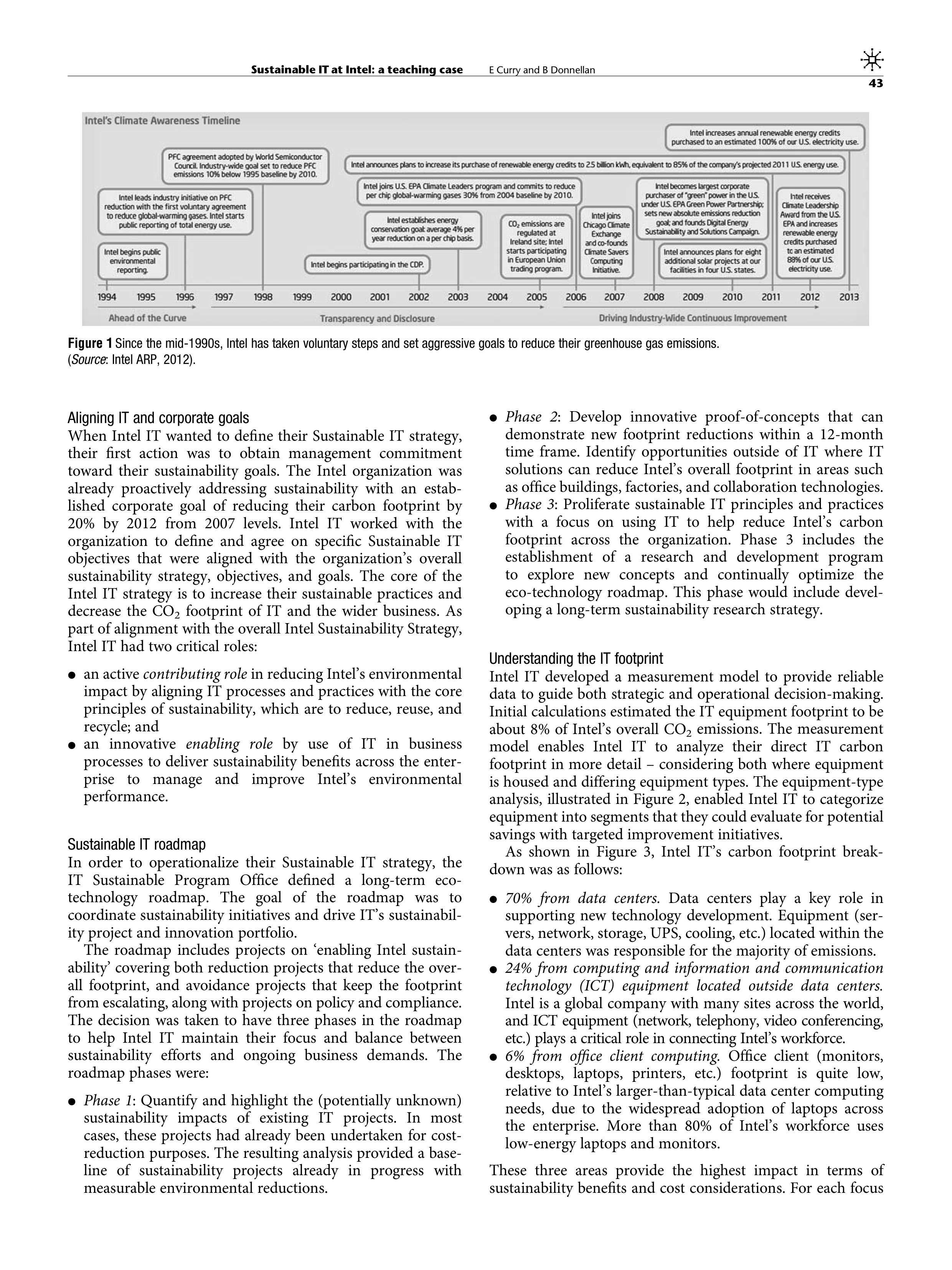
In
environmental
terms,
Intel
has
a
track
record
from
the
mid-1990s
of
taking
a
proactive
approach
to
climate
issues
as
illustrated
in
Figure
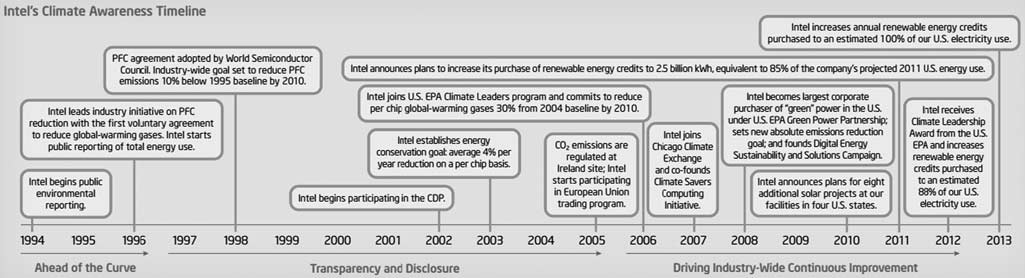
1.
Intel
also
has
a
history
of
social
responsibility toward its employees and the wider community
with
initiatives
for
safety,
ethical
work
environments,
work
–
life
balance,
supply-chain
audits,
and
community
service
volunteer programs such as teacher training.
The sustainability of Intel IT
In
2008,
Bryant
established
the
IT
Sustainability
Program
Of
fi
ce to better manage sustainability initiatives and to catalyze
change
within
IT
and
across
Intel
and
the
industry
(Curry
et
al.
,
2012).
At
the
time,
Intel
IT
provided
compute
and
communication
services
to
Intel
’
s
83,500
employees
across
150
sites
in
61
countries
around
the
world.
Intel
IT
opera-
tions
managed
more
than
200,000
devices
(90k+
PCs,
20k+
Handhelds) and 103 Data Centers (~100,000 servers). The key
Sustainable IT challenge for Intel IT was how to manage their
IT footprint and enable corporate sustainability practices. The
fi
rst
task
of
the
of
fi
ce
was
to
develop
a
sustainability
strategy
to
educate
and
provide
leadership
to
the
organization
on
the
principles and importance of sustainable business practices.
Sustainable IT at Intel: a teaching case
E Curry and B Donnellan
42

Aligning IT and corporate goals
When
Intel
IT
wanted
to
de
fi
ne
their
Sustainable
IT
strategy,
their
fi
rst
action
was
to
obtain
management
commitment
toward
their
sustainability
goals.
The
Intel
organization
was
already
proactively
addressing
sustainability
with
an
estab-
lished
corporate
goal
of
reducing
their
carbon
footprint
by
20%
by
2012
from
2007
levels.
Intel
IT
worked
with
the
organization
to
de
fi
ne
and
agree
on
speci
fi
c
Sustainable
IT
objectives
that
were
aligned
with
the
organization
’
s
overall
sustainability
strategy,
objectives,
and
goals.
The
core
of
the
Intel
IT
strategy
is
to
increase
their
sustainable
practices
and
decrease
the
CO
2
footprint
of
IT
and
the
wider
business.
As
part of alignment with the overall Intel Sustainability Strategy,
Intel IT had two critical roles:
●
an active
contributing role
in reducing Intel
’
s environmental
impact by aligning IT processes and practices with the core
principles
of
sustainability,
which
are
to
reduce,
reuse,
and
recycle; and
●
an
innovative
enabling
role
by
use
of
IT
in
business
processes
to deliver sustainability bene
fi
ts across
the enter-
prise
to
manage
and
improve
Intel
’
s
environmental
performance.
Sustainable IT roadmap
In
order
to
operationalize
their
Sustainable
IT
strategy,
the
IT
Sustainable
Program
Of
fi
ce
de
fi
ned
a
long-term
eco-
technology
roadmap.
The
goal
of
the
roadmap
was
to
coordinate sustainability initiatives and drive IT
’
s sustainabil-
ity project and innovation portfolio.
The
roadmap
includes
projects
on
‘
enabling
Intel
sustain-
ability
’
covering both reduction projects that reduce the over-
all
footprint,
and
avoidance
projects
that
keep
the
footprint
from escalating, along with projects on policy and compliance.
The
decision
was
taken
to
have
three
phases
in
the
roadmap
to
help
Intel
IT
maintain
their
focus
and
balance
between
sustainability
efforts
and
ongoing
business
demands.
The
roadmap phases were:
●
Phase
1
:
Quantify
and
highlight
the
(potentially
unknown)
sustainability
impacts
of
existing
IT
projects.
In
most
cases,
these
projects
had
already
been
undertaken
for
cost-
reduction purposes. The resulting analysis provided a base-
line
of
sustainability
projects
already
in
progress
with
measurable environmental reductions.
●
Phase
2
:
Develop
innovative
proof-of-concepts
that
can
demonstrate
new
footprint
reductions
within
a
12-month
time
frame.
Identify
opportunities
outside
of
IT
where
IT
solutions
can
reduce
Intel
’
s
overall
footprint
in
areas
such
as of
fi
ce buildings, factories, and collaboration technologies.
●
Phase
3
:
Proliferate
sustainable
IT
principles
and
practices
with
a
focus
on
using
IT
to
help
reduce
Intel
’
s
carbon
footprint
across
the
organization.
Phase
3
includes
the
establishment
of
a
research
and
development
program
to
explore
new
concepts
and
continually
optimize
the
eco-technology
roadmap.
This
phase
would
include
devel-
oping a long-term sustainability research strategy.
Understanding the IT footprint
Intel
IT
developed
a
measurement
model
to
provide
reliable
data to guide both strategic and operational decision-making.
Initial calculations estimated the IT equipment footprint to be
about
8%
of
Intel
’
s
overall
CO
2
emissions.
The
measurement
model
enables
Intel
IT
to
analyze
their
direct
IT
carbon
footprint in more detail
–
considering both where equipment
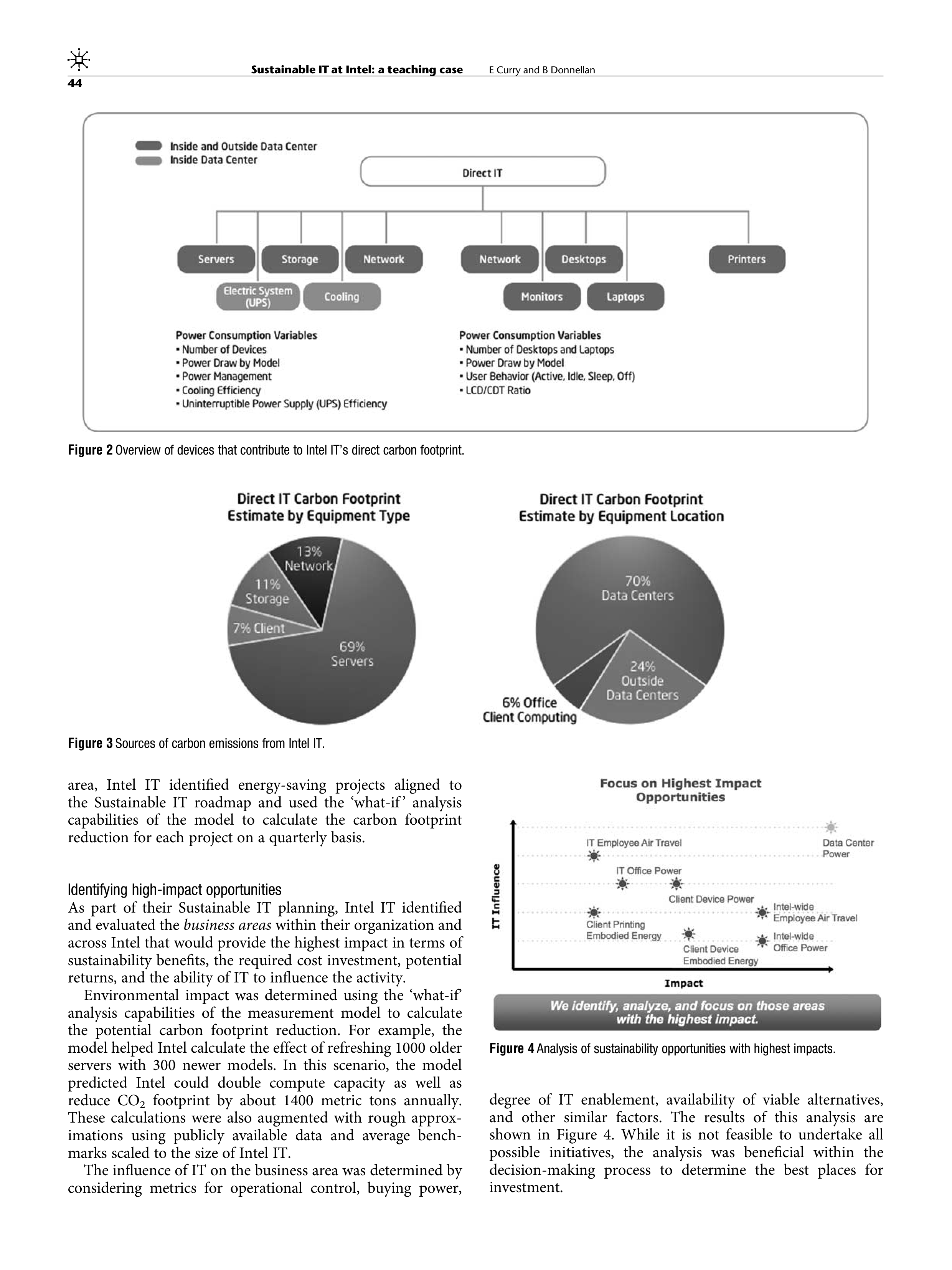
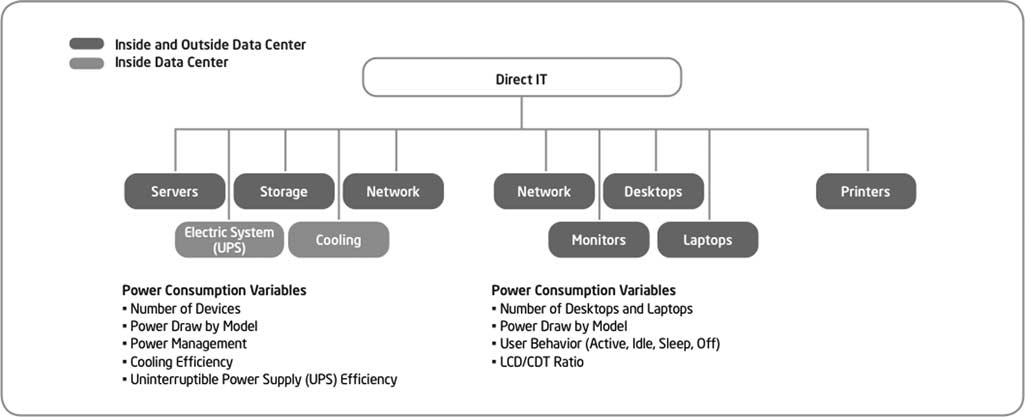
is housed and differing equipment types. The equipment-type
analysis,
illustrated in Figure 2, enabled Intel
IT to categorize
equipment into segments that they could evaluate for potential
savings with targeted improvement initiatives.
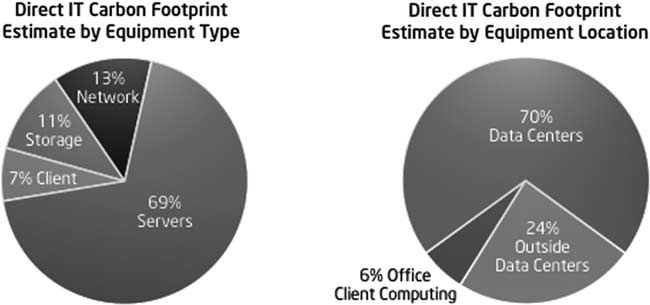
As
shown
in
Figure
3,
Intel
IT
’
s
carbon
footprint
break-
down was as follows:
●
70%
from
data
centers.
Data
centers
play
a
key
role
in
supporting
new
technology
development.
Equipment
(ser-
vers, network, storage, UPS, cooling, etc.) located within the
data centers was responsible for the majority of emissions.
●
24%
from
computing
and
information
and
communication
technology
(ICT)
equipment
located
outside
data
centers.
Intel is a global company with many sites across the world,
and ICT equipment (network, telephony, video conferencing,
etc.) plays a critical role in connecting Intel
’
s workforce.
●
6%
from
of
fi
ce
client
computing.
Of
fi
ce
client
(monitors,
desktops,
laptops,
printers,
etc.)
footprint
is
quite
low,
relative to Intel
’
s larger-than-typical data center computing
needs,
due
to
the
widespread
adoption
of
laptops
across
the
enterprise.
More
than
80%
of
Intel
’
s
workforce
uses
low-energy laptops and monitors.
These
three
areas
provide
the
highest
impact
in
terms
of
sustainability bene
fi
ts and cost considerations. For each focus
Figure 1
Since the mid-1990s, Intel has taken voluntary steps and set aggressive goals to reduce their greenhouse gas emissions.
(
Source
: Intel ARP, 2012).
Sustainable IT at Intel: a teaching case
E Curry and B Donnellan
43

area,
Intel
IT
identi
fi
ed
energy-saving
projects
aligned
to
the
Sustainable
IT
roadmap
and
used
the
‘
what-if
’
analysis
capabilities
of
the
model
to
calculate
the
carbon
footprint
reduction for each project on a quarterly basis.
Identifying high-impact opportunities
As
part
of
their
Sustainable
IT
planning,
Intel
IT
identi
fi
ed
and evaluated the
business areas
within their organization and
across Intel that would provide the highest impact in terms of
sustainability bene
fi
ts, the required
cost
investment, potential
returns, and the ability of IT to in
fl
uence the activity.
Environmental
impact
was
determined
using
the
‘
what-if
’
analysis
capabilities
of
the
measurement
model
to
calculate
the
potential
carbon
footprint
reduction.
For
example,
the
model helped Intel calculate the effect of refreshing 1000 older
servers
with
300
newer
models.
In
this
scenario,
the
model
predicted
Intel
could
double
compute
capacity
as
well
as
reduce
CO
2
footprint
by
about
1400
metric
tons
annually.
These
calculations
were
also
augmented
with
rough
approx-
imations
using
publicly
available
data
and
average
bench-
marks scaled to the size of Intel IT.
The in
fl
uence of IT on the business area was determined by
considering
metrics
for
operational
control,
buying
power,
degree
of
IT
enablement,
availability
of
viable
alternatives,
and
other
similar
factors.
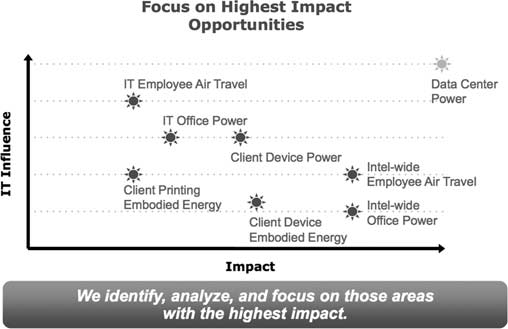
The
results
of
this
analysis
are
shown
in
Figure
4.
While
it
is
not
feasible
to
undertake
all
possible
initiatives,
the
analysis
was
bene
fi
cial
within
the
decision-making
process
to
determine
the
best
places
for
investment.
Figure 3
Sources of carbon emissions from Intel IT.
Figure 2
Overview of devices that contribute to Intel IT
’
s direct carbon footprint.
Figure 4
Analysis of sustainability opportunities with highest impacts.
Sustainable IT at Intel: a teaching case
E Curry and B Donnellan
44

The
analysis
revealed
that
inside
IT,
the
largest
impact
is
electricity
usage
and
the
carbon
emissions
associated
with
its
generation.
The
main
potential
was
on
data
center
power
and
cooling
ef
fi
ciency.
Since
the
majority
of
Intel
IT
carbon
emissions
are
caused
by
servers,
regularly
refreshing
servers,
consolidating applications to common platforms, and turning
off
unused
systems
would
have
the
greatest
bene
fi
ts.
Outside
of IT, the main potential was through the use of communica-
tion
and
collaboration
technologies
to
reduce
Intel-wide
employee travel.
Develop a sustainable culture
Building
a
sustainability
mindset
strengthens
business
ef
fi
-
ciency,
reduces
consumption
and
waste,
and
enhances
the
Intel brand. Intel knew they would need to in
fl
uence corporate
culture,
including
decision-making
processes
and
employee
involvement,
to
be
more
sustainability-focused
and
adapt
to
new
thinking
and
methodologies.
The
goal
was
to
develop
a
cohesive,
integrated
strategy
that
created
awareness
along
with a sense of urgency within the IT organization and across
Intel.
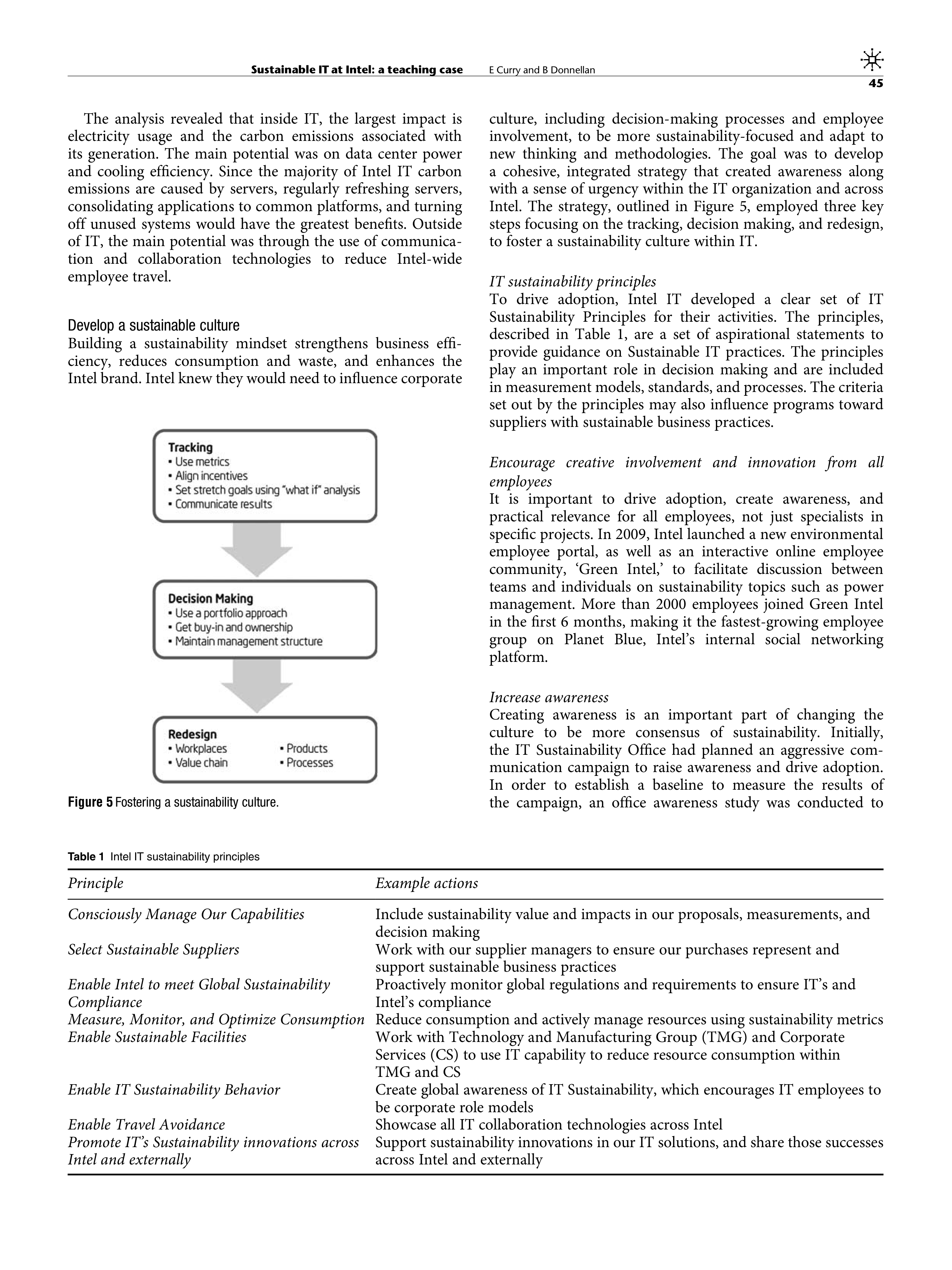
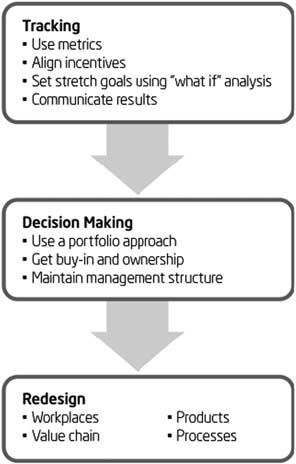
The
strategy,
outlined
in
Figure
5,
employed
three
key
steps focusing on the tracking, decision making, and redesign,
to foster a sustainability culture within IT.
IT sustainability principles
To
drive
adoption,
Intel
IT
developed
a
clear
set
of
IT
Sustainability
Principles
for
their
activities.
The
principles,
described
in
Table
1,
are
a
set
of
aspirational
statements
to
provide
guidance
on
Sustainable
IT
practices.
The
principles
play
an
important
role
in
decision
making
and
are
included
in measurement models, standards, and processes. The criteria
set out by the principles
may also in
fl
uence
programs toward
suppliers with sustainable business practices.
Encourage
creative
involvement
and
innovation
from
all
employees
It
is
important
to
drive
adoption,
create
awareness,
and
practical
relevance
for
all
employees,
not
just
specialists
in
speci
fi
c projects. In 2009, Intel launched a new environmental
employee
portal,
as
well
as
an
interactive
online
employee
community,
‘
Green
Intel,
’
to
facilitate
discussion
between
teams
and
individuals
on
sustainability
topics
such
as
power
management.
More
than
2000
employees
joined
Green
Intel
in the
fi
rst 6 months, making it the fastest-growing employee
group
on
Planet
Blue,
Intel
’
s
internal
social
networking
platform.
Increase awareness
Creating
awareness
is
an
important
part
of
changing
the
culture
to
be
more
consensus
of
sustainability.
Initially,
the
IT
Sustainability
Of
fi
ce
had
planned
an
aggressive
com-
munication
campaign
to
raise
awareness
and
drive
adoption.
In
order
to
establish
a
baseline
to
measure
the
results
of
the
campaign,
an
of
fi
ce
awareness
study
was
conducted
to
Figure 5
Fostering a sustainability culture.
Table 1
Intel IT sustainability principles
Principle
Example actions
Consciously Manage Our Capabilities
Include sustainability value and impacts in our proposals, measurements, and
decision making
Select Sustainable Suppliers
Work with our supplier managers to ensure our purchases represent and
support sustainable business practices
Enable Intel to meet Global Sustainability
Compliance
Proactively monitor global regulations and requirements to ensure IT
’
s and
Intel
’
s compliance
Measure, Monitor, and Optimize Consumption
Reduce consumption and actively manage resources using sustainability metrics
Enable Sustainable Facilities
Work with Technology and Manufacturing Group (TMG) and Corporate
Services (CS) to use IT capability to reduce resource consumption within
TMG and CS
Enable IT Sustainability Behavior
Create global awareness of IT Sustainability, which encourages IT employees to
be corporate role models
Enable Travel Avoidance
Showcase all IT collaboration technologies across Intel
Promote IT
’
s Sustainability innovations across
Intel and externally
Support sustainability innovations in our IT solutions, and share those successes
across Intel and externally
Sustainable IT at Intel: a teaching case
E Curry and B Donnellan
45

determine
how
strong
the
corporate
culture
was
in
terms
of
sustainability. The study showed that Intel employees already
had
a
strong
sustainability
mindset
and
their
direct
IT
touch
was
already
very
ef
fi
cient.
Based
on
the
survey,
the
IT
Sustainability Of
fi
ce focused its efforts in the area of employee
incentivization.
Use employee incentive programs to drive innovation
In 2008, to help focus all of their employees on environmental
sustainability,
Intel
aligned
a
portion
of
every
employee
’
s
variable
compensation
,
from
entry-level
employees
to
the
CEO,
to
the
achievement
of
environmental
sustainability
metrics.
Each
business
unit
within
Intel
had
speci
fi
c
goals/
targets to achieve that contribute a speci
fi
c percentage toward
their
employee
bonus.
In
2011,
the
environmental
metrics
focused
on
energy
ef
fi
ciency
in
operations
and
for
new
products;
IT
Energy
reduction
targets
were
the
component
of IT employee bonus schemes.
The alignment of the employee bonus has proved to be the
prime incentive to engage and facilitate employee involvement
to help them collectively focus on the importance of achieving
the
organization
’
s
environmental
objectives.
The
employee
bonus
encourages
employees
to
examine
projects
they
are
currently working on to identify tangible contributions toward
sustainability goals.
Build the business case for sustainability
Intel
IT
has
discovered
there
is
a
strong
business
case
for
sustainable
computing,
with
cost
savings
from
Sustainable
IT
projects
(i.e.
energy
savings
from
data
centers,
travel
cost
avoidance
for
video
conferencing)
justifying
investment.
It is important
to build
a strong
business case
for Sustainable
IT
projects.
Return
on
Investment
is
king
and
business
incentives
are
critical
to
getting
the
support
needed
for
projects.
This
is
the
main
difference
between
a
Green
IT
program
(environmental
bene
fi
ts)
and
a
Sustainable
IT
pro-
gram (environmental and business bene
fi
ts). From the experi-
ence
within
Intel,
making
the
business
case
for
sustainability
within green
fi
elds projects is straightforward
–
it makes sense
to
build
a
new
Data
Center
to
Best
Known
Methods.
It
is
much more challenging to determine the business case within
a
retro
fi
t
scenario,
here
sustainability
can
become
hard
and
expensive
and
it
needs
to
have
a
solid
sustainable
business
case.
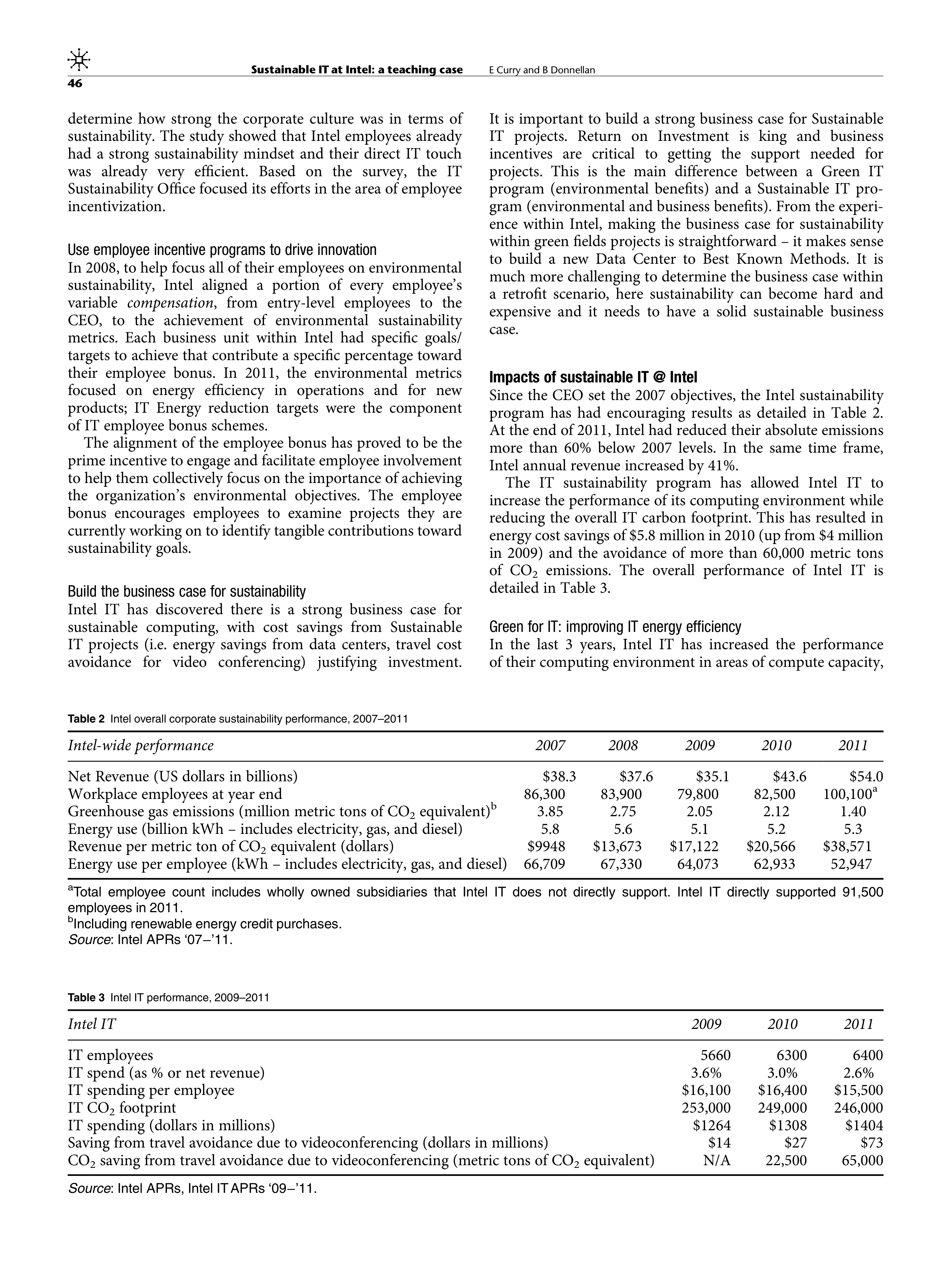
Impacts of sustainable IT @ Intel
Since
the CEO
set
the
2007
objectives,
the Intel
sustainability
program
has
had
encouraging
results
as
detailed
in
Table
2.
At the end of 2011, Intel had reduced their absolute emissions
more
than
60%
below
2007
levels.
In
the
same
time
frame,
Intel annual revenue increased by 41%.
The
IT
sustainability
program
has
allowed
Intel
IT
to
increase the performance of its computing environment while
reducing
the
overall
IT
carbon
footprint.
This
has
resulted
in
energy cost savings of $5.8 million in 2010 (up from $4 million
in
2009)
and
the
avoidance
of
more
than
60,000
metric
tons
of
CO
2
emissions.
The
overall
performance
of
Intel
IT
is
detailed in Table 3.
Green for IT: improving IT energy ef
fi
ciency
In
the
last
3
years,
Intel
IT
has
increased
the
performance
of their computing environment in areas of compute capacity,
Table 2
Intel overall corporate sustainability performance, 2007
–
2011
Intel-wide performance
2007
2008
2009
2010
2011
Net Revenue (US dollars in billions)
$38.3
$37.6
$35.1
$43.6
$54.0
Workplace employees at year end
86,300
83,900
79,800
82,500
100,100
a
Greenhouse gas emissions (million metric tons of CO
2
equivalent)
b
3.85
2.75
2.05
2.12
1.40
Energy use (billion kWh
–
includes electricity, gas, and diesel)
5.8
5.6
5.1
5.2
5.3
Revenue per metric ton of CO
2
equivalent (dollars)
$9948
$13,673
$17,122
$20,566
$38,571
Energy use per employee (kWh
–
includes electricity, gas, and diesel)
66,709
67,330
64,073
62,933
52,947
a
Total
employee
count
includes
wholly
owned
subsidiaries
that
Intel
IT
does
not
directly
support.
Intel
IT
directly
supported
91,500
employees in 2011.
b
Including renewable energy credit purchases.
Source
: Intel APRs
‘
07
−
’
11.
Table 3
Intel IT performance, 2009
–
2011
Intel IT
2009
2010
2011
IT employees
5660
6300
6400
IT spend (as % or net revenue)
3.6%
3.0%
2.6%
IT spending per employee
$16,100
$16,400
$15,500
IT CO
2
footprint
253,000
249,000
246,000
IT spending (dollars in millions)
$1264
$1308
$1404
Saving from travel avoidance due to videoconferencing (dollars in millions)
$14
$27
$73
CO
2
saving from travel avoidance due to videoconferencing (metric tons of CO
2
equivalent)
N/A
22,500
65,000
Source
: Intel APRs, Intel ITAPRs
‘
09
−
’
11.
Sustainable IT at Intel: a teaching case
E Curry and B Donnellan
46

storage, and network as detailed in Table 4, and are providing
IT
services
to
an
additional
11,000
employees,
all
while
reducing the overall carbon emissions of IT operations.
One
of
the
primary
ways
Intel
IT
is
delivering
reductions
in
its
carbon
footprint
is
through
server
consolidation.
In
keeping
up
with
Moore
’
s
law
and
ever
increasing
computing
demand, Intel IT have settled on a 4-year server refresh policy.
One
server
with
the
latest
processing
technology
can
replace
as
many
as
10
four
year-old
servers.
The
refresh
strategy
has
allowed
them
to
double
compute
capacity
and
lower
costs.
In 2010,
server
refresh
saved
an estimated 28,000
metric tons
in
CO
2
;
this
is
the
equivalent
of
the
carbon
captured
by
8000 acres of pine forest in a year.
Intel
IT
have
also
introduced
an
aggressive
server
virtuali-
zation
strategy
that
has
increased
the
utilization
of
their
servers,
leading
to
a
further
2500
metric
tons
of
carbon
footprint
reduction
in
2010.
Improving
the
management
of
workload
distribution
of
servers
within
the
data
center
has
allowed Intel IT to optimize server utilization, further allowing
them to power off over 2300 servers. Overall, ef
fi
ciency efforts
at
Intel
IT
have
reduced
the
number
of
servers
from
a
high
of 100k to 75k.
Within
the
area
of
client
computing,
they
have
achieved
a
70%
saving
per
user
by
deploying
low-power
laptops
over
desktops,
and
have
over
80%
laptop
deployment
within
their
environment.
They
are
deploying
Solid
State
Drives
(SSDs)
that
consume
less
power
than
conventional
hard
drives
in
their
laptops.
SSDs
are
also
being
considered
for
use
in
the
data center, where they will save energy and reduce heat while
enhancing
performance.
Overall,
Intel
IT
has
saved
over
100
million kilowatt-hours (kWh) in energy.
IT for green: reducing travel with collaboration technologies
In
2011,
Intel
had
over
91,500
employees
across
164
sites
in
62
countries
around
the
world.
These
employees
typically
work
in
distributed
and
virtual
teams.
The
cost
of
employee
travel
is
expensive
in
both
fi
nancial
and
environment
terms.
Intel IT makes extensive use of collaboration technology, such
as video conferencing, which can reduce the need to travel.
For
person-to-person
and
small
group
meetings
desktop-
based
videoconferencing
is
provided.
Desktops
are
refreshed
at Intel
to ensure
they
have
the capacity
to handle
full-screen
video
and
application
sharing.
Meetings
of
larger
teams
and
groups are accommodated with the use of telepresence rooms.
During
2010,
Intel
more
than
tripled
the
number
of
meeting
rooms
with
videoconferencing
capabilities,
including
the
addition of rooms in 11 new countries. The estimate for 2011
was
that
videoconferencing
and
telepresence
rooms
would
save
435,000
employee
travel
hours,
avoiding
more
than
$73
million in travel expenses, and over 65,000 metric tons of CO
2
emissions.
Towards 2020
As
Bill
Guyon
assesses
the
existing
strategy
for
IT
Sustain-
ability, he can point to many achievements. Using Sustainable
IT, Intel IT has optimized the use of data center, compute, and
of
fi
ce
infrastructure
to
reduce
their
energy
consumption,
while leveraging collaboration technologies to reduce the need
for employees
to travel. Overall, these efforts have resulted in
cost
savings
of
over
$114
million
and
the
avoidance
of
more
than
87,500
metric
tons
of
CO
2
emissions.
In
recognition
of
Intel
IT
’
s
sustainability
achievements,
Intel
was
named
to
Computerworld
’
s
2010
and
2011
lists
of
‘
Top
Green-IT
Organizations.
’
However, signi
fi
cant challenges exist.
Intel IT
’
s initial strategy has utilized employee bene
fi
t scheme
as a compensation motivator to embed the sustainability within
the
cultural
mindset.
However,
as
employees
exploit
their
current projects for sustainability gains, the
‘
low-hanging fruit
’
will eventually be exhausted. Intel is seeing diminishing returns
as
they
optimize
their
operations.
For
example,
take
data
centers;
the
introduction
of
a
private
cloud
will
drive
down
server counts signi
fi
cantly, along with associated energy usage,
to
a
critical mass
running at high
utilization,
after
that
further
energy reductions will be based on refresh cycles.
Guyon needs to decide what are the next strategic steps for
Sustainable IT at Intel. With the short-term low-hanging fruit
all
picked,
a
new
strategic
focus
is
now
needed.
He
needs
to
answer
a
key
question.
Should
Sustainable
IT
continue
on
its
existing
path
(business-as-usual),
or
should
Intel
look
to
further
exploit
the
transformational
and
innovation
potential
of
next-generation
Sustainable
IT
technologies
within
the
organization
and
across
the
wider
extended-enterprise?
Should Guyon propose a strategic shift to investing in the next
generation
of
sustainable
ICT
technologies
and
in
particular
opportunities
outside
of
IT,
where
IT
solutions
could
help
reduce
Intel
’
s
carbon
footprint
across
the
organization?
This
requires
the
development
of
a
long-term
sustainability
research strategy together with the establishment of a research
and
development
program
to
explore
new
concepts
and
con-
tinually
optimize
the
eco-technology
roadmap.
The
challenge
with
such
a
program
is
to
get
management
commitment,
as
they will question the need to allocate incremental resources to
Table 4
Intel operational performance, 2008
–
2011
Intel IT
2009
2010
2011
IT data centers
95
91
87
Storage capacity (petabytes)
18.6
24.9
38.2
Internet network bandwidth (gigabits per sec)
3.0
4.8
6.2
Compute capacity for silicon design
(growth from 2008)
24%
84%
159%
Time to deploy infrastructure services
14 days
3 h
45 min
Percentage of applications virtualized
(in Of
fi
ce and Enterprise environments)
12%
42%
64%
Source
: Intel APRs, Intel ITAPRs
‘
08
−
’
11.
Sustainable IT at Intel: a teaching case
E Curry and B Donnellan
47

drive
harder
on
medium-
and
long-term
projects
when
they
can still see short-term projects still delivering results.
Is Intel
IT on
track
with
its
Sustainable
IT
plan?
Will
their
current three-phase roadmap endure? Is Intel at par, ahead, or
behind
the
competition
in
terms
of
sustainability?
How
can
Sustainable
IT
continue
to
add
value
at
Intel?
What
are
the
opportunities
the
next
generation
of
sustainable
IT
technolo-
gies present? Can Intel work with its supply chain partners to
reduce global carbon emissions? How can Intel become more
competitive
through
the
next
generation
of
sustainable
pro-
duction? What should be Intel
’
s strategy going forward? What
are
the
strengths,
weaknesses,
opportunities,
and
threats
for
IT Sustainability at Intel? Can Sustainable IT be a competitive
advantage for Intel?
Acknowledgements
The work presented
has been funded by Science Foundation Ireland
under Grant No. SFI/08/CE/I1380 (Lion-2) and by Enterprise Ireland
under Grant CC/2009/0801.
Note
1
Creative license has been used within the scenario.
References
Climate Group.
(2008). SMART 2020: Enabling the low carbon economy in the
information age,
The Climate Group London
, http://www.smart2020.org/_assets/
fi
les/02_Smart2020Report.pdf.
Curry, E., Guyon, B., Sheridan, C. and Donnellan, B.
(2012). Developing an
Sustainable IT Capability: Lessons from Intel
’
s journey,
MIS Quarterly Executive
11
(2): 61
–
74.
Curry, E., Guyon, B., Sheridan, C. and Donnellan, B.
(2012). Sustainable IT:
Challenges, postures, and outcomes,
IEEE Computer
45
(11): 79
–
81.
Donnellan, B., Sheridan, C. and Curry, E.
(2011). A Capability Maturity
Framework for Sustainable Information and Communication Technology,
IEEE IT Professional
13
(1): 33
–
40.
Elliot, S.
(2007). Environmentally Sustainable ICT: A critical topic for IS research?
in
Paci
fi
c Asia Conference on Information Systems (PACIS 2007)
; Auckland,
New Zealand: Association for Information Systems, 100
–
114.
Enkvist, P.-A. and Rosander, J.
(2007). A Cost Curve for Greenhouse Gas
Reduction,
The McKinsey Quarterly
34.
Murugesan, S. and Laplante, P.A.
(2011). IT for a Greener Planet,
IEEE IT
Professional
13
(1): 16
–
18.
Porter, M.E. and Linde, C.V.D.
(1995). Toward a New Conception of the
Environment-Competitiveness Relationship,
Journal of Economic Perspectives
9
(4): 97
–
118.
About the Authors
Edward
Curry
is
a
research
scientist
and
leads
the
Green
and
Sustainable
IT
research
group
at
the
Digital
Enterprise
Research Institute (http://www.deri.ie). His research projects
include studies of sustainable IT, energy intelligence, seman-
tic
information
management,
and
collaborative
data
man-
agement.
Curry
has
worked
extensively
with
industry
and
government,
advising
on
the
adoption
patterns,
practical-
ities,
and
bene
fi
ts
of
new
technologies.
He
has
published
in
leading
journals
and
books,
and
has
spoken
at
international
conferences
including
the
MIT
CIO
Symposium.
He
cur-
rently participates in a project for the European Commission
to de
fi
ne a research strategy for the Big Data economy within
Europe.
He
has
a
Ph.D.
from
the
National
University
of
Ireland,
Galway
(http://www.nuigalway.ie)
and
serves
as
an
adjunct lecturer within the university.
Brian Donnellan
is Professor of Information Systems Innova-
tion
at
the
National
University
of
Ireland,
Maynooth
(http://
www.nuim.ie) and Academic Director of the Innovation Value
Institute
(http://www.ivi.ie).
Prior
to
joining
National
Uni-
versity
of
Ireland,
Maynooth,
Professor
Donnellan
was
a
faculty member in the National University of Ireland, Galway.
Earlier, he spent 20 years working in the ICT industry, where
he was
responsible for
the provision of IS
to support product
development.
He
is
an
expert
evaluator
for
the
European
Commission and has been guest and associate editor of several
leading
IS
journals
including
the
Journal
of
IT
,
Journal
of
Strategic Information Systems
, and
MIS Quarterly
.
Sustainable IT at Intel: a teaching case
E Curry and B Donnellan
48