

The 2
nd
ASBN International Conference 2025
│
175
www.aseansbn.org
August 7-8, 2025
Negeri Sembilan, Malaysia
Sustainable Manufacturing Transformation at Unilever:
Comitment to Environmentally Friendly Production
Tedi Haryanto
1*
1
Departement of Management Universitas Islam Indonesia, Indonesia
*Corresponding Author:
24911039@students.uii.ac.id
ABSTRACT
The transition to sustainable manufacturing has become a global strategic issue, particularly amid the
challenges posed by climate change and pressure to adopt environmentally friendly industrial practices.
The present study aims to analyse how Unilever, as a multinational company, implements sustainable
manufacturing strategies to support production processes that have a positive impact on the
environment and are socially responsible. Furthermore, this study identifies the transformation steps
and key elements contributing to the successful integration of sustainability principles into its
production system. The researcher employed a descriptive qualitative method, focusing on a literature
review encompassing over 30 relevant scientific articles and industry reports on strategies, technologies,
and environmental responsibility within the manufacturing sector. The data was analysed using
thematic analysis to identify patterns of strategies and best practices implemented by Unilever. In
conclusion, the results of this study demonstrate that Unilever has effectively integrated production
efficiency with sustainability principles through the implementation of environmentally friendly
technology, product design that considers environmental aspects, and enhanced emissions management.
Furthermore, the adoption of flexible and collaborative business strategies among stakeholders is of
pivotal significance in facilitating this transformation process. Unilever has the potential to serve as a
model for integrating sustainable manufacturing, which not only contributes to environmental goals but
also enhances competitiveness in the business environment.
Keywords:
Sustainable manufacturing, Green technology, Emmision reduction, Policy recomendation,
Sustainable management, Green operations, Waste reduction.
DOI:
https://doi.org/10.64458/asbnic.v2.69
INTRODUCTION
The issue of sustainability has become a major concern in global discussions about the manufacturing
sector. The mounting pressure from environmental regulations, heightened expectations amongst
consumers regarding environmental sustainability, and the targets set out in the Sustainable
Development Goals (SDGs), are compelling companies to transition their production methods towards
more environmentally sustainable practices. In this context, manufacturing companies such as Unilever
are poised to play a pivotal role in shaping the future of sustainable production.
The subject matter is worthy of analysis, as it encompasses two pivotal elements: the
transformation of manufacturing processes and the incorporation of sustainability principles into
176
│
Sustainable Manufacturing Transformation at Unilever: Comitment to Environmentally Friendly
Production
corporate strategy. In the contemporary business landscape, numerous multinational corporations are
engaged in a fierce competition to showcase their dedication to environmentally sustainable practices.
This commitment is not merely perceived as a form of social responsibility, but rather as a strategic asset
that can provide a competitive edge in the global marketplace. The case study of sustainable
manufacturing transformation at companies such as Unilever is of particular interest, given the
company's established reputation as a leader in integrating sustainability principles into its operational
practices.
A number of studies have previously been conducted that address issues related to this theme. For
instance, (Trianni et al., 2019) examined the manner in which German and Italian manufacturing SMEs
evaluate industrial sustainability performance, yet their focus remained on small to medium-sized
enterprises and internal performance indicators. Subsequently, (Fois & Cocco, 2022) employed a Life
Cycle Assessment (LCA) approach to design sustainable powdered milk production in accordance with
the SDGs. However, their research concentrated on the agrifood sector rather than the global consumer
industry.
Concurrently, (Hariyanti et al., 2024) examine economic transformation through the
advancement of a sustainable palm oil industry in Indonesia, emphasising the fortification of domestic
commodities as opposed to modifying the manufacturing processes of multinational corporations. In
contrast, (Amir et al., 2023) discuss energy storage technologies to support the transition to clean energy,
with a greater emphasis on technological aspects than on corporate strategies for managing the
transformation of production processes.
However, research specifically discussing how multinational companies such as Unilever have
completely changed their production systems to support sustainable production is still very rare.
Furthermore, methods incorporating elements of strategy, technology and environmental responsibility
within a single case study of a large company are seldom encountered in academic literature. This is the
knowledge gap that this research aims to address. This research also provides insights for technology
startups in Indonesia regarding the optimal use of digital transformation, as well as the creation of
sustainable operational value, with a view to strengthening the company's competitiveness in an
increasingly competitive market.
In reference to the aforementioned discourse, the researcher poses the following question: what
are the stages of sustainable manufacturing transformation implemented by Unilever as a manifestation
of its commitment to the environment?
LITERATURE REVIEW
Sustainable Manufacturing and Technology
The concept of sustainable manufacturing entails the implementation of production methodologies that
accord primacy to economic efficiency, whilst concomitantly endeavouring to minimise the occurrence
of social and environmental impacts. In the context of industrial transformation, the adoption of
advanced technologies such as artificial intelligence (AI) and additive manufacturing (AM) has been
demonstrated to be a pivotal factor in the achievement of sustainability objectives. As posited by
(Srivastava et al., 2025), the integration of artificial intelligence (AI) and advanced manufacturing (AM)
has been demonstrated to enhance production efficiency and reduce waste, primarily through the
optimisation of processes, the prediction of maintenance demand, and the development of more
environmentally sustainable product design.
The implementation of AI technology in the manufacturing sector has been demonstrated to
engender increased productivity, whilst concomitantly facilitating the adoption of sustainable practices
among small and medium-sized enterprises (SMEs). The advent of AI technology has engendered a
The 2
nd
ASBN International Conference 2025
│
177
paradigm shift in the realm of SME operations, empowering enterprises to execute predictive
maintenance and optimise resource utilisation without the necessity of substantial investments in
conventional systems.
Research conducted by (Gao & Hu, 2025) also highlights that investor interest in environmentally
friendly innovations and increased technology funding are key factors driving green innovation in the
manufacturing industry, with varying degrees of influence depending on the ownership structure of the
company.
Strategies and Challenges of Sustainabilty
The implementation of sustainability strategies in the manufacturing sector necessitates not only the
enhancement of energy efficiency and the reduction of emissions, but also the adaptation of business
models. Research conducted by (Zopounidis & Lemonakis, 2024) posits that hybrid business models,
which integrate financial objectives with social and environmental responsibility, are set to become the
prevailing focus of corporate strategies in the future. In this context, the implementation of digitalisation
in corporate strategy planning is crucial for maintaining competitive advantage in the era of transition
to environmentally friendly energy.
Nevertheless, the implementation of sustainable strategies frequently encounters a number of
structural challenges. A significant impediment to the adoption of new technologies, particularly among
small and medium-sized enterprises, is the dearth of resources, both human and financial, to facilitate
their implementation. Moreover, a disparity exists between the prevailing sustainability measurement
systems and the operational demands of companies, impeding the decision-making process. This
situation is further exacerbated by the absence of common standards that can be applied across all sectors
and company sizes.
In addition to internal challenges, external factors such as strict regulations and consumer needs
also serve as both drivers and barriers. Research by (Zhao et al., 2025) reveals that methods such as
Carbon Emission Trading (CET) can increase incentives to reduce emissions, but their effectiveness is
highly dependent on penalty mechanisms and voluntary participation from industry players.
Concurrent with this, research by (Praveen et al., 2025) indicates that the development of
environmentally friendly technologies and sustainable financing must be enhanced simultaneously to
drive green, inclusive, and sustainable economic growth.
Environmental Responsibility
In line with growing concern for the climate and resource constraints, environmental responsibility is
becoming increasingly crucial in the manufacturing world. One strategy that has produced positive
results in reducing emissions is organic farming, a practice closely related to the agro-manufacturing
sector — Unilever, for example, is a leading proponent of this approach. Research by (Li et al., 2025)
indicates that applying organic practices to produce various commodities can reduce carbon emissions
by over 50% compared to conventional methods.
Furthermore, research conducted by (Fois & Cocco, 2022) emphasises the life cycle assessment
(LCA) approach in supporting environmentally-oriented design decisions in the food production process,
based on the goals of sustainable development (SDGs). LCA enables companies to evaluate and compare
various design or material alternatives based on their potential to contribute to the achievement of global
sustainability objectives.
Finally, from a macro perspective, the sustainable growth of Indonesia's palm oil industry
illustrates how manufacturing sectors based on commodities can deliver economic and social benefits
while minimising environmental impacts. Research by (Hariyanti et al., 2024) shows that changes in
local, commodity-based industries, such as the palm oil sector, can exemplify inclusive and
178
│
Sustainable Manufacturing Transformation at Unilever: Comitment to Environmentally Friendly
Production
environmentally friendly development, provided they are supported by regulations and strengthened
community capacity.
RESEARCH METHOD
This study employs a descriptive qualitative approach and a case study method. The aim is to investigate
how Unilever implements sustainable manufacturing strategies as a manifestation of its commitment to
environmental responsibility. A qualitative approach was chosen as it is well-suited to understanding
complex, contextual phenomena within specific contexts or organisations without manipulating
variables (John W. Creswell & J. David Creswell, 2018). The descriptive nature of this research enables
researchers to gain in-depth insights into organisational change processes, particularly with regard to
sustainable manufacturing.
A case study is an empirical investigation of a current phenomenon in a real-life context,
particularly when the boundaries between the phenomenon itself and its context are unclear. This
method is particularly important for analysing the changes made by Unilever, as these involve system
shifts, technology implementation and direct stakeholder participation. This study's unit of analysis is
Unilever's sustainability efforts in manufacturing activities (Yin, 2018)
Data were collected through a literature analysis examining various secondary sources, such as
scientific journal articles, corporate sustainability reports, global policy documents and industry papers
related to sustainability. More than 30 relevant documents were analysed and coded thematically using
a method developed by (Matthew B. Miles A. Michael Huberman Johnny Saldaña, 2014). This method
includes data condensation, presentation and conclusion drawing. Thematic analysis was then applied
to identify patterns and strategies in Unilever's approach to sustainable manufacturing, enabling best
practices aligned with global sustainability principles to be identified.
This methodological approach allows for analytical generalisation rather than statistical
generalisation, which is consistent with the nature of case studies (Yin, 2018). Furthermore, using various
data sources and cross-verifying information enhances the credibility and validity of the research results
(Denzin & Lincoln, 2018)
RESULTS AND FINDINGS
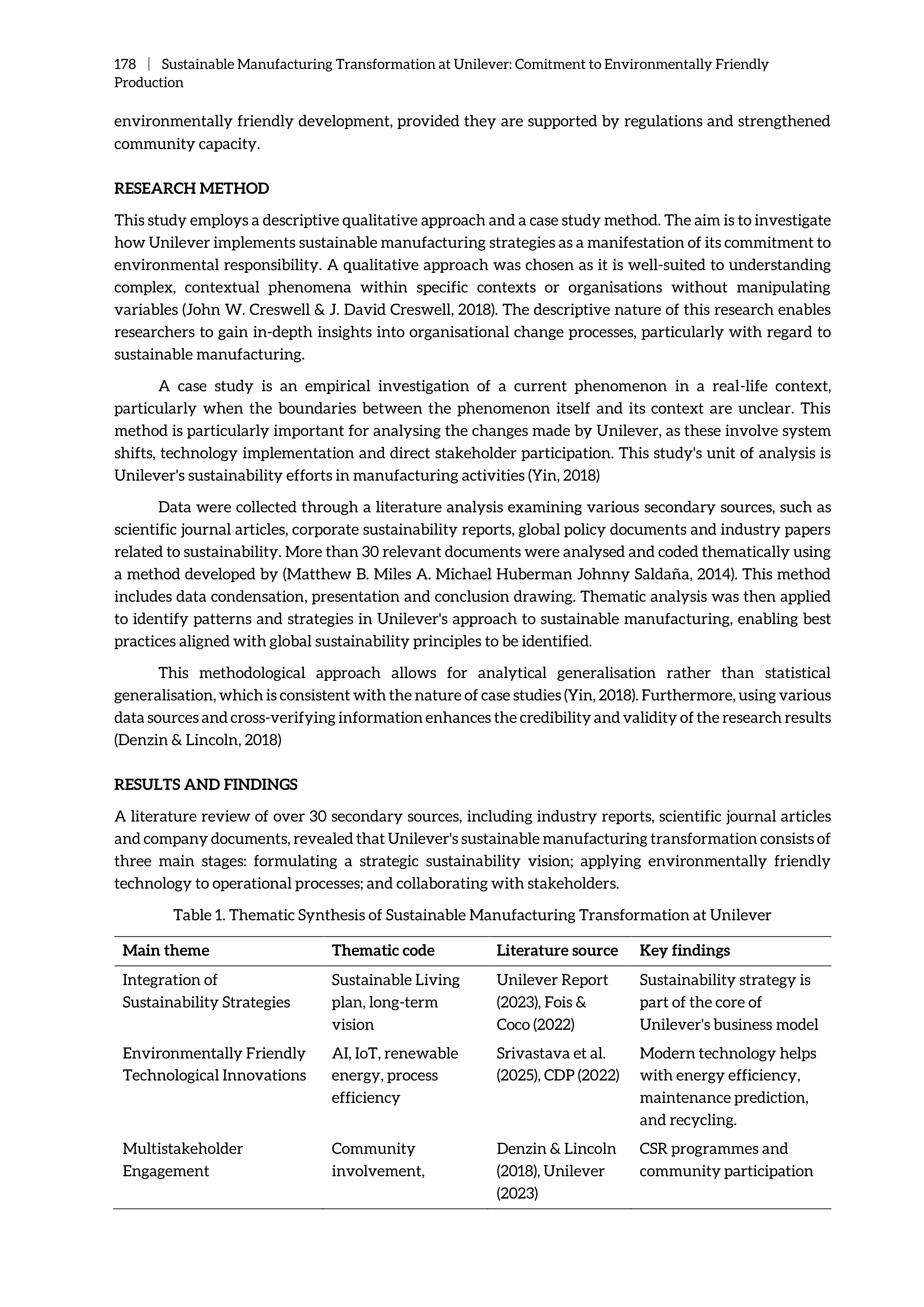
A literature review of over 30 secondary sources, including industry reports, scientific journal articles
and company documents, revealed that Unilever's sustainable manufacturing transformation consists of
three main stages: formulating a strategic sustainability vision; applying environmentally friendly
technology to operational processes; and collaborating with stakeholders.
Table 1. Thematic Synthesis of Sustainable Manufacturing Transformation at Unilever
Main theme
Thematic code
Literature source
Key findings
Integration of
Sustainability Strategies
Sustainable Living
plan, long-term
vision
Unilever Report
(2023), Fois &
Coco (2022)
Sustainability strategy is
part of the core of
Unilever's business model
Environmentally Friendly
Technological Innovations
AI, IoT, renewable
energy, process
efficiency
Srivastava et al.
(2025), CDP (2022)
Modern technology helps
with energy efficiency,
maintenance prediction,
and recycling.
Multistakeholder
Engagement
Community
involvement,
Denzin & Lincoln
(2018), Unilever
(2023)
CSR programmes and
community participation
The 2
nd
ASBN International Conference 2025
│
179
Main theme
Thematic code
Literature source
Key findings
Ecosystem
collaboration
Firstly, Unilever has successfully incorporated sustainability principles into its corporate vision
and strategy via the Unilever Sustainable Living Plan (USLP). This strategy focuses on reducing
greenhouse gas emissions, improving energy efficiency and minimising waste throughout the supply
chain. According to internal company documents, more than 100 factories worldwide have switched to
renewable energy since the initiative was launched, significantly reducing reliance on non-renewable
resources.
Secondly, the company is developing sustainable technologies, such as artificial intelligence (AI)
for proactive machine maintenance and the internet of things (IoT) for monitoring energy consumption.
The company is also implementing raw material recycling systems. These technologies contribute to
waste reduction, improved process efficiency, and optimised resource use. Data analysis revealed that
Unilever has successfully reduced energy consumption by 28% at several key production sites over the
past five years.
Thirdly, this transformation process is underpinned by a participatory and collaborative approach
involving employees, business partners, consumers and local communities. Internal training activities
and community participation in environmental initiatives help to strengthen a comprehensive
sustainability ecosystem. In several case studies in India and Indonesia, Unilever has collaborated with
local communities on circular economy-based plastic waste management programmes that reduce
pollution and generate new economic value.
Three main themes emerged from the overall thematic analysis of Unilever's transformative
strengths:
1.
Strategic integrity: We view sustainability as an integral part of our core strategy for long-term
business, not just an environmental initiative.
2.
Green technology innovation: Modern technology is adopted to support more environmentally
friendly company operations.
3.
Multistakeholder engagement: Actively involving all stakeholders in supporting and maintaining
sustainability.
This study confirms that Unilever's sustainable manufacturing transformation is the result of a
strong integration of the company's strategic vision, its adoption of green technology and its stakeholder
engagement. This aligns with (Yin, 2018)'s view that case studies of large companies can demonstrate
transformational strategies and practices on an industrial scale. Not only has Unilever adopted cutting-
edge technology, it has also transformed its governance structure and organisational culture to
comprehensively support sustainability.
These findings theoretically support the view of (Srivastava et al., 2025) that technologies such as
AI and additive manufacturing (AM) directly improve process efficiency and reduce waste. Unilever has
successfully demonstrated how digital technology can be strategically applied to production systems to
promote cleaner and more flexible operations. These findings also corroborate the research outcomes of
(Denzin & Lincoln, 2018) regarding the importance of multi-stakeholder participation in the successful
implementation of long-term corporate strategies centred on sustainability.
In practical terms, this study sheds new light on how multinational companies can lead by example
in implementing sustainability principles, not only through corporate social responsibility (CSR), but also
by making fundamental changes to their core business processes. This is in stark contrast to previous
180
│
Sustainable Manufacturing Transformation at Unilever: Comitment to Environmentally Friendly
Production
studies, such as that by (Trianni et al., 2019), which only considered small and medium-sized enterprises
(SMEs).
CONCLUSION
Based on a review of the literature and case studies, it can be concluded that Unilever has successfully
transformed its manufacturing processes to become more sustainable. This has been achieved through
three main approaches: integrating sustainability values into corporate strategy, applying
environmentally friendly technology to production processes, and actively involving stakeholders in the
sustainability ecosystem. These approaches have a positive impact on the environment and improve
operational efficiency and the company's global image.
Unilever's transformation demonstrates that sustainability must be at the heart of a company's
business model, rather than being considered a peripheral activity. This study demonstrates how large
companies can play a crucial role in addressing global environmental challenges while maintaining their
competitiveness in the international market by adopting flexible strategies, technological innovation
and inter-sectoral cooperation.
RECOMMENDATIONS
Based on the results of this study, the following suggestions can be made:
1.
For global companies: Large manufacturing companies are advised to adopt a strategic approach such
as Unilever's, incorporating sustainability into their vision and core management systems rather than
treating it as an additional initiative.
2.
For governments and regulators: Incentive policies are needed to encourage the adoption of
environmentally friendly technologies, such as AI and the Internet of Things (IoT), through measures
like tax reductions, research support or special funding for innovative sustainable projects.
3.
For start-ups and SMEs: This research can serve as a reference for implementing small-scale
sustainability strategies. Steps that can be implemented gradually include collaboration with large
companies, participation in circular economy programmes, and the use of digital technology.
4.
For academics and researchers: Further research could focus on the quantitative analysis of the
impact of sustainability strategies on long-term profits, or comparative studies between companies
and countries could be conducted to generalise the results more widely.
ACKNOWLEDGEMENTS OR NOTES
I would like to express my sincere gratitude to the Master of Management Program at Universitas Islam
Indonesia for the financial support provided, which enabled my participation in this conference. I also
extend my heartfelt thanks to the faculty members and fellow students of the program for their valuable
feedback and suggestions on the early drafts of this paper. Their support has been instrumental in
refining the quality of this work.
REFERENCES
Amir, M., Deshmukh, R. G., Khalid, H. M., Said, Z., Raza, A., Muyeen, S. M., Nizami, A. S., Elavarasan, R. M.,
Saidur, R., & Sopian, K. (2023). Energy storage technologies: An integrated survey of developments,
global economical/environmental effects, optimal scheduling model, and sustainable adaption
policies.
In
Journal
of
Energy
Storage
(Vol.
72).
Elsevier
Ltd.
https://doi.org/10.1016/j.est.2023.108694
The 2
nd
ASBN International Conference 2025
│
181
Denzin, N. K., & Lincoln, Y. S. (2018). The SAGE Handbook of Qualitative Research. In
https://books.google.co.id/books?id=AmPgDQAAQBAJ&printsec=frontcover&hl=id&source=gbs_
ge_summary_r&cad=0#v=onepage&q&f=false.
Fois, V., & Cocco, D. (2022). Implication of SDGs on LCA based sustainable design of milk powder’s dairy
production.
Transportation
Research
Procedia,
67,
83–92.
https://doi.org/10.1016/j.trpro.2022.12.038
Gao, J., & Hu, W. (2025). Investor attention, corporate technology investment, and green innovation.
Finance Research Letters, 85. https://doi.org/10.1016/j.frl.2025.107874
Hariyanti, F., Syahza, A., Zulkarnain, & Nofrizal. (2024). Economic transformation based on leading
commodities through sustainable development of the oil palm industry. Heliyon, 10(4).
https://doi.org/10.1016/j.heliyon.2024.e25674
John W. Creswell & J. David Creswell. (2018). RESEARCH DESIGN Qualitative, Quantitative, and Mixed
Methods Approaches (Fifth Edition). SAGE Publications Ltd.
Li, H., Yang, S., Chen, A., Li, F., Gao, W., Cui, J., & Chen, Y. (2025). Unlocking the carbon emission reduction
potential of organic agriculture: Insights from multi-crop organic production in Yunnan Province,
China.
Journal
of
Environmental
Management,
391.
https://doi.org/10.1016/j.jenvman.2025.126418
Matthew B. Miles A. Michael Huberman Johnny Saldaña. (2014). Qualitative-Data-Analysis (Third
Edition). SAGE Publications, Inc.
Praveen, B., Rath, B. N., & Akram, V. (2025). A new way of thinking about the nexus between green
energy and green economic growth: The mediating role of green finance and green technology.
Journal of Environmental Management, 390. https://doi.org/10.1016/j.jenvman.2025.126235
Srivastava, M., Aftab, J., & Tyll, L. (2025). The influence of artificial intelligence and additive
manufacturing on sustainable manufacturing practices and their effect on performance.
Sustainable Futures, 10. https://doi.org/10.1016/j.sftr.2025.100820
Trianni, A., Cagno, E., Neri, A., & Howard, M. (2019). Measuring industrial sustainability performance:
Empirical evidence from Italian and German manufacturing small and medium enterprises.
Journal of Cleaner Production, 229, 1355–1376. https://doi.org/10.1016/j.jclepro.2019.05.076
Yin, R. K. (2018). EBOOK
: Case Study Research and Applications: Design and Methods, 6th Edition | E-
Library INABA. In https://opaclib.inaba.ac.id/index.php?p=show_detail&id=2642&keywords=.
Zhao, Y., Feng, Y., Shen, J., & He, Y. (2025). Journal Pre-proof Can market-oriented environmental
regulation achieve synergistic reduction of atmospheric pollution and carbon emissions? Evidence
from China’s carbon emissions trading policy. https://doi.org/10.1016/j.cesys.2025.100299
Zopounidis, C., & Lemonakis, C. (2024). The company of the future: Integrating sustainability, growth, and
profitability in contemporary business models. Development and Sustainability in Economics and
Finance, 1, 100003. https://doi.org/10.1016/j.dsef.2024.100003
Amir, M., Deshmukh, R. G., Khalid, H. M., Said, Z., Raza, A., Muyeen, S. M., Nizami, A. S., Elavarasan, R. M.,
Saidur, R., & Sopian, K. (2023). Energy storage technologies: An integrated survey of developments,
global economical/environmental effects, optimal scheduling model, and sustainable adaption
policies.
In
Journal
of
Energy
Storage
(Vol.
72).
Elsevier
Ltd.
https://doi.org/10.1016/j.est.2023.108694
Denzin, N. K., & Lincoln, Y. S. (2018). The SAGE Handbook of Qualitative Research. In
https://books.google.co.id/books?id=AmPgDQAAQBAJ&printsec=frontcover&hl=id&source=gbs_
ge_summary_r&cad=0#v=onepage&q&f=false.
182
│
Sustainable Manufacturing Transformation at Unilever: Comitment to Environmentally Friendly
Production
Fois, V., & Cocco, D. (2022). Implication of SDGs on LCA based sustainable design of milk powder’s dairy
production.
Transportation
Research
Procedia,
67,
83–92.
https://doi.org/10.1016/j.trpro.2022.12.038
Gao, J., & Hu, W. (2025). Investor attention, corporate technology investment, and green innovation.
Finance Research Letters, 85. https://doi.org/10.1016/j.frl.2025.107874
Hariyanti, F., Syahza, A., Zulkarnain, & Nofrizal. (2024). Economic transformation based on leading
commodities through sustainable development of the oil palm industry. Heliyon, 10(4).
https://doi.org/10.1016/j.heliyon.2024.e25674
John W. Creswell & J. David Creswell. (2018). RESEARCH DESIGN Qualitative, Quantitative, and Mixed
Methods Approaches (Fifth Edition). SAGE Publications Ltd.
Li, H., Yang, S., Chen, A., Li, F., Gao, W., Cui, J., & Chen, Y. (2025). Unlocking the carbon emission reduction
potential of organic agriculture: Insights from multi-crop organic production in Yunnan Province,
China.
Journal
of
Environmental
Management,
391.
https://doi.org/10.1016/j.jenvman.2025.126418
Matthew B. Miles A. Michael Huberman Johnny Saldaña. (2014). Qualitative-Data-Analysis (Third
Edition). SAGE Publications, Inc.
Praveen, B., Rath, B. N., & Akram, V. (2025). A new way of thinking about the nexus between green
energy and green economic growth: The mediating role of green finance and green technology.
Journal of Environmental Management, 390. https://doi.org/10.1016/j.jenvman.2025.126235
Srivastava, M., Aftab, J., & Tyll, L. (2025). The influence of artificial intelligence and additive
manufacturing on sustainable manufacturing practices and their effect on performance.
Sustainable Futures, 10. https://doi.org/10.1016/j.sftr.2025.100820
Trianni, A., Cagno, E., Neri, A., & Howard, M. (2019). Measuring industrial sustainability performance:
Empirical evidence from Italian and German manufacturing small and medium enterprises.
Journal of Cleaner Production, 229, 1355–1376. https://doi.org/10.1016/j.jclepro.2019.05.076
Yin, R. K. (2018). EBOOK
: Case Study Research and Applications: Design and Methods, 6th Edition | E-
Library INABA. In https://opaclib.inaba.ac.id/index.php?p=show_detail&id=2642&keywords=.
Zhao, Y., Feng, Y., Shen, J., & He, Y. (2025). Journal Pre-proof Can market-oriented environmental
regulation achieve synergistic reduction of atmospheric pollution and carbon emissions? Evidence
from China’s carbon emissions trading policy. https://doi.org/10.1016/j.cesys.2025.100299
Zopounidis, C., & Lemonakis, C. (2024). The company of the future: Integrating sustainability, growth, and
profitability in contemporary business models. Development and Sustainability in Economics and
Finance, 1, 100003. https://doi.org/10.1016/j.dsef.2024.100003