

ISSN 2519-8564 (рrint), ISSN 2523-451X (online). European Journal of Management Issues. 2024. 32(3)
European Journal
of Management Issues
Volume 32(3), 2024, pp. 139-145
DOI: 10.15421/192411
Received: 14 January 2024
Revised: 06 May 2024
Accepted: 27 June 2024
Published: 01 August 2024
JEL Classification: M11, M14, Q01, Q56
Purpose:
Explore sustainable operations management through a detailed analysis of Starbucks in Spain.
Design/Method/Approach:
The study employed research that focused on 33 resources and used methodology by content analysis, which allows
the examination of scholarly articles, reports, and publications on corporate sustainability, business model innovation, and supply chain
management. This method encourages profound investigations of the discipline's critical ideas and underlying trends.
Findings:
The case study's findings provide recommendations for future research, such as encouraging empirical studies to validate theoretical
frameworks, exploring contextual factors influencing sustainable practices, and investigating the impact of emerging technologies on
sustainable operations. Cross-disciplinary collaborations are also encouraged to foster holistic knowledge of the challenges and possibilities
of sustainable business practices.
Theoretical and Practical Implications:
This study presents practical
insights for researchers, practitioners, and policymakers in
sustainable operations management. As the discourse on
sustainable business practices evolves, it provides a strong
foundation for future investigations to contribute to meaningful
advancements in the field.
Originality/Value:
According to the Originality, the case study was
based on reach, and cases primarily focused on Spain. Future
studies should consider more in a global context or the European
context of Starbucks.
Research Limitations/Future Research:
It is necessary to consider the
limitations of this study. Reliance on existing research may restrict
the coverage of recent developments, and the selection of sources
may introduce potential bias. As the field continues to evolve, new
studies may offer additional perspectives.
Paper Type:
Conceptual
Keywords:
Organizational Performance, Sustainable Operations
Management, Starbucks, Spain.
_______________________________________________________________________________________________________________________
Reference
to this paper should be made as follows:
Mehrad, A., Adiewere, F. C., Bouzedif, M., & Rweramila, N. G. (2024). A Case Study of Starbucks in Spain: Sustainable Operations Management.
European Journal of Management Issues
, 32(3), 139-145. https://doi.org/
10.15421/192411
.
A. MEHRAD
‡
,
F. C. ADIEWERE
‡‡
,
M. BOUZEDIF
‡‡‡
,
N. G. RWERAMILA
‡‡‡‡
‡
Aida MEHRAD,
Head of the Academic Department/ Industrial and Organizational
Psychologist / Researcher & Professor, C3S Business School, Barcelona, Spain
e-mail: Aida@csss.es
http://www.orcid.org/0000-0003-4364-5709
‡‡
Fidelis Chukwuma ADIEWERE,
Master Student in Logistics and Supply Chain Management, C3S Business
School, Barcelona, Spain
e-mail: fadiewere@csss.es
https://orcid.org/0009-0003-5008-3369
‡‡‡
Meriem BOUZEDIF,
Master Student in MBA, C3S Business School, Barcelona, Spain
e-mail: mbouzedif@csss.es
https://orcid.org/0009-0009-0221-5236
‡‡‡‡
Neema George RWERAMILA,
Master Student in MBA, C3S Business School, Barcelona, Spain
e-mail: nrweramila@csss.es
https://orcid.org/0009-0005-2046-3525
A Case Study of Starbucks in
Spain: Sustainable Operations
Management


ISSN 2519-8564 (print), ISSN 2523-451X (online).
European Journal of Management Issues
. 2024. Vol. 32(2)
‡
Бізнес-школа C3S, Барселона, Іспанія
Мета роботи:
Дослідити управління сталими операціями через детальний аналіз компанії Starbucks в Іспанії.
Дизайн / Метод / Підхід дослідження:
У дослідженні було використано 33 ресурси та методологію контент-аналізу, яка дозволяє вивчати
наукові статті, звіти та публікації про корпоративну стійкість, інноваційні бізнес-моделі та управління ланцюгами поставок. Цей метод
заохочує до глибокого дослідження критичних ідей та основних тенденцій дисципліни.
Результати дослідження:
Результати тематичного дослідження надають рекомендації для майбутніх досліджень, зокрема, заохочення
емпіричних досліджень для підтвердження теоретичних засад, вивчення контекстуальних факторів, що впливають на сталі практики,
а також дослідження впливу нових технологій на сталу діяльність. Також заохочується міждисциплінарна співпраця для формування
цілісних знань про виклики та можливості сталого ведення бізнесу.
Теоретична та практична цінність дослідження:
Це дослідження містить практичні висновки для дослідників, практиків та політиків у сфері
управління сталими операціями. У міру розвитку дискурсу про сталу ділову практику воно забезпечує міцну основу для майбутніх
досліджень, які сприятимуть значному прогресу в цій галузі.
Оригінальність / Цінність дослідження:
Згідно з принципом оригінальності, тематичне дослідження ґрунтувалося на охопленні, а кейси
були зосереджені в основному на Іспанії. Майбутні дослідження повинні розглядати більше в глобальному контексті або в
європейському контексті Starbucks.
Обмеження дослідження / Майбутні дослідження:
Необхідно враховувати обмеження цього дослідження. Покладання на існуючі
дослідження може обмежити охоплення останніх подій, а вибір джерел може призвести до потенційної упередженості. Оскільки
сфера продовжує розвиватися, нові дослідження можуть запропонувати додаткові перспективи.
Тип статті:
Концептуальний
Ключові слова:
організаційна ефективність, стале управління операціями, Starbucks, Іспанія.
Приклад компанії Starbucks
в Іспанії: стале управління
операціями
Аїда МЕХРАД
‡
,
Фіделіс Чуквума АДІЄВЕРЕ
‡
,
Меріем БУЗЕДІФ
‡
,
Німа Джордж РВЕРАМІЛА
‡




ISSN 2519-8564 (print), ISSN 2523-451X (online).
European Journal of Management Issues
. 2024. Vol. 32(2)
1. Introduction
n the dynamic business environment, the need for firms to set
up Sustainable Operations Management (SOM) has become
more compelling. SOM includes the incorporation of
sustainability principles into the core functions and processes
of a company and combining economic, environmental, and social
objectives. This change indicates how organizations have a holistic
view of their operations as integrated into a broader societal and
ecological context (
Jones & Pfitzer, 2016
). Nowadays, businesses
are less concerned with maximizing profits; they realize that they
also need to minimize negative impacts and actively contribute to
realizing positive outcomes in the communities and the
environment (
Porter & Kramer, 2011
). The researchers
Seuring and
Müller (2008)
reflect on the notion that in addition to basic
regulatory requirements, SOM encourages the adoption of a
forward-looking perspective, enabling early detection and
subsequent prevention of environmental and social problems in
the value chain. Multiple factors drive the transformation to
sustainable business practices. Firstly, businesses are now
accepting their responsibility within an extended value chain
comprising the shareholders, customers, employees, communities,
and environment (
Srivastava, 2007
). At present, achievement and
relationships are more and more intertwined in an extremely
interconnected world (
Walker & Jones, 2012
). Furthermore, the
accumulating environmental problems, such as climate change,
resource depletion, and pollution, also serve to emphasize the
ethical and business implications of sustainability for long-term
survival and competitiveness (
Melnyk et al., 2002
).
This study examines the significance of Starbucks' implementation
of sustainability principles in Spain, offering insights for other
countries and companies. It also explores the impact of Starbucks'
operations on the coffee industry, identifying strategies and
partnerships. Starbucks adapts global sustainability practices to
Spain's regulations and cultural context, comparing it to other
coffee chains and identifying best practices and areas for
improvement (
Machado et al., 2017
). According to
Macdonald
(2007
), the gap in existing research on Starbucks' sustainability
initiatives in Spain is limited, with a lack of detailed case studies and
robust quantitative data. Comparative analysis must also be
improved, with limited waste management and energy efficiency
coverage. Stakeholder perspectives are often overlooked, limiting
understanding of social impacts. Future considerations should
focus on emerging trends and potential challenges in the Spanish
coffee industry, allowing Starbucks to adapt to these changes and
inform strategic planning. Further research is needed to develop
robust metrics and measure the effectiveness of Starbucks'
sustainability initiatives.
The literature suggests a need for in-depth analyses of Starbucks'
sustainability initiatives and their long-term impacts. The review
provides an overview of Starbucks' sustainable journey in Spain but
suggests
further
exploration
into
individual
initiatives,
implementation challenges, and enduring effects on sustainability
performance.
2. Theoretical Background
he contemporary business landscape demands organizations
to focus on Sustainable Operations Management (SOM) to
harmonize economic, environmental, and social goals (
Bruns-
Smith et al., 2015)
. This paradigm shift reflects a broader
recognition in the business community of the interconnectedness
between corporate operations and societal and environmental
contexts
(Jones & Pfitzer, 2016
). Businesses now understand the
need to reduce their negative impacts while actively contributing
to positive social and environmental outcomes (
Porter & Kramer,
2011
).
Organizational
performance
Starbucks'
financial
performance in Spain is evaluated, focusing on revenue growth,
market share, and profitability. The company's sustainability
initiatives are assessed, focusing on store expansion and efficiency.
The sustainability practices within the Spanish supply chain are also
assessed (
Areiza-Padilla & Puertas, 2021
).
Starbucks' Spanish operations and sustainability practices are
being analyzed through market research, surveys, and social media
feedback for customer satisfaction and Brand Image. Starbucks'
community engagement initiatives in Spain, aligned with
sustainability goals and their CSR reports, focus on community
development, education, and environmental protection (
Pratama
et al., 2019
). Starbucks' sustainability initiatives in Spain are being
analyzed through internal surveys and reviews while efforts are
being made to promote diversity and inclusion within the
workforce. Starbucks in Spain provides a small-scale example that
can be used to examine the broader trends and challenges of
sustainable
operations
management.
As
a
multinational
corporation,
Starbucks
faces
complex
challenges
and
opportunities when implementing sustainable practices across
diverse markets and cultural contexts by conducting a detailed
analysis of Starbucks' initiatives and strategies in Spain.
Sustainable Operations Management
The SOM represents a paradigm shift in how businesses operate. It
acknowledges the linkages between corporate operations and
societal and environmental contexts and emphasizes a symbiotic
relationship between business operations and larger contexts.
Organizations within this paradigm understand their broad impact
and champion dual responsibility to mitigate negative impacts and
contribute to positive social and environmental consequences.
SOM believes businesses can be agents of positive change by
fostering sustainable development and creating a better future for
themselves, their stakeholders, and the world.
A theoretical framework of corporate social responsibility (CSR):
This
study examines the factors affecting reason intention in coffee
shops using the triple bottom line theory. It found that price
fairness, quarantine, and hygiene positively impact reuse intention,
while eco-friendliness does not (
Shim et al., 2021
). The study
contributes to the literature on café customer intent.
Organizational Performance
This study introduces sustainability to supply chain management,
integrating environmental, social, and economic criteria for long-
term financial viability. It uses conceptual theory building to
develop a middle theory of sustainable supply chain management
(SSCM) (
Carter & Rogers, 2008
). The authors present a framework
and research propositions based on resource dependence theory,
transaction cost economics, population ecology, and the firm's
resource-based
view.
The
review
uses
a
chronological
organizational structure to trace Starbucks' sustainability efforts in
Spain, providing a detailed understanding of the company's
progress. The structure starts with Starbucks' early sustainability
initiatives, laying the groundwork for future development (
Lund-
Thomsen & Lindgreen, 2013
). Key phases are then delineated,
revealing the strategies and approaches adopted during each
period. This approach allows readers to discern patterns, shifts,
and advancements in Starbucks' sustainability practices (
Seuring &
Müller, 2008
). The chronological structure mirrors the iterative and
adaptive nature of Starbucks' sustainable operations, allowing
readers to discern how the company has adapted to changing
circumstances, such as consumer preferences, regulatory changes,
and environmental concerns (
Jones & Pfitzer, 2016
).
Starbucks Sustainability Efforts
According to
Ginting and Tesselholf (2023
) about Coffee and Farmer
Equity (C.A.F.E.), The Practice program focuses on environmental,
social, and economic sustainability in coffee farming. As of 2022,
99.9% of Starbucks' coffee is sourced through C.A.F.E. Practices,
with C.A.F.E. farmers earning 12% more. However, full compliance
can be challenging, especially in resource-limited regions, and the
program needs more transparency and independent verification.
Starbucks invested over $2 billion in renewable energy projects
between 2010 and 2015, aiming for 100% renewable energy in U.S.




ISSN 2519-8564 (print), ISSN 2523-451X (online).
European Journal of Management Issues
. 2024. Vol. 32(2)
and Canada stores by 2030 and carbon neutrality by 2050 (
Mejias &
Padro, 2016
). As of 2022, 66% of stores operate on renewable
energy. Challenges include policy changes and grid infrastructure
development. The organization aims to reduce landfill waste by
50% by 2030, achieve a 53% reduction by 2020, and reduce
packaging waste by 12% between 2018 and 2021. Challenges include
consumer behavior shifts towards reusable cups and compostable
packaging (
Ginting & Tesselholf, 2023
).
The Starbucks Case in Spain
This literature review examines Starbucks in Spain, focusing on
how the global brand has applied SOM principles. The goal is to
provide a nuanced understanding of how Starbucks navigated the
challenges and opportunities unique to the Spanish market. While
the review specifically analyzes Starbucks' practices, it aims to
provide broader insights and lessons applicable to other
businesses striving for sustainable operations. This study was
based on the work of
Bruns-Smith et al. (2015
). Starbucks is
committed to global sustainability through its Coffee and Farmer
Equity program, renewable energy investment, waste reduction
and recycling, and community engagement through social
investments and volunteer initiatives, aiming to achieve carbon
neutrality by 2030 (
Macdonald, 2007
). Starbucks integrates
sustainability into every decision, prioritizing ethically sourced
coffee, collaborating with farmers, and using eco-friendly materials
(
Santamaria, 2008
). The company also focuses on product design,
manufacturing, logistics, and waste management, focusing on
energy efficiency, responsible waste management, and sustainable
transportation routes (
Ballirano, 2018
). This approach aims to
minimize environmental impact and promote sustainability.
Starbucks collaborates with suppliers, customers, communities,
and governments to achieve sustainability goals. They support
farmers, promote reusable cup programs, invest in local projects,
and advocate for sustainable policies, ensuring a sustainable future
(
Areiza-Padilla, 2023
).
Sustainability Challenges in the Coffee Industry
The coffee industry faces sustainability challenges, including
deforestation, soil degradation, unfair labor practices, and waste
generation (
Samper & Quinones, 2017
). Inefficient transportation
negatively impacts soil health, while complex supply chains make
it difficult to track labor practices. Waste generation, including
packaging materials and processing wastewater, is also a
significant issue due to inefficient logistics and long-distance
transport (
Hamann & Luschnat, 2014
).
3. Research Questions of the Case Study
ow, there are some questions that this case study intensely
focused on and endeavored to find the appropriate answers
and solutions.
1.
How well does Starbucks apply SOM principles to its
Spanish operations?
2.
What are the main obstacles to and chances for
implementing sustainable practices in Spain that they face?
3.
What advice might other Spanish companies in the coffee
sector take from their strategy?
Starbucks effectively integrates sustainability considerations into
decision-making and operations in Spain, reducing environmental
impact, improving social responsibility, and enhancing economic
performance through effective stakeholder engagement. The
Spanish coffee sector faces challenges and opportunities in
implementing SOM practices due to market context, resource
limitations, knowledge gaps, and regulatory and consumer
preferences. Starbucks' supply chain management (SCM)
approach can be adapted to smaller Spanish coffee companies,
facilitated through collaboration and policy recommendations,
promoting knowledge sharing and broader adoption of SOM
practices.
4. Data and Methods
he selection of sources for this literature review employed a
comprehensive methodology (
Seuring & Müller, 2008
),
integrating insights from my previous academic research work
on “Sustainable Operations Management - A Case Study of
Starbucks in Spain”. The inclusion criteria, stringent by design,
considered factors such as relevance, credibility, recency, and
specificity to Starbucks' operations in Spain (
Jones & Pfitzer, 2016
).
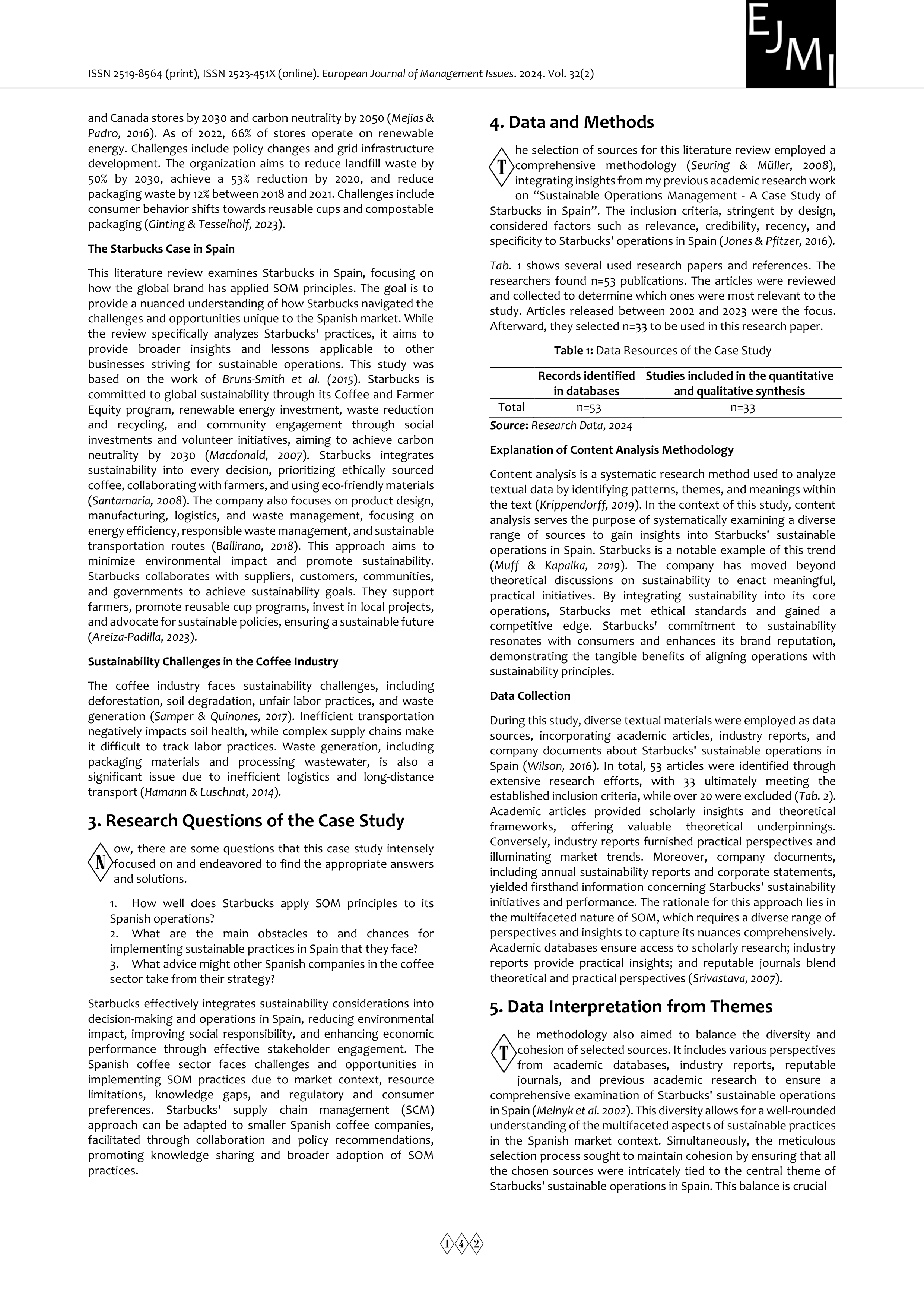
Tab. 1
shows several used research papers and references. The
researchers found n=53 publications. The articles were reviewed
and collected to determine which ones were most relevant to the
study. Articles released between 2002 and 2023 were the focus.
Afterward, they selected n=33 to be used in this research paper.
Table 1:
Data Resources of the Case Study
Records identified
in databases
Studies included in the quantitative
and qualitative synthesis
Total
n=53
n=33
Source
:
Research Data, 2024
Explanation of Content Analysis Methodology
Content analysis is a systematic research method used to analyze
textual data by identifying patterns, themes, and meanings within
the text (
Krippendorff, 2019
). In the context of this study, content
analysis serves the purpose of systematically examining a diverse
range of sources to gain insights into Starbucks' sustainable
operations in Spain. Starbucks is a notable example of this trend
(
Muff & Kapalka, 2019
). The company has moved beyond
theoretical discussions on sustainability to enact meaningful,
practical initiatives. By integrating sustainability into its core
operations, Starbucks met ethical standards and gained a
competitive edge. Starbucks' commitment to sustainability
resonates with consumers and enhances its brand reputation,
demonstrating the tangible benefits of aligning operations with
sustainability principles.
Data Collection
During this study, diverse textual materials were employed as data
sources, incorporating academic articles, industry reports, and
company documents about Starbucks' sustainable operations in
Spain (
Wilson, 2016
). In total, 53 articles were identified through
extensive research efforts, with 33 ultimately meeting the
established inclusion criteria, while over 20 were excluded (
Tab. 2
).
Academic articles provided scholarly insights and theoretical
frameworks,
offering
valuable
theoretical
underpinnings.
Conversely, industry reports furnished practical perspectives and
illuminating market trends. Moreover, company documents,
including annual sustainability reports and corporate statements,
yielded firsthand information concerning Starbucks' sustainability
initiatives and performance. The rationale for this approach lies in
the multifaceted nature of SOM, which requires a diverse range of
perspectives and insights to capture its nuances comprehensively.
Academic databases ensure access to scholarly research; industry
reports provide practical insights; and reputable journals blend
theoretical and practical perspectives (
Srivastava, 2007
).
5. Data Interpretation from Themes
he methodology also aimed to balance the diversity and
cohesion of selected sources. It includes various perspectives
from academic databases, industry reports, reputable
journals, and previous academic research to ensure a
comprehensive examination of Starbucks' sustainable operations
in Spain (
Melnyk et al. 2002
). This diversity allows for a well-rounded
understanding of the multifaceted aspects of sustainable practices
in the Spanish market context. Simultaneously, the meticulous
selection process sought to maintain cohesion by ensuring that all
the chosen sources were intricately tied to the central theme of
Starbucks' sustainable operations in Spain. This balance is crucial



ISSN 2519-8564 (print), ISSN 2523-451X (online).
European Journal of Management Issues
. 2024. Vol. 32(2)
Table 2:
Data Collection References
Author
Aim of the study/ Keywords
Dyllick & Hockerts (2002)
Beyond the business case for corporate sustainability. Business Strategy and the Environment
Melnyk et al. (2002)
Assessing the impact of environmental management systems on corporate and environmental
performance
Srivastava (2007)
Green supply‐chain management
Macdonald (2007)
Globalizing justice within coffee supply chains
Santamaría & Ni (2008)
Entry Modes of Starbucks
Carter & Rogers (2008)
A framework of sustainable supply chain management: moving toward new theory
Seuring & Müller (2008)
From a literature review to a conceptual framework for sustainable supply chain management
Molina‐Azorín et al. (2009)
Green management and financial performance: A literature review
Sarkis et al. (2009)
Stakeholder pressure and the adoption of environmental practices: The mediating effect of training
Gold et al. (2010)
Sustainable supply chain management and inter‐organizational resources: A literature review
Joo et al. (2010)
Comparative efficiencies of specialty coffee retailers from the perspectives of socially responsible global
sourcing
Carter & Lian Easton (2011)
Sustainable supply chain management: Evolution and future directions
Porter & Kramer (2011)
Sustainability, corporate social responsibility, and performance in the Spanish wine sector
Sarkis (2012)
Boundaries and flows perspective of green supply chain management
Seuring & Gold (2012)
Conducting content-analysis-based literature reviews in supply chain management
Walker & Jones (2012)
Sustainable supply chain management across the UK private sector
Lund-Thomsen & Lindgreen (2013)
Corporate Social Responsibility in Global Value Chains: Where Are We Now and Where Are We Going?
Hamann et al. (2014)
CSR in the coffee industry: Sustainability issues at Nestlé-Nespresso and Starbucks
Bruns-Smith et al. (2015)
Environmental sustainability in the hospitality industry: best practices, guest participation, and customer
satisfaction
Wilson (2016)
Research methods: Content analysis
Jones & Pfitzer (2016)
Beyond corporate social responsibility: Integrated external engagement
Mejías et al. (2016)
Efficiency and sustainability through the best practices in the logistics social responsibility framework
Machado et al. (2017)
Framing maturity based on sustainable operations management principles
Samper & Quiñones-Ruiz (2017)
Towards a balanced sustainability vision for the coffee industry
Ballirano (2018)
Article four and its evolution: the Starbucks' case
Krippendorff (2019)
Content analysis: An introduction to its methodology
Muff & Kapalka (2019)
The relationship of sustainability with mission, vision, and values statements: A content analysis of top
global companies
Mol (2019)
Sustainable business models: Five steps to business model innovation for sustainability
Pratama et al. (2019)
The effect of consumer-based brand equity and satisfaction on loyalty: An empirical study
Starbucks Corporation (2020)
Starbucks Global Responsibility Report
Areiza-Padilla & Puertas (2021)
Conspicuous consumption in emerging markets: The case of Starbucks in Colombia as a global and
sustainable brand
Shim et al. (2021)
Coffee shop corporate social responsibility (CSR) and reuse intention using triple bottom line theory
Ginting & Tesselhof (2023)
How does Starbucks implement the blockchain system in supply chain management to maintain its
product quality?
Source
:
Research Data, 2024
for presenting a coherent narrative, seamlessly weaving various
insights and perspectives into a unified exploration of Starbucks'
journey toward sustainability.
Adapting to the Unique Spanish Context
The SOM methodology prioritizes sources specific to the context.
This includes insights from previous academic work on Starbucks'
operations in Spain (
Jones & Pfitzer, 2016
). The decision to focus on
sources related to the Spanish market was made because
sustainability practices are influenced by cultural, regulatory, and
market dynamics unique to each geographical context. By
concentrating on sources directly related to the Spanish market,
this review provides detailed insights into how Starbucks manages
and adapts its sustainable operations to align with the intricacies
of the Spanish business environment.
6. Results
rom the research questions, the observation obtained from
the secondary data was as follows:
Question 1:
How well does Starbucks apply SOM principles to
its Spanish operations?
Positives:
Reports highlight initiatives for waste reduction,
sustainable sourcing, and investments in renewable energy.
Projects and collaborations involving community engagement are
highlighted in the media. Sustainability-focused employee
engagement programs are mentioned in stakeholder reports.
Uncertainties:
We need more information about how deeply SOM
principles are integrated into all operations. There are difficulties in
calculating
how
well
sustainability
practices
affect
the
environment, society, and economy insufficient. There is a need for
more data regarding the efficacy and impact of stakeholder
engagement on SOM implementation.
Question 2:
What are the main obstacles to and chances for
implementing sustainable practices in Spain that they face?
Opportunities:
According to government studies, Spanish
consumers' desire for sustainable coffee is rising. Initiatives from
the industry promote cooperation and information exchange for
sustainable practices—the possibility for legislative adjustments to
encourage SOM use, as sustainability evaluations recommend.
Challenges:
Spanish news reports highlight the bureaucratic and
regulatory barriers to sustainable practices. Industry reports
emphasize the resource constraints that smaller coffee businesses,
as opposed to Starbucks, face. Research points to a need for more
understanding regarding applying efficient SOM methods in the
industry.




ISSN 2519-8564 (print), ISSN 2523-451X (online).
European Journal of Management Issues
. 2024. Vol. 32(2)
Question 3:
What advice might other Spanish companies in the
coffee sector take from their strategy?
Suggestions for Other Spanish Coffee Businesses, Adaptability:
Smaller businesses can concentrate on doable strategies like waste
reduction, energy efficiency, and local sourcing catering to their
needs.
Cooperation:
To maximize impact, consider collaborating on joint
projects and knowledge-sharing with NGOs, trade associations,
and even Starbucks.
Advocacy and Compliance:
Use current incentives for sustainable
behaviors and push for regulations to support them.
Managerial Implications
Operational Integration of Sustainability
: Managers are therefore
encouraged to make sustainability a crucial element in core
business operations and emulate the Ethical Sourcing and Waste
Reduction strategies introduced by Starbucks. It is critical to
underline
the
difference
between
meeting
regulatory
requirements and the ability to produce significant sustainability
consequences.
Community Engagement as Strategic Pillar
: Organizations should
consider the worth of stakeholder relations beyond profit gains
and put in efforts to create opportunities that develop positive
relationships with the local stakeholders. Values-based corporate
citizenship through community engagement is instrumental in
brand social development and brand reputation building.
Efficiency and Resource Optimization
: Achieving strategic waste
capacity reductions minimizes ecological footprint and contributes
to
daily
operations'
efficiency.
Emphasizing
eco-friendly
approaches' financial and environmental advantages will help
attract stakeholders' support, strengthening the case for
sustainability.
Competitive Advantage through Sustainability
: Sustainability, when
positioned as a competitive advantage, will highlight the
observable benefits, such as brand reputation or customer loyalty.
Structuring industry collaboration to create sustainability
benchmarks propels the entire sector towards a greener
tomorrow.
7. Discussion
he significant findings in drawing the curtains on this
exploration are that the review illuminates Starbucks'
commendable efforts in integrating sustainability into its
operations within the Spanish market. The key findings
resonate with the company's successful journey, showcasing the
seamless integration of ethical sourcing, community engagement,
and waste reduction measures. Starbucks emerges as a compelling
case study, offering tangible evidence of the feasibility of
implementing sustainable operations in the dynamic and complex
realm of the food and beverage industry. The successful
incorporation of ethical sourcing signifies a commitment to
environmental and social responsibility, creating a positive ripple
effect throughout the supply chain. Simultaneously, community
engagement initiatives underscore Starbucks' recognition of its
role as a corporate citizen, contributing positively to the societal
fabric within which it operates. The implementation of waste
reduction measures not only aligns with environmental
stewardship but also underscores Starbucks' commitment to
operational efficiency and resource optimization.
The literature review on Starbucks' sustainable operations in Spain
adopted a methodological approach, using strict inclusion and
exclusion criteria to select only the most relevant sources. This
approach increases the reliability of information and allows for a
more in-depth examination of Starbucks' sustainable practices in
the Spanish market. The structure begins with exploring Starbucks'
early sustainability initiatives in Spain, providing a historical
context. The review delineated key phases in Starbucks'
sustainability
journey,
encapsulating
the
strategies
and
approaches adopted during each period. A noteworthy trend in the
overall scholarship on sustainable operations management is the
shift from theoretical frameworks to practical case studies.
Companies, including Starbucks, are now positioning sustainability
as a strategic imperative, leveraging it not only as corporate
responsibility but also as a source of competitive advantage (
Dyllick
& Hockerts, 2002; Melnyk et al., 2003; Seuring & Müller, 2008; Molina-
Azorín et al., 2009; Gold et al., 2010; Joo et al., 2010; Sarkis et al., 2009;
Carter & Lian Easton, 2011; Porter & Kramer, 2011; Sarkis, 2012; Walker
& Jones, 2012; Seuring & Gold, 2012; Jones & Pfitzer, 2016; Mol, 2019;
Starbucks Corporation, 2020
).
8. Conclusion
t summarizes the essential discoveries, points out the current
knowledge gaps, and suggests future directions for
sustainable operations management. Starbucks' journey in
Spain is a dynamic story that encourages continued
investigation and analysis rather than just being a static case study.
The review's conclusion invites academics and industry
professionals to expand on the established groundwork and
promotes the ongoing advancement of knowledge regarding
sustainable business practices.
The importance of integrating sustainability into core business
operations for long-term success. Starbucks' journey in Spain is a
benchmark for other companies, offering lessons applicable across
industries and geographical contexts. It serves as a springboard for
future research, highlighting current gaps and unexplored avenues
in sustainable operations management.
9. Acknowledgments
he investigators thank C3S Business School in Barcelona,
Spain, for their plentiful research support.
10. Funding
his study received no specific financial support.
11. Competing interests
he authors declare that they have no competing interests.
Contributions of Authors
Mehrad A., Adiewere F. C., Bouzedif M., Rweramila N. G. –
conducted the research by developing the research theory,
completing the research methodology and data analysis; involved
in drafting the article.
Mehrad A. – supervised the entire research process and approved
the final version of the manuscript; completed all the manuscripts
and corresponded with the article.
References
Areiza-Padilla, J. A., & Manzi Puertas, M. A. (2021). Conspicuous
consumption in emerging markets: The case of Starbucks in
Colombia as a global and sustainable brand.
Frontiers in
Psychology
, 12, 662950.
Ballirano, M. V. (2018). The article four and its evolution: the
starbucks' case.
Bruns-Smith, A., Choy, V., Chong, H., & Verma, R. (2015).
Environmental sustainability in the hospitality industry: Best
practices, guest participation, and customer satisfaction.
Carter, C. R., & Liane Easton, P. (2011). Sustainable supply chain
management: evolution and future directions.
International
Journal of Physical Distribution & Logistics Management
, 41(1),
46–62.
https://doi.org/10.1108/09600031111101420
.



ISSN 2519-8564 (print), ISSN 2523-451X (online).
European Journal of Management Issues
. 2024. Vol. 32(2)
Carter, C. R., & Rogers, D. S. (2008). A framework of sustainable
supply chain management: moving toward new theory.
International Journal of Physical Distribution & Logistics
Management,
38(5),
360–387.
https://doi.org/10.1108/09600030810882816
.
Dyllick, T., & Hockerts, K. (2002). Beyond the business case for
corporate
sustainability.
Business
Strategy
and
the
Environment,
11(2),
130–141.
Portico.
https://doi.org/10.1002/bse.323
.
Ginting, V. N. S., & Tesselhof, K. (2023). How does Starbucks
implement the blockchain system in supply chain management
to maintain its product quality?
Diponegoro Journal of
Accounting
,
12(4).
Retrieved
from
https://ejournal3.undip.ac.id/index.php/accounting/article/vie
w/41643
.
Gold, S., Seuring, S., & Beske, P. (2010). Sustainable supply chain
management and inter‐organizational resources: a literature
review.
Corporate Social Responsibility and Environmental
Management
,
17(4),
230–245.
Portico.
https://doi.org/10.1002/csr.207
.
Hamann, L., Luschnat, K., Niemuth, S., Smolarz, P., & Golombek, S.
(2014). CSR in the Coffee Industry: Sustainability Issues at
Nestlé-Nespresso and Starbucks.
Journal of European
Management
&
Public
Affairs
Studies
.
https://doi.org/10.15771/2199-1618_2014_2_1_5
.
Joo, S., Min, H., Kwon, I. G., & Kwon, H. (2010). Comparative
efficiencies of specialty coffee retailers from the perspectives
of socially responsible global sourcing.
The International
Journal
of
Logistics
Management
,
21(3),
490–509.
https://doi.org/10.1108/09574091011089826
.
Jones, C., & Pfitzer, M. (2016). Beyond corporate social
responsibility: Integrated external engagement.
Stanford
Social
Innovation
Review
.
Retrieved
from
https://ssir.org/articles/entry/beyond_corporate_social_respo
nsibility_integrated_external_engagement
.
Krippendorff, K. (2019). Content Analysis: An Introduction to Its
Methodology.
https://doi.org/10.4135/9781071878781
.
Lund-Thomsen, P., & Lindgreen, A. (2013). Corporate Social
Responsibility in Global Value Chains: Where Are We Now and
Where Are We Going?
Journal of Business Ethics
, 123(1), 11–22.
https://doi.org/10.1007/s10551-013-1796-x
.
Macdonald, K. (2007). Globalising justice within coffee supply
chains? Fair Trade, Starbucks and the transformation of supply
chain governance.
Third World Quarterly
, 28(4), 793–812.
https://doi.org/10.1080/01436590701336663
.
Machado, C. G., Pinheiro de Lima, E., Gouvea da Costa, S. E.,
Angelis, J. J., & Mattioda, R. A. (2017). Framing maturity based
on
sustainable
operations
management
principles.
International Journal of Production Economics
, 190, 3–21.
https://doi.org/10.1016/j.ijpe.2017.01.020
.
Melnyk, S. A., Sroufe, R. P., & Calantone, R. (2002). Assessing the
impact of environmental management systems on corporate
and environmental performance.
Journal of Operations
Management
,
21(3),
329–351.
Portico.
https://doi.org/10.1016/s0272-6963(02)00109-2
.
Mejías, A. M., Paz, E., & Pardo, J. E. (2016). Efficiency and
sustainability through the best practices in the Logistics Social
Responsibility framework.
International Journal of Operations
&
Production
Management
,
36(2),
164–199.
https://doi.org/10.1108/ijopm-07-2014-0301
.
Mol, M. J. (2019). Sustainable business models: Five steps to
business model innovation for sustainability.
Organization &
Environment
, 32(1), 54-76.
Molina‐Azorín, J. F., Claver‐Cortés, E., López‐Gamero, M. D., & Tarí,
J. J. (2009). Green management and financial performance: a
literature review.
Management Decision
, 47(7), 1080–1100.
https://doi.org/10.1108/00251740910978313
.
Muff, K., & Kapalka, D. (2019). The relationship of sustainability
with mission, vision, and values statements: A content analysis
of top global companies.
Sustainable Development
, 27(5), 881-
892.
Porter, M. E., & Kramer, M. R. (2011).
The big idea: Creating shared
value
.
Pratama, M. A., Siregar, R. P. S., & Sihombing, S. O. (2019). The
Effect of Consumer-Based Brand Equity and Satisfaction on
Loyalty: An Empirical Study.
Jurnal Economia
, 15(2), 275–291.
https://doi.org/10.21831/economia.v15i2.27314
.
Samper, L., & Quiñones-Ruiz, X. (2017). Towards a Balanced
Sustainability Vision for the Coffee Industry.
Resources
, 6(2), 17.
https://doi.org/10.3390/resources6020017
.
Santamaría, B., & Ni, S. (2008).
Entry modes of Starbucks. Master of
International Business and Entrepreneurship Thesis
. School of
Sustainable Development of Society and Technology.
Västerås: Malardalen University.
Sarkis, J. (2012). A boundaries and flows perspective of green
supply chain management.
Supply Chain Management: An
International
Journal
,
17(2),
202–216.
https://doi.org/10.1108/13598541211212924
.
Sarkis, J., Gonzalez‐Torre, P., & Adenso‐Diaz, B. (2009).
Stakeholder pressure and the adoption of environmental
practices: The mediating effect of training.
Journal of
Operations
Management
,
28(2),
163–176.
Portico.
https://doi.org/10.1016/j.jom.2009.10.001
.
Seuring, S., & Gold, S. (2012). Conducting content‐analysis based
literature reviews in supply chain management.
Supply Chain
Management: An International Journal,
17(5), 544–555.
https://doi.org/10.1108/13598541211258609
.
Seuring, S., & Müller, M. (2008). From a literature review to a
conceptual
framework
for
sustainable
supply
chain
management.
Journal of cleaner production
, 16(15), 1699-1710.
https://doi.org/10.1016/j.jclepro.2008.04.020
.
Shim, J. M., Lee, W. S., Moon, J., & Song, M. (2021). Coffee shop
corporate social responsibility (CSR) and reuse intention using
triple bottom line theory.
British Food Journal
, 123(12), 4421–
4435.
https://doi.org/10.1108/bfj-12-2020-1134
.
Srivastava, S. K. (2007). Green supply‐chain management: A state‐
of‐the‐art
literature
review.
International
Journal
of
Management
Reviews
,
9(1),
53–80.
Portico.
https://doi.org/10.1111/j.1468-2370.2007.00202.x
.
Starbucks Corporation. (2020). Starbucks Global Responsibility
Report.
Walker, H., & Jones, N. (2012). Sustainable supply chain
management across the UK private sector.
Supply Chain
Management:
An
International
Journal
,
17(1),
15–28.
https://doi.org/10.1108/13598541211212177
.
Wilson, V. (2016). Research Methods: Content Analysis. Evidence
Based Library and Information Practice, 11(1(S)), 41–43.
https://doi.org/10.18438/b8cg9d
.
This is an open access journal and all published articles are licensed under a
Creative Commons «Attribution» 4.0.


ISSN 2519-8564 (print), ISSN 2523-451X (online).
European Journal of Management Issues
. 2024. Vol. 32(2)