
Sustainability Business Model Tesla Motors
Muhammad Wijdan Hilmy Yahdiyani, Asep Safari, and Lokita Rizky Megawati
(
B
)
School of Business, IPB University, Bogor, Indonesia
lokita.rizky@apps.ipb.ac.id
Abstract.
Tesla
is
building
not
only
all-electric
vehicles,
but
also
clean
energy
generation and storage products that are scalable indefinitely. Tesla uses Market
Driven Strategy as one of the strategies in developing its business. This study aims
to analyse how is the market driven strategy carried out by Tesla to achieve a sus-
tainability business model. The method used is a qualitative method in the form
of literature review from various journals in previous research. Based on its four
characteristics, namely becoming market oriented, distinctive capabilities, creat-
ing customer value, and superior performance, it can be said that Tesla Motors has
achieved superior performance. Tesla Motors has been successful in implementing
a strategy with a market approach based on the opportunities, threats, advantages,
and even weaknesses of the company.
Keywords:
Market Driven Strategy
·
Tesla Motors
·
Strategy
·
Sustainability
1
Introduction
In
this
day
and
age,
business
activities
are
very
diverse,
ranging
from
different
com-
modities to different marketing techniques. Along with the times, business competition
will
also
increase.
A
business
in
order
to
survive
in
the
long
term
is
required
to
have
high
fighting
power
in
order
to
survive
in
this
increasingly
fierce
market
competition.
Therefore, it is important for a company to build a strong marketing strategy so that it
can stand on top in the intense market competition.
In life there is a principle, “If you do the same thing over and over again and expect
different
results,
then
the
action
is
Insanity
(madness)”.
This
is
an
important
thing
in
the life of marketing. So that in marketing if you only market the product repeatedly in
the same way then the product will not be possible to increase sales because when you
only market the product in the same way, competitors will give more than what we have
given so that we will not complete. Therefore, in this paper, we will examine the Market
Driven Strategy as a marketing strategy that can be used so that businesses can stand tall
in the long term. As a case study, it will examine the Tesla Motors company and how
the Tesla Motors company applies the concept of Market Driven Strategy.
2
Materials and Methods
2.1
Market Driven Strategy
Market
Driven
Strategy
can be
said to be
a market-oriented
strategy
that includes
3C,
namely Companies, Customers, and Competitors who strive to provide superior value
© The Author(s) 2023
S. Jahroh et al. (Eds.): BIEC 2022, AEBMR 236, pp. 325–334, 2023.
https://doi.org/10.2991/978-94-6463-144-9
_
32
326
M. W. H. Yahdiyani et al.
for their customers to gain an advantageous position in the market because their main
orientation
is
to
improve
market
access.
The
fundamental
thing
for
implementing
a
market-driven strategy is to obtain information about potential demand or market poten-
tial
as
an
information
base
for
selecting,
formulating,
and
implementing
competitive
advantage strategies with a wider market. Market-based management as the activity of
learning, understanding, and responding to the perceptions and behaviors of stakehold-
ers
in
a
particular
market
structure
[
1
].
Market-driven
refers
to
a
business
orientation
that is based on understanding and reacting to customer preferences and behavior in a
particular market structure through conducting market research and providing continu-
ous innovation. This orientation is closely related to the acquisition of information and
knowledge
about
customers
and
competitors,
which
enables
the
company
to
generate
product innovations and maintain a competitive advantage.
In every business strategy decision, it must begin with a clear understanding of the
market, customers, and competitors. The market and customers that make up the market
should be the starting point for building a business strategy. The characteristics of market
driven strategy can be identified into four identities, including becoming market oriented,
distinctive capabilities, creating customer value, and superior performance [
2
].
2.2
Becoming Market Oriented
Market orientation in a company can be regarded as the culture of the company’s orga-
nization. Market orientation is a shared set of beliefs and values that place the customer
at the center of a firm’s thinking about strategy and operations [
3
]. Market orientation is
a business perspective that makes consumers the focal point of all company operations.
A company is market-oriented if it has a culture and commitment to continuously create
superior customer value. Market orientation consists of three, namely customer orienta-
tion, competitor orientation, and inter-functional coordination. These three things when
combined will provide an advantage in competing in the market [
4
].
2.3
Distinctive Capabilities
A company that adheres to a market-driven strategy must apply the identity of distinctive
capabilities in its business activities. A resource is categorized as distinctive capabilities
if
it
is
superior,
difficult
to
imitate
and
can
be
used
in
various
competitive
situations
[
5
]. Resources like this are a source of company advantage and are effective if they can
match the demands of consumers. Therefore, understanding the distinctive capabilities
and how to relate them to consumer value demands is important to consider in the design
of marketing strategies.
2.4
Creating Customer Value
Customer value is the result of a process that begins with a business strategy based on a
deep understanding of customer needs. Customer value literally means customer value,
which means the value given by customers for a particular product or service. Customers
today have a strong value orientation who seek quality and results that exceed the price
Sustainability Business Model Tesla Motors
327
they
have
paid
for
a
product
or
service,
causing
a
lot
of
confusion
in
the
calculation
of
customer
value
according
to
the
price
given
[
6
].
Many
companies
have
suggested
pricing
based
on
perceived
customer
value
rather
than
traditional
cost-based
pricing.
Thus, pricing should not only be about setting prices based on cost and competition, but
about justifying prices based on perceived value [
6
].
2.5
Method
The method used is the Traditional Review, which is a literature review method that has
been commonly carried out and the results are found in many existing survey papers. So
that a review of scientific works is carried out specifically on one topic and selects the
known literature. The literature support used to identify how the state of fintech in the
pay later feature is summarized in the following topic.
3
The Result and Discussion
3.1
Tesla Motors Overview
Tesla was founded in 2003 by a group of engineers who wanted to prove that people don’t
have
to
compromise
to
drive
electric
–
that
electric
vehicles
can
be
better,
faster,
and
more fun to drive than petrol cars. Today, Tesla is building not only all-electric vehicles,
but
also
clean
energy
generation
and
storage
products
that
are
scalable
indefinitely.
Tesla
believes
the
sooner
the
world
stops
relying
on
fossil
fuels
and
moves
towards
a
zero-emissions future, the better.
Tesla vehicles are manufactured at its factories in Fremont, California, and the Shang-
hai Gigafactory. To achieve our goal of having the safest factory in the world, Tesla takes
a proactive approach to safety, requiring production employees to participate in a training
program several days before setting foot on the factory floor. From there, Tesla continues
to provide on-the-job training and track performance on a daily basis so that improve-
ments can be made quickly. The result is that Tesla’s safety levels continue to increase
as production increases.
In addition to vehicles, Tesla also produces a unique set of energy solutions, Pow-
erwall,
Powerpack,
and
Solar
Roof,
that
enable
home,
business,
and
utility
owners
to
manage the generation, storage, and consumption of renewable energy. To support auto-
motive and energy products, Tesla uses Gigafactory 1, a facility designed to significantly
reduce battery cell costs [
7
]. By bringing cell production in-house, Tesla is producing
batteries
at
the
volumes
needed
to
meet
production
goals,
while
creating
thousands
of jobs. With Tesla building its most affordable cars, Tesla continues to make products
accessible and affordable to more people, ultimately accelerating the emergence of clean
transportation and clean energy production.
3.2
External Environmental Analysis
PESTEL
analysis
(Political,
Economic,
Sociocultural,
Technological,
Environmental,
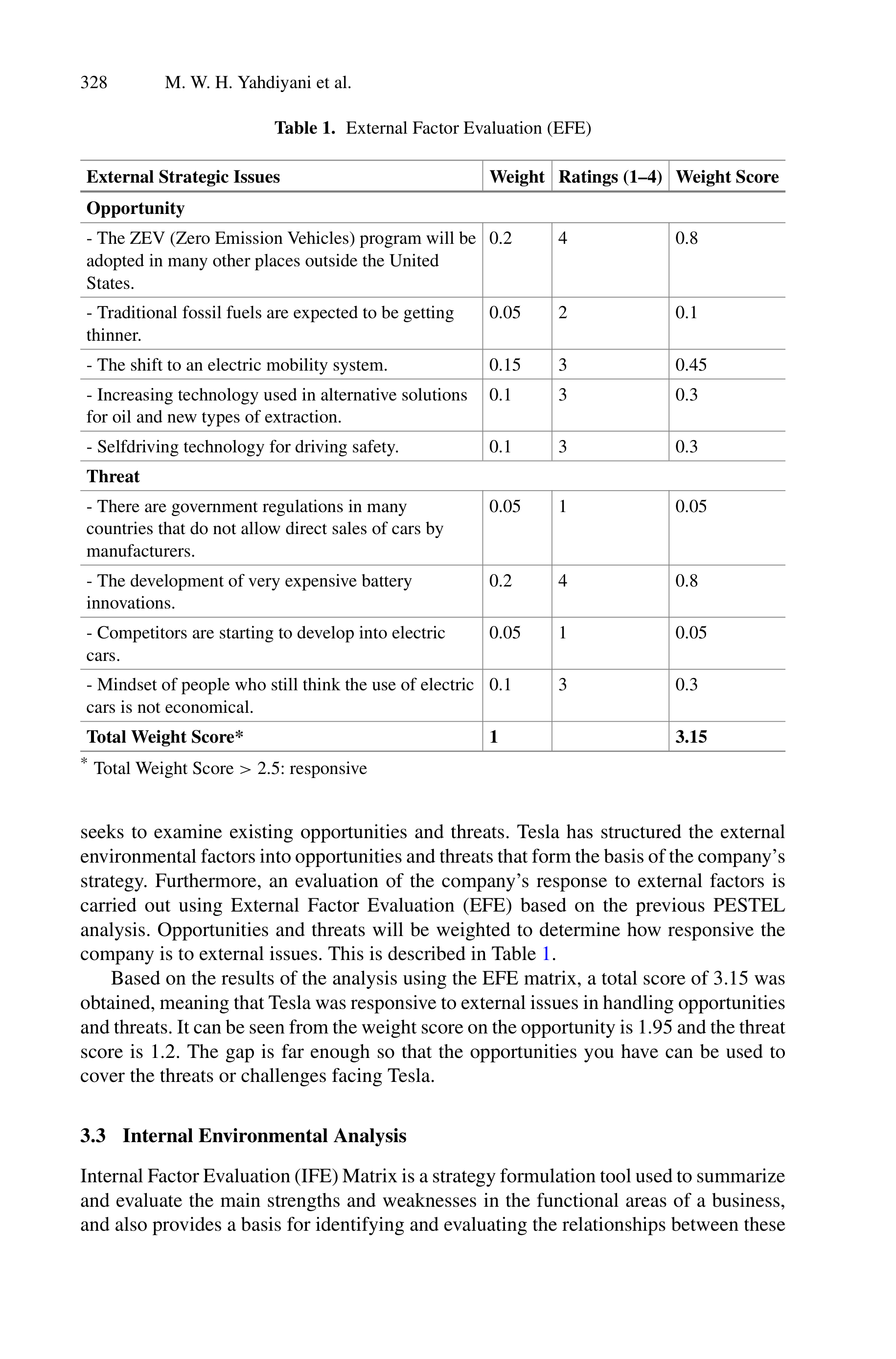
Legal) is a tool used to see the big picture of the company’s external environment, and
328
M. W. H. Yahdiyani et al.
Table 1.
External Factor Evaluation (EFE)
External Strategic Issues
Weight
Ratings (1–4)
Weight Score
Opportunity
- The ZEV (Zero Emission Vehicles) program will be
adopted in many other places outside the United
States.
0.2
4
0.8
- Traditional fossil fuels are expected to be getting
thinner.
0.05
2
0.1
- The shift to an electric mobility system.
0.15
3
0.45
- Increasing technology used in alternative solutions
for oil and new types of extraction.
0.1
3
0.3
- Selfdriving technology for driving safety.
0.1
3
0.3
Threat
- There are government regulations in many
countries that do not allow direct sales of cars by
manufacturers.
0.05
1
0.05
- The development of very expensive battery
innovations.
0.2
4
0.8
- Competitors are starting to develop into electric
cars.
0.05
1
0.05
- Mindset of people who still think the use of electric
cars is not economical.
0.1
3
0.3
Total Weight Score*
1
3.15
*
Total Weight Score
>
2.5: responsive
seeks
to
examine
existing
opportunities
and
threats.
Tesla
has
structured
the
external
environmental factors into opportunities and threats that form the basis of the company’s
strategy.
Furthermore,
an
evaluation
of
the
company’s
response
to
external
factors
is
carried
out
using
External
Factor
Evaluation
(EFE)
based
on
the
previous
PESTEL
analysis.
Opportunities
and
threats
will
be
weighted
to
determine
how
responsive
the
company is to external issues. This is described in Table
1
.
Based on the results of the analysis using the EFE matrix, a total score of 3.15 was
obtained, meaning that Tesla was responsive to external issues in handling opportunities
and threats. It can be seen from the weight score on the opportunity is 1.95 and the threat
score
is
1.2.
The
gap
is
far
enough
so
that
the
opportunities
you
have
can
be
used
to
cover the threats or challenges facing Tesla.
3.3
Internal Environmental Analysis
Internal Factor Evaluation (IFE) Matrix is a strategy formulation tool used to summarize
and
evaluate
the
main
strengths
and
weaknesses
in
the
functional
areas
of
a
business,
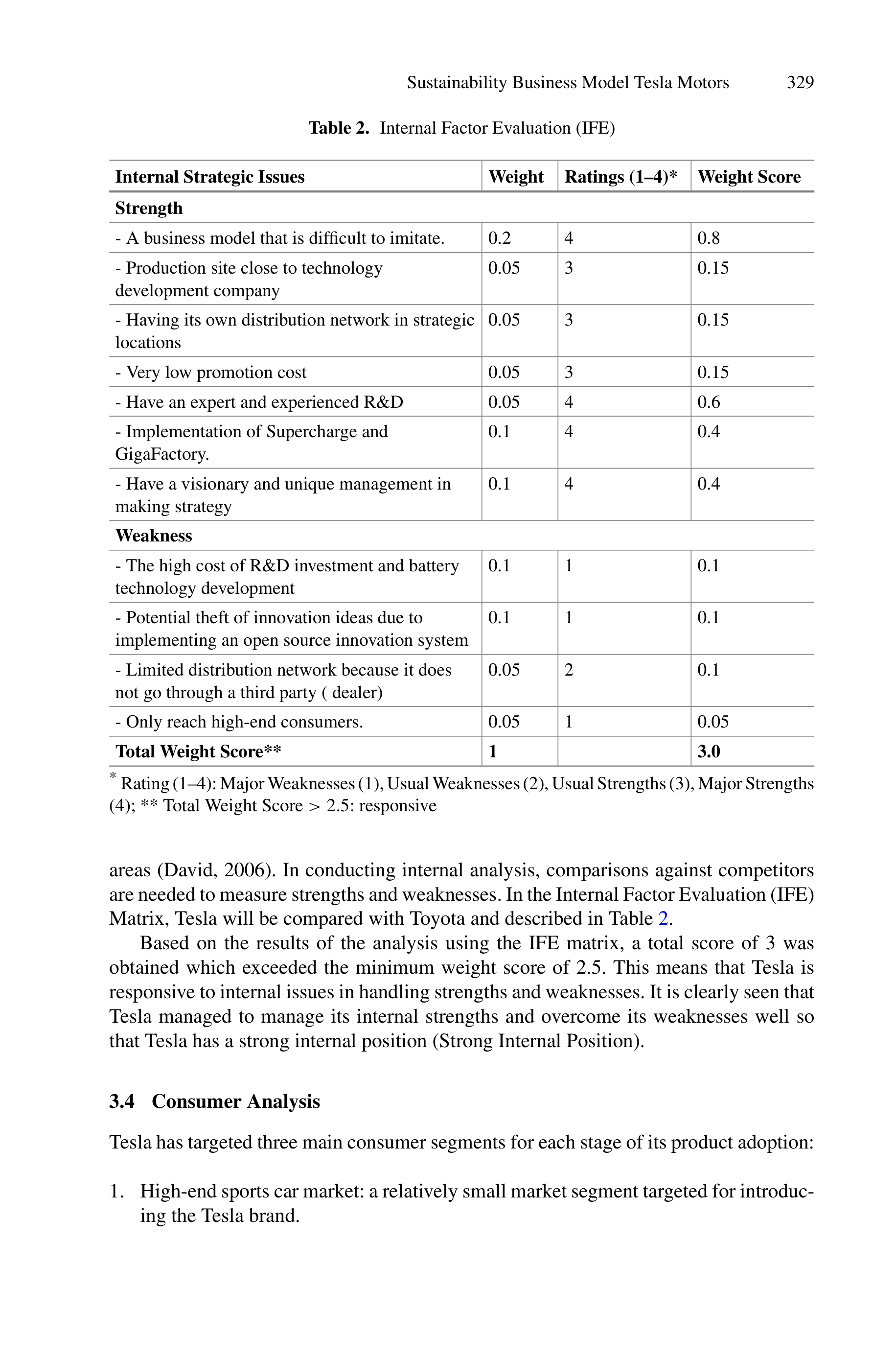
and also provides a basis for identifying and evaluating the relationships between these
Sustainability Business Model Tesla Motors
329
Table 2.
Internal Factor Evaluation (IFE)
Internal Strategic Issues
Weight
Ratings (1–4)*
Weight Score
Strength
- A business model that is difficult to imitate.
0.2
4
0.8
- Production site close to technology
development company
0.05
3
0.15
- Having its own distribution network in strategic
locations
0.05
3
0.15
- Very low promotion cost
0.05
3
0.15
- Have an expert and experienced R&D
0.05
4
0.6
- Implementation of Supercharge and
GigaFactory.
0.1
4
0.4
- Have a visionary and unique management in
making strategy
0.1
4
0.4
Weakness
- The high cost of R&D investment and battery
technology development
0.1
1
0.1
- Potential theft of innovation ideas due to
implementing an open source innovation system
0.1
1
0.1
- Limited distribution network because it does
not go through a third party ( dealer)
0.05
2
0.1
- Only reach high-end consumers.
0.05
1
0.05
Total Weight Score**
1
3.0
*
Rating (1–4): Major Weaknesses (1), Usual Weaknesses (2), Usual Strengths (3), Major Strengths
(4); ** Total Weight Score
>
2.5: responsive
areas (David, 2006). In conducting internal analysis, comparisons against competitors
are needed to measure strengths and weaknesses. In the Internal Factor Evaluation (IFE)
Matrix, Tesla will be compared with Toyota and described in Table
2
.
Based
on
the
results
of
the
analysis
using
the
IFE
matrix,
a
total
score
of
3
was
obtained
which
exceeded
the
minimum
weight
score
of
2.5.
This
means
that
Tesla
is
responsive to internal issues in handling strengths and weaknesses. It is clearly seen that
Tesla
managed
to
manage
its
internal
strengths
and
overcome
its
weaknesses
well
so
that Tesla has a strong internal position (Strong Internal Position).
3.4
Consumer Analysis
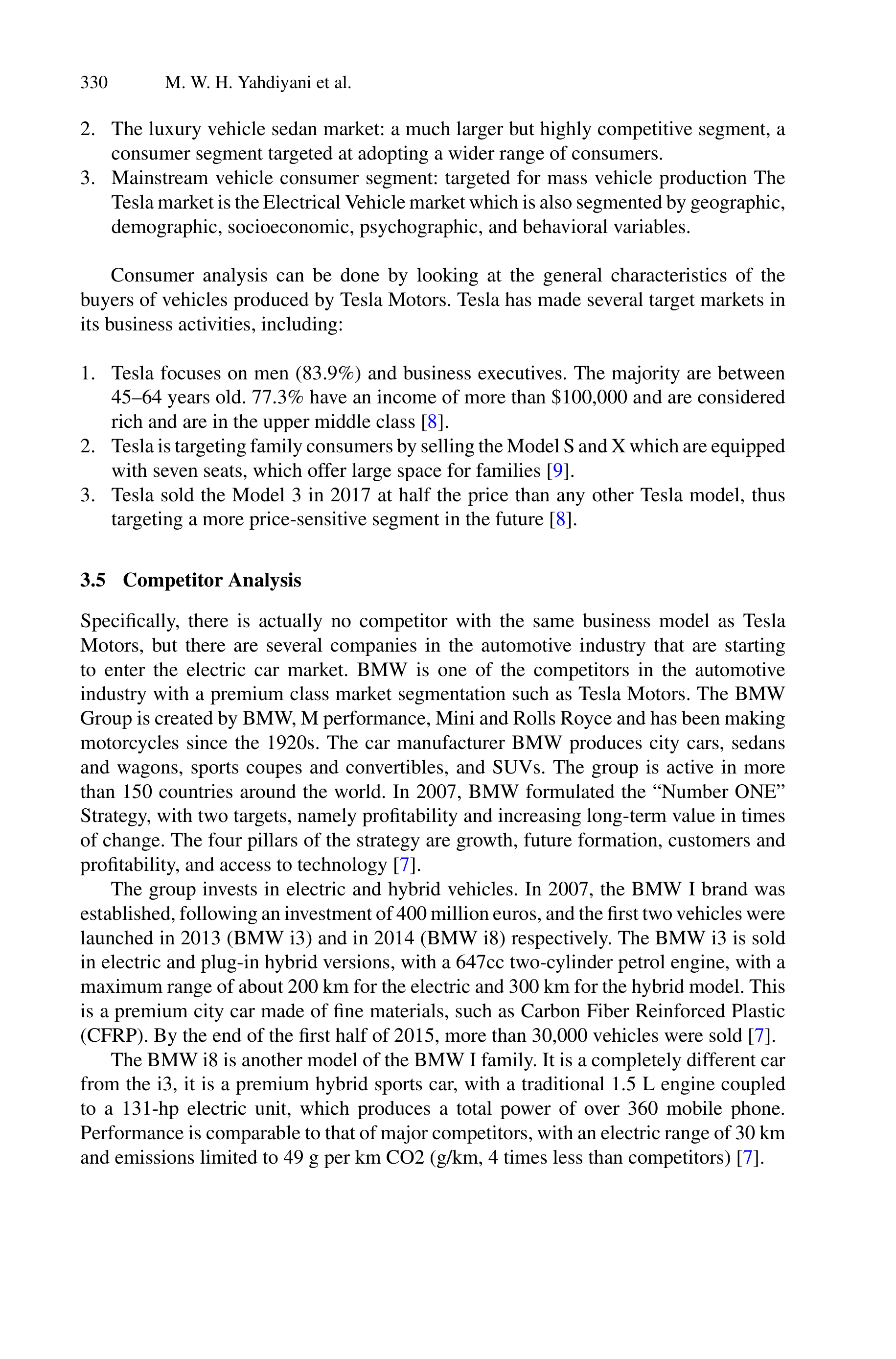
Tesla has targeted three main consumer segments for each stage of its product adoption:
1.
High-end sports car market: a relatively small market segment targeted for introduc-
ing the Tesla brand.
330
M. W. H. Yahdiyani et al.
2.
The luxury vehicle sedan market: a much larger but highly competitive segment, a
consumer segment targeted at adopting a wider range of consumers.
3.
Mainstream
vehicle
consumer
segment:
targeted
for
mass
vehicle
production
The
Tesla market is the Electrical Vehicle market which is also segmented by geographic,
demographic, socioeconomic, psychographic, and behavioral variables.
Consumer
analysis
can
be
done
by
looking
at
the
general
characteristics
of
the
buyers of vehicles produced by Tesla Motors. Tesla has made several target markets in
its business activities, including:
1.
Tesla
focuses
on
men
(83.9%)
and
business
executives.
The
majority
are
between
45–64 years old. 77.3% have an income of more than $100,000 and are considered
rich and are in the upper middle class [
8
].
2.
Tesla is targeting family consumers by selling the Model S and X which are equipped
with seven seats, which offer large space for families [
9
].
3.
Tesla
sold
the
Model
3
in
2017
at
half
the
price
than
any
other
Tesla
model,
thus
targeting a more price-sensitive segment in the future [
8
].
3.5
Competitor Analysis
Specifically,
there
is
actually
no
competitor
with
the
same
business
model
as
Tesla
Motors,
but
there
are
several
companies
in
the
automotive
industry
that
are
starting
to
enter
the
electric
car
market.
BMW
is
one
of
the
competitors
in
the
automotive
industry
with
a
premium
class
market
segmentation
such
as
Tesla
Motors.
The
BMW
Group is created by BMW, M performance, Mini and Rolls Royce and has been making
motorcycles
since
the
1920s.
The
car
manufacturer
BMW
produces
city
cars,
sedans
and
wagons,
sports
coupes
and
convertibles,
and
SUVs.
The
group
is
active
in
more
than
150
countries
around
the
world.
In
2007,
BMW
formulated
the
“Number
ONE”
Strategy, with two targets, namely profitability and increasing long-term value in times
of change. The four pillars of the strategy are growth, future formation, customers and
profitability, and access to technology [
7
].
The
group
invests
in
electric
and
hybrid
vehicles.
In
2007,
the
BMW
I
brand
was
established, following an investment of 400 million euros, and the first two vehicles were
launched in 2013 (BMW i3) and in 2014 (BMW i8) respectively. The BMW i3 is sold
in electric and plug-in hybrid versions, with a 647cc two-cylinder petrol engine, with a
maximum range of about 200 km for the electric and 300 km for the hybrid model. This
is a premium city car made of fine materials, such as Carbon Fiber Reinforced Plastic
(CFRP). By the end of the first half of 2015, more than 30,000 vehicles were sold [
7
].
The BMW i8 is another model of the BMW I family. It is a completely different car
from the i3, it is a premium hybrid
sports car, with a traditional
1.5 L engine
coupled
to
a
131-hp
electric
unit,
which
produces
a
total
power
of
over
360
mobile
phone.
Performance is comparable to that of major competitors, with an electric range of 30 km
and emissions limited to 49 g per km CO2 (g/km, 4 times less than competitors) [
7
].
Sustainability Business Model Tesla Motors
331
3.6
Competitor Analysis
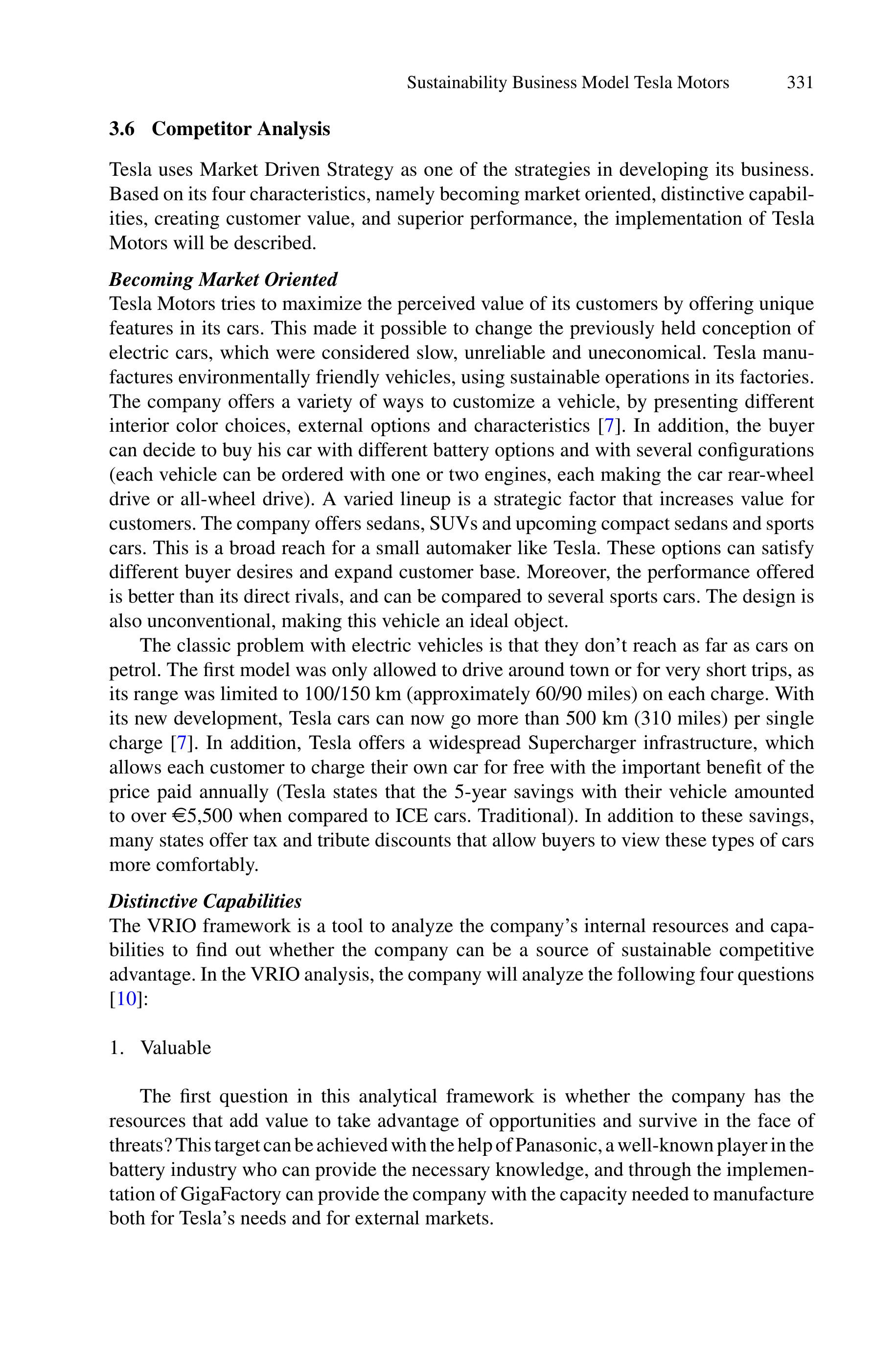
Tesla
uses
Market
Driven
Strategy
as
one
of
the
strategies
in
developing
its
business.
Based on its four characteristics, namely becoming market oriented, distinctive capabil-
ities,
creating
customer
value,
and
superior
performance,
the
implementation
of
Tesla
Motors will be described.
Becoming Market Oriented
Tesla Motors tries to maximize the perceived value of its customers by offering unique
features
in
its
cars.
This
made
it
possible
to
change
the
previously
held
conception
of
electric
cars,
which
were
considered
slow,
unreliable
and
uneconomical.
Tesla
manu-
factures environmentally friendly vehicles, using sustainable operations in its factories.
The
company
offers
a
variety
of
ways
to
customize
a
vehicle,
by
presenting
different
interior
color
choices,
external
options
and
characteristics
[
7
].
In
addition,
the
buyer
can decide to buy his car with different battery options and with several configurations
(each vehicle can be ordered with one or two engines, each making the car rear-wheel
drive
or
all-wheel
drive).
A
varied
lineup
is
a
strategic
factor
that
increases
value
for
customers. The company offers sedans, SUVs and upcoming compact sedans and sports
cars. This is a broad reach for a small automaker like Tesla. These options can satisfy
different buyer
desires and expand
customer
base.
Moreover,
the performance
offered
is better than its direct rivals, and can be compared to several sports cars. The design is
also unconventional, making this vehicle an ideal object.
The classic problem with electric vehicles is that they don’t reach as far as cars on
petrol. The first model was only allowed to drive around town or for very short trips, as
its range was limited to 100/150 km (approximately 60/90 miles) on each charge. With
its new development, Tesla cars can now go more than 500 km (310 miles) per single
charge
[
7
].
In
addition,
Tesla
offers
a
widespread
Supercharger
infrastructure,
which
allows each customer to charge their own car for free with the important benefit of the
price
paid
annually
(Tesla
states
that
the
5-year
savings
with
their
vehicle
amounted
to over
e
5,500 when compared to ICE cars. Traditional). In addition to these savings,
many states offer tax and tribute discounts that allow buyers to view these types of cars
more comfortably.
Distinctive Capabilities
The VRIO framework is a tool to analyze
the company’s
internal resources and capa-
bilities
to
find
out
whether
the
company
can
be
a
source
of
sustainable
competitive
advantage. In the VRIO analysis, the company will analyze the following four questions
[
10
]:
1.
Valuable
The
first
question
in
this
analytical
framework
is
whether
the
company
has
the
resources
that
add
value
to
take
advantage
of
opportunities
and
survive
in
the
face
of
threats?ThistargetcanbeachievedwiththehelpofPanasonic,awell-knownplayerinthe
battery industry who can provide the necessary knowledge, and through the implemen-
tation of GigaFactory can provide the company with the capacity needed to manufacture
both for Tesla’s needs and for external markets.
332
M. W. H. Yahdiyani et al.
2.
Rare
Resources
that
can
only
be
obtained
by
one
or
very
few
companies
are
resources
that are considered scarce. Tesla has registered a new system that allows its vehicles to
reach up to 400 miles (about 640 km) on a single charge, thereby competing on an equal
footing with traditional-engined cars. This patented battery system combines metal-air
with traditional lithium-ion batteries, where the former is used as a generator to recharge
the
latter,
as
is
the
case
with
hybrid
cars,
which
use
a
traditional
gasoline
engine
to
recharge the battery.
3.
Inimitable
Resources that have a high cost will be difficult to imitate, buy, and replace by com-
petitors. In the case of imitation, competitors have two ways, namely by directly imitating
/ duplicating resources and providing comparable products or services. Tesla’s focus on
electric cars with strong R&D and network, especially collaboration with Panasonic in
producing
advanced
batteries,
is
a
value
that
is
difficult
to
imitate
because
innovation
will always be developed.
4.
Organized to Captured Value
Resources
themselves
do
not
provide
any
benefit
to
the
company
if
it
is
not
orga-
nized
to capture
value
from them. A company
must manage
its management
systems,
processes, policies, structures and organizational culture to fully realize its valuable, rare
and expensive potential in order to achieve a sustainable competitive advantage. Tesla
has an inherent value in its HR, this is because Tesla CEO, Elon Musk, has a unique and
visionary view. The management system and policies that are made always look at the
opportunities and threats that exist. The strategy made always pays attention to existing
internal and external changes. This proves that Tesla is a well-organized company from
various sides.
Based
on
the
VRIO
analysis,
Tesla
has
met
all
the
VRIO
criteria.
One
of
Tesla’s
most prominent criteria is to consider the resource that best meets the VRIO criteria is
Inimitable.
Creating Customer Value
Tesla Motors to create customer value is done in several unique ways and competitors
do not. First, it offers several test drives at Tesla public events, so that potential buyers
feel the difference between driving a Tesla versus a traditional car. Tesla cars, especially
the Model S, were rated as the best car in the annual customer satisfaction rankings in
2013 and 2014 by Consumer Report.
Second, the key to creating lasting brand loyalty is transparency. In the auto sector,
no one does this better than Tesla. The company has enhanced its reputation for quality
and
customer
support
by
reaching
out
to
its
consumers
through
social
media
and
the
Tesla blog. Thanks to this transparency, buyers feel like they are personally connected to
the automaker. For example, in August 2014, two Tesla drivers submitted an open letter
to Elon Musk through a California newspaper proposing some changes to the vehicle to
Sustainability Business Model Tesla Motors
333
be made. The founder himself responded on Twitter by saying that some changes will
be included in future production vehicles.
Another
strong
point
in
Tesla’s
relationship
with
its
customer
base
is
Tesla’s
Best
Resale Value Guarantee Program. This consists in keeping the value of the company’s
cars higher than the premium competitor cars in the market. This guarantee is co-created
with
Wells
Fargo
Bank
and
is
personally
endorsed
by
Mr.
Musk
to
give
buyers
peace
of
mind
about
the
long-term
value
of
Tesla
products.
The
policy
allows
customers
to
return the car after three years of use, with a fixed value that is determined when the car
is purchased.
Superior Performance
BasedonthethreecharacteristicsofthepreviousMarketDrivenStrategy,namelycoming
market
oriented,
distinctive
capabilities,
and
creating
customer
value,
it
can
be
said
that
Tesla
Motors
has
achieved
superior
performance.
This
is
evidenced
by
sales
that
continue to increase and the level of customer trust is increasingly loyal. Tesla Motors
has
been
successful
in
implementing
a
strategy
with
a
market
approach
based
on
the
opportunities, threats, advantages, and even weaknesses of the company. This cycle will
revolve
back
into
becoming
market
oriented
and
Tesla
Motors
should
not
be
careless
over its competitors in the future.
4
Conclusion
Based on the results of the analysis using the internal and external environment with IFE
and
EFE
matrix,
the
total
scores
were
3
and
3.15,
respectively.
This
means
that
Tesla
Motors can respond to the company’s internal factors and can take advantage of existing
internals to respond to global competition.
Tesla uses Market Driven Strategy as one of the strategies in developing its business.
Based on its four characteristics, namely becoming market oriented, distinctive capabil-
ities, creating customer value, and superior performance, it can be said that Tesla Motors
has achieved superior performance. This is evidenced by sales that continue to increase
and the level of customer trust is increasingly loyal. Tesla Motors has been successful
in implementing a strategy with a market approach based on the opportunities, threats,
advantages, and even weaknesses of the company.
References
1.
Jaworski, B., Kohli, AK, & Sahay, A., Market-driven versus driving markets, Journal of the
academy of marketing science, 28(1), 2000, pp. 45-54.
2.
Cravens, David W., & Piercy, N., Strategic marketing, Boston: McGraw-Hill Irwin, 2009.
3.
Deshpande, R., & Webster Jr., FE, Organizational culture and marketing: defining the research
agenda, Journal of marketing, 1989, pp. 3–15.
4.
Narver, JC, & Slater, SF, The Effect of a Market Orientation on Business Profitability, Journal
of Marketing, 1990, pp. 20–35.
5.
Day, GS., The capabilities of market-driven organizations, Journal of marketing, 1994, pp. 37–
52.
334
M. W. H. Yahdiyani et al.
6.
Thielemann, VM, Ottenbacher, MC, & Harrington, RJ., Antecedents and consequences of per-
ceived customer value in the restaurant industry: A preliminary test of a holistic model, Inter-
national
Hospitality
Review,
2018,
pp.
26–45.
DOI:
https://doi.org/10.1108/IHR-06-2018-
0002
7.
Monsellato, A., Tesla Motors: a business model innovation in the automotive industry, 2016.
8.
Mangram,ME.,TheglobalizationofTeslaMotors:astrategicmarketingplananalysis,Journal
of Strategic Marketing, 2012, pp. 289–312.
9.
Tesla, Electric Cars, Solar & Clean Energy, 2022, Accessed 22 July 2022, from
https://www.
tesla.com/
10.
Antonio
&
Cardeal,
Valuable,
Rare,
InInimitable
Resources,
and
Organization
(VRIO)
resources
or
Valuable,
Rare,
Inimitable
Resources
(VRI)
Capabilities
:
What
Leads
to
Competitive Advantage?, African Journal of Business Management Vol. 6(37), 2012.
Open Access
This
chapter
is
licensed
under
the
terms
of
the
Creative
Commons
Attribution-
NonCommercial
4.0
International
License
(
http://creativecommons.org/licenses/by-nc/4.0/
),
which permits any noncommercial use, sharing, adaptation, distribution and reproduction in any
medium or format, as long as you give appropriate credit to the original author(s) and the source,
provide a link to the Creative Commons license and indicate if changes were made.
The images or other third party material in this chapter are included in the chapter’s Creative
Commons
license,
unless
indicated
otherwise
in
a
credit
line
to
the
material.
If
material
is
not
included
in
the
chapter’s
Creative
Commons
license
and
your
intended
use
is
not
permitted
by
statutory regulation or exceeds the permitted use, you will need to obtain permission directly from
the copyright holder.