Deep Image Matting
Ning Xu
1,2
, Brian Price
3
, Scott Cohen
3
, and Thomas Huang
1,2
1
Beckman Institute for Advanced Science and Technology
2
University of Illinois at Urbana-Champaign
3
Adobe Research
{
ningxu2,t-huang1
}
@illinois.edu,
{
bprice,scohen
}
@adobe.com
Abstract
Image
matting
is
a
fundamental
computer
vision
prob-
lem
and
has
many
applications.
Previous
algorithms
have
poor
performance
when
an
image
has
similar
foreground
and
background
colors
or
complicated
textures.
The
main
reasons are prior methods 1) only use low-level features and
2) lack high-level context.
In this paper, we propose a novel
deep
learning
based
algorithm
that
can
tackle
both
these
problems.
Our deep model has two parts.
The first part is a
deep convolutional encoder-decoder network that takes an
image
and
the
corresponding
trimap
as
inputs
and
predict
the
alpha
matte
of
the
image.
The
second
part
is
a
small
convolutional
network
that
refines
the
alpha
matte
predic-
tions of the first network to have more accurate alpha values
and sharper edges. In addition, we also create a large-scale
image matting dataset including 49300 training images and
1000 testing images.
We evaluate our algorithm on the im-
age matting benchmark, our testing set, and a wide variety
of
real
images.
Experimental
results
clearly
demonstrate
the superiority of our algorithm over previous methods.
1. Introduction
Matting,
the problem of accurate foreground estimation
in images and videos,
has significant practical importance.
It is a key technology in image editing and film production
and effective natural image matting methods can greatly im-
prove current professional workflows.
It necessitates meth-
ods that handle real world images in unconstrained scenes.
Unfortunately,
current
matting
approaches
do
not
gen-
eralize
well
to
typical
everyday
scenes.
This
is
partially
due to the difficulty of the problem:
as formulated the mat-
ting
problem
is
underconstrained
with
7
unknown
values
per pixel but only 3 known values:
I
i
=
α
i
F
i
+ (1
−
α
i
)
B
i
α
i
∈
[0
,
1]
.
(1)
where
the
RGB
color
at
pixel
i
,
I
i
,
is
known
and
the
fore-
ground color
F
i
, background color
B
i
and matte estimation
α
i
are
unknown.
However,
current
approaches
are
further
limited in their approach.
The
first
limitation
is
due
to
current
methods
being
de-
signed
to
solve
the
matting
equation
(Eq.
1
).
This
equa-
tion
formulates
the
matting
problem
as
a
linear
combina-
tion
of
two
colors,
and
consequently
most
current
algo-
rithms
approach
this
largely
as
a
color
problem.
The
stan-
dard
approaches
include
sampling
foreground
and
back-
ground
colors
[
3
,
9
],
propagating
the
alpha
values
accord-
ing to the matting equation [
14
,
31
,
22
],
or a hybrid of the
two [
32
,
13
,
28
,
16
].
Such approaches rely largely on color
as
the
distinguishing
feature
(often
along
with
the
spatial
position of the pixels), making them incredibly sensitive to
situations where the foreground and background color dis-
tributions overlap, which unfortunately for these methods is
the common case for natural images,
often leading to low-
frequency “smearing” or high-frequency “chunky” artifacts
depending on the method (see Fig
1
top row).
Even the re-
cently proposed deep learning methods are highly reliant on
color-dependent propagation methods [
8
,
29
].
A
second
limitation
is
due
to
the
focus
on
a
very
small
dataset.
Generating
ground
truth
for
matting
is
very
diffi-
cult, and the alphamatting.com dataset [
25
] made a signifi-
cant contribution to matting research by providing ground-
truth
data.
Unfortunately,
it
contains
only
27
training
im-
ages
and
8
test
images,
most
of
which
are
objects
in
front
of
an
image
on
a
monitor.
Due
to
its
size
and
constraints
of
the
dataset
(e.g.
indoor
lab
scenes,
indoor
lighting,
no
humans or animals), it is by its nature biased, and methods
are incentivized to fit to this data for publication purposes.
As
is
the
case
with
all
datasets,
especially
small
ones,
at
some point methods will overfit to the dataset and no longer
generalize to real scenes.
A recent video matting dataset is
available
[
10
]
with
3
training
videos
and
10
test
videos,
5
of which were extracted from green screen footage and the
1
arXiv:1703.03872v3 [cs.CV] 11 Apr 2017
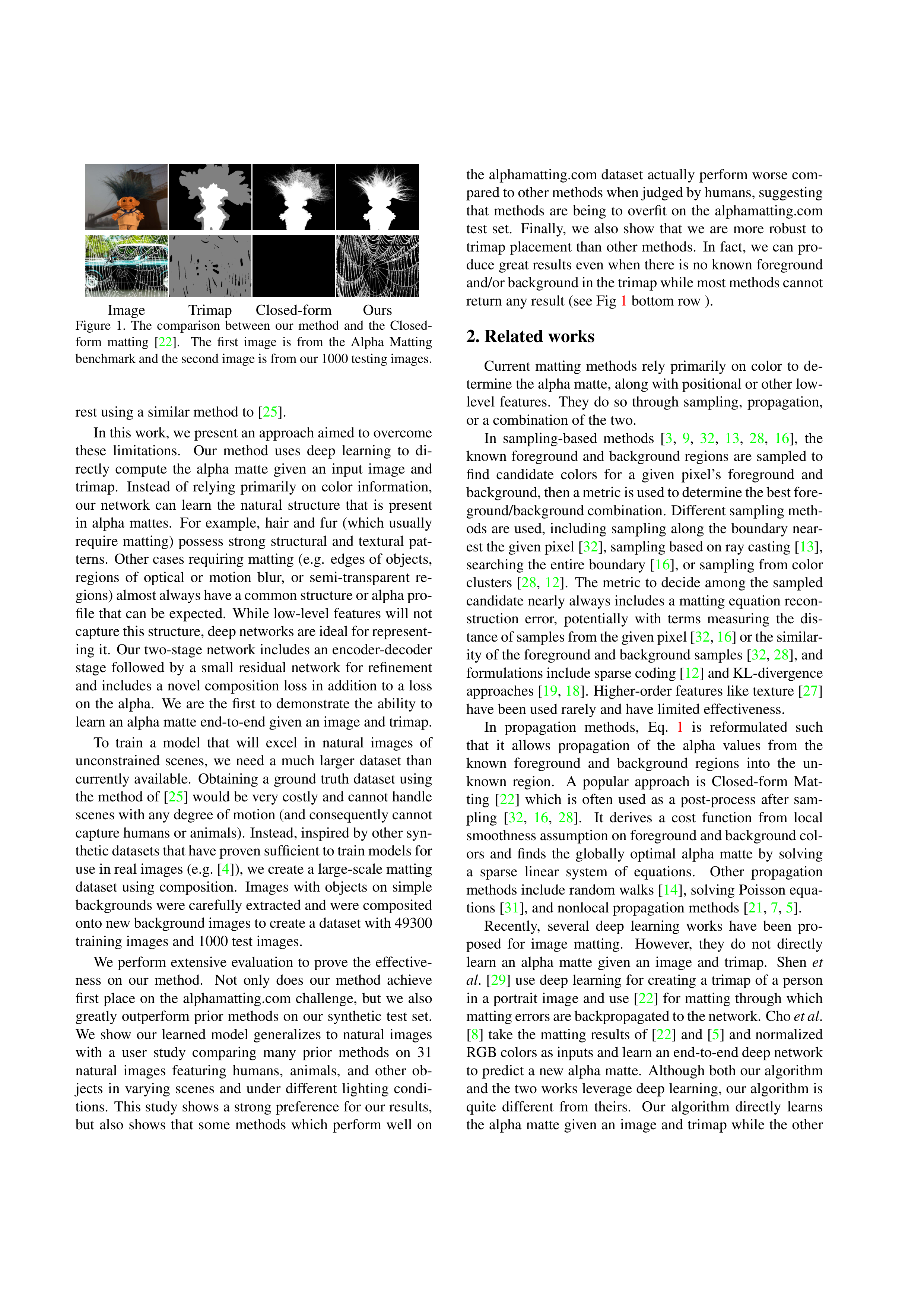

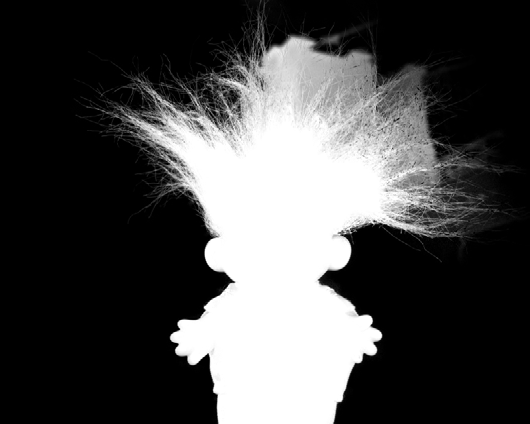
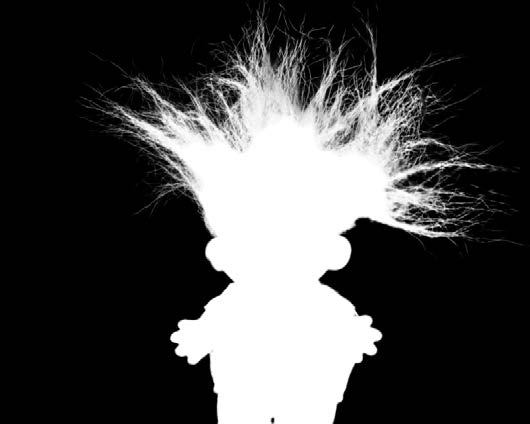
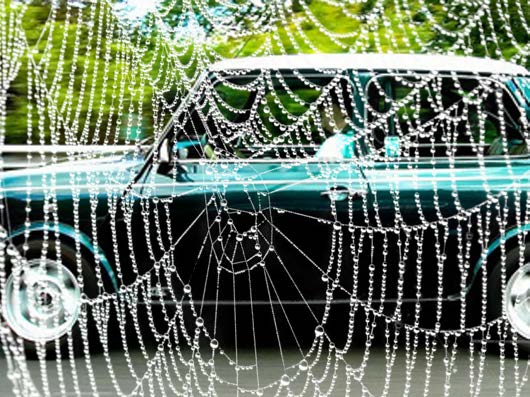
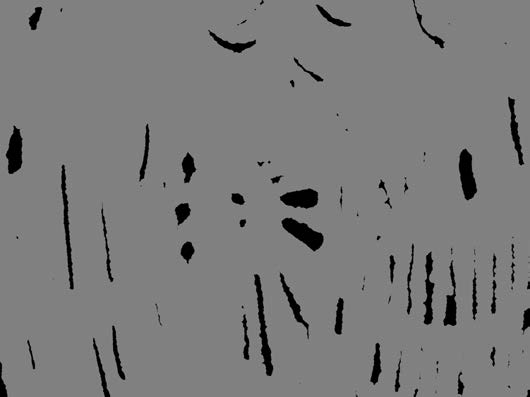

Image
Trimap
Closed-form
Ours
Figure
1.
The
comparison
between
our
method
and
the
Closed-
form
matting
[
22
].
The
first
image
is
from
the
Alpha
Matting
benchmark and the second image is from our 1000 testing images.
rest using a similar method to [
25
].
In this work, we present an approach aimed to overcome
these
limitations.
Our
method
uses
deep
learning
to
di-
rectly
compute
the
alpha
matte
given
an
input
image
and
trimap.
Instead
of
relying
primarily
on
color
information,
our
network
can
learn
the
natural
structure
that
is
present
in
alpha
mattes.
For
example,
hair
and
fur
(which
usually
require
matting)
possess
strong
structural
and
textural
pat-
terns.
Other cases requiring matting (e.g.
edges of objects,
regions
of
optical
or
motion
blur,
or
semi-transparent
re-
gions) almost always have a common structure or alpha pro-
file that can be expected.
While low-level features will not
capture this structure, deep networks are ideal for represent-
ing it.
Our two-stage network includes an encoder-decoder
stage
followed
by
a
small
residual
network
for
refinement
and includes a novel composition loss in addition to a loss
on
the
alpha.
We
are
the
first
to
demonstrate
the
ability
to
learn an alpha matte end-to-end given an image and trimap.
To
train
a
model
that
will
excel
in
natural
images
of
unconstrained
scenes,
we
need
a
much
larger
dataset
than
currently available.
Obtaining a ground truth dataset using
the method of [
25
] would be very costly and cannot handle
scenes with any degree of motion (and consequently cannot
capture humans or animals).
Instead, inspired by other syn-
thetic datasets that have proven sufficient to train models for
use in real images (e.g. [
4
]), we create a large-scale matting
dataset
using
composition.
Images
with
objects
on
simple
backgrounds were carefully extracted and were composited
onto new background images to create a dataset with 49300
training images and 1000 test images.
We
perform
extensive
evaluation
to
prove
the
effective-
ness
on
our
method.
Not
only
does
our
method
achieve
first
place
on
the
alphamatting.com
challenge,
but
we
also
greatly
outperform
prior
methods
on
our
synthetic
test
set.
We
show
our
learned
model
generalizes
to
natural
images
with
a
user
study
comparing
many
prior
methods
on
31
natural
images
featuring
humans,
animals,
and
other
ob-
jects
in
varying
scenes
and
under
different
lighting
condi-
tions.
This study shows a strong preference for our results,
but
also
shows
that
some
methods
which
perform
well
on
the alphamatting.com dataset actually perform worse com-
pared to other methods when judged by humans, suggesting
that
methods
are
being
to
overfit
on
the
alphamatting.com
test
set.
Finally,
we
also
show
that
we
are
more
robust
to
trimap placement than other methods.
In fact,
we can pro-
duce great results even when there is no known foreground
and/or background in the trimap while most methods cannot
return any result (see Fig
1
bottom row ).
2. Related works
Current
matting
methods
rely
primarily
on
color
to
de-
termine the alpha matte, along with positional or other low-
level
features.
They
do
so
through
sampling,
propagation,
or a combination of the two.
In
sampling-based
methods
[
3
,
9
,
32
,
13
,
28
,
16
],
the
known
foreground
and
background
regions
are
sampled
to
find
candidate
colors
for
a
given
pixel’s
foreground
and
background, then a metric is used to determine the best fore-
ground/background combination.
Different sampling meth-
ods are used, including sampling along the boundary near-
est the given pixel [
32
], sampling based on ray casting [
13
],
searching the entire boundary [
16
], or sampling from color
clusters [
28
,
12
].
The metric to decide among the sampled
candidate nearly always includes a matting equation recon-
struction
error,
potentially
with
terms
measuring
the
dis-
tance of samples from the given pixel [
32
,
16
] or the similar-
ity of the foreground and background samples [
32
,
28
], and
formulations include sparse coding [
12
] and KL-divergence
approaches [
19
,
18
].
Higher-order features like texture [
27
]
have been used rarely and have limited effectiveness.
In
propagation
methods,
Eq.
1
is
reformulated
such
that
it
allows
propagation
of
the
alpha
values
from
the
known
foreground
and
background
regions
into
the
un-
known
region.
A
popular
approach
is
Closed-form
Mat-
ting
[
22
]
which
is
often
used
as
a
post-process
after
sam-
pling
[
32
,
16
,
28
].
It
derives
a
cost
function
from
local
smoothness assumption on foreground and background col-
ors
and
finds
the
globally
optimal
alpha
matte
by
solving
a
sparse
linear
system
of
equations.
Other
propagation
methods include random walks [
14
], solving Poisson equa-
tions [
31
], and nonlocal propagation methods [
21
,
7
,
5
].
Recently,
several
deep
learning
works
have
been
pro-
posed
for
image
matting.
However,
they
do
not
directly
learn
an
alpha
matte
given
an
image
and
trimap.
Shen
et
al
. [
29
] use deep learning for creating a trimap of a person
in a portrait image and use [
22
] for matting through which
matting errors are backpropagated to the network. Cho
et al
.
[
8
] take the matting results of [
22
] and [
5
] and normalized
RGB colors as inputs and learn an end-to-end deep network
to predict a new alpha matte.
Although both our algorithm
and the two works leverage deep learning, our algorithm is
quite
different
from
theirs.
Our
algorithm
directly
learns
the alpha matte given an image and trimap while the other




a
b
c
d
e
f
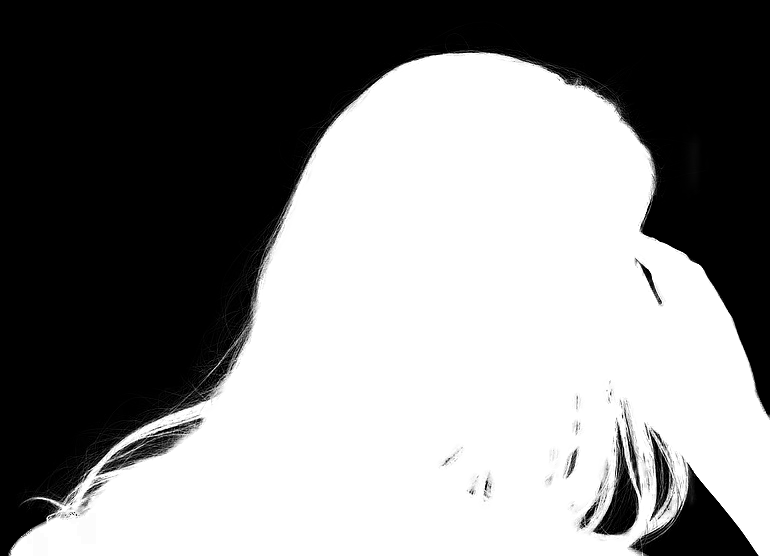
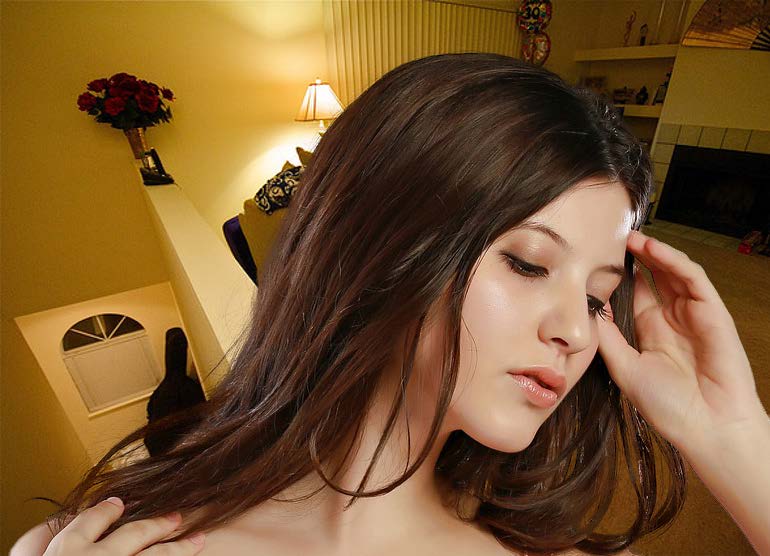
Figure 2. Dataset creation.
(a) An input image with a simple back-
ground is matted manually.
The (b) computed alpha matte and (c)
computed foreground colors are used as ground truth to composite
the object onto (d-f) various background images.
two
works
rely
on
existing
algorithms
to
compute
the
ac-
tual
matting,
making their
methods
vulnerable to
the
same
problems as previous matting methods.
3. New matting dataset
The
matting
benchmark
on
alphamatting.com
[
25
]
has
been tremendously successful in accelerating the pace of re-
search in matting.
However, due to the carefully controlled
setting
required
to
obtain
ground
truth
images,
the
dataset
consists
of
only
27
training
images
and
8
testing
images.
Not
only
is
this
not
enough
images
to
train
a
neural
net-
work,
but it is severely limited in its diversity,
restricted to
small-scale lab scenes with static objects.
To train our matting network,
we create a larger dataset
by
compositing
objects
from
real
images
onto
new
back-
grounds.
We
find
images
on
simple
or
plain
backgrounds
(Fig.
2
a),
including
the
27
training
images
from
[
25
]
and
every fifth frame from the videos from [
26
].
Using Photo-
shop, we carefully manually create an alpha matte (Fig.
2
b)
and pure foreground colors (Fig.
2
c).
Because these objects
have
simple
backgrounds
we
can
pull
accurate
mattes
for
them. We then treat these as ground truth and for each alpha
matte and foreground image, we randomly sample
N
back-
ground
images
in
MS
COCO
[
23
]
and
Pascal
VOC
[
11
],
and composite the object onto those background images.
We
create
both
a
training
and
a
testing
dataset
in
the
above
way.
Our
training
dataset
has
493
unique
fore-
ground
objects
and
49,300
images
(
N
=
100
)
while
our
testing
dataset
has
50
unique
objects
and
1000
images
(
N
=
20
).
The
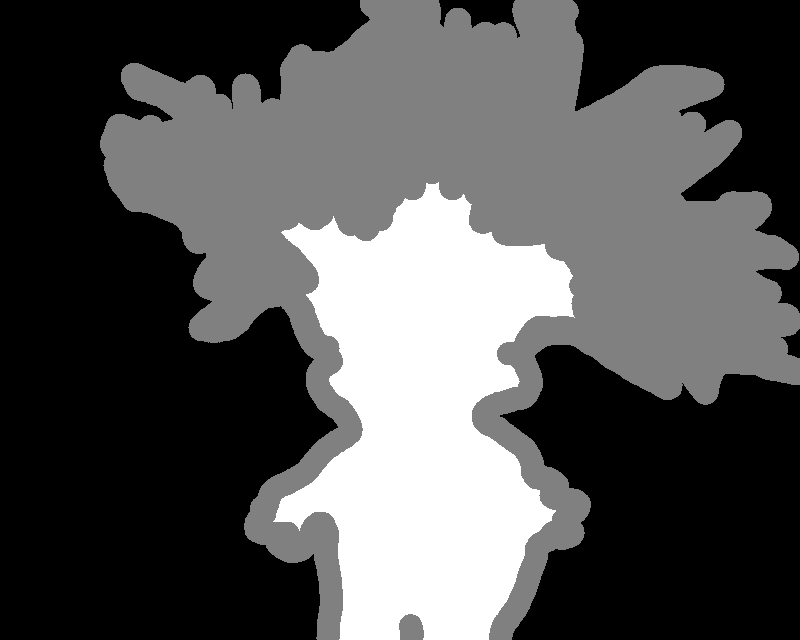
trimap
for
each
image
is
randomly
di-
lated
from
its
ground
truth
alpha
matte.
In
comparison
to
previous
matting
datasets,
our
new
dataset
has
several
ad-
vantages.
1)
It
has
many
more
unique
objects
and
covers
various
matting
cases
such
as
hair,
fur,
semi-transparency,
etc.
2)
Many
composited
images
have
similar
foreground
and
background
colors
and
complex
background
textures,
making our dataset more challenging and practical.
An early concern is whether this process would create a
bias due to the composited nature of the images, such that a
network would learn to key on differences in the foreground
and
background
lighting,
noise
levels,
etc.
However,
we
found
experimentally
that
we
achieved
far
superior
results
on natural images compared to prior methods (see Sec.
5.3
).
4. Our method
We address the image matting problem using deep learn-
ing.
Given
our
new
dataset,
we
train
a
neural
network
to
fully
utilize
the
data.
The
network
consists
of
two
stages
(Fig.
3
).
The
first
stage
is
a
deep
convolutional
encoder-
decoder
network
which
takes
an
image
patch
and
a
trimap
as
input
and
is
penalized
by
the
alpha
prediction
loss
and
a
novel
compositional
loss.
The
second
stage
is
a
small
fully convolutional network which refines the alpha predic-
tion
from
the
first
network
with
more
accurate
alpha
val-
ues and sharper edges.
We will describe our algorithm with
more details in the following sections.
4.1. Matting encoder-decoder stage
The first stage of our network is a deep encoder-decoder
network (see Fig.
3
), which has achieved successes in many
other computer vision tasks such as image segmentation [
2
],
boundary prediction [
33
] and hole filling [
24
].
Network structure:
The input to the network is an im-
age patch and the corresponding trimap which are concate-
nated along the channel dimension, resulting in a 4-channel
input.
The
whole
network
consists
of
an
encoder
network
and a decoder network.
The input to the encoder network is
transformed into downsampled feature maps by subsequent
convolutional
layers
and
max
pooling
layers.
The
decoder
network in turn uses subsequent unpooling layers which re-
verse
the
max
pooling
operation
and
convolutional
layers
to
upsample
the
feature
maps
and
have
the
desired
output,
the
alpha
matte
in
our
case.
Specifically,
our
encoder
net-
work has 14 convolutional layers and 5 max-pooling layers.
For
the
decoder
network,
we
use
a
smaller
structure
than
the
encoder
network
to
reduce
the
number
of
parameters
and speed up the training process.
Specifically, our decoder
network has 6 convolutional layers, 5 unpooling layers fol-
lowed by a final alpha prediction layer.
Losses:
Our network leverages two losses.
The first loss
is
called
the
alpha-prediction
loss,
which
is
the
absolute
difference
between
the
ground
truth
alpha
values
and
the
predicted
alpha
values
at
each
pixel.
However,
due
to
the
non-differentiable
property
of
absolute
values,
we
use
the
following loss function to approximate it.
L
i
α
=
q
(
α
i
p
−
α
i
g
)
2
+
ϵ
2
,
α
i
p
, α
i
g
∈
[0
,
1]
.
(2)
where
α
i
p
is
the
output
of
the
prediction
layer
at
pixel
i
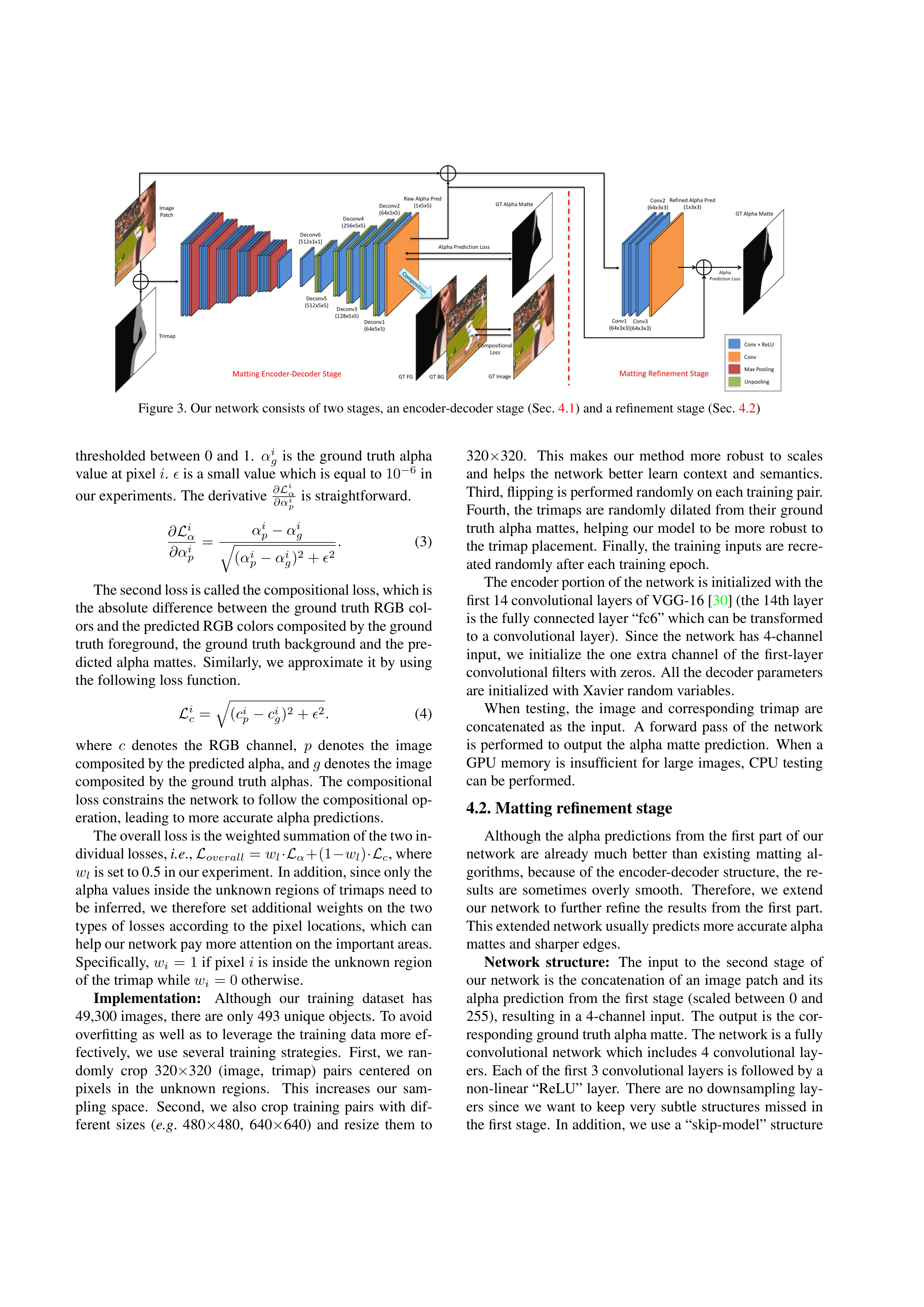
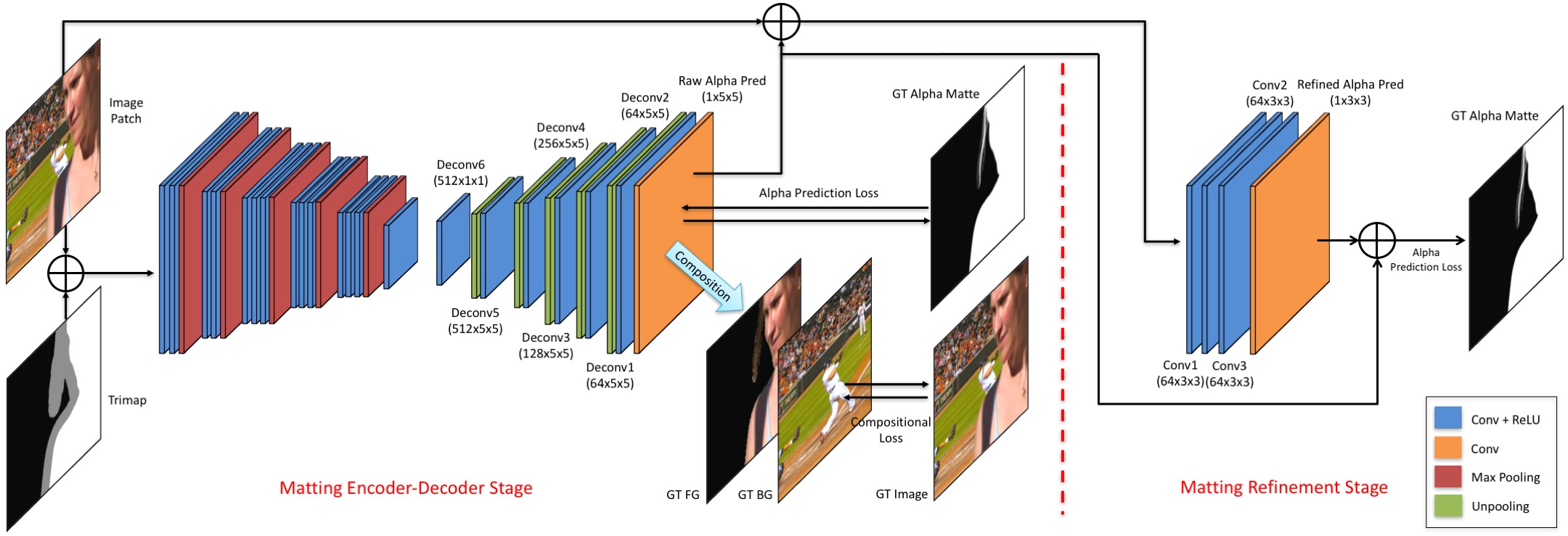
Figure 3. Our network consists of two stages, an encoder-decoder stage (Sec.
4.1
) and a refinement stage (Sec.
4.2
)
thresholded between 0 and 1.
α
i
g
is the ground truth alpha
value at pixel
i
.
ϵ
is a small value which is equal to
10
−
6
in
our experiments.
The derivative
∂
L
i
α
∂α
i
p
is straightforward.
∂
L
i
α
∂α
i
p
=
α
i
p
−
α
i
g
q
(
α
i
p
−
α
i
g
)
2
+
ϵ
2
.
(3)
The second loss is called the compositional loss, which is
the absolute difference between the ground truth RGB col-
ors and the predicted RGB colors composited by the ground
truth foreground, the ground truth background and the pre-
dicted alpha mattes.
Similarly, we approximate it by using
the following loss function.
L
i
c
=
q
(
c
i
p
−
c
i
g
)
2
+
ϵ
2
.
(4)
where
c
denotes
the
RGB
channel,
p
denotes
the
image
composited by the predicted alpha, and
g
denotes the image
composited by the ground truth alphas.
The compositional
loss constrains the network to follow the compositional op-
eration, leading to more accurate alpha predictions.
The overall loss is the weighted summation of the two in-
dividual losses,
i.e
.,
L
overall
=
w
l
·L
α
+(1
−
w
l
)
·L
c
, where
w
l
is set to 0.5 in our experiment. In addition, since only the
alpha values inside the unknown regions of trimaps need to
be inferred,
we therefore set additional weights on the two
types
of
losses
according
to
the
pixel
locations,
which
can
help our network pay more attention on the important areas.
Specifically,
w
i
=
1
if pixel
i
is inside the unknown region
of the trimap while
w
i
= 0
otherwise.
Implementation:
Although
our
training
dataset
has
49,300 images, there are only 493 unique objects.
To avoid
overfitting as well as to leverage the training data more ef-
fectively,
we
use
several
training
strategies.
First,
we
ran-
domly
crop
320
×
320
(image,
trimap)
pairs
centered
on
pixels
in
the
unknown
regions.
This
increases
our
sam-
pling
space.
Second,
we
also
crop
training
pairs
with
dif-
ferent
sizes
(
e.g
.
480
×
480,
640
×
640)
and
resize
them
to
320
×
320.
This
makes
our
method
more
robust
to
scales
and
helps
the
network
better
learn
context
and
semantics.
Third, flipping is performed randomly on each training pair.
Fourth, the trimaps are randomly dilated from their ground
truth alpha mattes,
helping our model to be more robust to
the trimap placement.
Finally, the training inputs are recre-
ated randomly after each training epoch.
The encoder portion of the network is initialized with the
first 14 convolutional layers of VGG-16 [
30
] (the 14th layer
is the fully connected layer “fc6” which can be transformed
to a convolutional layer).
Since the network has 4-channel
input,
we
initialize
the
one
extra
channel
of
the
first-layer
convolutional filters with zeros.
All the decoder parameters
are initialized with Xavier random variables.
When
testing,
the
image
and
corresponding
trimap
are
concatenated
as
the
input.
A
forward
pass
of
the
network
is performed to output the alpha matte prediction.
When a
GPU memory is insufficient for large images,
CPU testing
can be performed.
4.2. Matting refinement stage
Although the alpha predictions from the first part of our
network
are
already
much
better
than
existing
matting
al-
gorithms, because of the encoder-decoder structure, the re-
sults
are
sometimes
overly
smooth.
Therefore,
we
extend
our network to further refine the results from the first part.
This extended network usually predicts more accurate alpha
mattes and sharper edges.
Network
structure:
The
input
to
the
second
stage
of
our network is the concatenation of an image patch and its
alpha prediction from the first stage (scaled between 0 and
255),
resulting in a 4-channel input.
The output is the cor-
responding ground truth alpha matte.
The network is a fully
convolutional network which includes 4 convolutional lay-
ers.
Each of the first 3 convolutional layers is followed by a
non-linear “ReLU” layer.
There are no downsampling lay-
ers
since
we
want
to
keep
very
subtle
structures
missed
in
the first stage.
In addition, we use a “skip-model” structure
(a)
(b)
(c)
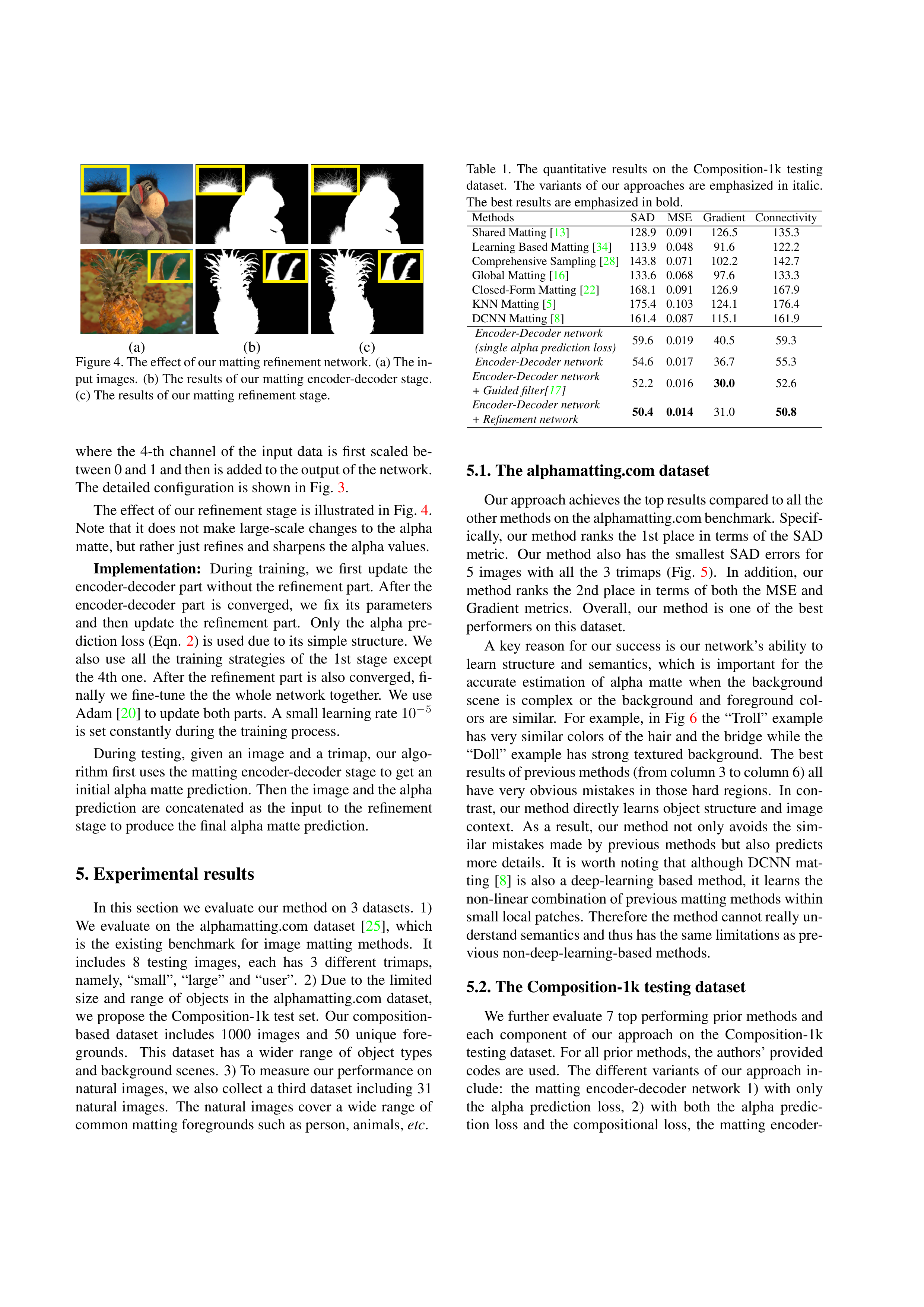
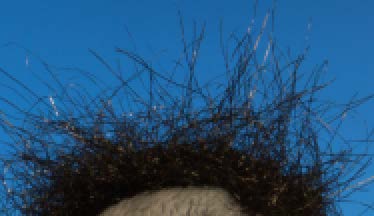
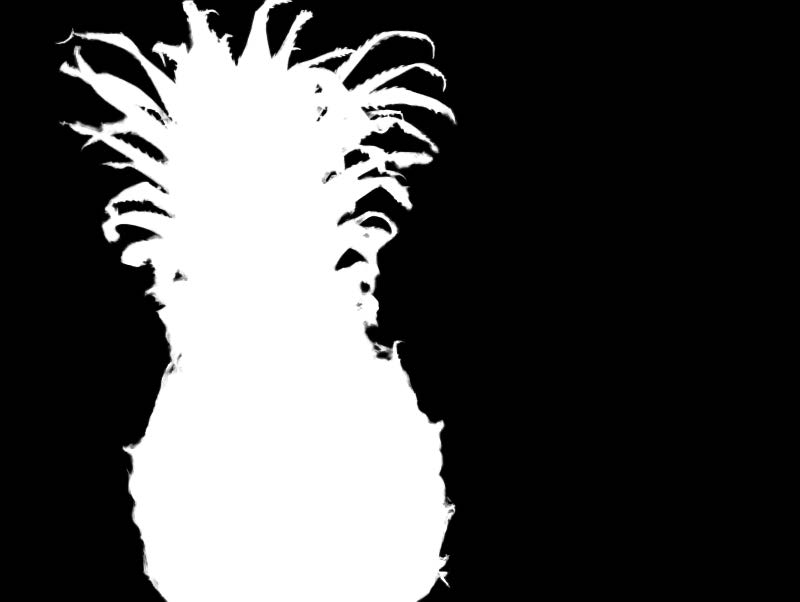
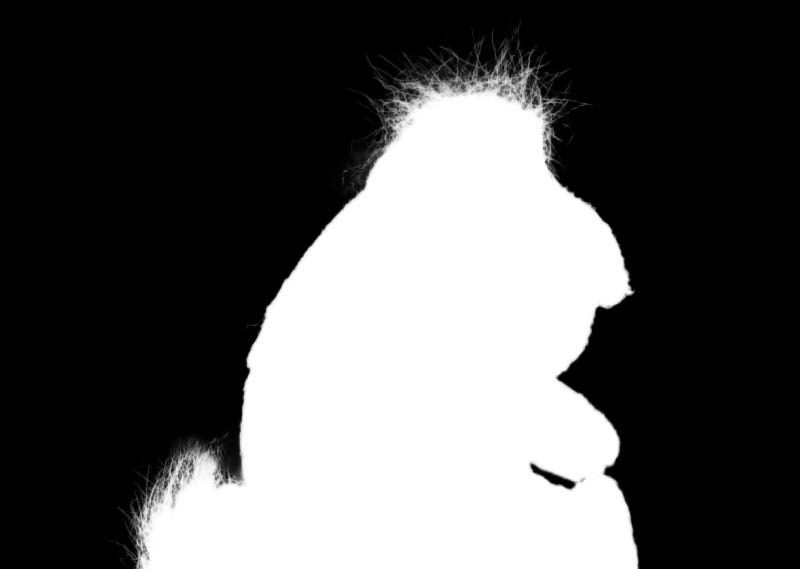
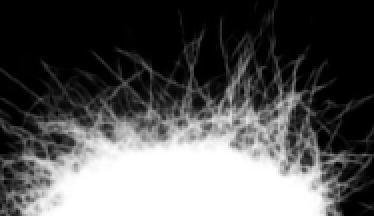
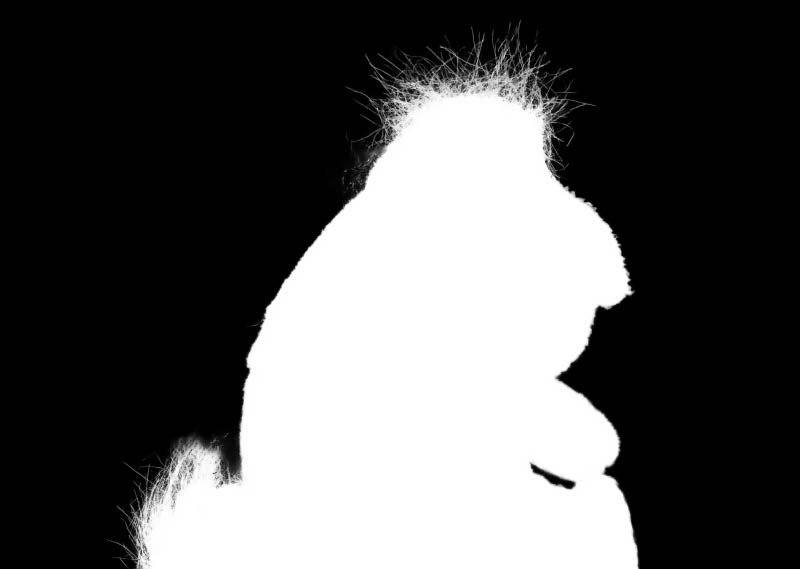
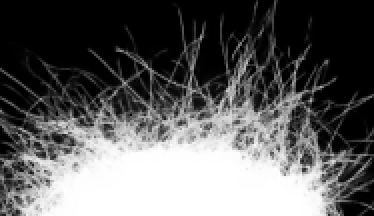
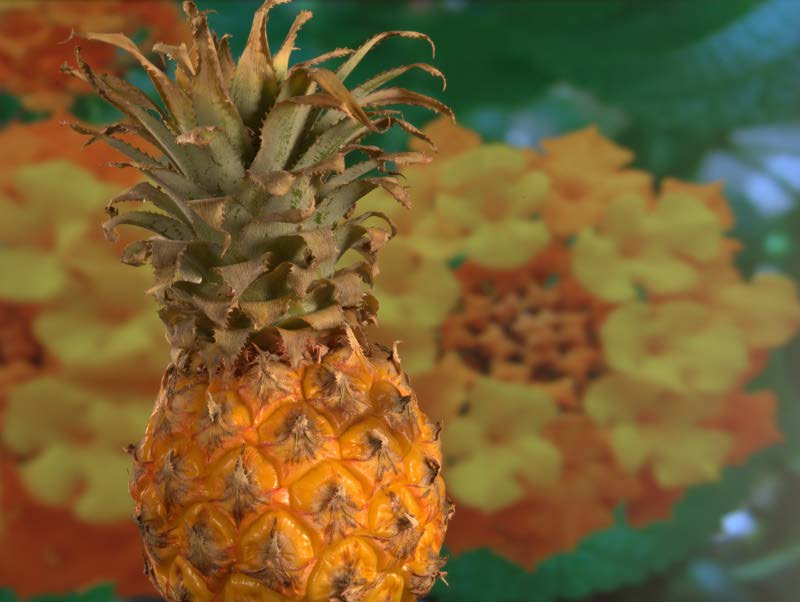
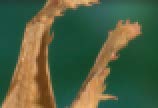
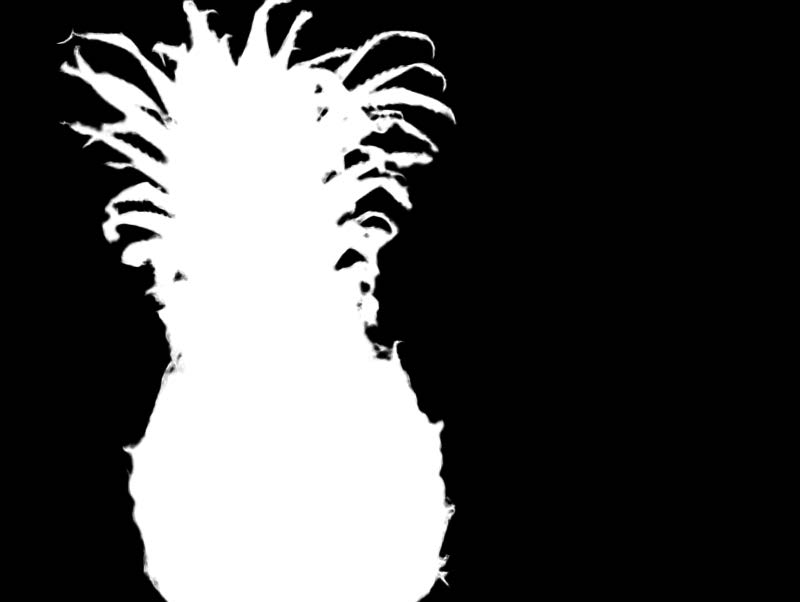
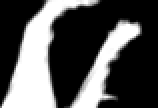
Figure 4. The effect of our matting refinement network. (a) The in-
put images.
(b) The results of our matting encoder-decoder stage.
(c) The results of our matting refinement stage.
where
the
4-th
channel
of
the
input
data
is
first
scaled
be-
tween 0 and 1 and then is added to the output of the network.
The detailed configuration is shown in Fig.
3
.
The effect of our refinement stage is illustrated in Fig.
4
.
Note that it does not make large-scale changes to the alpha
matte, but rather just refines and sharpens the alpha values.
Implementation:
During
training,
we
first
update
the
encoder-decoder part without the refinement part.
After the
encoder-decoder
part
is
converged,
we
fix
its
parameters
and
then
update
the
refinement
part.
Only
the
alpha
pre-
diction loss (Eqn.
2
) is used due to its simple structure.
We
also
use
all
the
training
strategies
of
the
1st
stage
except
the 4th one.
After the refinement part is also converged, fi-
nally we fine-tune the the whole network together.
We use
Adam [
20
] to update both parts.
A small learning rate
10
−
5
is set constantly during the training process.
During
testing,
given
an
image
and
a
trimap,
our
algo-
rithm first uses the matting encoder-decoder stage to get an
initial alpha matte prediction.
Then the image and the alpha
prediction
are
concatenated
as
the
input
to
the
refinement
stage to produce the final alpha matte prediction.
5. Experimental results
In this section we evaluate our method on 3 datasets.
1)
We
evaluate
on
the
alphamatting.com
dataset
[
25
],
which
is
the
existing
benchmark
for
image
matting
methods.
It
includes
8
testing
images,
each
has
3
different
trimaps,
namely,
“small”,
“large” and “user”.
2) Due to the limited
size
and
range
of
objects
in
the
alphamatting.com
dataset,
we propose the Composition-1k test set.
Our composition-
based
dataset
includes
1000
images
and
50
unique
fore-
grounds.
This
dataset
has
a
wider
range
of
object
types
and background scenes.
3) To measure our performance on
natural images, we also collect a third dataset including 31
natural
images.
The
natural
images
cover
a
wide
range
of
common matting foregrounds such as person, animals,
etc
.
Table
1.
The
quantitative
results
on
the
Composition-1k
testing
dataset.
The
variants
of
our
approaches
are
emphasized
in
italic.
The best results are emphasized in bold.
Methods
SAD
MSE
Gradient
Connectivity
Shared Matting [
13
]
128.9
0.091
126.5
135.3
Learning Based Matting [
34
]
113.9
0.048
91.6
122.2
Comprehensive Sampling [
28
]
143.8
0.071
102.2
142.7
Global Matting [
16
]
133.6
0.068
97.6
133.3
Closed-Form Matting [
22
]
168.1
0.091
126.9
167.9
KNN Matting [
5
]
175.4
0.103
124.1
176.4
DCNN Matting [
8
]
161.4
0.087
115.1
161.9
Encoder-Decoder network
(single alpha prediction loss)
59.6
0.019
40.5
59.3
Encoder-Decoder network
54.6
0.017
36.7
55.3
Encoder-Decoder network
+ Guided filter[
17
]
52.2
0.016
30.0
52.6
Encoder-Decoder network
+ Refinement network
50.4
0.014
31.0
50.8
5.1. The alphamatting.com dataset
Our approach achieves the top results compared to all the
other methods on the alphamatting.com benchmark. Specif-
ically,
our method ranks the 1st place in terms of the SAD
metric.
Our
method
also
has
the
smallest
SAD
errors
for
5
images
with
all
the
3
trimaps
(Fig.
5
).
In
addition,
our
method
ranks
the
2nd
place
in
terms
of
both
the
MSE
and
Gradient
metrics.
Overall,
our
method
is
one
of
the
best
performers on this dataset.
A
key reason
for our success is our network’s ability to
learn
structure
and
semantics,
which
is
important
for
the
accurate
estimation
of
alpha
matte
when
the
background
scene
is
complex
or
the
background
and
foreground
col-
ors
are
similar.
For
example,
in
Fig
6
the
“Troll”
example
has very similar colors of the hair and the bridge while the
“Doll”
example
has
strong
textured
background.
The
best
results of previous methods (from column 3 to column 6) all
have
very
obvious
mistakes
in
those
hard
regions.
In
con-
trast, our method directly learns object structure and image
context.
As
a
result,
our
method
not
only
avoids
the
sim-
ilar
mistakes
made
by
previous
methods
but
also
predicts
more
details.
It
is
worth
noting
that
although
DCNN
mat-
ting
[
8
]
is
also
a
deep-learning
based
method,
it
learns
the
non-linear combination of previous matting methods within
small local patches.
Therefore the method cannot really un-
derstand semantics and thus has the same limitations as pre-
vious non-deep-learning-based methods.
5.2. The Composition-1k testing dataset
We further evaluate 7 top performing prior methods and
each
component
of
our
approach
on
the
Composition-1k
testing dataset.
For all prior methods, the authors’ provided
codes
are
used.
The
different
variants
of
our
approach
in-
clude:
the
matting
encoder-decoder
network
1)
with
only
the
alpha
prediction
loss,
2)
with
both
the
alpha
predic-
tion
loss
and
the
compositional
loss,
the
matting
encoder-
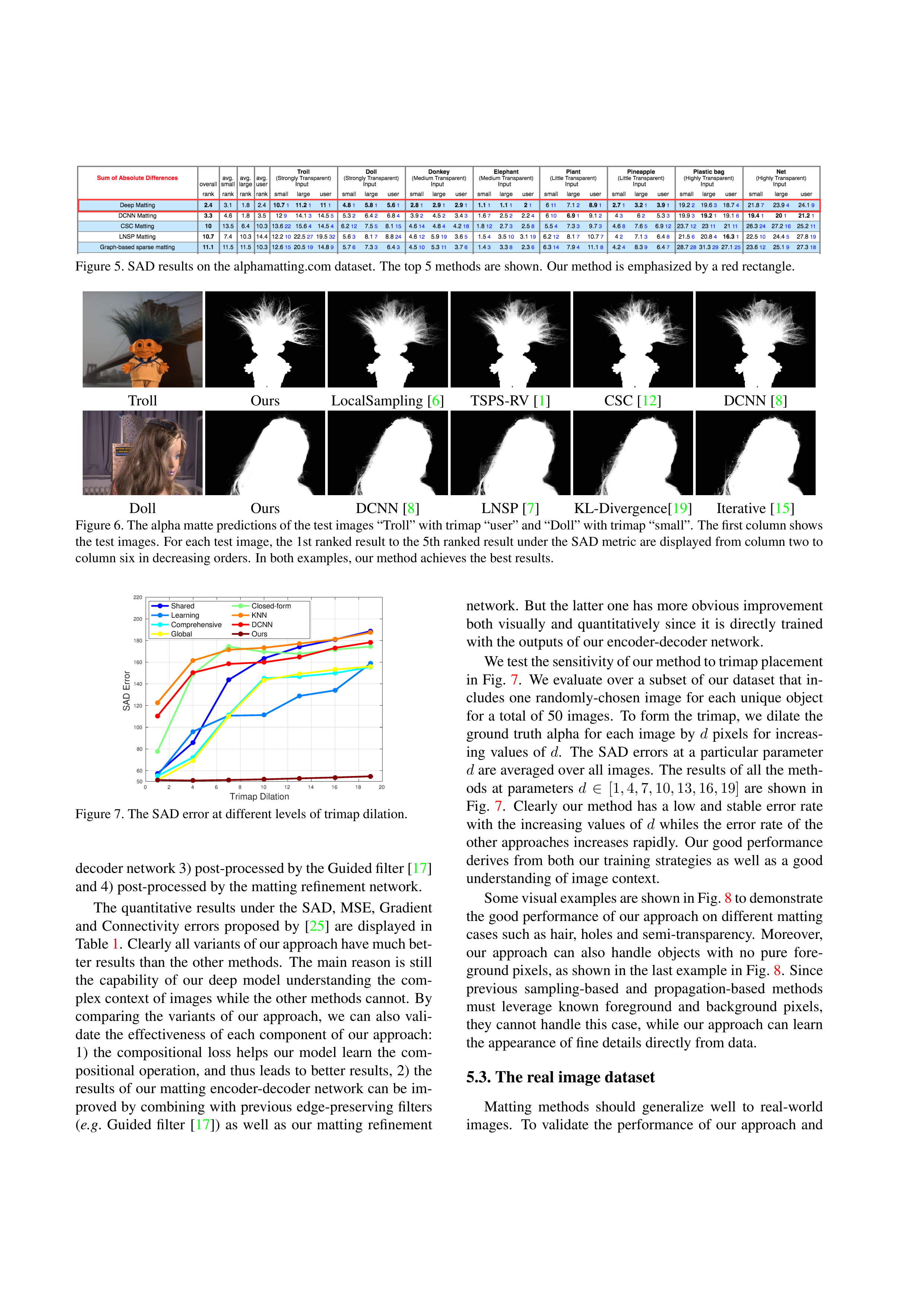


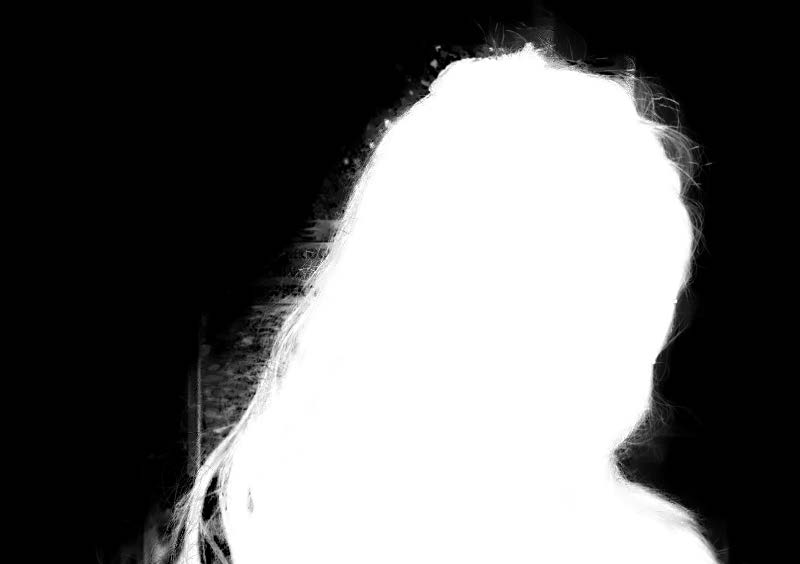
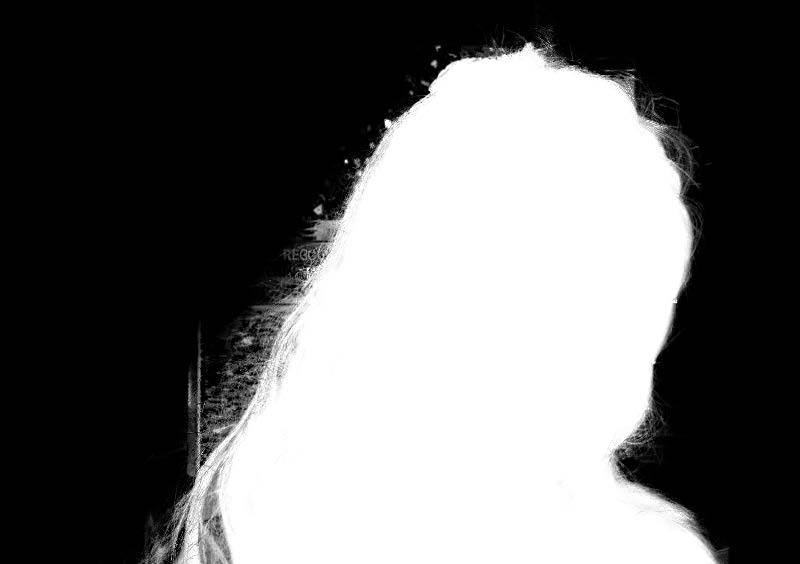
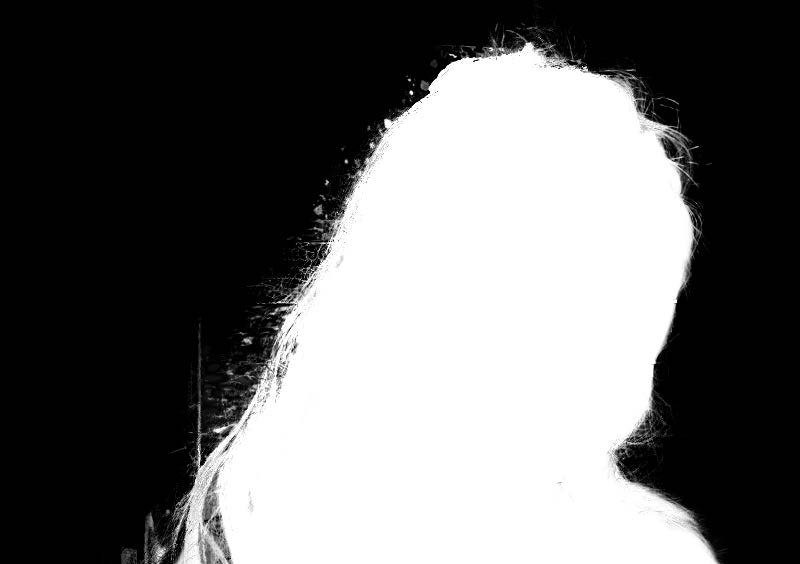
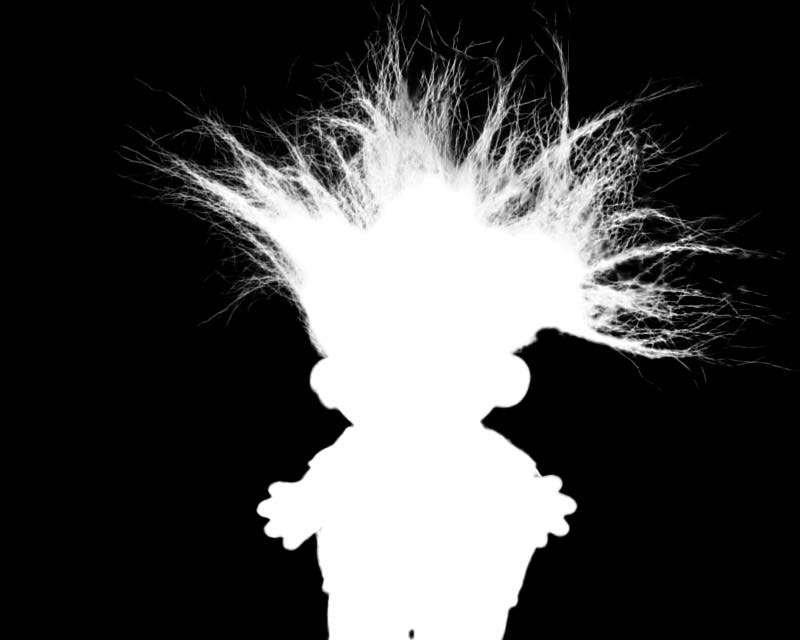
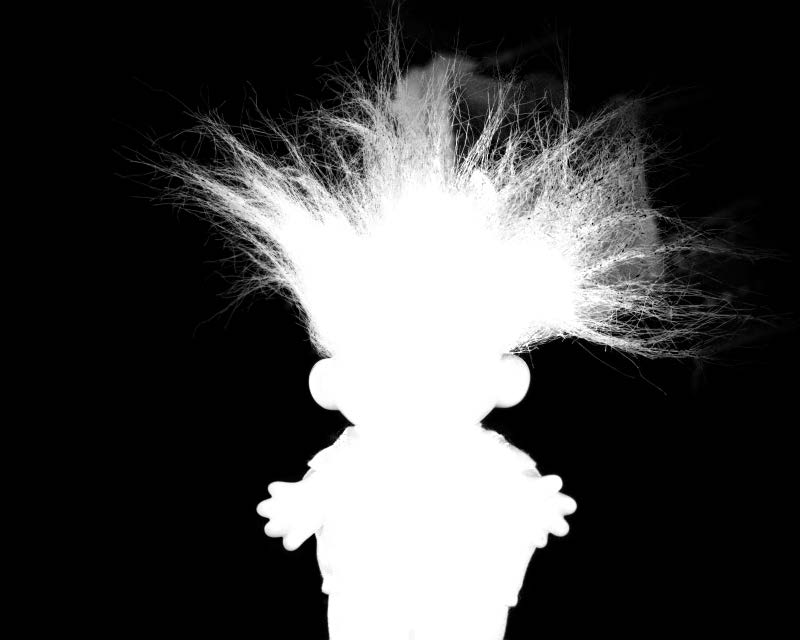
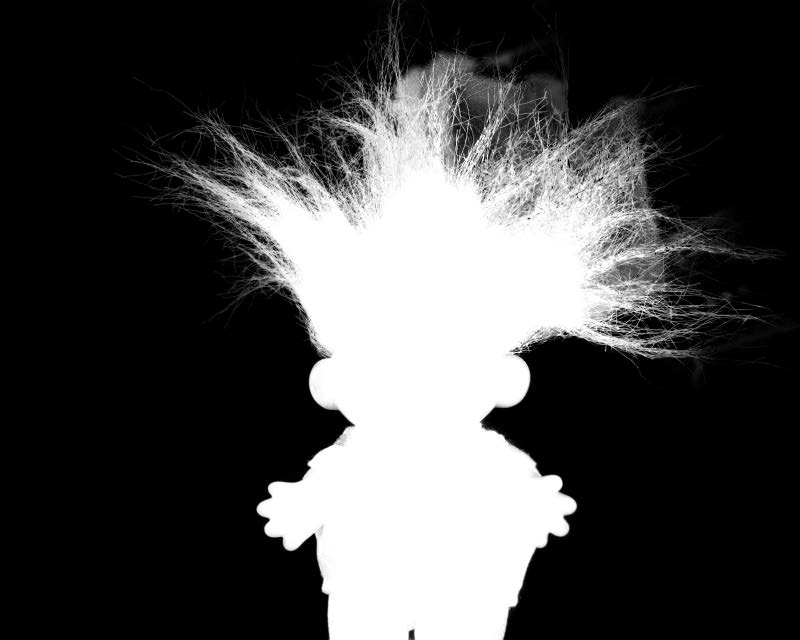
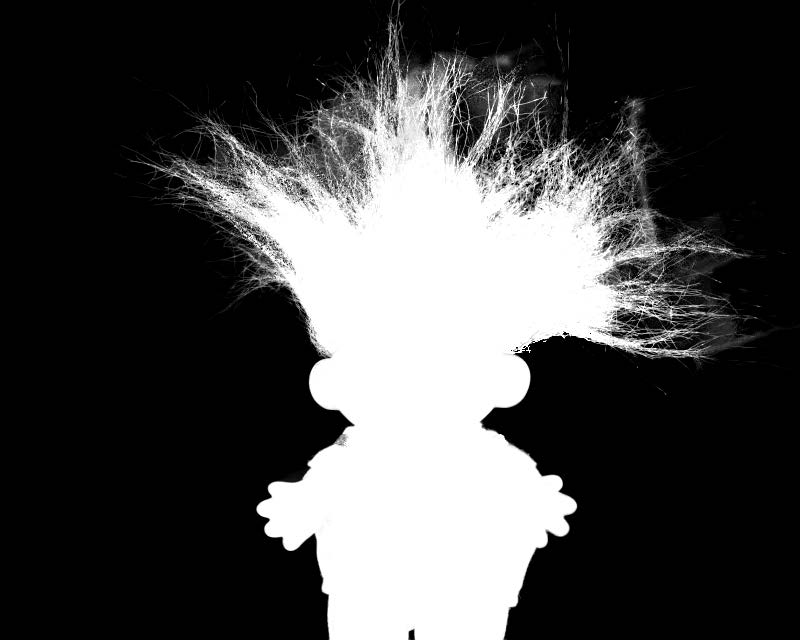
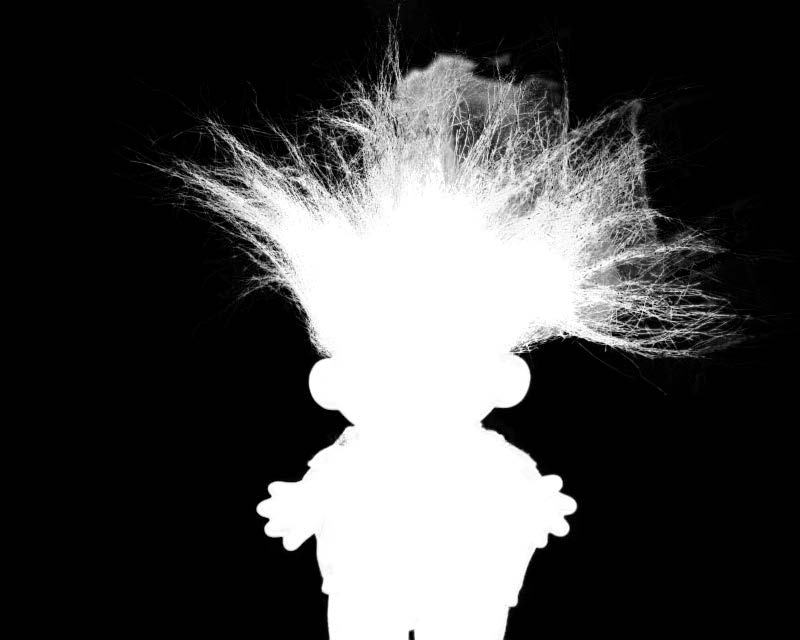
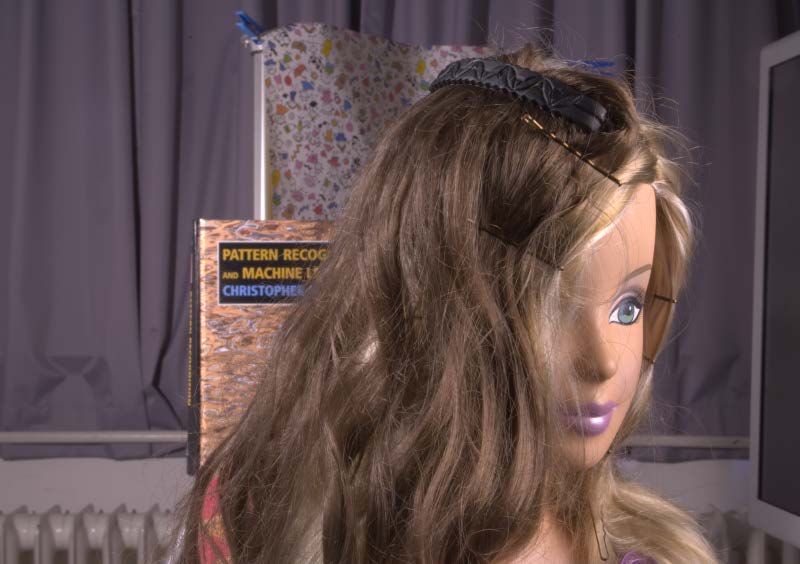
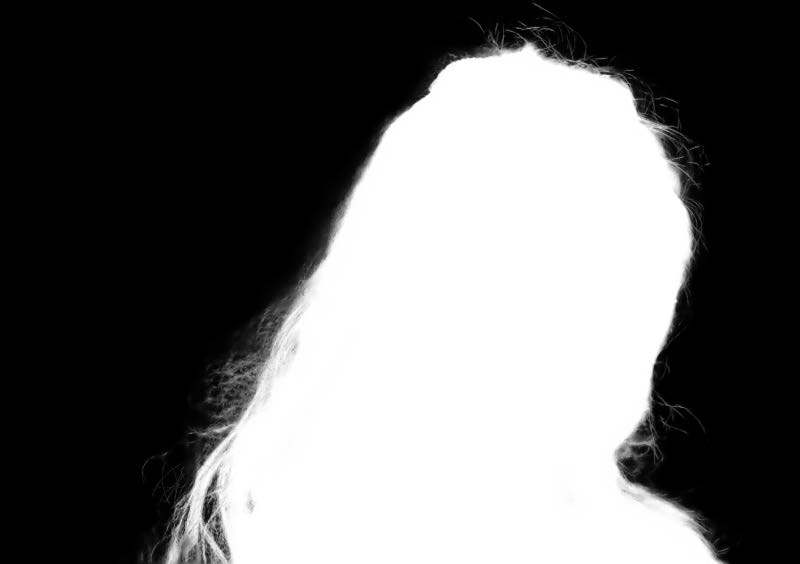
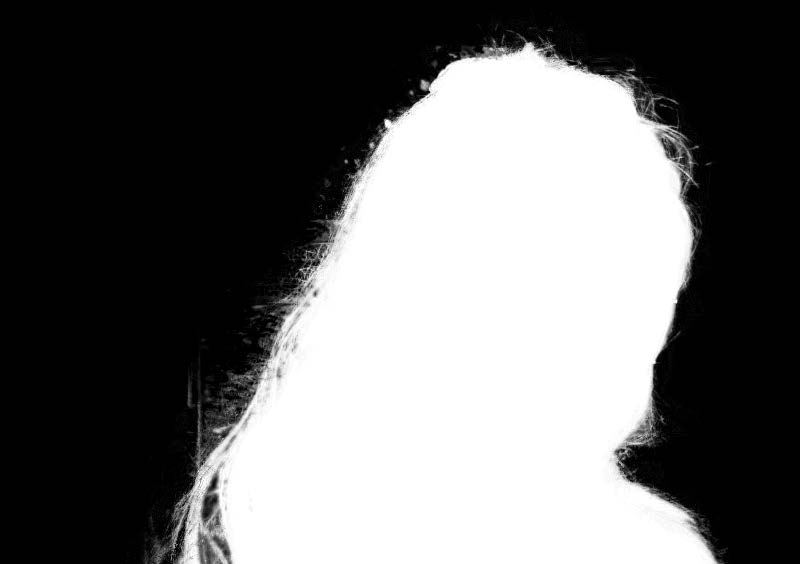
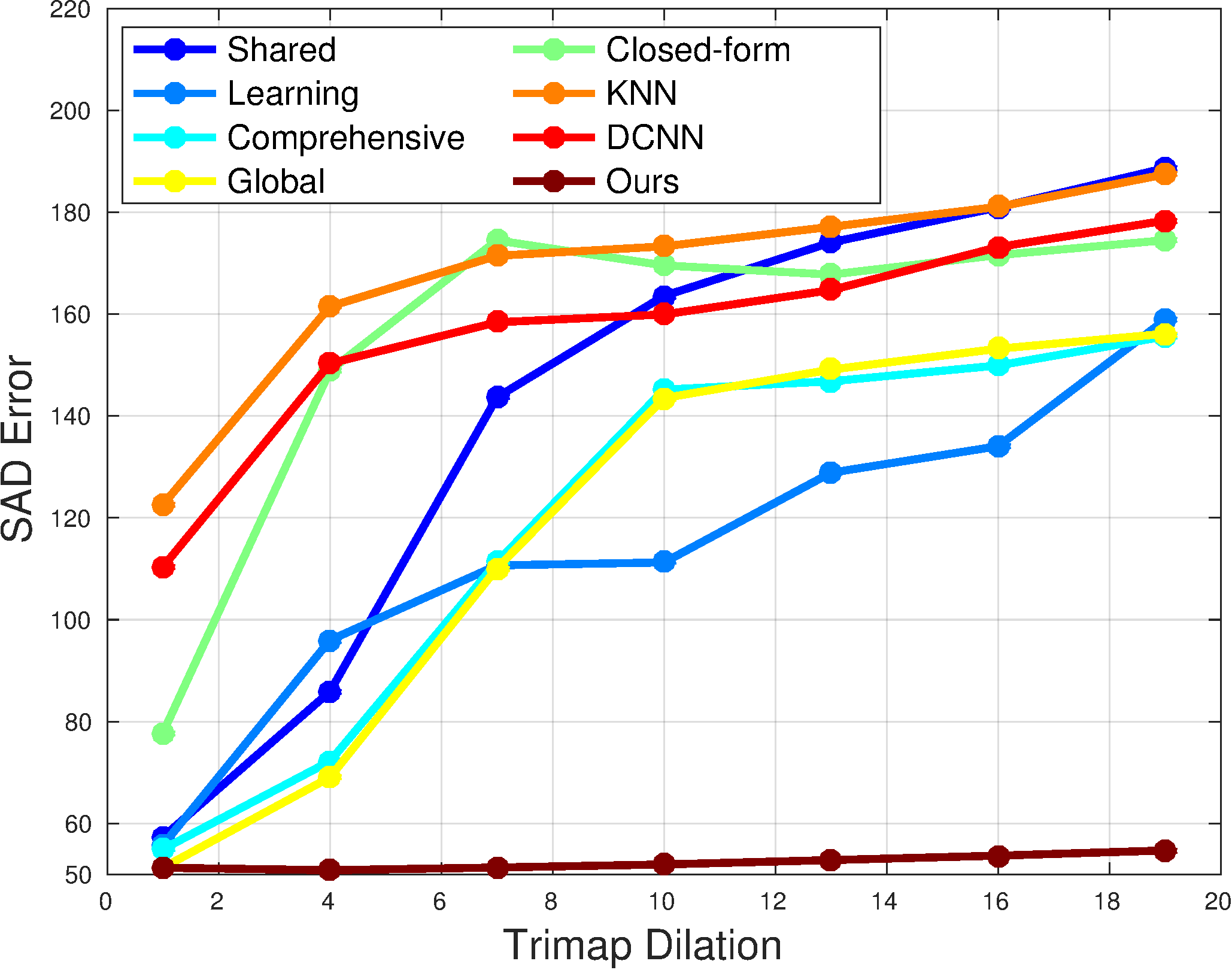
Figure 5. SAD results on the alphamatting.com dataset.
The top 5 methods are shown.
Our method is emphasized by a red rectangle.
Troll
Ours
LocalSampling [
6
]
TSPS-RV [
1
]
CSC [
12
]
DCNN [
8
]
Doll
Ours
DCNN [
8
]
LNSP [
7
]
KL-Divergence[
19
]
Iterative [
15
]
Figure 6. The alpha matte predictions of the test images “Troll” with trimap “user” and “Doll” with trimap “small”.
The first column shows
the test images.
For each test image, the 1st ranked result to the 5th ranked result under the SAD metric are displayed from column two to
column six in decreasing orders.
In both examples, our method achieves the best results.
Figure 7. The SAD error at different levels of trimap dilation.
decoder network 3) post-processed by the Guided filter [
17
]
and 4) post-processed by the matting refinement network.
The
quantitative
results
under
the
SAD,
MSE,
Gradient
and
Connectivity
errors
proposed
by
[
25
]
are
displayed
in
Table
1
. Clearly all variants of our approach have much bet-
ter results than the other methods.
The main reason is still
the
capability
of
our
deep
model
understanding
the
com-
plex context of images while the other methods cannot.
By
comparing
the
variants
of
our
approach,
we
can
also
vali-
date
the
effectiveness
of
each
component
of
our
approach:
1)
the
compositional
loss
helps
our
model
learn
the
com-
positional operation, and thus leads to better results, 2) the
results of our matting encoder-decoder network can be im-
proved by combining with previous edge-preserving filters
(
e.g
.
Guided
filter
[
17
])
as
well
as
our
matting
refinement
network.
But the latter one has more obvious improvement
both
visually
and
quantitatively
since
it
is
directly
trained
with the outputs of our encoder-decoder network.
We test the sensitivity of our method to trimap placement
in Fig.
7
.
We
evaluate
over
a
subset
of our
dataset
that
in-
cludes
one
randomly-chosen
image
for
each
unique
object
for a total of 50 images.
To form the trimap,
we dilate the
ground
truth
alpha
for
each
image
by
d
pixels
for
increas-
ing
values
of
d
.
The
SAD
errors
at
a
particular
parameter
d
are averaged over all images.
The results of all the meth-
ods
at
parameters
d
∈
[1
,
4
,
7
,
10
,
13
,
16
,
19]
are
shown
in
Fig.
7
.
Clearly
our
method
has
a
low
and
stable
error
rate
with
the
increasing
values
of
d
whiles
the
error
rate
of
the
other approaches increases rapidly.
Our good performance
derives
from
both
our
training
strategies
as
well
as
a
good
understanding of image context.
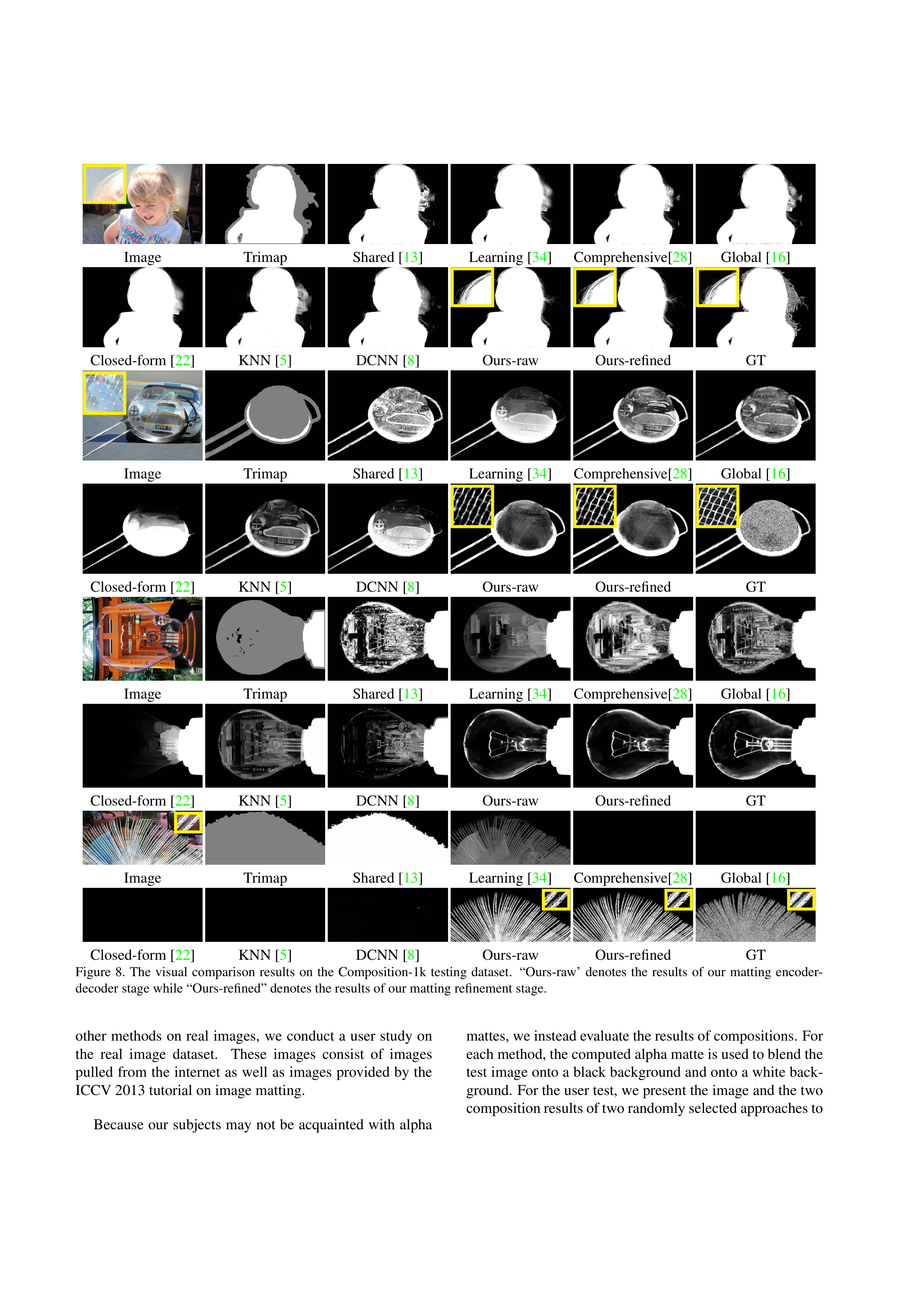
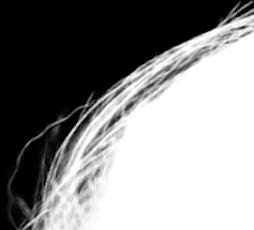
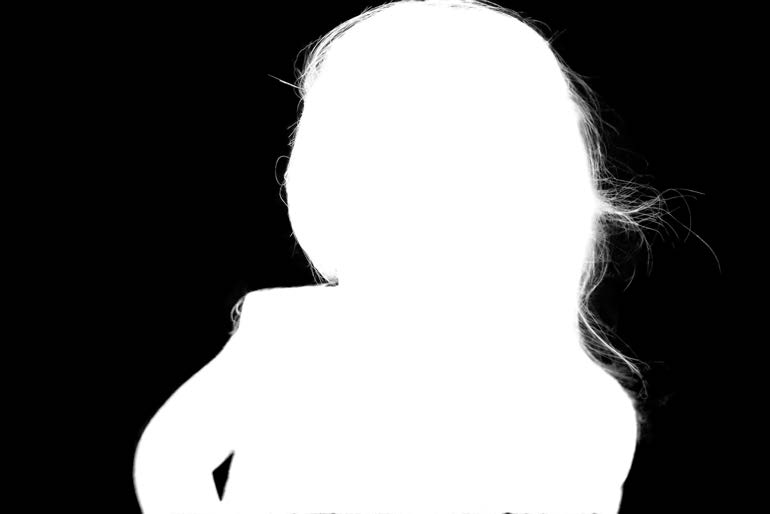
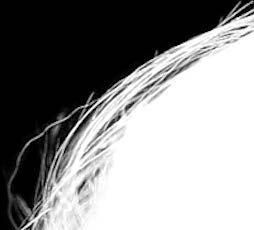
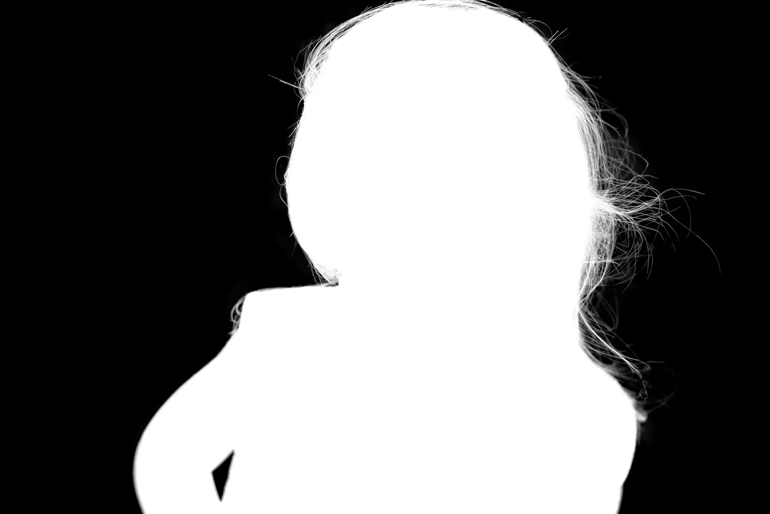
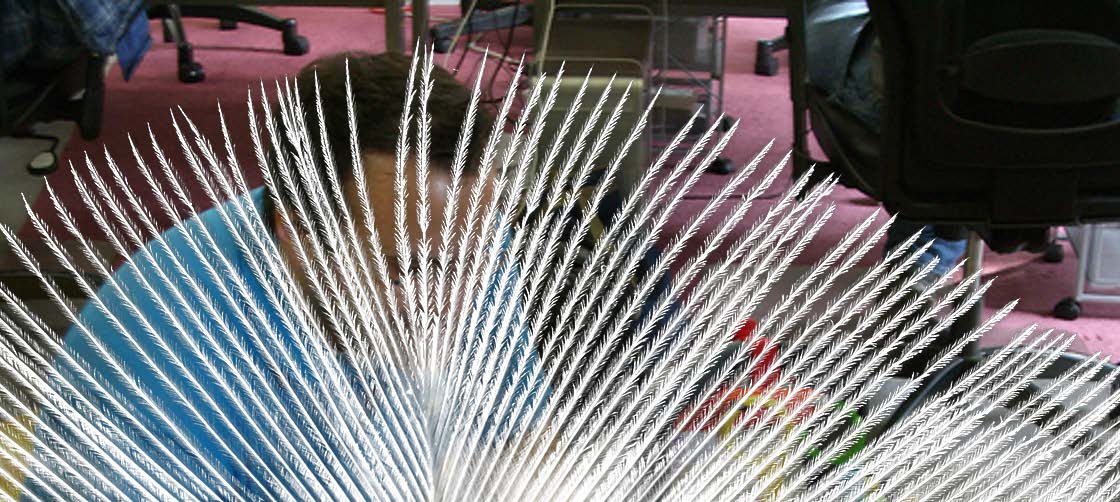
Some visual examples are shown in Fig.
8
to demonstrate
the good performance of our approach on different matting
cases such as hair, holes and semi-transparency.
Moreover,
our
approach
can
also
handle
objects
with
no
pure
fore-
ground pixels, as shown in the last example in Fig.
8
.
Since
previous
sampling-based
and
propagation-based
methods
must
leverage
known
foreground
and
background
pixels,
they cannot handle this case,
while our approach can learn
the appearance of fine details directly from data.
5.3. The real image dataset
Matting
methods
should
generalize
well
to
real-world
images.
To
validate
the
performance
of
our
approach
and
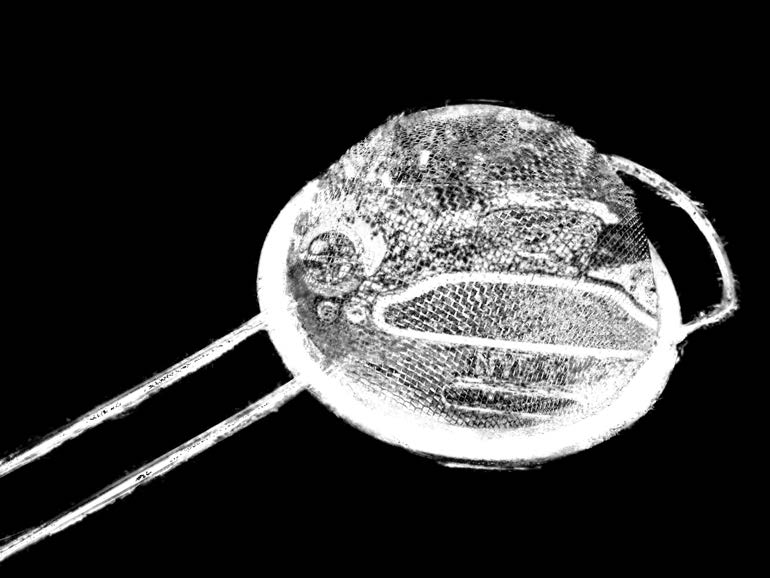
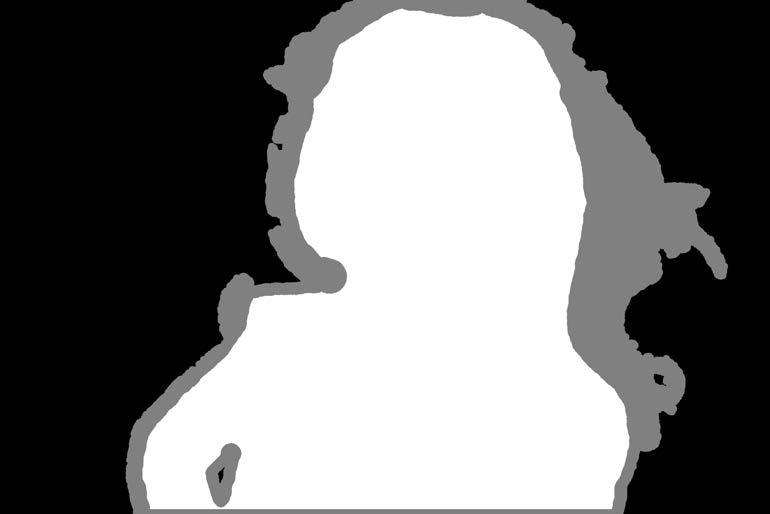
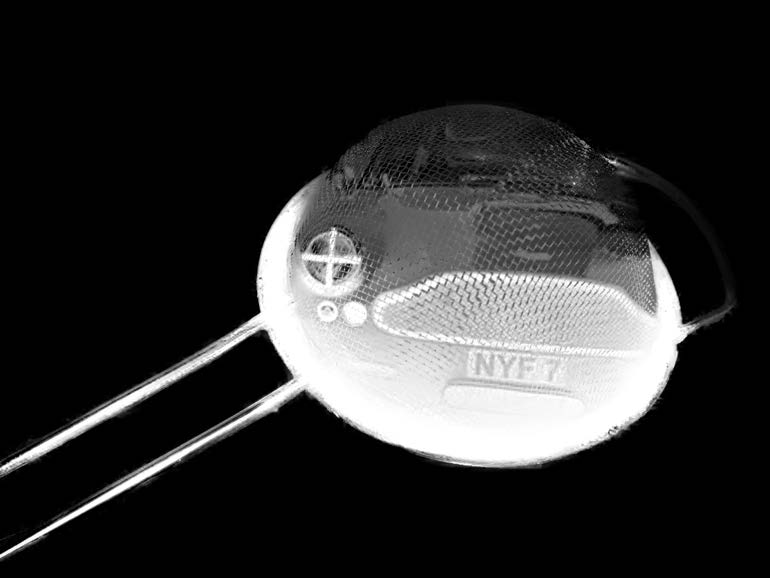
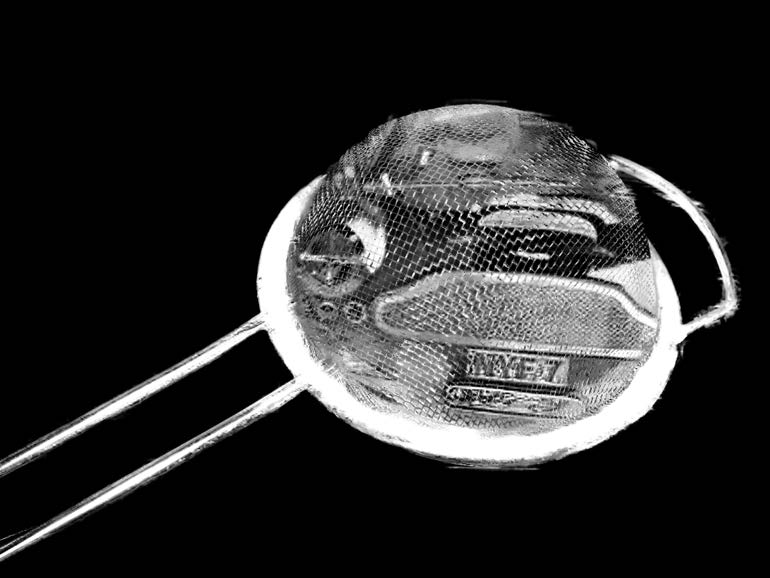
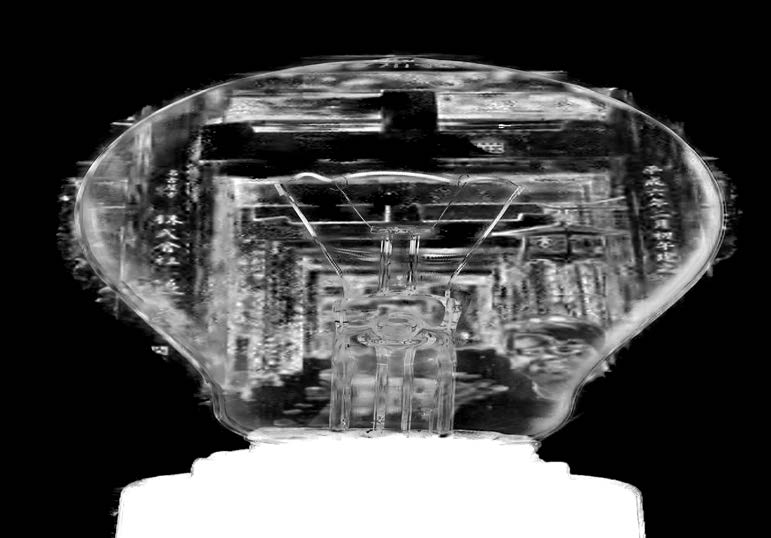










Image
Trimap
Shared [
13
]
Learning [
34
]
Comprehensive[
28
]
Global [
16
]
Closed-form [
22
]
KNN [
5
]
DCNN [
8
]
Ours-raw
Ours-refined
GT
Image
Trimap
Shared [
13
]
Learning [
34
]
Comprehensive[
28
]
Global [
16
]
Closed-form [
22
]
KNN [
5
]
DCNN [
8
]
Ours-raw
Ours-refined
GT
Image
Trimap
Shared [
13
]
Learning [
34
]
Comprehensive[
28
]
Global [
16
]
Closed-form [
22
]
KNN [
5
]
DCNN [
8
]
Ours-raw
Ours-refined
GT
Image
Trimap
Shared [
13
]
Learning [
34
]
Comprehensive[
28
]
Global [
16
]
Closed-form [
22
]
KNN [
5
]
DCNN [
8
]
Ours-raw
Ours-refined
GT
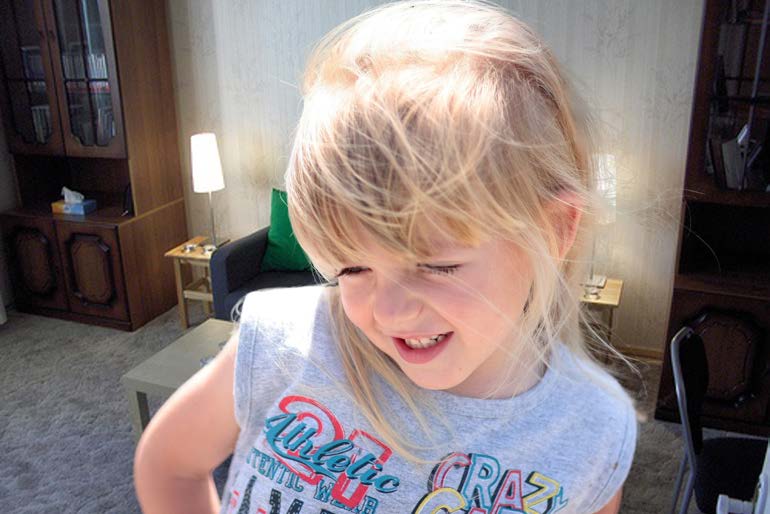
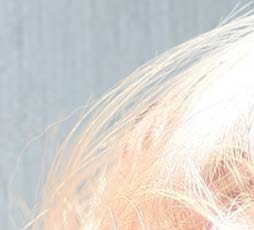
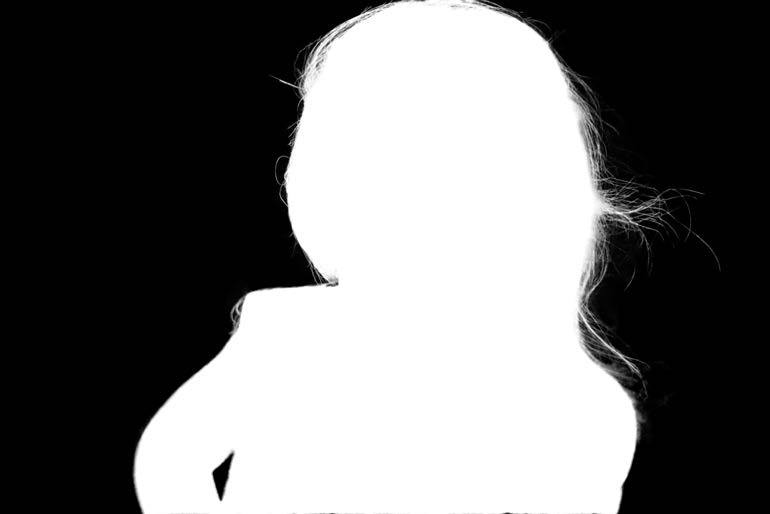
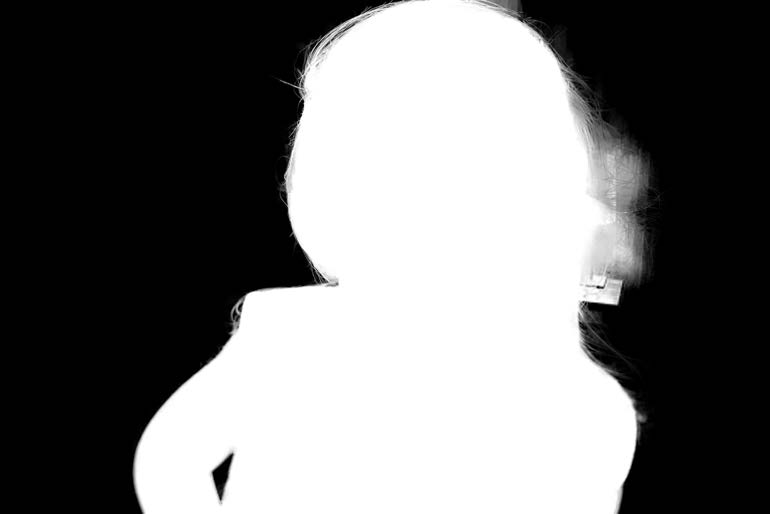
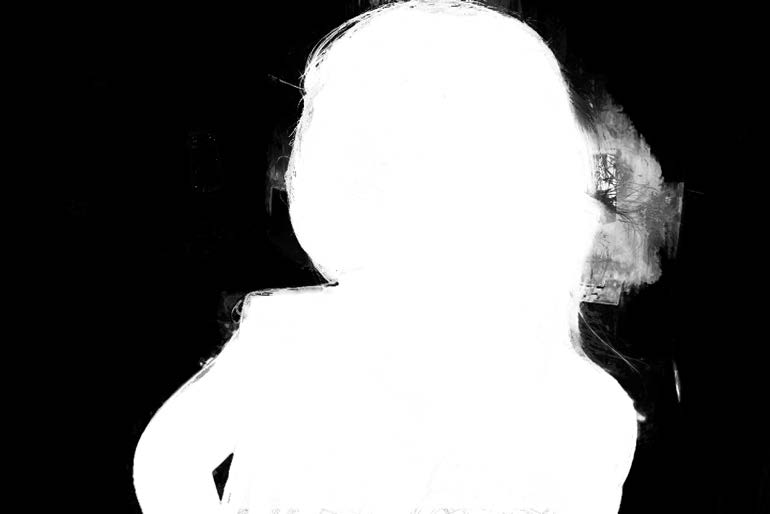
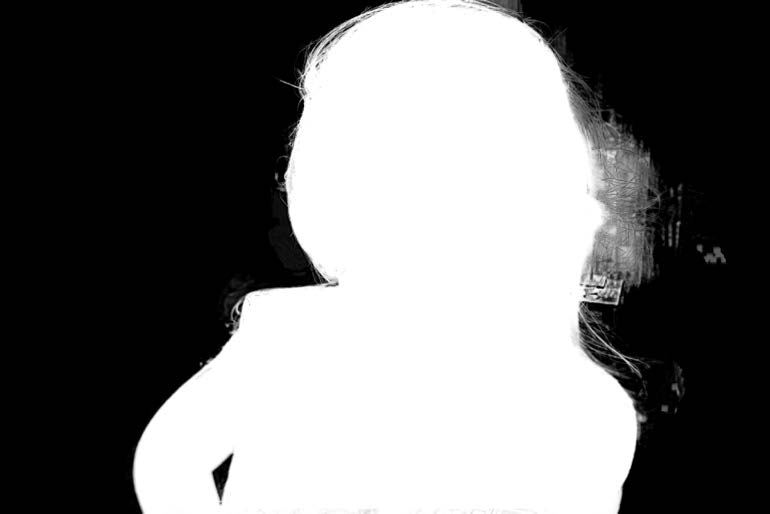
Figure
8.
The
visual
comparison
results
on
the
Composition-1k
testing
dataset.
“Ours-raw’
denotes
the
results
of
our
matting
encoder-
decoder stage while “Ours-refined” denotes the results of our matting refinement stage.
other
methods
on
real
images,
we
conduct
a
user
study
on
the
real
image
dataset.
These
images
consist
of
images
pulled
from
the
internet
as
well
as
images
provided
by
the
ICCV 2013 tutorial on image matting.
Because
our
subjects
may
not
be
acquainted
with
alpha
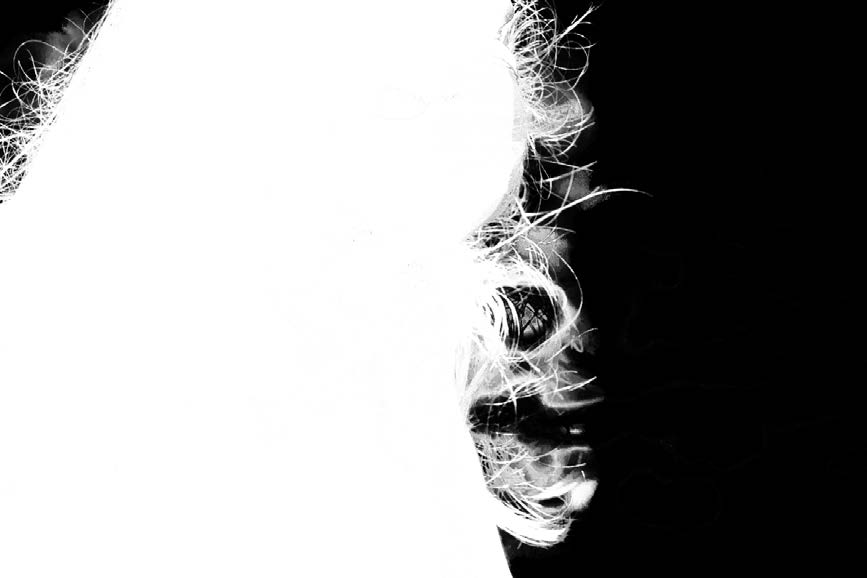
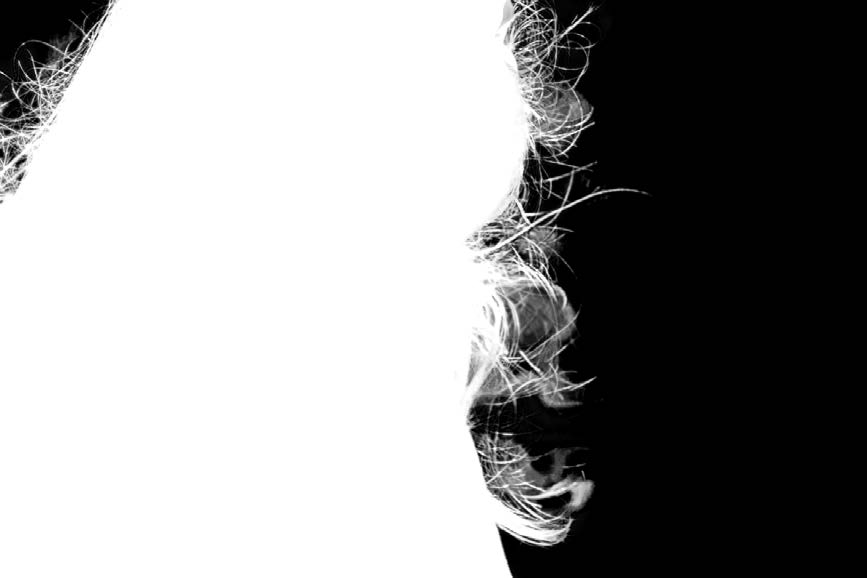
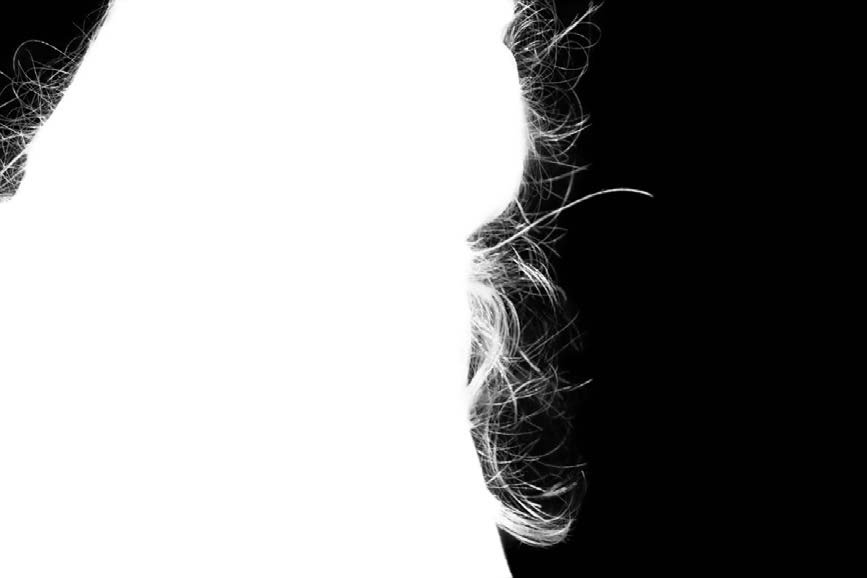
mattes, we instead evaluate the results of compositions.
For
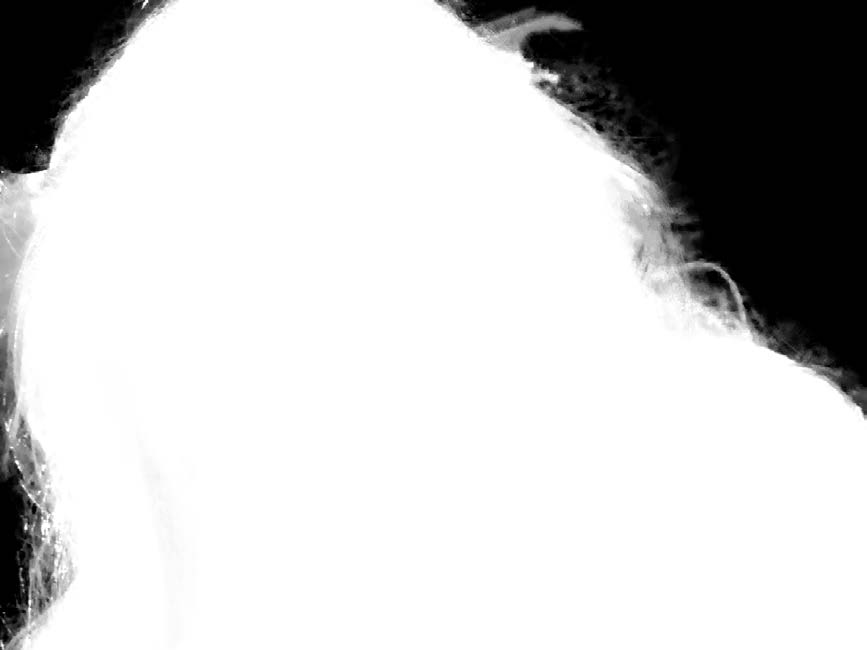
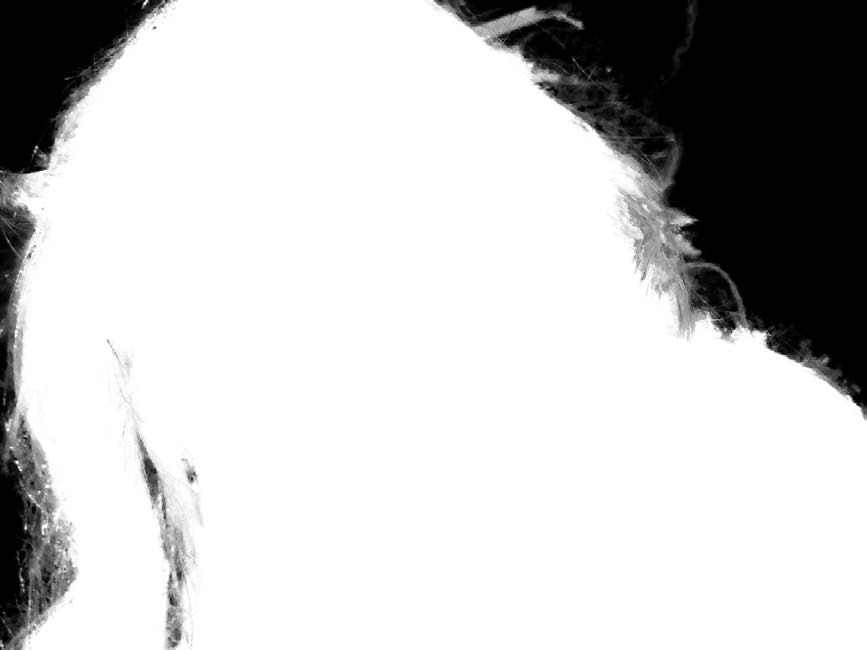
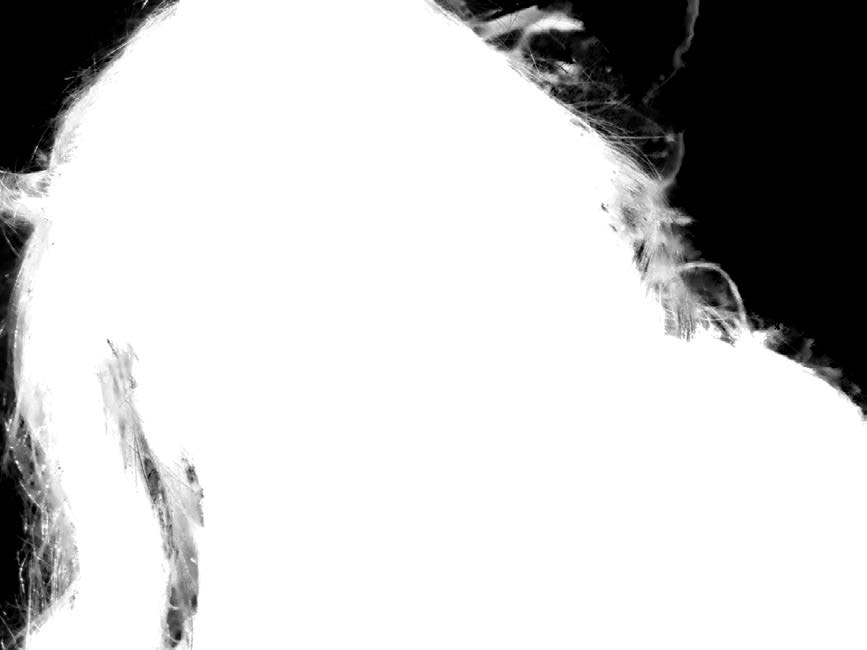
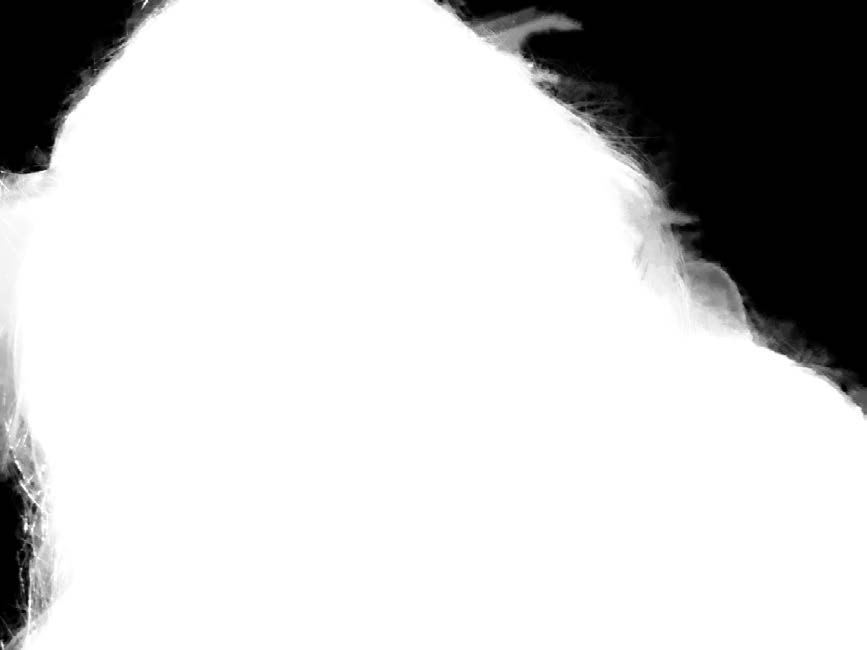
each method, the computed alpha matte is used to blend the
test image onto a black background and onto a white back-
ground.
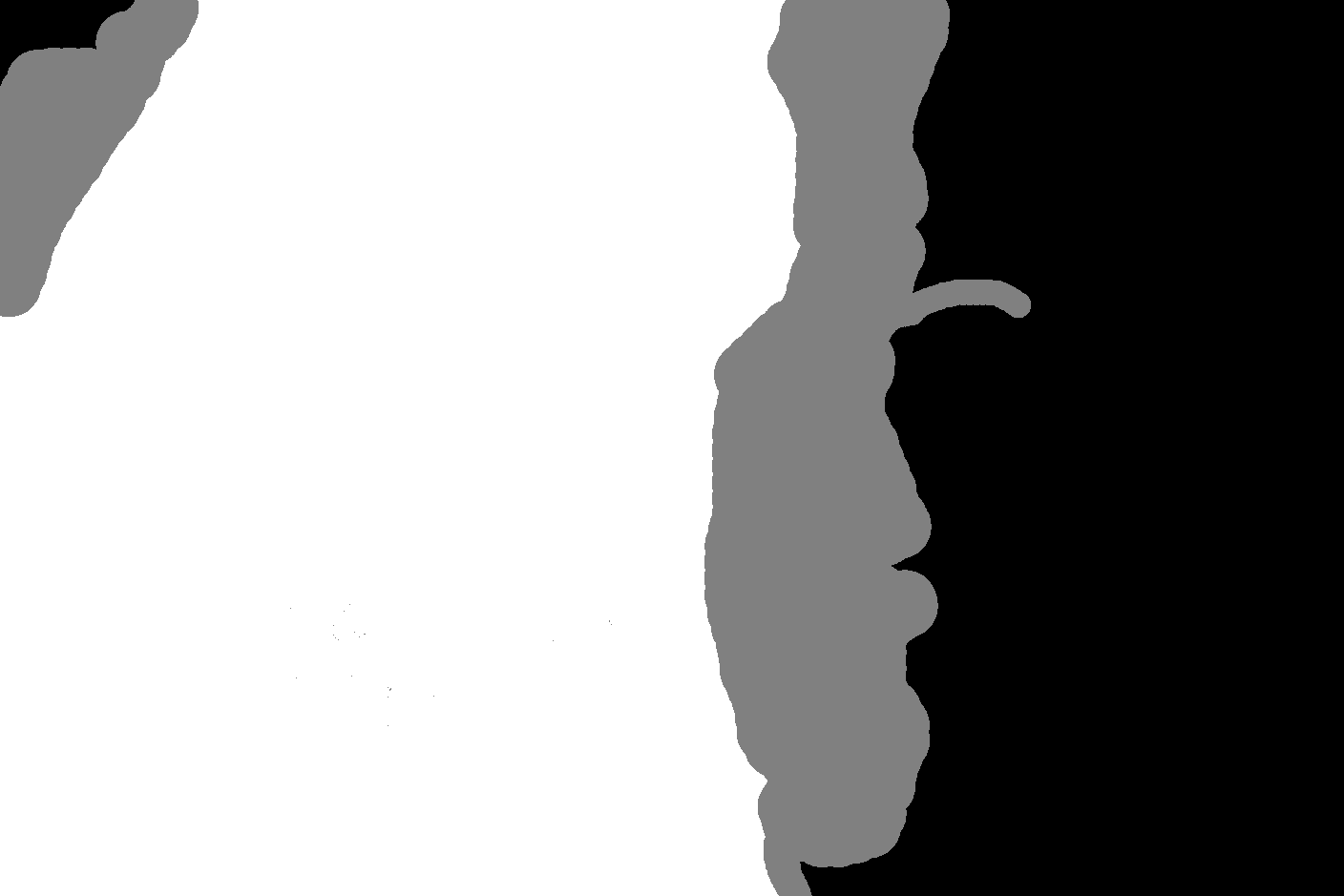
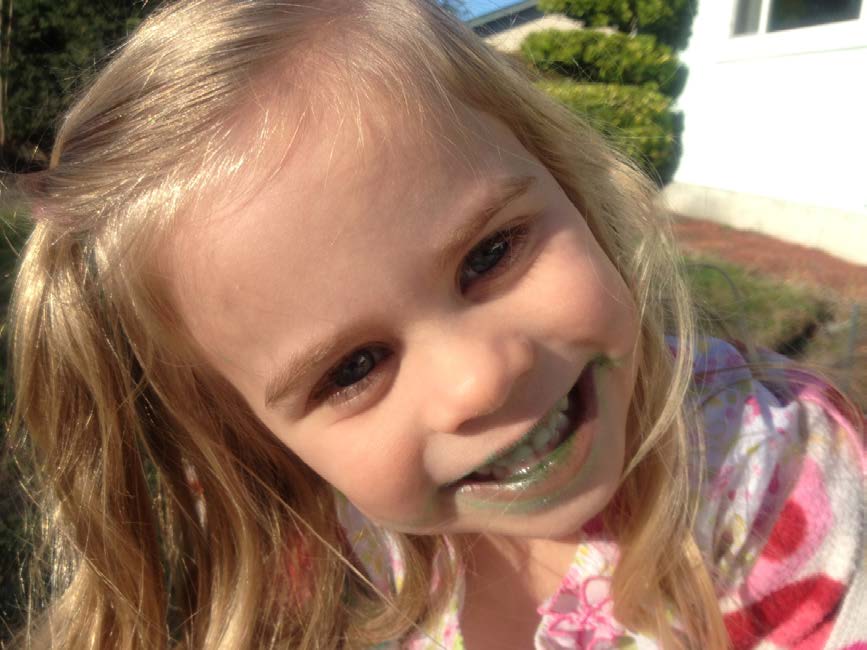
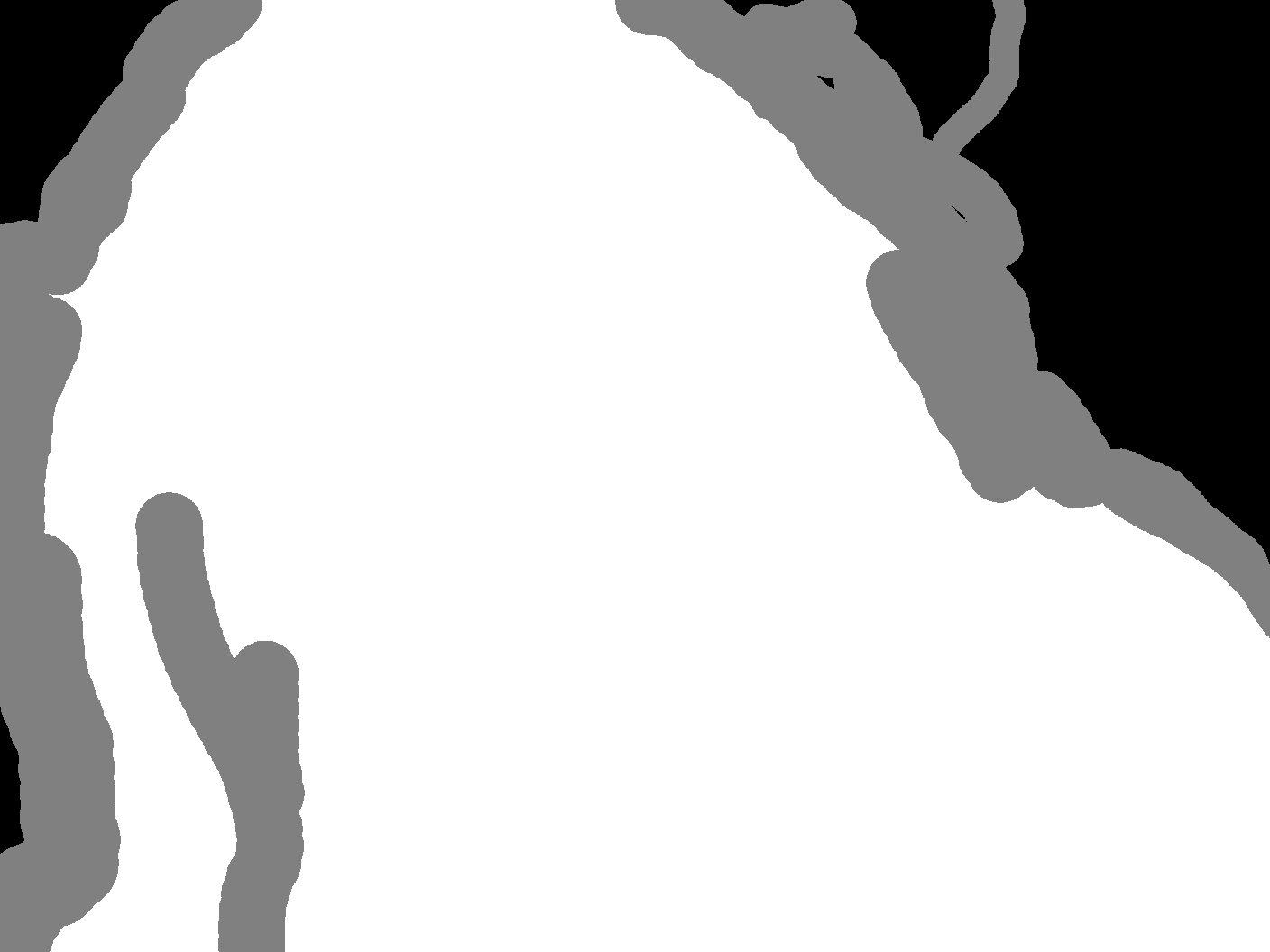
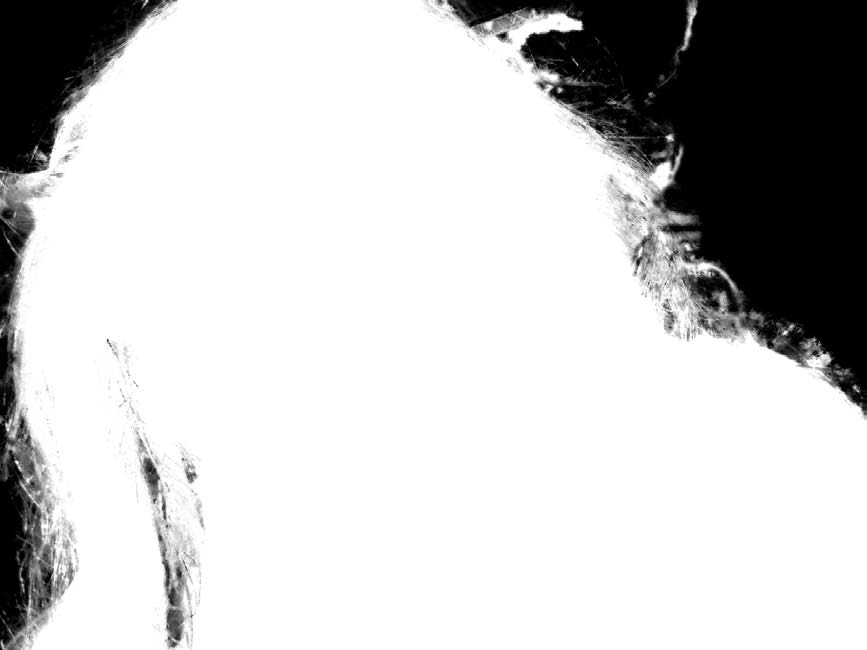
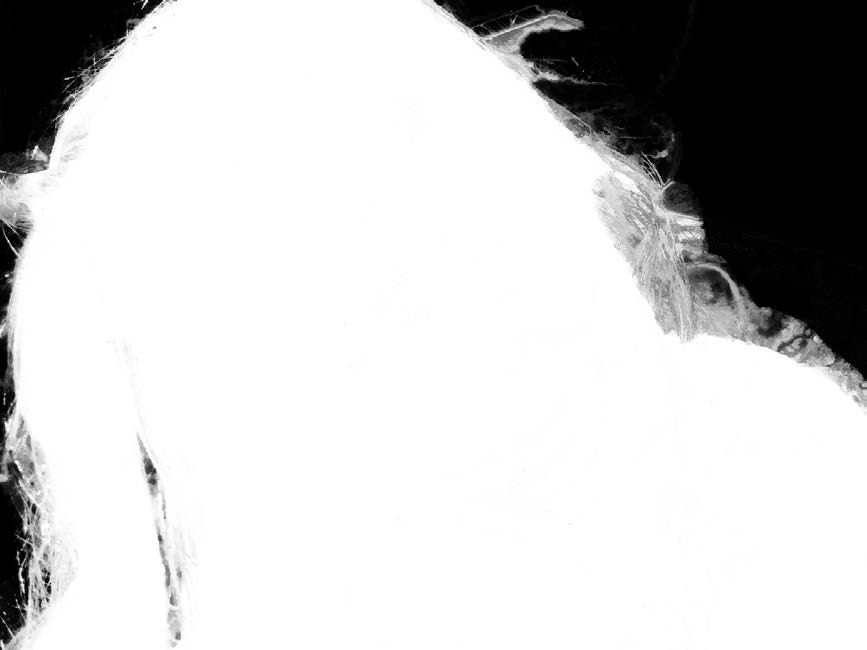
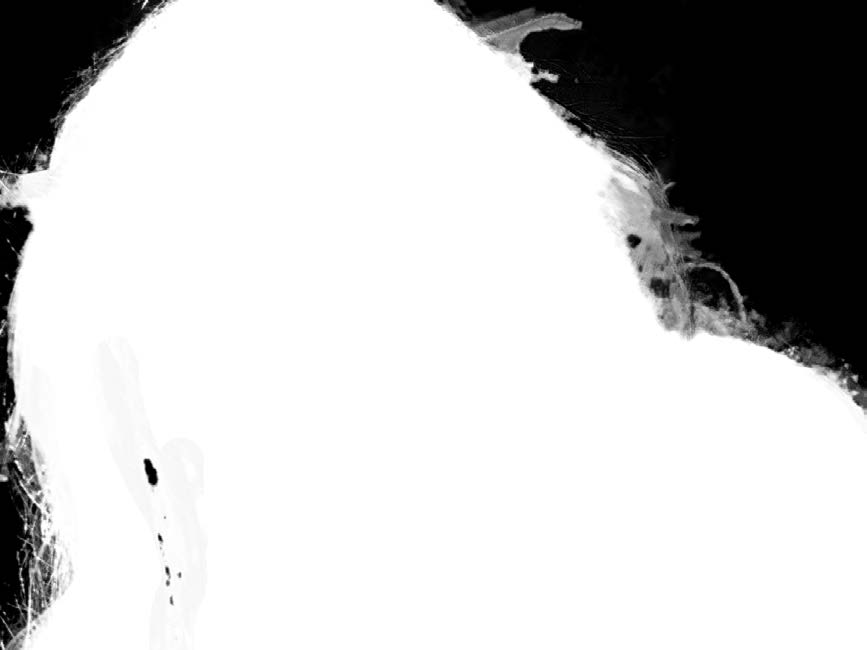
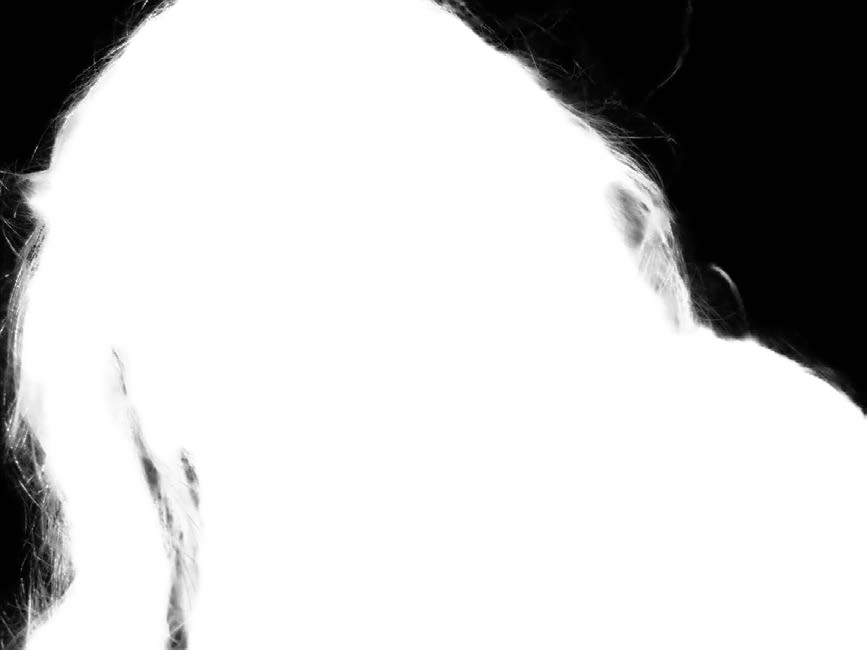
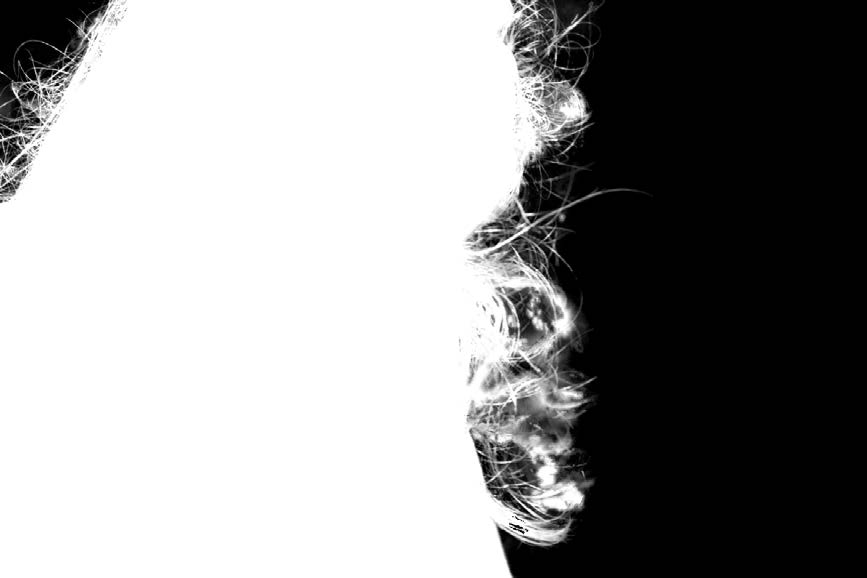
For the user test, we present the image and the two
composition results of two randomly selected approaches to

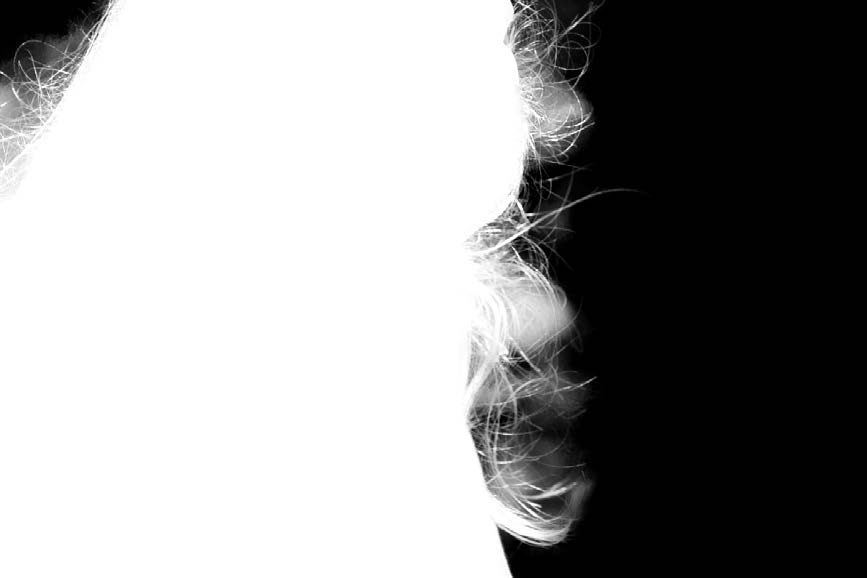
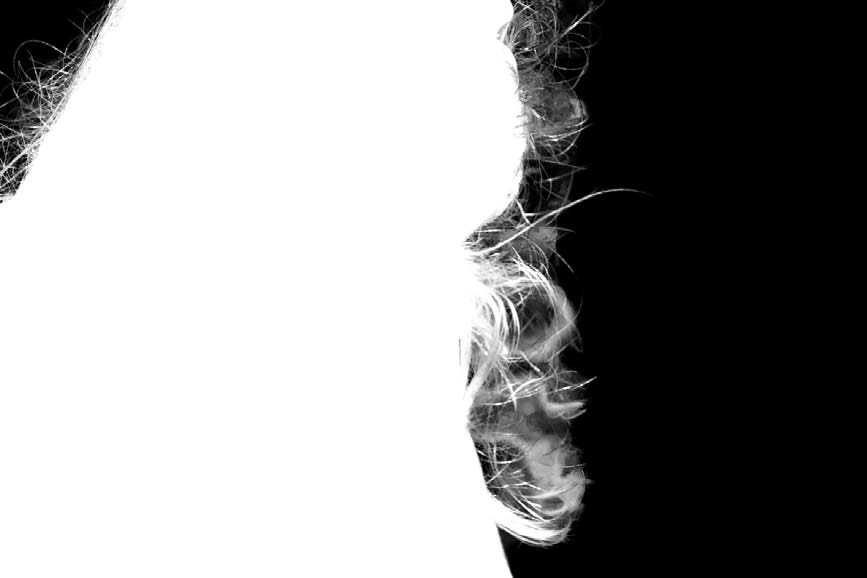
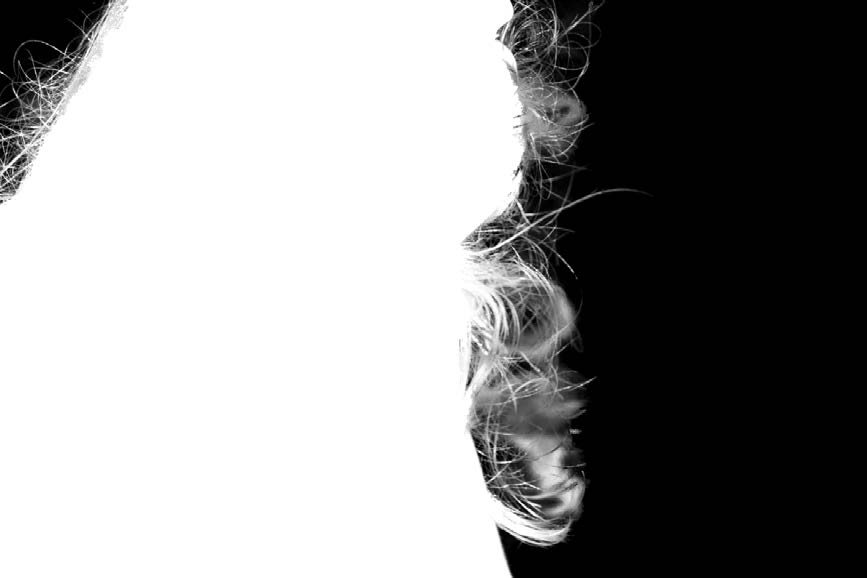
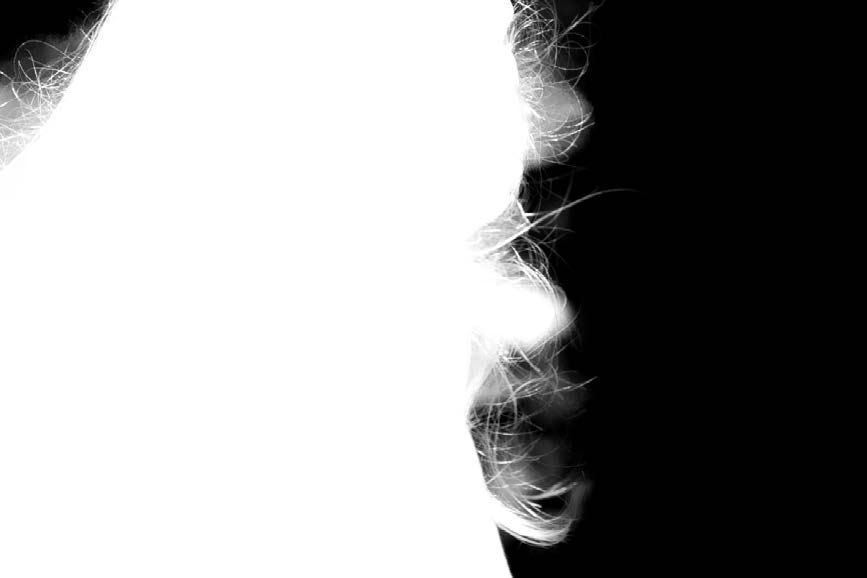
Image
Trimap
Shared [
13
]
Learning [
34
]
Comprehensive[
28
]
Global [
16
]
Closed-form [
22
]
KNN [
5
]
DCNN [
8
]
Ours-refined
Image
Trimap
Shared [
13
]
Learning [
34
]
Comprehensive[
28
]
Global [
16
]
Closed-form [
22
]
KNN [
5
]
DCNN [
8
]
Ours-refined
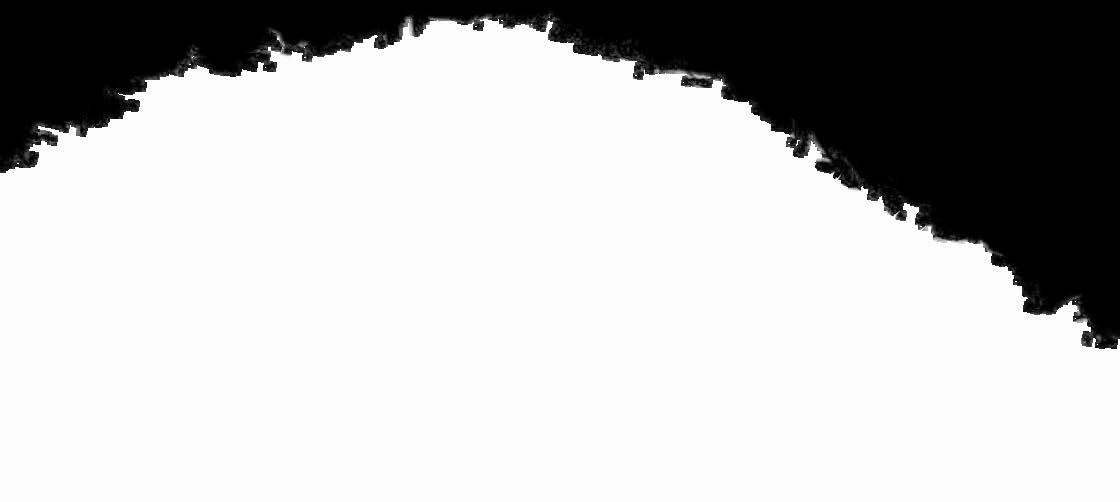
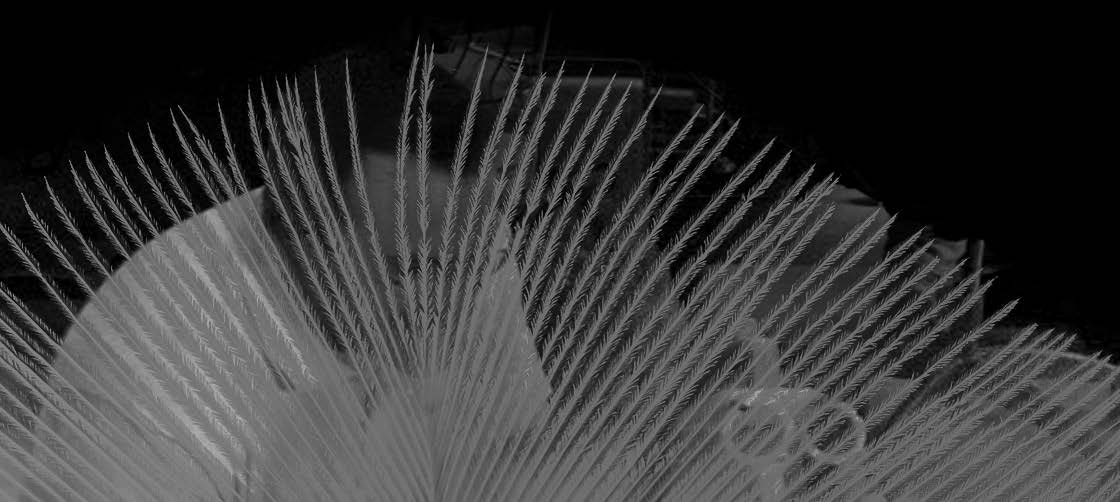
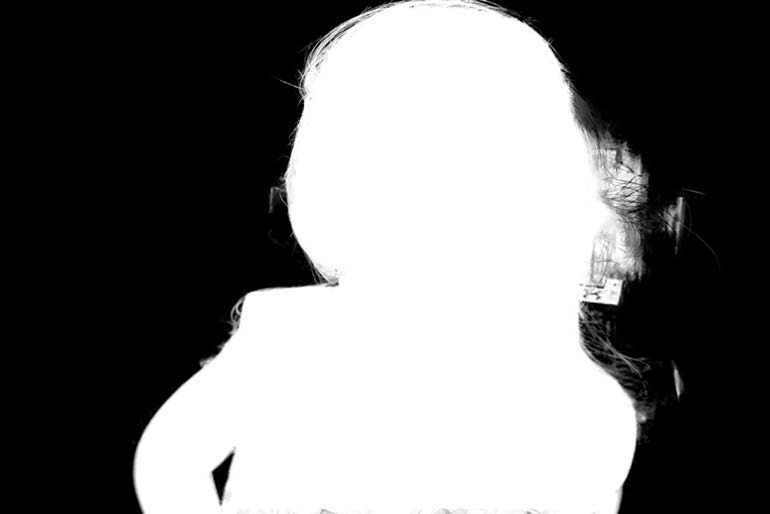
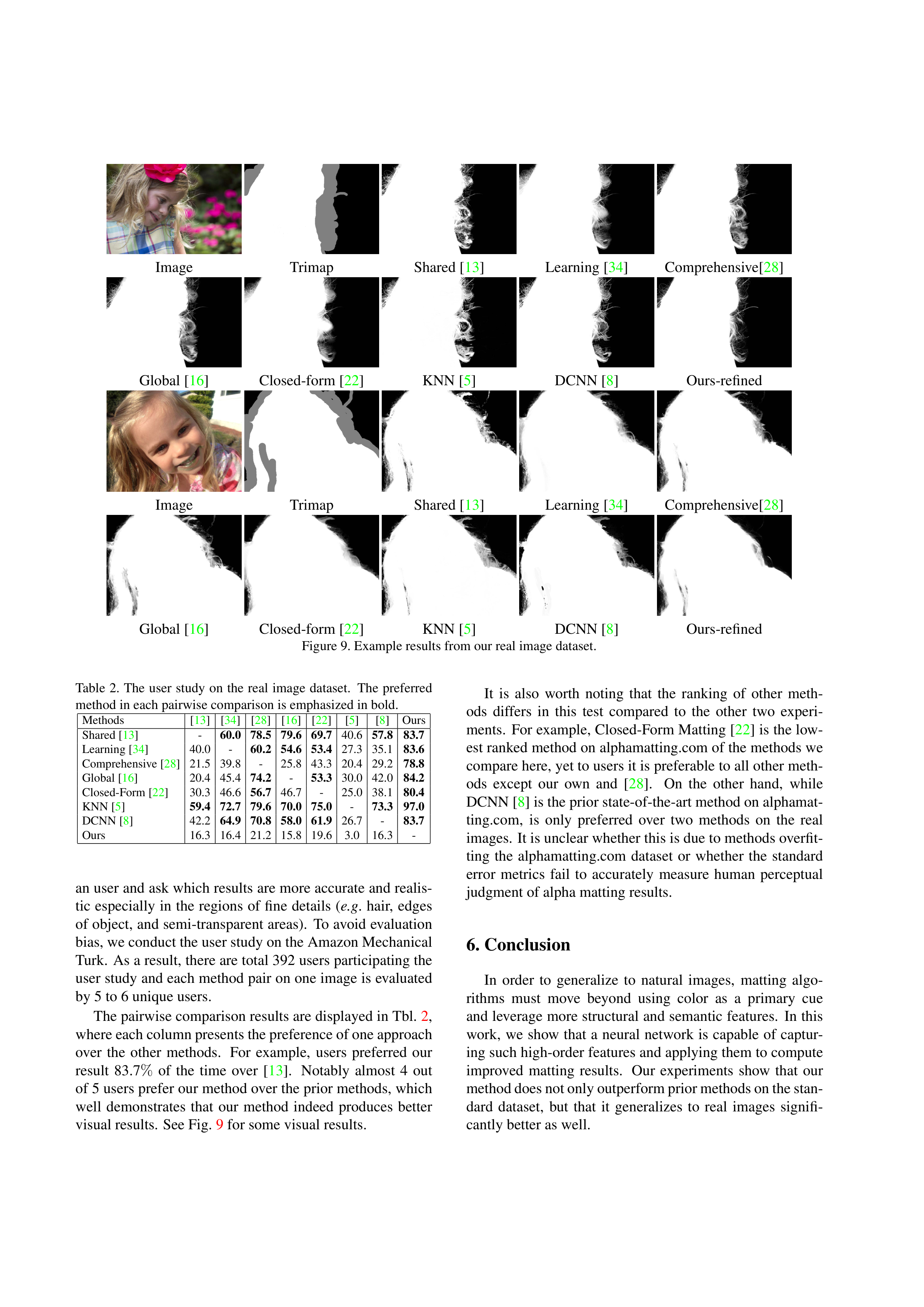
Figure 9. Example results from our real image dataset.
Table
2.
The
user
study
on
the
real
image
dataset.
The
preferred
method in each pairwise comparison is emphasized in bold.
Methods
[
13
]
[
34
]
[
28
]
[
16
]
[
22
]
[
5
]
[
8
]
Ours
Shared [
13
]
-
60.0
78.5
79.6
69.7
40.6
57.8
83.7
Learning [
34
]
40.0
-
60.2
54.6
53.4
27.3
35.1
83.6
Comprehensive [
28
]
21.5
39.8
-
25.8
43.3
20.4
29.2
78.8
Global [
16
]
20.4
45.4
74.2
-
53.3
30.0
42.0
84.2
Closed-Form [
22
]
30.3
46.6
56.7
46.7
-
25.0
38.1
80.4
KNN [
5
]
59.4
72.7
79.6
70.0
75.0
-
73.3
97.0
DCNN [
8
]
42.2
64.9
70.8
58.0
61.9
26.7
-
83.7
Ours
16.3
16.4
21.2
15.8
19.6
3.0
16.3
-
an user and ask which results are more accurate and realis-
tic
especially
in
the
regions
of
fine
details
(
e.g
.
hair,
edges
of object, and semi-transparent areas).
To avoid evaluation
bias, we conduct the user study on the Amazon Mechanical
Turk.
As a result, there are total 392 users participating the
user study and each method pair on one image is evaluated
by 5 to 6 unique users.
The pairwise comparison results are displayed in Tbl.
2
,
where each column presents the preference of one approach
over
the
other
methods.
For
example,
users
preferred
our
result
83.7
%
of
the
time
over
[
13
].
Notably
almost
4
out
of 5 users prefer our method over the prior methods, which
well
demonstrates
that
our
method
indeed
produces
better
visual results.
See Fig.
9
for some visual results.
It
is
also
worth
noting
that
the
ranking
of
other
meth-
ods
differs
in
this
test
compared
to
the
other
two
experi-
ments.
For example, Closed-Form Matting [
22
] is the low-
est ranked method on alphamatting.com of the methods we
compare here, yet to users it is preferable to all other meth-
ods
except
our
own
and
[
28
].
On
the
other
hand,
while
DCNN [
8
] is the prior state-of-the-art method on alphamat-
ting.com,
is
only
preferred
over
two
methods
on
the
real
images.
It is unclear whether this is due to methods overfit-
ting
the
alphamatting.com
dataset
or
whether
the
standard
error
metrics
fail
to
accurately
measure
human
perceptual
judgment of alpha matting results.
6. Conclusion
In
order
to
generalize
to
natural
images,
matting
algo-
rithms
must
move
beyond
using
color
as
a
primary
cue
and leverage more structural and semantic features.
In this
work,
we
show
that
a
neural
network
is
capable
of
captur-
ing such high-order features and applying them to compute
improved
matting
results.
Our
experiments
show
that
our
method does not only outperform prior methods on the stan-
dard
dataset,
but
that
it
generalizes
to
real
images
signifi-
cantly better as well.
References
[1]
A. Al-Kabbany and E. Dubois.
Matting with sequential pair
selection
using
graph
transduction.
In
21st
International
Symposium on Vision, Modeling, and Visualization
, 2016.
6
[2]
V.
Badrinarayanan,
A.
Handa,
and
R.
Cipolla.
Seg-
net:
A
deep
convolutional
encoder-decoder
architecture
for
robust
semantic
pixel-wise
labelling.
arXiv
preprint
arXiv:1505.07293
, 2015.
3
[3]
A. Berman, A. Dadourian, and P. Vlahos. Method for remov-
ing
from
an
image
the
background
surrounding
a
selected
object, Oct. 17 2000.
US Patent 6,134,346.
1
,
2
[4]
D. J. Butler, J. Wulff, G. B. Stanley, and M. J. Black.
A nat-
uralistic
open
source
movie
for
optical
flow
evaluation.
In
Proceedings
of
the
European
Conference
on
Computer
Vi-
sion
, 2012.
2
[5]
Q.
Chen,
D.
Li,
and
C.-K.
Tang.
Knn
matting.
IEEE
transactions
on
pattern
analysis
and
machine
intelligence
,
35(9):2175–2188, 2013.
2
,
5
,
7
,
8
[6]
X.
Chen
and
F.
He.
A
propagation
matting
method
based
on
the
local
sampling
and
knn
classification
with
adaptive
feature space.
Journal of Computer-Aided Design and Com-
puter Graphics
, 2016.
6
[7]
X. Chen, D. Zou, S. Zhiying Zhou, Q. Zhao, and P. Tan.
Im-
age matting
with local
and
nonlocal
smooth priors.
In
Pro-
ceedings
of
the
IEEE
Conference
on
Computer
Vision
and
Pattern Recognition
, pages 1902–1907, 2013.
2
,
6
[8]
D.
Cho,
Y.-W.
Tai,
I.
Kweon,
D.
Cho,
Y.-W.
Tai,
and
I.
Kweon.
Natural
image
matting
using
deep
convolutional
neural networks. In
Proceedings of the European Conference
on Computer Vision
, 2016.
1
,
2
,
5
,
6
,
7
,
8
[9]
Y.-Y. Chuang, B. Curless, D. H. Salesin, and R. Szeliski.
A
bayesian
approach
to
digital
matting.
In
Computer
Vision
and Pattern Recognition, 2001. CVPR 2001. Proceedings of
the 2001 IEEE Computer Society Conference on
, volume 2,
pages II–264. IEEE, 2001.
1
,
2
[10]
M. Erofeev, Y. Gitman, D. Vatolin, A. Fedorov, and J. Wang.
Perceptually motivated benchmark for video matting. In
Pro-
ceedings of the British Machine Vision Conference (BMVC)
,
2015.
1
[11]
M. Everingham, L. Van Gool, C. K. Williams, J. Winn, and
A.
Zisserman.
The
pascal
visual
object
classes
(voc)
chal-
lenge.
International journal of computer vision
, 88(2):303–
338, 2010.
3
[12]
X. Feng, X. Liang, and Z. Zhang. A cluster sampling method
for
image
matting
via
sparse
coding.
In
European
Confer-
ence on Computer Vision
, pages 204–219. Springer, 2016.
2
,
6
[13]
E.
S.
Gastal
and
M.
M.
Oliveira.
Shared
sampling
for
real-
time
alpha
matting.
In
Computer
Graphics
Forum
,
vol-
ume
29,
pages
575–584.
Wiley
Online
Library,
2010.
1
,
2
,
5
,
7
,
8
[14]
L. Grady, T. Schiwietz, S. Aharon, and R. Westermann. Ran-
dom walks for interactive alpha-matting.
In
Proceedings of
VIIP
, volume 2005, pages 423–429, 2005.
1
,
2
[15]
B.
He,
G.
Wang,
C.
Shi,
X.
Yin,
B.
Liu,
and
X.
Lin.
Itera-
tive
transductive
learning
for
alpha
matting.
In
2013
IEEE
International Conference on Image Processing
, pages 4282–
4286. IEEE, 2013.
6
[16]
K. He, C. Rhemann, C. Rother, X. Tang, and J. Sun. A global
sampling
method
for
alpha
matting.
In
Proceedings
of
the
IEEE Conference on Computer Vision and Pattern Recogni-
tion
, 2011.
1
,
2
,
5
,
7
,
8
[17]
K. He, J. Sun, and X. Tang.
Guided image filtering.
In
Euro-
pean
conference
on
computer
vision
,
pages
1–14.
Springer,
2010.
5
,
6
[18]
J. Johnson, E. S. Varnousfaderani, H. Cholakkal, , and D. Ra-
jan.
Sparse coding for alpha matting.
IEEE Transactions on
Image Processing
, 2016.
2
[19]
L.
Karacan,
A.
Erdem,
and
E.
Erdem.
Image
matting
with
kl-divergence based sparse sampling.
In
Proceedings of the
IEEE
International
Conference
on
Computer
Vision
,
pages
424–432, 2015.
2
,
6
[20]
D. Kingma and J. Ba.
Adam:
A method for stochastic opti-
mization.
International
Conference
on
Learning
Represen-
tations
, 2015.
5
[21]
P.
Lee
and
Y.
Wu.
Nonlocal
matting.
Proceedings
of
the
IEEE Conference on Computer Vision and Pattern Recogni-
tion
, 2011.
2
[22]
A. Levin, D. Lischinski, and Y. Weiss.
A closed-form solu-
tion to natural image matting.
IEEE Transactions on Pattern
Analysis and Machine Intelligence
, 30(2):228–242, 2008.
1
,
2
,
5
,
7
,
8
[23]
T.-Y. Lin, M. Maire, S. Belongie, J. Hays, P. Perona, D. Ra-
manan,
P. Doll´ar,
and C. L. Zitnick.
Microsoft coco:
Com-
mon
objects
in
context.
In
European
Conference
on
Com-
puter Vision
, pages 740–755. Springer, 2014.
3
[24]
D. Pathak, P. Krahenbuhl, J. Donahue, T. Darrell, and A. A.
Efros.
Context
encoders:
Feature
learning
by
inpainting.
In
The
IEEE
Conference
on
Computer
Vision
and
Pattern
Recognition (CVPR)
, June 2016.
3
[25]
C. Rhemann, C. Rother,
J. Wang, M. Gelautz, P. Kohli, and
P. Rott.
A perceptually motivated online benchmark for im-
age
matting.
In
Proceedings
of
the
IEEE
Conference
on
Computer
Vision
and
Pattern
Recognition
,
2009.
1
,
2
,
3
,
5
,
6
[26]
E.
Shahrian,
B.
Price,
S.
Cohen,
and
D.
Rajan.
Temporally
coherent
and
spatially
accurate
video
matting.
In
Proceed-
ings of Eurographics
, 2012.
3
[27]
E. Shahrian and D. Rajan.
Weighted color and texture sam-
ple selection for image matting.
In
Proceedings of the IEEE
Conference
on
Computer
Vision
and
Pattern
Recognition
,
2012.
2
[28]
E.
Shahrian,
D.
Rajan,
B.
Price,
and
S.
Cohen.
Improving
image
matting
using
comprehensive
sampling
sets.
In
Pro-
ceedings
of
the
IEEE
Conference
on
Computer
Vision
and
Pattern Recognition
, pages 636–643, 2013.
1
,
2
,
5
,
7
,
8
[29]
X. Shen, X. Tao, H. Gao, C. Zhou, and J. Jia. Deep automatic
portrait matting. In
Proceedings of the European Conference
on Computer Vision
, 2016.
1
,
2
[30]
K.
Simonyan
and
A.
Zisserman.
Very
deep
convolu-
tional
networks
for
large-scale
image
recognition.
CoRR
,
abs/1409.1556, 2014.
4
[31]
J. Sun, J. Jia, C.-K. Tang, and H.-Y. Shum.
Poisson matting.
In
ACM Transactions on Graphics (ToG)
, volume 23, pages
315–321. ACM, 2004.
1
,
2
[32]
J. Wang and M. F. Cohen.
Optimized color sampling for ro-
bust matting.
In
2007 IEEE Conference on Computer Vision
and Pattern Recognition
, pages 1–8. IEEE, 2007.
1
,
2
[33]
J. Yang, B. Price, S. Cohen, H. Lee, and M.-H. Yang.
Object
contour detection with a fully convolutional encoder-decoder
network.
Proceedings of the IEEE Conference on Computer
Vision and Pattern Recognition
, 2016.
3
[34]
Y. Zheng and C. Kambhamettu.
Learning based digital mat-
ting.
In
2009 IEEE 12th International Conference on Com-
puter Vision
, pages 889–896. IEEE, 2009.
5
,
7
,
8