ERNIE: Enhanced Representation through Knowledge Integration
Yu Sun, Shuohuan Wang, Yukun Li, Shikun Feng
Xuyi Chen, Han Zhang, Xin Tian, Danxiang Zhu, Hao Tian, Hua Wu
Baidu Inc.
{
sunyu02,wangshuohuan,liyukun01,fengshikun01,tianhao,wu
hua
}
@baidu.com
Abstract
We
present
a
novel
language
representation
model
enhanced
by
knowledge
called
ERNIE
(Enhanced
Representation
through
kNowl-
edge
IntEgration).
Inspired
by
the
mask-
ing
strategy
of
BERT
(
Devlin
et
al.
,
2018
),
ERNIE is designed to learn language represen-
tation enhanced by knowledge masking strate-
gies,
which includes entity-level masking and
phrase-level
masking.
Entity-level
strategy
masks entities which are usually composed of
multiple
words.
Phrase-level
strategy
masks
the whole phrase which is composed of several
words
standing
together
as
a
conceptual
unit.
Experimental results show that ERNIE outper-
forms
other
baseline
methods,
achieving
new
state-of-the-art
results
on
five
Chinese
natu-
ral
language
processing
tasks
including
nat-
ural
language
inference,
semantic
similarity,
named
entity
recognition,
sentiment
analysis
and question answering.
We also demonstrate
that ERNIE has more powerful knowledge in-
ference capacity on a cloze test.
1
Introduction
Language
representation
pre-training
(
Mikolov
et
al.
,
2013
;
Devlin
et
al.
,
2018
)
has
been
shown
effective
for
improving
many
natural
language
processing tasks such as named entity recognition,
sentiment
analysis,
and
question
answering.
In
order
to
get
reliable
word
representation,
neural
language
models
are
designed
to
learn
word
co-
occurrence and then obtain word embedding with
unsupervised learning.
The methods in Word2Vec
(
Mikolov
et
al.
,
2013
)
and
Glove
(
Pennington
et
al.
,
2014
)
represent
words
as
vectors,
where
similar
words
have
similar
word
representations.
These
word
representations
provide
an
initializa-
tion
for
the
word
vectors
in
other
deep
learning
models. Recently, lots of works such as Cove (
Mc-
Cann et al.
,
2017
), Elmo (
Peters et al.
,
2018
), GPT
(
Radford
et
al.
,
2018
)
and
BERT
(
Devlin
et
al.
,
2018
)
improved
word
representation
via
different
strategies, which has been shown to be more effec-
tive
for
down-stream
natural
language
processing
tasks.
The
vast
majority
of
these
studies
model
the
representations
by
predicting
the
missing
word
only
through
the
contexts.
These
works
do
not
consider the prior knowledge in the sentence.
For
example, In the sentence ”
Harry Potter is a series
of fantasy novels written by J. K. Rowling
”.
Harry
Potter
is
a
novel
name
and
J.
K.
Rowling
is
the
writer.
It is easy for the model to predict the miss-
ing word of the entity
Harry Potter
by word collo-
cations
inside
this
entity
without
the
help
of
long
contexts.
The
model
cannot
predict
Harry
Pot-
ter
according
to
the
relationship
between
Harry
Potter
and
J.
K.
Rowling
.
It
is
intuitive
that
if
the model learns more about prior knowledge, the
model can obtain more reliable language represen-
tation.
In this paper, we propose a model called ERNIE
(enhanced representation through knowledge inte-
gration)
by
using
knowledge
masking
strategies.
In addition to basic masking strategy,
we use two
kinds
of
knowledge
strategies:
phrase-level
strat-
egy
and
entity-level
strategy.
We
take
a
phrase
or
a
entity
as
one
unit,
which
is
usually
com-
posed
of
several
words.
All
of
the
words
in
the
same
unit
are
masked
during
word
representa-
tion training,
instead of only one word or charac-
ter
being
masked.
In
this
way,
the
prior
knowl-
edge of phrases and entities are implicitly learned
during
the
training
procedure.
Instead
of
adding
the
knowledge
embedding
directly,
ERNIE
im-
plicitly
learned
the
information
about
knowledge
and
longer
semantic
dependency,
such
as
the
re-
lationship
between
entities,
the
property
of
a
en-
tity
and
the
type
of
a
event,
to
guide
word
em-
bedding
learning.
This
can
make
the
model
have
better generalization and adaptability.
arXiv:1904.09223v1 [cs.CL] 19 Apr 2019
In order to reduce the training cost of the model,
ERNIE
is
pre-trained
on
heterogeneous
Chinese
data,
and
then
applied
to
5
Chinese
NLP
tasks.
ERNIE advances the state-of-the-art results on all
of
these
tasks.
An
additional
experiment
on
the
cloze
test
shows
that
ERNIE
has
better
knowl-
edge inference capacity over other strong baseline
methods.
Our Contribution are as follows:
(1)
We
introduce
a
new
learning
processing
of
language
model
which
masking
the
units
such
as
phrases
and
entities
in
order
to
implicitly
learn
both
syntactic
and
semantic
information
from
these units.
(2) ERNIE significantly outperforms the previ-
ous
state-of-the
art
methods
on
various
Chinese
natural language processing tasks.
(3)
We
released
the
codes
of
ERNIE
and
pre-trained
models,
which
are
available
in
https://github.com/PaddlePaddle/
LARK/tree/develop/ERNIE
.
2
Related Work
2.1
Context-independent Representation
Representation of words as continuous vectors has
a
long
history.
A
very
popular
model
architec-
ture for estimating neural network language model
(NNLM)
was
proposed
in
(
Bengio
et
al.
,
2003
),
where a feed forward neural network with a linear
projection layer and a non-linear hidden layer was
used to learn the word vector representation.
It
is
effective
to
learn
general
language
repre-
sentation
by
using
a
large
number
of
unlabeled
data
to
pretrain
a
language
model.
Traditional
methods
focused
on
context-independent
word
embedding.
Methods such as Word2Vec (
Mikolov
et
al.
,
2013
)
and
Glove
(
Pennington
et
al.
,
2014
)
take a large corpus of text as inputs and produces a
word vectors, typically in several hundred dimen-
sions.
They
generate
a
single
word
embedding
representation for each word in the vocabulary.
2.2
Context-aware Representation
However,
a
word
can
have
completely
different
senses
or
meanings
in
the
contexts.
Skip-thought
(
Kiros
et
al.
,
2015
)
proposed
a
approach
for
un-
supervised
learning
of
a
generic,
distributed
sen-
tence
encoder.
Cove
(
McCann
et
al.
,
2017
)
show
that
adding
these
context
vectors
improves
per-
formance over using only unsupervised word and
character
vectors
on
a
wide
variety
of
common
NLP
tasks.
ULMFit
(
Howard
and
Ruder
,
2018
)
proposed
an
effective
transfer
learning
method
that
can
be
applied
to
any
task
in
NLP.
ELMo
(
Peters
et
al.
,
2018
)
generalizes
traditional
word
embedding
research
along
a
different
dimension.
They propose to extract context-sensitive features
from a language model.
The GPT (
Radford et al.
,
2018
)
enhanced
the
context-sensitive
embedding
by adapting the Transformer.
BERT
(
Devlin
et
al.
,
2018
)
uses
two
different
pretraining
tasks
for
language
modeling.
BERT
randomly
masks
a
certain
percentage
of
words
in
the
sentences
and
learn
to
predict
those
masked
words.
Moreover,
BERT learn to predict whether
two
sentences
are
adjacent.
This
task
tries
to
model
the
relationship
between
two
sentences
which
is
not
captured
by
traditional
language
models.
Consequently,
this
particular
pretraining
scheme helps BERT to outperform state-of-the-art
techniques by a large margin on various key NLP
datasets
such
as
GLUE
(
Wang
et
al.
,
2018
)
and
SQUAD (
Rajpurkar et al.
,
2016
) and so on.
Some
other
researchers
try
to
add
more
infor-
mation
based
on
these
models.
MT-DNN
(
Liu
et
al.
,
2019
)
combine
pre-training
learning
and
multi-task
learning
to
improve
the
performances
over several different tasks in GLUE (
Wang et al.
,
2018
).
GPT-2 (
Radford et al.
,
2019
) adds task in-
formation
into
the
pre-training
process
and
adapt
their model to zero-shot tasks.
XLM (
Lample and
Conneau
,
2019
)
adds
language
embedding
to
the
pre-training process which achieved better results
in cross-lingual tasks.
2.3
Heterogeneous Data
Semantic
encoder
pre-trained
on
heterogeneous
unsupervised data can improve the transfer learn-
ing performance.
Universal sentence encoder (
Cer
et
al.
,
2018
)
adopts
heterogeneous
training
data
drawn from Wikipedia, web news, web QA pages
and
discussion
forum.
Sentence
encoder
(
Yang
et
al.
,
2018
)
based
on
response
prediction
ben-
efits
from
query-response
pair
data
drawn
from
Reddit conversation.
XLM (
Lample and Conneau
,
2019
) introduce parallel corpus to BERT, which is
trained
jointly
with
masked
language
model
task.
With
transformer
model
pre-trained
on
heteroge-
neous
data,
XLM
shows
great
performance
gain
on supervise/unsupervised MT task and classifica-
tion task.
BERT
Transformer
ERNIE
Potter
is
series
[mask]
fantasy
novel
[mask]
by
J.
[mask]
Rowling
Transformer
Harry
Potter
is
fantasy
novel
[mask]
by
[mask]
[mask]
[mask]
[mask]
[mask]
[mask]
of
series
a
Rowling
K.
J.
of
written
K.
Harry
a
[mask]
written
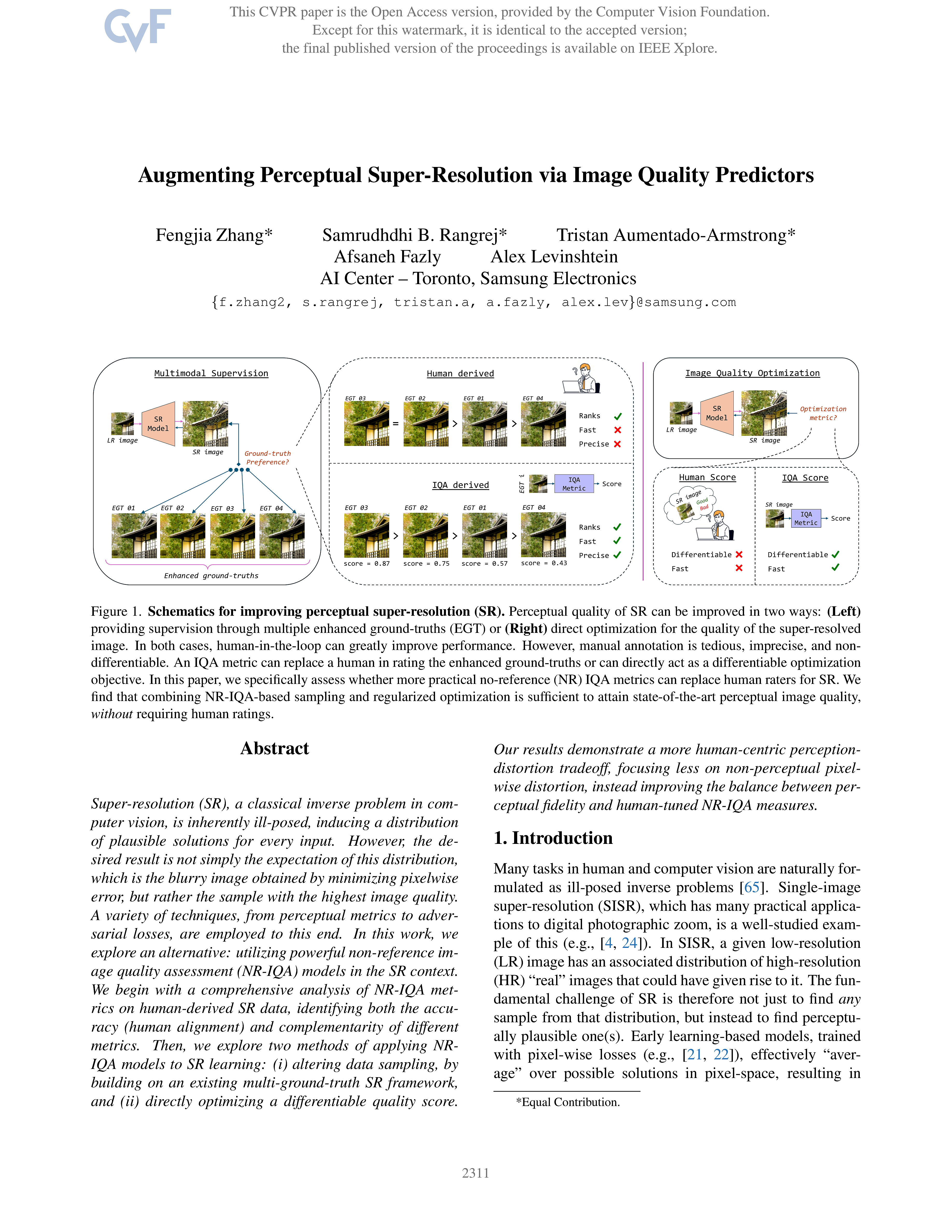
Figure 1:
The different masking strategy between BERT and ERNIE
3
Methods
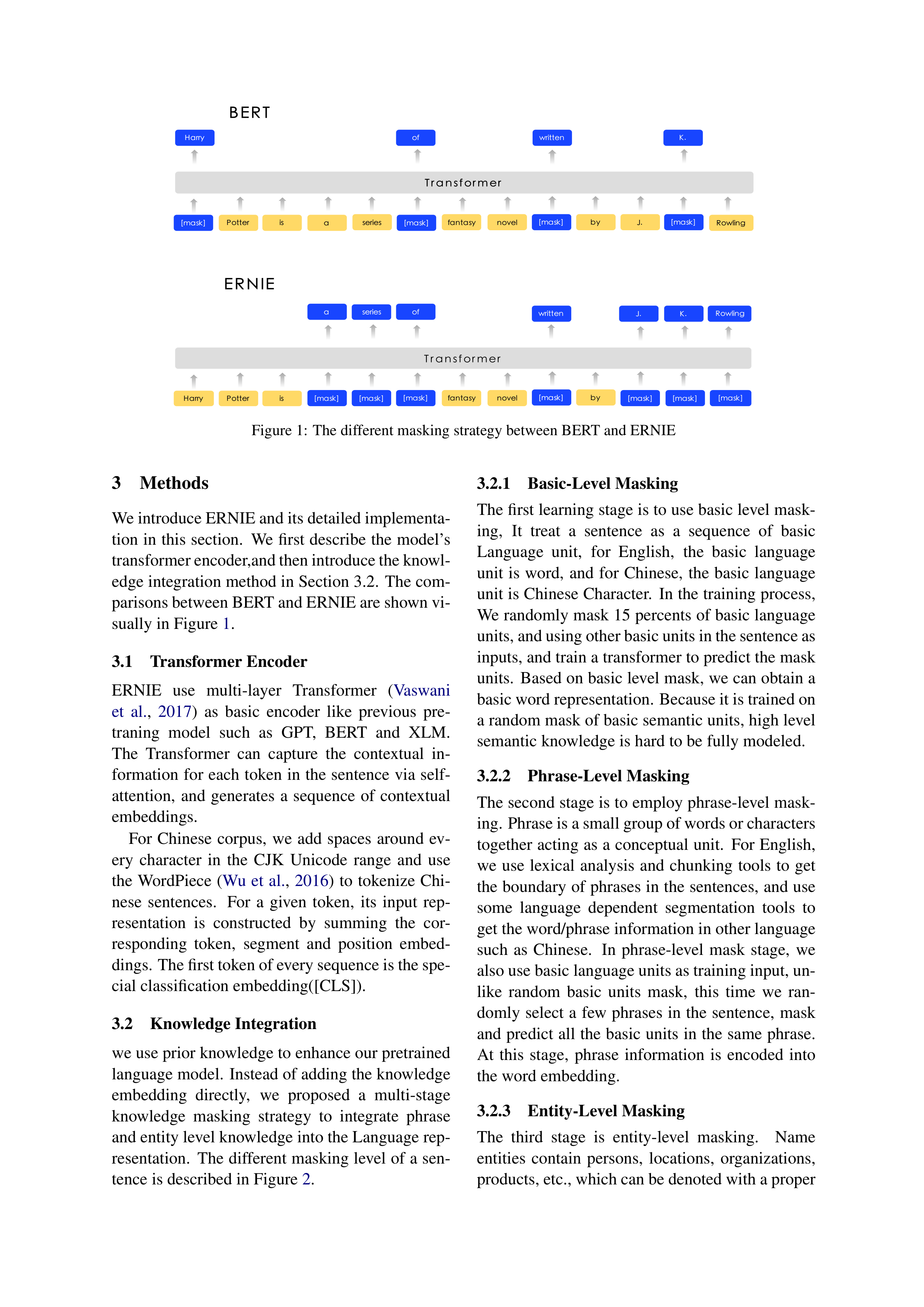
We introduce ERNIE and its detailed implementa-
tion in this section.
We
first
describe
the
model’s
transformer encoder,and then introduce the knowl-
edge integration method in Section 3.2.
The com-
parisons between BERT and ERNIE are shown vi-
sually in Figure
1
.
3.1
Transformer Encoder
ERNIE
use
multi-layer
Transformer
(
Vaswani
et
al.
,
2017
)
as
basic
encoder
like
previous
pre-
traning
model
such
as
GPT,
BERT
and
XLM.
The
Transformer
can
capture
the
contextual
in-
formation
for
each
token
in
the
sentence
via
self-
attention,
and
generates
a
sequence
of
contextual
embeddings.
For
Chinese
corpus,
we
add
spaces
around
ev-
ery
character
in
the
CJK
Unicode
range
and
use
the
WordPiece
(
Wu
et
al.
,
2016
)
to
tokenize
Chi-
nese
sentences.
For
a
given
token,
its
input
rep-
resentation
is
constructed
by
summing
the
cor-
responding
token,
segment
and
position
embed-
dings. The first token of every sequence is the spe-
cial classification embedding([CLS]).
3.2
Knowledge Integration
we use prior knowledge to enhance our pretrained
language model.
Instead of adding the knowledge
embedding
directly,
we
proposed
a
multi-stage
knowledge
masking
strategy
to
integrate
phrase
and entity level knowledge into the Language rep-
resentation.
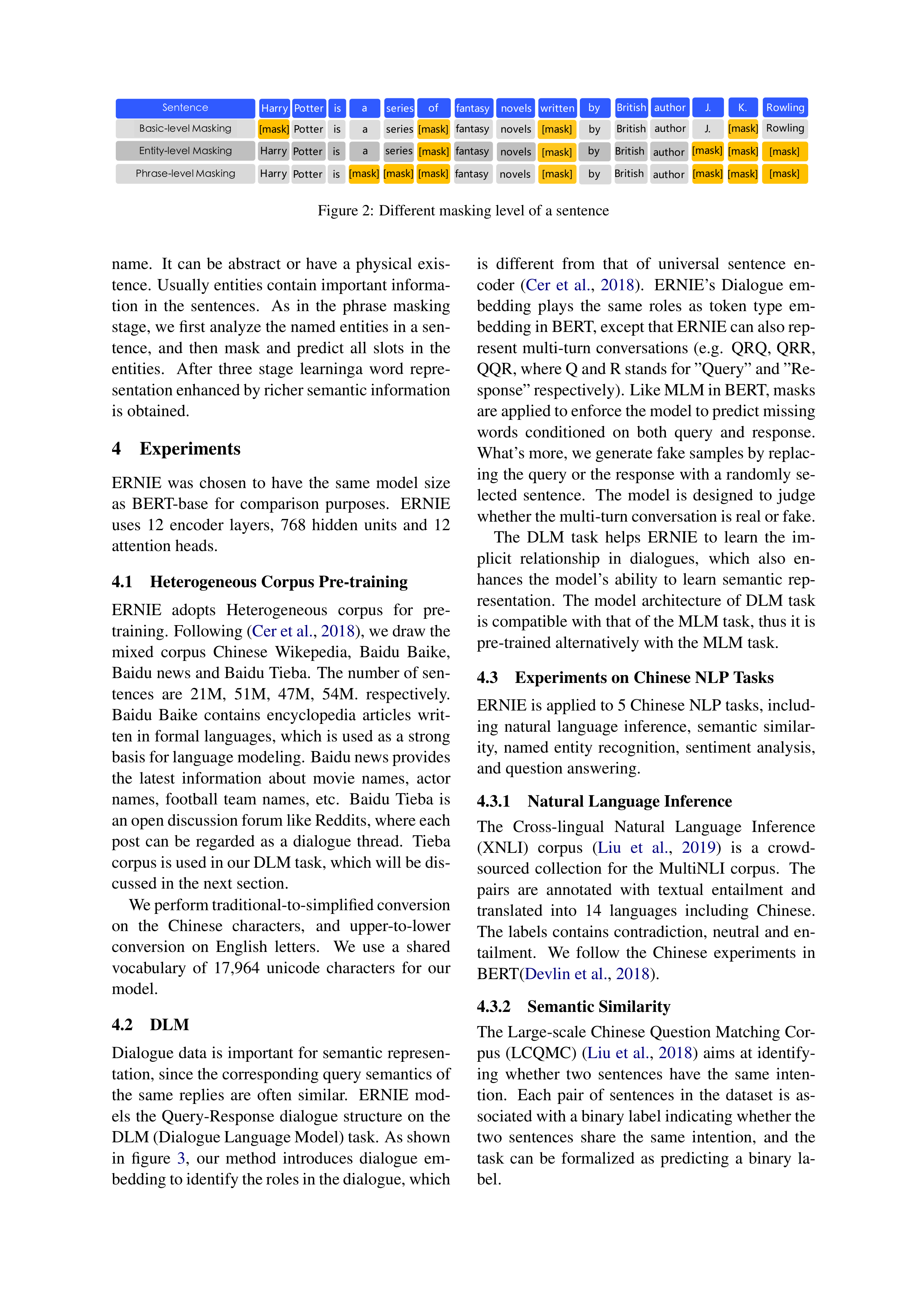
The different masking level of a sen-
tence is described in Figure
2
.
3.2.1
Basic-Level Masking
The first learning stage is to use basic level mask-
ing,
It
treat
a
sentence
as
a
sequence
of
basic
Language
unit,
for
English,
the
basic
language
unit
is
word,
and
for
Chinese,
the
basic
language
unit is Chinese Character.
In the training process,
We randomly mask 15 percents of basic language
units, and using other basic units in the sentence as
inputs, and train a transformer to predict the mask
units.
Based on basic level mask, we can obtain a
basic word representation.
Because it is trained on
a random mask of basic semantic units, high level
semantic knowledge is hard to be fully modeled.
3.2.2
Phrase-Level Masking
The second stage is to employ phrase-level mask-
ing.
Phrase is a small group of words or characters
together acting as a conceptual unit.
For English,
we
use
lexical
analysis
and
chunking
tools
to
get
the boundary of phrases in the sentences, and use
some
language
dependent
segmentation
tools
to
get the word/phrase information in other language
such
as
Chinese.
In
phrase-level
mask
stage,
we
also use basic language units as training input, un-
like
random
basic
units
mask,
this
time
we
ran-
domly
select
a
few
phrases
in
the
sentence,
mask
and predict all the basic units in the same phrase.
At
this
stage,
phrase
information
is
encoded
into
the word embedding.
3.2.3
Entity-Level Masking
The
third
stage
is
entity-level
masking.
Name
entities
contain
persons,
locations,
organizations,
products, etc., which can be denoted with a proper
Harry
Sentence
Basic-level Masking
Phrase-level Masking
Entity-level Masking
Potter
is
series
a
of
fantasy
novels
written
by
British
author
J.
Rowling
Potter
is
series
fantasy
novels
by
British
author
Rowling
Harry
Potter
is
fantasy
novels
by
British
author
Harry
Potter
is
series
fantasy
British
author
[mask]
[mask]
[mask]
[mask]
[mask]
K.
J.
[mask]
[mask]
[mask]
[mask]
[mask]
[mask]
[mask]
by
novels
[mask]
[mask]
[mask]
a
a
[mask]
Figure 2:
Different masking level of a sentence
name.
It
can
be
abstract
or
have
a
physical
exis-
tence.
Usually entities contain important informa-
tion
in
the
sentences.
As
in
the
phrase
masking
stage, we first analyze the named entities in a sen-
tence,
and
then
mask
and
predict
all
slots
in
the
entities.
After
three
stage
learninga
word
repre-
sentation enhanced by richer semantic information
is obtained.
4
Experiments
ERNIE
was
chosen
to
have
the
same
model
size
as
BERT-base
for
comparison
purposes.
ERNIE
uses
12
encoder
layers,
768
hidden
units
and
12
attention heads.
4.1
Heterogeneous Corpus Pre-training
ERNIE
adopts
Heterogeneous
corpus
for
pre-
training.
Following (
Cer et al.
,
2018
), we draw the
mixed
corpus
Chinese
Wikepedia,
Baidu
Baike,
Baidu news and Baidu Tieba.
The number of sen-
tences
are
21M,
51M,
47M,
54M.
respectively.
Baidu
Baike
contains
encyclopedia
articles
writ-
ten in formal languages, which is used as a strong
basis for language modeling. Baidu news provides
the
latest
information
about
movie
names,
actor
names,
football
team
names,
etc.
Baidu
Tieba
is
an open discussion forum like Reddits, where each
post
can
be
regarded
as
a
dialogue
thread.
Tieba
corpus is used in our DLM task, which will be dis-
cussed in the next section.
We perform traditional-to-simplified conversion
on
the
Chinese
characters,
and
upper-to-lower
conversion
on
English
letters.
We
use
a
shared
vocabulary
of
17,964
unicode
characters
for
our
model.
4.2
DLM
Dialogue data is important for semantic represen-
tation, since the corresponding query semantics of
the
same
replies
are
often
similar.
ERNIE
mod-
els
the
Query-Response
dialogue
structure
on
the
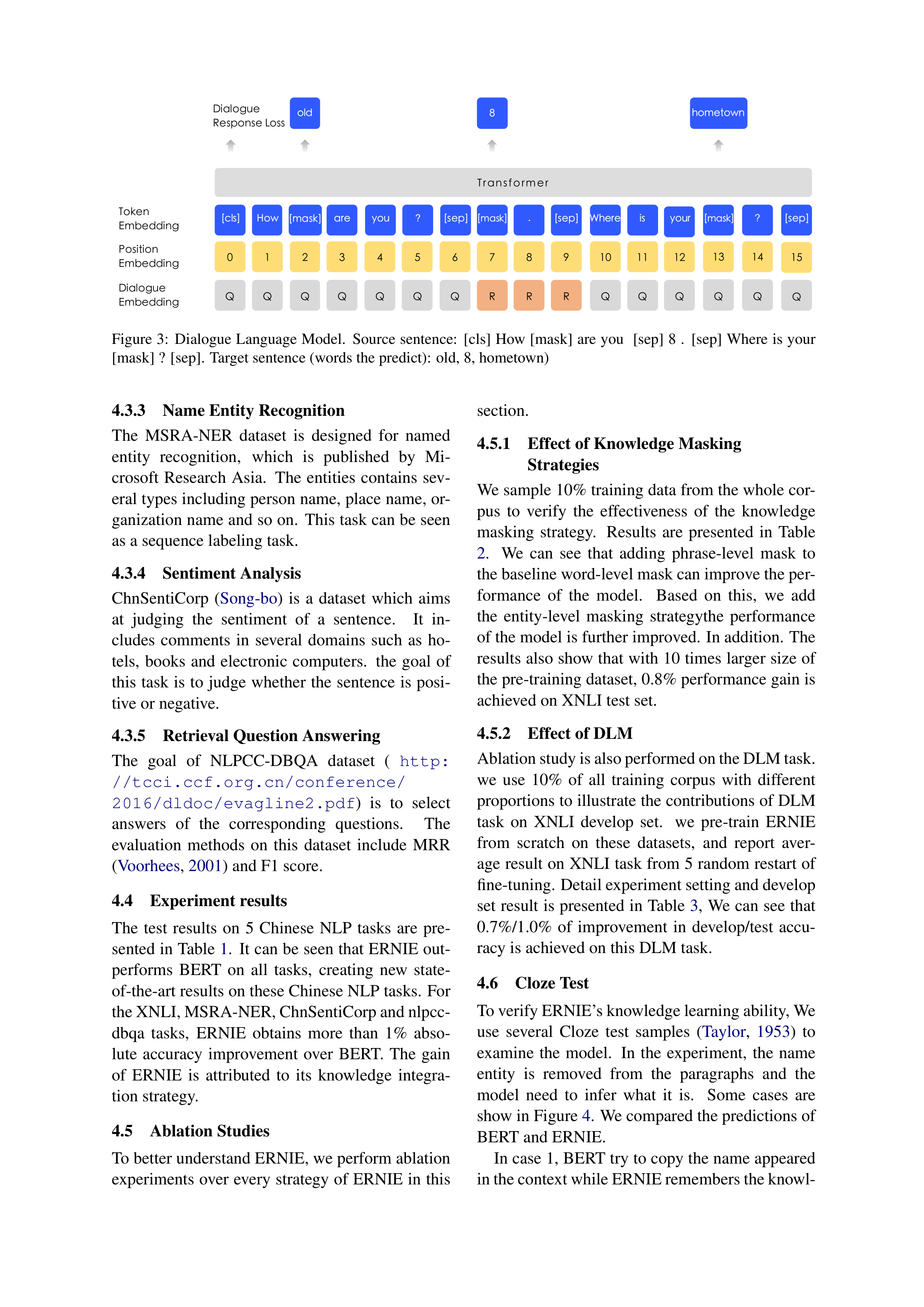
DLM (Dialogue Language Model) task. As shown
in
figure
3
,
our
method
introduces
dialogue
em-
bedding to identify the roles in the dialogue, which
is
different
from
that
of
universal
sentence
en-
coder
(
Cer
et
al.
,
2018
).
ERNIE’s
Dialogue
em-
bedding
plays
the
same
roles
as
token
type
em-
bedding in BERT, except that ERNIE can also rep-
resent
multi-turn
conversations
(e.g.
QRQ,
QRR,
QQR, where Q and R stands for ”Query” and ”Re-
sponse” respectively). Like MLM in BERT, masks
are applied to enforce the model to predict missing
words
conditioned
on
both
query
and
response.
What’s more, we generate fake samples by replac-
ing the query or the response with a randomly se-
lected
sentence.
The
model
is
designed
to
judge
whether the multi-turn conversation is real or fake.
The
DLM
task
helps
ERNIE
to
learn
the
im-
plicit
relationship
in
dialogues,
which
also
en-
hances
the
model’s
ability
to
learn
semantic
rep-
resentation.
The model architecture of DLM task
is compatible with that of the MLM task, thus it is
pre-trained alternatively with the MLM task.
4.3
Experiments on Chinese NLP Tasks
ERNIE is applied to 5 Chinese NLP tasks, includ-
ing
natural
language
inference,
semantic
similar-
ity,
named
entity
recognition,
sentiment
analysis,
and question answering.
4.3.1
Natural Language Inference
The
Cross-lingual
Natural
Language
Inference
(XNLI)
corpus
(
Liu
et
al.
,
2019
)
is
a
crowd-
sourced
collection
for
the
MultiNLI
corpus.
The
pairs
are
annotated
with
textual
entailment
and
translated
into
14
languages
including
Chinese.
The labels contains contradiction,
neutral and en-
tailment.
We
follow
the
Chinese
experiments
in
BERT(
Devlin et al.
,
2018
).
4.3.2
Semantic Similarity
The Large-scale Chinese Question Matching Cor-
pus (LCQMC) (
Liu et al.
,
2018
) aims at identify-
ing
whether
two
sentences
have
the
same
inten-
tion.
Each
pair
of
sentences
in
the
dataset
is
as-
sociated with a binary label indicating whether the
two
sentences
share
the
same
intention,
and
the
task
can
be
formalized
as
predicting
a
binary
la-
bel.
Token
Embedding
Position
Embedding
Dialogue
Embedding
Dialogue
Response Loss
Transformer
are
[cls]
How
you
?
[
mask
]
.
[sep]
[sep]
0
1
2
3
4
5
6
7
8
9
Q
Q
Q
Q
Q
Q
Q
R
R
R
old
8
Where
is
10
11
12
Q
Q
Q
13
Q
?
考
[sep]
14
15
Q
Q
your
[
mask
]
hometown
[cls]
[mask]
Figure 3:
Dialogue Language Model.
Source sentence:
[cls] How [mask] are you
[sep] 8 .
[sep] Where is your
[mask] ?
[sep].
Target sentence (words the predict):
old, 8, hometown)
4.3.3
Name Entity Recognition
The
MSRA-NER
dataset
is
designed
for
named
entity
recognition,
which
is
published
by
Mi-
crosoft
Research
Asia.
The
entities
contains
sev-
eral types including person name, place name, or-
ganization name and so on.
This task can be seen
as a sequence labeling task.
4.3.4
Sentiment Analysis
ChnSentiCorp
(
Song-bo
)
is
a
dataset
which
aims
at
judging
the
sentiment
of
a
sentence.
It
in-
cludes
comments
in
several
domains
such
as
ho-
tels,
books
and
electronic
computers.
the
goal
of
this
task
is
to
judge
whether
the
sentence
is
posi-
tive or negative.
4.3.5
Retrieval Question Answering
The
goal
of
NLPCC-DBQA
dataset
(
http:
//tcci.ccf.org.cn/conference/
2016/dldoc/evagline2.pdf
)
is
to
select
answers
of
the
corresponding
questions.
The
evaluation
methods
on
this
dataset
include
MRR
(
Voorhees
,
2001
) and F1 score.
4.4
Experiment results
The
test
results
on
5
Chinese
NLP
tasks
are
pre-
sented in Table
1
.
It can be seen that ERNIE out-
performs
BERT
on
all
tasks,
creating
new
state-
of-the-art results on these Chinese NLP tasks.
For
the XNLI, MSRA-NER, ChnSentiCorp and nlpcc-
dbqa
tasks,
ERNIE
obtains
more
than
1%
abso-
lute
accuracy
improvement
over
BERT.
The
gain
of
ERNIE
is
attributed
to
its
knowledge
integra-
tion strategy.
4.5
Ablation Studies
To better understand ERNIE, we perform ablation
experiments over every strategy of ERNIE in this
section.
4.5.1
Effect of Knowledge Masking
Strategies
We sample 10% training data from the whole cor-
pus
to
verify
the
effectiveness
of
the
knowledge
masking
strategy.
Results
are
presented
in
Table
2
.
We
can
see
that
adding
phrase-level
mask
to
the baseline word-level mask can improve the per-
formance
of
the
model.
Based
on
this,
we
add
the
entity-level
masking
strategythe
performance
of the model is further improved.
In addition.
The
results also show that with 10 times larger size of
the pre-training dataset, 0.8% performance gain is
achieved on XNLI test set.
4.5.2
Effect of DLM
Ablation study is also performed on the DLM task.
we
use
10%
of
all
training
corpus
with
different
proportions to illustrate the contributions of DLM
task
on
XNLI
develop
set.
we
pre-train
ERNIE
from
scratch
on
these
datasets,
and
report
aver-
age result on XNLI task from 5 random restart of
fine-tuning.
Detail experiment setting and develop
set result is presented in Table
3
,
We can see that
0.7%/1.0%
of
improvement
in
develop/test
accu-
racy is achieved on this DLM task.
4.6
Cloze Test
To verify ERNIE’s knowledge learning ability, We
use
several
Cloze
test
samples
(
Taylor
,
1953
)
to
examine
the
model.
In
the
experiment,
the
name
entity
is
removed
from
the
paragraphs
and
the
model
need
to
infer
what
it
is.
Some
cases
are
show in Figure
4
.
We compared the predictions of
BERT and ERNIE.
In case 1, BERT try to copy the name appeared
in the context while ERNIE remembers the knowl-
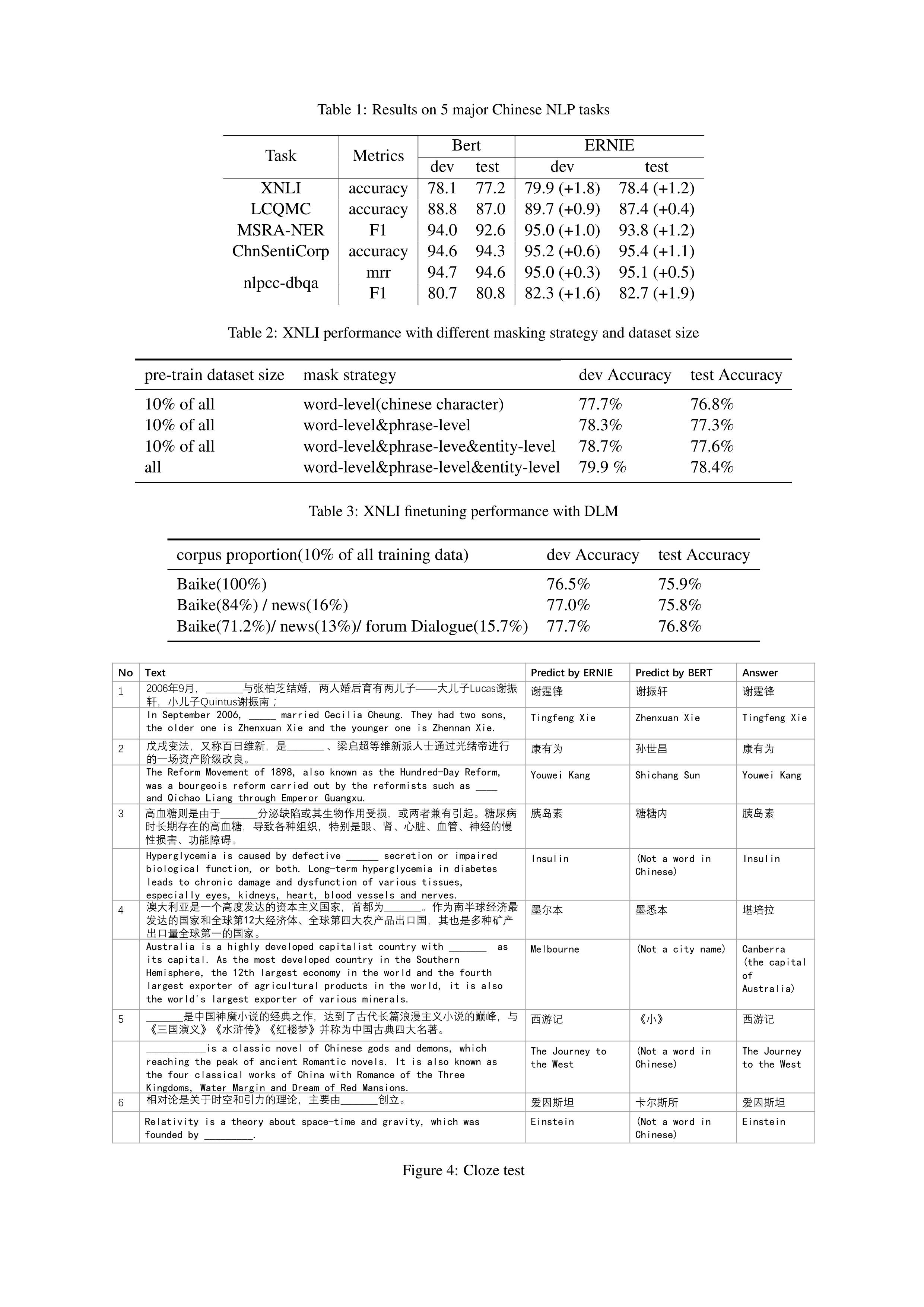
Table 1:
Results on 5 major Chinese NLP tasks
Task
Metrics
Bert
ERNIE
dev
test
dev
test
XNLI
accuracy
78.1
77.2
79.9 (+1.8)
78.4 (+1.2)
LCQMC
accuracy
88.8
87.0
89.7 (+0.9)
87.4 (+0.4)
MSRA-NER
F1
94.0
92.6
95.0 (+1.0)
93.8 (+1.2)
ChnSentiCorp
accuracy
94.6
94.3
95.2 (+0.6)
95.4 (+1.1)
nlpcc-dbqa
mrr
94.7
94.6
95.0 (+0.3)
95.1 (+0.5)
F1
80.7
80.8
82.3 (+1.6)
82.7 (+1.9)
Table 2:
XNLI performance with different masking strategy and dataset size
pre-train dataset size
mask strategy
dev Accuracy
test Accuracy
10% of all
word-level(chinese character)
77.7%
76.8%
10% of all
word-level&phrase-level
78.3%
77.3%
10% of all
word-level&phrase-leve&entity-level
78.7%
77.6%
all
word-level&phrase-level&entity-level
79.9 %
78.4%
Table 3:
XNLI finetuning performance with DLM
corpus proportion(10% of all training data)
dev Accuracy
test Accuracy
Baike(100%)
76.5%
75.9%
Baike(84%) / news(16%)
77.0%
75.8%
Baike(71.2%)/ news(13%)/ forum Dialogue(15.7%)
77.7%
76.8%
No
Text
Predict by
ERNIE
Predict by
BERT
Answer
1
2006年9月,________与张柏芝结婚,两人婚后育有两儿子——大儿子Lucas谢振
轩,小儿子Quintus谢振南;
谢霆锋
谢振轩
谢霆锋
In September 2006, _____ married Cecilia Cheung. They had two sons,
the older one is Zhenxuan Xie and the younger one is Zhennan Xie.
Tingfeng
Xie
Zhenxuan Xie
Tingfeng
Xie
2
戊戌变法,又称百日维新,是________ 、梁启超等维新派人士通过光绪帝进行
的一场资产阶级改良。
康有为
孙世昌
康有为
The Reform Movement of 1898, also known as the Hundred-Day Reform,
was a bourgeois reform carried out by the reformists such as ____
and Qichao
Liang through Emperor Guangxu.
Youwei
Kang
Shichang
Sun
Youwei
Kang
3
高血糖则是由于________分泌缺陷或其生物作用受损,或两者兼有引起。糖尿病
时长期存在的高血糖,导致各种组织,特别是眼、肾、心脏、血管、神经的慢
性损害、功能障碍。
胰岛素
糖糖内
胰岛素
Hyperglycemia is caused by defective ______ secretion or impaired
biological function, or both. Long-term hyperglycemia in diabetes
leads to chronic damage and dysfunction of various tissues,
especially eyes, kidneys, heart, blood vessels and nerves.
Insulin
(Not a word in
Chinese)
Insulin
4
澳大利亚是一个高度发达的资本主义国家,首都为________。作为南半球经济最
发达的国家和全球第
12
大经济体、全球第四大农产品出口国,其也是多种矿产
出口量全球第一的国家。
墨尔本
墨悉本
堪培拉
Australia is a highly developed capitalist country with _______ as
its capital. As the most developed country in the Southern
Hemisphere, the 12th largest economy in the world and the fourth
largest exporter of agricultural products in the world, it is also
the world's largest exporter of various minerals.
Melbourne
(Not
a
city
name)
Canberra
(the capital
of
Australia)
5
________是中国神魔小说的经典之作,达到了古代长篇浪漫主义小说的巅峰,与
《三国演义》《水浒传》《红楼梦》并称为中国古典四大名著。
西游记
《小》
西游记
___________is a classic novel of Chinese gods and demons, which
reaching the peak of ancient Romantic novels. It is also known as
the four classical works of China with Romance of the Three
Kingdoms, Water Margin and Dream of Red Mansions.
The Journey to
the
West
(Not a word in
Chinese)
The Journey
to the
West
6
相对论是关于时空和引力的理论,主要由________创立。
爱因斯坦
卡尔斯所
爱因斯坦
Relativity is a theory about space-time and gravity, which was
founded by _________.
Einstein
(Not a word in
Chinese)
Einstein
Figure 4:
Cloze test
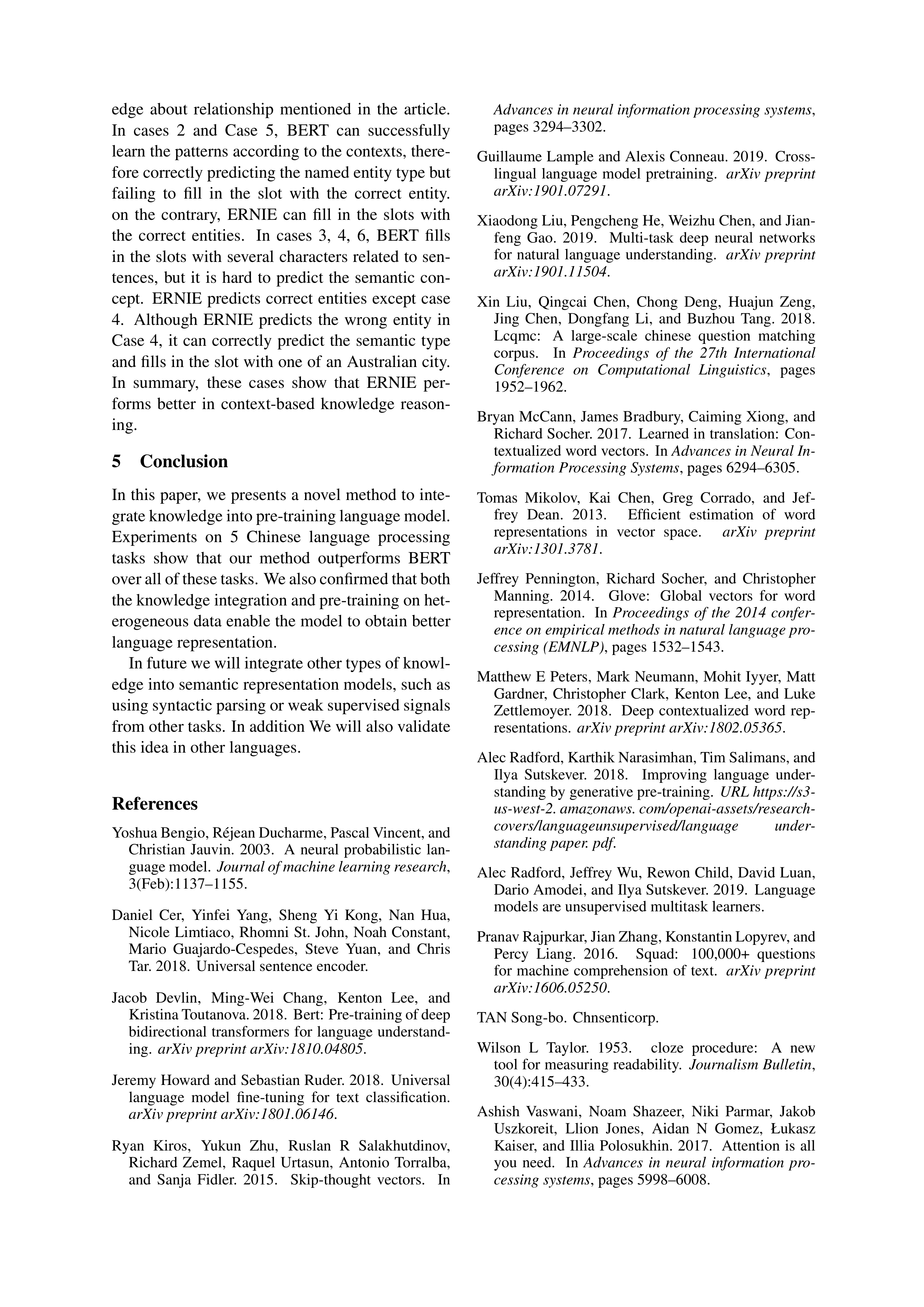
edge
about
relationship
mentioned
in
the
article.
In
cases
2
and
Case
5,
BERT
can
successfully
learn the patterns according to the contexts, there-
fore correctly predicting the named entity type but
failing
to
fill
in
the
slot
with
the
correct
entity.
on
the
contrary,
ERNIE
can
fill
in
the
slots
with
the
correct
entities.
In
cases
3,
4,
6,
BERT
fills
in the slots with several characters related to sen-
tences,
but
it
is
hard
to
predict
the
semantic
con-
cept.
ERNIE
predicts
correct
entities
except
case
4.
Although
ERNIE
predicts
the
wrong
entity
in
Case
4,
it
can
correctly
predict
the
semantic
type
and fills in the slot with one of an Australian city.
In
summary,
these
cases
show
that
ERNIE
per-
forms
better
in
context-based
knowledge
reason-
ing.
5
Conclusion
In this paper, we presents a novel method to inte-
grate knowledge into pre-training language model.
Experiments
on
5
Chinese
language
processing
tasks
show
that
our
method
outperforms
BERT
over all of these tasks. We also confirmed that both
the knowledge integration and pre-training on het-
erogeneous data enable the model to obtain better
language representation.
In future we will integrate other types of knowl-
edge into semantic representation models, such as
using syntactic parsing or weak supervised signals
from other tasks.
In addition We will also validate
this idea in other languages.
References
Yoshua Bengio, R´ejean Ducharme, Pascal Vincent, and
Christian
Jauvin.
2003.
A
neural
probabilistic
lan-
guage model.
Journal of machine learning research
,
3(Feb):1137–1155.
Daniel
Cer,
Yinfei
Yang,
Sheng
Yi
Kong,
Nan
Hua,
Nicole
Limtiaco,
Rhomni
St.
John,
Noah
Constant,
Mario
Guajardo-Cespedes,
Steve
Yuan,
and
Chris
Tar. 2018.
Universal sentence encoder.
Jacob
Devlin,
Ming-Wei
Chang,
Kenton
Lee,
and
Kristina Toutanova. 2018.
Bert: Pre-training of deep
bidirectional
transformers
for
language
understand-
ing.
arXiv preprint arXiv:1810.04805
.
Jeremy Howard and Sebastian Ruder. 2018.
Universal
language
model
fine-tuning
for
text
classification.
arXiv preprint arXiv:1801.06146
.
Ryan
Kiros,
Yukun
Zhu,
Ruslan
R
Salakhutdinov,
Richard
Zemel,
Raquel
Urtasun,
Antonio
Torralba,
and
Sanja
Fidler.
2015.
Skip-thought
vectors.
In
Advances in neural information processing systems
,
pages 3294–3302.
Guillaume Lample and Alexis Conneau. 2019.
Cross-
lingual
language
model
pretraining.
arXiv
preprint
arXiv:1901.07291
.
Xiaodong Liu, Pengcheng He, Weizhu Chen, and Jian-
feng
Gao.
2019.
Multi-task
deep
neural
networks
for
natural
language
understanding.
arXiv
preprint
arXiv:1901.11504
.
Xin
Liu,
Qingcai
Chen,
Chong
Deng,
Huajun
Zeng,
Jing
Chen,
Dongfang
Li,
and
Buzhou
Tang.
2018.
Lcqmc:
A
large-scale
chinese
question
matching
corpus.
In
Proceedings
of
the
27th
International
Conference
on
Computational
Linguistics
,
pages
1952–1962.
Bryan McCann, James Bradbury, Caiming Xiong, and
Richard Socher. 2017.
Learned in translation:
Con-
textualized word vectors.
In
Advances in Neural In-
formation Processing Systems
, pages 6294–6305.
Tomas
Mikolov,
Kai
Chen,
Greg
Corrado,
and
Jef-
frey
Dean.
2013.
Efficient
estimation
of
word
representations
in
vector
space.
arXiv
preprint
arXiv:1301.3781
.
Jeffrey
Pennington,
Richard
Socher,
and
Christopher
Manning.
2014.
Glove:
Global
vectors
for
word
representation.
In
Proceedings
of
the
2014
confer-
ence on empirical methods in natural language pro-
cessing (EMNLP)
, pages 1532–1543.
Matthew E Peters,
Mark Neumann,
Mohit Iyyer,
Matt
Gardner,
Christopher
Clark,
Kenton
Lee,
and
Luke
Zettlemoyer.
2018.
Deep
contextualized
word
rep-
resentations.
arXiv preprint arXiv:1802.05365
.
Alec Radford, Karthik Narasimhan, Tim Salimans, and
Ilya
Sutskever.
2018.
Improving
language
under-
standing by generative pre-training.
URL https://s3-
us-west-2. amazonaws. com/openai-assets/research-
covers/languageunsupervised/language
under-
standing paper. pdf
.
Alec Radford,
Jeffrey Wu,
Rewon Child,
David Luan,
Dario Amodei, and Ilya Sutskever. 2019.
Language
models are unsupervised multitask learners.
Pranav Rajpurkar, Jian Zhang, Konstantin Lopyrev, and
Percy
Liang.
2016.
Squad:
100,000+
questions
for
machine
comprehension
of
text.
arXiv
preprint
arXiv:1606.05250
.
TAN Song-bo.
Chnsenticorp.
Wilson
L
Taylor.
1953.
cloze
procedure:
A
new
tool for measuring readability.
Journalism Bulletin
,
30(4):415–433.
Ashish
Vaswani,
Noam
Shazeer,
Niki
Parmar,
Jakob
Uszkoreit,
Llion
Jones,
Aidan
N
Gomez,
Łukasz
Kaiser,
and
Illia
Polosukhin.
2017.
Attention
is
all
you
need.
In
Advances
in
neural
information
pro-
cessing systems
, pages 5998–6008.
Ellen
M
Voorhees.
2001.
Overview
of
the
trec
2001
question answering track.
In
TREC
, pages 42–51.
Alex
Wang,
Amapreet
Singh,
Julian
Michael,
Felix
Hill,
Omer
Levy,
and
Samuel
R
Bowman.
2018.
Glue: A multi-task benchmark and analysis platform
for
natural
language
understanding.
arXiv
preprint
arXiv:1804.07461
.
Yonghui
Wu,
Mike
Schuster,
Zhifeng
Chen,
Quoc
V
Le,
Mohammad
Norouzi,
Wolfgang
Macherey,
Maxim
Krikun,
Yuan
Cao,
Qin
Gao,
Klaus
Macherey,
et
al.
2016.
Google’s
neural
ma-
chine translation system:
Bridging the gap between
human
and
machine
translation.
arXiv
preprint
arXiv:1609.08144
.
Yinfei Yang,
Steve Yuan,
Daniel Cer,
Sheng Yi Kong,
Noah
Constant,
Petr
Pilar,
Heming
Ge,
Yun
Hsuan
Sung,
and
Brian
Strope.
2018.
Learning
semantic
textual similarity from conversations.