
The Anatomy of a Large-Scale
Hypertextual Web Search Engine
Sergey Brin and Lawrence Page
{sergey, page}@cs.stanford.edu
Computer Science Department, Stanford University, Stanford, CA 94305
Abstract
In this paper, we present Google, a prototype of a large-scale search
engine which makes heavy use of the structure present in hypertext. Google is
designed to crawl and index the Web efficiently and produce much more
satisfying search results than existing systems. The prototype with a full text
and hyperlink database of at least 24 million pages is available at
http://google.stanford.edu/
To engineer a search engine is a challenging task. Search engines index
tens to hundreds of millions of web pages involving a comparable number of
distinct terms. They answer tens of millions of queries every day. Despite the
importance of large-scale search engines on the web, very little academic
research has been done on them. Furthermore, due to rapid advance in
technology and web proliferation, creating a web search engine today is very
different from three years ago. This paper provides an in-depth description of
our large-scale web search engine -- the first such detailed public description
we know of to date.
Apart from the problems of scaling traditional search techniques to data of
this magnitude, there are new technical challenges involved with using the
additional information present in hypertext to produce better search results.
This paper addresses this question of how to build a practical large-scale
system which can exploit the additional information present in hypertext. Also
we look at the problem of how to effectively deal with uncontrolled hypertext
collections where anyone can publish anything they want.
Keywords
: World Wide Web, Search Engines, Information Retrieval,
PageRank, Google
1. Introduction
(Note: There are two versions of this paper -- a longer full version and a shorter printed
version. The full version is available on the web and the conference CD-ROM.)
The web creates new challenges for information retrieval. The amount of information on the
web is growing rapidly, as well as the number of new users inexperienced in the art of web
research. People are likely to surf the web using its link graph, often starting with high quality
human maintained indices such as
Yahoo!
or with search engines. Human maintained lists
cover popular topics effectively but are subjective, expensive to build and maintain, slow to
improve, and cannot cover all esoteric topics. Automated search engines that rely on keyword
matching usually return too many low quality matches. To make matters worse, some
advertisers attempt to gain people's attention by taking measures meant to mislead automated
search engines. We have built a large-scale search engine which addresses many of the
problems of existing systems. It makes especially heavy use of the additional structure
present in hypertext to provide much higher quality search results. We chose our system
name, Google, because it is a common spelling of googol, or 10
100
and fits well with our goal
of building very large-scale search engines.
1.1 Web Search Engines -- Scaling Up: 1994 - 2000
Search engine technology has had to scale dramatically to keep up with the growth of the
web. In 1994, one of the first web search engines, the World Wide Web Worm (WWWW)
[McBryan 94]
had an index of 110,000 web pages and web accessible documents. As of
November, 1997, the top search engines claim to index from 2 million (WebCrawler) to 100
million web documents (from
Search Engine Watch)
. It is foreseeable that by the year 2000,
a comprehensive index of the Web will contain over a billion documents. At the same time,
the number of queries search engines handle has grown incredibly too. In March and April
1994, the World Wide Web Worm received an average of about 1500 queries per day. In
November 1997, Altavista claimed it handled roughly 20 million queries per day. With the
increasing number of users on the web, and automated systems which query search engines, it
is likely that top search engines will handle hundreds of millions of queries per day by the
year 2000. The goal of our system is to address many of the problems, both in quality and
scalability, introduced by scaling search engine technology to such extraordinary numbers.
1.2. Google: Scaling with the Web
Creating a search engine which scales even to today's web presents many challenges. Fast
crawling technology is needed to gather the web documents and keep them up to date.
Storage space must be used efficiently to store indices and, optionally, the documents
themselves. The indexing system must process hundreds of gigabytes of data efficiently.
Queries must be handled quickly, at a rate of hundreds to thousands per second.
These tasks are becoming increasingly difficult as the Web grows. However, hardware
performance and cost have improved dramatically to partially offset the difficulty. There are,
however, several notable exceptions to this progress such as disk seek time and operating
system robustness. In designing Google, we have considered both the rate of growth of the
Web and technological changes. Google is designed to scale well to extremely large data sets.
It makes efficient use of storage space to store the index. Its data structures are optimized for
fast and efficient access (see section
4.2
). Further, we expect that the cost to index and store
text or HTML will eventually decline relative to the amount that will be available (see
Appendix B
). This will result in favorable scaling properties for centralized systems like
Google.
1.3 Design Goals
1.3.1 Improved Search Quality
Our main goal is to improve the quality of web search engines. In 1994, some people
believed that a complete search index would make it possible to find anything easily.
According to
Best of the Web 1994 -- Navigators,
"The best navigation service should make
it easy to find almost anything on the Web (once all the data is entered)." However, the Web
of 1997 is quite different. Anyone who has used a search engine recently, can readily testify
that the completeness of the index is not the only factor in the quality of search results. "Junk
results" often wash out any results that a user is interested in. In fact, as of November 1997,
only one of the top four commercial search engines finds itself (returns its own search page in
response to its name in the top ten results). One of the main causes of this problem is that the
number of documents in the indices has been increasing by many orders of magnitude, but
the user's ability to look at documents has not. People are still only willing to look at the first
few tens of results. Because of this, as the collection size grows, we need tools that have very
high precision (number of relevant documents returned, say in the top tens of results). Indeed,
we want our notion of "relevant" to only include the very best documents since there may be
tens of thousands of slightly relevant documents. This very high precision is important even
at the expense of recall (the total number of relevant documents the system is able to return).
There is quite a bit of recent optimism that the use of more hypertextual information can help
improve search and other applications [
Marchiori 97
] [
Spertus 97
] [
Weiss 96
] [
Kleinberg 98
].
In particular, link structure [
Page 98
] and link text provide a lot of information for making
relevance judgments and quality filtering. Google makes use of both link structure and anchor
text (see Sections
2.1
and
2.2
).
1.3.2 Academic Search Engine Research
Aside from tremendous growth, the Web has also become increasingly commercial over time.
In 1993, 1.5% of web servers were on .com domains. This number grew to over 60% in 1997.
At the same time, search engines have migrated from the academic domain to the
commercial. Up until now most search engine development has gone on at companies with
little publication of technical details. This causes search engine technology to remain largely
a black art and to be advertising oriented (see
Appendix A
). With Google, we have a strong
goal to push more development and understanding into the academic realm.
Another important design goal was to build systems that reasonable numbers of people can
actually use. Usage was important to us because we think some of the most interesting
research will involve leveraging the vast amount of usage data that is available from modern
web systems. For example, there are many tens of millions of searches performed every day.
However, it is very difficult to get this data, mainly because it is considered commercially
valuable.
Our final design goal was to build an architecture that can support novel research activities on
large-scale web data. To support novel research uses, Google stores all of the actual
documents it crawls in compressed form. One of our main goals in designing Google was to
set up an environment where other researchers can come in quickly, process large chunks of
the web, and produce interesting results that would have been very difficult to produce
otherwise. In the short time the system has been up, there have already been several papers
using databases generated by Google, and many others are underway. Another goal we have
is to set up a Spacelab-like environment where researchers or even students can propose and
do interesting experiments on our large-scale web data.
2. System Features
The Google search engine has two important features that help it produce high precision
results. First, it makes use of the link structure of the Web to calculate a quality ranking for
each web page. This ranking is called PageRank and is described in detail in [Page 98].
Second, Google utilizes link to improve search results.
2.1 PageRank: Bringing Order to the Web
The citation (link) graph of the web is an important resource that has largely gone unused in
existing web search engines. We have created maps containing as many as 518 million of
these hyperlinks, a significant sample of the total. These maps allow rapid calculation of a
web page's "PageRank", an objective measure of its citation importance that corresponds well
with people's subjective idea of importance. Because of this correspondence, PageRank is an
excellent way to prioritize the results of web keyword searches. For most popular subjects, a
simple text matching search that is restricted to web page titles performs admirably when
PageRank prioritizes the results (demo available at
google.stanford.edu
). For the type of full
text searches in the main Google system, PageRank also helps a great deal.
2.1.1 Description of PageRank Calculation
Academic citation literature has been applied to the web, largely by counting citations or
backlinks to a given page. This gives some approximation of a page's importance or quality.
PageRank extends this idea by not counting links from all pages equally, and by normalizing
by the number of links on a page. PageRank is defined as follows:
We assume page A has pages T1...Tn which point to it (i.e., are citations). The
parameter d is a damping factor which can be set between 0 and 1. We usually
set d to 0.85. There are more details about d in the next section. Also C(A) is
defined as the number of links going out of page A. The PageRank of a page A
is given as follows:
PR(A) = (1-d) + d (PR(T1)/C(T1) + ... + PR(Tn)/C(Tn))
Note that the PageRanks form a probability distribution over web pages, so
the sum of all web pages' PageRanks will be one.
PageRank or
PR(A)
can be calculated using a simple iterative algorithm, and corresponds to
the principal eigenvector of the normalized link matrix of the web. Also, a PageRank for 26
million web pages can be computed in a few hours on a medium size workstation. There are
many other details which are beyond the scope of this paper.
2.1.2 Intuitive Justification
PageRank can be thought of as a model of user behavior. We assume there is a "random
surfer" who is given a web page at random and keeps clicking on links, never hitting "back"
but eventually gets bored and starts on another random page. The probability that the random
surfer visits a page is its PageRank. And, the
d
damping factor is the probability at each page
the "random surfer" will get bored and request another random page. One important variation
is to only add the damping factor
d
to a single page, or a group of pages. This allows for
personalization and can make it nearly impossible to deliberately mislead the system in order
to get a higher ranking. We have several other extensions to PageRank, again see [
Page 98
].
Another intuitive justification is that a page can have a high PageRank if there are many
pages that point to it, or if there are some pages that point to it and have a high PageRank.
Intuitively, pages that are well cited from many places around the web are worth looking at.
Also, pages that have perhaps only one citation from something like the
Yahoo!
homepage
are also generally worth looking at. If a page was not high quality, or was a broken link, it is
quite likely that Yahoo's homepage would not link to it. PageRank handles both these cases
and everything in between by recursively propagating weights through the link structure of
the web.
2.2 Anchor Text
The text of links is treated in a special way in our search engine. Most search engines
associate the text of a link with the page that the link is on. In addition, we associate it with
the page the link points to. This has several advantages. First, anchors often provide more
accurate descriptions of web pages than the pages themselves. Second, anchors may exist for
documents which cannot be indexed by a text-based search engine, such as images, programs,
and databases. This makes it possible to return web pages which have not actually been
crawled. Note that pages that have not been crawled can cause problems, since they are never
checked for validity before being returned to the user. In this case, the search engine can even
return a page that never actually existed, but had hyperlinks pointing to it. However, it is
possible to sort the results, so that this particular problem rarely happens.
This idea of propagating anchor text to the page it refers to was implemented in the World
Wide Web Worm [
McBryan 94
] especially because it helps search non-text information, and
expands the search coverage with fewer downloaded documents. We use anchor propagation
mostly because anchor text can help provide better quality results. Using anchor text
efficiently is technically difficult because of the large amounts of data which must be
processed. In our current crawl of 24 million pages, we had over 259 million anchors which
we indexed.
2.3 Other Features
Aside from PageRank and the use of anchor text, Google has several other features. First, it
has location information for all hits and so it makes extensive use of proximity in search.
Second, Google keeps track of some visual presentation details such as font size of words.
Words in a larger or bolder font are weighted higher than other words. Third, full raw HTML
of pages is available in a repository.
3 Related Work
Search research on the web has a short and concise history. The World Wide Web Worm
(WWWW)
[McBryan 94]
was one of the first web search engines. It was subsequently
followed by several other academic search engines, many of which are now public
companies. Compared to the growth of the Web and the importance of search engines there
are precious few documents about recent search engines [
Pinkerton 94
]. According to
Michael Mauldin (chief scientist, Lycos Inc)
[Mauldin]
, "the various services (including
Lycos) closely guard the details of these databases". However, there has been a fair amount
of work on specific features of search engines. Especially well represented is work which can
get results by post-processing the results of existing commercial search engines, or produce
small scale "individualized" search engines. Finally, there has been a lot of research on
information retrieval systems, especially on well controlled collections. In the next two
sections, we discuss some areas where this research needs to be extended to work better on
the web.
3.1 Information Retrieval
Work in information retrieval systems goes back many years and is well developed [
Witten
94
]. However, most of the research on information retrieval systems is on small well
controlled homogeneous collections such as collections of scientific papers or news stories on
a related topic. Indeed, the primary benchmark for information retrieval, the Text Retrieval
Conference [
TREC 96
], uses a fairly small, well controlled collection for their benchmarks.
The "Very Large Corpus" benchmark is only 20GB compared to the 147GB from our crawl
of 24 million web pages. Things that work well on TREC often do not produce good results
on the web. For example, the standard vector space model tries to return the document that
most closely approximates the query, given that both query and document are vectors defined
by their word occurrence. On the web, this strategy often returns very short documents that
are the query plus a few words. For example, we have seen a major search engine return a
page containing only "Bill Clinton Sucks" and picture from a "Bill Clinton" query. Some
argue that on the web, users should specify more accurately what they want and add more
words to their query. We disagree vehemently with this position. If a user issues a query like
"Bill Clinton" they should get reasonable results since there is a enormous amount of high
quality information available on this topic. Given examples like these, we believe that the
standard information retrieval work needs to be extended to deal effectively with the web.
3.2 Differences Between the Web and Well Controlled Collections
The web is a vast collection of completely uncontrolled heterogeneous documents.
Documents on the web have extreme variation internal to the documents, and also in the
external meta information that might be available. For example, documents differ internally
in their language (both human and programming), vocabulary (email addresses, links, zip
codes, phone numbers, product numbers), type or format (text, HTML, PDF, images,
sounds), and may even be machine generated (log files or output from a database). On the
other hand, we define external meta information as information that can be inferred about a
document, but is not contained within it. Examples of external meta information include
things like reputation of the source, update frequency, quality, popularity or usage, and
citations. Not only are the possible sources of external meta information varied, but the things
that are being measured vary many orders of magnitude as well. For example, compare the
usage information from a major homepage, like Yahoo's which currently receives millions of
page views every day with an obscure historical article which might receive one view every
ten years. Clearly, these two items must be treated very differently by a search engine.
Another big difference between the web and traditional well controlled collections is that
there is virtually no control over what people can put on the web. Couple this flexibility to
publish anything with the enormous influence of search engines to route traffic and
companies which deliberately manipulating search engines for profit become a serious
problem. This problem that has not been addressed in traditional closed information retrieval
systems. Also, it is interesting to note that metadata efforts have largely failed with web
search engines, because any text on the page which is not directly represented to the user is
abused to manipulate search engines. There are even numerous companies which specialize
in manipulating search engines for profit.
4 System Anatomy
First, we will provide a high level discussion of the architecture. Then, there is some in-depth
descriptions of important data structures. Finally, the major applications: crawling, indexing,
and searching will be examined in depth.
4.1 Google Architecture Overview
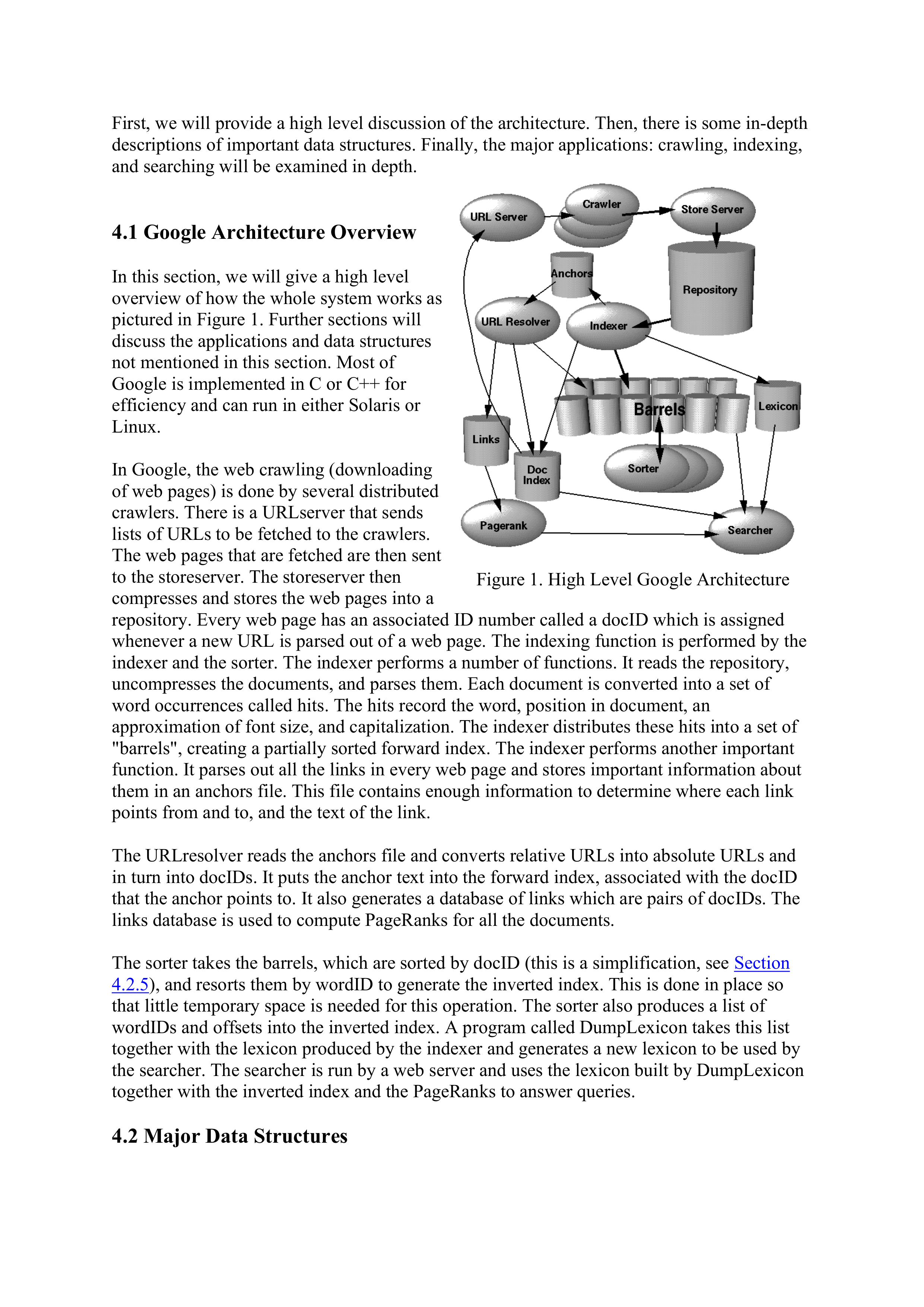
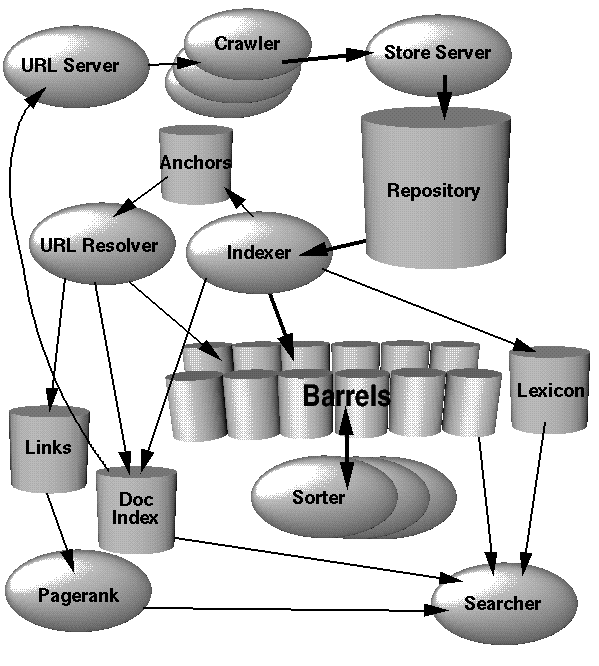
In this section, we will give a high level
overview of how the whole system works as
pictured in Figure 1. Further sections will
discuss the applications and data structures
not mentioned in this section. Most of
Google is implemented in C or C++ for
efficiency and can run in either Solaris or
Linux.
In Google, the web crawling (downloading
of web pages) is done by several distributed
crawlers. There is a URLserver that sends
lists of URLs to be fetched to the crawlers.
The web pages that are fetched are then sent
to the storeserver. The storeserver then
compresses and stores the web pages into a
repository. Every web page has an associated ID number called a docID which is assigned
whenever a new URL is parsed out of a web page. The indexing function is performed by the
indexer and the sorter. The indexer performs a number of functions. It reads the repository,
uncompresses the documents, and parses them. Each document is converted into a set of
word occurrences called hits. The hits record the word, position in document, an
approximation of font size, and capitalization. The indexer distributes these hits into a set of
"barrels", creating a partially sorted forward index. The indexer performs another important
function. It parses out all the links in every web page and stores important information about
them in an anchors file. This file contains enough information to determine where each link
points from and to, and the text of the link.
The URLresolver reads the anchors file and converts relative URLs into absolute URLs and
in turn into docIDs. It puts the anchor text into the forward index, associated with the docID
that the anchor points to. It also generates a database of links which are pairs of docIDs. The
links database is used to compute PageRanks for all the documents.
The sorter takes the barrels, which are sorted by docID (this is a simplification, see
Section
4.2.5
), and resorts them by wordID to generate the inverted index. This is done in place so
that little temporary space is needed for this operation. The sorter also produces a list of
wordIDs and offsets into the inverted index. A program called DumpLexicon takes this list
together with the lexicon produced by the indexer and generates a new lexicon to be used by
the searcher. The searcher is run by a web server and uses the lexicon built by DumpLexicon
together with the inverted index and the PageRanks to answer queries.
4.2 Major Data Structures
Figure 1. High Level Google Architecture
Google's data structures are optimized so that a large document collection can be crawled,
indexed, and searched with little cost. Although, CPUs and bulk input output rates have
improved dramatically over the years, a disk seek still requires about 10 ms to complete.
Google is designed to avoid disk seeks whenever possible, and this has had a considerable
influence on the design of the data structures.
4.2.1 BigFiles
BigFiles are virtual files spanning multiple file systems and are addressable by 64 bit
integers. The allocation among multiple file systems is handled automatically. The BigFiles
package also handles allocation and deallocation of file descriptors, since the operating
systems do not provide enough for our needs. BigFiles also support rudimentary compression
options.
4.2.2 Repository
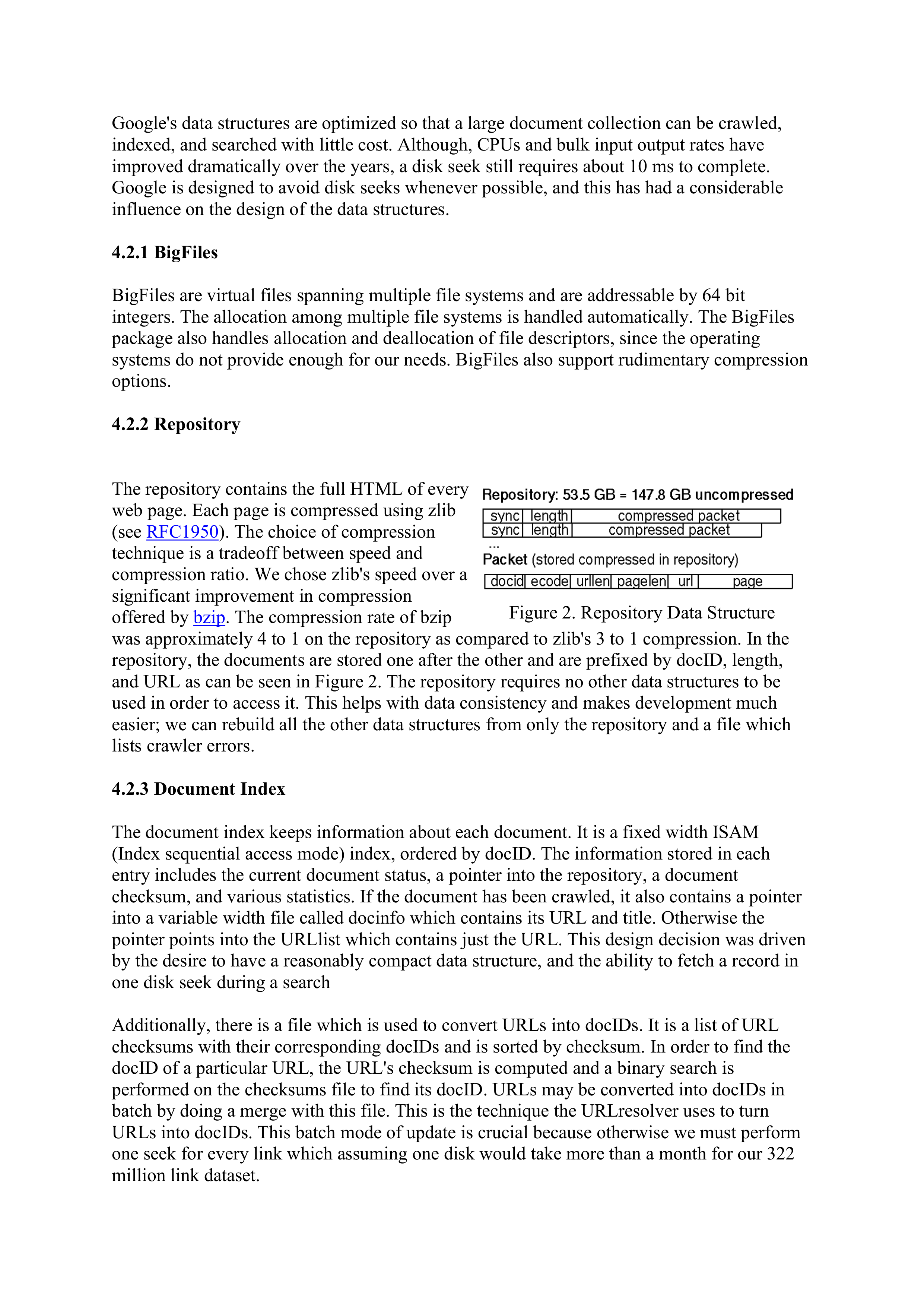
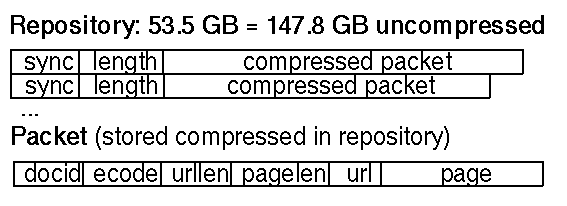
The repository contains the full HTML of every
web page. Each page is compressed using zlib
(see
RFC1950
). The choice of compression
technique is a tradeoff between speed and
compression ratio. We chose zlib's speed over a
significant improvement in compression
offered by
bzip
. The compression rate of bzip
was approximately 4 to 1 on the repository as compared to zlib's 3 to 1 compression. In the
repository, the documents are stored one after the other and are prefixed by docID, length,
and URL as can be seen in Figure 2. The repository requires no other data structures to be
used in order to access it. This helps with data consistency and makes development much
easier; we can rebuild all the other data structures from only the repository and a file which
lists crawler errors.
4.2.3 Document Index
The document index keeps information about each document. It is a fixed width ISAM
(Index sequential access mode) index, ordered by docID. The information stored in each
entry includes the current document status, a pointer into the repository, a document
checksum, and various statistics. If the document has been crawled, it also contains a pointer
into a variable width file called docinfo which contains its URL and title. Otherwise the
pointer points into the URLlist which contains just the URL. This design decision was driven
by the desire to have a reasonably compact data structure, and the ability to fetch a record in
one disk seek during a search
Additionally, there is a file which is used to convert URLs into docIDs. It is a list of URL
checksums with their corresponding docIDs and is sorted by checksum. In order to find the
docID of a particular URL, the URL's checksum is computed and a binary search is
performed on the checksums file to find its docID. URLs may be converted into docIDs in
batch by doing a merge with this file. This is the technique the URLresolver uses to turn
URLs into docIDs. This batch mode of update is crucial because otherwise we must perform
one seek for every link which assuming one disk would take more than a month for our 322
million link dataset.
Figure 2. Repository Data Structure
4.2.4 Lexicon
The lexicon has several different forms. One important change from earlier systems is that
the lexicon can fit in memory for a reasonable price. In the current implementation we can
keep the lexicon in memory on a machine with 256 MB of main memory. The current lexicon
contains 14 million words (though some rare words were not added to the lexicon). It is
implemented in two parts -- a list of the words (concatenated together but separated by nulls)
and a hash table of pointers. For various functions, the list of words has some auxiliary
information which is beyond the scope of this paper to explain fully.
4.2.5 Hit Lists
A hit list corresponds to a list of occurrences of a particular word in a particular document
including position, font, and capitalization information. Hit lists account for most of the space
used in both the forward and the inverted indices. Because of this, it is important to represent
them as efficiently as possible. We considered several alternatives for encoding position,
font, and capitalization -- simple encoding (a triple of integers), a compact encoding (a hand
optimized allocation of bits), and Huffman coding. In the end we chose a hand optimized
compact encoding since it required far less space than the simple encoding and far less bit
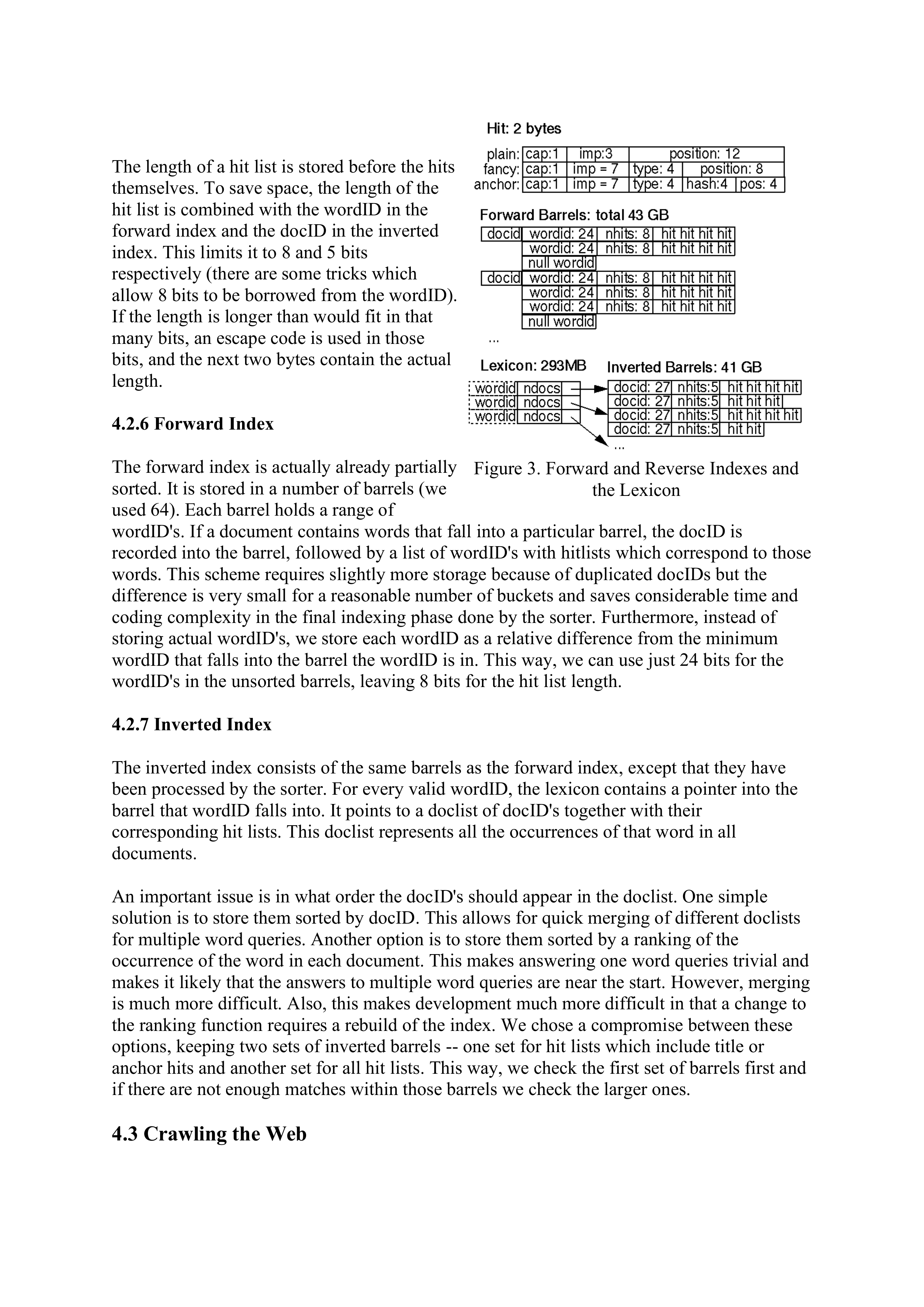
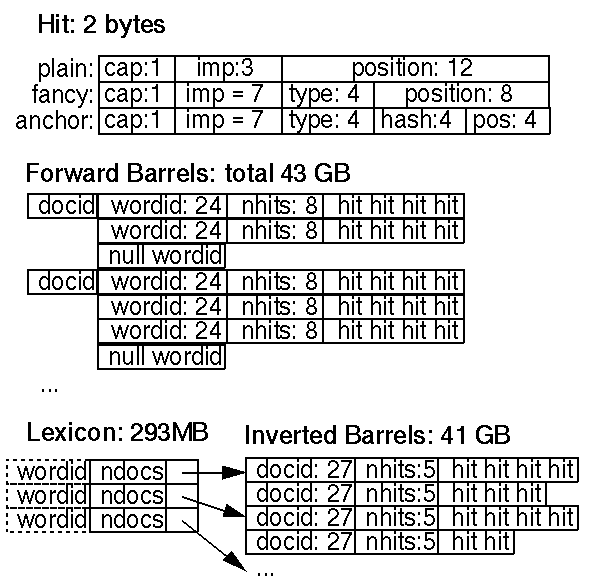
manipulation than Huffman coding. The details of the hits are shown in Figure 3.
Our compact encoding uses two bytes for every hit. There are two types of hits: fancy hits
and plain hits. Fancy hits include hits occurring in a URL, title, anchor text, or meta tag. Plain
hits include everything else. A plain hit consists of a capitalization bit, font size, and 12 bits
of word position in a document (all positions higher than 4095 are labeled 4096). Font size is
represented relative to the rest of the document using three bits (only 7 values are actually
used because 111 is the flag that signals a fancy hit). A fancy hit consists of a capitalization
bit, the font size set to 7 to indicate it is a fancy hit, 4 bits to encode the type of fancy hit, and
8 bits of position. For anchor hits, the 8 bits of position are split into 4 bits for position in
anchor and 4 bits for a hash of the docID the anchor occurs in. This gives us some limited
phrase searching as long as there are not that many anchors for a particular word. We expect
to update the way that anchor hits are stored to allow for greater resolution in the position and
docIDhash fields. We use font size relative to the rest of the document because when
searching, you do not want to rank otherwise identical documents differently just because one
of the documents is in a larger font.
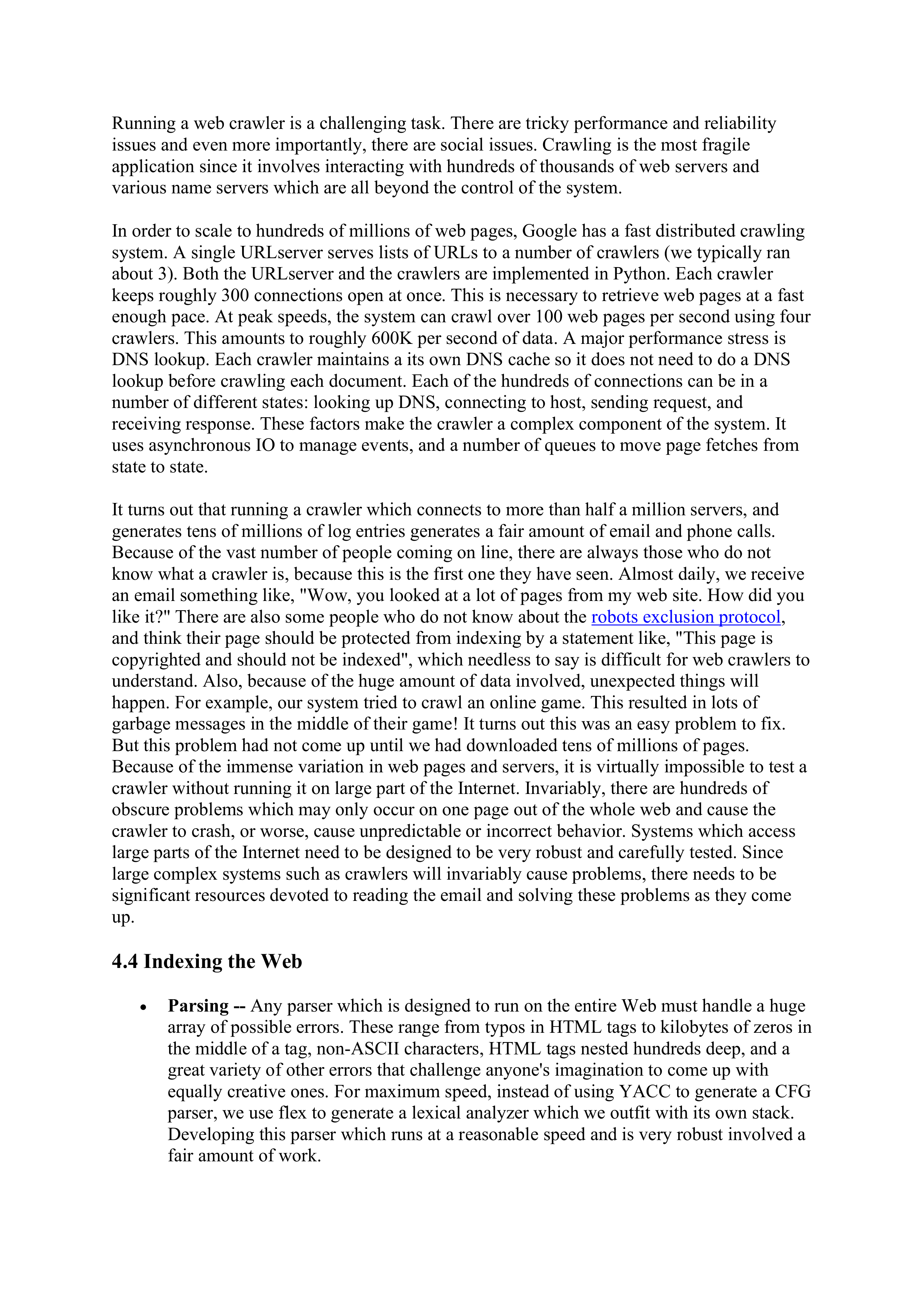
The length of a hit list is stored before the hits
themselves. To save space, the length of the
hit list is combined with the wordID in the
forward index and the docID in the inverted
index. This limits it to 8 and 5 bits
respectively (there are some tricks which
allow 8 bits to be borrowed from the wordID).
If the length is longer than would fit in that
many bits, an escape code is used in those
bits, and the next two bytes contain the actual
length.
4.2.6 Forward Index
The forward index is actually already partially
sorted. It is stored in a number of barrels (we
used 64). Each barrel holds a range of
wordID's. If a document contains words that fall into a particular barrel, the docID is
recorded into the barrel, followed by a list of wordID's with hitlists which correspond to those
words. This scheme requires slightly more storage because of duplicated docIDs but the
difference is very small for a reasonable number of buckets and saves considerable time and
coding complexity in the final indexing phase done by the sorter. Furthermore, instead of
storing actual wordID's, we store each wordID as a relative difference from the minimum
wordID that falls into the barrel the wordID is in. This way, we can use just 24 bits for the
wordID's in the unsorted barrels, leaving 8 bits for the hit list length.
4.2.7 Inverted Index
The inverted index consists of the same barrels as the forward index, except that they have
been processed by the sorter. For every valid wordID, the lexicon contains a pointer into the
barrel that wordID falls into. It points to a doclist of docID's together with their
corresponding hit lists. This doclist represents all the occurrences of that word in all
documents.
An important issue is in what order the docID's should appear in the doclist. One simple
solution is to store them sorted by docID. This allows for quick merging of different doclists
for multiple word queries. Another option is to store them sorted by a ranking of the
occurrence of the word in each document. This makes answering one word queries trivial and
makes it likely that the answers to multiple word queries are near the start. However, merging
is much more difficult. Also, this makes development much more difficult in that a change to
the ranking function requires a rebuild of the index. We chose a compromise between these
options, keeping two sets of inverted barrels -- one set for hit lists which include title or
anchor hits and another set for all hit lists. This way, we check the first set of barrels first and
if there are not enough matches within those barrels we check the larger ones.
4.3 Crawling the Web
Figure 3. Forward and Reverse Indexes and
the Lexicon
Running a web crawler is a challenging task. There are tricky performance and reliability
issues and even more importantly, there are social issues. Crawling is the most fragile
application since it involves interacting with hundreds of thousands of web servers and
various name servers which are all beyond the control of the system.
In order to scale to hundreds of millions of web pages, Google has a fast distributed crawling
system. A single URLserver serves lists of URLs to a number of crawlers (we typically ran
about 3). Both the URLserver and the crawlers are implemented in Python. Each crawler
keeps roughly 300 connections open at once. This is necessary to retrieve web pages at a fast
enough pace. At peak speeds, the system can crawl over 100 web pages per second using four
crawlers. This amounts to roughly 600K per second of data. A major performance stress is
DNS lookup. Each crawler maintains a its own DNS cache so it does not need to do a DNS
lookup before crawling each document. Each of the hundreds of connections can be in a
number of different states: looking up DNS, connecting to host, sending request, and
receiving response. These factors make the crawler a complex component of the system. It
uses asynchronous IO to manage events, and a number of queues to move page fetches from
state to state.
It turns out that running a crawler which connects to more than half a million servers, and
generates tens of millions of log entries generates a fair amount of email and phone calls.
Because of the vast number of people coming on line, there are always those who do not
know what a crawler is, because this is the first one they have seen. Almost daily, we receive
an email something like, "Wow, you looked at a lot of pages from my web site. How did you
like it?" There are also some people who do not know about the
robots exclusion protocol
,
and think their page should be protected from indexing by a statement like, "This page is
copyrighted and should not be indexed", which needless to say is difficult for web crawlers to
understand. Also, because of the huge amount of data involved, unexpected things will
happen. For example, our system tried to crawl an online game. This resulted in lots of
garbage messages in the middle of their game! It turns out this was an easy problem to fix.
But this problem had not come up until we had downloaded tens of millions of pages.
Because of the immense variation in web pages and servers, it is virtually impossible to test a
crawler without running it on large part of the Internet. Invariably, there are hundreds of
obscure problems which may only occur on one page out of the whole web and cause the
crawler to crash, or worse, cause unpredictable or incorrect behavior. Systems which access
large parts of the Internet need to be designed to be very robust and carefully tested. Since
large complex systems such as crawlers will invariably cause problems, there needs to be
significant resources devoted to reading the email and solving these problems as they come
up.
4.4 Indexing the Web
•
Parsing --
Any parser which is designed to run on the entire Web must handle a huge
array of possible errors. These range from typos in HTML tags to kilobytes of zeros in
the middle of a tag, non-ASCII characters, HTML tags nested hundreds deep, and a
great variety of other errors that challenge anyone's imagination to come up with
equally creative ones. For maximum speed, instead of using YACC to generate a CFG
parser, we use flex to generate a lexical analyzer which we outfit with its own stack.
Developing this parser which runs at a reasonable speed and is very robust involved a
fair amount of work.
•
Indexing
Documents into Barrels --
After each document is parsed, it is encoded
into a number of barrels. Every word is converted into a wordID by using an in-
memory hash table -- the lexicon. New additions to the lexicon hash table are logged
to a file. Once the words are converted into wordID's, their occurrences in the current
document are translated into hit lists and are written into the forward barrels. The
main difficulty with parallelization of the indexing phase is that the lexicon needs to
be shared. Instead of sharing the lexicon, we took the approach of writing a log of all
the extra words that were not in a base lexicon, which we fixed at 14 million words.
That way multiple indexers can run in parallel and then the small log file of extra
words can be processed by one final indexer.
•
Sorting
-- In order to generate the inverted index, the sorter takes each of the forward
barrels and sorts it by wordID to produce an inverted barrel for title and anchor hits
and a full text inverted barrel. This process happens one barrel at a time, thus
requiring little temporary storage. Also, we parallelize the sorting phase to use as
many machines as we have simply by running multiple sorters, which can process
different buckets at the same time. Since the barrels don't fit into main memory, the
sorter further subdivides them into baskets which do fit into memory based on
wordID and docID. Then the sorter, loads each basket into memory, sorts it and writes
its contents into the short inverted barrel and the full inverted barrel.
4.5 Searching
The goal of searching is to provide quality search results efficiently. Many of the large
commercial search engines seemed to have made great progress in terms of efficiency.
Therefore, we have focused more on quality of search in our research, although we believe
our solutions are scalable to commercial volumes with a bit more effort. The google query
evaluation process is show in Figure 4.
To put a limit on response time, once a certain number
(currently 40,000) of matching documents are found,
the searcher automatically goes to step 8 in Figure 4.
This means that it is possible that sub-optimal results
would be returned. We are currently investigating
other ways to solve this problem. In the past, we
sorted the hits according to PageRank, which seemed
to improve the situation.
4.5.1 The Ranking System
Google maintains much more information about web
documents than typical search engines. Every hitlist
includes position, font, and capitalization information.
Additionally, we factor in hits from anchor text and
the PageRank of the document. Combining all of this
information into a rank is difficult. We designed our
ranking function so that no particular factor can have
too much influence. First, consider the simplest case --
a single word query. In order to rank a document with
a single word query, Google looks at that document's
hit list for that word. Google considers each hit to be
one of several different types (title, anchor, URL, plain text large font, plain text small font,
...), each of which has its own type-weight. The type-weights make up a vector indexed by
type. Google counts the number of hits of each type in the hit list. Then every count is
converted into a count-weight. Count-weights increase linearly with counts at first but
quickly taper off so that more than a certain count will not help. We take the dot product of
the vector of count-weights with the vector of type-weights to compute an IR score for the
document. Finally, the IR score is combined with PageRank to give a final rank to the
document.
For a multi-word search, the situation is more complicated. Now multiple hit lists must be
scanned through at once so that hits occurring close together in a document are weighted
higher than hits occurring far apart. The hits from the multiple hit lists are matched up so that
nearby hits are matched together. For every matched set of hits, a proximity is computed. The
proximity is based on how far apart the hits are in the document (or anchor) but is classified
into 10 different value "bins" ranging from a phrase match to "not even close". Counts are
computed not only for every type of hit but for every type and proximity. Every type and
proximity pair has a type-prox-weight. The counts are converted into count-weights and we
take the dot product of the count-weights and the type-prox-weights to compute an IR score.
All of these numbers and matrices can all be displayed with the search results using a special
debug mode. These displays have been very helpful in developing the ranking system.
4.5.2 Feedback
The ranking function has many parameters like the type-weights and the type-prox-weights.
Figuring out the right values for these parameters is something of a black art. In order to do
this, we have a user feedback mechanism in the search engine. A trusted user may optionally
1.
Parse the query.
2.
Convert words into wordIDs.
3.
Seek to the start of the doclist
in the short barrel for every
word.
4.
Scan through the doclists
until there is a document that
matches all the search terms.
5.
Compute the rank of that
document for the query.
6.
If we are in the short barrels
and at the end of any doclist,
seek to the start of the doclist
in the full barrel for every
word and go to step 4.
7.
If we are not at the end of
any doclist go to step 4.
Sort the documents that have
matched by rank and return
the top k.
Figure 4. Google Query Evaluation


evaluate all of the results that are returned. This feedback is saved. Then when we modify the
ranking function, we can see the impact of this change on all previous searches which were
ranked. Although far from perfect, this gives us some idea of how a change in the ranking
function affects the search results.
5 Results and Performance
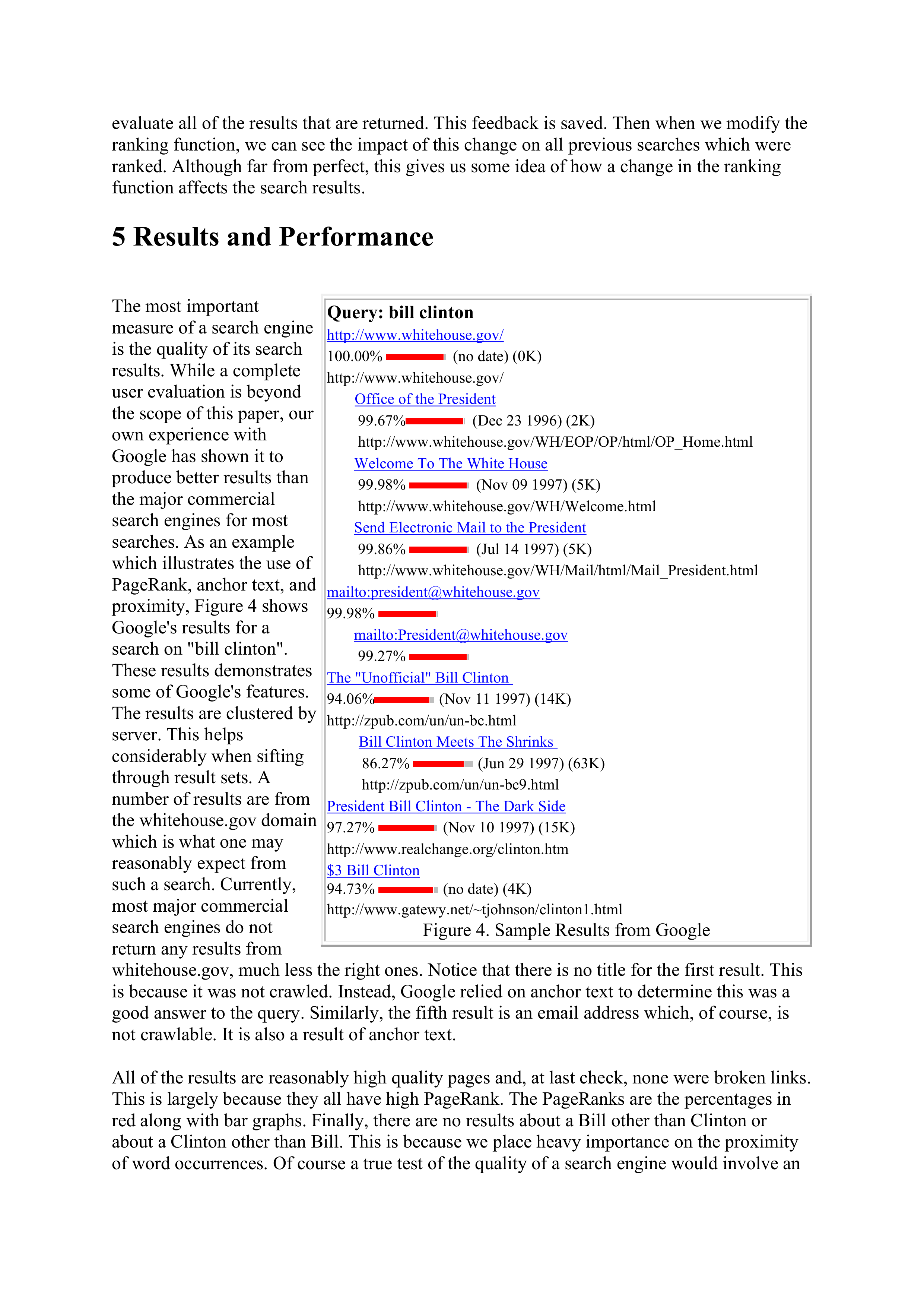
The most important
measure of a search engine
is the quality of its search
results. While a complete
user evaluation is beyond
the scope of this paper, our
own experience with
Google has shown it to
produce better results than
the major commercial
search engines for most
searches. As an example
which illustrates the use of
PageRank, anchor text, and
proximity, Figure 4 shows
Google's results for a
search on "bill clinton".
These results demonstrates
some of Google's features.
The results are clustered by
server. This helps
considerably when sifting
through result sets. A
number of results are from
the whitehouse.gov domain
which is what one may
reasonably expect from
such a search. Currently,
most major commercial
search engines do not
return any results from
whitehouse.gov, much less the right ones. Notice that there is no title for the first result. This
is because it was not crawled. Instead, Google relied on anchor text to determine this was a
good answer to the query. Similarly, the fifth result is an email address which, of course, is
not crawlable. It is also a result of anchor text.
All of the results are reasonably high quality pages and, at last check, none were broken links.
This is largely because they all have high PageRank. The PageRanks are the percentages in
red along with bar graphs. Finally, there are no results about a Bill other than Clinton or
about a Clinton other than Bill. This is because we place heavy importance on the proximity
of word occurrences. Of course a true test of the quality of a search engine would involve an
Query: bill clinton
http://www.whitehouse.gov/
100.00%
(no date) (0K)
http://www.whitehouse.gov/
Office of the President
99.67%
(Dec 23 1996) (2K)
http://www.whitehouse.gov/WH/EOP/OP/html/OP_Home.html
Welcome To The White House
99.98%
(Nov 09 1997) (5K)
http://www.whitehouse.gov/WH/Welcome.html
Send Electronic Mail to the President
99.86%
(Jul 14 1997) (5K)
http://www.whitehouse.gov/WH/Mail/html/Mail_President.html
mailto:president@whitehouse.gov
99.98%
mailto:President@whitehouse.gov
99.27%
The "Unofficial" Bill Clinton
94.06%
(Nov 11 1997) (14K)
http://zpub.com/un/un-bc.html
Bill Clinton Meets The Shrinks
86.27%
(Jun 29 1997) (63K)
http://zpub.com/un/un-bc9.html
President Bill Clinton - The Dark Side
97.27%
(Nov 10 1997) (15K)
http://www.realchange.org/clinton.htm
$3 Bill Clinton
94.73%
(no date) (4K)
http://www.gatewy.net/~tjohnson/clinton1.html
Figure 4. Sample Results from Google
extensive user study or results analysis which we do not have room for here. Instead, we
invite the reader to try Google for themselves at
http://google.stanford.edu
.
5.1 Storage Requirements
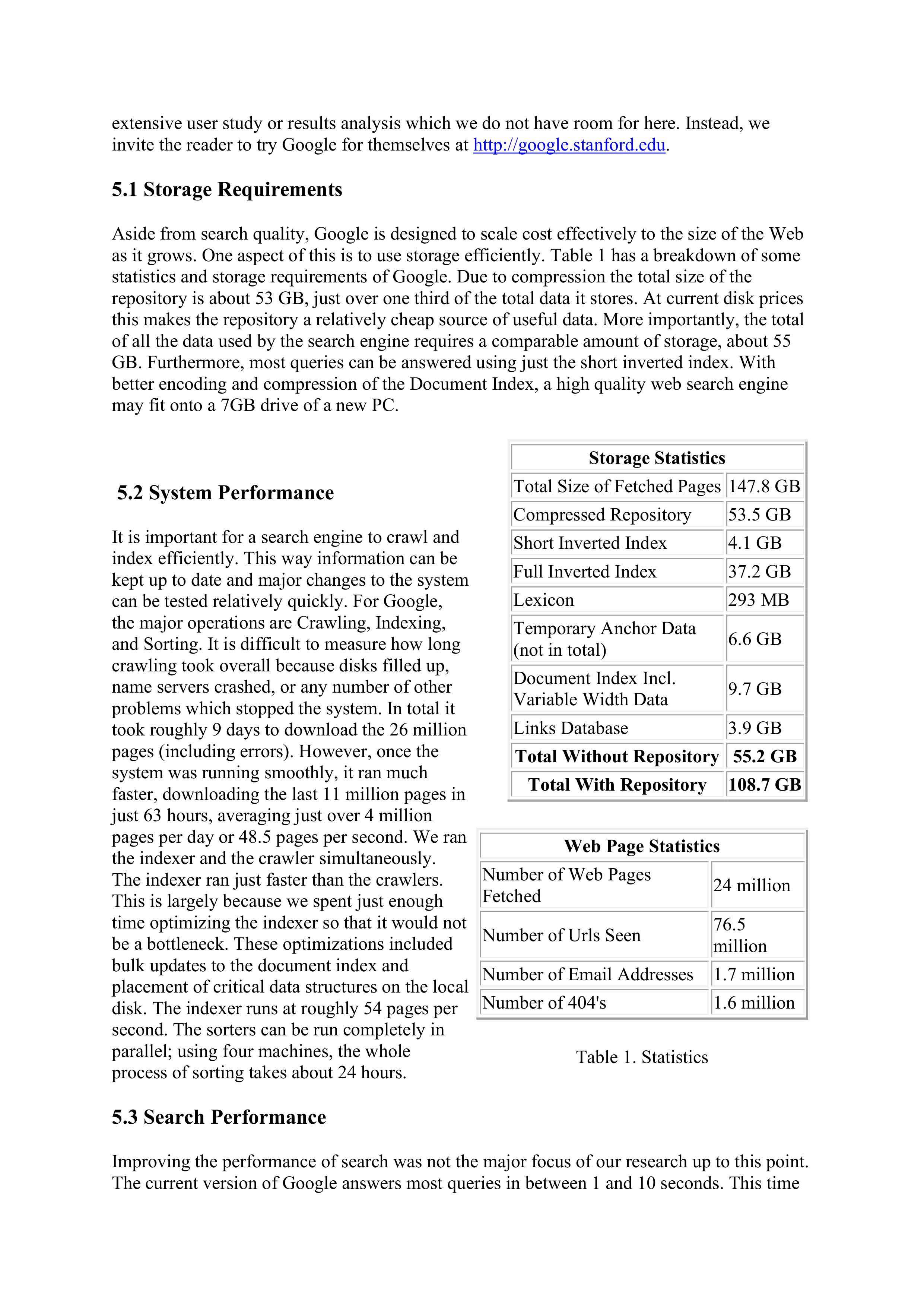
Aside from search quality, Google is designed to scale cost effectively to the size of the Web
as it grows. One aspect of this is to use storage efficiently. Table 1 has a breakdown of some
statistics and storage requirements of Google. Due to compression the total size of the
repository is about 53 GB, just over one third of the total data it stores. At current disk prices
this makes the repository a relatively cheap source of useful data. More importantly, the total
of all the data used by the search engine requires a comparable amount of storage, about 55
GB. Furthermore, most queries can be answered using just the short inverted index. With
better encoding and compression of the Document Index, a high quality web search engine
may fit onto a 7GB drive of a new PC.
5.2 System Performance
It is important for a search engine to crawl and
index efficiently. This way information can be
kept up to date and major changes to the system
can be tested relatively quickly. For Google,
the major operations are Crawling, Indexing,
and Sorting. It is difficult to measure how long
crawling took overall because disks filled up,
name servers crashed, or any number of other
problems which stopped the system. In total it
took roughly 9 days to download the 26 million
pages (including errors). However, once the
system was running smoothly, it ran much
faster, downloading the last 11 million pages in
just 63 hours, averaging just over 4 million
pages per day or 48.5 pages per second. We ran
the indexer and the crawler simultaneously.
The indexer ran just faster than the crawlers.
This is largely because we spent just enough
time optimizing the indexer so that it would not
be a bottleneck. These optimizations included
bulk updates to the document index and
placement of critical data structures on the local
disk. The indexer runs at roughly 54 pages per
second. The sorters can be run completely in
parallel; using four machines, the whole
process of sorting takes about 24 hours.
5.3 Search Performance
Improving the performance of search was not the major focus of our research up to this point.
The current version of Google answers most queries in between 1 and 10 seconds. This time
Storage Statistics
Total Size of Fetched Pages 147.8 GB
Compressed Repository
53.5 GB
Short Inverted Index
4.1 GB
Full Inverted Index
37.2 GB
Lexicon
293 MB
Temporary Anchor Data
(not in total)
6.6 GB
Document Index Incl.
Variable Width Data
9.7 GB
Links Database
3.9 GB
Total Without Repository 55.2 GB
Total With Repository
108.7 GB
Web Page Statistics
Number of Web Pages
Fetched
24 million
Number of Urls Seen
76.5
million
Number of Email Addresses
1.7 million
Number of 404's
1.6 million
Table 1. Statistics
is mostly dominated by disk IO over NFS (since disks are spread over a number of
machines). Furthermore, Google does not have any optimizations such as query caching,
subindices on common terms, and other common optimizations. We intend to speed up
Google considerably through distribution and hardware, software, and algorithmic
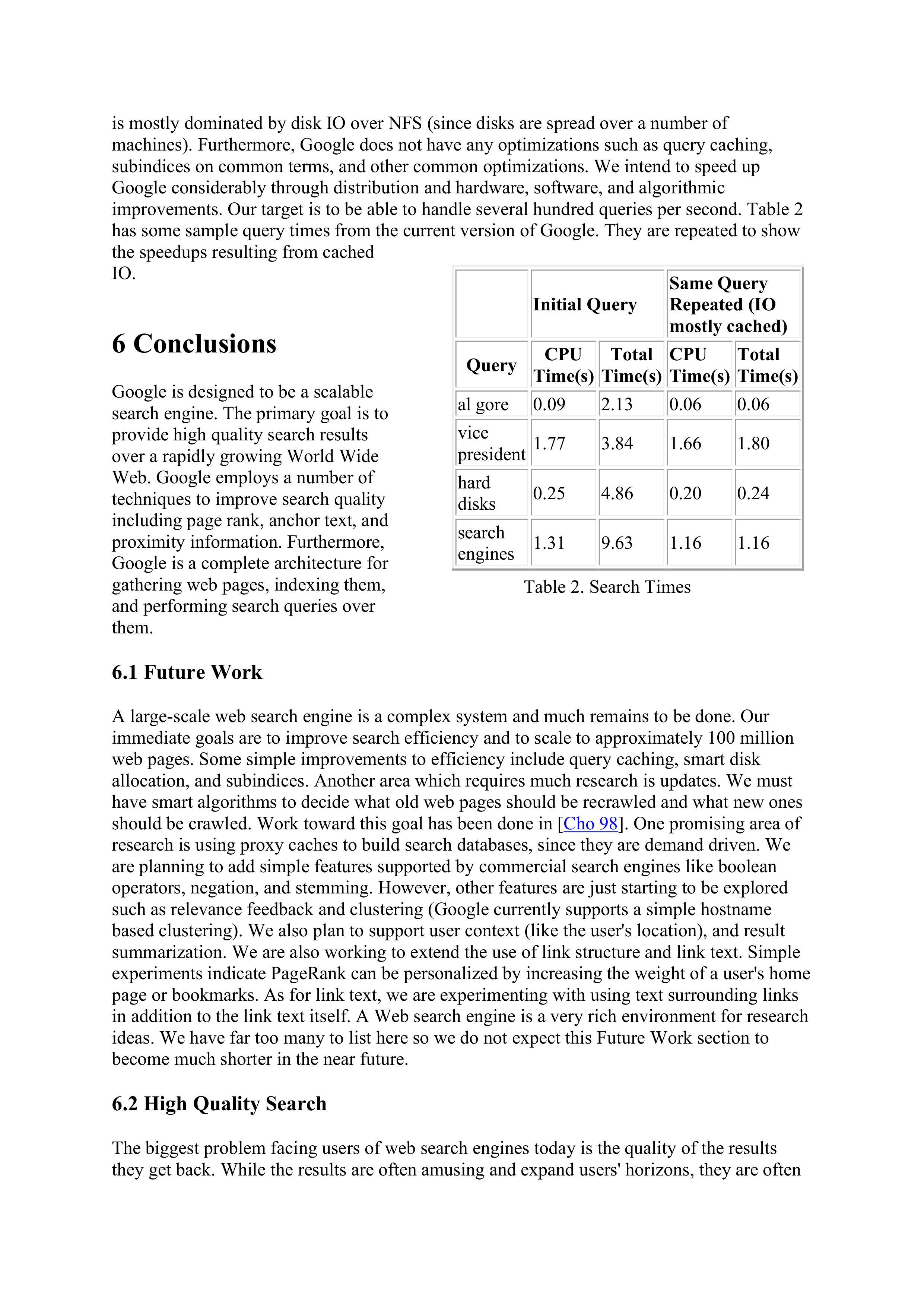
improvements. Our target is to be able to handle several hundred queries per second. Table 2
has some sample query times from the current version of Google. They are repeated to show
the speedups resulting from cached
IO.
6 Conclusions
Google is designed to be a scalable
search engine. The primary goal is to
provide high quality search results
over a rapidly growing World Wide
Web. Google employs a number of
techniques to improve search quality
including page rank, anchor text, and
proximity information. Furthermore,
Google is a complete architecture for
gathering web pages, indexing them,
and performing search queries over
them.
6.1 Future Work
A large-scale web search engine is a complex system and much remains to be done. Our
immediate goals are to improve search efficiency and to scale to approximately 100 million
web pages. Some simple improvements to efficiency include query caching, smart disk
allocation, and subindices. Another area which requires much research is updates. We must
have smart algorithms to decide what old web pages should be recrawled and what new ones
should be crawled. Work toward this goal has been done in [
Cho 98
]. One promising area of
research is using proxy caches to build search databases, since they are demand driven. We
are planning to add simple features supported by commercial search engines like boolean
operators, negation, and stemming. However, other features are just starting to be explored
such as relevance feedback and clustering (Google currently supports a simple hostname
based clustering). We also plan to support user context (like the user's location), and result
summarization. We are also working to extend the use of link structure and link text. Simple
experiments indicate PageRank can be personalized by increasing the weight of a user's home
page or bookmarks. As for link text, we are experimenting with using text surrounding links
in addition to the link text itself. A Web search engine is a very rich environment for research
ideas. We have far too many to list here so we do not expect this Future Work section to
become much shorter in the near future.
6.2 High Quality Search
The biggest problem facing users of web search engines today is the quality of the results
they get back. While the results are often amusing and expand users' horizons, they are often
Initial Query
Same Query
Repeated (IO
mostly cached)
Query
CPU
Time(s)
Total
Time(s)
CPU
Time(s)
Total
Time(s)
al gore
0.09
2.13
0.06
0.06
vice
president
1.77
3.84
1.66
1.80
hard
disks
0.25
4.86
0.20
0.24
search
engines
1.31
9.63
1.16
1.16
Table 2. Search Times
frustrating and consume precious time. For example, the top result for a search for "Bill
Clinton" on one of the most popular commercial search engines was the
Bill Clinton Joke of
the Day: April 14, 1997
. Google is designed to provide higher quality search so as the Web
continues to grow rapidly, information can be found easily. In order to accomplish this
Google makes heavy use of hypertextual information consisting of link structure and link
(anchor) text. Google also uses proximity and font information. While evaluation of a search
engine is difficult, we have subjectively found that Google returns higher quality search
results than current commercial search engines. The analysis of link structure via PageRank
allows Google to evaluate the quality of web pages. The use of link text as a description of
what the link points to helps the search engine return relevant (and to some degree high
quality) results. Finally, the use of proximity information helps increase relevance a great
deal for many queries.
6.3 Scalable Architecture
Aside from the quality of search, Google is designed to scale. It must be efficient in both
space and time, and constant factors are very important when dealing with the entire Web. In
implementing Google, we have seen bottlenecks in CPU, memory access, memory capacity,
disk seeks, disk throughput, disk capacity, and network IO. Google has evolved to overcome
a number of these bottlenecks during various operations. Google's major data structures make
efficient use of available storage space. Furthermore, the crawling, indexing, and sorting
operations are efficient enough to be able to build an index of a substantial portion of the web
-- 24 million pages, in less than one week. We expect to be able to build an index of 100
million pages in less than a month.
6.4 A Research Tool
In addition to being a high quality search engine, Google is a research tool. The data Google
has collected has already resulted in many other papers submitted to conferences and many
more on the way. Recent research such as [
Abiteboul 97
] has shown a number of limitations
to queries about the Web that may be answered without having the Web available locally.
This means that Google (or a similar system) is not only a valuable research tool but a
necessary one for a wide range of applications. We hope Google will be a resource for
searchers and researchers all around the world and will spark the next generation of search
engine technology.
7 Acknowledgments
Scott Hassan and Alan Steremberg have been critical to the development of Google. Their
talented contributions are irreplaceable, and the authors owe them much gratitude. We would
also like to thank Hector Garcia-Molina, Rajeev Motwani, Jeff Ullman, and Terry Winograd
and the whole WebBase group for their support and insightful discussions. Finally we would
like to recognize the generous support of our equipment donors IBM, Intel, and Sun and our
funders. The research described here was conducted as part of the Stanford Integrated Digital
Library Project, supported by the National Science Foundation under Cooperative Agreement
IRI-9411306. Funding for this cooperative agreement is also provided by DARPA and
NASA, and by Interval Research, and the industrial partners of the Stanford Digital Libraries
Project.
References
•
Best of the Web 1994 -- Navigators
http://botw.org/1994/awards/navigators.html
•
Bill Clinton Joke of the Day: April 14, 1997.
http://www.io.com/~cjburke/clinton/970414.html.
•
Bzip2 Homepage
http://www.muraroa.demon.co.uk/
•
Google Search Engine
http://google.stanford.edu/
•
Harvest
http://harvest.transarc.com/
•
Mauldin, Michael L. Lycos Design Choices in an Internet Search Service, IEEE
Expert Interview
http://www.computer.org/pubs/expert/1997/trends/x1008/mauldin.htm
•
The Effect of Cellular Phone Use Upon Driver Attention
http://www.webfirst.com/aaa/text/cell/cell0toc.htm
•
Search Engine Watch
http://www.searchenginewatch.com/
•
RFC 1950 (zlib)
ftp://ftp.uu.net/graphics/png/documents/zlib/zdoc-index.html
•
Robots Exclusion Protocol:
http://info.webcrawler.com/mak/projects/robots/exclusion.htm
•
Web Growth Summary:
http://www.mit.edu/people/mkgray/net/web-growth-
summary.html
•
Yahoo!
http://www.yahoo.com/
•
[Abiteboul 97] Serge Abiteboul and Victor Vianu,
Queries and Computation on the
Web
. Proceedings of the International Conference on Database Theory. Delphi,
Greece 1997.
•
[Bagdikian 97] Ben H. Bagdikian.
The Media Monopoly
. 5th Edition. Publisher:
Beacon, ISBN: 0807061557
•
[Chakrabarti 98] S.Chakrabarti, B.Dom, D.Gibson, J.Kleinberg, P. Raghavan and S.
Rajagopalan.
Automatic Resource Compilation by Analyzing Hyperlink Structure and
Associated Text.
Seventh International Web Conference (WWW 98). Brisbane,
Australia, April 14-18, 1998.
•
[Cho 98] Junghoo Cho, Hector Garcia-Molina, Lawrence Page.
Efficient Crawling
Through URL Ordering.
Seventh International Web Conference (WWW 98).
Brisbane, Australia, April 14-18, 1998.
•
[Gravano 94] Luis Gravano, Hector Garcia-Molina, and A. Tomasic.
The
Effectiveness of GlOSS for the Text-Database Discovery Problem.
Proc. of the 1994
ACM SIGMOD International Conference On Management Of Data, 1994.
•
[Kleinberg 98] Jon Kleinberg,
Authoritative Sources in a Hyperlinked Environment
,
Proc. ACM-SIAM Symposium on Discrete Algorithms, 1998.
•
[Marchiori 97] Massimo Marchiori.
The Quest for Correct Information on the Web:
Hyper Search Engines.
The Sixth International WWW Conference (WWW 97). Santa
Clara, USA, April 7-11, 1997.
•
[McBryan 94] Oliver A. McBryan. GENVL and
WWWW: Tools for Taming the Web.
First International Conference on the World Wide Web.
CERN, Geneva
(Switzerland), May 25-26-27 1994.
http://www.cs.colorado.edu/home/mcbryan/mypapers/www94.ps
•
[Page 98] Lawrence Page, Sergey Brin, Rajeev Motwani, Terry Winograd.
The
PageRank Citation Ranking: Bringing Order to the Web.
Manuscript in progress.
http://google.stanford.edu/~backrub/pageranksub.ps


•
[Pinkerton 94] Brian Pinkerton,
Finding What People Want: Experiences with the
WebCrawler.
The Second International WWW Conference Chicago, USA, October
17-20, 1994.
http://info.webcrawler.com/bp/WWW94.html
•
[Spertus 97] Ellen Spertus.
ParaSite: Mining Structural Information on the Web.
The
Sixth International WWW Conference (WWW 97). Santa Clara, USA, April 7-11,
1997.
•
[TREC 96]
Proceedings of the fifth Text REtrieval Conference (TREC-5).
Gaithersburg, Maryland, November 20-22, 1996. Publisher: Department of
Commerce, National Institute of Standards and Technology. Editors: D. K. Harman
and E. M. Voorhees. Full text at:
http://trec.nist.gov/
•
[Witten 94] Ian H Witten, Alistair Moffat, and Timothy C. Bell.
Managing Gigabytes:
Compressing and Indexing Documents and Images.
New York: Van Nostrand
Reinhold, 1994.
•
[Weiss 96] Ron Weiss, Bienvenido Velez, Mark A. Sheldon, Chanathip Manprempre,
Peter Szilagyi, Andrzej Duda, and David K. Gifford.
HyPursuit: A Hierarchical
Network Search Engine that Exploits Content-Link Hypertext Clustering.
Proceedings
of the 7th ACM Conference on Hypertext. New York, 1996.
Vitae
Sergey Brin
received his B.S. degree in
mathematics and computer science from the
University of Maryland at College Park in
1993. Currently, he is a Ph.D. candidate in
computer science at Stanford University
where he received his M.S. in 1995. He is a
recipient of a National Science Foundation
Graduate Fellowship. His research interests
include search engines, information
extraction from unstructured sources, and
data mining of large text collections and
scientific data.
Lawrence Page
was born in East Lansing, Michigan, and received a B.S.E. in Computer
Engineering at the University of Michigan Ann Arbor in 1995. He is currently a Ph.D.
candidate in Computer Science at Stanford University. Some of his research interests include
the link structure of the web, human computer interaction, search engines, scalability of
information access interfaces, and personal data mining.
8 Appendix A: Advertising and Mixed Motives
Currently, the predominant business model for commercial search engines is advertising. The
goals of the advertising business model do not always correspond to providing quality search
to users. For example, in our prototype search engine one of the top results for cellular phone
is "
The Effect of Cellular Phone Use Upon Driver Attention
", a study which explains in great
detail the distractions and risk associated with conversing on a cell phone while driving. This
search result came up first because of its high importance as judged by the PageRank
algorithm, an approximation of citation importance on the web [
Page, 98
]. It is clear that a
search engine which was taking money for showing cellular phone ads would have difficulty
justifying the page that our system returned to its paying advertisers. For this type of reason
and historical experience with other media [
Bagdikian 83
], we expect that advertising funded
search engines will be inherently biased towards the advertisers and away from the needs of
the consumers.
Since it is very difficult even for experts to evaluate search engines, search engine bias is
particularly insidious. A good example was OpenText, which was reported to be selling
companies the right to be listed at the top of the search results for particular queries
[
Marchiori 97
]. This type of bias is much more insidious than advertising, because it is not
clear who "deserves" to be there, and who is willing to pay money to be listed. This business
model resulted in an uproar, and OpenText has ceased to be a viable search engine. But less
blatant bias are likely to be tolerated by the market. For example, a search engine could add a
small factor to search results from "friendly" companies, and subtract a factor from results
from competitors. This type of bias is very difficult to detect but could still have a significant
effect on the market. Furthermore, advertising income often provides an incentive to provide
poor quality search results. For example, we noticed a major search engine would not return a
large airline's homepage when the airline's name was given as a query. It so happened that the
airline had placed an expensive ad, linked to the query that was its name. A better search
engine would not have required this ad, and possibly resulted in the loss of the revenue from
the airline to the search engine. In general, it could be argued from the consumer point of
view that the better the search engine is, the fewer advertisements will be needed for the
consumer to find what they want. This of course erodes the advertising supported business
model of the existing search engines. However, there will always be money from advertisers
who want a customer to switch products, or have something that is genuinely new. But we
believe the issue of advertising causes enough mixed incentives that it is crucial to have a
competitive search engine that is transparent and in the academic realm.
9 Appendix B: Scalability
9. 1 Scalability of Google
We have designed Google to be scalable in the near term to a goal of 100 million web pages.
We have just received disk and machines to handle roughly that amount. All of the time
consuming parts of the system are parallelize and roughly linear time. These include things
like the crawlers, indexers, and sorters. We also think that most of the data structures will
deal gracefully with the expansion. However, at 100 million web pages we will be very close
up against all sorts of operating system limits in the common operating systems (currently we
run on both Solaris and Linux). These include things like addressable memory, number of
open file descriptors, network sockets and bandwidth, and many others. We believe
expanding to a lot more than 100 million pages would greatly increase the complexity of our
system.
9.2 Scalability of Centralized Indexing Architectures
As the capabilities of computers increase, it becomes possible to index a very large amount of
text for a reasonable cost. Of course, other more bandwidth intensive media such as video is
likely to become more pervasive. But, because the cost of production of text is low compared
to media like video, text is likely to remain very pervasive. Also, it is likely that soon we will
have speech recognition that does a reasonable job converting speech into text, expanding the
amount of text available. All of this provides amazing possibilities for centralized indexing.
Here is an illustrative example. We assume we want to index everything everyone in the US
has written for a year. We assume that there are 250 million people in the US and they write
an average of 10k per day. That works out to be about 850 terabytes. Also assume that
indexing a terabyte can be done now for a reasonable cost. We also assume that the indexing
methods used over the text are linear, or nearly linear in their complexity. Given all these
assumptions we can compute how long it would take before we could index our 850 terabytes
for a reasonable cost assuming certain growth factors. Moore's Law was defined in 1965 as a
doubling every 18 months in processor power. It has held remarkably true, not just for
processors, but for other important system parameters such as disk as well. If we assume that
Moore's law holds for the future, we need only 10 more doublings, or 15 years to reach our
goal of indexing everything everyone in the US has written for a year for a price that a small
company could afford. Of course, hardware experts are somewhat concerned Moore's Law
may not continue to hold for the next 15 years, but there are certainly a lot of interesting
centralized applications even if we only get part of the way to our hypothetical example.
Of course a distributed systems like G
l
oss [
Gravano 94
] or
Harvest
will often be the most
efficient and elegant technical solution for indexing, but it seems difficult to convince the
world to use these systems because of the high administration costs of setting up large
numbers of installations. Of course, it is quite likely that reducing the administration cost
drastically is possible. If that happens, and everyone starts running a distributed indexing
system, searching would certainly improve drastically.
Because humans can only type or speak a finite amount, and as computers continue
improving, text indexing will scale even better than it does now. Of course there could be an
infinite amount of machine generated content, but just indexing huge amounts of human
generated content seems tremendously useful. So we are optimistic that our centralized web
search engine architecture will improve in its ability to cover the pertinent text information
over time and that there is a bright future for search.