

Nature | Vol 655 | 9 July 2026 |
487
Article
Accelerating scientific discovery with
Co-Scientist
Juraj Gottweis
1,8
✉
, Wei-Hung Weng
2,8
✉
, Alexander Daryin
1,8
, Tao Tu
2,8
, Petar Sirkovic
1,8
,
Artiom Myaskovsky
1,8
, Grzegorz Glowaty
1,8
, Felix Weissenberger
1,8
, Alessio Orlandi
1,8
,
Dan Popovici
3
, Anil Palepu
3
, Keran Rong
2
, Ryutaro Tanno
2
, Khaled Saab
2
, Fan Zhang
3
,
Jacob Blum
4
, Andrew Carroll
3
, Kavita Kulkarni
3
, Nenad Tomašev
2
, Dina Zverinski
1
,
Ivor Rendulic
1
, Elahe Vedadi
2
, Florian Hasler
1
, Luka Rimanic
1
, Marina Boia
1
, Ivan Budiselic
1
,
Ben Feinstein
3
, Mathias Bellaiche
3
, Tom Sheffer
3
, Jan Freyberg
2
, Jeremy Ratcliff
2
,
Ottavia Bertolli
2
, Katherine Chou
3
, Avinatan Hassidim
3
, Burak Gokturk
1
, Amin Vahdat
1
,
Yuan Guan
4
, Vikram Dhillon
5
, Eeshit Dhaval Vaishnav
6
, Byron Lee
6
, Tiago R. D. Costa
7
,
José R. Penadés
7
, Gary Peltz
4
, Yossi Matias
3
, James Manyika
3
, Demis Hassabis
2
, Yunhan Xu
2
,
Pushmeet Kohli
2
✉
, Annalisa Pawlosky
3
✉
, Alan Karthikesalingam
2
✉
& Vivek Natarajan
2
✉
Scientific discovery is driven by scientists generating hypotheses for complex problems
that undergo rigorous experimental validation. To augment this process, we introduce
Co-Scientist, a multi-agent artificial intelligence (AI) system built on Gemini for
structured scientific thinking and hypothesis generation. Co-Scientist aims to help
scientists discover new original knowledge. Conditioned on their research objectives
and previous scientific evidence, it formulates demonstrably novel research
hypotheses for experimental verification. The system’s design involves agents
continuously generating, critiquing and refining hypotheses accelerated by scaling
test-time compute. Key contributions include (1) a multi-agent architecture with
an asynchronous task execution framework for flexible compute scaling, and (2) a
tournament evolution process for self-improving hypotheses generation. Automated
evaluations show continued benefits of test-time compute scaling, improving
hypothesis quality over time. Although this is a general-purpose system, we focus the
validation in three biomedical applications: drug repurposing; novel-target discovery
1
;
and explaining mechanisms of antimicrobial resistance
2
. Specifically, Co-Scientist
helped to identify new drug-repurposing candidates and synergistic combination
therapies for acute myeloid leukaemia that were validated through in vitro experiments.
These real-world validations demonstrate the potential of Co-Scientist to accelerate
scientific discovery and usher in an era of AI-empowered scientists.
Researchers are faced with a breadth and depth conundrum. The com-
plexity of scientific topics requires increasingly deep and specific sub-
ject matter expertise, while leaps in insight may still arise from broad
knowledge bridging across disciplines
3–5
. With the rapid rise in scientific
publications and the development of numerous specialized technolo-
gies, mastery of both discipline-specific depth and trans-disciplinary
insights can be challenging.
At the same time, there has been rapid technological progress in AI
towards generally intelligent and collaborative systems, which might
empower scientists in creatively traversing and expertly reasoning
across disciplinary domains. Such systems are capable of advanced
reasoning
6–8
, multimodal understanding
8
and agentic actions
9
, such as
the ability to use tools to solve complex tasks over long time horizons.
Furthermore, the trends with distillation
10
and inference time compute
costs
8,11
indicate that such intelligent and general AI systems are rapidly
becoming more accessible. Motivated by the aforementioned unmet
needs in the modern discovery process in science and medicine and
building on the advancements in frontier AI
12
, we develop and intro-
duce Co-Scientist.
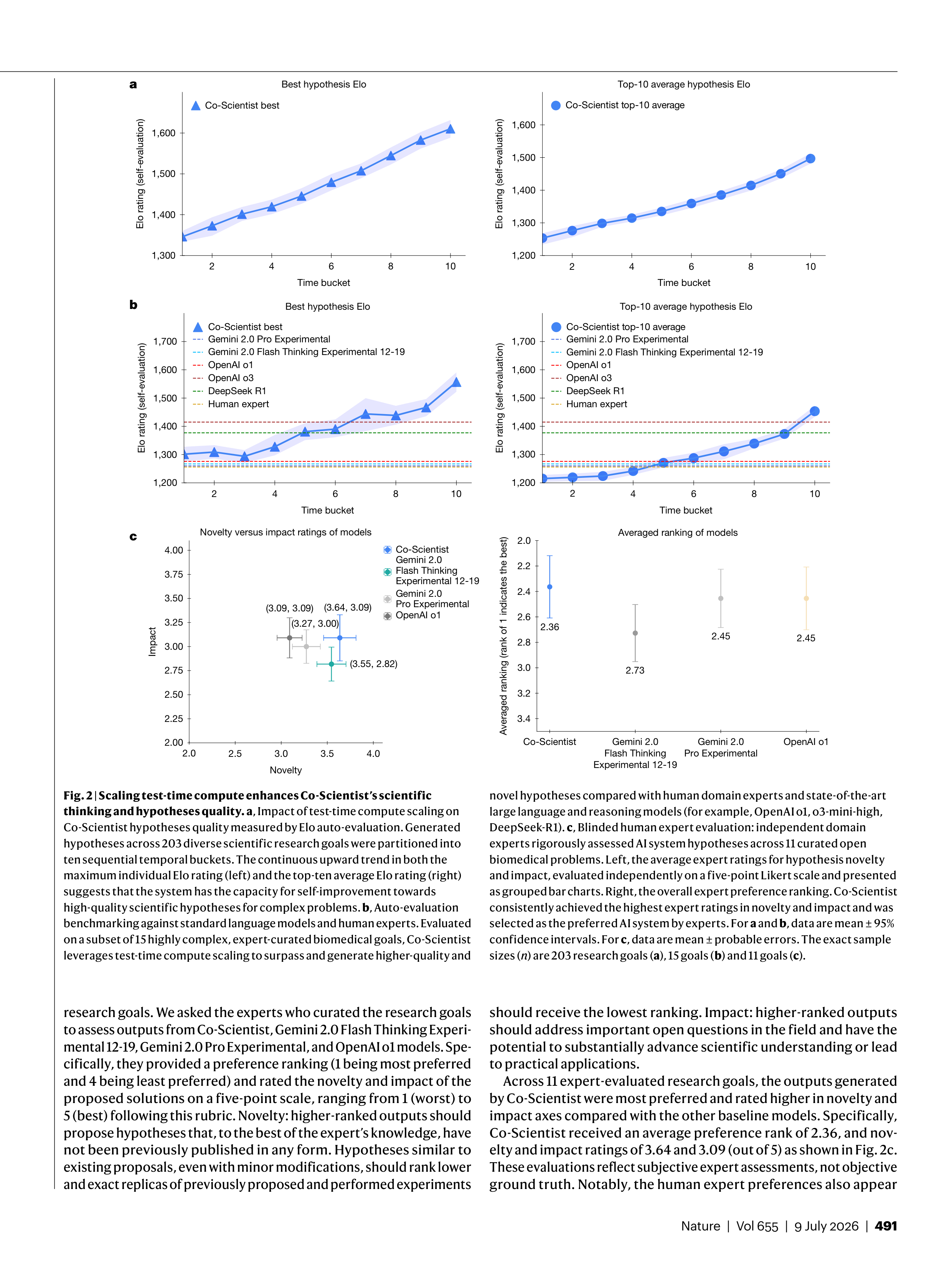
Co-Scientist is a structured scientific thinking engine designed to
act as a collaborator to scientists and help accelerate the scientific
discovery process. The system is a compound, multi-agent AI system
13
building on Google’s large language model (LLM) Gemini
14
, mirroring
the reasoning process underpinning the scientific method
15
. Given a
research goal specified in natural language, the system can search,
learn and reason over relevant literature to synthesize previous work
and propose novel, original research hypotheses and experimental pro-
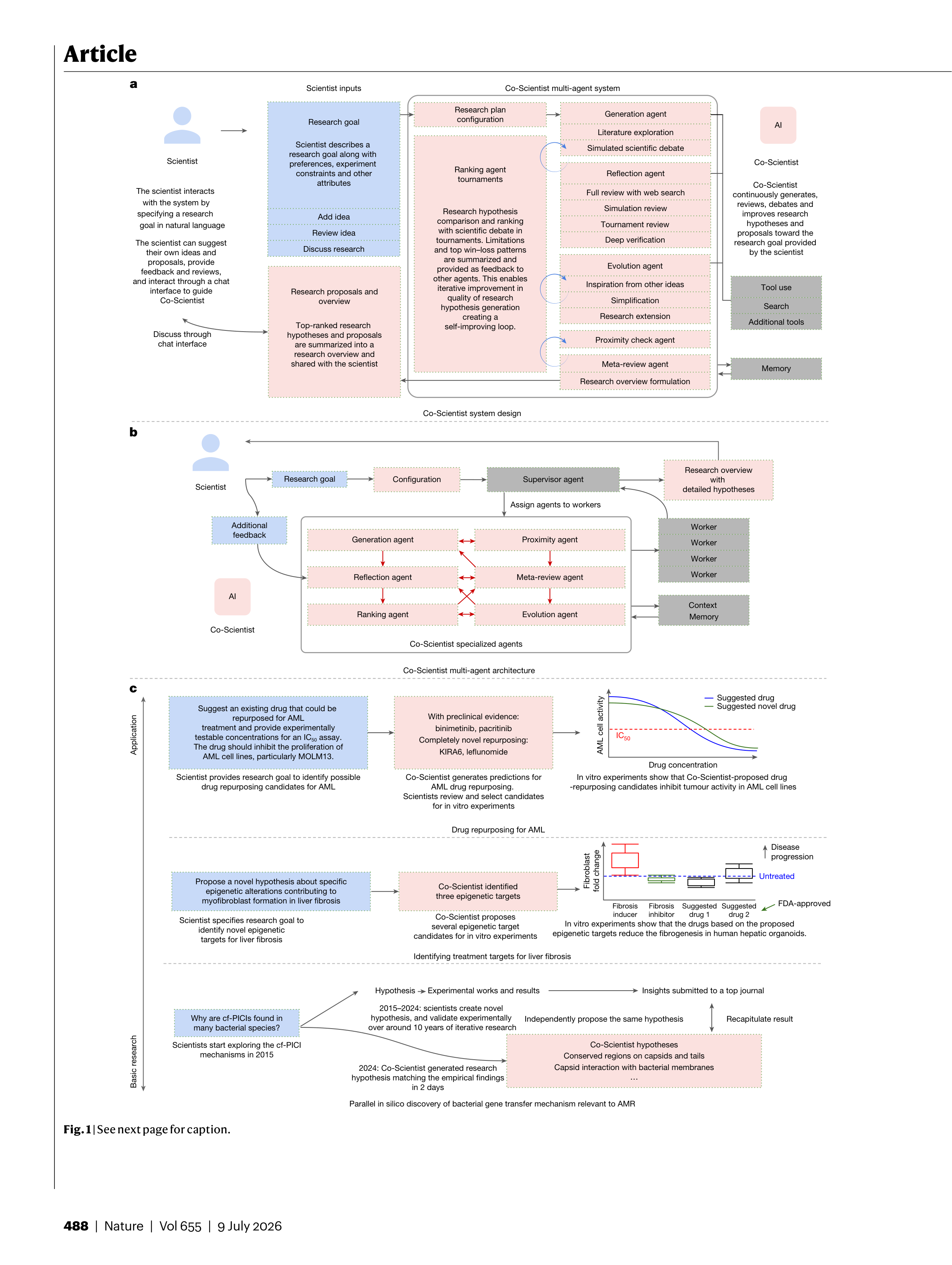
tocols (Fig. 1a). Co-Scientist provides grounding for its recommenda-
tions by citing relevant literature, applying sound scientific reasoning
and verifying its conclusions through external tools when applicable.
https://doi.org/10.1038/s41586-026-10644-y
Received: 20 March 2025
Accepted: 11 May 2026
Published online: 19 May 2026
Open access
Check for updates
1
Google Cloud AI Research, Zurich, Switzerland.
2
Google DeepMind, Mountain View, CA, USA.
3
Google Research, Mountain View, CA, USA.
4
Stanford University School of Medicine, Palo Alto,
CA, USA.
5
Houston Methodist Hospital, Houston, TX, USA.
6
Sequome, San Francisco, CA, USA.
7
Fleming Initiative and Imperial College London, London, UK.
8
These authors contributed equally:
Juraj Gottweis, Wei-Hung Weng, Alexander Daryin, Tao Tu, Petar Sirkovic, Artiom Myaskovsky, Grzegorz Glowaty, Felix Weissenberger, Alessio Orlandi.
✉
e-mail: juro@google.com; ckbjimmy@
google.com; pushmeet@google.com; apawlosky@google.com; alankarthi@google.com; natviv@google.com
488
| Nature | Vol 655 | 9 July 2026
Article
Scientist
Co-Scientist multi-agent system
Scientist inputs
Ranking agent
tournaments
Research hypothesis
comparison and ranking
with scientific debate in
tournaments. Limitations
and top win–loss patterns
are summarized and
provided as feedback to
other agents. This enables
iterative improvement in
quality of research
hypothesis generation
creating a
self-improving loop.
Co-Scientist
Generation agent
Literature exploration
Simulated scientific debate
Full review with web search
Simulation review
Tournament review
Deep verification
Evolution agent
Inspiration from other ideas
Research extension
Simplification
Proximity check agent
Research proposals and
overview
Top-ranked research
hypotheses and proposals
are summarized into a
research overview and
shared with the scientist
The scientist interacts
with the system by
specifying a research
goal in natural language
The scientist can suggest
their own ideas and
proposals, provide
feedback and reviews,
and interact through a chat
interface to guide
Co-Scientist
Research goal
Scientist describes a
research goal along with
preferences, experiment
constraints and other
attributes
Add idea
Review idea
Discuss research
AI
Tool use
Search
Additional tools
Meta-review agent
Research overview formulation
Research plan
configuration
Co-Scientist
continuously generates,
reviews, debates and
improves research
hypotheses and
proposals toward the
research goal provided
by the scientist
Co-Scientist system design
Drug repurposing for AML
Suggest an existing drug that could be
repurposed for AML
treatment and provide experimentally
testable concentrations for an IC
50
assay.
The drug should inhibit the proliferation of
AML cell lines, particularly MOLM13.
With preclinical evidence:
binimetinib, pacritinib
Completely novel repurposing:
KIRA6, leflunomide
Parallel in silico discovery of bacterial gene transfer mechanism relevant to AMR
Why are cf-PICIs found in
many bacterial species?
Co-Scientist hypotheses
Conserved regions on capsids and tails
Capsid interaction with bacterial membranes
…
Hypothesis
Experimental works and results
Insights submitted to a top journal
Independently propose the same hypothesis
Recapitulate result
Propose a novel hypothesis about specific
epigenetic alterations contributing to
myofibroblast formation in liver fibrosis
Co-Scientist identified
three epigenetic targets
Application
Basic research
Scientist provides research goal to identify possible
drug repurposing candidates for AML
Co-Scientist generates predictions for
AML drug repurposing.
Scientists review and select candidates
for in vitro experiments
In vitro experiments show that Co-Scientist-proposed drug
-repurposing candidates inhibit tumour activity in AML cell lines
Scientist specifies research goal to
identify novel epigenetic
targets for liver fibrosis
Co-Scientist proposes
several epigenetic target
candidates for in vitro experiments
Identifying treatment targets for liver fibrosis
In vitro experiments show that the drugs based on the proposed
epigenetic targets reduce the fibrogenesis in human hepatic organoids.
Scientists start exploring the cf-PICI
mechanisms in 2015
2024: Co-Scientist generated research
hypothesis matching the empirical findings
in 2 days
2015–2024: scientists create novel
hypothesis, and validate experimentally
over around 10 years of iterative research
Discuss through
chat interface
a
c
Memory
AML cell activity
Drug concentration
IC
50
Suggested drug
Suggested novel drug
Fibroblast
fold change
Suggested
drug 1
Untreated
Fibrosis
inhibitor
Suggested
drug 2
FDA-approved
Fibrosis
inducer
Disease
progression
b
Scientist
Co-Scientist
Generation agent
Proximity agent
Meta-review agent
Research overview
with
detailed hypotheses
Research goal
AI
Worker
Worker
Worker
Worker
Evolution agent
Co-Scientist specialized agents
Ranking agent
Supervisor agent
Assign agents to workers
Additional
feedback
Context
Memory
Co-Scientist multi-agent architecture
Reflection agent
Configuration
Reflection agent
Fig. 1 |
See next page for caption.
Nature | Vol 655 | 9 July 2026 |
489
Co-Scientist is purpose-built for a ‘scientist-in-the-loop’ collabora-
tive paradigm. Scientists can specify their research goals in simple
natural language and inform the system of desirable attributes and
constraints for the proposed solutions. They can also actively interact
with and steer the system, including directly suggesting initial ideas and
hypotheses for the exploration, refining generated ideas or providing
feedback through natural language chat.
Co-Scientist works through a substantial scaling of the test-time
compute paradigm
16–18
, implementing structured scientific thinking in
a multi-agent setup to iteratively reason, evolve and improve the out-
puts as it gathers more knowledge (Fig. 1b). Underpinning the system
are thinking and reasoning steps—notably a self-play-based scientific
debate step for generating novel research hypotheses; tournaments
that compare and rank hypotheses through the process of finding
win and loss patterns; and an evolution process to improve their qual-
ity. Finally, the agentic nature of the system enables it to recursively
self-critique its output and use tools such as web search and specialized
AI models to provide itself with feedback to refine its hypotheses and
research proposals.
Although Co-Scientist is general purpose and applicable across
scientific disciplines, here we validate it in three impactful areas of
biomedicine with varied complexity: drug repurposing for cancer;
novel treatment target discovery for liver fibrosis; and identification of
mechanistic explanations for antimicrobial resistance (AMR) (Fig. 1c).
Drug development remains an expensive and protracted process,
with most new approvals requiring de novo discovery for each indi-
cation
19
. Systematic identification of new therapeutic indications
for approved agents through drug repurposing offers a pragmatic
strategy to accelerate development timelines and reduce attrition
20
.
Using Co-Scientist, we generated large-scale repurposing predictions
validated through expert curation and in vitro assays. The system pro
-
posed several single-agent and combination therapies for AML that
demonstrate selective cytotoxicity at clinically relevant concentrations.
Beyond repurposing, Co-Scientist enables hypothesis generation for
de novo target discovery, a process that is traditionally limited by the
scale and uncertainty of biological inference. We applied Co-Scientist
to liver fibrosis, for which it proposed and ranked novel epigenetic
targets demonstrating significant anti-fibrotic activity and hepatocyte
regeneration in human hepatic organoids
1
. Finally, we examined bac-
terial gene transfer mechanisms related to AMR, a system-level chal-
lenge involving molecular mechanisms and evolutionary pressures
2
.
Researchers instructed the system to explore a topic their group had
independently discovered, but not yet published. Co-Scientist was
asked to hypothesize how capsid-forming phage-inducible chromo-
somal islands (cf-PICIs) exist across bacterial species. It independently
proposed that cf-PICIs interact with diverse phage tails to expand host
range, mirroring the researchers’ unpublished experimental findings
detailed in co-timed reports
2,21
.
Key contributions
Introducing Co-Scientist
We develop and introduce Co-Scientist, a structured scientific thinking
engine, that goes beyond literature summarization and deep research
tools to assist scientists in generating knowledge, novel hypothesis
generation, identifying unexpected connections and experimental
planning.
Substantial scaling of the test-time compute paradigm for
scientific reasoning
Co-Scientist is built on a Gemini-based multi-agent architecture, using
an asynchronous task-execution framework. This framework enables
the system to flexibly allocate computational resources to scientific
reasoning, mirroring key aspects of the scientific method. Specifically,
the system uses self-play strategies, including a scientific debate and a
tournament-based evolution process, to iteratively refine hypotheses
and research proposals creating a self-improving loop. Using automated
evaluations across 15 complex expert curated open scientific goals, we
demonstrate the benefits of scaling the test-time compute paradigm with
Co-Scientist outperforming other state-of-the-art agentic and reasoning
models in generating high-quality hypotheses for complex problems.
Expert-in-the-loop scientific workflow
Our system is designed for collaboration with scientists. The system
can flexibly incorporate conversational feedback in natural language
from scientists and co-develop, evolve and refine outputs.
End-to-end validation of Co-Scientist in important topics in
biomedicine
We present end-to-end validation of AI-generated hypotheses through
new empirical findings in three distinct and increasingly complex areas
of biomedicine: drug repurposing, novel-target discovery and AMR
(Table 1 and Supplementary Note 1).
Co-Scientist overview
Given a research goal, Co-Scientist generates hypotheses constrained
by default criteria that include plausibility, novelty, testability and
safety. At a high level, it uses an asynchronous multi-agent architecture
whereby a team of agents co-operate to solve scientific problems and
develop new hypotheses (Fig. 1b). It comprises a natural language inter-
face for expert supervision, a task-execution framework for resource
allocation, a suite of specialized agents (Generation, Reflection, Rank-
ing, Evolution, Proximity and Meta-review) mirroring the scientific
method and a persistent context memory for long-horizon reason-
ing. Detailed system configurations and agent mechanisms are fully
described in the Methods.
Fig. 1 | Summary of Co-Scientist design, its multi-agent architecture and
experimental validation.
a
, Overview of the different components of
Co-Scientist’s structured scientific thinking engine—the multi-agent system,
and its interaction paradigm with scientists. Given a research goal in natural
language, Co-Scientist generates novel research hypotheses. The system uses
specialized Gemini-based agents, including Generation, Reflection, Ranking,
Evolution, Proximity (which evaluates relatedness) and Meta-review (which
provides high level analysis) agents, to continuously generate, debate and
evolve research hypotheses within a tournament framework. Feedback from
the tournament enables iterative improvement, creating a self-improving loop
towards novel and high-quality hypotheses for solving complex scientific
problems. Co-Scientist uses tools, including web search and specialized AI
models, to improve the grounding and quality of generated research
hypotheses. Scientists can converse with Co-Scientist in natural language to
specify research goals, incorporate constraints, provide feedback, steer and
suggest new directions for explorations through the designated user interface.
b
, The underlying multi-agent architecture: a Supervisor agent parses the
user’s natural language research goal and dynamically allocates resources
to specialized worker agents within an asynchronous task queue. The red
boxes in the ‘Co-Scientist specialized agents’ part denote individual agents
each with their own unique logic and role. The blue boxes indicate the
scientist-in-the-loop inputs and feedback. The dark grey arrows represent
the information flow through the Co-Scientist, and the red arrows represent
the information feedback loop between the specialized agents.
c
, End-to-end
validation of Co-Scientist across three biomedical problems of varying
complexity: Co-Scientist proposed drug-repurposing candidates for AML
(top), identified novel epigenetic targets for liver fibrosis (middle) and
independently recapitulated a, then unpublished, co-timed discovery of
a novel bacterial gene transfer mechanism relevant to AMR (bottom).
All hypotheses generated by Co-Scientist were subsequently verified
through independent in vitro laboratory experiments.
490
| Nature | Vol 655 | 9 July 2026
Article
System analysis and evaluation
We first conducted the initial system evaluations to benchmark
and verify the choice of the architecture and metrics underpinning
Co-Scientist (Supplementary Note 2 and Supplementary Fig. 1). We
performed an ablation study to investigate the contribution of each
agentic component in Co-Scientist. We then analysed the impact
of scaling test-time compute, and undertook a small-scale evalu-
ation with domain experts to assess the quality of the system out-
puts. Finally, to assess the practical use of the system’s predictions,
we performed end-to-end wet-laboratory validations (laboratory
experiments) of Co-Scientist-generated hypotheses and research
proposals in three key biomedical applications: drug repurposing,
identifying new treatment targets and elucidating the mechanisms
underlying AMR (Table 1 and Supplementary Note 1). The varying com-
plexity and nature of these applications enable a more comprehensive
assessment of the system. Notably, all three validations included the
expert-in-the-loop concept.
Agent ablation analysis
Our ablation analyses (described in the Methods, Supplementary
Note 3 and Supplementary Figs. 2–6) confirmed the importance of
our multi-agent architecture and specialized prompting strategies for
robust scientific reasoning. For example, granting the Reflection agent
access to external search tools effectively prevented the hallucination
of seemingly novel but implausible hypotheses, while using a scientific
debate prompt in the Ranking agent substantially improved the ranking
of hypotheses and reduced positional bias. Furthermore, iterative refine-
ment by the Evolution agent substantially boosted hypotheses quality.
Scaling test-time compute improves scientific reasoning
To evaluate the effects of test-time compute scaling and Co-Scientist’s
progress during iterative scientific reasoning and hypothesis genera-
tion, we measured the Elo ratings of Co-Scientist-generated hypotheses
and proposals over the course of its thinking and computation (that
is, the tournament of hypotheses). This analysis was done across 203
distinct research goals curated across broad scientific topics (pre-
dominantly in biomedicine, but also included other topics, such
as mathematics and physics) and entered into Co-Scientist until
3 February 2025.
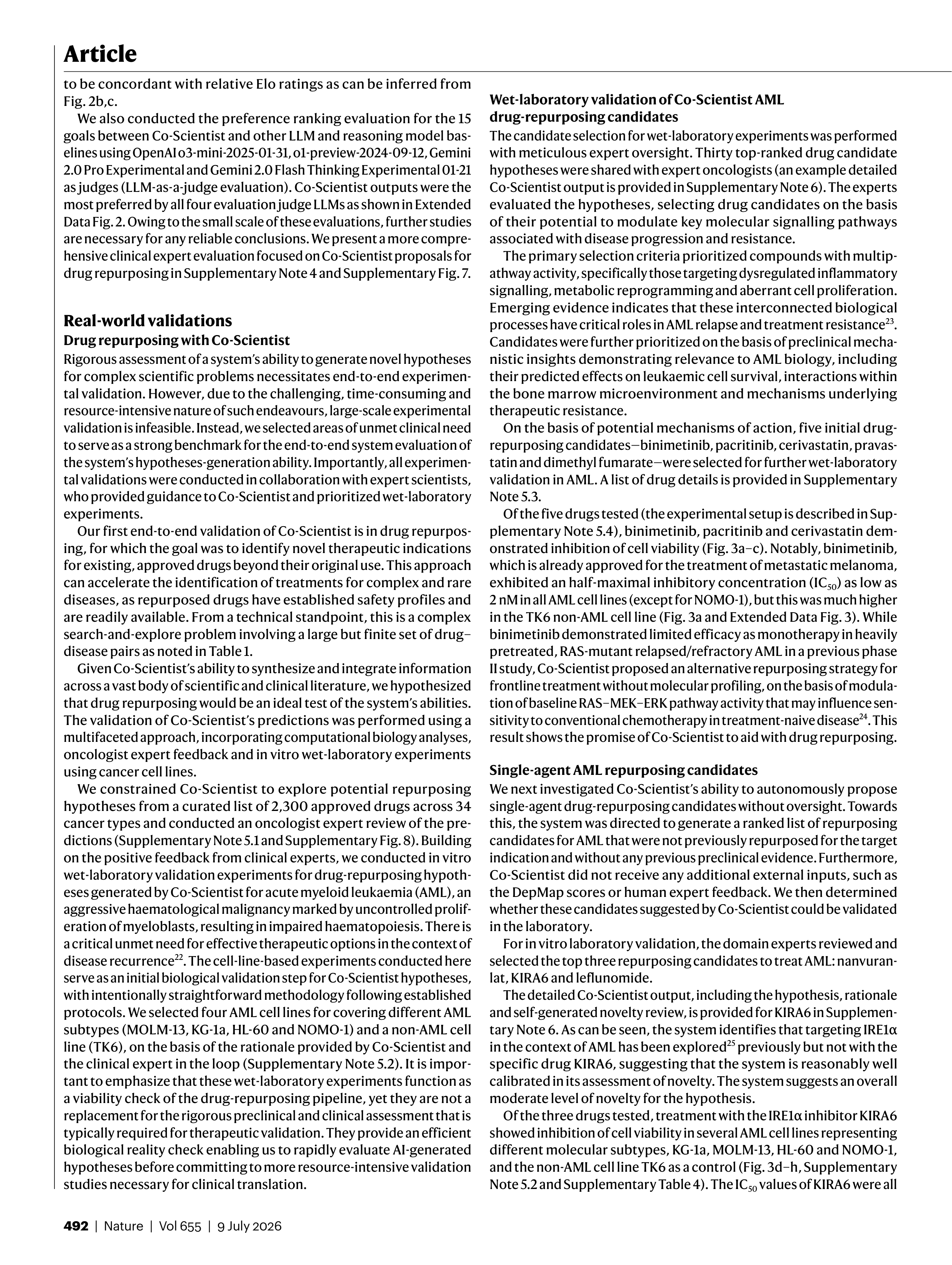
Co-Scientist’s research hypotheses and proposals were partitioned
into ten temporal buckets of equal size. Each bucket corresponded
to a sequential 10% of the total generation time, with the first bucket
containing the earliest 10% of generated Co-Scientist results, while
the tenth bucket comprised the most recent 10%. For each bucket,
we determined the average Elo rating of the top-ten hypotheses and
the maximum individual Elo rating (the best Elo). These average and
best Elo ratings were averaged across 203 research goals and their
corresponding tournaments. The resulting performance trends as
seen in Fig. 2a, across both metrics, serve as a measure of Co-Scientist’s
quality improvement as it spends more time in thinking and computa-
tion—the most recent hypotheses demonstrate a considerable quality
enhancement compared with the initial ones. Notably, although the
Elo rating is not the direct optimization target, its progressive increase
emerges from the system’s information feedback loops that enable
recursive self-improvement.
To further contextualize this observation, we focused our analysis
on a subset of 15 research goals, curated as challenging problems by
seven biomedical experts in their respective fields of expertise (Fig. 2b).
These experts held doctoral degrees in biological or life science disci-
plines and were actively working as postdoctoral researchers or faculty
members at academic research institutions. These research goals were
consistently structured and formatted, encompassing a research title,
a clear set of goals, preferences specifying biological or disease areas of
interest, desirable solution attributes and constraints on experimental
techniques.
In addition to the research goals, the experts provided their ‘best
guess’ hypotheses or solutions. We then included outputs from other
state-of-the-art LLMs and reasoning models at the time of this study
(Gemini 2.0 Pro Experimental, Gemini 2.0 Flash Thinking Experi-
mental 12-19, OpenAI o1, OpenAI o3-mini-high, and DeepSeek R1) in
a tournament along with the expert’s best guess and Co-Scientist for
each curated goal. Performance was assessed using the Co-Scientist
Elo rating metric.
The trends previously observed with test-time compute scaling
in Fig. 2a were consistent within this subset. Furthermore, as shown
in Fig. 2b, Co-Scientist eventually substantially surpassed the other
frontier LLMs and reasoning models in Elo rating with iterative
improvement. Notably, newer reasoning models, such as OpenAI
o3-mini-high and DeepSeek R1, demonstrated competitive perfor-
mance while requiring much less compute and reasoning time. Finally,
we observed no evidence of performance saturation as measured by
Elo, suggesting that further scaling of test-time compute in this par-
adigm could yield continued improvements in the result quality of
Co-Scientist, provided that the research goal is tractable and benefits
from the search-and-explore paradigm. It is worth noting again that
the Co-Scientist architecture is model agnostic and is likely to benefit
from further advancements in frontier and reasoning LLMs, such as
the most recent Gemini 3 models.
Building on Co-Scientist’s ability to refine and improve research
hypotheses and proposals iteratively, we investigated its potential to
improve on expert best-guess solutions. Consistent with our previ-
ous observations, Co-Scientist demonstrated the ability to enhance
expert best-guess solutions over time, as evidenced by the Elo metric
in Extended Data Fig. 1. Notably, the improvement trends initially mir-
rored those of Co-Scientist’s self-generated solutions but subsequently
surpassed them as measured by Elo. While this is a preliminary finding
requiring further validation, it suggests a new paradigm of human–AI
collaboration in scientific discovery with systems such as Co-Scientist
augmenting and accelerating the work of expert scientists.
Co-Scientist yields potentially impactful results for experts
To obtain expert feedback and assess preferences, we conducted
a small-scale expert evaluation on 11 of the 15 previously curated
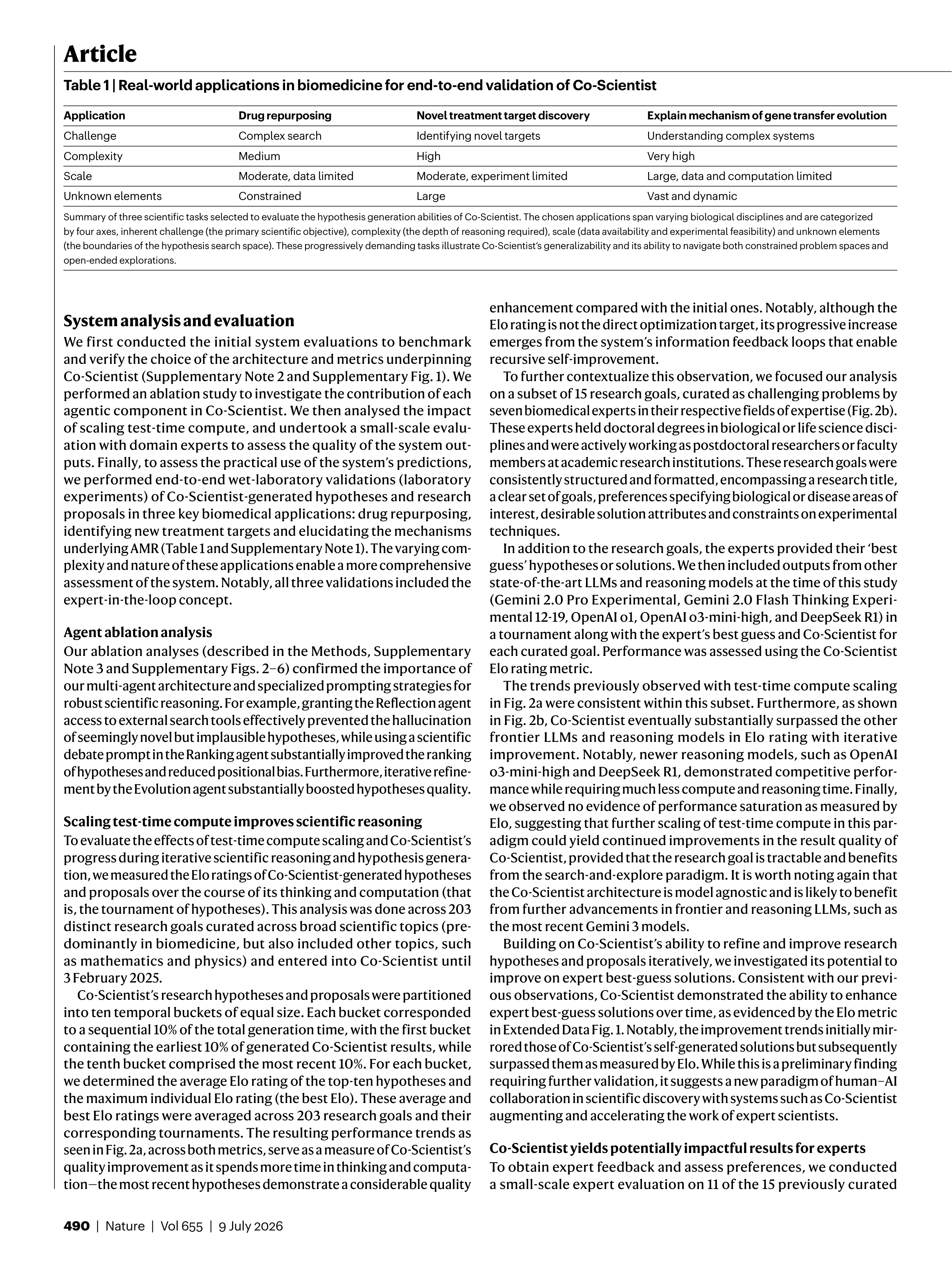
Table 1 | Real-world applications in biomedicine for end-to-end validation of Co-Scientist
Application
Drug repurposing
Novel treatment target discovery
Explain mechanism of gene transfer evolution
Challenge
Complex search
Identifying novel targets
Understanding complex systems
Complexity
Medium
High
Very high
Scale
Moderate, data limited
Moderate, experiment limited
Large, data and computation limited
Unknown elements
Constrained
Large
Vast and dynamic
Summary of three scientific tasks selected to evaluate the hypothesis generation abilities of Co-Scientist. The chosen applications span varying biological disciplines and are categorized
by four axes, inherent challenge (the primary scientific objective), complexity (the depth of reasoning required), scale (data availability and experimental feasibility) and unknown elements
(the boundaries of the hypothesis search space). These progressively demanding tasks illustrate Co-Scientist’s generalizability and its ability to navigate both constrained problem spaces and
open-ended explorations.
Nature | Vol 655 | 9 July 2026 |
491
research goals. We asked the experts who curated the research goals
to assess outputs from Co-Scientist, Gemini 2.0 Flash Thinking Experi-
mental 12-19, Gemini 2.0 Pro Experimental, and OpenAI o1 models. Spe-
cifically, they provided a preference ranking (1 being most preferred
and 4 being least preferred) and rated the novelty and impact of the
proposed solutions on a five-point scale, ranging from 1 (worst) to
5 (best) following this rubric. Novelty: higher-ranked outputs should
propose hypotheses that, to the best of the expert’s knowledge, have
not been previously published in any form. Hypotheses similar to
existing proposals, even with minor modifications, should rank lower
and exact replicas of previously proposed and performed experiments
should receive the lowest ranking. Impact: higher-ranked outputs
should address important open questions in the field and have the
potential to substantially advance scientific understanding or lead
to practical applications.
Across 11 expert-evaluated research goals, the outputs generated
by Co-Scientist were most preferred and rated higher in novelty and
impact axes compared with the other baseline models. Specifically,
Co-Scientist received an average preference rank of 2.36, and nov-
elty and impact ratings of 3.64 and 3.09 (out of 5) as shown in Fig. 2c.
These evaluations reflect subjective expert assessments, not objective
ground truth. Notably, the human expert preferences also appear
2
4
6
8
10
Time bucket
1,300
1,400
1,500
1,600
Elo rating (self-evaluation)
Best hypothesis Elo
Co-Scientist best
1,200
1,300
1,400
1,500
1,600
Elo rating (self-evaluation)
Top-10 average hypothesis Elo
Co-Scientist top-10 average
2
4
6
8
10
Time bucket
1,200
1,300
1,400
1,500
1,600
1,700
Elo rating (self-evaluation)
Best hypothesis Elo
Co-Scientist best
Gemini 2.0 Pro Experimental
Gemini 2.0 Flash Thinking Experimental 12-19
OpenAI o1
OpenAI o3
DeepSeek R1
Human expert
1,200
1,300
1,400
1,500
1,600
1,700
Elo rating (self-evaluation)
Top-10 average hypothesis Elo
Co-Scientist top-10 average
Gemini 2.0 Pro Experimental
Gemini 2.0 Flash Thinking Experimental 12-19
OpenAI o1
OpenAI o3
DeepSeek R1
Human expert
2.0
2.5
3.0
3.5
4.0
Novelty
2.00
2.25
2.50
2.75
3.00
3.25
3.50
3.75
4.00
Impact
(3.64, 3.09)
(3.55, 2.82)
(3.27, 3.00)
(3.09, 3.09)
Novelty versus impact ratings of models
Co-Scientist
Gemini 2.0
Flash Thinking
Experimental 12-19
Gemini 2.0
Pro Experimental
OpenAI o1
Co-Scientist
Gemini 2.0
Flash Thinking
Experimental 12-19
Gemini 2.0
Pro Experimental
OpenAI o1
2.0
2.2
2.4
2.6
2.8
3.0
3.2
3.4
Averaged ranking (rank of 1 indicates the best)
2.36
2.73
2.45
2.45
Averaged ranking of models
a
b
c
2
4
6
8
10
Time bucket
2
4
6
8
10
Time bucket
Fig. 2 | Scaling test-time compute enhances Co-Scientist’s scientific
thinking and hypotheses quality.
a
, Impact of test-time compute scaling on
Co-Scientist hypotheses quality measured by Elo auto-evaluation. Generated
hypotheses across 203 diverse scientific research goals were partitioned into
ten sequential temporal buckets. The continuous upward trend in both the
maximum individual Elo rating (left) and the top-ten average Elo rating (right)
suggests that the system has the capacity for self-improvement towards
high-quality scientific hypotheses for complex problems.
b
, Auto-evaluation
benchmarking against standard language models and human experts. Evaluated
on a subset of 15 highly complex, expert-curated biomedical goals, Co-Scientist
leverages test-time compute scaling to surpass and generate higher-quality and
novel hypotheses compared with human domain experts and state-of-the-art
large language and reasoning models (for example, OpenAI o1, o3-mini-high,
DeepSeek-R1).
c
, Blinded human expert evaluation: independent domain
experts rigorously assessed AI system hypotheses across 11 curated open
biomedical problems. Left, the average expert ratings for hypothesis novelty
and impact, evaluated independently on a five-point Likert scale and presented
as grouped bar charts. Right, the overall expert preference ranking. Co-Scientist
consistently achieved the highest expert ratings in novelty and impact and was
selected as the preferred AI system by experts. For
a
and
b
, data are mean ± 95%
confidence intervals. For
c
, data are mean ± probable errors. The exact sample
sizes (
n
) are 203 research goals (
a
), 15 goals (
b
) and 11 goals (
c
).
492
| Nature | Vol 655 | 9 July 2026
Article
to be concordant with relative Elo ratings as can be inferred from
Fig. 2b,c.
We also conducted the preference ranking evaluation for the 15
goals between Co-Scientist and other LLM and reasoning model bas
elines using OpenAI o3-mini-2025-01-31, o1-preview-2024-09-12, Gemini
2.0 Pro Experimental and Gemini 2.0 Flash Thinking Experimental 01-21
as judges (LLM-as-a-judge evaluation). Co-Scientist outputs were the
most preferred by all four evaluation judge LLMs as shown in Extended
Data Fig. 2. Owing to the small scale of these evaluations, further studies
are necessary for any reliable conclusions. We present a more compre-
hensive clinical expert evaluation focused on Co-Scientist proposals for
drug repurposing in Supplementary Note 4 and Supplementary Fig. 7.
Real-world validations
Drug repurposing with Co-Scientist
Rigorous assessment of a system’s ability to generate novel hypotheses
for complex scientific problems necessitates end-to-end experimen-
tal validation. However, due to the challenging, time-consuming and
resource-intensive nature of such endeavours, large-scale experimental
validation is infeasible. Instead, we selected areas of unmet clinical need
to serve as a strong benchmark for the end-to-end system evaluation of
the system’s hypotheses-generation ability. Importantly, all experimen-
tal validations were conducted in collaboration with expert scientists,
who provided guidance to Co-Scientist and prioritized wet-laboratory
experiments.
Our first end-to-end validation of Co-Scientist is in drug repurpos-
ing, for which the goal was to identify novel therapeutic indications
for existing, approved drugs beyond their original use. This approach
can accelerate the identification of treatments for complex and rare
diseases, as repurposed drugs have established safety profiles and
are readily available. From a technical standpoint, this is a complex
search-and-explore problem involving a large but finite set of drug–
disease pairs as noted in Table 1.
Given Co-Scientist’s ability to synthesize and integrate information
across a vast body of scientific and clinical literature, we hypothesized
that drug repurposing would be an ideal test of the system’s abilities.
The validation of Co-Scientist’s predictions was performed using a
multifaceted approach, incorporating computational biology analyses,
oncologist expert feedback and in vitro wet-laboratory experiments
using cancer cell lines.
We constrained Co-Scientist to explore potential repurposing
hypotheses from a curated list of 2,300 approved drugs across 34
cancer types and conducted an oncologist expert review of the pre-
dictions (Supplementary Note 5.1 and Supplementary Fig. 8). Building
on the positive feedback from clinical experts, we conducted in vitro
wet-laboratory validation experiments for drug-repurposing hypoth-
eses generated by Co-Scientist for acute myeloid leukaemia (AML), an
aggressive haematological malignancy marked by uncontrolled prolif-
eration of myeloblasts, resulting in impaired haematopoiesis. There is
a critical unmet need for effective therapeutic options in the context of
disease recurrence
22
. The cell-line-based experiments conducted here
serve as an initial biological validation step for Co-Scientist hypotheses,
with intentionally straightforward methodology following established
protocols. We selected four AML cell lines for covering different AML
subtypes (MOLM-13, KG-1a, HL-60 and NOMO-1) and a non-AML cell
line (TK6), on the basis of the rationale provided by Co-Scientist and
the clinical expert in the loop (Supplementary Note 5.2). It is impor-
tant to emphasize that these wet-laboratory experiments function as
a viability check of the drug-repurposing pipeline, yet they are not a
replacement for the rigorous preclinical and clinical assessment that is
typically required for therapeutic validation. They provide an efficient
biological reality check enabling us to rapidly evaluate AI-generated
hypotheses before committing to more resource-intensive validation
studies necessary for clinical translation.
Wet-laboratory validation of Co-Scientist AML
drug-repurposing candidates
The candidate selection for wet-laboratory experiments was performed
with meticulous expert oversight. Thirty top-ranked drug candidate
hypotheses were shared with expert oncologists (an example detailed
Co-Scientist output is provided in Supplementary Note 6). The experts
evaluated the hypotheses, selecting drug candidates on the basis
of their potential to modulate key molecular signalling pathways
associated with disease progression and resistance.
The primary selection criteria prioritized compounds with multip
athway activity, specifically those targeting dysregulated inflammatory
signalling, metabolic reprogramming and aberrant cell proliferation.
Emerging evidence indicates that these interconnected biological
processes have critical roles in AML relapse and treatment resistance
23
.
Candidates were further prioritized on the basis of preclinical mecha-
nistic insights demonstrating relevance to AML biology, including
their predicted effects on leukaemic cell survival, interactions within
the bone marrow microenvironment and mechanisms underlying
therapeutic resistance.
On the basis of potential mechanisms of action, five initial drug-
repurposing candidates—binimetinib, pacritinib, cerivastatin, pravas-
tatin and dimethyl fumarate—were selected for further wet-laboratory
validation in AML. A list of drug details is provided in Supplementary
Note 5.3.
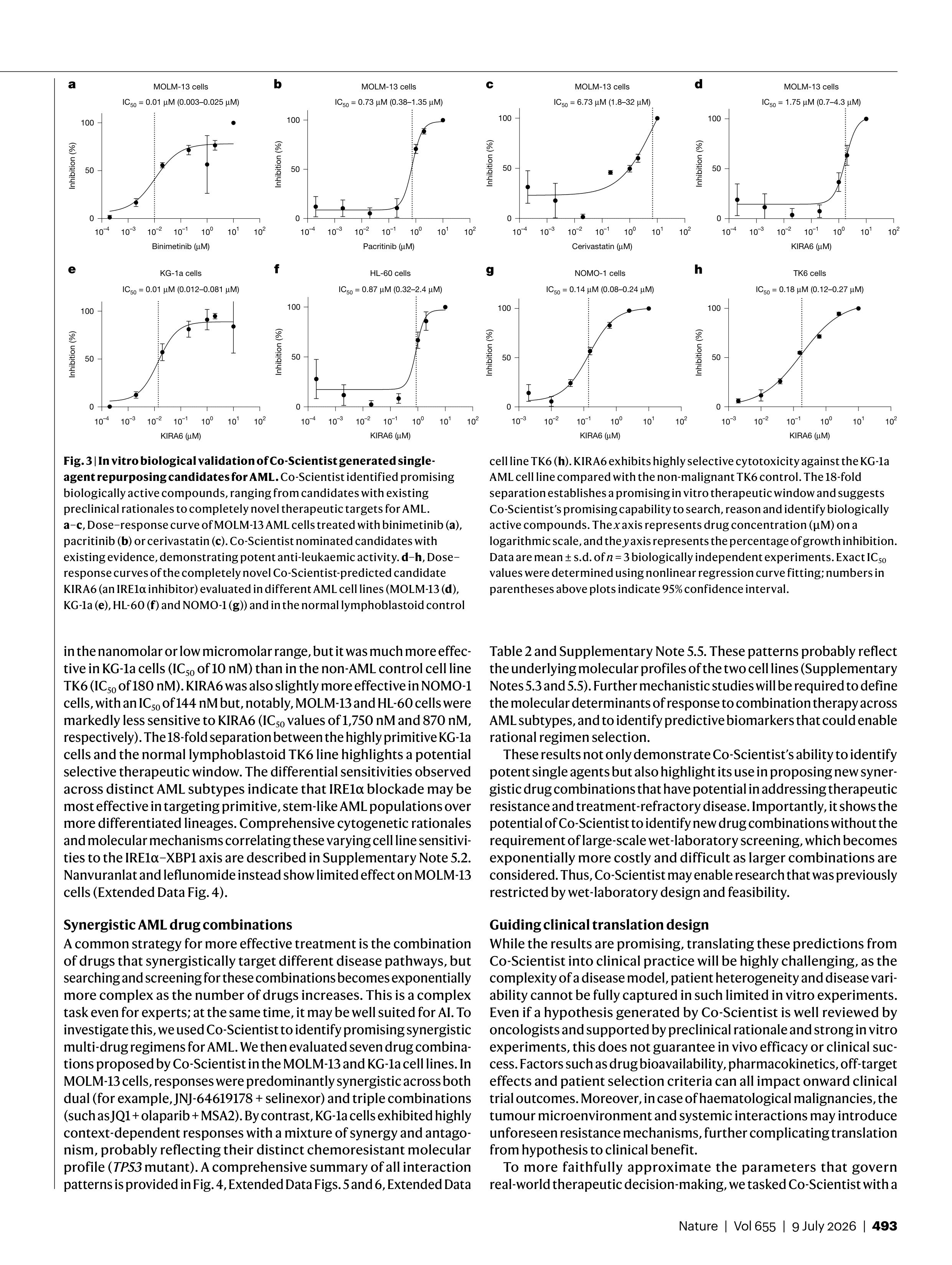
Of the five drugs tested (the experimental setup is described in Sup-
plementary Note 5.4), binimetinib, pacritinib and cerivastatin dem-
onstrated inhibition of cell viability (Fig. 3a–c). Notably, binimetinib,
which is already approved for the treatment of metastatic melanoma,
exhibited an half-maximal inhibitory concentration (IC
50
) as low as
2 nM in all AML cell lines (except for NOMO-1), but this was much higher
in the TK6 non-AML cell line (Fig. 3a and Extended Data Fig. 3). While
binimetinib demonstrated limited efficacy as monotherapy in heavily
pretreated, RAS-mutant relapsed/refractory AML in a previous phase
II study, Co-Scientist proposed an alternative repurposing strategy for
frontline treatment without molecular profiling, on the basis of modula-
tion of baseline RAS–MEK–ERK pathway activity that may influence sen-
sitivity to conventional chemotherapy in treatment-naive disease
24
. This
result shows the promise of Co-Scientist to aid with drug repurposing.
Single-agent AML repurposing candidates
We next investigated Co-Scientist’s ability to autonomously propose
single-agent drug-repurposing candidates without oversight. Towards
this, the system was directed to generate a ranked list of repurposing
candidates for AML that were not previously repurposed for the target
indication and without any previous preclinical evidence. Furthermore,
Co-Scientist did not receive any additional external inputs, such as
the DepMap scores or human expert feedback. We then determined
whether these candidates suggested by Co-Scientist could be validated
in the laboratory.
For in vitro laboratory validation, the domain experts reviewed and
selected the top three repurposing candidates to treat AML: nanvuran-
lat, KIRA6 and leflunomide.
The detailed Co-Scientist output, including the hypothesis, rationale
and self-generated novelty review, is provided for KIRA6 in Supplemen-
tary Note 6. As can be seen, the system identifies that targeting IRE1α
in the context of AML has been explored
25
previously but not with the
specific drug KIRA6, suggesting that the system is reasonably well
calibrated in its assessment of novelty. The system suggests an overall
moderate level of novelty for the hypothesis.
Of the three drugs tested, treatment with the IRE1α inhibitor KIRA6
showed inhibition of cell viability in several AML cell lines representing
different molecular subtypes, KG-1a, MOLM-13, HL-60 and NOMO-1,
and the non-AML cell line TK6 as a control (Fig. 3d–h, Supplementary
Note 5.2 and Supplementary Table 4). The IC
50
values of KIRA6 were all
Nature | Vol 655 | 9 July 2026 |
493
in the nanomolar or low micromolar range, but it was much more effec-
tive in KG-1a cells (IC
50
of 10 nM) than in the non-AML control cell line
TK6 (IC
50
of 180 nM). KIRA6 was also slightly more effective in NOMO-1
cells, with an IC
50
of 144 nM but, notably, MOLM-13 and HL-60 cells were
markedly less sensitive to KIRA6 (IC
50
values of 1,750 nM and 870 nM,
respectively). The 18-fold separation between the highly primitive KG-1a
cells and the normal lymphoblastoid TK6 line highlights a potential
selective therapeutic window. The differential sensitivities observed
across distinct AML subtypes indicate that IRE1α blockade may be
most effective in targeting primitive, stem-like AML populations over
more differentiated lineages. Comprehensive cytogenetic rationales
and molecular mechanisms correlating these varying cell line sensitivi-
ties to the IRE1α–XBP1 axis are described in Supplementary Note 5.2.
Nanvuranlat and leflunomide instead show limited effect on MOLM-13
cells (Extended Data Fig. 4).
Synergistic AML drug combinations
A common strategy for more effective treatment is the combination
of drugs that synergistically target different disease pathways, but
searching and screening for these combinations becomes exponentially
more complex as the number of drugs increases. This is a complex
task even for experts; at the same time, it may be well suited for AI. To
investigate this, we used Co-Scientist to identify promising synergistic
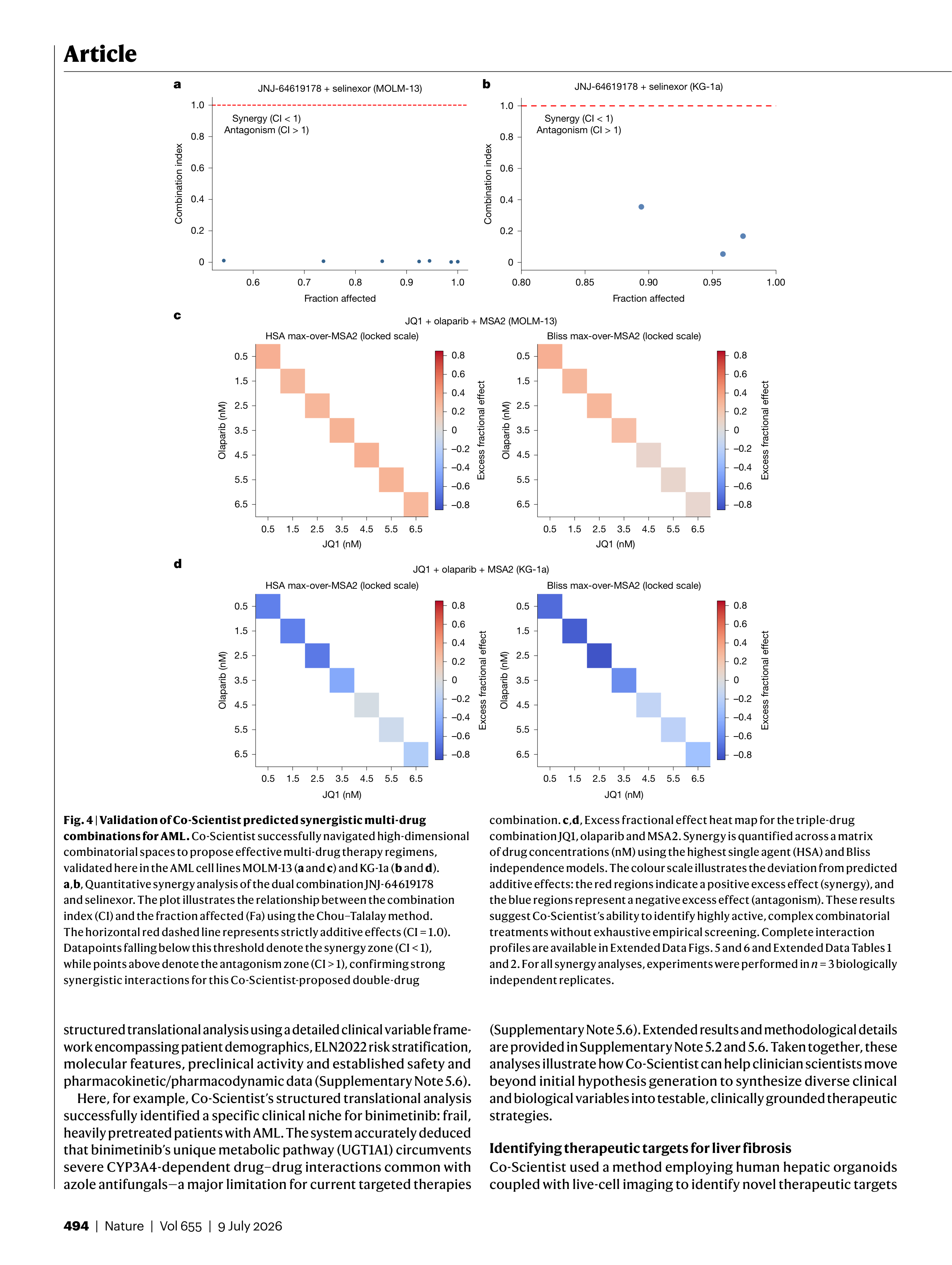
multi-drug regimens for AML. We then evaluated seven drug combina-
tions proposed by Co-Scientist in the MOLM-13 and KG-1a cell lines. In
MOLM-13 cells, responses were predominantly synergistic across both
dual (for example, JNJ-64619178 + selinexor) and triple combinations
(such as JQ1 + olaparib + MSA2). By contrast, KG-1a cells exhibited highly
context-dependent responses with a mixture of synergy and antago-
nism, probably reflecting their distinct chemoresistant molecular
profile (
TP53
mutant). A comprehensive summary of all interaction
patterns is provided in Fig. 4, Extended Data Figs. 5 and 6, Extended Data
Table 2 and Supplementary Note 5.5. These patterns probably reflect
the underlying molecular profiles of the two cell lines (Supplementary
Notes 5.3 and 5.5). Further mechanistic studies will be required to define
the molecular determinants of response to combination therapy across
AML subtypes, and to identify predictive biomarkers that could enable
rational regimen selection.
These results not only demonstrate Co-Scientist’s ability to identify
potent single agents but also highlight its use in proposing new syner-
gistic drug combinations that have potential in addressing therapeutic
resistance and treatment-refractory disease. Importantly, it shows the
potential of Co-Scientist to identify new drug combinations without the
requirement of large-scale wet-laboratory screening, which becomes
exponentially more costly and difficult as larger combinations are
considered. Thus, Co-Scientist may enable research that was previously
restricted by wet-laboratory design and feasibility.
Guiding clinical translation design
While the results are promising, translating these predictions from
Co-Scientist into clinical practice will be highly challenging, as the
complexity of a disease model, patient heterogeneity and disease vari-
ability cannot be fully captured in such limited in vitro experiments.
Even if a hypothesis generated by Co-Scientist is well reviewed by
oncologists and supported by preclinical rationale and strong in vitro
experiments, this does not guarantee in vivo efficacy or clinical suc-
cess. Factors such as drug bioavailability, pharmacokinetics, off-target
effects and patient selection criteria can all impact onward clinical
trial outcomes. Moreover, in case of haematological malignancies, the
tumour microenvironment and systemic interactions may introduce
unforeseen resistance mechanisms, further complicating translation
from hypothesis to clinical benefit.
To more faithfully approximate the parameters that govern
real-world therapeutic decision-making, we tasked Co-Scientist with a
a
b
c
d
e
f
g
h
10
–4
10
–3
10
–2
10
–1
10
0
10
1
10
2
0
50
100
Binimetinib (
μ
M)
KG-1a cells
MOLM-13 cells
MOLM-13 cells
MOLM-13 cells
MOLM-13 cells
10
–4
10
–3
10
–2
10
–1
10
0
10
1
10
2
KIRA6 (
μ
M)
Inhibition (%)
IC
50
= 0.01
μ
M (0.003–0.025
μ
M)
IC
50
= 0.01
μ
M (0.012–0.081
μ
M)
IC
50
= 0.87
μ
M (0.32–2.4
μ
M)
IC
50
= 0.14
μ
M (0.08–0.24
μ
M)
IC
50
= 0.18
μ
M (0.12–0.27
μ
M)
IC
50
= 0.73
μ
M (0.38–1.35
μ
M)
IC
50
= 6.73
μ
M (1.8–32
μ
M)
IC
50
= 1.75
μ
M (0.7–4.3
μ
M)
0
50
100
Inhibition (%)
0
50
100
Inhibition (%)
0
50
100
Inhibition (%)
0
50
100
Inhibition (%)
0
50
100
Inhibition (%)
0
50
100
Inhibition (%)
0
50
100
Inhibition (%)
10
–4
10
–3
10
–2
10
–1
10
0
10
1
10
2
Pacritinib (
μ
M)
HL-60 cells
10
–4
10
–3
10
–2
10
–1
10
0
10
1
10
2
Cerivastatin (
μ
M)
NOMO-1 cells
10
–4
10
–3
10
–2
10
–1
10
0
10
1
10
2
KIRA6 (
μ
M)
TK6 cells
10
–4
10
–3
10
–2
10
–1
10
0
10
1
10
2
10
–3
10
–2
10
–1
10
0
10
1
10
2
10
–3
10
–2
10
–1
10
0
10
1
10
2
KIRA6 (
μ
M)
KIRA6 (
μ
M)
KIRA6 (
μ
M)
Fig. 3 | In vitro biological validation of Co-Scientist generated single-
agent repurposing candidates for AML.
Co-Scientist identified promising
biologically active compounds, ranging from candidates with existing
preclinical rationales to completely novel therapeutic targets for AML.
a
–
c
, Dose–response curve of MOLM-13 AML cells treated with binimetinib (
a
),
pacritinib (
b
) or cerivastatin (
c
). Co-Scientist nominated candidates with
existing evidence, demonstrating potent anti-leukaemic activity.
d
–
h
, Dose–
response curves of the completely novel Co-Scientist-predicted candidate
KIRA6 (an IRE1α inhibitor) evaluated in different AML cell lines (MOLM-13 (
d
),
KG-1a (
e
), HL-60 (
f
) and NOMO-1 (
g
)) and in the normal lymphoblastoid control
cell line TK6 (
h
). KIRA6 exhibits highly selective cytotoxicity against the KG-1a
AML cell line compared with the non-malignant TK6 control. The 18-fold
separation establishes a promising in vitro therapeutic window and suggests
Co-Scientist’s promising capability to search, reason and identify biologically
active compounds. The
x
axis represents drug concentration (µM) on a
logarithmic scale, and the
y
axis represents the percentage of growth inhibition.
Data are mean ± s.d. of
n
= 3 biologically independent experiments. Exact IC
50
values were determined using nonlinear regression curve fitting; numbers in
parentheses above plots indicate 95% confidence interval.
494
| Nature | Vol 655 | 9 July 2026
Article
structured translational analysis using a detailed clinical variable frame-
work encompassing patient demographics, ELN2022 risk stratification,
molecular features, preclinical activity and established safety and
pharmacokinetic/pharmacodynamic data (Supplementary Note 5.6).
Here, for example, Co-Scientist’s structured translational analysis
successfully identified a specific clinical niche for binimetinib: frail,
heavily pretreated patients with AML. The system accurately deduced
that binimetinib’s unique metabolic pathway (UGT1A1) circumvents
severe CYP3A4-dependent drug–drug interactions common with
azole antifungals—a major limitation for current targeted therapies
(Supplementary Note 5.6). Extended results and methodological details
are provided in Supplementary Note 5.2 and 5.6. Taken together, these
analyses illustrate how Co-Scientist can help clinician scientists move
beyond initial hypothesis generation to synthesize diverse clinical
and biological variables into testable, clinically grounded therapeutic
strategies.
Identifying therapeutic targets for liver fibrosis
Co-Scientist used a method employing human hepatic organoids
coupled with live-cell imaging to identify novel therapeutic targets
0.6
0.7
0.8
0.9
1.0
Fraction affected
Fraction affected
0
0.2
0.4
0.6
0.8
Synergy (CI < 1)
Antagonism (CI > 1)
1.0
Combination index
JNJ-64619178 + selinexor (MOLM-13)
0.80
0.85
0.90
0.95
1.00
0
0.2
0.4
0.6
0.8
1.0
Combination index
JNJ-64619178 + selinexor (KG-1a)
a
b
c
d
0.5
1.5
2.5
3.5
4.5
5.5
6.5
JQ1 (nM)
0.5
1.5
2.5
3.5
4.5
5.5
6.5
Olaparib (nM)
HSA max-over-MSA2 (locked scale)
0.5
1.5
2.5
3.5
4.5
5.5
6.5
JQ1 (nM)
0.5
1.5
2.5
3.5
4.5
5.5
6.5
Olaparib (nM)
Bliss max-over-MSA2 (locked scale)
–0.8
–0.6
–0.4
–0.2
0
0.2
0.4
0.6
0.8
Excess fractional effect
–0.8
–0.6
–0.4
–0.2
0
0.2
0.4
0.6
0.8
Excess fractional effect
JQ1 + olaparib + MSA2 (MOLM-13)
0.5
1.5
2.5
3.5
4.5
5.5
6.5
JQ1 (nM)
0.5
1.5
2.5
3.5
4.5
5.5
6.5
Olaparib (nM)
HSA max-over-MSA2 (locked scale)
0.5
1.5
2.5
3.5
4.5
5.5
6.5
JQ1 (nM)
0.5
1.5
2.5
3.5
4.5
5.5
6.5
Olaparib (nM)
Bliss max-over-MSA2 (locked scale)
Excess fractional effect
Excess fractional effect
JQ1 + olaparib + MSA2 (KG-1a)
–0.8
–0.6
–0.4
–0.2
0
0.2
0.4
0.6
0.8
–0.8
–0.6
–0.4
–0.2
0
0.2
0.4
0.6
0.8
Synergy (CI < 1)
Antagonism (CI > 1)
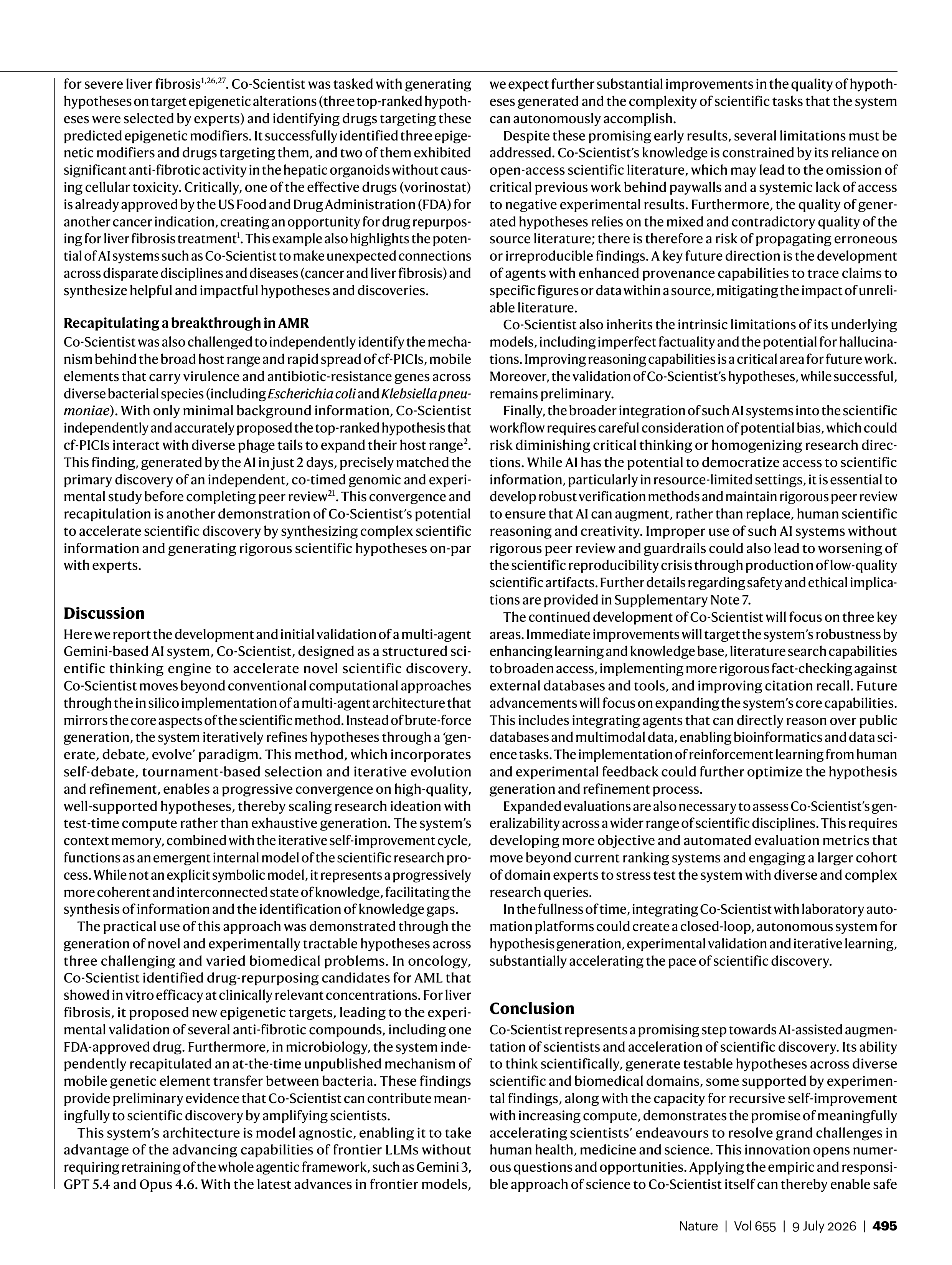
Fig. 4 | Validation of Co-Scientist predicted synergistic multi-drug
combinations for AML.
Co-Scientist successfully navigated high-dimensional
combinatorial spaces to propose effective multi-drug therapy regimens,
validated here in the AML cell lines MOLM-13 (
a
and
c
) and KG-1a (
b
and
d
).
a
,
b
, Quantitative synergy analysis of the dual combination JNJ-64619178
and selinexor. The plot illustrates the relationship between the combination
index (CI) and the fraction affected (Fa) using the Chou–Talalay method.
The horizontal red dashed line represents strictly additive effects (CI = 1.0).
Datapoints falling below this threshold denote the synergy zone (CI < 1),
while points above denote the antagonism zone (CI > 1), confirming strong
synergistic interactions for this Co-Scientist-proposed double-drug
combination.
c
,
d
, Excess fractional effect heat map for the triple-drug
combination JQ1, olaparib and MSA2. Synergy is quantified across a matrix
of drug concentrations (nM) using the highest single agent (HSA) and Bliss
independence models. The colour scale illustrates the deviation from predicted
additive effects: the red regions indicate a positive excess effect (synergy), and
the blue regions represent a negative excess effect (antagonism). These results
suggest Co-Scientist’s ability to identify highly active, complex combinatorial
treatments without exhaustive empirical screening. Complete interaction
profiles are available in Extended Data Figs. 5 and 6 and Extended Data Tables 1
and 2. For all synergy analyses, experiments were performed in
n
= 3 biologically
independent replicates.
Nature | Vol 655 | 9 July 2026 |
495
for severe liver fibrosis
1,26,27
. Co-Scientist was tasked with generating
hypotheses on target epigenetic alterations (three top-ranked hypoth-
eses were selected by experts) and identifying drugs targeting these
predicted epigenetic modifiers. It successfully identified three epige-
netic modifiers and drugs targeting them, and two of them exhibited
significant anti-fibrotic activity in the hepatic organoids without caus-
ing cellular toxicity. Critically, one of the effective drugs (vorinostat)
is already approved by the US Food and Drug Administration (FDA) for
another cancer indication, creating an opportunity for drug repurpos-
ing for liver fibrosis treatment
1
. This example also highlights the poten-
tial of AI systems such as Co-Scientist to make unexpected connections
across disparate disciplines and diseases (cancer and liver fibrosis) and
synthesize helpful and impactful hypotheses and discoveries.
Recapitulating a breakthrough in AMR
Co-Scientist was also challenged to independently identify the mecha-
nism behind the broad host range and rapid spread of cf-PICIs, mobile
elements that carry virulence and antibiotic-resistance genes across
diverse bacterial species (including
Escherichia
coli
and
Klebsiella
pneu-
moniae
). With only minimal background information, Co-Scientist
independently and accurately proposed the top-ranked hypothesis that
cf-PICIs interact with diverse phage tails to expand their host range
2
.
This finding, generated by the AI in just 2 days, precisely matched the
primary discovery of an independent, co-timed genomic and experi-
mental study before completing peer review
21
. This convergence and
recapitulation is another demonstration of Co-Scientist’s potential
to accelerate scientific discovery by synthesizing complex scientific
information and generating rigorous scientific hypotheses on-par
with experts.
Discussion
Here we report the development and initial validation of a multi-agent
Gemini-based AI system, Co-Scientist, designed as a structured sci-
entific thinking engine to accelerate novel scientific discovery.
Co-Scientist moves beyond conventional computational approaches
through the in silico implementation of a multi-agent architecture that
mirrors the core aspects of the scientific method. Instead of brute-force
generation, the system iteratively refines hypotheses through a ‘gen-
erate, debate, evolve’ paradigm. This method, which incorporates
self-debate, tournament-based selection and iterative evolution
and refinement, enables a progressive convergence on high-quality,
well-supported hypotheses, thereby scaling research ideation with
test-time compute rather than exhaustive generation. The system’s
context memory, combined with the iterative self-improvement cycle,
functions as an emergent internal model of the scientific research pro-
cess. While not an explicit symbolic model, it represents a progressively
more coherent and interconnected state of knowledge, facilitating the
synthesis of information and the identification of knowledge gaps.
The practical use of this approach was demonstrated through the
generation of novel and experimentally tractable hypotheses across
three challenging and varied biomedical problems. In oncology,
Co-Scientist identified drug-repurposing candidates for AML that
showed in vitro efficacy at clinically relevant concentrations. For liver
fibrosis, it proposed new epigenetic targets, leading to the experi-
mental validation of several anti-fibrotic compounds, including one
FDA-approved drug. Furthermore, in microbiology, the system inde-
pendently recapitulated an at-the-time unpublished mechanism of
mobile genetic element transfer between bacteria. These findings
provide preliminary evidence that Co-Scientist can contribute mean-
ingfully to scientific discovery by amplifying scientists.
This system’s architecture is model agnostic, enabling it to take
advantage of the advancing capabilities of frontier LLMs without
requiring retraining of the whole agentic framework, such as Gemini 3,
GPT 5.4 and Opus 4.6. With the latest advances in frontier models,
we expect further substantial improvements in the quality of hypoth-
eses generated and the complexity of scientific tasks that the system
can autonomously accomplish.
Despite these promising early results, several limitations must be
addressed. Co-Scientist’s knowledge is constrained by its reliance on
open-access scientific literature, which may lead to the omission of
critical previous work behind paywalls and a systemic lack of access
to negative experimental results. Furthermore, the quality of gener
-
ated hypotheses relies on the mixed and contradictory quality of the
source literature; there is therefore a risk of propagating erroneous
or irreproducible findings. A key future direction is the development
of agents with enhanced provenance capabilities to trace claims to
specific figures or data within a source, mitigating the impact of unreli-
able literature.
Co-Scientist also inherits the intrinsic limitations of its underlying
models, including imperfect factuality and the potential for hallucina-
tions. Improving reasoning capabilities is a critical area for future work.
Moreover, the validation of Co-Scientist’s hypotheses, while successful,
remains preliminary.
Finally, the broader integration of such AI systems into the scientific
workflow requires careful consideration of potential bias, which could
risk diminishing critical thinking or homogenizing research direc-
tions. While AI has the potential to democratize access to scientific
information, particularly in resource-limited settings, it is essential to
develop robust verification methods and maintain rigorous peer review
to ensure that AI can augment, rather than replace, human scientific
reasoning and creativity. Improper use of such AI systems without
rigorous peer review and guardrails could also lead to worsening of
the scientific reproducibility crisis through production of low-quality
scientific artifacts. Further details regarding safety and ethical implica-
tions are provided in Supplementary Note 7.
The continued development of Co-Scientist will focus on three key
areas. Immediate improvements will target the system’s robustness by
enhancing learning and knowledge base, literature search capabilities
to broaden access, implementing more rigorous fact-checking against
external databases and tools, and improving citation recall. Future
advancements will focus on expanding the system’s core capabilities.
This includes integrating agents that can directly reason over public
databases and multimodal data, enabling bioinformatics and data sci-
ence tasks. The implementation of reinforcement learning from human
and experimental feedback could further optimize the hypothesis
generation and refinement process.
Expanded evaluations are also necessary to assess Co-Scientist’s gen-
eralizability across a wider range of scientific disciplines. This requires
developing more objective and automated evaluation metrics that
move beyond current ranking systems and engaging a larger cohort
of domain experts to stress test the system with diverse and complex
research queries.
In the fullness of time, integrating Co-Scientist with laboratory auto-
mation platforms could create a closed-loop, autonomous system for
hypothesis generation, experimental validation and iterative learning,
substantially accelerating the pace of scientific discovery.
Conclusion
Co-Scientist represents a promising step towards AI-assisted augmen-
tation of scientists and acceleration of scientific discovery. Its ability
to think scientifically, generate testable hypotheses across diverse
scientific and biomedical domains, some supported by experimen
-
tal findings, along with the capacity for recursive self-improvement
with increasing compute, demonstrates the promise of meaningfully
accelerating scientists’ endeavours to resolve grand challenges in
human health, medicine and science. This innovation opens numer-
ous questions and opportunities. Applying the empiric and responsi-
ble approach of science to Co-Scientist itself can thereby enable safe
496
| Nature | Vol 655 | 9 July 2026
Article
exploration of its undoubted potential, including how collaborative and
human-centred AI systems might be able to augment human ingenuity
and accelerate scientific discovery.
Online content
Any methods, additional references, Nature Portfolio reporting summa-
ries, source data, extended data, supplementary information, acknowl-
edgements, peer review information; details of author contributions
and competing interests; and statements of data and code availability
are available at https://doi.org/10.1038/s41586-026-10644-y.
1.
Guan, Y. et al. AI-assisted drug re-purposing for human liver fibrosis.
Adv. Sci.
12
, e08751
(2025).
2.
Penadés, J. R. et al. AI mirrors experimental science to uncover a novel mechanism of
gene transfer crucial to bacterial evolution.
Cell
188
, 6654–6665 (2025).
3.
Jinek, M. et al. A programmable dual-RNA-guided DNA endonuclease in adaptive
bacterial immunity.
Science
337
, 816–821 (2012).
4.
Hopfield, J. J. Neural networks and physical systems with emergent collective
computational abilities.
Proc. Natl Acad. Sci. USA
79
, 2554–2558 (1982).
5.
Hinton, G. E. & Sejnowski, T. J. in
Parallel Distributed Processing: Explorations in the
Microstructure of Cognition
Vol. 1 (eds Feldman, J. A. et al.) 282–317 (MIT Press, 1986).
6.
Guo, D. et al. DeepSeek-R1 incentivizes reasoning in LLMs through reinforcement
learning.
Nature
645
, 633–638 (2025).
7.
Jaech, A. et al. OpenAI O1 system card. Preprint at https://arxiv.org/abs/2412.16720 (2024).
8.
Gemini Team, Google. Gemini 1.5: unlocking multimodal understanding across millions
of tokens of context. Preprint at https://arxiv.org/abs/2403.05530 (2024).
9.
Wiesinger, J., Marlow, P. & Vuskovic, V. Agents.
kaggle
https://www.kaggle.com/
whitepaper-agents (2024).
10.
Hinton, G. E., Vinyals, O. & Dean, J. Distilling the knowledge in a neural network. Preprint
at https://arxiv.org/abs/1503.02531 (2015).
11.
Gemma Team, Google. Gemma: open models based on gemini research and technology.
Preprint at https://arxiv.org/abs/2403.08295 (2024).
12.
Leslie, D. et al. ‘Frontier AI,’ power, and the public interest: who benefits, who decides?
Harvard Data Sci. Rev.
https://doi.org/10.1162/99608f92.4a42495c (2024).
13.
Chen, L. et al. Are more LLM calls all you need? Towards the scaling properties of
compound AI systems.
Adv. Neural Inform. Process. Syst.
37
, 45767–45790 (2024).
14.
Comanici, G. et al. Gemini 2.5: pushing the frontier with advanced reasoning, multimodality,
long context, and next generation agentic capabilities. Preprint at https://arxiv.org/abs/
2507.06261 (2025).
15.
Gower, B.
Scientific Method: a Historical and Philosophical Introduction
(Routledge,
2012).
16.
Snell, C., Lee, J., Xu, K. & Kumar, A. Scaling LLM test-time compute optimally can be more
effective than scaling parameters for reasoning. In
International Conference on Learning
Representations (ICLR)
(2025).
17.
Brown, N. & Sandholm, T. Superhuman AI for multiplayer poker.
Science
365
, 885–890
(2019).
18.
Silver, D. et al. Mastering the game of Go with deep neural networks and tree search.
Nature
529
, 484–489 (2016).
19.
Ringel, M. S., Scannell, J. W., Baedeker, M. & Schulze, U. Breaking Eroom’s law.
Nat. Rev.
Drug Discov.
19
, 833–834 (2020).
20.
Pushpakom, S. et al. Drug repurposing: progress, challenges and recommendations.
Nat. Rev. Drug Discov.
18
, 41–58 (2019).
21.
He, L. et al. Chimeric infective particles expand species boundaries in phage-inducible
chromosomal island mobilization.
Cell
188
, 6636–6653 (2025).
22.
Döhner, H., Weisdorf, D. J. & Bloomfield, C. D. Acute myeloid leukemia.
N. Engl. J. Med.
373
, 1136–1152 (2015).
23.
Guo, Q. et al. NF-κB in biology and targeted therapy: new insights and translational
implications.
Signal Transduc. Target. Ther.
9
, 53 (2024).
24.
Maiti, A. et al. Phase II trial of MEK inhibitor binimetinib (MEK162) in
RAS
-mutant acute
myeloid leukemia.
Clin. Lymphoma Myeloma Leuk.
19
, 142–148 (2019).
25.
Philippe, C. et al. Pivotal role of the endoplasmic reticulum stress-related XBP1s/miR-22/
SIRT1 axis in acute myeloid leukemia apoptosis and response to chemotherapy.
Leukemia
38
, 1764–1776 (2024).
26.
Guan, Y. et al. A human multi-lineage hepatic organoid model for liver fibrosis.
Nat. Commun.
12
, 6138 (2021).
27.
Guan, Y. et al. Live-cell imaging of human liver fibrosis using hepatic micro-organoids.
JCI Insight
10
, e187099 (2024).
Publisher’s note
Springer Nature remains neutral with regard to jurisdictional claims in
published maps and institutional affiliations.
Open Access
This article is licensed under a Creative Commons Attribution
4.0 International License, which permits use, sharing, adaptation, distribution
and reproduction in any medium or format, as long as you give appropriate
credit to the original author(s) and the source, provide a link to the Creative Commons licence,
and indicate if changes were made. The images or other third party material in this article are
included in the article’s Creative Commons licence, unless indicated otherwise in a credit line
to the material. If material is not included in the article’s Creative Commons licence and your
intended use is not permitted by statutory regulation or exceeds the permitted use, you will
need to obtain permission directly from the copyright holder. To view a copy of this licence,
visit http://creativecommons.org/licenses/by/4.0/.
© The Author(s) 2026
Methods
Overview of Co-Scientist architecture
Co-Scientist uses a multi-agent architecture built on Google’s Gemini.
In this study, we used Gemini 2.0 models as the base foundational
LLM for all agents
14
, integrated within an asynchronous task execu-
tion framework. This framework allows flexible scaling of test-time
compute resources, facilitating advanced scientific thinking and
reasoning. Given a research goal specified by an expert scientist in
natural language, Co-Scientist generates hypotheses that adhere
to the following default criteria. (1) Alignment with the provided
research goal. The generated outputs must precisely align with the
research goals, preferences and constraints defined by the scientist.
(2) Plausibility. The system outputs should be free of readily appar-
ent flaws. Any potential contradictions with previous literature
or established knowledge must be explicitly stated and justified.
(3) Novelty. A key objective of Co-Scientist is to generate novel hypoth-
eses, conjectures and research plans grounded in previous literature,
rather than simply synthesizing existing information (a capability
already addressed by existing ‘deep research’ tools
28
). (4) Testabil-
ity. The system outputs should be amenable to empirical validation
within the constraints specified by the scientist. (5) Safety. The system
outputs will be controlled to prevent enabling unsafe, unethical or
harmful research. Aside from these default criteria, Co-Scientist can
be configured with additional criteria, preferences and constraints
as needed. For example, it can be configured to generate outputs in
formats preferred by the researcher to improve interpretability and
readability.
At a high level, Co-Scientist comprises four key components. (1) A
natural-language input–output interface. Scientists interact with and
supervise the system primarily through natural language. This allows
them to not only define the initial research goal but also refine it at
any time, provide feedback on generated hypotheses (including their
own solutions) and generally steer and guide the system’s progress.
(2) Asynchronous task framework. Co-Scientist uses a multi-agent sys-
tem in which specialized agents operate as worker processes within an
asynchronous, continuous and configurable task execution framework.
A dedicated Supervisor agent manages the worker task queue, assigns
specialized agents to these processes and allocates resources. This
design enables the system to flexibly and effectively use computational
resources and iteratively improve its scientific reasoning and quality
of hypotheses. (3) Specialized agents. After accounting for inductive
biases and scientific priors derived from the scientific method, the
process of scientific reasoning and hypothesis generation is broken
down into subtasks. Individual, specialized agents, each equipped
with customized instruction prompts, are designed to execute these
subtasks. These agents operate as workers coordinated by the Super-
visor agent. (4) Context memory. To enable iterative computation
and scientific reasoning over long time horizons, Co-Scientist uses a
persistent context memory to store and retrieve states of the agents
and the system during the course of the computation. The specific
Co-Scientist design was arrived at with iterative developments and
feedback from expert scientists and is reflective of the current capabili-
ties of the underlying LLMs. The Co-Scientist multi-agent architecture
is depicted and summarized in Fig. 1b.
Throughout the next section, we use a recurring example: gener-
ating hypotheses for exploring the biological mechanisms of amyo-
trophic lateral sclerosis (ALS) to illustrate the various components of
Co-Scientist. Although this example has been reviewed by domain
experts, it remains illustrative and may contain errors. Importantly, this
example does not aim to suggest potential therapeutic avenues for ALS
and should be interpreted with utmost caution. We have also provided
the pseudocode demonstrating agent logic in Supplementary Note 8.
All of the prompts used in the agents are listed in Supplementary Note 9,
and all the examples are listed in the Supplementary Note 10.
From research goal to research plan configuration
The research goal, specified by the scientist, serves as the entry point to
Co-Scientist. Leveraging the multimodal and long context capabilities
of Gemini models, Co-Scientist efficiently processes research goals of
varying complexity, from simple statements to extensive documents
spanning tens of thousands of natural language tokens or other relevant
data (for example, including hundreds of previous publication PDF
files). The research goal may also incorporate specific constraints,
attributes and preferences related to the scientist’s particular labora-
tory setting or field of work.
Co-Scientist then parses the goal to derive a research plan configura-
tion for generating research proposals. This configuration captures the
desired proposal preferences, attributes and constraints. For example,
it specifies whether Co-Scientist should exclusively propose novel
hypotheses. It also specifies the criteria for evaluating hypothesis qual-
ity, such as novelty and experimental feasibility. These criteria are then
used by the system during its auto-evaluation, tournament debates and
self-improvement phases. The attributes, preferences and evaluation
criteria can all be customized to a given research goal. To illustrate this
process, we present an example research goal and its corresponding
parsed research plan configuration in Supplementary Note 10.1, in
which the goal is to develop a novel hypothesis related to phosphoryla-
tion of the nuclear pore complex as a causative mechanism for ALS
29
.
On the basis of the research plan configuration, the Supervisor agent
initiates the creation of a task queue and begins orchestrating the spe-
cialized agents. The system operates continuously and asynchronously.
Periodically, the Supervisor agent calculates a comprehensive set of
summary statistics, reflecting the system’s state and progress toward
the specified research goal. These statistics inform decisions regarding
resource allocation and the determination of whether a terminal state
for the overall computation has been reached. The state is periodically
written to the associated context memory of the system and leveraged
as feedback in subsequent rounds of computation. It also enables easy
restarts in case of any failure in the system components.
The specialized agents underpinning Co-Scientist
At the heart of Co-Scientist is a coalition of specialized agents, each
orchestrated by the Supervisor agent. These agents are designed to
emulate the scientific reasoning process, enabling them to generate
novel hypotheses and research plans. Each agent is provided a library
of strategies (that is, a collection of prompts) to better explain and help
it perform its assigned task. They are also equipped to interact with
and utilize external tools, such as web search engines and specialized
AI models, through application programming interfaces (APIs). These
specialized agents are enumerated below: (1) Generation agent. The
agent initiates the research process by generating the initial focus areas,
iteratively extending them and generating a set of initial hypotheses
and proposals that address the research goal. This involves exploring
relevant literature using web search, synthesizing existing findings
into new directions and engaging in simulated scientific debates for
iterative improvement. (2) Reflection agent. This agent simulates the
role of a scientific peer reviewer, critically examining the correctness,
quality and novelty of the generated hypotheses and research pro-
posals. Furthermore, it evaluates the potential of each hypothesis to
provide an improved explanation for existing research observations
(identified through literature search and review), particularly those
that may be under-explained. (3) Ranking agent. An important abstr
action in Co-Scientist is the notion of a tournament in which different
research proposals are evaluated, debated and ranked enabling iterative
improvements. The Ranking agent orchestrates an Elo-based tourna-
ment
30
to assess and prioritize the generated hypotheses at any given
time. This involves pairwise comparisons, facilitated by simulated
scientific debates, which allow nuanced evaluation of the relative merits
of each hypothesis. (4) Proximity agent. This agent asynchronously
Article
computes a proximity graph for generated hypotheses, enabling
clustering of similar ideas, de-duplication and efficient exploration
of the hypothesis landscape. (5) Evolution agent. Co-Scientist’s iterative
improvement capability relies heavily on this agent, which continuously
refines the top-ranked hypotheses emerging from the tournament. Its
refinement strategies include synthesizing existing ideas, using analo-
gies, leveraging literature for supporting details, exploring unconven-
tional reasoning and simplifying concepts for clarity. (6) Meta-review
agent. This agent also enables Co-Scientist’s continuous improvement
by synthesizing insights from all reviews, identifying recurring patterns
in tournament debates, and using these findings to optimize other
agents’ performance in subsequent iterations. This also enhances the
quality and relevance of generated hypotheses and reviews in subse-
quent iterations. At the end of the Co-Scientist computation process,
this agent also synthesizes top-ranked hypotheses and reviews into a
comprehensive research overview for review by the scientist.
The Supervisor agent’s seamless orchestration of these specialized
agents enables the development of valid, novel and testable hypoth-
eses and research plans tailored to the input research goal provided
by the scientist.
In summary, the Generation agent curates an initial list of research
hypotheses satisfying a research goal. These are then reviewed by the
Reflection agent and evaluated in a tournament by the Ranking agent
orchestrating debate matches involving the hypothesis. The Evolution,
Proximity, and Meta-review agents operate on the tournament state
to help to improve the quality of the system outputs.
The Supervisor agent periodically computes and writes to the context
memory a comprehensive suite of statistics, including the number of
hypotheses generated and requiring review, and the progress of the
tournament. These statistics also include analyses of the effective-
ness of different hypothesis generation methodologies (for example,
generating new ideas through the Generation agent versus improv-
ing existing ideas through the Evolution agent). On the basis of these
statistics, the Supervisor agent then orchestrates subsequent system
operations, that is, generating new hypotheses, reviews, tournaments
and improvements to existing hypotheses, by strategically weighting
and sampling the specialized agents for execution through the worker
processes.
Importantly, the Meta-review agent enables feedback propagation
and learning without back-propagation techniques (for example,
fine-tuning or reinforcement learning)
31
. The Meta-review agent gen-
erates feedback applicable to all agents, which is simply appended
to their prompts in the next iteration—a capability facilitated by the
long-context search and reasoning capabilities of the underlying
Gemini models. Through this feedback loop, Co-Scientist continu-
ously learns and improves in subsequent iterations with more compute
scaling.
Finally, while our work leverages Gemini 2.0, Co-Scientist framework
is model agnostic and portable to other similar models or combinations
thereof. Future LLM improvements, such as our Gemini 3 models, will
further enhance Co-Scientist’s ability to generate scientific hypotheses
and perform complex tasks over the longer term.
Generation agent
The Generation agent uses a diverse array of strategies (encoded as
prompts), techniques and tools to generate hypotheses, such as the
following:
•
Literature exploration through web search. The agent iteratively
searches the web, retrieves and reads relevant research articles, learns
about topics and grounds its reasoning by summarizing previous work
and building a knowledge base of scientific facts. It then builds on this
summary to generate hypotheses and research plans. An example
prompt is given in Supplementary Note 9.1.
•
Simulated scientific debates. Here, the Generation agent simulates
scientific debates among experts by using self-critique and self-play
techniques. These debates typically involve multiple turns of con-
versations leading to a refined hypothesis generated at the end. An
example prompt is given in Supplementary Note 9.1.
•
Iterative assumptions identification. The agent iteratively identifies
testable intermediate assumptions, which, if proven true, can lead to
scientific discovery. These plausible assumptions and their subas-
sumptions are identified through conditional reasoning hops and
subsequently aggregated into complete hypotheses.
• Research expansion. To identify previously unexplored areas of the
hypothesis space, the Generation agent reviews existing hypotheses
and the research overview and feedback provided by the Meta-review
agent in the previous iteration. This is used to inform additional explo-
ration directions in the research hypothesis space.
An example hypothesis and research proposal output from the
Generation agent is presented in Supplementary Note 10.2 for the
aforementioned research goal regarding explaining a basic mechanism
related to ALS. The Generation agent also summarizes and categorizes
each generated hypothesis, enabling scientists to quickly grasp the
core ideas.
Reflection agent
Reviews are integral to Co-Scientist’s effectiveness in generating new
proposals. The Reflection agent searches relevant previous work and
data (through web search or a dedicated scientist-provided reposi-
tory), assesses existing experimental evidence for or against a given
hypothesis and rigorously verifies the novelty, correctness and quality
of generated outputs with tools. Effective reviews filter inaccurate and,
when stipulated, non-novel hypotheses. Moreover, they also provide
feedback to all of the other agents, driving continuous improvement.
The Reflection agent uses the following types of review strategies:
•
Initial review. Building on Co-Scientist’s default evaluation criteria, the
Reflection agent performs an initial review assessing the correctness,
quality, novelty and a preliminary assessment of safety (ethics) of the
generated hypotheses. A more in-depth discussion on safety con-
siderations is provided in Supplementary Note 7. This initial review,
which does not use external tools such as web search, aims to quickly
discard flawed, non-novel or otherwise unsuitable hypotheses.
•
Full review. If a hypothesis passes the initial review, the Reflection
agent performs a full review, using external tools and web searches
to identify relevant articles for improved reasoning and ground-
ing. This review evaluates the hypothesis’s correctness, quality and
novelty similar to the initial review but with full literature search.
For correctness and quality, the agent scrutinizes the underlying
assumptions and reasoning. For novelty, it summarizes known aspects
of the hypothesis and then judges their novelty on the basis of exist-
ing literature. An example full novelty review, review critiques and a
complete full review example are shown in Supplementary Note 10.3,
10.4 and 10.5, respectively.
• Deep verification review. The Reflection agent also conducts a deep
verification review, decomposing the hypothesis into constituent
assumptions. Each assumption is further broken down into fundamen-
tal subassumptions, decontextualized and independently evaluated
for correctness to identify invalidating elements for subsequent filter-
ing. Concurrently, the reasons for potential hypothesis invalidation
due to incorrect assumptions are summarized. This deep verification
helps Co-Scientist to detect subtle errors within complex hypotheses,
such as flaws in reasoning or inaccurate experimental protocols. An
identified error does not necessarily invalidate the core hypothesis;
the Reflection agent assesses whether the incorrect assumption is
fundamental to the hypothesis and incorporates this reasoning into
the review. Non-fundamental errors can be addressed during sub-
sequent refinement stages. An example deep verification review is
provided in Supplementary Note 10.6 for the previously introduced
ALS hypothesis. We also show another example of a deep verification
review through probing questions in the context of drug repurposing
for AML in Supplementary Note 10.7.
•
Observation review. Moreover, the Reflection agent also explores
whether a given hypothesis can account for long-tail observations
from previous experimental results. This review aims to determine
whether the hypothesis can provide insights on existing experimental
findings and observed phenomena within relevant articles. For each
observation, the agent assesses whether the hypothesis is a superior
explanation over existing ones, assuming its validity. Positive obser-
vations are summarized and appended to the hypothesis. Note that
this review often completes without any important findings (as in the
case for the ALS hypothesis example). An example prompt to gener-
ate observations is provided in Supplementary Note 9.2. An illustra-
tive example of an observation review is provided in Supplementary
Note 10.8 in the context of an alternative hypothesis for explaining
a mechanism of AMR.
• Simulation review. The Reflection agent also reviews hypotheses by
simulating them in a step-wise manner (for example, simulating the
mechanism of action or the proposed experiment in the proposal).
This simulation enables the agent to identify and summarize poten-
tial failure scenarios. This review method is built on the assumption
that frontier LLMs may have developed an internal world model of
science that enables them to simulate and accurately predict various
scientific phenomena.
•
Recurrent/tournament review. The Reflection agent adapts its full
reviews on the basis of Co-Scientist’s growing knowledge. By analys-
ing reviewed hypotheses and results of the tournament conducted
by the Ranking agent, the Reflection agent identifies recurring issues
and improvement opportunities, refining its reviews accordingly.
Moreover, Co-Scientist can incorporate reviews from expert sci-
entists to guide ranking and improvements (further discussed in the
‘Expert-in-the-loop interactions with Co-Scientist’ section). A key aim
is to have the Reflection agent generate a comprehensive set of reviews
from multiple angles covering the common methods that scientists
use when critiquing and refining research hypotheses and proposals.
Ranking agent
Co-Scientist explores numerous hypotheses and research proposals
towards a research goal, necessitating a ranking mechanism to prior-
itize scientists’ time and computational resources toward the most
promising candidates. This task is performed by the Ranking agent.
The agent orchestrates an Elo-based tournament
30
to automatically
evaluate and rank all hypotheses, providing supporting rationale. This
ranking serves to communicate to scientists an ordered list of research
hypotheses and proposals aligned with the research goal. Despite its
assumptions and limitations
32
, Elo remains a good proxy for relative
ranking, and it has previously been applied to rank extracted patterns
and ideas in games
33
. In the future, extensions may be considered
34
.
We set the initial Elo rating of 1,200 for the newly added hypothesis.
As the tournament is computationally intensive, the Ranking agent
uses several optimization strategies. Top-ranked hypotheses are com-
pared pairwise in tournament matches through multi-turn scientific
debates
35
. This mitigates ordering bias and focuses on novelty, correct-
ness and testability. Lower-ranked hypotheses undergo single-turn
comparisons in a pairwise manner in their tournament match. The agent
concludes each comparison with a decision regarding which hypothesis
is better. Supplementary Note 9.3 shows example prompts. Supple-
mentary Note 10.9 shows an example of the Ranking agent conducting
a scientific debate match in a tournament to compare two hypotheses.
The Ranking agent prioritizes tournament matches as follows:
(1) hypotheses are more likely to be compared with similar ones (on
the basis of the Proximity agent’s graph, described in the next section);
(2) newer and top-ranking hypotheses are prioritized for participa-
tion in tournament matches. Successful hypotheses quickly achieve
favourable rankings and this informs the tournament state for subse-
quent iterations.
Proximity agent
The Proximity agent calculates the similarity between research hypoth-
eses and proposals, and builds a proximity graph, taking into account
the specific research goal. Although it does not directly participate in
hypothesis generation, the Proximity agent assists the Ranking agent
in organizing tournament matches and showcasing a diverse range
of ideas related to the research goal. This enables scientists to quickly
explore areas of interest and easily identify related concepts.
Evolution agent
The Evolution agent continuously refines and improves existing hypo
theses and proposals using several strategies, including the following:
•
Enhancement through grounding. Here the agent attempts to
improve hypotheses by identifying weaknesses, generating search
queries, retrieving and reading articles, suggesting improvements
and elaborating on details to fill reasoning gaps.
•
Coherence, practicality and feasibility improvements. The agent aims
to address issues and creates more coherent hypotheses, potentially
rectifying underlying problems with invalid initial assumptions. The
agent also refines the hypotheses to make them more practical and
feasible. Supplementary Note 9.4 provides an example of the feasibil-
ity improvement prompt.
•
Inspiration from existing hypotheses. The agent additionally creates
new hypotheses inspired by single or multiple top-ranked hypotheses.
• Combination. The agent also attempts to directly combine the best
aspects of several top-ranking hypotheses to create new hypotheses.
•
Simplification. The agent simplifies hypotheses for easier verifica-
tion and testing.
•
Out-of-box thinking. The agent also explores out-of-the-box ideas by
moving away from a subset of hypotheses and generating divergent
ones. Supplementary Note 9.4 provides an example prompt for this.
The Evolution agent generates new hypotheses; it does not modify or
replace existing ones. This strategy protects the quality of top-ranked
hypotheses from flawed improvements, as each new hypothesis must
also compete in the tournament. The evolution of research hypotheses
and proposals also allows Co-Scientist to iteratively combine differ-
ent improvement techniques and gradually improve the quality of
the results.
Meta-review agent
The Meta-review agent serves a crucial role in Co-Scientist’s feedback
loop, enabling self-improvement in scientific thinking and reasoning.
This agent operates on the tournament state and summarizes common
patterns identified in reviews and scientific debates in the tournament
matches into a meta-review critique.
By synthesizing insights from all reviews, the Meta-review provides
valuable feedback to the Reflection agent, leading to more thorough
and reliable future reviews. This helps to prevent oversight of critical
details. Consider the illustrative example of a identifying a repurposing
drug candidate for ALS as a research goal: while only 90% of individual
reviews might correctly identify a blood–brain barrier permeability
issue in a proposed candidate, the meta-review ensures that all future
reviews by the Reflection agent definitively address this crucial factor.
Hypothesis and research proposal generation is also enhanced by the
meta-review’s identification of recurring issues. While the Generation
agent uses this feedback selectively to avoid over-fitting to these review
critiques, it helps to prevent the recurrence of common issues.
Supplementary Note 9.5 provides an example prompt for the
meta-review. In Supplementary Note 10.10, we showcase an example
of the summarized meta-review critique generated for the reviews of
the previously introduced ALS mechanism hypotheses.
Article
Research overview generation
At the end of the Co-Scientist computation, the Meta-review agent
synthesizes top-ranked hypotheses into a research overview, provid-
ing a roadmap for future research. This overview outlines potential
research areas and directions relevant to the research goal, justifying
their importance and suggesting specific experiments within each.
Each area includes illustrative example topics. The research overview
also serves as an additional input to the Generation agent in subsequent
iterations. The research overview serves to effectively map the bound-
ary of current knowledge relevant to the research goal in Co-Scientist
and helps highlight future areas of exploration. In Supplementary
Note 10.11, we show an example of a research overview for the ALS
mechanism research goal. The Meta-review agent can further format
these overviews using constrained decoding techniques
36
to adhere
to common research publication and grant formats (for example,
US National Institutes of Health Specific Aims Page format). We dem-
onstrate the effectiveness of this in subsequent sections.
Research contacts identification
The Meta-review agent also uses previous literature reviews to suggest
qualified domain experts for research hypothesis and proposal review,
including the reasoning behind each suggestion. These potential con
-
tacts are summarized in the research overview, providing researchers
with additional perspectives and potential avenues for collaborations.
An example research contact (with the researcher name redacted) is
shown in Supplementary Note 10.12.
Expert-in-the-loop interactions with Co-Scientist
Co-Scientist empowers scientists to actively steer and guide the system
through an expert-in-the-loop design (Fig. 1a,b). Scientists can inter-
act with the system in several ways. The typical interaction between
Co-Scientist and a human follows a structured process:
•
Research goal definition: the process begins with a scientist defining
the high-level research objective. This involves writing a detailed
prompt that can include the specific research question, known con-
straints of the hypotheses solution space, desired attributes of the
output and relevant background literature and data. With proper goal
definition, scientists can direct Co-Scientist to follow up on specific
research directions (for example, restricted to a smaller collection of
prior publications). When this research is referenced in the research
goal, Co-Scientist can prioritize generation methods that can access
and synthesize it.
•
Goal refinement: the scientist can refine the initial research goal in
light of the generated hypotheses and research overview.
•
Providing review: the scientist can also provide manual reviews of gen
-
erated hypotheses, which Co-Scientist uses to evaluate and improve
the hypotheses and proposals.
• Providing ideas and hypotheses: in the user interface, scientists are
allowed to contribute their own hypotheses and proposals for inclu
-
sion in the tournament, where they are ranked alongside and can be
combined with system-generated hypotheses and proposals.
•
Final review and selection: after the Co-Scientist run is complete, the
scientist is presented with a ranked list of hypotheses and a synthe-
sized research overview from the Meta-review agent. The expert then
invests time in reviewing the top-ranked proposals to select the most
promising candidates for further experimental validation.
This workflow empowers scientists to guide Co-Scientist at critical
junctures. As illustrative examples, we quantified the human time invest-
ment for our main validation studies. For the AML drug-repurposing
study, the initial prompt, defining the goal to find novel combination
therapies, required less than 1 h of an expert clinician’s time. After
the system’s complex run, the final review and selection of promising
candidates for in vitro testing took roughly 3 h. Similarly, the fibrosis
target discovery and AMR mechanism generation tasks each required
comparable, similar time investments from experts for setup and final
review. The scientists and experts featured in our validations have noted
that Co-Scientist accomplishes work that would otherwise require days
and even weeks of the scientists’ time.
Tool use in Co-Scientist
Co-Scientist leverages various tools during the generation, review and
improvement of hypotheses. Web search and retrieval are primary
tools, important for grounded, up-to-date hypotheses. For research
goals that explore a constrained space of possibilities (for example,
all known cell receptors of a specific type or all FDA-approved drugs),
Co-Scientist agents use domain-specific tools, such as open databases,
to constrain searches and generate hypotheses. Co-Scientist can also
index and search a private repository of publications and experimental
data specified by the scientist. Finally, the system can use and incor-
porate feedback from specialized AI models, such as AlphaFold. We
demonstrate this qualitatively with a protein design example in the
Supplementary Note 11 and Supplementary Fig. 9.
Ablation analysis
To validate the contributions of Co-Scientist’s core components and
agents, we performed a series of quantitative ablation studies (Supple-
mentary Note 3 and Supplementary Figs. 2–6). These analyses revealed
that our architectural choices provide tangible benefits to performance
and robustness of the overall system.
Specifically, we quantified the value of our multi-faceted Generation
agent, showing that a diverse set of generation strategies contributes
to the creation of correct hypotheses across different benchmarks.
Critically, the Reflection agent’s ability to assess novelty was shown
to be dependent on its integration with an external search tool. On a
dataset of published ideas that should be rated as non-novel, the agent
without search incorrectly assigned a high auto-evaluation novelty
score of 6.14 (out of 10), while the agent with search correctly assigned
a low novelty score of 2.38 (out of 10). The search tool also enhanced
review accuracy, raising the average auto-evaluation correctness score
from 7.4 to 8.46 (out of 10) for these known-correct ideas and increasing
the area under the curve (AUC) on the GPQA benchmark from 0.643 to
0.651 in our run using Gemini 2.0 Flash as the base foundational LLM
for the agents in the system.
Furthermore, we demonstrated that using the scientific debate
prompt rather than simple comparison prompt for the Ranking agent
can significantly enhance ranking accuracy for high-quality hypotheses
and, critically, reduces the positional bias.
Our analysis of the Evolution agent confirms that its iterative refine-
ment process is crucial, boosting precision on GPQA from 70.9% to
75.4%, and increasing the average research hypothesis quality score
(auto-evaluation) on the constructed dataset from 4.7 to 5.6.
The effectiveness of our Proximity agent was also validated, as its
semantic similarity scores showed a strong correlation with the actual
quality score differences between hypotheses, ensuring a comprehen-
sive exploration of the problem space.
Finally, we found that Meta-review agent measurably improves the
quality of correctness reviews, increasing AUC for predicting a correct
solution from 0.521 to 0.597 in our constructed dataset, and 0.629 to
0.634 in the GPQA diamond dataset.
These results provide important quantitative evidence and support
that our multi-agent architecture and specialized prompting strategies
are critical design choices that lead to more accurate, robust and reli-
able scientific hypothesis generation and evaluation.
Statistics and reproducibility
No statistical methods were used to predetermine sample sizes. For com-
putational evaluations, sample sizes (
n
= 203,
n
= 15 and
n
= 11 research
goals) were chosen to ensure robust statistical averaging and broad
representation across diverse scientific domains. For in vitro valida-
tions, five distinct AML cell lines were tested in independent biological
triplicates (
n
= 3). This sample size was not predetermined by statistical
methods but was chosen on the basis of widely accepted standard prac-
tices for preliminary in vitro dose-response viability screening. Given the
large effect sizes typical of such preliminary pharmacological assays,
three independent biological replicates provide the necessary degrees
of freedom to calculate s.d., assess assay consistency and robustly fit
nonlinear regression curves for IC
50
estimation. All attempts at repli-
cation in both computational and in vitro were successful. The human
expert evaluation of the LLM-generated outputs was explicitly blinded,
ensuring that independent domain experts were completely unaware of
which model generated the hypotheses they were scoring. Blinding was
not applicable to the in vitro cell viability screening assays because these
experiments involve standardized, automated multimode microplate
reader readouts. All cell lines were authenticated by their respective
providers and were confirmed negative for mycoplasma contamination.
Reporting summary
Further information on research design is available in the Nature Port-
folio Reporting Summary linked to this article.
Data availability
Except for the three real-world validation tasks (drug repurposing for
AML, novel-target discovery for liver fibrosis, mechanism explanation
of gene transfer evolution), the remaining datasets used for develop-
ment, benchmarking and evaluation of the systems are open source
or otherwise accessible publicly with permissions. Specifically, the
GPQA diamond dataset is publicly available at Hugging Face (https://
huggingface.co/datasets/Idavidrein/gpqa). The Cancer Dependency
Map (DepMap) Q2 2024 data used for computational sanity checks are
publicly available at the DepMap portal (https://depmap.org/portal/).
The curated drug targets dataset from the Open Targets Platform is
available online (https://platform.opentargets.org/downloads).
Code availability
The full source code for the Co-Scientist system is not publicly available.
Owing to the deep integration of the Co-Scientist multi-agent framework
with proprietary internal infrastructure, the immense computational
resources required for massive test-time scaling and the safety impli-
cations of unmonitored autonomous agentic use of such capable AI
systems, we are unable to publicly release the full source code or provide
broad access immediately. Instead, to enable and accelerate research on
important scientific problems, we are initiating an experimental access
program. We request scientists interested in solving important scientific
problems to reach out and we will provision access subject to computa-
tional resources. In due course, we expect to provide broader access to
thousands of scientists across the scientific community through Google
APIs and bespoke interfaces over time. To further aid transparency and
reproducibility, we have provided comprehensive pseudocode detailing
the multi-agent orchestration and tournament logic (Supplementary
Note 8), alongside the exact system prompts used (Supplementary
Note 9). The foundational LLM model, Gemini, used in Co-Scientist is
publicly available through APIs, Google AI studio, the Gemini App and
other surfaces. Furthermore, important technical details on Gemini have
been described extensively in corresponding technical reports
8,14,37
. The
system, algorithms and analysis scripts were developed using Python
(v.3.11.7). Data handling and visualization were performed using pandas
(v.2.1.4), numpy (v.1.26.4), seaborn (v.0.12.2) and matplotlib (v.3.8.0).
For in vitro validations, dose–response curve fitting and IC
50
estimation
were performed using GraphPad Prism (v.10.6.0, GraphPad Software).
Dose–effect data from single-agent and combination treatments were
analysed using Julius AI statistical software (accessed November 2025).
28.
Jones, N. OpenAI’s ‘deep research’ tool: is it useful for scientists?
Nature
https://doi.org/
10.1038/d41586-025-00377-9 (2025).
29.
Megat, S. et al. Integrative genetic analysis illuminates ALS heritability and identifies risk
genes.
Nat. Commun.
14
, 342 (2023).
30.
Elo, A. E.
The Rating of Chess Players, Past and Present
(Ishi Press, 2008).
31.
LeCun, Y. A theoretical framework for back-propagation. In
Proc. 1988 Connectionist
Models Summer School
Vol. 1 (eds Touretzky, D. et al.) 21–28 (Morgan Kaufmann,
1988).
32.
Hamilton, A. H., Kalenkova, A. & Roughan, M. The impact of intransitivity on the Elo rating
system.
PLoS One
20
, e0338261 (2025).
33.
Coulom, R. Computing ‘Elo ratings’ of move patterns in the game of go.
ICGA J.
30
,
198–208 (2007).
34.
Kovalchik, S. Extension of the Elo rating system to margin of victory.
Int. J. Forecast.
36
,
1329–1341 (2020).
35.
Khan, A. et al. Debating with more persuasive LLMs leads to more truthful answers.
In
Proc. 41st International Conference on Machine Learning
Vol. 235 (eds Salakhutdinov, R.
et al.) 23662–23733 (PMLR, 2024).
36.
Post, M. & Vilar, D. Fast lexically constrained decoding with dynamic beam allocation
for neural machine translation. In
Proc. 2018 Conference of the North American Chapter
of the Association for Computational Linguistics: Human Language Technologies
Vol. 1
(Long Papers) 1314–1324 (Association for Computational Linguistics, 2018).
37.
Gemini Team, Google. Gemini: a family of highly capable multimodal models. Preprint
at https://arxiv.org/abs/2312.11805 (2023).
Acknowledgements
We thank our teammates S. Venugopalan, J. Platt, E. Brand and Y. Liu for
detailed technical feedback on the manuscript; J. T. Rostoel, C. Chmielowska, J. B. Patkowski,
J. Inchai, W. Liu and W. Ren for providing expert feedback on the AI system introduced in
this work; the laboratory of R. Majeti from Stanford University for providing the AML cell lines
used in this work; R. Raman, R. Flynn, C. Hempstead, A. Darzi, O. Abudayyeh, J. Gootenberg,
N. Fishman, J. Lequyer, D. Leesman, R. Solanki, D. Gong and A. Sadagopan for feedback on
different aspects of the AI system and the work; M. Abdelrahim, E. Burns, P. Prasad and H. Mai
for clinical expertise and expert evaluation; H. Gowda, C. Balagtas and the Signios Biosciences
team for support with the wet-laboratory experiments; our teammates A.-C. Rivers, S. Basu,
S. Nowozin, T. Wagner, N. Latysheva, N. Kerem, Y. Carmel, H. H. Harrirou, L. Tamulevičius,
I. Grublyte, T. Applebaum, M. Shah, N. Stroppa, M. Ciorobea, J. Oesignhaus, D. Ballesteros,
L. Važić, A. Trostanetski, B. Byrne, B. James, J. Barrios, I. Lee, T. Rakket and B. Panichprecha for
technical support; C. Taylor, J. Walker, J. Mason, H. Gladman, S. Singh, I. Bowers, A. Cupani,
F. Pietra, U. Okereke, A. Senoner, A. Fernandez Lara, J. Bawagan, D. Breen, S. Lee, D.-P. Barley,
K. Tong, Q. Green, E. Rolland, T. Goddu, R. Parikh, S. Kou, R. Sico, A. Ferber, C. Kozlowski,
A. Lentz, K. K. Walker, R. Ruparel, J. Sturgeon, L. Verburgh, K. Seager, L. Karlsson, D. Vijaykumar,
L. Winer, E.-A. Graham, T. Milner, M. K. Blake, E. Radhansson, I. Ghosh, J. Nayar, B. Cappy,
C. Grade, A. Jones, L. Vardoulakis, L. Dorfman, A. Chakraborthy, D. Williams-Falokun, M. Shiels,
K. Pamarthy, S. Brown, A. Song, C. Wright, E. Zadina, G. Hong, M. Klein, S. Leung, J. Gaiser,
R. Green, V. Johnston, M. de Andres-Clavera, A. Singh, A. Dondzik, T. Beyer, D. Russell,
V. Vuskovic, G. Jennings, K. Schaefer, M. Felix, R. Teo, S. Giardino, K. Paterson, A. Laydon,
V. Langston, M. Voges, A. Otter, S. Pickering, P. Kunkle, M. H. Taege, A. Marsh, A. Mould,
J. Fenster, F. Garcia, Z. Wang, P. Beak, J. Stevenson, A. Brik and S. S. Mahdavi for support and
guidance during the course of this project; and M. Brenner, Z. Ghahramani, D. Webster,
J. Barral, M. Howell, S. Thomas, K. DeSalvo, J. Freidenfelds, R. Levavi Morad, A. Eslami,
A. Koivuniemi, G. Corrado, R. Hansen, A. Berndt, S. Narayanan, C. Mayer, P. Ranganathan,
A. Jain, S. Huffman, J. Woodward, J. Jumper, N. Shazeer, O. Vinyals, K. Kavukcuoglu, T. Kurian,
J. Dean and S. Pichai for support of this work.
Author contributions
J.G., V.N., T.T. and A.K. initiated the project. J.G., W.-H.W., A.D., T.T., Y.G.,
V.D., E.D.V., B.L., T.R.D.C., J.R.P., G.P., A. Pawlosky, A.K. and V.N. contributed to the conception of
the study and study design. J.G., W.-H.W., A.D., P.S., A.M., G.G., F.W., A.O., D.P., J.B., D.Z., I.R., E.V.,
F.H., L.R., M. Boia, I.B., B.F., M. Bellaiche, T.S., J.F., J.R., B.G., A.V., D.H., Y.X., P.K., A. Pawlosky,
A.K. and V.N. contributed to system design. J.G., W.-H.W., A.D., T.T., O.B., Y.G., V.D., E.D.V., B.L.,
T.R.D.C., J.R.P., G.P., P.K., A. Pawlosky, A.K. and V.N. contributed to acquisition of the data. J.G.,
W.-H.W., A.D., T.T., P.S., A.M., F.W., G.G., A. Palepu, D.P., F.Z., Y.G., V.D., E.D.V., B.L., T.R.D.C., J.R.P.,
G.P., A. Pawlosky, A.K. and V.N. contributed to analysis and interpretation of the data. J.G., K.R.,
J.B., A.C., K.K., K.C., A.H., B.G., A.V., Y.M., J.M., D.H., Y.X., P.K., A. Pawlosky, A.K. and V.N. provided
strategic guidance. Y.X. led product discovery and development. J.G., W.-H.W., A.D., T.T., K.K.,
O.B., Y.X., A. Pawlosky, A.K. and V.N. contributed to paper organization and team logistics. J.G.,
J.R., N.T., O.B. and V.N. contributed to safety evaluation. J.G., W.-H.W., T.T., P.S., A. Palepu, R.T.,
K.S., N.T., J.R., V.D., E.D.V., B.L., J.M., P.K., A. Pawlosky, A.K. and V.N. contributed to drafting and
revising the manuscript. W.-H.W. led manuscript preparation.
Funding
This work was supported by US National Institutes of Health awards (1R01DC021133
and 1R24OD035408) to G.P.
Competing interests
This study was funded by Alphabet and/or a subsidiary thereof. Some
authors (J.G., W.-H.W., AD, T.T., P.S., A.M., G.G., F.W., A.O., D.P., A. Palepu, K.R., R.T., K.S., F.Z., A.C.,
K.K., N.T., D.Z., I.R., E.V., F.H., L.R., M. Boia, I.B., B.F., M. Bellaiche, T.S., J.F., J.R., O.B., K.C., A.H.,
B.G., A.V., Y.M., J.M., D.H., P.K., Y.X., A. Pawlosky, A.K. and V.N.) are employees of Alphabet and
may own stock as part of the standard compensation package. E.D.V. and B.L. are employees of
Sequome. B.L. is the founder of Dendra Therapeutics.
Additional information
Supplementary information
The online version contains supplementary material available at
https://doi.org/10.1038/s41586-026-10644-y.
Correspondence and requests for materials
should be addressed to Juraj Gottweis,
Wei-Hung Weng, Pushmeet Kohli, Annalisa Pawlosky, Alan Karthikesalingam or Vivek Natarajan.
Peer review information
Nature
thanks Olivier Elemento, Linfeng Zhang and the other,
anonymous, reviewer(s) for their contribution to the peer review of this work.
Reprints and permissions information
is available at http://www.nature.com/reprints.
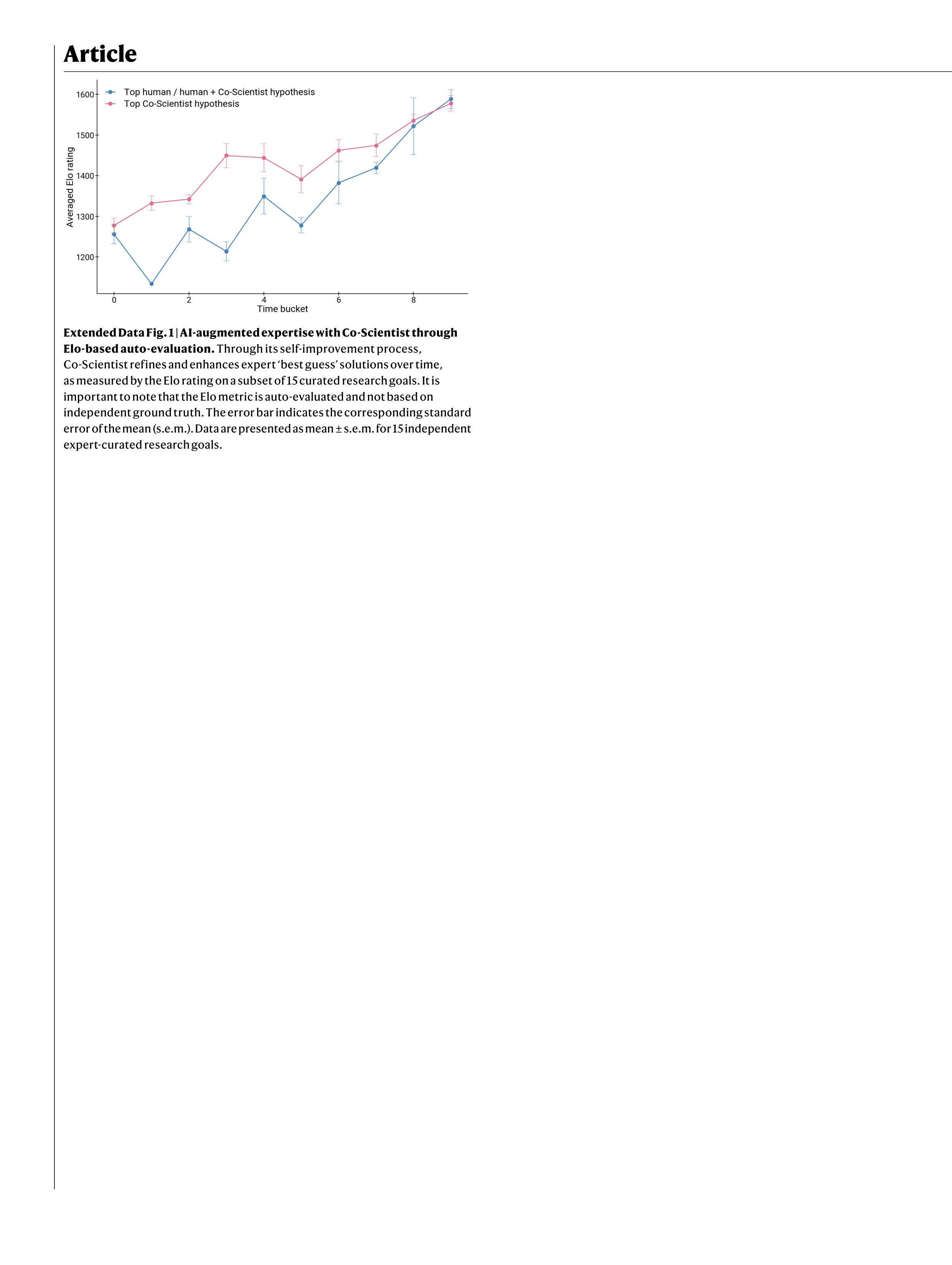
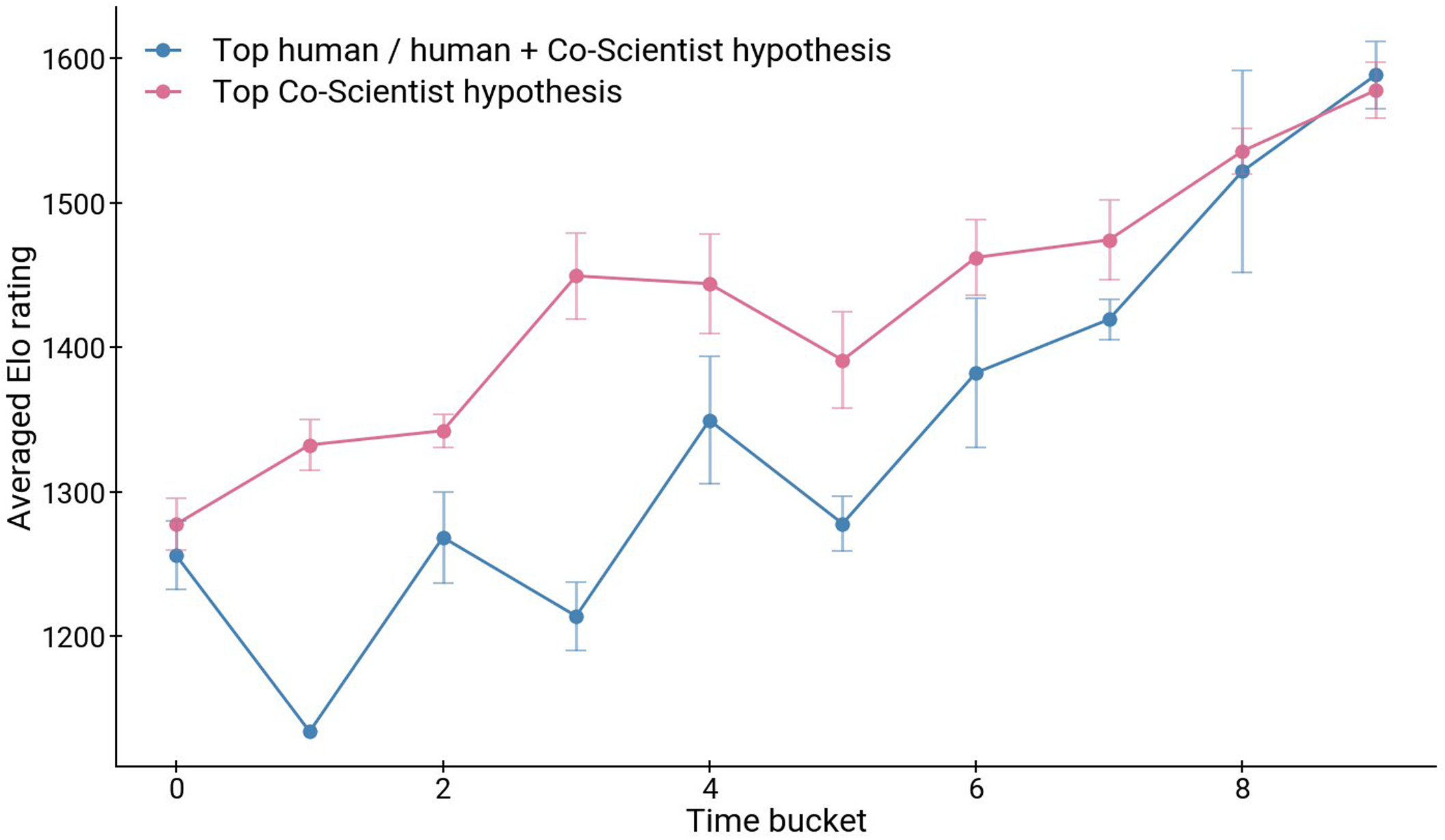
Article
Extended Data Fig. 1 | AI-augmented expertise with Co-Scientist through
Elo-based auto-evaluation.
Through its self-improvement process,
Co-Scientist refines and enhances expert ‘best guess’ solutions over time,
as measured by the Elo rating on a subset of 15 curated research goals. It is
important to note that the Elo metric is auto-evaluated and not based on
independent ground truth. The error bar indicates the corresponding standard
error of the mean (s.e.m.). Data are presented as mean ± s.e.m. for 15 independent
expert-curated research goals.
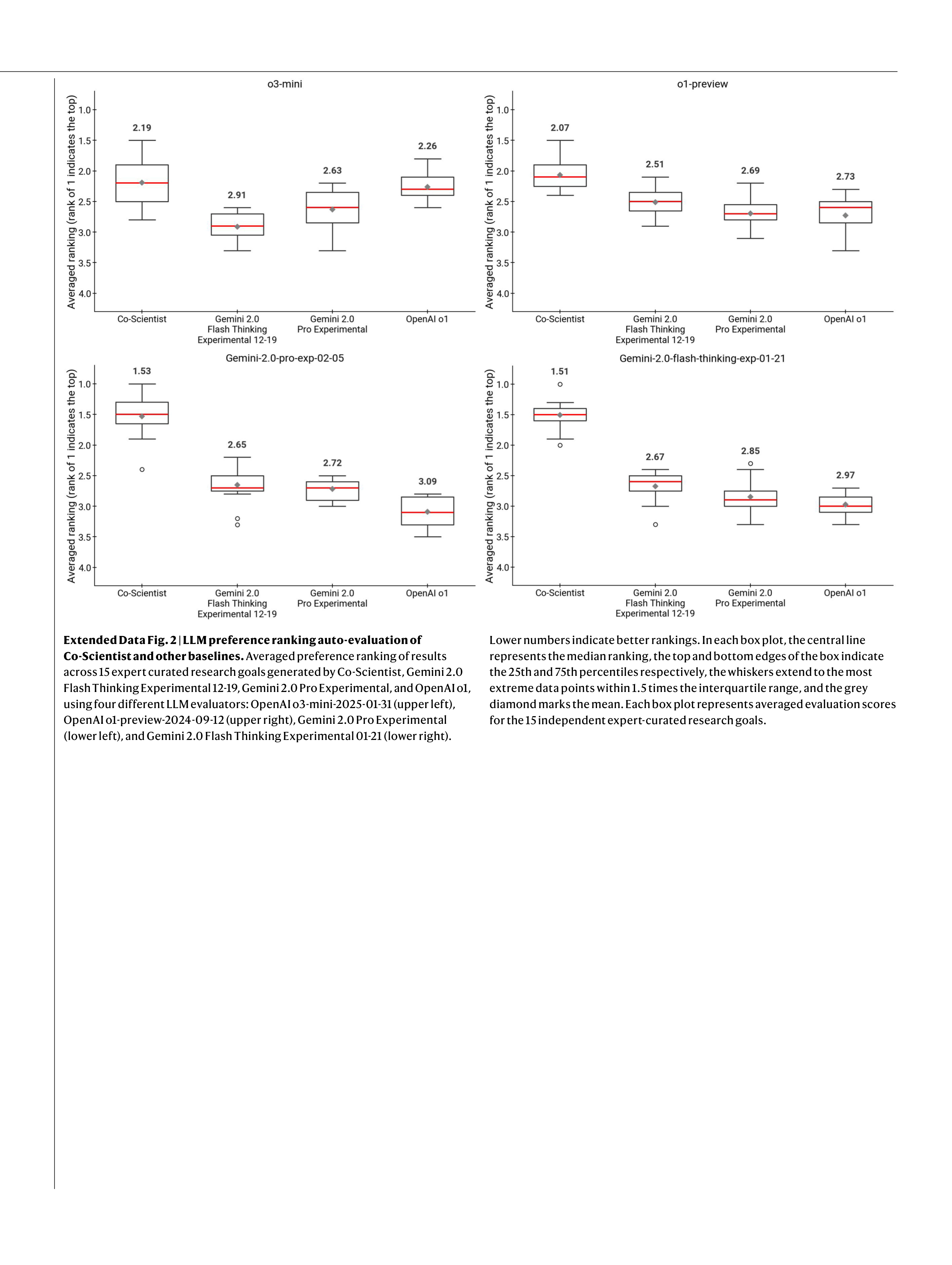
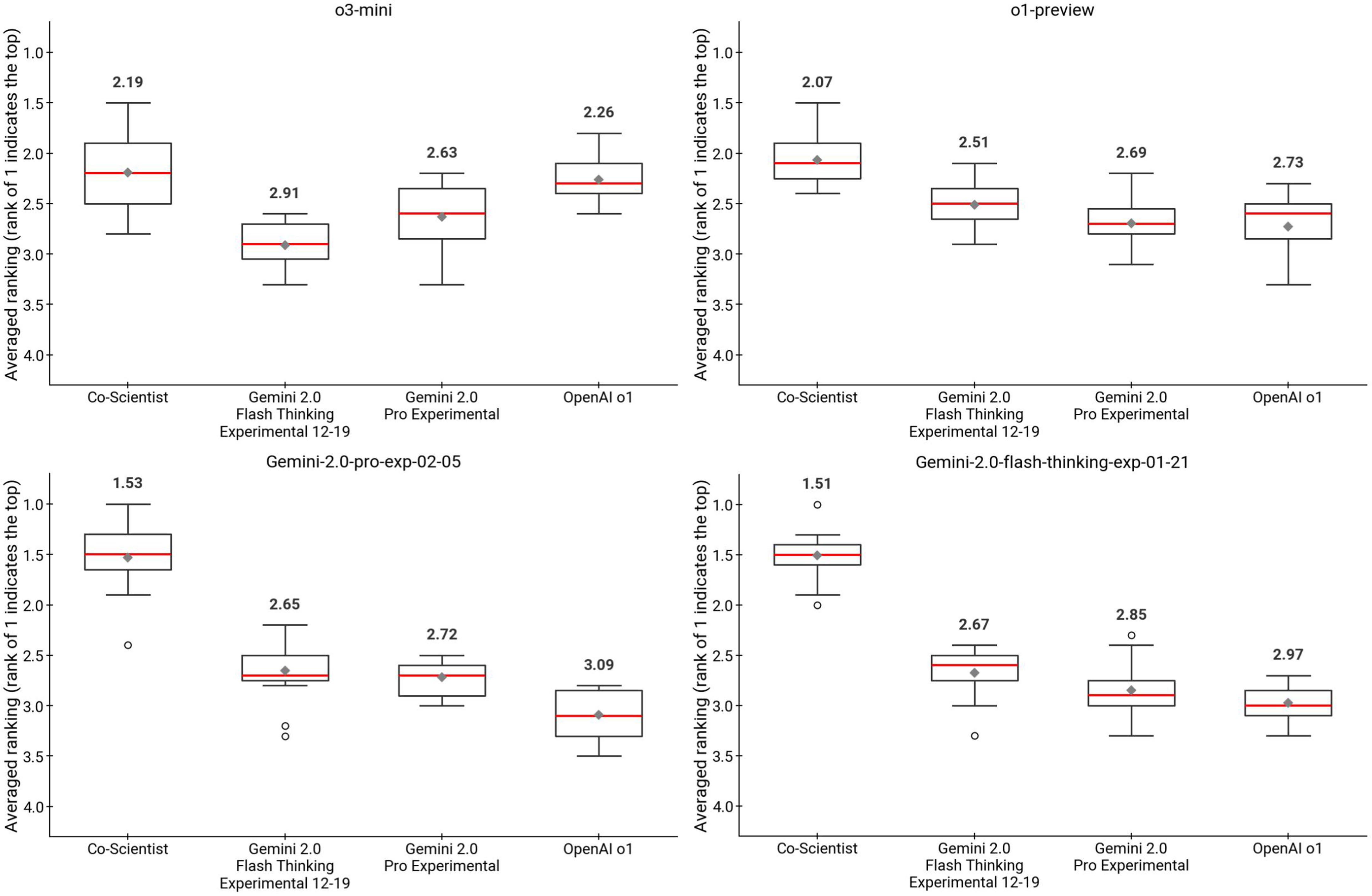
Extended Data Fig. 2 | LLM preference ranking auto-evaluation of
Co-Scientist and other baselines.
Averaged preference ranking of results
across 15 expert curated research goals generated by Co-Scientist, Gemini 2.0
Flash Thinking Experimental 12-19, Gemini 2.0 Pro Experimental, and OpenAI o1,
using four different LLM evaluators: OpenAI o3-mini-2025-01-31 (upper left),
OpenAI o1-preview-2024-09-12 (upper right), Gemini 2.0 Pro Experimental
(lower left), and Gemini 2.0 Flash Thinking Experimental 01-21 (lower right).
Lower numbers indicate better rankings. In each box plot, the central line
represents the median ranking, the top and bottom edges of the box indicate
the 25th and 75th percentiles respectively, the whiskers extend to the most
extreme data points within 1.5 times the interquartile range, and the grey
diamond marks the mean. Each box plot represents averaged evaluation scores
for the 15 independent expert-curated research goals.
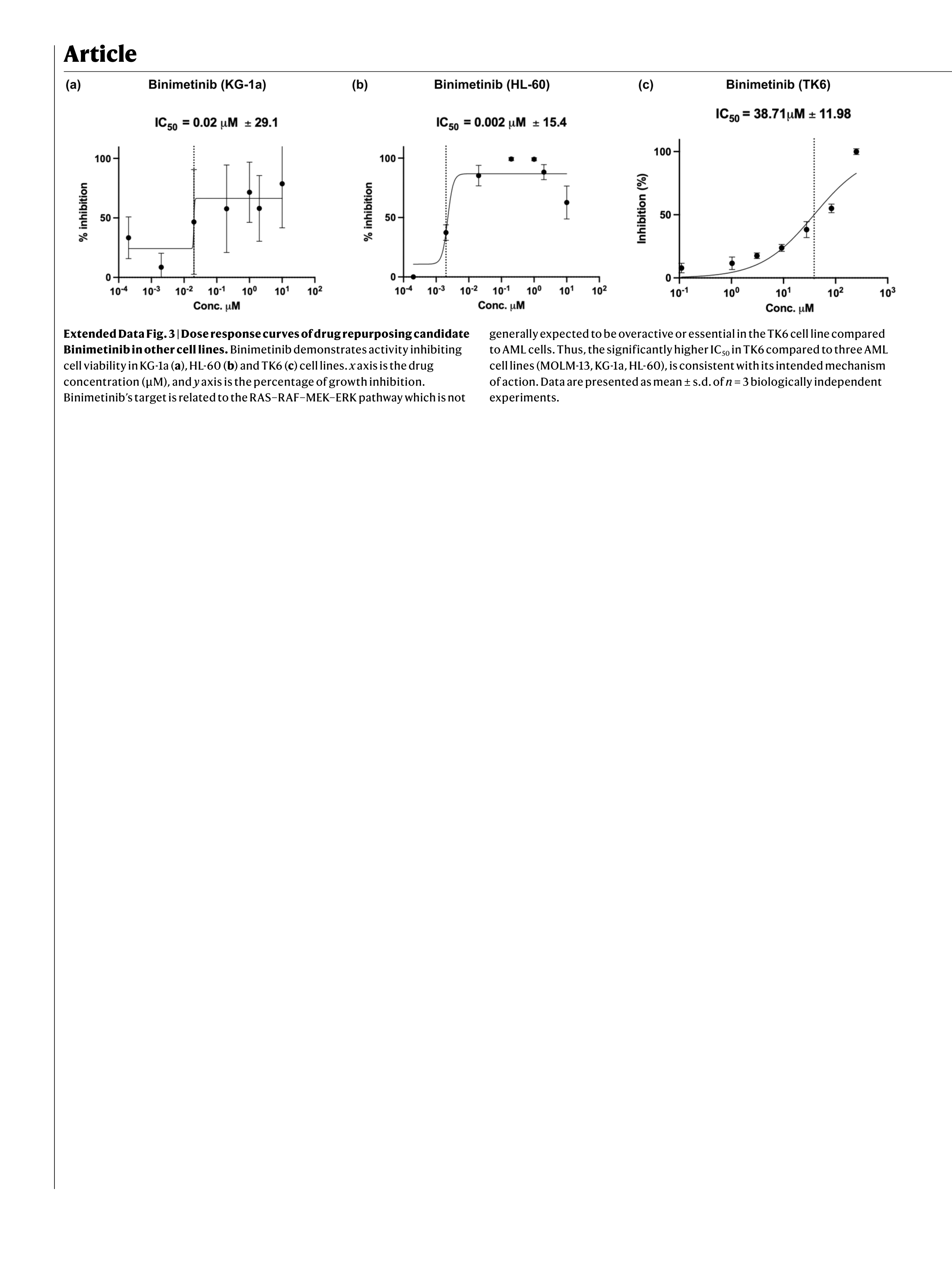
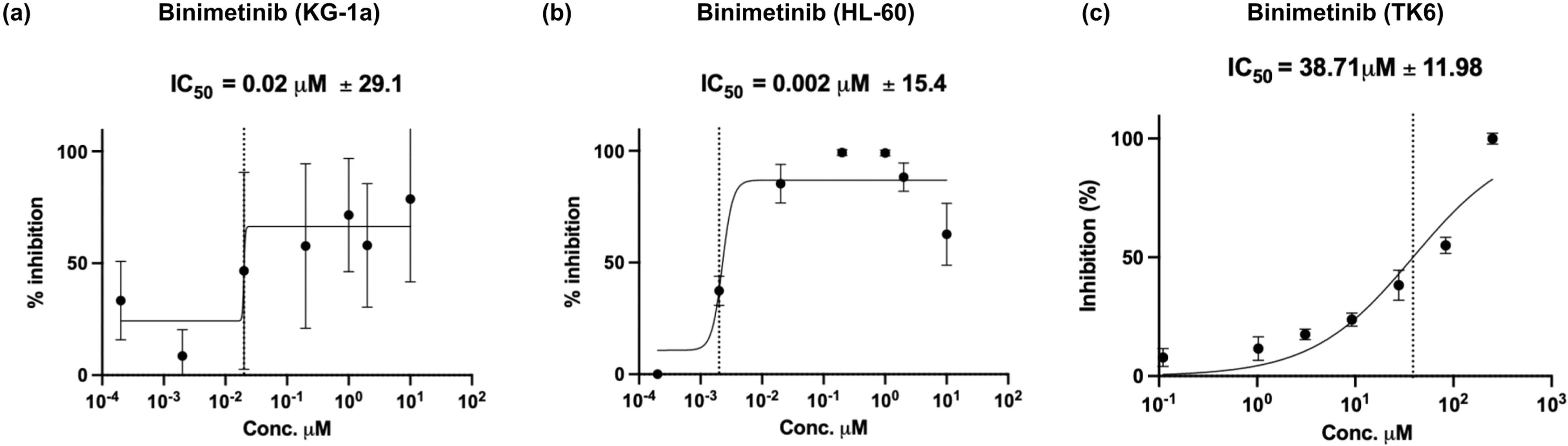
Article
Extended Data Fig. 3 | Dose response curves of drug repurposing candidate
Binimetinib in other cell lines.
Binimetinib demonstrates activity inhibiting
cell viability in KG-1a (
a
), HL-60 (
b
) and TK6 (
c
) cell lines.
x
axis is the drug
concentration (μM), and
y
axis is the percentage of growth inhibition.
Binimetinib’s target is related to the RAS–RAF–MEK–ERK pathway which is not
generally expected to be overactive or essential in the TK6 cell line compared
to AML cells. Thus, the significantly higher IC
50
in TK6 compared to three AML
cell lines (MOLM-13, KG-1a, HL-60), is consistent with its intended mechanism
of action. Data are presented as mean ± s.d. of
n
= 3 biologically independent
experiments.
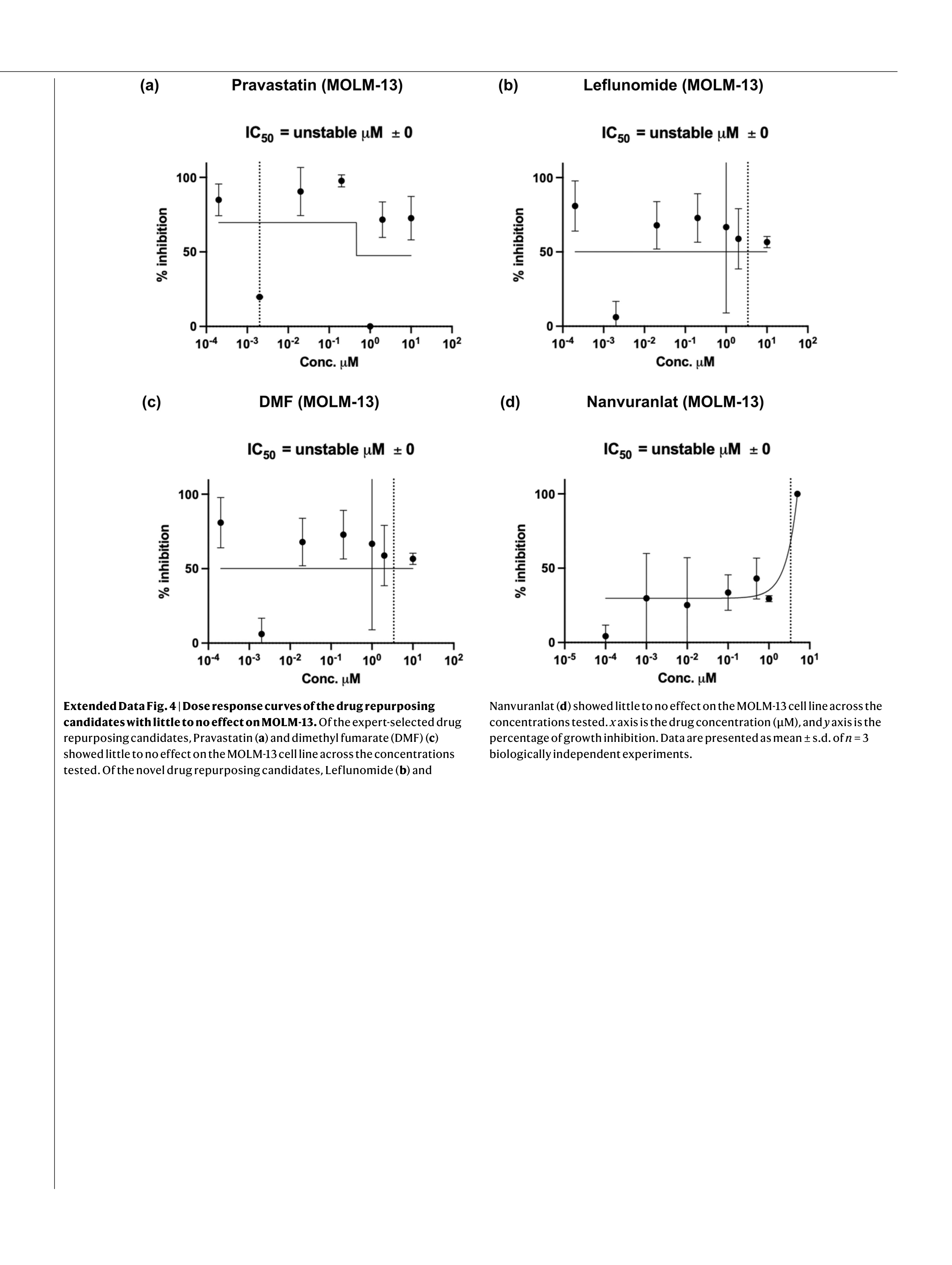
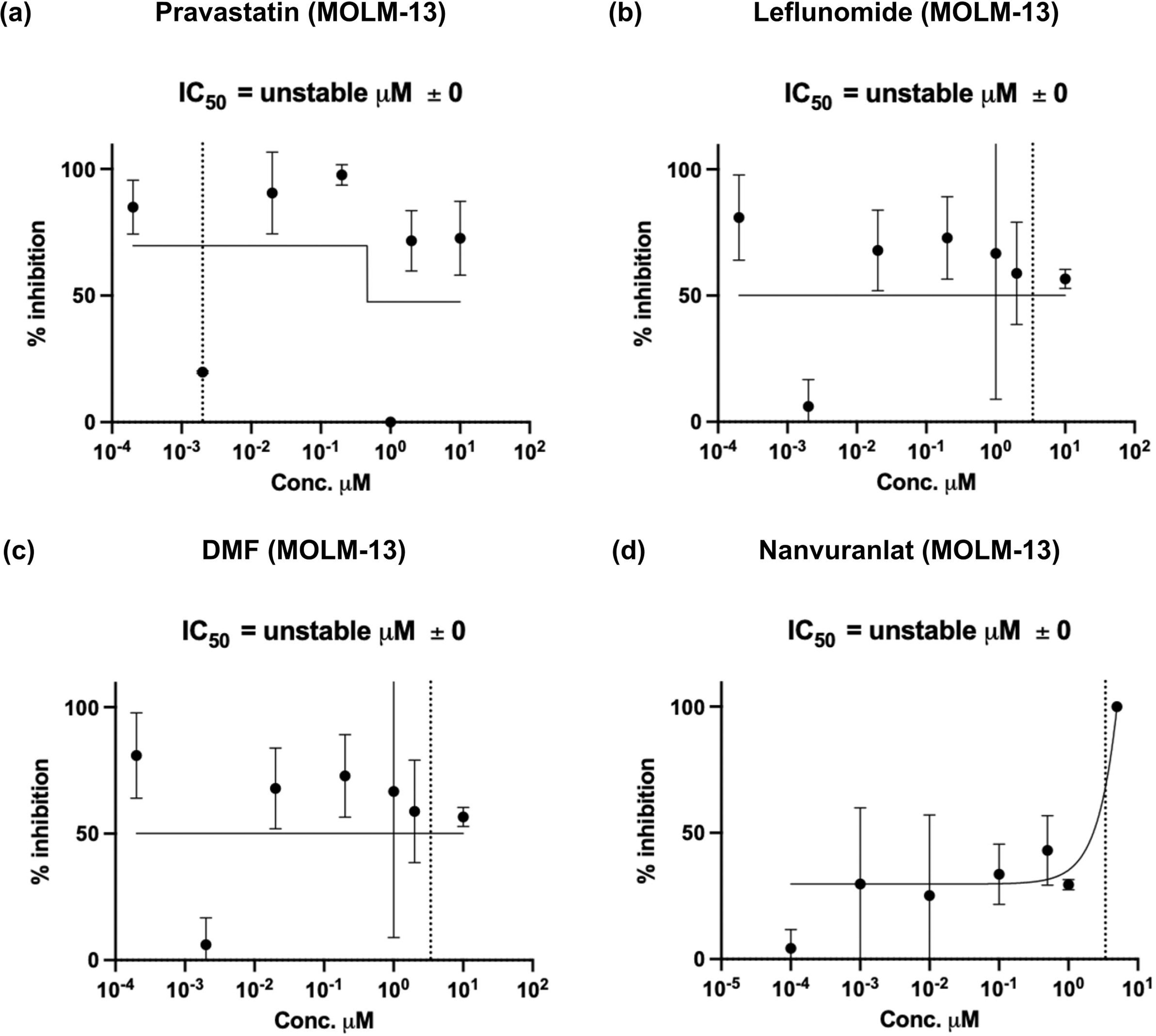
Extended Data Fig. 4 | Dose response curves of the drug repurposing
candidates with little to no effect on MOLM-13.
Of the expert-selected drug
repurposing candidates, Pravastatin (
a
) and dimethyl fumarate (DMF) (
c
)
showed little to no effect on the MOLM-13 cell line across the concentrations
tested. Of the novel drug repurposing candidates, Leflunomide (
b
) and
Nanvuranlat (
d
) showed little to no effect on the MOLM-13 cell line across the
concentrations tested.
x
axis is the drug concentration (μM), and
y
axis is the
percentage of growth inhibition. Data are presented as mean ± s.d. of
n
= 3
biologically independent experiments.
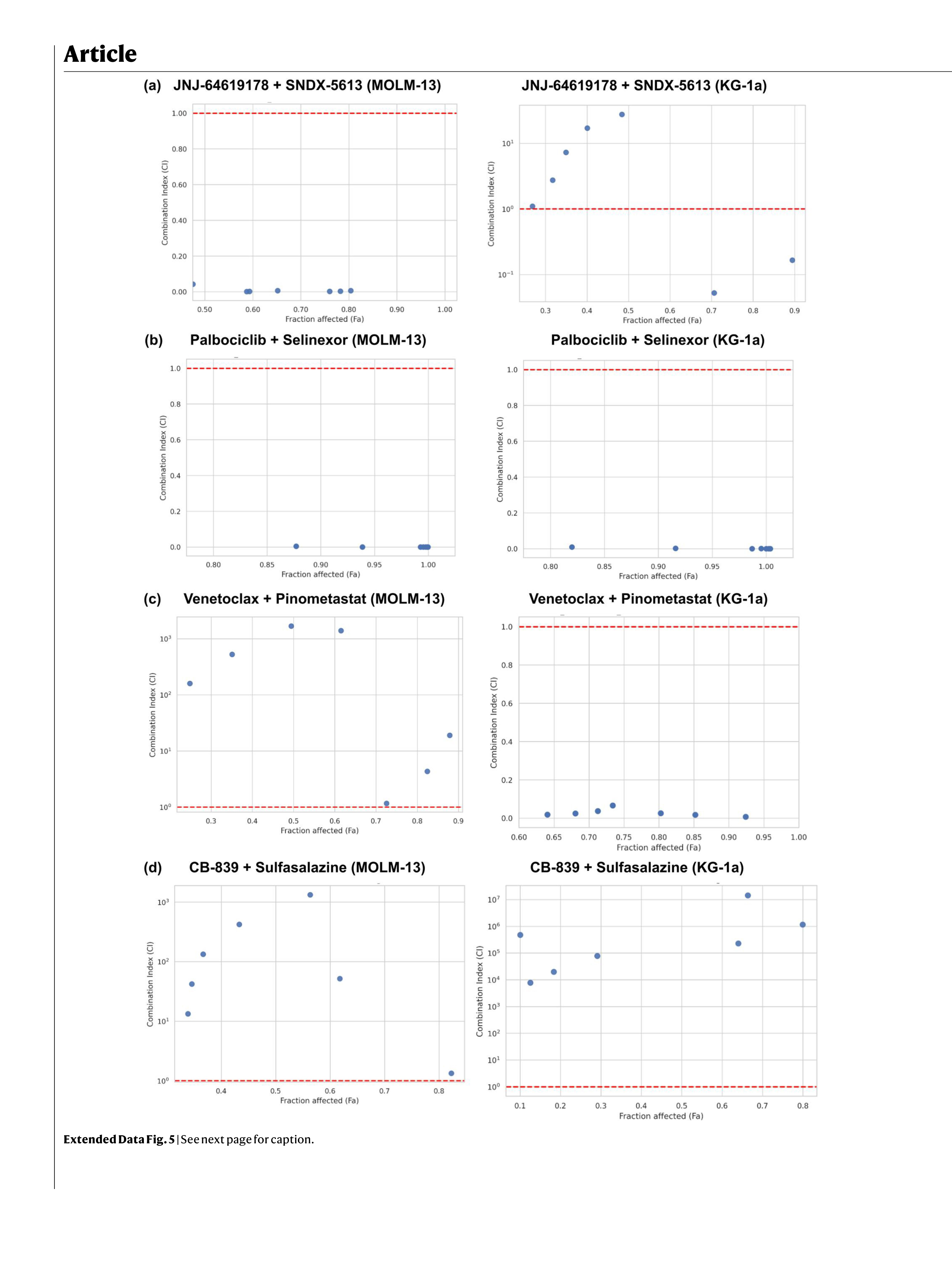
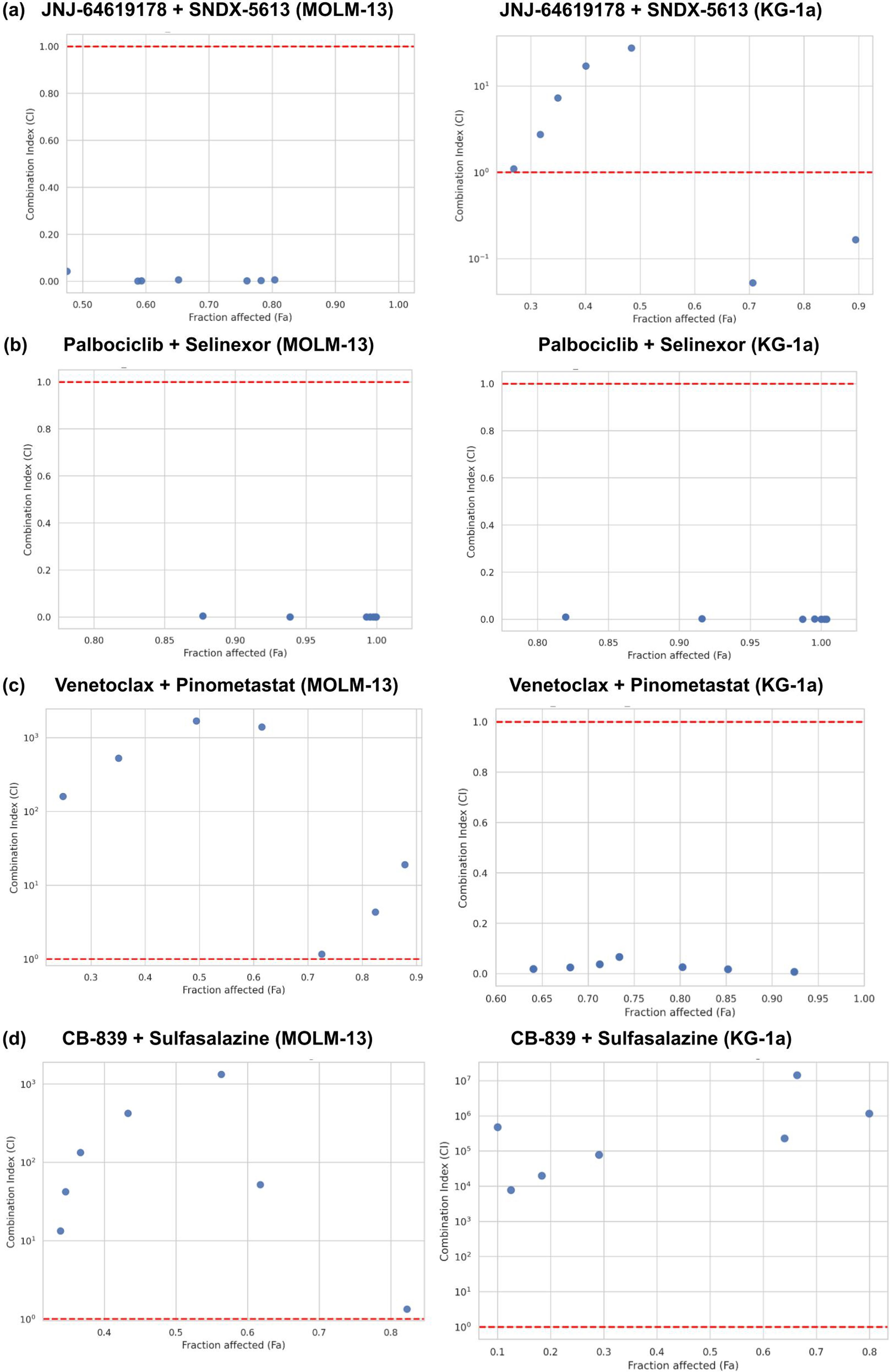
Article
Extended Data Fig. 5 |
See next page for caption.

Extended Data Fig. 5 | Comprehensive synergy analysis of Co-Scientist
nominated dual drug combinations in AML cell lines.
Building upon the
representative example in Fig. 4a,b, this figure details the pharmacological
interactions of additional AI-predicted doublets evaluated in MOLM-13
(left panels) and KG-1a (right panels) cell lines. Synergy was quantified
using the Chou-Talalay method based on fixed-ratio dose-response data.
Each panel presents a Fraction affected versus Combination Index (Fa-CI) plot.
The horizontal red dashed line indicates a strictly additive effect (CI = 1.0).
Data points below the line (CI < 1.0) indicate synergistic interactions, while
points above the line (CI > 1.0) indicate antagonism. The results highlight
that while certain combinations (e.g., Palbociclib + Selinexor (
b
)) exhibit
consistent synergy across different genetic backgrounds, others display
context-dependent interaction profiles strongly influenced by the specific
cell line’s mutational status.
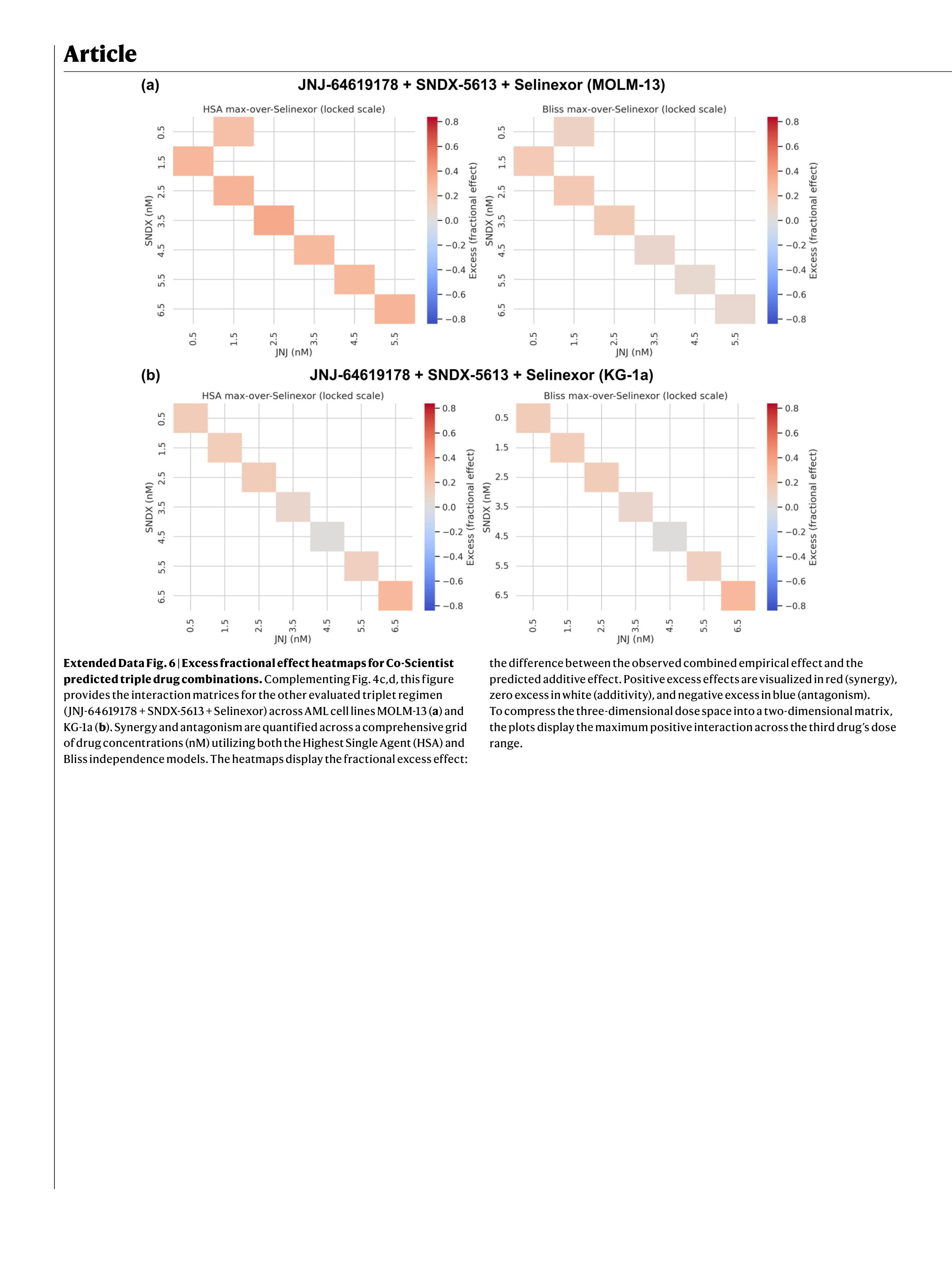
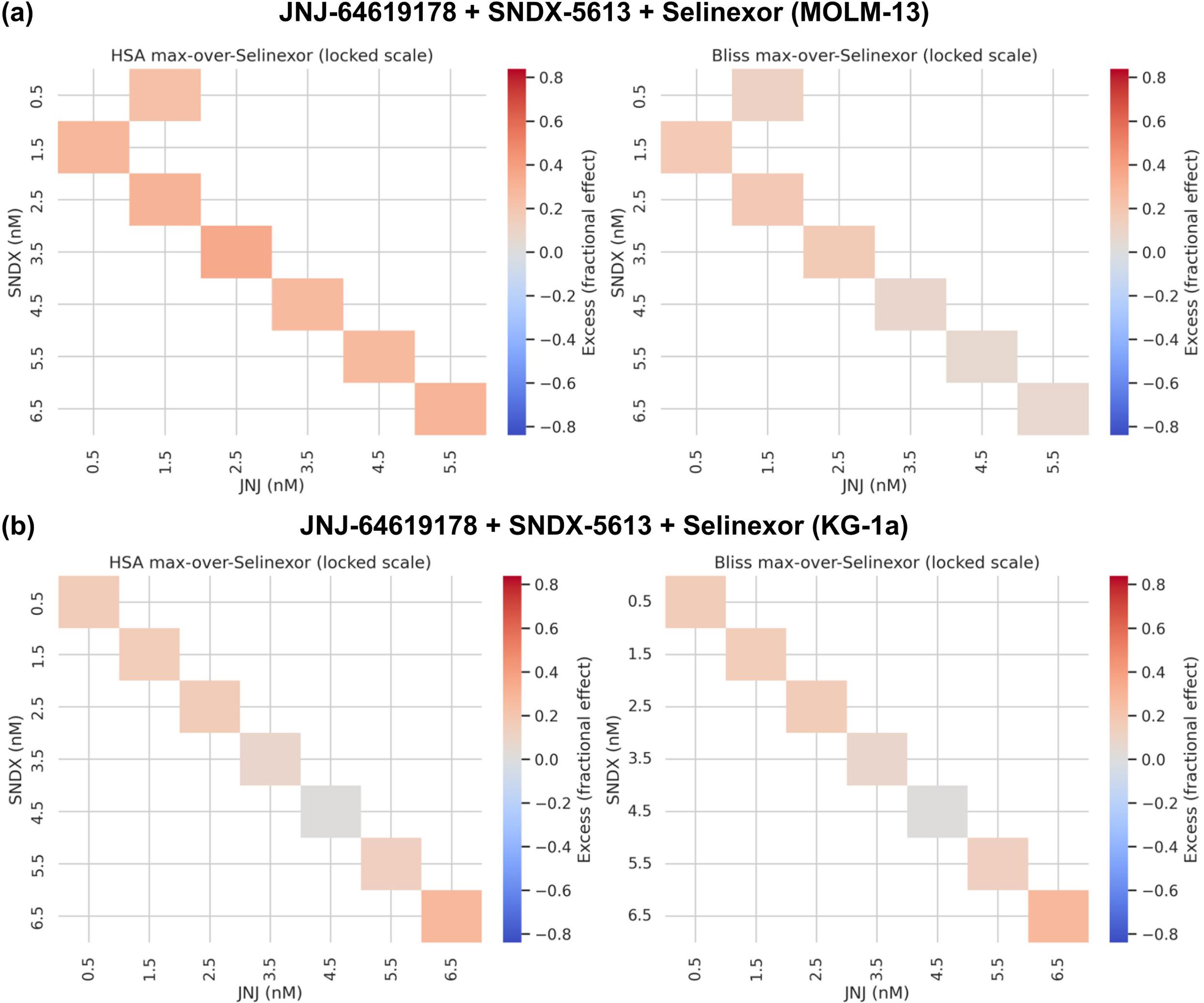
Article
Extended Data Fig. 6 | Excess fractional effect heatmaps for Co-Scientist
predicted triple drug combinations.
Complementing Fig. 4c,d, this figure
provides the interaction matrices for the other evaluated triplet regimen
(JNJ-64619178 + SNDX-5613 + Selinexor) across AML cell lines MOLM-13 (
a
) and
KG-1a (
b
). Synergy and antagonism are quantified across a comprehensive grid
of drug concentrations (nM) utilizing both the Highest Single Agent (HSA) and
Bliss independence models. The heatmaps display the fractional excess effect:
the difference between the observed combined empirical effect and the
predicted additive effect. Positive excess effects are visualized in red (synergy),
zero excess in white (additivity), and negative excess in blue (antagonism).
To compress the three-dimensional dose space into a two-dimensional matrix,
the plots display the maximum positive interaction across the third drug’s dose
range.
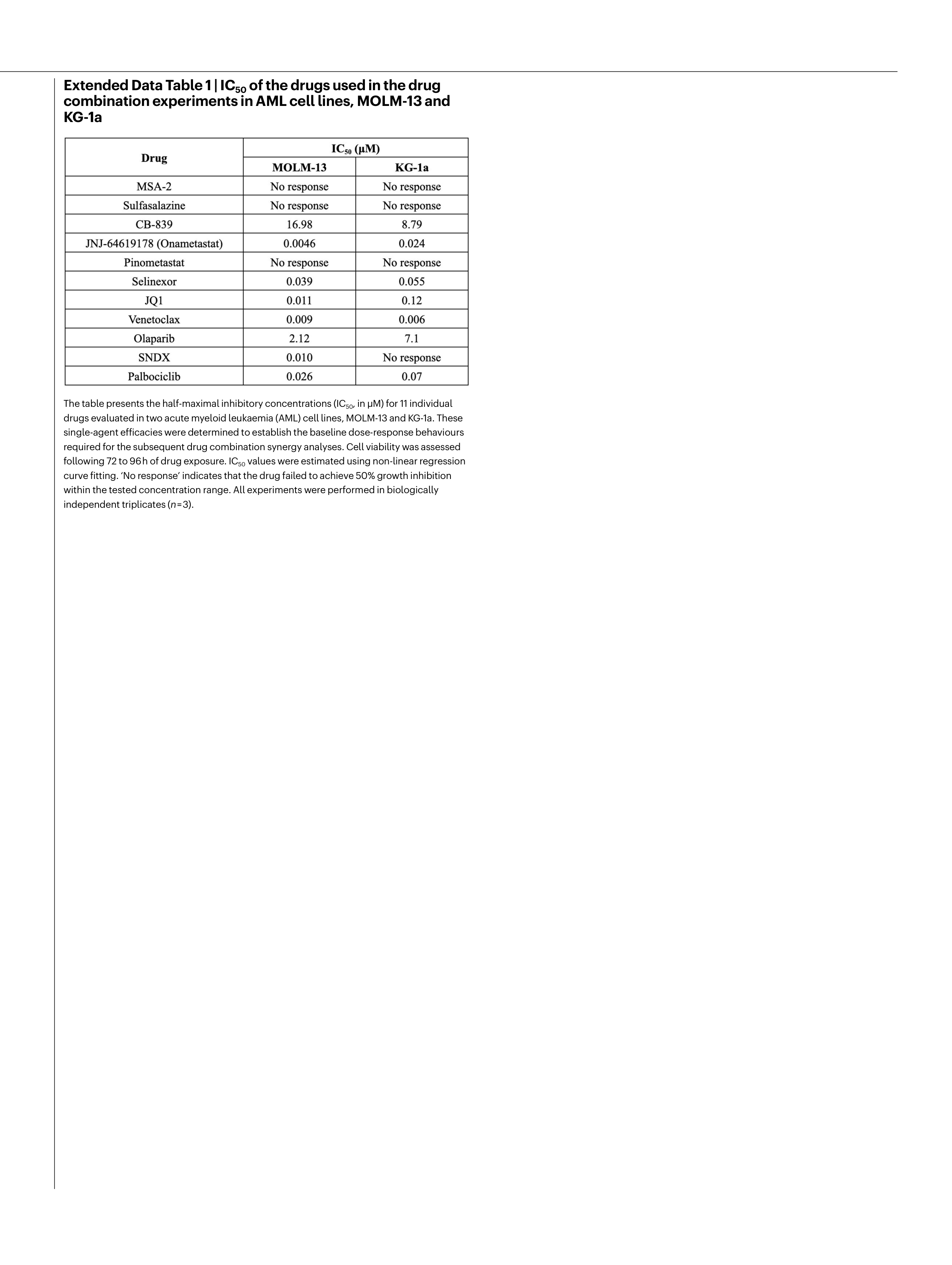
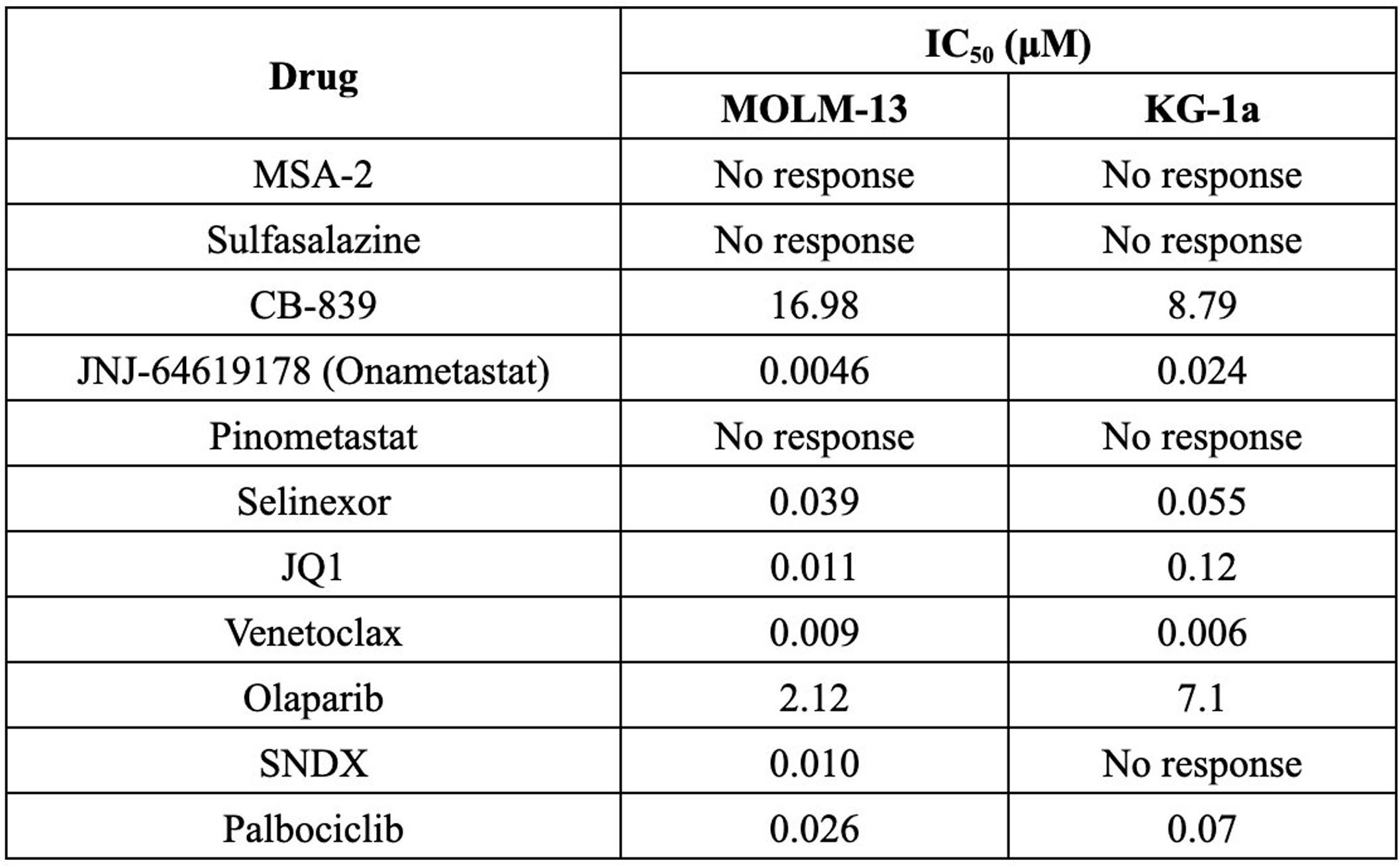
Extended Data Table 1 | IC
50
of the drugs used in the drug
combination experiments in AML cell lines, MOLM-13 and
KG-1a
The table presents the half-maximal inhibitory concentrations (IC
50
, in μM) for 11 individual
drugs evaluated in two acute myeloid leukaemia (AML) cell lines, MOLM-13 and KG-1a. These
single-agent efficacies were determined to establish the baseline dose-response behaviours
required for the subsequent drug combination synergy analyses. Cell viability was assessed
following 72 to 96 h of drug exposure. IC
50
values were estimated using non-linear regression
curve fitting. ‘No response’ indicates that the drug failed to achieve 50% growth inhibition
within the tested concentration range. All experiments were performed in biologically
independent triplicates (
n
= 3).
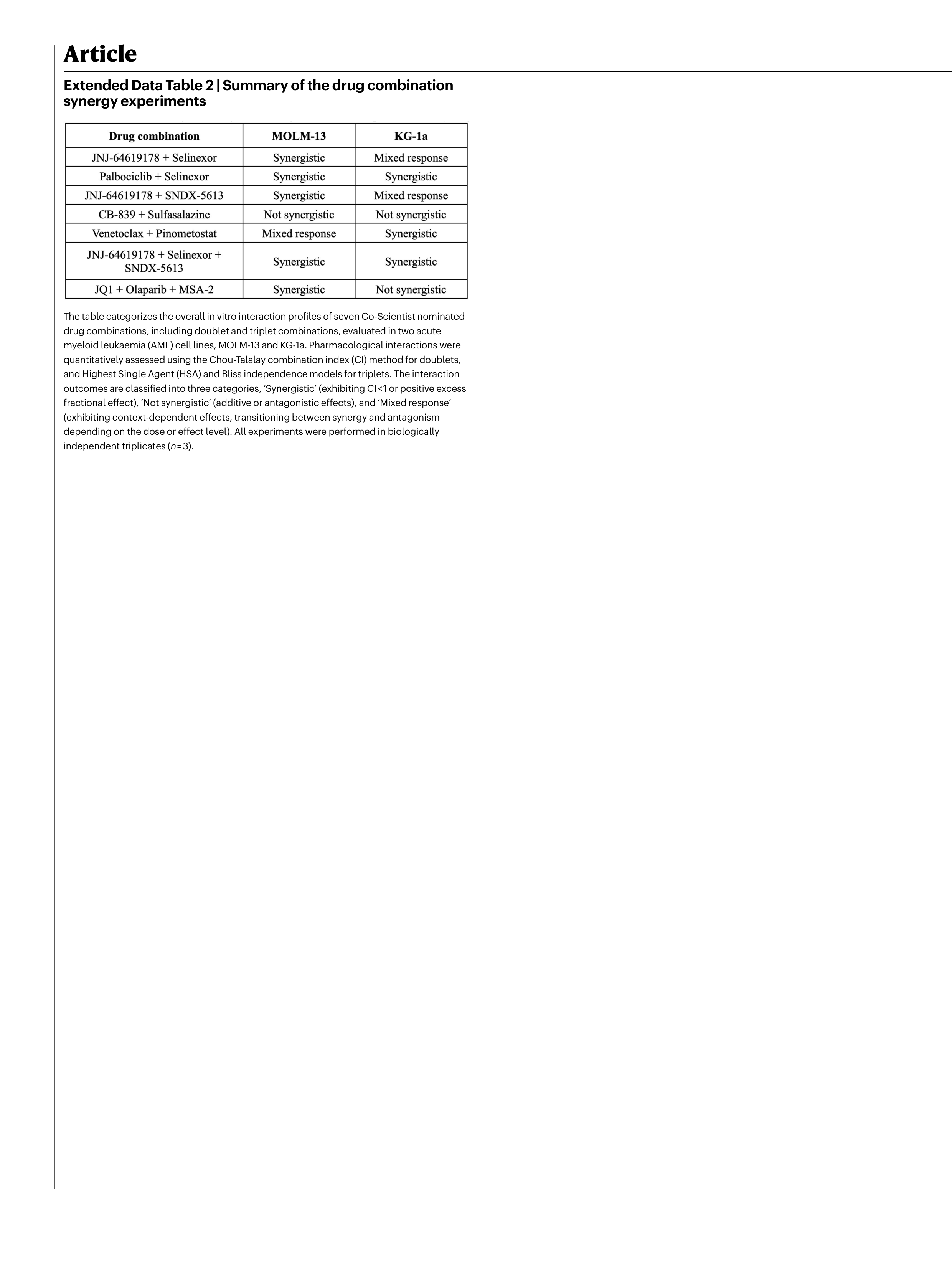
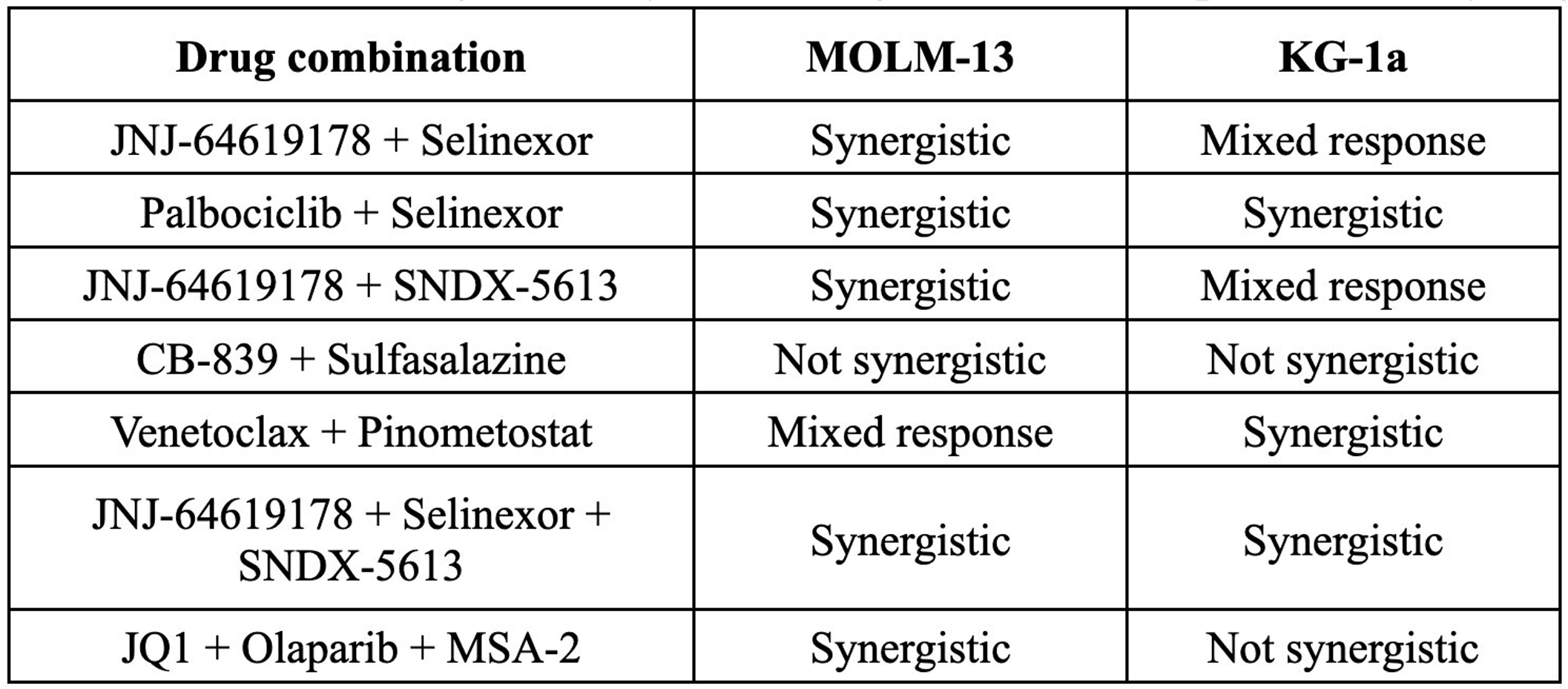
Article
Extended Data Table 2 | Summary of the drug combination
synergy experiments
The table categorizes the overall in vitro interaction profiles of seven Co-Scientist nominated
drug combinations, including doublet and triplet combinations, evaluated in two acute
myeloid leukaemia (AML) cell lines, MOLM-13 and KG-1a. Pharmacological interactions were
quantitatively assessed using the Chou-Talalay combination index (CI) method for doublets,
and Highest Single Agent (HSA) and Bliss independence models for triplets. The interaction
outcomes are classified into three categories, ‘Synergistic’ (exhibiting CI < 1 or positive excess
fractional effect), ‘Not synergistic’ (additive or antagonistic effects), and ‘Mixed response’
(exhibiting context-dependent effects, transitioning between synergy and antagonism
depending on the dose or effect level). All experiments were performed in biologically
independent triplicates (
n
= 3).

1
nature portfolio | reporting summary
April 2023
Corresponding author(s):
Juraj Gottweis, Wei-Hung Weng, Pushmeet
Kohli, Annalisa Pawlosky, Alan
Karthikesalingam, Vivek Natarajan
Last updated by author(s):
May 8, 2026
Reporting Summary
Nature Portfolio wishes to improve the reproducibility of the work that we publish. This form provides structure for consistency and transparency
in reporting. For further information on Nature Portfolio policies, see our
Editorial Policies
and the
Editorial Policy Checklist
.
Statistics
For all statistical analyses, confirm that the following items are present in the figure legend, table legend, main text, or Methods section.
n/a
Confirmed
The exact sample size (
n
) for each experimental group/condition, given as a discrete number and unit of measurement
A statement on whether measurements were taken from distinct samples or whether the same sample was measured repeatedly
The statistical test(s) used AND whether they are one- or two-sided
Only common tests should be described solely by name; describe more complex techniques in the Methods section.
A description of all covariates tested
A description of any assumptions or corrections, such as tests of normality and adjustment for multiple comparisons
A full description of the statistical parameters including central tendency (e.g. means) or other basic estimates (e.g. regression coefficient)
AND variation (e.g. standard deviation) or associated estimates of uncertainty (e.g. confidence intervals)
For null hypothesis testing, the test statistic (e.g.
F
,
t
,
r
) with confidence intervals, effect sizes, degrees of freedom and
P
value noted
Give P values as exact values whenever suitable.
For Bayesian analysis, information on the choice of priors and Markov chain Monte Carlo settings
For hierarchical and complex designs, identification of the appropriate level for tests and full reporting of outcomes
Estimates of effect sizes (e.g. Cohen's
d
, Pearson's
r
), indicating how they were calculated
Our web collection on
statistics for biologists
contains articles on many of the points above.
Software and code
Policy information about
availability of computer code
Data collection
The system, algorithms and scripts were implemented using Python 3.11.7. Scientific literature and data were collected via web search APIs
and internal data pipelines compatible with the Gemini 2.0 model infrastructure. Data collection for in vitro cell viability was performed using
a multimode microplate reader.
Data analysis
The full source code for the Co-Scientist system is not publicly available. The foundational LLM model, Gemini, used in Co-Scientist is publicly
available via APIs, Google AI studio, the Gemini App and other surfaces. The analysis codes were developed using Python (version 3.11.7).
Data handling and visualization were performed using pandas (version 2.1.4), numpy (version 1.26.4), seaborn (version 0.12.2), and matplotlib
(version 3.8.0). For in vitro validations, dose-response curve fitting and IC50 estimation were performed using GraphPad Prism (version 10.6.0,
GraphPad Software). Synergy analysis and Combination Index calculations were performed using Julius AI statistical software (accessed
November 2025).
For manuscripts utilizing custom algorithms or software that are central to the research but not yet described in published literature, software must be made available to editors and
reviewers. We strongly encourage code deposition in a community repository (e.g. GitHub). See the Nature Portfolio
guidelines for submitting code & software
for further information.
2
nature portfolio | reporting summary
April 2023
Data
Policy information about
availability of data
All manuscripts must include a
data availability statement
. This statement should provide the following information, where applicable:
- Accession codes, unique identifiers, or web links for publicly available datasets
- A description of any restrictions on data availability
- For clinical datasets or third party data, please ensure that the statement adheres to our
policy
Except for the three real-world validation tasks (drug repurposing for AML, novel target discovery for liver fibrosis, mechanism explanation of gene transfer
evolution), the remaining datasets used for development, benchmarking and evaluation of the AI systems are open source or otherwise accessible publicly with
permissions. Specifically, the GPQA diamond dataset is publicly available at Hugging Face (https://huggingface.co/datasets/Idavidrein/gpqa). The Cancer
Dependency Map (DepMap) Q2 2024 data used for computational sanity checks is publicly available at the DepMap portal (https://depmap.org/portal/). The
curated drug targets dataset from the Open Targets Platform is available at https://platform.opentargets.org/downloads.
Research involving human participants, their data, or biological material
Policy information about
studies with
human participants or human data
. See also policy information about
sex, gender (identity/presentation),
and sexual orientation
and
race, ethnicity and racism
.
Reporting on sex and gender
N/A
Reporting on race, ethnicity, or
other socially relevant
groupings
N/A
Population characteristics
N/A
Recruitment
N/A
Ethics oversight
N/A
Note that full information on the approval of the study protocol must also be provided in the manuscript.
Field-specific reporting
Please select the one below that is the best fit for your research. If you are not sure, read the appropriate sections before making your selection.
Life sciences
Behavioural & social sciences
Ecological, evolutionary & environmental sciences
For a reference copy of the document with all sections, see
nature.com/documents/nr-reporting-summary-flat.pdf
Life sciences study design
All studies must disclose on these points even when the disclosure is negative.
Sample size
No statistical methods were used to predetermine sample sizes. For the computational evaluations, the sample size of 203 diverse research
goals, 15 expert-curated goals, and 11 goals for LLM-as-a-judge preference were chosen to ensure a broad representation of scientific
domains, robust statistical averaging across varying complexity, and to mitigate evaluator bias. For the in vitro validations, five distinct AML
cell lines (MOLM-13, KG-1a, HL-60, NOMO-1, and TK6) were tested to model the molecular and genetic heterogeneity of the disease.
Experiments were performed in biological triplicates (n=3). This sample size was not predetermined by statistical methods but was chosen
based on widely accepted standard practices for preliminary in vitro dose-response viability screening. Given the large effect sizes typical of
such preliminary pharmacological assays, three independent biological replicates provide the necessary degrees of freedom to calculate
standard deviation, assess assay consistency, and robustly fit non-linear regression curves for IC50 estimation.
Data exclusions
No data were excluded from the computational or in vitro laboratory analyses.
Replication
All in vitro dose-response (single-agent screening) and cell viability assays (fixed-ratio combination treatments) were performed in
independent biological triplicates (n=3). For computational hypothesis generation and LLM-as-a-judge evaluations, the system generated
responses or evaluations independently across multiple discrete runs. All attempts at replication (both in vitro and computational) were
successful. The resulting in vitro data were presented as the mean ± standard deviation of these triplicates.
Randomization
Randomization was not relevant for the in vitro experiments, as these involved standardized dose-response testing where specified drug
concentrations were deterministically applied to cell cultures. For the human evaluation of the Co-Scientist and other LLMs, outputs were
assessed by experts, the model outputs were presented randomly.
Blinding
The human expert evaluation of the LLM-generated outputs was explicitly blinded, ensuring that independent domain experts were
completely unaware of which model generated the hypotheses they were scoring. Blinding was not applicable to the in vitro cell viability
screening assays because these experiments involve standardized, automated readouts (absorbance at 490 nm using a multimode microplate
3
nature portfolio | reporting summary
April 2023
reader) that are objective and not subject to investigator interpretation bias. Furthermore, knowledge of the drug identity is required by the
experimenter to prepare the appropriate molar concentration ranges and dilution series for accurate IC50 determination.
Reporting for specific materials, systems and methods
We require information from authors about some types of materials, experimental systems and methods used in many studies. Here, indicate whether each material,
system or method listed is relevant to your study. If you are not sure if a list item applies to your research, read the appropriate section before selecting a response.
Materials & experimental systems
n/a
Involved in the study
Antibodies
Eukaryotic cell lines
Palaeontology and archaeology
Animals and other organisms
Clinical data
Dual use research of concern
Plants
Methods
n/a
Involved in the study
ChIP-seq
Flow cytometry
MRI-based neuroimaging
Dual use research of concern
Policy information about
dual use research of concern
Hazards
Could the accidental, deliberate or reckless misuse of agents or technologies generated in the work, or the application of information presented
in the manuscript, pose a threat to:
No
Yes
Public health
National security
Crops and/or livestock
Ecosystems
Any other significant area
Experiments of concern
Does the work involve any of these experiments of concern:
No
Yes
Demonstrate how to render a vaccine ineffective
Confer resistance to therapeutically useful antibiotics or antiviral agents
Enhance the virulence of a pathogen or render a nonpathogen virulent
Increase transmissibility of a pathogen
Alter the host range of a pathogen
Enable evasion of diagnostic/detection modalities
Enable the weaponization of a biological agent or toxin
Any other potentially harmful combination of experiments and agents

4
nature portfolio | reporting summary
April 2023
Novel plant genotypes
Describe the methods by which all novel plant genotypes were produced. This includes those generated by transgenic approaches,
gene editing, chemical/radiation-based mutagenesis and hybridization. For transgenic lines, describe the transformation method, the
number of independent lines analyzed and the generation upon which experiments were performed. For gene-edited lines, describe
the editor used, the endogenous sequence targeted for editing, the targeting guide RNA sequence (if applicable) and how the editor
was applied.
Seed stocks
Report on the source of all seed stocks or other plant material used. If applicable, state the seed stock centre and catalogue number. If
plant specimens were collected from the field, describe the collection location, date and sampling procedures.
Authentication
Describe any authentication procedures for each seed stock used or novel genotype generated. Describe any experiments used to
assess the effect of a mutation and, where applicable, how potential secondary effects (e.g. second site T-DNA insertions, mosiacism,
off-target gene editing) were examined.
Plants