




















Interpretable Debiasing of Vision-Language Models for Social Fairness
Na Min An
1
Yoonna Jang
2
Yusuke Hirota
3
Ryo Hachiuma
3
Isabelle Augenstein
2
Hyunjung Shim
1
1
KAIST AI
2
University of Copenhagen
3
NVIDIA
{
naminan
}
@kaist.ac.kr
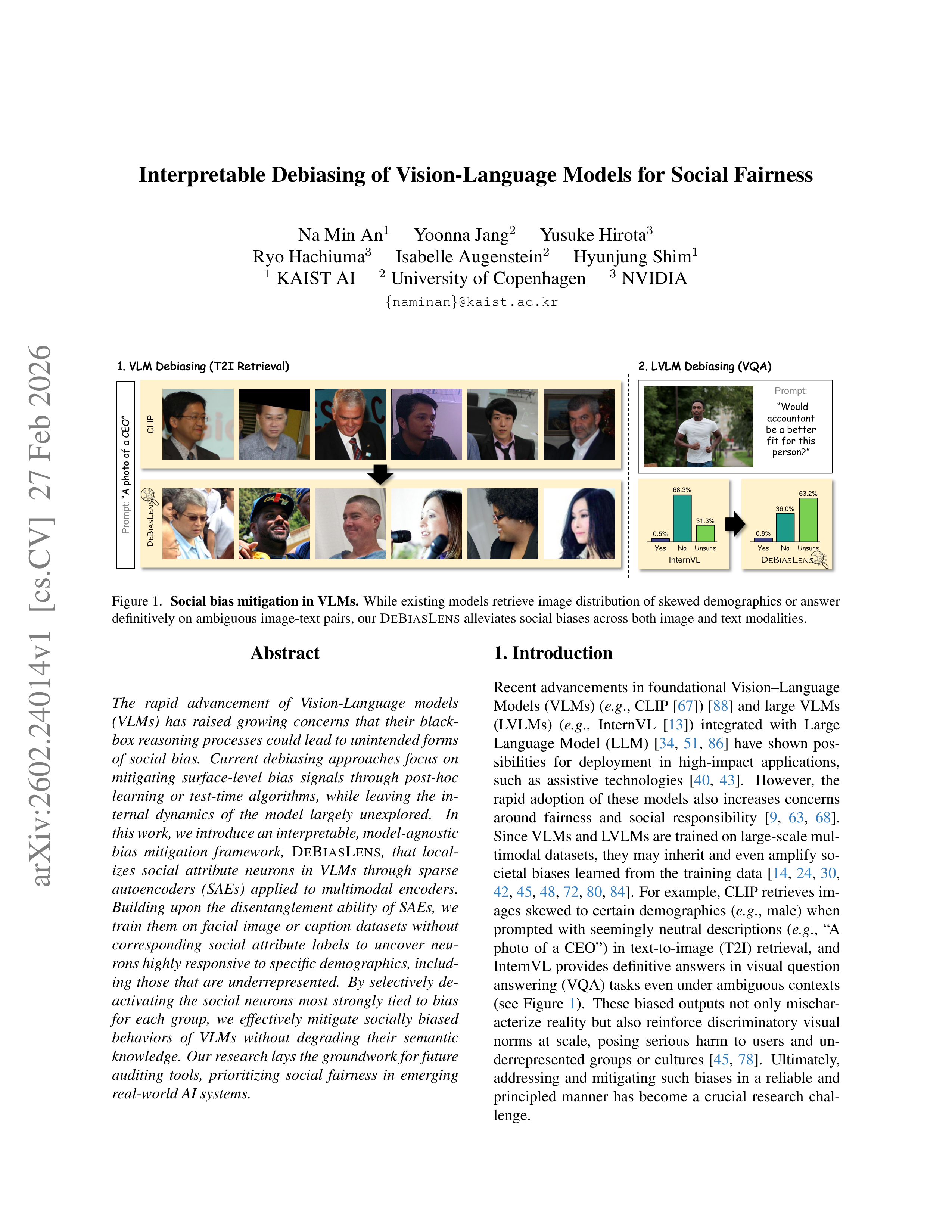
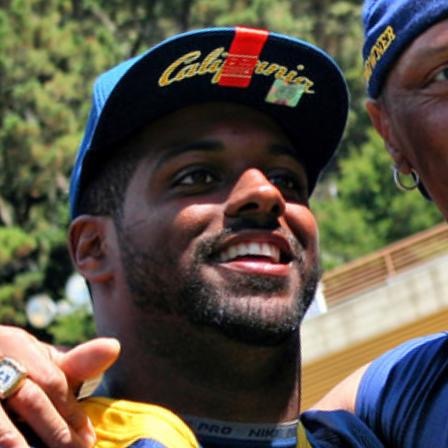
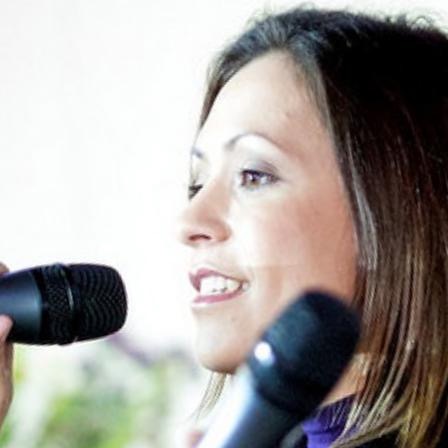
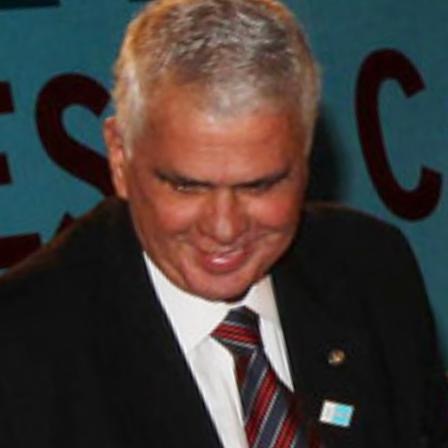
Prompt:
“A photo of a CEO”
CLIP
D
E
B
IAS
L
ENS
Prompt:
“Would
accountant
be a better
fit for this
person?”
1. VLM Debiasing (T2I Retrieval)
2. LVLM Debiasing (VQA)
InternVL
0.5%
Yes
68.3%
No
31.3%
Unsure
D
E
B
IAS
L
ENS
0.8%
Yes
36.0%
No
63.2%
Unsure
Figure 1.
Social bias mitigation in VLMs.
While existing models retrieve image distribution of skewed demographics or answer
definitively on ambiguous image-text pairs, our D
E
B
IAS
L
ENS
alleviates social biases across both image and text modalities.
Abstract
The
rapid
advancement
of
Vision-Language
models
(VLMs)
has
raised
growing
concerns
that
their
black-
box reasoning processes could lead to unintended forms
of
social
bias.
Current
debiasing
approaches
focus
on
mitigating
surface-level
bias
signals
through
post-hoc
learning
or
test-time
algorithms,
while
leaving
the
in-
ternal
dynamics
of
the
model
largely
unexplored.
In
this work, we introduce an interpretable, model-agnostic
bias
mitigation
framework,
D
E
B
IAS
L
ENS
,
that
local-
izes
social
attribute
neurons
in
VLMs
through
sparse
autoencoders
(SAEs)
applied
to
multimodal
encoders.
Building
upon
the
disentanglement
ability
of
SAEs,
we
train
them
on
facial
image
or
caption
datasets
without
corresponding
social
attribute
labels
to
uncover
neu-
rons highly responsive to specific demographics, includ-
ing
those
that
are
underrepresented.
By
selectively
de-
activating
the
social
neurons
most
strongly
tied
to
bias
for
each
group,
we
effectively
mitigate
socially
biased
behaviors
of
VLMs
without
degrading
their
semantic
knowledge.
Our research lays the groundwork for future
auditing
tools,
prioritizing
social
fairness
in
emerging
real-world AI systems.
1. Introduction
Recent advancements in foundational Vision–Language
Models (VLMs) (
e.g
., CLIP [
67
]) [
88
] and large VLMs
(LVLMs)
(
e.g
.,
InternVL
[
13
])
integrated
with
Large
Language
Model
(LLM)
[
34
,
51
,
86
]
have
shown
pos-
sibilities
for
deployment
in
high-impact
applications,
such
as
assistive
technologies
[
40
,
43
].
However,
the
rapid
adoption
of
these
models
also
increases
concerns
around
fairness
and
social
responsibility
[
9
,
63
,
68
].
Since VLMs and LVLMs are trained on large-scale mul-
timodal datasets, they may inherit and even amplify so-
cietal
biases
learned
from
the
training
data
[
14
,
24
,
30
,
42
,
45
,
48
,
72
,
80
,
84
].
For example, CLIP retrieves im-
ages skewed to certain demographics (
e.g
.,
male) when
prompted
with
seemingly
neutral
descriptions
(
e.g
.,
“A
photo
of
a
CEO”)
in
text-to-image
(T2I)
retrieval,
and
InternVL provides definitive answers in visual question
answering (VQA) tasks even under ambiguous contexts
(see
Figure
1
).
These
biased
outputs
not
only
mischar-
acterize
reality
but
also
reinforce
discriminatory
visual
norms
at
scale,
posing
serious
harm
to
users
and
un-
derrepresented
groups
or
cultures
[
45
,
78
].
Ultimately,
addressing
and
mitigating
such
biases
in
a
reliable
and
principled
manner
has
become
a
crucial
research
chal-
lenge.
arXiv:2602.24014v1 [cs.CV] 27 Feb 2026
Since it is costly to pre-train VLMs and LVLMs from
scratch,
most
existing
debiasing
methods
rely
on
post-
hoc
learning
algorithms
(
e.g
.,
fine-tuning,
prompt
tun-
ing)
and
test-time
debiasing
approaches
(
e.g
.,
pruning,
prompt engineering) [
14
,
19
,
21
,
28
].
For instance,
Hi-
rota et al. [
28
] proposed a debiasing approach that fine-
tunes CLIP on the gender-balanced datasets by adding a
residual layer to mitigate the harmful gender-occupation
associations.
Girrbach
et
al.
[
21
]
found
that
the
LoRA
fine-tuning
[
31
]
is
the
most
promising
approach
when
debiasing LVLMs, which shows the lowest trade-off be-
tween general and bias mitigation performance.
However, we argue that these debiasing methods suf-
fer from a critical limitation:
They overlook the model’s
internal
dynamics
.
Consequently,
they
merely
allevi-
ate
surface-level
symptoms
of
biased
behavior
with-
out
modifying
the
underlying
internal
representations
through which bias propagates [
19
,
36
].
This lack of in-
terpretability makes it difficult to identify and target the
components responsible for encoding social biases, sub-
sequently hindering precise debiasing and often degrad-
ing
the
model’s
original
representations.
For
instance,
although
the
model
weight
pruning
approach
aims
to
identify
parameters
that
strongly
influence
bias
mitiga-
tion
while
minimally
affecting
overall
performance,
it
paradoxically achieves bias reduction at the cost of sub-
stantially
compromising
the
model’s
general
capabil-
ity
[
21
].
This
is
likely
since
individual
model
neurons
(linked
to
the
weights)
often
encode
polysemantic
con-
cepts
[
61
],
simultaneously
affecting
both
bias
and
gen-
eral model capability.
To
address
this
research
gap,
we
propose
D
E
B
I
-
AS
L
ENS
, a debiasing method that identifies bias-related
social
neurons
and
applies
targeted,
minimal
interven-
tions
to
effectively
mitigate
bias.
Our
method
is
in-
spired
by
recent
work
leveraging
sparse
autoencoders
(SAEs)
for
feature
disentanglement
in
LVLM
[
61
],
which
enables
the
extraction
of
semantically
disentan-
gled,
monosemantic
neurons
[
4
,
85
].
Since
social
bias
emerges
from
strong,
consistent
correlations
associated
with specific demographics,
we hypothesize that,
when
trained
with
appropriate
datasets
and
settings,
the
SAE
can
encode
“
social
neurons
”
that
enable
social
bias
attribute-specific
(
e.g
.,
gender,
age,
race)
targeted
mit-
igation of biased model behavior.
Crucially, our method
provides
transparent,
neuron-level
debiasing
by
modu-
lating
these
social
neurons,
enabling
effective
mitiga-
tion
while
maintaining
the
model’s
original
capabili-
ties
across
diverse
multimodal
tasks.
Specifically,
we
achieve
a
9–16%
reduction
in
Max
Skew
for
CLIP
im-
age
retrieval
and
a
40–50%
decrease
in
gender
dispro-
portion for InternVL2,
all while preserving the original
performance across general VLM reasoning tasks.
The
simplicity of our approach makes it readily applicable to
both VLMs and LVLMs (Figure
1
).
In sum, our contributions are as follows:
•
The first interpretable debiasing mitigation framework
applicable for VLM and LVLMs.
•
Effective
bias
mitigation
strategy,
preserving
overall
performance in general VLM tasks.
•
Informative guide on how to utilize SAE for develop-
ing bias-aware multimodal systems.
2. Related Work
Our work bridges the fields of bias mitigation in VLMs
and mechanistic interpretability.
Bias
Mitigation
in
Vision-Language
Models
Miti-
gating
biases
in
VLMs
has
been
mostly
conducted
via
post-hoc learning methods, aiming to preserve the orig-
inal
image
or
text
embedding
representations.
Model
pruning and fine-tuning are effective in reducing biases,
but
simultaneously,
struggle
with
catastrophic
forget-
ting
[
19
,
21
].
Hence,
several
methods
that
do
not
need
full
fine-tuning
have
been
introduced:
Berg
et
al.
[
8
]
debias
VLMs
by
prepending
learnable
embeddings
to
text
queries
trained
with
an
adversarial
classifier,
leav-
ing both the text and image encoders frozen.
Seth et al.
[
72
]
learns
additive
residual
image
representations
for
neutralization.
Chuang et al. [
14
] propose a closed-form
method to debias VLMs by projecting out biased direc-
tions
from
text
embeddings.
Kong
et
al.
[
46
]
use
fair
retrieval subsets using off-the-shelf social attribute clas-
sifier
or
VLM.
Gerych
et
al.
[
19
]
present
a
debiasing
operation tailored to each input.
Hirota et al. [
28
] debi-
ases text embeddings by training a residual layer without
using social attribute annotations.
While
the
aforementioned
works
focus
on
mitigat-
ing
either
image-only
or
text-only
representations,
sev-
eral other studies probe into both modalities:
Jung et al.
[
39
] combine feature pruning and low confidence impu-
tation
for
effective
bias
reduction.
Weng
et
al.
[
82
]
ap-
ply causal mediation analysis [
79
] to identify the direct
and indirect interventions on model bias,
revealing that
image
features
are
the
primary
contributors
to
bias
in
VLMs.
Jiang et al. [
36
] utilize specific prompt prefixes
in
the
language
or
vision
input
to
reduce
stereotypical
biases in VLMs.
Zhang et al. [
89
] propose a framework
that jointly aligns and removes biases from both modal-
ities to achieve fairer representations without sacrificing
image-text
representation
alignment
[
3
].
Our
work
is
similarly applicable for image and/or text modalities.
Mechanistic
Interpretability
The
goal
in
the
do-
main
of
mechanistic
interpretability
(MI)
is
to
reverse-
engineer
neural
networks,
translating
their
learned
pa-
rameters
into
human-interpretable
algorithms
[
20
,
56
]




























Reconstruction
Deactivate
bias neurons
Sparsity
1. SAE Training
!"
…
ℒ
!
!
Input
…
!
…
VLM
Encoder
"
2. Social Neuron Probing
…
…
…
VLM
Encoder
"
SAE Activations
…
…
VLM
Encoder
…
!
"
!
Input
Debiased Answer
Projection
Large Language
Model
…
Prompt
1 −!
3. Social Neuron-Controlled Inference
$
Effective neurons?
≈
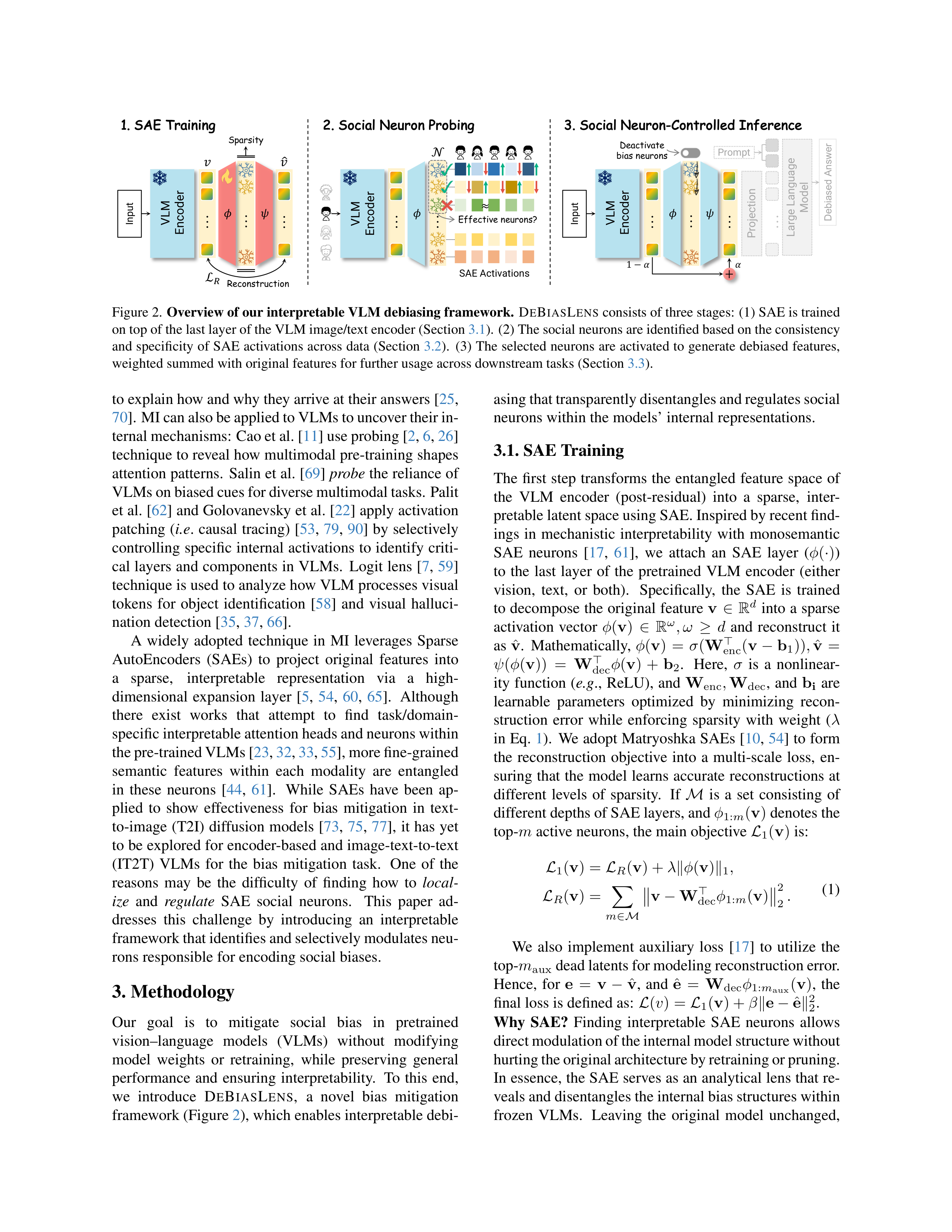
Figure 2.
Overview of our interpretable VLM debiasing framework.
D
E
B
IAS
L
ENS
consists of three stages:
(1) SAE is trained
on top of the last layer of the VLM image/text encoder (Section
3.1
).
(2) The social neurons are identified based on the consistency
and specificity of SAE activations across data (Section
3.2
).
(3) The selected neurons are activated to generate debiased features,
weighted summed with original features for further usage across downstream tasks (Section
3.3
).
to explain how and why they arrive at their answers [
25
,
70
]. MI can also be applied to VLMs to uncover their in-
ternal mechanisms: Cao et al. [
11
] use probing [
2
,
6
,
26
]
technique to reveal how multimodal pre-training shapes
attention patterns.
Salin et al. [
69
]
probe
the reliance of
VLMs on biased cues for diverse multimodal tasks. Palit
et al. [
62
] and Golovanevsky et al. [
22
] apply activation
patching (
i.e
. causal tracing) [
53
,
79
,
90
] by selectively
controlling specific internal activations to identify criti-
cal layers and components in VLMs.
Logit lens [
7
,
59
]
technique is used to analyze how VLM processes visual
tokens
for
object
identification
[
58
]
and
visual
halluci-
nation detection [
35
,
37
,
66
].
A
widely
adopted
technique
in
MI
leverages
Sparse
AutoEncoders
(SAEs)
to
project
original
features
into
a
sparse,
interpretable
representation
via
a
high-
dimensional
expansion
layer
[
5
,
54
,
60
,
65
].
Although
there
exist
works
that
attempt
to
find
task/domain-
specific interpretable attention heads and neurons within
the pre-trained VLMs [
23
,
32
,
33
,
55
], more fine-grained
semantic
features
within
each
modality
are
entangled
in
these
neurons
[
44
,
61
].
While
SAEs
have
been
ap-
plied
to
show
effectiveness
for
bias
mitigation
in
text-
to-image (T2I) diffusion models [
73
,
75
,
77
],
it has yet
to be explored for encoder-based and image-text-to-text
(IT2T)
VLMs
for
the
bias
mitigation
task.
One
of
the
reasons
may
be
the
difficulty
of
finding
how
to
local-
ize
and
regulate
SAE
social
neurons.
This
paper
ad-
dresses
this
challenge
by
introducing
an
interpretable
framework that identifies and selectively modulates neu-
rons responsible for encoding social biases.
3. Methodology
Our
goal
is
to
mitigate
social
bias
in
pretrained
vision–language
models
(VLMs)
without
modifying
model
weights
or
retraining,
while
preserving
general
performance
and
ensuring
interpretability.
To
this
end,
we
introduce
D
E
B
IAS
L
ENS
,
a
novel
bias
mitigation
framework (Figure
2
), which enables interpretable debi-
asing that transparently disentangles and regulates social
neurons within the models’ internal representations.
3.1. SAE Training
The
first
step
transforms
the
entangled
feature
space
of
the
VLM
encoder
(post-residual)
into
a
sparse,
inter-
pretable latent space using SAE. Inspired by recent find-
ings
in
mechanistic
interpretability
with
monosemantic
SAE
neurons
[
17
,
61
],
we
attach
an
SAE
layer
(
ϕ
(
·
)
)
to
the
last
layer
of
the
pretrained
VLM
encoder
(either
vision,
text,
or
both).
Specifically,
the
SAE
is
trained
to decompose the original feature
v
∈
R
d
into a sparse
activation
vector
ϕ
(
v
)
∈
R
ω
, ω
≥
d
and
reconstruct
it
as
ˆ
v
.
Mathematically,
ϕ
(
v
)
=
σ
(
W
⊤
enc
(
v
−
b
1
))
,
ˆ
v
=
ψ
(
ϕ
(
v
))
=
W
⊤
dec
ϕ
(
v
) +
b
2
.
Here,
σ
is
a
nonlinear-
ity function (
e.g
.,
ReLU), and
W
enc
,
W
dec
,
and
b
i
are
learnable
parameters
optimized
by
minimizing
recon-
struction
error
while
enforcing
sparsity
with
weight
(
λ
in Eq.
1
).
We adopt Matryoshka SAEs [
10
,
54
] to form
the
reconstruction
objective
into
a
multi-scale
loss,
en-
suring that the model learns accurate reconstructions at
different
levels
of
sparsity.
If
M
is
a
set
consisting
of
different depths of SAE layers, and
ϕ
1:
m
(
v
)
denotes the
top-
m
active neurons, the main objective
L
1
(
v
)
is:
L
1
(
v
) =
L
R
(
v
) +
λ
∥
ϕ
(
v
)
∥
1
,
L
R
(
v
) =
X
m
∈M
v
−
W
⊤
dec
ϕ
1:
m
(
v
)
2
2
.
(1)
We
also
implement
auxiliary
loss
[
17
]
to
utilize
the
top-
m
aux
dead latents for modeling reconstruction error.
Hence,
for
e
=
v
−
ˆ
v
,
and
ˆ
e
=
W
dec
ϕ
1:
m
aux
(
v
)
,
the
final loss is defined as:
L
(
v
) =
L
1
(
v
) +
β
∥
e
−
ˆ
e
∥
2
2
.
Why
SAE?
Finding
interpretable
SAE
neurons
allows
direct modulation of the internal model structure without
hurting the original architecture by retraining or pruning.
In essence, the SAE serves as an analytical lens that re-
veals and disentangles the internal bias structures within
frozen
VLMs.
Leaving
the
original
model
unchanged,





Same G, R & A
Random
Same G
Same R
Same A
Same G & A
Same G & R
Same R & A
Same G, R & A
+0.24
Random
Same G
Same R
Same A
Same G & A
Same G & R
Same R & A
Same G, R & A
+0.14
Cosine Similarity
Group of Pairs
Group of Pairs
…
Encoder
…
SAE-Attatched
Original
…
Encoder
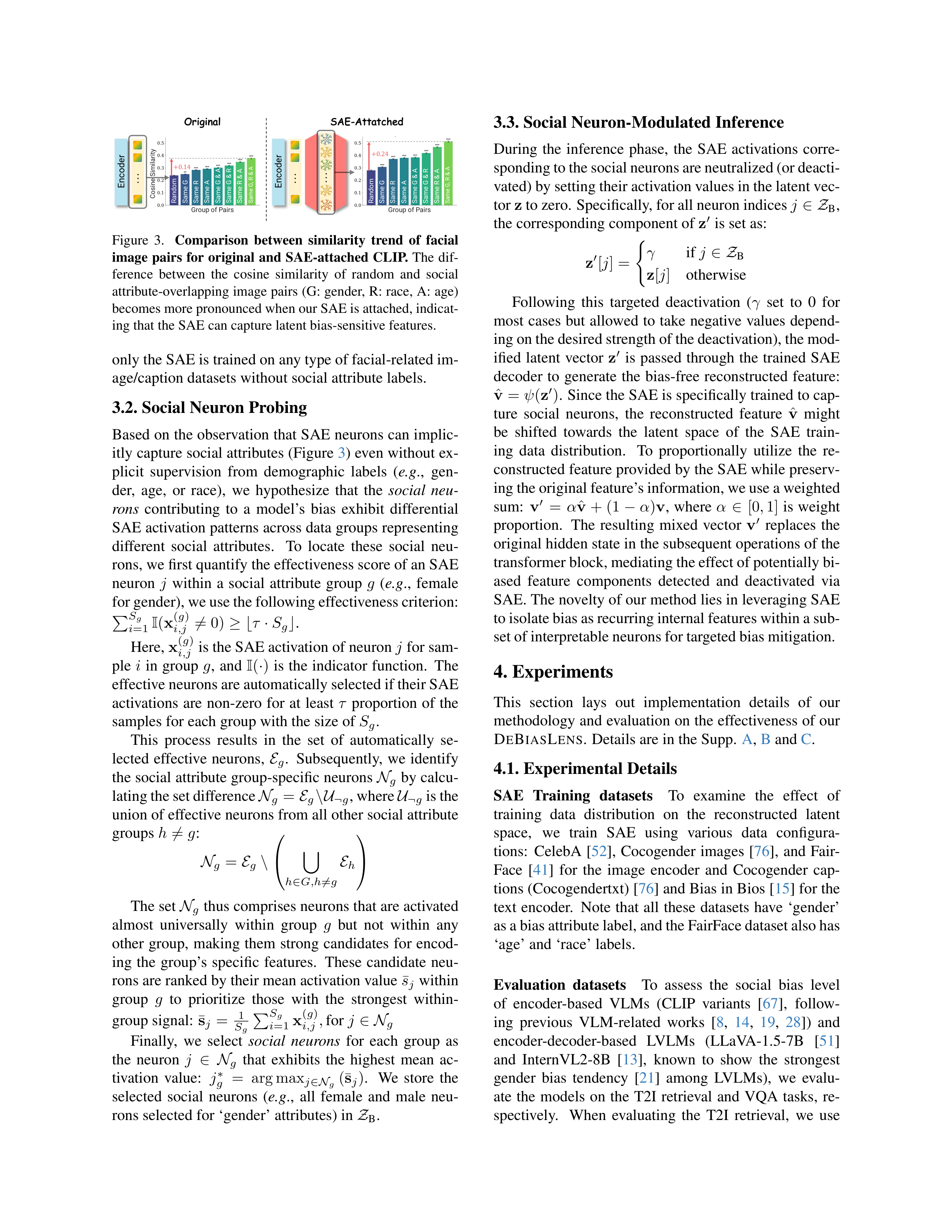
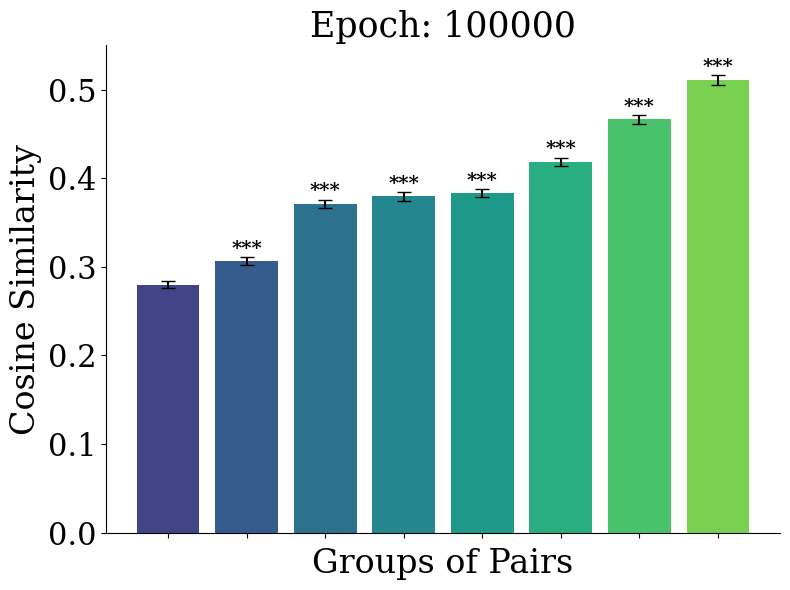
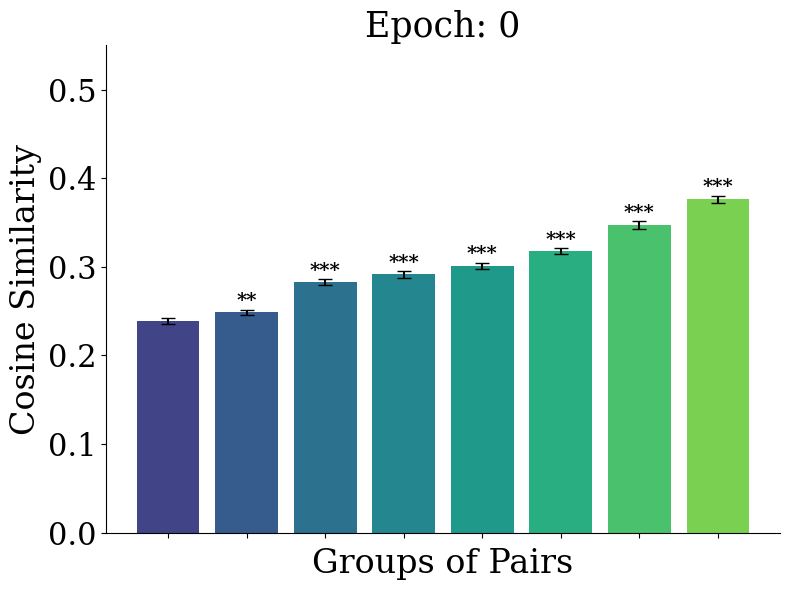
Figure
3.
Comparison
between
similarity
trend
of
facial
image
pairs
for
original
and
SAE-attached
CLIP.
The
dif-
ference
between
the
cosine
similarity
of
random
and
social
attribute-overlapping image pairs (G: gender, R: race, A: age)
becomes more pronounced when our SAE is attached, indicat-
ing that the SAE can capture latent bias-sensitive features.
only the SAE is trained on any type of facial-related im-
age/caption datasets without social attribute labels.
3.2. Social Neuron Probing
Based on the observation that SAE neurons can implic-
itly capture social attributes (Figure
3
) even without ex-
plicit
supervision
from
demographic
labels
(
e.g
.,
gen-
der,
age,
or
race),
we
hypothesize
that
the
social
neu-
rons
contributing
to
a
model’s
bias
exhibit
differential
SAE activation patterns across data groups representing
different
social
attributes.
To
locate
these
social
neu-
rons, we first quantify the effectiveness score of an SAE
neuron
j
within
a
social
attribute
group
g
(
e.g
.,
female
for gender), we use the following effectiveness criterion:
P
S
g
i
=1
I
(
x
(
g
)
i,j
̸
= 0)
≥⌊
τ
·
S
g
⌋
.
Here,
x
(
g
)
i,j
is the SAE activation of neuron
j
for sam-
ple
i
in group
g
,
and
I
(
·
)
is the indicator function.
The
effective neurons are automatically selected if their SAE
activations
are
non-zero
for
at
least
τ
proportion
of
the
samples for each group with the size of
S
g
.
This
process
results
in
the
set
of
automatically
se-
lected
effective
neurons,
E
g
.
Subsequently,
we
identify
the social attribute group-specific neurons
N
g
by calcu-
lating the set difference
N
g
=
E
g
\U
¬
g
, where
U
¬
g
is the
union of effective neurons from all other social attribute
groups
h
̸
=
g
:
N
g
=
E
g
\
[
h
∈
G,h
̸
=
g
E
h
The set
N
g
thus comprises neurons that are activated
almost
universally
within
group
g
but
not
within
any
other group,
making
them
strong
candidates
for encod-
ing
the
group’s
specific
features.
These
candidate
neu-
rons are ranked by their mean activation value
¯
s
j
within
group
g
to
prioritize
those
with
the
strongest
within-
group signal:
¯
s
j
=
1
S
g
P
S
g
i
=1
x
(
g
)
i,j
,
for
j
∈N
g
Finally,
we
select
social
neurons
for
each
group
as
the
neuron
j
∈N
g
that
exhibits
the
highest
mean
ac-
tivation
value:
j
∗
g
=
arg max
j
∈N
g
(¯
s
j
)
.
We
store
the
selected
social
neurons
(
e.g
.,
all
female
and
male
neu-
rons selected for ‘gender’ attributes) in
Z
B
.
3.3. Social Neuron-Modulated Inference
During
the
inference
phase,
the
SAE
activations
corre-
sponding to the social neurons are neutralized (or deacti-
vated) by setting their activation values in the latent vec-
tor
z
to zero.
Specifically, for all neuron indices
j
∈Z
B
,
the corresponding component of
z
′
is set as:
z
′
[
j
] =
(
γ
if
j
∈Z
B
z
[
j
]
otherwise
Following
this
targeted
deactivation
(
γ
set
to
0
for
most cases but allowed to take negative values depend-
ing on the desired strength of the deactivation), the mod-
ified
latent
vector
z
′
is
passed
through
the
trained
SAE
decoder
to
generate
the
bias-free
reconstructed
feature:
ˆ
v
=
ψ
(
z
′
)
.
Since the SAE is specifically trained to cap-
ture
social
neurons,
the
reconstructed
feature
ˆ
v
might
be
shifted
towards
the
latent
space
of
the
SAE
train-
ing
data
distribution.
To
proportionally
utilize
the
re-
constructed feature provided by the SAE while preserv-
ing the original feature’s information, we use a weighted
sum:
v
′
=
α
ˆ
v
+ (1
−
α
)
v
, where
α
∈
[0
,
1]
is weight
proportion.
The
resulting
mixed
vector
v
′
replaces
the
original hidden state in the subsequent operations of the
transformer block, mediating the effect of potentially bi-
ased
feature
components
detected
and
deactivated
via
SAE. The novelty of our method lies in leveraging SAE
to isolate bias as recurring internal features within a sub-
set of interpretable neurons for targeted bias mitigation.
4. Experiments
This
section
lays
out
implementation
details
of
our
methodology and evaluation on the effectiveness of our
D
E
B
IAS
L
ENS
.
Details are in the Supp.
A
,
B
and
C
.
4.1. Experimental Details
SAE
Training
datasets
To
examine
the
effect
of
training
data
distribution
on
the
reconstructed
latent
space,
we
train
SAE
using
various
data
configura-
tions:
CelebA [
52
],
Cocogender images [
76
],
and Fair-
Face
[
41
]
for
the
image
encoder
and
Cocogender
cap-
tions (Cocogendertxt) [
76
] and Bias in Bios [
15
] for the
text
encoder.
Note
that
all
these
datasets
have
‘gender’
as a bias attribute label, and the FairFace dataset also has
‘age’ and ‘race’ labels.
Evaluation
datasets
To
assess
the
social
bias
level
of
encoder-based
VLMs
(CLIP
variants
[
67
],
follow-
ing
previous
VLM-related
works
[
8
,
14
,
19
,
28
])
and
encoder-decoder-based
LVLMs
(LLaVA-1.5-7B
[
51
]
and
InternVL2-8B
[
13
],
known
to
show
the
strongest
gender
bias
tendency
[
21
]
among
LVLMs),
we
evalu-
ate
the
models
on
the
T2I
retrieval
and
VQA
tasks,
re-
spectively.
When
evaluating
the
T2I
retrieval,
we
use
10,954 cropped facial datasets in FairFace
[
41
], follow-
ing
[
28
,
72
].
The
social
bias
attribute
labels
in
these
datasets
are
gender,
age,
and
race.
The
text
prompts
used as inputs for T2I retrieval consist of 29 adjectives,
41 occupations, and 33 activities (spanning 12, 7, and 6
unique
templates)
[
28
].
We
exclude
the
age
groups
of
“0-2”
and
“more
than
70”
for
the
occupation
category.
We also test 25 stereotype text prompts [
19
].
When
evaluating
LVLMs,
we
use
two
recent
bench-
marks: VLAGenderBias (VLA) [
21
] and SBBench [
57
].
The
former
consists
of
5k
facial
images
with
gender
bias
attributes
collected
from
various
data
sources
[
18
,
41
,
71
,
72
],
and
the
latter
benchmark
consists
of
14.6k
images labeled with nine social attributes
1
pooled from
web
search.
The
sources
of
text
prompts
are
pooled
from
various
sources
[
38
,
47
,
91
]
for
VLA
(prompts:
occupation,
sentiment,
and
skills)
and
BBQ
[
64
]
for
SBBench.
All
these
datasets
are
distributed
fairly
across
pre-defined
social
attributes
(
e.g
.,
gender).
We
use
ImageNette
[
29
]
and
VLMEvalKit
MME
[
12
]-
measured
with
the
sum
of
perception
and
reasoning
scores,
MMMU-dev
[
87
],
and
Seed-Bench-2
[
49
])
for
general performance evaluation [
16
].
Evaluation metrics
Following previous works [
8
,
14
,
19
,
27
,
39
], we use Max Skew to quantify how much the
distribution of retrieved images approximates a uniform
distribution
across
different
demographics
per
bias
at-
tribute.
For benchmarking LVLMs, the bias is measured
in
two
ways:
(1)
The
proportion
of
statistically
differ-
ent
answers
of
“yes”
between
male
and
female-labeled
data (denoted as gender disproportion rate) [
21
], and (2)
The accuracy of correctly answering bias probing ques-
tions,
such as opting for “cannot be determined,”
given
the image-text pair with no definite correct answers [
57
].
Comparison methods
We compare our approach ap-
plied to VLM with the following methods:
Prompt
[
8
]
learns
prefix
embeddings
for
text
queries
using
a
com-
bined
adversarial
and
contrastive
learning
objective.
Projection
[
14
]
uses
a
closed-form
projection
matrix
to
remove
biased
directions
from
the
text
embeddings
without
additional
data
or
training.
Bend-VLM
[
19
]
is
a
nonlinear,
fine-tuning-free
approach
that
debiases
VLM embeddings by customizing the debiasing process
for
each
input
using
spurious
and
augmented
prompts.
SANER
[
28
]
neutralizes
text
features
by
erasing
at-
tribute
information
only
from
attribute-neutral
text
in-
puts.
We
use
the
variation
of
MMNeuron
[
33
],
which
identifies
bias
attribute-specific
neurons
within
the
pre-
trained layers of VLM encoders.
1
Due to the sample insufficiency for certain social attributes (
e.g
.,
physical appearance), we test perceived gender and age attributes.
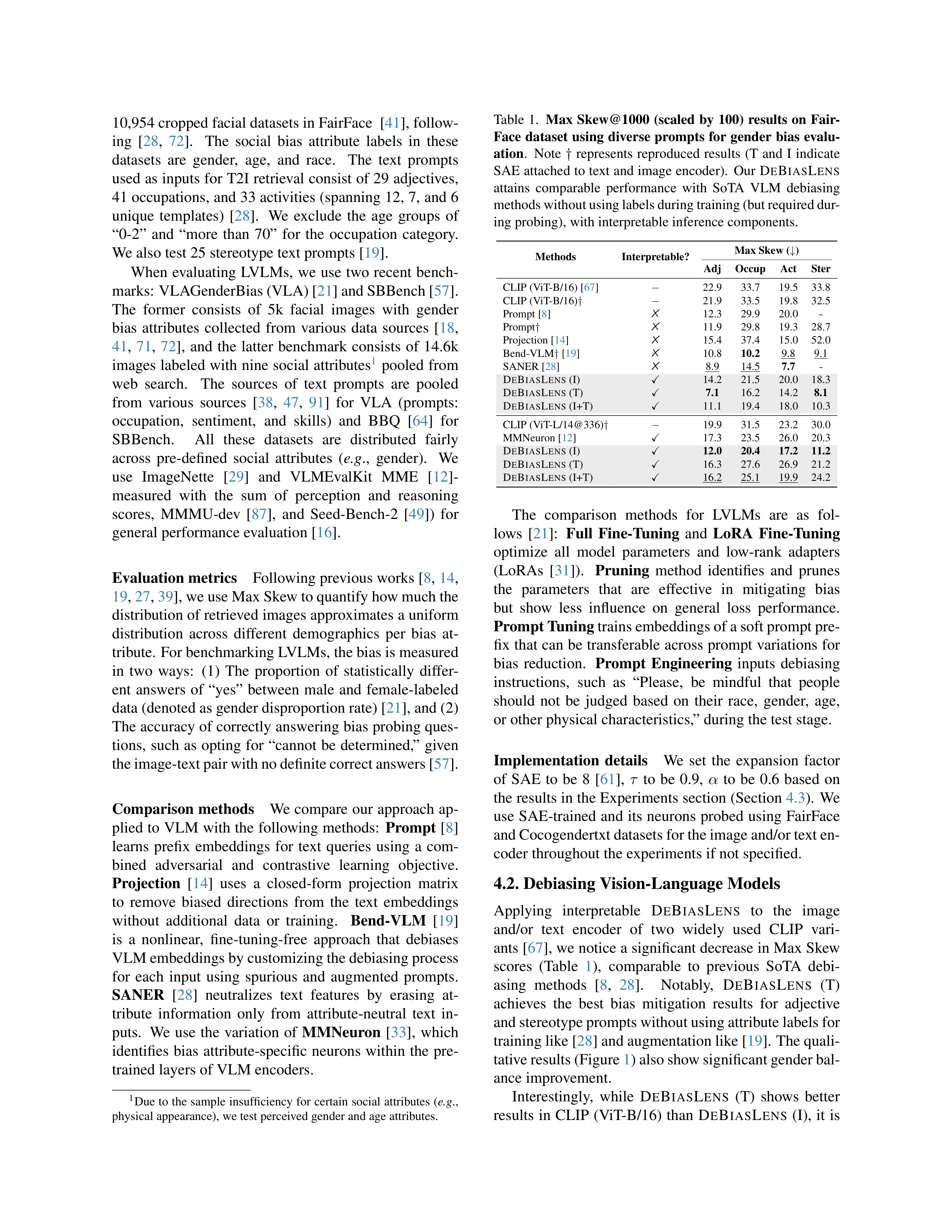
Table
1.
Max
Skew@1000
(scaled
by
100)
results
on
Fair-
Face dataset using
diverse prompts for gender
bias
evalu-
ation
.
Note
†
represents
reproduced
results
(T
and
I
indicate
SAE attached to text and image encoder).
Our
D
E
B
IAS
L
ENS
attains
comparable
performance
with
SoTA
VLM
debiasing
methods without using labels during training (but required dur-
ing probing), with interpretable inference components.
Methods
Interpretable?
Max Skew (
↓
)
Adj
Occup
Act
Ster
CLIP (ViT-B/16) [
67
]
−
22.9
33.7
19.5
33.8
CLIP (ViT-B/16)
†
−
21.9
33.5
19.8
32.5
Prompt [
8
]
12.3
29.9
20.0
-
Prompt
†
11.9
29.8
19.3
28.7
Projection [
14
]
15.4
37.4
15.0
52.0
Bend-VLM
†
[
19
]
10.8
10.2
9.8
9.1
SANER [
28
]
8.9
14.5
7.7
-
D
E
B
IAS
L
ENS
(I)
✓
14.2
21.5
20.0
18.3
D
E
B
IAS
L
ENS
(T)
✓
7.1
16.2
14.2
8.1
D
E
B
IAS
L
ENS
(I+T)
✓
11.1
19.4
18.0
10.3
CLIP (ViT-L/14@336)
†
−
19.9
31.5
23.2
30.0
MMNeuron [
12
]
✓
17.3
23.5
26.0
20.3
D
E
B
IAS
L
ENS
(I)
✓
12.0
20.4
17.2
11.2
D
E
B
IAS
L
ENS
(T)
✓
16.3
27.6
26.9
21.2
D
E
B
IAS
L
ENS
(I+T)
✓
16.2
25.1
19.9
24.2
The
comparison
methods
for
LVLMs
are
as
fol-
lows
[
21
]:
Full
Fine-Tuning
and
LoRA
Fine-Tuning
optimize
all
model
parameters
and
low-rank
adapters
(LoRAs
[
31
]).
Pruning
method
identifies
and
prunes
the
parameters
that
are
effective
in
mitigating
bias
but
show
less
influence
on
general
loss
performance.
Prompt Tuning
trains embeddings of a soft prompt pre-
fix that can be transferable across prompt variations for
bias
reduction.
Prompt
Engineering
inputs
debiasing
instructions,
such
as
“Please,
be
mindful
that
people
should
not
be
judged
based
on
their
race,
gender,
age,
or other physical characteristics,” during the test stage.
Implementation
details
We
set
the
expansion
factor
of
SAE
to
be
8
[
61
],
τ
to
be
0.9,
α
to
be
0.6
based
on
the results in the Experiments section (Section
4.3
).
We
use SAE-trained and its neurons probed using FairFace
and Cocogendertxt datasets for the image and/or text en-
coder throughout the experiments if not specified.
4.2. Debiasing Vision-Language Models
Applying
interpretable
D
E
B
IAS
L
ENS
to
the
image
and/or
text
encoder
of
two
widely
used
CLIP
vari-
ants [
67
], we notice a significant decrease in Max Skew
scores
(Table
1
),
comparable
to
previous
SoTA
debi-
asing
methods
[
8
,
28
].
Notably,
D
E
B
IAS
L
ENS
(T)
achieves
the
best
bias
mitigation
results
for
adjective
and stereotype prompts without using attribute labels for
training like [
28
] and augmentation like [
19
].
The quali-
tative results (Figure
1
) also show significant gender bal-
ance improvement.
Interestingly,
while
D
E
B
IAS
L
ENS
(T)
shows
better
results
in
CLIP
(ViT-B/16)
than
D
E
B
IAS
L
ENS
(I),
it
is
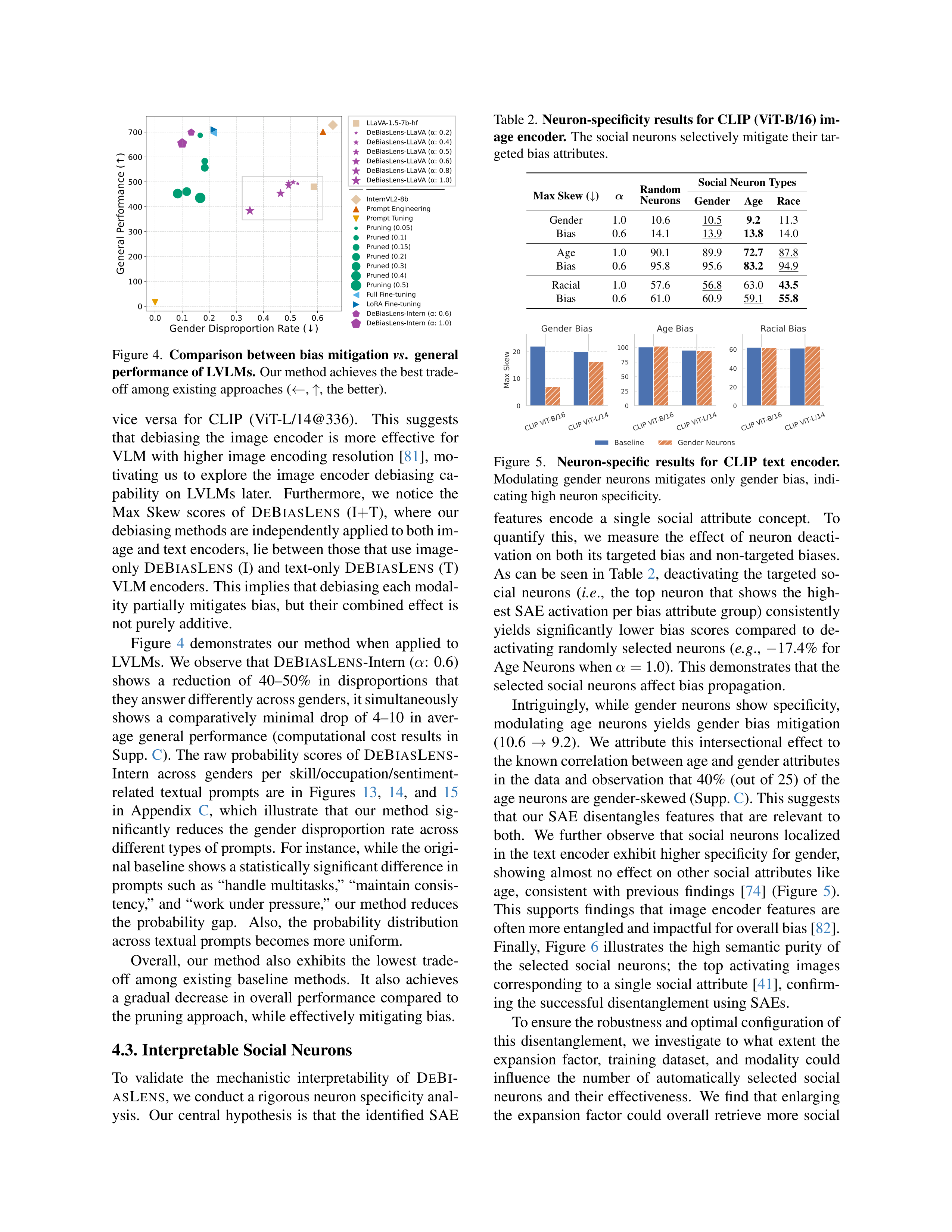
Figure 4.
Comparison between bias mitigation
vs
.
general
performance of LVLMs.
Our method achieves the best trade-
off among existing approaches (
←
,
↑
, the better).
vice
versa
for
CLIP
(ViT-L/14@336).
This
suggests
that
debiasing
the
image
encoder
is
more
effective
for
VLM
with
higher
image
encoding
resolution
[
81
],
mo-
tivating
us
to
explore
the
image
encoder
debiasing
ca-
pability
on
LVLMs
later.
Furthermore,
we
notice
the
Max
Skew
scores
of
D
E
B
IAS
L
ENS
(I
+
T),
where
our
debiasing methods are independently applied to both im-
age and text encoders, lie between those that use image-
only
D
E
B
IAS
L
ENS
(I) and text-only
D
E
B
IAS
L
ENS
(T)
VLM encoders. This implies that debiasing each modal-
ity
partially
mitigates
bias,
but
their
combined
effect
is
not purely additive.
Figure
4
demonstrates
our
method
when
applied
to
LVLMs.
We observe that D
E
B
IAS
L
ENS
-Intern (
α
:
0.6)
shows
a
reduction
of
40–50%
in
disproportions
that
they answer differently across genders, it simultaneously
shows
a
comparatively
minimal
drop
of
4–10
in
aver-
age
general
performance
(computational
cost
results
in
Supp.
C
). The raw probability scores of
D
E
B
IAS
L
ENS
-
Intern
across
genders
per
skill/occupation/sentiment-
related
textual
prompts
are
in
Figures
13
,
14
,
and
15
in
Appendix
C
,
which
illustrate
that
our
method
sig-
nificantly
reduces
the
gender
disproportion
rate
across
different types of prompts.
For instance, while the origi-
nal baseline shows a statistically significant difference in
prompts such as “handle multitasks,”
“maintain consis-
tency,”
and “work under pressure,”
our method reduces
the
probability
gap.
Also,
the
probability
distribution
across textual prompts becomes more uniform.
Overall,
our
method
also
exhibits
the
lowest
trade-
off
among
existing
baseline
methods.
It
also
achieves
a
gradual
decrease
in
overall
performance
compared
to
the pruning approach, while effectively mitigating bias.
4.3. Interpretable Social Neurons
To
validate
the
mechanistic
interpretability
of
D
E
B
I
-
AS
L
ENS
, we conduct a rigorous neuron specificity anal-
ysis.
Our
central
hypothesis
is
that
the
identified
SAE
Table 2.
Neuron-specificity results for CLIP (ViT-B/16) im-
age encoder.
The social neurons selectively mitigate their tar-
geted bias attributes.
Max Skew (
↓
)
α
Random
Neurons
Social Neuron Types
Gender
Age
Race
Gender
1.0
10.6
10.5
9.2
11.3
Bias
0.6
14.1
13.9
13.8
14.0
Age
1.0
90.1
89.9
72.7
87.8
Bias
0.6
95.8
95.6
83.2
94.9
Racial
1.0
57.6
56.8
63.0
43.5
Bias
0.6
61.0
60.9
59.1
55.8
CLIP ViT-B/16
CLIP ViT-L/14
0
10
20
Max Skew
Gender Bias
CLIP ViT-B/16
CLIP ViT-L/14
0
25
50
75
100
Age Bias
CLIP ViT-B/16
CLIP ViT-L/14
0
20
40
60
Racial Bias
Baseline
Gender Neurons
Figure
5.
Neuron-specific
results
for
CLIP
text
encoder.
Modulating
gender
neurons
mitigates
only
gender
bias,
indi-
cating high neuron specificity.
features
encode
a
single
social
attribute
concept.
To
quantify
this,
we
measure
the
effect
of
neuron
deacti-
vation on both its targeted bias and non-targeted biases.
As can be seen in Table
2
,
deactivating the targeted so-
cial
neurons
(
i.e
.,
the
top
neuron
that
shows
the
high-
est SAE activation per bias attribute group) consistently
yields
significantly
lower
bias
scores
compared
to
de-
activating randomly selected neurons (
e.g
.,
−
17.4% for
Age Neurons when
α
=
1.0). This demonstrates that the
selected social neurons affect bias propagation.
Intriguingly,
while
gender
neurons
show
specificity,
modulating
age
neurons
yields
gender
bias
mitigation
(10.6
→
9.2).
We
attribute
this
intersectional
effect
to
the known correlation between age and gender attributes
in
the
data
and
observation
that
40%
(out
of
25)
of
the
age neurons are gender-skewed (Supp.
C
). This suggests
that
our
SAE
disentangles
features
that
are
relevant
to
both.
We
further
observe
that
social
neurons
localized
in the text encoder exhibit higher specificity for gender,
showing
almost
no
effect
on
other
social
attributes
like
age,
consistent
with
previous
findings
[
74
]
(Figure
5
).
This
supports
findings
that
image
encoder
features
are
often more entangled and impactful for overall bias [
82
].
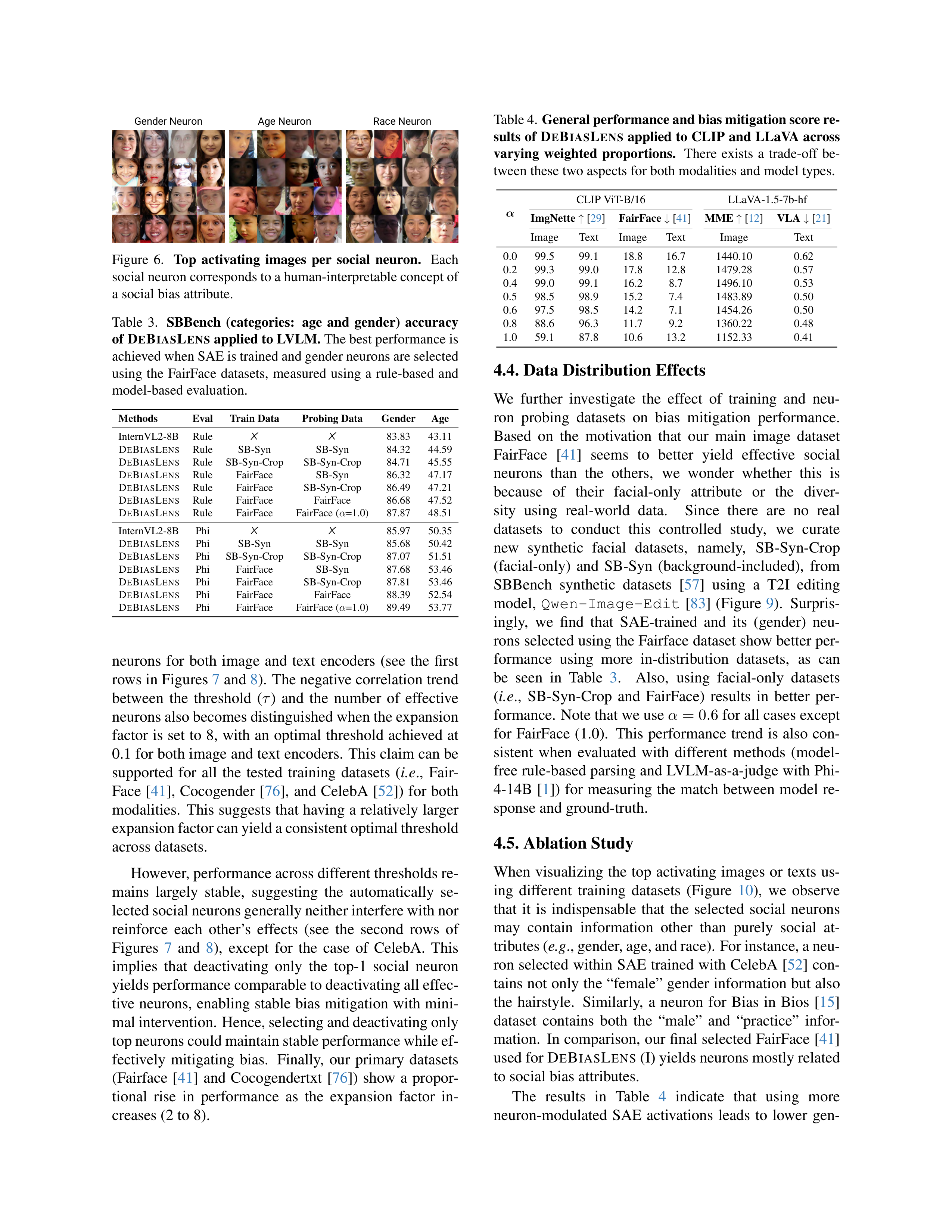
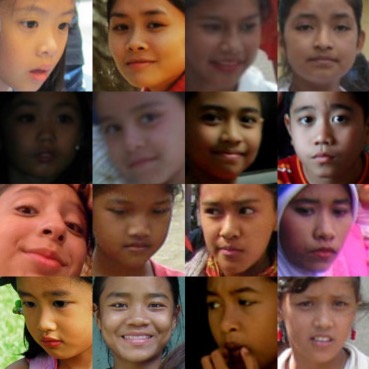
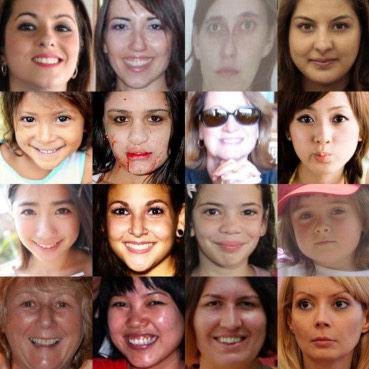
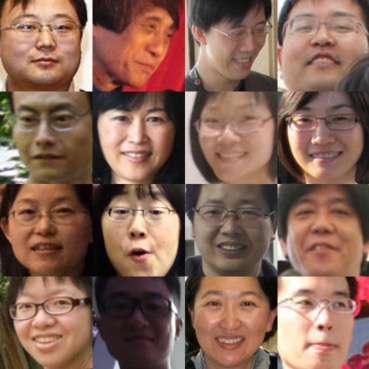
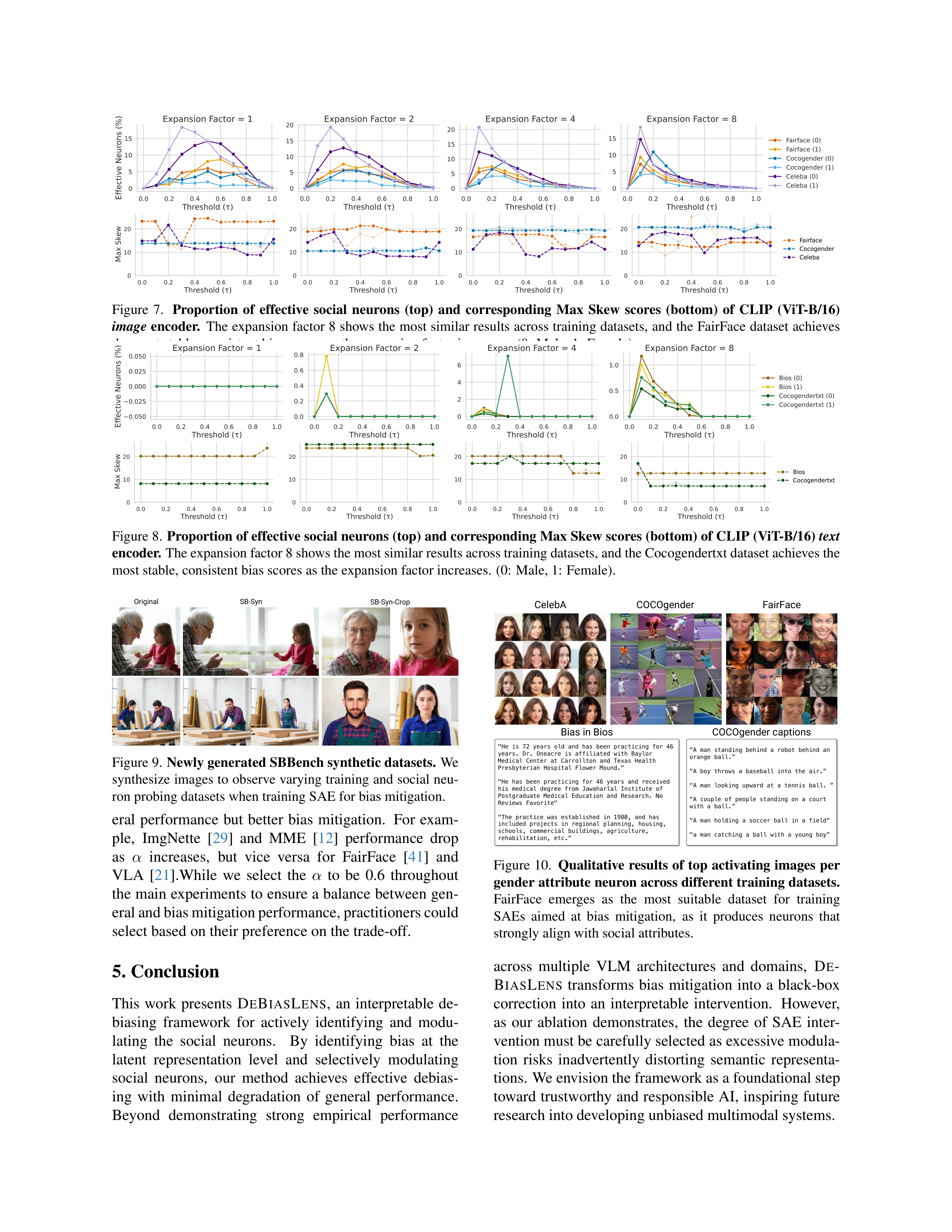
Finally,
Figure
6
illustrates
the
high
semantic
purity
of
the
selected
social
neurons;
the
top
activating
images
corresponding to a single social attribute [
41
], confirm-
ing the successful disentanglement using SAEs.
To ensure the robustness and optimal configuration of
this
disentanglement,
we
investigate
to
what
extent
the
expansion
factor,
training
dataset,
and
modality
could
influence
the
number
of
automatically
selected
social
neurons
and
their
effectiveness.
We
find
that
enlarging
the
expansion
factor
could
overall
retrieve
more
social
Age Neuron
Race Neuron
Gender Neuron
Figure
6.
Top
activating
images
per
social
neuron.
Each
social neuron corresponds to a human-interpretable concept of
a social bias attribute.
Table
3.
SBBench
(categories:
age
and
gender)
accuracy
of D
E
B
IAS
L
ENS
applied to LVLM.
The best performance is
achieved when SAE is trained and gender neurons are selected
using
the
FairFace
datasets,
measured
using
a
rule-based
and
model-based evaluation.
Methods
Eval
Train Data
Probing Data
Gender
Age
InternVL2-8B
Rule
83.83
43.11
D
E
B
IAS
L
ENS
Rule
SB-Syn
SB-Syn
84.32
44.59
D
E
B
IAS
L
ENS
Rule
SB-Syn-Crop
SB-Syn-Crop
84.71
45.55
D
E
B
IAS
L
ENS
Rule
FairFace
SB-Syn
86.32
47.17
D
E
B
IAS
L
ENS
Rule
FairFace
SB-Syn-Crop
86.49
47.21
D
E
B
IAS
L
ENS
Rule
FairFace
FairFace
86.68
47.52
D
E
B
IAS
L
ENS
Rule
FairFace
FairFace (
α
=1.0)
87.87
48.51
InternVL2-8B
Phi
85.97
50.35
D
E
B
IAS
L
ENS
Phi
SB-Syn
SB-Syn
85.68
50.42
D
E
B
IAS
L
ENS
Phi
SB-Syn-Crop
SB-Syn-Crop
87.07
51.51
D
E
B
IAS
L
ENS
Phi
FairFace
SB-Syn
87.68
53.46
D
E
B
IAS
L
ENS
Phi
FairFace
SB-Syn-Crop
87.81
53.46
D
E
B
IAS
L
ENS
Phi
FairFace
FairFace
88.39
52.54
D
E
B
IAS
L
ENS
Phi
FairFace
FairFace (
α
=1.0)
89.49
53.77
neurons
for
both
image
and
text
encoders
(see
the
first
rows in Figures
7
and
8
).
The negative correlation trend
between
the
threshold
(
τ
)
and
the
number
of
effective
neurons also becomes distinguished when the expansion
factor is set to 8,
with an optimal threshold achieved at
0.1 for both image and text encoders.
This claim can be
supported
for
all
the
tested
training
datasets
(
i.e
.,
Fair-
Face [
41
],
Cocogender [
76
],
and CelebA [
52
]) for both
modalities.
This suggests that having a relatively larger
expansion factor can yield a consistent optimal threshold
across datasets.
However, performance across different thresholds re-
mains
largely
stable,
suggesting
the
automatically
se-
lected social neurons generally neither interfere with nor
reinforce
each
other’s
effects
(see
the
second
rows
of
Figures
7
and
8
),
except
for
the
case
of
CelebA.
This
implies
that
deactivating
only
the
top-1
social
neuron
yields performance comparable to deactivating all effec-
tive neurons,
enabling stable bias mitigation with mini-
mal intervention. Hence, selecting and deactivating only
top neurons could maintain stable performance while ef-
fectively
mitigating
bias.
Finally,
our
primary
datasets
(Fairface
[
41
]
and
Cocogendertxt
[
76
])
show
a
propor-
tional
rise
in
performance
as
the
expansion
factor
in-
creases (2 to 8).
Table 4.
General performance and bias mitigation score re-
sults of
D
E
B
IAS
L
ENS
applied to CLIP and LLaVA across
varying
weighted
proportions.
There
exists
a
trade-off
be-
tween these two aspects for both modalities and model types.
α
CLIP ViT-B/16
LLaVA-1.5-7b-hf
ImgNette
↑
[
29
]
FairFace
↓
[
41
]
MME
↑
[
12
]
VLA
↓
[
21
]
Image
Text
Image
Text
Image
Text
0.0
99.5
99.1
18.8
16.7
1440.10
0.62
0.2
99.3
99.0
17.8
12.8
1479.28
0.57
0.4
99.0
99.1
16.2
8.7
1496.10
0.53
0.5
98.5
98.9
15.2
7.4
1483.89
0.50
0.6
97.5
98.5
14.2
7.1
1454.26
0.50
0.8
88.6
96.3
11.7
9.2
1360.22
0.48
1.0
59.1
87.8
10.6
13.2
1152.33
0.41
4.4. Data Distribution Effects
We
further
investigate
the
effect
of
training
and
neu-
ron
probing
datasets
on
bias
mitigation
performance.
Based
on
the
motivation
that
our
main
image
dataset
FairFace
[
41
]
seems
to
better
yield
effective
social
neurons
than
the
others,
we
wonder
whether
this
is
because
of
their
facial-only
attribute
or
the
diver-
sity
using
real-world
data.
Since
there
are
no
real
datasets
to
conduct
this
controlled
study,
we
curate
new
synthetic
facial
datasets,
namely,
SB-Syn-Crop
(facial-only)
and
SB-Syn
(background-included),
from
SBBench
synthetic
datasets
[
57
]
using
a
T2I
editing
model,
Qwen-Image-Edit
[
83
]
(Figure
9
).
Surpris-
ingly,
we
find
that
SAE-trained
and
its
(gender)
neu-
rons selected using the Fairface dataset show better per-
formance
using
more
in-distribution
datasets,
as
can
be
seen
in
Table
3
.
Also,
using
facial-only
datasets
(
i.e
.,
SB-Syn-Crop
and
FairFace)
results
in
better
per-
formance.
Note that we use
α
= 0
.
6
for all cases except
for
FairFace
(1.0).
This
performance
trend
is
also
con-
sistent
when
evaluated
with
different
methods
(model-
free rule-based parsing and LVLM-as-a-judge with Phi-
4-14B
[
1
])
for
measuring
the
match
between
model
re-
sponse and ground-truth.
4.5. Ablation Study
When
visualizing
the
top
activating
images
or
texts
us-
ing
different
training
datasets
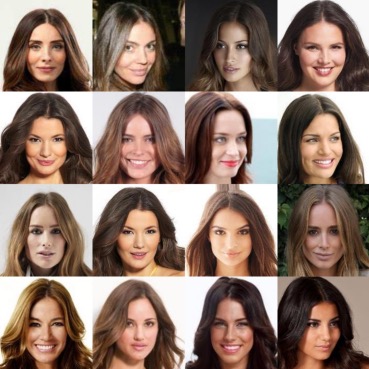
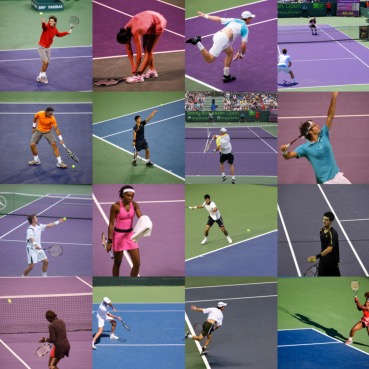
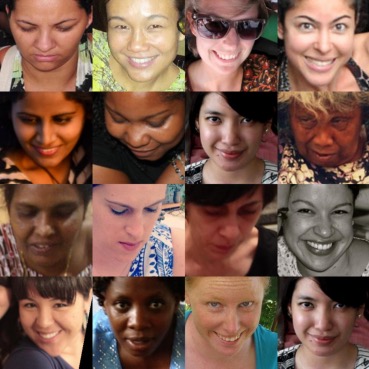
(Figure
10
),
we
observe
that
it
is
indispensable
that
the
selected
social
neurons
may
contain
information
other
than
purely
social
at-
tributes (
e.g
., gender, age, and race). For instance, a neu-
ron selected within SAE trained with CelebA [
52
] con-
tains not only the “female” gender information but also
the
hairstyle.
Similarly,
a
neuron
for
Bias
in
Bios
[
15
]
dataset
contains
both
the
“male”
and
“practice”
infor-
mation.
In comparison, our final selected FairFace [
41
]
used for D
E
B
IAS
L
ENS
(I) yields neurons mostly related
to social bias attributes.
The
results
in
Table
4
indicate
that
using
more
neuron-modulated
SAE
activations
leads
to
lower
gen-










Figure
7.
Proportion
of
effective
social
neurons
(top)
and
corresponding
Max
Skew
scores
(bottom)
of
CLIP
(ViT-B/16)
image
encoder.
The expansion factor 8 shows the most similar results across training datasets, and the FairFace dataset achieves
the most stable, consistent bias scores as the expansion factor increases.
(0:
Male, 1:
Female).
Figure 8.
Proportion of effective social neurons (top) and corresponding Max Skew scores (bottom) of CLIP (ViT-B/16)
text
encoder.
The expansion factor 8 shows the most similar results across training datasets, and the Cocogendertxt dataset achieves the
most stable, consistent bias scores as the expansion factor increases.
(0:
Male, 1:
Female).
Original
SB-Syn
SB-Syn-Crop
Figure 9.
Newly generated SBBench synthetic datasets.
We
synthesize images to observe varying training and social neu-
ron probing datasets when training SAE for bias mitigation.
eral
performance
but
better
bias
mitigation.
For
exam-
ple,
ImgNette
[
29
]
and
MME
[
12
]
performance
drop
as
α
increases,
but
vice
versa
for
FairFace
[
41
]
and
VLA
[
21
].While
we
select
the
α
to
be
0.6
throughout
the main experiments to ensure a balance between gen-
eral and bias mitigation performance, practitioners could
select based on their preference on the trade-off.
5. Conclusion
This
work
presents
D
E
B
IAS
L
ENS
,
an
interpretable
de-
biasing
framework
for
actively
identifying
and
modu-
lating
the
social
neurons.
By
identifying
bias
at
the
latent
representation
level
and
selectively
modulating
social
neurons,
our
method
achieves
effective
debias-
ing
with
minimal
degradation
of
general
performance.
Beyond
demonstrating
strong
empirical
performance
"A man standing behind a robot behind an
orange ball.”
"A boy throws a baseball into the air.”
"A man looking upward at a tennis ball. ”
"A couple of people standing on a court
with a ball.”
"A man holding a soccer ball in a field”
"a man catching a ball with a young boy”
Bias in Bios
"He is 72 years old and has been practicing for 46
years. Dr. Oneacre is affiliated with Baylor
Medical Center at Carrollton and Texas Health
Presbyterian Hospital Flower Mound."
"He has been practicing for 46 years and received
his medical degree from Jawaharlal Institute of
Postgraduate Medical Education and Research. No
Reviews Favorite"
"The practice was established in 1980, and has
included projects in regional planning, housing,
schools, commercial buildings, agriculture,
rehabilitation, etc."
COCOgender
FairFace
CelebA
COCOgender captions
Figure
10.
Qualitative
results
of
top
activating
images
per
gender attribute neuron across different training datasets.
FairFace
emerges
as
the
most
suitable
dataset
for
training
SAEs
aimed
at
bias
mitigation,
as
it
produces
neurons
that
strongly align with social attributes.
across
multiple
VLM
architectures
and
domains,
D
E
-
B
IAS
L
ENS
transforms
bias
mitigation
into
a
black-box
correction
into
an
interpretable
intervention.
However,
as
our
ablation
demonstrates,
the
degree
of
SAE
inter-
vention must be carefully selected as excessive modula-
tion
risks
inadvertently
distorting
semantic
representa-
tions.
We envision the framework as a foundational step
toward trustworthy and responsible AI, inspiring future
research into developing unbiased multimodal systems.
Acknowledgements
We
are
grateful
to
Haeun
Yu
and
Eunki
Kim
for
their
insightful comments and valuable discussion during the
early stages of this work.
References
[1]
Marah
Abdin,
Jyoti
Aneja,
Harkirat
Behl,
S´ebastien
Bubeck,
Ronen
Eldan,
Suriya
Gunasekar,
Michael
Har-
rison,
Russell
J
Hewett,
Mojan
Javaheripi,
Piero
Kauff-
mann,
et
al.
Phi-4
technical
report.
arXiv
preprint
arXiv:2412.08905
, 2024.
7
,
16
[2]
Guillaume Alain and Yoshua Bengio.
Understanding in-
termediate
layers
using
linear
classifier
probes.
arXiv
preprint arXiv:1610.01644
, 2016.
3
[3]
Na
Min
An,
Eunki
Kim,
James
Thorne,
and
Hyunjung
Shim.
I0t:
Embedding
standardization
method
towards
zero
modality
gap.
arXiv
preprint
arXiv:2412.14384
,
2024.
2
[4]
Anthropic.
Towards
monosemanticity:
Decomposing
language models with dictionary learning, 2023.
2
[5]
Sanjeev
Arora,
Yuanzhi
Li,
Yingyu
Liang,
Tengyu
Ma,
and Andrej Risteski.
Linear algebraic structure of word
senses,
with
applications
to
polysemy.
Transactions
of
the
Association
for
Computational
Linguistics
,
6:483–
495, 2018.
3
[6]
Nicholas
Bai,
Rahul
Ajay
Iyer,
Tuomas
Oikarinen,
and
Tsui-Wei Weng.
Describe-and-dissect:
Interpreting neu-
rons in vision networks with language models.
In
ICML
2024 Workshop on Mechanistic Interpretability
, 2024.
3
[7]
Nora
Belrose,
Zach
Furman,
Logan
Smith,
Danny
Ha-
lawi,
Igor
Ostrovsky,
Lev
McKinney,
Stella
Bider-
man,
and
Jacob
Steinhardt.
Eliciting
latent
predictions
from
transformers
with
the
tuned
lens.
arXiv
preprint
arXiv:2303.08112
, 2023.
3
[8]
Hugo
Berg,
Siobhan
Hall,
Yash
Bhalgat,
Hannah
Kirk,
Aleksandar
Shtedritski,
and
Max
Bain.
A
prompt
array
keeps
the
bias
away:
Debiasing
vision-language
mod-
els with adversarial learning.
In
Proceedings of the 2nd
Conference
of
the
Asia-Pacific
Chapter
of
the
Associa-
tion for Computational Linguistics and the 12th Interna-
tional Joint Conference on Natural Language Processing
(Volume 1:
Long Papers)
, pages 806–822, 2022.
2
,
4
,
5
,
13
,
14
[9]
Abeba
Birhane,
Vinay
Uday
Prabhu,
and
Emmanuel
Kahembwe.
Multimodal
datasets:
Misogyny,
pornog-
raphy,
and
malignant
stereotypes.
arXiv
preprint
arXiv:2110.01963
, 2021.
1
[10]
Bart
Bussmann,
Noa
Nabeshima,
Adam
Karvonen,
and
Neel
Nanda.
Learning
multi-level
features
with
matryoshka
sparse
autoencoders.
arXiv
preprint
arXiv:2503.17547
, 2025.
3
[11]
Jize
Cao,
Zhe
Gan,
Yu
Cheng,
Licheng
Yu,
Yen-Chun
Chen,
and
Jingjing
Liu.
Behind
the
scene:
Revealing
the secrets of pre-trained vision-and-language models. In
Computer
Vision–ECCV
2020:
16th
European
Confer-
ence,
Glasgow,
UK,
August
23–28,
2020,
Proceedings,
Part VI 16
, pages 565–580. Springer, 2020.
3
[12]
Fu
Chaoyou,
Chen
Peixian,
Shen
Yunhang,
Qin
Yulei,
Zhang Mengdan, Lin Xu, Yang Jinrui, Zheng Xiawu, Li
Ke, Sun Xing, et al.
Mme:
A comprehensive evaluation
benchmark for multimodal large language models.
arXiv
preprint arXiv:2306.13394
, 3, 2023.
5
,
7
,
8
,
16
[13]
Zhe
Chen,
Jiannan
Wu,
Wenhai
Wang,
Weijie
Su,
Guo
Chen,
Sen
Xing,
Muyan
Zhong,
Qinglong
Zhang,
Xizhou
Zhu,
Lewei
Lu,
et
al.
Internvl:
Scaling
up
vi-
sion
foundation
models
and
aligning
for
generic
visual-
linguistic tasks. In
Proceedings of the IEEE/CVF Confer-
ence on Computer Vision and Pattern Recognition
, pages
24185–24198, 2024.
1
,
4
,
15
,
16
[14]
Ching-Yao
Chuang,
Varun
Jampani,
Yuanzhen
Li,
An-
tonio
Torralba,
and
Stefanie
Jegelka.
Debiasing
vision-
language
models
via
biased
prompts.
arXiv
preprint
arXiv:2302.00070
, 2023.
1
,
2
,
4
,
5
,
14
[15]
Maria
De-Arteaga,
Alexey
Romanov,
Hanna
Wallach,
Jennifer
Chayes,
Christian
Borgs,
Alexandra
Choulde-
chova,
Sahin
Geyik,
Krishnaram
Kenthapadi,
and
Adam
Tauman
Kalai.
Bias
in
bios:
A
case
study
of
se-
mantic
representation
bias
in
a
high-stakes
setting.
In
proceedings of the Conference on Fairness, Accountabil-
ity, and Transparency
, pages 120–128, 2019.
4
,
7
,
13
[16]
Haodong
Duan,
Junming
Yang,
Yuxuan
Qiao,
Xinyu
Fang,
Lin Chen,
Yuan Liu,
Xiaoyi Dong,
Yuhang Zang,
Pan
Zhang,
Jiaqi
Wang,
et
al.
Vlmevalkit:
An
open-
source
toolkit
for
evaluating
large
multi-modality
mod-
els.
In
Proceedings of the 32nd ACM International Con-
ference on Multimedia
, pages 11198–11201, 2024.
5
,
16
[17]
Leo
Gao,
Tom
Dupr´e
la
Tour,
Henk
Tillman,
Gabriel
Goh,
Rajan
Troll,
Alec
Radford,
Ilya
Sutskever,
Jan
Leike,
and
Jeffrey
Wu.
Scaling
and
evaluating
sparse
autoencoders.
arXiv preprint arXiv:2406.04093
, 2024.
3
[18]
Noa
Garcia,
Yusuke
Hirota,
Yankun
Wu,
and
Yuta
Nakashima.
Uncurated
image-text
datasets:
Shedding
light
on
demographic
bias.
In
Proceedings
of
the
IEEE/CVF
Conference
on
Computer
Vision
and
Pattern
Recognition
, pages 6957–6966, 2023.
5
[19]
Walter Gerych,
Haoran Zhang,
Kimia Hamidieh,
Eileen
Pan,
Maanas
K
Sharma,
Tom
Hartvigsen,
and
Marzyeh
Ghassemi.
Bendvlm:
Test-time
debiasing
of
vision-
language
embeddings.
Advances
in
Neural
Information
Processing Systems
, 37:62480–62502, 2024.
2
,
4
,
5
,
14
[20]
Mor
Geva,
Roei
Schuster,
Jonathan
Berant,
and
Omer
Levy.
Transformer
feed-forward
layers
are
key-value
memories.
In
Proceedings
of
the
2021
Conference
on
Empirical
Methods
in
Natural
Language
Processing
,
pages 5484–5495, 2021.
2
[21]
Leander Girrbach, Stephan Alaniz, Yiran Huang, Trevor
Darrell,
and
Zeynep
Akata.
Revealing
and
reducing
gender biases in vision and language assistants (VLAs).
In
The Thirteenth International Conference on Learning
Representations
, 2025.
2
,
4
,
5
,
7
,
8
,
14
,
16
[22]
Michal
Golovanevsky,
William
Rudman,
Vedant
Palit,
Carsten
Eickhoff,
and
Ritambhara
Singh.
What
do
vlms
notice?
a
mechanistic
interpretability
pipeline
for
gaussian-noise-free
text-image
corruption
and
evalua-
tion.
In
Proceedings
of
the
2025
Conference
of
the
Nations
of
the
Americas
Chapter
of
the
Association
for
Computational Linguistics:
Human Language Technolo-
gies
(Volume
1:
Long
Papers)
,
pages
11462–11482,
2025.
3
[23]
Michal
Golovanevsky,
William
Rudman,
Vedant
Palit,
Carsten
Eickhoff,
and
Ritambhara
Singh.
What
do
vlms
notice?
a
mechanistic
interpretability
pipeline
for
gaussian-noise-free
text-image
corruption
and
evalua-
tion.
In
Proceedings
of
the
2025
Conference
of
the
Nations
of
the
Americas
Chapter
of
the
Association
for
Computational Linguistics:
Human Language Technolo-
gies
(Volume
1:
Long
Papers)
,
pages
11462–11482,
2025.
3
[24]
Kimia
Hamidieh,
Haoran
Zhang,
Walter
Gerych,
Thomas
Hartvigsen,
and
Marzyeh
Ghassemi.
Identify-
ing implicit social
biases in
vision-language
models.
In
Proceedings of the AAAI/ACM Conference on AI, Ethics,
and Society
, pages 547–561, 2024.
1
[25]
Sarah Hastings-Woodhouse.
Introduction to mechanistic
interpretability, 2024.
3
[26]
John
Hewitt
and
Christopher
D
Manning.
A
structural
probe for finding syntax in word representations.
In
Pro-
ceedings of the 2019 Conference of the North American
Chapter
of
the
Association
for
Computational
Linguis-
tics:
Human
Language
Technologies,
Volume
1
(Long
and Short Papers)
, pages 4129–4138, 2019.
3
[27]
Yusuke
Hirota,
Noa
Garcia,
Mayu
Otani,
Chenhui
Chu,
and
Yuta
Nakashima.
A
picture
may
be
worth
a
hun-
dred
words
for
visual
question
answering.
Electronics
,
13(21):4290, 2024.
5
[28]
Yusuke
Hirota,
Min-Hung
Chen,
Chien-Yi
Wang,
Yuta
Nakashima,
Yu-Chiang
Frank
Wang,
and
Ryo
Hachi-
uma.
SANER: Annotation-free societal attribute neutral-
izer for debiasing CLIP.
In
The Thirteenth International
Conference on Learning Representations
, 2025.
2
,
4
,
5
,
14
[29]
Jeremy Howard.
Imagenette: A smaller subset of 10 eas-
ily classified classes from imagenet, 2019.
5
,
7
,
8
[30]
Phillip
Howard,
Kathleen
C
Fraser,
Anahita
Bhiwandi-
walla,
and
Svetlana
Kiritchenko.
Uncovering
bias
in
large
vision-language
models
at
scale
with
counterfac-
tuals.
arXiv preprint arXiv:2405.20152
, 2024.
1
[31]
Edward J Hu, Yelong Shen, Phillip Wallis, Zeyuan Allen-
Zhu,
Yuanzhi
Li,
Shean
Wang,
Lu
Wang,
and
Weizhu
Chen. Lora: Low-rank adaptation of large language mod-
els.
arXiv preprint arXiv:2106.09685
, 2021.
2
,
5
[32]
Kaichen Huang,
Jiahao Huo,
Yibo Yan,
Kun Wang,
Yu-
tao Yue, and Xuming Hu.
Miner:
Mining the underlying
pattern of modality-specific neurons in multimodal large
language
models.
arXiv
preprint
arXiv:2410.04819
,
2024.
3
[33]
Jiahao
Huo,
Yibo
Yan,
Boren
Hu,
Yutao
Yue,
and
Xuming
Hu.
Mmneuron:
Discovering
neuron-level
domain-specific
interpretation
in
multimodal
large
lan-
guage
model.
arXiv
preprint
arXiv:2406.11193
,
2024.
3
,
5
[34]
Aaron
Hurst,
Adam
Lerer,
Adam
P
Goucher,
Adam
Perelman, Aditya Ramesh, Aidan Clark, AJ Ostrow, Ak-
ila Welihinda,
Alan Hayes,
Alec Radford,
et al.
Gpt-4o
system card.
arXiv preprint arXiv:2410.21276
, 2024.
1
[35]
Nick Jiang, Anish Kachinthaya, Suzie Petryk, and Yossi
Gandelsman.
Interpreting
and
editing
vision-language
representations to mitigate hallucinations.
arXiv preprint
arXiv:2410.02762
, 2024.
3
[36]
Yukun
Jiang,
Zheng
Li,
Xinyue
Shen,
Yugeng
Liu,
Michael Backes, and Yang Zhang.
Modscan:
Measuring
stereotypical
bias
in
large
vision-language
models
from
vision
and
language
modalities.
In
Proceedings
of
the
2024 Conference on Empirical Methods in Natural Lan-
guage Processing
, pages 12814–12845, 2024.
2
[37]
Zhangqi
Jiang,
Junkai
Chen,
Beier
Zhu,
Tingjin
Luo,
Yankun
Shen,
and
Xu
Yang.
Devils
in
middle
layers
of large vision-language models:
Interpreting,
detecting
and mitigating object hallucinations via attention lens. In
Proceedings of the Computer Vision and Pattern Recog-
nition Conference
, pages 25004–25014, 2025.
3
[38]
Kameni
Florentin
Flambeau
Jiechieu
and
Norbert
Tsopze.
Skills
prediction
based
on
multi-label
resume
classification using cnn with model predictions explana-
tion.
Neural Computing and Applications
, 33(10):5069–
5087, 2021.
5
[39]
Hoin
Jung,
Taeuk
Jang,
and
Xiaoqian
Wang.
A
unified
debiasing
approach
for
vision-language
models
across
modalities
and
tasks.
Advances
in
Neural
Information
Processing Systems
, 37:21034–21058, 2024.
2
,
5
[40]
Wan
Ju
Kang,
Eunki
Kim,
Na
Min
An,
Sangryul
Kim,
Haemin Choi, Ki Hoon Kwak, and James Thorne.
Sigh-
tation counts: Leveraging sighted user feedback in build-
ing
a
BLV-aligned
dataset
of
diagram
descriptions.
In
Proceedings of the 63rd Annual Meeting of the Associa-
tion for Computational Linguistics (Volume 1:
Long Pa-
pers)
, pages 27585–27621, Vienna, Austria, 2025. Asso-
ciation for Computational Linguistics.
1
[41]
Kimmo
K¨arkk¨ainen
and
Jungseock
Joo.
Fairface:
Face
attribute dataset for balanced race, gender, and age.
arXiv
preprint arXiv:1908.04913
, 2019.
4
,
5
,
6
,
7
,
8
,
13
[42]
Falaah
Arif
Khan,
Nivedha
Sivakumar,
Yinong
Oliver
Wang,
Katherine
Metcalf,
Cezanne
Camacho,
Barry-
John Theobald, Luca Zappella, and Nicholas Apostoloff.
Investigating
intersectional
bias
in
large
language
mod-
els using confidence disparities in coreference resolution.
arXiv preprint arXiv:2508.07111
, 2025.
1
[43]
Eunki
Kim,
Na
Min
An,
James
Thorne,
and
Hyunjung
Shim.
Multi-objective
task-aware
predictor
for
image-
text alignment.
arXiv preprint arXiv:2510.00766
, 2025.
1
[44]
Jinyeong
Kim,
Junhyeok
Kim,
Yumin
Shim,
Joohyeok
Kim,
Sunyoung Jung,
and Seong Jae Hwang.
Interpret-
ing
vision
transformers
via
residual
replacement
model.
arXiv preprint arXiv:2509.17401
, 2025.
3
[45]
Jun Seong Kim,
Kyaw Ye Thu,
Javad Ismayilzada,
Jun-
yeong
Park,
Eunsu
Kim,
Huzama
Ahmad,
Na
Min
An,
James
Thorne,
and
Alice
Oh.
When
tom
eats
kimchi:
Evaluating
cultural
bias
of
multimodal
large
language
models
in
cultural
mixture
contexts.
arXiv
preprint
arXiv:2503.16826
, 2025.
1
[46]
Fanjie
Kong,
Shuai
Yuan,
Weituo
Hao,
and
Ricardo
Henao.
Mitigating test-time bias for fair image retrieval.
Advances in Neural Information Processing Systems
, 36,
2024.
2
[47]
Keita Kurita, Nidhi Vyas, Ayush Pareek, Alan W Black,
and
Yulia
Tsvetkov.
Measuring
bias
in
contextualized
word representations.
arXiv preprint arXiv:1906.07337
,
2019.
5
[48]
Nayeon
Lee,
Yejin
Bang,
Holy
Lovenia,
Samuel
Cahyawijaya,
Wenliang
Dai,
and
Pascale
Fung.
Survey
of social bias in vision-language models.
arXiv preprint
arXiv:2309.14381
, 2023.
1
[49]
Bohao
Li,
Yuying
Ge,
Yixiao
Ge,
Guangzhi
Wang,
Rui
Wang,
Ruimao
Zhang,
and
Ying
Shan.
Seed-bench:
Benchmarking
multimodal
large
language
models.
In
Proceedings of the IEEE/CVF Conference on Computer
Vision
and
Pattern
Recognition
,
pages
13299–13308,
2024.
5
,
16
[50]
Bo Li, Yuanhan Zhang, Dong Guo, Renrui Zhang, Feng
Li, Hao Zhang, Kaichen Zhang, Peiyuan Zhang, Yanwei
Li,
Ziwei
Liu,
et
al.
Llava-onevision:
Easy
visual
task
transfer.
arXiv preprint arXiv:2408.03326
, 2024.
15
[51]
Haotian Liu, Chunyuan Li, Qingyang Wu, and Yong Jae
Lee.
Visual instruction tuning.
Advances in neural infor-
mation processing systems
, 36:34892–34916, 2023.
1
,
4
,
15
,
16
[52]
Ziwei Liu, Ping Luo, Xiaogang Wang, and Xiaoou Tang.
Large-scale
celebfaces
attributes
(celeba)
dataset.
Re-
trieved August
, 15(2018):11, 2018.
4
,
7
[53]
Kevin
Meng,
David
Bau,
Alex
Andonian,
and
Yonatan
Belinkov.
Locating
and
editing
factual
associations
in
gpt.
Advances in neural information processing systems
,
35:17359–17372, 2022.
3
[54]
Noa Nabeshima.
Matryoshka sparse autoencoders.
In
AI
Alignment Forum
, 2024.
3
,
13
[55]
Danial
Namazifard
and
Lukas
Galke.
Isolating
culture
neurons
in
multilingual
large
language
models.
arXiv
preprint arXiv:2508.02241
, 2025.
3
[56]
Neel Nanda. A comprehensive mechanistic interpretabil-
ity explainer & glossary, 2021.
2
[57]
Vishal Narnaware, Ashmal Vayani, Rohit Gupta, Sirnam
Swetha,
and
Mubarak
Shah.
Sb-bench:
Stereotype
bias
benchmark for large multimodal models.
arXiv preprint
arXiv:2502.08779
, 2025.
5
,
7
,
13
,
14
[58]
Clement
Neo,
Luke
Ong,
Philip
Torr,
Mor
Geva,
David
Krueger, and Fazl Barez.
Towards interpreting visual in-
formation
processing
in
vision-language
models.
arXiv
preprint arXiv:2410.07149
, 2024.
3
[59]
nostalgebraist.
interpreting gpt:
the logit lens, 2020.
3
[60]
Chris Olah, Nick Cammarata, Ludwig Schubert, Gabriel
Goh,
Michael
Petrov,
and
Shan
Carter.
Zoom
in:
An
introduction to circuits.
Distill
, 5(3):e00024–001, 2020.
3
[61]
Mateusz
Pach,
Shyamgopal
Karthik,
Quentin
Bouniot,
Serge Belongie, and Zeynep Akata.
Sparse autoencoders
learn monosemantic features in vision-language models.
arXiv preprint arXiv:2504.02821
, 2025.
2
,
3
,
5
,
13
[62]
Vedant
Palit,
Rohan
Pandey,
Aryaman
Arora,
and
Paul
Pu
Liang.
Towards
vision-language
mechanistic
interpretability:
A
causal
tracing
tool
for
blip.
In
Pro-
ceedings
of
the
IEEE/CVF
International
Conference
on
Computer Vision
, pages 2856–2861, 2023.
3
[63]
NaHyeon Park, Namin An, Kunhee Kim, Soyeon Yoon,
Jiahao Huo, and Hyunjung Shim.
Aligned but stereotyp-
ical?
the
hidden
influence
of
system
prompts
on
social
bias in lvlm-based text-to-image models, 2025.
1
[64]
Alicia
Parrish,
Angelica
Chen,
Nikita
Nangia,
Vishakh
Padmakumar,
Jason
Phang,
Jana
Thompson,
Phu
Mon
Htut,
and
Samuel
R
Bowman.
Bbq:
A
hand-built
bias
benchmark
for
question
answering.
arXiv
preprint
arXiv:2110.08193
, 2021.
5
[65]
Kenny
Peng,
Rajiv
Movva,
Jon
Kleinberg,
Emma
Pier-
son,
and
Nikhil
Garg.
Use
sparse
autoencoders
to
dis-
cover unknown concepts, not to act on known concepts.
arXiv preprint arXiv:2506.23845
, 2025.
3
[66]
Anirudh
Phukan,
Divyansh
Divyansh,
Harshit
Kumar
Morj,
Vaishnavi
Vaishnavi,
Apoorv
Saxena,
and
Kous-
tava
Goswami.
Beyond
logit
lens:
Contextual
embed-
dings
for
robust
hallucination
detection
&
grounding
in
vlms.
In
Proceedings
of
the
2025
Conference
of
the
Nations
of
the
Americas
Chapter
of
the
Association
for
Computational Linguistics:
Human Language Technolo-
gies
(Volume 1:
Long
Papers)
,
pages
9661–9675,
2025.
3
[67]
Alec
Radford,
Jong
Wook
Kim,
Chris
Hallacy,
Aditya
Ramesh,
Gabriel
Goh,
Sandhini
Agarwal,
Girish
Sas-
try,
Amanda
Askell,
Pamela
Mishkin,
Jack
Clark,
et
al.
Learning
transferable
visual
models
from
natural
lan-
guage
supervision.
In
International
conference
on
ma-
chine learning
, pages 8748–8763. PmLR, 2021.
1
,
4
,
5
,
15
[68]
Mark
Ryan
and
Bernd
Carsten
Stahl.
Artificial
intelli-
gence
ethics
guidelines
for
developers
and
users:
clari-
fying their content and normative implications.
Journal
of Information, Communication and Ethics in Society
, 19
(1):61–86, 2021.
1
[69]
Emmanuelle Salin, Badreddine Farah, St´ephane Ayache,
and
Benoit
Favre.
Are
vision-language
transformers
learning multimodal representations?
a probing perspec-
tive. In
Proceedings of the AAAI Conference on Artificial
Intelligence
, pages 11248–11257, 2022.
3
[70]
Naomi
Saphra
and
Sarah
Wiegreffe.
Mechanistic?
In
Proceedings
of
the
7th
BlackboxNLP
Workshop:
Ana-
lyzing and Interpreting Neural Networks for NLP
, pages
480–498, 2024.
3
[71]
Candice Schumann, Susanna Ricco, Utsav Prabhu, Vitto-
rio Ferrari, and Caroline Pantofaru.
A step toward more
inclusive people annotations for fairness.
In
Proceedings
of
the
2021
AAAI/ACM
Conference
on
AI,
Ethics,
and
Society
, pages 916–925, 2021.
5
[72]
Ashish Seth, Mayur Hemani, and Chirag Agarwal.
Dear:
Debiasing
vision-language
models
with
additive
resid-
uals.
In
Proceedings
of
the
IEEE/CVF
Conference
on
Computer
Vision
and
Pattern
Recognition
,
pages
6820–
6829, 2023.
1
,
2
,
5
[73]
Yingdong
Shi,
Changming
Li,
Yifan
Wang,
Yongxiang
Zhao,
Anqi
Pang,
Sibei
Yang,
Jingyi
Yu,
and
Kan
Ren.
Dissecting and mitigating diffusion bias via mechanistic
interpretability.
In
Proceedings
of
the
Computer
Vision
and
Pattern
Recognition
Conference
,
pages
8192–8202,
2025.
3
[74]
Pushkar
Shukla,
Aditya
Chinchure,
Emily
Diana,
Alexander
Tolbert,
Kartik
Hosanagar,
Vineeth
N
Bala-
subramanian,
Leonid
Sigal,
and
Matthew
Turk.
Miti-
gate one, skew another?
tackling intersectional biases in
text-to-image models.
arXiv preprint arXiv:2505.17280
,
2025.
6
[75]
Viacheslav
Surkov,
Chris
Wendler,
Antonio
Mari,
Mikhail
Terekhov,
Justin
Deschenaux,
Robert
West,
Caglar
Gulcehre,
and
David
Bau.
One-step
is
enough:
Sparse autoencoders for text-to-image diffusion models.
arXiv preprint arXiv:2410.22366
, 2024.
3
[76]
Ruixiang Tang, Mengnan Du, Yuening Li, Zirui Liu, Na
Zou,
and
Xia
Hu.
Mitigating
gender
bias
in
captioning
systems.
In
Proceedings
of
the
Web
Conference
2021
,
pages 633–645, 2021.
4
,
7
[77]
Zhihua
Tian,
Sirun
Nan,
Ming
Xu,
Shengfang
Zhai,
Wenjie
Qu,
Jian
Liu,
Ruoxi
Jia,
and
Jiaheng
Zhang.
Sparse
autoencoder
as
a
zero-shot
classifier
for
concept
erasing in text-to-image diffusion models.
arXiv preprint
arXiv:2503.09446
, 2025.
3
[78]
Soobin
Um
and
Changho
Suh.
A
fair
generative
model
using lecam divergence. In
Proceedings of the AAAI con-
ference
on
artificial
intelligence
,
pages
10034–10042,
2023.
1
[79]
Jesse
Vig,
Sebastian
Gehrmann,
Yonatan
Belinkov,
Sharon
Qian,
Daniel
Nevo,
Yaron
Singer,
and
Stuart
Shieber.
Investigating
gender
bias
in
language
models
using causal mediation analysis.
Advances in neural in-
formation processing systems
, 33:12388–12401, 2020.
2
,
3
[80]
Jialu Wang, Yang Liu, and Xin Wang. Are gender-neutral
queries
really
gender-neutral?
mitigating
gender
bias
in
image
search.
In
Proceedings
of
the
2021
Conference
on Empirical Methods in Natural Language Processing
,
pages 1995–2008, 2021.
1
[81]
Zhaochen Wang, Bryan Hooi, Yiwei Wang, Ming-Hsuan
Yang, Zi Huang, and Yujun Cai.
Text speaks louder than
vision: Ascii art reveals textual biases in vision-language
models, 2025.
6
[82]
Zhaotian
Weng,
Zijun
Gao,
Jerone
Andrews,
and
Jieyu
Zhao.
Images
speak
louder
than
words:
Understand-
ing and mitigating bias in vision-language model from a
causal mediation perspective. In
Proceedings of the 2024
Conference on Empirical Methods in Natural Language
Processing
, pages 15669–15680, 2024.
2
,
6
[83]
Chenfei
Wu,
Jiahao
Li,
Jingren
Zhou,
Junyang
Lin,
Kaiyuan
Gao,
Kun
Yan,
Sheng-ming
Yin,
Shuai
Bai,
Xiao
Xu,
Yilei
Chen,
et
al.
Qwen-image
technical
re-
port.
arXiv preprint arXiv:2508.02324
, 2025.
7
,
14
[84]
Chao
Wu,
Zhenyi
Wang,
Kangxian
Xie,
Naresh
Kumar
Devulapally,
Vishnu
Suresh
Lokhande,
and
Mingchen
Gao.
Model-agnostic
gender
bias
control
for
text-to-
image generation via sparse autoencoder.
arXiv preprint
arXiv:2507.20973
, 2025.
1
[85]
Hanqi
Yan,
Xiangxiang
Cui,
Lu
Yin,
Paul
Pu
Liang,
Yulan
He,
and
Yifei
Wang.
Multi-faceted
multimodal
monosemanticity.
arXiv
preprint
arXiv:2502.14888
,
2025.
2
[86]
An
Yang,
Anfeng
Li,
Baosong
Yang,
Beichen
Zhang,
Binyuan Hui,
Bo Zheng,
Bowen Yu,
Chang Gao,
Chen-
gen
Huang,
Chenxu
Lv,
et
al.
Qwen3
technical
report.
arXiv preprint arXiv:2505.09388
, 2025.
1
[87]
Xiang
Yue,
Yuansheng
Ni,
Kai
Zhang,
Tianyu
Zheng,
Ruoqi
Liu,
Ge
Zhang,
Samuel
Stevens,
Dongfu
Jiang,
Weiming
Ren,
Yuxuan
Sun,
et
al.
Mmmu:
A
massive
multi-discipline
multimodal
understanding
and
reason-
ing
benchmark
for
expert
agi.
In
Proceedings
of
the
IEEE/CVF
Conference
on
Computer
Vision
and
Pattern
Recognition
, pages 9556–9567, 2024.
5
,
16
[88]
Xiaohua
Zhai,
Basil
Mustafa,
Alexander
Kolesnikov,
and
Lucas
Beyer.
Sigmoid
loss
for
language
image
pre-training.
In
Proceedings
of
the
IEEE/CVF
inter-
national
conference
on
computer
vision
,
pages
11975–
11986, 2023.
1
[89]
Haoyu Zhang,
Yangyang Guo,
and Mohan Kankanhalli.
Joint vision-language social bias removal for clip. In
Pro-
ceedings of the Computer Vision and Pattern Recognition
Conference
, pages 4246–4255, 2025.
2
[90]
Zhi
Zhang,
Srishti
Yadav,
Fengze
Han,
and
Ekaterina
Shutova.
Cross-modal
information
flow
in
multimodal
large
language
models.
In
Proceedings
of
the
Com-
puter Vision and Pattern Recognition Conference
, pages
19781–19791, 2025.
3
[91]
Jieyu
Zhao,
Tianlu
Wang,
Mark
Yatskar,
Vicente
Or-
donez,
and Kai-Wei Chang.
Gender bias in coreference
resolution:
Evaluation
and
debiasing
methods.
In
Pro-
ceedings of the 2018 Conference of the North American
Chapter
of
the
Association
for
Computational
Linguis-
tics:
Human
Language
Technologies,
Volume
2
(Short
Papers)
, pages 15–20, 2018.
5
Interpretable Debiasing of Vision-Language Models for Social Fairness
Supplementary Material
Overview
of
contents
This
supplementary
material
contains the following:
A. Training Details
13
B. Data Details
13
C. Additional Results
14
D. Limitation and Future Work
17
A. Training Details
Since
our
method
can
be
applied
to
any
encoders,
we
train the image/text encoder for Vision-Language Mod-
els
(VLMs)
and
the
image
encoder
for
Large
Vision-
Language
Models
(LVLMs)
(Table
5
).
For
training
the
sparse
autoencoder
(SAE),
we
employ
the
Ma-
tryoshka [
54
] variant with top-
k
(
=
20
) sparsity and hi-
erarchical grouping [
61
]. The original activations are ex-
tracted
from
the
corresponding
encoder
layers
for
both
training
and
validation,
with
a
batch
size
of
4096
and
expansion factors of 1, 2, 4, and 8 to control the dictio-
nary
size.
The
model
is
optimized
for
110,000
epochs,
and
the
weight
for
auxiliary
loss
is
set
to
be
0.03,
with
the
decay
of
learning
rate
starting
at
step
109,999.
We
divide the SAE neurons into four groups using the frac-
tions [0.0625, 0.125, 0.25, 0.5625], meaning that 6.25%,
12.50%,
25.00%,
and
56.25%
of
the
neurons
are
as-
signed to each group, respectively; this grouping lets us
evaluate hierarchical behavior at different levels of neu-
ron specificity.
B. Data Details
Real Data
To ensure the balanced selection of the so-
cial
neurons,
each
of
the
training
datasets
of
sparse
au-
toencoder (SAE) [
54
] has a fair distribution of social at-
tribute labels, as in the original dataset (statistics in Ta-
ble
13
).
For
instance,
the
gender
ratio
of
the
Bias
in
Bios
dataset
[
15
]
is
54:44
for
male
and
female
labels.
This
case
even
more
strictly
applies
to
the
evaluation
datasets.
As can be seen in Table
11
, the gender ratio of
the FairFace evaluation dataset
2
[
41
] is 50:50.
However,
for each group, the balance becomes uneven, notably in
the 20-29 age range.
This inherent skew in the data dis-
tribution
helps
explain
the
intersectional
effect
of
why
modulating the age neurons can effectively reduce gen-
der bias. Additionally, we observe 40% (out of 25) of the
2
From a total of 10,954 cropped images, we sample a subset with
a gender balanced distribution, following [
8
].
Table 5.
Overview of multimodal models.
The table lists the
image and text encoders used in VLMs and LVLMs considered
in this work.
Model
Type
Image Encoder
Text Encoder
CLIP (ViT-B/32)
VLM
ViT-B/32
Transformer (512-d)
CLIP (ViT-L/14@336)
VLM
ViT-L/14@336
Transformer (768-d)
LLaVA-1.5-7B
LVLM
ViT-L/14@336
–
LLaVAOneVision
LVLM
SigLIP-so400m/14@384
–
InternVL2-8B
LVLM
InternViT-300M@448px
–
3-9
10-19
20-29
30-39
40-49
50-59
60-69
70+
Age Group
0
250
500
750
1000
1250
1500
1750
Count
Gender
Female
Male
Figure 11.
Age distribution of FairFace evaluation dataset
across genders.
Although the gender distribution is balanced,
there is a skewed gender distribution per age group.
Age Neurons with Mixed Genders
Age Neurons with Skewed Gender
Figure 12.
Age neuron activating images.
age
neurons
are
gender-skewed
(Figure
12
).
Not
mod-
ulating these gender-skewed age neurons increases both
gender and age MaxSkews by 0.6% and 5.3% (
α
=
1
),
suggesting
these
are
indeed
age
neurons.
Note
that
all
the datasets are publicly available.
Synthetic
Data
To
explore
the
possibility
of
extend-
ing the real-world data to synthetic data for SAE training
and
probing,
we
generate
new
synthetic
datasets
from
the
SBBench
dataset
[
57
].
We
postprocess
the
images
corresponding to the age and gender category to enable
a direct comparison with realistic data, FairFace.
Since
the
images
from
other
categories
(
e.g
.,
religion,
socio-
economic status, disability) seem to have visual cues that
are
more
closely
related
to
the
contextual
factors
like
background or clothing,
we mainly test age and gender
categories in this work.
From
the
original
SBBench
synthetic
dataset
(760
and
672
samples
from
the
age
and
gender
categories),
we
remove
duplicates
to
obtain
627
and
302
im-
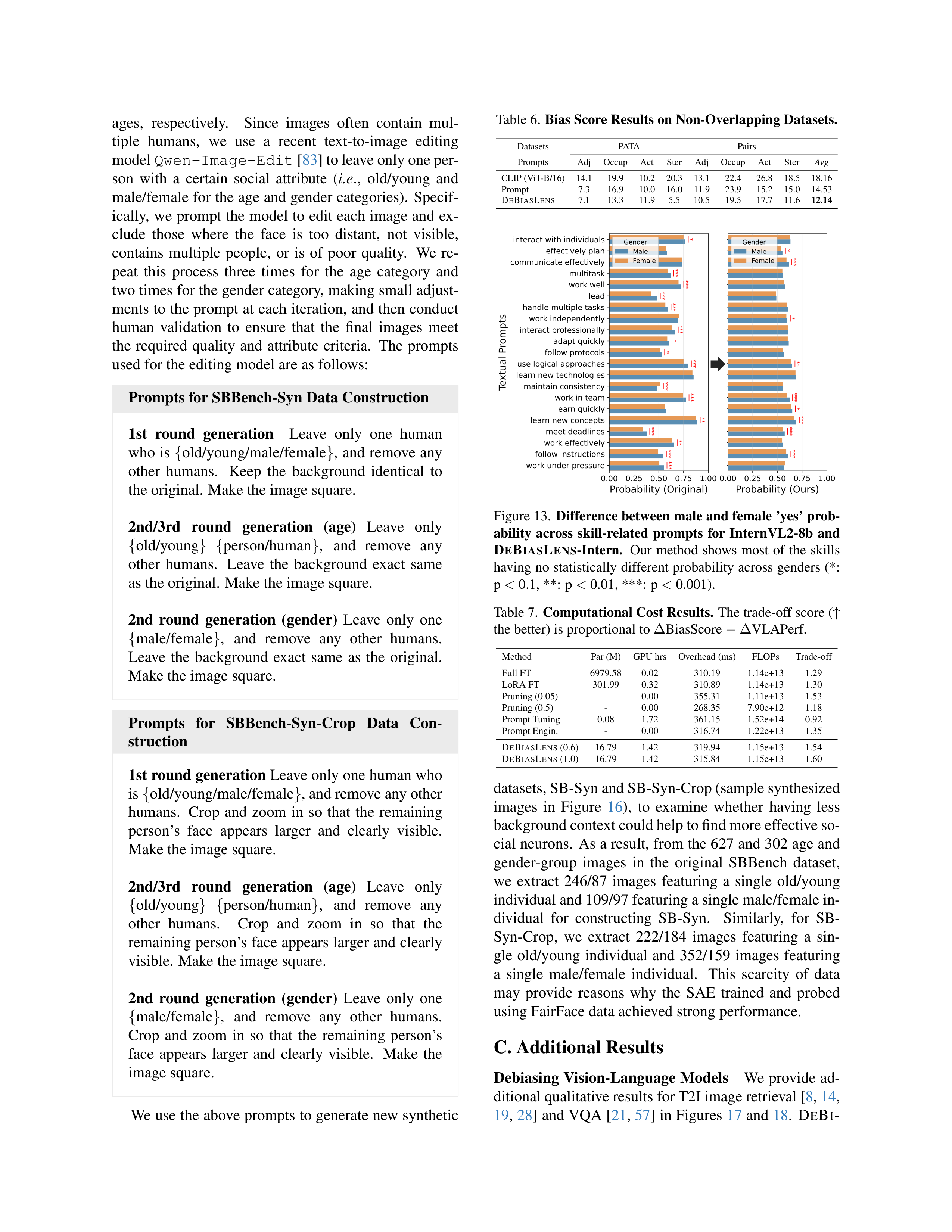
ages,
respectively.
Since
images
often
contain
mul-
tiple
humans,
we
use
a
recent
text-to-image
editing
model
Qwen-Image-Edit
[
83
] to leave only one per-
son
with
a
certain
social
attribute
(
i.e
.,
old/young
and
male/female for the age and gender categories).
Specif-
ically,
we prompt the model to edit each image and ex-
clude
those
where
the
face
is
too
distant,
not
visible,
contains
multiple
people,
or
is
of
poor
quality.
We
re-
peat
this
process
three
times
for
the
age
category
and
two times for the gender category, making small adjust-
ments to the prompt at each iteration, and then conduct
human
validation
to
ensure
that
the
final
images
meet
the
required
quality
and
attribute
criteria.
The
prompts
used for the editing model are as follows:
Prompts for SBBench-Syn Data Construction
1st
round
generation
Leave
only
one
human
who is
{
old/young/male/female
}
,
and remove any
other
humans.
Keep
the
background
identical
to
the original.
Make the image square.
2nd/3rd
round
generation
(age)
Leave
only
{
old/young
}
{
person/human
}
,
and
remove
any
other
humans.
Leave
the
background
exact
same
as the original.
Make the image square.
2nd
round
generation
(gender)
Leave
only
one
{
male/female
}
,
and
remove
any
other
humans.
Leave
the
background
exact
same
as
the
original.
Make the image square.
Prompts
for
SBBench-Syn-Crop
Data
Con-
struction
1st round generation
Leave only one human who
is
{
old/young/male/female
}
, and remove any other
humans.
Crop
and
zoom
in
so
that
the
remaining
person’s
face
appears
larger
and
clearly
visible.
Make the image square.
2nd/3rd
round
generation
(age)
Leave
only
{
old/young
}
{
person/human
}
,
and
remove
any
other
humans.
Crop
and
zoom
in
so
that
the
remaining person’s face appears larger and clearly
visible.
Make the image square.
2nd
round
generation
(gender)
Leave
only
one
{
male/female
}
,
and
remove
any
other
humans.
Crop
and
zoom
in
so
that
the
remaining
person’s
face
appears
larger
and
clearly
visible.
Make
the
image square.
We use the above prompts to generate new synthetic
Table 6.
Bias Score Results on Non-Overlapping Datasets.
Datasets
PATA
Pairs
Prompts
Adj
Occup
Act
Ster
Adj
Occup
Act
Ster
Avg
CLIP (ViT-B/16)
14.1
19.9
10.2
20.3
13.1
22.4
26.8
18.5
18.16
Prompt
7.3
16.9
10.0
16.0
11.9
23.9
15.2
15.0
14.53
D
E
B
IAS
L
ENS
7.1
13.3
11.9
5.5
10.5
19.5
17.7
11.6
12.14
Figure 13.
Difference between male and female ’yes’ prob-
ability
across
skill-related
prompts
for
InternVL2-8b
and
D
E
B
IAS
L
ENS
-Intern.
Our
method
shows
most
of
the
skills
having no statistically different probability across genders (*:
p
<
0.1, **:
p
<
0.01, ***:
p
<
0.001).
Table 7.
Computational Cost Results.
The trade-off score (
↑
the better) is proportional to
∆
BiasScore
−
∆
VLAPerf.
Method
Par (M)
GPU hrs
Overhead (ms)
FLOPs
Trade-off
Full FT
6979.58
0.02
310.19
1.14e+13
1.29
LoRA FT
301.99
0.32
310.89
1.14e+13
1.30
Pruning (0.05)
-
0.00
355.31
1.11e+13
1.53
Pruning (0.5)
-
0.00
268.35
7.90e+12
1.18
Prompt Tuning
0.08
1.72
361.15
1.52e+14
0.92
Prompt Engin.
-
0.00
316.74
1.22e+13
1.35
D
E
B
IAS
L
ENS
(0.6)
16.79
1.42
319.94
1.15e+13
1.54
D
E
B
IAS
L
ENS
(1.0)
16.79
1.42
315.84
1.15e+13
1.60
datasets, SB-Syn and SB-Syn-Crop (sample synthesized
images
in
Figure
16
),
to
examine
whether
having
less
background context could help to find more effective so-
cial neurons.
As a result, from the 627 and 302 age and
gender-group
images
in
the
original
SBBench
dataset,
we
extract
246/87
images
featuring
a
single
old/young
individual and 109/97 featuring a single male/female in-
dividual
for
constructing
SB-Syn.
Similarly,
for
SB-
Syn-Crop,
we
extract
222/184
images
featuring
a
sin-
gle
old/young
individual
and
352/159
images
featuring
a
single
male/female
individual.
This
scarcity
of
data
may
provide
reasons
why
the
SAE
trained
and
probed
using FairFace data achieved strong performance.
C. Additional Results
Debiasing Vision-Language Models
We provide ad-
ditional qualitative results for T2I image retrieval [
8
,
14
,
19
,
28
] and VQA [
21
,
57
] in Figures
17
and
18
.
D
E
B
I
-
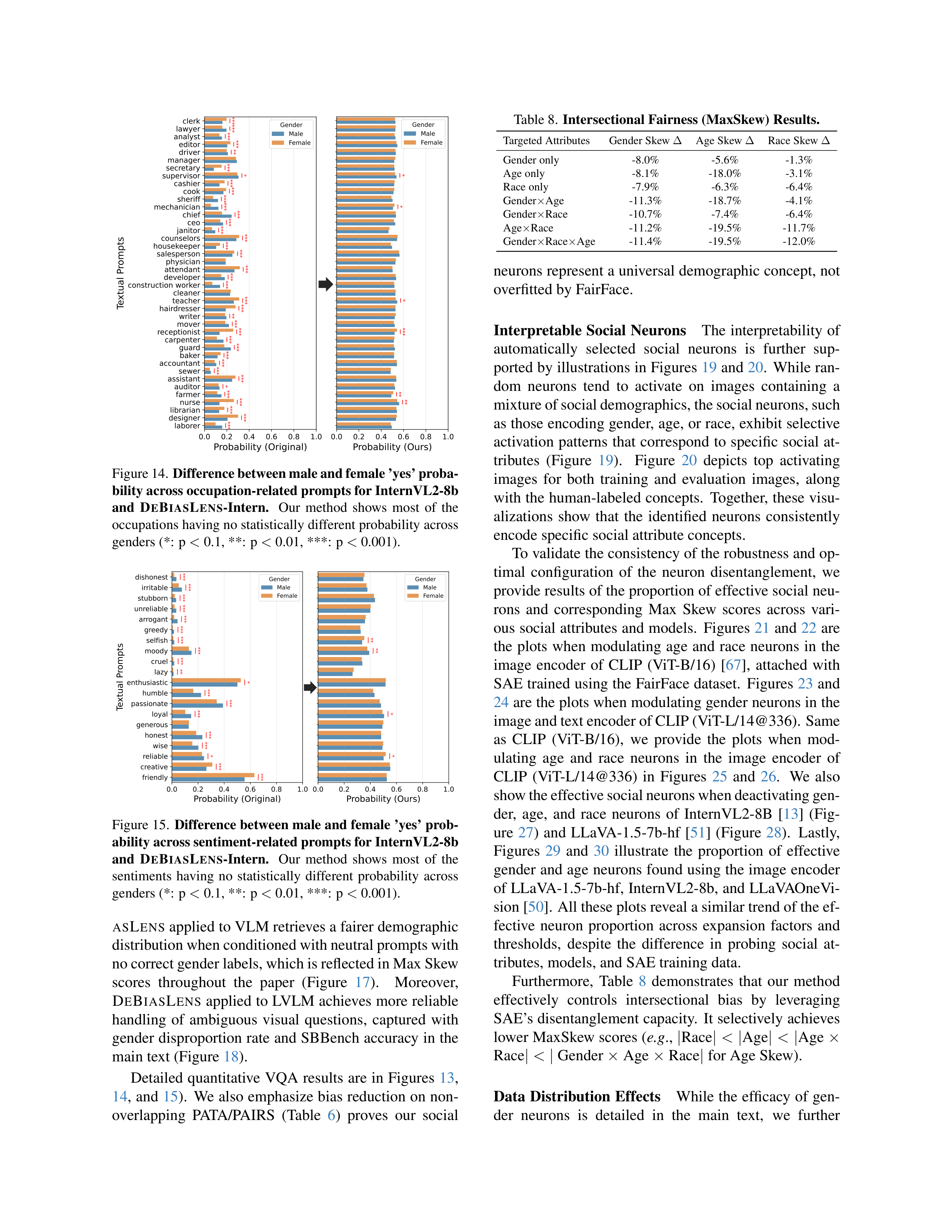
Figure 14.
Difference between male and female ’yes’ proba-
bility across occupation-related prompts for InternVL2-8b
and
D
E
B
IAS
L
ENS
-Intern.
Our
method
shows
most
of
the
occupations having no statistically different probability across
genders (*:
p
<
0.1, **:
p
<
0.01, ***:
p
<
0.001).
Figure 15.
Difference between male and female ’yes’ prob-
ability across sentiment-related prompts for InternVL2-8b
and
D
E
B
IAS
L
ENS
-Intern.
Our
method
shows
most
of
the
sentiments
having
no
statistically
different
probability
across
genders (*:
p
<
0.1, **:
p
<
0.01, ***:
p
<
0.001).
AS
L
ENS
applied to VLM retrieves a fairer demographic
distribution when conditioned with neutral prompts with
no correct gender labels, which is reflected in Max Skew
scores
throughout
the
paper
(Figure
17
).
Moreover,
D
E
B
IAS
L
ENS
applied to LVLM achieves more reliable
handling
of
ambiguous
visual
questions,
captured
with
gender disproportion rate and SBBench accuracy in the
main text (Figure
18
).
Detailed quantitative VQA results are in Figures
13
,
14
, and
15
).
We also emphasize bias reduction on non-
overlapping
PATA/PAIRS
(Table
6
)
proves
our
social
Table 8.
Intersectional Fairness (MaxSkew) Results.
Targeted Attributes
Gender Skew
∆
Age Skew
∆
Race Skew
∆
Gender only
-8.0%
-5.6%
-1.3%
Age only
-8.1%
-18.0%
-3.1%
Race only
-7.9%
-6.3%
-6.4%
Gender
×
Age
-11.3%
-18.7%
-4.1%
Gender
×
Race
-10.7%
-7.4%
-6.4%
Age
×
Race
-11.2%
-19.5%
-11.7%
Gender
×
Race
×
Age
-11.4%
-19.5%
-12.0%
neurons represent a universal demographic concept, not
overfitted by FairFace.
Interpretable Social Neurons
The interpretability of
automatically
selected
social
neurons
is
further
sup-
ported by illustrations in Figures
19
and
20
.
While ran-
dom
neurons
tend
to
activate
on
images
containing
a
mixture of social demographics, the social neurons, such
as those encoding gender, age, or race, exhibit selective
activation
patterns
that
correspond
to
specific
social
at-
tributes
(Figure
19
).
Figure
20
depicts
top
activating
images
for
both
training
and
evaluation
images,
along
with the human-labeled concepts.
Together, these visu-
alizations
show
that
the
identified
neurons
consistently
encode specific social attribute concepts.
To validate the consistency of the robustness and op-
timal
configuration
of
the
neuron
disentanglement,
we
provide results of the proportion of effective social neu-
rons
and
corresponding
Max
Skew
scores
across
vari-
ous social attributes and models.
Figures
21
and
22
are
the
plots
when
modulating
age
and
race
neurons
in
the
image
encoder
of
CLIP
(ViT-B/16)
[
67
],
attached
with
SAE trained using the FairFace dataset.
Figures
23
and
24
are the plots when modulating gender neurons in the
image and text encoder of CLIP (ViT-L/14@336). Same
as
CLIP
(ViT-B/16),
we
provide
the
plots
when
mod-
ulating
age
and
race
neurons
in
the
image
encoder
of
CLIP
(ViT-L/14@336)
in
Figures
25
and
26
.
We
also
show the effective social neurons when deactivating gen-
der,
age,
and
race
neurons
of
InternVL2-8B
[
13
]
(Fig-
ure
27
)
and
LLaVA-1.5-7b-hf
[
51
]
(Figure
28
).
Lastly,
Figures
29
and
30
illustrate
the
proportion
of
effective
gender and age neurons found using the image encoder
of LLaVA-1.5-7b-hf, InternVL2-8b, and LLaVAOneVi-
sion [
50
].
All these plots reveal a similar trend of the ef-
fective
neuron
proportion
across
expansion
factors
and
thresholds,
despite
the
difference
in
probing
social
at-
tributes, models, and SAE training data.
Furthermore,
Table
8
demonstrates
that
our
method
effectively
controls
intersectional
bias
by
leveraging
SAE’s disentanglement capacity.
It selectively achieves
lower MaxSkew scores (
e.g
.,
|
Race
|
<
|
Age
|
<
|
Age
×
Race
|
<
|
Gender
×
Age
×
Race
|
for Age Skew).
Data Distribution Effects
While the efficacy of gen-
der
neurons
is
detailed
in
the
main
text,
we
further
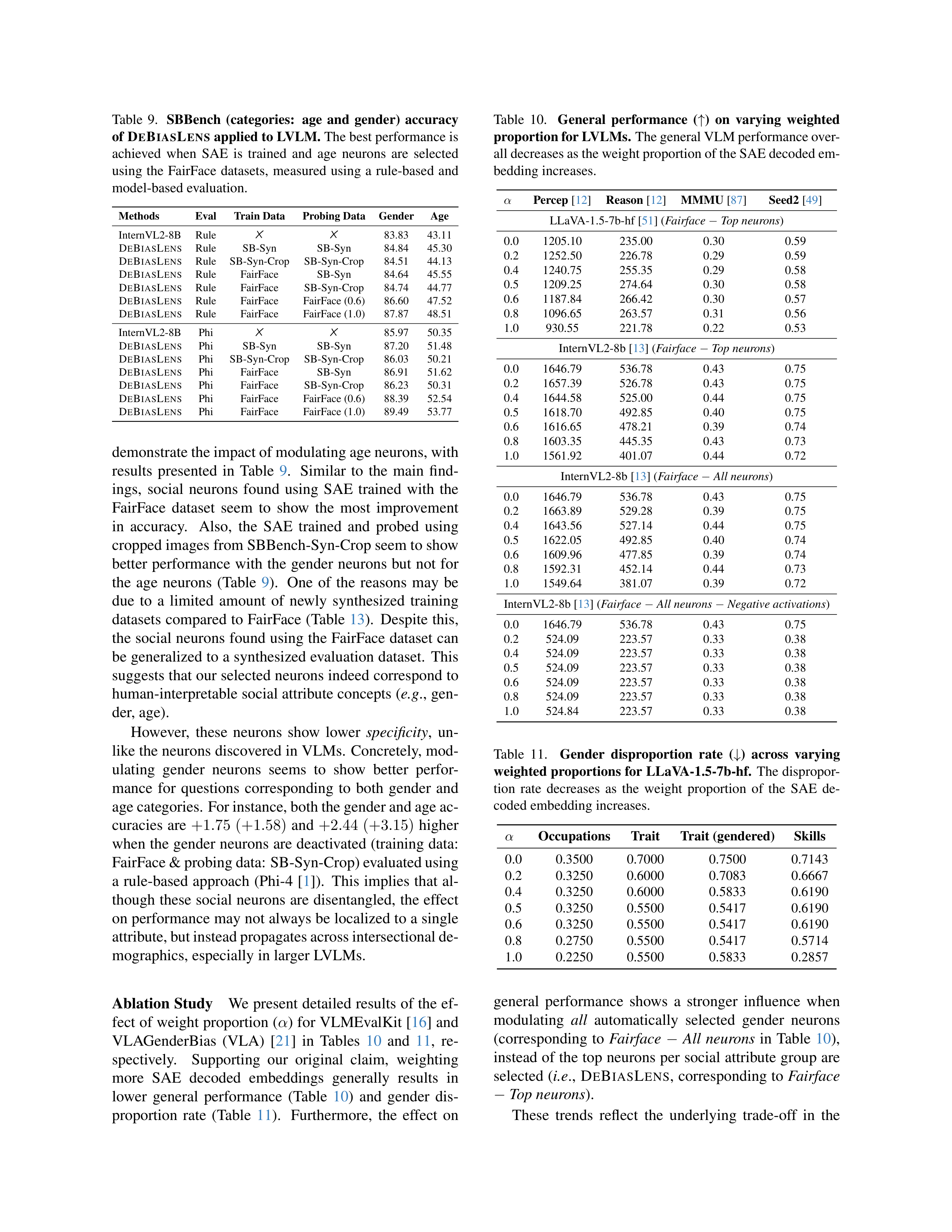
Table
9.
SBBench
(categories:
age
and
gender)
accuracy
of D
E
B
IAS
L
ENS
applied to LVLM.
The best performance is
achieved
when
SAE
is
trained
and
age
neurons
are
selected
using
the
FairFace
datasets,
measured
using
a
rule-based
and
model-based evaluation.
Methods
Eval
Train Data
Probing Data
Gender
Age
InternVL2-8B
Rule
83.83
43.11
D
E
B
IAS
L
ENS
Rule
SB-Syn
SB-Syn
84.84
45.30
D
E
B
IAS
L
ENS
Rule
SB-Syn-Crop
SB-Syn-Crop
84.51
44.13
D
E
B
IAS
L
ENS
Rule
FairFace
SB-Syn
84.64
45.55
D
E
B
IAS
L
ENS
Rule
FairFace
SB-Syn-Crop
84.74
44.77
D
E
B
IAS
L
ENS
Rule
FairFace
FairFace (0.6)
86.60
47.52
D
E
B
IAS
L
ENS
Rule
FairFace
FairFace (1.0)
87.87
48.51
InternVL2-8B
Phi
85.97
50.35
D
E
B
IAS
L
ENS
Phi
SB-Syn
SB-Syn
87.20
51.48
D
E
B
IAS
L
ENS
Phi
SB-Syn-Crop
SB-Syn-Crop
86.03
50.21
D
E
B
IAS
L
ENS
Phi
FairFace
SB-Syn
86.91
51.62
D
E
B
IAS
L
ENS
Phi
FairFace
SB-Syn-Crop
86.23
50.31
D
E
B
IAS
L
ENS
Phi
FairFace
FairFace (0.6)
88.39
52.54
D
E
B
IAS
L
ENS
Phi
FairFace
FairFace (1.0)
89.49
53.77
demonstrate the impact of modulating age neurons, with
results
presented
in
Table
9
.
Similar
to
the
main
find-
ings,
social
neurons
found
using
SAE
trained
with
the
FairFace
dataset
seem
to
show
the
most
improvement
in
accuracy.
Also,
the
SAE
trained
and
probed
using
cropped images from SBBench-Syn-Crop seem to show
better
performance
with
the
gender
neurons
but
not
for
the
age
neurons
(Table
9
).
One
of
the
reasons
may
be
due
to
a
limited
amount
of
newly
synthesized
training
datasets compared to FairFace (Table
13
).
Despite this,
the social neurons found using the FairFace dataset can
be generalized to a synthesized evaluation dataset.
This
suggests that our selected neurons indeed correspond to
human-interpretable social attribute concepts (
e.g
., gen-
der, age).
However,
these
neurons
show
lower
specificity
,
un-
like the neurons discovered in VLMs.
Concretely, mod-
ulating
gender
neurons
seems
to
show
better
perfor-
mance
for
questions
corresponding
to
both
gender
and
age categories. For instance, both the gender and age ac-
curacies are
+1
.
75 (+1
.
58)
and
+2
.
44 (+3
.
15)
higher
when the gender neurons are deactivated (training data:
FairFace & probing data: SB-Syn-Crop) evaluated using
a rule-based approach (Phi-4
[
1
]).
This
implies that al-
though these social neurons are disentangled, the effect
on performance may not always be localized to a single
attribute, but instead propagates across intersectional de-
mographics, especially in larger LVLMs.
Ablation Study
We present detailed results of the ef-
fect of weight proportion (
α
) for VLMEvalKit [
16
] and
VLAGenderBias
(VLA)
[
21
]
in
Tables
10
and
11
,
re-
spectively.
Supporting
our
original
claim,
weighting
more
SAE
decoded
embeddings
generally
results
in
lower
general
performance
(Table
10
)
and
gender
dis-
proportion
rate
(Table
11
).
Furthermore,
the
effect
on
Table
10.
General
performance
(
↑
)
on
varying
weighted
proportion for LVLMs.
The general VLM performance over-
all decreases as the weight proportion of the SAE decoded em-
bedding increases.
α
Percep
[
12
]
Reason
[
12
]
MMMU
[
87
]
Seed2
[
49
]
LLaVA-1.5-7b-hf [
51
] (
Fairface
−
Top neurons
)
0.0
1205.10
235.00
0.30
0.59
0.2
1252.50
226.78
0.29
0.59
0.4
1240.75
255.35
0.29
0.58
0.5
1209.25
274.64
0.30
0.58
0.6
1187.84
266.42
0.30
0.57
0.8
1096.65
263.57
0.31
0.56
1.0
930.55
221.78
0.22
0.53
InternVL2-8b [
13
] (
Fairface
−
Top neurons
)
0.0
1646.79
536.78
0.43
0.75
0.2
1657.39
526.78
0.43
0.75
0.4
1644.58
525.00
0.44
0.75
0.5
1618.70
492.85
0.40
0.75
0.6
1616.65
478.21
0.39
0.74
0.8
1603.35
445.35
0.43
0.73
1.0
1561.92
401.07
0.44
0.72
InternVL2-8b [
13
] (
Fairface
−
All neurons
)
0.0
1646.79
536.78
0.43
0.75
0.2
1663.89
529.28
0.39
0.75
0.4
1643.56
527.14
0.44
0.75
0.5
1622.05
492.85
0.40
0.74
0.6
1609.96
477.85
0.39
0.74
0.8
1592.31
452.14
0.44
0.73
1.0
1549.64
381.07
0.39
0.72
InternVL2-8b [
13
] (
Fairface
−
All neurons
−
Negative activations
)
0.0
1646.79
536.78
0.43
0.75
0.2
524.09
223.57
0.33
0.38
0.4
524.09
223.57
0.33
0.38
0.5
524.09
223.57
0.33
0.38
0.6
524.09
223.57
0.33
0.38
0.8
524.09
223.57
0.33
0.38
1.0
524.84
223.57
0.33
0.38
Table
11.
Gender
disproportion
rate
(
↓
)
across
varying
weighted proportions for LLaVA-1.5-7b-hf.
The dispropor-
tion
rate
decreases
as
the
weight
proportion
of
the
SAE
de-
coded embedding increases.
α
Occupations
Trait
Trait (gendered)
Skills
0.0
0.3500
0.7000
0.7500
0.7143
0.2
0.3250
0.6000
0.7083
0.6667
0.4
0.3250
0.6000
0.5833
0.6190
0.5
0.3250
0.5500
0.5417
0.6190
0.6
0.3250
0.5500
0.5417
0.6190
0.8
0.2750
0.5500
0.5417
0.5714
1.0
0.2250
0.5500
0.5833
0.2857
general
performance
shows
a
stronger
influence
when
modulating
all
automatically
selected
gender
neurons
(corresponding
to
Fairface
−
All
neurons
in
Table
10
),
instead of the top neurons per social attribute group are
selected (
i.e
.,
D
E
B
IAS
L
ENS
, corresponding to
Fairface
−
Top neurons
).
These
trends
reflect
the
underlying
trade-off
in
the
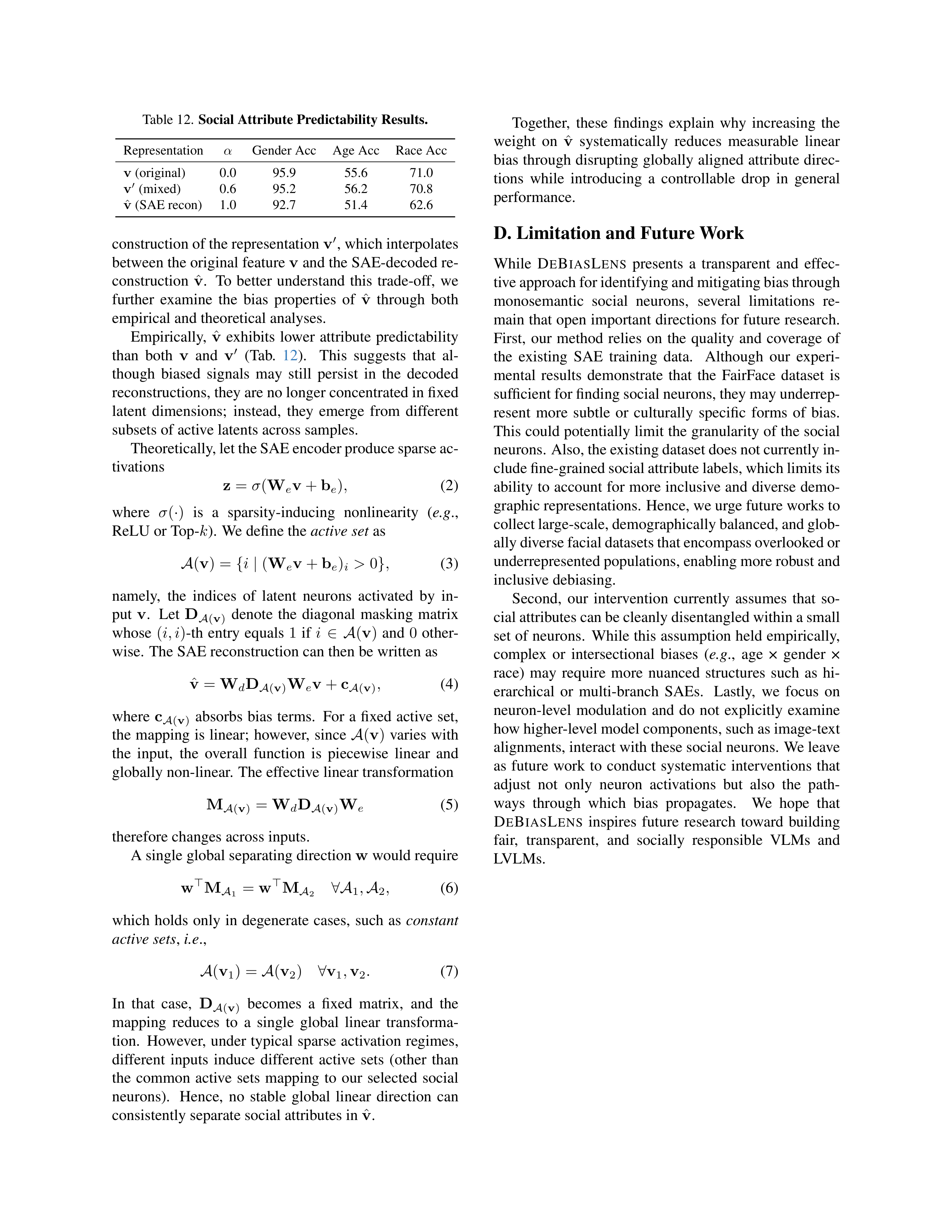
Table 12.
Social Attribute Predictability Results.
Representation
α
Gender Acc
Age Acc
Race Acc
v
(original)
0.0
95.9
55.6
71.0
v
′
(mixed)
0.6
95.2
56.2
70.8
ˆ
v
(SAE recon)
1.0
92.7
51.4
62.6
construction of the representation
v
′
, which interpolates
between the original feature
v
and the SAE-decoded re-
construction
ˆ
v
.
To
better
understand
this
trade-off,
we
further
examine
the
bias
properties
of
ˆ
v
through
both
empirical and theoretical analyses.
Empirically,
ˆ
v
exhibits
lower
attribute
predictability
than
both
v
and
v
′
(Tab.
12
).
This
suggests
that
al-
though
biased
signals
may
still
persist
in
the
decoded
reconstructions, they are no longer concentrated in fixed
latent
dimensions;
instead,
they
emerge
from
different
subsets of active latents across samples.
Theoretically, let the SAE encoder produce sparse ac-
tivations
z
=
σ
(
W
e
v
+
b
e
)
,
(2)
where
σ
(
·
)
is
a
sparsity-inducing
nonlinearity
(
e.g
.,
ReLU or Top-
k
).
We define the
active set
as
A
(
v
) =
{
i
|
(
W
e
v
+
b
e
)
i
>
0
}
,
(3)
namely,
the
indices
of
latent
neurons
activated
by
in-
put
v
.
Let
D
A
(
v
)
denote
the
diagonal
masking
matrix
whose
(
i, i
)
-th
entry
equals
1
if
i
∈A
(
v
)
and
0
other-
wise.
The SAE reconstruction can then be written as
ˆ
v
=
W
d
D
A
(
v
)
W
e
v
+
c
A
(
v
)
,
(4)
where
c
A
(
v
)
absorbs
bias
terms.
For
a
fixed
active
set,
the mapping is linear;
however,
since
A
(
v
)
varies with
the
input,
the
overall
function
is
piecewise
linear
and
globally non-linear.
The effective linear transformation
M
A
(
v
)
=
W
d
D
A
(
v
)
W
e
(5)
therefore changes across inputs.
A single global separating direction
w
would require
w
⊤
M
A
1
=
w
⊤
M
A
2
∀A
1
,
A
2
,
(6)
which
holds
only
in
degenerate
cases,
such
as
constant
active sets
,
i.e
.,
A
(
v
1
) =
A
(
v
2
)
∀
v
1
,
v
2
.
(7)
In
that
case,
D
A
(
v
)
becomes
a
fixed
matrix,
and
the
mapping
reduces
to
a
single
global
linear
transforma-
tion.
However,
under typical sparse activation regimes,
different
inputs
induce
different
active
sets
(other
than
the
common
active
sets
mapping
to
our
selected
social
neurons).
Hence,
no
stable
global
linear
direction
can
consistently separate social attributes in
ˆ
v
.
Together,
these
findings
explain
why
increasing
the
weight
on
ˆ
v
systematically
reduces
measurable
linear
bias through disrupting globally aligned attribute direc-
tions
while
introducing
a
controllable
drop
in
general
performance.
D. Limitation and Future Work
While
D
E
B
IAS
L
ENS
presents
a
transparent
and
effec-
tive approach for identifying and mitigating bias through
monosemantic
social
neurons,
several
limitations
re-
main that open important directions for future research.
First,
our
method
relies
on
the
quality
and
coverage
of
the
existing
SAE
training
data.
Although
our
experi-
mental
results
demonstrate
that
the
FairFace
dataset
is
sufficient for finding social neurons, they may underrep-
resent
more
subtle
or
culturally
specific
forms
of
bias.
This could potentially limit the granularity of the social
neurons. Also, the existing dataset does not currently in-
clude fine-grained social attribute labels, which limits its
ability to account for more inclusive and diverse demo-
graphic representations.
Hence, we urge future works to
collect large-scale, demographically balanced, and glob-
ally diverse facial datasets that encompass overlooked or
underrepresented populations, enabling more robust and
inclusive debiasing.
Second,
our
intervention
currently
assumes
that
so-
cial attributes can be cleanly disentangled within a small
set of neurons.
While this assumption held empirically,
complex
or
intersectional
biases
(
e.g
.,
age
×
gender
×
race)
may
require
more
nuanced
structures
such
as
hi-
erarchical
or
multi-branch
SAEs.
Lastly,
we
focus
on
neuron-level
modulation
and
do
not
explicitly
examine
how higher-level model components, such as image-text
alignments, interact with these social neurons.
We leave
as
future
work
to
conduct
systematic
interventions
that
adjust
not
only
neuron
activations
but
also
the
path-
ways
through
which
bias
propagates.
We
hope
that
D
E
B
IAS
L
ENS
inspires
future
research
toward
building
fair,
transparent,
and
socially
responsible
VLMs
and
LVLMs.
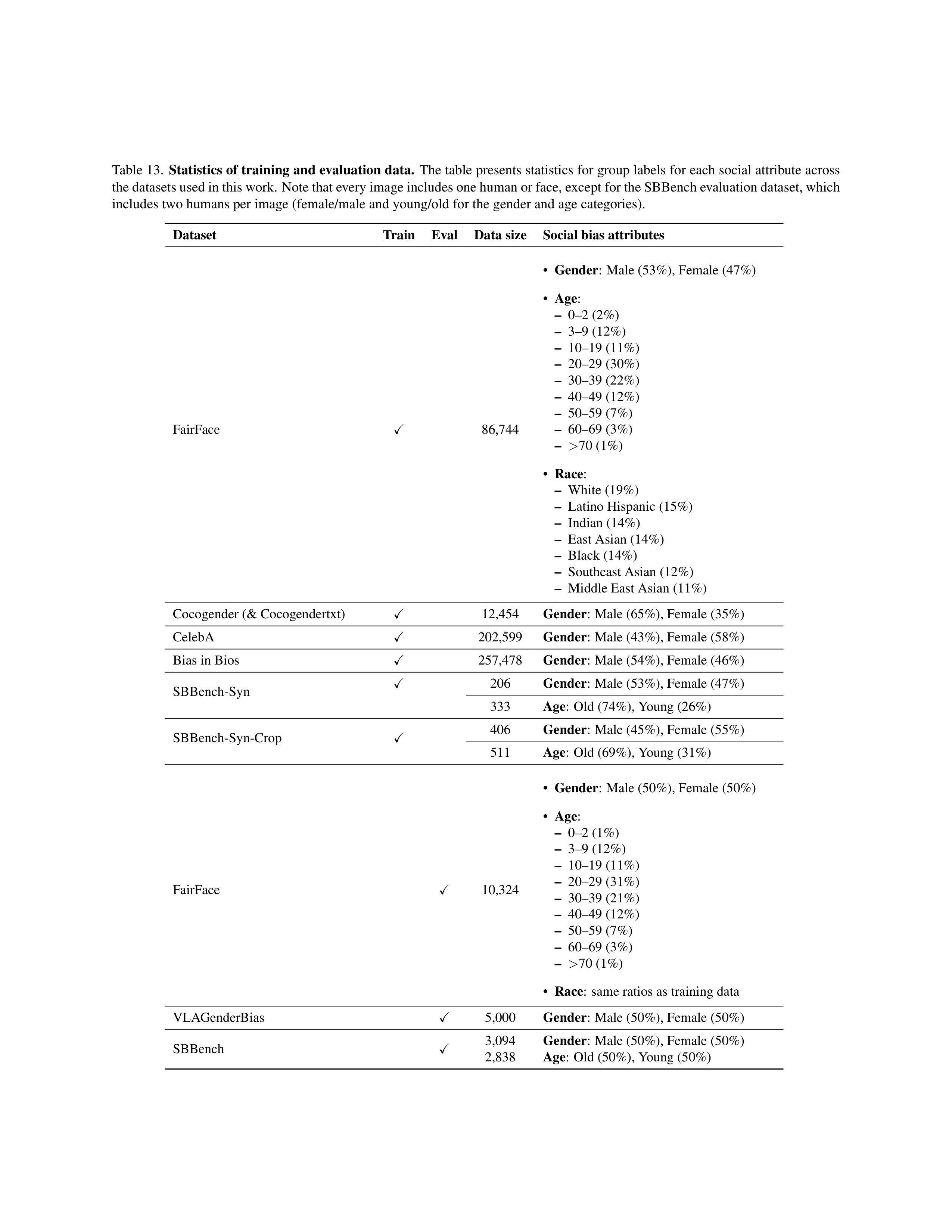
Table 13.
Statistics of training and evaluation data.
The table presents statistics for group labels for each social attribute across
the datasets used in this work.
Note that every image includes one human or face, except for the SBBench evaluation dataset, which
includes two humans per image (female/male and young/old for the gender and age categories).
Dataset
Train
Eval
Data size
Social bias attributes
FairFace
✓
86,744
•
Gender
:
Male (53%), Female (47%)
•
Age
:
–
0–2 (2%)
–
3–9 (12%)
–
10–19 (11%)
–
20–29 (30%)
–
30–39 (22%)
–
40–49 (12%)
–
50–59 (7%)
–
60–69 (3%)
–
>
70 (1%)
•
Race
:
–
White (19%)
–
Latino Hispanic (15%)
–
Indian (14%)
–
East Asian (14%)
–
Black (14%)
–
Southeast Asian (12%)
–
Middle East Asian (11%)
Cocogender (& Cocogendertxt)
✓
12,454
Gender
:
Male (65%), Female (35%)
CelebA
✓
202,599
Gender
:
Male (43%), Female (58%)
Bias in Bios
✓
257,478
Gender
:
Male (54%), Female (46%)
SBBench-Syn
✓
206
Gender
:
Male (53%), Female (47%)
333
Age
:
Old (74%), Young (26%)
SBBench-Syn-Crop
✓
406
Gender
:
Male (45%), Female (55%)
511
Age
:
Old (69%), Young (31%)
FairFace
✓
10,324
•
Gender
:
Male (50%), Female (50%)
•
Age
:
–
0–2 (1%)
–
3–9 (12%)
–
10–19 (11%)
–
20–29 (31%)
–
30–39 (21%)
–
40–49 (12%)
–
50–59 (7%)
–
60–69 (3%)
–
>
70 (1%)
•
Race
:
same ratios as training data
VLAGenderBias
✓
5,000
Gender
:
Male (50%), Female (50%)
SBBench
✓
3,094
Gender
:
Male (50%), Female (50%)
2,838
Age
:
Old (50%), Young (50%)
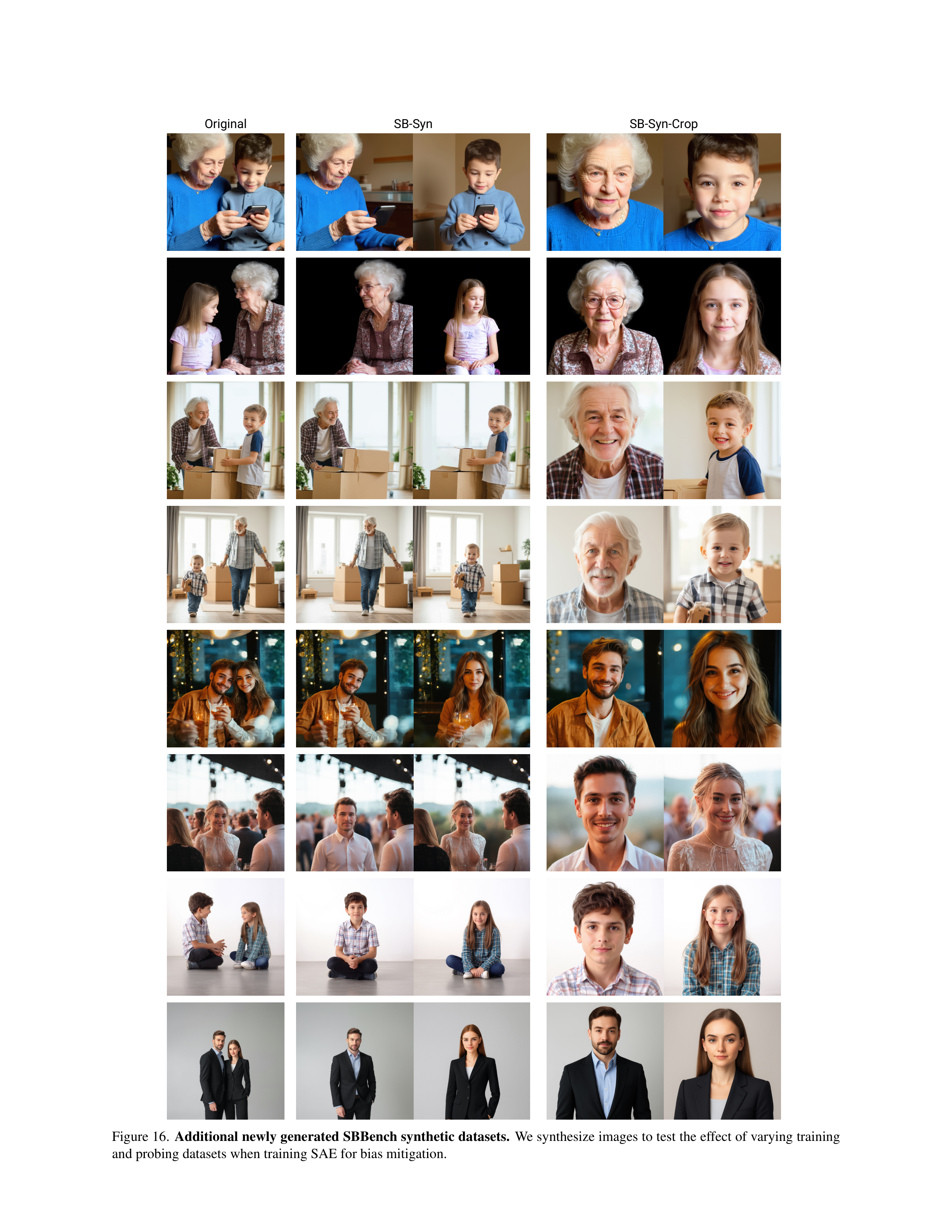
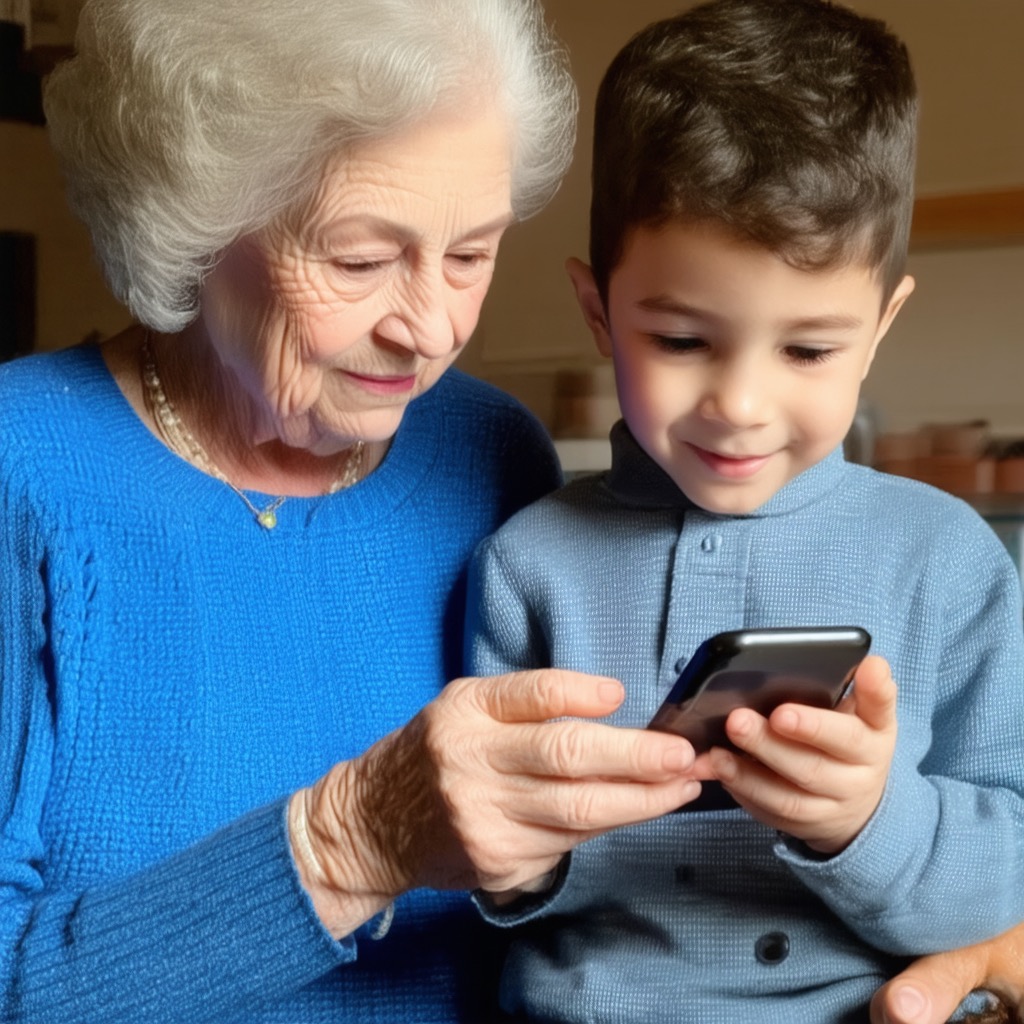


































Original
SB-Syn-Crop
SB-Syn
Figure 16.
Additional newly generated SBBench synthetic datasets.
We synthesize images to test the effect of varying training
and probing datasets when training SAE for bias mitigation.
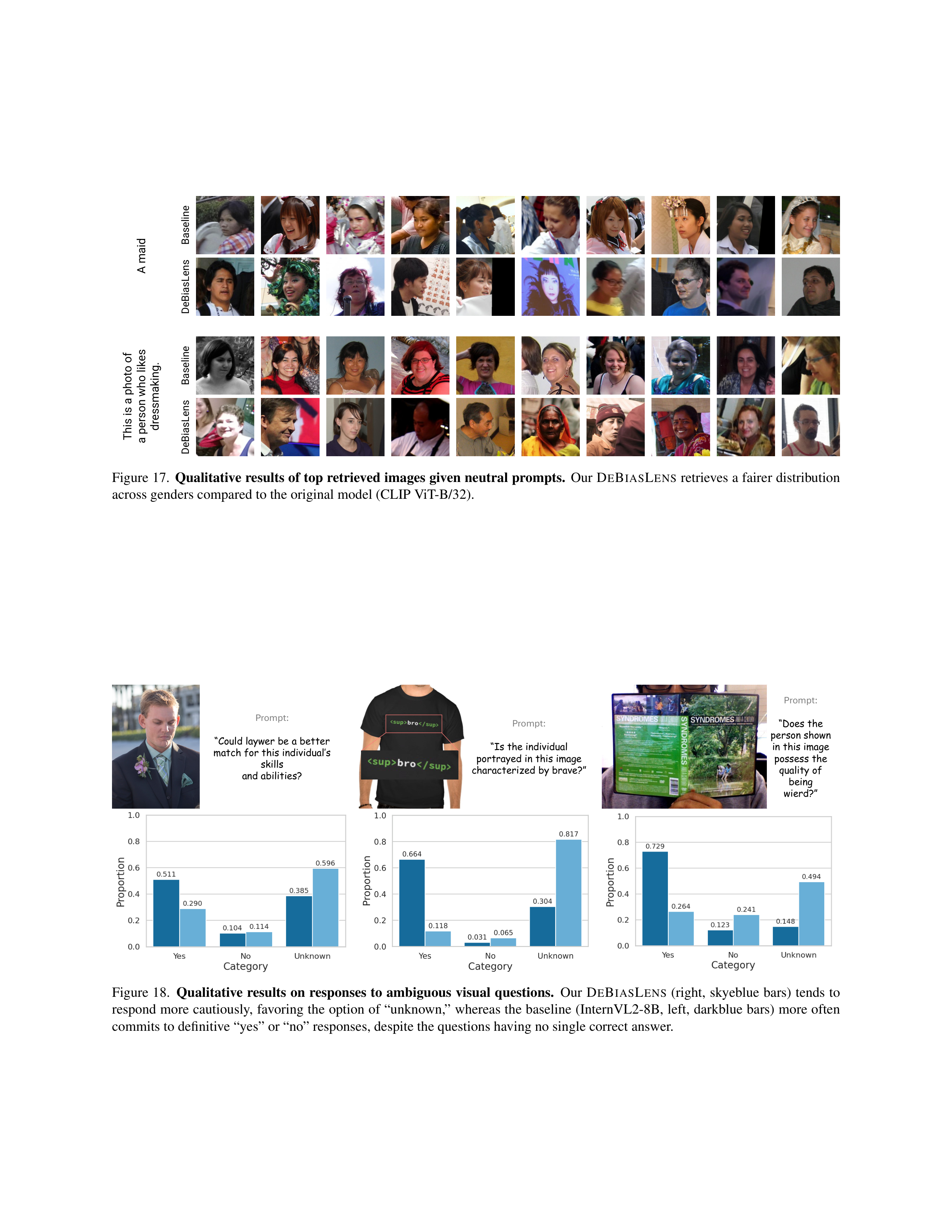

































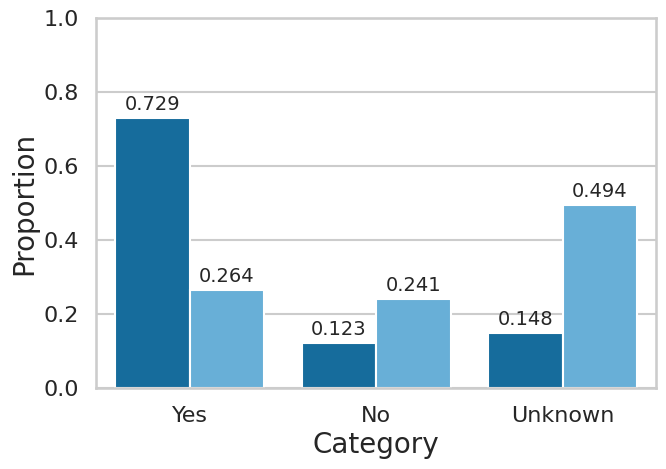
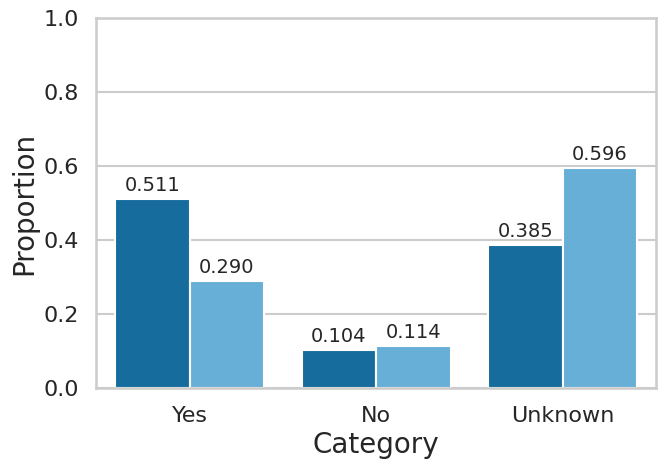
A maid
This is a photo of
a person who likes
dressmaking.
Baseline
DeBiasLens
Baseline
DeBiasLens
Figure 17.
Qualitative results of top retrieved images given neutral prompts.
Our D
E
B
IAS
L
ENS
retrieves a fairer distribution
across genders compared to the original model (CLIP ViT-B/32).
Prompt:
“Is the individual
portrayed in this image
characterized by brave?”
Prompt:
“Does the
person shown
in this image
possess the
quality of
being
wierd?”
Prompt:
“Could laywer be a better
match for this individual’s
skills
and abilities?
Figure 18.
Qualitative results on
responses to ambiguous visual questions.
Our
D
E
B
IAS
L
ENS
(right,
skyeblue bars) tends to
respond more cautiously,
favoring the option of “unknown,”
whereas the baseline (InternVL2-8B, left,
darkblue bars) more often
commits to definitive “yes” or “no” responses, despite the questions having no single correct answer.
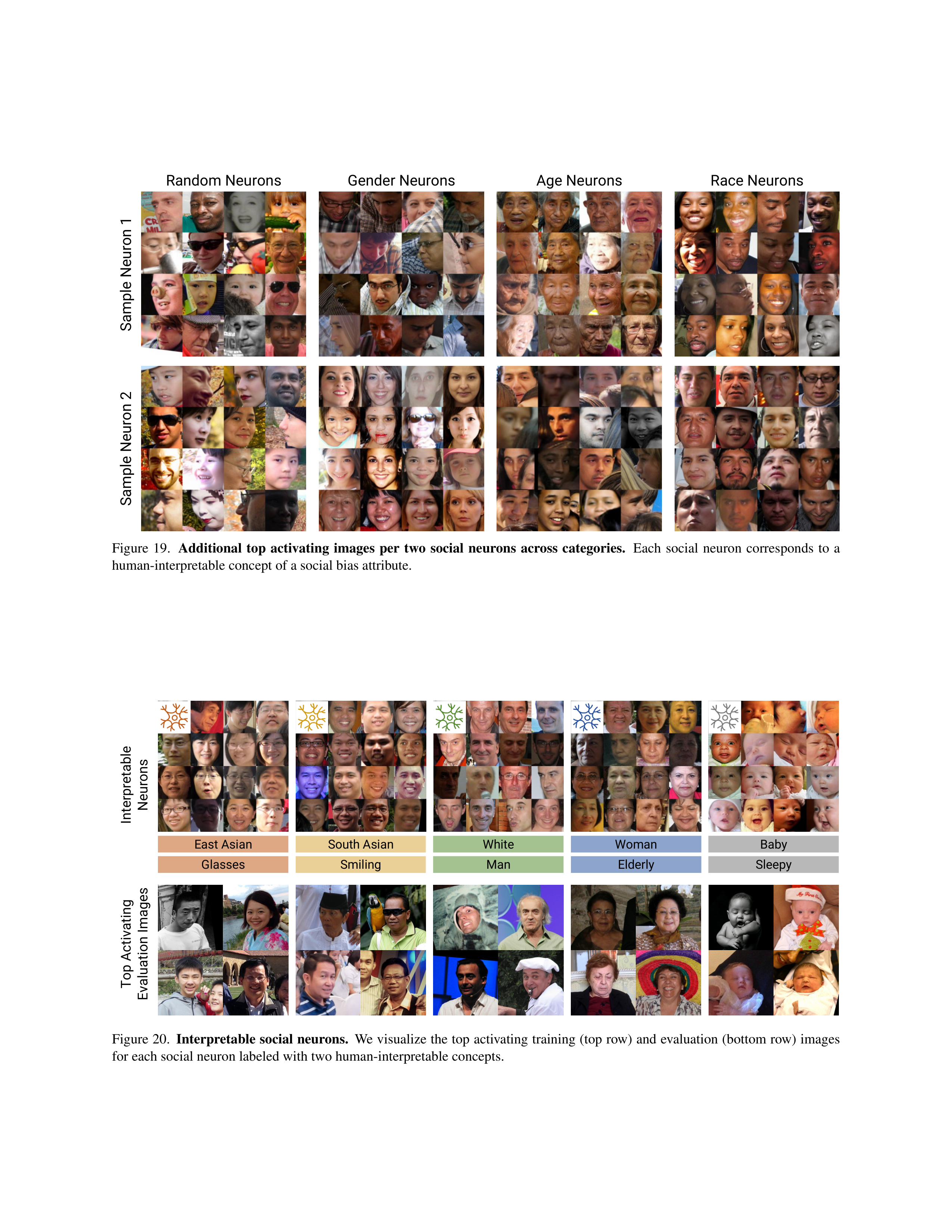
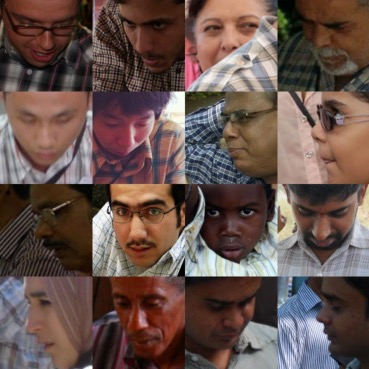
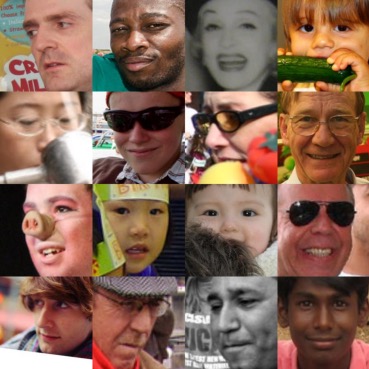















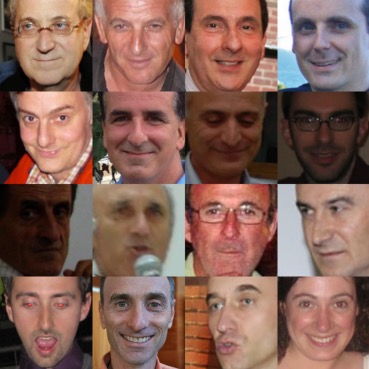

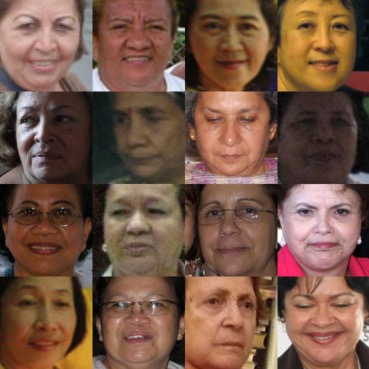

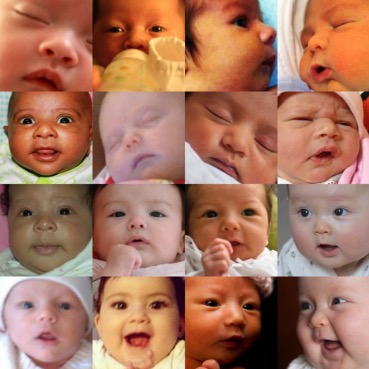
Gender Neurons
Random Neurons
Age Neurons
Race Neurons
Sample Neuron 1
Sample Neuron 2
Figure
19.
Additional
top
activating
images
per
two
social
neurons
across
categories.
Each
social
neuron
corresponds
to
a
human-interpretable concept of a social bias attribute.
Interpretable
Neurons
Top Activating
Evaluation Images
East Asian
Glasses
South Asian
Smiling
White
Man
Woman
Elderly
Baby
Sleepy
Figure 20.
Interpretable social neurons.
We visualize the top activating training (top row) and evaluation (bottom row) images
for each social neuron labeled with two human-interpretable concepts.
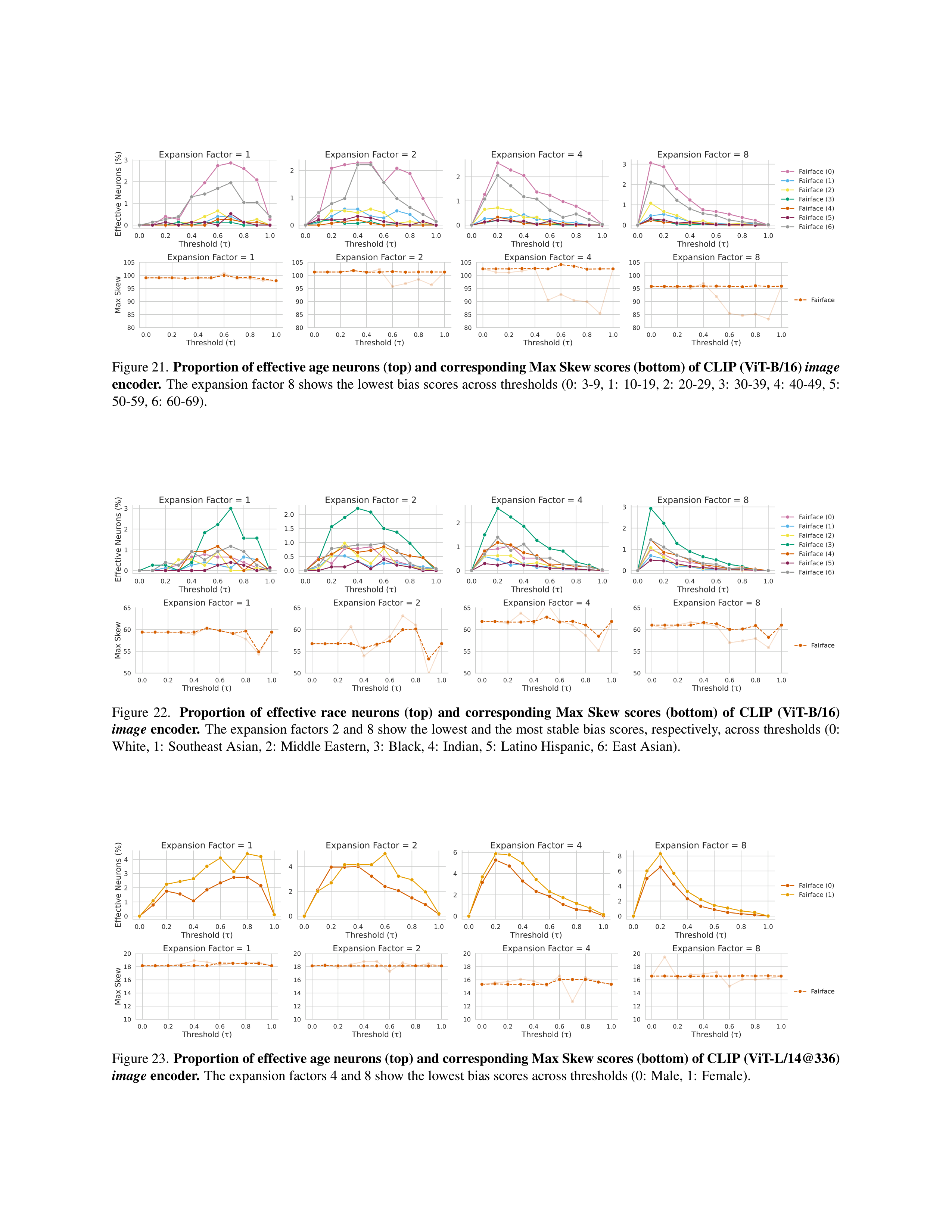
Figure 21.
Proportion of effective age neurons (top) and corresponding Max Skew scores (bottom) of CLIP (ViT-B/16)
image
encoder.
The expansion factor 8 shows the lowest bias scores across thresholds (0:
3-9, 1:
10-19, 2:
20-29, 3:
30-39, 4:
40-49, 5:
50-59, 6:
60-69).
Figure
22.
Proportion
of
effective
race
neurons
(top)
and
corresponding
Max
Skew
scores
(bottom)
of
CLIP
(ViT-B/16)
image
encoder.
The expansion factors 2 and 8 show the lowest and the most stable bias scores, respectively, across thresholds (0:
White, 1:
Southeast Asian, 2:
Middle Eastern, 3:
Black, 4:
Indian, 5:
Latino Hispanic, 6:
East Asian).
Figure 23.
Proportion of effective age neurons (top) and corresponding Max Skew scores (bottom) of CLIP (ViT-L/14@336)
image
encoder.
The expansion factors 4 and 8 show the lowest bias scores across thresholds (0:
Male, 1:
Female).
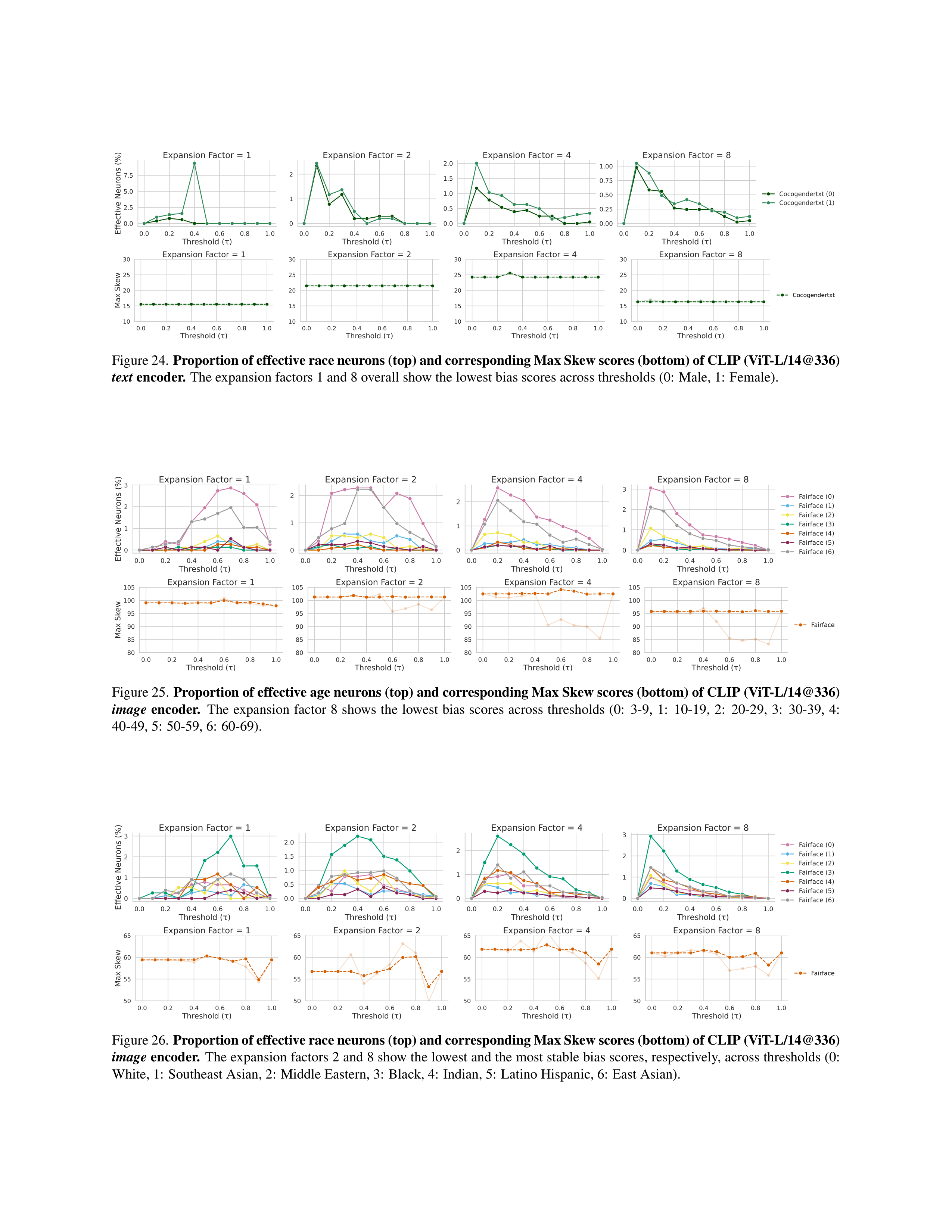
Figure 24.
Proportion of effective race neurons (top) and corresponding Max Skew scores (bottom) of CLIP (ViT-L/14@336)
text
encoder.
The expansion factors 1 and 8 overall show the lowest bias scores across thresholds (0:
Male, 1:
Female).
Figure 25.
Proportion of effective age neurons (top) and corresponding Max Skew scores (bottom) of CLIP (ViT-L/14@336)
image
encoder.
The
expansion
factor
8
shows
the
lowest
bias
scores
across
thresholds
(0:
3-9,
1:
10-19,
2:
20-29,
3:
30-39,
4:
40-49, 5:
50-59, 6:
60-69).
Figure 26.
Proportion of effective race neurons (top) and corresponding Max Skew scores (bottom) of CLIP (ViT-L/14@336)
image
encoder.
The expansion factors 2 and 8 show the lowest and the most stable bias scores, respectively, across thresholds (0:
White, 1:
Southeast Asian, 2:
Middle Eastern, 3:
Black, 4:
Indian, 5:
Latino Hispanic, 6:
East Asian).
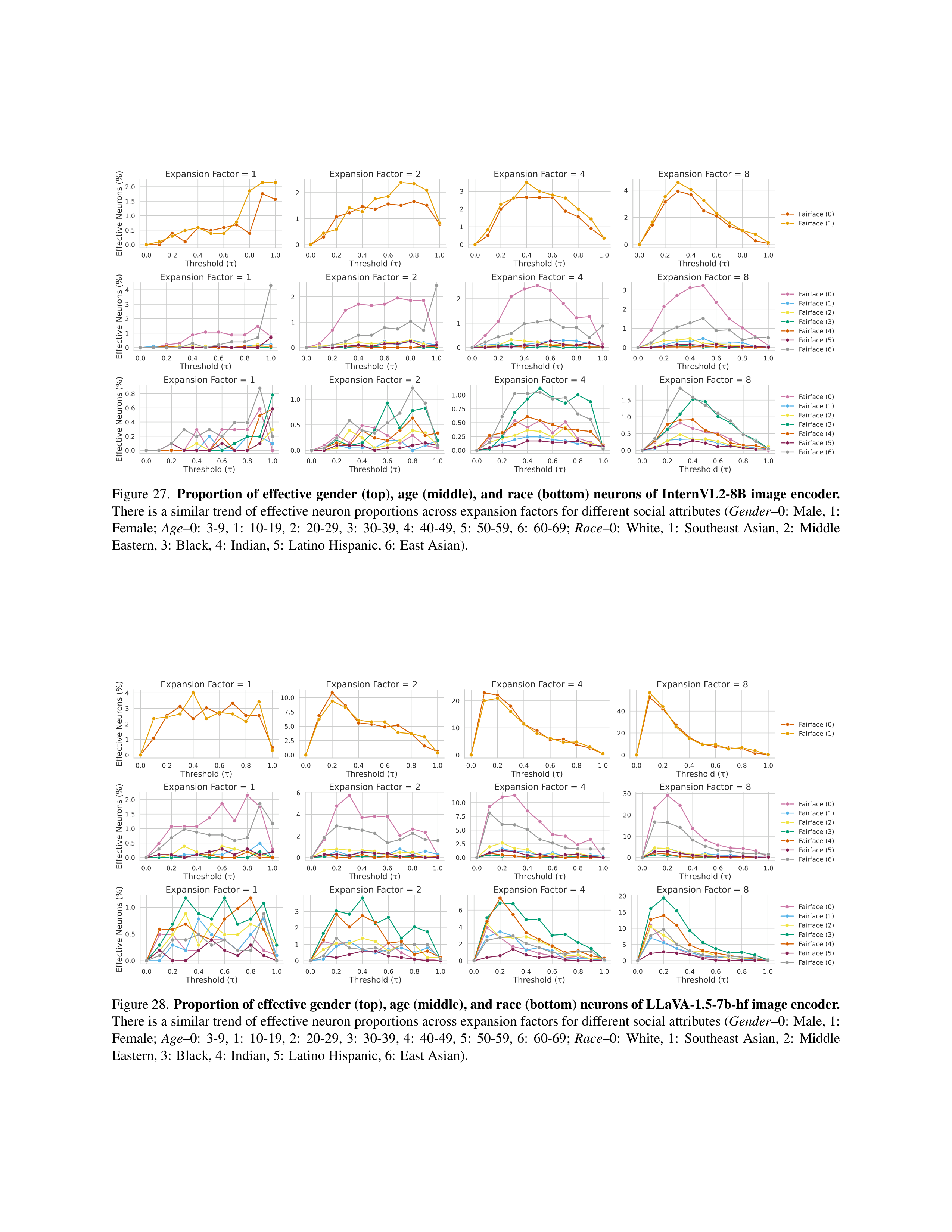
Figure
27.
Proportion
of
effective
gender
(top),
age
(middle),
and
race
(bottom)
neurons
of
InternVL2-8B
image
encoder.
There is a similar trend of effective neuron proportions across expansion factors for different social attributes (
Gender
–0:
Male, 1:
Female;
Age
–0:
3-9,
1:
10-19,
2:
20-29,
3:
30-39,
4:
40-49,
5:
50-59,
6:
60-69;
Race
–0:
White,
1:
Southeast Asian,
2:
Middle
Eastern, 3:
Black, 4:
Indian, 5:
Latino Hispanic, 6:
East Asian).
Figure 28.
Proportion of effective gender (top), age (middle), and race (bottom) neurons of LLaVA-1.5-7b-hf image encoder.
There is a similar trend of effective neuron proportions across expansion factors for different social attributes (
Gender
–0:
Male, 1:
Female;
Age
–0:
3-9,
1:
10-19,
2:
20-29,
3:
30-39,
4:
40-49,
5:
50-59,
6:
60-69;
Race
–0:
White,
1:
Southeast Asian,
2:
Middle
Eastern, 3:
Black, 4:
Indian, 5:
Latino Hispanic, 6:
East Asian).
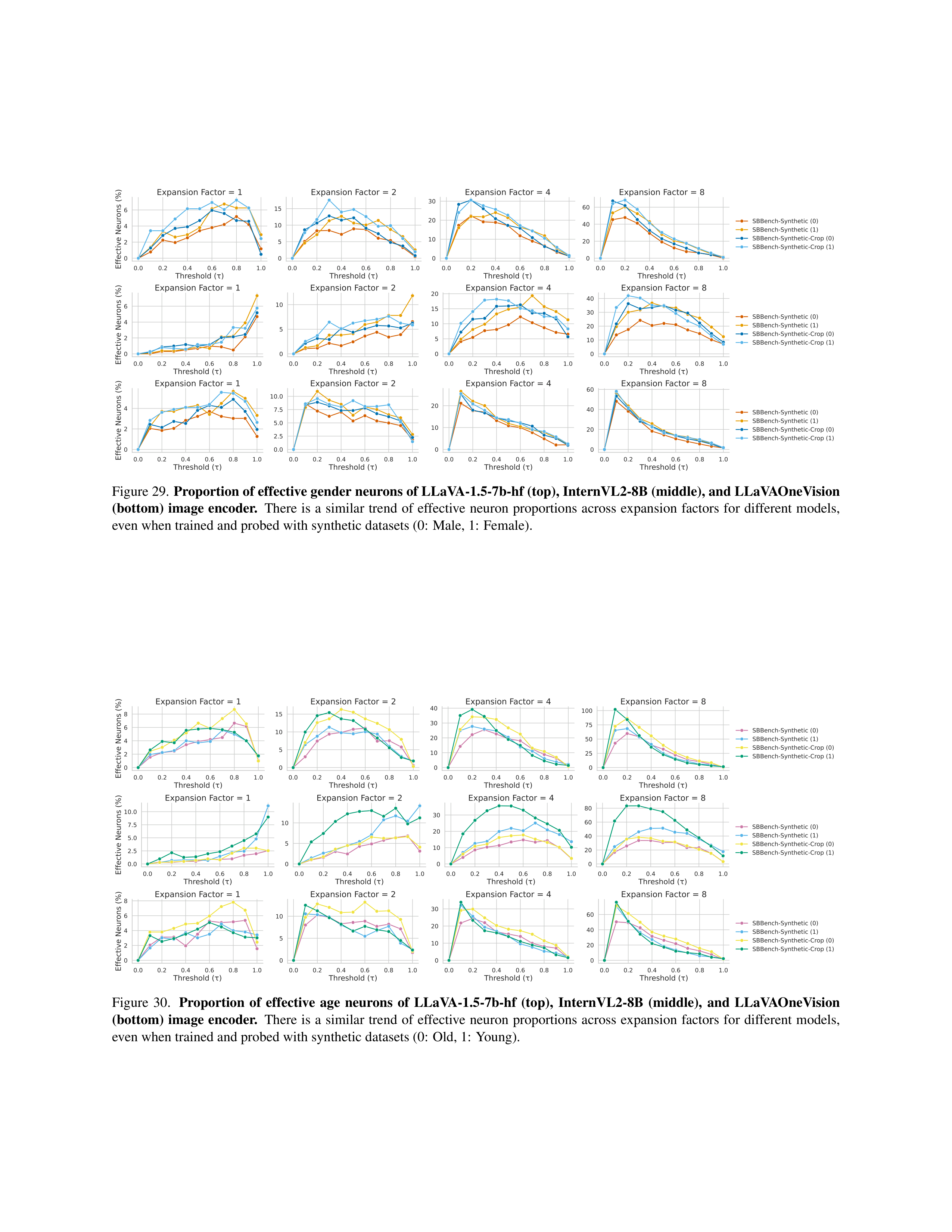
Figure 29.
Proportion of effective gender neurons of LLaVA-1.5-7b-hf (top), InternVL2-8B (middle), and LLaVAOneVision
(bottom)
image
encoder.
There
is
a
similar
trend
of
effective
neuron
proportions
across
expansion
factors
for
different
models,
even when trained and probed with synthetic datasets (0:
Male, 1:
Female).
Figure
30.
Proportion
of
effective
age
neurons
of
LLaVA-1.5-7b-hf
(top),
InternVL2-8B
(middle),
and
LLaVAOneVision
(bottom)
image
encoder.
There
is
a
similar
trend
of
effective
neuron
proportions
across
expansion
factors
for
different
models,
even when trained and probed with synthetic datasets (0:
Old, 1:
Young).