
SPARC: Separating Perception And Reasoning Circuits
for Test-time Scaling of VLMs
Niccolo Avogaro
* 1 2
Nayanika Debnath
* 1 2
Li Mi
1
Thomas Frick
2
Junling Wang
1
Zexue He
3
Hang Hua
3
Konrad Schindler
1
Mattia Rigotti
2
Abstract
Despite
recent
successes,
test-time
scaling
—
dynamically expanding the token budget during
inference as needed—remains brittle for vision-
language
models
(VLMs).
Unstructured
visual
reasoning
chains
entangle
perception
and
rea-
soning,
leading
to
long,
disorganized
contexts
where
small
perceptual
mistakes
may
cascade
into completely wrong answers.
Reasoning also
requires
expensive
reinforcement
learning
with
hand-crafted rewards.
Here, we introduce SPARC
(Separating Perception And Reasoning Circuits),
a
modular
framework
that
explicitly
decouples
visual perception from reasoning.
Inspired by se-
quential
sensory-to-cognitive
processing
in
the
brain,
SPARC
implements
a
two-stage
pipeline
where
the
model
first
performs
explicit
visual
search to localize question-relevant regions, then
conditions its reasoning on those regions to pro-
duce
the
final
answer.
This
separation
enables
independent
test-time
scaling
with
asymmetric
compute allocation (e.g., prioritizing perceptual
processing under distribution shift), and supports
selective optimization (e.g., improving the percep-
tual stage alone when it is the bottleneck for end-
to-end performance).
It also accommodates com-
pressed contexts by running global search at lower
image resolutions and allocating high-resolution
processing only to selected regions, thereby reduc-
ing visual token count and compute.
SPARC out-
performs monolithic baselines and strong visual-
grounding approaches across challenging visual
reasoning tasks, such as improving Qwen3VL 4B
on the
V
∗
VQA benchmark by 6.7 points and sur-
passing “thinking with images” by 4.6 points in
an OOD setting with a
200
×
lower token budget.
*
Equal contribution
1
ETH Z
¨
urich
2
IBM Research
3
MIT-IBM
Watson
AI
Lab.
Correspondence
to:
Niccolo
Avogaro
<
nic-
colo.avogaro1@ibm.com
>
.
Proceedings
of
the
43
rd
International
Conference
on
Machine
Learning
, Seoul, South Korea.
PMLR 306, 2026.
Copyright 2026
by the author(s).
1. Introduction
Multimodal Vision-Language Models (VLMs) have become
the de facto standard in visual reasoning and perception (
Li
et al.
,
2025
).
VLMs are architectures that combine visual
and textual inputs.
By aligning a vision backbone with an
LLM (
Huang et al.
,
2023
), they extend the impressive NLP
capabilities
of
LLMs
to
the
vision
realm
(
Alayrac
et
al.
,
2022
;
Chen et al.
,
2023b
;
Hua et al.
,
2025
;
Li et al.
,
2023
;
Chen et al.
,
2023a
;
Liu et al.
,
2023
;
Zhu et al.
,
2024
;
Peng
et
al.
,
2024
;
Achiam
et
al.
,
2023
;
Karlinsky
et
al.
,
2025
).
Among
the
capabilities
that
VLMs
inherit
from
LLMs
is
Chain-of-Thought
(CoT)
reasoning
(
Wei
et
al.
,
2022
),
a
test-time
compute
mechanism
to
iteratively
generate
the
output step-by-step, which can be optimized via Reinforce-
ment
Learning
and
has
been
popularized
by
models
like
ChatGPT-o1 (
OpenAI
,
2024
) and DeepSeek-R1 (
Guo et al.
,
2025
).
Works like ViGoRL (
Sarch et al.
,
2025
) and Deep-
Eyes
(
Zheng
et
al.
,
2026
)
have
demonstrated
that
multi-
modal chain-of-thought reasoning, obtained by interleaving
pure text CoT reasoning with image content, can be explic-
itly grounded to the relevant visual evidence in the image via
a multi-turn workflow that calls appropriate image analysis
tools.
In
this
so-called
“thinking
with
images”
paradigm
first introduced in the OpenAI ChatGPT-o3 report (
OpenAI
Research
,
2025
),
the model alternates between reasoning
steps and perceptual actions (like selecting a region of in-
terest in the image).
Such grounded multi-modal CoTs can
yield significantly better performance in visual reasoning
tasks, especially when it comes to high-resolution percep-
tion where one must repeatedly focus attention on small but
decisive image details.
A core issue of “thinking with images”,
and multi-modal
CoT reasoning in general, is that learning is considerably
more complex than for standard, text-only reasoning:
the
LLM must acquire the ability to manage multi-turn conver-
sations and tool calls that repeatedly mix visual and reason-
ing tokens within the context window (
Sarch et al.
,
2025
;
Su
et
al.
,
2025a
;
Zheng
et
al.
,
2026
;
Kumar
et
al.
,
2025
).
This is not only computationally expensive, but also more
brittle, particularly for smaller models whose performance
rapidly degrades when faced with long token sequences due
1
arXiv:2602.06566v3 [cs.CV] 24 Jun 2026
SPARC: Separating Perception And Reasoning Circuits for Test-time Scaling of VLMs
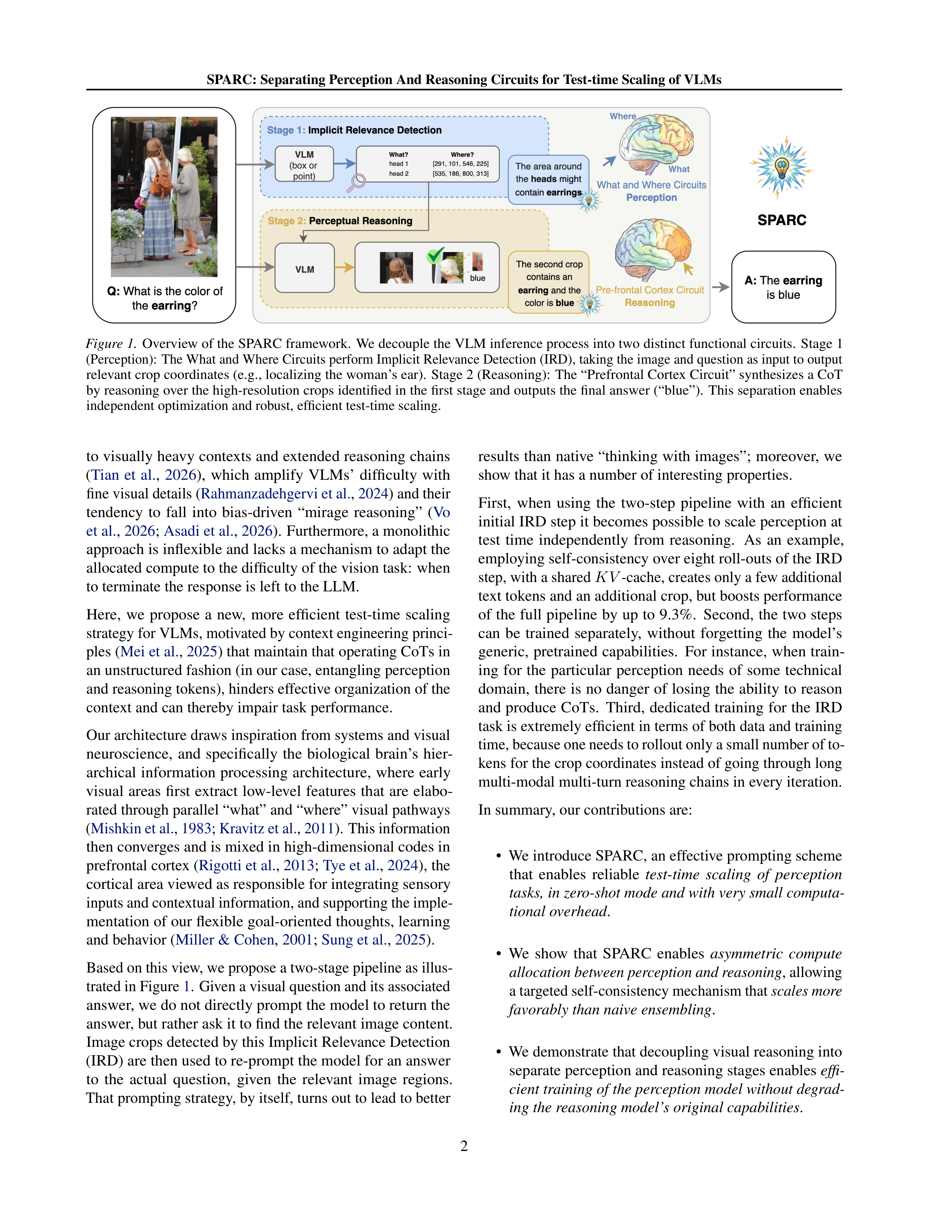
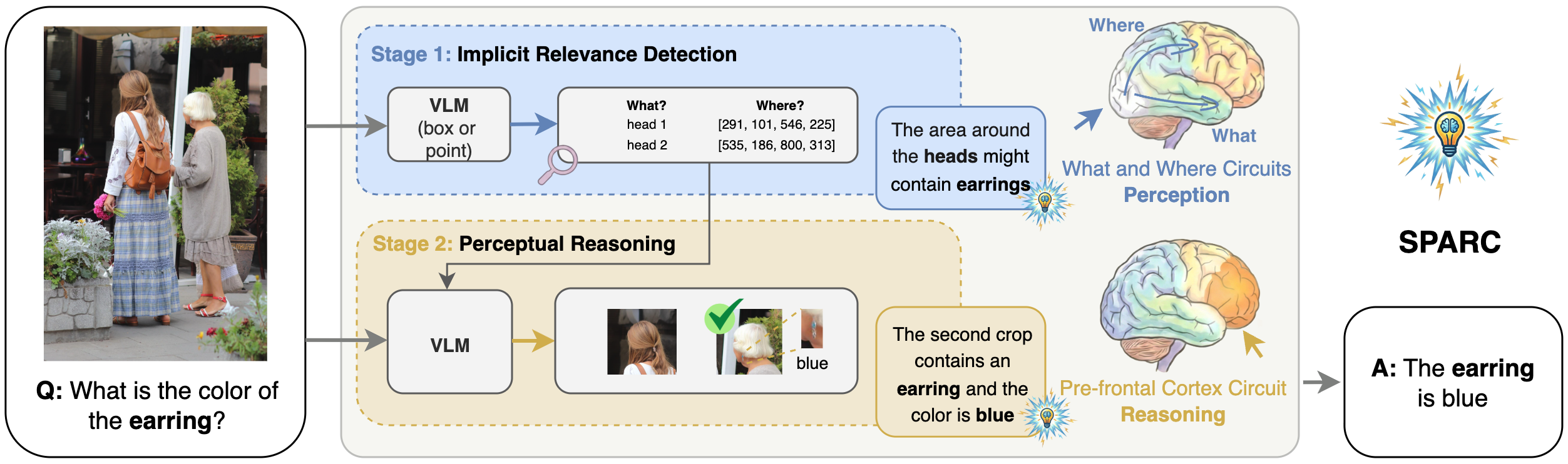
Figure 1.
Overview of the SPARC framework.
We decouple the VLM inference process into two distinct functional circuits.
Stage 1
(Perception):
The What and Where Circuits perform Implicit Relevance Detection (IRD), taking the image and question as input to output
relevant crop coordinates (e.g., localizing the woman’s ear).
Stage 2 (Reasoning):
The “Prefrontal Cortex Circuit” synthesizes a CoT
by reasoning over the high-resolution crops identified in the first stage and outputs the final answer (“blue”).
This separation enables
independent optimization and robust, efficient test-time scaling.
to visually heavy contexts and extended reasoning chains
(
Tian
et
al.
,
2026
),
which
amplify
VLMs’
difficulty
with
fine visual details (
Rahmanzadehgervi et al.
,
2024
) and their
tendency
to
fall
into
bias-driven
“mirage
reasoning”
(
Vo
et al.
,
2026
;
Asadi et al.
,
2026
).
Furthermore, a monolithic
approach is inflexible and lacks a mechanism to adapt the
allocated compute to the difficulty of the vision task:
when
to terminate the response is left to the LLM.
Here,
we
propose
a
new,
more
efficient
test-time
scaling
strategy for VLMs, motivated by context engineering princi-
ples (
Mei et al.
,
2025
) that maintain that operating CoTs in
an unstructured fashion (in our case, entangling perception
and reasoning tokens), hinders effective organization of the
context and can thereby impair task performance.
Our architecture draws inspiration from systems and visual
neuroscience,
and
specifically
the
biological
brain’s
hier-
archical information processing architecture,
where early
visual
areas
first
extract
low-level
features
that
are
elabo-
rated through parallel “what” and “where” visual pathways
(
Mishkin et al.
,
1983
;
Kravitz et al.
,
2011
).
This information
then converges and is mixed in high-dimensional codes in
prefrontal cortex (
Rigotti et al.
,
2013
;
Tye et al.
,
2024
), the
cortical area viewed as responsible for integrating sensory
inputs and contextual information, and supporting the imple-
mentation of our flexible goal-oriented thoughts, learning
and behavior (
Miller & Cohen
,
2001
;
Sung et al.
,
2025
).
Based on this view, we propose a two-stage pipeline as illus-
trated in Figure
1
.
Given a visual question and its associated
answer, we do not directly prompt the model to return the
answer, but rather ask it to find the relevant image content.
Image crops detected by this Implicit Relevance Detection
(IRD) are then used to re-prompt the model for an answer
to
the
actual
question,
given
the
relevant
image
regions.
That prompting strategy, by itself, turns out to lead to better
results than native “thinking with images”;
moreover, we
show that it has a number of interesting properties.
First,
when
using
the
two-step
pipeline
with
an
efficient
initial IRD step it becomes possible to scale perception at
test
time
independently
from
reasoning.
As
an
example,
employing self-consistency over eight roll-outs of the IRD
step, with a shared
KV
-cache, creates only a few additional
text tokens and an additional crop, but boosts performance
of the full pipeline by up to 9.3%.
Second,
the two steps
can
be
trained
separately,
without
forgetting
the
model’s
generic,
pretrained capabilities.
For instance,
when train-
ing
for
the
particular
perception
needs
of
some
technical
domain,
there is no danger of losing the ability to reason
and produce CoTs.
Third, dedicated training for the IRD
task is extremely efficient in terms of both data and training
time, because one needs to rollout only a small number of to-
kens for the crop coordinates instead of going through long
multi-modal multi-turn reasoning chains in every iteration.
In summary, our contributions are:
•
We introduce SPARC, an effective prompting scheme
that
enables
reliable
test-time
scaling
of
perception
tasks, in zero-shot mode and with very small computa-
tional overhead
.
•
We
show
that
SPARC
enables
asymmetric
compute
allocation between perception and reasoning
, allowing
a targeted self-consistency mechanism that
scales more
favorably than naive ensembling
.
•
We demonstrate that decoupling visual reasoning into
separate perception and reasoning stages enables
effi-
cient training of the perception model without degrad-
ing the reasoning model’s original capabilities
.
2
SPARC: Separating Perception And Reasoning Circuits for Test-time Scaling of VLMs
2. Related Work
Vision-Language
Models
and
Grounding
.
Recent
ad-
vancements
in
Vision-Language
Models
(VLMs)
have
primarily
focused
on
extending
Large
Language
Models
(LLMs) with visual perception capabilities, typically via a
visual encoder (e.g.,
CLIP (
Radford et al.
,
2021
),
SigLIP
(
Zhai et al.
,
2023
)) connected to the LLM backbone through
a projection layer (
Liu et al.
,
2023
;
Li et al.
,
2024
;
Bai et al.
,
2023
).
Modern
architectures
like
LLaVA-OneVision-1.5
(
An et al.
,
2025
), MM1 (
McKinzie et al.
,
2024
), and Qwen3-
VL (
Bai et al.
,
2025
) have scaled this paradigm, improving
resolution handling and multi-image reasoning.
While most
VLMs output text only, a critical evolution is the integration
of fine-grained visual grounding, enabling models to output
spatial
coordinates
(bounding
boxes
or
points)
alongside
text.
Models such as Kosmos-2 (
Peng et al.
,
2024
), Qwen3-
VL, and PaliGemma (
Beyer et al.
,
2024
) natively support
this
grounding
capability,
treating
coordinates
as
text
or
special tokens.
More recent works like GLaMM (
Rasheed
et al.
,
2024
) and Molmo2 (
Clark et al.
,
2026
) further refine
this by interleaving segmentation or point-based grounding
with reasoning, establishing a strong paradigm where pre-
cise spatial localization is intrinsic to the generation process
(
Cho et al.
,
2025
;
Wang et al.
,
2025c
), achieving a surprising
level of performance (
Avogaro et al.
,
2025
), sometimes even
emerging from attention maps (
Zhang et al.
,
2025a
), despite
having limits when it comes to extremely fine-grained local-
ization (
Zhang et al.
,
2026
).
Test-Time
Scaling
of
Large
Language
Models
.
The
paradigm
of
test-time
scaling—allowing
autoregressive
models
to
generate
additional
intermediate
tokens
before
outputting
a
final
answer—has
emerged
as
a
powerful,
training-free method for enhancing performance.
Founda-
tional
techniques
such
as
Chain-of-Thought
(CoT)
(
Wei
et
al.
,
2022
)
and
Self-Consistency
(
Wang
et
al.
,
2023
)
demonstrated that linear reasoning traces significantly im-
prove problem-solving capabilities.
Subsequent works ex-
panded
this
into
non-linear
structures,
such
as
Tree
of
Thoughts (ToT) (
Yao et al.
,
2023
) and Graph of Thoughts
(GoT) (
Besta et al.
,
2024
), which enable more deliberate ex-
ploration of the solution space.
More recently, this extensive
reasoning
capability
has
been
baked
directly
into
models
via strong post-training techniques.
Systems like OpenAI
o1
(
OpenAI
,
2024
)
and
DeepSeek-R1
(
Guo
et
al.
,
2025
)
utilize Reinforcement Learning (RL) with sparse rewards
to encourage the model to autonomously verify and refine
its internal chain of thought.
Furthermore,
recent studies
indicate that such sophisticated reasoning patterns can also
be induced in a training-free manner, for instance through
training-free Group Relative Policy Optimization (GRPO)
(
Cai et al.
,
2025
) or by eliciting reasoning via external cog-
nitive tools (
Ebouky et al.
,
2025
).
Test-time Scaling of Vision-Language Models
.
A growing
body of work adapts “R1-style” test-time scaling to VLMs
through “thinking with images” (
Su et al.
,
2025b
), which
interleaves
and
entangles
intermediate
visual
operations
(e.g., zooming, cropping, pointing) with textual CoTs.
This
paradigm has been mostly developed through reinforcement
learning frameworks that incentivize explicit visual reason-
ing.
For instance, Point-RFT (
Ni et al.
,
2025
) and ViGoRL
(
Sarch et al.
,
2025
) utilize reinforcement fine-tuning to align
reasoning traces with precise grounded spatial references.
Similarly,
DeepEyes
(
Zheng
et
al.
,
2026
)
and
Pixel
Rea-
soner (
Su et al.
,
2025a
) employ curiosity-driven or specific
reward
structures
to
encourage
models
to
actively
query
visual data during the reasoning process, with some work
such as (
Kumar et al.
,
2025
) mostly focusing on efficiency.
Beyond static images, Video-R4 (
Tang et al.
,
2025
) extends
this concept to video understanding.
3. Test-Time Scaling of Perception
Detailed
visual
perception
is
a
prerequisite
for
a
wide
ar-
ray of applications, ranging from document understanding
and outdoor robotics to satellite image analysis.
Test-time
scaling has emerged as the primary paradigm to boost the
performance of both LLMs and VLMs.
Allowing the model
to generate additional tokens prior to the final answer during
inference
enables
it
to
reference
a
broader
range
of
con-
textual information during reasoning.
This mechanism has
been shown to consistently enhance both predictive accu-
racy and robustness (
Wei et al.
,
2022
;
OpenAI
,
2024
;
Guo
et al.
,
2025
).
In the present work, we focus on the perceptual
abilities of VLMs.
Our goal is to enhance the model’s han-
dling of task-relevant visual input at test time in an efficient
and robust manner.
Intuitively, more detailed image understanding necessitates
a richer visual representation.
We posit that this translates
directly to an increased number of image tokens at test time.
This
intuition
aligns
with
the
recently
popular
“thinking
with images” approach to VLM test-time scaling.
In that
framework, models generate extended reasoning traces that
are interleaved with
zoom-in
actions, i.e., the model invokes
a tool to retrieve relevant image crops in higher resolution.
While
we
agree
with
the
high-level
concept
of
zooming
into image locations that may be important for the task, we
argue that for tasks that are primarily perceptual,
lengthy
intermediate text generation and complex multi-turn han-
dling are superfluous and can even be counter-productive.
The open-form traces produced by such a procedure bring
little benefit for the actual perception task; on the contrary,
they contradict context engineering principles that suggest
to employ structured and modular composition (
Mei et al.
,
2025
) and can promote excessively long traces resulting in
hallucinations
(
Diao
et
al.
,
2026
).
Instead,
we
propose
a
3
SPARC: Separating Perception And Reasoning Circuits for Test-time Scaling of VLMs
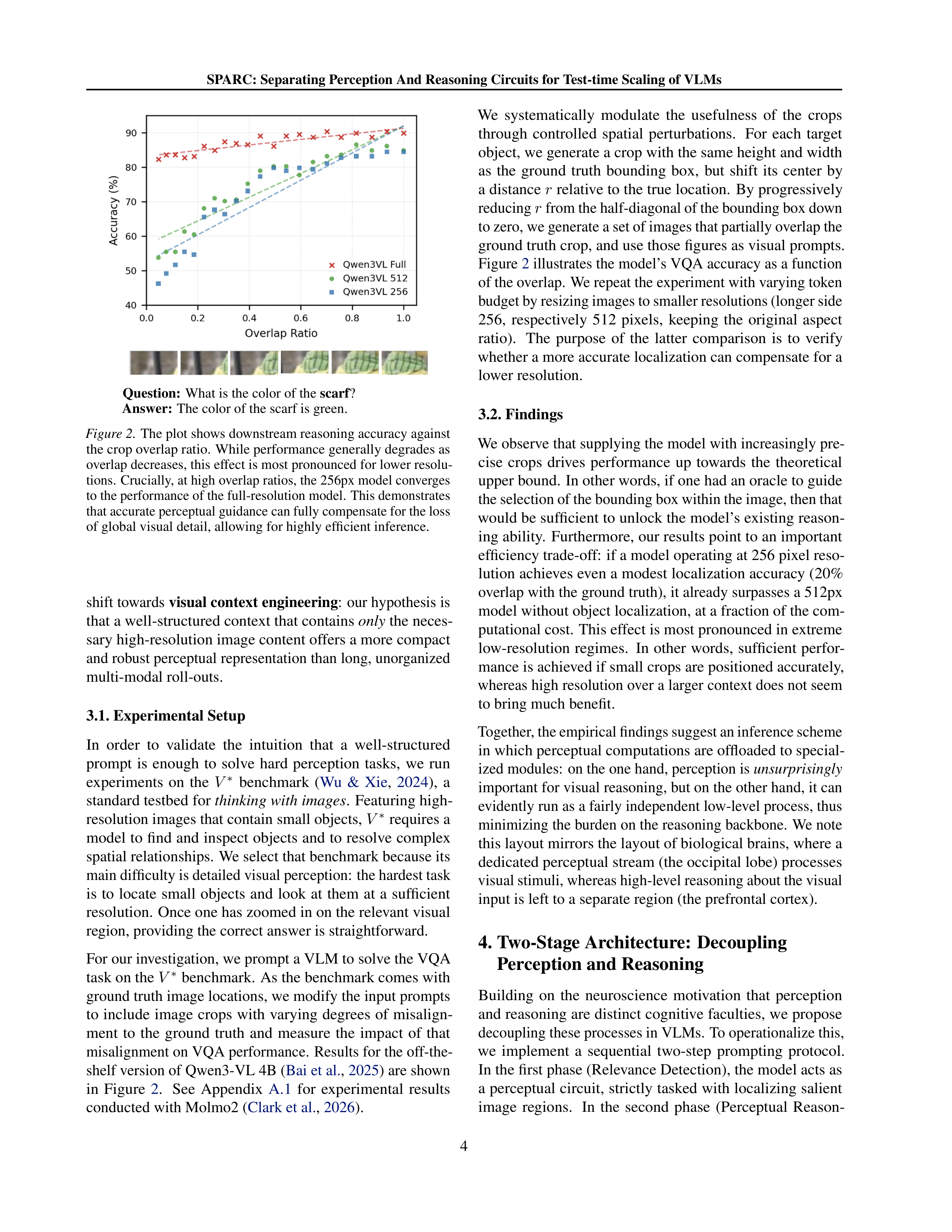
Question:
What is the color of the
scarf
?
Answer:
The color of the scarf is green.
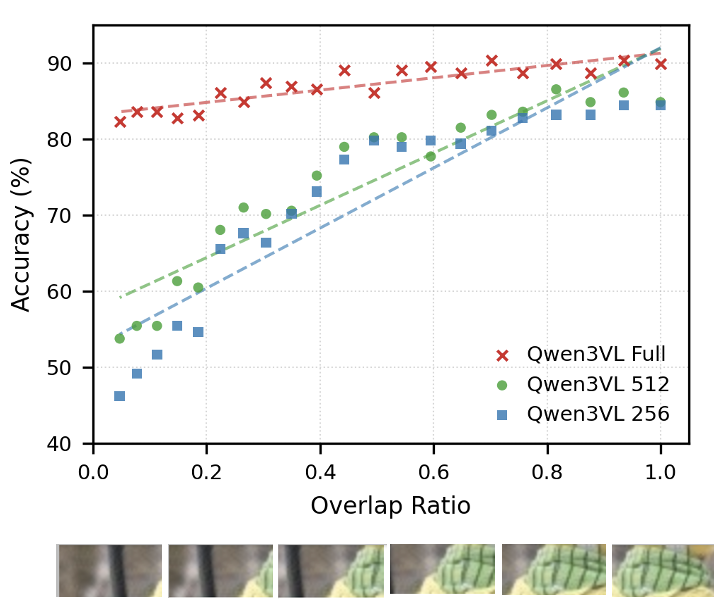
Figure 2.
The plot shows downstream reasoning accuracy against
the crop overlap ratio.
While performance generally degrades as
overlap decreases, this effect is most pronounced for lower resolu-
tions.
Crucially, at high overlap ratios, the 256px model converges
to the performance of the full-resolution model.
This demonstrates
that accurate perceptual guidance can fully compensate for the loss
of global visual detail, allowing for highly efficient inference.
shift towards
visual context engineering
:
our hypothesis is
that a well-structured context that contains
only
the neces-
sary high-resolution image content offers a more compact
and robust perceptual representation than long, unorganized
multi-modal roll-outs.
3.1. Experimental Setup
In
order
to
validate
the
intuition
that
a
well-structured
prompt
is
enough
to
solve
hard
perception
tasks,
we
run
experiments
on
the
V
∗
benchmark
(
Wu
&
Xie
,
2024
),
a
standard testbed for
thinking with images
.
Featuring high-
resolution images that contain small objects,
V
∗
requires a
model to find and inspect objects and to resolve complex
spatial relationships.
We select that benchmark because its
main difficulty is detailed visual perception: the hardest task
is
to
locate
small
objects
and
look
at
them
at
a
sufficient
resolution.
Once one has zoomed in on the relevant visual
region, providing the correct answer is straightforward.
For our investigation, we prompt a VLM to solve the VQA
task on the
V
∗
benchmark.
As the benchmark comes with
ground truth image locations, we modify the input prompts
to
include
image
crops
with
varying
degrees
of
misalign-
ment
to
the
ground
truth
and
measure
the
impact
of
that
misalignment on VQA performance.
Results for the off-the-
shelf version of Qwen3-VL 4B (
Bai et al.
,
2025
) are shown
in
Figure
2
.
See
Appendix
A.1
for
experimental
results
conducted with Molmo2 (
Clark et al.
,
2026
).
We
systematically
modulate
the
usefulness
of
the
crops
through
controlled
spatial
perturbations.
For
each
target
object, we generate a crop with the same height and width
as
the
ground
truth
bounding
box,
but
shift
its
center
by
a distance
r
relative to the true location.
By progressively
reducing
r
from the half-diagonal of the bounding box down
to zero, we generate a set of images that partially overlap the
ground truth crop, and use those figures as visual prompts.
Figure
2
illustrates the model’s VQA accuracy as a function
of the overlap.
We repeat the experiment with varying token
budget by resizing images to smaller resolutions (longer side
256,
respectively
512
pixels,
keeping
the
original
aspect
ratio).
The
purpose
of
the
latter
comparison
is
to
verify
whether a more accurate localization can compensate for a
lower resolution.
3.2. Findings
We observe that supplying the model with increasingly pre-
cise
crops
drives
performance
up
towards
the
theoretical
upper bound.
In other words, if one had an oracle to guide
the selection of the bounding box within the image, then that
would be sufficient to unlock the model’s existing reason-
ing ability.
Furthermore, our results point to an important
efficiency trade-off:
if a model operating at 256 pixel reso-
lution achieves even a modest localization accuracy (20%
overlap with the ground truth), it already surpasses a 512px
model without object localization, at a fraction of the com-
putational cost.
This effect is most pronounced in extreme
low-resolution regimes.
In other words,
sufficient perfor-
mance is achieved if small crops are positioned accurately,
whereas high resolution over a larger context does not seem
to bring much benefit.
Together, the empirical findings suggest an inference scheme
in which perceptual computations are offloaded to special-
ized modules:
on the one hand, perception is
unsurprisingly
important for visual reasoning, but on the other hand, it can
evidently run as a fairly independent low-level process, thus
minimizing the burden on the reasoning backbone.
We note
this layout mirrors the layout of biological brains, where a
dedicated perceptual stream (the occipital lobe) processes
visual stimuli, whereas high-level reasoning about the visual
input is left to a separate region (the prefrontal cortex).
4. Two-Stage Architecture:
Decoupling
Perception and Reasoning
Building
on
the
neuroscience
motivation
that
perception
and reasoning are distinct cognitive faculties, we propose
decoupling these processes in VLMs.
To operationalize this,
we
implement
a
sequential
two-step
prompting
protocol.
In the first phase (Relevance Detection), the model acts as
a perceptual circuit, strictly tasked with localizing salient
image
regions.
In
the
second
phase
(Perceptual
Reason-
4
SPARC: Separating Perception And Reasoning Circuits for Test-time Scaling of VLMs
ing),
the
model
serves
as
a
reasoning
circuit,
generating
the final answer conditioned on the extracted regions.
Em-
ploying sequential prompting stages exercises the
context
engineering
best practice of managing the context window
via structured, modular composition (
Mei et al.
,
2025
), and
steers the model towards sampling from two distinct output
distributions (
Xie et al.
,
2022
;
Min et al.
,
2022
), effectively
activating separate
functional circuits
for visual search and
logical deduction, rather than entangling them.
Separating distinct relevance detection and reasoning opera-
tions intuitively enables the model to focus on addressing
each
specific
demand.
The
relevance
detection
step
,
for
instance, demands that the model localize pertinent image
regions based on a specific query.
Unlike standard Referring
Expression
Comprehension
(REC)
(
Mao
et
al.
,
2016
;
Yu
et al.
,
2016
), where the target is explicitly named (e.g., ‘find
the red ball’), this objective requires the model to infer latent
visual relevance from a high-level reasoning prompt.
Con-
sequently, defining an ‘optimal’ crop becomes an ill-posed
problem:
strictly speaking, the ideal crop is not necessarily
the tightest bounding box around an object, but rather the
visual window that maximizes the probability of a correct
prediction in the subsequent reasoning step.
While some
queries demand precise object detection, others benefit from
looser crops that preserve contextual relationships—a phe-
nomenon we analyze in Appendix
A.2
.
Given these distinct
requirements, we term this task Implicit Relevance Detec-
tion (IRD).
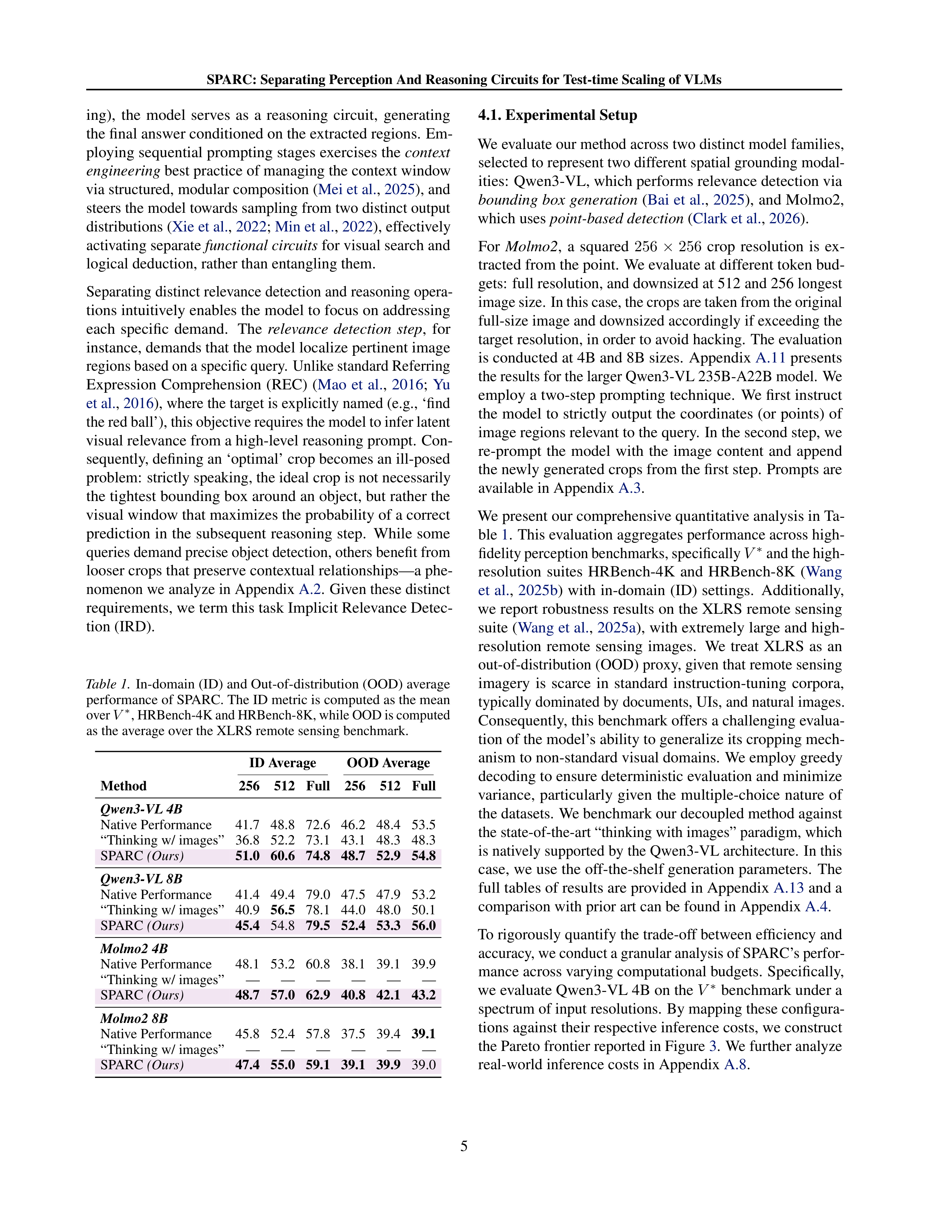
Table 1.
In-domain (ID) and Out-of-distribution (OOD) average
performance of SPARC. The ID metric is computed as the mean
over
V
∗
, HRBench-4K and HRBench-8K, while OOD is computed
as the average over the XLRS remote sensing benchmark.
ID Average
OOD Average
Method
256
512
Full
256
512
Full
Qwen3-VL 4B
Native Performance
41.7
48.8
72.6
46.2
48.4
53.5
“Thinking w/ images”
36.8
52.2
73.1
43.1
48.3
48.3
SPARC
(Ours)
51.0
60.6
74.8
48.7
52.9
54.8
Qwen3-VL 8B
Native Performance
41.4
49.4
79.0
47.5
47.9
53.2
“Thinking w/ images”
40.9
56.5
78.1
44.0
48.0
50.1
SPARC
(Ours)
45.4
54.8
79.5
52.4
53.3
56.0
Molmo2 4B
Native Performance
48.1
53.2
60.8
38.1
39.1
39.9
“Thinking w/ images”
—
—
—
—
—
—
SPARC
(Ours)
48.7
57.0
62.9
40.8
42.1
43.2
Molmo2 8B
Native Performance
45.8
52.4
57.8
37.5
39.4
39.1
“Thinking w/ images”
—
—
—
—
—
—
SPARC
(Ours)
47.4
55.0
59.1
39.1
39.9
39.0
4.1. Experimental Setup
We evaluate our method across two distinct model families,
selected to represent two different spatial grounding modal-
ities:
Qwen3-VL, which performs relevance detection via
bounding box generation
(
Bai et al.
,
2025
), and Molmo2,
which uses
point-based detection
(
Clark et al.
,
2026
).
For
Molmo2
,
a
squared
256
×
256
crop
resolution
is
ex-
tracted from the point.
We evaluate at different token bud-
gets:
full resolution, and downsized at 512 and 256 longest
image size. In this case, the crops are taken from the original
full-size image and downsized accordingly if exceeding the
target resolution, in order to avoid hacking.
The evaluation
is conducted at 4B and 8B sizes.
Appendix
A.11
presents
the results for the larger Qwen3-VL 235B-A22B model.
We
employ a two-step prompting technique.
We first instruct
the model to strictly output the coordinates (or points) of
image regions relevant to the query.
In the second step, we
re-prompt
the
model
with
the
image
content
and
append
the newly generated crops from the first step.
Prompts are
available in Appendix
A.3
.
We present our comprehensive quantitative analysis in Ta-
ble
1
.
This evaluation aggregates performance across high-
fidelity perception benchmarks, specifically
V
∗
and the high-
resolution
suites
HRBench-4K
and
HRBench-8K
(
Wang
et al.
,
2025b
) with in-domain (ID) settings.
Additionally,
we report robustness results on the XLRS remote sensing
suite (
Wang et al.
,
2025a
), with extremely large and high-
resolution
remote
sensing
images.
We
treat
XLRS
as
an
out-of-distribution (OOD) proxy, given that remote sensing
imagery
is
scarce
in
standard
instruction-tuning
corpora,
typically dominated by documents, UIs, and natural images.
Consequently, this benchmark offers a challenging evalua-
tion of the model’s ability to generalize its cropping mech-
anism to non-standard visual domains.
We employ greedy
decoding to ensure deterministic evaluation and minimize
variance,
particularly
given
the
multiple-choice
nature
of
the datasets.
We benchmark our decoupled method against
the state-of-the-art “thinking with images” paradigm, which
is natively supported by the Qwen3-VL architecture.
In this
case, we use the off-the-shelf generation parameters.
The
full tables of results are provided in Appendix
A.13
and a
comparison with prior art can be found in Appendix
A.4
.
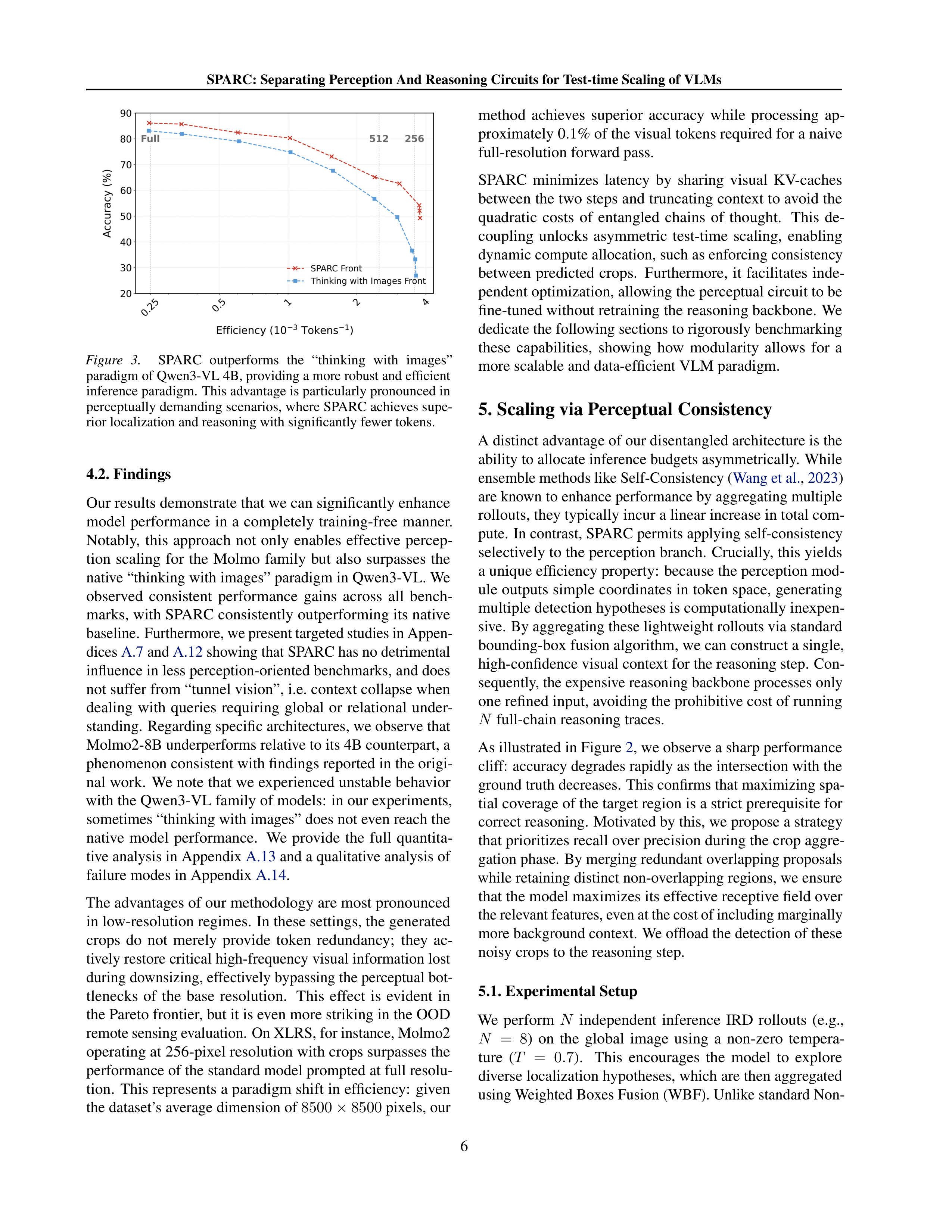
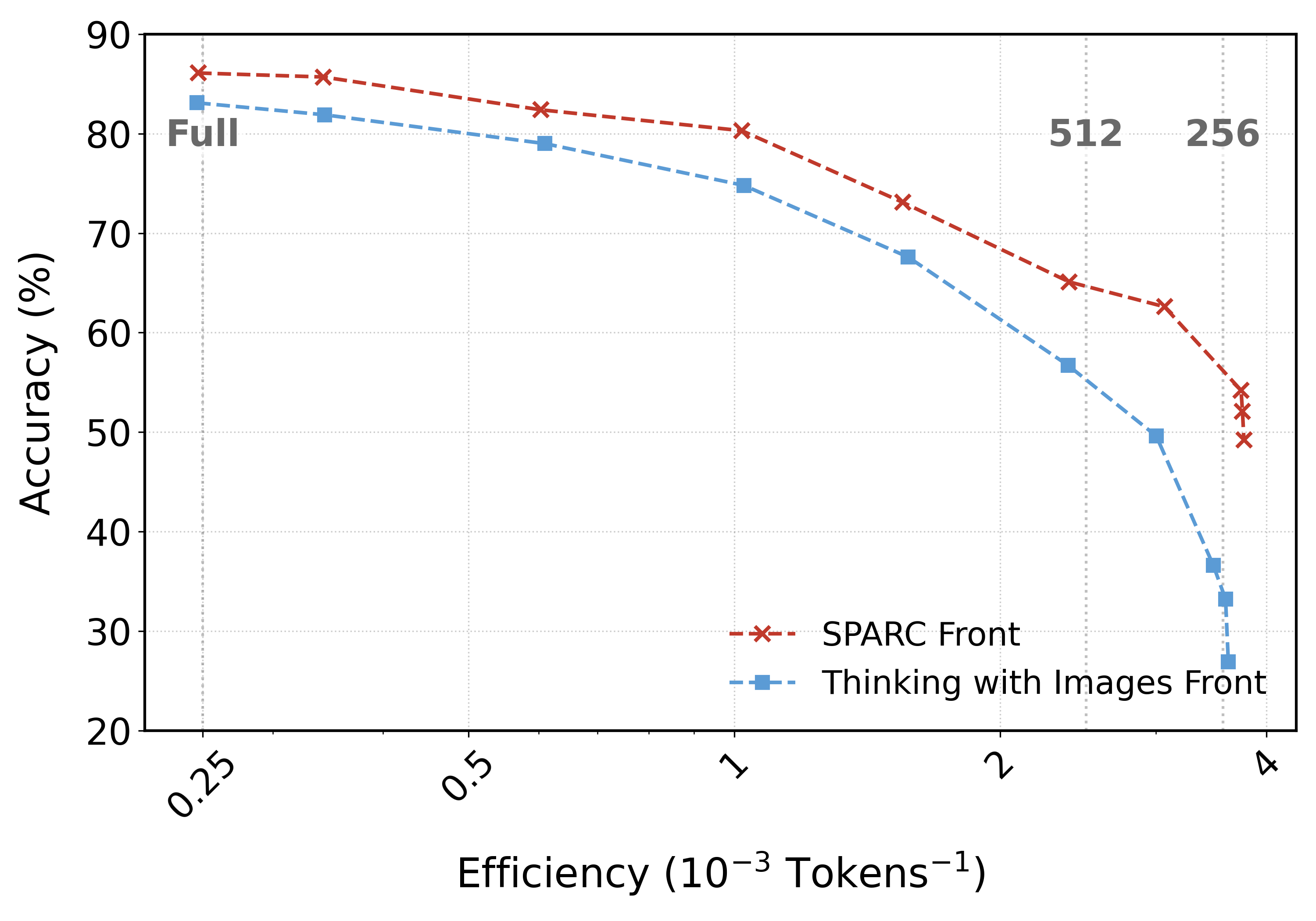
To rigorously quantify the trade-off between efficiency and
accuracy, we conduct a granular analysis of SPARC’s perfor-
mance across varying computational budgets.
Specifically,
we evaluate Qwen3-VL 4B on the
V
∗
benchmark under a
spectrum of input resolutions.
By mapping these configura-
tions against their respective inference costs, we construct
the Pareto frontier reported in Figure
3
.
We further analyze
real-world inference costs in Appendix
A.8
.
5
SPARC: Separating Perception And Reasoning Circuits for Test-time Scaling of VLMs
Figure
3.
SPARC
outperforms
the
“thinking
with
images”
paradigm of Qwen3-VL 4B, providing a more robust and efficient
inference paradigm.
This advantage is particularly pronounced in
perceptually demanding scenarios, where SPARC achieves supe-
rior localization and reasoning with significantly fewer tokens.
4.2. Findings
Our results demonstrate that we can significantly enhance
model
performance
in a
completely
training-free
manner.
Notably,
this
approach
not
only
enables
effective
percep-
tion
scaling
for
the
Molmo
family
but
also
surpasses
the
native “thinking with images” paradigm in Qwen3-VL. We
observed
consistent
performance
gains
across
all
bench-
marks, with SPARC consistently outperforming its native
baseline. Furthermore, we present targeted studies in Appen-
dices
A.7
and
A.12
showing that SPARC has no detrimental
influence in less perception-oriented benchmarks, and does
not suffer from “tunnel vision”, i.e. context collapse when
dealing
with
queries
requiring
global
or
relational
under-
standing.
Regarding specific architectures, we observe that
Molmo2-8B underperforms relative to its 4B counterpart, a
phenomenon consistent with findings reported in the origi-
nal work.
We note that we experienced unstable behavior
with the Qwen3-VL family of models:
in our experiments,
sometimes “thinking with images” does not even reach the
native
model
performance.
We
provide
the
full
quantita-
tive analysis in Appendix
A.13
and a qualitative analysis of
failure modes in Appendix
A.14
.
The advantages of our methodology are most pronounced
in low-resolution regimes.
In these settings, the generated
crops
do
not
merely
provide
token
redundancy;
they
ac-
tively restore critical high-frequency visual information lost
during downsizing, effectively bypassing the perceptual bot-
tlenecks
of
the
base
resolution.
This
effect
is
evident
in
the Pareto frontier, but it is even more striking in the OOD
remote sensing evaluation.
On XLRS, for instance, Molmo2
operating at 256-pixel resolution with crops surpasses the
performance of the standard model prompted at full resolu-
tion.
This represents a paradigm shift in efficiency:
given
the dataset’s average dimension of
8500
×
8500
pixels, our
method
achieves
superior
accuracy
while
processing
ap-
proximately 0.1% of the visual tokens required for a naive
full-resolution forward pass.
SPARC
minimizes
latency
by
sharing
visual
KV-caches
between the two steps and truncating context to avoid the
quadratic
costs
of
entangled
chains
of
thought.
This
de-
coupling
unlocks
asymmetric
test-time
scaling,
enabling
dynamic compute allocation, such as enforcing consistency
between
predicted
crops.
Furthermore,
it
facilitates
inde-
pendent optimization, allowing the perceptual circuit to be
fine-tuned without retraining the reasoning backbone.
We
dedicate the following sections to rigorously benchmarking
these
capabilities,
showing
how
modularity
allows
for
a
more scalable and data-efficient VLM paradigm.
5. Scaling via Perceptual Consistency
A distinct advantage of our disentangled architecture is the
ability to allocate inference budgets asymmetrically.
While
ensemble methods like Self-Consistency (
Wang et al.
,
2023
)
are known to enhance performance by aggregating multiple
rollouts, they typically incur a linear increase in total com-
pute.
In contrast, SPARC permits applying self-consistency
selectively to the perception branch.
Crucially, this yields
a unique efficiency property:
because the perception mod-
ule outputs simple coordinates in token space, generating
multiple detection hypotheses is computationally inexpen-
sive.
By aggregating these lightweight rollouts via standard
bounding-box fusion algorithm, we can construct a single,
high-confidence visual context for the reasoning step.
Con-
sequently, the expensive reasoning backbone processes only
one refined input, avoiding the prohibitive cost of running
N
full-chain reasoning traces.
As illustrated in Figure
2
, we observe a sharp performance
cliff:
accuracy degrades rapidly as the intersection with the
ground truth decreases.
This confirms that maximizing spa-
tial coverage of the target region is a strict prerequisite for
correct reasoning.
Motivated by this, we propose a strategy
that prioritizes recall over precision during the crop aggre-
gation phase.
By merging redundant overlapping proposals
while retaining distinct non-overlapping regions, we ensure
that the model maximizes its effective receptive field over
the relevant features, even at the cost of including marginally
more background context.
We offload the detection of these
noisy crops to the reasoning step.
5.1. Experimental Setup
We
perform
N
independent
inference
IRD
rollouts
(e.g.,
N
=
8
)
on
the
global
image
using
a
non-zero
tempera-
ture
(
T
=
0
.
7
).
This
encourages
the
model
to
explore
diverse localization hypotheses, which are then aggregated
using Weighted Boxes Fusion (WBF). Unlike standard Non-
6
SPARC: Separating Perception And Reasoning Circuits for Test-time Scaling of VLMs
Maximum Suppression (NMS) which simply discards pro-
posals, WBF computes a weighted average of overlapping
predictions to derive a consensus bounding box.
We merge
bounding boxes with at least 50% intersection over union.
Distinct, non-overlapping bounding boxes are retained and
forwarded directly to the reasoning stage. Results for
N
= 4
and
N
= 8
can be found in Table
2
.
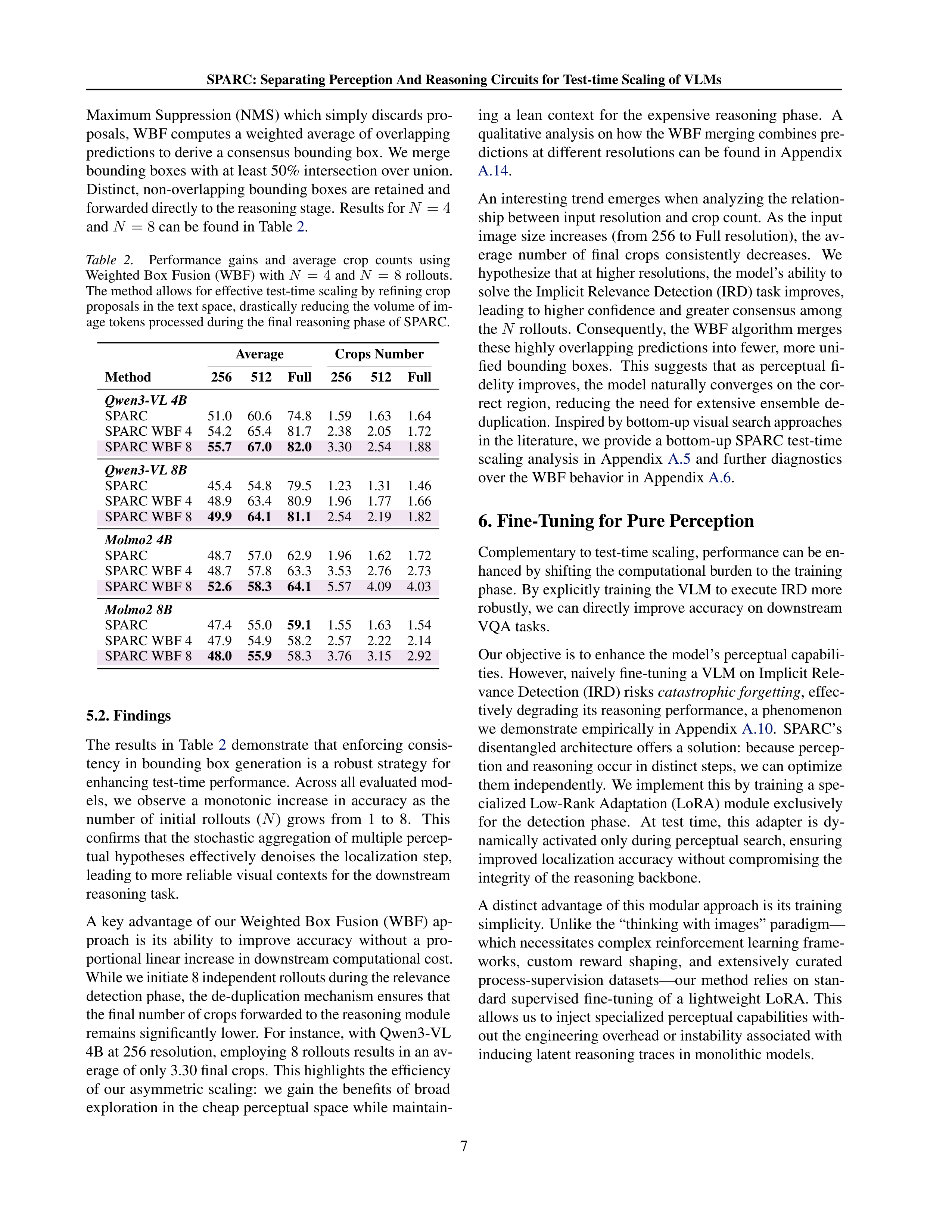
Table
2.
Performance
gains
and
average
crop
counts
using
Weighted Box Fusion (WBF) with
N
=
4
and
N
=
8
rollouts.
The method allows for effective test-time scaling by refining crop
proposals in the text space, drastically reducing the volume of im-
age tokens processed during the final reasoning phase of SPARC.
Average
Crops Number
Method
256
512
Full
256
512
Full
Qwen3-VL 4B
SPARC
51.0
60.6
74.8
1.59
1.63
1.64
SPARC WBF 4
54.2
65.4
81.7
2.38
2.05
1.72
SPARC WBF 8
55.7
67.0
82.0
3.30
2.54
1.88
Qwen3-VL 8B
SPARC
45.4
54.8
79.5
1.23
1.31
1.46
SPARC WBF 4
48.9
63.4
80.9
1.96
1.77
1.66
SPARC WBF 8
49.9
64.1
81.1
2.54
2.19
1.82
Molmo2 4B
SPARC
48.7
57.0
62.9
1.96
1.62
1.72
SPARC WBF 4
48.7
57.8
63.3
3.53
2.76
2.73
SPARC WBF 8
52.6
58.3
64.1
5.57
4.09
4.03
Molmo2 8B
SPARC
47.4
55.0
59.1
1.55
1.63
1.54
SPARC WBF 4
47.9
54.9
58.2
2.57
2.22
2.14
SPARC WBF 8
48.0
55.9
58.3
3.76
3.15
2.92
5.2. Findings
The
results
in
Table
2
demonstrate
that
enforcing
consis-
tency
in
bounding
box
generation
is
a
robust
strategy
for
enhancing test-time performance.
Across all evaluated mod-
els,
we
observe
a
monotonic
increase
in
accuracy
as
the
number
of
initial
rollouts
(
N
)
grows
from
1
to
8.
This
confirms that the stochastic aggregation of multiple percep-
tual
hypotheses
effectively
denoises
the
localization
step,
leading to more reliable visual contexts for the downstream
reasoning task.
A key advantage of our Weighted Box Fusion (WBF) ap-
proach
is
its
ability
to
improve
accuracy
without
a
pro-
portional linear increase in downstream computational cost.
While we initiate 8 independent rollouts during the relevance
detection phase, the de-duplication mechanism ensures that
the final number of crops forwarded to the reasoning module
remains significantly lower.
For instance, with Qwen3-VL
4B at 256 resolution, employing 8 rollouts results in an av-
erage of only 3.30 final crops.
This highlights the efficiency
of our asymmetric scaling:
we gain the benefits of broad
exploration in the cheap perceptual space while maintain-
ing
a
lean
context
for
the
expensive
reasoning
phase.
A
qualitative analysis on how the WBF merging combines pre-
dictions at different resolutions can be found in Appendix
A.14
.
An interesting trend emerges when analyzing the relation-
ship between input resolution and crop count.
As the input
image size increases (from 256 to Full resolution), the av-
erage
number
of
final
crops
consistently
decreases.
We
hypothesize that at higher resolutions, the model’s ability to
solve the Implicit Relevance Detection (IRD) task improves,
leading to higher confidence and greater consensus among
the
N
rollouts.
Consequently, the WBF algorithm merges
these highly overlapping predictions into fewer, more uni-
fied
bounding
boxes.
This
suggests
that
as
perceptual
fi-
delity improves, the model naturally converges on the cor-
rect region,
reducing the need for extensive ensemble de-
duplication. Inspired by bottom-up visual search approaches
in the literature, we provide a bottom-up SPARC test-time
scaling
analysis
in
Appendix
A.5
and
further
diagnostics
over the WBF behavior in Appendix
A.6
.
6. Fine-Tuning for Pure Perception
Complementary to test-time scaling, performance can be en-
hanced by shifting the computational burden to the training
phase.
By explicitly training the VLM to execute IRD more
robustly, we can directly improve accuracy on downstream
VQA tasks.
Our objective is to enhance the model’s perceptual capabili-
ties.
However, naively fine-tuning a VLM on Implicit Rele-
vance Detection (IRD) risks
catastrophic forgetting
, effec-
tively degrading its reasoning performance, a phenomenon
we demonstrate empirically in Appendix
A.10
.
SPARC’s
disentangled architecture offers a solution:
because percep-
tion and reasoning occur in distinct steps, we can optimize
them independently.
We implement this by training a spe-
cialized Low-Rank Adaptation (LoRA) module exclusively
for
the
detection
phase.
At
test
time,
this
adapter
is
dy-
namically activated only during perceptual search, ensuring
improved localization accuracy without compromising the
integrity of the reasoning backbone.
A distinct advantage of this modular approach is its training
simplicity.
Unlike the “thinking with images” paradigm—
which necessitates complex reinforcement learning frame-
works,
custom
reward
shaping,
and
extensively
curated
process-supervision
datasets—our
method
relies
on
stan-
dard
supervised
fine-tuning
of
a
lightweight
LoRA.
This
allows us to inject specialized perceptual capabilities with-
out the engineering overhead or instability associated with
inducing latent reasoning traces in monolithic models.
7
SPARC: Separating Perception And Reasoning Circuits for Test-time Scaling of VLMs
6.1. Experimental Setup
Training our explicit perception modules requires a VQA
dataset enriched with spatial relevance annotations.
As we
pointed out in Section
4
, IRD correctness is not based on
training on a unique label, but instead a prediction is consid-
ered correct if it leads to a correct answer.
In order to obtain
such
annotations,
we
perform
a
round
of
synthetic
data
generation
on
the
DeepEyes
dataset
(
Zheng
et
al.
,
2026
),
tailoring the annotation format to the grounding modality of
each target architecture:
•
Bounding-Box Annotations (Qwen3-VL):
We utilize
the large-scale Qwen3-VL 235B-A22B model, lever-
aging
its
native
“thinking
with
images”
capabilities.
We extract the crop coordinates generated during the
model’s intermediate tool calls and apply rejection sam-
pling—retaining only those traces that yield a correct
final
answer.
This
process
results
in
a
high-quality
dataset of approximately 23,000 samples.
•
Point-Based Annotations (Molmo2):
For the Molmo
family, we employ the 8B variant (the largest publicly
available model at the time of writing).
We execute the
two-step inference pipeline described in Section
4
to
generate relevance points.
Following the same filtering
protocol as for Qwen3-VL, we retain only the success-
ful traces, yielding a curated dataset of approximately
14,000 samples.
We perform Supervised Fine-Tuning (SFT) for two epochs
using a standard autoregressive next-token prediction objec-
tive.
Crucially, we conduct this training across three distinct
resolution scales to evaluate the necessity of high-fidelity
inputs for the detection task.
This experimental design is
motivated by our findings in Section
4
, where the base mod-
els demonstrated high baseline proficiency in the IRD task
at full resolution.
We hypothesize that training exclusively
at
native
resolution
may
render
the
optimization
task
too
trivial, potentially inducing overfitting due to a lack of suffi-
cient difficulty.
Moreover, training at full resolution would
mean performing pure knowledge distillation of the bigger
model, which is a much weaker training signal than trying
to
solve
the
same
task
at
lower
resolution.
More
details
about the training setup are in Appendix
A.9
.
6.2. Findings
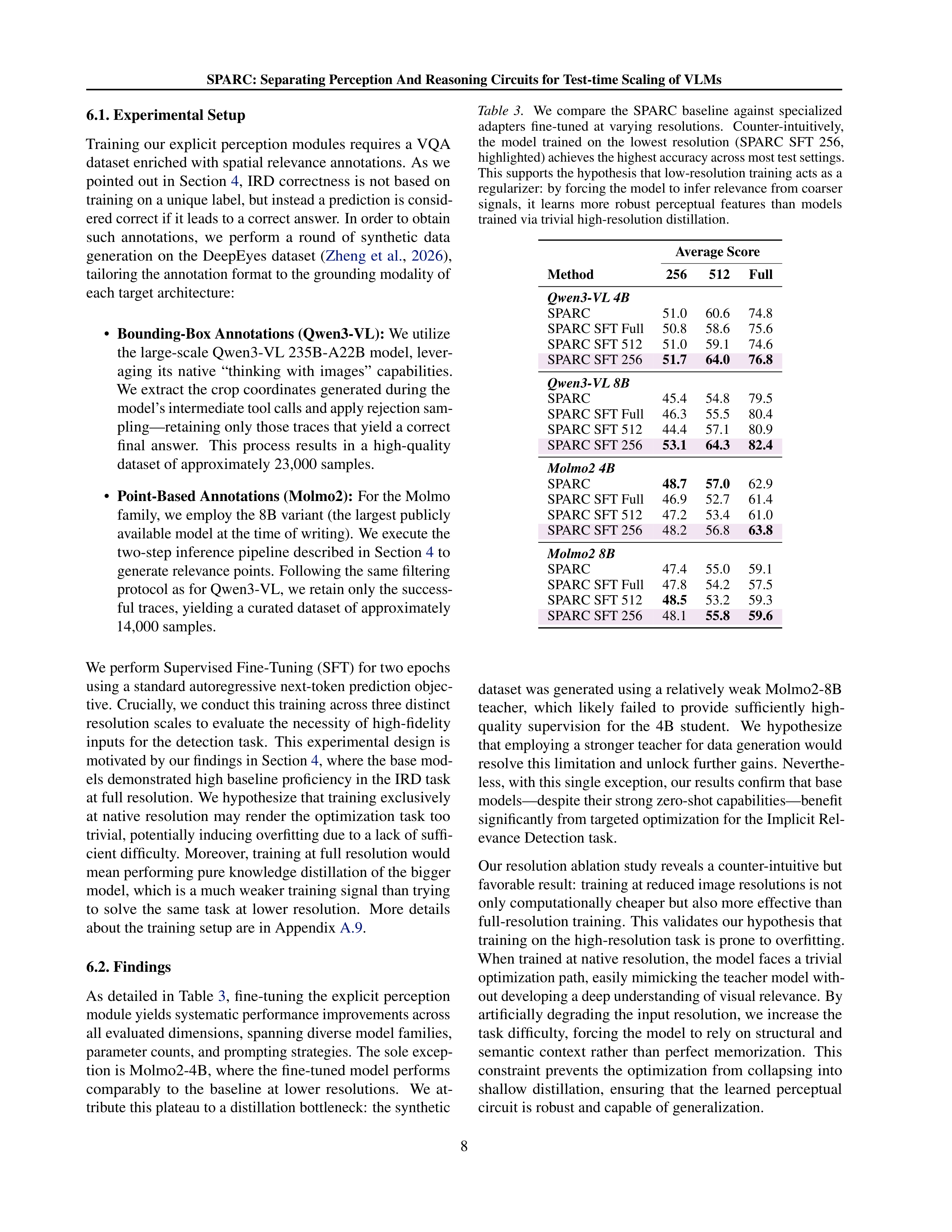
As detailed in Table
3
, fine-tuning the explicit perception
module yields systematic performance improvements across
all evaluated dimensions, spanning diverse model families,
parameter counts, and prompting strategies.
The sole excep-
tion is Molmo2-4B, where the fine-tuned model performs
comparably
to
the
baseline
at
lower
resolutions.
We
at-
tribute this plateau to a distillation bottleneck:
the synthetic
Table
3.
We
compare
the
SPARC
baseline
against
specialized
adapters
fine-tuned
at
varying
resolutions.
Counter-intuitively,
the
model
trained
on
the
lowest
resolution
(SPARC
SFT
256,
highlighted) achieves the highest accuracy across most test settings.
This supports the hypothesis that low-resolution training acts as a
regularizer:
by forcing the model to infer relevance from coarser
signals,
it
learns
more
robust
perceptual
features
than
models
trained via trivial high-resolution distillation.
Average Score
Method
256
512
Full
Qwen3-VL 4B
SPARC
51.0
60.6
74.8
SPARC SFT Full
50.8
58.6
75.6
SPARC SFT 512
51.0
59.1
74.6
SPARC SFT 256
51.7
64.0
76.8
Qwen3-VL 8B
SPARC
45.4
54.8
79.5
SPARC SFT Full
46.3
55.5
80.4
SPARC SFT 512
44.4
57.1
80.9
SPARC SFT 256
53.1
64.3
82.4
Molmo2 4B
SPARC
48.7
57.0
62.9
SPARC SFT Full
46.9
52.7
61.4
SPARC SFT 512
47.2
53.4
61.0
SPARC SFT 256
48.2
56.8
63.8
Molmo2 8B
SPARC
47.4
55.0
59.1
SPARC SFT Full
47.8
54.2
57.5
SPARC SFT 512
48.5
53.2
59.3
SPARC SFT 256
48.1
55.8
59.6
dataset was generated using a relatively weak Molmo2-8B
teacher,
which
likely
failed
to
provide
sufficiently
high-
quality
supervision
for
the
4B
student.
We
hypothesize
that employing a stronger teacher for data generation would
resolve this limitation and unlock further gains.
Neverthe-
less, with this single exception, our results confirm that base
models—despite their strong zero-shot capabilities—benefit
significantly from targeted optimization for the Implicit Rel-
evance Detection task.
Our resolution ablation study reveals a counter-intuitive but
favorable result:
training at reduced image resolutions is not
only computationally cheaper but also more effective than
full-resolution training.
This validates our hypothesis that
training on the high-resolution task is prone to overfitting.
When trained at native resolution, the model faces a trivial
optimization path, easily mimicking the teacher model with-
out developing a deep understanding of visual relevance.
By
artificially degrading the input resolution, we increase the
task difficulty, forcing the model to rely on structural and
semantic
context
rather
than
perfect
memorization.
This
constraint
prevents
the
optimization
from
collapsing
into
shallow
distillation,
ensuring
that
the
learned
perceptual
circuit is robust and capable of generalization.
8
SPARC: Separating Perception And Reasoning Circuits for Test-time Scaling of VLMs
7. Conclusion
In this work, we introduced SPARC, a systems neuroscience
inspired inference framework that explicitly decouples vi-
sual
perception
from
reasoning
in
VLMs.
By
separating
region localization from question answering, SPARC pre-
vents perceptual errors from cascading into hallucinations,
significantly reduces computational overhead, and enables
asymmetric
test-time
scaling
by
aggregating
lightweight
visual
searches.
Furthermore,
this
modularity
allows
for
data-efficient targeted fine-tuning of the perceptual circuit
without degrading the base model’s pre-trained reasoning
capabilities. A current limitation of SPARC is its reliance on
VLMs with native spatial grounding ability (e.g., coordinate
or point outputs):
applying this framework to purely text-
generative VLMs would require integrating a dedicated ex-
ternal object detection model.
Looking ahead, SPARC’s de-
coupled architecture provides a robust foundation for more
complex visual tasks and opens several promising avenues
for future research.
Potential directions include exploring
iterative zooming pipelines, or extending the framework to
video inputs, where a lightweight perceptual circuit could
perform
spatio-temporal
object
tracking
to
isolate
salient
clips.
Additionally, downstream reasoning accuracy could
be further maximized by applying targeted visual augmenta-
tions or super-resolution techniques directly to the extracted
crops prior to the reasoning phase.
Acknowledgements
We thank the anonymous reviewers for their constructive
and
thoughtful
comments.
The
authors
also
extend
their
gratitude to Dr.
Rogerio Feris for making this collaboration
possible, and to Prof.
April Wang for her support and guid-
ance.
Financial
support
is
gratefully
acknowledged
from
Horizon Europe grant No.
101213369 (DVPS) supported by
the Swiss State Secretariat for Education, Research and In-
novation (SERI) under contract number 25.00138 to Konrad
Schindler and Li Mi; Horizon Europe grant No.
101070408
(SustainML) supported by the Swiss State Secretariat for
Education, Research and Innovation (SERI) under contract
number 22.00295 to Niccolo Avogaro and Mattia Rigotti;
and from ETH AI Center through an ETH AI Center doc-
toral fellowship to Junling Wang.
Impact Statement
This paper presents work whose goal is to advance the field
of
Machine
Learning.
There
are
a
number
of
potential
societal consequences of our work, none of which we feel
needs to be specifically highlighted here.
References
Achiam, J., Adler, S., Agarwal, S., Ahmad, L., Akkaya, I.,
Aleman, F. L., Almeida, D., Altenschmidt, J., Altman, S.,
Anadkat, S., Avila, R., Babuschkin, I., Balaji, S., Balcom,
V.,
Baltescu,
P.,
et
al.
GPT-4
Technical
Report.
arXiv
preprint arXiv:2303.08774
, 2023.
Alayrac, J.-B., Donahue, J., Luc, P., Miech, A., Barr, I., Has-
son,
Y.,
Lenc,
K.,
Mensch,
A.,
Millican,
K.,
Reynolds,
M., Ring, R., Rutherford, E., Cabi, S., Han, T., Gong, Z.,
Samangooei, S., Monteiro, M., Menick, J., Borgeaud, S.,
Brock, A., Nematzadeh, A., Sharifzadeh, S., Binkowski,
M.,
Barreira,
R.,
Vinyals,
O.,
Zisserman,
A.,
and
Si-
monyan,
K.
Flamingo:
a
visual
language
model
for
few-shot learning.
In Oh, A. H., Agarwal, A., Belgrave,
D., and Cho, K. (eds.),
Advances in Neural Information
Processing Systems
, 2022.
An,
X.,
Xie,
Y.,
Yang,
K.,
Zhang,
W.,
Zhao,
X.,
Cheng,
Z., Wang, Y., Xu, S., Chen, C., Zhu, D., et al.
LLaVA-
OneVision-1.5:
fully open framework for democratized
multimodal training.
arXiv preprint arXiv:2509.23661
,
2025.
Asadi, M., O’Sullivan, J. W., Cao, F., Nedaee, T., Rajabali-
fardi, K., Li, F.-F., Adeli, E., and Ashley, E.
MIRAGE:
the illusion of visual understanding, March 2026.
Avogaro, N., Frick, T., Rigotti, M., Bartezzaghi, A., Janicki,
F., Malossi, A. C. I., Schindler, K., and Assaf, R.
Show
or
tell?
Effectively
prompting
vision-language
models
for
semantic
segmentation.
Transactions
on
Machine
Learning Research
, 2025.
URL
https://openrevi
ew.net/forum?id=0yPWtbR3MC
.
Bai, J., Bai, S., Yang, S., Wang, S., Tan, S., Wang, P., Lin,
J., Zhou, C., and Zhou, J.
Qwen-VL: a versatile vision-
language model for understanding, localization, text read-
ing, and beyond.
arXiv preprint arXiv:2308.12966
, 2023.
Bai, S., Cai, Y., Chen, R., Chen, K., Chen, X., Cheng, Z.,
Deng,
L.,
Ding,
W.,
Gao,
C.,
Ge,
C.,
Ge,
W.,
Guo,
Z.,
Huang, Q., Huang, J., Huang, F., Hui, B., Jiang, S., Li,
Z.,
et
al.
Qwen3-VL
technical
report.
arXiv
preprint
arXiv:2511.21631
, 2025.
Besta, M., Blach, N., Kubicek, A., Gerstenberger, R., Pod-
stawski,
M.,
Gianinazzi,
L.,
Gajda,
J.,
Lehmann,
T.,
Niewiadomski,
H.,
Nyczyk,
P.,
and
Hoefler,
T.
Graph
of thoughts:
Solving elaborate problems with large lan-
guage models.
Proceedings of the AAAI Conference on
Artificial Intelligence
, 38(16):17682–17690, March 2024.
doi:
10.1609/aaai.v38i16.29720.
Beyer, L., Steiner, A., Pinto, A. S., Kolesnikov, A., Wang,
X., Salz, D., Neumann, M., Alabdulmohsin, I., Tschan-
nen, M., Bugliarello, E., et al.
PaliGemma:
a versatile
9
SPARC: Separating Perception And Reasoning Circuits for Test-time Scaling of VLMs
3B VLM for transfer.
arXiv preprint arXiv:2407.07726
,
2024.
Cai, Y., Cai, S., Shi, Y., Xu, Z., Chen, L., Qin, Y., Tan, X.,
Li, G., Li, Z., Lin, H., et al.
Training-free group relative
policy optimization.
arXiv preprint arXiv:2510.08191
,
2025.
Chen, K., Zhang, Z., Zeng, W., Zhang, R., Zhu, F., and Zhao,
R.
Shikra:
unleashing
multimodal
LLM’s
referential
dialogue magic.
arXiv preprint arXiv:2306.15195
, 2023a.
Chen,
X.,
Wang,
X.,
Changpinyo,
S.,
Piergiovanni,
A.,
Padlewski,
P.,
Salz,
D.,
Goodman,
S.,
Grycner,
A.,
Mustafa,
B.,
Beyer,
L.,
Kolesnikov,
A.,
Puigcerver,
J.,
Ding,
N.,
Rong,
K.,
Akbari,
H.,
Mishra,
G.,
Xue,
L.,
Thapliyal, A. V., Bradbury, J., Kuo, W., Seyedhosseini,
M., Jia, C., Ayan, B. K., Ruiz, C. R., Steiner, A. P., An-
gelova, A., Zhai, X., Houlsby, N., and Soricut, R.
PaLI:
A jointly-scaled multilingual language-image model.
In
The Eleventh International Conference on Learning Rep-
resentations
, 2023b.
Cho, J. H., Madotto, A., Mavroudi, E., Afouras, T., Nagara-
jan, T., Maaz, M., Song, Y., Ma, T., Hu, S., Jain, S., et al.
PerceptionLM: open-access data and models for detailed
visual understanding.
arXiv preprint arXiv:2504.13180
,
2025.
Clark,
C.,
Zhang,
J.,
Ma,
Z.,
Park,
J.
S.,
Salehi,
M.,
Tri-
pathi,
R.,
Lee,
S.,
Ren,
Z.,
Kim,
C.
D.,
Yang,
Y.,
et
al.
Molmo2:
Open
weights
and
data
for
vision-language
models with video understanding and grounding.
arXiv
preprint arXiv:2601.10611
, 2026.
Diao,
X.,
Liu,
Z.,
Zhang,
C.,
Wu,
W.,
Kong,
K.,
Shi,
L.,
Ding, K., Vosoughi, S., and Gui, J.
Addressing overthink-
ing in large vision-language models via gated perception-
reasoning optimization.
arXiv preprint arXiv:2601.04442
,
2026.
Ebouky,
B.,
Bartezzaghi,
A.,
and
Rigotti,
M.
Eliciting
reasoning in language models with cognitive tools. In
The
Thirty-ninth Annual Conference on Neural Information
Processing Systems
, 2025.
Guo,
D.,
Yang,
D.,
Zhang,
H.,
Song,
J.,
Zhang,
R.,
Xu,
R.,
Zhu,
Q.,
Ma,
S.,
Wang,
P.,
Bi,
X.,
Zhang,
X.,
Yu,
X.,
Wu,
Y.,
Wu,
Z.
F.,
Gou,
Z.,
et
al.
DeepSeek-R1
incentivizes reasoning in LLMs through reinforcement
learning.
Nature
, 645(8081):633–638, 2025.
doi:
10.103
8/s41586-025-09422-z.
Han,
D.,
Han,
M.,
and
the
Unsloth
team.
Unsloth,
2023.
URL
http://github.com/unslothai/unslo
th
.
Hua, H., Liu, Q., Zhang, L., Shi, J., Kim, S. Y., Zhang, Z.,
Wang,
Y.,
Zhang,
J.,
Lin,
Z.,
and
Luo,
J.
Finecaption:
Compositional image captioning focusing on wherever
you want at any granularity.
In
Proceedings of the Com-
puter
Vision
and
Pattern
Recognition
Conference
,
pp.
24763–24773, 2025.
Huang, S., Dong, L., Wang, W., Hao, Y., Singhal, S., Ma,
S., Lv, T., Cui, L., Mohammed, O. K., Patra, B., Liu, Q.,
Aggarwal,
K.,
Chi,
Z.,
Bjorck,
J.,
Chaudhary,
V.,
Som,
S., Song, X., and Wei, F.
Language is not all you need:
Aligning
perception
with
language
models.
In
Thirty-
seventh
Conference
on
Neural
Information
Processing
Systems
, 2023.
Hudson, D. A. and Manning, C. D.
GQA: a new dataset for
real-world visual reasoning and compositional question
answering.
Conference on Computer Vision and Pattern
Recognition (CVPR)
, 2019.
Karlinsky, L., Arbelle, A., Daniels, A., Nassar, A., Alfassi,
A., Wu, B., Schwartz, E., Joshi, D., Kondic, J., Shabtay,
N., Li, P., Herzig, R., Abedin, S., Perek, S., Harary, S.,
et al.
Granite Vision:
A lightweight, open-source multi-
modal model for enterprise intelligence.
arXiv preprint
arXiv:2502.09927
, 2025.
Kravitz, D. J., Saleem, K. S., Baker, C. I., and Mishkin, M. A
new neural framework for visuospatial processing.
Nature
Reviews Neuroscience
, 12(4):217–230, April 2011.
doi:
10.1038/nrn3008.
Kumar,
S.,
Zhao,
B.,
Dirac,
L.,
and
Varshavskaya,
P.
Reinforcing
VLMs
to
use
tools
for
detailed
visual
reasoning
under
resource
constraints.
arXiv
preprint
arXiv:2506.14821
, 2025.
Kwon,
W.,
Li,
Z.,
Zhuang,
S.,
Sheng,
Y.,
Zheng,
L.,
Yu,
C. H., Gonzalez, J. E., Zhang, H., and Stoica, I.
Efficient
memory management for large language model serving
with pagedattention.
In
Proceedings of the ACM SIGOPS
29th Symposium on Operating Systems Principles
, 2023.
Li, F., Zhang, R., Zhang, H., Zhang, Y., Li, B., Li, W., Ma,
Z., and Li, C.
LLaVA-NeXT-Interleave:
tackling multi-
image, video, and 3D in large multimodal models.
arXiv
preprint arXiv:2407.07895
, 2024.
Li,
J.,
Li,
D.,
Savarese,
S.,
and
Hoi,
S.
BLIP-2:
boot-
strapping language-image pre-training with frozen image
encoders and large language models.
In
Proceedings of
the 40th International Conference on Machine Learning
,
ICML’23. JMLR.org, 2023.
Li, Z., Wu, X., Du, H., Liu, F., Nghiem, H., and Shi, G.
A
survey of state of the art large vision language models:
Alignment, benchmark, evaluations and challenges.
In
10
SPARC: Separating Perception And Reasoning Circuits for Test-time Scaling of VLMs
IEEE/CVF Conference on Computer Vision and Pattern
Recognition Workshops (CVPRW)
, pp. 1578–1597, 2025.
Liu, H., Li, C., Wu, Q., and Lee, Y. J.
Visual instruction tun-
ing.
Advances in Neural Information Processing Systems
,
36:34892–34916, 2023.
Mao,
J.,
Huang,
J.,
Toshev,
A.,
Camburu,
O.,
Yuille,
A.,
and Murphy, K.
Generation and comprehension of unam-
biguous object descriptions.
In
2016 IEEE Conference
on Computer Vision and Pattern Recognition (CVPR)
, pp.
11–20, 2016.
doi:
10.1109/CVPR.2016.9.
McKinzie, B., Gan, Z., Fauconnier, J.-P., Dodge, S., Zhang,
B., Dufter, P., Shah, D., Du, X., Peng, F., Belyi, A., et al.
Mm1:
methods, analysis and insights from multimodal
llm pre-training.
In
European Conference on Computer
Vision
, pp. 304–323. Springer, 2024.
Mei, L., Yao, J., Ge, Y., Wang, Y., Bi, B., Cai, Y., Liu, J., Li,
M., Li, Z.-Z., Zhang, D., Zhou, C., Mao, J., Xia, T., Guo,
J., and Liu, S. A Survey of Context Engineering for Large
Language
Models.
arXiv
preprint
arXiv:2507.13334
,
2025.
Miller, E. K. and Cohen, J. D.
An integrative theory of Pre-
frontal Cortex function.
Annual Review of Neuroscience
,
24(1):167–202, March 2001.
doi:
10.1146/annurev.neur
o.24.1.167.
Min,
S.,
Lyu,
X.,
Holtzman,
A.,
Artetxe,
M.,
Lewis,
M.,
Hajishirzi,
H.,
and
Zettlemoyer,
L.
Rethinking
the
role
of
demonstrations:
What
makes
in-context
learn-
ing work?
In Goldberg, Y., Kozareva, Z., and Zhang, Y.
(eds.),
Proceedings of the 2022 Conference on Empirical
Methods
in
Natural
Language
Processing
,
pp.
11048–
11064,
Abu
Dhabi,
United
Arab
Emirates,
December
2022.
Association
for
Computational
Linguistics.
doi:
10.18653/v1/2022.emnlp-main.759.
Mishkin, M., Ungerleider, L. G., and Macko, K. A.
Object
vision and spatial vision:
Two cortical pathways.
Trends
in Neurosciences
, 6:414–417, January 1983.
doi:
10.101
6/0166-2236(83)90190-X.
Ni, M., Yang, Z., Li, L., Lin, C.-C., Lin, K., Zuo, W., and
Wang, L.
Point-RFT: improving multimodal reasoning
with visually grounded reinforcement finetuning.
arXiv
preprint arXiv:2505.19702
, 2025.
OpenAI.
Learning to reason with LLMs.
https://op
enai.com/index/learning-to-reason-wit
h-llms/
, 2024.
accessed:
2026-01-27.
OpenAI Research.
Thinking with images.
https://op
enai.com/index/thinking-with-images/
,
2025.
accessed:
2026-01-27.
Peng,
Z.,
Wang,
W.,
Dong,
L.,
Hao,
Y.,
Huang,
S.,
Ma,
S., Ye, Q., and Wei, F.
Grounding multimodal large lan-
guage models to the world.
In
The Twelfth International
Conference on Learning Representations
, 2024.
Radford, A., Kim, J. W., Hallacy, C., Ramesh, A., Goh, G.,
Agarwal, S., Sastry, G., Askell, A., Mishkin, P., Clark, J.,
et al.
Learning transferable visual models from natural
language
supervision.
In
International
conference
on
machine learning
, pp. 8748–8763. PMLR, 2021.
Rahmanzadehgervi,
P.,
Bolton,
L.,
Taesiri,
M.
R.,
and
Nguyen,
A.
T.
Vision
language
models
are
blind.
In
Proceedings
of
the
Asian
Conference
on
Computer
Vi-
sion
, pp. 18–34, 2024.
Rasheed,
H.,
Maaz,
M.,
Shaji,
S.,
Shaker,
A.,
Khan,
S.,
Cholakkal, H., Anwer, R. M., Xing, E., Yang, M.-H., and
Khan, F. S.
GLaMM: pixel grounding large multimodal
model.
In
Proceedings of the IEEE/CVF Conference on
Computer
Vision
and
Pattern
Recognition
,
pp.
13009–
13018, 2024.
Rigotti,
M.,
Barak,
O.,
Warden,
M.,
Wang,
X.-J.,
Daw,
N.,
Miller,
E.,
and
Fusi,
S.
The
importance
of
mixed
selectivity in complex cognitive tasks.
Nature
, 497(7451):
585–590, May 2013.
doi:
10.1038/nature12160.
Sarch, G., Saha, S., Khandelwal, N., Jain, A., Tarr, M., Ku-
mar,
A.,
and Fragkiadaki,
K.
Grounded reinforcement
learning for visual reasoning.
Advances in Neural Infor-
mation Processing Systems
, 38:150977–151013, 2025.
Su, A., Wang, H., Ren, W., Lin, F., and Chen, W.
Pixel Rea-
soner:
incentivizing pixel space reasoning via curiosity-
driven reinforcement learning. In
The Thirty-ninth Annual
Conference on Neural Information Processing Systems
,
2025a.
Su, Z., Xia, P., Guo, H., Liu, Z., Ma, Y., Qu, X., Liu, J., Li,
Y., Zeng, K., Yang, Z., et al.
Thinking with images for
multimodal reasoning:
Foundations, methods, and future
frontiers.
arXiv preprint arXiv:2506.23918
, 2025b.
Sung,
Y.,
Rigotti,
M.,
and Lee,
S.
Factorized embedding
of
goal
and
uncertainty
in
the
lateral
prefrontal
cortex
guides stably flexible learning.
Nature Communications
,
November 2025.
doi:
10.1038/s41467-025-66677-w.
Tang,
Y.
Y.,
Shimada,
D.,
Hua,
H.,
Huang,
C.,
Bi,
J.,
Feris,
R.,
and
Xu,
C.
Video-R4:
reinforcing
text-rich
video reasoning with visual rumination.
arXiv preprint
arXiv:2511.17490
, 2025.
Tian, X., Zou, S., Yang, Z., He, M., Waschkowski, F., Wese-
mann, L., Tu, P. H., and Zhang, J. More thought, less accu-
racy?
On the dual nature of reasoning in vision-language
models.
In
The Fourteenth International Conference on
Learning Representations
, 2026.
11
SPARC: Separating Perception And Reasoning Circuits for Test-time Scaling of VLMs
Tye, K., Miller, E., Taschbach, F., Benna, M., Rigotti, M.,
and Fusi, S.
Mixed selectivity:
Cellular computations for
complexity.
Neuron
, 2024.
doi:
10.1016/j.neuron.2024.
04.017.
Vo, A., Nguyen, K.-N., Taesiri, M. R., Dang, V. T., Nguyen,
A. T., and Kim, D.
Vision language models are biased.
In
The Fourteenth International Conference on Learning
Representations
, 2026.
von
Werra,
L.,
Belkada,
Y.,
Tunstall,
L.,
Beeching,
E.,
Thrush, T., Lambert, N., Huang, S., Rasul, K., and Gal-
lou
´
edec, Q.
TRL: Transformers Reinforcement Learning,
2020.
URL
https://github.com/huggingfa
ce/trl
.
Wang, F., Wang, H., Guo, Z., Wang, D., Wang, Y., Chen, M.,
Ma, Q., Lan, L., Yang, W., Zhang, J., et al.
XLRS-bench:
Could your multimodal LLMs understand extremely large
ultra-high-resolution remote sensing imagery?
In
Pro-
ceedings of the Computer Vision and Pattern Recognition
Conference
, pp. 14325–14336, 2025a.
Wang, W., Ding, L., Zeng, M., Zhou, X., Shen, L., Luo, Y.,
Yu,
W.,
and
Tao,
D.
Divide,
conquer
and
combine:
A
training-free framework for high-resolution image percep-
tion in multimodal large language models.
In
Proceed-
ings
of
the
AAAI
Conference
on
Artificial
Intelligence
,
volume 39, pp. 7907–7915, 2025b.
Wang, W., Gao, Z., Gu, L., Pu, H., Cui, L., Wei, X., Liu, Z.,
Jing, L., Ye, S., Shao, J., et al.
InternVL3.5:
advancing
open-source multimodal models in versatility, reasoning,
and efficiency.
arXiv preprint arXiv:2508.18265
, 2025c.
Wang,
X.,
Wei,
J.,
Schuurmans,
D.,
Le,
Q.
V.,
Chi,
E.
H.,
Narang,
S.,
Chowdhery,
A.,
and
Zhou,
D.
Self-
consistency improves chain of thought reasoning in lan-
guage models.
In
The Eleventh International Conference
on Learning Representations
, 2023.
Wei, J., Wang, X., Schuurmans, D., Bosma, M., Ichter, B.,
Xia,
F.,
Chi,
E.
H.,
Le,
Q.
V.,
and
Zhou,
D.
Chain-of-
thought
prompting
elicits
reasoning
in
large
language
models.
In
Proceedings of the 36th International Confer-
ence on Neural Information Processing Systems
, NIPS
’22, Red Hook, NY, USA, 2022. Curran Associates Inc.
ISBN 9781713871088.
Wu,
P.
and
Xie,
S.
V*:
guided
visual
search
as
a
core
mechanism in multimodal LLMs.
In
Proceedings of the
IEEE/CVF Conference on Computer Vision and Pattern
Recognition
, pp. 13084–13094, 2024.
Xie,
S.
M.,
Raghunathan,
A.,
Liang,
P.,
and
Ma,
T.
An
explanation
of
in-context
learning
as
implicit
bayesian
inference.
In
International Conference on Learning Rep-
resentations
, 2022.
Yao, S., Yu, D., Zhao, J., Shafran, I., Griffiths, T. L., Cao, Y.,
and Narasimhan, K.
Tree of thoughts:
deliberate problem
solving with large language models.
In
Proceedings of
the 37th International Conference on Neural Information
Processing
Systems
,
NIPS
’23,
Red
Hook,
NY,
USA,
2023. Curran Associates Inc.
Yu, L., Poirson, P., Yang, S., Berg, A. C., and Berg, T. L.
Modeling
context
in
referring
expressions.
In
Euro-
pean conference on computer vision
, pp. 69–85. Springer,
2016.
Zhai, X., Mustafa, B., Kolesnikov, A., and Beyer, L.
Sig-
moid loss for language image pre-training.
In
Proceed-
ings of the IEEE/CVF international conference on com-
puter vision
, pp. 11975–11986, 2023.
Zhang,
J.,
Khayatkhoei,
M.,
Chhikara,
P.,
and
Ilievski,
F.
MLLMs know where to look:
Training-free perception
of small visual details with multimodal LLMs.
In
The
Thirteenth International Conference on Learning Repre-
sentations
, 2025a.
Zhang, J., Hu, J., Khayatkhoei, M., Ilievski, F., and Sun, M.
Exploring perceptual limitations of multimodal LLMs on
small visual objects.
Transactions on Machine Learning
Research
, 2026.
URL
https://openreview.net
/forum?id=D8MjYW8m35
.
Zhang, Y., Zhang, H., Tian, H., Fu, C., Zhang, S., Wu, J.,
Li,
F.,
Wang,
K.,
Wen,
Q.,
Zhang,
Z.,
Wang,
L.,
and
Jin, R.
MME-RealWorld:
Could your multimodal LLM
challenge
high-resolution
real-world
scenarios
that
are
difficult
for
humans?
In
The
Thirteenth
International
Conference on Learning Representations
, 2025b.
Zheng, Z., Yang, M., Hong, J., Zhao, C., Xu, G., Yang, L.,
Shen, C., and Yu, X.
DeepEyes:
incentivizing ”Think-
ing
with
Images”
via
reinforcement
learning.
In
The
Fourteenth International Conference on Learning Repre-
sentations
, 2026.
Zhu,
D.,
Chen,
J.,
Shen,
X.,
Li,
X.,
and
Elhoseiny,
M.
MiniGPT-4:
Enhancing vision-language understanding
with
advanced
large
language
models.
In
The
Twelfth
International Conference on Learning Representations
,
2024.
12
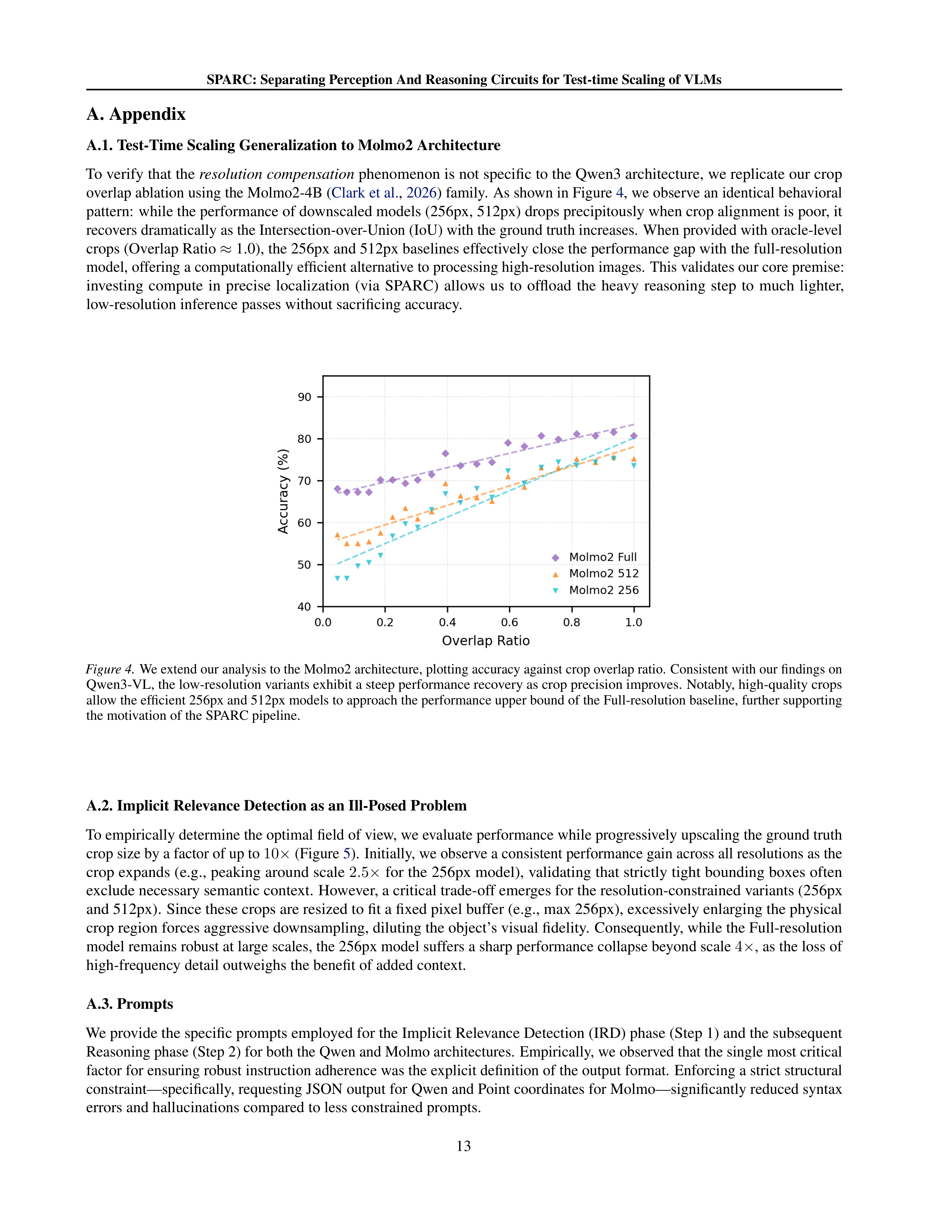
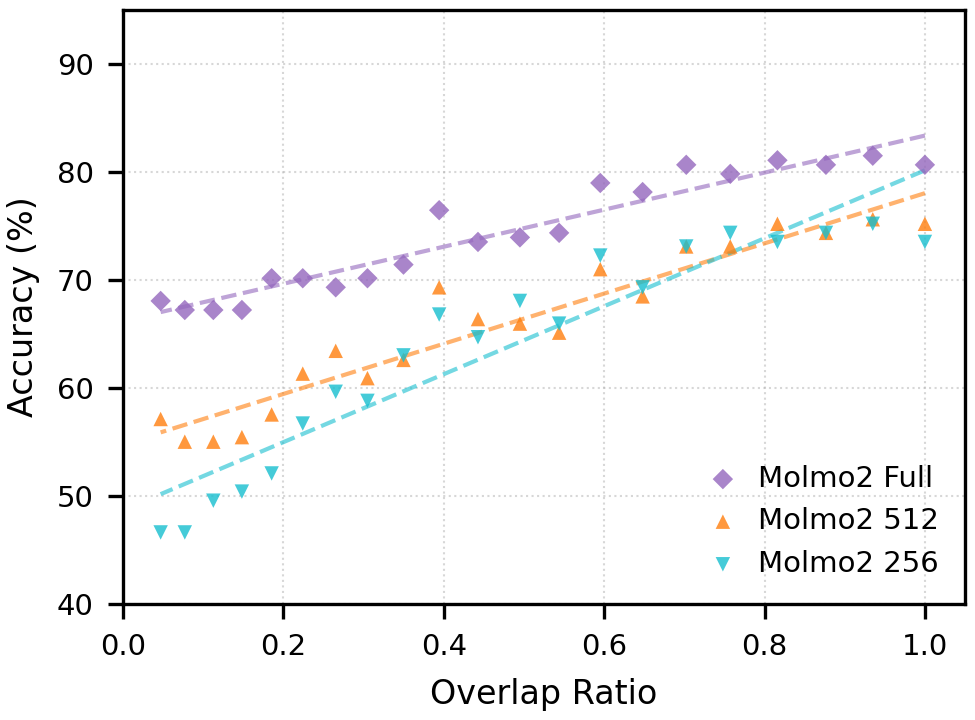
SPARC: Separating Perception And Reasoning Circuits for Test-time Scaling of VLMs
A. Appendix
A.1. Test-Time Scaling Generalization to Molmo2 Architecture
To verify that the
resolution compensation
phenomenon is not specific to the Qwen3 architecture, we replicate our crop
overlap ablation using the Molmo2-4B (
Clark et al.
,
2026
) family.
As shown in Figure
4
, we observe an identical behavioral
pattern:
while the performance of downscaled models (256px, 512px) drops precipitously when crop alignment is poor, it
recovers dramatically as the Intersection-over-Union (IoU) with the ground truth increases.
When provided with oracle-level
crops (Overlap Ratio
≈
1.0), the 256px and 512px baselines effectively close the performance gap with the full-resolution
model, offering a computationally efficient alternative to processing high-resolution images.
This validates our core premise:
investing
compute
in
precise
localization
(via
SPARC)
allows
us
to
offload
the
heavy
reasoning
step
to
much
lighter,
low-resolution inference passes without sacrificing accuracy.
Figure 4.
We extend our analysis to the Molmo2 architecture, plotting accuracy against crop overlap ratio.
Consistent with our findings on
Qwen3-VL, the low-resolution variants exhibit a steep performance recovery as crop precision improves.
Notably, high-quality crops
allow the efficient 256px and 512px models to approach the performance upper bound of the Full-resolution baseline, further supporting
the motivation of the SPARC pipeline.
A.2. Implicit Relevance Detection as an Ill-Posed Problem
To empirically determine the optimal field of view, we evaluate performance while progressively upscaling the ground truth
crop size by a factor of up to
10
×
(Figure
5
).
Initially, we observe a consistent performance gain across all resolutions as the
crop expands (e.g., peaking around scale
2
.
5
×
for the 256px model), validating that strictly tight bounding boxes often
exclude necessary semantic context.
However, a critical trade-off emerges for the resolution-constrained variants (256px
and 512px).
Since these crops are resized to fit a fixed pixel buffer (e.g., max 256px), excessively enlarging the physical
crop region forces aggressive downsampling, diluting the object’s visual fidelity.
Consequently, while the Full-resolution
model remains robust at large scales, the 256px model suffers a sharp performance collapse beyond scale
4
×
, as the loss of
high-frequency detail outweighs the benefit of added context.
A.3. Prompts
We provide the specific prompts employed for the Implicit Relevance Detection (IRD) phase (Step 1) and the subsequent
Reasoning phase (Step 2) for both the Qwen and Molmo architectures.
Empirically, we observed that the single most critical
factor for ensuring robust instruction adherence was the explicit definition of the output format.
Enforcing a strict structural
constraint—specifically, requesting JSON output for Qwen and Point coordinates for Molmo—significantly reduced syntax
errors and hallucinations compared to less constrained prompts.
13
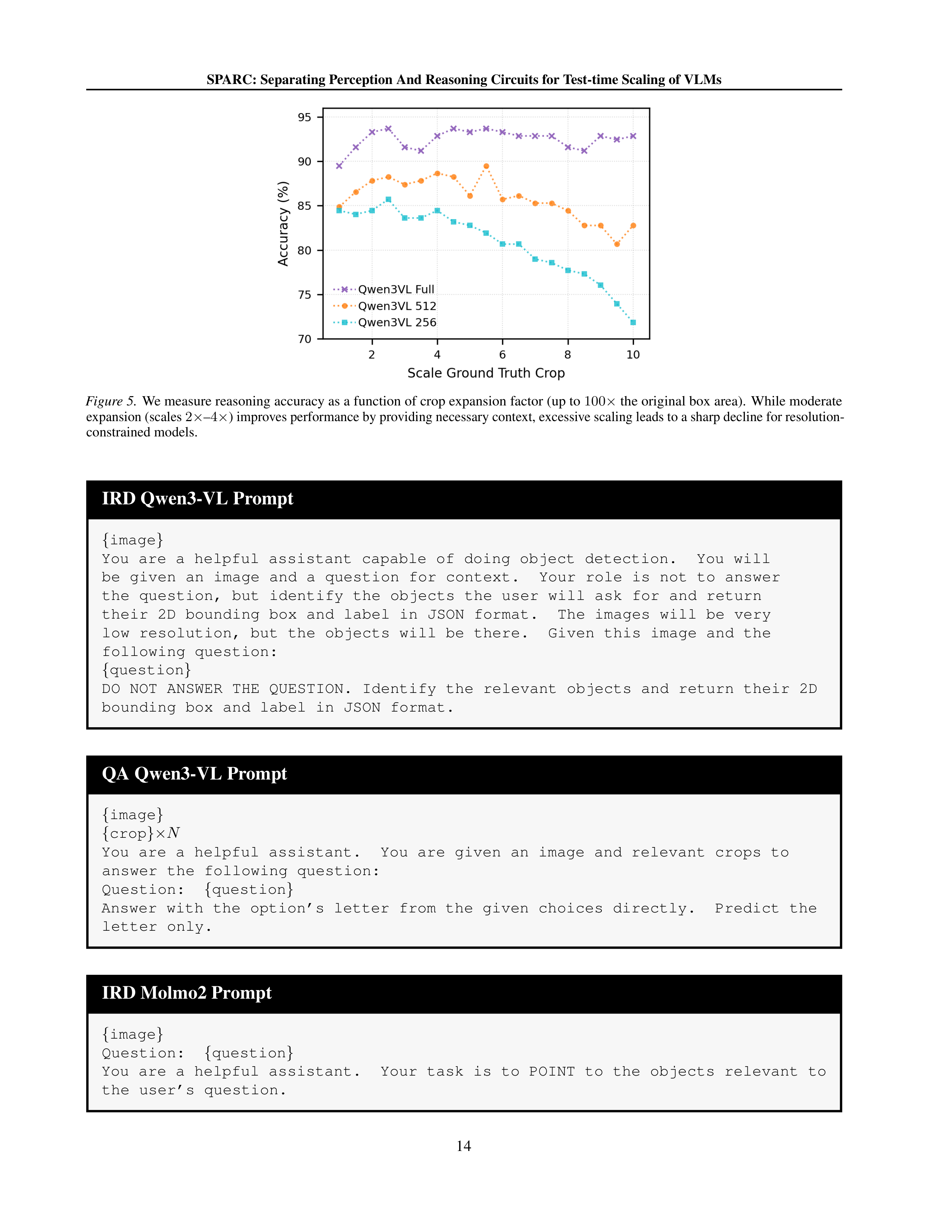
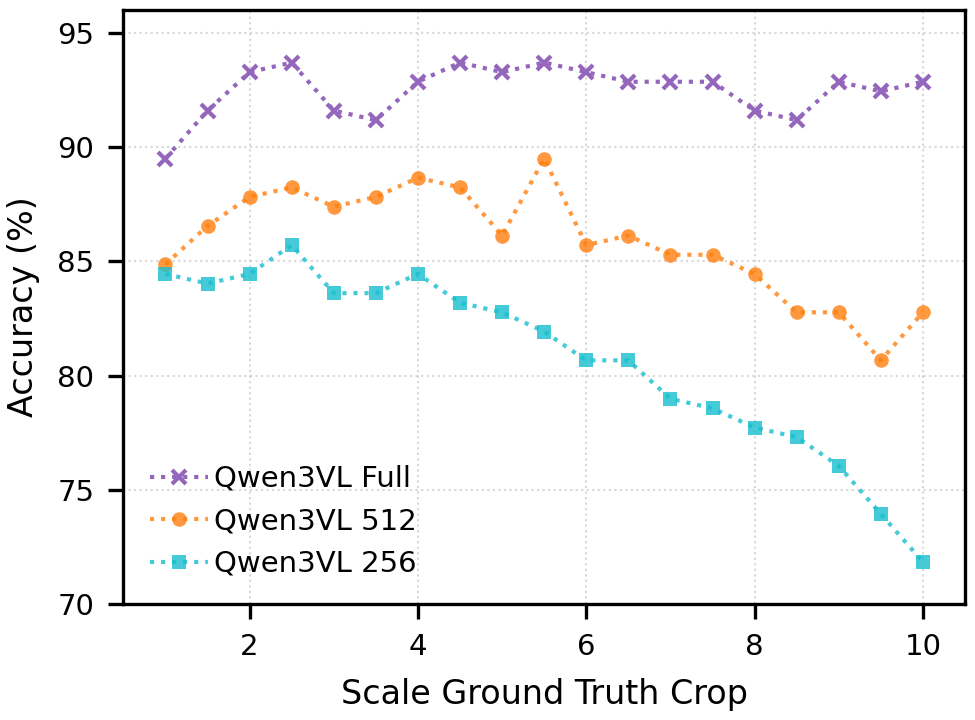
SPARC: Separating Perception And Reasoning Circuits for Test-time Scaling of VLMs
Figure 5.
We measure reasoning accuracy as a function of crop expansion factor (up to
100
×
the original box area).
While moderate
expansion (scales
2
×
–
4
×
) improves performance by providing necessary context, excessive scaling leads to a sharp decline for resolution-
constrained models.
IRD Qwen3-VL Prompt
{
image
}
You
are
a
helpful
assistant
capable
of
doing
object
detection.
You
will
be
given
an
image
and
a
question
for
context.
Your
role
is
not
to
answer
the
question,
but
identify
the
objects
the
user
will
ask
for
and
return
their
2D
bounding
box
and
label
in
JSON
format.
The
images
will
be
very
low
resolution,
but
the
objects
will
be
there.
Given
this
image
and
the
following
question:
{
question
}
DO
NOT
ANSWER
THE
QUESTION.
Identify
the
relevant
objects
and
return
their
2D
bounding
box
and
label
in
JSON
format.
QA Qwen3-VL Prompt
{
image
}
{
crop
}×
N
You
are
a
helpful
assistant.
You
are
given
an
image
and
relevant
crops
to
answer
the
following
question:
Question:
{
question
}
Answer
with
the
option’s
letter
from
the
given
choices
directly.
Predict
the
letter
only.
IRD Molmo2 Prompt
{
image
}
Question:
{
question
}
You
are
a
helpful
assistant.
Your
task
is
to
POINT
to
the
objects
relevant
to
the
user’s
question.
14
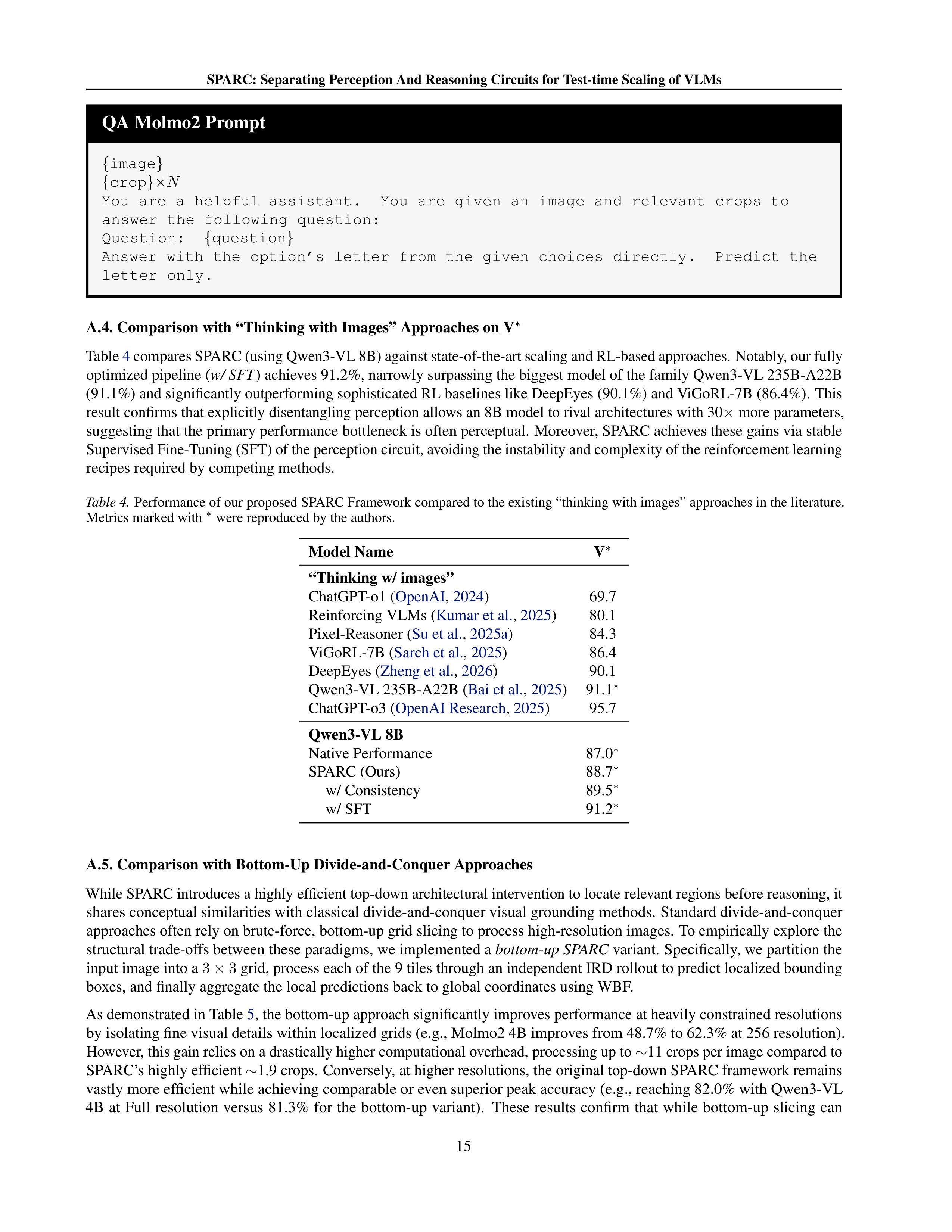
SPARC: Separating Perception And Reasoning Circuits for Test-time Scaling of VLMs
QA Molmo2 Prompt
{
image
}
{
crop
}×
N
You
are
a
helpful
assistant.
You
are
given
an
image
and
relevant
crops
to
answer
the
following
question:
Question:
{
question
}
Answer
with
the
option’s
letter
from
the
given
choices
directly.
Predict
the
letter
only.
A.4. Comparison with “Thinking with Images” Approaches on V
∗
Table
4
compares SPARC (using Qwen3-VL 8B) against state-of-the-art scaling and RL-based approaches.
Notably, our fully
optimized pipeline (
w/ SFT
) achieves 91.2%, narrowly surpassing the biggest model of the family Qwen3-VL 235B-A22B
(91.1%) and significantly outperforming sophisticated RL baselines like DeepEyes (90.1%) and ViGoRL-7B (86.4%).
This
result confirms that explicitly disentangling perception allows an 8B model to rival architectures with 30
×
more parameters,
suggesting that the primary performance bottleneck is often perceptual.
Moreover, SPARC achieves these gains via stable
Supervised Fine-Tuning (SFT) of the perception circuit, avoiding the instability and complexity of the reinforcement learning
recipes required by competing methods.
Table 4.
Performance of our proposed SPARC Framework compared to the existing “thinking with images” approaches in the literature.
Metrics marked with
∗
were reproduced by the authors.
Model Name
V
∗
“Thinking w/ images”
ChatGPT-o1 (
OpenAI
,
2024
)
69.7
Reinforcing VLMs (
Kumar et al.
,
2025
)
80.1
Pixel-Reasoner (
Su et al.
,
2025a
)
84.3
ViGoRL-7B (
Sarch et al.
,
2025
)
86.4
DeepEyes (
Zheng et al.
,
2026
)
90.1
Qwen3-VL 235B-A22B (
Bai et al.
,
2025
)
91.1
∗
ChatGPT-o3 (
OpenAI Research
,
2025
)
95.7
Qwen3-VL 8B
Native Performance
87.0
∗
SPARC (Ours)
88.7
∗
w/ Consistency
89.5
∗
w/ SFT
91.2
∗
A.5. Comparison with Bottom-Up Divide-and-Conquer Approaches
While SPARC introduces a highly efficient top-down architectural intervention to locate relevant regions before reasoning, it
shares conceptual similarities with classical divide-and-conquer visual grounding methods.
Standard divide-and-conquer
approaches often rely on brute-force, bottom-up grid slicing to process high-resolution images.
To empirically explore the
structural trade-offs between these paradigms, we implemented a
bottom-up SPARC
variant.
Specifically, we partition the
input image into a
3
×
3
grid, process each of the 9 tiles through an independent IRD rollout to predict localized bounding
boxes, and finally aggregate the local predictions back to global coordinates using WBF.
As demonstrated in Table
5
, the bottom-up approach significantly improves performance at heavily constrained resolutions
by isolating fine visual details within localized grids (e.g., Molmo2 4B improves from 48.7% to 62.3% at 256 resolution).
However, this gain relies on a drastically higher computational overhead, processing up to
∼
11 crops per image compared to
SPARC’s highly efficient
∼
1.9 crops.
Conversely, at higher resolutions, the original top-down SPARC framework remains
vastly more efficient while achieving comparable or even superior peak accuracy (e.g., reaching 82.0% with Qwen3-VL
4B
at
Full
resolution
versus
81.3%
for
the
bottom-up
variant).
These
results
confirm
that
while
bottom-up
slicing
can
15
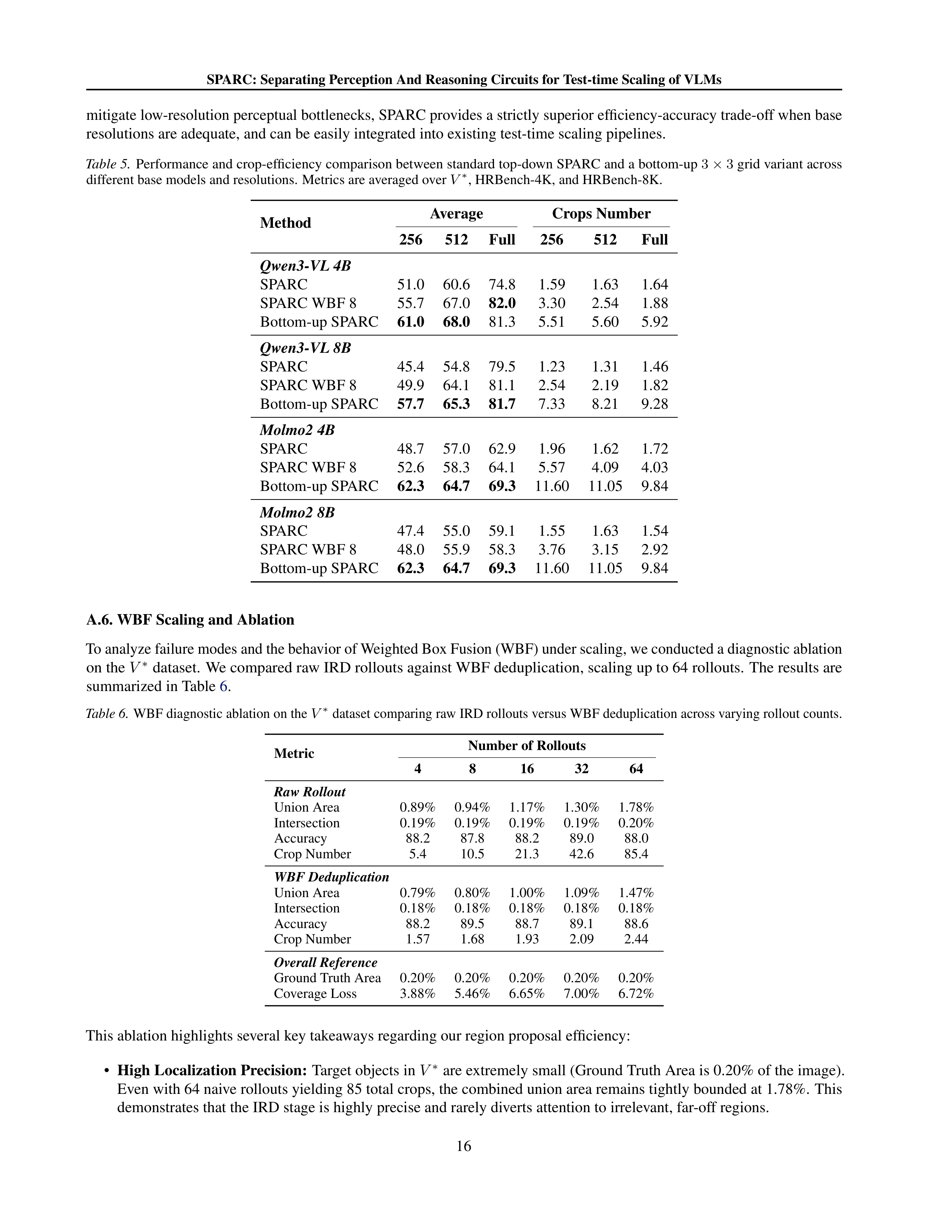
SPARC: Separating Perception And Reasoning Circuits for Test-time Scaling of VLMs
mitigate low-resolution perceptual bottlenecks, SPARC provides a strictly superior efficiency-accuracy trade-off when base
resolutions are adequate, and can be easily integrated into existing test-time scaling pipelines.
Table 5.
Performance and crop-efficiency comparison between standard top-down SPARC and a bottom-up
3
×
3
grid variant across
different base models and resolutions.
Metrics are averaged over
V
∗
, HRBench-4K, and HRBench-8K.
Method
Average
Crops Number
256
512
Full
256
512
Full
Qwen3-VL 4B
SPARC
51.0
60.6
74.8
1.59
1.63
1.64
SPARC WBF 8
55.7
67.0
82.0
3.30
2.54
1.88
Bottom-up SPARC
61.0
68.0
81.3
5.51
5.60
5.92
Qwen3-VL 8B
SPARC
45.4
54.8
79.5
1.23
1.31
1.46
SPARC WBF 8
49.9
64.1
81.1
2.54
2.19
1.82
Bottom-up SPARC
57.7
65.3
81.7
7.33
8.21
9.28
Molmo2 4B
SPARC
48.7
57.0
62.9
1.96
1.62
1.72
SPARC WBF 8
52.6
58.3
64.1
5.57
4.09
4.03
Bottom-up SPARC
62.3
64.7
69.3
11.60
11.05
9.84
Molmo2 8B
SPARC
47.4
55.0
59.1
1.55
1.63
1.54
SPARC WBF 8
48.0
55.9
58.3
3.76
3.15
2.92
Bottom-up SPARC
62.3
64.7
69.3
11.60
11.05
9.84
A.6. WBF Scaling and Ablation
To analyze failure modes and the behavior of Weighted Box Fusion (WBF) under scaling, we conducted a diagnostic ablation
on the
V
∗
dataset.
We compared raw IRD rollouts against WBF deduplication, scaling up to 64 rollouts.
The results are
summarized in Table
6
.
Table 6.
WBF diagnostic ablation on the
V
∗
dataset comparing raw IRD rollouts versus WBF deduplication across varying rollout counts.
Metric
Number of Rollouts
4
8
16
32
64
Raw Rollout
Union Area
0.89%
0.94%
1.17%
1.30%
1.78%
Intersection
0.19%
0.19%
0.19%
0.19%
0.20%
Accuracy
88.2
87.8
88.2
89.0
88.0
Crop Number
5.4
10.5
21.3
42.6
85.4
WBF Deduplication
Union Area
0.79%
0.80%
1.00%
1.09%
1.47%
Intersection
0.18%
0.18%
0.18%
0.18%
0.18%
Accuracy
88.2
89.5
88.7
89.1
88.6
Crop Number
1.57
1.68
1.93
2.09
2.44
Overall Reference
Ground Truth Area
0.20%
0.20%
0.20%
0.20%
0.20%
Coverage Loss
3.88%
5.46%
6.65%
7.00%
6.72%
This ablation highlights several key takeaways regarding our region proposal efficiency:
•
High Localization Precision:
Target objects in
V
∗
are extremely small (Ground Truth Area is 0.20% of the image).
Even with 64 naive rollouts yielding 85 total crops, the combined union area remains tightly bounded at 1.78%.
This
demonstrates that the IRD stage is highly precise and rarely diverts attention to irrelevant, far-off regions.
16
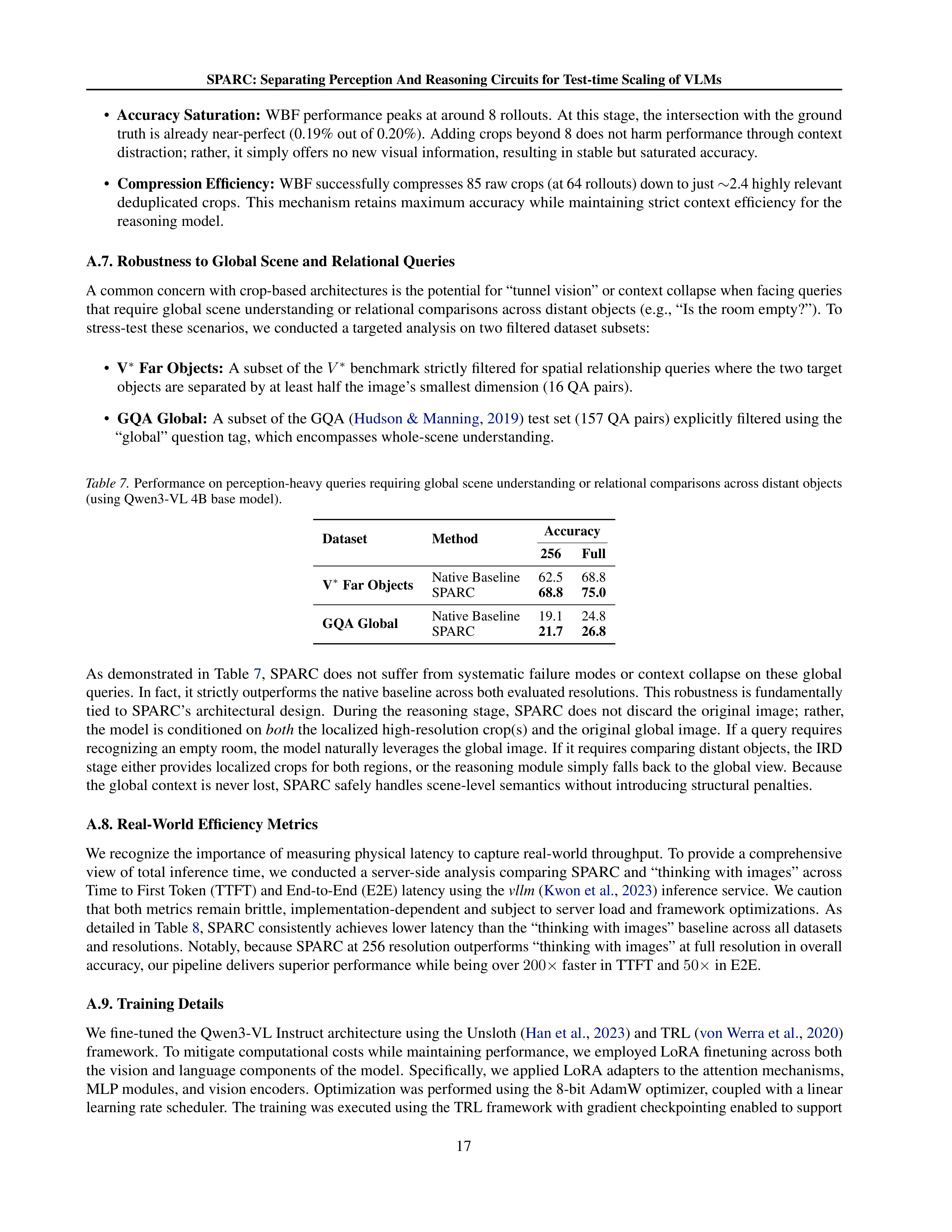
SPARC: Separating Perception And Reasoning Circuits for Test-time Scaling of VLMs
•
Accuracy Saturation:
WBF performance peaks at around 8 rollouts.
At this stage, the intersection with the ground
truth is already near-perfect (0.19% out of 0.20%).
Adding crops beyond 8 does not harm performance through context
distraction; rather, it simply offers no new visual information, resulting in stable but saturated accuracy.
•
Compression Efficiency:
WBF successfully compresses 85 raw crops (at 64 rollouts) down to just
∼
2.4 highly relevant
deduplicated crops.
This mechanism retains maximum accuracy while maintaining strict context efficiency for the
reasoning model.
A.7. Robustness to Global Scene and Relational Queries
A common concern with crop-based architectures is the potential for “tunnel vision” or context collapse when facing queries
that require global scene understanding or relational comparisons across distant objects (e.g., “Is the room empty?”).
To
stress-test these scenarios, we conducted a targeted analysis on two filtered dataset subsets:
•
V
∗
Far Objects:
A subset of the
V
∗
benchmark strictly filtered for spatial relationship queries where the two target
objects are separated by at least half the image’s smallest dimension (16 QA pairs).
•
GQA Global:
A subset of the GQA (
Hudson & Manning
,
2019
) test set (157 QA pairs) explicitly filtered using the
“global” question tag, which encompasses whole-scene understanding.
Table 7.
Performance on perception-heavy queries requiring global scene understanding or relational comparisons across distant objects
(using Qwen3-VL 4B base model).
Dataset
Method
Accuracy
256
Full
V
∗
Far Objects
Native Baseline
62.5
68.8
SPARC
68.8
75.0
GQA Global
Native Baseline
19.1
24.8
SPARC
21.7
26.8
As demonstrated in Table
7
, SPARC does not suffer from systematic failure modes or context collapse on these global
queries.
In fact, it strictly outperforms the native baseline across both evaluated resolutions.
This robustness is fundamentally
tied
to
SPARC’s
architectural
design.
During
the
reasoning
stage,
SPARC
does
not
discard
the
original
image;
rather,
the model is conditioned on
both
the localized high-resolution crop(s) and the original global image.
If a query requires
recognizing an empty room, the model naturally leverages the global image.
If it requires comparing distant objects, the IRD
stage either provides localized crops for both regions, or the reasoning module simply falls back to the global view.
Because
the global context is never lost, SPARC safely handles scene-level semantics without introducing structural penalties.
A.8. Real-World Efficiency Metrics
We recognize the importance of measuring physical latency to capture real-world throughput.
To provide a comprehensive
view of total inference time, we conducted a server-side analysis comparing SPARC and “thinking with images” across
Time to First Token (TTFT) and End-to-End (E2E) latency using the
vllm
(
Kwon et al.
,
2023
) inference service.
We caution
that both metrics remain brittle, implementation-dependent and subject to server load and framework optimizations.
As
detailed in Table
8
, SPARC consistently achieves lower latency than the “thinking with images” baseline across all datasets
and resolutions.
Notably, because SPARC at 256 resolution outperforms “thinking with images” at full resolution in overall
accuracy, our pipeline delivers superior performance while being over
200
×
faster in TTFT and
50
×
in E2E.
A.9. Training Details
We fine-tuned the Qwen3-VL Instruct architecture using the Unsloth (
Han et al.
,
2023
) and TRL (
von Werra et al.
,
2020
)
framework.
To mitigate computational costs while maintaining performance, we employed LoRA finetuning across both
the vision and language components of the model.
Specifically, we applied LoRA adapters to the attention mechanisms,
MLP modules, and vision encoders.
Optimization was performed using the 8-bit AdamW optimizer, coupled with a linear
learning rate scheduler.
The training was executed using the TRL framework with gradient checkpointing enabled to support
17
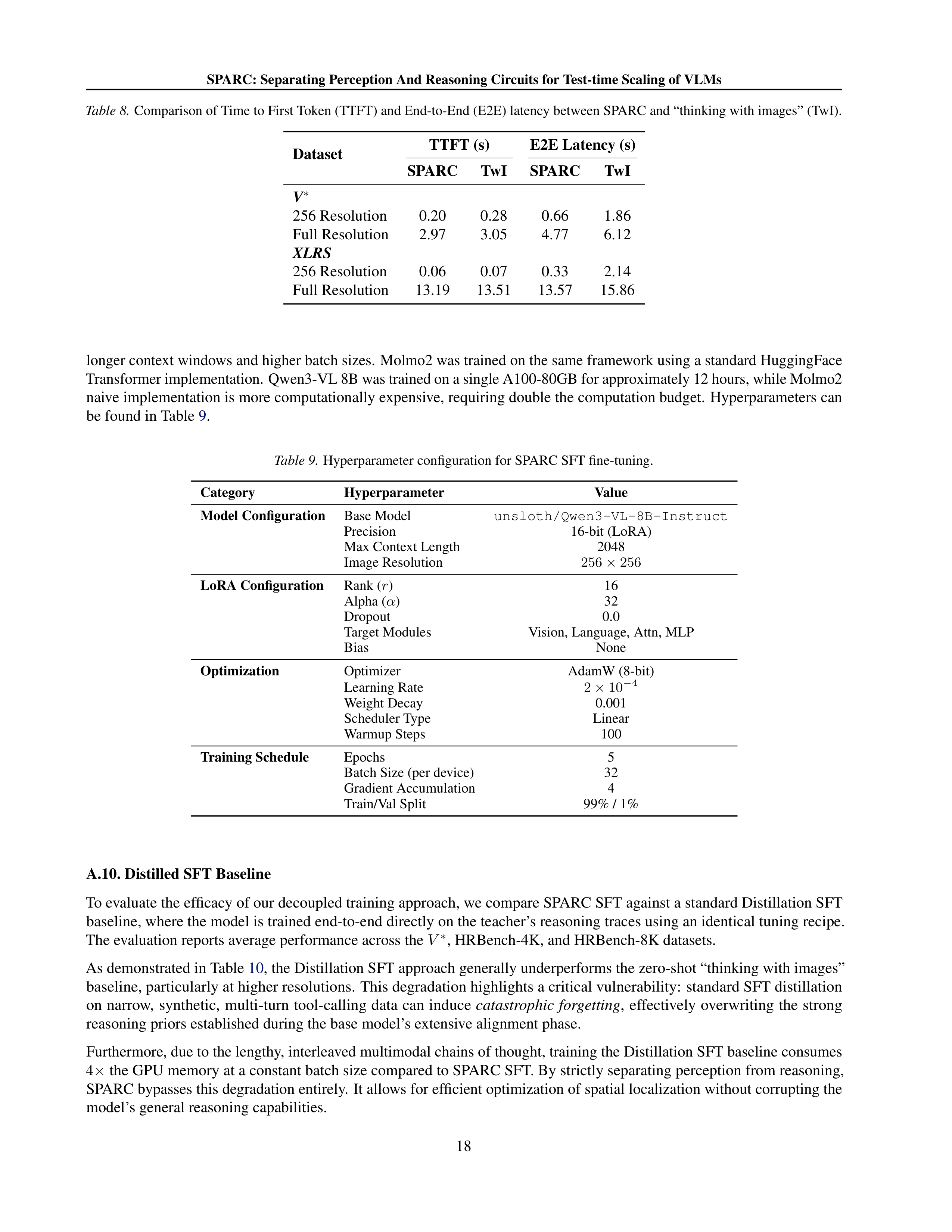
SPARC: Separating Perception And Reasoning Circuits for Test-time Scaling of VLMs
Table 8.
Comparison of Time to First Token (TTFT) and End-to-End (E2E) latency between SPARC and “thinking with images” (TwI).
Dataset
TTFT (s)
E2E Latency (s)
SPARC
TwI
SPARC
TwI
V
∗
256 Resolution
0.20
0.28
0.66
1.86
Full Resolution
2.97
3.05
4.77
6.12
XLRS
256 Resolution
0.06
0.07
0.33
2.14
Full Resolution
13.19
13.51
13.57
15.86
longer context windows and higher batch sizes.
Molmo2 was trained on the same framework using a standard HuggingFace
Transformer implementation.
Qwen3-VL 8B was trained on a single A100-80GB for approximately 12 hours, while Molmo2
naive implementation is more computationally expensive, requiring double the computation budget.
Hyperparameters can
be found in Table
9
.
Table 9.
Hyperparameter configuration for SPARC SFT fine-tuning.
Category
Hyperparameter
Value
Model Configuration
Base Model
unsloth/Qwen3-VL-8B-Instruct
Precision
16-bit (LoRA)
Max Context Length
2048
Image Resolution
256
×
256
LoRA Configuration
Rank (
r
)
16
Alpha (
α
)
32
Dropout
0.0
Target Modules
Vision, Language, Attn, MLP
Bias
None
Optimization
Optimizer
AdamW (8-bit)
Learning Rate
2
×
10
−
4
Weight Decay
0.001
Scheduler Type
Linear
Warmup Steps
100
Training Schedule
Epochs
5
Batch Size (per device)
32
Gradient Accumulation
4
Train/Val Split
99% / 1%
A.10. Distilled SFT Baseline
To evaluate the efficacy of our decoupled training approach, we compare SPARC SFT against a standard Distillation SFT
baseline, where the model is trained end-to-end directly on the teacher’s reasoning traces using an identical tuning recipe.
The evaluation reports average performance across the
V
∗
, HRBench-4K, and HRBench-8K datasets.
As demonstrated in Table
10
, the Distillation SFT approach generally underperforms the zero-shot “thinking with images”
baseline, particularly at higher resolutions.
This degradation highlights a critical vulnerability:
standard SFT distillation
on
narrow,
synthetic,
multi-turn
tool-calling data
can
induce
catastrophic
forgetting
,
effectively
overwriting the
strong
reasoning priors established during the base model’s extensive alignment phase.
Furthermore, due to the lengthy, interleaved multimodal chains of thought, training the Distillation SFT baseline consumes
4
×
the GPU memory at a constant batch size compared to SPARC SFT. By strictly separating perception from reasoning,
SPARC bypasses this degradation entirely.
It allows for efficient optimization of spatial localization without corrupting the
model’s general reasoning capabilities.
18
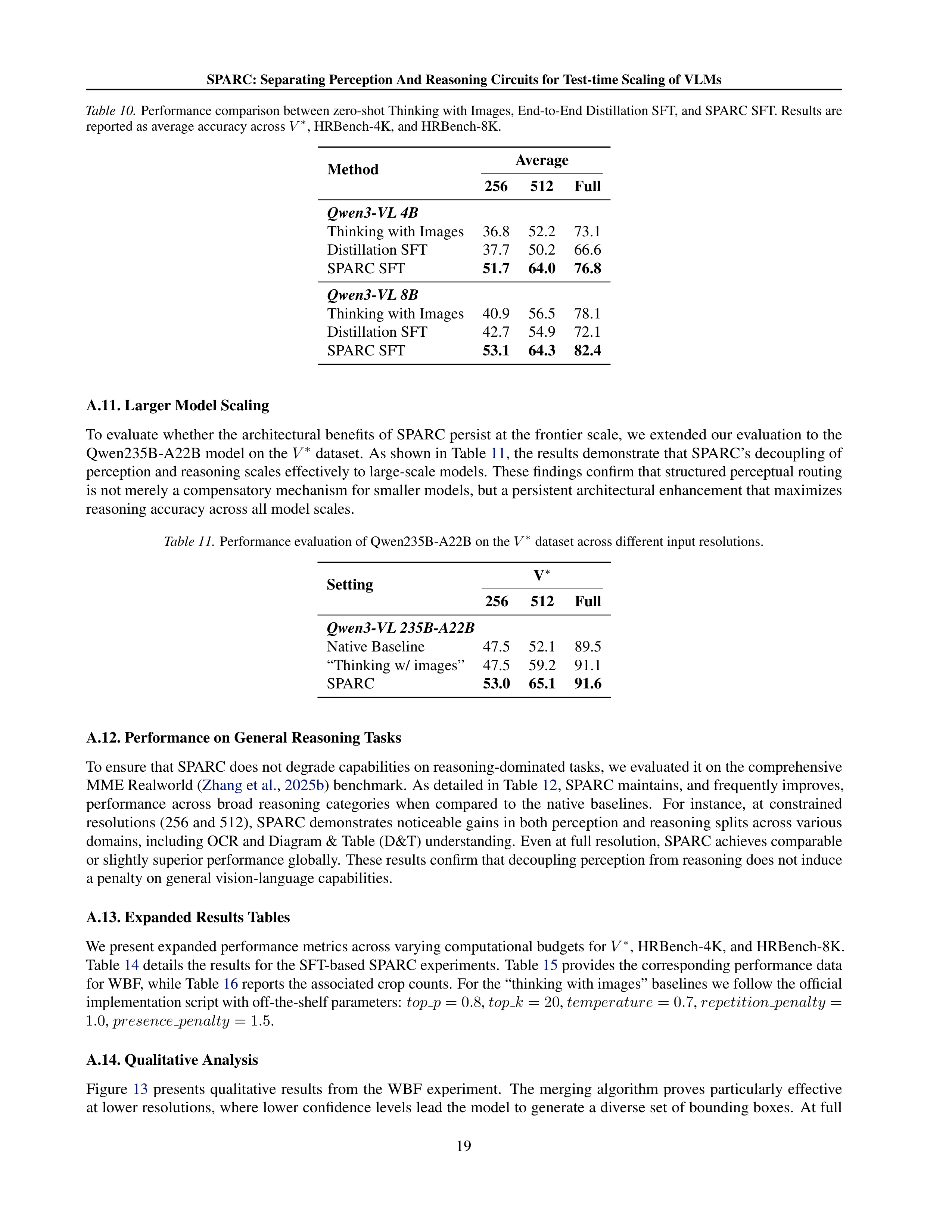
SPARC: Separating Perception And Reasoning Circuits for Test-time Scaling of VLMs
Table 10.
Performance comparison between zero-shot Thinking with Images, End-to-End Distillation SFT, and SPARC SFT. Results are
reported as average accuracy across
V
∗
, HRBench-4K, and HRBench-8K.
Method
Average
256
512
Full
Qwen3-VL 4B
Thinking with Images
36.8
52.2
73.1
Distillation SFT
37.7
50.2
66.6
SPARC SFT
51.7
64.0
76.8
Qwen3-VL 8B
Thinking with Images
40.9
56.5
78.1
Distillation SFT
42.7
54.9
72.1
SPARC SFT
53.1
64.3
82.4
A.11. Larger Model Scaling
To evaluate whether the architectural benefits of SPARC persist at the frontier scale, we extended our evaluation to the
Qwen235B-A22B model on the
V
∗
dataset.
As shown in Table
11
, the results demonstrate that SPARC’s decoupling of
perception and reasoning scales effectively to large-scale models.
These findings confirm that structured perceptual routing
is not merely a compensatory mechanism for smaller models, but a persistent architectural enhancement that maximizes
reasoning accuracy across all model scales.
Table 11.
Performance evaluation of Qwen235B-A22B on the
V
∗
dataset across different input resolutions.
Setting
V
∗
256
512
Full
Qwen3-VL 235B-A22B
Native Baseline
47.5
52.1
89.5
“Thinking w/ images”
47.5
59.2
91.1
SPARC
53.0
65.1
91.6
A.12. Performance on General Reasoning Tasks
To ensure that SPARC does not degrade capabilities on reasoning-dominated tasks, we evaluated it on the comprehensive
MME Realworld (
Zhang et al.
,
2025b
) benchmark.
As detailed in Table
12
, SPARC maintains, and frequently improves,
performance
across
broad
reasoning
categories
when
compared
to
the
native
baselines.
For
instance,
at
constrained
resolutions (256 and 512), SPARC demonstrates noticeable gains in both perception and reasoning splits across various
domains, including OCR and Diagram & Table (D&T) understanding.
Even at full resolution, SPARC achieves comparable
or slightly superior performance globally.
These results confirm that decoupling perception from reasoning does not induce
a penalty on general vision-language capabilities.
A.13. Expanded Results Tables
We present expanded performance metrics across varying computational budgets for
V
∗
, HRBench-4K, and HRBench-8K.
Table
14
details the results for the SFT-based SPARC experiments.
Table
15
provides the corresponding performance data
for WBF, while Table
16
reports the associated crop counts.
For the “thinking with images” baselines we follow the official
implementation script with off-the-shelf parameters:
top
p
= 0
.
8
,
top
k
= 20
,
temperature
= 0
.
7
,
repetition
penalty
=
1
.
0
,
presence
penalty
= 1
.
5
.
A.14. Qualitative Analysis
Figure
13
presents
qualitative
results
from
the
WBF
experiment.
The
merging
algorithm
proves
particularly
effective
at lower resolutions, where lower confidence levels lead the model to generate a diverse set of bounding boxes.
At full
19
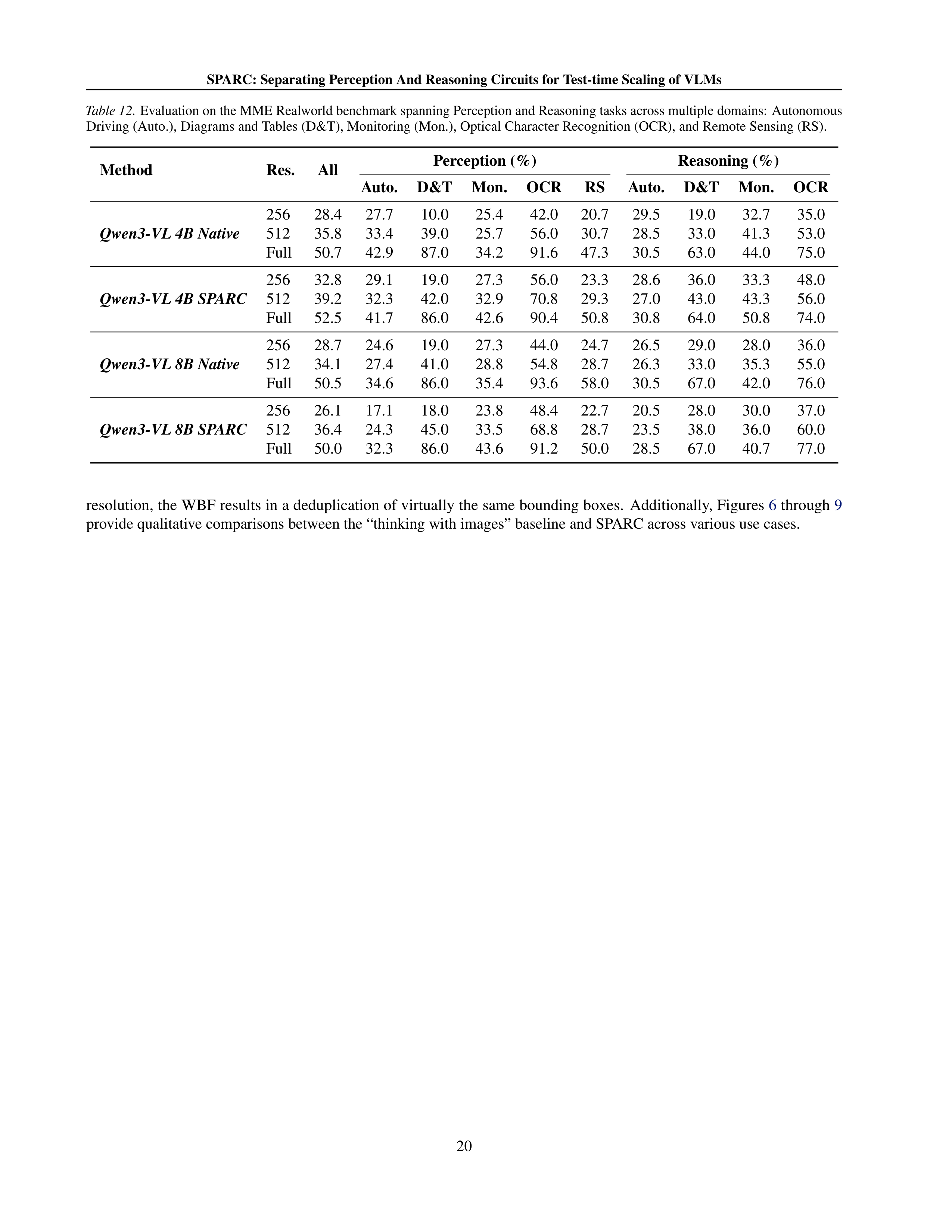
SPARC: Separating Perception And Reasoning Circuits for Test-time Scaling of VLMs
Table 12.
Evaluation on the MME Realworld benchmark spanning Perception and Reasoning tasks across multiple domains:
Autonomous
Driving (Auto.), Diagrams and Tables (D&T), Monitoring (Mon.), Optical Character Recognition (OCR), and Remote Sensing (RS).
Method
Res.
All
Perception (%)
Reasoning (%)
Auto.
D&T
Mon.
OCR
RS
Auto.
D&T
Mon.
OCR
Qwen3-VL 4B Native
256
28.4
27.7
10.0
25.4
42.0
20.7
29.5
19.0
32.7
35.0
512
35.8
33.4
39.0
25.7
56.0
30.7
28.5
33.0
41.3
53.0
Full
50.7
42.9
87.0
34.2
91.6
47.3
30.5
63.0
44.0
75.0
Qwen3-VL 4B SPARC
256
32.8
29.1
19.0
27.3
56.0
23.3
28.6
36.0
33.3
48.0
512
39.2
32.3
42.0
32.9
70.8
29.3
27.0
43.0
43.3
56.0
Full
52.5
41.7
86.0
42.6
90.4
50.8
30.8
64.0
50.8
74.0
Qwen3-VL 8B Native
256
28.7
24.6
19.0
27.3
44.0
24.7
26.5
29.0
28.0
36.0
512
34.1
27.4
41.0
28.8
54.8
28.7
26.3
33.0
35.3
55.0
Full
50.5
34.6
86.0
35.4
93.6
58.0
30.5
67.0
42.0
76.0
Qwen3-VL 8B SPARC
256
26.1
17.1
18.0
23.8
48.4
22.7
20.5
28.0
30.0
37.0
512
36.4
24.3
45.0
33.5
68.8
28.7
23.5
38.0
36.0
60.0
Full
50.0
32.3
86.0
43.6
91.2
50.0
28.5
67.0
40.7
77.0
resolution, the WBF results in a deduplication of virtually the same bounding boxes.
Additionally, Figures
6
through
9
provide qualitative comparisons between the “thinking with images” baseline and SPARC across various use cases.
20
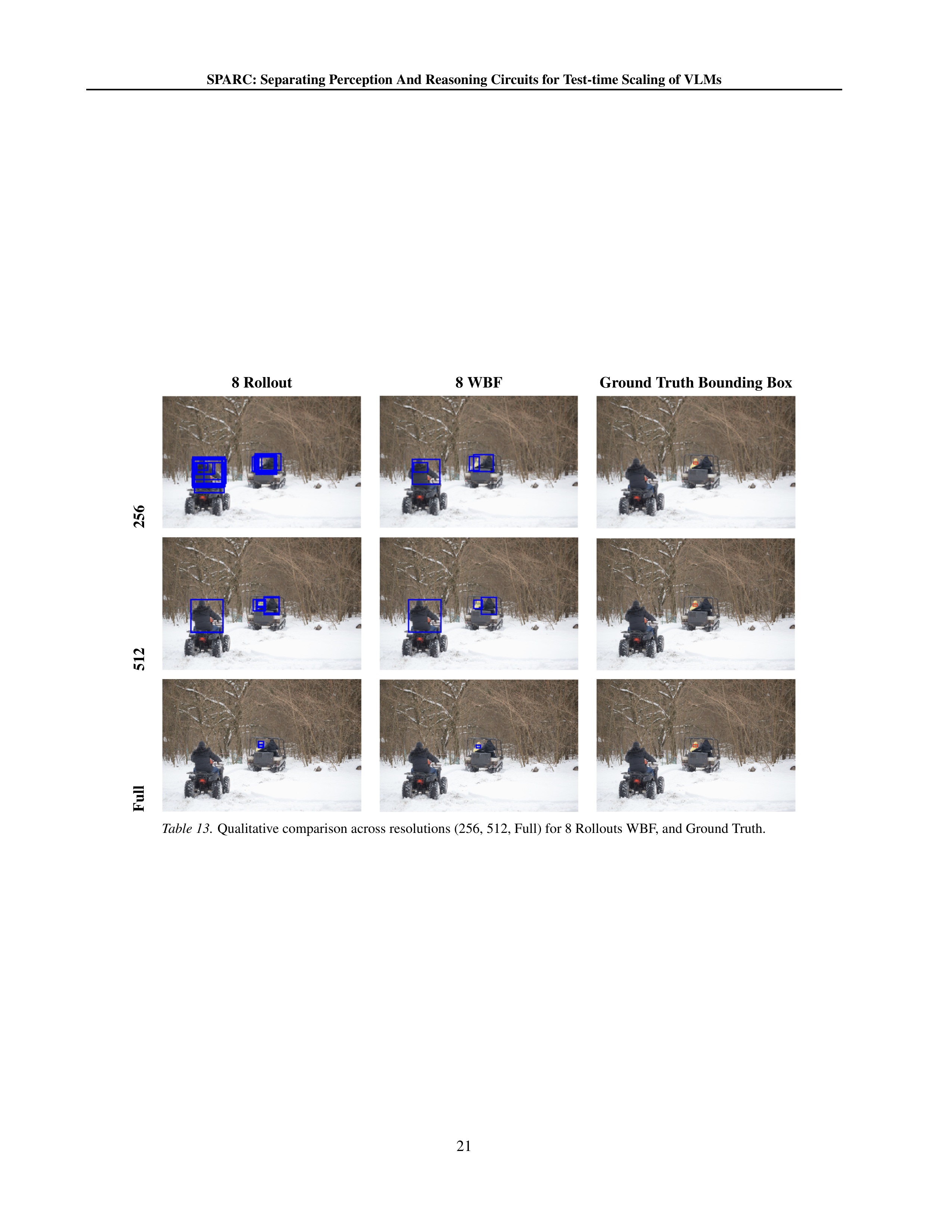
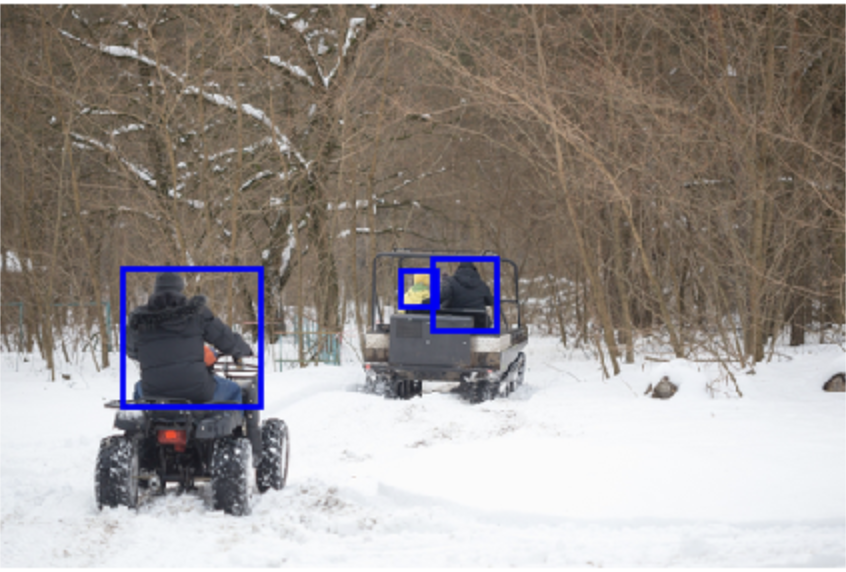
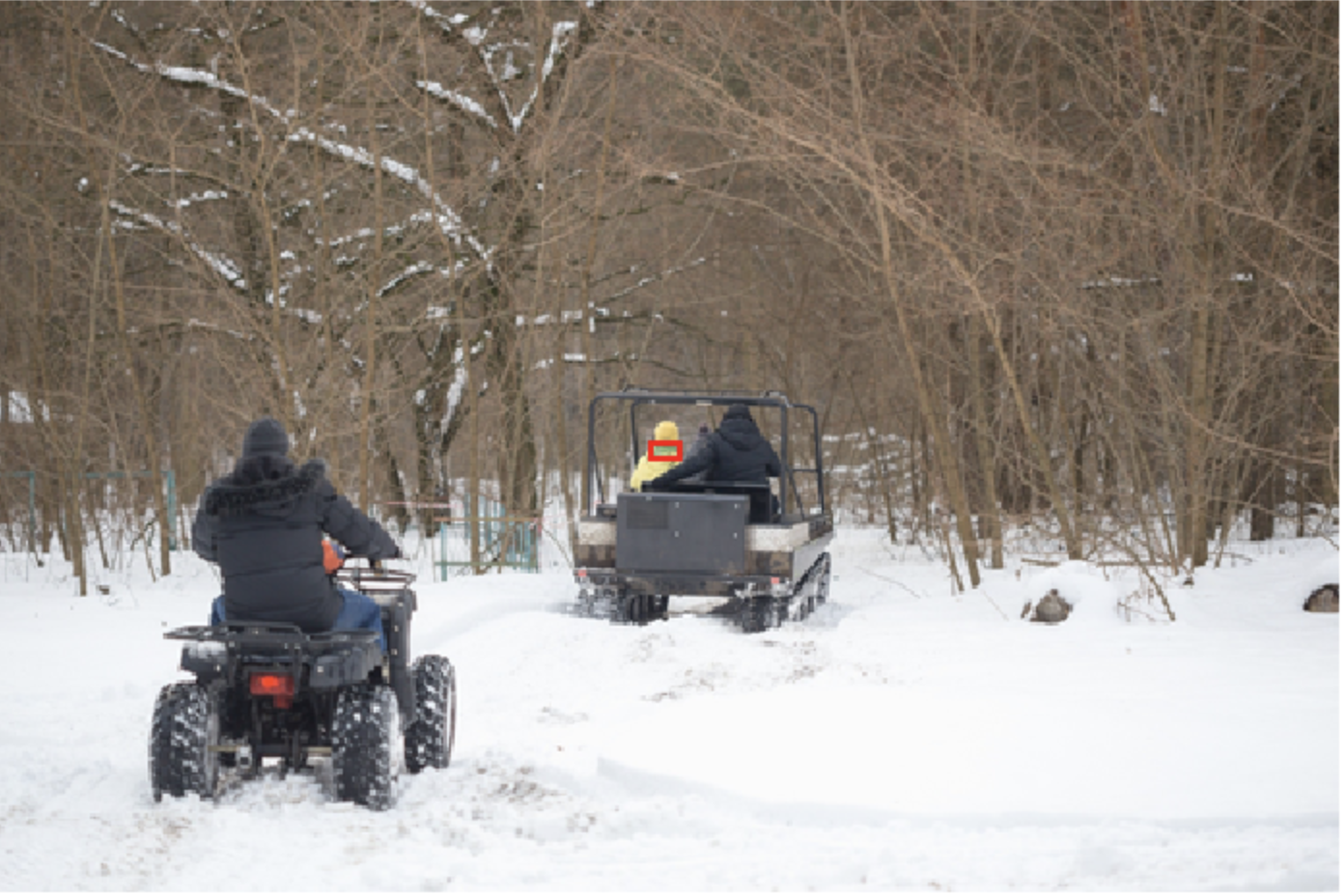
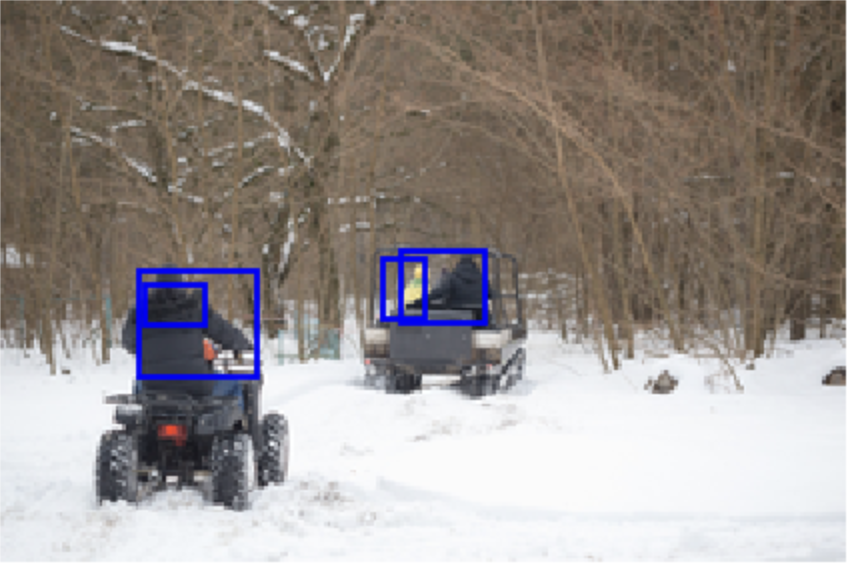
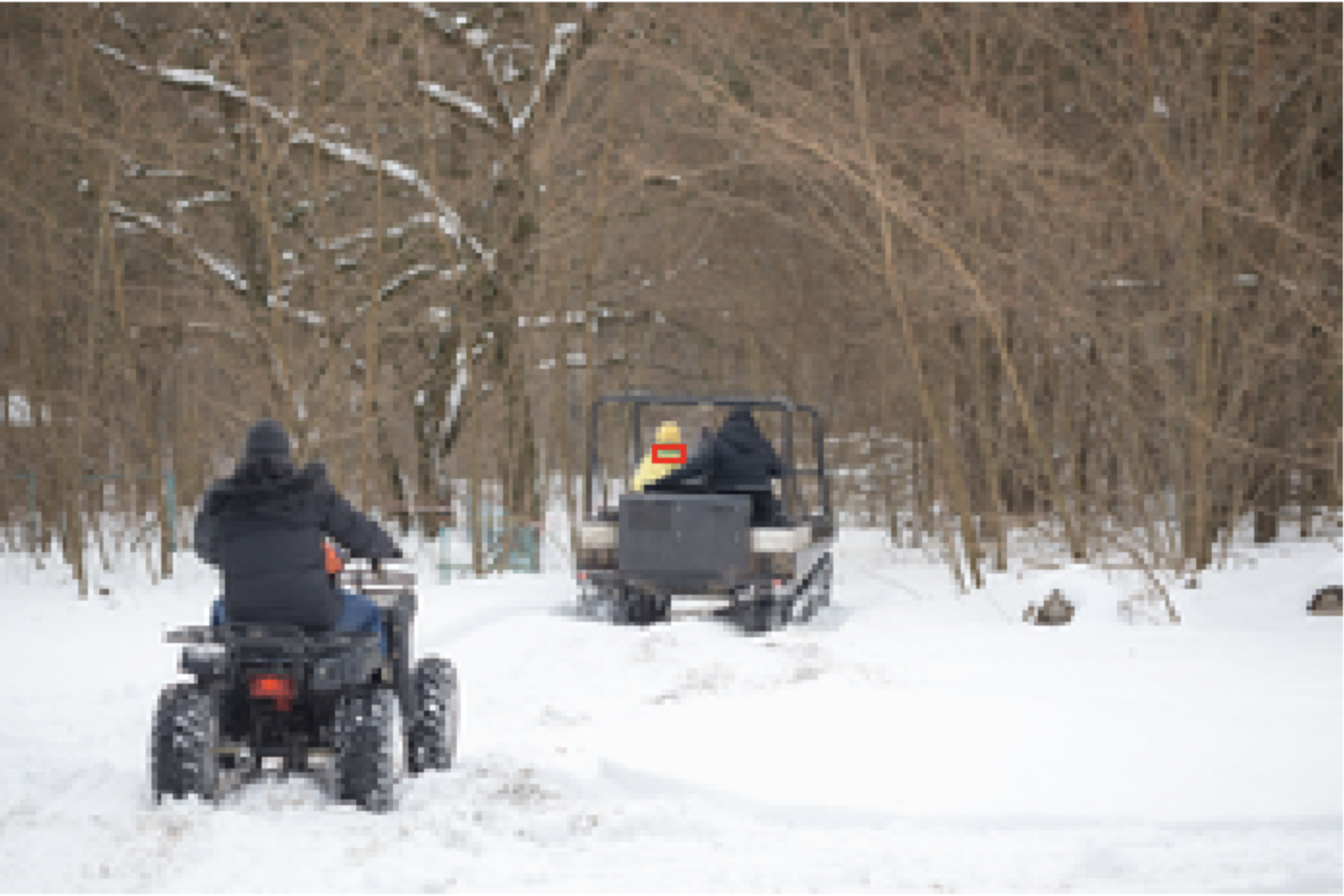
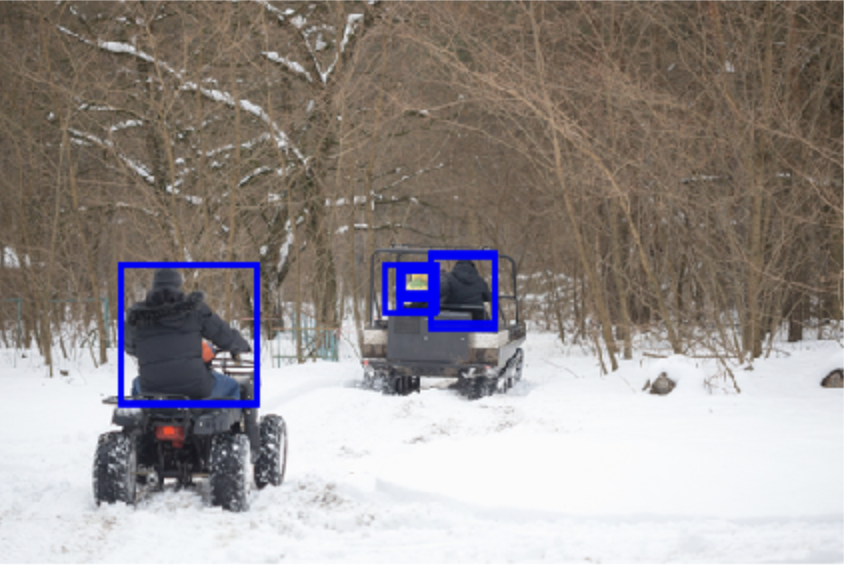
SPARC: Separating Perception And Reasoning Circuits for Test-time Scaling of VLMs
8 Rollout
8 WBF
Ground Truth Bounding Box
256
512
Full
Table 13.
Qualitative comparison across resolutions (256, 512, Full) for 8 Rollouts WBF, and Ground Truth.
21
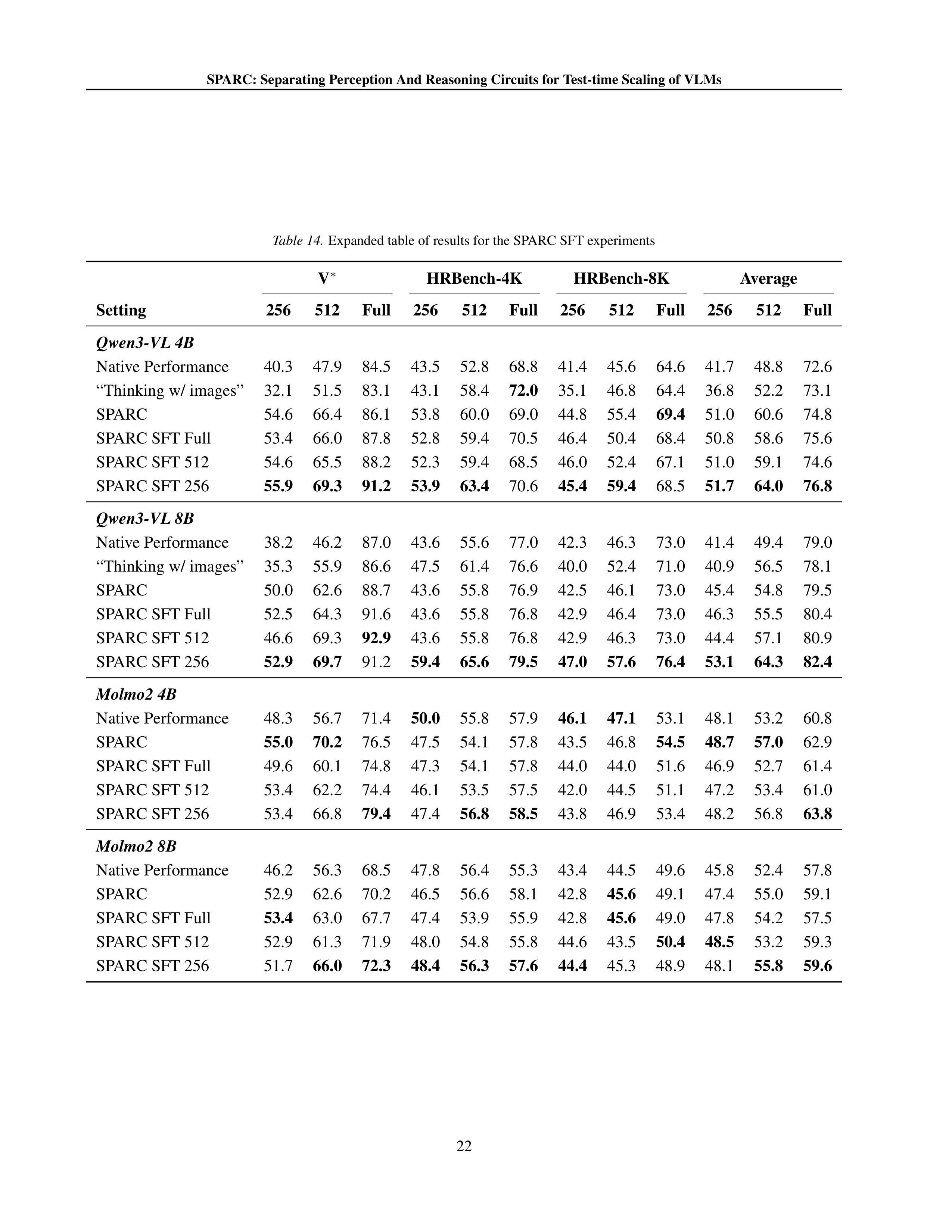
SPARC: Separating Perception And Reasoning Circuits for Test-time Scaling of VLMs
Table 14.
Expanded table of results for the SPARC SFT experiments
V
∗
HRBench-4K
HRBench-8K
Average
Setting
256
512
Full
256
512
Full
256
512
Full
256
512
Full
Qwen3-VL 4B
Native Performance
40.3
47.9
84.5
43.5
52.8
68.8
41.4
45.6
64.6
41.7
48.8
72.6
“Thinking w/ images”
32.1
51.5
83.1
43.1
58.4
72.0
35.1
46.8
64.4
36.8
52.2
73.1
SPARC
54.6
66.4
86.1
53.8
60.0
69.0
44.8
55.4
69.4
51.0
60.6
74.8
SPARC SFT Full
53.4
66.0
87.8
52.8
59.4
70.5
46.4
50.4
68.4
50.8
58.6
75.6
SPARC SFT 512
54.6
65.5
88.2
52.3
59.4
68.5
46.0
52.4
67.1
51.0
59.1
74.6
SPARC SFT 256
55.9
69.3
91.2
53.9
63.4
70.6
45.4
59.4
68.5
51.7
64.0
76.8
Qwen3-VL 8B
Native Performance
38.2
46.2
87.0
43.6
55.6
77.0
42.3
46.3
73.0
41.4
49.4
79.0
“Thinking w/ images”
35.3
55.9
86.6
47.5
61.4
76.6
40.0
52.4
71.0
40.9
56.5
78.1
SPARC
50.0
62.6
88.7
43.6
55.8
76.9
42.5
46.1
73.0
45.4
54.8
79.5
SPARC SFT Full
52.5
64.3
91.6
43.6
55.8
76.8
42.9
46.4
73.0
46.3
55.5
80.4
SPARC SFT 512
46.6
69.3
92.9
43.6
55.8
76.8
42.9
46.3
73.0
44.4
57.1
80.9
SPARC SFT 256
52.9
69.7
91.2
59.4
65.6
79.5
47.0
57.6
76.4
53.1
64.3
82.4
Molmo2 4B
Native Performance
48.3
56.7
71.4
50.0
55.8
57.9
46.1
47.1
53.1
48.1
53.2
60.8
SPARC
55.0
70.2
76.5
47.5
54.1
57.8
43.5
46.8
54.5
48.7
57.0
62.9
SPARC SFT Full
49.6
60.1
74.8
47.3
54.1
57.8
44.0
44.0
51.6
46.9
52.7
61.4
SPARC SFT 512
53.4
62.2
74.4
46.1
53.5
57.5
42.0
44.5
51.1
47.2
53.4
61.0
SPARC SFT 256
53.4
66.8
79.4
47.4
56.8
58.5
43.8
46.9
53.4
48.2
56.8
63.8
Molmo2 8B
Native Performance
46.2
56.3
68.5
47.8
56.4
55.3
43.4
44.5
49.6
45.8
52.4
57.8
SPARC
52.9
62.6
70.2
46.5
56.6
58.1
42.8
45.6
49.1
47.4
55.0
59.1
SPARC SFT Full
53.4
63.0
67.7
47.4
53.9
55.9
42.8
45.6
49.0
47.8
54.2
57.5
SPARC SFT 512
52.9
61.3
71.9
48.0
54.8
55.8
44.6
43.5
50.4
48.5
53.2
59.3
SPARC SFT 256
51.7
66.0
72.3
48.4
56.3
57.6
44.4
45.3
48.9
48.1
55.8
59.6
22
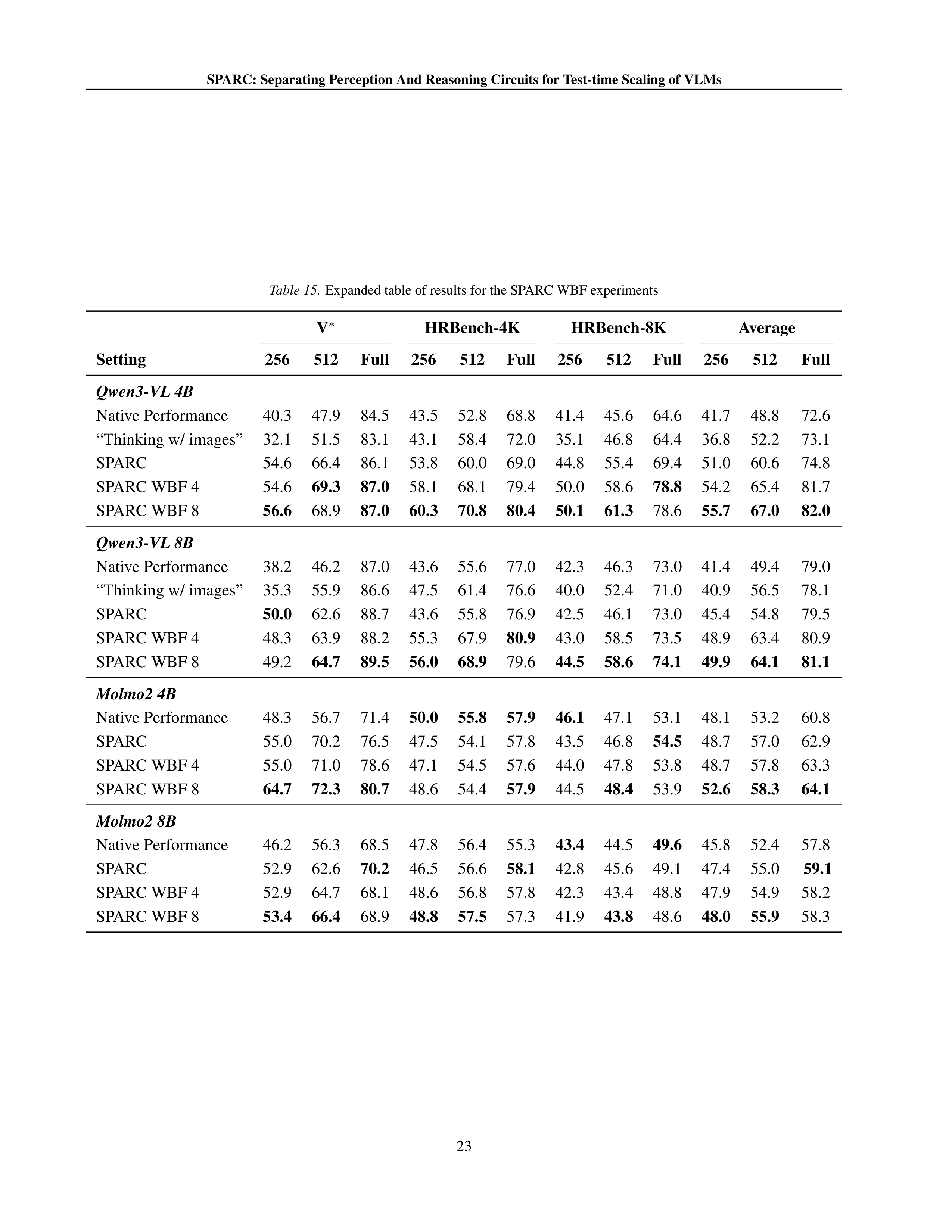
SPARC: Separating Perception And Reasoning Circuits for Test-time Scaling of VLMs
Table 15.
Expanded table of results for the SPARC WBF experiments
V
∗
HRBench-4K
HRBench-8K
Average
Setting
256
512
Full
256
512
Full
256
512
Full
256
512
Full
Qwen3-VL 4B
Native Performance
40.3
47.9
84.5
43.5
52.8
68.8
41.4
45.6
64.6
41.7
48.8
72.6
“Thinking w/ images”
32.1
51.5
83.1
43.1
58.4
72.0
35.1
46.8
64.4
36.8
52.2
73.1
SPARC
54.6
66.4
86.1
53.8
60.0
69.0
44.8
55.4
69.4
51.0
60.6
74.8
SPARC WBF 4
54.6
69.3
87.0
58.1
68.1
79.4
50.0
58.6
78.8
54.2
65.4
81.7
SPARC WBF 8
56.6
68.9
87.0
60.3
70.8
80.4
50.1
61.3
78.6
55.7
67.0
82.0
Qwen3-VL 8B
Native Performance
38.2
46.2
87.0
43.6
55.6
77.0
42.3
46.3
73.0
41.4
49.4
79.0
“Thinking w/ images”
35.3
55.9
86.6
47.5
61.4
76.6
40.0
52.4
71.0
40.9
56.5
78.1
SPARC
50.0
62.6
88.7
43.6
55.8
76.9
42.5
46.1
73.0
45.4
54.8
79.5
SPARC WBF 4
48.3
63.9
88.2
55.3
67.9
80.9
43.0
58.5
73.5
48.9
63.4
80.9
SPARC WBF 8
49.2
64.7
89.5
56.0
68.9
79.6
44.5
58.6
74.1
49.9
64.1
81.1
Molmo2 4B
Native Performance
48.3
56.7
71.4
50.0
55.8
57.9
46.1
47.1
53.1
48.1
53.2
60.8
SPARC
55.0
70.2
76.5
47.5
54.1
57.8
43.5
46.8
54.5
48.7
57.0
62.9
SPARC WBF 4
55.0
71.0
78.6
47.1
54.5
57.6
44.0
47.8
53.8
48.7
57.8
63.3
SPARC WBF 8
64.7
72.3
80.7
48.6
54.4
57.9
44.5
48.4
53.9
52.6
58.3
64.1
Molmo2 8B
Native Performance
46.2
56.3
68.5
47.8
56.4
55.3
43.4
44.5
49.6
45.8
52.4
57.8
SPARC
52.9
62.6
70.2
46.5
56.6
58.1
42.8
45.6
49.1
47.4
55.0
59.1
SPARC WBF 4
52.9
64.7
68.1
48.6
56.8
57.8
42.3
43.4
48.8
47.9
54.9
58.2
SPARC WBF 8
53.4
66.4
68.9
48.8
57.5
57.3
41.9
43.8
48.6
48.0
55.9
58.3
23
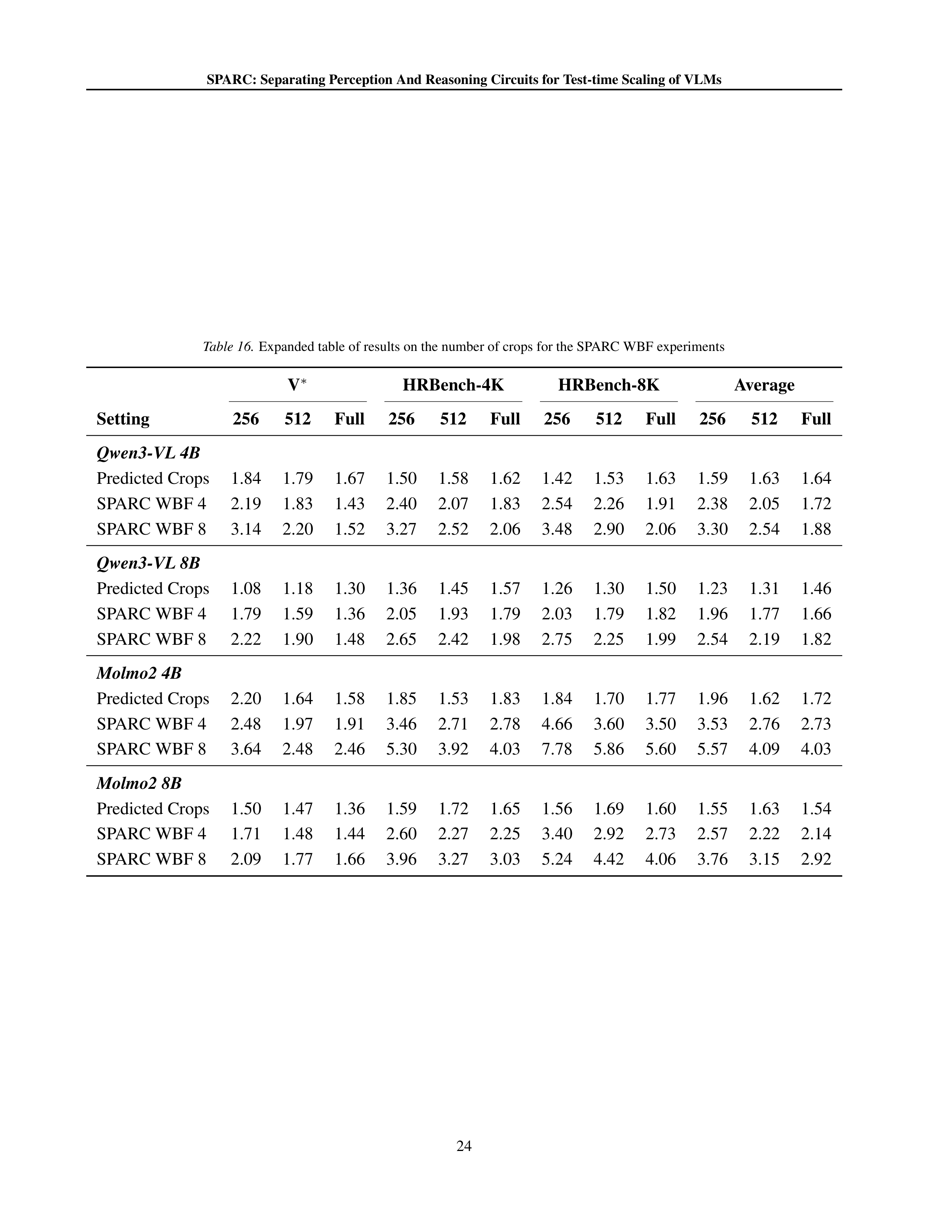
SPARC: Separating Perception And Reasoning Circuits for Test-time Scaling of VLMs
Table 16.
Expanded table of results on the number of crops for the SPARC WBF experiments
V
∗
HRBench-4K
HRBench-8K
Average
Setting
256
512
Full
256
512
Full
256
512
Full
256
512
Full
Qwen3-VL 4B
Predicted Crops
1.84
1.79
1.67
1.50
1.58
1.62
1.42
1.53
1.63
1.59
1.63
1.64
SPARC WBF 4
2.19
1.83
1.43
2.40
2.07
1.83
2.54
2.26
1.91
2.38
2.05
1.72
SPARC WBF 8
3.14
2.20
1.52
3.27
2.52
2.06
3.48
2.90
2.06
3.30
2.54
1.88
Qwen3-VL 8B
Predicted Crops
1.08
1.18
1.30
1.36
1.45
1.57
1.26
1.30
1.50
1.23
1.31
1.46
SPARC WBF 4
1.79
1.59
1.36
2.05
1.93
1.79
2.03
1.79
1.82
1.96
1.77
1.66
SPARC WBF 8
2.22
1.90
1.48
2.65
2.42
1.98
2.75
2.25
1.99
2.54
2.19
1.82
Molmo2 4B
Predicted Crops
2.20
1.64
1.58
1.85
1.53
1.83
1.84
1.70
1.77
1.96
1.62
1.72
SPARC WBF 4
2.48
1.97
1.91
3.46
2.71
2.78
4.66
3.60
3.50
3.53
2.76
2.73
SPARC WBF 8
3.64
2.48
2.46
5.30
3.92
4.03
7.78
5.86
5.60
5.57
4.09
4.03
Molmo2 8B
Predicted Crops
1.50
1.47
1.36
1.59
1.72
1.65
1.56
1.69
1.60
1.55
1.63
1.54
SPARC WBF 4
1.71
1.48
1.44
2.60
2.27
2.25
3.40
2.92
2.73
2.57
2.22
2.14
SPARC WBF 8
2.09
1.77
1.66
3.96
3.27
3.03
5.24
4.42
4.06
3.76
3.15
2.92
24
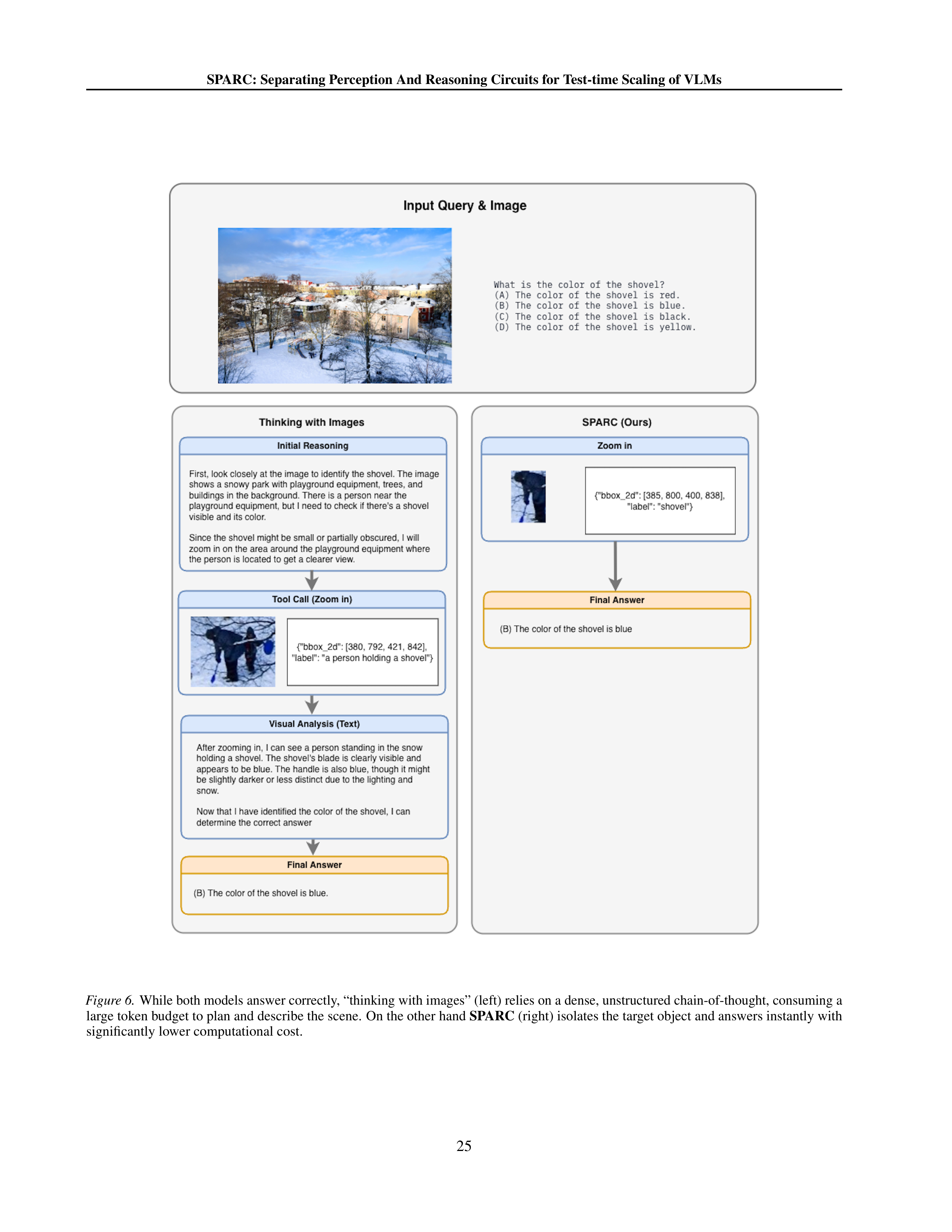
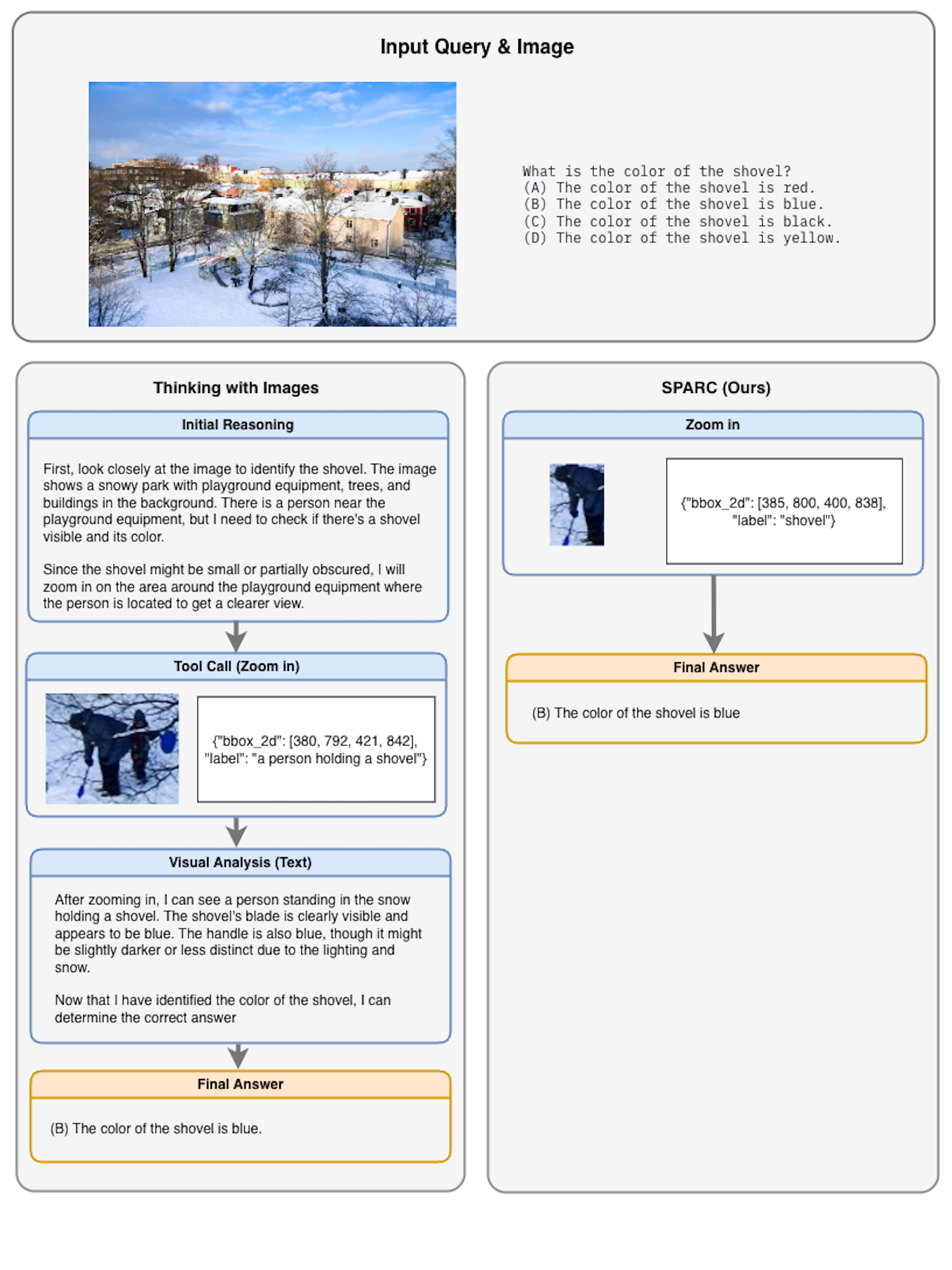
SPARC: Separating Perception And Reasoning Circuits for Test-time Scaling of VLMs
Figure 6.
While both models answer correctly, “thinking with images” (left) relies on a dense, unstructured chain-of-thought, consuming a
large token budget to plan and describe the scene.
On the other hand
SPARC
(right) isolates the target object and answers instantly with
significantly lower computational cost.
25
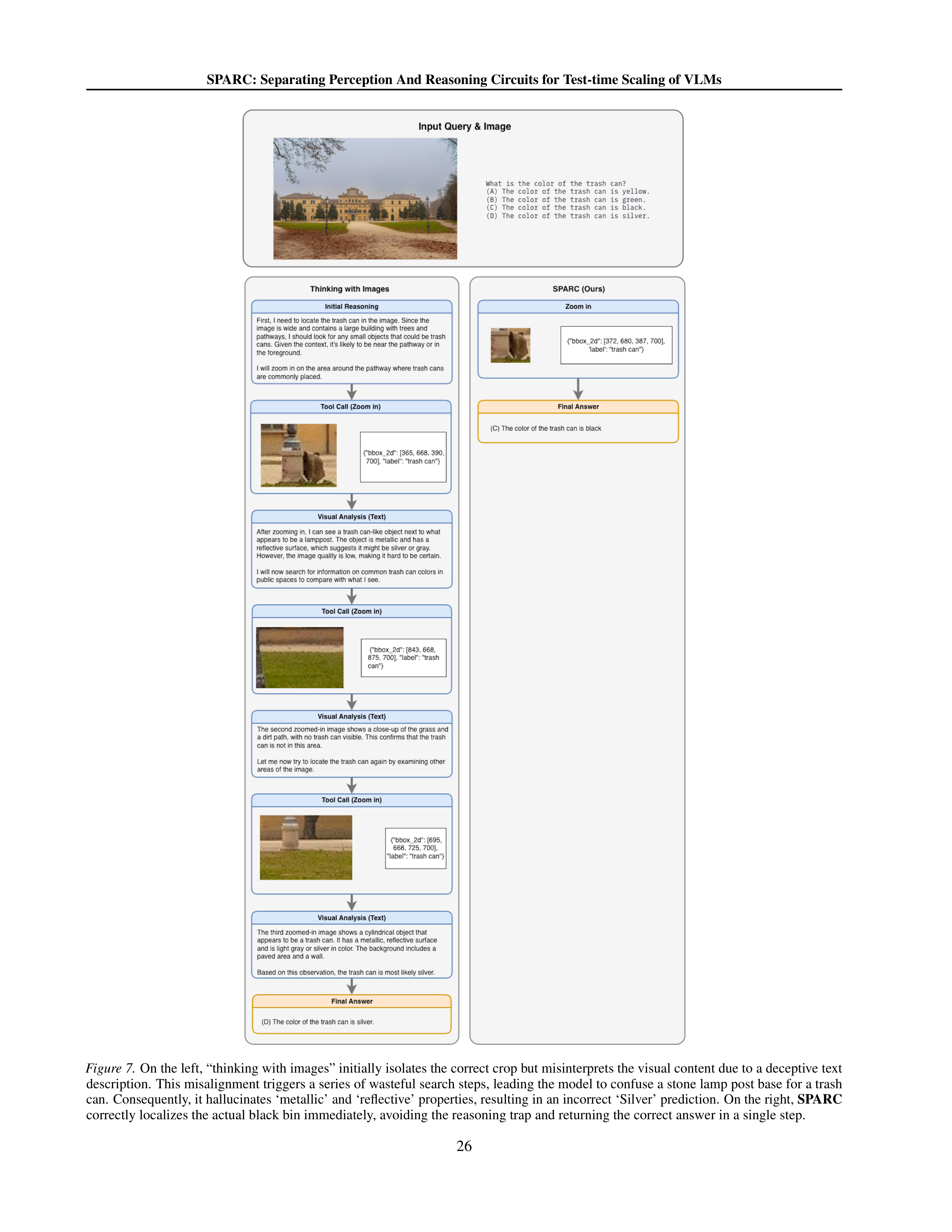
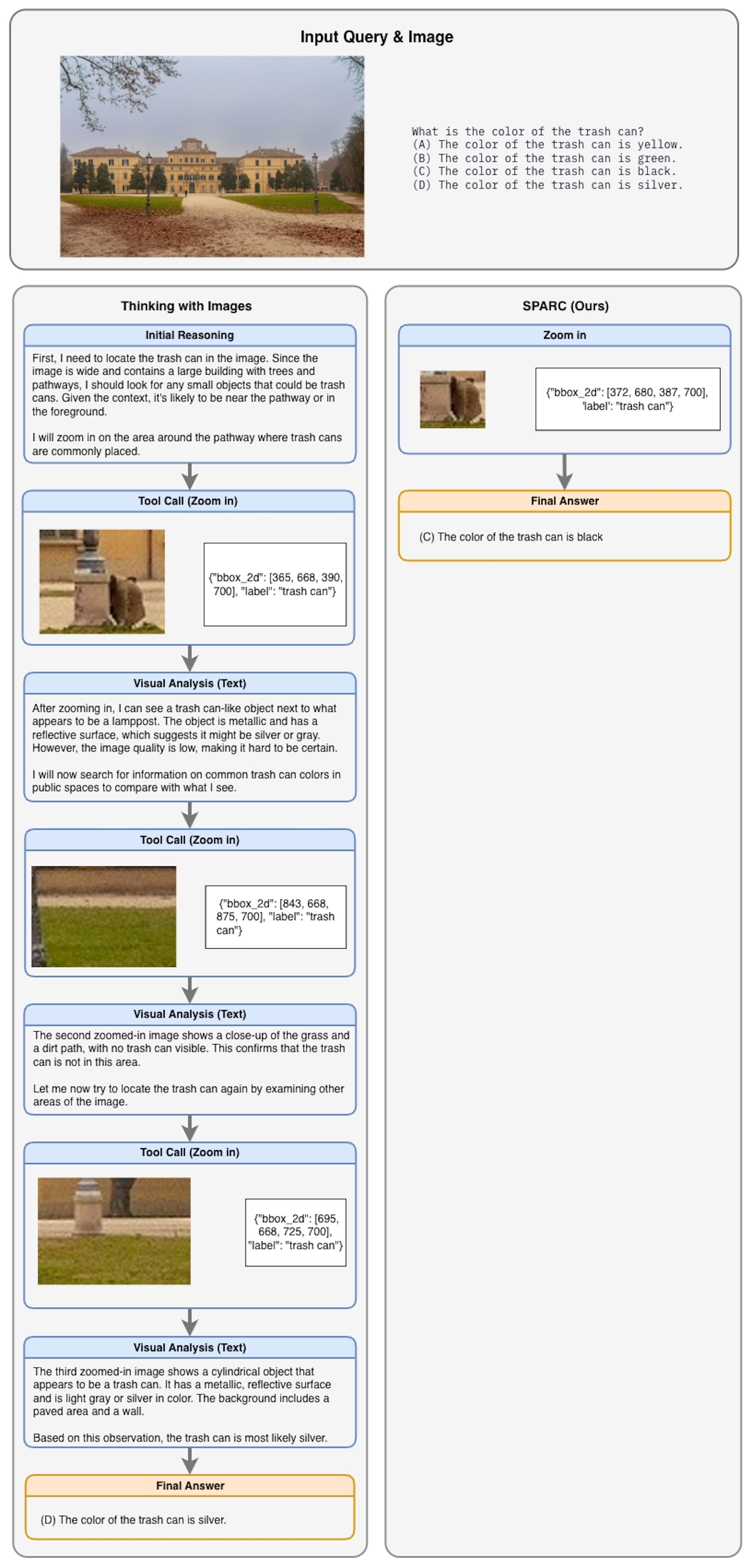
SPARC: Separating Perception And Reasoning Circuits for Test-time Scaling of VLMs
Figure 7.
On the left, “thinking with images” initially isolates the correct crop but misinterprets the visual content due to a deceptive text
description.
This misalignment triggers a series of wasteful search steps, leading the model to confuse a stone lamp post base for a trash
can.
Consequently, it hallucinates ‘metallic’ and ‘reflective’ properties, resulting in an incorrect ‘Silver’ prediction.
On the right,
SPARC
correctly localizes the actual black bin immediately, avoiding the reasoning trap and returning the correct answer in a single step.
26
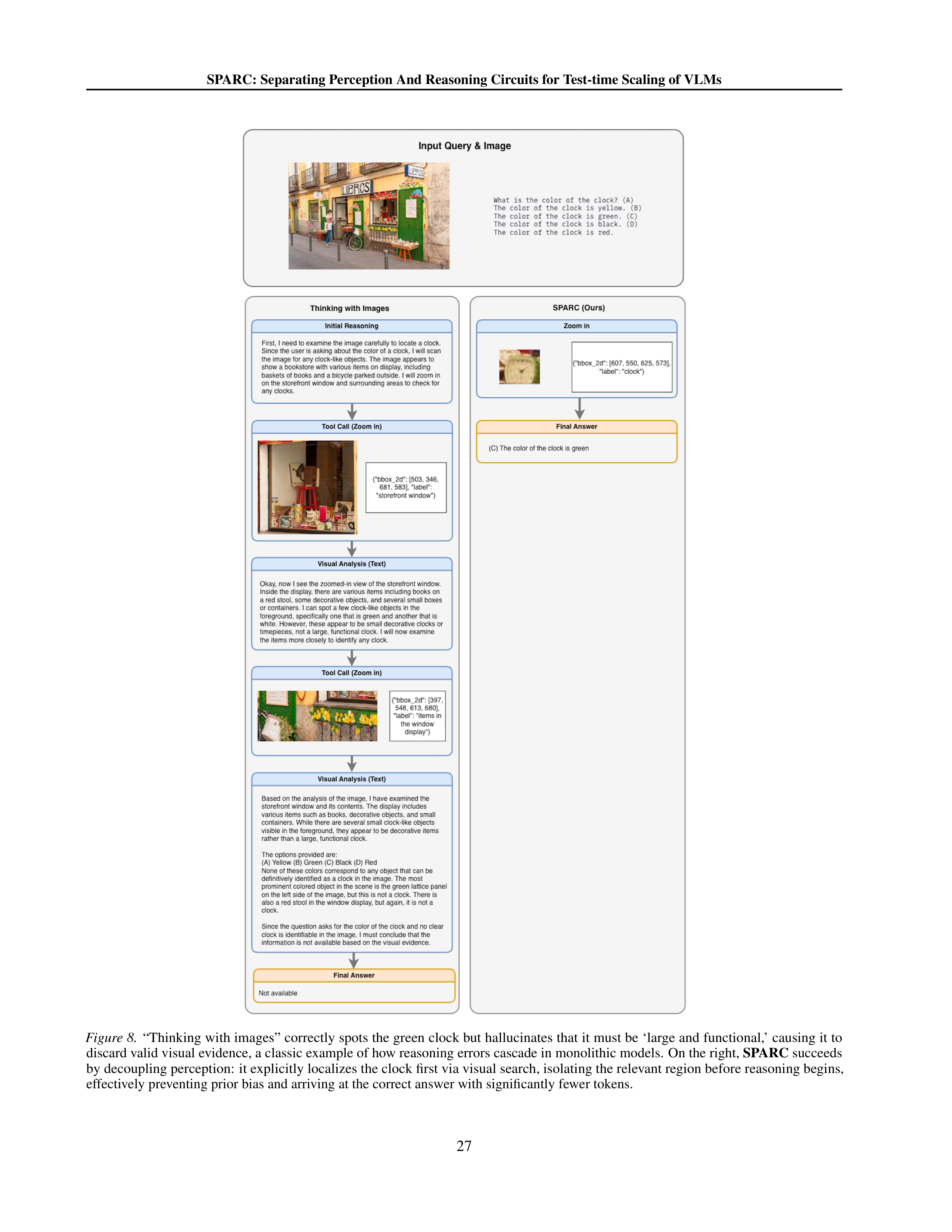
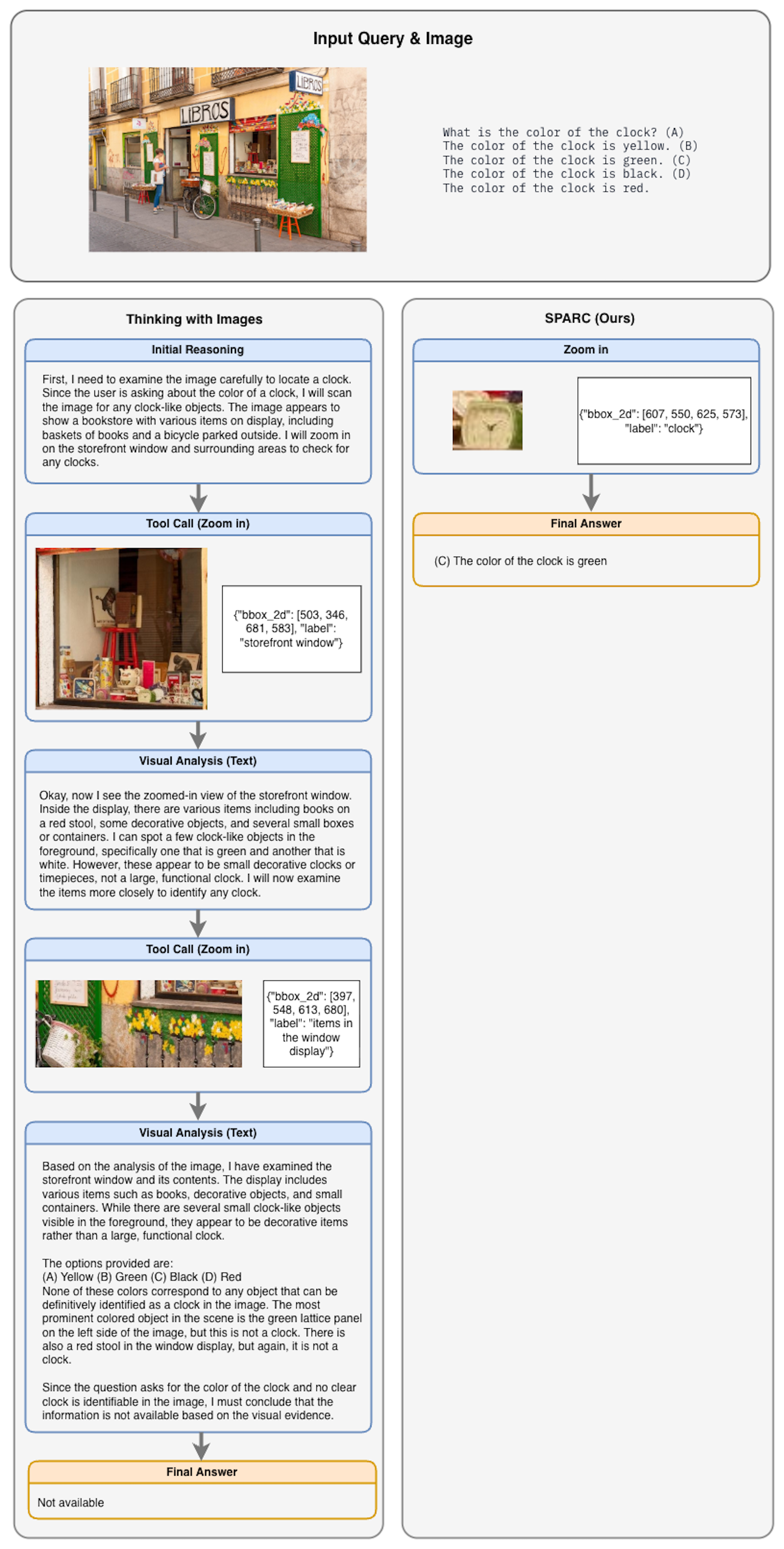
SPARC: Separating Perception And Reasoning Circuits for Test-time Scaling of VLMs
Figure 8.
“Thinking with images” correctly spots the green clock but hallucinates that it must be ‘large and functional,’ causing it to
discard valid visual evidence, a classic example of how reasoning errors cascade in monolithic models.
On the right,
SPARC
succeeds
by decoupling perception:
it explicitly localizes the clock first via visual search, isolating the relevant region before reasoning begins,
effectively preventing prior bias and arriving at the correct answer with significantly fewer tokens.
27
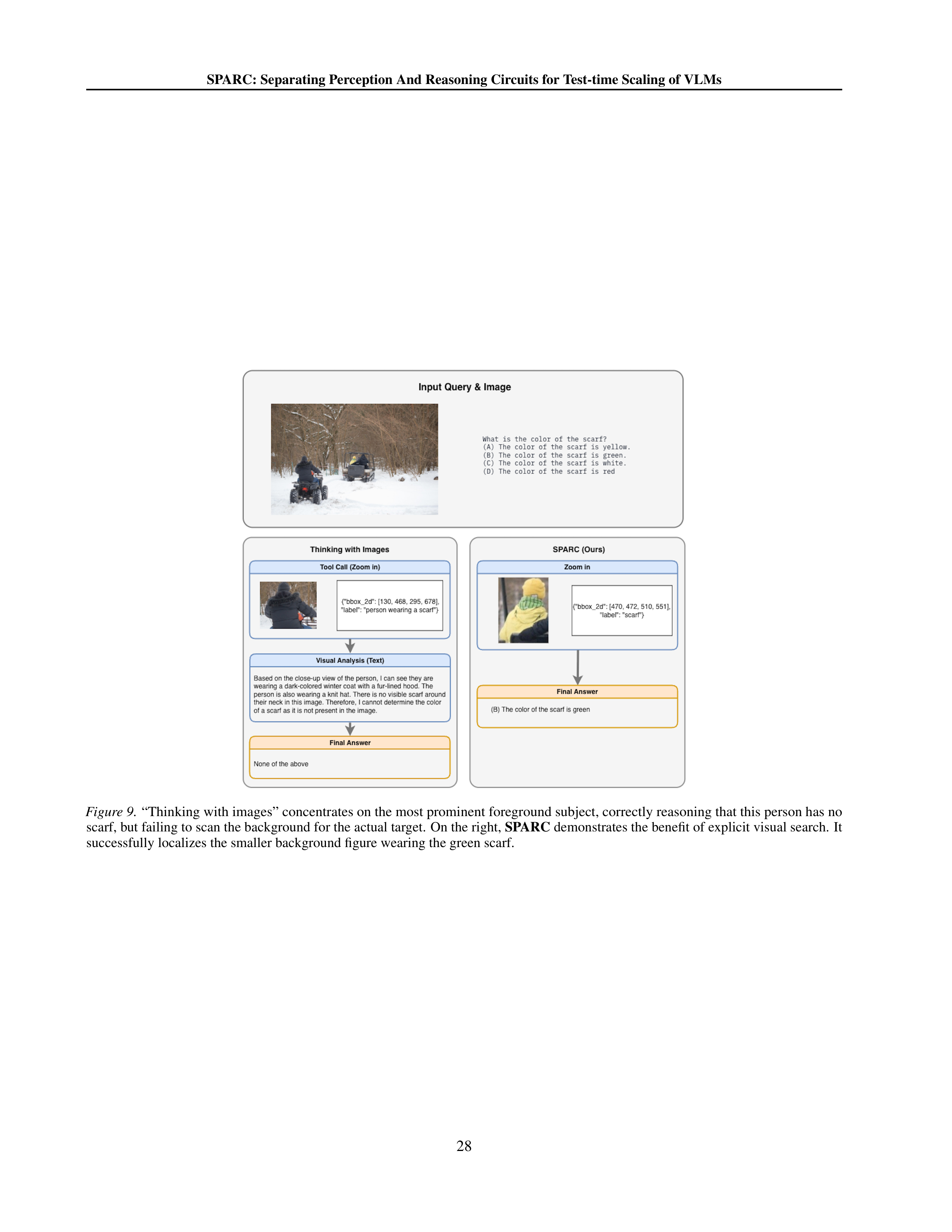
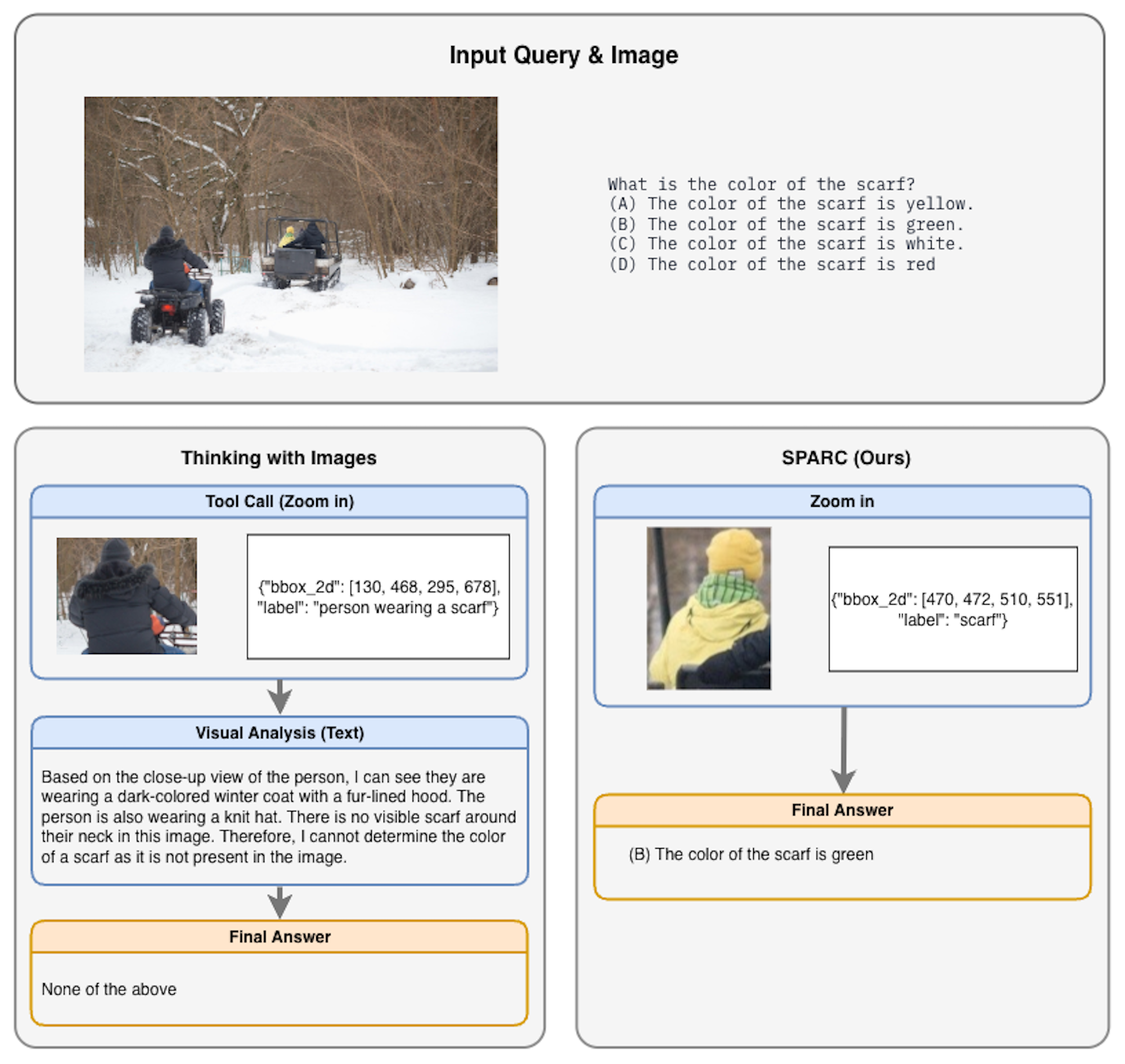
SPARC: Separating Perception And Reasoning Circuits for Test-time Scaling of VLMs
Figure 9.
“Thinking with images” concentrates on the most prominent foreground subject, correctly reasoning that this person has no
scarf, but failing to scan the background for the actual target.
On the right,
SPARC
demonstrates the benefit of explicit visual search.
It
successfully localizes the smaller background figure wearing the green scarf.
28