Transactions on Economics, Business and Management Research
ISSN: 2960-1789, eISSN: 2960-2254 | Volume 13
BMMFT 2024
Content from this work may be used under the terms of
CC BY-NC 4.0 licence
(https://creativecommons.org/licenses/by-nc/4.0/).
Published by Warwick Evans Publishing.
WEP
Warwick
Evans
Publishing
Digital Transformation of Cartier: Marketing Analysis and Strategic
Recommendations
Nuohan Yu
*
College of Tourism and Cultural Industries, Chengdu University, Chengdu, China
* Corresponding Author Email: gudec@ldy.edu.rs
Abstract.
The rapid evolution of globalization and shifting market conditions has amplified the
importance of innovation within the luxury sector, leading to diverse strategies for growth and
development. This research specifically focuses on the digital transformation of Cartier, a renowned
luxury jewelry brand, to assess its impact on the company's growth and success. By analyzing key
factors such as market sales, market share, and consumer engagement, the study aims to evaluate
how digital transformation has positively influenced Cartier’s performance. Through a detailed
examination of current data and documents, the research will not only highlight the successes, but
also identify potential challenges or limitations that the brand faces in leveraging digital strategies.
Furthermore, the study seeks to propose actionable strategies for accelerating Cartier’s future
growth, offering insights into how luxury brands can optimize digital transformation efforts to enhance
consumer experiences and strengthen market positions. Ultimately, this paper will provide a
comprehensive formula for success in the luxury goods industry, outlining the skills and approaches
necessary for brands to thrive in an increasingly digital world. By identifying both the benefits and
challenges of digital transformation, this research aims to offer valuable guidance for Cartier and
other luxury brands striving for sustainable growth in a competitive global marketplace.
Keywords:
Digital Transformation; Market Share; Degree of Engagement; Cartier.
1.
Introduction
In today's network era, the widespread application of big data technology has profoundly affected all
aspects of people's daily lives and socio-economic activities. It has become an important bridge
connecting businesses and consumers. Especially from 2020 to 2023, when the global new crown
epidemic is raging, the role of big data has become even more prominent.
The New Crown outbreak has significantly accelerated global digitization, leading to a surge in
Internet users and an explosive growth in network traffic. This trend has changed people's
consumption habits and prompted companies to transform, increase their investment in, and apply
big data technologies. Travel restrictions during the pandemic severely affected offline shopping,
leading to a shift in luxury spending to online platforms. According to the China Luxury Digital
Report 2021, online sales of luxury goods in China reached $14.1 billion in 2020, an 88 percent year-
on-year increase; online sales continued to grow to $24.7 billion in 2021, a 75 percent increase year-
on-year [1].
The outbreak has unquestionably dealt a fatal blow to the global luxury market, resulting in a
significant shrinkage. According to the Bain Luxury Study, published by Bain & Company in
conjunction with Fondazione Altagamma, global luxury sales in 2020 are down 23 percent from 2019.
It is worth noting that the luxury goods market has rebounded rapidly, growing from about 11 percent
in 2019 to 20 percent in 2020, with sales achieving a high growth of 48 percent thanks to the well-
controlled epidemic in mainland China. As a result, several luxury brands increasingly recognize the
importance of the Chinese market. The outbreak has led several luxury brands to realize the
importance of brand digitization.
Cartier is a prominent player in the jewelry industry and has always been one of the top brands in the
luxury market, thanks to its long history, excellence in craftsmanship, and close ties with royalty and
341
celebrities. Cartier has actively promoted digital transformation, upgrading several shops worldwide
during the pandemic and expanding its e-commerce business to complete its digital transformation.
This initiative has significantly boosted its brand value, which grew by 88 percent in 2022, putting
Cartier ahead of the luxury market. Through an innovative digital strategy and a unique customer
experience, Cartier has strengthened its leadership position in the high-end luxury market and
maintained its tradition of sophistication and exclusivity.
Many consumers and academic studies have recognized Cartier as a luxury brand in recent years. For
example, Xu Yu investigated the transmission of family genes in jewelry settings using Cartier as a
research object [2]. Leonor Alves The study employed qualitative and quantitative research methods
to investigate which communication strategies Cartier should implement to appeal to millennials and
Generation Z, using Cartier as the subject [3]. Barbosa Beatriz Alexandre examined Cartier's growth
potential in Portugal and conducted a study on how to strengthen the relationship between Cartier and
local customers, using Cartier as the subject of the study [4].
Although the analysis of Cartier has been extensive, most of it has focused on the brand's history,
innovation in craftsmanship, or marketing strategy. At the same time, there has been a need for a
more in-depth investigation of Cartier's specific plan for its digital transformation and its impact
between 2020 and 2023, with significant gaps in the study. This gap not only limits the understanding
of how modern luxury brands adapt to the challenges of the digital age but also prevents the industry
and beyond from assessing and learning from the effectiveness of digital transformation.
To fill the gap in this field of research, this paper aims to delve deeper into how strategies related to
digital transformation have affected Cartier as a brand. Specifically, this paper will focus on the
following core research directions: This paper will present the plan and results related to Cartier's
digital transformation, followed by an analysis of how this transformation is affecting every aspect
of Cartier's operations. Ultimately, given the current situation, what further steps should Cartier take
to implement a digital transformation strategy that will enhance its brand loyalty, value, and image?
This paper assumes that studying Cartier's digital transformation strategy can reveal the unique
challenges luxury brands face by systematically analyzing these issues. It provides theoretical support
and practical experience for luxury brands' digital strategies.
2.
Case Description
Louis-François Cartier founded Cartier in Paris, France, in 1847. Initially, Cartier focused on making
fine jewelry and quickly won the favor of European royalty and nobility. In 1888, Cartier introduced
the iconic ‘Wedding Ring’ and, in 1898, launched its first wristwatch; at the beginning of the 20th
century, Cartier became a renowned watchmaker and continued to innovate, for example, with the
world's first robust pilot watch and the popular ‘Tank’ collection. Tank’ collection.
Cartier is a leading brand in the global luxury market for jewelry and watches. Its market position is
high-end luxury. The brand's main customer groups include high-income individuals and luxury
lovers. The brand is renowned for its exquisite craftsmanship and innovative designs. Cartier's
designs reflect its deep historical background and incorporate modern fashion elements, maintaining
a balance of classicism and innovation. Cartier is committed to providing its customers with a unique
luxury experience, emphasizing personalized service and the exclusivity of high-end products. It
preserves the brand's image of luxury and elegance.
Cartier's sales in China have grown year over year, and the Chinese market has become an important
support for Cartier's global performance during the pandemic. Cartier has adopted a highly digital
marketing strategy in China, contrasting with its traditional approach in other global markets.
Cartier opened its official flagship shop on T-mall's Luxury Pavilion in 2020 and became the first
luxury brand to offer customization services through the platform. This includes services such as
engraving, gift wrapping, and white glove delivery, greatly enhancing the customer experience.
Cartier is also actively involved in live e-commerce events, such as its appearance on the Taobao
342
Live platform, which attracted nearly 800,000 viewers and realized more than RMB 100 million in
sales in just one event.
The New Crown epidemic had a significant impact on the global luxury market. However, the
Chinese market showed a certain degree of resilience due to relatively good epidemic prevention and
control and improved digital channel layout. Richemont (Cartier's parent company) saw sales fall 47%
year-on-year to €1.99bn in the first quarter of 2020. Still, the Chinese market bucked the trend with
a 49% year-on-year rise, with the jewelry business growing by a particularly significant 61% [5].
Cartier's performance in the Chinese market continues to be solid as the situation eases. In 2022, the
Lippo Group saw a significant increase in annual sales, jumping 50.1% year-on-year, and Cartier, as
one of the Group's key brands, made a significant contribution to the Chinese market [5].
3.
Analysis on Problems
3.1.
Effectiveness on Increase in Sales
The digital transformation of the Cartier brand has directly contributed to sales growth by optimizing
the e-commerce platform and integrating online and offline channels.
Cartier's strategy of combining online and offline mainly started around 2017. This shift was in
response to changing consumer shopping habits and digitalization trends. In 2018, Cartier increased
its investment in digital platforms, including upgrading its e-commerce platform and optimizing the
integration of its online and offline services. The 2020 epidemic accelerated this process, and Cartier
has further strengthened its online and offline integration strategy. These primarily include the
development of a globally unified e-commerce platform, online promotions, and virtual fitting
functions.
In order to build a globally unified e-commerce platform, the Cartier brand first evaluated and
integrated its existing e-commerce platform. It then upgraded its technology, adopting advanced e-
commerce platform technologies and tools, such as SAP Commerce Cloud or Salesforce Commerce
Cloud, to support multi-region and multi-language operations [6].
Cartier also optimizes online promotions using data analytics and user behavior prediction. Cartier
leverages Customer Relationship Management systems (CRM) and marketing automation tools to
accurately push personalized promotional messages, thereby increasing user engagement and sales
conversions. Additionally, Cartier has introduced Augmented Reality (AR) technology, which
typically relies on image recognition, 3D modeling, and AR tools like Modiface or Virtual Try-On
(VTO) for technical implementations that provide consumers with a virtual try-on experience. This
technology allows users to view themselves wearing Cartier jewelry through a mobile phone or
computer camera [7].
After implementing these digitalization measures, Cartier has significantly increased online sales.
Overall sales for Cartier in 2020 will be around €12.1bn, up about 14% from €10.6bn in 2019. During
this period, the e-commerce channel contributed about 20 percent of sales, significantly higher than
the previous level. Online sales grew by 35 percent and 40 percent in FY2021 and FY2022,
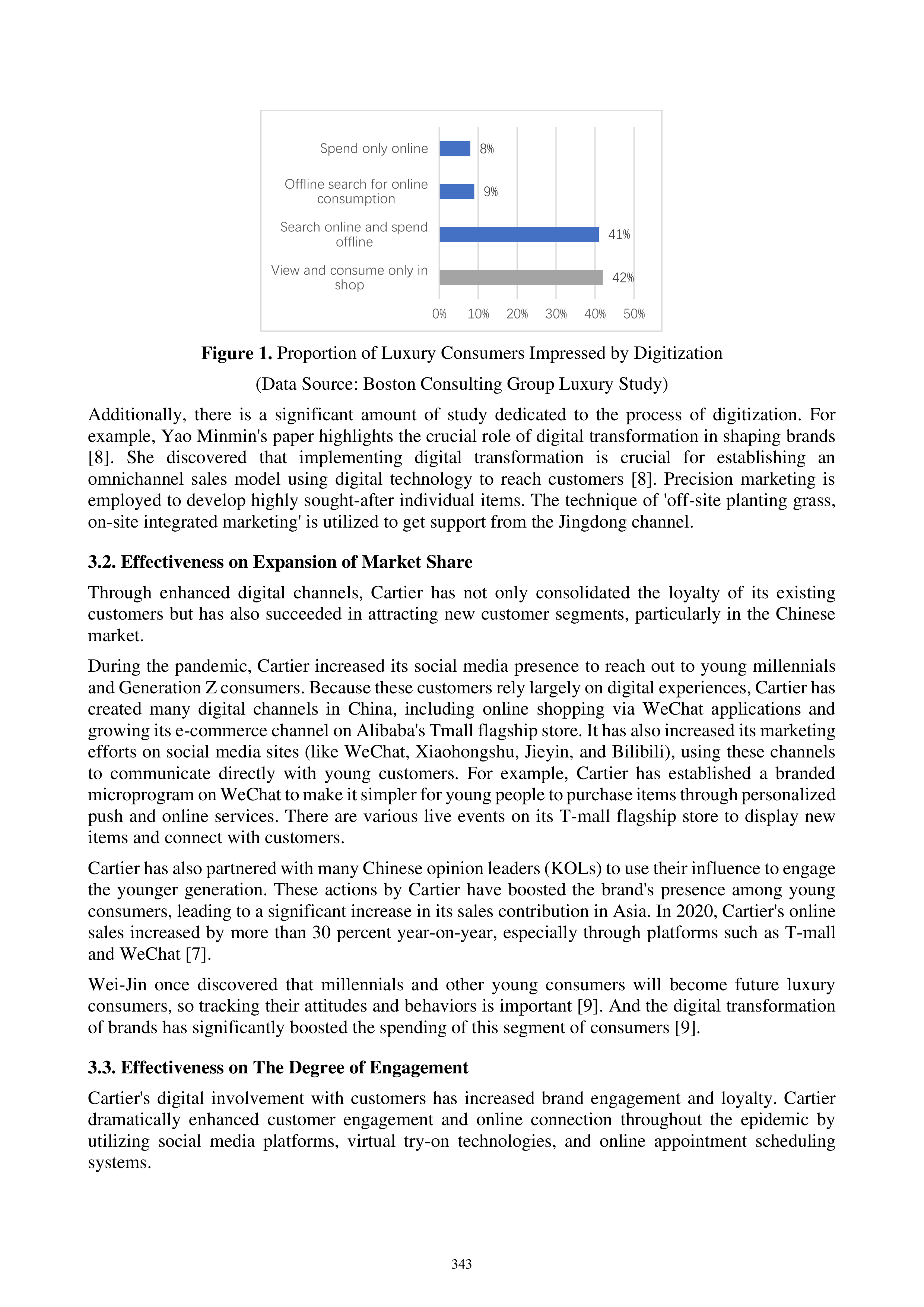
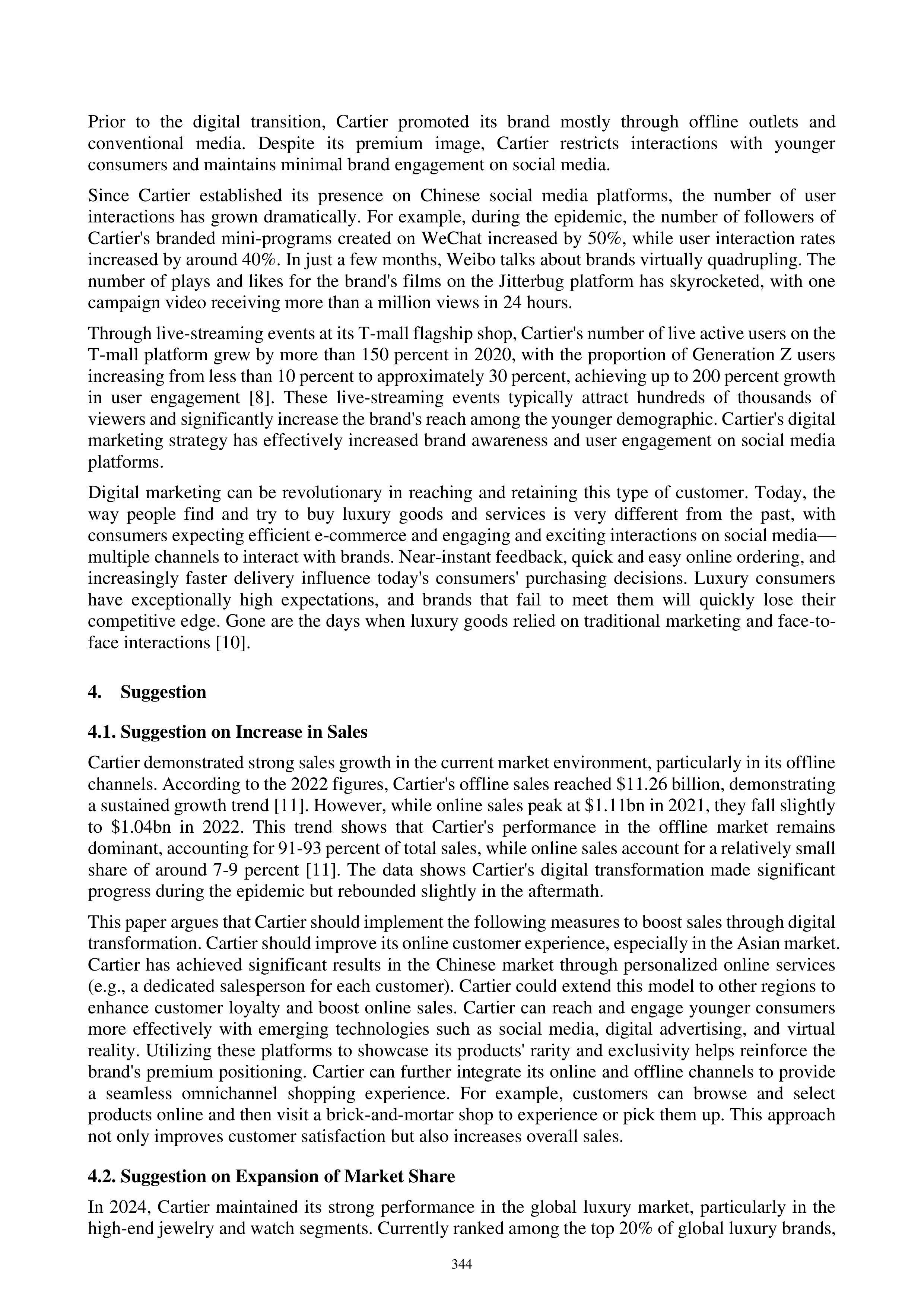
respectively [6]. As shown in Figure 1, as brands embark on a digital transformation, consumers
spend in various ways, and the proportion of online spending is gradually increasing.
343
Figure 1.
Proportion of Luxury Consumers Impressed by Digitization
(Data Source: Boston Consulting Group Luxury Study)
Additionally, there is a significant amount of study dedicated to the process of digitization. For
example, Yao Minmin's paper highlights the crucial role of digital transformation in shaping brands
[8]. She discovered that implementing digital transformation is crucial for establishing an
omnichannel sales model using digital technology to reach customers [8]. Precision marketing is
employed to develop highly sought-after individual items. The technique of 'off-site planting grass,
on-site integrated marketing' is utilized to get support from the Jingdong channel.
3.2.
Effectiveness on Expansion of Market Share
Through enhanced digital channels, Cartier has not only consolidated the loyalty of its existing
customers but has also succeeded in attracting new customer segments, particularly in the Chinese
market.
During the pandemic, Cartier increased its social media presence to reach out to young millennials
and Generation Z consumers. Because these customers rely largely on digital experiences, Cartier has
created many digital channels in China, including online shopping via WeChat applications and
growing its e-commerce channel on Alibaba's Tmall flagship store. It has also increased its marketing
efforts on social media sites (like WeChat, Xiaohongshu, Jieyin, and Bilibili), using these channels
to communicate directly with young customers. For example, Cartier has established a branded
microprogram on WeChat to make it simpler for young people to purchase items through personalized
push and online services. There are various live events on its T-mall flagship store to display new
items and connect with customers.
Cartier has also partnered with many Chinese opinion leaders (KOLs) to use their influence to engage
the younger generation. These actions by Cartier have boosted the brand's presence among young
consumers, leading to a significant increase in its sales contribution in Asia. In 2020, Cartier's online
sales increased by more than 30 percent year-on-year, especially through platforms such as T-mall
and WeChat [7].
Wei-Jin once discovered that millennials and other young consumers will become future luxury
consumers, so tracking their attitudes and behaviors is important [9]. And the digital transformation
of brands has significantly boosted the spending of this segment of consumers [9].
3.3.
Effectiveness on The Degree of Engagement
Cartier's digital involvement with customers has increased brand engagement and loyalty. Cartier
dramatically enhanced customer engagement and online connection throughout the epidemic by
utilizing social media platforms, virtual try-on technologies, and online appointment scheduling
systems.
42%
41%
9%
8%
0%
10%
20%
30%
40%
50%
View and consume only in
shop
Search online and spend
offline
Offline search for online
consumption
Spend only online
344
Prior to the digital transition, Cartier promoted its brand mostly through offline outlets and
conventional media. Despite its premium image, Cartier restricts interactions with younger
consumers and maintains minimal brand engagement on social media.
Since Cartier established its presence on Chinese social media platforms, the number of user
interactions has grown dramatically. For example, during the epidemic, the number of followers of
Cartier's branded mini-programs created on WeChat increased by 50%, while user interaction rates
increased by around 40%. In just a few months, Weibo talks about brands virtually quadrupling. The
number of plays and likes for the brand's films on the Jitterbug platform has skyrocketed, with one
campaign video receiving more than a million views in 24 hours.
Through live-streaming events at its T-mall flagship shop, Cartier's number of live active users on the
T-mall platform grew by more than 150 percent in 2020, with the proportion of Generation Z users
increasing from less than 10 percent to approximately 30 percent, achieving up to 200 percent growth
in user engagement [8]. These live-streaming events typically attract hundreds of thousands of
viewers and significantly increase the brand's reach among the younger demographic. Cartier's digital
marketing strategy has effectively increased brand awareness and user engagement on social media
platforms.
Digital marketing can be revolutionary in reaching and retaining this type of customer. Today, the
way people find and try to buy luxury goods and services is very different from the past, with
consumers expecting efficient e-commerce and engaging and exciting interactions on social media—
multiple channels to interact with brands. Near-instant feedback, quick and easy online ordering, and
increasingly faster delivery influence today's consumers' purchasing decisions. Luxury consumers
have exceptionally high expectations, and brands that fail to meet them will quickly lose their
competitive edge. Gone are the days when luxury goods relied on traditional marketing and face-to-
face interactions [10].
4.
Suggestion
4.1.
Suggestion on Increase in Sales
Cartier demonstrated strong sales growth in the current market environment, particularly in its offline
channels. According to the 2022 figures, Cartier's offline sales reached $11.26 billion, demonstrating
a sustained growth trend [11]. However, while online sales peak at $1.11bn in 2021, they fall slightly
to $1.04bn in 2022. This trend shows that Cartier's performance in the offline market remains
dominant, accounting for 91-93 percent of total sales, while online sales account for a relatively small
share of around 7-9 percent [11]. The data shows Cartier's digital transformation made significant
progress during the epidemic but rebounded slightly in the aftermath.
This paper argues that Cartier should implement the following measures to boost sales through digital
transformation. Cartier should improve its online customer experience, especially in the Asian market.
Cartier has achieved significant results in the Chinese market through personalized online services
(e.g., a dedicated salesperson for each customer). Cartier could extend this model to other regions to
enhance customer loyalty and boost online sales. Cartier can reach and engage younger consumers
more effectively with emerging technologies such as social media, digital advertising, and virtual
reality. Utilizing these platforms to showcase its products' rarity and exclusivity helps reinforce the
brand's premium positioning. Cartier can further integrate its online and offline channels to provide
a seamless omnichannel shopping experience. For example, customers can browse and select
products online and then visit a brick-and-mortar shop to experience or pick them up. This approach
not only improves customer satisfaction but also increases overall sales.
4.2.
Suggestion on Expansion of Market Share
In 2024, Cartier maintained its strong performance in the global luxury market, particularly in the
high-end jewelry and watch segments. Currently ranked among the top 20% of global luxury brands,
345
Cartier demonstrates its high exclusivity and strong brand recognition in the marketplace. Although
Cartier is only 12th in the global online sales ranking, its main competitors, such as Louis Vuitton
and Gucci, have a much higher market share in this segment.
Cartier should further integrate online and offline shopping experiences to increase market share and
create a seamless omnichannel customer journey. This not only enhances customer loyalty but also
effectively expands their market share. For instance, they can draw in customers by implementing
'browse online, pick up offline' strategies or providing AR experiences in their stores. Cartier can use
big data and artificial intelligence technologies to analyze consumer behavior and provide a more
personalized shopping experience. Cartier can engage its target customer base more effectively
through precise digital marketing strategies, resulting in higher conversion rates. Cartier should
further invest in social media marketing and digital content creation to appeal to the younger
generation of consumers. This will enhance brand awareness and expand its market share in the digital
space. By collaborating on content creation and interactive experiences, Cartier can better reach
emerging markets and young consumers.
4.3.
Suggestion on Enhancement of Customer Engagement
Cartier has significantly increased customer engagement through its digital transformation in the post-
epidemic luxury market. The brand has invested particularly in its online platforms, aiming to provide
a more personalized and interactive customer experience.
Cartier, for example, has maintained high online customer engagement by improving its website's
user interface and user experience. Additionally, Cartier has optimized its social media strategy to
effectively manage brand advocates and strengthen community connections. Cartier can focus on the
following areas in its digital strategy to improve customer engagement further. Enhancing
personalized experiences through AI Using AI-driven insights to predict customer behavior and
preferences can help Cartier deliver a more personalized experience. For example, customized
product recommendations and personalized content can significantly enhance customer engagement.
Cartier should ensure a seamless transition between online and offline experiences. Considering that
74 percent of customer service journeys involve multiple channels, Cartier needs to invest in creating
a consistent omnichannel strategy. This approach not only reduces customer frustration but also
increases their satisfaction. Encourage more user-generated content can deepen the connection
between brands and their customers.
By integrating UGC into its marketing strategy, Cartier enhances authenticity and builds a stronger
brand community, boosting engagement and customer loyalty. Cartier should investigate the potential
of emerging technologies, such as the metaverse, to create immersive and interactive experiences.
These platforms offer customers new ways to interact with the brand beyond traditional e-commerce
and retail experiences
5.
Conclusion
The article focuses on Cartier's shift towards digital innovation during the pandemic, with a critical
review of the brand's achievements in three main domains: sales volume, market share, and customer
interaction. The pandemic has drastically changed the luxury market, making it faster for labels to
adjust to the growing digital environment. Cartier, renowned in the high-end industry, is currently at
a crossroads, calling for a reassessment of classic methods in response to these shifts.
The study indicates that Cartier faces various prospects and obstacles despite its robust market
standing. The rapid evolution of the high-end market, spurred by changes in consumer habits and the
emergence of digital platforms, calls for a strategic reassessment of the brand's interaction with its
consumers. The article contends that Cartier should increasingly adopt digital instruments and
interfaces to retain and boost its market competitiveness. This approach enhances the brand's
capability to adapt to the changing demands of contemporary consumers, cultivate stronger brand
loyalty, and broaden its presence in both current and developing markets.
346
The suggestions presented in this document highlight the essential significance of a comprehensive
digital strategy. This tactic must resonate with Cartier's extensive brand legacy and propel innovative
actions that appeal to modern consumers. Executing these digital strategies successfully is critical for
Cartier's growth trajectory and maintaining its top position in the luxury industry.
Furthermore, this research strengthens the scholarly acknowledgment of the impact of digital
transformation on increasing brand sales. It also offers precise counsel for high-end businesses that
are encountering similar challenges. However, it is essential to acknowledge the limitations of this
paper. While Cartier's digital history research is thorough, it lacks a full investigation of the
underlying ideas of digitization and the specific impact of digital initiatives on brand income. Future
research should delve deeply into these areas, offering a comprehensive comprehension of how
luxury brands can leverage digitalization to enhance their effectiveness.
In conclusion, Cartier's digital transformation trajectory mirrors broader trends that are common in
the luxury industry. Amidst the rapid progress of digital technology, high-end enterprises must adapt
quickly, continuously adjusting their strategies to stay relevant in this increasingly digitalized domain.
This report offers essential insights for Cartier and the wider luxury industry, emphasizing the
importance of innovation, heritage, and customer engagement in the current digital age.
References
[1]
Information on: https: //www.bain.com/insights/china-luxury-report-2021.
[2]
Y. Xu he transmission of family genes in jewelry design - an example of Cartier's serialized jewellery works [J].
Journal of Guangdong Light Industry Vocational Technology, 20 (02) (2020) 76 - 80.
[3]
C. F. Andrade, L. Alves. Developing the Sales Potential of Cartier in Portugal: Which Communication Strategy
Should Cartier Implement to Attract Millennials & Gen Z? [J]. Universidad NOVA de Lisboa (Portugal) ProQuest
Dissertations & Theses, 2021.
[4]
B. A. Barbosa, Developing the Sales Potential of Cartier in Portugal: How Can Cartier Strengthen its Relationship
with Local Clients? [J]. Universidade NOVA de Lisboa (Portugal) ProQuest Dissertations & Theses, 2021.
[5]
Information on: https: //www.luxuryjournal.com/cartier-digital-transformation.
[6]
L. Collins, "The Impact of Virtual Try-On Technology on Luxury Brands." *Tech in Fashion Review (2022).
[7]
Information on: https: //www.richemont.com/en/home/investors/reports/annual-reports/.
[8]
Information on: https: //www.bcg.com/.
[9]
M. Yao, Performance analysis research on the digital transformation of casual food enterprises [D]. Shanxi
University of Finance and Economics, 2023.
[10]
J. Wei, Research on digital omni-channel marketing strategy of luxury brands [D]. East China Normal University,
2020.
[11]
Cartier: Global Revenue, Ranking, Growth, Competitors & Business Strategy. ECDB. (2024).