Proceedings of ICMRED 2025 Symposium: Effective Communication as a Powerful Management Tool
DOI: 10.54254/2754-1169/2025.BL23897
© 2025 The Authors. This is an open access article distributed under the terms of the Creative Commons Attribution License 4.0
(https://creativecommons.org/licenses/by/4.0/).
91
Marketing Strategy Analysis of the New Energy Vehicle
Industry: A Case Study of Huawei
Zirui Wan
School of International Economics and Trade, Zhejiang University, Hangzhou, China
3230101908@zju.edu.cn
Abstract:
The new energy vehicle industry has experienced rapid development, driven by
increasing global awareness of environmental protection and the widespread adoption of
digital lifestyles, thereby becoming a core driver of transformation in the automotive sector.
This paper examines the market status, development trends, and marketing strategies of the
NEV industry, with a particular focus on Huawei's market performance and marketing
strategies in this field. Through SWOT analysis and Porter's Five Forces model, the paper
analyzes Huawei's strengths, weaknesses, opportunities, and threats in the NEV sector and
proposes targeted marketing strategy recommendations. The research findings indicate that
Huawei has achieved significant success in the high-end market due to its technological
advantages and brand influence. However, improvements are needed in areas such as brand
recognition, manufacturing experience, pricing strategies, and channel coverage. To address
these issues, this study suggests enhancing manufacturing collaboration, strengthening core
technology R&D, expanding brand communication channels, and optimizing pricing
strategies.
Keywords:
New Energy Vehicles, Huawei, Marketing Strategy, Market Analysis, Intelligent
Technology
1.
Introduction
The global rise in environmental awareness and the proliferation of digital lifestyles have led
consumers to pay increasing attention to the sustainability and environmental impact of the
automotive industry. In this context, new energy vehicles (NEVs) have emerged as a crucial
response to environmental and energy crises, driving unprecedented growth in the automotive
sector and becoming a fundamental force in its transformation.
According to the latest data, global NEV sales continued to grow rapidly in 2023, reaching
approximately 14.2 million units, a 35% year-on-year increase [1]. The Chinese market accounted
for 9.495 million units, representing a 37.9% growth and over 60% of the global market share.
Industry analysts, including the International Energy Agency (IEA), EV-Volumes, the China
Association of Automobile Manufacturers (CAAM), and the China Passenger Car Association
(CPCA), predict that global new energy vehicle (NEV) sales could exceed 17 million units in 2024,
with China maintaining its dominant position, expected to account for over 60% of the market
share.
This paper aims to explore the current market status, development trends, and marketing
strategies of the NEV industry, with a particular focus on Huawei's market performance and
Proceedings of ICMRED 2025 Symposium: Effective Communication as a Powerful Management Tool
DOI: 10.54254/2754-1169/2025.BL23897
92
marketing strategies in this sector. Employing SWOT analysis and Porter’s Five Forces framework,
this paper examines Huawei’s internal strengths and weaknesses, as well as external opportunities
and threats within the NEV sector. Subsequently, it puts forth targeted marketing strategy
recommendations. The central research questions addressed are: What are the competitive
advantages and disadvantages of Huawei in the NEV market? Furthermore, how can marketing
strategies be leveraged to enhance Huawei’s market competitiveness? The significance of this study
lies in providing theoretical support and practical guidance for NEV companies to better adapt to
market changes and consumer demands.
2.
Market analysis of the New Energy Vehicle industry
2.1.
The continuous development of the NEV industry
2.1.1.
Industry development background and environment
NEVs play a crucial role in low-carbon and green development [2]. Their electric drive technology
reduces reliance on traditional fossil fuels, and the use of lightweight materials cuts vehicle weight,
boosts energy efficiency and driving stability, aligning with emission-reduction policies [2].
The digital economy’s expansion and advancements in ICT are influencing consumer
preferences and potentially driving demand for NEVs. Firms are capitalizing on this trend by
utilizing big data analytics and social media platforms to refine their marketing strategies, resulting
in improved sales figures [3]. For instance, the development of intelligent connected vehicle
systems is stimulating demand for related digital services, fostering a positive cycle of innovation
and market growth within the NEV industry.
2.1.2.
Technological advancements and industry standards
The growth of the NEV industry is driven by a confluence of factors, most notably technological
advancements. Breakthroughs in battery performance, coupled with improvements in charging
infrastructure and the application of intelligent technologies, are addressing critical challenges such
as driving range and charging time. A significant development in this area is CATL’s “Shenxing
Supercharge Battery,” which boasts the capability of adding 600 km of range in just 10 minutes.
This innovation not only mitigates range anxiety but also propels the industry’s progress forward
[4].
In the industry environment, unified standards and stronger international cooperation speed up
tech development and market expansion. Automakers' R&D and production collaborations are
increasing [5]. Market demand changes also fuel growth, with diverse products and segments
meeting different needs, and rising fuel prices making NEVs more appealing [3]. Policy support,
including subsidies and infrastructure building, is vital for the industry's growth.
2.2.
Market trends
2.2.1.
Policy - driven and market transformation
NEV policies are evolving from subsidy-driven to innovation-driven. Global policy support
continues but in more refined forms. In China, as purchase subsidies phase out, focus has shifted to
charging infrastructure, with new piles up over 50% in 2023. Relaxed driving restrictions and lower
parking fees enhance the user experience. The EU drives industry change with combustion engine
bans and battery R&D investment and includes NEVs in the carbon tariff system. The US promotes
local production via tax credits. Countries are emphasizing sustainable development, like China's
battery recycling and the EU's lifecycle carbon management. These policies push the NEV industry
Proceedings of ICMRED 2025 Symposium: Effective Communication as a Powerful Management Tool
DOI: 10.54254/2754-1169/2025.BL23897
93
towards innovation, green development, and global competition, providing long-term market
growth.
2.2.2.
Shifts in consumer needs and decision patterns
In the NEV market, consumer needs and decision - making are changing, moving from
policy-driven to demand - driven. Consumers initially focused on environmental benefits but now
prioritize practical aspects like range, charging convenience, and ownership costs. They gather
information from various sources, such as social media and expert reviews, to learn about battery
efficiency and smart features. Personalization is key during evaluation, with consumers valuing
intelligent functions, driving performance, and brand value. The final purchase decision is
influenced by rational and emotional factors, like brand reputation and after-sales service.
Post-purchase, consumers care about the overall experience, including charging options and
community engagement. Their tendency to share experiences boosts word-of-mouth marketing and
brand loyalty. This shows the market is becoming more diverse, personalized, and emotional, so
companies must adapt to meet these new demands [5].
2.2.3.
The wave of “Four Modernizations” in the automotive industry
The "New Four Modernizations" (electrification, intelligence, connectivity, and sharing) are
shaping the NEV market [4]. In electrification, better battery tech and infrastructure are increasing
market penetration, with a projected global rate over 20% by 2025. In intelligence, autonomous
driving and smart cabins are competitive focuses, with L3+ tech being adopted and user experiences
improving. Connectivity, enabled by 5G and V2X, allows vehicle-to-everything communication,
creating a data-driven business model. Sharing is revolutionizing mobility services, with NEVs
favored for shared use and subscription/leasing models rising, optimizing resource use. The "New
Four Modernizations" drive technological upgrades, ecosystem building, and service transformation,
forcing automakers to innovate.
3.
Marketing strategy recommendations for NEV companies
NEV firms must develop scientific and innovative strategies in product, pricing, channels,
promotion, and marketing methods to thrive in the competitive market.
3.1.
Product strategy
Product strategies in the NEV market should focus on differentiation and tech innovation.
Companies should target different user groups [6]. For example, offer long-range, spacious cars for
families and smart, stylish models for young consumers. Family vehicles are expected to account
for over 65% of the global NEV market in 2024, showing the potential of segmented markets.
Companies can also differentiate through tech innovation [4]. BYD's "Blade Battery" improves
safety and energy density, and Tesla's FSD technology enhances the user experience via OTA
updates. Additionally, vehicle customization and unique features can build a distinct automotive
ecosystem and increase user loyalty [6]. NIO's NIO Life ecosystem links cars with users' lifestyles,
strengthening brand loyalty.
3.2.
Pricing strategy
To succeed in the competitive NEV market, companies must adopt a strategic approach to pricing
that balances affordability with market demands and the delivery of high-quality products and
services. As competition intensifies, consumer price sensitivity has heightened [6]. Therefore,
Proceedings of ICMRED 2025 Symposium: Effective Communication as a Powerful Management Tool
DOI: 10.54254/2754-1169/2025.BL23897
94
pricing strategies should be meticulously formulated, taking into account vehicle positioning,
production costs, and desired profit margins. A tiered approach can be effective, offering
cost-effective models to capture the mid-market segment while leveraging high-end models to
enhance brand prestige and perceived value. Furthermore, optimizing automotive financing options,
such as “early-access plans,” can help to mitigate the initial purchase barrier and broaden market
accessibility [6]. McKinsey research shows such plans can increase NEV sales by about 20%.
Incorporating government subsidies and tax incentives into pricing can also attract customers. Tesla
uses a skimming strategy, positioning products as high-end and adjusting prices based on policies
and market goals [3].
3.3.
Marketing channels
Optimizing and innovating marketing channels is essential for competitiveness. For offline channels,
open more delivery and experience stores in small cities, use the franchise model, and carefully
select partners to ensure service quality and brand awareness [6]. For online channels, strengthen
sales platforms, offer virtual test drives and online consultations [5]. NIO's APP integrates
vehicle-related services. Collaborating with platforms like Douyin and Xiaohongshu and using
KOLs can expand market reach [6]. Developing mobile APPs with discounts and trade-in subsidies
can also increase user engagement.
3.4.
Promotion mechanisms
Innovative promotion methods can boost sales. Bundled sales and holiday promotions are common.
XPeng increased sales by giving free charging piles. Leveraging promotional strategies such as
live-streaming, distributing coupons and implementing time-limited discounts, as well as facilitating
trade-in programs, can effectively stimulate consumer demand. NIO attracted many potential users
through live-streamed product launches. Encouraging referrals can create a word-of-mouth effect.
Tesla's referral program motivates users to share their experiences.
3.5.
Marketing methods
Digital marketing and content innovation are the future. Using live-streaming and internet trends for
promotion can engage users. Partnering with popular IPs can attract young consumers. Companies
should also improve after-sales services and customer retention, like building service and charging
facilities. Tesla's Supercharger network and mobile services offer convenience. Focusing on user
word-of-mouth and convenience, such as through better charging and after-sales, can enhance the
overall user experience.
4.
Analysis of Huawei's marketing strategies in the NEV sector
4.1.
Company analysis
4.1.1.
SWOT analysis
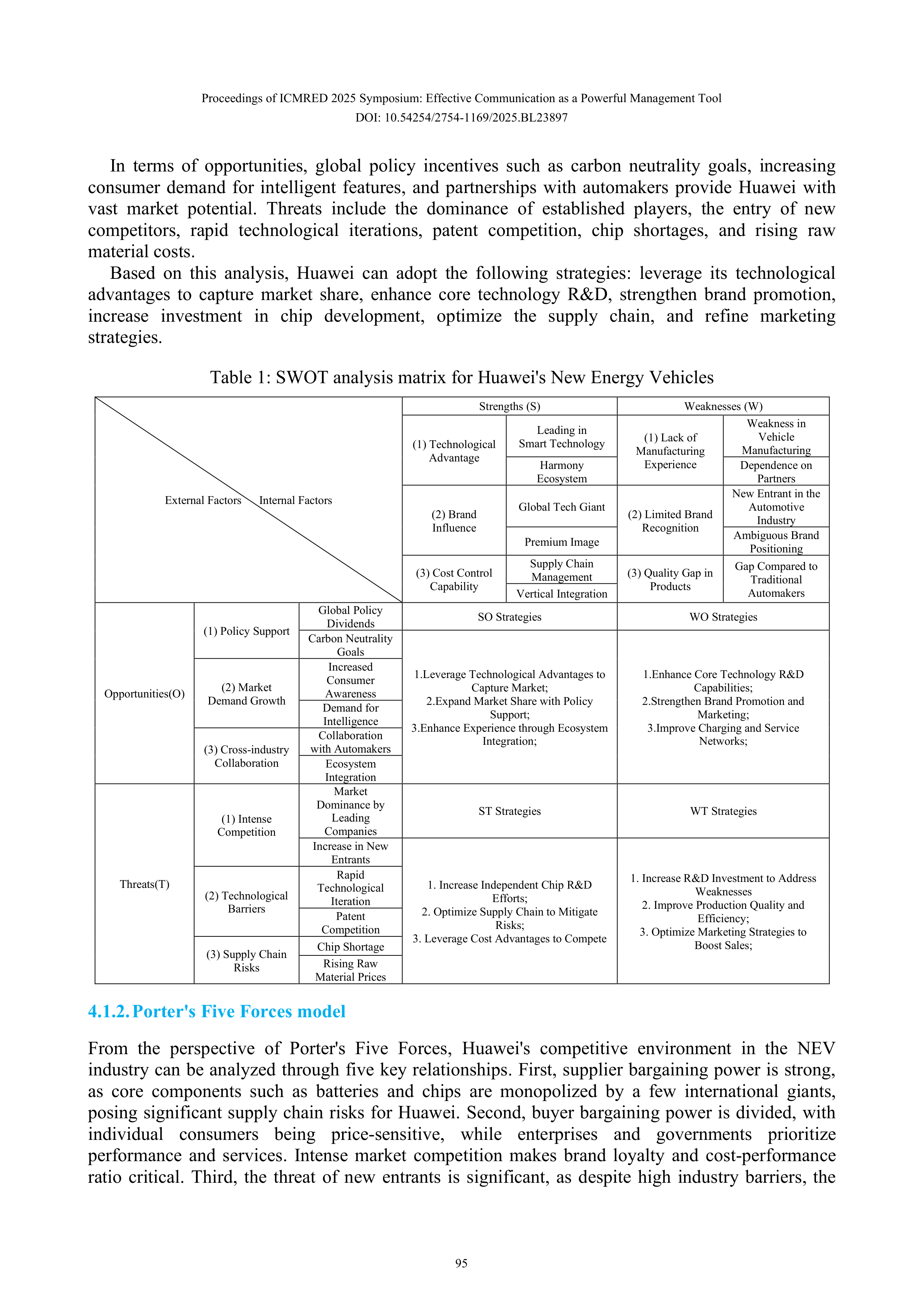
As illustrated in Table 1, based on the provided SWOT model, Huawei's strengths in the NEV
sector include technological advantages, brand influence, and cost control capabilities. Huawei’s
leadership in intelligent technology and the robust HarmonyOS ecosystem, coupled with its
established global reputation as a technology giant, confer significant competitive advantages.
However, Huawei's weaknesses lie in its lack of manufacturing experience, reliance on partners,
limited brand recognition in the automotive sector, and gaps in product quality compared to
traditional automakers.
Proceedings of ICMRED 2025 Symposium: Effective Communication as a Powerful Management Tool
DOI: 10.54254/2754-1169/2025.BL23897
95
In terms of opportunities, global policy incentives such as carbon neutrality goals, increasing
consumer demand for intelligent features, and partnerships with automakers provide Huawei with
vast market potential. Threats include the dominance of established players, the entry of new
competitors, rapid technological iterations, patent competition, chip shortages, and rising raw
material costs.
Based on this analysis, Huawei can adopt the following strategies: leverage its technological
advantages to capture market share, enhance core technology R&D, strengthen brand promotion,
increase investment in chip development, optimize the supply chain, and refine marketing
strategies.
Table 1: SWOT analysis matrix for Huawei's New Energy Vehicles
External Factors Internal Factors
Strengths (S)
Weaknesses (W)
(1) Technological
Advantage
Leading in
Smart Technology
(1) Lack of
Manufacturing
Experience
Weakness in
Vehicle
Manufacturing
Harmony
Ecosystem
Dependence on
Partners
(2) Brand
Influence
Global Tech Giant
(2) Limited Brand
Recognition
New Entrant in the
Automotive
Industry
Premium Image
Ambiguous Brand
Positioning
(3) Cost Control
Capability
Supply Chain
Management
(3) Quality Gap in
Products
Gap Compared to
Traditional
Automakers
Vertical Integration
Opportunities(O)
(1) Policy Support
Global Policy
Dividends
SO Strategies
WO Strategies
Carbon Neutrality
Goals
1.Leverage Technological Advantages to
Capture Market;
2.Expand Market Share with Policy
Support;
3.Enhance Experience through Ecosystem
Integration;
1.Enhance Core Technology R&D
Capabilities;
2.Strengthen Brand Promotion and
Marketing;
3.Improve Charging and Service
Networks;
(2) Market
Demand Growth
Increased
Consumer
Awareness
Demand for
Intelligence
(3) Cross-industry
Collaboration
Collaboration
with Automakers
Ecosystem
Integration
Threats(T)
(1) Intense
Competition
Market
Dominance by
Leading
Companies
ST Strategies
WT Strategies
Increase in New
Entrants
1. Increase Independent Chip R&D
Efforts;
2. Optimize Supply Chain to Mitigate
Risks;
3. Leverage Cost Advantages to Compete
1. Increase R&D Investment to Address
Weaknesses
2. Improve Production Quality and
Efficiency;
3. Optimize Marketing Strategies to
Boost Sales;
(2) Technological
Barriers
Rapid
Technological
Iteration
Patent
Competition
(3) Supply Chain
Risks
Chip Shortage
Rising Raw
Material Prices
4.1.2.
Porter's Five Forces model
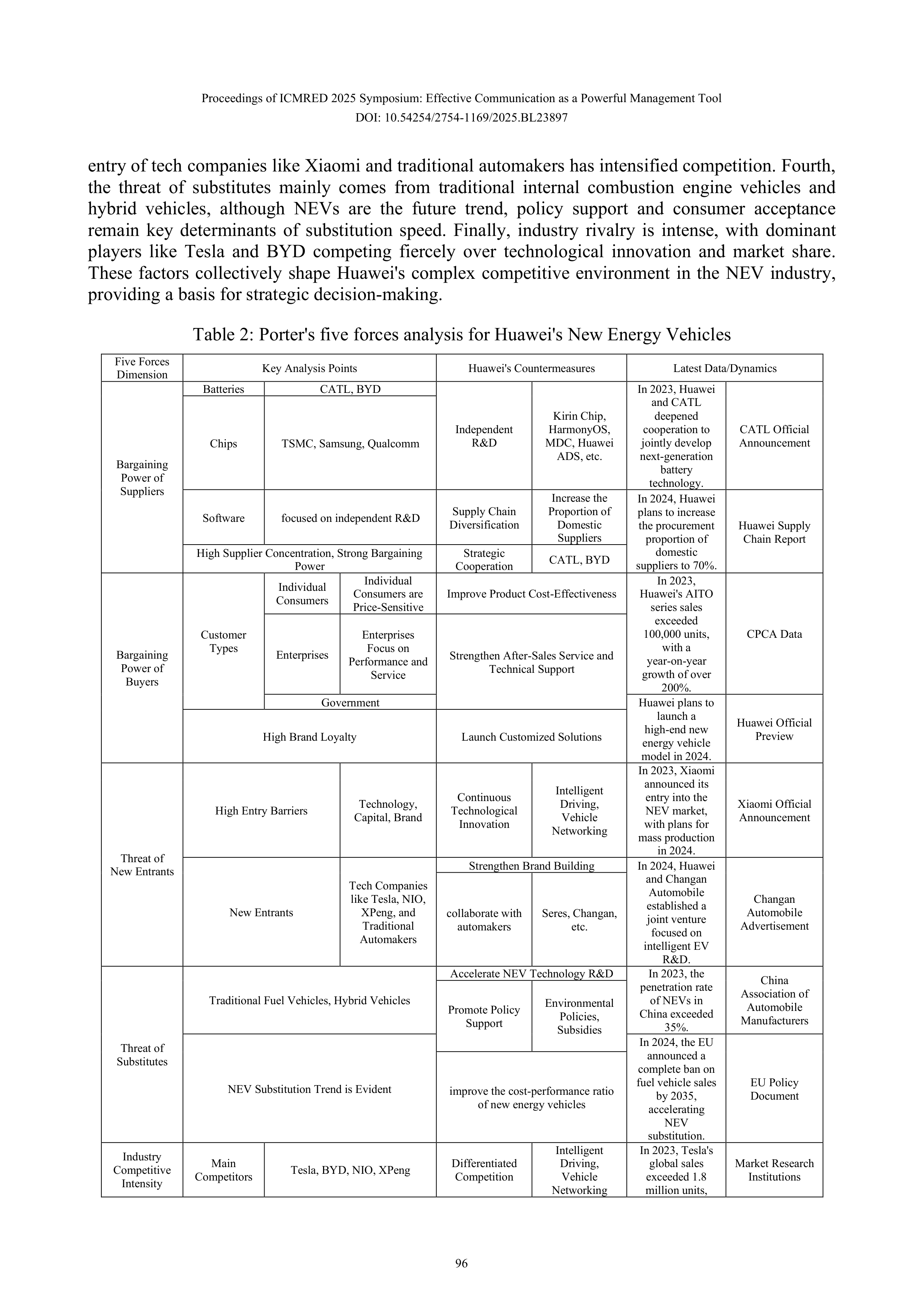
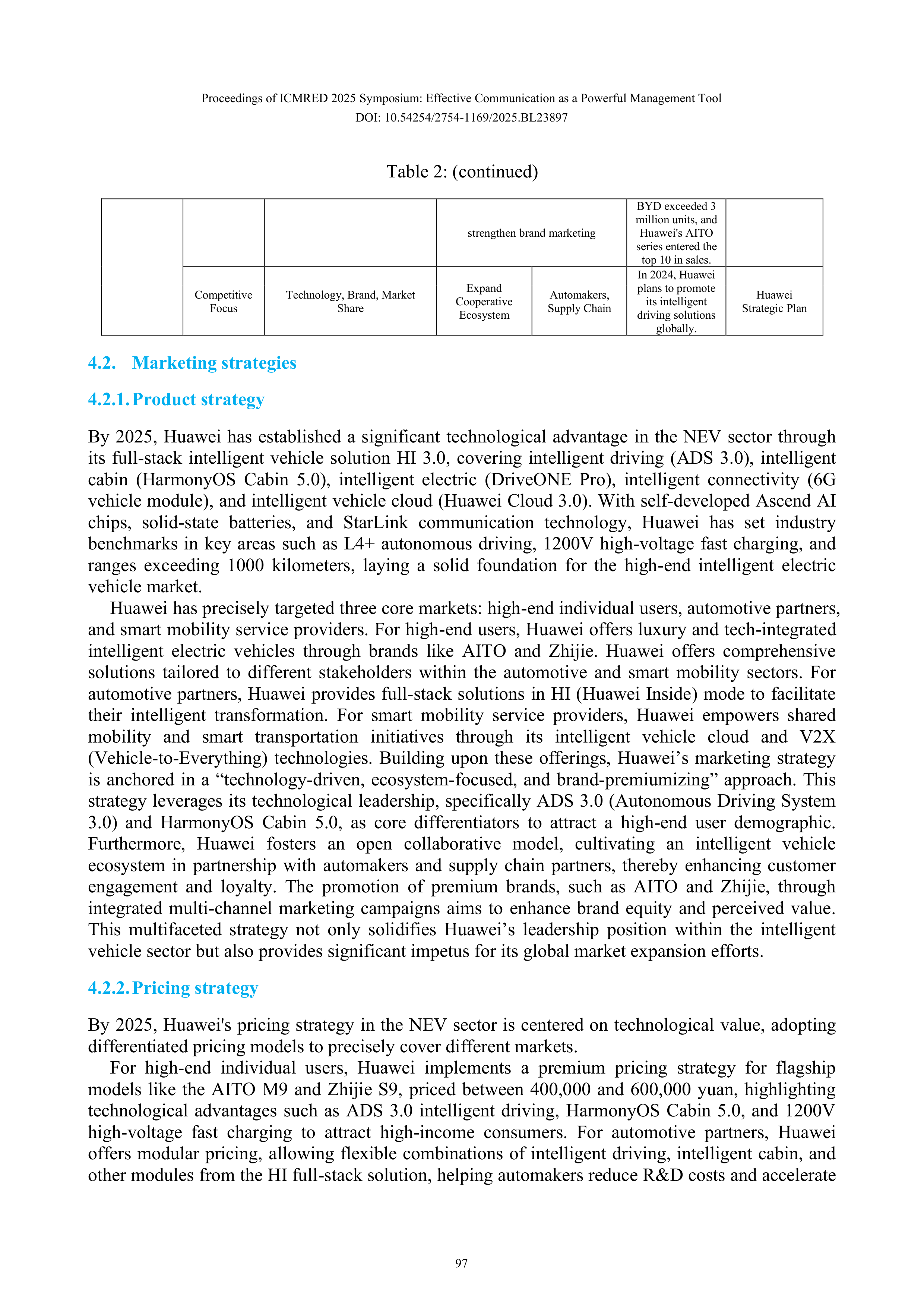
From the perspective of Porter's Five Forces, Huawei's competitive environment in the NEV
industry can be analyzed through five key relationships. First, supplier bargaining power is strong,
as core components such as batteries and chips are monopolized by a few international giants,
posing significant supply chain risks for Huawei. Second, buyer bargaining power is divided, with
individual consumers being price-sensitive, while enterprises and governments prioritize
performance and services. Intense market competition makes brand loyalty and cost-performance
ratio critical. Third, the threat of new entrants is significant, as despite high industry barriers, the
Proceedings of ICMRED 2025 Symposium: Effective Communication as a Powerful Management Tool
DOI: 10.54254/2754-1169/2025.BL23897
96
entry of tech companies like Xiaomi and traditional automakers has intensified competition. Fourth,
the threat of substitutes mainly comes from traditional internal combustion engine vehicles and
hybrid vehicles, although NEVs are the future trend, policy support and consumer acceptance
remain key determinants of substitution speed. Finally, industry rivalry is intense, with dominant
players like Tesla and BYD competing fiercely over technological innovation and market share.
These factors collectively shape Huawei's complex competitive environment in the NEV industry,
providing a basis for strategic decision-making.
Table 2: Porter's five forces analysis for Huawei's New Energy Vehicles
Five Forces
Dimension
Key Analysis Points
Huawei's Countermeasures
Latest Data/Dynamics
Bargaining
Power of
Suppliers
Batteries
CATL, BYD
Independent
R&D
Kirin Chip,
HarmonyOS,
MDC, Huawei
ADS, etc.
In 2023, Huawei
and CATL
deepened
cooperation to
jointly develop
next-generation
battery
technology.
CATL Official
Announcement
Chips
TSMC, Samsung, Qualcomm
Software
focused on independent R&D
Supply Chain
Diversification
Increase the
Proportion of
Domestic
Suppliers
In 2024, Huawei
plans to increase
the procurement
proportion of
domestic
suppliers to 70%.
Huawei Supply
Chain Report
High Supplier Concentration, Strong Bargaining
Power
Strategic
Cooperation
CATL, BYD
Bargaining
Power of
Buyers
Customer
Types
Individual
Consumers
Individual
Consumers are
Price-Sensitive
Improve Product Cost-Effectiveness
In 2023,
Huawei's AITO
series sales
exceeded
100,000 units,
with a
year-on-year
growth of over
200%.
CPCA Data
Enterprises
Enterprises
Focus on
Performance and
Service
Strengthen After-Sales Service and
Technical Support
Government
Huawei plans to
launch a
high-end new
energy vehicle
model in 2024.
Huawei Official
Preview
High Brand Loyalty
Launch Customized Solutions
Threat of
New Entrants
High Entry Barriers
Technology,
Capital, Brand
Continuous
Technological
Innovation
Intelligent
Driving,
Vehicle
Networking
In 2023, Xiaomi
announced its
entry into the
NEV market,
with plans for
mass production
in 2024.
Xiaomi Official
Announcement
New Entrants
Tech Companies
like Tesla, NIO,
XPeng, and
Traditional
Automakers
Strengthen Brand Building
In 2024, Huawei
and Changan
Automobile
established a
joint venture
focused on
intelligent EV
R&D.
Changan
Automobile
Advertisement
collaborate with
automakers
Seres, Changan,
etc.
Threat of
Substitutes
Traditional Fuel Vehicles, Hybrid Vehicles
Accelerate NEV Technology R&D
In 2023, the
penetration rate
of NEVs in
China exceeded
35%.
China
Association of
Automobile
Manufacturers
Promote Policy
Support
Environmental
Policies,
Subsidies
NEV Substitution Trend is Evident
In 2024, the EU
announced a
complete ban on
fuel vehicle sales
by 2035,
accelerating
NEV
substitution.
EU Policy
Document
improve the cost-performance ratio
of new energy vehicles
Industry
Competitive
Intensity
Main
Competitors
Tesla, BYD, NIO, XPeng
Differentiated
Competition
Intelligent
Driving,
Vehicle
Networking
In 2023, Tesla's
global sales
exceeded 1.8
million units,
Market Research
Institutions
Proceedings of ICMRED 2025 Symposium: Effective Communication as a Powerful Management Tool
DOI: 10.54254/2754-1169/2025.BL23897
97
strengthen brand marketing
BYD exceeded 3
million units, and
Huawei's AITO
series entered the
top 10 in sales.
Competitive
Focus
Technology, Brand, Market
Share
Expand
Cooperative
Ecosystem
Automakers,
Supply Chain
In 2024, Huawei
plans to promote
its intelligent
driving solutions
globally.
Huawei
Strategic Plan
4.2.
Marketing strategies
4.2.1.
Product strategy
By 2025, Huawei has established a significant technological advantage in the NEV sector through
its full-stack intelligent vehicle solution HI 3.0, covering intelligent driving (ADS 3.0), intelligent
cabin (HarmonyOS Cabin 5.0), intelligent electric (DriveONE Pro), intelligent connectivity (6G
vehicle module), and intelligent vehicle cloud (Huawei Cloud 3.0). With self-developed Ascend AI
chips, solid-state batteries, and StarLink communication technology, Huawei has set industry
benchmarks in key areas such as L4+ autonomous driving, 1200V high-voltage fast charging, and
ranges exceeding 1000 kilometers, laying a solid foundation for the high-end intelligent electric
vehicle market.
Huawei has precisely targeted three core markets: high-end individual users, automotive partners,
and smart mobility service providers. For high-end users, Huawei offers luxury and tech-integrated
intelligent electric vehicles through brands like AITO and Zhijie. Huawei offers comprehensive
solutions tailored to different stakeholders within the automotive and smart mobility sectors. For
automotive partners, Huawei provides full-stack solutions in HI (Huawei Inside) mode to facilitate
their intelligent transformation. For smart mobility service providers, Huawei empowers shared
mobility and smart transportation initiatives through its intelligent vehicle cloud and V2X
(Vehicle-to-Everything) technologies. Building upon these offerings, Huawei’s marketing strategy
is anchored in a “technology-driven, ecosystem-focused, and brand-premiumizing” approach. This
strategy leverages its technological leadership, specifically ADS 3.0 (Autonomous Driving System
3.0) and HarmonyOS Cabin 5.0, as core differentiators to attract a high-end user demographic.
Furthermore, Huawei fosters an open collaborative model, cultivating an intelligent vehicle
ecosystem in partnership with automakers and supply chain partners, thereby enhancing customer
engagement and loyalty. The promotion of premium brands, such as AITO and Zhijie, through
integrated multi-channel marketing campaigns aims to enhance brand equity and perceived value.
This multifaceted strategy not only solidifies Huawei’s leadership position within the intelligent
vehicle sector but also provides significant impetus for its global market expansion efforts.
4.2.2.
Pricing strategy
By 2025, Huawei's pricing strategy in the NEV sector is centered on technological value, adopting
differentiated pricing models to precisely cover different markets.
For high-end individual users, Huawei implements a premium pricing strategy for flagship
models like the AITO M9 and Zhijie S9, priced between 400,000 and 600,000 yuan, highlighting
technological advantages such as ADS 3.0 intelligent driving, HarmonyOS Cabin 5.0, and 1200V
high-voltage fast charging to attract high-income consumers. For automotive partners, Huawei
offers modular pricing, allowing flexible combinations of intelligent driving, intelligent cabin, and
other modules from the HI full-stack solution, helping automakers reduce R&D costs and accelerate
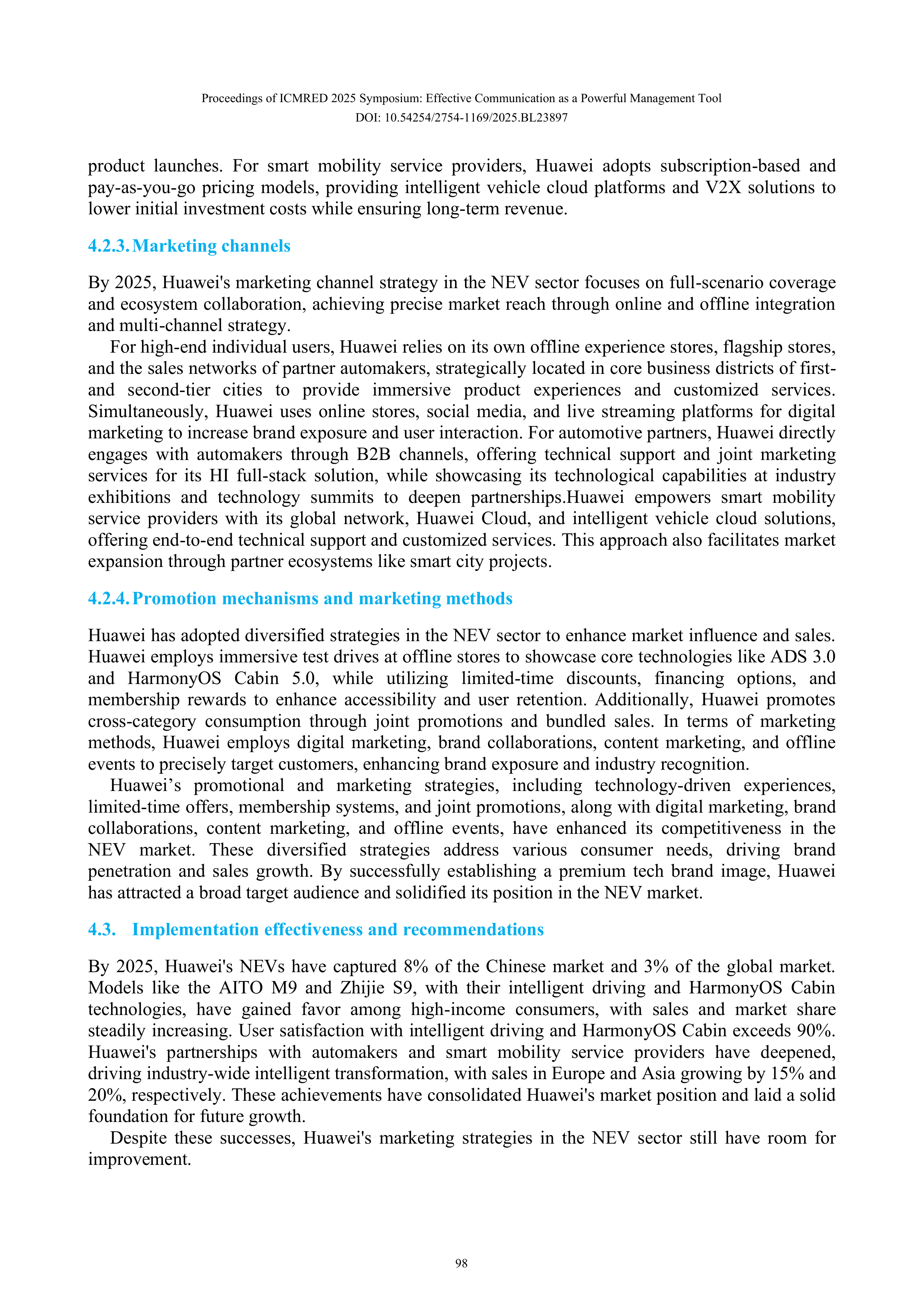
Table 2: (continued)
Proceedings of ICMRED 2025 Symposium: Effective Communication as a Powerful Management Tool
DOI: 10.54254/2754-1169/2025.BL23897
98
product launches. For smart mobility service providers, Huawei adopts subscription-based and
pay-as-you-go pricing models, providing intelligent vehicle cloud platforms and V2X solutions to
lower initial investment costs while ensuring long-term revenue.
4.2.3.
Marketing channels
By 2025, Huawei's marketing channel strategy in the NEV sector focuses on full-scenario coverage
and ecosystem collaboration, achieving precise market reach through online and offline integration
and multi-channel strategy.
For high-end individual users, Huawei relies on its own offline experience stores, flagship stores,
and the sales networks of partner automakers, strategically located in core business districts of first-
and second-tier cities to provide immersive product experiences and customized services.
Simultaneously, Huawei uses online stores, social media, and live streaming platforms for digital
marketing to increase brand exposure and user interaction. For automotive partners, Huawei directly
engages with automakers through B2B channels, offering technical support and joint marketing
services for its HI full-stack solution, while showcasing its technological capabilities at industry
exhibitions and technology summits to deepen partnerships.Huawei empowers smart mobility
service providers with its global network, Huawei Cloud, and intelligent vehicle cloud solutions,
offering end-to-end technical support and customized services. This approach also facilitates market
expansion through partner ecosystems like smart city projects.
4.2.4.
Promotion mechanisms and marketing methods
Huawei has adopted diversified strategies in the NEV sector to enhance market influence and sales.
Huawei employs immersive test drives at offline stores to showcase core technologies like ADS 3.0
and HarmonyOS Cabin 5.0, while utilizing limited-time discounts, financing options, and
membership rewards to enhance accessibility and user retention. Additionally, Huawei promotes
cross-category consumption through joint promotions and bundled sales. In terms of marketing
methods, Huawei employs digital marketing, brand collaborations, content marketing, and offline
events to precisely target customers, enhancing brand exposure and industry recognition.
Huawei’s promotional and marketing strategies, including technology-driven experiences,
limited-time offers, membership systems, and joint promotions, along with digital marketing, brand
collaborations, content marketing, and offline events, have enhanced its competitiveness in the
NEV market. These diversified strategies address various consumer needs, driving brand
penetration and sales growth. By successfully establishing a premium tech brand image, Huawei
has attracted a broad target audience and solidified its position in the NEV market.
4.3.
Implementation effectiveness and recommendations
By 2025, Huawei's NEVs have captured 8% of the Chinese market and 3% of the global market.
Models like the AITO M9 and Zhijie S9, with their intelligent driving and HarmonyOS Cabin
technologies, have gained favor among high-income consumers, with sales and market share
steadily increasing. User satisfaction with intelligent driving and HarmonyOS Cabin exceeds 90%.
Huawei's partnerships with automakers and smart mobility service providers have deepened,
driving industry-wide intelligent transformation, with sales in Europe and Asia growing by 15% and
20%, respectively. These achievements have consolidated Huawei's market position and laid a solid
foundation for future growth.
Despite these successes, Huawei's marketing strategies in the NEV sector still have room for
improvement.
Proceedings of ICMRED 2025 Symposium: Effective Communication as a Powerful Management Tool
DOI: 10.54254/2754-1169/2025.BL23897
99
Huawei faces challenges such as limited brand recognition, insufficient manufacturing
experience,a standardized pricing strategy, and inadequate channel coverage. To enhance its
competitive position, Huawei should intensify brand promotion, emphasizing the technological
advantages of its intelligent driving and cabin systems, while enhancing collaboration with
manufacturing partners to ensure production efficiency and product quality. In terms of pricing,
Huawei should introduce mid-range models with more competitive pricing to cover a broader
consumer base. Additionally, Huawei should accelerate channel strategized in third- and fourth-tier
cities and rural markets, while expanding online coverage through digital marketing. Finally,
Huawei should enhance user stickiness through membership systems, reward points, and
high-quality after-sales services, creating a word-of-mouth effect to boost brand loyalty and market
influence. These improvements will help Huawei consolidate its premium tech brand image, expand
market share, and secure a more favorable competitive position in the NEV market.
5.
Conclusion
This paper analyzes the current market status and development trends of the NEV industry, with a
focus on Huawei's market performance and marketing strategies in this sector, proposing targeted
improvement recommendations. The research findings indicate that Huawei has achieved
significant success in the high-end market due to its technological advantages and brand influence.
However, improvements are needed in areas such as brand recognition, manufacturing experience,
pricing strategies, and channel coverage. In the future, the NEV industry will continue to evolve
toward electrification, intelligence, connectivity, and sharing, requiring companies to continuously
innovate to adapt to market changes and enhance competitiveness.
References
[1]
EVANNEX Aftermarket Tesla Accessories. (n.d.). International Energy Agency Predicts 14 Million EV Sales
in 2023. Retrieved from https://evannex.com/blogs/news/international-energy-agency-predicts-14-million-ev-sal
es-in-2023
[2]
Long, D. (2024). Analysis of Market Positioning, Target Customers, and Marketing Strategies for New Ener
gy Vehicles in the Context of "Dual Carbon." Special Purpose Vehicles, (08), 11-13. doi:10.19999/j.cnki.100
4-0226.2024.08.004.
[3]
Shen, T. (2023). Research on Marketing Innovation Strategies of New Energy Vehicle Enterprises in the Con
text of the Digital Economy: A Case Study of Tesla. China Business Review, (18), 136-139. doi:10.19699/j.c
nki.issn2096-0298.2023.18.136.
[4]
Zhang, Z. (2025). Research on Marketing Strategies of New Energy Vehicles in the Context of Green Development.
China Business Review, 34 (01), 133-136. doi:10.19699/j.cnki.issn2096-0298.2025.01.133.
[5]
Chen, Z. (2024). Interaction Analysis of Consumer Behavior and Marketing Strategies in the New Energy Vehicle
Market. Modern Business, (24), 64-67. doi:10.14097/j.cnki.5392/2024.24.043.
[6]
Liu, B., Mao, X., & Liu, T. (2024). Marketing Strategies for New Energy Vehicles in the Context of Low-Carbon and
Green Development. Auto Time, (22), 173-175.