Development of Sephora’s Marketing Strategies
Jialin Chen
1,a,*
1
Pepperdine University, 24255 Pacific Coast Hwy #1477, USA
a. savannah.chen@pepperdine.edu
*corresponding author
Abstract:
Sephora is a global corporation that deals with the production and sale of beauty
and personal care products. The company is headquartered in Paris, France, and is owned by
Moet Hennessy Louis Vuitton (LMVH) luxury conglomerate. Since its inception, the
company has experienced steady growth due to accessing more clients and increased sales.
The use of digital marketing strategies such as search marketing, display advertising, social
media marketing, and augmented reality plays a significant role in the success of the company.
Each of these strategies has contributed to the growth of Sephora as a cosmetics corporation.
The company records more online sales than offline sales due to the increase in internet usage
and accessibility of online marketplaces. As a company that invests in modern digital
marketing strategies, Sephora has effectively positioned itself in the target market and has
gained a wide client base with millions of loyal clients who love luxury beauty. An analysis
of Sephora's marketing strategy is important to outline how the company has been successful
in recent years. We are going to analysis what are the current marketing strategies that
Sephora implements in the marketing plans, how have Sephora’s marketing strategies
evolved over the years and how do the marketing strategies contribute to the general success
of Sephora. This research mainly adopts the case study method to analyze the marketing
strategy of Sephora. Through our research, we found that Sephora has a good marketing
strategy that brings a lot of advantages to their company.
Keywords:
Sephora, marketing strategies, digital marking
1.
Introduction
Sephora is a multinational company in the beauty and wellness products industry. The company has
developed into a global cosmetic brand with more than 2700 stores in 35 countries globally that sell
beauty and personal care products. The success of the company is attributed to the high-quality and
unique products that it offers to the market. Additionally, the company has a strong brand presence
in countries due to unbiased services, constant innovation, and a range of products in specific cate-
gories that meet the needs of the clients. Sephora primarily focuses on creating good relations with
clients and ensuring that the clients catch up with the company. Sephora's primary marketing strategy
focuses on integrating both online and in-store experiences and using web and app-based platforms
to promote brand engagement.
Marketing strategies play influential roles in the planning and decision-making of corporations. A
marketing strategy outlines the general plans of a business intended to reach potential clients and
make them consumers of the company’s commodities [1]. Sephora’s marketing strategies have
Proceedings of the 2nd International Conference on Business and Policy Studies
DOI: 10.54254/2754-1169/14/20230826
© 2023 The Authors. This is an open access article distributed under the terms of the Creative Commons Attribution License 4.0
(https://creativecommons.org/licenses/by/4.0/).
217
continuously played an essential role in the success of the company globally. Research implies that
an effective marketing strategy focuses on the value proposition of the company that shows clients
what the corporation stands for, its operations and why they need to be part of the business [1]. Con-
sequently, marketing teams of corporations such as Sephora develop unique marketing initiatives that
match the objectives of the businesses. In most scenarios, the marketing strategies that are outlined
in the marketing plan tend to be comprehensive and outline all the necessary details of targeting,
accessing, and selling to clients. Continuous research of marketing strategies enables businesses to
update their marketing initiatives and meet the current needs of clients. Essentially, developing ef-
fective marketing strategies requires constant planning, upgrading, and market research to ensure the
success of Sephora.
An analysis of the marketing strategies of Sephora is significant in outlining how the company has
become successful over recent years. Particularly, this research explains how the constant implemen-
tation of new marketing strategies such as digital marketing has enabled Sephora to increase online
sales of merchandise as contrasted to offline sales. Additionally, the research provides an overview
of some of the best ways of implementing new technologies in a company in a way that guarantees
success. Sephora’s success is primarily attributed to the innovative modern marketing strategies and
technologies that increase the competitiveness of the brand globally. It is necessary to study Sephora’s
case since the company is often used as an example of how marketing strategies are significant to the
success of a global corporation.
This research primarily used the case study research approach to analyze the marketing strategies
of Sephora. The case study research method entails observation and analysis of the case to determine
the outcomes and propose suggestions. Sephora’s case informs the research approach as the study
seeks to explain how the company’s marketing strategies have developed and continue to influence
the success of the brand. Essentially, this research obtains and analyzes all data regarding Sephora
from the company’s case and also applies the literature review method to obtain additional infor-
mation.
2.
Case Study
2.1.
Sephora’s Marketing Mix
Sephora is a global brand in the beauty and wellness industry that sells a wide range of products that
meet the needs of clients. Currently, Sephora sells more than 45,000 beauty and wellness products
across the world [2]. Some of the products entail skincare, makeup, and beauty products. Additionally,
the primary market segment of the company comprises women in the young to middle-age years
bracket who mostly belong to the upper-middle and rich classes. Over the years, Sephora has intro-
duced new luxury products that meet the needs of clients who are into luxury beauty. Some of the
recent brands that Sephora introduced to the market entail Rare Beauty by Selena Gomes and Fenty
Beauty by Rihanna [2]. Such high-quality luxury brands meet the taste of clients who use luxury
beauty products. To ensure a quality user experience, Sephora collects marketing data on the clients'
habits, reviews, and needs from the mobile app and its website [3]. Consequently, Sephora designs a
more personalized user experience from the products and also for the interaction of the clients in the
app and web platforms. Such initiatives influence sales and client confidence in the company’s prod-
ucts.
The pricing strategy of Sephora significantly influences the purchasing decisions of its global cli-
ents. Sephora primarily uses demand-oriented pricing which sets the product prices based on the cli-
ent's demands [4]. Setting the product prices based on the client demand enables Sephora to sell
quality products at high prices especially when demand increases. Thus, the prices increase and de-
crease based on demand. Additionally, the low overhead costs of the company enable it to provide
Proceedings of the 2nd International Conference on Business and Policy Studies
DOI: 10.54254/2754-1169/14/20230826
218
competitive pricing plans. Sephora ensures operational efficiency across all its sub-brands to reduce
the costs of operating the business. By creating high-quality products at lower costs, Sephora attracts
more retailers and clients due to the highly competitive prices. Sephora also offers coupons and offi-
cial promo codes on the website that attract clients who take advantage of exclusive offers, free prod-
ucts, and incredible deals [2]. Such strategies enable Sephora to sell its products both online and in
physical stores.
Sephora is a company that has steadily grown from exclusively selling its products in-store to
online sales through digital transformation. Offline sales primarily entail clients visiting the physical
stores and purchasing the desired products while online sales entail the networks that facilitate online
purchases and distribution of the products [3]. Digital distribution has played an essential role in
eliminating the intermediaries that increase the prices of Sephora's products. 52 years ago, Sephora
could only sell products in physical stores located in different places and mostly used brokers to sell
and distribute the products. However, the current online marketplaces enable Sephora to distribute
the products through specialized distributors using a logistics management system [3]. The range of
sales has drastically increased as more clients use online marketplaces to purchase the desired prod-
ucts. Clients only need to visit the company's website, select the desired products, make an online
purchase and wait for the products to be delivered to their location. Essentially, the online marketplace
significantly increases the sales that Sephora makes across the world.
Digital marketing enables Sephora to use effective promotional strategies that attract more clients
and increase sales. Digital media is more effective than traditional media since it increases the acces-
sibility to products and services. For example, Google Analytics provides information that enables
marketers to configure the clients' profiles and create client-focused messages on online platforms
[3]. Sephora extensively uses digital marketing approaches to identify the clients' preferences, de-
mands, and specific needs. Consequently, Sephora has developed promotional strategies entailing
public relations, advertising, personalized selling, and sales promotion [4]. The company also uses
celebrity endorsements and offers free samples to clients to promote sales. Particularly, the company's
website acts as an e-commerce platform with a complete product portfolio for online buyers and
shipping services to clients. The primary aim of these promotional strategies is to increase awareness
about Sephora and attract new customers. Such strategies also increase customer loyalty and confi-
dence in using the products. Thus, the marketing mix of Sephora largely contributes to its success in
the global market.
2.2.
Search and Display Advertising
Sephora uses the search advertising approach to place digital ads in the search engine results and
influence purchases by clients. The company uses the search engine optimization (SEO) strategy
which is a way of improving a company’s website to generate traffic and increase its visibility when
users search for products or services [5]. Sephora uses SEO marketing to optimize user experience,
target the market segments, reach the target audience and improve its credibility. Additionally, the
SEO strategies enable the company to obtain information about the clients such as their product tastes,
purchasing power, and preferences through Google Analytics to perfectly match the product that the
client needs. For example, Sephora has 2,707,849 organic keywords and organic monthly traffic of
23,161,004 visitors which is astounding [6]. Such numbers show that Sephora puts effort into
strengthening its position on the Google search engine results page (SERP). Sephora gradually
achieves its long-term goals by raising its brand's profile using SEO. Therefore, the search advertising
approach enables Sephora to access more clients and use targeted marketing approaches to increase
sales and promote its brand.
Sephora uses display advertising on the company's website to direct clients to find the products
that they seek. Display advertising entails the use of images, texts, and links to an online page where
Proceedings of the 2nd International Conference on Business and Policy Studies
DOI: 10.54254/2754-1169/14/20230826
219
users can buy or learn more about the products or services [7]. Sephora mainly uses high-quality
images and ads on its website and app that clients can click on and are directed to a landing page that
provides more details concerning the products. For example, Sephora’s Pantone Universe uses dis-
play advertising to direct clients to a site that displays all the colors and tones of makeup products
that they can use for beauty [2]. The clients can access products such as lipsticks and Pantone makeup
on the site. The website's homepage features high-quality images of a range of products that clients
can select and buy, review or obtain additional details. Therefore, the use of high-quality images, ads,
and links increase the effectiveness of display advertising in influencing the purchasing decisions of
clients.
2.3.
Social Media Marketing
Sephora uses social media marketing to create content that resonates with the clients. Specifically,
the company focuses on sharing information concerning the products and services on social media
platforms entailing Instagram, Facebook, LinkedIn, Twitter, YouTube, Pinterest, and Snapchat. The
primary social media marketing strategies focus on having a large audience, posting regular updates,
advertising content, and providing links to the advertised products [3]. Sephora has tens of millions
of followers across all social media platforms. The company's marketing staff creates and posts con-
tent on social media platforms to impress clients and promote an open conversation with the audience.
For example, the company posts informative video content on YouTube such as makeup tutorials and
also uses the advertising feature on the platform with links that direct clients to the website where
they access the products [3]. Sephora also uses Instagram live, Instagram stories, Facebook posts, and
Snapchat to post content and cover events. The engaging content attracts the target audience and
offers additional details that influence the purchasing decisions of the followers. Using celebrity en-
dorsements on social platforms also boosts product sales.
Sephora uses influencer marketing as a method of generating consumer leads on social media.
Influencer marketing entails the partnerships between the company and celebrities or influencers who
endorse some of the products and post them on their social media platforms to their unique followers
[7]. Since the target market for beauty products entails women, Sephora mostly uses female celebri-
ties in the influencer marketing strategy. Some of the celebrities that Sephora has partnered with
include Rihanna, Selena Gomez, and Charlotte Tilbury. These celebrities have huge fan bases and
influence their fans to use the luxury products by Sephora. They also enable Sephora to interact with
different audiences and generate consumer leads. Obtaining reviews from different fan bases in-
creases the visibility and brand image of Sephora. Such strategies have largely contributed to the
growth and success of Sephora globally.
Sephora uses augmented reality (AR) shopping on its website and mobile app to enhance product
evaluation and a personalized experience for clients. The company has developed a unique artificial
intelligence feature called the Sephora Virtual Artist [2]. The Virtual Artist feature uses facial recog-
nition technology that enables clients to try different makeup products virtually and select the one
that best suits them. On the mobile app, the feature can direct clients to the landing page on the
company’s website where they purchase the selected product. Particularly, this feature helps clients
to feel confident in purchasing the desired products after identifying the colors and tones that best
suit their faces. The more the clients enjoy trying different products virtually, the more the chances
of purchasing and reviewing the products. Most of the clients who have purchased beauty products
on Sephora's website have used the virtual artist feature [2]. Since innovation is crucial for the success
of the company, the developers constantly make improvements to provide the best experience to the
users. Essentially, AR technology boosts sales, and reviews and contributes to the success of the
company.
Proceedings of the 2nd International Conference on Business and Policy Studies
DOI: 10.54254/2754-1169/14/20230826
220
3.
Discussion
Sephora’s market dominance and operational efficiency has seen various case studies on published.
Most of these studies focus on how the company uses different digital technologies and digital mar-
keting strategies to gain a market share and maintain a competitive edge. The case studies also focus
on the company's marketing mix and how the company positions its products to relevant market seg-
ments in order to maintain a competitive edge and stimulate demand from consumers. The company
promotes its products and services aggressively across the globe, and the majority of this spending
goes to digital marketing campaigns [8].
Although these case studies highlight the company's current market position and competitive edge,
they do not highlight how it uses different digital marketing and communication strategies to improve
its market position and also satisfy the needs of internal stakeholders [9]. Having such case studies
can help gain a deeper understanding of how the company uses its social media channels to coordinate
internal operations that contribute to an excellent consumer experience, especially within online sales
channels. For example, there are no case studies of how employees of the company use social mar-
keting platforms to manage social media risks.
There are a few case studies that have been researched intrinsically, focusing on factors that con-
tribute to the unique customer experience that Sephora offers consistently to its customers. An intrin-
sic case study is one where a researcher observes a phenomenon in its natural environment [10]. One
intrinsic case study by CBInsights focused on how Sephora has managed to create a beuty empire
while at the same time avoiding the retail apocalypse that saw major retailers shut down operations
due to the worsening global economic conditions. The case study focuses on how the company takes
advantage of mobile technologies to sell to a younger audience in the beauty and cosmetics markets.
The case study also focused on how the company motivates consumers to engage with its brands on
social media platforms using user-generated content.
These case studies can be improved by focusing on how employees of the companies use digital
technologies to ensure operational efficiency that translates to an improved customer experience.
There is a need for qualitative case study methods that utilize different research tools to study the
company's use of consumer data to improve the consumer experience. For example, qualitative case
studies can implement qualitative inquiry approaches that use interpretive, exploratory, or descriptive
questions, or combinations of two or more approaches. Another strategy is to implement comparative
case studies where the researcher attempts to compare the user experience of Sephora's customers,
for example, across different technological devices and social media platforms. Such studies can help
one understand the user experience across different digital platforms based on age segments.
4.
Financial Performance
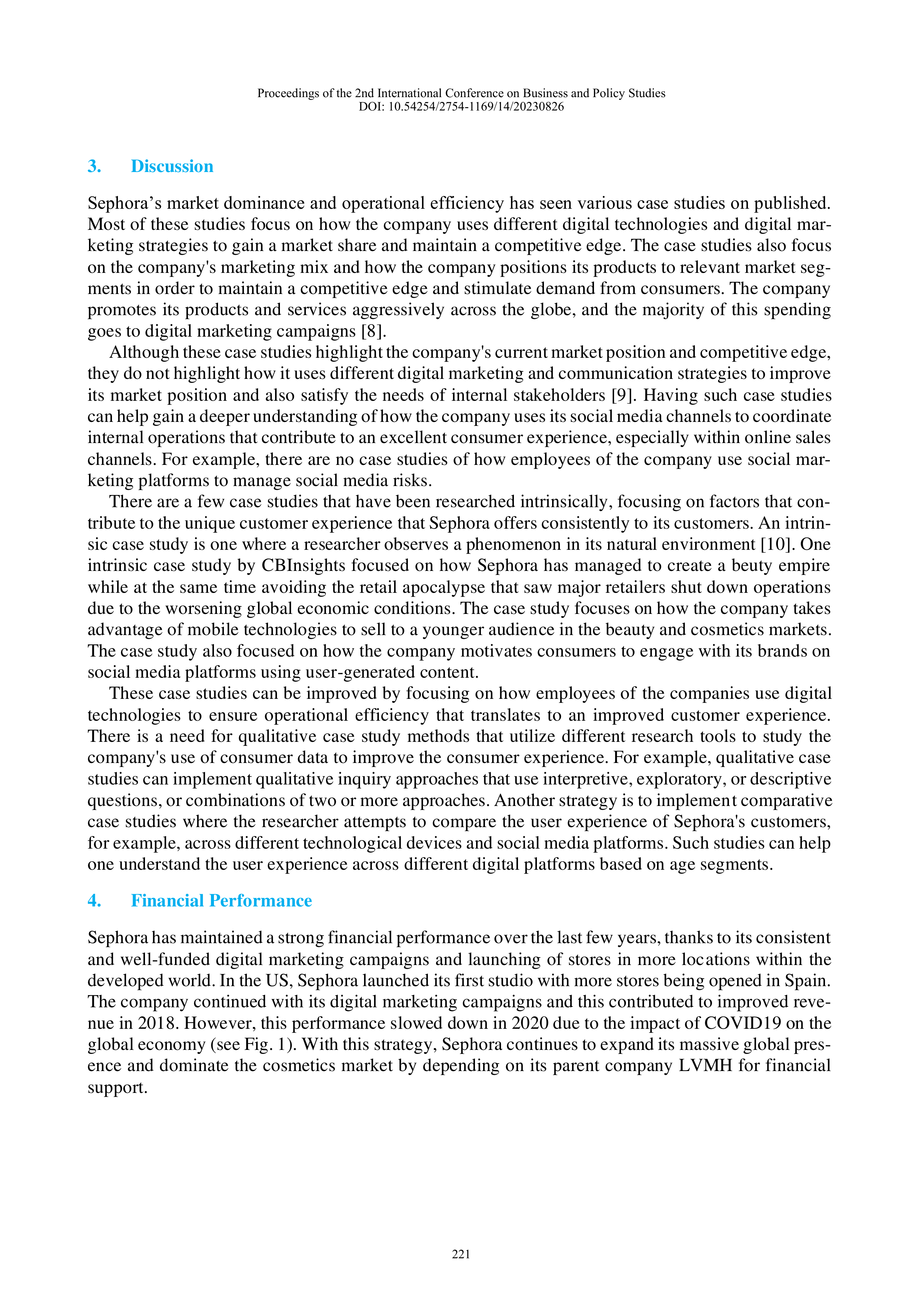
Sephora has maintained a strong financial performance over the last few years, thanks to its consistent
and well-funded digital marketing campaigns and launching of stores in more locations within the
developed world. In the US, Sephora launched its first studio with more stores being opened in Spain.
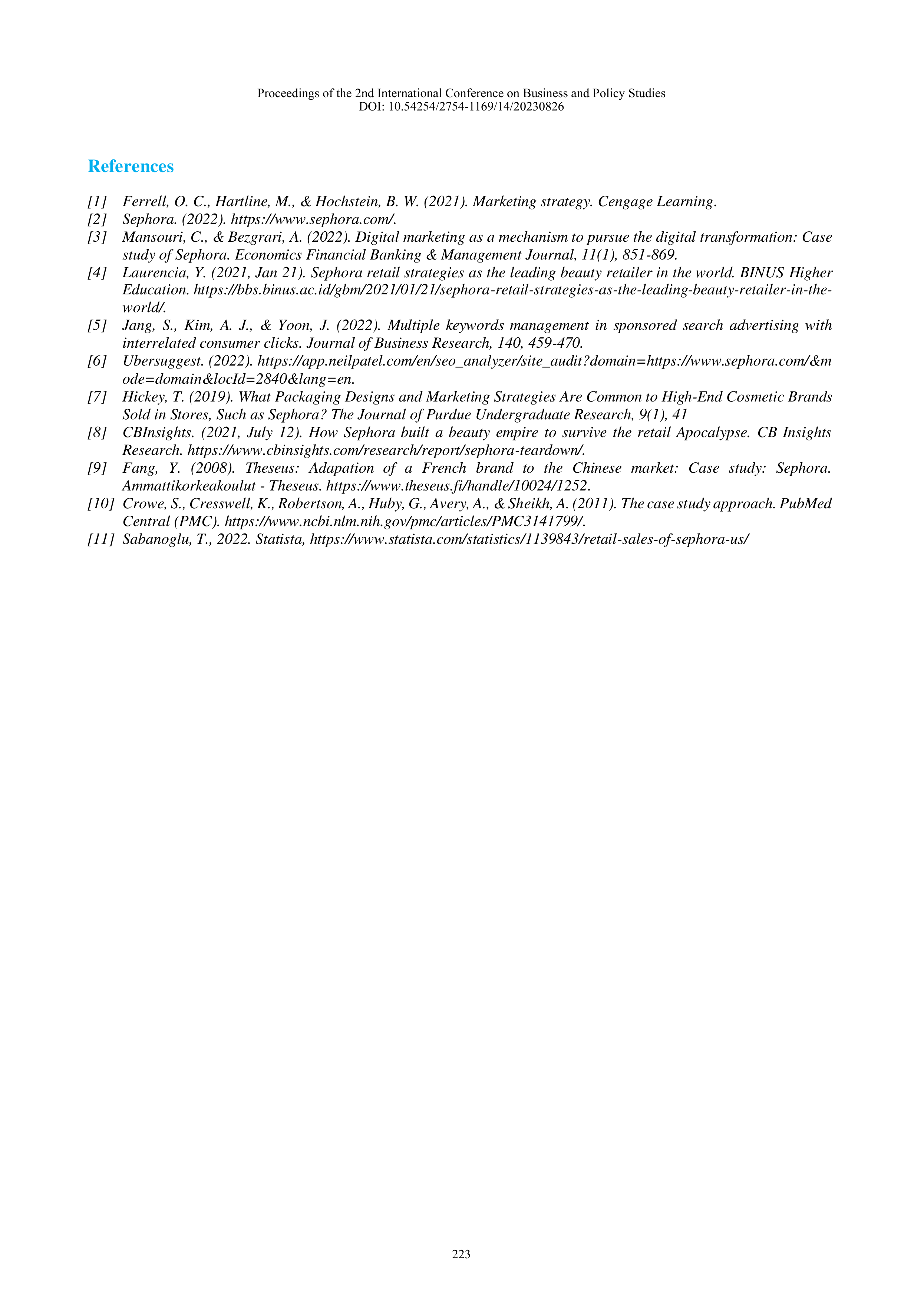
The company continued with its digital marketing campaigns and this contributed to improved reve-
nue in 2018. However, this performance slowed down in 2020 due to the impact of COVID19 on the
global economy (see Fig. 1). With this strategy, Sephora continues to expand its massive global pres-
ence and dominate the cosmetics market by depending on its parent company LVMH for financial
support.
Proceedings of the 2nd International Conference on Business and Policy Studies
DOI: 10.54254/2754-1169/14/20230826
221
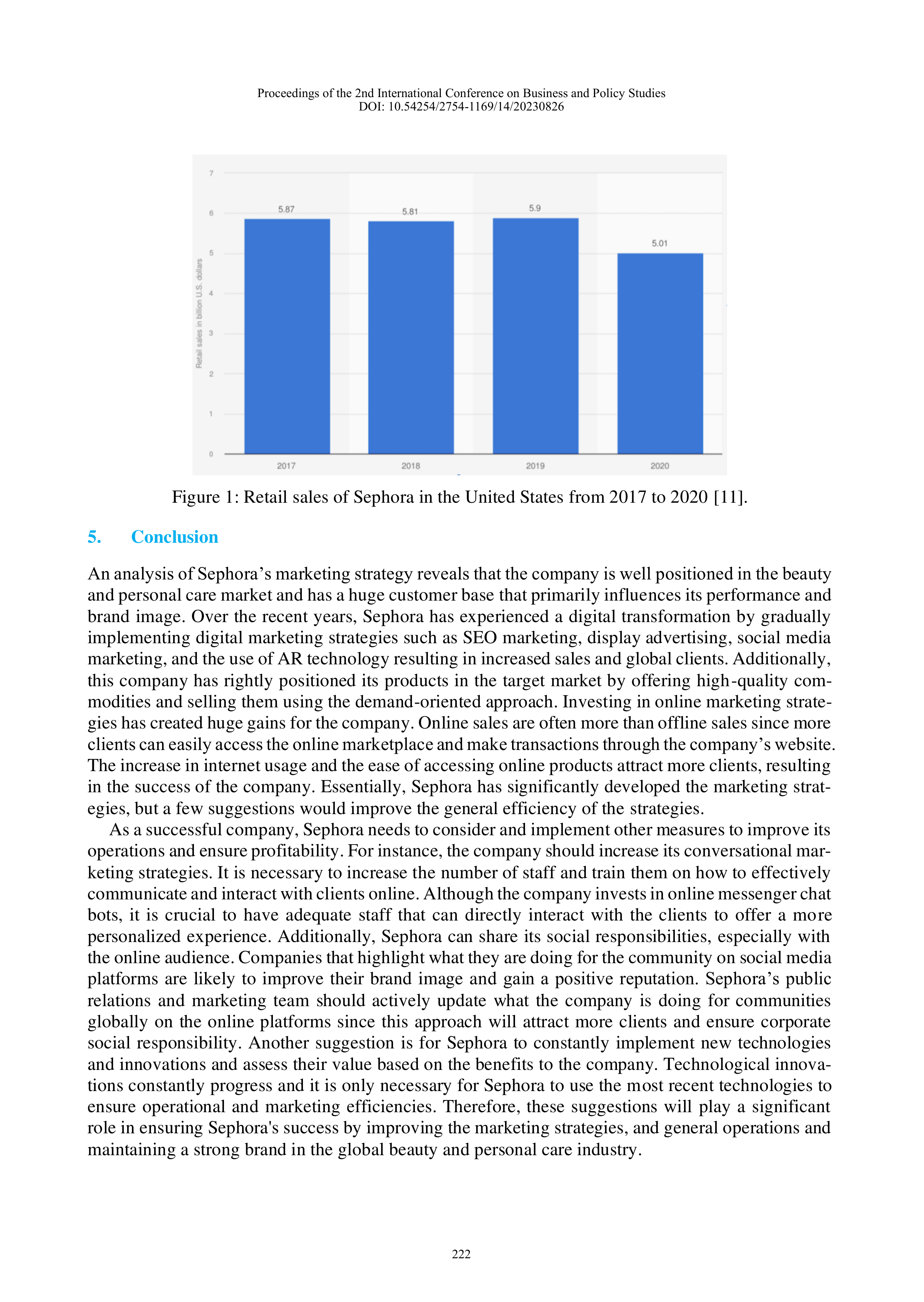
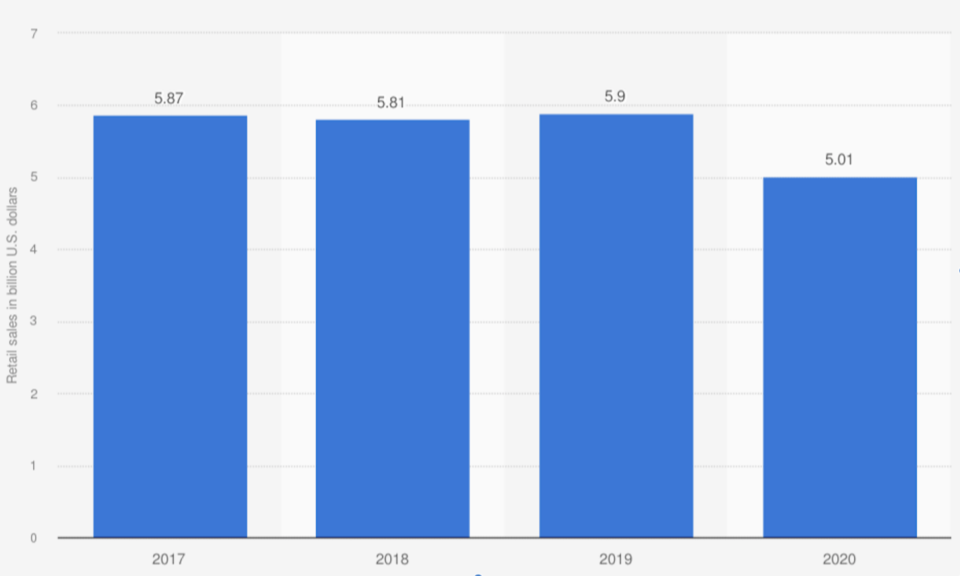
Figure 1: Retail sales of Sephora in the United States from 2017 to 2020 [11].
5.
Conclusion
An analysis of Sephora’s marketing strategy reveals that the company is well positioned in the beauty
and personal care market and has a huge customer base that primarily influences its performance and
brand image. Over the recent years, Sephora has experienced a digital transformation by gradually
implementing digital marketing strategies such as SEO marketing, display advertising, social media
marketing, and the use of AR technology resulting in increased sales and global clients. Additionally,
this company has rightly positioned its products in the target market by offering high-quality com-
modities and selling them using the demand-oriented approach. Investing in online marketing strate-
gies has created huge gains for the company. Online sales are often more than offline sales since more
clients can easily access the online marketplace and make transactions through the company’s website.
The increase in internet usage and the ease of accessing online products attract more clients, resulting
in the success of the company. Essentially, Sephora has significantly developed the marketing strat-
egies, but a few suggestions would improve the general efficiency of the strategies.
As a successful company, Sephora needs to consider and implement other measures to improve its
operations and ensure profitability. For instance, the company should increase its conversational mar-
keting strategies. It is necessary to increase the number of staff and train them on how to effectively
communicate and interact with clients online. Although the company invests in online messenger chat
bots, it is crucial to have adequate staff that can directly interact with the clients to offer a more
personalized experience. Additionally, Sephora can share its social responsibilities, especially with
the online audience. Companies that highlight what they are doing for the community on social media
platforms are likely to improve their brand image and gain a positive reputation. Sephora’s public
relations and marketing team should actively update what the company is doing for communities
globally on the online platforms since this approach will attract more clients and ensure corporate
social responsibility. Another suggestion is for Sephora to constantly implement new technologies
and innovations and assess their value based on the benefits to the company. Technological innova-
tions constantly progress and it is only necessary for Sephora to use the most recent technologies to
ensure operational and marketing efficiencies. Therefore, these suggestions will play a significant
role in ensuring Sephora's success by improving the marketing strategies, and general operations and
maintaining a strong brand in the global beauty and personal care industry.
Proceedings of the 2nd International Conference on Business and Policy Studies
DOI: 10.54254/2754-1169/14/20230826
222
References
[1]
Ferrell, O. C., Hartline, M., & Hochstein, B. W. (2021). Marketing strategy. Cengage Learning.
[2]
Sephora. (2022). https://www.sephora.com/.
[3]
Mansouri, C., & Bezgrari, A. (2022). Digital marketing as a mechanism to pursue the digital transformation: Case
study of Sephora. Economics Financial Banking & Management Journal, 11(1), 851-869.
[4]
Laurencia, Y. (2021, Jan 21). Sephora retail strategies as the leading beauty retailer in the world. BINUS Higher
Education. https://bbs.binus.ac.id/gbm/2021/01/21/sephora-retail-strategies-as-the-leading-beauty-retailer-in-the-
world/.
[5]
Jang, S., Kim, A. J., & Yoon, J. (2022). Multiple keywords management in sponsored search advertising with
interrelated consumer clicks. Journal of Business Research, 140, 459-470.
[6]
Ubersuggest. (2022). https://app.neilpatel.com/en/seo_analyzer/site_audit?domain=https://www.sephora.com/&m
ode=domain&locId=2840&lang=en.
[7]
Hickey, T. (2019). What Packaging Designs and Marketing Strategies Are Common to High-End Cosmetic Brands
Sold in Stores, Such as Sephora? The Journal of Purdue Undergraduate Research, 9(1), 41
[8]
CBInsights. (2021, July 12). How Sephora built a beauty empire to survive the retail Apocalypse. CB Insights
Research. https://www.cbinsights.com/research/report/sephora-teardown/.
[9]
Fang, Y. (2008). Theseus: Adapation of a French brand to the Chinese market: Case study: Sephora.
Ammattikorkeakoulut - Theseus. https://www.theseus.fi/handle/10024/1252.
[10]
Crowe, S., Cresswell, K., Robertson, A., Huby, G., Avery, A., & Sheikh, A. (2011). The case study approach. PubMed
Central (PMC). https://www.ncbi.nlm.nih.gov/pmc/articles/PMC3141799/.
[11]
Sabanoglu, T., 2022. Statista, https://www.statista.com/statistics/1139843/retail-sales-of-sephora-us/
Proceedings of the 2nd International Conference on Business and Policy Studies
DOI: 10.54254/2754-1169/14/20230826
223