
ACADEMIC PAPER
Levi
Strauss:
an
international
marketing
investigation
Demetris
Vrontis
Head of Marketing Department, School of Business, Intercollege, Nicosia, Cyprus
Peri
Vronti
Faculty of Food, Clothing and Hospitality Management, Department of Clothing
Design and Technology, Manchester Metropolitan University, Manchester, UK
Keywords
Marketing,
Standardization,
Marketing strategy,
Clothing,
Fashion
Abstract
In their consistent search for growth opportunities, firms are increasingly recognising
the benefits of becoming multinationals and expanding internationally. This case study outlines a
theoretical
exegesis
of
global
standardisation
and
international
adaptation.
The
debate
between
these two concepts is explored and their respective benefits considered. Subsequently, the role of the
marketing
mix
and
strategy
are
examined
in
relation
to
the
above
approaches
along
with
the
consideration
of
the
various
factors,
which
suggests
a
particular
marketing
mix
approach.
Finally,
the
feasibility
of
an
overall
marketing
strategy
will
be
assessed
with
the
assistance
of
the
appropriate
theoretical
models.
In
facilitating
the
comprehension
of
the
above
task,
Levi’s
the
fashion
clothing
retailer
and
their
jeans’
subdivision
is
utilised
to
exemplify
all
the
issues
outlined.
Global standardisation
or
international
adaptation:
a
theoretical
background
With ever increasing
improvements in transport, communications, and reduced trade
barriers, international trading which was once considered a luxury is now a necessity
in
many
sectors
(Vrontis
et al.
, 1999).
Once
the
decision
to
venture
into
international
markets
has
been
taken,
there
are
two broad strategies, which can be adopted. A fundamental strategic decision has to be
made immediately as to whether to employ a uniform marketing mix as part of a global
strategy or whether to adjust the marketing mix and strategies to take account of the
unique
characteristics
of
each
local
market.
Supporters
of
global
standardisation
such
as
Levitt
(1983)
argue
that
a
corporation
should
operate
as
a
single
entity
selling
the
same
items
everywhere
in
the
same
way.
They
believe
the
world
is
becoming
increasingly
homogenised
in
its
consumer
requirements
and
that
the
force
driving
this
process
is
technology,
which
has
facilitated
communication,
information
capital,
transport,
and
travel.
Thus
the
recent
resurgence ofinterest inthe internationalstandardisation issueisattributed tosuch global
influences as TV,
films,
widespread
travel/increased
tourism, telecommunications,
and
the computer.
Additionally,
there
are
a
variety
of
motives
underlying
a
firm’s
decision
to
trade
globally.
Such
incentives
could
be
the
ability
to
enjoy
economies
of
scale
as
a
consequence
of
large
output,
the
ability
to
extend
the
life
cycle
of
their
product
in
the
phase
of
a
mature
domestic
market
and
the
escape
from
increasing
levels
of
The
Emerald
Research
Register
for this
journal
is available
at
The
current
issue
and
full
text archive
of this
journal
is available
at
www.emeraldinsight.com/researchregister
www.emeraldinsight.com/1361-2026.htm
An
international
marketing
environment
389
Journal
of
Fashion Marketing
and
Management
Vol.
8
No. 4,
2004
pp.
389-398
q
Emerald Group Publishing Limited
1361-2026
DOI 10.1108/13612020410559984
domestic
competition.
The
unification
strategy
for
the
entire
international
market
produces
gain
of
lower
costs,
consistency
of
product
and
promotion
and
greater
uniformity
and
consistency
for
the
mobile
consumers.
However,
the
above
position
(standardisation)
is
opposed
by
supporters
of
the
adaptation
school
of
thought,
who
react
directly
to
the
sweeping
and
somewhat
polemic character of their argumentation. The contrary case argues that globalisation
seems
to
be
as
much
an
overstatement
as
it
is
an
ideology
and
an
analytical
concept
(Ruigrok
et
al.
,
1995).
The
polar
opposing
view
provided
by
the
adaptation
school
of
thought emphasises the various differences evident in international markets and urges
multinational
companies
to
adjust
the
marketing
mix
elements
and
marketing
strategies accordingly. The advantage of the specific marketing mix approach is that
strategy is tailored to suit local market needs while flexibility and responsiveness are
maximised.
With
this
in
mind,
supporters
of
this
school
of
thought,
believe
that
marketing orientation
is
achieved
at
an
optimal
level.
In
reality,
neither
of
these
polarised
views
is
feasible
or
even
desirable,
and
it
is
argued
that
adaptation
and
standardisation
co-exist.
The
huge
costs
involved
in
the
use
of
an
international
adaptation
approach,
together
with
the
multinational
companies’
desire
to
reap
the
benefits
of
standardisation
do
not
allow
international
adaptation
to
be
used
in
an
absolute
manner.
Similarly,
organisational
differences,
heterogeneity
among
different
countries’
macro
and
microenvironment
as
well
as
companies’ desire to satisfy consumer’s diverse needs do not allow standardisation to
be
practised
extensively,
as
suggested
in
the
literature.
It is therefore suggested that the international marketers should have to search for
the right balance between standardisation and adaptation and therefore determine the
extent of globalisation in a business and adapt the organisation’s response accordingly.
The
decision
on
standardisation
or
adaptation
is
not
a
dichotomous
one
between
complete standardisation and adaptation. Rather it is a matter of degree and there is a
wide
spectrum
in
between
that
the
international
marketer
should
be
aware.
This
integration of adaptation and standardisation driving a company towards optimising
performance is extensively researched by Vrontis (2003). Vrontis argues that the level
of integration is dependent upon considerations of the relationship between the reasons
and elements identified and an understanding of how these are affected by a number of
factors. This
is
shown
in
Figure
1.
Vrontis (2003) proposes a new modelling approach, the AdaptStand Process, which
outlines
the
different
stages
to
be
undertaken
by
multinational
companies
towards
identifying
the level
of
integration
across
marketing mix
elements.
The results of
his
research
are of paramount
importance in guiding marketing practitioners in deciding
on implementation of marketing tactics when competing in the international marketing
arena.
In identifying and analysing the level of globalisation and assessing the feasibility
of
a
global
marketing
strategy
and
tactics
this
case
study
will
focus
on
jeans
as
a
product
and
specifically
Levi
jeans
as
a
brand.
Levi
has
been
chosen
as
a
consequence
of
its
widespread
penetration
of
the
international jeans market. It is the world’s largest
manufacturer of
trousers,
notably
blue denim jeans. Initially aimed at cowboys, blue denim jeans spread to the whole US
population and were eventually exported worldwide (Britannica Encyclopaedia, 1999).
JFMM
8,4
390
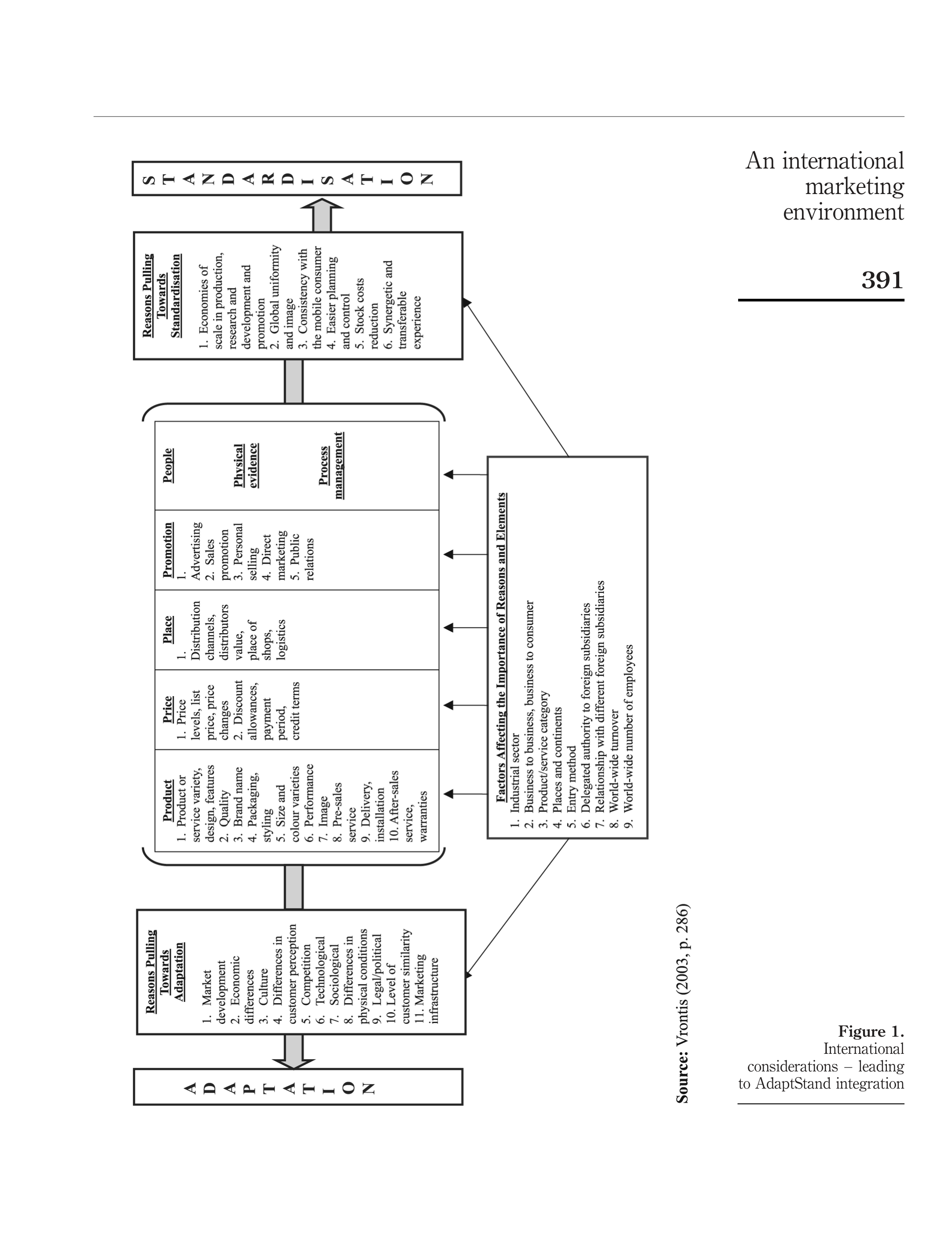
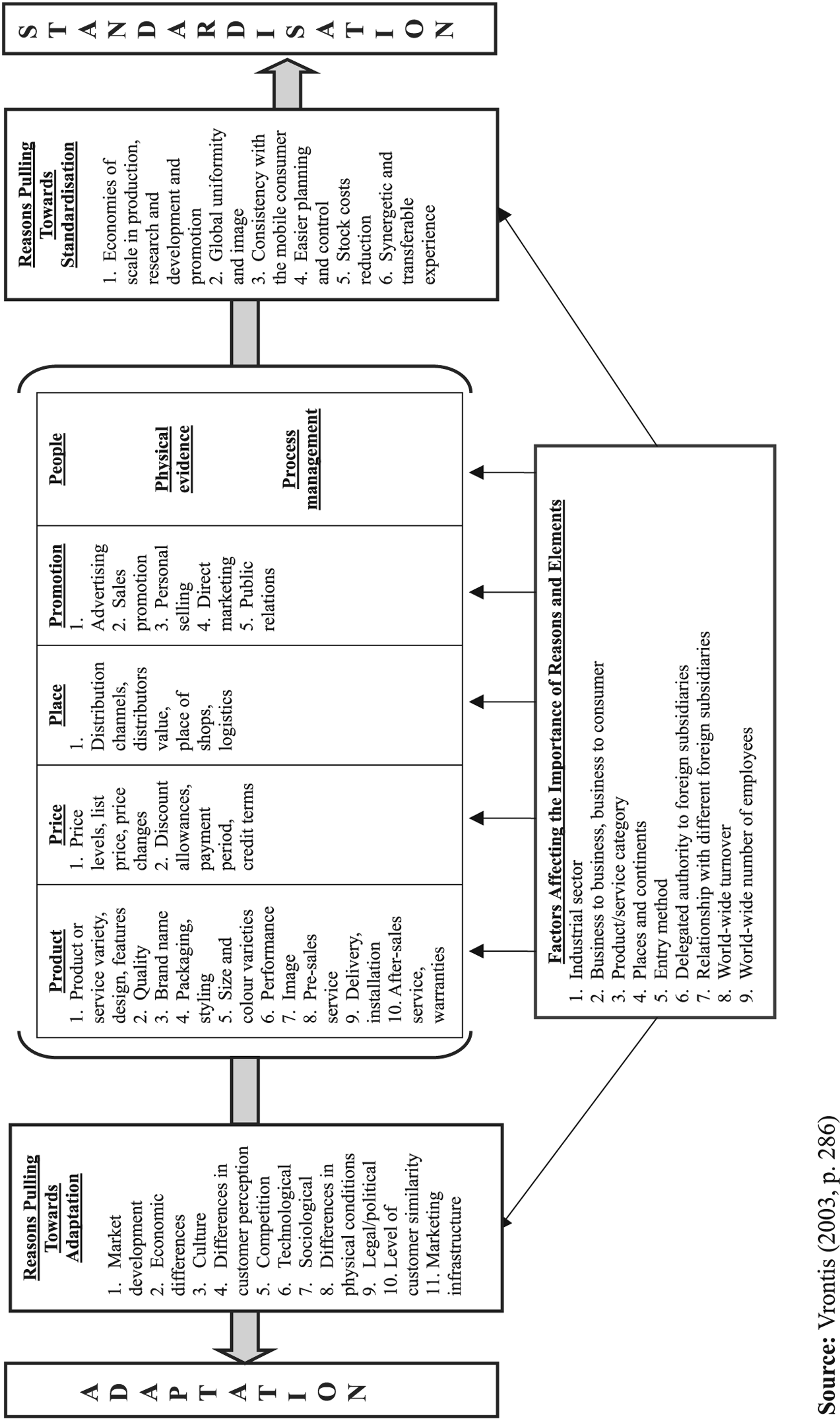
Figure
1.
International
considerations
–
leading
to AdaptStand
integration
An
international
marketing
environment
391
Levi
Strauss
&
Co.
an
overview
According
to
the
company’s
Web
site
(www.levistrauss.com)
the
company
was
founded in 1853 by Bavarian immigrant Levi Strauss, Levi Strauss & Co. (LS&Co.) is
one of the world’s largest brand-name apparel marketers with sales in more than 100
countries. There is no other company with a comparable global presence in the jeans
and
casual
pants
markets.
Our
market-leading
apparel
products
are
sold
under
the
Levi’s
w
and Dockers
w
brands.
In 1873, Levi Strauss and Nevada tailor Jacob Davis patented the process of putting
rivets
in pants
for strength,
and the world’s
first jeans
–
Levi’s
w
jeans
–
were born.
Today,
the
Levi’s
w
trademark
is
one
of
the
most
recognized
in
the
world
and
is
registered
in
more
than 160
countries.
The company is privately held by descendants of the family of Levi Strauss. Shares
of
company
stock
are
not
publicly
traded.
Shares
of
Levi
Strauss
Japan
K.K.,
the
company’s
Japanese
affiliate,
are
publicly
traded
in
Japan.
(For
additional
financial
information, visit
our
“News
and Financial”
section).
The company employs a staff of approximately 12,500 people worldwide, including
approximately 1,500
people
at
its
San
Francisco,
California headquarters.
Levi
Strauss
&
Co.
is
a
worldwide
corporation
organized
into
three
geographic
divisions:
(1)
Levi
Strauss,
the
Americas
(LSA), based
in
the San Francisco
headquarters;
(2)
Levi Strauss Europe, Middle East and Africa (LSEMA), based in Brussels; and
(3)
Asia
Pacific
Division
(APD),
based
in
Singapore.
Facing
pressure
to
lower
the
prices
of
its
clothes,
jeans
maker
Levi
Strauss
&
Co.
illustrated the need for reorganisation. The company plans to cut up to 650 jobs in the
United
States
and
Europe
to
minimise
its
expenses.
The
cut
represent
5
per
cent
of
Levi’s worldwide work force of 12,500 employees and continues an overhaul that has
eliminated thousands of Levi’s jobs. Just recently, Levi’s closed six US manufacturing
plants
in
a
move that redundant
3,600
workers
(Liedtke,
2003).
The
jeans
maker
has
been
struggling
to
reverse
a
six-year
slide
in
its
sales
as
consumers
began
buying
trendier
or
less
expensive
clothes.
In
an
effort
to
overcome
this problem back, Levi’s has designed more clothes to appeal to teenagers and young
adults,
and
cut
costs
to
lower
prices.
The
company
also
entered
the
discount
jeans
market earlier this summer with a new brand called Signature that is sold in Wal-Mart
stores
in
America.
The
changes
helped
boost
Levi
Strauss’
sales
to
$1.1
billion
in
its
most
recent
quarter
ended
on
24
August
2003,
a
7
per
cent
increase
from
last
year,
according
to
preliminary results. The privately held company said its third-quarter profit will range
from $24 million to $28 million, a 75 per cent to 104 per cent rise from the previous year.
Levi
Strauss
currently
wants
to
use
supermarkets
to
sell
a
new
range
of
discount
clothing. This comes despite a bitter legal battle with Tesco over the right of the chain
to sell cut-price Levis sourced from the so-called “grey market” outside Europe without
the
consent
of
the
jeans
maker.
At
this
legal
battle,
Tesco
eventually
lost
a
ruling
in
the
European
Court
of
Justice
in
2001
although
it
promised
to
continue
stocking
designer
brands
such
as
clothes,
fragrances,
sportswear
and
Champagne
at
knock-down
prices
by
purchasing
them
within
the
EU
–
a
practice
still
allowed
under
trade
rules.
JFMM
8,4
392
Levi
Strauss
says
it
plans
to
launch
a
“value”
range
of
clothes
for
adults
called
Signature
including
jeans
for
about
e
36
a
pair
–
at
least
e
25
cheaper
than
ordinary
Levis. Tesco and Asda said it has had an initial conversation with its former adversary
about
stocking
the
range.
Levi Strauss has decided to expand the range to France, Germany and the UK from
early
next
year
to
tap
into
the
growing
demand
for
good
quality
discount
clothing
which
has
been
spearheaded
by
supermarkets.
Factors affecting
standardisation
or
adaptation
of
Levi’s
strategy
and
tactics
A diversity of factors determine whether the marketing mix can be standardised for all
customers in the jeans market or whether it needs to be adapted to suit specific market
conditions.
These
include
socio-cultural,
legal/political,
physical
environmental,
technological,
demographic,
competition
and
economic
factors.
Socio-cultural
factors
Socio-cultural consists of language, religion, ethnics, values and customer perceptions.
It
heavily
affects
the
product
and
promotion
elements
of
the
marketing
mix
because
they
are
the
most
culture-bound
aspects.
Differences
in
culture
attitudes
lead
to
enormous
variations
in
product
and
advertising standards
and
expectations.
Levi wishes to minimise the degree to which culture prevents them from producing
standardised
promotional campaigns. This
is
because
of
the
benefits
of
economies
of
scale
and
the
higher
quality
that
can
be
obtained
for
a
single
advert
than
for
a
multiplicity of local adverts. Consequently, Levi Strauss paid $550,000 for one series of
TV
commercials
( Jeannet
et al.
, 1998) to
use
around
the globe.
However, it should be mentioned that Levi’s success turns on its ability to create a
global strategy that does not stifle local initiative. It is a delicate balancing act, one that
often means giving foreign managers the freedom needed to adjust their tactics to meet
the
changing
tastes
of
their home markets
(Business
Week,
1990).
In
addition
to
the
effect
on
the
design
of
adverts,
cultural
differences
have
a
linguistic implication with regard to the product name. The brand name of a product is
a key element of its promotion but care has to be exercised to avoid causing offence in
translation
or
using
symbols
that do
not
have
the
same
significance
worldwide.
Culture can also be a barrier in relation to the suitability of the product in particular
local
markets.
Countries
differ
in
their
tastes
and
fashions
may
create
the
need
for
adaptation.
For
example,
in
Islamic
countries
females
are
discouraged
from
wearing
tight fitting attire. Moreover, Japanese consumers prefer tighter fitting jeans than the
American counterparts (Czinkota
et al.
, 1995). It is therefore evident that fit, design and
style
of
jeans
need
to
be
adapted to
meet the
requirements
of
the local buyers.
The
appropriate
colours
to
use
both
in
the
product
and
the
promotional
materials
also have cultural dimensions. For example, the white colour is associated with death
in
China
but
black
is
the colour of
death
in
Europe.
Less
obviously,
the
distribution
is
also
affected
by
cultural
norms.
Levi
Strauss
when setting up its own direct sales force, found that the debt collection period was a
six
month
period
in
Japan
compared
with
a
one
month
period
in
the
home
country
(Terpstra
et al.
, 1994). Adaptation to such local trading customs was necessary in order
to
penetrate
the
Japanese market.
An
international
marketing
environment
393
Haggling
over
price
is
a
cultural
tradition
in
many
societies
such
as
Africa
but
rarely
used
in
many
European
countries.
It
is
therefore
important
for
pricing
to
take
into
account
of
cultural
habits
before
setting
the
final
price
in
different
individual
markets.
Legal
factors
Promotional
activities
are
regulated
in
all
countries
by
legislation.
One
of
Levi
Strauss’s
most
famous
television
commercials
used
the
music
of
Martin
Gaye
as
a
background
to
a
1950s
image
of
a
young
man
stripping
to
his
boxer
shorts
and
washing
his
501’s
in
a
laundrette.
A
variety
of
adaptations
were
required
in
local
markets. For example, the original commercial had to be re-shot in Australia and Brazil
because
the
local
regulations
insisted
on
domestic
produced
commercials.
Furthermore,
many
South
East
Asian
countries
exercised
their
censorship
power
and
banned
the
commercial
completely
(Jeannet
et
al.
, 1998).
There
are
relatively
few
legal
restraints
upon
the
choice
of
distribution
channel.
However,
there
are
exceptions
such
as
France
and
China’s
prohibition
against
door-to-door
selling
which may
not
be particularly
applicable
to
jeans.
Physical
environmental factors
The
different
climatic
conditions
found
in
different
parts
of
the
world
have
a
very
significant
affect
both
on
the
total
demand
for
jeans
and
in
the
type
of
jeans
made
available. The
European climate,
particularly
in
its
northern
regions
is
well
suited
to
wearing standard denim jeans. Other hottest climates require thinner denim in brighter
colour
and
possibly
in
shorts
versions.
It
is
therefore
the
product
element
of
the
marketing
mix
that
is
affected
by
climate
factors.
The
remaining
elements
of
the
marketing mix
are
less
affected
by
climate.
Technological factors
Technological
considerations
concern
whether
the
local
market
has
sufficiently
developed
technologies
to
take
full
advantage
of
the
product.
High
technologies
are
required
to
make
full
use
of
the
variety
of
promotional
methods
using
alternative
advertising
media
such as
television or
Web
sites.
Similar
considerations
apply
to
the
distribution
of
the
product.
For
example,
whether
consumers
can
utilise
online
home
shopping
facilities.
In
less
developed
countries, for example in Africa, where such technologies are in a rather inchoate stage,
adaptation
is
required
such
that
a
greater
extent
of
use
is
made
of
more
traditional
methods.
On
the
other
hand,
in
developed
countries
Levi
make
use
of
the
electronic
data interchange system to order and monitor stock levels with their customers such as
major
department
stores
in
order
to
avoid
costly
stock-outs.
This
is
not
used
in
developing
or
third
world
countries
(Kotler,
1997).
Demographic
factors
Demographic
factors
and
the
characteristics
of
a
country’s
population,
for
example
physical
size,
can
affect
the
market
for
jeans.
Different
global
regions
are
associated
with particular average heights of their inhabitants. For example, the Far East Asian
market
requires
shorter
inside
leg
measurements
than
the
Western
countries,
again
emphasising
the
need for
product
adaptation.
JFMM
8,4
394
It
is
scientifically
proven
that
the
human
body
structure
and
proportions
are
not
globally
identical.
Therefore
selling
standardised
sizes
has
led
many
companies
to
major
failure
when
trading
globally.
To
avoid
such
failures
one
should
consider
the
adaptation
of
local
fit
and
sizing.
Competitive
factors
The
nature
of
competition
in
different
local
markets
will
affect
each
element
of
the
marketing mix
for
jeans.
Marketing-based
pricing
strategies
will
have
to
take
into
account
the
prevailing
prices of substitute products, whether imported or domestically produced. A substantial
local based industry is likely to create more intensive competition in less developed local
markets due to cheaper costs of production.
Similarly,
the
more
intensive
the
domestic
and
imported
product
competition,
the
higher
the
quality
Levi
merchandise
needs
to
be.
If
however,
the
only
competition
is
domestically
produced
and
is
of
an
indifferent
quality,
then
quality
levels
are
less
significant.
Hence,
the
product
will
need to
be
adapted accordingly.
The
nature
of
the
promotional
campaign
will
have
to
be
partly
derived
from
the
actions
of
rivals.
The
advertising
budget
and
media
used
are
sometimes
with
rival
expenditure
levels
in
mind.
For
example,
in
advanced
countries
TV
is
the
dominant
advertising
media
and
is
heavily
used
by
rivals
such
as
Lee
Cooper
and
Wrangler
and
therefore
Levi
Strauss
has
little
option
but
to
follow
suit.
If
the
competitive
infrastructure
was
otherwise,
this
would
lightly
affect
the
promotional
strategy
and
tactical approach
used.
Distribution may have to be adapted when the manufacturers have exerted pressure
on
retail
outlets
to
discourage
them
from
selling
Levi
Strauss
products.
Where
this
arises,
adaptation
can
take
the
form
of
switching
to
direct
selling
either
through
opening specific Levi stores and/or using another selling method such as the Internet.
Economic
factors
The economic factor is increasingly important in enhancing adaptation. Local markets
vary
enormously
by
their
disposable
income
per
capita.
Therefore,
standardising
prices
would
mean that poor
countries
are
likely
to
have
reduced market
for
jeans.
Different levels of income and changes in income levels will affect both the price that
can be charged and the product quality that is appropriate for each local market. Prices
for
jeans
do
vary
very
substantially
between
markets
and
such
price
discrimination
may
be
partly
for
reasons
of
income
but
may
also
be
because
of
the
severity
of
competition and the inaccessibility of the territory. For example, standard Levi jeans in
the UK sells for approximately £46 whilst in certain US states £20 is the norm.
The
nature
of
the
promotional
campaign
will
also
be
affected
by
the
stage
of
the
economic
development
of
the
individual
country
and
therefore
require
a
degree
of
adaptation.
Advertisements
for
jeans
in
affluent
societies
are
quite
sophisticated
and
rely
on
the
communication
of
ideas
about
lifestyle
and
imagery.
By
contrast,
advertisements
in
poor
countries
are
more
rudimentarily
based
upon
factors
such
as
function
and
value
for
money.
Distribution channels may require adaptation in relation to the stage of development
of each local market. Advanced countries possess a multiplicity of different retail outlets
while
choices
are
likely
to
be
much
more
constrained
in
less
developed
countries.
An
international
marketing
environment
395
Therefore the full range of selling patterns employed for advanced markets cannot be
deployed in poorer ones. For example in China, department stores only cover 20 per cent
of
the
total
market.
Therefore,
distributing
via
the
traditional
market
is
essential
to
ensure success.
It
is
illustrated
that
global
standardisation
and
international
adaptation
do
take
place,
and
can
bring
benefits.
However,
their
extreme
practice
is
not
necessarily
an
optimal
approach
in
all
markets,
nor
is
it
evident
that
it
is
taking
place
for
all
of
the
products
of
the
firm,
nor
necessarily
to
the
same
extent
across
all
of
the
elements
of
the marketing mix.
International practitioners should search for striking the right AdaptStand balance.
This
is
not
a
straightforward
task,
and
as
identified
the
balancing
act
between
standardisation
and adaptation
is
very
tricky
and
indeed
a
challenging
one.
Target markets
and
positioning strategy
In determining a desirable target market, a variety of factors have to be considered in
order
to
define
the
characteristics
of
the chosen market
segment.
For
the
product
of
jeans
it
is
a
question
of
whether
the
different
characteristics
of
each
market
segment
allow
a
standardised
approach
that
implies
undifferentiated
marketing
or
whether
they
are
so
distinct
that
they
require
large-scale
adaptation
implying
a
differentiating
market
approach.
It
seems
to
be
the
case
that
jeans
are
uniformly
aimed
at
the
youth
of
the
age
of
16-20 regardless of country of destination, yet differences still exist in the positioning
of
their
appeal
(Lehone,
1995).
For
example,
in
America
and
much
of
Europe,
the
emphasis
is
on
jeans
as
casual
attire as encapsulated in the freedom of the open road personified through James Dean
within
an
atmosphere
of
North
American
Eldorado.
Similarly
an
Indonesian
commercial
shows
Levi
clad
teenagers
cruising
around
Iowa
in
1960s
convertibles
(Czinkota
et
al.
,
1995).
By
contrast
in
Russia
where
jeans
are
in
short
supply,
their
wearing
indicates
to
society fashion awareness and high status (Jeannet
et al.
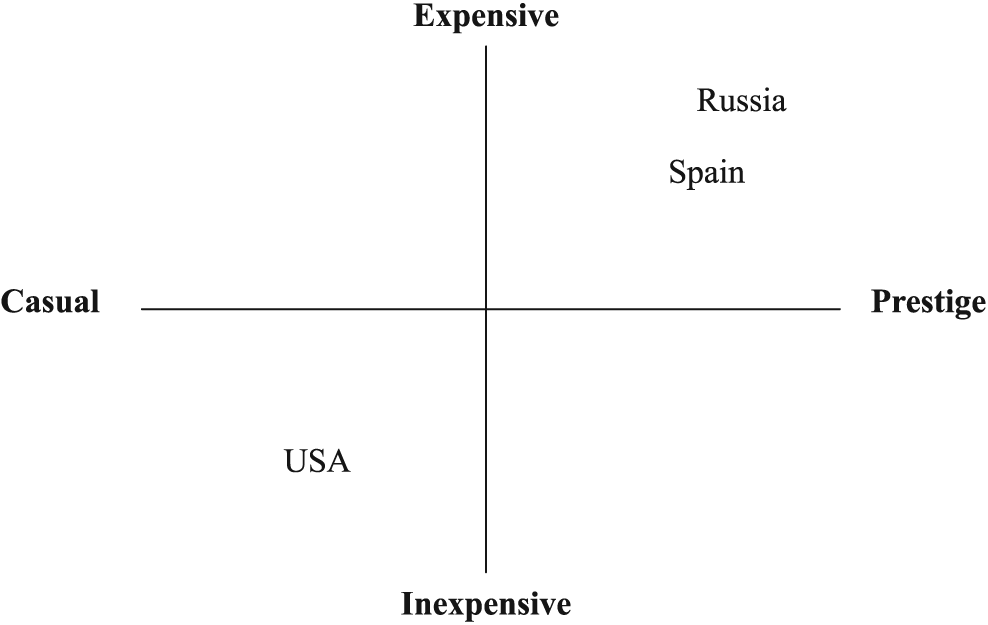
, 1998). Similarly, in Spain, the
high price of jeans singles them out as fashion items as opposed to casual dress. Levi’s
world
wide positioning is
illustrated
in
the
positioning
grid
seen
at
Figure
2.
Figure
2.
Positioning
grid
JFMM
8,4
396
The various factors that define the nature of different markets include socio-economic
and demographic variables such as age and sex which in the jeans market are unifying
and
standardising
influences.
Such
variables,
with
regard
to
jeans,
allow
an
undifferentiated
approach
to
marketing the
product.
However, other factors such as culture, religion, geographic and climatic conditions
act as divisive influences, which necessitate an adaptation of the target market, image
and
positioning
of
the
product.
Thus, an element of both standardisation and adaptation are apparent necessitating
the identification and implementation of the right balance of the Vrontis’ AdaptStand
level
of
integration.
Global marketing
strategy
A global standardisation marketing approach is difficult to achieve. That has already
been
established
from
our
earlier
consideration
of
the
need
for
adaptation
in
the
marketing mix. Further evidence for this can be found in the various theoretical models
used
to
analyse
marketing strategy.
It
is
already
well
established
that
the
product
life
cycle
of
a
product
can
only
be
conceptualised
within
a
specific
national
market.
This
is
because
products
do
not
always occupy the same stage in the life cycle between different countries. Jeans are by
common consent, in the mature stage in America but in their growth phase in eastern
countries.
Hence,
this
could
imply
the
need
for
the
adoption
of
different
marketing
strategies
for
different
countries.
Similarly, the matrix used by the Boston Consulting Group implies that the different
categories
used
to
describe
a
company’s
product
cannot
be
applied
across
national
boundaries.
This
is
because
both
“relative
markets
share”
and
the
“growth
of
the
market” will vary very considerably between countries. For example, for countries that
differ in their stage of development, a growth market in one country may constitute a
very
mature
and
saturated
market
in
another.
A
product
that
falls
into
the
star
category
in
a
less
developed
country
may
be
regarded
as
a
cash
cow
in
a
more
advanced country.
Conclusion
On the spectrum of standardisation versus adaptation (Figure 1), a positioning closer to
the
globalisation
polarity
appears
to
be
appropriate
for
Levi
Strauss.
It can be seen that there is a global market for jeans and capitalising on their market
maximises
the
ability
of
Levi
Strauss
to
benefit
from
economies
of
scale,
global
uniformity and consistency with the mobile consumer. A global strategic and tactical
approach therefore enables Levi Strauss to maximise competitive advantage across the
world
market.
However,
a
complete
degree
of
standardisation
is
impossible
to
achieve
in
the
market
for
jeans.
While
the
target
market
is
similar
throughout
the
world,
market
positioning
and
the elements of the
marketing mix have to
be adjusted
in
line with
a
variety
of
organisational
and
macro
and
micro
environmental factors.
The
aim
should
be
to
obtain
AdaptStandation;
that
is
an
appropriate
balance
between
maximising
the
gains
of
standardisation
and
competitive
advantage
and
maximising
market share through
adequate
adaptation
to
local market conditions.
An
international
marketing
environment
397
References
Britannica
Encyclopaedia
(1999).
Business
Week
(1990),
“For Levi’s,
a flattering
fit overseas”,
Business
Week
,
pp.
76-7.
Czinkota,
M.R. and
Ronkainen, I.A.
(1995),
International Marketing
, 4th ed., The Dryden Press,
Hinsdale,
IL.
Jeannet,
J.
and
Hennesey,
H.
(1998),
Global
Marketing
Strategies
,
3rd
ed.,
Houghton
Mifflin
Company,
Boston,
MA.
Kotler,
P.
(1997),
Marketing
Management
–
Analysis,
Planning,
Implementation
and
Control
,
8th ed.,
Prentice
Hall,
Englewood
Cliffs,
NJ.
Lehone,
K. (1995),
Business
Review
,
Vol. 2
No.
2.
Levitt,
T.
(1983),
“The
globalisation
of
markets”,
Harvard
Business
Review
,
pp.
92-102.
Liedtke,
M. (2003),
available
at:
http://forums.transnationale.org/viewtopic.php?p
¼
5277
Ruigrok,
W.
and
van
Tulder,
R.
(1995),
The
Logic
of
International
Restructuring
,
Routledge,
London.
Terpstra,
V.
and
Sarathy,
R. (1994),
International
Marketing
, The
Dryden
Press.
Vrontis,
D.
(2003),
“Integrating
adaptation
and
standardisation
in
international
marketing,
the
AdaptStand
modelling
process”,
Journal
of
Marketing
Management
,
Vol.
19
Nos
3/4,
pp.
283-305.
Vrontis, D., Vignali, C. and Dana, L.P. (1999),
An International Marketing Reader
, ISSN 09053304
25X,
The Manchester
Metropolitan
University,
Manchester.
Further
reading
Vrontis, D. (2000), “Global standardisation and/or international adaptation? a tactical marketing
decision for multinational businesses in crossing borders and entering overseas markets”,
Business
and
Economics
for
the
21st
Century
–
Volume
III
,
Business
and
Economics
Society
International
(B&ESI), pp.
140-51.
JFMM
8,4
398