

International Review of Management and
Marketing
ISSN: 2146-4405
available at http: www.econjournals.com
International Review of Management and Marketing, 2019, 9(3), 64-68.
International Review of Management and Marketing |
Vol 9 • Issue 3 • 2019
64
Pertamina Energy Marketing Strategy and its Effect on
Environment Performance
Nana Trisnawati
1
*, Nursiti Nursiti
2
, Dovina Navanti
3
1
Universitas Persada Indonesia Y.A.I, Jakarta, Indonesia,
2
STIE YAI, Jakarta, Indonesia,
3
Universitas Bhayangkara Jakarta Raya,
Indonesia. *Email: nanatrisna31@gmail.com
Received:
28 February 2019
Accepted:
14 April 2019
DOI:
https://doi.org/10.32479/irmm.8024
ABSTRACT
The purpose of this study is to explore whether the pertamina energy marketing strategy has a positive effect on environment performance. In addition,
we also verify whether pertamina energy marketing strategy was seen from internal factor analysis summary and external factor analysis summary
analysis, so we could find out the competitive position of the pertamina energy. The methods of this study are mix methods. A strengths, weaknesses,
opportunities, and threats analysis was the main method used for qualitative in this study and path analysis for quantitative methods. The empirical
data were obtained from the pertamina energy marketing strategy survey. Regarding the research results, in addition to pertamina energy marketing
strategy proved to have a positive and significant effect on environment performance, marketing strategy implications on pertamina energy based
on indicators that are the strengths and opportunities of pertamina energy in the future, then an adequately applied marketing strategy is an intensive
strategy with market penetration that is marketing to a wider market.
Keywords:
Pertamina Energy,
Marketing Strategy, Internal Factor Analysis Summary, External Factor Analysis Summary, Environment
Performance
JEL Classifcations:
E6, Q430, Q470, Q480
1. INTRODUCTION
The growth of the energy sector in the country is very fast
driven by the increasing demand of the community for energy in
accordance with the level of their needs. The purpose of energy
development is so that everyone can occupy healthy energy can
support the continuity and improvement in their social welfare
both for shelter, place of business, offices and so on (Boothman
and Craig, 2016). Based on data onto the Central Statistics Agency
from 2014-2016, the total population growth of Bandung Energy
Area reached an average of 63721 people. The population growth
of Bandung Energy Area with an average annual percentage of
1.8% and the total population growth of Bandung City reached
an average of 9153 people. Growth of the population of the city
of Bandung with an average annual percentage of 0.37%. This
population increase in Bandung Energy Area has led to an increase
in the need for energy, which has encouraged energy suppliers to
provide alternative energy solutions that are more feasible and
affordable. Suppliers are starting to look for fertile and adjacent
areas to build energy (Jaafar et al., 2016). This increase is in line
with social and economic developments, due to birth rates and
the flow of migrants.
Various efforts were made by energy suppliers to attract consumers
and increase sales of their energy products. Starting from the
model, type, price and various promotions carried out. The high
competition in product marketing has an impact on the volume of
product sales. Therefore entrepreneurs must be able to apply the
right marketing strategy so that the sales volume does not decrease
and continues to grow and develop. The problems faced in building
energy and environmentally sound energy are very complex. Not
only concerns financing but also concerns marketing problems.
This Journal is licensed under a Creative Commons Attribution 4.0 International License
Trisnawati, et al.: Pertamina Energy Marketing Strategy and its Effect on Environment Performance
International Review of Management and Marketing |
Vol 9 • Issue 3 • 2019
65
Moreover, for this sharia concept energy only exists then it will
need the right marketing strategy to be able to attract consumers
and increase the energy market share (Morgan and Rego, 2008).
The most effective marketing strategy used by a company is one
of the marketing mix strategies. A company cannot win market
competition if it only relies on sale. And sales will not be created
well without being supported by a good marketing strategy.
Pertamina Energy has been marketing marketing for energy to have
implemented a marketing strategy, among others (Kanagal, 2009):
1.1. Product Strategy
All energy product located at Pertamina Energy are cluster models.
1.2. Price Strategy
Prices determined by Pertamina Energy for each type of energy
product differ depending on the building area and the energy area.
The selling price includes value added tax.
1.3. Place Strategy
Pertamina Energy is located in Bandung and adjacent to the Buah
Batu toll gate, Supermarket, Telkom University, Al Islam Hospital.
1.4. Distribution Strategy
Distribution strategy is a energy service strategy to consumers
based on the way payments are made. Pertamina Energy carries
out a distribution strategy by opening a energy marketing office.
With the presence of a marketing office, the company can provide
services and complete information about the products found at the
Pertamina Energy.
1.5. Promotion Strategy
Promotion is useful for communicating products of the public. It
is expected that with the promotion of a product can be known by
the community and lead to interest in buying it.
2. LITERATURE REVIEW
Marketing strategy is the marketing logic where companies hope
to create customers value and achieve profitable relationships
(Kanagal, 2009). (Strategy, 1963) “to explain that marketing
strategy is the four step process of designing and managing a
marketing strategy (analysis, planning, implementation, and
management). First the situation analysis considers market
and competitors analysis, market segmentation, and continues
learning about market. Second, designing a marketing strategy
entails customers targeting and positioning strategies, marketing
relationship strategies, and planning for new product. Third,
marketing program development consist of product/service,
distribution, price and promotion strategies designed and
implemented to meet the needs of targeted buyers. Fourth, strategy
implementation and management look at organizational design
and marketing contro”.
Graubner, 2006 explains that “marketing strategy consists of four
steps in the process of designing and managing to market strategies
(analysis, planning, implementation, and management).” First,
situation analysis considers markets and competitor analysis,
market segmentation, and continues to learn about markets.
Second, design marketing strategies that require target customers
and placement of strategies, relationship marketing strategies,
and planning for new products. Third, marketing development
programs to consist of products/services, distribution, prices and
promotional strategies designed and implemented to meet the
needs of targeted buyers. Fourth, strategy implementation and
management look at organizational design and marketing control.
Cavusgil and Zou, 2006 state that there are four concepts in
formulating marketing strategies in relation to managing new
products that already exist in new markets, namely:
1.
Market penetration strategy, which is a strategy focused on
selling service mixes and products to existing target markets.
In an effort to increase revenue, management seeks to increase
prices and build markets based on customers who are solid
and loyal to the company.
2.
The strategy of developing new products is an idea of
developing new products of existing markets. Changing
markets, changing needs and customers must remain a serious
concern from the energy industry.
3.
Market development strategies, namely strategies that focus
on developing new markets for existing products and services.
In conditions like this energy usually builds new units and
expands new market shares.
4.
Diversification strategy is a strategy to introduce new products
and services to new market shares. This strategy offers long-
term potential, but this strategy also has a very high level
of risk.
Implementation of this concept is very important to use to be able
to provide benefits and satisfaction to guests in accordance with
the products they have, namely product formulation so that the
marketing program carried out can run effectively and efficiently.
The design and implementation of the marketing strategy has
a reciprocal relationship that is aligned with the direction,
obstacles and allocation of resources owned by the company. The
marketing strategy consists of analysis, strategy development and
implementation activities in developing a vision of the market
that is of interest to the organization, selection of target market
strategies, goal sett and development, implementation, and
managing to market programs positioning strategies designed to
meet customers needs in each market target (Ovtchinnikov, 2010).
Environment performance is a construct commonly used
to measure the impact on implementing corporate strategy.
Environment performance should be measured using various
measurement criteria at the same time (multiple measurement)
.
If using measurements of a single criterion (single measurement)
then it will not be able to provide a comprehensive understanding
of how the environment performance of a company is actually
(Cavusgil and Zou, 2006).
3. METHODOLOGY
In this study using mixed methods, namely qualitative methods and
quantitative methods. Qualitative methods use SWOT analysis,
Trisnawati, et al.: Pertamina Energy Marketing Strategy and its Effect on Environment Performance
International Review of Management and Marketing |
Vol 9 • Issue 3 • 2019
66
while quantitative methods to test hypotheses. This study uses
primary data and some secondary data. The location of this
research was conducted at the Pertamina Energy. The sample of
this study was all 30 suppliers of Pertamina Energy.
In this study the sampling technique is not used because the
sample studied is the whole of the population that is or is called
a census. Analysis method the data used is using analysis of
external factor analysis summary (EFAS) and internal factor
analysis summary (IFAS). Where before making the IE matrix,
an SWOT analysis is carried out first, the results are summarized
in EFAS and IFAS tables. The application of SWOT analysis is
carried out by considering strengths and weaknesses as internal
factors as well as opportunities and threats as external factors
owned by Grand Pillar.
The analysis used consists of 2 types, namely: (1) Descriptive
analysis especially for quantitative variables and (2) verification
analysis, in the form of testing hypotheses using statistical tests.
Verification analysis is emphasized to reveal the behavior of
research variables, while quantitative descriptive analysis is
used to explore the causal factors. The analytical method used is
cross-sectional.
4. RESULTS AND DISCUSSION
4.1. Strengths and Weaknesses of Pertamina Energy
In the present, the strength of pertamina energy is shown by
indicators of the completeness of room facilities, completeness of
house facilities, location of pertamina energy formulation, special
adjustments to prices, intensity of promotion, quality of employee
services, employee competence, collaboration with other parties
.
In the future, indicators that show the strength of pertamina
energy are the presence of complete room facilities, complete
home facilities, pertamina energy locations, special adjustments
to prices, promotion intensity, employee service quality, employee
competence, collaboration with other parties. pertamina energy
has no weaknesses because management views weaknesses
that exist on the present to be corrected in the future. internal
environment variables that are the strengths and weaknesses
for pertamina energy both now and in the future are in terms of
location (Boothman and Craig, 2016; Jaafar et al., 2016).
4.2. Pertamina Energy Opportunities and Threats
Based on the analysis of pertamina energy’s opportunities for the
external environment, currently indicated by conducive indicators
of security stability, flexible regional government policies,
stable inflation rates and the rupiah
exchange rate against the
us dollar, keep abreast of information technology that can help
the company’s operations and preservation of natural resources
in the neighborhood around pertamina energy. meanwhile, what
has become the threat to pertamina energy at the present time is
the increasing rate of energy growth, the culture of the people
in the residential environment provides comfort. in the future,
all the indicators will be an opportunity, but pertamina energy’s
management must keep all these indicators in order not to become
a threat to the future. the external environment variables that
represent the opportunities and threats to pertamina energy both
now and in the future are the hotel growth rates are increasing
(Digital Asset, 2016; Hussain and Miras, 2015; Mulyani, 2017).
4.3. Position of Pertamina Energy in the Present and
Future
Pertamina energy’s position in the IE Matrix in the present and
future. Based on the results of the analysis, it can be seen that,
after analyzing the internal and external environment both now
and in the future, the next step is to move the score of the IFAS/
EFAS matrix. The total weighted value of IFAS at the present
time is 4.33 and for the future is 4.69. While the EFAS score
of the present time is 4.37 and in the future is 4.78 so that the
company position in the IFAS/EFAS matrix. The position in cells
I mean that Grand Dillar is in position of growth and development
(growth and development) and a strategy that can be applied
is the strategy of market penetration, market development and
product development. Market penetration strategies can be done
by finding new market shares for existing products or services,
through more vigorous marketing efforts. In addition, the position
in cells I can also carry out market development in the sense of
introducing existing products or services into new geographical
areas. Product development is done so that it becomes varied and
the products developed must also be innovative. The position of
Pertamina Energy in the present and in the future is to grow and
develop (grow and develop), reformulating the marketing strategy
and the implication of the marketing strategy on Pertamina Energy
are an intensive strategy (Bakhtieva, 2017; Morgan and Rego,
2008; Varadarajan and Yadav, 2002).
4.4. Effect of Pertamina Energy Marketing Strategies
on Environment Performance Coefficient of
Determination
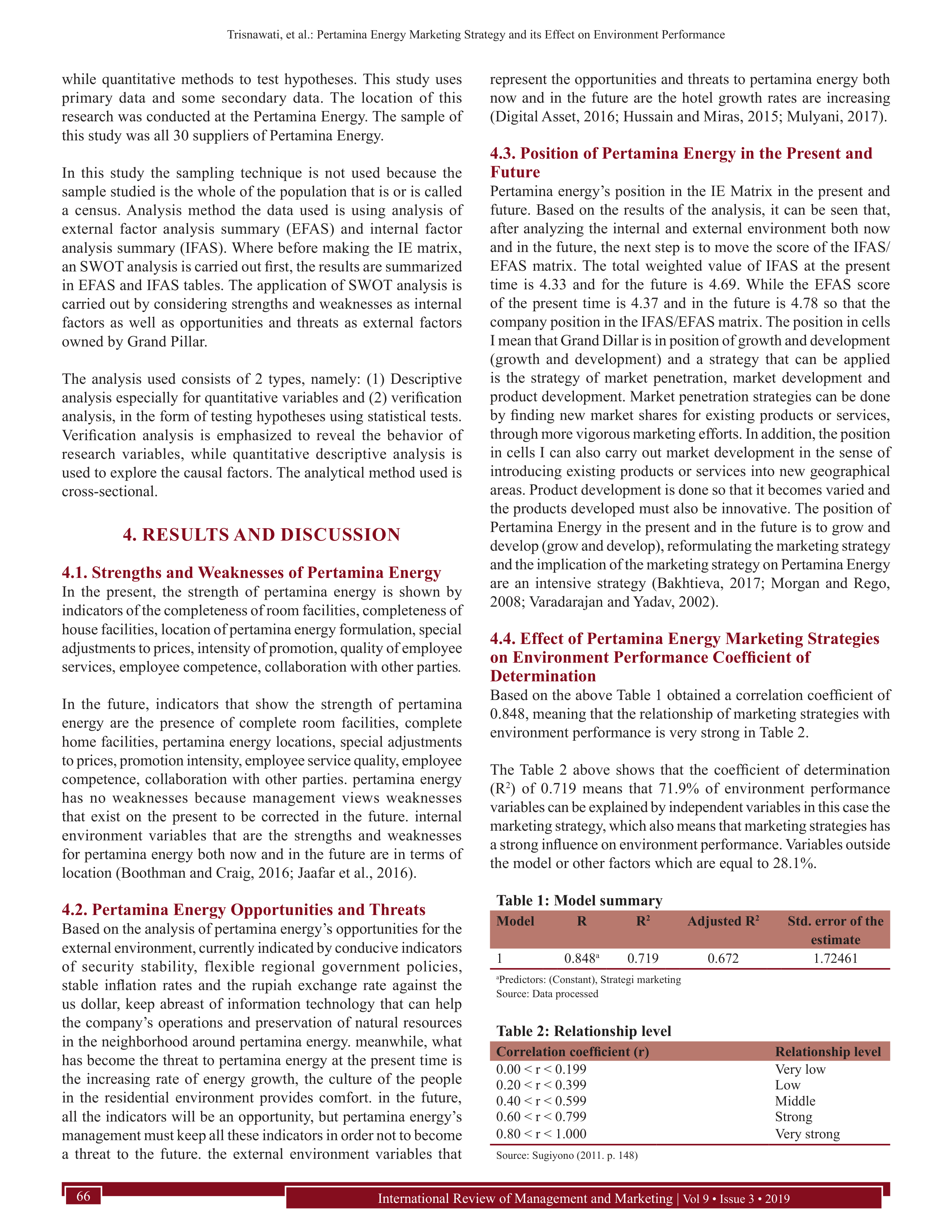
Based on the above Table 1 obtained a correlation coefficient of
0.848, meaning that the relationship of marketing strategies with
environment performance is very strong in Table 2.
The Table 2 above shows that the coefficient of determination
(R
2
) of 0.719 means that 71.9% of environment performance
variables can be explained by independent variables in this case the
marketing strategy, which also means that marketing strategies has
a strong influence on environment performance. Variables outside
the model or other factors which are equal to 28.1%.
Table 1: Model summary
Model
R
R
2
Adjusted R
2
Std. error of the
estimate
1
0.848
a
0.719
0.672
1.72461
a
Predictors: (Constant), Strategi marketing
Source: Data processed
Table 2: Relationship level
Correlation coefficient (r)
Relationship level
0.00 < r < 0.199
Very low
0.20 < r < 0.399
Low
0.40 < r < 0.599
Middle
0.60 < r < 0.799
Strong
0.80 < r < 1.000
Very strong
Source: Sugiyono (2011. p. 148)
Trisnawati, et al.: Pertamina Energy Marketing Strategy and its Effect on Environment Performance
International Review of Management and Marketing |
Vol 9 • Issue 3 • 2019
67
The results of the statistical analysis, the regression equation is
produced a Y = 3.133 + 0.531X. From the above equation can
be interpreted as follows if the value of X is zero, then the Y
value is 3.133, meaning that if there is no marketing strategy
variable, the environment performance variable has a value of
3.133. While 0.531X states that if every increase in one unit of
variable X (marketing strategy) will increase the value of variable
Y (environment performance) by 0.531.
Based on the results of hypothesis testing for the F test obtained
a significance level of 0.000 when compared with alpha of 0.05,
then the level of significance is smaller when compared to alpha,
thus the hypothesis can be accepted, meaning that if the marketing
strategy increases, environment performance will also increase.
After testing the hypothesis with the F test, the next stage tests
the hypothesis with the t test. The results of the t test analysis
obtained a significance level of 0.000 when compared with alpha
of 0.05, then the significance level is smaller when compared to
alpha, thus the hypothesis can be accepted which means that if
the marketing strategy increases, environment performance will
also increase.
4.5. Pertamina Energy Marketing Strategy
Formulation
The position of pertamina energy in the future is in quadrants I,
because the strategies that can be applied to the future are growing
and develop, which consists of market penetration, market
development, and product development strategies. In cells I there
are several alternative strategies that can be done namely intensive
strategy and integrative strategy.
In an intensive strategy, the action that can be taken is market
penetration, which is to seek a larger market share for existing
products or services through more vigorous marketing efforts.
Intensive strategies can also be done with market development in
terms of introducing existing products/services to new geographical
areas. In addition, in this strategy product development can also
be carried out by creating innovative new products and adding
product variations.
Based on variable indicators that is the strengths and opportunities
of pertamina energy in the future, then an adequate marketing
strategy is implemented is an intensive strategy. The strategy
includes market penetration, market development and product
development strategies (Graubner, 2006).
4.6. Implications of the Pertamina Energy Marketing
Strategy in the Future
4.6.1. Product
Completeness of current energy facilities even though it is already
a strength, but still needs to be improved in the future in order to
be more competitive with new competitors.
4.6.2. Place
Pertamina Energy’s location is a strength in the future, because
development plans for the Pertamina Energy area will have an
impact on the ease of access.
4.6.3. Price
In general, the price policy applied by pertamina energy is very
flexible. A specific adjustment to the price of Pertamina Energy
is a competition-based pricing policy.
4.6.4. Promotion
Promotions can be carried out periodically to remind consumers,
and to better introduce the existence of pertamina energy and by
adding existing media to be more varied and potential consumers
can also better understand the existence of pertamina energy. This
is also done to better communicate existing products and new
products and price changes.
4.6.5. People
Like energy companies in general, people are very important
things both in terms of appearance and service provided. Good
service is an absolute thing in the company, as is pertamina energy.
Therefore, the management of pertamina energy always conducts
briefings. The briefing is given by each Department Head every
morning for 30 min (between 09.30 and 10.00). The briefing is
intended so that employees always carry out standard operational
procedures. In addition, to evaluate deficiencies or mistakes
the previous day and provide a solution. With daily briefings,
employees will always remember their duties and obligations,
even though their duties and obligations have been done well but
still need to be improved.
4.6.6. Partnership
To improve the environment performance of pertamina energy,
collaboration with travel agents needs to be improved even though
there is an online marketing era now but collaboration with other
parties is still very much needed.
4.6.7. Packaging and programming
Packaging and programming are two things that must exist on a
product. How to package a product to be attractive and varied.
The packages and programs offered by Pertamina Energy will be
very varied.
5. CONCLUSIONS
The strength of Pertamina Energy is indicated by indicators of
completeness of facilities, complete energy facilities, location
of energy close to public facilities, special adjustments to
prices, intensity of promotion, quality of employee services,
employee competence, cooperation with other parties, and
energy packages.
Pertamina energy’s opportunities for the external environment
are indicated by conducive indicators of security stability,
flexible regional government policies, stable inflation rates
and the rupiah exchange rate against the US dollar, following
developments in information technology that can assist the
company’s operations, and preservation of resources natural
power in the surroundings of pertamina energy. Whereas the
threat is that the growth rate of energy has increased, the culture
of the people in the pertamina energy residential neighborhood
has provided comfort.
Trisnawati, et al.: Pertamina Energy Marketing Strategy and its Effect on Environment Performance
International Review of Management and Marketing |
Vol 9 • Issue 3 • 2019
68
Pertamina energy’s position in the IE matrix in the present and
future. Based on the results of the analysis, it can be seen that,
after analyzing the internal and external environment both now
and in the future, the next step is to move the score of the IFAS/
EFAS matrix. The total weighted value of IFAS at the present time
is 4.33 and for the future is 4.69. While the EFAS score of the
present time is 4.37 and in the future is 4.78 so that the company’s
position in the IFAS/EFAS matrix. Position in cells I mean that
Pertamina Energy is in the position of growth and development
and strategies that can applied is a strategy of market penetration,
market development and product development.
Marketing strategy proved to have a positive and significant
effect on environment performance, marketing strategy and
marketing strategy implications on pertamina energy based
on variable indicators that are the strengths and opportunities
of pertamina energy in the future, then an adequately applied
marketing strategy is an intensive strategy with market
penetration that is marketing to a wider market. This can also
be done with intensive and selective advertising in print and
electronic media, conducting personal selling (sales calls),
sales promotions, and publicity. Market development (market
development) by increasing cooperation, product development
can be done by adding facilities to the latest technology. The
implication of the marketing strategy of pertamina energy in
the future are linked to the marketing mix such as the product
by renovating and completing its facilities with more modern
facilities so that pertamina energy can compete more. In terms of
location it is very strategic because it is close to public facilities.
Promotion can be done by adding promotional media to be more
varied, and more aggressively collaborating with other parties.
Prices are generally very flexible. Periodic promotions to remind
consumers, as well as communicate existing products, as well as
new products and price changes that occur. Browse by giving a
briefing every morning. Collaboration with other parties can be
enhanced by increasing collaboration.
REFERENCES
Bakhtieva, E. (2017), B2B digital marketing strategy: A framework for
assessing digital touchpoints and increasing customer loyalty based
on Austrian companies from heating, ventilation and air conditioning
industry. Oeconomia Copernicana, 12(3), 21-32.
Boothman, C., Craig, N. (2016), Five Star Status in the Uk House
Building Sector : A Realistic Indication of Customer Satisfaction
or Pure Fantasy ? Vol. 1. Proceedings of the 32
nd
Annual ARCOM
Conference. p53-60.
Cavusgil, S.T., Zou, S. (2006), Marketing strategy-environment
performance relationship: An investigation of the empirical link
in export market ventures. Journal of Marketing, 5(12), 122-132.
Digital Asset. (2016), The Digital Asset Platform Non-technical White
Paper. Jakarta, Indonesia: Digital Asset.
Graubner, M. (2006), Introduction. In: Task, Firm Size, and Organizational
Structure in Management Consulting. New York, USA: Prentice Hall.
Hussain, S.S., Miras, H. (2015), The determinants of capital structure
for Malaysian food producing companies. International Journal of
Accounting and Business Management, 11(13), 121-122.
Jaafar, M., Nuruddin, A.R., Bakar, S.P.S. (2016), Managerial capabilities
of energy suppliers: Building the competitive advantage of a firm.
International Journal of Construction Management, 31(5), 221-223.
Kanagal, N. (2009), Role of relationship marketing in competitive
marketing strategy. Journal of Management and Marketing Research,
15(21), 112-123.
Morgan, N.A., Rego, L.L. (2008), Brand portfolio strategy and firm
environment performance. Journal of Marketing, 15(13), 121.
Mulyani, H.S. (2017), Analisis struktur modal berdasarkan growth
opportunity, profitabilitas, effektive tax rate dan asset tangibility.
Jurnal Pertanika, 11(13), 221.
Ovtchinnikov, A.V. (2010), Capital structure decisions: Evidence from
deregulated industries. Journal of Financial Economics, 10(11),
42-53.
Strategy, M. (1963), 15.834 marketing strategy. Environment, 11(4), 3-14.
Sugiyono, D. (2011), Business Research Methods. Bandung: Alfabeta.
Varadarajan, P.R., Yadav, M.S. (2002), Marketing strategy and the internet:
An organizing framework. Journal of the Academy of Marketing
Science, 4(12), 45-53.