Analysis and Recommendation of Tesla’s Marketing Strategy
Hang Liu
1,a,* ,†
and Zhirou Li
2,†
1
Zhuhai International School, Zhuhai 519080, China
2
RDF International School, Shenzhen 518020, China
a.6314060117@mails.cqjtu.edu.cn
*corresponding author
†These authors contributed equally.
Abstract:
As the increase in the global urgency of climate change, countries are devoting their
resources in supporting the transformation to renewable energy. As a result, Electric Vehicle
market become the hottest topic currently. Despise being the biggest company in leading the
EV market, Tesla Incorporation now is facing a decline of its dominance as more and more
other affordable vehicles come out to the market. This paper critically analyzed Tesla’s
current marketing strategy and consumer psychology in the aspect of emotion and cognition
and attitudes and persuasion to uncover the way that customers think. The author found out
that Tesla’s current “zero dollar” marketing strategy is limited and needs further promotion.
Therefore, Tesla has to improve its current strategies to accommodate the frequent-changing
EV market. The paper recommends new strategies for Tesla to attract potential customers and
maintain existing consumers based on the theory of Maslow's Hierarchy of Needs, the Self-
Determination Theory, Cialdini's principles of persuasion and the elaboration likelihood
model.
Keywords:
tesla motors, strategic marketing plan, consumer psychology, marketing analysis
1.
Introduction
Global climate change, one of the most pressing issues, has led to intense discussions in various
countries for years. The effect of the increasing concentration of greenhouse gas in the atmosphere is
hazardous and irreversible on human timescales today, and climate change can profoundly impact the
global ecosystem, economy, and society. In predicting the consequence of dramatically climate
change, governments from countries made a consensus on preventing further emission of carbon di-
oxide and enacted policies. For example, the agreement on climate change mitigation reveals a nec-
essary transformation to a low-carbon-based economy [1]. As the increase of global consensus and
trend in sustainability, experts predicted that by 2025, renewable energy sources will occupy more
than 55% of the global total electricity production. This trend requires corporation between govern-
ment and people in implementing laws and policies to stimulate innovation in the sustainable energy
field [2]. As a foremost tool in preventing climate change, renewable energy has been the core focus
on research and development for a decade to replace the role of traditional energy— the application
in the electric vehicle. At present, China has the world's most significant market share in electric
Proceedings of the 2023 International Conference on Management Research and Economic Development
DOI: 10.54254/2754-1169/25/20230496
© 2023 The Authors. This is an open access article distributed under the terms of the Creative Commons Attribution License 4.0
(https://creativecommons.org/licenses/by/4.0/).
187
vehicles, with almost half of the global electric vehicle stock and 1.1 million electric vehicles sales,
and other countries, including Norway, the Netherlands, Germany, France, and Great Britain, all plans
and promises to achieve their goals in aiming the use of electric vehicles in the future years [3].
Under the inevitable trend of sustainability, Tesla Incorporation plays a critical role in leading the
generation. Tesla Incorporation is a well-known American automotive and energy company. The
company was founded by a group of entrepreneurs in 2003. Its main business is designing, developing,
manufacturing, selling, and leasing electric vehicles, energy generation, and storage systems. Because
of Tesla's innovative products, disruptive technologies, and ambitious vision of a sustainable future,
the company has grown in popularity in recent years. ("Tesla Inc company profile - Overview," n.d.)
As an innovative pioneer and a dominant player in the electric vehicle market, Tesla is predicted to
have a promising prospect in the future with its core principles: hard work, exceptional performance,
integrity, and fairness. Also, as a company who utilizes the promising and extensively available solar
energy as the basis of its products, Tesla is on the correct orientation in the electric vehicle market
[4]. However, despite the potential growth and the excellent market performance of Tesla currently,
the benefit of marketing is not maximized by Tesla's current strategies. This paper analyzed multiple
documents as a method to investigate the possible improvement of Tesla’s marketing strategy.
Through the delving analysis of consumer psychology, new marketing strategies can be recom-
mended for Tesla based on the theory of Maslow's Hierarchy of Needs, the Self-Determination The-
ory, Cialdini's principles of persuasion and the elaboration likelihood model. With the new marketing
strategy, Tesla has the potential to enhance its ability to attract and retain customers, which would
result in a substantial boost in its sales.
2.
Current Insights and Strategy of Tesla Incorporation
Tesla pioneered big data technology for market research; it has proposed and used a policy of col-
lecting and measuring all relevant market data and transforming data into consumers' insights by
sending the data into the cloud and using algorithms and software to analyze. With the assistance of
big data analytics, Tesla has found its track on the precise orientation of product development and
improvement [5].
Firstly, Tesla's marketing strategy is reforming and innovative since it has tightly bonded its brand
name with the tag of being environmental-friendly. With its trendy brand orientation, Tesla has tar-
geted thousands of environmentalists. Those customers are not simply existing users of Tesla's prod-
ucts but also a bunch of fully connected customers of Tesla who enthusiastically regard Tesla as the
pioneer of the time in leading the transformation of renewable energy. In addition, although Tesla
does not invest in advertising, it uses a marketing tool – word of mouth, which requires little capital
investment and gives Tesla an image to stand out from other car brands. Lastly, Elon Musk's decision
to allow anyone to access Tesla's patent rights has brought a noble display of character to the public.
The decision allowed him to stand out from the usual selfish stereotype of a businessman. Indeed,
with this daring strategy, the technological development of renewable energy will be accelerated by
more experts.
Despite their popularity, Tesla cars could be better. With a wide range of common problems, such
as autopilot system failures, and expensive solutions, Tesla has to invest more in research of devel-
opment to fit its "word of mouth" marketing strategy. At the same time, entering new competitors
into the EV market could create price competition that would erode Tesla's revenue growth. As a
company that markets itself at a high price but with its undersupplied demand, Tesla is likely to lose
customers' trust. Moreover, due to the different market characteristics, Tesla s marketing strategy has
Proceedings of the 2023 International Conference on Management Research and Economic Development
DOI: 10.54254/2754-1169/25/20230496
188
some things that need to be improved. For instance, in China, customers cannot receive the advertis-
ing message about Tesla from Elon Musk on Twitter due to Chinese policies; therefore, the popularity
of the Tesla brand needs to be more well-known in the Chinese market. As a result, the lack of pub-
licity can ultimately let Tesla lose its potential customers. However, new marketing strategies can be
added to Tesla to help to overcome its issues based on consumer psychological analysis.
3.
Application of Consumer Psychology to Marketing Strategy
3.1.
Analysis Based on Emotion and Cognition
Concepts of Emotion and Cognition.
Emotions and recognition are perceptual processes that start
with sensory exposure to get customers' attention by creating an environment that stimuli their five
senses while potentially ignoring others. After this, the sensory perception will occur and lead to the
comprehension of perception, which will interpret new information according to people's cognitive
set.
According to the Maslow’s Hierarchy of Needs, the consumers have a hierarchy of needs that have
to be met before they move on to higher-level needs. This means business can create resonate mar-
keting strategies with their emotional and cognitive states by understanding the most important needs
of their target customers. The Self-Determination Theory also suggests that consumers have intrinsic
motivations that drive their behavior. By segments and targeted potential audience, business can use
different settings and operational strategies to motivate their target audience, in another word is pro-
duce products and services that satisfy their emotional and cognitive needs.
The company's sales will undoubtedly boost by creating a specific emotional attachment to the
brand's products and advertisements. This tactic aims to strengthen the connection between consum-
ers' emotions and the brand's emotions. For instance, if the company uses a cheerful tone with fancy
dramatic design in its advertisements, customers' emotions will be influenced by the advertisement
and form a positive image of the brand. Thus, whenever customers feel happy, they subconsciously
connect their emotions with the brand and voluntarily find the brand to immerse their emotions deeper
and consume that brand.
There are many ways to attract consumers' attention, such as a trendy format or a cocktail party
effect that can make consumers look at a product through colored glasses. Marketers must create and
convey an appealing product message and promote it heavily to occupy consumers' minds. For ex-
ample, designers can add appealing features, such as vibrant background music, an aesthetic appear-
ance, or a humorous utterance. In short, the brand must build a unique selling point that can evoke
emotion and engrave in customers' cognitions.
Marketing Strategy based on Emotion and Cognition.
Based on Tesla's existing marketing
strategy, the authors recommend that Tesla accommodate different regions by combining its product
with diverse cultural designs. For instance, Tesla can offer free recolor service to its products with
red near the beginning of Chinese New Year to fit customers' emotions; red and green can also be
applied to most Western-cultural customers. This approach is effective in enhancing consumers' emo-
tional perceptions because when they have developed a redundant attention span for Tesla, they will
inevitably blend their memories with the immediate present when they see the product advertised
again. Emotional cognition theory is the effect of influencing consumers' psychology at a subcon-
scious level and thus influencing purchase decisions [6].
Moreover, Tesla can resonate with its customers by constructing stories to convey particular mean-
ings through its designs. In North China, the starlight roof was once widely circulated, and it first
Proceedings of the 2023 International Conference on Management Research and Economic Development
DOI: 10.54254/2754-1169/25/20230496
189
appeared in Rolls-Royce design; this novel design won many young customers' hearts by knitting a
romantic story with the mystery universe.
As a result, with the improvement in the orientation of Tesla's designs, consumers' emotions will
be connected tightly with Tesla, which can lead to an increase in consumers' acceptance of Tesla's
products and, in turn, can generate more profits for the company. However, before launching this
plan, Tesla needs to do enough market research and interviews about different aspects to ensure an
accurate hook to most customers from different places, including cultural preference, product ap-
plicability, and unintentional bias [7].
3.2.
Analysis Based on Attitudes and Persuasion
Concepts of Attitudes on Persuasion.
Attitudes and persuasion are central concepts in consumer
psychology, which are critical in shaping consumer behavior. By analyzing consumers' attitudes in
purchasing decisions, companies can precisely target their potential customers and accurately accom-
modate their products and services to maintain existing customers. Therefore, marketers must deter-
mine strategies to impact customers' attitudes toward the company and persuade them to purchase
products.
In the Elaboration Likelihood Model (ELM), it underscores the process of generating an outcome
of a given variable, and it outlines multiple persuasion factors into two main processing routes to
attitude change: the strength of customers' attitudes depends on the receiving message path of central
and peripheral routes that rely on the influence of personal motivation, ability, and opportunity [7].
Central route processing requires two essential elements: sufficient information in the message to
analyze thoughtfully and the recipient's willingness to participate in elaboration. Various variables,
including time, location, and education barriers, can influence people’s motivation and ability to think
critically. However, if people or specific customers can use this effortful processing, the end result of
the attitude will be strong and confident, which means hard to change, as shown in Fig.1. Therefore,
it is essential for marketers to make customers to form positive strong attitudes through this pro-
cessing route in collecting information about the brand. Unfortunately, because of its time-consuming
trait, most consumers only utilize this processing route to evaluate a product or service before making
a significant purchase to avoid making mistakes [8].
In contrast, peripheral processing is a low-level elaboration process requiring less energy con-
sumption to absorb information, which is the reason for most people who lack of either motivation or
ability for critical thinking to use this processing daily. In this process, affective state, such as reliance,
can be elicited and be associated with the source in a certain persuasion context from customers.
Despite the efficiency of using heuristics (a mental process to target attribute by the alternative that
is more easily to come to the mind) [9], drawbacks of peripheral route processing are obvious— the
message customers received is from any simple cue without the scrutiny of the merits of the message,
and the customers’ attitude formed by this processing is unstable. As a result, consumers who receive
messages through this processing are uncertain about the authenticity of the information, and their
attitudes are easy to change, as shown in Fig.1 [8], thus customers only utilize this route when decid-
ing to buy a low-price or less critical product.
Proceedings of the 2023 International Conference on Management Research and Economic Development
DOI: 10.54254/2754-1169/25/20230496
190
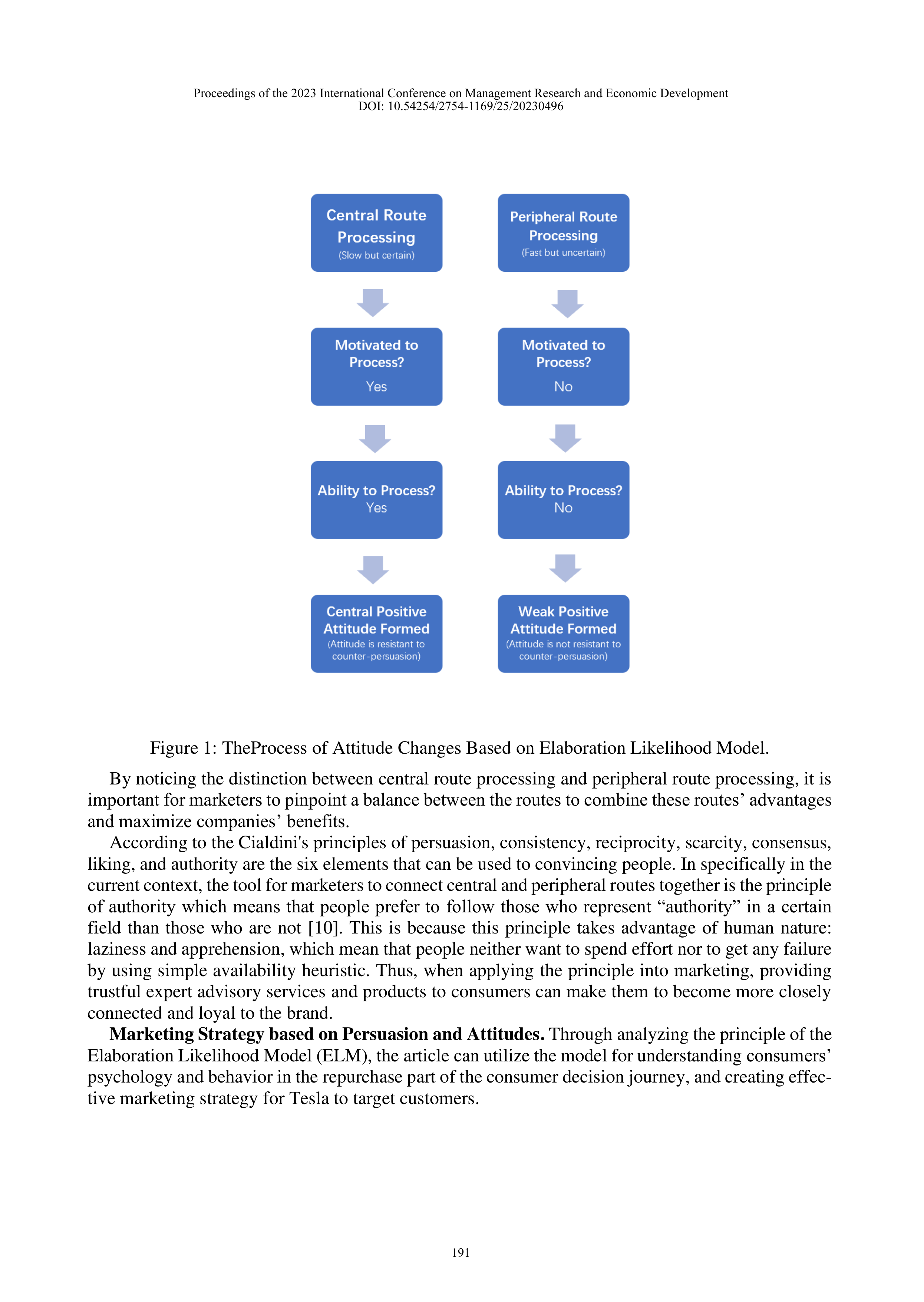
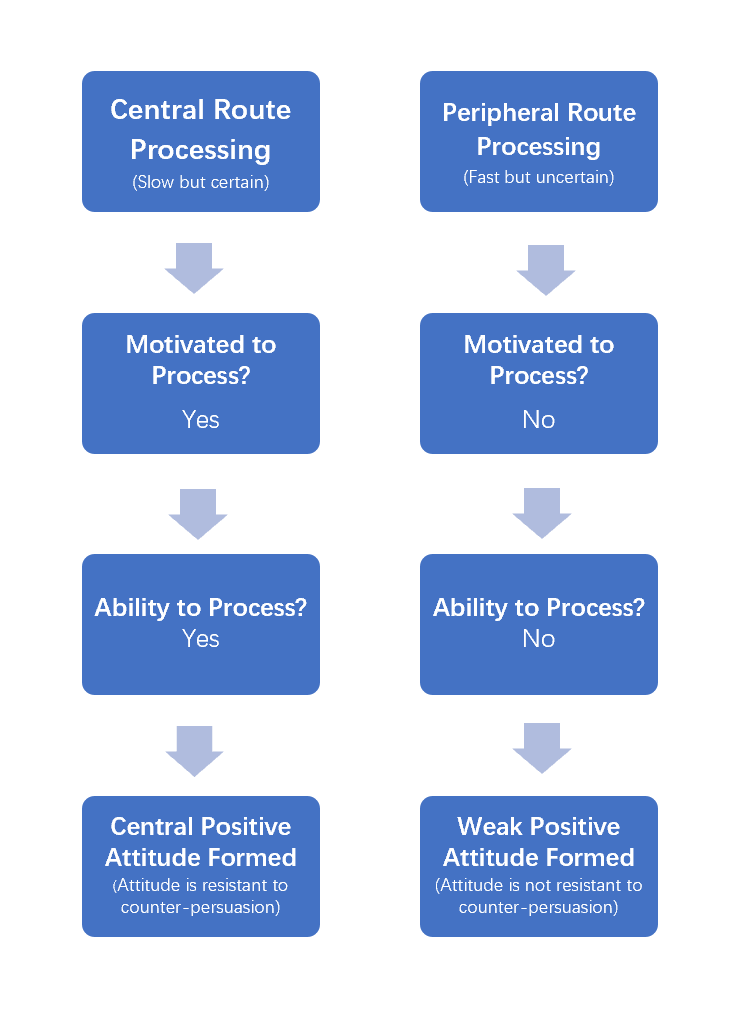
Figure 1: TheProcess of Attitude Changes Based on Elaboration Likelihood Model.
By noticing the distinction between central route processing and peripheral route processing, it is
important for marketers to pinpoint a balance between the routes to combine these routes’ advantages
and maximize companies’ benefits.
According to the Cialdini's principles of persuasion, consistency, reciprocity, scarcity, consensus,
liking, and authority are the six elements that can be used to convincing people. In specifically in the
current context, the tool for marketers to connect central and peripheral routes together is the principle
of authority which means that people prefer to follow those who represent “authority” in a certain
field than those who are not [10]. This is because this principle takes advantage of human nature:
laziness and apprehension, which mean that people neither want to spend effort nor to get any failure
by using simple availability heuristic. Thus, when applying the principle into marketing, providing
trustful expert advisory services and products to consumers can make them to become more closely
connected and loyal to the brand.
Marketing Strategy based on Persuasion and Attitudes.
Through analyzing the principle of the
Elaboration Likelihood Model (ELM), the article can utilize the model for understanding consumers’
psychology and behavior in the repurchase part of the consumer decision journey, and creating effec-
tive marketing strategy for Tesla to target customers.
Proceedings of the 2023 International Conference on Management Research and Economic Development
DOI: 10.54254/2754-1169/25/20230496
191
Although Tesla does not pay for any advertisement, the article recommends that Tesla invests in
inviting experts to share their results of test vehicles on social media in video from different countries
in video-form to attract customers and increase sales.
Usually, a car purchase is a considerable investment for families, so people often use a central
route to receive messages about cars. For example, they may go to each brand's offline stores to
collect and evaluate information. Although the information is accurate and reliable using this method,
it is not convenient for customers. Indeed, the unprofessional public may be unable to analyze their
collected information and single out the best car. Therefore, Tesla should both take the advantage in
central route (accuracy and validity) in the peripheral route (convenience and speed) and in authority
(high reliability) to grab consumers' attention. Through this measure, Tesla can enhance the process
of the consumer decision journey, specifically in the steps of prepurchase, and to strengthen consum-
ers' positive attitudes toward Tesla. As a result, the product of combining these three concepts is to
let Tesla invest money in inviting experts to test and share the results and experiences of Tesla cars
and other brands' cars on social media. In detail, the experts must provide correct information about
the car and explain each piece of data in video form. Besides, to ensure the positive direction of
consumers’ attitudes towards Tesla vehicles, Tesla has to continuously improve its products’ quality
and maintain its original “word-of-mouth” strategy, because lying is unacceptable in the new market-
ing strategy.
With the popularity of the Internet, more and more people are in the habit of casually browsing
various social media, such as TikTok, so Tesla should utilize this habit: The media is providing con-
venient access for consumers to unintentionally receive messages about Tesla in the form of periph-
eral route processing while the customer is obtaining accurate and reliable information from the ex-
pert who already used central route processing in collecting, comparing, and analyzing data from
different companies' cars. As a result, customers can get benefits by spending a few minutes watching
videos but receiving labor-intensive data. To ensure the validity of the information, Tesla needs to
invite experts with official certifications in car-related fields, and they should wear professionalism
in presenting to give the audience a fast, impressive positive image without carefully identifying the
experts' backgrounds.
This marketing strategy finds the common ground of elaboration likelihood model and Cialdini’s
principles of persuasion, and integrates the advantage of each psychological theory to meet maximum
positive effect in cultivating potential customers and turning them into real consumers. Also, the
strategy requires less financial investment from Tesla since Tesla needs to pay for the invitation of
experts and provide products for them to test in a short probationary period, but not to pay for deciding
the result of the examination. More importantly, this advertising strategy can boost the sales growth
of Tesla cars and not violate Tesla's existing core strategy, word-of-mouth advertising.
4.
Conclusion
This paper presents a market analysis of Tesla through an overview of the existing market of Tesla in
terms of product, service production and management practices. Respectively, it applies the termi-
nology of emotion and cognition and attitudes and persuasion in consumer behavioral psychology to
Tesla. As a result, an effective market operation strategy is proposed for Tesla.
The research significance of this study is how to show the role of consumer behavioral psychology
in marketing, where various studies have now shown the conditions of emotional identification and
attitude and persuasion of consumers. The relevance of the existence of the market analysis is to
create the ideal atmosphere for the consumer. This thesis according to knowledge from the Tesla
Proceedings of the 2023 International Conference on Management Research and Economic Development
DOI: 10.54254/2754-1169/25/20230496
192
website and consumer its own psychology, and then presents recommendations after the author's
analysis and summary.
This paper proposes specific strategies that can be summarized as follows: firstly, strengthening
the emotional resonance between Tesla and its customers. Secondly, improving attitudes in the con-
sumer decision-making process. These strategies aim to help open up new marketing channels for
Tesla to attract and maintain customers beyond its limited 'zero dollar' investment marketing strategy
to collaborate with its existing "words of mouth" strategy. As a result, by implementing these strate-
gies, Tesla can establish a stronger connection with its existing customers and expand its customer
base beyond its current marketing strategies. The authors hope that the scene-setting strategy pro-
posed by emotion and cognition will increase consumer interest in Tesla, increase sales and increase
brand recognition for Tesla. The second point is the KOL suggestion through attitudes and persuasion.
As an emerging brand, it is important for Tesla to use experts in the field to increase its brand trust
rather than just attracting customers through Elon Musk's 'humor'. This could help Tesla address con-
cerns among its potential customer base, such as the safety of autonomous driving.
In conclusion, emotion, and cognition, as well as attitudes and persuasion, play a significant role
in marketing strategies. Understanding the emotional and cognitive states of consumers is essential
to creating effective marketing campaigns that resonate with them. By utilizing key business theories
and principles such as Maslow's Hierarchy of Needs, the Self-Determination Theory, the Cialdini's
principles in the marketing campaigns, the suggestion of Tesla's is the scenario settings to appeal
customers’ resonance and key opinion leaders (KOLs) to increase their influence. It is an effective
strategy in creating a strong brand image and increasing brand awareness. The showcasing recom-
mendations for this paper have not provided an in-depth analysis of Tesla's point by point target
spectators. Prospect research could set out with an additional comprehensive client focusing on and
dive more profound through further psychological regulation.
Reference
[1]
Krogstrup, S., Oman, W.: Macroeconomic and financial policies for climate change mitigation: A review of the
literature. International Monetary Fund (2019).
[2]
Petrenko, L.A.: Green trend in global energy development: Tendencies and opportunities. International Journal of
Energy Economics and Policy, 11(5), 1–7 (2021).
[3]
Crabtree, G. W.: The coming electric vehicle transformation. Science, 366(6464), 422–424 (2019).
[4]
Alam, M., Devabhaktuni, V., Depuru, S. S. S. R., Green, R. C., Near, C. D., Nims, D. K.: Solar energy: Trends and
enabling technologies. Renewable & Sustainable Energy Reviews, 19, 555–564 (2013).
[5]
Techiexpert Tech News page, https://www.techiexpert.com/how-tesla-is-using-artificial-intelligence-and-big-data/,
last accessed 2023/3/30.
[6]
Fernandes, T. F., Proença, J. F.: Reassessing relationships in consumer markets: Emotion, cognition, and consumer
relationship intention. Journal of Relationship Marketing (2013).
[7]
Emilien, G., Lüdicke, F. Weitkunat, R.: Consumer perception of product risks and benefits. Springer (2017).
[8]
Cacioppo, J. T., Petty, R. E.: The elaboration likelihood model of persuasion. Elsevier EBooks, 123–205 (1986).
[9]
Gaissmaier, W., Gigerenzer, G.: Heuristic decision making. Annual Review of Psychology, 62(1), 451–482 (2011).
[10]
Guthrie, C.: Influence: Principles of influence in negotiation. Marquette Law Review, 87(4), 20 (2004).
Proceedings of the 2023 International Conference on Management Research and Economic Development
DOI: 10.54254/2754-1169/25/20230496
193