
International Journal of All Research Education and Scientific Methods (IJARESM),
ISSN: 2455-6211, Volume 13, Issue 10, October-2025,
Available online at:
www.ijaresm.com
“This work is licensed under a Creative Commons Attribution 4.0 International License.”
License url: https://creativecommons.org/licenses/by/4.0
Page | 731
Global Brand Battles: A Comparative Study of
Marketing and Branding Strategies of Coca-Cola and
PepsiCo A cross Key International Markets
Aryan Adgaonkar
1
, Shreya Choudhary
2
1
Shiv Nadar School,
2
Ashoka University
---------------------------------------------------------------****************--------------------------------------------------------------
ABSTRACT
This research paper explores the long standing rivalry between Coca-Cola and PepsiCo, focusing on how each
brand adapts its marketing and branding strategies across international markets. Beginning with their origins as
medicinal tonics in the late 19th century, the study traces their evolution into becoming global cultural icons.
Through a comparative analysis of North America, South Asia, Latin America and Europe, the paper highlights
how Coca-Cola relies on emotional storytelling, heritage and timeless identity, while Pepsi embraces a more youth-
centric, trend-driven branding approach. The role of digital marketing, social media and influencer collaborations is
examined to show how both companies build visibility and cultural resonance in different regions. Additionally, the
study evaluates consumer behaviour patterns, such as price sensitivity, taste preferences and brand loyalty,
alongside competitive responses including product diversification, CSR initiatives and crisis management. Findings
reveal that while Coca-Cola thrives in markets valuing tradition and emotional connection, Pepsi often excels in
regions where pop culture, youth identity and rapid cultural shifts dominate. Ultimately, the paper aims to show the
importance of balancing global brand consistency with local adaptability in shaping consumer preference and
sustaining long-term brand relevance.
Keywords: Coca-Cola, PepsiCo, global branding, marketing strategy, consumer behavior, cultural adaptation, Cola
Wars.
INTRODUCTION
In a busy Delhi market, a child holds a chilled bottle of Thumbs Up. Across the ocean, a college student opens a Diet Pepsi
between classes. Different places, different lives, yet both moments connect to the same story: the century-long rivalry
between Coca-Cola and Pepsi. Why does someone in Mumbai pick Pepsi instead of Coke? Is it the taste, the price, a
celebrity endorsement, or something deeper like memory and identity?
Coca-Cola’s story began in 1886 when Atlanta pharmacist John Stith Pemberton created a sweet, fizzy tonic from coca
leaves and kola nuts. His bookkeeper, Frank M. Robinson, gave it the name “Coca-Cola” and designed the script logo. At
first, the drink was sold as a medicine for five cents a glass. After Pemberton’s death in 1888, businessman Asa Candler
took over and expanded aggressively through franchised bottlers. That move laid the foundation for one of the first truly
global brands.
Pepsi was born in 1893 when Caleb Bradham, a pharmacist from North Carolina, introduced “Brad’s Drink,” a mix of
sugar, carbonated water, and kola nut. In 1898, he renamed it “Pepsi-Cola,” linking it to the digestive enzyme pepsin and
the word dyspepsia, which meant indigestion. Pepsi’s journey was rough. It went bankrupt during sugar shortages in the
Great Depression. Charles Guth later revived it by selling a 12-ounce bottle for the same five cents that Coca-Cola charged
for six ounces. This smart pricing move appealed to consumers trying to stretch their money and marked the beginning of
the “Cola Wars.”
From the start, the two brands followed very different paths. Coca-Cola patented its contour bottle in 1925 and built a
wholesome image with ads that tied the drink to American life, including the famous Santa Claus campaigns of the 1930s.
Pepsi focused on affordability with the slogan “twice the drink for the same price.” It also made history by featuring

International Journal of All Research Education and Scientific Methods (IJARESM),
ISSN: 2455-6211, Volume 13, Issue 10, October-2025,
Available online at:
www.ijaresm.com
“This work is licensed under a Creative Commons Attribution 4.0 International License.”
License url: https://creativecommons.org/licenses/by/4.0
Page | 732
African American consumers in national ads during the 1940s. Later, it turned to youth culture with catchy jingles and
celebrity promotions.
The rivalry grew sharper in the 1970s. Pepsi introduced the Pepsi Challenge in 1975, a blind taste test showing that many
people preferred Pepsi’s sweeter formula. This shook Coca-Cola’s dominance. In 1985, Coca-Cola responded with “New
Coke,” a sweeter recipe designed to appeal to younger drinkers. The move backfired. Loyal fans demanded the original
flavour, and Coca-Cola quickly brought it back as “Coca-Cola Classic.” What first looked like a mistake ended up
strengthening the brand’s emotional bond with its customers.
By then, Pepsi had tied itself firmly to youth culture, signing stars like Michael Jackson and Madonna. Coca-Cola went in a
different direction, leaning on its heritage, family appeal and global consistency. These bold moves, mistakes, and
reinventions shaped not only how the public saw the two companies but also how businesses worldwide learned to compete
in the age of mass marketing.
This research paper explores not just the beverages that we drink, but the identities that they sell. It begins with the origins
of Coca-Cola and Pepsi, two drinks that started off as medicinal tonics and evolved into cultural symbols across the globe.
In doing so, this paper seeks to answer the question – How do Coca-Cola and PepsiCo adapt their marketing and branding
strategies across different glob`al markets, and what factors influence consumer preference in each region?
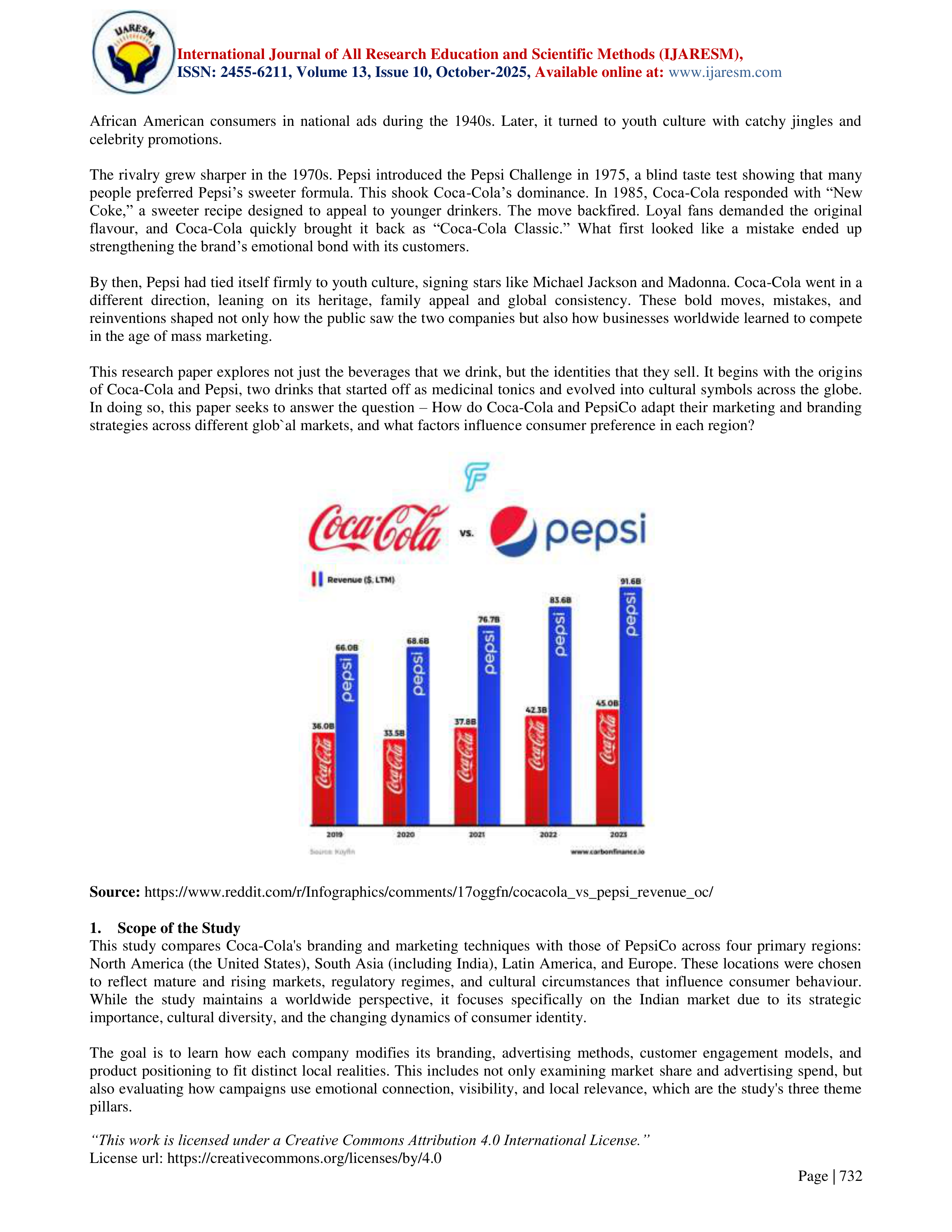
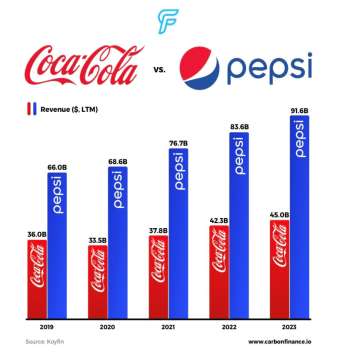
Source:
https://www.reddit.com/r/Infographics/comments/17oggfn/cocacola_vs_pepsi_revenue_oc/
1.
Scope of the Study
This study compares Coca-Cola's branding and marketing techniques with those of PepsiCo across four primary regions:
North America (the United States), South Asia (including India), Latin America, and Europe. These locations were chosen
to reflect mature and rising markets, regulatory regimes, and cultural circumstances that influence consumer behaviour.
While the study maintains a worldwide perspective, it focuses specifically on the Indian market due to its strategic
importance, cultural diversity, and the changing dynamics of consumer identity.
The goal is to learn how each company modifies its branding, advertising methods, customer engagement models, and
product positioning to fit distinct local realities. This includes not only examining market share and advertising spend, but
also evaluating how campaigns use emotional connection, visibility, and local relevance, which are the study's three theme
pillars.

International Journal of All Research Education and Scientific Methods (IJARESM),
ISSN: 2455-6211, Volume 13, Issue 10, October-2025,
Available online at:
www.ijaresm.com
“This work is licensed under a Creative Commons Attribution 4.0 International License.”
License url: https://creativecommons.org/licenses/by/4.0
Page | 733
3.1. North America (USA)
Coca-Cola and Pepsi originated in the United States, and it remains their most mature and competitive market today.
Branding strategies here are tightly linked with American identity and history, making it the foundation for many of their
global efforts.
Market Size & Share:
●
In 2023, the carbonated soft drink market in the United States brought in about $328.1 billion in revenue.
●
The market share of carbonated soft drinks in the United States as of 2023 was 19.2% for Coca-Cola and 8.3% for
PepsiCo's Pepsi brand, which was just overtaken by Dr Pepper at 8.34%.
Brand Positioning & Spend:
●
Coca-Cola makes significant investments in mass media and event sponsorships, such as the NFL, and continues to
have formal affiliations with FIFA and the Olympics, and its Super Bowl advertisements frequently rank among the
most costly advertisements, costing more than $5 million per 30-second slot.
●
PepsiCo has traditionally used youth-driven sponsorships to reach millennials and Gen Z, such as the Super Bowl
halftime show (until 2022) and collaborations with significant music festivals.
Advertising Strategy:
●
Coca-Cola's "Open Happiness" campaign and its annual Christmas ads, which showcase the Sundblom Santa, reinforce
the company's legacy positioning. Coca-Cola's timeless sentiments of peace, family, and nostalgia, like "Share a Coke"
and the "America the Beautiful" Super Bowl commercial.
●
Pepsi maintains its trend-centered identity of youth-centric, celebrity-driven branding with its "Live For Now" platform
and celebrity partnerships with pop singers ("Live for Now," Beyonce, Cardi B).
Local Adaptation:
●
While the United States promotes global strategies, it also demonstrates micro-targeting through racial inclusiveness,
digital segmentation, and region-specific packaging.
3.2. South Asia (India):
India is a dynamic, high-potential market where Coca-Cola and PepsiCo have had to actively adapt to local tastes, cultural
nuances, and fragmented media consumption habits
Market Share & Size:
●
India's carbonated beverage industry was valued at $75.1 billion in 2023, with a projected CAGR (Compound Annual
Growth Rate) of 6.5% through 2033.
●
Coca-Cola (including Thumbs Up, Sprite, and Maaza) controls around 60% of the CSD (Carbonated Soda Drink)
industry, with Thumbs Up alone surpassing Coke in Indian sales by 2022.
●
PepsiCo owns 30-35%, with 7UP and Mirinda being major contributions.
Branding Strategy:
●
While Pepsi markets itself as youthful, irreverent, and cricket-obsessed (e.g., “Har Ghoont Mein Swag”), Coca-Cola
brands like Thumbs Up and Sprite are marketed with bold, manly images (e.g., “Soft Drink Nahin, Toofan Hai”).
Cultural Touchpoints:
●
Both companies use prominent and popular celebrities, like Ranveer Singh, Katrina Kaif, and Salman Khan, and
heavily localise their advertisements for regional holidays like Diwali and Holi and use regional languages in many of
their advertisements.
●
In 2022, Coca-Cola was one of the top 5 advertisers in India, spending over ₹500 crore (approx. $60 million), per
TAM AdEx.
Localisation & Innovation:
●
Pricing and Distribution: Coca-Cola's "Project Unnati" and PepsiCo's direct distribution in tier-3 towns demonstrate
wider rural penetration, while single-serve PET bottles and ₹10 SKUs appeal to rural and budget-conscious consumers.
●
Sustainability: Both firms have introduced recyclable PET packaging and launched low-sugar variants like Coke Zero,
Pepsi Black to address health concerns.

International Journal of All Research Education and Scientific Methods (IJARESM),
ISSN: 2455-6211, Volume 13, Issue 10, October-2025,
Available online at:
www.ijaresm.com
“This work is licensed under a Creative Commons Attribution 4.0 International License.”
License url: https://creativecommons.org/licenses/by/4.0
Page | 734
India serves as an example of the complete range of hyper-localized marketing, where achieving brand preference
necessitates aligning with language identities and cultural rhythms in addition to consumer preferences.
3.3. Latin America:
High per capita consumption, a robust youth population, and branding techniques entwined with music, sports, and social
life are characteristics of Latin America, especially markets like Mexico and Brazil.
Market Dynamics:
●
With more than 600 servings per person per year, Mexico is one of the countries with the highest per capita Coca-Cola
consumption rates in the world.
●
According to 2019 data, Mexico consumes the most soda worldwide per person, with 630 eight-ounce cups per year
(WJoud). Argentina and Brazil are also two of the biggest consumers in the globe.
●
Strong cultural preferences for carbonated drinks and a lack of local substitutes are driving market expansion.
Market Share:
●
Coca Cola: Dominates with roughly 70–75% share in key markets like Mexico
●
Pepsi: Holds 12.7% of PepsiCo’s global beverage sales in Latin America
Fruit-flavoured soda brands such as Jarritos provide as examples of speciality positioning potential and By taking use of
nationalist branding, indigenous companies like Postobón (Colombia) and Inca Kola (Peru) compete with both
multinational behemoths.
To combat this, Pepsico. places greater emphasis on affordability, local influencers, and music festivals. Its support of Rock
in Rio and campaigns with a reggaeton theme demonstrate a shift towards youth-driven involvement. Coca-Cola makes use
of their family-friendly branding and connections to football, regional culture, and funfair festivities.
Cultural Relevance:
●
Both of these enterprises create localised flavours (e.g., tamarind varieties), collaborate with Latin pop artists, and use
day-of-the-dead packaging to promote cultural immersion.
●
Therefore the key to success in Latin America is lifestyle branding and emotional connection through music and
celebration.
3.4. Europe:
European markets depict a mature, highly regulated ecosystem, with public health, sustainability, and ethical branding as
major considerations.
Regulatory Context:
●
Countries such as the United Kingdom, France, and Norway impose sugar tariffs and require calorie disclosures,
which influence both product formulation and advertising claims.
●
The Consumers in this region are increasingly health- and sustainability-oriented.
●
Coca-Cola focuses on low- and no-calorie varieties (for example, Coke Zero Sugar, which was released across EU
nations with regionally adapted messaging) as well as circular packaging.
●
PepsiCo invests substantially in reformulated beverages, low-sugar lines (Pepsi Max), and supports the EU's
sustainability goal (for example, 100% recycled PET bottles in select areas).
●
In 2021, 69.2% of soft drinks sold in the UK were low- or no-sugar due to sugar-tax laws, such as the Soft Drinks
Industry Levy enacted in 2018.
Market Shares & Positioning:
●
According to Wikipedia, PepsiCo Europe generates 14.5% of the company's overall beverage income. Coca-Cola holds
a 45-50% market share in carbonates in developed markets such as the UK, Germany, and France.
●
Both firms focus on sugar-free products (Coke Zero, Pepsi Max), environmental initiatives (PlantBottle, recycling
partnerships), and multilingual marketing strategies.
Advertising Tone and Spend:
●
Campaigns focus on wellness, authenticity, and environmental responsibility, and are frequently more subdued and
socially sensitive than those in the Americas or Asia.

International Journal of All Research Education and Scientific Methods (IJARESM),
ISSN: 2455-6211, Volume 13, Issue 10, October-2025,
Available online at:
www.ijaresm.com
“This work is licensed under a Creative Commons Attribution 4.0 International License.”
License url: https://creativecommons.org/licenses/by/4.0
Page | 735
●
The United Kingdom, Germany, and France are among PepsiCo and Coca-Cola's top European advertising markets,
notably in outdoor and digital platforms.
Europe's example is a case study in brand responsibility, showcasing how multinational corporations negotiate health and
environmental criticism while remaining relevant and trustworthy.
These four locations demonstrate the adaptability of global branding strategies: while basic brand identities stay unchanged,
messaging, media, and consumer involvement are altered to reflect local feelings, rules, and cultural archetypes. The
comparative study that follows seeks to delve deeper into these dynamics, evaluating how two of the world's most
recognisable brands maintain competitiveness in a fragmented, developing, and emotionally charged global beverage
landscape.
2.
Importance of Branding and Marketing in the Beverage Industry
Emotional branding builds a bond that goes beyond the product. Pepsi speaks to youthful energy with trend-driven
campaigns like “Live for Now” and ads with a number of celebrities. Coca-Cola takes a different route, focusing on
happiness and togetherness through campaigns like “Open Happiness” and “Taste the Feeling.” These messages create a
sense of shared experiences around family, friendship and celebration. Over time, grabbing a Coke or a Pepsi becomes less
about thirst and more about choosing the brand that feels closest to your own identity.
Visibility plays a huge role too. You cannot escape these brands. Pepsi invests in Super Bowl halftime shows and global
sports sponsorships, while Coca-Cola relies on its classic red contour bottle and ever-present logo. The more you see a
brand, the more likely you are to remember it on the shelf.
Modern campaigns add another layer to this: personalisation. Coca-Cola’s “Share a Coke” initiative, which let you print
your own name on a bottle, turned a soft drink into something personal and shareable. Weather-triggered ads and other
data-driven strategies push this even further. These efforts build trust and loyalty because they make customers feel
included rather than targeted by brands that they are consuming.
Local culture matters just as much as global identity. In India, Pepsi built strong connections with cricket sponsorships like
“Change the Game” and famous Bollywood stars. Coca-Cola designed ads for festivals like Diwali and Durga Puja, using
regional languages and traditions to their marketing advantage. A festival-themed Coke ad often resonates more deeply than
a generic global message. This kind of cultural sensitivity shows respect, and it helps both companies feel authentic in local
markets.
Together, emotional branding, visibility, personalisation, and localization turn soda marketing into more than just product
promotion. They sell identities and experiences, making the choice between Coke and Pepsi less about flavour and more
about how each brand fits into your life.
3.
Digital Marketing and Social Media
Coca-Cola and Pepsi have historically used very different brand positioning tactics, articulated mostly through slogans and
core messaging.
4.1. Visual Identity
Coca-Cola and PepsiCo both rely on psychology, cultural symbols and adaptability to shape how people see their brands.
Over the years, each has updated its look to reflect its values and connect with audiences around the world.
Coca-Cola’s visual identity is one of the most recognisable in history. Its red and white colours signal warmth, excitement,
and joy, drawing on the psychology of red, which raises heart rate and stimulates appetite. The script logo, created by Frank
M. Robinson in the 1880s, has barely changed, reinforcing a sense of heritage. Packaging innovations, especially the
contoured “hobble skirt” bottle of 1915, gave Coca-Cola an edge in crowded markets. Visual icons like polar bears, vintage
cars, and the modern image of Santa Claus, popularised by Coca-Cola ads in the 1930s, tied the brand to tradition and
family celebrations. In India, festival-themed packaging, such as Diwali cans with Hindi lettering and cultural motifs, helps
the brand feel local and personal.
Pepsi has taken a different path. Its visual identity changes often, reflecting its focus on youth and modernity. The red,
white, and blue color palette was first adopted in the 1940s as a patriotic gesture during wartime America. Since then, Pepsi
has leaned on bold geometric shapes and minimal designs to project freshness and energy. Its logo has been updated more

International Journal of All Research Education and Scientific Methods (IJARESM),
ISSN: 2455-6211, Volume 13, Issue 10, October-2025,
Available online at:
www.ijaresm.com
“This work is licensed under a Creative Commons Attribution 4.0 International License.”
License url: https://creativecommons.org/licenses/by/4.0
Page | 736
than ten times, evolving from a simple bottle cap to the 2008 globe with a “smile.” The colour blue signals coolness, trust,
and modern style, and it clearly sets Pepsi apart from Coca-Cola’s red. Pepsi often ties packaging changes to campaigns or
celebrity partnerships, with limited-edition cans featuring global stars. In India, cricket-themed packaging and bold street-
inspired lettering have strengthened its connection with young consumers.
4.2. Influencer Marketing
Coca-Cola frequently partners with influencers who convey optimism, inclusivity and cultural connection, including global
musicians and creators who embody positivity. Pepsi, meanwhile, often collaborates with high-profile celebrities and pop
culture icons to generate bold, viral content aimed at dominating youth-oriented timelines
For instance, Coca-Cola’s global “Recipe for Magic” campaign combined celebrity endorsements, such as Gigi Hadid and
actor Yang Yang, with over 750 micro-influencers worldwide who shared food-related content on TikTok. This dual
strategy balanced aspirational appeal with authenticity, helping Coca-Cola generate strong engagement across
demographics (Ad Age, 2023). Similarly, Coca-Cola’s #ShareTheMagic TikTok initiative, which partnered with musician
Khalid and viral creator Jalaiah Harmon, got nearly 12 billion views, showing how the brand leverages a mix of cultural
icons and grassroots influencers to maintain relevance with younger consumers. In regional markets, Coca-Cola also adapts
its influencer strategy: in India, creators like Kusha Kapila and Ankita Sahigal have been engaged to highlight how Coca-
Cola integrates into everyday food and social experiences, emphasising both cultural fit and relatability.
Pepsi, in contrast, often uses a more entertainment-driven approach by collaborating with high-profile celebrities and social
media figures that they youth would want to see. The #PepsiApplePieChallenge on TikTok invited influencers and users
alike to create content around a limited-edition holiday flavour, generating widespread participation and viral engagement.
Pepsi’s #SayItWithPepsi emoji campaign, fronted by DJ Khaled on Snapchat, achieved a 30% increase in teen engagement
by combining digital product design with influencer amplification. In India, Pepsi’s “Salaam Namaste Karo Swag Se”
campaign enlisted Salman Khan and Sonu Sood alongside a wide network of digital creators, achieving more than 84
million views and demonstrating the brand’s ability to merge celebrity endorsement with mass influencer participation.
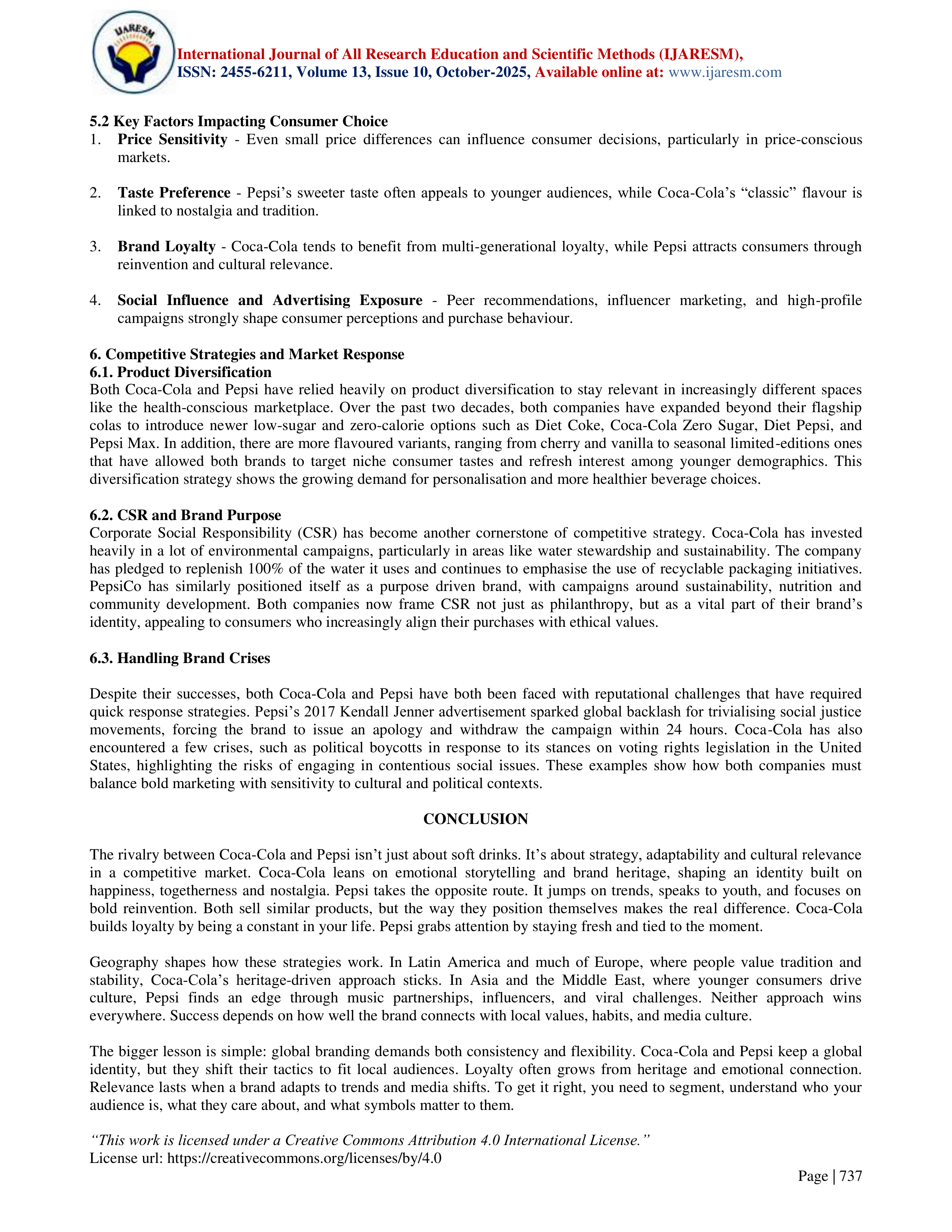
Source:
https://www.brandwatch.com/blog/the-coke-vs-pepsi-social-presence-showdown/
4.
Consumer Behaviour Analysis
5.1 Secondary Data
Secondary data offers a broad picture of how consumers perceive Coca-Cola and Pepsi. Regional market share highlights
that Coca-Cola often dominates in markets where tradition and emotional connection play a central role, while Pepsi
performs better in youth-driven, trend-sensitive regions. Brand loyalty indexes typically show Coca-Cola with stronger
long-term consumer attachment, whereas Pepsi scores higher in creating short-term excitement. Ad recall studies further
suggest that Pepsi’s celebrity-driven campaigns achieve immediate recognition, while Coca-Cola’s narrative storytelling
fosters deeper, more lasting impressions.

International Journal of All Research Education and Scientific Methods (IJARESM),
ISSN: 2455-6211, Volume 13, Issue 10, October-2025,
Available online at:
www.ijaresm.com
“This work is licensed under a Creative Commons Attribution 4.0 International License.”
License url: https://creativecommons.org/licenses/by/4.0
Page | 737
5.2 Key Factors Impacting Consumer Choice
1.
Price Sensitivity
- Even small price differences can influence consumer decisions, particularly in price-conscious
markets.
2.
Taste Preference
- Pepsi’s sweeter taste often appeals to younger audiences, while Coca-Cola’s “classic” flavour is
linked to nostalgia and tradition.
3.
Brand Loyalty
- Coca-Cola tends to benefit from multi-generational loyalty, while Pepsi attracts consumers through
reinvention and cultural relevance.
4.
Social Influence and Advertising Exposure
- Peer recommendations, influencer marketing, and high-profile
campaigns strongly shape consumer perceptions and purchase behaviour.
6. Competitive Strategies and Market Response
6.1. Product Diversification
Both Coca-Cola and Pepsi have relied heavily on product diversification to stay relevant in increasingly different spaces
like the health-conscious marketplace. Over the past two decades, both companies have expanded beyond their flagship
colas to introduce newer low-sugar and zero-calorie options such as Diet Coke, Coca-Cola Zero Sugar, Diet Pepsi, and
Pepsi Max. In addition, there are more flavoured variants, ranging from cherry and vanilla to seasonal limited-editions ones
that have allowed both brands to target niche consumer tastes and refresh interest among younger demographics. This
diversification strategy shows the growing demand for personalisation and more healthier beverage choices.
6.2. CSR and Brand Purpose
Corporate Social Responsibility (CSR) has become another cornerstone of competitive strategy. Coca-Cola has invested
heavily in a lot of environmental campaigns, particularly in areas like water stewardship and sustainability. The company
has pledged to replenish 100% of the water it uses and continues to emphasise the use of recyclable packaging initiatives.
PepsiCo has similarly positioned itself as a purpose driven brand, with campaigns around sustainability, nutrition and
community development. Both companies now frame CSR not just as philanthropy, but as a vital part of their brand’s
identity, appealing to consumers who increasingly align their purchases with ethical values.
6.3. Handling Brand Crises
Despite their successes, both Coca-Cola and Pepsi have both been faced with reputational challenges that have required
quick response strategies. Pepsi’s 2017 Kendall Jenner advertisement sparked global backlash for trivialising social justice
movements, forcing the brand to issue an apology and withdraw the campaign within 24 hours. Coca-Cola has also
encountered a few crises, such as political boycotts in response to its stances on voting rights legislation in the United
States, highlighting the risks of engaging in contentious social issues. These examples show how both companies must
balance bold marketing with sensitivity to cultural and political contexts.
CONCLUSION
The rivalry between Coca-Cola and Pepsi isn’t just about soft drinks. It’s about strategy, adaptability and cultural relevance
in a competitive market. Coca-Cola leans on emotional storytelling and brand heritage, shaping an identity built on
happiness, togetherness and nostalgia. Pepsi takes the opposite route. It jumps on trends, speaks to youth, and focuses on
bold reinvention. Both sell similar products, but the way they position themselves makes the real difference. Coca-Cola
builds loyalty by being a constant in your life. Pepsi grabs attention by staying fresh and tied to the moment.
Geography shapes how these strategies work. In Latin America and much of Europe, where people value tradition and
stability, Coca-Cola’s heritage-driven approach sticks. In Asia and the Middle East, where younger consumers drive
culture, Pepsi finds an edge through music partnerships, influencers, and viral challenges. Neither approach wins
everywhere. Success depends on how well the brand connects with local values, habits, and media culture.
The bigger lesson is simple: global branding demands both consistency and flexibility. Coca-Cola and Pepsi keep a global
identity, but they shift their tactics to fit local audiences. Loyalty often grows from heritage and emotional connection.
Relevance lasts when a brand adapts to trends and media shifts. To get it right, you need to segment, understand who your
audience is, what they care about, and what symbols matter to them.

International Journal of All Research Education and Scientific Methods (IJARESM),
ISSN: 2455-6211, Volume 13, Issue 10, October-2025,
Available online at:
www.ijaresm.com
“This work is licensed under a Creative Commons Attribution 4.0 International License.”
License url: https://creativecommons.org/licenses/by/4.0
Page | 738
In the end, the Coca-Cola vs. Pepsi story shows that there’s no single formula for global branding. Success comes from
balancing tradition with reinvention, emotion with cultural agility, and consistency with local relevance.
REFERENCES
[1].
Pendergrast, M. (2013). For God, country, and Coca-Cola: The definitive history of the great American soft drink
and the company that makes it. Basic Books.
[2].
https://www.basicbooks.com/titles/mark-pendergrast/for-god-country-and-coca-cola/9780465054688/
[3].
Holt, D. B. (2004). How brands become icons: The principles of cultural branding. Harvard Business Press.
https://www.hbs.edu/faculty/Pages/item.aspx?num=14722
[4].
Holt, D. B. (2002). Why do brands cause trouble? A dialectical theory of consumer culture and branding. Journal of
Consumer
Research,
29(1),
70–90.
https://doi.org/10.1086/339922
[5].
Statista. (2023). Coca-Cola and PepsiCo: Market share by region and brand performance. Retrieved August 22,
2025, from https://www.statista.com
[6].
Euromonitor International. (2023). Soft drinks in global markets: Company share and forecasts. Retrieved August
22, 2025, from https://www.euromonitor.com
[7].
McKinsey & Company. (2021). Consumer behavior in emerging markets: Focus on India and Latin America.
Retrieved August 22, 2025, from https://www.mckinsey.com
[8].
Time Magazine. (2017, April 5). Pepsi’s Kendall Jenner ad was a total disaster. Retrieved August 22, 2025, from
https://time.com/4726500/pepsi-ad-kendall-jenner/
[9].
Advertising Age. (Various years). Top 100 ad campaigns, slogan histories, and brand stories. Retrieved August 22,
2025, from https://adage.com
[10].
Pitchfork. (2018, May 3). How Pepsi used pop music to build an empire. Retrieved August 22, 2025, from
https://pitchfork.com/thepitch/1431-how-pepsi-used-pop-music-to-build-an-empire/
[11].
Florafountain. (2023). Pepsi vs Coca-Cola: Analysis of their marketing strategies. Retrieved August 22, 2025, from
https://florafountain.com/pepsi-vs-coca-cola-analysis-of-their-marketing-strategies/
[12].
Wikipedia. (2023). Share a Coke. Retrieved August 22, 2025, from https://en.wikipedia.org/wiki/Share_a_Coke
[13].
ResearchGate. (2015). Brand storytelling: The case of Coca-Cola’s Journey corporate website. Retrieved August 22,
2025,
from
https://www.researchgate.net/publication/283327146_Brand_storytelling_The_Case_of_Coca-
Cola_%27s_Journey_Corporate_Website
[14].
Wikipedia.
(2023).
Criticism
of
Coca-Cola.
Retrieved
August
22,
2025,
from
https://en.wikipedia.org/wiki/Criticism_of_Coca-Cola
[15].
Maverick, J. B. (2025, March 18). Coke vs. Pepsi: Who rules the beverage industry? Investopedia. Retrieved August
22, 2025, from https://www.investopedia.com/ask/answers/060415/how-much-global-beverage-industry-controlled-
coca-cola-and-pepsi.asp
[16].
NDTV News Desk. (2025, March 5). Cold (drink) war returns? Pepsi vs Coca-Cola over 'Anytime' vs 'Half-Time'.
NDTV. Retrieved August 22, 2025, from https://www.ndtv.com/india-news/pepsi-vs-coca-cola-cold-drink-war-
returns-pepsi-vs-coca-cola-over-anytime-vs-half-time-7852712
[17].
McKelvey, S. M. (2006). Coca-Cola vs. PepsiCo--A" super" battleground for the cola wars?. Sport Marketing
Quarterly, 15(2).
[18].
Andersson, E. L., Arvidsson, E., & Lindström, C. (2006). Coca-Cola or Pepsi; that is the Question: A study about
different factors affecting consumer preferences.
[19].
Anukeerthi, S., & Subburayan, B. (2024). Comparative Analysis of Advertisement Strategies used by Coca-Cola and
Pepsi: A Literature Review Study. Shanlax International Journal of Arts, Science and Humanities, 11.
[20].
Hillman, B. J. (2009). Coke vs Pepsi. Journal of the American College of Radiology, 6(10), 666.
[21].
Mundra, N., Gulati, K., & Gupta, R. (2012). A Comparative Analysis of the Customer's Perception on Carbonated
Drinks: Pepsi versus Coca-Cola versus RC-Cola. Khoj Journal of Indian Management Research & Practices, 3(2).
[22].
Coca-Cola
vs.
Pepsi
Revenue.
https://www.reddit.com/r/Infographics/comments/17oggfn/cocacola_vs_pepsi_revenue_oc/
[23].
The Coke vs Pepsi Social Presence Showdown. https://www.brandwatch.com/blog/the-coke-vs-pepsi-social-
presence-showdown/