Proceedings of ICMRED 2025 Symposium: Effective Communication as a Powerful Management Tool
DOI: 10.54254/2754-1169/2025.BL23798
© 2025 The Authors. This is an open access article distributed under the terms of the Creative Commons Attribution License 4.0
(https://creativecommons.org/licenses/by/4.0/).
142
Research on the Localization Digital Marketing Strategy of
McDonald's in Chinese Market
Jiayi Zheng
1*
, Xuanying Chen
2
, Zhuoran Hu
3
1
Nanjing Tech University Pujiang Institute, Nanjing, China
2
Shanghai Pinghe Bilingual School, Shanghai, China
3
Shanghai HD Bilingual School, Shanghai, China
*Corresponding Author. Email: zhengjiayi0203@163.com
Abstract:
In the current digital era, the fast food industry in China has achieved remarkable
development, and marketing strategies are crucial for the success of brands. McDonald's, as
a global fast food giant, this research aims to explore the strategic mechanism and impact of
McDonald's localization digital marketing in China through a comprehensive analysis. This
research focuses on investigating the influence of factors such as price, advertising promotion
forms, and joint promotions on its marketing effectiveness. The research adopts the method
of random sampling to distribute online questionnaires, and uses conjoint analysis to select
720 respondents to consider the attributes of price, advertising promotion forms, and joint
promotions and their different levels. The results show that price has a significant negative
correlation with consumers' purchase intention, while advertising promotion forms and joint
promotions have no significant impact on purchase intention. The research indicates that
McDonald's should pay close attention to the price factor when formulating marketing
strategies, and utilize different advertising promotion and joint promotion methods to attract
consumers. At the same time, it can conduct stratified marketing based on big data, strengthen
emotional connection with young people, enhance brand loyalty, and increase consumer
stickiness.
Keywords:
Digital Media, Marketing Strategy, Brand Image Construction, Customer
Interaction, Localization.
1.
Introduction
In recent years, propelled by factors such as the continuous growth of the urban population, the
expansion of the young consumer group, the busy lifestyle, and the evolving eating habits, China's
fast-food industry has witnessed remarkable development. In this highly competitive fast-food market,
marketing approaches have become particularly crucial. With the advancement of the times, digital
media has gradually emerged as one of the primary channels for data dissemination in today's era.
The promotion of major brands is inseparable from it. At the same time, as Chinese consumers
increasingly prefer foods that can reflect their culture and taste, local fast-food chains have been
gaining more popularity, challenging the dominance of international chains. The competition among
them is becoming more intense. Therefore, in response to the changes in society today, in order to
solidify McDonald's dominant position in the fast-food industry, localized digital marketing has
become the main focus of McDonald's marketing efforts.
Proceedings of ICMRED 2025 Symposium: Effective Communication as a Powerful Management Tool
DOI: 10.54254/2754-1169/2025.BL23798
143
First of all, McDonald's is a renowned fast-food brand that specializes in selling a variety of fast
foods, mainly including burgers, colas, French fries, fried chicken, snacks, and desserts. As early as
1954, a man named Ray Kroc discovered a small hamburger shop in California, marking the first
page in the history of McDonald's. Subsequently, starting from an unremarkable small restaurant,
McDonald's gradually grew and became well-known. Since 1990, McDonald's has opened its first
fast-food restaurant in mainland China in Shenzhen. Compared with KFC, McDonald's is a latecomer
to the Chinese fast-food market. For instance, KFC opened its first restaurant in Beijing as early as
1987, while McDonald's chose to open its first store in China three years later than KFC. In 1992,
McDonald's opened its first restaurant in Beijing, China. As of April 13, 2023, McDonald's has
already had 5,746 stores in China.
For example, in early 2020, McDonald's proposed a new product "5G fried chicken" advertisement.
The reason why the topic of the advertisement is “5G” is because a electronic technology company
“Apple” launched the new iPad Pro at that time, which caused heated discussions on the Internet. The
concept of Apple's new product was again cited by McDonald's, and its advertising copy claimed to
produce a "5G new product", which drew consumers' attention. However, the actual "5G" of
McDonald’s new product is the five outstanding points: “Chunk” “Taste” “Tender” “Juiciness” and
“Crispy” associated with McDonald's fried chicken.[1] Since the main consumer group of
McDonald's consists mostly of young customers, who, as McDonald's loyal customers, visit a
McDonald's restaurant an average of 44 times a year, when McDonald's capitalizes on the high level
of attention given to online trending keywords and combines the company's new products with these
popular online terms, or links them to relevant and trendy fields, it can better associate the products
with the trending keywords. This strategy piques the interest of young consumers and boosts the
online popularity and visibility of McDonald's new products. In addition, this has also enhanced the
promotional effectiveness of fried chicken. Meanwhile, the interaction between consumers and the
brand on social media has continuously contributed to the shaping of the brand image. Moreover,
such interactions have led to a significant surge in brand discussions, facilitating the implementation
of online marketing strategies. Not only that, McDonald's has launched numerous co-branded
products to attract specific customer segments and increase its online visibility. For instance, it
collaborated with Ultraman to introduce miniature mahjong sets, and partnered with Minions to
release children's toys. Furthermore, McDonald's caters to different customer demographics by
offering meal packages that align with their psychological price points.
In general, McDonald's successful advertising cases and effective co-branding promotion methods
are worthy of our study. As one of the leading brands in China's fast-food market, McDonald's can
provide other global multinational companies in the same industry with case support regarding
China's localized digital marketing strategies. Therefore, our team will conduct research on
McDonald's localized digital marketing strategies in the Chinese market. (These strategies include
cultural integration, co-branding and interaction, price adjustments, product localization, and the
localization of sales channels, among others.) Through methods such as linear regression and
statistical analysis, we will explore the impact of factors like price, advertising push formats, and co-
branding collaborations on McDonald's marketing effectiveness. We will also understand how
McDonald's integrates its advertising promotion with digital marketing. By doing so, we aim to
analyze the overall influence of McDonald's localized digital marketing strategies employed in the
Chinese market on the brand.
2.
Literature review
The localization digital marketing strategy refers to the enterprise adjusting its digital marketing
strategy to the local environment according to the culture, consumer behavior and market demand of
different countries and regions, so as to attract and retain local consumers more effectively. This
Proceedings of ICMRED 2025 Symposium: Effective Communication as a Powerful Management Tool
DOI: 10.54254/2754-1169/2025.BL23798
144
theoretical framework provides a key analytical dimension for analyzing the digital transformation of
McDonald's China. The core of this strategy is to improve the affinity and market competitiveness of
the brand by localizing content, adapting to local marketing channels, and integrating cultural
elements. The above strategy is reflected by adjusting prices, advertising promotion on different
platforms, joint cooperation and other forms.
(a)
Product localization
McDonald's pays attention to localization in product strategy, launches food that meets the taste
of Chinese consumers, such as golden steamed bread, cereal porridge, etc., and adopts traditional
Chinese cultural elements for advertising to enhance consumers' psychological identity and emotional
resonance. McDonald's locked the Chinese market after the Chinese consumer's eating habits and
food culture
On the basis of a lot of research, for Chinese consumers launched McNuggets, McNuggets and
McSpicy chicken burger and other fast food in line with the eating habits of Chinese consumers, so
quickly occupied China's fast food market [2-4] .
(b)
Localization of sales channels
McDonald's has significantly improved service efficiency and customer experience by introducing
digital tools such as smart ordering machines, mobile apps, and wechat mini programs. The
application of these technologies makes it more convenient for customers to complete the process of
ordering, paying and picking up meals, thus enhancing customer stickiness and brand loyalty. In
mobile payments and food delivery services
McDonald's has cooperated with China's leading mobile payment platforms such as Wechat Pay
and Alipay to provide diversified payment methods and greatly facilitate consumers. Through
cooperation with third-party delivery platforms and the development of our own App, we have
increased the proportion and revenue of delivery business. On May 13, 2017, when McDonald's held
a conference on Wild Future 2.0, it was revealed that the hospital had opened Wechat Alipay payment
in its Chinese stores
Since the mobile payment method has accounted for 45%, the whole process of scanning code
payment only takes 2 seconds, which greatly improves the service efficiency. In addition, the take-
out business of Yuan McDonald's in recent years is also a new sales growth point. Yuan's Chinese
stores receive an average of 10% of their revenue from take-out Yuan, and even some stores can reach
20% to 40%. [3]
(c)
Localization of communication channels
McDonald's has set up an official account on Weibo, using the social media platform to promote
the brand and promote new products. The high communication efficiency of micro-blog enables
McDonald's to quickly enhance brand awareness. McDonald's uses Tiktok live to carry out product
promotion through short video platforms to enhance brand exposure and market influence.
McDonald's conducts content marketing on the Redbook platform to enhance the brand's interaction
with young consumers.[5]
(d)
Cultural integration, co-branding and interaction
McDonald's combined Chinese traditional cultural elements, launched such as "Forbidden City
bucket" and "Forbidden City toy chess" and other products, these measures not only enhance the
localization image of the brand, but also through the new media platform to obtain good
communication effect. Through these strategies, McDonald's not only built a strong brand awareness
among young consumers, molded a positive image of McDonald's integration into local culture, but
also realized the maximization of brand benefits. [6] McDonald's carries out interactive activities on
social media platforms such as Weibo, such as the "late-night open mic" topic and the "Licking the
cylinder to see the world" interactive activity. [5,7] In addition, McDonald's has also partnered with
fashion brand JPK to launch co-branded bespoke fashion clothing to appeal to younger consumers.
Proceedings of ICMRED 2025 Symposium: Effective Communication as a Powerful Management Tool
DOI: 10.54254/2754-1169/2025.BL23798
145
These activities stimulate user interest and engagement through interactive games and discussion
topics. [2,8]
(e)
Price adjustments
In China, McDonald's adjusts product prices to adapt to the local market, which not only includes
the optimization of raw material costs and supply chain adjustment, but also achieves cost reduction
through large-scale procurement, so as to provide consumers with more cost-effective products. [9]
This strategy allows McDonald's to maintain a price advantage in a highly competitive market and
attract more consumers. McDonald's pricing strategy in different countries shows significant
flexibility.[4] According to relevant research, McDonald's pricing policies in countries around the
world are different, for example, the price of Big MAC in Australia is 2.65 Australian dollars, while
in China it is 9.8 yuan.[10]
3.
Methodology
3.1.
Participants
The study utilized random sampling to gather respondents through the dissemination of an online
survey. Marketing researchers have applied conjoint analysis for measuring and analyzing consumer
preferences. Sethuraman, R., Kerin, R. A., & Cron, W. L. [11] suggested that online distribution of
surveys was plausible when doing conjoint analysis. The survey was accessible from 2 March 2025
to 4 March 2025. A total of 720 results were collected.
3.2.
Conjoint design
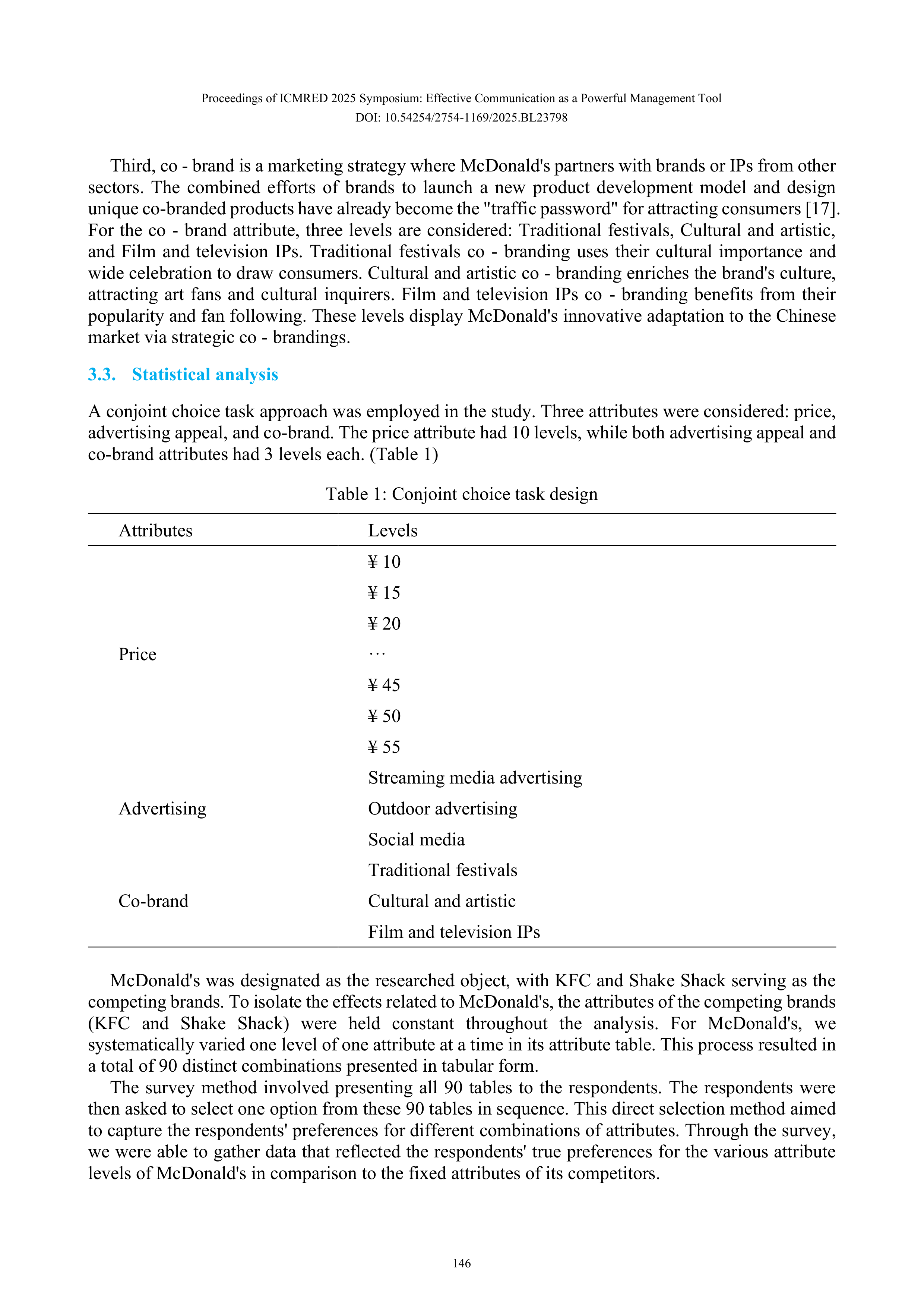
This study considered Price (10yuan, 15yuan, 20yuan, 25yuan, 30yuan, 35yuan, 40yuan, 45yuan,
50yuan, 55yuan), Advertising promotion form (Streaming media advertising, Outdoor advertising,
Social media), Co-brand (Traditional festivals, Cultural and artistic, Film and television Ips.
The first attribute, price, pertains to the diverse prices of McDonald's products in the Chinese market.
In China's highly competitive and segmented consumer landscape, price is pivotal for luring
customers. It's a core factor in consumers' purchase decisions. Since customers’ perception of product
price impacts their buying choice [12] and satisfied customers often return without comparing to
rivals [13], price is crucial for McDonald's local marketing. Ten price levels are considered: 10 yuan,
15 yuan, 20 yuan, 25 yuan, 30 yuan, 35 yuan, 40 yuan, 45 yuan, 50 yuan, 55 yuan. Budget - friendly
prices (10 yuan, 15 yuan, 20 yuan, 25 yuan) for basic items like classic burgers and fries target price
- sensitive consumers, especially students and those on a tight budget. Mid - range prices (30 yuan,
35 yuan, 40 yuan, 45 yuan) are for products with better ingredients or larger portions. Premium prices
(50 yuan, 55 yuan) are for new or exclusive items like limited - edition burgers, aiming at consumers
willing to pay more for a special experience. These levels reflect McDonald's common pricing
strategies in the diverse Chinese market.
Second, advertising promotion form, refers to the diverse ways McDonald's employs to promote
its products and brand in the Chinese market. Many studies have shown that a positive attitude toward
advertising increases purchase intention [14-16]. Therefore, choosing effective advertising promotion
methods for localized digital marketing is important. Among various advertising options, three levels
are considered: streaming media advertising, outdoor advertising, and social media. Streaming media
advertising means placing ads on popular platforms like IQiyi and Tencent Video. Outdoor
advertising, including billboards in bustling urban areas, subway station ads, and bus-stop posters,
targets high-traffic areas to reach consumers in their daily routines. Social media platforms such as
WeChat, Weibo, and Douyin offer an interactive space. These advertising levels show the key
channels McDonald's uses to fit into the Chinese market and engage with local consumers.
Proceedings of ICMRED 2025 Symposium: Effective Communication as a Powerful Management Tool
DOI: 10.54254/2754-1169/2025.BL23798
146
Third, co - brand is a marketing strategy where McDonald's partners with brands or IPs from other
sectors. The combined efforts of brands to launch a new product development model and design
unique co-branded products have already become the "traffic password" for attracting consumers [17].
For the co - brand attribute, three levels are considered: Traditional festivals, Cultural and artistic,
and Film and television IPs. Traditional festivals co - branding uses their cultural importance and
wide celebration to draw consumers. Cultural and artistic co - branding enriches the brand's culture,
attracting art fans and cultural inquirers. Film and television IPs co - branding benefits from their
popularity and fan following. These levels display McDonald's innovative adaptation to the Chinese
market via strategic co - brandings.
3.3.
Statistical analysis
A conjoint choice task approach was employed in the study. Three attributes were considered: price,
advertising appeal, and co-brand. The price attribute had 10 levels, while both advertising appeal and
co-brand attributes had 3 levels each. (Table 1)
Table 1: Conjoint choice task design
Attributes
Levels
Price
¥ 10
¥ 15
¥ 20
···
¥ 45
¥ 50
¥ 55
Advertising
Streaming media advertising
Outdoor advertising
Social media
Co-brand
Traditional festivals
Cultural and artistic
Film and television IPs
McDonald's was designated as the researched object, with KFC and Shake Shack serving as the
competing brands. To isolate the effects related to McDonald's, the attributes of the competing brands
(KFC and Shake Shack) were held constant throughout the analysis. For McDonald's, we
systematically varied one level of one attribute at a time in its attribute table. This process resulted in
a total of 90 distinct combinations presented in tabular form.
The survey method involved presenting all 90 tables to the respondents. The respondents were
then asked to select one option from these 90 tables in sequence. This direct selection method aimed
to capture the respondents' preferences for different combinations of attributes. Through the survey,
we were able to gather data that reflected the respondents' true preferences for the various attribute
levels of McDonald's in comparison to the fixed attributes of its competitors.
Proceedings of ICMRED 2025 Symposium: Effective Communication as a Powerful Management Tool
DOI: 10.54254/2754-1169/2025.BL23798
147
4.
Test result
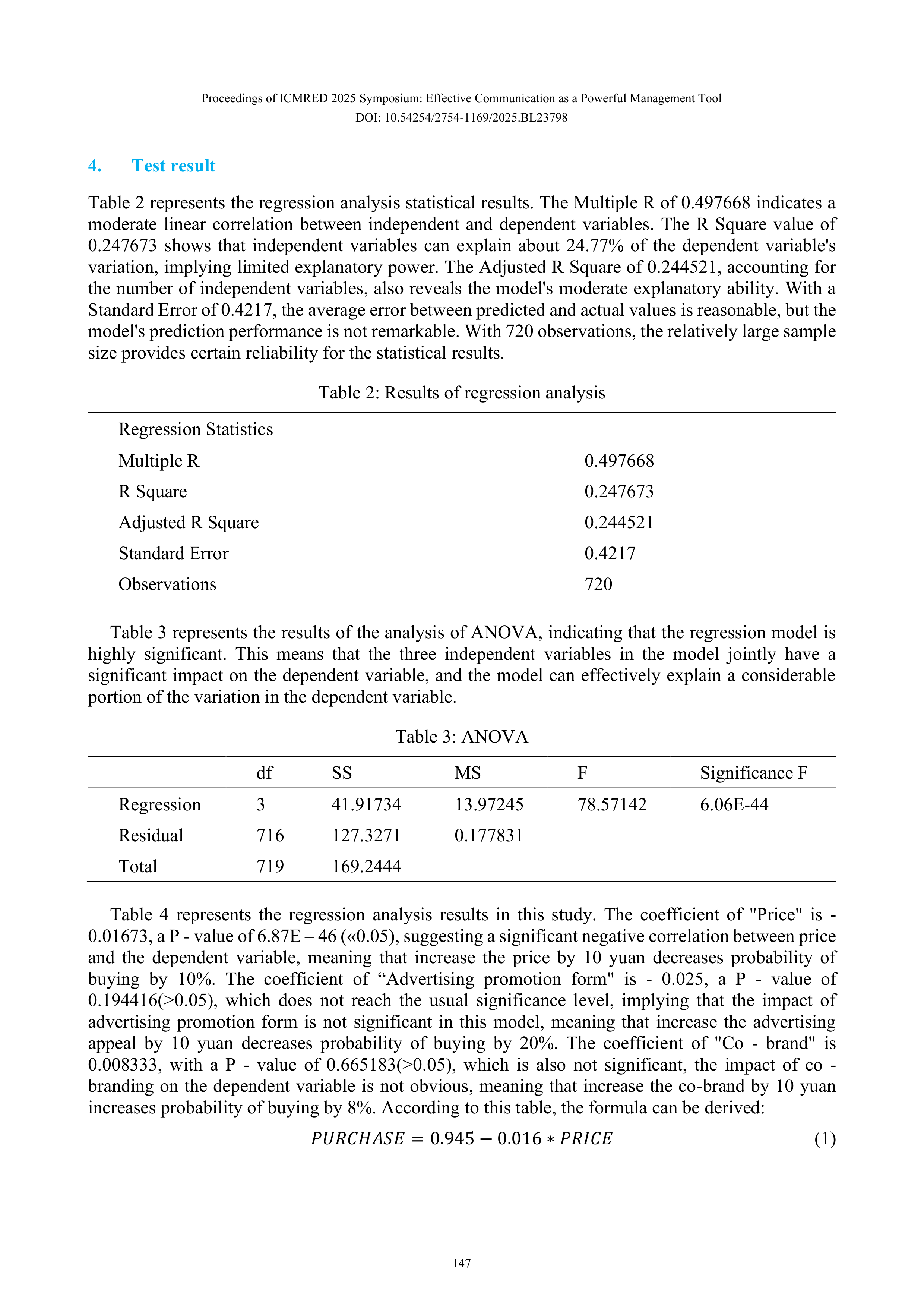
Table 2 represents the regression analysis statistical results. The Multiple R of 0.497668 indicates a
moderate linear correlation between independent and dependent variables. The R Square value of
0.247673 shows that independent variables can explain about 24.77% of the dependent variable's
variation, implying limited explanatory power. The Adjusted R Square of 0.244521, accounting for
the number of independent variables, also reveals the model's moderate explanatory ability. With a
Standard Error of 0.4217, the average error between predicted and actual values is reasonable, but the
model's prediction performance is not remarkable. With 720 observations, the relatively large sample
size provides certain reliability for the statistical results.
Table 2: Results of regression analysis
Regression Statistics
Multiple R
0.497668
R Square
0.247673
Adjusted R Square
0.244521
Standard Error
0.4217
Observations
720
Table 3 represents the results of the analysis of ANOVA, indicating that the regression model is
highly significant. This means that the three independent variables in the model jointly have a
significant impact on the dependent variable, and the model can effectively explain a considerable
portion of the variation in the dependent variable.
Table 3: ANOVA
df
SS
MS
F
Significance F
Regression
3
41.91734
13.97245
78.57142
6.06E-44
Residual
716
127.3271
0.177831
Total
719
169.2444
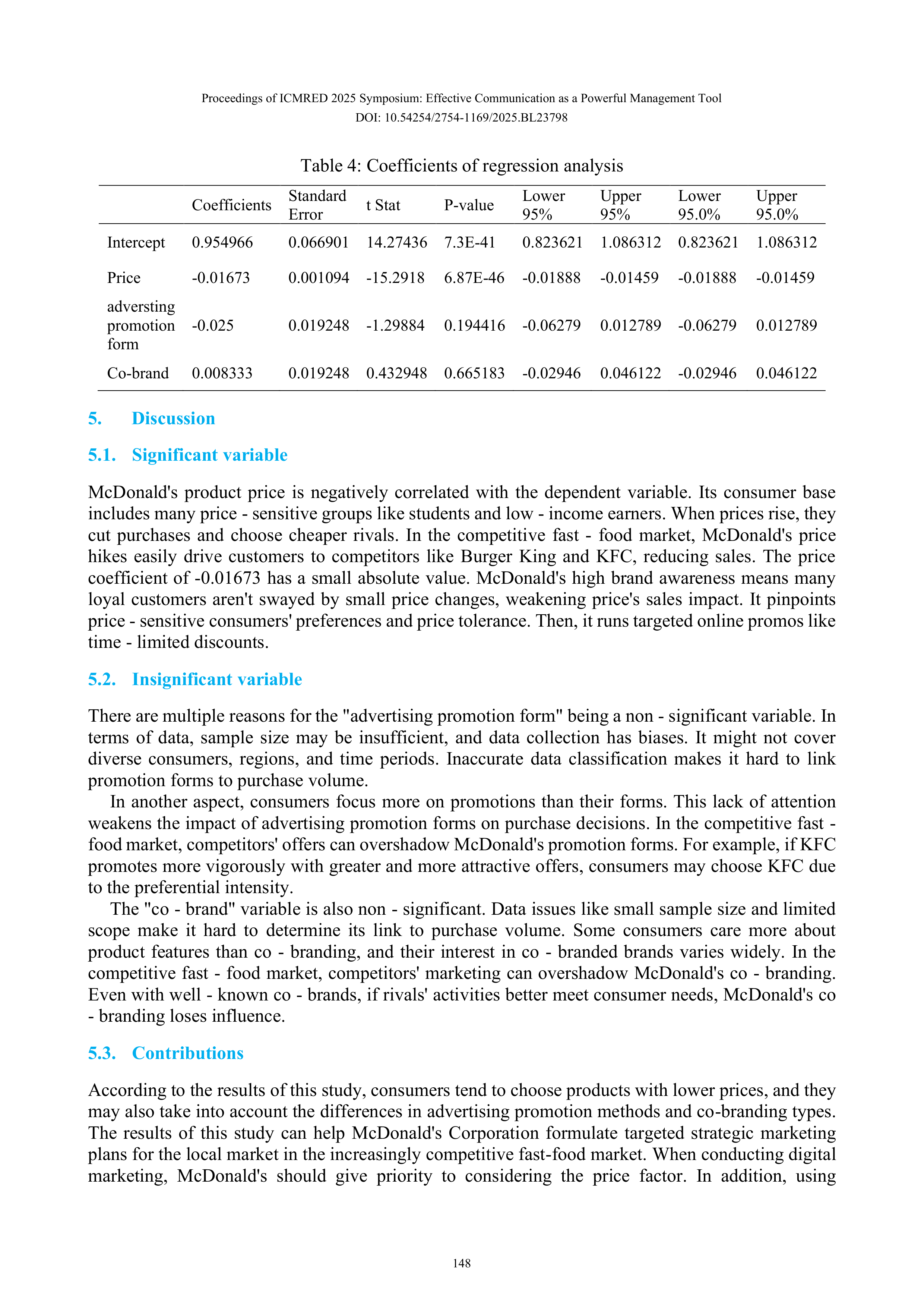
Table 4 represents the regression analysis results in this study. The coefficient of "Price" is -
0.01673, a P - value of 6.87E – 46 («0.05), suggesting a significant negative correlation between price
and the dependent variable, meaning that increase the price by 10 yuan decreases probability of
buying by 10%. The coefficient of “Advertising promotion form" is - 0.025, a P - value of
0.194416(>0.05), which does not reach the usual significance level, implying that the impact of
advertising promotion form is not significant in this model, meaning that increase the advertising
appeal by 10 yuan decreases probability of buying by 20%. The coefficient of "Co - brand" is
0.008333, with a P - value of 0.665183(>0.05), which is also not significant, the impact of co -
branding on the dependent variable is not obvious, meaning that increase the co-brand by 10 yuan
increases probability of buying by 8%. According to this table, the formula can be derived:
𝑃𝑈𝑅𝐶𝐻𝐴𝑆𝐸= 0.945 −0.016 ∗𝑃𝑅𝐼𝐶𝐸
(1)
Proceedings of ICMRED 2025 Symposium: Effective Communication as a Powerful Management Tool
DOI: 10.54254/2754-1169/2025.BL23798
148
Table 4: Coefficients of regression analysis
Coefficients
Standard
Error
t Stat
P-value
Lower
95%
Upper
95%
Lower
95.0%
Upper
95.0%
Intercept
0.954966
0.066901 14.27436 7.3E-41
0.823621 1.086312 0.823621 1.086312
Price
-0.01673
0.001094 -15.2918
6.87E-46
-0.01888
-0.01459
-0.01888
-0.01459
adversting
promotion
form
-0.025
0.019248 -1.29884
0.194416 -0.06279
0.012789 -0.06279
0.012789
Co-brand
0.008333
0.019248 0.432948 0.665183 -0.02946
0.046122 -0.02946
0.046122
5.
Discussion
5.1.
Significant variable
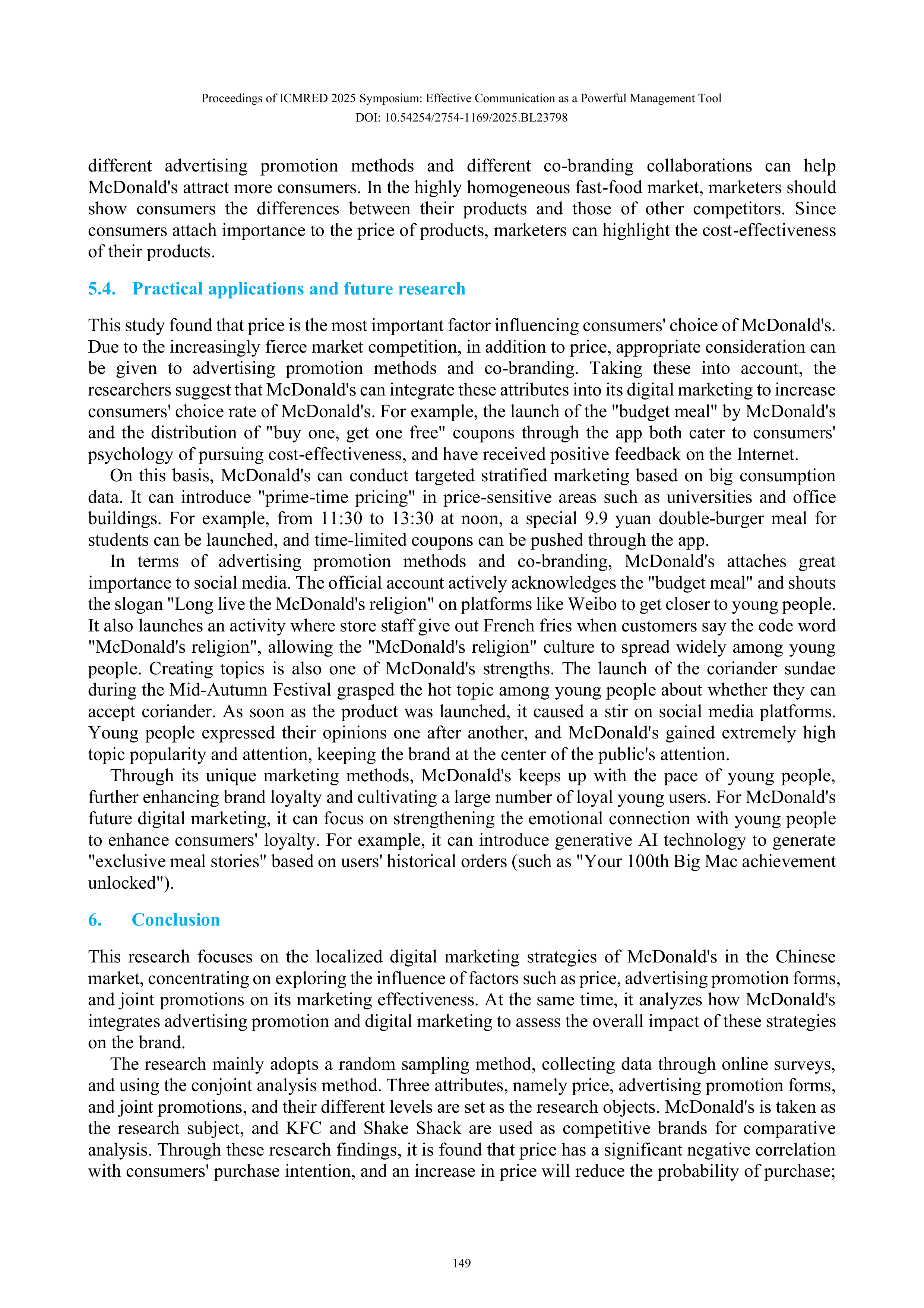
McDonald's product price is negatively correlated with the dependent variable. Its consumer base
includes many price - sensitive groups like students and low - income earners. When prices rise, they
cut purchases and choose cheaper rivals. In the competitive fast - food market, McDonald's price
hikes easily drive customers to competitors like Burger King and KFC, reducing sales. The price
coefficient of -0.01673 has a small absolute value. McDonald's high brand awareness means many
loyal customers aren't swayed by small price changes, weakening price's sales impact. It pinpoints
price - sensitive consumers' preferences and price tolerance. Then, it runs targeted online promos like
time - limited discounts.
5.2.
Insignificant variable
There are multiple reasons for the "advertising promotion form" being a non - significant variable. In
terms of data, sample size may be insufficient, and data collection has biases. It might not cover
diverse consumers, regions, and time periods. Inaccurate data classification makes it hard to link
promotion forms to purchase volume.
In another aspect, consumers focus more on promotions than their forms. This lack of attention
weakens the impact of advertising promotion forms on purchase decisions. In the competitive fast -
food market, competitors' offers can overshadow McDonald's promotion forms. For example, if KFC
promotes more vigorously with greater and more attractive offers, consumers may choose KFC due
to the preferential intensity.
The "co - brand" variable is also non - significant. Data issues like small sample size and limited
scope make it hard to determine its link to purchase volume. Some consumers care more about
product features than co - branding, and their interest in co - branded brands varies widely. In the
competitive fast - food market, competitors' marketing can overshadow McDonald's co - branding.
Even with well - known co - brands, if rivals' activities better meet consumer needs, McDonald's co
- branding loses influence.
5.3.
Contributions
According to the results of this study, consumers tend to choose products with lower prices, and they
may also take into account the differences in advertising promotion methods and co-branding types.
The results of this study can help McDonald's Corporation formulate targeted strategic marketing
plans for the local market in the increasingly competitive fast-food market. When conducting digital
marketing, McDonald's should give priority to considering the price factor. In addition, using
Proceedings of ICMRED 2025 Symposium: Effective Communication as a Powerful Management Tool
DOI: 10.54254/2754-1169/2025.BL23798
149
different advertising promotion methods and different co-branding collaborations can help
McDonald's attract more consumers. In the highly homogeneous fast-food market, marketers should
show consumers the differences between their products and those of other competitors. Since
consumers attach importance to the price of products, marketers can highlight the cost-effectiveness
of their products.
5.4.
Practical applications and future research
This study found that price is the most important factor influencing consumers' choice of McDonald's.
Due to the increasingly fierce market competition, in addition to price, appropriate consideration can
be given to advertising promotion methods and co-branding. Taking these into account, the
researchers suggest that McDonald's can integrate these attributes into its digital marketing to increase
consumers' choice rate of McDonald's. For example, the launch of the "budget meal" by McDonald's
and the distribution of "buy one, get one free" coupons through the app both cater to consumers'
psychology of pursuing cost-effectiveness, and have received positive feedback on the Internet.
On this basis, McDonald's can conduct targeted stratified marketing based on big consumption
data. It can introduce "prime-time pricing" in price-sensitive areas such as universities and office
buildings. For example, from 11:30 to 13:30 at noon, a special 9.9 yuan double-burger meal for
students can be launched, and time-limited coupons can be pushed through the app.
In terms of advertising promotion methods and co-branding, McDonald's attaches great
importance to social media. The official account actively acknowledges the "budget meal" and shouts
the slogan "Long live the McDonald's religion" on platforms like Weibo to get closer to young people.
It also launches an activity where store staff give out French fries when customers say the code word
"McDonald's religion", allowing the "McDonald's religion" culture to spread widely among young
people. Creating topics is also one of McDonald's strengths. The launch of the coriander sundae
during the Mid-Autumn Festival grasped the hot topic among young people about whether they can
accept coriander. As soon as the product was launched, it caused a stir on social media platforms.
Young people expressed their opinions one after another, and McDonald's gained extremely high
topic popularity and attention, keeping the brand at the center of the public's attention.
Through its unique marketing methods, McDonald's keeps up with the pace of young people,
further enhancing brand loyalty and cultivating a large number of loyal young users. For McDonald's
future digital marketing, it can focus on strengthening the emotional connection with young people
to enhance consumers' loyalty. For example, it can introduce generative AI technology to generate
"exclusive meal stories" based on users' historical orders (such as "Your 100th Big Mac achievement
unlocked").
6.
Conclusion
This research focuses on the localized digital marketing strategies of McDonald's in the Chinese
market, concentrating on exploring the influence of factors such as price, advertising promotion forms,
and joint promotions on its marketing effectiveness. At the same time, it analyzes how McDonald's
integrates advertising promotion and digital marketing to assess the overall impact of these strategies
on the brand.
The research mainly adopts a random sampling method, collecting data through online surveys,
and using the conjoint analysis method. Three attributes, namely price, advertising promotion forms,
and joint promotions, and their different levels are set as the research objects. McDonald's is taken as
the research subject, and KFC and Shake Shack are used as competitive brands for comparative
analysis. Through these research findings, it is found that price has a significant negative correlation
with consumers' purchase intention, and an increase in price will reduce the probability of purchase;
Proceedings of ICMRED 2025 Symposium: Effective Communication as a Powerful Management Tool
DOI: 10.54254/2754-1169/2025.BL23798
150
the influence of advertising promotion forms and joint promotions on purchase intention is not
significant. This indicates that among the factors influencing consumers' choice of McDonald's
products, the role of price is prominent, while the effects of advertising promotion forms and joint
promotions have not reached expectations. The results of this research are helpful for McDonald's to
formulate more targeted local market strategic marketing plans. In digital marketing, giving priority
to price factors and highlighting product cost-effectiveness can attract more consumers. At the same
time, reasonable use of different advertising promotion methods and joint promotions can also
enhance brand appeal. For example, launching "affordable meal packages" and distributing "buy one
get one free" coupons, which align with consumers' pursuit of cost-effectiveness, have received good
market feedback.
However, this research also has certain limitations. In terms of data, the sample size may be
insufficient, and there is data collection bias. It fails to comprehensively cover different consumers,
regions, and time periods, resulting in inaccurate data classification and difficulty in precisely
correlating the relationship between advertising promotion forms, joint promotions and purchase
volume. This has affected the universality and accuracy of the research results.
For McDonald's future digital marketing, it can focus on strengthening emotional connections with
young people to enhance consumer loyalty. For example, introducing generative artificial intelligence
technology to generate "exclusive dining stories" based on users' historical orders. At the same time,
it can also expand the sample size, optimize data collection methods, and conduct in-depth research
on the influence of advertising promotion forms and joint promotions on consumers' purchase
decisions to provide more powerful support for the optimization of marketing strategies.
References
[1]
Wu, S., & Ma, J. (2021, January 1). Analysis of McDonald’s Marketing Strategy in China. https://doi.org/10.2991
/assehr.k.211209.502
[2]
Shen, Z. (2007). McDonald’s: ‘Camp’ in culture, ‘win’ in localization—China Knowledge Network.
[3]
Zhang, X. (2019). Analysis of McDonald’s marketing strategy in China. Marketing (Theory and Practice).
[4]
Zhao, Y. (2009). McDonald’s: Expanding while cutting prices—China Knowledge Network.
[5]
Guo, J. (2023). Research on McDonald’s new media marketing strategy around ‘Generation Z’ from the perspecti
ve of breaking circles and fusion _4I theory. New Media Studies. https://doi.org/10.16604/j.cnki.issn2096-0360.20
23.16.007
[6]
Chen L. (2017). Localization strategy of brand communication from the perspective of new media—Taking McDo
nald’s Chinese-style advertisement as an example. Audio Visual, 11, 197–198. https://doi.org/10.19395/j.cnki.167
4-246x.2017.11.111
[7]
Chen X., & Chen Z. (2016). A comparative study on the localization design of McDonald’s and KFC brands. Design,
8, 120–121. https://doi.org/10.20055/j.cnki.1003-0069.2016.08.032
[8]
Chen W. (2024). An analysis of brand marketing strategy and innovation in cross-cultural perspective.
Modernization of shopping malls, 15, 75–78. https://doi.org/10.14013/j.cnki.scxdh.2024.15.047
[9]
Li, W. (2018). Analysis of McDonald’s Chinese localization marketing strategy.
[10]
Liu, Y., Liu, X., & Huang, H. (2005). Globalization of thinking and localization of action—A brief discussion on the
characteristics of McDonald’s marketing mix.
[11]
Sethuraman, R., Kerin, R. A., & Cron, W. L. (2005). A field study comparing online and offline data collection
methods for identifying product attribute preferences using conjoint analysis. Journal of Business Research, 58(5),
602–610. https://doi.org/10.1016/j.jbusres.2003.09.009
[12]
Möslein-Tröppner, B., Stros, M., & Říha, D. (2020). Customer Loyalty-Related Marketing Measures in Fashion
Markets. Central European Business Review, 9(1), 43–55. https://doi.org/10.18267/j.cebr.228
[13]
Paramartha, M. N. A., & Syah, T. Y. R. (2020). The Influence of Customer Satisfaction on Customer Loyalty and
Marketing Organization Performance Over Outdoor Advertising Companies. 04(04).
[14]
Sharma, A., Dwivedi, R., Mariani, M. M., & Islam, T. (2022). Investigating the effect of advertising irritation on
digital advertising effectiveness: A moderated mediation model. Technological Forecasting and Social Change, 180,
121731. https://doi.org/10.1016/j.techfore.2022.121731
[15]
Tseng, F.-C., & Teng, C.-I. (2016). Carefulness Matters: Consumer Responses to Short Message Service Advertising.
International Journal of Electronic Commerce, 20(4), 525–550. https://doi.org/10.1080/10864415.2016.1171976

Proceedings of ICMRED 2025 Symposium: Effective Communication as a Powerful Management Tool
DOI: 10.54254/2754-1169/2025.BL23798
151
[16]
Wang, Y., & Genç, E. (2019). Path to effective mobile advertising in Asian markets: Credibility, entertainment and
peer influence. Asia Pacific Journal of Marketing and Logistics, 31(1), 55–80. https://doi.org/10.1108/APJML-06-
2017-0112
[17]
Zhang T. (2022). Organic combination of cultural and commercial value IP co-branded products popular future
market potential. Business China, 3, 46–47.