
Research on Proctor and Gamble Marketing Strategy
during Covid-19 in The U.S.
Tianyun Gu
1,*
1
Business school, University of Leeds, Leeds, LS2 9JT, United Kindom1
*
Corresponding author. Email: xtuscq2wo@mail.cu.edu.kg
ABSTRACT
Following the outbreak of Covid-19, various measures were implemented that drastically affected business performance
worldwide. Requires for lockdowns and cessation of movements affected the supply chain causing disruptions that
caused consumer goods to change their priorities. It was important that consumer goods manufacturers also changed
their marketing and advertising approaches to suit consumer needs. This study sought to investigate the marketing
strategy pursued by Procter and Gamble in the United States. Through analyses of past literature regarding the virus and
the strategies used by consumer goods production companies, this study developed research aims which sought to fill
research gaps in examining the marketing strategies utilized by Procter and Gamble. The study utilized an online
questionnaire which was analyzed to reveal the findings. The study found out that there was an increased purchase of
hygiene products among U.S. consumers of consumer goods after the outbreak of Combined-19. In addition, online
adverts were more helpful in marketing online products. It was also found out that an increased population relied on
online advertisements to make purchase decisions. The study concludes by making recommendations that there has
been a shift towards bulk purchases of hygiene products. The study recommended that Proctor and Gamble adopt
marketing strategies towards marketing strategies which are skewed towards attracting online consumers of hygiene
products and making online advertising campaigns. The study adds to the literature on changing consumer behavior for
other companies that may not necessarily deal in consumer products. The study’s limitations lie in the small sample
used in the study. The limited scope of past research on the subject area may also be considered a limitation because we
could not verify the credibility and reliability of the results based on other studies.
Keywords:
Covid-19, U.S market, Proctor and Gamble, Marketing Strategy
1. INTRODUCTION
1.1 Research background
The outbreak of Covid-19 in the final months of
December 2019 saw a widespread disruption of the world
economy and how the firms functioned. Marketing
strategies had to be realigned to fit into the government
policies laid out to contain the spread of the virus. By 31
December 2021, the covid-19 cases in the U.S. had
reached 54.2 million, with 823,000 deaths [1].
Significant shifts in consumer behavior required
corresponding shifts in marketing approaches, which to
some extent showcased similarities in firm behavior
changes during periods of economic downturns. The
covid-19 pandemic challenged consumers to reimagine
their priorities, leading to new spending habits and a shift
in consumer preferences [2].
Similarly, Euronews identified rising trends in
consumer
behavior
reflected
through
enhanced
connectedness between consumers and businesses in
pursuit of emotional support for both parties [3]. The
emotional
connectedness
was
witnessed
through
enhanced digitalization, thereby using digital platforms
to extend the connection between consumers and
suppliers [4]. People’s behavior also changed to reflect
healthy living habits with a struggle for the middle class
and lower economic classes to maintain their lifestyles
[5]. People’s shopping experiences also witnessed a
reinvention from the norm. Online shopping was seen to
rise with an expectation of a lasting impact of online
shopping even after the end of covid-19 [3]. (Hoekstra
and Leeflang 2020) noted that companies were
redesigning their goals and objectives to develop
initiatives meant to deter the spread of covid-19 [6].
These initiatives have since been called cause-related
marketing, which signifies the firm’s commitments to
Advances in Economics, Business and Management Research, volume 652
Proceedings of the 2022 7th International Conference on Social Sciences and
Economic Development (ICSSED 2022)
Copyright © 2022 The Authors. Published by Atlantis Press International B.V.
This is an open access article distributed under the CC BY-NC 4.0 license -http://creativecommons.org/licenses/by-nc/4.0/
765

corporate social responsibility [7]. Engaging in corporate
social responsibility activities meant to tackle the results
of the Covid-19 surge to benefits created due to shifts in
demand resulting from the covid-19 effects on the
economy. According to some studies, Proctor and
Gamble committed to “developing innovative nasal
swabs with digital partners that helped communities
address any supply shortages and bring creative solutions
to the challenges facing laboratories and supply chains
during the covid-19 pandemic [8]. Therefore, this paper
seeks to investigate the marketing strategies of Proctor
and Gamble during the Covid-19 period in the context of
the U.S. business environment. The research will
contribute to the existing literature on marketing
strategies during pandemics and highlight the social
importance of corporate social responsibility and the
dependence of stakeholders during periods of economic
downturns.
1.2 Literature Review
Hoekstra and Leeflang observed that companies were
redesigning their goals to create initiatives to tackle the
covid-19 crisis [6]. Informed by the shifts in consumer
behavior, especially after the outbreak of covid-19 and
consequent changes in firm behavior corresponding to
consumer behavior, Hoekstra and Leeflang examined
marketers’ response to the disruptions caused by the
covid-19 pandemic and the contracting effect of the
economy [6]. Hoekstra and Leeflang found that many
firms had developed ideas that redefined their product
portfolios. By citing examples such as DSM, an initial
manufacturer of plastics who had turned out to produce
face masks, and Deliveroo, primarily a delivery company
for restaurant orders now delivering Marks and Spencer
Products [6]. Hoekstra and Leeflang observed how online
platforms in the U.S., such as Sellfly and Sendowl, came
in handy in delivering and marketing products during the
covid-19 period [6]. Therefore, the study found that
online marketing campaigns and strategies proved
helpful during the covid-19 period. In addition, Hoekstra
and Leeflang observed a 10% decline in expenditure
committed to television advertising with marketing
communication designed to retain existing customers
rather than acquire new customers [6]. The study
concluded by noting that the pandemic offered
opportunities to marketers to exhibit their demonstration
of expertise in companies that were hit by Covid-19
negatively and those whose businesses expanded as a
result.
Baryshnikova examine the effects of Covid-19 on the
functional strategies of companies in the real sector of the
economy by assessing shifts in the economic behavior of
firms in the face of the pandemic [9]. The research
intended to find out how businesses were adapting their
marketing strategies to survive the new risks posed by the
virus and their management of personal and machinery.
Baryshnikova noted that the changes in marketing
strategies were due to changes in consumer behaviors due
to government policies being enforced to contain the
virus [9]. According to their studies, the covid-19
pandemic highlighted the need for firms to adapt quickly
to changing environments in all spheres of the firm’s
operations, such as marketing, production, and personnel
management [9].
He and Harris examined the impact of covid-19 on
firms’ corporate social responsibility and marketing
philosophy [10]. He and Harris found out that the
pandemic provided an excellent opportunity for first to
shift their attention towards more genuine and authentic
Corporate
Social
responsibility
activities
which
addressed the global social and economic challenges [10].
The research also found that persistent shifts in consumer
behavior and decision-making due to the pandemic
necessitated firms changing their marketing tactics to fit
consumer behavior changes [10]. He and Harris
recommended that firms investigate the changes in
consumer beliefs and spending patterns to inform their
marketing strategies, given the anticipated resurgence in
social marketing concepts and business orientations [10].
1.3 Research Gap
The above literature reviews have showcased that
most scholars have examined the marketing strategies
that firms can adopt to remain afloat during the covid-19
pandemic. Most studies have showcased the importance
of CSR as a marketing strategy during a pandemic.
However, there have been limited studies on the action of
firms similar to Proctor and Gamble during the covid-19
period. Similarly, few studies have examined the
marketing strategies in the U.S. business environment.
Therefore, this paper hopes to fill those research gaps by
examining the marketing strategies adopted by Proctor
and Gamble during the Covid-19 period in the U.S.
1.4 Research Framework
Firstly, the research will examine the literature on
Proctor and Gamble before the covid-19 pandemic.
Secondly, the paper will discuss the consumer behavior
of the target market for Proctor and Gamble before and
after the covid-19 pandemic to reveal any changes in
consumer preferences. Thirdly, the paper examines how
Proctor and Gamble have changed their marketing
strategies and presents an audit of the failures and
successes of these strategies. The report concludes by
providing recommendations on marketing strategies
adopted in the U.S. market informed by the research
findings.
Advances in Economics, Business and Management Research, volume 652
766

2. METHODS
2.1 Online Survey Questionnaire Method
A questionnaire is a set of open-ended and close-
ended questions meant to collect information from
respondents. An online questionnaire is typically shared
through an online platform to minimize the risk of contact
with the respondent. In our context, online survey
questionnaires will prove to be affordable and minimize
contact with respondents, thereby preventing the spread
of the virus. The questionnaire will be shared with
samples of populations designed to determine consumer
habits before and after the covid-19 period. Analysis of
these activities will reveal any potential changes in
consumer behavior resulting from the pandemic. The
questionnaire shall be tailored to collect qualitative and
quantitative data, analyzed using various statistical tools
such as SPSS and STATA.
2.2 Case Study Method
A case study is a research method where the
researchers seek to understand the multiple facets of a
complex issue by applying accurate life context analysis
of a similar problem [12]. A case study allows the
researcher to learn about the case presented to them and
provides a product of people’s learning for examination.
Our research approach will utilize a collective case study
that focuses on multiple cases simultaneously to
understand consumer behavior in the face of covid-19.
The case study will reveal the conventional marketing
strategies utilized to develop traditional approaches to
pandemics using the Proctor and Gamble case as a base
for the study by examining various shifts in consumer
behavior. Therefore, the case study will allow us to
explain, describe and explore the marketing strategies
used by Proctor and Gamble during the covid-19 period
by examining the consumer habits to identify any shifts
in consumer behavior.
2.3 Literature analysis Method
A literature review represents a survey of relevant
sources of information such as journals, theories, and
scholarly articles which provide information to a
particular phenomenon under study [11]. The research
will employ a literature review on journals and academic
articles related to marketing strategies and marketing
theories, consumer behavior during a pandemic, and
industry responses to pandemics. By so doing, the
literature review will describe the phenomena mentioned
above, a summary of the past findings, and a critical
evaluation of the marketing’s strategies that can be
adopted by firms like Proctor and Gamble during the
covid-19 pandemic period to realize optimum potential
by balancing on the social and commercial impact of the
pandemic [5].
3. ANALYSIS OF THE CURRENT
SITUATION
3.1 Analysis of consumer behavior of Proctor
and Gamble
Proctor and Gamble belong to the industry of
consumer goods. The company produces a wide range of
personal health and consumer products categorized as
either beauty, fabric and home care, family care, health
care, and grooming products. In addition, it also includes
such items as beverages and food products. The
consumer goods industry was adversely affected by the
outbreak of the covid-19, just like all other industries
globally. Significant disruptions in the supply chain
resulted in a reduction of revenue targets by 76% of all
businesses worldwide [12]. The decrease in revenue
targets averaged 23% across all business sectors, as
reported by the ISM (Institute of Supply Management)
[12]. However, there have been rapid shifts in how some
sectors in the consumer goods industry responded to the
outbreak with increased consumer demand for household
sanitary items and frozen foods. This has necessitated the
companies dealing in these productions to increase their
supplies and stocks to meet the rising demand. However,
due to reduced sales in retail stores and physical sales of
products, there has been a drastic decrease in retail outlets’
revenues that focus on selling consumer goods at
physical locations and declined to go online [7]. Firms
that adopted digital strategies in marketing and
distributing their products and enhanced the user
experiences on their digital platforms have reaped huge
returns [13]. There has been an increased demand for
such items as websites for online retailers moving from
brick-and-mortar stores to enhance their online presence
to reflect the needs and demands of the consumer. The
government regulations such as lockdowns and social
distancing requirements have seen most businesses
closing their physical stores. People have been confined
to their homes to reduce outside contact and minimize the
spread of the virus. Rajamani reports that some
companies struggled to put up their businesses online,
while those with an online presence found it easier to
enhance their online service provisions [12]. Businesses
in the consumer goods industry that are more successful
at adapting to the digital transformation because of their
liquidity and capital availability have found it easier to
reap the benefits of the digital transformation brought
about by the outbreak of covid-19.
Consumer behavior in the post-epidemic era has
shown that consumers have gained a preference for
online shopping of products instead of physical shopping
for products and services. The lockdown regulations and
social distancing rules requiring people to work from
home saw a paradigm shift in the number of people
spending more time online via digital apps [14]. These
apps were used to connect with friends and family and
Advances in Economics, Business and Management Research, volume 652
767

interact with passing the time. The increased consumer
presence required a business model change where
consumers would interact with business products online.
Consumers have an increased demand for personal
product personalization requiring firms to ship raw
products in place of finished products to meet the diverse
individual consumer needs [12]. There has been
restructuring in the supply chain where firms used to pre-
order items in anticipation of the future demands of these
products. These days, limited personal shopping has
caused a break to the supply chain, which has, in turn,
amounted to huge cost burdens to store owners.
The consumers of proctor and gamble products
increased their demand for hygiene products, a shift in
consumer behavior that is anticipated to go on even after
the end of the pandemic [15]. The CFO of Proctor and
Gamble, Jon Mueller, reported that there had been a 30%
rise in the sanitizing frequency, a 15% rise in domestic
dishwashing frequency and a 15% increase in the usage
of home paper towels in the U.S. during the covid 19
period [15]. The company responded by increasing its
online e-commerce sales and developing products that
meet the demands of consumers, such as sanitary sprays
and oral health products which meet consumer needs.
The marketing campaign adopted by Proctor and
Gamble during the covid-19 pandemic reflected those
most companies adopted during that period. The efforts
were primarily geared towards corporate social
responsibility in supporting vaccine drives and
developing products that could help make virus testing
easier. However, consumer goods firms need to optimize
their marketing strategies to meet the changing demands
of the consumers and maximize revenue generation [16].
The major problems in consumer products marketing
were the ignorance of consumer feedback. Firms need to
examine the feedback and gain insights into customers’
consumer experiences with their products.
3.2 Statistical analysis based on survey results
of Proctor and Gamble
The research utilized a descriptive research design
which showcased the following results from the online
survey questionnaire. The sample comprised 200
respondents who had a mean age of 30 years, of whom
95 were male and 105 were female. The survey
questionnaire sought to investigate if the population
sample changed consumer behavior during the Covid-19
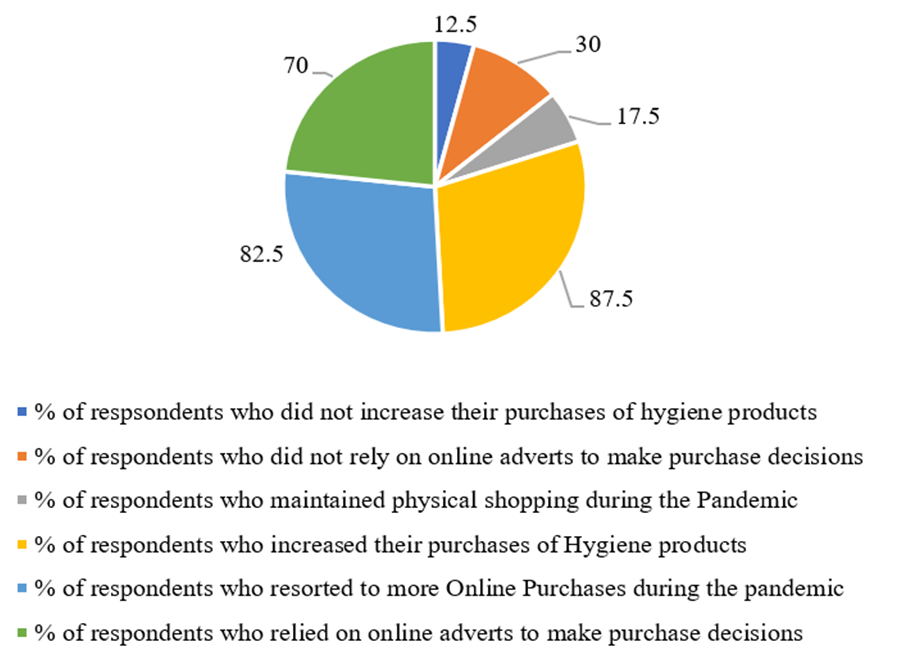
Period. Figure 1 shows the results of the survey.
Figure 1
Consumer behavior analysis
The above analysis shows that 87.5% of the
respondents increased their hygiene and sanitary items
purchases during the covid-19 pandemic. In contrast,
only 12.5% of the respondents admitted to maintaining
their purchases of hygiene products to levels they had
before the pandemic outbreak. In addition, it shows that
82.5% of the respondents changed their consumer
behavior, opting to make their purchases via online
channels rather than physical shopping during the
pandemic. In contrast, only 17.5% maintained their
physical shopping habits during the pandemic period.
Lastly, 70% of the respondents admitted to online
advertisements and marketing to make purchase
decisions during the pandemic period. In contrast, only
30% of the respondents did not rely on online adverts to
make their purchase decisions.
3.3 Identify problems in the marketing
strategies of Proctor and Gamble
Therefore, the marketing strategy of the firm Proctor
and Gamble had to change to reflect the changes in
consumer behavior. Online advertising and marketing
and online interaction with clients via online platforms
had to be put in place to ensure they met the customer’s
needs and demands via the platforms where the customer
was most accessible.
The marketing problems identified showcase that
Proctor and Gamble relied heavily upon CSR activities
as a measure to enhance their marketing efforts. However,
CSR activities were insufficient to convince the
customers to make purchases through the company [17].
More needs to be done regarding online interaction with
customers, online education about the virus, and
revamping online communication channels such as
websites, social media accounts, and email monitoring to
respond to customer queries. In addition, customer
feedback analysis via online communication channels is
important to determine the product’s consumer
experience to enhance a well-tailored delivery of
products that meet the customers’ demands.
Advances in Economics, Business and Management Research, volume 652
768

4. DISCUSSION
Consumer behavior shifts during the covid-19 period
will be significantly different from the behavior
witnessed during other periods of pandemics or
recessions. For example, after the 20008 global financial
crisis, consumer behavior showed a uniform reduction in
consumer spending habits across all sectors [2]. However,
the covid-19 effects of the pandemic will be followed by
a recession characterized by reduced consumption across
specific product lines and a shift towards different
product lines. The use of social distancing rules and
lockdown effects of the pandemic will affect consumer
behavior as consumers change their preferences which
gives rise to new spending habits and criteria. Therefore,
the witnessed results from the data shown above show
that consumers are shifting towards online mediums of
data seeking and making decisions based on online
sources of information. Their spending habits are shifting
towards increased preferences for hygiene and sanitary
items [18]. These changes can be understood to mean that
consumers have become more conscious of the role of
hygiene and sanitation in preventing the spread of the
virus. In addition, the effects of lockdown and social
distancing coupled with working from home regulations
may have increased consumers’ predisposes to
unhygienic environments. Hoekstra and Leeflang noted
that a healthy lifestyle within and beyond the homes of
humans around the globe was becoming essential, and
human beings were adopting a more holistic approach
towards wellness [6]. In addition, Hoekstra & Leeflang
note that there has been a shift in shopping patterns from
physical stores to online shopping. The paradigm shift
has grossly affected consumer goods and durables [6].
Hoekstra and Leeflang reported that consumers who had
previously not had experiences with online shopping had
become ambassadors of online shopping [6]. The move
towards purchasing locally produced goods has also been
reported amongst consumers.
Therefore, Proctor and Gamble should focus their
marketing strategies towards implementing solutions that
reflect the changes in consumer behavior being witnessed
around the globe.
4.1 Optimization of product strategy
The product strategy should encompass the
production of goods tailored towards meeting the
personalized needs of the consumers, as witnessed in
many parts of the world. Consumers are shifting towards
customized products, and customer loyalty is changing to
reflect an increased desire to have products shipped to
their locations to minimize movements [19]. Therefore,
this study recommends that Proctor and Gamble develop
shipping procedures and logistics which deliver items to
a customer’s address, thereby reducing the need to go for
items at a centralized location personally. In addition, the
study recommends that Proctor and Gamble could invest
in online commination and purchases channels. Through
offering consumers educative information about their
products about mitigating against the effects of the covid-
19 pandemic and interacting with consumers to
understand their consumer experience.
4.2 Optimization of price strategy
The pricing strategy should encompass discounts for
repeat customers. In addition, reduced pricing due to
locally sourced products should be pursued. Lastly, a
pricing strategy that offers loyalty coupons to customers
should be encouraged to ensure that customers who are
fond of purchasing goods in bulk or regularly can be
compensated through loyalty programs. The companies
should also invest in big data analytics to determine the
best approaches based on the revenue generation data and
historical purchases data. The marketing strategies which
yield tremendous benefits should be encouraged. At the
same time, those that do not necessarily translate to
meeting the customer needs and preferences should be
scaled down to optimize marketing strategies.
5. CONCLUSION
5.1 Findings
This paper finds out that there has been a shift in
consumer behavior towards a bulk purchase of hygiene
products. In addition, consumers have shifted their
purchase behavior towards online purchases compared to
periods before the virus outbreak. Lastly, marketing
strategies that encompass an online campaign geared not
only to educate potential customers but also engaging
with customers to get their customer feedback regarding
the customer experience should be pursued. Proctor and
Gamble should invest in technology to expand their
online presence and enhance analytics to determine
which consumer segments purchase which products most
regularly to tailor their marketing strategies to these
particular segments.
The significance of this study is that it adds to the
literature regarding the marketing strategies in place
during the covid-19 period for Proctor and Gamble in the
United States. In addition, the study is significant because
it guides other likewise consumer goods producers to
pursue marketing strategies that meet the needs of the
consumers. Lastly, the study is critical because it
contributes to the literature on changing consumer
behavior for other companies that may not necessarily
deal in consumer products.
5.2 Limitations
The study’s limitations lie in the small sample used in
the study. The characteristics of the sample may not
always reflect the true characteristics of the population
Advances in Economics, Business and Management Research, volume 652
769

because the population may contain outliers. The limited
scope of past research on the subject area may also be
considered a limitation because we could not verify the
credibility and reliability of the results based on other
studies. There was also a time constraint because
insufficient data could be collected within the given
framework of the research studies.
REFERENCES
[1] CDC Works 24/7. Centers for Disease Control and
Prevention. (2021). Retrieved 31 December 2021,
from https://www.cdc.gov/.
[2] Dekimpe, M. G., & Deleersnyder, B. (2018).
Business cycle research in marketing: A review and
a research agenda. Journal of the Academy of
Marketing Science, 46(1), 31–58.
[3] Euronews (2020), ‘COVID-19: World economy in
2020 to suffer worst year since 1930s Great
Depression,
says
IMF’,
accessible
at:
https://www.euronews.com/2020/04/14/watch-live-
international-monetary-fund-gives-world-
economic-outlook-briefing-on-covid-19, accessed
06 May, 2020.
[4] Edeling, A., & Fischer, M. (2016). Marketing’s
impact on firm value: Generalizations from a meta-
analysis. Journal of Marketing Research, 53(4),
515–534.
[5] Eckhardt, G. M., Houston, M. B., Jiang, B.,
Lamberton, C., Rindfleisch, A., & Zervas, G. (2019).
Marketing in the sharing economy. Journal of
Marketing, 83(5), 5–27.
[6] Hoekstra, J.C., Leeflang, (2020) P.S.H. Marketing in
the era of COVID-19. Ital. J. Mark. 2020, 249–260.
https://doi.org/10.1007/s43039-020-00016-3
[7] De Vries, L., Gensler, S., & Leeflang, P. S. H. (2017).
Effects of traditional advertising and social
messages on brand-building metrics and customer
acquisition. Journal of Marketing, 81(5), 1–15.
[8] Fan Y, Jiang N, Zheng C, (2019) C.T. appearance of
new coronavirus pneumonia in subclinical period
and
short-term
changes.
Chin
J
Radiol.
2020;54:E008-E.
doi:
10.3760/cma.j.issn.1005-
1201.0008
[9] Baryshnikova, N., Kiriliuk, O., & Klimecka-Tatar, D.
(2021). Enterprises’ strategies transformation in the
real sector of the economy in the context of the
COVID-19 pandemic. Production Engineering
Archives,
27(1),
8-15.
https://doi.org/10.30657/pea.2021.27.2
[10] Hongwei He, Lloyd Harris, The impact of Covid-19
pandemic on corporate social responsibility and
marketing philosophy, Journal of Business Research,
Volume 116, 2020, Pages 176-182, ISSN 0148-
2963, https://doi.org/10.1016/j.jbusres.2020.05.030.
[11]Crowe, S., Cresswell, K., Robertson, A., Huby, G.,
Avery, A., & Sheikh, A. (2011). The case study
approach. BMC medical research methodology, 11,
100. https://doi.org/10.1186/1471-2288-11-100
[12] Rajamani, S. (2022). The Impact of COVID-19 on
Consumer Goods - Wipro. Wipro.com. Retrieved 5
January
2022,
from
https://www.wipro.com/blogs/srini-rajamani/the-
impact-of-covid-19-on-consumer-goods/.
[13] Sloot, L., Fok, D., & Verhoef, P. C. (2006). The
short and long-term impact of assortment reduction
on category sales. Journal of Marketing Research,
43(4), 536–548.
[14] Srinivasan, R., Lilien, G. L., & Sridhar, S. (2011).
Should firms spend more on research and
development and advertising during recessions?
Journal of Marketing, 75(3), 49–65.
[15] Naik, G. (2022). P&G positions itself for altered
consumer
behavior
after
COVID-19
fades.
Spglobal.com. Retrieved 5 January 2022, from
https://www.spglobal.com/marketintelligence/en/n
ews-insights/latest-news-headlines/p-g-positions-
itself-for-altered-consumer-behavior-after-covid-
19-fades-62200134.
[16] Fan, X., Deng, N., Qian, Y., & Dong, X. (2020).
Factors affecting the effectiveness of cause-related
marketing: A meta-analysis. Journal of Business
Ethics, published online 10 October 2020.
[17] Steenkamp, J. B. E. M., & Fang, E. (2013). The
impact
of
economic
contractions
on
the
effectiveness of R&D and advertising: Evidence
from U.S. companies spanning three decades.
Marketing Science, 30(4), 628–645.
[18] Boutelle, J. (2022). Biggest Challenges for
Consumer Product Marketers: Qualitative Research
Report. Digsite.com. Retrieved 5 January 2022,
from
https://www.digsite.com/blog/brand-
strategy/biggest-challenges-consumer-product-
marketers-qualitative-research-report.
[19] Trimble C. S., & Rifon, N. J. (2016). Consumer
perceptions of compatibility in cause-related
marketing messages. International Journal of
Nonprofit and Voluntary Sector Marketing, 11(1),
29–47.
Advances in Economics, Business and Management Research, volume 652
770