III. PREVIOUS RESEARCH EXPERIENCE & TECHNICAL CONTRIBUTIONS
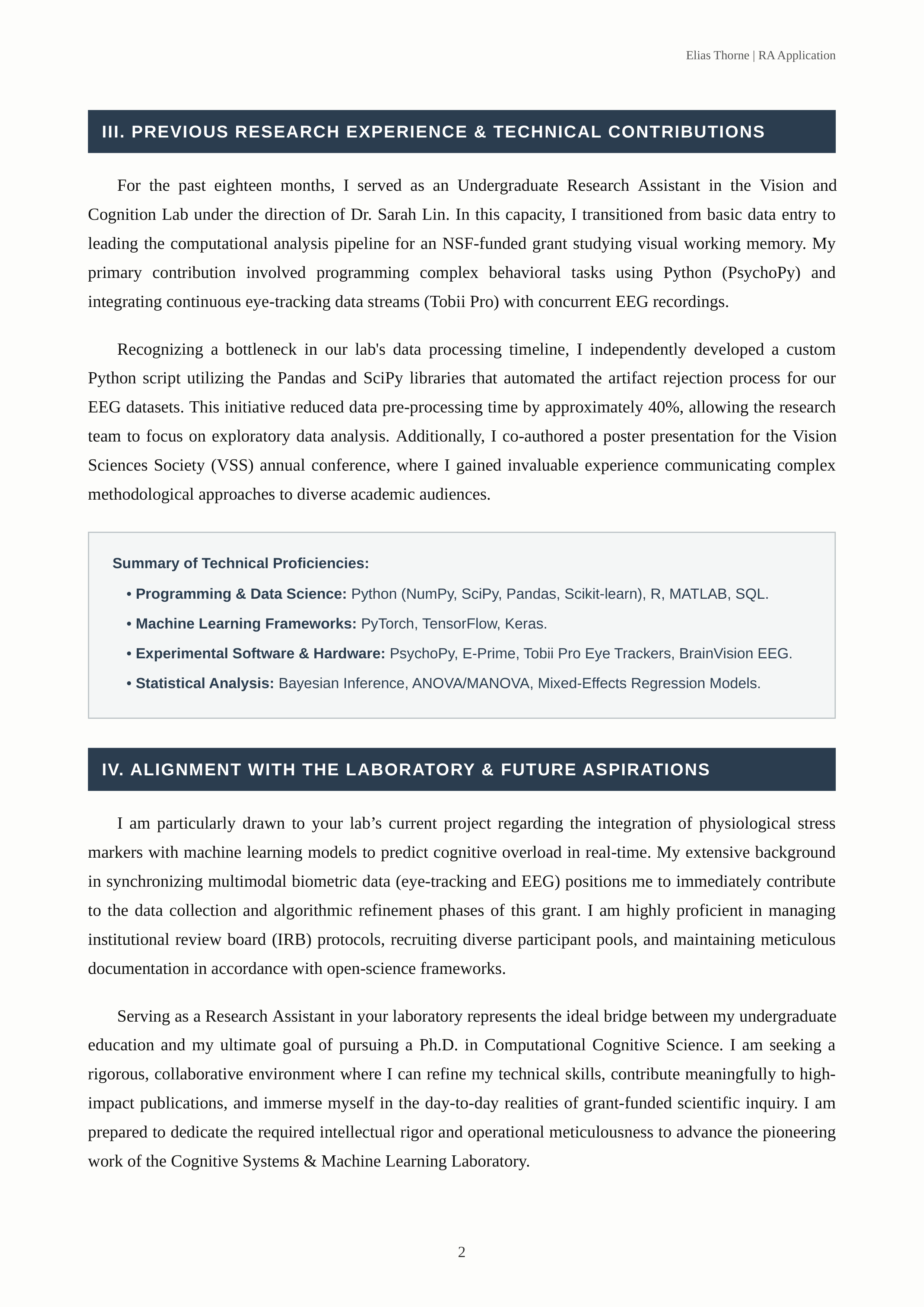
For the past eighteen months, I served as an Undergraduate Research Assistant in the Vision and
Cognition Lab under the direction of Dr. Sarah Lin. In this capacity, I transitioned from basic data entry to
leading the computational analysis pipeline for an NSF-funded grant studying visual working memory. My
primary contribution involved programming complex behavioral tasks using Python (PsychoPy) and
integrating continuous eye-tracking data streams (Tobii Pro) with concurrent EEG recordings.
Recognizing a bottleneck in our lab's data processing timeline, I independently developed a custom
Python script utilizing the Pandas and SciPy libraries that automated the artifact rejection process for our
EEG datasets. This initiative reduced data pre-processing time by approximately 40%, allowing the research
team to focus on exploratory data analysis. Additionally, I co-authored a poster presentation for the Vision
Sciences Society (VSS) annual conference, where I gained invaluable experience communicating complex
methodological approaches to diverse academic audiences.
Summary of Technical Proficiencies:
Programming & Data Science:
Python (NumPy, SciPy, Pandas, Scikit-learn), R, MATLAB, SQL.
Machine Learning Frameworks:
PyTorch, TensorFlow, Keras.
Experimental Software & Hardware:
PsychoPy, E-Prime, Tobii Pro Eye Trackers, BrainVision EEG.
Statistical Analysis:
Bayesian Inference, ANOVA/MANOVA, Mixed-Effects Regression Models.
IV. ALIGNMENT WITH THE LABORATORY & FUTURE ASPIRATIONS
I am particularly drawn to your lab’s current project regarding the integration of physiological stress
markers with machine learning models to predict cognitive overload in real-time. My extensive background
in synchronizing multimodal biometric data (eye-tracking and EEG) positions me to immediately contribute
to the data collection and algorithmic refinement phases of this grant. I am highly proficient in managing
institutional review board (IRB) protocols, recruiting diverse participant pools, and maintaining meticulous
documentation in accordance with open-science frameworks.
Serving as a Research Assistant in your laboratory represents the ideal bridge between my undergraduate
education and my ultimate goal of pursuing a Ph.D. in Computational Cognitive Science. I am seeking a
rigorous, collaborative environment where I can refine my technical skills, contribute meaningfully to high-
impact publications, and immerse myself in the day-to-day realities of grant-funded scientific inquiry. I am
prepared to dedicate the required intellectual rigor and operational meticulousness to advance the pioneering
work of the Cognitive Systems & Machine Learning Laboratory.
•
•
•
•
Elias Thorne | RA Application
2