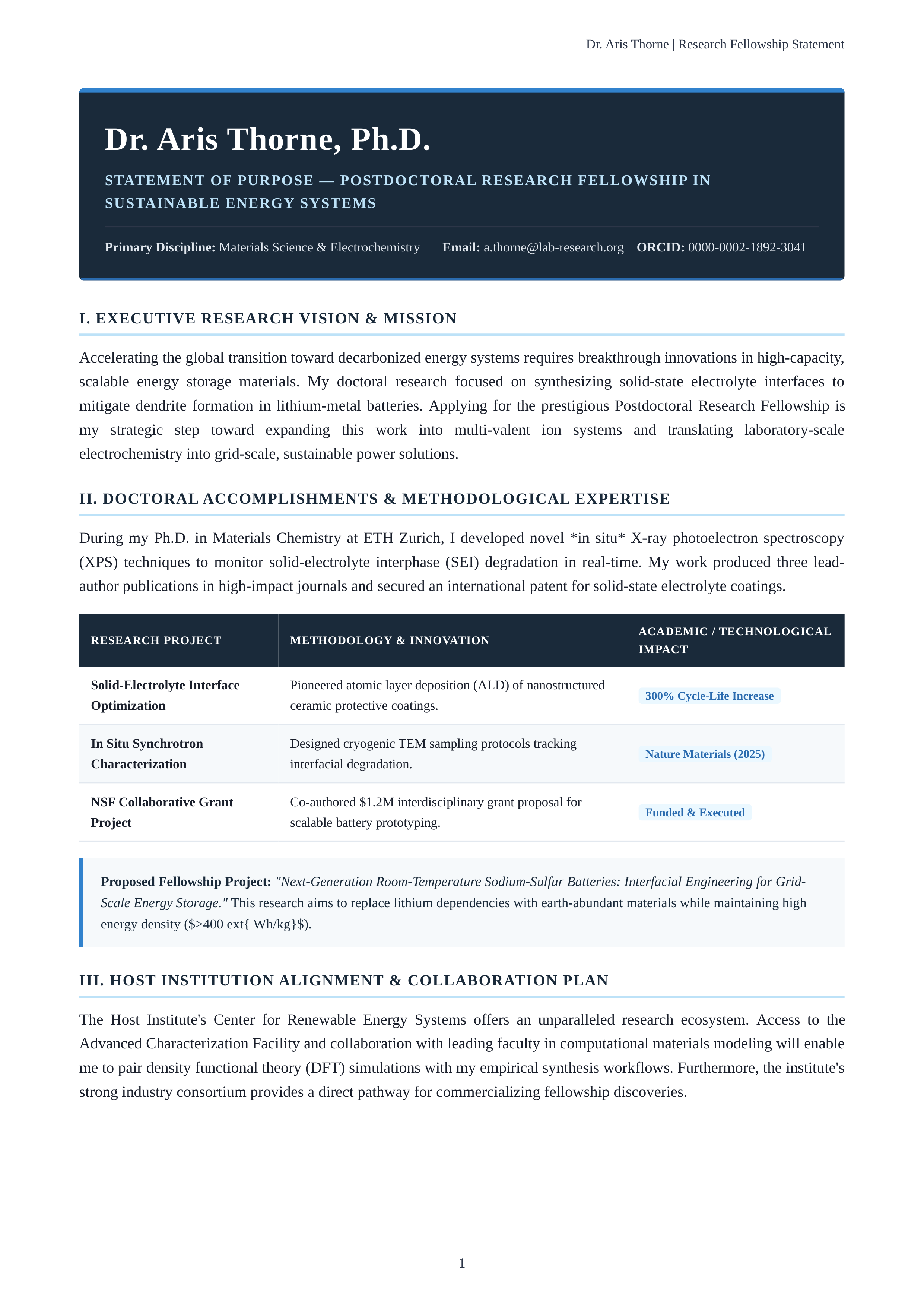
Dr. Aris Thorne, Ph.D.
STATEMENT OF PURPOSE — POSTDOCTORAL RESEARCH FELLOWSHIP IN
SUSTAINABLE ENERGY SYSTEMS
Primary Discipline:
Materials Science & Electrochemistry
Email:
a.thorne@lab-research.org
ORCID:
0000-0002-1892-3041
I. EXECUTIVE RESEARCH VISION & MISSION
Accelerating the global transition toward decarbonized energy systems requires breakthrough innovations in high-capacity,
scalable energy storage materials. My doctoral research focused on synthesizing solid-state electrolyte interfaces to
mitigate dendrite formation in lithium-metal batteries. Applying for the prestigious Postdoctoral Research Fellowship is
my strategic step toward expanding this work into multi-valent ion systems and translating laboratory-scale
electrochemistry into grid-scale, sustainable power solutions.
II. DOCTORAL ACCOMPLISHMENTS & METHODOLOGICAL EXPERTISE
During my Ph.D. in Materials Chemistry at ETH Zurich, I developed novel *in situ* X-ray photoelectron spectroscopy
(XPS) techniques to monitor solid-electrolyte interphase (SEI) degradation in real-time. My work produced three lead-
author publications in high-impact journals and secured an international patent for solid-state electrolyte coatings.
RESEARCH PROJECT
METHODOLOGY & INNOVATION
ACADEMIC / TECHNOLOGICAL
IMPACT
Solid-Electrolyte Interface
Optimization
Pioneered atomic layer deposition (ALD) of nanostructured
ceramic protective coatings.
300% Cycle-Life Increase
In Situ Synchrotron
Characterization
Designed cryogenic TEM sampling protocols tracking
interfacial degradation.
Nature Materials (2025)
NSF Collaborative Grant
Project
Co-authored $1.2M interdisciplinary grant proposal for
scalable battery prototyping.
Funded & Executed
Proposed Fellowship Project:
"Next-Generation Room-Temperature Sodium-Sulfur Batteries: Interfacial Engineering for Grid-
Scale Energy Storage."
This research aims to replace lithium dependencies with earth-abundant materials while maintaining high
energy density ($>400 ext{ Wh/kg}$).
III. HOST INSTITUTION ALIGNMENT & COLLABORATION PLAN
The Host Institute's Center for Renewable Energy Systems offers an unparalleled research ecosystem. Access to the
Advanced Characterization Facility and collaboration with leading faculty in computational materials modeling will enable
me to pair density functional theory (DFT) simulations with my empirical synthesis workflows. Furthermore, the institute's
strong industry consortium provides a direct pathway for commercializing fellowship discoveries.
Dr. Aris Thorne | Research Fellowship Statement
1