A
N
I N D
E
P E
N D
E
N T
B I O
G
R A
P H Y
Cornel West
Brother West: Living and Loving Out Loud
✦
The Life, Thought, and Legacy of America’s
Foremost Prophetic Voice — philosopher,
preacher, teacher, and lifelong servant of
justice.
Q
U E R Y
-
T O
-
P A G
E
P R E S S
·
M M X X V
1 / 26
Imprint
Cornel West — Brother West: Living and Loving Out Loud
A Biography
First Edition, 2025. Published by Query-to-Page Press.
This independent biography is a work of original commentary and scholarship, composed wholly from the
public record. It is not authorized by, affiliated with, or endorsed by Cornel West, his family, his representatives,
or any of the institutions with which he has been associated.
Brief quotations from published interviews, speeches, and writings appear solely for the purposes of criticism,
comment, and scholarship. Every effort has been made to present the public facts of the subject’s life accurately
and fairly. The author assumes no liability for errors or omissions.
Book design: Query-to-Page Document Studio. Typefaces: Fraunces and Source Serif 4, set digitally.
Manufactured for digital printing and PDF reproduction. Printed pages are A4 (210 mm
×
297 mm).
✦
L E T
J U S T I C E
R O
L L
D O
W N
L I K E
WAT E R S
✦
2 / 26
C O
N T
E N T
S
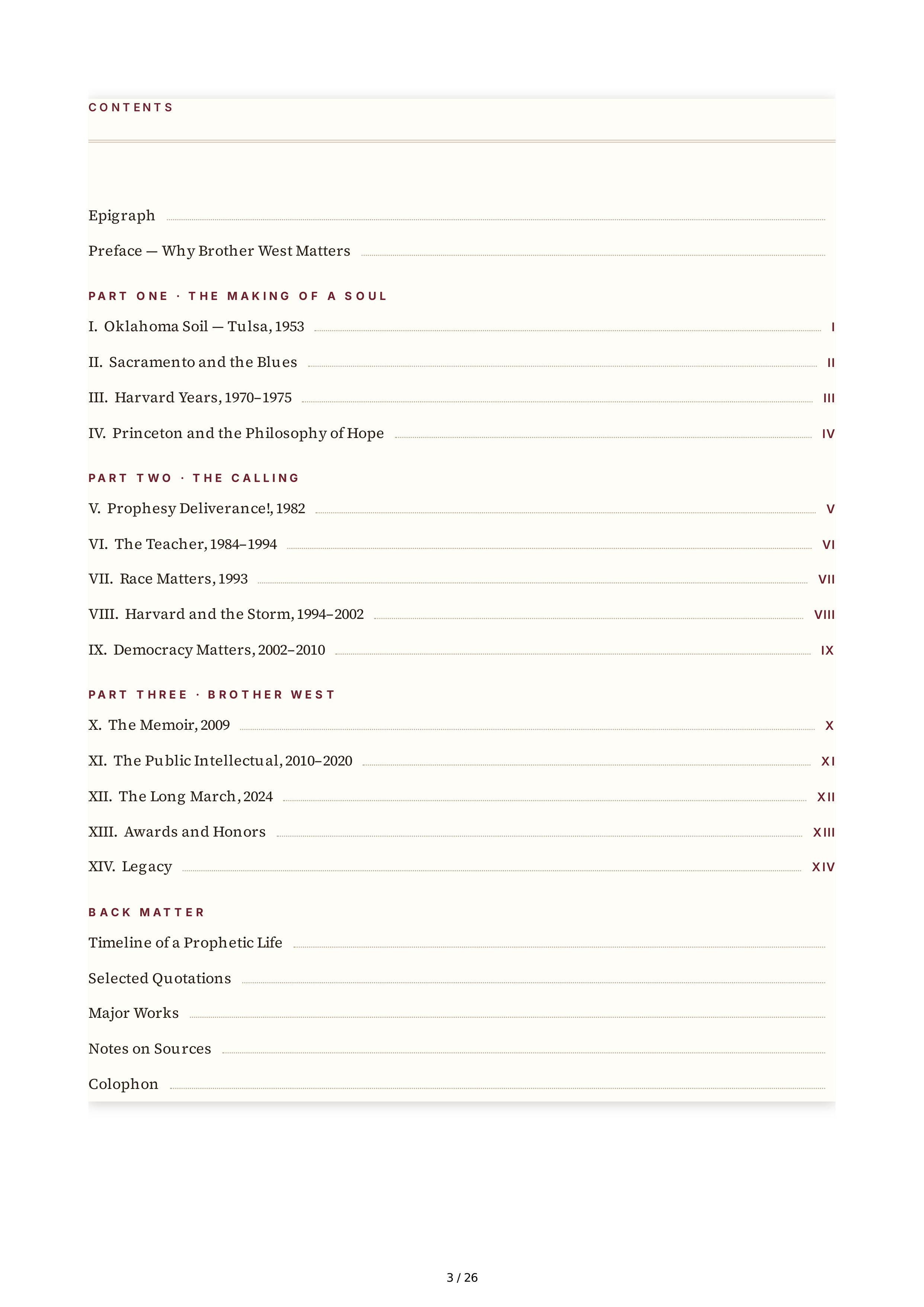
Epigraph
Preface — Why Brother West Matters
P A R T
O
N E
·
T
H E
M A K I N G
O
F
A
S
O
U L
I. Oklahoma Soil — Tulsa, 1953
I
II. Sacramento and the Blues
II
III. Harvard Years, 1970–1975
III
IV. Princeton and the Philosophy of Hope
IV
P A R T
T
W O
·
T
H E
C A L L I N G
V. Prophesy Deliverance!, 1982
V
VI. The Teacher, 1984–1994
VI
VII. Race Matters, 1993
VII
VIII. Harvard and the Storm, 1994–2002
VIII
IX. Democracy Matters, 2002–2010
IX
P A R T
T
H R E
E
·
B
R O
T
H E
R
W E
S
T
X. The Memoir, 2009
X
XI. The Public Intellectual, 2010–2020
XI
XII. The Long March, 2024
XII
XIII. Awards and Honors
XIII
XIV. Legacy
XIV
B
A C K
M A T
T
E
R
Timeline of a Prophetic Life
Selected Quotations
Major Works
Notes on Sources
Colophon
3 / 26
E
P I G
R A P H
“Justice is what love looks like in
public.”
—
C O R N E L
W E S T
✦
A blues man in the life of the mind, a jazz man in the world of ideas — and
a prisoner of hope.
4 / 26
I
P R E FA C E
Why Brother West Matters
n 2009, at the height of his celebrity, Cornel West published a memoir written with the music jour-
nalist David Ritz and gave it a title that read like a mission statement:
Brother West: Living and Loving
Out Loud
. In the Black church, “brother” is the word for kinship among the faithful; in the freedom
movement, it is the word for comrades on the march. West has spent more than forty years moving be-
tween classrooms, pulpits, television studios, and protest lines, trying to live out both meanings at once.
He calls himself a blues man in the life of the mind—someone who takes the sorrow of the world seri-
ously enough to turn it into something bearable, and something true.
This biography follows the arc of that life from a Tulsa hospital in 1953 to a presidential ballot in 2024. It
traces a boy who grew up in Sacramento quoting scripture and listening to jazz; a Harvard undergradu-
ate who studied ancient languages and radical politics; a Princeton philosopher who fused American
pragmatism with Black Christianity; a professor who became a national symbol; a public intellectual
who appeared in Hollywood movies, debated presidents, and went to jail for his beliefs; and, finally, a
presidential candidate offering a socialist vision to a nation that rarely hears one.
The book is written from the public record—his published works, his many interviews, institutional an-
nouncements, and decades of reporting. The aim is not hagiography. West has always insisted that hon-
est love requires honest criticism, and he has applied that standard to himself as readily as to others. He
would want a portrait with shadows: the celebrity and the sermons, the triumphs and the controversies,
the stubborn hope and the occasional bitterness.
Above all, this is the story of a vocation. West has described his calling as bearing witness—telling the
truth about power, suffering, and possibility, in language that ordinary people can feel. The chapters
that follow take that vocation seriously, following a singular American life through its many acts, and
asking what it means to live, as West would put it, “loving out loud.”
5 / 26
C
P A R T
O
N E
·
C H A P T
E
R
I
Oklahoma Soil
Born in a city that had already known the worst of America’s racial violence, and would one day teach
the world about it again.Tulsa, Oklahoma · June 2, 1953
ornel Ronald West was born on June 2, 1953, in Tulsa, Oklahoma, the child of Clifton Louis West
Jr., a civilian contractor who worked for the United States Air Force, and Irene Bias West, a
schoolteacher who would later become a principal. Tulsa in 1953 was a city still living in the
shadow of its own history. Just thirty-two years before West’s birth, a white mob had destroyed
Greenwood, the thriving Black district known as Black Wall Street, killing hundreds and leveling a
prosperous community. Every Black family in Tulsa carried that memory—of property burned, of excel-
lence punished, of a people who had built a world and watched it go up in flames.
The West household carried a different inheritance. Both sides of the family were steeped in the Black
church and in the culture of the Black South—preaching, prayer, education, and music. His maternal
grandfather had been a Baptist minister, and the cadences of the pulpit were part of the air West
breathed from infancy. Education was treated as sacred. In the West home, to read well was to honor
your ancestors; to speak well was to prepare for a life of service.
When West was still a small child, the family moved west to Sacramento, California, joining the great
mid-century migration of Black families seeking work, safety, and room to rise. The Oklahoma years
were brief, yet they left their mark. Decades later, in his memoir, West would speak of his parents and
grandparents not as private figures but as carriers of a tradition—people whose dignity had been
forged in the crucible of segregation, whose faith had been tested and had held.
He was born, in other words, into the two great streams of African American life: the church that sus-
tained a people, and the city that reminded them how fragile their gains could be. The child who left
Tulsa for California carried both truths with him—the hope and the warning—and he has spent his life
insisting that America must reckon with both.
6 / 26
S
P A R T
O
N E
·
C H A P T
E
R
I I
Sacramento and the Blues
A household of scripture, jazz, and books—and, across the bay, the sound of revolution.Sacramento,
California · 1950s–1960s
acramento in the 1950s and 1960s was a city of modest ambitions and quiet segregation—a state
capital where Black families built churches, taught school, and kept their eyes on the horizon.
The West household was the center of young Cornel’s universe. His mother, Irene, was an edu-
cator whose expectations were exacting; his father, Clifton, worked for the Air Force and served as a dea-
con in their church. Music filled the house—gospel, jazz, and the blues—and the boy who would one
day call himself a “blues man in the life of the mind” was learning early that Black music was not enter-
tainment but testimony: a people’s way of transforming suffering into art.
The 1960s crashed into that household with the force of history. West was eight when John F. Kennedy
was assassinated, ten when Malcolm X was killed, fifteen when Martin Luther King Jr. fell in Memphis.
On television and in the streets, a generation was being forged. The Black Panther Party was founded
across the bay in Oakland in 1966, and for a Black teenager in Sacramento, the Panthers’ free breakfast
programs, their discipline, and their defiance were impossible to ignore. West has recalled being electri-
fied—and terrified—by the sight of armed Panthers in the state capital. His mother, he once joked, was
not pleased.
He was also, by then, a prodigy of the word. Friends and family noticed early that Cornel could memo-
rize scripture, argue theology, and hold a classroom spellbound. He preached his first sermons as a
teenager, developing the thunderous, improvisational style—part Baptist preacher, part jazz soloist—
that would become his signature. When he entered the public library, he read everything: philosophy,
history, poetry, biography. He wanted to understand the world, and he wanted to change it.
By the time he graduated from John F. Kennedy High School in 1970, West had absorbed the two great
teachers of his youth: the Black church, which taught him that the poor matter to God, and the Black
freedom movement, which taught him that the poor matter to history. Harvard College had accepted
him. The boy from Sacramento was going east—and nothing would ever be the same.
7 / 26
H
P A R T
O
N E
·
C H A P T
E
R
I I I
Harvard Years
1970–1975 · Magna cum laude in Near Eastern Languages and Literature
arvard, in the autumn of 1970, was a place in upheaval. The student strike over the Cambodia
invasion was a year behind; Black studies programs were being born in an atmosphere of cri-
sis and creation; and a seventeen-year-old from Sacramento arrived with a preacher’s lungs
and a philosopher’s hunger. West settled on a course of study that surprised even his classmates—Near
Eastern Languages and Literature—because he wanted to read the scriptures and the philosophical tra-
ditions of the Middle East in their original tongues. His intellectual ambition was already ecumenical:
nothing less than the full range of human wisdom would do.
At Harvard he discovered the European canon—Kant, Hegel, Marx, Kierkegaard—and was seized by a
question that would define his career: How could rigorous thought be turned to the liberation of the op-
pressed? The Marx he read was not a crude economist but a philosopher of alienation and freedom. The
Christianity he had inherited was not a consolation but a mandate. In his dorm room and in the library,
he began the work of synthesis that would eventually produce what he called “prophetic pragmatism”—
a philosophy that took the best of American pragmatism, European revolutionary thought, and Black
Christian faith, and bent them all toward justice.
He also encountered, for the first time, the daily whiteness of elite American institutions. He was one of a
small number of Black students in his class, and the experience sharpened a lifelong conviction: that
the American university is both a gateway to opportunity and a guardian of hierarchy, and that the
intellectual’s task is to tear down the gates from within. He organized, debated, marched, and studied—
often in the same day.
West graduated magna cum laude in 1975. The degree was in Near Eastern languages, but his mind by
then had moved decisively into philosophy. Princeton University accepted him into its doctoral program,
and he headed south to New Jersey—a preacher with a diploma, a philosopher in training, and a world
to reorder.
8 / 26
P
P A R T
O
N E
·
C H A P T
E
R
I V
Princeton and the Philosophy of Hope
1975–1980 · Doctor of Philosophy in Philosophy
rinceton in the late 1970s was the capital of American academic philosophy—analytic, rigorous,
and overwhelmingly white. Into this world walked a young Black man from the Black church
who believed that philosophy’s highest calling was to comfort the afflicted and afflict the com-
fortable. West’s doctoral work was a sustained engagement with the European tradition—from Kant’s
moral philosophy through Hegel’s dialectics to Marx’s critique of capital—yet he refused to treat the
canon as an end in itself. The question he brought to Princeton was the question he had brought to
Harvard: What does serious thought have to do with the freedom of Black people and the poor?
While completing his dissertation, West began teaching at Union Theological Seminary in New York in
1977. The move was decisive. Union, perched above Harlem, was the meeting place of radical theology
and Black faith, and it gave West something Princeton could not: a community in which the intellectual
life and the life of the spirit were not enemies. In 1982 he published his first book,
Prophesy Deliverance! An
Afro-American Revolutionary Christianity
, and the philosopher who emerged from Princeton—degree com-
pleted in 1980—was already something new in American letters: a rigorous academic who had chosen
the prophetic tradition as his home.
His doctorate in hand, West began to assemble the intellectual architecture that would define his ca-
reer. From the American pragmatists—William James, John Dewey, and above all W.E.B. Du Bois—he took
the belief that ideas are instruments of human flourishing, tested in the fire of lived experience. From
the Marxist tradition he took a structural analysis of power and capital. From the Black church he took
the conviction that history is not a closed circle—that, in the words of the spiritual,
we shall overcome some-
day
. The synthesis was his own, and he gave it a name: prophetic pragmatism, a philosophy of demo-
cratic hope rooted in the suffering and the strivings of ordinary people.
9 / 26
P
P A R T
T
W O
·
C H A P T
E
R
V
Prophesy Deliverance!
1982 · First Book · Union Theological Seminary, New York
rophesy Deliverance!
was a young man’s book with an old soul’s ambition. Published in 1982, it an-
nounced West’s central project to the world: the construction of a Black prophetic Christianity
that could take seriously both the promises of the gospel and the realities of capital. The book’s
argument was audacious. West insisted that the Black church had been—and could again become—the
most important institutional vehicle of Black freedom in America, but only if it embraced rigorous social
analysis rather than otherworldly comfort. Christianity and Marxism, he argued, need not be enemies;
properly understood, both are critiques of domination and both are prayers for a new world.
The book was also a manifesto for a style of intellectual life. West rejected the notion that serious think-
ing requires distance from the struggles of the poor. On the contrary, he insisted, the deepest thinking
is done in solidarity, in the struggle, in what he would later call “the tragicomic” spirit—an embrace of
life that refuses both cheap optimism and bitter despair. The prophetic intellectual, in West’s rendering,
is a witness: someone who tells the truth about suffering, names the powers that cause it, and refuses to
stop hoping.
Theologically, the book drew on the black liberation theology that had emerged in the 1960s and 1970s,
but West pushed it in new directions—engaging Western Marxism, European critical theory, and the
lived religion of Black communities. He was equally attentive to what he called the “womanist” chal-
lenge of Black women’s thought, insisting that any credible liberation theology must face the interlock-
ing structures of race, class, and gender.
Prophesy Deliverance! established West as a theologian to watch, but it did something more important: it
fixed the trajectory of everything that followed. For four decades, across twenty books and countless es-
says, West has been refining the vision he first announced in 1982—a vision of a Christianity that is revo-
lutionary, a philosophy that is democratic, and an intellectual life that is, above all, accountable to the
poor.
10 / 26
C
P A R T
T
W O
·
C H A P T
E
R
V I
The Teacher
1984–1994 · Yale, Paris, and Princeton
ornel West’s teaching career reads like a map of American religious and intellectual life: Union
Theological Seminary in New York, where he began as a graduate instructor; Yale Divinity
School from 1984 to 1987; a year at the University of Paris; and Princeton University from 1988 to
1994, where he served as professor of religion and director of the Program in African American Studies.
Everywhere he went, the reports were the same: students emerged from his lectures shaken, laughing,
and converted—not to any party, but to the sense that ideas could matter, urgently, to the world.
West’s classroom was a performance in the highest sense—a fusion of homiletics, stand-up comedy, and
Socratic dialogue. He lectured without notes, his voice rising and falling like a gospel choir, quoting Du
Bois, Coltrane, and the Book of Amos in the same breath. Students who expected a conventional seminar
found themselves asked to wrestle with the meaning of their own lives. “What does it profit a man,” he
would ask with a grin, “to gain the whole world and lose his soul?”
The years at Princeton were among his most productive. He edited and co-wrote a remarkable run of
books, including
Breaking Bread: Insurgent Black Intellectual Life
(1991), a dialogue with bell hooks on the vo-
cation of Black thought, and
The American Evasion of Philosophy
(1989), a genealogy of pragmatism that has
become a standard text. In 1993 he published both
Keeping Faith: Philosophy and Race in America
and a
slender book of essays that would change his life.
By the early 1990s, West had also become a defining voice of a new generation of Black public intellectu-
als—scholars who moved easily between the academy, the magazine page, and the television studio. He
was building, with colleagues and friends, a model of intellectual life that rejected the ivory tower with-
out surrendering rigor: rigor in service of the people, as he would say, and love made intellectual. The
teacher was becoming a witness, and the world was beginning to listen.
11 / 26
I
P A R T
T
W O
·
C H A P T
E
R
V I I
Race Matters
1993 · A National Bestseller · Winner of the American Book Award
n the spring of 1992, Los Angeles burned. The acquittal of the police officers who had beaten
Rodney King touched off the largest urban uprising in a generation, and the nation was forced to
confront, again, the depth of its racial wounds. Into that moment stepped Cornel West with a col-
lection of essays as thin as a sermon and as sharp as a blade.
Race Matters
, published in 1993, was not the
first book of Black intellectual commentary, nor the last, but it was the one that broke through—a na-
tional bestseller that made its author a household name.
The book’s title was itself an argument. Against those who insisted that race was a distraction from class,
and against those who reduced everything to identity, West insisted that race remains a “constitutive”
feature of American life—woven into the country’s founding, its economy, its geography, and its soul. Yet
the book refused easy pieties. West trained his fire in every direction: on white supremacy, to be sure,
but also on Black conservative calls for self-help without structural change, on liberal paternalism, and
on what he memorably described as the “nihilistic threat”—the lived experience of meaninglessness,
hopelessness, and self-destruction that poverty and despair breed in America’s inner cities.
The essays combined the registers West had spent a decade perfecting: the preacher’s urgency, the
philosopher’s precision, the blues man’s honesty. He wrote about Black youth and Malcolm X, about sex-
uality and the Black church, about the crisis of Black leadership, and about what he called the need for
a politics of “transformation” rather than mere “management” of the status quo. The book sold hun-
dreds of thousands of copies and won the American Book Award in 1993, but its deeper achievement was
cultural: it gave a generation a vocabulary for talking about race—with love, with rigor, and without
illusion.
Race Matters
made West, at forty, the most visible Black academic in America. The preacher from
Sacramento had become, in the phrase repeated across the media, one of the nation’s leading public in-
tellectuals. Harvard came calling—and with Harvard came the storm.
12 / 26
I
P A R T
T
W O
·
C H A P T
E
R
V I I I
Harvard and the Storm
1994–2002 · University Professor · The Summers Controversy
n 1994, Harvard appointed Cornel West University Professor—an honor reserved for a handful of
scholars of the highest distinction, and one rarely conferred on a scholar under fifty. West came
with star power unmatched in American academic life. He appeared on television, recorded al-
bums, lectured to thousands, and held court at the Afro-American Studies department he helped make
famous, alongside colleagues including Henry Louis Gates Jr. For a few years, Harvard and West seemed
made for each other: the oldest university in America and its most famous Black scholar.
Then, in 2001, the new president of Harvard, Lawrence Summers, entered the scene. In private conver-
sations later reported in the press, Summers questioned the rigor of West’s scholarship, discouraged
him from spending so much energy on activism and media, and criticized one of his music projects, the
spoken-word album
Sketches of My Culture
(2001). When the story broke in early 2002, it detonated. The
controversy became a national argument about academic freedom, about the place of Black studies in
elite universities, and about what kind of intellectual “counts.” West’s supporters saw a Black scholar be-
ing disciplined for popularity and activism; Summers’s defenders saw a president trying to raise schol-
arly standards.
West’s response was characteristic—defiant, theatrical, and quotable. He compared the conflict to larger
battles for recognition and respect, insisted that his work served the people, and made clear he would
not be lectured on seriousness by any administrator. But the fight cost him. In the spring of 2002, West
and two prominent colleagues announced they were leaving Harvard for Princeton, where West took a
chaired position and a joint appointment in religion and African American studies. The departure made
headlines around the world.
Looking back, the affair became a case study in the culture wars of American higher education—a mo-
ment when the question “What is a professor for?” was argued in every newspaper in the country. West
emerged from the storm unbowed—and, in a sense, more famous than ever. He had defended a vision of
the intellectual as witness, and he had paid the price, and he would never apologize for it.
13 / 26
T
P A R T
T
W O
·
C H A P T
E
R
I X
Democracy Matters
2002–2010 · Princeton · The Matrix · Democracy Matters
he return to Princeton in 2002 began a new and extraordinarily public chapter. In 2003, West ap-
peared in
The Matrix Reloaded
and
The Matrix Revolutions
as Councillor West, a sage voice in the
human city of Zion—a casting choice that made a certain kind of cultural sense, since West had
long seemed to occupy the role of philosopher-king in the American imagination. He traded lines with
the Wachowskis’ mythmaking while continuing to lecture on Kant and Malcolm X with equal gravity.
The movies were a gift to his legend: the philosopher as bodyguard of the human spirit.
The political landscape of those years—the terrorist attacks of September 11, 2001, the wars in
Afghanistan and Iraq, the hardening of American empire—demanded a response. West answered with
Democracy Matters: Winning the Fight Against Imperialism
(2004), a passionate critique of what he called
American “empire” and “market fundamentalism.” The book argued that genuine democracy—“deep
democracy”—has been betrayed by both major parties, and that America’s best traditions of dissent, from
the abolitionists to the civil rights movement, are exactly the traditions it has suppressed. It won the
NAACP Image Award for Outstanding Literary Work, Nonfiction, cementing West’s place as the country’s
most visible radical intellectual.
Those years also showcased West the television phenomenon. He became a regular on
Real Time with Bill
Maher
, The Colbert Report, and countless news programs, where his mixture of scholarship, humor, and
righteous anger made him irresistible television. He made his arguments in a three-piece suit, chain
watch, and flowing conversation that could veer from the Book of Job to the War on Terror in forty sec-
onds. Critics sometimes called him a showman. His defenders noted that America has always distrusted
prophets who perform—but that the best ones always did.
Notably, West also modeled something rare: friendship across profound disagreement. He and the con-
servative legal philosopher Robert P. George, colleagues at Princeton despite being poles apart politi-
cally, co-taught classes, wrote together, and publicly defended the value of civil exchange between
those who disagree about everything except the importance of the conversation. It was, West said, what
democracy looks like at its best: two people arguing with love.
14 / 26
B
P A R T
T
H R E
E
·
C H A P T
E
R
X
The Memoir
2009 · Brother West: Living and Loving Out Loud · With David Ritz
y 2009, Cornel West had become, in the words of many observers, the most famous philosopher
in America—and one of the least known. The public knew the three-piece suits, the thundering
phrases, the television appearances. It knew little of the man behind them: the child of Tulsa
and Sacramento, the husband and father, the friend who wept at the deaths of his heroes, the Christian
who wrestled, in private, with the same despair he diagnosed in the nation.
Brother West: Living and Loving Out Loud
, written with the acclaimed music biographer David Ritz, opened a
door. The memoir is candid in ways that celebrity books rarely are. West writes about his family, his mar-
riages, his children, his friendships, his failures, and his faith—describing a life of intense public striv-
ing and intense private struggle. He tells of being inspired and wounded, of the loneliness of the spot-
light, of the music that sustained him, and of the love—familial, romantic, and divine—that he says has
been the true engine of his work.
The title carried a double meaning, as West knew it would. In the Black church, “brother” signals kin-
ship in faith; among radicals, it signals kinship in struggle. To write one’s life as
Brother West
was to insist
that the story of a philosopher is inseparable from the story of a community—that no one thinks alone,
and no one is saved alone. And “living and loving out loud” was not a slogan but a discipline: the deter-
mination, as West put it, to love without embarrassment, to hope without naivete, and to tell the truth
without flinching.
The audiobook version of
Brother West
, read by the author, received a Grammy Award nomination for
Best Spoken Word Album in 2010—an honor that delighted West, who had always insisted that the sound
of a voice was as important as the sense of a sentence. The memoir did what the best memoirs do: it made
the public man more, not less, interesting. He had given America its portrait—in his own voice, at full
volume.
15 / 26
T
P A R T
T
H R E
E
·
C H A P T
E
R
X
I
The Public Intellectual
2010–2020 · Occupy · Ferguson · The Tight Rope
he decade that followed the memoir found West everywhere and nowhere—everywhere on the
American scene, and nowhere near the center of respectable opinion. He spoke at Occupy Wall
Street encampments, where his call to link economic injustice and racial injustice electrified a
new generation of radicals. In October 2014, during the “Ferguson October” protests following the
killing of Michael Brown, West was arrested in St. Louis; he emerged from the experience with charac-
teristic defiance, insisting that any preacher of justice must be willing to put his body where his theol-
ogy pointed.
His political independence became more pronounced. West had long criticized both major parties, argu-
ing that they served the wealthy and the powerful while ignoring the poor. In a 2011 interview, he dis-
missed President Barack Obama—whom he had once supported—as “a Rockefeller Republican in black-
face,” a phrase that detonated across the political world and which West later said he regretted. The re-
mark, however regrettable, captured something essential about him: he would not be a court philoso-
pher to any president, and he measured every leader against the standard of the least of these.
In 2017, West co-founded
The Tight Rope
, a podcast and YouTube program with the scholar Tricia Rose, cre-
ating a space for long-form, unfiltered conversation about race, culture, and power—the kind of conver-
sation network television could no longer hold. The show became a hub for Black intellectual life, draw-
ing guests from politics, music, and the academy. In the same year, West returned to Harvard—not to the
Faculty of Arts and Sciences, but to Harvard Divinity School, where he took a professorship and contin-
ued his lifelong work of joining philosophy to faith.
Through the Trump years, the pandemic, and the uprising following the murder of George Floyd, West’s
voice became, for millions, a kind of national conscience—a reminder that America’s crisis was not a mis-
take but a confrontation with its founding sins. He insisted, against both despair and triumphalism, that
the only honest posture was the tragicomic one: grief and joy, judgment and hope, held together like a
gospel chord. “I’m a prisoner of hope,” he said again and again—and somehow, even in the darkest
hours, he made the sentence sound like a plan.
16 / 26
C
P A R T
T
H R E
E
·
C H A P T
E
R
X
I I
The Long March
2024 · Candidate for President of the United States, People’s Party
ornel West had flirted with presidential politics for years, weighing an independent campaign
in 2011 before declining. In June 2023, he announced that he would run for President of the
United States—not as a Democrat or Republican, but as a candidate of the People’s Party, a small
left-wing third party built on the conviction that the two major parties have failed the working class. His
running mate was Melina Abdullah, a scholar and organizer in the Black Lives Matter movement.
The campaign was, in almost every sense, a long march. The platform was unapologetically radical by
American standards: a living wage and guaranteed employment, health care for all, free public educa-
tion, reparations for Black Americans, an end to the wars abroad and the prison-industrial complex at
home, and a foreign policy grounded in human rights rather than empire. West campaigned as a
preacher runs a revival—arguing that politics is not a matter of lesser evils but of public values, and that
what America lacks is not technique but vision.
The results were predictable. He struggled to gain ballot access under a patchwork of state election
laws built for two parties. He drew small crowds where the major candidates drew stadiums. The media,
with rare exceptions, treated his campaign as a curiosity. On election night, West received a fraction of
one percent of the vote. None of this deterred him. He had run, he said, not to win an office but to bear
witness—to put before the American people a vision of a different kind of democracy, and to speak the
truth about what poverty, militarism, and oligarchy are doing to the country.
Critics called the campaign quixotic. Supporters called it necessary. West himself, characteristically,
reached for the tradition: he reminded audiences that Frederick Douglass never held office, that the
abolitionists never won an election, that the moral witness of a minority has often been the seed of na-
tional transformation. “You can’t lead the people if you don’t love the people,” he told a rally—his oldest
sermon, and his newest. The long march, he made clear, does not end at a ballot box. It ends only when
justice rolls down like waters.
17 / 26
P A R T
T
H R E
E
·
C H A P T
E
R
X
I I I
Awards and Honors
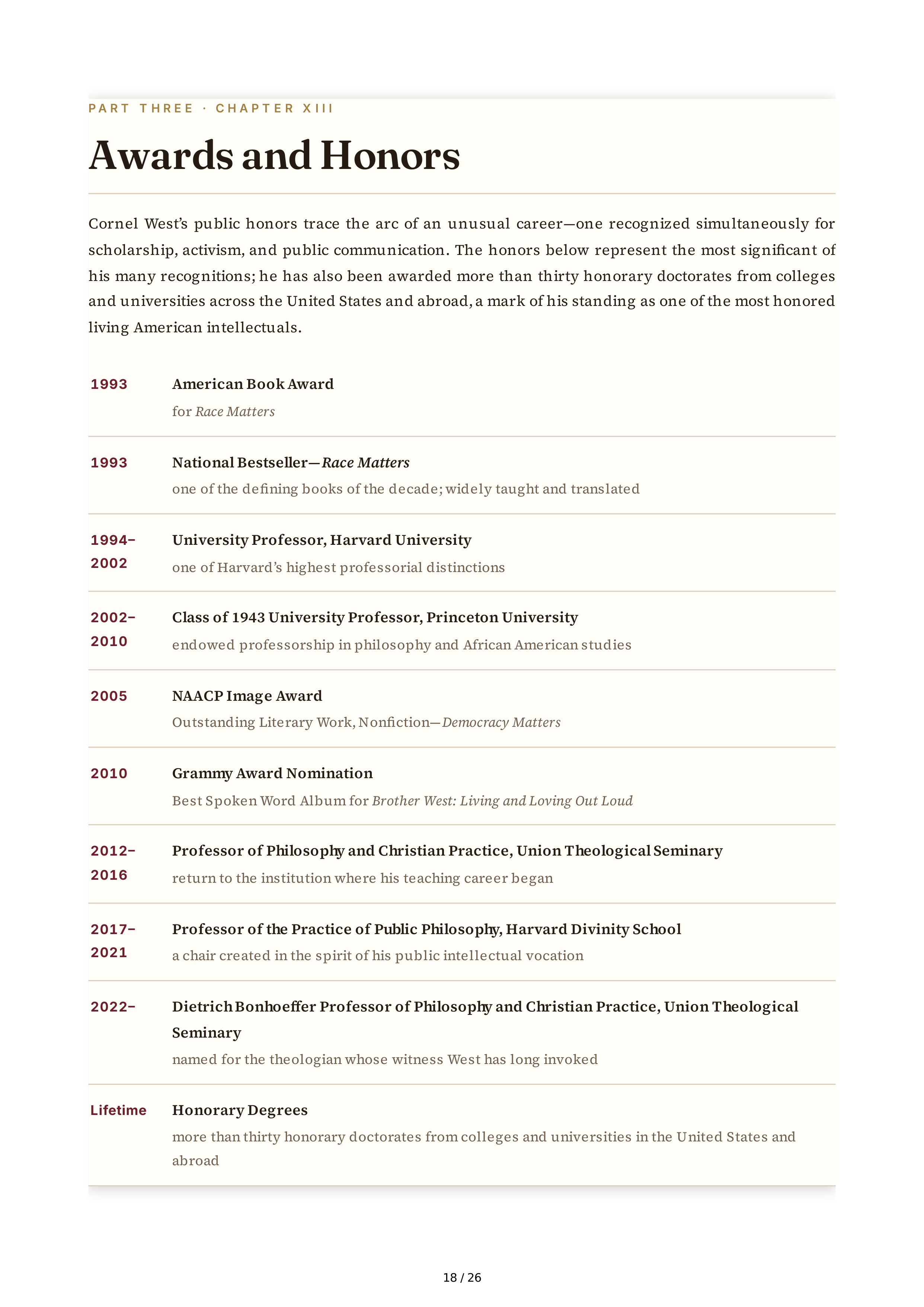
Cornel West’s public honors trace the arc of an unusual career—one recognized simultaneously for
scholarship, activism, and public communication. The honors below represent the most significant of
his many recognitions; he has also been awarded more than thirty honorary doctorates from colleges
and universities across the United States and abroad, a mark of his standing as one of the most honored
living American intellectuals.
1993
American Book Award
for
Race Matters
1993
National Bestseller—
Race Matters
one of the defining books of the decade; widely taught and translated
1994–
2002
University Professor, Harvard University
one of Harvard’s highest professorial distinctions
2002–
2010
Class of 1943 University Professor, Princeton University
endowed professorship in philosophy and African American studies
2005
NAACP Image Award
Outstanding Literary Work, Nonfiction—
Democracy Matters
2010
Grammy Award Nomination
Best Spoken Word Album for
Brother West: Living and Loving Out Loud
2012–
2016
Professor of Philosophy and Christian Practice, Union Theological Seminary
return to the institution where his teaching career began
2017–
2021
Professor of the Practice of Public Philosophy, Harvard Divinity School
a chair created in the spirit of his public intellectual vocation
2022–
Dietrich Bonhoeffer Professor of Philosophy and Christian Practice, Union Theological
Seminary
named for the theologian whose witness West has long invoked
Lifetime
Honorary Degrees
more than thirty honorary doctorates from colleges and universities in the United States and
abroad
18 / 26
W
P A R T
T
H R E
E
·
C H A P T
E
R
X
I V
Legacy
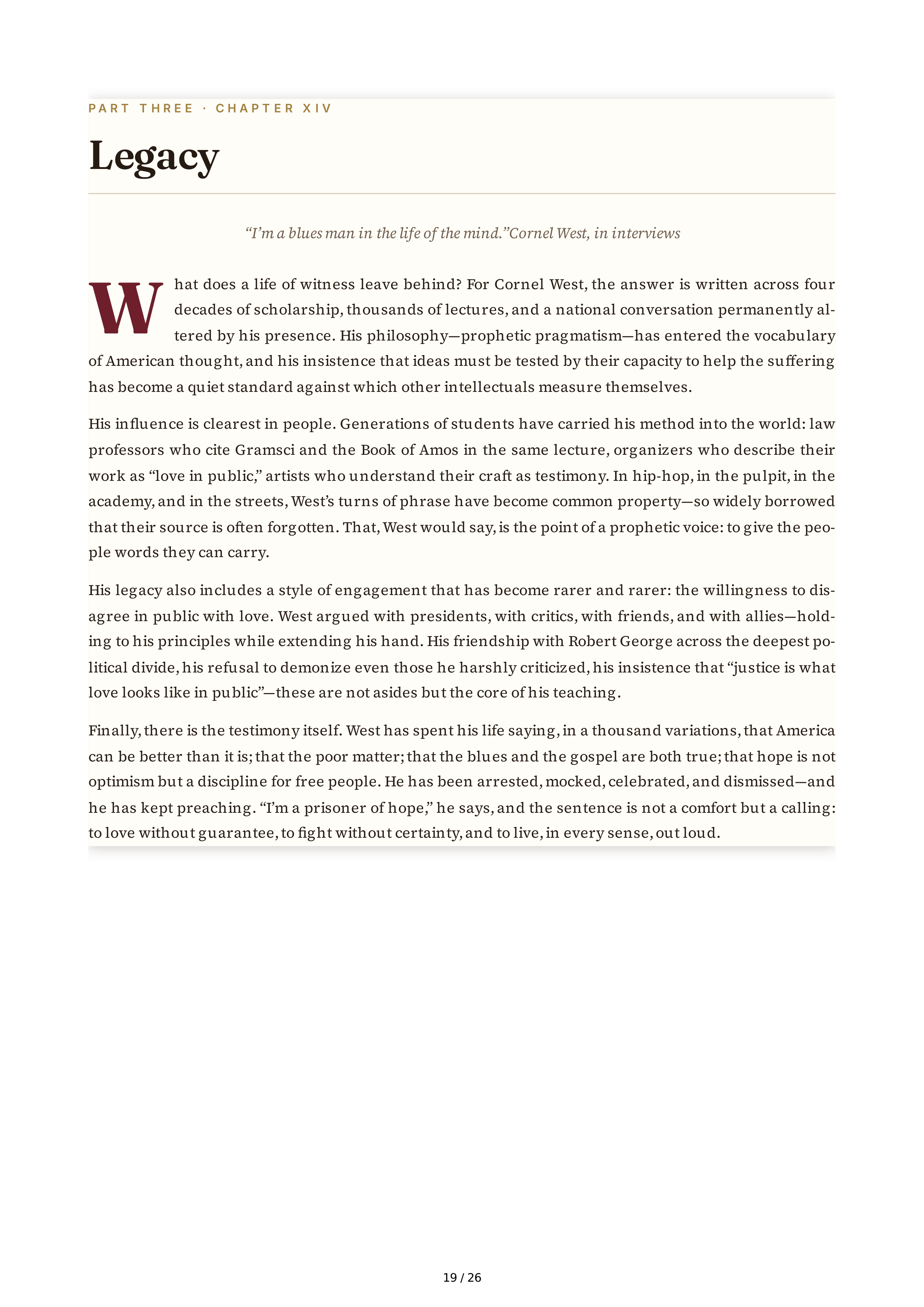
“I’m a blues man in the life of the mind.”Cornel West, in interviews
hat does a life of witness leave behind? For Cornel West, the answer is written across four
decades of scholarship, thousands of lectures, and a national conversation permanently al-
tered by his presence. His philosophy—prophetic pragmatism—has entered the vocabulary
of American thought, and his insistence that ideas must be tested by their capacity to help the suffering
has become a quiet standard against which other intellectuals measure themselves.
His influence is clearest in people. Generations of students have carried his method into the world: law
professors who cite Gramsci and the Book of Amos in the same lecture, organizers who describe their
work as “love in public,” artists who understand their craft as testimony. In hip-hop, in the pulpit, in the
academy, and in the streets, West’s turns of phrase have become common property—so widely borrowed
that their source is often forgotten. That, West would say, is the point of a prophetic voice: to give the peo-
ple words they can carry.
His legacy also includes a style of engagement that has become rarer and rarer: the willingness to dis-
agree in public with love. West argued with presidents, with critics, with friends, and with allies—hold-
ing to his principles while extending his hand. His friendship with Robert George across the deepest po-
litical divide, his refusal to demonize even those he harshly criticized, his insistence that “justice is what
love looks like in public”—these are not asides but the core of his teaching.
Finally, there is the testimony itself. West has spent his life saying, in a thousand variations, that America
can be better than it is; that the poor matter; that the blues and the gospel are both true; that hope is not
optimism but a discipline for free people. He has been arrested, mocked, celebrated, and dismissed—and
he has kept preaching. “I’m a prisoner of hope,” he says, and the sentence is not a comfort but a calling:
to love without guarantee, to fight without certainty, and to live, in every sense, out loud.
19 / 26
B A C K
M A T
T
E R
Timeline of a Prophetic Life
20 / 26
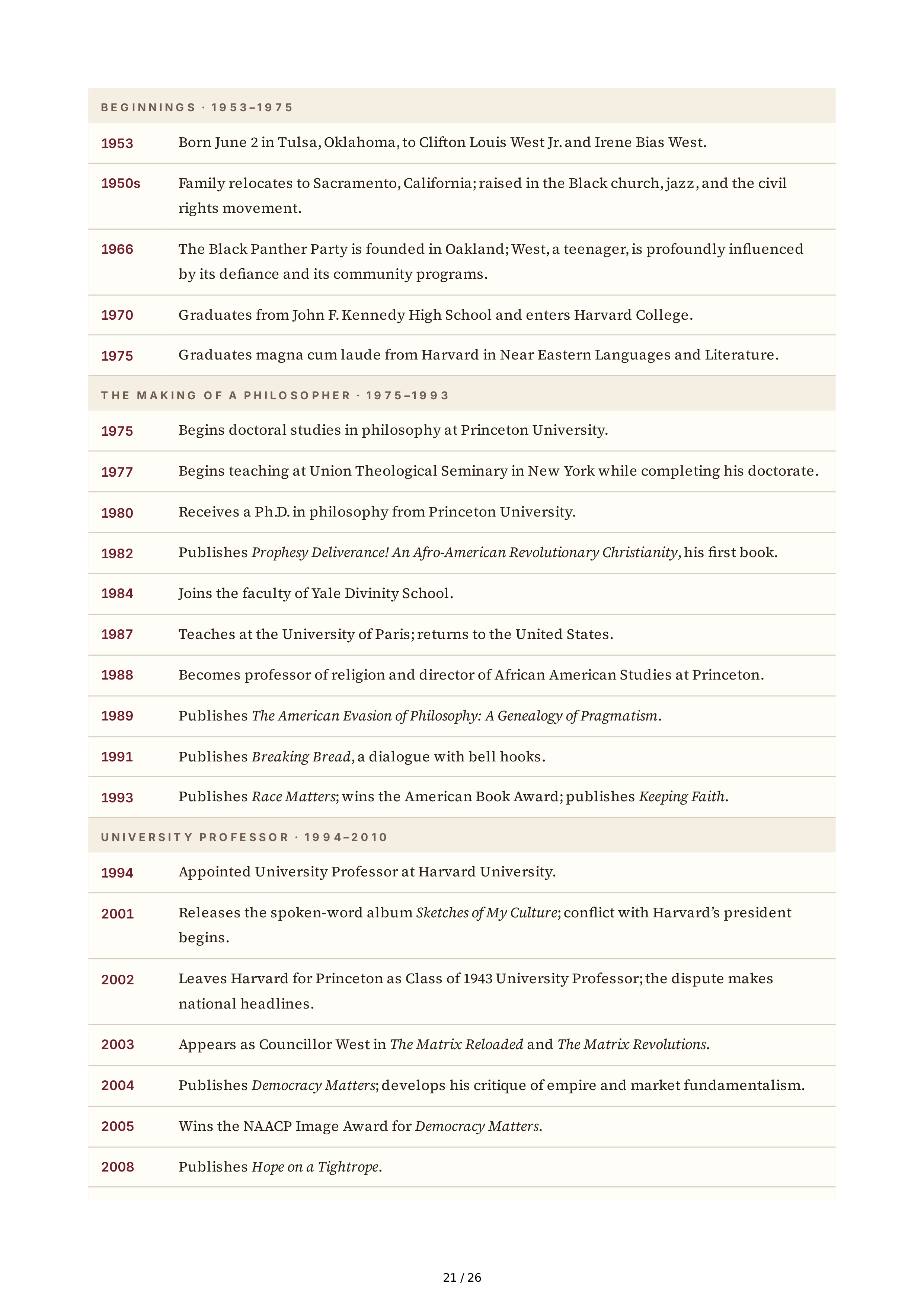
B E G
I N N I N G
S
· 1 9
5 3 – 1 9
7
5
1953
Born June 2 in Tulsa, Oklahoma, to Clifton Louis West Jr. and Irene Bias West.
1950
s
Family relocates to Sacramento, California; raised in the Black church, jazz, and the civil
rights movement.
1966
The Black Panther Party is founded in Oakland; West, a teenager, is profoundly influenced
by its defiance and its community programs.
1970
Graduates from John F. Kennedy High School and enters Harvard College.
1975
Graduates magna cum laude from Harvard in Near Eastern Languages and Literature.
T
H E
M A K I N G
O
F
A
P H I L O
S O
P H E R
· 1 9
7
5 – 1 9
9
3
1975
Begins doctoral studies in philosophy at Princeton University.
1977
Begins teaching at Union Theological Seminary in New York while completing his doctorate.
1980
Receives a Ph.D. in philosophy from Princeton University.
1982
Publishes
Prophesy Deliverance! An Afro-American Revolutionary Christianity
, his first book.
1984
Joins the faculty of Yale Divinity School.
1987
Teaches at the University of Paris; returns to the United States.
1988
Becomes professor of religion and director of African American Studies at Princeton.
1989
Publishes
The American Evasion of Philosophy: A Genealogy of Pragmatism
.
1991
Publishes
Breaking Bread
, a dialogue with bell hooks.
1993
Publishes
Race Matters
; wins the American Book Award; publishes
Keeping Faith
.
U N I V E R S I T
Y
P R O
F E S S O
R
· 1 9
9
4 – 2 0
1 0
1994
Appointed University Professor at Harvard University.
2001
Releases the spoken-word album
Sketches of My Culture
; conflict with Harvard’s president
begins.
2002
Leaves Harvard for Princeton as Class of 1943 University Professor; the dispute makes
national headlines.
2003
Appears as Councillor West in
The Matrix Reloaded
and
The Matrix Revolutions
.
2004
Publishes
Democracy Matters
; develops his critique of empire and market fundamentalism.
2005
Wins the NAACP Image Award for
Democracy Matters
.
2008
Publishes
Hope on a Tightrope
.
21 / 26
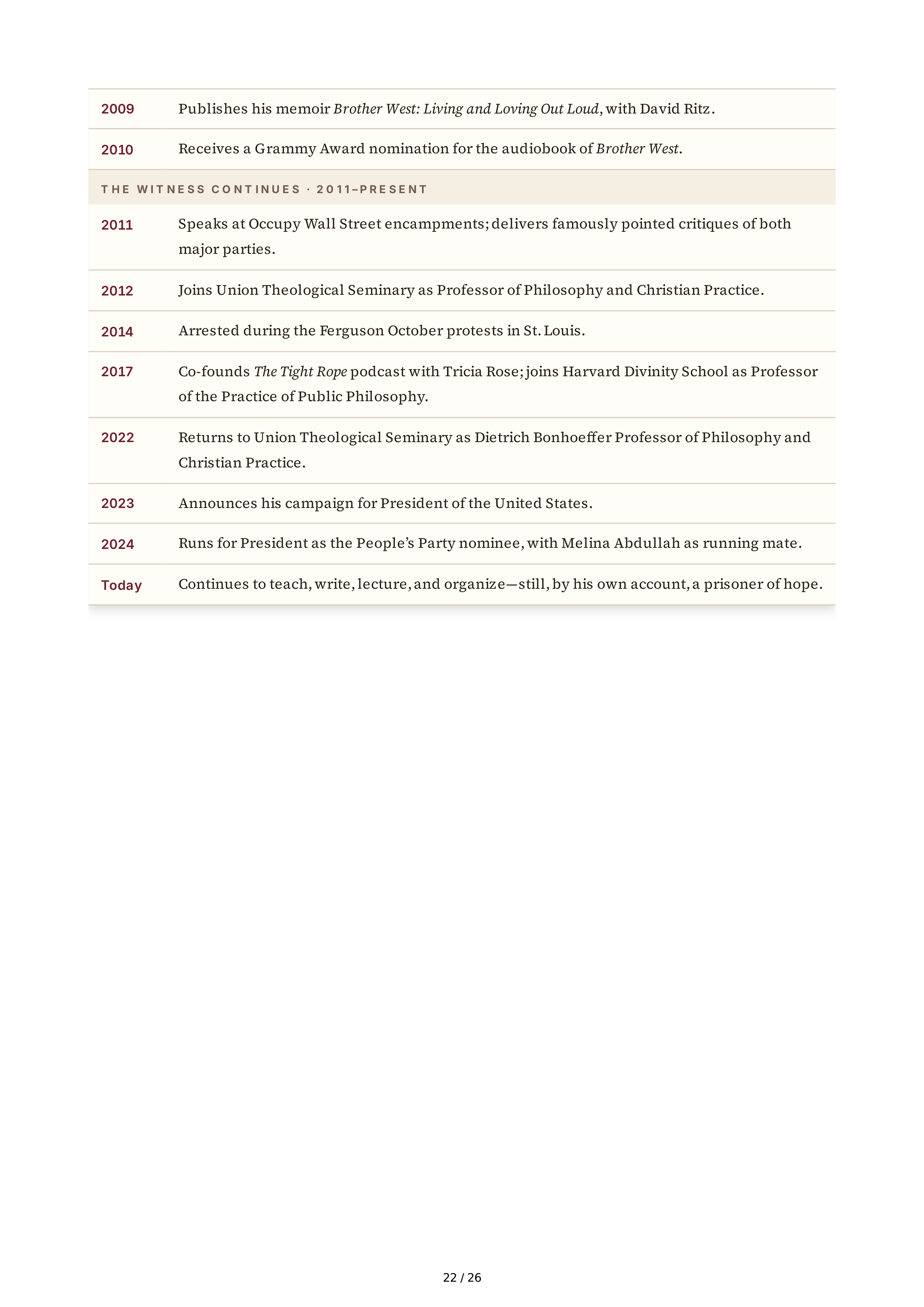
2009
Publishes his memoir
Brother West: Living and Loving Out Loud
, with David Ritz.
2010
Receives a Grammy Award nomination for the audiobook of
Brother West
.
T
H E
W I T
N E S S
C O
N T
I N U E S
· 2 0
1 1 –
P R E S E N T
2011
Speaks at Occupy Wall Street encampments; delivers famously pointed critiques of both
major parties.
2012
Joins Union Theological Seminary as Professor of Philosophy and Christian Practice.
2014
Arrested during the Ferguson October protests in St. Louis.
2017
Co-founds
The Tight Rope
podcast with Tricia Rose; joins Harvard Divinity School as Professor
of the Practice of Public Philosophy.
2022
Returns to Union Theological Seminary as Dietrich Bonhoeffer Professor of Philosophy and
Christian Practice.
2023
Announces his campaign for President of the United States.
2024
Runs for President as the People’s Party nominee, with Melina Abdullah as running mate.
Today
Continues to teach, write, lecture, and organize—still, by his own account, a prisoner of hope.
22 / 26
B A C K
M A T
T
E R
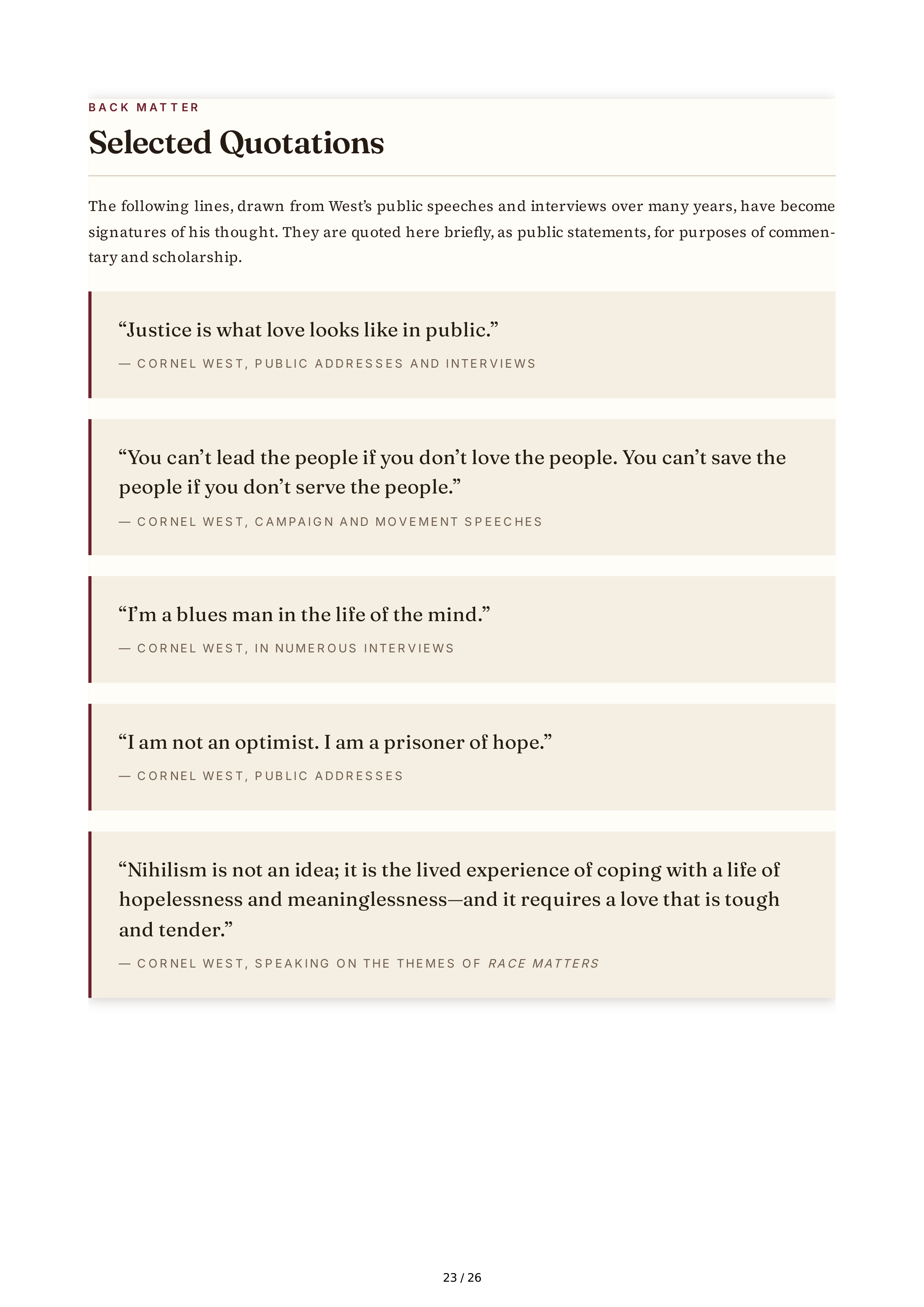
Selected Quotations
The following lines, drawn from West’s public speeches and interviews over many years, have become
signatures of his thought. They are quoted here briefly, as public statements, for purposes of commen-
tary and scholarship.
“Justice is what love looks like in public.”
—
C O R NE L
W E S T
,
P UB LI C
A D D R E S S E S
A ND
I NTE R V I E W S
“You can’t lead the people if you don’t love the people. You can’t save the
people if you don’t serve the people.”
—
C O R NE L
W E S T
,
C A MPA I G N
A ND
MO V E ME NT
S P E E C HE S
“I’m a blues man in the life of the mind.”
—
C O R NE L
W E S T
,
I N
NUME R O US
I NTE R V I E W S
“I am not an optimist. I am a prisoner of hope.”
—
C O R NE L
W E S T
,
P UB LI C
A D D R E S S E S
“Nihilism is not an idea; it is the lived experience of coping with a life of
hopelessness and meaninglessness—and it requires a love that is tough
and tender.”
—
C O R NE L
W E S T
,
S P E A K I NG
O N
THE
THE ME S
O F
RA CE
MATTE RS
23 / 26
B A C K
M A T
T
E R
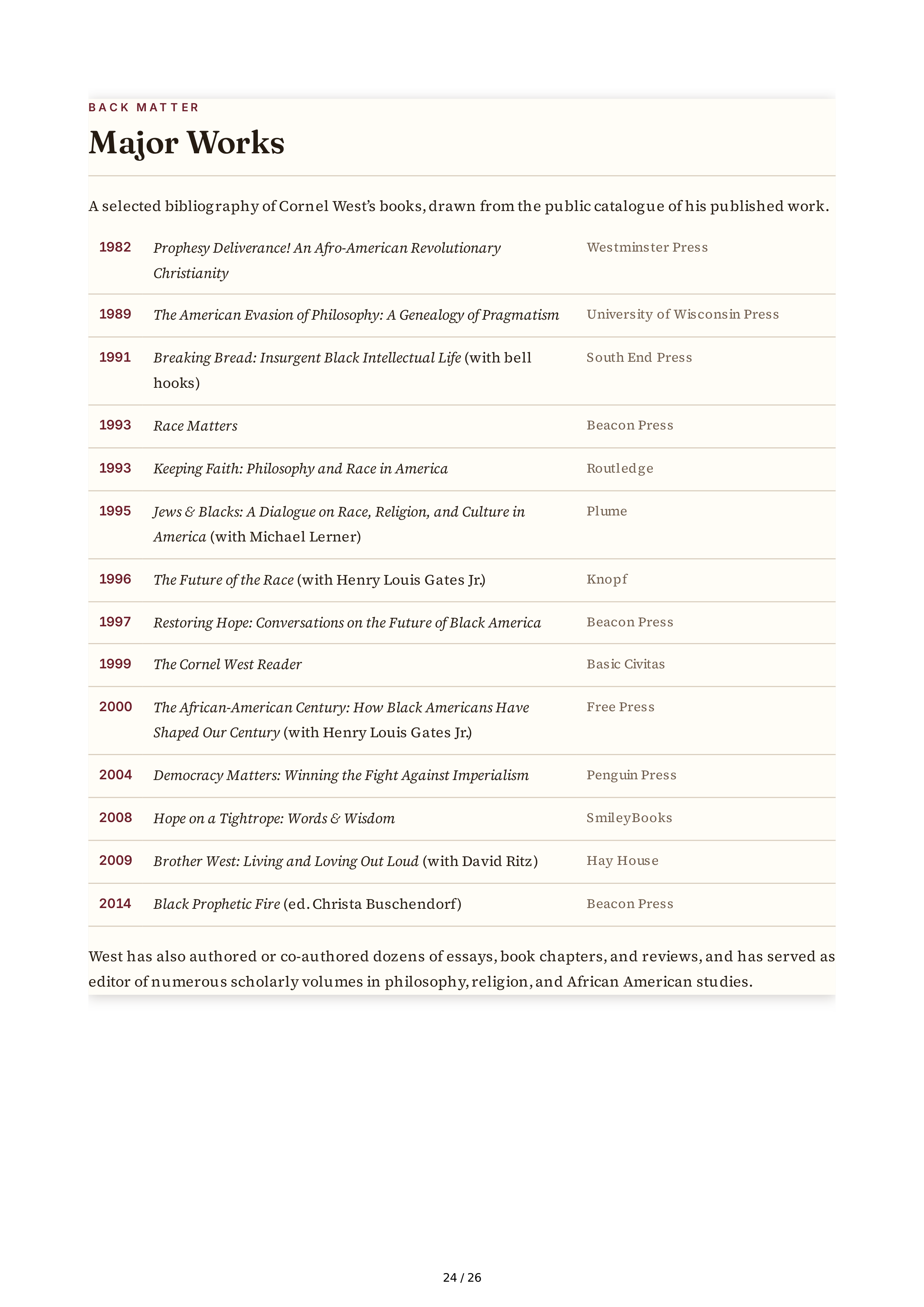
Major Works
A selected bibliography of Cornel West’s books, drawn from the public catalogue of his published work.
1982
Prophesy Deliverance! An Afro-American Revolutionary
Christianity
Westminster Press
1989
The American Evasion of Philosophy: A Genealogy of Pragmatism
University of Wisconsin Press
1991
Breaking Bread: Insurgent Black Intellectual Life
(with bell
hooks)
South End Press
1993
Race Matters
Beacon Press
1993
Keeping Faith: Philosophy and Race in America
Routledge
1995
Jews & Blacks: A Dialogue on Race, Religion, and Culture in
America
(with Michael Lerner)
Plume
1996
The Future of the Race
(with Henry Louis Gates Jr.)
Knopf
1997
Restoring Hope: Conversations on the Future of Black America
Beacon Press
1999
The Cornel West Reader
Basic Civitas
2000
The African-American Century: How Black Americans Have
Shaped Our Century
(with Henry Louis Gates Jr.)
Free Press
2004
Democracy Matters: Winning the Fight Against Imperialism
Penguin Press
2008
Hope on a Tightrope: Words & Wisdom
SmileyBooks
2009
Brother West: Living and Loving Out Loud
(with David Ritz)
Hay House
2014
Black Prophetic Fire
(ed. Christa Buschendorf)
Beacon Press
West has also authored or co-authored dozens of essays, book chapters, and reviews, and has served as
editor of numerous scholarly volumes in philosophy, religion, and African American studies.
24 / 26
B A C K
M A T
T
E R
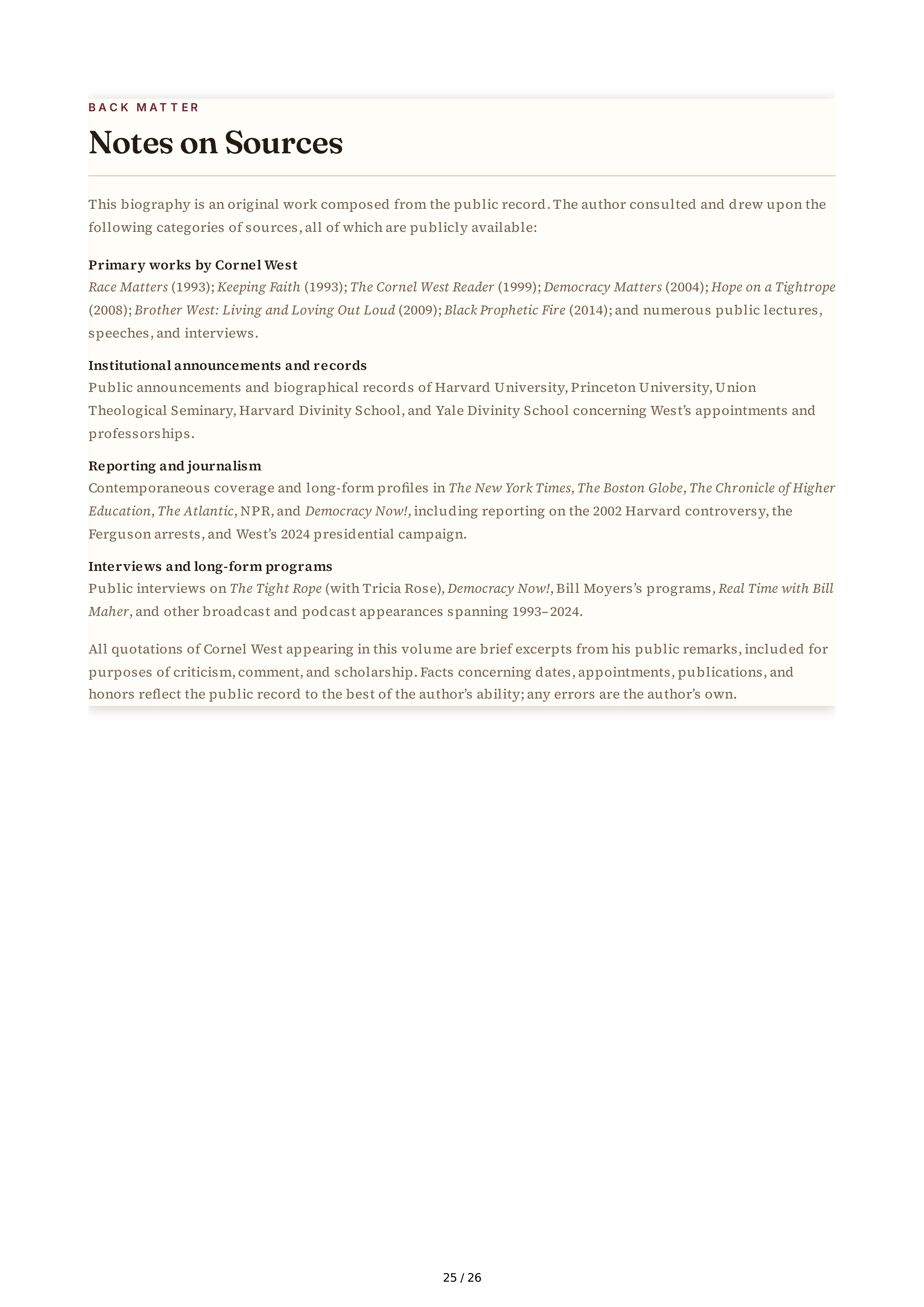
Notes on Sources
This biography is an original work composed from the public record. The author consulted and drew upon the
following categories of sources, all of which are publicly available:
Primary works by Cornel West
Race Matters
(1993);
Keeping Faith
(1993);
The Cornel West Reader
(1999);
Democracy Matters
(2004);
Hope on a Tightrope
(2008);
Brother West: Living and Loving Out Loud
(2009);
Black Prophetic Fire
(2014); and numerous public lectures,
speeches, and interviews.
Institutional announcements and records
Public announcements and biographical records of Harvard University, Princeton University, Union
Theological Seminary, Harvard Divinity School, and Yale Divinity School concerning West’s appointments and
professorships.
Reporting and journalism
Contemporaneous coverage and long-form profiles in
The New York Times
,
The Boston Globe
,
The Chronicle of Higher
Education
,
The Atlantic
, NPR, and
Democracy Now!
, including reporting on the 2002 Harvard controversy, the
Ferguson arrests, and West’s 2024 presidential campaign.
Interviews and long-form programs
Public interviews on
The Tight Rope
(with Tricia Rose),
Democracy Now!
, Bill Moyers’s programs,
Real Time with Bill
Maher
, and other broadcast and podcast appearances spanning 1993–2024.
All quotations of Cornel West appearing in this volume are brief excerpts from his public remarks, included for
purposes of criticism, comment, and scholarship. Facts concerning dates, appointments, publications, and
honors reflect the public record to the best of the author’s ability; any errors are the author’s own.
25 / 26
C O
L O
P H O
N
This independent edition was designed and typeset digitally for PDF
production. The text is set in Source Serif 4, with display type in
Fraunces and small caps in Inter. Pages are A4 (210
×
297 mm),
composed for screen reading and for clean, faithful printing.
The paper’s warmth, the garnet of the cover, and the gold of the
ornaments were chosen to echo the tradition West serves: the Black
church, the blues, and the long struggle for justice.
✦
“You can’t lead the people if you don’t love the people.
You can’t save the people if you don’t serve the people.”
Q
U E R Y
-
T O
-
P A G
E
P R E S S
·
M
M
X X V
·
F I N I S
26 / 26