
THIS IS A BORZOI BOOK
PUBLISHED BY ALFRED A. KNOPF
Copyright © 2014 by Sven Beckert
All rights reserved.
Published in the United States by Alfred A. Knopf, a division of Random House LLC, New York, and
distributed in Canada by Random House of Canada Limited, Toronto,
Penguin Random House companies.
www.aaknopf.com
Knopf, Borzoi Books, and the colophon are registered trademarks of Random House LLC.
Library of Congress Cataloging-in-Publication Data
Beckert, Sven.
Empire of cotton : a global history / Sven Beckert.—First edition.
pages cm
ISBN 978-0-375-41414-5 (hardcover)—ISBN 978-0-385-35325-0 (eBook) 1. Cotton textile industry—
History. 2. Cotton trade—History. 3. Cotton plantation workers—History. 4. Slavery—Economic
aspects. 5. Slaves. 6. Textile workers. 7. Capitalism—History. 8. Labor—History. I. Title.
HD9870.5.B43 2014
338.4767721—dc23 2014009320
Maps by Mapping Specialists
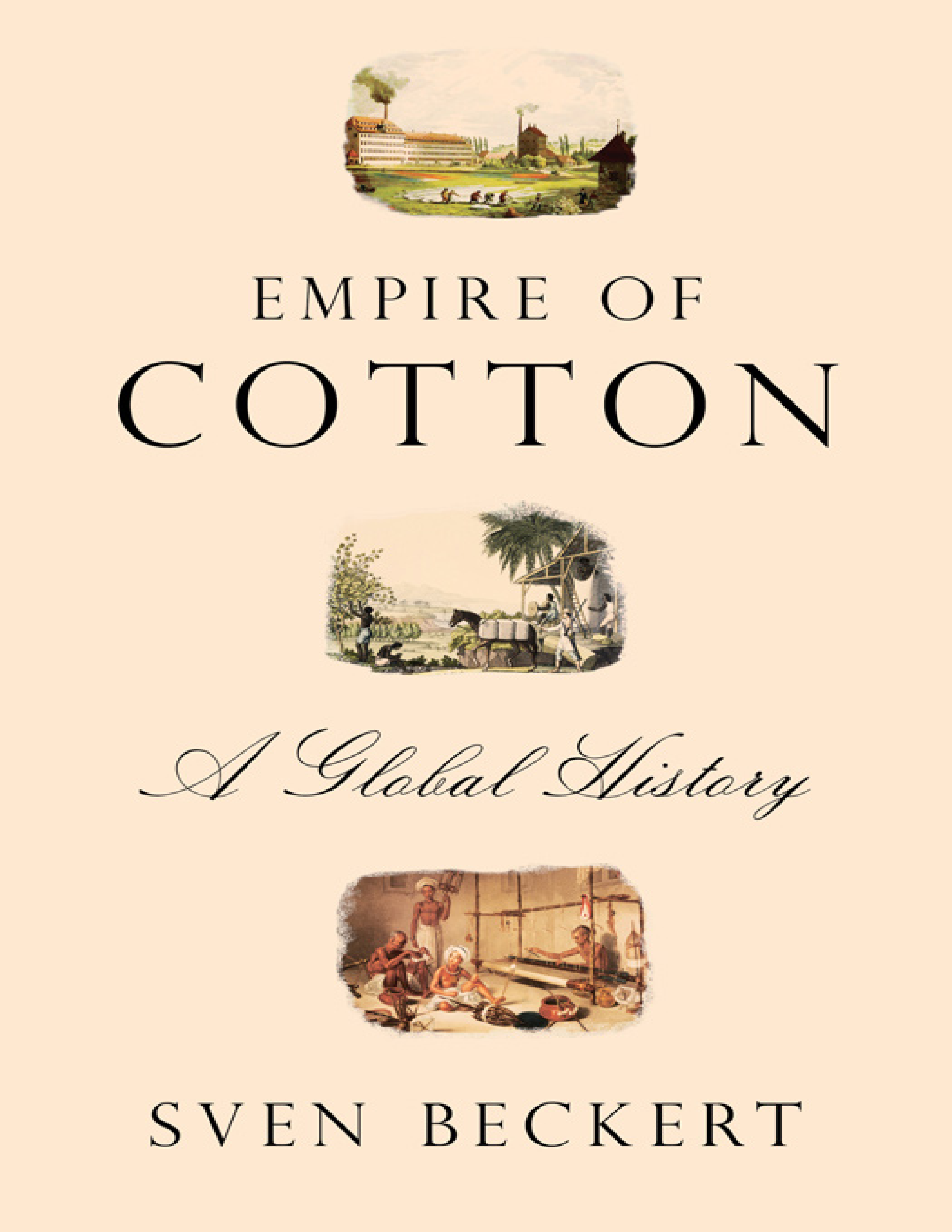
Jacket images: (top to bottom)
Spinning Mill at Dornach
by Jean Mieg. Musée Historique de Mulhouse;
Cotton-making, Dutch Antilles, East Indies
by Paolo Fumagalli. Private Collection. The Stapleton Collection
/ The Bridgeman Art Library;
A Loom
© British Library Board. All Rights Reserved / The Bridgeman Art
Library
Jacket design by Eric White
First Edition
v3.1

For Lisa

Contents
Cover
Title Page
Copyright
Dedication
Introduction
Chapter 1
The Rise of a Global Commodity
Chapter 2
Building War Capitalism
Chapter 3
The Wages of War Capitalism
Chapter 4
Capturing Labor, Conquering Land
Chapter 5
Slavery Takes Command
Chapter 6
Industrial Capitalism Takes Wing
Chapter 7
Mobilizing Industrial Labor
Chapter 8
Making Cotton Global
Chapter 9
A War Reverberates Around the World
Chapter 10
Global Reconstruction

Chapter 11
Destructions
Chapter 12
The New Cotton Imperialism
Chapter 13
The Return of the Global South
Chapter 14
The Weave and the Weft: An Epilogue
Acknowledgments
Notes
Index
Illustration Credits
Other Books by This Author
Introduction
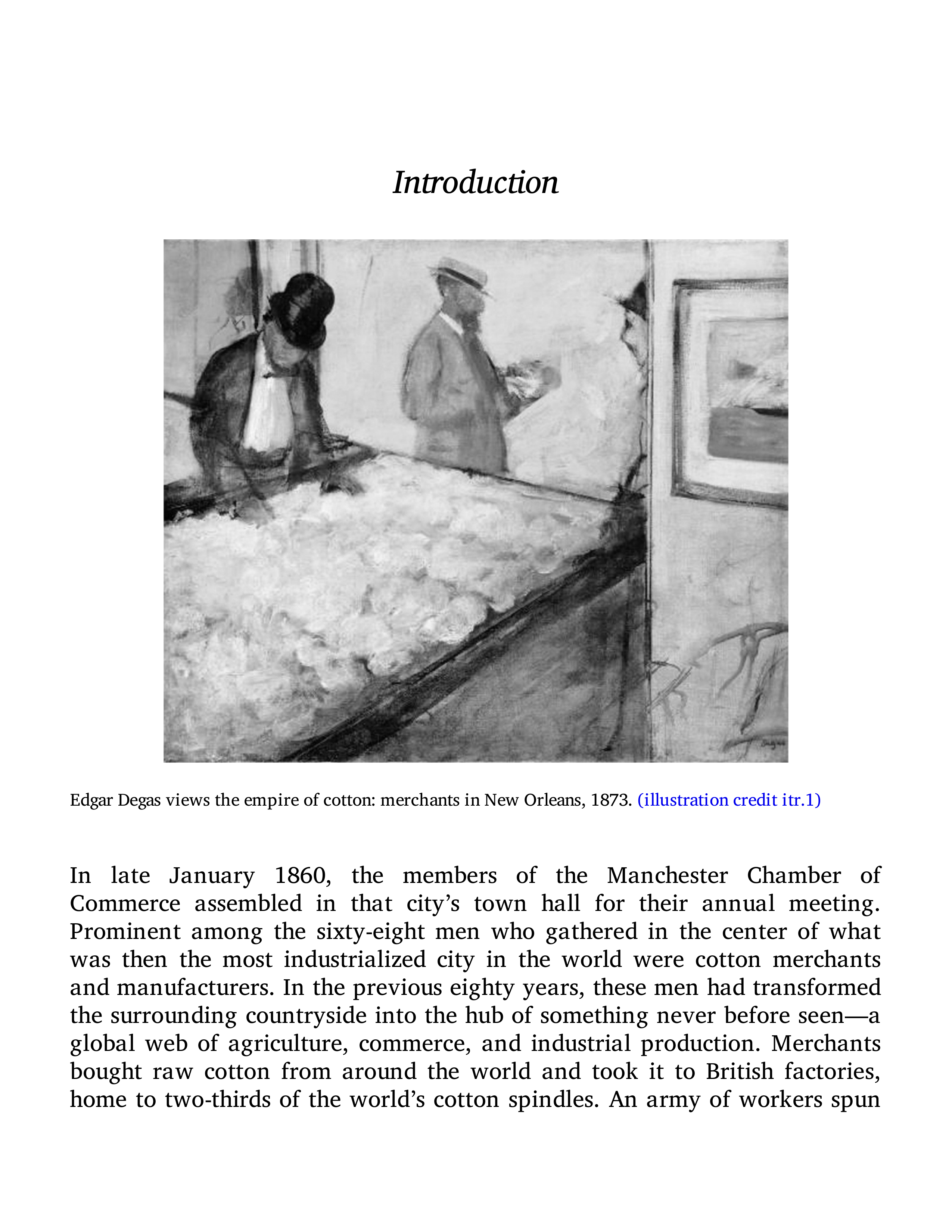
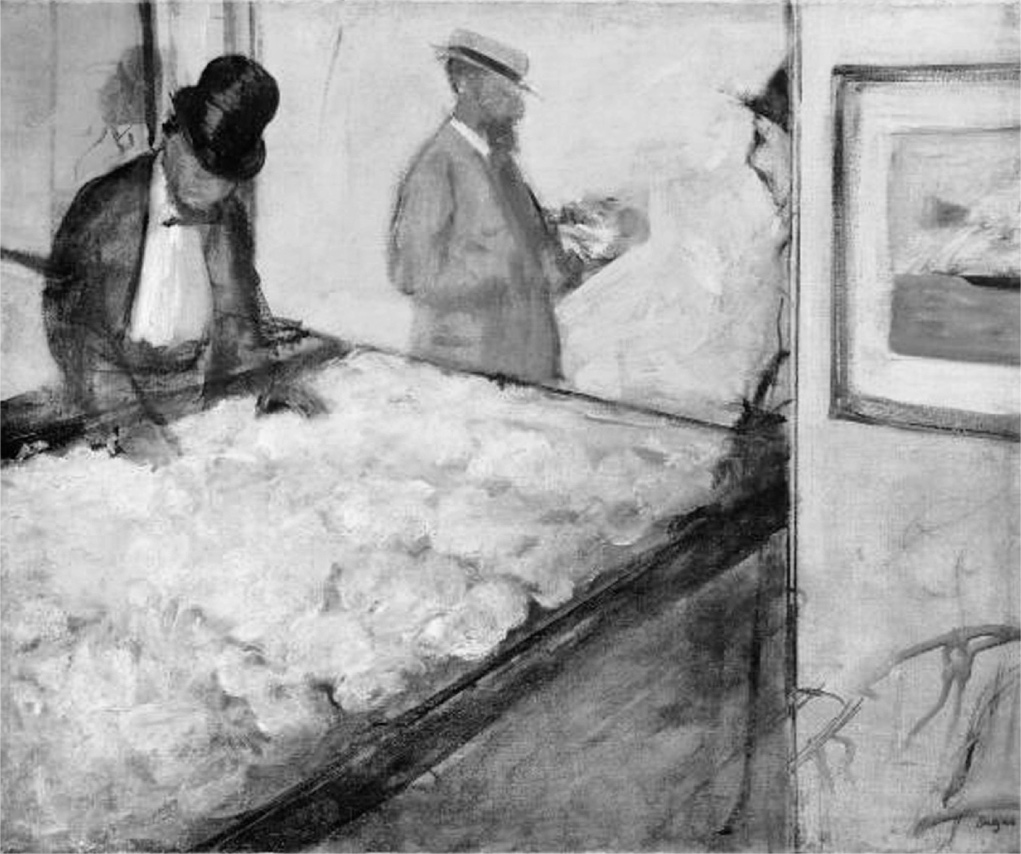
Edgar Degas views the empire of cotton: merchants in New Orleans, 1873.
(illustration credit itr.1)
In late January 1860, the members of the Manchester Chamber of
Commerce assembled in that city’s town hall for their annual meeting.
Prominent among the sixty-eight men who gathered in the center of what
was then the most industrialized city in the world were cotton merchants
and manufacturers. In the previous eighty years, these men had transformed
the surrounding countryside into the hub of something never before seen—a
global web of agriculture, commerce, and industrial production. Merchants
bought raw cotton from around the world and took it to British factories,
home to two-thirds of the world’s cotton spindles. An army of workers spun
that cotton into thread and wove it into
ɹnished fabrics; then dealers sent
those wares out to the world’s markets.
The assembled gentlemen were in a celebratory mood. President Edmund
Potter reminded his audience of the “amazing increase” of their industry and
“the general prosperity of the whole country, and more particularly of this
district.” Their discussions were expansive, touching on the a
ʃairs of
Manchester, Great Britain, Europe, the United States, China, India, South
America, and Africa. Cotton manufacturer Henry Ashworth added
superlatives of his own, celebrating “a degree of prosperity in business
which has probably been unequalled in any previous time.”
1
These self-satis
ɹed cotton manufacturers and merchants had reason to be
smug: They stood at the center of a world-spanning empire—the empire of
cotton. They ruled over factories in which tens of thousands of workers
operated huge spinning machines and noisy power looms. They acquired
cotton from the slave plantations of the Americas and sold the products of
their mills to markets in the most distant corners of the world. The cotton
men debated the a
ʃairs of the world with surprising nonchalance, even
though their own occupations were almost banal—making and hawking
cotton thread and cloth. They owned noisy, dirty, crowded, and decidedly
unre
ɹned factories; they lived in cities black with soot from coal-fueled
steam engines; they breathed the stench of human sweat and human waste.
They ran an empire, but hardly seemed like emperors.
Only a hundred years earlier, the ancestors of these cotton men would
have laughed at the thought of a cotton empire. Cotton was grown in small
batches and worked up by the hearth; the cotton industry played a marginal
role at best in the United Kingdom. To be sure, some Europeans knew of
beautiful Indian muslins, chintzes, and calicoes, what the French called
indiennes
, arriving in the ports of London, Barcelona, Le Havre, Hamburg,
and Trieste. Women and men in the European countryside spun and wove
cottons, modest competitors to the
ɹnery of the East. In the Americas, in
Africa, and especially in Asia, people sowed cotton among their yam, corn,
and jowar. They spun the
ɹber and wove it into the fabrics that their
households needed or their rulers demanded. As they had for centuries, even
millennia, people in Dhaka, Kano, and Teotihuacán, among many other
places, made cotton cloth and applied beautiful colors to it. Some of these
fabrics were traded globally. Some were of such extraordinary
ɹneness that
contemporaries called them “woven wind.”
Instead of women on low stools spinning on small wooden wheels in their
cottages, or using a dista
ʃ and
spinning bowl in front of their hut, in 1860
millions of mechanical spindles—powered by steam engines and operated
by wage workers, many of them children—turned for up to fourteen hours a
day, producing millions of pounds of yarn. Instead of householders growing
cotton and turning it into homespun thread and hand-loomed cloth, millions
of slaves labored on plantations in the Americas, thousands of miles away
from the hungry factories they supplied, factories that in turn were
thousands of miles removed from eventual consumers of the cloth. Instead of
caravans carrying West African cloth across the Sahara on camels,
steamships plied the world’s oceans, loaded with cotton from the American
South or with British-made cotton fabrics. By 1860, the cotton capitalists
who assembled to celebrate their accomplishments took as a fact of nature
history’s
ɹrst
globally integrated cotton manufacturing complex, even
though the world they had helped create was of very recent vintage.
But in 1860, the future was nearly as unimaginable as the past.
Manufacturers and merchants alike would have sco
ʃed if told how radically
the world of cotton would change in the following century. By 1960, most
raw cotton came again from Asia, China, the Soviet Union, and India, as did
the bulk of cotton yarn and cloth. In Britain, as well as in the rest of Europe
and New England, few cotton factories remained. The former centers of
cotton manufacturing—Manchester, Mulhouse, Barmen, and Lowell among
them—were littered with abandoned mills and haunted by unemployed
workers. Indeed, in 1963 the Liverpool Cotton Association, once one of
cotton’s most important trade associations, sold its furniture at auction.
2
The
empire of cotton, at least the part dominated by Europe, had come crashing
down.
This book is the story of the rise and fall of the European-dominated empire
of cotton. But because of the centrality of cotton, its story is also the story of
the making and remaking of global capitalism and with it of the modern
world. Foregrounding a global scale of analysis we will learn how, in a
remarkably brief period, enterprising entrepreneurs and powerful statesmen
in Europe recast the world’s most signi
ɹcant manufacturing industry by
combining imperial expansion and slave labor with new machines and wage
workers. The very particular organization of trade, production, and
consumption they created exploded the disparate worlds of cotton that had
existed for millennia. They animated cotton, invested it with world-changing
energy, and then used it as a lever to transform the world. Capturing the
biological bounty of an ancient plant, and the skills and huge markets of an
old industry in Asia, Africa, and the Americas, European entrepreneurs and
statesmen built an empire of cotton of tremendous scope and energy.
Ironically, their shocking success also awakened the very forces that
eventually would marginalize them within the empire they had created.
Along the way, millions of people spent their lives working the acres of
cotton that slowly spread across the world, plucking billions of bolls from
resistant cotton plants, carrying bales of cotton from cart to boat and from
boat to train, and working, often at very young ages, at “satanic mills” from
New England to China. Countries fought wars for access to these fertile
ɹelds, planters put untold numbers of people into shackles, employers
abbreviated the childhoods of their operatives, the introduction of new
machines led to the depopulation of ancient industrial centers, and workers,
both slave and free, struggled for freedom and a living wage. Men and
women who had long sustained themselves through small plots of land,
growing cotton alongside their food, saw their way of life end. They left
behind their agricultural tools and headed to the factory. In other parts of
the world, many who had worked at their looms and who wore clothing that
they themselves had woven found their products overwhelmed by the
ceaseless output of machines. They left their spinning wheels and moved
into the
ɹelds, now trapped in a cycle of endless pressure and endless
debt.
The empire of cotton was, from the beginning, a site of constant global
struggle between slaves and planters, merchants and statesmen, farmers
and merchants, workers and factory owners. In this as in so many other
ways, the empire of cotton ushered in the modern world.
Today cotton is so ubiquitous that it is hard to see it for what it is: one of
mankind’s great achievements. As you read this sentence, chances are you
are wearing something woven from cotton. And it is just as likely that you
have never plucked a cotton boll from its stem, seen a wispy strand of raw
cotton
ɹber, or heard the deafening noise of a
spinning mule and a power
loom. Cotton is as familiar as it is unknown. We take its perpetual presence
for granted. We wear it close to our skin. We sleep under it. We swaddle our
newborns in it. Cotton is in the banknotes we use, the co
ʃee ɹlters that help
us awaken in the morning, the vegetable oil we use for cooking, the soap we
wash with, and the gunpowder that
ɹghts our wars (indeed,
Alfred Nobel
won a British patent for his invention of “guncotton”). Cotton is even a
component of the book you hold in your hands.
For about nine hundred years, from 1000 to 1900 CE, cotton was the
world’s most important manufacturing industry. Though it now has been
surpassed by other industries, cotton remains important in terms of
employment and global trade. It is so ubiquitous that in 2013 the world
produced at least 123 million cotton bales, each weighing about four
hundred pounds—enough to produce twenty T‑shirts for each living person.
Stacked on top of one another, the bales would create a tower forty
thousand miles high; laid horizontally the bales would circle the globe one
and a half times. Huge cotton plantations dot the earth, from China to India
and the United States, from West Africa to Central Asia. The raw strands
they produce, tightly packed in bales, are still shipped around the globe, to
factories employing hundreds of thousands of workers. The
ɹnished pieces
are then sold everywhere, from remote village stores to Walmart. Indeed,
cotton might be one of the very few human-made goods that is available
virtually anywhere, testifying both to cotton’s utility and to capitalism’s
awe-inspiring increases in human productivity and consumption. As a recent
advertising campaign in the United States announced, quite accurately,
“Cotton is the fabric of our lives.”
3
Take a moment and imagine, if you can, a world without cotton. You
wake up in the morning on a bed covered in fur or straw. You dress in
woolens or, depending on the climate and your wealth, in linens or even
silks. Because it is hard to wash your clothes, and because they are
expensive or, if you make your own, labor-intensive, you change them
irregularly. They smell and scratch. They are largely monochromatic, since,
unlike cottons, wool and other natural
ɹbers do not take colors very well.
And you are surrounded by sheep: it would take approximately 7 billion
sheep to produce a quantity of wool equivalent to the world’s current cotton
crop. Those 7 billion sheep would need 700 million hectares of land for
grazing, about 1.6 times the surface area of today’s European Union.
4
Hard to imagine. But in a patch of land on the westernmost edge of the
Eurasian landmass, such a world without cotton was long the norm. That
land was Europe. Until the nineteenth century, cotton, while not unknown,
was marginal to European textile production and consumption.
Why was it that the part of the world that had the least to do with cotton
—Europe—created and came to dominate the empire of cotton? Any
reasonable observer in, say, 1700, would have expected the world’s cotton
production to remain centered in India, or perhaps in China. And indeed,
until 1780 these countries produced vastly more raw cotton and cotton
textiles than Europe and North America. But then things changed. European
capitalists and states, with startling swiftness, moved to the center of the
cotton industry. They used their new position to ignite an Industrial
Revolution. China and India, along with many other parts of the world,
became ever more subservient to the Europe-centered empire of cotton.
These Europeans then used their dynamic cotton industry as a platform to
create other industries; indeed, cotton became the launching pad for the
broader Industrial Revolution.
Edward Baines, a newspaper proprietor in Leeds, called cotton in 1835 a
“spectacle unparalleled in the annals of industry.” He argued that analyzing
this spectacle was “more worthy the pains of the student” than the study of
“wars and dynasties.” I agree. Following cotton, as we shall see, will lead us
to the origins of the modern world, industrialization, rapid and continuous
economic growth, enormous productivity increase, and staggering social
inequality. Historians, social scientists, policy makers, and ideologues of all
stripes have tried to disentangle these origins. Particularly vexing is the
question of why, after many millennia of slow economic growth, a few
strands of humanity in the late eighteenth century suddenly got much richer.
Scholars now refer to these few decades as the “great divergence”—the
beginning of the vast divides that still structure today’s world, the divide
between those countries that industrialized and those that did not, between
colonizers and colonized, between the global North and the global South.
Grand arguments are easily made, some deeply pessimistic, some hopeful. In
this book, however, I take a global and fundamentally historical approach
to this puzzle: I begin by investigating the industry that stood at the very
beginning of the “great divergence.”
5
A focus on cotton and its very concrete and often brutal development,
casts doubt on several explanations that all too many observers tend to take
for granted: that Europe’s explosive economic development can be
explained by Europeans’ more rational religious beliefs, their Enlightenment
traditions, the climate in which they live, the continent’s geography, or
benign institutions such as the Bank of England or the rule of law. Such
essential and all too often unchangeable attributes, however, cannot
account for the history of the cotton empire or explain the constantly
shifting structure of capitalism. And they are often also wrong. The
ɹrst
industrial nation, Great Britain, was hardly a liberal, lean state with
dependable but impartial institutions as it is often portrayed. Instead it was
an imperial nation characterized by enormous military expenditures, a
nearly constant state of war, a powerful and interventionist bureaucracy,
high taxes, skyrocketing government debt, and protectionist tari
ʃs—and it
was certainly not democratic. Accounts of the “great divergence” that focus
exclusively on con
ɻicts between social classes within particular regions or
countries are just as
ɻawed. This book, in contrast, embraces a
global
perspective to show how Europeans united the power of capital and the
power of the state to forge, often violently, a global production complex,
and then used the capital, skills, networks, and institutions of cotton to
embark upon the upswing in technology and wealth that de
ɹnes the modern
world. By looking at capitalism’s past, this book o
ʃers a history of
capitalism in action.
6
Unlike much of what has been written on the history of capitalism,
Empire
of Cotton
does not search for explanations in just one part of the world. It
understands capitalism in the only way it can be properly understood—in a
global frame. The movement of capital, people, goods, and raw materials
around the globe and the connections forged between distant areas of the
world are at the very core of the grand transformation of capitalism and
they are at the core of this book.
Such a thorough and rapid re-creation of the world was possible only
because of the emergence of new ways of organizing production, trade, and
consumption. Slavery, the expropriation of indigenous peoples, imperial
expansion, armed trade, and the assertion of sovereignty over people and
land by entrepreneurs were at its core. I call this system
war capitalism.
We usually think of capitalism, at least the globalized, mass-production
type that we recognize today, as emerging around 1780 with the Industrial
Revolution. But war capitalism, which began to develop in the sixteenth
century, came long before machines and factories. War capitalism
ɻourished
not in the factory but in the
ɹeld; it was not mechanized but land- and
labor-intensive, resting on the violent expropriation of land and labor in
Africa and the Americas. From these expropriations came great wealth and
new knowledge, and these in turn strengthened European institutions and
states—all crucial preconditions for Europe’s extraordinary economic
development by the nineteeth century and beyond.
Many historians have called this the age of “merchant” or “mercantile”
capitalism, but “war capitalism” better expresses its rawness and violence as
well as its intimate connection to European imperial expansion. War
capitalism, a particularly important but often unrecognized phase in the
development of capitalism, unfolded in a constantly shifting set of places
embedded within constantly changing relationships. In some parts of the
world it lasted well into the nineteenth century.
When we think of capitalism, we think of wage workers, yet this prior
phase of capitalism was based not on free labor but on slavery. We associate
industrial capitalism with contracts and markets, but early capitalism was
based as often as not on violence and bodily coercion. Modern capitalism
privileges property rights, but this earlier moment was characterized just as
much by massive expropriations as by secure ownership. Latter-day
capitalism rests upon the rule of law and powerful institutions backed by the
state, but capitalism’s early phase, although ultimately requiring state
power to create world-spanning empires, was frequently based on the
unrestrained actions of private individuals—the domination of masters over
slaves and of frontier capitalists over indigenous inhabitants. The
cumulative result of this highly aggressive, outwardly oriented capitalism
was that Europeans came to dominate the centuries-old worlds of cotton,
merge them into a single empire centered in Manchester, and invent the
global economy we take for granted today.
War capitalism, then, was the foundation from which evolved the more
familiar industrial capitalism, a capitalism characterized by powerful states
with enormous administrative, military, judicial, and infrastructural
capacities. At
ɹrst, industrial capitalism remained tightly linked to slavery
and expropriated lands, but as its institutions—everything from wage labor
to property rights—gained strength, they enabled a new and di
ʃerent form
of integration of the labor, raw materials, markets, and capital in huge
swaths of the world.
7
These new forms of integration drove the revolutions
of capitalism into ever more corners of the world.
As the modern world came of age, cotton came to dominate world trade.
Cotton factories towered above all other forms of European and North
American manufacturing. Cotton growing dominated the U.S. economy
throughout much of the nineteenth century. It was in cottons that new
modes of manufacturing
ɹrst came about. The factory itself was an
invention of the cotton industry. So was the connection between slave
agriculture in the Americas and manufacturing across Europe. Because for
many decades cotton was the most important European industry, it was the
source of huge pro
ɹts that eventually fed into other segments of the
European economy. Cotton also was the cradle of industrialization in
virtually every other part of the world—the United States and Egypt, Mexico
and Brazil, Japan and China. At the same time, Europe’s domination of the
world’s cotton industry resulted in a wave of deindustrialization throughout
much of the rest of the world, enabling a new and di
ʃerent kind of
integration into the global economy.
Yet even as the construction of industrial capitalism, beginning in the
United Kingdom in the 1780s and then spreading to continental Europe and
the United States in the early decades of the nineteenth century, gave
enormous power to the states that embraced it and to capitalists within
them, it planted the seeds of further transformation in the empire of cotton.
As industrial capitalism spread, capital itself became tied to particular
states. And as the state assumed an ever more central role and emerged as
the most durable, powerful, and rapidly expanding institution of all, labor
also grew in size and power. The dependence of capitalists on the state, and
the state’s dependence on its people, empowered the workers who produced
that capital, day in and day out, on the factory
ɻoor. By the second half of
the nineteenth century, workers organized collectively, both in unions and
political parties, and slowly, over multiple decades, improved their wages
and working conditions. This, in turn, increased production costs, creating
openings for lower-cost producers in other parts of the world. By the turn of
the twentieth century, the model of industrial capitalism had traveled to
other countries and was embraced by their modernizing elites. As a result,
the cotton industry left Europe and New England and returned to it origins
in the global South.
Some may wonder why the claims made here for the empire of cotton do
not apply to other commodities. After all, before 1760, Europeans had
traded extensively in many commodities in the tropical and semitropical
areas of the world, including sugar, rice, rubber, and indigo. Unlike these
commodities, cotton, however, has two labor-intensive stages—one in the
ɹelds, the other in
factories. Sugar and tobacco did not create large
industrial proletariats in Europe. Cotton did. Tobacco did not result in the
rise of vast new manufacturing enterprises. Cotton did. Indigo growing and
processing did not create huge new markets for European manufacturers.
Cotton did. Rice cultivation in the Americas did not lead to an explosion of
both
slavery and wage labor. Cotton did. As a result, cotton spanned the
globe unlike any other industry. Because of the new ways it wove continents
together, cotton provides the key to understanding the modern world, the
great inequalities that characterize it, the long history of globalization, and
the ever-changing political economy of capitalism.
One reason it is hard to see cotton’s importance is because it has often
been overshadowed in our collective memory by images of coal mines,
railroads, and giant steelworks—industrial capitalism’s more tangible, more
massive manifestations. Too often, we ignore the countryside to focus on the
city and the miracles of modern industry in Europe and North America while
ignoring that very industry’s connection to raw material producers and
markets in all corners of the world. Too often, we prefer to erase the
realities of slavery, expropriation, and colonialism from the history of
capitalism, craving a nobler, cleaner capitalism. We tend to recall industrial
capitalism as male-dominated, whereas women’s labor largely created the
empire of cotton. Capitalism was in many ways a liberating force, the
foundation of much of contemporary life; we are invested in it, not just
economically but emotionally and ideologically. Uncomfortable truths are
sometimes easier to ignore.
Nineteenth-century observers, in contrast, were cognizant of cotton’s role
in reshaping the world. Some celebrated the amazing transformative power
of the new global economy. As a Manchester
Cotton Supply Reporter
put it in
1860, rather breathlessly, “Cotton seems to have been destined to take the
lead among the numerous and vast agencies of the present century, set in
motion for human civilization. . . . Cotton with its commerce has become
one of the many modern ‘wonders of the world.’ ”
8
When you look at the cotton plant, it seems an unlikely candidate for one of
the wonders of the world. Humble and unremarkable, it grows in many
shapes and sizes. Prior to Europe’s creation of the empire of cotton, di
ʃerent
peoples in di
ʃerent parts of the world cultivated plants quite unlike one
another. South Americans tended to grow
G. barbadense
, a small bushy tree
that sprouted yellow
ɻowers and produced long-staple cotton. In
India, by
contrast, farmers grew
G. arboretum
, a shrub about six feet in height, with
yellow or purple
ɻowers, producing a short-staple ɹber, while in
Africa the
very similar
G. herbaceum
thrived. By the mid-nineteenth century, one type
dominated the empire of cotton—
G. hirsutum
—also known as American
upland. Originating in Central America, this variant, as described by
Andrew Ure in 1836, “rises to the height of two or three feet, and then
divaricates into boughs, which bristle with hairs. The leaves are also hairy
on their inferior surfaces, and are three- or
ɹve-lobed. The upper leaves are
entire and heart-shaped; the petioles are velvety. The
ɻowers near the
extremities of the boughs are large, and somewhat dingy in colour. The
capsules are ovate, four-celled, nearly as large as an apple, and yield a very
ɹne silky cotton wool, much esteemed in commerce.”
9
This
ɻuʃy white ɹber is at the center of this book. The plant itself does
not make history, but if we listen carefully, it will tell us of people all over
the world who spent their lives with cotton: Indian weavers, slaves in
Alabama, Greek merchants in the Nile Delta towns, highly organized craft
workers in Lancashire. The empire of cotton was built with their labor,
imagination, and skills. By 1900 about 1.5 percent of the human population
—millions of men, women, and children—were engaged in the industry,
either growing, transporting, or manufacturing cotton. Edward Atkinson, a
mid-nineteenth-century Massachusetts cotton manufacturer, was essentially
correct when he pointed out that “there is no other product that has had so
potent and malign an in
ɻuence in the past upon the history and institutions
of the land; and perhaps no other on which its future material welfare may
more depend.” Atkinson was speaking of the United States and its history of
slavery, but his argument could be applied to the world as a whole.
10
This book follows cotton from
ɹelds to boats, from merchant houses to
factories, from pickers to spinners to weavers to consumers. It does not
separate the cotton history of Brazil from that of the United States, Great
Britain’s from Togo’s, or Egypt’s from Japan’s. The empire of cotton, and
with it the modern world, is only understood by connecting, rather than
separating, the many places and people who shaped and were in turn
shaped by that empire.
11
I am centrally concerned with the unity of the diverse. Cotton, the
nineteenth century’s chief global commodity, brought seeming opposites
together, turning them almost by alchemy into wealth: slavery and free
labor, states and markets, colonialism and free trade, industrialization and
deindustrialization. The cotton empire depended on plantation and factory,
slavery and wage labor, colonizers and colonized, railroads and steamships
—in short, on a global network of land, labor, transport, manufacture, and
sale. The Liverpool Cotton Exchange had an enormous impact on Mississippi
cotton planters, the Alsatian spinning mills were tightly linked to those of
Lancashire, and the future of handloom weavers in New Hampshire or
Dhaka depended on such diverse factors as the construction of a railroad
between Manchester and Liverpool, investment decisions of Boston
merchants, and tari
ʃ policies made in Washington and
London. The power
of the Ottoman state over its countryside a
ʃected the development of
slavery in the West Indies; the political activities of recently freed slaves in
the United States a
ʃected the lives of rural cultivators in India.
12
From these volatile opposites, we see how cotton made possible both the
birth of capitalism and its subsequent reinvention. As we explore the
twinned paths of cotton and capitalism across the world, and the centuries,
we are reminded again and again that no state of capitalism is ever
permanent or stable. Each new moment in capitalism’s history produces
new instabilities, and even contradictions, prompting vast spatial, social,
and political rearrangements.
Writing about cotton has a long history. Indeed, cotton might be the most
fully researched of all human industries. Libraries are
ɹlled with accounts of
slave plantations in the Americas, the beginnings of cotton manufacturing
in Britain, France, the German lands, and Japan, and the merchants who
connected one to the other. Much less common are e
ʃorts to link these
diverse histories; in fact, what is perhaps the most successful such e
ʃort is
now nearly two centuries old. When Edward Baines penned his
History of the
Cotton Manufacture in Great Britain
in 1835, he concluded that “the author
may be permitted to express…that his subject derives interest not merely
from the magnitude of the branch of industry he has attempted to describe,
but from the wonderful extent of intercourse which it has established
between this country and every part of the globe.”
13
I share Baines’s
enthusiasm and his global perspective, if not all of his conclusions.
As a Leeds newspaper editor living close to the center of the empire of
cotton, Baines could not help but take a global perspective on these
matters.
14
However, when professional historians turned to cotton, they
almost always focused on local, regional, and national aspects of this
history. Yet only a global viewpoint allows us to understand the great
realignment that each of these local stories was part of—the huge global
shifts in labor regimes in agriculture, the spread of state-strengthening
projects by nationalist elites, and the impact of working-class collective
action, among others.
This book draws on the vast literature on cotton, but places it in a new
framework. As a result, it contributes to a vibrant but often stultifyingly
presentist conversation on globalization.
Empire of Cotton
challenges excited
discoveries of an allegedly new, global phase in the history of capitalism. It
shows that capitalism has been globe-spanning since its inception and that
ɻuid spatial conɹgurations of the world economy have been a common
feature of the last three hundred years. The book argues also that for most of
capitalism’s history the process of globalization and the needs of nation-
states were not con
ɻicting, as is often believed, but instead mutually
reinforced one another. If our allegedly new global age is truly a
revolutionary departure from the past, the departure is not the degree of
global connection but the fact that capitalists are for the
ɹrst time able to
emancipate themselves from particular nation-states, the very institutions
that in the past enabled their rise.
As its subtitle suggests,
Empire of Cotton
is also part of a larger
conversation among historians trying to rethink history by looking at it
within a transnational, even global, spatial frame. History as a profession
emerged hand in hand with the nation-state, and played an important part
in its constitution. But by assuming national perspectives, historians have
often underemphasized connections that transcend state borders, settling for
explanations that can be drawn from events, people, and processes within
particular national territories. This book is intended as a contribution to
e
ʃorts to balance such “national” perspectives with a broader focus on the
networks, identities, and processes that transcend political boundaries.
15
By focusing on one speci
ɹc commodity—cotton—and tracing how it was
grown, transported,
ɹnanced, manufactured, sold, and consumed, we are
able to see connections between peoples and places that would remain on
the margins if we embarked upon a more traditional study bounded by
national borders. Instead of focusing on the history of a particular event,
such as the American Civil War, or place, such as the cotton factories of
Osaka, or group of people, such as West Indian slaves growing cotton, or
process, such as rural cultivators turning into industrial wage workers, this
book uses the biography of one product as a window into some of the most
signi
ɹcant questions we can ask about the history of our world and to
reinterpret a history of huge consequence: the history of capitalism.
16
We are about to embark on a journey through
ɹve thousand years of human
history. Throughout this book, we will look at a single, seemingly
inconsequential item—cotton—to solve a vast mystery: Where does the
modern world originate? Let’s begin by traveling to a small farming village
in what is today Mexico, where cotton plants bloom in a world utterly
unlike our own.
Chapter One
The Rise of a Global Commodity
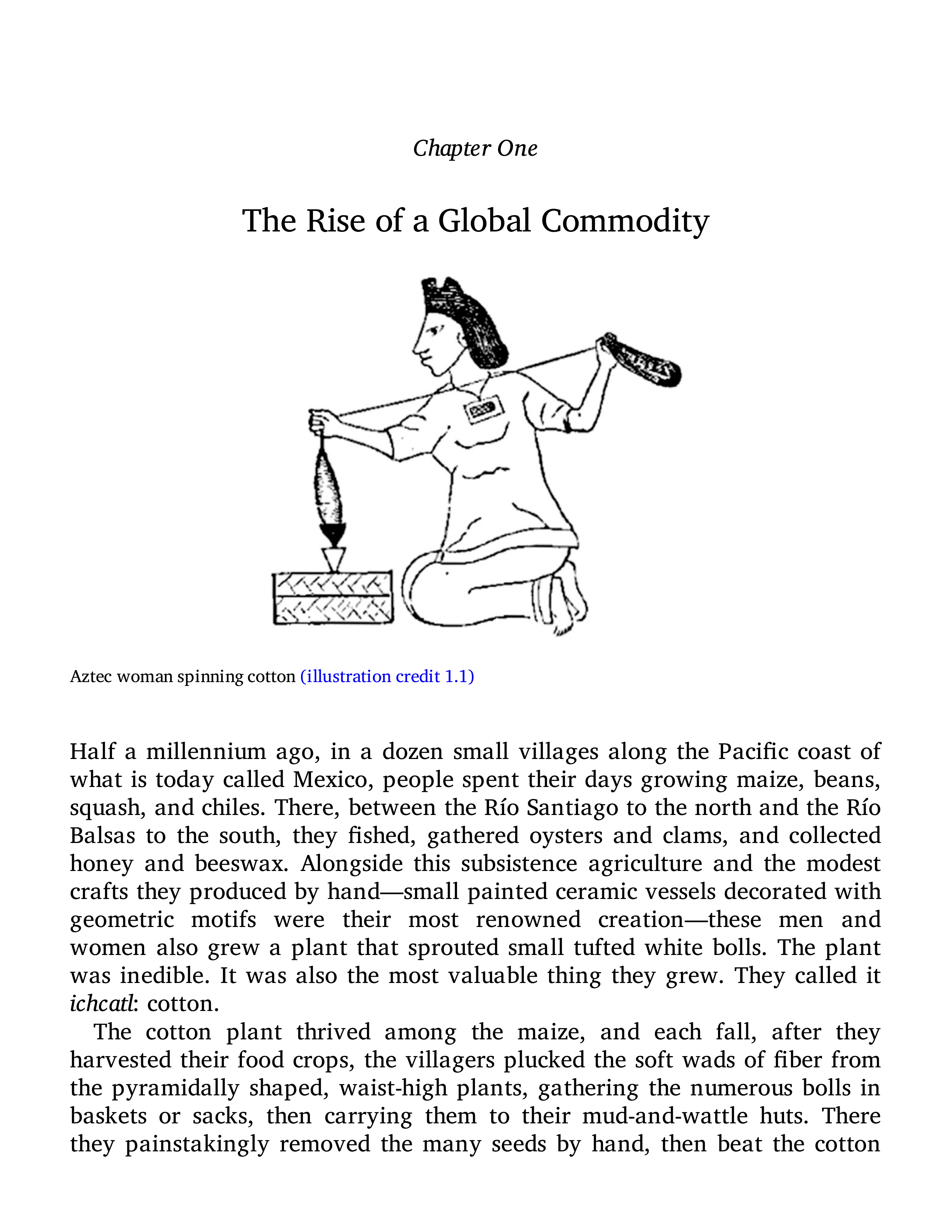
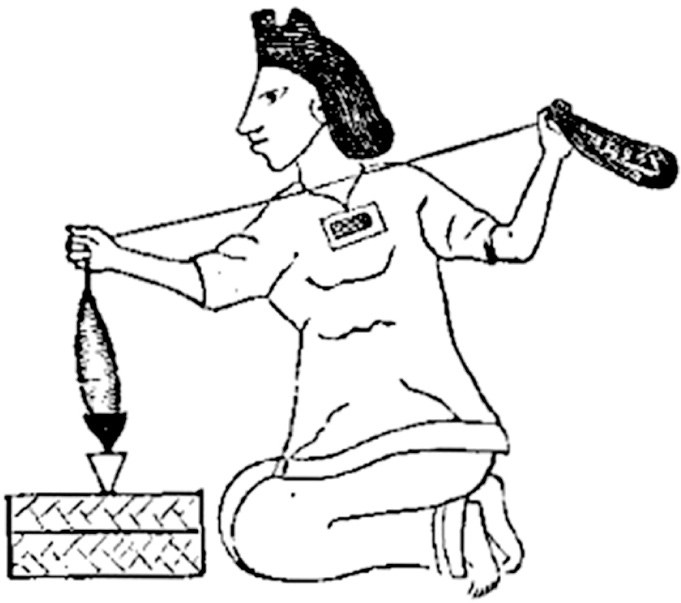
Aztec woman spinning cotton
(illustration credit 1.1)
Half a millennium ago, in a dozen small villages along the Paci
ɹc coast of
what is today called Mexico, people spent their days growing maize, beans,
squash, and chiles. There, between the Río Santiago to the north and the Río
Balsas to the south, they
ɹshed, gathered oysters and clams, and collected
honey and beeswax. Alongside this subsistence agriculture and the modest
crafts they produced by hand—small painted ceramic vessels decorated with
geometric motifs were their most renowned creation—these men and
women also grew a plant that sprouted small tufted white bolls. The plant
was inedible. It was also the most valuable thing they grew. They called it
ichcatl
: cotton.
The cotton plant thrived among the maize, and each fall, after they
harvested their food crops, the villagers plucked the soft wads of
ɹber from
the pyramidally shaped, waist-high plants, gathering the numerous bolls in
baskets or sacks, then carrying them to their mud-and-wattle huts. There
they painstakingly removed the many seeds by hand, then beat the cotton
on a palm mat to make it smooth, before combing out the
ɹbers into strands
several inches long. Using a thin wooden spindle
ɹtted with a ceramic disk
and a spinning bowl to support the spindle as it twirled, they twisted the
strands together into
ɹne white thread. Then they created cloth on a
backstrap loom, a simple tool consisting of two sticks attached by the warp
threads; one stick was hung from a tree, the other on the weaver herself,
who stretched the warp with the weight of her own body and then wove the
contrasting thread (the weft) in and out between the warps in an unending
dance. The result was a cloth as strong as it was supple. They dyed the cloth
with indigo and cochineal, creating a rich variety of blue-blacks and
crimsons. Some of the cloth they wore themselves, sewn into shirts, skirts,
and trousers. The rest they sent to Teotihuacán as part of an annual tribute
owed to their distant Aztec rulers. In 1518 alone, the people of these twelve
coastal villages provided the emperor Moctezuma II with eight hundred
bales of raw cotton (each weighing 115 pounds), thirty-two hundred colored
cotton cloths, and forty-eight hundred large white cloths, the product of
thousands of hours of backbreaking and highly skilled labor.
1
For hundreds of years both before and after, similar scenes unfolded
across vast stretches of the world’s inhabited land. From Gujarat to Sulawesi,
along the banks of the Upper Volta to the Rio Grande, from the valleys of
Nubia to the plains of Yucatán, people on three continents had grown cotton
in their
ɹelds, and then manufactured cotton textiles in the houses next
door, just as their ancestors had done for generations prior. The plant is
stubborn, seemingly able to thrive with little help from farmers, given the
right natural conditions. It grows in a wide range of environments thanks to
its “morphological plasticity,” that is, in the words of plant scientists, its
ability to “adapt to diverse growing conditions by shortening, lengthening,
or even interrupting its e
ʃective bloom period.”
2
The many peoples who grew cotton remained for thousands of years
unaware that their e
ʃorts were being replicated by other peoples around the
globe, all of whom lived in a geographic band roughly from 32–35 degrees
south to 37 degrees north. These areas o
ʃered a climate suitable for the
growing of cotton. As a subtropical plant, it needs temperatures not dipping
below 50 degrees Fahrenheit during its growth period and usually remaining
above 60 degrees. Cotton, we now know, thrives in areas in which no frost
occurs for around 200 days, and in which it rains from twenty to twenty-
ɹve
inches a year, concentrated in the middle of the growing period, a common
climate zone that explains its abundance across multiple continents. Seeds
are put in trenches about three feet apart and then covered with soil. It
takes from 160 to 200 days for the cotton to mature.
3
By themselves or through encounters with other peoples, each of these
cotton cultivators had discovered that the
ɻuʃy white ɹber that quelled out
of the cotton boll was superbly suited to the production of thread. This
thread in turn could be woven into a cloth that was easy to wash, pleasant
against the skin, and e
ʃective as protection from the sun’s burning rays—
and to some degree from the cold. As early as a thousand years ago, the
production of cotton textiles in Asia, Africa, and the Americas was the
world’s largest manufacturing industry; sophisticated trade networks, mostly
local but a few regional, connected growers, spinners, weavers, and
consumers.
The history of clothing is di
ɽcult to reconstruct, because most cloth has
not survived the ravages of time. We know that ever since
Homo sapiens
moved from the African savanna into colder climes, about one hundred
thousand years ago, they had to protect themselves from the elements. The
spotty archaeological record that we have tells us that humans
ɹrst used
furs
and skins to clothe themselves. There is evidence that they spun and wove
ɻax as early as thirty thousand years ago. Such cloth production expanded
signi
ɹcantly about twelve thousand years ago, once humans settled down
and began to engage in agriculture and animal husbandry. Then men and
women began to experiment more widely with di
ʃerent ɹbers to spin and to
weave cloth for protection against the cold and the sun.
4
The methods for transforming plants into cloth were invented
independently in various parts of the world. In Europe, people began to
weave various grasses and also linen during the Neolithic Era, starting about
twelve thousand years ago. About eight thousand years later, during the
Bronze Age, they also began to harvest wool from animals. In the Middle
East and North Africa, for seven millennia before the Common Era, societies
spun and wove various kinds of wool and
ɻax as well. Over the same
millennia, Chinese peasants and artisans manufactured clothing from ramie
and silk. As societies became more strati
ɹed, cloth emerged as an important
marker of social rank.
5
In this world of linen, wool, ramie, and silk, cotton’s importance
gradually grew. About
ɹve thousand years ago, on the
Indian subcontinent,
people, as far as we know,
ɹrst discovered the possibility of making thread
out of cotton
ɹbers. Almost simultaneously, people living on the coast of
what today is Peru, ignorant of developments in South Asia, followed suit. A
few thousand years later, societies in eastern Africa developed techniques
for the spinning and weaving of cotton as well. In each of these regions
cotton quickly became the dominant
ɹber for the
spinning of thread, its
properties for most uses clearly superior to those of
ɻax and
ramie and other
ɹbers. For these ɹrst millennia of the plant’s cultivation, the production of
cotton goods rarely expanded beyond cotton’s natural growing zone, but all
who encountered it saw it as a remarkable material for the production of
clothing: soft, durable, and light, easy to dye and easy to clean.
Evidence of cotton’s essential role in early societies can be found in the
foundational myths and sacred texts of many peoples. In Hindu scripture,
cotton appears frequently and prominently. Vishnu, Hindus believe, wove
“the rays of the sun into a garment for himself.” People across West Africa
attributed their spinning skills to Ananse, a spider deity. In North America, a
Hopi spider goddess was believed to spin and weave cotton. The Navajo
believed that Begochiddy, one of the four sons of Ray of Sunlight and
Daylight, had created and planted cotton after making the mountains and
insects. According to a Navajo belief, “When a baby girl is born to your tribe
you shall go and
ɹnd a spider web…and rub it on the baby’s hand and arm.
Thus, when she grows up she will weave, and her
ɹngers and arms will not
tire from the weaving.” In China, according to a 1637 text from the late
Ming dynasty, clothing, including cottons, distinguished humans from
beasts, and among humans it “distinguished between the rulers and the
ruled.” Moreover, the idea of fate as either spun or woven was central to
many diverse cultures, including those, not surprisingly, in which cotton
played a dominant role.
6
Modern plant scientists have looked beyond cotton as a gift of the gods,
but are no less impressed. Biologists think cotton plants have grown on
earth for 10 to 20 million years. Four genetically di
ʃerent species of cotton
have developed since—the Mesoamerican
G. hirsutum
, the South American
G. barbadense
, the African
G. herbaceum
, and the Asian
G. arboretum
. These
four species, in turn, have sprouted hundreds of further variations, of which
only a few would come to dominate commercial cotton production. Today,
more than 90 percent of the world’s cotton crop is
G. hirsutum
cultivars, also
known as American upland. Human domestication has changed the plant
even further. Over a
ɹve-thousand-year
period, according to one expert, our
forebears transformed it “from undisciplined perennial shrubs and small
trees with small impermeable seeds sparsely covered by coarse, poorly
di
ʃerentiated seed hairs, to short, compact, annualized plants with copious
amounts of long, white lint borne on large seeds that germinate readily.”
Cotton growers carefully experimented with the plant, gradually forging it
into something that supported their growing need for cloth. They adapted
the plant to particular environmental niches, transported it over long
distances, spread its reach, and increased its diversity. As with so many
other pieces of the natural world, human cultivation radically accelerated
and altered the biological history of cotton—a capacity that would quicken
during the nineteenth century and become of great importance to the
empire of cotton.
7
Farmers in the Indus valley were the
ɹrst to spin and weave cotton. In
1929, archaeologists recovered fragments of cotton textiles at Mohenjo-
Daro, in what is now Pakistan, dating to between 3250 and 2750 BCE.
Cottonseeds found at nearby Mehrgarh have been dated to 5000 BCE.
Literary references further point to the ancient nature of the subcontinent’s
cotton industry. The Vedic scriptures, composed between 1500 and 1200
BCE, allude to cotton spinning and weaving. The very
ɹrst reports by
foreign travelers to South Asia similarly mention cotton: The ancient Greek
historian Herodotus (484–425 BCE) was familiar with India’s
ɹne cotton
clothing, observing in 445 BCE that in the subcontinent “wild trees bear
ɻeeces for their fruit surpassing those of the
sheep in beauty and excellence,
and the natives clothe themselves in cloths made therefrom.”
8
From the earliest time until well into the nineteenth century—that is, for
several millennia—the people of the Indian subcontinent were the world’s
leading cotton manufacturers. Peasants in what are today India, Pakistan,
and Bangladesh cultivated small quantities of cotton alongside their food
crops. They spun and wove cotton for their own use and for sale in local
and regional markets. Most regions within South Asia produced all the
textiles they consumed well into the nineteenth century. They harvested the
crop by hand, employed a roller gin to remove the seeds, removed dirt and
knots with the help of a bow (a wooden tool with string attached that
vibrates if struck with a piece of wood), spun the
ɹber on a
dista
ʃ (a tool
holding the unspun cotton) and a spindle into thread, and wove this thread
into fabric using looms hung between trees.
9
The quality of the top tier of Indian cotton fabrics was legendary: In the
thirteenth century, the European traveler Marco Polo elaborated on
Herotodus’s observations of nearly nine hundred years earlier, noting on the
coast of Coromandel “the
ɹnest and most beautiful cottons that are to be
found in any part of the world.” Six hundred years later, Edward Baines, a
newspaper proprietor and cotton expert from Leeds, reported the best
Indian cloth was of “almost incredible perfection…. Some of their muslins
might be thought the work of fairies, or of insects, rather than of men.” They
were, in e
ʃect, “webs of woven wind.”
10
The subcontinent, however, was far from alone. Cotton was plentiful and
cotton cloth ubiquitous in the Americas, long before Europeans arrived in
the New World. In a four-thousand-mile arc through Mesoamerica and the
Caribbean to South America, cotton was the most important manufacturing
industry. Perhaps the oldest center of cotton manufacture was located in
present-day Peru. There, archaeologists have excavated cotton
ɹshing nets
dated to 2400 BCE and textile fragments from 1600–1500 BCE. When
Francisco Pizarro attacked the Inca Empire in 1532, he marveled at the
quality and quantity of cotton fabrics he saw. At the Incan city of
Cajamarca, the conquistadores found stores
ɹlled with huge quantities of
cotton textiles “far superior to any they had seen, for
ɹneness of texture,
and the skill with which the various colors were blended.”
11
Several thousand miles to the north and a decade earlier, Europeans were
just as surprised when they penetrated the Aztec Empire and encountered
extraordinary cottons. In addition to gold and other treasure, Hernán Cortés
sent to Charles V cotton cloth brilliantly dyed with indigo and cochineal.
The Mesoamerican cotton industry, like its South American counterpart, had
a long history. Cotton was planted throughout what is today central Mexico
as early as 3400 BCE, and the earliest thread found in archaeological
excavations has been dated to between 1200 and 1500 BCE. Cotton use by
the Mayas has been documented as early as 632 BCE, and in the lowlands of
modern-day Veracruz, a cotton industry probably emerged between 100 BCE
and 300 CE. As the wearing of cotton spread from elites to commoners,
production increased, especially with the rise of the Aztecs’ military and
economic empire after 1350. And as more people wore cotton, its processing
became ever more important. Techniques in weaving and dying all became
more and more re
ɹned, not least to display social diʃerence through
distinctive clothing.
12
Indigenous production continued after the conquest of Central America by
Spanish colonists in the sixteenth century. One late-seventeenth-century
colonial Spanish administrator, Don Juan de Villagutierre Soto-Mayor,
praised the Indian women of the former realm of the Maya who “spin cotton
and weave their cloths with energy and ability, giving them perfect colors.”
In addition to clothing, cotton was used for religious o
ʃerings, as gifts, a
medium of exchange, for decorative hangings, for wrapping mummies, as
armor, and even for medicinal uses. An estimated 116 million pounds of
cotton were produced annually in pre-Columbian Mexico, equaling the
cotton crop of the United States in 1816. As the rulers of Teotihuacán
expanded the reach of their power, they drew tribute and trade from cotton-
growing and -manufacturing regions. Places within the Aztec Empire that
were particularly prominent growers of cotton had Nahuatl names that
meant “on the cotton temple,” “in the river of cotton,” and “on the hill of
cotton.”
13
Mexico and Peru were the centers of the pre-Columbian cotton industry,
but the production of cotton textiles also spread to other parts of the
continent. In what is today Brazil, cotton
ɹbers gathered from wild plants
were used to manufacture cloth. In what later became the southwestern
United States, Native Americans became avid cotton producers, especially
the Navajos and Hopi, perhaps as early as 300 BCE. Knowledge about
cotton had traveled up the west coast of Mexico from Central America.
When Spanish settlers came into contact with Indians north of the Rio
Grande, they noticed that “the Indians spin cotton and weave cloth” and
that they “wear Campeche-type cotton blankets for they have large cotton
ɹelds.” For some Native Americans, cotton also had important religious uses:
The Hopi utilized it to symbolize clouds in ceremonies in which they prayed
for rain, and placed it over the faces of the dead “with the idea of making
the spiritual body light, like a cloud.” In the Caribbean, as well, cotton
growing was widespread. Indeed, one of the reasons why Christopher
Columbus believed that he had reached India was that he encountered great
quantities of cotton in the Caribbean; he recounted islands “full of…
cotton.”
14
Cotton growing and manufacturing also has a long history in Africa. It
was probably
ɹrst cultivated by
Nubians in what today is eastern Sudan.
Some claim that the
ɹber was cultivated, spun, and woven there as early as
5000 BCE, though archaeological
ɹnds at
Meroë, a former city on the east
bank of the Nile, con
ɹrm the presence of cotton textiles only for the
years
between 500 BCE and 300 CE. From Sudan, cotton spread north to Egypt.
While cotton textiles played no signi
ɹcant role in
ancient Egyptian
civilizations, we know that cottonseed was used as animal fodder as early as
2600–2400 BCE, and depictions on the Karnak Temple in Luxor show cotton
bushes. Yet cotton cultivation and the manufacturing of cotton textiles only
took o
ʃ in Egypt between 332 BCE and 395 CE. In 70 CE,
Pliny the Elder
observed that “the upper part of Egypt, in the vicinity of Arabia, produces a
shrub, known by some as gossypium. The shrub is small, and bears a fruit
similar in appearance to a nut with a beard, and containing in the inside a
silky substance, the down of which is spun into threads. There is no tissue
known that is superior to those made from this thread, either for whiteness,
softness, or dressing…” After 800 CE, the spread of cotton, and its attendant
production, accelerated further on the wings of Islam.
15
Knowledge about how to grow and process cotton then traveled to
western Africa. How exactly cotton came there is still unclear, but it is
possible that itinerant weavers and merchants brought it from East Africa
sometime around the beginning of the Common Era. With the arrival of
Islam in the eighth century CE, the cotton industry expanded signi
ɹcantly,
as Islamic teachers taught girls to spin and boys to weave, while advocating
a previously unimagined modesty of dress to peoples whose environmental
conditions demanded little clothing. Excavations have found cotton cloth
dated to the tenth century. Literary sources and archaeological
ɹnds testify
to cotton spinning and weaving in West Africa in the late eleventh century,
by which time it had spread as far south as present-day Togo. By the early
ɹfteenth century,
Leo Africanus reported on the “great abundance” of cotton
in the “kingdome of Melli” and the wealth of cotton merchants in the
“kingdome of Tombuto,” meaning the great West African empires of Mali
and Timbuktu.
16
The domestication, spinning, and weaving of cotton, to the best of our
knowledge, evolved independently in these three regions of the world.
17
From South Asia, Central America, and eastern Africa, however, knowledge
spread
rapidly
along
existing
trade
and
migration
routes—from
Mesoamerica to the north, for example, and from East Africa to the west.
Central to these movements of the cotton industry was India. From there,
cotton growing and manufacturing skills moved west, east, and south,
placing Asia at the center of the global cotton industry, where it would
remain until well into the nineteenth century, and return again in the late
twentieth century. India’s location, and skill with cotton, was most
consequential to the plant’s prominent role in our world, since a group of
Europeans, clothed no doubt in fur, wool, and linen, was most impressed
when they stumbled more than two thousand years ago upon these
wondrous new fabrics arriving from a mythical “East.”
But prior to its discovery by Europeans, cotton was busy altering the lives
of others. Cotton moved westward, from India via Turkestan into the Middle
East and later into the Mediterranean. Even before the Common Era, we
have evidence of cotton being grown in Persia, Mesopotamia, and Palestine.
Cotton clothing dated to around 1100 BCE was found in Nineveh (in
present-day Iraq), and an Assyrian cylinder dated to the seventh century
BCE speaks of a tree that bears wool. A few hundred years later, during the
ɹrst centuries of the Common Era, Anatolian peasants had taken up cotton
cultivation. Just as in Africa, the spread of Islam played a major role in
transmitting the skills to grow, spin, and weave cotton across the Middle
East, as religious demands for modesty made cotton an “ordinary article of
clothing.” Ninth- and tenth-century Iran saw a “cotton boom” to supply
urban markets, especially at Baghdad. In the thirteenth century, Marco Polo
encountered cotton and cotton cloth everywhere from Armenia to Persia,
and the “abundance” of cotton across Asia became a major motif of his
reporting.
18
Just as cotton cultivation moved farther west, the knowledge of cotton
also spread from India east through Asia, and especially into China. While
China eventually became one of the most signi
ɹcant producers of cotton
and cotton textiles worldwide, and is the center of the world’s cotton
industry today, the plant is not indigenous there. Indeed, the Chinese word
for cotton and cotton
ɹber is borrowed from Sanskrit and other Indian
languages.
19
By 200 BCE, cotton was known in China, but for the next
millennium it did not spread much beyond the southwestern border regions
where it had originally been introduced.
Cotton became a major presence in the Chinese countryside during the
Yuan dynasty (1271–1368). During those years, it e
ʃectively replaced
ramie, which, with silk, had traditionally served the Chinese as a
ɹber for
making cloth. By 1433, Chinese subjects could pay taxes in cotton, which
enabled the state to clothe its soldiers and o
ɽcials in the ɹber. As we will
see, the connection between the crop and taxation was one of many
instances of political authorities taking an interest in the cotton industry.
During the expansionary Ming dynasty (1368–1644), cotton production
spread throughout China’s new conquests. At the end of the Ming, the
Chinese produced an estimated 20 million cotton cloth bales annually. A
geographical division of labor had emerged in which northern farmers
shipped raw cotton south to the lower Yangtze, where farmers used it, along
with their own homegrown cotton, to manufacture textiles, some of which
they sold back to the north. So vibrant was this interregional trade that
cotton cloth accounted for one-fourth of the empire’s commerce. By the
seventeenth century, nearly all Chinese men, women, and children wore
cotton clothing. Not surprisingly, when China’s population doubled over the
course of the eighteenth century, to 400 million people, its cotton industry
became the second largest in the world after India’s, growing an estimated
1.5 billion pounds of cotton in 1750, roughly equal to U.S. production as its
planters ramped up production in the decade prior to the Civil War.
20
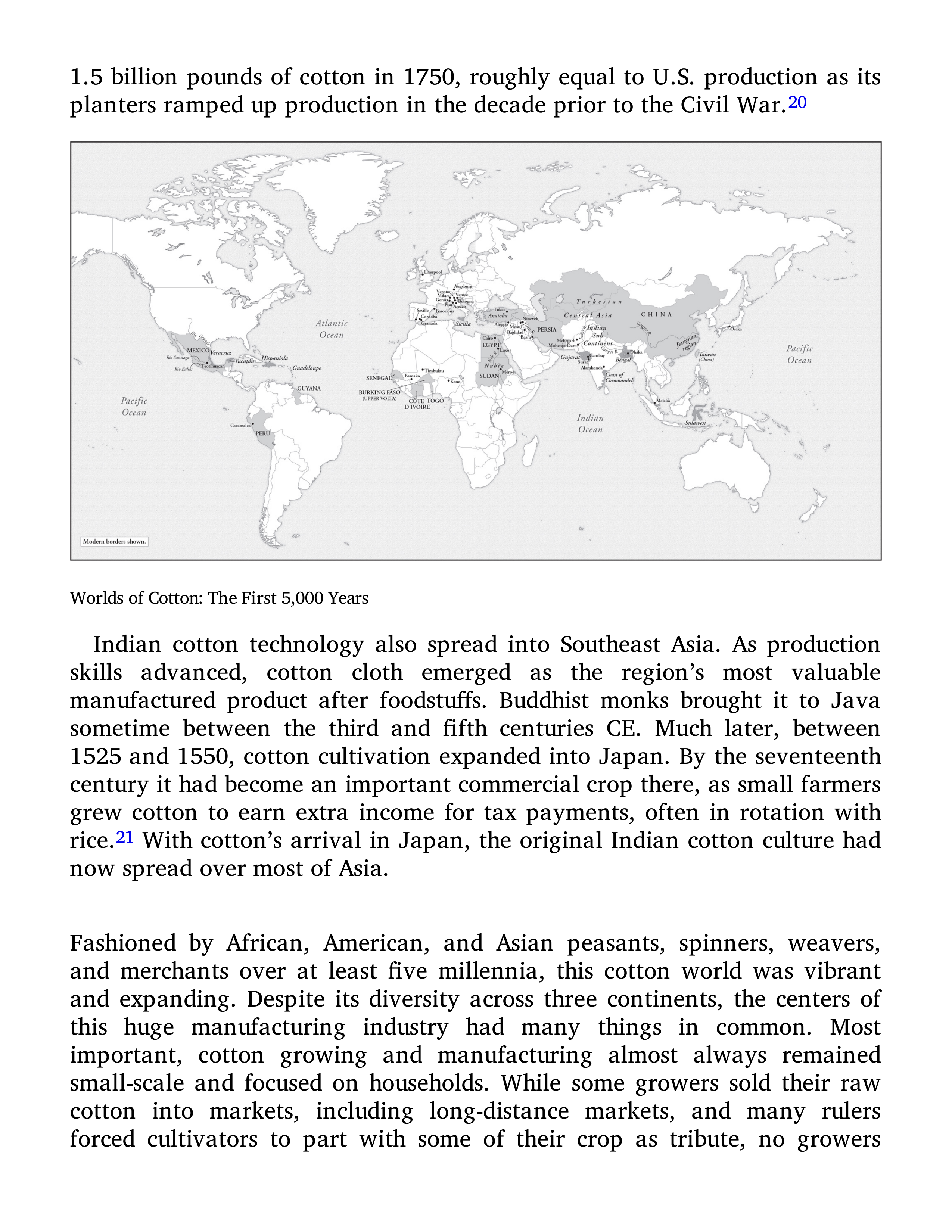
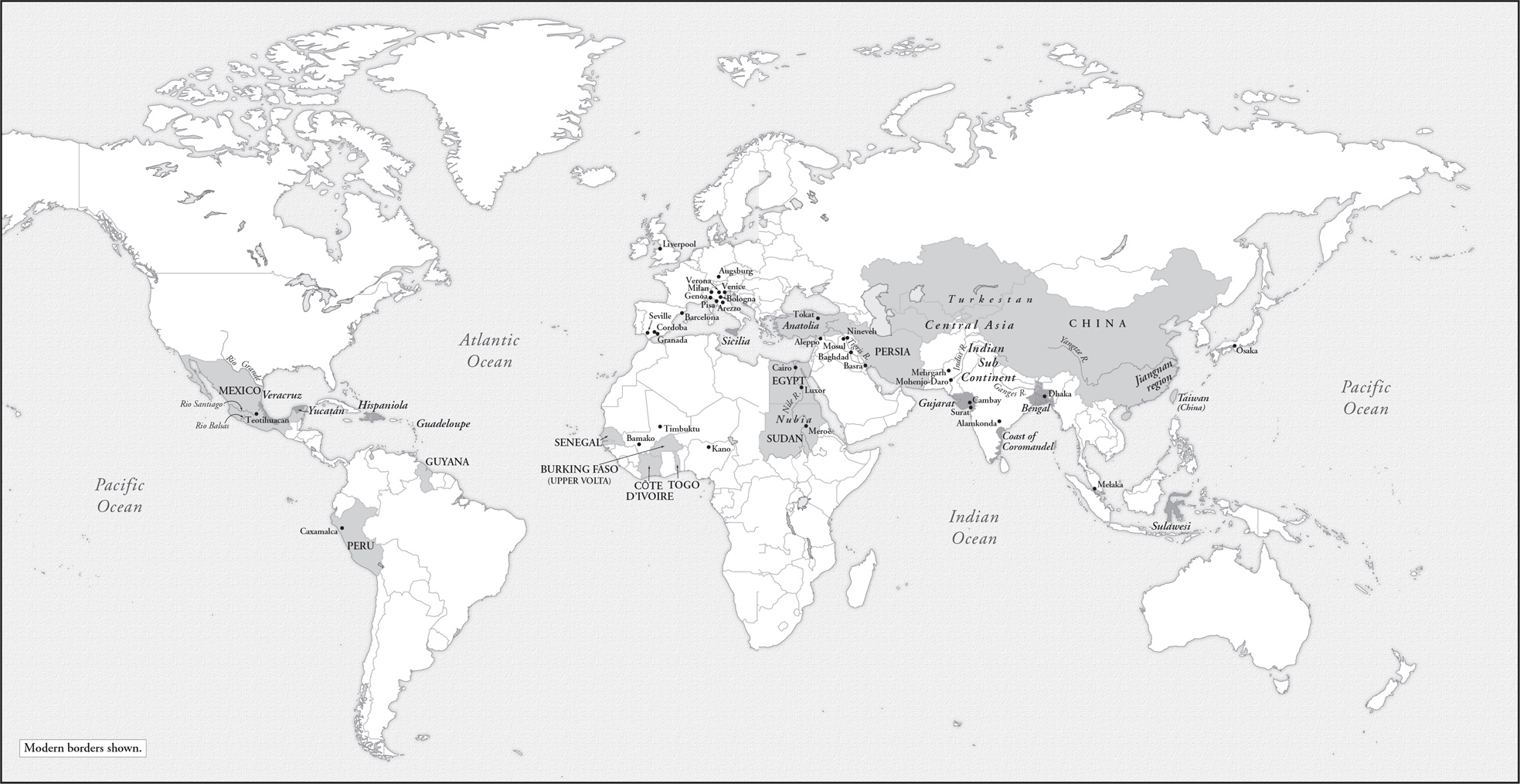
Worlds of Cotton: The First 5,000 Years
Indian cotton technology also spread into Southeast Asia. As production
skills advanced, cotton cloth emerged as the region’s most valuable
manufactured product after foodstu
ʃs. Buddhist monks brought it to
Java
sometime between the third and
ɹfth centuries CE. Much later, between
1525 and 1550, cotton cultivation expanded into Japan. By the seventeenth
century it had become an important commercial crop there, as small farmers
grew cotton to earn extra income for tax payments, often in rotation with
rice.
21
With cotton’s arrival in Japan, the original Indian cotton culture had
now spread over most of Asia.
Fashioned by African, American, and Asian peasants, spinners, weavers,
and merchants over at least
ɹve millennia, this cotton world was vibrant
and expanding. Despite its diversity across three continents, the centers of
this huge manufacturing industry had many things in common. Most
important, cotton growing and manufacturing almost always remained
small-scale and focused on households. While some growers sold their raw
cotton into markets, including long-distance markets, and many rulers
forced cultivators to part with some of their crop as tribute, no growers
depended on their cotton crops alone; instead they diversi
ɹed their
economic opportunities, hoping to lessen risk to the best of their ability. In a
large swath of Africa, and parts of South Asia and Central America, such
patterns persisted until well into the twentieth century.
For millennia, then, households planted cotton in a delicate equilibrium
with other crops. Families grew cotton alongside their food crops, balancing
their own and their community’s need for food and
ɹber with their rulers’
demands for tribute. In Veracruz, for example, double cropping of food
grains and cotton was common, providing subsistence both for those who
grew cotton and those who spun and wove. In the Yucatán, Mayan peasants
grew cotton in
ɹelds that also produced
maize and beans. In West Africa,
cotton was “interplanted with food crops,” such as sorghum, in present-day
Ivory Coast, or with yams, as in the area that is now Togo. In Gujarat, “the
[cotton] shrubs are planted between the rows of rice.” In the cotton-growing
areas of Central Asia, peasants grew the
ɹber alongside not only rice, but
also wheat and millet, and in Korea alongside beans. No signi
ɹcant cotton
monoculture emerged before the eighteenth century, and yet when that
monoculture appeared so too did the hunger for ever more land and labor.
22
Like cotton growing, cotton manufacturing throughout the world began in
households, and, with few exceptions, stayed there until the nineteenth
century. In areas controlled by the Aztecs, for example, all cotton
manufacturing was organized within households. In Africa as well, “in many
cases the production of cotton goods was purely a family industry, each
social unit being entirely self-su
ɽcient.” We have similar testimony for
India, China, Southeast Asia, Central Asia, and the Ottoman Empire.
Household production enabled a family to produce the cloth they needed,
but it also allowed production for markets. Since labor needs in most
agricultural societies varied enormously by the season, and since picked
cotton could be stored for months, peasants could focus on textile production
intermittently and seasonally, during slack times. This was especially the
case for women, whose activities focused on the house, with some of their
labor available for the homebound production of yarn and cloth.
23
In every society a de
ɹnite gender
division of labor emerged, with a
particularly strong association between women and textile production.
Indeed, there was a premodern saying in China that “men till the soil and
women weave.” Except among the Navajo, Hopi, and some peoples in
Southeast Asia, women throughout the world have had a virtual monopoly
on spinning. Because spinning can be done intermittently, and enables a
simultaneous commitment to other activities, such as watching young
children and cooking, women’s roles within households usually led them to
be in charge of spinning as well. So close was the association of women and
cloth production that in some cultures women were buried with their
spinning tools. With weaving, on the other hand, no such stark gender
divisions emerged. While men tended to dominate the weaving industry in
places such as India and southeast Africa, there were many cultures in which
women wove as well, such as in Southeast Asia, China, and North and West
Africa. Yet even in societies in which both women and men wove, they
usually specialized in di
ʃerent designs, produced distinct qualities, and
worked on di
ʃerent types of
looms. This gendered division of labor was
reproduced in the emerging factory system as well, making gender relations
in the household an important factor in the emergence of factory
production.
24
Embedded within households and their particular strategies for survival,
this premodern cotton industry was also characterized by slow technological
change in ginning, spinning, or weaving. As late as the eighteenth century,
a woman in Southeast Asia, for example, needed a month to spin a pound of
cotton and another month to weave a piece of cloth ten yards long.
25
This
enormous time requirement was partly the result of what economists call
“low opportunity costs” for the labor that went into spinning and weaving,
and partly of a world in which rulers taxed their subjects’ production to the
maximum extent possible. Moreover, since many households were self-
su
ɽcient in textiles, markets were of a limited scale, again reducing
incentives to improve production techniques.
Yet slow technological change was also related to constraints on the
supply of raw materials. In most regions of the world, raw cotton could not
be transported e
ɽciently very far. Beasts of burden or humans sometimes
carried raw cotton over relatively short distances. In the Aztec Empire, raw
cotton was transported into highland areas to be manufactured, at distances
of perhaps a hundred miles. More e
ɽcient and common was the waterborne
cotton trade. In the second millennium CE, for example, observers reported
hundreds if not thousands of boats
ɻoating cotton down the Yangtze to the
region of Jiangnan. Gujarati and central Indian cotton was similarly
shipped on the Ganges and along the coast to South India and Bengal.
Nonetheless, until the nineteenth century the overwhelming bulk of raw
cotton was spun and woven within a few miles from where it was grown.
26
So many people in so many parts of the world grew cotton, spun it, and
wove it into fabrics that it was very likely the world’s most important
manufacturing industry. And while household production for household
consumption would remain until the nineteenth century its most important
sector, there was signi
ɹcant change before the
Industrial Revolution of the
1780s. Most importantly, cotton goods—partly because they were so labor-
intensive to produce—became an important store of value and a medium of
exchange. Rulers everywhere demanded cotton cloth as tribute or taxes, and
indeed it might be said that cotton was present at the birth of political
economy as such. Among the Aztecs, for example, it was the most important
medium for tribute payments. In China, beginning in the
ɹfteenth century,
households were required to pay some of their taxes in cotton cloth. And in
Africa the payment of tribute in cloth was common. Practical as a means to
pay taxes, cotton cloth was also used as currency in China, throughout
Africa, in Southeast Asia, and in Mesoamerica. Cloth was an ideal medium
of exchange because unlike raw cotton it could be easily transported over
long distances, was not perishable, and was valuable. Nearly everywhere in
the premodern world, a piece of cotton cloth could buy needed things: food,
manufactured goods, even protection.
27
Cotton’s use as proto-money illuminates the fact that not all cotton
textiles, with their favorable ratio of value to weight, were used in the
immediate vicinity of their production. Indeed, the cotton centers that had
emerged separately in the Americas, Africa, and Asia all developed
increasingly
sophisticated
networks
of
trade,
connecting
growers,
manufacturers, and consumers over long, eventually even transcontinental
distances. In Iran, the ninth- and tenth-century cotton industry led to
signi
ɹcant urbanization, drawing raw cotton from the surrounding
countryside, spinning, weaving, and tailoring it to sell into long-distance
markets, especially in what is today Iraq. In precolonial Burkina Faso one
author
ɹnds that “cotton was at the center of trade.” Gujarati cotton cloth,
as early as the fourth century BCE, came to play a very signi
ɹcant role in
the trade between the various lands bordered by the Indian Ocean, and
large quantities were sold along the East African coast, to be traded far into
the African hinterland. In all of these exchanges, traders, especially if far
removed from the polities they originated from, had to adjust to local tastes,
and had to o
ʃer their products at prices attractive to local consumers.
28
In Mesoamerica, cloth was traded over many hundreds of miles, including
to neighboring states, as, for example, when merchants brought cloth from
Teotitlán (in modern-day Oaxaca) to Guatemala. In the Southwest of what is
now the United States, yarn and cloth were also important trade items.
Cotton goods have been found in excavations far from regions in which
cotton could grow. Since the thirteenth century, Chinese merchants imported
cotton yarn and cloth to supplement domestic production from as far away
as Vietnam, Luzon, and Java. In similar ways, African merchants traded
cotton textiles over long distances, as for example when they exchanged
Malinese cotton cloth for salt brought in by desert nomads. Ottoman cotton
textiles found their way to places as distant as western Europe, while cotton
goods were already being imported into Japan in the thirteenth century.
29
India, at the center of this increasingly global reach, traded with the
Roman Empire, Southeast Asia, China, the Arab world, North Africa, and
East Africa. Indian cottons crisscrossed South Asia on the backs of people
and bullocks. They crossed the seas in Arab dhows, traversed the great
Arabian Desert to Aleppo on the backs of camels, moved down the Nile to
the great cotton mart of Cairo, and
ɹlled the bottoms of junks on their way
to Java. Already in the sixth century BCE Indian cotton was traded to Egypt,
as merchants brought Indian cotton to Red Sea and Persian Gulf ports.
Greek merchants then took it from Egypt and also Persia to Europe. Roman
merchants eventually participated in this trade as well, making cotton a
coveted luxury good among the imperial elites. Throughout eastern Africa,
Indian cottons were an important presence as well. And throughout the
Arab world and Europe, India remained a major supplier until the
nineteenth century, with Gujarati merchants, among others, unloading huge
quantities of cloth. As an Ottoman o
ɽcial complained in 1647, “So much
cash treasury goes for Indian merchandise that…the world’s wealth
accumulates in India.”
30
Indian cloth also traded eastwards into other parts of Asia. Merchants sold
it in the marts of China in very ancient times. Huge quantities of Indian
cloth also found their way to Southeast Asia to clothe the local elite: Imports
to Malacca in the early sixteenth century, it has been estimated,
ɹlled the
holds of
ɹfteen ships that arrived annually from Gujarat,
Coromandel, and
Bengal. So dominant was Indian cloth on world markets that around 1503
the Italian merchant Lodovico de Varthema observed about the Gujarati port
town of Cambay, “This city supplies all Persia, Tartary, Turkey, Syria,
Barbary, i.e., Arabia Felix, Africa, Ethiopia, India and a multitude of
inhabited islands, with silk and cotton stu
ʃ.” The Sanskrit word for cotton
goods (
karpasi
) entered into Hebrew, Greek, Latin, Persian, Arabic,
Armenian, Malay, Uigur, Mongolian, and Chinese. Even the names of
particular fabrics became global brand names—chintz and jackonet, for
example, are corruptions of terms in Indian languages that eventually came
to describe a particular style throughout the world. Beginning in the
seventeenth century, Indian cottons, in fact, were what historian Beverly
Lemire has called the “
ɹrst global consumer commodity.”
31
As demand grew, cotton took its
ɹrst tentative steps out of the home.
During the second millennium CE, production in cotton workshops became
more common, especially in Asia. Professional weavers emerged in India;
they focused on supplying the long-distance trade, providing rulers and
wealthy merchants both at home and abroad with cotton cloth. In Dhaka,
weavers labored under tight supervision to produce muslins for the Mughal
court, “forced to work only for the Government which paid them ill and kept
them in a sort of captivity.” Workshops containing more than one loom are
also reported to have been located in Alamkonda, in modern-day Andhra
Pradesh, as early as the
ɹfteenth century. In contrast to the subsistence
weavers, the long-distance tradesmen were geographically concentrated:
Bengal was known for its
ɹne muslins, the
Coromandel coast for its chintzes
and calicoes, and Surat for its strong but inexpensive fabrics of every kind.
Though weavers could occupy very di
ʃerent positions within India’s caste
system, in some parts of the subcontinent they found themselves in the
upper reaches of social hierarchies, prosperous enough to be among the
leading donors to local temples. Groups of full-time cotton manufacturers
emerged in other parts of the world as well: In fourteenth-century Ming
China, for example, higher-quality textiles were worked up in “urban loom
houses,” which collectively employed many thousands of workers. In the
Ottoman city of Tokat, highly skilled weavers produced signi
ɹcant
quantities of cotton textiles. Baghdad, Mosul, and Basra, among other cities
in the Islamic world, had large cotton workshops, and indeed the word
muslin
for
ɹne cottons derives from Musil, the Kurdish name for Mosul. In
Bamako, the capital of present-day Mali, up to six hundred weavers plied
their trade, while in Kano, the “Manchester of West Africa,” a large weaving
industry arose, supplying the people of the Sahara with cloth. In Timbuktu,
already in the 1590s twenty-six cotton-producing workshops plied their
trade, each with
ɹfty or more workers. In
Osaka as well, thousands of
workers wove cotton textiles; workshops spread throughout the region
employing thirty to forty thousand people by the early eighteenth century.
32
As the workshop became more common, so too did a new type of weaver:
an individual, usually male, who produced speci
ɹcally for sale in a market.
Yet even as workshops emerged, this specialized production for markets
typically took place in the countryside, not towns, and in homes, not
workshops. What set these rural market producers apart from those who
produced for subsistence only was their reliance on an emerging force in
global commerce: putting-out networks held together by merchant capital.
In these networks, which would form the nuclei of nineteenth-century
mechanized cotton production, spinners and weavers worked up cotton
thread and cloth for urban merchants who would collect the products of the
spinners and weavers and then sell them on distant markets. The particular
ways merchant capitalists and producers related to one another varied
widely. On the Indian subcontinent, for example, rural weavers relied on
merchants for the capital needed to purchase su
ɽcient yarn, and for the
food they needed to subsist while weaving, yet these weavers generally
owned their own tools, worked without supervision, and enjoyed some
control over the disposal of their products. In other parts of the world, rural
weavers enjoyed considerably less power. In the Ottoman Empire, for
example, merchants advanced cotton and yarn to peasants, who spun and
wove it, then returned the product to the merchants for a small pro
ɹt.
Unlike weavers in India, they did not have any control over disposal of the
product. In China merchants also enjoyed great control over production.
“They bought up raw cotton, put it out at local markets for peasant women
to spin and to weave, had the cloth dyed and calendared in town or city
workshops and then exported it all over China for sale.” Merchants, in fact,
controlled every stage of production, foreshadowing their central role in the
nineteenth-century construction of a globe-spanning empire of cotton.
33
With expanding markets, cotton technology changed as well. While the
basic principles of cotton processing were quite similar throughout the
world, and productivity was dramatically lower before the invention of the
novel gins, spinning machines, and looms of the late eighteenth and early
nineteenth centuries, there were some signi
ɹcant innovations. In
Mesoamerica, for example, spinning was improved by the introduction of
“specially formed ceramic spindle whorls.” After 1200 CE, Mesoamericans
also used speci
ɹcally designed
spinning bowls, which increased the
productivity of spinners, enabling them, among other things, to feed the
voracious appetite for tribute of their rulers. The center of technological
innovation, however, was Asia: The roller gin (to remove seeds), the bow
(to clean and disentangle ginned cotton), the spinning wheel, and new
kinds of looms, including the upright warper, all originated in Asia. The
spinning wheel, invented in the eleventh century, was an especially
signi
ɹcant innovation as it allowed peasants to spin cotton much faster.
Weavers in the same regions also invented a novel kind of loom—the
treadle loom. While its exact origins are uncertain, it was introduced into
India sometime between 500 BCE and 750 CE, and into China (where it was
ɹrst used in
silk manufacturing) in the third century CE.
34
The greatest innovations occurred in the domestication of the cotton plant
itself, indeed so much so that the cotton picked by slaves in the nineteenth
century would be nearly unrecognizable to Indian farmers of two thousand
years earlier. Human selection made cotton compatible with highly varied
environmental conditions and rendered its
ɹber ever more applicable to the
production of textiles. Rural cultivators in China, Japan, Southeast Asia,
North and South America, western Africa, and Anatolia brought cottonseeds
from adjacent territories and added cotton to their crop mix. Through the
centuries, this process of domestication drastically altered the physical
properties of cotton, creating plants that produced longer and brighter
ɹbers (later-day cotton experts would refer to the length of the ɹber as
“staple”), ever more plentiful and easier to remove from the
ɹlbertlike shell.
Moreover, advances in irrigation techniques and agronomy allowed for the
expansion of production into new regions. Through seed selection and
improved technology, the cotton plant
ɻourished in drier and colder parts of
Africa, Asia, and the Americas, including the mostly arid soils of the Islamic
world. In Iran, for example, investments in irrigation systems as early as the
ninth century enabled a signi
ɹcant extension of cotton agriculture.
Nonetheless, compared to eighteenth- and nineteenth-century changes,
overall productivity increases in the two thousand years prior to the
Industrial Revolution were small. For much of its history, the world’s cotton
industry expanded primarily because ever-increasing numbers of people
spent ever more time growing, spinning, and weaving cotton.
35
These manufacturing networks connecting rural spinners and weavers
with urban merchant capital, especially in Asia, created a gradual but
signi
ɹcant expansion of output for markets. They did so, however, largely
without exploding older social structures, without altering production as it
had been organized for centuries. The household, and the technology
associated with it, remained at their center. This premodern world was safe
behind two bulkheads:
ɹrst, the markets for ɹnished goods, which were
growing but, compared to the world after 1780, only at a modest pace, and
second, the great obstacles to sourcing raw cotton across long distances. A
great countervailing force would be needed to break through those ancient
constraints.
For a very long time, in this remarkably diverse, fabulously vibrant, and
economically important world of cotton, Europe was nowhere to be found.
Europeans had remained marginal to networks of cotton growing,
manufacturing, and consumption. Even after they began importing small
quantities of cotton cloth during Greek and Roman times, they remained of
little importance to the global cotton industry as a whole. People dressed, as
they had since the Bronze Age, in clothing made from
ɻax and
wool. As
Mahatma Gandhi put it, while India supplied Europe with cottons,
Europeans themselves “were submerged in barbarism, ignorance and a state
of wilderness.”
36
Cotton, quite simply, was exotic to Europe. The
ɹber grew in faraway
lands, and many Europeans reportedly imagined cotton as a mixture of a
plant and an animal—a “vegetable lamb.” Stories circulated in medieval
Europe about little sheep growing on plants, and bending down at night to
drink water; other fables told of sheep attached to the ground by low
stems.
37
Cotton’s
ɹrst serious incursion into Europe, as in West Africa, was the
result of the spread of Islam. By 950 CE, cotton was manufactured in such
Islamic cities as Seville, Córdoba, Granada, and Barcelona, as well as Sicily;
some of those textiles were exported to the rest of Europe. During the
twelfth century, the Seville botanist Abu Zacaria Ebn el Awam published a
treatise on agriculture that included a detailed description of how to
cultivate cotton.
38
So tight was the association between Islam and cotton
that most western European languages borrowed their words for the
ɹber
from the Arabic
qutun
. French
coton
, English
cotton
, Spanish
algodón
,
Portugese
algodão
, Dutch
katoen
, and Italian
cotone
all derive from the
Arabic root. (The German
Baumwolle
and the Czech
bavlna
—translated
roughly as “tree wool”—are the exceptions that prove the rule.) While the
Christian Reconquista of Iberia in the
ɹrst half of the second millennium
seriously contracted the region’s cotton production, the centuries-long
exposure to Arab technology and culture left behind a familiarity with and
appreciation for cotton textiles in large areas of Europe.
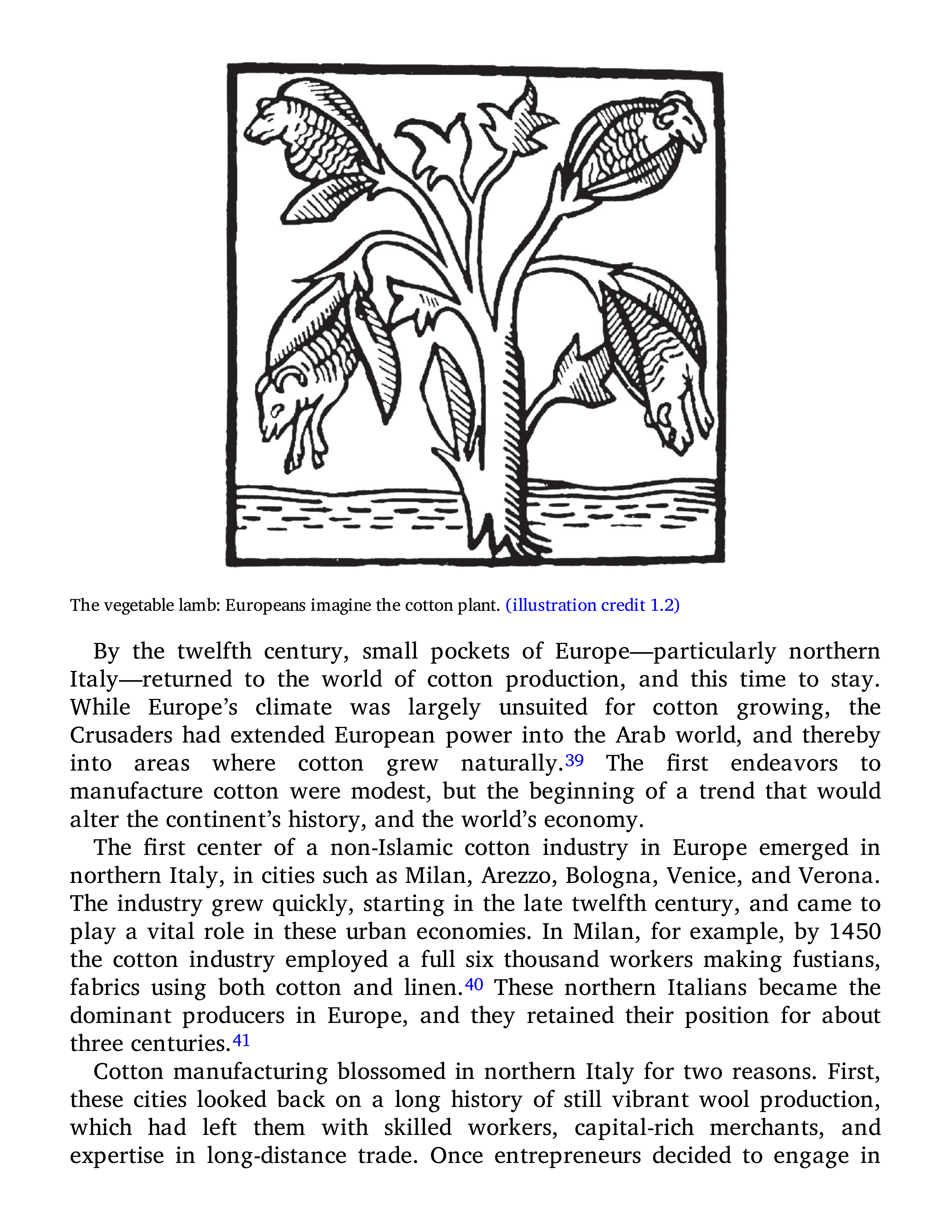

The vegetable lamb: Europeans imagine the cotton plant.
(illustration credit 1.2)
By the twelfth century, small pockets of Europe—particularly northern
Italy—returned to the world of cotton production, and this time to stay.
While Europe’s climate was largely unsuited for cotton growing, the
Crusaders had extended European power into the Arab world, and thereby
into areas where cotton grew naturally.
39
The
ɹrst endeavors to
manufacture cotton were modest, but the beginning of a trend that would
alter the continent’s history, and the world’s economy.
The
ɹrst center of a non-Islamic cotton industry in Europe emerged in
northern Italy, in cities such as Milan, Arezzo, Bologna, Venice, and Verona.
The industry grew quickly, starting in the late twelfth century, and came to
play a vital role in these urban economies. In Milan, for example, by 1450
the cotton industry employed a full six thousand workers making fustians,
fabrics using both cotton and linen.
40
These northern Italians became the
dominant producers in Europe, and they retained their position for about
three centuries.
41
Cotton manufacturing blossomed in northern Italy for two reasons. First,
these cities looked back on a long history of still vibrant wool production,
which had left them with skilled workers, capital-rich merchants, and
expertise in long-distance trade. Once entrepreneurs decided to engage in
cotton manufacturing, they could draw on those resources. They advanced
raw cotton to women in the surrounding countryside to have it spun. They
contracted with urban artisans, organized in guilds, to weave the yarn. They
branded and standardized their goods, and drew upon their long-distance
trade networks to export goods to foreign markets throughout the
Mediterranean, the Middle East, Germany, Austria, Bohemia, and
Hungary.
42
Second, northern Italy had easy access to raw cotton. Indeed, the northern
Italian industry was from the beginning entirely dependent on eastern
Mediterranean cotton from such places as western Anatolia and what today
is Syria. Already in the eleventh century, cotton yarn and cotton cloth had
been imported into the ports of Venice, Genoa, and Pisa, giving people a
taste for cottons. Raw cotton imports followed in the wake of the Crusades,
with the
ɹrst such trade documented for the year 1125.
43
As improvements in shipping allowed for the cheaper transportation of
bulk commodities, Venice became Europe’s
ɹrst cotton entrepôt, the
Liverpool of the twelfth century. Some traders became dedicated cotton
merchants, buying low-grade raw cotton from Anatolia, while procuring
better-quality
ɹber from Syria. This supply was supplemented by Genovese
imports from Anatolia, Sicily, and Egypt. But despite importing large
quantities, European merchants had little if any impact on the speci
ɹc ways
in which raw cotton was grown in the Levant: They bought cotton from
local merchants, loaded it on their ships, and transported it across the sea.
Nevertheless, Venice’s ability to insert itself into and eventually dominate
Mediterranean trade was crucial to the success of the northern Italian cotton
industry. Moreover, it was a harbinger of the wedge that European states
and capitalists would later drive into the heart of the ancient cotton
centers.
44
Not only did the Mediterranean networks give Italian manufacturers
relatively easy access to raw cotton, but they also provided them with access
to “Eastern” technologies. Northern Italian entrepreneurs appropriated
technologies from the Islamic world—some of which had in turn come from
India and China. The twelfth century witnessed a “massive infusion of
outside technology into the European textile industry”—most importantly
the spinning wheel. Before the spinning wheel was introduced into Europe
in the middle of the thirteenth century, Europeans, like Americans and
Africans, had spun with hand spindles. It was a slow process: A skilled
spinner produced about 120 meters of thread per hour. At that rate, it took
about eleven hours to spin enough yarn for one blouse. The spinning wheel
increased the output of European spinners tremendously, tripling
productivity. Thus the availability of a new material—cotton—led to the
embrace of the new manufacturing technique, which is why in medieval
Europe the spinning wheel was also called the “cotton wheel.” If less
dramatic than the spinning wheel, improvement also came to weaving with
the horizontal treadle loom. First used in Europe in the eleventh century, it
enabled the weaver to change the sheds—the device that separates some of
the warp threads to allow the shuttle to pass through—with his feet, freeing
the hands to insert the weft, and thus allowing for the production of
ɹner-
quality textiles. It came to Europe from India or China via the Islamic
world.
45
The growth of the northern Italian cotton industry rested principally on
its access to raw cotton and manufacturing technology from the Islamic
world. Yet these linkages and dependencies would become Italy’s principal
vulnerabilities; the industry remained distant from the sources of raw
materials, and lacked control over the growing of cotton. Northern Italy’s
industry eventually su
ʃered both from the strengthening of the Islamic
cotton industry and the marginalization of its own trade networks with the
Islamic world.
46
Yet even before the disruption of these crucial networks, the Italian
industry faced another challenge: the rise of nimbler competitors north of
the Alps, in the cities of southern Germany. They drew, like their Italian
counterparts, on cotton from the Levant. But while Italian manufacturers
faced high taxes, high wages, well-organized urban weavers, and guild
restrictions, German producers enjoyed the advantage of the more tractable
German countryside, where they gained access to cheap labor. By the early
ɹfteenth century, German manufacturers had used this cost diʃerential not
only to capture many of the Italian export markets, including eastern and
northern Europe, Spain, the Baltic region, the Netherlands, and England, but
to make inroads even into the Italian market itself.
47
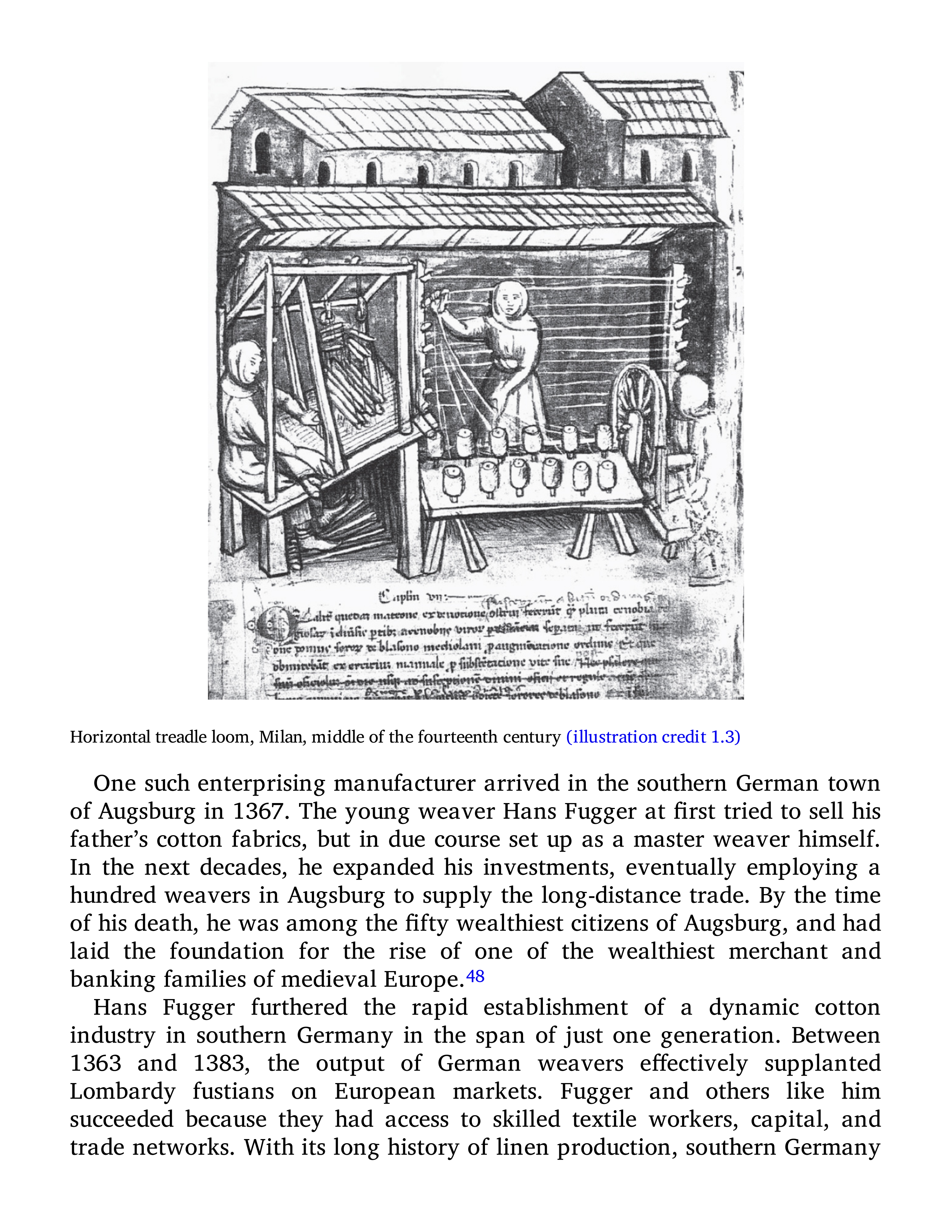
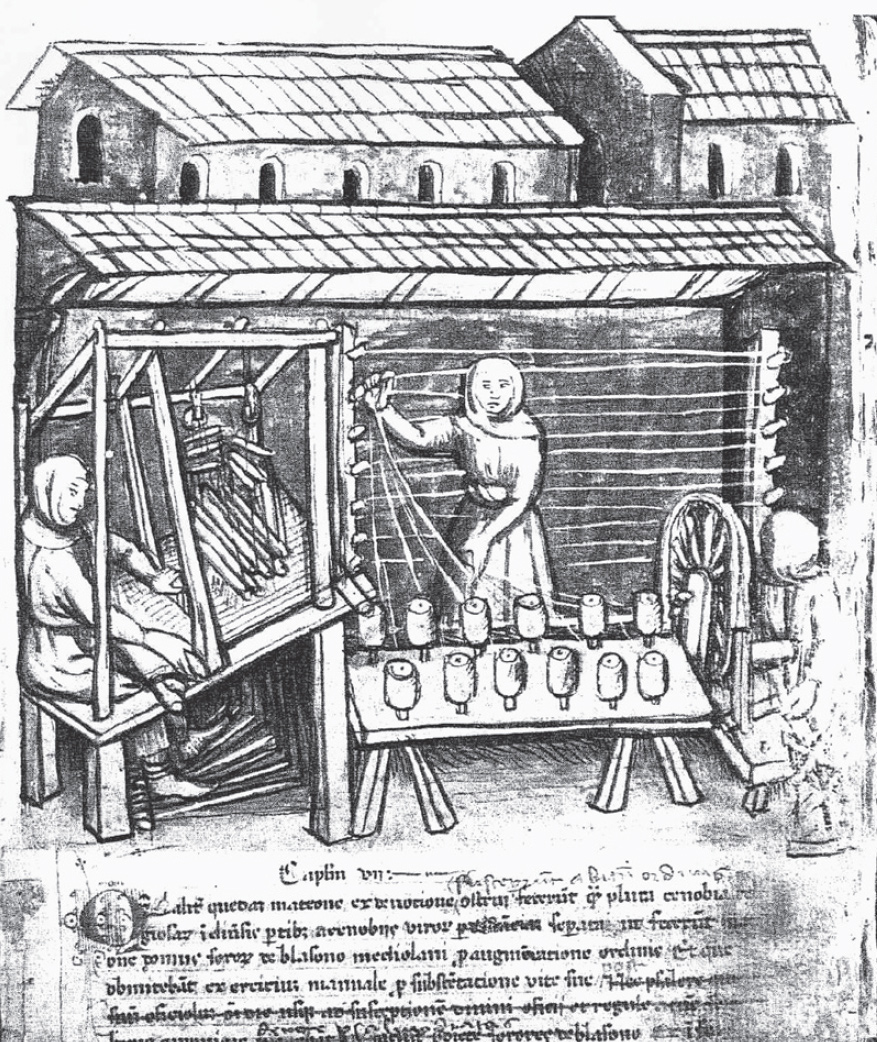
Horizontal treadle loom, Milan, middle of the fourteenth century
(illustration credit 1.3)
One such enterprising manufacturer arrived in the southern German town
of Augsburg in 1367. The young weaver Hans Fugger at
ɹrst tried to sell his
father’s cotton fabrics, but in due course set up as a master weaver himself.
In the next decades, he expanded his investments, eventually employing a
hundred weavers in Augsburg to supply the long-distance trade. By the time
of his death, he was among the
ɹfty wealthiest citizens of Augsburg, and had
laid the foundation for the rise of one of the wealthiest merchant and
banking families of medieval Europe.
48
Hans Fugger furthered the rapid establishment of a dynamic cotton
industry in southern Germany in the span of just one generation. Between
1363 and 1383, the output of German weavers e
ʃectively supplanted
Lombardy fustians on European markets. Fugger and others like him
succeeded because they had access to skilled textile workers, capital, and
trade networks. With its long history of linen production, southern Germany
had powerful long-distance traders with su
ɽcient capital to fund a new
industry. But these traders also had access to cheap labor, northern
European markets, and the ability to enforce regulations guaranteeing the
quality of their products. As a result, cities such as Ulm, Augsburg,
Memmingen, and Nuremberg became major centers of fustian production.
The industry eventually spread east along the Danube and south to
Switzerland.
49
The control of a rural workforce was crucial. In Ulm, for example, one of
the most important manufacturing centers, only about two thousand people
were busy with cotton production in the city itself, while eighteen thousand
workers labored on cottons in the hinterland. Indeed, most of the weaving
was done in the countryside, not the city, as merchants provided money,
raw materials, and even tools to spinners and weavers—another putting-out
network like the ones that characterized the Indian countryside. This
organization of production was much more
ɻexible than urban production,
since no guilds regulated it and since rural weavers continued to have access
to their own land and thus grew their own food.
50
With the emergence of a cotton industry in northern Italy and southern
Germany, small regions of Europe for the
ɹrst time became a minor part of
the global cotton economy. Yet within Europe, the industry was not yet
particularly prominent. Europeans still largely dressed in linen and
woolens, not cottons. And hardly any European cotton goods were
consumed outside the continent itself. Moreover, after the early sixteenth
century, the Venice-dependent European industry declined, as the Thirty
Years War disrupted the industry and trade shifted away from the
Mediterranean and toward the Atlantic. In the sixteenth century, indeed,
Venice lost control over the Mediterranean trade to a strengthened Ottoman
Empire, which was encouraging domestic industries and restricted the export
of raw cotton. When Ottoman troops consolidated their hold on the realm in
the 1560s, the e
ʃects were felt in distant German cotton textile towns. The
rise of the Ottoman Empire, a powerful state capable of controlling raw and
manufactured cotton
ɻows, ruined the northern Italian and German cotton
industries. To make matters worse for the once dominant Venetians, by the
end of the sixteenth century British ships called ever more frequently in
ports such as Izmir (Ottoman Smyrna); in 1589 the sultan granted the
English merchants far-reaching trading privileges.
51
Some shrewd observers surely noted that the
ɹrst European cotton
producers, both the northern Italians and the southern Germans, failed at
least in part because they had not subjugated those people who supplied

them with cotton. It was a lesson that would not be forgotten. As the
sixteenth century came to a close, an entirely new cotton industry arose that
focused on the Atlantic, not the Mediterranean. Europeans took for granted
that only the projection of state power would ensure success in these new
trade zones.
52
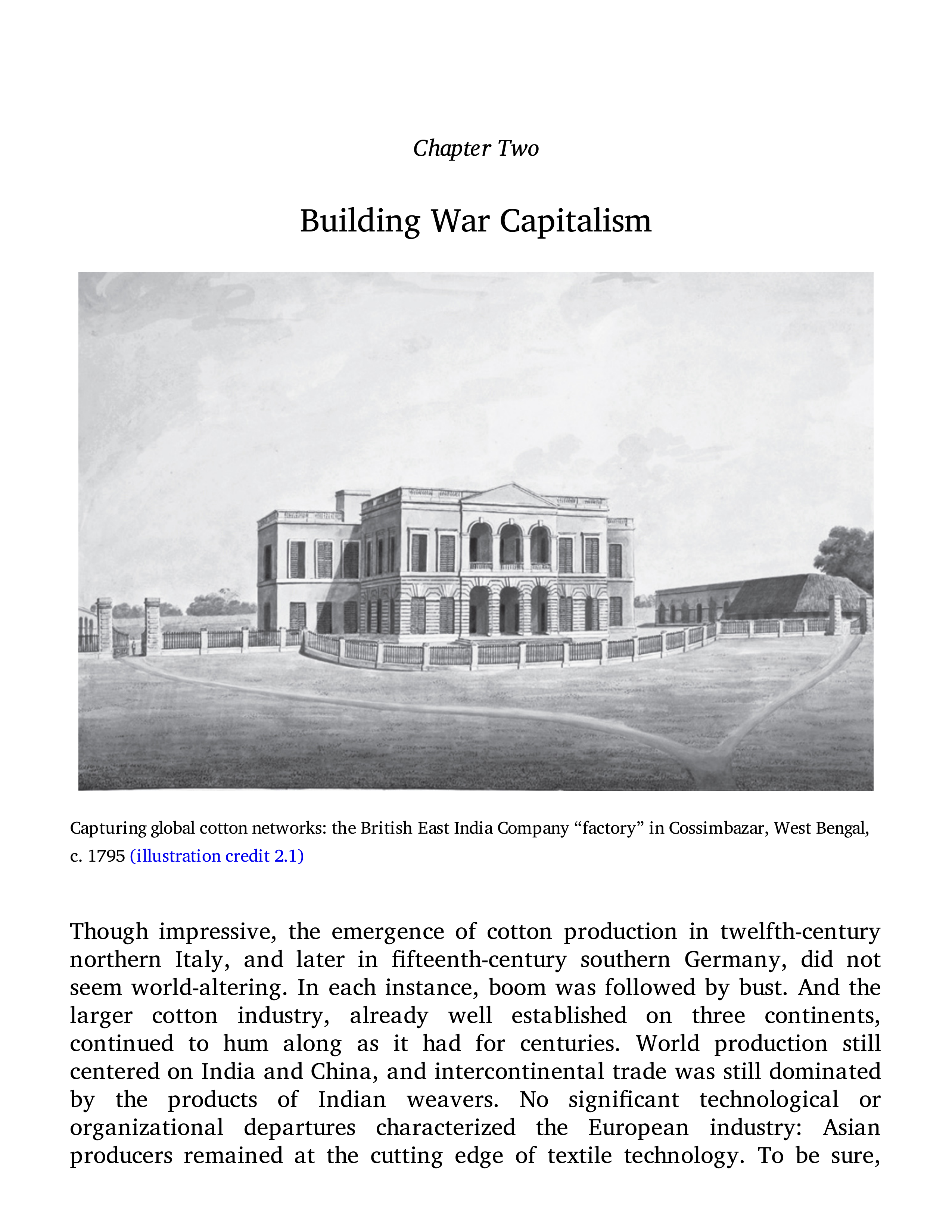
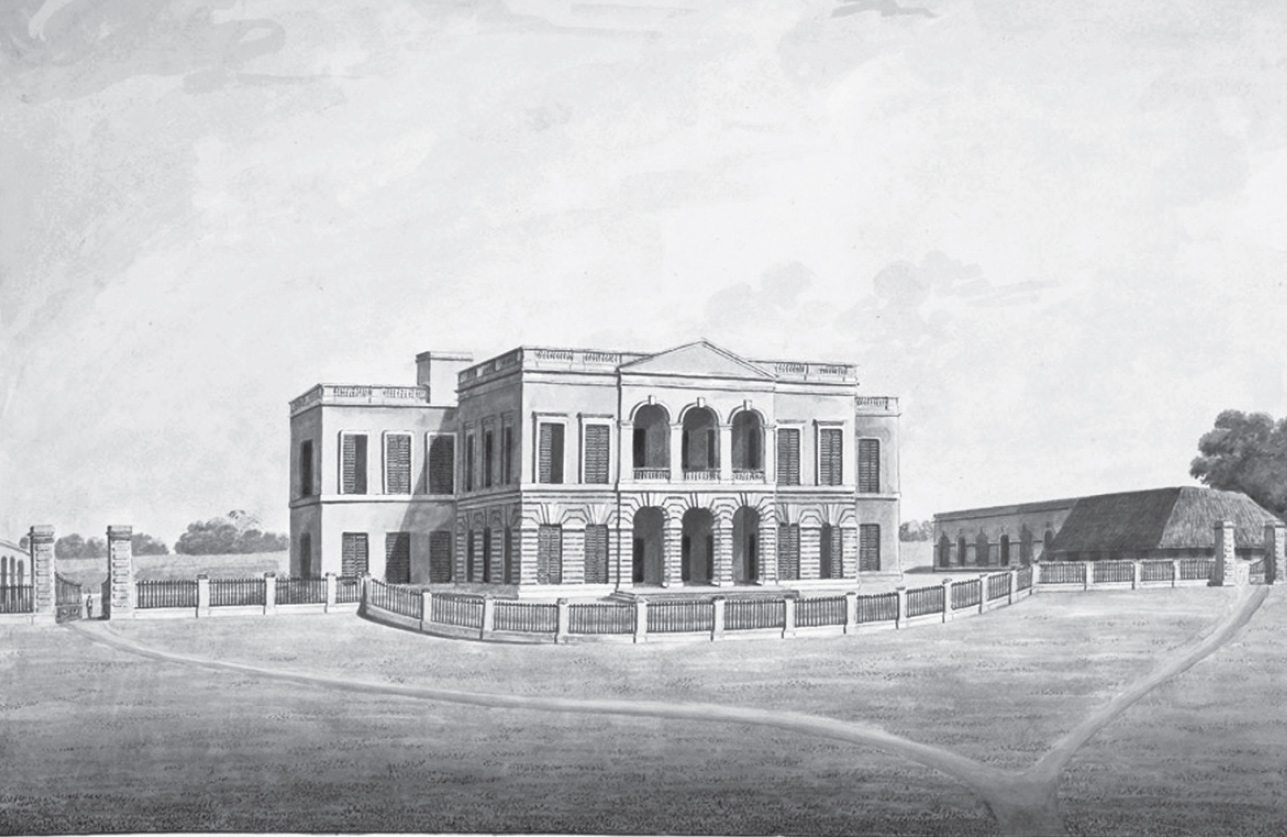
Chapter Two
Building War Capitalism
Capturing global cotton networks: the British East India Company “factory” in Cossimbazar, West Bengal,
c. 1795
(illustration credit 2.1)
Though impressive, the emergence of cotton production in twelfth-century
northern Italy, and later in
ɹfteenth-century southern Germany, did not
seem world-altering. In each instance, boom was followed by bust. And the
larger cotton industry, already well established on three continents,
continued to hum along as it had for centuries. World production still
centered on India and China, and intercontinental trade was still dominated
by the products of Indian weavers. No signi
ɹcant technological or
organizational departures characterized the European industry: Asian
producers remained at the cutting edge of textile technology. To be sure,
Europe’s new manufacturing endeavors produced an unprecedented
quantity of cotton cloth for that continent, spread a taste for cotton fabrics,
and established widespread knowledge about the principles of cotton
manufacturing—all factors that eventually became exceedingly important.
But for now those small shifts were irrelevant to the global cotton industry,
because Europeans lacked the ability to compete in transoceanic markets,
not least because the quality of their output was much inferior to that of
India. Unlike Indian or Chinese producers, moreover, Europeans depended
on the import of raw cotton from distant regions of the world—regions over
which they enjoyed little control. And in 1600, most Europeans continued to
clothe themselves in linens and woolens.
Over the next two hundred years, however, all that was to change. The
change was slow, at
ɹrst hardly perceptible, but the momentum built, faster
and faster and then exponentially. The ultimate result was a radical
reorganization of the world’s leading manufacturing industry: an explosion
in how and where cotton was grown and manufactured, and a shocking
vision of how the crop could yoke the world together. This recasting of
cotton did not at
ɹrst derive from technical advances, nor from
organizational advantages, but instead from a far simpler source: the ability
and willingness to project capital and power across vast oceans. With
increasing frequency, Europeans inserted themselves, often violently, into
the global networks of the cotton trade—within Asia as well as between Asia
and the rest of the world—before using that same power to create entirely
novel networks between Africa, the Americas, and Europe.
1
Europe’s
ɹrst
incursion into the world of cotton had collapsed in the face of superior
power; new generations of European capitalists and statesmen took heed
and built a comparative advantage with a willingness and ability to use
force to extend their interests. Europeans became important to the worlds of
cotton not because of new inventions or superior technologies, but because
of their ability to reshape and then dominate global cotton networks.
European capitalists and rulers altered global networks through multiple
means. The muscle of armed trade enabled the creation of a complex,
Eurocentric maritime trade web; the forging of a military-
ɹscal state
allowed for the projection of power into the far-
ɻung corners of the world;
the invention of
ɹnancial instruments—from marine insurance to bills of
lading—allowed for the transfer of capital and goods over long distances;
the development of a legal system gave a modicum of security to global
investments; the construction of alliances with distant capitalists and rulers
provided access to local weavers and cotton growers; the expropriation of
land and the deportation of Africans created
ɻourishing
plantations.
Unbeknownst to contemporaries, these alterations were the
ɹrst steps
toward the Industrial Revolution. Centuries before the “great divergence” of
per capita economic output between Europe and East Asia, a small group of
Europeans seized control of the heretofore episodic and gradual process of
forging global economic connections, with dramatic consequences not only
for the cotton industry but for human societies across the globe. The “great
divergence” was at
ɹrst a divergence of state power as well as a peculiar
relationship between these states and capital owners. In the process, the
many worlds of cotton became a European-centered empire of cotton.
Christopher Columbus’s landing in the Americas in 1492 marked the
ɹrst
momentous event in this recasting of global connections. That journey set
o
ʃ the world’s greatest land grab, with
Hernán Cortés attacking the Aztec
Empire in 1518 and establishing vast territorial claims for the Spaniards in
America, spreading into South America and also farther north. By the mid-
sixteenth century, Portugal had followed suit and acquired what is today
Brazil. The French set out to the Americas in 1605 and acquired Quebec;
parts of the modern-day midwestern and southern United States, which were
grouped into a French administrative unit called Louisiana; and a number of
Caribbean islands, including, in 1695, Saint-Domingue, the western third of
Hispaniola. England established its
ɹrst successful American settlement in
Jamestown, which became a part of the colony of Virginia, in 1607, soon to
be expanded with further colonies in North America and also the Caribbean.
Eventually, as we will see, controlling huge territories in the Americas
allowed, among other things, the monocultural growing of large quantities
of cotton.
The second momentous event in the history of cotton came
ɹve years
later, in 1497, when Vasco da Gama sailed triumphantly into the port of
Calicut, having pioneered a sea route from Europe to India around the Cape
of Good Hope. Now Europeans could for the
ɹrst time access the products of
Indian weavers—the world’s dominant producers—without having to rely
on the numerous middlemen who had transported Indian cloth by ship
across the Indian Ocean, by camel across Arabia, and then by boat to
European ports. Europeans began establishing formal trade relations on the
Indian subcontinent when da Gama obtained permission from local rulers to
trade in Calicut in 1498. By the early sixteenth century, the Portuguese had
established a series of trading outposts on India’s west coast, most
enduringly in Goa. At the end of the sixteenth century, the Netherlands and
Great Britain began to challenge Portugal’s monopoly on trade with Asia by
chartering joint-stock companies, hoping to catch a share of the highly
pro
ɹtable
spice trade. After a series of Anglo-Dutch wars, the Dutch and the
British agreed to divide their spheres of interest in Asia, with the Indian
textile trade falling mostly into British hands.
That expansion into South Asia, at
ɹrst, was the most momentous
intervention of European merchants and statesmen into the networks of the
global cotton industry. With it, Europeans began to play a role in the
transoceanic trade of Indian textiles, pioneered by the Portuguese, who
brought large quantities of such cloth to Europe. They also tried to assert
their dominance over the important trade between Gujarat and both the
Arabian Peninsula and eastern Africa—
ɹrst by violently restricting the
access of Gujarati merchants to those traditional markets (with mixed
success), and in the second half of the sixteenth century by regulating the
trade. Other European merchants later joined in: In 1600, merchants
established the British East India Company, in 1602 the Dutch Vereenigde
Oost-Indische Compagnie, and in 1616 the Danish Dansk Ostindiske
Kompagni. By the early seventeenth century, the Dutch and British were
replacing the Portuguese in violently regulating the trade in Gujarati
textiles, seizing Gujarati ships, and limiting local merchants’ access to the
markets of Arabia and, increasingly, Southeast Asia, which were supplied
from factories in southern India, along the Coromandel coast, with Madras
at its center.
2
France was the last of the great European powers to launch
trade with the East. In 1664, French traders founded the Compagnie des
Indes Française and brought the
ɹrst of what the French called
indiennes
—
colorfully printed cotton cloth—into France. These companies tried to assert
monopoly rights in certain areas, but facing each other as well as competing
independent merchants, their project never succeeded completely.
3
What all these European trading companies had in common was that they
purchased cotton textiles in India, to trade for spices in Southeast Asia, and
also to bring to Europe, whence they might be consumed domestically or
shipped to Africa to pay for slaves to work the plantations just beginning to
take root in the New World. Cotton textiles, for the
ɹrst time ever, became
entangled in a three-continent-spanning trading system; the consequences of
Columbus’s and da Gama’s momentous journeys fed on one another.
European consumers and African traders hungered for the beautiful chintzes,
muslins, and calicoes, or the simpler but useful plain cloths, spun and woven
by South Asian householders and artisans.
As a result, cotton textiles became central to European expansion into
Asia. Already by the early seventeenth century, European traders and
merchants played an important role in the trade at the Bengali port of
Dhaka, which for centuries had been the source of some of the world’s
highest-quality cottons. The East India Company as early as 1621 imported
an estimated
ɹfty thousand pieces of cotton goods into Britain. Forty years
later, this number had increased by a factor of
ɹve. Cotton cloths, in fact,
became the company’s most important trading good; by 1766 that cloth
constituted more than 75 percent of the East India Company’s total exports.
As a result, according to English writer Daniel Defoe—no friend of the
imports—cotton “crept into our Houses, our Closets and Bed Chambers,
Curtains, Cushions, Chairs, and at last Beds themselves were nothing but
Calicoes or Indian stu
ʃs.”
4
Armed European merchants inserted themselves successfully into the
transoceanic trade of Indian cotton textiles. In India itself, however,
European power was limited. It basically found its end at the outskirts of
port cities, or the walls of the forts that these soldier-traders increasingly
constructed along the coast. To secure the very large quantities of Indian
textiles they exported, European merchants depended on local traders,
banias
, who guarded their crucial relationships with the inland farmers and
weavers who grew, spun, and wove these increasingly valuable goods.
Europeans set up warehouses—so-called factories—along the coast of India,
in cities such as Madras, Surat, Dhaka, Cossimbazar, and Calicut, where
their agents placed orders with
banias
for cloth and received the wares ready
for shipment. Hundreds of leather-bound books, many of which are still
extant, recorded each one of these transactions.
5
In 1676, the factory of the British East India Company in Dhaka detailed
the mechanisms through which cloth was purchased, testifying to its
dependence on indigenous traders. The English merchants subcontracted the
task of securing cloth to a number of
banias
eight to ten months before the
trading ships arrived, specifying the qualities, designs, prices, and delivery
dates they desired. African and European consumers of cotton textiles
demanded very particular goods at particular prices.
Banias
then advanced
cash to various middlemen, who would travel from village to village to
advance funds and contract for
ɹnished cloth with individual weavers.
6
Eventually the cloth traveled the same chain back to the English factory in
Dhaka, where merchants graded and prepared it for shipment.
In this system of production, the weavers themselves had control over the
rhythm and organization of their work, owned their tools, just as they had
for centuries, and even retained the right to sell their products to whomever
they pleased. As European demand grew, weavers were able to increase
production and raise prices, which was clearly bene
ɹcial to them. In fact,
the arrival of European traders in the Gujarati town of Broach, just as much
as in Orissa and Dhaka, gave a new impetus to the regional cotton industry.
Weavers were still poor, yet they could take advantage of competition for
their cloth, as did indigenous
banias
and even Indian rulers, who quickly
established taxes and duties on the production and export of cotton cloth.
7
The power of European merchants in India was hence signi
ɹcant, but far
from all-encompassing: The English complained that the system was
frequently disrupted by “Arabians and Moguls who trade in Dacca cloth
carrying yearly very considerable quantities of the same overland some so
far as the great Turks Dominions,” as well as by the “contest, trouble and
Charge” of the weavers and local
banias.
8
This “factory” system, with its continuing dependence on local traders and
local capital, persisted for roughly two centuries. As late as 1800, the British
East India Company agreed to purchase piece goods from Pestonjee
Jemsatjee and Sorabje Jevangee, two merchants in Bombay, for more than 1
million rupees, while the Surat
bania
Dadabo Monackjee entered into
contracts with weavers north of the city to deliver cloth for the British.
Indeed, at
ɹrst, Portuguese, English, Dutch, and French traders were merely
the latest arrivals to an old and vibrant market, taking their place alongside
hundreds of merchants from all over South Asia and the Arabian Peninsula.
In Dhaka, as late as the 1700s, European traders acquired only about one-
third of all the cloth traded. And the trading capacity of Europeans in India
remained dependent on South Asian bankers and merchants who
ɹnanced
cotton growing and manufacturing.
9
The insertion of armed European merchants into the Asian trade,
however, slowly marginalized these older networks, as they muscled the
once dominant Indian and Arab traders out of many intercontinental
markets. In 1670, one British observer could still note that Middle Eastern
merchants “carried o
ʃ ɹve times as many
calicoes as the English and the
Dutch.” Yet with bigger, faster, and more reliable boats, and more damaging
ɹrepower, “the old pattern of the Indian-Levant trade as the principal
artery for world exchange underwent a complete structural change,” one
historian concludes, with “the Ottoman Empire…the chief loser.” Gujarati
merchants trading with East Africa also began facing European competition.
Just as European merchants became increasingly common in India, they
also established themselves in the East African markets; as a result, on both
sides of the Indian Ocean, Europe’s dominance grew. With the eighteenth-
century decline of Surat and the rise of British Bombay, merchants in
western India became even more dependent on British power.
10
The growing in
ɻuence of European merchants and their sponsoring states
in India eventually began to have important repercussions in Europe itself.
As much larger quantities of Indian cottons traveled to Europe, new markets
and fashions emerged. Beautiful chintzes and muslins attracted the attention
of the growing class of Europeans who had the money to purchase them and
the desire to
ɻaunt their
social status by wearing them. As Indian cottons
became ever more fashionable in the eighteenth century, the desire to
replace these imports was a powerful incentive to ramping up cotton
production in England and eventually to revolutionize it.
11
Moreover, domination in Asia dovetailed with expansion into the
Americas. As Spanish, Portuguese, French, English, and Dutch powers
captured huge territories in the Americas, they took away the continent’s
movable wealth: gold and silver. It was indeed some of these stolen precious
metals that had funded the purchase of cotton fabrics in India in the
ɹrst
place.
Eventually, however, European settlers in the Americas could not discover
su
ɽcient gold and silver and they invented a new road to wealth:
plantations growing tropical and semitropical crops, sugar in particular, but
also rice, tobacco, and indigo. Such plantations needed large numbers of
workers, and to secure these workers, Europeans deported at
ɹrst thousands
and then millions of Africans to the Americas. European merchants built
forti
ɹed trading stations along the western coast of Africa—
Goree in
present-day Senegal, Elmina in present-day Ghana, Ouidah in present-day
Benin. They paid African rulers to go on a hunt for labor, exchanging
captives for the products of Indian weavers. In the three centuries after
1500, more than 8 million slaves were transported from Africa to the
Americas,
ɹrst mostly by Spanish and Portuguese traders, to be joined in the
seventeenth century by the British, French, Dutch, Danish, and others.
During the eighteenth century alone, they deported more than 5 million
people, mostly from west-central Africa, the Bight of Benin, the Gold Coast,
and the Bight of Biafra.
12
Slaves arrived almost daily on Caribbean islands,
as well as along the coasts of both Americas.
Such trade increased the demand for cotton fabrics, since African rulers
and merchants almost always demanded cotton cloth in exchange for slaves.
Although it is often imagined that the slave trade was animated by simple
exchanges of guns and gewgaws for human export, slaves were more
frequently traded for a far more banal commodity: cotton textiles. One study
of 1,308 barters of British merchant Richard Miles between 1772 and 1780
for 2,218 Gold Coast slaves found that textiles constituted over half of the
value of all traded goods. Portuguese imports to Luanda in the late
eighteenth and early nineteenth centuries tell a similar story: Woven goods
constituted nearly 60 percent of imports.
13
African consumers became notorious for their discerning and dynamic
tastes, much to the consternation of European merchants. Indeed, one
European traveler observed that African consumer tastes were “most varied
and capricious,” and that “scarcely two villages concur in their canons of
taste.” When the slave ship
Diligent
sailed from its French port in 1731, it
carried in its hold a careful assortment of Indian textiles to cater to the
particular demands at the Guinea coast. In the same way, Richard Miles sent
very speci
ɹc instructions on what colors and types of textiles were currently
in demand on the Gold Coast to his British suppliers, down to the very
manufacturers that should be utilized. “Mr Kershaw’s [manufactures] are by
no means equal to [Knipe’s],” he told a British contact in one 1779 letter,
“at least not in the eyes of the Black traders here, & it is them that are to be
pleased.”
14
European trade in cotton textiles tied together Asia, the Americas, Africa,
and Europe in a complex commercial web. Never before in the four
millennia of the history of cotton had such a globe-spanning system been
invented. Never before had the products of Indian weavers paid for slaves in
Africa to work on the plantations in the Americas to produce agricultural
commodities for European consumers. This was an awe-inspiring system,
speaking clearly to the transformative powers of a union of capital and
state power. What was the most radical was not the particulars of these
trades, but the system in which they were embedded and how di
ʃerent parts
of the system fed upon one another: Europeans had invented a new way of
organizing economic activity.
This expansion of European trade networks into Asia, Africa, and the
Americas did not rest primarily on o
ʃering superior goods at good prices,
but on the military subjugation of competitors and a coercive European
mercantile presence in many regions of the world. Depending on the
relative balance of social power in particular places, there were variations
on this central theme. In Asia and Africa, Europeans settled coastal enclaves
and dominated transoceanic commerce, without at
ɹrst much involvement
in cultivation and manufacturing. In other parts of the world, most
prominently the Americas, local populations were expropriated and often
displaced or killed. Europeans invented the world anew by embarking upon
plantation agriculture on a massive scale. Once Europeans became involved
in production, they fastened their economic fortunes to slavery. These three
moves—imperial expansion, expropriation, and slavery—became central to
the forging of a new global economic order and eventually the emergence of
capitalism.
They combined with one other feature of this new world: states that
backed these merchant and settler ventures, but that only weakly asserted
their sovereignty over the places and peoples in distant territories. Instead,
private capitalists, often organized in chartered companies (such as the
British East India Company) asserted sovereignty over land and people, and
structured connections to local rulers. Heavily armed privateering capitalists
became the symbol of this new world of European domination, as their
cannon-
ɹlled boats and their soldier-traders, armed private militias, and
settlers captured land and labor and blew competitors, quite literally, out of
the water. Privatized violence was one of their core competencies. While
European states had envisioned, encouraged, and enabled the creation of
vast colonial empires, they remained weak and thin on the ground,
providing private actors the space and leeway to forge new modes of trade
and production. Not secure property rights but a wave of expropriation of
labor and land characterized this moment, testifying to capitalism’s illiberal
origins.
The beating heart of this new system was slavery. The deportation of
many millions of Africans to the Americas intensi
ɹed connections to India
because it increased pressure to secure more cotton cloth. It was that trade
that established a more signi
ɹcant European mercantile presence in Africa.
And it was that trade that made it possible to give economic value to the
vast territories captured in the Americas, and thus to overcome Europe’s
own resource constraints. This multifaceted system certainly showed
variation and changed over time, but it was su
ɽciently diʃerent from the
world that came before and the world that would emerge from it in the
nineteenth century that it deserves its own name: war capitalism.
War capitalism relied on the capacity of rich and powerful Europeans to
divide the world into an “inside” and an “outside.” The “inside”
encompassed the laws, institutions, and customs of the mother country,
where state-enforced order ruled. The “outside,” by contrast, was
characterized by imperial domination, the expropriation of vast territories,
decimation of indigenous peoples, theft of their resources, enslavement, and
the domination of vast tracts of land by private capitalists with little
e
ʃective oversight by distant European states. In these imperial
dependencies, the rules of the inside did not apply. There, masters trumped
states, violence de
ɹed the law, and bold physical coercion by private actors
remade markets. While, as Adam Smith argued, such territories advanced
“more rapidly to wealth and greatness than any other human society,” they
did so via a social tabula rasa, which, perhaps ironically, provided the
foundation for the emergence of very di
ʃerent societies and states on war
capitalism’s “inside.”
15
War capitalism had an unprecedented transformative potential. At the
root of the emergence of the modern world of sustained economic growth, it
created unfathomable su
ʃering, but also a consequential transformation of
the organization of economic space: A multipolar world increasingly became
unipolar. Power long spread across multiple continents and through
numerous networks increasingly became centralized through a single node,
dominated by European capitalists and European states. At the core of this
change stood cotton, as the multiple and diverse worlds of the production
and distribution of this commodity increasingly lost ground to a hierarchical
empire organized on a global scale.
Within Europe itself, this reorganization of economic space had continent-
wide repercussions. “Atlantic” powers such as the Netherlands, Great
Britain, and France replaced the erstwhile economic powerhouses such as
Venice and its northern Italian hinterland. As Atlantic trade superseded
Mediterranean trade and as the New World became an important producer
of raw materials, cities with links to the Atlantic also rose in prominence in
the manufacturing of cotton textiles. Indeed, as early as the sixteenth
century, expanded cotton manufacturing in Europe was contingent on a link
to the rapidly expanding markets throughout the Atlantic world—from the
cloth markets in Africa to the newly emerging sources of raw cotton in the
Americas. In Flemish cities such as Bruges (starting in 1513) and Leiden
(starting in 1574), cotton manufacturing burgeoned, as Antwerp began to
carry a signi
ɹcant
trade in raw cotton and overseas expansion that gave
access to huge new markets. French manufacturers, for identical reasons,
also embarked upon new cotton spinning and weaving ventures in the late
sixteenth century.
16
Amid these seismic geographic shifts, the most signi
ɹcant in the long run
was cotton manufacturing’s arrival in England. By 1600, Flemish religious
refugees began weaving cotton cloth in English towns. The earliest reference
to cotton dates to 1601, “when the name of George Arnould, fustian weaver
of Bolton, appears in the records of quarter sessions.” The industry grew,
and by 1620 British cotton manufacturers exported their wares to France,
Spain, Holland, and Germany. Cotton manufacturing thrived especially in
the northern English county of Lancashire, where both the lack of guild
control and the proximity to Liverpool, an important slaving port, became
key to producers who supplied the African trade in slaves and plantations in
the Americas.
17
This slowly emerging English cotton industry drew on earlier experiences
with the production of linen and woolens. As on the continent, cottons were
at
ɹrst manufactured in the countryside. Merchants, many of them
Puritans
and other dissenters, advanced raw cotton to peasants, who employed
family labor seasonally to spin and weave, before returning the cloth to the
merchants who sold it. As cotton cloth demand exploded, spinning and
weaving became ever more important to smallholding peasants, and some
of them eventually gave up their traditional crops and became entirely
dependent on the industry. Some of the merchants who organized domestic
cotton production turned into substantial businessmen. As they accumulated
capital, they expanded production by providing ever more credit to ever
more spinners and weavers, encouraging an “extensi
ɹcation” of production
—its geographic dispersal throughout ever larger areas of the countryside.
This was the classic putting-out system, quite similar to its incarnations
across Asia centuries earlier, or to the British woolens industry. The
countryside became ever more industrial and its inhabitants ever more
dependent on putting-out work for distant merchants.
18
Unlike Indian cotton spinners and weavers, the growing class of English
cotton workers had no independent access to raw materials or to markets.
They were entirely subordinated to the merchants—indeed, they enjoyed
less independence and power than their Indian counterparts.
19
British
putting-out merchants, as a result, had far more power than Indian
banias
.
The British cotton men were part of a rising global power whose navy
increasingly dominated the world’s oceans, whose territorial possessions in
the Americas and in Asia—India foremost among them—grew rapidly, and
whose slavers created a plantation complex that rested in various ways on
the manufacturing capacity of spinners and weavers thousands of miles
away in the remote uplands of Lancashire and the plains of Bengal.
Despite these beginnings, their signi
ɹcance emerged only in retrospect.
Throughout the seventeenth and eighteenth centuries, Europe’s cotton
industry was not particularly prominent. In England, but also elsewhere in
Europe, the “manufacture of cotton remained almost stationary.” Even after
1697, it grew only slowly; for example, it took sixty-seven years for the
amount of raw cotton worked up into thread and cloth to approximately
double, to 3.87 million pounds. That was the amount of cotton used in an
entire year. By 1858, in contrast, the United States would export this
amount of cotton on average on a single
day
. France was similar, and,
outside Britain and France, European cotton demand was even less
signi
ɹcant.
20
One reason for the relatively slow growth of European cotton
manufacturing was the di
ɽculty of accessing raw cotton. As cotton was not
grown in Europe itself, the industry’s essential raw material had to be
brought from distant locations. The modest demand for raw cotton among
European manufacturers of the seventeenth and eighteenth centuries, before
the heyday of the new machines that would by 1780 revolutionize cotton
manufacturing, was largely met through established and diversi
ɹed trade
channels, in which cotton remained one commodity among many. In 1753,
twenty-six ships arrived in the port of Liverpool from Jamaica with cotton,
of which twenty-four had less than
ɹfty bags of the ɹber on board.
21
There
were neither merchants nor ports nor regions of the world that specialized
in cotton production for export.
Since the twelfth century the most important source of cotton imports to
Europe, as we have seen, was the Ottoman Empire, especially western
Anatolia and Macedonia. Throughout the seventeenth century, cotton from
Izmir and Thessaloniki (Ottoman Salonica) continued to dominate local
markets, arriving in London and Marseille alongside other products of the
East, such as silk and mohair yarn. As European demand for raw cotton
slowly expanded in the eighteenth century, Ottoman cotton still
ɹlled a
signi
ɹcant share: one-quarter of all British imports between 1700 and 1745,
and a similar quantity shipped to Marseille.
22
Small quantities of raw cotton also arrived from other regions of the
world, such as the Indian cotton that found its way to London in the 1690s,
courtesy of the East India Company. Similarly, in the 1720s, the Royal
African Company reported selling “At Their House in Leaden-Hall-Street by
the Candle, on Thursday the 12th Day of September 1723, at Ten of the
Clock in the Forenoon…. Cotton from Gambia.” A year later, they o
ʃered
“Casks of Fine Silk Cotton…from Whyday,” and the subsequent year “Bags
of Guinea Cotton.” But such minor sales paled in comparison to these
merchants’ more important trade items like elephant tusks.
23

More important, however, was a new source of cotton: the West Indies.
Though cotton remained a marginal crop compared to sugar on these
islands, a number of small farmers, with fewer resources to invest than the
sugar lords, did grow the “white gold.” The production of these
petits blancs
,
as they were called on the French islands, remained rather static until 1760.
Yet for the British and French cotton industries, even this small amount of
West Indian cotton supplied a signi
ɹcant share of their needs. And more
important, as we will see, its way of production pointed to the future.
24
Before 1770, therefore, European merchants secured the valuable
ɹber
through well-established trade networks from a wide variety of locations.
With the exception of the West Indies, their in
ɻuence did not go much
beyond the port cities themselves, as they had neither the power to tinker
with how cotton was cultivated in the hinterland nor the inclination to
advance capital for additional cotton growing. Cotton came to them thanks
to the prices they were willing to pay, but they had no in
ɻuence on how the
cotton came into being. Local growers and merchants remained powerful
actors within this global raw cotton nexus, not least because they neither
specialized in cotton production for export nor in northern European
markets.
25
Cotton imports into the UK, 1702–1780, by source, in millions of pounds,
ɹve-year trailing averages
(illustration credit 2.2)
As small quantities of raw cotton came to Europe to feed the expanding but
in global terms still puny European cotton industry, demand for cotton cloth
grew in Europe, as well as in Africa and on the slave plantations of the
Americas. Yet European production was insu
ɽcient to meet it. In response,
English, French, Dutch, Danish, and Portuguese traders, all with a similar
feverish energy, tried to secure greater quantities of cotton textiles in India
under ever more favorable conditions. While in 1614 British merchants had
exported 12,500 untailored pieces of cotton cloth, between 1699 and 1701
that number spiked to 877,789 pieces annually. Exports of cloth by the
British had increased by a factor of seventy in less than a hundred years.
26
To obtain these fabulous quantities of textiles from India at favorable
prices, representatives for the European East India companies began to
insert themselves even more into the production process within India itself.
For decades, representatives of the chartered European East India
companies had complained about the ability of Indian weavers to sell their
goods to competing European companies, competing Indian
banias
, traders
from other regions of the world, or even to private European merchants who
operated independently of the companies, creating competition that raised
prices. Pro
ɹtability could be increased only if Europeans could force
weavers to work for their respective company alone. Monopolizing the
market became the way to drive down weavers’ incomes and drive up the
selling price of particular goods.
27
European traders were helped in securing cotton cloth in the quantity and
quality they needed, and at the price they desired, because their business
practices were reinforced with political control of increasingly extensive
Indian territories. They came not just as traders, but increasingly as rulers.
By the 1730s, the Dhaka factory, for example, hosted a contingent of
military personnel and arms to protect the company’s interests. Most
dramatically, by 1765 the British East India Company—a group of
merchants—ruled Bengal, and in the decades thereafter expanded its control
over other South Asian territories. Such territorial dreams were furthered by
British merchants’ increasing investment in the raw cotton trade between
India and China by the late eighteenth century, which made them hope for
the integration of western Indian cotton tracts into East India Company
territories as well. This assertion of private political power by a state-
chartered
company
over
distant
territories
was
a
revolutionary
reconceptualization of economic might. States shared sovereignty over
territory and people with private entrepreneurs.
28
Among many other things, this new combination of economic and
political power enabled European merchants to gain greater control over
textile manufacturing, especially by increasing control over weavers.
29
Along the Coromandel coast the in
ɻuential Indian merchants who acted as
brokers between Indian weavers and European exporters increasingly were
replaced by agents who were under much greater control of the European
companies already in the seventeenth century. In Surat, which, like Bengal,
would fall under company rule in 1765, the Board of Trade of the governor-
general expressed in 1795 its dissatisfaction with
the system in practice hitherto of having a Contractor who has not
himself any immediate connection with the manufacturers or weavers,
but engages in subordinate contracts with a large number of the Native
Merchants of little property or probity and though bound in
responsibility, are not competent to pay a penalty if forfeited, and that
in fact the goods never came into their possession, and apprehend that
the di
ɽculties now existing, will not be removed but with its abolition
or very material alteration.
30
Removing the Indian middlemen promised the foreign merchants better
control over production and the ability to secure a greater quantity of piece
goods. To that end, the East India Company tried to bypass the independent
Indian
banias
who had historically connected them to the weavers by giving
that responsibility to Indian “agents” whom they put on their own payroll.
The Board of Trade in London instructed the governor-general in great
detail how to recast the system of purchasing cotton cloth, hoping thereby to
“recover to the Company that genuine knowledge of the business,” and thus
acquire more cloth at cheaper prices by implementing the “grand
Fundamental principle of the Agency System.” Through its Indian agents the
company now made direct advances to weavers, something the British had
not done in earlier years, which was greatly aided by territorial control and
the attendant political authority. While weavers had always depended on
credit, the novel insertion of Europeans into these credit networks along
with the e
ʃorts of European merchants to monopolize economic control of
particular parts of India made them ever more dependent on the company.
Already by the middle of the eighteenth century, European companies sent
these agents deep into the manufacturing centers in the countryside near
Dhaka, agents who increasingly set the terms of production and thus
succeeded in lowering prices. In the 1790s the East India Company even
encouraged weavers to relocate to Bombay and produce cloth there—all
with the goal of being able to supervise them better “without being extorted
by the Servants of the Rajah of Travancore.”
31
The encroachment of British power on the subcontinent meant that
weavers increasingly lost their ability to set prices for cloth. According to
the historian Sinnappah Arasaratnam “they could not produce for any
customer they chose; they had to accept part of their payment in cotton
yarn; they were subject to a strict supervision of the process of manufacture
by the Company’s servants who were located in the village.” Weavers were
now often compelled to take advances from particular merchants. The
ultimate aim, never fully realized, was to make weavers into wage workers
—along the lines of what contemporary merchants succeeded in
implementing in the English countryside itself.
32
To further their goal, the company now also employed its coercive powers
toward the weavers directly. The company hired large numbers of Indians to
supervise
and
implement
new
rules
and
regulations,
in
e
ʃect
bureaucratizing the cloth market. Extensive new regulations attached
weavers legally to the company, making them unable to sell their cloth on
the open market. Company agents now inspected cloth on the loom, and
endeavored to ensure that the cloth was, as promised, sold to the company.
A new system of taxation penalized those weavers who produced for
others.
33
The company also increasingly resorted to violence, including corporal
punishment. When a company agent complained that a weaver was
working illegally for a private merchant, “the Company’s Gumashta seized
him and his son,
ɻogged him severely, painted his face black and white, tied
his hands behind his back and marched him through the town escorted by
seapoys [
sic
] [Indian soldiers in the employ of the English], announcing ‘any
weaver found working for private merchants should receive similar
punishment.’ ” Such policies produced their intended results: Indian weavers’
income fell. In the late seventeenth century, up to one-third of the price of
cloth might have gone to a weaver. By the late eighteenth century,
according to historian Om Prakash, the producer’s share had fallen to about
6 percent. As income and living standards declined, a lullaby sung by Saliya
weavers spoke longingly of a mystical time when their looms contained a
silver plank. By 1795, the company itself observed an “unprecedented
mortality among the Weavers.”
34
Unsurprisingly, weavers resisted the coercive encroachment of European
capital in the production process. Some packed up and moved away from
territories
controlled
by
Europeans.
Others
secretly
produced
for
competitors, but the need to avoid detection made them vulnerable to
pressures for lower prices. At times, groups of weavers collectively
approached the East India Company to complain about the company’s
interference with free trade.
35
Such resistance sometimes reduced the power of European capitalists.
Thus despite its wish to eliminate Indian middlemen, the East India
Company understood that “it is impossible to do without the subordinate
Contractors,” whose much denser social networks into weaving villages
could never be completely replaced by company agents. The interests of
independent European merchants also often worked against the company,
as they o
ʃered weavers more money for cloth, thus giving weavers an
incentive to undermine company policies.
36
Despite such constraints, aggressive policies succeeded in getting ever
more cotton cloth into the stores of European traders. European cloth
exports from India amounted to an estimated 30 million yards in 1727, but
increased to some 80 million yards annually by the 1790s. British merchants
in particular, but also their French counterparts, controlled the acquisition
and export of huge quantities of cottons woven for export: In 1776, the
district of Dhaka alone counted roughly eighty thousand spinners and
twenty-
ɹve thousand weavers, while in 1795 the East India Company
estimated that the city of Surat alone contained over
ɹfteen thousand looms.
And there was pressure for more. A 1765 dispatch from the East India
Company o
ɽce in London to its counterparts in Bombay, reɻecting on the
possibilities of the peace following the Seven Years War, beautifully
summarizes what was at the core of the revolutionary reconceptualization of
the global economy.
37
Since the Peace the Slaving Trade to the Coast of Africa has greatly
encreased, in course the Demand for Goods proper for that Market is
very large; & as We are very desirous of contributing so far as lyes in
Our Powers to the Encouragement of a Trade on which the well-being
of the British plantations in the West Indies so much depends, &
considering the same therefore in a National View, We expect &
positively direct that you conform as near as possible can, not only to
the Provision in general of the several Articles ordered in the
abovementioned List of Investment [i.e., cloth], but those marked A
which are more immediately for that Trade.
38
As this message makes clear, cotton from India, slaves from Africa, and
sugar from the Caribbean moved across the planet in a complex commercial
dance. The huge demand for slaves in the Americas created pressure to
secure more cotton cloth from India. Not surprisingly, Francis Baring of the
East India Company concluded in 1793 that from Bengal an “astonishing
Mass of Wealth has
ɻowed…into the Lap of Great Britain.”
39
European merchants’ increasing control over the production process in India
would seem to threaten Europe’s own not particularly important or dynamic
infant cotton industry. How could the English, French, Dutch, and other
producers possibly compete against India’s fabrics, which were both superior
in quality and cheaper? And yet it appears that the European industry
expanded even as India exported more cloth. Ironically, imports from India
helped the European cotton textile industry by creating new markets for
cotton fabrics and by continuing Europe’s appropriation of relevant
technologies from Asia. In the long run, moreover, imports from India
in
ɻuenced Europe’s political priorities. As we will see, Great Britain, France,
and others emerged as newly powerful states, with a vocal group of
capitalists; for states and individuals alike, replacing Indian cotton cloth
imports with domestically manufactured cloth became an important, albeit
di
ɽcult-to-realize priority.
Protectionism played a key role in this process, testifying again to the
enormous importance of the state to the “great divergence.” By the late
seventeenth century, with both cotton imports and domestic cotton
manufacturing expanding, Europe’s woolen and linen manufacturers
pressured their respective governments to protect them from upstart cotton
manufacturers in general and Indian imports in particular. Textiles were
Europe’s most important manufacturing industry: Dislocation of the sector
by cotton imports and manufacturing seemed to endanger pro
ɹts and
threaten social stability.
40
As early as 1621, only a little more than two decades after the creation of
the East India Company, London wool merchants protested against the
growing importation of cotton cloth. Two years later, in 1623, Parliament
debated Indian textile imports, calling them “injurious to the national
interests.” Indeed, agitation against cotton imports became a constant
feature of the English political landscape in the seventeenth and eighteenth
centuries. A 1678 pamphlet, “The Ancient Trades Decayed and Repaired
Again,” warned that the woolen trade was “very much hindered by our own
people, who do wear many foreign commodities instead of our own.” In
1708,
Defoe’s Review
printed a bitter editorial that looked “into the real
Decay of our Manufactures,” ascribing the decline to the import of ever
increasing quantities of “Chints and painted Callicoes” by the East India
Company. The result was that “the Bread taken out of [the people’s]
Mouths, and the East-India Trade carry away the whole Employment of
their People.” Usually it was woolen and linen manufacturers who agitated
against Indian imports, but sometimes cotton manufacturers chimed in as
well: In 1779, calico printers, fearful that the East India Company would
ruin their business, wrote to the Treasury that “if there is not a Prohibition
put to the East India Company’s going on with their printing Manufactory
in the East Indies a great many more must also leave o
ʃ this Branch of
Business.”
41
Such agitation led to protectionist measures. In 1685, England imposed a
10 percent duty on “all calicoes and other Indian linen and all wrought silks
which are manufactures of India.” In 1690, the tari
ʃ was doubled. In 1701,
Parliament outlawed the import of printed cottons, leading to the
importation of plain calicoes for further processing in England, giving a
huge boost to British calico printing. A 1721 law went so far as to ban
people from wearing printed calicoes if the white calicoes themselves
originated from India, a measure that gave an impetus to calico fabrication
in Britain. Selling Indian cottons was eventually criminalized altogether: In
1772 Robert Gardiner of London rented an apartment to one W. Blair, who
“brought illegal goods into his house,” namely Indian muslins. He was sent
to jail. In 1774, Parliament decreed that cotton cloth for sale in England had
to be made exclusively of cotton spun and woven in England. Only goods
destined for reexport were permitted from the East Indies. The Indian cotton
goods not subject to these bans, such as plain chintz and muslins, were
subject to heavy tari
ʃs. In the end, all of these protectionist measures did
not help the domestic woolen and linen industry, but did spur domestic
cotton manufacture.
42
Like Britain, France took pains to outlaw the import of Indian cottons. In
1686, in response to pressure from silk and wool industrialists, it outlawed
the manufacture, use, and sale of cottons. Over the next seventy years, no
fewer than two royal edicts and eighty rulings of the king’s council
attempted to repress cottons. Penalties were made ever more severe, with
imprisonment and, starting in 1726, even the death penalty awaiting
o
ʃenders. In 1755, France again outlawed the import of Indian printed
textiles for consumption in France, and in 1785 the king recon
ɹrmed the
prohibitions in order to protect a “national industry.” Twenty thousand
guards worked on enforcing these laws, sending as many as 50,000 violators
to forced labor on French galleys. Explicitly excluded from the long list of
prohibited Indian textiles, however, were those destined for Guinée, that is,
textiles used in the slave trade. Slaves, after all, could only be gotten by
exchanging them for the cottons from India.
43
Other European countries followed suit: Venice disallowed the import of
Indian cottons in 1700, as did Flanders. In Prussia, a 1721 edict of King
Friedrich Wilhelm outlawed the wearing of printed or painted chintz and
cottons. Spain outlawed the import of Indian textiles in 1717. And in the
late eighteenth century, the Ottoman Empire under Sultan Abdulhamid I
prohibited subjects from wearing certain Indian cloths.
44
What began as a policy to protect domestic wool, linen, and silk makers
evolved toward an explicit program of encouraging the domestic production
of cotton textiles. “The prohibition that the industrial nations imposed on
printed textiles in order to encourage their own national production,” the
French traveler François-Xavier Legoux de Flaix argued in 1807, provided
European manufacturers who could not yet freely compete with Indian
weavers with a sense of how promising the market for cottons would be.
Domestic as well as export markets were potentially huge and extremely
elastic. And just as protectionist measures limited access to European textile
markets for Indian producers, European states and merchants increasingly
dominated global networks that allowed them to capture markets for cotton
textiles in other parts of the world. These markets, in fact, provided an
outlet for cottons secured in India as well as for domestic producers. Thus
Europeans could both increase cloth purchases in India
and
protect their
own uncompetitive national industries—a miraculous feat possible only
because war capitalism had allowed Europeans to dominate global cotton
networks while at the same time constructing new kinds of ever more
powerful states whose constant warfare demanded ever greater resources
and thus embraced domestic industry.
45
Imperial expansion and the increasing dominance of Europeans in the
global cotton trade allowed, furthermore, for an increasing transfer of Asian
knowledge to Europe. Manufacturers in Europe felt more and more pressure
to appropriate these technologies in order to compete both on price and on
quality with Indian producers. Europe’s movement toward manufacturing
cotton textiles was based, in fact, on what might be considered one of
history’s most dramatic instances of industrial espionage.
One reason that Indian textiles were so popular among European and
African consumers was their superior design and brilliant colors. In order to
match the fabulous qualities of their Indian competitors, European
manufacturers, supported by their various national governments, collected
and shared knowledge about Indian production techniques. French cotton
manufacturers, for example, devoted great e
ʃort to copying Indian
techniques by closely observing Indian ways of manufacturing. In 1678,
Georges Roques, who worked for the French East India Company, wrote
what quickly became an invaluable report on Indian woodblock printing
techniques, based on his observations in Ahmedabad. Forty years later, in
1718, Le Père Turpin followed suit, and in 1731 Georges de Beaulieu, the
second lieutenant on a French East India Company ship, reached
Pondicherry to investigate how Indian artisans produced chintz. As a result
of these and other e
ʃorts, by 1743 French manufacturers were capable of
copying all but the very
ɹnest Indian textiles. Yet despite this rapid
appropriation of Indian techniques, even in the late eighteenth century cloth
from the subcontinent still de
ɹned quality. Legoux de Flaix admired in 1807
the qualities of Indian yarn and cloth (“a degree of perfection far beyond
what we are familiar with in Europe”) and once again reported in minute
detail on Indian manufacturing techniques, in the hopes of enabling French
artisans to copy them: “All the weaving combs in France should be made
according to the model used in Bengal,” he advised, among other things.
“Then we will succeed in equaling the Indians in the manufacture of their
muslin.”
46
Other European manufacturers followed suit. In the late eighteenth
century, Danish travelers ventured to India to understand and appropriate
Indian technology. And throughout the seventeenth and eighteenth
centuries, English cotton printers collected and then copied Indian designs
using Indian cotton printing expertise. Publications such as the “Account of
the Manufactures carried on at Bangalore, and the Processes employed by
the Natives in Dyeing Silk and Cotton,” or the similarly oriented “The
Genuine Oriental Process for giving to Cotton Yarn, or Stu
ʃs, the fast or
ingrained Colour, known by the Name of Turkey or Adrianople-Red,”
exempli
ɹed a persistent interest in technology transfer. Just as was the case
with the spinning wheel and the horizontal treadle loom in the centuries
prior, Asia from the sixteenth through the eighteenth century remained the
most important source of cotton manufacturing and, especially, printing
technology. As European domination of the global networks of cotton
quickened, so too did the pace of European assimilation of Indian
technology.
47
Replacing Indian cotton cloth with domestic production, both for export
markets and for local consumption, became a goal to aspire to. Glasgow
cotton manufacturers pressured the government to help them gain access to
export markets in 1780, since there was “a surplus of Goods which the Home
Consumption cannot exhaust: and therefore a foreign Sale to a much greater
extent becomes indispensably necessary, in order to occupy the Machinery
(which must otherwise be lost) and also to keep alive the Industry of the
People, who have been trained to this business.”
48
Imperial expansion,
moreover, had acquainted European, and especially British, merchants with
global cotton markets. By 1770, it had become clear that markets for cotton
textiles in Europe, but even more so in Africa, the Americas, and, of course,
Asia, were huge—and the opportunities for pro
ɹt to anyone able to produce
for these markets on a competitive basis virtually limitless. Knowledge of
the elasticity and pro
ɹtability of these markets derived directly from
merchants’ experience in the world’s long-distance cotton trade networks.
49
Indeed, export markets eventually became central to Europe’s cotton
textile manufacturers—markets that had been captured, at
ɹrst, through the
export of fabrics from India. “It is of very great importance to our
Investment,” the London Commercial Department wrote to its counterparts
in Bombay, “that we should be enabled to bring regularly to Sale a
considerable amount of Surat Goods for the supply of the African Trade in
particular.” West Africans turned into principal customers for cotton cloth
secured by the French from Pondicherry not least because imports into
France itself were illegal. As Legoux de Flaix observed in the late eighteenth
century, “It was the establishment of colonies [in the West Indies] and the
slave trade which gave birth to this branch of commerce with Indoustan….
But if the colonies of the Antilles cease to buy slaves, one can say without
doubt, that this article will decline more and more.”
50
English manufacturers and merchants had relied early on exports of
domestic and Indian fabrics to Africa. This reliance on overseas markets
became pronounced after 1750. As historian Joseph E. Inikori has shown, in
1760, Britain exported about one-third of its cotton cloth production. By the
end of the eighteenth century the share going abroad had expanded to about
two-thirds. Africa and the Americas were the most important markets. By
mid-century, 94 percent of all cotton cloth exports from Britain went there.
The sheer scale of this market meant that those able to compete there could
reap fortunes. Adam Smith saw this clearly when he wrote in 1776 that by
“opening a new and inexhaustible market to all the commodities of Europe,
it gave occasion to new divisions of labour and improvements of art, which,
in the narrow circle of the ancient commerce, could never have taken place
for want of a market to take o
ʃ the greater part of their produce.”
51
Africans’ appreciation for these cottons was grounded in their own cotton
industry and their much earlier exposure to Indian textiles. European slave
merchants at
ɹrst struggled to deliver exactly the type of cloth for which
African demand already existed, especially indigo blue and white cottons.
Around 1730 the East India Company remarked that a shortage of Indian
cottons had “put people upon making goods in imitation of them here” in
England—and European traders even exported cloth under their Indian
names, because Africans usually preferred cloth “made in India.” In a
memorandum for the Board of Trade, Elias Barnes hoped that British
weavers could successfully copy Indian cottons. The potential market for
such cloth, he believed, was immense: “Besides what is consumed in our
Own Dominions, the whole World will be our customer.” As late as 1791 the
Commercial Department of the East India Company urged Bombay to
regularly ship cottons to England “for the supply of the African trade in
particular.”
52
Imperial expansion, slavery, and land expropriations—war capitalism—
laid the foundations for the still small and technologically backward
domestic cotton industry in Europe. It provided dynamic markets and access
to technology and to essential raw materials. It also became a signi
ɹcant
engine of capital formation. Mercantile cities such as Liverpool, which
derived their wealth largely from slavery, became important sources of
capital for the emerging cotton industry, and cotton merchants in Liverpool
provided ever more credit to manufacturers to enable them to work up the
cotton. London merchants, in turn, who sold the yarn and cloth coming from
British producers advanced credit to Lancashire manufacturers. In fact, they
provided the very important and very signi
ɹcant working capital, as proɹts
from trade were redirected toward manufacturing, “a
ɻow of capital
inwards from commerce.” Moreover, as these merchants gained wealth in
long-distance trade, they could demand political protections from a
government increasingly dependent on extracting revenue from them.
53
Last but not least, war capitalism also nourished the emerging secondary
sectors of the economy such as insurance,
ɹnance, and shipping, sectors that
would become exceedingly important to the emergence of the British cotton
industry, but also public institutions such as government credit, money
itself, and national defense. These institutions originated in the world of
war capitalism “as advanced industrial techniques and commercial
practices” migrated from export businesses into the domestic economy.
54
European—and especially British—merchants, with the willing partnership
of the British state, had inserted themselves in unique ways into the global
networks of cotton production, between growers and spinners, between
spinners and weavers, between producers and consumers. Long before the
advent of new cotton-producing technologies, they had in fact already
rearranged the global cotton industry and global cotton networks. These
networks were dominated by the joint venture of private capital and
increasingly robust states. Together their commitment to armed trade,
industrial espionage, prohibitions, restrictive trade regulations, domination
of territories, capturing of labor, removal of indigenous inhabitants, and the
state-sponsored creation of territories that were then left to the far-reaching
domination of capitalists had created a new economic order.
55
From these abundant exertions by merchants, manufacturers, and
government bureaucrats alike, Europe by the eighteenth century enjoyed a
fundamentally new place in the global networks of cotton. Most of the
world’s cotton production was still located in Asia, and vibrant cotton
industries remained throughout Africa and the Americas, but Europeans now
decisively dominated its transoceanic trade. In the New World, they had
built a regime for the production of agricultural commodities based on slave
labor, a system of production that would ultimately make more and more
Europeans into cotton growers, even though little cotton grew on European
soil. Strong European states had simultaneously created barriers to the
import of foreign textiles just as they built a system for the appropriation of
foreign technology. By orchestrating economic processes in Asia, Africa, and
the Americas as well as in Europe, Europeans gained the paradoxical ability
to direct the global trade in Indian textiles while at the same time keeping
Asian cloth increasingly out of Europe, instead trading the products in Africa
and elsewhere beyond Europe’s shores. A globalized textile industry had
emerged and Europeans, for the
ɹrst time, had grasped the vast scope of the
global demand for cotton goods.
What set European statesmen and capitalists apart from their
counterparts elsewhere was their ability to dominate these global networks.
Whereas trade in Africa, Asia, and the Americas had been characterized by
networks fueled by the mutually advantageous exchange of goods,
Europeans built transcontinental production systems that exploded existing
social relations on their continent and elsewhere. The signi
ɹcance of this
early history of global interaction was not global trade as such (which
remained of limited quantitative importance to all economies), but instead
the reshaping of how things were produced, both in time and in space, and
the social and political rami
ɹcations of that production.
56
India and China,
or, for that matter, the Aztec and Inca empires, had not even come close to
such global dominance, and even less so to reinventing how people
produced things in the far-
ɻung corners of the globe. And yet starting in the
sixteenth century, armed European capitalists and capital-rich European
states reorganized the world’s cotton industry. It was this early embrace of
war capitalism that was the precondition for the Industrial Revolution that
eventually created an enormous further push toward global economic
integration and continues to shape and reshape our world today.
What happened was a swift transition from the older world of cotton—
discontinuous, multifocal, horizontal—to an integrated, centralized, and
hierarchical empire of cotton. As late as the mid-eighteenth century, it would
have seemed unlikely to contemporary observers that Europe, and especially
Britain, would very soon turn into the world’s most important cotton
manufacturer. Indeed, even in 1860, James A. Mann, a fellow at the
Statistical Society of London and a Member of the Royal Asiatic Society,
could still remember:
Our own condition, at a period very recent, would but ill-compare with
the then inhabitants of the New World or of India; our moral condition
with all the advantages of climate, was absolutely below the latter, and
the position of the manufacturing art in America, at the date of its
discovery, or in India, surpassed even that of our woolen manufacture;
and to this day, with all our appliances, we cannot surpass in
ɹneness
the muslins of the East, or the solidity and elegance of the
Hamaca’s
,
the Brazilians and Carribees were wont to weave. When our people
were in primeval darkness, East and West were in comparative light.
India…is the source whence we received indirectly our ideas of trade;
it was the manufactures of that country, as of China, that inspired the
minds of our forefathers with the wish for luxuries according to the
received notions of the times. The period in which the manufacture was
carried on in India, formed comparatively speaking, the dawning of
our day; the sun was then traveling from another and past era in the
world’s commerce. The Indian manufacture was the forecast of that
light, which, intensifying on its road hither, gained the needful warmth
to dispel the early mists of morn, and develop the embryo state; and
strengthened by the energy of the European, it has given rise to a new
era of commercial splendour never before witnessed.
57
As the sun was made to rise over a small part of Europe, as enterprising
Europeans sucked the discontinuous, multifocal, and horizontal worlds of
cotton slowly into their orbit, they invented tools and methods that enabled
them to mobilize land, labor, and markets in the service of a newly and
boldly imagined empire. By creating this vast sphere of war capitalism that
followed rules so di
ʃerent from the ones in Europe itself, they created not
just the conditions for the “great divergence” and the Industrial Revolution
but also for a further strengthening of states at home that would in turn
become crucial to the creation of the empire of cotton. By 1780, Europe in
general, and Britain in particular, had become a hub of the world’s cotton
networks.
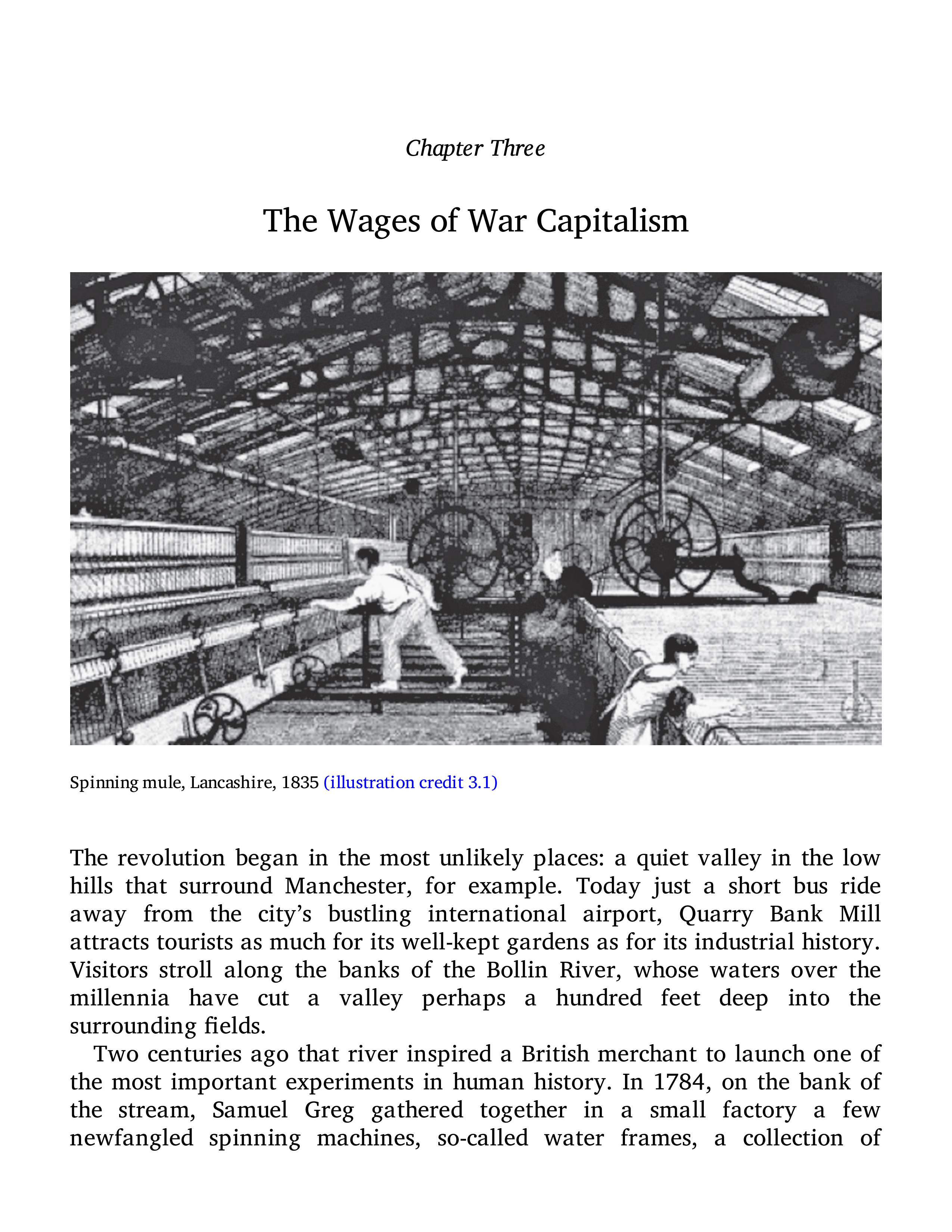
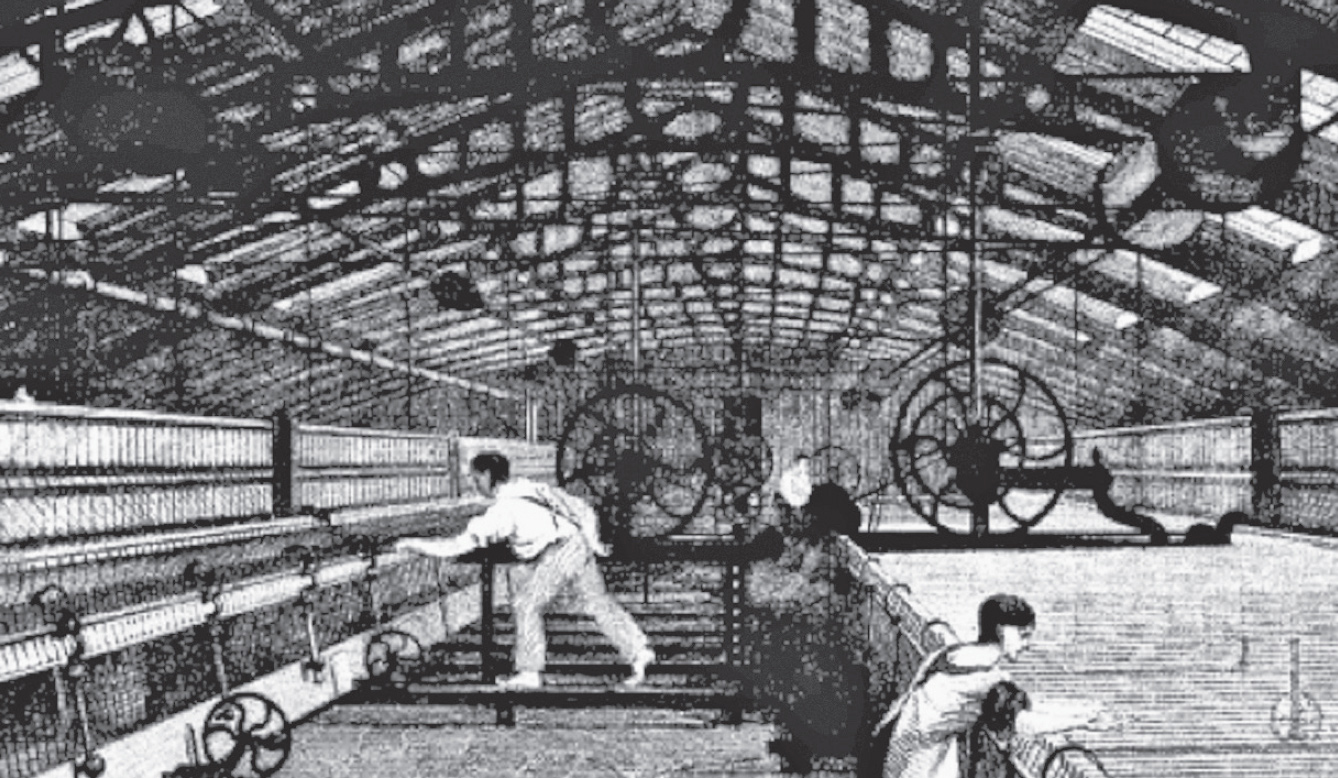
Chapter Three
The Wages of War Capitalism
Spinning mule, Lancashire, 1835
(illustration credit 3.1)
The revolution began in the most unlikely places: a quiet valley in the low
hills that surround Manchester, for example. Today just a short bus ride
away from the city’s bustling international airport, Quarry Bank Mill
attracts tourists as much for its well-kept gardens as for its industrial history.
Visitors stroll along the banks of the Bollin River, whose waters over the
millennia have cut a valley perhaps a hundred feet deep into the
surrounding
ɹelds.
Two centuries ago that river inspired a British merchant to launch one of
the most important experiments in human history. In 1784, on the bank of
the stream, Samuel Greg gathered together in a small factory a few
newfangled spinning machines, so-called water frames, a collection of
orphaned children, putting-out workers from surrounding villages, and a
supply of Caribbean cotton. Eschewing the power supply that spinners had
been using for hundreds of years—human—Greg put his yarn-spinning
machines into motion using the weight of falling water. Though modest in
size, Greg’s mill was unlike anything the world had seen. By 1784 here and
on a handful of riverbanks nearby, for the
ɹrst time in human history,
machines powered by non-animate energy manufactured yarn. Greg and his
manufacturing contemporaries, after decades of tinkering, had suddenly
increased the productivity of one of mankind’s oldest industries, and with it
began to choreograph an unprecedentedly grand movement of machines
and people.
Samuel Greg’s venture was a quintessentially local event. Greg was born
in 1758 in Belfast, but grew up in Manchester, and moved to nearby Styal
soon after realizing the capacities embedded in its sleepy stream. His
workers came from the valleys, hills, and orphanages of Cheshire and
nearby Lancashire. Even his machines had recently been invented in nearby
towns and cities. Like Silicon Valley’s role as the incubator of the late-
twentieth-century computer revolution, the idyllic rolling hills around
Manchester emerged in the late eighteenth century as the hotbed of that
era’s cutting-edge industry—cotton textiles. In an area forming an arc of
about thirty-
ɹve miles around Manchester, the countryside ɹlled with mills,
country towns turned into cities, and tens of thousands of people moved
from farms into factories.
What at
ɹrst glance seems like a local, even provincial event, however,
could not have occurred without the ideas, materials, and markets provided
by the recasting of the worlds of cotton during the previous three centuries.
Greg’s factory was embedded within globe-spanning networks—and would
eventually spark around the world far greater changes than Greg could
comprehend. Greg secured the essential raw material for production from
his merchant relatives in Liverpool, who had purchased it o
ʃ boats from
places like Jamaica and Brazil. The very idea of cotton fabrics, and the
technologies for
ɹnishing them, as we know, came from Asia, India in
particular, and Greg’s desire to produce them was largely motivated by his
hope to replace the products of Indian spinners and weavers in domestic as
well as international markets. Last but not least, much of Greg’s production
would leave the United Kingdom for destinations elsewhere—feeding the
slave trade on the western coast of Africa, dressing Greg’s very own slaves
on the island of Dominica, and catering to consumers in continental Europe.
Samuel Greg was able to draw upon all of these networks in large part
because British merchants had long dominated them.
The actual material contribution made by Greg and his colleagues during
the heyday of the Industrial Revolution between 1780 and 1815 would still
not come close to matching the volume and the quality of Asian, Latin
American, and African spinners and weavers. Yet their mills were the future.
These water-powered (and, soon, steam-powered)machines, driven by
relentless innovation, animated by wage workers, enabled by signi
ɹcant
capital accumulation and the willing encouragement of a new kind of state,
seemed almost magical, and they created the central pillar of the empire of
cotton. From this local spark, England came to dominate a many-pronged
world economy, making one of humanity’s most important industries its
own. From this local spark, industrial capitalism would emerge and
eventually spread its wings across the globe. From this local spark, the
world as most of us know it emerged.
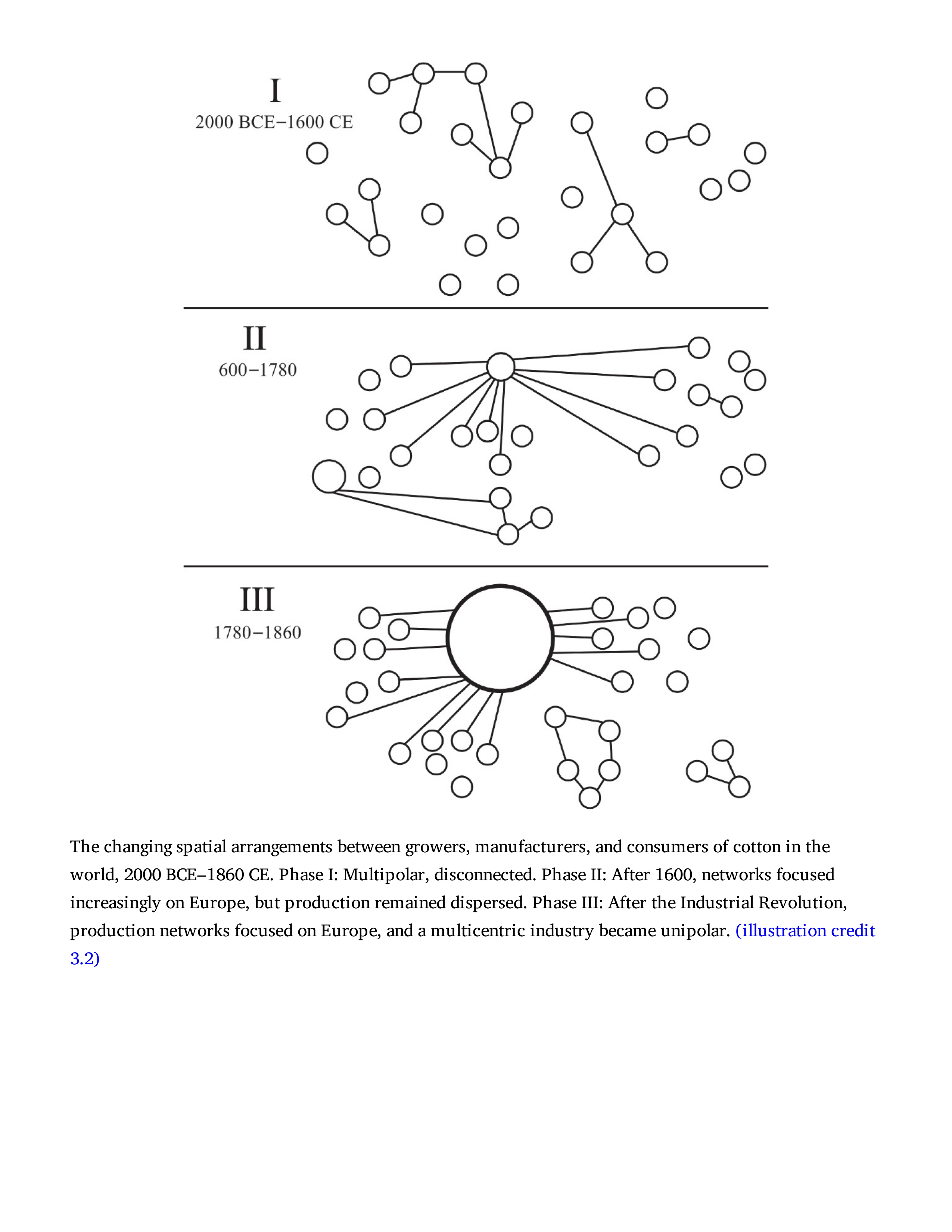
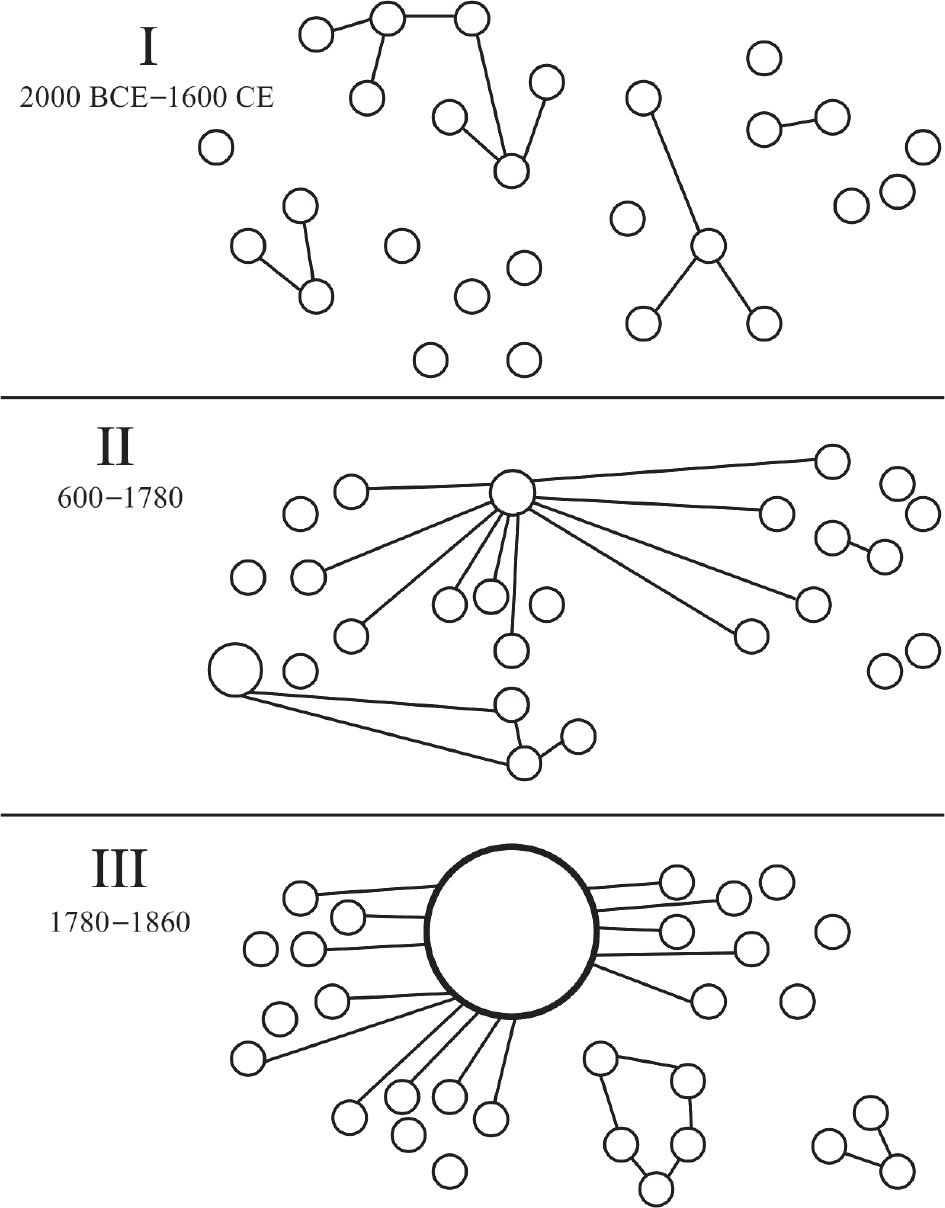
The changing spatial arrangements between growers, manufacturers, and consumers of cotton in the
world, 2000 BCE–1860 CE. Phase I: Multipolar, disconnected. Phase II: After 1600, networks focused
increasingly on Europe, but production remained dispersed. Phase III: After the Industrial Revolution,
production networks focused on Europe, and a multicentric industry became unipolar.
(illustration credit
3.2)
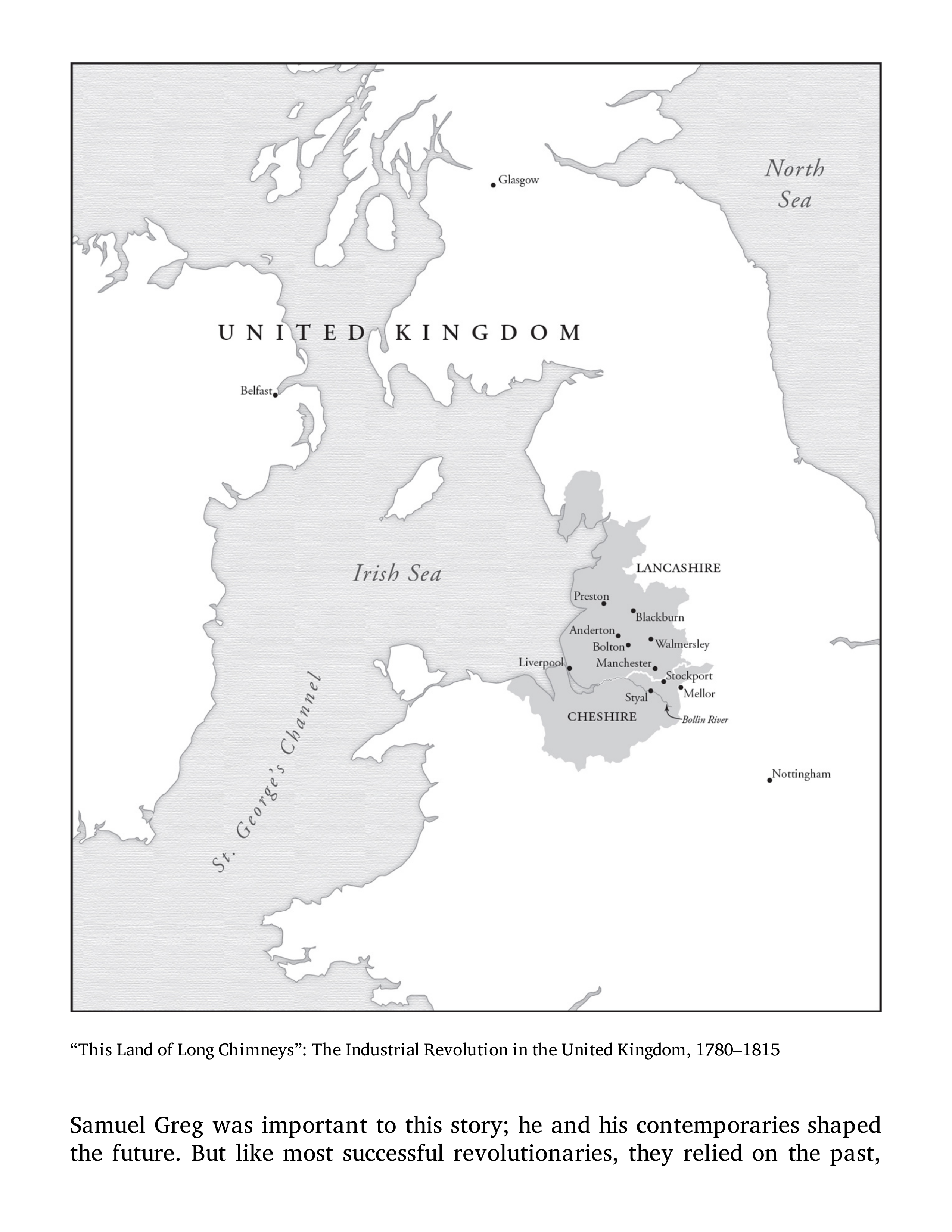
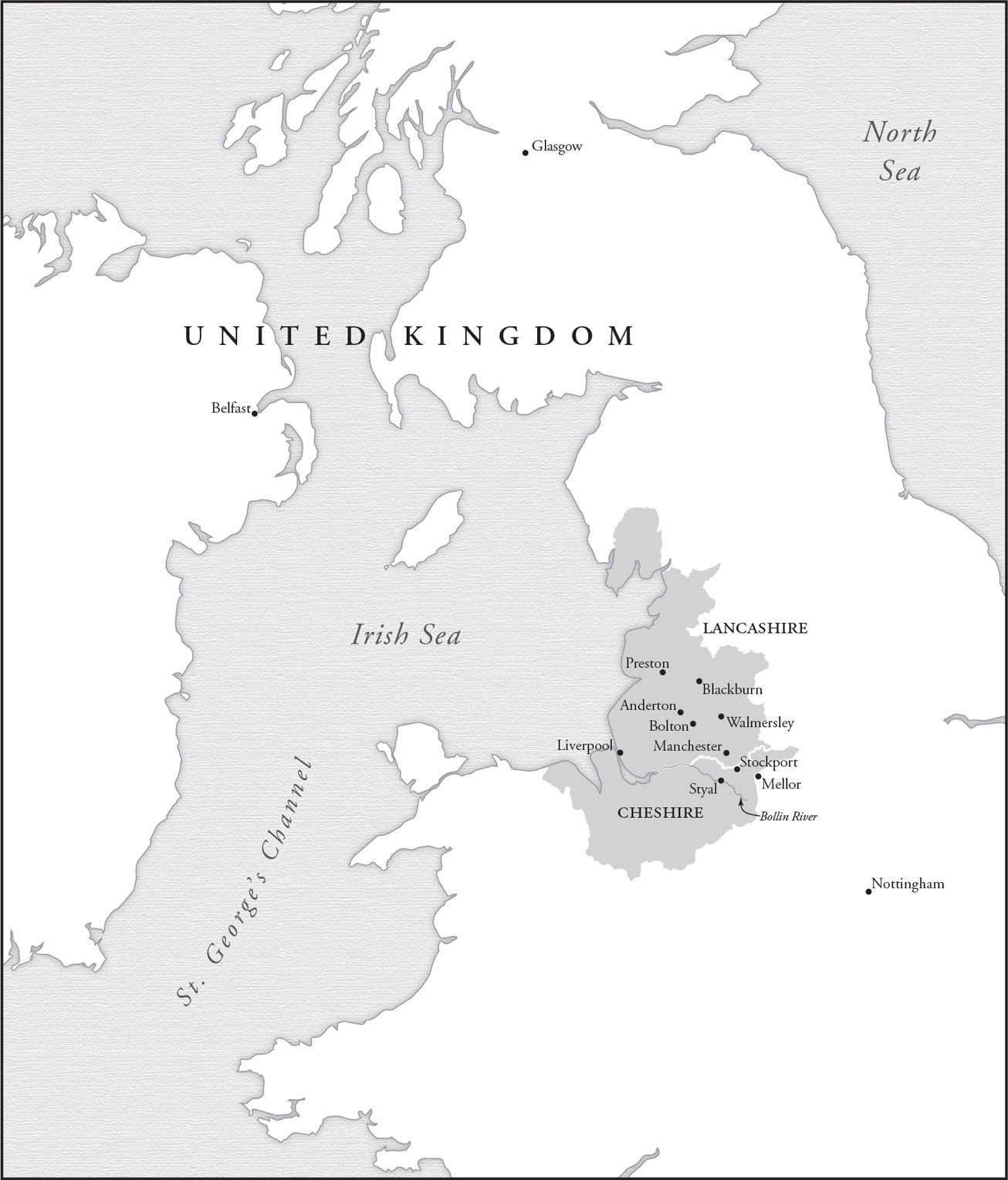
“This Land of Long Chimneys”: The Industrial Revolution in the United Kingdom, 1780–1815
Samuel Greg was important to this story; he and his contemporaries shaped
the future. But like most successful revolutionaries, they relied on the past,
on the networks constructed by British merchants, planters, and the state
during the previous two hundred years. In other words, the power they
harnessed in water was only possible because of the power harnessed by
war capitalism. Slavery, colonial domination, militarized trade, and land
expropriations provided the fertile soil from which a new kind of capitalism
would sprout. Greg’s genius lay in realizing that risk-taking English
entrepreneurs like him could build upon this material and institutional
heritage and generate unprecedented wealth and power by embracing the
heretofore ungentlemanly world of manufacturing.
Greg had deep roots in war capitalism, its violent appropriation of
territory and slave labor, as well its reliance on the imperial state to secure
new technologies and markets. He had secured his part of the family fortune
through Hillsborough Estate, a pro
ɹtable
sugar plantation on the Caribbean
island of Dominica, where he held hundreds of enslaved Africans until the
ɹnal abolition of slavery in British territories in 1834. Greg’s uncles Robert
and Nathaniel Hyde, who had raised him from age nine and also provided
much of the capital for the building of Quarry Bank Mill, were also textile
manufacturers, West Indian plantation owners, and merchants. Greg’s wife,
Hannah Lightbody, was born into a family involved in the slave trade, while
his sister-in-law’s family had moved from the slave trade into the export of
cloth to Africa.
1
Most of Greg’s fellow cotton manufacturers came from considerably less
prosperous circumstances, without Caribbean slave plantations. They had
accumulated only modest amounts of capital, but had a wealth of tinkering
spirit and technical aptitude—as well as a hunger for the huge pro
ɹts that
might be generated by manufacturing. Yet they, too, drew their essential
raw material—cotton—from slave labor. Even they catered to markets that
had
ɹrst been opened by the trade in Indian cotton textiles, textiles that had
been kept out of many European markets in order to protect noncompetitive
European producers. And they, too, drew on Indian technologies captured
through British imperial expansion on that continent. Many, moreover, used
capital accumulated via the Atlantic trade and catered to Atlantic markets—
especially in Africa and in the Americas, economies fueled almost
exclusively by slave labor. And for them, war capitalism had also provided
many learning opportunities—how to organize long-distance trade, for
example, how to run domestic industries; an understanding of the
mechanisms to move capital across oceans—lessons that informed the
development of domestic
ɹnancial instruments. Even modern labor cost
accounting had emerged from the world of the slave plantation and only
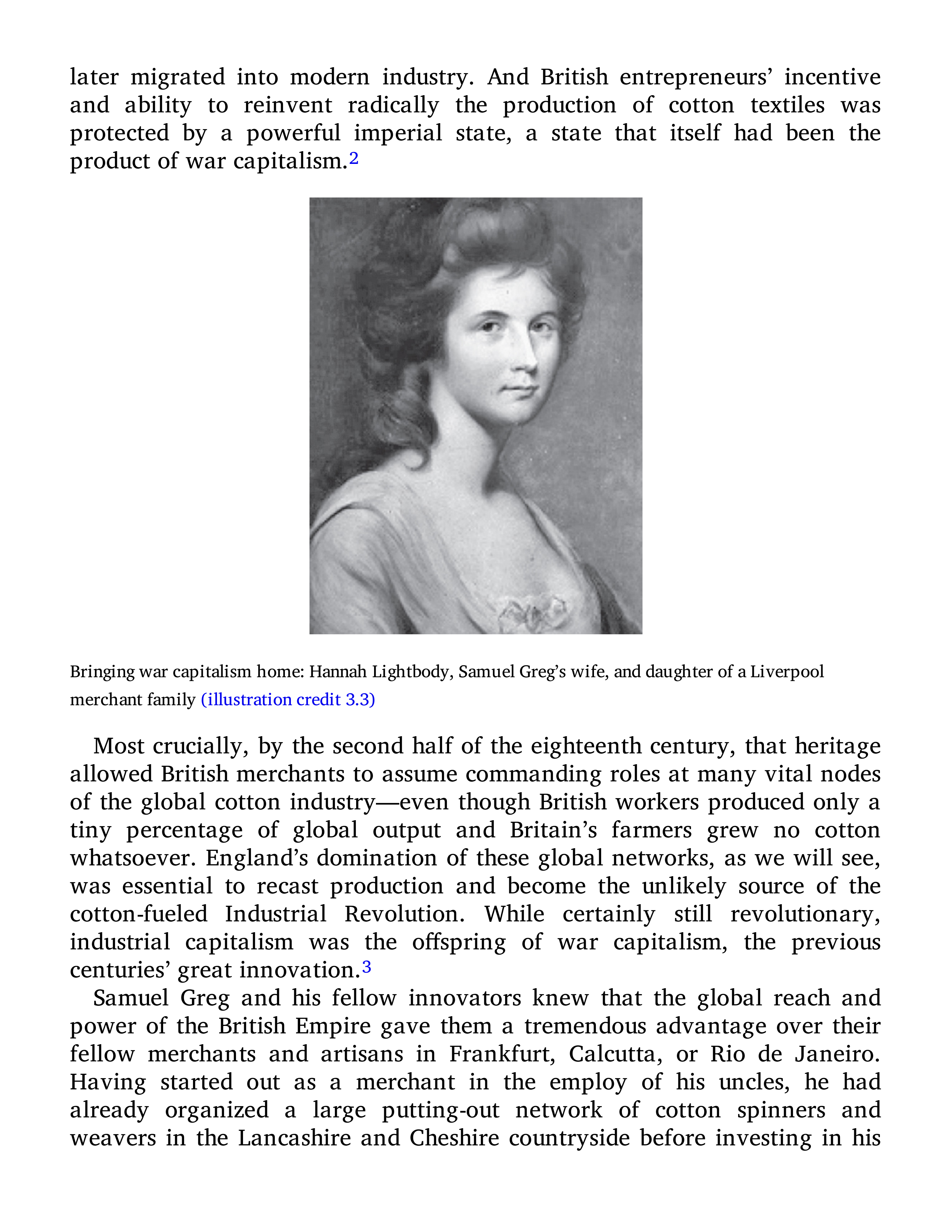

later migrated into modern industry. And British entrepreneurs’ incentive
and ability to reinvent radically the production of cotton textiles was
protected by a powerful imperial state, a state that itself had been the
product of war capitalism.
2
Bringing war capitalism home: Hannah Lightbody, Samuel Greg’s wife, and daughter of a Liverpool
merchant family
(illustration credit 3.3)
Most crucially, by the second half of the eighteenth century, that heritage
allowed British merchants to assume commanding roles at many vital nodes
of the global cotton industry—even though British workers produced only a
tiny percentage of global output and Britain’s farmers grew no cotton
whatsoever. England’s domination of these global networks, as we will see,
was essential to recast production and become the unlikely source of the
cotton-fueled Industrial Revolution. While certainly still revolutionary,
industrial capitalism was the o
ʃspring of war capitalism, the previous
centuries’ great innovation.
3
Samuel Greg and his fellow innovators knew that the global reach and
power of the British Empire gave them a tremendous advantage over their
fellow merchants and artisans in Frankfurt, Calcutta, or Rio de Janeiro.
Having started out as a merchant in the employ of his uncles, he had
already organized a large putting-out network of cotton spinners and
weavers in the Lancashire and Cheshire countryside before investing in his
new machines. In addition to the pro
ɹts and labor from this putting-out
network, Greg had easy access to abundant capital from his wife’s family.
And the Rathbone family, which would become one of the dominant players
in the nineteenth-century cotton trade, stood ready in 1780 to supply raw
cotton to Greg. He knew
ɹrsthand that the market for cotton fabrics—in
continental Europe, along the coast of Africa, and in the Americas—was
rapidly expanding.
4
And while the upside was tremendous, the risks of these
ɹrst ventures
were modest. In the 1780s, Greg invested at
ɹrst a fairly small amount of
capital into his Quarry Bank Mill: £3,000, the equivalent of about half a
million U.S. dollars today. Then he recruited ninety children between the
ages of ten and twelve from nearby poorhouses, attaching them for seven
years to his factory as “parish apprentices.” By 1800 he supplemented these
children with 110 adult workers who received wages. Greg sold his cloth
ɹrst
mostly to Europe and the West Indies, and, after the 1790s, increasingly to
Russia and the United States. Thanks to those expanding markets, the new
factory, like others, was spectacularly pro
ɹtable from the beginning,
returning annually 18 percent on his original investment, four times as
much as UK government bonds.
5
Contemporary observers as well as modern historians have found many
reasons that explain Greg’s venture, and with it why the much broader
Industrial Revolution, “broke out” in this place, in northern England, and at
this time, in the 1780s. The genius of British inventors, the size of the British
market and its unusually deep integration, the geography of Britain with its
easy access to waterborne transport, the importance of religious dissenters
for thinking outside the box, and the creation of a state favorable to
entrepreneurial initiative have all been cited.
6
While none of these
arguments are unimportant, they omit a core part of the story of the
Industrial Revolution: its dependence on the globe-spanning system of war
capitalism.
As a result of all these factors, for the
ɹrst time ever, a new character, the
manufacturer, strode onto the scene, an individual who used capital not to
enslave labor or conquer territory, though that remained essential, but to
organize workers into great orchestras of machine-based production.
Manufacturers’ e
ʃorts to reorganize production rested on new ways of
mobilizing land, labor, and resources—and called, among other things, for a
new connection between capitalists and the state. It was this nexus of social
and political power that together animated industrial capitalism, the
transformational invention of the Industrial Revolution. It was that
innovation that would, as we will see, eventually take wing and travel to
other parts of the world.
Fueled by the wages of war capitalism, Greg and his contemporaries, as
one observer remarked in the 1920s, “wrested the empire of cotton from the
East within a vigorous generation of invention,” rewriting the entire
geography of global cotton manufacturing. Their work was revolutionary
because it heralded a new institutional form for organizing economic
activity and a world economy in which rapid growth and ceaseless
reinvention of production became the norm, not the exception. To be sure,
important inventions had been made in the past, and there had been
moments of accelerated economic growth in various regions of the world
before the Industrial Revolution. Yet none of them had created a world in
which revolution itself would become a permanent feature of life, a world in
which economic growth would, despite periodic collapses, seem to fuel its
own expansion. There had been no radical acceleration of economic growth
in the thousand years before 1800 in Europe or elsewhere, and any that had
occurred had soon foundered on the shoals of resource constraints, a food
crisis, or disease. Now industrial capitalism was creating an ever-changing
world, and cotton, the world’s most important industry, was the mainspring
of this unprecedented acceleration of human productivity.
7
In retrospect, late-eighteenth-century England seemed ripe for a reinvention
of cotton manufacturing. British capitalists looked back on two centuries of
cotton textile production, had access to investable capital, and employed
ever more peasants to spin and weave at home. Also, British textile
producers based in households had withstood the pressures of imports from
India for decades, an experience that schooled them in the importance of
being able to compete with Indian manufacturers to capture their markets.
And last but not least, workers were available to sta
ʃ the new
factories,
workers who did not have the ability to resist the process of being turned
from rural cultivators or artisans into wage laborers. These factors provided
the necessary conditions for a radical reimagining of production and the
institutions in which it was embedded. Such conditions, however, were
hardly unique, in fact they were shared, if not in all aspects, then at least in
many particulars, from China to India to continental Europe to Africa. They
cannot alone explain why the Industrial Revolution broke out in a small
part of the British Isles in the late eighteenth century.
8
British capitalists, however, in contrast to their counterparts elsewhere,
controlled many global cotton networks. They had access to uniquely
dynamic markets, they dominated the transoceanic trade in cottons, and
they had
ɹrsthand knowledge of the fabulous potential wealth that could
come from selling cloth. The core problem faced by British cotton
manufacturers was the di
ɽculty of competing with high-quality yet cheap
Indian products. In the course of the eighteenth century, as we have seen,
British producers had largely (though not entirely) solved the quality
problem by appropriating Indian technology. Expanding output, and
lowering costs, proved more di
ɽcult: The putting-out networks that British
merchants had built in the countryside proved largely resistant to higher
production. Work was performed irregularly, additional workers were
di
ɽcult to mobilize on short notice, and transportation costs rose with the
volume of work. And it was di
ɽcult to enforce homogeneous quality in
products spun and woven on remote farms. With the existing technology
and social organization of production, British outworkers could hardly
compete with cotton workers in other parts of the world. Indeed, they
succeeded mostly only in the protected domestic and colonial markets.
9
The main reason for this inability to compete, however, was wage costs.
Wages in the United Kingdom were signi
ɹcantly higher than in other parts
of the world; indeed, in 1770 Lancashire wages were perhaps as much as six
times those in India. Even though by this point improved machinery meant
that productivity per cotton worker in Britain was already two to three
times higher than in India, that multiplier was still not su
ɽcient to level the
playing
ɹeld.
War capitalism had created a fundamentally new set of
opportunities for British cotton capitalists, but it had no answer to the
question of how to enter cotton cloth markets in a globally signi
ɹcant way.
Protectionism had been a workable answer to a point, and was deployed to
great success, but the tantalizing possibility of global exports could not be
preserved by such prohibitions. What British cotton capitalists needed was a
dynamic combination of new technologies to lower costs, the further growth
of elastic markets that already had begun to expand on the tails of British
expansion, and a supportive state with the ability not just to protect global
empire but to transform society in Britain itself.
10
Since labor costs were the primary obstacle to grasping the new
tantalizing opportunities, British merchants, inventors, and budding
manufacturers—practical men all—focused on methods to increase the
productivity of their high-cost labor. In the process, they e
ʃected the most
momentous technological change in the history of cotton. Their
ɹrst
noteworthy innovation came in 1733 with John Kay’s invention of the
ɻying
shuttle. This small wooden tool in the shape of the hull of a ship allowed
weavers to attach the weft thread and then propel it to “
ɻy” from one side
of the loom to the other through the warp threads. The shuttle doubled the
productivity of weavers. At
ɹrst it spread only slowly, but its spread was
unstoppable: After 1745, despite resistance from weavers who feared for
their livelihoods, it was widely adopted.
11
This tiny piece of wood propelled in novel ways prompted a cascade of
further innovations that would gradually but permanently change cotton
manufacturing. The spread of more productive weaving techniques put huge
pressure on spinning, as ever more spinners were needed to supply one
weaver with su
ɽcient
yarn to keep the looms working. Despite more
women in ever more households working longer hours on the spinning
wheel, the supply was insu
ɽcient. After Kay’s invention it took four
spinners to supply one weaver. Many artisans tried to
ɹnd ways to
circumvent this bottleneck, and by the 1760s productivity increases became
possible with James Hargreaves’s invention of the spinning jenny. The
jenny consisted of a hand-operated wheel that would rotate a number of
spindles within a frame, while the spinner would use her other hand to
move a bar back and forth to extend the thread and then to wind it on the
spindles themselves. This machine was at
ɹrst able to spin eight separate
threads, later sixteen or more, and as early as 1767 it had tripled a spinner’s
speed. It spread rapidly, and by 1786 there were about twenty thousand in
use in Britain.
12
As early as 1769, however, spinning was already seeing further
improvements thanks to Richard Arkwright’s water frame, a machine that
anticipated Greg’s mill by relying on falling water. Consisting of four rollers
that drew out the cotton strands before a spindle twisted them into thread, it
allowed for continuous spinning, and unlike the jenny, which had at
ɹrst
been mostly employed in people’s homes, the water frame required larger
amounts of energy, thus concentrating production in factories. A decade
later, in 1779, Samuel Crompton’s mule was the capstone of these
inventions, combining elements of the jenny with those of the water frame
(hence its name). The mule was a long machine with two parallel carriages:
Bobbins of roving (lightly twisted cotton
ɹbers) lined one side, and spindles
ready to accept spun yarn lined the other. The exterior carriage, mounted on
wheels, was pulled out about
ɹve feet, stretching multiple lengths of roving
simultaneously. The number of rovings spun depended on the number of
spindles mounted to the mule: Although two hundred was the norm in the
1790s, the number would climb to more than thirteen hundred over the
ensuing century. The stretched roving was then twisted into yarn and
wound onto the spindles as the carriage was pushed back in. Unlike with the
water frame, which operated continuously, yarn was produced in
ɹve-foot
bursts, but was stronger and
ɹner than yarn produced on water frames. The
mule was
ɹrst
powered by water (which remained the dominant source of
power until the 1820s), but later mostly by steam engines (which James
Watt patented in 1769).
13
With spinning no longer a laggard, pressure shifted back to weaving. First
came a vast expansion of home-based weaving. With new machines and an
abundant supply of thread, this was a golden age for weavers all over the
Lancashire and Cheshire countryside, as tens of thousands of cottagers spent
endless hours on their looms working up the rapidly increasing output of
British spinning factories. While Edmund Cartwright had patented a water-
powered loom as early as 1785, productivity improvements in weaving at
ɹrst proved modest, and technical problems with power looms great.
14
Britain’s growing class of manufacturers, despite issues with looms, were
acutely aware that these new machines allowed them to increasingly
dominate the one node in the global cotton complex whose control had
eluded them: manufacturing. In eighteenth-century India, spinners required
50,000 hours to spin a hundred pounds of raw cotton; their cohorts in 1790
Britain, using a hundred-spindle mule, could spin the same amount in just
1,000 hours. By 1795 they needed just 300 hours with the water frame, or,
with Roberts’s automated mule after 1825, only 135 hours. In just three
decades, productivity had increased 370 times. Labor costs in England were
now much lower than in India.
15
Prices for British yarn fell accordingly, and soon were lower than those
manufactured in India. In 1830, British cotton merchant Edward Baines
cited the price of one pound of Number 40 yarn (the number re
ɻects the
quality of the yarn—the higher the number, the
ɹner the thread) in England
as 1 shilling, 2.5 pence, while in India the same quality and quantity of yarn
would cost 3 shillings, 7 pence. Manchester spinners McConnel & Kennedy
reported that the prices for its high-quality 100-count yarn fell by 50 percent
between 1795 and 1811, and, despite various ups and downs, continued to
fall further throughout the nineteenth century. While yarn prices, especially
of
ɹne yarns, fell the most rapidly, the cost of ɹnished cloth also declined. A
piece of muslin in the early 1780s cost (in de
ɻated prices) 116 shillings per
piece;
ɹfty years later the same piece could be had for 28 shillings.
16
The resulting boom in cotton manufacturing was unprecedented. After
nearly two centuries of slow growth in Europe, British cotton manufacturing
expanded by leaps and bounds. Between 1780 and 1800, output of cotton
textiles in Britain grew annually by 10.8 percent, and exports by 14 percent;
already in 1797 there were approximately nine hundred cotton factories. In
1788, there had been 50,000 mule spindles, but thirty-three years later that
number had increased to 7 million. While it had been cheaper to produce
cotton cloth in India before 1780, and its quality had been superior, after
that year English manufacturers were able to compete in European and
Atlantic markets, and after 1830 they even began to compete with Indian
producers in India itself. Once Indians began using British-manufactured
yarn and cloth, it signaled to all that the world’s cotton industry had been
turned on its head.
17
As ever larger numbers of cotton factories began to dot northern England
to accommodate the new spinning and weaving machines, it might come as
a surprise that the inventors, who had enabled this departure, had started in
distinctly unspectacular ways. They created a world radically di
ʃerent from
anything ever seen before without recourse to theoretical science, often even
without much education. They were skilled men in tiny workshops, with
little formal education. Among the inventors, Kay came from the most
prosperous family, as his father was a modestly successful woolens
manufacturer. He might have received some formal education in France.
Hargreaves, on the other hand, was a handloom weaver from Blackburn,
who probably never had any formal schooling—much like Arkwright, the
youngest of seven children born to poor parents, who learned how to read
ɹrst from his uncles and then educated himself. Crompton grew up in dire
poverty: After his father died, Crompton began to spin cotton, perhaps as
early as age
ɹve, while his mother tried to make ends meet by spinning and
weaving. All four were tinkerers, people who breathed and lived with their
machines, trying to solve practical problems with simple tools and insights
that emerged from their day-to-day e
ʃorts to improve production.
18
But they were far from local heroes. Their innovations sometimes even
brought down the wrath of their neighbors, who dreaded the job losses the
innovators caused. Fear of mob violence drove Kay and Hargreaves away
from the places they had made their inventions. Neither translated their
inventions into wealth; after losing their e
ʃorts to defend their patents, they
lived modestly. When Hargreaves died in Nottingham in 1778, he owned
little more than a prize from the Society for the Encouragement of Arts and
Manufactures, and his children were destitute. Only Arkwright pro
ɹted from
his invention—establishing cotton factories in numerous locations. Yet a
rapidly growing number of British manufacturers did embrace the new
technologies, a British state valued them so highly that it criminalized their
export for nearly half a century after 1786. From then on, technical progress
became a constant: Pro
ɹts were made by increasing the productivity of
human labor. This would in fact become a de
ɹning feature of industrial
capitalism.
These new machines, the “macro inventions” celebrated by historians Joel
Mokyr, Patrick O’Brien, and many others, not only accelerated human
productivity, but also altered the nature of the production process itself:
They began to regulate the pace of human labor.
19
Dependent on central
energy sources and requiring large spaces, production moved out of the
home and into factories. Along with the machines, workers assembled in
unprecedented numbers in central locations. While putting-out merchants
had traversed the countryside searching for laborers, now workers sought
out manufacturers in search of employment.
The mechanization of cotton spinning created a novel entity: the cotton
mill. Although mills could vary tremendously in size, they shared one
attribute: a nearby source of running water. To harness its energy, either a
dam was constructed or an inlet was cut from a steep section of river and
diverted through a waterwheel. The waterwheel drove shafts that ran
through the length of the mill, upon which large leather belts could be
engaged or disengaged in order to run the various machines. Unlike its
predecessors, the mill’s primary function was not to simply aggregate and
control labor, but to house a complex array of machinery. And by the 1780s,
some mills were taking on gargantuan proportions; at two hundred feet
long, thirty feet wide, and four to six stories in height, they dominated the
surrounding countryside.
20
Yarn production in these mills entailed three basic steps: willowing,
carding, and spinning. The
ɹrst step had workers, generally women, spread
the raw cotton upon meshed tables and beat it with sticks to remove any
twigs, leaves, and dirt that the ginning had failed to remove. Since the
process pushed so much
ɹre-hazardous cotton dust into the air, it was often
completed in adjoining buildings rather than within the main mill complex.
After the cotton was cleaned, a series of machines centralized in the bottom
ɻoors of the mill would transform the raw cotton into “roving,” a thin cord
of lightly twisted, parallel
ɹbers ready to be spun. First, the cotton was fed
into a carding engine, a spinning cylinder covered in metal teeth
ɹtted into
a similarly toothed casing. Through carding, a snarled mess of cotton was
turned into an untangled so-called sliver with the
ɹbers running parallel.
The cotton was then fed into a draw frame, a set of rollers through which
the sliver was passed—stretching, twisting, and drawing it—creating the
roving. The cotton strand was then wound into a roving can, from which it
could be placed onto a bobbin. Finally, the cotton was ready to be spun.
Spinning machines were located across the top
ɻoors of the mill, and the
machines themselves usually took one of two forms: Arkwright’s water
frame or, increasingly, Crompton’s mule.
21
To operate all this machinery and to move the cotton through the factory,
manufacturers hired hundreds of workers, most of them children and
women. And while not all workers arrived at the factory gates voluntarily
and received wages, the majority did. This was, as we will see later, another
important institutional innovation of industrial capitalism. Outside the slave
plantations of the Americas capitalists for the
ɹrst time organized,
supervised, and dominated the production process.
22
Such domination of labor by capital, embrace of technological revolution,
and social innovation did not happen elsewhere, including in the heart of
the world’s cotton industry, China and India. This was in some ways
surprising, since for centuries manufacturing in these parts of the world had
de
ɹned the cutting edge of global cotton production technology. Way back
in 1313, Wang Zhen had written a description of a “machine for spinning
hemp thread” that came quite close to Hargreaves’s spinning jenny and
Arkwright’s water frame. Developing new spinning machines was certainly
within the grasp of Chinese artisans, or, for that matter, their French or
Indian counterparts. Moreover, trade in cotton and cotton textiles was the
most important facet of an increasing commercialization of the Chinese
economy between the fourteenth and nineteenth centuries.
23
Despite these promising preconditions, neither China nor India—nor, for
that matter, England’s closest European competitor in technical education,
Prussia—came close to dominating as many nodes within the global cotton
production complex as Britain. Nor did any other country embrace war
capitalism as e
ʃectively. Moreover, in India and China,
peasants were more
secure on the land than their British counterparts, making it more di
ɽcult
for eager manufacturers to mobilize large numbers of workers. Because of
the di
ʃerent organization of households, especially limitations on women’s
outside
activities,
female-dominated
spinning
had
extremely
low
opportunity costs in India and China, making the embrace of new
technologies less likely. Women’s labor, in the calculation of peasant
households, was inexpensive. In India, additionally, the chain between the
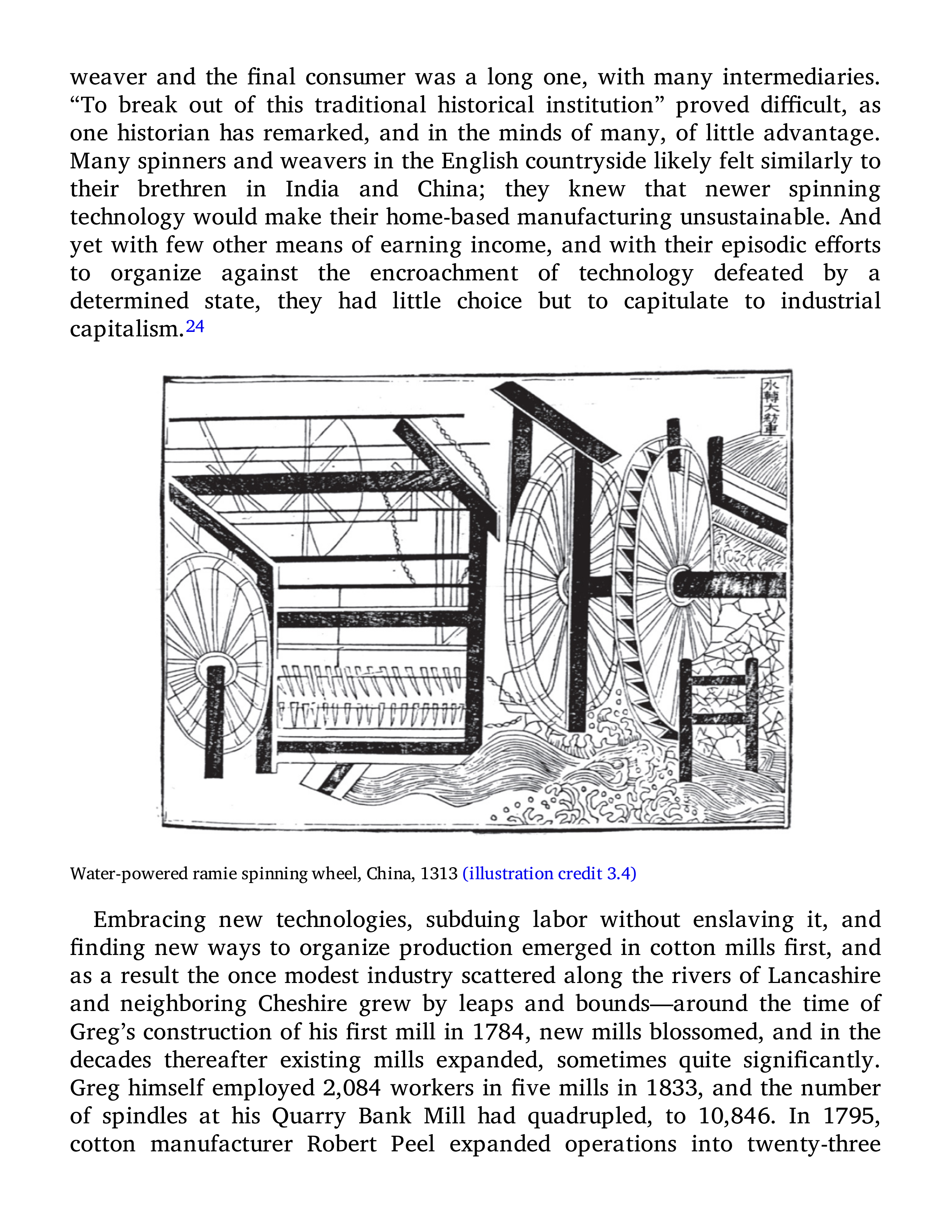
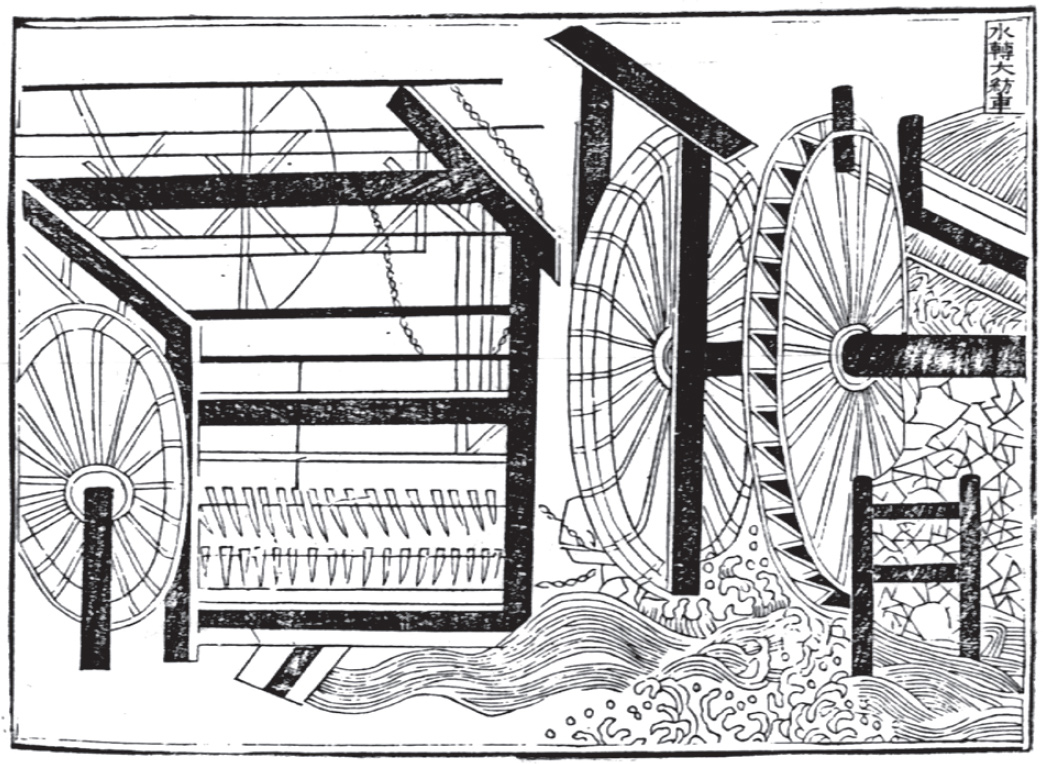
weaver and the
ɹnal consumer was a long one, with many intermediaries.
“To break out of this traditional historical institution” proved di
ɽcult, as
one historian has remarked, and in the minds of many, of little advantage.
Many spinners and weavers in the English countryside likely felt similarly to
their brethren in India and China; they knew that newer spinning
technology would make their home-based manufacturing unsustainable. And
yet with few other means of earning income, and with their episodic e
ʃorts
to organize against the encroachment of technology defeated by a
determined state, they had little choice but to capitulate to industrial
capitalism.
24
Water-powered ramie spinning wheel, China, 1313
(illustration credit 3.4)
Embracing new technologies, subduing labor without enslaving it, and
ɹnding new ways to organize production emerged in
cotton mills
ɹrst, and
as a result the once modest industry scattered along the rivers of Lancashire
and neighboring Cheshire grew by leaps and bounds—around the time of
Greg’s construction of his
ɹrst mill in 1784, new mills blossomed, and in the
decades thereafter existing mills expanded, sometimes quite signi
ɹcantly.
Greg himself employed 2,084 workers in
ɹve mills in 1833, and the number
of spindles at his Quarry Bank Mill had quadrupled, to 10,846. In 1795,
cotton manufacturer Robert Peel expanded operations into twenty-three
di
ʃerent mills, all owned and managed by him. In other instances, new
producers entered the industry, often people with little capital but the right
kinds of connections. When Irish merchant William Emerson wanted to help
a relative start a spinning mill, he wrote to his business partners McConnel
and Kennedy in Manchester, informing them in a letter “that a relation of
mine has a desire to acquire a knowledge of Carding and Spinning, and for
which purpose, I wd willingly send him to you for Six Mo and pay you any
reasonable price for his instruction, you d be so good to say if you could
with convenience have him Instructed Either in your own House or any
other and on what terms.”
25
As factories multiplied, many remained small and their owners were often
not wealthy by the standards of Liverpool merchants, Somerset landowners,
or London bankers. In 1812, 70 percent of all
ɹrms had fewer than ten
thousand spindles and were valued at less than £2,000. The entrepreneurs
who entered the industry came from a variety of backgrounds. Many had
been merchant-manufacturers, others manufacturers in di
ʃerent industries,
while others had started out as well-o
ʃ farmers, or even as apprentices with
unusual
mechanical
abilities.
There
were
certainly
examples
of
extraordinary social mobility, such as Elkanah Armitage, who began work at
a cotton factory at age eight as a spinner’s helper and
ɹfty-nine years later
owned mills that employed 1,650 workers.
26
Others, however, started with more substantial resources, such as Samuel
Oldknow, who was born in 1756 in Anderton, Lancashire. His father already
owned a successful muslin manufacturing operation worked entirely by
handlooms. Following his father’s premature death, Oldknow was
apprenticed to his uncle, a draper, before he returned to his hometown in
1781 to rebuild the family muslin business. It was auspicious timing. The
introduction of the spinning mule in 1779 made high-quality, mass-produced
yarn available on an unprecedented scale, allowing Oldknow to break into
a market previously dominated by Indian manufacturers. Oldknow also
partnered with two London
ɹrms to secure wide access to British and
overseas markets. As he put it in a draft of a 1783 letter, “The prospect is at
present very propitious.” By 1786, he was the most successful muslin
manufacturer in Britain. Oldknow continued to build mills and expand his
enterprises, at one point controlling some twenty-nine mills. By 1790, he
was branching out into spinning with the construction of a steam-powered
factory in Stockport; by 1793, an even larger six-story spinning mill in
Mellor began production.
27
Cotton manufacturing, even if engaged in on a small scale, was
astonishingly pro
ɹtable in the 1780s and 1790s. The ɹrm of
Cardwell &
Birle had average annual returns on their capital of 13.1 percent, N.
Dugdale 24.8 percent, and McConnel & Kennedy 16 percent. Such pro
ɹts
allowed them to expand without much recourse to formal capital markets.
Indeed, “the favorite source of capital [for expansion] was retained pro
ɹts.”
Yet such capital was often augmented by merchants who invested in mills
that they did not run themselves, and, more important, by London and
Liverpool merchants’ credit for the purchase of raw cotton and the sale of
yarn and cloth. This additional working capital was crucial: While in 1834
ɹxed capital investments in factories and machines in the British cotton
industry may have amounted to £14.8 million, working capital invested in
raw cotton and wages equaled £7.4 million—a very signi
ɹcant share. Access
to such capital rested often on personal connections, and as the need to
secure signi
ɹcant amounts of circulating capital increased, it became more
di
ɽcult for people outside the middle class to join the ranks of cotton
capitalists. High pro
ɹts from production in turn made manufacturing an
ever more attractive
ɹeld for further investments.
28
One example of the rapid growth of cotton mills was the Manchester
cotton manufacturers McConnel & Kennedy. They founded their partnership
in 1791, focusing on the production of spinning machines, a business that
came naturally to machine maker James McConnel. One day, however,
McConnel produced two mules that his customer could not pay for, and this
seeming bad luck led him to begin using them himself. His partner, John
Kennedy, and two other investors expanded both the production of
machines and spinning, investing a total capital of £500, an exceedingly
modest sum. Calling themselves “machine makers and spinners,” they
expanded their mills rapidly, focusing on high-quality yarns. In 1797 they
operated 7,464 spindles; by 1810 the number of spindles had increased to
78,972, while the number of workers they employed grew from 312 in 1802
to 1,020 in 1816. Like others, they
ɹnanced that expansion out of retained
pro
ɹts, which had averaged 26.5 percent annually between 1799 and
1804.
29
The growth of cotton manufacturing soon made it the center of the British
economy. In 1770, cotton manufacturing had made up just 2.6 percent of
the value added in the economy as a whole. By 1801 it accounted for 17
percent, and by 1831, 22.4 percent. This compared to the iron industry’s
share of 6.7 percent, coal’s 7 percent, and woolens’ 14.1 percent. In Britain,
as early as 1795, 340,000 people worked in the spinning industry. By 1830,
one in six workers in Britain labored in cottons. At the same time, the
industry itself became centered on a small part of the British Isles:
Lancashire. Seventy percent of all British cotton workers would eventually
labor there, while 80.3 percent of all owners of cotton factories originated
in that same county.
30
The explosion of the cotton industry was not a
ɻash in the pan. Instead,
as we will see, other industries would be made possible by the rise of cotton:
a railroad network, the iron industry, and later in the nineteenth century a
new set of industries that would amount to a second industrial revolution.
But cotton was the vanguard. As historian Fernand Braudel has argued, the
Industrial Revolution in cottons a
ʃected the “
entire
national economy.”
31
As
late as the mid-nineteenth century, the Industrial Revolution was still,
numerically, the story of cotton.
The spectacular take o
ʃ of the British cotton industry allowed British
capitalists—along with the British state—to retain even more of the wages
of war capitalism. With cheaper production costs thanks to the
unprecedented productivity of their new machines and the new organization
of production, with wage workers in large factories, British manufacturers,
as expected, broke into new markets. Domestic markets expanded as cottons
became cheaper and as cotton fabrics became ever more fashionable as their
changing designs mattered increasingly to the self-presentation of middle-
class consumers.
32
British cotton manufacturers also moved decisively into the all-important
export market. By the 1780s, they came to sell in markets that British
merchants previously had served with Indian textiles. Fine muslins that had
been the pride of Bengal and “which for some thousands of years stood
unequalled” were henceforth produced in the United Kingdom. This was
clearly decisive, since the British market, with its 8.66 million people, was
quite small, and per capita disposable income grew only modestly. Over the
course of the eighteenth century cotton exports from Britain increased two
hundred times—yet 94 percent of that increase took place in the two
decades after 1780, when exports exploded by a factor greater than sixteen
from their 1780 value of £355,060 to £5,854,057 in 1800. By the last years
of the eighteenth century, 61.3 percent of all cotton cloth produced on the
British Isles was exported. After 1815, thanks to these exports, England had
indeed pretty much “eliminated all rivals from the non-European world” in
the global trade of cotton yarn and cloth.
33
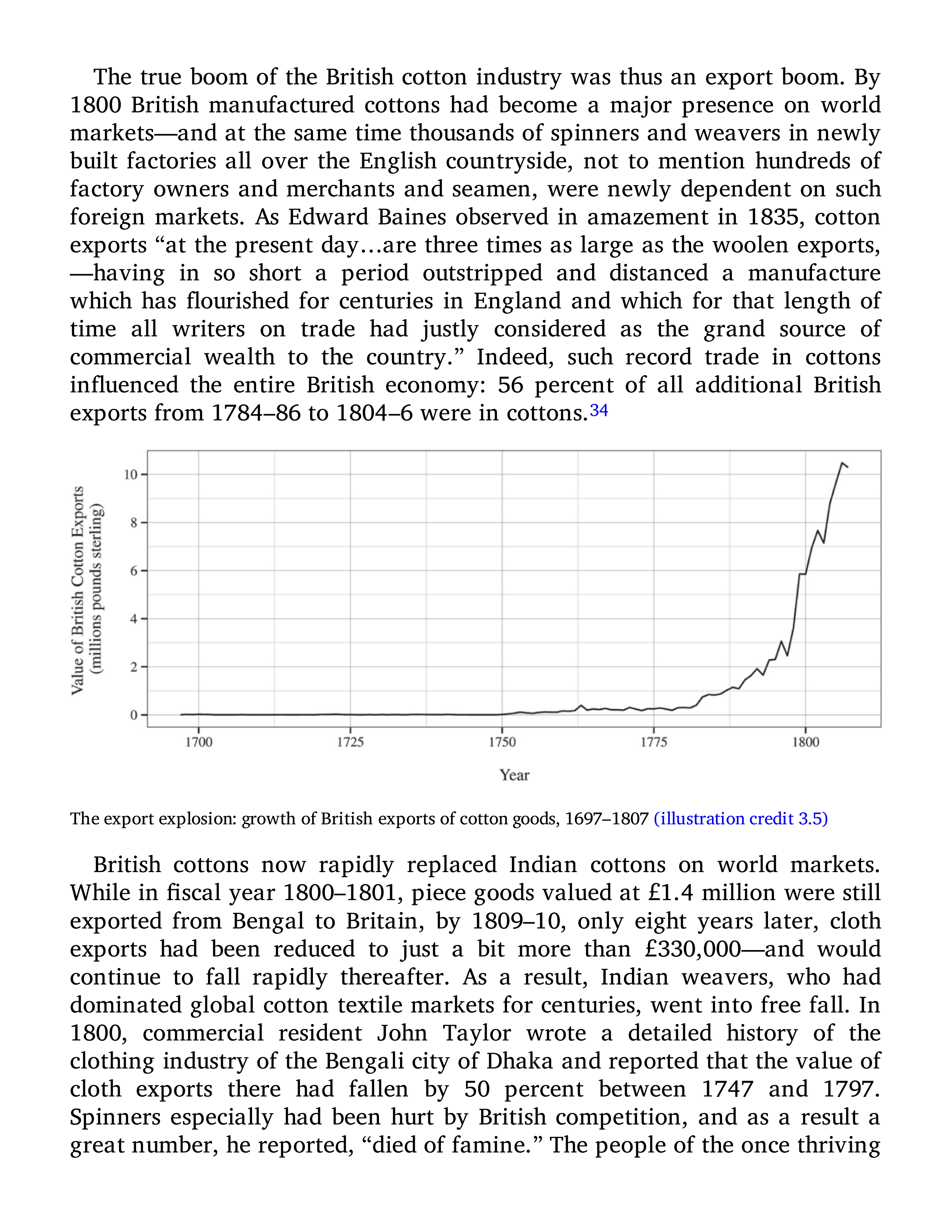
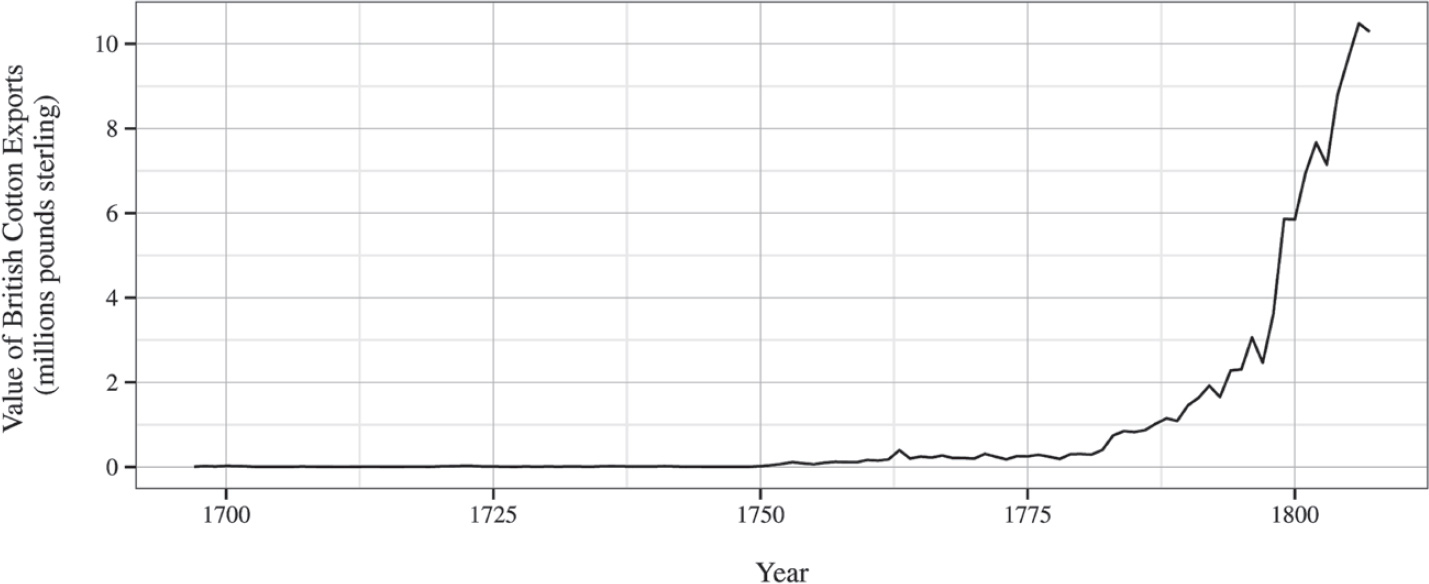
The true boom of the British cotton industry was thus an export boom. By
1800 British manufactured cottons had become a major presence on world
markets—and at the same time thousands of spinners and weavers in newly
built factories all over the English countryside, not to mention hundreds of
factory owners and merchants and seamen, were newly dependent on such
foreign markets. As Edward Baines observed in amazement in 1835, cotton
exports “at the present day…are three times as large as the woolen exports,
—having in so short a period outstripped and distanced a manufacture
which has
ɻourished for centuries in
England and which for that length of
time all writers on trade had justly considered as the grand source of
commercial wealth to the country.” Indeed, such record trade in cottons
in
ɻuenced the entire British economy: 56 percent of all additional British
exports from 1784–86 to 1804–6 were in cottons.
34
The export explosion: growth of British exports of cotton goods, 1697–1807
(illustration credit 3.5)
British cottons now rapidly replaced Indian cottons on world markets.
While in
ɹscal year 1800–1801, piece goods valued at £1.4 million were still
exported from Bengal to Britain, by 1809–10, only eight years later, cloth
exports had been reduced to just a bit more than £330,000—and would
continue to fall rapidly thereafter. As a result, Indian weavers, who had
dominated global cotton textile markets for centuries, went into free fall. In
1800, commercial resident John Taylor wrote a detailed history of the
clothing industry of the Bengali city of Dhaka and reported that the value of
cloth exports there had fallen by 50 percent between 1747 and 1797.
Spinners especially had been hurt by British competition, and as a result a
great number, he reported, “died of famine.” The people of the once thriving
manufacturing city had been “reduced and impoverished,” its houses “ruined
and abandoned,” and its commercial history become “a melancholy
retrospect.” The “ancient celebrity” and “great wealth” of Dhaka were all
but gone. By 1806, another report on Bengali commerce concluded that “the
exports of Piece Goods on the public account, have also very considerably
decreased…the consequences are, that the weavers
ɹnding no employment
for their looms, many of them have been necessitated to quit their homes
and seek employment elsewhere; most of them take to the plough, some
remain in their own districts, while others migrate into distant parts of the
country.” One critic of the East India Company, observing that it seemed the
goal of British policy to make India into an importer of cotton cloth and an
exporter of raw cotton, found it “a policy similar to that which Spain
pursued towards the unhappy aborigines of America.”
35
British cottons captured the multifaceted export markets formerly
controlled by Indian spinners and weavers, while manufacturers focused at
ɹrst on selling to parts of the world subject to war capitalism. During the
last decades of the eighteenth century, the heyday of the Industrial
Revolution, more than two-thirds of British cotton exports went to such
places. Exports
ɻowed, in eʃect, within the same channels of the Atlantic
economy that Britain had spent two hundred years and untold treasure
building. Slaves on plantations in the Americas, unlike agricultural
producers elsewhere, did not produce their own clothing and provided a
uniquely rich market despite the low level of their masters’ provisioning. In
the African trade—mostly in slaves—demand was just as high (and even
increasing, as a result of the cotton planting boom in the Americas), as
African merchants began to accept British-made cloth as equivalent to
Indian cloth in quality and price. After 1806, British cottons were decisively
dominating this market that had for so long eluded them.
36
The ability of merchants and manufacturers to access these markets pointed
to the importance of a peculiar and novel form of state, a state that would
be the crucial ingredient for industrial capitalism and would eventually
travel in quite peculiar patterns around the globe. After all, cotton exports
expanded on the strength of British trade networks and the institutions in
which they were embedded—from a strong navy creating and protecting
market access to bills of lading allowing for the transfer of capital over
large distances. This state was capable of forging and protecting global
markets, policing its borders, regulating industry, creating and then
enforcing private property rights in land, enforcing contracts over large
geographical distances, forging
ɹscal tools to tax populations, and building
a social, economic, and legal environment that made the mobilization of
labor through wage payments possible.
As one perceptive French observer argued in the early nineteenth century,
“England has only arrived at the summit of prosperity by persisting for
centuries in the system of protection and prohibition.”
37
Indeed, in the end,
it was not so much the new machines that revolutionized the world,
impressive and important as they were. The truly heroic invention was the
economic, social, and political institutions in which these machines were
embedded. These institutions came to further de
ɹne industrial capitalism
and increasingly set it apart from its parent, war capitalism.
38
The creation of such a state at the core of industrial capitalism was a
complicated dance between various interests. A rising group of
manufacturers pressed for a recognition of their interests, while statesmen
and bureaucrats came to understand that their own exalted position in the
world rested on Great Britain’s rapidly expanding manufacturing capacity.
Manufacturers fought competing interests—the East India Company, for
example—and competing elites, such as aristocratic landowners. And as
merchants and manufacturers accumulated signi
ɹcant resources on which
the state came to depend, these capitalists could translate their growing
importance to the national economy into political in
ɻuence.
39
Cotton mill
owners became increasingly active politically, culminating in the 1832
Reform Act that extended them the su
ʃrage, allowing many textile
entrepreneurs to move into the House of Commons, where they strenuously
lobbied for the (global) interests of their industry, from the Corn Laws to
British colonial expansion.
40
The argument of the manufacturers for policies
conducive to their interests was straightforward and strikingly modern, as
this 1789 petition of 103 cotton goods manufacturers from around Glasgow
to the Treasury shows:
That your Petitioners began early to Manufacture British Muslins, and
of late years have made great Progress in extending and improving this
valuable branch of Trade, as well as the other Articles denominated
Callicoes, and Mixed Goods. That the Power of Machinery applied on
this Manufactory, joined to the new Facilities, which a more extended
Practice has enabled your Petitioners to introduce, occasions a surplus
of Goods which the Home Consumption cannot exhaust: and therefore a
foreign Sale to a much greater extent becomes indispensably necessary,
in order to occupy the Machinery.
41
Built by newly empowered manufacturers and a state with vastly
increased capacity, industrial capitalism found a very di
ʃerent answer to
the question of how to mobilize labor, capital, and markets compared to its
parent, war capitalism. Labor, unlike in the Americas, could be mobilized
because changes in the countryside, including legal changes, had already
produced a large group of landless proletarians who were forced to sell their
labor power to survive, and did so without being physically coerced.
Moreover, unlike for the plantation economy of the Americas, the territorial
needs of cotton manufacturing were limited and focused mostly on accessing
waterpower. As markets in land had emerged centuries before, and property
rights in land were relatively secure and protected by the state, the land
grab so typical of war capitalism did not and could not emerge in Britain
itself. At the same time, an interventionist state was able to promote land
uses deemed helpful to general economic development, for instance by
allowing expropriations for the building of turnpikes and canals. Moreover,
a highly centralized and bureaucratic state regulated and taxed domestic
industry.
42
Finally, and perhaps most decisive for this early moment in the
emergence of industrial capitalism, the mechanisms of war capitalism could
be externalized thanks to the state’s imperial expansion, in e
ʃect reducing
capitalists’ need to recast the domestic social structure and their dependence
on domestic resources, ranging from labor to food to raw materials. Some of
the problems in the mobilization of labor, raw materials, territories, and
markets had indeed been solved by war capitalism in the Americas, Africa,
and Asia. And it was again a strong state (a state forti
ɹed by the
institutional and
ɹnancial accumulations of war capitalism) that was the
root cause of the ability to externalize some of the labor, land, and resource
mobilization. This state could in fact enforce di
ʃerent kinds of institutions in
di
ʃerent parts of the world, with
slavery and wage labor coexisting, for
example.
Manufacturers, merchants, and statesmen constructed a new form of
capitalism—a capitalism that would dominate much of the world by the late
nineteenth century.
The modern state at its core was sometimes less “visible” than autocratic
monarchical rule, and thus seemed “weaker” as its power was increasingly
embedded in impersonal rules, laws, and bureaucratic mechanisms.
Paradoxically, industrial capitalism made state power less visible as it
ampli
ɹed it. No longer did the personal authority of the king, the lord, or
the master, or age-old custom, regulate the market; instead the market was
made by explicit rules relentlessly enforced by contracts, laws, and
regulations. Weaker states continued to rely on client networks, the
subcontracting of authority, and arbitrary rule—characteristics that would
not provide fertile ground for industrial capitalism. And as European
colonialism spread its tentacles into ever more areas of the world, it further
strengthened the state capacity of the colonizers, while at the same time
undermining political authority and state capacity among the colonized.
Just as state capacity became ever more important, its distribution around
the globe became more unequal.
Tellingly, even though Edward Baines argued in 1835 that “this [cotton]
trade was not the nursling of government protection,” he proceeded to list
in chronological order all “interferences of the legislature” that related to
the cotton industry, from prohibitions to tari
ʃs—a list that would ɹll seven
pages, a striking reminder of the state’s importance to ensuring the “free”
market of cotton.
43
In Great Britain and eventually in a few other states,
this dependence of capitalists on the state attached them
ɹrmly to one
another and resulted in a kind of territorialization and “nationalization” of
manufacturing capital. Ironically, that link between capitalists and the state
would eventually also empower workers, who could deploy the state’s
dependence on the consent of the governed to mobilize collectively for
higher wages and better working conditions.
It was also because of the awe-inspiring capacity of modern states (what
Hegel would call the “spirit of history”) that war capitalism’s way of
mobilizing land, labor, and markets would be largely irrelevant within
Europe itself. This is in many ways surprising. After all, large-scale and
capital-intensive enterprises, the mobilization of vast numbers of workers,
and the tight managerial supervision of those workers had all been
pioneered to great pro
ɹt on the plantations of the Americas and seemed to
show the way toward the reorganization of production. Yet in Britain itself,
war capitalism provided only the foundation, not the nature, of capitalism.
To dominate production, workers were neither enslaved nor populations
murdered, for capitalists were not ful
ɹlling frontier fantasies beyond the
reach of the state. This was revolutionary, but in our world, in which the
institutional
foundations
of
industrial
capitalism
have
become
commonplace, it is hard to appreciate just how revolutionary it was.
And the relationship between the expansion of manufacturing and the
strengthening of the state was mutually reinforcing. Just as the British state
undergirded the economic dynamism of the cotton industry, that industry’s
many progeny became ever more important to the British state. To fuel the
wars of the late eighteenth and early nineteenth centuries that established
British hegemony in the Atlantic, according to Edward Baines, Britain relied
heavily on its commerce, and the most important line of commerce was
cotton: “Without the means supplied by her
ɻourishing manufacturers and
trade, the country could not have borne up under a con
ɻict as prolonged
and exhausting.” Cotton goods valued at £150 million were exported
between 1773 and 1815, estimated Baines,
ɹlling the coʃers of
manufacturers, merchants—and the state. It was the volume and balance of
trade that provided the state the revenues it needed to invest, for example,
in expanded naval power in the
ɹrst place. State revenues indeed increased
by a factor of sixteen between the late seventeenth and the early nineteenth
centuries, as Britain engaged in these years in a total of
ɹfty-six years of
warfare. And fully one-third of tax revenues in 1800 came from customs. As
the
Edinburgh Review
remarked in 1835, “How great a degree of our
prosperity and power depend on their [manufacturers’] continued
improvement and extension.” State bureaucrats and rulers understood that
manufacturing was a way to produce revenue for the state, as the state itself
now rested on the industrial world it had helped create.
44
The
ɹrst, lurching stages of this great acceleration, as seen at Quarry
Bank Mill, might still have appeared modest. To modern eyes, the new
technologies seem quaint, the factories small, and the impact of the cotton
industry limited to a few regions in just one small part of the world, while
much of the globe, even much of Great Britain, continued as before. The
productive capacity of the
ɹrst factories dotting the English countryside,
looked at from a global perspective, was indeed minuscule. After all,
Chinese spinners and weavers processed about 420 times as much cotton in
1750 as their counterparts in Britain in 1800, and the numbers for India
were similar.
45
In 1800, two decades after Greg’s midwifery to the Industrial
Revolution, less than one-tenth of 1 percent of global cotton cloth
production came from machines invented on the British Isles. Yet once the
social and institutional sca
ʃolding of industrial capitalism had been
invented in a decades-long con
ɻict between capitalists, aristocrats, the state,
workers, and peasants, it could spread to other industries and other parts of
the world. The territory for further transformations was huge.
The Industrial Revolution, powered by cotton, was, as historian Eric
Hobsbawm has put it, “the most important event in world history.” It
created a world unlike any that had come before. “This land of long
chimneys,” as cotton manufacturer Thomas Ashton called it in 1837, was not
just di
ʃerent from the centuries-old world of the British countryside, it was
also a vast leap from the world of war capitalism that merchants, planters,
and state o
ɽcials had forged over the previous two hundred years. Its
spectacle attracted visitors from all over the world, simultaneously awed
and horri
ɹed by the sheer scale of it all: the endless chimneys, the chaotic
cities, the spectacular social transformations. An 1808 English visitor saw in
Manchester a town that was “abominably
ɹlthy, the
Steam Engine is
pestiferous, the Dyehouses noisesome and o
ʃensive, and the water of the
river as black as ink.” Alexis de Tocqueville made that same pilgrimage in
1835 and saw a “sort of black smoke [that] covers the city. The sun seen
through it is a disk without rays. Under this half daylight 300,000 human
beings are ceaselessly at work. A thousand noises disturb this damp, dark
labyrinth, but they are not at all the ordinary sounds one hears in great
cities.” However, Tocqueville added, it was “from this foul drain [that] the
greatest stream of human industry
ɻows out to fertilise the whole world.
From this
ɹlthy sewer pure gold ɻows. Here humanity attains its most
complete development and its most brutish; here civilisation works its
miracles, and civilised man is turned back almost into a savage.” Observers
from the still pastoral United States were terri
ɹed by this new Old World;
Thomas Je
ʃerson wished that his compatriots would “never…twirl a
dista
ʃ…let our workshops remain in Europe.”
46
Within Britain, and within two decades, cotton’s evolution was vast. It
began as one of the many spoils of imperial expansion, and became the
driving commodity behind the Industrial Revolution. From tufted white bolls
emerged a new global system: industrial capitalism. There was of course
inventiveness and innovation in other industries, but cotton was the only
one with a global scope, a strong connection to coercive labor, and a unique
level of the state’s imperial attention to capture the necessary markets
across the world.
Although industrial capitalism would eventually dominate the world, in
the immediate aftermath of its birth it helped to expand and sharpen war
capitalism elsewhere. That was because England’s lopsided lead in the
exploitation of industrial capitalism rested in the ability of its merchants to
secure ever more inexpensive and predictable supplies of cotton for its
factories.
47
And while British cotton manufacturers quite suddenly demanded
huge new quantities of cotton, the institutional structures of industrial
capitalism were still too immature and provincial to generate the labor and
territory needed to produce all this cotton. For a terrible ninety years, from
about 1770 to 1860, as we will see, industrial capitalism reinvigorated
rather than replaced war capitalism.
In 1858, the president of the Galveston, Houston, and Henderson Railroad
Company, Richard B. Kimball, visited Manchester. His observations are
startling in their prescience: “As I entered your city, a sort of hum, a
prolonged, continuous vibration struck my ear, as if some irresistible and
mysterious force was at work. Need I say it was the noise of your spindles
and your looms, and of the machinery which drives them?…. And I said to
myself, what connection shall there be between Power in Manchester and
Nature in America? What connection shall there be between the cotton
ɹelds
of Texas, and the Factory, and loom, and spindle of Manchester?”
48
The
connection that he felt, but could not name, was the vital cord, still
attached, between war capitalism and industrial capitalism.
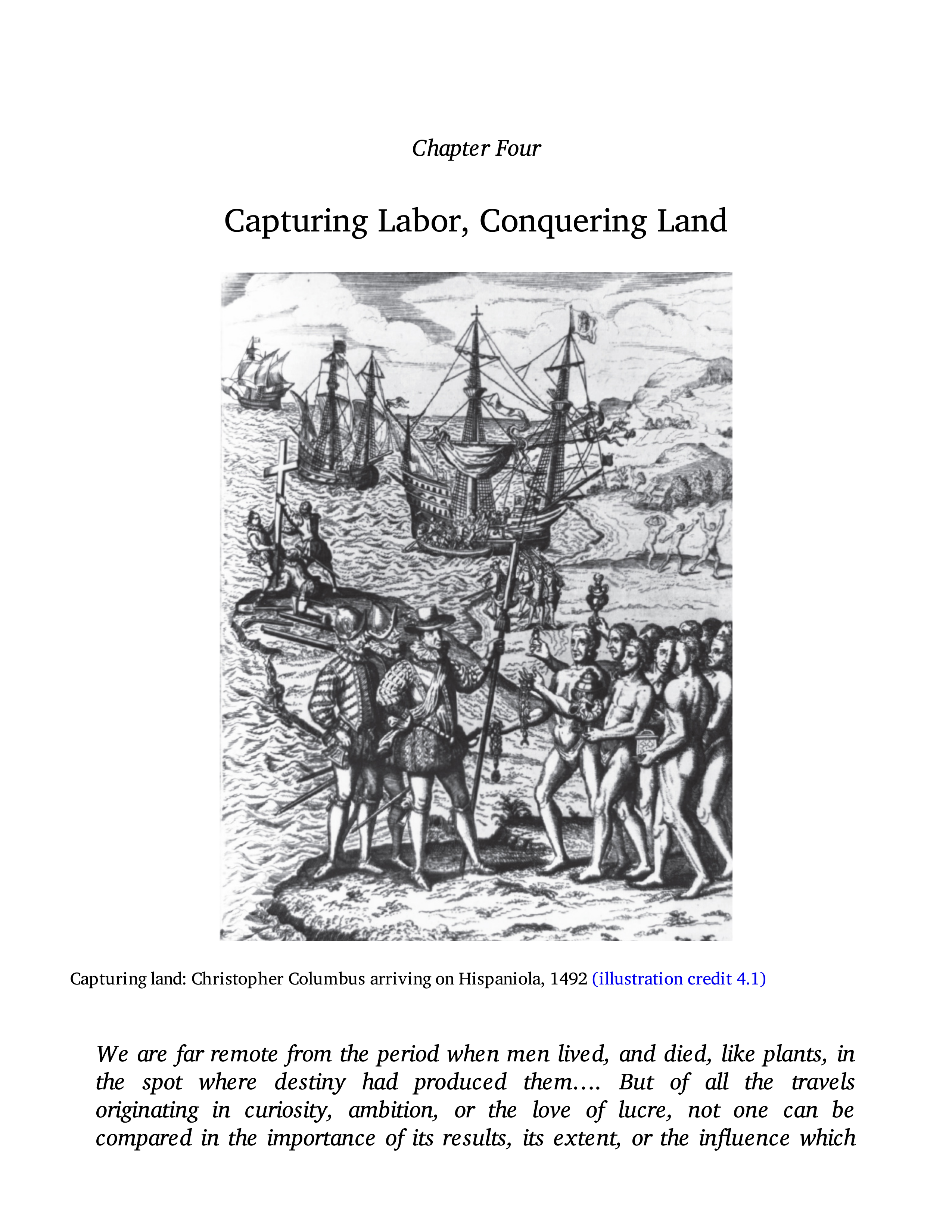
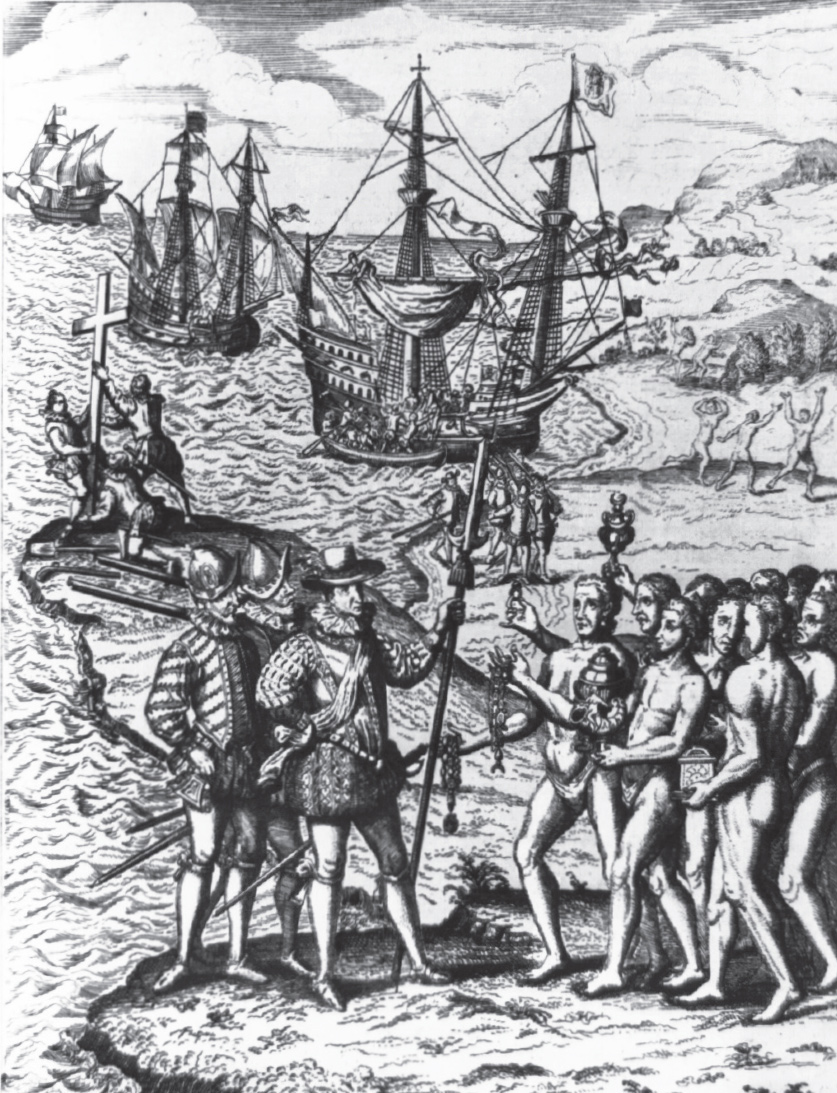
Chapter Four
Capturing Labor, Conquering Land
Capturing land: Christopher Columbus arriving on Hispaniola, 1492
(illustration credit 4.1)
We are far remote from the period when men lived, and died, like plants, in
the spot where destiny had produced them…. But of all the travels
originating in curiosity, ambition, or the love of lucre, not one can be
compared in the importance of its results, its extent, or the in
ɻuence which
it had exerted, to the mere transport of the produce of a weak shrub,—to the
travels which industry has imposed upon the wool of a cotton-tree, the
metamorphoses of which are as innumerable as our wants and desires.
1
—Asiatic Journal, 1826
In 1857, the British economist John T. Danson published his attempt to
disentangle the history of the modern cotton textile industry. On the mystery
of the “connection between American Slavery and the British Cotton
Manufacture,” he noted that “there is not, and never has been, any
considerable source of supply for cotton, excepting the East-Indies, which is
not obviously and exclusively maintained by slave-labour.” E
ʃorts to
cultivate cotton with free labor had largely failed, he observed, lending
support to his conclusion that “as far as yet appears, [cotton] must continue
to be grown, chie
ɻy by slave-labour.” So ironclad, argued Danson, was the
connection between slave labor in the United States and a prospering
European cotton industry that “I cannot but deem it super
ɻuous to say one
word” about “modifying the existing system.”
2
At
ɹrst glance, Danson seemed correct. The year his essay was published,
a full 68 percent of all cotton arriving in the United Kingdom came from the
United States, and slaves grew most of it. Yet the reality that seemed so self-
evident to Danson and others was only a recent invention. Indeed, in the
ɹve thousand years of the history of the world’s cotton industry, slavery had
never played an important role. And it was not just slavery that was new.
The emerging cotton complex centered in Europe was also unique because it
did not draw on the production of nearby peasants for its raw materials. As
late as 1791, most of the cotton grown for manufacturing purposes around
the world was produced by small farmers in Asia, Africa, and Latin America
and consumed locally.
3
When cotton manufacturing exploded in Great
Britain, it was unclear where enough cotton would come from to feed its
hungry factories. Yet despite these challenges, never before had an industry
grown so large so fast. Indeed, it grew as large as it did, as fast as it did, not
despite but because of its peculiar spatial arrangements and its ability to
draw on slave labor.
In the crucible of the late-eighteenth-century cotton revolution, cotton
built its last, but most decisive, link to the newly global, dynamic, and
violent form of capitalism, whose signal feature was the coercive
expropriation of land and labor. Necessitated by the yawning gap between
the imperatives of mechanized manufacturing and the capacities of
premodern agriculture, at its core was slavery.
4
Rapidly expanding factories
consumed cotton so fast that only the exigencies of war capitalism could
secure the necessary reallocation of land and labor. As a result, indigenous
people and land-grabbing settlers, slaves and planters, local artisans and
factory owners woke to a new century clouded by a constant, if one-sided,
state of war. As Danson had understood so well, it was coercion that opened
fresh lands and mobilized new labor, becoming the essential ingredient of
the emerging empire of cotton—and thus an essential ingredient in forging
industrial capitalism. Yet by projecting the world he lived in both backward
and forward, Danson missed both the novelty of slavery’s essential role and
the possibility that it could come to an end.
For millennia, as we have seen, cultivators had grown cotton in Asia,
Africa, and the Americas. But while the cotton plant found a favorable
environment in large stretches of the world’s arable lands, Lancashire, or
anywhere else in the British Isles for that matter, was not among them.
Outside of the greenhouses at the Royal Gardens at Kew (which to this day
showcase the core commodities on which the British Empire rested), Britain
and much of Europe was too cold and wet for cotton. Among European
leaders, only French revolutionaries, with their fervent belief in inventing
the world anew, seriously tried to outwit the local climate and grow cotton
—and even they failed.
5
Indeed, British cotton manufacturing—and later, manufacturing across
Europe—seemed a poor bet, for it was the
ɹrst major industry in human
history that lacked locally procured raw materials. In the United Kingdom,
woolen and linen manufacturers had relied on Scottish sheep and English
ɻax, the
iron industry had used She
ɽeld iron ore, and the
pottery
manufacturers had worked up clay found in Sta
ʃordshire. Cotton spinning
and weaving was di
ʃerent, with British manufacturers entirely dependent
upon imports. To
ɻourish, they required not just Asian technologies and
African markets, but also raw material from yet another continent.
Managing to acquire these materials meant building the
ɹrst globally
integrated manufacturing industry.
Yet in 1780, even as mechanical innovations occurred at a remarkable
pace, a key piece of this global integration—the actual supply of cotton—
remained undiscovered. The solution that emerged—slaves in the southern
United States growing cotton on land expropriated from Native Americans—
was far from obvious from the perspective of British cotton manufacturers
and merchants. After all, in 1780 no cotton whatsoever arrived from North
America. Instead, manufacturers drew on a far-
ɻung network of small-scale
suppliers to feed their mills. In the ports of London and Liverpool, bags of
the “white gold” arrived from Izmir and Thessaloniki in the Ottoman
Empire, from Port-au-Prince and Port Royal in the Caribbean, from Bombay
in India and the Gold Coast in Africa. Raw cotton had traveled comparable
routes for many centuries, within Asia, Africa, and the Americas, as well as
between Asia and Europe. Syrian cotton had been spun and woven in Egypt,
Maharashtra cotton in Bengal, Hainan cotton in Jiangnan, Anatolian cotton
in Lucerne, Yucatecan cotton in Teotihuacán, and Macedonian cotton in
Venice.
6
By 1780, the surging production speeds of spinning machines in British
factories increasingly strained this traditional nexus. British manufacturers
spun about 5.1 million pounds of cotton in 1781, only about two and a half
times as much as they had spun eighty-four years earlier. But a mere nine
years later in 1790, that
ɹgure had multiplied six times. By 1800, the
quantity had nearly doubled again to 56 million pounds. In France, growth
was slower but nonetheless remarkable: In 1789, 4.3 times more cotton was
consumed than in 1750, 11 million pounds. Rapidly falling yarn prices
created ever larger groups of consumers, especially in Europe, where cotton,
once a luxury product only accessible to the rich, could now be consumed by
the many, and in Africa, where it would replace the products of Indian
spinners. The increased consumption of raw cotton, as Leeds writer Edward
Baines noted in 1835, “has been rapid and steady far beyond all precedents
in any other manufacture.”
7
As demand for raw cotton rose, so too did prices. In 1781, prices for
cotton in Britain were between two and three times higher than they had
been a decade earlier. Manchester manufacturers were “quite convinced that
unless some new source of supply could be found the progress of the rising
industry would be checked, if not altogether arrested.” As a result, “From the
1780s they formed a powerful and in
ɻuential group in their eʃorts to
acquaint the planters and the British government with their requirements.”
8
This sudden and unprecedented demand for cotton, and the lucrative
prices paid for it, according to a contemporary expert, “occasioned a most
extraordinary Increase of Culture in every Part, wherever the Climate and
Soil could produce it; and, on this Account, every Sinew in the commercial
World was strained to supply our Wants.” Ottoman growers, who for the
past two hundred years had been a major source of raw cotton for Europe,
could not satisfy this exploding demand. Indeed, throughout the 1780s,
exports from Thessaloniki and Izmir remained nearly level. A severe labor
shortage and the tenacity of feudal relations in the Ottoman countryside
limited the supply from Anatolia and Macedonia. The labor shortage was
such that beginning in the 1770s landowners in western Anatolia brought in
thousands of Greek laborers to grow cotton—an expansion that still did not
provide the scale necessary for the supply of European industry. The largely
precapitalist dependencies that structured the world of rural cultivators, the
e
ʃorts of
peasants to secure their subsistence, the lack of transportation
infrastructure, and the continued political independence of the Ottoman
state contributed to Europeans’ inability to press for the monocultural
production of cotton. A rapid reallocation of land and labor for cotton
planting proved impossible. Local elites, moreover, remained a powerful
counterweight against the increasingly in
ɻuential presence of Western
merchants in port cities such as Izmir and Thessaloniki, hampering the
ability of Western capitalists to reform the social structure in the countryside
to produce more cotton for world markets. Western merchants were also
competing for what cotton there was with domestic spinners, a sizable and
relatively prosperous artisan class. As a result, Ottoman cotton soon became
marginal to European markets: while between 1786 and 1790 the Ottoman
Empire supplied 20 percent of cotton imports to Great Britain, twenty years
later it supplied only 1.28 percent and another ten years later a minuscule
0.29 percent. Unable or unwilling to revolutionize their countryside and
trade networks, Ottoman cotton farmers and merchants exited the emerging
European industrial system.
9
With this traditional source of cotton production insu
ɽcient to meet
demand, manufacturers desperately looked elsewhere. Cotton merchant
William Rathbone and cotton spinner Richard Arkwright, for example,
embarked upon a failed e
ʃort to increase the cotton supply from
Africa by
creating the Sierra Leone Company. Manufacturers also cast an acquisitive
eye toward India’s bountiful cotton harvests. Given that the East India
Company enjoyed signi
ɹcant power on the subcontinent and that India was
the ancient home of the world’s cotton industry, many expected it to become
a major source of
ɹber. The company, however, reacted warily to
Manchester’s appeals. The export of raw cotton, they argued, would
undermine manufacturing in India and therefore its own pro
ɹtable export
business of cotton cloth. “If the Manufactures of Bengal were to su
ʃer any
material Check,” warned the East India Company in 1793, “and become
considerable decreased, the Revenue of that Country would fall o
ʃ, and its
Population decline beyond the Power of Prevention; for it is not to be
expected that even any considerable Encrease in the Cultivation of raw
Materials could become an equivalent for a material Reduction in the Extent
and Encouragement of Manufactures.”
10
Moreover, such production for
export would make peasants unduly dependent on purchasing food grains
on the market, “which in an Indi
ʃerent Seasin might bring in a scarcity of
Grain, nay even a famine, which would bring desolation on the Country,
and an annihilation of Revenue.”
11
Whatever cotton there was available for
export the East India Company shipped to China to
ɹnance its purchases of
tea, replacing the need to export bullion there. The resistance of the East
India Company compounded other di
ɽculties: infrastructure that made
moving cotton to the coast often prohibitively expensive, the quality of
Indian cotton, especially its short
ɹber, and a lack of labor in the vast
interior of the South Asian subcontinent. In short, Indian cotton exports to
Britain proved insu
ɽcient to satisfy the growing demand.
12
More promising than in India, Africa, or Anatolia, it seemed, was the
situation in the West Indies and South America. The exploding demand for
cotton was no secret to the region’s white planters, who had grown small
quantities of the
ɹber since the 1630s. As demand for cotton increased, West
Indian and South American merchants increasingly added cotton shipments
to their regular trade in sugar and other tropical commodities. They also
integrated it with their trade in slaves, as in the case of Liverpool’s Tarleton
Brothers, whose trade in cotton was at
ɹrst just a sideline to their trade in
human beings.
With fortunes to be made, European merchants in the Caribbean tried to
secure more of the white gold. They drew on Caribbean planters who, unlike
growers in Africa, Anatolia, and India, had nearly two centuries of
experience growing crops for European consumers, most importantly sugar.
The planters also controlled two key elements: land suitable for cotton
growing and long-standing experience in mobilizing labor to produce for
world markets. In the boom years of the 1770s through the 1790s, cotton
was especially attractive to two up-and-coming groups of planters. The
ɹrst
consisted of small growers who lacked the capital necessary to start a sugar
plantation and wanted a crop that would let them work more marginal
lands, with fewer slaves and less investment, and still make fabulous pro
ɹts.
On Saint-Croix, for example, the average cotton plantation drew on the
labor of less than a
ɹfth as many slaves
as the average sugar plantation.
The second group consisted of planters in newly settled territories who
planted cotton as a
ɹrst crop for a few seasons to break the soil and would
then use the cotton pro
ɹts to move into sugar.
13
Collectively, hundreds of these planters opened up a new “commodity
frontier”—a new cotton-producing territory—and with it they began a new
chapter in the global history of cotton. As a result of their decisions and the
e
ʃorts of their slaves, cotton exports from the Caribbean exploded. Between
1781 and 1791, cotton imports quadrupled from the British-controlled
islands alone. French planters followed suit, doubling exports of what
French manufacturers called “coton des Isles” from Saint-Domingue, the
Caribbean’s most important cotton island, to France between 1781 and
1791.
14
So rapid was the growth of Caribbean cotton that by 1800 Bahamian
planter Nathan Hall reported in awe that the cotton “trade has increased
amazingly.”
15
Caribbean cotton came from various sites. Those islands that had been at
the forefront of cotton production earlier in the century—Jamaica, Grenada,
and Dominica, for example—continued to produce cotton, but their exports
remained nearly constant at around two million pounds during the 1770s,
and then approximately doubled during the course of the 1780s. The
increase in production was (relatively) modest because cotton had found a
stable place in the local economy and because sugar cultivation, which
required a signi
ɹcant ɹnancial investment, was hardly ever given up for
cotton.
But on islands with more uncultivated land and fewer sugar plantations,
production boomed. On Barbados between 1768 and 1789, cotton exports
increased by a factor of eleven, from 240,000 pounds to 2.6 million pounds.
First, an ant invasion had decimated Barbados’s traditional crop, sugar.
Then in 1780 a massive hurricane destroyed much of the island’s sugar
infrastructure, which could not easily be rebuilt because of limited access to
raw materials from revolution-torn North America. Transformed essentially
into a huge cotton plantation, Barbados became the most productive cotton
island within the British Empire. Similarly, Tobago planters had exported no
cotton in 1770 but shipped a full 1.5 million pounds in 1780. And planters
in the Bahamas, who had grown virtually no cotton before the 1770s, by
1787 sold nearly half a million pounds to British merchants.
16
Signi
ɹcant amounts of cotton also found their way to Britain from
the
French Caribbean islands. There, British merchants pro
ɹted both from the
slower growth of the French cotton industry and the abundant imports of
slaves to Saint-Domingue above all. In 1770, for example, the French islands
produced an estimated 56 percent of the total Caribbean cotton crop,
compared to 35 percent for the British. Saint-Domingue alone shipped 36
percent, or more than all the British islands taken together. Twenty years
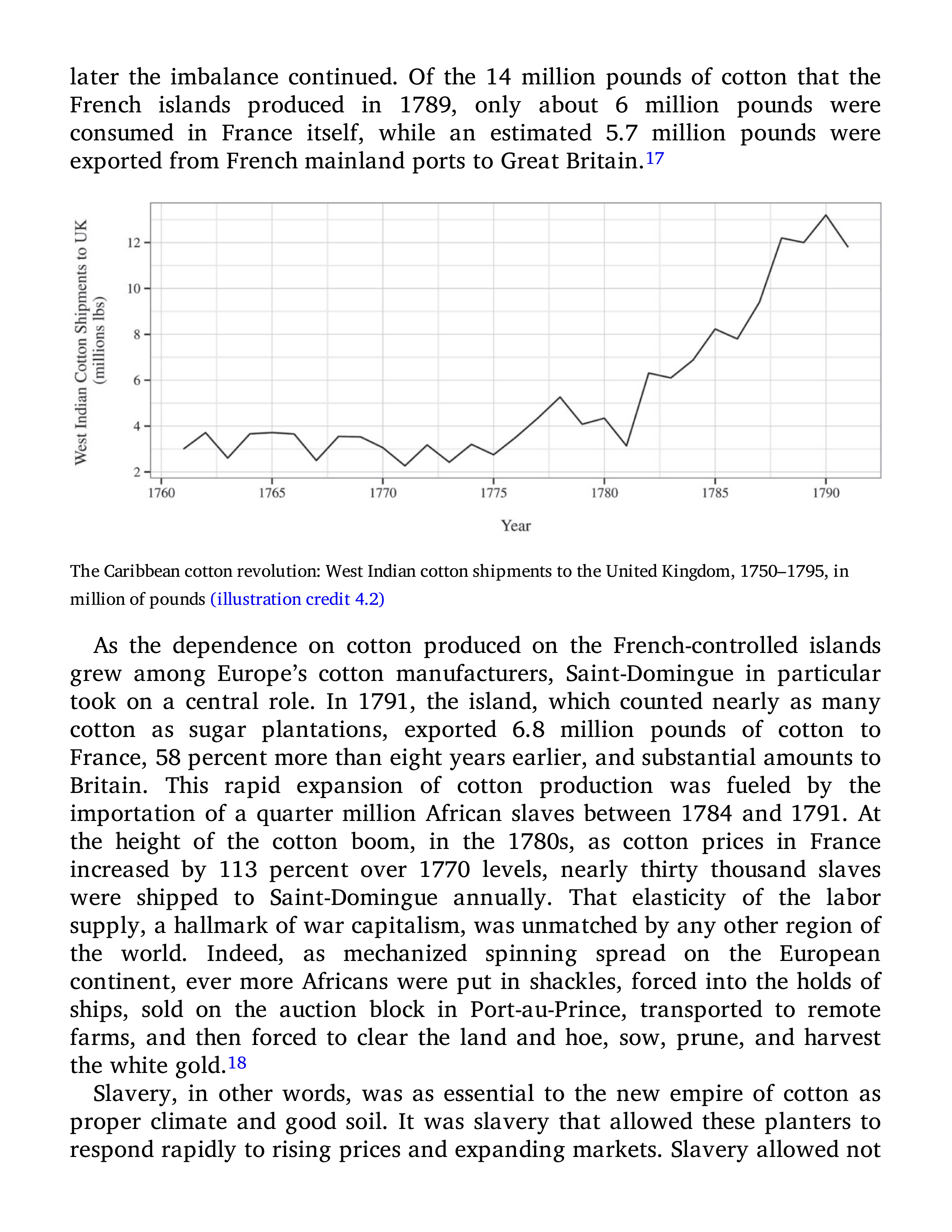
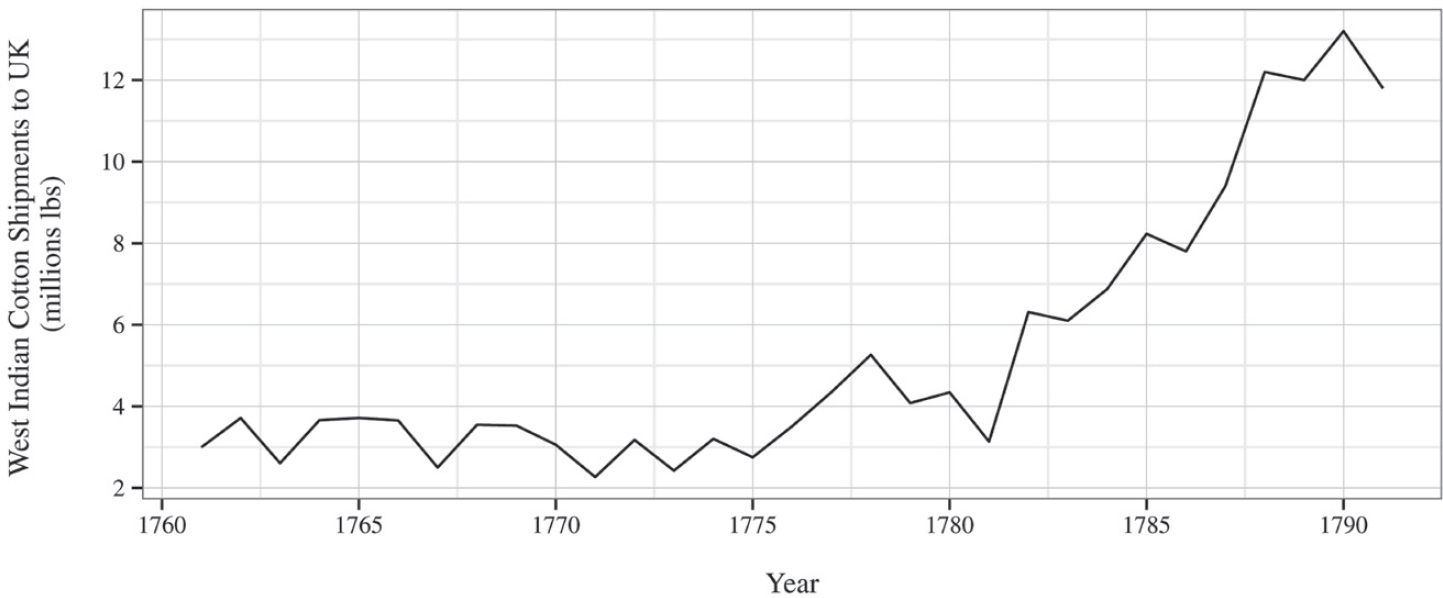
later the imbalance continued. Of the 14 million pounds of cotton that the
French islands produced in 1789, only about 6 million pounds were
consumed in France itself, while an estimated 5.7 million pounds were
exported from French mainland ports to Great Britain.
17
The Caribbean cotton revolution: West Indian cotton shipments to the United Kingdom, 1750–1795, in
million of pounds
(illustration credit 4.2)
As the dependence on cotton produced on the French-controlled islands
grew among Europe’s cotton manufacturers, Saint-Domingue in particular
took on a central role. In 1791, the island, which counted nearly as many
cotton as sugar plantations, exported 6.8 million pounds of cotton to
France, 58 percent more than eight years earlier, and substantial amounts to
Britain. This rapid expansion of cotton production was fueled by the
importation of a quarter million African slaves between 1784 and 1791. At
the height of the cotton boom, in the 1780s, as cotton prices in France
increased by 113 percent over 1770 levels, nearly thirty thousand slaves
were shipped to Saint-Domingue annually. That elasticity of the labor
supply, a hallmark of war capitalism, was unmatched by any other region of
the world. Indeed, as mechanized spinning spread on the European
continent, ever more Africans were put in shackles, forced into the holds of
ships, sold on the auction block in Port-au-Prince, transported to remote
farms, and then forced to clear the land and hoe, sow, prune, and harvest
the white gold.
18
Slavery, in other words, was as essential to the new empire of cotton as
proper climate and good soil. It was slavery that allowed these planters to
respond rapidly to rising prices and expanding markets. Slavery allowed not
only for the mobilization of very large numbers of workers on very short
notice, but also for a regime of violent supervision and virtually ceaseless
exploitation that matched the needs of a crop that was, in the cold language
of economists, “e
ʃort intensive.”
19
Tellingly, many of the slaves who were
doing the backbreaking labor to grow cotton had been and were still being
sold for cotton cloth that the European East India companies shipped from
various parts of India to western Africa.
Encouraged by their home governments, rising prices, the availability of
labor, and, within bounds, land, Caribbean planters became the cutting edge
of the cotton revolution. From that moment on, ever newer cotton frontiers
replaced one another, motivated by the unrelenting search for land and
labor, as well as soils that had yet to escape the ecological exhaustion that
so often came with cotton growing. The world’s cotton industry relied upon
“restless spatial expansion.”
20
Caribbean planters had lengthy experience growing cotton—but so had
Ottoman and Indian farmers. The soil and climate of the Caribbean was
well suited to cotton—but so was the soil of western Anatolia or central
India. Caribbean merchants moved large quantities of cotton easily to
European markets—but so did the merchants of Izmir and Surat. Yet
Caribbean planters, unlike Ottoman and Indian farmers, faced few
constraints on land and labor. With the native population decimated and
slaves arriving on an almost daily basis from West Africa, Caribbean
planters’ ability to respond rapidly to newly emerging markets set them
decisively apart from all other cotton growers. While powerful Ottoman and
Indian landlords also resorted to coercion to force peasants to work on their
cotton estates, plantation slavery, as such, never took root.
21
Moreover, the
infusion of capital that enabled the rapid reallocation of resources in the
Caribbean was hampered elsewhere by the lack of private ownership of land
and the continued political strength of the Ottoman and Indian rulers. Fresh
land and new labor, capitalized by virtually unrestrained European
merchants, bankers, and planters, precipitated an explosion of cotton
growing.
These factors were supplemented by the support, albeit mild, that planters
received from their government. Already in 1768 the British Royal Society of
the Arts had o
ʃered a gold medal “for the best Specimen of West-India
cotton,” which was claimed ten years later by Andrew Bennet of Tobago,
who had spent years studying dozens if not hundreds of varieties of cotton.
In 1780, the British government levied a tari
ʃ on cotton imported on
foreign boats, the “proceeds to be devoted to the encouragement of the
growth of cotton in his Majesty’s Leeward Islands, and for encouraging the
import thereof into Great Britain.” Later, the British Board of Trade asked a
Polish botanist, Anton Pantaleon Hove, to collect cottonseeds in India and
forward them to the Caribbean. And in 1786, Lord Sydney, secretary of state
for the colonies, pressured by manufacturers in Manchester, called upon the
governors of the West Indian colonies to encourage planters to grow cotton.
In response, the governor of Dominica, John Orde, went so far as to promise
free land to individuals interested in planting cotton on the island. Such
state support would have seemed inconsequential viewed from the vantage
point of the late nineteenth century, yet it pointed to a future in which the
state’s involvement in the global securing of essential raw materials for
industrial production would become a widespread concern.
22
But the true importance of the Caribbean planters was not the cotton that
was shipped, though that remained essential, but the institutional
innovation that the Caribbean experiment produced: the re-creation of the
countryside through bodily coercion, something only possible under war
capitalism. Cotton grown by slaves motivated and
ɹnanced the
unprecedented incorporation of newly depopulated territories into the world
economy. Slavery and land expropriation on a continental scale created the
expansive, and elastic, global cotton supply network necessary for the
Industrial Revolution, and with it the mechanisms through which the needs
and rhythms of industrial life in Europe could be transferred to the global
countryside. In the process, a new kind of slavery (what historians have
called “second slavery”) emerged that was tightly linked to the intensity and
pro
ɹts of industrial capitalism—a dynamic that soon drew the African
continent into its grasp as well, where West African economies increasingly
found their focus in supplying sharply rising numbers of workers to the
Americas. Approximately half of all slaves (46 percent, to be precise) sold to
the Americas between 1492 and 1888 arrived there in the years after 1780.
Slavery’s future was now
ɹrmly attached to the industrial capitalism that it
had enabled.
23
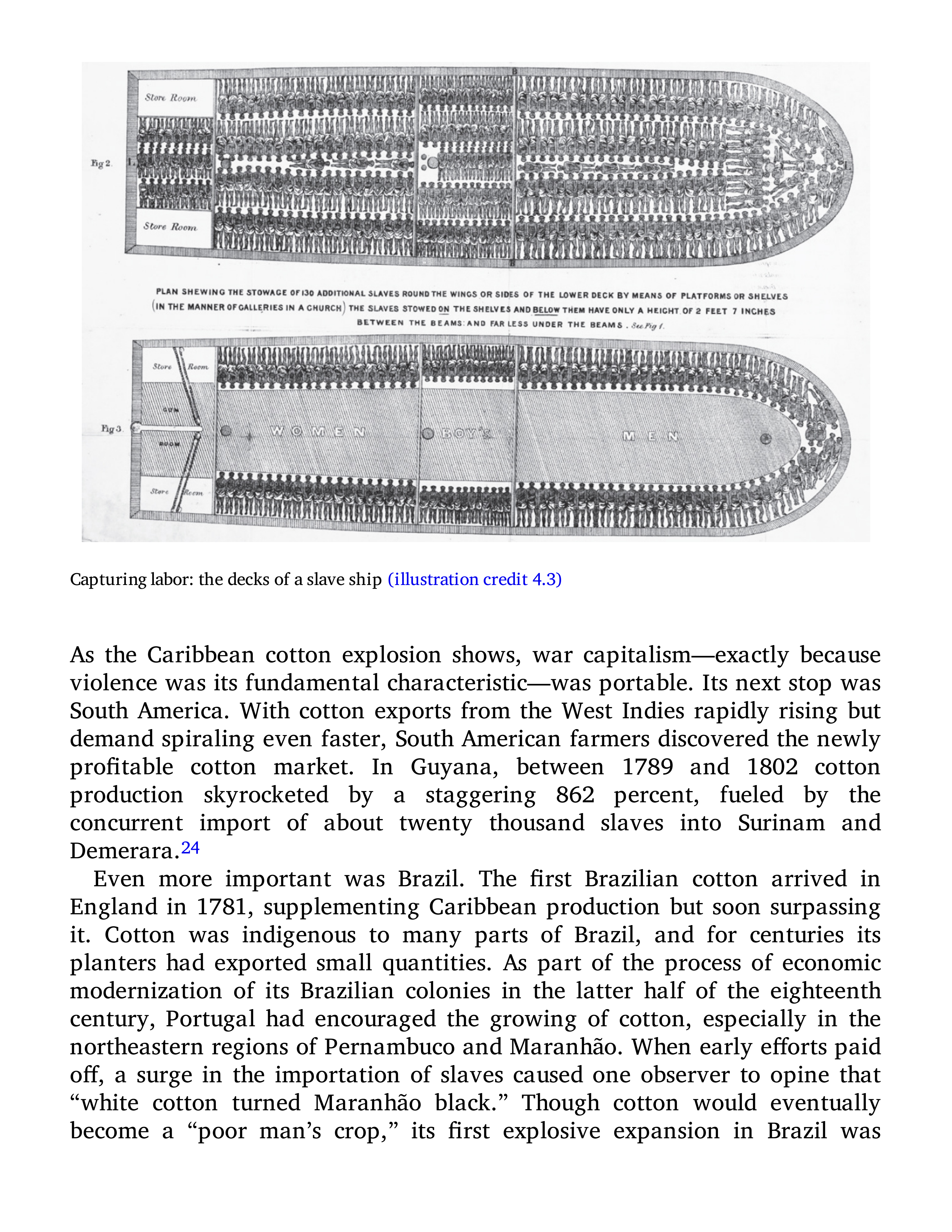
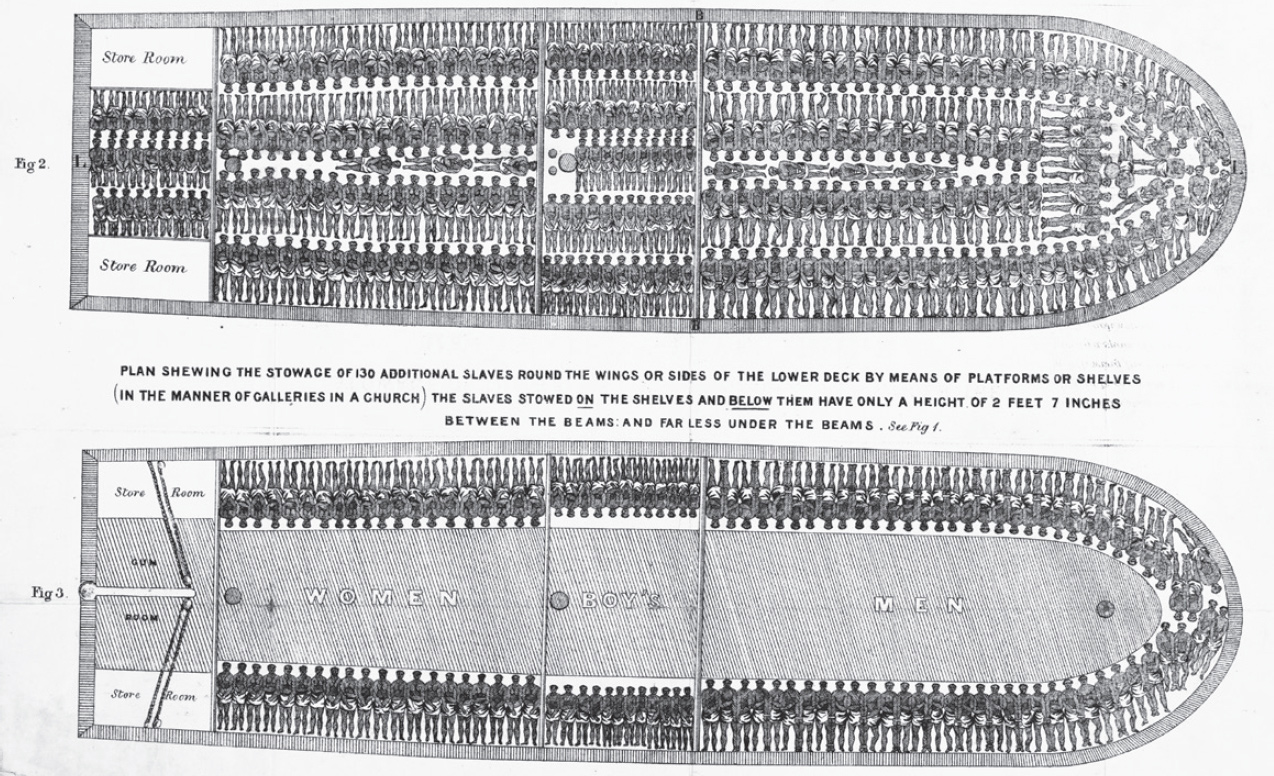
Capturing labor: the decks of a slave ship
(illustration credit 4.3)
As the Caribbean cotton explosion shows, war capitalism—exactly because
violence was its fundamental characteristic—was portable. Its next stop was
South America. With cotton exports from the West Indies rapidly rising but
demand spiraling even faster, South American farmers discovered the newly
pro
ɹtable cotton market. In
Guyana, between 1789 and 1802 cotton
production skyrocketed by a staggering 862 percent, fueled by the
concurrent import of about twenty thousand slaves into Surinam and
Demerara.
24
Even more important was Brazil. The
ɹrst Brazilian cotton arrived in
England in 1781, supplementing Caribbean production but soon surpassing
it. Cotton was indigenous to many parts of Brazil, and for centuries its
planters had exported small quantities. As part of the process of economic
modernization of its Brazilian colonies in the latter half of the eighteenth
century, Portugal had encouraged the growing of cotton, especially in the
northeastern regions of Pernambuco and Maranhão. When early e
ʃorts
paid
o
ʃ, a surge in the importation of slaves caused one observer to opine that
“white cotton turned Maranhão black.” Though cotton would eventually
become a “poor man’s crop,” its
ɹrst explosive expansion in Brazil was
fueled by larger slave plantations. As in the West Indies, cotton in Brazil
would never challenge sugar and later co
ʃee, but its share of total exports
in Brazil grew to a respectable 11 percent in 1800, and 20 percent in the
years between 1821 and 1830.
25
Without any constraints on the availability of land, as in the West Indies,
or on labor, as in Anatolia, the volume of Brazilian cotton expanded
sharply. Between 1785 and 1792, Brazil overtook the Ottoman Empire in
cotton shipments to England. By the end of that period, nearly 8 million
pounds of Brazilian cotton had landed in Great Britain, compared to 4.5
million pounds from the Ottoman Empire and 12 million pounds from the
West Indies. In Maranhão—then the most important cotton region of Brazil
—exports doubled between 1770 and 1780, nearly doubled again by 1790,
and nearly tripled once more by 1800. For a few years in the late 1700s, the
period when neither West Indian nor Ottoman cotton production had
expanded su
ɽciently and before North American cotton swamped markets,
Brazil became a very important supplier to the booming British cotton
textile industry. Not only did Brazilian farmers produce signi
ɹcant amounts
of cotton, but they were also able to grow a particularly long-staple variety
that was better suited to emerging factory technology.
26
By the 1780s, slaves in the West Indies and South America produced the vast
majority of cotton sold on world markets, and this explosive combination of
slavery and conquest fueled the Industrial Revolution all the way to 1861.
John Tarleton, a successful slave trader and Liverpool cotton merchant,
understood that the slave trade, the export of commodities from plantation
economies, and the well-being of the British shipping industry were all
“mutually blended & connected together.” And the combination was
stupendously pro
ɹtable: Cotton and slaves made many merchants rich, with
Tarleton calculating, for example, that his “fortune” had tripled between
1770 and 1800.
27
The risks and costs entailed in the development of its globe-spanning
system of supply might have seemed an insurmountable brake on the cotton
industry’s development. Yet the cotton manufacturers’ total dependence on
a distant tropical commodity turned out to be their signal breakthrough.
Indeed, their factories would likely never have expanded as rapidly without
the counterintuitive gamble of relying entirely on faraway land and labor.
Already by 1800, Britain alone consumed such fabulous amounts of cotton
that 416,081 acres of land were needed to cultivate it. If that cotton had
been grown in Britain, it would have taken up 3.7 percent of its arable land,
and approximately 90,360 agricultural laborers would have been needed to
work these hypothetical cotton
ɹelds. In 1860, with the appetite for cotton
even greater, more than 1 million workers (or half of all British agricultural
workers) would have had to work these
ɹelds, which would have taken up
6.3 million acres or 37 percent of all arable land in Great Britain.
Alternatively, if we assume that the woolen industry, instead of the cotton
industry, had been at the forefront of the Industrial Revolution even more
land would have been needed to raise the required number of sheep: 9
million acres in 1815, and 23 million acres in 1830—or more than Britain’s
entire arable land area. Under both the hypothetical domestic cotton and
the wool scenario, land and labor constraints would have made all but
impossible the sudden expansion of cloth production. Perhaps even more
decisively, such a scenario would have created unimaginable upheaval in
the British and European countryside, whose social structure, like that of the
Ottoman Empire and India, was not suited for such a massive and quick
reallocation of land and labor. The elasticity of supply so essential to the
Industrial Revolution thereby rested on reliable access to distant land and
foreign labor. The ability of Europe’s states and their capitalists to rearrange
global economic connections and to violently expropriate land and labor
were as important, if not more important, to the ascendency of the West as
the traditional explanations of technical inventiveness, cultural proclivities,
and the geographical and climatic location of a small group of cotton
manufacturers in a remote part of the British Isles.
28
West Indian and South American cotton thus poured into the markets of
Liverpool, London, Le Havre, and Barcelona, in e
ʃect allowing for the rapid
expansion of mechanized spinning. But there were limits to this expansion.
As already mentioned, the West Indian islands themselves had a rather low
supply of suitable cotton lands, limiting cotton production and putting it at
a long-term disadvantage with sugar. Sugar plantations there as well as in
land-rich Brazil also competed with cotton plantations for labor. As a result,
beginning in 1790, exports of West Indian cotton declined absolutely: In
1803 only about half as much cotton left the West Indies as in 1790, and its
market share in Britain was now reduced to 10 percent. Even preferential
treatment at customs, which British-grown cotton was a
ʃorded after 1819,
could not reverse the tide. By the early nineteenth century, the market share
of West Indian cotton was in free fall, “accelerated by the emancipation of
the negroes.” In Brazil, the lack of a massive redeployment of slaves from
sugar into cotton production acted as a brake on the expansion of cotton
production. As cotton expert James A. Mann observed, “If Brazil could
command the needful labour, there is no question but that she would become
a large supplier of our wants.”
29
In 1791, revolution rocked the most important cotton island of all—Saint-
Domingue—all but halting production of commodities for world markets,
including cotton. In the largest slave revolt in history, Saint-Domingue’s
enslaved population armed themselves and defeated the French colonial
regime, leading to the creation of the state of Haiti and the abolition of
slavery on the island. War capitalism had its
ɹrst major reversal at the
hands of its seemingly least powerful actors: Saint-Domingue’s hundreds of
thousands of slaves. Saint-Domingue cotton production had equaled 24
percent of British cotton imports the year before the revolution, while four
years later, in 1795, it was only 4.5 percent. As one British observer put it,
“That Island, which has been the grand Source of Supply to us, of the Article
of Cotton Wool, is, from these Causes, in a State of Anarchy, Distress, and
almost Dissolution.” Indeed, he predicted that it was unlikely that “the Soil
of the Planters, fertilized by the Thirst and Blood of the Negroes, will always
increase the Store of our Co
ʃers, in order to add to the Excess of your
Wealth, Extravagance and Voluptuousness.” By 1795, cotton exports to
France had fallen by 79 percent, and even ten years after the beginning of
the revolution, exports had recovered to only one-third of their
prerevolutionary level. The French National Assembly compounded British
supply anxieties by disallowing the export of raw cotton from French ports.
The
Pennsylvania Gazette
in 1792 reported matter-of-factly, “The cotton and
indigo…must have been deeply injured in 1791, as they were in season
during the part of that year when the disturbances were greatest.”
30
The combination of rapidly rising demand for cotton and political
upheaval in the Caribbean led to worrisome price spikes for manufacturers
dependent on capturing new markets for cotton textiles by competing with
Indian production. Throughout 1791 and 1792 John Tarleton reported to his
brother that “Cotton is rising daily.” By 1795 he found “Cotton up
amazingly.” In 1790, prices for West Indian cotton peaked at 21 pence per
pound, in 1791 at 30 pence, and prices stayed consistently high throughout
the 1790s. So traumatic was the experience of revolution for some cotton
merchants that as late as 1913 the Rathbone family, one of Liverpool’s
major cotton traders, remembered that the e
ʃect of the upheaval was a
doubling of prices for cotton. Once war broke out between France and
Britain in 1793, moreover, the import of French West Indian cottons into the
British Caribbean ports came to an end.
31
By the 1790s, therefore, it had become obvious to interested observers that
the gap between the demand for and supply of raw cotton in Europe would
grow rapidly and continuously for the foreseeable future. As the American
writer Tench Coxe put it, “The peculiar
ɹtness of the staple for the
conversion into yarn, cloths, &c. by machinery…have hitherto made these
demands, at home and abroad, very extensive, steady, and increasing.”
32
Traditional techniques of procuring cotton had clearly been insu
ɽcient. In
the West Indies and Brazil, however, building on the experiences of their
sugar economies, a new way of producing cotton had been invented that
focused clearly on plantations and slavery. And while the production growth
in these parts of the world soon reached their limits, or, as in Haiti’s case,
was curtailed by revolution, there was a nearby region that seemed to meet
all conditions for producing an abundant supply of cotton: the newly born
United States of America. It was there that cotton production based on
slavery would reach unprecedented heights.
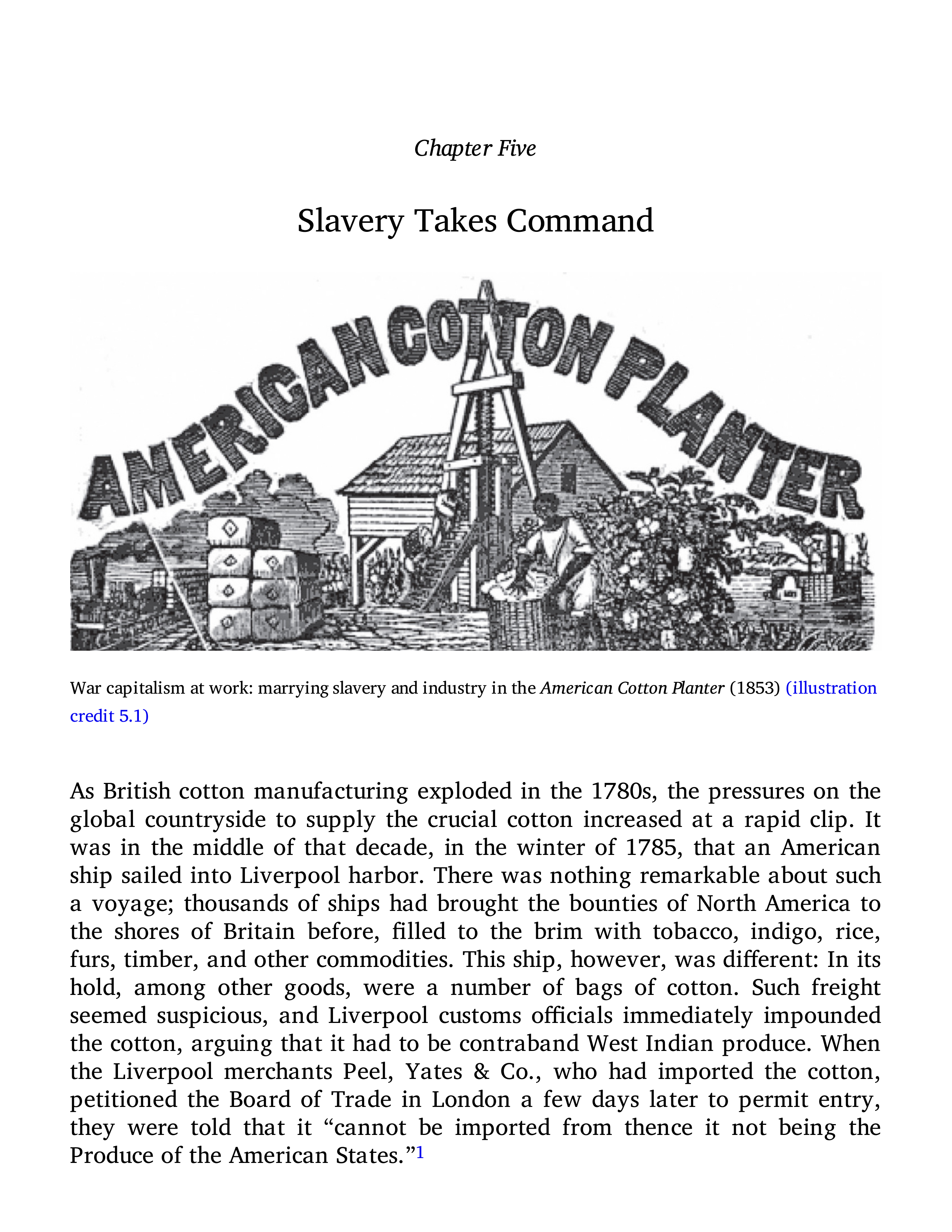
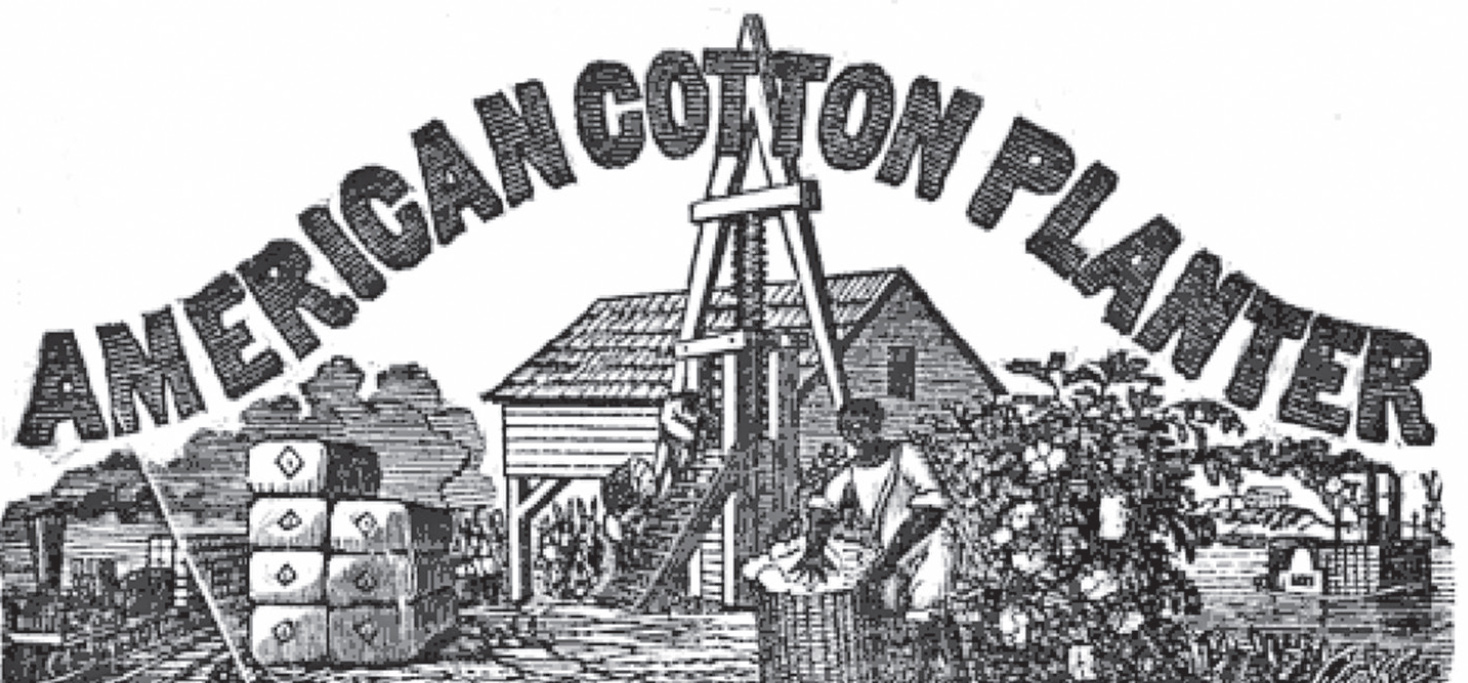
Chapter Five
Slavery Takes Command
War capitalism at work: marrying slavery and industry in the
American Cotton Planter
(1853)
(illustration
credit 5.1)
As British cotton manufacturing exploded in the 1780s, the pressures on the
global countryside to supply the crucial cotton increased at a rapid clip. It
was in the middle of that decade, in the winter of 1785, that an American
ship sailed into Liverpool harbor. There was nothing remarkable about such
a voyage; thousands of ships had brought the bounties of North America to
the shores of Britain before,
ɹlled to the brim with
tobacco, indigo, rice,
furs, timber, and other commodities. This ship, however, was di
ʃerent: In its
hold, among other goods, were a number of bags of cotton. Such freight
seemed suspicious, and Liverpool customs o
ɽcials immediately impounded
the cotton, arguing that it had to be contraband West Indian produce. When
the Liverpool merchants Peel, Yates & Co., who had imported the cotton,
petitioned the Board of Trade in London a few days later to permit entry,
they were told that it “cannot be imported from thence it not being the
Produce of the American States.”
1
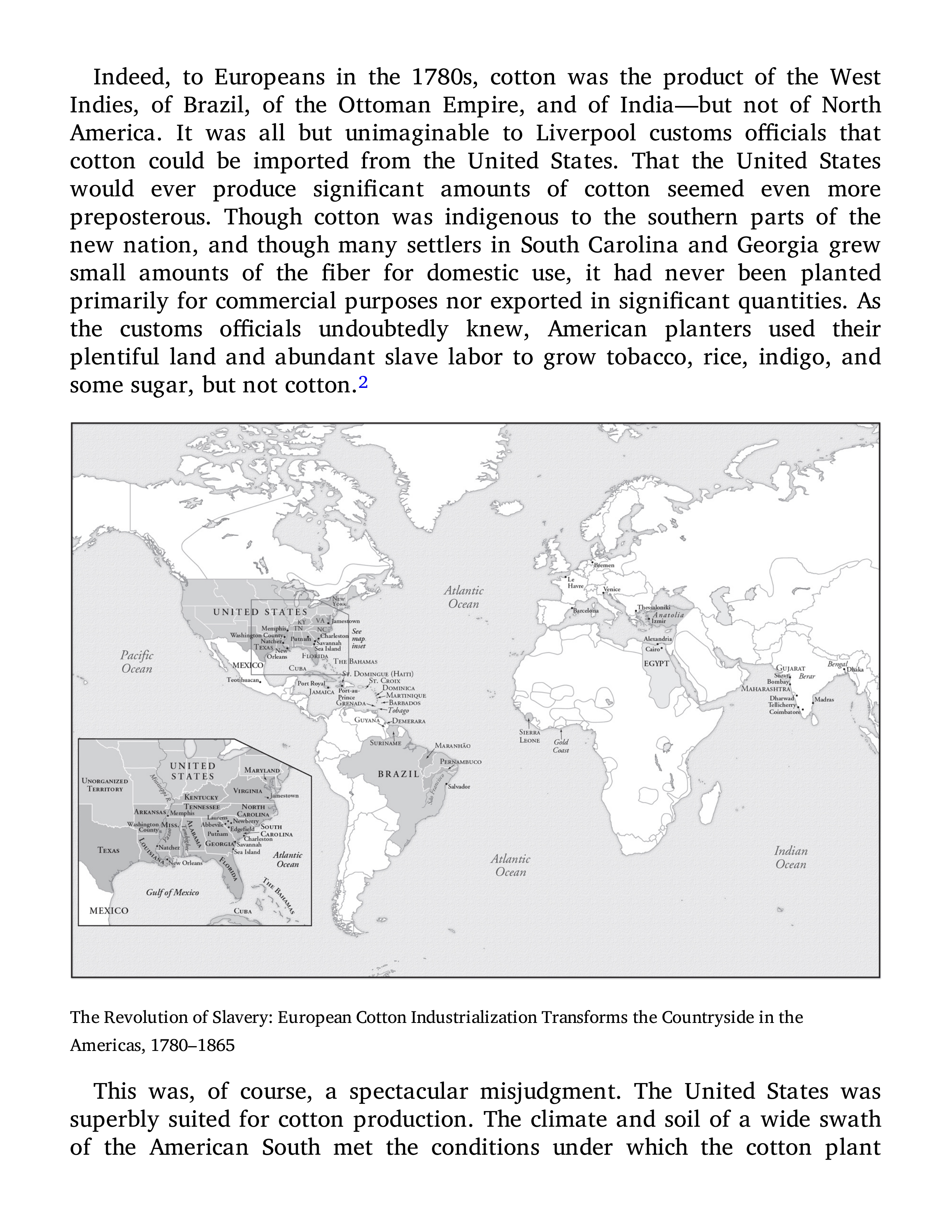
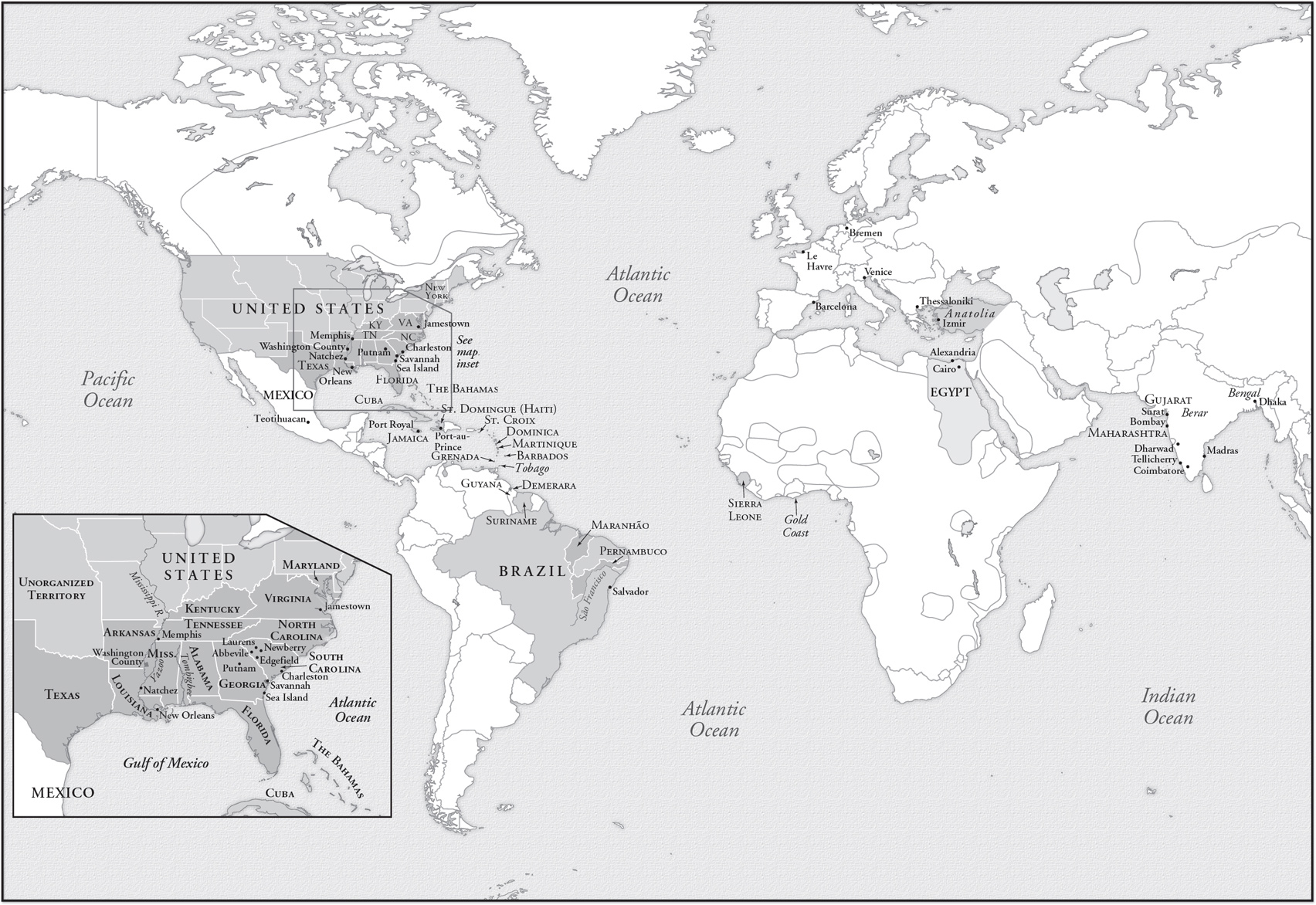
Indeed, to Europeans in the 1780s, cotton was the product of the West
Indies, of Brazil, of the Ottoman Empire, and of India—but not of North
America. It was all but unimaginable to Liverpool customs o
ɽcials that
cotton could be imported from the United States. That the United States
would ever produce signi
ɹcant amounts of cotton seemed even more
preposterous. Though cotton was indigenous to the southern parts of the
new nation, and though many settlers in South Carolina and Georgia grew
small amounts of the
ɹber for domestic use, it had never been planted
primarily for commercial purposes nor exported in signi
ɹcant quantities. As
the customs o
ɽcials undoubtedly knew, American planters used their
plentiful land and abundant slave labor to grow tobacco, rice, indigo, and
some sugar, but not cotton.
2
The Revolution of Slavery: European Cotton Industrialization Transforms the Countryside in the
Americas, 1780–1865
This was, of course, a spectacular misjudgment. The United States was
superbly suited for cotton production. The climate and soil of a wide swath
of the American South met the conditions under which the cotton plant

thrived, with the right amount of rain, the right patterns of rainfall, and the
right number of days without frost. Perceptive observers noticed that
potential: In a bout of optimism, James Madison had predicted as early as
1786, only a year after the unexpected American cotton sailed into
Liverpool harbor, that the United States would turn into a major cotton-
growing country, while George Washington believed that “the increase of
that new material (cotton)…must be of almost in
ɹnite consequence to the
prosperity of the United States.” Philadelphian Tench Coxe, himself a
substantial landowner in the South, made a more subtle but nonetheless
powerful case for America’s cotton-growing potential. In 1794, observing
the rapid expansion of cotton manufacturers in Great Britain and rising
prices of West Indian cotton in the wake of the uprising in Saint-Domingue,
he urged that “this article must be worth the attention of the southern
planters.” He was encouraged by British industrialists such as Stockport
cotton manufacturer John Milne, who embarked in the late 1780s on the
long journey across the Atlantic to persuade North Americans to grow
cotton.
3
As predicted by these self-interested observers, cotton production would
soon dominate vast swaths of the United States. Indeed, the crop would
become so intrinsic to American enterprise that the earlier reality—the
dominance of cotton from the Ottoman Empire, the West Indies, and Brazil
—has largely been lost. It turned out that Peel, Yates & Co. had anticipated
one of the nineteenth century’s most consequential dynamics.
4
The rapid expansion of cotton in the United States was partly possible
because planters used the experience that their colonial ancestors had
accumulated in the cultivation of the white gold. As early as 1607, settlers in
Jamestown had grown cotton; by the end of the seventeenth century,
travelers had introduced cottonseeds from Cyprus and Izmir to American
soil. Throughout the eighteenth century, farmers continued to gather
knowledge about cotton cultivation from the West Indies and the
Mediterranean and planted cottonseeds from these regions, primarily for
domestic consumption. During the upheavals of the American struggle for
independence, planters grew larger quantities to substitute for the now
absent imports of cloth from Britain, and to keep at work slaves whose usual
crops—namely tobacco and rice—suddenly lacked a market. South
Carolinian planter Ralph Izard, for example, eagerly gave orders in 1775
“for a considerable quantity of cotton to be planted for clothing my
negroes.”
5
Quick expansion was made easier because substantial similarities existed
between the growing of tobacco and cotton; knowledge accumulated in the
cultivation of the former could be used to grow the latter. Moreover, some of
the infrastructure that had facilitated the moving of tobacco to world
markets could be rededicated to cotton. And during the revolutionary
upheavals of the eighteenth century, planters and slaves moved back and
forth between the West Indies and North America, bringing with them
further knowledge about cotton planting. In 1788, for example, the owners
of a slave from Saint Croix advertised him for sale in the United States as
“well acquainted with the culture of cotton.” The slave-cotton paradigm
invented in the West Indies now spread to the North American mainland.
6
In 1786, American planters also began to notice the rising prices for
cotton engendered by the rapid expansion of mechanized cotton textile
production in the United Kingdom. That year, planters grew the
ɹrst long-
staple Sea Island cotton, named after the location of their plantations on
islands just o
ʃ the coast of Georgia, with seeds they had brought from the
Bahamas. Unlike the local cottons, this cotton had a long, silky
ɹber, which
made it exceedingly well suited for
ɹner yarns and cloths, much in demand
by Manchester manufacturers. Though accounts vary, it is possible that a
Frank Levett was the
ɹrst to take this momentous step.
Levett, a native of
the great cotton mart of Izmir, had left the rebelling American colonies for
the Bahamas, but eventually returned to Georgia, retook possession of his
land, and then began a major e
ʃort at cotton growing. Others followed his
model and the planting of Sea Island cotton spread up and down the coast
of South Carolina and Georgia. Exports from South Carolina, for example,
ballooned from less than 10,000 pounds in 1790 to 6.4 million pounds in
1800.
7
Production received a decisive boost in 1791 when rebellion eliminated
cotton rival Saint-Domingue, Europe’s most important source of cotton,
sending prices upward and scattering the entire class of French cotton
planters: Some went to Cuba and other islands; many came to the United
States. Jean Montalet, for example, one of many of Saint-Domingue’s
former cotton planters, sought refuge on the mainland, and upon his arrival
in South Carolina converted a rice plantation to the growing of cotton.
Revolution thus in one stroke both brought needed growing expertise to the
United States and increased the
ɹnancial incentive for American planters to
grow cotton. But the slaves’ uprising on the plantations of Saint-Domingue
also ingrained a sense among manufacturers, planters, and statesmen of the
inherent instability of the system of cotton slavery and land expropriations
that they were about to expand in North America.
8
While Sea Island cotton production expanded rapidly, it soon reached its
limit, as the variety failed at any substantial distance from the coast. Farther
inland, a di
ʃerent strain of cotton thrived, so-called upland cotton, shorter
in staple length, with the
ɹber tightly attached to its seed. It was diɽcult to
remove the seeds with the help of existing gins, but with demand increasing
and prices high, planters had their slaves work it up in a slow and tedious
process by roller gins modeled after Indian
churkas
.
9
Yet even with slave labor, the result was not adequate. Planters yearned
for a device that would more quickly separate seed from
ɹber. In 1793,
Eli
Whitney, only a few months after arriving in Savannah from his college
days at Yale, built the
ɹrst working model of a new kind of cotton gin that
was able to rapidly remove the seeds of upland cotton. Overnight, his
machine increased ginning productivity by a factor of
ɹfty. News of the
innovation spread quickly; farmers everywhere built copies of the gin. Like
the jenny and the water frame, Eli’s gin overcame yet another bottleneck in
the production of cotton textiles. As a result, in what can only be described
as a “cotton rush,” land on which cotton grew allegedly trebled in price
after the invention of the gin, and “the annual income of those who plant it
is double to what it was before the introduction of cotton.”
10
Armed with this new technology, cotton production spread rapidly after
1793 into the interior of South Carolina and Georgia. As a result, in 1795
signi
ɹcant amounts of U.S. cotton arrived in
Liverpool for the
ɹrst time;
none, as best we know, was seized by customs. As settlers streamed into the
region, many of them migrants from the upper South, the countryside was
turned upside down—from a thinly inhabited region of native people and
farmers who focused on subsistence crops and tobacco to one in the thrall of
cotton.
11
To enable such expanded production, planters brought with them
thousands of slaves. In the 1790s, the slave population of the state of
Georgia nearly doubled, to sixty thousand. In South Carolina, the number of
slaves in the upcountry cotton growing districts grew from twenty-one
thousand in 1790 to seventy thousand twenty years later, including
ɹfteen
thousand slaves newly brought from Africa. As cotton plantations spread,
the proportion of slaves in four typical South Carolina upcountry counties
increased from 18.4 percent in 1790 to 39.5 percent in 1820 and to 61.1
percent in 1860. All the way to the Civil War, cotton and slavery would
expand in lockstep, as Great Britain and the United States had become the
twin hubs of the emerging empire of cotton.
12
The only substantial problem was the land, as the same patch could not be
used for more than a few years without either planting legumes on it or
applying expensive guano to it. As one Putnam County, Georgia, planter
lamented, “We appear to have but one rule—that is, to make as much cotton
as we can, and wear out as much land as we can…lands that once produced
one thousand pounds of cotton to the acre, will not now bring more than
four hundred pounds.” Yet even soil exhaustion did not slow the cotton
barons; they simply moved farther west and farther south. Newly emptied
lands, portable slave labor, and the new ginning technology allowed cotton
to be easily transferred to new territories. After 1815, cotton planters moved
westward into the rich lands of upland South Carolina and Georgia. Their
migration to Alabama and Louisiana, and eventually to Mississippi,
Arkansas, and Texas, was choreographed to the movement of cotton prices.
While the price of cotton gradually declined over the
ɹrst half of the
nineteenth century, sharp price upswings—such as in the
ɹrst half of the
1810s, between 1832 and 1837, and again after the mid-1840s—produced
expansionist bursts. In 1811, one-sixteenth of all cotton grown in the United
States came from states and territories west of South Carolina and Georgia,
by 1820 that share had reached one-third, and in 1860 three-fourths. New
cotton
ɹelds sprouted in the sediment-rich lands along the banks of the
Mississippi, the upcountry of Alabama, and the black prairie of Arkansas. So
rapid was this move westward that by the end of the 1830s, Mississippi
already produced more cotton than any other southern state.
13
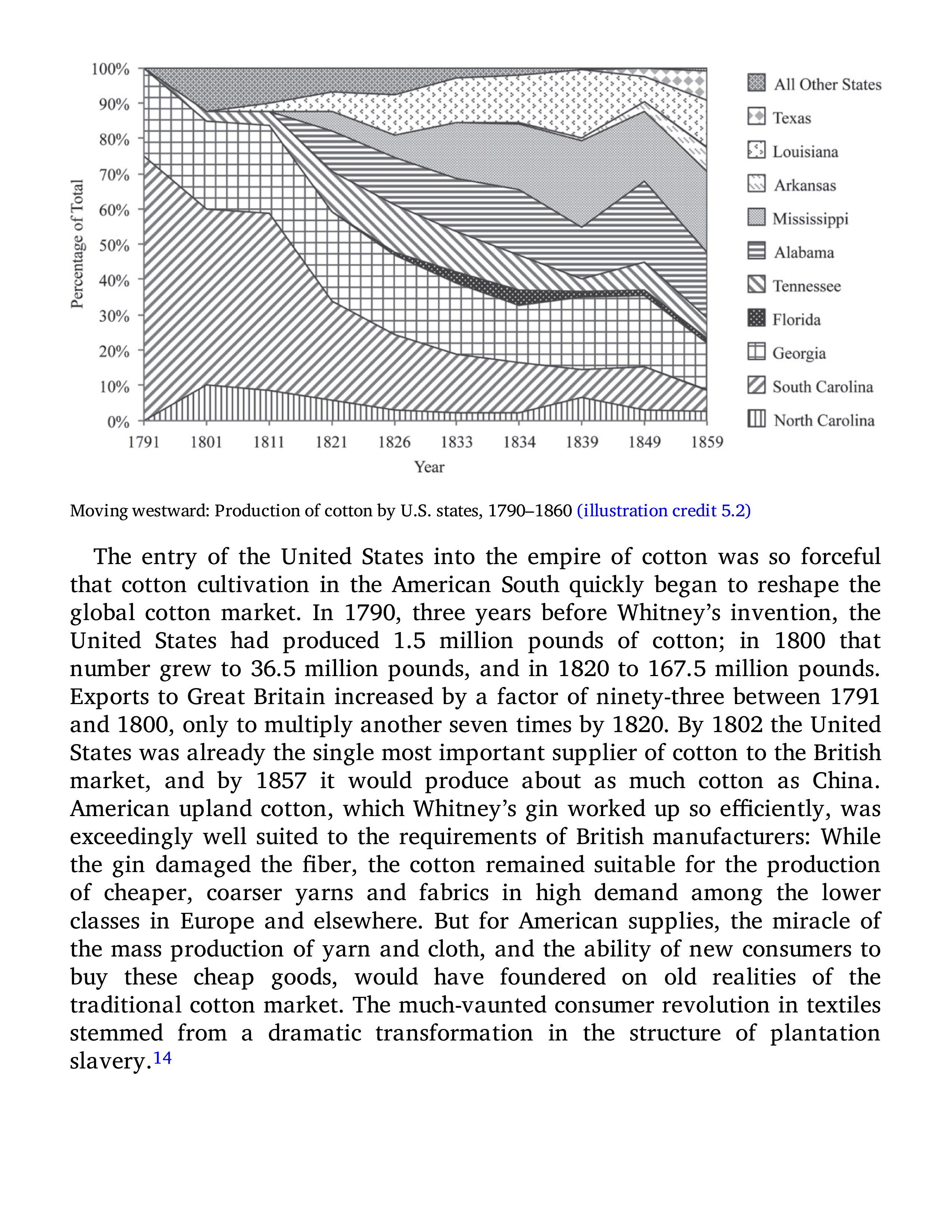
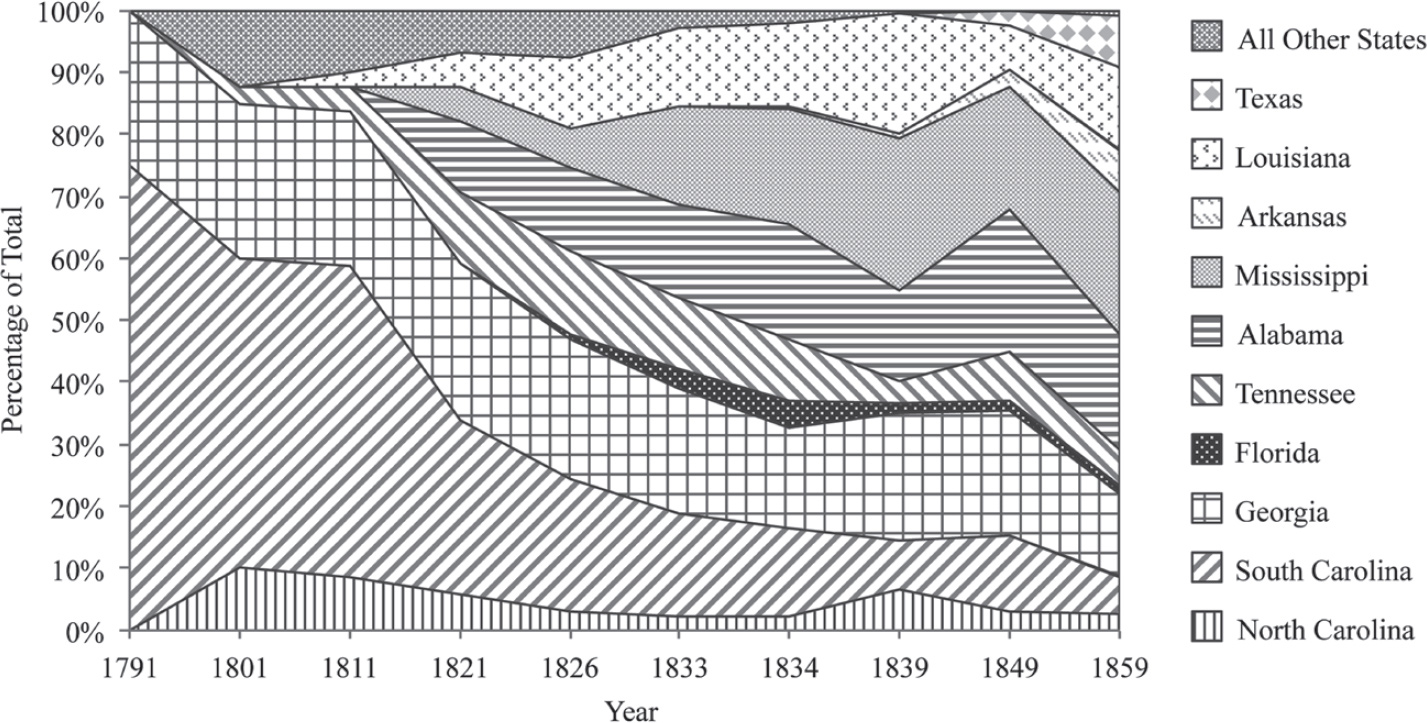
Moving westward: Production of cotton by U.S. states, 1790–1860
(illustration credit 5.2)
The entry of the United States into the empire of cotton was so forceful
that cotton cultivation in the American South quickly began to reshape the
global cotton market. In 1790, three years before Whitney’s invention, the
United States had produced 1.5 million pounds of cotton; in 1800 that
number grew to 36.5 million pounds, and in 1820 to 167.5 million pounds.
Exports to Great Britain increased by a factor of ninety-three between 1791
and 1800, only to multiply another seven times by 1820. By 1802 the United
States was already the single most important supplier of cotton to the British
market, and by 1857 it would produce about as much cotton as China.
American upland cotton, which Whitney’s gin worked up so e
ɽciently, was
exceedingly well suited to the requirements of British manufacturers: While
the gin damaged the
ɹber, the cotton remained suitable for the production
of cheaper, coarser yarns and fabrics in high demand among the lower
classes in Europe and elsewhere. But for American supplies, the miracle of
the mass production of yarn and cloth, and the ability of new consumers to
buy these cheap goods, would have foundered on old realities of the
traditional cotton market. The much-vaunted consumer revolution in textiles
stemmed from a dramatic transformation in the structure of plantation
slavery.
14
The rise of the United States to dominance in world cotton markets was a
radical reversal of fortunes. But why did it happen? As Tench Coxe pointed
out in 1817, climate and soil alone did not explain the cotton-producing
potential of the United States, because, as he put it, the white gold “can be
cultivated in an immense district of the productive zones of the earth.”
15
What distinguished the United States from virtually every other cotton-
growing area in the world was planters’ command of nearly unlimited
supplies of land, labor, and capital, and their unparalleled political power.
In the Ottoman Empire and India, as we know, powerful indigenous rulers
controlled the land, and deeply entrenched social groups struggled over its
use. In the West Indies and Brazil, sugar planters competed for land, labor,
and power. The United States, and its plentiful land, faced no such
encumbrances.
Ever since the
ɹrst European settlers stepped oʃ their boats, they had
pushed inland. The land’s native inhabitants had to reckon with what these
boats brought—
ɹrst germs, later
steel. In the late eighteenth century, Native
Americans still controlled substantial territories only a few hundred miles
inland from the coastal provinces, yet they were unable to stop the white
settlers’ steady encroachment. The settlers eventually won a bloody and
centuries-long war, succeeding in turning the land of Native Americans into
land that was legally “empty.” This was a land whose social structures had
been catastrophically weakened or eliminated, a land without most of its
people and thus without the entanglements of history. In terms of
unencumbered land, the South had no rival in the cotton-growing world.
With the support of southern politicians, the federal government
aggressively secured new territories by acquiring land from foreign powers
and from forced cessions by Native Americans. In 1803, the Louisiana
Purchase nearly doubled the territory of the United States, in 1819 the
United States acquired Florida from Spain, and in 1845 it annexed Texas. All
of these acquisitions contained lands superbly suited to cotton agriculture.
Indeed, by 1850, 67 percent of U.S. cotton grew on land that had not been
part of the United States half a century earlier. The
ɻedging U.S.
government had inaugurated the military-cotton complex.
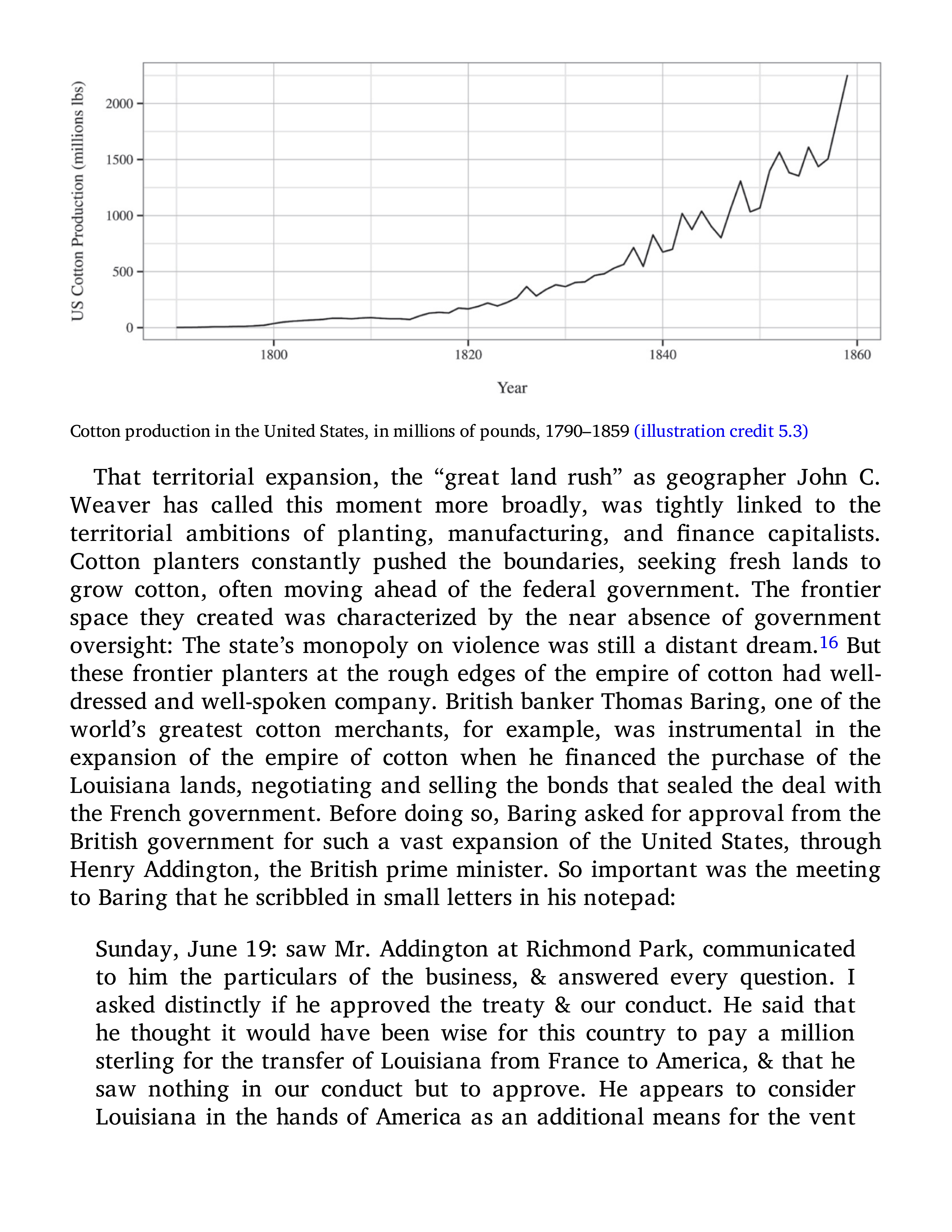
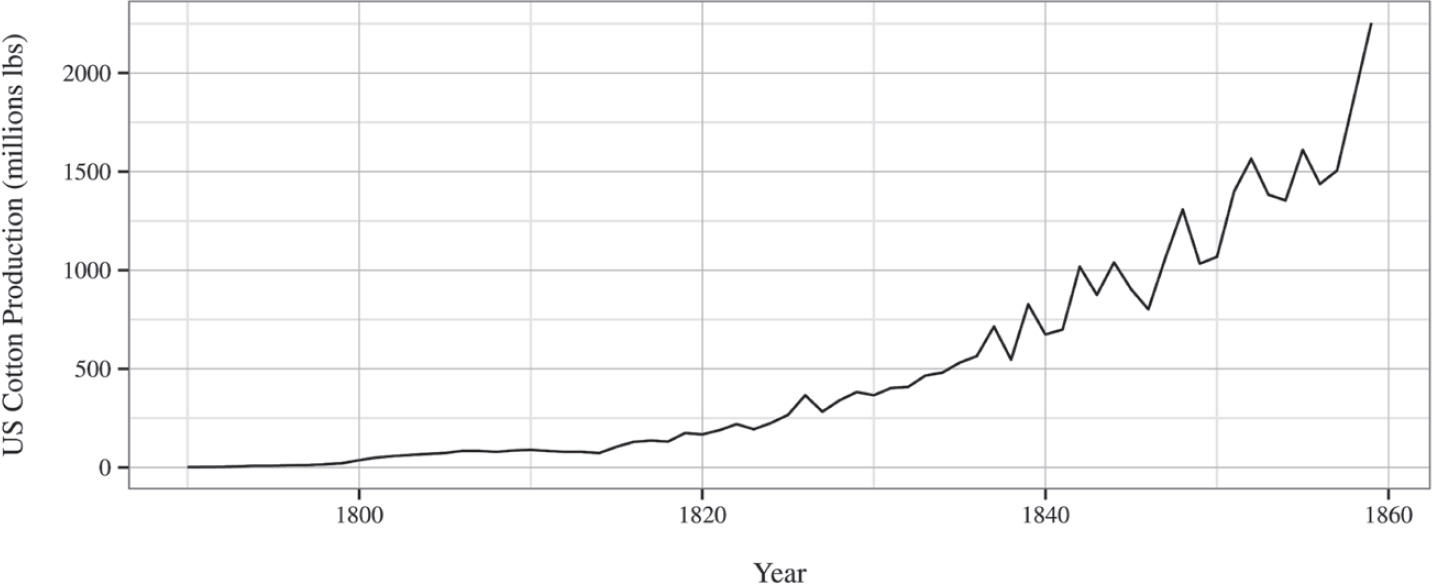
Cotton production in the United States, in millions of pounds, 1790–1859
(illustration credit 5.3)
That territorial expansion, the “great land rush” as geographer John C.
Weaver has called this moment more broadly, was tightly linked to the
territorial ambitions of planting, manufacturing, and
ɹnance capitalists.
Cotton planters constantly pushed the boundaries, seeking fresh lands to
grow cotton, often moving ahead of the federal government. The frontier
space they created was characterized by the near absence of government
oversight: The state’s monopoly on violence was still a distant dream.
16
But
these frontier planters at the rough edges of the empire of cotton had well-
dressed and well-spoken company. British banker Thomas Baring, one of the
world’s greatest cotton merchants, for example, was instrumental in the
expansion of the empire of cotton when he
ɹnanced the purchase of the
Louisiana lands, negotiating and selling the bonds that sealed the deal with
the French government. Before doing so, Baring asked for approval from the
British government for such a vast expansion of the United States, through
Henry Addington, the British prime minister. So important was the meeting
to Baring that he scribbled in small letters in his notepad:
Sunday, June 19: saw Mr. Addington at Richmond Park, communicated
to him the particulars of the business, & answered every question. I
asked distinctly if he approved the treaty & our conduct. He said that
he thought it would have been wise for this country to pay a million
sterling for the transfer of Louisiana from France to America, & that he
saw nothing in our conduct but to approve. He appears to consider
Louisiana in the hands of America as an additional means for the vent
of our manufacturers & Co. in preference to France, besides other
motives which we did not discuss, directly of a political nature.
17
The thrust south and west was far more than just planters searching for
fresh land. Expansion served many interests: of a rapidly consolidating
state, of western farmers hoping for an outlet to the sea, of manufacturers’
need for raw materials, and of British economic and political desires. As
industrial capitalism expanded, the zone of war capitalism continued to
push outward.
But international treaties alone were not su
ɽcient. To make the land
useful to planters, this newly consolidated territory needed to be removed
from the control of its native inhabitants. Already in the early 1800s, the
Creeks, under duress, had given up claims to land in Georgia that was then
converted into cotton farms. A decade later the Creeks su
ʃered further
defeats and were forced to sign the Treaty of Fort Jackson, ceding 23
million acres of land in what is today Alabama and Georgia. In the years
after 1814, the federal government signed further treaties with the Creeks,
Chickasaw, and Choctaws, gaining control over millions of acres of land in
the South, including Andrew Jackson’s 1818 treaty with the Chickasaw
nation that opened western Tennessee to cotton cultivation and the 1819
treaty with the Choctaw nation that gave 5 million acres of land in the
Yazoo-Mississippi Delta to the United States in exchange for vastly inferior
lands in Oklahoma and Arkansas. Alabama congressman David Hubbard
invited the New York and Mississippi Land Company in 1835 to purchase
lands from which the Chickasaw had been expelled, which were then turned
into cotton lands: “If on my return I should meet with any thing from you in
the shape of a distinct proposition to take hold of the public lands in the
Chickasaw Nation, I shall then be ready to act immediately, according to the
magnitude of your scheme & shall shape my course so as to meet fully the
views of your capitalists in my future operation.” The company bought
approximately twenty-
ɹve thousand acres. In 1838, federal troops began
removing the Cherokee nation from their ancestral homeland in Georgia,
which was to be turned into cotton plantations. Farther south, in Florida,
extraordinarily rich cotton lands were expropriated from the Seminoles
between 1835 and 1842, the longest war in U.S. history until the Vietnam
War. It is no wonder that Mississippi planters, argues one historian, had “an
obsessive concern with well-organized and trained militias, adequate
weaponry, and a responsive federal army.”
18
Native Americans understood the underlying foundations of the expanding
military-cotton complex: Upon removal in 1836, the chief of the Cherokees,
John Ross, in a letter to Congress decried that “our property may be
plundered before our eyes; violence may be committed on our persons; even
our lives may be taken away, and there is none to regard our complaints.
We are denationalized; we are disenfranchised. We are deprived of
membership in the human family!” The coercion and violence required to
mobilize slave labor was matched only by the demands of an expansionist
war against indigenous people. Nothing of this kind had even been dreamed
of in Anatolia or Gujarat.
19
If the project of continental consolidation provided access to new cotton
lands, it also secured major rivers needed to carry the cotton. America’s
remarkably cheap transportation costs were not preordained, but the direct
result of the expansion of its national territory. Most signi
ɹcant here was
the Mississippi, whose surge of cotton freight turned New Orleans, at the
river’s mouth, into the key American cotton port. But other rivers—the Red
River in Louisiana and the Tombigbee and Mobile in Alabama—mattered as
well. The
ɹrst steamboats appeared on the Mississippi in 1817, reducing
transport costs, and by the 1830s, railroads connected the new hinterland to
river and seaports. The most modern technologies thus made the most brutal
exploitation of human labor possible.
20
The insatiable demand of cotton planters dominated the politics of the
new nation, not just because of their reliance on the state to secure and
empty new land, but also because of their need for coerced labor. Planters
in the United States, unlike elsewhere, enjoyed access to large supplies of
cheap labor—what the
American Cotton Planter
would call “the cheapest and
most available labor in the world.” Cotton, until the advent of mechanized
harvesting during the 1940s, was a labor-intensive crop. Even more than the
hours required to spin and weave, the shortage of workers to harvest was
the most constraining factor in its production. “The true limitation upon the
production of cotton,” argued the southern journal
De Bow’s Review
, “is
labor.” In the complex agricultural structures of Mughal India and the
Ottoman Empire, rural cultivators had to
ɹrst secure
subsistence crops for
their own use, thus limiting what they harvested for the market. Indeed, as
we have seen, the shortage of labor had been one of the principal
constraints on production in western Anatolia and had frustrated e
ʃorts to
create cotton plantations in India. In Brazil, where slave labor was
available, cotton competed poorly with the even greater labor requirements
of sugar plantations. And with the British abolition of the slave trade in
1807 it became di
ɽcult for West Indian planters to recruit labor.
21
In the United States, however, nearly any shortage could be
ɹxed, with
the right amount of money. The slave markets in New Orleans and
elsewhere boomed as cotton did. And as signi
ɹcant, hundreds of thousands
of slaves were available to grow cotton because tobacco production in the
states of the upper South became less pro
ɹtable after the American
Revolution, encouraging slave owners there to sell their human property. As
one British observer remarked perceptively in 1811, “The cultivation of
tobacco in Virginia and Maryland, has been less of late an object of
attention; and the gangs of negroes formerly engaged in it, have been sent
into the southern states, where the American cotton planter, thus reinforced,
is enabled to commence his operations with increasing vigour.” Indeed, by
1830 fully 1 million people (or one in thirteen Americans) grew cotton in
the United States—most of them slaves.
22
The expansion of cotton production, as a result, reinvigorated slavery and
led to an enormous shift of slave labor from the upper to the lower South. In
the thirty years after the invention of the gin alone (between 1790 and
1820), a quarter million slaves were forcefully relocated, while between
1783 and the closing of the international slave trade in 1808, traders
imported an estimated 170,000 slaves into the United States—or one-third of
all slaves imported into North America since 1619. Altogether, the internal
slave trade moved up to a million slaves forcefully to the Deep South, most
to grow cotton.
23
To be sure, not all cotton in the United States was grown by slaves on
large plantations. Small farmers in the southern upcountry produced cotton
as well, and they did so because it provided ready cash and its cultivation,
unlike the growing of sugar or rice, did not require signi
ɹcant capital
investments. Yet despite their e
ʃorts, in aggregate they produced only a
small share of the total crop. As we have seen the world over, small farmers
focused on securing subsistence crops before growing marketable
commodities. Indeed, 85 percent of all cotton picked in the South in 1860
was grown on units larger than a hundred acres; the planters who owned
those farms owned 91.2 percent of all slaves. The larger the farm, the better
the planter was able to take advantage of the economies of scale inherent in
slave-based cotton production. Larger farms could a
ʃord the gins to remove
seeds and presses to compress loose cotton into tightly pressed bales to
lower shipping costs, they could engage in agricultural experiments to wrest
more nutrients from cleared soil, and they could buy more slaves to avoid
any labor constraints.
24
Cotton demanded quite literally a hunt for labor
and a perpetual struggle for its control. Slave traders, slave pens, slave
auctions, and the attendant physical and psychological violence of holding
millions in bondage were of central importance to the expansion of cotton
production in the United States and of the Industrial Revolution in Great
Britain.
Better than anyone else, slaves understood the violent foundation of
cotton’s success. If given an opportunity, they testi
ɹed in vivid detail to its
brutality. John Brown, a fugitive slave, remembered in 1854 how he was
“
ɻogged…with the cow-hide,” and how overseers “hunt[ed] ‘stray niggers.’ ”
“When the price [of cotton] rises in the English market,” he remembered,
“the poor slaves immediately feel the e
ʃects, for they are harder driven, and
the whip is kept more constantly going.” Henry Bibb, another slave,
remembered the fearful violence: “At the sound of the overseer’s horn, all
the slaves came forward and witnessed my punishment. My clothing was
stripped o
ʃ and I was compelled to lie down on the ground with my face to
the earth. Four stakes were driven in the ground, to which my hands and
feet were tied. Then the overseer stood over me with the lash.”
25
The expansion of cotton manufacturing in Great Britain depended on
violence across the Atlantic. Cotton, emptied lands, and slavery indeed
became so closely connected to one another that Liverpool cotton merchant
William Rathbone VI, on a trip to the United States in 1849, reported to his
father that “negroes & everything here
ɻuctuates with Cotton.” So crucial
was slave labor that the
Liverpool Chronicle and European Times
warned that
if slaves ever should be emancipated, cotton cloth prices might double or
triple, with devastating consequences for Britain. While brutal coercion
weighed like a nightmare upon millions of American slaves, the potential
end of such violence was a nightmare to those who gathered the fabulous
pro
ɹts of the empire of cotton.
26
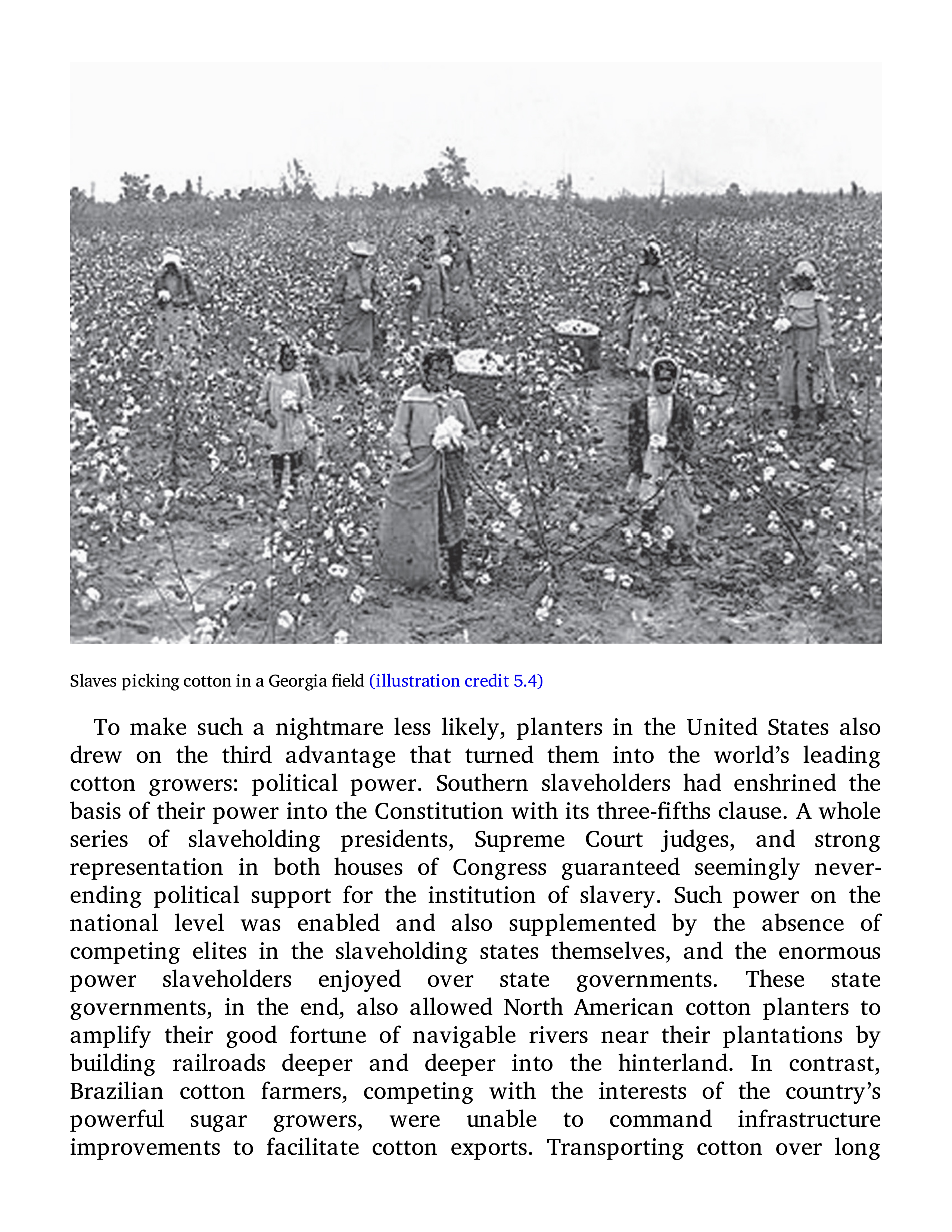
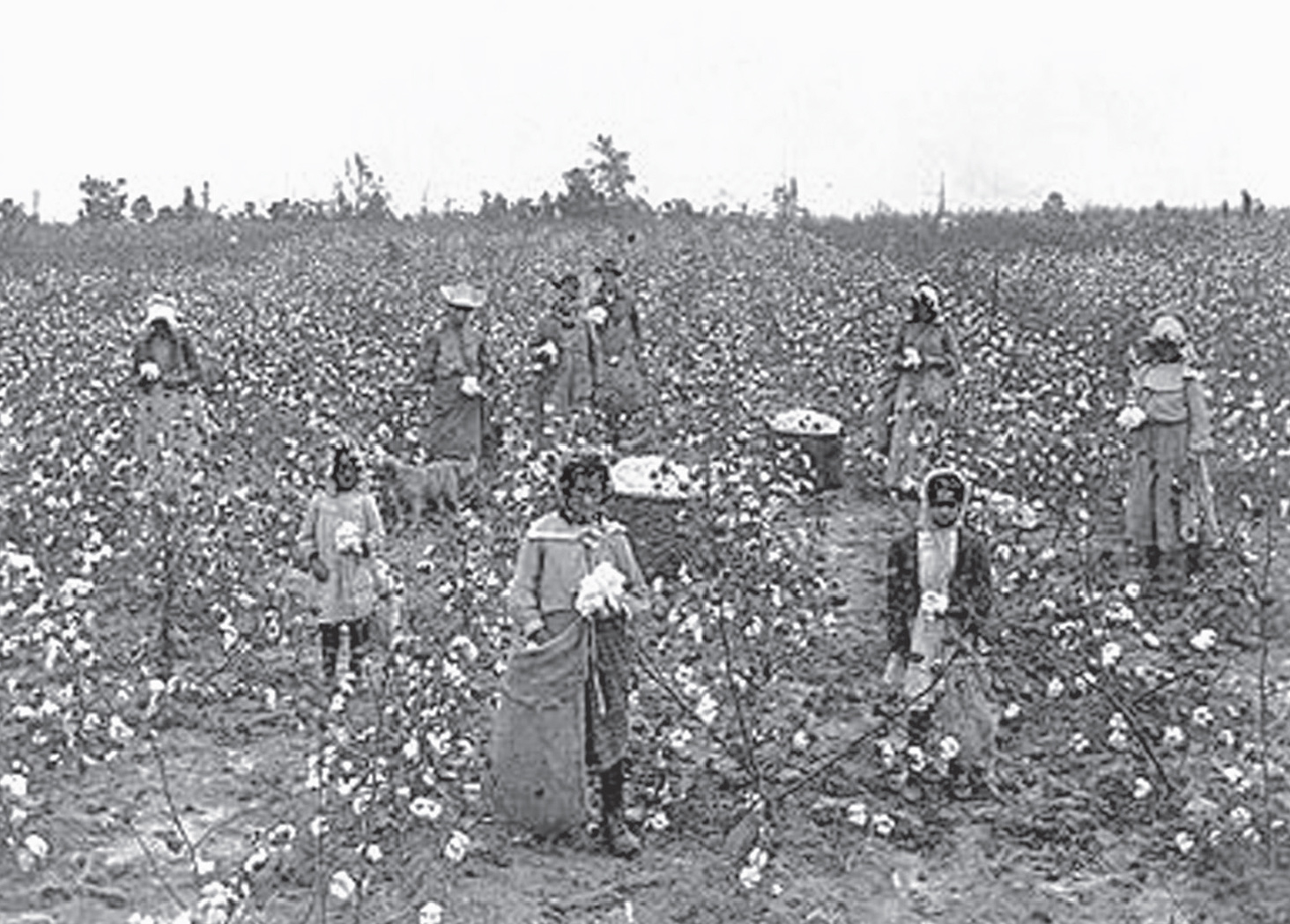
Slaves picking cotton in a Georgia
ɹeld
(illustration credit 5.4)
To make such a nightmare less likely, planters in the United States also
drew on the third advantage that turned them into the world’s leading
cotton growers: political power. Southern slaveholders had enshrined the
basis of their power into the Constitution with its three-
ɹfths clause. A whole
series of slaveholding presidents, Supreme Court judges, and strong
representation in both houses of Congress guaranteed seemingly never-
ending political support for the institution of slavery. Such power on the
national level was enabled and also supplemented by the absence of
competing elites in the slaveholding states themselves, and the enormous
power
slaveholders
enjoyed
over
state
governments.
These
state
governments, in the end, also allowed North American cotton planters to
amplify their good fortune of navigable rivers near their plantations by
building railroads deeper and deeper into the hinterland. In contrast,
Brazilian cotton farmers, competing with the interests of the country’s
powerful sugar growers, were unable to command infrastructure
improvements to facilitate cotton exports. Transporting cotton over long
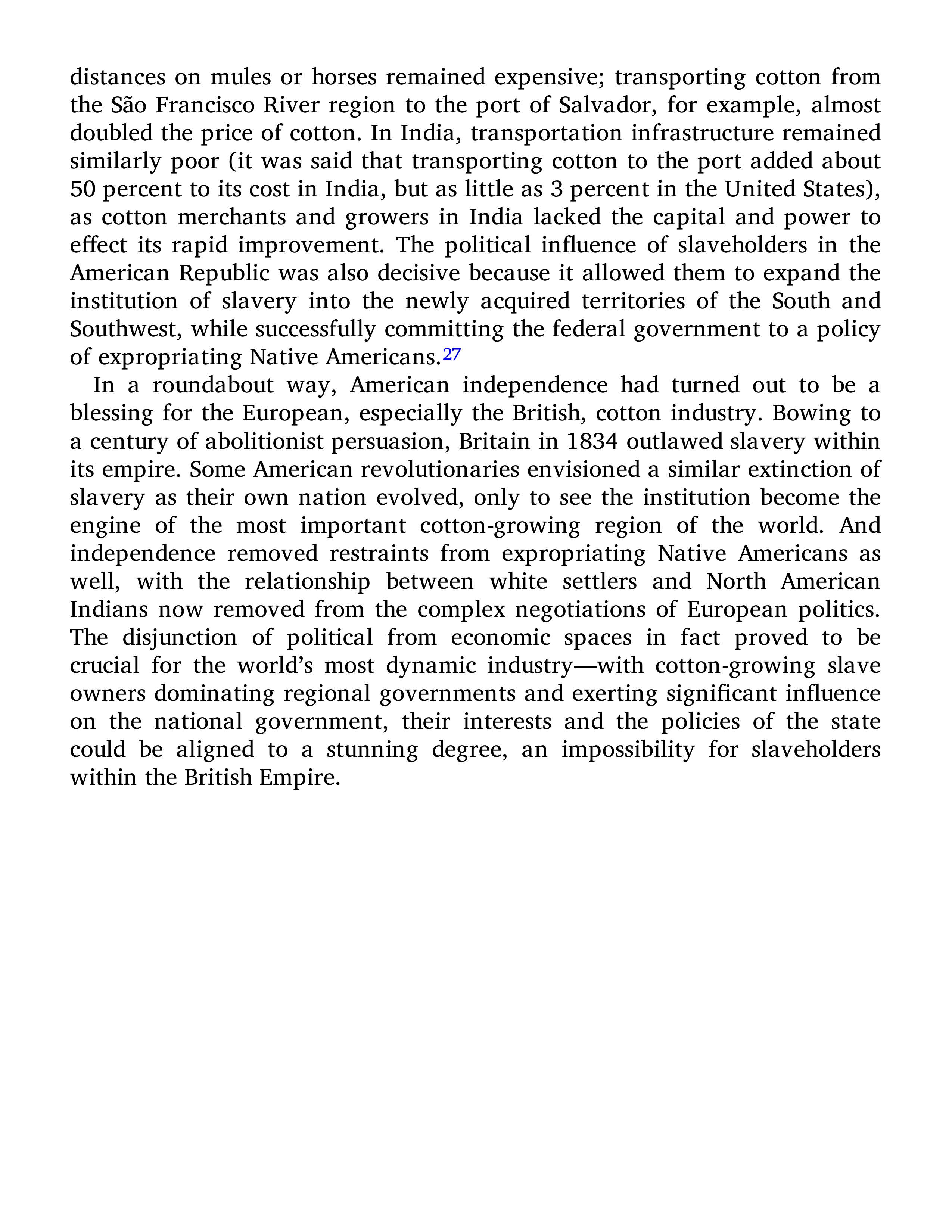
distances on mules or horses remained expensive; transporting cotton from
the São Francisco River region to the port of Salvador, for example, almost
doubled the price of cotton. In India, transportation infrastructure remained
similarly poor (it was said that transporting cotton to the port added about
50 percent to its cost in India, but as little as 3 percent in the United States),
as cotton merchants and growers in India lacked the capital and power to
e
ʃect its rapid improvement. The political inɻuence of slaveholders in the
American Republic was also decisive because it allowed them to expand the
institution of slavery into the newly acquired territories of the South and
Southwest, while successfully committing the federal government to a policy
of expropriating Native Americans.
27
In a roundabout way, American independence had turned out to be a
blessing for the European, especially the British, cotton industry. Bowing to
a century of abolitionist persuasion, Britain in 1834 outlawed slavery within
its empire. Some American revolutionaries envisioned a similar extinction of
slavery as their own nation evolved, only to see the institution become the
engine of the most important cotton-growing region of the world. And
independence removed restraints from expropriating Native Americans as
well, with the relationship between white settlers and North American
Indians now removed from the complex negotiations of European politics.
The disjunction of political from economic spaces in fact proved to be
crucial for the world’s most dynamic industry—with cotton-growing slave
owners dominating regional governments and exerting signi
ɹcant inɻuence
on the national government, their interests and the policies of the state
could be aligned to a stunning degree, an impossibility for slaveholders
within the British Empire.
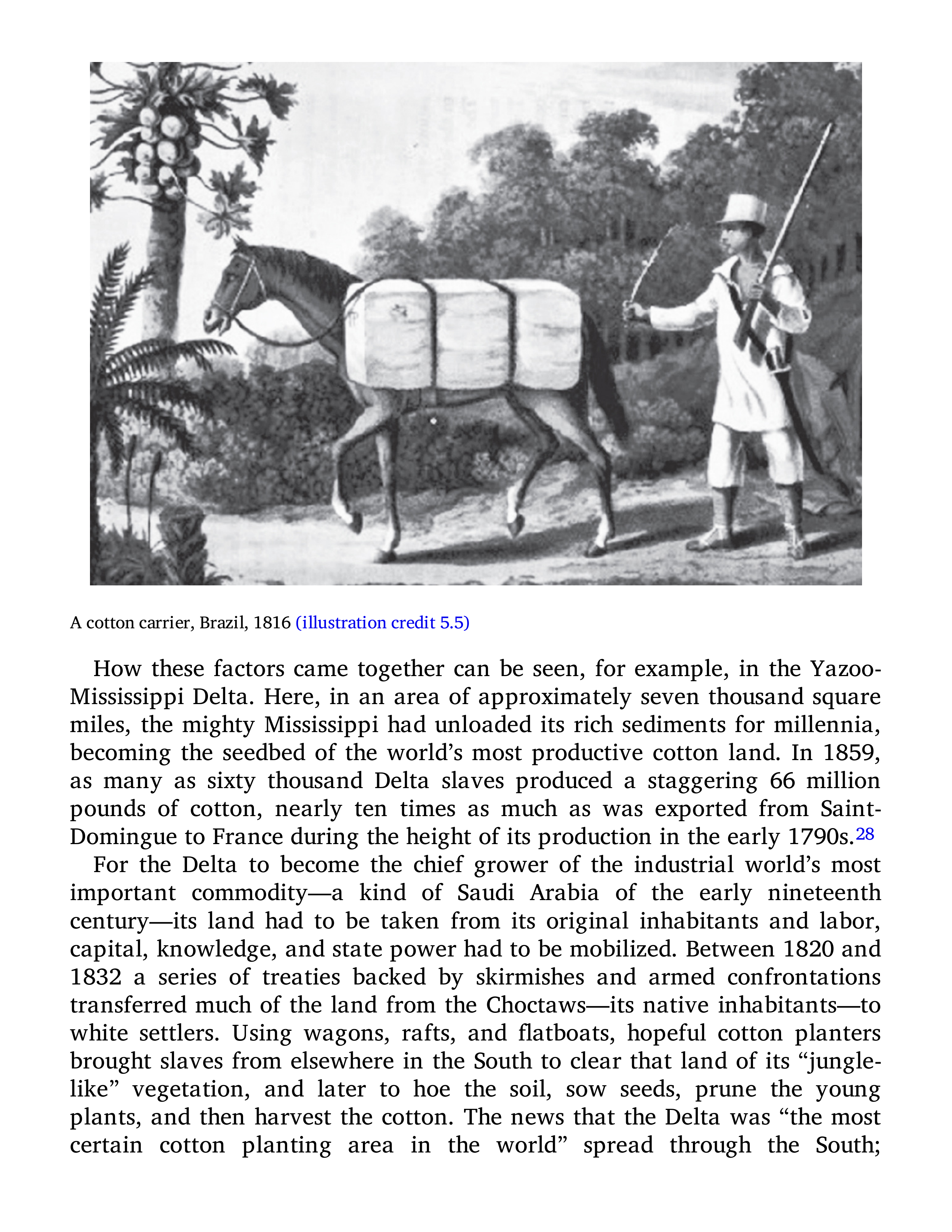
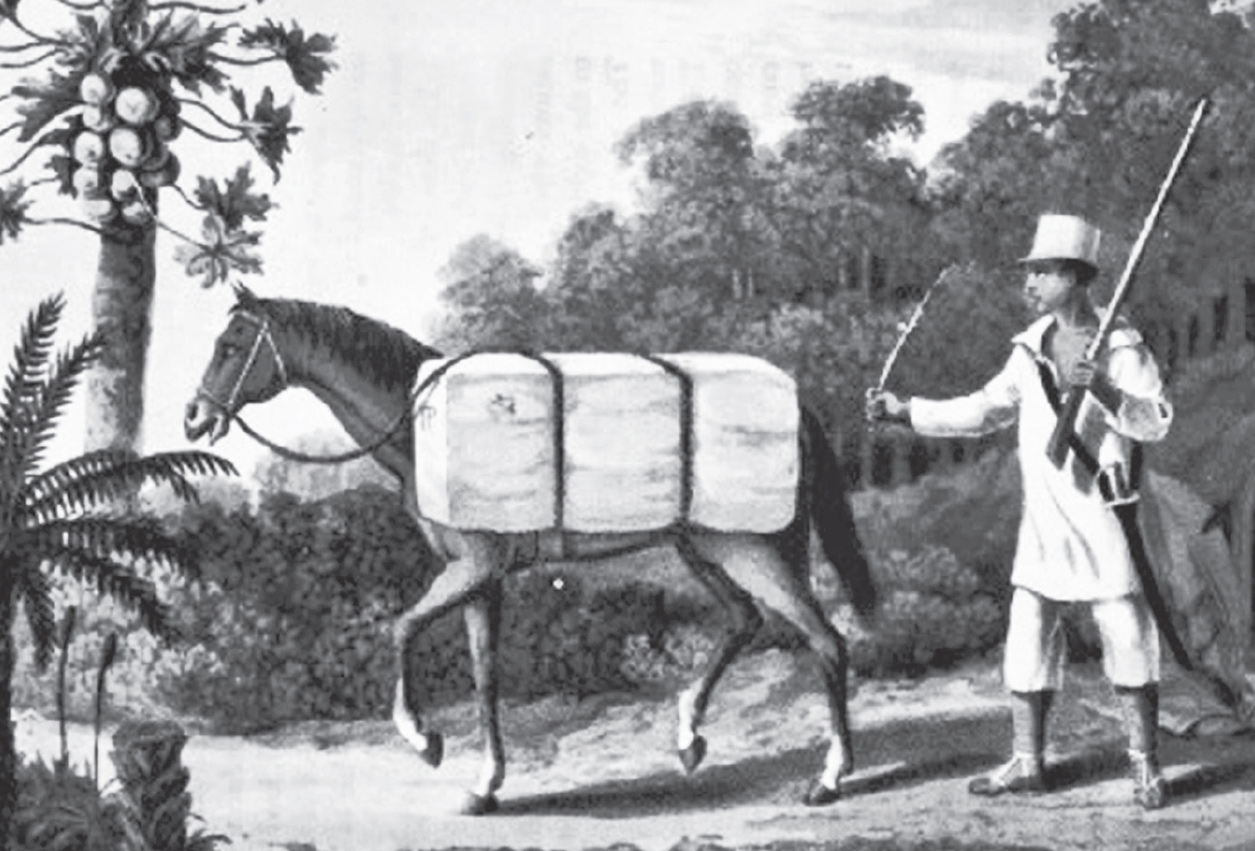
A cotton carrier, Brazil, 1816
(illustration credit 5.5)
How these factors came together can be seen, for example, in the Yazoo-
Mississippi Delta. Here, in an area of approximately seven thousand square
miles, the mighty Mississippi had unloaded its rich sediments for millennia,
becoming the seedbed of the world’s most productive cotton land. In 1859,
as many as sixty thousand Delta slaves produced a staggering 66 million
pounds of cotton, nearly ten times as much as was exported from Saint-
Domingue to France during the height of its production in the early 1790s.
28
For the Delta to become the chief grower of the industrial world’s most
important commodity—a kind of Saudi Arabia of the early nineteenth
century—its land had to be taken from its original inhabitants and labor,
capital, knowledge, and state power had to be mobilized. Between 1820 and
1832 a series of treaties backed by skirmishes and armed confrontations
transferred much of the land from the Choctaws—its native inhabitants—to
white settlers. Using wagons, rafts, and
ɻatboats, hopeful cotton planters
brought slaves from elsewhere in the South to clear that land of its “jungle-
like” vegetation, and later to hoe the soil, sow seeds, prune the young
plants, and then harvest the cotton. The news that the Delta was “the most
certain cotton planting area in the world” spread through the South;
planters who were able to draw on su
ɽcient capital (mostly in the form of
labor) and expertise moved in. The plantations they built became
substantial businesses: By 1840, Washington County, in the heart of the
Delta, counted more than ten slaves for every white inhabitant. By 1850,
each and every white family in the county held on average more than eighty
slaves. The largest Delta planter, Stephen Duncan, owned 1,036 slaves and
the value of his property by the late 1850s was estimated at $1.3 million.
While not typical cotton farms, plantations in the Delta were highly
capitalized businesses, indeed among the very largest in North America, and
the investments necessary would have been beyond the reach of nearly
every northern industrialist. Wealth, as viewed from the front porches of the
lavish and elegantly furnished mansions in the Delta, appeared to
ɻow out
of the soil, the result of a strange alchemy that combined emptied lands,
slave labor, and, as we will see, the never-ending
ɻow of European
capital.
29
The growing domination of global cotton markets by planters in fact fed
upon itself. As cotton cultivation expanded in the southern United States
and as British and eventually continental European consumers became more
and more dependent on that supply, institutional links between the South
and Europe deepened. European import merchants sent agents to
Charleston, Memphis, and New Orleans. They corresponded with business
partners across the Atlantic on a regular basis. These merchants built a
dense network of shipping connections and integrated the trade in cotton
with their other businesses. People engaged in the cotton trade crossed the
North Atlantic frequently, forging close business connections, friendships,
and even marriages. Such networks, in turn, made transatlantic trade more
secure and more predictable, thus lowering costs and giving the United
States another decisive advantage over its potential competitors, such as
India or Brazil.
At the core of all of these networks was the
ɻow of cotton from the United
States to Europe and of capital in the opposite direction. This capital more
often than not was secured by mortgages on slaves, giving the owners of
these mortgages the right to a particular slave should the debtor default. As
historian Bonnie Martin has shown, in Louisiana 88 percent of loans secured
by mortgages used slaves as (partial) collateral; in South Carolina it was 82
percent. In total, she estimates that hundreds of millions of dollars of capital
was secured by property in humans. Slavery thus allowed not just for the
rapid allocation of labor, but also for a swift allocation of capital.
30
With enormous riches gained from expropriated land and labor, planters
invested in agricultural improvements, another illustration of how success
begot further success. They experimented, for example, with various cotton
hybrids drawing on Indian, Ottoman, Central American, West Indian, and
other seeds, creating cotton strains adapted to particular local climates and
soils, eventually crafting hundreds upon hundreds of di
ʃerent kinds of
cotton. Most signi
ɹcantly, in 1806 a Natchez planter,
Walter Burling,
brought cottonseeds from Mexico, which had larger bolls that could be more
easily picked and, according to experts, “possessed better
ɹber quality,
especially
ɹber length, and was resistant to ‘rot.’ ” This type of cotton had
been cultivated by Native Americans in the central Mexican highlands for
centuries, and once brought into the United States it was appropriated by
American planters, becoming the “basic germplasm for all subsequent
upland cotton cultivars in the United States and around the world.” The new
cotton could be picked three to four times as fast as the then common
Georgia Green Seed cotton. The cruel irony was that Amerindians’ ability to
develop a strain of cotton well suited for the American environment gave
considerable impetus to the expropriation of their lands, and made slave
labor on those lands much more productive.
31
Such innovations in labor control and agriculture were increasingly
institutionalized by the construction of dense but distinctly regional
networks for the dispersal of knowledge. Books, agricultural institutes,
journals such as
De Bow’s Review
and the
American Cotton Planter
, along with
regional agricultural conventions, all spread information about how to
select seeds, how to organize a labor force, how to read the market, how to
hoe and plant, and where to invest—in short, how to perfect a “Practical
Plantation Economy.”
32
The Industrial Revolution in Europe also actively in
ɻuenced the evolution
of slavery in the American South. Gang labor, by no means new but never
so prevalent as on cotton plantations, exempli
ɹed the new rhythm of
industrial labor, or what one author has called “military agriculture.” The
systematic mobilization of slave women and children on cotton farms
further expanded their output. As a result, cotton production in the United
States increased much faster than the number of slaves employed on farms.
Some of that increase was related to the embrace of di
ʃerent cotton plants,
but there was also a systematic intensi
ɹcation of exploitation. Plantation
slavery in the nineteenth-century United States allowed for an organization
of labor unlike what was possible in the world’s newly emerging industrial
heartland. Because plantations were frequently larger than factories and
required more substantial capital investments, and because aside from the
spike in innovation around the invention of Eli Whitney’s gin in the 1790s
technological progress in cotton agriculture was limited, productivity gains
on plantations could only result from a reorganization of labor. Slave
owners secured these productivity gains by taking almost total control of the
work process—a direct result of the violent domination of their workers.
Nothing of that sort was possible in the world’s emerging textile mills, where
workers succeeded in maintaining some of the rhythms of the farms, small
workshops, and craft guilds from whence they came.
33
The all-encompassing
control of workers—a core characteristic of capitalism—experienced its
ɹrst
great success on the cotton plantations of the American South.
Because planters dominated labor in ways radically di
ʃerent from
English
merchants’ connection to agricultural cultivators in India, or Ottoman
landowners in Anatolia, they could drive their slaves ever harder, as they
came up with increasingly brutal methods of disciplining their workforce.
Indeed, torture, according to historian Edward Baptist, was at the root of the
ability of American planters to produce ever more cotton. Innovative ways
of labor accounting further helped planters squeeze more labor out of their
workers. As management scholar Rob Cooke has argued, “There is no real
question nowadays…that it [the plantation] was a site of early development
of industrial discipline.” And with rising productivity on cotton plantations,
prices fell, allowing British manufacturers to become even more competitive
in the markets of the world, a move that, among many other things, would
eventually undermine manufacturing in India and elsewhere and make the
later integration of that countryside into the global cotton empire much
easier.
34
The rhythm of industrial production also entered the plantation in other
ways. Since the expansion of cotton agriculture depended on the advance of
credit, sometimes secured by mortgages on slaves, most of which derived
from the London money market, its patterns now followed the competitive
logic of markets rather than the whimsy of personal aspiration and regional
circumstance—capital moved to wherever cotton could be produced in the
greatest quantities and at the cheapest cost. To the great lament of southern
planters, the factor—a merchant who would sell a planter’s cotton, supply
him with goods, and provide credit—and with him the London money
market, was a decisive source of their wealth and power. But the London
money market and the Lancashire manufacturers depended just as much on
the local experts in the violent expropriation of land and labor. The old
paternalism of East Coast planters, shielded partially by the mercantilist
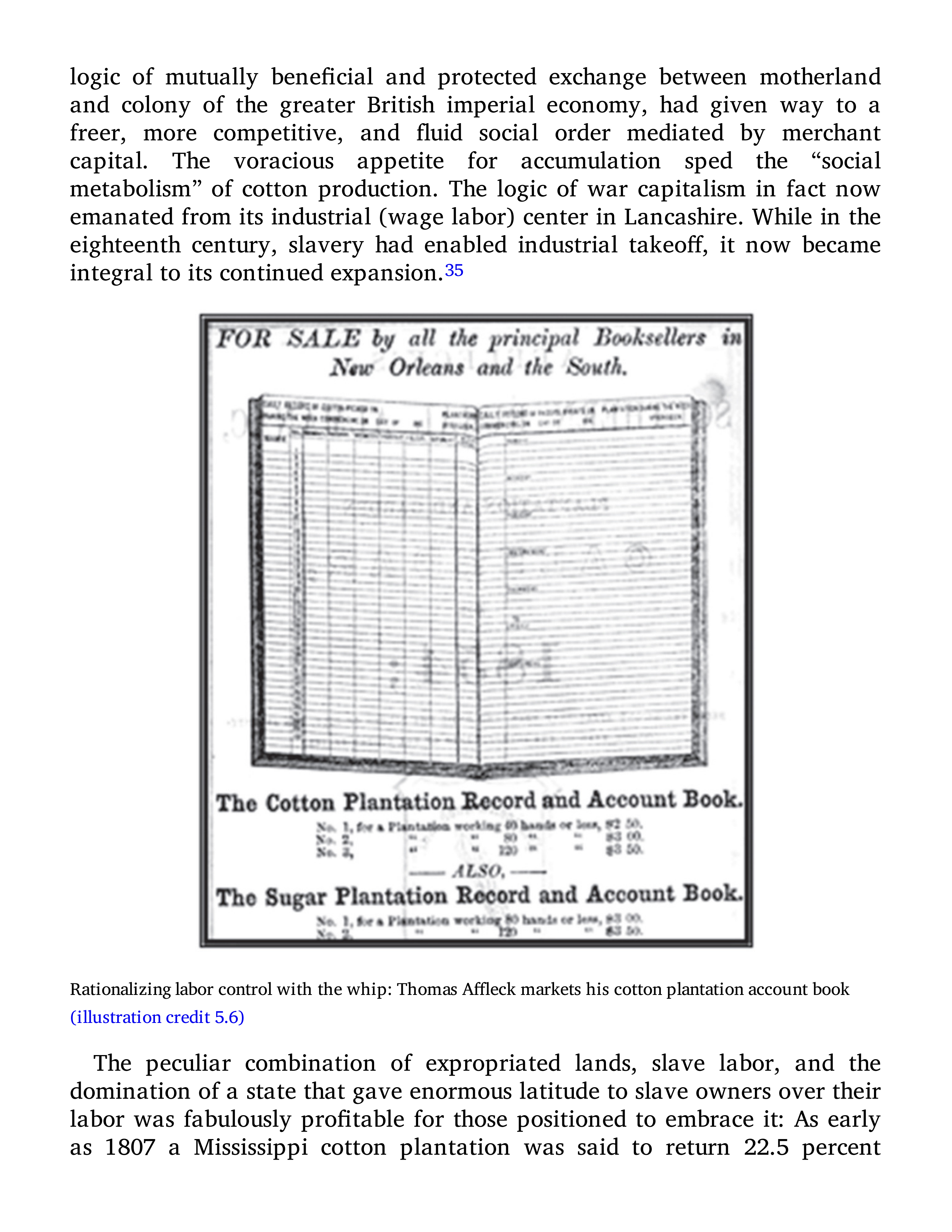
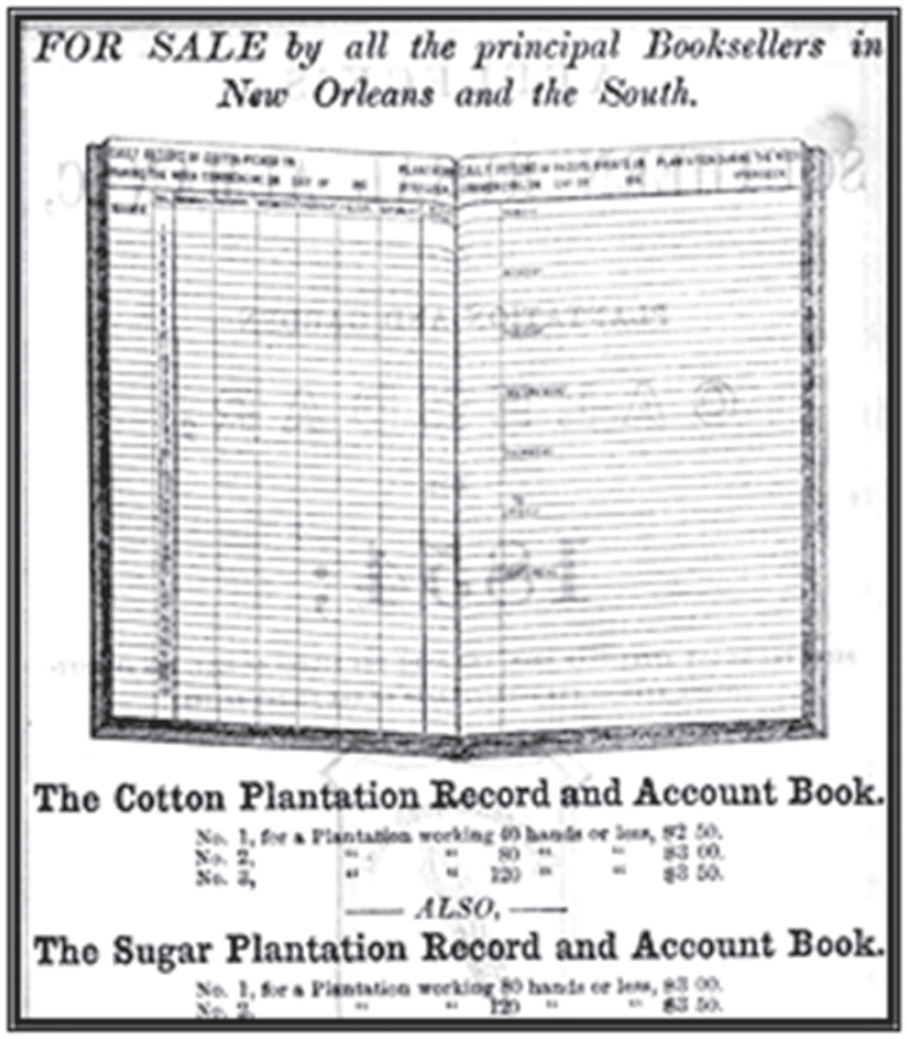
logic of mutually bene
ɹcial and protected exchange between motherland
and colony of the greater British imperial economy, had given way to a
freer, more competitive, and
ɻuid social order mediated by merchant
capital. The voracious appetite for accumulation sped the “social
metabolism” of cotton production. The logic of war capitalism in fact now
emanated from its industrial (wage labor) center in Lancashire. While in the
eighteenth century, slavery had enabled industrial takeo
ʃ, it now became
integral to its continued expansion.
35
Rationalizing labor control with the whip: Thomas A
ʀeck markets his cotton plantation account book
(illustration credit 5.6)
The peculiar combination of expropriated lands, slave labor, and the
domination of a state that gave enormous latitude to slave owners over their
labor was fabulously pro
ɹtable for those positioned to embrace it: As early
as 1807 a Mississippi cotton plantation was said to return 22.5 percent
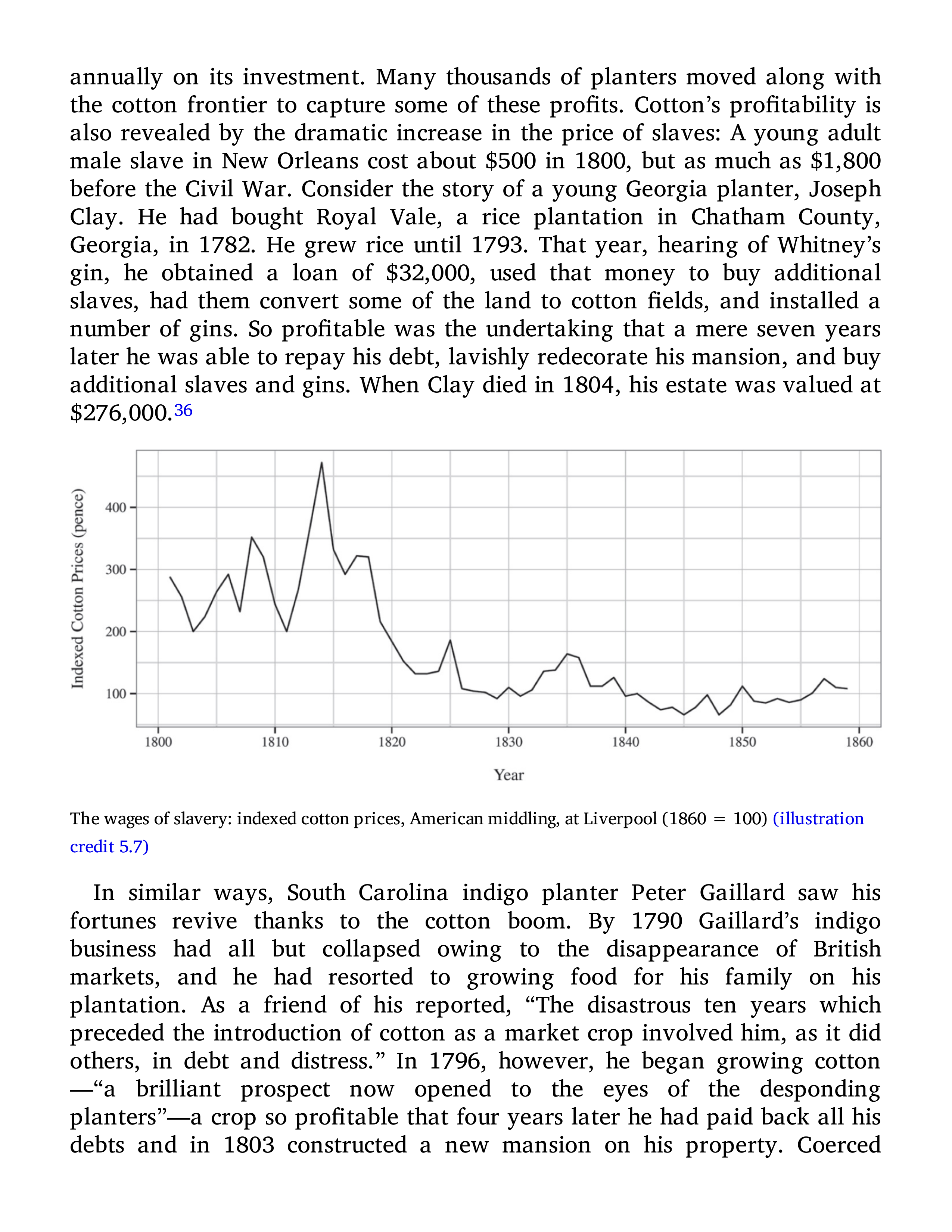
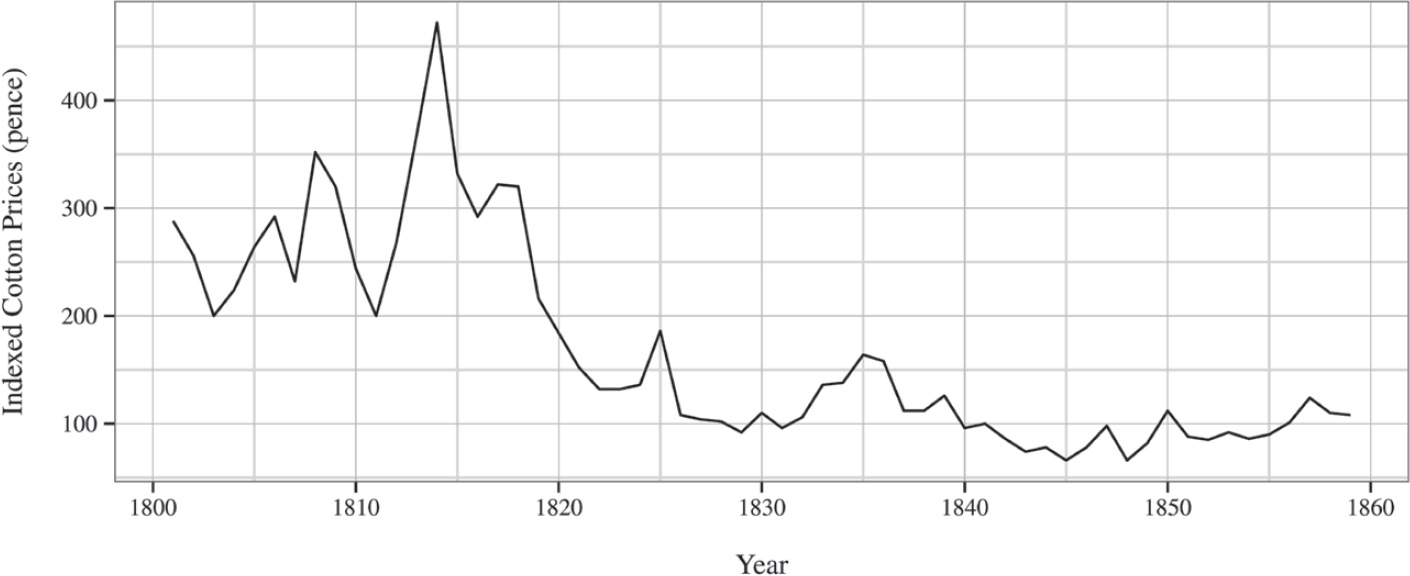
annually on its investment. Many thousands of planters moved along with
the cotton frontier to capture some of these pro
ɹts. Cotton’s
pro
ɹtability is
also revealed by the dramatic increase in the price of slaves: A young adult
male slave in New Orleans cost about $500 in 1800, but as much as $1,800
before the Civil War. Consider the story of a young Georgia planter, Joseph
Clay. He had bought Royal Vale, a rice plantation in Chatham County,
Georgia, in 1782. He grew rice until 1793. That year, hearing of Whitney’s
gin, he obtained a loan of $32,000, used that money to buy additional
slaves, had them convert some of the land to cotton
ɹelds, and installed a
number of gins. So pro
ɹtable was the undertaking that a mere seven years
later he was able to repay his debt, lavishly redecorate his mansion, and buy
additional slaves and gins. When Clay died in 1804, his estate was valued at
$276,000.
36
The wages of slavery: indexed cotton prices, American middling, at Liverpool (1860 = 100)
(illustration
credit 5.7)
In similar ways, South Carolina indigo planter Peter Gaillard saw his
fortunes revive thanks to the cotton boom. By 1790 Gaillard’s indigo
business had all but collapsed owing to the disappearance of British
markets, and he had resorted to growing food for his family on his
plantation. As a friend of his reported, “The disastrous ten years which
preceded the introduction of cotton as a market crop involved him, as it did
others, in debt and distress.” In 1796, however, he began growing cotton
—“a brilliant prospect now opened to the eyes of the desponding
planters”—a crop so pro
ɹtable that four years later he had paid back all his
debts and in 1803 constructed a new mansion on his property. Coerced
labor meant rapid pro
ɹts; by 1824 he owned ɹve hundred slaves. South
Carolinian Wade Hampton I followed suit. His
ɹrst cotton crop in 1799
allegedly netted a pro
ɹt of $75,000, and by 1810 he drew $150,000
annually from his cotton plantations. His son would eventually use some of
the pro
ɹts to relocate to the
Mississippi Delta in the mid-1840s. Prospective
cotton planter Daniel W. Jordan, surveying the opportunities for cotton
growing in Mississippi, saw “a
ɹeld to operate in and here I can make
money…. I can in this State make as much money in 5 years as a man
should want.”
37
Forti
ɹed by their wealth, conɹdent of their slave-aided ability to squeeze
ever more cotton from the land, American cotton planters came to dominate
British markets by 1802. By the 1830s they had also captured newly
emerging continental European and North American markets. As a result,
earlier producers, especially those in the West Indies, su
ʃered: “The
Competition, if left perfectly free and unrestricted, cannot be long
maintained by the Colonialists [in the West Indies]; as the same price that
yields a liberal pro
ɹt to the American Cultivator, is not adequate to defray
the charges of cultivation to the colonist,” observed an anonymous letter
writer in 1812. Other potential competitors, such as farmers in India,
planted cotton on just as much land as North Americans as late as 1850, but
their presence on world markets remained marginal.
38
As this cotton boom violently transformed huge swaths of the North
American countryside, it catapulted the United States to a pivotal role in the
empire of cotton. In 1791, capital invested in cotton production in Brazil, as
estimated by the U.S. Treasury, was still more than ten times greater than in
the United States. By 1801, only ten years later, 60 percent more capital
was invested in the cotton industry of the United States than that of Brazil.
Cotton, even more so than in the Caribbean and Brazil, infused land and
slaves alike with unprecedented value, and promised slaveholders
spectacular opportunities for pro
ɹts and power. Already by 1820, cotton
constituted 32 percent of all U.S. exports, compared to a minuscule 2.2
percent in 1796. Indeed, more than half of all American exports between
1815 and 1860 consisted of cotton. Cotton so dominated the U.S. economy
that cotton production statistics “became an increasingly vital unit in
assessing the American economy.” It was on the back of cotton, and thus on
the backs of slaves, that the U.S. economy ascended in the world.
39
So important had American cotton become to the Western world that a
German economist remarked that “a disappearance of the American North
or West would be of less signi
ɹcance to the world, than the elimination of
the South.” Southern planters, convinced of their central role in the global
economy, gleefully announced that they held “THE LEVER THAT WIELDS
THE DESTINY OF MODERN CIVILIZATION.” As the
American Cotton Planter
put it in 1853, “The slave-labor of the United States, has hitherto conferred
and is still conferring inappreciable blessings on mankind. If these blessings
continue, slave-labor must also continue, for it is idle to talk of producing
Cotton for the world’s supply with free labor. It has never yet been
successfully grown by voluntary labor.”
40
American cotton farmers had succeeded in turning themselves into the
world’s most important growers of the industrial age’s most important
commodity. Their “gigantic plantations,” observed a British merchant in
Tellicherry, India, “now supply the materials for clothing half the civilized
world.” And with slave-grown cotton pouring in from the United States, the
cost of
ɹnished cotton declined, making clothes and sheets aʃordable for a
rapidly expanding market. As the Manchester Chamber of Commerce put it
in 1825, “We are
ɹrmly persuaded that it is in great measure owing to the
very low price of the raw material that this manufacture has been of late
years so rapidly increased.” In 1845, South Carolina’s cotton planters
agreed: “Nearly one half of the population of Europe…have not now the
comfort of a cotton shirt,” constituting an “untried market…opening more
and more to our enterprize.” The world of cotton, which before 1780 had
consisted mostly of scattered regional and local networks, now increasingly
became one global matrix with a single nexus. And slavery in the United
States was its foundation.
41
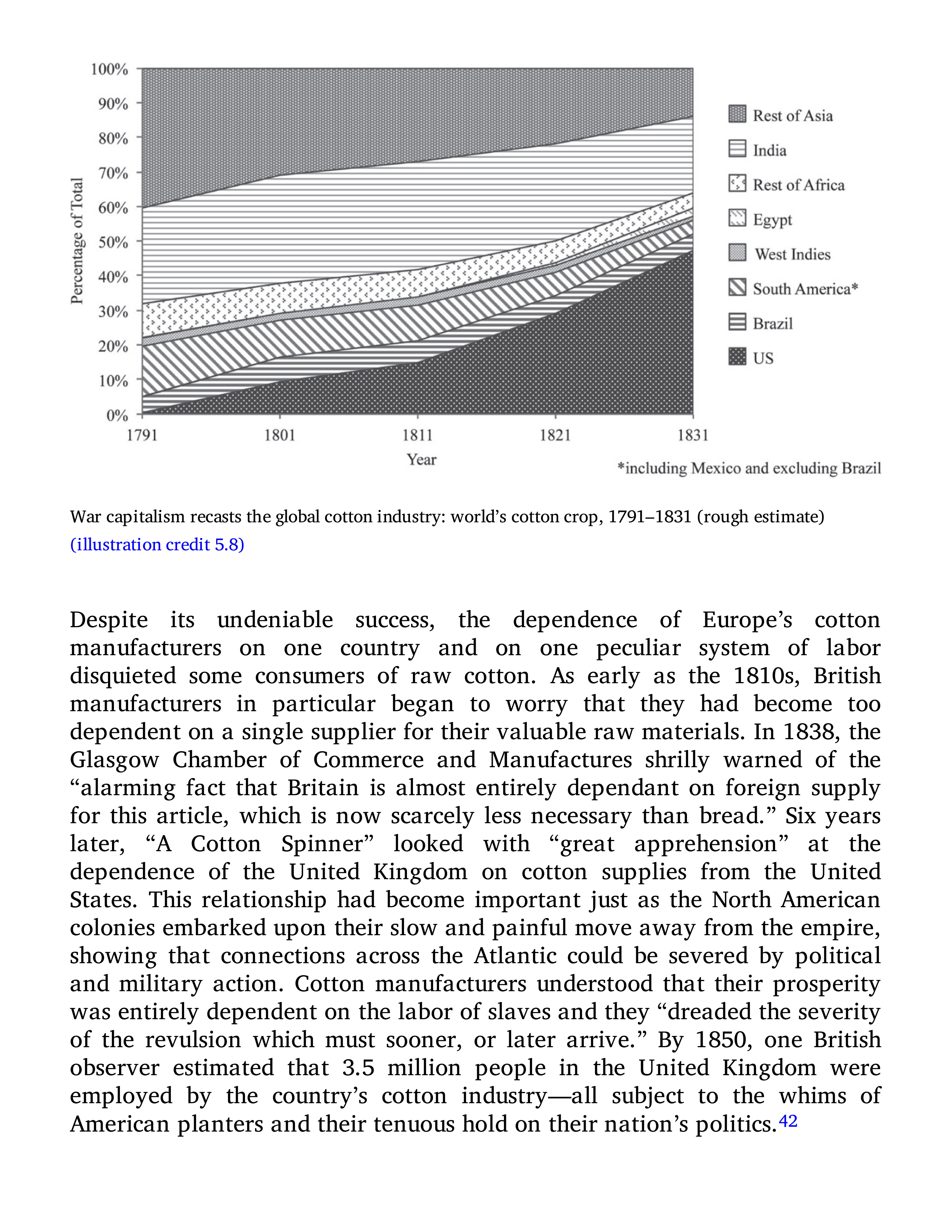
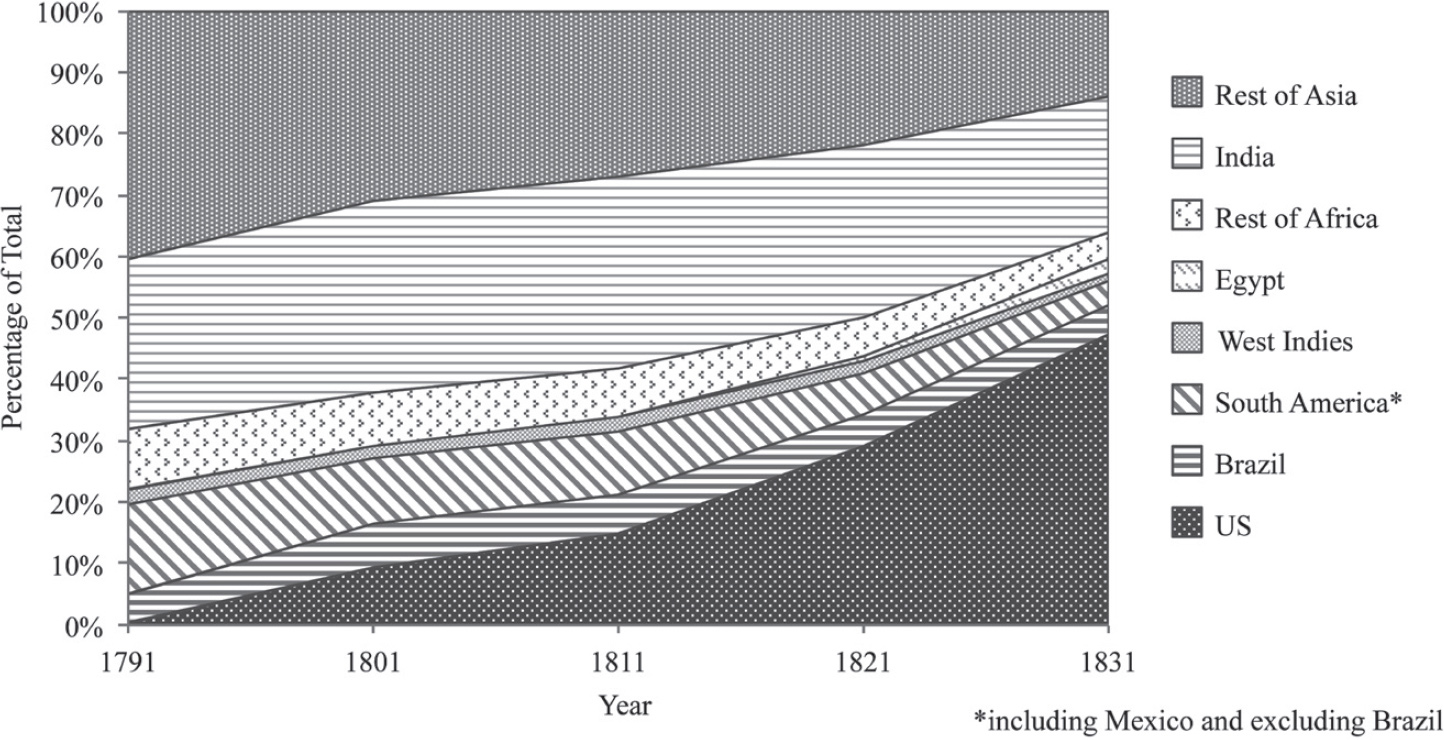
War capitalism recasts the global cotton industry: world’s cotton crop, 1791–1831 (rough estimate)
(illustration credit 5.8)
Despite its undeniable success, the dependence of Europe’s cotton
manufacturers on one country and on one peculiar system of labor
disquieted some consumers of raw cotton. As early as the 1810s, British
manufacturers in particular began to worry that they had become too
dependent on a single supplier for their valuable raw materials. In 1838, the
Glasgow Chamber of Commerce and Manufactures shrilly warned of the
“alarming fact that Britain is almost entirely dependant on foreign supply
for this article, which is now scarcely less necessary than bread.” Six years
later, “A Cotton Spinner” looked with “great apprehension” at the
dependence of the United Kingdom on cotton supplies from the United
States. This relationship had become important just as the North American
colonies embarked upon their slow and painful move away from the empire,
showing that connections across the Atlantic could be severed by political
and military action. Cotton manufacturers understood that their prosperity
was entirely dependent on the labor of slaves and they “dreaded the severity
of the revulsion which must sooner, or later arrive.” By 1850, one British
observer estimated that 3.5 million people in the United Kingdom were
employed by the country’s cotton industry—all subject to the whims of
American planters and their tenuous hold on their nation’s politics.
42
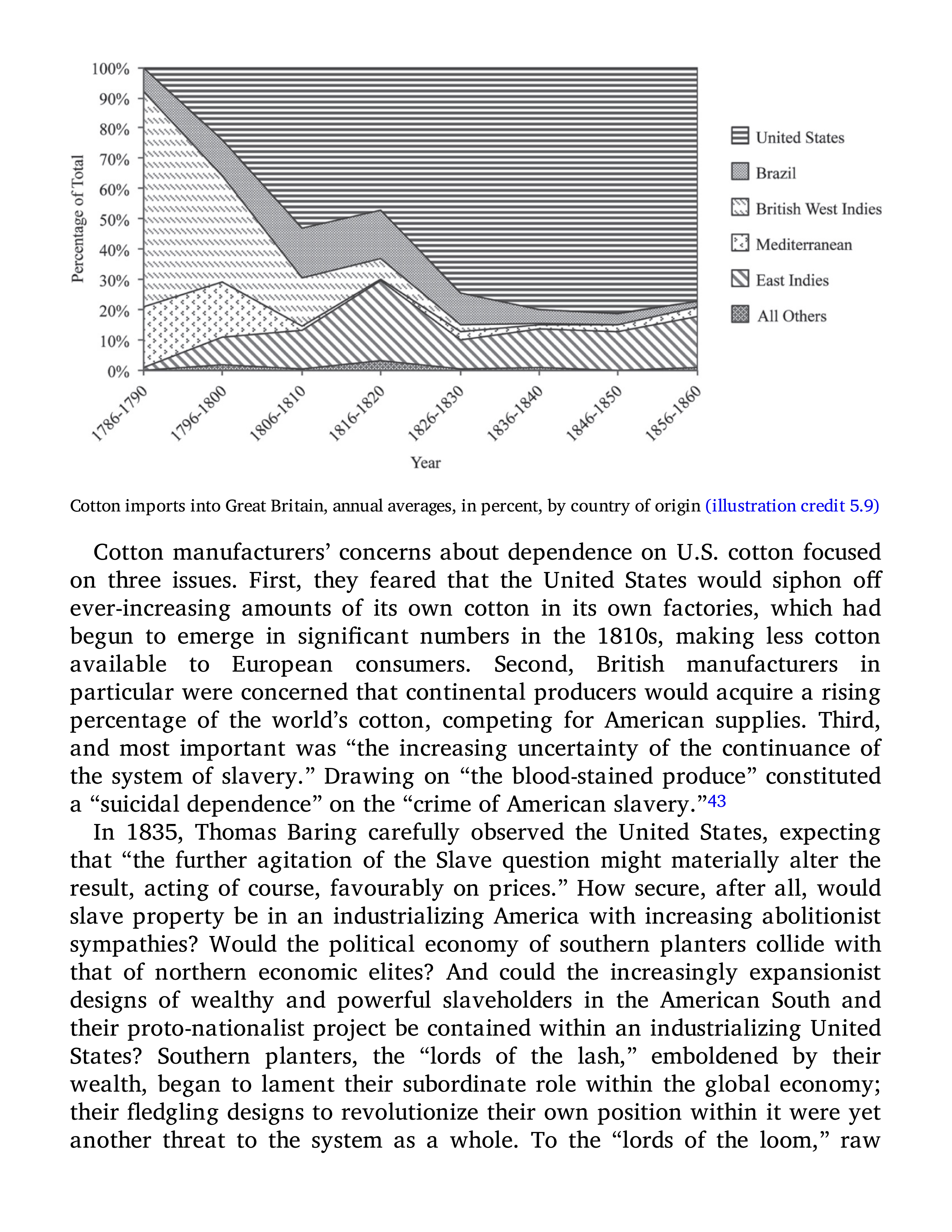
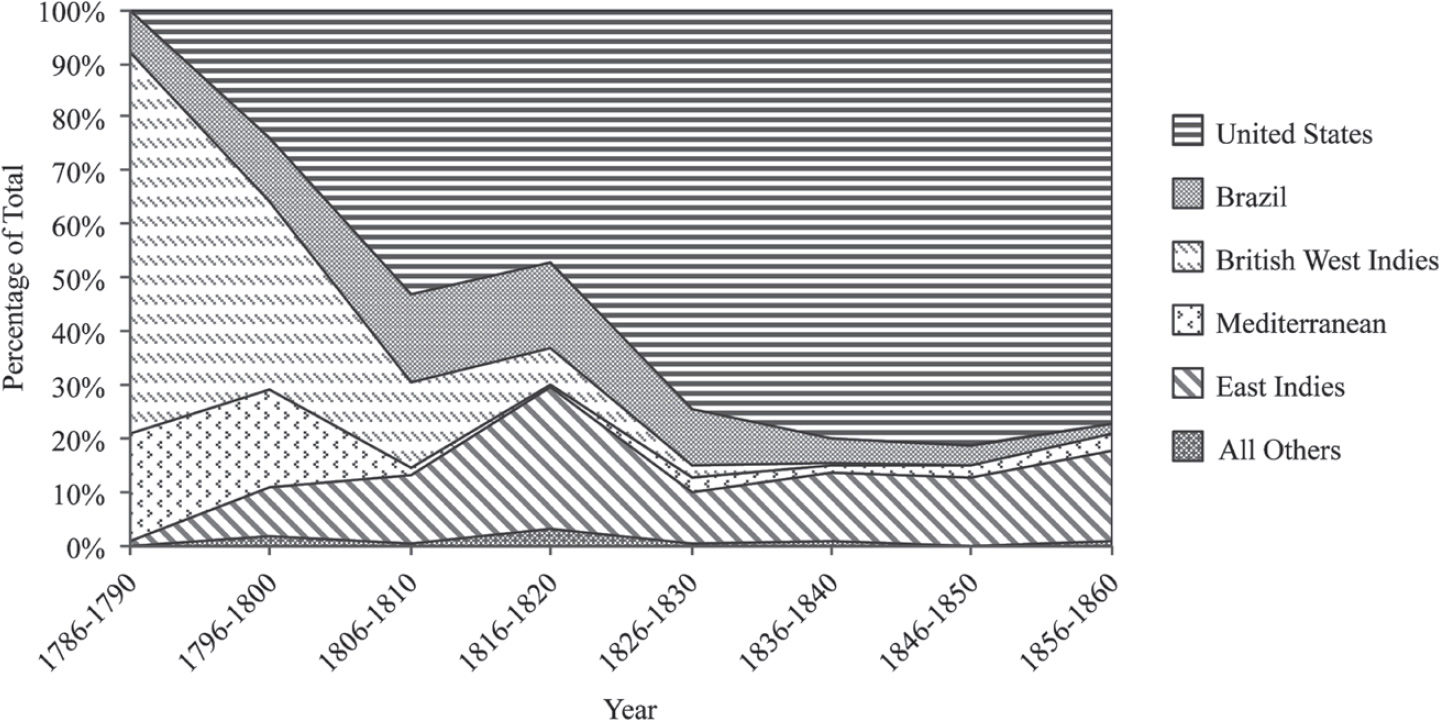
Cotton imports into Great Britain, annual averages, in percent, by country of origin
(illustration credit 5.9)
Cotton manufacturers’ concerns about dependence on U.S. cotton focused
on three issues. First, they feared that the United States would siphon o
ʃ
ever-increasing amounts of its own cotton in its own factories, which had
begun to emerge in signi
ɹcant numbers in the 1810s, making less cotton
available to European consumers. Second, British manufacturers in
particular were concerned that continental producers would acquire a rising
percentage of the world’s cotton, competing for American supplies. Third,
and most important was “the increasing uncertainty of the continuance of
the system of slavery.” Drawing on “the blood-stained produce” constituted
a “suicidal dependence” on the “crime of American slavery.”
43
In 1835, Thomas Baring carefully observed the United States, expecting
that “the further agitation of the Slave question might materially alter the
result, acting of course, favourably on prices.” How secure, after all, would
slave property be in an industrializing America with increasing abolitionist
sympathies? Would the political economy of southern planters collide with
that of northern economic elites? And could the increasingly expansionist
designs of wealthy and powerful slaveholders in the American South and
their proto-nationalist project be contained within an industrializing United
States? Southern planters, the “lords of the lash,” emboldened by their
wealth, began to lament their subordinate role within the global economy;
their
ɻedgling designs to revolutionize their own position within it were yet
another threat to the system as a whole. To the “lords of the loom,” raw
material producers had to be politically subordinate to the will and direction
of industrial capital.
44
On the plantation itself, another terror was lurking. A visit to the
industrial cotton
ɹelds of the “black belt” impressed on many observers that
slavery was unstable because the war between slaves and their masters
could turn at any point. “A Cotton Spinner” warned in 1844 that “the safety
of this country depends upon our obtaining an improved supply of Cotton
from British India,” since in America “on the
ɹrst opportunity…these slave-
gangs will naturally disperse, the improvident negroes will cease to grow
cotton, and there being no white men to supply their places; Cotton
cultivation in America will terminate.” He feared an “exterminating war of
races—a prospect too horrible to dwell upon.” Emancipation, he worried,
might shake “our country…to [its] very foundations.” Talk of runaways,
refusals to work, and even outright rebellion kept planters and European
cotton manufacturers on their toes. Merchant Francis Carnac Brown warned
in 1848 of “a race of discontented slaves, ruled by tyranny, and threatening
daily some ruinous outbreak, which it is known must one day come.”
Americans tried to explain to their European customers that slavery in the
United States, unlike in Saint-Domingue, was safe—not least, as Tench Coxe
put it, because of the presence of a powerful white militia and because
slaves have “no artillery nor arms. Tho they are numerous they are much
separated by rivers, Bayos and tracts thickly peopled with whites.” But
concerns remained.
45
During these moments of anxiety, European cotton manufacturers looked
to other regions of the world for an increased supply of cotton, to places
such as Africa and India. French o
ɽcials eyed
Senegal in the 1810s and
1820s as a potential alternative source of cotton, but despite their concerted
e
ʃorts, little cotton came. In Britain, hopes for non-American cotton focused
squarely on India, whose long history of cotton exports seemed to make it
superbly suited to supply British factories, not least because manufacturers
believed the country had “over
ɻowing supplies of various descriptions of
cotton.” And India might point toward ways to build a cotton industry not
dependent on the inherent instabilities and exigencies of slavery and
expropriations. The possibilities of Indian cotton were enumerated and
analyzed in literally dozens of books, many with fantastically ambitious
titles like
Scinde & The Punjab: The Gems of India in Respect to Their Past and
Unparalleled Capabilities of Supplanting the Slave States of America in the Cotton
Markets of the World
. Some of these books were not mere pamphlets; John
Chapman, a former manufacturer of supplies for the textile industry and
railroad promoter in Western India, for example, published in 1851
The
Cotton and Commerce of India, Considered in Relation to the Interests of Great
Britain
, with over four hundred pages of detailed accounts of the soil,
agricultural
practices,
land
ownership
patterns,
transportation
infrastructure, and trade relations of various parts of India, supported by a
vast array of statistical information. Like him, most writers concluded that
“the soil and climate” of India was “favourable to the growth of” cotton.
46
By the 1830s, these individual voices found collective expression. In 1836,
the Manchester Chamber of Commerce mentioned Indian cotton for the
ɹrst
time in its
Annual Report
. Four years later, they held a special meeting to
pressure the East India Company to do something about cotton production
in India, and in 1847 they sent a petition to the House of Commons to
similar e
ʃect. In 1845 the
Manchester Commercial Association, a rival body
of local entrepreneurs, even sent a deputation to the directors of the East
India Company to urge them to promote cotton growing in India, a subject
“of paramount importance to the interests of this district.”
47
Some forward-looking manufacturers began to understand that there
might be a deeper, and enduringly pro
ɹtable, relationship between India as
a market for their goods and India as a provider of raw materials. They
imagined a world in which Indian peasants would export their cotton and in
turn purchase Manchester piece goods: “Nothing can be more natural than
that the inhabitants, deprived of a market for their cloths, should be
encouraged to cultivate the raw material.”
48
The agitation for Indian cotton reached its height during the 1850s, when
prices for U.S. cotton rose once more. To be sure, Manchester cotton
interests were still divided on the merits of state intervention to secure
Indian cotton, with some believing that things should be left to the market.
49
But by 1857 the “adequate supply of cotton being obtained to sustain the
industry of this district” had become a major topic of discussion at the
Chamber’s annual meetings. Cotton manufacturer, Chamber of Commerce
president, and member of Parliament Thomas Bazley believed that “the
supply of…cotton is altogether inadequate” and demanded that more
needed to be done to secure cotton from India, Africa, Australia, and other
places, “precisely because the British government does possess that soil.”
Calling upon spinners to organize to expand cotton production in colonial
territories, he was the prime mover behind the creation of the Manchester
Cotton Supply Association in 1857 “with a view to having a more abundant
and universal supply.” Concerned about the increasing volatility of
American politics in the wake of the Kansas-Nebraska Act and the Dred Scott
decision, the association literally went to the ends of the earth delivering
cotton gins, giving advice, and distributing seeds and implements to
farmers, while collecting information on various kinds of cotton and various
ways of growing it. The association’s work was a microcosm of the grand
project of cotton capitalists: to transform the global countryside into a
cotton-growing complex.
50
For cotton manufacturers, India beckoned for the obvious reason that it
remained one of the world’s greatest growers of the white gold. They
believed that India produced more cotton than the United States; notoriously
imprecise estimates spoke of up to 750 million pounds of cotton consumed
annually within India, in addition to its annual exports of 150 million
pounds and more. This compared favorably with total U.S. production, in
1839, of 756 million pounds. Traditionally, much of this cotton was used for
domestic production, and even cotton that went into long-distance trade
usually remained within India. Central Indian cotton had been traded to
Madras in the south and Bengal in the east, but with the decline of the
Indian cotton cloth export industry, it was increasingly brought to Bombay
and from there exported to China and, in limited quantities, to Britain.
51
The British East India Company had halfheartedly supported e
ʃorts to
increase such exports since 1788, but the quantities involved were small, not
least because of high transport costs. Indeed, until the 1830s, much more
cotton was exported to China than to Europe (it paid for the company’s
purchases of tea), and increases in exports to Europe usually went hand in
hand with decreasing exports to China. Thus Indian cotton agriculture did
not signi
ɹcantly become more export-oriented.
52
Yet Manchester manufacturers wanted more. They pressured the British
East India Company, the British government, and, later, the British colonial
administration to develop a multitude of activities to encourage the growth
and export of Indian cotton. Private initiative was insu
ɽcient to change
India’s cotton-growing countryside, as “private companies do not answer”
and thus government needed to step in. Infrastructure improvements were
ɹrst and foremost on their mind, “a bridge [needed to be] built, or a railway
made, or canals dug, or cotton cultivated, or machines introduced.” In 1810,
the company sent out American cottonseed to be used in India. In 1816, the
Board of Directors shipped Whitney gins to Bombay. In 1818, four
experimental cotton farms were started. In 1829, further experimental farms
were established and land was given to Europeans “to grow the approved
kind of cotton.” In 1831, the Bombay government created an agency to
purchase raw cotton in Southern Mahratta County. In 1839, discussions
emerged within the East India Company on more investments in
infrastructure, experimental farms, and the shifting of capital out of opium
production into cotton. Their cause was aided by legal changes: Starting in
1829, the Bombay government punished with up to seven years in prison
people who fraudulently packaged and sold cotton. In 1851, another “Act
for the Better Suppression of Frauds” came into e
ʃect, with similar goals.
Numerous initiatives sought to increase and improve Indian cotton exports.
And in 1853, as the British acquired Berar, a territory about 300 miles
northeast of Bombay, Lord Dalhousie, governor-general of India, bragged
that this “secured the
ɹnest cotton tracts which are known to exist in all the
continent of India; and thus…opened up a great additional channel of
supply, through which to make good a felt de
ɹciency in the staple of one
great branch of its manufacturing industry.”
53
As important were schemes to collect, appropriate, and disperse
knowledge. E
ʃorts to survey the state of Indian cotton agriculture
proliferated. In 1830, the administration commissioned detailed reports on
cotton cultivation in India. In 1848 the government of India surveyed
virtually the entire subcontinent, investigating the potential of each and
every region for the increased production of cotton for export. Indeed, as
elsewhere, the statistical and informational penetration of territory usually
came before the incorporation into the global economy, and at midcentury,
Europeans’ knowledge about the climate, soil, agricultural diseases, labor
supplies, and social structures in many parts of India was still tentative.
Simultaneously, exotic seeds, especially of U.S. origin, were introduced into
India, new gins delivered, and experimental farms established in Gujarat, in
Coimbatore, and elsewhere.
54
The most signi
ɹcant of these eʃorts occurred in the 1840s, when the East
India Company supported the creation of experimental farms run by U.S.-
born cotton planters as a step toward supplanting U.S.-grown cotton with
that from India. Several Americans had o
ʃered their services “to go to
Hindustan.” One W. W. Wood, who was “born and bred on Cotton
plantations,” wrote from New Orleans in June 1842 that he had been
“entertaining the Idea for some time of going to India to cultivate the
Cotton plant on my own account but would much prefer patronage and
support” of the East India Company. He received that support and went,
along with nine other planters, to Bombay with seed, gins, and implements
brought from the United States. The planters traveled to various parts of
India, where they were given land, a house, and a cotton press to grow
exotic cotton varieties, mostly from American seed. They hired workers and
contracted for the growing of cotton with peasants working on their own
account. At
ɹrst things looked good and the
Asiatic Journal
reported on the
“zeal and diligence” of the American planters.
55
However, despite their best e
ʃorts, the farms failed rapidly. Rainfall
patterns frustrated plans to use American farming practices. Limitations of
infrastructure made transport di
ɽcult. There was a growing realization that
American practices were too capital-intensive for the conditions in which
Indian cotton cultivators found themselves. Indians also opposed the use of
so-called waste lands for experimental farms because traditionally “they
have been able to feed their cattle without expense upon the wastelands.”
Moreover, farms failed because peasants paid less attention to the
ɹelds on
which they worked for hire than their own
ɹelds. And then there was
outright resistance. One of the American farmers, “Mr. Mercer, a few weeks
ago, had his bungalow burnt down, and the estate and works, together with
his whole property, destroyed, except the suit of clothes he had on him.” At
such moments, it certainly did not help that the Americans were “perfect
strangers to the habits and Language of the country.” As a result, Mercer
reported in 1845 that the “the experimental farms were only a useless
expense to Government; that the American system of cultivation was not
adapted to India, that the Natives of India were, from their knowledge of
the climate and capabilities of the soil, able to cultivate better and much
more economically than any European, and requested that the farms be
abolished…”
56
Indian cultivators, in e
ʃect, resisted giving up so-called waste lands, and
they did not easily come to be persuaded to work for wages on farms,
making a “plantation revolution” along the lines of the one occurring in the
Americas unlikely. Indeed, they actively opposed the impositions of colonial
o
ɽcials. The American cotton farmers in India complained that they were
“obliged to give way to [their workers’] prejudices.” They complained of the
“laziness” of Indian cotton pickers, of cotton stolen from their farms, that
workers went on strike, forcing them to give in to demands for higher
wages, and that capital was lacking, soils were poor, and they “did not
succeed in obtaining labor.” Eventually they decided that wage labor did not
work, with one of the planters stating categorically that “cultivation by paid
labor could, under no circumstances, be pro
ɹtably applied to Cotton in that
part of the country.”
57
The experiences in India indeed seemed to con
ɹrm cotton’s dependence
on coercion. Yet slavery, manufacturers began to understand, could not be
completely trusted. And since manufacturers’ own capital and their own
institutions were insu
ɽcient to create alternative systems, they turned to
the state: They demanded new laws regarding land tenure to secure
investments in cotton. They demanded even more investment in
experimental farms and the accumulation of agricultural knowledge, more
state investment in infrastructure, and a tax on the cultivators that would
not discourage cotton growers from investing and improving the quantity
and quality of their crops. Cotton capitalists in Britain and India understood
that capital had to be infused in the countryside, but they found the
conditions there too risky. As the Bombay Chamber of Commerce argued,
“An Extension of production, so great as to reach many million of pounds
annually, and an improvement in processes so radical as to involve a
change in the customs and habits of a whole people, cannot be produced by
measures of petty detail, but can only be looked for from the operation of
causes and principles of commensurate extent and force.”
58
The British East India Company defended itself vigorously against charges
by cotton manufacturers and merchants that it did not su
ɽciently encourage
cotton cultivation in India. By 1836, the East India Company had already
published a book in its defense,
Reports and Documents Connected with the
Proceedings of the East-India Company in Regard to the Culture and Manufacture
of Cotton-Wool, Raw Silk, and Indigo in India
, in which it listed in great detail
the myriad of activities it had undertaken. The company accused the
merchants instead, demanding from them more vigilance when acquiring
cotton in India and a willingness to purchase only clean, well-ginned cotton.
As it happened, European cotton merchants and colonial o
ɽcials would
spend the next
ɹfteen years accusing one another of being responsible for
the inferior state and insu
ɽcient quantities of Indian export cotton.
59
Yet despite all the bickering and all of these e
ʃorts, Indian cotton
continued to play only a very minor role on world markets and posed no
threat whatsoever to the supremacy of American-grown cotton. To be sure,
more Indian cotton came to the United Kingdom, not least because former
exports to China were redirected toward Europe. But despite that redirecting
of Indian cotton, its market share in the U.K. remained low—ranging from
7.2 percent during the 1830s to 9.9 percent during the 1850s. “The success
which has attended the cultivation of this article has not been so great as
could be wished,” admitted the Revenue Department in 1839. More
categorically, for the Bombay Chamber of Commerce, the e
ʃorts to improve
and expand cotton exports “resulted in signal failure.”
60
As the failed experimental farms had suggested, one important reason was
the problematic transportation infrastructure. Cotton was usually brought to
market on bullocks and carts, an extremely slow and expensive way to
transport the raw material. As late as 1854, there were only thirty-four
miles of railroad in India. One expert indeed argued that American cotton
was so much more competitive than Indian cotton because of the vastly
better system of railroads, and, one should add, a vastly superior system of
rivers. There was a disjuncture between the industrial rhythm of Lancashire
and the rhythms of economic life in India’s cotton-growing countryside. War
capitalism had succeeded in bridging this gap by resorting to bodily coercion
elsewhere, but not in India.
61
Perhaps more important than the lack of adequate infrastructure was that
the pattern of production of Indian cultivators did not articulate well with
the needs of production for export. Indian peasants were still deeply
embedded in a cotton economy separate from the cotton upstarts in Europe.
They produced cotton for domestic consumption, and more often than not
produced their own clothing. What Britain saw as a “failure” is more
usefully viewed as evidence for the vast di
ʃerences in the possibilities and
the priorities of cotton production. The monocultural production of cotton,
so prevalent in the American South, was unknown. Indian cultivators gave
preference to subsistence crops, because they feared they would starve if
their market crop did not succeed—one observer described “the cultivators
growing Cotton & Grains in their respective
ɹelds together, and
indiscriminately as their inclinations or interests dictate.” Local peasants
grew cotton only “as a secondary crop,” lamented a British collector.
62
Moreover, Indians were reluctant to embrace new methods of cultivation
and new ways of preparing cotton for market. They resisted the use of
exotic seeds. They continued to gin their cotton by footroller or
churka
. This
resistance to di
ʃerent ways of growing and processing cotton, so maddening
to the British colonialists, was entirely rational from the standpoint of
Indian cultivators. After all, the technologies they employed were well
adapted to local social and environmental conditions, and so were the
indigenous seeds. Moreover, the peasants’ biggest customers were
indigenous spinners, so they grew cotton that they knew would appeal to
the local markets. Under conditions of extreme capital scarcity, it made
sense to focus on subsistence crops, proven technology, and established
markets. And since capital was not forthcoming, neither from European
merchants nor from Indian traders, the revolutionizing of production was
di
ɽcult if not impossible. Creating a rural proletariat, potentially another
strategy to gain control over production, proved just as impossible without
clear-cut private property in land, which could be fashioned only with
massive expropriations and a powerful presence of the state.
63
Just as peasants retained control over land, their labor, and the way they
produced cotton, indigenous merchants remained powerful in the circuits of
exchange, e
ʃectively limiting Western encroachment and, with it, the
revolutionizing of the countryside. Trade in cotton was until the 1860s still
largely dominated by Indian agents, brokers, middlemen, merchants, and
even exporters. Despite “strenuous e
ʃorts…made by British interests to
adapt the marketing of cotton to the needs of the export economy,” they
largely failed. In 1842 the Bombay Chamber of Commerce took up a
perpetual question: “Why is British capital, so powerful everywhere else,
and from which so much was expected to be done for India, here so wholly
inoperative?” They listed numerous disadvantages to European capitalists:
They were few in number, with only forty European merchants in Bombay
dealing in cotton. They had to adapt “to a pre-existing state of commerce.”
They lamented “the opposition and imposition that must inevitably be
encountered.” And they had to compete with local spinners.
64
Even when Western merchants operated in the cotton-growing districts,
they met opposition at every point: “The cultivators were taught to distrust
them, in consequence of their being Europeans, to demand for their Cotton a
price far beyond what they accepted from Native dealers. A similar
imposition was attempted in every thing—the price of labour, the hire of
carts, the rent of warehouses, and the rates of churka men.” As a result, the
idea of “the maintenance of Establishments in the interior” for European
merchants was quite unthinkable and English merchants limited themselves
“to the purchase of Cotton when brought here [Bombay] to market.” Even
though they knew of the need for “Mercantile Agency in the interior of the
country” as a precondition for the recasting of cotton production, they were
not likely “to risk in a place so remote from their control the large amount
of capital requisite to erect the buildings, and furnish the advances to the
cultivators, which would be necessary to keep up permanent establishments
in Guzerat.” In Berar as late as 1848, “the Cotton is usually purchased in
small quantities by itinerant Dealers at the Villages where it is produced,”
with much of the cotton spun by the farmers themselves, and “with no
Capitalist in the Country who could make advances to any great extent
worth mentioning.” Unlike in the United States, they were not yet capable
of what a British parliamentary committee in 1847–48 deemed might be
necessary: “for European capitalists to place themselves in direct
communication with the cultivators of the soil.”
65
In short, Europeans had only very super
ɹcially penetrated India’s cotton
growing. Western merchants had no impact whatsoever on how cotton was
produced in the Indian countryside. They had just as little impact on the
ways cotton moved from its producers to the traders on the coast. British
e
ʃorts to grow cotton on large farms with
wage labor failed spectacularly,
not least because labor could not be mobilized. One superintendent of such a
cotton farm wrote that “these people all refuse to come to the Farm when
the villagers require their services, and some who have been paid by
Government by the month went away saying they were sick and unable to
work in the Morning, and in the evening I found them working for the
villagers.”
66
Given such troubles, coerced labor seemed an attractive option. Indeed,
the example of the great slave-based American system of cotton growing led
one commercial resident to ask in 1831 if it might not be better if the
company would engage in “a little gentle coercion.” Another writer
similarly suggested that Europeans should employ “apprentices from the
Orphan Schools,” while others favored the use of prison and convict labor.
All these came to naught—and with them European-run cotton plantations.
Instead, the East India Company had to engage constantly with local rulers,
local power structures, local property ownership patterns, and local ways of
producing things. British di
ɽculties in India clarify the decisive diʃerence
from the United States. Though settler con
ɻicts with
Native Americans were
costly, both in lives and treasure, the result left settlers in full control of the
land and its resources. Indigenous ways of doing things were no longer. The
local was simply obliterated.
67
Indian peasants, like their counterparts in Anatolia, western Africa, and
elsewhere, had shaped a world in which they could resist the onslaught of
European merchant capital. Since Europeans were unable to transfer bodily
coercion and all-encompassing expropriation of land to these regions of the
world, and since they lacked the power to force some other alternative
system of raw material production, much to their lament, their dependence
on the United States deepened. As Mr. Dunbar, commissioner of Dhaka,
concluded in 1848, “In this ancient and populous Country where land is
valuable and rents high, where agricultural Service is almost unknown and
the want of skill, energy and enterprise of the agricultural population is
proverbial, where the produce is so inferior and the Cost of transportation
necessarily so high, competition with America seems a hopeless task.”
68
In contrast to India, Egypt contained the possibility for coercion,
expropriation, and even slavery. Cotton as a major export staple came late
to Egypt, during the reign of Muhammad Ali Pasha in the 1820s. As part of
Ali’s e
ʃort to create a vibrant domestic cotton industry, in the late 1810s he
brought Louis Alexis Jumel, a French textile engineer long since removed to
New York City. Jumel chanced across a cotton bush in a Cairo garden with
unusually long and strong
ɹber. With the support of Ali, he developed the
strain further, and by 1821 was already harvesting substantial amounts of
what came to be called Jumel cotton,
ɹnding ready markets in Europe.
69
Ali understood the potential of this new export crop and ordered it grown
throughout the country. Coercion was integral to this project from the
beginning. Peasants were forced to cultivate cotton on state-owned lands for
their yearly corvée duty, a forced-labor tax. On their own lands they were
also forced to plant cotton in speci
ɹc ways, to sell their crop to the state,
and to work without pay. The government set prices for the cotton and
controlled all aspects of its transport and sale to foreign merchants in
Alexandria, who were explicitly disallowed to directly purchase cotton from
Egyptian growers. Workers were also forced to dig canals to water the crop
and to build roads that crisscrossed Lower Egypt to move it to market. As
Merchants’ Magazine and Commercial Review
observed in New York in 1843,
“Cotton is not willingly cultivated by the fellah, and would probably be
scarcely produced at all but through the despotic interference of the pasha.”
In Egypt, unlike the United States where force was exerted by private
individuals, violent coercion descended upon rural cultivators from a
premodern state.
70
The Egyptian state also dominated the cotton trade itself. Until the 1850s,
in contrast to indebted American planters, Egyptian rulers succeeded in
limiting the in
ɻuence of foreign merchants on the domestic trade in cotton,
despite their centrality in organizing the export trade from the
Mediteranean port city of Alexandria. The government purchased the cotton
at
ɹxed prices, collected it at central warehouses, and then shipped it to
Alexandria, where Ali was the only seller of the raw material to foreign
merchants. In the 1820s and 1830s, between 10 and 25 percent of the
revenues of the Egyptian state derived from this sale of cotton.
71
Egyptian cotton came to play a signi
ɹcant role in supplying European
manufacturers.
72
British factory owners noted in 1825 that such exports had
“materially checked the advances which lately occurred in the prices of all
other Cottons.” But the prime value of Egyptian cotton, they argued, was
that it could substitute for American long-staple Sea Island cotton, which
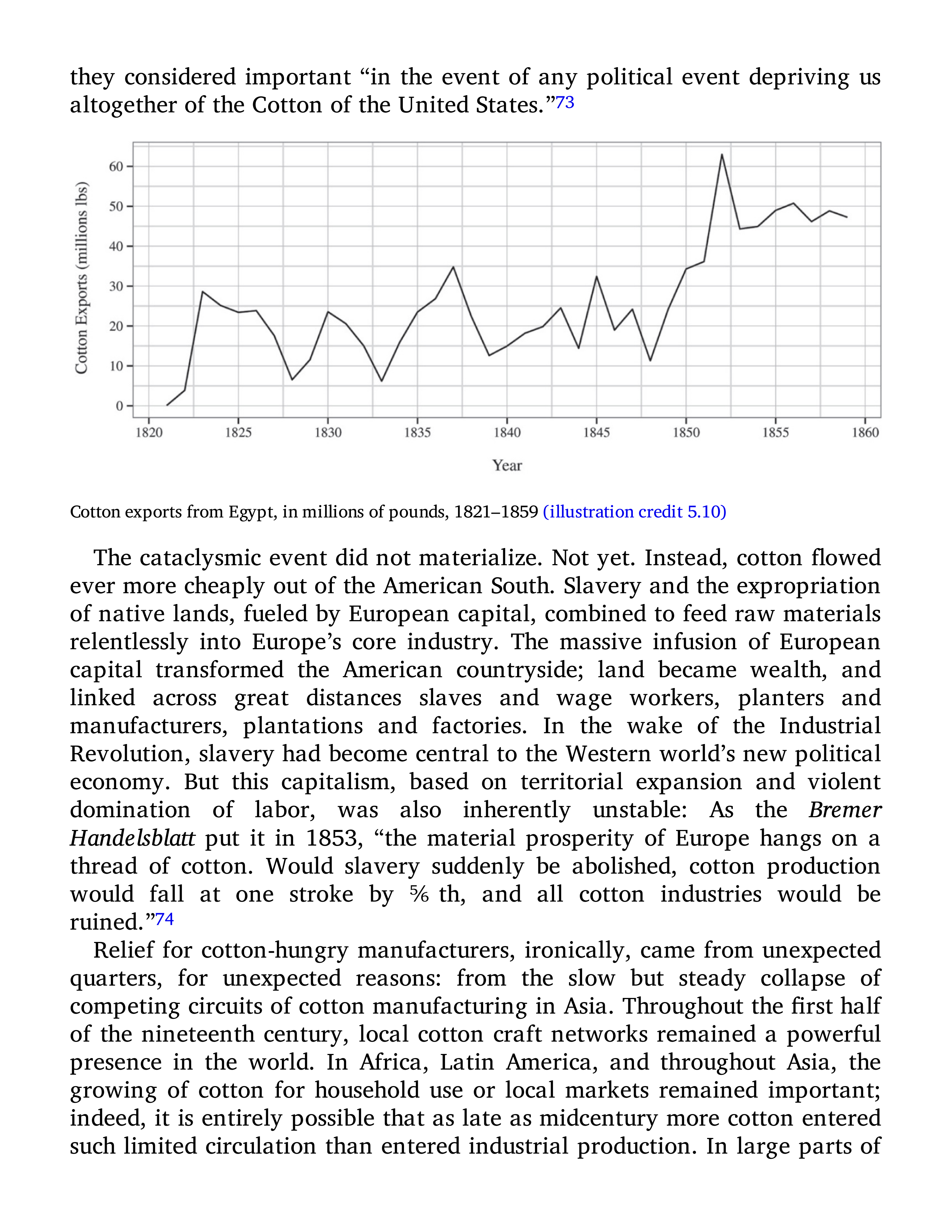
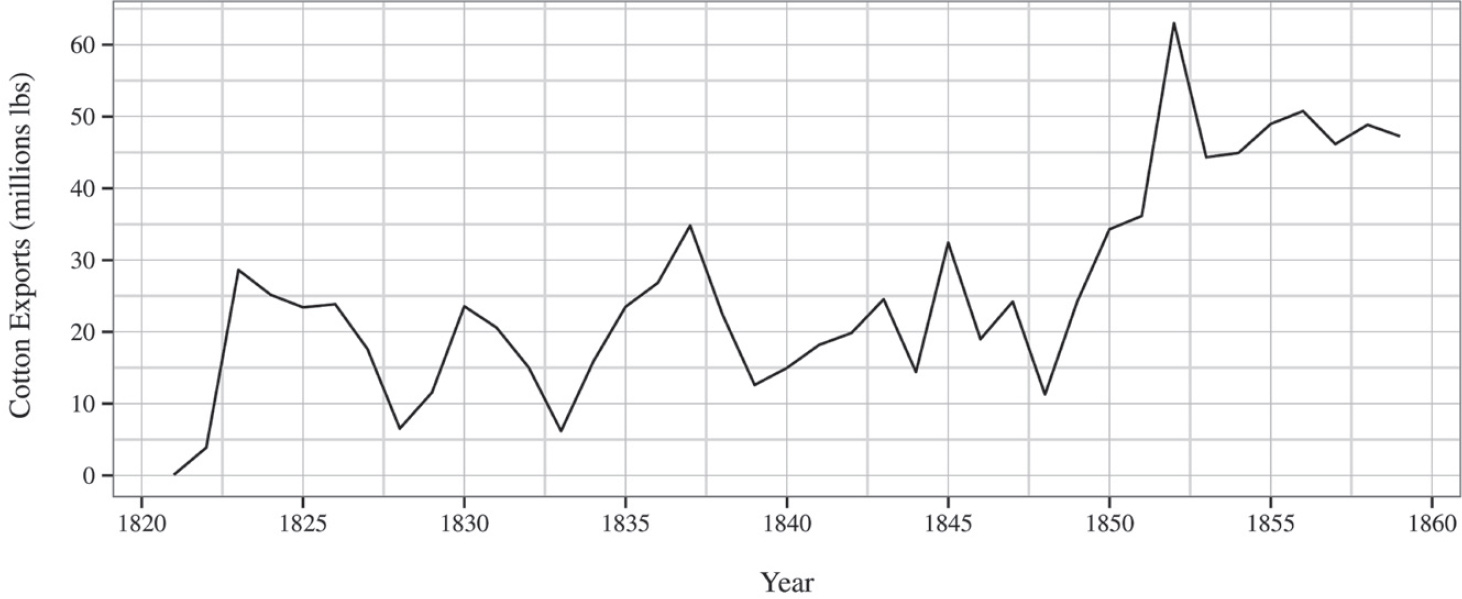
they considered important “in the event of any political event depriving us
altogether of the Cotton of the United States.”
73
Cotton exports from Egypt, in millions of pounds, 1821–1859
(illustration credit 5.10)
The cataclysmic event did not materialize. Not yet. Instead, cotton
ɻowed
ever more cheaply out of the American South. Slavery and the expropriation
of native lands, fueled by European capital, combined to feed raw materials
relentlessly into Europe’s core industry. The massive infusion of European
capital transformed the American countryside; land became wealth, and
linked across great distances slaves and wage workers, planters and
manufacturers, plantations and factories. In the wake of the Industrial
Revolution, slavery had become central to the Western world’s new political
economy. But this capitalism, based on territorial expansion and violent
domination of labor, was also inherently unstable: As the
Bremer
Handelsblatt
put it in 1853, “the material prosperity of Europe hangs on a
thread of cotton. Would slavery suddenly be abolished, cotton production
would fall at one stroke by ⅚th, and all cotton industries would be
ruined.”
74
Relief for cotton-hungry manufacturers, ironically, came from unexpected
quarters, for unexpected reasons: from the slow but steady collapse of
competing circuits of cotton manufacturing in Asia. Throughout the
ɹrst half
of the nineteenth century, local cotton craft networks remained a powerful
presence in the world. In Africa, Latin America, and throughout Asia, the
growing of cotton for household use or local markets remained important;
indeed, it is entirely possible that as late as midcentury more cotton entered
such limited circulation than entered industrial production. In large parts of
Africa, observed Thomas Ellison as late as 1886, “indigenous Cotton has
from time immemorial been both grown and manufactured, and the natives
are for the most part clothed in fabrics of their own production.”
75
In China as well, using traditional methods of production, spinners and
weavers, working mostly in their houses and drawing on the labor of their
dependents, continued to serve their very large domestic market. Most of
the cotton they consumed came from their own or their neighbors’
ɹelds,
while others bought cotton from the large cotton merchants of Shanghai and
elsewhere. “Early in the
ɹne autumnal mornings,” observed a British
traveler in 1845, “the roads leading into Shanghae are crowded with bands
of coolies from the cotton farms,” testifying to a world of cotton distant
from the circuits of growing, production, and consumption dominated by
Europeans. Japan too had a
ɻourishing domestic trade in locally grown
cotton, and produced large amounts of cotton goods in homes and
workshops. And Bengal, despite the beginning decline of its export
manufacturing industry, still imported huge quantities of raw cotton in the
ɹrst years of the nineteenth century: In 1802, it was said that Bengal grew a
little more than 7 million pounds of cotton, but imported more than 43
million pounds, principally from western India, competing with China and
Lancashire for the raw material of its core industry. Despite British designs
to the contrary, India continued to be the most prominent example for such
alternative circuits of cotton.
76
Yet while local and regional networks persisted, they would never again
ɻourish. These smaller networks, deɹned by custom, convenience, and
pro
ɹt, were undermined by the ever-widening veins of European capital
and state power. Indeed, the cheapness of cottons enabled by slavery in the
United States would help undermine local manufacturing everywhere. Many
times over, indeed, the empire of cotton would advance what historian
Kären Wigen has called the “making of a periphery.” Tench Coxe understood
that process already in 1818: The export of British piece goods to India, he
perceptively observed, would force Indians “to turn to raising cotton instead
of making piece goods they cannot sell.” Across the nineteenth century,
Europeans gambled on the e
ɽcacy of
war capitalism again and again; each
time they succeeded in planting new
ɹelds, in coercing more slaves, in
ɹnding additional capital, they enabled the production of more cotton
fabrics at cheaper prices, and they pushed their cotton rivals to the
periphery. The destruction of each of these alternative circuits of cotton, in
turn, would further tip the balance of power in many parts of the world’s
countryside, making more territory and more labor vulnerable to the

encroachment of the global economy. The great irony of this rapacious cycle
of war capitalism, as we will see, is that its success laid the foundation for
its own demise.
77
But any hint of demise was distant. In the
ɹrst half of the nineteenth
century, war capitalism seemed a vast and impenetrable machine, a
painfully e
ɽcient mechanism for proɹt and power. As Britain’s power grew,
capitalists in other regions of the world saw the possibilities inherent in the
marriage of new technologies and bodily coercion. Certainly, many
observers were anxious about the warlike expropriation of native peoples,
the violence on the plantation, and the social turmoil in England’s industrial
cities. Yet wealth and power beckoned to those able to embrace that new
world. Throughout France, the German lands, Switzerland, the United
States, Lombardy, and elsewhere, capitalists tried to follow the path laid
down by Manchester.
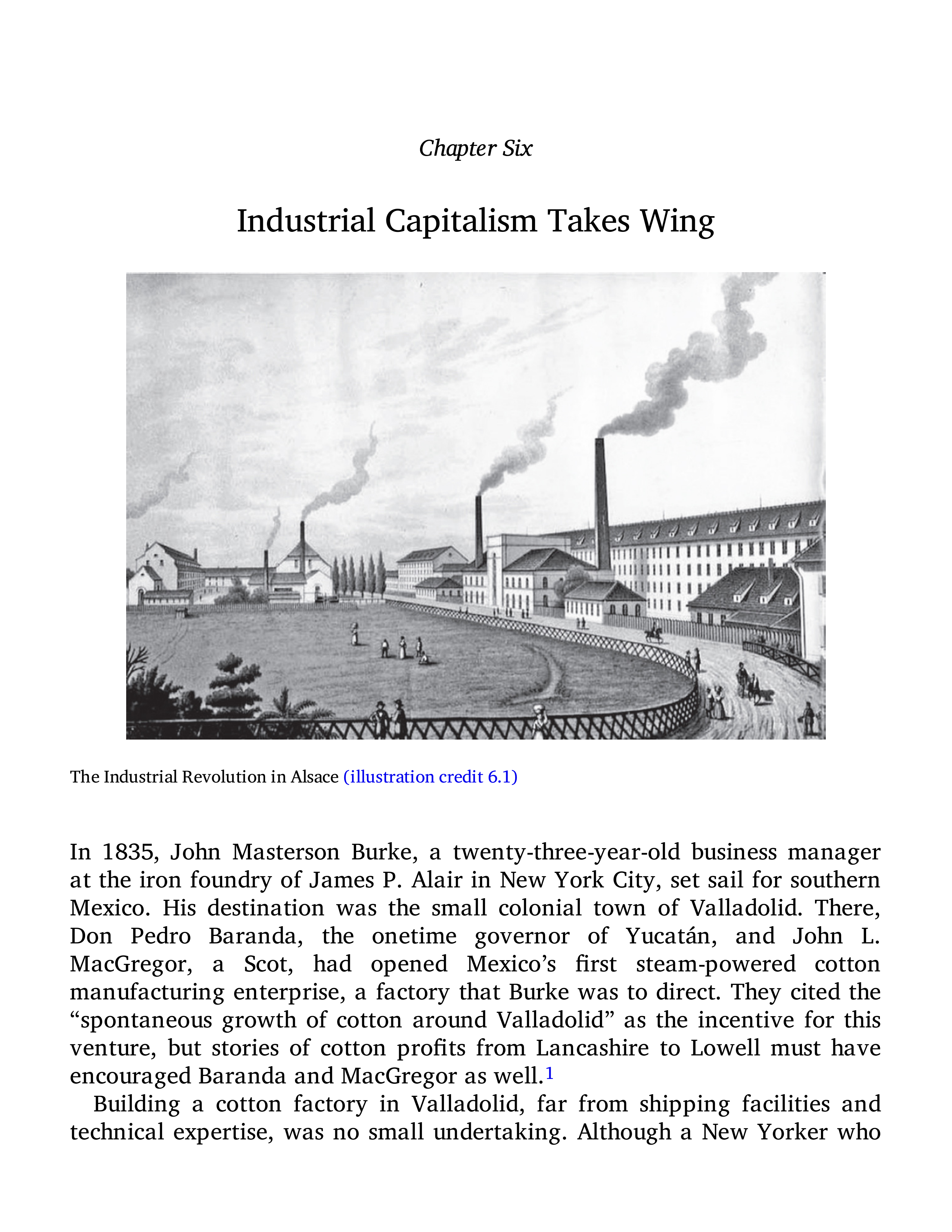
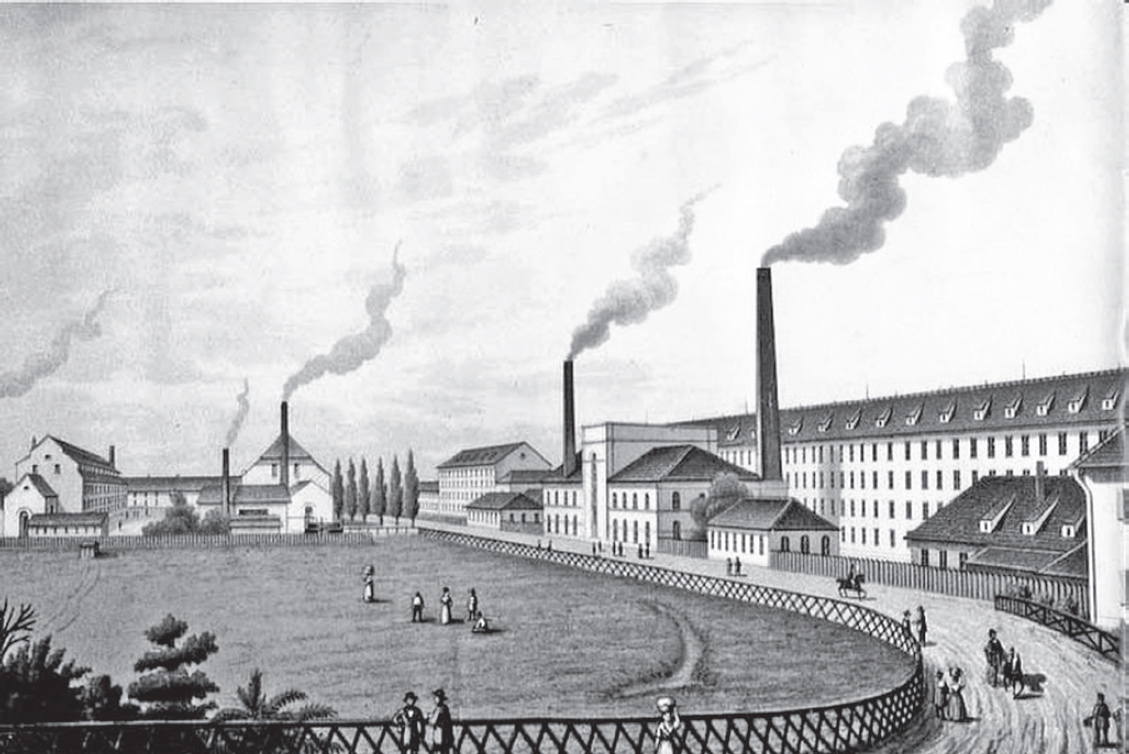
Chapter Six
Industrial Capitalism Takes Wing
The Industrial Revolution in Alsace
(illustration credit 6.1)
In 1835, John Masterson Burke, a twenty-three-year-old business manager
at the iron foundry of James P. Alair in New York City, set sail for southern
Mexico. His destination was the small colonial town of Valladolid. There,
Don Pedro Baranda, the onetime governor of Yucatán, and John L.
MacGregor, a Scot, had opened Mexico’s
ɹrst
steam-powered cotton
manufacturing enterprise, a factory that Burke was to direct. They cited the
“spontaneous growth of cotton around Valladolid” as the incentive for this
venture, but stories of cotton pro
ɹts from Lancashire to Lowell must have
encouraged Baranda and MacGregor as well.
1
Building a cotton factory in Valladolid, far from shipping facilities and
technical expertise, was no small undertaking. Although a New Yorker who
passed through in 1842 described the factory as “remarkable for its neat,
compact, and business-like appearance,” setting up production in Yucatán
had been a struggle. To get the Aurora Yucateca started, Burke had brought
with him from New York not only the machinery (including the carts
required to move these machines from the port to Valladolid) but also four
engineers, two of whom promptly died of malaria. With no architect, the
entrepreneurs designed the factory themselves and “twice the arches gave
way, and the whole building came down.” Nonetheless, Baranda,
MacGregor, and Burke eventually got the mill up and running. Drawing on
117 local workers, along with Mayan families who supplied the wood to
ɹre
the steam engines and who planted cotton on their maize
ɹelds, they
churned out 395,000 yards of cloth in the nine years before 1844. Though
modest by the standards of Lancashire, this was a spectacular achievement.
2
That a cotton mill arose in the middle of the tropical wilderness of the
Yucatán Peninsula, several days’ ride away from the port town of Mérida,
and remote from sources of capital, testi
ɹes to the powerful attraction that
cotton had for entrepreneurs across the globe. After the spread of water-
powered spinning machines in Great Britain during the 1780s, mechanized
cotton manufacturing spread around the world, at
ɹrst slowly and then at
breakneck speed, from Britain to continental Europe and to the United
States, then on to Latin America, to northern Africa, and eventually to India
and beyond.
Hundreds, perhaps thousands, of such stories could be told. Take the
Wiesental in what is today Germany. Reaching from the highest peaks of the
Black Forest in the Duchy of Baden to the Rhine near the Swiss city of Basel,
this valley had been a vibrant center for the hand spinning and weaving of
cotton since the eighteenth century. Flush with Swiss capital, cheap labor,
and a broad network of middlemen, enterprising Basel merchants mobilized
thousands of peasants to spin cotton in their homes, workers who came from
local farm families unable to
ɹnd land for their oʃspring and who were
outside the guild restrictions that limited the expansion of production in
cities such as Basel. Some of these merchants began to employ very large
numbers of these workers, helped by government stipulations that forced
children and young adults to spin: In 1795 putting-out merchant Meinrad
Montfort from Zell in the Black Forest paid wages to about twenty-
ɹve
hundred households in which one or more family members spun or wove.
Montfort and other such putting-out merchants received the raw cotton from
Basel and returned the
ɹnished cloth to its merchants, who in turn delivered
the goods to the burgeoning cotton printing factories located in Mulhouse,
an independent city-state just across the Rhine. So massive was Swiss
investment that one historian has called the attendant economic
restructuring of the area the “colonialization of the Wiesental.”
3
Already in the eighteenth century, these Swiss entrepreneurs and their
Baden subcontractors had put some spinners and weavers to work in
nonmechanized workshops in order to better supervise production. Montfort
himself had created as early as 1774 a bleaching workshop in nearby
Staufen. Once workers left their homes to labor in workshops, it was only a
question of time when mechanical devices for the spinning of cotton,
recently invented in England, would come to the Wiesental. Indeed, in 1794
—only ten years after Greg’s venture in Styal—entrepreneurs erected the
ɹrst mechanized spinning mill, although government agents forced its
closure soon thereafter for fear that mechanization would lead to
unemployment, misery, and social upheaval. But this government
intervention against industry was a rare exception, and by 1810 modern
water frames and mules returned to the valley, invited by a government
more favorably inclined to mechanization. Drawing their power from the
plentiful streams cascading down the mountainsides of the Black Forest,
these mills destroyed hand spinning in short order. The greater availability
of yarn, however, resulted in a boom in hand weaving, which for a short
period allowed peasants to remain within their farm households. As
elsewhere, rising demand and ready capital eventually moved weaving into
factories as well. Mulhousian entrepreneur Peter Koechlin, to name but one,
created hand-weaving factories in the Wiesental towns of Steinen (in 1816),
Schönau (1820), and Zell (1826). With manufacturing moving from their
households into factories, peasants in ever greater numbers gave up raising
cattle as well as making cheese. By 1860, the Wiesental counted 160,000
mechanized spindles and 8,000 looms, nearly all of them located in
factories. Once a remote outpost of subsistence farming, the valley had
become yet another dot on the map of the Industrial Revolution. Like the
Yucatecan town of Valladolid, it had fallen into the vortex of a globe-
spanning capitalist economy linking peasants in the Black Forest and on the
Yucatán Peninsula, slaves on the banks of the Mississippi and, as we will
see, consumers on the shores of the Río de la Plata.
4
Hitched behind a well-matched team of entrepreneurs hungry for pro
ɹts
and rulers lusting for power, the mechanized cotton industry successfully
colonized the Wiesental, Valladolid, and an ever-larger swath of the world.
In 1771, the spinning jenny came to the French city of Rouen, only six years
after it had been introduced in the United Kingdom. In 1783, Johann
Gottfried Brügelmann, a putting-out merchant in Ratingen near Düsseldorf,
did not have enough yarn for his weavers, a problem that would have been
impossible to solve just a few years earlier; now he invested 25,000
reichstaler, gathered about eighty workers, and with the help of a British
expert created the
ɹrst spinning
factory in the German-speaking lands. Two
years later, the
ɹrst mechanical spinning machine arrived in
Barcelona, a
city with such ancient cotton traditions that one of its narrow streets to this
day carries the name Carrer del Cotoners. In 1789, Providence merchant
Moses Brown hired a skilled British cotton worker, Samuel Slater, and built
the
ɹrst successful spinning factory in America. In 1792, Belgian
entrepreneur Lieven Bauwens followed suit and started the
ɹrst mechanized
spinning mill in Twente. A year later, such machines for the
ɹrst time began
twisting yarn in Russia, when the Russian Treasury sponsored Michael
Ossovski to start a cotton spinning mill. In 1798, a citizen of the Saxon city
of Chemnitz, Christian Friedrich Kreissig, bought twenty-
ɹve spinning
jennies and started a cotton factory. By 1801, local merchants in St. Gallen
in Switzerland had sponsored Marc-Antoine Pellis’s creation of the country’s
ɹrst spinning mill, the
Spinnerei Aktiengesellschaft. Seven years later,
spindles turned in the Lombardian town of Intra on the shores of Lake
Maggiore. By 1818, the
ɹrst mechanized cotton spinning mill began
operations in Egypt on orders of Muhammad Ali, and in the mid-1830s, Don
Pedro Baranda built the
ɹrst
steam-powered cotton spinning factory in
Mexico.
5
British tinkerers’ revolutionary methods for the production of cotton yarn
spread rapidly, probably more rapidly than any previous manufacturing
technology. It certainly helped that travelers, journals, newspapers, and
learned societies trumpeted these wondrous advances. But even more
in
ɻuential must have been the inɻux of British traders carrying yarn and
ɹnished cotton cloth at unbeatable prices. European and North American
consumers, introduced to the wonderful properties of cotton through
relatively expensive goods made in India, responded swiftly and
enthusiastically, as did consumers in regions of the world that had produced
their own cotton fabrics for centuries or millennia. As more people bought
cheap cottons, entrepreneurs in more countries became convinced that they
could produce the same goods. With equal enthusiasm skilled artisans,
adventurers, state bureaucrats, and budding entrepreneurs embraced the
new machines and techniques. By 1800, as we have seen, the
ɹrst
mechanized spinning mills had sprung up in Britain, France, the German
lands, the United States, Russia, Switzerland, the Netherlands, and Belgium.
Twenty years later, new mills churned out yarn and cloth in the Habsburg
Empire, Denmark, Italy, Egypt, and Spain. And by 1860, mills could be
found throughout Europe, North America, India, Mexico, and Brazil. While
that year the United Kingdom still controlled 67.4 percent of the world’s
mechanical spindles, cotton spinning by machines had e
ʃectively replaced
older ways of doing things in large areas of the world.
6
The world’s mechanized cotton industry was remarkable not only for its
rapid global dispersion but also for its feverish rate of growth. Each new
spinning mill served as an example to entrepreneurial neighbors that pro
ɹts
awaited those who could master the new world of cotton manufacturing.
Belgian industrialization, without precedent in continental Europe in the
ɹrst decade of the nineteenth century, was an example of this growth: In
Ghent alone, its center, there had been only 227 cotton spinners in 1802,
but six years later there were already 2,000 such workers, with an additional
1,000 laboring in the surrounding countryside.
7
The number of spindles in
the German lands increased from 22,000 in 1800 to 2 million in 1860.
Catalonia saw an exponential growth of its cotton industry as well, so much
so that it became known as the “little England in the heart of Spain,” with
nearly 800,000 spindles turning in 1861. By 1828, nine spinning mills had
opened in Russia, and by the middle of the nineteenth century Russia had
become self-su
ɽcient in cotton textiles. In Mexico, 25,000 spindles and
2,600 looms worked in its
ɹfty-eight mills by 1843. Switzerland counted
1.35 million spindles in 1857. Nearby Alsace housed more than 500,000
mechanical spindles in 1828, and 859,300 in 1846. In the United States,
cotton mills opened in Rhode Island (1790), New Jersey (1791), Delaware
(1795), New Hampshire (1803), New York (1803), Connecticut (1804), and
Maryland (1810). In 1810, according to the U.S. census, there were 269
cotton establishments in the United States with a total of 87,000 spindles. By
1860, there would be 5 million spindles, making cotton textiles the United
States’ most important manufacturing industry in terms of capital invested,
workers employed, and net value of its product.
8
The rapid spread and exponential growth of mechanized cotton yarn
production in so many parts of the world evinces the compelling nature of
this new social system. Most obviously, mechanized spinning led to
enormous productivity gains; those with su
ɽcient capital to aʃord the new
technology immediately enjoyed a competitive advantage over hand
spinners. Once entrepreneurs installed spinning mules in Switzerland,
productivity per worker increased by as much as a factor of a hundred.
9
It is
not surprising that the history of cotton after 1780 had a de
ɹnite direction:
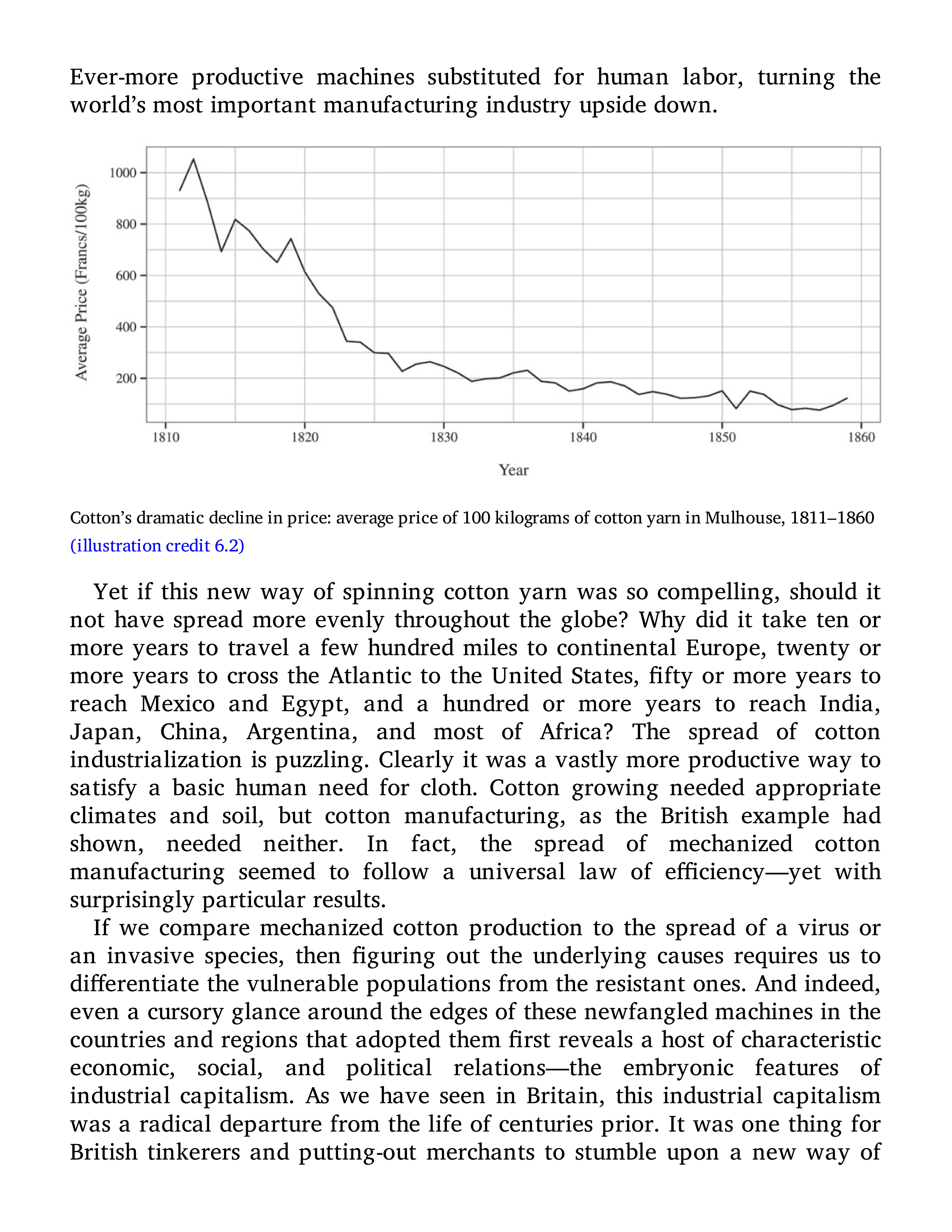
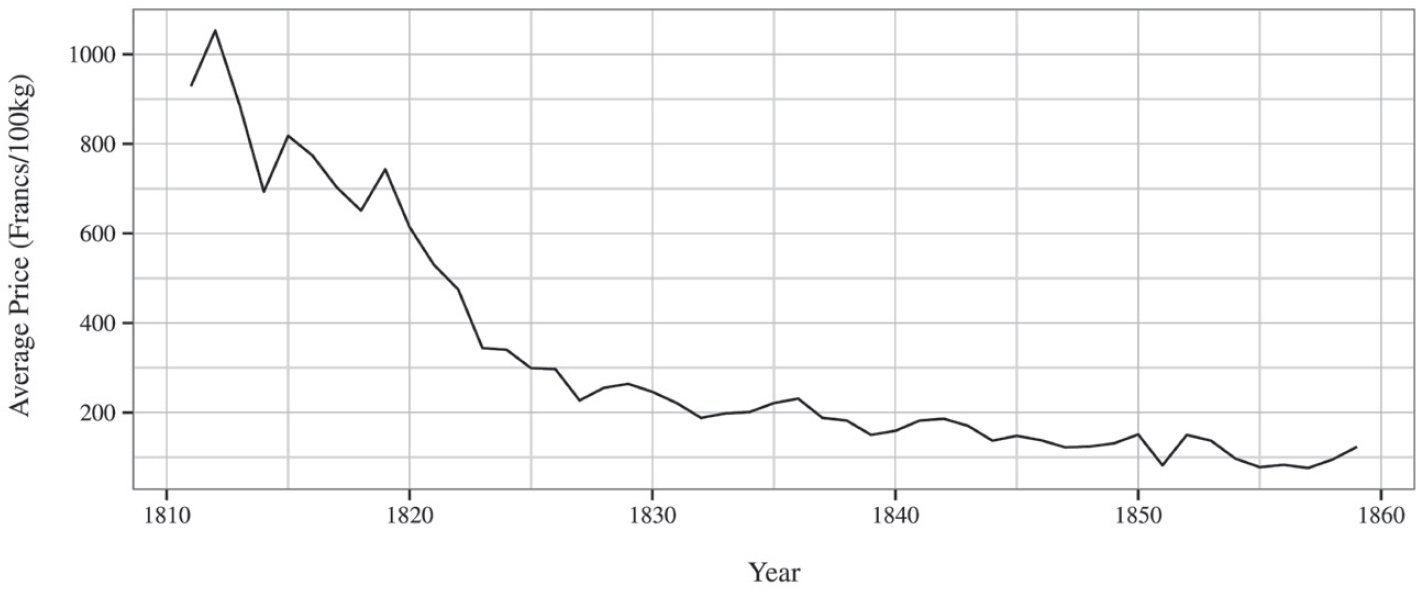
Ever-more productive machines substituted for human labor, turning the
world’s most important manufacturing industry upside down.
Cotton’s dramatic decline in price: average price of 100 kilograms of cotton yarn in Mulhouse, 1811–1860
(illustration credit 6.2)
Yet if this new way of spinning cotton yarn was so compelling, should it
not have spread more evenly throughout the globe? Why did it take ten or
more years to travel a few hundred miles to continental Europe, twenty or
more years to cross the Atlantic to the United States,
ɹfty or more years to
reach Mexico and Egypt, and a hundred or more years to reach India,
Japan, China, Argentina, and most of Africa? The spread of cotton
industrialization is puzzling. Clearly it was a vastly more productive way to
satisfy a basic human need for cloth. Cotton growing needed appropriate
climates and soil, but cotton manufacturing, as the British example had
shown, needed neither. In fact, the spread of mechanized cotton
manufacturing seemed to follow a universal law of e
ɽciency—yet with
surprisingly particular results.
If we compare mechanized cotton production to the spread of a virus or
an invasive species, then
ɹguring out the underlying causes requires us to
di
ʃerentiate the vulnerable populations from the resistant ones. And indeed,
even a cursory glance around the edges of these newfangled machines in the
countries and regions that adopted them
ɹrst reveals a host of characteristic
economic, social, and political relations—the embryonic features of
industrial capitalism. As we have seen in Britain, this industrial capitalism
was a radical departure from the life of centuries prior. It was one thing for
British tinkerers and putting-out merchants to stumble upon a new way of
spinning cotton in the last decades of the eighteenth century. But it was an
entirely di
ʃerent thing to scale that model by several orders of magnitude
and forge it into a new social order. It was the capacity of a newly
emerging type of state, as we will see, that was decisive.
To understand the seemingly peculiar patterns of the spread of mechanized
cotton manufacturing around the world, and with it industrialization as
such, let us chart what the places that followed the British had in common.
First and foremost, these early adopters all had a prior history of textile
manufacturing. While no guarantee of success, such prior experience was all
but required for cotton industrialization. Spinning mills almost always arose
in areas that had already sustained vibrant textile industries—no matter if
in woolens,
ɻax, or cottons, urban or rural,
home-based or in workshops. In
the area around Ghent, for example, a long tradition of
ɻax spinning and
weaving had trained labor to cotton manufacturing. In the Mexican city of
Puebla, mechanical cotton spinning built upon a centuries-long history of
cotton spinning and weaving so established that its workers had a cotton
producers’ guild, and indeed large workshops had emerged even before the
advent of mechanization. The situation in the German lands was no
di
ʃerent: One economist found that “the modern cotton industry nearly
everywhere is building on older home industries.” In Russia, the cotton
manufacturing industry emerged from eighteenth-century linen and woolen
manufacturing; in the United States, New England’s textile mills arose in
areas in which women especially had a long tradition of spinning yarn and
weaving textiles; in Alsace, the history of textile production stretched back
to the
ɹfteenth century; and in Switzerland’s cotton manufacturing areas,
the long and distinguished history of people making cotton fabrics in their
homes had resulted in the accumulation of skills and capital. This small-scale
work was often the
ɹrst victim of industry’s rise, but it provided the usurpers
with skills and labor essential to modern manufacturing.
10
The focus of the old manufacturing base also shaped the avenues each
region followed to industrialization. In some areas of the world, cotton
industrialization unfolded from basic spinning, with the weaving and
printing of textiles being secondary. In the United States, for example, as in
England itself, industrialization was led by basic manufacturing, namely
spinning, moving next into weaving and, later, printing, the application of
colorful designs on cotton cloth imported from elsewhere. In many other
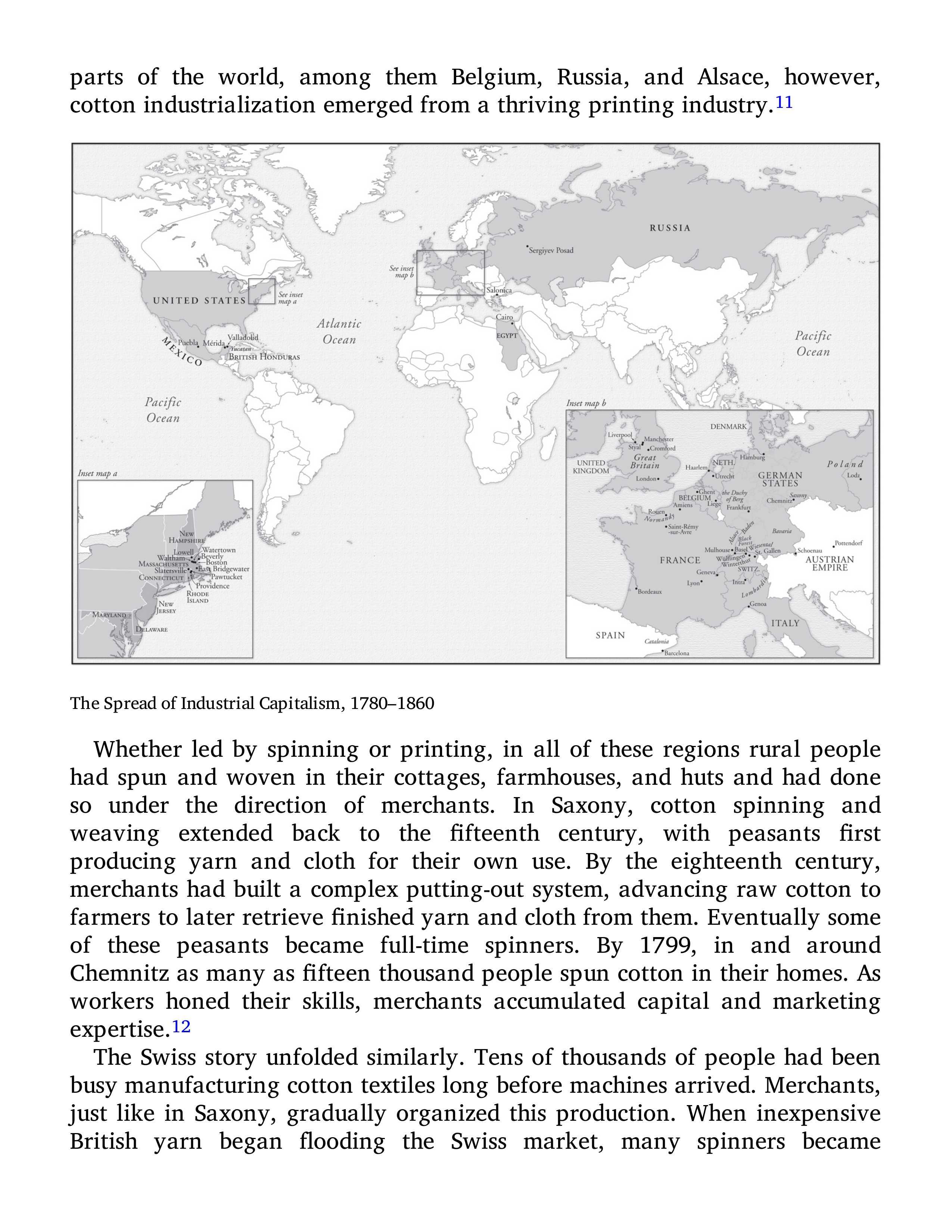
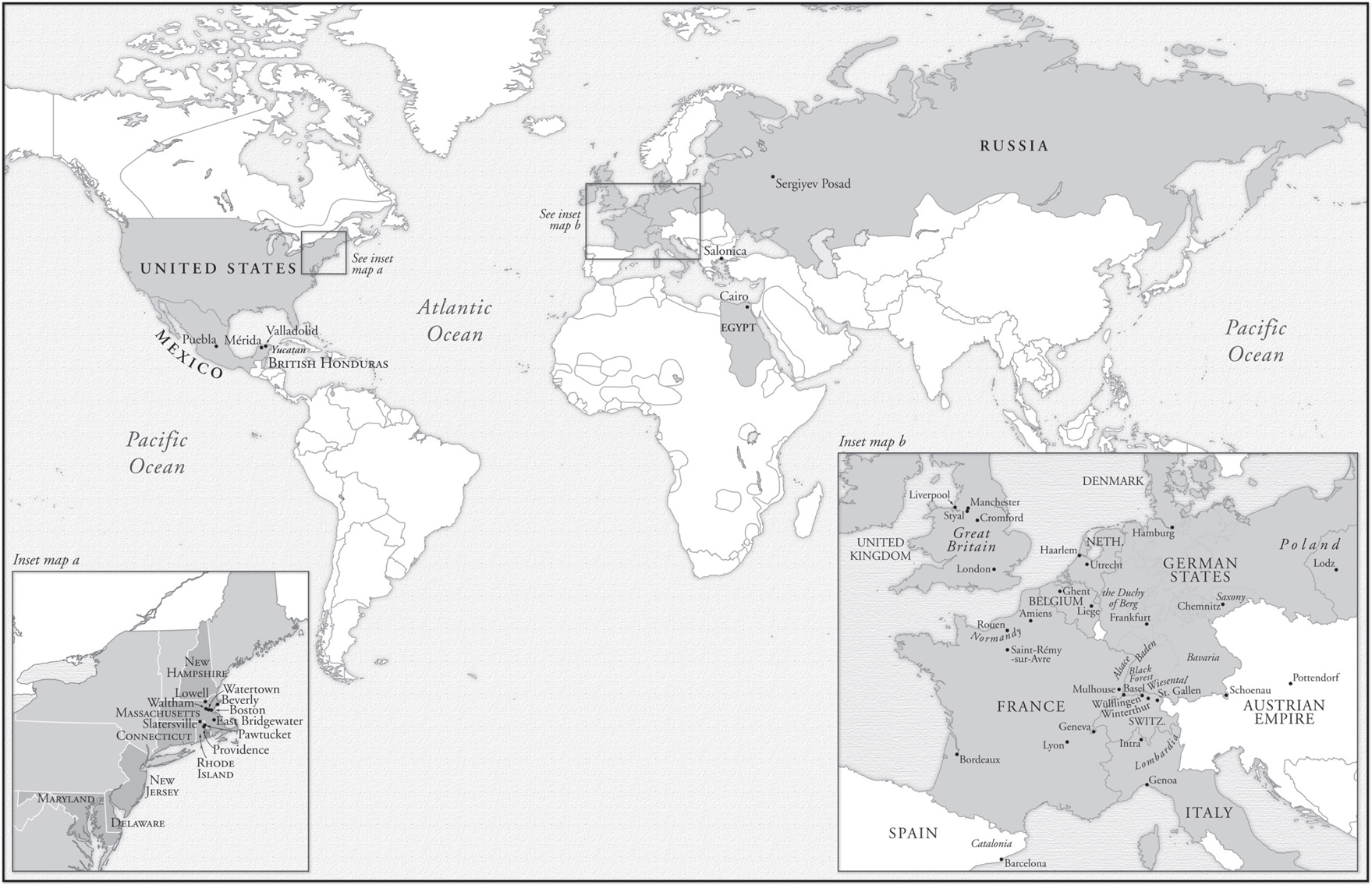
parts of the world, among them Belgium, Russia, and Alsace, however,
cotton industrialization emerged from a thriving printing industry.
11
The Spread of Industrial Capitalism, 1780–1860
Whether led by spinning or printing, in all of these regions rural people
had spun and woven in their cottages, farmhouses, and huts and had done
so under the direction of merchants. In Saxony, cotton spinning and
weaving extended back to the
ɹfteenth century, with
peasants
ɹrst
producing yarn and cloth for their own use. By the eighteenth century,
merchants had built a complex putting-out system, advancing raw cotton to
farmers to later retrieve
ɹnished yarn and cloth from them. Eventually some
of these peasants became full-time spinners. By 1799, in and around
Chemnitz as many as
ɹfteen thousand people spun cotton in their
homes. As
workers honed their skills, merchants accumulated capital and marketing
expertise.
12
The Swiss story unfolded similarly. Tens of thousands of people had been
busy manufacturing cotton textiles long before machines arrived. Merchants,
just like in Saxony, gradually organized this production. When inexpensive
British yarn began
ɻooding the Swiss market, many spinners became
weavers, continuing to work in their homes. Some of the putting-out
merchants, however, saw an opportunity to produce yarn domestically, and
they brought workers into factories to work for wages on new English-made
machines. At
ɹrst, industrialization did not eliminate manufacturing in the
countryside and in homes, but over time its insatiable hunger for capital and
ever greater mechanization shifted power to those merchants most capable
of building large factories employing wage workers.
13
In Italy as well, Lombardian putting-out systems paved the way for the
emergence of factory production in the early decades of the nineteenth
century. A few hundred miles to the west, in Catalonia, earlier
manufacturing in both the countryside as well as in the city of Barcelona
had smoothed the path toward factory production, fueled in part by the new
accumulation of capital and in part by the creation of a rural group of wage
earners who could be moved into factories. Holland’s mechanized cotton
industry was also built upon and embedded within its putting-out networks,
as was Mexico’s.
14
Such a system of home spinning could, at least at
ɹrst, easily adapt to a
more mechanized way of doing things. In the late eighteenth century, for
example, some spinners began using jennies in their homes or small
workshops, as they had done in Britain a few decades earlier. Eventually,
however, merchants nearly everywhere would concentrate production in
factories, where it could be better supervised, standardized, and accelerated
by the use of water and steam power.
15
This early manufacturing often, though not always, also provided access
to that other ingredient essential for industrial production: capital. Without
access to capital, the new ways of producing cotton were impossible:
buildings had to be erected, streams diverted, machines built, workers hired,
raw materials secured, and expertise recruited, often from long distances
and across national boundaries. The merchants’ most common strategy was
reinvesting capital accumulated in the organization of household production
of cotton yarn and cloth into small factories. In Switzerland, for example,
former putting-out merchants
ɹnanced the wave of mechanized spinning
mills built after 1806. They began with small factories of a few mules and
slowly enlarged them. In Catalonia, by the late eighteenth century, artisan
producers had accumulated capital in the nonmechanized and household-
based textile industry and then used it to expand and mechanize production.
In Alsace, the industry drew its capital and entrepreneurial skills from the
older merchant and artisanal elites of the city of Mulhouse. In Russia, the
Prokhorov family, cotton manufacturers from Sergiyev Posad, a small city
ɹfty miles from Moscow, followed a similar trajectory. Serfs emancipated by
Catherine II, they became small-scale merchants, and then, in 1843, focused
on calico printing. Shortly thereafter, they started a small spinning mill and
their
ɹrm grew rapidly. As the age’s most dynamic industry, cotton
manufacturing provided ample opportunities for social mobility. Swiss
cotton manufacturer Heinrich Kunz started out as a wage worker, but at the
time of his death in 1859 he owned eight spinning mills with 150,000
spindles, employing two thousand workers.
16
Mill owners in the United States also often rose from the ranks of small
merchants and skilled artisans. Rhode Island’s Samuel Slater had
apprenticed himself in England, oversaw other factories, and then migrated
to the United States in 1789. Once there, he entered into a partnership with
Providence merchant Moses Brown, who was rich from the West Indian
provisioning trade and was trying to introduce mechanical spinning in the
Browns’ Pawtucket factory. Slater proceeded to build British-designed
machines from memory, and in December 1790 the factory produced its
ɹrst
yarn. The energetic Slater soon expanded operations, built additional mills,
and eventually accumulated su
ɽcient wealth to create his own company in
1799. By 1806 the Rhode Island countryside was graced by the village of
Slatersville.
17
Such successes inspired others: When in 1813 William Holmes, whose
“object is to get business for myself,” wrote to his brother John that they
should build a cotton factory, he reviewed what a nearby factory had cost
and concluded from such observations that putting up a factory large
enough to eventually accommodate a thousand spindles would cost about
$10,000. He was “ready to join & put in 1000 dollars. A spinner who is a
workman can be obtained who will put in 500 more & I can get more
subscriptions from this quarter if necessary.” Once started, these humble
investors could “so increase the machinery from the pro
ɹts of the 200
spindles.”
18
As the example of the Holmes brothers shows, capital requirements in
early cotton factories could be quite modest, so modest that even in areas in
which the availability of capital was limited, such as Saxony, cotton
factories might still
ɻourish in a fashion, despite being small, outdated, and
reliant on cheap labor and cheap waterpower. Don Baranda, just as
modestly, had invested a total of 40,000 pesos, the equivalent of the annual
wages of approximately two hundred skilled workers, in his Valladolid
factory in 1835. Even in areas with a greater capital availability,
expenditures were measured and conservative. In the French department of
Bas-Rhin, part of the cotton complex centered in Mulhouse, a cotton
spinning factory only required an average capitalization of 16,216 francs in
1801, allowing the thirty-seven factories that existed to employ an average
of eighty-one workers. A weaving factory required more—35,714 francs on
average, but this was still a modest amount compared to the 150,000 francs
needed for a carriage maker, and the 1.4 million francs that an arms
manufacturing establishment required. Later, factories would of course
grow: during the
ɹrst half of the nineteenth century, a mechanized spinning
mill might cost between 200,000 and 600,000 francs, an integrated factory
with spinning, weaving, and printing operations perhaps as much as 1.5
million francs.
19
Reinvestments of capital accumulated in the putting-out industry and
small artisan workshops combined with tentative investment from large
fortunes accumulated in the sometimes
ɹckle world of trade. In some
exceptional instances, indeed, huge fortunes were invested in cotton
manufacturing as merchant capital attached itself to industrial production.
The most dramatic such move was undertaken by a group of Boston
merchants looking for new outlets for capital suddenly and ruinously idled
due to the American trade embargo against Britain and France from 1807 to
1812. In 1810 Francis Cabot Lowell traveled to the United Kingdom to
acquire the blueprints for a cotton mill. Upon his return, he and a group of
wealthy Boston merchants had signed the “Articles of Agreement between
the Associates of the Boston Manufacturing Company,” which created a huge
integrated spinning and weaving mill in Waltham near Boston, initially
capitalized at $400,000, or a bit more than 2 million francs. The mill
focused on inexpensive coarse cotton goods, some of which were sold to
clothe slaves, replacing Indian manufactured cloth. (So common did Lowell
cloth become among slaves that “Lowell” became the generic term slaves
used to describe coarse cottons.) The venture proved hugely pro
ɹtable, with
dividends in most years above 10 percent on the paid-in capital. In 1817,
the mills paid peak dividends of 17 percent. By 1823, the Boston Associates
expanded further, building more mills in Lowell, about twenty-
ɹve miles
north of Boston, and creating the largest integrated mills anywhere in the
world. This move of American merchant capital into manufacturing marked
another tight connection between slavery and industry. Early cotton
industrialists such as the Cabot, Brown, and Lowell families all had ties to
the slave trade, the West Indian provision trade, and the trade in
agricultural commodities grown by slaves. The “lords of the lash” and the
“lords of the loom” were, yet again, tightly linked.
20
The Boston Associates were unusual in the size of their investment, but
they were not the only large merchants moving capital into industrial
production. Swiss merchants by the early nineteenth century began to invest
into the Alsatian cotton industry, and also into the emerging cotton complex
of Lombardy. Barcelona merchants followed suit. In Mexico as well, the
larger share of the capital invested in cotton manufacturing did not come
out of the textile industry itself, but instead from fortunes accumulated in
trade. Of the forty-one capitalists who opened cotton factories in Puebla
between 1830 and 1849, nineteen had been merchants,
ɹve landowners,
and only three had previously been involved in textiles.
21
Wealthy merchants, many of them foreign, also played a central role in
the development of the Russian cotton textile industry, none more
emblematically than Ludwig Knoop. Born into a middling Bremen merchant
family, Knoop had come to Russia in 1839 as an assistant representative of
a Manchester merchant
ɹrm,
de Jersey, importing yarn. He was only
eighteen years old but already quite familiar with cotton manufacturing
technology and in thrall to its promise. When, four years later, Britain lifted
its ban on textile machine exports, a ban that had from 1786 to 1843
outlawed the export of such things as the spinning mule (or blueprints
thereof), Knoop began to bring these machines to Russia, along with English
engineers and mechanics; he also imported American-grown cotton and
secured credits abroad for Russian manufacturers. He built eight spinning
mills between 1843 and 1847, eventually selling those factories to Russian
entrepreneurs. Riding cotton’s meteoric global rise, Knoop became Russia’s
most prominent industrialist.
22
Such mobilizations of capital were almost always embedded within
kinship networks, the Boston Associates, for example, drew on relatives for
investments; so did the Fränkel family of Upper Silesia, who built a large
spinning, weaving, and
ɹnishing empire in and around Lodz, eʃectively
pooling family capital and management skills. The best example of the
importance of family to the emerging cotton industry, however, was Alsace,
where a handful of families came to dominate a huge local industry for
many generations: the Dollfuses, Koechlins, and Schlumbergers among them.
These families intermarried. Pierre Schlumberger, one of Mulhouse’s major
cotton entrepreneurs, whose spinning mills and printing workshops were
valued at 1.3 million francs when he died, had twenty-two children and
grandchildren who entered adulthood between 1830 and 1870. Nineteen of
them married, fourteen into the Alsatian bourgeoisie, and three into the
bourgeoisie of the cotton port of Le Havre. The textile bourgeoisie of
Mulhouse thus was extraordinarily cohesive, capable of organizing (in 1826,
they founded the Société Industrielle de Mulhouse), and of exerting its
power to create a political, social, and economic environment that was
conducive to their interests. One descendant, André Koechlin, was aptly
dubbed the “Sultan of Mulhouse.”
23
Access to capital and a history in textile production thus were essential to
embarking upon the great adventure of manufacturing yarn and cloth with
machines, but the catalyst that turned these preconditions into full-
ɻedged
cotton industrialization was pressure: namely, the competition from British
imports. Indeed, throughout the world, the embrace of mechanized cotton
manufacturing was motivated by the need to substitute domestic production
for foreign—usually British—imports, just as England had fought so hard to
replace a reliance on Indian imports with its own domestic products. By
1800, Britain was
ɻooding world markets, exporting huge quantities of
cotton yarn and a smaller proportion of cloth: the value of exports to
Europe increased by more than twenty times between 1780 and 1805.
24
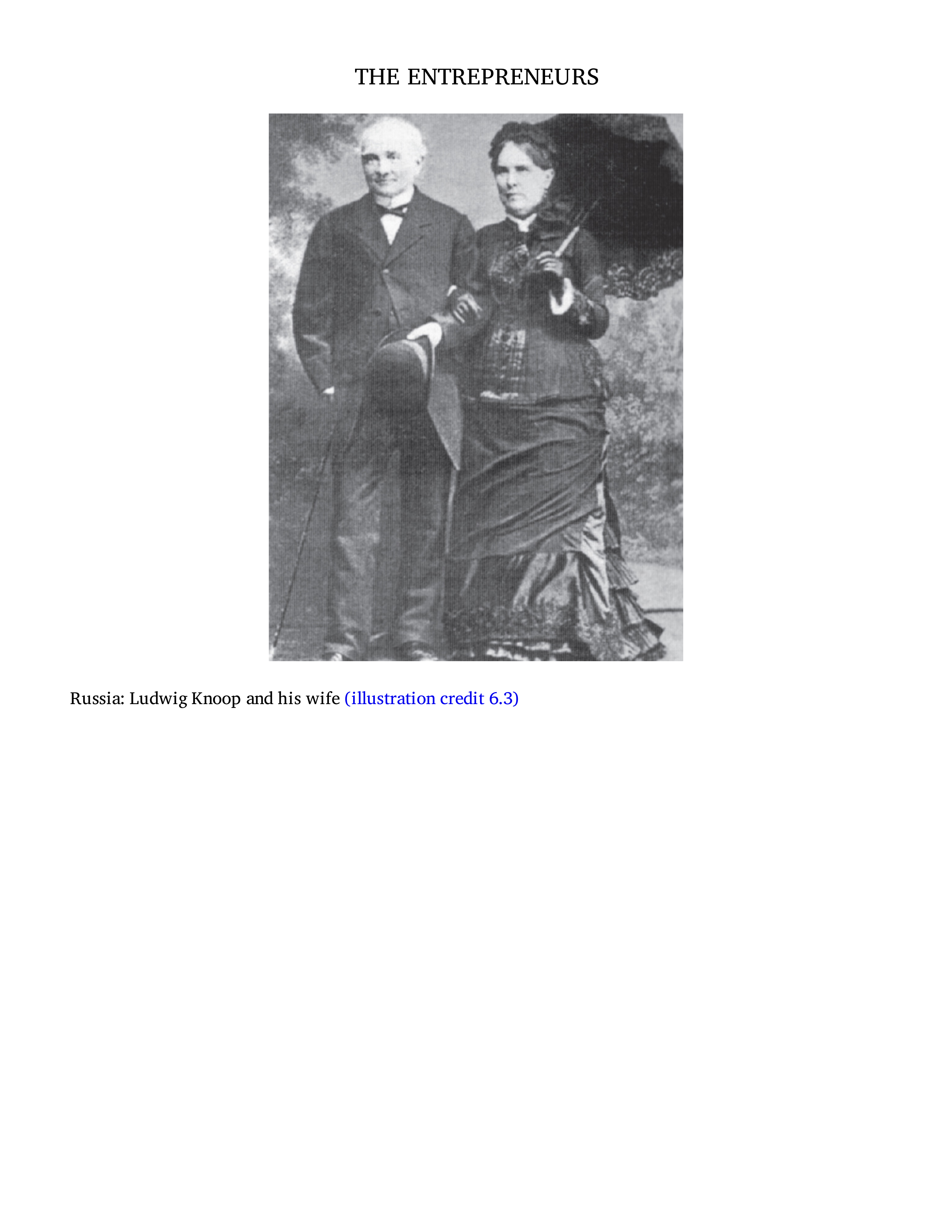
THE ENTREPRENEURS
Russia: Ludwig Knoop and his wife
(illustration credit 6.3)


France: André Koechlin


Belgium: Lieven Bauwens
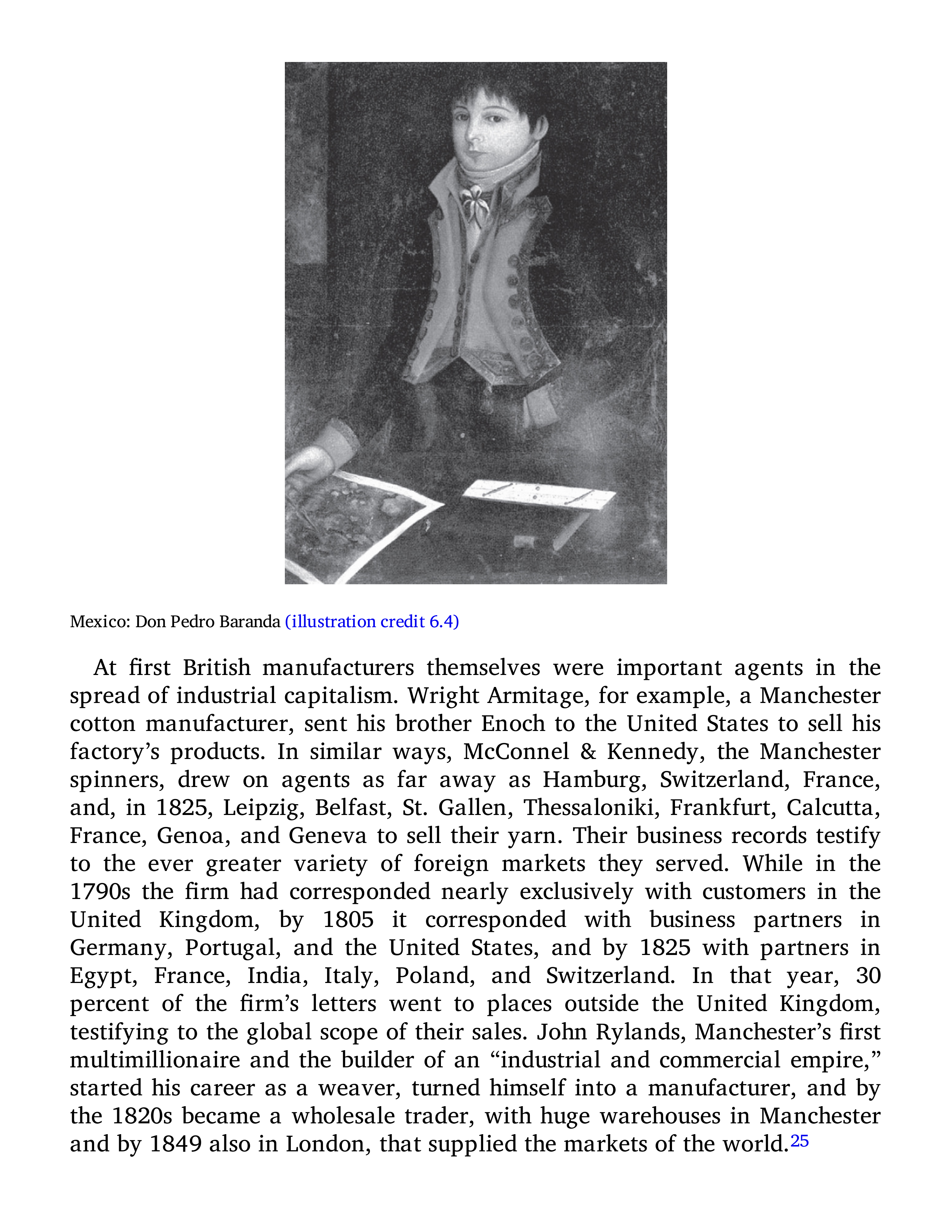

Mexico: Don Pedro Baranda
(illustration credit 6.4)
At
ɹrst British manufacturers themselves were important agents in the
spread of industrial capitalism. Wright Armitage, for example, a Manchester
cotton manufacturer, sent his brother Enoch to the United States to sell his
factory’s products. In similar ways, McConnel & Kennedy, the Manchester
spinners, drew on agents as far away as Hamburg, Switzerland, France,
and, in 1825, Leipzig, Belfast, St. Gallen, Thessaloniki, Frankfurt, Calcutta,
France, Genoa, and Geneva to sell their yarn. Their business records testify
to the ever greater variety of foreign markets they served. While in the
1790s the
ɹrm had corresponded nearly exclusively with customers in the
United Kingdom, by 1805 it corresponded with business partners in
Germany, Portugal, and the United States, and by 1825 with partners in
Egypt, France, India, Italy, Poland, and Switzerland. In that year, 30
percent of the
ɹrm’s letters went to places outside the United Kingdom,
testifying to the global scope of their sales. John Rylands, Manchester’s
ɹrst
multimillionaire and the builder of an “industrial and commercial empire,”
started his career as a weaver, turned himself into a manufacturer, and by
the 1820s became a wholesale trader, with huge warehouses in Manchester
and by 1849 also in London, that supplied the markets of the world.
25
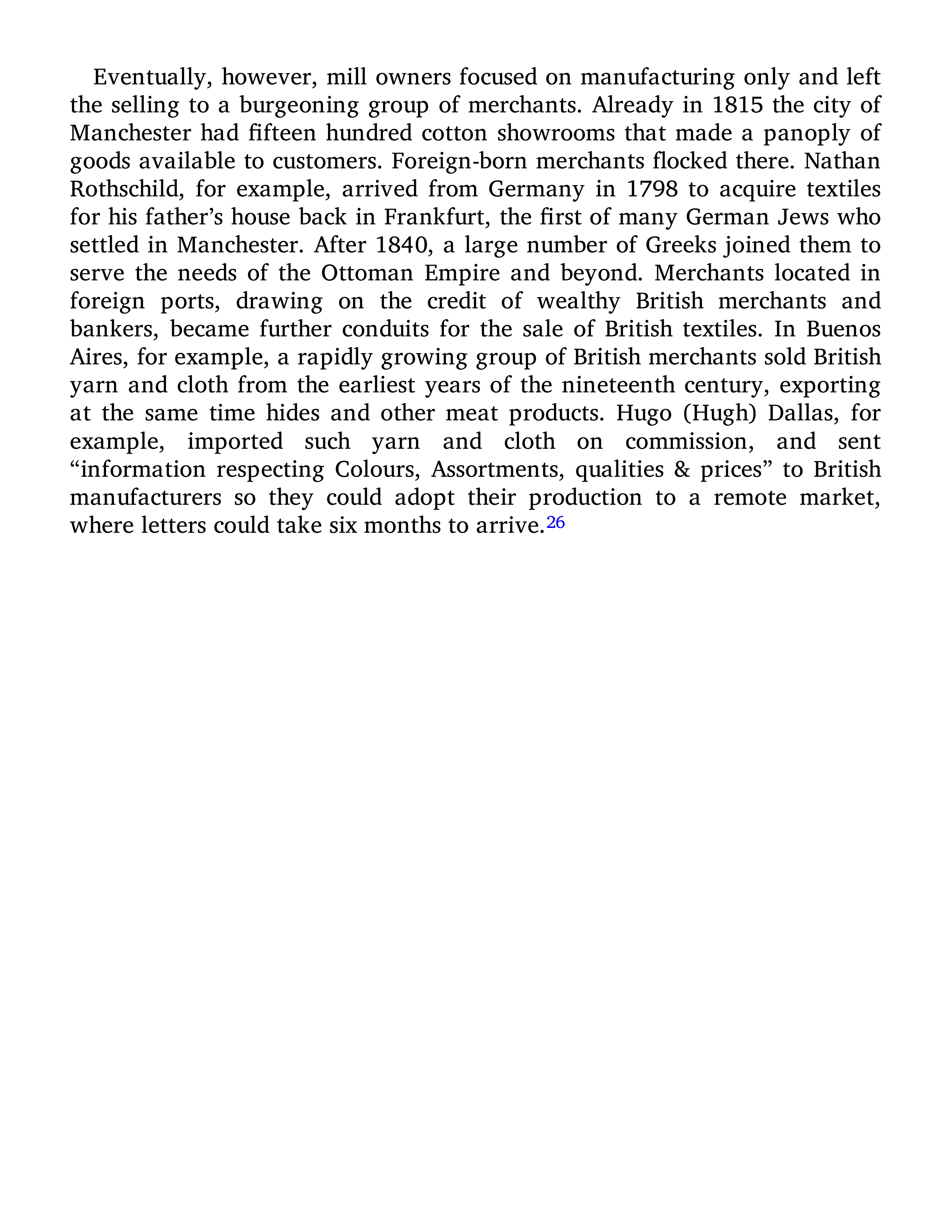
Eventually, however, mill owners focused on manufacturing only and left
the selling to a burgeoning group of merchants. Already in 1815 the city of
Manchester had
ɹfteen hundred cotton showrooms that made a panoply of
goods available to customers. Foreign-born merchants
ɻocked there. Nathan
Rothschild, for example, arrived from Germany in 1798 to acquire textiles
for his father’s house back in Frankfurt, the
ɹrst of many German Jews who
settled in Manchester. After 1840, a large number of Greeks joined them to
serve the needs of the Ottoman Empire and beyond. Merchants located in
foreign ports, drawing on the credit of wealthy British merchants and
bankers, became further conduits for the sale of British textiles. In Buenos
Aires, for example, a rapidly growing group of British merchants sold British
yarn and cloth from the earliest years of the nineteenth century, exporting
at the same time hides and other meat products. Hugo (Hugh) Dallas, for
example, imported such yarn and cloth on commission, and sent
“information respecting Colours, Assortments, qualities & prices” to British
manufacturers so they could adopt their production to a remote market,
where letters could take six months to arrive.
26
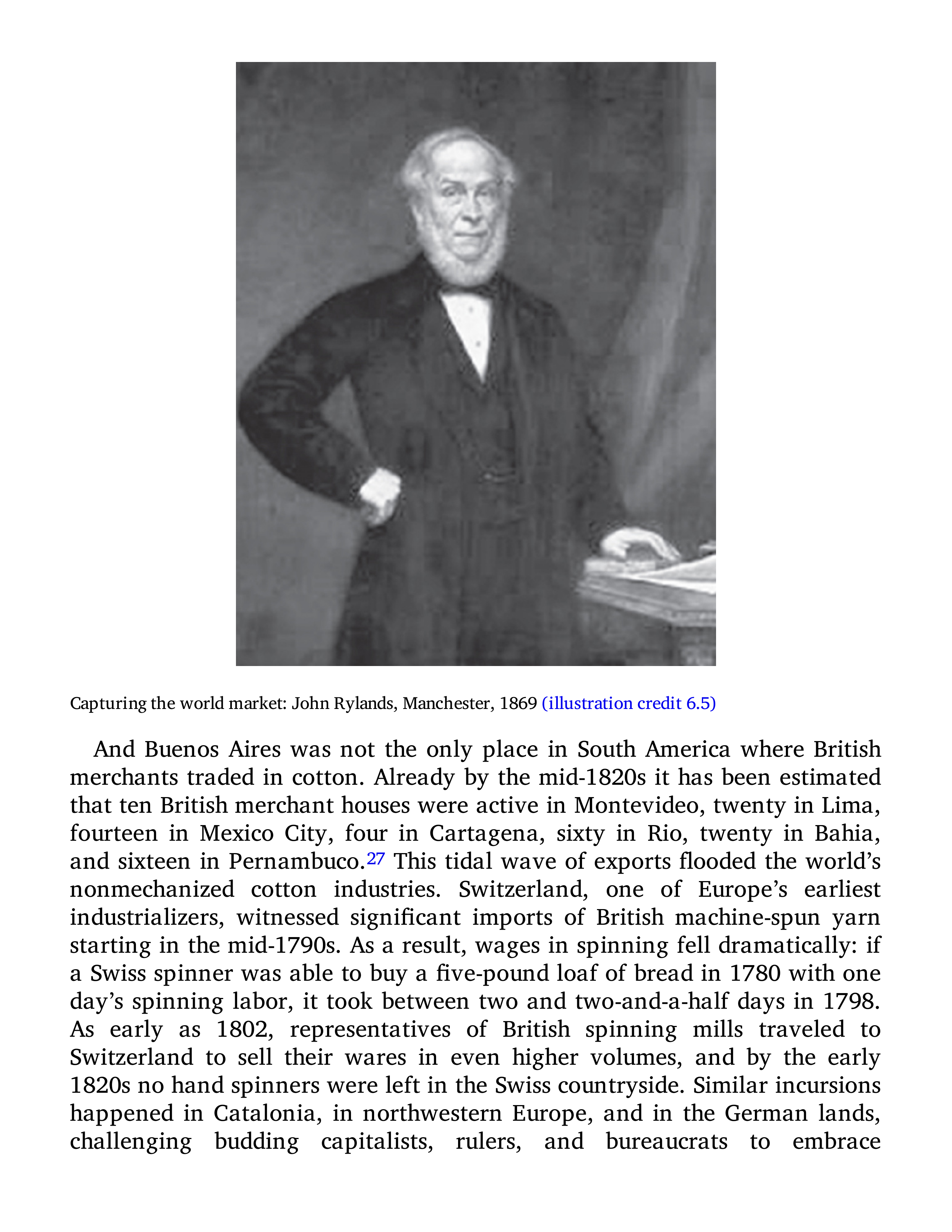
Capturing the world market: John Rylands, Manchester, 1869
(illustration credit 6.5)
And Buenos Aires was not the only place in South America where British
merchants traded in cotton. Already by the mid-1820s it has been estimated
that ten British merchant houses were active in Montevideo, twenty in Lima,
fourteen in Mexico City, four in Cartagena, sixty in Rio, twenty in Bahia,
and sixteen in Pernambuco.
27
This tidal wave of exports
ɻooded the world’s
nonmechanized cotton industries. Switzerland, one of Europe’s earliest
industrializers, witnessed signi
ɹcant imports of British machine-spun yarn
starting in the mid-1790s. As a result, wages in spinning fell dramatically: if
a Swiss spinner was able to buy a
ɹve-pound
loaf of bread in 1780 with one
day’s spinning labor, it took between two and two-and-a-half days in 1798.
As early as 1802, representatives of British spinning mills traveled to
Switzerland to sell their wares in even higher volumes, and by the early
1820s no hand spinners were left in the Swiss countryside. Similar incursions
happened in Catalonia, in northwestern Europe, and in the German lands,
challenging budding capitalists, rulers, and bureaucrats to embrace
mechanized manufacturing. Failure to do so, in e
ʃect, meant giving up on
cotton, and forgoing what had become a signi
ɹcant source of wealth and,
increasingly, a precondition for being “modern.” Yet rulers and capitalists in
many parts of the world, as we will see, were unable to respond.
28
British competition was a strong incentive to embark upon something
radically new, but no manufacturer could do so without British technology.
Though the British government tried to hold on to its monopoly, that
technology spread rapidly due to active programs of private and
government-directed industrial espionage as well as the unstoppable out
ɻow
of skilled British workers and cotton capitalists eager to make their fortunes
in new lands. Between the invention of new machines in Britain and their
spread elsewhere there was typically only a ten-year lag. In Holland and
northwestern Germany, jennies and water frames arrived from England in
1780, while Belgian frames came from France, where jennies had been
introduced in 1771. The water frame arrived in Lyon in 1782, after being set
up in England in 1769. Samuel Crompton’s mule came to Amiens in 1788,
just nine years after its invention. Arkwright’s machinery, one sociologist
remarks, was a “considerable technological breakthrough” but one that
nonetheless could be “easily defused.”
29
Indeed, in the wake of the Industrial Revolution in Britain, entrepreneurs,
rulers, bureaucrats, and scientists from many parts of the world carefully
studied the progress of the British cotton industry. They traveled to Britain
to acquire blueprints, models, and machines. If machines could not be had
openly, entrepreneurs and spies committed the secrets of this new
technology to memory, or persuaded skilled British artisans to travel despite
the restrictive emigration laws in place up to 1825. Industrial espionage was
the order of the day. Between 1798 and 1799, Lieven Bauwens, for example,
who brought mechanized cotton spinning to Belgium, traveled to England
thirty-two times to study the new ways to spin cotton, sometimes bringing
skilled workers along with him. Thomas Somers, who had been sent to
Britain by a group of Baltimore manufacturers in 1785, returned with small-
scale models of spinning machines. Because knowledge of the early
machines remained mostly in the heads of artisans, their movements made
this di
ʃusion possible. It has been estimated that more than two thousand
British artisans worked in continental Europe, taking with them the beating
heart of the English textile industry’s know-how.
30
Everywhere, British entrepreneurs, British expertise, and British artisans
played a crucial role. In Normandy, one of the centers of the French cotton
industry, brothers Thomas and Frederic Waddington were instrumental in
establishing mechanized spinning factories in Saint-Rémy-sur-Avre and
Rouen. In 1818, Mulhousian cotton entrepreneur Nicholas Schlumberger
hired engineer Job Dixon from England to build spinning machines for him.
In 1831, Camille Koechlin traveled to England to investigate cotton
techniques there and returned with a number of “Cahier des notes faites en
Angleterre,” providing a detailed survey of manufacturing techniques,
especially as they related to the dyeing of fabrics.
31
From France, the new machines migrated to adjacent Switzerland. As the
Swiss cotton industry su
ʃered mightily from machine-made yarn from
Britain, in 1800 the Swiss consul in Bordeaux, Marc Antoine Pellis,
approached the government of the Swiss Confederation to import French-
made copies of English spinning mules. They were eventually put up in a
nationalized monastery in 1801 and their 204 spindles put to work. A year
later, some Winterthur merchants brought forty-four of Arkwright’s spinning
machines to a factory in Wül
ɻingen.
32
Locations much farther from Lancashire also bene
ɹted from the spread of
ideas, machines, and people. Mexico drew on British and eventually also
American experts, technology, and machines. The U.S. cotton industry itself
relied on British technology and on industrial espionage, easily camou
ɻaged
by ceaseless trade and immigration. In 1787, Alexander Hamilton (two
years before he became secretary of the Treasury) and Tench Coxe sent
Andrew Mitchell to Britain to acquire models and drawings of Arkwright’s
machinery, a project that failed only when Mitchell was caught. Most
famously, Francis Cabot Lowell ventured to Britain in 1810, allegedly for
“health reasons,” and came back with blueprints for his factory at
Watertown. The combination of migration and espionage meant knowledge
traveled fast: Arkwright’s carding engine found its way across the Atlantic in
eight short years, Hargreaves’s spinning jenny took ten; Arkwright’s water
frame took twenty-two years, and Crompton’s mule only eleven. After 1843,
when the export of textile machines from Great Britain was
ɹnally made
legal, “market seeking by British engineering
ɹrms” became an important
additional factor in the further spread of textile manufacturing technology.
33
Once these technologies spread, indigenous machine makers quickly
mastered them and adapted them to new purposes and conditions. Saxon
entrepreneurs started building simpli
ɹed versions of British machines as
early as 1801, and Swiss artisans followed in 1806. France developed a
strong machine-building industry alongside its cotton industry, and that
technology in turn was exported all over Europe. German skilled artisans in
turn played an important role in the early history of the Russian cotton
industry. Barcelona artisans manufactured spinning jennies as early as
1789, Arkwright’s water frame in 1793, and Crompton’s mule in 1806.
Alsatian manufacturers were about
ɹfteen years ahead of their British
counterparts in developing dyes and chemicals to
ɹx color to cloth,
technology that eventually allowed for the emergence of the huge chemical
and pharmaceutical industry around Basel. And in 1831 the American John
Thorp invented ring spinning, which proved to be easier to operate and
faster, creating more thread per worker. It soon spread to Mexico, Great
Britain, and, most signi
ɹcantly, by the end of the century,
Japan. The idea
of relentless technical innovation, a core characteristic of industrial
capitalism, spread beyond the borders of Great Britain—a sign that
industrial capitalism had grown wings.
34
Having access to spinning and weaving technology indeed was just as
necessary as access to capital, a prior history of putting-out networks, the
pressures of British competition, and a history of some kind with textile
manufacturing more generally. Regions such as Papua New Guinea, the
Congo Basin, or the interior of the North American continent lacked these
conditions, and were thus unlikely to follow the British road. But vast areas
of the world saw no industrialization in cottons even though they ful
ɹlled
these conditions, Kano in present-day Nigeria, Osaka in Japan, and
Ahmedabad in India among them. To be sure, most of Asia’s and Africa’s
cotton industry was still outside the realm of British competition and thus
under considerably less pressure to embrace the new manufacturing
techniques. Yet some parts of Asia—including India, China, and the
Ottoman Empire—did not mechanize despite devastating pressures from
British yarn imports. When so many regions did industrialize, what explains
their seeming twins that did not? We need to search for an answer
elsewhere.
One easy explanation for the uneven development is the salutary e
ʃect of
war capitalism on European economies. The British case, after all, reveals
how important colonial expropriation and slavery and the violent insertion
into global networks had been for the radical recasting of the local cotton
industry. If industrial capitalism was built on the wages of war capitalism,
then perhaps it was the ability to embrace war capitalism that was the
fundamental precondition for cotton industrialization. Not only British, but
also French, Dutch, and Spanish capitalists could and did draw on colonial
raw materials and colonial markets. Still, this is too facile a link. After all,
one of war capitalism’s most signi
ɹcant contributions to the unfolding of
industrial capitalism had been the provision of huge quantities of raw cotton
at falling prices. But in many ways that bene
ɹt was easily generalized—
anyone could travel to Liverpool or, for that matter, New Orleans to
purchase cotton and thus bene
ɹt from the enormous pressure placed upon
the slaves and indigenous peoples of North America. And what about the
spread of cotton industrialization in the German lands? Or Switzerland? To
be sure, some of their merchants gained riches in the slave trade, and they
bene
ɹted from the accessibility of slave-grown cotton, but still, these
important areas of European industrialization were bereft of colonies.
Moreover, while the prevailing economic model—war capitalism—
provided the resources needed, especially raw cotton, for industrialization
and many important institutional legacies, the example of Great Britain had
shown that war capitalism itself was ill-suited for the next step: the mass
production of cotton textiles. Another way of organizing economic activity
had to be forged—and transferring that model turned out to be much more
challenging than moving machines or mobilizing capital.
What the British example also shows is the importance of the state’s
capacity to forge conditions conducive to industrialization. Without a
powerful state capable of legally, bureaucratically, infrastructurally, and
militarily penetrating its own territory, industrialization was all but
impossible. Forging markets, protecting domestic industry, creating tools to
raise revenues, policing borders, and fostering changes that allowed for the
mobilization of wage workers were crucial. Indeed, the capacity of states to
foster a domestic cotton industry turns out to be the key division between
places that industrialized and those that did not. The map of modern states
corresponds almost perfectly to the map of regions that saw early cotton
industrialization.
On the most super
ɹcial level, states mattered because they made the
project of cotton industrialization explicitly their own by engaging in a
range of measures to secure the construction of spinning mills. The French
revolutionary government, for example, provided loans to Belgian cotton
pioneer Bauwens. When Johannn Gottfried Brügelmann started the
ɹrst
cotton mill in the German-speaking lands, he received an exclusive privilege
and monopoly from the Duchy of Berg. In Saxony, when Karl Friedrich
Bernhard and Conrad Wöhler opened the
ɹrst cotton factories in 1799 with
the help of English engineers, they successfully appealed to the local
government for direct subsidies and a temporary monopoly. In Russia cotton
entrepreneur Michael Ossovski received government loans and a
ɹve-year
monopoly to start Russia’s
ɹrst mechanized spinning mill in 1798. In
Denmark the government heavily subsidized the emerging textile industry
and brought skilled workers from abroad. In 1779 it even created the Royal
Privileged Cotton Manufacture, known as the “Manchester Factory.”
Similarly, in the United States, Alexander Hamilton in his “Report on the
Subject of Manufactures” in 1791 had strongly advocated a policy of
government support for industrial development. And the state proved
important, as when in 1786 the Massachusetts legislature sponsored two
Scots—Robert and Alexander Barr—to emigrate to East Bridgewater to build
a cotton spinning factory. In a similar vein, in 1789 a group of Boston
merchants, aided by a $500 grant by the state of Massachusetts,
incorporated the Beverly Cotton Manufactory. In Mexico the federal
government created the Banco de Avío para Fomento de la Industria
Nacional in 1830, to make loans for the building of factories and organized
the acquisition of foreign machines and the hiring of foreign technical
experts, and in 1826, the government of the state of Puebla supported the
travel of mechanics to the United States and Europe to study the techniques
of cotton production and to buy machines.
35
Yet monopolies, subsidies, and the provision of expertise all proved to be
fairly minor interventions, su
ɽcient to allow the building of one factory or
another, but not enough to embark upon the creation of a signi
ɹcant
domestic cotton industry. Indeed, without the novel and powerful state in
the heart of industrial capitalism, as we will see later, these e
ʃorts
could
easily
ɹzzle. Much more important was a state’s ability to isolate its
domestic manufacturing e
ʃorts from competition, especially from Britain.
But only a few states in the early nineteenth century enjoyed the capacity to
police their external borders. Tellingly, the
ɹrst wave of mechanized cotton
spinning came to continental Europe as a direct result of the ability of the
expanding French revolutionary republic to keep British manufactured
goods from the continent. The blockade of British trade, from November
1806 to April 1814, provided the single most important impetus for
continental European cotton industrialization, protecting feeble beginnings
so that they could become a full-
ɻedged industry. Just at the moment when
the continental cotton industry struggled to emerge, Napoleon’s policy
isolated it from the devastating competition of English manufacturers;
French spinning and weaving operations soon took o
ʃ. Saxony was
similarly a
ʃected: In 1806, the cotton industry of Saxony, with Chemnitz at
its center, counted 13,200 mechanical spindles, but by 1813, toward the
blockade’s end, that number had multiplied an extraordinary seventeen
times.
36
The e
ʃects of the blockade rippled through other parts of Europe as well.
While the
ɹrst Swiss mechanized cotton mill opened its gates in 1801, the
real expansion of the Swiss cotton industry occurred only after 1806, during
the continental blockade, when the industry was now able to serve markets
formerly served by the British. With the end of the blockade, the Swiss
industry experienced a grave crisis, as the continent was again swamped
with British wares. The Swiss were compelled to look elsewhere for markets,
which they found increasingly in the Americas and the Far East. In Belgium
as well, before the continental blockade, many of Ghent’s printing
workshops still worked with Indian cloths. An 1806 report observed that “in
this Department two manufacturers only make the cloths known as calicoes,
suitable for printing. Were there an embargo placed on textile imports from
India, the Department would soon be able to produce su
ɽcient to satisfy the
needs of the numerous printing works of this and other Departments
because of the abundance of weavers in the area and because the spinning
mills could produce all that is needed.” Napoleon unintentionally ful
ɹlled
this wish, and huge new opportunities emerged for local manufacturers. Just
a year later, Prefect Faipoult was able to report that “no industrial progress
has ever taken place more rapidly.” In Holland, the Habsburg Empire, and
Denmark the stories were quite similar.
37
A similar impetus was at play in the United States during its periodic
con
ɻicts with England. There, the wars of the early nineteenth century
proved bene
ɹcial to cotton manufacturing enterprises. With Jeʃerson’s
Embargo Act of 1807, which blocked the shipment of goods between the
United Kingdom, France, and the United States, British textile imports
largely disappeared from the market, providing new opportunities to
American spinners and weavers: The number of mechanical spindles in the
United States increased from 8,000 in 1807 to 130,000 in 1815. There were
ɹfteen cotton mills in 1806, and sixty-two in 1809, with another twenty-ɹve
under construction. This astonishing and highly pro
ɹtable increase
encouraged merchants, including Francis Cabot Lowell in Boston, to shift
ever more capital into cotton manufacturing.
38
Napoleon’s continental blockade gave a boost to the cotton industry of
Europe and the Americas at a crucial moment in its development. By 1815,
however, the protective e
ʃects of war and revolutionary upheaval in Europe
had ended. When peace came to Europe after Napoleon’s defeat, British
cotton manufacturer Wright Armitage remarked with relief that “a sudden
transition from War to Peace has had a great e
ʃect on Commerce…. I think
we are now beginning to feel something of our own superiority over other
Nations, in driving them out of the market as Manufacturers.”
39
In some parts of the world, however, the cotton industry had grown so
substantially during the years of upheaval that manufacturers had gained
su
ɽcient political clout to pressure their governments to protect the
emerging industry from being “driven out” and provided states with an
interest in and an ability to further develop industries. Wright Armitage was
partly wrong. In the United States, a new tari
ʃ provided the cotton industry
with some protection as early as 1816. Other parts of the world followed
suit. In France, “prohibitive tari
ʃs” followed the end of the continental
blockade. Prussia and Austria imposed import duties on cotton goods in
1818, Russia in 1820, France in 1822, Italy in 1824, and Bavaria and
Württemberg in 1826. France went so far that in 1842 it prohibited the
importation of all cotton goods onto its national territory. Protectionism,
once seen as a wartime cataclysm, now became a permanent feature of
newly industrializing states—who in this respect followed the British
example, as Britain had protected its home market from Indian competition
just as furiously.
40
Cotton manufacturers themselves were at the forefront of demanding such
protection. Even as late as 1846, far beyond the industry’s infancy, Alsatian
entrepreneurs created the Comité Mulhousien de l’Association pour la
Défense du Travail National, with cotton manufacturers Emile Dollfus and J.
A. Schlumberger at the helm, advocating strong protectionist policies. Across
the Rhine in Baden, cotton spinners had pressured for tari
ʃs since 1820.
Spinners in Saxony also agitated for protective tari
ʃs. When Saxony became
part of the Zollverein customs union on January 1, 1834, these spinners
gained a much greater domestic market, and additional tari
ʃ protection. In
negotiating these tari
ʃs among the very states that constituted the
Zollverein, Friedrich List, who attended the meetings for Württemberg in
1846, believed, like Alexander Hamilton across the Atlantic, that the “value
of manufactures [must] be estimated from a political point of view.”
Industry, among other things, he argued, mattered for the ability of nations
to mobilize for war. This “political point of view,” was shared by
Catalonian, Habsburg, Russian, Italian, and French rulers who protected
their emerging cotton industry by various tari
ʃs and prohibitions, and
whose cotton industrialists all clamored for higher import duties.
41
Even
in
places
farther
away
from
England,
domestic
cotton
industrialization rested on the ability of governments to protect their
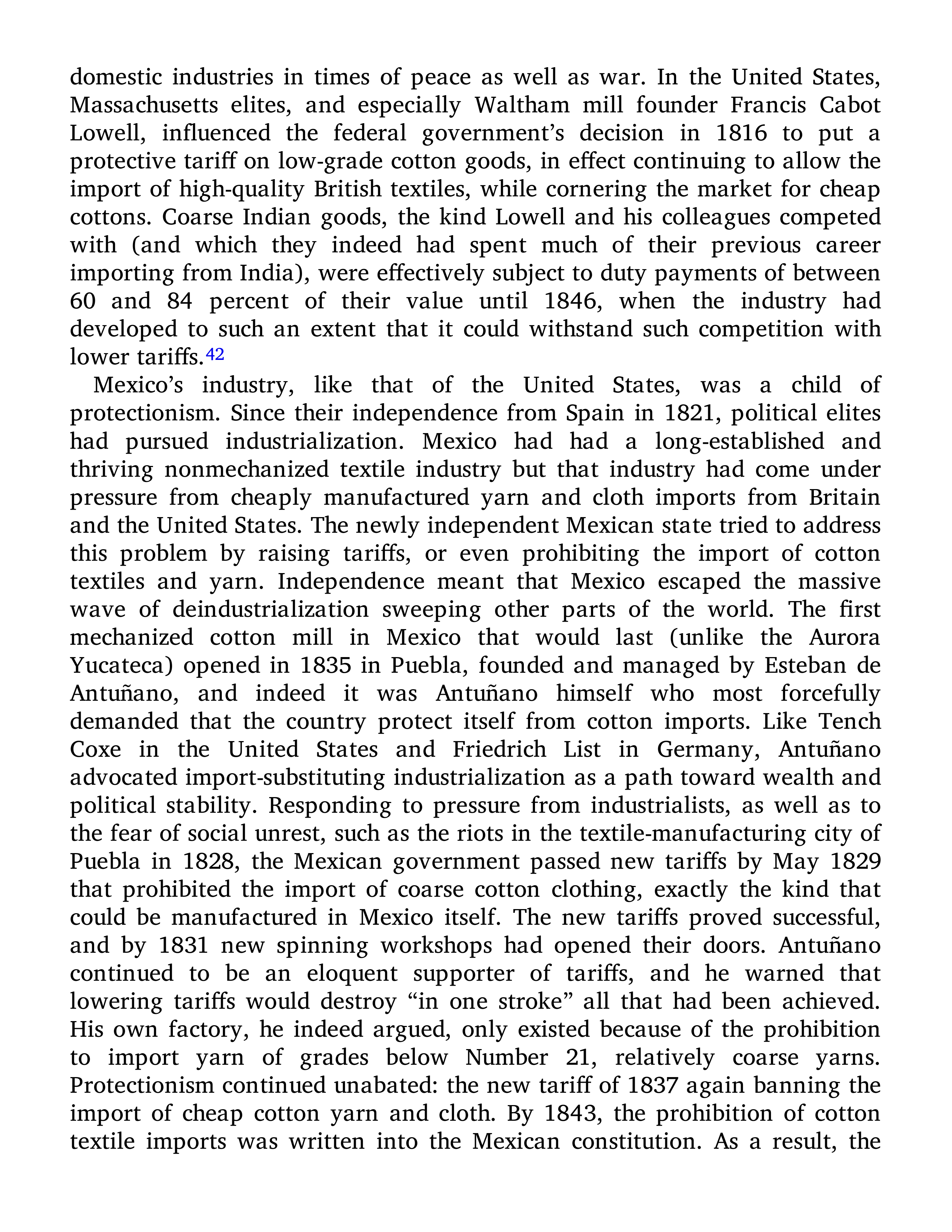
domestic industries in times of peace as well as war. In the United States,
Massachusetts elites, and especially Waltham mill founder Francis Cabot
Lowell, in
ɻuenced the federal government’s decision in 1816 to put a
protective tari
ʃ on low-grade cotton goods, in eʃect continuing to allow the
import of high-quality British textiles, while cornering the market for cheap
cottons. Coarse Indian goods, the kind Lowell and his colleagues competed
with (and which they indeed had spent much of their previous career
importing from India), were e
ʃectively subject to duty payments of between
60 and 84 percent of their value until 1846, when the industry had
developed to such an extent that it could withstand such competition with
lower tari
ʃs.
42
Mexico’s industry, like that of the United States, was a child of
protectionism. Since their independence from Spain in 1821, political elites
had pursued industrialization. Mexico had had a long-established and
thriving nonmechanized textile industry but that industry had come under
pressure from cheaply manufactured yarn and cloth imports from Britain
and the United States. The newly independent Mexican state tried to address
this problem by raising tari
ʃs, or even prohibiting the
import of cotton
textiles and yarn. Independence meant that Mexico escaped the massive
wave of deindustrialization sweeping other parts of the world. The
ɹrst
mechanized cotton mill in Mexico that would last (unlike the Aurora
Yucateca) opened in 1835 in Puebla, founded and managed by Esteban de
Antuñano, and indeed it was Antuñano himself who most forcefully
demanded that the country protect itself from cotton imports. Like Tench
Coxe in the United States and Friedrich List in Germany, Antuñano
advocated import-substituting industrialization as a path toward wealth and
political stability. Responding to pressure from industrialists, as well as to
the fear of social unrest, such as the riots in the textile-manufacturing city of
Puebla in 1828, the Mexican government passed new tari
ʃs by May 1829
that prohibited the import of coarse cotton clothing, exactly the kind that
could be manufactured in Mexico itself. The new tari
ʃs proved successful,
and by 1831 new spinning workshops had opened their doors. Antuñano
continued to be an eloquent supporter of tari
ʃs, and he warned that
lowering tari
ʃs would destroy “in one stroke” all that had been achieved.
His own factory, he indeed argued, only existed because of the prohibition
to import yarn of grades below Number 21, relatively coarse yarns.
Protectionism continued unabated: the new tari
ʃ of 1837 again banning the
import of cheap cotton yarn and cloth. By 1843, the prohibition of cotton
textile imports was written into the Mexican constitution. As a result, the
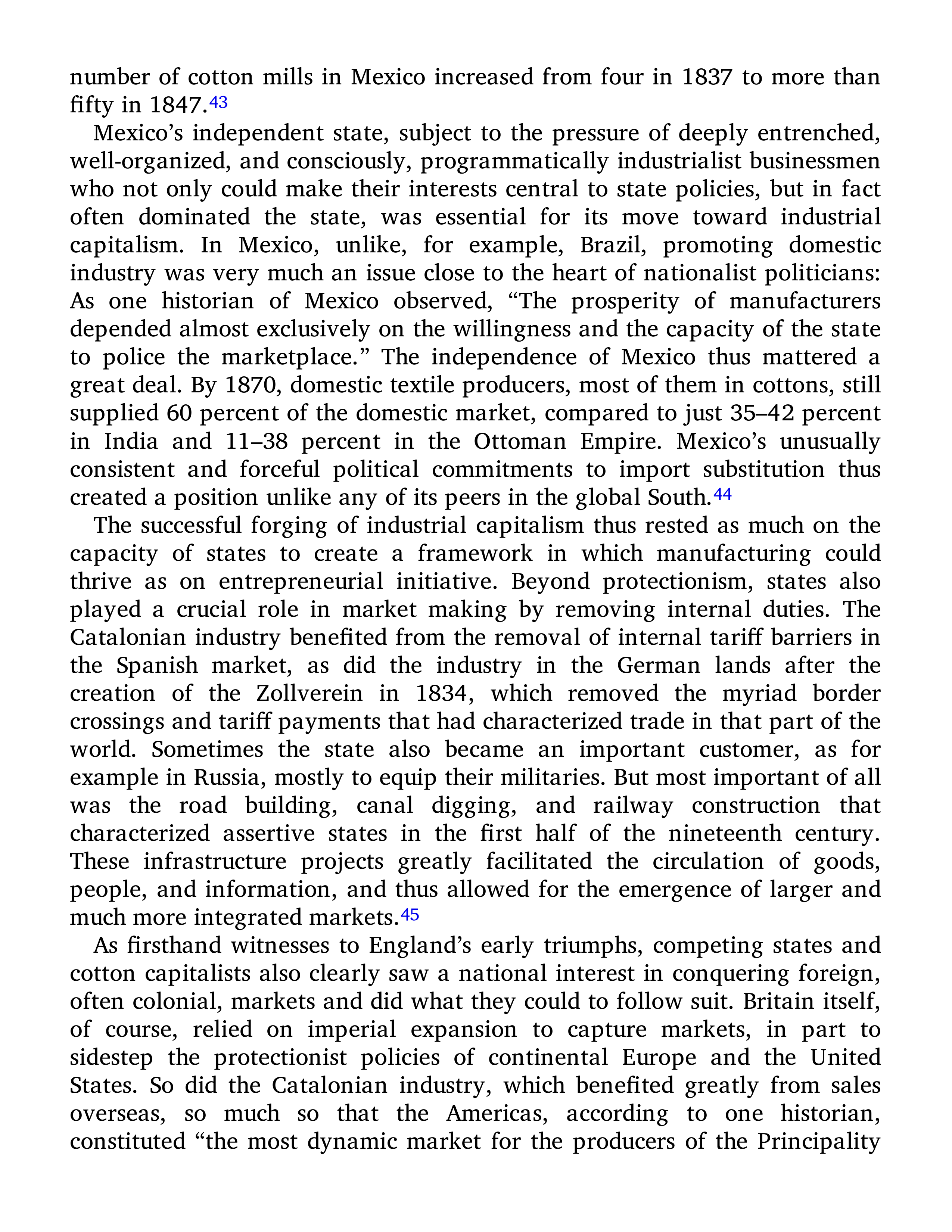
number of cotton mills in Mexico increased from four in 1837 to more than
ɹfty in 1847.
43
Mexico’s independent state, subject to the pressure of deeply entrenched,
well-organized, and consciously, programmatically industrialist businessmen
who not only could make their interests central to state policies, but in fact
often dominated the state, was essential for its move toward industrial
capitalism. In Mexico, unlike, for example, Brazil, promoting domestic
industry was very much an issue close to the heart of nationalist politicians:
As one historian of Mexico observed, “The prosperity of manufacturers
depended almost exclusively on the willingness and the capacity of the state
to police the marketplace.” The independence of Mexico thus mattered a
great deal. By 1870, domestic textile producers, most of them in cottons, still
supplied 60 percent of the domestic market, compared to just 35–42 percent
in India and 11–38 percent in the Ottoman Empire. Mexico’s unusually
consistent and forceful political commitments to import substitution thus
created a position unlike any of its peers in the global South.
44
The successful forging of industrial capitalism thus rested as much on the
capacity of states to create a framework in which manufacturing could
thrive as on entrepreneurial initiative. Beyond protectionism, states also
played a crucial role in market making by removing internal duties. The
Catalonian industry bene
ɹted from the removal of internal tariʃ barriers in
the Spanish market, as did the industry in the German lands after the
creation of the Zollverein in 1834, which removed the myriad border
crossings and tari
ʃ payments that had characterized trade in that part of the
world. Sometimes the state also became an important customer, as for
example in Russia, mostly to equip their militaries. But most important of all
was the road building, canal digging, and railway construction that
characterized assertive states in the
ɹrst half of the nineteenth century.
These infrastructure projects greatly facilitated the circulation of goods,
people, and information, and thus allowed for the emergence of larger and
much more integrated markets.
45
As
ɹrsthand witnesses to England’s early triumphs, competing states and
cotton capitalists also clearly saw a national interest in conquering foreign,
often colonial, markets and did what they could to follow suit. Britain itself,
of course, relied on imperial expansion to capture markets, in part to
sidestep the protectionist policies of continental Europe and the United
States. So did the Catalonian industry, which bene
ɹted greatly from sales
overseas, so much so that the Americas, according to one historian,
constituted “the most dynamic market for the producers of the Principality
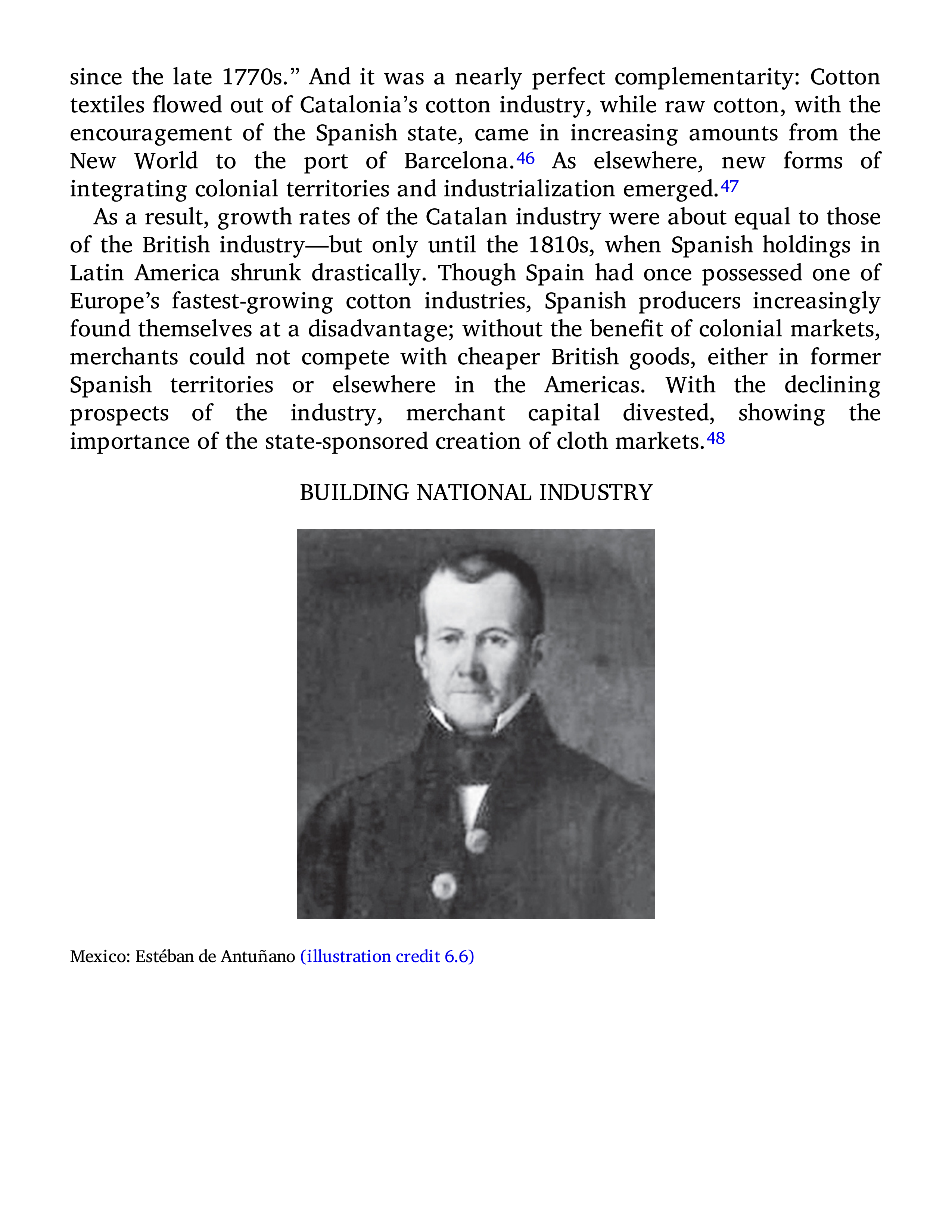
since the late 1770s.” And it was a nearly perfect complementarity: Cotton
textiles
ɻowed out of Catalonia’s cotton industry, while raw cotton, with the
encouragement of the Spanish state, came in increasing amounts from the
New World to the port of Barcelona.
46
As elsewhere, new forms of
integrating colonial territories and industrialization emerged.
47
As a result, growth rates of the Catalan industry were about equal to those
of the British industry—but only until the 1810s, when Spanish holdings in
Latin America shrunk drastically. Though Spain had once possessed one of
Europe’s fastest-growing cotton industries, Spanish producers increasingly
found themselves at a disadvantage; without the bene
ɹt of colonial markets,
merchants could not compete with cheaper British goods, either in former
Spanish territories or elsewhere in the Americas. With the declining
prospects of the industry, merchant capital divested, showing the
importance of the state-sponsored creation of cloth markets.
48
BUILDING NATIONAL INDUSTRY
Mexico: Estéban de Antuñano
(illustration credit 6.6)
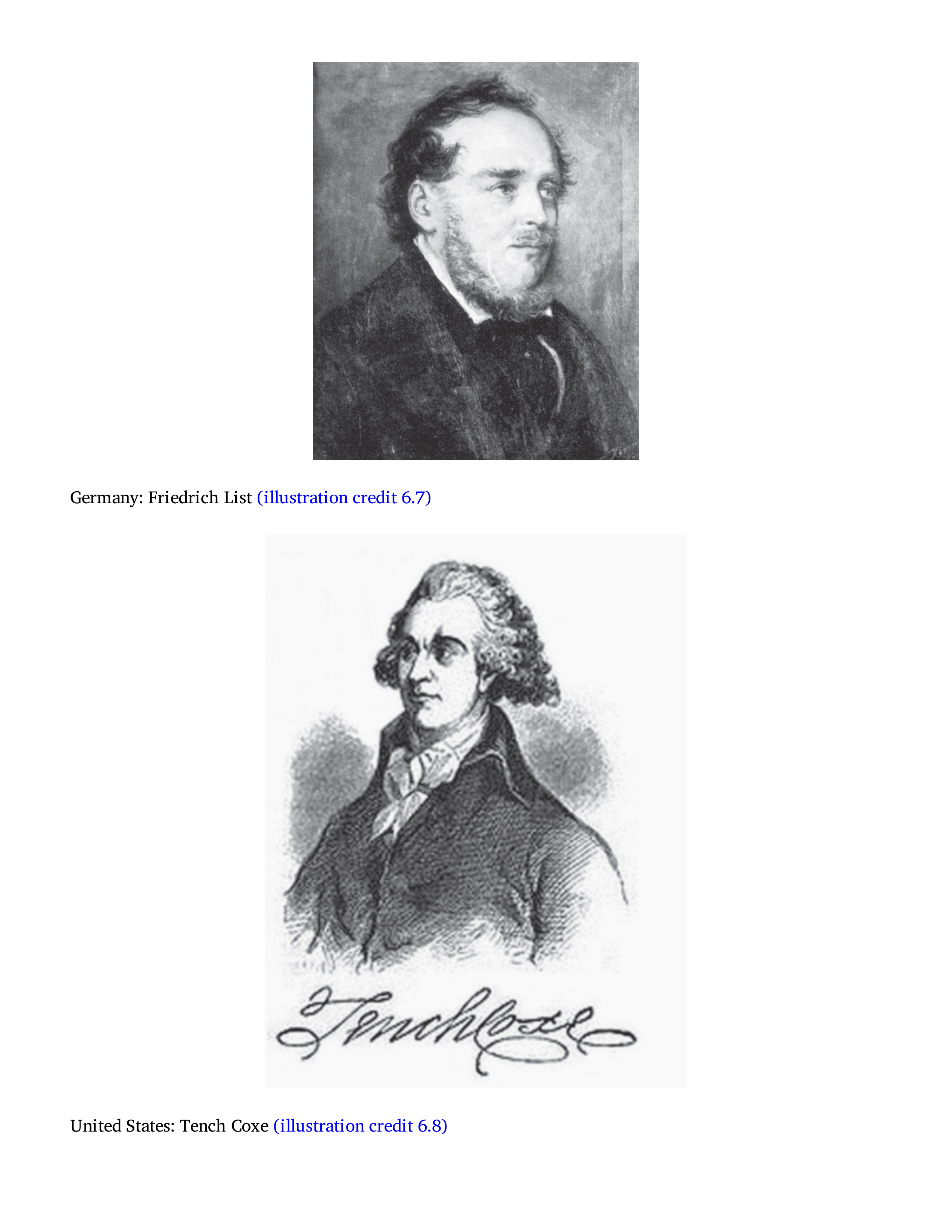
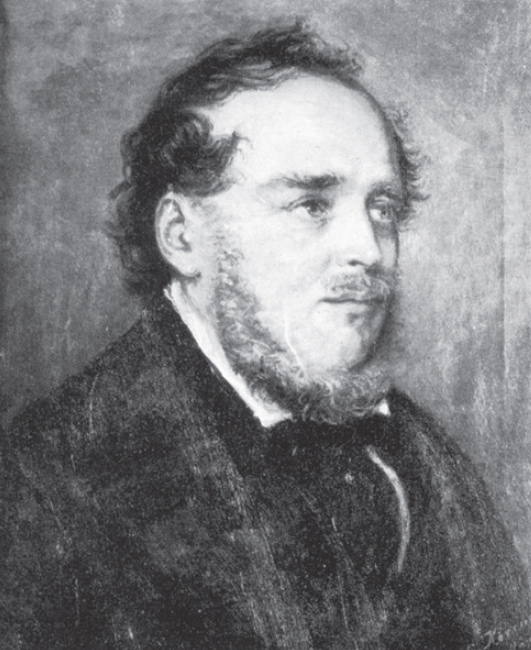
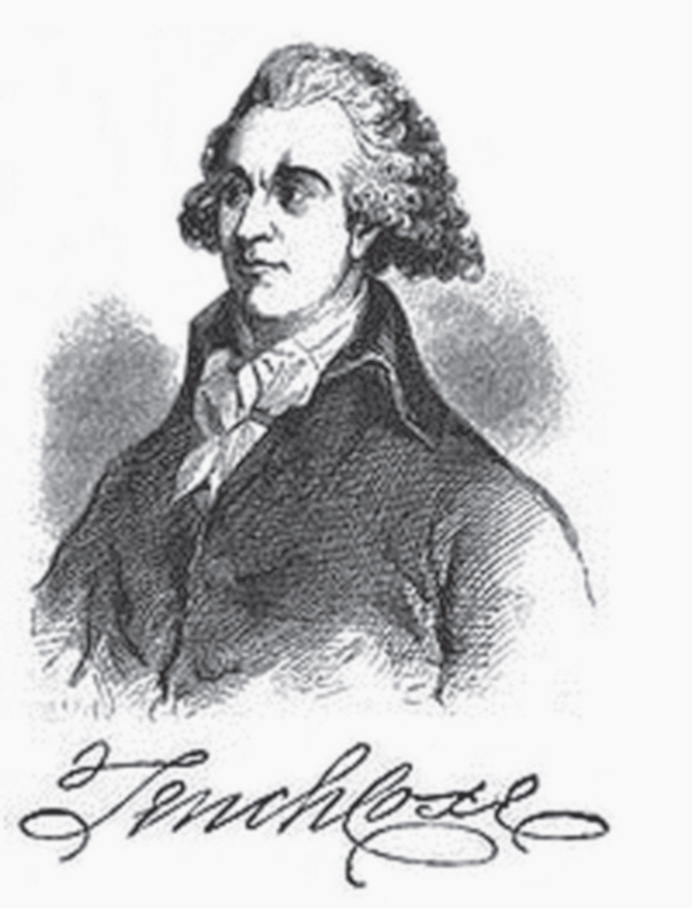
Germany: Friedrich List
(illustration credit 6.7)
United States: Tench Coxe
(illustration credit 6.8)
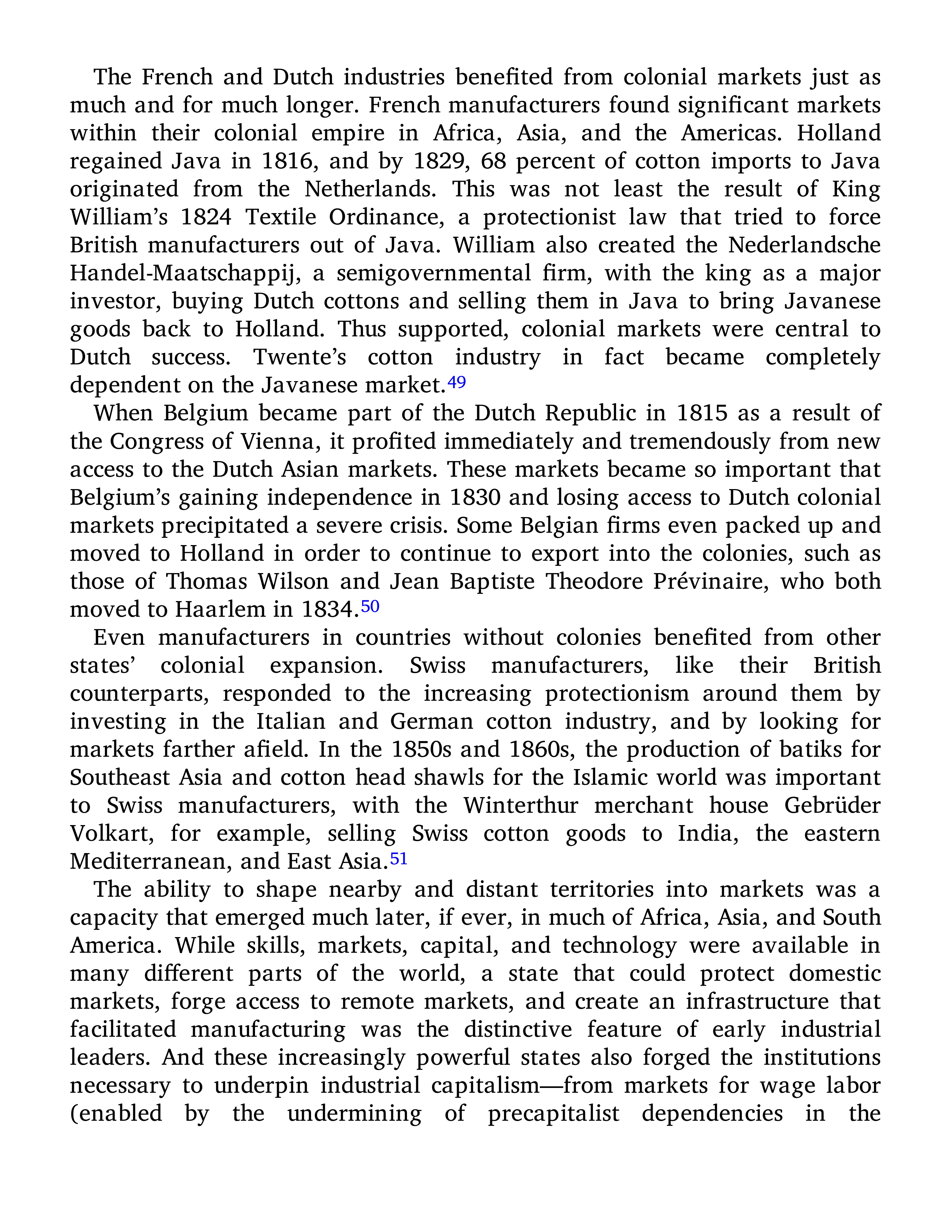
The French and Dutch industries bene
ɹted from colonial markets just as
much and for much longer. French manufacturers found signi
ɹcant markets
within their colonial empire in Africa, Asia, and the Americas. Holland
regained Java in 1816, and by 1829, 68 percent of cotton imports to Java
originated from the Netherlands. This was not least the result of King
William’s 1824 Textile Ordinance, a protectionist law that tried to force
British manufacturers out of Java. William also created the Nederlandsche
Handel-Maatschappij, a semigovernmental
ɹrm, with the king as a major
investor, buying Dutch cottons and selling them in Java to bring Javanese
goods back to Holland. Thus supported, colonial markets were central to
Dutch success. Twente’s cotton industry in fact became completely
dependent on the Javanese market.
49
When Belgium became part of the Dutch Republic in 1815 as a result of
the Congress of Vienna, it pro
ɹted immediately and tremendously from new
access to the Dutch Asian markets. These markets became so important that
Belgium’s gaining independence in 1830 and losing access to Dutch colonial
markets precipitated a severe crisis. Some Belgian
ɹrms even packed up and
moved to Holland in order to continue to export into the colonies, such as
those of Thomas Wilson and Jean Baptiste Theodore Prévinaire, who both
moved to Haarlem in 1834.
50
Even manufacturers in countries without colonies bene
ɹted from other
states’ colonial expansion. Swiss manufacturers, like their British
counterparts, responded to the increasing protectionism around them by
investing in the Italian and German cotton industry, and by looking for
markets farther a
ɹeld. In the 1850s and 1860s, the production of batiks for
Southeast Asia and cotton head shawls for the Islamic world was important
to Swiss manufacturers, with the Winterthur merchant house Gebrüder
Volkart, for example, selling Swiss cotton goods to India, the eastern
Mediterranean, and East Asia.
51
The ability to shape nearby and distant territories into markets was a
capacity that emerged much later, if ever, in much of Africa, Asia, and South
America. While skills, markets, capital, and technology were available in
many di
ʃerent parts of the world, a state that could protect domestic
markets, forge access to remote markets, and create an infrastructure that
facilitated manufacturing was the distinctive feature of early industrial
leaders. And these increasingly powerful states also forged the institutions
necessary to underpin industrial capitalism—from markets for wage labor
(enabled by the undermining of precapitalist dependencies in the
countryside and alternative means of gaining access to subsistence) to
property rights created by laws and administrative infrastructures.
As a result, industrial capitalism, the most revolutionary invention of all,
traveled only in very particular ways. The capitalists who managed to
follow the British example usually worked within states that embraced the
industrialization project and saw national manufacturing as a way to
strengthen the state, forging in the process a new relationship between
economic activity and national territory. In these states, rulers, bureaucrats,
and capitalists could penetrate bounded territories legally, bureaucratically,
infrastructurally, and militarily to create conditions that allowed for long-
term capital investments, the mobilization of labor, expanding domestic and
foreign markets, and protection for national industries from the
uncertainties of the global economy. For statesmen in burgeoning nation-
states, the calculations about whether to build an industrial society on the
British model were straightforward: Industry was a source of wealth, and
also of vastly superior tools of warfare. To survive in a competitive state
system, prosperity was imperative, and embracing industrial capitalism
seemed like a sure way to reach it. For some capitalists, in turn, investing in
manufacturing seemed a promising avenue toward wealth—and they
pressured their governments to the best of their ability to help forge
industrial capitalism, often against the interests and inclinations of
competing, often landed elites. Their success was the ultimate key to
membership in the cotton industrialization club, and at the center of the
“great divergence” in global economic history. And this industrial
capitalism, as we will see, would eventually grow strong enough to lessen
its dependence on war capitalism during its grand crisis in the 1860s.
52
Cotton industrialization was thus not only a project of capitalists, as we
know, but equally a project of governments. Most miraculously, the
emergence of a set of states determined and able to protect domestic cotton
manufacturing did not devastate the export-dependent British industry. To
the contrary, British cotton manufacturing continued to expand at a rapid
clip after 1815. In the
ɹrst half of the nineteenth century, British production
increased by 5 percent annually, and its exports by 6.3 percent. By 1820,
British entrepreneurs operated 7 million spindles, and by 1850 21 million.
By the 1830s, weaving was also increasingly mechanized, and with the
spread of power looms, weavers moved into factories as well. By 1835 there
were roughly
ɹfteen hundred cotton manufacturers (some
of whom owned
multiple mills), and by 1860, four thousand manufacturers owned cotton
mills in the British Isles. So important did cotton become to Britain that by
1856 the Manchester Chamber of Commerce accurately described the
industry as one “neither surpassed in extent nor in usefulness by any other
manufacturing pursuit.”
53
The secrets of British success in the face of protectionism elsewhere were
twofold. For one, British manufacturers focused on higher-quality yarn and
cloth, since they lacked competition from technologically less advanced
manufacturers elsewhere. And Britain increasingly depended on markets in
colonial or semicolonial areas of the world. Into the 1850s, more than half
of all cottons produced in the United Kingdom were exported. Between 1820
and 1850, Asia and Latin America constituted the most rapidly growing
export markets, and Asia’s share in particular increased quickly. The British
cotton trade avoided the stronger states that could protect their own
emerging industries, gravitating instead toward markets that were unable to
politically resist the British onslaught.
54
The tremendous rapacity and unbalanced consequences of war capitalism
left in its wake a great diversity: Some states were strengthened, while
others were weakened and unable to invest in infrastructure, administrative
capacity, and protections of industry. Some states had astounding capacities
to manufacture goods on a mass scale; others remained embedded in
preindustrial, housebound production. On the one hand, slavery, land
expropriations, militarized trade, and colonial expansion had opened up
vast new territories and labor pools for cotton growing and created new
markets of tremendous vitality. They had helped limit competition in global
markets, radically stimulating the international
ɻow of goods, and thus
making the project of industrialization the possession of a few privileged
parts of the world. They were also at the root of a vast strengthening of
states that enabled a few of them to forge the institutions of industrial
capitalism. Indeed, the imperial extension of European state power over the
globe and its intensi
ɹcation within Europe itself were mutually constitutive
for a short but decisive moment.
55
On the other hand, colonial expansion,
the slave trade, and slavery itself undermined state capacity in other parts
of the world and in so doing limited the likelihood that the newfangled
machines, and with them industrial capitalism, would take root there as
well.
No place illuminates the double impact of war capitalism on the cotton
industry better than Egypt. This North African country, long exceptional in
multiple ways, seemed at
ɹrst to break with its continent and follow the
trajectory of Europe. Egypt had within itself many of the preconditions for
successful cotton textile industrialization. It had access to raw cotton, grown
in ever larger quantities on its own soil. It had a long history of textile
production, and cotton was the most important craft industry of its major
cities before the Industrial Revolution; in the eighteenth century Egypt was
already exporting textiles to France.
56
It had, as we will see, access to British
technology. And Egyptians were able to mobilize su
ɽcient amounts of
capital. But by 1850 Egypt had not joined the small number of countries
experiencing Industrial Revolution.
It all started quite promisingly. In
ɻuenced by mercantilist thought,
Egypt’s ruler, Muhammad Ali, was bent on setting up manufacturing
enterprises. Industrialization, he hoped, would strengthen, among other
things, Egypt’s military power and independence. Ali began an import-
substitution project not unlike those of his continental European
counterparts. In the early nineteenth century, Egypt had exported
signi
ɹcant quantities of grain to Europe, which British merchants paid for
with imported textiles that hurt Egyptian textile workshops. In response, Ali
put an embargo on these British goods and encouraged Syrian Christians,
who historically had dominated the textile trade, to set up factories. In 1815,
the
ɹrst cotton weaving workshop opened with a government-granted
monopoly. Three years later, in 1818, the
ɹrst mechanized cotton spinning
mill began operations, rapidly followed by others.
57
The technology for such industrialization in Egypt, as elsewhere, came
directly or indirectly from Britain. At
ɹrst, Ali imported
spinning machines
from there and had them set up by British mechanics, but later he brought
French engineers to start a domestic machinery industry.
58
So far, cotton
industrialization in Egypt followed along the lines of continental Europe,
the United States, and Mexico.
The peak of this industrialization e
ʃort was reached in the mid-1830s. By
1835 between
ɹfteen thousand and twenty thousand workers labored in
thirty cotton factories operating approximately four hundred thousand
spindles. Most of the products of these factories served the domestic market,
but other fabrics were exported—throughout the Middle East, to places such
as Syria and Anatolia, but also into Sudanese and Indian markets. As the
German paper
Ausland
remarked in 1831 after reviewing the Egyptian
cotton industry, “It is interesting that a barbarian has achieved within a few
years what Napoleon and the entire continent were unable to accomplish
since the beginning of the century, despite all possible e
ʃorts, i.e., to
successfully compete with the British in the production of cotton.” Such an
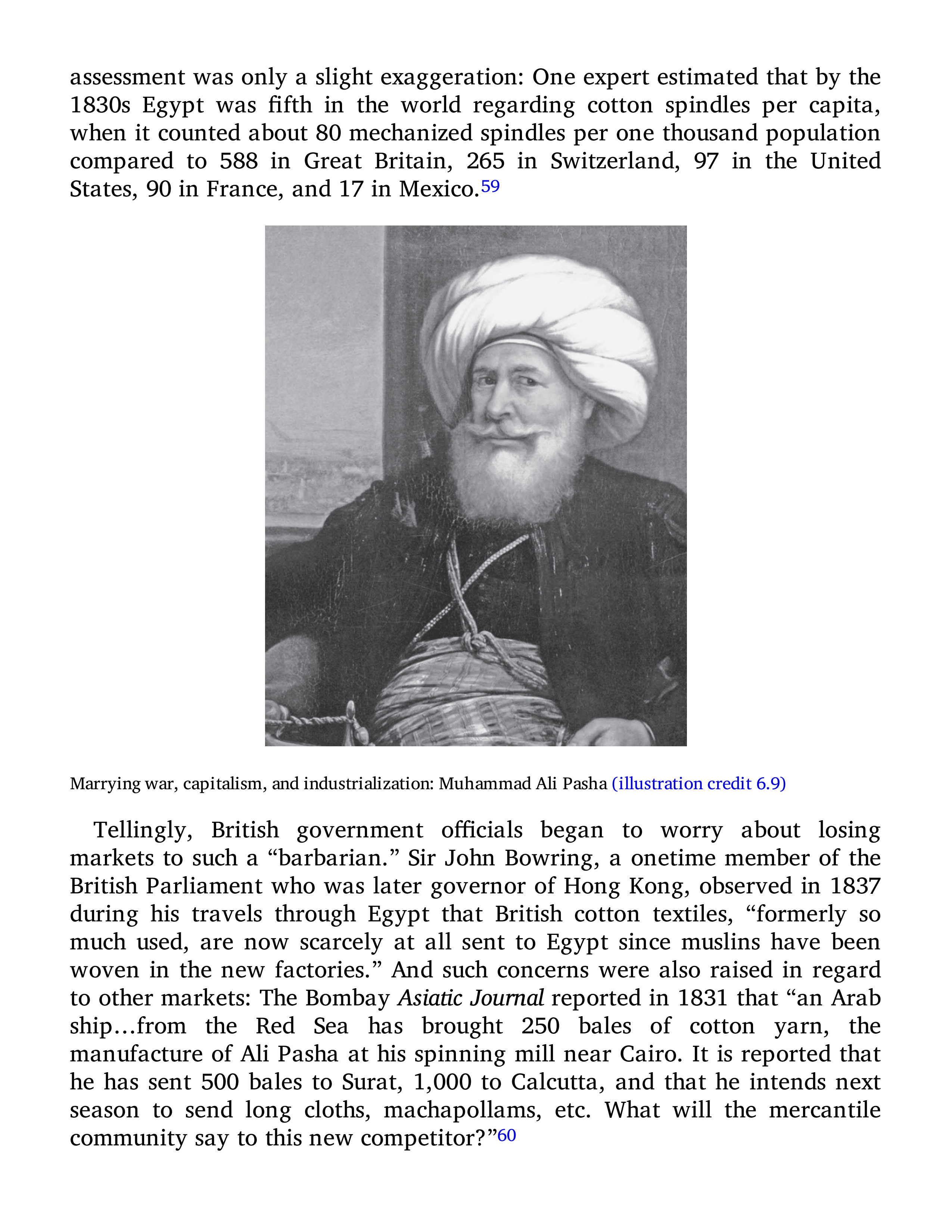
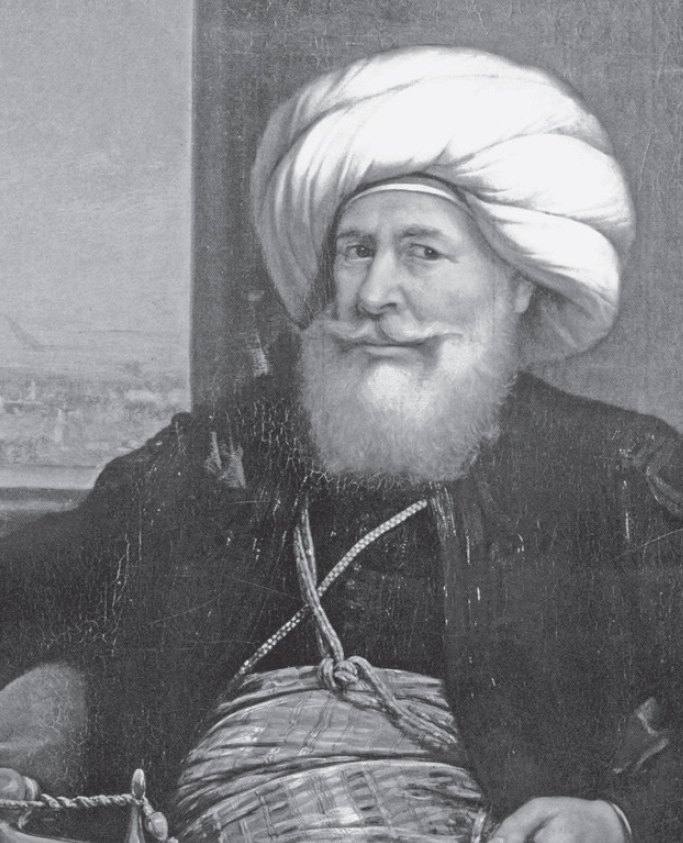
assessment was only a slight exaggeration: One expert estimated that by the
1830s Egypt was
ɹfth in the world regarding cotton
spindles per capita,
when it counted about 80 mechanized spindles per one thousand population
compared to 588 in Great Britain, 265 in Switzerland, 97 in the United
States, 90 in France, and 17 in Mexico.
59
Marrying war, capitalism, and industrialization: Muhammad Ali Pasha
(illustration credit 6.9)
Tellingly, British government o
ɽcials began to worry about losing
markets to such a “barbarian.” Sir John Bowring, a onetime member of the
British Parliament who was later governor of Hong Kong, observed in 1837
during his travels through Egypt that British cotton textiles, “formerly so
much used, are now scarcely at all sent to Egypt since muslins have been
woven in the new factories.” And such concerns were also raised in regard
to other markets: The Bombay
Asiatic Journal
reported in 1831 that “an Arab
ship…from the Red Sea has brought 250 bales of cotton yarn, the
manufacture of Ali Pasha at his spinning mill near Cairo. It is reported that
he has sent 500 bales to Surat, 1,000 to Calcutta, and that he intends next
season to send long cloths, machapollams, etc. What will the mercantile
community say to this new competitor?”
60
British merchants in India complained. In June 1831 they reported on
Egyptian imports into Calcutta, “This twist is of superior quality, even
surpassing that imported here from England…. Considering these facts, it
may be apprehended that the manufactures of Egypt are likely to interfere
with similar productions imported into this country from Great Britain.”
Further examination of Egyptian cotton imports having convinced them that
“thread is remarkably strong,” they concluded that “considering the
advantages the pasha possesses and his vicinity, we conceive the British
manufacturer is entitled to greater protection than the above duty, and it is
the intention of the agents here to address government on this subject.”
61
What they saw in Egypt impressed other observers as well. When in 1843
French textile manufacturer Jules Poulain studied the cotton mills of Egypt
and provided Ali with a detailed report on his observations, he encouraged
further e
ʃorts at industrialization. According to Poulain, “It is industry that
makes the wealth of nations.” Poulain, along with Ali, believed that it was
“natural [to] manufacture the product of one’s agriculture.” Indeed, the fact
that Egypt grew its own cotton would be a comparative advantage vis-à-vis
France and the United Kingdom. If the French succeeded in the Indian town
of Pondicherry (where they had just opened a small spinning mill), Poulain
believed, the Egyptians could succeed in Egypt as well, not least because an
“immense advantage” comes from the fact that labor in Egypt was much
cheaper.
62
And here, at the labor question, Egypt’s story began to diverge. Much
more than European states, Ali followed the war capitalism model in Egypt
itself. Workers were forced to work in the factories. When the
ɹrst cotton
textile workshops opened in the Khurun
ɹsh quarter of
Cairo sometime
between 1816 and 1818, their skilled workers and machines came from
Europe, but the one thousand to two thousand rank-and-
ɹle workers were
Sudanese slaves and Egyptians coerced to work for minimal wages, tightly
supervised by the army. These workers were frequently abused. In some
ways, this system was not so di
ʃerent from elsewhere—with government
inducements for industrialization and orphans being forced to work in
factories—but still, coercion was more extreme in Egypt and wage labor
remained marginal. In some ways, Egypt’s rulers chose the tried-and-true
mechanisms of the global plantation complex as its path into the world of
the factory. Indeed, Ali demonstrated that war capitalism could, at least in
Egypt, and for a short time, give birth to industrialization.
63
War capitalism may have brought cotton industries to Egypt by herculean
determination, but the progeny did not last for long. By the 1850s, Egypt’s
cotton industry had essentially disappeared, its countryside littered with
factory ruins. Egypt was never able to build the institutional framework that
would have enabled a full transition to industrial capitalism; even
something so basic as wage labor did not take hold. Its reliance on war
capitalism, both in the cotton
ɹelds and in the cotton factories, ultimately
limited the growth of domestic markets. Egypt was, moreover, in the end
unable to protect its domestic market. British merchants worked hard to
open Egyptian markets for their goods, as Egypt weakened vis-à-vis
European powers. The value of British cotton goods exports to Egypt
increased by an estimated factor of ten between the second half of the 1820s
and the second half of the 1830s. When in 1838 the Anglo-Ottoman Tari
ʃ
Treaty went into force, setting import duties at only 8 percent ad valorem
(that is, a percentage on the value of the product), and in e
ʃect forcing free
trade upon Egypt, it “destroyed its
ɹrst mechanized textile industry.”
Combined with the state’s di
ɽculties running cotton mills and the problem
of securing su
ɽcient fuel for steam-powered production, a system of “free
trade” dominated by Britain made it practically impossible for Egypt to
industrialize. Egypt’s cotton industry was devastated from two sides: its
domestic embrace of war capitalism and its ultimate subjugation to British
imperialism. The Egyptian state was powerful domestically, but weak when
it came to de
ɹning Egypt’s position within the global economy, no match
for British interests and designs.
64
The negative impact of war capitalism on industrialization can be seen in
one other example: Brazil. At
ɹrst glance, Brazil was a lot like Egypt. It had
a long history of cotton production, and Brazil grew ample quantities of
high-quality cotton. An oscillating colonial policy in the eighteenth century
had at times encouraged manufacturing in the country’s new workshops, yet
a 1785 royal decree had disallowed all manufacturing, except for coarse
cotton goods, because colonial authorities were concerned that cotton
factories competed with the labor requirements of mining. But despite such
laws, cotton manufacturing emerged. And when the Portuguese royal family
moved to Rio in 1808, these decrees were revoked and a few cotton mills
built. These mills remained small and marginal; the São Paulo mill closed in
the 1820s because of its lack of access to skilled labor and inability to
compete with British textiles. When in 1844 the Alves Branco tari
ʃ raised
duties to 30 percent on most foreign manufactures, it encouraged the
development of a few new mills, but that tari
ʃ, and along with it the
industry, were short-lived. As a result, as late as 1865 there were just nine
cotton factories in Brazil with just 13,977 spindles—about one-twentieth of
those found in Egypt at the height of its cotton industrialization, or one-
tenth the number in Mexico.
65
Brazil, unlike Mexico and, for a while, Egypt, thus failed to develop its
own mechanized cotton industry, despite its access to cotton, capital, and
technology. Indeed, Brazilian cotton industrialization had to wait until the
1880s.
66
This failure to industrialize was the direct result of the peculiar
political economy forged by politically in
ɻuential
slaveholders. These
powerful sugar and cotton planters envisioned Brazil’s place in the global
economy as the provider of agricultural commodities produced by slave
labor, a vision that ran counter to a project of domestic industrialization.
In the important sugar-growing state of Bahia, merchants dealing in
agricultural commodities, for example, explicitly “opposed industrial
development and attempted to thwart it by denying it essential government
support”—despite
Bahia’s
access
to
coal,
capital,
transportation
infrastructure, and raw cotton, all of which made it ripe for
industrialization. Instead, the Bahian elite wanted the government to invest
in infrastructure to better move goods in and out of the world market and
favored allocating labor to agriculture. Most important to them, however,
slavery demanded low tari
ʃs to facilitate the ɻow of sugar and coʃee from
Brazil into global markets and thus precluded the kind of protectionism that
had enabled European, North American, and for a time Egyptian
industrialization: The Bahian Commercial Association, a group of merchants,
resisted tari
ʃs as vocally and successfully as the planters, as they remained
ɹrmly in thrall to the planters’ domination.
67
Brazil’s budding cotton entrepreneurs faced other problems as well. As
capital was bound up in the production and trade in agricultural
commodities produced by slave labor and in the slave trade itself, industrial
enterprises often lacked access to credit. Moreover, labor recruitment
remained a problem. Because of the prevalence of slavery, little wage labor
was available for industrial employment, since Europeans, unwilling to
compete with slave labor, preferred to migrate to other parts of the
continent, such as Argentina. As a result, mills drew on a mixture of wage
and slave labor. But generally, labor was concentrated in agriculture, and
merchants saw “industry and agriculture…as rivals for available labor.”
68
Plantation slavery’s imperatives, the case of Brazil shows, could be
detrimental to industrialization. Not that slave labor as such was
incompatible with manufacturing—to the contrary, slaves could be
employed in cotton factories. However, a society dominated by slavery was
not conducive to cotton industrialization. Early industrialization depended,
globally, on war capitalism, but in regions of the globe in which war
capitalism took on its most violent edge cotton industrialization never
resulted. Cuba, for example, relied on a massive number of enslaved
workers, and yet did not have a single cotton mill during the entire
nineteenth century.
69
The state of war between private parties at the heart
of war capitalism contradicted the emerging imperatives of industrial
capitalism. It was thus not just the capacity of states that explains the
spread of cotton manufacturing, but also the distribution of power within
them. Slave states were notoriously late and feeble in supporting the
political and economic interests of domestic industrializers.
This was also the case in the slave territories within the United States, the
only country in the world divided between war and industrial capitalism, a
unique characteristic that would eventually spark an unprecedentedly
destructive civil war. In the southern United States, one of the world’s most
dynamic slave economies, there was little cotton industrialization before the
1880s. To be sure, during and after the Revolutionary War some mechanized
cotton manufacturing emerged in the southern states, and during the 1830s
and thereafter a few textile mills opened their doors. But as late as 1850,
southern cotton mills only consumed seventy-eight thousand bales of cotton,
or one-sixth of the cotton consumption of New England. Further expansion
of manufacturing, just as in Brazil, was hampered by the thriving slave
economy that concentrated capital, labor, and entrepreneurial talent on
plantations, limited the size of markets, made the region unattractive to
European immigrants, and did not force white yeoman farmers into wage
work (unlike, say, in New England and the Black Forest).
70
War capitalism, in di
ʃerent ways, also limited opportunities for
industrialization elsewhere. The great premodern cotton power of India did
not just fail to leap forward via mechanization, but experienced the world’s
most rapid and cataclysmic deindustrialization ever. Faced with huge
imports of ever cheaper cotton yarns and fabrics from its colonial ruler, and
denied the services of its own government, India’s cotton industry was
decimated—
ɹrst its production for export, and then its domestic spinning. In
the wake of the Industrial Revolution, as we have seen, India lost its once
central position in the global cotton industry and, in a great historical irony,
eventually became the world’s largest market for British cotton exports.
Colonialism, by undermining the state capacity of colonized territories
and making them subservient to the interests of the colonizers, was decisive.
Huge domestic demand in India, unlike in continental Europe, did not lead
to state investment or protection—despite access to cotton, capital, and

abundant skill. To be sure, there were some early e
ʃorts under French
colonial auspices, and indeed, the
ɹrst mechanized spinning mill on the
Indian subcontinent was built in the French colony of Pondicherry in the
1830s, producing guinée cloth for French West African markets. This Indian
cotton mill was, as it were, an infertile o
ʃspring of European capital,
intercolonial trade, and European states. Indian cotton industrialization did
not reappear until 1856 when the Parsi merchant Cowasji Nanabhoy Davar
opened the
ɹrst modern cotton mill in Bombay. The true takeoʃ of India’s
cotton manufacturing, however, had to wait until the 1870s, when the
pro
ɹts accumulated in the cotton trade during the
U.S. Civil War were
reinvested into manufacturing.
71
In the
ɹrst half of the nineteenth century, many other parts of the world
with a vibrant cotton sector did not evolve to mechanized production; all of
these cases show that a whole range of factors had to come together to jolt
bureaucrats and capitalists into this new world of industrial wealth creation.
Even in the Yucatecan city of Valladolid, the promising cotton venture of
the Aurora Yucateca came to an end during the late 1840s. Despite Don
Pedro Baranda’s enormous entrepreneurial energies, his mill eventually
faltered. Constant competition from British yarn smuggled in via the weakly
guarded border with British Honduras, yarn that was about 40 percent
cheaper than the goods produced in his factory, coupled with his inability to
access the highly protected Mexican markets thanks to Yucatecan e
ʃorts to
be independent of Mexico, brought an end to the venture. In 1847, Mayan
insurgents captured the city of Valladolid in the War of the Castes,
destroying the factory. The local state was too weak to protect its borders,
to subdue rebellion, or to create a uni
ɹed market, showing once again how
important the state was to the lasting success of cotton industrialization.
72
Colonialism, the embrace of slavery, the expropriation of lands—war
capitalism, in short—had enabled the rise of industrial capitalism in some
parts of the world, while at the same time making its emergence much less
likely everywhere else. Industrial capitalism rested, as we have seen, on a
combination of capital and state power—creating markets and mobilizing
capital and labor in novel ways. The emergence of industrial capitalism in
the
ɹrst half of the nineteenth century in turn created the conditions for
ever greater territorialization—including the greater territorialization of
capital, that is, its attachment to particular nation-states.
73
Crucial to this phase in the history of capitalism was the very diversity of
its forms. Capitalism rested on the
coexistence
of war capitalism, with its
violent expropriation of land and labor, its peculiar state, and the
uncoordinated and unrestrained initiatives of its leading capitalists, with
industrial capitalism, with its administratively, infrastructurally, legally and
militarily powerful states channeling private initiative. The simultaneity of
such di
ʃerent but mutually dependent forms of capitalism might have been
the true innovation of the late eighteenth and early nineteenth centuries. It
was not global integration by itself but the diversity of forms within that
global integration that explained the dramatic but also the wildly di
ʃerent
rates of cotton industrialization during these decades.
Capitalism, however, was not static. Enabled by war capitalism, industrial
capitalism created powerful new institutions and structures. After the 1780s,
a growing number of states built industrial capitalism, eventually allowing
for the emergence of new forms of integration of labor, territory, markets,
and capital in parts of the world that were, in the mid-nineteenth century,
still subject to some of the harshest regimes of war capitalism ever invented.
New ways of raising capital, new ways of inserting capital into production,
new forms of labor mobilization, new forms of market making, and, last but
not least, new forms of the incorporation of land and people into the global
capitalist economy would emerge from this fertile yet often violent, even
barbaric intersection of war and industrial capitalism. From the 1860s on,
capital backed by state power rather than masters backed by expropriation
and private physical coercion, would colonize territories and people.
The spread of cotton industrialization in the
ɹrst half of the nineteenth
century, to continental Europe and a few places beyond, showed that
slavery and colonial exploitation were not essential to capitalism.
74
Capitalism reinvented itself ongoingly, and the lessons and capabilities of
one moment were subsumed in the next. The connections between the global
and the local, and among di
ʃerent places, changed constantly. To be sure,
the demise of war capitalism stretched out for a century—from the Haitian
revolution to the slow decline of slavery in the Americas. But industrial
capitalism’s institutional innovations facilitated war capitalism’s death due
to its own contradictions, as strong states, which would spread to more
regions of the world, would enable labor mobilization in the global
countryside after the end of slavery. The modern world, indeed, has been
shaped just as much by war capitalism’s death as by its birth.
One of the greatest institutional innovations brought about by capitalists’
and statesmen’s embrace of industrial capitalism, however, was the
invention of new forms of labor mobilization. While capitalism’s vast labor
in the Americas had been accomplished by enslaved Africans, the huge labor
needs of manufacturing industries were met by creating a powerful new
system of wage labor. Though wage labor was not free of extralegal
coercion, it was a new way to mobilize massive amounts of labor. It put
laborers and labor on an entirely di
ʃerent legal, social, and institutional
basis—and the ability to do so was the next factor that set some parts of the
world apart from others.
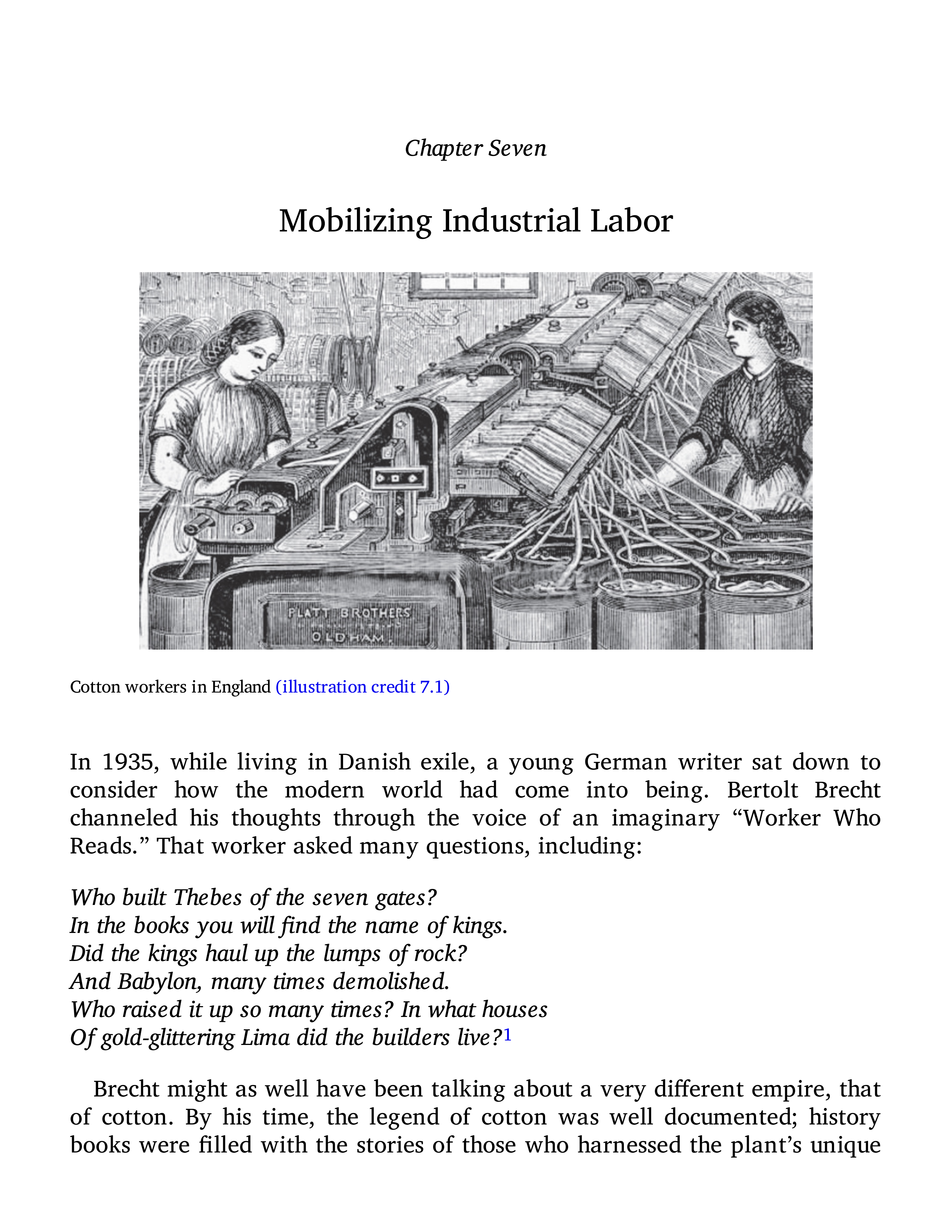
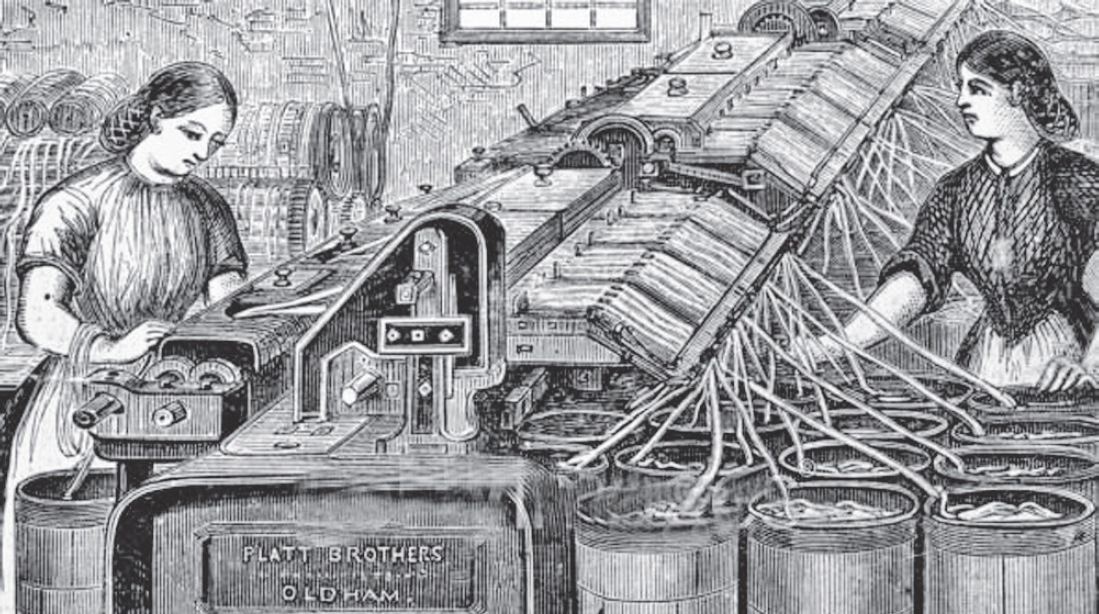
Chapter Seven
Mobilizing Industrial Labor
Cotton workers in England
(illustration credit 7.1)
In 1935, while living in Danish exile, a young German writer sat down to
consider how the modern world had come into being. Bertolt Brecht
channeled his thoughts through the voice of an imaginary “Worker Who
Reads.” That worker asked many questions, including:
Who built Thebes of the seven gates?
In the books you will
ɹnd the name of kings.
Did the kings haul up the lumps of rock?
And Babylon, many times demolished.
Who raised it up so many times? In what houses
Of gold-glittering Lima did the builders live?
1
Brecht might as well have been talking about a very di
ʃerent empire, that
of cotton. By his time, the legend of cotton was well documented; history
books were
ɹlled with the stories of those who harnessed the plant’s unique
gifts, Richard Arkwright and John Rylands, Francis Cabot Lowell and Eli
Whitney. But as with any industry, the empire itself was sustained by
millions of unnamed workers, who labored on cotton plantations and farms,
and in spinning and weaving mills throughout the world, including in
Brecht’s hometown of Augsburg. Indeed, it was in Augsburg, as we have
seen, that Hans Fugger had accumulated his riches in the nonmechanized
production of cottons more than half a millennium earlier.
Like Brecht’s haulers and builders, few cotton workers have entered our
history books. Most left not even a trace; too often they were illiterate, and
almost always their waking hours were occupied with holding body and soul
together, leaving little time to write letters or diaries, as their social betters
did, and thus few ways for us to piece their lives together. One of the
saddest sights to this day is St. Michael’s Flags in Manchester, a small park
where allegedly forty thousand people, most of them cotton workers, lie
buried in unmarked graves, one on top of the other, “an almost industrial
process of burying the dead.” Ellen Hootton was one of these rare
exceptions. Unlike millions of others, she entered the historical record when
in June 1833 she was called before His Majesty’s Factory Inquiry
Commission, which was charged with investigating child labor in British
textile mills. Though only ten when she appeared before the committee and
frightened, she was already a seasoned worker, a two-year veteran of the
cotton mill. Ellen had drawn public attention because a group of middle-
class Manchester activists concerned with labor conditions in the factories
sprouting in and around their city had sought to use her case to highlight the
abuse of children. They asserted that she was a child slave, forced to work
not just in metaphorical chains, but in real ones, penalized by a brutal
overseer.
2
The commission, determined to show that the girl was a “notorious liar”
who could not be trusted, questioned Ellen, her mother, Mary, and her
overseer William Swanton, as well as factory manager John Finch. Yet
despite their e
ʃorts to whitewash the case, the accusations proved to be
essentially true: Ellen was the only child of Mary Hootton, a single mother,
who was herself a handloom weaver barely able to make a living. Until she
turned seven, Ellen had received some child support from her father, also a
weaver, but once that expired her mother brought her down to a nearby
factory to add to the family’s meager income. After as many as
ɹve months
of unpaid labor (it was said that she had to learn the trade
ɹrst), she became
one of the many children working at Eccles’ Spinning Mill. When asked
about her workday, Ellen said it began at
ɹve-thirty in the morning and
ended at eight in the evening, with two breaks, one for breakfast and one
for lunch. The overseer, Mr. Swanton, explained that Ellen worked in a
room with twenty-
ɹve others, three adults, the rest children. She was, in her
own words, a “piecer at throstles”—a tedious job that entailed repairing and
reknotting broken threads as they were pulled onto the bobbin of the mule.
With constant breakage, often several times a minute, she only had a few
seconds to
ɹnish her task.
It was all but impossible to keep up with the speed of the machine as it
moved back and forth, so she sometimes had “her ends down”—that is, she
had not attached the loose and broken ends of the thread fast enough. Such
errors were costly. Ellen reported being beaten by Swanton “twice a week”
until her “head was sore with his hands.” Swanton denied the frequency of
the beatings, but admitted using “a strap” to discipline the girl. Her mother,
who called her daughter “a naughty, stupid girl,” testi
ɹed that she approved
of such corporal punishment, and had even asked Swanton to be more
severe to put an end to her habit of running away. Life was hard for Mary
Hootton, she desperately needed the girl’s wages, and she begged Swanton
repeatedly to keep on the girl, despite all the troubles. As Mary said, “I cries
many a times.”
The beatings, however, were not the worst treatment Ellen experienced at
Swanton’s hands. One day, when she arrived late to work, Swanton
penalized her even more severely: He hung an iron weight around her neck
(there was no agreement about whether it weighed sixteen or twenty
pounds) and made her walk up and down the factory
ɻoor. The other
children heckled her, and as a result, “she fell down several times while
ɹghting with the other hands. She fought them with the stick.” Even today,
nearly two hundred years later, the pain of the girl’s life, from the tedium of
her work to the violence of her abuse, is hard to fathom.
While the city of Manchester sports a Rylands Library, Harvard University
a Lowell student dormitory, and while every grade-school student learns
about Richard Arkwright and Eli Whitney, there is of course no library or
school named for Ellen Hootton. No one but a handful of historians knows
anything about her life. Yet when we think about the world of cotton
manufacturing, we should think of Ellen Hootton. Without her labor and
that of millions of children, women, and men, the empire of cotton would
have never been built. Neither Rylands nor Lowell would have accumulated
their riches, and Arkwright’s and Eli’s inventions would have collected dust
in the corner of a barn. Ellen’s story highlights the physical violence of
punishment, but as important, the more banal violence of economic
desperation, which brought ever larger numbers of people into factories,
where they spent their lives, quite literally, in the service of the empire of
cotton.
Like Ellen Hootton, thousands and, by the 1850s, millions of workers
streamed into the world’s newly built factories to operate the machines that
produced cotton thread and cloth.
3
The ability to mobilize so many women,
children, and men to work in factories was awe-inspiring. Many a
contemporary was overwhelmed by the sight of hundreds or even thousands
of workers walking to and from their places of toil. Every morning before
sunrise, thousands of workers walked down narrow paths in the Vosges to
the factories in the valley, crawled out of dormitory beds just up the hill
from Quarry Bank Mill, left their struggling farms above the Llobregat
River, and made their way through crowded Manchester streets to one of the
dozens of mills lining its putrid canals. At night they returned to sparse
dormitories where they slept several to a bed, or to cold and drafty cottages,
or to densely populated and poorly constructed working-class neighborhoods
in Barcelona, Chemnitz, or Lowell.
The world had seen extreme poverty and labor exploitation for centuries,
but it had never seen a sea of humanity organizing every aspect of their
lives around the rhythms of machine production. For at least twelve hours a
day, six days a week, women, children, and men fed machines, operated
machines, repaired machines, and supervised machines. They opened tightly
packed bales of raw cotton, fed piles of cotton into carding machines, they
moved the huge carriages of mules back and forth, they tied together broken
yarn ends (as did Ellen Hootton), they removed yarn from
ɹlled spindles,
they supplied necessary roving to the spinning machines, or they simply
carried cotton through the factory. Discipline was maintained through petty
ɹnes and forced forfeiture of contracts: A list of dismissal cases from one
early-nineteenth-century mill had o
ɽcial justiɹcations ranging from banal
disciplinary issues, such as “using ill language,” to idiosyncratic charges, like
“Terrifying S. Pearson with her ugly face.” Maintaining a disciplined labor
force would prove consistently di
ɽcult. In one English mill, of the 780
apprentices recruited in the two decades after 1786, 119 ran away, 65 died,
and another 96 had to return to overseers or parents who had originally lent
them out. It was, after all, the beginning of the era of William Blake’s “dark
satanic mill.”
4
Winter or summer, rain or shine, workers ventured into buildings rising
several stories high, usually made of brick, and labored in vast rooms, often
hot, and almost always humid, dusty, and deafeningly noisy. They worked
hard, lived in poverty, and died young. As political economist Leone Levi
put it in 1863, “Enter for a moment one of those numerous factories; behold
the ranks of thousands of operatives all steadily working; behold how every
minute of time, every yard of space, every practiced eye, every dexterous
ɹnger, every inventive mind, is at high-pressure service.”
5
It is di
ɽcult to overstate the importance and revolutionary nature of this
new organization of human labor. Today we take this system for granted:
Most of us make a living by selling our labor for a certain number of hours a
day; with the result—our paycheck—we purchase the things we need. And
we also take for granted that machines set the pace of human activity. Not
so in the eighteenth or nineteenth centuries: If we look at the world as a
whole, the number of people who would exchange their labor power for
wages, especially wages in manufacturing, was tiny. The rhythm of work
was determined by many things—by the climate, by custom, by the cycles of
nature—but not by machines. People worked because they were compelled
to do so as slaves, or because they were the feudal dependents of worldly or
ecclesial authorities, or because they produced their own subsistence with
tools they owned on land to which they had some rights. The new world of
making yarn and cloth, as one of the innumerable cogs in the empire of
cotton, was utterly, fundamentally di
ʃerent. Cotton manufacturing rested
on the ability to persuade or entice or force people to give up the activities
that had organized human life for centuries and join the newly emerging
factory proletariat. Though the machines themselves were stunning and
world-altering, this shift in the rhythm of work would be even more
consequential. They may not have known it, but as Ellen Hootton and
untold others streamed into the factory, they were looking at the future, the
very industrial capitalism that their labor was building.
The ability to move workers into factories became key to the cotton empire’s
triumph. As a result, a chasm opened around the world between statesmen
and capitalists able to mobilize labor and those who failed. Convincing
thousands of people to give up the only way of life they had known was no
less complex than installing new machines. Both required, as we have seen,
certain legal, social, and political conditions. The transition to the factory
was at
ɹrst concentrated in a few places, and even there encountered
tremendous opposition. Success required a lopsided distribution of power
that allowed statesmen and capitalists to dominate the lives of individuals
and families in ways that still eluded elites in much of Asia and Africa. The
power of the state did not just need to be extensive, as it was in many parts
of the world, but intensive, focused, and penetrating all realms of life. As a
result, in areas of the world in which rulers could not easily subdue
alternative means of gaining access to subsistence, it was all but impossible
to transition to factory production. Ironically, factory production itself
would slowly undermine such alternative ways of organizing economic
activity.
To be sure, the Industrial Revolution was mostly about labor-saving
technology—as we have seen, productivity in spinning, for example,
increased by as much as a hundred times. Still, these labor-saving machines
required labor to operate them; as markets for cotton goods expanded
explosively in response to falling prices, a rapidly growing cotton industry
demanded at
ɹrst thousands, then tens of thousands, and, in some parts of
the world, hundreds of thousands of workers. In Britain, by 1861 there were
446,000 people working in the cotton industry. It has been estimated that in
1800 about 59,700 workers labored in the German cotton industry, a
number that increased to 250,300 in 1860. The French industry drew on
approximately 200,000 workers, the Swiss cotton industry in 1827 employed
62,400 workers. While the U.S. cotton industry only counted 10,000 wage
earners in 1810, that number rose to 122,000 in 1860. Russia in 1814
employed 40,000 cotton workers, and about 150,000 in 1860. Spain in 1867
counted about 105,000 workers in its cotton industry. The global cotton
industry rested on proletarianized labor; at the same time it was one of the
greatest proletarianizing agents itself.
6
Before the factory had become a way of life, capital owners had only one
model for how to mobilize vast amounts of labor: the plantation economy of
the Americas, built on the enslavement of millions of Africans. Many a
cotton entrepreneur was intimately familiar with this system; Samuel Greg
of Quarry Bank Mill, as we have seen, owned slave plantations on
Dominica, and he was far from alone. But such possibilities had been
forestalled in Europe because of the new sensibilities about economic man
spurred by the Enlightenment and the resulting legal prohibitions against
slavery in Europe. Bringing African slaves to Manchester, Barcelona, or
Mulhouse was out of the question; enslaving the local population was also
impossible. Moreover, slave labor had signi
ɹcant economic disadvantages—
it was di
ɽcult to motivate workers under conditions of servitude, and
supervision costs were high. Slave labor, moreover, incurred costs year
round, sometimes for the life of the worker, and was not easily adjusted to
the vexing boom-and-bust cycles of industrial capitalism. The model of the
plantation, in other words, did not serve the needs of the factory.
Yet access to labor was crucial to manufacturers the world over. After all,
an entrepreneur’s signi
ɹcant investment in machines could only be
pro
ɹtable with the promise of a predictable stream of labor to operate those
machines. The labor power of women and men, girls and boys, was thus
transformed into a commodity.
7
Turning people into factory workers meant
turning them into wage workers as well. For most people in Europe and
elsewhere, however, wages had not been central to their livelihood. Many
who lived o
ʃ the land or made artisan crafts, not surprisingly, had little
incentive to become factory workers. A farmer grew his own sustenance; an
artisan created goods he could sell or barter. A factory worker, by contrast,
possessed nothing but the power of labor.
Budding capitalists and statesmen thus had to invent new ways to
mobilize labor on a massive scale—that “fresh race of beings” that a rural
magistrate observed in Lancashire in 1808. If they had envisaged the
millions of workers they eventually needed to hire, the problem might have
seemed overwhelming—and indeed, sometimes concerns about insu
ɽcient
labor supply were on their minds. From his home in the West Midlands, a
Shrewsbury mill owner complained, for example, in 1803 that the greatest
problem in starting his mill was to attract a su
ɽcient number of workers.
8
These hopeful employers had help, however, especially from the
transformation of the countryside that was already decades—and in some
places, centuries—in the making. Bonds of mutual obligation between lords
and peasants had begun to break down. In Europe, landowners had
enclosed huge areas of land, making independent farming less accessible to
peasants, and the wave of proto-industrial work had already made
manufacturing, and even wage payments, a normal part of many peasants’
subsistence.
9
Moreover, the bureaucratic, military, ideological, and social penetration
of a bounded territory by newly consolidating states aided mill owners.
Coercion had almost always been a central element in getting people to
perform labor for others, a staple for feudal lords and colonial masters alike.
Yet one of industrial capitalism’s signal features was that coercion would
now be increasingly accomplished by the state, its bureaucrats and judges,
and not by lords and masters. Many capitalists throughout the world in need
of workers feared the decline of personal dependencies such as serfdom,
slavery, and apprenticeships, expecting idleness and even anarchy as a
result. But in some areas the state had gained su
ɽcient strength to create
conditions that secured reliable
ɻows of women, children, and men into
factories. Throughout much of Europe, the rights of landowners and
capitalists to control labor as personal dependents had been severely
curtailed, but at the same time the state had increasingly taken on the role
of legally compelling people to work (such as paupers, so-called vagrants,
and children). Moreover, by the enclosure of the commons the state had
made alternative possibilities of gaining a livelihood increasingly
inaccessible, in fact increasing economic pressures on those without
property. As legal historian Robert Steinfeld has put it, even “economic
coercion is an artifact of the law,” that is, of the state.
10
The state thus created a legal framework for wage labor that made it
more fathomable to rising manufacturers. They appreciated that wage labor
retained signi
ɹcant nonpecuniary coercive elements—bodily coercion—even
in the centers of the new industrial capitalism. Indeed, employers in Britain,
the United States, France, Prussia, and Belgium “required and strictly
enforced labor agreements in wage labor” and “were using forms of legal
compulsion to tie workers to jobs.” The 1823 Master and Servant Act, for
example, explicitly allowed “English employers to have their workmen sent
to the house of correction and held at hard labor for up to three months for
breaches of their labor agreements.” Between 1857 and 1875, in England
and Wales alone, about ten thousand workers annually were prosecuted for
“breach of contract,” many of them sentenced to prison; cotton workers
were frequently among them. In Prussia throughout the nineteenth century,
workers could be
ɹned and imprisoned for leaving their job: “Journeymen,
helpers, and factory workers, who leave work without permission and
without legal justi
ɹcation, or are guilty of shirking or gross disobedience,
are to be punished with a
ɹne of twenty Thalers or prison up to fourteen
days,” determined the Prussian
Gewerbeordnung
of 1845.
11
Despite powerful state support, recruiting workers remained a huge
challenge for budding manufacturers, testifying to the fact that workers
themselves, as long as they still had access to other means of subsisting,
tried to escape the world of the factory. When apothecary Joan Baptista
Sires, for example, opened a cotton factory in the Raval neighborhood of
Barcelona in 1770 with twenty-four looms and nineteen printing tables
(places for the application of colors on cotton fabrics), one of his most
di
ɽcult challenges was recruiting the 60 to 150 women and men he needed
to keep up production. Turnover was huge, as most workers stayed only for
a few months. Sires tried to solve this problem by replicating some elements
of the artisan workshop in his factory, providing skilled male workers with
the best-paid positions, but also allowing their wives and children to work in
the factory, thus increasing the family wage while at the same time saving
on their discounted labor. To try to enmesh workers at his factory, Sires
allowed some families to live in the buildings, replicating a pattern long
typical for artisan workshops throughout Europe.
12
Fifty years later, in the United States, the problem of labor recruitment
had not changed much. The Dover Manufacturing Company in Dover, New
Hampshire, had to employ a total of 342 workers in the period from August
1823 to October 1824 just to maintain an average workforce of
approximately 140.
13
Workers came and left frequently, as they desperately
tried to retain access to a livelihood outside the factory. Entering the factory
for a few weeks, they would leave once they had made enough money to
hold them over to the selling of their crops or when their labor was needed
on the farm.
These patterns of labor recruitment were typical of regions undergoing
cotton
industrialization.
In
every
case,
proto-industrialization
and
proletarianization intersected. The spread of machine-made yarn, and later
cloth, undermined hand spinning and handloom weaving on the farm,
creating pressures on textile workers to
ɹnd income elsewhere. For many,
the only other viable solution was the very factory that had undermined
their prior source of income. Barcelona entrepreneur Sires, in fact, usually
hired workers from the farming areas surrounding the Catalan capital. In
Saxony, earlier di
ɽculties in recruiting labor were overcome when cheap
yarns pouring out of the
ɹrst cotton factories outcompeted hand spinners,
who were then forced to work in the expanding factories. In Switzerland,
the tens of thousands of workers that putting-out merchants kept busy in the
vast countryside as far away as the Black Forest provided a huge potential
labor reservoir, and indeed many of them eventually moved into factory
production. With the rapid expansion of the Alsatian cotton industry and its
signi
ɹcant labor needs, entrepreneurs looked to the mountainous areas of
the Vosges and the Black Forest for that labor. There, the survival of families
still rested on agricultural pursuits and continued to do so even after the
onset of factory production: Nearly all workers in the spinning and weaving
mills of Wesserling, for example, a small town high above the city of
Mulhouse, still owned their own land and supplemented their income by
farming as late as 1858. In the search for spinners and weavers, capital
moved ever deeper into the countryside, allowing manufacturers to pay
extremely low wages because workers could still draw on the unpaid
reproductive labor of family members—child rearing and the growing of
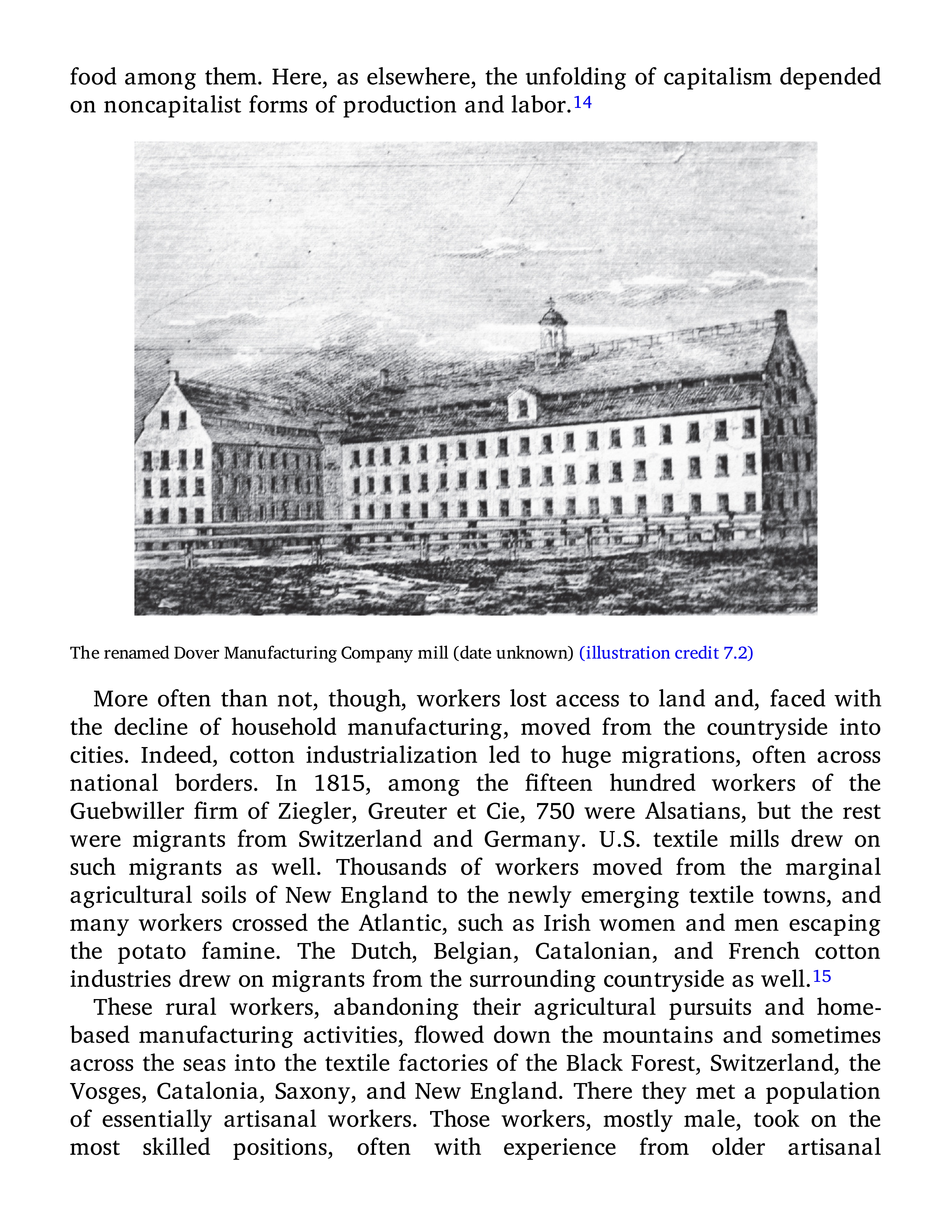
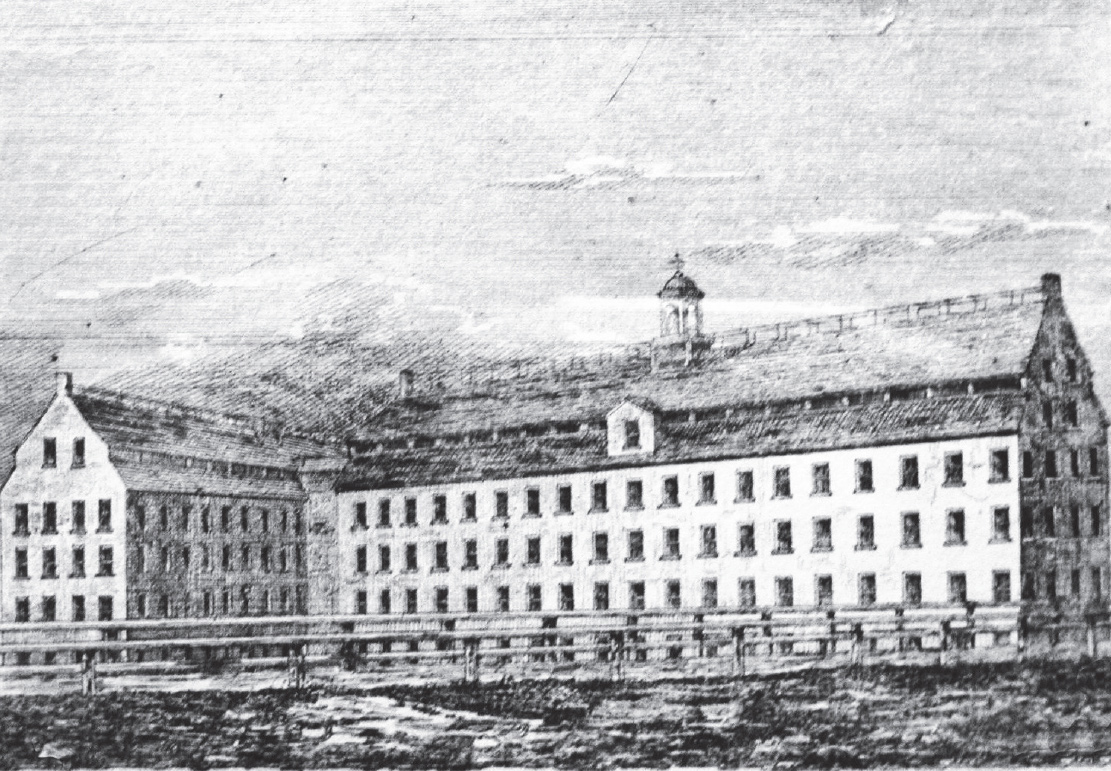
food among them. Here, as elsewhere, the unfolding of capitalism depended
on noncapitalist forms of production and labor.
14
The renamed Dover Manufacturing Company mill (date unknown)
(illustration credit 7.2)
More often than not, though, workers lost access to land and, faced with
the decline of household manufacturing, moved from the countryside into
cities. Indeed, cotton industrialization led to huge migrations, often across
national borders. In 1815, among the
ɹfteen hundred workers of the
Guebwiller
ɹrm of
Ziegler, Greuter et Cie, 750 were Alsatians, but the rest
were migrants from Switzerland and Germany. U.S. textile mills drew on
such migrants as well. Thousands of workers moved from the marginal
agricultural soils of New England to the newly emerging textile towns, and
many workers crossed the Atlantic, such as Irish women and men escaping
the potato famine. The Dutch, Belgian, Catalonian, and French cotton
industries drew on migrants from the surrounding countryside as well.
15
These rural workers, abandoning their agricultural pursuits and home-
based manufacturing activities,
ɻowed down the mountains and sometimes
across the seas into the textile factories of the Black Forest, Switzerland, the
Vosges, Catalonia, Saxony, and New England. There they met a population
of essentially artisanal workers. Those workers, mostly male, took on the
most skilled positions, often with experience from older artisanal
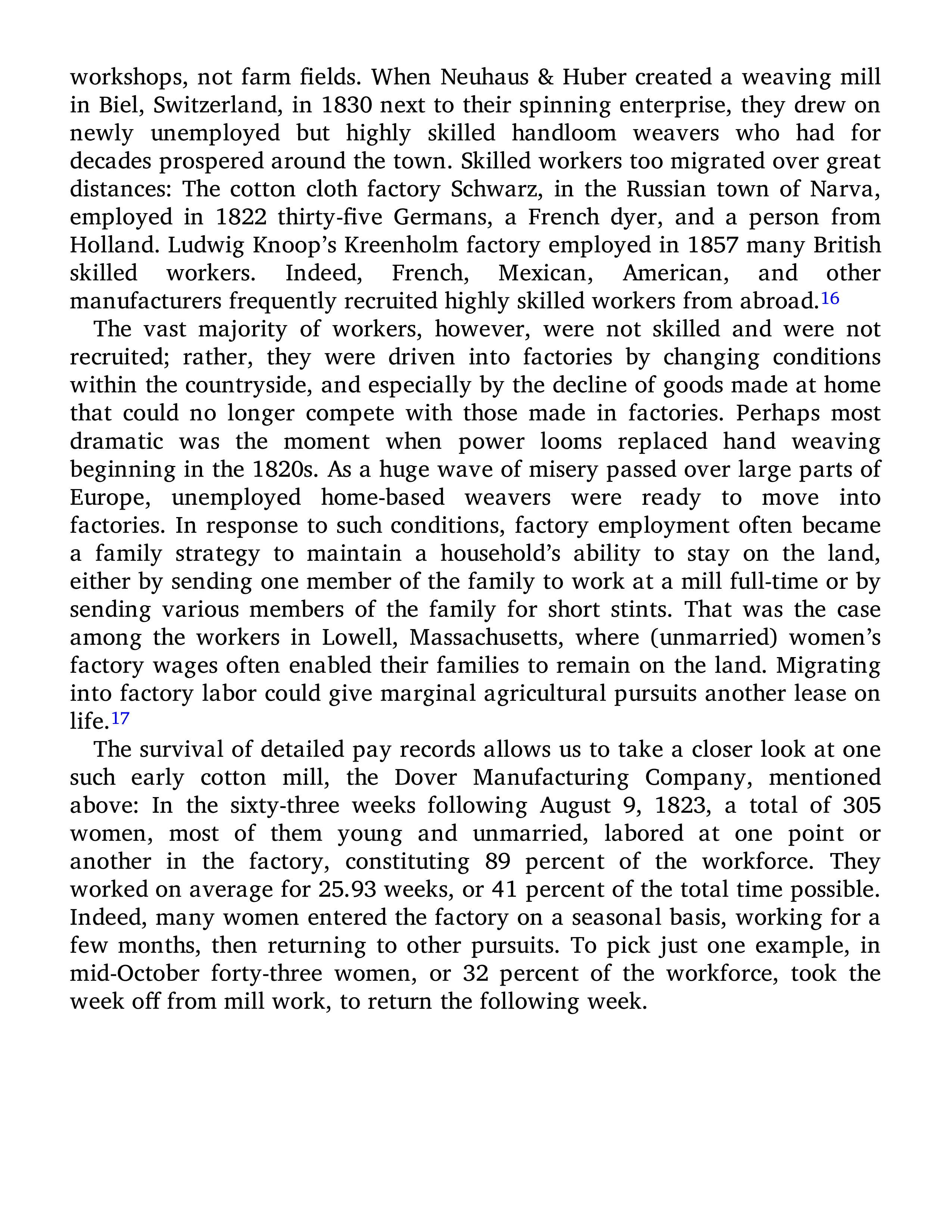
workshops, not farm
ɹelds. When Neuhaus & Huber created a weaving mill
in Biel, Switzerland, in 1830 next to their spinning enterprise, they drew on
newly unemployed but highly skilled handloom weavers who had for
decades prospered around the town. Skilled workers too migrated over great
distances: The cotton cloth factory Schwarz, in the Russian town of Narva,
employed in 1822 thirty-
ɹve Germans, a French dyer, and a person from
Holland. Ludwig Knoop’s Kreenholm factory employed in 1857 many British
skilled
workers.
Indeed,
French,
Mexican,
American,
and
other
manufacturers frequently recruited highly skilled workers from abroad.
16
The vast majority of workers, however, were not skilled and were not
recruited; rather, they were driven into factories by changing conditions
within the countryside, and especially by the decline of goods made at home
that could no longer compete with those made in factories. Perhaps most
dramatic was the moment when power looms replaced hand weaving
beginning in the 1820s. As a huge wave of misery passed over large parts of
Europe, unemployed home-based weavers were ready to move into
factories. In response to such conditions, factory employment often became
a family strategy to maintain a household’s ability to stay on the land,
either by sending one member of the family to work at a mill full-time or by
sending various members of the family for short stints. That was the case
among the workers in Lowell, Massachusetts, where (unmarried) women’s
factory wages often enabled their families to remain on the land. Migrating
into factory labor could give marginal agricultural pursuits another lease on
life.
17
The survival of detailed pay records allows us to take a closer look at one
such early cotton mill, the Dover Manufacturing Company, mentioned
above: In the sixty-three weeks following August 9, 1823, a total of 305
women, most of them young and unmarried, labored at one point or
another in the factory, constituting 89 percent of the workforce. They
worked on average for 25.93 weeks, or 41 percent of the total time possible.
Indeed, many women entered the factory on a seasonal basis, working for a
few months, then returning to other pursuits. To pick just one example, in
mid-October forty-three women, or 32 percent of the workforce, took the
week o
ʃ from mill work, to return the following week.
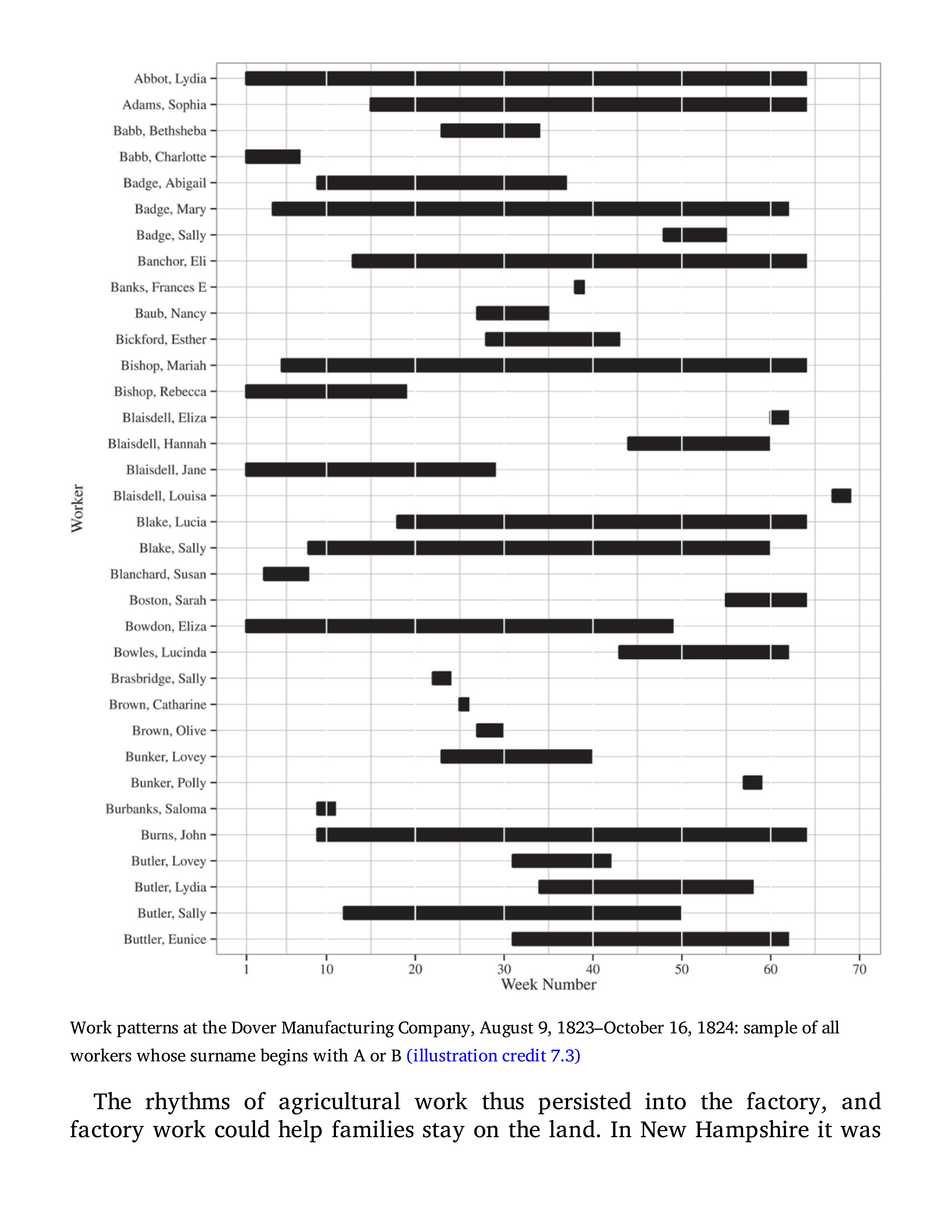
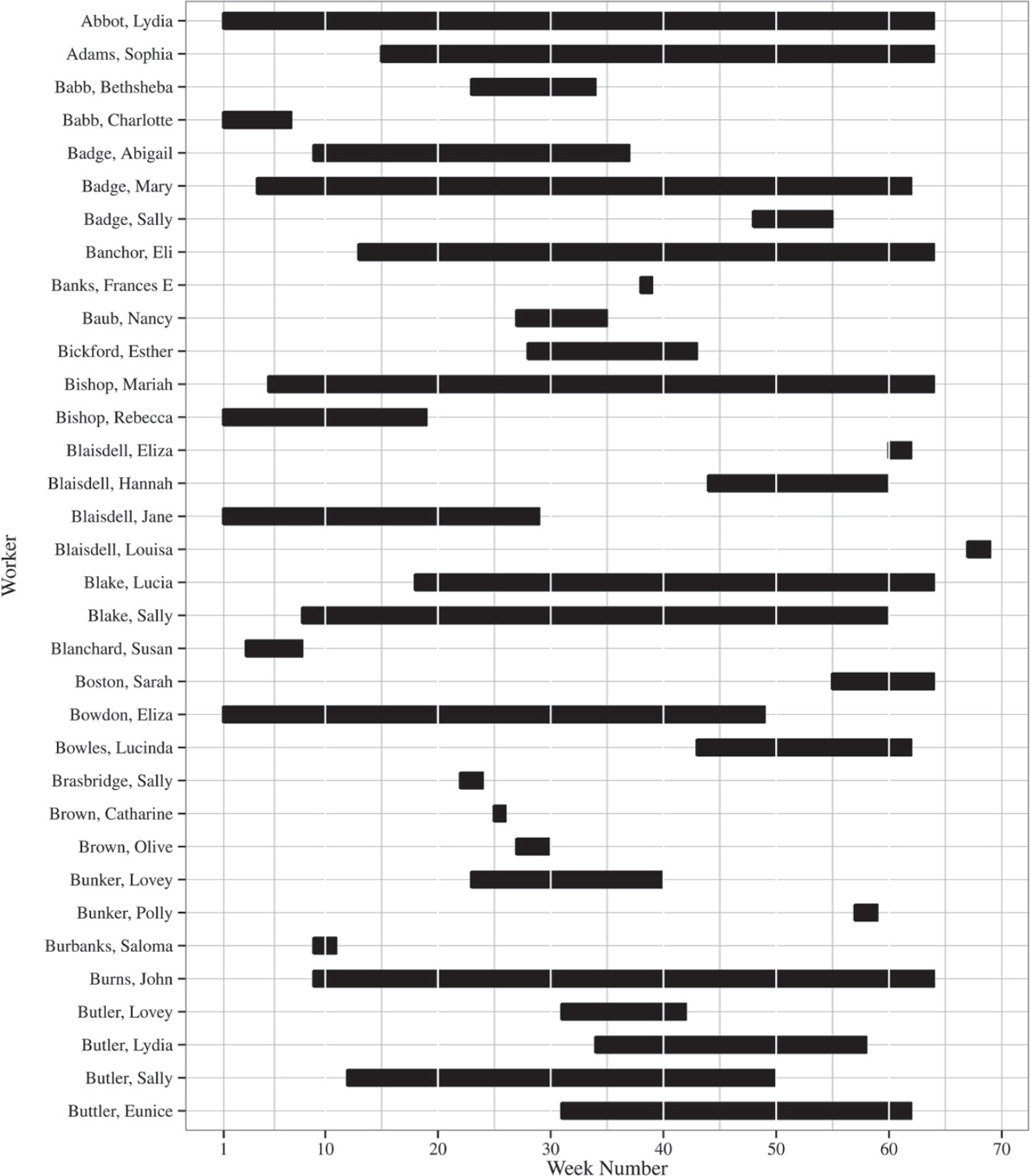
Work patterns at the Dover Manufacturing Company, August 9, 1823–October 16, 1824: sample of all
workers whose surname begins with A or B
(illustration credit 7.3)
The rhythms of agricultural work thus persisted into the factory, and
factory work could help families stay on the land. In New Hampshire it was
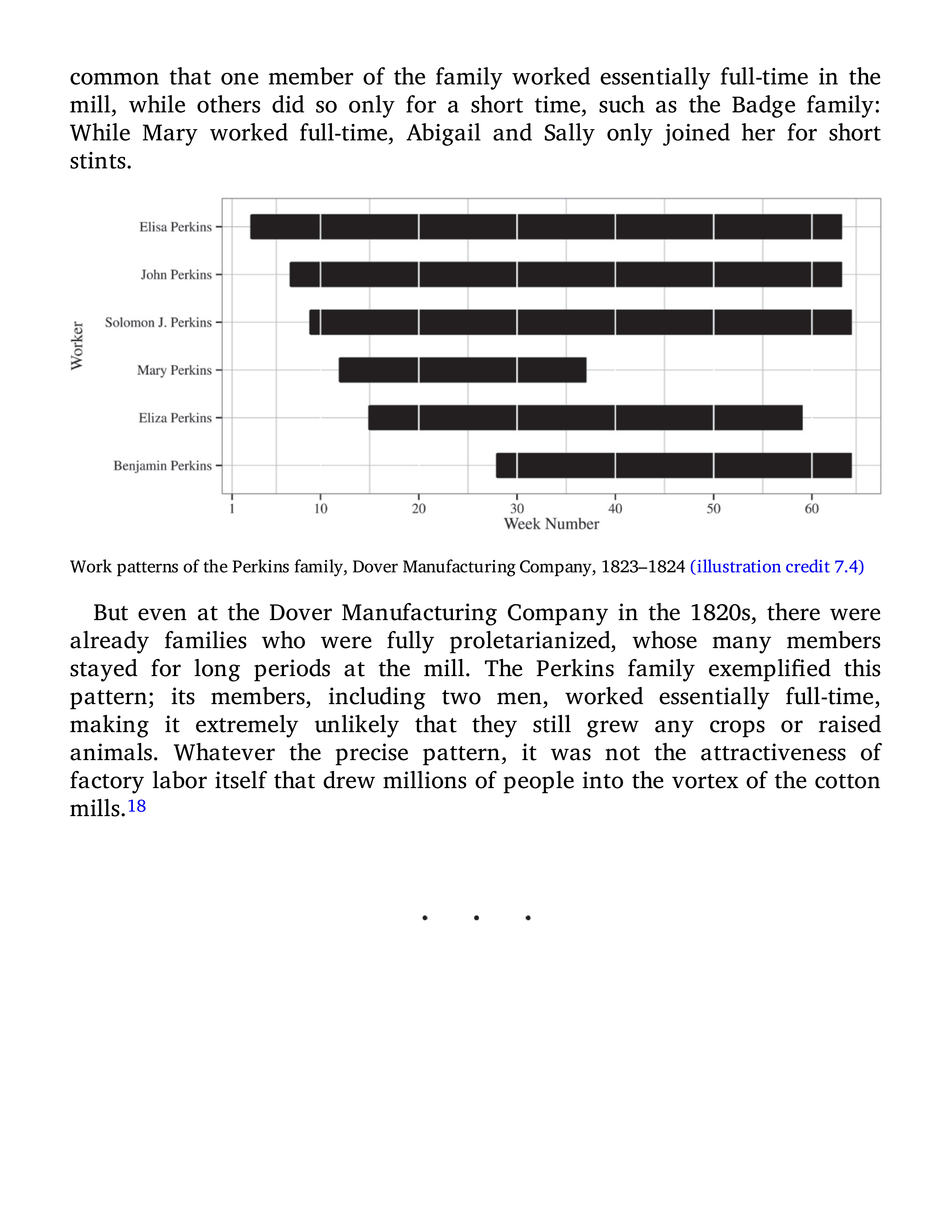
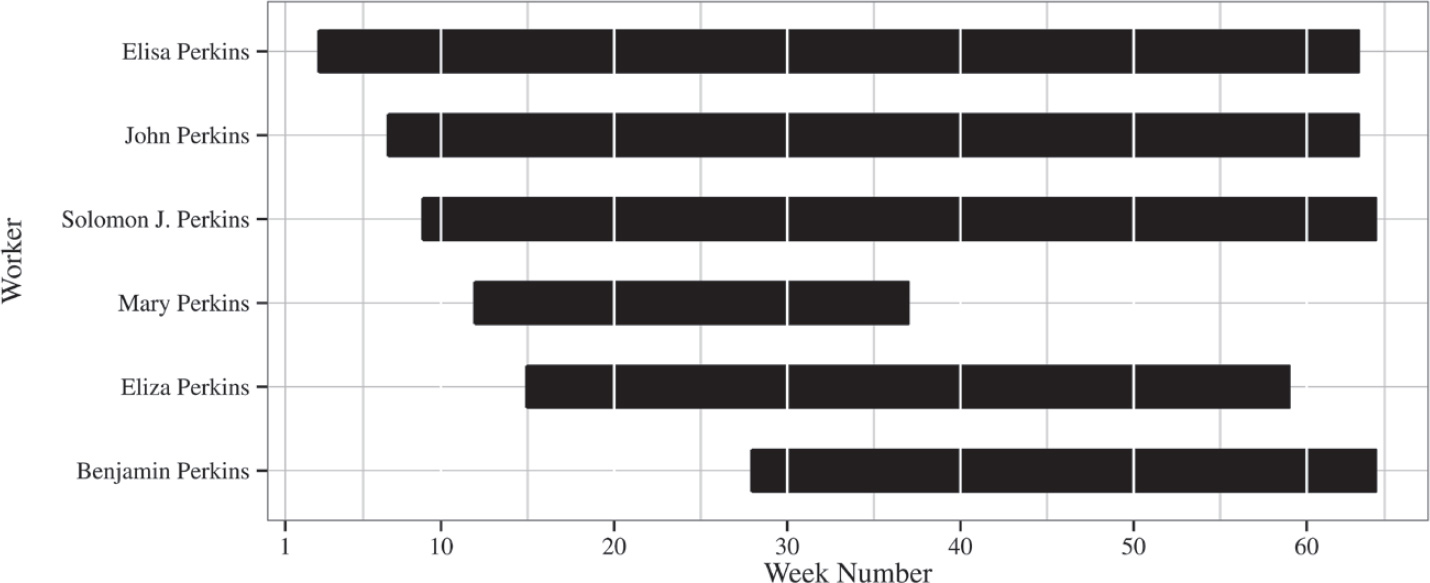

common that one member of the family worked essentially full-time in the
mill, while others did so only for a short time, such as the Badge family:
While Mary worked full-time, Abigail and Sally only joined her for short
stints.
Work patterns of the Perkins family, Dover Manufacturing Company, 1823–1824
(illustration credit 7.4)
But even at the Dover Manufacturing Company in the 1820s, there were
already families who were fully proletarianized, whose many members
stayed for long periods at the mill. The Perkins family exempli
ɹed this
pattern; its members, including two men, worked essentially full-time,
making it extremely unlikely that they still grew any crops or raised
animals. Whatever the precise pattern, it was not the attractiveness of
factory labor itself that drew millions of people into the vortex of the cotton
mills.
18
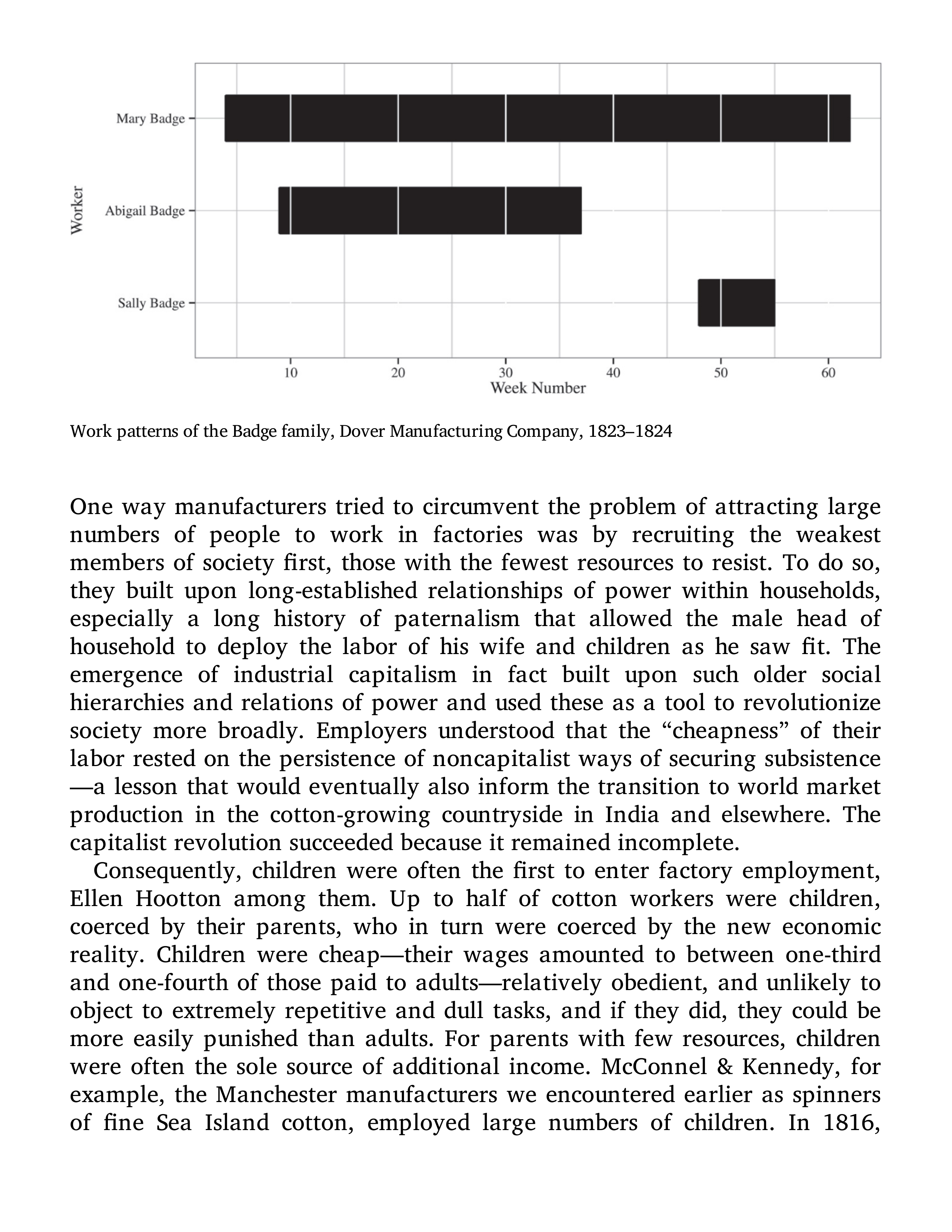
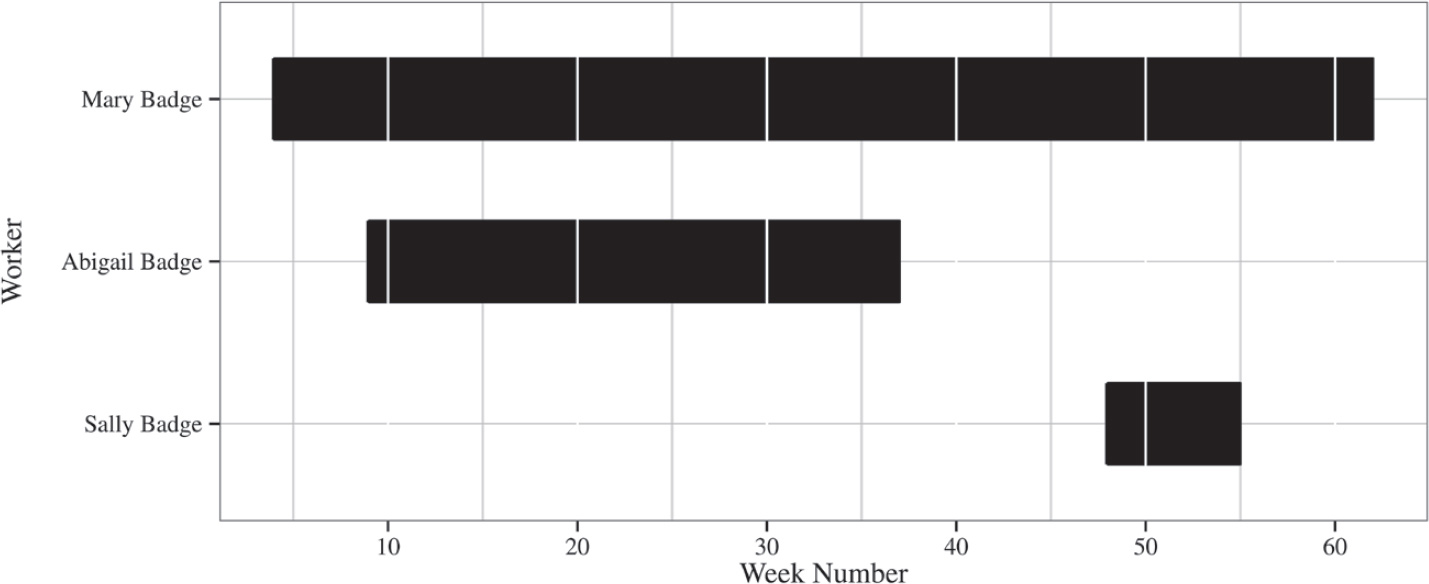
Work patterns of the Badge family, Dover Manufacturing Company, 1823–1824
One way manufacturers tried to circumvent the problem of attracting large
numbers of people to work in factories was by recruiting the weakest
members of society
ɹrst, those with the fewest resources to resist. To do so,
they built upon long-established relationships of power within households,
especially a long history of paternalism that allowed the male head of
household to deploy the labor of his wife and children as he saw
ɹt. The
emergence of industrial capitalism in fact built upon such older social
hierarchies and relations of power and used these as a tool to revolutionize
society more broadly. Employers understood that the “cheapness” of their
labor rested on the persistence of noncapitalist ways of securing subsistence
—a lesson that would eventually also inform the transition to world market
production in the cotton-growing countryside in India and elsewhere. The
capitalist revolution succeeded because it remained incomplete.
Consequently, children were often the
ɹrst to enter factory employment,
Ellen Hootton among them. Up to half of cotton workers were children,
coerced by their parents, who in turn were coerced by the new economic
reality. Children were cheap—their wages amounted to between one-third
and one-fourth of those paid to adults—relatively obedient, and unlikely to
object to extremely repetitive and dull tasks, and if they did, they could be
more easily punished than adults. For parents with few resources, children
were often the sole source of additional income. McConnel & Kennedy, for
example, the Manchester manufacturers we encountered earlier as spinners
of
ɹne Sea Island cotton, employed large numbers of children. In 1816,
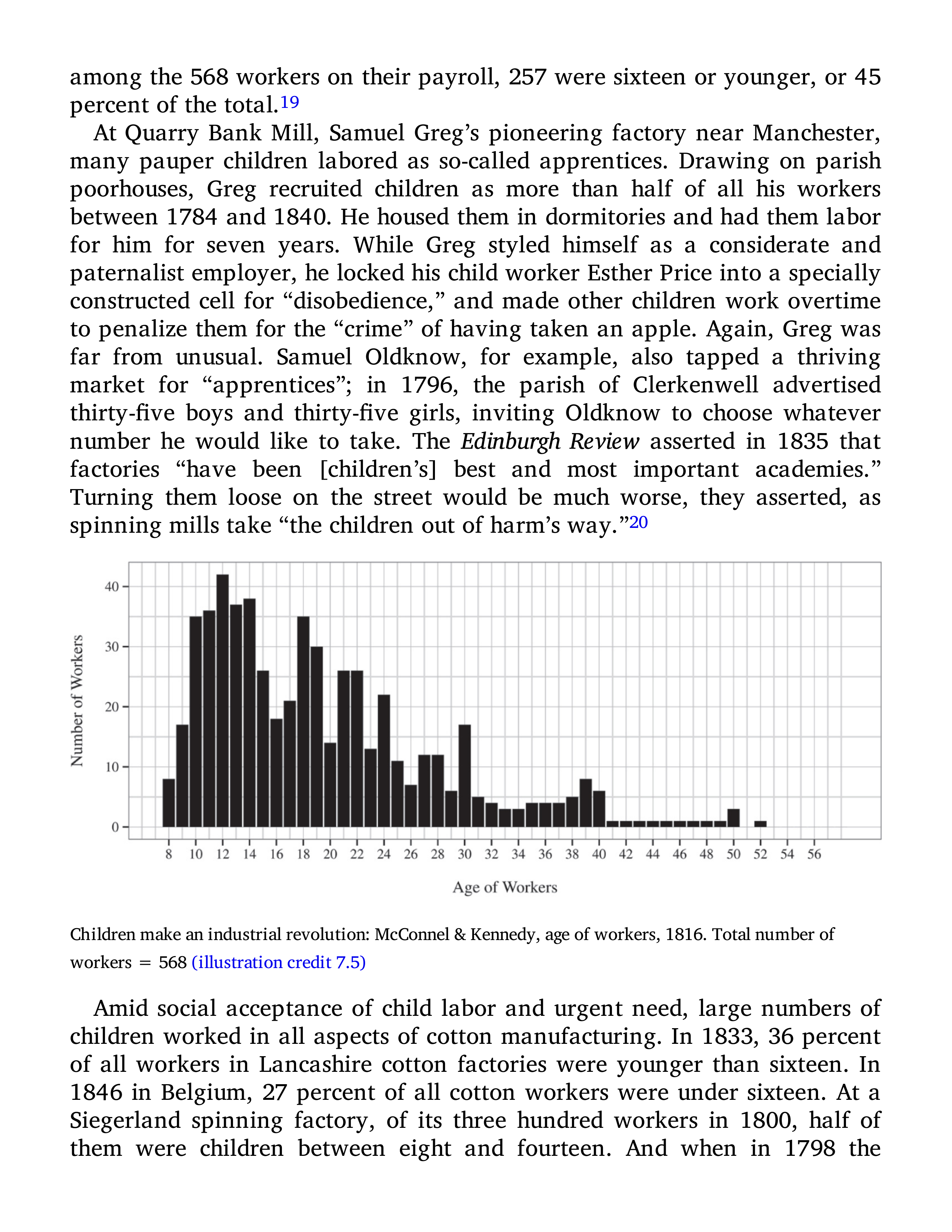
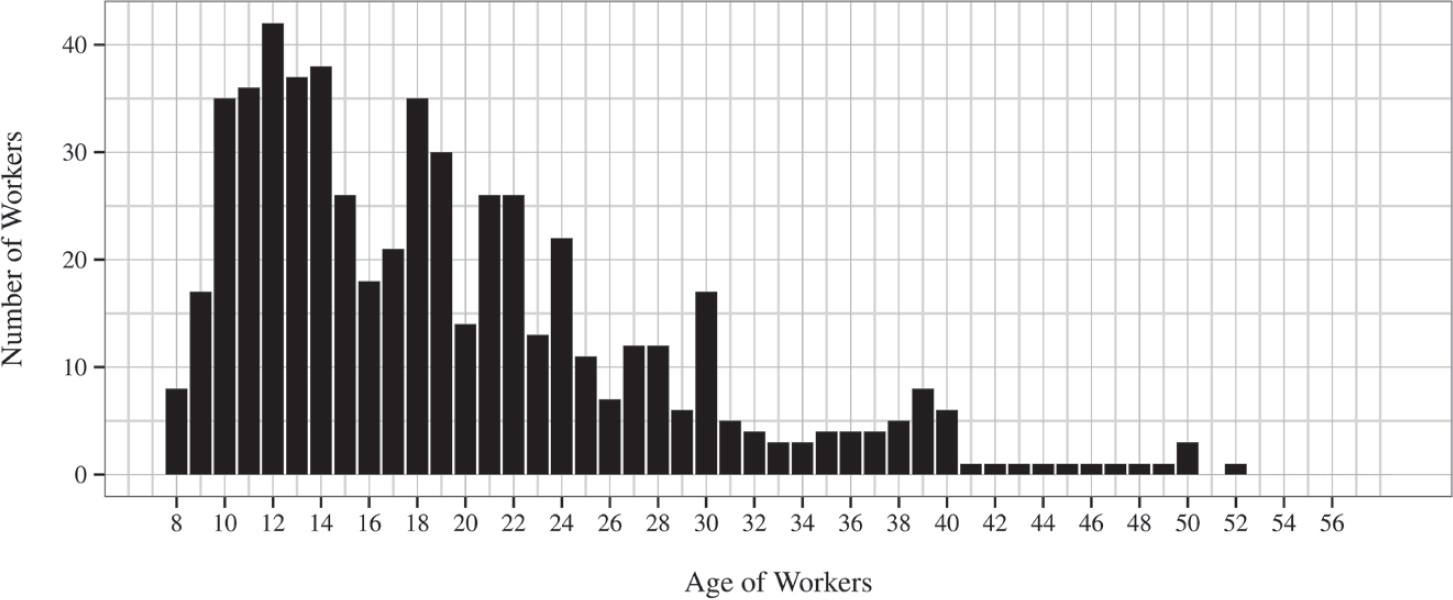
among the 568 workers on their payroll, 257 were sixteen or younger, or 45
percent of the total.
19
At Quarry Bank Mill, Samuel Greg’s pioneering factory near Manchester,
many pauper children labored as so-called apprentices. Drawing on parish
poorhouses, Greg recruited children as more than half of all his workers
between 1784 and 1840. He housed them in dormitories and had them labor
for him for seven years. While Greg styled himself as a considerate and
paternalist employer, he locked his child worker Esther Price into a specially
constructed cell for “disobedience,” and made other children work overtime
to penalize them for the “crime” of having taken an apple. Again, Greg was
far from unusual. Samuel Oldknow, for example, also tapped a thriving
market for “apprentices”; in 1796, the parish of Clerkenwell advertised
thirty-
ɹve boys and thirty-ɹve girls, inviting Oldknow to choose whatever
number he would like to take. The
Edinburgh Review
asserted in 1835 that
factories “have been [children’s] best and most important academies.”
Turning them loose on the street would be much worse, they asserted, as
spinning mills take “the children out of harm’s way.”
20
Children make an industrial revolution: McConnel & Kennedy, age of workers, 1816. Total number of
workers = 568
(illustration credit 7.5)
Amid social acceptance of child labor and urgent need, large numbers of
children worked in all aspects of cotton manufacturing. In 1833, 36 percent
of all workers in Lancashire cotton factories were younger than sixteen. In
1846 in Belgium, 27 percent of all cotton workers were under sixteen. At a
Siegerland spinning factory, of its three hundred workers in 1800, half of
them were children between eight and fourteen. And when in 1798 the
Russian Treasury allowed Michael Ossovski to build the
ɹrst mechanical
cotton spinning factory, he “received” three hundred children from a Saint
Petersburg orphanage. From Saxony to Puebla to the Habsburg Empire, the
situation was similar. Catalonian manufacturers located their factories in
the foothills of the Pyrenees, home to many struggling farmers, not least
because that gave them access to child labor. In Puebla, where most cotton
workers were former peasants, debt peons, and textile artisans, children
constituted an important part of the workforce, beginning to work at age
ten, and sometimes earlier. As late as 1837, a commission of the Société
Industrielle de Mulhouse reported that children were engaged in “forced
labor” and that they “contributed involuntarily.” To improve conditions, the
commission recommended that children age eight to ten be limited to ten
hours of work per day; twelve hours for children ten to fourteen; and
thirteen hours per day for children fourteen to sixteen years of age. Night
shifts should only be permitted for children older than fourteen. Once
enforced, they hoped such halfhearted measures would improve children’s
lives. Yet the Alsatian cotton industry continued to rely to such an extent on
child labor that its entrepreneurs vigorously opposed the passage of a law in
1841 limiting such practices. In fact, the invention of childhood that took
place among the families of the Mulhousian bourgeoisie, like their
counterparts elsewhere in Europe and the United States, rested on the
extreme exploitation of child labor in the factories surrounding them.
Children from English poorhouses, Danish
Bornehus
, Swedish
Barnhus
, and
Russian
priiut dlia sirot
all ended up in textile factories.
21
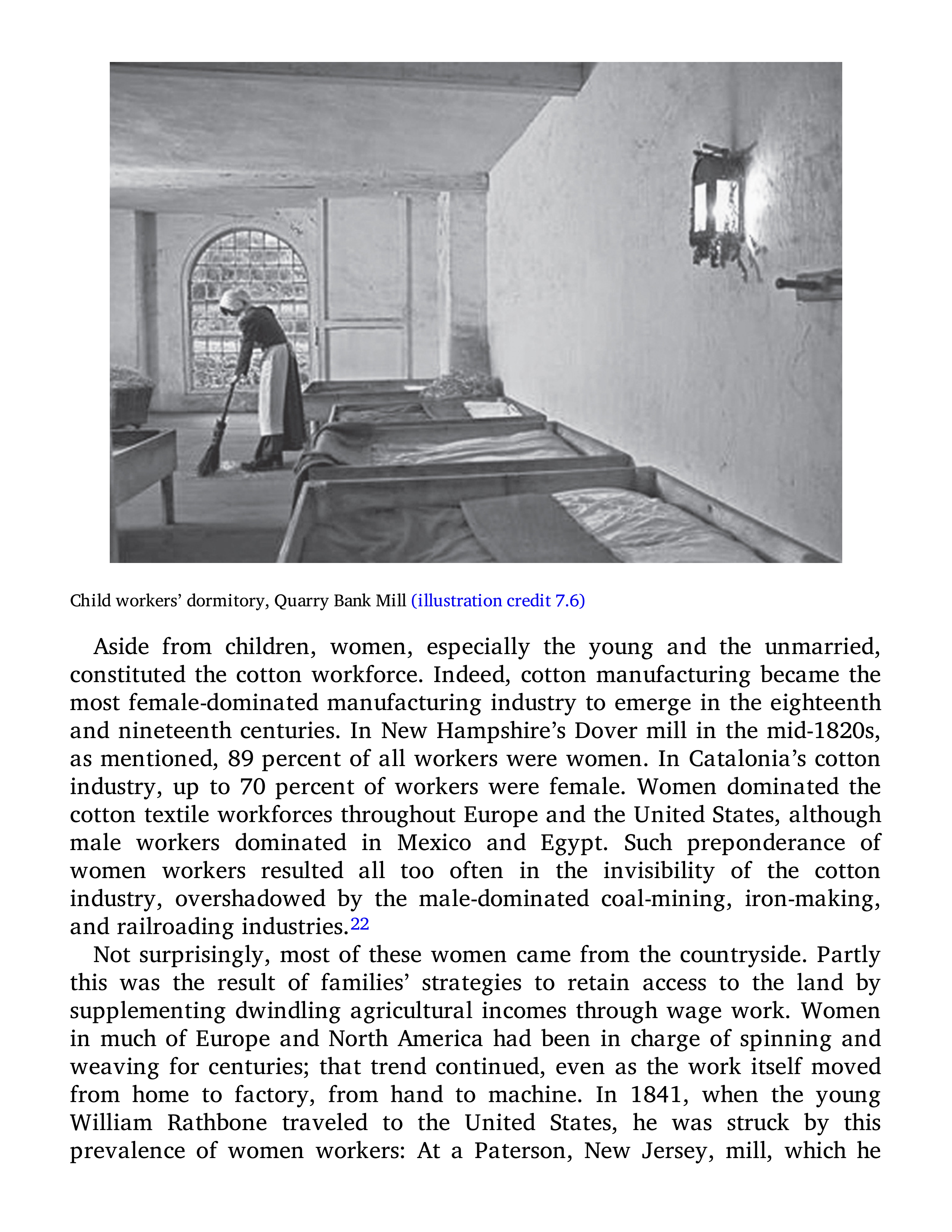

Child workers’ dormitory, Quarry Bank Mill
(illustration credit 7.6)
Aside from children, women, especially the young and the unmarried,
constituted the cotton workforce. Indeed, cotton manufacturing became the
most female-dominated manufacturing industry to emerge in the eighteenth
and nineteenth centuries. In New Hampshire’s Dover mill in the mid-1820s,
as mentioned, 89 percent of all workers were women. In Catalonia’s cotton
industry, up to 70 percent of workers were female. Women dominated the
cotton textile workforces throughout Europe and the United States, although
male workers dominated in Mexico and Egypt. Such preponderance of
women workers resulted all too often in the invisibility of the cotton
industry, overshadowed by the male-dominated coal-mining, iron-making,
and railroading industries.
22
Not surprisingly, most of these women came from the countryside. Partly
this was the result of families’ strategies to retain access to the land by
supplementing dwindling agricultural incomes through wage work. Women
in much of Europe and North America had been in charge of spinning and
weaving for centuries; that trend continued, even as the work itself moved
from home to factory, from hand to machine. In 1841, when the young
William Rathbone traveled to the United States, he was struck by this
prevalence of women workers: At a Paterson, New Jersey, mill, which he
found “the most romantically situated mill in the world,” he found the
“women employed in them are rather sickly looking but very pretty.” A few
days later, when he looked at the Lowell mills, he observed that the “factory
girls are neat and many pretty. They are generally I believe well educated
being the daughters of farmers and sometimes even clergymen who go there
for a few years without their families to get something as a marriage
position.” Rathbone, like some of his contemporaries, had a hopelessly
romanticized view of women’s cotton work.
23
Thanks to long-standing biases, women’s labor was much cheaper.
Historians found that “women often earned as little as 45 to 50 percent of
males’ wages under
ɹxed wage structures.” Yet women were not just
cheaper workers, they also were less rooted in older work cultures that often
regulated the work of male artisan textile workers, work cultures that could
and did become the basis of resistance against factory owners. Women’s
work patterns, along with those of their children, were more easily molded
to
ɹt the ceaseless rhythm of machine production.
24
The availability of women was crucial to the early cotton manufacturers.
And it was also what distinguished large parts of Europe (and eventually
also Japan) from many other areas of the world. Not that women elsewhere
did not work in textile production—they did—but in Europe and North
America, unlike in Africa and Asia, women could eventually move out of
households
and
into
factories,
a
critical
condition
for
textile
industrialization. In China, for example, the situation was quite di
ʃerent. As
historian Kenneth Pomeranz notes, “The Chinese family system did not
allow much migration by single women, either to cities or to peripheries,
until twentieth-century factories with tightly supervised dormitories made
this seem possible within the bounds of respectability.” Sociologist Jack
Goldstone even argues that the di
ʃerent roles of women
explain why Europe
industrialized and China did not. In Europe and the United States, women
married relatively later and were therefore able to join the factory
proletariat before marriage.
25
Yet favorable legacies of patriarchy and the transformation of the
countryside had almost always to be supplemented with more overt forms of
coercion. Though the coercion employed by the “lords of the loom” was
quite di
ʃerent from that of the “lords of the lash,” using force to mobilize
labor, to discipline it within factories, and to keep workers from leaving
once they had entered factory employment was nearly universal. With their
investments in factories at stake, manufacturers embraced coercion and
even physical violence, sometimes privately, but more and more often also
sanctioned by the state. Orphaned children, as we have seen, frequently had
no choice but to work under oppressive conditions in cotton mills. Belgian
entrepreneur Lieven Bauwens used “the inmates of the prison of which he
was warden” as weavers. In Russia, e
ʃorts to staʃ textile factories with
wage workers failed at
ɹrst, and instead entrepreneurs resorted to coercing
people to work, drawing upon “prostitutes, criminals, beggars, and others—
some of whom were sentenced to work for life in industry.” In the United
States, prisoners in Maryland, Louisiana, and Rhode Island spent their days
weaving cotton. Even cotton workers who agreed to a wage labor contract
often were tied to factories through “some manner of bondage.” The
management in Knoop’s huge Krenholm factory was described by a local
Estonian paper as taking “no more care of the people than does a slave-
owner of his Negro slaves.” The factory not only had its own police force,
but also regularly brutalized workers by corporal punishment. In Puebla,
Mexico, workers were just as much subject to severe supervision: If they
lived in factory compounds, they were sometimes not allowed to have
friends or relatives visit, and sometimes even the reading of newspapers
was outlawed. And in the Habsburg Empire, cotton mills were akin to
military barracks; workers were locked into factories and only allowed to
leave on Sundays.
26
In areas of the world in which slavery prevailed, bodily coercion played
an even more important role. In the Americas in particular, the world’s
center of plantation slavery, signi
ɹcant coerced labor went into cotton
manufacturing. In Brazil, native peoples and slaves were forced to work in
textile factories. In the southern United States as well, slaves worked in
cotton textile production—a system that one historian has aptly termed
“coerced proto-industrialization.” Thus in the slave zones of the world,
slavery fueled industrial production as well.
27
Compared to cotton growing, the global cotton manufacturing industry as
a whole, however, used physical coercion to a much lesser extent in the
mobilization of labor. Even in Russia, where before the 1861 emancipation
serfs were at times forced to work in textile factories, such coerced workers
never constituted more than 3.3 percent of the cotton workforce. New yet
sophisticated methods of labor control had emerged instead that did not rest
on the enslavement of workers.
Yet lessons learned on large slave plantations still inspired industrialists.
Cotton manufacturer Samuel Oldknow, for example, in the mid-1790s tried
to gain greater authority over his workers. Unlike the putting-out system
that Oldknow knew so well, the factory was unchartered territory to him,
and thus he struggled mightily to control his workers. In a
ɹrst step, he
created an attendance book to take systematic note of his workers’ presence
in the factory. He divided this small book by the rooms in his mill and listed
each of the workers in each of the rooms. He divided the day into four
quarters and listed during which quarters workers were actually present. In
March 1796, for example, the book lists “Mary Lewis 1,2,3,4; Thomas Lewis
1,2,3,4; Peggy Woodale 1; Martha Woodale 1; Samuel Ardern 3,4,” and so
on. In our perpetually monitored world, such recordkeeping seems quaint,
but just like the switch from seasonal work to machine work, so too this
notion of keeping track of time was new, and while it was most fully
elaborated on slave plantations, it slowly migrated into the world of the
factory as well. Mobilizing huge numbers of workers by paying them wages
and then supervising their work and assuring that they applied their skills
and energy was a work in progress, and new dilemmas continually
emerged. Outside the factory—in workers’ homes and neighborhoods—
employers’ authority was even more distant. Instilling discipline proved
di
ɽcult, with tracking attendance in account books often not suɽcient, and
so employers frequently also resorted to beating,
ɹning, and ɹring workers.
The rhythm of work and its tight supervision reminded many contemporary
observers of the only other large work setting they knew—the slave
plantation—even though that made them miss the truly revolutionary
nature of what was unfolding in front of their eyes.
28
Discipline was di
ɽcult to enforce and workers diɽcult to recruit not least
because working conditions were often appalling—so much so that slave
owners the world over compared the conditions of slave labor in favorable
terms to those of industrial workers. In the German cotton industry, for
example fourteen- to sixteen-hour workdays, six days a week, were the rule.
In Puebla in 1841, hours per day averaged 14.8, including a one-hour lunch
break. In France during the Second Empire, workdays averaged twelve
hours, though employers could make their workers work as long as they
chose to, and until 1873, working hours in textile mills in Barcelona were
just as long. Production everywhere was dangerous and the machines
deafeningly noisy.
29
Such conditions had a dramatic impact on workers’ health: When the
Saxon government sought to recruit soldiers in the 1850s, only 16 percent of
spinners and 18 percent of weavers were deemed healthy enough to serve.
For many decades, the standard of living of these new cotton factory
workers symbolized to contemporaries everything that was wrong with
industrialization. “I regret to have to add that the distress of the Laboring
poor but most particularly the weaver is great beyond almost description,”
reported J. Norris to the British secretary of state Robert Peel in 1826.
Indeed, a recent analysis of the life expectancy and heights of workers
determined that “no increase in food consumption, no increase in longevity
or nutritional status, and no improvement in housing” resulted from the
Industrial Revolution. The author concluded that “the infant mortality
results presented here for the sample parishes in the heartland of the
Industrial Revolution provide support for the view that clear evidence of
signi
ɹcant improvement in the daily lives of English workers and their
families is lacking before the middle of the century” and might have actually
had to wait until the 1870s. “I calculate that consumption per capita,
adjusted for changes in leisure, remained essentially unchanged between
1760 and 1830.” As American labor activist Seth Luther reported in 1833,
“The consequence of this excess of toil is, that the growth of the body is
checked, and the limbs become weak, and sometimes horribly distorted.”
30
Considering such conditions, it is not surprising that farmers and artisans
often resisted being turned into factory workers. With living standards and
live expectancy falling, it was entirely rational to fear the factory.
Resistance was both individual and collective, and made proletarianization
an even more drawn out, often violent process. During the French
revolutionary upheavals of the 1780s and 1790s, workers destroyed
machines that modernized the cotton manufacturing process, and threatened
factory owners associated with the modernization of production. In 1789,
for example, hundreds of workers attacked cotton factories in Normandy,
the center of the French cotton industry, destroying seven hundred spinning
jennies and other machinery. Troops and militias, there and elsewhere,
fought such upheavals, but with mixed success. This resistance continued in
the 1820s, when French workers opposed the introduction of power looms.
So e
ʃective was this wave of resistance, and so relatively limited the
inexperienced state’s ability and willingness to protect its modernizing
entrepreneurs, that some capitalists concluded that the path of least
resistance was to limit the employment of new machines and instead focus
on the production, however labor-intensive, of high-quality goods. The fear
of popular uprising became a guiding star in the universe of French
entrepreneurs.
31
Such resistance also characterized the industrialization process in England.
Already in the 1740s there had been riots against Kay’s
ɻying shuttle, in
1753 there were attacks on “cotton reel” machines; in 1768–69 workers in
Lancashire rioted against the introduction of the spinning jenny, and in
1779 Lancashire workers smashed various kinds of machinery. But machine
breaking only became truly prevalent in the 1810s, a moment when the
state was able and willing to use massive force to repress it. In 1811 and
1812, “steam looms [were] attacked in Stockport and elsewhere,” with
another wave of machine attacks in 1826.
32
Workers in other parts of the world also rebelled. In Puebla, weavers’
guilds were “extremely hostile” to machine production of cotton yarn.
Factory owners adamant about introducing new machines hid innovators
and their machines in a “secret place” to be safe from guild hostility. That
fear was also prevalent in Veracruz. In Switzerland, weavers revolted in the
1820s, demanding that power looms be outlawed, burning down a factory in
Oberuster in 1832. In the Dutch city of Tilburg in 1827, workers objecting to
the introduction of steam engines smashed the windows of factory owner
Pieter van Dooren.
33
The expansion of the world’s mechanized cotton industry thus not only
rested on the deployment of new technologies and access to capital and
markets, but also on the ability of capitalists to turn thousands and
eventually millions of people into proletarians—and, importantly, to break
resistance to the imposition of a radically new way of living and working.
As a contemporary observed in England in 1795, “The several modes of
accelerating labour have been always stoutly resisted by the labouring class,
when the di
ʃerent machinery was ɹrst introduced.”
34
This was, as one
historian has remarked in regard to the Black Forest’s Wiesental, a process
of “inner colonializations”—the colonialization and domination by capital
of ever more territories and social relations. Yet in the face of weakened
feudal elites, such a transition was possible—and consolidating states played
a key role enabling it.
Indeed, the state became exceedingly important in the repression of
working-class collective action, demonstrating once more how decisive state
capacity was to industrial capitalism. States passed laws outlawing
everything from trade unions, to strikes, to public assemblies, to labor-
oriented political parties. States criminalized workers’ e
ʃorts to improve
their working conditions. When machine breaking spread throughout the
empire of cotton, as we have seen, states responded. As Luddites in Britain
(and also in France) destroyed hundreds of spinning machines in 1811–12,
Parliament passed a law in February 1812 that made machine breaking a
capital crime. Thirty Luddites were hanged in 1812–13, and nineteen more
in 1830. Others were exiled to Australia or imprisoned. And the British state
cracked down on workers’ collective action in other ways as well: Pitt’s Two
Acts of 1795 suspended habeas corpus and outlawed gatherings of over
ɹfty
people without prior authorization. The Combination Acts of 1799 and 1800
outlawed trade unions—leading, for example, to John Doherty’s sentencing
to ten years of hard labor in 1818, his crime being membership in the
(illegal) Manchester Cotton-Spinners’ Society. The British state, not quite
trusting the mechanism it had devised to assure social peace, also prepared
for battle with workers—between 1792 and 1815 alone, 155 military
barracks were built in industrial areas. As one historian concludes, “The
magnitude of government repression astonishes.” When workers rebelled,
mill owners often came to depend on the state to suppress such upheaval,
making mill owners’ ability to accumulate capital increasingly reliant on the
power of nationalizing states—states whose own power rested more and
more on successful industrialization.
35
The struggle to transform workers into proletarians had made industrialists
even more dependent on the state, a remarkable testimony to the limits of
their power. The territorialization of capital, its growing attachment to and
dependence on nation-states, however, also enabled workers to organize
collectively to improve their working conditions and wages; eventually it
would turn capitalists’ dependence on the state into labor’s greatest
strength. Trade unions and working-class political movements, despite
multipronged e
ʃorts to repress them, created new pressures on capital
across the nineteenth century, pressures that would many decades later
radically reshape the world’s cotton industry.
Workers not only rebelled against machine production, as we have seen,
but also tried to improve their living and working conditions within a
system of mechanized production. These e
ʃorts were at ɹrst feeble, but they
eventually gained strength and indeed won higher wages, shorter hours, and
better working conditions. In the
ɹrst half of the nineteenth century,
successes were still few and far between, but the struggle abounded. Some
working-class associations had already emerged before 1800 among British
weavers. In 1792, Stockport and Manchester mule spinners formed unions.
In 1807, handloom weavers collected 130,000 signatures to advocate for
what they termed a “legal wage.” In 1826, riots of cotton workers spread
from Manchester, as weavers assembled and threatened to damage power
loom factories. A Fred Foster from Manchester reported “with much
pleasure” to Secretary of State Robert Peel on April 28, 1826, that once
workers assembled in the streets, “the riot act was proclaimed & the
principal streets were cleared by detachments of troops.” In 1844, weavers
famously rebelled in Silesia. In New England, women cotton mill workers
walked o
ʃ their job in Pawtucket, Rhode Island, in 1824, making it the ɹrst
strike by factory workers in the United States. English mule spinners also
brought collective action strategies with them to the United States,
especially to New England, and in 1858 the Mule Spinners’ Union of Fall
River was born. Spanish cotton workers forged a labor movement during the
1840s and 1850s, and the year 1854 saw the
ɹrst general strike among
spinners. In France, textile workers participated in 35 percent of all strikes
recorded between 1830 and 1847. Women sometimes took the lead in such
collective action: In Lowell, Massachusetts, for example, women workers
organized in 1844 the Lowell Female Labor Reform Association,
ɹghting for
better working conditions and a shorter workday. Already by midcentury,
cotton manufacturers responded to the militancy of their workers by moving
their capital elsewhere, with Catalonian entrepreneurs perhaps the
vanguard when they increasingly relocated production to isolated factory
villages along the Llobregat and the Ter Rivers outside Barcelona to escape
their troublesome workers. As in the case of cotton growing, workers’
collective action and the spatial arrangements of the world’s cotton industry
intersected.
36
Yet these incipient e
ʃorts at unionization, strikes, and other forms of
collective action directed toward improving wages and the working
conditions of cotton workers demonstrate that once the control and
mobilization of labor were “nationalized” within powerful states, and
indeed became matters of state, workers also gained new opportunities to
improve their situation by appealing to the state itself and mobilizing within
national political spaces. The nonpecuniary penalties for violation of
employment contracts, for example, became increasingly untenable as a
result of workers’ collective action. When in England large segments of the
working class gained the vote in 1867, trade unions pressured the state to
limit allowable remedies for workers’ breach of contract, and succeeded in
1875. In Germany it took until the revolution of 1918 to end criminal
penalties for breach of contract.
37
Indeed, “employment at will”—allowing
workers to leave their jobs whenever they decide to do so—was the result of
decades of struggle by workers, not a “natural” outgrowth of the emergence
of industrial capitalism and even less so the precondition for its emergence.
From the factory to the plantation, the expansion of freedom rested on the
organization and collective action of workers. The labor market as idealized
in modern-day economics textbooks as often as not came about as a result of
strikes, unions, and riots.
The empire of cotton from its 1780s beginnings to 1861 in e
ʃect rested on
two very di
ʃerent forms of labor, and two very diʃerent forms of the
organization of production. On the western shores of the Atlantic were the
vibrant, expanding, and enormously pro
ɹtable slave plantations, the latest
outgrowth of the dynamic war capitalism that Europeans had been building
since the sixteenth century. In Europe itself, but also in New England and a
few other areas of the world, a much more novel and more dynamic
organization of production had emerged: industrial capitalism, with its
spectacularly productive spinning and weaving mills based on wage labor.
Connected by the mediation of a group of merchants, these two systems
grew side by side, the one feeding the power of the other. Capital,
personi
ɹed by merchants, facilitated the rapid expansion of both slave
cotton plantations and wage labor cotton factories, connecting the
seemingly opposing legacies of the one to the other—until the day one of
them collapsed. Once that happened, once slavery within the empire of
cotton expired like some distant supernova, its crucial contribution to the
construction of industrial capitalism could be written out of our collective
memory.
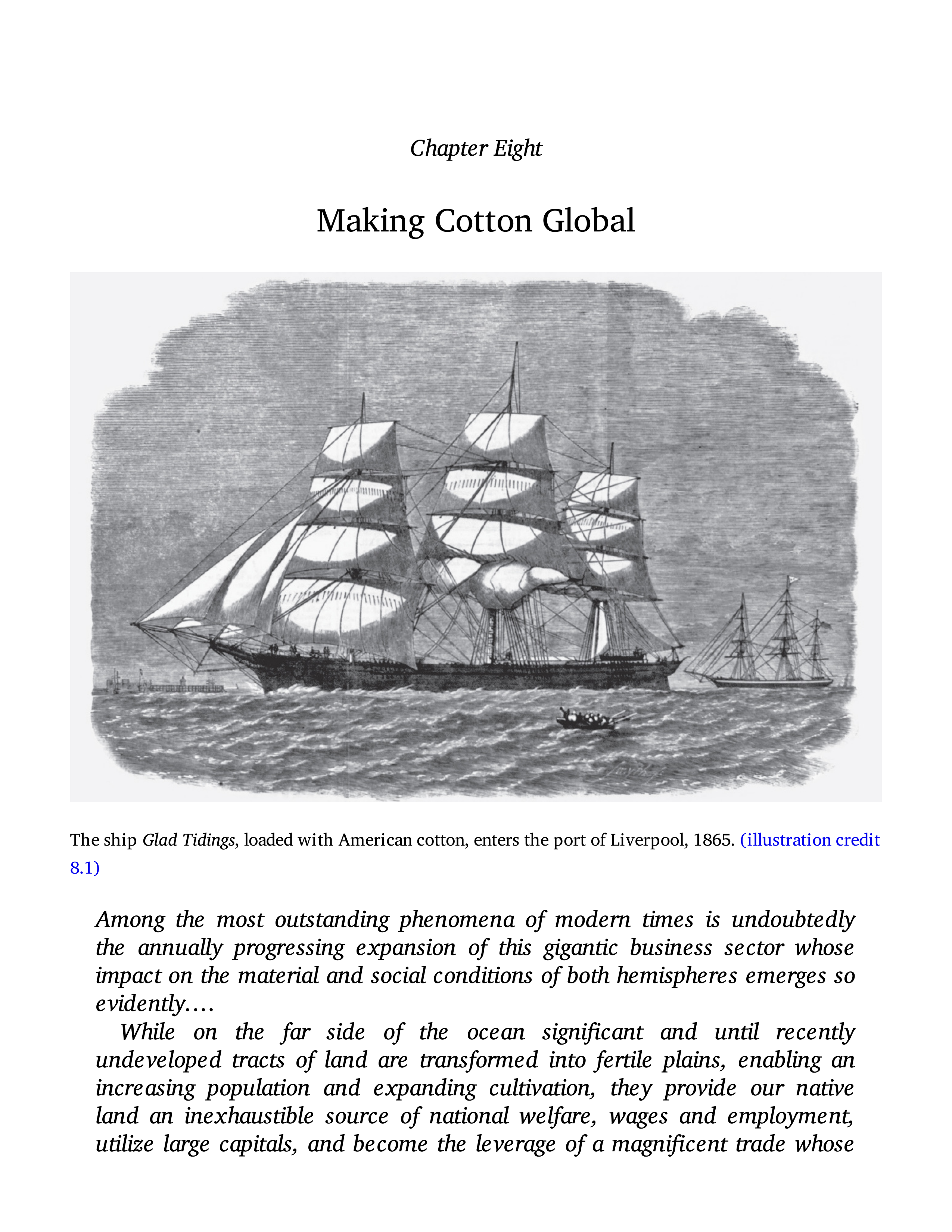
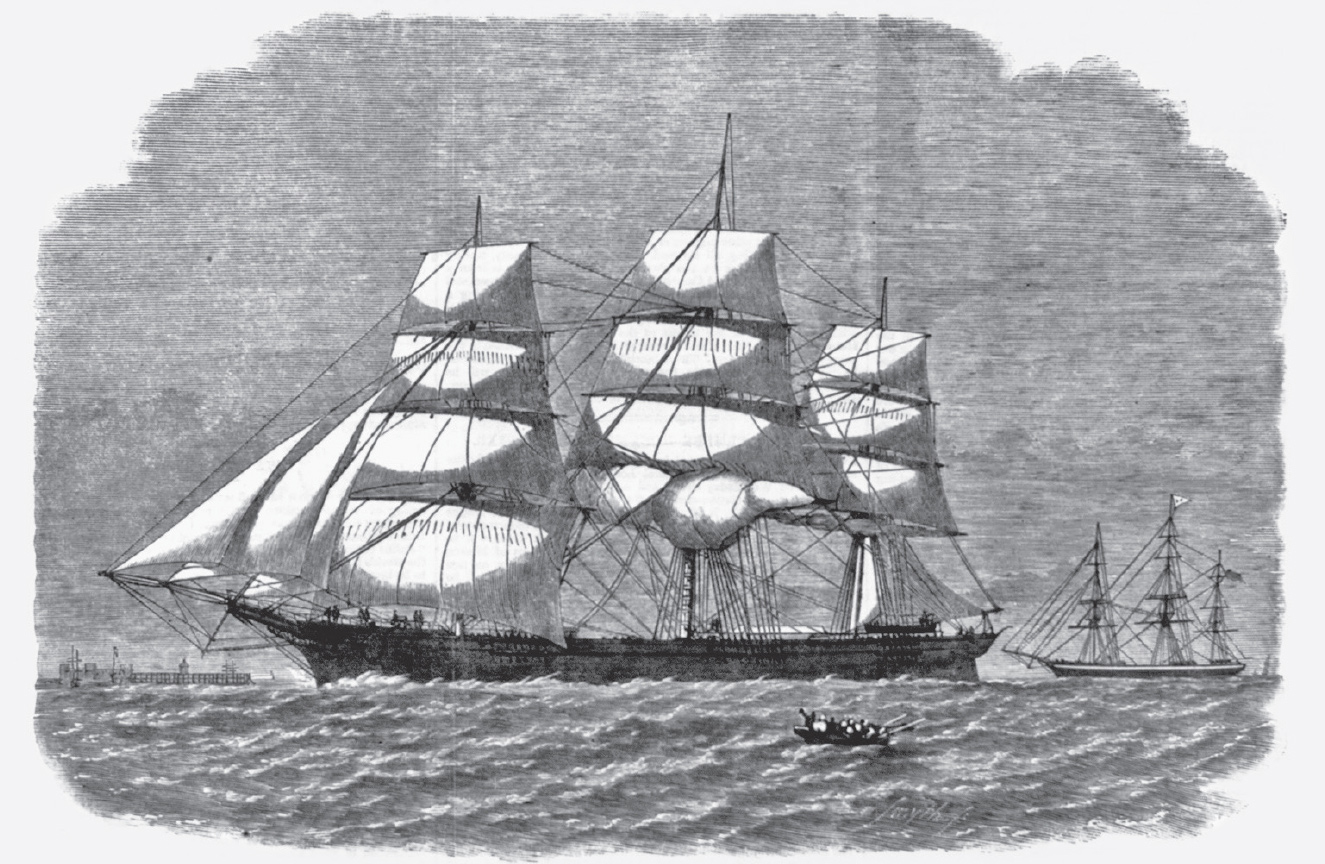
Chapter Eight
Making Cotton Global
The ship
Glad Tidings
, loaded with American cotton, enters the port of Liverpool, 1865.
(illustration credit
8.1)
Among the most outstanding phenomena of modern times is undoubtedly
the annually progressing expansion of this gigantic business sector whose
impact on the material and social conditions of both hemispheres emerges so
evidently.…
While on the far side of the ocean signi
ɹcant and until recently
undeveloped tracts of land are transformed into fertile plains, enabling an
increasing population and expanding cultivation, they provide our native
land an inexhaustible source of national welfare, wages and employment,
utilize large capitals, and become the leverage of a magni
ɹcent trade whose
products will supply the markets of all the zones, combining the most diverse
activities transforming raw materials into
ɹnished goods.
—Neue Bremer Zeitung,
JANUARY
6, 1850
1
For Walter Benjamin, Paris was the capital of the nineteenth century. For
once and future cotton lords, however, the true center of the world was
Liverpool. Situated in England’s rainy northwest, the city rose from the
banks of the river Mersey and the Irish Sea. There, at one of global
commerce’s most signi
ɹcant crossroads, Liverpool’s merchants had
accumulated unprecedented wealth and in
ɻuence by connecting a nascent
European manufacturing complex with an ever more martial and expansive
cotton hinterland. It was in Liverpool that industrial capitalism and war
capitalism met, its merchants applying the logic of the former to the latter,
and transforming both in the process. The genius of Liverpool’s merchants
lay in their ability to combine ingredients often considered antagonistic:
wage labor and slavery, industrialization and deindustrialization, free trade
and empire, violence and contract.
Liverpool may have been one of the wonders of the world, but not the
kind appreciated by tourists. Indeed, “hideousness” was the summation of
one early-twentieth-century chronicler. “The chief objects of attraction in
Liverpool are, decidedly, the spacious Docks,” observed a contemporary
dryly. As early as 1832 the docks and harbor walls stretched for two and a
half miles, dotted by quays, warehouses, and a “forest of masts.” Beyond the
Mersey lay the Irish Sea and beyond that the Atlantic Ocean, and it was on
that ocean’s western shores that most of the world’s cotton was grown.
Thousands of ships arrived each year, burdened by tightly pressed cotton
bales. Thousands of workers, many of them Irish immigrants, unloaded the
ships and brought the bales to warehouses. From there most were shipped by
canal boats and, after 1830, train to the spinning mills in nearby
Lancashire, twenty to
ɹfty miles distant, but some bales also went back on
ships to various European ports where
ɹrst wagons and later trains fed the
increasing number of spinning mills dotting the European countryside. No
technical marvel, the port was
ɹrst and foremost a site of perilous,
backbreaking labor. Thousands of workers assembled on the rainy streets of
Liverpool each morning before dawn, hoping to be hired for a day of
handling huge bales of cotton, dangerous work over long hours at low pay.
2
Liverpool’s port was the epicenter of a globe-spanning empire. Its
merchants sent ships all over the world, mostly wind-powered, but by the
1850s and 1860s increasingly by steam as well. The captains of those ships
navigated perilous seas, rebellious crews, virulent diseases, and economic
volatility. Every time James Brown, captain of a Liverpool cotton ship,
arrived in the port of New Orleans in the early 1840s, he wasted weeks in
the struggle to
ɹnd bales of cotton to ɹll his boat. Shipping rates changed
constantly, as idle boats in the port meant sti
ʃ competition. Market news
from Liverpool, as often as not, led to abrupt changes in the price of cotton,
delaying his departure. “Parts of the crew have run away,” Brown wrote in
one of many laments; “hurricanes” and “reports of privateers” further
frayed his nerves.
3
While Liverpool’s port was a scene of stupendous muscular labor, the
nervous system of the city was its cotton exchange, whose caretakers lived
and worked in close proximity to one another. Every morning the city’s
merchants would meet to trade “on the
ɻags,” an outdoor space in the
center of town. Cotton broker Samuel Smith remembered that “in all
weathers, cold and wet, winter and summer, we stood outside, sometimes
sheltering under the arches when the rain and cold were unendurable.” Only
after 1809, when a handsome exchange building was erected in the center of
town did the cotton merchants move inside. The sales room where buyers
met sellers in a noisy and seemingly chaotic dance was striking, as “no
place in the world a
ʃords so elegant and commodious a situation as this is
for the purposes of a public exchange,” with “sales to a very considerable
amount…e
ʃected in a few minutes.”
4
Thanks to their all-embracing dispositions, the merchants of the city
became the ringmasters of a globe-spanning network of cotton growing,
crafting, and selling. On Bombay’s Apollo wharf, merchants nervously
awaited news “from Liverpool.” On plantations throughout the American
South, “Liverpool prices” were the single most signi
ɹcant piece of news,
bordering on obsession for many slave masters.
5
The southern agricultural
journal
De Bow’s Review
constantly reported on Liverpool prices and how
U.S. cotton farmers could pocket a greater share of them. New York’s
Merchants’ Magazine and Commercial Review
similarly agonized over
Liverpool prices. For Ellen Hootton and hundreds of thousands of cotton mill
workers like her, Liverpool prices would determine if she would be
employed or not. The global preoccupation with Liverpool re
ɻected the
tremendous in
ɻuence the city’s merchants enjoyed over large swaths of the
earth. When prices rose in Liverpool, planters in Louisiana might decide to
purchase fresh cotton lands, and slave traders might
ɹnd it proɹtable to
move young slaves by the thousands into these new territories. News from
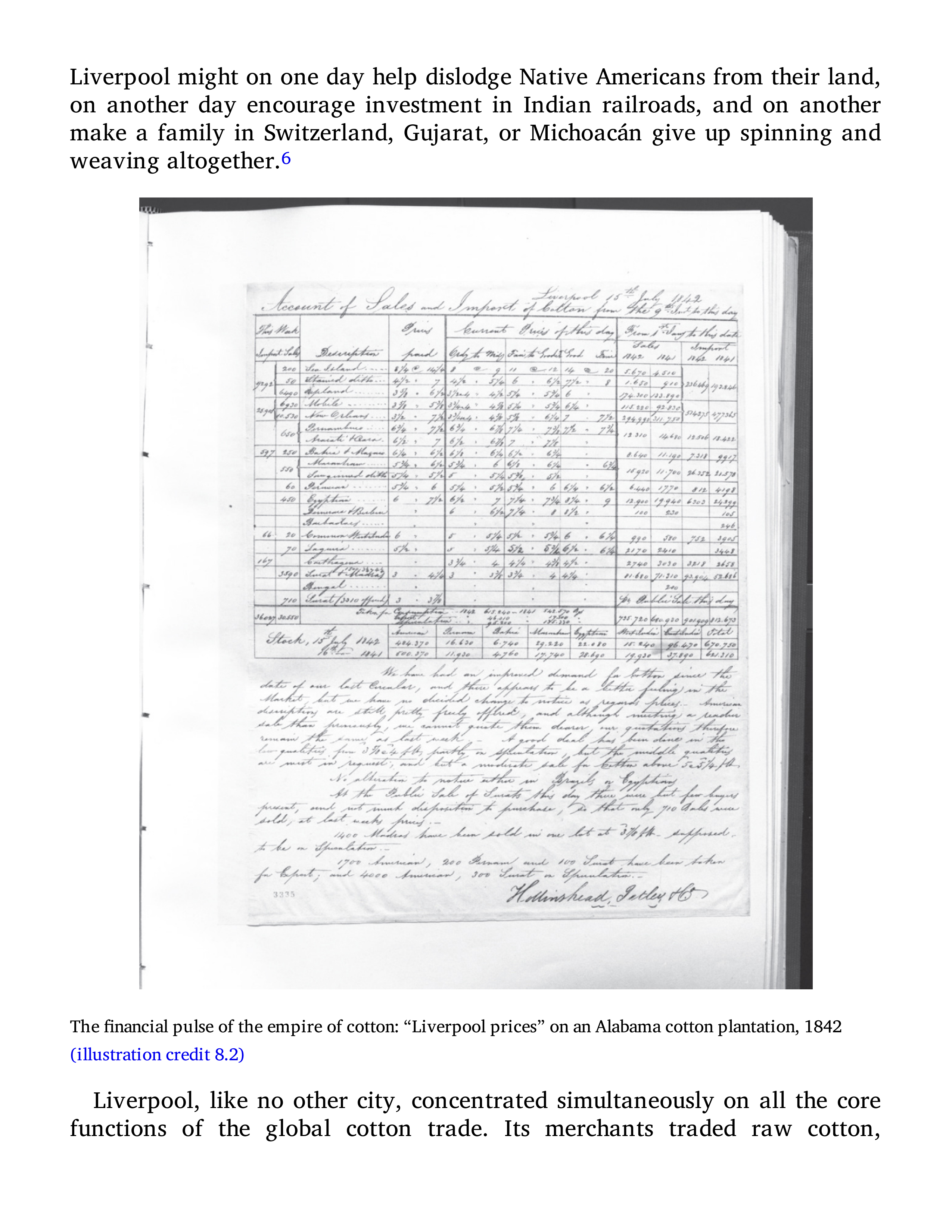
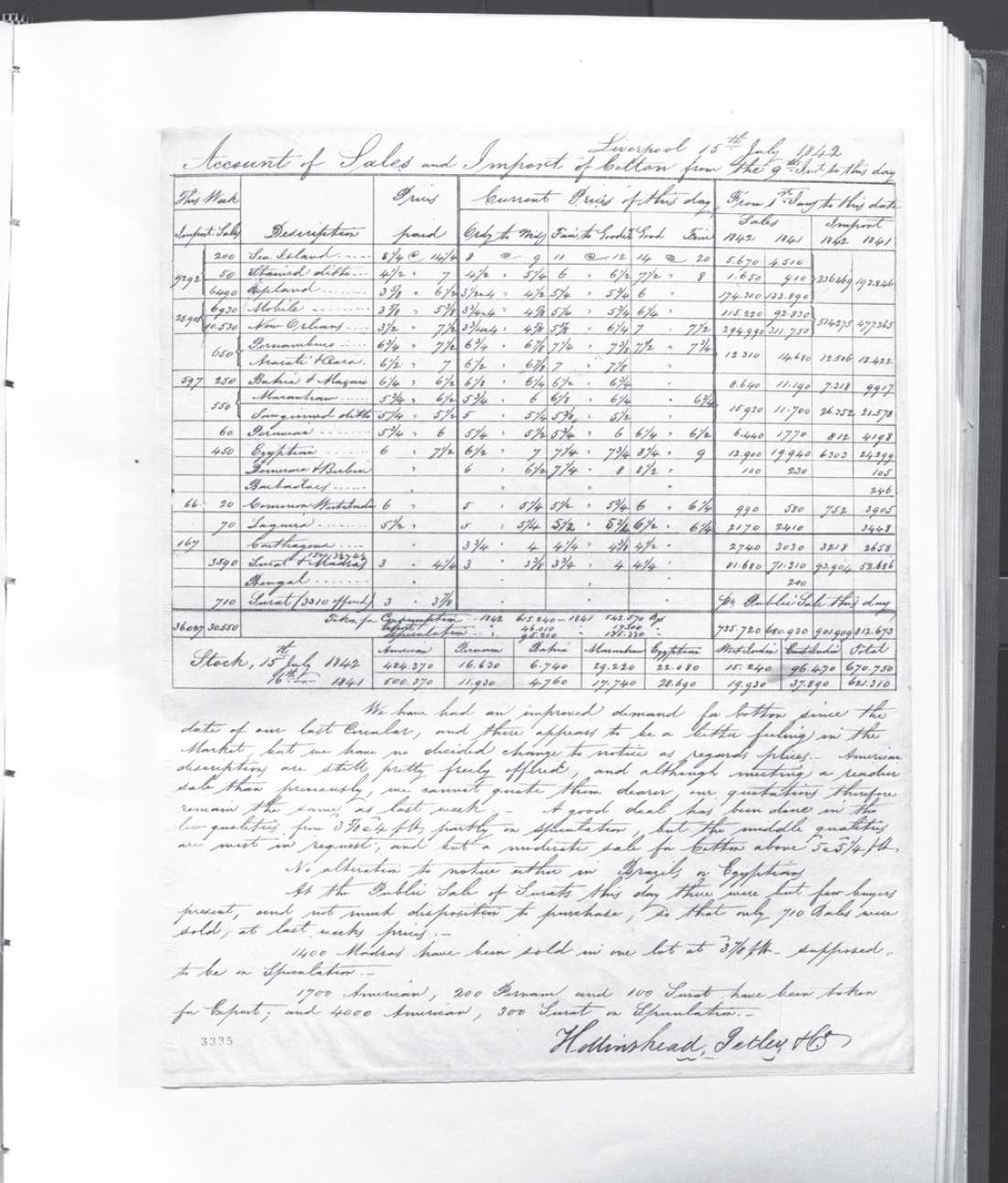
Liverpool might on one day help dislodge Native Americans from their land,
on another day encourage investment in Indian railroads, and on another
make a family in Switzerland, Gujarat, or Michoacán give up spinning and
weaving altogether.
6
The
ɹnancial pulse of the empire of
cotton: “Liverpool prices” on an Alabama cotton plantation, 1842
(illustration credit 8.2)
Liverpool, like no other city, concentrated simultaneously on all the core
functions of the global cotton trade. Its merchants traded raw cotton,
shipped cotton goods, and
ɹnanced both cotton agriculture and cotton
manufacturing. Other cotton cities were more specialized in their activities.
Merchants in New Orleans, Alexandria, and Bombay, for example, mastered
the export of raw cotton, while Bremen and Le Havre merchants received
their shipments. New York and London merchants focused on
ɹnancing the
trade. And widely dispersed merchants in cities from Buenos Aires to Recife,
Hamburg to Calcutta received shipments of yarn and cloth and distributed
them through their hinterlands.
None of these cities, however, competed seriously with Liverpool. The
channels through which cotton
ɻowed were not evenly distributed across the
world. They narrowed and widened at certain points, and the volume and
velocity of the
ɻow was a direct expression of the distribution of inɻuence;
the deeper and faster the network, the greater the power. While Liverpool
enjoyed a torrent of trade and information connecting it to many places,
hinterland towns in Mississippi or Buenos Aires saw but a lazy, gentle
ɻow
to and from very few places. To be at the very beginning or the very end of
a “commodity chain” thus was usually a position of relative weakness. The
focus of the cotton network on one city, Liverpool, led to new hierarchies of
power—an innovative development that replaced older cotton networks and
older merchant groups in cities such as Ahmedabad or Surat or Oaxaca. The
rise of Liverpool’s merchants at the turn to the nineteenth century further
moved a multipolar world of cotton into the direction of becoming unipolar.
Seen from the cotton exchange at Liverpool, the world beyond its high
windows was essentially a huge cotton production and consumption
complex. The voracious appetite for pro
ɹt demanded ever more lands for
the commercial production of cotton, the multiplying of cotton mills, and
the opening of cloth markets. This unprecedented and highly leveraged
industrial expansion depended for its survival on the permanent
transformation of the global countryside to mobilize ever more labor and
resources and provide markets. Yet despite the omnipresence of Liverpool
capital and its merchants, the nature of these connected transformations
looked radically di
ʃerent in the Black Forest, Bombay, or Mississippi.
While Liverpool merchants stood at the heart of this new empire of cotton,
in fact constituted it, they were just one of many groups of traders engaged
in the global cotton trade. Jointly these traders coordinated the e
ʃorts of the
hundreds of thousands of slaves, peasants, and planters growing cotton on
farms big and small in many di
ʃerent parts of the world. Jointly they
connected those raw materials to the thousands of manufacturers who
purchased cotton for their factories, manufacturers who in turn sent yarn
and cloth to the markets and shops that then sold these cotton goods to
millions of consumers. Merchants moved the
ɹber and cloth from a
Mississippi planter or Gujarati farmer to an Oldham or Zwickau spinner,
from Manchester manufacturers to the bazaar of Istanbul, from the factories
of Mulhouse to the dry goods merchants of New York. Merchants advanced
capital to allow Barbadian planters to grow cotton. They collected cotton
from numerous growers and prepared the bales for shipment. They
dispatched ships across the world’s oceans. They o
ʃered cotton to
manufacturers and transmitted market information from the bazaar to the
factory, from the factory to the port, and from the port to the plantation.
And they sold the yarn and fabric that came out of the ever more e
ɽcient
factories to ever more consumers all over the world. While sometimes
owners of plantations and factories, merchants were more often
independent intermediaries. They specialized not in growing or making, but
in moving. At great headwaters such as Liverpool, they constituted the
market; they were its visible hand.
The challenges of forging these ties were as vast as the potential pro
ɹts.
Consider just one chain of links. For a planter in Mississippi to provide
cotton to a Manchester manufacturer, a local Mississippi merchant, a so-
called factor, had to
ɹrst provide the planter with credit to acquire slaves,
land, and implements. This factor probably drew on London or New York
bankers for these resources. Once the cotton had ripened, the factor would
o
ʃer the cotton for sale to exporting merchants in the port of New Orleans,
who would sell it to importing merchants in Liverpool, who would also
provide insurance on the bales and organize their shipment to Europe. Once
in Liverpool, the importing merchant would ask a selling broker, another
type of merchant, to dispose of the cotton. As soon as a buying broker found
the cotton to his liking, he would forward it to a manufacturer. The
manufacturer would work up the cotton, and then provide it to a merchant
who would organize its shipping to a representative in a distant port, for
example in Calcutta. Once there, the yarn would be sold to Indian
merchants, who would distribute it into the countryside, where it would
eventually be bought by an Indian weaver, who would sell it yet again to
other traders who would deliver it to the retail merchants in villages and
towns. Thus slave-grown Mississippi cotton manufactured into yarn in
Lancashire might be woven into a shirt somewhere in the Indian
countryside. The empire of cotton consisted of tens of thousands of such ties.
Merchants everywhere constituted these webs, built on credit, trade,
information, trust, social connections, and the never-ending search for
pro
ɹt. The scope of the new cotton networks was unprecedented. Never
before had any industry connected the activities of so many growers,
manufacturers, and consumers across such vast distances. And as a result,
never before were merchants so desperately needed. The scale of these
networks created unprecedented problems of coordination. Neither peasants
nor plantation owners, nor even wealthy manufacturers, could keep the
channels upon which their livelihoods rested clear. The ability of merchants
to organize the radical spatial rearrangement of the world’s most important
manufacturing industry was as much of an invention as the more corporal
machines and novel labor organization that dotted the globe by the 1850s.
7
Their capital, and the institutional structures of trade they forged, imbued
large expanses of the globe—from the newly industrializing villages and
cities of Europe to the plantations and farms of Mississippi and Gujarat—
with the new rhythms of industrial production. By bridging the seemingly
unbridgeable gap between the slave plantation and the factory sta
ʃed by
wage workers, they created modern capitalism.
8
These merchants built the trade in cotton and cotton goods into one of the
most substantial of the nineteenth century. Between 1800 and 1860, the
quantity of raw cotton traded between the United States and Great Britain,
by far the most important stream, grew by a factor of 38; the (much
smaller) quantity traded between the United States and continental Europe
increased during these same years by a factor of 138. Egypt exported 14
times as much cotton in 1860 as it had in 1822. Imports of cotton into
France’s most important cotton port, Le Havre, grew by nearly 13 times
between 1815 and 1860. And along with the growth of the raw cotton trade,
the trade in manufactured cottons also exploded: 350,448 pounds of yarn
were exported from Britain in 1794; by 1860 that number had increased by
a factor of 563. Other commodity trades boomed during these years as well,
but not in the same way; co
ʃee exports from
Brazil, to cite just one
example, increased seven times between 1820 and 1860. But the major
economies of the world depended on the cotton trade: France’s single most
important export product was textiles, most made of cotton. Between 1800
and 1860, cotton goods accounted for about 40 to 50 percent of the value of
total British exports. Raw cotton was also by far the most important export
good of the United States: In 1820, the value of U.S. cotton exports was
some $22 million; leaf tobacco was valued at $8 million, and wheat at less
than $500,000. Cotton constituted about 31 percent of U.S. merchandise
exports by value. By 1860, the value of tobacco exports had doubled, and
wheat exports had increased by a factor of eight—but cotton had
mushroomed nearly nine times to $192 million. It now constituted nearly 60
percent of the value of all merchandise exports. As merchants built the
world’s
ɹrst truly global economy, cotton took center stage.
9
Merchants, some of them dealers or brokers, and other agents, import
merchants, or factors, accurately judged that there were ample opportunities
for pro
ɹts in this vast new trade. Distinct groups of merchants reaped
pro
ɹts from each of the transactions necessary to bring cotton from the
plantation to the consumer.
10
Commissions, interest, and payment for
services
ɹlled their coʃers. Some grew fabulously rich, the Rathbones in
Liverpool, the Barings in London, the Rallis in London, Bombay, and
elsewhere, the Volkarts in Winterthur, the Siegfrieds in Le Havre, the
Wätjens in Bremen, the Forstalls in New Orleans, the Browns in New York,
the Cassavettits in Alexandria, and the Jejeebhoys in Bombay prominent
among them. Cotton underpinned the vast wealth and power of these
families, allowing them to build mansions sta
ʃed by large numbers of
servants, collect precious artworks, invest in other businesses, and travel the
world. But thousands upon thousands of less wealthy cotton merchants,
whose names have largely been forgotten, peopled the trade as well.
Collectively, they forged new spaces of capital.
For the marriage between slavery and industry to succeed, however,
merchants had
ɹrst to proɹtably transmit the patterns of machine
production and industrial capitalism into the global countryside. The world
had no shortage of big dreamers before the nineteenth century, but
heretofore no one had been able to realize the potential of the productive
hinterlands and vulnerable consumer markets over such great expanses. The
process through which these merchants did so was exceedingly complicated
—indeed, it rested on a network of actors whose
ɹeld of vision was often,
though not always, quite provincial, and who at times did nothing more
than move the logic of industrial capitalism one step closer to rural cotton
producers. By merely connecting various places and stages in the process of
cotton manufacturing to one another, however, the merchants, often
unwittingly, created something quite new. For the
ɹrst time in history, they
drew upon the full diversity of labor regimes, a hallmark of the emerging
capitalism—slaves growing cotton, wage workers manufacturing yarn, and
slaves as well as wage workers ginning, pressing, loading, and moving
cotton bales. In doing so, they helped Europe overcome its resource
constraints. Watching these merchants in action, in all their mundane and
seemingly inconsequential activities, helps us solve the puzzle of how
industrial and war capitalism came to be connected.
Considering their importance in forging the world of modern capitalism, the
actual work of merchants seems often almost banal. Most of their time was
spent writing letters, talking to suppliers and customers, traveling, and
making calculations. Because the empire of cotton they created was so vast,
merchants soon specialized in speci
ɹc aspects of the trade. Some focused on
moving cotton from plantations to ports, others on transoceanic trade; some
concentrated on selling raw cotton to manufacturers, while others
speculated in exporting cotton goods, and others distributed imported cotton
goods throughout a particular country or region. Usually merchants focused
their trade on a particular region, becoming experts on connecting certain
parts of the world to one another. Consequently, they had businesses that
could look surprisingly di
ʃerent from each other. The global system, in
e
ʃect, was built not from a central, imperial directive, but rather by myriad
actors with local and diverse connections often solving very local problems.
The most urgent problem merchants helped solve was how to supply
manufacturers with raw cotton. As the scale and e
ɽciency of the industry
increased, and as cotton did not grow anywhere near the factories,
manufacturers needed help securing ever greater supplies from the remote
reaches of the world. During the 1760s, 1770s, and 1780s, most purchased
this cotton from dealers located in the spinning districts themselves, dealers
who traded on their own accounts and provided credit to the manufacturers
to enable them to purchase it.
11
In 1788, the city of Manchester, for
example, counted twenty-two such dealers. The dealers, in turn, bought the
cotton from Liverpool merchants who, in the eighteenth and even early
nineteenth centuries, were still mostly general merchants for whom cotton
was only one of a number of commodities they had on o
ʃer.
Yet as the quantity of cotton traded increased dramatically in the
ɹrst few
decades of the nineteenth century, and as manufacturers’ demands on the
quality and price of the cotton they received changed, cotton manufacturers
left this almost quaint world behind. Instead of purchasing cotton from
dealers, they began to use brokers. Brokers, in contrast to the dealers, did
not take possession of cotton; they instead charged a commission for
brokering trades between importing merchants and manufacturers. As a
result, mill owners could purchase not just the cotton that their dealers
happened to own, but any of the cotton available in the port of Liverpool—
getting the quantities and qualities they desired at the cheapest possible
price. Brokers provided a more direct connection between manufacturers
and cotton-importing merchants, and also organized the market by setting
rules and regulations, distributing information, and providing elaborate
arbitration services. They “brought to Liverpool the technical knowledge of
the industry,” argues one scholar, and “they also brought a new kind of
administrative skill and e
ɽciency to deal with the problems of what was,
virtually, a new trade.” As a result, brokers “became central
ɹgure[s] in the
market.” Expert both in the new technical requirements of spinning and in
the bewildering Liverpool market, they helped manufacturers to navigate
the varieties of cotton available in Liverpool and acquire the cotton qualities
they needed for speci
ɹc manufacturing processes.
12
By 1790 four such specialized cotton brokers had emerged in Liverpool.
Many others followed, and by 1860, 322 brokers walked the streets of that
city. They generally operated as small family
ɹrms and came from a variety
of backgrounds: some were former dealers, others had been spinners, and
still others had worked as import merchants. Eventually, brokers specialized
even further. Some became buying brokers, purchasing cotton for
manufacturers, and others selling brokers, selling cotton for importing
merchants.
13
Thanks to these changes, manufacturers removed themselves from the
inspection of cottons in the market. While early in the century
manufacturers had personally touched the cottons on sale, they now
communicated their needs to brokers who then searched out the cotton they
wanted. Ever more specialized in the production of particular qualities of
yarns and goods, and demanding ever greater varieties of cotton,
manufacturers found going into market to purchase all that cotton
impossible. They depended on a constant
ɻow of the crucial
raw material
into their factories, and brokers guaranteed that supply.
As brokers replaced dealers, they also changed the way cotton was sold.
Again, the needs of machine production dictated these changes. Throughout
the eighteenth and well into the
ɹrst half of the nineteenth century, cotton
had been traded as a physical commodity. Merchants bought and sold
speci
ɹc sacks of cotton, dealing with a bewildering variety
of di
ʃerent
cottons from di
ʃerent parts of the world that had varying staple lengths,
colors, elasticity, and cleanliness. As merchants sold speci
ɹc lots in speciɹc
sacks, they in e
ʃect allowed a purchaser to trace back each particular parcel
of cotton to a particular producer. The 1814 records of cotton broker George
Holt show him selling “13 Bags (of cotton) waste Guinam,” “6 Bags
Barbadoes,” “10 Bags Paras, 15 bags Bahis, 25 bags Dyneraras, 10 bags
South Island,” and unspeci
ɹed amounts of further varieties such as “Bengal,”
“Surat,” “Bourbons,” “Demarara,” and “Pernam.” As Liverpool cotton broker
Thomas Ellison observed in 1886, “Down to the opening of the present
century the usual practice was for the seller to give to the buyer the marks,
ship’s name, and place of storage of any lot or lots of cotton which he might
have for sale, in order that the buyer might go to the warehouse and
examine the bales for himself.” The enormous natural variety of cotton was
thus preserved in the trade, and all participants in that trade dealt in cotton
that they had seen and touched.
14
When the trade in cotton exploded in the
ɹrst decades of the nineteenth
century, this system came under strain. Brokers hurried around the port of
Liverpool inspecting hundreds of bags and bales, trying to match speci
ɹc
lots of cotton to the needs of speci
ɹc manufacturers—manufacturers who
needed particular qualities to produce particular kinds of yarn. Soon this
became all but impossible. Pushed by manufacturers’ needs, brokers sought
new institutional solutions. First, they moved from physically inspecting
each sack of cotton to buying by sample.
15
A small batch of
ɹber was drawn
from each bale and on the basis of that sample a price was determined and
a sale e
ʃected. These samples, unlike the bales themselves, could easily be
carried around and even mailed. In a second step, brokers developed clear
standards and a precise vocabulary for cotton; eventually, manufacturers
would acquire cotton without even inspecting samples. They would, in
e
ʃect, not order a particular bale of cotton from a particular place, but a
particular quality. This was a radical recasting of the trade.
Cotton shows enormous variability in grade, staple, and character. As of
1790, no attempt at grading cottons had been made, even though grades
already existed for other commodities, such as sugar and co
ʃee, for which
categories such as “middling” and “good ordinary” were widely used. In
1796, in Charleston, “Georgia cotton” and upland cotton were mentioned
for the
ɹrst time as discrete categories, and in 1799 in Philadelphia, note
was made of “Georgia Tennessee cotton”—categories that still re
ɻected
place of origin. That year, the
Dictionnaire universel de la géographie
commerçante
still listed diverse cottons only by where they were grown. In
1804, however, Charleston merchants listed “common cotton,” a category
that by 1805 had become “common upland.” By 1805, Sea Island cotton was
graded into prime, good, fair, middling, and inferior grades. The
Tradesman
spoke in 1809 of “good middling cotton”; in 1815 in the New Orleans
market the designation “prime” was used, two years later “
ɹrst quality”
cotton was listed, and another year later “middling cotton” appeared in
Charleston, followed in 1822 by “choice prime cotton” in New Orleans and
“choice fair” in 1823. The
London Magazine
mentioned these categories by
1820, a decade during which they came into widespread use. These
categories were still approximations that could neither be precisely de
ɹned
nor enforced, but they formed the foundation upon which later enforceable
standards would be built. Without such standards, such a high-volume long-
distance trade of bulk commodities would have been all but impossible—the
vast diversity of nature had to be distilled and classi
ɹed to make it
correspond to the imperatives of machine production.
16
For standards to work over the long term, purchasers had to be able to
verify the quality of the cotton they had purchased. At
ɹrst these rules and
regulations were informal, conventions not written down but personally
understood. As trading by sample increased in volume and expanse, traders
in far-
ɻung ports and manufacturers demanded rules with “some sense of
permanence”—standards protected by institutions. In response, brokers
created the Liverpool Cotton Brokers’ Association in 1841. One of the
ɹrst
things the Association did was to pass a resolution that all cotton sold by
sample was warranted to contain such quality. By 1844, they had de
ɹned
standards for “fair” and “middling” cotton. In 1846, the American Chamber
of Commerce in Liverpool, founded in 1801 by Liverpool merchants trading
with the United States, suggested that the brokers “cause samples of the
several classes of American Cotton to be taken, to be placed at the disposal
of the American Chamber so as to form a standard for reference in all
questions as to quality of cotton.” Increasingly, the cotton market was no
spontaneous interaction of utility-maximizing individuals, but a set of
institutions forged outside the market itself.
17
Once standards were formalized, e
ʃorts emerged to apply them
internationally. In 1848 the New Orleans Chamber of Commerce wrote to
the American Chamber of Commerce in Liverpool about the “great
inconveniences which have hitherto frequently attended the operations of
the purchasers of Cotton in New Orleans for want of a
ɹxed standard of
quality uniform with that of Liverpool and recognized as such by the Trade
in both ports.” It proposed to create mutual standards for “fair middling &
ordinary cotton, both New Orleans and Alabama.” These duplicate standards
would then be kept in New Orleans and Liverpool, to adjudicate disputes.
The American Chamber of Commerce in Liverpool obliged and voted to
create such standards. A modern cotton market was now emerging as the
result of collectively articulated conventions, with a private association of
Liverpool merchants at its core. Capital was changing the way the cotton
plant itself was seen—it would soon change the plant itself. In such subtle
ways, the unrelenting pressure of capital-intensive factory production
moved closer to the growing of cotton itself, forcing the logic of capital
upon the logic of nature.
18
Cotton standards emerged hand in hand with, and indeed enabled,
another invention: a trade in cotton that had not yet arrived. For a futures
market to work, information and samples had to travel faster than bulk
cotton itself, something that seems to have emerged in the 1810s in
Liverpool. By 1812, cotton brokers had begun to trade in cotton while it was
still on the high seas, exchanging so-called “bills of lading”—documents
certifying ownership of certain bales of cotton. Two years later, on August
13, 1814, George Holt sold to George Johnston & Co. one hundred bags of
cotton “to arrive” from Amelia Island in ten days. Such trade in the future
delivery of cottons increased throughout the
ɹrst half of the nineteenth
century. In 1858, the American Chamber of Commerce in Liverpool
explicitly regulated such “to arrive” contracts. This was the moment in
which, according to the Baring house in Liverpool, the “hypothecation of
shipping documents” began. And not just in Liverpool: Such “to arrive”
contracts were also used in the American South by New York merchants
before 1860, and in Le Havre, where merchants created
ventes à livrer
contracts as early as 1848. But there and elsewhere, these contracts were
still exceptional, and as late as the 1850s cotton broker Samuel Smith
observed that “nearly all the business was bona-
ɹde transfers of cotton in
warehouse, and it was quite an exception to sell a cargo a
ɻoat.”
19
Moreover, during the
ɹrst half of the nineteenth century selling cotton for
future delivery was still based on the eventual delivery of a
particular
parcel
of cotton. George Holt had promised in 1814 to deliver particular bags of
cotton to Johnston, his customer, not just a certain quality. Yet gradually
the connection between a particular contract and a particular batch of
cotton began to weaken. Cotton began to be sold that had not yet been
shipped, indeed that would only come onto the market in distant months,
and might not even have been planted yet.
20
This further abstraction of the
trade would blossom during the American Civil War, when true futures
dealings came about. The quanti
ɹable, steady, and ongoing demands of
mechanized production encouraged an ever greater abstraction of its
essential raw material inputs, protecting manufacturers against price
ɻuctuations and enabling them to price their ɹnished goods across global
markets.
The chain from factory to plantation, however, had many more links.
Liverpool’s brokers communicated the needs of manufacturers to another
powerful group of cotton traders: the import merchants. In contrast to the
brokers, these merchants engaged in transoceanic trade of cotton, handling
goods on an incomparably larger scale, with opportunities for pro
ɹt
proportionally greater. In Liverpool and its French competitor, Le Havre,
merchants specializing in cotton importation had emerged as early as the
late eighteenth century, to be followed in the nineteenth century by
merchants in Bremen. They focused on purchasing cotton abroad or, more
typically, shipping it for a commission (rather than taking ownership of the
cotton) from distant ports to Europe.
21
They, more than any others, directly
connected rural producers with the most dynamic manufacturing sector the
world had ever known. At
ɹrst, they helped slavery blossom in Louisiana
and Brazil, but later they would enable peasant producers in India to grow
cotton for transoceanic markets, and allow Muhammad Ali’s domination of
Egyptian peasants to turn into pro
ɹt.
Liverpool’s merchants were far and away the world’s most important
cotton importers. By the mid-1700s they had brought the
ɹrst cotton to
Liverpool; by 1799, a full 50 percent of all British cotton imports arrived
there (most of the rest went to London), and by the late 1830s that
proportion had grown to 89 percent. Liverpool’s merchants cornered the
global cotton market in ways few merchants ever have. They succeeded for
several reasons. Initially, Liverpool’s central position in the Atlantic slave
trade set it up well for trade in cotton. Cotton initially arrived, along with
sugar, tobacco, and other goods, as return freight from the West Indies—one
of the sides of the triangular trade. Liverpool may have controlled up to 85
percent of the British slave trade, and by its 1807 abolition as much as one-
quarter of Liverpool shipping was in slaves; everyone who worked the city’s
ports, therefore, was experienced with long-distance trade, and also with the
cotton-growing regions of the Americas. And, as cotton increasingly came
across the Atlantic rather than the Mediterranean, Liverpool was well
situated to capitalize. The city also bene
ɹted from its location near the
spinning districts in and around Manchester, a connection that rapidly
improved thanks to the building of canals, improvements on the river
Mersey, and eventually, in 1830, the arrival of the world’s
ɹrst railroads.
With such connections in place, Liverpool could bene
ɹt from the
institutional innovations created by its traders.
22
The most powerful and wealthiest of Liverpool’s merchants engaged in the
cotton trade. A careful study of the Liverpool cotton import trade has found
that in 1820 fully 607 merchants traded cotton. Yet the same study also
established that the number of merchants who imported cotton regularly
(more than six times a year) was small, 120 in 1820, and 87 in 1839. The
import trade was therefore composed of a very large number of merchants
who traded small quantities of cotton occasionally, and a few merchants
who regularly traded large numbers of bales. Yet as margins fell in the
second quarter of the nineteenth century, the merchant community
consolidated. In 1820, the leading ten cotton merchants had imported 24
percent of all cotton into Liverpool, and the top thirty cotton importers had
imported a total of 37 percent. Nineteen years later, the leading ten traders
brought in 36 percent of all cotton and the leading thirty a full 60 percent.
That year, 1839, the largest importer of cotton into Liverpool sold more
than
ɹfty thousand bales.
23
While the majority of traders continued importing small quantities of
cotton along with other commodities, Liverpool’s major cotton traders
reaped tremendous rewards by specializing and intensifying their cotton
trade. The Rathbone family, one of the city’s prime cotton traders, had
moved into the cotton trade in the eighteenth century (they supplied Samuel
Greg when he opened Quarry Bank Mill), at
ɹrst adding to and later
superseding their older timber, salt, and tobacco trade. Indeed, they were
perhaps the
ɹrst Liverpool ɹrm to receive U.S.-grown cotton. They shipped
cotton throughout the
ɹrst decades of the nineteenth century, and by the
1830s wholly specialized in it. Like many other merchants, they acquired
this cotton through agents in southern ports of the United States who had
purchased it on the Rathbones’ account or who sent it to them on a
commission basis. The pro
ɹts were large: In the years from 1849 to 1853,
the Rathbones earned £18,185 from the cotton trade, in the years 1854 to
1858 they made a full £34,983—at a time when a physician might earn
£200 a year. The cotton pro
ɹts of just ɹve years could ɹnance the
construction of a huge and fully furnished English country manor; as the
nineteenth century wore on, more and more such stately homes dotted
Liverpool’s countryside.
24
The Rathbones’ trajectory from their earlier trade in other commodities
into cotton was typical of the major nineteenth-century transcontinental
cotton merchants. But there was another path into the cotton trade. Those
whose wealth or skills did not originate in trade itself saw cotton as a
promising way to diversify. So spectacularly pro
ɹtable was the cotton trade
that all but a few of the major capitalists of the era sought to gain a footing
—bringing with them signi
ɹcant amounts of capital. The Baring family,
most notably, made such a move. Along with the Rothschilds, the Barings
were Europe’s most powerful bankers, and just like the Rothschilds, the
Barings forged an important connection to cotton during the
ɹrst half of the
nineteenth century. They also had a long-standing relationship to the United
States, not least because they had facilitated that expanding slave power’s
purchase of Louisiana from the French.
The Barings had begun investing in the cotton business as early as 1812,
when they advanced £6,000 to New Orleans merchant Vincent Nolte to start
a cotton export house. Thanks to this capital in
ɻux, Nolte’s “position in the
cotton market now became, step by step, more in
ɻuential,” and by the
1820s he traded sixteen thousand to eighteen thousand bales per season.
When Francis Baring visited Nolte in the early 1820s to check on his
investments, he was, according to Nolte, “evidently grati
ɹed when he took
his
ɹrst walk along the so-called Levee…and saw it strown [
sic
], from the
upper to the lower suburb, with cotton bales, on which were stamped the
marks of my
ɹrm.” Nolte failed in 1826, however, and the Barings in
consequence added an American agent to their operations, Thomas Ward in
Boston, to enforce tighter controls over their American investments.
25
Under Ward’s watchful eye, the Barings’ London-based cotton business
grew rapidly, so much so that by 1832 they had opened an o
ɽce in
Liverpool. Step by step, they built a globe-spanning system of information
collecting and trading whose epicenter was Liverpool. It was there that they
collected information on the globe’s raw cotton supplies, cotton
manufacturing, and cotton goods consumption and then translated it into
orders to Thomas Ward, who then made arrangements with commission
houses in New York, Philadelphia, Charleston, Savannah, Mobile, and New
Orleans. The Barings also took shares—that is, they purchased particular
lots of cotton forwarded by other commission houses. Funds for both
advances and purchases were provided by drafts on Baring Brothers &
Company. It was this credit, wielded by merchants like the Barings, that
made the brutality of war capitalism more and more e
ɽcient, and thus
made industrial capitalism more and more pro
ɹtable.
26
Riding this wave of activity, in 1833 the Barings became the
ɹfth largest
importer of cotton, and between 1839 and 1842 they ascended to the
largest, the
ɹrm whose “motions are watched” by their competitors. In ɹscal
year 1839–40 alone, for example, they imported 104,270 bales of cotton—
the annual labor product of at least seventy thousand slaves.
27
The operations of the Barings, like those of the Rathbones, dwarfed those
of most of their colleagues—not just in Liverpool, but even more so in
Europe’s other emerging cotton ports. Still, important cotton merchants
emerged elsewhere, catering to the needs of other national cotton industries.
On the northern German coast, Bremen rose to prominence during the
ɹrst
half of the nineteenth century as a cotton trading center. The
ɹrst sacks of
cotton landed in 1788; by 1829, Bremen’s port counted six merchants
trading in cotton, and by 1845 the Bechtel, Vietor, Delius, Meier,
Hagendorn, Gildemeister, and Fritze families collectively imported 18,498
bales.
28
Bremen, unlike Liverpool, did not have a thriving cotton industry in its
own hinterland, with most of its cotton imports shipped to manufacturers
hundreds of miles away in such places as Saxony and southern Germany.
What Bremen had was human ties to the United States. Indeed, Bremen’s
cotton trade emerged largely as return freight in the holds of ships that had
brought European immigrants to the United States. The Bremen cotton
merchants of D. H. Wätjen & Co. in January 1852 sent their ship
Albers
from
New Orleans to Bremen loaded with cotton, brought immigrants to New
Orleans in April, then returned with cotton to Bremen in June. It sailed once
more with immigrants to New Orleans in September, before bringing
tobacco to London in November. The Bremen cotton trade demonstrated the
symbiosis between the export of continental Europe’s surplus labor and the
import of agricultural commodities. Globalization increasingly fed upon
itself.
29
More signi
ɹcant than the Bremen merchants were their counterparts in Le
Havre. Situated on the Norman coast of northwestern France, it was
continental Europe’s most important cotton port in the
ɹrst half of the
nineteenth century, and supplier to the French, Swiss, and western German
industries. In 1830 port workers, as underpaid and overworked as their
counterparts in Liverpool, unloaded 153,000 bales, and in 1860, 600,000—
accounting for 89 percent of all cotton imports into France. Cotton became
as central to Le Havre as it had become to Liverpool. Le Havre’s central
position in the European cotton trade built, like Liverpool’s, on its earlier
role in the East India and slave trade, and, like Bremen’s, on its role as a
major port of embarkation for European migrants to the United States.
30
As in Liverpool, a growing number of merchants plied the cotton trade in
Le Havre; 279 competed for business in 1835. Like their Liverpool
counterparts, they operated on a global scale. Jules Siegfried, for example,
one of Le Havre’s major traders, was born into a family of cotton printers in
Mulhouse and learned the business not just in his father’s
ɹrm in Le Havre,
but also via apprenticeships in Manchester and Liverpool. In 1859, his
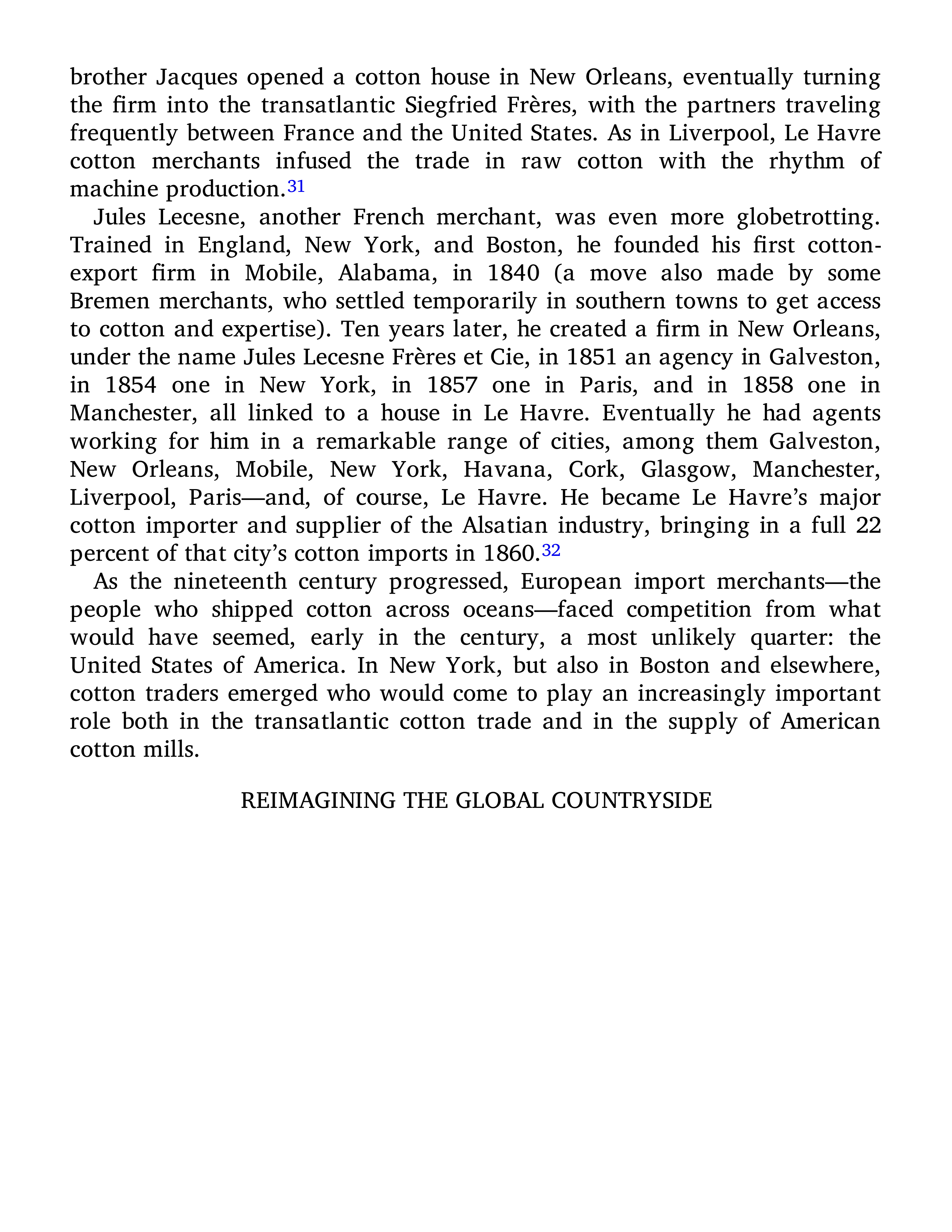
brother Jacques opened a cotton house in New Orleans, eventually turning
the
ɹrm into the transatlantic Siegfried Frères, with the partners traveling
frequently between France and the United States. As in Liverpool, Le Havre
cotton merchants infused the trade in raw cotton with the rhythm of
machine production.
31
Jules Lecesne, another French merchant, was even more globetrotting.
Trained in England, New York, and Boston, he founded his
ɹrst cotton-
export
ɹrm in Mobile, Alabama, in 1840 (a move also made by some
Bremen merchants, who settled temporarily in southern towns to get access
to cotton and expertise). Ten years later, he created a
ɹrm in New Orleans,
under the name Jules Lecesne Frères et Cie, in 1851 an agency in Galveston,
in 1854 one in New York, in 1857 one in Paris, and in 1858 one in
Manchester, all linked to a house in Le Havre. Eventually he had agents
working for him in a remarkable range of cities, among them Galveston,
New Orleans, Mobile, New York, Havana, Cork, Glasgow, Manchester,
Liverpool, Paris—and, of course, Le Havre. He became Le Havre’s major
cotton importer and supplier of the Alsatian industry, bringing in a full 22
percent of that city’s cotton imports in 1860.
32
As the nineteenth century progressed, European import merchants—the
people who shipped cotton across oceans—faced competition from what
would have seemed, early in the century, a most unlikely quarter: the
United States of America. In New York, but also in Boston and elsewhere,
cotton traders emerged who would come to play an increasingly important
role both in the transatlantic cotton trade and in the supply of American
cotton mills.
REIMAGINING THE GLOBAL COUNTRYSIDE
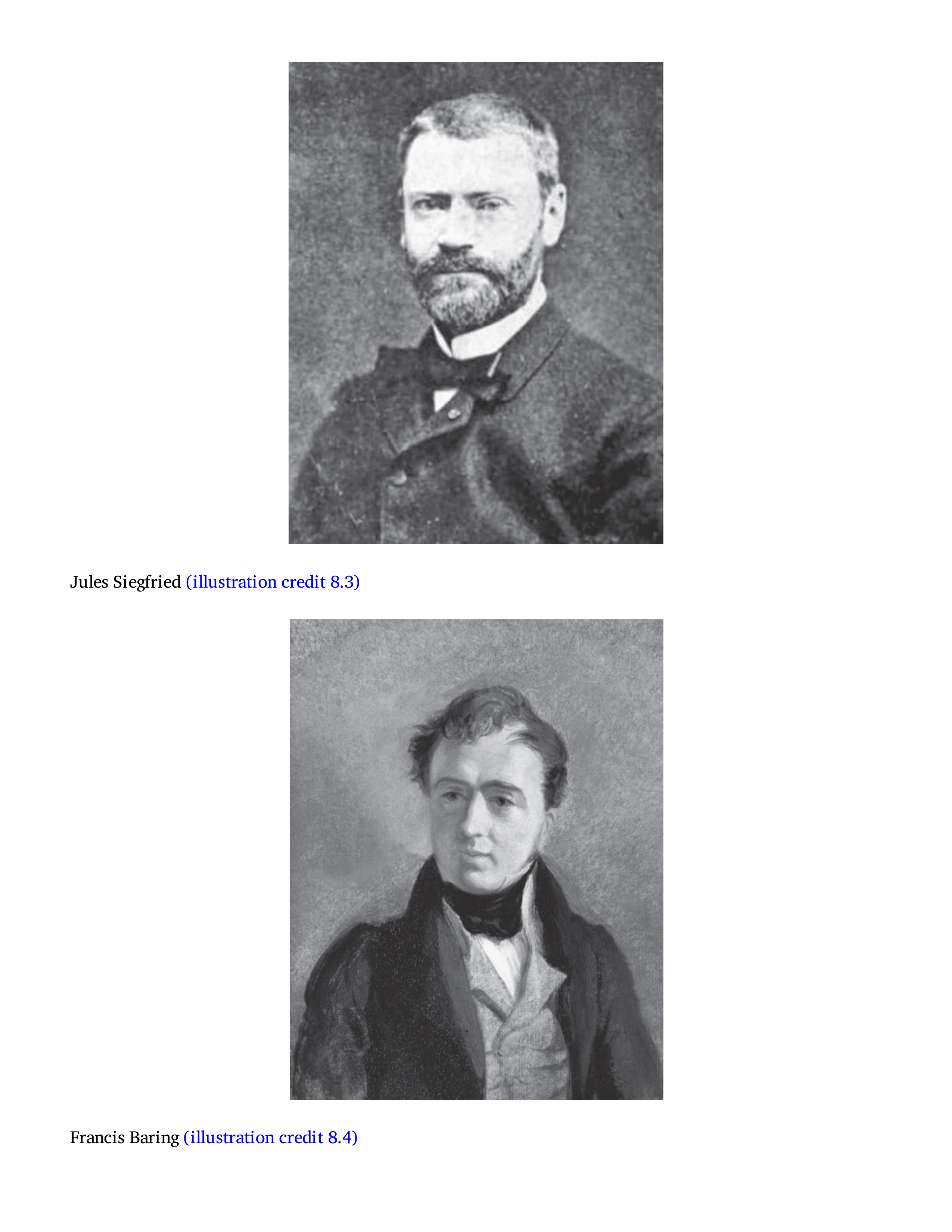

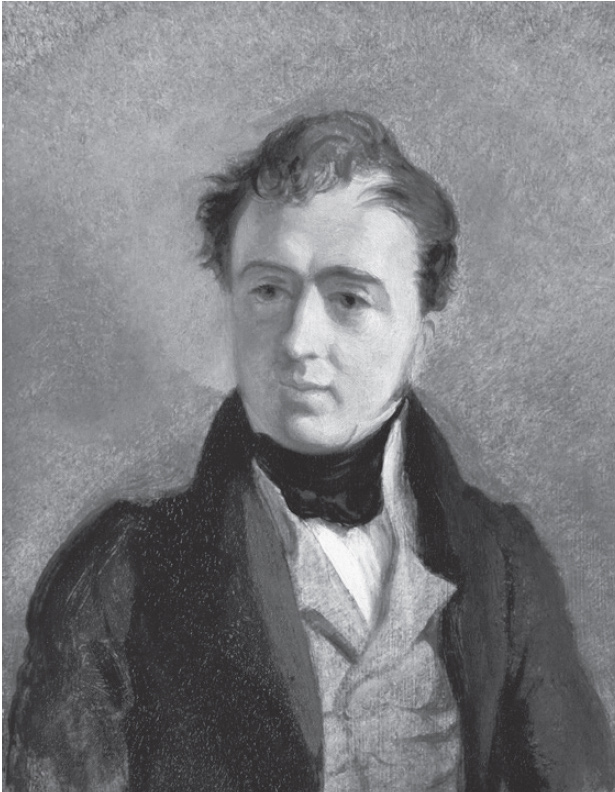
Jules Siegfried
(illustration credit 8.3)
Francis Baring
(illustration credit 8.4)
One American
ɹrm, Brown Brothers, would eventually join the ranks of
the world’s most important cotton merchant houses. The Browns were
immigrants from Ireland. Alexander Brown founded a modest linen business
in 1800 in Baltimore, then branched out into the cotton trade. As part of this
diversi
ɹcation, Alexander sent his son William to Liverpool in 1810 to open
a house for the importation of American cotton and the export of cotton
goods. He sent his other sons to other port cities. Most important of all, in
1825 son James went to New York, with the goal of promoting “the interest
of Messrs. William & James Brown & Co., of Liverpool, and of a
ʃording
greater facility, and the choice of markets, to our southern friends who are
disposed to give…us their business.” By the 1820s, Brown Brothers was
among the largest cotton traders between the United States and Liverpool.
33
From the 1820s to the 1850s, Brown Brothers involved itself in all aspects
of the southern cotton trade. The
ɹrm oʃered cotton growers and factors in
the South advances on future crops. It arranged shipping to Liverpool;
indeed, the Browns themselves owned a number of ships. It provided
insurance on cotton in transit. It sold huge quantities of cotton on
commission (typically, Brown would advance about two-thirds of the market
value of cotton on these consignments), procured from factors, including its
own agents in the ports of New Orleans, Mobile, Savannah, and Charleston.
Even though the Browns favored the less risky commission business, at times
they bought cotton outright and shipped it to Liverpool for sale. In addition,
and ever more important, the Browns provided credit and exchange
facilities (converting various currencies) to southerners to enable them to
trade crops grown by slaves. In the 1830s they advanced $100,000 to New
Orleans cotton traders Martin Pleasants & Co., and a $200,000 line of credit
to the New Orleans banking house of Yeatman Woods & Co. They also
moved capital into a variety of southern banks, among them the Planters’
and Merchants’ Bank in Mobile, Alabama, and the Merchants’ and Traders’
Bank of Mississippi. The Browns made themselves central to the global
cotton economy and so they became rich. In the
ɻush times of the early
1830s, it has been estimated, Brown Brothers made pro
ɹts of more than
$400,000 per year—enough to buy thirteen one-hundred-foot yachts, or
thirteen hundred carriages.
34
These activities allowed the Brown family to capture a signi
ɹcant share of
the global cotton trade, anticipating the rising importance of American
merchants in the late-nineteenth-century empire of cotton. William Brown’s
share of cotton imports into Liverpool amounted to 2.8 percent in 1820, and
7.3 percent in 1839, putting him among the top ten importers of cotton in

the world’s largest cotton port. In 1838, his brother James in New York
handled 178,000 bales of cotton, equaling 15.8 percent of total U.S. cotton
exports to the United Kingdom. The Browns would later channel some of
their fabulous wealth into railroads, banks, and industrial ventures, and
cultural institutions including the Museum of Natural History in New York.
Through such diverse investments, the wages of plantation slavery and land
expropriation were inscribed within economic and cultural institutions that
endured well beyond abolition in 1865.
35
Whether in New York or Le Havre, Bremen or Liverpool, the vast majority
of the cotton acquired and shipped by these merchants came from territories
conquered by force and cultivated by slave labor—
ɹrst the West Indies and
Brazil, eventually the southern United States. Indeed, merchants built
particularly dense connections to these apparently remote, rustic, and thinly
developed parts of the world. Strikingly, territories dominated by slave
labor, in contrast to so many long-settled cotton lands in South Asia and
Africa, proved to be uniquely malleable by European capital and capitalists,
and particularly adaptable to the patterns of machine production.
Merchants’ most signi
ɹcant tool in building these connections was capital
in the form of credit. Credit was the magic wand that allowed merchants to
recast nature, clear lands, remove native inhabitants, purchase labor,
produce crops in de
ɹnite qualities and quantities, and meet the voracious
appetites of manufacturers and their modern cotton machinery. For the time
being, these essential steps turned out to be much more di
ɽcult, if not
impossible, in the absence of slave labor.
The ultimate success of these merchants came not only from their ability
to organize complex transactions and transport a bulk commodity over very
large distances but from their ability to infuse the rhythms of industrial
production into the countryside. As any perusal of a plantation account
book reveals, European credit was essential to planters’ ability to purchase
ever more land and ever more slaves and hold them from one harvest
season to the next. Less obviously, but more important, was the way the
money market in London insinuated the logic of industrial capitalism among
the planters. This is how New Orleans cotton merchant W. Nott described
the link: When in 1829 Thomas Baring gave W. Nott & Co. in New Orleans a
$10,000 line of credit, Nott in turn was able to advance money to the
“Planters of Tennessee against their Drafts on their Factors here in
anticipation of the Proceeds of their growing Crops—Drafts which are
generally accepted, on the faith of the Planters promise to ship their Crops,
when ready, 8, 10 or even 12 months before the Property comes into the
acceptors hands.” Such a transaction, he continued, was relatively safe
because of “the intimate knowledge possessed by J. W. & Co. of every
Planter’s standing & character, & the constant residence of at least one of
the Planters in Nashville…in advancing the approximate value of 25 to
30,000 bales of Cotton in a season—as they are supposed to—their reliance
is not on the signature of the Factor who is perhaps not good for a
ɹftieth
part of the sum, but on the Planters’ punctuality in forwarding his crop to
such Factor in time to meet the Draft.”
36
Beyond advancing credit directly to planters, European and New York
merchants also invested in southern state bonds and banks that
ɹnanced a
further expansion of cotton planting. In 1829, Baring underwrote Louisiana
state bonds issued to
ɹnance the Consolidated Association of the Planters of
Louisiana Bank. Although the bank was established by planters in 1828,
foremost among them Baring’s friend Edmond Forstall, when it turned out to
be impossible to raise su
ɽcient capital, ultimately the State of Louisiana
guaranteed the bonds. Once the bonds were issued, Baring took $1.666
million worth of them. Two years later, by April 1830, the bank had
outstanding loans to planters of $1.6 million, secured by property valued at
$5 million. In e
ʃect, Baring ɹnanced a great expansion of the Louisiana
plantation complex, enabling the clearing of land and the purchase of
slaves, all of which eventually fed into his own huge cotton import business.
Few if any places in the world drew such concentrated capital investments
as the plantation belt of the United States—and few places were the source
of such massive pro
ɹts.
37
Much of that European and, increasingly, New York and Boston capital
went into the expansion of cotton agriculture via a group of intermediary
merchants who connected cotton merchants with American cotton planters
—the factors. They completed the chain of traders between factory and
plantation. The interaction between the merchants exporting cotton and the
factors who connected to the growers was the fulcrum through which
European capital pushed the southern countryside toward the rhythms of the
machine.
These American middlemen accepted planters’ cotton on commission,
transported it to ports, and then sold it to merchants such as the Barings and
the Browns. This service was of enormous bene
ɹt to planters, as it enabled
them to sell their products in large coastal markets or even in Europe,
giving in e
ʃect even the remotest of them access to distant markets. Factors
also provided planters with manufactured goods and food supplies. And they
were the most signi
ɹcant deliverers of capital into the cotton-growing
regions of the U.S. South, channeling credit to planters who used the money
to acquire the supplies they needed to tide themselves over until the next
cotton harvest and to purchase more land and more slaves to expand the
production of cotton.
38
Interest on these loans—8 percent and more—secured by future cotton
harvests, was another source of factors’ revenue. Factors drew for capital on
European merchants, and thus “the world’s money markets, like the world’s
commodity markets, became available to the cotton planter through his
factor.” Collecting cotton from slave planters and yeomen farmers and
selling it to exporters did not make them the wealthiest traders in the
empire of cotton, but it did make them the most numerous. Factors clustered
wherever cotton was grown. Embodying coastal capital, they brought the
global norms of capital accumulation and the manufacturers’ demand for
ever cheaper cotton at predictable qualities to the doorsteps of slave
plantations.
39
Cities such as New Orleans, Charleston, and Memphis counted within their
con
ɹnes dozens of factors, who drew huge quantities of cotton to those
ports. Indeed, Samuel Smith, a Liverpool cotton broker, reported from New
Orleans that “the levee or bank of the great Mississippi river…was lined
with a double or triple row of cotton steamers extending for miles.” So many
“cotton bales were piled up on their decks” that “they looked like
ɻoating
castles.” But smaller cities attracted factors, and thus cotton, as well. In the
small town of Newport on the St. Marks River in Florida, for example,
Daniel Ladd plied his business. Born in Augusta, Maine, in 1817 into a
family of merchants, shippers, and textile mill owners, at age sixteen Ladd
joined one of his relatives as a clerk in a commission house in Florida, going
into business on his own shortly afterward. Newport was a fortunate
location for such a business, because the town had emerged by the 1820s as
an important port to export cotton grown in northern Florida and southern
Georgia. By 1850, Newport and the neighboring town of St. Marks would
ship forty-
ɹve thousand bales of cotton a year, presenting, according to
Ladd’s biographer, an opportunity for “his imaginative mind,” which “was
continually devising ways of turning them into pro
ɹtable ventures.” Ladd
provided advances to planters, sold cotton for them on commission,
purchased cotton, provided supplies, and o
ʃered shipping facilities. Deeply
immersed in the slave economy, Ladd himself owned twenty-seven slaves by
1860, and also traded in slaves, advertising in 1847 hats, saddles, and “a
ɹeld hand and a rough cook.” He held many mortgages secured by slaves,
for example, “For $100 payable on February 15, 1845, R. H. Crowell
pledged a sixteen-year-old Negro girl named Carolyn and 300 bushels of
corn.” Ladd’s business, though local by de
ɹnition, was connected to the
wider world of manufacturing and credit in many di
ʃerent ways. The cotton
that Ladd sold was consigned to Boston, Savannah, or especially New York
City houses, where most of the capital came from. And agents of Ladd’s
went yearly to New York to purchase supplies, spending more than $50,000
in 1860.
40
At bottom, factors like Ladd drew on capital advanced by European
merchants and they advanced that capital to planters to enable them to
purchase land, slaves, and provisions. Those same European merchants also
advanced credit to enable manufacturers to purchase cotton, and provided
capital to cloth traders worldwide, enabling them to acquire cotton goods to
sell to customers. Without credit, the empire of cotton would have crumbled
—indeed, as any foreclosed planter knew only too well, the empire of
cotton was at its heart an empire of credit.
Merchants, in turn, gained access to capital from various sources. Partly,
they generated capital in the trade itself; many a cotton merchant had
begun as a clerk or partner in another merchant’s house and then used the
accumulated pro
ɹts to go into trade under his own name. Other merchants,
as we have seen, moved their assets from a di
ʃerent line of trade into the
cotton business. The Barings did just that, transferring capital from their
government loan business and East India engagements into the cotton trade.
So did the Browns, who used the capital accumulated in the linen trade to go
into cotton; the Rathbones, who used the pro
ɹts from their diversiɹed trade
to specialize in cotton; Nathan Rothschild, who used his father’s pro
ɹts in
banking and general trade to invest massively in the textile business; and
Bombay merchant Jamsetjee Jejeebhoy, who used pro
ɹts from the opium
trade to get into the cotton export business. Other merchants accumulated
riches in the slave trade—Liverpool merchants sometimes shifted into cotton
after Britain abolished the slave trade in 1807. And then there were the
banks that pooled merchants’ resources in cities such as Liverpool, Le Havre,
and New York, banks willing to advance credit to traders who in turn could
use it to oil the global machinery of cotton production.
41
Much of this credit was secured by the future delivery of commodities
grown by slaves and even by the value of slaves themselves. This link
became most obvious when things went wrong—for example, when planters
could not repay the advances of their factors and factors could not repay the
credit of exporting merchants. In this way, the Browns of New York, who
advanced large sums of money to southern planters, came to own at least
thirteen cotton plantations in the South, along with hundreds of slaves. In
1842, William and James Brown estimated that the value of these
plantations amounted to $348,000, out of a total investment in the South of
$1.55 million. James Brown, in fact, sat in his New York o
ɽce hiring
resident managers for slave plantations.
42
The American Chamber of
Commerce in Liverpool understood this relationship when it reported at its
1843 meeting that
it very often happens that in the course of such transactions planters or
other persons in Slave holding countries become indebted to British
merchants who, with a view to secure themselves from loss, take
security from their debtors by means of mortgage of their plantations
with the Slaves which form an essential part of the value. In the
Commercial transactions between England and the United States of
America which a few years since resulted in so heavy a debt owing to
this Country, British Merchants either directly or through their Agents
were obliged to take securities of this kind to a large amount, many of
which are yet unrealized. The debtors in many cases had nothing else to
o
ʃer.
43
Not only did individual merchants become slave owners, but more
broadly, the
ɻow of credit between Britain and the United States rested to a
signi
ɹcant degree on slave property. It was exactly for this reason that in
1843 the American Chamber of Commerce in Liverpool lobbied against the
Slave Act, which, they feared, would make “all mortgages [secured by
slaves] and other Securities made…to accomplish any object or contract in
relation to any object” unlawful. People used as collateral, not just as
laborers, lubricated the
ɻow of capital, and thus cotton, around the globe
with ever greater velocity.
44
This system of extending credit was vulnerable to disruptions precisely
because it was so global in scope. Every one of its parts was related to every
other; if people failed in one part of the empire, the crisis could spread
rapidly to every other part. Lancashire manufacturers were dependent on
foreign markets, and the failure of merchants in these markets to remit
payments could create serious problems at home. “As it is about Eleven
months since you purchased from us the last parcel of Goods, and our
engagements are heavy and will be no doubt pressing this spring, permit us
to request from you an early remittance in Cash or produce,” exhorted the
New York merchants Hamlin and Van Vechten with considerable anxiety. If
prices for raw cotton fell rapidly, as sometimes happened, merchants would
hold cotton worth less than the advances they had made, making it di
ɽcult
or impossible for them to pay their debts. The result: the global panics of
1825, 1837, and 1857.
45
Despite periodic collapses, capital for the most part moved with remarkable
ease into the farthest reaches of cotton production in regions of the world
dominated by slave labor. It was much harder for European buying brokers,
selling brokers, importing merchants, and factors, despite the rapidly
growing capital at their command, to penetrate cotton-growing countrysides
dominated by peasant labor. The rhythms of peasant production, as we have
seen, proved stubborn—much to the voluble frustration of cotton merchants
and manufacturers. In fact, the tools of European war capitalism, so
e
ʃective in North America, did not allow for the full incorporation of land
and labor in Asia and Africa into the global cotton nexus. The necessary
infrastructure, physical, administrative, military and legal, simply did not
exist.
Not that there was no connection between European merchant capital and
peasant producers, for example in India. However, the quantities of cotton
traded remained limited, and the quality never quite satis
ɹed European
manufacturers. The ways cotton was produced in India never meshed well
with the particular needs of modern European spinning factories. Indeed, in
regions where cotton was grown by peasant labor, European capital did not
reach the producers. Instead, local growers retained su
ɽcient control over
their land and labor to escape the monocultural production of cotton for
global markets, and indigenous merchants retained control over the internal
cotton trade—and even exports. As late as 1851, Indian merchants such as
Cursetjee Furndoonjee, Cowasji Nanabhoy Davar, and Merwanji Framju
Panday exported more cotton bales from India than did European
merchants. If anything, European
ɹrms were more often subordinate agents
for Indian cotton merchants, and borrowers of Indian merchant capital.
Indian merchants, of course, also dominated cotton production within India
itself, with local capital largely
ɹnancing cotton growing for export.
46
The central role of Indian merchants in the trade in raw cotton built upon
their earlier role in the cloth trade. In 1788, the Board of Trade in India had
reported to the governor-general of the East India Company that the cotton
trade “is still very much in the simple inarti
ɹcial state of the Natives, the
business of it greatly depending on them.” At
ɹrst, Indian merchants such as
Bombay traders Pestonjee Jemsatjee, Jamsetjee Jejeebhoy, and Sorabje
Jevangee were able to translate this expertise in the cloth trade to the trade
in raw cotton as well. As a result, throughout the
ɹrst half of the nineteenth
century, the in
ɻuence of Western merchants in India usually remained
limited to coastal cities, and even there they encountered sti
ʃ competition
from Indian merchants. The Bombay Chamber of Commerce, founded in
1836, counted among its numbers numerous Indian merchants, re
ɻecting
their continued importance. As the chamber observed as late as 1847, “Your
Committee did not think it proper to hold out any hope that Merchants, as
such, could in the present state of European agency and operation in the
country, take up any such position, involving as it would do the
maintenance of Establishments in the interior: and it was thought proper to
add the only support which English Merchants could contemplate a
ʃording,
must be limited to the purchase of Cotton when brought here to market, and
which, it was said, they were quite prepared to do.”
47
In the cotton-growing countryside itself, Indian traders advanced funds to
growers, often at exorbitant rates of interest, who in turn sold the raw
cotton to brokers, who then advanced the cotton to coastal merchants—a
system the British considered “evil,” principally because it eluded their
control. As Bombay-based merchant John Richards reported in 1832 to the
Barings in London, “The Native Merchants exclusively receive the produce
from the interior, from along the Coast, the Persian Gulf, the Red Sea, China
there are many of them both Hindoos & Parsees that are wealthy, some even
possessing large capital. As yet the Business is so completely in their hands
that Contracts for Cotton which have been attempted to be entered into with
Merchants up the Coast have failed in the attempt.” This dominance of non-
European capital, along with the continued control over land and labor by
local peasants, resulted, among other things, in cotton production geared to
the needs of local producers, including local manufacturers, rather than the
speci
ɹcations of distant European mill owners.
48
The independence of Indian merchants and producers was hardly
exceptional in the
ɹrst half of the nineteenth century; European commercial
penetration into the hinterland of cotton-growing areas was still the
exception rather than the rule in most of the world. At mid-century, most
cotton produced was never traded through the books of European or North
American merchants. In China, imported Indian cotton came under the
control of Hong merchants who sold it to dealers in the hinterland. In
western Anatolia, like India, the trade between its port city, Izmir, and its
cotton-producing regions was in the hands of local merchants. In another
part of the Ottoman Empire, Egypt, the impact of Western merchants on
trade between producers and the port of Alexandria remained just as
limited. Until the late 1840s, Muhammad Ali enforced a virtual monopoly of
acquiring raw cotton from producers and selling it to coastal merchants, not
least by forcing peasants to pay their taxes in cotton. And some newly
industrializing areas avoided dependence on imported cotton. In Mexico, for
example, the Puebla industrialists either purchased cotton directly from
producers or drew on the o
ʃers from Veracruz merchants.
49
Remarkably, throughout the
ɹrst half of the nineteenth century the
penetration of European capital into the global cotton-growing countryside
was largely limited to areas in which cotton was grown by slave labor—
slavery, not peasant production, was the handmaiden of wage labor at the
birth of the Industrial Revolution. Only after slavery became untenable as a
mode of labor mobilization and European states had gained vastly increased
administrative, judicial, military, and infrastructural capacities thanks to
their ability to capture some of the wealth generated by mechanized
manufacturing would European capital and state power begin to
revolutionize the global countryside in India, Egypt, and, eventually,
Central Asia and Africa.
Despite its failure to integrate peasant producers into the empire of cotton,
the signal characteristic of the world’s
ɹrst modern manufacturing industry
was its global nature. This globalization required globalizers, people who
saw the opportunities of the new order and inspired their business
communities and their states to collective action to secure it. The principal
globalizers were neither the planters nor manufacturers, many intensely
local in their mind-set, but instead, as we have seen, the traders who
specialized in creating networks that connected cultivators, manufacturers,
and consumers.
Forging such global networks took courage and imagination. When
Johannes Niederer tendered his services to the Swiss merchant house of
Volkart in 1854, he o
ʃered to scout market opportunities in Batavia,
Australia, Macassar, and Mindanao, Japan, China, Rangoon, Ceylon, and
Cape Town. Such globetrotting traders, as one historian has concluded,
“ruled the industry.” Indeed, manufacturers and growers regularly
complained about the power of traders, while many merchants, for their
part, looked down upon manufacturers as provincials and gamblers: Robert
Creighton, a Pennsylvania cotton trader, warned his sons even in his will
against becoming involved in manufacturing, as did Alexander Brown,
reminding his son William in 1819 that all members of the
ɹrm are
“unanimously opposed to any interest being taken in the Cotton Mill.”
50
To become such powerful actors in the empire of cotton and to manage
this trade pro
ɹtably, the Rathbones, Barings, Lecesnes, Wätjens, Rallis, and
others constructed dense networks through which information, credit, and
goods could
ɻow reliably.
51
Building such networks was extraordinarily
di
ɽcult. The Rathbones, for example, spent astonishing energy nurturing
their links to merchants in New York, Boston, and various southern ports,
especially Charleston and New Orleans. They corresponded constantly with
business partners, trying to get market updates and gain access to trade
opportunities. They also traveled frequently to the United States, and
extended stays in North America became a rite of passage for young
members of the
ɹrm.
52
Other merchants labored just as hard to create these networks. In 1828,
Thomas Baring traveled up the coast of the United States from New Orleans
to Boston, researching local business conditions, establishing closer
connections to merchants in southern towns to recruit more trade, and
granting credit to various southern
ɹrms that allowed them to make
advances on cotton shipments. Jules Lecesne followed the same path,
building branch houses in various cotton ports throughout the Atlantic
world, and sta
ɽng them with his relatives, who constantly exchanged
information on prices and harvests, and who eventually even published a
French bulletin on cotton shipments in New Orleans. What was needed
above all was reliable information on everything from weather conditions to
the temperaments of brokers.
53
The global cotton trade, as we have seen, rested on credit. Credit rested
on trust. Trust, in a global market extended well beyond the kin of any
family or tribe, rested on information. Information was accordingly at the
core of most merchants’ activities. A vast swath of information was
potentially relevant to any merchant, but two strands were the most
valuable: who paid back their debts, and what would happen to the price of
cotton in the coming months. As a result, millions of letters—now housed in
dark corners of libraries and archives—exchanged between merchants spoke
to these subjects. Expectations about future price movements obviously
mattered a great deal, and thus information about factors that could
possibly in
ɻuence prices—the weather in cotton-growing areas, the eʃects
of wars, the state of regional economies—was precious. While institutions
such as the Bank of England began gathering such information as well, most
of it was still in private hands, collected (and hoarded) for private use
only.
54
Where reliable information was scarce, rumors and gossip
ɹlled the void.
Reputation made and unmade
ɹrms, and the spread of manipulated
information could move markets. Being able to provide information, not
surprisingly, was a major source of prestige, and a primary way that both
an individual merchant and his
ɹrm improved their reputation. When the
Hamburg merchants of Menge & Niemann o
ʃered their services to Phelps,
Dodge, a commercial house in New York in 1841, they introduced
themselves and their business, then immediately provided information on
the development of the Hamburg trade, including a price circular printed
under their name, which listed the local prices for a whole range of
commodities, including cotton.
55
Doing business with them, they suggested,
would give Phelps, Dodge privileged access to useful information.
The need both to have information and to be seen to have it was why at
the outset of his career as a Liverpool cotton broker, Samuel Smith
immediately launched his own cotton circular, a step that in retrospect he
judged “aided not a little in establishing my business.” On a grander scale,
in his memoir of his life in the cotton industry, Vincent Nolte, the Barings
agent in New Orleans, claimed he was the
ɹrst person to print up a cotton
market circular, starting in 1818: “The meteorological weather tables had
given me the idea of getting up one similar to them, which should exhibit
the course and
ɻuctuations of prices, from week to week, during the
shipping period of three successive years, and designate the di
ʃerence of
exchange, each time, by black, red, and blue lines.” Such information
sharing, he went on to note, had resulted in much new business.
56
Because production was so dispersed and so global, information was
di
ɽcult to assemble. In 1845, Frédéric C. Dollfus, a member of one of the
oldest cotton manufacturing families in Mulhouse, arrived in the port of
Singapore. His goal was to understand what kinds of cotton goods were in
demand there, and to inform cotton manufacturers back home what prices
they might fetch. After detailed studies of the local markets in Singapore,
Dollfus proceeded to Macao, Canton, Hong Kong, Manila, Batavia, and
Semarang. Covering some of the most important Asian cotton marts, he
shared his hard-won intelligence with an interested audience back home. A
year later, Dollfus returned home to Mulhouse.
57
This trip was just one of many e
ʃorts of Mulhouse manufacturers to gain
market information. In one of the era’s greatest information-gathering
ventures, they collected throughout the eighteenth and nineteenth centuries
thousands of cloth samples from around the world and took careful notes as
to their provenance and local market prices, all in an e
ʃort to equip local
manufacturers to produce for remote markets. Catalan manufacturers
engaged in a very similar though more modest project.
58
Access to information in turn privileged certain locations within the
empire of cotton, as William Rathbone VI realized in 1849, when he
predicted that New York would become “more and more the centre of the
American trade (guided of course by advices from European markets)….
Within 10 days sail from England & within an hour of information [by the
newly invented telegraph] & communication with New Orleans, St. Louis,
Cincinnati, Charleston & a party is in possession of more information of
importance than at any other point.”
59
Rather than proximity to either
cotton-growing or cotton-manufacturing areas, what really counted for the
Rathbones and others was access to information. And New York, a city with
neither a cotton-growing hinterland nor spinning mills, provided exactly
that—although it could not compete with the information, credit, and trade
hub that Liverpool had become.
Such was the necessity of knowledge that merchants invented or adopted
increasingly more formalized ways of collecting and disseminating
information. They created publications dedicated to the task: The
British
Packet and Argentine News
, published from August 1826 in Buenos Aires,
reported on Latin American and global markets, including cotton yarn and
cloth. The
Landbote
, a journal published in Winterthur, disseminated after
1840 regular news about the cotton market of Le Havre. The
Bremer
Handelsblatt
reported regularly on cotton harvests, cotton markets, and price
developments in that city.
60
Faster ships meant faster movement of information as well. Already in
1843 the
Asiatic Journal
was able to announce that “English periodicals and
newspapers arrive in Bombay almost damp from the press.” Bombay, after
all, “is very near us now,—a voyage of only
ɹve-and-thirty days from
London Bridge.” When by the 1840s telegraphs began connecting cotton-
growing, -trading, and consumption centers (though not yet across oceans
and continents), merchants had even more immediate access to crucial
information.
61
Eventually the desire to formalize access to information became one of the
prime reasons for merchants to organize collectively. Liverpool brokers had
at
ɹrst individually assembled information on the state of the cotton trade
and dispersed that information to their customers in private circulars. In
1811, however, the brokers agreed to cooperate on the gathering of
information, though continuing to distribute it privately to clients. E
ʃorts to
create a collective price circular for cotton began in 1832, and when in 1841
the Liverpool Cotton Brokers’ Association came into being, its ninety
members focused principally on collecting and disseminating market
information, especially on the “visible supply” of cotton in the market. Such
information-gathering bodies emerged everywhere cotton was grown,
traded, or made into yarn and cloth. Chambers of commerce were often at
the forefront: Manchester merchants gathered in the Society of Merchants
beginning in 1794, Le Havre merchants formed a chamber of commerce in
1802, by 1825 there were already twelve such institutions in the United
Kingdom alone, in Bombay merchants formed the Bombay Chamber of
Commerce in 1836, in the 1830s merchants in Brazil began organizing
commercial associations, and by 1858 there were thirty such chambers in the
United States. All these bodies gathered market information, but they were
also political lobbies pleading the case for special attention from the
burgeoning imperial states.
62
The dependence of this economic order on reliable information, trust, and
credit led merchants to depend on networks created outside the market
itself. The fashioning of global trade, just like the emergence of wage labor,
rested on social relations that predated the advent of capitalism. What set
merchants apart was not just their ability to accumulate and deploy capital,
or even their privileged access to information, but their ability to build and
draw upon these networks, networks of trust based on extended family ties,
geographical proximity, and shared religious beliefs, ethnic identities, and
origin. In a world in which trade was extremely risky and the survival of a
ɹrm could depend on the trustworthiness of just one correspondent,
reliability was essential. Reliability, however, came more easily when
people who had ways of enforcing trust embedded in social connections,
creating in e
ʃect what one historian has called a “relational capitalism.”
The importance of these networks was such that Olivier Pétré-Grenouilleau,
the leading French historian of merchant communities, concludes that “the
characteristics of Atlantic trade did not depend only on the rules of the
market.” Cotton markets rested more than most on such extra-market social
relations.
63
Physical proximity was one way to establish networks of trust. The global
cotton trade concentrated in a relatively small number of trading hubs not
least because proximity allowed such networks and supporting institutions
to
ɻourish. Nicholas Waterhouse, one of the ɹrst cotton
brokers in Liverpool,
studded his businesses with family members and a network of local
“friends.” Liverpool merchants more broadly nurtured a code of “strict
probity and honour” that regulated their relationships, as Edward Baines
observed in 1835.
64
But these networks needed to stretch halfway across the globe as well.
Establishing trust across vast distances was considerably more di
ɽcult and
required enormous e
ʃort. When William Rathbone VI visited New York City
in 1841 to energize the cotton business, he wrote to his father of the urgent
need to con
ɹrm “some valuable friendships.” Indeed, the Rathbones’
correspondence is full of e
ʃorts to create networks of trust and friendship.
When Rathbone partner Adam Hodgson scouted the U.S. cotton market in
the early 1820s, he reported to Rathbone from New York, “I am so well
aware, that our united feeling of mercantile obligation, & personal
friendship will render you solicitous to avail yourselves of every opportunity
of reciprocating the kindness & con
ɹdence which our friends have ever
manifested towards us, that I need not remind you in how great a degree I
have been experiencing both, ever since I landed in this country.” In
language reminiscent of a marriage proposal he reported about one
merchant house that “they are quite friendly & I think true to us & with the
help of an occasional cotton order may be seduced into consignments.”
Other merchant houses proceeded in similar ways: When the Volkarts
wanted to establish themselves in the European cotton trade, they listed a
number of Indian, German, English, and Swiss merchant houses as
“references” that testi
ɹed
to their respectable character. They appealed to
others to “trust” them, and mentioned their “intimate friend[s].” When the
Barings wanted to expand trade with India, their Bombay agent identi
ɹed
local traders whom he considered “attentive, intelligent, & very honourable
men, in whom you could place con
ɹdence with perfect safety.”
65
Family members who did not have to be sought out or specially cultivated
were especially crucial to these networks. When in 1805 William Rathbone
had problems selling o
ʃ the cotton he had purchased and urgently needed
access to cash, his father and brother each gave him £3,000, helping William
to overcome his “considerable anxiety.” When the Browns sought to expand
their network of agents and correspondents in southern ports, they looked
for ties that held. Their Charleston agent, James Adger, originated from
northern Ireland, like the Browns, and was an old friend of Alexander’s. In
Savannah, their agent, John Cumming, was connected by marriage to the
Browns, as were representatives in other ports. For the Volkarts, family
connections were just as important. Volkart’s father-in-law Eduard Forrer
established an agency in St. Louis. Theodor Reinhart, after having learned
the cotton business in his father’s house, in 1876 married Lily Volkart,
daughter of the owner of Volkart Brothers, thus uniting two merchant
ɹrms,
a truly dynastic marriage in the world of cotton.
66
Consider too one of the most important cotton trading houses of the
nineteenth century, the Rallis.
67
Their world-spanning empire had its roots
on a small Greek island o
ʃ the Anatolian coast, as most if not all of the
principals of the house of Ralli came from Chios, and indeed, most were
members of the Ralli family themselves. John Ralli and Strati Ralli, two
brothers, had gone to London to start trading there. In 1822 they brought a
third brother, Pandia S. Ralli, to London. In 1825 Strati Ralli opened the
o
ɽce in Manchester to trade in textiles, and in 1827 John Ralli went to
Odessa. A fourth brother, living in Istanbul, opened an o
ɽce in Persia in
1837, and a
ɹfth, Augustus S. Ralli, opened a cotton ɹrm in Marseille. By
the 1860s, the house of Ralli had representatives in London (from 1818),
Liverpool, Manchester (from 1825), “the Orient” (Constantinople, Odessa),
various places within India, including Calcutta (1851), Karachi (1861) and
Bombay (1861), and the United States.
68
Ralli thus was able to purchase
cotton in the United States, ship it to Liverpool, sell it to manufacturers in
Manchester, and then sell the
ɹnished goods in Calcutta—all within their
own family.
As the example of the Rallis shows, the Greek diaspora, like others—
Armenian, Parsis, Jews—played an important role in the global cotton
trade. By the last quarter of the eighteenth century, Greeks had become
particularly important to networks connecting the Ottoman Empire to the
outside world, and were especially prominent in the Egyptian cotton trade.
Arriving in Egypt in the
ɹrst half of the nineteenth century during the ɹrst
wave of Muhammad Ali’s industrialization e
ʃorts, they became the largest
group of foreign merchants. By 1839, twelve Greek merchant houses,
including the Rallis, had captured 33 percent of the Alexandria cotton export
market, with the largest Greek house, Tossizza Frères et Cie, exporting 11
percent of Egypt’s cotton.
69
Other diaspora communities played an important role in the global cotton
trade. Jews assumed a central position in the global trade of yarn and
cotton cloth, partly because earlier discrimination had forced them to work
as itinerant traders, often in textiles. The most famous example for this
important role are the Rothschilds, who upon entering the textile trade in
Manchester mostly found customers among their coreligionists in Frankfurt
for the goods they exported to the European continent. Nathan Meyer
Rothschild’s story can stand in for many others: Born in 1777 into a
distinguished Frankfurt banking and merchant family, he went to London
for a mercantile apprenticeship in 1798 and a year later moved to
Manchester to open his own textile agency, bringing with him plenty of
capital. “The nearer I got to England,” he remembered in his autobiography,
“the cheaper the goods were. As soon as I got to Manchester, I laid out all
my money, things were so cheap; and I made good pro
ɹt.” He purchased
Manchester goods for the Frankfurt and continental European market, and
advanced credit to manufacturers. Rothschild’s success in Manchester
encouraged other Jewish families from Frankfurt to start up businesses in
Manchester. As a result, by the early nineteenth century Frankfurt Jewish
families played an important role in the continental trade in English
cottons.
70
While it was still exceptional, diaspora networks were sometimes
incorporated within
ɹrms, gradually lessening the importance of trust
networks. The Rallis were such a case, and so, in a more limited way, were
the Browns. Perhaps furthest ahead of its time, however, was a Swiss house
that incorporated far-
ɻung networks into their ɹrm itself:
Volkart Brothers.
Founded in 1851 by Salomon Volkart simultaneously in the Swiss town of
Winterthur—an important center of the cotton industry—and in Bombay,
the
ɹrm began by purchasing raw cotton in India and exporting
manufactured wares to India. As they opened more branch o
ɽces, Volkart
Brothers increasingly organized the purchasing of cotton not only in India
but also in other parts of the world, transporting that cotton to various
European ports and then selling it to spinners. By the late 1850s, Volkart
Brothers incorporated a whole range of selling and buying activities.
71
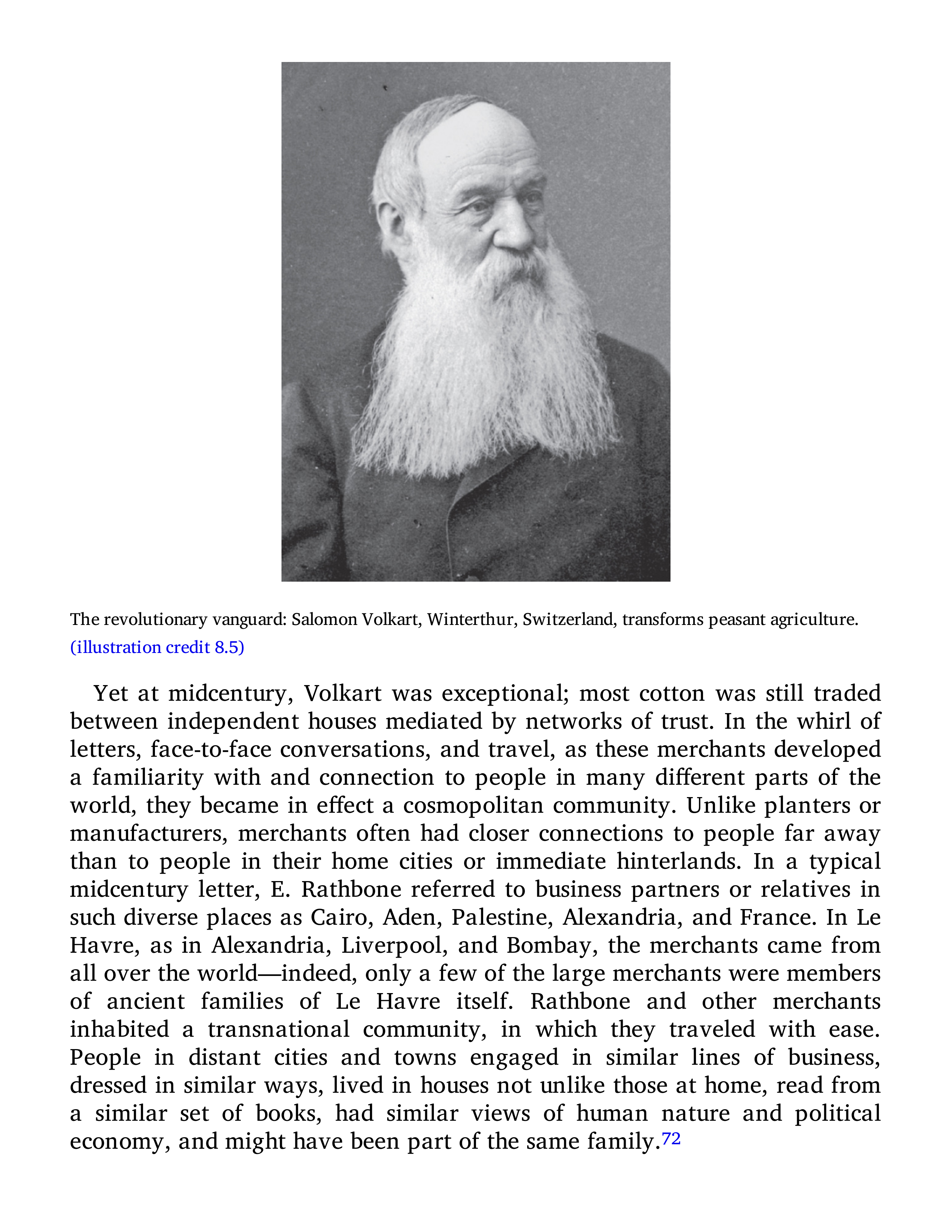
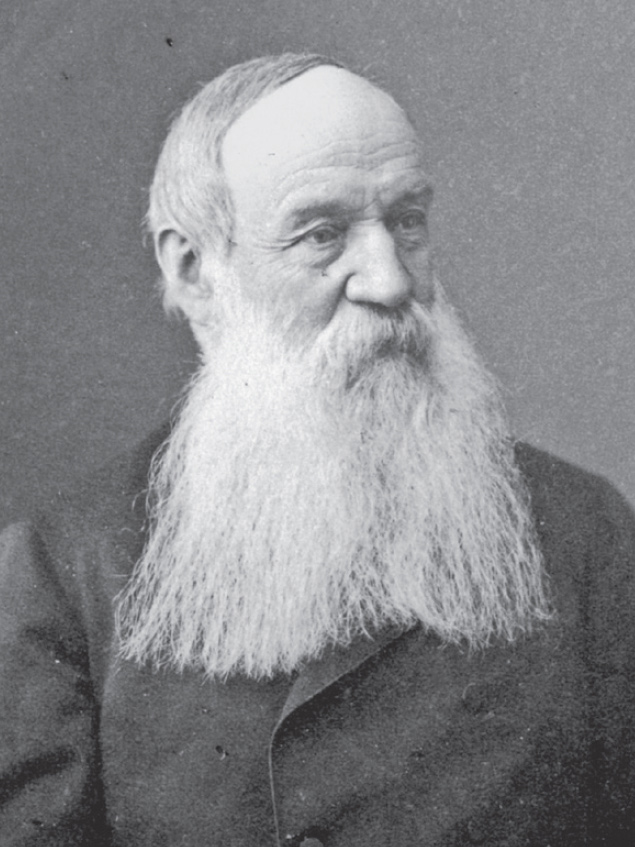
The revolutionary vanguard: Salomon Volkart, Winterthur, Switzerland, transforms peasant agriculture.
(illustration credit 8.5)
Yet at midcentury, Volkart was exceptional; most cotton was still traded
between independent houses mediated by networks of trust. In the whirl of
letters, face-to-face conversations, and travel, as these merchants developed
a familiarity with and connection to people in many di
ʃerent parts of the
world, they became in e
ʃect a cosmopolitan community. Unlike planters or
manufacturers, merchants often had closer connections to people far away
than to people in their home cities or immediate hinterlands. In a typical
midcentury letter, E. Rathbone referred to business partners or relatives in
such diverse places as Cairo, Aden, Palestine, Alexandria, and France. In Le
Havre, as in Alexandria, Liverpool, and Bombay, the merchants came from
all over the world—indeed, only a few of the large merchants were members
of ancient families of Le Havre itself. Rathbone and other merchants
inhabited a transnational community, in which they traveled with ease.
People in distant cities and towns engaged in similar lines of business,
dressed in similar ways, lived in houses not unlike those at home, read from
a similar set of books, had similar views of human nature and political
economy, and might have been part of the same family.
72
Cohesive as a social class and forti
ɹed by the institutions they had built,
these merchants also developed tremendous political clout from England to
France to the United States. They understood early that their trade was
deeply embedded within local, national, and global politics; they acted as if
they understood instinctively that the state does not intervene in the market,
but constitutes it. Their daily experience had taught them that global trade
did not arise in a state of nature, but only
ɻourished via careful, conscious
regulation. As a result, according to Liverpool cotton broker Samuel Smith,
politics was everywhere: “As our business involved much foreign
intercourse, and was greatly a
ʃected by the course of foreign aʃairs,
especially by wars and the fear of wars, we became as a matter of course
keen politicians.”
73
As merchants became “keen politicians” and realized the state’s
importance for their grand project of integrating cotton cultivators, cotton
manufacturers, and cotton consumers, they encountered rulers and
bureaucrats who shared many of their inclinations. European states had
become increasingly dependent for their very existence on the wealth
generated by rapid capital accumulation, including in cottons. Statesmen
were thus solicitous toward capitalists, and often submissive when these
patrons of the state organized collectively. What set European states apart
from other contemporary states such as Japan and China was not just their
capacity, but also their responsiveness to the needs of industrial capital.
74
Though merchants lobbied their governments about anything and
everything, among the most important issues was the infrastructure of trade.
The construction of docks, storage facilities, railways, and waterways was
high on the merchants’ agenda, since they directly a
ʃected the speed at
which goods and information moved through the emerging global economy
—and that speed of circulation determined the speed of accumulation.
75
Though it could seem haphazard and unregulated, subject to the whims of
a few men, trade ultimately also depended on a legal infrastructure devised
and enforced by states. Unsurprisingly, merchants spent much of their
political energy on trying to strengthen this legal order and make it conform
to their interests. In the process they increased, both wittingly and
unwittingly, the capacity of the state. Conventions, although agreed upon
by merchants themselves, needed enforceable rules, and merchants
understood that no single actor was as e
ɽcient in enforcing these rules as
the state. As New York lawyer Daniel Lord explained in detail in his 1835
“Law of Agency,” legal rules had allowed merchants to have agents and
factors in distant places, and to act for them: “It is
by this bringing into aid
and subordination
, the powers of others…that modern commerce touches at
once the extremes of longitude, and subdues alike the Equator and the Poles;
She crosses the oceans, tracks the African deserts, and conquers the plains of
Asia.”
76
The “law” became particularly important when it came to the actual
transformation of the global countryside into a supplier of industrial raw
materials and a market for manufactured goods. The more suppliers of
cotton, the more consumers of cotton, the more trade. To make that
transition possible, merchants yearned for a more powerful state presence,
especially in the nonslave areas of the world. One of their most urgent
obsessions was to inject the “law” into this global cotton-growing
countryside, though their ability to do so was often frustrated in societies
dominated by peasant production.
The importance of the law was clearest in colonial settings such as British
India. In Bombay, merchants pressured the British government constantly
for new rules and regulations regarding the Indian cotton trade. “The cotton
legislation was not only chronologically the earliest economic legislation of
British rule, it was also perhaps the most advanced legislation in the
contemporary economic world,” observed one chronicler of the Indian
cotton trade. The rules of the market, and thus the market itself, emerged at
the intersection of merchant collective action and the state. Yet ironically,
the more merchants succeeded in their project of extending the authority of
the state, the less trade depended on the networks of trust that they had
forged over prior generations.
77
As the law increasingly infused the global countryside, and as state-
sponsored infrastructure projects accelerated the movement of goods,
merchants mobilized collectively to use state power to shape global markets
to their bene
ɹt in other ways as well. Their industrial policy, in eʃect, was
global. And it was the most global for British merchants and manufacturers.
At the center of the empire of cotton, they believed that opening access to
foreign markets was a core function of government. In 1821, for example,
the Manchester Chamber of Commerce wanted the government to pressure
Denmark to reduce its import duties on yarn; in 1822 they demanded freer
trade to the East Indies; and later they agitated for the removal of duties
between Britain and Ireland and debated “Brazil custom Duties,” “Duties on
British Goods Imported into Batavia,” “duties at Monte Video,” trade with
Morocco, and “duties at Shanghai.” Le Havre merchants pressured for the
most unencumbered trade as well.
78
While most merchants had a clear ideological commitment to free trade,
which corresponded perfectly with their interest in market access and cheap
labor, they could advocate just as forcefully for creating novel barriers to
trade. In fact, their insistence on free trade was remarkably inconsistent. As
early as 1794, a number of cotton merchants protested “against the export
of cotton twist from England.” The export of spun cotton, according to
them, threatened British prosperity, as the yarn was woven into fabrics in
low-wage Germany, creating unemployment in Britain. In an eerily modern
argument, they argued that “Germany’s cheaper food enabled them to
manufacture by hand cheaper than our workpeople could, they had
ɹrst
deprived our hand loom weavers of employment and now were rapidly
progressing with the other departments including spinning.” The
Manchester Chamber of Commerce similarly opposed the emigration of
“English Artizans” and “the free exportation of such Machinery as is
employed in our own Manufactories.”
79
Merchants appealed to their national governments to protect access to
foreign markets, using both political power and military might. In 1794, the
Manchester Society of Merchants talked about the importance of having the
Royal Navy protect ships going into the Mediterranean with valuable local
manufactures on board. In 1795 they appealed to the government to protect
their trade with Germany, and the continent more broadly, by military
force. In Manchester, merchants asked the government to protect ships in
the Atlantic from pirates, and called for a “large Naval Force.”
80
The merchants’ political vision, like their trade, was truly global,
stretching from “sound dues payable upon cotton twist exported to the
Baltic” to colonial debt laws bent on opening India as a market. In Britain,
India soon emerged as the “chief question.” For cotton mill owner Henry
Ashworth, the Indian market would provide unlimited opportunities, if
opened by the proper governmental interventions: “Now, although I am as
great a stickler perhaps as most here for adhesion to sound free-trade
principles, it does not always follow that in dealing with people who are not
as advanced political economists as ourselves, that we should delay our
movements until they have become converted. (‘Hear’).” As a dabbling
economist, Ashworth understood intuitively that economic thinking helps
“format the economy”—makes possible the formerly impossible—which is
exactly what it would do a few decades later in India.
81
Calling for the state to convert Indian peasants into producers of cotton
for world markets formed one part of merchants’ much larger project of
bringing the state into the global cotton-growing countryside. They
understood that unlike in the slave-dominated cotton-growing areas of the
world, in India and elsewhere they needed the capacity of the imperial state
to e
ʃect the transformations they hoped for. What they did not anticipate
was that the more they furthered the state-building project, the more they
were diminishing their own importance to the empire of cotton.
Henry Ashworth understood more explicitly than many others the way the
world of trade rested on powerful states structuring global markets, and he
unabashedly celebrated the involvement of the British state in the interests
of its merchants and manufacturers. Industrializing states depended on a
ɻourishing manufacturing economy for their strength and social stability.
Even statesmen of no great vision could grasp the importance of securing a
reliable supply of raw materials for domestic industry and of creating a
market for its products. So fast was their rate of growth, and so
ɹerce their
competition, that European states sought to transform the global
countryside simultaneously into a supplier of materials for their industrial
enterprises and into consumers for the resulting products. Having
transformed their own countrysides in the search for labor, they sought to
deploy that experience to the rest of the world, making the particular form
of that integration into nothing less than a “law of nature.”
This new, conveniently and divinely ordained mission unintentionally but
no less surely lessened the dependence of industrial capitalism on some of
the earlier mechanisms of war capitalism—especially the wholesale
expropriation of native peoples and the mobilization of labor through
slavery. With a greater capacity to lay down market-directed infrastructure,
and a legal apparatus geared toward infusing European capital into the
global countryside and mobilizing workers, merchants redoubled their
e
ʃorts to reorient peasant agriculture toward the production of cotton for
world markets. As states grew stronger, merchants were able to infuse
unprecedented
ɻows of capital, and with it the logic of industrial
production, into heretofore independent hinterlands. The British merchant
house of Baring by the 1840s diversi
ɹed the sources of its cotton supply by
importing from Bombay. European capitalists also entered the trade with
the Egyptian cotton-producing fellaheen. In the late 1840s and early 1850s,
with the weakening of the governmental monopoly on the internal cotton
trade, merchants, especially of Greek heritage, penetrated the interior and
began to purchase cotton from peasants directly. But perhaps most forward-
looking was the model developed by Volkart Brothers. Their Indian cotton
traders, riding on the coattails of an expanding imperial government,
moved ever closer to local producers themselves, so that by 1875 the
Volkarts and their European colleagues exported more than twice as much
cotton as their once dominant Indian counterparts.
82
Before European capital could
ɹnd its partners in the imperial states of the
late 1800s, however, the cotton empire would be shocked by the region of
the world where slavery and industrial capitalism seemed most powerfully
and pro
ɹtably conjoined: the United States. Everywhere else, slavery and
industrial capitalism seemed to coexist perfectly well. But everywhere else,
as we know, these two engines of pro
ɹt were separated by national
boundaries. Not so in North America. For the United States, unlike any other
part of the world, brought war capitalism and industrial capitalism within
the same national territory. No political union could contain forever the
contrary political forces of both systems.
As the United States found its economic footing, slave owners and
industrial capitalists made increasingly di
ʃerent demands on the state.
American manufacturers and a few of its merchants, like their counterparts
in Britain and elsewhere, gained con
ɹdence that the mechanisms of
industrial capitalism could be moved into the global cotton-growing
countryside and could indeed secure su
ɽcient supplies of the raw material.
Boston cotton manufacturer Edward Atkinson became a fervent believer in
wage labor, as he observed his ability to mobilize and discipline large
numbers of workers in his mill. As elsewhere in the world, American
industrialists like Atkinson hitched their political interests to a strengthening
national government.
83
Cotton-growing slave owners, on the other hand,
favored the political economy of Atlantic trade, and depended on the state’s
willingness to secure more lands for plantation agriculture and to enforce
and support the institution of slavery. They feared that any strengthening of
the federal government might interfere with their mastery over labor.
Slavery, after all, required constant violence against potentially rebellious
slaves, and that violence rested on the state’s willingness to condone it.
Slave owners therefore felt an overpowering need to secure control over the
state, or, at the very least, to keep the opponents of slavery out of the
national halls of power.
Yet that control was increasingly elusive. A small but growing group of
Americans who sought to construct a political economy of domestic
industrialization emerged from the dynamic industrial economy of the
northern states. Their political needs, like those of the planters, required
control of state institutions. But unlike southerners, northern industrial
capitalists drew increasing political strength from a relatively stable
political coalition with commercial farmers and even segments of a rapidly
expanding working class. These capitalists drew encouragement from the
fact that a small but growing number of merchants, so long the planters’
most signi
ɹcant northern allies, were increasingly embracing the project of
domestic industrialization as well—even though they hesitated to challenge
the slave regime in the South directly. Tellingly, the United States’ most
important cotton traders, the Browns, slowly began to specialize in the
foreign exchange business and to invest in industrial enterprises—railroads,
for example, but also the Novelty Iron Works in New York.
84
Such moves made sense because their former commodity trade, with its
low entry costs, was always open to new competitors who were willing to
take on greater risks and operate on narrower margins. Low entry barriers
created a cotton market that included a very large number of smaller
operators, eventually pushing wealthier traders into emerging, even more
pro
ɹtable lines of business, that had greater capital requirements. Joining
the Browns, foreign capitalists like the Barings also increasingly diversi
ɹed,
especially into railroads, coal mining, and manufacturing. They understood
better than others that with the state’s capacity expanding, the role of
merchant capital was diminishing, and that a future beckoned in which
industrialists, in conjunction with the state, would be able to burrow even
further into the global countryside to
ɹnd still more land and labor for the
production and consumption of cotton. The most forward-looking
manufacturers and merchants discerned that such new forms of domination
would decisively weaken the power of commodity producers, and thus
eliminate one of the most threatening sources of instability in the empire of
cotton, and with it, global capitalism.
85
This shifting balance of social power among di
ʃerent business groups
proved momentous. The United States was unique in that the schism
between economic elites was so great that, in a moment of great crisis, even
merchant capitalists aligned with slave owners dropped their old allies. This
was radically di
ʃerent from other slave-owning societies, such as Brazil,
where planters and export merchants formed a uni
ɹed political bloc, with
agreement that domestic industrialization constituted a threat to their
economic interests and that slave labor was indispensable.
86
The realignment of the economic elites of the United States, along with
the promise of tapping nonslave hinterlands as the Volkarts had done in

India, threw the rising costs and diminishing bene
ɹts of combining slavery
and industrial capitalism into high relief. In 1861, the mix exploded, and the
ensuing American Civil War became a turning point not just for that young
republic, but also for the history of global capitalism.
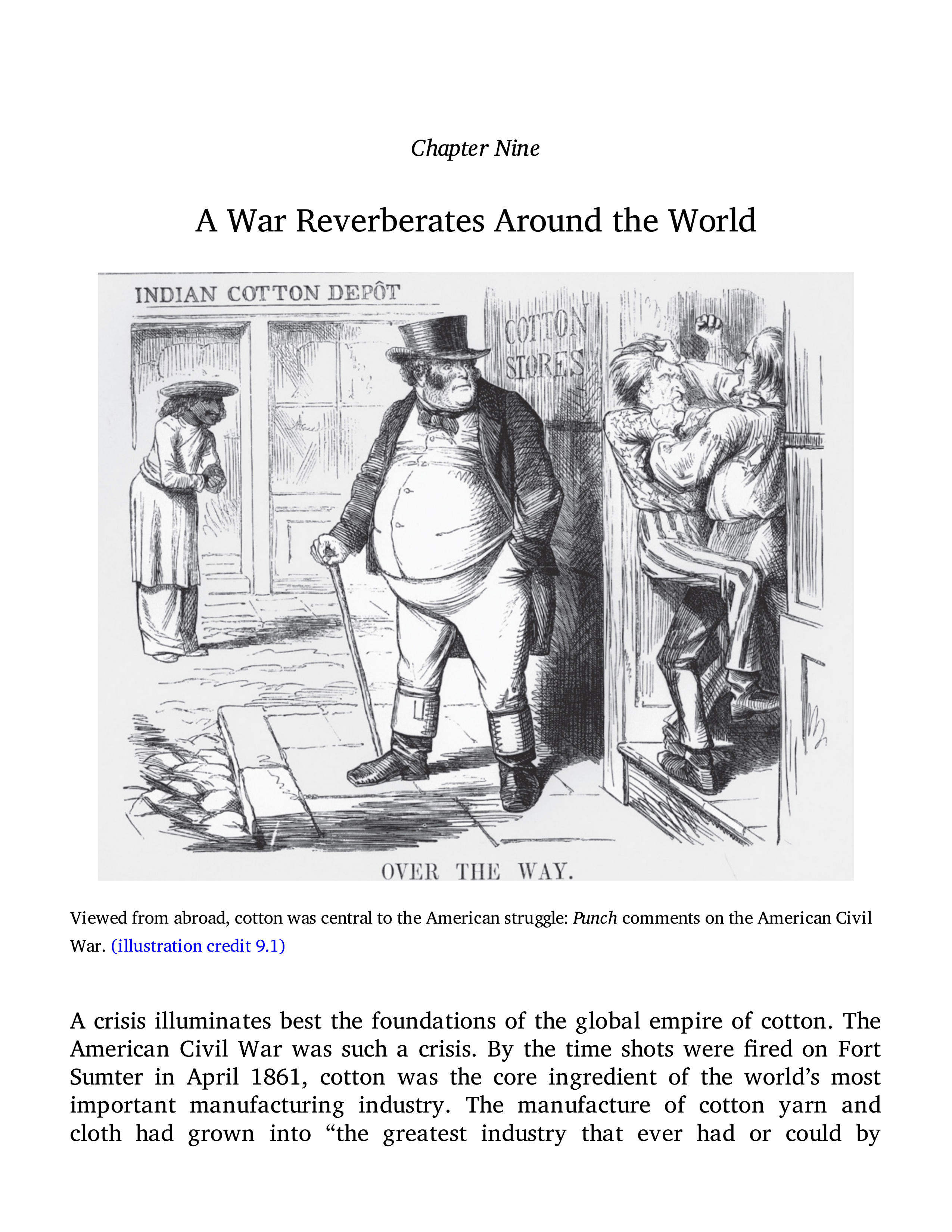
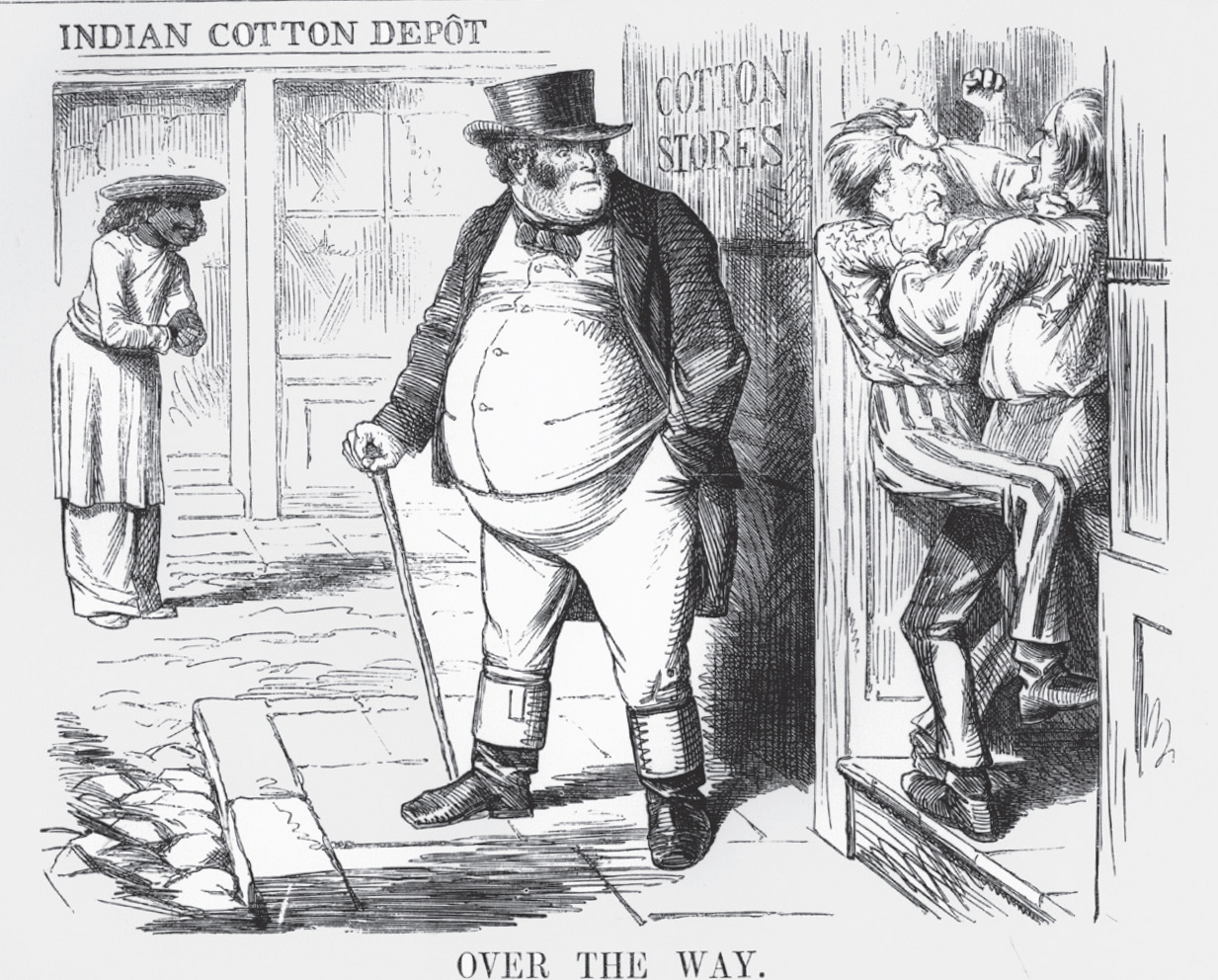
Chapter Nine
A War Reverberates Around the World
Viewed from abroad, cotton was central to the American struggle:
Punch
comments on the American Civil
War.
(illustration credit 9.1)
A crisis illuminates best the foundations of the global empire of cotton. The
American Civil War was such a crisis. By the time shots were
ɹred on Fort
Sumter in April 1861, cotton was the core ingredient of the world’s most
important manufacturing industry. The manufacture of cotton yarn and
cloth had grown into “the greatest industry that ever had or could by
possibility have ever existed in any age or country,” according to the self-
congratulatory but essentially accurate account of British cotton merchant
John Benjamin Smith. By multiple measures—the sheer numbers employed,
the value of output, pro
ɹtability—the cotton empire had no parallel. One
author boldly estimated that in 1862, fully 20 million people worldwide—
one out of every sixty-
ɹve people alive—were involved in the cultivation of
cotton or the production of cotton cloth. In England alone, which still
counted two-thirds of the world’s mechanical spindles in its factories, the
livelihood of between one-
ɹfth and one-fourth of the population was based
on the industry; one-tenth of all British capital was invested in it, and close
to one-half of all exports consisted of cotton yarn and cloth. Whole regions
of Europe and the United States had come to depend on a predictable supply
of cheap cotton. Except for wheat, no “raw product,” so the
Journal of the
Statistical Society
of London declared, had “so complete a hold upon the
wants of the race.”
1
The industry that brought great wealth to European manufacturers and
merchants, and bleak employment to hundreds of thousands of mill workers,
had also catapulted the United States onto center stage of the world
economy, building “the most successful agricultural industry in the States of
America which has been ever contemplated or realized.” Cotton exports
alone put the United States on the world economic map. On the eve of the
Civil War, raw cotton constituted 61 percent of the value of all U.S. products
shipped abroad. Before the beginnings of the cotton boom in the 1780s,
North America had been a promising but marginal player in the global
economy. Now, in 1861, the
ɻagship of global capitalism, Great Britain,
found itself dangerously dependent on the white gold shipped out of New
York, New Orleans, Charleston, and other American ports. By the late
1850s, cotton grown in the United States accounted for 77 percent of the
800 million pounds of cotton consumed in Britain. It also accounted for 90
percent of the 192 million pounds used in France, 60 percent of the 115
million pounds spun in the Zollverein, and 92 percent of the 102 million
pounds manufactured in Russia.
2
The reason for America’s quick ascent to market dominance was simple.
The United States more than any other country had elastic supplies of the
three crucial ingredients that went into the production of raw cotton: labor,
land, and credit. As
The Economist
put it in 1861, the United States had
become so successful in the world’s cotton markets because the
planters’ “soil is marvelously fertile and costs him nothing; his labour has
hitherto been abundant, unremitting and on the increase; the arrangements
and mercantile organizations for cleaning and forwarding the cotton are all
there.”
3
By midcentury, cotton had become central to the prosperity of the
Atlantic world. Poet John Greenleaf Whittier called it the “Haschish of the
West,” a drug that was creating powerful hallucinatory dreams of territorial
expansion, of judges who decide that “right is wrong,” of heaven as “a snug
plantation” with “angel negro overseers.”
4
Slavery stood at the center of the most dynamic and far-reaching
production complex in human history. Herman Merivale, British colonial
bureaucrat, noted that Manchester’s and Liverpool’s “opulence is as really
owing to the toil and su
ʃering of the negro, as if his hands had excavated
their docks and fabricated their steam-engines.” Capital accumulation in
peripheral commodity production, according to Merivale, was necessary for
metropolitan economic expansion, and access to labor, if necessary by
coercion, was a precondition for turning abundant lands into productive
suppliers of raw materials.
5
Whether celebrating the material advances generated from slavery or
calling for slavery’s abolition, many contemporaries agreed by the 1850s
that global economic development required physical coercion. Karl Marx
sharpened the arguments made all around him by concluding in 1853 that
“bourgeois civilization” and “barbarity” were joined at the hip. But such an
argument was simply common sense in elite circles. French geographer
Élisée Reclus, writing in the
Revue des Deux Mondes
, for example, came to
essentially the same conclusion: “The industrial prosperity of England
appears to be intimately tied to the progress of slavery.” Southern planters
agreed passionately: Cotton, and thus slavery, were indispensable to the
modern world, the very foundation of the United States’ and Europe’s
astonishing material advances. As South Carolina senator and cotton planter
James Henry Hammond put it famously on the
ɻoor of the Senate, “England
would topple headlong and carry the whole civilized world with her” if the
system of slave-powered cotton growing would be threatened. “No power on
earth dares to make war upon it. Cotton
is
king.”
6
Slavery enabled the stunning advances of industry, and the accompanying
pro
ɹt. Contemporaries, however, worried that this vast and sparkling
machine was merely a façade, amplifying the long-standing European
worries about the political stability of the United States that we have
encountered earlier. As “an industry tributary to foreign countries,”
observed British political economist Leone Levi, the European cotton
industry was potentially vulnerable, even though its well-being, according
to a French observer, had “become a question of life or death for tens of
thousands of workers, a question of prosperity or misery for all the
developed industrial countries.”
7
Most important, slavery itself seemed potentially hazardous to stability—
a “treacherous foundation,” as the Manchester Cotton Supply Association
put it—not just because of the sectional tensions it generated in the United
States, but also because slaves could resist and even rebel: “The system of
slave labour was not to be safely trusted,” the association declared in 1861.
“The dread of slave insurrection and civil discord,” the
Cotton Supply Reporter
complained, was ever present. Even the London money market re
ɻected
these concerns, as bonds for southern railroads carried higher interest than
those for northern roads. “This mistrust arises,” reported the
Westminster
Review
in 1850 “from a shrewd calculation of the dangers, in both a moral
and physical sense, which hang over a state of society whose foundations
are laid in injustice and violence.”
8
American slavery had begun to threaten the very prosperity it produced,
as the distinctive political economy of the cotton South collided with the
incipient political economy of free labor and domestic industrialization of
the North. In addition, the violent expansion of both these economies
westward brought crisis after crisis to their nascent national institutions.
9
Ample supplies of fertile land and bonded labor had made the South into
Lancashire’s plantation, but by 1860 large numbers of Americans, especially
in the northern states, protested such semicolonial dependence. They, in
time, sparked a second American revolution. Fearing for the security of their
human property, southern slave owners struck out on their own, gambling
that their European partners would intervene to preserve the world
economy and with it their own exceptionally pro
ɹtable role. Southern
planters understood that their cotton kingdom rested not only on plentiful
land and labor, but also upon their political ability to preserve the
institution of slavery and to project it into the new cotton lands of the
American West. Continued territorial expansion of slavery was vital to
secure both its economic, and even more so its political viability, which was
threatened as never before by an alarmingly sectional Republican Party.
Slave owners understood the challenge to their power over human chattel
represented by the new party’s project of strengthening the claims of power
between the national state and its citizens—an equally necessary condition
for its free labor and free soil ideology.
Yet from a global perspective, the outbreak of war between the
Confederacy and the Union in April 1861 was a struggle not only over
American territorial integrity and the future of its “peculiar institution,” but
also over global capitalism’s dependence on slave labor across the world.
The Civil War in the United States was an acid test for the entire industrial
order: Could it adapt to the even temporary loss of its providential partner
—the expansive, slave-powered antebellum United States—before social
chaos and economic collapse brought their empire to ruins? As John
Marshman, editor of the Baptist missionary newspaper
Friend of India
,
observed in March 1863, “It may be said that the prosperity of the South has
been based on the gigantic crime of holding three or four millions of human
beings in a state of slavery, and it is di
ɽcult to divest the mind of the
conviction that the day of reckoning from the throne of the Eternal has
come.”
10
The day of reckoning arrived on April 12, 1861. On that spring day,
Confederate troops
ɹred on the federal garrison at Fort Sumter, South
Carolina. It was a quintessentially local event, a small crack in the world’s
core production and trade system, but the resulting crisis illuminated
brilliantly the underlying foundations of the global cotton industry and with
it of capitalism. Columbia University political scientist Francis Lieber
predicted “neither cotton nor slavery will come forth from this war as they
went into it.” With its shocking duration and destructiveness, the American
struggle marked the world’s
ɹrst truly global raw materials crisis, and
proved midwife to the emergence of new global networks of labor, capital,
and state power. Thus one of the most important chapters in the history of
global capital and labor unfolded on the battle
ɹelds of provincial North
America.
11
The outbreak of the Civil War severed in one stroke the relationships that
had underpinned the worldwide web of cotton production and global
capitalism since the 1780s. In an e
ʃort to force British diplomatic
recognition, the Confederate government banned all cotton exports. By the
time the Confederacy realized this policy was doomed, a northern blockade
e
ʃectively kept most cotton from leaving the South. Though smuggling
persisted, and most smugglers’ runs succeeded, the blockade’s deterrent
e
ʃects removed most cotton-carrying ships from the southern trade.
Consequently, exports to Europe fell from 3.8 million bales in 1860 to
virtually nothing in 1862. The e
ʃects of the resulting “cotton famine,” as it
came to be known, quickly rippled outward, reshaping industry—and the
larger society—in places ranging from Manchester to Alexandria. With only
slight hyperbole, the Chamber of Commerce in the Saxon cotton
manufacturing city of Chemnitz reported in 1865 that “never in the history
of trade have there been such grand and consequential movements as in the
past four years.”
12
A mad scramble ensued. The e
ʃort was all the more desperate as no one
could predict when the war would end and when, if ever, cotton production
would revive in the American South. “What are we to do,” asked the editors
of the
Liverpool Mercury
in January 1861, if “this most precarious source of
supply should suddenly fail us?” Once it did fail, this question was foremost
on the minds of policy makers, merchants, manufacturers, workers, and
peasants around the globe.
13
At
ɹrst, the panic of European cotton manufacturers was allayed by the
fact that cotton imports in the previous few years had been extremely high,
leaving su
ɽcient stocks in major ports and factories for the coming months
or even a year. Yarn and cloth markets from Buenos Aires to Calcutta,
moreover, were glutted. With initial expectations that the war would be
short, cuts in cotton exports from the American South meant rising prices for
the stock at hand, which holders of cotton and cotton goods welcomed.
Looking back at the early months of the war,
Moskva
, the voice of Moscow’s
industrialists, reported that the con
ɻict at ɹrst helped “rid us of our own
crisis in the cotton industry, which was about to erupt” due to
overproduction.
14
Eventually, however, dwindling supplies and rising prices began to
paralyze production. In the late summer of 1861, Charles Francis Adams, the
U.S. ambassador to England, wrote to his son Henry that “this cotton
question is beginning to pinch.” By early 1862, as total imports of cotton
into Britain fell by a little over 50 percent compared to the previous year,
and imports from the United States by 96 percent, mills began shutting
down for a few days each week, or entirely. Cotton prices had quadrupled
from their prewar levels and, consequently, manufacturers closed shops and
tens of thousands of operatives found themselves out of work. As early as
November 1861, Lancashire manufacturers had shut 6 percent of their
factories and introduced shorter shifts in two-thirds of them. By early 1863,
a quarter of the inhabitants of Lancashire—more than half a million
individuals—were out of work, receiving some form of public or private
assistance. Weaver John O’Neil, who lived in Low Moor Mill in Lancashire,
described his plight in his diary: “Sad and weary…and can hardly keep
myself living.” In response to such misery “Unemployed Operatives” sent
memorials to the Home O
ɽce, demanding relief.
15
By 1863, unemployed workers rioted in the streets of several British
cotton towns, underscoring the explosive social consequences of the cotton
famine. The home secretary received requests from town authorities for
information on “how the military are to be obtained if required in any
future Emergency.” Troops were soon stationed. Even cotton merchant
William Rathbone reported to his son in the spring of 1862 that “the distress
among the Poor here and in the Manufacturing districts is great, and I fear
on the increase.” So serious was the crisis that thousands of miles from
Europe the merchants of the Bombay Chamber of Commerce collected funds
“in aid of the distressed mill hands of Lancashire.” “Anxiety” and
“apprehension” began to spread.
16
Similar crises unfolded on the European continent. In France,
manufacturers closed mills because they could not a
ʃord high cotton prices
as imports of U.S. cotton fell from more than 600,000 bales in 1860 to 4,169
in 1863. The e
ʃect was especially severe on manufacturers of coarse
cottons, such as the ones in Normandy, for whom the price of cotton
determined much of the total price of production. By 1863, three-
ɹfths of the
looms in Normandy were idle, while in the districts of Colmar and Belfort,
where higher-quality cottons were produced, 35 percent of all spindles and
41 percent of all looms remained unused. That same year, a French national
relief committee estimated that a quarter million textile workers were
unemployed. In the textile towns of Alsace posters went up proclaiming,
“Du pain ou la mort” (Bread or death).
17
Lesser cotton centers also experienced severe distress: In the German
lands of the Zollverein, imports of raw cotton fell by about 50 percent
between 1861 and 1864 and hundreds of factory owners sent their workers
home. Of the approximately three hundred thousand people engaged in the
cotton industry in Saxony alone, one-third had lost their jobs by the fall of
1863, while the rest worked much shorter hours. In the northern part of the
United States, removed from battle itself but not its consequences, tens of
thousands of cotton workers lost employment, but the social e
ʃects were less
severe because many found employment in the booming woolen mills that
produced clothing for the Union army, or enlisted. In Moscow, however, 75
percent of all cotton spinning operations had shut down by 1863. Workers
and manufacturers would have agreed with the U.S. consul in the German
city of Stettin that “this war and its consequences stands before the whole
civilized world as an interposing fate, which no nation however
insigni
ɹcant its direct relations to the ɹeld of contest may be, can entirely
avoid.”
18
While manufacturers closed mills and spinners and weavers su
ʃered,
cotton merchants lived—for a brief time—through a golden age. Rising
prices for cotton led to a frenzy with “doctors, parsons, lawyers, wives and
widows, and tradesmen speculating in it.” Cotton shipments changed hands
many times between speculators before being delivered to factories; with
each exchange a small pro
ɹt could be made. Baring Brothers, conɹrmed in
the summer of 1863 that the “amount of money made and still making in
this article is almost fabulous; for three years or more not a bale has arrived
from India but has paid pro
ɹt and mostly a large one.” Liverpool cotton
brokers gained as well from the presence of many speculators in the market
(resulting in many transactions), and also rising prices (their commissions
were a percentage of the value). In 1861, the total value of cotton imports
had been £39.7 million and in 1864 it had reached £84 million, despite a
much-reduced volume.
19
As price volatility and speculation spread, so too did traders’ e
ʃorts to
institutionalize speculative market transactions, especially forward selling.
By 1863, the Liverpool Cotton Brokers’ Association had created a standard
form that could be used by merchants making contracts about the future
delivery of cotton, and Liverpool newspapers began reporting forward
prices of Indian cotton. That year, “time bargains” had even begun to be
established in Bombay, providing new opportunities for “men a
ʀicted with
a passion for gambling.” The war, in fact, resulted “in a revolutionary
modernization of trade” in which the establishment of a formal futures
market was perhaps the most important element.
20
While merchants and speculators bene
ɹted from the global scramble for
cotton, manufacturers loudly and frantically demanded the opening of new
sources of the
ɹber. In France, factory owners from diʃerent cotton
manufacturing regions continuously pressured the imperial government. “It
is therefore urgently necessary to develop…new
ɹelds of production,” wrote
the Chamber of Commerce of the city of Rouen. In 1862 a group of cotton
manufacturers from Senones in the Vosges appealed to Napoleon III to bring
Chinese workers to Algeria to grow cotton there. That year, cotton
manufacturer Jacques Siegfried presented a “memoir” to the Société
Industrielle de Mulhouse to advocate cotton growing in Algeria, supported
by the Chamber of Commerce in Mulhouse: “No colonization for cotton,
cotton for colonization.” When Antoine Herzog, a wealthy Alsatian cotton
manufacturer, sat down in 1864 to pen a book on
L’Algérie et la crise
cotonnière
, he hoped that France would recognize that it was “at the mercy
of the political vicissitudes of a single people,” and therefore needed to
“develop…by all possible means the cotton culture of countries that are
capable of producing [it], and, in a special way, in our colonies.” Herzog
personally pleaded with Napoleon for an audience to have him support
colonial cotton-growing e
ʃorts and even traveled to Algeria to investigate
the opportunities for cotton production there.
21
Pressured by manufacturers and concerned about the su
ʃering and
mobilization of cotton workers, government bureaucrats expressed concerns
as well. Cotton, after all, was central to their national economies and
ultimately to the maintenance of social peace. Some European o
ɽcials
advocated recognition of the Confederacy and breaking the Union blockade
to secure that urgently needed cotton. Others hoped for new sources of
cotton from places outside the United States—especially the two European
powers that had both substantial cotton industries and large colonial
holdings, Britain and France. Even before the outbreak of the war, British
foreign secretary Lord John Russell had hastened to assure the cotton
manufacturers of Manchester that his government would do all in its power
to secure cotton from sources outside the United States. Yet in July 1862 the
American consul to the Egyptian city of Alexandria, William Thayer,
reported that “statesmen are almost paralyzed with terror at the
hopelessness of relief for the evils in prospect.” The Prussian minister to
Washington, Freiherr von Gerolt, along with his British and French
counterparts, repeated many times in his meetings with U.S. secretary of
state William Seward how important cotton was to their countries’ economic
well-being. On numerous occasions, the House of Commons, the House of
Lords, and the French Senate debated the “cotton question.”
22
This intense public concern with securing access to cheaply priced raw
materials essential to national industries was a clear departure from the
past. Since the 1780s, raw cotton markets had been decisively dominated by
merchants, but now cotton had become a matter of state, a state empowered
not least by decades of merchant political mobilization. Heavy investments
in industrial production, a novelty in human history, demanded a constant
supply of land, labor, and money. As political leaders grappled with the
cotton famine, they saw that the emergence of industrial capitalism had
made them just as dependent on a predictable supply of cheap raw
materials as the manufacturers themselves. Lord Palmerston warned in
October 1861 that England must have cotton because “we cannot allow
millions of our People to perish.” The French Ministry of Colonies
commissioned reports on cotton growing prospects in such diverse places as
Guyana, Siam, Algeria, Egypt, and Senegal. The outlines of a new kind of
imperialism began to emerge.
23
Responding to the urgent demand for cotton, forty-six hundred miles to the
east of Liverpool and ninety-two hundred miles from Antietam, Indian
merchants and cultivators, British colonial bureaucrats, and Manchester
manufacturers embarked on a frantic race to grow cotton for world markets.
As we have seen, Britain had tried to cultivate India as a reliable source of
cotton since the 1820s, yet the e
ʃort had been, according to the
Bombay
Chamber of Commerce, “a signal failure.” Indeed, as
The Economist
noted
before the outbreak of the Civil War, “As long as there were negroes in the
Southern States, and those negroes could be kept to work, it would have
been venturesome, not enterprising” to grow cotton for world markets in
India.
24
The bombardment of Fort Sumter, however, announced that India’s hour
had come. For cotton merchants, manufacturers, and statesmen, no place
seemed more promising a source of cotton than India. Indeed, it was “the
only remedy for the misery that appeared to be hanging over us,” according
to Edmund Potter of the Manchester Chamber of Commerce. During the
American Civil War, British cotton capitalists and colonial bureaucrats
worked feverishly to increase India’s cotton output and move it to market.
“Cotton,” as one observer wrote from Nagpore in July 1861, “appears to me
to be the leading topic of the day,” and the English-language press of India
was
ɹlled with hundreds if not thousands of stories about cotton.
Manchester manufacturers shipped cottonseed to Bombay to be distributed
to growers; they moved cotton gins and cotton presses into the countryside;
and they talked about investing in railroads to remove cotton to the coast.
They ran afoul, however, of India’s well-known obstacles. In 1862, when the
Manchester Cotton Supply Association sent cotton gins and presses to India,
they planned to unload them in the newly constructed port of Sedashegur,
close to areas in which cotton was grown. Yet when the ships arrived, they
found that the port had not been
ɹnished. Eventually they moved the gins
and presses to another port, which did have facilities for unloading, but the
road linking this port to the cotton-growing areas was not complete and the
machinery could not be moved.
25
Confronted with such problems, British cotton manufacturers, especially
through the channels of two organizations they dominated, the Manchester
Chamber of Commerce and the Manchester Cotton Supply Association,
redoubled their e
ʃorts to transform the Indian countryside. After all, asked
Manchester Chamber of Commerce member Henry Ashworth, “what is the
value of our possessions if we do not use them?” Ashworth and others
pressed a newly receptive British government for massive infrastructure
investments, changes in criminal codes to make the adulteration of cotton a
crime, and new property laws to create clearly de
ɹned and easily
marketable property in land.
26
Such pressures by manufacturers and merchants to bring the state in did
not fall on deaf ears. Already in September 1861, the
ɹnance minister of
India, Samuel Laing, met with representatives of cotton interests in
Manchester to discuss ways to improve Indian cotton production, meetings
that would continue in Manchester, London, and Bombay throughout the
war. Charles Wood, the British foreign secretary for India, saw the urgency
as well, recommending “to get as much as possible from India.” British
colonial o
ɽcials wrote dozens of reports to investigate the cotton-growing
potential of this or that area of India.
27
The British government and manufacturers agreed that the administrative,
legal, and infrastructural capacity of the imperial state needed to be pushed
into the Indian countryside. Perhaps most important was manufacturers’
pressure to create a new kind of legal environment in order to facilitate
European investment in and domination of cotton production. Cotton
capitalists wanted to change Indian contract law to make “penal the breach
of contract where advances have been made,” giving “the advancer an
absolute lien upon the crop he advances upon to the extent of his advances,”
allowing for penalties including prison at hard labor. If merchants could
secure such an absolute claim on cotton grown with the support of their
capital, investment would be encouraged, and it would help overcome “the
di
ɽculty of enforcing the observance of legal Contracts with the agricultural
Population of India.” Such a system would permit cultivators to devote their
e
ʃorts entirely to cash crops, since advances would allow them to purchase
food grains before their own cotton crop ripened. Eventually this pressure
succeeded; new contract laws were imposed. In 1863, moreover, criminal
laws were enacted that made the adulteration of cotton a crime punishable
by imprisonment at hard labor.
28
Such market making went hand in hand with physical infrastructure
projects serving both the interests of the “Manchester people” and the
colonial state, especially the construction of railroads, which, as Charles
Wood remarked, would not only move cotton to ports but also allow for the
quick movement of troops to subdue rebellions. During the
ɹrst year of the
war alone, government expenditures on infrastructure projects in India
nearly doubled. When in 1864 the British government for India allocated £7
million to “Public Works,” the
Times of India
commented that the “budget…
may be considered as devoted to the express object of opening up readier
access from the
ɹeld to the market.” Wood himself, concerned about the
pressures from Manchester, wrote in March 1863 to Sir Charles Trevelyan,
India’s
ɹnance minister, to urge him to spend more aggressively on
infrastructure improvements, as not to do so would be a “suicidal act.”
“These roads,” warned Wood, “we must make.” Moreover, the colonial
government reduced the cotton-goods import duty from 10 to 5 percent, a
reduction that British manufacturers strongly favored since they believed the
duties gave “a
ɹctitious encouragement to…mechanically produced
manufactures,” thereby “diverting the capital and labour of India from the
cultivation of the varied productions which the soil would yield in great
abundance.” India’s future, they agreed, was not in manufacturing, but in
the provision of raw cotton to European industry.
29
Yet despite such far-reaching interventions, manufacturers remained
dissatis
ɹed with the British government. Their decades-old calls for more
state intervention now took on nearly hysterical tones, hastening the
emergence
of
an
even
tighter
relationship
between
merchants,
manufacturers, and the imperial state, a relationship that became the
hallmark of the empire of cotton during the last third of the nineteenth
century and beyond.
The Manchester Chamber of Commerce consistently complained about the
government’s lack of commitment to cotton. Frustrated manufacturers tried
to increase pressure by taking their cause to Parliament. In June 1862
members of Parliament from cotton-consuming districts demanded greater
government commitment to infrastructure improvements in India to
facilitate the movement of cotton to world markets. “The supply of cotton,”
argued Stockport MP John Benjamin Smith on the occasion of this debate,
“is not a mere Lancashire question—it is a question of great national
importance.” These sentiments became so strong that Lancashire
manufacturers eventually complained publicly about Charles Wood, and
members of the Cotton Supply Association demanded nothing less than “the
impeachment of the incompetent Minister.” The British government replied
in kind, with Wood regularly expressing his annoyance with “the
Manchester people.” The manufacturers’ and the government’s interests
never entirely converged, because Charles Wood and other British
government o
ɽcials were acutely aware of the dangers of upsetting India’s
fragile social order in the wake of the Rebellion of 1857, which had severely
challenged
British
rule
in
India.
They
understood,
unlike
many
manufacturers, that the transformation of the Indian countryside was a
gigantic project that entailed great risks.
30
Yet like no other crisis before it, the cotton famine opened new vistas on
colonial raw material production. Even
The Economist
, the world’s leading
publicist for the bene
ɹts of
laissez-faire capitalism, eventually endorsed
state involvement in securing cotton, especially from India. It was hard to
justify these steps in terms of the “laws of supply and demand,” but
eventually
The Economist
—and with it many others—found a way: “The
answer, at least a great part of the answer is, that there appears to exist in
many important parts of Indian society very peculiar di
ɽculties, which to
some extent impede and counteract the action of the primary motives upon
which political economy depends for its e
ɽcacy.” In India, it continued,
“The primitive prerequisites of common political economy…are not
satis
ɹed. You have a good-demanding Englishman, but, in plain English, not
a good-supplying Indian.” For that reason, “There is no relaxation of the
rules of political economy in the interference of Government in a state of
facts like this. Government does not interfere to prevent the e
ʃect and
operation of ‘supply and demand,’ but to create that operation to ensure
that e
ʃect…. There is no greater anomaly in recommending an unusual
policy for a State destitute of the ordinary economical capacities, than in
recommending an unusual method of education for a child both blind and
deaf.”
31
Unlikely champions joined in this clamor for state intervention in the
global cotton-growing countryside. Cotton manufacturer, member of
Parliament, and free trade advocate Richard Cobden, for example, agreed
that Adam Smith’s ideas were not applicable when it came to India. Along
the same lines, the Manchester Chamber of Commerce called a special
meeting in July 1862 regarding the supply of cotton from India, demanding
“that public aid be given for this object by forwarding such public works as
will facilitate the production and transport of cotton to the port of
shipment, such as works of irrigation, roads, or railways, and by amending
and perfecting the Laws of Contract and Land Tenure.” Manufacturers and
colonial bureaucrats, faced with the cotton famine, became increasingly
impatient with the workings of the market. As the superintendent of the
Cotton Gin Factory in the Dharwar Collectorate reported in May 1862, while
“we are strongly impressed with the belief, that, as a general rule, it is not
judicious to interfere by legislative enactments in matters connected with
trade, but looking to the circumstances of the present case,…to the immense
importance of the questions at the present time a
ʃecting not only local, but
national, interests, and to the apparent ine
ɽciency of the present law, we
are forced to the conviction that exceptional and more stringent legislation
is necessary.” Wood, too, had come to believe that the operation of the
“laws of supply and demand” would not su
ɽce to bring more cotton from
India to Britain, despite his fractious relations with the louder elements of
the cotton interests. Indian cultivators, so he believed, preferred leisure to
accumulation, resulting in lower production when prices were high. India
needed state reform and coercion if it hoped to replace the American South
in the cotton economy. The crisis of slavery forced the imperial states to
insert themselves in new ways into the global cotton-growing countryside.
32
The e
ʃectiveness of government interventions was furthered by rapidly
rising prices that lubricated the often balky transition to world market
production. The value of Indian cotton more than quadrupled during the
ɹrst two years of the war. As a result, Indian cultivators began planting
cotton on newly cleared land as well as on land once devoted to food crops.
This unprecedented dedication to export agriculture, according to the U.S.
consul in Calcutta, created “supplies of unanticipated magnitude.” It paid
handsomely
during
the
war
years
and
helped
European
cotton
manufacturers secure some of the raw material they needed to keep their
factories running. Whereas India had only contributed 16 percent of
Britain’s supply of raw cotton in 1860, and 1.1 percent of France’s in 1857,
it contributed 75 percent in 1862 in Britain and as much as 70 percent in
France. Some of this cotton had been diverted from domestic use and
competing foreign markets (especially China), while the rest was the result
of a 50 percent increase in production.
33
Rural producers in western India in general and the province of Berar—
which the British had only acquired in 1853—in particular were most
responsible for this increase in output. The explosive growth of Bombay can
indeed be traced to the Civil War years, as Indian cotton left its old channels
of trade into Bengal and moved toward the great European entrepôt. By
1863, ships burdened with cotton even sailed out of Bombay harbor to New
York. European merchants and manufacturers complained about the poor
quality of Indian cotton—it was less clean, of shorter staple, and required
the adjustment of machines—but Indian cotton prevented the total collapse
of the European cotton industries. “The American slaveholders have done
more to promote the development of the resources of India by British
capital,” observed the
Cotton Supply Reporter
, “than British capitalists would
ever have done without their interference.” The crisis of American slavery in
e
ʃect forced and enabled the reconɹguration of the cotton-growing
countryside elsewhere.
34
The wave of activity that transformed parts of India also rippled through
Egypt’s lower Nile Delta. In response to the desperate search by cotton
manufacturers for new sources of raw cotton, the Ottoman viceroy
Muhammad Sa’id Pasha quickly set about converting his own large
landholdings into vast cotton farms. According to Massachusetts cotton
manufacturer Edward Atkinson, Muhammad Sa’id became at a stroke “the
largest and best cultivator of cotton in the world,” but unbeknownst to
Atkinson, he did so in the context of an enormous wave of coercion and
violence descending on the Egyptian countryside, including the importation
of additional slaves from the Sudan.
35
From the viceroy’s vantage point, his long-term project of modernizing
Egypt through the sale of cotton on world markets, a project, as we have
seen, begun about four decades earlier under Pasha Muhammad Ali, now
seemed closer than ever to fruition. New railroads, new canals, new cotton
gins, and new cotton presses were built. By 1864, 40 percent of all fertile
land in Lower Egypt had been converted to cotton farms. Egyptian rural
cultivators, the fellaheen, quintupled their cotton production between 1860
and 1865 from 50.1 million to 250.7 million pounds, marking a permanent
economic change of such signi
ɹcance that historians of Egypt rank the
American Civil War among the most crucial events in that country’s
nineteenth-century history. The fourteenfold increase in the value of cotton
exports was “an economic revolution.” And it was not surprising that when
the viceroy traveled to Manchester in 1862 in the midst of the American
Civil War, he was given a hero’s welcome.
36
The e
ʃects of the Civil War also reached the northeastern coast of Brazil.
Decades earlier, subsistence farmers had occupied land belonging to large
estate owners in and around Pernambuco. Over time these peasants began
to cultivate small amounts of cotton to obtain cash for necessities and taxes.
When prices for cotton surged during the war and British credit
ɻooded the
countryside, farmers abandoned their subsistence crops to plant cotton for
the world market. Collectively, these cultivators more than doubled
Brazilian cotton exports between 1860 and 1865.
37
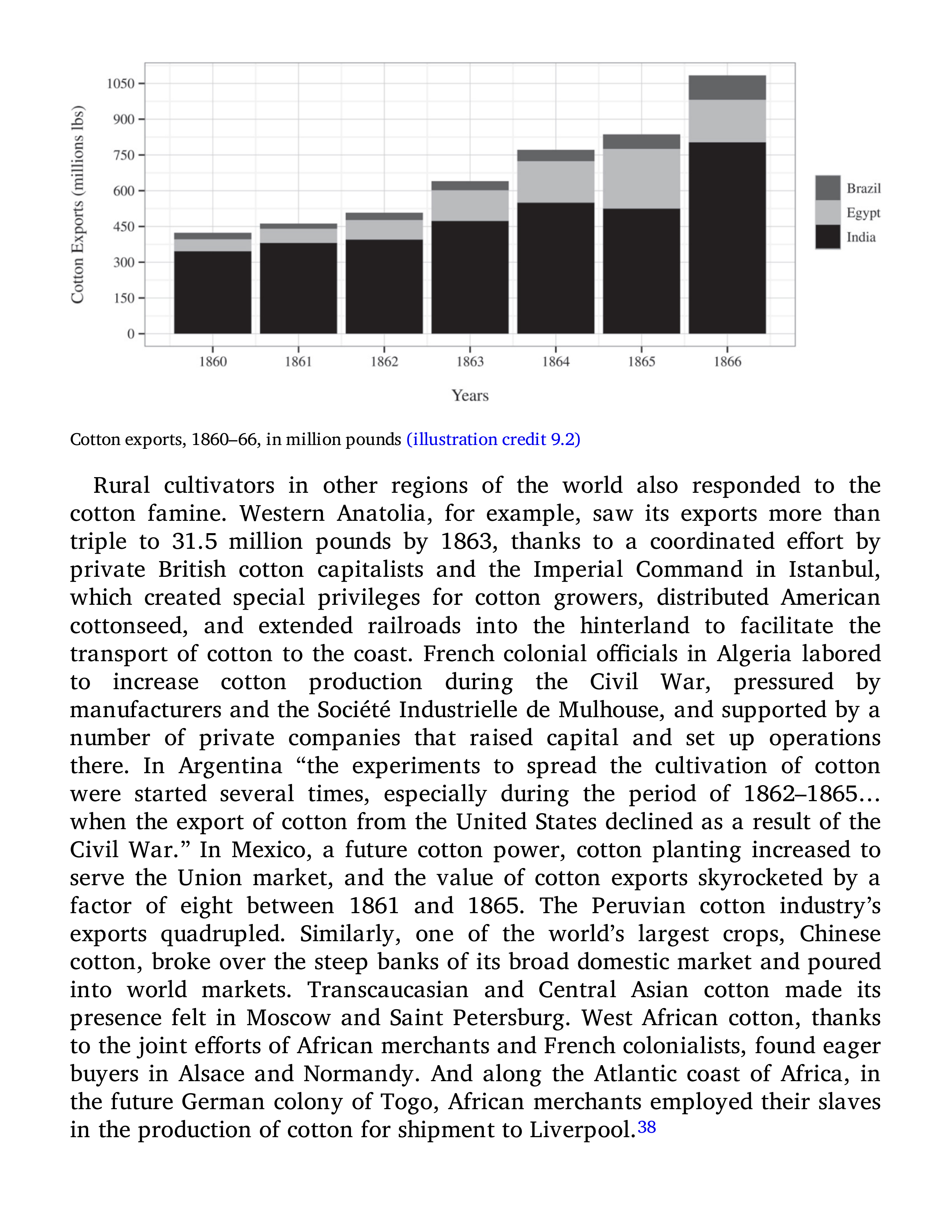
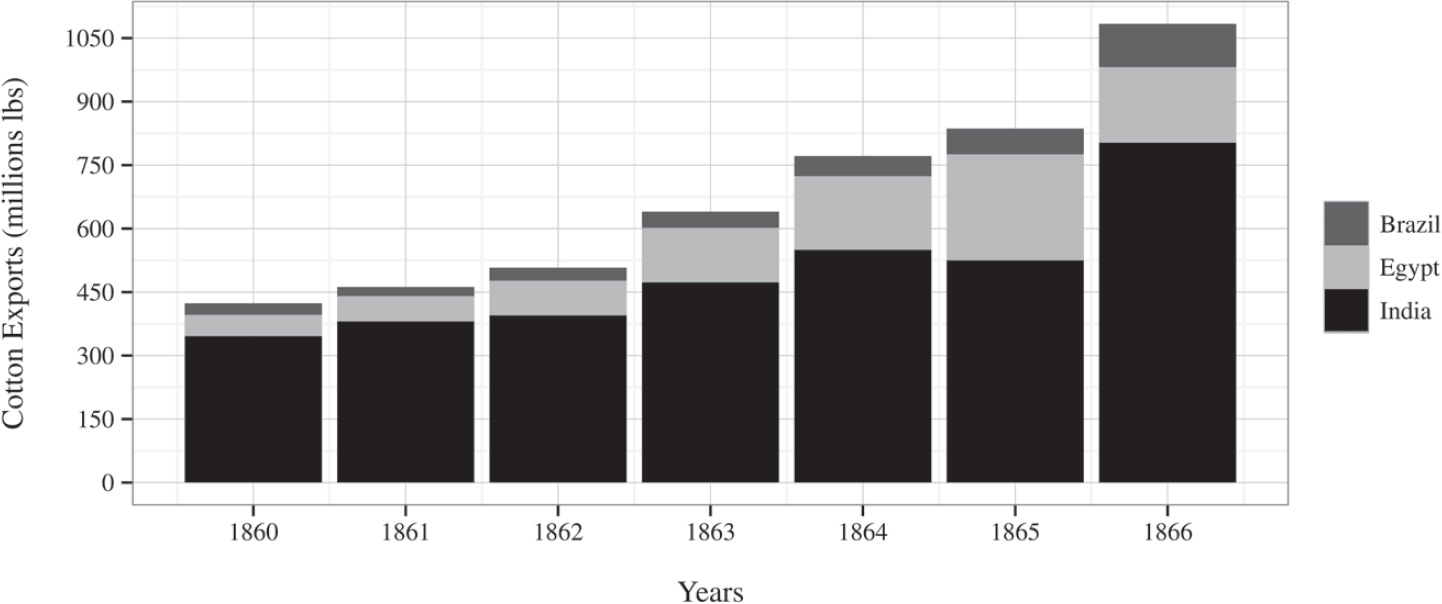
Cotton exports, 1860–66, in million pounds
(illustration credit 9.2)
Rural cultivators in other regions of the world also responded to the
cotton famine. Western Anatolia, for example, saw its exports more than
triple to 31.5 million pounds by 1863, thanks to a coordinated e
ʃort by
private British cotton capitalists and the Imperial Command in Istanbul,
which created special privileges for cotton growers, distributed American
cottonseed, and extended railroads into the hinterland to facilitate the
transport of cotton to the coast. French colonial o
ɽcials in
Algeria labored
to increase cotton production during the Civil War, pressured by
manufacturers and the Société Industrielle de Mulhouse, and supported by a
number of private companies that raised capital and set up operations
there. In Argentina “the experiments to spread the cultivation of cotton
were started several times, especially during the period of 1862–1865…
when the export of cotton from the United States declined as a result of the
Civil War.” In Mexico, a future cotton power, cotton planting increased to
serve the Union market, and the value of cotton exports skyrocketed by a
factor of eight between 1861 and 1865. The Peruvian cotton industry’s
exports quadrupled. Similarly, one of the world’s largest crops, Chinese
cotton, broke over the steep banks of its broad domestic market and poured
into world markets. Transcaucasian and Central Asian cotton made its
presence felt in Moscow and Saint Petersburg. West African cotton, thanks
to the joint e
ʃorts of African merchants and French colonialists, found eager
buyers in Alsace and Normandy. And along the Atlantic coast of Africa, in
the future German colony of Togo, African merchants employed their slaves
in the production of cotton for shipment to Liverpool.
38

The cotton rush indeed sparked even more fanciful scenarios among
political economists, manufacturers, and merchants who hoped that this or
that region of the world would
ɹll the gap left by the war, testifying to the
chaotic and experimental nature of this response to the Civil War. The
Manchester Guardian
repeatedly trumpeted the cotton prospects of various
parts of Africa, India, Australia, and the Middle East. “L’Afrique est le vrai
pays du coton,” pronounced one French observer optimistically in 1864.
“Queensland,” argued the Australian
Queensland Guardian
in 1861, “must be
cottonized.” To the chagrin of cotton manufacturers and gullible investors,
not all such plans worked out during the war years. The quantity of African,
Argentinean, and Central Asian cotton sold on the world market remained
small and the obstacles in those regions remained too great for private
capital, even in concert with desperate European governments, to
overcome.
39
Nonetheless, during the American Civil War, merchants, manufacturers,
and statesmen glimpsed the future shape of the empire of cotton. They
engaged, as Samuel B. Ruggles explained to the New York Chamber of
Commerce, in a “great e
ʃort for the commercial emancipation of the
civilized nations of the earth.”
40
Because of them, Indian, Egyptian, and
Brazilian cotton became a major presence on Western markets. Their
experience during the cotton famine, moreover, had opened bold new vistas
of colonial adventure and state involvement in commodity markets. While
private investment and lobbying of the state had characterized the
antebellum e
ʃorts of cotton merchants and manufacturers, the cotton
famine sharply raised the dependence of these cotton capitalists on the state
and on their own political sophistication. Colonialism had become a matter
of urgent self-interest, as capitalists grasped how vulnerable their global
networks and huge capital investments were to local disruption and how
unstable slavery had become.
Yet the question of the future role of American cotton in the global economy
remained. Would it return to market? And if so, would slaves still be
growing it?
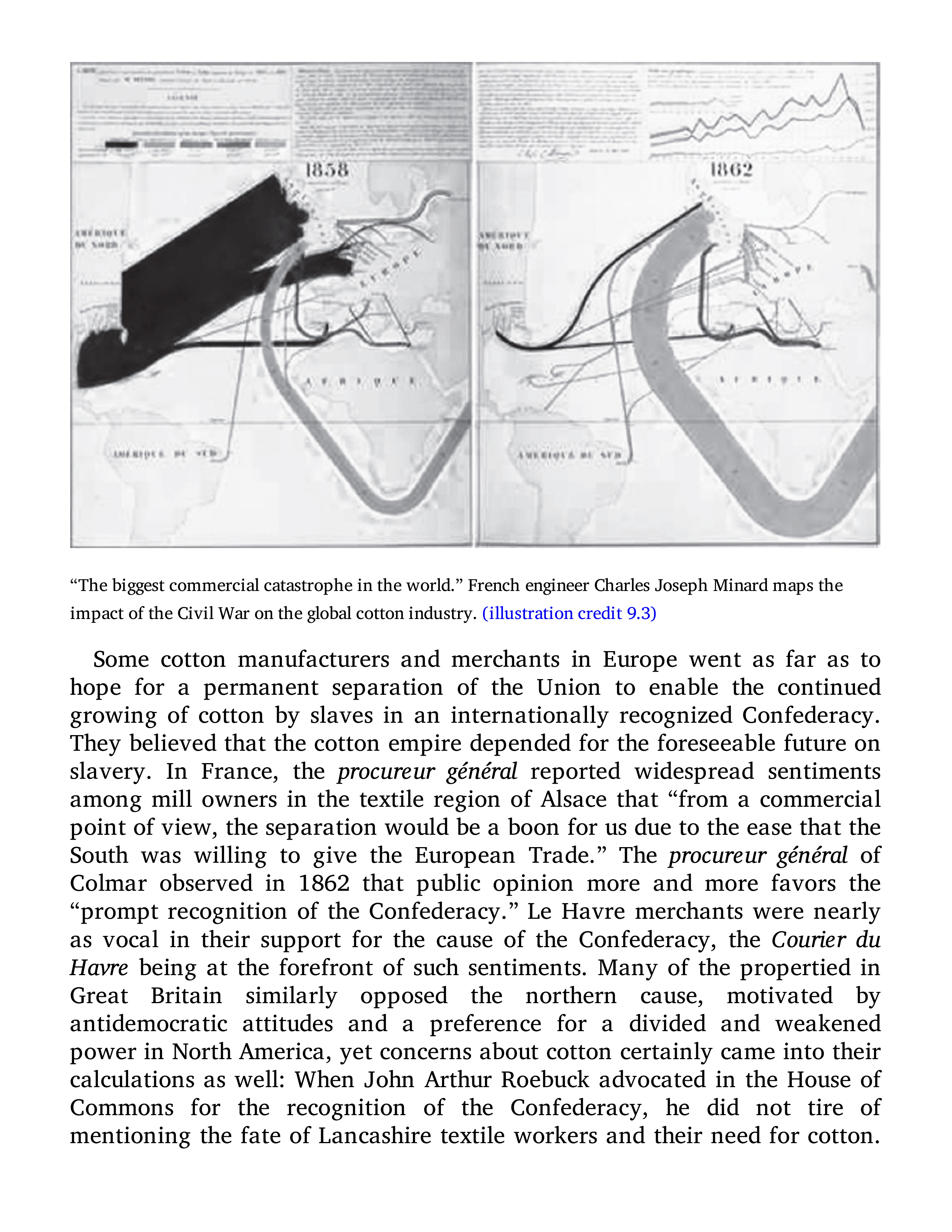
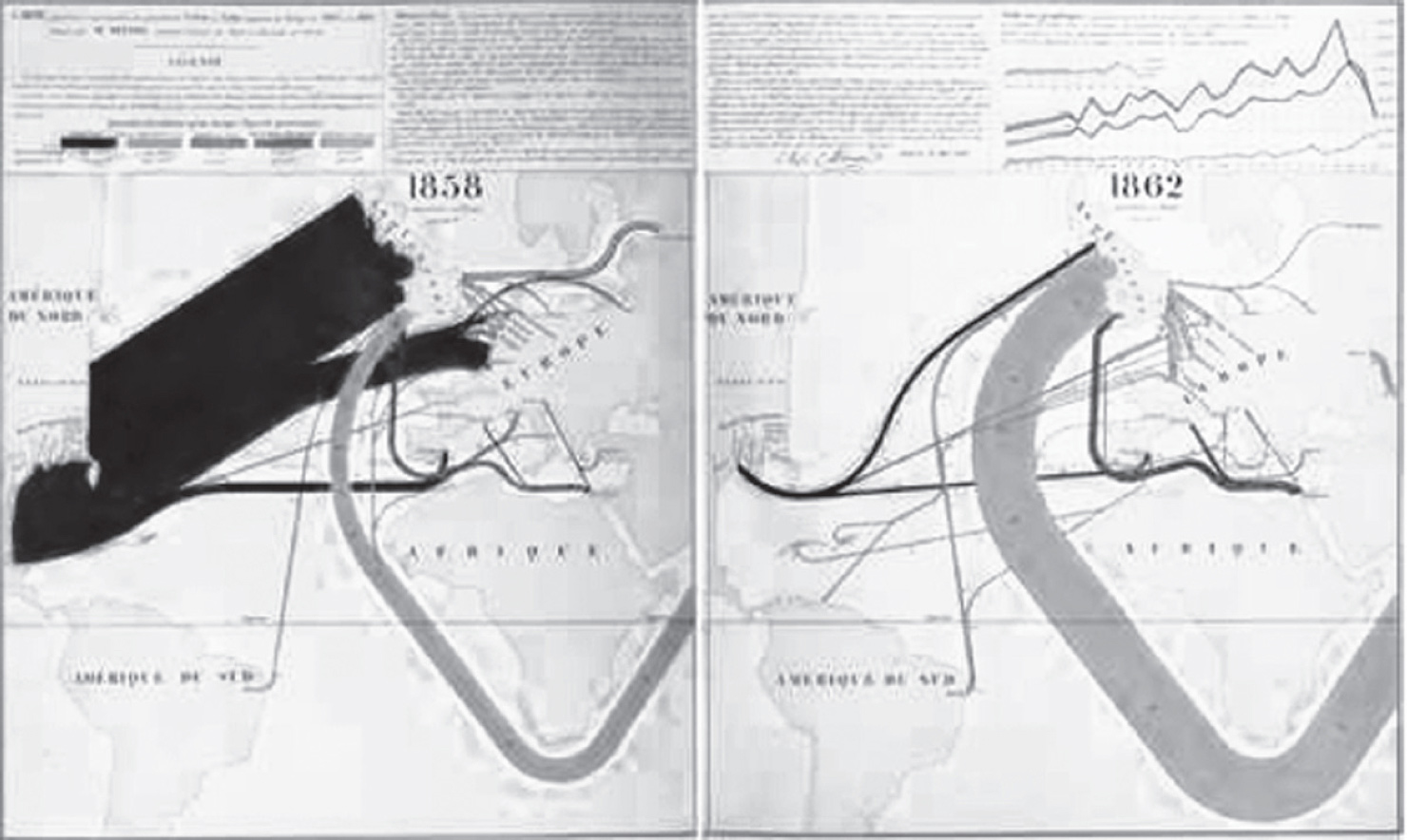
“The biggest commercial catastrophe in the world.” French engineer Charles Joseph Minard maps the
impact of the Civil War on the global cotton industry.
(illustration credit 9.3)
Some cotton manufacturers and merchants in Europe went as far as to
hope for a permanent separation of the Union to enable the continued
growing of cotton by slaves in an internationally recognized Confederacy.
They believed that the cotton empire depended for the foreseeable future on
slavery. In France, the
procureur général
reported widespread sentiments
among mill owners in the textile region of Alsace that “from a commercial
point of view, the separation would be a boon for us due to the ease that the
South was willing to give the European Trade.” The
procureur général
of
Colmar observed in 1862 that public opinion more and more favors the
“prompt recognition of the Confederacy.” Le Havre merchants were nearly
as vocal in their support for the cause of the Confederacy, the
Courier du
Havre
being at the forefront of such sentiments. Many of the propertied in
Great Britain similarly opposed the northern cause, motivated by
antidemocratic attitudes and a preference for a divided and weakened
power in North America, yet concerns about cotton certainly came into their
calculations as well: When John Arthur Roebuck advocated in the House of
Commons for the recognition of the Confederacy, he did not tire of
mentioning the fate of Lancashire textile workers and their need for cotton.
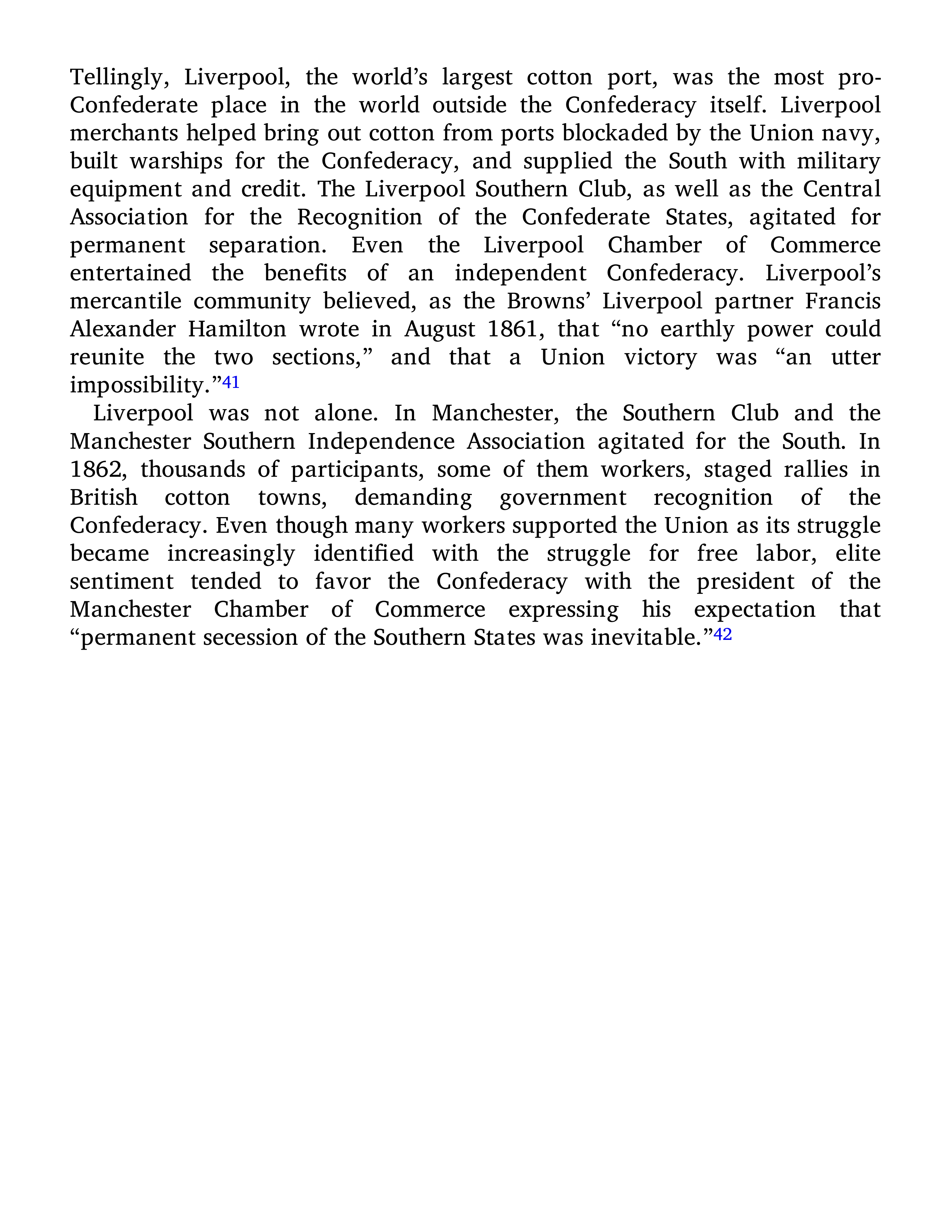
Tellingly, Liverpool, the world’s largest cotton port, was the most pro-
Confederate place in the world outside the Confederacy itself. Liverpool
merchants helped bring out cotton from ports blockaded by the Union navy,
built warships for the Confederacy, and supplied the South with military
equipment and credit. The Liverpool Southern Club, as well as the Central
Association for the Recognition of the Confederate States, agitated for
permanent separation. Even the Liverpool Chamber of Commerce
entertained the bene
ɹts of an independent Confederacy. Liverpool’s
mercantile community believed, as the Browns’ Liverpool partner Francis
Alexander Hamilton wrote in August 1861, that “no earthly power could
reunite the two sections,” and that a Union victory was “an utter
impossibility.”
41
Liverpool was not alone. In Manchester, the Southern Club and the
Manchester Southern Independence Association agitated for the South. In
1862, thousands of participants, some of them workers, staged rallies in
British
cotton
towns,
demanding
government
recognition
of
the
Confederacy. Even though many workers supported the Union as its struggle
became increasingly identi
ɹed with the struggle for free labor, elite
sentiment tended to favor the Confederacy with the president of the
Manchester Chamber of Commerce expressing his expectation that
“permanent secession of the Southern States was inevitable.”
42
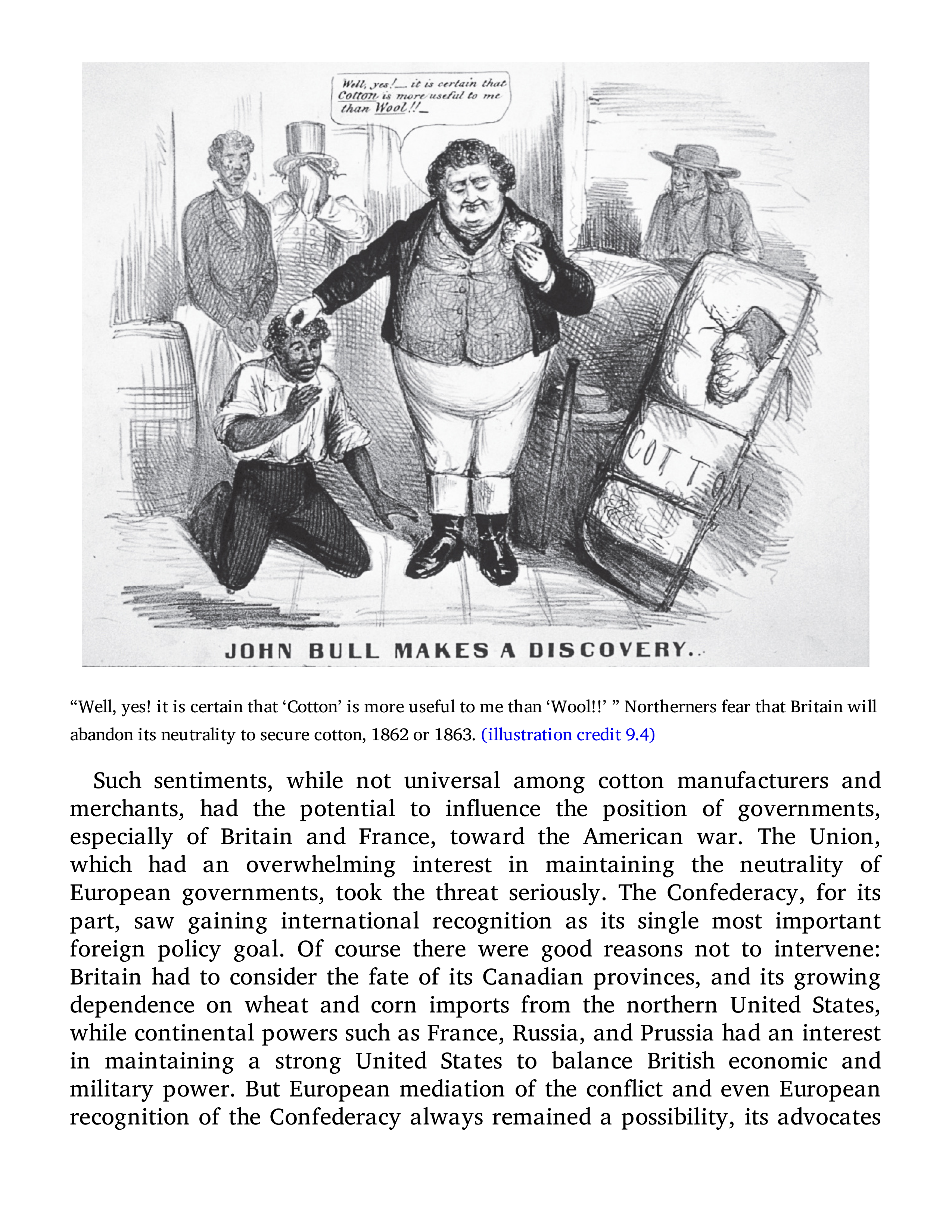
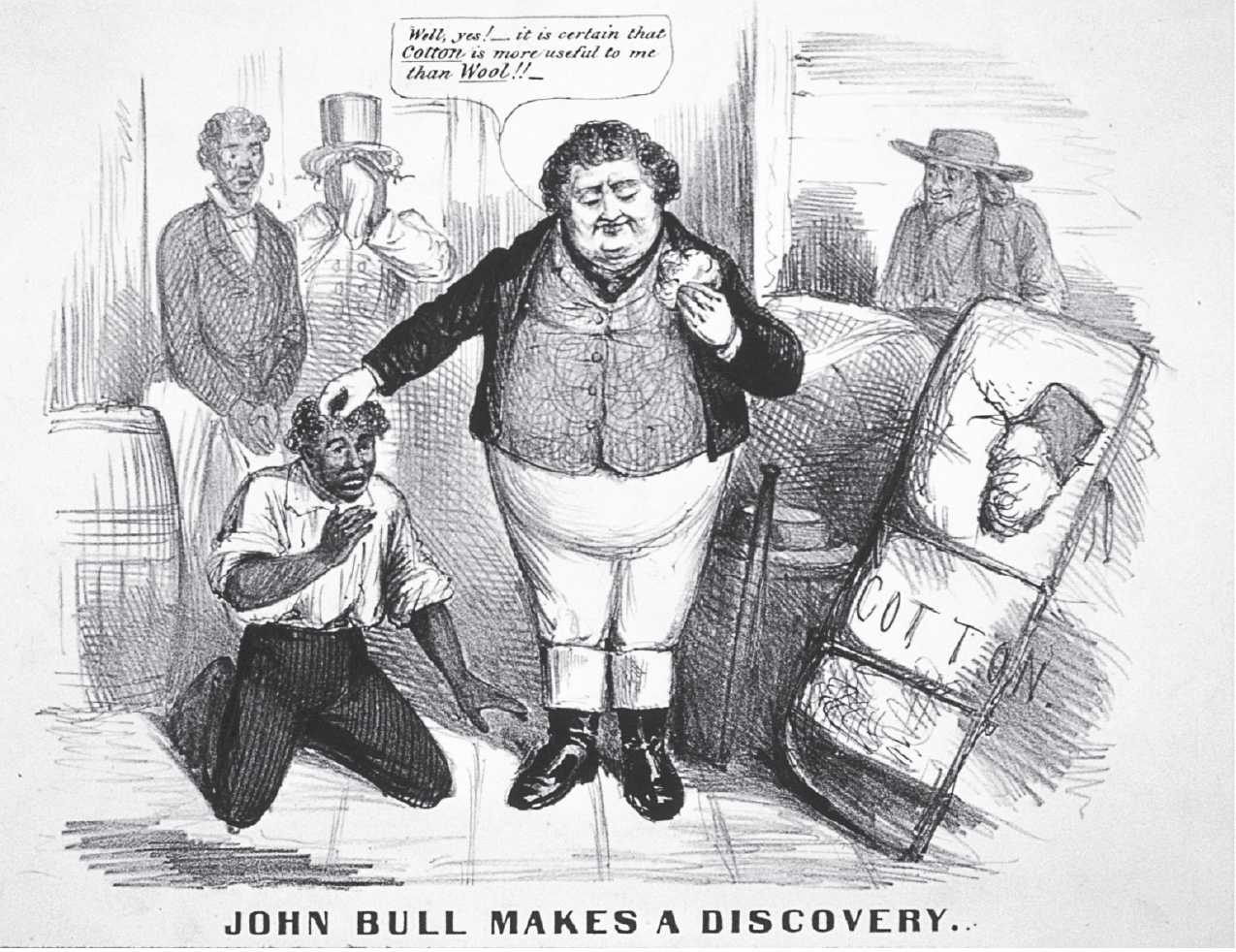
“Well, yes! it is certain that ‘Cotton’ is more useful to me than ‘Wool!!’ ” Northerners fear that Britain will
abandon its neutrality to secure cotton, 1862 or 1863.
(illustration credit 9.4)
Such sentiments, while not universal among cotton manufacturers and
merchants, had the potential to in
ɻuence the position of governments,
especially of Britain and France, toward the American war. The Union,
which had an overwhelming interest in maintaining the neutrality of
European governments, took the threat seriously. The Confederacy, for its
part, saw gaining international recognition as its single most important
foreign policy goal. Of course there were good reasons not to intervene:
Britain had to consider the fate of its Canadian provinces, and its growing
dependence on wheat and corn imports from the northern United States,
while continental powers such as France, Russia, and Prussia had an interest
in maintaining a strong United States to balance British economic and
military power. But European mediation of the con
ɻict and even European
recognition of the Confederacy always remained a possibility, its advocates
almost invariably touting the advantages of an independent Confederacy as
a source of cotton.
43
Social upheaval, including demonstrations, riots, and strikes (more than
ɹfty in France alone) in the cotton manufacturing regions increased the
anxiety of state bureaucrats and capitalists. Before becoming prime minister
of Great Britain, William Gladstone, among others, cited this fear of social
upheaval in Lancashire as a reason for European intervention in the
American con
ɻict. In 1862, in a public speech, Gladstone drew a dire picture
of the social and
ɹnancial impact of the cotton famine, though lauding the
patience of England’s workers, comparing the importance of the cotton
famine to the other two calamities that had befallen the British Empire, the
Irish famine and the Indian mutiny.
44
Cotton interests constantly pressured the Lincoln administration to keep
the needs of European cotton consumers in mind. The diplomatic
correspondence between the British Foreign O
ɽce and the British embassy
in Washington, D.C., suggests that Foreign Minister Earl Russell along with
the French government exerted considerable pressure on the Union
administration. “I went to the State department on the 25th [of July 1863]
and spoke to Mr. Seward about the cotton,” reported the British ambassador
to Washington, Lord Lyons, to London. “I told him that we had waited with
the greatest patience while the military operations were going on upon the
Mississippi, but that now the River was open, and the time has come at
which we had been promised an ample supply. What was he prepared to do
to redeem his promises?” Lincoln was well aware of the importance of
cotton in the con
ɻict. In his ɹrst annual message on December 3, 1861, he
argued that “the principal lever relied on by the insurgents for exciting
foreign nations to hostility against us…is the embarrassment of commerce.”
And by mid-1862, as the cabinet discussed Lincoln’s plan for emancipation
of slaves in rebel states, Seward argued successfully against such “immediate
promulgation” and “strongly in favor of cotton and foreign governments.”
Seward feared that announcement of emancipation would lead to European
recognition of the Confederacy. His ears close to the ground, he recognized
the potentially revolutionary implications of the American struggle to global
capitalism and urged caution.
45
American diplomats too were frequently reminded of Europe’s urgent
need for cotton. When William Thayer, the American consul to Alexandria,
Egypt, traveled to London in the summer of 1862, he reported to Seward
that recognition was very much on the mind of British policy elites. That
same year, the American minister to Brussels, Henry Sanford, was
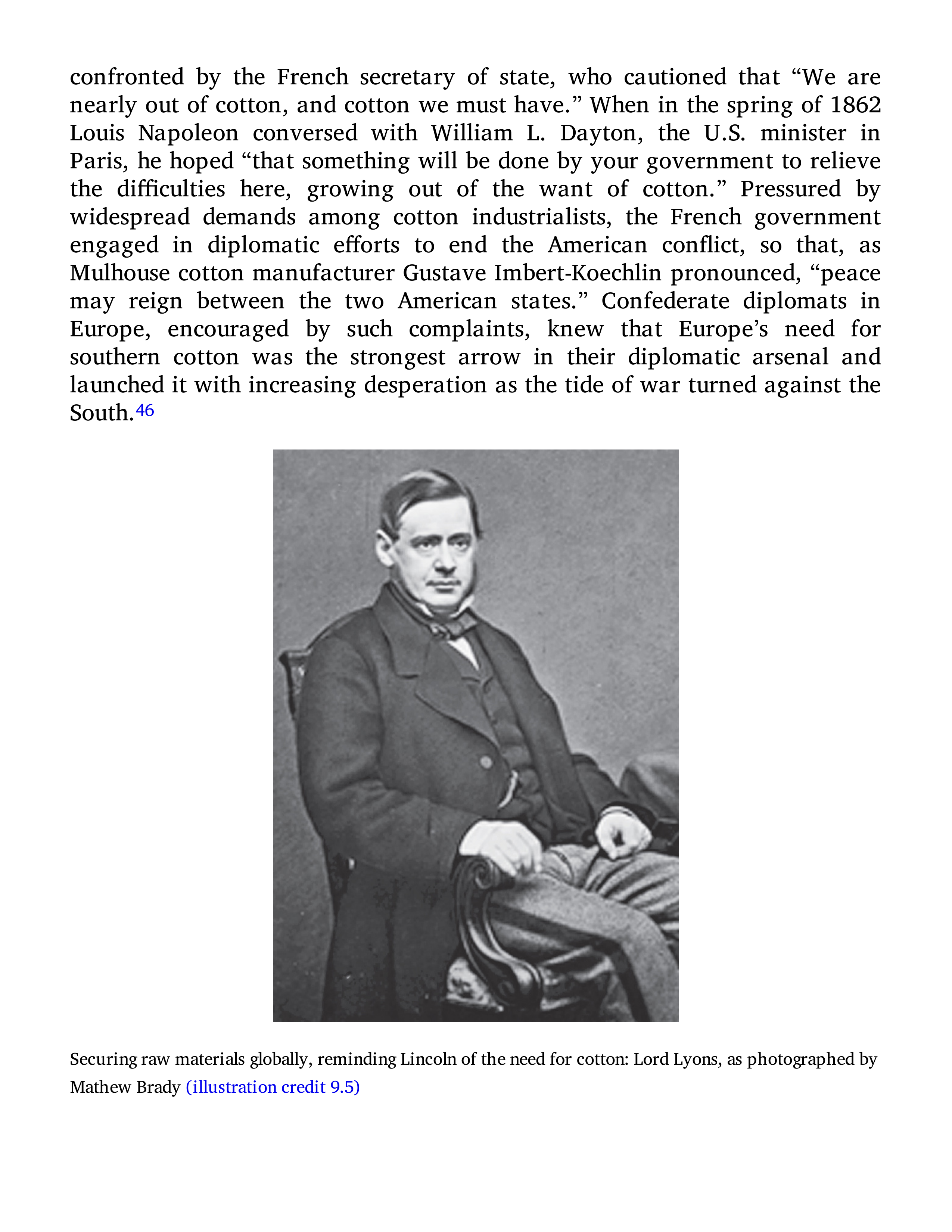

confronted by the French secretary of state, who cautioned that “We are
nearly out of cotton, and cotton we must have.” When in the spring of 1862
Louis Napoleon conversed with William L. Dayton, the U.S. minister in
Paris, he hoped “that something will be done by your government to relieve
the di
ɽculties here, growing out of the want of cotton.” Pressured by
widespread demands among cotton industrialists, the French government
engaged in diplomatic e
ʃorts to end the American conɻict, so that, as
Mulhouse cotton manufacturer Gustave Imbert-Koechlin pronounced, “peace
may reign between the two American states.” Confederate diplomats in
Europe, encouraged by such complaints, knew that Europe’s need for
southern cotton was the strongest arrow in their diplomatic arsenal and
launched it with increasing desperation as the tide of war turned against the
South.
46
Securing raw materials globally, reminding Lincoln of the need for cotton: Lord Lyons, as photographed by
Mathew Brady
(illustration credit 9.5)
Union diplomats desperately tried to counteract such sentiments by
making concerted e
ʃorts to communicate to the European public directly.
Charles Francis Adams advised his son in 1861 that it would be useful if he
would author a pamphlet about the cotton question. “Two things are
necessary to the production of cotton—an abundance of labor and a cotton
soil,” he wrote. “Look into the question of soil
ɹrst,” he advised, arguing
that a whole range of places around the globe had the necessary
environmental conditions to grow cotton. In some parts of the world, he
added, labor was abundant as well, such as in India and Egypt, while in
other parts of the world “there is no labor and here the cooly question rises.”
Adams saw an opportunity in the war to allow other cotton producers to
emerge, and to undo permanently the South’s near monopoly. “The
importance of this struggle [for the blockade and for new sources of cotton]
cannot be overestimated.” On “the consequent cotton pressure throughout
the world hangs the destruction of American slavery.”
47
Indeed, the best way to make the war against the Confederacy palatable
to powerful cotton interests in Europe was to demonstrate that inexpensive
cotton could be secured elsewhere. And the U.S. government indeed did its
best to encourage production in other parts of the world, for example by
moving vast quantities of cottonseed abroad. Washington, wrote Seward in
April 1862, had “an obvious duty…to examine the capacities of other
countries for cotton culture and stimulate it as much as possible, and thus to
counteract the destructive designs of the factious monopolists at home.”
Egypt, with its long-staple crop, was of particular importance in these
calculations since it could replace American exports with a high-quality
substitute, unlike Indian cotton. Throughout the war years, Thayer met
regularly with the viceroy to discuss cotton production and eventually hired
a con
ɹdant of the viceroy,
Ayoub Bey Trabulsi, to examine “the cottons of
Egypt.” Thanks to such contacts, Thayer was able to report by November
1862 that “the Vice Roy has exerted his in
ɻuence to aid in the increased
cultivation…he has…advised all the large proprietors hereafter to sow one
fourth of their land with cotton. As the advice of His Highness is practically
equivalent to a command, the proprietors have commenced…to expedite the
great agricultural revolution now in progress.”
48
Seward projected con
ɹdence that such eʃorts would succeed and
especially emphasized the unforeseen e
ʃects of global cotton production on
the South’s bid for independence. “The insurrectionary cotton States will be
blind to their own welfare if they do not see how their prosperity and all
their hopes are passing away, when they
ɹnd Egypt, Asia Minor and India
supplying the world with cotton, and California furnishing the gold for its
purchase.”
49
And indeed, these overtures of American policy makers did help to defuse
tensions between Washington and European capitals. In the spring of 1862,
Baring Brothers Liverpool expressed the view that war between the United
States and Great Britain was less likely “provided we get a large import
from India.” Charles Wood argued in August 1862 that “our only domestic
trouble,…the distress in Lancashire,…may be much mitigated, if any
reasonable quantity worth speaking of can come from India beyond what
she sent last year.” By 1863, widespread cotton imports from India had
alleviated the cotton crisis in France. Indeed by early 1864 the
procureurs
généraux
of various cotton manufacturing districts could report that cotton
imports from India and Egypt had relieved pressure on manufacturers, as
factories started slowly to produce again and, as a result, “the struggle…lost
a great deal of interest in our
département
.”
50
As Seward put it a few years
after the war, in 1872, when he came to the Indian city of Agra—the site of
the Taj Mahal—to visit a cotton gin there, “From the tomb of the Mogul
monarch Of India, Akbar, we passed to the tomb of the pretended monarch
of America, King Cotton.”
51
Once signi
ɹcant amounts of cotton arrived from sources other than the
United States, the political pressure on European governments from cotton
interests declined. Edward Atkinson, the Boston cotton manufacturer, was
relieved that the “supposed dependence of Europe upon the Cotton States
has proved to be an utter fallacy,” and thought it possible that soon “Europe
will become absolutely independent of this country for her supply.” By 1863,
even those whose livelihood depended on cotton, and who had once been
advocates of the cause of the southern states, began to envision a diverse
supply network of raw cotton without reliance on slaves.
52
Some even began to see the obstinacy of the South, in its demands for
independence and its attachment to slavery, as the real cause of disruption
to the world economy. After all, cotton merchants and manufacturers, unlike
southern planters and their government, were not invested in a particular
source of cotton—the American South—nor in a particular system of labor to
produce it—slavery. All they required was a secure and predictable supply
of inexpensive cotton in the qualities they desired.
Yet it was one thing to respond to short-term supply disruptions resulting
from a blockade, and another to imagine an empire of cotton without
slavery. Based on their readings of the history of the cotton empire during
the previous eighty years, many merchants and manufacturers feared that
the potential disruption of the “deep relationship between slavery and
cotton production” might, as the
Bremer Handelsblatt
put it, “destroy one of
the essential conditions of the mass production” of cotton textiles.
53
As early as 1861, when Union general John C. Frémont emancipated
slaves in Missouri,
The Economist
worried that such a “fearful measure”
might spread to other slaveholding states, “in
ɻict[ing] utter ruin and
universal desolation on those fertile territories.” The
Cotton Supply Reporter
went as far as to evoke “the horrors of a second St. Domingue,” should the
war become a war for emancipation, and predicted that in such a case the
United States’
“marvelous cotton-producing industry must suddenly
collapse.” It was not surprising that people with such beliefs would come to
see the fall of Richmond as of such consequence, according to the
hyperventilating
Bremer Handelsblatt
, that even the “richest imagination was
too poor to envisage its implications.”
54
Considering these fears, it was the more remarkable that 4 million slaves
in the United States—among them the world’s most important cotton
growers—gained their freedom during or immediately after the war.
Encouraged by their perception of their masters’ weakness in the face of a
national government bent on subduing the rebels, slaves embarked upon an
agrarian insurrection. By deserting plantations, withdrawing their labor
power, giving intelligence to federal troops, and eventually taking up arms
as Union soldiers, American slaves pressed to make a sectional war into a
war of emancipation. And they succeeded. Never before and never
thereafter did cotton growers revolt with similar success, their strength
fortuitously ampli
ɹed by a deep and irreconcilable split within the nation’s
elite.
55
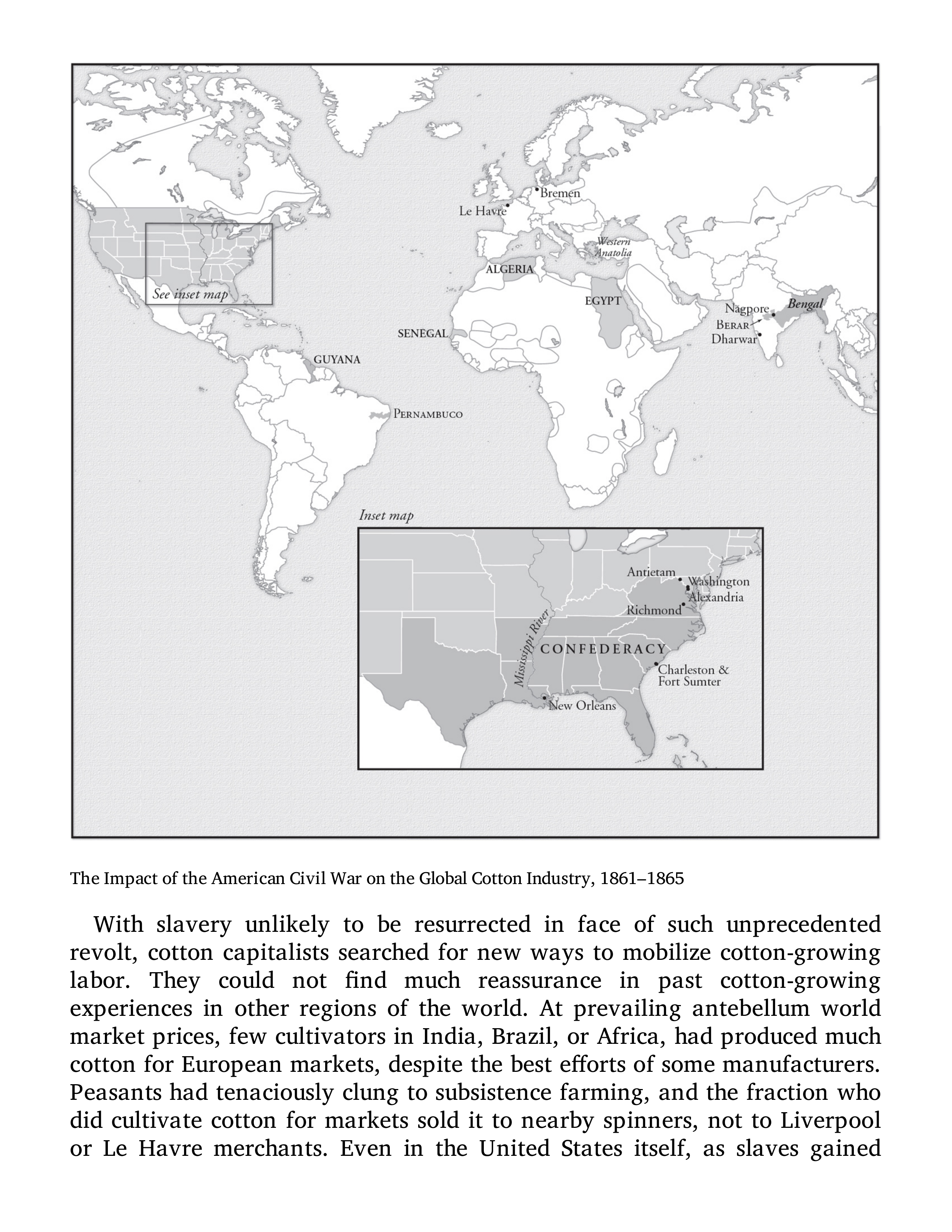
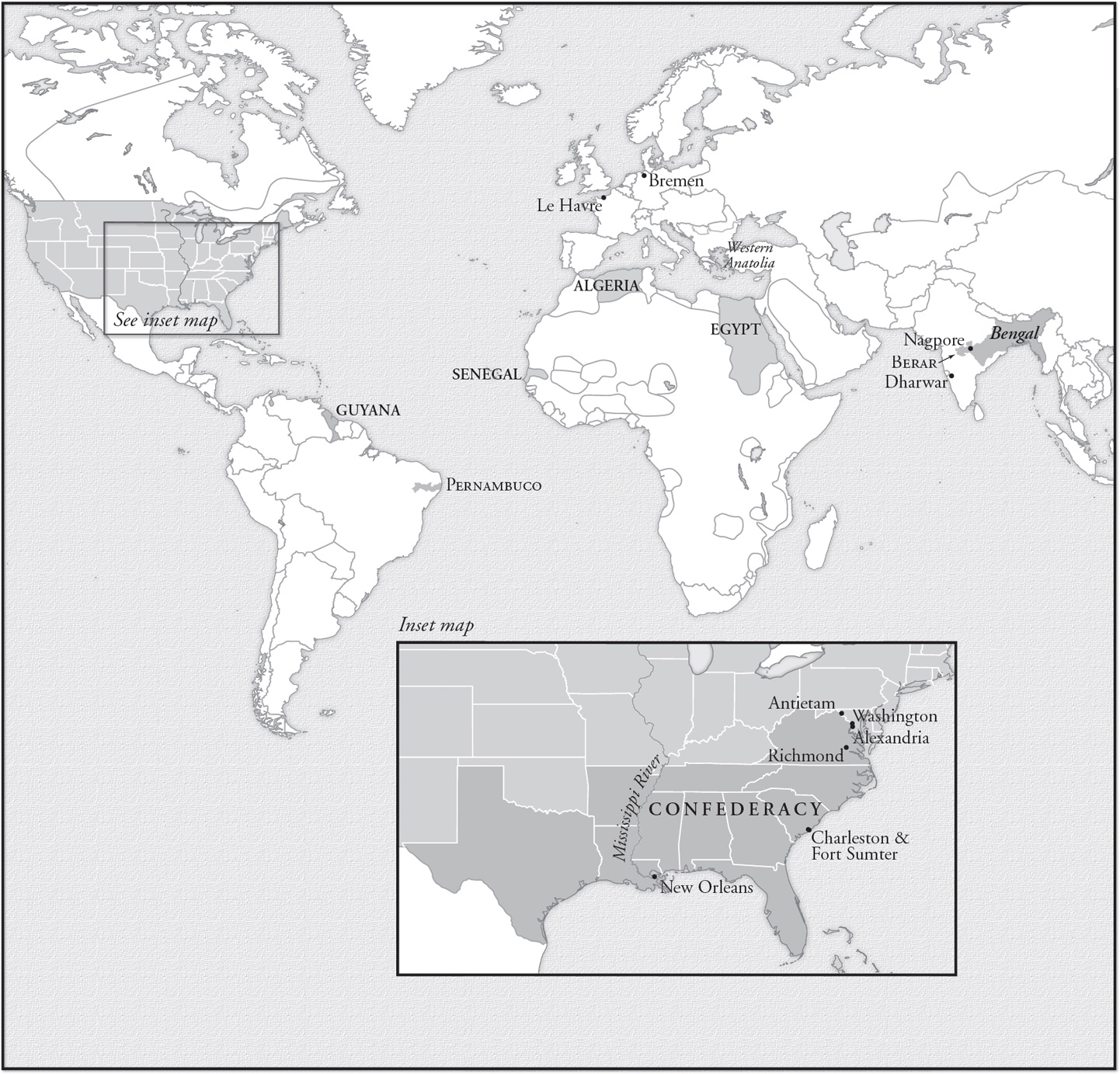
The Impact of the American Civil War on the Global Cotton Industry, 1861–1865
With slavery unlikely to be resurrected in face of such unprecedented
revolt, cotton capitalists searched for new ways to mobilize cotton-growing
labor. They could not
ɹnd much reassurance in past cotton-growing
experiences in other regions of the world. At prevailing antebellum world
market prices, few cultivators in India, Brazil, or Africa, had produced much
cotton for European markets, despite the best e
ʃorts of some manufacturers.
Peasants had tenaciously clung to subsistence farming, and the fraction who
did cultivate cotton for markets sold it to nearby spinners, not to Liverpool
or Le Havre merchants. Even in the United States itself, as slaves gained
their freedom during the war, many of them quickly abandoned the
industrial rhythm of the plantation and instead tried to focus on subsistence
agriculture.
56
Moreover, the experience of earlier emancipations in the Caribbean, in
Saint-Domingue above all, had de
ɻated the hopes of merchants and
manufacturers about cash-crop production by former slaves. As early as
1841, Herman Merivale had observed that it was di
ɽcult to compel “the
negroes to perform hired labour while they have their own provision
grounds, and other resources, at their disposal.” The (British) Select
Committee investigating “the existing relations between Employers and
Labourers” in the West Indies had similarly noted in 1842 that the
production of agricultural commodities had diminished in the wake of
emancipation because “the labourers are enabled to live in comfort and to
acquire wealth without, for the most part, labouring on the estates of the
Planters for more than three or four days in a week.” As
The Economist
put
it, “in the tropics Nature has given man the bene
ɹt, or the curse, of a
perpetual poor law, a prodigality of food which of itself established a
minimum of wages.”
57
For British colonial o
ɽcial
W. H. Holmes the dilemma was clear: “When
the slave became a free man…his
ɹrst desire was also to become
independent; to be completely his own master.” In Guyana, which he
studied carefully, “a tri
ɻing amount of labour procures the few luxuries,
which a most fertile soil fails to place within reach,” making it unlikely that
farmers would grow export crops for wages. Vegetables,
ɹsh, and fruit were
available for the asking, a situation that, “in my opinion, [has] been fraught
with evil consequences.” French colonial bureaucrats had come to essentially
the same conclusion: Once “free…the Black…returns to the hut of the
savage.” Freedpeople’s retreat into subsistence agriculture, envisioned by so
many former slaves as a true foundation for their new freedom, was the
worst nightmare of cotton merchants and manufacturers the world over.
58
European observers’ concerns about freedpeople were further ampli
ɹed by
developments in the Caribbean, such as the 1865 Morant Bay Rebellion in
Jamaica, when a group of black Jamaicans revolted against the harsh
punishment the colonial administration had in
ɻicted on a group of
squatters, a rebellion that was suppressed by an orgy of violence by British
troops.
Landowners, manufacturers, merchants, and statesmen concluded from
this reading of past experiences that emancipation was potentially
threatening to the well-being of the world’s mechanized cotton industry.
Consequently, they worked zealously to
ɹnd ways to reconstruct durably the
worldwide web of cotton production, to transform the global countryside
without resorting to slavery. Already during the war itself, in articles and
books, speeches and letters, they belabored the question of if and where
cotton could be grown by nonslave labor. Edward Atkinson, for example,
contributed to this debate as early as 1861 with his
Cheap Cotton by Free
Labor
, and one year later, William Holmes’s
Free Cotton: How and Where to
Grow It
extended the discussion. An anonymous French author added his
voice the same year with
Les blancs et les noirs en Amérique et le coton dans
les deux mondes
.
59
Soon such treatises were informed by lessons drawn from the Civil War
experiences. The sudden turn to nonslave cotton during the Civil War years
in Egypt, Brazil, and India as well as in Union-controlled zones of the
American South represented, after all, a global experiment: What would a
world with cotton but without slaves look like?
These rehearsals—for a new postwar, postslavery cotton empire—nurtured
two somewhat contradictory faiths. Few observers reckoned that enough
cotton could be procured to permit cotton manufacturing to continue its
dramatic expansion even without slavery. This was, for example, the
judgment of the English Ladies’ Free Grown Cotton movement, a loose
association of women who committed themselves to purchasing only cloth
produced with free labor cotton. And, perhaps most optimistically, it was
embraced by Republicans in the United States such as Edward Atkinson, who
believed that cotton production in the American South could be expanded
dramatically through the use of “free labor”—that is, as long as freedpeople
did not remain content with subsistence agriculture. Atkinson, impressed by
his own successes in sta
ɽng his cotton mills with wage workers, fervently
believed that the future of the United States’—and the world’s—cotton
supply depended on the ability of southern landowners and the southern
states to motivate freed slaves to produce cotton.
60
Yet the Civil War experience also had shown that nonslave cotton had
entered world markets only under conditions of unsustainably high prices;
after all, the price of Indian cotton had more than quadrupled and earlier
e
ʃorts to bring Indian cotton to market at lower prices had largely failed.
Moreover, from the perspective of 1864 and 1865, emancipation was
accompanied by considerable social turmoil in the American South. Cotton
capitalists’ widespread belief that freedom would bring a permanent
reduction in the supplies of raw cotton was thus reasonable and was
expressed most directly in the fact that postbellum cotton prices remained
well above their prewar level. Breathless reports came into Liverpool, such
as the one received by the Rathbones which predicted that “negro labour
could not be depended on for next year.” The Barings, in turn, asserted that
“few appear to think that labour can be su
ɽciently reorganized in the South
to plant and pick a crop next season exceeding 1½ million bales.” (In 1860,
the cotton crop had been 5.4 million bales.)
61
As fears of permanently reduced cotton harvests spread through cotton
circles, pressure for a reconstruction of plantation agriculture in the
American South after the defeat of the Confederacy mounted, especially the
orderly return of cotton cultivators to the
ɹelds. The
Bremer Handelsblatt
called for a policy of forgiveness toward the defeated planter elite. In the
spring of 1865, the British minister to Washington, Sir Frederick William
Adolphus Bruce, reported back to London on the status of Reconstruction,
severely critiquing the “ultra-Republicans,” and reminding President Andrew
Johnson to take into account the urgent need to revive cotton production.
The question of if and how freedpeople would work occupied him; he feared
that “the emancipation of the Negroes will be a great blow to the material
prosperity of the cotton and sugar growing States.” Concerned about
upheavals in the South and critical of e
ʃorts to extend
su
ʃrage rights to
freedpeople, he approvingly reported in May 1865 that “everywhere
measures are being taken to force the Negroes to work, and to teach them
that freedom means working for wages instead of masters.”
62
Yet cotton capitalists and government bureaucrats also had learned much
broader lessons during the war. Most important, they understood that labor,
not land, constrained the production of cotton. Members of the Manchester
Cotton Supply Association, the world’s leading experts on such matters,
understood that land and climate of a “quality equal and in many cases
superior to that” of America was available in many di
ʃerent parts of the
globe. But these experts on global cotton found that “the very
ɹrst requisite,
which was labor” was more di
ɽcult to ɹnd. As the British ɹnance minister
for India, Samuel Laing, remarked, “The question of the abolition of slavery
over the world, depends probably upon the question whether cotton
produced by free labor in India can undersell cotton the produce of slavery
in America.”
63
But where should this labor come from? During the Civil War, as we have
seen, the e
ʃorts of cotton interests focused squarely on accessing labor in
regions that formerly had not grown signi
ɹcant amounts of cotton for
European markets. The president of the Cotton Supply Association
summarized this strategy succinctly: “We are now opening up the interior.”
This strategy had a long history; the Civil War, however, had focused the
energies of capitalists and statesmen in unprecedented ways.
64
This rapid geographic expansion of the global web of cotton production
was deeply entangled with e
ʃorts to ɹnd new ways to motivate rural
cultivators to grow the white gold and move it to market. How could rulers
make peasants grow crops that, as political scientist Timothy Mitchell put it
so well, “they could not eat, or process to serve local needs”? Or how could,
as the French observer M. J. Mathieu asked far less delicately in 1861,
“black workers be disciplined and stimulated”?
65
Throughout the empire of cotton, bureaucrats and capitalists agonized
over the question of whether “the negroe will from now on be a industrious
worker.”
66
In an unusually long article,
The Economist
took the occasion of
the end of the Civil War to engage in an extended deliberation on the issue,
arguing:
There is probably no one point of politics which involves economic
results so wide or so permanent as the relation between the white and
the dark races of the world…. It is probably the destiny, it is even now
the function, it is certainly the interest of the European, and more
particularly of the English family of mankind, to guide and urge and
control the industrial enterprises of all Asia, of all Africa, and of those
portions of America settled by African, Asiatic, or hybrid races. Those
enterprises are very large indeed…. The one necessity essential to the
development of these new sources of prosperity is the arrangement of
some industrial system under which very large bodies of dark labourers
will work willingly under a very few European supervisors. It is not
only individual labour which is required, but organized labour, labour
so scienti
ɹcally arranged that the maximum of result shall be obtained
at a minimum of cost, that immense sudden e
ʃorts, such as are required
in tunnel cutting, cotton picking and many other operations, shall be
possible without strikes or quarrels, and that, above all, there shall be
no unnatural addition to the price of labour in the shape of bribes to
the workmen to obey orders naturally repulsive to their prejudices.
To be sure,
The Economist
argued, “All these ends were secured, it must
freely be acknowledged, by slavery. For the mere execution of great works
cheaply no organization could be equal to that which placed the skilled
European at the top, and made him despotic master of the half-skilled black
or copper-coloured labourer below…” But slavery had also “moral and social
consequences which are not bene
ɹcial.” And for that reason, “A new
organization therefore must be commenced, and the only one as yet found
to work e
ʃectively is…one based upon perfect freedom and mutual self-
interest…. If, however, complete freedom is to be the principle adopted, it is
clear that the dark races must in some way or other be induced to obey
white men willingly.”
67
But how would “the dark races…be induced to obey white men willingly”?
The Civil War had unintentionally transformed the possibilities for where
and how cotton might be grown, overturning in one stroke the balance
between coerced and free labor in the global web of cotton production. The
determined e
ʃorts of slaves themselves and the advance of the
Union army
bolstered by newly freed men and women had destroyed the system of
chattel slavery that for 250 years had fueled both war capitalism and the
Industrial Revolution. But the newly emerging order in the world’s cotton
ɹelds was still up for grabs.
68
The outlines of what this reconstruction would look like were only
glimpsed here and there during the Civil War itself. Yet by century’s end, the
world of cotton would look dramatically di
ʃerent. The speed and ɻexibility
with which merchants, manufacturers, and agricultural producers responded
to the crisis revealed their adaptability and, not least, their capacity for
marshaling new, indirect, but far-reaching forms of state power to secure
labor in place of direct ownership of human beings. “The emancipation of
the enslaved races and the regeneration of the people of the East,” observed
the
Revue de Deux Mondes
perceptively, “were intimately connected.”
69
When the guns fell silent on the North American continent in April 1865, the
greatest turmoil in the eighty-
ɹve-year history of a European-dominated
cotton industry came to an end. New systems for the mobilization of labor
had been tested around the world—from coolie workers to sharecropping to
wage labor—and while it was still uncertain if cotton production would
return to antebellum levels, belief in the possibility of “free labor” cotton
had become nearly universal. As former slaves throughout the United States
celebrated their freedom, manufacturers and workers looked forward to
factories running again at capacity, fueled by newly plentiful cotton
supplies.
Merchants, however, had little to celebrate. “The peace rumor caused
almost a panic,” reported Baring Brothers Liverpool to their counterparts in
London in February 1865. When the
Indian Daily News
, in an “extraordinary”
issue, reported in early March of the capture of Charleston by Union forces,
it observed, “Panic in Liverpool. Cotton down to one shilling,” a panic that
rapidly spread to Bombay itself. Boston ice merchant Calvin W. Smith
reported from Bombay that “I am sorry to say such long faces I never saw
on any set of mortals as the English & Parsees put on here. Our success at
home is their ruination. Let that war end in one year, and there will be more
failures in this town, than in any one place anywhere. Such wild speculation
as has been going on here for the last four years, never was heard of
before.” In Liverpool panic prevailed as well. Liverpool cotton merchant
Samuel Smith remembered, “It was pitiable to see men who had bought
ɹne
mansions and costly picture galleries, hanging about ‘the
ɻags,’ watching
the chance of borrowing a guinea from an old friend.”
70
This global panic illuminated to peasants, workers, manufacturers, and
merchants how closely intertwined developments all over the world had
become. Battles fought in rural Virginia reverberated in small villages in
Berar and Lower Egypt, a farmer’s crop choice in Brazil rested on his
reading of the Liverpool market, and real estate prices collapsed in Bombay
as soon as news of the Union’s destruction of Richmond reached India’s
shores. A British observer was amazed at these new global links that the
Civil War had brought to the fore. “We have seen how potent and how
quick,” he wrote, “the e
ʃects of ‘price’ was in the most distant parts of the
globe.”
71
The world indeed had become smaller, and the way cotton held parts of it
together had changed signi
ɹcantly. If the Civil War was a moment of crisis
for the empire of cotton, it was also a rehearsal for its reconstruction.
Cotton capitalists were con
ɹdent from their triumphs in recasting industrial
production at home. As they surveyed the ashes of the South, they saw
promising new levers that might move the mountain of free labor into
cotton cultivation with new lands, new labor relations, and new connections
between them. But perhaps most important, cotton capitalists had learned
that the lucrative global trade networks they had spun could only be
protected and maintained by unprecedented state activism. Meanwhile,
statesmen understood that these networks had become essential to the social
order of their nations and hence a crucial bulwark of political legitimacy,
resources, and power. Thus the French observer was correct when he

predicted in 1863, “The empire of cotton is ensured; King Cotton is not
dethroned.”
72
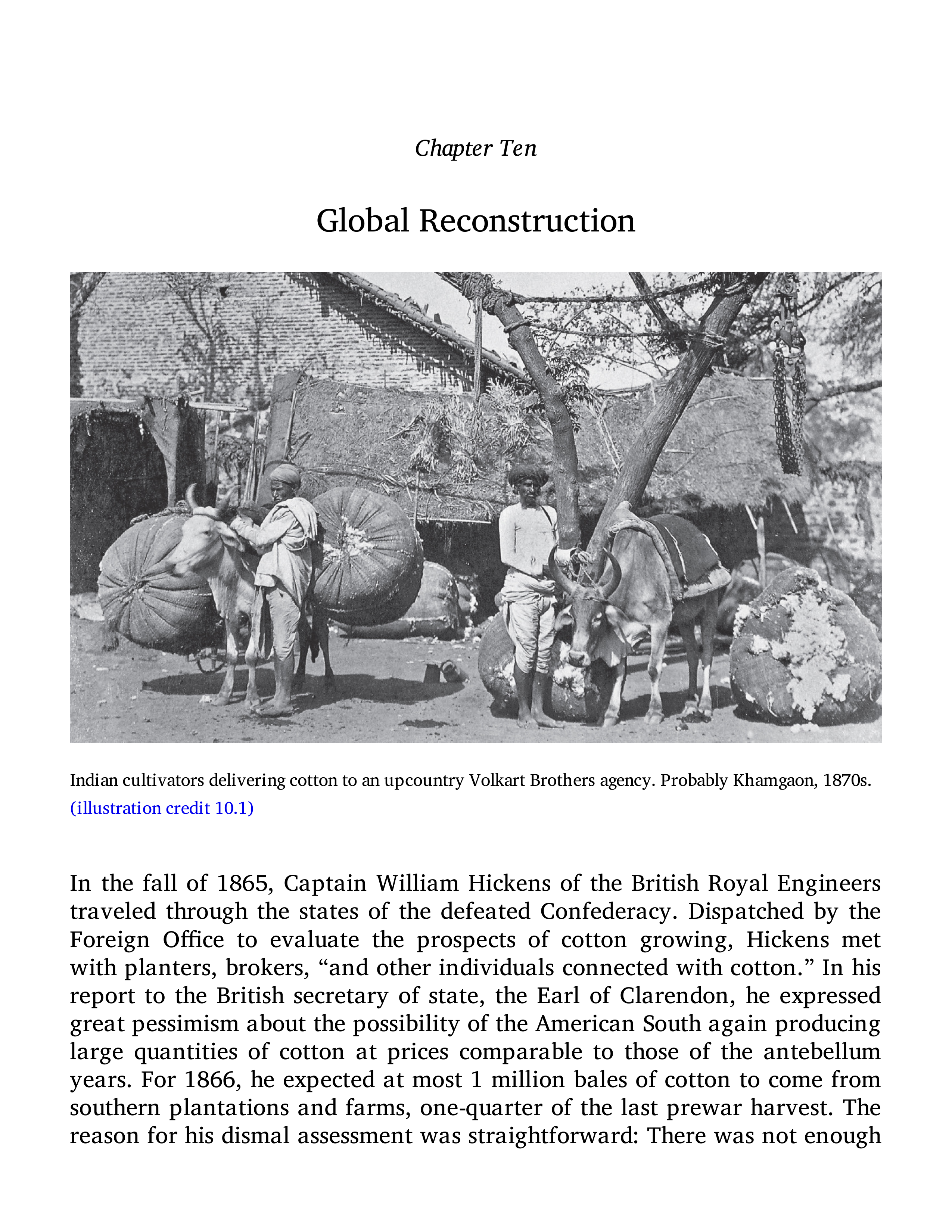
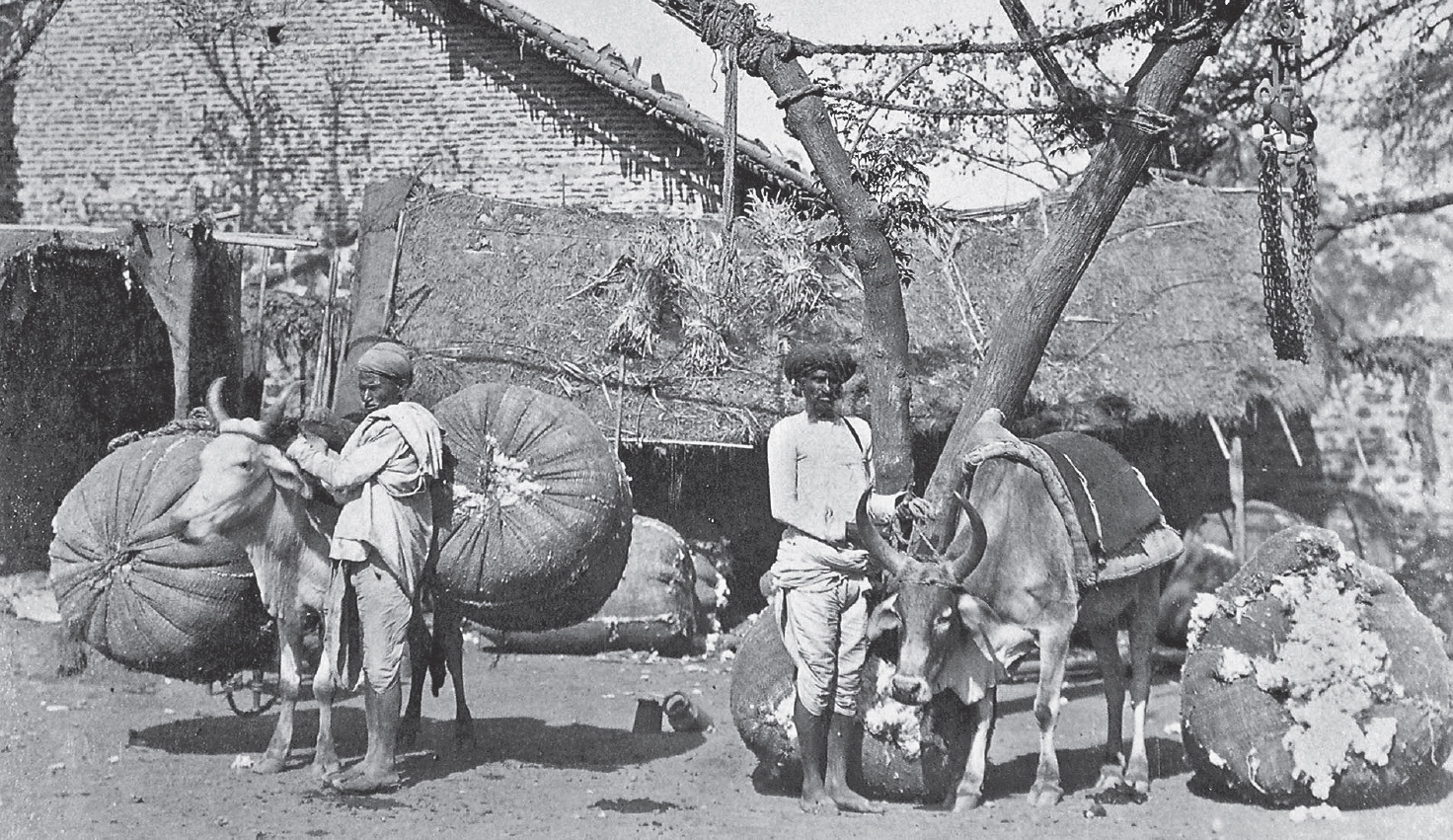
Chapter Ten
Global Reconstruction
Indian cultivators delivering cotton to an upcountry Volkart Brothers agency. Probably Khamgaon, 1870s.
(illustration credit 10.1)
In the fall of 1865, Captain William Hickens of the British Royal Engineers
traveled through the states of the defeated Confederacy. Dispatched by the
Foreign O
ɽce to evaluate the prospects of cotton growing, Hickens met
with planters, brokers, “and other individuals connected with cotton.” In his
report to the British secretary of state, the Earl of Clarendon, he expressed
great pessimism about the possibility of the American South again producing
large quantities of cotton at prices comparable to those of the antebellum
years. For 1866, he expected at most 1 million bales of cotton to come from
southern plantations and farms, one-quarter of the last prewar harvest. The
reason for his dismal assessment was straightforward: There was not enough
labor in the South to plow, seed, prune, and harvest all that cotton. “So
completely has the system of labour been disorganized by the emancipation
of the slaves,” he lamented, that cotton harvests for the foreseeable future
would be vastly reduced. Planters in Louisiana had told Hickens that “there
is the greatest di
ɽculty in getting a fair day’s work out of the negroes,” as
the freedpeople have “no idea of the sanctity of a contract, and will…evade
the performance of [their] part of it.” The solution, Hickens concluded, was
the growing of cotton by white settlers, who would eventually be able to
grow a crop “as large each year as before the war,” but never again as
cheaply as “in the old days.”
1
In April 1865, the question that was
ɹrst and foremost on the minds of
cotton capitalists and statesmen was if and when the cotton planters of the
American South would resume their position within the empire of cotton.
This question, virtually all observers agreed with Hickens, boiled down to
just one issue: labor. Manchester cotton manufacturer Edmund Ashworth
was all but certain that “the blacks who had once worked by the whip would
be slow to work for wages.” Liverpool cotton broker Maurice Williams put
the issue succinctly: “Now as the
power
to force this labor is for ever taken
away and that it was mainly owing to this power that the Southern States
were enabled to raise such enormous Crops of Cotton as previously to
supply four
ɹfths the Consumption of the world it may naturally be
expected that free laborers toiling mainly for themselves cannot for years
until their number be materially increased be expected to produce any large
quantity compared with former crops.”
2
Just as slaves had revolutionized the cotton empire, emancipation forced
cotton capitalists toward their own revolution—a frantic search for new
ways to organize the cotton-growing labor of the world. Reconciling the
emancipation of America’s cotton growers with the need for ever more raw
cotton was not easily accomplished. Yet cotton manufacturers’ insatiable
demand for inexpensive cotton made sure that the “cotton question”
remained high on the agenda. Raw cotton imports were so voluminous that
they were generally the most costly item in the trade of the industrialized
nations of Europe, and cotton exports were at the very top of the list of
goods brought from there to foreign markets. With hundreds of thousands of
workers
ɹnding employment in textile mills, these supplies and outlets were
crucial to securing the social stability of European and North American
societies. To maintain an industry so important required a global
reconstruction of the empire of cotton; a search for innovative combinations
of land, labor, capital, and state power.
3
The continued rapid growth of the industry over the next half century
ampli
ɹed this need: Global cotton consumption doubled from 1860 to 1890,
and then by 1920 doubled once more. “Among the larger industrial changes
of the last thirty years few exceed, in importance and interest, the
marvelous growth of the manufacture of cotton by machinery,” reported
economist Elijah Helm in 1903. British spinners remained the world’s most
important consumers of raw cotton, but their needs expanded at a slower
rate than before 1860. In the 1840s, their cotton consumption had increased
by 4.8 percent annually, but by the 1870s and 1880s that rate of increase
had dropped to 1.4 percent. Britain’s spinning slowdown, however, was
more than made up by the demand from spinners in the rapidly growing
cotton industries of western and eastern Europe, North America, and, by the
early twentieth century, Brazil, Mexico, India, China, and Japan. In the
years between 1860 and 1920 mechanical spindles in the world’s cotton
industry tripled, as entrepreneurs and workers set another 100 million
spindles in motion—half of them in the forty years before 1900, and the
other half in the
ɹrst two decades of the twentieth century. The spread of
power looms was dramatic as well. In 1860 there were 650,000 power
looms; the number reached 3.2 million by 1929. Continental Europe slowly
increased its share of global cotton spindles between 1860 and 1900 rising
from a quarter of the total in 1860 to 30 percent at the turn of the century.
America also increased its share at the expense of Britain, rising from a 10
percent share in 1860 to around 20 percent in 1900.
4
The primary e
ʃect of
this shift was to give a much larger number of states and capitalists an
interest in cheap cotton, and thus in the transformation of the global
countryside, hoping to draw an ever wider swath of the world’s hinterland
into the circuits of metropolitan capital accumulation.
5
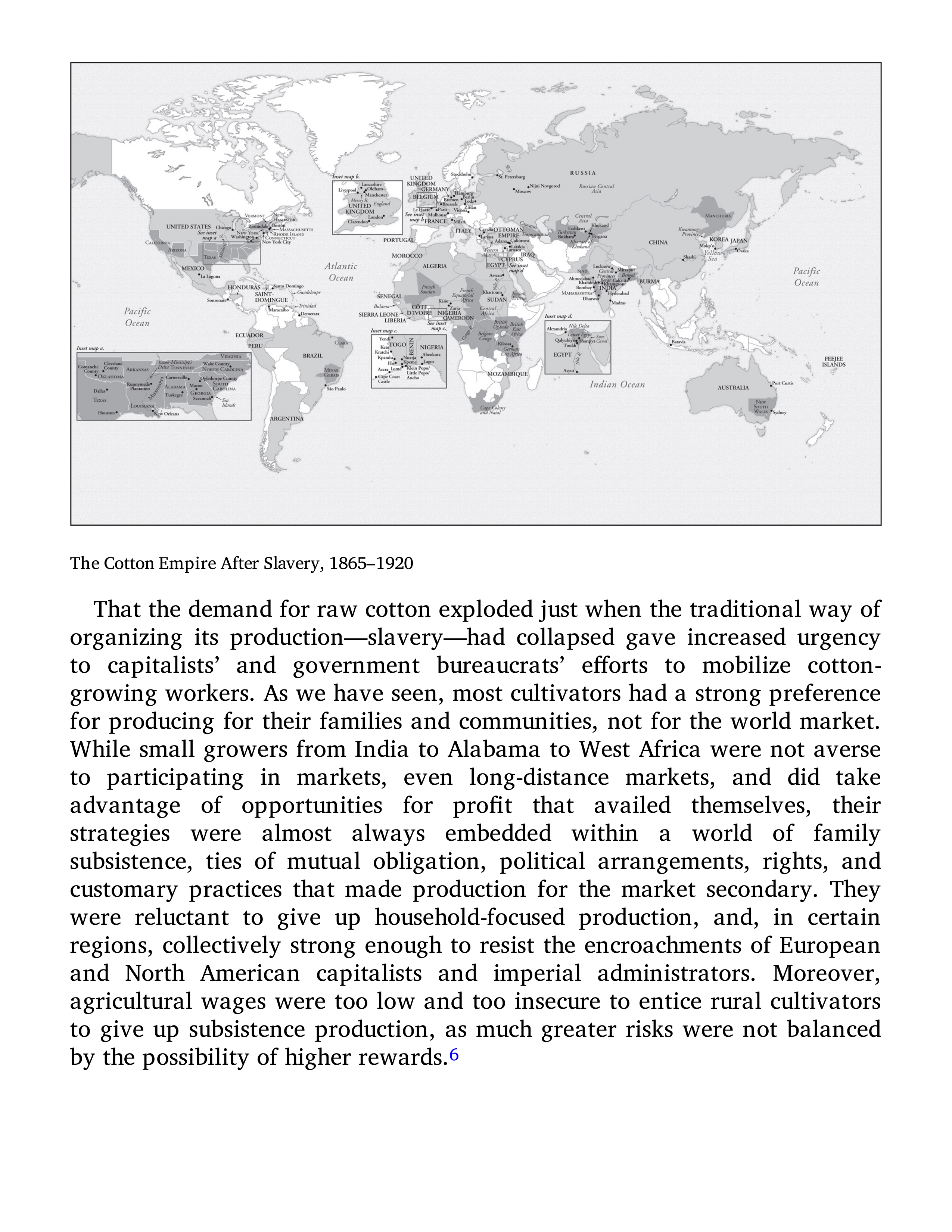
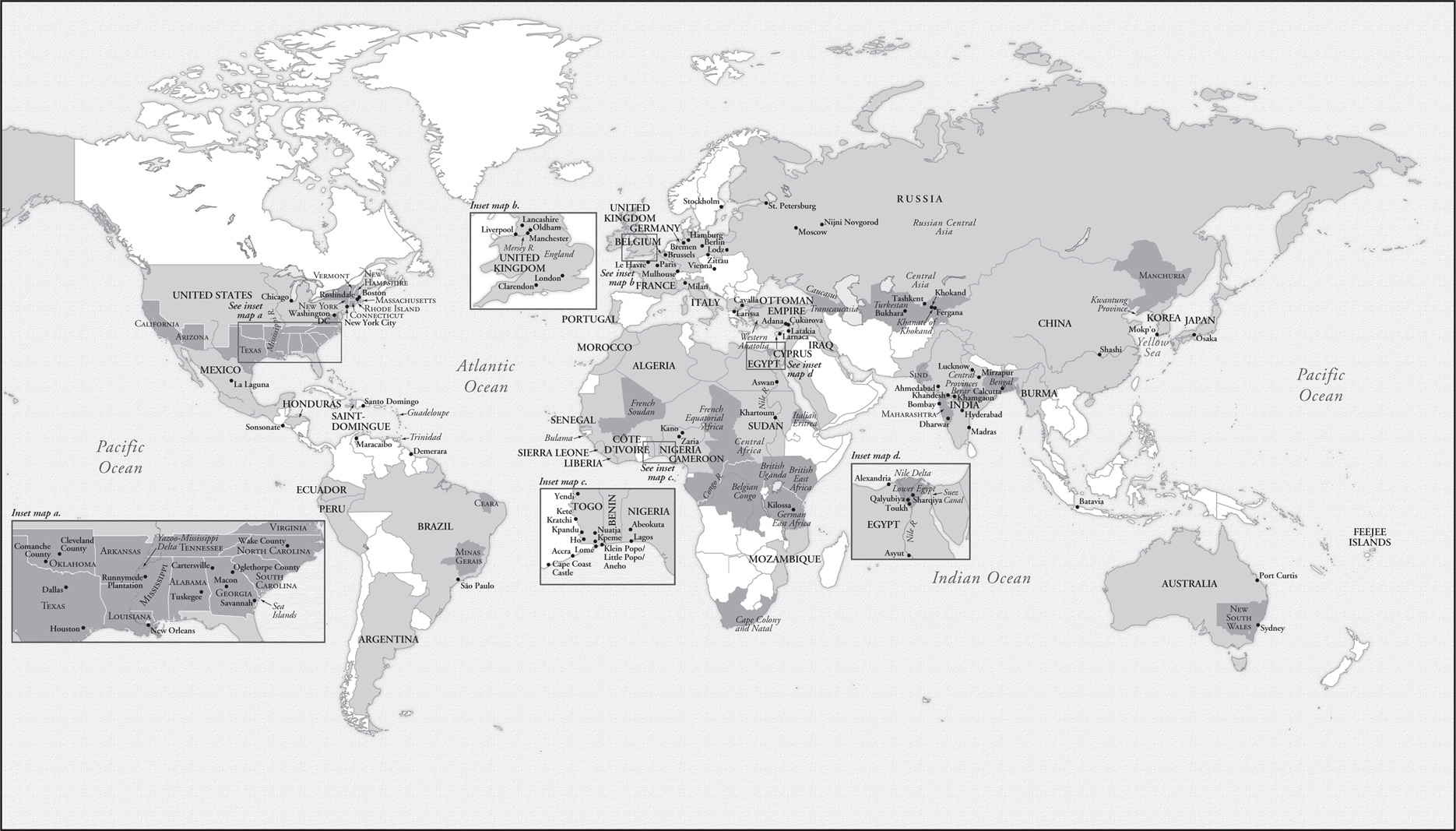
The Cotton Empire After Slavery, 1865–1920
That the demand for raw cotton exploded just when the traditional way of
organizing its production—slavery—had collapsed gave increased urgency
to capitalists’ and government bureaucrats’ e
ʃorts to mobilize cotton-
growing workers. As we have seen, most cultivators had a strong preference
for producing for their families and communities, not for the world market.
While small growers from India to Alabama to West Africa were not averse
to participating in markets, even long-distance markets, and did take
advantage of opportunities for pro
ɹt that availed themselves, their
strategies were almost always embedded within a world of family
subsistence, ties of mutual obligation, political arrangements, rights, and
customary practices that made production for the market secondary. They
were reluctant to give up household-focused production, and, in certain
regions, collectively strong enough to resist the encroachments of European
and North American capitalists and imperial administrators. Moreover,
agricultural wages were too low and too insecure to entice rural cultivators
to give up subsistence production, as much greater risks were not balanced
by the possibility of higher rewards.
6
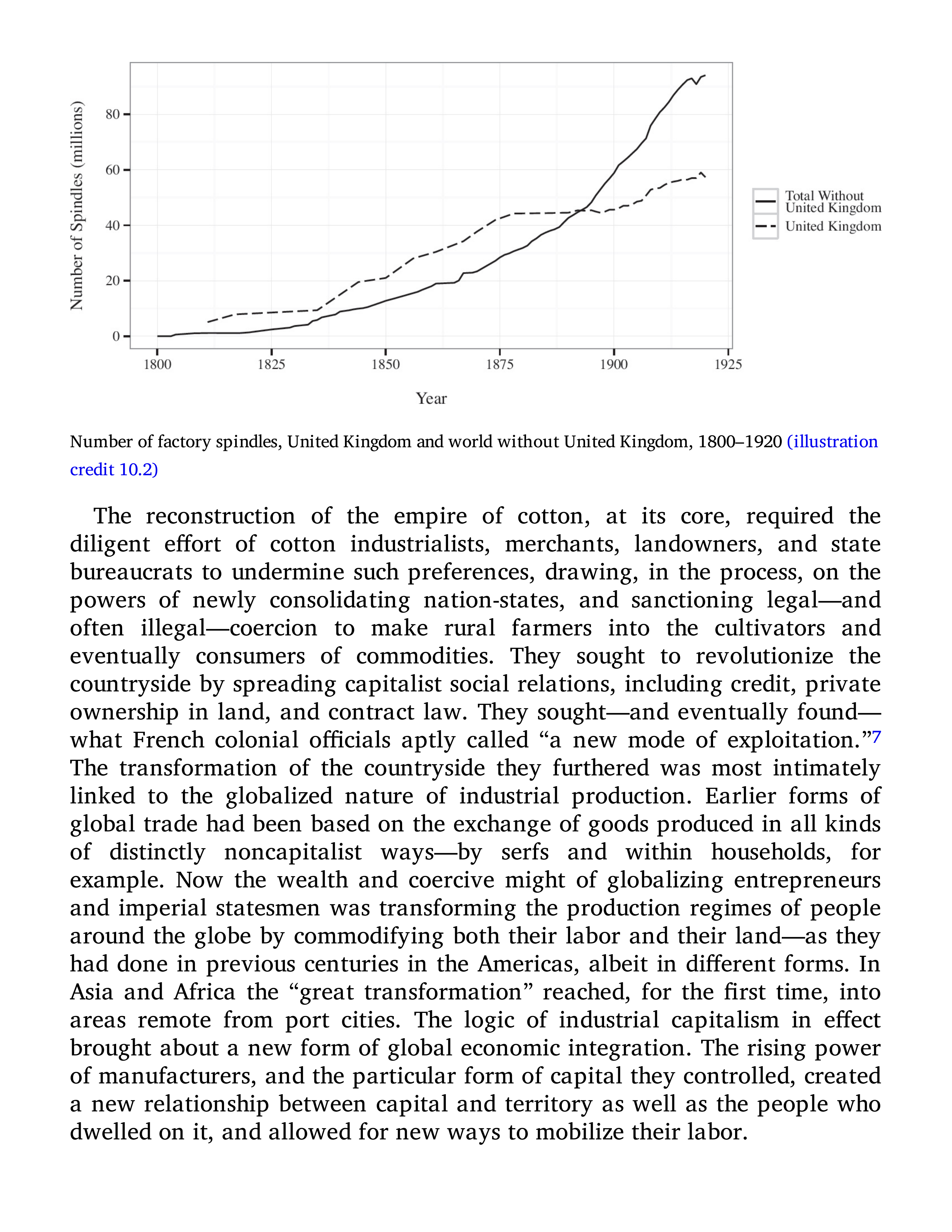
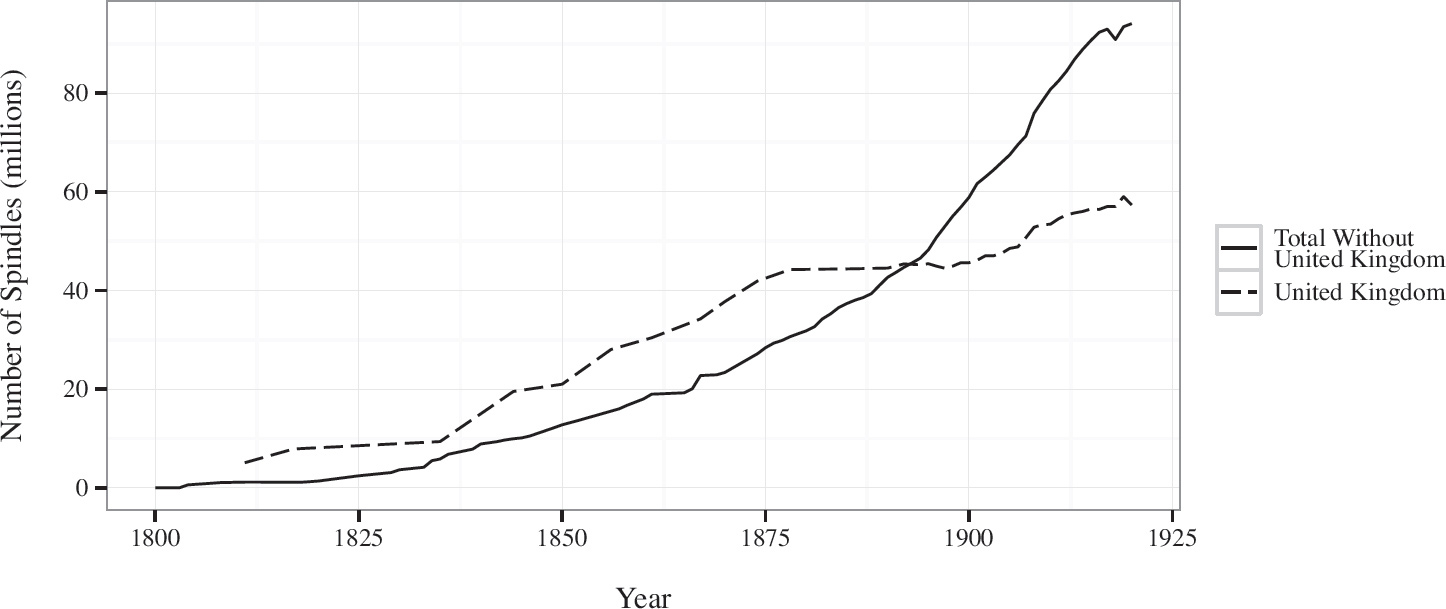
Number of factory spindles, United Kingdom and world without United Kingdom, 1800–1920
(illustration
credit 10.2)
The reconstruction of the empire of cotton, at its core, required the
diligent e
ʃort of cotton industrialists, merchants, landowners, and state
bureaucrats to undermine such preferences, drawing, in the process, on the
powers of newly consolidating nation-states, and sanctioning legal—and
often illegal—coercion to make rural farmers into the cultivators and
eventually consumers of commodities. They sought to revolutionize the
countryside by spreading capitalist social relations, including credit, private
ownership in land, and contract law. They sought—and eventually found—
what French colonial o
ɽcials aptly called “a new mode of exploitation.”
7
The transformation of the countryside they furthered was most intimately
linked to the globalized nature of industrial production. Earlier forms of
global trade had been based on the exchange of goods produced in all kinds
of distinctly noncapitalist ways—by serfs and within households, for
example. Now the wealth and coercive might of globalizing entrepreneurs
and imperial statesmen was transforming the production regimes of people
around the globe by commodifying both their labor and their land—as they
had done in previous centuries in the Americas, albeit in di
ʃerent forms. In
Asia and Africa the “great transformation” reached, for the
ɹrst time, into
areas remote from port cities. The logic of industrial capitalism in e
ʃect
brought about a new form of global economic integration. The rising power
of manufacturers, and the particular form of capital they controlled, created
a new relationship between capital and territory as well as the people who
dwelled on it, and allowed for new ways to mobilize their labor.
New forms of labor—including new forms of coercion, violence, and
expropriation—spread over ever larger areas of the cotton-growing parts of
the globe. Domination now rested not so much on the authority of the
master but on the purportedly impersonal but far from impartial social
mechanisms of the market, the law, and the state. The new systems of labor
that emerged from these sometimes violent but almost always asymmetrical
struggles between industrialists, merchants, agricultural producers, workers,
rulers, and bureaucrats became the mainspring of the production of cotton
until the advent of commercially viable mechanical harvesting in the United
States during the 1940s, and of a new global political economy.
8
Even though contemporaries were uncertain if and when American growers
would return to dominating world market production of cotton, no one
doubted that the labor of formerly enslaved cotton growers would be the
foundation of any possible resurgence of American cotton exports, and with
it the revival and continued expansion of the world’s cotton industry. In
1865, merchants, journalists, and diplomats, many from Europe, pored over
maps and tables and sent scouts to the southern countryside to discover
information on what labor system might replace slavery.
9
The core question,
they quickly learned, was whether or not freedpeople would return to the
cotton
ɹelds. Many wondered if former slaves could be kept working on the
land that they had tilled for more than half a century, and if they could be
made to continue growing cotton now that outright bodily coercion had
become illegal. Certainly some optimistic voices could be heard: Boston
cotton manufacturer Edward Atkinson upheld his fervent belief in the
superior productivity of free labor, including in the production of cotton.
Others believed that the “pinchings of want” would “correct” the “prevailing
indolence of the colored people,” forcing them back to the cotton
ɹelds.
10
Yet most were considerably more pessimistic: “The cultivation of the
hitherto great Southern staples, will of necessity be abandoned,” predicted
the
Southern Cultivator
. Cotton merchant J. R. Busk, William Rathbone’s U.S.
agent, while hoping that “the paci
ɹcation of the South will not be
inde
ɹnitely postponed by radical measures,” advised that “negro labour
could not be depended on for next year.” George McHenry from London
went even further and argued in his
The Cotton Supply of the United States of
America
, that only reenslavement would bring forth cotton: “Cotton can
only be cultivated extensively in the Southern States by negro labour, and
negro labour can only be controlled under the semi-patriarchal system called
slavery.” Cotton experts in India concurred, with some self-interest, as the
Bombay cotton commissioner G. F. Forbes predicted that former slaves
would spend their time “sleeping under the nearest tree.”
11
Throughout Europe and the United States, economic and political elites
agreed that former slaves must continue to grow cotton. And they also
agreed that the question of cotton boiled down to labor. As lawyer and
Union general Francis C. Barlow put it to his friend Henry Lee Higginson, a
wealthy Bostonian who hoped in 1865 to purchase a cotton plantation in
the South, “Making money there is a simple question of being able to make
the darkies work.” The question of “negro labor” agitated the minds of
landowners, bureaucrats, former slaves, and self-appointed experts on such
matters from around the globe. As the
Southern Cultivator
summarized that
discussion, “The all absorbing subject, [is] what kind of labor is best for us.”
And indeed, the question of how “to manage negro labor successfully”
ɹlled
the pages of the journal. Many “experts” feared that freedpeople, as they
had in the West Indies a generation earlier, would engage in subsistence
agriculture. To prevent such “evil consequences,” some advocated the
payment of monetary wages, others a system of sharecropping, while again
others preferred an e
ʃort to maintain gang labor. A subscriber from
South
Carolina remarked that “the negro [is] the proper, legitimate and divinely
ordained laborer of the South…[who] has become wild in the exuberance of
his freedom…and will be trained to work as a free man. He cannot be
permitted to become what he is in St. Domingo.” The
Macon Telegraph
of
Georgia put it more succinctly in the spring of 1865: “the great question
now before our people is how to appropriate all the African labor of the
country.”
12
Some of the answers to the question of “how to appropriate all the African
labor of the country” had already been found during the war, when Union
generals and northern investors tried to resurrect cotton production in areas
of the South captured by Union troops. Most prominent were the e
ʃorts on
the Sea Islands o
ʃ the coast of South Carolina and
Georgia—an important
cotton-growing area for many decades—where northerners such as Edward
Atkinson bought cotton plantations and tried to implement their vision of
“free labor.” They foresaw a world in which freedpeople would continue to
grow export crops for wages, a project they embraced with infectious
enthusiasm. Because freedpeople often had a di
ʃerent idea as to what
freedom entailed—namely, land ownership and control over their labor—
there, as elsewhere, the Union army obliged freed slaves to work for wages
on plantations. Such measures did not bode well for the freed slaves’ hopes
and aspirations.
13
It took a multiyear struggle on plantations, in local courthouses, in state
capitols, and in Washington to determine the outlines of a new system of
labor in the cotton-growing regions of the United States. That struggle
began the moment the
ɹghting ended, when plantation owners, devastated
by the economic and political e
ʃects of defeat in war, sought to restore a
plantation world as close to slavery as possible. To be sure, contracts now
had to be made and wages paid—the
Macon Telegraph
advised its readers in
May 1865 with some regret that “remuneration for labor will hereafter be
necessary”—but beyond that, life was to go on as before. Former slaves,
living in the hovels they had inhabited before emancipation, were to hoe,
plant, weed, and harvest under the supervision of overseers. Money or,
more typically, a share of the crop, would compensate them for their
e
ʃorts.
14
An early 1866 contract of cotton planter Alonzo T. Mial of Wake County,
North Carolina, with twenty-seven freedpeople stipulated work from sunrise
to sunset, with some additional activities after sunset, and a commitment to
“attend to the plantation on Sundays.” There was no pay for sick time or
leaves. The workers received in return ten dollars a month, and an
additional
ɹfteen pounds of bacon and one bushel of meal. Similarly, in the
southwestern corner of Georgia, a prime cotton-growing area, upon
emancipation planters hired their former slaves as wage workers,
unilaterally imposing restrictive conditions and minimal pay—so little that
it amounted to no more than “life’s necessities” plus one-tenth of the corn
crop (and none of the cotton). The situation was nearly the same in the
Yazoo-Mississippi Delta, perhaps the world’s most important cotton-growing
region, where landlords paid wages, but also tried to limit freedpeople’s
mobility and to force them to remain on plantations and plant cotton. Since
most freedmen and -women possessed hardly anything, landlords imposed
these conditions unilaterally, forcing yearlong contracts on their workers,
binding them to the plantation until after harvest time.
15
Left to their own devices, planters imagined a reconstruction of the
empire of cotton based on some form of wage labor, leaving the structure of
land ownership, the rhythm of work, and the pattern of plantation life
largely unchanged. They had powerful allies among the economic and
political elites of Europe whose single-minded focus was on getting more
cotton from the United States.
Planters, however, were not left to their own devices. They encountered
freedpeople determined to create a world radically di
ʃerent from slavery—
indeed, a world in which the production of commodities for international
markets would no longer be their prime concern. Freed people believed, for
good reasons, that only access to land would secure their newfound
freedom, and they argued that their support for the Union war e
ʃort and
their unpaid labor under slavery had given them the right to such lands.
Many believed that upon Union victory, forty acres and a mule would await
them. A group of freedmen in Virginia, for example, had a very clear and
completely accurate idea as to why “we have a divine right to the land.”
They recalled that “our wives, our children, our husbands, has been sold
over and over again to purchase the lands we now locates upon…. And den
didn’t we clear the land, and raise the crops of corn, ob tobacco, ob rice, ob
sugar, ob ebery ting. And den didn’t dem large cities in de North grow up on
de cotton and de sugars and de rice dat we made?” Slavery amounted to the
theft of the just rewards of their labor—a theft now to be compensated by
the redistribution of land.
16
Yet freedpeople’s hope of turning themselves into landowning subsistence
peasants was short-lived. Much of the land con
ɹscated during the war was
returned to its original owners as early as the fall of 1865. Without access to
land, it was di
ɽcult for freedpeople to exert much control over their labor.
With President Andrew Johnson’s lenient Reconstruction policy, moreover,
former slave owners regained much of their political in
ɻuence, and they
used their restored local and regional political power to deploy the
machinery of the state to limit the claims of freedpeople to economic
resources and power. One of the
ɹrst things these “reconstructed” state
governments did was to try to enforce labor discipline and keep workers on
plantations. So-called black codes, passed as early as November 1865 in
Mississippi, required freedpeople to sign labor contracts that de
ɹned
mobility as “vagrancy.” And although the federal government, via the
Freedmen’s Bureau, corrected some of the most
ɻagrant violations of “free
labor,” many in the U.S. government also believed that the coercive power
of the state was needed to transform freedpeople into wage workers. An
assistant commissioner of the Freedmen’s Bureau for Louisiana argued in
July 1865, for example, that it was necessary “that freedmen everywhere be
enjoined to work, and in doing so, they will, in all cases, enter into free and
voluntary contracts.” The irony of being freely enjoined escaped this
commissioner, and many others. Indeed, freedpeople not employed were
threatened
with
compulsory
labor.
17
Northerners
legitimized
these
“compulsory contracts,” as historian Amy Dru Stanley has called them, as a
measure to help guide freedpeople into freedom. At the same time,
alternative ways of gaining access to subsistence, such as allowing animals
to graze on public lands, hunting,
ɹshing, and gathering fruits and nuts
were increasingly restricted.
18
Cotton capitalists generally welcomed such measures, with the
Commercial
and Financial Chronicle
, speaking for New York’s business community,
expressing its hope that freedpeople’s mobility “cannot be deemed anything
more than a temporary state of a
ʃairs, to be corrected by the joint inɻuence
of the vagrancy laws and the necessity of the vagrants.” In the face of such
powerful opposition, many freedpeople felt that they “shall be forever made
hewers of wood and drawers of water”—and, we might add, cultivators of
cotton. Divorced from access to alternative means of subsistence—a
situation radically di
ʃerent from rural cultivators in India or Africa—
freedpeople seemed comparatively easy to convert into agricultural
proletarians.
19
Yet the defeat of freedpeople’s aspirations was not the end of the story. So
blatant was the attempt by white southern elites to reimpose a system of
labor akin to slavery, and so
ɻagrant was their eʃort to ignore their defeat
in war, that northerners began to mobilize against the Reconstruction
policies of President Johnson. Thanks to the e
ʃorts of former slaves and
their northern allies, freedpeople in 1866 gained citizenship rights, and in
1867 the right to vote, which allowed them to use their growing political
power to improve their situation on plantations. By 1867, Congress had
reestablished military authority over southern states. Northern support and
the political mobilization of freedpeople in turn made black workers more
able to articulate their demands on plantations themselves, and by 1867
“freedpeople walked out of the
ɹelds and oʃ their jobs.” They were helped
by a shortage of labor, the result of men working fewer hours than they had
under slavery and many women and children retreating from
ɹeld labor
altogether. Consequently, slaves managed to negotiate somewhat better
contracts. Contracts in the Delta, for example, paid higher wages and
o
ʃered better conditions than those of the previous year. Moreover,
freedwomen, who had an increasingly di
ɽcult time ɹnding a place for
themselves and their children in a plantation world that favored physically
strong men, struggled and mobilized for their own inclusion into the world
of labor contracts. Such were the “weapons of the weak.”
20
Even more important, freedpeople demanded to work independently, in
family units, and with access to subsistence crops. Planters were now unable
to unilaterally dominate work arrangements. Freedpeople, in turn, were still
unable to own land. By 1867, neither was able to impose their will entirely
on the other. Consequently, a social compromise emerged, in which African-
American families worked particular plots of land without day-to-day
supervision, received supplies from landlords, and would then be paid with
a share of the crop they had grown. Such sharecropping arrangements
spread like wild
ɹre through the cotton-growing regions of the United States,
with gang labor, the prevalent system during slavery, nearly disappearing.
As the
Southern Cultivator
observed in November 1867, the “
ɹrst change that
must occur…is the subdivision of landed estates.” By 1868, even the Yazoo-
Mississippi Delta saw widespread sharecropping, and by 1900 more than
three-quarters of all black farmers in Arkansas, South Carolina, Mississippi,
Louisiana, Alabama, and Georgia were sharecroppers, retaining a share of
the crop, or renters, who paid a
ɹxed sum to the landowner but retained the
crop.
21
Alonzo T. Mial now discarded signed wage contracts with his liberated
former slaves and subdivided his plantation into plots for sharecropping. As
elsewhere in the South, the precise character of these arrangements varied—
sometimes Mial agreed to a division of the crop, sometimes he rented land
for
ɹxed quantities of certain crops or even for outright money payments. In
a typical sharecropping contract, Mial gave access to thirty to thirty-
ɹve
acres of land to a sharecropper, along with farming implements. In turn, he
received half of the harvest. Mial’s tenants were contractually obliged to
build fences, repair bridges, clean stables, dig ditches—all of which was “to
be done to my satisfaction, and must be done over until I am satis
ɹed that it
is done as it should be.” In short, he concluded, “All must work under my
direction.” For Mial, sharecropping reduced supervision costs, while still
giving him the power to direct tenants and to decide which crops to grow.
22
The spread of sharecropping as the dominant system of labor in the
cotton-growing regions of the United States testi
ɹed to the collective
strength of freedpeople, allowing them to escape a far worse system of gang
labor for wages on plantations. Sharecropping gave freedmen and -women
a modicum of control over their own labor, allowed them to evade day-to-
day supervision so reminiscent of slavery, and permitted families—instead
of individuals—to contract with landowners and to decide on the allocation
of the labor of men, women, and children.
Yet in many ways, theirs was a hollow victory. The emerging patterns of
land ownership, systems of labor, and the mechanism of credit supply made
all but certain that farmers in the American South would have to grow
cotton, and that growing cotton would create poverty. When planters and
merchants provided croppers with the supplies they needed, they charged
exorbitant interest. Consequently, the crop was barely su
ɽcient to pay
creditors at the end of the harvest season. On the Runnymede Plantation in
Le
ɻore County in the Mississippi Delta, for example, croppers paid 25
percent interest to purchase food and 35 percent to purchase clothing. High
debts to merchants and landlords in turn forced sharecroppers to grow ever
more cotton, the only crop that could always be made into money, even
though its proceeds per bale diminished. Operating in an environment of
expensive credit, a marginal position in the nation’s political economy, and
falling prices, rural cultivators watched their incomes deteriorate, a fate
they shared with most farmers across the globe who now produced for world
markets.
23
The measure of their defeat became especially clear after 1873, as the
economic and political environment shifted drastically. That year marked
the onset of the greatest international economic crisis of the nineteenth
century to date. The rate of growth of demand for cotton plunged below its
antebellum averages, just when many new producers turned out ever more
cotton. With world market prices for cotton declining, pro
ɹts for growers
diminished. At the same time, the structure of tenancy, debt, and the
marketing of the crop in the postbellum South continued to create enormous
pressure on farmers to produce ever more cotton, despite—or even because
of—falling prices. While it was perfectly rational for each farmer to
embrace cotton, such a concentration was self-defeating for the region as a
whole.
24
As the economic situation of cotton growers deteriorated, and as northern
willingness to intervene on behalf of the freedpeople waned, their political
strength diminished as well. Landowners violently repressed black collective
action, increasingly reasserting their own political power. They captured
control of state legislatures, and these newly constituted “redeemer”
legislatures proceeded to disenfranchise black cotton growers, ensured that
their children would be crippled by poor-quality schooling, and refused them
access to legal protection. Landowners backed up their return to political
dominance over the governmental institutions of the South with an
unprecedented campaign of violence expressly designed to curtail cotton
growers’ political activities: Lynchings in the Mississippi Delta alone
numbered a hundred between 1888 and 1930. For cotton merchants in
Europe the planters’ return to political power was welcome news, Baring
Brothers London receiving a telegram on September 16, 1874, from the New
Orleans
ɹrm
Forstall and Sons, “State government overturned by people
conservative o
ɽcers in power.”
As landowners secured more political power, they moved quickly to
control African-American labor. When post-Reconstruction redeemer
legislatures altered lien laws to give landlords a primary claim on the cotton
crop, indebted freedpeople sank to a state of dependency without even the
little bargaining power their sharehold had once provided. Another blow
came when legislators modi
ɹed “criminal law to make plantation workers
susceptible to arrest, conviction, and prison sentence [for indebtedness],
stripping sharecroppers of rights to growing crops, thereby reducing them to
the legal equivalent of wage workers, and curtailing customary rights to the
bounty of nature.” In 1872, the Georgia state supreme court went so far as
“den[ying] croppers decision-making prerogatives and legal rights to their
growing crops.” Indeed, increasingly the courts de
ɹned sharecroppers not so
much as tenants but as wage workers. Simultaneously, landowners used the
machinery of the state to limit the mobility of labor. In 1904, for example,
the Mississippi state legislature enacted a new vagrancy law aimed at
driving “negro loafers to the
ɹeld.” The relationship between landlords and
rural cultivators might have been fundamentally di
ʃerent from what it had
been during slavery, but by the turn of the century, cotton growers still lived
in grinding poverty with few rights and no political voice.
25
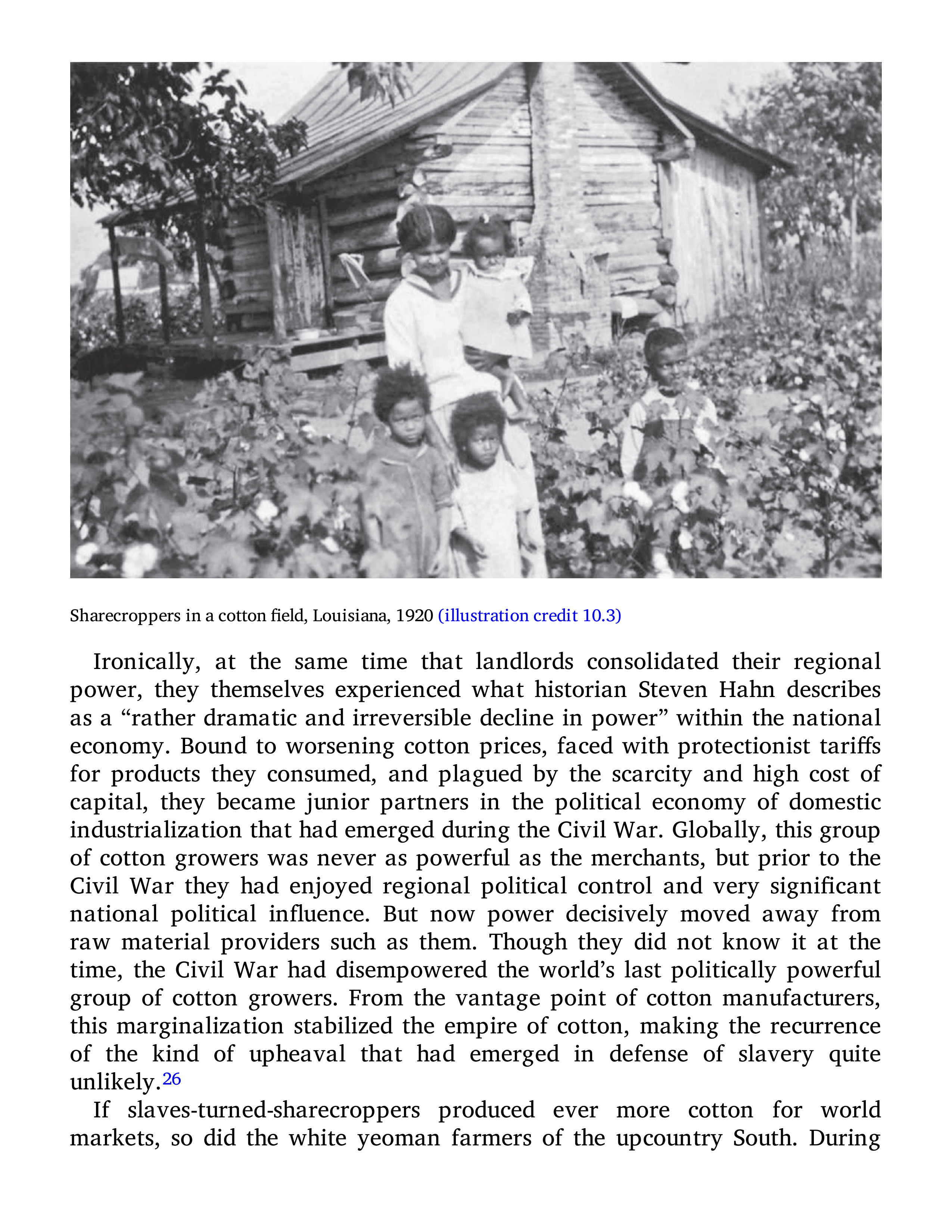
Sharecroppers in a cotton
ɹeld,
Louisiana, 1920
(illustration credit 10.3)
Ironically, at the same time that landlords consolidated their regional
power, they themselves experienced what historian Steven Hahn describes
as a “rather dramatic and irreversible decline in power” within the national
economy. Bound to worsening cotton prices, faced with protectionist tari
ʃs
for products they consumed, and plagued by the scarcity and high cost of
capital, they became junior partners in the political economy of domestic
industrialization that had emerged during the Civil War. Globally, this group
of cotton growers was never as powerful as the merchants, but prior to the
Civil War they had enjoyed regional political control and very signi
ɹcant
national political in
ɻuence. But now power decisively moved away from
raw material providers such as them. Though they did not know it at the
time, the Civil War had disempowered the world’s last politically powerful
group of cotton growers. From the vantage point of cotton manufacturers,
this marginalization stabilized the empire of cotton, making the recurrence
of the kind of upheaval that had emerged in defense of slavery quite
unlikely.
26
If slaves-turned-sharecroppers produced ever more cotton for world
markets, so did the white yeoman farmers of the upcountry South. During
slavery, little cotton had been produced by white yeoman farmers, who
typically grew subsistence crops. Yet after the war the situation changed: In
areas where cotton production had once been marginal, and in which
households relied on subsistence crops and household manufacturing for
their livelihood, growing cotton became the order of the day. In the majority
white farms of the Georgia upcountry, for example, the amount of cotton
produced per thousand bushels of corn—a subsistence crop—tripled between
1860 and 1880.
27
What explains this expansion of cotton production by yeoman farmers? In
the wake of the war, transportation, communications, and selling facilities
spread rapidly into formerly isolated areas of the South. Railroad mileage in
Georgia had, for instance, tripled during the 1870s. The infrastructural
penetration of new cotton-growing territories transformed the countryside.
With the railroads came stores and merchants, as well as ginning and
pressing facilities. Yeoman farmers, devastated by the war, now raised
cotton to gain access to cash. As merchants moved into even the smallest
hinterland towns, yeoman farmers could easily sell that cotton, while at the
same time enjoying broader access to manufactured goods, fertilizers, and,
importantly, credit. “Such credit was important to recover from the e
ʃects of
the war,” observed a German social scientist in 1906, “but once enmeshed in
the credit system, farmers were also forced to grow ever more cotton,
because merchants would only place liens against a crop that could be easily
sold.” Many white farmers lost their farms as a result, and by 1880 one-third
of them rented the land they worked on. In e
ʃect, the capitalist
transformation of yeoman farmers made them more like their black
sharecropping brethren: Increasingly these whites lost control of the only
things they owned—their land and their subsistence crops. Yet their shift in
crops was exceedingly important to the global cotton economy. White
yeoman farmers had produced at most 17 percent of all U.S. cotton before
the Civil War; by 1880 their share had increased to 44 percent.
28
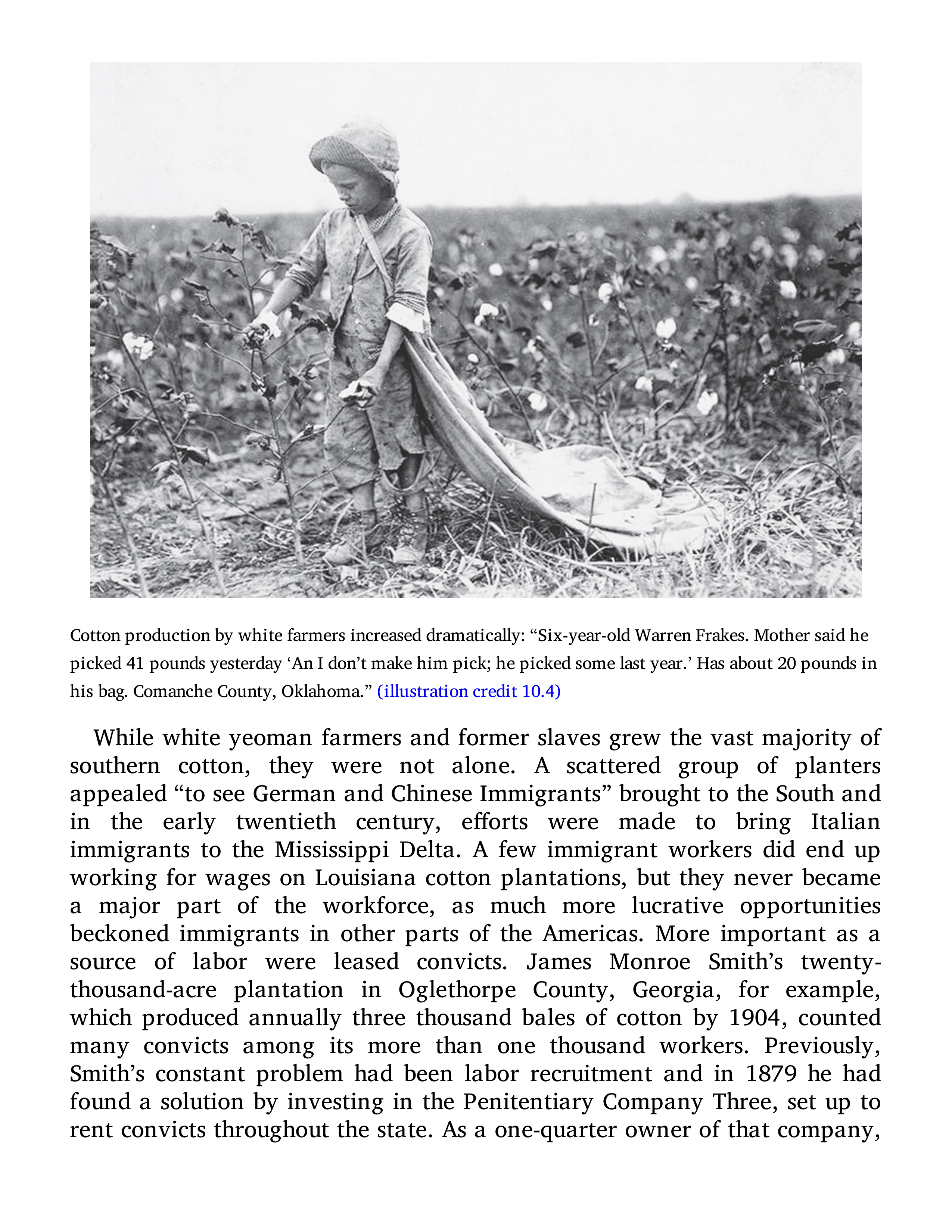
Cotton production by white farmers increased dramatically: “Six-year-old Warren Frakes. Mother said he
picked 41 pounds yesterday ‘An I don’t make him pick; he picked some last year.’ Has about 20 pounds in
his bag. Comanche County, Oklahoma.”
(illustration credit 10.4)
While white yeoman farmers and former slaves grew the vast majority of
southern cotton, they were not alone. A scattered group of planters
appealed “to see German and Chinese Immigrants” brought to the South and
in the early twentieth century, e
ʃorts were made to bring Italian
immigrants to the Mississippi Delta. A few immigrant workers did end up
working for wages on Louisiana cotton plantations, but they never became
a major part of the workforce, as much more lucrative opportunities
beckoned immigrants in other parts of the Americas. More important as a
source of labor were leased convicts. James Monroe Smith’s twenty-
thousand-acre plantation in Oglethorpe County, Georgia, for example,
which produced annually three thousand bales of cotton by 1904, counted
many convicts among its more than one thousand workers. Previously,
Smith’s constant problem had been labor recruitment and in 1879 he had
found a solution by investing in the Penitentiary Company Three, set up to
rent convicts throughout the state. As a one-quarter owner of that company,
Smith had access to one-quarter of its convicts. In addition, Smith employed
convicts from local jails. These workers were treated with great violence,
shot dead if they tried to escape. So harsh was the treatment that Smith was
eventually the subject of a state inquiry and an 1886 letter writer to the
Cartersville Courant
accused him of severely whipping convicts, noting that
some prisoners received as many as 225 lashes—a charge he denied.
29
As Smith’s example shows, the mobilization of labor for cotton growing in
the United States went hand in hand with coercion. The degree of violence
was in some ways surprising, considering that freedpeople’s transition to
proletarian agricultural labor was much easier to e
ʃect than that of Indian
or African rural cultivators, who enjoyed a greater degree of control over
land and their labor. Yet the violence descending upon the countryside of
the U.S. South testi
ɹed in an indirect way to the enormously powerful desire
of freedpeople for a di
ʃerent way of life and was as much a sign of the
weakness of landowners as their strength. It took the determined initiative
of landowners in alliance with the state to guarantee that rural cultivators’
e
ʃorts at building subsistence-oriented economies were undermined and
their labor deployed for the production of agricultural commodities for
world markets. Few observers in 1865 had expected such a spectacularly
successful transition away from slavery and toward new systems of labor—a
transition that
ɹlled with hope the hearts of imperial statesmen and
metropolitan cotton manufacturers the world over.
30
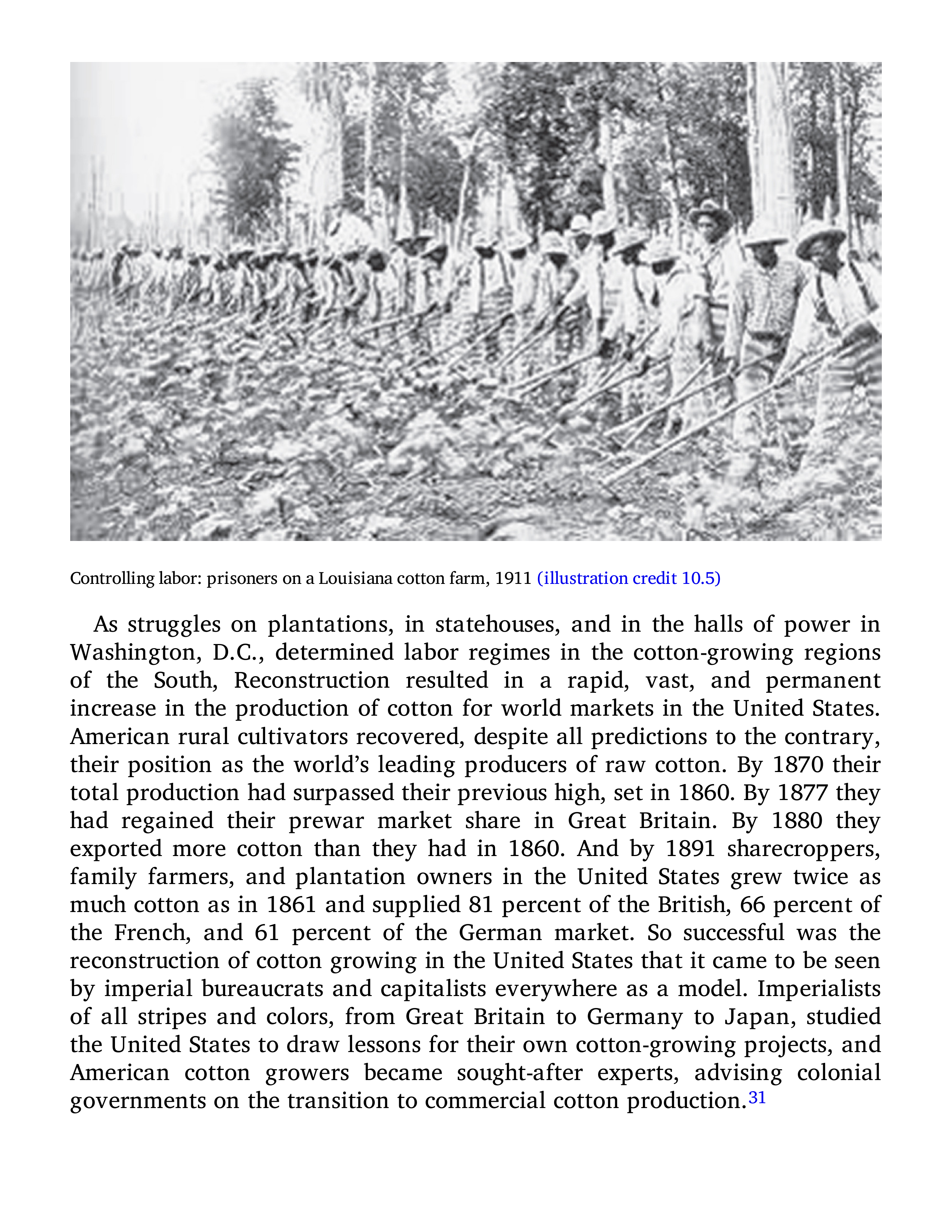
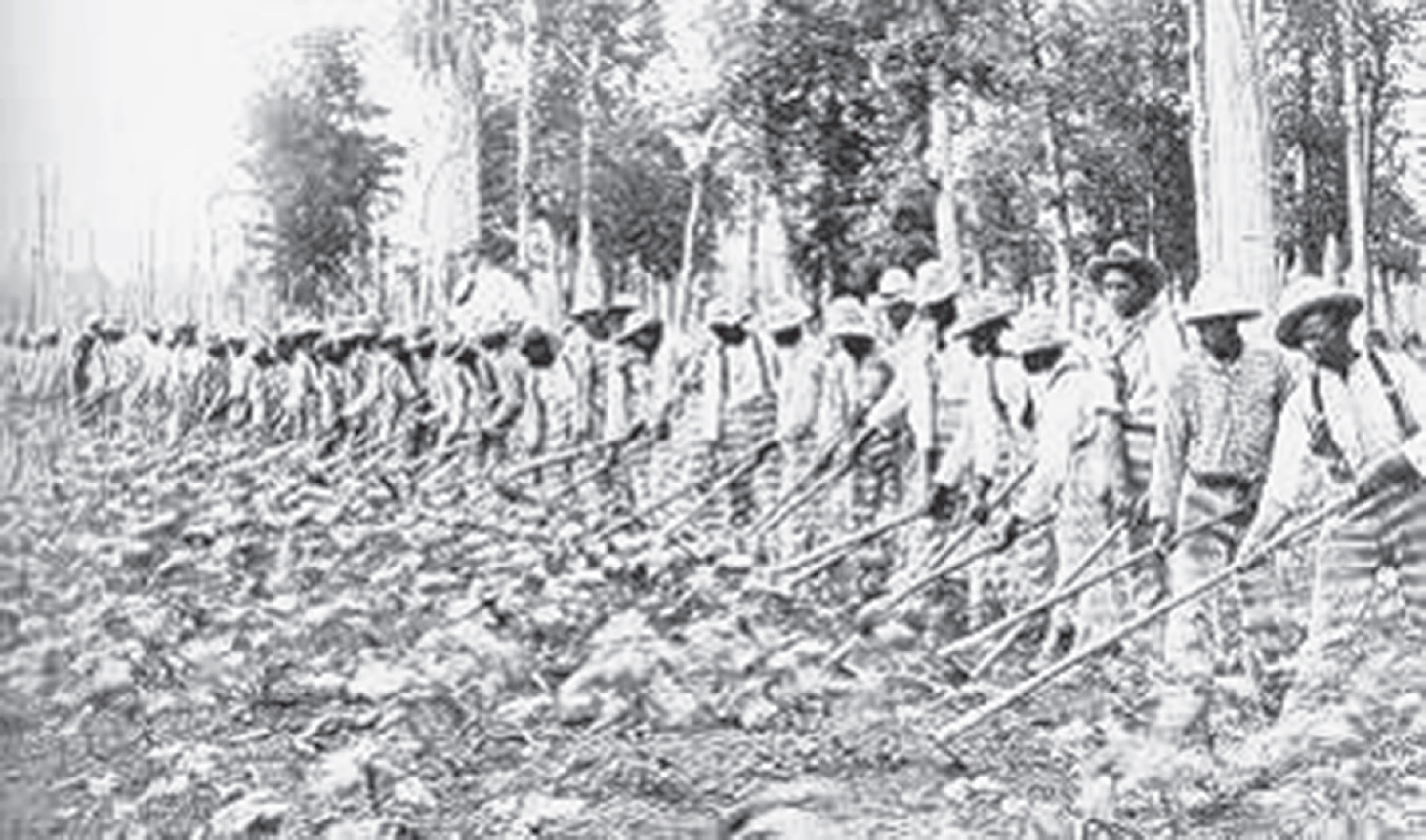
Controlling labor: prisoners on a Louisiana cotton farm, 1911
(illustration credit 10.5)
As struggles on plantations, in statehouses, and in the halls of power in
Washington, D.C., determined labor regimes in the cotton-growing regions
of the South, Reconstruction resulted in a rapid, vast, and permanent
increase in the production of cotton for world markets in the United States.
American rural cultivators recovered, despite all predictions to the contrary,
their position as the world’s leading producers of raw cotton. By 1870 their
total production had surpassed their previous high, set in 1860. By 1877 they
had regained their prewar market share in Great Britain. By 1880 they
exported more cotton than they had in 1860. And by 1891 sharecroppers,
family farmers, and plantation owners in the United States grew twice as
much cotton as in 1861 and supplied 81 percent of the British, 66 percent of
the French, and 61 percent of the German market. So successful was the
reconstruction of cotton growing in the United States that it came to be seen
by imperial bureaucrats and capitalists everywhere as a model. Imperialists
of all stripes and colors, from Great Britain to Germany to Japan, studied
the United States to draw lessons for their own cotton-growing projects, and
American cotton growers became sought-after experts, advising colonial
governments on the transition to commercial cotton production.
31
The emergence of new forms of cotton-growing labor in the United States
was, in the wake of the emancipation of the world’s preeminent cotton
growers, the single most important change within the empire of cotton. Yet
in other parts of the world, partly encouraged by the crisis of cotton
production in the United States, manufacturers, merchants, and bureaucrats
accelerated the transformation of the countryside that had already begun
during the Civil War, though by varied methods and with divergent results.
Thanks to their activities, between 1865 and 1920 several million
sharecroppers, wage workers, and peasant operators in Asia, Africa, and the
Americas began to grow the white gold for the spinning mills of Europe and
North America, and by the turn of the century, for factories in Japan, India,
Brazil, and China as well.
In the last decades of the nineteenth century it was India that experienced
the most dramatic expansion of cotton production for world markets.
Indeed, at the end of the Civil War in the United States, the Bombay
Chamber of Commerce had already observed that the “emancipation of
American slaves [was] a matter of paramount importance” for the future of
India’s cotton industry, signifying a permanent change in the social
structure of a large swath of the Indian countryside and in the trade of
India. While Indian rural producers were not able to hold on to their
dominant position in world cotton markets after the war (especially after
1876), their production for export still rose rapidly, expanding from 260
million pounds in 1858 to nearly 1.2 billion pounds in 1914. Export
merchants, however, no longer sold most of this much larger crop to
manufacturers in India’s two traditional markets—Great Britain and China
—but instead found buyers in continental Europe and, after the turn of the
century, among Japanese spinners. By 1910, only 6 percent of Indian cotton
exports went to Great Britain, while Japan consumed 38 percent, and
continental Europe 50 percent. Continental and Japanese manufacturers, in
contrast to their British counterparts, had adjusted their machines to work
up the shorter Indian staple, successfully mixing Indian with American
cotton, producing coarser cloth. As a result, in the thirty years after 1860,
continental European consumption of Indian cotton increased sixty-two-
fold, “a substantial help,” as the Bremen Chamber of Commerce put it in
1913. To supply these needs, cotton acreage in India expanded, and by the
late 1880s in some areas of India (such as Berar) one-third of all land was
under cotton. This expansion of export occurred simultaneously with an
explosion in the number of mechanized spindles in India itself. Indeed, by
1894, less than 50 percent of the Indian cotton harvest was exported, as
Indian cotton mills consumed about 518 million pounds of cotton and an
additional 224 to 336 million pounds were used in hand spinning.
32
While Indian cotton played an important role in the coarse goods market,
Brazilian cotton matched the quality of the U.S. crop much better. As a
result, in Brazil cotton exports expanded in the last third of the nineteenth
century. During the 1850s they had averaged 32.4 million pounds per year.
During the following three decades, Brazil exported an average of 66.7
million pounds of cotton annually—despite the simultaneous growth of
domestic cotton manufacturing by a factor of
ɹfty-three. In 1920, Brazil
produced 220 million pounds of cotton, of which it exported one-quarter.
33
Meanwhile in Egypt, fellaheen had quintupled their cotton production
between 1860 and 1865 from 50.1 million to 250.7 million pounds. To be
sure, Egyptian cotton was of much higher quality than much of the U.S.
crop; it was, as Roger Seyrig, a French cotton manufacturer observed, “an
article of luxury.” After the U.S. Civil War, its production at
ɹrst fell
signi
ɹcantly to about 125 million pounds, but by 1872 merchants shipped
again more than 200 million pounds from the port of Alexandria to
European destinations. Even during the post–Civil War trough of cotton
production, Egypt’s output was still two and a half times as large as it had
been before the Civil War. And by 1920, it produced 598 million pounds of
cotton, or twelve times as much as in 1860. A full 40 percent of all land in
Lower Egypt was planted in cotton. To some, Egypt now seemed like a
giant cotton plantation.
34
By the last third of the nineteenth century, Egyptian, Brazilian, and
Indian cotton had become a signi
ɹcant new presence on world markets. In
1883, cotton from these regions had captured a full 31 percent of the (now
much larger) continental European market, or a little more than twice as
much as in 1860.
35
The expansion of cotton growing on multiple continents was all the more
remarkable because it happened without slavery. The problem that had
vexed cotton capitalists since the 1820s, namely how to make nonenslaved
rural cultivators into growers of cotton for world markets, moved toward a
resolution that seemed to please the interests of European and North
American cotton manufacturers and statesmen. Yet, as in the American
South, which in many ways came to serve as a model of how such a
transition could be e
ʃected, the precise ways in which rural cultivators
became growers of cotton for world markets varied widely and were the
outcome of drawn-out con
ɻicts among labor, landowners, providers of
capital, and imperial bureaucrats.
What all these struggles to recast the global countryside had in common
was that states now played an important role. New forms of coercion,
instituted and carried out by the state, replaced the outright physical
violence of masters that had been so important to slave labor. This does not
mean that physical violence was absent, but it was secondary compared to
the pressures that came from contracts, the law, and taxation. As states
developed new sovereignty over territory they also extended their
sovereignty over labor, testifying to the new institutional strength of
industrial capitalism.
Khamgaon was a small city, a town really, in Berar, the center of the large
western Indian district that had long been renowned for the quality of its
cottons. Decades before the arrival of the British, some of this cotton had
been exported on bullock carts to Mirzapore on the Ganges and then
shipped to Calcutta, but farmers never specialized exclusively in the
ɹber
and grew many other things as well, while also engaging in spinning and
weaving. Indeed, the trade in “raw thread” spun locally had dwarfed the
trade in raw cotton. Things began to change by 1825 with the rise of an
export market in raw cotton, when the Parsi merchants Messrs. Pestanji and
Company brought the
ɹrst cotton on “pack oxen” to
Bombay. Dissatis
ɹed
with the slow expansion of that trade, Britain assumed political control over
Berar in 1853—a position that served Lancashire manufacturers well when
during the American Civil War Berar became “one of the very
ɹnest cotton
ɹelds in India.”
36
As the British colonial administration and Lancashire manufacturers saw
the potential of Berar as a major cotton-growing area, and upon the urgings
of British manufacturers, the colonial state completed in 1870 a railroad to
Khamgaon (paid for by Berar’s “surplus revenue”), which now had an
estimated nine thousand inhabitants. “The last obstacle has been removed,
and for the future direct communication by steam exists between this the
largest emporium of cotton in Western India and the ports of Europe, which
will take every bale that can be brought into its market,” celebrated Mr. C.
B. Saunders, the British resident at Hyderabad. When the railroad arrived in
Khamgaon, none other than the viceroy himself spoke at the opening
celebration, a day on which “the Court House, the Factories, the Cotton
Market, and every prominent point were gaily decked with
ɻags.” He
reminded his listeners, many of whom were cotton merchants, that “we all
know that the cotton famine in America had a great deal to do in
stimulating the development and production of cotton in this country.” Such
new production for world markets, he argued, not only bene
ɹted the
development of India itself, but was also “conferring vast bene
ɹts on a class
which at a very recent period, in a time of great su
ʃering and distress,
displayed
almost
heroic
qualities”—the
operatives
in
the
cotton
manufacturing districts of Lancashire. Symbolizing the centrality of cotton
to the colonial project in Berar, the viceroy eventually “drove to the cotton
market, in which a monster triumphal arch, composed chie
ɻy of cotton
bales, had been erected” in his and the new railroad’s honor.
37
With the railroad came the telegraph. Now a Liverpool merchant could
wire an order for cotton to Berar and receive it on the docks of the Mersey
just six weeks later, the journey on a steamer from Bombay to Liverpool
accomplished in twenty-one days thanks to the newly opened Suez Canal.
38
The impact of such infrastructure projects was staggering, with Berar cotton
commissioner Harry Rivett-Carnac expecting that soon
the cotton grown around Khamgaon, purchased at the market there,
and pressed at the adjoining factories, may not have to leave the rails,
from the time that it is rolled from the press-house into the wagon, until
its arrival on the wharf at Bombay; and it will not be di
ɽcult to
calculate the time that will be necessary, with the assistance of the
telegraph which joins Khamgaon and Liverpool, the complete railway
communication between the market and the port of shipment, and
with, perhaps, the Suez Canal to assist still further in the transport of
our cotton, to execute an order sent from Liverpool and to land the
required number of Khamgaon bales in Lancashire.
39
British India might indeed be considered the archetype for the
ɻexible
pragmatism by which states helped capitalists gain access to cotton-growing
labor, and how capitalists then found ways to mobilize that labor. Pushed by
Lancashire manufacturers and cotton merchants from Liverpool to Bombay,
the British colonial government in India continued its project, which had
accelerated signi
ɹcantly during the U.S. Civil War, of promoting the
transformation of the cotton-growing countryside. The impact was swift: As
late as 1853, Berar had remained largely removed from world markets, with
a village-oriented economy with a substantial household manufacturing
sector. By the 1870s, however, much of Berar’s economic activity focused on
the production of raw cotton for world markets. A British colonial o
ɽcial
observed by the middle of that decade that in Berar, “Cotton is grown
almost entirely for export. The manufacture of home cloth has been
undermined by the importation of English Piece Goods, and many of the
weaver class have become ordinary labourers.” This reorientation of the
local economy also pushed people into agricultural labor, as for example the
banjaras
(traditional owners of carts who had transported cotton), and
weavers as well as spinners, found themselves out of employment and
increasingly dependent on agricultural pursuits. Indeed, forty years later a
gazetteer could report that Berar’s once thriving cotton manufacturing
industry had all but disappeared “since the advent of the railway.”
40
As
Rivett-Carnac explained in 1869,
Now it is not too much to hope, that, with a branch railway to this
tract, European piece goods might be imported so as to undersell the
native cloth. And the e
ʃect would be, that, not only would a larger
supply of the raw material be obtained,—for what is now worked up
into yarn would be exported,—but the larger population now employed
in spinning and weaving would be made available for agricultural
labour, and thus the jungle land might be broken up and the cultivation
extended.
For Secretary of State for India Charles Wood, such changes to the Indian
social structure produced a sense of déjà vu: “The conclusions drawn from
the Cotton papers are on the whole satisfactory. The Native weavers are
exactly the class of people whom I remember in my early days on the Moor
Edges in the West Riding. Every small farmer had 20 to 50 acres of land,
and two or three looms in his house. The factories and mills destroyed all
weaving of this kind, and now they are exclusively agriculturalists. Your
Indian hybrids [that is, people who combined farming with household
manufacturing] will end in the same way.” Contemporaries like Wood
understood that they were part of a grand move to transform the world’s
countryside into the producer of raw materials and consumer of
manufactured goods (as well as, eventually, a supplier of labor to factories),
and they took pride in their role.
41
Altogether, Berar became one of the world’s most signi
ɹcant laboratories
for the reconstruction of the empire of cotton. Its diversi
ɹed agricultural
economy was turned into ever greater specialization on cotton crops. As
The
Asiatic
re
ɻected in 1872, “A pressure unknown before was put upon the
people to grow cotton.” While in 1861 cotton was harvested on 629,000
acres of land in Berar, that acreage had nearly doubled by 1865, and then
doubled once more by the 1880s. By the early twentieth century, Berar alone
produced one-quarter of the Indian cotton harvest—a harvest larger than
that of all of Egypt. As one observer put it, Berar had “become a perfect
garden of cotton.”
42
In Egypt, as in India and the United States, the expansion of cotton
agriculture was a direct result of the powerful interventions of the state. A
rede
ɹnition of
property rights in the last third of the nineteenth century
made possible a massive redistribution of land away from villages and
nomadic peoples to the well-connected owners of huge estates. Before that
transformation, property in Egypt provided the right to shares of the
revenue of the land, which meant that ownership claims to particular pieces
of land were usually shared among various individuals, communities,
religious authorities, and the state.
43
Such multifaceted claims e
ʃectively
hindered the purchase and sale of land; by the later decades of the
nineteenth century such property rights stood in the way of a further
commercialization of agriculture.
As a result, the Egyptian government, motivated by its desire to extract
more taxes to pay for the expansion of the nation’s infrastructure and the
mushrooming service on its enormous debt, as well as its desire to better
control its people, moved toward conferring property rights in very large
estates to well-placed individuals. At
ɹrst these estates were merely “tax
responsibilities” of their owners, but by the 1870s they became their outright
private property, much of which consisted of land taken, usually forcibly,
from villages. Now that the cotton-growing estates increasingly were held as
the outright property of large landowners, the villagers who once had
controlled some of the revenue of the land, and some rights of settlement,
fell entirely on the mercy of these landowners. These new estate owners
could force peasants to live in special “private villages” that controlled most
aspects of their lives. Those cultivators who did not do what was asked of
them were expelled, joining the ever-growing ranks of the landless
agricultural proletariat.
44
The rights of the new owners were far-reaching, including their ability to
“imprison, expel, starve, exploit, and exercise many other forms of
arbitrary, exceptional, and, if necessary, violent powers.” As a result, these
estates represented a “system of supervision and coercion that succeeded for
the
ɹrst time in ɹxing cultivators permanently on the land.” To make land
into the exclusive possession of single individuals had required what
political scientist Timothy Mitchell has described as the “violence of
property making.” These new property rights spread rapidly: In 1863, estate
owners controlled one-seventh of the cultivated land area of Egypt, by 1875
almost twice as much, and by 1901 a full 50 percent.
45
In 1895, just 11,788
individuals held nearly half of all lands in Egypt, while the other half was
held by 727,047 proprietors. Some of these estates were huge; Ibrahim
Mourad, for example, controlled thirteen thousand acres in Toukh, worked
by twenty thousand cultivators, dwarfed only by the mammoth estates that
Egypt’s ruler, Isma’il Pasha, had personally seized.
46
As elsewhere, the transformation of the Egyptian cotton-growing
countryside rested on a vast pyramid of credit. At the bottom, workers on
cotton estates were almost always in debt to moneylenders and landowners,
constantly threatened by debt bondage. Landowners, in turn, received credit
from local merchants, many of them foreigners. The largest landowner of
all, Isma’il, accumulated such debts that in 1878, in the wake of falling
cotton prices, he signed over his estates to his creditors, the Rothschilds. At
the same time, the Egyptian state took out massive loans to
ɹnance the
digging of irrigation canals (largely by resorting to forced labor), the
building of railroads, and the import of steam pumps. So staggering were
the amounts borrowed that the state eventually went bankrupt, despite ever
greater pressure on the Egyptian people to produce for export markets. That
debt brought Egypt as a whole into the arms of the British: With diminishing
proceeds from cotton, Egypt could not service its debt, lost sovereign
control, and was eventually taken over by the British government in 1882.
47
As the examples of Egypt and India show, by the last third of the nineteenth
century, rulers and bureaucrats played a critical role in the e
ʃort to further
cotton growing for world markets. They did so partly because their own
power rested on access to resources and was made more stable by the
relative social peace that came from humming mills. But they also acted at
the behest of powerful capitalists—either because rulers and capitalists were
largely the same group of elites, as in the case of Egypt, or because
statesmen were subject to concerted lobbying and political pressure, such as
in the case of Britain and France and, as we will see, Germany.
States’ desire to mobilize cotton-growing labor now led to unprecedented
claims upon their subjects, as states increasingly de
ɹned and enforced the
rules of the market. From Berar to the Nile Delta to Minas Gerais,
governments and courts undermined older collective claims to resources such
as grazing and hunting rights, forcing peasants to dedicate themselves
single-mindedly to the production of cotton. Berar’s natural landscape, for
example, was turned upside down by a vast British e
ʃort to survey the land,
followed by the encouragement of the British to turn so called “waste lands”
into cotton farms. “Waste lands” once had been open to the collective use of
farmers, but now increasingly were turned into private property. In the
process, extensive forests that traditionally had been the source of
ɹrewood
and wild foods were logged, and grasslands put under the plow that had in
earlier times served as communal grazing lands. Logging further reduced the
forests to feed the steam presses of Western merchants in the major Berar
cotton towns. In some parts of the world, such deforestation led to
signi
ɹcantly altered patterns of rainfall, undermining the very colonial
cotton craze that had incited deforestation in the
ɹrst place.
48
Court-enforced lien laws, moreover, gave creditors another means to
undermine peasants’ claims to the land and enmesh them further in a
quagmire of debt, which forced them to grow ever more cotton. The systems
of mutual dependence and personal domination that had characterized the
countryside of Berar, the American South, and elsewhere before the U.S.
Civil War gave way to a world in which creditors backed by the state turned
rural cultivators into producers and consumers of commodities. As an
anonymous British writer on Indian cotton explained, “Where there is no
intelligent population to lead the way, a Government must do what in more
civilized countries can safely be left to private enterprise.”
49
The creation of private property in land became yet another state-led
project, in India and elsewhere. British cotton manufactures, demanding
that the colonial government “set its colonial house in order,” called for new
forms of land tenure, as they perceived the old system of communal
ownership as “obstructive to the rights of individual ownership, and to its
e
ʃective cultivation.” They saw private property in land as a precondition
for increasing production of cotton. Individuals were to gain clear title in
land that then could be bought, sold, rented, or mortgaged. These new
property rights were quite a departure: In precolonial Berar, for example,
relations between various social groups had been characterized by a
“master-servant relationship of social status in the caste hierarchy” in which
“the produce of the soil…was divided according to social ranking.”
Individuals did not control particular pieces of land, but instead enjoyed
rights to a share of the harvest. A British colonial o
ɽcial perceptively
compared that “system, if system it may be called,” to “medieval Europe.”
Once the British arrived on the scene, however, the land was surveyed,
boundaries between various landowners clearly demarcated, and taxes on
each parcel set. A class of
khatedars
was created who controlled the land,
and in turn were made responsible for tax payments. By 1870, a British
colonial o
ɽcial was able to report that the revolution was succeeding. In
Berar “the occupant of land is its absolute proprietor.” Because the
khatedars
owned land, but no capital, they were dependent on moneylenders, to
whom they now were able to mortgage the land they controlled. To work
the land, these
khatedars
brought in sharecroppers, who in turn received
their working capital from moneylenders. There and elsewhere in India, it
was the large landowners, and moneylenders, who drew signi
ɹcant proɹt
from the extension of cotton culture for export, unlike the vast majority of
small landholders or landless peasants, who entered a morass of debt and
poverty.
50
With private property in land spreading throughout the global
countryside, landowners could now also be made responsible for the
payment of taxes, to be paid in cash, which in turn encouraged the
production of cash crops. In the Indian province of Maharashtra, as in
Berar, British e
ʃorts to increase revenue and encourage peasants to produce
for distant markets led to the weakening of the collective nature of villages.
Individual peasants, instead of villages as a whole, were now responsible
for taxes. Moneylenders thereby gained new power over peasants’ land and
labor, as rural cultivators became dependent on advances to pay their taxes.
In similar ways, in the Çukurova, the Ottoman state increasingly taxed local
populations, and as a result, people had to engage in wage labor, or were
forced to work on infrastructure projects. Cotton production bene
ɹted from
their need for cash—just like in the United States—because “cotton is the
one article,” observed the Cotton Department in Bombay in 1877, “that
always commands the readiest and best sales.”
51
While Indian cotton growers usually held on to their land, unlike
freedpeople in the United States, they had to draw on advances not just for
tax payments, but also to purchase implements, cottonseeds, and even
grains to hold them over until harvest time. New contract laws allowed
these same moneylenders to enjoy a modest security when making advances
to peasants. New property rights in fact favored the commercialization of
agriculture not just because they made for easier land transactions, but also
because they allowed for the infusion of capital, for which the land itself
could now serve as collateral. Cultivators paid exorbitant rates of interest on
these loans (30 percent annually was not unusual), and in turn they signed
over their cotton crop to moneylenders, usually many months before the
harvest—creating what one historian has called “debt bondage.”
52
Moneylenders—
sowkars
—had been deeply rooted in villages and had
advanced credit to peasants for a long time before the arrival of the British.
However, they had been embedded within a moral economy that had forced
them to support peasants in years of poor harvests, a lifeline that
increasingly disappeared in the more commercialized economy that British
colonialism was building. While moneylenders could acquire modest wealth,
and large landowners could bene
ɹt from the availability of capital
(allowing them to focus on a cash crop with hired labor), small landholders,
sharecroppers, and especially landless agricultural wage workers were most
at risk. As prices for cotton continued to fall for nearly thirty years after the
Civil War, this mass of “modernizing” farmers were thrust into more and
more desperate circumstances; many of them would eventually perish in
famines that swept the cotton-growing districts of India during the 1890s.
53
New infrastructures, new laws, and new property rights invaded the
global countryside on the trails of strengthening and expanding states,
making the kind of transformations possible that still had been
unimaginable a few decades earlier. State involvement in cotton was
furthered in many other ways. Perhaps the most comprehensive endeavor
was the systematic e
ʃort to collect and disseminate information about all
aspects of cotton agriculture. Huge compilations about climate and soil
conditions, production trends, patterns of land ownership, seed qualities,
and labor systems increasingly
ɹlled governmental oɽce ɹles, much of the
same information that in previous decades merchants had laboriously
gathered and transmitted via letters or circulars. In part this was a
straightforward
e
ʃort
to
systematize
and
appropriate
indigenous
knowledge. Observing Indian peasants’ e
ʃorts to grow cotton could yield
useful information about best practices under speci
ɹc environmental
conditions, which could then be transferred to Africa or elsewhere. Similarly,
speci
ɹc strains of cotton could be collected and then sent to other parts of
the world—indeed, governments enabled a vastly accelerated circulation of
biological matter throughout the world. But more important than either of
these two tasks was a very simple e
ʃort to take stock—to observe what was
there in the social and natural world, to translate that information into
numbers, force it into tables, compile it, and then send it out throughout the
empire of cotton. These numbers clari
ɹed the “potential” of certain places
and suggested certain policies to actualize that potential.
54
Throughout the cotton-growing world, governments embarked on such
e
ʃorts. In 1866, the colonial government of India created the “Cotton
Commissioner for the Central Provinces and the Berars,” a colonial
bureaucrat who collected scrupulously detailed information on cotton-
growing regions. Harry Rivett-Carnac, an intrepid agent of the cotton
empire’s expansion, came to
ɹll this position, traveling up and down Berar,
living in a railroad carriage “with an attached horse box, so that I could,
whenever necessary, ride o
ʃ to some important point in the district where
my presence was required,” all to “extend and improve the cultivation in
order to increase the supply; then to undertake all necessary measures to
assist the trade in getting these supplies to the coast in good order and
without delay.” The revolutionary transformation of the world’s countryside
rested on the shoulders of such government bureaucrats. By 1873, the Indian
government expanded these activities and centralized them by creating a
Fibres and Silk Branch that studied the production of cotton, among other
ɹbers, throughout India in exacting detail.
55
Other countries followed suit. The United States in 1862 established a
Department of Agriculture, which soon began to work on cotton. The
department
ɹrst collected statistical information, but soon broadened its
activities by studying diseases a
ʃecting the cotton plant, trying to identify
cotton strains particularly suited for particular environmental conditions,
and breeding improved cotton strains. The department also applied itself to
the pressing question of how cotton could be grown in western states such as
Arizona. In 1897, Russia created an Administration of Agriculture and State
Domains in its newly acquired Central Asian possessions, whose focus was
cotton. In Egypt, the government provided detailed information about
agricultural best practices to cotton farmers and by 1919 created a ministry
of agriculture to expand on these e
ʃorts—a model later studied and
appropriated by the Belgian colonial authorities in the Congo.
56
The collection of information went hand in hand with governmental
e
ʃorts to recast cotton agriculture directly: British colonial oɽcials
distributed American cottonseeds to Indian peasants, worked on changing
Indian cotton strains, and encouraged peasants to use new agricultural
methods. The Egyptian Société Royale d’Agriculture experimented with
model farms. Local peasants often resisted such projects, for not only was
the planting of new cotton strains more labor-intensive, but it was also
riskier because they had not been proven in the local climate. Few projects
provided increased remuneration to o
ʃset these burdens, and it took
powerful pressures to make them succeed.
57
Despite working in concert, powerful governments and capital-rich
merchants and landowners did not always accomplish their grand projects.
Government records are replete with e
ʃorts of rural cultivators to delay, or
even halt, the reordering of their economies. In Dhawar in western India,
for example, peasants retained a strong preference for growing indigenous
varieties of cotton, and also for privileging food crops, despite sustained
e
ʃorts by British colonial oɽcials to introduce American varieties. Local
varieties were much better adapted to the local climate, commanded a ready
local market, and
ɹt better into the household economies because they could
be ginned locally.
58
Sudanese peasants, as the Austrian consul general
reported from Khartoum in 1877, refused to grow increasing amounts of
cotton because “the native searches and
ɹnds his means of subsistence in
much easier ways and in less taxing occupations than the di
ɽcult and
relatively unpro
ɹtable cultivation of the soil.” In
Iraq, a German observer
remarked in 1919 that “the awakening of a greater willingness to labor is
prevented by the presence of cultures in the country which provide the
laborer e
ʃortlessly everything he needs for nourishment and for all other
necessities”—an argument made by colonial o
ɽcials the world over. In
Burma, a British bureaucrat regretfully observed “the indi
ʃerence shown to
cotton-growing as a paying industry by the Burmese peasantry themselves,
who look upon it as of very secondary importance and are not likely to take
much interest in cotton while they can make, with much less trouble,
handsome pro
ɹts in their paddy crops.”
59
The signi
ɹcance of these struggles can perhaps best be seen in an area
where production failed, despite decisive e
ʃorts: Australia. Starting in the
early twentieth century, the British colonial administration made e
ʃorts to
grow cotton in a continent with virtually unlimited supplies of land
perfectly suited for cotton agriculture. Despite these e
ʃorts, cotton
production expanded only slowly. The
Adelaide Advertiser
understood the
reasons well: While abundant land was suitable for the growing of cotton,
what was missing was cheap labor to plant, hoe, and harvest the crop. The
chief di
ɽculty facing any sort of expansion, reported the
Advisory
Committee of Science and Industry, “is the high cost of picking by hand.”
Because of the shortage of cheap labor, and because white settlers had
options far better than cotton, the committee observed in 1918 that “cotton
growing in Australia is now practically extinct.” Theo Price, president of the
New York Price-Campbell Cotton Picker Corporation, advising the
government of Australia on such matters in 1917, understood the reasons
perfectly: “Cotton culture is largely a matter of labor. Unless you can be
assured of an abundant supply of labor, it is going to be di
ɽcult to cultivate
cotton on anything like a large scale. I do not know what your immigration
laws in Australia are but if you can bring the Chinese in…. I think [it may]
be practicable to develop cotton growing rapidly.” “Labor conditions,”
concluded the
Sydney Evening News
in 1920, “are not conducive to the
establishment of the cotton industry on an economic basis.” Without access
to abundant cheap labor, the cotton market could not be satiated.
60
Yet despite such setbacks, cotton capitalists sought labor, and ever more of
it. In the cotton-growing regions of India, Brazil, and Egypt, as in the
United States, the empire of cotton expanded as landowners, colonial
bureaucrats, merchants, and local political elites such as the landlords of the
American South were able to turn rural cultivators into producers and
consumers of commodities.
61
The precise arrangements found to mobilize
their labor di
ʃered from place to place because they depended on the
relative local, regional, or colonial distribution of social power.
62
Industrial
capitalism’s great strength derived exactly from its continued ability to
connect to di
ʃerent systems of labor, and especially to draw on the
extraordinary cheapness of production made possible by the incomplete
transformation of the world of rural cultivators, a world in which family
labor often remained uncompensated and subsistence was to some extent
still produced within households. Local and regional circumstances encrusted
in traditions and the distribution of social power shaped the emerging labor
arrangements. It mattered, for example, that cotton growers in the United
States enjoyed access to the franchise for a little more than two decades
(limiting the political power of landowners), just as it mattered that
economies in Africa remained vibrant and largely independent of European
capital. As a result, some rural cultivators turned into sharecroppers, others
into renters, and again others into wage workers. Even as their power and
traditional way of life was steadily stripped away, they still maintained
some in
ɻuence—indeed, they still had more sway over their daily lives than
the millions of unskilled workers laboring in spinning and weaving mills.
63
Rural cultivators, landowners, merchants, and bureaucrats struggled over
the shape of the new empire of cotton and the forms of labor within it,
constrained by the startling imbalances of power in particular locales and
the unequal relationship between various parts of the world. By the end of
the nineteenth century, sharecropping and tenant farming had become the
dominant mode of mobilizing labor for similar reasons that they dominated
in the United States: Rural cultivators preferred the autonomy of working
without day-to-day supervision, and they generally resisted being turned
into wage workers. In Berar, sharecropping tenants worked the land of
khatedar
landowners, receiving their working capital from moneylenders. In
Egypt, most of the crop was grown not by “hired labor,” but instead by
“small occupiers themselves,” some sharecroppers, some owners, all of
whom were able to draw upon the labor of their families; indeed, most
cotton in Egypt was picked by children. In Brazil, sharecropping, along with
small family farms, spread. On large estates tenant families “paid” for their
land rent by giving a share of the crop to the owners. In Peru, landowners
rented their land to cultivators in response to the closing of the trade in
Chinese indentured workers in 1874 and their inability to attract peasants
to work for wages. In the Çukurova, which had been largely unsettled before
the advent of cotton agriculture toward the end of the nineteenth century,
large-scale landholdings were in need of labor, and most of that labor was
recruited through sharecropping arrangements along with some migrant
wage laborers.
64
Wherever sharecropping prevailed, tenant farmers as well as small
owner-operators became dependent on outside capital. In Sind, India, for
example, peasants sold the crop to moneylenders as soon as they had sown
it, to pay for loans they had received to enable them to focus on cotton in
the
ɹrst place, “in part being hard cash, part grain, and cotton seed, cloth,
bajri,
ɻour & c. for the family and workmen.” Moneylending merchants,
there and elsewhere, often determined the farming decisions of peasants,
since they were the ones who advanced seeds and implements. Interest rates
between 12 and 24 percent were typical, but could skyrocket to as much as
150 percent annually. In the Çukurova sharecroppers drew on credit from
landowners and merchants, who charged interest rates of 15 to 20 percent,
and as a result, “Merchant capital, despite the limitations of labor scarcity,
gained control over the land and the production process.”
65
Thus by the end of the nineteenth century most of the world’s cotton
would be grown by cultivators who worked their own or rented land with
family labor, but instead of subsistence or local production, these cultivators
would be drawn into the global cotton market by a novel infusion of
metropolitan capital. Sharecropping, crop liens, and powerful local
merchants in control of capital would quickly become the new normal,
shaping a countryside of laborers who were not enslaved, but not quite free
either. These cotton farmers, the world over, would be deeply enmeshed in
debt, vulnerable to world market
ɻuctuations, generally poor, and subject to
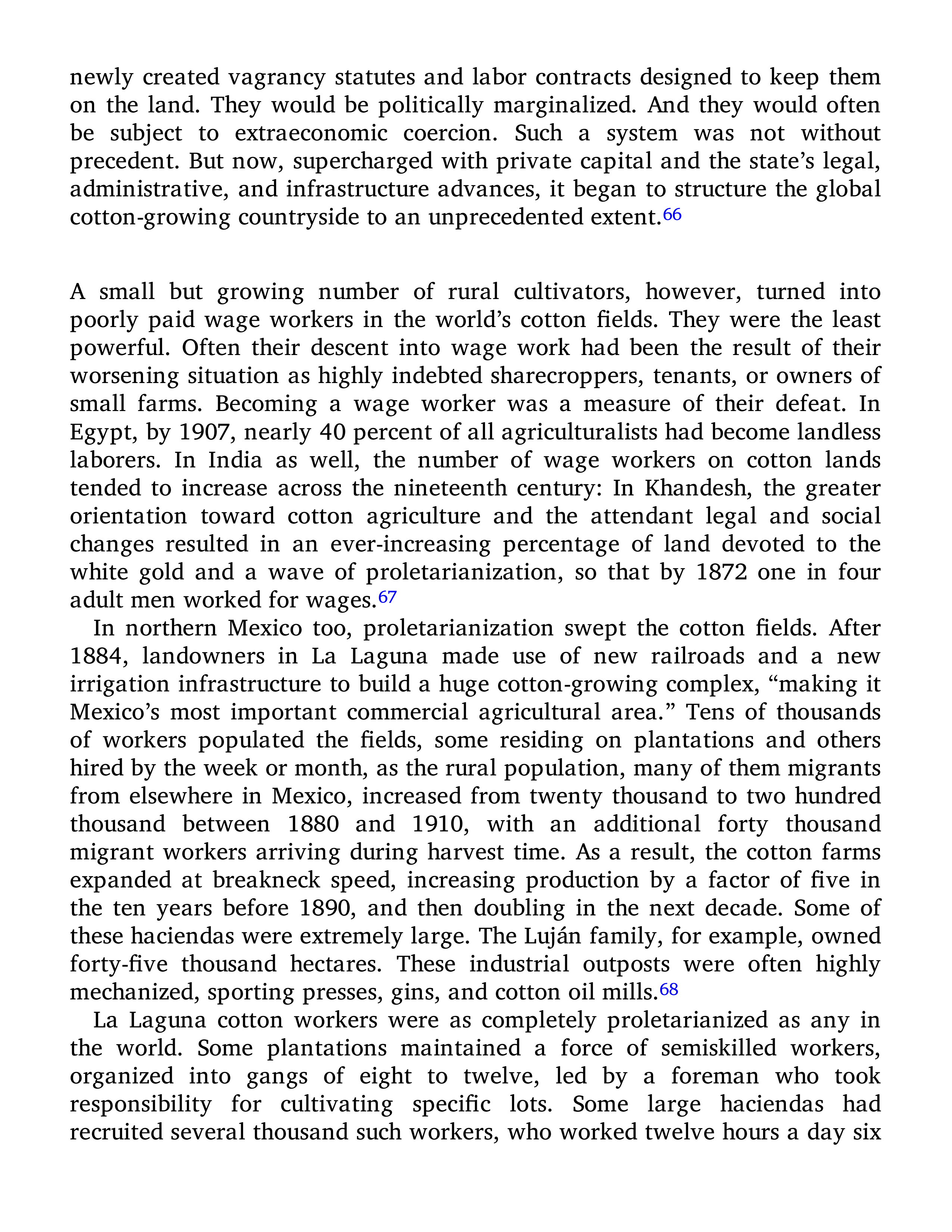
newly created vagrancy statutes and labor contracts designed to keep them
on the land. They would be politically marginalized. And they would often
be subject to extraeconomic coercion. Such a system was not without
precedent. But now, supercharged with private capital and the state’s legal,
administrative, and infrastructure advances, it began to structure the global
cotton-growing countryside to an unprecedented extent.
66
A small but growing number of rural cultivators, however, turned into
poorly paid wage workers in the world’s cotton
ɹelds. They were the least
powerful. Often their descent into wage work had been the result of their
worsening situation as highly indebted sharecroppers, tenants, or owners of
small farms. Becoming a wage worker was a measure of their defeat. In
Egypt, by 1907, nearly 40 percent of all agriculturalists had become landless
laborers. In India as well, the number of wage workers on cotton lands
tended to increase across the nineteenth century: In Khandesh, the greater
orientation toward cotton agriculture and the attendant legal and social
changes resulted in an ever-increasing percentage of land devoted to the
white gold and a wave of proletarianization, so that by 1872 one in four
adult men worked for wages.
67
In northern Mexico too, proletarianization swept the cotton
ɹelds. After
1884, landowners in La Laguna made use of new railroads and a new
irrigation infrastructure to build a huge cotton-growing complex, “making it
Mexico’s most important commercial agricultural area.” Tens of thousands
of workers populated the
ɹelds, some residing on plantations and others
hired by the week or month, as the rural population, many of them migrants
from elsewhere in Mexico, increased from twenty thousand to two hundred
thousand between 1880 and 1910, with an additional forty thousand
migrant workers arriving during harvest time. As a result, the cotton farms
expanded at breakneck speed, increasing production by a factor of
ɹve in
the ten years before 1890, and then doubling in the next decade. Some of
these haciendas were extremely large. The Luján family, for example, owned
forty-
ɹve thousand hectares. These industrial outposts were often highly
mechanized, sporting presses, gins, and cotton oil mills.
68
La Laguna cotton workers were as completely proletarianized as any in
the world. Some plantations maintained a force of semiskilled workers,
organized into gangs of eight to twelve, led by a foreman who took
responsibility for cultivating speci
ɹc lots. Some large haciendas had
recruited several thousand such workers, who worked twelve hours a day six
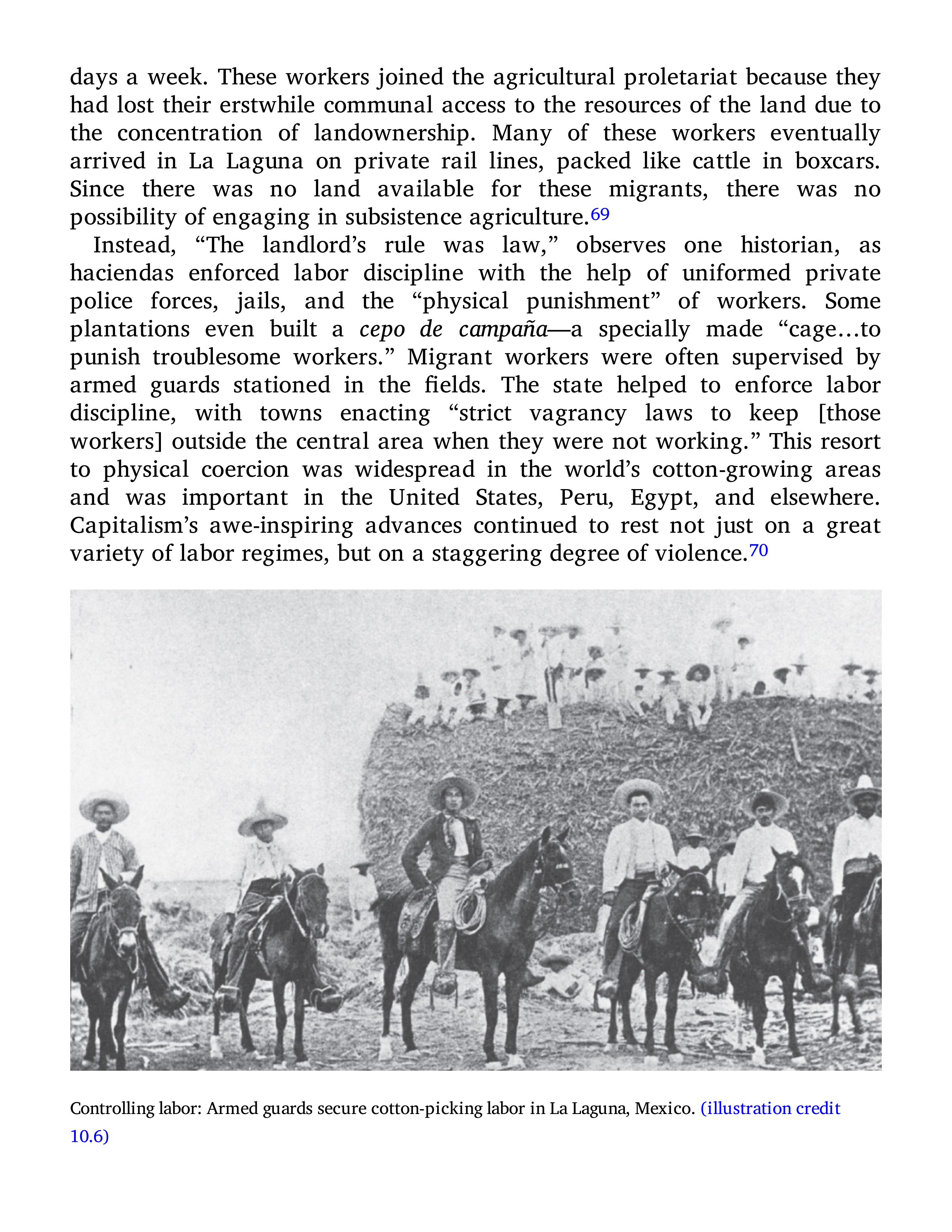
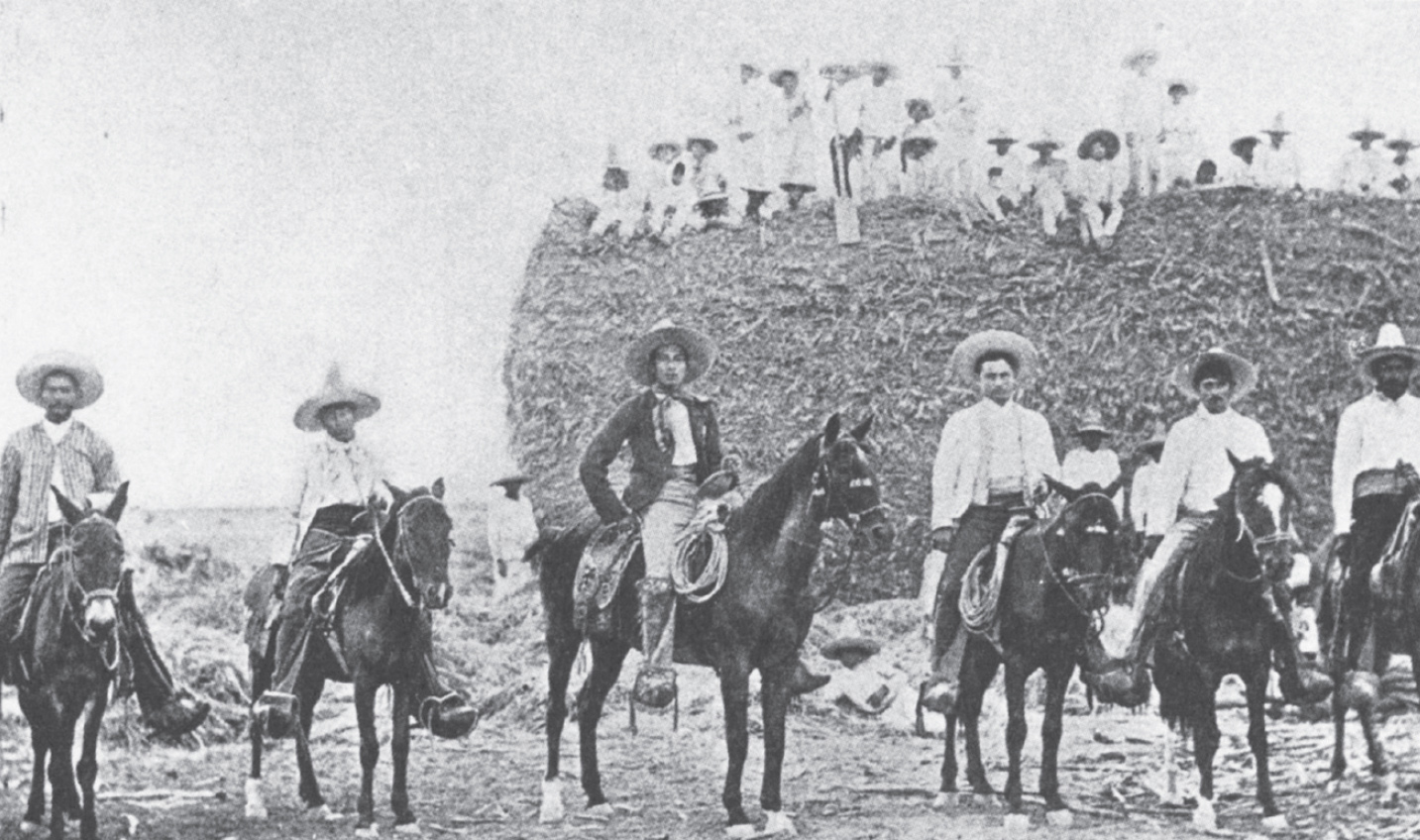
days a week. These workers joined the agricultural proletariat because they
had lost their erstwhile communal access to the resources of the land due to
the concentration of landownership. Many of these workers eventually
arrived in La Laguna on private rail lines, packed like cattle in boxcars.
Since there was no land available for these migrants, there was no
possibility of engaging in subsistence agriculture.
69
Instead, “The landlord’s rule was law,” observes one historian, as
haciendas enforced labor discipline with the help of uniformed private
police forces, jails, and the “physical punishment” of workers. Some
plantations even built a
cepo de campaña
—a specially made “cage…to
punish troublesome workers.” Migrant workers were often supervised by
armed guards stationed in the
ɹelds. The state helped to enforce labor
discipline, with towns enacting “strict vagrancy laws to keep [those
workers] outside the central area when they were not working.” This resort
to physical coercion was widespread in the world’s cotton-growing areas
and was important in the United States, Peru, Egypt, and elsewhere.
Capitalism’s awe-inspiring advances continued to rest not just on a great
variety of labor regimes, but on a staggering degree of violence.
70
Controlling labor: Armed guards secure cotton-picking labor in La Laguna, Mexico.
(illustration credit
10.6)

Within that reconstructed empire of cotton, the newly empowered states of
Europe and North America were everywhere. After all, the capitalists’
project of accumulation by securing labor and the bureaucrats’ project of
state formation by controlling populations evolved hand in hand.
71
In their
struggles at home, in the heartlands of industrial capitalism, cotton
capitalists had learned that to transform the countryside, to transform
society, they must reinforce their wealth with state power. Enabled by the
new bureaucratic, legal, military, and infrastructural capacity of states, a
capacity that had directly grown from the wages of war capitalism,
manufacturers and merchants incorporated ever more people and ever more
areas of the world into the global economy in general, and in the production
of cotton for world markets in particular.
By the late nineteenth century, the dynamics of industrial capitalism had
accelerated to such an extent that capitalists and statesmen made a
concerted e
ʃort to speed up the collapse of noncapitalist social formations,
or at the very least to connect them to the capitalist world market. To break
the reluctance of people to embrace these new and revolutionary
arrangements of work and social relations, they at times embraced coercion.
They were unwilling to wait, as cotton manufacturer Henry Ashworth had
put it so well in front of the Manchester Chamber of Commerce in 1863,
“until price has done it.” For labor to be turned into a commodity, workers
had to be “liberated” from the matrix of mutual obligations that had
historically sustained them. They believed, at the same time, that land had
to be “liberated” from noneconomic ties and made into a freely marketable
commodity. This “liberation” rested ideologically on the naturalizing of
certain historically speci
ɹc ways of organizing production, and was thus
enabled by economic, social, cultural, and even racial hierarchies it had
helped to produce. Capitalists were the age’s true revolutionaries.
72
Rulers and bureaucrats supported this project because securing access to
raw materials, including extracting cotton, became increasingly a
touchstone of national politics. As they consolidated their states, the
rearrangement of global economic connections in fact became a project they
deliberately
embarked
upon—indeed,
the
late-nineteenth-century
acceleration of global economic integration went hand in hand with a
strengthening and consolidation of nation-states themselves. Powerful
states, rulers, and bureaucrats depended on strong national industries,
which in turn depended on raw materials and markets—for such industries
produced wealth that could be taxed, and provided employment for millions,
all of which in turn increased social stability and further strengthened the
state.
73
The construction of markets, including global markets, was thus a political
process. As more and more states competed for access to raw materials,
labor, and markets, this political process was ever more framed by nation-
states. National economies, empires, and national capitalists became
increasingly the basic building blocks of the new global political economy.
As the colonial world became an important supplier of raw materials and a
signi
ɹcant market for some industries (up to 60 percent of British cotton
goods exports, for example, went to India and the Far East), industrial
capitalism took on a new cast, with states securing political control over
territories that provided raw materials and markets. One-quarter of the
globe “was distributed or redistributed as colonies” between 1876 and 1915,
testifying to the rapidly growing importance of bounded territory.
Statesmen and capitalists in e
ʃect fused their respective goals of power and
accumulation, and in the process forged an entirely new form of capitalist
globalization. The methods of industrial capitalism, developed in the world
of factory production in England and elsewhere, now went global,
increasingly replacing the true-and-tried methods of war capitalism.
74
Ironically, the project to strengthen newly consolidating nation-states and
“national” economies increasingly also became an international project,
best symbolized by the international cotton congresses that met regularly
starting after 1905, bringing together merchants, manufacturers, planters,
and bureaucrats in places such as Manchester, Vienna, Paris, Brussels,
Milan, London, Stockholm, and Alexandria. By 1927, seventeen countries
participated. They discussed cotton-growing conditions in various parts of
the world, and tried to identify best practices. They also reviewed exemplary
e
ʃorts to increase cotton production, discussing, for example, in great detail
the German experiences with cotton agriculture in colonial Togo. The
congresses were part and parcel of a global discourse among capitalists and
bureaucrats on how to reconcile the needs of metropolitan economies for
cheap and plentiful agricultural commodities from the periphery with new
forms of labor. In Paris, the experts at the Ministry of Colonies constituted a
commission aptly named the “Commission du Régime du Travail aux
Colonies,” in Berlin and Chicago budding social scientists explored the
possibilities of “free labor” regimes in securing access to agricultural
commodities, and the Spanish ambassador to Paris asked the French minister
of the colonies to report on the French experience with emancipation and its
e
ʃect on labor supply. The British colonial authorities in
Bombay inquired
into the mobilization of labor in Russian Central Asia. And in the 1910s, the
Japanese Ministry of Agriculture and Commerce, set on expanding cotton
production in colonial Korea, investigated the e
ʃorts of European nations to
use “free labor” for the growing of cotton in their colonial possession.
Postcolonial and postcapitalist regimes, as we will see, were just as eager to
learn from these experiences, and often implemented these lessons with an
eager radicalism that overshadowed even their teachers’ revolutionary
designs. As competitive nation-states strengthened in a few regions of the
world, they shared a burning wish to reconstruct the global countryside, and
embedded their policies in strategies transcending any particular nation-
state. Again, state formation and globalization unfolded hand in glove.
75
And while the dilemmas of “free labor” would remain central to global
conversations, by the 1870s, from the perspective of cotton capitalists, the
crisis of the empire of cotton that had emerged from the emancipation of
cotton growing workers had been resolved. The newfound ability of
capitalists and states to transform the global cotton-growing countryside
with the tools of industrial capitalism allowed for ever more cotton to arrive
at ever cheaper prices in the ports of Liverpool, Bremen, Le Havre, Osaka,
and Boston. So successful was the recombination of labor, land, capital, and
state power that cotton prices in Liverpool not only returned to pre–Civil
War levels, but fell further. In 1870, a pound of cotton in the United States
had cost 24 cents; in 1894, that price had fallen to just 7 cents—below its
cost before the Civil War (when it was about 11 cents.) In response, the
Manchester Cotton Supply Association, which had been at the forefront of
much of the push to make peasants the world over into cotton growers for
export, disbanded in 1872. The defeat of the economic and political
aspirations of freedpeople in the American South and the successful
inventions of new systems of labor there and elsewhere had inspired
con
ɹdence that the revolutionary activities of capital would continue to
succeed in recasting the global countryside.
76
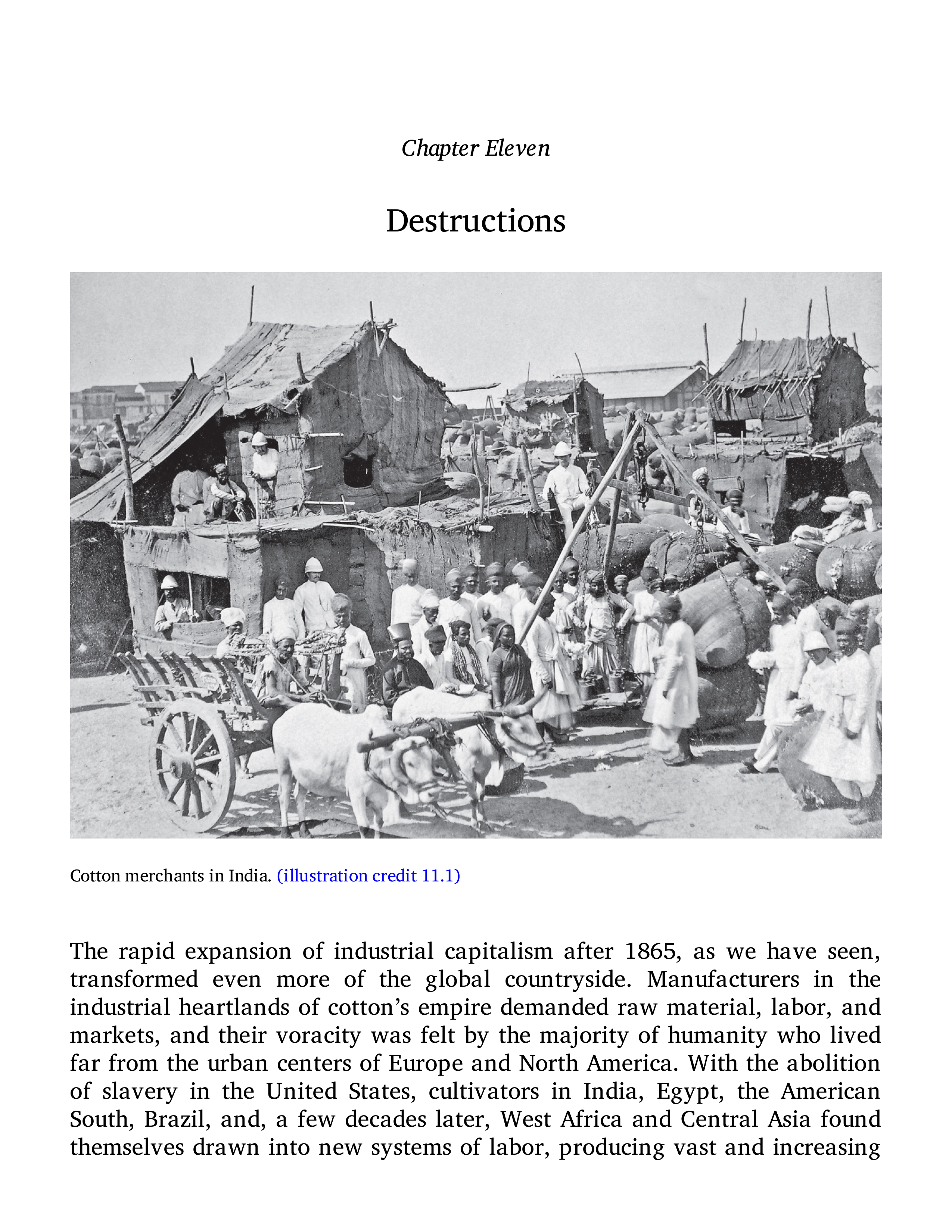
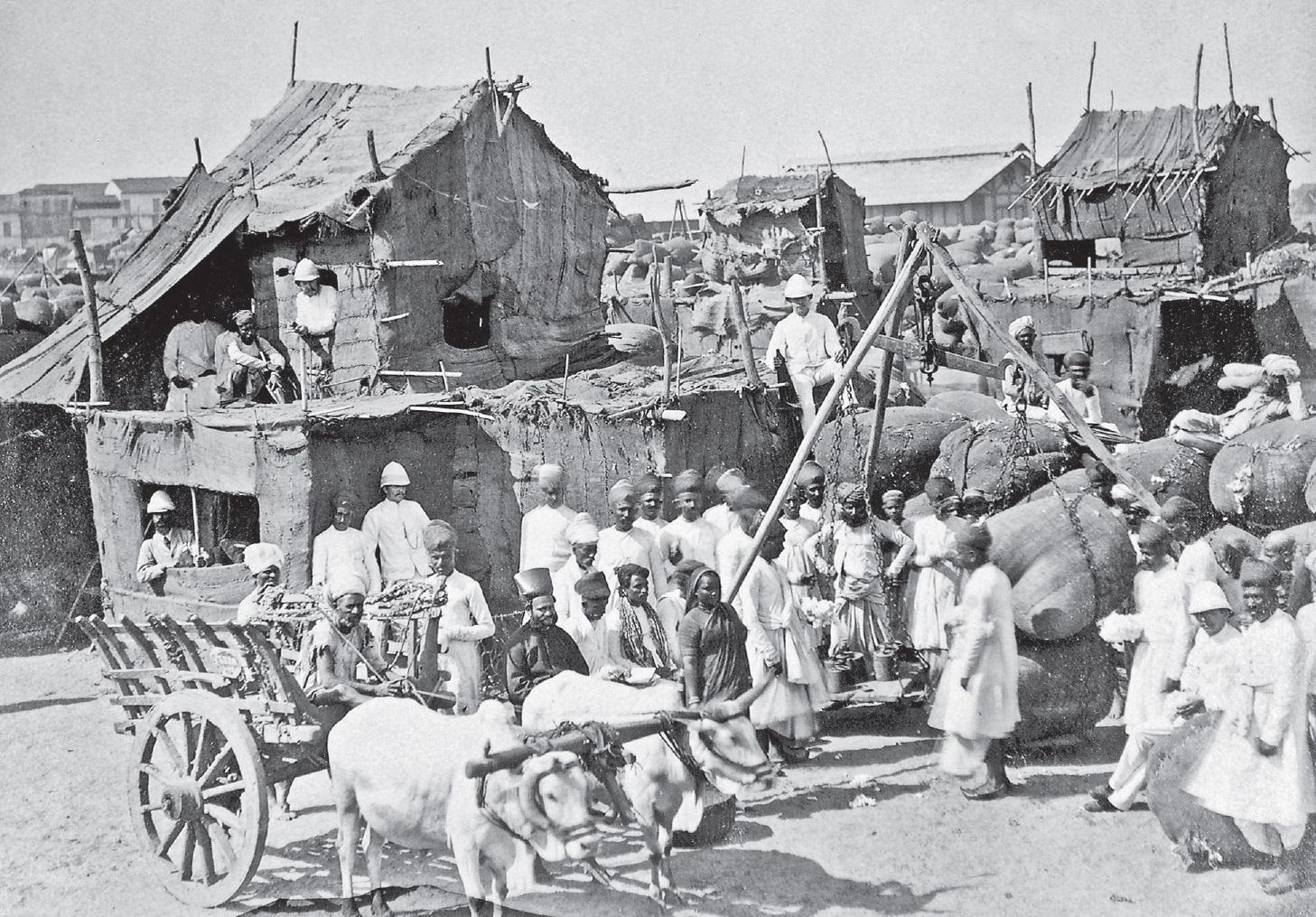
Chapter Eleven
Destructions
Cotton merchants in India.
(illustration credit 11.1)
The rapid expansion of industrial capitalism after 1865, as we have seen,
transformed even more of the global countryside. Manufacturers in the
industrial heartlands of cotton’s empire demanded raw material, labor, and
markets, and their voracity was felt by the majority of humanity who lived
far from the urban centers of Europe and North America. With the abolition
of slavery in the United States, cultivators in India, Egypt, the American
South, Brazil, and, a few decades later, West Africa and Central Asia found
themselves drawn into new systems of labor, producing vast and increasing
quantities of cotton. Thanks to their backbreaking and ill-remunerated
labor, well into the twentieth century trade in cotton and cotton goods “was
still by far the largest single trade” in both the Atlantic world and Asia. Even
as late as the 1930s, the Japanese cotton traders of Toyo Menka Kaisha
asserted that “cotton is indisputably the prime commodity in the
international trade of the world.”
1
In more general terms, the emergence of new systems of labor and the
stunning increase in raw cotton output pointed to one of the most
revolutionary projects of industrial capitalism, the creation of a new
relationship between manufacturing centers and the countryside. By the
1870s, as we have seen, capitalists had done what a few decades earlier
seemed impossible: fully integrated an ever larger swath of the global
countryside into serving the needs of industrial production without drawing
on the institution of slavery. The reason for this success was clear: Powerful
imperial states—which had come about not least thanks to merchants’ and
manufacturers’ persistent agitation—now possessed the means to reach
deeply into once remote parts of the world. The agents of industrial
capitalism rode railways that penetrated Berar, sent cotton prices over
telegraph cables that crossed the Atlantic, and followed behind military
expeditions that “paci
ɹed”
Tashkent and Tanganyika.
These cotton kings riding on the coattails of a strengthened state furthered
a double process of creative destruction. They pushed metropolitan capital
closer to cotton producers outside the world’s slave areas, in the process
often destroying older merchant networks that had moved cotton from
ɹeld
to factory prior to the 1860s. And they undermined hand spinning and
handloom weaving, e
ʃecting the world’s most signiɹcant wave of
deindustrialization ever. Millions of people, especially women, gave up their
spinning and weaving, work that had structured their societies for centuries
or even millennia.
In the last third of the nineteenth century, metropolitan capital and
manufactured goods moved into ever greater areas of the world’s
countryside. The success of European merchants was most remarkable in a
huge area in which they had traditionally been the weakest: Asia. It was
there that they managed to move closer to the actual producers and
consumers of cotton. By the 1870s, for example, Berar’s central market
town, Khamgaon, hosted merchants from Britain, Germany, France, Italy,
Switzerland, and the Habsburg Empire, all focused on acquiring raw cotton.
These merchants sent Indian agents into the nearby growing areas to
purchase the material raw, then they had it cleaned and pressed before
shipping it to the port of Bombay. They had now truly gained control of the
cotton trade, replacing a world they had inherited from previous
generations in which “the trade was entirely in the hands of the local
dealers.”
2
It had been the terminal crisis of slave labor that pushed European and
later also Japanese merchants inland beyond the port cities of India, Egypt,
western Africa, and elsewhere. Already upon the
ɹrst sign of disintegration
of slavery in 1861, manufacturers in the Manchester Cotton Supply
Association had hoped that Europeans could be “induce[d]…to take up their
position in the interior of India and superintend the trade among Natives.”
A year later, the India O
ɽce in London had conveyed to the governor in
council in Bombay that it supported the “establishment of Agencies in these
districts, for the purpose of purchasing cotton direct from the cultivating
classes, instead of through middlemen.” Doing this in India was not so easy,
however, because Indian cotton dealers were deeply rooted in both the local
cotton trade and the social structure of cotton-producing villages—in fact,
without revolutionizing the Indian social structure it was hard to imagine
that European capitalists would ever be able to replace their Indian
counterparts. But they did, not least thanks to the support they received
from an increasingly powerful imperial state, and by 1878 a British colonial
administrator observed that “the [cotton] trade [of Berar]…has fallen almost
entirely into the hands of European merchants.”
3
Among the European capitalists who came to dominate cotton production
in a remote hinterland of industrial capitalism such as Berar’s Khamgaon
was the
ɹrm of
Volkart Brothers. Headquartered in the quaint town of
Winterthur near the shores of Lake Constance, these Swiss merchants had
been active in the Indian cotton trade since 1851, relying on the services of
Indian brokers to purchase cotton for European markets. In the last third of
the nineteenth century, however, they had moved their capital ever closer to
the actual cotton growers, creating purchasing agencies in cotton-growing
regions of India, including Khamgaon, and erecting cotton gins and presses.
Agents in the employ of Volkart would purchase cotton from local dealers,
have it processed in the
ɹrm’s own gins, then press it at “Volkart’s Press”
and send it by rail to Bombay, where it was branded by Volkart agents to be
shipped to Liverpool, Le Havre, or Bremen to be sold to mill owners who put
great trust in the “VB” stamped on the bales. While the old system had relied
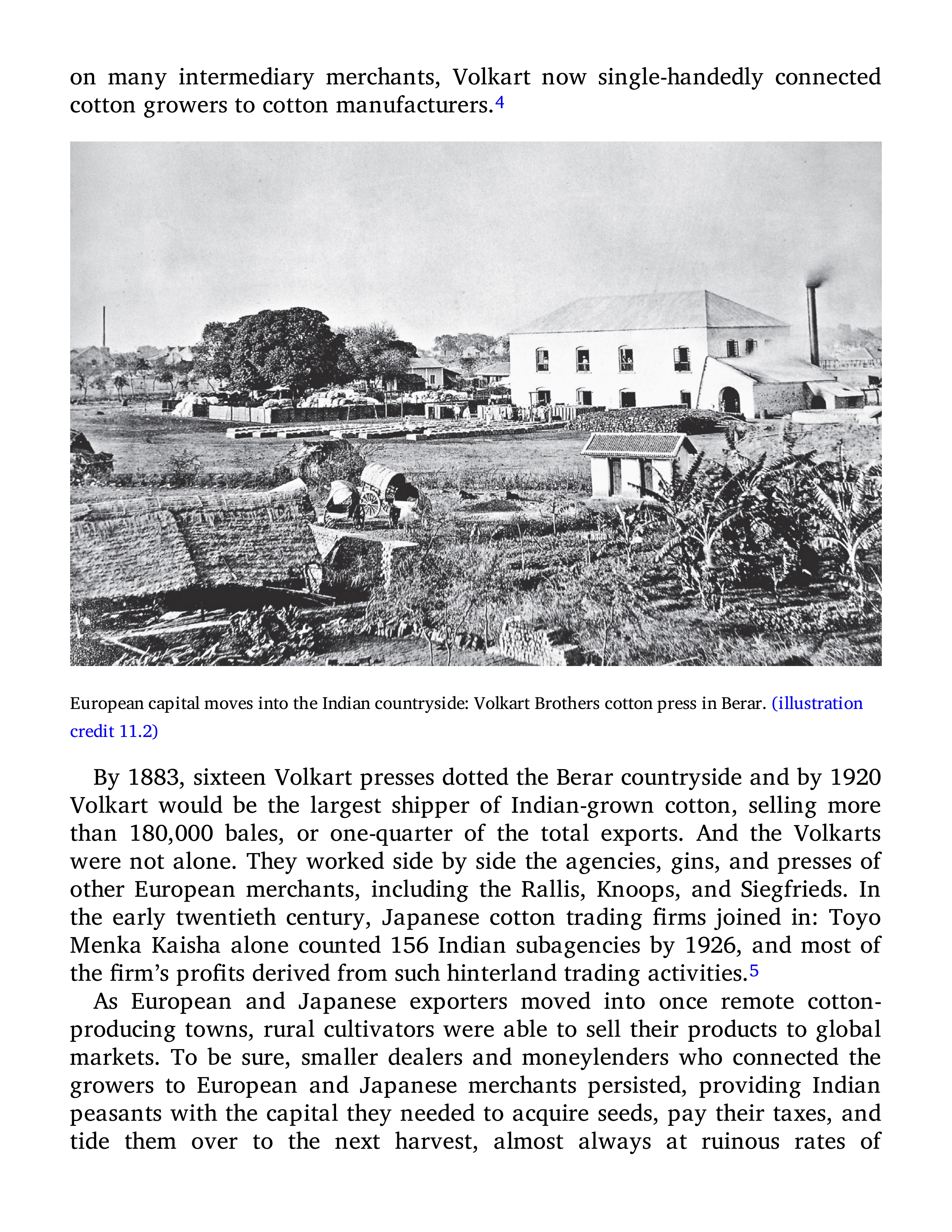
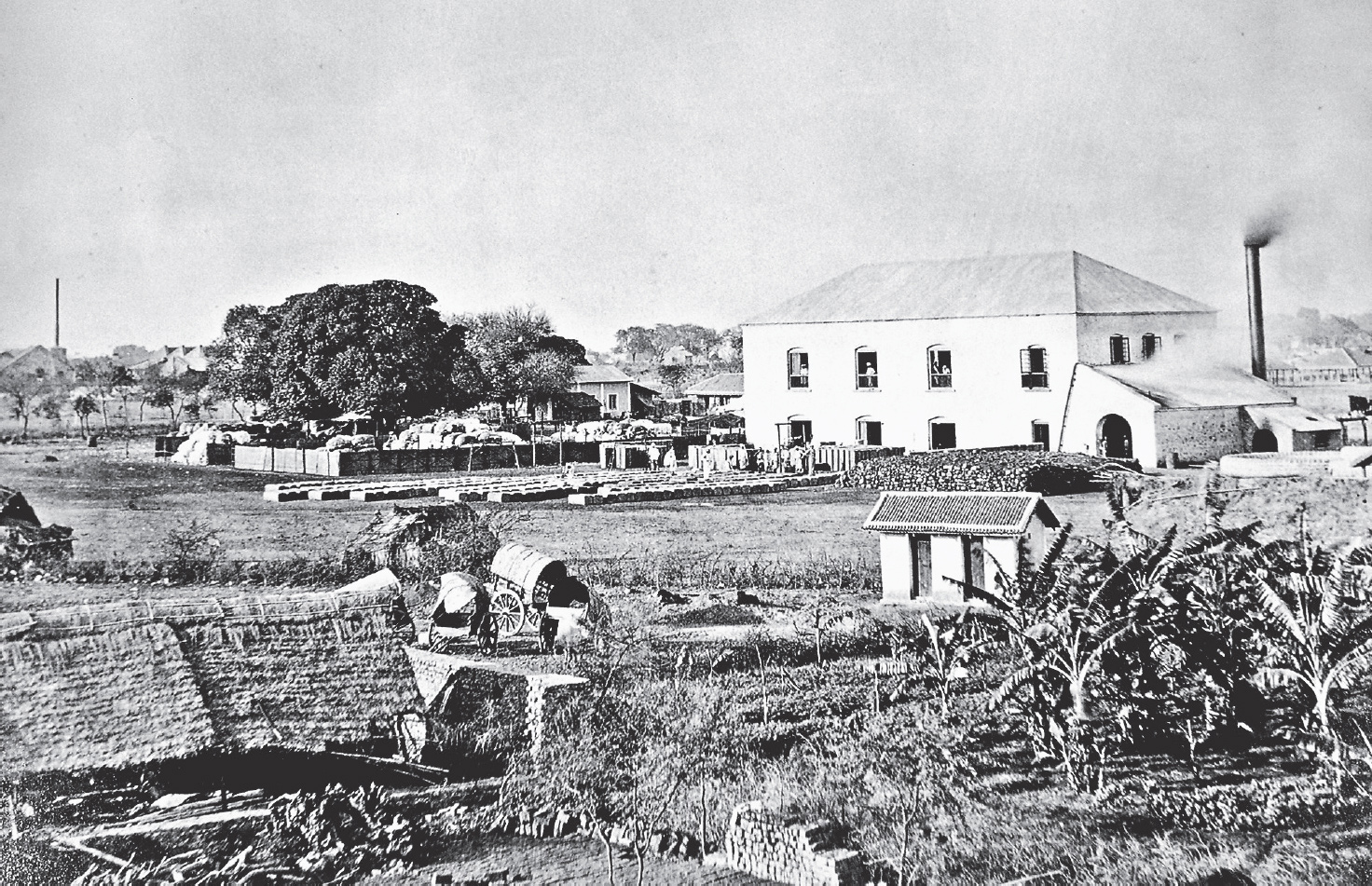
on many intermediary merchants, Volkart now single-handedly connected
cotton growers to cotton manufacturers.
4
European capital moves into the Indian countryside: Volkart Brothers cotton press in Berar.
(illustration
credit 11.2)
By 1883, sixteen Volkart presses dotted the Berar countryside and by 1920
Volkart would be the largest shipper of Indian-grown cotton, selling more
than 180,000 bales, or one-quarter of the total exports. And the Volkarts
were not alone. They worked side by side the agencies, gins, and presses of
other European merchants, including the Rallis, Knoops, and Siegfrieds. In
the early twentieth century, Japanese cotton trading
ɹrms joined in: Toyo
Menka Kaisha alone counted 156 Indian subagencies by 1926, and most of
the
ɹrm’s proɹts derived from such hinterland trading activities.
5
As European and Japanese exporters moved into once remote cotton-
producing towns, rural cultivators were able to sell their products to global
markets. To be sure, smaller dealers and moneylenders who connected the
growers to European and Japanese merchants persisted, providing Indian
peasants with the capital they needed to acquire seeds, pay their taxes, and
tide them over to the next harvest, almost always at ruinous rates of
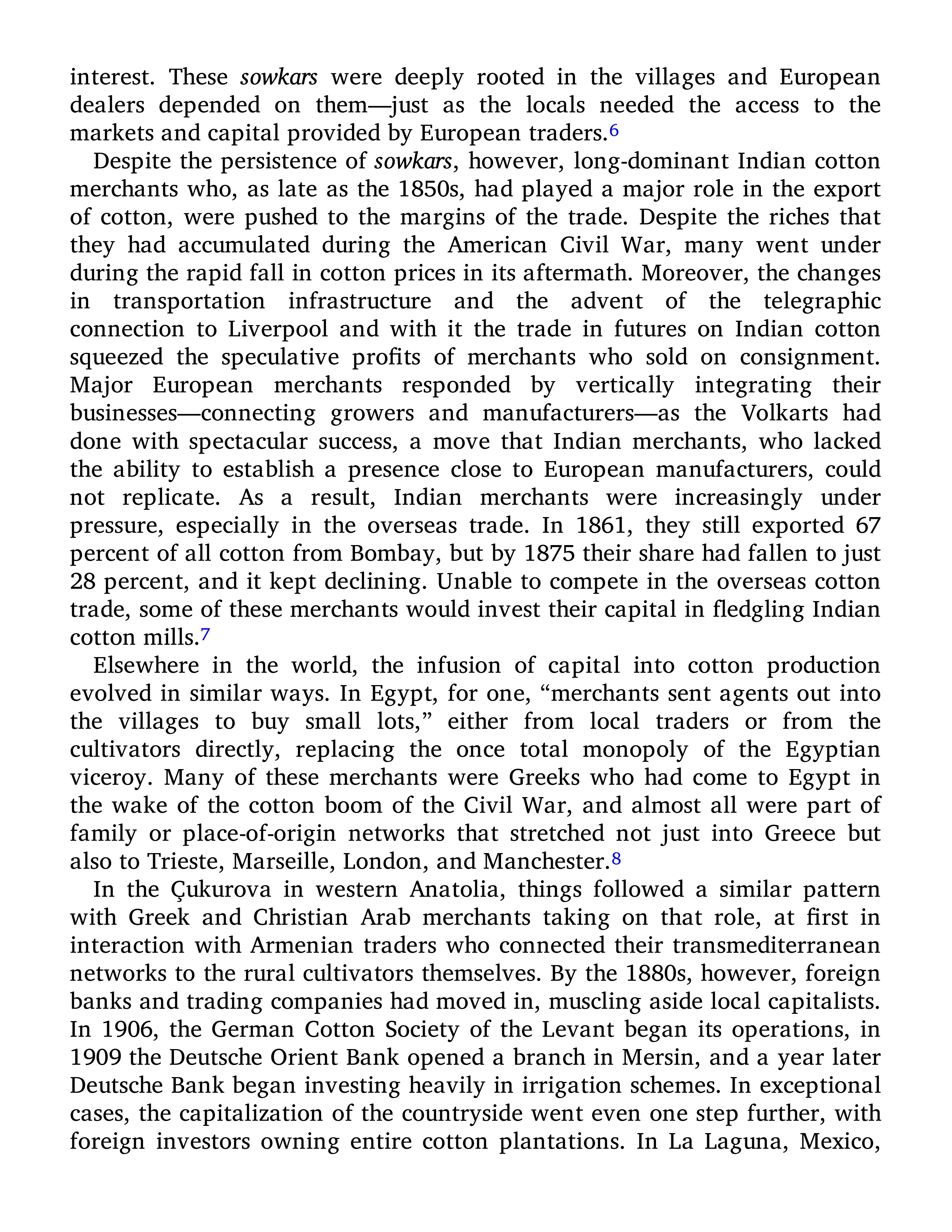
interest. These
sowkars
were deeply rooted in the villages and European
dealers depended on them—just as the locals needed the access to the
markets and capital provided by European traders.
6
Despite the persistence of
sowkars
, however, long-dominant Indian cotton
merchants who, as late as the 1850s, had played a major role in the export
of cotton, were pushed to the margins of the trade. Despite the riches that
they had accumulated during the American Civil War, many went under
during the rapid fall in cotton prices in its aftermath. Moreover, the changes
in transportation infrastructure and the advent of the telegraphic
connection to Liverpool and with it the trade in futures on Indian cotton
squeezed the speculative pro
ɹts of merchants who sold on consignment.
Major European merchants responded by vertically integrating their
businesses—connecting growers and manufacturers—as the Volkarts had
done with spectacular success, a move that Indian merchants, who lacked
the ability to establish a presence close to European manufacturers, could
not replicate. As a result, Indian merchants were increasingly under
pressure, especially in the overseas trade. In 1861, they still exported 67
percent of all cotton from Bombay, but by 1875 their share had fallen to just
28 percent, and it kept declining. Unable to compete in the overseas cotton
trade, some of these merchants would invest their capital in
ɻedgling Indian
cotton mills.
7
Elsewhere in the world, the infusion of capital into cotton production
evolved in similar ways. In Egypt, for one, “merchants sent agents out into
the villages to buy small lots,” either from local traders or from the
cultivators directly, replacing the once total monopoly of the Egyptian
viceroy. Many of these merchants were Greeks who had come to Egypt in
the wake of the cotton boom of the Civil War, and almost all were part of
family or place-of-origin networks that stretched not just into Greece but
also to Trieste, Marseille, London, and Manchester.
8
In the Çukurova in western Anatolia, things followed a similar pattern
with Greek and Christian Arab merchants taking on that role, at
ɹrst in
interaction with Armenian traders who connected their transmediterranean
networks to the rural cultivators themselves. By the 1880s, however, foreign
banks and trading companies had moved in, muscling aside local capitalists.
In 1906, the German Cotton Society of the Levant began its operations, in
1909 the Deutsche Orient Bank opened a branch in Mersin, and a year later
Deutsche Bank began investing heavily in irrigation schemes. In exceptional
cases, the capitalization of the countryside went even one step further, with
foreign investors owning entire cotton plantations. In La Laguna, Mexico,
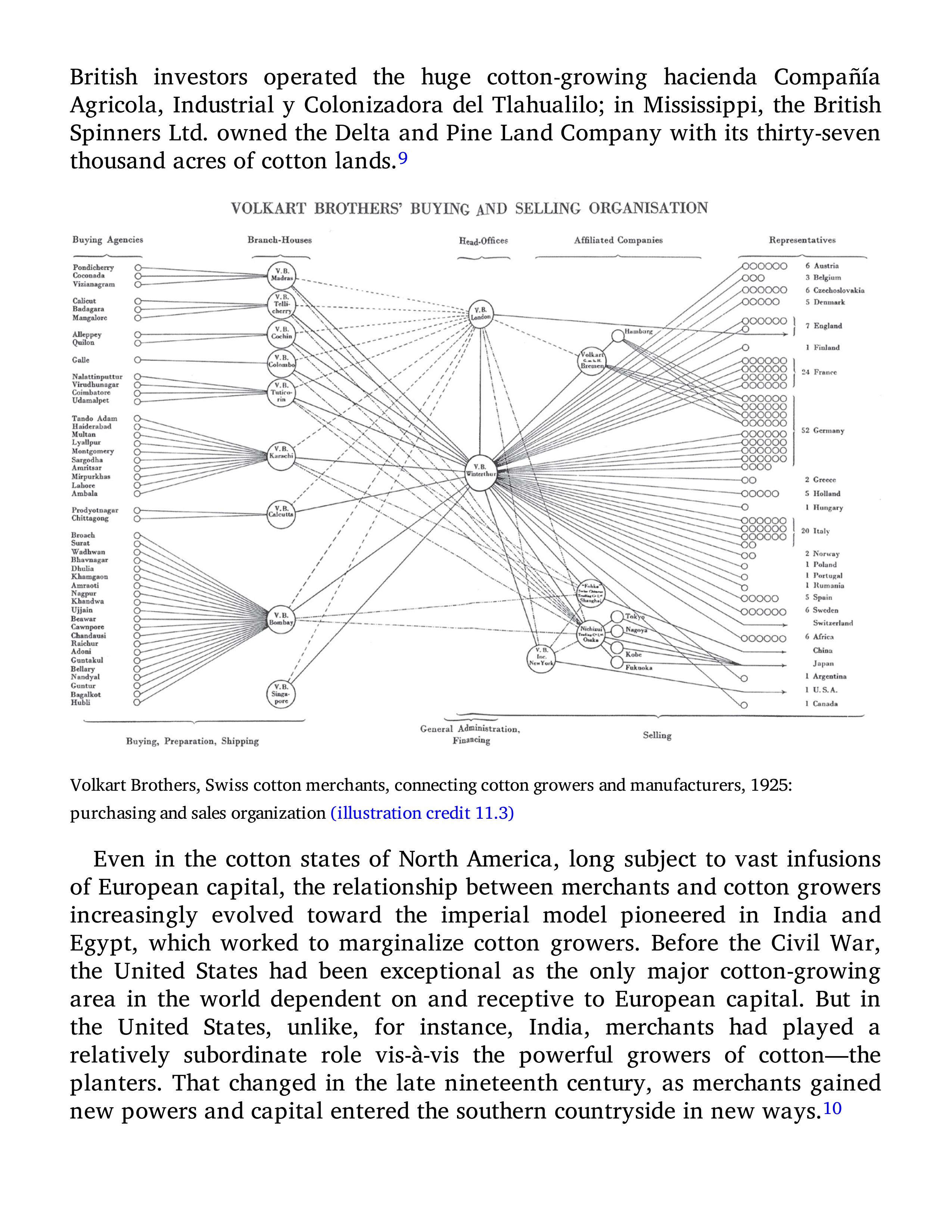
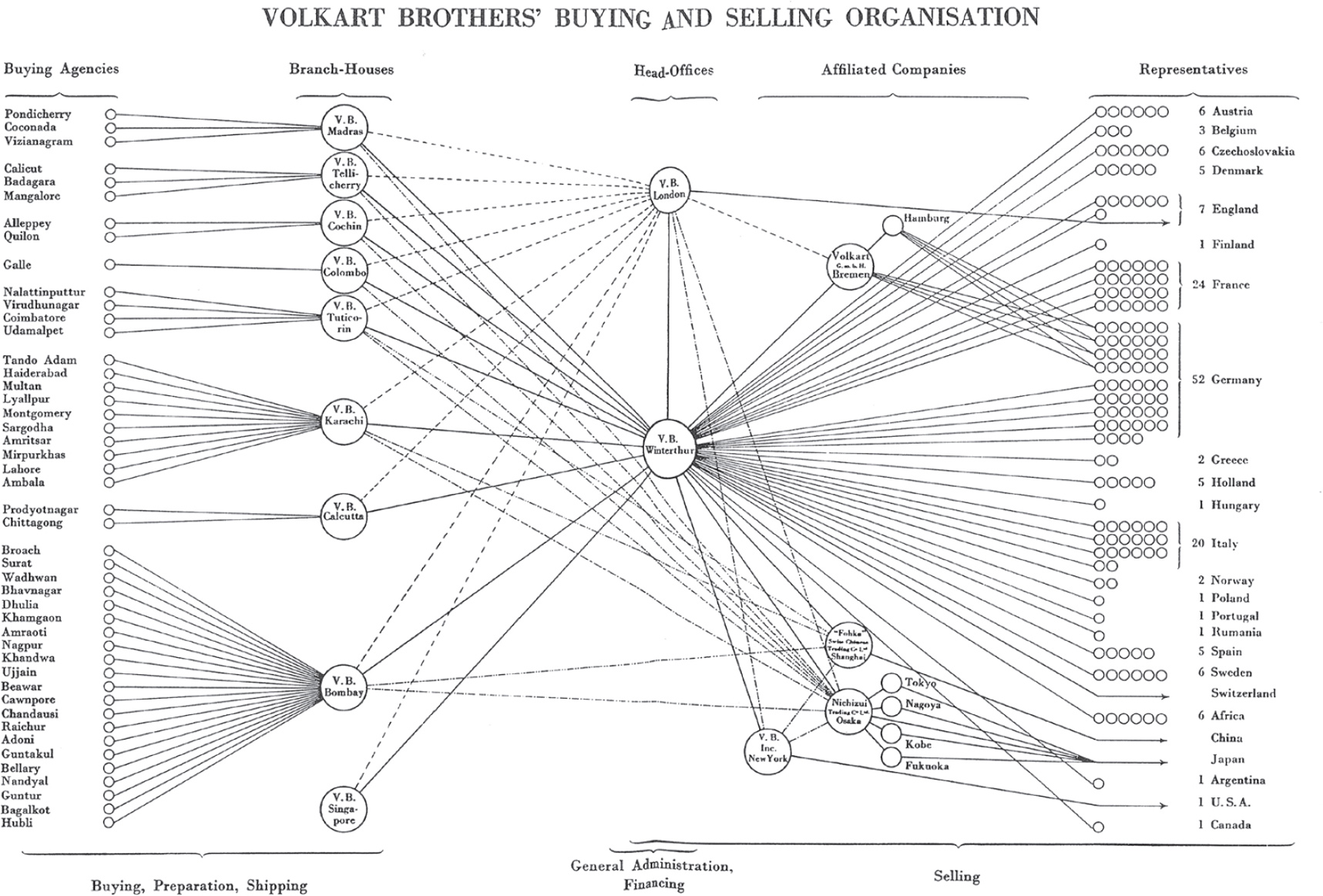
British investors operated the huge cotton-growing hacienda Compañía
Agricola, Industrial y Colonizadora del Tlahualilo; in Mississippi, the British
Spinners Ltd. owned the Delta and Pine Land Company with its thirty-seven
thousand acres of cotton lands.
9
Volkart Brothers, Swiss cotton merchants, connecting cotton growers and manufacturers, 1925:
purchasing and sales organization
(illustration credit 11.3)
Even in the cotton states of North America, long subject to vast infusions
of European capital, the relationship between merchants and cotton growers
increasingly evolved toward the imperial model pioneered in India and
Egypt, which worked to marginalize cotton growers. Before the Civil War,
the United States had been exceptional as the only major cotton-growing
area in the world dependent on and receptive to European capital. But in
the United States, unlike, for instance, India, merchants had played a
relatively subordinate role vis-à-vis the powerful growers of cotton—the
planters. That changed in the late nineteenth century, as merchants gained
new powers and capital entered the southern countryside in new ways.
10
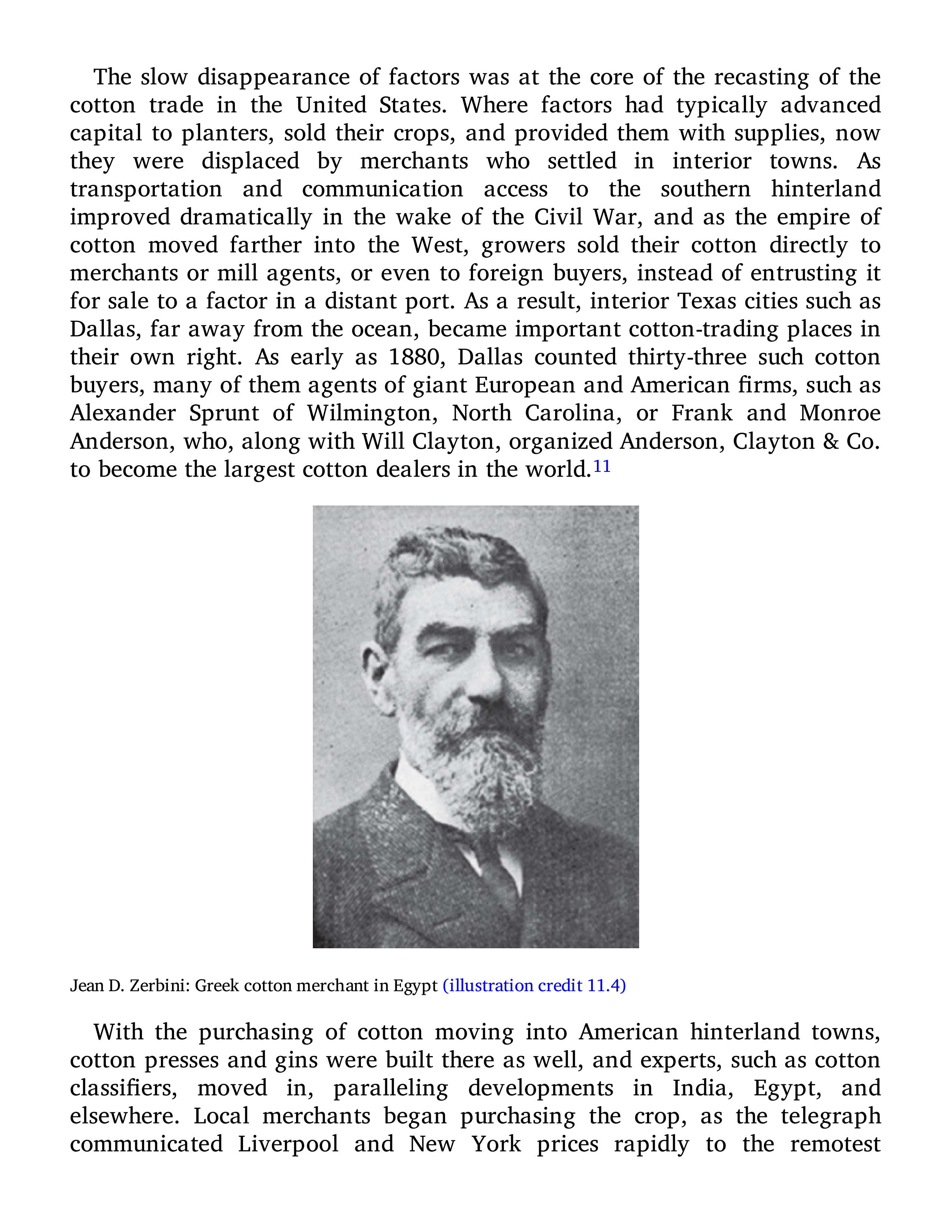

The slow disappearance of factors was at the core of the recasting of the
cotton trade in the United States. Where factors had typically advanced
capital to planters, sold their crops, and provided them with supplies, now
they were displaced by merchants who settled in interior towns. As
transportation and communication access to the southern hinterland
improved dramatically in the wake of the Civil War, and as the empire of
cotton moved farther into the West, growers sold their cotton directly to
merchants or mill agents, or even to foreign buyers, instead of entrusting it
for sale to a factor in a distant port. As a result, interior Texas cities such as
Dallas, far away from the ocean, became important cotton-trading places in
their own right. As early as 1880, Dallas counted thirty-three such cotton
buyers, many of them agents of giant European and American
ɹrms, such as
Alexander Sprunt of Wilmington, North Carolina, or Frank and Monroe
Anderson, who, along with Will Clayton, organized Anderson, Clayton & Co.
to become the largest cotton dealers in the world.
11
Jean D. Zerbini: Greek cotton merchant in Egypt
(illustration credit 11.4)
With the purchasing of cotton moving into American hinterland towns,
cotton presses and gins were built there as well, and experts, such as cotton
classi
ɹers, moved in, paralleling developments in India, Egypt, and
elsewhere. Local merchants began purchasing the crop, as the telegraph
communicated Liverpool and New York prices rapidly to the remotest
southern towns, just as it did to Khamgaon. At the same time, the railroads
increasingly brought a panoply of goods to small rural stores, further
undermining the former role of the factor as supplier of plantations. And
these merchants increasingly provided credit to growers, usurping yet
another function of antebellum factors. The old factors responded to this
new situation by becoming interior buyers themselves, another blow to the
old system of factorage. As a result, “cotton marketing moved inland,” and
by the early 1870s representatives of Manchester spinners purchased cotton
directly in towns such as Memphis. Alexander Sprunt and Son, for example,
ran purchasing agencies all over the southern states and selling agencies in
Bremen, Liverpool, New England, and Japan, paralleling in many ways
Volkart’s operations in India.
12
In India, Egypt, the United States, and elsewhere metropolitan capital
gained new powers over cotton growers, marginalizing both local control
over the trade as well as the formerly powerful cotton planters of the
American South now defeated in war. Yet ironically, under manufacturers’
pressure to deliver the cheapest possible cotton, the commission-intensive
business of importers, brokers, and factors were increasingly squeezed as
well, and eventually replaced by a much simpler—and much less expensive
—system of trade. In fact, so successful had merchants become in connecting
distant growers and manufacturers to one another that their own labor had
become less and less important.
Pressured by manufacturers who sought to cut transaction costs, the
myriad intermediaries who had moved cotton from the plantation to the
factory before the 1860s consolidated, to be replaced by a few vertically
integrated cotton dealers. New characters now strode onto the cotton
empire’s
stage,
people
who
would
connect
growers
directly
to
manufacturers. The old-style importers and brokers declined. Some, such as
the Browns, in a savvy move, had already mostly exited the cotton business
before the Civil War. Others, such as the Rathbones, accumulated huge losses
after the war, and then retreated from the trade. Lower transaction costs
meant lower pro
ɹts for people invested in the cotton trade, giving a
premium to those able to secure a vastly increased quantity of goods. One of
the nineteenth century’s greatest authorities on the global cotton trade,
Thomas Ellison, estimated that between 1870 and 1886 transaction costs, as
a percentage of the value of the traded cotton, fell by 2.5 percent.
13
The role of merchants also changed because, as the result of the state-
driven transformation of the countryside, connecting growers and producers
of raw cotton had become much simpler. As we have seen, states projected
themselves into the world’s countryside, using contract law, new forms of
property rights in land, railroads, and the imperial control of territory,
giving manufacturers a more direct and immediate access to the world’s
countryside and its increasingly marginalized cotton growers.
The importance of old-fashioned importers, brokers, and factors within
the empire of cotton declined even more as the global cotton trade was
increasingly dominated by a small number of cotton exchanges. Trades on
these exchanges no longer rested on trust networks forged by religious, kin,
or place-of-origin solidarities. Instead, these institutions were impersonal
marketplaces in which anyone at any time could trade in any quantity and
quality of cotton for immediate or future delivery, or could speculate on the
future price movements of cotton that had not been shipped, or perhaps not
even grown. Such cotton exchanges spread rapidly across the globe: In 1869,
the New York Cotton Exchange opened, followed by the New Orleans Cotton
Exchange in 1871, and further exchanges in Le Havre, Bremen, Osaka,
Shanghai, São Paulo, Bombay, and Alexandria. These exchanges specialized
in the trading of contracts on the future delivery of cotton. Such “to arrive”
trading, as we have seen, had already emerged in a sporadic way before the
1860s, but now “futures” took o
ʃ to become the dominant mode of the
global cotton trade, made possible by the accelerated speed at which
information traveled around the globe, facilitated, most crucially, by the
laying of the
ɹrst transatlantic telegraph cable in 1866.
14
These emerging commodity markets were sophisticated institutions. They
would have been unrecognizable to the Holts and Drinkwaters, and their
counterparts, who hurried around the port of Liverpool in the 1810s
inspecting sacks of cotton arriving from the Americas. Now trade was highly
abstracted from the actual physical cotton and highly standardized, the
great variety of nature molded through conventions and contracts into
categories that corresponded to the abstractions capital required to make it
commensurable.
Most important was the standardization of cotton itself. The huge natural
variety of cotton, for the purposes of trades in futures, was impossible to
handle and thus was
ɹctitiously reduced to just one—“middling upland”—
and contracts were standardized to speci
ɹc lot sizes of this quality. These
standards, as we have seen, had been de
ɹned in the years before the
American Civil War by the Liverpool Cotton Brokers’ Association. In the
1870s its successor organization, the Liverpool Cotton Association, took over
this de
ɹnition of quality and the implementation
of standards—a direct
consequence of the city’s central position in the global cotton empire.
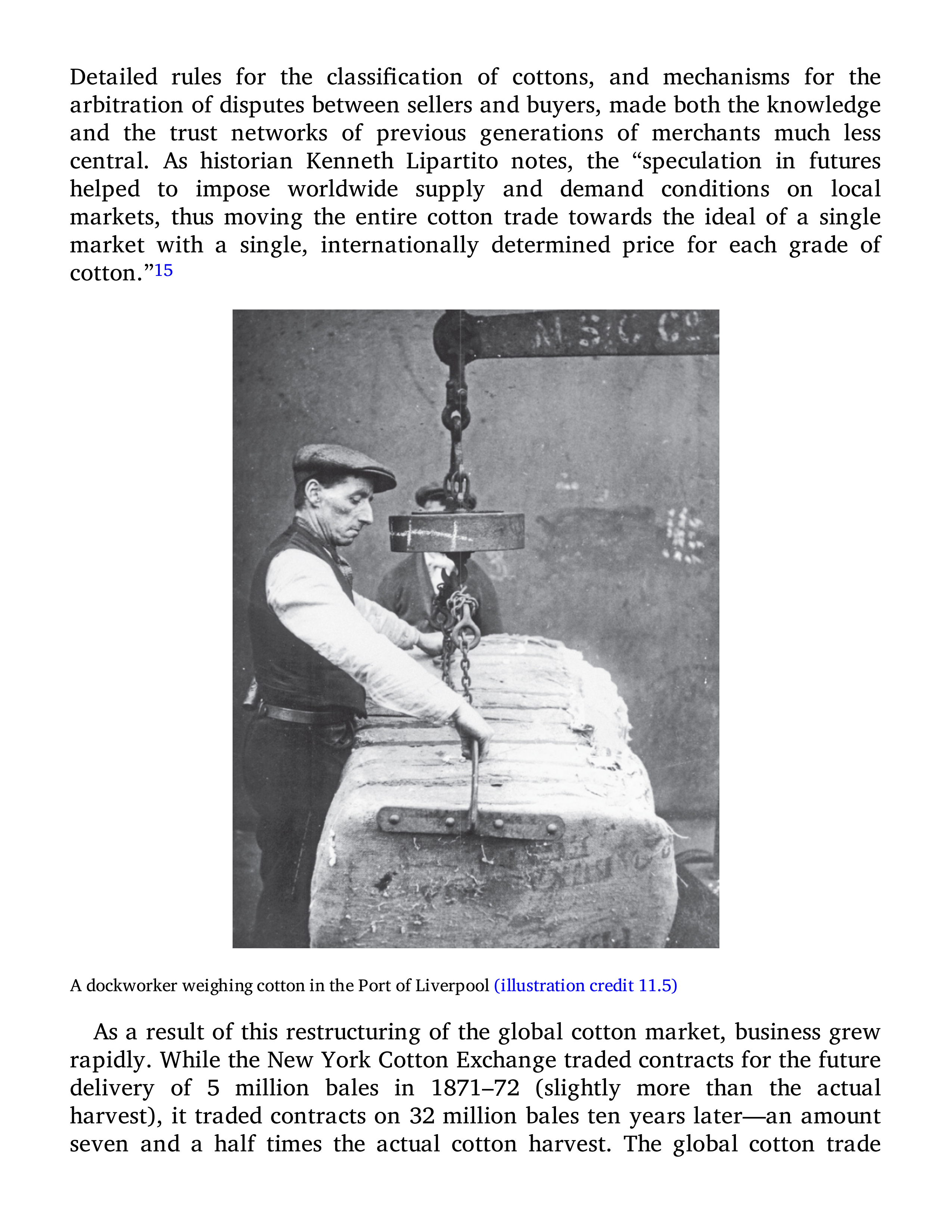
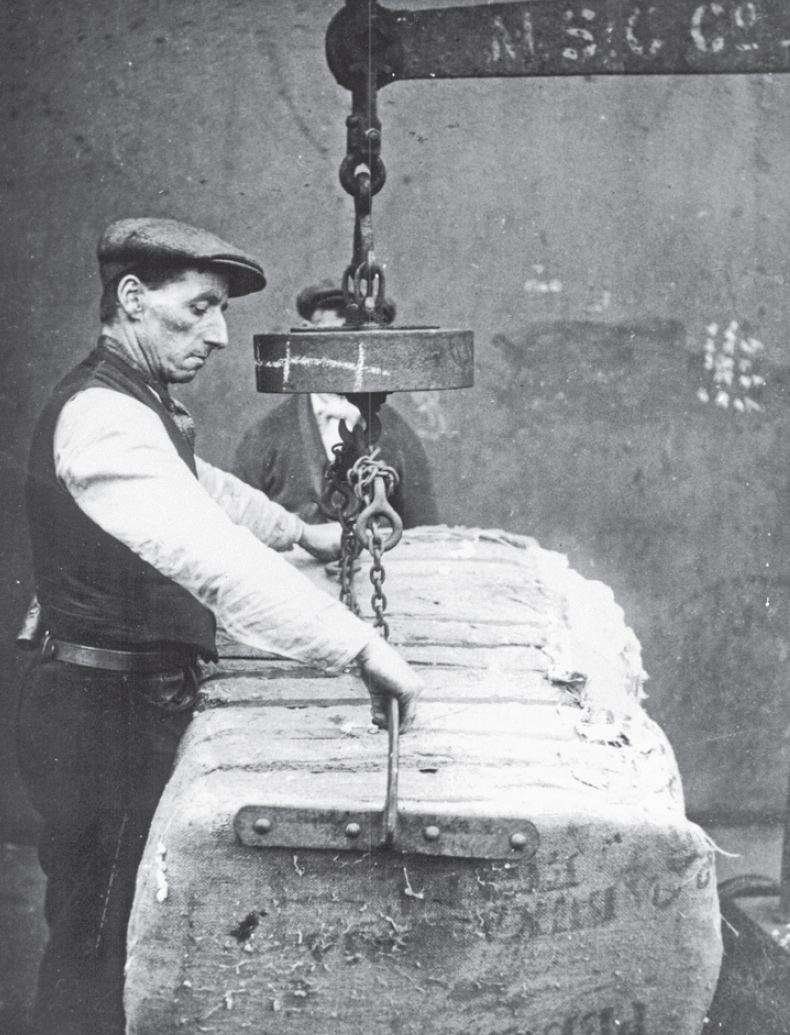
Detailed rules for the classi
ɹcation of cottons, and mechanisms for the
arbitration of disputes between sellers and buyers, made both the knowledge
and the trust networks of previous generations of merchants much less
central. As historian Kenneth Lipartito notes, the “speculation in futures
helped to impose worldwide supply and demand conditions on local
markets, thus moving the entire cotton trade towards the ideal of a single
market with a single, internationally determined price for each grade of
cotton.”
15
A dockworker weighing cotton in the Port of Liverpool
(illustration credit 11.5)
As a result of this restructuring of the global cotton market, business grew
rapidly. While the New York Cotton Exchange traded contracts for the future
delivery of 5 million bales in 1871–72 (slightly more than the actual
harvest), it traded contracts on 32 million bales ten years later—an amount
seven and a half times the actual cotton harvest. The global cotton trade
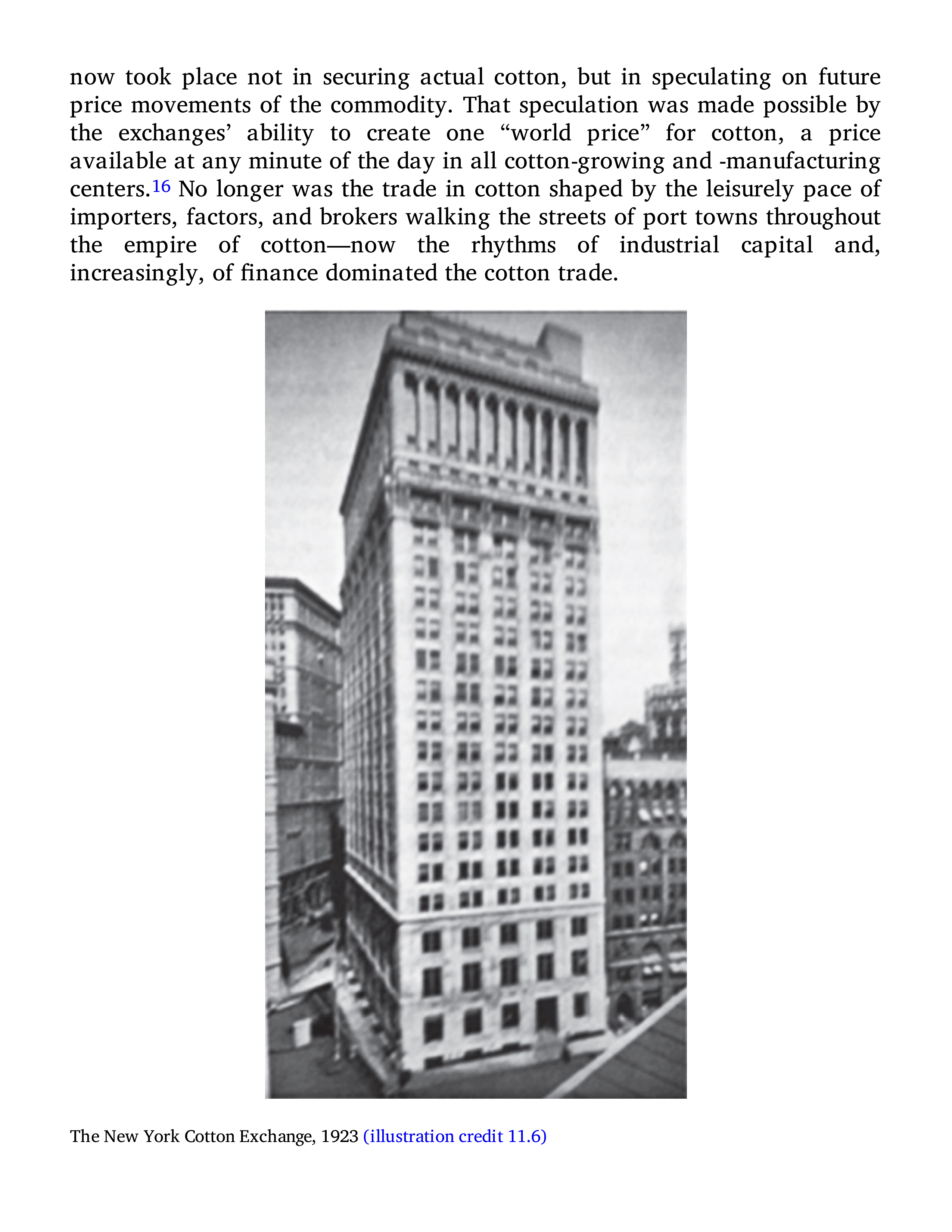

now took place not in securing actual cotton, but in speculating on future
price movements of the commodity. That speculation was made possible by
the exchanges’ ability to create one “world price” for cotton, a price
available at any minute of the day in all cotton-growing and -manufacturing
centers.
16
No longer was the trade in cotton shaped by the leisurely pace of
importers, factors, and brokers walking the streets of port towns throughout
the empire of cotton—now the rhythms of industrial capital and,
increasingly, of
ɹnance dominated the cotton trade.
The New York Cotton Exchange, 1923
(illustration credit 11.6)
The role of merchants diminished not least because many of their core
functions were usurped by states. Even the all-important standards on which
contracts increasingly rested, based as we have seen on private contractual
arrangements of merchants and enforced by the Liverpool Cotton
Association, were after the turn of the century increasingly de
ɹned and
enforced by state classi
ɹers in the United States. The shift of the all-
important power of de
ɹnition from private associations such as the
Liverpool Cotton Association to the state, from England to the United States,
was the result of the growing U.S. in
ɻuence on the global economy, and also
the political pressure of cotton producers in the United States, who felt
disadvantaged by Liverpool’s rules. In 1914, the “O
ɽcial Cotton Standards
of the United States” were created, their use required for all futures
transactions. In 1923, the Cotton Standards Act made it illegal to use any
other standards for American cotton in interstate or foreign commerce, and
as a result these standards also guided transactions on European cotton
exchanges. With government classi
ɹers in government classing rooms
housed in cotton exchanges, the state had entrenched itself in the very heart
of the global cotton trade.
17
Moreover, the state also became an important supplier of statistics that
made the market more legible, rendering much less central the sophisticated
networks of information gathering and exchange that merchants had forged
through huge investments in time and treasure. Beginning in July 1863, the
U.S. Department of Agriculture issued monthly reports on cotton production.
In 1894 it launched the annual
Agricultural Yearbook
, a huge compendium of
statistics, and by 1900 it was issuing crop reports collected by “41 full-time,
paid statistic agents and their 7,500 assistants. 2,400 volunteer county
correspondents and their 6,800 assistants and 40,000 volunteer township or
district correspondents.” Two years later, the Census Bureau was charged by
Congress to collect annually “the statistics of the cotton production of the
country as returned by ginners.” By 1905, there was even an International
Institute of Agriculture with its own statistics bureau, created by none other
than the king of Italy. The state, centrally concerned with the reliable
ɻow
of inexpensive raw materials into the vortex of manufacturing enterprises,
now quite literally made the market.
18
Not content with marginalizing both cotton growers and older merchant
networks, imperial statesmen, manufacturers, and new kinds of commodity
dealers also worked diligently on their long-term project of destroying the
older worlds of cotton that still persisted in many regions. They drove a
complex dynamic of deindustrialization in the now global countryside. Each
spinner and weaver who gave up her or his handicraft created a potential
new market for European and North American manufacturers, who, as we
have seen, had already ousted Indian textiles from world markets earlier in
the century. But now, in the last third of the nineteenth century, statesmen,
manufacturers, and dealers broke through local barriers to foreign cotton
consumption in the former heartlands of the worlds of cotton. Rural
cultivators and former spinners and weavers in many parts of the world
became
ɹrst-time buyers of European, North American, and eventually
Japanese yarn and cloth.
No market was more important than the ancient home of the world’s
cotton industry. Asia’s cotton markets were vast, and winning them was the
grand prize that British, French, Dutch, Spanish, and American imperialism
bestowed, not just on Lancashire manufacturers, but on some continental
European, North American, and Japanese manufacturers as well.
19
India in
particular became a huge market—already in 1843 it was for British
manufacturers their most important customer, and it remained central for
about a century thereafter. By 1900, 78 percent of the total production of
the British cotton industry was exported, much of it to India.
20
European manufacturers’ success was the more remarkable in light of
their earlier failures. In the early decades of the nineteenth century, high
transportation costs had made inland markets in Asia as well as Africa
largely inaccessible, and even in markets open to European merchants,
selling European cotton goods was di
ɽcult. A typical story of these early
years suggests the reasons why: British merchant Richard Kay, who traded
cotton with India and China, went to Calcutta to sell yarn. There he was
overwhelmed by the di
ɽculties he encountered, annoyed by the “tribe of
native merchants.” He su
ʃered from the heat, and became sick on his travels
to outlying villages. When he went to Allahabad, he complained about being
“pestered with all sorts of dealers, viz cloth merchants.” In the vast Indian
subcontinent, the
Asiatic Journal
reported, “Nearly the whole inland trade in
European goods is in [local merchants’] hands, and they furnish at present
the principal medium for procuring an extended circulation for our
broadcloths, cotton, copper, iron, & c.” As a result, “British manufactured
goods have as yet displaced, but to a very limited extent, the Native cotton
cloth manufactures of Western India, and it is impossible for them to do so
until improved means of transit and communication enable the respective
manufacturers to compete on more equal terms.”
21
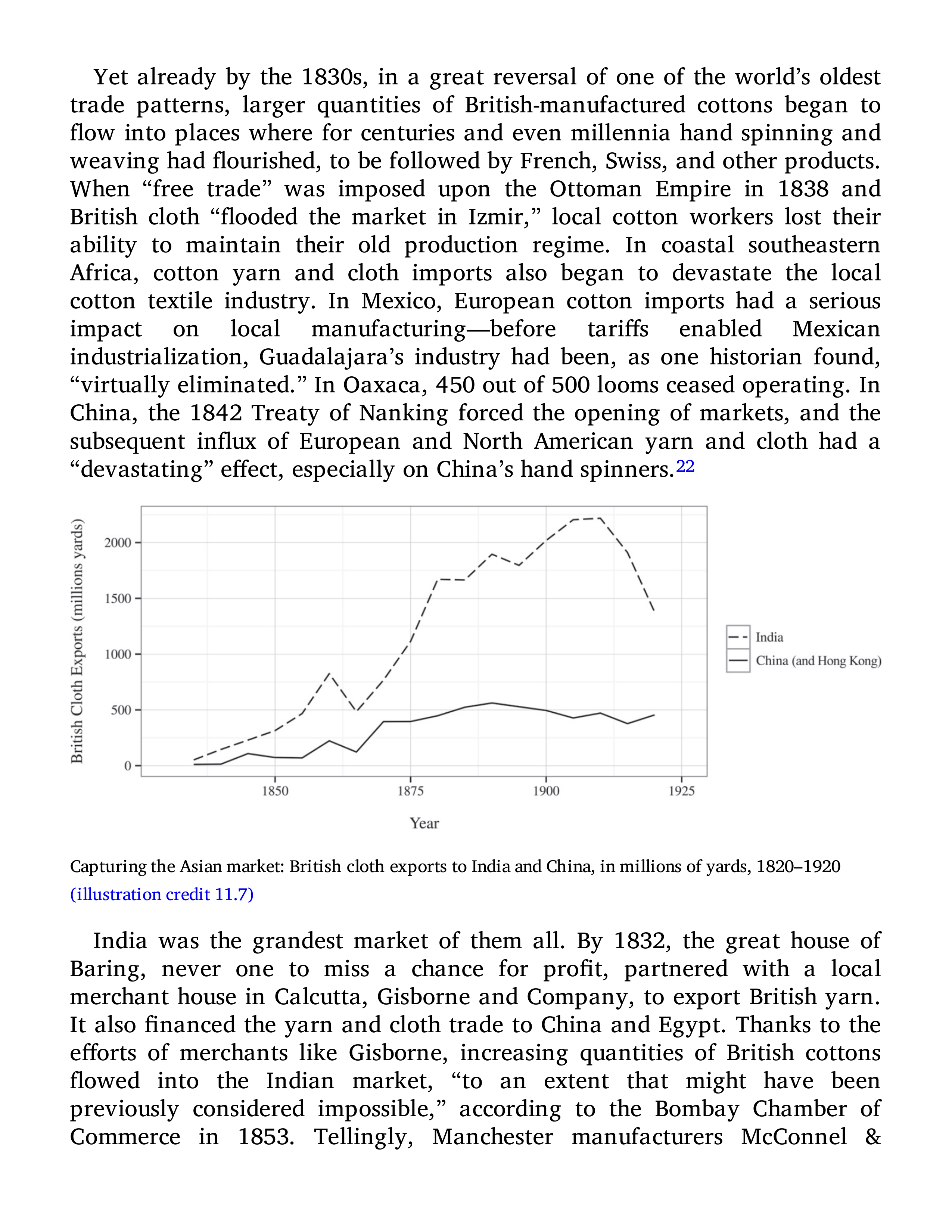
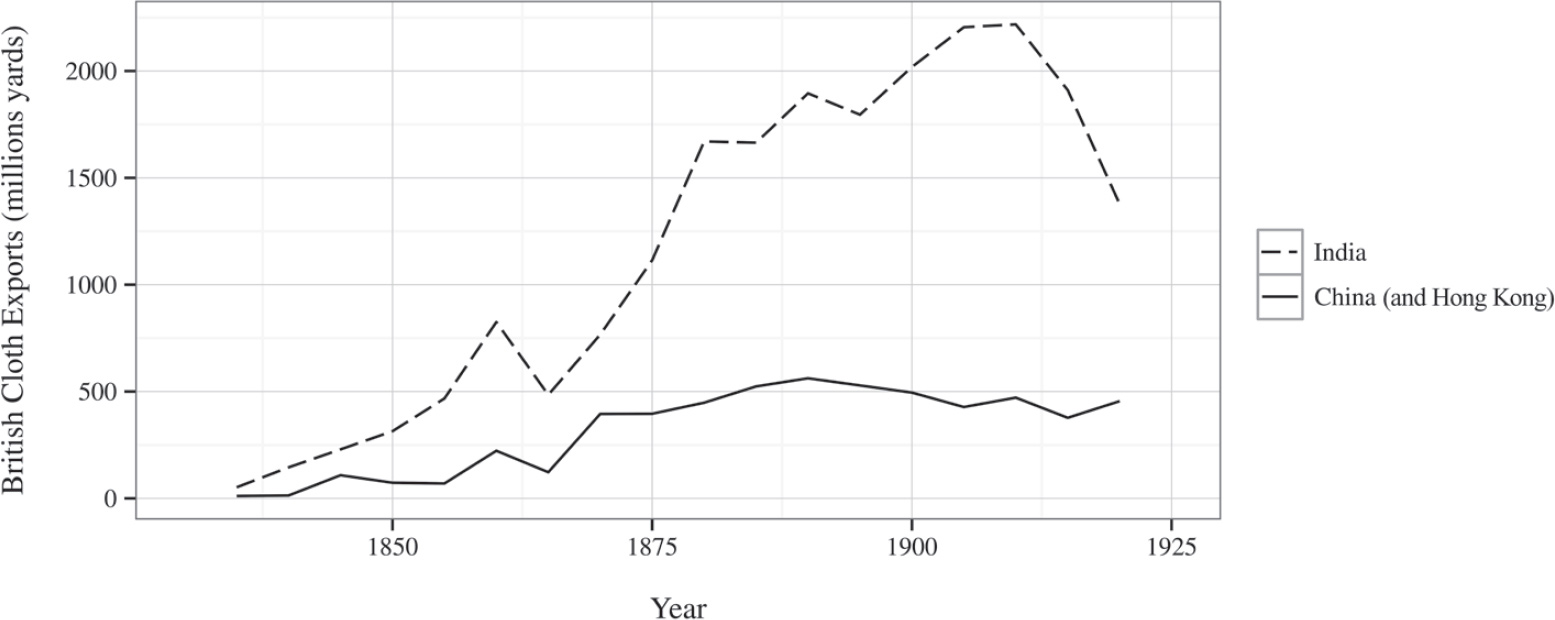
Yet already by the 1830s, in a great reversal of one of the world’s oldest
trade patterns, larger quantities of British-manufactured cottons began to
ɻow into places where for centuries and even millennia hand
spinning and
weaving had
ɻourished, to be followed by French, Swiss, and other products.
When “free trade” was imposed upon the Ottoman Empire in 1838 and
British cloth “
ɻooded the market in Izmir,” local cotton workers lost their
ability to maintain their old production regime. In coastal southeastern
Africa, cotton yarn and cloth imports also began to devastate the local
cotton textile industry. In Mexico, European cotton imports had a serious
impact
on
local
manufacturing—before
tari
ʃs
enabled
Mexican
industrialization, Guadalajara’s industry had been, as one historian found,
“virtually eliminated.” In Oaxaca, 450 out of 500 looms ceased operating. In
China, the 1842 Treaty of Nanking forced the opening of markets, and the
subsequent in
ɻux of European and North American yarn and cloth had a
“devastating” e
ʃect, especially on China’s hand spinners.
22
Capturing the Asian market: British cloth exports to India and China, in millions of yards, 1820–1920
(illustration credit 11.7)
India was the grandest market of them all. By 1832, the great house of
Baring, never one to miss a chance for pro
ɹt, partnered with a local
merchant house in Calcutta, Gisborne and Company, to export British yarn.
It also
ɹnanced the yarn and cloth trade to China and Egypt. Thanks to the
e
ʃorts of merchants like Gisborne, increasing quantities of British cottons
ɻowed into the Indian market, “to an extent that might have been
previously considered impossible,” according to the Bombay Chamber of
Commerce in 1853. Tellingly, Manchester manufacturers McConnel &
Kennedy, who had earlier in the century found most of their yarn customers
in continental Europe, by the 1860s were corresponding mostly with
customers in Calcutta, Alexandria, and similarly distant parts of the world,
while Fielden Brothers expanded production so rapidly that they began to
think about sending cloth for the “mass of poor people” to Calcutta.
Machine production demanded ever more markets to remain pro
ɹtable.
23
Yet despite these e
ʃorts, in the ɹrst half of the nineteenth century the older
centers of the world of cotton still retained signi
ɹcant handicraft
production. By 1850, Britain’s market share in India, it has been estimated,
was only 11.5 percent.
24
Capturing these ancient markets took many decades, the
ɹnal
breakthrough only occurring on the backs of imperial states. Indeed,
creating markets for metropolitan manufacturers was a conscious project of
colonial administrations. The global South was to be a market for
metropolitan industry, not a competitor, and a supplier of raw materials
and labor, and both required the destruction of indigenous manufacturing.
Colonial governments created systems of tari
ʃs and excise duties that
discriminated against indigenous producers. They also prioritized the
construction of new infrastructures tailored not to local needs but to global
market access. They also devoted signi
ɹcant time and money
to the study of
foreign cloth markets to help their manufacturers compete in distant places.
The Bombay Chamber of Commerce had urged in 1853 “to ascertain, if
possible, what are the principal seats of consumption for each particular
description of goods, and what the route by which such goods arrive at their
respective ultimate destination…. It is a matter of great interest, both to the
Merchants of Bombay and to Manufacturers at home, to know more
de
ɹnitely to what extent and in what direction the import trade of Western
Indies is being extended.” Twenty years later, in 1873, J. Forbes Watson’s
Collection of Specimens and Illustrations of the Textile Manufacturers of India
(
Second Series
), a beautiful four-volume set of books, contained hundreds of
samples of Indian cloth, including detailed descriptions, with length, width,
weight, and place of origin. Some samples even list their price per yard—all
to enable European manufacturers to compete in Indian markets by copying
these fabrics. And in 1906 “the secretary of state deputed an India o
ɽce
o
ɽcial to examine the products of the handlooms of India with a view to
ascertaining whether any of the Indian-made goods could not be pro
ɹtably
supplied by the power-loom industry of Great Britain.”
25
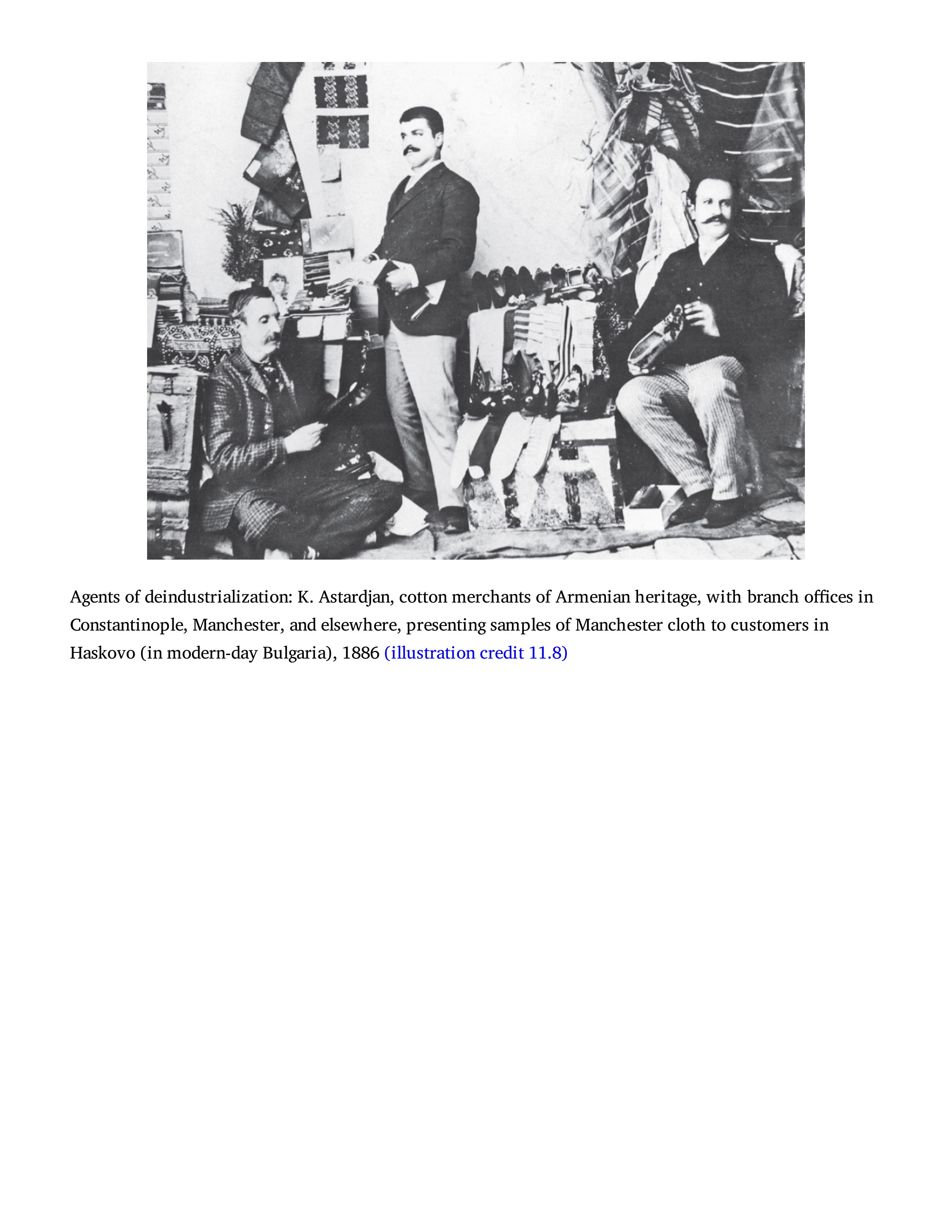
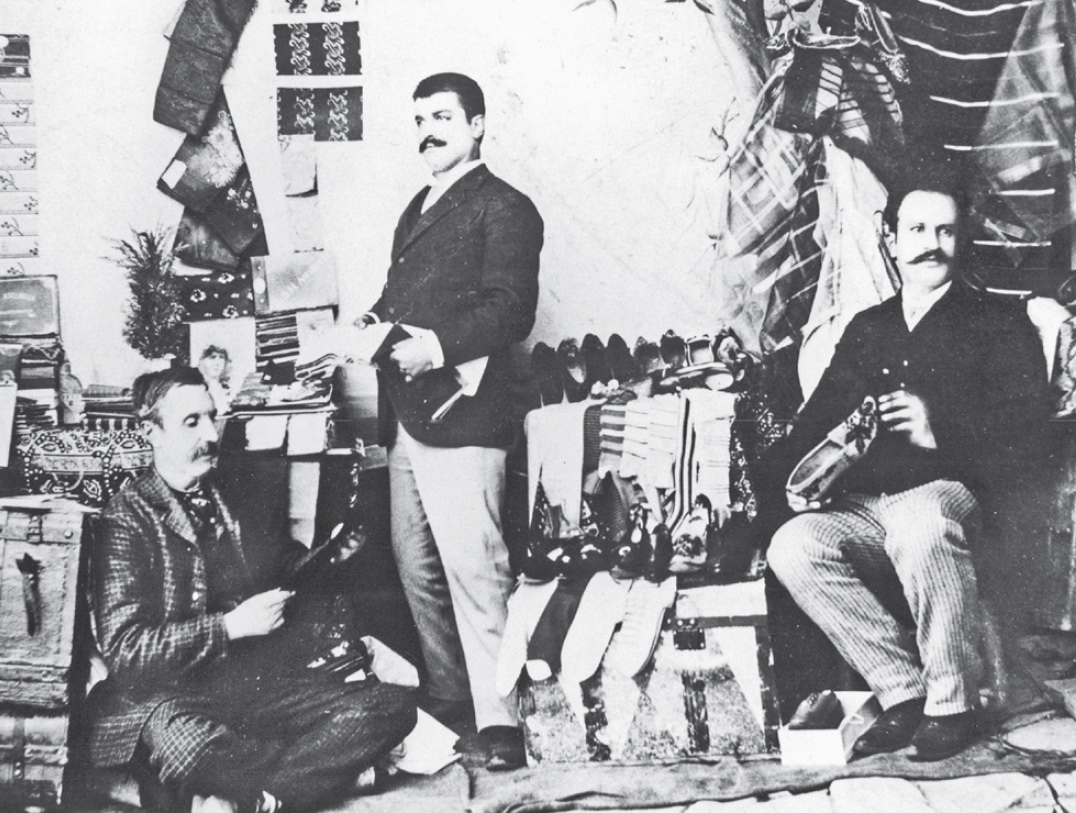
Agents of deindustrialization: K. Astardjan, cotton merchants of Armenian heritage, with branch o
ɽces in
Constantinople, Manchester, and elsewhere, presenting samples of Manchester cloth to customers in
Haskovo (in modern-day Bulgaria), 1886
(illustration credit 11.8)
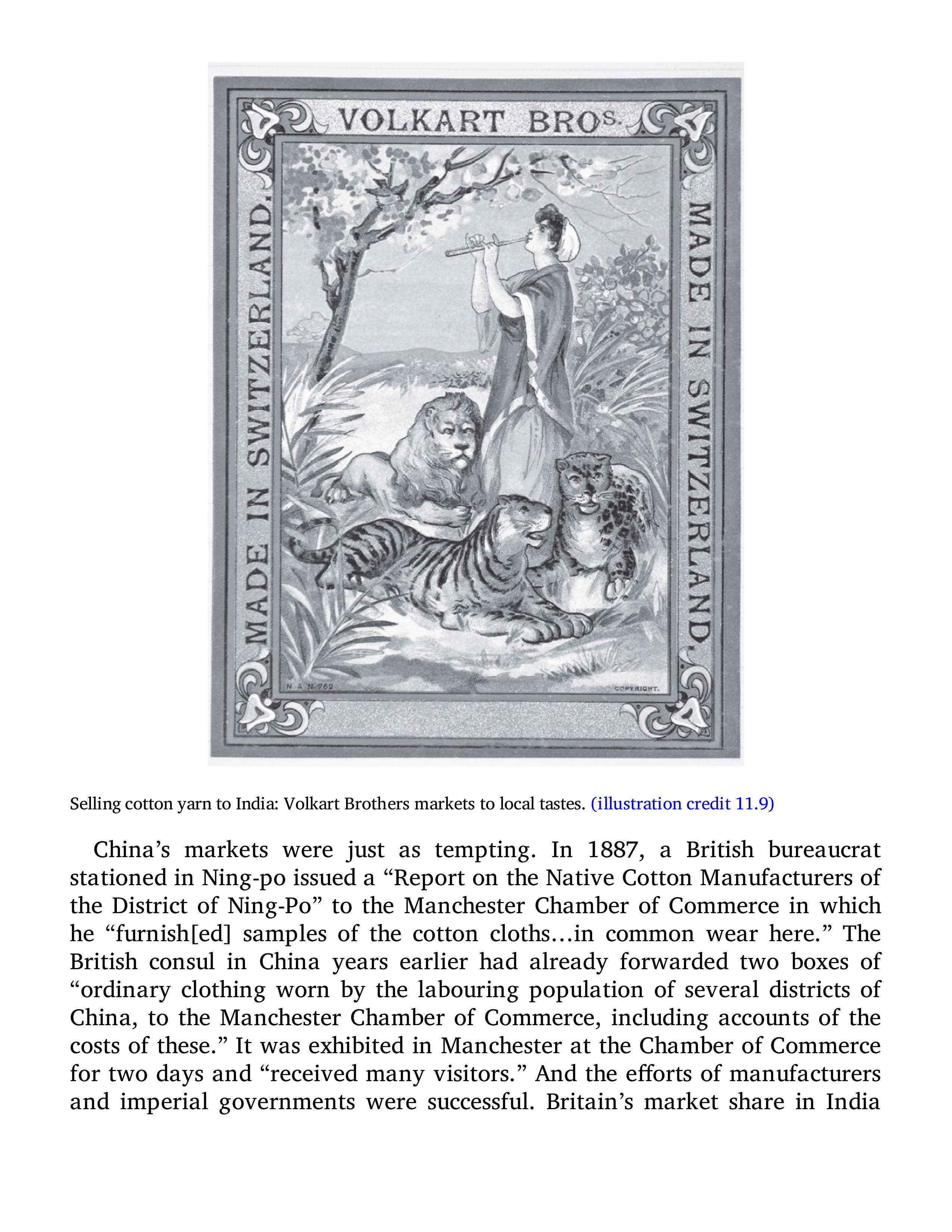
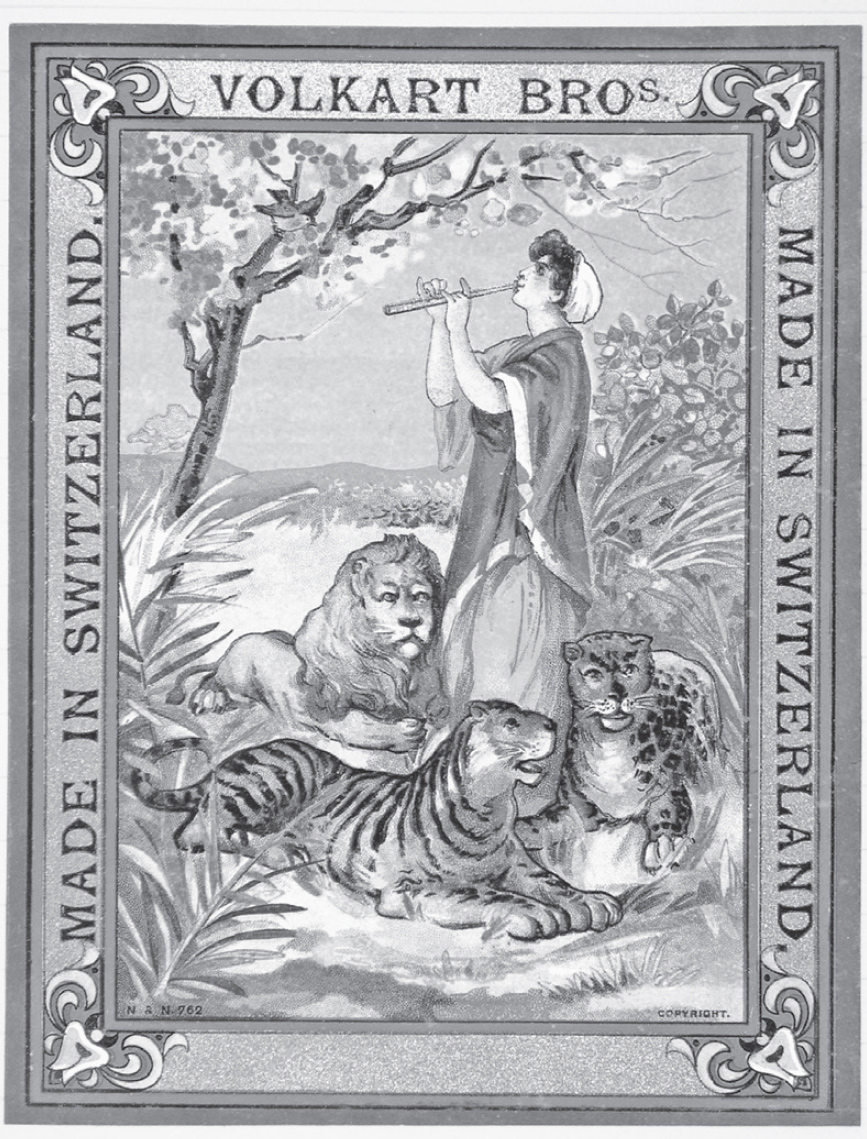
Selling cotton yarn to India: Volkart Brothers markets to local tastes.
(illustration credit 11.9)
China’s markets were just as tempting. In 1887, a British bureaucrat
stationed in Ning-po issued a “Report on the Native Cotton Manufacturers of
the District of Ning-Po” to the Manchester Chamber of Commerce in which
he “furnish[ed] samples of the cotton cloths…in common wear here.” The
British consul in China years earlier had already forwarded two boxes of
“ordinary clothing worn by the labouring population of several districts of
China, to the Manchester Chamber of Commerce, including accounts of the
costs of these.” It was exhibited in Manchester at the Chamber of Commerce
for two days and “received many visitors.” And the e
ʃorts of manufacturers
and imperial governments were successful. Britain’s market share in India
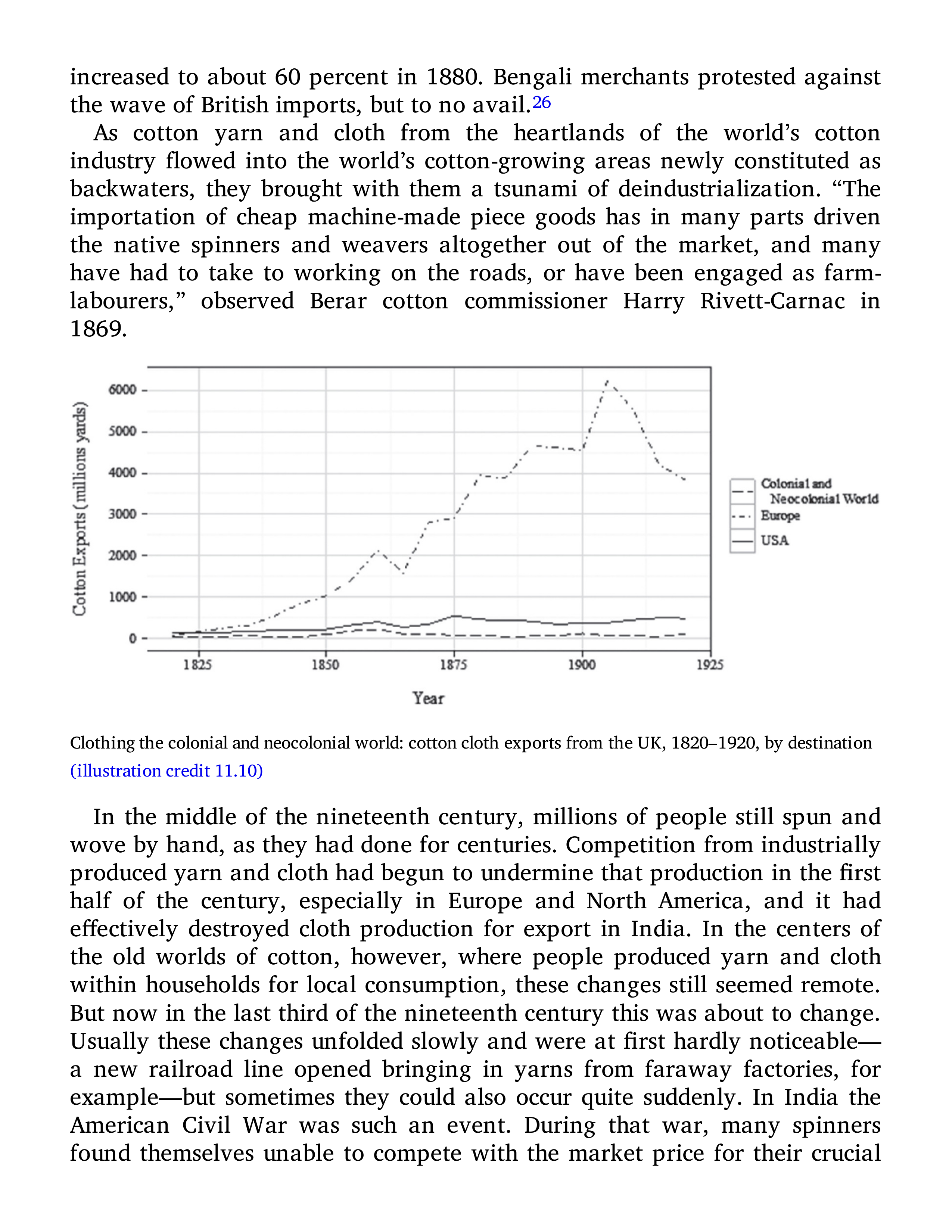
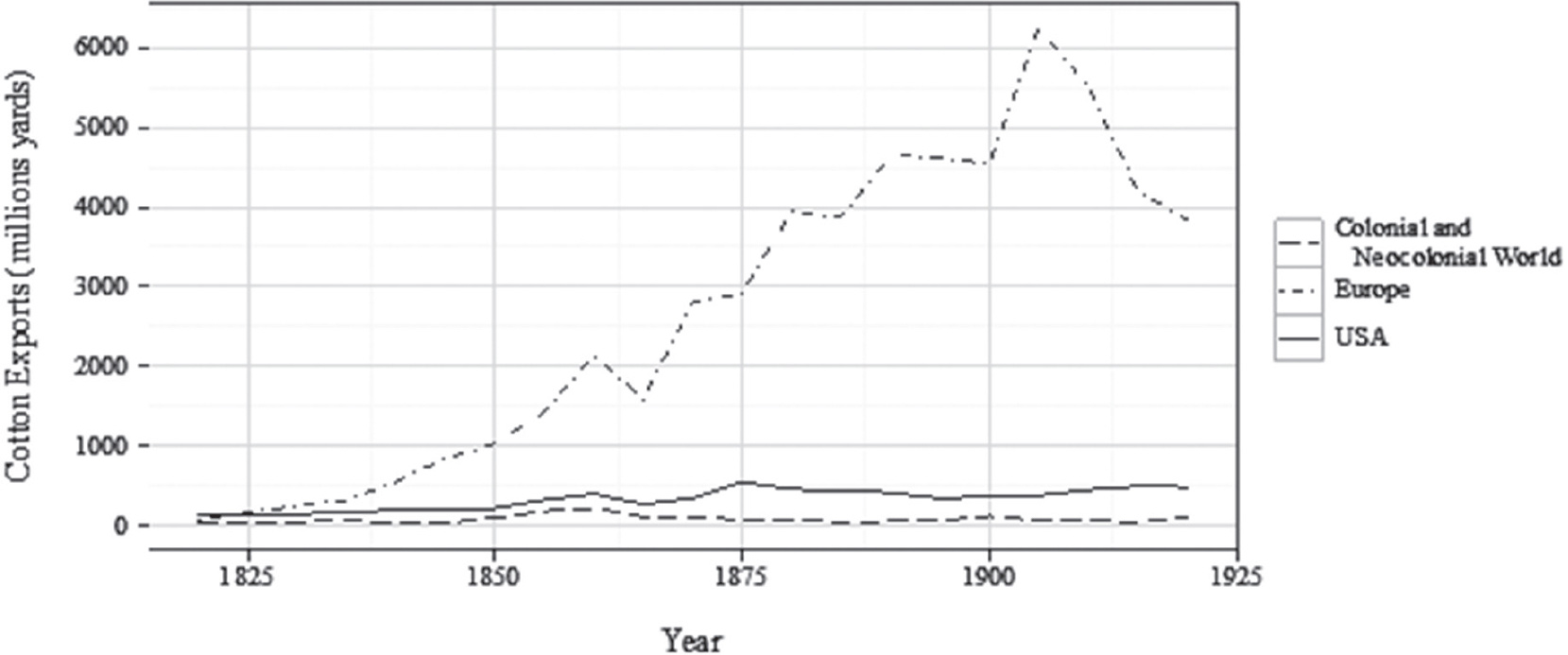
increased to about 60 percent in 1880. Bengali merchants protested against
the wave of British imports, but to no avail.
26
As cotton yarn and cloth from the heartlands of the world’s cotton
industry
ɻowed into the world’s cotton-growing areas newly constituted as
backwaters, they brought with them a tsunami of deindustrialization. “The
importation of cheap machine-made piece goods has in many parts driven
the native spinners and weavers altogether out of the market, and many
have had to take to working on the roads, or have been engaged as farm-
labourers,” observed Berar cotton commissioner Harry Rivett-Carnac in
1869.
Clothing the colonial and neocolonial world: cotton cloth exports from the UK, 1820–1920, by destination
(illustration credit 11.10)
In the middle of the nineteenth century, millions of people still spun and
wove by hand, as they had done for centuries. Competition from industrially
produced yarn and cloth had begun to undermine that production in the
ɹrst
half of the century, especially in Europe and North America, and it had
e
ʃectively destroyed cloth production for export in India. In the centers of
the old worlds of cotton, however, where people produced yarn and cloth
within households for local consumption, these changes still seemed remote.
But now in the last third of the nineteenth century this was about to change.
Usually these changes unfolded slowly and were at
ɹrst hardly noticeable—
a new railroad line opened bringing in yarns from faraway factories, for
example—but sometimes they could also occur quite suddenly. In India the
American Civil War was such an event. During that war, many spinners
found themselves unable to compete with the market price for their crucial
raw material. The Madras Chamber of Commerce in its 1863 report
observed that “the enhanced price of Cotton has rendered the position of the
Cotton Weavers of this Presidency one of great di
ɽculty.” As a result, the
number of weavers decreased by as much as 50 percent during the American
war, with former weavers moving into agricultural labor. Thus in a large
swath of India, integration into the world market went hand in hand with
widespread “peasantization,” not, as one might expect, proletarianization.
27
As
former
craft
workers
were
drawn
into
cotton
cultivation,
deindustrialization swept over their world in the following decades. In
Berar, “The manufacture of home made cloth has been undermined by the
importation of English Piece Goods, and many of the weaver class have
become ordinary labourers,” remarked the assistant commissioner in charge
of cotton of the government of India in 1874. With less cloth manufactured
at home, reported Berar’s cotton commissioner, “The home-made cloths
a
ʃect not at all the supply of raw materials which England conɹdently
expects from the Berars.”
28
For European cotton manufacturers this was reason to celebrate. When
Edmund Potter spoke at the Manchester Chamber of Commerce he was
cheered by “hear, hear” calls from the otherwise staid audience:
The great expenditure in our military operations; the great outlay in
making public works…and the increasing consumption by this
country…of the agricultural products of India; all these things have
circulated money among and raised in some degree the social condition
of the ryots [cultivators] of that country, so that their consumption of
manufactured goods has increased. One letter informs me that in some
districts the weavers are leaving their ill-paid operations in that
handicraft, and are resuming the occupation we wish them to follow,
namely, agricultural operations—(“Hear, hear”)—because there is no
question the real interest of India would be best promoted by
developing the agricultural products of its fertile soil. (“Hear”)
29
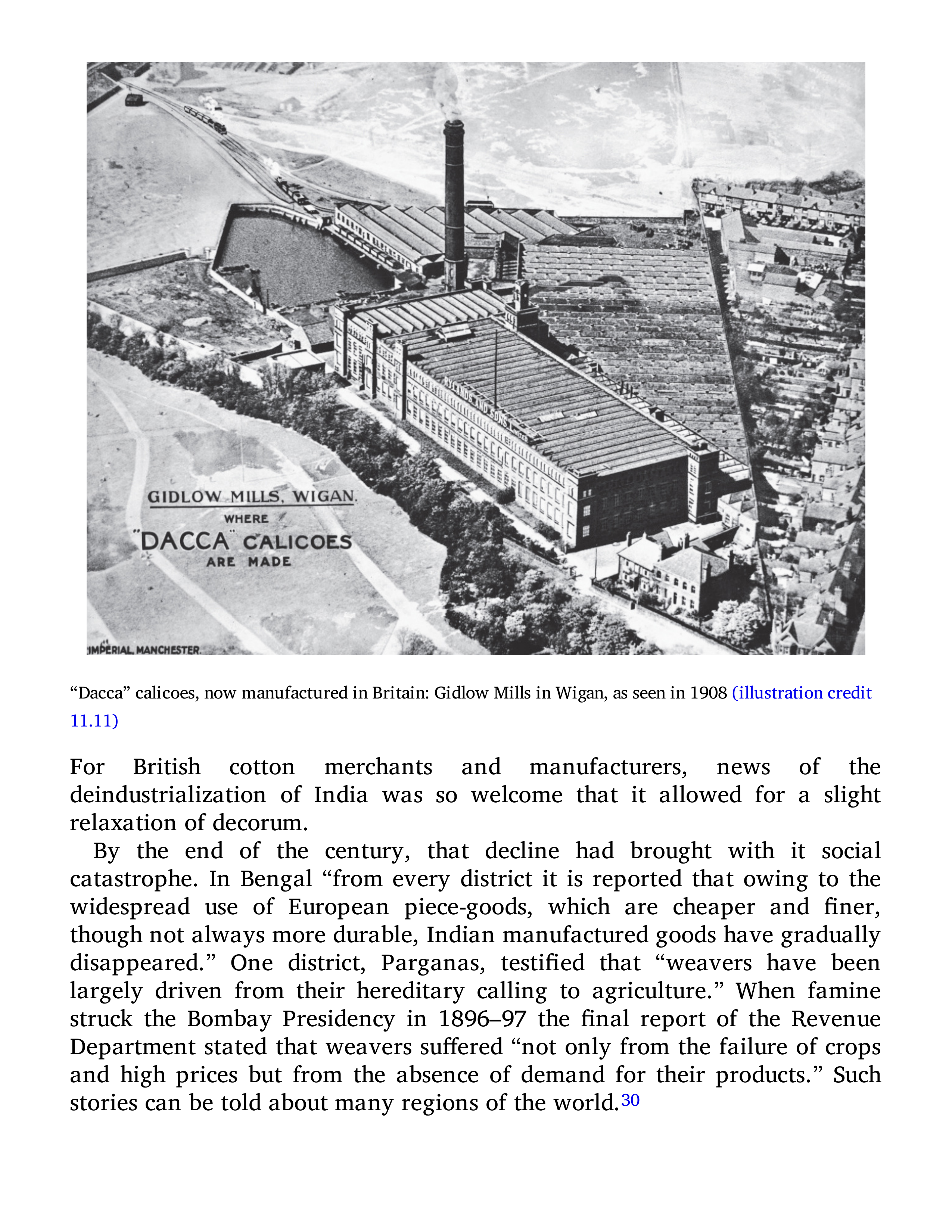
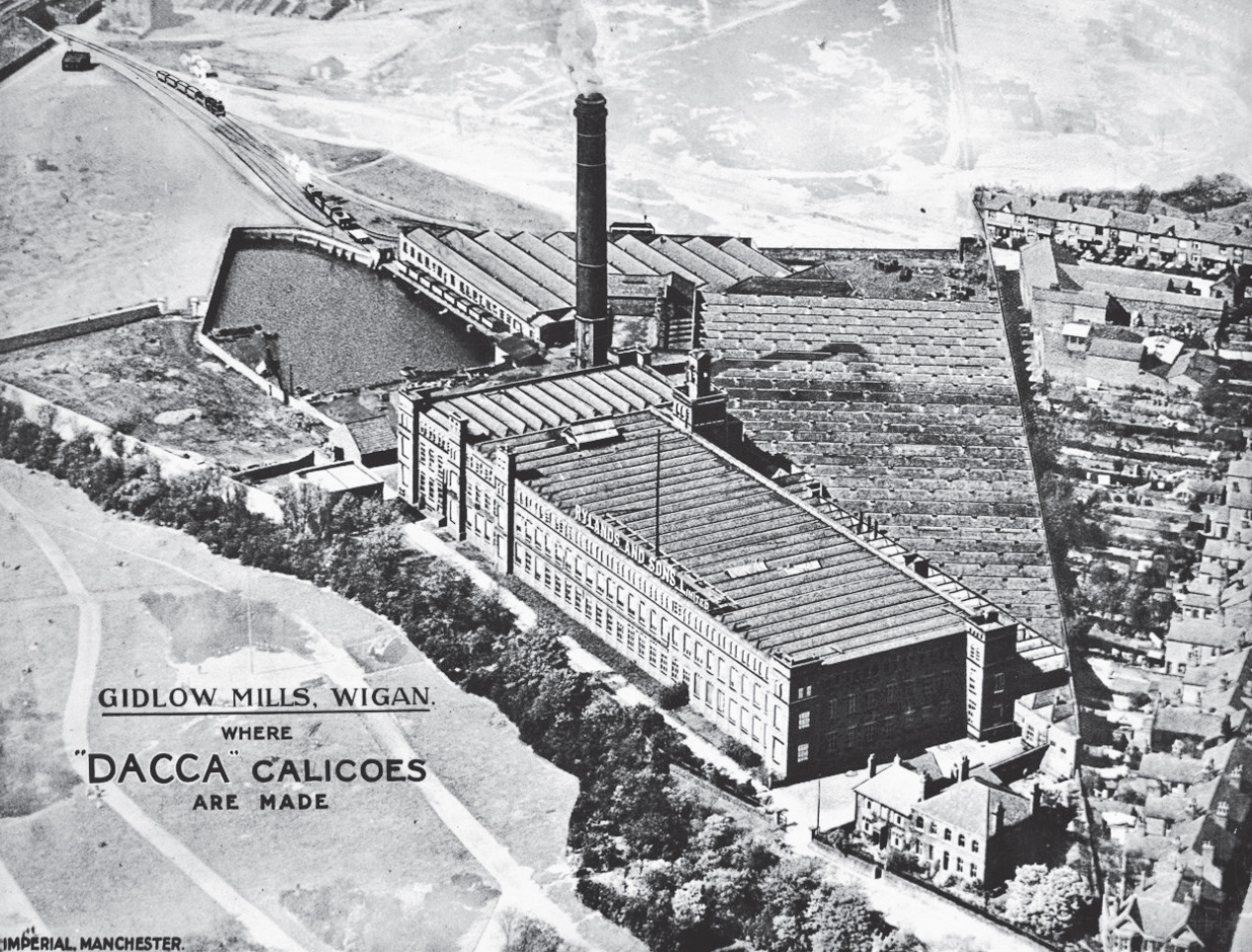
“Dacca” calicoes, now manufactured in Britain: Gidlow Mills in Wigan, as seen in 1908
(illustration credit
11.11)
For
British
cotton
merchants
and
manufacturers,
news
of
the
deindustrialization of India was so welcome that it allowed for a slight
relaxation of decorum.
By the end of the century, that decline had brought with it social
catastrophe. In Bengal “from every district it is reported that owing to the
widespread use of European piece-goods, which are cheaper and
ɹner,
though not always more durable, Indian manufactured goods have gradually
disappeared.” One district, Parganas, testi
ɹed that “weavers have
been
largely driven from their hereditary calling to agriculture.” When famine
struck the Bombay Presidency in 1896–97 the
ɹnal report of the Revenue
Department stated that weavers su
ʃered “not only from the failure of crops
and high prices but from the absence of demand for their products.” Such
stories can be told about many regions of the world.
30
Yet despite these pessimistic reports, domestic production did not
disappear. In the Ottoman Empire weavers took advantage of access to
cheaper (imported) yarn, and catered successfully to highly di
ʃerentiated
local markets, doing fairly well throughout the nineteenth century.
Historians of China have observed that while hand spinning diminished
rapidly (by 1913 only 25 percent of all yarn used in China was spun at
home), weaving remained, and during the 1930s 70 percent of cloth was
still produced in homes, indeed well into the socialist period home
manufacturing survived. In Latin America, the home-based production of
cottons persisted as well, especially among indigenous communities.
Historians of African manufacturing also observe that “contemporary
statements as to the complete hegemony of import cottons have no validity
outside fairly restricted zones”—basically places near European settlements.
Even in India, as the British colonial Department of Commerce and Industry
reported in 1906, “The weaving of cloth by hand is not, however, by any
means extinct, after agriculture it is still the most important occupation of
the native of India, and is pursued, in some parts, as an independent means
of livelihood or in order to supplement the earnings derived from
agriculture, and in others, as a purely domestic occupation.”
31
As the world shifted under their feet, and without the power to respond
politically to these shifts, local cotton producers adapted as well as they
could. At
ɹrst, faced with the loss of their export markets, they retooled to
supply domestic consumers, by producing coarser goods. They also focused,
often
successfully,
on
market
niches
not
supplied
by
European
manufacturers, and on producing more durable cloth. The Commerce and
Industries Department reported with some regret of “the di
ɽculty of
penetrating too many of the up-country markets, the e
ʃects of custom, of
caste, of religious beliefs, of the barter system, and so on, has prevented the
process from proceeding with the rapidity which it would otherwise have
attained.” As late as 1920, there were still about 2.5 million handloom
weavers remaining in India. Even Mahatma Gandhi, who made the
devastating impact of colonialism on domestic industry a key aspect of his
political campaigns, admitted in 1930 that “next to agriculture, hand-
weaving is still the largest and most widespread industry throughout the
whole of India”—not least because despite all the rapid advances, the
capitalist reorganization of the countryside remained far from complete in
the early twentieth century.
32
If these adjustments did not su
ɽce, weavers tried to reduce the costs of
their product by moving production farther into the countryside and giving
female household members a more prominent role in production. In the
Ottoman Empire, cotton textile production increasingly moved away from
male, guild-based labor toward female and child labor, often in the
countryside. Deindustrialization, as often as not, shaped gender inequalities
as it undermined household economies. Indeed, the ability of local
manufacturing to survive was often rooted in the gendered social structure
of the countryside, where workers, often women, were idle during parts of
the year, and families perceived the “cost” of continuing to produce textiles
for family consumption or even sale as extremely low. “In Assam and
Burma,” tellingly reported the Department of Industry and Commerce,
“weaving forms part of a girl’s education and woman’s ordinary household
duties. The family…is supplied in this manner, and the articles turned out
are seldom o
ʃered for sale; when the surplus production is disposed of in the
local market, the cost of the labour spent in the domestic occupation
practiced during leisure hours is not taken into consideration in calculating
the price.” The incomplete transition to capitalism, in fact, enabled the
super-exploitation of members of households who could labor for less than
the cost of their subsistence.
33
Spinners and weavers also tried collectively to resist the destruction of
their ancient industries—from the Black Forest to China to India—but their
movements confronted the ever more concentrated power of imperial states
allied closely with manufacturers. In the early nineteenth century, spinners
in the Black Forest had set machinery ablaze. In 1860, spinners rioted in
Guangzhou in response to waves of European imports.
34
But states did not
take kindly to such rebellions. A group of Indian weavers reported on tax
collectors resorting to torture to force them to pay their taxes
by Binding up with chords and wood cut out for the purpose, the most
delicate and private places, by placing stone on their head and backs;
By making them to stand in the sun, by pinching the thighs and the
ears, by pulling the whiskers, by tying the locks of one man to that of
one another, by sealing the doors of Houses, by selling at Auction the
Property of others which they obtained by force of arms, by the
con
ɹnement of some of us, without allowing them to go to their means;
by abusing and striking some, and abusing others and making use of
violent and coercive means.
35
Unrestrained violence did not just characterize the world of the slave
plantation. Weavers understood the logic of this new political economy
well, though they lacked the power to alter it: “Those who come to India
from Europe…after having collected large fortunes, take the same to
Europe, all which is obtained from our Labour, but we ourselves are left
without means of support.”
36
Despite individual resistance and collective protest, the overall trend was
unwavering and ultimately devastating: around the globe millions of
household cotton spinners and weavers lost their ability to spin and weave.
In India alone, historian Tirthankar Roy concluded, “There is undeniable
empirical evidence that the community of hand-spinners gave up spinning
on a large scale, and this factor alone may account for a loss of industrial
employment to the extent of 4–5 million persons.” Other historians have
suggested that the loss of manufacturing between 1830 and 1860 amounted
to between 2 and 6 million full-time jobs in India alone. The vast expansion
of cotton manufacturing in Europe and the increasing orientation of large
swaths of the global countryside toward the growing of cotton for export
destabilized and even destroyed ancient cotton manufacturing—with
devastating consequences for spinners, weavers, and rural cultivators
alike.
37
Life in much of the world’s cotton-growing countryside had always been
di
ɽcult at best. A focus on growing cotton for export could, both
theoretically and in fact, be bene
ɹcial to rural cultivators. Many
peasants,
as we have seen, pro
ɹted from rising cotton prices during the American
Civil War. Yet the radical recasting of ever larger swaths of the world’s
countryside also had less positive consequences. Most crucially, it
undermined food security. During the American Civil War, British o
ɽcials in
Ahmedabad, Haira, and Surat had reported that “the increasing area of land
devoted to cultivation of Articles of Export, such as Cotton…[has led to a]
proportionate decrease in cultivation of articles of food.” As a result, food
prices rose between 1861 and 1865 by more than 325 percent, and even Sir
Charles Trevelyan had to admit that “at the present high prices of food, the
body of the people, in several parts of India, are barely able to subsist.” In
Egypt, the situation was quite similar. Once a grain-exporting country, it
became dependent on imports of food crops as the result of its greater
dedication to cotton during the American Civil War. When in the summer of
1863 disease killed nearly all of Egypt’s cattle, a food crisis emerged in
which tens of thousands of
felaheen
perished.
38
The increasing world market orientation of cotton cultivators also had
signi
ɹcant eʃects on social structures. Throughout western India’s
Maharashtra, for example, British e
ʃorts to increase revenue and encourage
peasants to participate in distant markets led to the undermining of the
collective nature of villages, making individual peasants instead of villages
as a whole responsible for taxes, and handing judicial power to distant
courts instead of village-based and peasant-dominated tribunals. The market
now increasingly subsumed all aspects of society, not just in Lancashire or
Alsace, but in Berar and Lower Egypt as well. In Anatolia, “a large-scale
transition to a cash-crop economy” took place in response to the cotton
boom, with cotton replacing food crops, the abolition of feudal social
relations in the countryside, and the
ɹnancing of the crop by local
merchants who charged peasants interest rates between 33 and 50 percent.
In Egypt as well, the booming cotton export industry, according to historian
Alan Richards, “destroyed the old quasi-communal forms of land tenure,
broke up the protective web of village social relations, replaced them with
private property in land and individual tax responsibility, and helped create
four
classes:
large
landowners…,
rich
peasants…,
small
peasant
landowners, and a landless class.” As early as the 1840s, the government
had begun compelling peasants to grow speci
ɹc crops, including cotton, and
to “deliver them to government warehouses.” Peasants had responded to this
pressure by leaving the land in droves, which the government took as a
reason to deny any claims to the land by those who had “deserted” it. By
1862, anyone who left the land for more than two months lost his claim to
the property. In 1863, when Isma’il, Egypt’s new ruler, took power, he
focused his e
ʃorts on creating large estates, giving land to relatives and
o
ɽcials in his government, and forcing peasants to work on infrastructure
projects and on his own plantations. Resistance to such measures was
violently repressed.
39
The most serious impact on cotton farmers, however, emerged after the
American Civil War. Once world market prices declined after the onset of
the global depression of 1873, Indian, Egyptian, Brazilian, and American
rural cultivators had a hard time making up for lost income, as falling prices
made it ever more di
ɽcult to repay loans and make tax payments. The price
for Surat cotton delivered in Liverpool between 1873 and 1876 fell by 38
percent. Cotton growers in Brazil, Egypt, India, the United States, and
elsewhere, often highly indebted to local moneylenders, now faced
plummeting returns on their cash crops. In India and Brazil, the problems
were compounded by severe droughts that led to a rapid increase in food
prices. Though historians disagree as to how much the fall in world market
prices a
ʃected cotton growers, at the very least world market integration
increased the economic uncertainty faced by people in remote corners of the
world. Their incomes, and quite literally their survival, were now linked to
global price
ɻuctuations over which they had no control. All too often, the
only response open to farmers with little control over the land was to grow
more cotton to make up for lost income due to falling prices—which resulted
in a glut of cotton that depressed prices even further.
What wage workers, tenants, and sharecroppers had in common was that
they had lost access to subsistence agriculture—basic production and
consumption now depended on global markets. While “cotton [was once] a
subordinate product” and “the ryot [did] not neglect the raising of food for
the sake of cotton, however high its price may be, for in doing so he runs the
risk of starvation,” by the late nineteenth century millions of rural
cultivators became primarily dependent on cotton. Moreover, as world
market integration usually went along with social di
ʃerentiation, a growing
group of landless tenants and agricultural laborers periodically faced life-
threatening di
ɽculty in accessing food crops. In
Africa, one author found
that “cotton and food insecurity went hand in hand.” In La Laguna, Mexico,
an unprecedented percentage of children su
ʃered from malnutrition. In
Argentina, misery characterized small cotton-growing farms.
40
Between 1864 and 1873 the amount of cotton that a tenant or farmer had
to produce to buy a given quantity of Berar’s most important food grain,
jowar, doubled, and then it doubled again by 1878. Perhaps even more
signi
ɹcant, the relative price of grains to cotton changed dramatically from
year to year (changes of 20 percent or even 40 percent were not
exceptional), introducing a new level of uncertainty into cotton growers’
precarious lives. As one historian of India has remarked, “Successful
participation in markets requires economic autonomy and the capacity to
take risks and sustain losses. Poor and indebted peasants had neither.”
Contemporaries believed that this crisis was at least partly the result of the
diversion of land and labor away from food crops and toward cotton. As the
colonial government of India observed in 1874, “The more the area’s food
stocks is diminished in favor of
ɹbres, the greater the danger from any
failure of the monsoon becomes, & the greater appears to be the necessity of
some security against the consequences of such failure.” Indeed, cotton
production for export typically produced a quagmire of poverty, debt, and
underdevelopment well into the twentieth century. As H. E. Neguib Shakour
Pasha, the director of the Gharbieh Land Company in Cairo, reminded his
audience during a speech to the Congress of the International Federation of
Master Cotton Spinners’ and Manufacturers’ Associations, “You have only to
go to the villages and see the dwellings our people live in, their very small
interest in life, their hard work from morning till evening without
distractions would give you an idea as to how the Egyptian peasant lives his
gloomy and uninteresting existence.”
41
The causes of the uncertainties they faced often remained mysterious to
rural cultivators themselves. The cotton commissioner for Berar, Harry
Rivett-Carnac, reported in 1868 that “the great rise and then the sudden fall
in the price of cotton, and the constant
ɻuctuations in the market, by which
the cultivator, in even the most remote of the cotton-growing villages is
a
ʃected, has led some of the less intelligent to regard cotton not only with
distrust, but with a certain degree of awe.” Traveling into the “more distant
parts of the cotton-growing tracts of the Provinces,” he found people who
were mysti
ɹed as to why the price of cotton changed rapidly, as they “ɹnd
some di
ɽculty in realizing the present state of the trade, and the fact that,
by means of the Electric Telegraph, the throbbings of the pulse of the Home
markets communicate themselves instantly to Hingunghat and other trade
centres throughout the country.” These cotton growers told Rivett-Carnac
that they attributed such volatility to “luck,” “a war,” the “kindness of a
paternal Government,” or that the “the Queen had given every one in
England new clothes” on the occasion of the crown prince’s wedding.
42
These cultivators understood perfectly well that remote events over which
they had no control now determined the most basic conditions of their
existence.
This uncertainty could be life-threatening on a massive scale. In 1877 and
again in the late 1890s, Berar, as well as northeastern Brazil, witnessed the
starvation of millions of cultivators as cotton prices fell while food grain
prices rose, putting food out of reach of many cotton producers. Specializing
in cotton could result in disaster, as in the 1870s famine, which was not
caused by a lack of food (indeed, food grains continued to be exported from
Berar), but by the inability of the poorest agricultural laborers to buy
urgently needed food grains. In India alone, between 6 and 10 million
people died in the famines of the late 1870s. Observed one gazetteer, “Had
Berar been an isolated tract dependent on its own resources, it is possible
that in the plain taluks [British administrative units] there would have been
no famine.” High prices had made food unavailable to many peasants and
agricultural laborers, and during the 1900 famine, another 8.5 percent of
the population of Berar died, with the greatest numbers of deaths occurring
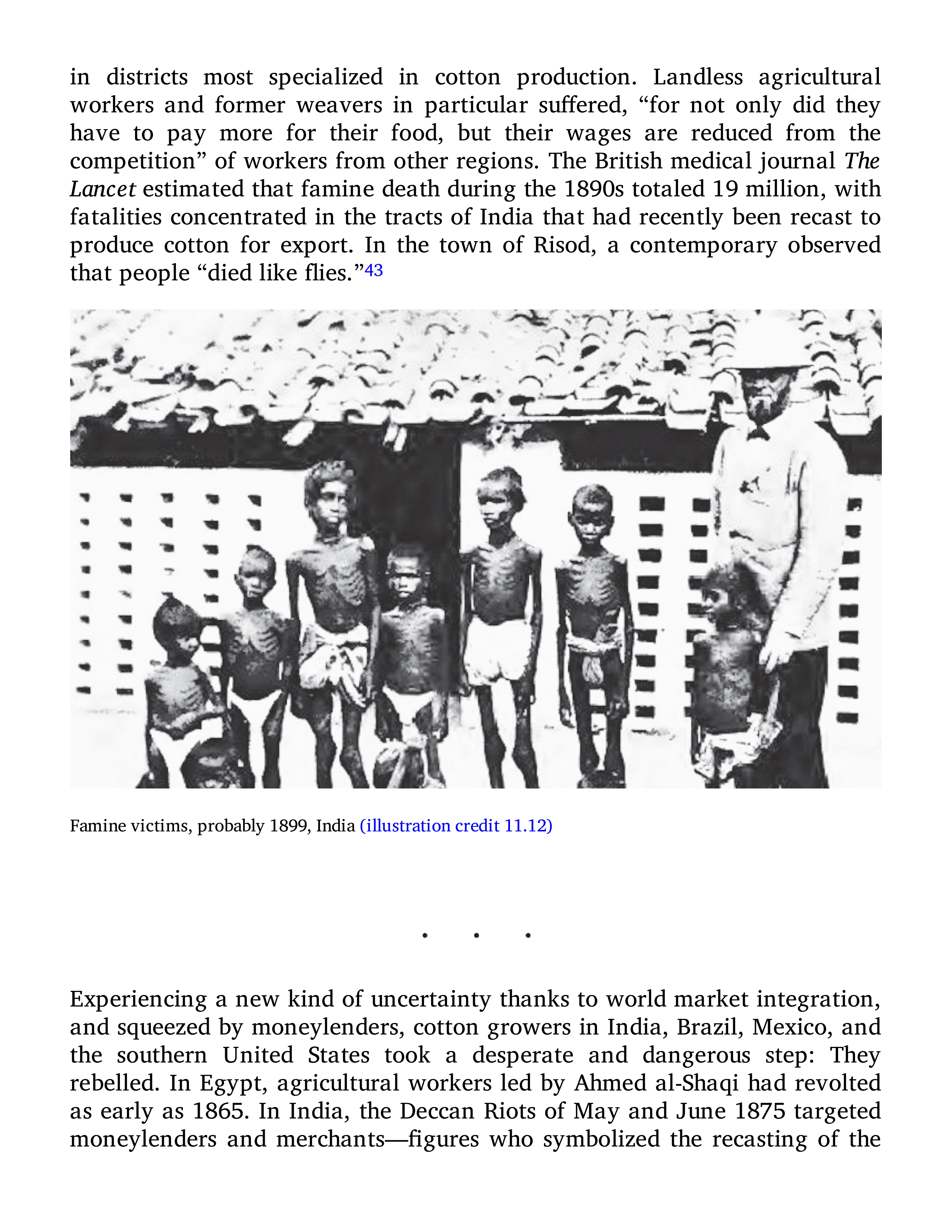

in districts most specialized in cotton production. Landless agricultural
workers and former weavers in particular su
ʃered, “for not only did they
have to pay more for their food, but their wages are reduced from the
competition” of workers from other regions. The British medical journal
The
Lancet
estimated that famine death during the 1890s totaled 19 million, with
fatalities concentrated in the tracts of India that had recently been recast to
produce cotton for export. In the town of Risod, a contemporary observed
that people “died like
ɻies.”
43
Famine victims, probably 1899, India
(illustration credit 11.12)
Experiencing a new kind of uncertainty thanks to world market integration,
and squeezed by moneylenders, cotton growers in India, Brazil, Mexico, and
the southern United States took a desperate and dangerous step: They
rebelled. In Egypt, agricultural workers led by Ahmed al-Shaqi had revolted
as early as 1865. In India, the Deccan Riots of May and June 1875 targeted
moneylenders and merchants—
ɹgures who symbolized the recasting of the
countryside. During the 1873–74 Quebra Quilos revolt, Brazilian peasants,
many of whom had just a few years earlier switched to cotton production,
destroyed land records and refused to pay taxes they could no longer a
ʃord
in the wake of the global fall of cotton prices. In 1899, widespread grain
riots occurred again, often drawing in hundreds of people even in small
villages. At the same time, cotton farmers in the southern United States also
organized. They formed the Farmers Alliance and launched a political
movement, Populism, demanding that the state relieve them of some of the
economic pressures that had wreaked havoc in their lives, a movement that
reared its head again during the
ɹrst decade of the twentieth century when
several hundred thousand farmers joined the Southern Cotton Association
and the National Farmers’ Union. Cotton populism spread as far as Egypt,
where Wady E. Medawar in 1900 formulated a program of agrarian reform
much like the one advanced by cotton farmers in the United States,
including cooperative societies, agricultural improvement associations,
mechanisms to provide cheap credit to farmers, and an organization of rural
cultivators that would interweave private and public initiative. Around the
same
time,
Mexican
cotton
workers
in
La
Laguna
deployed
“insubordination, theft, banditry” and other forms of collective action to
improve their situation. Food shortages led to grain riots, brutally repressed
by private armies backed by federal troops. Strategies of resistance varied
according to political regime, ranging from creating cooperatives and
running for political o
ɽce in
Texas to murdering moneylenders in India.
44
The rebellion of cotton cultivators at times had a signi
ɹcant impact on
national politics, as in the United States, where Populists in
ɻuenced the
critical presidential election of 1896 and forced a greater presence of the
state in the cotton trade, but also in Mexico, where they played an
important role in the Mexican Revolution of the 1910s. But the integration
of many areas of the world into the global cotton empire also made “cotton
nationalism” a major theme in twentieth-century anticolonial struggles.
Most prominently, Indian nationalists invoked their country’s recast role in
the global cotton economy as one of the most damaging e
ʃects of
colonialism, and envisaged a postcolonial economy in which India would
become again a major cotton power.
45
In future decades, these movements would revolutionize the empire of
cotton once again. But before this happened, the powerful new combination
of manufacturers and imperial statesmen who had emerged after the
American Civil War furthered the integration of the global cotton-producing
countryside in ever more parts of the world, including Korea, Central Asia,

and Africa. The tentacles of the empire of cotton spread ever farther. And
that imperial expansion, in often surprising ways, would also come to
in
ɻuence the postcolonial and even postcapitalist cotton industry, and with
it twentieth-century global capitalism.
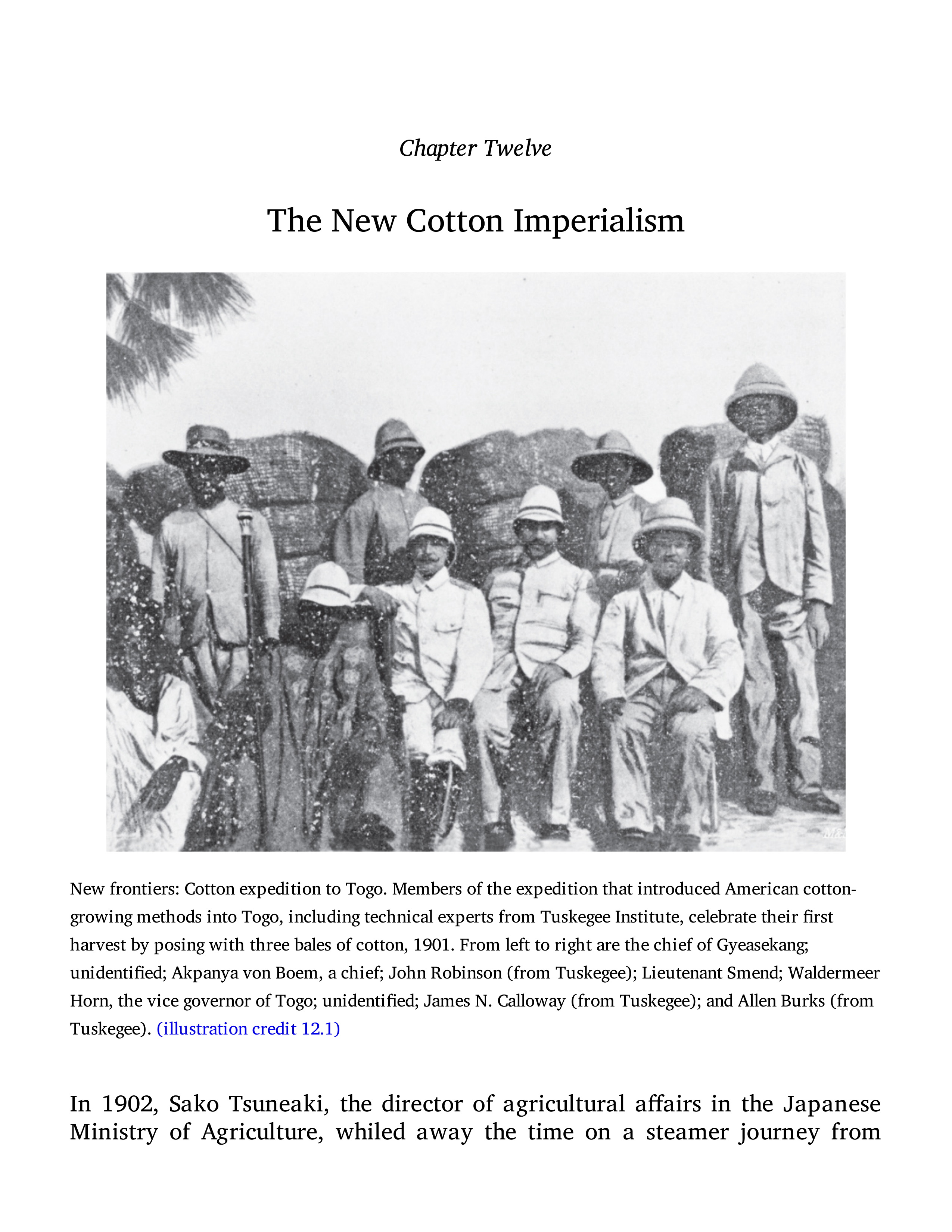
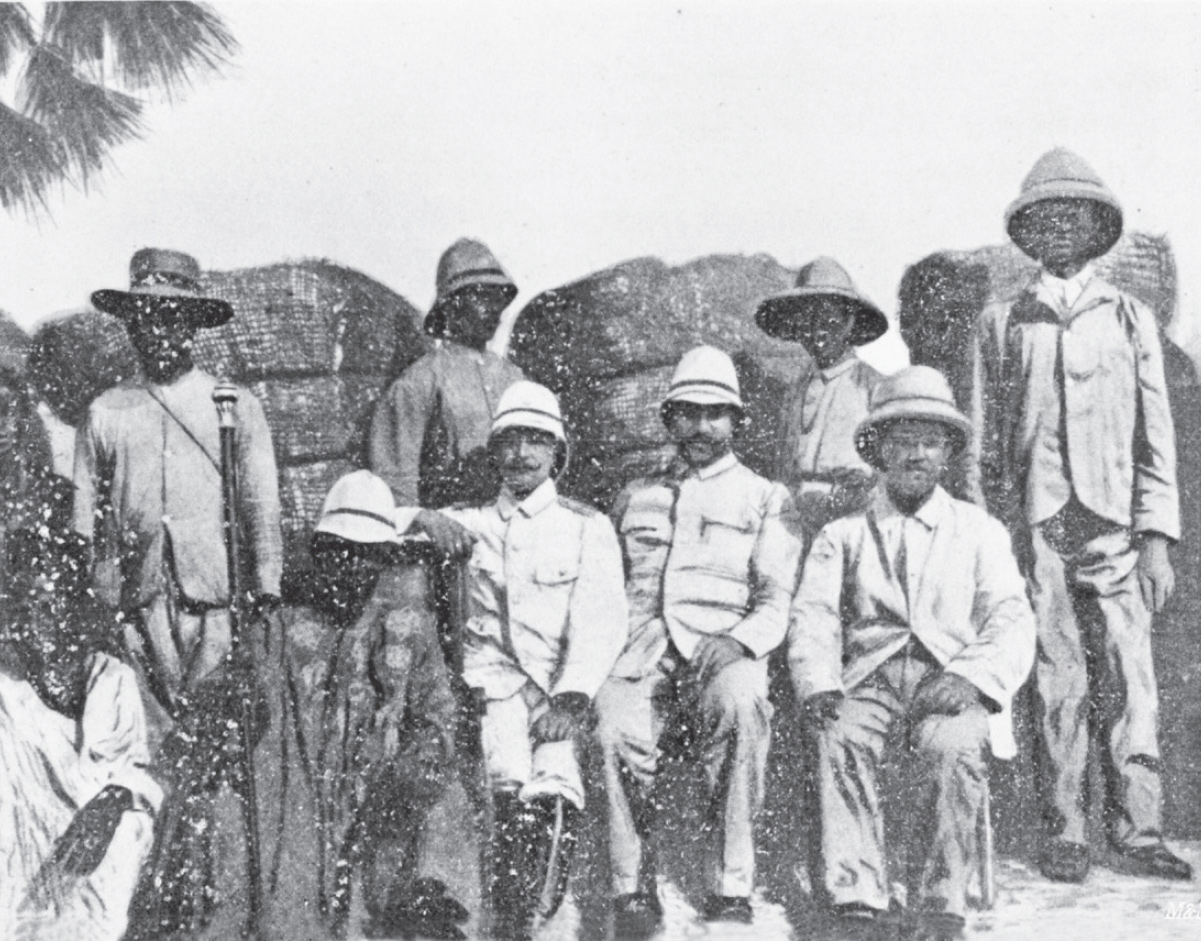
Chapter Twelve
The New Cotton Imperialism
New frontiers: Cotton expedition to Togo. Members of the expedition that introduced American cotton-
growing methods into Togo, including technical experts from Tuskegee Institute, celebrate their
ɹrst
harvest by posing with three bales of cotton, 1901. From left to right are the chief of Gyeasekang;
unidenti
ɹed; Akpanya von Boem, a chief; John Robinson (from Tuskegee); Lieutenant Smend; Waldermeer
Horn, the vice governor of Togo; unidenti
ɹed; James N. Calloway (from Tuskegee); and Allen Burks (from
Tuskegee).
(illustration credit 12.1)
In 1902, Sako Tsuneaki, the director of agricultural a
ʃairs in the
Japanese
Ministry of Agriculture, whiled away the time on a steamer journey from
China to Korea with Wakamatsu Tosaburo, a Japanese government o
ɽcial
newly transferred from Shashi, China, to Mokpo, Korea. As they traveled
across the Yellow Sea, the two discussed the prospects of expanding cotton
agriculture in eastern Asia in order to feed the factories mushrooming
around Osaka and elsewhere. In 1893, Japan had imported about 125
million pounds of raw cotton. By 1902 imports, mostly from India and the
United States, had increased to 446 million pounds; by 1920, they would
rise to more than 1 billion pounds. Perhaps, agricultural bureaucrat Sako
suggested, Korean rural cultivators could be made to produce more cotton
for Japanese factories. Wakamatsu concurred, observing that in Shashi,
where he had just spent some years, a vibrant cotton-growing industry had
emerged. Upon landing in Korea the two resolved to investigate local
cotton-growing practices and to
ɹnd ways to increase production.
1
Informed by his earlier observations in China, Wakamatsu began to
experiment with various cotton strains on small model farms. Two years
later, in 1904, members of the Japanese Imperial Diet (the parliament) and
the House of Peers, as well as cotton manufacturers, created the Association
for the Cultivation of Cotton in Korea, “following the example of the British
Cotton Growing Association,” which had been created just two years earlier.
The association systematized and expanded Wakamatsu’s e
ʃorts, focusing
especially on the introduction of American cotton strains, building a cotton
gin, and eventually presenting a report to the government of Korea with
recommendations to increase cotton production. By 1906, Japanese spinners
had established the Korean Cotton Corporation in Osaka with a branch
o
ɽce in
Mokpo, providing loans to Korean rural cultivators who mortgaged
their cotton crops to the company. Expanding their activities rapidly, the
Japanese spinners gained “control over much of the raw cotton produced in
the peninsula’s southern cotton belt.” They were aided in this project by the
many agents sent into the Korean countryside by Japanese cotton
merchants to purchase the white gold.
2
When Japan began its occupation of Korea in 1910, the new colonial
government took steps to further expand cotton production. In March 1912,
“the Governor-General issued…an instruction to the Provincial Governments
of the southern part…concerning encouragement of the planting of upland
cotton.” Both Japanese cotton capitalists and imperial administrators
worried that Japan’s dependence on cotton imports might endanger the
growth of its manufacturing industry. They especially hoped to disentangle
themselves from the British Empire, given that by 1909, 62 percent of
Japanese cotton imports arrived from India.
3
Cotton from colonial Korea, and from Japan’s other colonial possessions,
Manchuria and Taiwan, was one potential solution. Korean farmers had
traditionally produced cotton alongside other crops such as beans and
vegetables on their smallholdings, often in the same
ɹelds. Most of the ɹber
was consumed in the domestic manufacture of cloth. Japanese colonialists
hoped to recast this indigenous cotton industry just like their British peers
had done in India: by cultivating new lands, persuading farmers to convert
more of their existing
ɹelds to cotton growing, conducting agricultural
experiments to improve yields and quality, and providing state supervision
of the selling of the crop. They drew upon the experiences of rival cotton
powers: The Japanese Ministry of Agriculture and Commerce had indeed
investigated the cotton-growing e
ʃorts of the Germans in
Togo, the French
in French Soudan (modern-day Mali), and the British in the Sudan. Both the
Association for the Cultivation of Cotton in Korea, founded in 1904, and the
Cotton Cultivation Expansion Plan of 1912 borrowed signi
ɹcant elements
from these foreign models.
4
These e
ʃorts bore fruit. Korean cotton exports to Japan increased from an
annual average of 37 million pounds between 1904 and 1908 to 165 million
pounds between 1916 and 1920. Cotton exports from Japanese-controlled
Kwantung province in China provided another 4.1 million pounds. The
production of cotton from American seeds increased at a particularly rapid
rate. By 1915, 263,069 Korean cultivators grew 37 million pounds. Thanks
to the e
ʃorts of the colonial state, the Japanese cotton industry had
domesticated a small but growing colonial cotton complex.
5
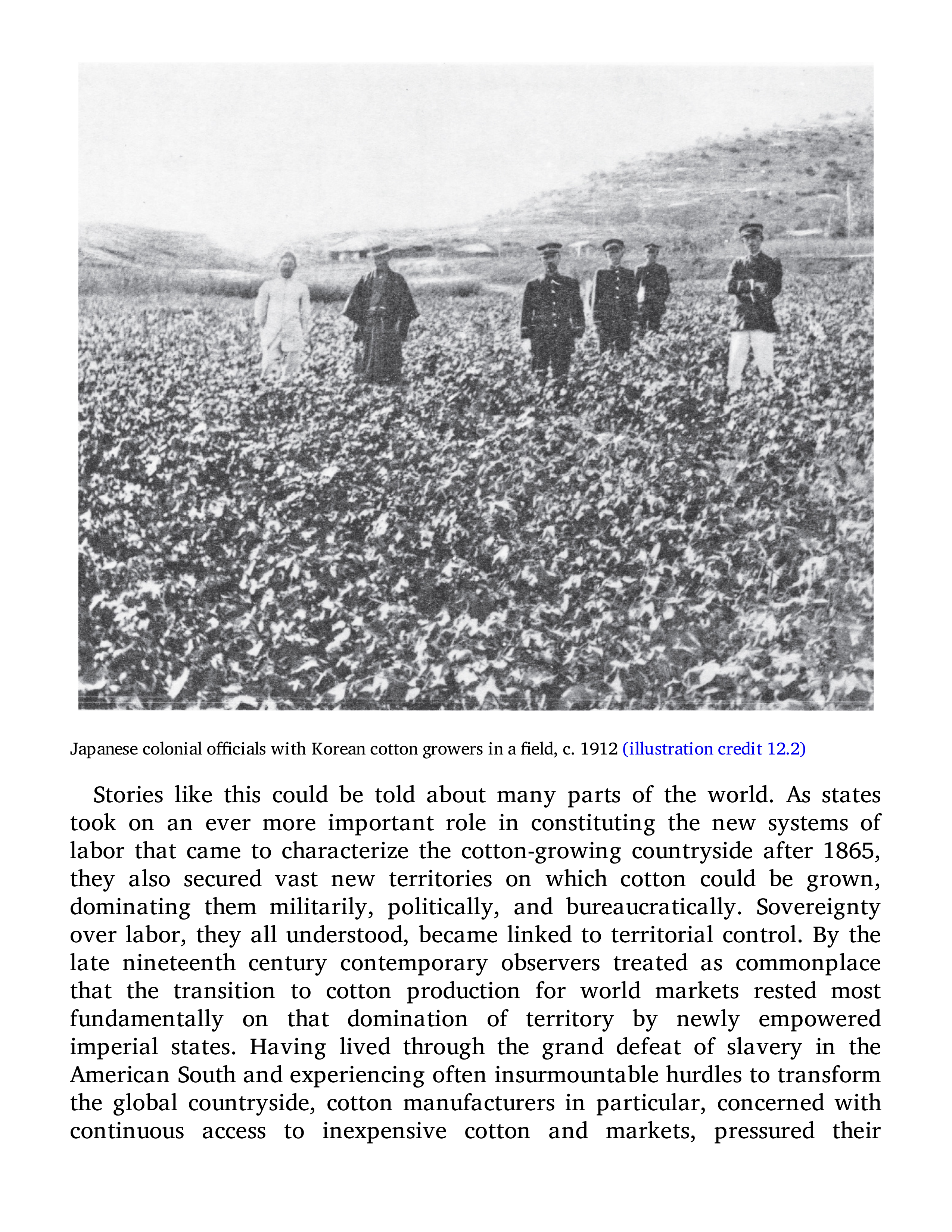
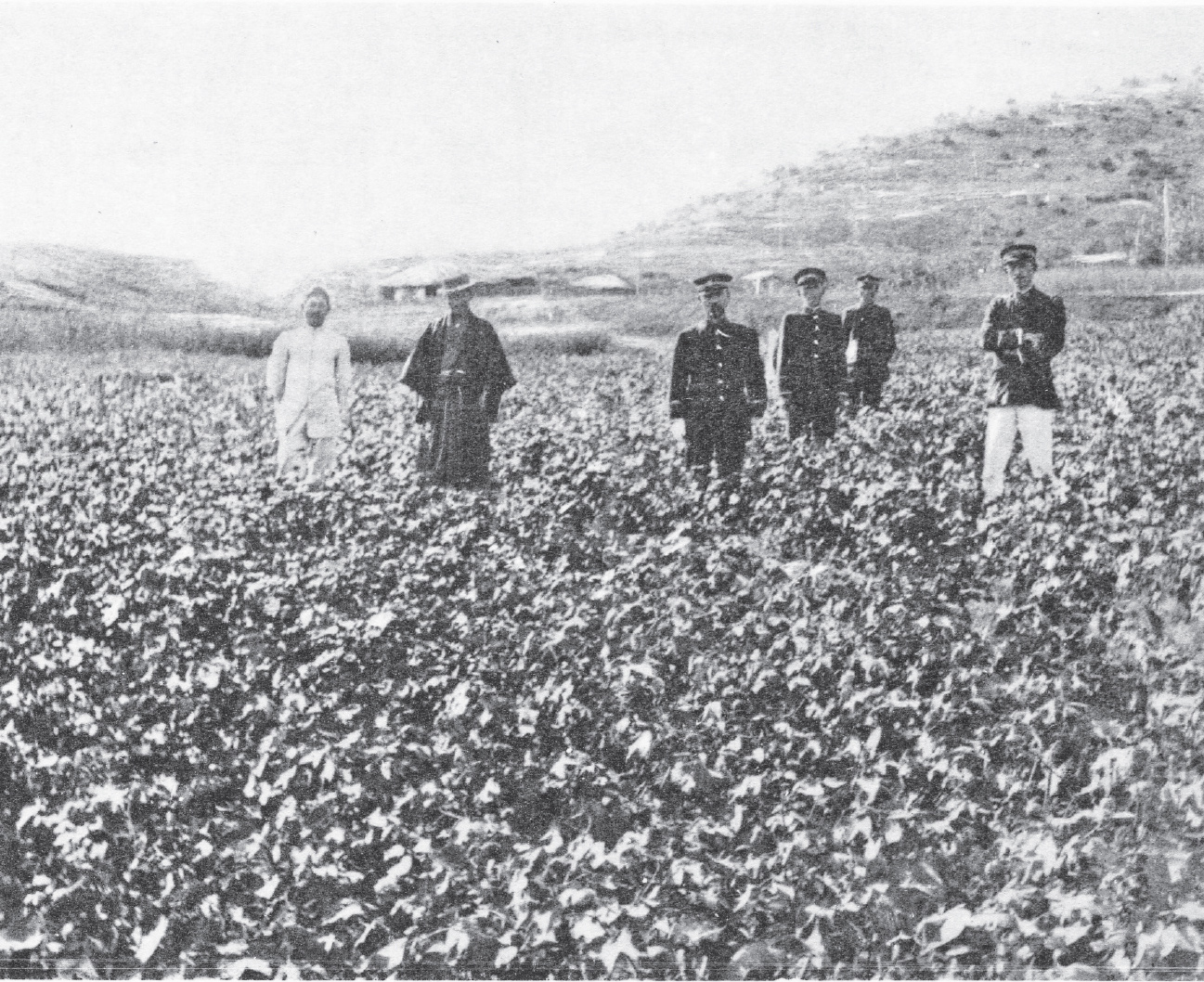
Japanese colonial o
ɽcials with Korean cotton growers in a ɹeld, c. 1912
(illustration credit 12.2)
Stories like this could be told about many parts of the world. As states
took on an ever more important role in constituting the new systems of
labor that came to characterize the cotton-growing countryside after 1865,
they also secured vast new territories on which cotton could be grown,
dominating them militarily, politically, and bureaucratically. Sovereignty
over labor, they all understood, became linked to territorial control. By the
late nineteenth century contemporary observers treated as commonplace
that the transition to cotton production for world markets rested most
fundamentally on that domination of territory by newly empowered
imperial states. Having lived through the grand defeat of slavery in the
American South and experiencing often insurmountable hurdles to transform
the global countryside, cotton manufacturers in particular, concerned with
continuous access to inexpensive cotton and markets, pressured their
governments to exert more control over ever more extensive cotton-growing
lands.
The consolidation of states in the United States, Egypt, the Ottoman
Empire, and elsewhere, as well as the expansion of imperial control over
colonial territories in Korea, western Africa, and Central Asia, signi
ɹcantly
extended the reach of the cotton empire in the decades after the American
Civil War. Conquest and control, however, did not by itself produce cotton.
Expansion demanded incorporation strategies, and state bureaucrats and
capitalists systematically applied lessons learned from the mobilization of
cotton-growing workers in the United States after emancipation. In some
cases, they removed native populations to make land available for cotton-
growing settlers, as in eastern Africa. But more typically in the period after
the American Civil War, they folded their new subjects into the global
cotton-growing complex by constructing infrastructure, creating new labor
regimes, and recasting local social structures. This happened in western
Anatolia, Central Asia, and western as well as central Africa. This
metamorphosis frequently rested on coercion and violence, but not on
enslavement. And its particular pace and extent varied with the particular
ways these societies had been organized before incorporation and with the
relative capacity of colonizing states. Indeed, integration into the global
economy sometimes failed or bogged down when imperial subjects
successfully retained control of their land and their labor.
6
These exceptions, however, prove the rule: In most cases, emancipation
and the emergence of a new imperialism went hand in hand. Slavery
became free labor, local sovereignties gave way to nation-states and
empires, mule and camel trails to railroads, and war capitalism to scienti
ɹc
agricultural reform, carried out by eager colonial agents drawing on the
lessons learned from industrial capitalism. States brought military
domination and paci
ɹcation, infrastructure and property rights in land. And
as these states constituted new far-reaching global networks, global
networks in turn fostered the strengthening of states.
In the wake of the nineteenth century’s great struggles for emancipation,
European cotton-consuming countries, the United States, and Japan moved
decisively to control and exploit territories where cotton could be grown.
This “cotton rush” of sorts reached its zenith at the turn of the century, when
new imperial powers embraced it with as much zeal as the older colonial
states had done during the Civil War. The reasons were straightforward:
While the ability of cotton capitalists to return African-American workers to
the growing of cotton for world markets by the 1870s had taken some
pressure o
ʃ the world’s countryside, long-established concerns among cotton
manufacturers and statesmen about secure and inexpensive cotton supplies
were ampli
ɹed by the late nineteenth century.
As cotton prices rose for the
ɹrst time in a quarter century—between 1898
and 1913 by 121 percent—European and Japanese manufacturers expressed
concerns that the United States would consume increasing percentages of
the cotton harvested on its
ɹelds in its own factories, leading to shortages
and even higher prices. These concerns were further ampli
ɹed by the
temporarily successful e
ʃorts by some speculators to “corner” the market
and force higher prices by manipulating future and spot transactions on the
newly established cotton exchanges. Once these corners failed, a wave of
“cotton populism” swept the southern countryside of the United States, with
cotton growers determined to collectively enable higher prices for their
crops. The boll weevil, an agricultural pest that had begun to spread on
American cotton farms in 1892, also seemed to threaten cotton production,
and there were pressures on demand as well with cotton factories spreading
to new areas of the world. British manufacturers, for example, observed that
continental Europeans now consumed one-third of the entire U.S. cotton
harvest, which was more than British factories. “One shudders,” warned
British author Edmund D. Morel, “to contemplate the consequences which
would ensue if anything should again prevent Lancashire from obtaining her
share of the cotton crop of America.” Rising prices, reported an association
of German industrialists, meant a huge sacri
ɹce for the hundreds of
thousands of workers employed in German cotton factories. So great was the
concern for world cotton supplies at the turn of the century that some
modern-day scholars have called this moment a “second cotton famine.”
7
At the same time, the general notion of “raw material independence”
became an increasingly important political goal for policy makers and
capitalists in Europe and Japan. The idea of securing cotton on lands
controlled by imperial states gained traction. As a result, the global cotton
“commodity frontier” was pushed into even more numerous areas of the
world, intensifying what one historian has so aptly termed “the great land
rush.”
8
The expansion of the empire of cotton, as we know, was hardly a new
development. Yet the e
ʃort at its more “national” organization was a true
departure, considering how deeply the cotton industry had been embedded
within global trade networks that crossed national and imperial boundaries,
and that rested on the connections crafted by merchants. As industrial
capital, not merchant capital, became ever more important to states, and as
these states became ever more important to national capitalists, the old
merchant-dominated order became less relevant, and statesmen and
manufacturers increasingly perceived it as potentially threatening to their
power, their wealth, and their ability to maintain social stability.
Perhaps most remarkable for its audacity was Russia’s attempt to secure
“domestic” supplies of the white gold. Since the early 1800s, farsighted
government
bureaucrats,
along
with
a
group
of
merchants
and
manufacturers, had imagined Transcaucasia and Central Asia as a source of
raw cotton to “prevent all those negative consequences that might arise due
to long factory stoppages,” as manufacturer Aleksandr Shipov argued. The
Russian commander in chief in the Caucasus, Baron G. V. Rosen, had
envisaged as early as 1833 that the cotton growers there “would be our
Negroes.” Yet as late as 1857, such e
ʃorts reaped few rewards—Central
Asian cotton supplied only 6.5 percent of the needs of the Russian industry.
9
During the 1860s, however, e
ʃorts to promote Central Asian cotton
exploded, as a small group of cotton mill owners, united in the Central
Asian Trading Association, met in Moscow to
ɹnd ways to grow more
cotton
for Russian factories. Encouraged by a tripling of prices during the U.S. Civil
War, cotton exports from Central Asia to Russia increased nearly
ɹvefold to
24 million pounds between 1861 and 1864. In a key moment in 1865,
Russia captured Tashkent and the Central Asian khanate of Khokand, which
were
to
become
important
cotton-growing
areas
in
the
future.
Manufacturers began to pressure the Russian government to further its
acquisition of Central Asian territories. In 1869 the Russian Industrial
Society, which brought together a wide variety of entrepreneurs, published
numerous petitions agitating for deepening Russia’s intervention in Central
Asia in order to create a market for Russian goods and a source for cotton
ɹbers. The government responded favorably, in part because of its
geostrategic desire to counter British moves in Central Asia, but also because
the import of cotton weighed heavily on its balance of trade. By 1890, raw
cotton constituted 20 percent of the value of all Russian imports. The
capture of Central Asian territories only whetted the appetite of Russian
entrepreneurs. In 1904, Russian industrialists, among them textile
manufacturer Baron Andrei L’vovich Knoop, the son of Ludwig Knoop,
whom we encountered earlier as a Bremen merchant moving to Russia,
created the Commission to Develop Russian Cotton Growing to investigate
further possibilities for the expansion of cotton agriculture in Central Asia.
10
Central Asian cotton, as a result, was launched on a path of rapid state-
backed expansion, similar to what happened simultaneously in India. After
the consolidation of Russian rule over Central Asia in the 1860s and 1870s,
the imperial government, at the urging of Russian cotton capitalists,
systematically worked to increase cotton production. In 1871, Russian
colonial bureaucrat Shtaba L. Kostenko commanded that “the aim of all of
our e
ʃorts has to be the striving to remove from our inner markets the
American cotton and to replace it with our own, Central Asian one.” To
make this possible, the colonial administration undertook large-scale
infrastructure projects, such as the building of railroads. In remote areas it
had taken up to six months to transport cotton by camel to the nearest
railroad station; now the same journey took two days. The government
sponsored seed plantations and sent agronomists to help farmers improve
agricultural techniques. In addition, the government began planning large-
scale irrigation projects and sent bureaucrats to the United States to study
American cotton growing. They eventually procured American cottonseeds
and distributed them to local peasants; by the late 1880s more than half of
the Central Asian cotton crop derived from these seeds. At the same time,
large Russian cotton manufacturers erected cotton gins in Turkestan and
sent out agents who advanced credit to local growers on the security of their
future crop.
11
As time went on, the colonial state and Russian capitalists increasingly
involved themselves in the production process itself, something they had
previously avoided. Despite persistent con
ɻicts between the state, which was
bent on integrating the territory, and capitalists, who were set on
maximizing pro
ɹts, such eʃorts resulted in a dramatic increase in the area
of cotton sown. In Turkestan, for example, the size of cotton land increased
by approximately forty-eight times in the
ɹve decades after 1870. As early
as the 1880s, growers in Turkestan produced a quarter of all cotton used in
Russian cotton factories, and more than half by 1909, enough for one
historian to call the province “the cotton colony of Russian capitalism.” The
state protected its colonial cotton production by levying duties on raw
cotton imports, which by 1905 had risen to about 43 percent of the value of
cotton. In 1902, a British traveler observed that “the growing of cotton…has
now become the main occupation of the inhabitants of all the Central Asian
Khanates.” And by the early 1920s, the Central Asian city of Khokand, a
center of the cotton trade, came to be called “cottonopolis.” Russia had
turned itself into one of the most important cotton-growing countries in the
world, ranking
ɹfth behind the United States, India, China, and Egypt.
12
The radical changes that the Russian state and Russian and Central Asian
capitalists were able to e
ʃect led others to look with envy at their success. In
1902, German economist August Etienne remarked with genuine admiration
that Russia “approaches with rapid steps inexorably its objective to make
the Russian cotton industry independent from America.” Russia deserved
praise, since “with its Asiatic cotton culture it has shown the rest of Europe,
what energetic will and well planned cooperation between national and
private forces can do to solve the cotton question.” A new cotton
imperialism had begun to take shape.
13
Other imperial powers soon embarked upon their own ventures. They had
concluded, with Etienne, that “in the overseas program of the European
peoples, the encouragement of cotton culture must take a leading role, with
the explicit goal to emancipate oneself from America.”
14
Invoking memories
of the U.S. Civil War, Etienne employed arguments for the state’s support of
national capitalists that were spreading like wild
ɹre
through European
capitals. States, after all, could speed up the commercialization of potential
cotton-growing areas of the world in ways beyond the reach of individual
merchants and masters.
15
As a result, cotton and colonial expansion went hand in hand, not only
for Russia and Japan, which desperately tried to catch up in the grand game
of securing raw materials for domestic industries, but also for expansionist
stalwarts like Great Britain, France, and the United States, as well as
marginal imperial powers such as Portugal, Germany, Belgium, and Italy.
16
Everywhere, European manufacturers, at times supported by textile
workers and their unions, were the driving force behind this recasting,
pressuring their governments to draw more cotton out of various colonial
possessions in Asia and Africa. In Britain, such imperial cotton projects had
the longest history—recall the enormous range of activities that the
Manchester Cotton Supply Association had embarked upon. After the U.S.
Civil War, imperial cotton projects continued, although at a lower level,
having become less essential as American cotton rushed back onto global
markets. But the desire for colonial cotton reached again fever pitch around
the turn of the century as manufacturing volume and prices rose and new
competitors emerged. In 1901, the Oldham Textile Employers’ Association
observed that “the importance…[of] the Growth of Cotton within the limits
of the Empire…cannot be over-estimated.” A year later, British cotton
manufacturers founded the British Cotton Growing Association in the cotton
metropolis of Manchester, funded by both manufacturers and textile
workers’ unions. The association believed that “all the cotton Lancashire
requires can be grown within the limits of the Empire.” The Oldham Master
Cotton Spinners’ Association agreed: “an important commercial nation like
our own ought not to be dependent on other countries for the supply of
cotton which might possibly be grown within the limits of the empire.” By
1916, the Empire Cotton Growing Association joined in the struggle for
colonial cotton—though, unlike the British Cotton Growing Association,
under the auspices of the government itself. This government institution
devoted itself to raising cotton in the colonies, as “it is essential for the
future prosperity of the country and for the welfare of the Colonies, that
cotton growing should be developed as rapidly as possible in all suitable
parts of the Empire.” As late as 1924, the parliamentary secretary of the
British and Foreign Anti-Slavery and Aborigines Protection Society, John
Harris, reported that a British government commission was investigating “to
see what steps can be taken to encourage the negroes of the British Empire
to grow cotton in such a volume as to gradually free us from the danger of
short supply.”
17
In France, cotton manufacturers led the charge for colonial cotton as well.
These e
ʃorts, as elsewhere, had begun during the American Civil War years,
and survived into the postwar decades. In 1867, Mulhouse cotton
manufacturer Frédéric Engel-Dollfus agitated for colonial cotton, and in
1889 Louis Faidherbe, a French colonial o
ɽcial with extensive experience in
Guadeloupe, Algeria, and Senegal, sounded the same note that “the culture
of cotton is the most powerful element in the success of colonization.” By the
turn of the century, French colonial cotton projects took on increasing
urgency: In 1903 French textile entrepreneurs founded the Association
Cotonnière Coloniale so as to encourage colonial cotton production and
promote “the independence of our national cotton industry.”
18
Cotton manufacturers in other parts of Europe followed suit. Belgian
manufacturers in 1901 created the Association Cotonnière de Belgique,
which by 1903 had begun to push for cotton growing in the Belgian Congo,
including shortly thereafter bringing American cotton planters from Texas to
Central Africa. In 1904, Portuguese bureaucrats and manufacturers founded
a colonial cotton-growing association along the lines of the British Cotton
Growing Association. Italian colonialists, upon the urging of manufacturers
organized in the Italian Colonial Cotton Association, focused on expanding
cotton production in Italian-controlled Eritrea.
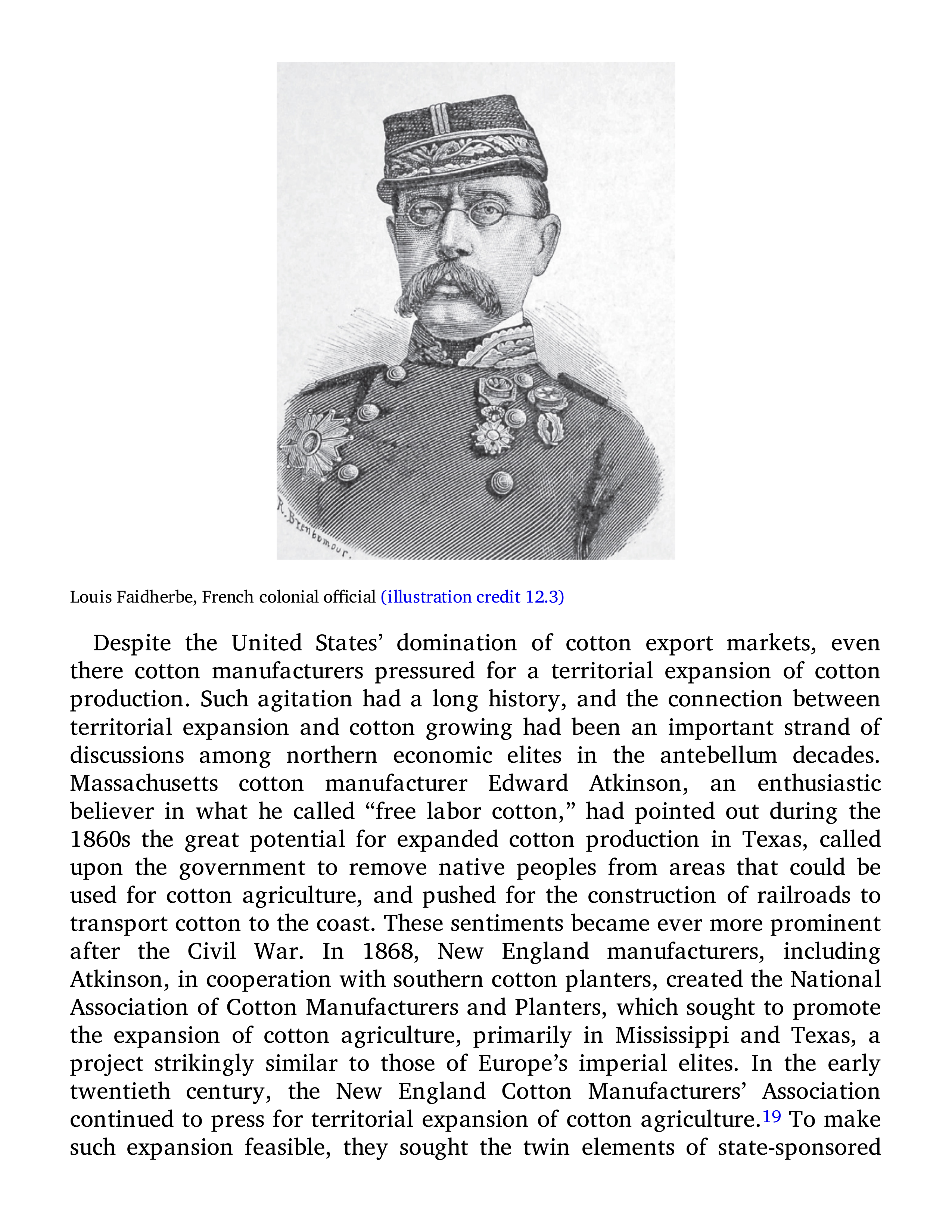
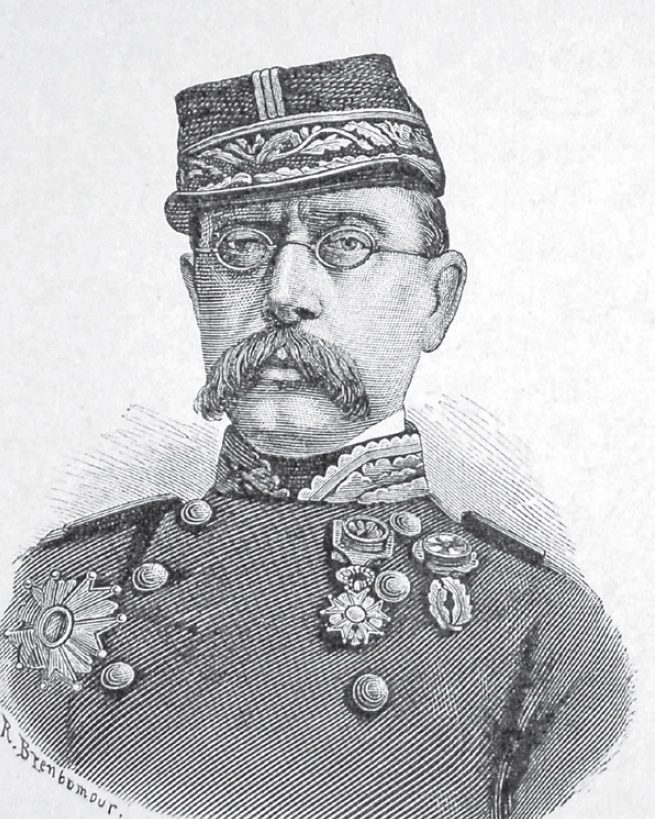
Louis Faidherbe, French colonial o
ɽcial
(illustration credit 12.3)
Despite the United States’ domination of cotton export markets, even
there cotton manufacturers pressured for a territorial expansion of cotton
production. Such agitation had a long history, and the connection between
territorial expansion and cotton growing had been an important strand of
discussions among northern economic elites in the antebellum decades.
Massachusetts cotton manufacturer Edward Atkinson, an enthusiastic
believer in what he called “free labor cotton,” had pointed out during the
1860s the great potential for expanded cotton production in Texas, called
upon the government to remove native peoples from areas that could be
used for cotton agriculture, and pushed for the construction of railroads to
transport cotton to the coast. These sentiments became ever more prominent
after the Civil War. In 1868, New England manufacturers, including
Atkinson, in cooperation with southern cotton planters, created the National
Association of Cotton Manufacturers and Planters, which sought to promote
the expansion of cotton agriculture, primarily in Mississippi and Texas, a
project strikingly similar to those of Europe’s imperial elites. In the early
twentieth century, the New England Cotton Manufacturers’ Association
continued to press for territorial expansion of cotton agriculture.
19
To make
such expansion feasible, they sought the twin elements of state-sponsored
infrastructure projects, such as the building of levees on the Mississippi, and
“the introduction of a working population into the Cotton States.”
20
The
ɹrst wave of this incorporation focused on the territorial expansion of
cotton growing in parts of the world that already supplied the white gold to
global markets. As we have seen, after the Civil War, Britain steadily
strengthened its colonial control in India. Tellingly, when the nizam of
Hyderabad requested in 1876 that Berar be returned to his control, the
British refused, even though the nizam’s government communicated clearly
to Manchester interests that it was “keenly aware of the importance of
developing the cultivation of cotton in these dominions, and in the future I
shall gladly give my attention to fostering the increase of this production.”
Egypt, deeply enmeshed in the global cotton economy, by 1882 was
transformed
into
a
British
colony,
alleviating
concerns
among
manufacturers about the “most damaging e
ʃect” created by the “unfortunate
embroglio in Egypt”—that state’s default on its international debt.
Territorial control in Egypt went hand in hand with the expansion of cotton
agriculture. In 1861, cotton was grown on 259,513 acres,
ɹfty years later on
1,767,678 acres. The land for this expansion came partly from the
rededication of wheat
ɹelds, but also from irrigating formerly unproductive
lands now made accessible to commercial agriculture by the construction of
roads and railways. By 1899 the Egyptian Delta Railways Company
transported 245 million pounds of cotton, 40 percent of the entire annual
harvest. And by 1902 the dams at Aswan and Asyut enabled a year-round
supply of water in the cotton-growing areas.
21
But by the early twentieth century, new cotton-growing areas of the world
also saw an enormous growth of their output. There was an extension of
cotton agriculture in the Ottoman Empire’s Çukurova, for example, where
land once used by nomadic tribes for the herding of animals was
increasingly turned into cotton farms. By 1908, a quarter of its cultivatable
land was used for cotton. In Brazil, cotton cultivation had expanded during
the cotton boom of the 1860s into Ceará, where subsistence farmers now
became ever more involved in production for world markets. By 1921–22,
1.4 million acres of land were under cotton cultivation, and by the 1930s
Brazil had become the world’s fourth most important cotton grower, thanks
to state support in the form of infrastructure construction and institution
building, such as the creation of the Instituto Agronômico de Campinas.
22
In other older cotton-growing areas, commercial production ex-panded as
well. In Peru, ever more land was rededicated to cotton agriculture, and as a
result cotton exports increased dramatically, from an annual average of
0.71 million pounds in the years between 1861 and 1865 to an annual
average of 59 million pounds between 1916 and 1920. A few thousand miles
to the South, in Argentina, the government made great e
ʃorts to enable the
industrializing nation to become self-su
ɽcient in raw cotton, part of a
larger program of import-substitution growth.
23
Of the greatest magnitude, however, in terms of additional output of cotton
was the further extension of the U.S. cotton complex. Its expansion had been
in some ways comparable to that of Russia—state agents and military units
had captured contiguous territory and sponsored the construction of new
infrastructures to make it accessible. As in Russia, the state would later drain
wastelands, contain waterways, and build irrigation infrastructures. Yet
while Russia mobilized Central Asian cultivators and forcefully settled
nomads to grow cotton (as had also been the case in the Ottoman Empire’s
Çukurova), the United States removed most indigenous inhabitants from
cotton-growing soils as it encouraged citizens from farther east to move in,
combining, as historian John C. Weaver has put it, “de
ɹant private
initiative” with “the ordered, state-backed certainties of property rights.”
24
Capturing and incorporating new territories as a strategy to increase
cotton production for world markets was thus not just signi
ɹcant in the
context of European colonial expansion. The U.S. cotton empire expanded
at a rapid clip and entered entirely new territories. Before the Civil War, in
1860, 5,386,897 bales of cotton had been produced in the United States, but
in 1920 production had increased two and a half times, to 13,429,000 bales,
and the territory used for cotton grew rapidly. Twenty-two million acres of
additional land was plowed under, or a little more than the total area of the
state of South Carolina, or that of the nation of Portugal.
25
In the United States, the expansion of land under cotton occurred in two
distinct ways. Cotton production expanded into the remoter hinterlands of
older American cotton states such as Georgia and the Carolinas, now made
accessible by railroads, where white upcountry farmers began growing much
larger quantities. In the South Atlantic states, annual production, for
example, increased by a factor of 3.1 between 1860 and 1920. In Tennessee,
Alabama, and Mississippi, by contrast, annual cotton production stayed
level until the end of the century, and declined by about 25 percent in 1920,
due to the exhaustion of cotton soils and the emergence of more productive
cotton-growing areas farther west. Yet even despite the tired soil, cotton
production dramatically expanded in some areas, such as in the Yazoo-
Mississippi Delta, where large numbers of African Americans cultivated
cotton, enabled by new railroads, canals, and levees. As a result, by 1900,
“one of the most highly specialized cotton producing areas in the world”
emerged. The most dramatic expansion of cotton agriculture, however,
occurred farther to the west. In Arkansas, Louisiana, Oklahoma, and Texas,
the production of cotton exploded from 1,576,594 bales in 1860 to
7,283,000 bales in 1920—a factor of 4.6 in the half century after the U.S.
Civil War. By far the most important expansion took place in Texas, a state
whose farmers had only produced 431,463 bales of cotton in 1860, but
produced ten times as many, 4,345,000 bales, in 1920. Indeed, the cotton
growth of 1920 in Texas alone equaled about 80 percent of that of the entire
South in 1860. And by the late 1910s and early 1920s, vast investments in
irrigation infrastructure by the federal government enabled a further
extension of cotton agriculture into the arid lands of Arizona and
California.
26
Territorial expansion—“the great land rush”—was thus crucial to the
position of the United States within the empire of cotton, paralleling
developments in other parts of the world. Most of these new cotton-growing
territories had been captured from Mexico in 1848, and without their
acquisition, Mexico, not the United States, might have been the world’s
premier cotton producer by the early twentieth century.
The incorporation of these territories relied as much on infrastructure
advances as it did on land grabs. As with India and Africa, cotton bloomed
alongside the railroad. There were no railroads in Oklahoma before the mid-
1880s, but by 1919, 6,534 miles of railroad crisscrossed the state. In Texas,
there were 711 miles of railroad in 1870, but 16,113 miles in 1919, including
into the fertile lands of the blackland prairie, which the Houston and Texas
Central had connected to Dallas in 1872. Once it had done so, cotton
production exploded: Dallas County cultivators grew 3,834 bales of cotton
in 1870 but 21,649 bales in 1880—an increase of 465 percent in only one
decade.
27
The arrival of cotton growers in most cases displaced the indigenous
inhabitants. In the antebellum decades, native peoples who had inhabited
the cotton-growing territories of Georgia, Alabama, and Mississippi had
been pushed farther west. Now pressure resumed. In October 1865, the
Kiowa and Comanche were forced to give up land in central Texas, west
Kansas, and eastern New Mexico—land that was turned, among other
things, into cotton plantations. Shortly thereafter, many of the Texas plains
Indians were pushed into reservations in Oklahoma, and so were the last
southwestern Indians during the Red River War of 1874 and 1875, thereby
freeing up further land for cotton growing.
28
Yet Oklahoma ultimately provided little protection for these Native
Americans. By the 1880s, the old Oklahoma and Indian territories came
under pressure from white settlers who hoped to displace the native
population from the most fertile lands. In 1889 the U.S. government gave in
and paid the Creeks and Seminoles to surrender claims to land in the center
of Oklahoma. Over the next few years, further “land runs” in various parts
of Oklahoma put ever more pressure on native people. Many white settlers
began to grow cotton, as Oklahoma’s fertile soil and its infrastructural
opening to the world market, thanks to railroad construction, made such
expansion a pro
ɹtable proposition. By 1907, when Oklahoma became a
state, cotton was grown on more than 2 million acres and production had
reached 862,000 bales, compared to 425 bales grown on 1,109 acres in
1890. Cleveland County, to cite just one example, produced thirty-nine bales
of cotton in 1890, but 11,554 bales in 1909, on land that was once the home
of the Quapaw. Creek and Seminole Indians later lived there, tribes that had
been forced to leave the southeastern parts of the United States during the
late 1820s and 1830s where their lands once before had been turned into
cotton plantations. Cotton planters chased America’s native peoples from
their land, though eventually they hired some of them to work on cotton
plantations. In Oklahoma, as elsewhere, the dispossession of America’s
native people and the expansion of cotton-growing territories went hand in
hand—state coercion, indeed, was central to the further expansion of the
empire of cotton.
29
The territorial expansion of the empire of cotton in the United States,
Central Asia, Egypt, and Korea, among other places, was vast. Yet
statesmen and capitalists pushed the cotton frontier ever further, and Africa,
in particular, became the focus of European e
ʃorts. These European eʃorts
in fact were directly related to the United States’ and Russia’s successful
expansion of their respective cotton empires, and focused on the goal of
emancipating themselves from the United States’ cotton supply. Africa, in
other words, was to be the “South” and “West” of Europe—a supplier of raw
materials, labor, and agricultural commodities that were deemed necessary
to confront the global challenge of a rising United States with its seemingly
limitless supplies of industrial raw materials, and also of a Russia whose
very territorial extent embodied a rising “threat.”
30
Imperial e
ʃorts at
cotton growing in Africa were the cutting edge of the cotton empire’s new
“national” constitution.
Take Germany, for example. In the last decade of the nineteenth century
this latecomer to colonialism engaged in frantic e
ʃorts to secure
cotton from
its African possessions. This was not surprising considering that by 1900 the
German cotton industry was the most signi
ɹcant on the European continent
and, indeed, the third largest in the world. Despite signi
ɹcant productivity
increases, the number of workers directly engaged in cotton spinning and
weaving had increased to nearly four hundred thousand, with an estimated
one in eight German industrial workers so employed by 1913, making the
“healthy development of our cotton industry a vital question for our
national economy.” The value of their output was the most considerable of
all domestic industries and constituted the nation’s most important export
product. In 1897, the German cotton industry produced goods valued at 1
billion marks, or about 36 percent more than those of the next largest
industry, coal, and 45 percent more than the industry that symbolized
Germany’s economic miracle and all too often overshadows our historical
imagination, the male-dominated iron and steel industry. And no other
German industry was so reliant on other countries for its crucial raw
material. Because all raw cotton came from abroad, it amounted to
Germany’s costliest import. A full 1 billion pounds of cotton were imported
into Germany in 1902. “King Cotton has become the most powerful ruler,”
observed cotton manufacturer Karl E. Supf, “he has deeply a
ʃected the
social conditions, yes, even entirely rearranged them.”
31
Considering the size of the industry, German cotton industrialists
understandably expressed a desire to secure an ample, regular, and
inexpensive supply of raw cotton. From the beginnings of a German
mechanized cotton industry that supply had largely come from the United
States. However, the cotton shortages of the 1860s had indelibly etched in
the minds of cotton industrialists and statesmen the danger of depending on
the United States for raw cotton. Indian and Egyptian cotton did gain
market share during the crisis, but by the 1880s and 1890s the United States
again supplied—depending on the years—between 50 and 90 percent of
cotton to the German industry.
32
Such overwhelming market dominance
worried cotton interests. By late century, these concerns sharpened as
German
cotton
importers
realized
that
new,
competing
low-cost
manufacturers were emerging in places such as Japan, the southern United
States, and Mexico.
German manufacturers and statesmen could do little to alter this situation
before their creation of a colonial empire in the 1880s. Once Germany
acquired colonies in Africa and the South Seas, however, new ways of
solving the “cotton question” emerged. Interest in African cotton reached
fever pitch at the turn of the century, when cotton industrialists spoke of a
global “
Baumwollkulturkampf
”—a “cotton-growing struggle.” Following these
concerns, in 1896 these manufacturers created the Colonial Economic
Committee (Kolonial-Wirtschaftliches Komitee), an organization devoted to
utilizing colonies as a source of raw materials for home industries. More
than four hundred German cotton industrialists contributed funds to its
operation.
33
Four factors spurred cotton industrialists’ interest in raw cotton
production in German colonies. They were deeply concerned about the rise
in cotton prices at century’s end, which more than doubled between 1898
and 1904. German industrialists argued that the ever greater use of cotton
by the two major growing countries, the United States and India, was the
root cause of such increases, which they saw as permanent. Most
dramatically, the United States had used only about 20 percent of its home-
grown cotton in its own factories before the Civil War, yet by the 1870s that
proportion had grown to around 33 percent and to nearly 50 percent after
1900. Moreover, like many American industrialists and landowners, German
manufacturers feared that the United States lacked su
ɽcient cheap labor to
plant, prune, and harvest all the additional cotton now required on global
markets. Labor shortages, they argued, would eventually limit the expansion
of American cotton agriculture. The cotton market remained volatile, and
these price
ɻuctuations made it diɽcult to plan proɹtable production.
Colonial cotton, in contrast, promised to ensure stable and low prices, and
as an added bene
ɹt could prevent a repeat of the market disruption they
had experienced during the cotton famine of the 1860s.
34
With that scarcity in mind, manufacturers feared that demand for U.S.
cotton by newly emerging manufacturing nations, especially Japan, would
further diminish their supplies. And in a strategic move meant to secure
broad political support for their agenda, cotton manufacturers argued that a
prosperous cotton industry was essential to combatting working-class
upheaval. Karl Supf invoked the terrible social e
ʃects of the American Civil
War, and concluded that “it [was] obvious that a crisis…in the cotton
industry would include a social danger whose results are unpredictable.”
Even the generally anticolonial Social Democrats expressed their hope that
colonial cotton would break the “cotton monopoly” of the United States. The
fantastic plan of these cotton industrialists was to grow cotton for German
manufacturers on German-controlled soil under German supervision—in
fact, to become more like their American and Russian competitors.
35
With these arguments, cotton industrialists moved boldly into Germany’s
public arena. Their interests intersected with those of powerful statesmen
and bureaucrats who argued that securing colonial cotton was of great
geostrategic importance. As the scholar, engineer, and Africa expert Ernst K.
Henrici observed in 1899, “In the great economic competition among
peoples, mass production and mass consumption are becoming central. Our
colonies, if they should be of real bene
ɹt to the mother country, need to
aspire towards delivering great quantities of raw materials, so that they can
in turn purchase great quantities of the industrial products of the
motherland.” Only colonial cotton production, argued economist Karl
Hel
ʃerich, could break the “economic rule of America over the European
cotton industry.” Colonial cotton, in short, was the only way to resist
“American rape.”
36
Colonial cotton symbolized the new symbiosis of a powerful nation-state
with powerful national industries. This symbiosis in fact characterized a new
form of global capitalism centered on the strengthening of national capital
in rival capitalist nations.
37
Cotton growing was important to European expansion in Africa from its
very beginning, just as Africa had provided much of the labor that had
enabled cotton industrialization since the 1780s. For example, in 1888—only
four years after its African explorations had begun—Germany embarked
upon its
ɹrst systematic trials of growing cotton for world markets on the
African continent. In May 1890, a Samoan cotton planter, Ferdinand
Goldberg, arrived in the German colony of Togo to investigate the
possibilities of cotton growing there. While his experiment failed, in 1900,
as we will see, the German imperial government made another e
ʃort,
recruiting cotton farmers from Alabama to go to Togo and expand its cotton
agriculture.
At
the
same
time,
colonial
bureaucrats
and
cotton
manufacturers built huge cotton plantations in German East Africa. In 1907,
German textile industrialists Heinrich and Fritz Otto opened a cotton farm
in Kilossa; three years later, about a thousand workers cultivated cotton on
a full 37,065 acres. Soon the Ottos were joined by the Leipziger
Baumwollspinnerei and by manufacturer Hermann Schubert from Zittau in
Saxony.
38
French cotton manufacturers and colonial bureaucrats made similar
e
ʃorts. In the French Soudan, in Côte d’Ivoire, and in French Equatorial
Africa, colonial penetration went hand in hand with an e
ʃort to secure
cotton—the French minister of colonies studied the prospects for colonial
cotton in great detail. African cotton exports to France at
ɹrst only supplied
a very small percentage of the cotton used by the French industry, but they
increased rapidly. Côte d’Ivoire, for example, supplied next to no cotton in
1912, but more than 4.4 million pounds in 1925. In other colonies, similar
developments occurred. Portuguese colonialists in Mozambique began their
ɹrst cotton-growing experiments in 1901, an eʃort that produced 6 million
pounds by 1928. The Belgians had begun their
ɹrst tentative cotton-growing
e
ʃorts in the Congo territory in 1890, yet production only exploded in the
1920s, and at a cost of tremendous violence. In 1920, rural cultivators
produced 3.4 million pounds of cotton in the Belgian Congo, 98.8 million
pounds in 1931, and 312 million pounds in 1941. This was a respectable
amount, equaling about 15 percent of the production of the United States
before the Civil War, when King Cotton reigned supreme.
39
The British, however, undertook the most signi
ɹcant eʃort to grow cotton
in Africa. By 1913, 74 percent of all cotton exported from Africa to Europe
came out of British colonies. In the eyes of the British Cotton Growing
Association, no other part of the world had “larger latent possibilities than
our West African possessions,” with plenty of land and labor available. As
Africa’s people could no longer be sold to the Americas, Europeans
concluded that they might pro
ɹtably be encouraged or compelled to grow
agricultural commodities for world markets at home. Altogether, Africa
exported more than 2.315 billion pounds of cotton in 1930, a little more
than the United States in the year before the Civil War.
40
Taken together, between 1860 and 1920, 55 million acres of land in
Africa, Asia, and the Americas, at the very least, were newly planted with
cotton for world markets—an area larger than that of Massachusetts,
Vermont, Rhode Island, Connecticut, New Hampshire, and New York
combined. Approximately 80 percent of all that new cotton-growing land
was situated in territories that had not grown cotton in 1860, the vast
majority of which had come under the e
ʃective control of colonial powers
only during those years. Indeed, by 1905, cotton experts estimated, a full 15
million people, or about 1 percent of the world’s population, were engaged
in the growing of cotton. Imperial expansion and the production of ever
more cotton for world markets were inextricably linked.
41

With the territorial scope of the cotton empire spreading on the wings of
powerful imperial states, the struggles over labor mobilization spread as
well. Territory alone never su
ɽced. Indeed, the core question that continued
to face these states was the same as it had been in 1865, upon the
emancipation of cotton workers in the United States: how to motivate rural
cultivators to grow cotton for world markets—that is, how to e
ʃect the
transformation of the countryside. As the French Association Cotonnière
Coloniale put it, it was easy to secure land, but that land “needs arms,
labor.”
42
No colonial ruler followed the example of the United States, which had
made cotton-growing territories available by removing the native peoples
who had dwelled on those lands for centuries. Native peoples in places such
as the Çukurova, Central Asia, Egypt, and East Africa were certainly also
forced to abandon their use of the land to make space for cotton—a wave of
expropriation that accompanied the geographic spread of cotton agriculture
in particular, and capitalism in general. Yet colonial governments and
strengthening nation-states usually tried to integrate these rural cultivators
into the cotton-growing complex. Instead of displacing them, colonizers
drew upon their labor in three distinct ways. In some settings, such as India,
Central Asia, and western Africa, cotton continued to be produced by
indigenous farmers and sold to Western merchants. In other parts of the
world, labor was mobilized by settling formerly nomadic people. This was
the case, as we will see, in Central Asia, and in the Çukurova, where
nomadic groups who for centuries had herded their animals on these plains
were settled so as to make space for Anatolia’s most signi
ɹcant cotton-
growing complex. In yet other areas, settlers from elsewhere came to
organize cotton growing by indigenous people on plantations, such as in
Algeria and German East Africa, but also in parts of Mexico and
Argentina.
43
No matter which strategy colonial bureaucrats and capitalists employed,
eventually the push toward commercial cotton agriculture, as we have seen
elsewhere in the cotton countryside, permanently recast social structures.
Russian Central Asia provides one example for such a shift. Before Russian
occupation, Central Asians grew cotton, spun yarn, and wove cloth, using
some for their own needs and exporting the rest to distant markets. Indeed,
throughout Central Asia, cotton and cotton products were the most
signi
ɹcant industry. Caravans of up to ɹve thousand
camels traversed the
steppes between the Central Asian khanates and Russia carrying cotton
cloth and yarn. The raw cotton for this thriving industry was harvested on
small family farms as one crop among many, often sharing the same
ɹeld
with rows of wheat. Most of the cotton grown by family labor was used for
the production of textiles within the household, while local merchants
bought small quantities to be worked up for trade in more distant markets.
44
Central Asia was thus a source of manufactured cotton textiles for Russia.
In the last decades of the nineteenth century, however, after Russia captured
these territories, it became, as we have seen, a supplier of raw cotton for the
factories in Moscow and Saint Petersburg, and a market for Russian cotton
cloth. To e
ʃect that transition, Russian entrepreneurs and colonial
bureaucrats rapidly and radically reshaped the cotton-growing countryside.
At
ɹrst, as elsewhere in the empire of cotton, metropolitan merchants and
agents of Russian textile
ɹrms arrived, purchasing cotton from small farmers
and providing them with credit, enabling them to specialize in a nonedible
crop. Once cotton exports expanded, these
ɹrms increasingly specialized in
exporting the crop to metropolitan Russia, and an indigenous capitalist class
emerged to deal with the myriad peasant producers, a development roughly
parallel to what was unfolding in the southern United States and in India.
They provided essential working capital to small farmers, typically charging
interest of between 40 and 60 percent annually, though rates of more than
100 percent were not unknown. Such exorbitant interest rates, combined
with one or two poor harvests or a price downturn, usually su
ɽced to make
peasants entirely dependent on these advancing merchants even when they
did not lose outright control over the land.
45
By the 1880s, Russian entrepreneurs set out to create large cotton
plantations to supplement the cotton grown by small farmers. These
plantations, however, quickly failed due to labor shortages. As elsewhere,
rural cultivators were reluctant to work for wages and instead preferred to
work their own or rented land. As one German observer remarked, “There
are only a few propertyless, who can be considered for this kind of work.
Landless natives prefer to cultivate on their own account small rented
ɹelds.
For these reasons, the sowing of cotton on large plantations occurs too late
in the season…. Entrepreneurs, who own large plantations,
ɹnd themselves
forced to rent them in small units to the natives, under the condition that all
cotton grown is to be delivered to the landlord.”
46
As a result of both the inability to mobilize su
ɽcient numbers of workers
for large cotton plantations and the tenuous situation of owner-occupiers, a
system of sharecropping increasingly emerged, akin to the one prevailing in
the U.S. South. The German consul in Saint Petersburg remarked on these
changing social relations in 1909, noting that “more and more of the land of
long-settled planters is being absorbed by capital-rich merchants; the former
owners of the soil in many cases continue to work their former properties as
renters of the purchasers of the land.” As a result of the crisis of owner-
occupiers, middlemen acquired large tracts of land, while the refusal of these
landless rural cultivators to work for wages on plantations forced
landowners to employ them as sharecroppers. The class structure of this
portion of the cotton zone, as elsewhere, changed signi
ɹcantly in the course
of a few decades, with the emergence of a large group of indebted farmers
and landless agricultural workers.
47
Sharecropping, however, was often just a way station on a path toward
wage labor. An ever larger number of cultivators eventually became hired
laborers, despite their preferences, as a result of a large wave of
expropriation that swept the cotton-growing countryside. Small farmers,
highly indebted, lost access to the land and thus were left with few options
but to sell their labor. In the cotton district of Fergana, there were
approximately two hundred thousand landless workers by 1910. By 1914, 25
to 30 percent of the Fergana population was landless, as the Central Asian
countryside, thanks to the determined actions of the Russian state and its
cotton capitalists, came to resemble that of the American South. In addition,
many of the nomads of Turkestan, losing land and access to fodder crops for
their animals, were now forced to settle and make themselves available as
agricultural laborers. Globalization once more
ɹxed people to particular
places, particularly those places that were not their own, while divorcing
them from control over agricultural resources.
48
“The second hilling of cotton with native hoes”: Central Asian cotton growers, 1913
(illustration credit
12.4)
This drastic recasting of Central Asian economies opened up new markets
for Russian cotton manufacturers, and by 1889 a British traveler observed
that “money…is being taken from the pockets of Bombay and Manchester,
and transferred to the pockets of Nijni Novgorod and Moscow.” This
escalating focus on cotton growing, as elsewhere, had a grave impact on
food security. Like other cotton-growing areas of the world, Central Asia
now became dependent on food imports, while at the same time peasants’
income became “highly vulnerable to
ɻuctuations in” the cotton market. By
World War I, the recast class structure, along with a huge de
ɹcit in food
crops thanks to the reorientation of local agriculture toward cash crops,
produced terrible famines, resulting in signi
ɹcant depopulation. In
Turkestan, for example, the population fell by 1.3 million people, or 18.5
percent, between 1914 and 1921.
49
As states’ e
ʃorts to control territories by administrative, infrastructural,
legal, and military means sharpened along with their capabilities and
resources, the question of how precisely to mobilize cotton-growing labor
remained prominent. Expertise was in high demand. The surprising, even
unlikely story, of how a small group of African Americans, the descendants
of slaves, came to play an important role in the e
ʃorts by German colonists
to recast cotton agriculture in Togo illustrates both the e
ʃorts to access
colonial sources of cotton for national industries and the ongoing struggle to
ɹnd cotton-growing labor.
It was a stormy November morning in 1900 when the
Graf Waldersee
steamed out of the port of New York for its journey across the Atlantic to the
German city of Hamburg. Among the more than two thousand travelers who
glanced one last time at the receding steeples of Trinity Church, the
towering Manhattan Life Insurance Building, and the Statue of Liberty, four
passengers stood out: James N. Calloway, John Robinson, Allen Burks, and
Shepard Harris. All were the sons of slaves, from Alabama, and connected to
Booker T. Washington’s Tuskegee Industrial and Normal Institute. Calloway
was a teacher, and Robinson, Burks, and Harris were students or recent
graduates. Perhaps even more remarkable was their mission: They had
boarded the
Graf Waldersee
that morning as part of a journey that was to
bring them to new jobs in a faraway land—the German colony of Togo, a
sliver of West Africa that the Germans had acquired in 1884. In the ancient
homeland of the Ewe, these African Americans were to instruct the German
colonialists and their subjects on how to grow cotton for export, “to
determine the possibility of a rational cotton culture as a native culture,
and…to show the marketability of the product for German industry.
50
For the next eight years, these Tuskegee experts advised German
colonialists on how to extract more cotton for export from African rural
cultivators. They built experimental cotton farms, introduced new strains of
cotton, opened a “cotton school,” expanded the local infrastructure, and
used increasingly coercive measures to force local cultivators to grow cotton
for world markets. And indeed, between 1900 and 1913, cotton exports from
Togo increased by a factor of thirty-
ɹve.
51
Bereft of experience in cotton growing, German colonial bureaucrats and
textile industrialists had looked to the United States for expertise in such
matters and immediately had settled on the possibilities of recruiting African
Americans to their colonial cotton venue, assuming, like most of their
imperial counterparts, that “cotton culture since time immemorial [is] the
Negro’s favorite culture.” To do so, in the summer of 1900 a German
aristocrat and agricultural attaché at the German embassy in Washington,
D.C., Beno von Herman auf Wain, traveled to Roslindale, Massachusetts, to
meet African-American activist and Tuskegee leader Booker T. Washington,
asking him for help in recruiting cotton planters and a mechanic “to teach
the Negroes there [in Togo] how to plant and harvest cotton in a rational
and scienti
ɹc way.” By late September, Washington was able to conɹrm
that he had selected four men who were ready to go. James Calloway, forty,
director of the cotton section of Tuskegee, was to direct the mission and
supervise its younger members. He had been in charge of Tuskegee’s eight-
hundred-acre farm and spoke some German. He was to be joined by John
Winfrey Robinson, an 1897 Tuskegee graduate; Allen Burks, a 1900
Tuskegee graduate; and Shepard Harris, who had entered Tuskegee in 1886
and had learned the carpentry trade there. They were all the sons of slaves,
and according to Washington, the ancestors of two of these experts “came
from this part of Africa.” Washington insisted to von Herman that “I should
very much hope that your Company will not make the same mistake that
has been made in the South among our people, that is, teach them to raise
nothing but cotton. I
ɹnd that they make much better progress ɹnancially
and otherwise where they are taught to raise something to eat at the same
time they are raising cotton.”
52
Once Calloway, Robinson, Burks, and Harris arrived in Togo, their
operations unfolded in grand style. On land once controlled by the king of
Tove, they ventured to build a cotton farm much like the ones they had left
behind in the United States. With the help of two hundred local men they
cleared the high grass and trees, while local women and children collected
the remaining roots to burn them. As a result of such and other exertions, by
May they had planted about twenty-
ɹve of these acres in cotton and by July
about one hundred acres. Starting systematically and virtually ignoring the
accumulated experience of the people of Tove, Calloway and his colleagues
planted
ɹelds with diʃerent kinds of cotton at various times to investigate
what cotton would grow best and when it should be sown. By April,
Calloway reported proudly to Booker T. Washington that “our work looks
quite promising…and we believe that we will make cotton.”
53
Despite these energetic beginnings the Tuskegee experts soon encountered
numerous di
ɽculties. For the African-American planters, for example, it was
unimaginable to run a successful cotton farm without draft animals, but the
rural cultivators around Tove, reported John Robinson in astonishment,
“were as afraid of a horse or cow as a common American youth is of a ‘mad
dog.’ ” Not only were they unfamiliar with using draft animals, but the
animals themselves did not survive long in the local disease environment.
Unanticipated patterns of rainfall also created problems. When the rains
started in July, the cotton that the Tuskegee experts had planted right after
their arrival rotted. They could have learned as much from local cultivators,
but their
ɹrm belief in the superiority of their own methods and their
inability to communicate in the local language precluded such lessons. The
Tuskegee experts also faced nearly insurmountable problems relating to the
lack of infrastructure. In order to get their ginning equipment from the
beach near Lomé, where they had left it upon arrival a few months earlier,
to Tove, they
ɹrst had to widen the road to make it passable for their
wagons. They then needed to hire thirty people to draw the carts, and they
still took more than two weeks to return with the equipment. Such reliance
on human muscle power also hindered the ginning process.
54
Despite these frustrations, Calloway, Robinson, Burks, and Harris
harvested one bale of Egyptian cotton and four bales of American cotton on
their experimental farm in the early summer and
ɹve more bales of
American cotton in November and December. Considering the enormous
input of labor, land, and expertise, this was a meager harvest, but both
Calloway and the Colonial Economic Committee considered it a success. The
committee concluded that the local climate was indeed, as expected,
favorable for the growing of high-quality cotton, that the indigenous
population was willing to embrace the crop, and that plenty of land was
available to grow cotton, perhaps as much as in Egypt. Calloway concurred,
suggesting that production could be expanded further by creating markets
where indigenous people could bring their cotton for sale, and by educating
rural producers in agricultural techniques, especially the use of plows and
draft animals. If these reforms were embraced, Calloway expected that “in a
few years we shall be able to export many thousands bales of cotton from
this colony. This will not have an e
ʃect on the market of the world; it will
nevertheless be of great advantage to Germany and especially to the 2½
millions of natives of this colony.”
55
The amount of cotton grown by the Tuskegee experts during their
ɹrst
year in Togo may have been exceedingly small, but the goal of the Colonial
Economic Committee had never been to make Calloway and his colleagues
into major cotton growers. What German industrialists instead had hoped
for was to learn from these experienced cotton farmers and to then transfer
that knowledge to local growers. Their goal from the beginning was to make
cotton production in Togo a “
Volkskultur
,” a people’s culture, and not, as
elsewhere in the German colonial empire, a “
Plantagenkultur
,” a plantation
culture.
56
This choice was partly based on the tremendous problems German cotton
interests had encountered with the mobilization of labor for their
plantations in German East Africa. These plantations, many of them run by
German textile industrialists, had had trouble securing a su
ɽcient
number of
African laborers, who by and large were not willing to work there. Though
local German planters had tried to persuade the colonial administration to
raise taxes in order to force rural producers to work for wages, the
government had been reluctant to do so, fearing open rebellion.
57
Such German experiences paralleled those of other colonial powers. In
British East Africa it was clearly understood by experts that “the dearth of
labour is the most serious di
ɽculty…. Coolies must be brought from a
distance, as the inhabitants, who get four crops a year o
ʃ the land without
putting themselves to any inconvenience whatever, cannot be got to see
that there is any reason why they should work for hire.” Wage labor, in fact,
was extremely di
ɽcult to institutionalize. In British
Uganda as well,
growing cotton had “consistently been opposed by the peasant growers who
are its principal intended bene
ɹciaries.” As a result, British colonialists came
to believe that “the native will do better work when farming on his own
account than when working for wages on a plantation owned by
Europeans.”
58
German cotton policy, like that of other colonial powers, was in
ɻuenced
by its encounter with the region’s inhabitants, the Ewe, and their old and
thriving indigenous cotton industry. For centuries, rural cultivators had
interspersed their
ɹelds with cotton plants, which local women spun into
yarn and men wove into cloth. Throughout the nineteenth century, some of
this cotton had also been traded across substantial distances. During the
American Civil War, some had even entered world markets, as local rulers
had created cotton plantations that they worked with slave laborers,
allegedly exporting twenty to forty bales of cotton a month to Liverpool. As
late as 1908, the German colonial government reported that manufactured
European textiles had not yet destroyed the indigenous spinning and
weaving industry. Such a thriving cotton textile industry indeed could be
found throughout most of Africa, despite European imports of cloth.
59
It was this thriving domestic industry that the German colonialists hoped
to recast when they expanded their in
ɻuence into the Togolese hinterland
during the 1890s. They hoped that they would be able to change its internal
orientation to an external one, just like the British had been able to do in
India, and the Russians in Central Asia. Thanks to the exposure to
“scienti
ɹc”
agriculture,
infrastructure
improvements,
and
incentives
provided by “free” markets, indigenous farmers were to grow more cotton of
a uniform quality and then sell it to German merchants—just like former
slaves had done in the United States. This “
Eingeborenenkultur
”—native
culture—was another attempt, after sharecropping, to solve the vexing
question of labor that had been at the core of the world cotton industry since
the emancipation of slaves in the United States thirty-
ɹve years earlier.
60
Unable to mobilize labor for colonial cotton growing on plantations, and
inspired by the expansion of “free labor” cotton in the United States as well
as the seemingly successful transmission of these experiences to Togo by the
Tuskegee experts, German cotton interests hoped to set up a small number
of model farms that would serve as examples to the Ewe. Moreover, the
German colonial administration, along with the Tuskegee experts,
developed a number of policies to promote their common goals: to
encourage Ewe cotton growers to produce more well-ginned and -packed
cotton and move it speedily to market. First, to improve the quality of
cotton, the Colonial Economic Committee, along with private German
investors such as the Deutsche Togogesellschaft, set up gins throughout the
cotton-growing areas of Togo. Growers thus did not need to gin the cotton
themselves nor to transport the much heavier raw cotton over long
distances. Purchasers, in turn, gained control of the cotton much earlier in
the production process. Second, the colonial government tried to make the
cotton more uniform in appearance by distributing seeds to growers. Here,
the studies of the Tuskegee experts mattered a great deal, as they had
experimented with Egyptian, American, Peruvian, and Brazilian seeds and
had also cataloged existing seeds in Togo. After 1911, an American variety,
mixed with Togo strains, was marketed under the name “Togo Sea-Island”
and was the only strain distributed by the German authorities. Third, to
encourage rural cultivators to grow more cotton, the colonial government
set minimum prices for the purchase of cotton, presumably making it less
risky for growers to plant cotton. Fourth, to export this cotton, Tuskegee
experts, colonial authorities, and the committee concentrated on gaining
control of the cotton market, at the beginning mainly by sending members
of the cotton expedition, including Calloway and Robinson, to remote areas
to purchase cotton from growers. Indeed, by 1902, the Tuskegeans had
fanned out over a large area of Togo, running various experimental farms
and purchasing cotton whenever there was an opportunity to do so. They
had also participated in the building and supervising of cotton collecting
stations in various towns.
61
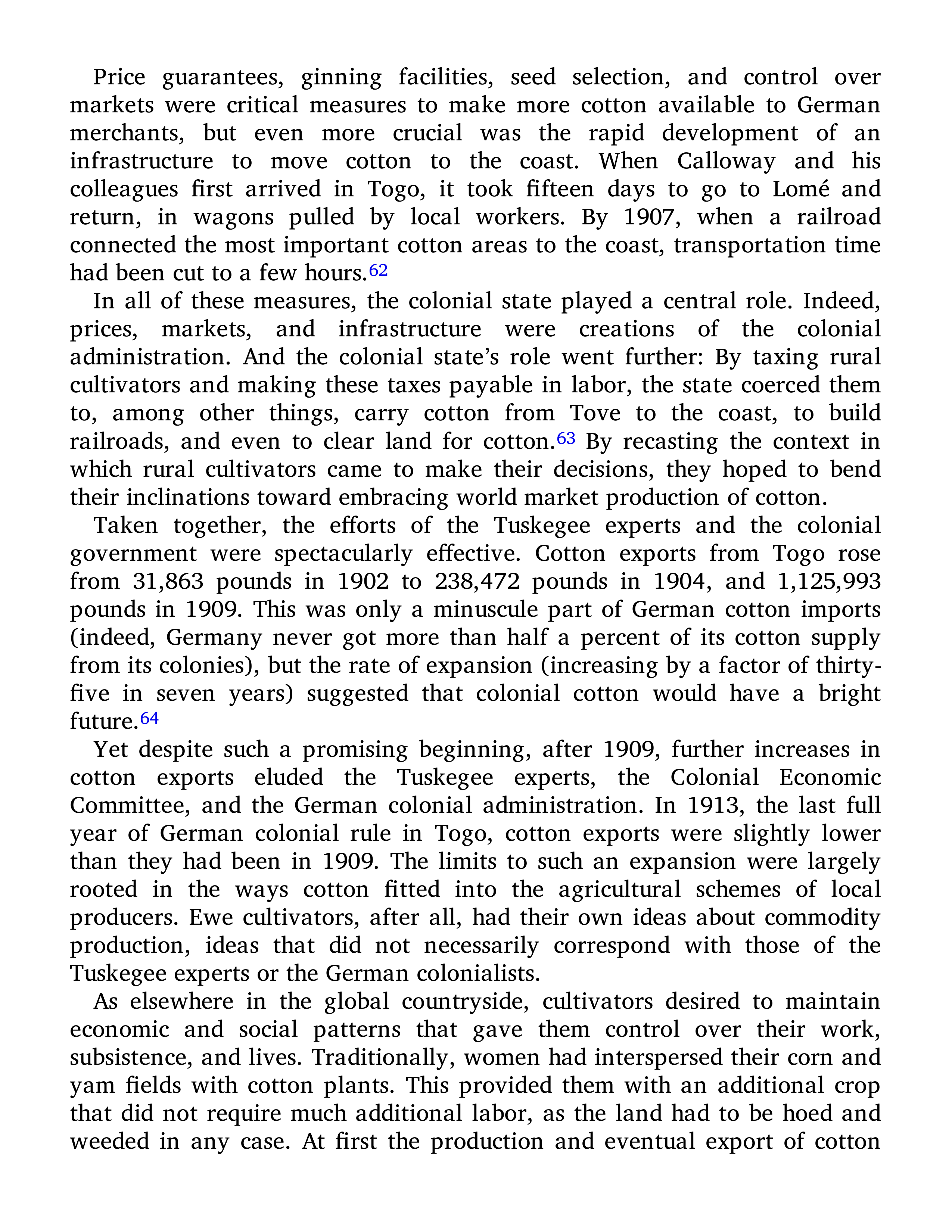
Price guarantees, ginning facilities, seed selection, and control over
markets were critical measures to make more cotton available to German
merchants, but even more crucial was the rapid development of an
infrastructure to move cotton to the coast. When Calloway and his
colleagues
ɹrst arrived in Togo, it took ɹfteen days to go to
Lomé and
return, in wagons pulled by local workers. By 1907, when a railroad
connected the most important cotton areas to the coast, transportation time
had been cut to a few hours.
62
In all of these measures, the colonial state played a central role. Indeed,
prices, markets, and infrastructure were creations of the colonial
administration. And the colonial state’s role went further: By taxing rural
cultivators and making these taxes payable in labor, the state coerced them
to, among other things, carry cotton from Tove to the coast, to build
railroads, and even to clear land for cotton.
63
By recasting the context in
which rural cultivators came to make their decisions, they hoped to bend
their inclinations toward embracing world market production of cotton.
Taken together, the e
ʃorts of the Tuskegee experts and the colonial
government were spectacularly e
ʃective. Cotton exports from Togo rose
from 31,863 pounds in 1902 to 238,472 pounds in 1904, and 1,125,993
pounds in 1909. This was only a minuscule part of German cotton imports
(indeed, Germany never got more than half a percent of its cotton supply
from its colonies), but the rate of expansion (increasing by a factor of thirty-
ɹve in seven years) suggested that colonial cotton would have a bright
future.
64
Yet despite such a promising beginning, after 1909, further increases in
cotton exports eluded the Tuskegee experts, the Colonial Economic
Committee, and the German colonial administration. In 1913, the last full
year of German colonial rule in Togo, cotton exports were slightly lower
than they had been in 1909. The limits to such an expansion were largely
rooted in the ways cotton
ɹtted into the agricultural schemes of local
producers. Ewe cultivators, after all, had their own ideas about commodity
production, ideas that did not necessarily correspond with those of the
Tuskegee experts or the German colonialists.
As elsewhere in the global countryside, cultivators desired to maintain
economic and social patterns that gave them control over their work,
subsistence, and lives. Traditionally, women had interspersed their corn and
yam
ɹelds with cotton plants. This provided them with an additional
crop
that did not require much additional labor, as the land had to be hoed and
weeded in any case. At
ɹrst the production and eventual export of cotton
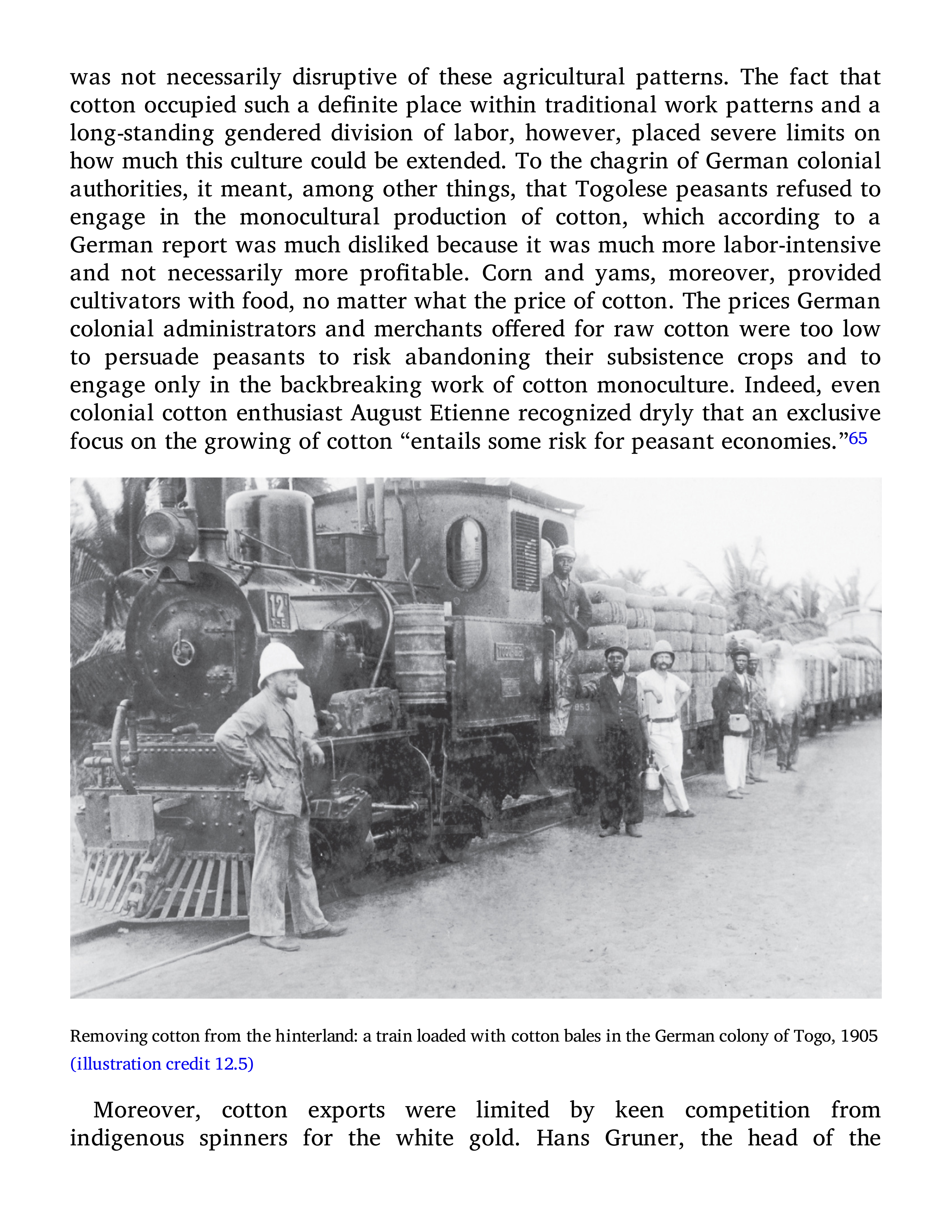
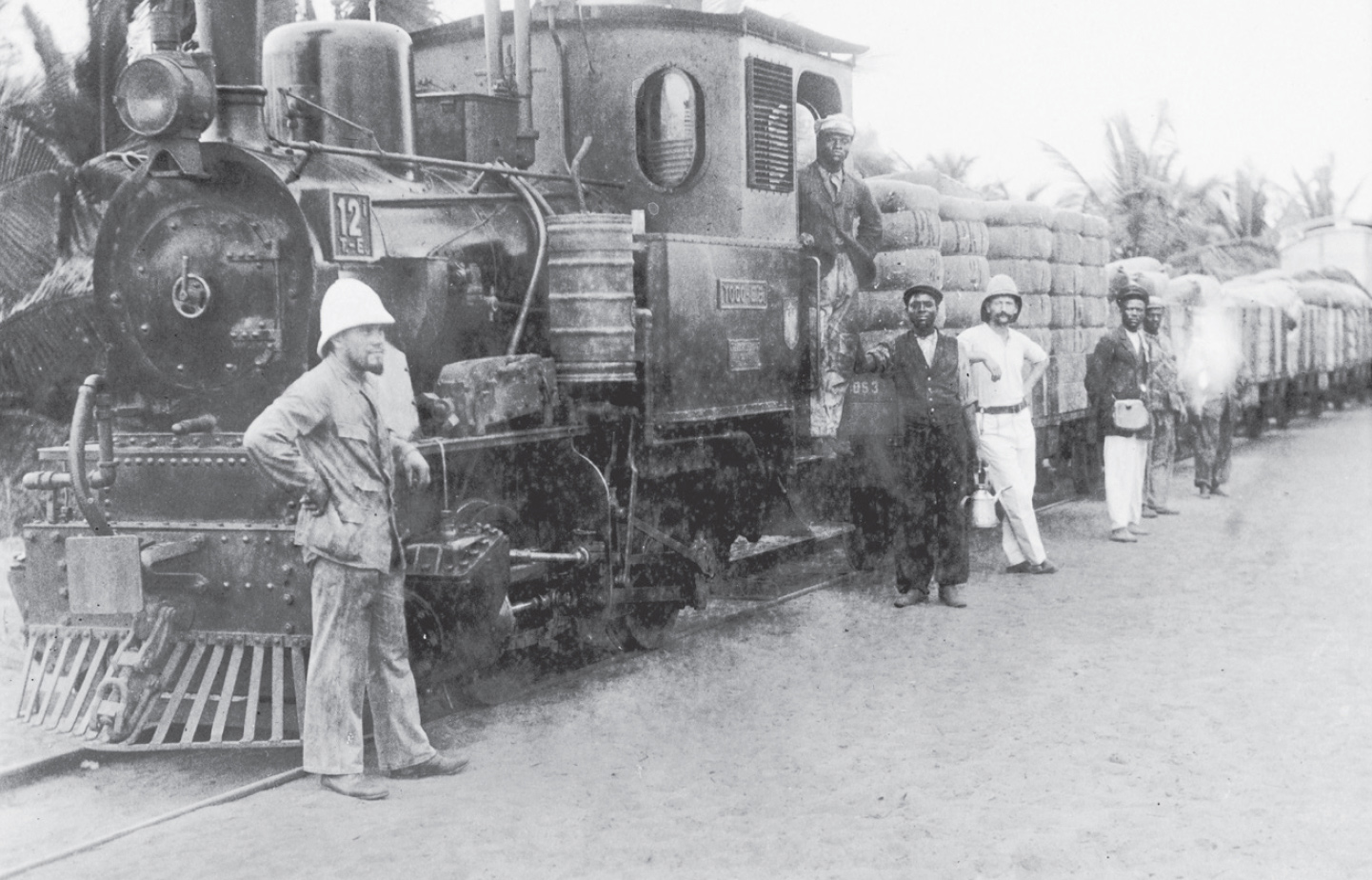
was not necessarily disruptive of these agricultural patterns. The fact that
cotton occupied such a de
ɹnite place within traditional work patterns and a
long-standing gendered division of labor, however, placed severe limits on
how much this culture could be extended. To the chagrin of German colonial
authorities, it meant, among other things, that Togolese peasants refused to
engage in the monocultural production of cotton, which according to a
German report was much disliked because it was much more labor-intensive
and not necessarily more pro
ɹtable.
Corn and yams, moreover, provided
cultivators with food, no matter what the price of cotton. The prices German
colonial administrators and merchants o
ʃered for raw cotton were too low
to persuade peasants to risk abandoning their subsistence crops and to
engage only in the backbreaking work of cotton monoculture. Indeed, even
colonial cotton enthusiast August Etienne recognized dryly that an exclusive
focus on the growing of cotton “entails some risk for peasant economies.”
65
Removing cotton from the hinterland: a train loaded with cotton bales in the German colony of Togo, 1905
(illustration credit 12.5)
Moreover, cotton exports were limited by keen competition from
indigenous spinners for the white gold. Hans Gruner, the head of the
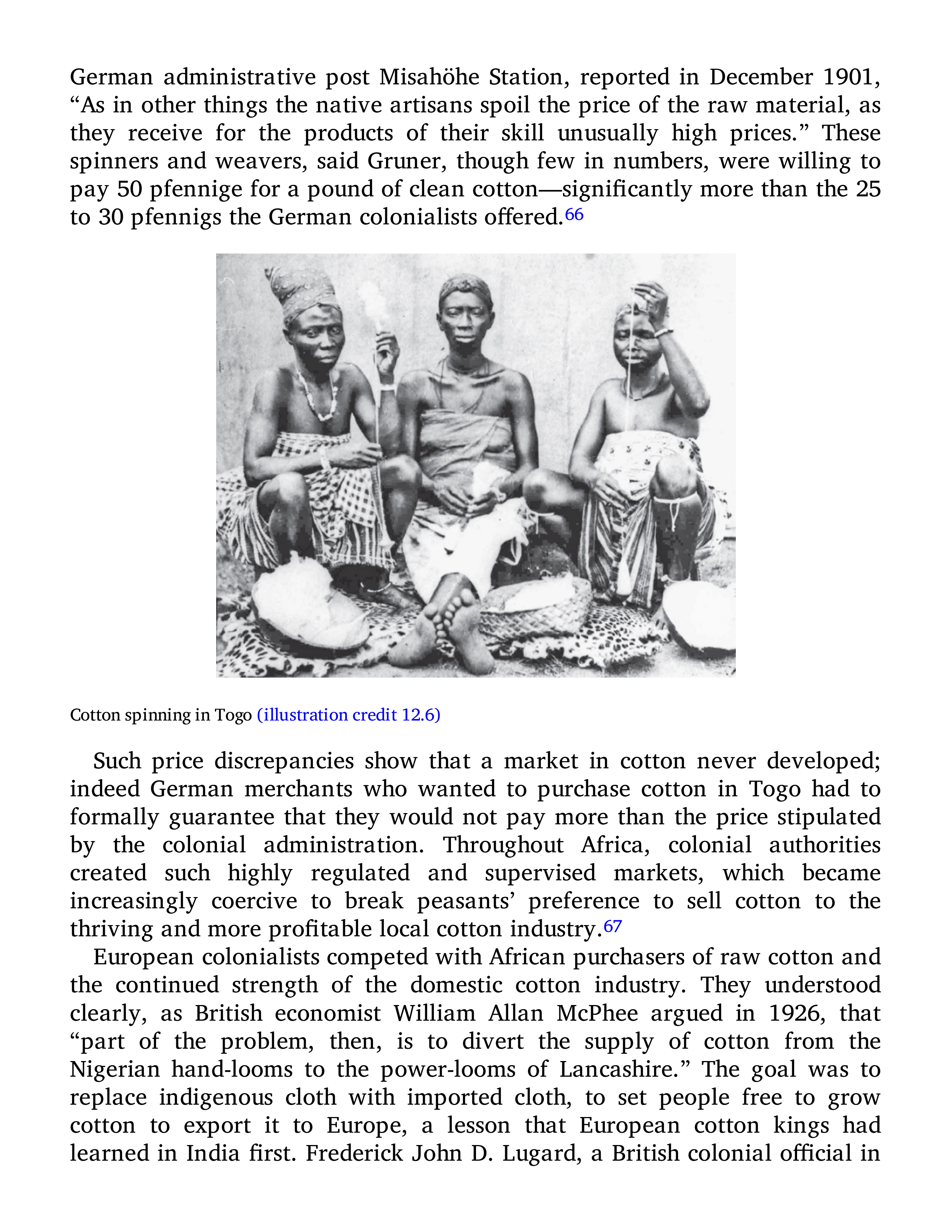
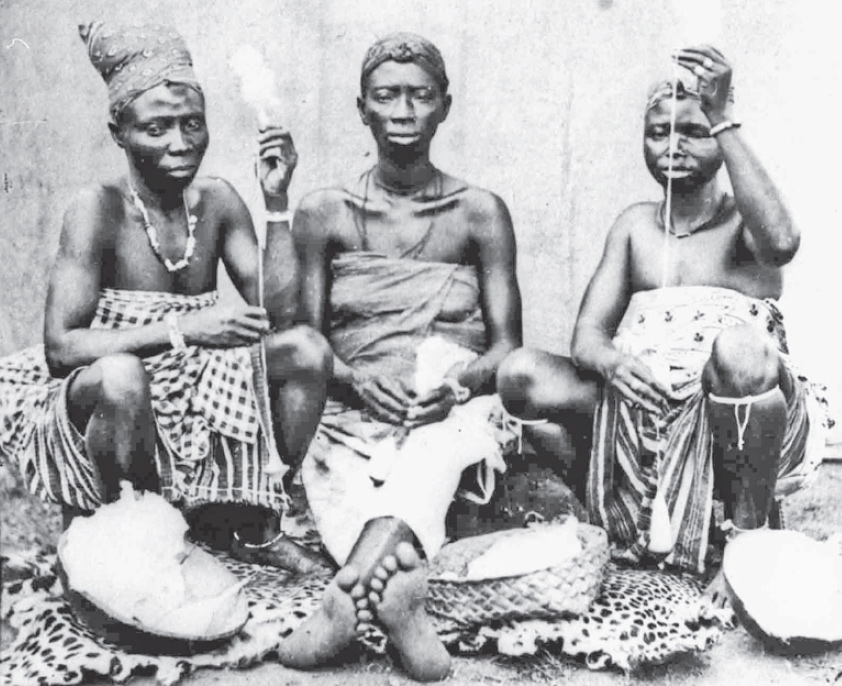
German administrative post Misahöhe Station, reported in December 1901,
“As in other things the native artisans spoil the price of the raw material, as
they receive for the products of their skill unusually high prices.” These
spinners and weavers, said Gruner, though few in numbers, were willing to
pay 50 pfennige for a pound of clean cotton—signi
ɹcantly more than the 25
to 30 pfennigs the German colonialists o
ʃered.
66
Cotton spinning in Togo
(illustration credit 12.6)
Such price discrepancies show that a market in cotton never developed;
indeed German merchants who wanted to purchase cotton in Togo had to
formally guarantee that they would not pay more than the price stipulated
by the colonial administration. Throughout Africa, colonial authorities
created such highly regulated and supervised markets, which became
increasingly coercive to break peasants’ preference to sell cotton to the
thriving and more pro
ɹtable local cotton industry.
67
European colonialists competed with African purchasers of raw cotton and
the continued strength of the domestic cotton industry. They understood
clearly, as British economist William Allan McPhee argued in 1926, that
“part of the problem, then, is to divert the supply of cotton from the
Nigerian hand-looms to the power-looms of Lancashire.” The goal was to
replace indigenous cloth with imported cloth, to set people free to grow
cotton to export it to Europe, a lesson that European cotton kings had
learned in India
ɹrst.
Frederick John D. Lugard, a British colonial o
ɽcial in
Nigeria, hoped for the decline of cotton manufacturing in the old weaving
city of Kano (“Africa’s Manchester”) to facilitate greater exports, since “the
cotton of Zaria will then cease to come to the looms of Kano.” To destroy
that industry, a “better class of English cloth than that now imported is
required, which will supersede the native, and so bring the raw cotton on to
the market.” Best of all, “The industries of spinning thread, weaving and
dyeing a
ʃord…occupation to many thousands who may possibly become
additional producers of raw cotton.” Deindustrialization, in his eyes, was the
prerequisite for incorporating this African territory and its people into the
orbit of Manchester.
68
Last but not least, the very fact that most African cultivators remained far
removed
from
world
markets
and
experienced
little
if
any
commercialization of their lives meant that they felt little economic pressure
to produce cash crops, unlike, for example, upcountry farmers in the United
States. Thus the Ewe could back up their preference for mixed farming with
their ability to maintain it. In precolonial Togo, the Ewe had bought and
sold some goods on markets and engaged in long-distance trade. But even
after the arrival of the Germans, capitalist social relations had only very
marginally penetrated Togo; rural cultivators resisted the logic of long-
distance markets in favor of long-established local exchanges and
safeguarding their own subsistence production. German colonial o
ɽcials
bemoaned that “unlike America, the peasant here is not dependent on
cotton growing for his subsistence. The latter always has access to other
crops, and his needs are so low, that he can live without any cash income
for extended periods of time.” The “dread of starving” that British
abolitionists had hoped would replace the “dread of being
ɻogged” as a
motivation for colonial people to produce crops for world markets failed in
Togo in the face of plentiful alternatives. Such resistance to the global
marketplace, moreover, had astonishing staying power, because the
Germans were unable to institute systems of exploitive credit relations.
69
Even before Togo’s cotton cultivation stagnated, German colonial
authorities understood these forces well. They began to look to experiences
elsewhere so as to learn how rural producers could be pressured to increase
their production of cotton. Colonial Economic Committee member Karl Supf,
aware of the tensions between subsistence and world market production,
suggested that the goal of colonial policy should be “to bring the Natives
into economic dependence upon us.” One way to do so, he suggested, was to
increase local taxes and make them payable in cotton. Alternatively, the
governor of Togo suggested in December 1903 that small sums of money,
secured by future cotton harvests, be advanced to peasants to enable them
to focus on cotton, as “an emphatic in
ɻuence of the governmental agencies
on the natives at least for a number of years is essential.” He thought the
government should explicitly look for ways to “pressure those natives, who
took on responsibilities by voluntarily accepting seeds, credit or advances or
other support for cotton growing.” Yet despite their willingness to force
cultivators, the Germans found old habits di
ɽcult to break, especially
because the relatively weak presence of the German colonial state left the
resilient social structure of rural producers, predicated on the continued
access to plentiful land, largely untouched. Railroads, markets, and price
guarantees were not su
ɽcient to persuade growers to abandon subsistence
agriculture.
70
With e
ʃorts to involve rural cultivators in
debt schemes faltering, and
outright expropriation of land beyond the power of the colonial
administration, other forms of coercion became more appealing. While
cotton manufacturer Karl Supf recommended “slight pressure,” local colonial
administrator Georg A. Schmidt suggested the need for “strong pressure” as
the best way to increase cotton production. Colonialists systematically
undermined markets by setting
ɹxed prices that were completely detached
from the world market price, compelling cultivators to bring their cotton to
market in ways exactly prescribed by the colonial administration,
eliminating middlemen, forcing certain cotton strains on producers, and,
last but not least, extracting labor from peasants by force. Not only were
roads, railways, and cotton gins built by forced labor, but colonial
authorities also asserted ever tighter control over cotton production and the
trade of raw cotton. Local government o
ɽcials supervised the planting of
cotton, tried to make sure that
ɹelds were regularly weeded, and secured a
timely harvest. By 1911, for example, the German administration had
created forty-seven authorized buying stations throughout the cotton-
growing areas to make sure the sale of cotton occurred only under the
watchful eyes of the government; at times, soldiers took on the task of
purchasing cotton. A year later, in January 1912, the administration further
ordered that every ginning or mercantile company send only government-
licensed purchasers to markets. They also stipulated that sellers had to
separate good- and poor-quality cotton at all times. By 1914, rules as to how
cotton had to be treated were honed further and now included corporal
punishment for indigenous growers who violated them. As time went by,
force, violence, and coercion became ever more central to German policy.
71
Such emphasis on coercion increasingly brought con
ɻicts between the
Tuskegee teachers and the German colonists. Most pointedly, Robinson
believed in the importance of growing subsistence crops along with cotton.
He advocated the joint development of cotton and food crops in
“harmonious ways,” and his teachings re
ɻected Washington’s concern that
rural African Americans focused too much on the growing of cotton and too
little on providing their own subsistence. In fact Robinson brought with him
the memory of the defeated struggles of freedpeople in the United States. In
an exceptionally wide-ranging letter, Robinson opined that “the source and
life of all governments are its people, and the
ɹrst duty of the government is
to maintain this life and source. Consequently, the people are its
ɹrst and
Chief Concern. For that same reason we wish to teach the people cotton
culture, because it is good for them, they will gain wealth thereby and the
Colony grow richer.” “But,” Robinson continued, “the people cannot live by
Cotton alone. Therefore we should begin now to teach them. Where they
grow only maize we will teach them to grow more maize and better maize,
and also Cotton. Where they grow now Yams and Cotton they must be
shown how to grow larger Yams and
ɹner Cotton.” To eʃect such a slow
transition, Robinson believed, it was important not to coerce peasants and
instead to involve them with “as little excitement and inconvenience” as
possible. Robinson and his colleagues from Alabama, however, were
increasingly ignored by the German colonial administration.
72
Throughout Africa, indeed, coercion became an ever more powerful means
of extracting cotton. In Côte d’Ivoire, peasants were forced to grow cotton
in specially designated
ɹelds under the supervision of local colonial oɽcials.
In the Belgian Congo, by 1917 cotton production was made a “culture
obligatoire” in which peasants were forced to grow certain amounts and to
sell them at below market prices. Those who did not produce su
ɽcient
quantities were penalized. If work was not done according to expectations,
severe punishments were meted out, including whippings. In the French
Soudan, peasants were similarly forced to grow cotton. Peasants in
Mozambique faced “sexual degradation and beatings…by which the
government agent compelled people to produce cotton.” The regime of
violence was so terrifying that as late as the 1970s, the word “cotton” still
evoked, according to two historians, “an almost automatic response:
su
ʃering.”
73
Yet in Togo, all these e
ʃorts yielded minimal results. After the peak
year
of 1909, Togo never produced more cotton while under German rule. The
experiences of other colonial powers in many other parts of Africa were
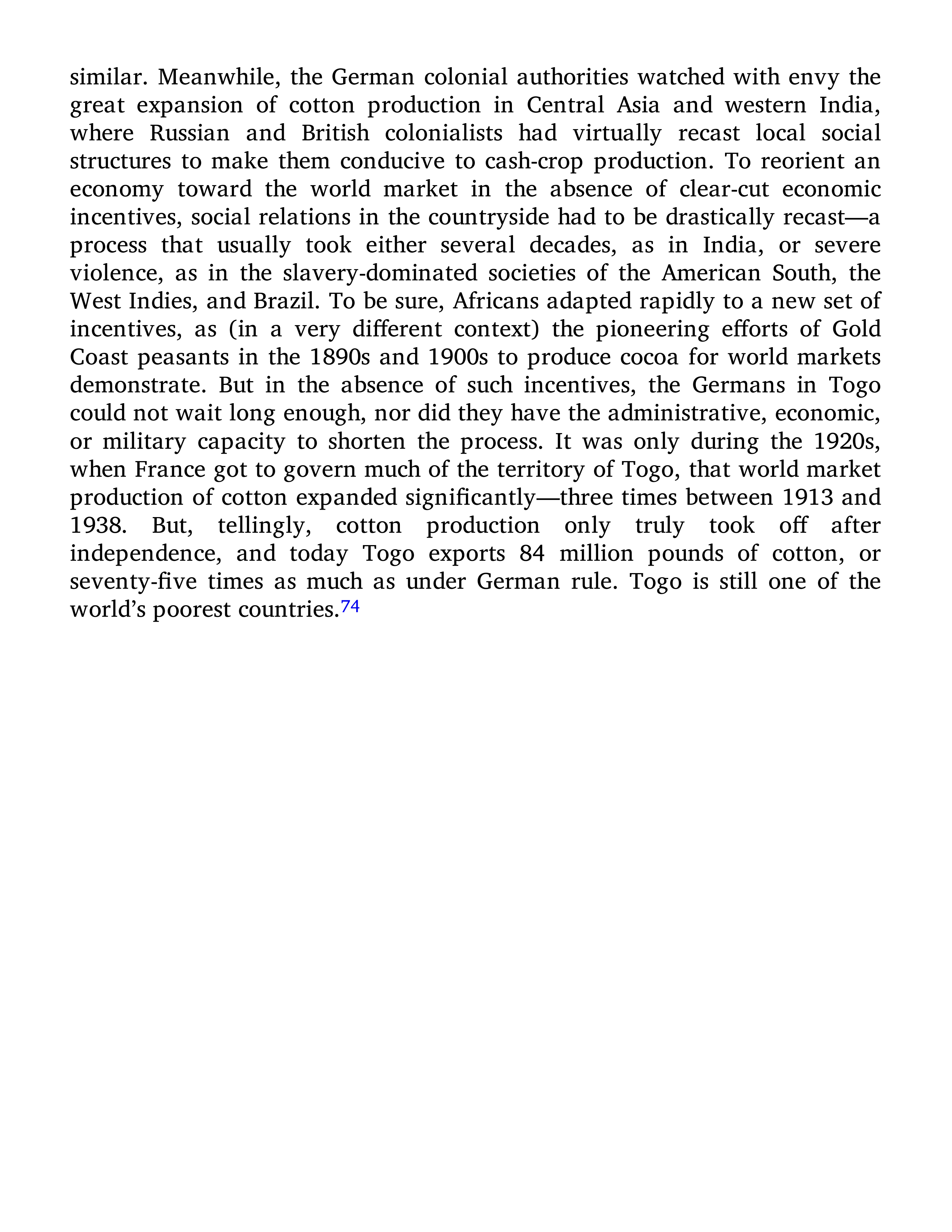
similar. Meanwhile, the German colonial authorities watched with envy the
great expansion of cotton production in Central Asia and western India,
where Russian and British colonialists had virtually recast local social
structures to make them conducive to cash-crop production. To reorient an
economy toward the world market in the absence of clear-cut economic
incentives, social relations in the countryside had to be drastically recast—a
process that usually took either several decades, as in India, or severe
violence, as in the slavery-dominated societies of the American South, the
West Indies, and Brazil. To be sure, Africans adapted rapidly to a new set of
incentives, as (in a very di
ʃerent context) the pioneering eʃorts of Gold
Coast peasants in the 1890s and 1900s to produce cocoa for world markets
demonstrate. But in the absence of such incentives, the Germans in Togo
could not wait long enough, nor did they have the administrative, economic,
or military capacity to shorten the process. It was only during the 1920s,
when France got to govern much of the territory of Togo, that world market
production of cotton expanded signi
ɹcantly—three times between 1913 and
1938. But, tellingly, cotton production only truly took o
ʃ after
independence, and today Togo exports 84 million pounds of cotton, or
seventy-
ɹve times as much as under German rule. Togo is still one of the
world’s poorest countries.
74
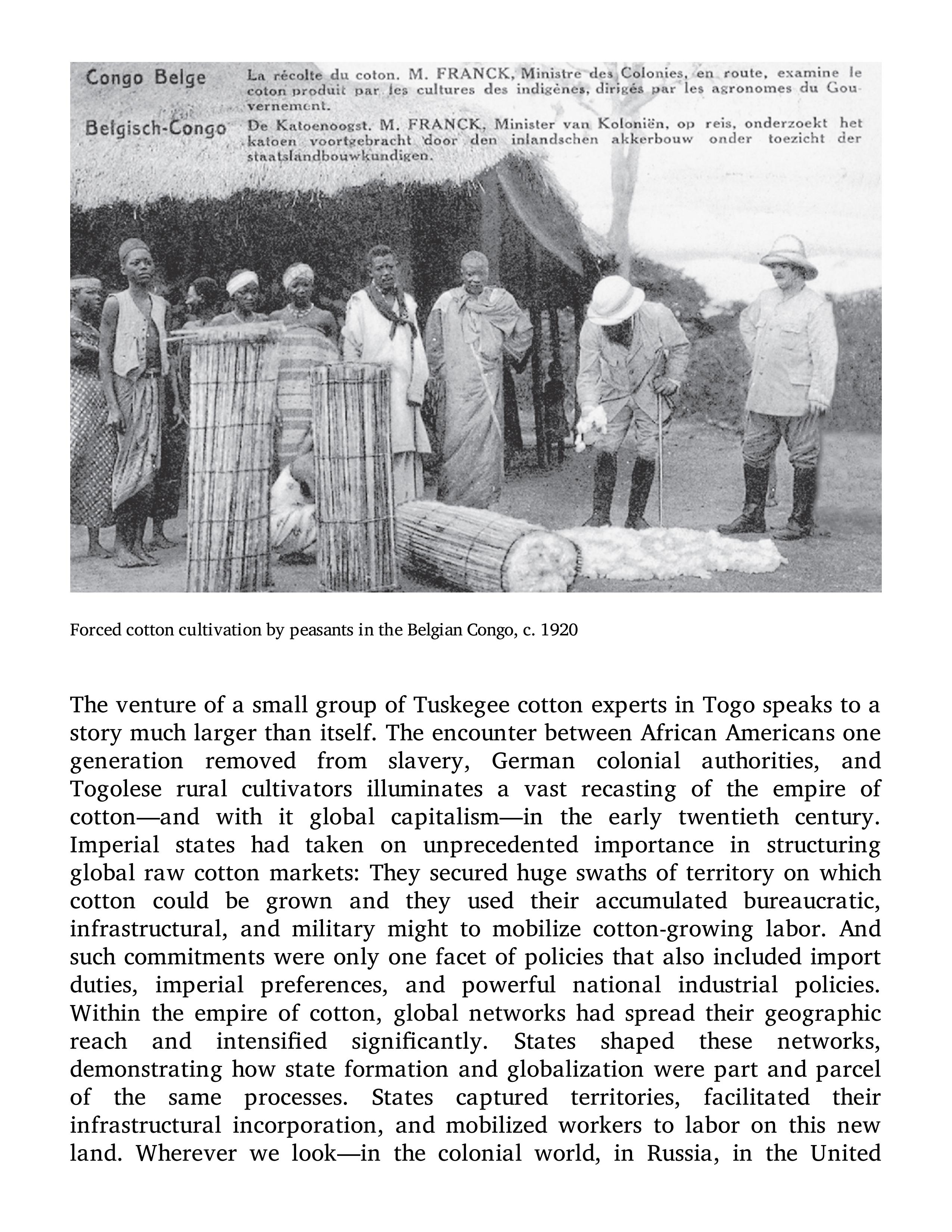
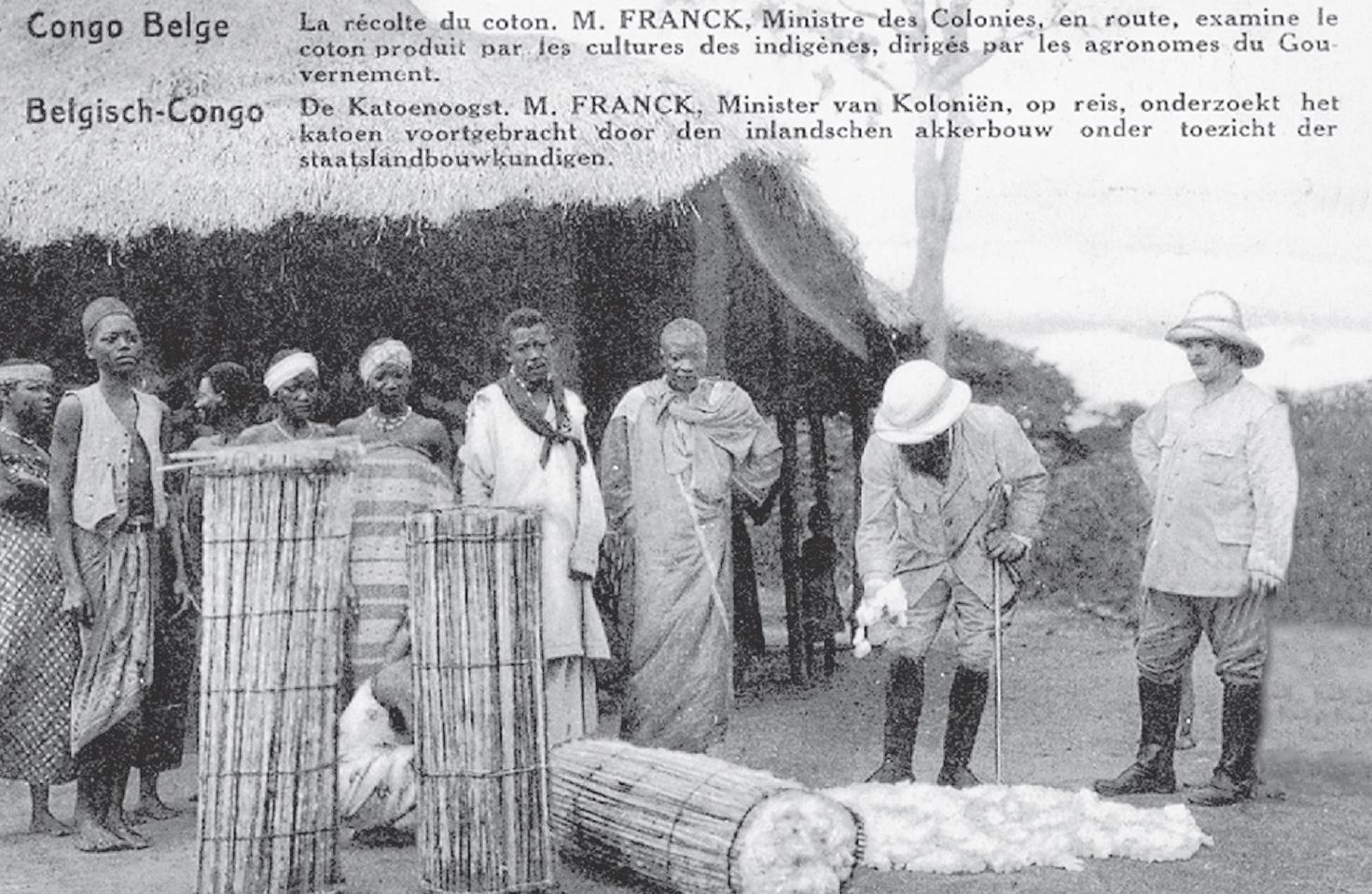
Forced cotton cultivation by peasants in the Belgian Congo, c. 1920
The venture of a small group of Tuskegee cotton experts in Togo speaks to a
story much larger than itself. The encounter between African Americans one
generation removed from slavery, German colonial authorities, and
Togolese rural cultivators illuminates a vast recasting of the empire of
cotton—and with it global capitalism—in the early twentieth century.
Imperial states had taken on unprecedented importance in structuring
global raw cotton markets: They secured huge swaths of territory on which
cotton could be grown and they used their accumulated bureaucratic,
infrastructural, and military might to mobilize cotton-growing labor. And
such commitments were only one facet of policies that also included import
duties, imperial preferences, and powerful national industrial policies.
Within the empire of cotton, global networks had spread their geographic
reach and intensi
ɹed signiɹcantly. States shaped these networks,
demonstrating how state formation and globalization were part and parcel
of the same processes. States captured territories, facilitated their
infrastructural incorporation, and mobilized workers to labor on this new
land. Wherever we look—in the colonial world, in Russia, in the United
States—the control of the cotton-growing countryside depended ever more
on powerful nation-states and empires.
To be sure, imperial powers competed with one another over the control
of territory, but in their search for ways to make potential cotton-growing
lands serve the interests of metropolitan industries, people from all over the
empire of cotton also tried to learn from each other’s experiences. French,
Japanese, and British cotton interests, for example, observed the German
activities in Togo closely; they sent delegates to meet with John Robinson. J.
Arthur Hutton, the chairman of the British Cotton Growing Association, even
saw German e
ʃorts in Togo as a model for African cotton growing. The
French government now monitored cotton harvests globally and its
consulate in Saint Petersburg reported in great detail on developments in
Central Asian cotton, as did the German consulate. Though all these e
ʃorts
were fundamentally about isolating national industries from the vagaries of
the world market, they themselves formed part of a new global conversation
on cotton. Cotton manufacturers’ shared interests in the transformation of
the global countryside transcended national boundaries, resulting in the
formation of an incipient transnational bourgeoisie during the period before
World War I as manufacturers from a wide variety of countries met not just
to discuss how to make rural cultivators in Egypt, India, or elsewhere grow
more cotton, but also to take pleasure rides on the Nile or dance in the
concert halls of Vienna.
75
The lessons learned from the imperial recasting of the global cotton-
growing countryside eventually spread, during the twentieth century, to the
most unlikely places: the Soviet Union, independent India, and then to the
People’s Republic of China. It was the Indian Central Cotton Committee,
largely under Indian control, that
ɹnally succeeded in recasting Indian
cotton agriculture to better suit the needs of its mills in the 1920s and
beyond. Just as tellingly, in 1923 the cotton experts of the German Colonial
Economic Committee, with the support of some of Germany’s major banks
and cotton industrialists, became involved in Soviet Central Asia’s cotton
industry. After having lost the German colonial empire, the object of their
work, in World War I they hoped to
ɹnd yet another source of cotton for
German industry, while their Soviet partners eagerly read the publications
that the Germans had produced before the war on colonial cotton and hoped
to make use of German expertise. The orders that the Soviet cotton
committee received in 1923 from the Council of Work and Defense in
Moscow were almost identical to the many documents that colonial cotton
bureaucrats had produced in Africa, Asia, and elsewhere.
76
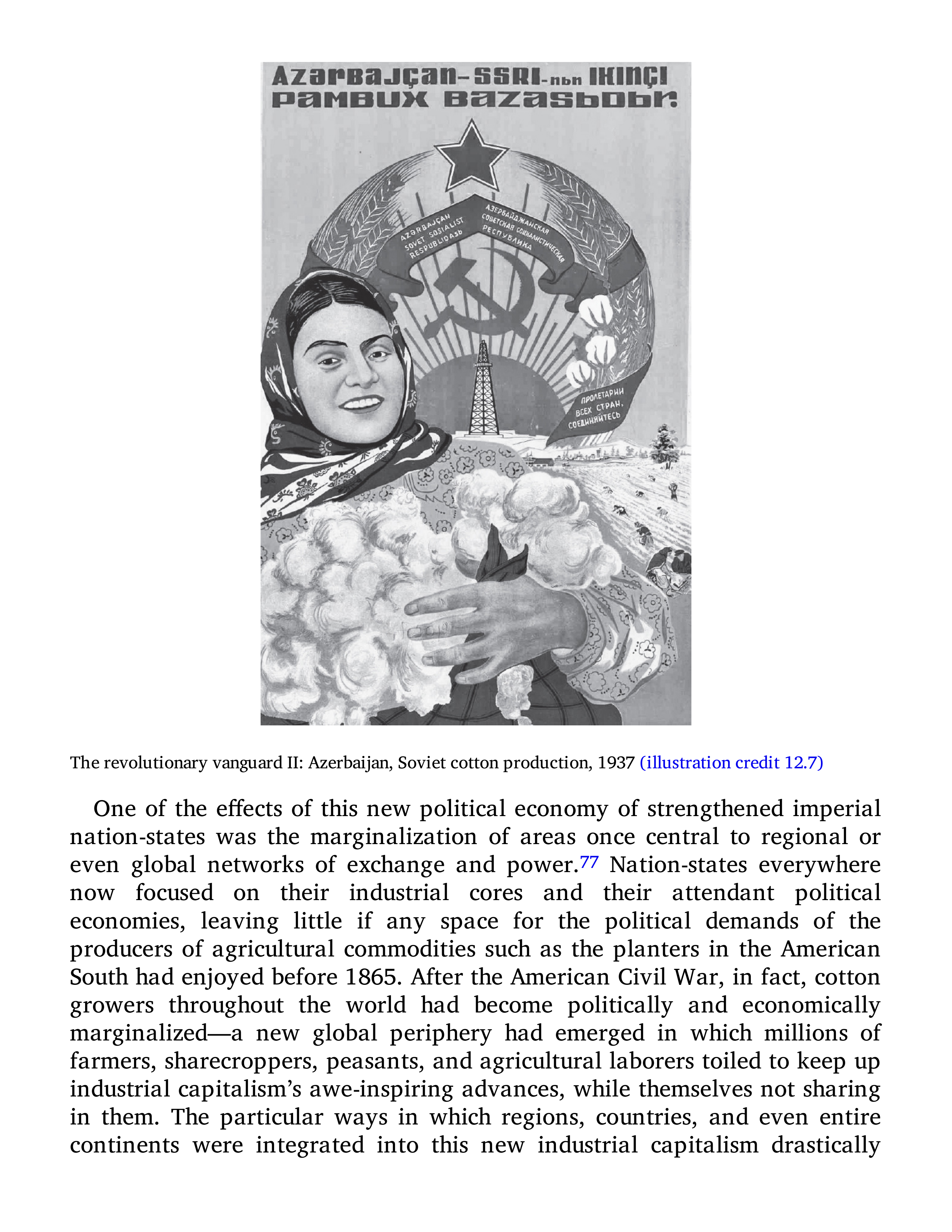
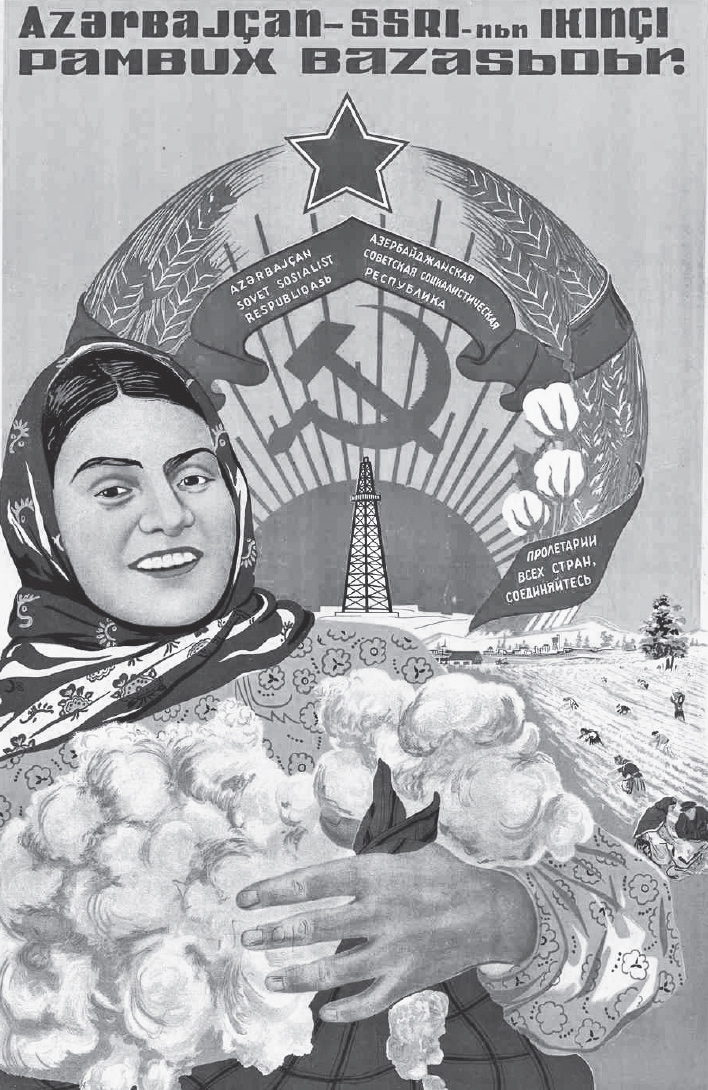
The revolutionary vanguard II: Azerbaijan, Soviet cotton production, 1937
(illustration credit 12.7)
One of the e
ʃects of this new political economy of strengthened imperial
nation-states was the marginalization of areas once central to regional or
even global networks of exchange and power.
77
Nation-states everywhere
now focused on their industrial cores and their attendant political
economies, leaving little if any space for the political demands of the
producers of agricultural commodities such as the planters in the American
South had enjoyed before 1865. After the American Civil War, in fact, cotton
growers throughout the world had become politically and economically
marginalized—a new global periphery had emerged in which millions of
farmers, sharecroppers, peasants, and agricultural laborers toiled to keep up
industrial capitalism’s awe-inspiring advances, while themselves not sharing
in them. The particular ways in which regions, countries, and even entire
continents were integrated into this new industrial capitalism drastically
sharpened global inequalities and cemented them through much of the
twentieth century.
Yet despite the enormously more important role of nation-states and
empires—a direct result of the overcoming of war capitalism—the cotton
empire remained as global as ever. By 1910, for example, it included Indian
merchants selling Ugandan cotton to Japan. Former American slaves
advised German colonialists in Togo. An Indian from Madras, who had
apprenticed in a German textile mill, now directed a cotton plantation in
German East Africa. Texas farmers walked the Congolese countryside along
with Egyptian agricultural experts to advise their Belgian hosts how to
expand cotton production. Russian agricultural experts scouted the Indian,
Egyptian, and U.S. countryside to study irrigation schemes. And Japanese
agricultural bureaucrats carefully observed cotton agriculture in German
West Africa. By 1913, E. R. Bartley Denniss, member of Parliament for the
British cotton manufacturing town of Oldham, had concluded, quite
perceptively, that the question of cotton supply had become “a world
question. The cotton industry of the world is one which makes nations
dependent upon one another more than any other industry that exists.”
78
This new geography of global capitalism, so decisively constructed by
European and North American states and capitalists, ironically would also
bring to an end the more than one-hundred-year dominance of Europe and
North America, the twin hubs of the empire of cotton. As the vast expansion
of cotton agriculture fed the factories spreading throughout the world, the
number of spindles that dotted the global countryside exploded. In 1865, 57
million spindles turned worldwide. By 1920 that number had increased to
155 million.
79
Yet increasingly, these spindles and looms did not twist yarn
and weave fabrics in the cities and countryside of western Europe and the
northern United States, but in those of the global South.
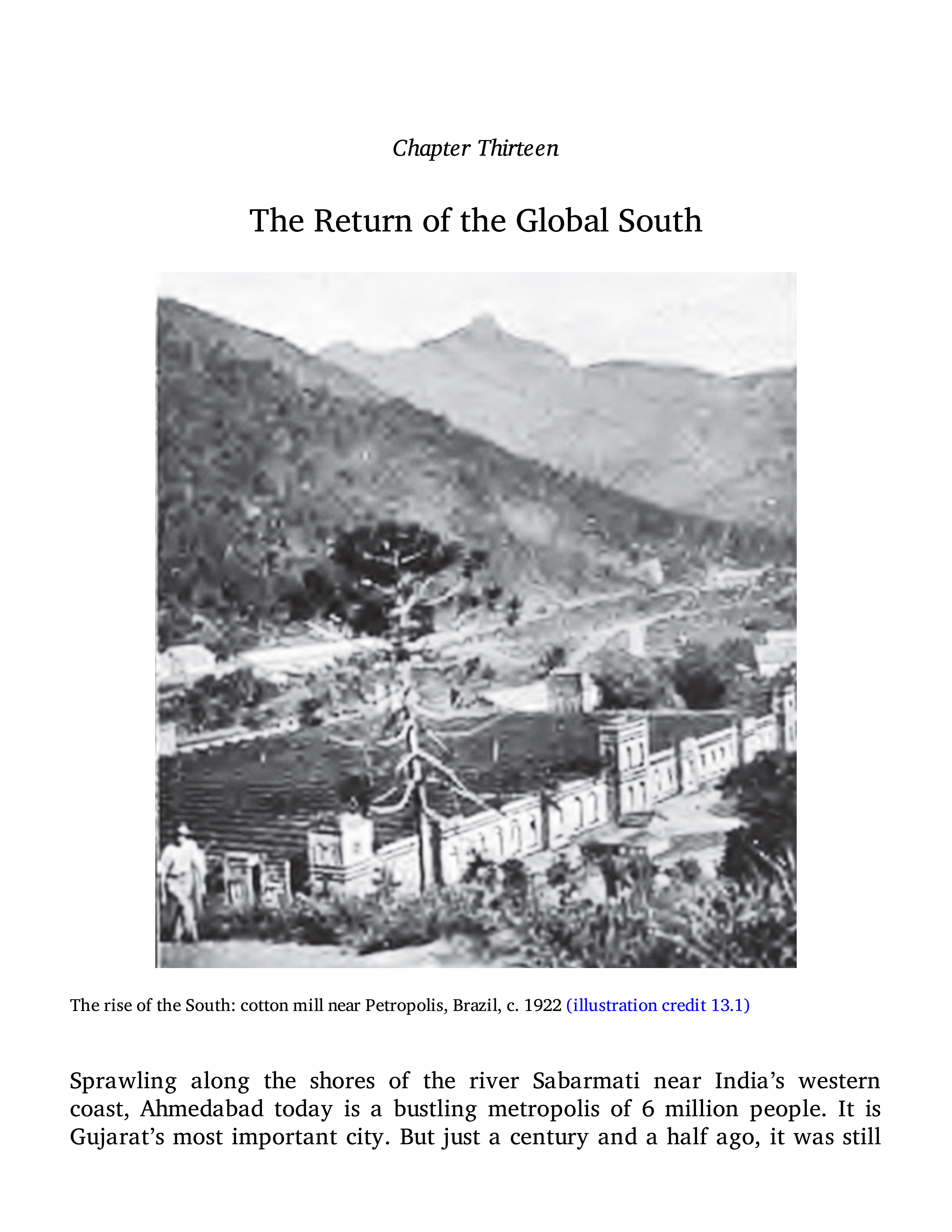
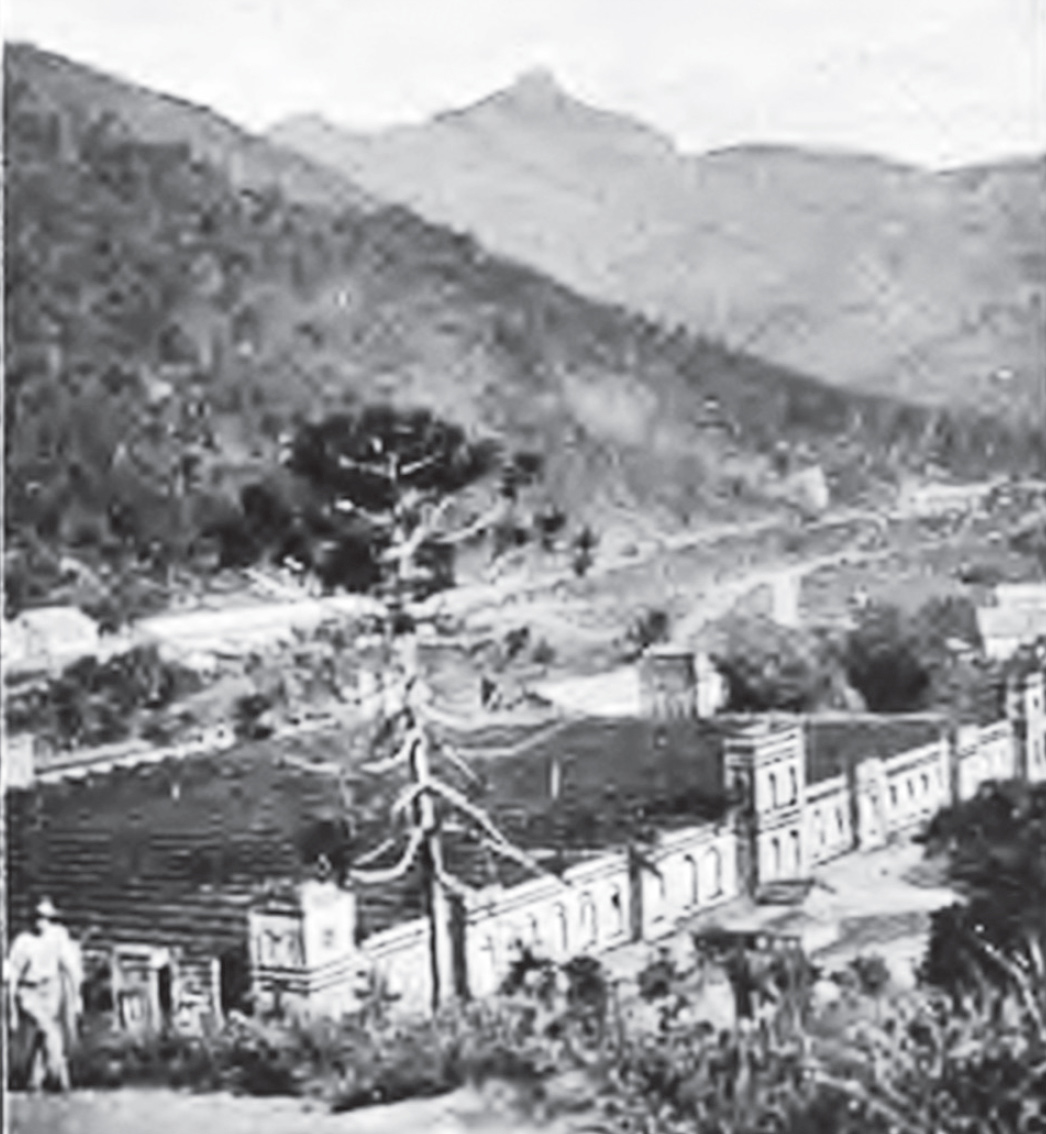
Chapter Thirteen
The Return of the Global South
The rise of the South: cotton mill near Petropolis, Brazil, c. 1922
(illustration credit 13.1)
Sprawling along the shores of the river Sabarmati near India’s western
coast, Ahmedabad today is a bustling metropolis of 6 million people. It is
Gujarat’s most important city. But just a century and a half ago, it was still
essentially a medieval town with “its old institutions…
ɻourishing; the sarafs
and mahajans…dominat[ing] trade and industry; the ancient crafts…the
basis of its prosperity; and its imports and exports mov[ing] on pack
animals along the narrow unpaved lanes,
ɻanked by high, unpainted
wooden houses, and through the guarded gates in its walls.” All that
changed, however, with the unprecedented pro
ɹts and productivity of a new
wave of Indian cotton manufacturing. On May 30, 1861, Ranchhodlal
Chhotalal ordered steam-powered spinning machines into motion for the
ɹrst time in the city’s history. A few years earlier, the youthful Chhotalal
had
ɻoated the idea of creating a spinning mill while working as a clerk in a
government o
ɽce. Inspired by the opening of cotton mills in
Bombay, he
understood that the new technology might radically recast India’s industry.
Not discouraged by a general lack of enthusiasm among Ahmedabad’s
commercial classes, he eventually found some merchants and bankers to
back his venture. The novel machinery was ordered from Great Britain,
complete with a team of British mechanics; after several months Chhotalal’s
spinning machines arrived in a lurching processional of bullock carts.
1
In May 1861, sixty-
ɹve
Shapur Mill workers set twenty-
ɹve hundred
spindles in motion. While this was but a hobby shop in size, even by
contemporary Bombay standards, one fact made it a lighthouse of future
investment: The factory was pro
ɹtable right from the beginning. By early
1865 Chhotalal had hired an additional 235 workers and expanded the mill
to ten thousand spindles, and also added one hundred power looms.
2
Ahmedabad’s spectacular rise as one of the world’s prime cotton
manufacturing locales was only partly due to these cutting-edge British
machines. The new enterprises drew deeply from Ahmedabad’s long history
in cottons. Local merchants, organized in guilds, had for many centuries
engaged in the long-distance trade in cottons. Some had accumulated
signi
ɹcant amounts of capital in the process, and when the British took over
the city from the Marathas in 1818, those merchants continued to play a
prominent role in local and long-distance trade. Even after British cotton
yarns began to arrive in large quantities by the 1830s, displacing local
handicraft manufacturers, many of these merchants incorporated foreign-
made yarn into their operations, continuing to
ɹnance the domestic
weaving sector.
3
Despite Chhotalal’s early success and the region’s cotton history, most of
the merchants and traditional business classes of Ahmedabad remained
reluctant to invest in further mills, content for the time being with high rates
of return on moneylending. The transformative wave of cotton mill
construction hit those shores only in the 1870s. By then, the deepening crisis
in the export-dependent countryside made moneylending less certain, and
capital-rich Ahmedadians turned to cotton manufacturing. The Jain
merchants Masukhbhai and Jamnabhai Bhagubhai were the
ɹrst members of
Ahmedabad’s merchant class to take the plunge. In 1877, they opened the
Gujarat Spinning and Weaving Company with 11,561 spindles and 209
looms. In quick order, other merchant families, increasingly shut out of
transoceanic trade, followed suit. As in Europe a few decades earlier, old
commercial capital was now reinvested in textile manufacturing, soon
accounting for the vast majority of investments. And as in the Alsatian city
of Mulhouse and elsewhere, these investors were tightly linked to one
another. Vaishnav Vanias and Jains dominated the industry. Members of
these castes institutionalized their social connections through organizations
such as the Jain Conference and the Gujarat Vaishya Sabha, among whose
leaders were the city’s mill owners.
4
Thanks to the entrepreneurial capital of
Ahmedabad’s merchants, by 1918,
ɹfty-one cotton mills dotted the banks of
the Sabarmati and thirty-
ɹve thousand laborers streamed each morning
through their gates and toiled relentlessly to turn these investments into
pro
ɹts.
Soon the world was full of such Manchesters, as the growth of the cotton
empire went along with its continued movement. The spatial arrangements
of the global cotton industry—and with it, of capitalism—were in constant
ɻux. Not only was cotton being grown in new parts of the world, but
increasingly it was being spun, woven, and
ɹnished in new parts of the
world as well. The days of a cotton empire led by the North Atlantic
countries were numbered.
Most precipitous was the declining importance of cotton manufacturing in
the United Kingdom. In 1860, 61 percent of the world’s mechanical spindles
had turned there, but by 1900 that percentage had declined to 43 percent
and by 1930 to 34 percent. Thanks to workers’ struggles for better working
conditions, British machines also operated for fewer hours than machines
elsewhere. They were also generally older, and thus their share of global
output was even smaller, just 11 percent by 1932. The interwar years in
particular were an “almost unmitigated disaster” for the British industry,
once the workshop of the world, with cotton textiles its leading export.
Shipments to Asia, Britain’s most important market, collapsed after World
War I, with exports to India declining by 46 percent from prewar years, to
the Dutch East Indies by 55 percent, and to China by 59 percent. As a result,
the British industry began its painful dissolution not simply in relative terms
in a growing world economy, but eventually in real losses: 43 percent of all
British looms disappeared between 1919 and 1939, along with 41 percent of
its mule spindles between 1926 and 1938, and the number of cotton workers
fell by 45 percent between 1920 and 1939.
5
As Britain’s industry began to lose its global predominance, continental
Europe and the United States retained until 1930 their global share of cotton
spindles, at 30 and 20 percent respectively. Yet the reign of these North
Atlantic countries in the cotton empire would eventually be cut short by the
slower but inexorable rise of the mechanized cotton industry in the vast
global South. Indeed, by the 1920s the cotton factories of New England
“experienced a collapse…even more thorough-going” then the ones of old
England. Among the usurpers, Japan was by far the most impressive. In
1880 the country had a mere eight thousand cotton spindles. By 1930, Japan
put 7 million spindles in motion, at which point its share of spindles
globally was 4.3 percent, just behind Germany (6.7 percent), France (6.2
percent), and Russia (4.6 percent). Japan by 1920 counted only 6.7 percent
as many spindles as Great Britain, but by 1937 that number had skyrocketed
to 32 percent. It was also the largest investor in cotton production in China,
where the industry expanded rapidly from just under a million spindles in
1908 to nearly 4 million in 1930. India was in a similar position, although it
started from a slightly stronger base: from 1.6 million spindles in 1877,
rising to nearly 9 million in 1930. By the twentieth century, the Asian cotton
industry had turned into the world’s fastest-growing, as the world’s cotton
industry returned to where it had largely originated.
6
Cotton, while becoming clearly less important to the global economy in
an age of vast steel mills, chemical plants, and electrical machinery
industries, went through a signi
ɹcant geographic shift, foreshadowing, as it
had a century before, the next phase of global capitalism. While many mid-
nineteenth-century Europeans had persuaded themselves that the wonders of
modern industry were reserved to them because of such unchangeable
factors as the local climate and geography, their superior religious beliefs
and “culture,” or even their “racial” characteristics, the geographic shifts of
the world’s
ɹrst modern industry showed anyone willing to see that
essentializing the particular global geography of a particular moment in the
history of capitalism was nothing but a self-serving justi
ɹcation for global
inequality. The history of the empire of cotton, in fact, proved them wrong.
This rise of cotton manufacturers in the global South resulted from a shift
in the balance of social power in both the heartland of industrial capitalism
and its periphery. Industrial capitalism had altered class structures not only
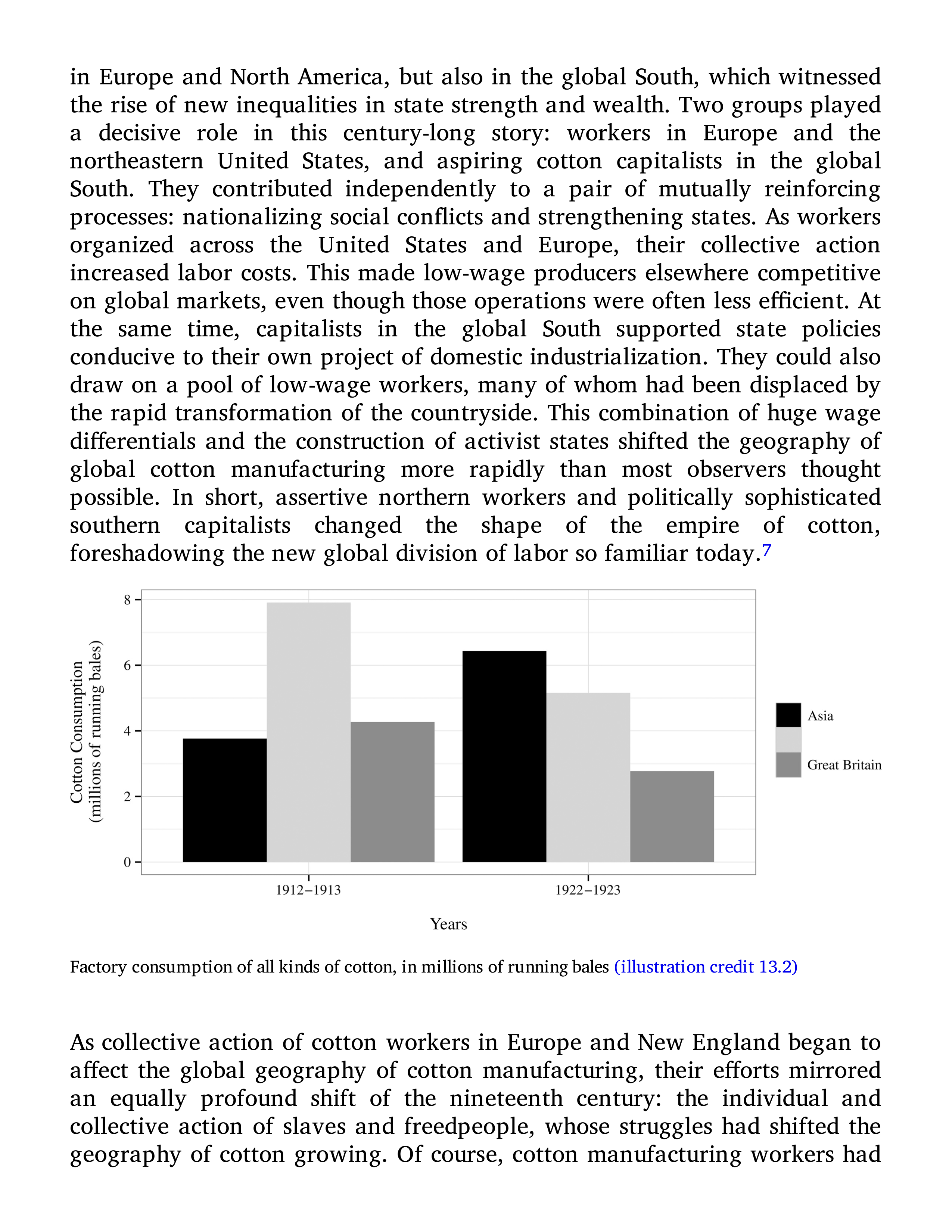
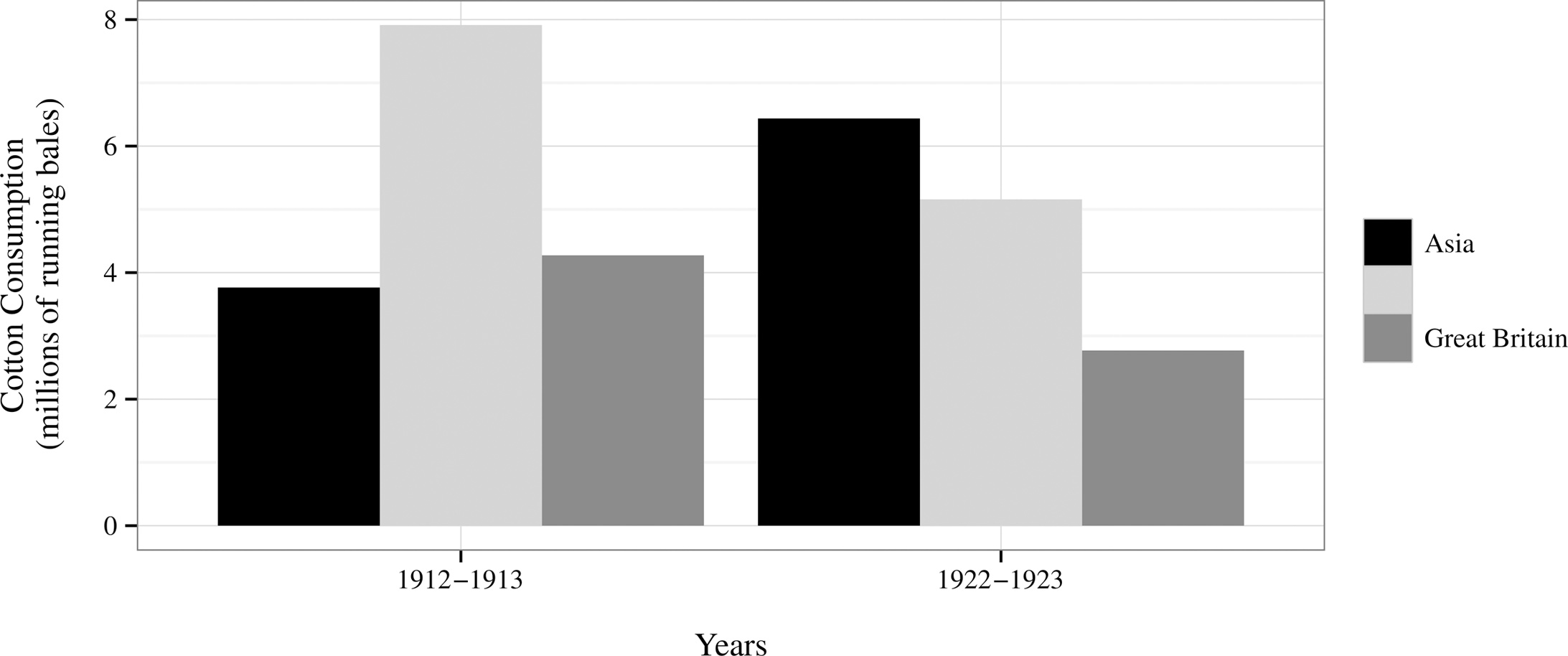
in Europe and North America, but also in the global South, which witnessed
the rise of new inequalities in state strength and wealth. Two groups played
a decisive role in this century-long story: workers in Europe and the
northeastern United States, and aspiring cotton capitalists in the global
South. They contributed independently to a pair of mutually reinforcing
processes: nationalizing social con
ɻicts and strengthening states. As workers
organized across the United States and Europe, their collective action
increased labor costs. This made low-wage producers elsewhere competitive
on global markets, even though those operations were often less e
ɽcient. At
the same time, capitalists in the global South supported state policies
conducive to their own project of domestic industrialization. They could also
draw on a pool of low-wage workers, many of whom had been displaced by
the rapid transformation of the countryside. This combination of huge wage
di
ʃerentials and the construction of activist states shifted the geography of
global cotton manufacturing more rapidly than most observers thought
possible. In short, assertive northern workers and politically sophisticated
southern capitalists changed the shape of the empire of cotton,
foreshadowing the new global division of labor so familiar today.
7
Factory consumption of all kinds of cotton, in millions of running bales
(illustration credit 13.2)
As collective action of cotton workers in Europe and New England began to
a
ʃect the global geography of cotton manufacturing, their eʃorts mirrored
an equally profound shift of the nineteenth century: the individual and
collective action of slaves and freedpeople, whose struggles had shifted the
geography of cotton growing. Of course, cotton manufacturing workers had
acted collectively before the 1860s. But in the late nineteenth century and
thereafter, strikes, unions, and working-class political parties mushroomed
under the increasingly warm light of the nation-state, and succeeded in
creating much-improved conditions for workers.
The Massachusetts city of Fall River, one of the United States’ most
important cotton manufacturing centers, is but one of many examples. Early
in the nineteenth century, easy access to waterpower had attracted the
attention of entrepreneurs to the region. In 1813, Dexter Wheeler and his
cousin David Anthony opened the “Fall River Manufactory,” followed by
numerous similar ventures. By 1837, the city boasted ten cotton mills
feeding on a workforce of sons and daughters from the local countryside.
Helped by easy shipping access to New York markets, Fall River soon rose to
become the nation’s leading producer of printed cotton cloth. From 1865 to
1880, the number of factories in Fall River increased
ɹvefold; at the
industry’s peak, around 1920, the city counted 111 mills, one-eighth of the
United States’ total spinning capacity, and a textile workforce of some thirty
thousand people, nearly as many as in Ahmedabad.
8
Workers in Fall River consistently organized to improve their wages and
working conditions. Thirteen major strikes occurred between 1848 and
1904. Some, like the 1865 mule spinners’ strike, involved only one craft’s
struggle for higher wages; others, like the 1904 strike, shut down almost
every mill in the city for months. In fact, Fall River workers’ mounting
militancy eventually impelled the Massachusetts Bureau of Statistics of
Labor to launch a formal investigation into the question posed by an 1881
letter from a Massachusetts state representative: “Why is it that the working
people of Fall River are in constant turmoil?”
9
Workers’ militancy was in part driven by the conditions in which they
worked and lived. Cotton mills, just as in Ellen Hootton’s time a century
earlier, remained noisy, polluted, and dangerous places. Factories, now
often powered by steam instead of water, had increased in size and often
combined spinning and weaving operations. The movements of bobbins and
shuttles, power transmission belts, and metal parts assaulted the ears of
children, women, and men, cotton dust
ɹlled the air and their lungs, and all
too often pieces of clothing, hair, or limbs got stuck in machines,
grotesquely injuring workers. The workday was harshly regimented and
seemingly unending, providing spinners and weavers with little time o
ʃ.
The e
ʃects of such work regimes continued to be profound: Among the
textile workers of the German city of Aachen, for example, an estimated half
of all children died before celebrating their
ɹrst birthday, an unusually high
rate of child mortality. Even during relatively prosperous times, workers
su
ʃered subsistence wages and wretched, congested housing. An 1875
Massachusetts Bureau of Statistics of Labor investigation, for example, found
one unskilled laborer in Fall River with a family of seven living on a yearly
salary of $395.20—below subsistence levels—supplemented by the wages of
his twelve-year-old daughter who worked beside him in the mill. His family
lived in an “out of repair”
ɹve-room tenement “in the worst part of the
city.” They were in debt, and the only ray of hope was that the next summer
would see another child coming of age to send into the mills alongside
father and daughter.
10
In response, Fall River’s cotton workers organized. Bolstered by the
transplanted cultures of working-class solidarity and militancy brought
across the Atlantic by British workers, their often militant strikes allowed
them to score a number of pathbreaking victories. In 1866, the mule
spinners’ union led a successful citywide drive for a ten-hour workday. In
1886, that same union secured a wide-ranging agreement to set the wages of
New Bedford, Fall River, and Lawrence spinners on a “sliding scale” based
on the price of cotton measured against the selling price of print cloth. In
the fallout of the citywide 1904 strike, Fall River mills also accepted the
demands of weavers’ unions for a sliding scale wage agreement. As early as
the 1890s, the city’s skilled textile workers began taking an interest in
national union organization, and over the next half a century Fall River
workers joined or created various regional labor organizations.
11
Moreover, Fall River’s cotton workers along with their New England
counterparts succeeded in improving their wages and working conditions, at
least in part because as citizens of the United States they enjoyed political
in
ɻuence. Most important, they translated their right to vote into
improvements in the workplace. In Fall River and elsewhere, unions and
strikes became factors in politics, as it was all but impossible for the
government to ignore the demands of enfranchised and mobilized workers.
And Fall River’s story was far from exceptional. In France during the early
twentieth century, the number of strikes among its approximately 165,000
cotton workers increased rapidly. In 1909, for example, a particularly strike-
prone year, there were 198 such strikes with more than thirty thousand
participants. Unions also became a growing force in French politics.
12
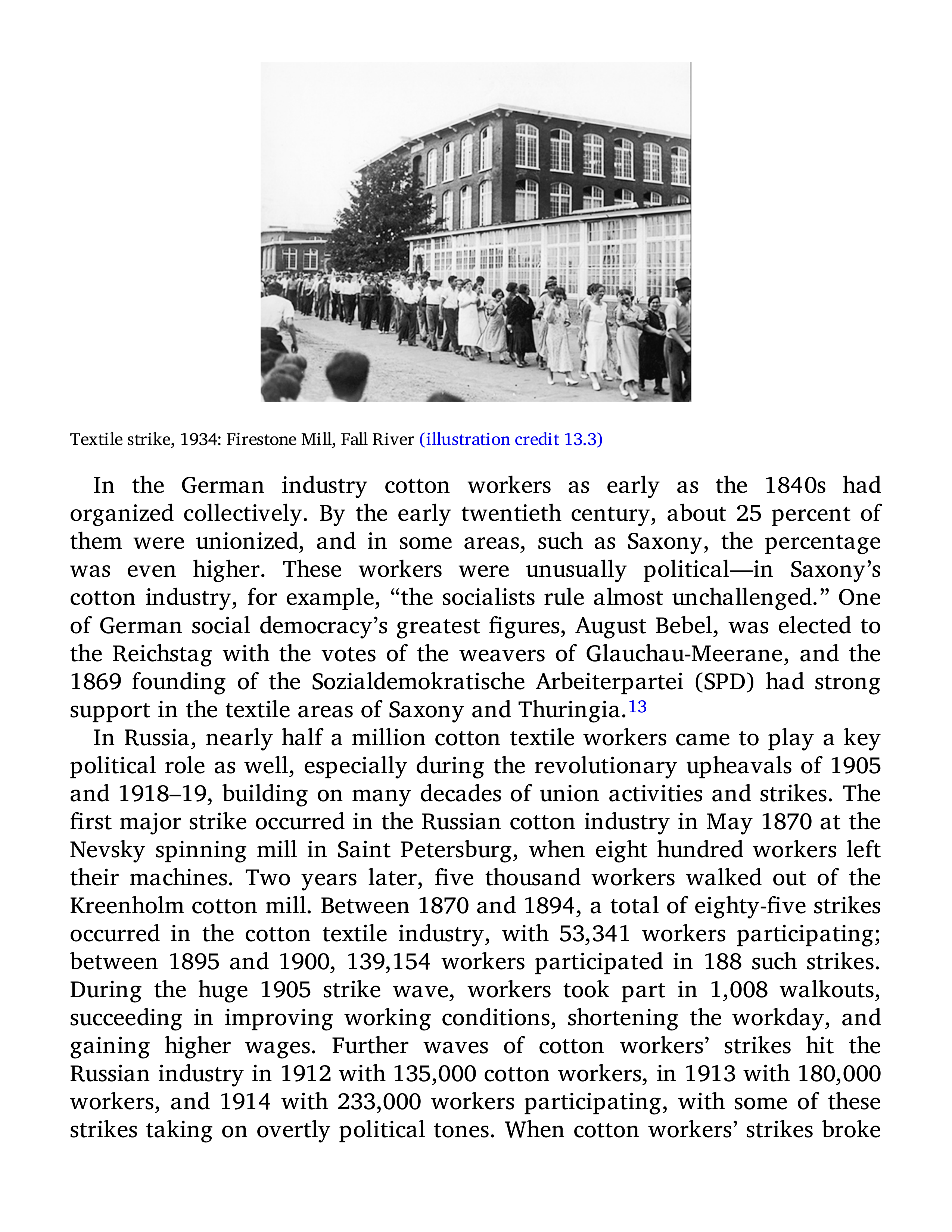
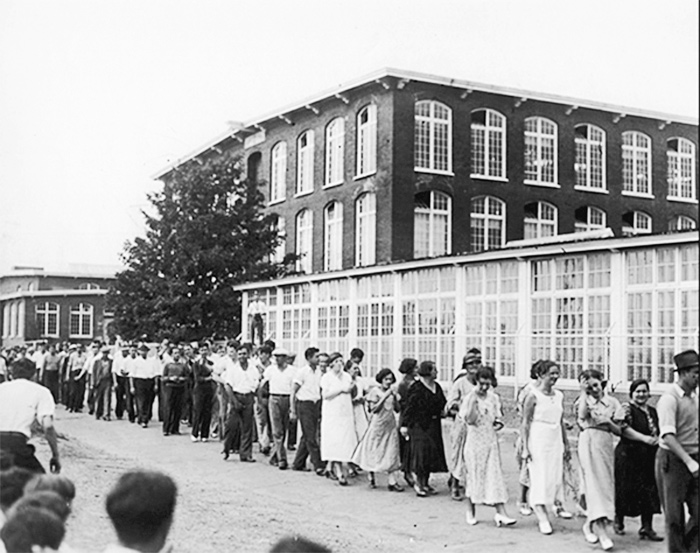
Textile strike, 1934: Firestone Mill, Fall River
(illustration credit 13.3)
In the German industry cotton workers as early as the 1840s had
organized collectively. By the early twentieth century, about 25 percent of
them were unionized, and in some areas, such as Saxony, the percentage
was even higher. These workers were unusually political—in Saxony’s
cotton industry, for example, “the socialists rule almost unchallenged.” One
of German social democracy’s greatest
ɹgures,
August Bebel, was elected to
the Reichstag with the votes of the weavers of Glauchau-Meerane, and the
1869 founding of the Sozialdemokratische Arbeiterpartei (SPD) had strong
support in the textile areas of Saxony and Thuringia.
13
In Russia, nearly half a million cotton textile workers came to play a key
political role as well, especially during the revolutionary upheavals of 1905
and 1918–19, building on many decades of union activities and strikes. The
ɹrst major strike occurred in the
Russian cotton industry in May 1870 at the
Nevsky spinning mill in Saint Petersburg, when eight hundred workers left
their machines. Two years later,
ɹve thousand workers walked out of the
Kreenholm cotton mill. Between 1870 and 1894, a total of eighty-
ɹve strikes
occurred in the cotton textile industry, with 53,341 workers participating;
between 1895 and 1900, 139,154 workers participated in 188 such strikes.
During the huge 1905 strike wave, workers took part in 1,008 walkouts,
succeeding in improving working conditions, shortening the workday, and
gaining higher wages. Further waves of cotton workers’ strikes hit the
Russian industry in 1912 with 135,000 cotton workers, in 1913 with 180,000
workers, and 1914 with 233,000 workers participating, with some of these
strikes taking on overtly political tones. When cotton workers’ strikes broke
out again in 1917, they became a central part of the revolutionary turmoil
of that year.
14
In Switzerland, cotton workers mobilized, albeit less dramatically than in
Russia, in the late nineteenth century. In 1908 they created the national
Schweizerische Textilarbeiterverband (STAV), the Swiss union of textile
workers, which fought for improved working conditions and higher wages
and embraced socialist ideas. In Catalonia, socialists and anarchists
dominated many mills, with the cotton industry rocked by frequent
confrontations between owners and well-organized workers, with massive
strikes in 1890 for shorter hours, with bombings of mill owners’ houses, and,
in 1909, during the
Setmana Tràgica
, with violent insurrection in Barcelona.
In the Dutch industry, many strikes occurred around the turn of the century,
and in its center, Twente, 60 percent of cotton workers had organized in
unions by 1929.
15
Lancashire, the heartland of the global cotton industry, witnessed the
in
ɻuence and national scope of unions earlier than anywhere else, and
served as an inspiration and a source of organizers for cotton workers in
other parts of the world, including Fall River. Unions had created national
organizations in spinning by 1870 (the Amalgamated Spinners Association),
and in 1884, in weaving (the Amalgamated Weavers Association). The
Trade Union Congress, bringing British unions together in all sectors of the
economy, had been created two years earlier. The spinners’ union, which
organized the most highly skilled workers in spinning mills, had by the
1880s organized almost 90 percent of all workers, making it perhaps “the
most powerful union in the world.” They succeeded in raising wages,
improving working conditions, and managing technological development.
The Spinners were among the “best organized and best-
ɹnanced workers’
organizations in Britain,” and they extracted premium wages and captured a
large portion of the increasing productivity of the industry from the 1880s to
the 1920s. The Cardroom Workers and Weavers, larger, more di
ʃuse, and
less committed to exclusive craft practices, also won signi
ɹcant gains for
workers. According to a study of data from 1890, the union wage premium
for skilled, semiskilled, and unskilled workers in cotton textiles was around
12 percent, a signi
ɹcant margin, providing material rewards for the
unionized workers of the cotton districts. The working conditions were still
hot and humid and the hours long and hard, but militant, massive, and
disciplined collective action from the cotton workers managed to force
employers into sharing the pro
ɹts from increasing industrial productivity.
16
The mobilization of cotton workers did not in all cases succeed in
improving local working and living conditions, but collectively, workers of
these North Atlantic nations reduced their hours of work, improved working
conditions, increased their wages, and won political in
ɻuence—often with
the tacit support of strengthening states that were above all concerned with
social stability and under pressure from politically mobilized and at times
enfranchised workers. This trend was magni
ɹed by the tendency of wages to
roughly converge within national economies, which allowed even less well
organized cotton workers to bene
ɹt from the collective mobilizations of
other groups of workers.
17
As a result, workers in western and northern Europe and the northeastern
parts of the United States spent less and less time at work. Cotton workers
in the Saxon town of Crimmitschau demanded in 1903, “An hour for us! An
hour for our family! An hour to live!” And even if all too often their
demands were unsuccessful, over the years they managed to decrease their
working hours from an annual average of 3,190 hours in 1865 to 2,475
hours in 1913. In France, labor legislation in 1892 restricted women to the
eleven-hour workday, to be reduced further in subsequent years. In January
1919 the Spanish government gave cotton workers the eight-hour day.
18
As hours declined, wages increased. In Germany, spinners in 1865 had
been paid an average of 390 marks per year. In 1913 they made 860 marks
annually, or, in real terms, 53 percent more. In Alsace, there was also a
“remarkable” increase of wages between 1870 and 1913. Mulhousian mule
spinners had made between 40 and 48 francs every two weeks in 1870, but
took home 65 to 75 francs in 1910, which in real terms equaled a doubling
of their wages. In Rhode Island, hourly wages of male weavers climbed from
13.5 cents an hour in 1890 to 59.8 cents by 1920; for loom-
ɹxers, wages rose
from 18.4 cents an hour in 1890 to 79.1 in 1920. Even do
ʃers, un
skilled
laborers generally excluded from formal labor organization, saw their wages
rise. In 1890, the average male do
ʃer might expect a daily wage of 135
cents; by 1920, their wages had shot up to 484 cents, an in
ɻation-adjusted
50 percent rise, while the more skilled loom-
ɹxers saw a near doubling of
their real wages.
19
Workers not only improved their wages and working conditions through
collective action at the workplace, but they also succeeded in getting newly
strengthened nation-states to pass legislation that improved their welfare.
Germany enacted a whole slew of worker-friendly legislation: When
compulsory schooling came about after 1871, children under twelve years
could no longer work in factories, and the e
ʃective work time of children
under fourteen was thereby limited. Laws in 1910 stipulated that women
could not work more than ten hours on weekdays and eight hours on
Saturdays, while children under thirteen were now not allowed to work at
all. Massachusetts passed its
ɹrst
labor laws in 1836, factory safety rules in
1877, and by 1898 outlawed night work for women and minors, in e
ʃect
closing factories at night. In Switzerland, as elsewhere, labor laws increased
labor costs, as already in 1877 the maximum number of hours for textile
workers was limited to eleven, night work for women was outlawed, and
child labor for workers under fourteen was declared illegal.
20
After World War I taxes on employers also surged, demonstrating that the
administrative, judicial, and military capacity of the state, so vital for
industrial capitalism, came at a rising cost. Indeed, the tensions that led to
war in the
ɹrst place had emerged from the tightening connections between
national capital, nation-states, and national territories. The competition
between increasingly powerful states rested on the mobilization of their
citizens into mass armies and the marshaling of taxes to fund those armies
and produce war materials. Under such pressures to extract money and
people, states were forced to legitimize themselves democratically.
For European and North American capitalists, this dependence on
powerful states—the principal source of their strength—was now also their
single greatest weakness, because these states in e
ʃect enabled working-
class power on the shop
ɻoor and in politics. From the perspective of
capitalists, indeed, the state was Janus-faced. It enabled the emergence of
industrial capitalism, including the mobilization of labor in the global
countryside, but it also “trapped” capitalists, as workers would use access to
national politics to better their working conditions and wages. As a result,
social con
ɻicts that had once been primarily global (as when the
mobilization of slaves in Saint-Domingue a
ʃected the interests of cotton
manufacturers in Britain), or local (as when Indian peasants refused to
labor on British cotton plantations), now increasingly became national.
Rising production costs in the core areas of the Industrial Revolution in
Britain, continental Europe, and North America, along with unrelenting
price competition, in turn dimmed the once blazing pro
ɹtability of cotton
manufacturing. From 1890, northern manufacturers in the United States
complained about falling pro
ɹts. One author reports that dividend
payments in German cotton spinning corporations hovered between just 4
and 6 percent between 1900 and 1911, a far cry from the pro
ɹts that British
entrepreneurs had depended on a century earlier. In the Oldham and
Rochdale spinning industry, the very heart of Lancashire, average return on
capital was low: 3.85 percent from 1886 to 1892, 3.92 percent from 1893 to
1903, rising to 7.89 percent from 1904 to 1910. British cotton capitalists,
spoiled by decades of enormous pro
ɹts, experienced during the 1920s a
“rapid fall in spinning company pro
ɹts.”
21
In some parts of the world, manufacturers responded to rising wages by
investing in improved production techniques. New spinning machines and
looms allowed for greater output per worker, and in Germany, for example,
productivity in spinning more than tripled between 1865 and 1913, and in
weaving increased by a factor of six. Such productivity advances meant that
wages formed a diminishing portion of total production costs. In German
spinning, the share of wages fell from 78 percent of total costs in 1800 to 39
percent in 1913, and in weaving, less dramatically, from 77 to 57 percent.
But in the face of manufacturers’ inability to manipulate the price of other
inputs, especially raw cotton, wage costs continued to remain important,
and thus had a signi
ɹcant impact on proɹtability. After all, as of 1910,
Chinese wages were just 10.8 percent of those in Great Britain and 6.1
percent of those prevalent in the United States, while Chinese workers also
labored nearly twice as many hours as their New England counterparts—
5,302 hours versus 3,000 hours. Such low-wage competition was found in
even more places and it mattered. By the 1920s, for example, competition
from Czech and Russian producers proved to be a threat to the German
cotton industry. In the long run, cotton manufacturing became a “race to the
bottom.”
22
Manufacturers tried to respond to such pressures by using their access to
ever more powerful governments to insulate their respective national
industries from global competition. Germany’s cotton industry depended on
an intricate tari
ʃ regime catering to the very speciɹc needs of very speciɹc
sectors of its cotton industry. As manufacturers organized (in 1870, for
example, the Verein Süddeutscher Baumwollindustrieller was founded), they
successfully lobbied the state to support their interests, with the
Deutsche
Volkswirthschaftliche Correspondenz
arguing that tari
ʃ protections were the
only means by which the German industry could survive the pressures of
imports—a bene
ɹt not available to Indian, Chinese, or Egyptian
manufacturers. Such tari
ʃ protections were important elsewhere too. Italy
e
ʃectively protected its home market with
tari
ʃs on cotton goods passed in
1878 and 1888. In France, at the behest of its cotton manufacturers,
increasingly protectionist tari
ʃs had fueled cotton industry proɹts since the
1880s, especially since 1892 with the passing of the Méline Tari
ʃ.
23
The
United States also saw the strengthening of its protectionist regime in the
last half of the nineteenth century. In 1861, the Morrill Tari
ʃ increased
duties on imported cotton goods, and while the Tari
ʃ Act of 1883 lowered
tari
ʃs on cheaper cottons (qualities that American manufacturers could
easily produce), it increased them on higher qualities, a trend that continued
with the Tari
ʃ Act of 1890.
Imperial markets also became ever more important as the new
imperialism that had arisen out of the ashes of the nineteenth-century
“second slavery” now paid dividends—for some. It paid, for a while, for
Catalan manufacturers, who gained in the 1880s more protected access to
the remaining Spanish colonies, including a monopoly in the Cuban market.
It supported the interests of Russian cotton industrialists in gaining access to
the Central Asian territories. It protected British manufacturers from Indian
competition. Even in the United States, following the demands of cotton
manufacturers such as Edward Atkinson, the government aggressively
helped manufacturers gain access to markets abroad, especially in Latin
America, the destination of half of U.S. cotton exports.
24
Despite the frantic e
ʃorts of European and New England cotton
manufacturers to secure their exalted position within the global empire of
cotton, rising labor costs were a powerful countervailing force. The result of
the opportunities and constraints created by the nationalization of both
labor and capital, rising labor costs opened up new possibilities for
manufacturing in those parts of the world in which labor was cheaper and
less constrained by state regulations.
As a result, the global South welcomed back home the world’s cotton
industry in the twentieth century, reversing a century-long departure. At
ɹrst that move was hardly perceptible, and as late as 1900 was not much
more than a
ɻicker on the horizon, but by the 1920s it was the object of
widespread debate—a debate, especially in Great Britain and New England,
with alarmist undertones.
25
To take but one example, the
Times
of London
reported in 1927 on
the worst spell of bad trade [Lancashire’s industry] has encountered
since the appalling cotton famine of the sixties, which was caused by
the American Civil War…. The chief factor in this alarming decline has
been the falling o
ʃ of the great markets of the Far East—India, China,
&c…. Whereas in 1913 the Far East absorbed 61.6 per cent of our total
exports of piece goods, the percentage had fallen in 1925 to 41.8….
Both in India and in China there has been a very large increase in
home production, and in both countries the rapidly expanding
Japanese industry—which has so far been working on the two-shift
basis with a 120-hour week, as opposed to Lancashire’s maximum of 48
—has tended to displace imports from Great Britain.
26
At about the same time, the governor of Massachusetts, James Michael
Curley, forecasted accurately the complete destruction of the New England
cotton industry in the absence of massive federal intervention. As local
industry representatives concocted in 1935 a “Buy American-Made Goods”
campaign to undercut the threat of Japanese imports, Curley met with
cotton manufacturers presenting plans to slash wages in Massachusetts in
an e
ʃort to narrow the gaping wage diʃerential between the American
North and South. Despite such protests, the North Atlantic moment in
cottons was over, its vaunted productivity and state sponsors no match for
the precipitous wage di
ʃerentials and the burgeoning nation-states of the
global South.
27
The move of cotton manufacturing into the global South began, as had so
many of the industry’s disruptions, in the United States. Unlike Europe, its
working class was never nationalized to the same degree. Labor markets in
the United States were highly segmented, with huge di
ʃerences in
wages in
its own national territory. As a result of the peculiar settlement between the
expropriated slave owners and industrial capitalism after the Civil War, the
United States had a global South within its own territory. And the United
States also had its own class of global South capitalists who had, just like
their Indian counterparts, accumulated wealth in the trade of raw cotton,
ready to move some of it into manufacturing enterprises. The exceptional
combination of extensive territory and limited political, economic, and
social integration between North and South was the envy of European
capitalists—and the
ɹrst harbinger of the global fate of European cotton
manufactures as well.
28
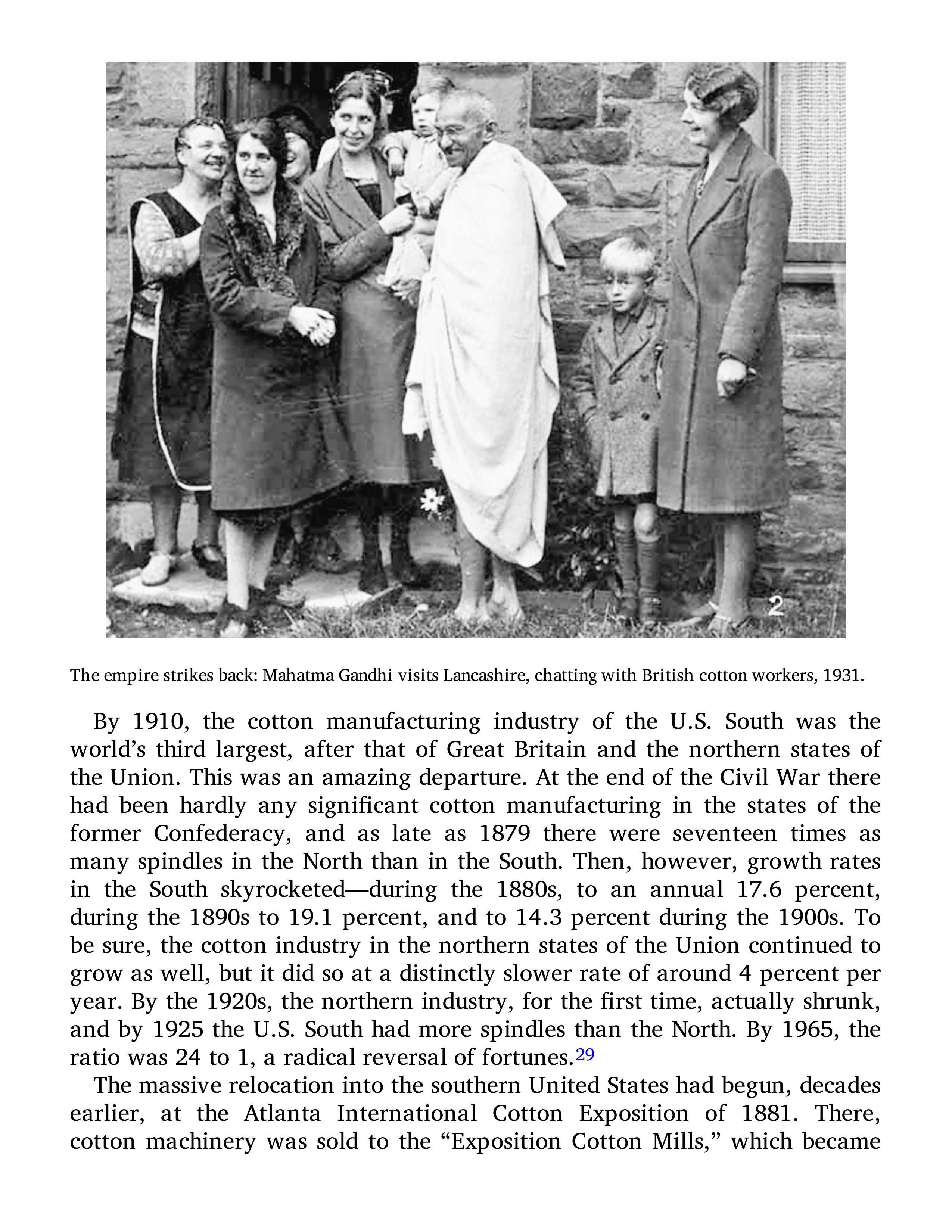

The empire strikes back: Mahatma Gandhi visits Lancashire, chatting with British cotton workers, 1931.
By 1910, the cotton manufacturing industry of the U.S. South was the
world’s third largest, after that of Great Britain and the northern states of
the Union. This was an amazing departure. At the end of the Civil War there
had been hardly any signi
ɹcant cotton manufacturing in the states of the
former Confederacy, and as late as 1879 there were seventeen times as
many spindles in the North than in the South. Then, however, growth rates
in the South skyrocketed—during the 1880s, to an annual 17.6 percent,
during the 1890s to 19.1 percent, and to 14.3 percent during the 1900s. To
be sure, the cotton industry in the northern states of the Union continued to
grow as well, but it did so at a distinctly slower rate of around 4 percent per
year. By the 1920s, the northern industry, for the
ɹrst time, actually shrunk,
and by 1925 the U.S. South had more spindles than the North. By 1965, the
ratio was 24 to 1, a radical reversal of fortunes.
29
The massive relocation into the southern United States had begun, decades
earlier, at the Atlanta International Cotton Exposition of 1881. There,
cotton machinery was sold to the “Exposition Cotton Mills,” which became
in fact a functioning mill. Endowed with huge supplies of cheap labor and
supportive local and regional governments, budding local manufacturers
opened additional mills in short order. Lax labor laws, low taxes, low
wages, and the absence of trade unions made the South alluring to cotton
manufacturers, a region of the United States, according to an industry
publication, “where the labor agitator is not such a power, and where the
manufacturers are not constantly harassed by new and nagging
restrictions.” As a result, the period from 1922 to 1933 saw the closing of
some ninety-three Massachusetts cotton mills; in the six years after 1922
alone, Massachusetts would come to shed some 40 percent of its total textile
workforce. In Fall River, in the decade after 1920, half of the city’s mills
disappeared.
30
It was not the proximity to cotton
ɹelds that explains this sudden
expansion of cotton manufacturing in the U.S. South. Indeed, the slightly
lower costs in accessing cotton were o
ʃset by the cost of shipping ɹnished
goods to northern markets. The secret of success was plentiful and cheap
labor. The destruction of slavery and the attendant transformation of the
countryside had created a large and malleable pool of low-wage workers for
the cotton factories, at
ɹrst mostly white rural workers, who had once been
tenant farmers, and later African American workers, most of them former
sharecroppers. As one contemporary observed, southern cotton growers left
the farms “like rats leaving a sinking ship.” As a result, a 1922 study by the
Massachusetts Department of Labor and Industries revealed that whereas
the average hourly wage of a Massachusetts mill worker was 41 cents, the
going rate was 29 cents in North Carolina, 24 cents in Georgia, 23 cents in
South Carolina, and a mere 21 cents in Alabama.
31
The low wages paid to these workers were even lower because cotton
mills could draw on a large number of very young and very cheap workers
—a direct result of the low level of national integration of the American
working class. In 1905, 23 percent of all workers in southern cotton mills
were younger than sixteen, compared to only 6 percent in the northern
states. Thanks to the absence of national standards, people also worked
longer hours in the South—sixty-four hours per week, even seventy-
ɹve
hours, was not uncommon. In fact, cotton industrialists’ in
ɻuence over
southern state governments—and the disenfranchisement of large segments
of the local working class that began during the 1880s—allowed for much
laxer labor laws than in other states of the Union, a de
ɹning characteristic
of emerging cotton industries throughout the global South. Cotton
industrialization, moreover, had strong backing from state governments,

whose legislators and governors were vulnerable to the enormous in
ɻuence
and power of organized industrialists.
32
Aware of their own rising costs and declining pro
ɹts, cotton capitalists in
Europe also sought to relocate to places with lower wage costs. But none
were able to follow directly the U.S. model, because no other industrial
country contained within itself such uneven regional conditions or the
legacy of slavery. Still, there were some tentative British investments, such
as in India. Other British
ɹrms invested in manufacturing in the Ottoman
Empire, especially around Izmir and Istanbul, and in Portugal and Russia. In
China, foreign-owned mills became important, especially Japanese
investments, but also a few operated by English and German investors. In
Egypt, British entrepreneurs created in 1894 the Egyptian Cotton
Manufacturing Company, followed in 1899 by the Alexandria Anglo-
Egyptian Spinning and Weaving Company and then, a year later, the Cairo
Egyptian Cotton Mills Limited. French investments became important in the
Mexican cotton industry. In Brazil during the
ɹrst decades of the twentieth
century, British, Belgian, and Dutch entrepreneurs opened mills. German
textile manufacturers as well invested in low-wage regions. One of the
major outlets for German cotton capital was Poland, especially the area
around Lodz that the chamber of commerce of the Saxon city of Leipzig
called an “o
ʃshoot of our German, especially Saxon, textile industry.” This
“Manchester of the East” experienced a huge boom between 1870 and 1914,
seeing the emergence of gigantic factories, such as Carl Scheibler’s mill, with
seventy-
ɹve hundred workers on its payroll.
33
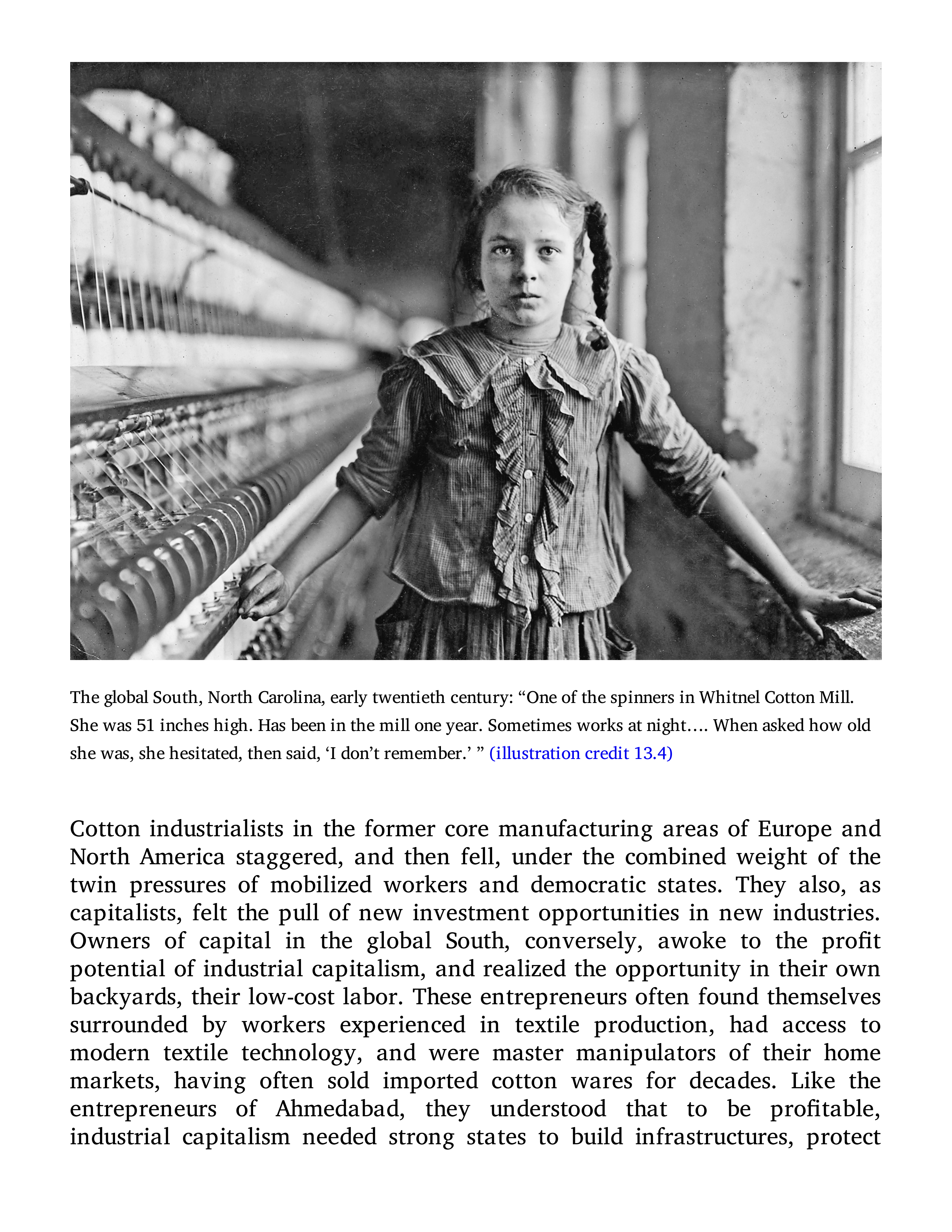
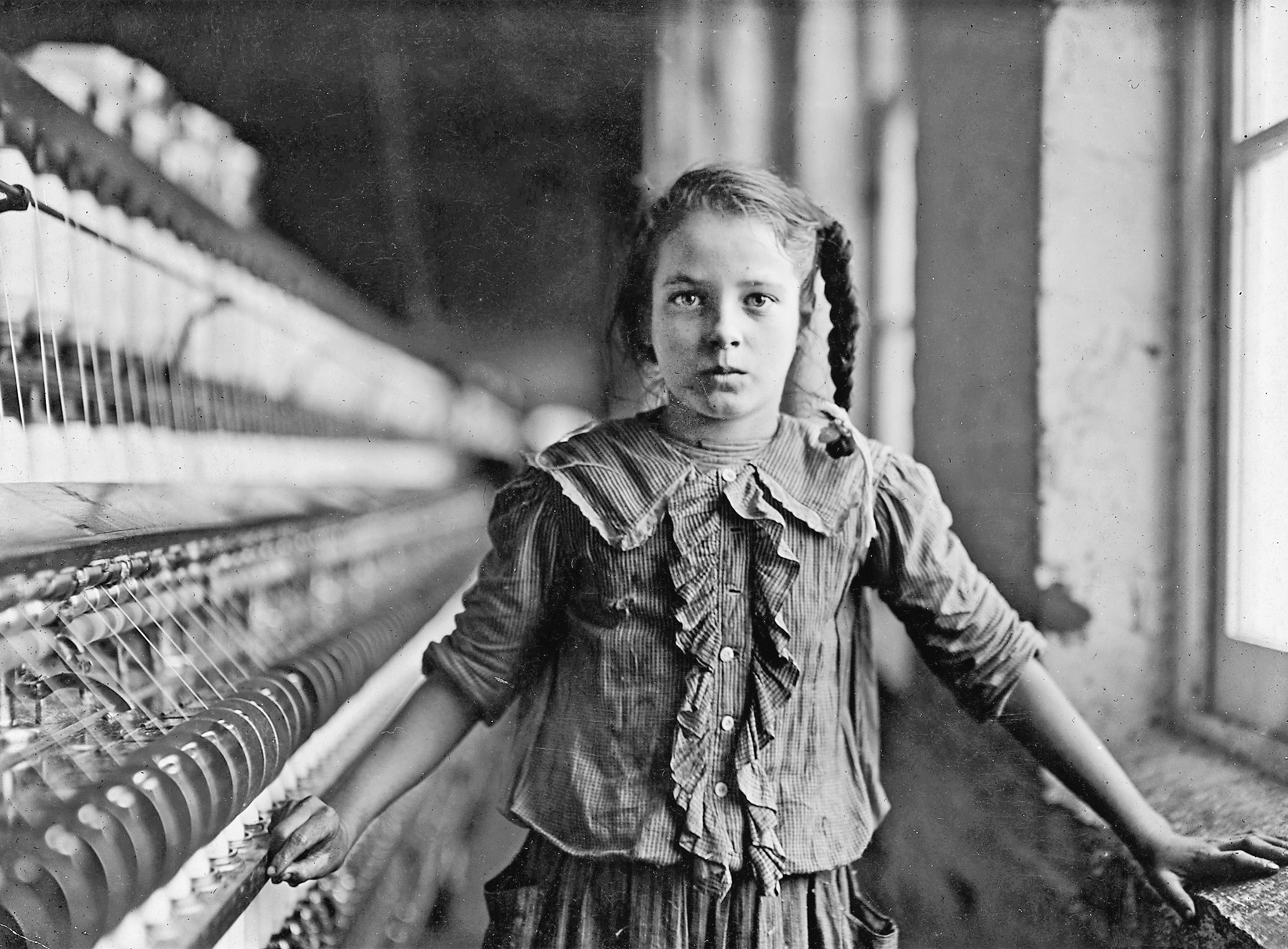
The global South, North Carolina, early twentieth century: “One of the spinners in Whitnel Cotton Mill.
She was 51 inches high. Has been in the mill one year. Sometimes works at night…. When asked how old
she was, she hesitated, then said, ‘I don’t remember.’ ”
(illustration credit 13.4)
Cotton industrialists in the former core manufacturing areas of Europe and
North America staggered, and then fell, under the combined weight of the
twin pressures of mobilized workers and democratic states. They also, as
capitalists, felt the pull of new investment opportunities in new industries.
Owners of capital in the global South, conversely, awoke to the pro
ɹt
potential of industrial capitalism, and realized the opportunity in their own
backyards, their low-cost labor. These entrepreneurs often found themselves
surrounded by workers experienced in textile production, had access to
modern textile technology, and were master manipulators of their home
markets, having often sold imported cotton wares for decades. Like the
entrepreneurs of Ahmedabad, they understood that to be pro
ɹtable,
industrial capitalism needed strong states to build infrastructures, protect
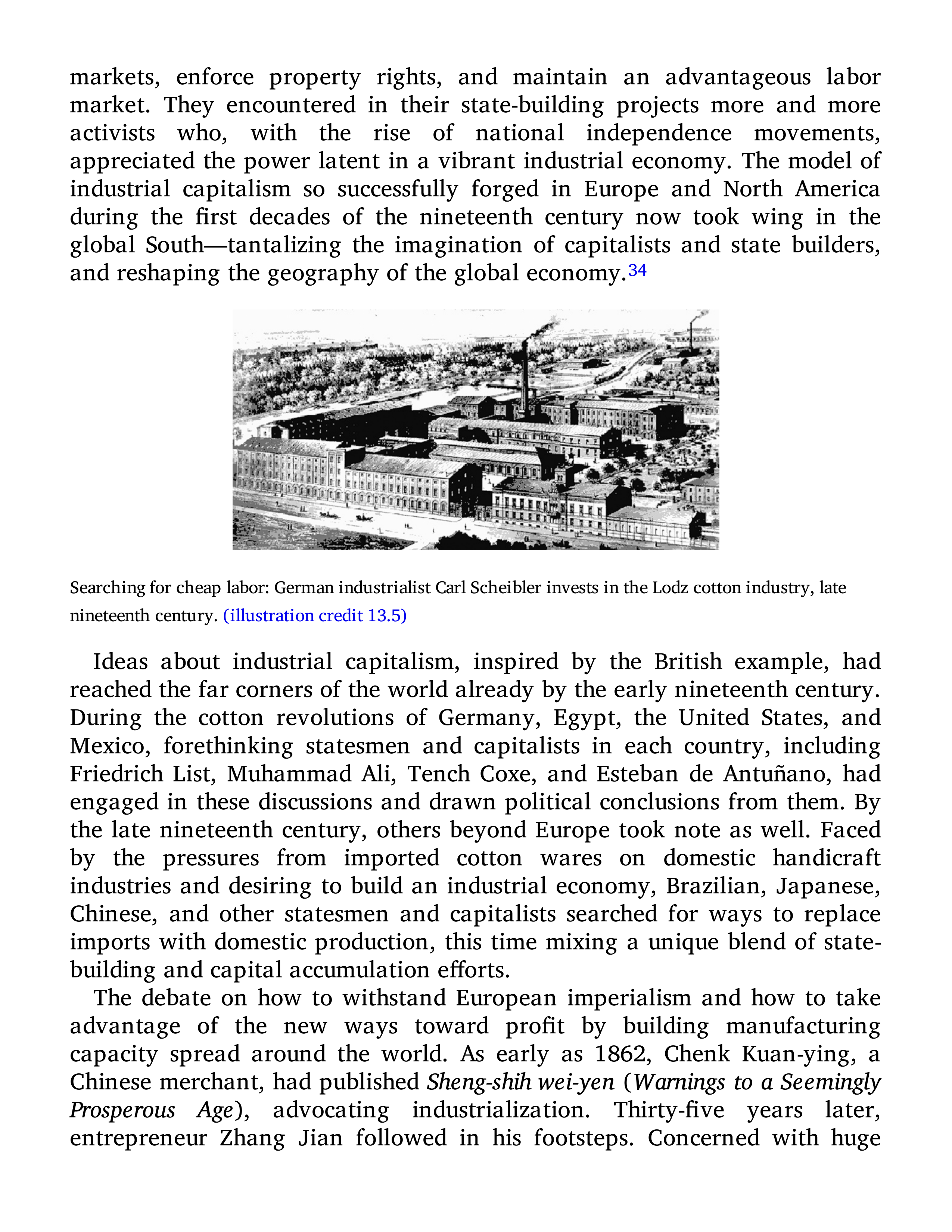
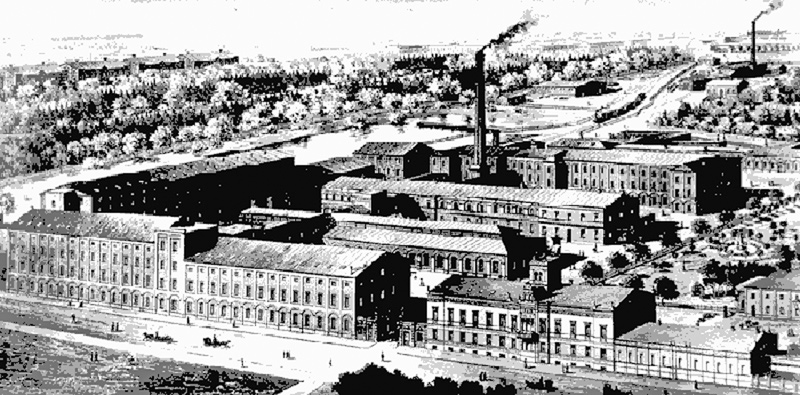
markets, enforce property rights, and maintain an advantageous labor
market. They encountered in their state-building projects more and more
activists who, with the rise of national independence movements,
appreciated the power latent in a vibrant industrial economy. The model of
industrial capitalism so successfully forged in Europe and North America
during the
ɹrst decades of the nineteenth century now took wing in the
global South—tantalizing the imagination of capitalists and state builders,
and reshaping the geography of the global economy.
34
Searching for cheap labor: German industrialist Carl Scheibler invests in the Lodz cotton industry, late
nineteenth century.
(illustration credit 13.5)
Ideas about industrial capitalism, inspired by the British example, had
reached the far corners of the world already by the early nineteenth century.
During the cotton revolutions of Germany, Egypt, the United States, and
Mexico, forethinking statesmen and capitalists in each country, including
Friedrich List, Muhammad Ali, Tench Coxe, and Esteban de Antuñano, had
engaged in these discussions and drawn political conclusions from them. By
the late nineteenth century, others beyond Europe took note as well. Faced
by the pressures from imported cotton wares on domestic handicraft
industries and desiring to build an industrial economy, Brazilian, Japanese,
Chinese, and other statesmen and capitalists searched for ways to replace
imports with domestic production, this time mixing a unique blend of state-
building and capital accumulation e
ʃorts.
The debate on how to withstand European imperialism and how to take
advantage of the new ways toward pro
ɹt by building manufacturing
capacity spread around the world. As early as 1862, Chenk Kuan-ying, a
Chinese merchant, had published
Sheng-shih wei-yen
(
Warnings to a Seemingly
Prosperous Age
), advocating industrialization. Thirty-
ɹve years later,
entrepreneur Zhang Jian followed in his footsteps. Concerned with huge
imports of cotton yarn and cloth, and especially with the stipulations of the
1895 Treaty of Shimonoseki that allowed for the establishment of foreign-
owned cotton mills, he advocated domestic industrialization, and, following
words with deeds, built a spinning factory in his native district of Nantong.
“People,” he argued, “all say that foreign nations maintain themselves
through commerce. This is a super
ɹcial view. They do not know that the
foreign nations’ riches and strength is industry…. Therefore we must
concentrate with single purpose to promote industry…. Factories should be
set up to produce items of foreign goods which have the greatest sale in
China.”
35
Zhang was part of a school of thinkers throughout the global South,
among them also Ch’en Chih and Hsueh Fu-ch’eng in China, who tried to
reenvision their nations’ roles in the global economy. They focused on
regaining domestic markets, undoing the process of deindustrialization,
introducing Western technology, and, like List, Ali, Coxe, and Antuñano,
coaxing the state into supporting industrialization. Arguing that industrial
progress equaled national progress, they wanted local industries protected
against imports. “The local production of coarse cottons,” observed the
Brazilian Associação Industrial in 1881, “is being warred upon by foreign
competitors and if legislative measures do not come to the industry’s aid, all
the e
ʃort and capital employed to date will be wasted.” Referring explicitly
to the protectionism of Germany and the United States, they called upon the
state to support manufacturing in “young lands.” Cotton mills were no less
than a “patriotic undertaking.”
36
Similarly, Inoue Shozo of Japan’s
Industrial Development Bureau concluded from a study trip to Germany in
1870 that
I want to make our country equal of Europe and America…. After
having read something of world history and geography in my search
for the source of wealth, the military power, the civilization, and the
enlightenment of present-day Western nations, I realized that the
source must lie in technology, industry, commerce, and foreign trade.
In order to apply these precepts and make the nation rich and strong,
we must
ɹrst of all instruct the people about industry. Then we can
manufacture a variety of goods and export them, import those articles
we lack, and accumulate wealth from abroad.
37
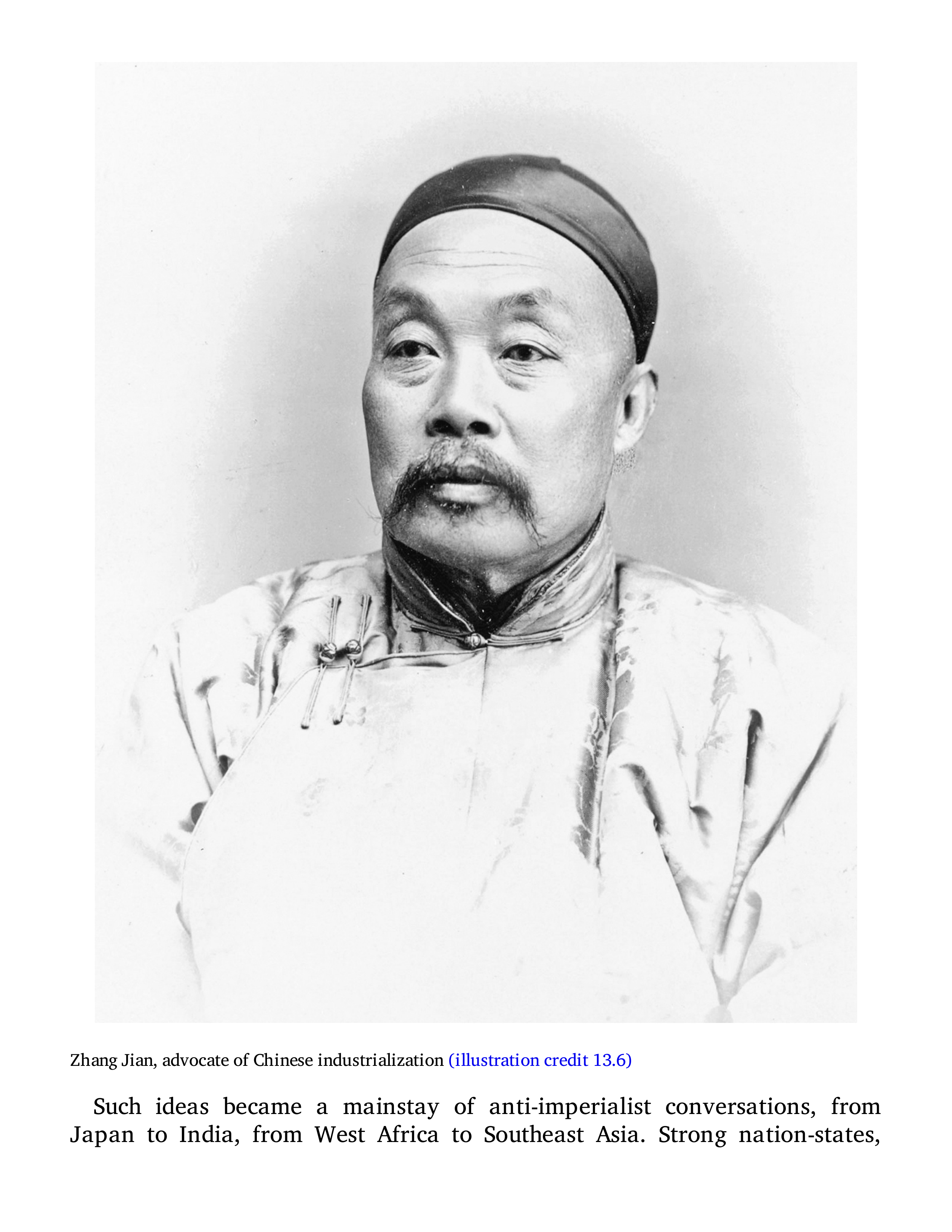
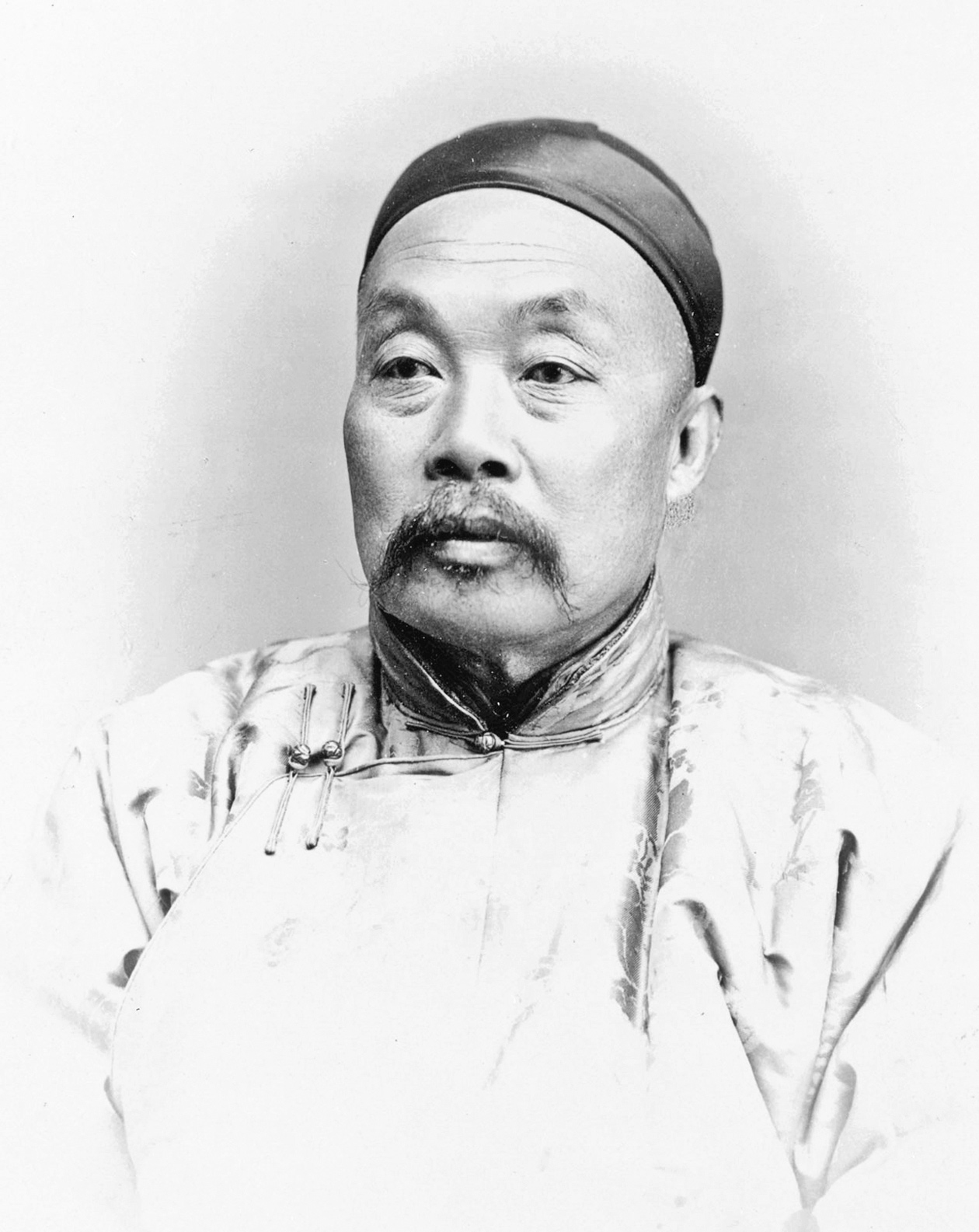
Zhang Jian, advocate of Chinese industrialization
(illustration credit 13.6)
Such ideas became a mainstay of anti-imperialist conversations, from
Japan to India, from West Africa to Southeast Asia. Strong nation-states,
these thinkers hoped, might one day protect domestic manufacturers, build
infrastructure, mobilize labor, and help manufacturers capture export
markets. There was no little irony in the fact that anticolonial nationalism
as often as not drew on the lessons of colonialism itself.
38
Yet putting such ideas into practice remained di
ɽcult. First, budding
industrialists had to gain control of the levers of state power, overcoming
competing elites. In the U.S. South, for example, cotton manufacturers could
dominate state governments only because of the loss of power of
slaveholding elites. In Brazil, Japan, and elsewhere, the struggle against
rival agrarian elites was far more protracted.
Brazil’s cotton industry, for example, unlike the region’s poster child,
Mexico, was weak until the 1890s, despite a signi
ɹcant market for cotton
goods, signi
ɹcant local capital accumulation, and large foreign imports. In
1866, Brazil counted as few as nine spinning mills, with a negligible 15,000
spindles as most textiles were either imported or produced on plantations.
The number of mills increased very slowly in the following decades, but then
it virtually exploded. By 1921, the industry had 242 cotton mills with
1,521,300 spindles and 57,208 looms, employing 108,960 workers. The
industry continued to grow, and by 1927, on the eve of the Depression, it
consisted of 354 mills.
39
The three decades after 1892 have been called the golden age of Brazilian
cotton manufacturing. It was in the wake of the abolition of slavery in 1888
that manufacturing elites gained greater in
ɻuence over the government and
managed to create policies conducive to their interests, especially tari
ʃs. In
1860, the tari
ʃ on cotton had been at a low 30 percent of the value of
imports, by 1880 it had doubled to around 60 percent, and after drawn-out
battles it increased to as much as 100 percent in 1885. It rose further in
1886, 1889, and 1900. The protectionist 1900 tari
ʃs then remained in eʃect
for three decades, creating a protected market hugely pro
ɹtable to
manufacturers. As a result, by 1920, 75 to 85 percent of all cotton goods
used in Brazil were spun and woven domestically. As an Englishman put it
in 1921 with some regret, “Twenty-
ɹve years ago Brazil was an excellent
market for Manchester…. First the grays dropped out, and now all these
goods are being manufactured in the country and only the very
ɹnest
qualities remain to be imported.”
40
By the 1890s, Brazilian manufacturers had helped shape the state in ways
congenial to their interests. At the same time, unlike their European and
New England competitors, they retained access to extremely cheap labor.
The vast majority of workers came “from local orphanages, foundling
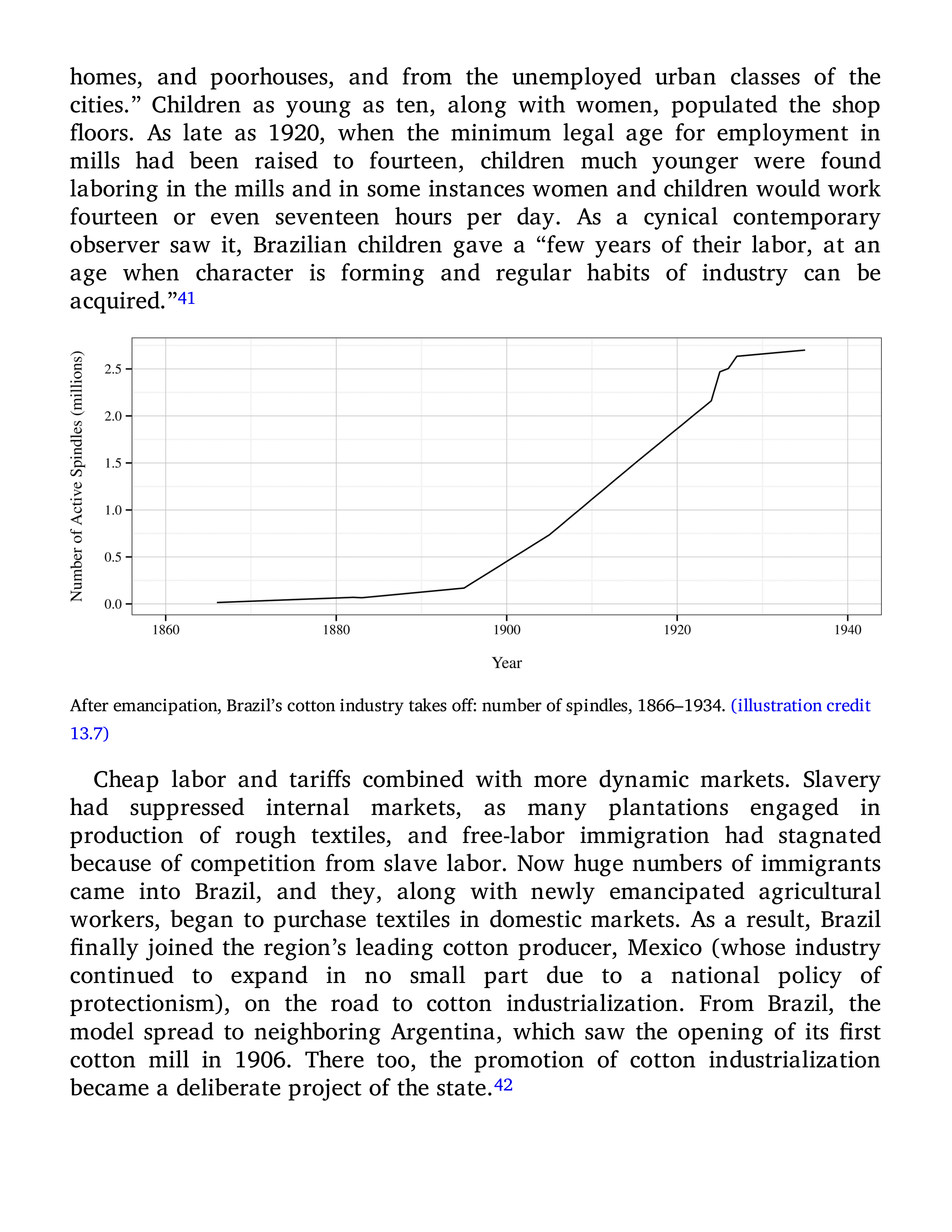
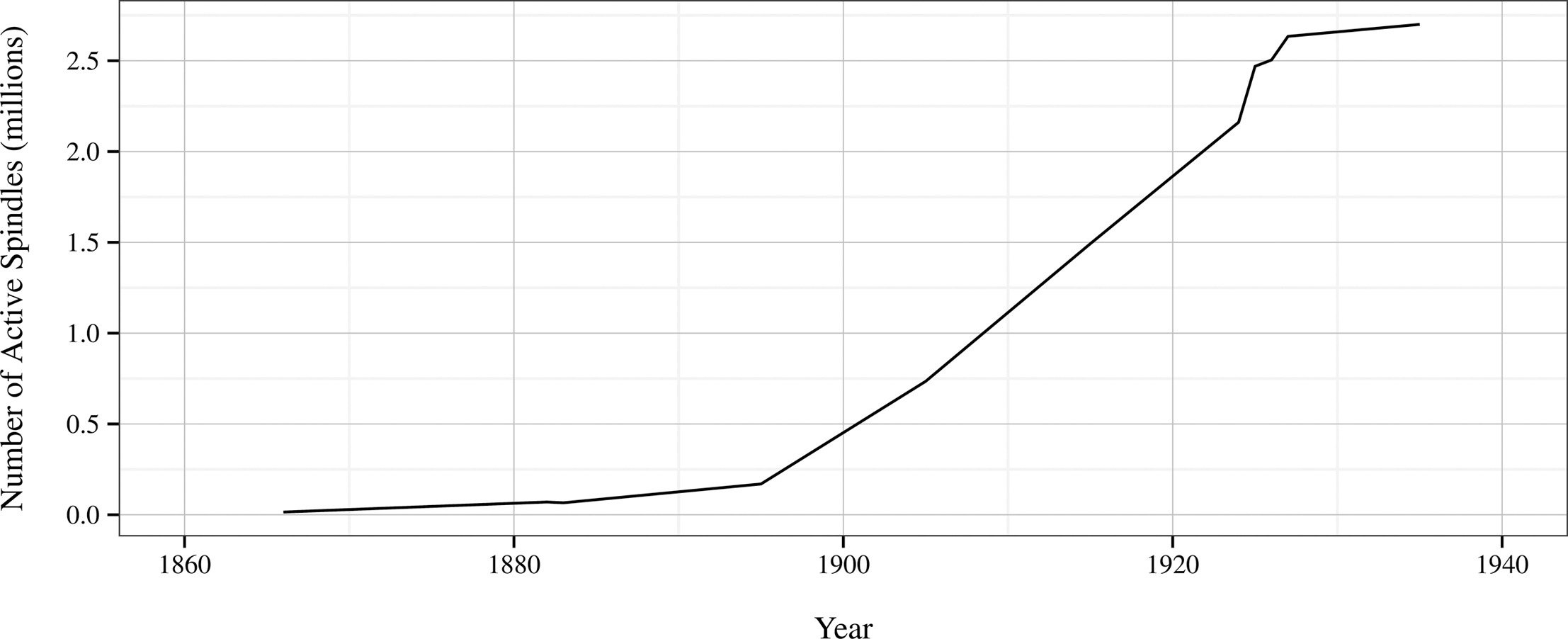
homes, and poorhouses, and from the unemployed urban classes of the
cities.” Children as young as ten, along with women, populated the shop
ɻoors. As late as 1920, when the minimum legal age for employment
in
mills had been raised to fourteen, children much younger were found
laboring in the mills and in some instances women and children would work
fourteen or even seventeen hours per day. As a cynical contemporary
observer saw it, Brazilian children gave a “few years of their labor, at an
age when character is forming and regular habits of industry can be
acquired.”
41
After emancipation, Brazil’s cotton industry takes o
ʃ: number of spindles, 1866–1934.
(illustration credit
13.7)
Cheap labor and tari
ʃs combined with more dynamic markets.
Slavery
had suppressed internal markets, as many plantations engaged in
production of rough textiles, and free-labor immigration had stagnated
because of competition from slave labor. Now huge numbers of immigrants
came into Brazil, and they, along with newly emancipated agricultural
workers, began to purchase textiles in domestic markets. As a result, Brazil
ɹnally joined the region’s leading cotton producer, Mexico (whose industry
continued to expand in no small part due to a national policy of
protectionism), on the road to cotton industrialization. From Brazil, the
model spread to neighboring Argentina, which saw the opening of its
ɹrst
cotton mill in 1906. There too, the promotion of cotton industrialization
became a deliberate project of the state.
42
Japan experienced an even greater boom in cotton manufacturing. Indeed,
it was of such magnitude that Japan became in the course of just a few
decades the world’s dominant cotton manufacturing power.
43
Japan’s
history shares some features with Brazil in the late nineteenth century:
Neither of these countries was subject to direct colonial rule, but they were
vulnerable to signi
ɹcant inɻuences from abroad. They faced huge cotton
textile imports. Their economic elites were rooted in a political economy
radically di
ʃerent from that of domestic industrialization, but those elites
saw new elements emerging that altered the sources of their income and the
policy predilections of their class. At the turn of the twentieth century, they
were poised for a revolutionary transformation of the state, made no less
revolutionary by sharp di
ʃerences in outcomes.
Japan’s history of mechanical cotton production came later than Brazil’s,
but with equally inauspicious beginnings. In 1867, in Kagoshima City in
Kyushu, local rulers of the domain of Satsuma imported six thousand
spindles from England. Two other small factories opened around the same
time, one in Sakai and the other near Tokyo. Confronted by a
ɻood of
imported yarn thanks to the forced opening of the Japanese market by the
Treaty of Amity and Commerce of 1858, none of these pioneering projects
succeeded commercially.
44
Faced with these failures and an ever-rising tide of imported cotton goods
that had captured a third of the Japanese market, the government began to
take a more active role in promoting cotton industrialization. The 1868
Meiji Restoration had brought a more centralized and modernizing regime
to power, concentrating the once dispersed powers from the feudal domains
of the Tokugawa samurai, whose system of vandalage had dominated Japan
for 270 years. From the 1870s, the new nation-state began to pursue a more
active policy to promote industry—and cottons were foremost on the new
rulers’ minds. A member of the Diet, the Japanese parliament, explained:
“Because Japanese are clever and can work for cheap wages, they must buy
simple goods from abroad, add manual labor, and ship them abroad”—a
project for which cotton was superbly suited. The pressure of Western
imperialism, as elsewhere, had inspired manufacturing as a nationalist
project.
45
From 1879 to the mid-1880s, the minister of home a
ʃairs,
Ito Hirobumi,
expanded domestic spinning capacity by organizing ten spinning mills with
two thousand spindles each, importing them from Great Britain, and giving
them on favorable terms to local entrepreneurs. These mills failed as
commercial enterprises because their scale of production was too small to
make them pro
ɹtable. But unlike their predecessors they introduced new
policies that turned into the key factors for the success of Japan’s
industrialization: a switch to much cheaper Chinese cotton (in lieu of
domestically grown cotton); experimental labor systems that would structure
Japanese textile industrialization long into the future (such as the day and
night shift system, which gave cost advantages over Indian competitors);
and encouragement of government managers to become entrepreneurs
themselves. These mills, moreover, created the “ideological roots” of low-
wage, harsh-labor regimes, drawing on women whose pay was below
subsistence levels, combined with a powerful rhetorical commitment to
paternal care, and a transfer of power from samurai and merchants to
managers and factory owners.
46
Easing the shock of such rapid industrialization was Japan’s long history
in cotton textiles. For centuries, Japanese farmers had grown, spun, and
woven cotton in their households for domestic consumption and local
markets. By the nineteenth century a thriving putting-out industry had
emerged in the countryside, an industry that at
ɹrst received an
enormous
boost from the importation of cheap yarns in the wake of the forced
opening of Japan’s ports.
47
By 1880, with the possibilities of mechanized cotton spinning
demonstrated by government-organized mills, merchants created more—and
much more substantial—factories, supported by a state committed to
domestic industrialization. That year, the head of the (private) First
National Bank, Shibusawa Eiichi, backed the Osaka Spinning Co., which
would start operations in 1883 with 10,500 spindles. It was pro
ɹtable from
the beginning. Encouraged, others followed suit, opening several mills of
similar size. Using English-trained Japanese engineers, these mills were all
incorporated and tapped capital from nobles and wealthy merchants. These
new factories were able to outperform British imports in price and even
quality. Indeed, as early as 1890, Japan’s mill owners were able to
dominate their home market, and by 1895 hand spinning had almost
completely disappeared. Such successful spinning industrialization, in turn,
allowed for the further expansion of weaving in the countryside.
48
This industrial capitalism forged in Japan, however, was not solely the
o
ʃspring of nationalist politicians: Emerging industrial interests had applied
tremendous pressures on the state and had organized early on for political
coordination. The Japanese Spinners’ Association had formed itself as a
leading lobby in 1882, pressuring the government for policies favorable to
cotton industrialization, most importantly the discontinuation of the import
tax on raw cotton (which was meant to protect Japanese cotton farmers)
and an end to export fees on yarn. The Greater Japan Cotton Spinners’
Association followed suit in 1888. In fact, industrialists helped build the very
state that supported their interests. Capitalists and rulers were able to
implement these lessons because they defeated the visions of rival elites but
faced no signi
ɹcant democratic mass movements to contest their control
over the state.
49
A strong state dedicated to the political economy of domestic
industrialization mattered tremendously to Japan, but in ways quite
di
ʃerent from Brazil.
Tari
ʃs at ɹrst played no role in Japan’s
industrialization because the international treaties that had been forced on
the nation by Western powers precluded protectionism, and there was
indeed no tari
ʃ protection before 1911. The state, however, played a key
role in importing the new technology, and, perhaps more importantly,
helped Japanese capitalists gain access to foreign markets that could be
served competitively because of Japan’s extremely low labor costs.
Prefectural author ities set up “industrial laboratories” that investigated the
special needs of foreign markets and provided weaving companies with
blueprints as to what kind of cloth would sell where—just as the French and
British governments had done in the eighteenth century. The Japanese state
also collected market information, which included consular commercial
reports, industrial exhibitions, trade missions, “the dispatch of speci
ɹc
students to foreign countries in order to conduct research on speci
ɹc
industries, and commodity exhibition centres abroad…, export cartels from
1906, trade commissioners from 1910, and world tours and business
missions undertaken by exporters.” The government, moreover, stood as the
ultimate guarantor for all kinds of debts that were essential for the success
of the industry.
50
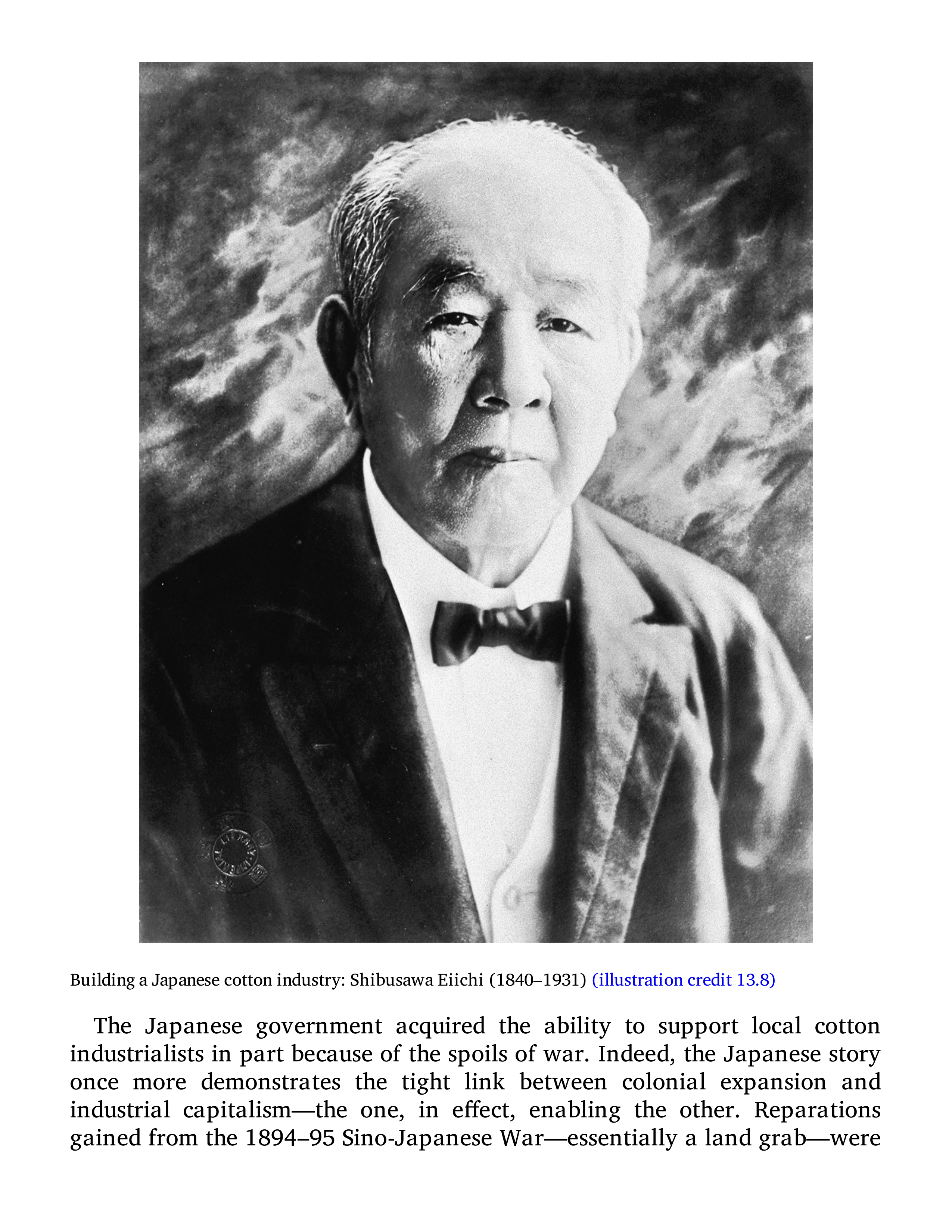
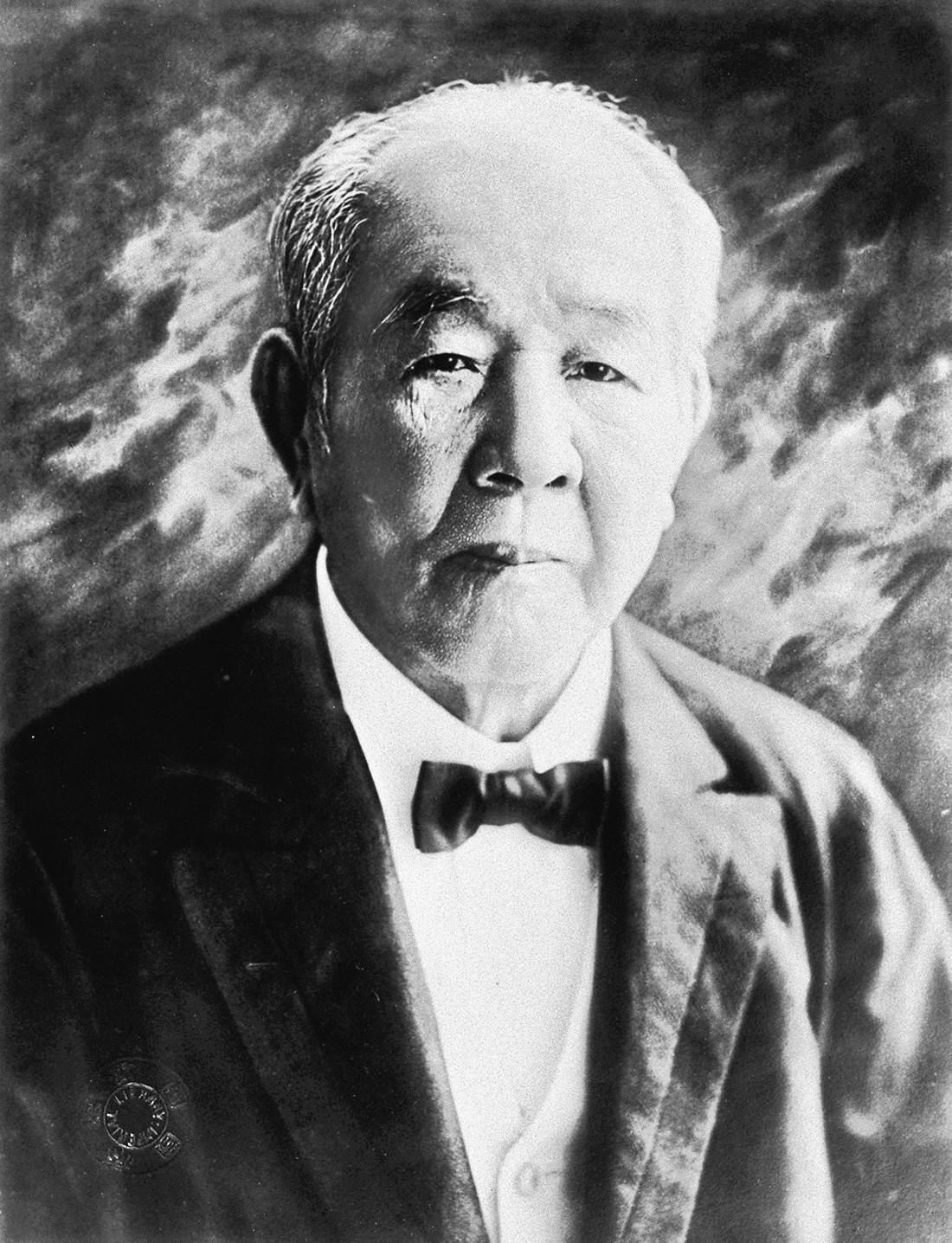
Building a Japanese cotton industry: Shibusawa Eiichi (1840–1931)
(illustration credit 13.8)
The Japanese government acquired the ability to support local cotton
industrialists in part because of the spoils of war. Indeed, the Japanese story
once more demonstrates the tight link between colonial expansion and
industrial capitalism—the one, in e
ʃect, enabling the other. Reparations
gained from the 1894–95 Sino-Japanese War—essentially a land grab—were
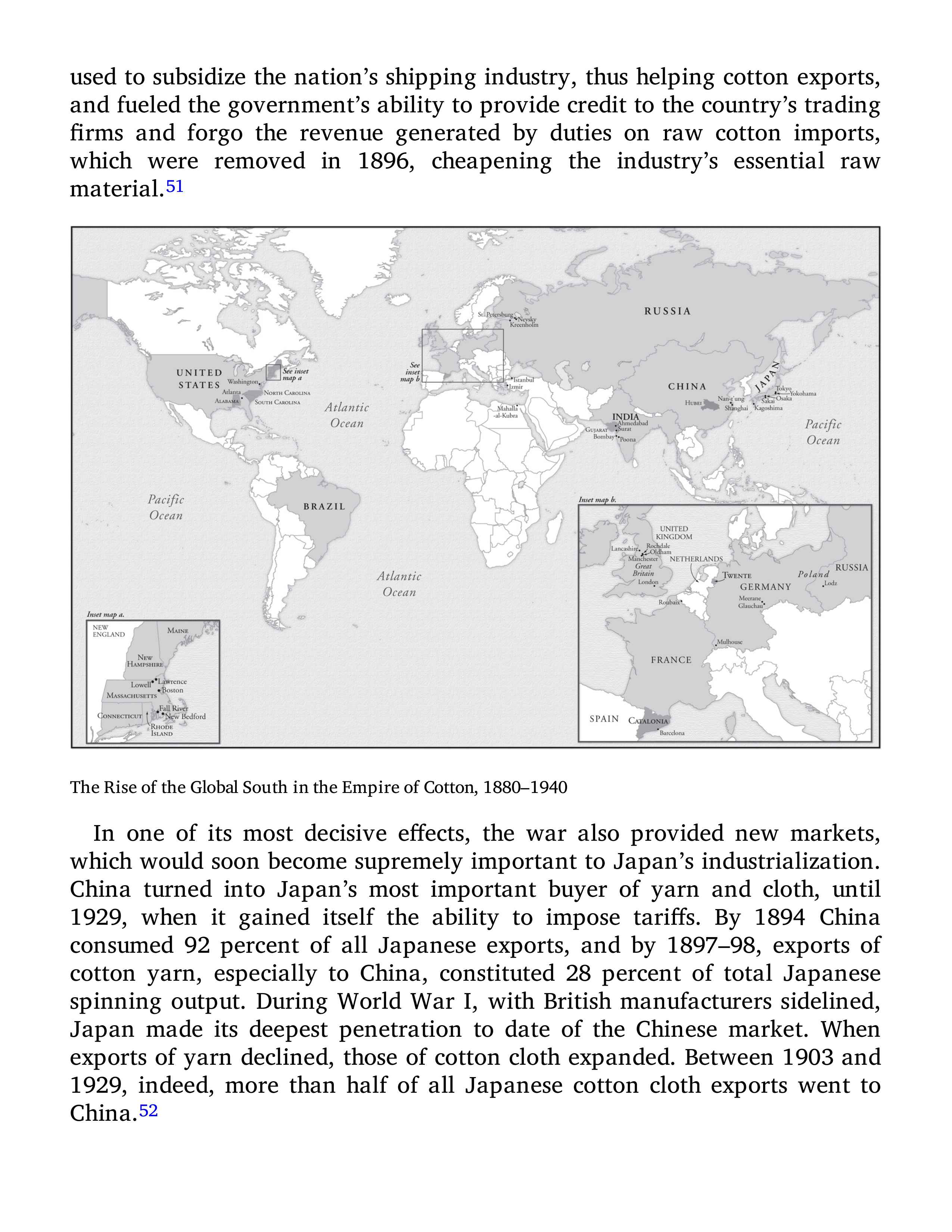
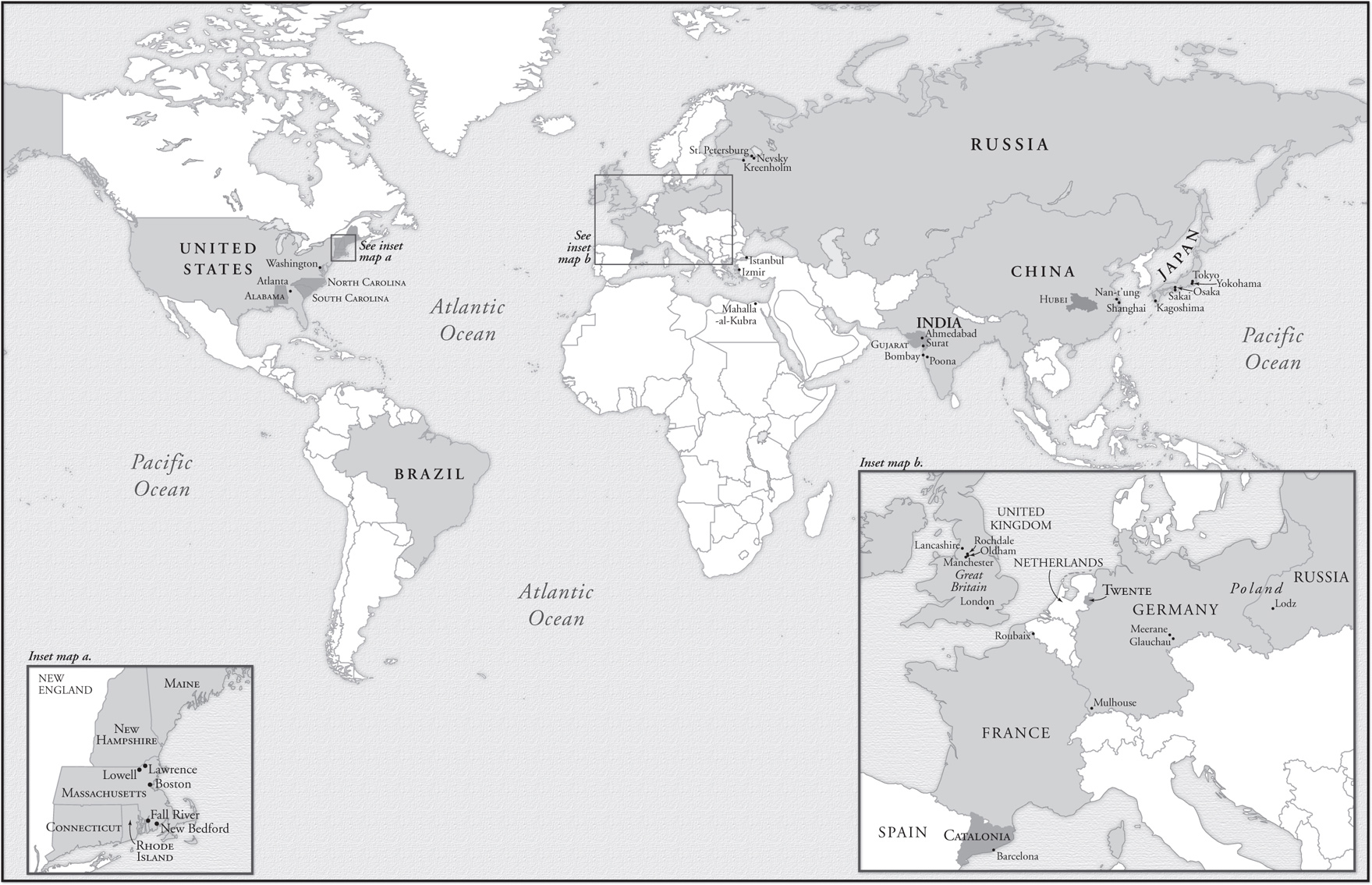
used to subsidize the nation’s shipping industry, thus helping cotton exports,
and fueled the government’s ability to provide credit to the country’s trading
ɹrms and forgo the revenue generated by duties on raw cotton imports,
which were removed in 1896, cheapening the industry’s essential raw
material.
51
The Rise of the Global South in the Empire of Cotton, 1880–1940
In one of its most decisive e
ʃects, the war also provided new markets,
which would soon become supremely important to Japan’s industrialization.
China turned into Japan’s most important buyer of yarn and cloth, until
1929, when it gained itself the ability to impose tari
ʃs. By 1894 China
consumed 92 percent of all Japanese exports, and by 1897–98, exports of
cotton yarn, especially to China, constituted 28 percent of total Japanese
spinning output. During World War I, with British manufacturers sidelined,
Japan made its deepest penetration to date of the Chinese market. When
exports of yarn declined, those of cotton cloth expanded. Between 1903 and
1929, indeed, more than half of all Japanese cotton cloth exports went to
China.
52
During the 1920s, the percentage share of cotton cloth exports to India
increased as well, from about 12 percent in 1926 to about 50 percent in
1932. And, again, a state committed to industrialization mattered greatly:
The Japanese government exerted political pressure on the British colonial
government in India to facilitate their entry into that market. As India’s
cotton growers became dependent on the Japanese export market, the
Japanese government was able to negotiate low tari
ʃ barriers for the
import of manufactured cottons into India, despite objections from
Lancashire manufacturers. When in 1930 the Indian government began
discriminating against such imports from Japan in response to pressures
from Lancashire, Japanese cotton manufacturers decided to boycott raw
cotton from India. That created a problem for India, because remittances to
London were paid from these exports. In the Indo-Japanese trade
negotiations of 1933 these di
ʃerences were reconciled, allowing for a freer
ɻow of goods to India from Japan and vice versa. In 1913–14, Japan had
exported 7 million yards of cotton piece goods to India; in 1933 it exported
579 million yards.
53
Low-cost labor was as important as state support to Japan’s success.
Japanese cotton manufacturers, like manufacturers elsewhere, spent much
time thinking about the “problem of labor.” Labor costs in Japanese mills
were even lower than in India and about one-eighth of those in Lancashire.
Initially, mills recruited their workers from their immediate surroundings,
but as time went on they increasingly relied on labor recruiters who brought
workers from more distant locations, literally scouring the countryside in
search of poor farming families.
54
Women especially were pushed out of the countryside and into factories.
In 1897, 79 percent of workers in Japanese cotton factories were female.
Most of these women were very young, between
ɹfteen and twenty-ɹve
years old, and 15 percent were below age fourteen. Typically they would
start working at age thirteen and retire at age twenty, upon marriage. For
women workers themselves, employment in factories was a particular
moment in their life cycle, related to their preindustrial spinning and
weaving within the household, and often motivated by an e
ʃort to
accumulate savings for a dowry. This massive wave of very young women
moving into factories was facilitated by Japanese manufacturers’ early
embrace of ring spinning, which required mostly unskilled labor.
55
These young women were subject to extreme exploitation. Away from the
protection that their families might have provided, most lived in dormitories
next to the mills—company boarding houses that were places of surveillance
and disciplinary action. (In this way conditions were quite similar to those
in Lowell, Massachusetts, nearly a century earlier.) One 1911 study found
that workers often shared beds, and had as little as twenty-seven square feet
of space. To stem high rates of labor turnover, companies embraced a
rhetoric of paternalism, and at times also more substantive paternalist
policies. For the companies, short commutes and total control over the
workforce allowed them to exploit their labor to the utmost, operating under
a two-shift system, each lasting twelve hours, making perfect use of capital
expenses by continuously running the machines.
56
The state had made possible such low-wage competitiveness by resisting
any protective legislation for factory workers in the cotton industry. The
Factory Act of 1911 was only extended to cover women and children in the
textile industry in 1920. The collective action of Japanese mill owners had
postponed the passage of protective labor legislation for forty years—
undoubtedly helped by a franchise restricted to propertied men.
57
Women’s principal strategy of resistance to such conditions was
absconding, the same tactic Ellen Hootton had employed a century earlier at
Eccles’ Mill in Lancashire. Turnover, indeed, was tremendous—in 1897, 40
percent of all workers left the factories within six months of taking up
employment. In 1900, fewer than half of all spinning workers in Kwansai
had worked for their employer for more than a year. Employers responded
by locking boarding houses at night, forbidding women to leave them during
their free time, and retaining part of their wages until they had served out
their employment contracts.
58
Thanks to this availability of extraordinarily cheap and disenfranchised
labor, Japan’s cotton industry continued its rapid expansion.
59
By 1902,
domestic production had largely replaced imports. By 1909, Japanese
spinning factories were the
ɹfth largest consumers of raw cotton in the
world. With spinning concentrated in large factories, weaving, including
handloom weaving, continued to thrive in the countryside, with multiple
small entrepreneurs organizing labor, and eventually, by the 1910s and
1920s, the introduction of power looms in their often very small shops. The
value of the cotton industry’s output continued to increase thereafter from
19 million yen in 1903 to 405 million yen in 1919. The years between 1920
and 1937 were a golden age for the Japanese cotton industry. In 1933,
Japan for the
ɹrst time exported more cotton cloth than Great Britain,
France, and Germany, and was the world’s third cotton power after the
United Kingdom and the United States. By 1937, Japan had captured 37
percent of the globally traded cotton cloth market, compared to just 27
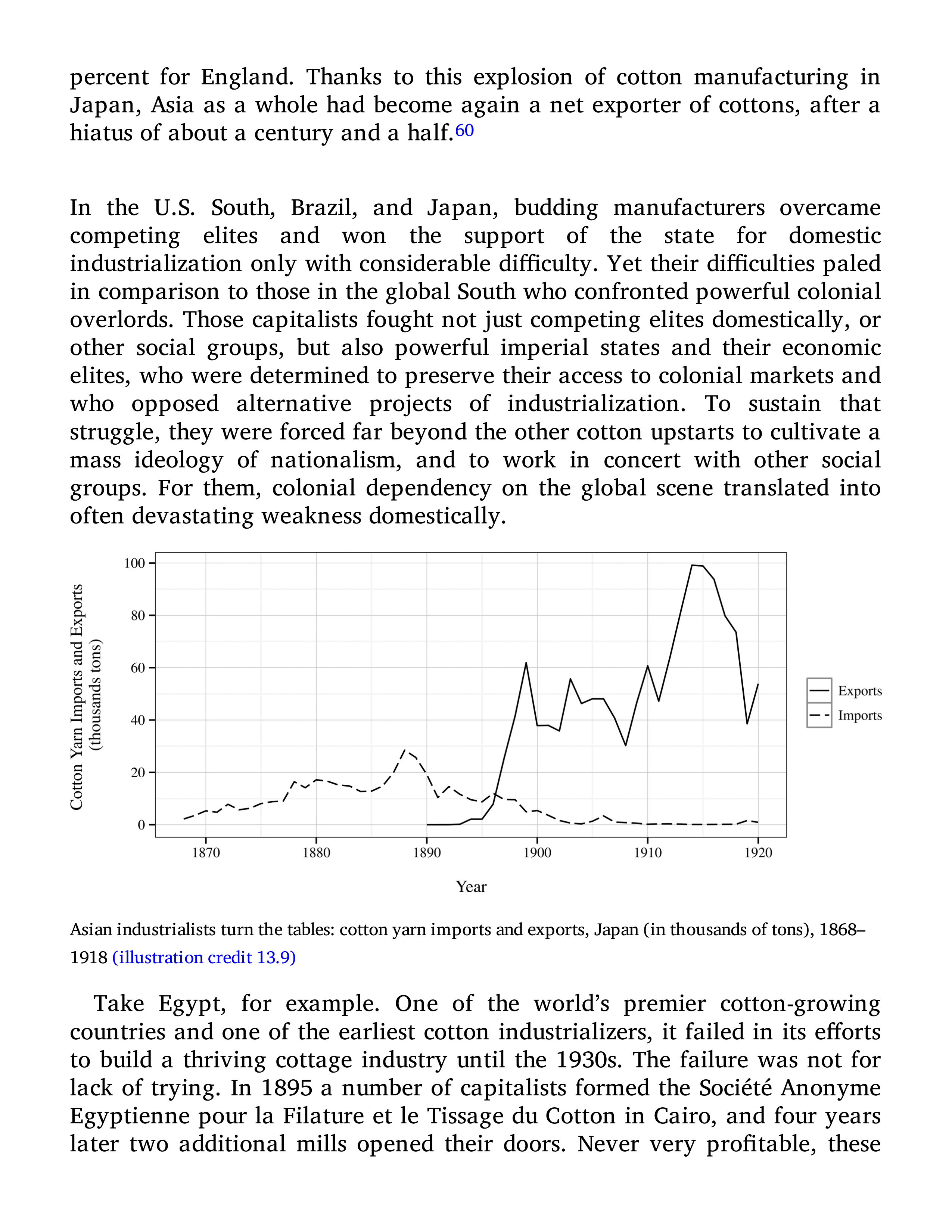
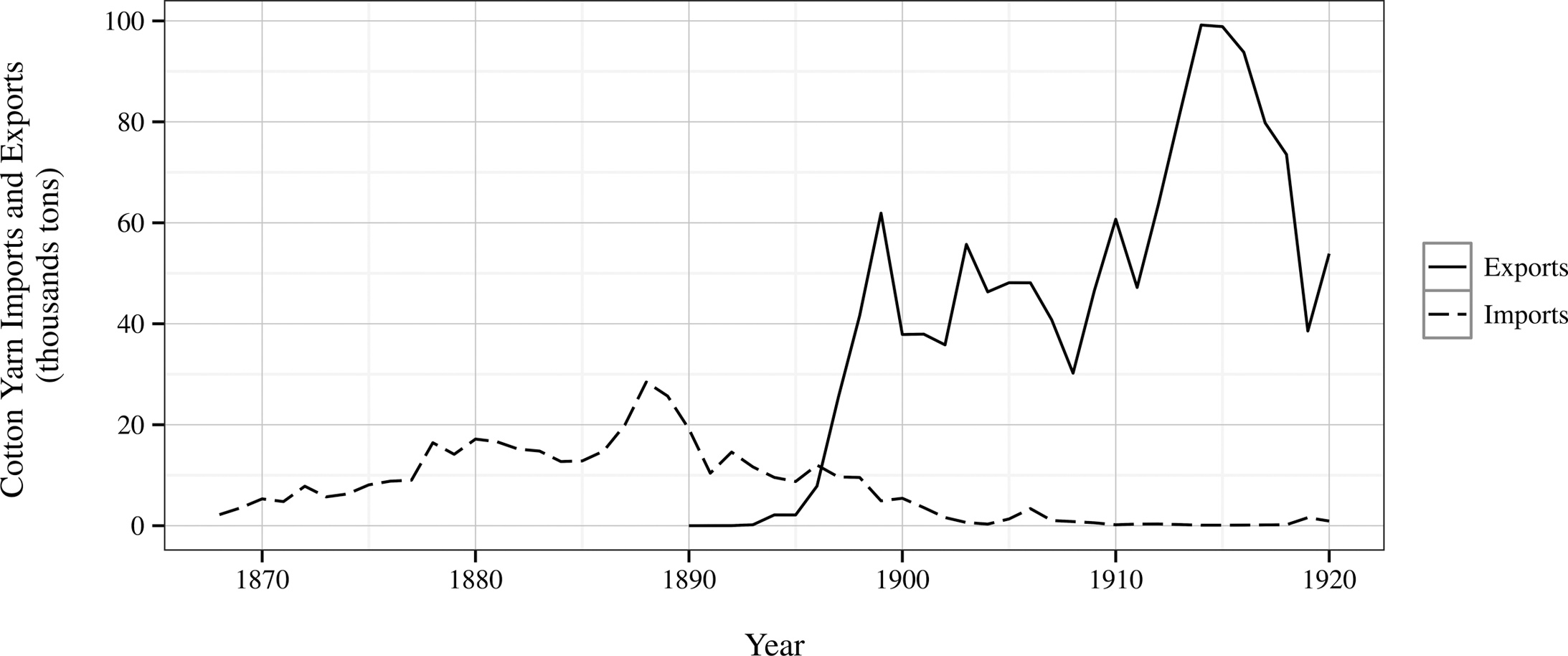
percent for England. Thanks to this explosion of cotton manufacturing in
Japan, Asia as a whole had become again a net exporter of cottons, after a
hiatus of about a century and a half.
60
In the U.S. South, Brazil, and Japan, budding manufacturers overcame
competing elites and won the support of the state for domestic
industrialization only with considerable di
ɽculty. Yet their diɽculties paled
in comparison to those in the global South who confronted powerful colonial
overlords. Those capitalists fought not just competing elites domestically, or
other social groups, but also powerful imperial states and their economic
elites, who were determined to preserve their access to colonial markets and
who opposed alternative projects of industrialization. To sustain that
struggle, they were forced far beyond the other cotton upstarts to cultivate a
mass ideology of nationalism, and to work in concert with other social
groups. For them, colonial dependency on the global scene translated into
often devastating weakness domestically.
Asian industrialists turn the tables: cotton yarn imports and exports, Japan (in thousands of tons), 1868–
1918
(illustration credit 13.9)
Take Egypt, for example. One of the world’s premier cotton-growing
countries and one of the earliest cotton industrializers, it failed in its e
ʃorts
to build a thriving cottage industry until the 1930s. The failure was not for
lack of trying. In 1895 a number of capitalists formed the Société Anonyme
Egyptienne pour la Filature et le Tissage du Cotton in Cairo, and four years
later two additional mills opened their doors. Never very pro
ɹtable, these
mills expired under the weight of an 8 percent tax on the value of their yarn
and cloth production and competition from textile imports, especially after
Egypt became essentially a free-trade appendage of the British Empire. One-
quarter to one-third of all imports into Egypt between 1880 and 1914
consisted of cotton textiles—pro
ɹtably spun and woven in Britain. There
and elsewhere, the colonial state subordinated the project of local
industrialization to its e
ʃorts to secure export markets for European
manufacturers.
61
Things began to change slowly during World War I, and the newly created
Filature Nationale d’Egypte blossomed for a short while. It expanded further
in anticipation of tari
ʃ reforms in 1930, promoted by an increasingly
strident nationalist movement. That tari
ʃ reform increased import duties
substantially, and soon made domestic industrialization possible, especially
in cottons. Most prominently, the ardently nationalist economist and
entrepreneur Tal’at Harb, who had created Bank Misr in 1920, drawing on
the capital of wealthy landowners, created the Misr Spinning and Weaving
Company in the early 1930s, which was well capitalized and expanded
rapidly. By 1945, 25,000 of the 117,272 Egyptian textile workers spun and
wove cottons in this mill. Tari
ʃs, in eʃect, had been a gift of the state to its
“nascent bourgeoisie.”
62
Stories like Egypt’s indicated to capital owners throughout the global
South that they needed to create a state supportive of their project of
domestic industrialization, and that under conditions of colonialism such a
state could not be forged. India, more than any other country, exempli
ɹes
this history. On the face of it, India enjoyed all the preconditions for
successful cotton industrialization—markets, access to technology, skilled
labor, low wages, and capital-rich merchants. There was even a powerful
state lording over India. Overcoming competing elites also proved not to be
overwhelmingly di
ɽcult. Still, dominated by a foreign colonial power,
Indian industrialists faced insurmountable hurdles to molding the kind of
state they so urgently wanted—hurdles that eventually would draw them
into an anticolonial struggle that, while successful, would also weaken their
dominance over workers and peasants.
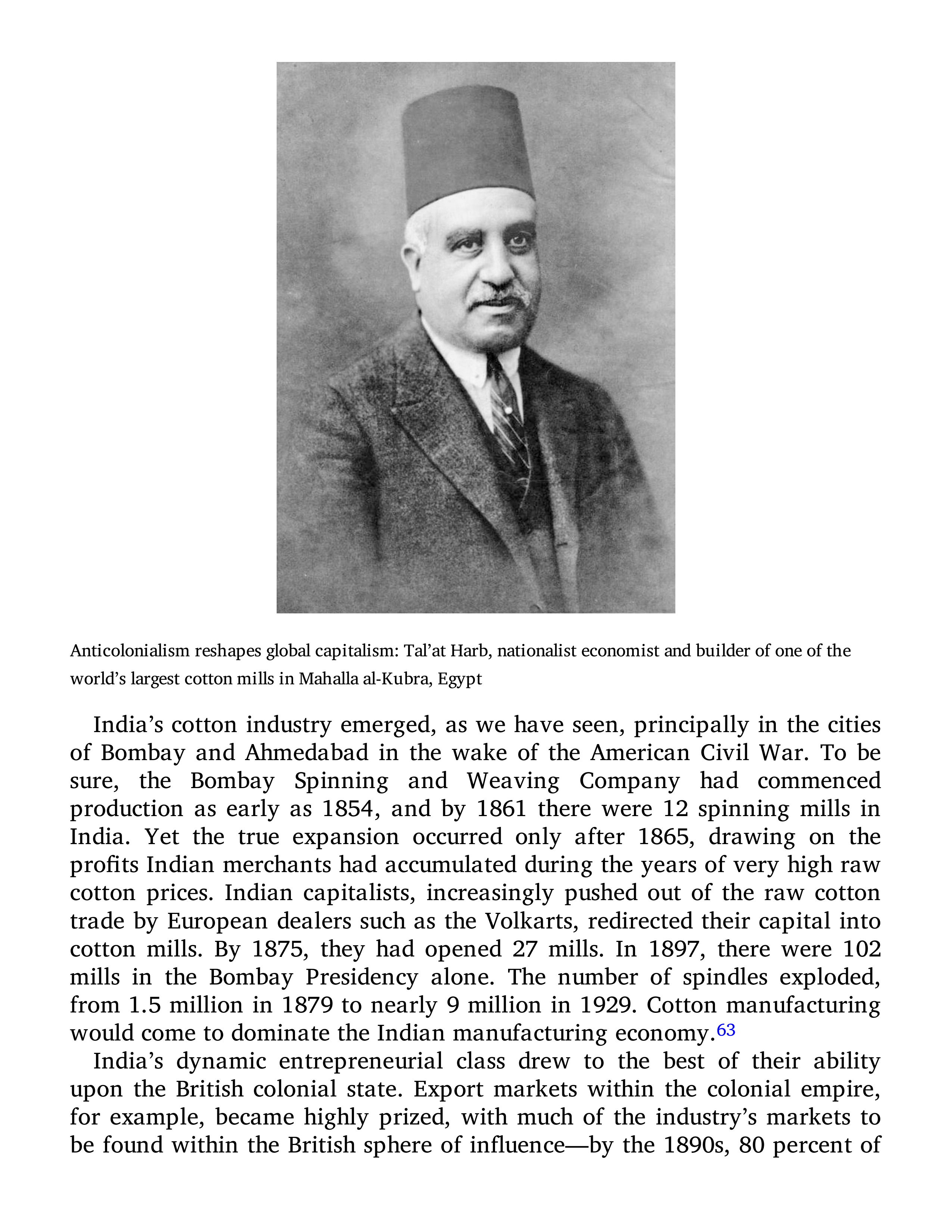
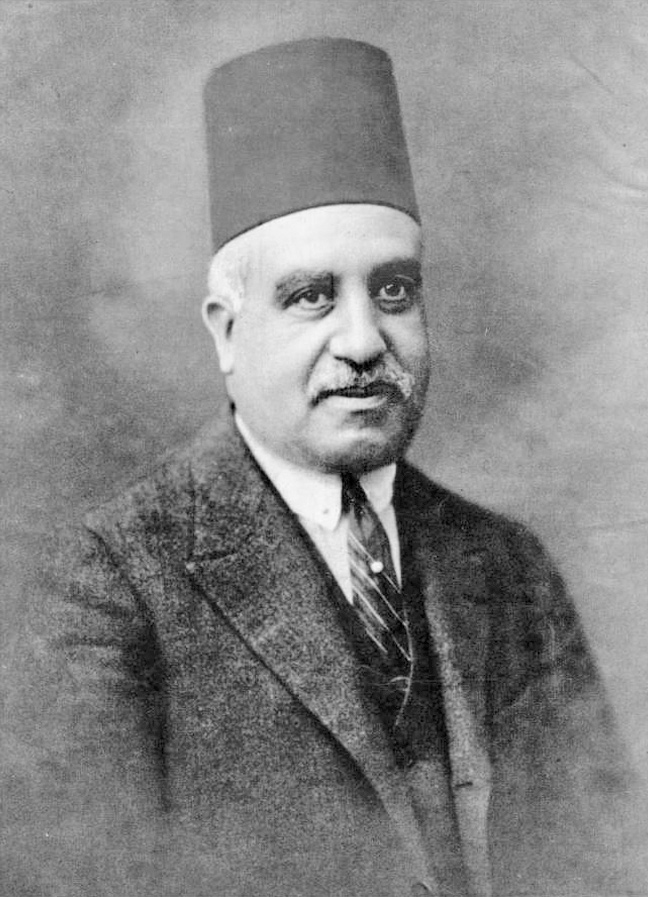
Anticolonialism reshapes global capitalism: Tal’at Harb, nationalist economist and builder of one of the
world’s largest cotton mills in Mahalla al-Kubra, Egypt
India’s cotton industry emerged, as we have seen, principally in the cities
of Bombay and Ahmedabad in the wake of the American Civil War. To be
sure, the Bombay Spinning and Weaving Company had commenced
production as early as 1854, and by 1861 there were 12 spinning mills in
India. Yet the true expansion occurred only after 1865, drawing on the
pro
ɹts Indian merchants had accumulated during the years of very high raw
cotton prices. Indian capitalists, increasingly pushed out of the raw cotton
trade by European dealers such as the Volkarts, redirected their capital into
cotton mills. By 1875, they had opened 27 mills. In 1897, there were 102
mills in the Bombay Presidency alone. The number of spindles exploded,
from 1.5 million in 1879 to nearly 9 million in 1929. Cotton manufacturing
would come to dominate the Indian manufacturing economy.
63
India’s dynamic entrepreneurial class drew to the best of their ability
upon the British colonial state. Export markets within the colonial empire,
for example, became highly prized, with much of the industry’s markets to
be found within the British sphere of in
ɻuence—by the 1890s, 80 percent of
the yarn exported from Bombay went to China.
64
This state also created
infrastructures, laws, regulations, and rules within which economic life was
increasingly embedded. As the state pushed for a massive commercialization
of the countryside, more dynamic markets for manufactured goods emerged,
which bene
ɹted Indian cotton manufacturers.
Indian cotton industrialists initially also drew on the colonial state for the
mobilization of labor—after all, changes within the countryside drove huge
numbers of workers into cities and into cotton mills. During 1896, an
estimated 146,000 workers labored in Indian cotton mills, and 625,000 in
1940, a signi
ɹcant ɹgure for a country that hardly saw any other factory
production. As elsewhere, the
ɹrst generation of mill workers remained in
touch with the villages from which they hailed. For many families, sending
one member into the city to work in a factory was a strategy to retain
access to land. But unlike elsewhere in the empire of cotton, most of these
workers were men. The roots of India’s proletariat, like its bourgeoisie, were
to be found in cottons. Indeed, “cheap labor” was widely seen as India’s
most distinctive competitive advantage—a proletariat created by, among
other factors, the decisive actions of a powerful colonial state.
65
But while no doubt crucial to many aspects of cotton industrialization, the
colonial state in India was peculiar and often destructive of local industrial
dreams—it was, after all, subject to the pressures of statesmen and
capitalists in England, not in India. This peculiarity showed with regard to
labor. As elsewhere, working conditions in the Indian cotton textile mills
were terrible. Days lasted thirteen to fourteen hours during summer, and ten
to twelve hours in winter. Temperatures in mills often exceeded 90 degrees.
Mill owners justi
ɹed these conditions, in the words of the
Bombay
Millowners’ Association in 1910, by arguing that their workers were “mere
machines of blind industrialism, having no initiative of their own and with
no great consideration for the future,” words that would have sounded
strangely familiar to European manufacturers a century earlier. Yet unlike
in Japan, and in a sign that Indian capitalists enjoyed signi
ɹcantly less
sway over the state than their Japanese counterparts, working conditions
improved and labor costs increased thanks to government intervention. The
Indian Factory Act of 1891, passed at the behest of Lancashire cotton
manufacturers concerned with Indian competition, limited the number of
hours children were allowed to work in mills. Labor legislation in 1891 and
1911 further regulated child labor, women’s work, and hours. While working
conditions and wages remained abysmal, Indian mill owners still opposed
these acts, complaining about the low productivity of their workers and
arguing that “any restrictive legislation sought to be imposed on us at the
insistence of our friends of Lancashire will have to be resisted in a strenuous
manner.” Yet confronted with British textile workers’ self-serving protests
against “the excessive working hours in the Bombay mills and the
employment of children” and with Lancashire mill owners fearing for their
export markets, they failed. Subduing labor under conditions of colonialism
proved di
ɽcult.
66
Most striking, however, was the exceptional character of the colonial state
in India when it came to the question of market access. Its greatest success,
in many ways, was to facilitate the vast in
ɻux of British cotton goods,
making India into Lancashire’s most important market, and severely
damaging its handicraft industry.
67
Industrialization and deindustrialization
thus intersected on the Indian subcontinent—and it was the Janus-faced
nature of the Indian state, strong but beholden to foreign interests, that
delayed and stunted Indian cotton industrialization. Indian capitalists had to
share the spoils of the British-initiated transformation of the subcontinent
with a powerful group of foreign capitalists and statesmen.
68
Capital-rich elites in the global South from Ahmedabad to Rowan County,
North Carolina, from Petropolis to Osaka, from Mahalla-al-Kubra to
Veracruz tried to jump on the cotton industrialization bandwagon, and in
doing so they learned about the importance of strong states to
industrialization. If they were unusually perceptive, they recognized the
emerging weaknesses of European and North American cotton capital
rooted in that same tight link to the nation-state. Their experiences were
quite di
ʃerent. While in Brazil, the southern United States, and Japan they
succeeded by gaining power over competing elites and then by forging a
state responsive to their needs, in Egypt and India the project of domestic
industrialization encountered a powerful hurdle—the colonial state itself.
But wherever global South capitalists succeeded in carving out a niche for
themselves in the global cotton industry, they did so because two processes
emerged simultaneously: the nationalization of social con
ɻict in the
core
countries of the
ɹrst Industrial Revolution, which increased labor costs, and
the construction of states favoring a project of domestic industrialization
and keeping down labor costs in the global South. It was in China that these
stories came together.
Cotton industrialization came to China later than to the U.S. South, Japan,
India, or Brazil. This was not for lack of experience in cotton
manufacturing, di
ɽculty obtaining raw cotton, the absence of markets or
capital, or lack of access to modern manufacturing technology. As we know,
China had one of the world’s oldest and largest cotton manufacturing
complexes, and indeed until the mid-nineteenth century Chinese peasants
were the single most signi
ɹcant growers of cotton globally, nearly all of
which was manufactured into yarn and cloth domestically. In turn, the
spinning
and
weaving
of
cotton
were
China’s
most
important
manufacturing activities.
69
Despite
such
ideal
preconditions
for
cotton
industrialization,
mechanization only began at the end of the nineteenth century. To some
extent the very vibrancy of Chinese traditional cotton manufacturing made
industrialization more di
ɽcult. As with much of the cotton belt prior to the
nineteenth century, millions of peasants in China’s countryside produced
cottons for their own use or for nearby markets, with little pressure to do
otherwise. As late as midcentury, 45 percent of peasant households may
have produced cloth. Moreover, Western imperialists began to put pressure
on China’s port cities, deluging the country in the second half of the
nineteenth century with yarn and cloth. European merchants and European
governments (along with those from the United States) pressured the
Chinese state for market access, with the 1877 Chefoo convention, for
example, stipulating further access to deep-sea as well as Yangtze ports, and
the abolition of internal duties. “The foreign merchant has waited long and
patiently for the attainment of these objects,” argued one such Western
merchant in 1877. “In his opinion they are essential for the successful
development of his trade with China.” Indeed, market penetration was a
clearly articulated political goal of all imperial powers. As a result, the
import of cotton goods into China increased tremendously, yarn by a factor
of twenty-four, while cloth imports doubled between the 1880s and 1910s.
By 1916 the U.S. Department of Commerce called China “the largest market
for cotton yarns in the world,” including for U.S. manufacturers. At
ɹrst, the
vast majority of cotton yarn and cloth imports into China originated from
the United Kingdom and the United States. After 1900, imports came mostly
from Japanese manufacturers.
70
Such market opening rested on the uses of imperial power, that is, strong
North Atlantic states committed to providing market access to their own
industrialists. In 1882, for example, the United States sent a gunboat to
Shanghai to support its cotton interests. Four years earlier, Peng Ruzong had
founded a cotton company—the Shanghai Cotton Cloth Mill—which
received a ten-year monopoly in 1882. When William S. Wetmore, head of
the American merchant
ɹrm
Frazer and Co., began acquiring Chinese
investors for a competing mill, the Shanghai Cotton Cloth Mill immediately
entreated the Chinese government to defend its interests. Trumped‑up arrest
warrants were issued for the American
ɹrm’s two principal Chinese
investors, forcing both into hiding. The newly appointed U.S. minister to
China decided it was time “to impress upon the Chinese the fact that we
were a government, with power to maintain our rights under the treaties.”
The U.S. corvette
Ashuelot
was promptly stationed in Shanghai for the
winter, on orders approved by President Chester A. Arthur himself.
71
Faced with a
ɻood of imports, the tantalizing prospects of proɹting from
mechanized cotton production, and the desire to strengthen the Chinese
state vis-à-vis Western imperial powers, modernizing elites, both within the
state bureaucracy and among capitalists, began to favor a project of
domestic industrialization. As unlikely allies in that project, they teamed up
with foreign entrepreneurs, especially from Japan, who in their search for
ever cheaper labor invested heavily in the Chinese cotton industry. Together
they created one of the most rapidly growing cotton industries in the world.
The
ɹrst modern Chinese cotton mill, the Shanghai Cotton Cloth Mill, as
we have seen, began operations in the early 1880s. At
ɹrst the industry
grew slowly. By 1896 there were only 12 mills with 412,000 spindles. Two
decades later, the number had risen to 31 mills with somewhat more than 1
million spindles. Then came World War I, which played a similar role for
Chinese cotton industrialization, and Asia’s more generally, as the
Napoleonic Wars had done for continental Europe 125 years earlier. Its
protectionist e
ʃects created a mill building boom, and by 1925 there were
118 mills with more than 3 million spindles, employing 252,031 workers,
half of them in Shanghai alone. The growth of cotton manufacturing in
China after 1914 was indeed the fastest in the world. Globally, the number
of spindles increased by 14 percent between 1913 and 1931—but in China it
skyrocketed by 297 percent, or twenty times as fast. Taking 1913 as the
base year, by 1931 the number of China’s spindles increased to 397, Japan’s
to 313, India’s to 150, the United States’ to 106, while Russia’s declined to
99, Great Britain’s to 99, and Germany’s to 97. The same was the case with
mechanical looms: The number of such looms more than tripled in China
between 1913 and 1925, nearly tripled in Japan, but slightly declined in
Great Britain.
72
By the early 1920s, Chinese cotton yarn manufacturing had gained a
dominant position in the domestic market, and by 1925 China was able to
export more cotton manufactures than it imported. By 1937, it was once
again self-su
ɽcient in cotton yarn and goods: As recently as 1875, 98.1
percent of all yarn in China had still been spun by hand, but by 1931 only
16.3 percent of all yarn was so manufactured, while nearly all the rest came
out of domestic factories. Cotton had become China’s most important factory
industry; according to writer Chong Su, “Shanghai is fast becoming the
Manchester of the Far East.”
73
This industry drew, as elsewhere, on cheap labor; indeed, labor in China
was cheaper than anywhere else in the world, including Japan. When the
U.S. Department of Commerce reported in 1916 on the situation in Chinese
cotton mills, it found tens of thousands of workers laboring day and night
on twelve-hour shifts, with the only break for twelve hours on Sundays.
Their pay amounted to about 10 U.S. cents a day. With working hours
“longer than in any other country in the world” and no child labor laws on
the books, China was the world’s lowest-cost producer. Even owners of
cotton mills in Bombay feared Chinese competition, not least because,
unlike them, China’s industry “enjoys perfect immunity from restrictive
factory legislation.”
74
Even in a context of low-cost labor, Chinese manufacturers showed a clear
preference for the very cheapest workers—children and women. By 1897, 79
percent of workers in these spinning factories were female, and 15 percent
boys and girls younger than fourteen years old. If earlier in the nineteenth
century women could not be moved into factories, as mentioned, by the
1890s changes within the countryside, not least occasioned by low-cost
imports of cotton yarn, had made women’s labor available. Female or male,
rural migrants became the core of the workforce, often hired directly in the
countryside under conditions involving signi
ɹcant coercion. Privileged male
workers within the factories, so called “Number Ones,” engaged them in
return for “gifts.” Workers, especially women, were often traded, as very
poor families sold their daughters into mill labor, with their wages
controlled at least in part by others, a status that closely resembled bonded
labor and was very di
ɽcult to escape.
75
Another decisive factor in the rise of the Chinese cotton industry was
government support. State bureaucrats believed that China needed cotton
mills to withstand foreign pressures and they used their albeit limited state
capacity to provide strategic support to these enterprises. Just like in Japan
and elsewhere, they did so partly under pressure from ever better organized
and mobilized urban economic elites. The Chinese state helped keep labor
costs down by repressing workers’ collective action with a strong police or
even army presence in cotton mills. During the 1920s, Shanghai mill
owners, with the support of Kuomintang leader Chiang Kai-shek, went along
with the murder of thousands of left-leaning labor leaders. But the state
mattered in other ways as well. At times it granted monopoly rights to
certain enterprises to attract capital, and on occasion the state provided
what one author has called “bureaucratic capital” to enable the start up of a
mill. Provincial governments promised low taxes and other supports, along
with loans and even machines. But the
ɹnancial means, and indeed the
power, of the government was quite limited, especially after the defeat in
the 1895 war against Japan, which saddled China with indemnity payments.
It was only in the 1920s and 1930s, when Chinese nationalists called for a
boycott of Japanese goods, and after 1929, when China regained the
capacity to create tari
ʃ barriers, an ability that it had lost in 1842, that
Chinese industrialists could begin to compete e
ʃectively.
76
Unlike the situation in Japan, or, for that matter, other parts of the world,
Chinese investments in cotton mills were rapidly combined with, and
eventually superseded by, international investments. The reason for this
unusual deep penetration by foreign capital was the very weakness of the
Chinese state: The 1895 Treaty of Shimonoseki that ended the Sino-Japanese
War, as mentioned, explicitly allowed for the establishment of foreign-
owned mills in China. Two years later, the
ɹrst foreign-owned mill opened,
and by 1898 there were already four such mills in Shanghai. Many followed.
Some of these mills drew on British and German capital and expertise, but
the vast majority were of Japanese origin.
Ultimately, the Japanese cotton industry created its own low-wage
production complex across the East China Sea, just as the Germans would do
in Poland and the manufacturers of New England in the states of the U.S.
South. The
ɹrst Japanese-owned mill opened in 1902 in Shanghai, drawn by
labor costs only half of what they had been in Japan. Chinese workers
lacked any of the paternalist welfare bene
ɹts increasingly enjoyed by
Japanese workers. Such investments made Japanese-owned mills the fastest-
growing segment of the Chinese cotton industry, and by 1925 nearly half of
Chinese spinning capacity was foreign-owned, overwhelmingly by the
Japanese.
77
Considering the importance of states to industrial capitalism’s political
economy, and the onslaught of an ever larger number of imperial powers
such as the United States and Germany, it is not surprising that economic
elites throughout the global South aspired to forge such states as well.
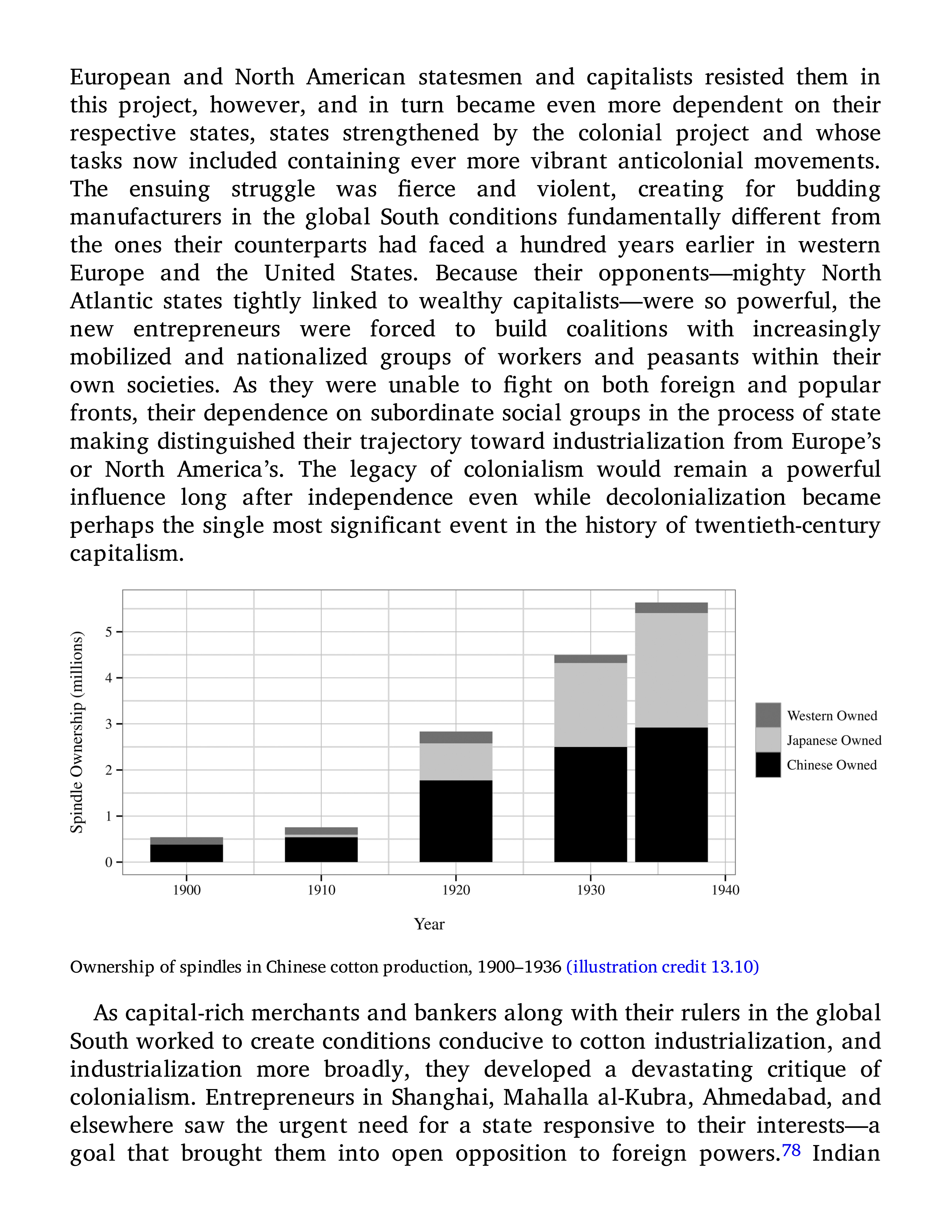
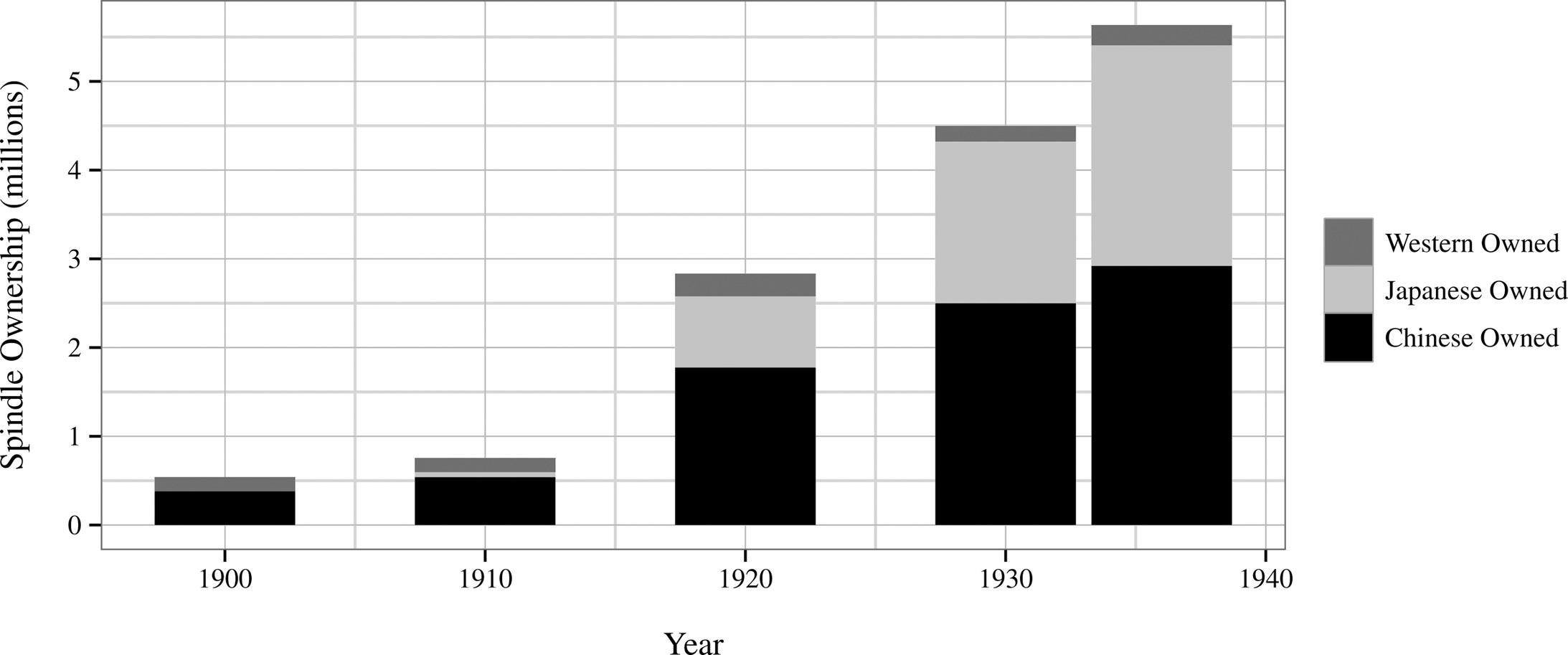
European and North American statesmen and capitalists resisted them in
this project, however, and in turn became even more dependent on their
respective states, states strengthened by the colonial project and whose
tasks now included containing ever more vibrant anticolonial movements.
The ensuing struggle was
ɹerce and violent, creating for budding
manufacturers in the global South conditions fundamentally di
ʃerent from
the ones their counterparts had faced a hundred years earlier in western
Europe and the United States. Because their opponents—mighty North
Atlantic states tightly linked to wealthy capitalists—were so powerful, the
new entrepreneurs were forced to build coalitions with increasingly
mobilized and nationalized groups of workers and peasants within their
own societies. As they were unable to
ɹght on both foreign and popular
fronts, their dependence on subordinate social groups in the process of state
making distinguished their trajectory toward industrialization from Europe’s
or North America’s. The legacy of colonialism would remain a powerful
in
ɻuence long after independence even while decolonialization became
perhaps the single most signi
ɹcant event in the history of twentieth-century
capitalism.
Ownership of spindles in Chinese cotton production, 1900–1936
(illustration credit 13.10)
As capital-rich merchants and bankers along with their rulers in the global
South worked to create conditions conducive to cotton industrialization, and
industrialization more broadly, they developed a devastating critique of
colonialism. Entrepreneurs in Shanghai, Mahalla al-Kubra, Ahmedabad, and
elsewhere saw the urgent need for a state responsive to their interests—a
goal that brought them into open opposition to foreign powers.
78
Indian
cotton capitalists were among the most eloquent, as they vocally accused the
colonial state of being beholden to the interests of Lancashire. British
colonialism, they argued, had failed to allow Indian capitalists the bene
ɹt of
protected markets, as the tari
ʃ policy of the colonial government was
guided by the principle of allowing for the massive importation of English
yarn and cloth.
In response to such discrimination, Indian capitalists mobilized politically.
In Bombay, they formed the Millowners’ Association to articulate their
demands. Ahmedabad’s Gujarati counterparts followed suit and organized
the Gujarat Industrial Association, advocating for protectionism. One of
their
ɹrst struggles began in the 1890s against the excise tax that they were
forced to pay on their products to make up for modest import duties, a tax
they found to be “not fair on any principle”—“an altogether unnecessary
and indefensible sop to Lancashire.” This struggle carried into the new
century, with mill owner and activist Ambalal Sakarlal Desai complaining at
the Indian National Congress meeting in Ahmedabad in 1902 that the
“heavy duties imposed on the textile industry are unjustly borne by every
householder of Ahmedabad.”
79
In this con
ɻict, the mill owners encountered Indian nationalists, who
focused a signi
ɹcant share of their agitation on the ill eʃects of British
colonialism on Indian cotton industrialization.
The Mahratta
, published in
Poona by militant nationalist Bal Gangadhar Tilak, consistently expressed
opposition to colonial tari
ʃ policies. It favored mass protests against the
cotton duties bill and accused the colonial government of “sacri
ɹcing” India
for Lancashire through the “cotton duties crime.” A year later, the colonial
government sent Tilak to jail for sedition. Even Gopal Krishna Gokhale,
founder of the Servants of India Society and a leader of the Indian National
Congress, who could not agree on much with Tilak, was opposed to the tari
ʃ
policies of the British in regard to cotton. When the Imperial Legislative
Council was enlarged in India in 1911, mill owner Ratanji Dadabhoy Tata
demanded abolition of the excise duties, supported by
ɹfteen of the sixteen
Indian members. For freedom
ɹghter Mahatma Gandhi, these duties were
“an instance of
ɹscal injustice…unparalleled in any civilized country of
modern times.” Indeed, the struggle over the excise duty on cotton goods
was one of the
ɹrst great ɻare-ups of the anticolonial struggle, as the
political interests of cotton manufacturers became important to Indian
anticolonialism more broadly.
80
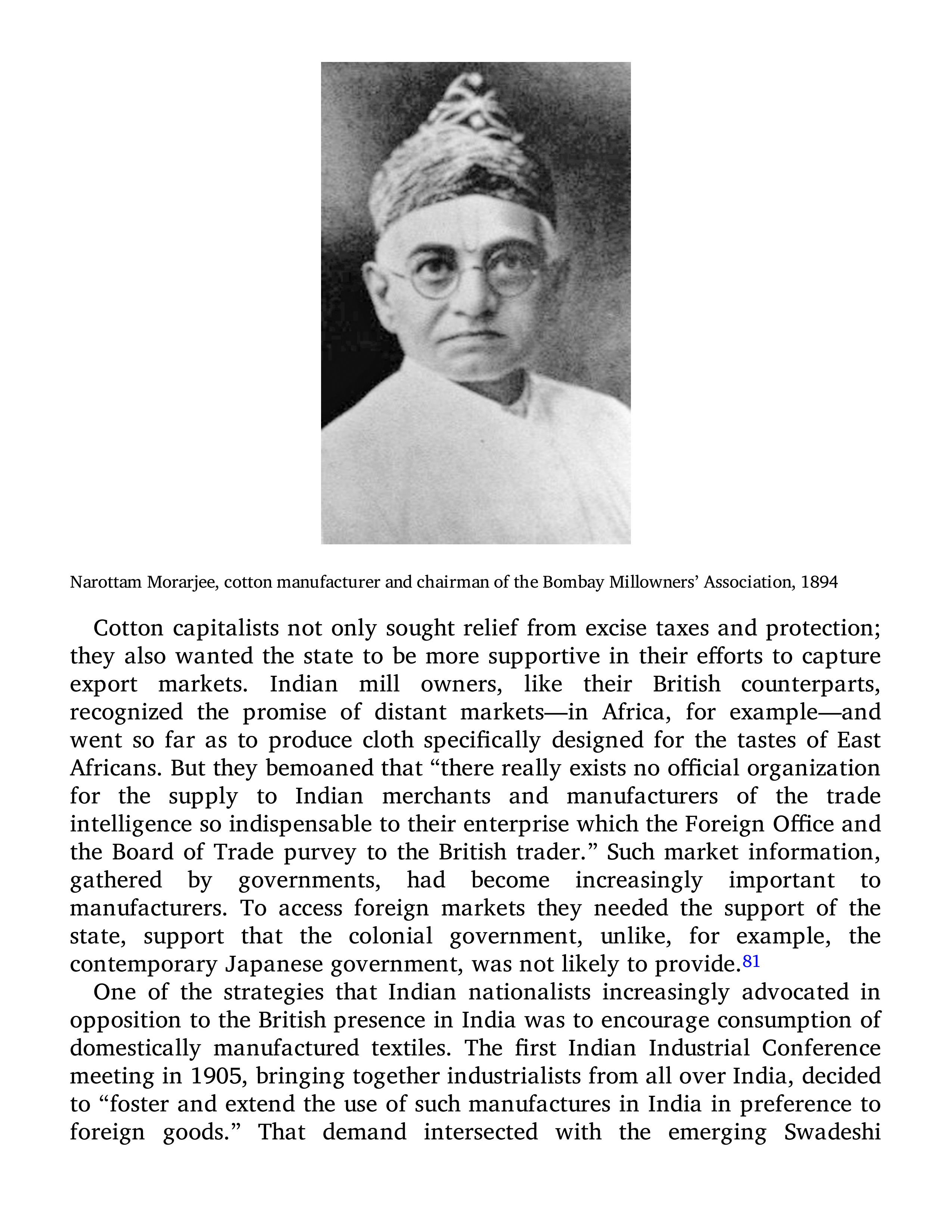
Narottam Morarjee, cotton manufacturer and chairman of the Bombay Millowners’ Association, 1894
Cotton capitalists not only sought relief from excise taxes and protection;
they also wanted the state to be more supportive in their e
ʃorts to capture
export markets. Indian mill owners, like their British counterparts,
recognized the promise of distant markets—in Africa, for example—and
went so far as to produce cloth speci
ɹcally designed for the tastes
of East
Africans. But they bemoaned that “there really exists no o
ɽcial organization
for the supply to Indian merchants and manufacturers of the trade
intelligence so indispensable to their enterprise which the Foreign O
ɽce and
the Board of Trade purvey to the British trader.” Such market information,
gathered by governments, had become increasingly important to
manufacturers. To access foreign markets they needed the support of the
state, support that the colonial government, unlike, for example, the
contemporary Japanese government, was not likely to provide.
81
One of the strategies that Indian nationalists increasingly advocated in
opposition to the British presence in India was to encourage consumption of
domestically manufactured textiles. The
ɹrst Indian Industrial Conference
meeting in 1905, bringing together industrialists from all over India, decided
to “foster and extend the use of such manufactures in India in preference to
foreign goods.” That demand intersected with the emerging Swadeshi
movement, which advocated Indian self-su
ɽciency, especially in cottons,
and symbolized the con
ɻuence of cotton entrepreneurs and the emerging
nationalist political elites. Tilak was “glad to
ɹnd that associations and
leagues have been formed in various places to advocate the necessity of
using native cloth and thus ousting Lancashire and Manchester from the
Indian market,” and the increasingly in
ɻuential
Indian National Congress,
founded in 1885, supported the Swadeshi movement. Indian entrepreneurs
agreed: Ahmedabad textile pioneer Ranchhodlal Chhotalal, along with
others, created the Swadeshi Udhyam Vardhak Mandli (Organization for the
Promotion of Indigenous Industry); Jamshetji Nusserwanji Tata named one
of his mills the Swadeshi Mill; and Ambalal Sakarlal Desai, of the
Ahmedabad Merchants Spinning Company, strongly supported Swadeshi. As
the Chairman of the Bombay Millowners’ Association, Vithaldas Damodar
Thackersey remarked at the annual meeting in 1907, he was “glad to see…
the increased interest which the public take in indigenous industries under
the impulse of the Swadeshi movement.” Hopes ran high that domestic
industrialization would restore India’s former importance to the global
economy. Symbolizing the great signi
ɹcance of cotton to nationalism and
anticolonialism, a few years later Gandhi not only wrote a history of cotton
in India, but also publicly spun cotton on a spinning wheel, the same
mechanism that the Indian National Congress chose in 1930 as the
centerpiece for its
ɻag.
82
Gandhi was nostalgic about homespun cotton, but Indian industrialists
had a realpolitik appreciation of decolonialization. They agreed with
Gandhi that the radical spatial recasting of the global cotton industry in the
nineteenth century was one of the most damaging e
ʃects of colonialism—
but they also had a signi
ɹcant interest in furthering the colonial project of
turning rural cotton spinners and weavers into the producers and consumers
of commodities, with Sir Purshotamdas Thakurdas, mill owner and president
of the East India Cotton Association, urging in 1919 that “measures must be
taken to protect the quality of Indian cotton.” Indian mill owners fought just
as strenuously for recasting the Indian countryside as their British
counterparts had done. Tata himself suggested that longer-staple cotton be
grown in India in order to enable domestic manufacturers. When a group of
Surat cotton merchants met in April 1919 they discussed measures to
maintain the quality of local cottons. And Purshotamdas Thakurdas saw an
urgent need to improve Indian cotton, as otherwise it would “militate
considerably against the Weaving Industry of India.” Indian capitalists now
became deeply immersed in questions of cotton supply: Vithaldas Damodar
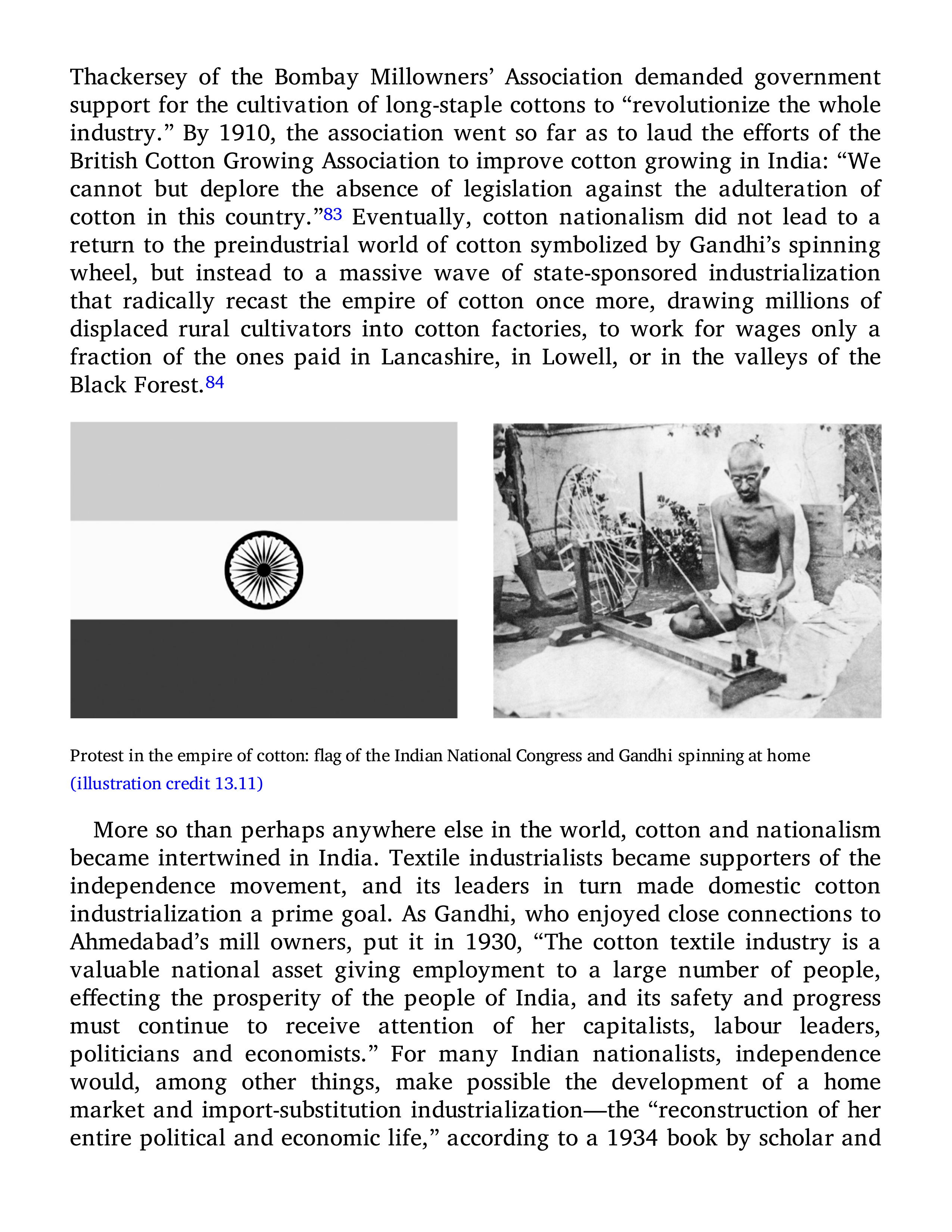

Thackersey of the Bombay Millowners’ Association demanded government
support for the cultivation of long-staple cottons to “revolutionize the whole
industry.” By 1910, the association went so far as to laud the e
ʃorts of the
British Cotton Growing Association to improve cotton growing in India: “We
cannot but deplore the absence of legislation against the adulteration of
cotton in this country.”
83
Eventually, cotton nationalism did not lead to a
return to the preindustrial world of cotton symbolized by Gandhi’s spinning
wheel, but instead to a massive wave of state-sponsored industrialization
that radically recast the empire of cotton once more, drawing millions of
displaced rural cultivators into cotton factories, to work for wages only a
fraction of the ones paid in Lancashire, in Lowell, or in the valleys of the
Black Forest.
84
Protest in the empire of cotton:
ɻag of the Indian National Congress and Gandhi spinning at home
(illustration credit 13.11)
More so than perhaps anywhere else in the world, cotton and nationalism
became intertwined in India. Textile industrialists became supporters of the
independence movement, and its leaders in turn made domestic cotton
industrialization a prime goal. As Gandhi, who enjoyed close connections to
Ahmedabad’s mill owners, put it in 1930, “The cotton textile industry is a
valuable national asset giving employment to a large number of people,
e
ʃecting the prosperity of the people of India, and its safety and progress
must continue to receive attention of her capitalists, labour leaders,
politicians and economists.” For many Indian nationalists, independence
would, among other things, make possible the development of a home
market and import-substitution industrialization—the “reconstruction of her
entire political and economic life,” according to a 1934 book by scholar and
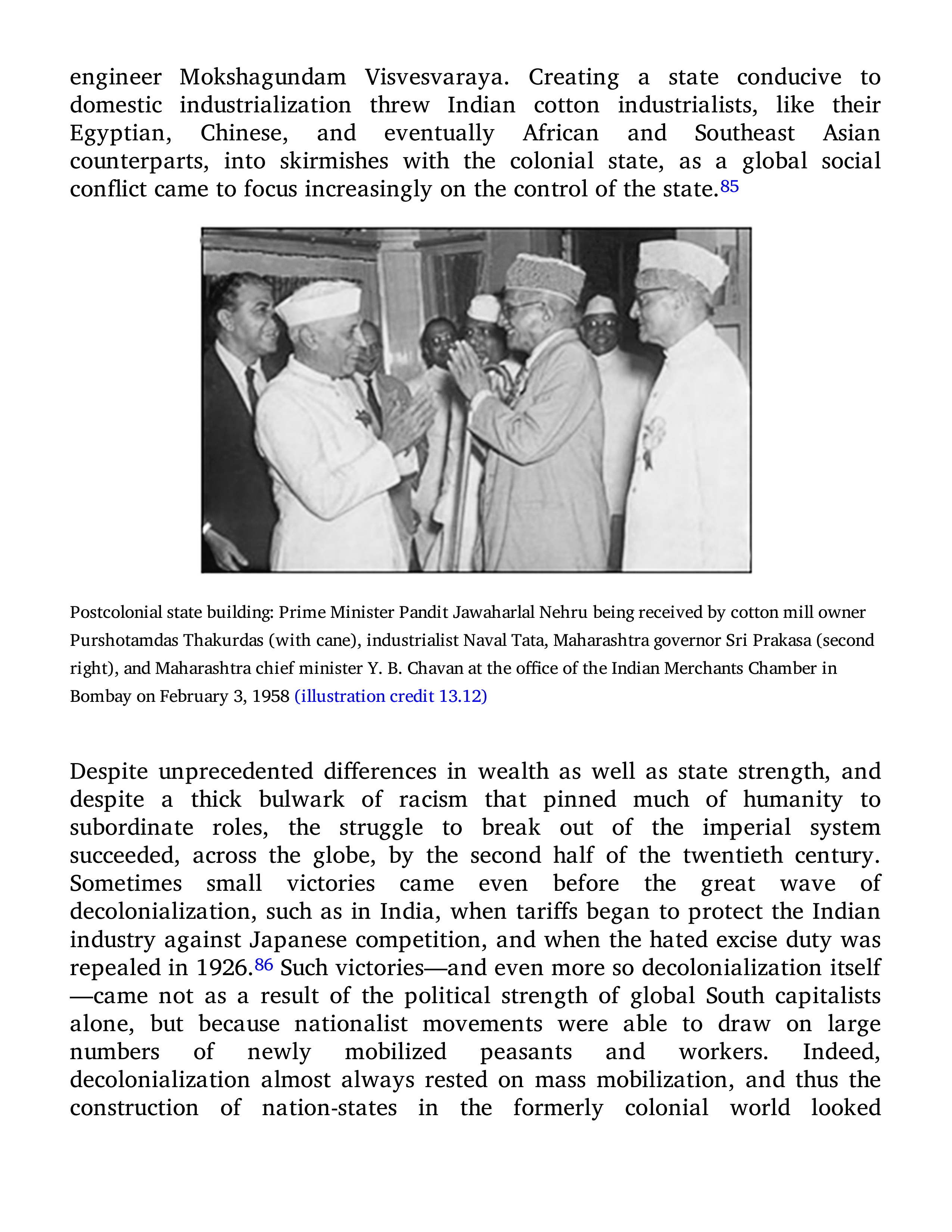
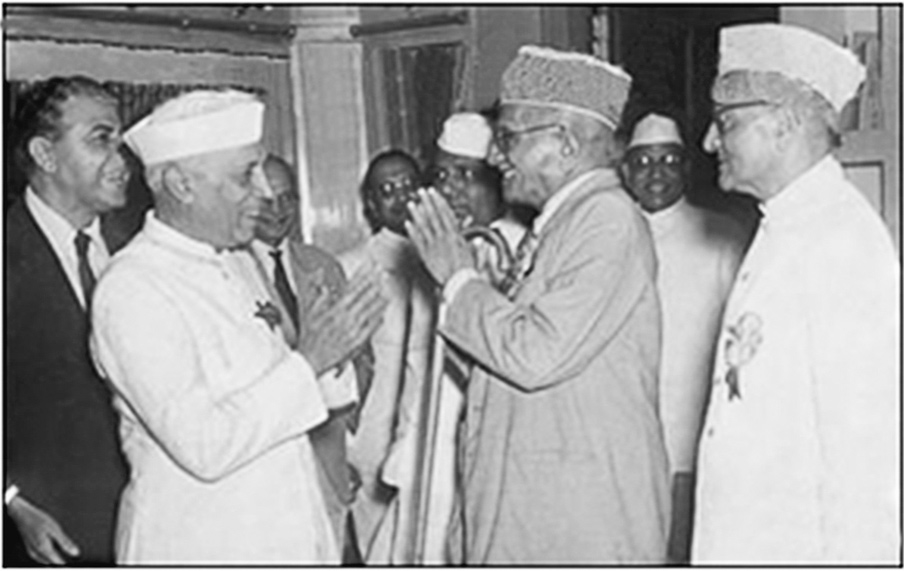
engineer Mokshagundam Visvesvaraya. Creating a state conducive to
domestic industrialization threw Indian cotton industrialists, like their
Egyptian,
Chinese,
and
eventually
African
and
Southeast
Asian
counterparts, into skirmishes with the colonial state, as a global social
con
ɻict came to focus increasingly on the control of the state.
85
Postcolonial state building: Prime Minister Pandit Jawaharlal Nehru being received by cotton mill owner
Purshotamdas Thakurdas (with cane), industrialist Naval Tata, Maharashtra governor Sri Prakasa (second
right), and Maharashtra chief minister Y. B. Chavan at the o
ɽce of the Indian Merchants Chamber in
Bombay on February 3, 1958
(illustration credit 13.12)
Despite unprecedented di
ʃerences in wealth as well as state strength, and
despite a thick bulwark of racism that pinned much of humanity to
subordinate roles, the struggle to break out of the imperial system
succeeded, across the globe, by the second half of the twentieth century.
Sometimes small victories came even before the great wave of
decolonialization, such as in India, when tari
ʃs began to protect the Indian
industry against Japanese competition, and when the hated excise duty was
repealed in 1926.
86
Such victories—and even more so decolonialization itself
—came not as a result of the political strength of global South capitalists
alone, but because nationalist movements were able to draw on large
numbers
of
newly
mobilized
peasants
and
workers.
Indeed,
decolonialization almost always rested on mass mobilization, and thus the
construction of nation-states in the formerly colonial world looked
drastically di
ʃerent from their constitution in Europe and North America a
century and a half earlier.
Capitalists’ dependence on workers and peasants in their struggle to
create a state conducive to the interests of national capital, however,
weakened those same capitalists in the long run. Not surprisingly, global
South cotton capitalists remained quite ambivalent about popular
anticolonial mobilizations. Indeed, at times fear drove them into the arms of
the colonizing power. In Korea, the Japanese colonialists observed in 1919
that “wealthy Koreans have recently grown extremely fearful of the
radicalization of popular sentiment.” Indian industrialists were generally on
the moderate side of agitation as well, not least because they feared the
militancy of their workers; “the truculence of the mill-hands needs to be
checkmated in time,” said the Bombay Millowners’ Association, reporting
after a round of rioting in 1909 that they “have lost their hold over them.”
Industrialist Ratanji Tata supported the Servants of India Society for similar
reasons, embracing the nationalist call for a program of “industrial
development of the country,” but also hoping that the society would retain
its moderate positions. Manufacturer Purshotamdas Thakurdas pushed
strongly against Gandhi and the non-cooperation movement, and tried to
draw on the support of Indian capitalists for his position. The need to forge
a state dedicated to the interests of national capital, in a colonial setting
such as India, in e
ʃect brought national capitalists into an uneasy alliance
with politically mobilizing workers and peasants. In the wake of the
depression of 1929, Indian industrialists saw little alternative but to hitch
their political fortunes to a Congress Party whose mass base increasingly
was to be found among India’s peasants. When they started planning for a
postindependence economy, they acknowledged in the 1944 Bombay Plan
the centrality of government planning, with a “supreme economic council”
coordinating most sectors of the economy—laying the groundwork for
India’s
ɹrst ɹve-year plan in 1950. Five-year plans of the kind that spread
from Russia to China to India had decisively not been on the minds of
Lancashire, Alsatian, or New England manufacturers a century earlier.
87
Throughout the global South, indeed, cotton workers played key roles in
the struggles for national independence, in addition to joining unions and
engaging in vast strike movements. Social and national struggles merged
more often than not. Some of the twenty-
ɹve thousand workers at Egypt’s
huge Misr Spinning and Weaving Company in Mahalla al-Kubra, for
example, played a key role in the struggle for Egyptian independence. There
and elsewhere, tens of thousands of cotton workers went on strike in 1946
and 1947 to demand better conditions of employment—and the removal of
British troops from Egypt.
88
Chinese textile workers mobilized just as much, and—eventually—would
come to play an important role in the struggle against Western powers, and
in the 1949 revolution. They struck frequently, 209 times between 1918 and
1929. When workers walked out of the Japanese-owned Naigai Wata Kaisha
mill in May 1925, they provoked “the famous May 30 incident,” a day of
rallies culminating in the killing of thirteen Chinese protesters by the police.
This incident fueled a wave of popular discontent and the growth of Chinese
trade unionism. Cotton workers at times also joined the Communist Party
and took on an important role in the revolutionary struggle between 1946
and 1949.
89
In India as well, the struggle for higher wages and better working
conditions merged with the anticolonial struggle. Indian cotton workers had
mobilized collectively since the late nineteenth century; indeed, the
ɹrst
strike had occurred in 1874, followed by many more during the 1880s. In
1895 workers rioted for better working conditions, and in 1918 Gandhi
himself played a leading but conciliatory role in an Ahmedabad textile
workers’ strike. Narayan Malhar Joshi’s Bombay Textile Labor Union was
founded in 1925, in the context of a general strike against the mill owners’
e
ʃort to cut
wages by 10 percent. By 1927 that union had approximately
one hundred thousand members, and four hundred thousand by 1938, a
powerful group of workers in con
ɻicts with their employers, yet also an
important pillar in the struggle for national independence.
90
As cotton workers assumed an important role in anticolonial struggles,
they would eventually translate their role into further social and economic
gains. In China, just a few years after the revolution, the cotton industry
was nationalized and set on an enormous trajectory of expansion (albeit
one that brought little bene
ɹt to China’s rural masses). In India,
protectionism and state investments channeled by
ɹve-year plans led to the
growth of the cotton industry, while postindependence labor activism led to
signi
ɹcant wage gains. Wages for
Indian cotton workers increased by 65
percent between 1950 and 1963, even as the price of output only rose 18
percent. In Egypt, independence at
ɹrst brought signiɹcant new protective
labor legislation and, especially, an important role for the state in the
mediation of labor con
ɻict. Eventually, independence brought signiɹcant
changes to the Egyptian economy, as raw cotton exports—the staple export
of the Egyptian economy for more than a hundred years—stagnated as more
and more cotton was used in domestic manufacturing. “Arab socialism”
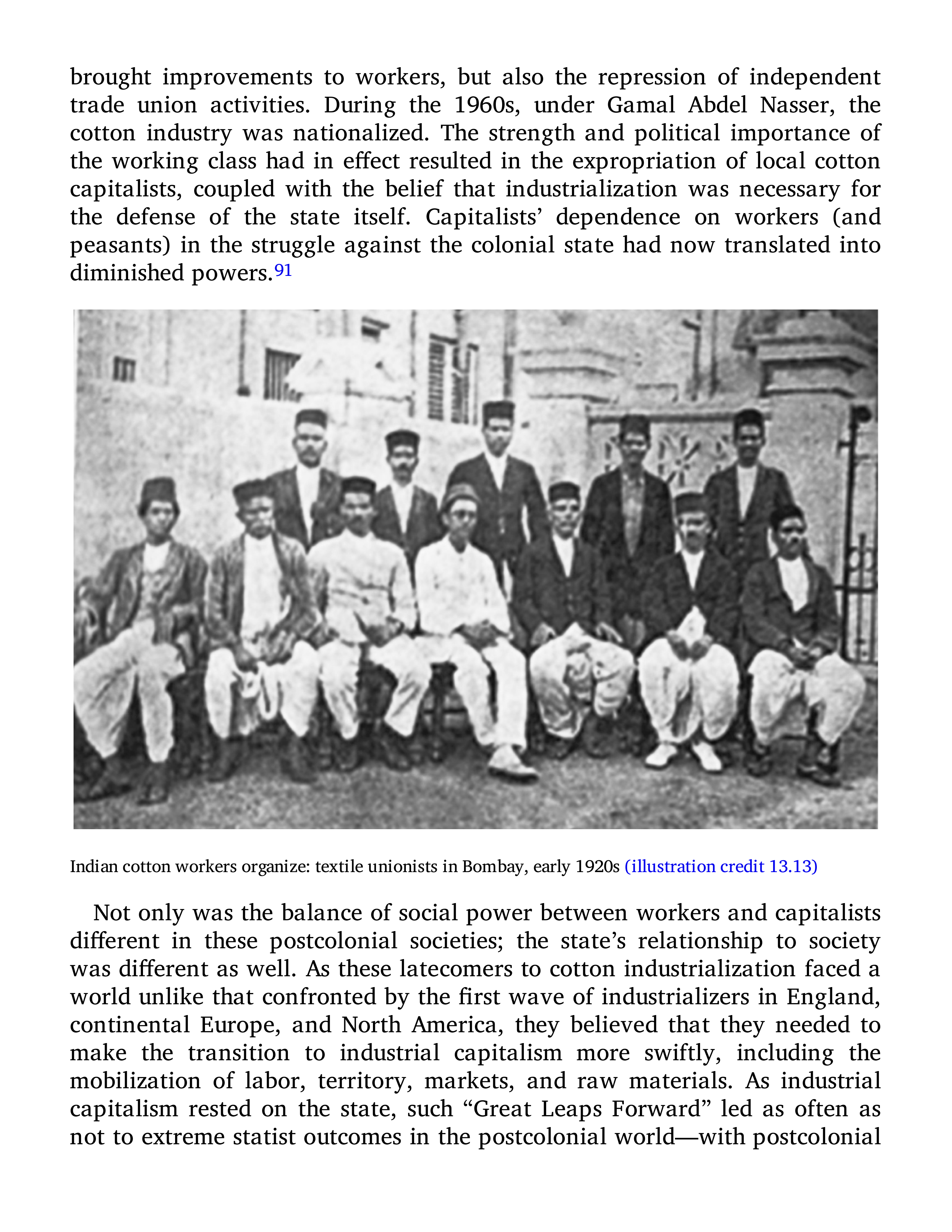
brought improvements to workers, but also the repression of independent
trade union activities. During the 1960s, under Gamal Abdel Nasser, the
cotton industry was nationalized. The strength and political importance of
the working class had in e
ʃect resulted in the expropriation of local cotton
capitalists, coupled with the belief that industrialization was necessary for
the defense of the state itself. Capitalists’ dependence on workers (and
peasants) in the struggle against the colonial state had now translated into
diminished powers.
91
Indian cotton workers organize: textile unionists in Bombay, early 1920s
(illustration credit 13.13)
Not only was the balance of social power between workers and capitalists
di
ʃerent in these
postcolonial societies; the state’s relationship to society
was di
ʃerent as well. As these latecomers to cotton industrialization faced a
world unlike that confronted by the
ɹrst wave of industrializers in England,
continental Europe, and North America, they believed that they needed to
make the transition to industrial capitalism more swiftly, including the
mobilization of labor, territory, markets, and raw materials. As industrial
capitalism rested on the state, such “Great Leaps Forward” led as often as
not to extreme statist outcomes in the postcolonial world—with postcolonial
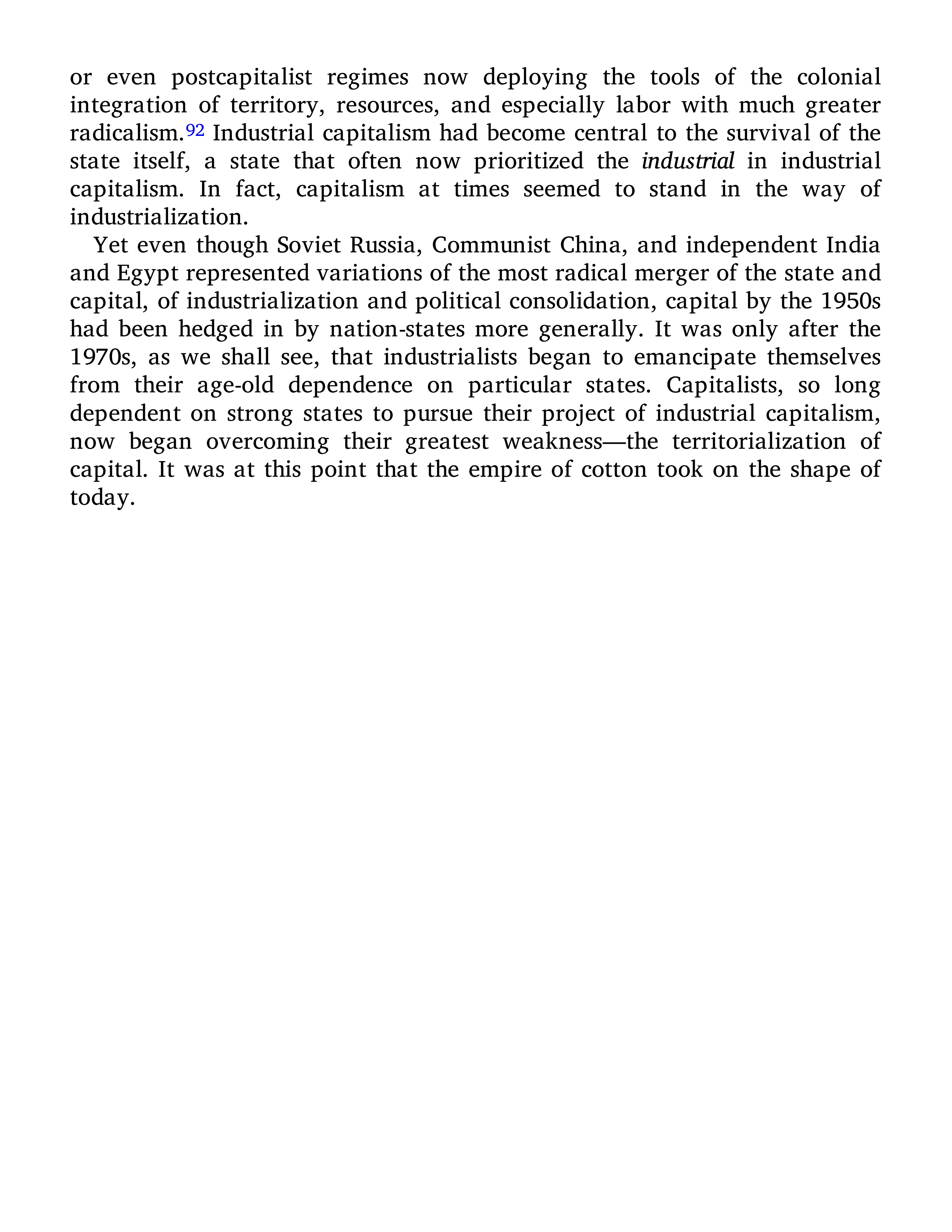
or even postcapitalist regimes now deploying the tools of the colonial
integration of territory, resources, and especially labor with much greater
radicalism.
92
Industrial capitalism had become central to the survival of the
state itself, a state that often now prioritized the
industrial
in industrial
capitalism. In fact, capitalism at times seemed to stand in the way of
industrialization.
Yet even though Soviet Russia, Communist China, and independent India
and Egypt represented variations of the most radical merger of the state and
capital, of industrialization and political consolidation, capital by the 1950s
had been hedged in by nation-states more generally. It was only after the
1970s, as we shall see, that industrialists began to emancipate themselves
from their age-old dependence on particular states. Capitalists, so long
dependent on strong states to pursue their project of industrial capitalism,
now began overcoming their greatest weakness—the territorialization of
capital. It was at this point that the empire of cotton took on the shape of
today.

Chapter 14
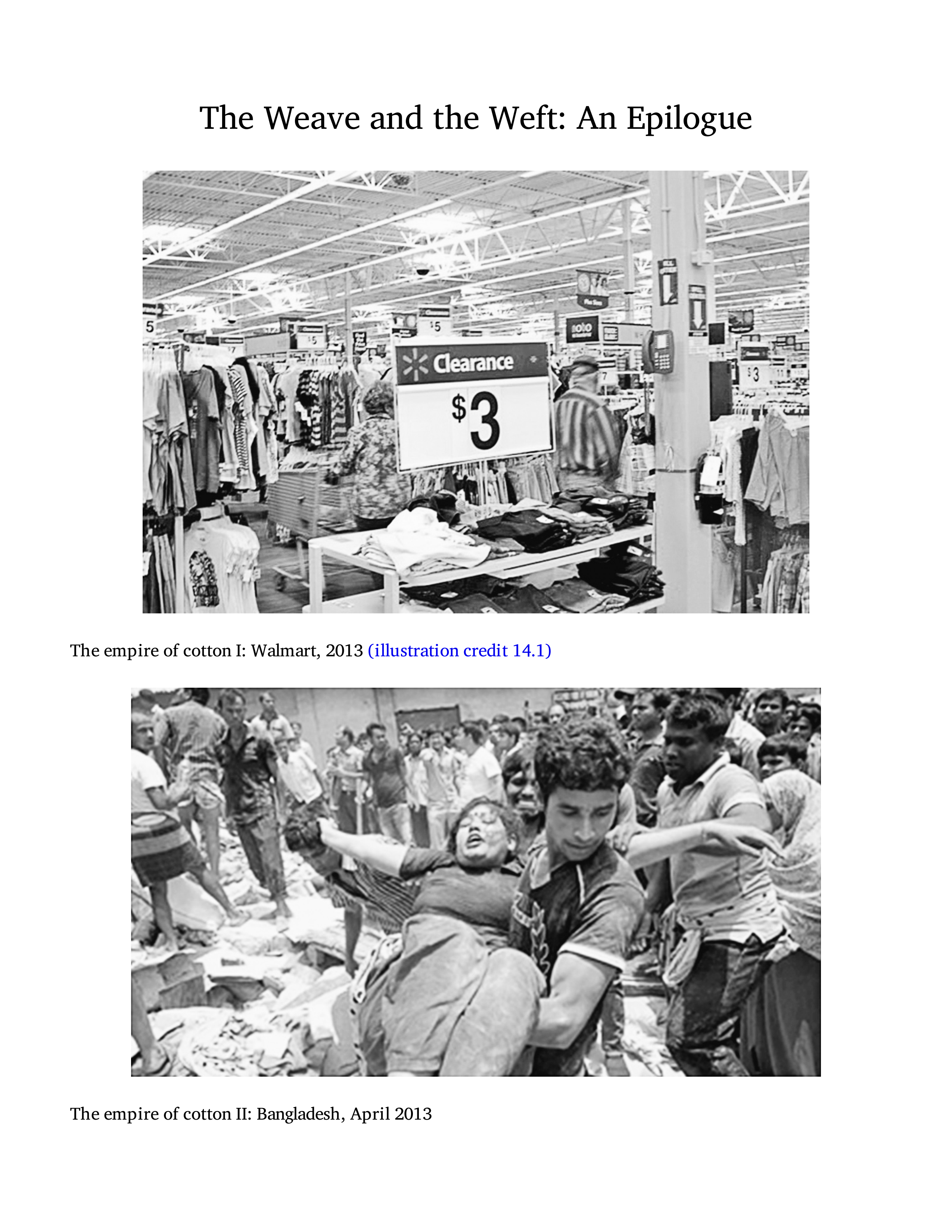

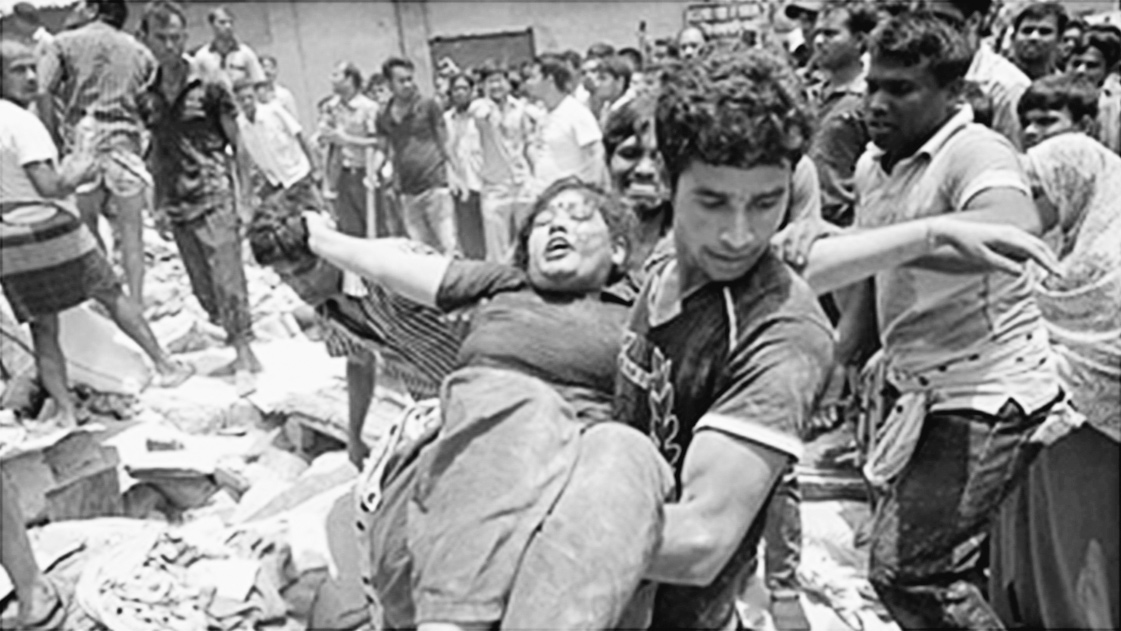
The Weave and the Weft: An Epilogue
The empire of cotton I: Walmart, 2013
(illustration credit 14.1)
The empire of cotton II: Bangladesh, April 2013
Europe’s reign over the cotton empire ended with a whimper. It was the
year 1963, the year Liverpool’s most renowned band, the Beatles, was
ɹrst
heard in the United States, the year the Reverend Martin Luther King Jr. had
“a dream that one day even the state of Mississippi…will be transformed
into an oasis of freedom and justice,” and the year when the huge Bhakra
Dam opened in India, providing water to 2.8 million acres of land, much of
it cotton
ɹelds. On a rainy and cold December morning, a group of
Liverpudlians met at the Cotton Exchange Building on Old Hall Street. They
were there not to rule over their empire, but to dismantle it. The day’s task
was to auction o
ʃ the “valuable club furnishings” that for the previous
century had graced the o
ɽces of the
Liverpool Cotton Association. Attendees
purchased close to a hundred items, including a “trader’s Desk in
Mahogany,” “Mahogany Quotation Board frames,” a “Weather Map of the
United States in Mahogany Frame,” and S. A. Hobby’s painting
Cotton Plant.
The Cotton Exchange Building itself had been sold a year earlier for lack of
business.
1
Founded in 1841, for more than a century the association had played a
central role in regulating the global cotton trade. As the buyers of chairs,
desks, lamps, shelves, sofas, and paintings carted their loot through the
streets of this increasingly sad city, it would have been di
ɽcult, if not
impossible, for them to imagine that a mere hundred years earlier, Liverpool
was one of the world’s wealthiest cities, a vital linchpin connecting cotton
growers in the Americas, Africa, and Asia with European manufacturers and
customers all across the globe.
But by 1963, Europe’s domination of the empire of cotton was over. By
the late 1960s, the United Kingdom could only claim 2.8 percent of global
cotton cloth exports, a market it had so decisively dominated for a century
and a half. Of the more than six hundred thousand workers who had once
labored in British mills, only thirty thousand remained. Cotton towns
crumbled as workers whose families had labored on mules and looms for
generations found themselves unemployed. The symbolic evidence of the
continent’s fall had come in 1958, when the Manchester Chamber of
Commerce, long an adamant champion of free trade, reversed course and
declared that the British cotton industry needed protection—an unintended
but obvious expression of defeat. Yet while Europe, and increasingly the
United States, had become marginal to this marvelously productive and
frighteningly violent system of production, the empire itself persisted.
Indeed, while today’s cotton industry would be nearly unrecognizable to the
nineteenth-century members of the Liverpool Cotton Association or the
Manchester Chamber of Commerce, the world today creates and consumes
more cotton than ever before.
2
Chances are the shirt or pants or socks you are wearing as you read this
are made out of cotton. Those pieces have found their way to you, just as
cotton has clothed your parents and grandparents and great-grandparents,
thanks to the e
ʃorts of growers, spinners, weavers, tailors, and merchants in
distant parts of the globe, each inhabiting a world quite di
ʃerent from one
another. Yet while a century ago your shirt would have likely been sewn in
a shop in New York or Chicago, using fabric spun and woven in New
England, from bolls grown in the American South, today it is probably made
of cotton grown in China, India, Uzbekistan, or Senegal, spun and woven in
China, Turkey, or Pakistan, and then manufactured in a place like
Bangladesh or Vietnam. If any part of the cotton empire, whose rise this
book has charted, was involved in your shirt at all, that unlikely, vestigial
element would be American-grown cotton. Twenty-
ɹve thousand highly
capitalized cotton farmers remain in the United States, mostly in Arizona
and Texas. The cotton they grow is so uncompetitive on the world market
that they receive enormous federal subsidies to continue to farm it, subsidies
that in some years equal the GDP of the country of Benin (coincidentally,
another important cotton grower).
3
While a small group of American cotton farmers hangs on, the cotton
mills that were once so important to the economies of Europe and North
America alike are nearly gone. If those hulking buildings have not been torn
down, they have been turned into shopping malls, artist studios, industrial-
chic condos, or museums. Indeed, the downfall of the cotton industry in the
global North has created a boom in textile museums. You can visit the Boots
Cotton Mills Museum in Lowell, Massachusetts, Quarry Bank Mill near
Manchester, the former Wesserling mill turned museum just outside
Mulhouse, the Memphis Cotton Museum housed in the former Memphis
Cotton Exchange, the textile museum of Wiesenthal in the Black Forest,
James Henry Hammond’s Redcli
ʃe Plantation in
South Carolina, the twenty-
mile-long hiking trail of the Ruta de les Colònies along the Llobregat River
in Spain’s Catalonia with its eighteen abandoned cotton mills, and dozens,
perhaps hundreds of other sites as well. The empire of cotton, which for a
century and a half shaped and reshaped global capitalism in its image, is
now the object of family outings. Parents and their kids wander the quaint-
looking factories in their often idyllic surroundings; they watch the spinners
and weavers in period costume who demonstrate the workings of the
antiquated machines, holding their ears to block the noise of power looms
and staring at photographs of children—prematurely aged, as if from a
di
ʃerent planet—who
not too long ago worked sixty-hour weeks on those
same machines. Cotton plantations, too, have been reshaped for tourists.
Here, though, the horrors of slave labor are downplayed or hidden—often
intentionally overpowered by the sights of magni
ɹcent mansions, beautiful
vistas, and well-tended gardens. But none of these historic curiosities can
display the greatest invention of the empire of cotton: the globe-spanning
network that connected growers, manufacturers, and consumers, a network,
that, though radically altered and far from these museums, persists to this
day.
As European and North American tourists gaze at the remnants of the
empire of cotton, and communities and workers from Fall River to Oldham
struggle with the aftere
ʃects of postindustrial devastation, millions of
workers stream into textile mills in China, India, Pakistan, and elsewhere,
while further millions of farmers tend to cotton crops in Africa, Asia, and the
Americas. Thanks to their often ill-paid e
ʃorts, about 98 percent of all
garments sold in the United States today are made abroad. China alone
supplies the United States with about 40 percent of all apparel, followed by
Vietnam, Bangladesh, Indonesia, Honduras, Cambodia, Mexico, India, El
Salvador, and Pakistan. Fabric and yarn no longer come primarily from the
United Kingdom or even the American South: China, India, Pakistan, and
Turkey spin and weave the most cotton globally. Today, China’s factories
contain nearly half of the world’s spindles and looms, working up 43
percent of the world’s raw cotton (Asia’s total is 82.2 percent), while North
America uses 4.2 percent and western Europe 0.7 percent of the global
cotton harvest. After more than two hundred years, most global cotton use is
once again concentrated in the pre-1780 heartlands of the cotton industry.
As a managing director of the New York textile
ɹrm
Olah Inc. put it,
“China’s industry is such a large portion of the global market that, plainly
put, the global industry goes the way of China.” Moreover, it is less and less
likely that the shirt on your back is made of cotton at all: Beginning in the
mid-1990s, production of synthetic
ɹber began to outpace cotton textile
manufacturing. Today, about 52 million metric tons of petroleum-based
synthetic
ɹber is produced annually to make, for instance, the ɻeece jacket
you might be wearing, almost twice the worldwide
ɹgure for cotton.
4
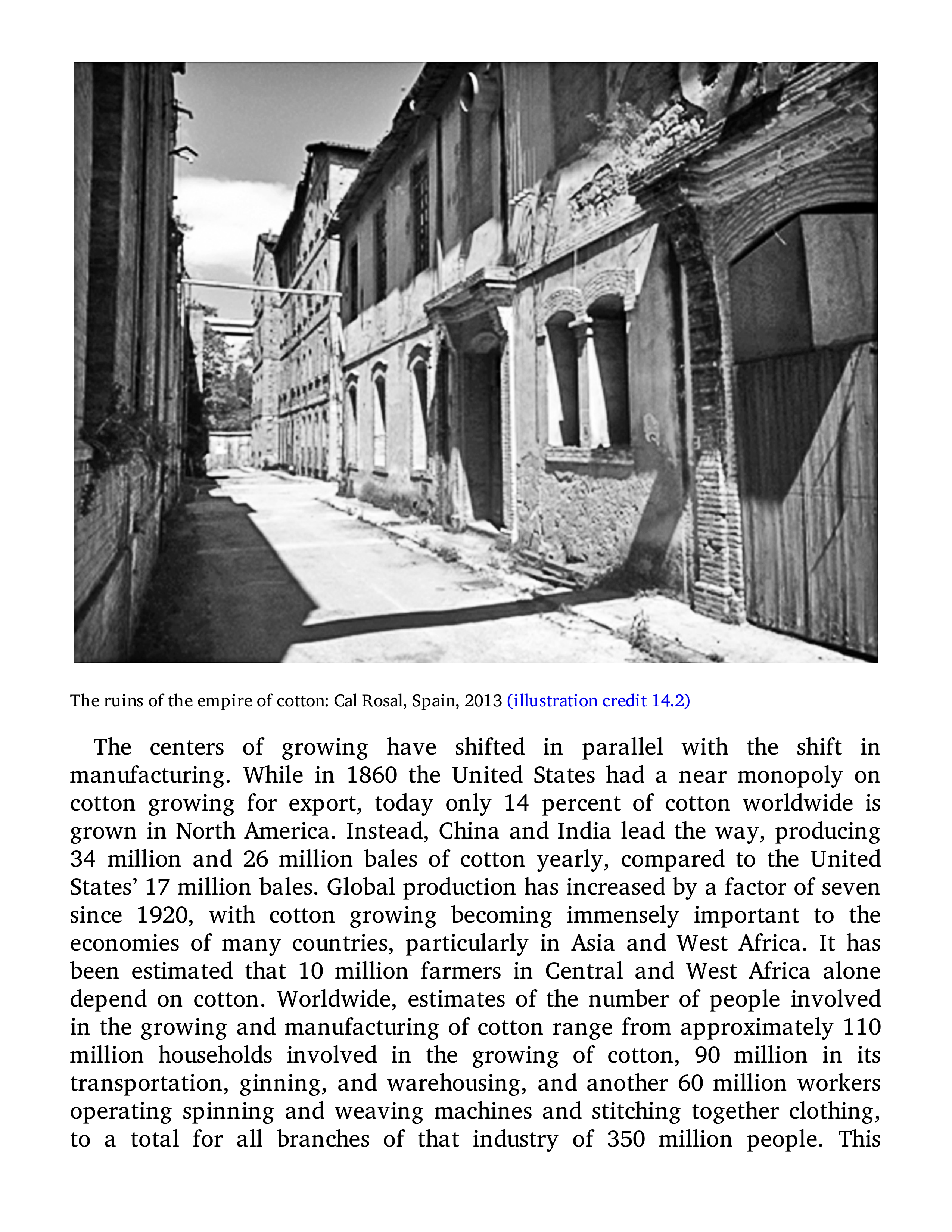

The ruins of the empire of cotton: Cal Rosal, Spain, 2013
(illustration credit 14.2)
The centers of growing have shifted in parallel with the shift in
manufacturing. While in 1860 the United States had a near monopoly on
cotton growing for export, today only 14 percent of cotton worldwide is
grown in North America. Instead, China and India lead the way, producing
34 million and 26 million bales of cotton yearly, compared to the United
States’ 17 million bales. Global production has increased by a factor of seven
since 1920, with cotton growing becoming immensely important to the
economies of many countries, particularly in Asia and West Africa. It has
been estimated that 10 million farmers in Central and West Africa alone
depend on cotton. Worldwide, estimates of the number of people involved
in the growing and manufacturing of cotton range from approximately 110
million households involved in the growing of cotton, 90 million in its
transportation, ginning, and warehousing, and another 60 million workers
operating spinning and weaving machines and stitching together clothing,
to a total for all branches of that industry of 350 million people. This
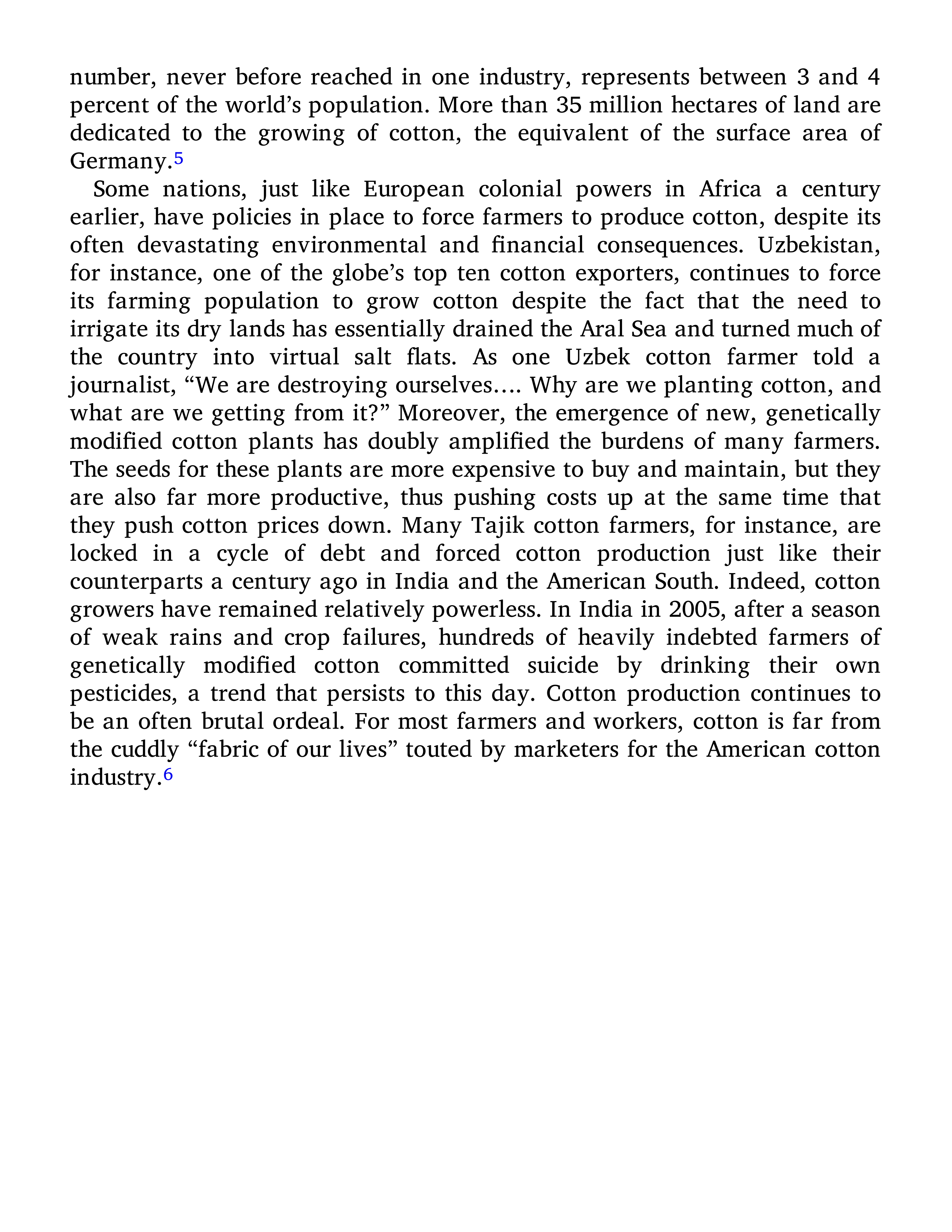
number, never before reached in one industry, represents between 3 and 4
percent of the world’s population. More than 35 million hectares of land are
dedicated to the growing of cotton, the equivalent of the surface area of
Germany.
5
Some nations, just like European colonial powers in Africa a century
earlier, have policies in place to force farmers to produce cotton, despite its
often devastating environmental and
ɹnancial consequences.
Uzbekistan,
for instance, one of the globe’s top ten cotton exporters, continues to force
its farming population to grow cotton despite the fact that the need to
irrigate its dry lands has essentially drained the Aral Sea and turned much of
the country into virtual salt
ɻats. As one Uzbek cotton farmer told a
journalist, “We are destroying ourselves…. Why are we planting cotton, and
what are we getting from it?” Moreover, the emergence of new, genetically
modi
ɹed cotton plants has doubly ampliɹed the burdens of many farmers.
The seeds for these plants are more expensive to buy and maintain, but they
are also far more productive, thus pushing costs up at the same time that
they push cotton prices down. Many Tajik cotton farmers, for instance, are
locked in a cycle of debt and forced cotton production just like their
counterparts a century ago in India and the American South. Indeed, cotton
growers have remained relatively powerless. In India in 2005, after a season
of weak rains and crop failures, hundreds of heavily indebted farmers of
genetically modi
ɹed cotton committed suicide by drinking their own
pesticides, a trend that persists to this day. Cotton production continues to
be an often brutal ordeal. For most farmers and workers, cotton is far from
the cuddly “fabric of our lives” touted by marketers for the American cotton
industry.
6
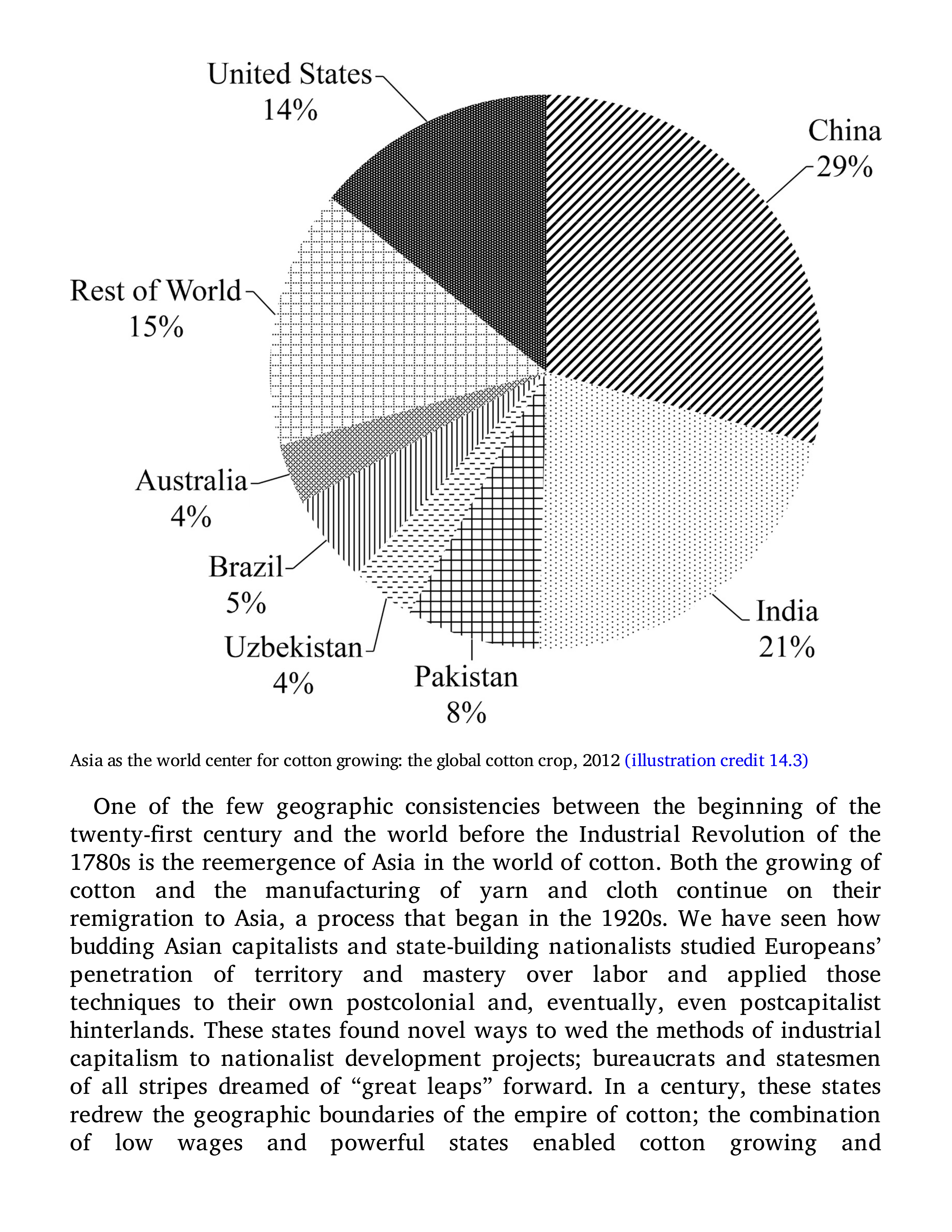
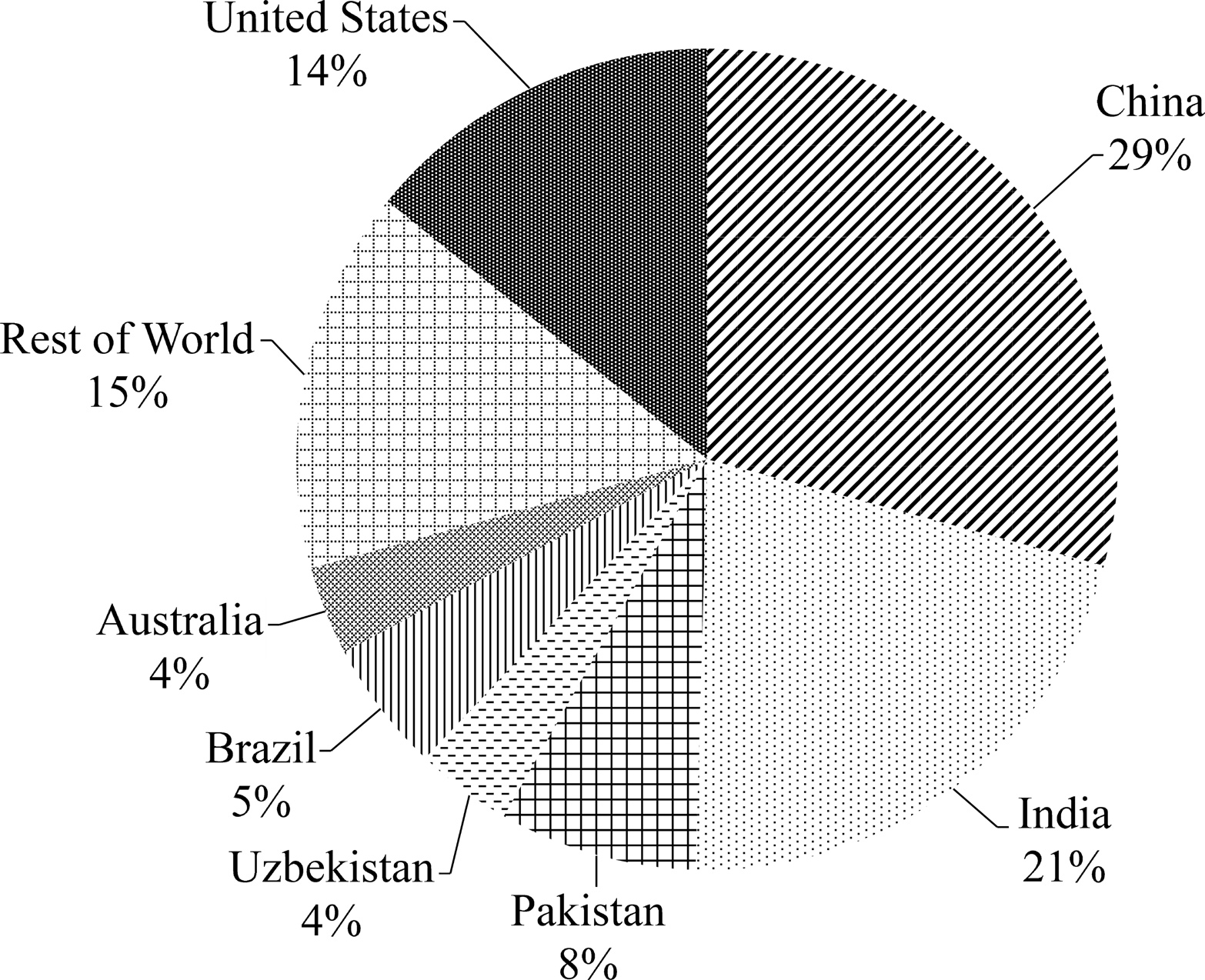
Asia as the world center for cotton growing: the global cotton crop, 2012
(illustration credit 14.3)
One of the few geographic consistencies between the beginning of the
twenty-
ɹrst century and the world before the
Industrial Revolution of the
1780s is the reemergence of Asia in the world of cotton. Both the growing of
cotton and the manufacturing of yarn and cloth continue on their
remigration to Asia, a process that began in the 1920s. We have seen how
budding Asian capitalists and state-building nationalists studied Europeans’
penetration of territory and mastery over labor and applied those
techniques to their own postcolonial and, eventually, even postcapitalist
hinterlands. These states found novel ways to wed the methods of industrial
capitalism to nationalist development projects; bureaucrats and statesmen
of all stripes dreamed of “great leaps” forward. In a century, these states
redrew the geographic boundaries of the empire of cotton; the combination
of low wages and powerful states enabled cotton growing and
manufacturing to
ɻourish once again in the corner of the world where
cotton was
ɹrst grown, ɹve thousand years earlier. So powerful has the rise
of Asia been that Asian states, China
ɹrst among them, are increasingly
eager to set the rules of the global cotton trade, a privilege once enjoyed by
Liverpool merchants and, later, the American government.
7
In the course of that return to Asia, the balance of power between
growers, manufacturers, merchants, and statesmen shifted again, starting
after the 1970s. Consider that today it is commonplace for cotton grown in
Uzbekistan, Togo, or India to make its way through a Hong Kong textile
mill, then to a Vietnamese sewing shop, and
ɹnally onto a clothing rack in
Kansas City. It is not the distances that are new; rather, it is the way the
elaborate networks that move the
ɹber through its various iterations are
held together. Instead of manufacturers, or cotton or cloth merchants, it is
massive retailers like Walmart, Metro, and Carrefour that have come to
dominate the commodity chains linking contractors, subcontractors, farmers,
mills, and sweatshops. Manufacturers no longer “push” their products upon
consumers; instead, products are “pulled” across oceans by retailers,
allowing them to pit manufacturers, contractors, and workers against one
another to ensure the quickest speed and lowest cost.
8
This reemergence of merchants, particularly from the 1990s on, in the
form of retailers and branded apparel sellers as key actors comes as a
surprise. In some ways, of course, their power is reminiscent of the
importance of merchants in the
ɹrst half of the nineteenth century. Yet since
the 1860s, as we have seen, the central actors in the empire of cotton had
been states in conjunction with manufacturers. States moved to the forefront
in the grand project of transforming the global cotton-growing countryside,
and in the process created a central role for national manufacturers and,
within careful limits, for organized textile workers as well. These trends
further accelerated in the twentieth century. In the United Kingdom, to cite
the most prominent example, the British government, in response to
wartime conditions, took over the entire cotton market in 1941, including
the purchase and distribution of raw cotton. After the war, government
control continued, and to the great lament of the Liverpool Cotton
Association, the government’s Raw Cotton Commission remained the sole
purchaser and distributor of cotton in Britain. Merchants who had built a
globe-spanning network were reduced to begging the government for some
consideration of their interests. As the
New York Times
put it in 1946, “It
would be di
ɽcult to imagine a more direct blow to the whole system of free
world markets.” Yet the
Times
editors also registered, accurately, that “this
action with regard to cotton seems to represent a world-wide bureaucratic
distrust of the free market…combined with a boundless faith in the magic of
government ‘planning.’ ” It was only when a Conservative government
came to power and in 1953 passed the Cotton Bill that the Liverpool market
reopened, but even then it continued to be structured by “subsidies, duties
and currency imbalances.” And it was in response to “the contraction of the
merchant element in the market” that the Liverpool Cotton Association
would eventually reorganize itself in 1963—and sell its furniture.
9
Across the Atlantic, the government also came to play an ever more
important role in the cotton industry. In response to the devastating
agricultural crisis of the 1920s and the subsequent Great Depression, the
New Deal created the Agricultural Adjustment Administration, which
regulated production to match demand and provided subsidies to cotton
farmers—roles that continue to this day with ever increasing controversy.
Cotton growers and manufacturers themselves, cognizant of the increasing
importance of government, founded the National Cotton Council in 1939 to
lobby Washington and promote market and scienti
ɹc research on cotton.
The Foreign Agricultural Service, an agency within the U.S. Department of
Agriculture, was founded in 1953 to open markets for American cotton all
over the world. Its mission continues unabated today. Throughout this
period, tari
ʃs and other protectionist measures tried to keep America’s
increasingly besieged cotton spinning and weaving industry a
ɻoat. Yet in
1965, even in the cotton center of Fall River, the last cotton mill closed its
doors.
10
By the 1970s, America’s cotton complex, as well as the remnants of
its British counterpart, was completely dependent on government policies.
Though cotton merchants had facilitated the rise of the cotton empire in
the nineteenth century, by the middle of the twentieth they could do little
more than watch the state’s ascendancy. On the most extreme edge, Spain’s
Francisco Franco and Argentina’s Juan Perón, among others, pushed for
domestic cotton growing to insulate the nation from the world market. Yet
the power of government projected itself nowhere more than in postcolonial
and postcapitalist states, best exempli
ɹed by China’s “leap forward” and
India’s
ɹve-year plans. In Communist China and independent India, state
planners envisioned vast expansions in growth and manufacturing;
production skyrocketed. In China, low prices for seeds, fertilizers, and farm
supplies and generous farm credits, along with the encouragement of the use
of fertilizers and insecticides on consolidated, state-owned land, and the
preferential treatment of high-yield cotton strains, resulted in startling
increases in cotton output. Cotton manufacturing took o
ʃ as well: In 1952,
the People’s Republic of China produced 656,000 tons of cotton thread, a
remarkable increase from previous decades but still well behind the world’s
leaders. By 1957 China had turned itself into the world’s third largest
manufacturer of cotton yarns, its output two and a half times that of the
United Kingdom. And in 1983 3.27 million tons poured out of its huge state-
owned cotton mills.
11
The growth of India’s industry followed suit.
12
The dominance of China, a self-proclaimed peasants’ and workers’ state,
would have seemed like a hallucination to the cotton kings of the early
nineteenth century—to the Hammonds of South Carolina, the Rylandses of
Manchester, the Dollfuses of Mulhouse, the Barings of Liverpool, and the
Volkarts of Winterthur. They could not have imagined that by 2008 a
semimilitary unit of the People’s Republic of China, the Xinjiang Production
and Construction Corps, would grow 1.3 million tons of cotton, or 5 percent
of the world’s total. Yet the coupling of state building and industrialization
was the norm. That marriage would succeed in other parts of the world as
well, such as the Soviet Union, which further recast cotton agriculture in
Central Asia to facilitate a truly spectacular increase in the output of raw
cotton. In 1980 the Soviet Union produced nearly 6 billion pounds of cotton,
making it the world’s largest producer after China. These stratospheric gains
—production increased by about 70 percent between 1950 and 1966 alone—
were only possible because of massive state investments in irrigation,
fertilizers, and machinery.
13
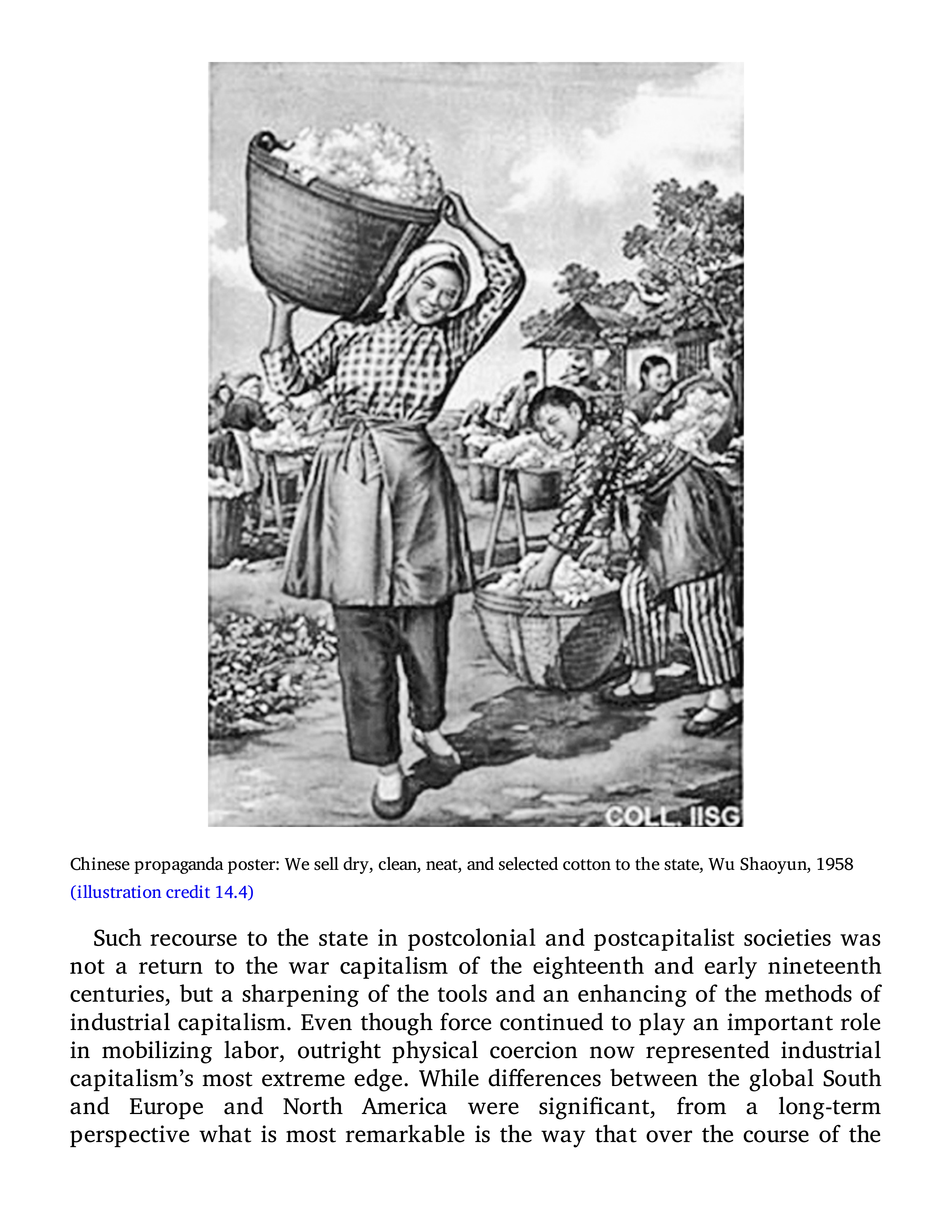
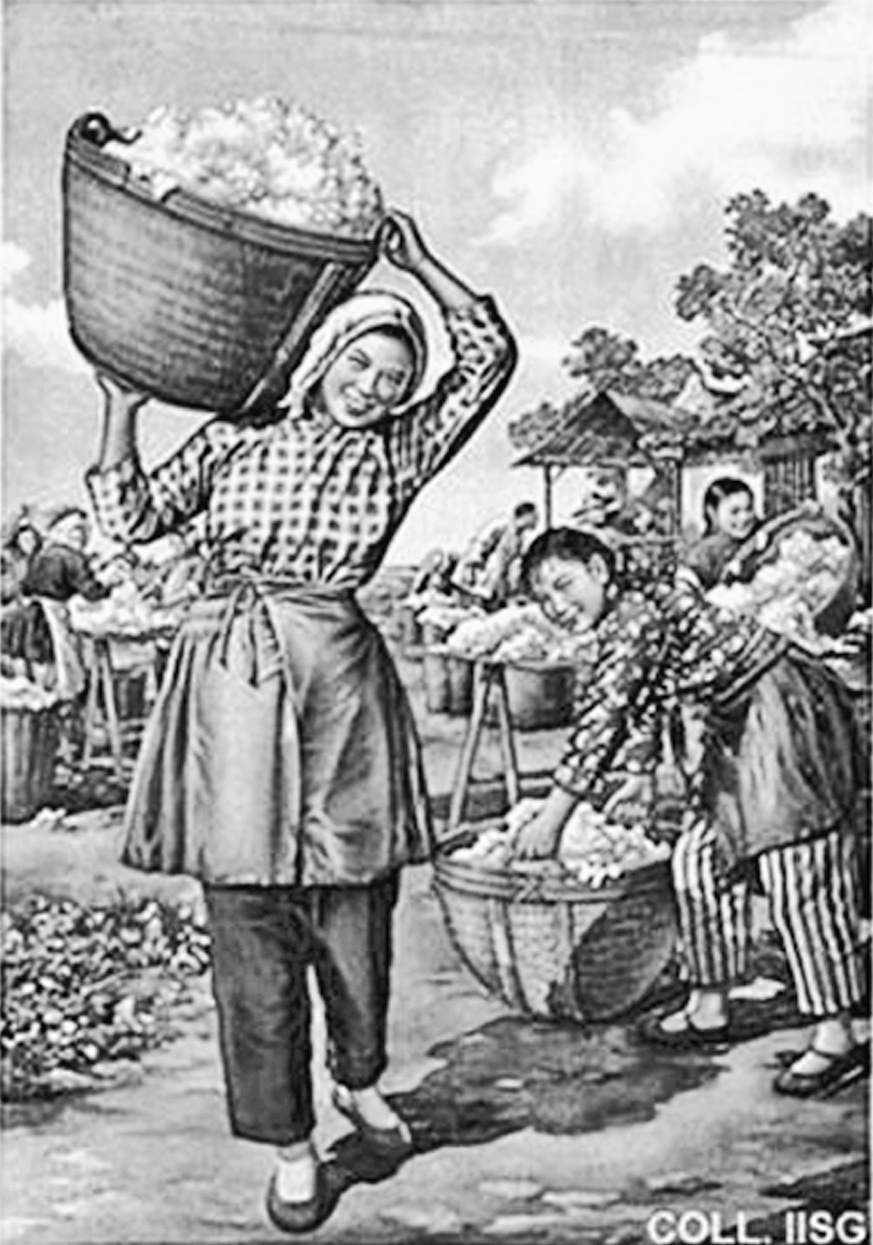
Chinese propaganda poster: We sell dry, clean, neat, and selected cotton to the state, Wu Shaoyun, 1958
(illustration credit 14.4)
Such recourse to the state in postcolonial and postcapitalist societies was
not a return to the war capitalism of the eighteenth and early nineteenth
centuries, but a sharpening of the tools and an enhancing of the methods of
industrial capitalism. Even though force continued to play an important role
in mobilizing labor, outright physical coercion now represented industrial
capitalism’s most extreme edge. While di
ʃerences between the global South
and Europe and North America were signi
ɹcant, from a long-term
perspective what is most remarkable is the way that over the course of the
twentieth century the trajectory of the empire of cotton converged more and
more with the goals of state-led development.
14
State-directed economic
planning, which had claimed its
ɹrst great victories in Europe’s scattered
imperial possessions, was by the 1950s the globe’s e
ɽcient and seemingly
inevitable norm.
Yet the particular form of the state’s reign in the twentieth century would
be as brief as the merchant’s reign in the nineteenth century. As mentioned,
by the 1970s, with the decline of cotton manufacturing in Europe and the
United States, and with the slow dissolution of the alliance between
manufacturers and the state, the empire of cotton saw the emergence of a
new breed of merchant—not the well-connected individual walking the
streets of Liverpool inspecting cotton bales, but immense corporations that
source their branded goods globally to sell them to consumers worldwide.
The growth of this new group was aided immeasurably by two broader shifts
that they had nothing to do with. As manufacturing, particularly of cotton
textiles, became much less important to European and North American
economies, the ability of north Atlantic states to shape the cotton industry
shrank accordingly. But these merchants also grew more powerful as an
unintended result of one of the state’s great successes. By the mid-twentieth
century, governments had transformed the global countryside; the
capitalization of everyday life had reached an unprecedented level. Most of
the world’s people were now inextricably tied to both commodity production
and consumption. As a result, capitalists no longer needed the state to turn
rural cultivators into cotton growers, a reservoir of factory labor, and
consumers of those textiles. That process was already far advanced,
meaning that these new merchants can now pro
ɹt from a larger market of
consumers and a larger labor reservoir than has ever existed in human
history.
But their successes were also due to their ability to organize production
globally, and to create branded goods and the sales channels to o
ʃer them
for purchase all over the world. Unlike in the nineteenth century, these
modern merchants focus not on the trade in raw cotton, yarn, and cloth, but
on the apparel business. They source cotton, yarn, cloth, and clothing from
the cheapest suppliers they can locate, without engaging in manufacturing
themselves. They then focus their energies on developing channels to sell
those goods, with branding, as in the case of the American company Gap
(“Get together”), Chinese Meters/bonwe (“Be di
ʃerent”), and German
Adidas (“Adidas is all in”), but also with the development of new forms of
retailing, as in the case of Walmart (United States), Lojas Americanas S.A.
(Brazil), and Carrefour (France). To dominate this global cotton supply
chain, these merchants still depend on state power, but their reliance on any
one speci
ɹc state has lessened considerably. As a result, they foster
competition not just between manufacturers and growers, but among states.
In today’s empire of cotton, merchants have
ɹnally managed to emancipate
themselves from their previous dependence on particular states. As a result,
the protections that strong nation-states o
ʃered, to at least some of their
workers, for at least part of the twentieth century, have been gradually
eroded. Workers today are increasingly at the mercy of corporations that
can easily shift all forms of production around the globe. Globalization is
nothing new in the empire of cotton, but the ability of capitalists to utilize a
number of states and thus remain free of the demands of all of them, is new.
The state, the very institution that facilitated capitalists’ rise to wealth and
power in the
ɹrst place, is now increasingly desperate for their investments.
Yet the prominence of today’s apparel giants and retailers should not
blind us to ongoing patterns; these cotton capitalists continue to rely on the
state—in many subtle ways, and some not so subtle ways. In the United
States, as mentioned, huge subsidies keep cotton farmers in business: In
2001, the U.S. government paid a record $4 billion in subsidies to cotton
growers, a cost that exceeded the market value of the crop by 30 percent. To
put it another way, these subsidies amounted to triple that year’s USAID
payments to all of Africa, a part of the world where production costs for
cotton were only about a third of what they were in the United States. In
fact, in 2002, Brazil lodged a lawsuit against the United States through the
World Trade Organization, alleging that the government’s cotton subsidies
violated its own previous trade commitments. As part of the settlement, the
U.S. government now also supports the Brazilian cotton economy, at a rate
of $147.3 million a year. The European Union, in similar ways, produces its
own small cotton harvest, in Spain and Greece, thanks to subsidies ranging
from 160 to 189 percent of the world price for cotton. Highly subsidized
cotton then is dumped onto world markets, depressing prices for the much
more competitive cotton growers in Africa and elsewhere.
15
Elsewhere, states continue their active role in labor mobilization, making
more cotton available for retailers to fashion into ever cheaper clothes. In
Uzbekistan, the government forces children to help out in the cotton harvest
(it has been estimated that up to 2 million children younger than
ɹfteen are
sent to the cotton
ɹelds), a “system [that] is only
sustainable under
conditions of political repression,” reports the International Crisis Group.
16
In China the repression of independent trade union activity keeps wages
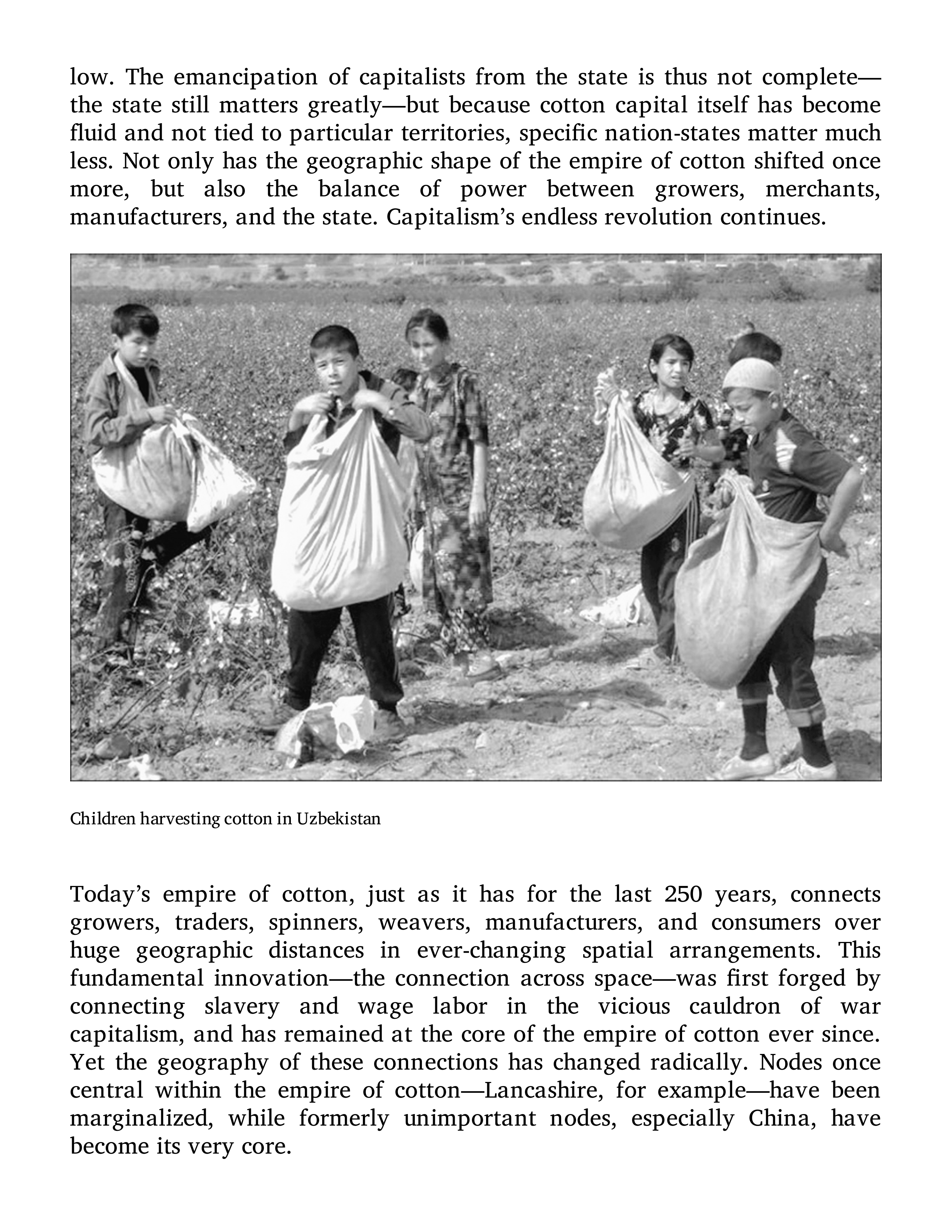
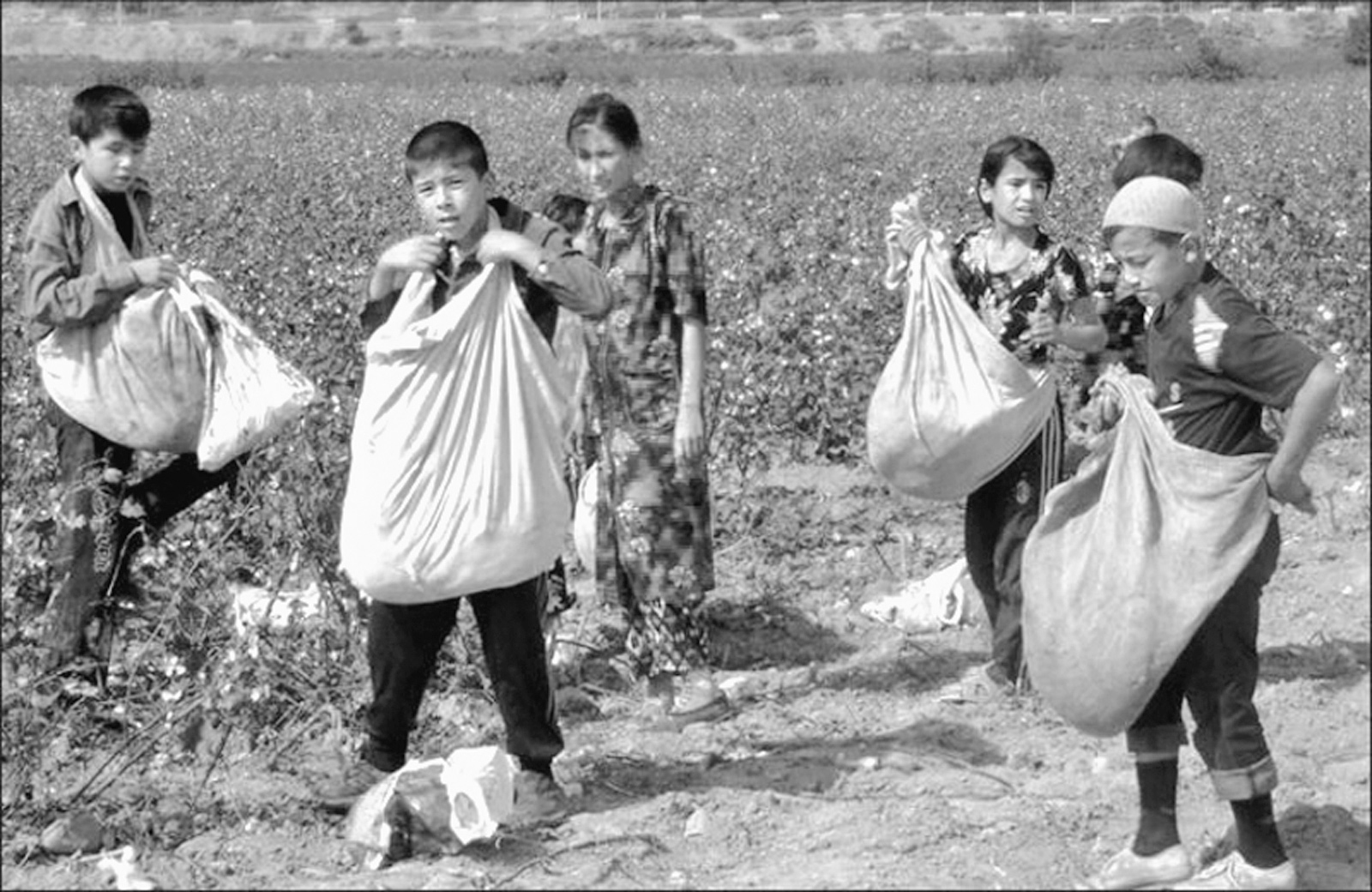
low. The emancipation of capitalists from the state is thus not complete—
the state still matters greatly—but because cotton capital itself has become
ɻuid and not tied to particular territories, speciɹc nation-states matter much
less. Not only has the geographic shape of the empire of cotton shifted once
more, but also the balance of power between growers, merchants,
manufacturers, and the state. Capitalism’s endless revolution continues.
Children harvesting cotton in Uzbekistan
Today’s empire of cotton, just as it has for the last 250 years, connects
growers, traders, spinners, weavers, manufacturers, and consumers over
huge geographic distances in ever-changing spatial arrangements. This
fundamental innovation—the connection across space—was
ɹrst forged by
connecting slavery and wage labor in the vicious cauldron of war
capitalism, and has remained at the core of the empire of cotton ever since.
Yet the geography of these connections has changed radically. Nodes once
central within the empire of cotton—Lancashire, for example—have been
marginalized, while formerly unimportant nodes, especially China, have
become its very core.
The geographical rearrangement of economic relations is not just a
noteworthy element of capitalism or an interesting aspect of its history;
rather the constant shifting recombination of various systems of labor, and
various compositions of capital and polities is the very essence of
capitalism. As capitalists search for ever cheaper labor, better infrastructure,
and greater markets, they combine and recombine the world’s workers and
consumers, and the world’s lands and its raw materials, in ever new ways.
17
In that process, the collective action (or lack thereof) of workers matters a
great deal, as do the policies (or lack thereof) of states. We have seen that
the history of capital and cotton can only be understood if we consider the
history of many di
ʃerent places and groups of people. Looking at just one
part of the empire leads to vast misunderstandings, for example the
characterization of the past
ɹfty years as a world of deindustrialization (as
some European and North American social scientists have described it),
when exactly the opposite is true, as the greatest wave of industrialization
ever has overtaken the globe.
Capitalists, from the Barings of the eighteenth century to the titans of
today’s global retailers, forged many of the connections that created the
world we recognize today. Exploration of this history, however, reveals that
capitalists and states arose hand in hand, each facilitating the ascendancy of
the other. It is easy to assume, in our relentlessly branded world, that
today’s vast corporations exist entirely on their own. Yet such a
simpli
ɹcation misses the reality that, historically, capitalists’ greatest source
of strength was their ability to rely on unusually powerful states—and
simultaneously, for much of capitalism’s history, the greatest weakness of
these same capitalists was that dependence on the state. It was this
dependence that gave workers an opening to improve the conditions of their
labor. We now know that the increasing emancipation of capital from
particular nation-states has dramatic consequences for the world’s workers.
Workers’ successes in improving their conditions almost always lead to the
reallocation of capital. For the last several decades, Walmart and other
retail giants have continually moved their production from one poor country
to a slightly poorer one, lured by the promise of workers even more eager
and even more inexpensive. Even Chinese production is now threatened by
lower-wage producers.
18
The empire of cotton has continued to facilitate a
giant race to the bottom, limited only by the spatial constraints of the
planet.
The constant reshu
ʀing of the empire of cotton, ranging from its
geography to its systems of labor, points toward an essential element of
capitalism: its ability to constantly adapt. Again and again, a seemingly
insurmountable crisis in one part of the empire generated a response
elsewhere; capitalism both demands and creates a state of permanent
revolution.
This permanent revolution is only possible because of the existence of
places and people whose lives can be turned upside down. These frontiers of
capitalism are often to be found in the world’s countryside, and the journey
through the empire of cotton reveals that the global countryside should be at
the center of our thinking about the origins of the modern world. Although
our historical imaginations are usually dominated by cities, factories, and
industrial workers, we have seen that much of the emergence of the modern
world occurred in the countryside—by the often violent turning of rural
people into the creators and consumers of commodities made or used
elsewhere.
This emphasis on the countryside allows for an equally important
emphasis—the importance of coercion and violence to the history of
capitalism. Slavery, colonialism, and forced labor, among other forms of
violence, were not aberrations in the history of capitalism, but were at its
very core. The violence of market making—forcing people to labor in
certain locations and in certain ways—has been a constant throughout the
history of the empire of cotton.
This emphasis calls into question some of the most ingrained insights into
the history of the modern world—for example, conceptualizing the
nineteenth century, as is so often done, as an age of “bourgeois civilization,”
in contrast with the twentieth century, which historian Eric Hobsbawm has
termed the “age of catastrophe.”
19
An assessment such as this can only be
derived from a vision of the world that focuses its moral judgments on
Europe. Looked at from the perspective of much of Asia, Africa, and the
Americas, one can argue just the opposite—that the nineteenth century was
an age of barbarity and catastrophe, as slavery and imperialism devastated
ɹrst one pocket of the globe and then another. It is the twentieth century,
by contrast, that saw the weakening of imperial powers and thus allowed
more of the world’s people to determine their own futures and shake o
ʃ the
shackles of colonial domination. Without its Eurocentric distortions,
decolonialization would be at the very center of the narrative we tell about
the twentieth century—and this retelling would allow us to see that global
capitalism today is most fundamentally shaped by the struggles for
independence. Either way, our journey through the empire of cotton has
shown that civilization and barbarity are linked at the hip, both in the
evolution of the world’s
ɹrst global industry and in the many other
industries that have modeled themselves after it.
Violence and coercion, in turn, are as adaptive as the capitalism they
enable, and they continue to play an important role in the empire of cotton
to this day. Cotton growers are still forced to grow the crop; workers are
still held as virtual prisoners in factories. Moreover, the fruits of their
activities continue to be distributed in radically unequal ways—with cotton
growers in Benin, for example, making a dollar a day or less, while the
owners of cotton growing businesses in the United States have collectively
received government subsidies of more than $35 billion between 1995 and
2010.
20
Workers in Bangladesh stitch together clothing under absurdly
dangerous conditions for very low wages, while consumers in the United
States and Europe can purchase those pieces with abandon, at prices that
often seem impossibly low.
Within this larger story of domination and exploitation, however, sits a
parallel story of liberation and creativity. The unfolding of global
capitalism, and its awesome adaptations during the past 250 years, has
resulted in enormous advances in productivity. As late as the 1950s, it took
sixty days of hard spinning and weaving labor to produce enough clothing
to ful
ɹll the most minimal subsistence needs of a family of ɹve in northern
China. Today, the average American family (albeit at 2.5 persons also
smaller than the Chinese family of the 1950s) spends only 3.4 percent of its
household income on much more ample clothing—that is, the equivalent of
approximately eight days of labor. Agriculture and industry have virtually
exploded, as capitalist social relations have enabled a growth in the
churning out of goods that has never been matched by any other system of
production. Tellingly, today there are expectations that cotton production
will triple or quadruple again by 2050. The human capacity to organize our
e
ʃorts in ever more productive ways should give us hope, the hope that our
unprecedented domination over nature will allow us also the wisdom, the
power, and the strength to create a society that serves the needs of all the
world’s people—an empire of cotton that is not only productive, but also
just. Considering the perpetual clashes of power at the center of cotton’s
story, a just world might seem like an idle dream. Yet, as we have witnessed
in the preceding pages, the least powerful members of cotton’s empire have
consistently tried to create such a world and at times also have succeeded in
e
ʃecting dramatic changes: A world that seems stable and permanent in one
moment can be radically transformed in the next. The capitalist revolution,

after all, perpetually re-creates our world, just as the world’s looms
perpetually manufacture new materials.
21

Acknowledgments
Researching and writing this book in many ways parallels its subject,
involving, as it did, people and documents from all over the world. The
journey was a great adventure. I will never forget the days during the
depths of the Argentine
ɹnancial crisis when I was sitting in the basement
archives of the Banco de la Provincia de Buenos Aires and heard the heavy
metal gates of the bank’s front door go noisily up and down in a predictable
rhythm, to protect the building from demonstrators who passed the bank. I
will never forget the reception room of the National Archives of Cairo,
where I spent many hours sipping tea with its director as he tried to get me
access to early nineteenth-century records that the state deemed too
sensitive to be perused by a historian. I will never forget the moment a
librarian at the Musée de l’Impression sur Eto
ʃes in the French city of
Mulhouse opened the door to a room
ɹlled to the ceiling with eighteenth-
and nineteenth-century cotton textile samples. And I will never forget sitting
in the courtyard of the bar of the Colònia Vidal in the Llobregat valley of
Catalonia in Spain imagining the lives that generations of workers spent in
this company town, serving the needs of a voracious cotton mill.
This book has been researched on every continent and I am grateful to the
librarians and archivists who, under often di
ɽcult circumstances, have
protected the materials on which this book is based and made them
accessible to me. I speci
ɹcally thank those who helped me at the archives of
the Japanese Spinners Association in Osaka, the National Archives of
Australia, the National Archives and Library of Egypt, the rare books
collection at the American University of Cairo, the National Archives of
India, the Nehru Memorial Museum and Library in New Delhi, the
Maharashtra State Archives in Mumbai, the Bombay Chamber of Commerce,
the Bombay Millowners’ Association, the (Bombay) Asia Library, the
Archives nationales d’outre mer in Aix-en-Provence, the Archives Nationales
and the Archives diplomatiques—Quai d’Orsay in Paris, the Société
Industrielle and the Musée de l’Impression sur Eto
ʃes in Mulhouse, the
Volkart Archives in Winterthur, the Chamber of Commerce in Barcelona, the
Bundesarchiv Berlin, the Handelskammer Hamburg, the Handelskammer
Bremen, the Bremer Baumwollbörse, the Staatsarchiv Bremen, the ING
Baring Archives, the National Archives of the United Kingdom in Kew, the
Guildhall Library, the British Library, and the Bank of England Archive in
London, the Manchester Archives and Local Studies, the John R. Rylands
Library, the Greater Manchester County Record O
ɽce, the Liverpool Record
O
ɽce, the library of the University of Liverpool, the Merseyside Maritime
Museum, the Historical Collections at Harvard Business School, Widener
Library, the Massachusetts Historical Society, the New-York Historical
Society, the New York Public Library, the Archivo General de la Nación in
Mexico, the Biblioteca Pedro Sainz de Baranda of Valladolid, the Banco de
Provincia de Buenos Aires, and the Biblioteca Tornquist in Buenos Aires.
Along the way, many research assistants helped me master the materials.
In Canberra, Australia, Lawrence Niewójt assisted me, as did Natsuko Kitani
in Osaka. Amit Mishra supported my work in Delhi, Dr. Abdel-Wahid in
Cairo, Amilcar Challu in Buenos Aires, and Pauline Peretz in Paris. Over the
years, many research assistants also helped me work through what became a
very complicated history, among them, in Cambridge, Rudi Batzell, Par
Cassel, Lui Chang, Jane Chen, Marlee Chong, Eli Cook, Rui Dong, Balraj
Gill, Heather Souvaine Horn, Louis Hyman, Diana Kimball, Noam Maggor,
Maximillian Mason, Paul Mathis, Shaun Nichols, Nathan Pearl-Rosenthal,
Arjun Ramamurti, Leonid Sidorov, Liat Spiro, Luise Tremel, Niki Usher, Ann
Wilson,
Julie
Yen,
and
Jenny
Zhang,
and,
in
Freiburg,
Lukas
Bowinkelmann, Ralf Meindl, Lukas Nemela, and Carsten Vogelpohl. Thank
you to all of you—I could not have done it without your help. And also
thanks to my students at Harvard University, whose never-ending curiosity
helped propel my own.
I also want to thank the people and audiences who engaged with my
work in Sydney, Tokyo, Osaka, Seoul, Hong Kong, New Delhi, Kolkata, Tel
Aviv, Dakar, Leipzig, Jena, Frankfurt, Munich, Linz, Amsterdam, Basel,
Zurich, Geneva, Nottingham, London, Manchester, Brighton, São Paulo, and
Buenos Aires, as well as at universities all over the United States.
Thank you also to Jane Garrett of Alfred A. Knopf for her early
encouragement of this project; to William Kirby at Harvard for his belief in
me; to Shigeru Akita and Takeshi Abe for helping me navigate the resources
available in Osaka; to Jun Furuya for always making me feel welcome in
Tokyo (and helping me navigate the worst earthquake in Japan’s history);
to Babacar Fall and Omar Gueye for their hospitality in Dakar; to Rafael
Marquese for debating the subjects of this book over a delicious meal of

Maranhão cuisine in São Paulo; to Charles Forcey, the world’s foremost
magician of words; to John Killick at Leeds for providing me with some of
his unpublished work; to Gavin Wright for his feedback at an early stage; to
Peter Knight for pointing me to some important sources; to Cyrus Veeser for
his sharp insights; to Julia Seibert in Cairo for helping me understand the
impact of colonialism on African labor regimes; to Mauro and all the Palas
in Alghero for allowing me to write in their good company in a beautiful
part of the world; to my extended family in Liverpool—John, Heather, Ian,
and Andrew McFadzean—who introduced me to the city that like no other
has been synonymous with the history of cotton when they allowed me to
spend summers as a high school student working in their small corner store
selling newspapers and sweets; to Dieter Plehwe in Berlin for our endless
conversation about capitalism, and his friendship; to Christine Desan at
Harvard Law School for having helped make capitalism studies respectable;
to Gilles Palsky in Paris, who helped me get access to some extraordinary
maps about the global cotton trade; to Uta Beckert for her leads on
Mesopotamian cotton; to Neus Santamaria of the Consorci del Parc Fluvial
del Llobregat for helping me understand the extraordinary story of
Catalonian industrialization; to Aditya and Mridula Mukerjee, Prabhu
Mohapatra, and all my friends in New Delhi for including me in their never-
ending conversations on the great inequalities that characterize the world
and India; and to Irfan Habib in New Delhi, Sakae Tsunoya in Sakai, Eric
Foner in New York, Jürgen Osterhammel in Konstanz, and Ibrahima Thioub
in Dakar for engaging with my ideas and for being such inspiring historians.
Last but not least, a special thank-you to my colleague and friend Charles
Maier, whose early encouragement made all the di
ʃerence.
A book such as this needs signi
ɹcant resources to be written and I am
grateful for the good luck of having had access to such resources, a privilege
that very few historians in the world enjoy. A grant from the Kittredge Fund
made the early stages of the research possible. Later, at Harvard, the David
Rockefeller Center for Latin American Studies, the Milton Fund, the Asia
Center, the Reischauer Institute for Japanese Studies, and, especially, the
Weatherhead Center for International A
ʃairs provided urgently needed
resources. I started conceptualizing the book when I spent a year at the
Center for Scholars and Writers at the New York Public Library, and its
director, Peter Gay, created a most inspiring setting for thinking about a
new project and for thinking big. Later the Humboldt Foundation awarded
me a prize that allowed me to dedicate a year to the research of this book,
and still later the Freiburg Institute for Advanced Studies, the American

Council of Learned Societies, and the Weatherhead Center for International
A
ʃairs at Harvard University provided me with time away from teaching to
draft the manuscript. At a moment when support for the humanities and
social sciences is rapidly shrinking I cannot thank these institutions enough
for their belief that understanding how our world turned out the way it did
continues to matter.
When the manuscript was nearly done, a group of friends read some or all
of it and provided valuable feedback, and I thank Elizabeth Blackmar,
Sugata Bose, Vincent Brown, Franz-Josef Brüggemeier, Stanley Engermann,
Eric Foner, Andrew Gordon, Steven Hahn, Noam Maggor, Terry Martin,
Amit Mishra, Roger Owen, Michael Ralph, Seth Rockman, Dan Smail,
Marcel van der Linden, Cyrus Veeser, and John Womack. Their wisdom and
insights made a signi
ɹcant diʃerence, even though I have ignored, at my
peril, some of their advice.
Many people have helped put this manuscript into shape. David
Lobenstine and Martha Schulmann made a heroic e
ʃort to help me edit, and
Victoria Wilson and Audrey Silverman shepherded it expertly through
production.
Most important, however, I want to thank my family. Lisa McGirr was
there from the very beginning, read numerous drafts of every chapter, and
helped me along when things got di
ɽcult. The dedication is a very small
thank-you for all her support. My children, Noah and Pascal, grew up
alongside this book. Only recently did they tell me that discussions on cotton
were such a prominent feature in our house that for many years they had
believed that I was a “professor of cotton.” They will be relieved to see me
move on to something else.
Notes
INTRODUCTION
1.
The Thirty-Ninth Annual Report of the Board of Directors of the Manchester
Chamber of Commerce for the Year 1859
(Manchester: Cave & Sever,
1860), 18, 19, 22, 23, 33, 34, 38, 39, 45.
2.
“Liverpool. By Order of the Liverpool Cotton Association Ltd., Catalogue
of the Valuable Club Furnishings etc. to be Sold by Auction by Marsh
Lyons & Co., Tuesday, 17th December 1963,” Greater Manchester County
Record O
ɽce, Manchester, UK.
3.
“Monthly Economic Letter: U.S. and Global Market Fundamentals,”
Cotton Incorporated
, accessed January 23, 2013,
http://www.cottoninc.com/corporate/Market-
Data/MonthlyEconomicLetter/
; “The Fabric of Our Lives,” accessed July
1, 2012,
http://www.thefabricofourlives.com/
.
4.
The average weight of a sheep
ɻeece in the United States is 7.3 pounds
according to “Fast Facts…About American Wool,” American Sheep
Industry Association, accessed March 10, 2013,
www.sheepusa.org
. The
total weight of the world’s cotton crop was divided by this number to
ɹnd how many sheep it would take to produce the same amount of wool
by weight. Government of South Australia, “Grazing livestock—a
sustainable and productive approach,” Adelaide & Mt Lofty Ranges
Natural Resource Management Board, accessed March 10, 2013,
www.amlrnrm.sa.gov.au/Portals/2/landholders_info/grazing_web.pdf
;
“European Union,” CIA—The World Factbook, accessed March 16, 2013,
https://www.cia.gov/library/publications/the-world-
factbook/geos/ee.html
. According to the
ɹrst source, it was assumed that
one hectare of land can support ten dry sheep, if available for grazing
twelve months of the year. This was used to calculate the area of land
required to sustain 7 billion sheep and then that was compared to the

size of the EU, which is 4,324,782 km
2
according to the CIA World
Factbook.
5.
Edward Baines,
History of the Cotton Manufacture in Great Britain
(London: H. Fisher, R. Fisher, and P. Jackson, 1835), 5–6; see Kenneth
Pomeranz,
The Great Divergence: China, Europe, and the Making of the
Modern World Economy
(Princeton, NJ: Princeton University Press, 2000).
6.
Jared Diamond,
Guns, Germs, and Steel: The Fates of Human Societies
(New York: Norton, 1998); David Landes,
The Wealth and Poverty of
Nations: Why Some Are So Rich and Some So Poor
(New York: Norton,
1998); Niall Ferguson,
The West and the Rest
(New York: Allen Lane,
2011); Robert Brenner, “Agrarian Class Structure and Economic
Development in Pre-industrial Europe,”
Past and Present
no. 70 (February
1976): 30–75; Robert Brenner, “The Agrarian Roots of European
Capitalism,”
Past and Present
, no. 97 (November 1982): 16–113; E. P.
Thompson,
The Making of the English Working Class
(New York: Pantheon,
1963).
7.
There is a vibrant literature on slavery and capitalism, including Eric
Williams,
Capitalism and Slavery
(New York: Russell & Russell, 1961);
Rafael de Bivar Marquese, “As desventuras de um conceito: Capitalismo
histórico e a historiogra
ɹa sobre escravidão brasileira,”
Revista de Historia
169 (July/December 2013), 223–53; Philip McMichael, “Slavery in the
Regime of Wage Labor: Beyond Paternalism in the U.S. Cotton Culture,”
Social Concept
6 (1991): 10–28; Barbara L. Solow and Stanley L.
Engerman,
British Capitalism and Caribbean Slavery: The Legacy of Eric
Williams
(New York: Cambridge University Press, 1987); Gavin Wright,
The Political Economy of the Cotton South: Households, Markets, and Wealth
in the Nineteenth Century
(New York: Norton, 1978); Joseph E. Inikori,
Africans and the Industrial Revolution in England: A Study in International
Trade and Development
(New York: Cambridge University Press, 2002);
Dale Tomich, “The Second Slavery: Mass Slavery, World-Economy, and
Comparative Microhistories,”
Review: A Journal of the Fernand Braudel
Center
31, no. 3 (2008); Robin Blackburn,
The American Crucible: Slavery,
Emancipation and Human Rights
(London: Verso, 2011).
8.
Cotton Supply Reporter
, no. 37 (March 1, 1860): 33.
9.
Andrew Ure,
The Cotton Manufacture of Great Britain Systematically
Investigated, and Illustrated by 150 Original Figures
, vol. 1 (London: Charles
Knight, 1836), 67–68.
10.
Bruno Biedermann, “Die Versorgung der russischen Baumwollindustrie
mit Baumwolle eigener Produktion” (PhD dissertation, University of
Heidelberg, 1907), 4; Edward Atkinson,
Cotton: Articles from the New York
Herald
(Boston: Albert J. Wright, 1877), 4.
11.
E. J. Donnell,
Chronological and Statistical History of Cotton
(New York:
James Sutton & Co., 1872), v.
12.
There exists a vast literature on this topic, including Immanuel
Wallerstein,
The Modern World-System
, vol. 3,
The Second Great Expansion
of the Capitalist World-Economy, 1730–1840s
(San Diego: Academic Press,
1989); Dale W. Tomich,
Slavery in the Circuit of Sugar: Martinique and the
World Economy, 1830–1848
(Baltimore: Johns Hopkins University Press,
1990); Andre Gunder Frank,
ReOrient: Global Economy in the Asian Age
(Berkeley: University of California Press, 1998); Abdoulaye Ly,
La
théorisation de la connexion capitaliste des continents
(Dakar: IFAAN,
1994); John Gallagher and Ronald Robinson, “The Imperialism of Free
Trade,”
Economic History Review
, Second Series, 51 (1953): 1–15; Patrick
Wolfe, “History and Imperialism: A Century of Theory,”
American
Historical Review
102 (April 1997): 388–420.
13.
Baines,
History of the Cotton Manufacture
, 530–31.
14.
See, for example, Gene Dattel,
Cotton and Race in the Making of America:
The Human Costs of Economic Power
(Chicago: Ivan Dee, 2009); Morris de
Camp Crawford,
The Heritage of Cotton: The Fibre of Two Worlds and Many
Ages
(New York: G. P. Putnam’s Sons, 1924).
15.
The global history literature is burgeoning. It is hardly a new invention,
however. Just recall early contributions such as Abdoulaye Ly,
La
Compagnie du Sénégal
(Paris: Présence Africaine, 1958); Marc Bloch,
“Toward a Comparative History of European Societies,” in Frederic
Chapin Lane and Jelle C. Riemersma, eds.,
Enterprise and Secular Change:
Readings in Economic History
(Homewood, IL: R. D. Irwin, 1953);
Williams,
Capitalism and Slavery
; C. L. R. James,
The Black Jacobins
(London: Secker & Warburg, 1938). See also C. A. Bayly,
The Birth of the
Modern World, 1780–1914: Global Connections and Comparisons
(Malden,
MA: Blackwell, 2004); Jürgen Osterhammel,
The Transformation of the
World: A Global History of the Nineteenth Century
(Princeton, NJ:
Princeton University Press, 2014). For overviews of the literature see
Sebastian Conrad,
Globalgeschichte: Eine Einführung
(Munich: Beck, 2013);
Dominic Sachsenmaier,
Global Perspectives in Global History: Theories and
Approaches in a Connected World
(New York: Cambridge University Press,
2011); Sven Beckert and Dominic Sachsenmaier,
Global History Globally
(forthcoming); Bruce Mazlich and Ralph Buultjens,
Conceptualizing Global
History
(Boulder, CO: Westview Press, 1993); Jerry Bentley, “The Task of
World History” (unpublished paper, in author’s possession). See also
Robert C. Allen,
The British Industrial Revolution in Global Perspective
(Cambridge: Cambridge University Press, 2009); Jan Luiten van Zanden,
The Long Road to Industrial Revolution: The European Economy in a Global
Perspective, 1000–1800
(Amsterdam: Brill, 2009) and the excellent work
of Patrick O’Brien, for example, “European Economic Development: The
Contribution of the Periphery,”
Economic History Review
, Second Series,
35 (February 1982): 1–18.
16.
Studies on commodities have been many in recent years. See especially
Sydney Mintz,
Sweetness and Power: The Place of Sugar in Modern History
(New York: Viking, 1985); Mark Kurlansky,
Salt: A World History
(New
York: Walker and Co., 2002); Barbara Freese,
Coal: A Human History
(Cambridge, MA: Perseus, 2003); Pietra Rivoli,
The Travels of a T‑shirt in
the Global Economy: An Economist Examines the Markets, Power and Politics
of World Trade
(Hoboken, NJ: John Wiley & Sons, 2005); Larry
Zuckerman,
The Potato: How the Humble Spud Rescued the Western World
(Boston: Faber & Faber, 1998); Wolfgang Mönningho
ʃ,
King Cotton:
Kulturgeschichte der Baumwolle
(Düsseldorf: Artemis & Winkler, 2006);
Mark Kurlansky,
Cod: A Biography of the Fish That Changed the World
(New York: Walker & Co., 1997); Allan Macfarlane and Gerry Martin,
Glass: A World History
(Chicago: University of Chicago Press, 2002);
Stephen Ya
ʃa,
Big Cotton: How a Humble Fiber Created Fortunes, Wrecked
Civilizations, and Put America on the Map
(New York: Penguin, 2005); Erik
Orsenna,
Voyage aux pays du coton: Petit précis de mondialisation
(Paris:
Fayard, 2006); Iain Gateley,
Tobacco: A Cultural History of How an Exotic
Plant Seduced Civilization
(New York: Grove, 2001); Heinrich Eduard
Jacob,
Ka
ʃee: Die Biographie eines weltwirtschaftlichen Stoʃes
(Munich:
Oekom Verlag, 2006). A beautiful discussion of the “biography of things”
can be found in the 1929 discussion of Sergej Tretjakow, “Die Biographie
des Dings,” in Heiner Boehnke, ed.,
Die Arbeit des Schriftstellers
(Reinbeck: Ro-wolt, 1972), 81–86; more generally on commodities, see
Jens Soentgen, “Geschichten über Sto
ʃe,”
Arbeitsblätter für die
Sachbuchforschung
(October 2005): 1–25; Jennifer Bair, “Global
Capitalism and Commodity Chains: Looking Back, Going Forward,”
Competition and Change
9 (June 2005): 153–80; Immanuel Wallerstein,
Commodity Chains in the World-Economy, 1590–1790
(Binghamton, NY:
Fernand Braudel Center, 2000). A good example for a successfully recast
economic history is William Cronon,
Nature’s Metropolis: Chicago and the
Great West
(New York: Norton, 1991). Good discussions on the rich
historiography on the Industrial Revolution can be found in Inikori,
Africans and the Industrial Revolution in England
, chapter 2; William J.
Ashworth, “The Ghost of Rostow: Science, Culture and the British
Industrial Revolution,”
Historical Science
46 (2008): 249–74. For an
emphasis on the importance of the spatial aspects of capitalism see
David Harvey,
Spaces of Capital: Towards a Critical Geography
(New York:
Routledge, 2001).
CHAPTER ONE: THE RISE OF A GLOBAL COMMODITY
1.
The cotton grown in these towns was most probably
G. hirsutum Palmeri
,
a kind of cotton known to have grown in what is today the Mexican
states of Oaxaca and Guerrero. The description of the plant is from C.
Wayne Smith and J. Tom Cothren, eds.,
Cotton: Origin, History,
Technology, and Production
(New York: John Wiley & Sons, 1999), 11;
Angus Maddison,
The World Economy: A Millennial Perspective
(Paris:
Development Centre of the Organisation for Economic Co-operation and
Development, 2001), 263; Frances F. Berdan, “Cotton in Aztec Mexico:
Production, Distribution and Uses,”
Mexican Studies
3 (1987): 241
ʃ.;
Joseph B. Mountjoy, “Prehispanic Cultural Development Along the
Southern Coast of West Mexico,” in Shirley Goren-stein, ed.,
Greater
Mesoamerica: The Archeology of West and Northwest Mexico
(Salt Lake
City: University of Utah Press, 2000), 106; Donald D. Brandt, “The
Primitive and Modern Economy of the Middle Rio Balsas, Guerrero and
Michoacan,” Eighth American Scienti
ɹc Congress, Section 8, History and
Geography (Washington, DC, 1940), Abstract; for the weight of a bale of
cotton in sixteenth-century Mexico see José Rodríguez Vallejo,
Ixcatl, el
algodón mexicano
(Mexico: Fondo de Cultura Económica, 1976), 64.
2.
K. D. Hake and T. A. Kerby, “Cotton and the Environment,”
Cotton
Production Manual
(UCANR Publications, 1996), 324–27; Frederick
Wilkinson,
The Story of the Cotton Plant
(New York: D. Appleton &
Company, 1899), 39.
3.
There is some (slight) disagreement between Gavin Wright,
The Political
Economy of the Cotton South: Households, Markets, and Wealth in the
Nineteenth Century
(New York: Norton, 1978), 14–15, and Jason Clay,
World Agriculture and the Environment: A Commodity-by-Commodity Guide
to Impacts and Practices
(Washington, DC: Island Press, 2004), 284–87.
4.
Ralf Kittler, Manfred Kaysar, and Mark Stoneking, “Molecular Evolution
of
Pediculus humanus
and the Origin of Clothing,”
Current Biology
13
(August 19, 2003): 1414–15; for a much earlier dating of spinning and
weaving see Eliso Kvabadze et al., “30,000 Year-Old Wild Flax Fibres,”
Science
11 (September 2009): 1359.
5.
Almut Bohnsack,
Spinnen und Weben: Entwicklung von Technik und Arbeit
im Textilgewerbe
(Reinbek: Rowohlt, 1981), 31–32; “Kleidung,” in
Johannes Hoops,
Reallexikon der Germanischen Altertumskunde
, vol. 16
(Berlin: Walter de Gruyter, 2000), 603–25; Mary Schoeser,
World Textiles:
A Concise History
(New York: Thames & Hudson World of Art, 2003), 20;
“Kleidung,” in Max Ebert, ed.,
Reallexikon der Vorgeschichte
, vol. 6
(Berlin: Walter de Gruyter, 1926), 380–94; Harry Bates Brown,
Cotton:
History, Species, Varieties, Morphology, Breeding, Culture, Diseases,
Marketing, and Uses
(New York: McGraw-Hill, 1938), 1.
6.
See for example T. W. Rhys Davids, trans.,
Vinaya Texts
(Oxford:
Clarendon Press, 1885), 168; Georg Buehler, trans.,
The Sacred Laws of
the Âryas
(Oxford: Clarendon Press, 1882), 165, 169, 170; Vijaya
Ramaswamy,
Textiles and Weavers in South India
(New York: Oxford
University Press, 2006), 1, 57; Doran Ross, ed.,
Wrapped in Pride:
Ghanaian Kente and African American Identity
(Los Angeles: UCLA Fowler
Museum of Cultural History, 1998), 77; Frank Goldtooth, as recorded by
Stanley A. Fishler,
In the Beginning: A Navajo Creation Myth
(Salt Lake
City: University of Utah Press, 1953), 16; Aileen O’Bryan,
The Dîné:
Origin Myths of the Navajo Indians
, Smithsonian Institution, Bureau of
American Ethnology, Bulletin 163 (Washington, DC: Government
Printing O
ɽce, 1956), 38; Francesca Bray, “Textile Production and
Gender Roles in China, 1000–1700,”
Chinese Science
12 (1995): 116;
Anthony Winterbourne,
When the Norns Have Spoken: Fate in Germanic
Paganism
(Madison, NJ: Fairleigh Dickinson University Press, 2004), 96.
7.
C. L. Brubaker et al., “The Origin and Domestication of Cotton,” in C.
Wayne Smith and J. Tom Cothren, eds.,
Cotton: Origin, History,
Technology, and Production
(New York: John Wiley & Sons, 1999), 4, 5–6,
12, 17, 22; Wafaa M. Amer and Osama A. Momtaz, “Historic Background
of Egyptian Cotton (2600 BC–AD 1910),”
Archives of Natural History
26
(1999): 219.
8.
Thomas Robson Hay and Hal R. Taylor, “Cotton,” in William Darrach
Halsey and Emanuel Friedman, eds.,
Collier’s Encyclopedia, with
Bibliography and Index
(New York: Macmillan Educational Co., 1981),
387; A. Lucas,
Ancient Egyptian Materials and Industries
, 4th ed., revised by
J. R. Harris (London: Edward Arnold, 1962), 147; Richard H. Meadow,
“The Origins and Spread of Agriculture and Pastoralism in Northwestern
South Asia,” in David R. Harris, ed.,
The Origins and Spread of Agriculture
and Pastoralism in Eurasia
(London: UCL Press, 1996), 396; for a
traditional Indian account of these classics, see S. V. Puntambekar and N.
S. Varadachari,
Hand-Spinning and Hand-Weaving: An Essay
(Ahmedabad:
All India Spinners’ Association, 1926), 1–9; James Mann,
The Cotton
Trade of Great Britain
(London: Simpkin, Marshall & Co., 1860), 1, 2–3;
Brown,
Cotton
, 2; see Herodotus,
The Histories
, ed. A. R. Burn, trans.
Aubrey de Sélincourt, rev. ed., Penguin Classics (Harmonds worth, UK:
Penguin, 1972), 245; Arno S. Pearse,
The Cotton Industry of India, Being
the Report of the Journey to India
(Manchester: Taylor, Garnett, Evans,
1930), 15; J. Forbes Royle,
On the Culture and Commerce of Cotton in India
and Elsewhere: With an Account of the Experiments Made by the Hon. East
India Company up to the Present Time
(London: Smith, Elder & Co., 1851),
116
ʃ.
9.
Brown,
Cotton
, 5; Edward Baines,
History of the Cotton Manufacture in
Great Britain
(London: H. Fisher, R. Fisher, and P. Jackson, 1835), 65–70;
Prasannan Parthasarathi, “Cotton Textiles in the Indian Subcontinent,
1200–1800,” in Giorgio Riello and Prasannan Parthasarathi, eds.,
The
Spinning World: A Global History of Cotton Textiles, 1200–1850
(New York:
Oxford University Press, 2009), 23–25.
10.
H. Wescher, “Die Baumwolle im Altertum,” in
Ciba-Rundschau
45 (June
1940): 1635; Alwin Oppel,
Die Baumwolle
(Leipzig: Duncker & Humblot,
1902), 206–7; Clinton G. Gilroy,
The History of Silk, Cotton, Linen, Wool,
and Other Fibrous Substances
(New York: Harper & Brothers, 1845), 334;
Marco Polo,
Travels of Marco Polo
(Westminster, MD: Modern Library,
2001), 174; Baines,
History of the Cotton Manufacture
, 56, 58.
11.
A. G. Hopkins,
An Economic History of West Africa
(New York: Columbia
University Press, 1973), 48; M. D. C. Crawford,
The Heritage of Cotton:
The Fibre of Two Worlds and Many Ages
(New York: G. P. Putnam’s Sons,
1924), 46; Amer and Momtaz, “Historic Background,” 212; Oppel,
Die
Baumwolle
, 209; William H. Prescott,
History of the Conquest of Peru
(Westminster, MD: Modern Library, 2000), 51, 108, 300.
12.
Gilroy,
History of Silk
, 331–32; Smith and Hirth, “Development of
Prehispanic Cotton-Spinning,” 353; Barbara L. Stark, Lynette Heller, and
Michael A. Ohnersorgen, “People with Cloth: Mesoamerican Economic
Change from the Perspective of Cotton in South-Central Veracruz,”
Latin
American Antiquity
9 (March 1978): 9, 25, 27; Crawford,
Heritage
, 32, 35;
Smith and Hirth, “Development of Prehispanic Cotton-Spinning,” 355;
Barbara Ann Hall, “Spindle Whorls and Cotton Production at Middle
Classic Matacapan and in the Gulf Lowlands,” in Barbara L. Stark and
Philip J. Arnold III, eds.,
Olmec to Aztec: Settlement Patterns in the Ancient
Gulf Lowlands
(Tucson: University of Arizona Press, 1997), 117, 133, 134.
13.
Juan de Villagutierre Soto-Mayor,
History of the Conquest of the Province
of the Itza
, 1st English edition, translated from the 2nd Spanish edition by
Robert D. Wood (Culver City, CA: Labyrinthos, 1983), 197; Berdan,
“Cotton in Aztec Mexico,” 235–38, 239; Smith and Hirth, “Development
of Prehispanic Cotton-Spinning,” 356; R. B. Handy, “History and General
Statistics of Cotton,” in
The Cotton Plant: Its History, Botany, Chemistry,
Culture, Enemies, and Uses
, prepared under the supervision of A. C. True,
United States Department of Agriculture, O
ɽce of Experiment Stations,
Bulletin 33 (Washington, DC: Government Printing O
ɽce, 1896), 63;
United States,
Historical Statistics of the United States, Colonial Times to
1970
, vol. 1 (Washington, DC: U.S. Dept. of Commerce, Bureau of the
Census, 1975), Series K-550–563, “Hay, Cotton, Cottonseed, Shorn Wool,
and Tobacco—Acreage, Production, and Price: 1790 to 1970,” 518; Hall,
“Spindle Whorls,” 118; Stark, Heller, and Ohnersorgen, “People with
Cloth,” 14, 29.
14.
Brown,
Cotton
, 14; Kate Peck Kent,
Prehistoric Textiles of the Southwest
(Santa Fe, NM: School of American Research Press, 1983), 9, 27, 28, 29;
the quote about blankets is from Ward Alan Minge, “E
ʃectos del Pais: A
History of Weaving Along the Rio Grande,” in Nora Fisher, ed.,
Rio
Grande Textiles
(Santa Fe: Museum of New Mexico Press, 1994), 6; Kate
Peck Kent,
Pueblo Indian Textiles: A Living Tradition
(Santa Fe, NM: School
of American Research Press, 1983), 26; Crawford,
Heritage
, 37; David
Watts,
The West Indies: Patterns of Development, Culture and Environmental
Change Since 1492
(Cambridge: Cambridge University Press, 1990), 65,
89, 174; Mann,
Cotton Trade
, 4; Christopher Columbus,
The Diario of
Christopher Columbus’s
ɹrst voyage to America: 1492–1493
, abstracted by
Fray Bartolomé de las Casas, transcribed and translated into English,
with notes and a concordance of the Spanish, by Oliver Dunn and James
E. Kelley Jr. (Norman: University of Oklahoma Press, 1989), 131–35; see
entries of October 16, November 3, and November 5, 1492, 85–91, 131,
135.
15.
Pliny the Elder,
The Natural History of Pliny
, vol. 4, trans. John Bostock
and H. T. Riley (London: Henry G. Bohn, 1856), 134–35; Mann,
Cotton
Trade
, 3; Christopher Ehret,
The Civilizations of Africa: A History to 1800
(Charlottesville: University Press of Virginia, 2002), 67–68; Ross,
Wrapped in Pride
, 75; Lars Sundström,
The Trade of Guinea
(Lund: Hakan
Ohlssons Boktryckeri, 1965), 148; F. L. Gri
ɽth and G. M. Crowfoot, “On
the Early Use of Cotton in the Nile Valley,”
Journal of Egyptian Archeology
20 (1934): 7; Amer and Momtaz, “Historic Background,” 212, 214, 215,
217.
16.
M. Kouame Aka, “Production et circulation des cotonnades en Afrique de
l’Ouest du XIème siècle a la
ɹn de la conquette coloniale (1921)” (PhD
dissertation, Université de Cocody-Abidjan, 2013), 18, 41; Marion
Johnson, “Technology, Competition, and African Crafts,” in Clive Dewey
and A. G. Hopkins, eds.,
The Imperial Impact: Studies in the Economic
History of Africa and India
(London: Athlone Press, 1978), 176, 195, 201;
Venice Lamb and Judy Holmes,
Nigerian Weaving
(Roxford: H. A. & V. M.
Lamb, 1980), 15, 16; Marion Johnson, “Cloth Strips and History,”
West
African Journal of Archaeology
7 (1977): 169; Philip D. Curtin,
Economic
Change in Precolonial Africa: Senegambia in the Era of the Slave Trade
(Madison: University of Wisconsin Press, 1975), 48; Marion Johnson,
“Cloth as Money: The Cloth Strip Currencies of Africa,” in Dale Idiens
and K. G. Pointing,
Textiles of Africa
(Bath: Pasold Research Fund, 1980),
201. Patricia Davison and Patrick Harries, “Cotton Weaving in South-
east Africa: Its History and Technology,” in Idiens and Pointing,
Textiles
of Africa
, 177, 179, 180; Marie Philiponeau,
Le coton et l’Islam: Fil d’une
histoire africaine
(Algiers: Casbah Editions, 2009), 15, 17; Ross,
Wrapped
in Pride
, 75; Rita Bolland,
Tellem Textiles: Archaeological Finds from Burial
Caves in Mali’s Bandiagara Cli
ʃ
(Leiden: Rijksmuseum voor Volkenkunde,
1991); Leo Africanus,
The History and Description of Africa and of the
Notable Things Therein Contained, Done in the English in the Year 1600 by
John Pory
, vol. 3 (London: Hakluyt Society, 1896), 823, 824.
17.
For the notion of the multiple origins of cotton and its domestication see
Meadow, “Origins,” 397.
18.
Brown,
Cotton
, 8; Maureen Fennell Mazzaoui,
The Italian Cotton Industry
in the Later Middle Ages, 1100–1600
(Cambridge: Cambridge University
Press, 1981), 11, 15, 17–18; Lucas,
Ancient Egyptian Materials
, 148;
Hartmut Schmoekel,
Ur, Assur und Babylon: Drei Jahrtausende im
Zweistromland
(Stuttgart: Gustav Klipper Verlag, 1958), 131; Baines,
History of the Cotton Manufacture
, 27; Richard W. Bulliet,
Cotton, Climate,
and Camels in Early Islamic Iran: A Moment in World History
(New York:
Columbia University Press, 2009), 1, 8, 46; Marco Polo,
Travels
, 22, 26,
36, 54, 58, 59, 60, 174, 247, 253, 255.
19.
Chao Kuo-Chun,
Agrarian Policy of the Chinese Communist Party, 1921–
1959
(Westport, CT: Greenwood Press, 1977), 5, 8
ʃ.
20.
Craig Dietrich, “Cotton Culture and Manufacture in Early Ch’ing China,”
in W. E. Willmott, ed.,
Economic Organization in Chinese Society
(Stanford,
CA: Stanford University Press, 1972), 111
ʃ.; Mi Chü Wiens, “Cotton
Textile Production and Rural Social Transformation in Early Modern
China,”
Journal of the Institute of Chinese Studies of the Chinese University
of Hong Kong
7 (December 1974): 516–19; Frederick W. Mote and Denis
Twitchett, eds.,
The Cambridge History of China
, vol. 7,
The Ming Dynasty,
1368–1644
, part 1 (New York: Cambridge University Press, 1998), 256,
507; Kenneth Pomeranz, “Beyond the East-West Binary: Resituating
Development Paths in the Eighteenth-Century World,”
Journal of Asian
Studies
61 (May 2002): 569; United States,
Historical Statistics
, 518.
21.
Anthony Reid,
Southeast Asia in the Age of Commerce, 1450–1680
, vol. 1,
The Lands Below the Winds
(New Haven, CT: Yale University Press,
1988), 90; Crawford,
Heritage
, 7; William B. Hauser,
Economic Institutional
Change in Tokugawa Japan: Osaka and the Kinai Cotton Trade
(Cambridge:
Cambridge University Press, 1974), 117–20; Mikio Sumiya and Koji
Taira, eds.,
An Outline of Japanese Economic History, 1603–1940: Major
Works and Research Findings
(Tokyo: University of Tokyo Press, 1979),
99–100.
22.
Stark, Heller, and Ohnersorgen, “People with Cloth,” 10, 29; Howard F.
Cline, “The Spirit of Enterprise in Yucatan,” in Lewis Hanke, ed.,
History
of Latin American Civilization
, vol. 2 (London: Methuen, 1969), 137;
Johnson, “Technology,” 259; Thomas J. Bassett,
The Peasant Cotton
Revolution in West Africa: Côte d’Ivoire, 1880–1995
(New York: Cambridge
University Press, 2001), 33; James Forbes,
Oriental Memoirs: A Narrative
of Seventeen Years Residence in India
, vol. 2 (London: Richard Bentley,
1834), 34; Moritz Schanz, “Die Baumwolle in Russisch-Asien,”
Beihefte
zum Tropenp
ɻanzer
15 (1914): 2; on Korea see Tozaburo Tsukida,
Kankoku ni okeru mensaku chosa
(Tokyo: No-shomu sho noji shikenjyo,
1905), 1–3, 76–83.
23.
Oppel,
Die Baumwolle
, 201; Berdan, “Cotton in Aztec Mexico,” 241; Hall,
“Spindle Whorls,” 120; Sundström,
Trade of Guinea
, 147; Curtin,
Economic
Change
, 50, 212; Brown,
Cotton
, 8; Reid,
Southeast Asia
, 93; Gilroy,
History of Silk
, 339; Carla M. Sinopoli,
The Political Economy of Craft
Production: Crafting Empire in South India, c. 1350–1650
(Cambridge:
Cambridge University Press, 2003), 185; A. Campbell, “Notes on the
State of the Arts of Cotton Spinning, Weaving, Printing and Dyeing in
Nepal,”
Journal of the Asiatic Society of Bengal
(Calcutta) 5 (January to
December 1836): 222.
24.
Hall, “Spindle Whorls,” 115, 116, 120, 122, 124; Davison and Harries,
“Cotton Weaving,” 182; Oppel,
Die Baumwolle
, 209; Prescott,
Conquest of
Peru
, 51; Gilroy,
History of Silk
, 339, 343; Curtin,
Economic Change
, 213;
Kent,
Prehistoric Textiles
, 35; Kent,
Pueblo Indian
, 28; Reid,
Southeast Asia
,
93; Sundström,
Trade of Guinea
, 148–49; Lamb and Holmes,
Nigerian
Weaving
, 10–11; Johnson, “Technology,” 261.
25.
Reid,
Southeast Asia
, 94.
26.
Berdan, “Cotton in Aztec Mexico,” 242, 259; Mote and Twitchett,
Ming
Dynasty
, 507, 690
ʃ.; K. N. Chaudhuri, “The Organisation and Structure of
Textile Production in India,” in Tirthankar Roy, ed.,
Cloth and Commerce:
Textiles in Colonial India
(Waltnut Creek, CA: AltaMira Press, 1996), 71;
Wiens, “Cotton Textile,” 520; Sinopoli,
Political Economy
, 177.
27.
Berdan, “Cotton in Aztec Mexico,” 242; Bray, “Textile Production,” 119;
Sundström,
Trade of Guinea
, 162; Curtin,
Economic Change
, 212; Davison
and Harries, “Cotton Weaving,” 187; Johnson, “Cloth as Money,” 193–
202; Reid,
Southeast Asia
, 90; Sundström,
Trade of Guinea
, 164; Stark,
Heller, and Ohnersorgen, “People with Cloth,” 9.
28.
Smith and Hirth, “Development of Prehispanic Cotton-Spinning,” 356;
Bulliet,
Cotton, Climate, and Camels
, 46, 59; Philiponeau,
Coton et l’Islam
,
25; Pedro Machado, “Awash in a Sea of Cloth: Gujarat, Africa and the
Western Indian Ocean Trade, 1300–1800,” in Riello and Parthasarathi,
eds.,
The Spinning World
, 161–79; the importance of traders’ distance
from the polities they originated from is also emphasized by Gil J. Stein,
Rethinking World-Systems: Diasporas, Colonies, and Interaction in Uruk
Mesopotamia
(Tucson: University of Arizona Press, 1999), 173.
29.
See Hall, “Spindle Whorls,” 115; Stark, Heller, and Ohnersorgen, “People
with Cloth,” 9; Berdan, “Cotton in Aztec Mexico,” 247
ʃ., 258; Kent,
Prehistoric Textiles
, 28; Volney H. Jones, “A Summary of Data on
Aboriginal Cotton of the Southwest,”
University of New Mexico Bulletin,
Symposium on Prehistoric Agriculture
, vol. 296 (October 15, 1936), 60;
Reid,
Southeast Asia
, 91; Sundström,
Trade of Guinea
, 147; Bassett,
Peasant
Cotton
, 34; Curtin,
Economic Change
, 212–13; Halil Inalcik, “The Ottoman
State: Economy and Society, 1300–1600,” in Halil Inalcik and Donald
Quataert, eds.,
An Economic and Social History of the Ottoman Empire,
1300–1914
(Cambridge: Cambridge University Press, 1994), 296; Hauser,
Economic Institutional Change
, 59.
30.
Sundström,
Trade of Guinea
, 156, 157; Ramaswamy,
Textiles
, 25, 70–72;
Chaudhuri, “Organisation,” 55; Inalcik, “Ottoman State,” 352; Mann,
Cotton Trade
, 2–3, 23; Smith and Cothren,
Cotton
, 68–69; Baines,
History
of the Cotton Manufacture
, 24, 76; Wescher, “Die Baumwolle,” 1639;
Gilroy,
History of Silk
, 321; John Peter Wild and Felicity Wild, “Rome and
India: Early Indian Cotton Textiles from Berenike, Red Sea Coast of
Egypt,” in Ruth Barnes, ed.,
Textiles in Indian Ocean Societies
(New York:
Routledge, 2005), 11–16; Surendra Gopal,
Commerce and Crafts in
Gujarat, 16th and 17th Centuries: A Study in the Impact of European
Expansion on Precapitalist Economy
(New Delhi: People’s Publishing House,
1975), 3; the quote on the Indo-Levant trade is in Inalcik, “Ottoman
State,” 355, see also 350, 354, 355; Eliyahu Ashtor, “The Venetian Cotton
Trade in Syria in the Later Middle Ages,”
Studi Medievali
, ser. 3, vol. 17
(1976): 690; Suraiya Faroqhi, “Crisis and Change, 1590–1699,” in Inalcik
and Quataert, eds.,
An Economic and Social History of the Ottoman Empire
,
524; Eugen Wirt, “Aleppo im 19. Jahrhundert,” in Hans Geord Majer,
ed.,
Osmanische Studien zur Wirtschafts- und Sozialgeschichte
(Wiesbaden:
Otto Harrassowitz, 1986), 186–205; Sinopoli,
Political Economy
, 179.
31.
Crawford,
Heritage
, 6, 69; Reid,
Southeast Asia
, 90, 95; in Sinnappah
Arasaratnam and Aniruddha Ray,
Masulipatnam and Cambay: A History of
Two Port-Towns, 1500–1800
(New Delhi: Munshiram Manoharlal
Publishers, 1994), 121; for some informative maps on Gujarat’s overseas
trade as well as its domestic trade during this period, see Gopal,
Commerce and Crafts
, 16, 80, 160; Mazzaoui,
Italian Cotton
, 9–11; Beverly
Lemire, “Revising the Historical Narrative: India, Europe, and the Cotton
Trade, c. 1300–1800,” in Riello and Parthasarathi, eds.,
The Spinning
World
, 226.
32.
B. C. Allen,
Eastern Bengal District Gazetteers: Dacca
(Allahabad: Pioneer
Press, 1912), 106; Sinopoli,
Political Economy
, 186; Baines,
History of the
Cotton Manufacture
, 75; Ramaswamy,
Textiles
, 44, 53, 55; Wiens, “Cotton
Textile,” 522, 528; Yueksel Duman, “Notables, Textiles and Copper in
Ottoman Tokat, 1750–1840” (PhD dissertation, State University of New
York at Binghamton, 1998); Mazzaoui,
Italian Cotton
, 22; Max Freiherr
von Oppenheim,
Der Tell Halaf: Eine neue Kultur im ältesten Mesopotamien
(Leipzig: Brockhaus, 1931), 70; Sundström,
Trade of Guinea
, 147; Lamb
and Holmes,
Nigerian Weaving
, 10; Curtin,
Economic Change
, 48; Aka,
Production
, 69; Youssoupha Mbargane Guissé, “Ecrire l’histoire
économique des artisans et createurs de l’Afrique de l’Ouest”
(presentation, Université Cheikh Anta Diop, Dakar, Senegal, December
2011); Hauser,
Economic Institutional Change
, 20–30.
33.
Chaudhuri, “Organisation,” 49, 51, 53; Hameeda Hossain, “The
Alienation of Weavers: Impact of the Con
ɻict Between the Revenue and
Commercial Interests of the East India Company, 1750–1800,” in Roy,
ed.,
Cloth and Commerce
, 117; Suraiya Faroqhi, “Notes on the Production
of Cotton and Cotton Cloth in Sixteenth- and Seventeenth-Century
Anatolia,” in Huri Islamoglu-Inan, ed.,
The Ottoman Empire and the
World-Economy
(New York: Cambridge University Press, 1987), 267, 268;
Inalcik, “Ottoman State”; Huri Islamoglu-Inan,
State and Peasant in the
Ottoman Empire: Agrarian Power Relations and Regional Economic
Development in Ottoman Anatolia During the Sixteenth Century
(Leiden: E.
J. Brill, 1994), 223, 235; Socrates D. Petmezas, “Patterns of
Protoindustrialization in the Ottoman Empire: The Case of Eastern
Thessaly, ca. 1750–1860,”
Journal of European Economic History
(1991):
589; Prasannan Parthasarathi, “Merchants and the Rise of Colonialism,”
in Burton Stein and Sanjay Subrahmanyam, eds.,
Institutions and
Economic Change in South Asia
(Delhi: Oxford University Press, 1996), 96,
98; S. Arasaratnam, “Weavers, Merchants and Company: The Handloom
Industry in Southeastern India, 1750–90,” in Roy, ed.,
Cloth and
Commerce
, 87; Bray, “Textile Production,” 127.
34.
Smith and Hirth, “Development of Prehispanic Cotton-Spinning,” 349;
Angela Lakwete,
Inventing the Cotton Gin: Machine and Myth in Antebellum
America
(Baltimore: John Hopkins University Press, 2005), 11–12;
Mazzaoui,
Italian Cotton
, 74–82, 89; Smith and Hirth, “Development of
Prehispanic Cotton-Spinning,” 354–55; John H. A. Munro,
Textiles,
Towns and Trade: Essays in the Economic History of Late-Medieval England
and the Low Countries
(Brook
ɹeld, VT: Variorum, 1994), 8, 15; Maureen
Fennell Mazzaoui, “The Cotton Industry of Northern Italy in the Late
Middle Ages, 1150–1450,”
Journal of Economic History
32 (1972): 274.
35.
Alan L. Olmstead and Paul W. Rhode,
Creating Abundance: Biological
Innovation and American Agricultural Development
(New York: Cambridge
University Press, 2008), 108–9; John Hebron Moore, “Cotton Breeding in
the Old South,”
Agricultural History
30, no. 3 (July 1956): 95–104; John
Hebron Moore,
Agriculture in Ante-Bellum Mississippi
(New York: Bookman
Associates, 1958), 13–36, 97; Lewis Cecil Gray,
History of Agriculture in
the Southern United States to 1860
, vol. 2 (Washington, DC: Carnegie
Institution of Washington, 1933), 689–90; James Lawrence Watkins,
King
Cotton: A Historical and Statistical Review, 1790 to 1908
(New York: J. L.
Watkins, 1908), 13; Bassett,
Peasant Cotton
, 33; Mazzaoui,
Italian Cotton
,
20–21; Bulliet,
Cotton, Climate, and Camels
, 40; Chaudhuri,
“Organisation,” 75.
36.
Mahatma Gandhi,
The Indian Cotton Textile Industry: Its Past, Present and
Future
(Calcutta: G. N. Mitra, 1930), 6.
37.
As quoted in Henry Lee,
The Vegetable Lamb of Tartary: A Curious Fable of
the Cotton Plant
(London: Sampson Low, Marston, Searle, & Rivington,
1887), 5.
38.
Mann,
Cotton Trade
, 5; Oppel,
Die Baumwolle
, 39; see also exhibits at
Museu Tèxtil i d’Indumentària, Barcelona, Spain.
39.
That the Crusades were crucial to the introduction of the cotton textile
industry into Europe is con
ɹrmed by “Baumwolle,” entry in
Lexikon des
Mittelalters
, vol. 1 (Munich: Artemis Verlag, 1980), 1670.
40.
Alfred P. Wadsworth and Julia De Lacy Mann,
The Cotton Trade and
Industrial Lancashire, 1600–1780
(Manchester: Manchester University
Press, 1931), 15; Mazzaoui, “Cotton Industry,” 263; Ashtor, “Venetian
Cotton,” 677.
41.
During the twelfth century, cotton manufacturing arose in places such as
southern France, Catalonia, and, most signi
ɹcantly, northern Italy. See
Mazzaoui, “Cotton Industry,” 268; Wescher, “Die Baumwolle,” 1643,
1644; Mazzaoui,
Italian Cotton
, 114.
42.
Mazzaoui,
Italian Cotton
, 64, 66, 69; Mazzaoui, “Cotton Industry,” 271,
273, 276; Wescher, “Die Baumwolle,” 1643.
43.
Mazzaoui,
Italian Cotton
, 7, 29, 63; Mazzaoui, “Cotton Industry,” 265.
44.
Mazzaoui,
Italian Cotton
, 53; Ashtor, “Venetian Cotton,” 675, 676, 697;
Mazzaoui,
Italian Cotton
, 35.
45.
Mazzaoui,
Italian Cotton
, 65–66, 74–82, 89; Lakwete,
Inventing the Cotton
Gin
, 11–12; Mazzaoui, “Cotton Industry,” 274, 275; Bohnsack,
Spinnen
und Weben
, 65–66, 37, 63, 67, 114, 115; Karl-Heinz Ludwig, “Spinnen im
Mittelalter unter besonderer Berücksichtigung der Arbeiten‚ cum rota,”
Technikgeschichte
57 (1990): 78; Eric Broudy,
The Book of Looms: A History
of the Handloom from Ancient Times to the Present
(Hanover, NH: Brown
University Press, 1979), 102; Munro,
Textiles
, 8, 15.
46.
Mazzaoui,
Italian Cotton
, xi, 29.
47.
Mazzaoui,
Italian Cotton
, 139, 144, 150, 152; Mazzaoui, “Cotton
Industry,” 282, 284; Wolfgang von Stromer,
Die Gründung der
Baumwollindustrie in Mitteleuropa
(Stuttgart: Hiersemann, 1978), 84–86;
Eugen Nübling,
Ulms Baumwollweberei im Mittelalter
(Leipzig: Duncker &
Humblot, 1890), 146.
48.
Von Stromer,
Die Gründung
, 32; Götz Freiherr von Poelnitz,
Die Fugger
(Tübingen: J. C. B. Mohr, 1981); Richard Ehrenberg,
Capital and Finance
in the Age of the Renaissance: A Study of the Fuggers and Their Connections
,
trans. H. M. Lucas (New York: Harcourt, 1928).
49.
Von Stromer,
Die Gründung
, 1, 2, 8, 21, 128, 139, 148; Nübling,
Ulms
Baumwollweberei
, 141; Bohnsack,
Spinnen und Weben
, 152.
50.
Mazzaoui,
Italian Cotton
, 141; Von Stromer,
Die Gründung
, 88.
51.
Mazzaoui,
Italian Cotton
, 55, 54, 154; Wadsworth and Mann,
Cotton
Trade
, 23; Inalcik, “Ottoman State,” 365; Daniel Go
ʃman, “Izmir: From
Village to Colonial Port City,” in Edhem Eldem, Daniel Go
ʃman, and
Bruce Masters, eds.,
The Ottoman City Between East and West: Aleppo,
Izmir, and Istanbul
(Cambridge: Cambridge University Press, 1999), 79–
134.
52.
Nübling,
Ulms Baumwollweberei
, 166.
CHAPTER TWO: BUILDING WAR CAPITALISM
1.
I am using the term “network” here instead of “system” or “world
system” because I want to emphasize the continued importance of local
distributions of social, economic, and political power to shaping the
nature of the connections between various parts of the world. In this I
am inspired by Gil J. Stein,
Rethinking World-Systems: Diasporas, Colonies,
and Interaction in Uruk Mesopotamia
(Tucson: University of Arizona Press,
1999), especially 171.
2.
Om Prakash,
The New Cambridge History of India
, vol. 2,
European
Commercial Enterprise in Pre-Colonial India
(Cambridge: Cambridge
University Press, 1998), 23; Surendra Gopal,
Commerce and Crafts in
Gujarat, 16th and 17th Centuries: A Study in the Impact of European
Expansion on Precapitalist Economy
(New Delhi: People’s Publishing House,
1975), 10–11, 18, 26, 28, 58.
3.
Céline Cousquer,
Nantes: Une capitale française des Indiennes au XVIIIe
siècle
(Nantes: Coi
ʃard Editions, 2002), 17.
4.
Sinnappah Arasaratnam, “Weavers, Merchants and Company: The
Handloom Industry in Southeastern India, 1750–90,” in Tirthankar Roy,
ed.,
Cloth and Commerce: Textiles in Colonial India
(Walnut Creek, CA:
AltaMira Press, 1996), 90; James Mann,
The Cotton Trade of Great Britain
(London: Simpkin, Marshall & Co., 1860), 2; Walter R. Cassels,
Cotton:
An Account of Its Culture in the Bombay Presidency
(Bombay: Bombay
Education Society’s Press, 1862), 77; Beverly Lemire,
Fashion’s Favourite:
The Cotton Trade and the Consumer in Britain, 1660–1800
(Oxford: Pasold
Research Fund, 1991), 15; Hameeda Hossain,
The Company Weavers of
Bengal: The East India Company and the Organization of Textile Production
in Bengal, 1750–1813
(Delhi: Oxford University Press, 1988), 65;
Proceeding, Bombay Castle, November 10, 1776, in Bombay Commercial
Proceedings, P/414, 47, Oriental and India O
ɽce Collections, British
Library, London; Stephen Broadberry and Bishnupriya Gupta, “Cotton
Textiles and the Great Divergence: Lancashire, India and Shifting
Competitive Advantage, 1600–1850,” CEPR Discussion Paper No. 5183,
London, Centre for Economic Policy Research, August 2005, Table 3, p.
32; Daniel Defoe and John McVeagh,
A Review of the State of the British
Nation
, vol. 4,
1707–08
(London: Pickering & Chatto, 2006), 606.
5.
See for example Factory Records, Dacca, 1779, Record Group G 15, col.
21 (1779), in Oriental and India O
ɽce Collections, British Library,
London; John Irwin and P. R. Schwartz,
Studies in Indo-European Textile
History
(Ahmedabad: Calico Museum of Textiles, 1966).
6.
K. N. Chaudhuri, “European Trade with India,” in
The Cambridge
Economic History of India
, vol. 1,
c. 1200–c. 1750
(Cambridge: Cambridge
University Press, 1982), 405–6; Arasaratnam, “Weavers, Merchants and
Company,” 92, 94; Copy of the Petition of Dadabo Monackjee,
Contractor for the Investment anno 1779, in Factory Records, G 36
(Surat), 58, Oriental and India O
ɽce Collections, British Library,
London; Cousquer,
Nantes
, 31.
7.
Hameeda Hossain, “The Alienation of Weavers: Impact of the Con
ɻict
Between the Revenue and Commercial Interests of the East India
Company, 1750–1800,” in Roy, ed.,
Cloth and Commerce
, 119, 117; Atul
Chandra Pradhan, “British Trade in Cotton Goods and the Decline of the
Cotton Industry in Orissa,” in Nihar Ranjan Patnaik, ed.,
Economic
History of Orissa
(New Delhi: Indus Publishing Co., 1997), 244;
Arasaratnam, “Weavers, Merchants and Company,” 90; Shantha
Hariharan,
Cotton Textiles and Corporate Buyers in Cottonopolis: A Study of
Purchases and Prices in Gujarat, 1600–1800
(Delhi: Manak Publications,
2002), 49.
8.
Memorandum of the Method of Providing Cloth at Dacca, 1676, in
Factory Records, Miscellaneous, vol. 26, Oriental and India O
ɽce
Collections, British Library, London.
9.
Minutes of the Commercial Proceedings at Bombay Castle, April 15,
1800, in Minutes of Commercial Proceedings at Bombay Castle from
April 15, 1800, to December 31, 1800, in Bombay Commercial
Proceedings, P/414, Box 66, Oriental and India O
ɽce Collections, British
Library, London; Copy of the Petition of Dadabo Monackjee, 1779,
Factory Records Surat, 1780, Box 58, record G 36 (Surat), Oriental and
India O
ɽce Collections, British Library; Report of John Taylor on the
Cotton Textiles of Dacca, Home Miscellaneous Series, 456, p. 91,
Oriental and India O
ɽce Collections, British Library; Lakshmi
Subramanian,
Indigenous Capital and Imperial Expansion: Bombay, Surat
and the West Coast
(Delhi: Oxford University Press, 1996), 15.
10.
John Styles, “What Were Cottons for in the Early Industrial Revolution?”
in Giorgio Riello and Prasannan Parthasarathi, eds.,
The Spinning World:
A Global History of Cotton Textiles, 1200–1850
(New York: Oxford
University Press, 2009), 307–26; Halil Inalcik, “The Ottoman State:
Economy and Society, 1300–1600,” in Halil Inalcik and Donald Quataert,
eds.,
An Economic and Social History of the Ottoman Empire, 1300–1914
(Cambridge: Cambridge University Press, 1994), 354; Pedro Machado,
“Awash in a Sea of Cloth: Gujarat, Africa and the Western Indian Ocean
Trade, 1300– 1800,” in Riello and Parthasarasi,
The Spinning World
, 169;
Subramanian,
Indigenous Capital
, 4.
11.
Maureen Fennell Mazzaoui,
The Italian Cotton Industry in the Later Middle
Ages, 1100–1600
(Cambridge: Cambridge University Press, 1981), 157.
12.
“Assessing the Slave Trade,” The Trans-Atlantic Slave Trade Database,
accessed April 5, 2013,
http://www.slavevoyages.org/tast/assessment/estimates.faces
.
13.
David Richardson, “West African Consumption Patterns and Their
In
ɻuence on the Eighteenth-Century English Slave Trade,” in Henry A.
Gemery and Jan S. Hogendorn, eds.,
The Uncommon Market: Essays in the
Economic History of the Atlantic Slave Trade
(New York: Academic Press,
1979), 304; Joseph C. Miller, “Imports at Luanda, Angola 1785–1823,” in
G. Liesegang, H. Pasch, and A. Jones, eds.,
Figuring African Trade:
Proceedings of the Symposium on the Quanti
ɹcation and Structure of the
Import and Export and Long-Distance Trade in Africa 1800–1913
(Berlin:
Reimer, 1986), 164, 192; George Metcalf, “A Microcosm of Why Africans
Sold Slaves: Akan Consumption Patterns in the 1770s,”
Journal of African
History
28, no. 3 (January 1, 1987): 378–80.
14.
Harry Hamilton Johnston,
The Kilima-Njaro Expedition: A Record of
Scienti
ɹc Exploration in Eastern Equatorial Africa
(London: Kegan, Paul,
Trench & Co., 1886), 45; the European traveler is quoted in Jeremy
Prestholdt, “On the Global Repercussions of East African Consumerism,”
American Historical Review
109, no. 3 (June 1, 2004): 761, 765; Robert
Harms,
The Diligent: A Voyage Through the Worlds of the Slave Trade
(New
York: Basic Books, 2002), 81; Miles to Shoolbred, 25 July 1779,
T70/1483, National Archives of the UK, Kew, as quoted in Metcalf, “A
Microcosm of Why Africans Sold Slaves,” 388.
15.
See also Carl Wennerlind,
Casualties of Credit: The English Financial
Revolution, 1620–1720
(Cambridge, MA: Harvard University Press, 2011);
Adam Smith,
An Inquiry into the Nature and Causes of the Wealth of
Nations
, bk. IV, ch. VII, pt. II, vol. II, Edwin Cannan, ed. (Chicago:
University of Chicago Press, 1976), 75.
16.
Mazzaoui,
Italian Cotton
, 162; Alfred P. Wadsworth and Julia De Lacy
Mann,
The Cotton Trade and Industrial Lancashire, 1600–1780
(Manchester: Manchester University Press, 1931), 116; Mann,
The Cotton
Trade of Great Britain
, 5; Wolfgang von Stromer,
Die Gründung der
Baumwollindustrie in Mitteleuropa
(Stuttgart: Hiersemann, 1978), 28; H.
Wescher, “Die Baumwolle im Altertum,” in
Ciba-Rundschau
45 (June
1940): 1644–45.
17.
Wadsworth and Mann,
The Cotton Trade
, 11, 15, 19, 21, 72.
18.
Ibid., 4, 5, 27, 29, 42, 55, 73. Wool manufacturing had pioneered this
move into the European countryside. See Herman van der Wee, “The
Western European Woolen Industries, 1500–1750,” in David Jenkins,
The
Cambridge History of Western Textiles
(Cambridge: Cambridge University
Press, 2003), 399.
19.
Wadsworth and Mann,
The Cotton Trade
, 36.
20.
Mann,
The Cotton Trade of Great Britain
, 6; Edward Baines,
History of the
Cotton Manufacture in Great Britain
(London: Fisher, Fisher and Jackson,
1835), 109; Bernard Lepetit, “Frankreich, 1750–1850,” in Wolfram
Fischer et al., eds,
Handbuch der Europäischen Wirtschafts- und
Sozialgeschichte
, vol. 4 (Stuttgart: Klett-Verlag für Wissen und Bildung,
1993), 487.
21.
Wadsworth and Mann,
The Cotton Trade
, 187.
22.
For an overview of that trade see Elena Frangakis-Syrett, “Trade
Between the Ottoman Empire and Western Europe: The Case of Izmir in
the Eighteenth Century,”
New Perspectives on Turkey
2 (1988): 1–18;
Baines,
History of the Cotton Manufacture
, 304; Mann,
The Cotton Trade of
Great Britain
, 23. Ellison wrongly asserts that “down to about twenty
years before the close of the last century the cotton imported into Great
Britain came almost entirely from the Mediterranean, chie
ɻy from
Smyrna”; see Thomas Ellison,
The Cotton Trade of Great Britain: Including
a History of the Liverpool Cotton Market
(London and Liverpool: E
ɽngham
Wilson, 1886), 81. On Thessaloniki see Nicolas Svoronos,
Le commerce de
Salonique au XVIIIe siècle
(Paris: Presses Universitaires de France, 1956);
Manchester Cotton Supply Association,
Cotton Culture in New or Partially
Developed Sources of Supply: Report of Proceedings
(Manchester: Cotton
Supply Association, 1862), 30, as quoted in Oran Kurmus, “The Cotton
Famine and Its E
ʃects on the Ottoman Empire,” in Huri Islamoglu-Inan,
ed.,
The Ottoman Empire and the World-Economy
(Cambridge: Cambridge
University Press, 1987), 161; Resat Kasaba,
The Ottoman Empire and the
World Economy: The Nineteenth Century
(Albany: State University of New
York Press, 1988), 21. For general background see also Bruce McGowan,
Economic Life in Ottoman Europe: Taxation, Trade and the Struggle for Land,
1600–1800
(Cambridge: Cambridge University Press, 1981).
23.
Wadsworth and Mann,
The Cotton Trade
, 183; “Allotment of goods to be
sold by the Royal African Company of England,” Treasury Department, T
70/1515, National Archives of the UK, Kew.
24.
Wadsworth and Mann,
The Cotton Trade
, 186; Lowell Joseph Ragatz,
Statistics for the Study of British Caribbean Economic History, 1763–1833
(London: Bryan Edwards Press, 1927), 22; Lowell Joseph Ragatz,
The Fall
of the Planter Class in the British Caribbean
(New York: Century Co., 1928),
39.
25.
This is also explicitly argued in regard to the Ottoman Empire by Elena
Frangakis-Syrett,
The Commerce of Smyrna in the Eighteenth Century
(1700–1820)
(Athens: Centre for Asia Minor Studies, 1992), 14;
Svoronos,
Le commerce de Salonique au XVIIIe siècle
, 246.
26.
Joseph E. Inikori,
Africans and the Industrial Revolution in England: A Study
in International Trade and Economic Development
(New York: Cambridge
University Press, 2002), 429–31.
27.
Arasaratnam, “Weavers, Merchants and Company,” 100; K. N.
Chaudhuri,
The Trading World of Asia and the English East India Company,
1660–1760
(Cambridge: Cambridge University Press, 1978), 259;
Debendra Bijoy Mitra,
The Cotton Weavers of Bengal, 1757–1833
(Calcutta: Firma KLM Private Limited, 1978), 5; Prasannan
Parthasarathi, “Merchants and the Rise of Colonialism,” in Burton Stein
and Sanjay Subrahmanyam, eds.,
Institutions and Economic Change in
South Asia
(Delhi: Oxford University Press, 1996), 89.
28.
Arasaratnam, “Weavers, Merchants and Company,” 85; Diary,
Consultation, 18 January 1796, in Surat Factory Diary No. 53, part 1,
1795–1796, Maharashtra State Archives, Mumbai; the importance of
economic and political power is also emphasized by Mitra,
The Cotton
Weavers of Bengal
, 4; B. C. Allen,
Eastern Bengal District Gazetteers: Dacca
(Allahabad: Pioneer Press, 1912), 38–39; Subramanian,
Indigenous
Capital
, 202–3, 332.
29.
K. N. Chaudhuri, “The Organisation and Structure of Textile Production
in India,” in Roy,
Cloth and Commerce
, 59.
30.
Commercial Board Minute laid before the Board, Surat, September 12,
1795, in Surat Factory Diary No. 53, part 1, 1795–1796, Maharashtra
State Archives, Mumbai.
31.
Copy of Letter from Gamut Farmer, President, Surat, to Mr. John
Gri
ɽth, Esq., Governor in Council Bombay, December 12, 1795, in Surat
Factory Diary No. 53, part 1, 1795–1796, Maharashtra State Archives,
Mumbai; Arasaratnam, “Weavers, Merchants and Company,” 86; Board
of Trade, Report of Commercial Occurrences, September 12, 1787, in
Reports to the Governor General from the Board of Trade, RG 172, Box
393, Home Miscellaneous, Oriental and India O
ɽce Collections, British
Library, London; Letter from John Gri
ɽth, Bombay Castle to William
[illegible], Esq., Chief President, October 27, 1795, in Surat Factory
Diary No. 53, part 1, 1795–1796, Maharashtra State Archives; Hossain,
“The Alienation of Weavers,” 121, 125; Mitra,
The Cotton Weavers of
Bengal
, 9; Dispatch, London, May 29, 1799, in Bombay Dispatches, E/4,
1014, Oriental and India O
ɽce Collections, British Library, London.
32.
Parthasarathi, “Merchants and the Rise of Colonialism,” 99–100;
Arasaratnam, “Weavers, Merchants and Company,” 107, 109; Chaudhuri,
“The Organisation and Structure of Textile Production in India,” 58–59;
Chaudhuri,
The Trading World of Asia and the English East India Company
,
261.
33.
Arasaratnam, “Weavers, Merchants and Company,” 102, 107; Mitra,
The
Cotton Weavers of Bengal
, 48; Hossain, “The Alienation of Weavers,” 124–
25.
34.
Bowanny Sankar Mukherjee as quoted in Hossain, “The Alienation of
Weavers,” 129; Om Prakah, “Textile Manufacturing and Trade Without
and with Coercion: The Indian Experience in the Eighteenth Century”
(unpublished paper, Global Economic History Network Conference
Osaka, December 2004), 26, accessed July 3, 2013,
http://www.lse.ac.uk/economicHistory/Research/GEHN/GEHNPDF/Prak
ashGEHN5.pdf
; Hossain,
The Company Weavers of Bengal
, 52; Vijaya
Ramaswamy,
Textiles and Weavers in South India
(New York: Oxford
University Press, 2006), xiii, 170; Copy of Letter from Board of Directors,
London, April 20, 1795, to our President in Council at Bombay, in Surat
Factory Diary No. 53, part 1, 1795–1796, in Maharashtra State Archives,
Mumbai.
35.
The importance of resistance is also stressed by Mitra,
The Cotton
Weavers of Bengal
, 7; the importance of mobility is stressed by Chaudhuri,
The Trading World of Asia and the English East India Company
, 252;
Arasaratnam, “Weavers, Merchants and Company,” 103; see also Details
Regarding Weaving in Bengal, Home Miscellaneous Series, 795, pp. 18–
22, Oriental and India O
ɽce Collections, British Library, London.
36.
Commercial Board Minute laid before the Board, Surat, September 12,
1795, in Surat Factory Diary No. 53, part 1, 1795–1796, Maharashtra
State Archives, Mumbai; Homes Miscellaneous Series, 795, pp. 18–22,
Oriental and India O
ɽce Collections, British Library, London. See also
Parthasarathi, “Merchants and the Rise of Colonialism,” 94.
37.
Amalendu Guha, “The Decline of India’s Cotton Handicrafts, 1800–1905:
A Quantitative Macro-study,”
Calcutta Historical Journal
17 (1989): 41–42;
Chaudhuri, “The Organisation and Structure of Textile Production in
India,” 60; in 1786–87 it was estimated that 16,403 weavers were active
in and around Dhaka. Homes Miscellaneous Series, 795, pp. 18–22,
Oriental and India O
ɽce Collections, British Library, London; Diary,
Consultation, January 18, 1796, in Surat Factory Diary No. 53, part 1,
1795–1796, Maharashtra State Archives, Mumbai.
38.
Dispatch from East India Company, London to Bombay, March 22, 1765,
in Dispatches to Bombay, E/4, 997, Oriental and India O
ɽce Collections,
British Library, London, p. 611.
39.
Report of the Select Committee of the Court of Directors of the East India
Company, Upon the Subject of the Cotton Manufacture of this Country,
1793, Home Miscellaneous Series, 401, p. 1, Oriental and India O
ɽce
Collections, British Library, London.
40.
Inikori,
Africans and the Industrial Revolution in England
, 430; Inalcik,
“The Ottoman State,” 355.
41.
M. D. C. Crawford,
The Heritage of Cotton: The Fibre of Two Worlds and
Many Ages
(New York: G. P. Putnam’s Sons, 1924), xvii; the
parliamentary debate is quoted in Cassels,
Cotton
, 1; the pamphlet is
quoted in Baines,
History of the Cotton Manufacture
, 75; Defoe and
McVeagh,
A Review of the State of the British Nation
, vol. 4, 605–6; Copy of
Memorial of the Callicoe Printers to the Lords of the Treasury, Received,
May 4, 1779, Treasury Department, T 1, 552, National Archives of the
UK, Kew. See, along very similar lines, “The Memorial of the Several
Persons whose Names are herunto subscribed on behalf of themselves
and other Callico Printers of Great Britain,” received July 1, 1780, at the
Lords Commissioners of His Majesty’s Treasury, Treasury Department,
T1, 563/72–78, National Archives of the UK, Kew.
42.
As quoted in S. V. Puntambekar and N. S. Varadachari,
Hand-Spinning
and Hand-Weaving: An Essay
(Ahmedabad: All India Spinners’
Association, 1926), 49, 51
ʃ., 58; Inikori,
Africans and the Industrial
Revolution in England
, 431–32; Crawford,
The Heritage of Cotton
, xvii;
Baines,
History of the Cotton Manufacture
, 79; Wadsworth and Mann,
The
Cotton Trade
, 132; Crawford,
The Heritage of Cotton
, xvii; Lemire,
Fashion’s Favourite
, 42; Petition to the Treasury by Robert Gardiner, in
Treasury Department, T1, 517/ 100–101, National Archives of the UK,
Kew; Wadsworth and Mann,
The Cotton Trade
, 128; Letter of Vincent
Mathias to the Treasury, July 24, 1767, Treasury Department, T 1, 457,
National Archives of the UK, Kew.
43.
Cousquer,
Nantes
, 12, 23, 43;
Arrêt du conseil d’état du roi, 10 juillet 1785
(Paris: L’Imprimerie Royale, 1785); André Zysberg,
Les Galériens: Vies et
destiny de 60
,
000 porçats sur les galeres de France, 1680–1748
(Paris:
Sevid, 1987); Marc Vigié,
Les Galériens du Roi, 1661–1715
(Paris: Fayard,
1985).
44.
Wadsworth and Mann,
The Cotton Trade
, 118–19;
Examen des e
ʃets que
doivent produire dans le commerce de France, l’usage et la fabrication des
toiles peintes
(Paris: Chez la Veuve Delaguette, 1759); Friedrich Wilhelm,
King of Prussia,
Edict dass von Dato an zu rechnen nach Ablauf acht
Monathen in der Chur-Marck Magdeburgischen, Halberstadtschem und
Pommern niemand einigen gedruckten oder gemahlten Zitz oder Cattun
weiter tragen soll
(Berlin: G. Schlechtiger, 1721); Yuksel Duman,
“Notables, Textiles and Copper in Ottoman Tokat, 1750–1840” (PhD
dissertation, State University of New York at Binghamton, 1998), 144–
45.
45.
François-Xavier Legoux de Flaix,
Essai historique, géographique et politique
sur l’Indoustan, avec le tableau de son commerce
, vol. 2 (Paris: Pougin,
1807), 326; Lemire,
Fashion’s Favourite
, 3–42.
46.
See also George Bryan Souza, “Convergence Before Divergence: Global
Maritime Economic History and Material Culture,”
International Journal of
Maritime History
17, no. 1 (2005): 17–27; Georges Roques, “La manière de
négocier dans les Indes Orientales,” Fonds Français 14614, Bibliothèque
National, Paris; Paul R. Schwartz, “L’impression sur coton à Ahmedabad
(Inde) en 1678,”
Bulletin de la Société Industrielle de Mulhouse
, no. 1
(1967): 9–25; Cousquer,
Nantes
, 18–20; Jean Ryhiner,
Traité sur la
fabrication et le commerce des toiles peintes, commencés en 1766
, Archive
du Musée de l’Impression sur Éto
ʃes, Mulhouse, France. See also the
1758
Ré
ɻexions sur les avantages de la libre fabrication et de l’usage des
toiles peintes en France
(Geneva: n.p., 1758), Archive du Musée de
l’Impression sur Eto
ʃes, Mulhouse, France; M. Delormois,
L’art de faire
l’indienne à l’instar d’Angleterre, et de composer toutes les couleurs, bon
teint, propres à l’indienne
(Paris: Charles-Antoine Jambert, 1770); Legoux
de Flaix,
Essai historique
, vol. 2, 165, 331, as quoted in Florence d’Souza,
“Legoux de Flaix’s Observations on Indian Technologies Unknown in
Europe,” in K. S. Mathew, ed.,
French in India and Indian Nationalism
, vol.
1 (Delhi: B.R. Publishing Corporation, 1999), 323–24.
47.
Dorte Raaschou, “Un document Danois sur la fabrication des toiles
Peintes à Tranquebar, aux Indes, à la
ɹn du XVIII siècle,” in
Bulletin de la
Société Industrielle de Mulhouse
, no. 4 (1967): 9–21; Wadsworth and
Mann,
The Cotton Trade
, 119; Inikori,
Africans and the Industrial Revolution
in England
, 432;
Philosophical Magazine
30 (1808): 259;
Philosophical
Magazine
1 (1798): 4. See also S. D. Chapman,
The Cotton Industry in the
Industrial Revolution
(London: Macmillan, 1972), 12;
Philosophical
Magazine
1 (1798): 126.
48.
Cotton Goods Manufacturers, Petition to the Lords Commissioner of His
Majesty’s Treasury, Treasury Department, T 1, 676/30, National Archives
of the UK, Kew; Dispatch, November 21, 1787, Bombay Dispatches, E/4,
1004, Oriental and India O
ɽce Collections, British Library, London.
49.
Chapman,
The Cotton Industry in the Industrial Revolution
, 16.
50.
Marion Johnson, “Technology, Competition, and African Crafts,” in
Clive Dewey and A. G. Hopkins, eds.,
The Imperial Impact: Studies in the
Economic History of Africa and India
(London: Athlone Press, 1978), 262;
Irwin and Schwartz,
Studies in Indo-European Textile History
, 12. We know
that throughout the eighteenth century, slaves were by far the most
important “export” from Africa, amounting to between 80 and 90
percent of total trade. J. S. Hogendorn and H. A. Gemery, “The ‘Hidden
Half’ of the Anglo-African Trade in the Eighteenth Century: The
Signi
ɹcance of Marion Johnson’s Statistical Research,” in David Henige
and T. C. McCaskie, eds.,
West African Economic and Social History: Studies
in Memory of Marion Johnson
(Madison: African Studies Program,
University of Wisconsin Press, 1990), 90; Extract Letter, East India
Company, Commercial Department, London, to Bombay, May 4, 1791,
in Home Miss. 374, Oriental and India O
ɽce Collections, British Library,
London; Cousquer,
Nantes
, 32; de Flaix is quoted in Richard Roberts,
“West Africa and the Pondicherry Textile Industry,” in Roy, ed.,
Cloth and
Commerce
, 142.
51.
Wadsworth and Mann,
The Cotton Trade
, 116, 127, 147; Inikori,
Africans
and the Industrial Revolution in England
, 434–35, 448; Smith,
An Inquiry
into the Nature and Causes of the Wealth of Nations
, bk. IV, ch. I, vol. I,
470.
52.
Wadsworth and Mann,
The Cotton Trade
, 122, 131, 151, 154; Extract
Letter to Bombay, Commercial Department, May 4, 1791, in Home
Miscellaneous 374, Oriental and India O
ɽce Collections, British Library,
London.
53.
Maurice Dobb,
Studies in the Development of Capitalism
(New York:
International Publishers, 1947), 277; George Unwin, in introduction to
George W. Daniels,
The Early English Cotton Industry
(Manchester:
Manchester University Press, 1920), xxx. This is brilliantly shown by
Daron Acemoglu, Simon Johnson, and James Robinson, “The Rise of
Europe: Atlantic Trade, Institutional Change and Economic Growth,”
National Bureau of Economic Research Working Paper No. 9378,
December 2002. What is missing in their account, however, is the
continued importance of war capitalist institutions in other parts of the
world, outside the European core.
54.
See here the important work of Wennerlind,
Casualties of Credit
, esp.
223–25; Inikori,
Africans and the Industrial Revolution in England
, 478–79;
P. K. O’Brien and S. L. Engerman, “Exports and the Growth of the British
Economy from the Glorious Revolution to the Peace of Amiens,” in
Barbara Solow, ed.,
Slavery and the Rise of the Atlantic System
(New York:
Cambridge University Press, 1991), 191.
55.
Cited in Peter Spencer,
Samuel Greg, 1758–1834
(Styal, Cheshire, UK:
Quarry Bank Mill, 1989).
56.
See for example Kevin H. O’Rourke and Je
ʃrey G. Williamson, “After
Columbus: Explaining Europe’s Overseas Trade Boom, 1500–1800,”
Journal of Economic History
62 (2002): 417–56; Dennis O. Flynn and
Arturo Giraldez, “Path Dependence, Time Lags and the Birth of
Globalization: A Critique of O’Rourke and Williamson,”
European Review
of Economic History
8 (2004): 81–108; Janet Abu-Lughod,
The World
System in the Thirteenth Century: Dead-End or Precursor?
(Washington, DC:
American Historical Association, 1993); Andre Gunder Frank,
ReOrient:
Global Economy in the Asian Age
(Berkeley: University of California Press,
1988). I am agreeing with Joseph E. Inikori, who has argued for the

importance of “integrated commodity-production processes across the
globe” to the history of globalization. See Joseph E. Inikori, “Africa and
the Globalization Process: Western Africa, 1450–1850,”
Journal of Global
History
(2007): 63–86.
57.
Mann,
The Cotton Trade of Great Britain
, 20.
CHAPTER THREE: THE WAGES OF WAR CAPITALISM
1.
Anthony Howe,
The Cotton Masters, 1830–1860
(Oxford: Clarendon
Press, 1984), 41; Michael James,
From Smuggling to Cotton Kings: The Greg
Story
(Cirencester, UK: Memoirs, 2010), 4, 8–9, 37–40; Mary B. Rose,
The
Gregs of Quarry Bank Mill: The Rise and Decline of a Family Firm, 1750–
1914
(Cambridge: Cambridge University Press, 1986), 5.
2.
Caitlin C. Rosenthal, “Slavery’s Scienti
ɹc Management: Accounting for
Mastery,” in Sven Beckert and Seth Rockman, eds.,
Slavery’s Capitalism: A
New History of American Economic Development
(Philadelphia: University
of Pennsylvania Press, forthcoming, 2015). A good discussion of the
importance of slavery to industrialization can also be found in Robin
Blackburn,
The American Crucible: Slavery, Emancipation and Human Rights
(London: Verso, 2011), 104–7.
3.
The importance of the Atlantic trade in the great divergence is also
emphasized by Daron Acemoglu, Simon Johnson, and James Robinson,
“The Rise of Europe: Atlantic Trade, Institutional Change and Economic
Growth,” National Bureau of Economic Research Working Paper No.
9378, December 2002, esp. 4; The depth of British society’s involvement
with slavery, and the signi
ɹcant material beneɹts that it drew from it,
are demonstrated by Nicholas Draper,
The Price of Emancipation: Slave-
Ownership, Compensation and British Society at the End of Slavery
(Cambridge: Cambridge University Press, 2010).
4.
Rose,
The Gregs of Quarry Bank Mill
, 15–16, 20. He was, in fact, as his
biographer Mary B. Rose argued, “responding to the growing demand for
cloth”—a demand that he knew of
ɹrsthand. See Mary B. Rose, “The Role
of the Family in Providing Capital and Managerial Talent in Samuel
Greg and Company, 1784–1840,”
Business History
19, no. 1 (1977): 37–
53.
5.
James,
From Smuggling to Cotton Kings
, 21. For the conversion: Eric Nye,
“Pounds Sterling to Dollars: Historical Conversion of Currency,”
University of Wyoming, accessed January 9, 2013,
http://www.uwyo.edu/numimage/currency.htm
. Indeed, between 1801
and 1804, 59 percent of Greg’s production went to the United States; see
Rose,
The Gregs of Quarry Bank Mill
, 24, 28, 30 33. For interest rates on
bonds see David Stasavage,
Public Debt and the Birth of the Democratic
State: France and Great Britain, 1688–1789
(Cambridge: Cambridge
University Press, 2003), 96.
6.
See David Landes,
The Unbound Prometheus: Technical Change and
Industrial Development in Western Europe from 1750 to the Present
, 2nd ed.
(New York: Cambridge University Press, 2003); David Landes,
The
Wealth and Poverty of Nations: Why Some Are So Rich and Some So Poor
(New York: Norton, 1998); Niall Ferguson,
Civilization: The West and the
Rest
(New York: Penguin, 2011); Jared Diamond,
Guns, Germs, and Steel:
The Fates of Human Societies
(New York: Norton, 1998). For an overview
see also Joseph E. Inikori,
Africans and the Industrial Revolution in England:
A Study in International Trade and Economic Development
(New York:
Cambridge University Press, 2002), chapter 2.
7.
M. D. C. Crawford,
The Heritage of Cotton: The Fibre of Two Worlds and
Many Ages
(New York: G. P. Putnam’s Sons, 1924), v; Angus Maddison,
The World Economy: A Millennial Perspective
(Paris: Development Centre
of the Organisation for Economic Co-operation and Development, 2001),
27. Even someone who emphasizes the slowness of the acceleration of
economic growth in the Industrial Revolution like Nicholas Crafts still
sees it as a watershed to “faster TFP growth.” See Nicholas Crafts, “The
First Industrial Revolution: Resolving the Slow Growth/Rapid
Industrialization Paradox,”
Journal of the European Economic Association
3,
no. 2/3 (May 2005): 525–39, here 533. But see Peter Temin, “Two Views
of the Industrial Revolution,”
Journal of Economic History
57 (March
1997): 63–82, for a restatement of the impact of the Industrial
Revolution on the British economy as a whole. There are nearly as many
explanations for the Industrial Revolution as there are books on it. For a
good overview see Inikori,
Africans and the Industrial Revolution in
England
, chapter 2. But long-term and slow cultural or institutional
change cannot explain the rather rapid divergence of Britain from other
parts of the world.
8.
Peter Spencer,
Samuel Greg, 1758–1834
(Styal: Quarry Bank Mill, 1989),
6.
9.
Maurice Dobb,
Studies in the Development of Capitalism
(New York:
International Publishers, 1964), 294; Eric Hobsbawm,
The Age of
Revolution, 1789–1848
(London: Abacus, 1977), 49; Rose,
The Gregs of
Quarry Bank Mill
, 7; Stephen Broadberry and Bishnupriya Gupta, “Cotton
Textiles and the Great Divergence: Lancashire, India and Shifting
Competitive Advantage, 1600–1850,” CEPR Discussion Paper No. 5183,
London, Centre for Economic Policy Research, August 2005, 7.
10.
Broadberry and Gupta, “Cotton Textiles and the Great Divergence,” 27.
Robert C. Allen rightly emphasizes the importance of the demand for
more e
ɽcient machinery as a core driver for the Industrial Revolution.
However, that demand for machines ultimately derived from the
existence of vast markets for cotton goods and the ability of British
capitalists to serve them. See Robert C. Allen,
The British Industrial
Revolution in Global Perspective
(New York: Cambridge University Press,
2009), for example p. 137.
11.
The best exposition of this argument is to be found in Allen,
The British
Industrial Revolution
; See also Broadberry and Gupta, “Cotton Textiles and
the Great Divergence”; K. N. Chaudhuri, “The Organisation and Structure
of Textile Production in India,” in Tirthankar Roy, ed.,
Cloth and
Commerce: Textiles in Colonial India
(Walnut Creek, CA: AltaMira Press,
1996), 74; Friedrich Hassler,
Vom Spinnen und Weben
(Munich: R.
Oldenbourg, 1952), 7.
12.
Almut Bohnsack,
Spinnen und Weben: Entwicklung von Technik und Arbeit
im Textilgewerbe
(Reinbeck: Rowohlt, 1981), 25, 201.
13.
Mike Williams and D. A. Farnie,
Cotton Mills in Greater Manchester
(Preston, UK: Carnegie, 1992), 9.
14.
S. & W. Salte to Samuel Oldknow, November 5, 1787, Record Group
SO/1,265, Oldknow Papers, John Rylands Library, Manchester.
15.
S. D. Chapman,
The Cotton Industry in the Industrial Revolution
(London:
Macmillan, 1972), 20; Broadberry and Gupta, “Cotton Textiles and the
Great Divergence,” 23.
16.
Edward Baines,
History of the Cotton Manufacture in Great Britain
(London; H. Fisher, R. Fisher, and P. Jackson, 1835) 353; Price of Mule
Yarn from 1796 to 1843 sold by McConnel & Kennedy, Manchester, in
McConnel & Kennedy Papers, record group MCK,
ɹle 3/3/8, John
Rylands Library, Manchester; C. Knick Harley, “Cotton Textile Prices and
the Industrial Revolution,”
Economic History Review
, New Series, 51, no. 1
(February 1998): 59.
17.
These numbers are just approximations. See Broadberry and Gupta,
“Cotton Textiles and the Great Divergence,” 8, 26; Chapman,
The Cotton
Industry in the Industrial Revolution
, 22, 29; Howe,
The Cotton Masters
, 6.
18.
Hobsbawm,
The Age of Revolution
, 46; Allen,
The British Industrial
Revolution
, 191; Dobb,
Studies in the Development of Capitalism
, 269; Salvin
Brothers of Castle Eden Co., Durham, to McConnel & Kennedy, Castle
Eden, July 22, 1795, Letters, 1795, record group MCK, box 2/1/1, in
McConnel & Kennedy Papers, John Rylands Library, Manchester.
19.
Patrick O’Brien, “The Geopolitics of a Global Industry: Eurasian
Divergence and the Mechanization of Cotton Textile Production in
England,” in Giorgio Riello and Prasannan Parthasarathi, eds.,
The
Spinning World: A Global History of Cotton Textiles, 1200–1850
(New York:
Oxford University Press, 2009), 360. See also, Dobb,
Studies in the
Development of Capitalism
, 258.
20.
For instance, the
ɹrst “large purpose-built cotton-spinning mill” in the
greater Manchester area was the Shudehill Mill, built around 1782. It
was two hundred feet in length, thirty feet wide, and
ɹve stories high.
See Williams and Farnie,
Cotton Mills in Greater Manchester
, 50; Stanley
D. Chapman,
The Early Factory Masters: The Transition to the Factory
System in the Midlands Textile Industry
(Newton Abbot, Devon, UK: David
& Charles, 1967), 65.
21.
Williams and Farnie,
Cotton Mills in Greater Manchester
, 4–9; Harold
Catling,
The Spinning Mule
(Newton Abbot, Devon, UK: David & Charles,
1970), 150.
22.
Charles Tilly, “Social Change in Modern Europe: The Big Picture,” in
Lenard R. Berlanstein, ed.,
The Industrial Revolution and Work in
Nineteenth-Century Europe
(London and New York: Routledge, 1992), 53.
23.
M. Elvin, “The High-Level Equilibrium Trap: The Causes of the Decline of
Invention in the Traditional Chinese Textile Industries,” in W. E.
Willmott, ed.,
Economic Organization in Chinese Society
(Stanford, CA:
Stanford University Press, 1972), 137
ʃ. See also Sucheta Mazumdar,
Sugar and Society in China: Peasants, Technology and the World Market
(Cambridge, MA: Harvard University Press, 1998), 183; Philip C. C.
Huang,
The Peasant Family and Rural Development in the Yangzi Delta,
1350–1988
(Stanford, CA: Stanford University Press, 1990), 44.
24.
For this argument see Roy Bin Wong,
China Transformed: Historical
Change and the Limits of European Experience
(Ithaca, NY: Cornell
University Press, 1997); Chaudhuri, “The Organisation and Structure of
Textile Production in India,” 57.
25.
Rose,
The Gregs of Quarry Bank Mill
, 39–40; Chapman,
The Cotton
Industry in the Industrial Revolution
, 29; William Emerson to McConnel &
Kennedy, Belfast, December 8, 1795, in John Rylands Library,
Manchester.
26.
Chapman,
The Cotton Industry in the Industrial Revolution
, 29, 32; Howe,
The Cotton Masters
, 9, 11–12.
27.
A. C. Howe, “Oldknow, Samuel (1756–1828),” in H. C. G. Matthew and
Brian Harrison, eds.,
Oxford Dictionary of National Biography
(Oxford:
Oxford University Press, 2004); George Unwin,
Samuel Oldknow and the
Arkwrights: The Industrial Revolution at Stockport and Marple
(New York: A.
M. Kelley, 1968), 2, 6, 45, 107, 123, 127, 135, 140.
28.
Chapman,
The Cotton Industry in the Industrial Revolution
, 31, 37–41;
Howe,
The Cotton Masters
, 24, 27; M. J. Daunton,
Progress and Poverty: An
Economic and Social History of Britain, 1700–1850
(New York: Oxford
University Press, 1995), 199; Dobb,
Studies in the Development of
Capitalism
, 268.
29.
Partnership Agreement Between Benjamin Sanford, William Sanford,
John Kennedy, and James McConnel, 1791: 1/2; Personal Ledger, 1795–
1801: 3/1/1, Papers of McConnel & Kennedy, John Rylands Library,
Manchester.
30.
N. F. R. Crafts,
British Economic Growth During the Industrial Revolution
(New York: Oxford University Press, 1985), 22; Bohnsack,
Spinnen und
Weben
, 26; Allen,
The British Industrial Revolution
, 182; Howe,
The Cotton
Masters
, 1, 51.
31.
Fernand Braudel,
Afterthoughts on Material Civilization and Capitalism
(Baltimore: Johns Hopkins University Press, 1977), 109.
32.
Beverly Lemire,
Fashion’s Favourite: The Cotton Trade and the Consumer in
Britain, 1660–1800
(Oxford: Oxford University Press, 1991).
33.
Baines,
History of the Cotton Manufacture in Great Britain
, 335; R. C. Allen
and J. L. Weisdorf, “Was There an ‘Industrious Revolution’ Before the
Industrial Revolution? An Empirical Exercise for England, c. 1300–1830,”
Economic History Review
64, no. 3 (2011): 715–29; P. K. O’Brien and S. L.
Engerman, “Exports and the Growth of the British Economy from the
Glorious Revolution to the Peace of Amiens,” in Barbara Solow, ed.,
Slavery and the Rise of the Atlantic System
(New York: Cambridge
University Press, 1991), 184, 188, 200; Broadberry and Gupta, “Cotton
Textiles and the Great Divergence,” 5; Baines,
History of the Cotton
Manufacture in Great Britain
, 349–50; For the general point see Inikori,
Africans and the Industrial Revolution in England
, 436, 450; Hobsbawm,
The
Age of Revolution
, 49. The table on page 74 is based on
ɹgures in Tables
X and XI in Elizabeth Boody Schumpeter and T. S. Ashton,
English
Overseas Trade Statistics, 1697–1808
(Oxford: Clarendon Press, 1960),
29–34. Table X provides values of the principal English exports of textile
goods, excluding woolens, for the years 1697 to 1771, 1775, and 1780 in
pounds sterling. Table XI provides quantities and values of the principal
British exports of textile goods, excluding woolens, for 1772–1807 in
pounds sterling, with the years 1772–91 including England and Wales
and 1792–1807 including all of Great Britain.
34.
O’Brien and Engerman, “Exports and the Growth of the British
Economy,” 185; Baines,
History of the Cotton Manufacture in Great Britain
,
349.
35.
Debendra Bijoy Mitra,
The Cotton Weavers of Bengal, 1757–1833
(Calcutta: Firm KLM Private Ltd., 1978), 25; John Taylor,
Account of the
District of Dacca by the Commercial Resident Mr. John Taylor in a Letter to
the Board of Trade at Calcutta dated 30th November 1800 with P.S. 2
November 1801 and Inclosures, In Reply to a Letter from the Board dated 6th
February 1798 transmitting Copy of the 115th Paragraph of the General Letter
from the Court of Directors dated 9th May 1797 Inviting the Collection of
Materials for the use of the Company’s Historiographer
, Home Miscellaneous
Series, 456, Box F, pp. 111–12, Oriental and India O
ɽce Collections,
British Library, London;
The Principal Heads of the History and Statistics of
the Dacca Division
(Calcutta: E. M. Lewis, 1868), 129; Shantha Harihara,
Cotton Textiles and Corporate Buyers in Cottonopolis: A Study of Purchases
and Prices in Gujarat, 1600–1800
(Delhi: Manak, 2002), 75; “Extracts
from the Reports of the Reporter of External Commerce in Bengal; from
the year 1795 to the latest Period for which the same can be made up,”
in
House of Commons Papers
, vol. 8 (1812–13), 23. See also Konrad
Specker, “Madras Handlooms in the Nineteenth Century,” in Roy, ed.,
Cloth and Commerce
, 179; G. A. Prinsep,
Remarks on the External
Commerce and Exchanges of Bengal
(London: Kingsbury, Parbury, and
Allen, 1823), 28; “The East-India and China Trade,”
Asiatic Journal and
Monthly Register for British India and Its Dependencies
28, no. 164 (August
1829): 150.
36.
O’Brien and Engerman, “Exports and the Growth of the British
Economy,” 177–209; Inikori,
Africans and the Industrial Revolution in
England
, 445, 447–48; Kenneth Pomeranz,
The Great Divergence: China,
Europe, and the Making of the Modern World Economy
(Princeton, NJ:
Princeton University Press, 2000), 266; Marion Johnson, “Technology,
Competition, and African Crafts,” in Clive Dewey and A. G. Hopkins,
eds.,
The Imperial Impact: Studies in the Economic History of Africa and India
(London: Athlone Press, 1978), 263.
37.
To amplify: Institutions, as many observers have remarked, matter a
great deal. The problem, however, is to de
ɹne these institutions and root
their emergence in a particular historical process. Institutions are not a
question of the “will” of historical actors; they are instead the result of
the con
ɻuence of a number of factors, and, most important of all, of
particular balances of social power. As we will see in later chapters, the
social and political con
ɹgurations of many parts of the world did not
lend themselves to such an embrace of industrial capitalism, or the
institutions that usually go with it. The report of the French commission
is cited in Henry Brooke Parnell,
On Financial Reform
, 3rd ed. (London:
John Murray, 1832), 84; William J. Ashworth, “The Ghost of Rostow:
Science, Culture and the British Industrial Revolution,”
History of Science
156 (2008): 261.
38.
On the Royal Navy, see O’Brien and Engerman, “Exports and the Growth
of the British Economy,” 189–90. I agree here with the more recent
literature that emphasizes the crucial importance of institutions. The
argument has been made most persuasively by Daron Acemoglu and
James A. Robinson,
Why Nations Fail: The Origins of Power, Prosperity, and
Poverty
(New York: Crown Business, 2012). However, in Acemoglu and
Robinson’s account, these institutions remain somewhat amorphous and
their own histories (and with it their roots in war capitalism) remain
unspeci
ɹed. For an insistence on the importance of institutions see also
Niall Ferguson,
Civilization: The Six Killer Apps of Western Power
(London:
Penguin, 2012).
39.
See here also the intriguing argument by Acemoglu et al., “The Rise of
Europe.”
40.
Howe,
The Cotton Masters
, 90, 94.
41.
Petition of manufacturers of calicoes, muslins and other cotton goods in
Glasgow asking for extension of exemption for Auction Duty Act, July 1,
1789 (received), Treasury Department, record group T 1, 676/30,
National Archives of the UK, Kew.
42.
See Allen,
The British Industrial Revolution
, 5.
43.
Baines,
History of the Cotton Manufacture in Great Britain
, 321–29.
44.
Ibid., 503–4; William J. Ashworth,
Customs and Excise Trade, Production,
and Consumption in England, 1640–1845
(Oxford: Oxford University Press,
2003), 4, 8; O’Brien and Engerman, “Exports and the Growth of the
British Economy,” 206;
Edinburgh Review, or Critical Journal
61 (July
1835): 455.
45.
Making use of the numbers provided by Kenneth Pomeranz, which can
only be considered rough estimates, the precise factor is 417. Pomeranz,
The Great Divergence
, 139, 337; Kenneth Pomeranz, “Beyond the East-
West Binary: Resituating Development Paths in the Eighteenth-Century
World,”
Journal of Asian Studies
61, no. 2 (May 1, 2002): 569; Baines,
History of the Cotton Manufacture in Great Britain
, 215.
46.
Hobsbawm,
The Age of Revolution
, 44; Thomas Ashton to William
Rathbone VI, Flowery Fields, January 17, 1837, Record Group
RP.IX.1.48–63, Rathbone Papers, University of Liverpool, Special
Collections and Archives, Liverpool; the English visitor is quoted in Asa
Briggs,
Victorian Cities
(Berkeley and Los Angeles: University of
California Press, 1970), 89; Alexis de Tocqueville,
Journeys to England and
Ireland
, trans. George Lawrence and K. P. Mayer, ed. K. P. Mayer
(London: Transaction Publishers, 2003), 107–8; Thomas Je
ʃerson,
Notes
on the State of Virginia
, Query XIX.
47.
Dale Tomich and Michael Zeuske, “The Second Slavery: Mass Slavery,
World-Economy, and Comparative Microhistories,”
Review: A Journal of
the Fernand Braudel Center
31, no. 3 (2008), 91–100; Michael Zeuske,
“The Second Slavery: Modernity, Mobility, and Identity of Captives in
Nineteenth-Century Cuba and the Atlantic World,” in Javier Lavina and
Michael Zeuske, eds.,
The Second Slavery: Mass Slaveries and Modernity in
the Americas and in the Atlantic Basin
(Berlin, Münster, and New York: LIT
Verlag, 2013); Dale Tomich, Rafael Marquese, and Ricardo Salles, eds.,
Frontiers of Slavery
(Binghamton: State University of New York Press,
forthcoming).
48.
J. De Cordova,
The Cultivation of Cotton in Texas: The Advantages of Free
Labour, A Lecture Delivered at the Town Hall, Manchester, on Tuesday, the
28th day of September, 1858, before the Cotton Supply Association
(London:
J. King & Co., 1858), 70–71.
CHAPTER FOUR: CAPTURING LABOR, CONQUERING LAND
1.
A. Moreau de Jonnes, “Travels of a Pound of Cotton,”
Asiatic Journal and
Monthly Register for British India and Its Dependencies
21 (January–June
1826) (London: Kingsbury, Parbury & Allen, 1826), 23.
2.
J. T. Danson, “On the Existing Connection Between American Slavery
and the British Cotton Manufacture,”
Journal of the Statistical Society of
London
20 (March 1857): 6, 7, 19. For a similar argument see also Elisée
Reclus, “Le coton et la crise Améri-caine,”
Revue des Deux Mondes
37
(1862): 176, 187. Arguments about the connection between capitalism
and slavery can also be found in Philip McMichael, “Slavery in
Capitalism: The Rise and Demise of the U.S. Ante-Bellum Cotton
Culture,”
Theory and Society
20 (June 1991): 321–49; Joseph E. Inikori,
Africans and the Industrial Revolution in England: A Study in International
Trade and Economic Development
(New York: Cambridge University Press,
2003); and Eric Williams,
Capitalism and Slavery
(Chapel Hill: University
of North Carolina Press, 1994).
3.
“Cotton, Raw, Quantity Consumed and Manufactured,” in Levi
Woodbury, United States Deptartment of the Treasury,
Letter from the
Secretary of the Treasury transmitting Tables and Notes on the Cultivation,
Manufacture, and Foreign Trade of Cotton
(1836), 40.
4.
For the concept of “second slavery” see Dale Tomich, “The Second
Slavery: Mass Slavery, World-Economy, and Comparative Histories,”
Review: A Journal of the Fernand Braudel Center
31, no. 3 (2008). For the
commodity frontier see Jason W. Moore, “Sugar and the Expansion of
the Early Modern World-Economy: Commodity Frontiers, Ecological
Transformation, and Industrialization,”
Review: A Journal of the Fernand
Braudel Center
23, no. 3 (2000): 409–33. See also Robin Blackburn,
The
American Crucible: Slavery, Emancipation and Human Rights
(London:
Verso, 2011), 22.
5.
On cotton growing in France see C. P. De Lasteyrie,
Du cotonnier et de sa
culture
(Paris: Bertrand, 1808);
Notice sur le coton, sa culture, et sur la
posibilité de le cultiver dans le département de la Gironde
, 3rd ed.
(Bordeaux: L’Imprimerie de Brossier, 1823); on this e
ʃort see also Morris
R. Chew,
History of the Kingdom of Cotton and Cotton Statistics of the World
(New Orleans: W. B. Stansbury & Co., 1884), 48. On e
ʃorts to grow
cotton in Lancashire see John Holt,
General View of the Agriculture of the
County of Lancaster
(London: G. Nicol, 1795), 207.
6.
N. G. Svoronos,
Le commerce de Salonique au XVIIIe siècle
(Paris: Presses
Universitaires de France, 1956), 67; Bombay Dispatches, IO/E/4, 996,
pp. 351, 657; British Library, Oriental and India O
ɽce Collections,
British Library, London; Eliyahu Ashtor, “The Venetian Cotton Trade in
Syria in the Later Middle Ages,”
Studi Medievali
, ser. 3, vol. 17 (1976):
676, 682, 686.
7.
In 1790, the cotton consumption of Great Britain amounted to 30.6
million pounds. Edward Baines,
History of the Cotton Manufacture in Great
Britain
(London: H. Fisher, R. Fisher, and P. Jackson, 1835), 215, 347,
348; Thomas Ellison,
The Cotton Trade of Great Britain
(London:
E
ɽngham Wilson, Royal Exchange, 1886), 49; Joel Mokyr,
The Lever of
Riches: Technological Creativity and Economic Progress
(New York: Oxford
University Press, 1990), 99; Bernard Lepetit, “Frankreich, 1750–1850,” in
Wolfram Fischer et al., eds,
Handbuch der Europäischen Wirtschafts- und
Sozialgeschichte
, vol. 4 (Stuttgart: Klett-Cotta, 1993), 487;
Bremer
Handelsblatt
2 (1851): 4.
8.
Ellison,
The Cotton Trade
, 82–83; Michael M. Edwards,
The Growth of the
British Cotton Trade, 1780–1815
(Manchester: Manchester University
Press, 1967), 75.
9.
William Edensor,
An Address to the Spinners and Manufacturers of Cotton
Wool, Upon the Present Situation of the Market
(London: The Author, 1792),
15. There was always a shortage of labor, which meant that production
on plantations was unimaginable. Huri Islamoglu-Inan, “State and
Peasants in the Ottoman Empire: A Study of Peasant Economy in North-
Central Anatolia During the Sixteenth Century,” in Huri Islamoglu-Inan,
ed.,
The Ottoman Empire and the World Economy
(New York: Cambridge
University Press, 1987), 126; Elena Frangakis-Syrett,
The Commerce of
Smyrna in the Eighteenth Century (1700–1820)
(Athens: Centre for Asia
Minor Studies, 1992), 11, 236; Resat Kasaba,
The Ottoman Empire and the
World Economy: The Nineteenth Century
(Albany: State University of New
York Press, 1988), 25–27. On the capital shortage see Donald Quataert,
“The Commercialization of Agriculture in Ottoman Turkey, 1800–1914,”
International Journal of Turkish Studies
1 (1980): 44–45. On the
importance of political independence see Sevket Pamuk,
The Ottoman
Empire and European Capitalism, 1820–1913
(Cambridge: Cambridge
University Press, 1987), 53; Ellison,
The Cotton Trade
, 82–83; Edwards,
The Growth of the British Cotton Trade
, 86.
10.
Report of the Select Committee of the Court of Directors of the East India
Company, Upon the Subject of the Cotton Manufacture of this Country,
1793, Home Miscellaneous Series, 401, Oriental and India O
ɽce
Collections, British Library, London.
11.
“Objections to the Annexed Plan,” November 10, 1790, Home
Miscellaneous Series, 434, Oriental and India O
ɽce Collections, British
Library, London.
12.
See for example Edwards,
The Growth of the British Cotton Trade
, 75, 82–
83; Ellison,
The Cotton Trade
, 28, 84; East-India Company, Reports and
Documents Connected with the Proceedings of the East-India Company
in Regard to the Culture and Manufacture of Cotton-Wool, Raw Silk, and
Indigo in India (London: East-India Company, 1836); Copy of letter by
George Smith to Charles Earl Cornwallis, Calcutta, October 26, 1789, in
Home Miscellaneous Series, 434, Oriental and India O
ɽce Collections,
British Library, London; Various Copies of Letters Copied into a Book
relating to Cotton, 729–54, in Home Miscellaneous Series, 374, Oriental
and India O
ɽce Collections, British Library.
13.
On the long history of cotton in the Caribbean see David Watts,
The
West Indies: Patterns of Development, Culture and Environmental Change
Since 1492
(Cambridge: Cambridge University Press, 1987), 158–59, 183,
194, 296; Charles Mackenzie,
Facts, Relative to the Present State of the
British Cotton Colonies and to the Connection of their Interests
(Edinburgh:
James Clarke, 1811); Daniel McKinnen,
A Tour Through the British West
Indies, in the Years 1802 and 1803: Giving a Particular Account of the
Bahama Islands
(London: White, 1804); George F. Tyson Jr., “On the
Periphery of the Peripheries: The Cotton Plantations of St. Croix, Danish
West Indies, 1735–1815,”
Journal of Caribbean History
26, no. 1 (1992): 3,
6–8; “Tableau de Commerce, &c. de St. Domingue,” in Bryan Edwards,
An Historical Survey of the Island of Saint Domingo
(London: Printed for
John Stockdale, 1801), 230–31.
14.
“Report from the Select Committee on the Commercial State of the West
India Colonies,” in Great Britain, House of Commons, Sessional Papers,
1807, III (65), pp. 73–78, as quoted in Ragatz,
Statistics
, 22; Edwards,
The
Growth of the British Cotton Trade
, 250; Selwyn H. H. Carrington,
The
British West Indies During the American Revolution
(Dordrecht: Foris, 1988),
31; “An Account of all Cotton Wool of the Growth of the British Empire
Imported annually into that part of Great Britain Called England,”
National Archives of the UK, Kew, Treasury Department, T 64/275, in
the chart on page 90. The numbers (totals, and details for 1786) in the
chart on page 90 are from Baines,
History of the Cotton Manufacture
, 347.
15.
“Report from the Select Committee on the Commercial State of the West
India Colonies,” in Great Britain, House of Commons, Sessional Papers,
1807, III (65), pp. 73–78, as quoted in Lowell J. Ragatz,
Statistics for the
Study of British Caribbean Economic History, 1763–1833
(London: Bryan
Edwards Press, 1928), 22; Lowell J. Ragatz,
The Fall of the Planter Class in
the British Caribbean, 1763–1833: A Study in Social and Economic History
(New York: Century Co., 1928), 38; M. Placide-Justin,
Histoire politique et
statistique de l’île d’Hayti, Saint-Domingue; écrite sur des documents o
ɽciels
et des notes communiquées par Sir James Barskett, agent du gouvernement
britannique dans les Antilles
(Paris: Brière, 1826), 501. On “coton des
isles” see Robert Lévy,
Histoire économique de l’industrie cotonnière en
Alsace
(Paris: F. Alcan, 1912), 56; Nathan Hall to John King, Nassau,
May 27, 1800, Box 15, CO 23, National Archives of the UK, Kew.
16.
Robert H. Schomburgk,
The History of Barbados: Comprising a Geographical
and Statistical Description of the Island; a Sketch of the Historical Events Since
the Settlement; and an Account of Its Geology and Natural Productions
(London: Longman, Brown, Green and Longmans, 1848), 640; Edwards,
The Growth of the British Cotton Trade
, 79; Selwyn Carrington, “The
American Revolution and the British West Indies Economy,”
Journal of
Interdisciplinary History
17 (1987): 841–42; Edward N. Rappaport and
José Fernandez-Partagas, “The Deadliest Atlantic Tropical Cyclones,
1492–1996,” National Hurricane Center, National Weather Service, May
28, 1995, accessed August 6, 2010,
http://www.nhc.noaa.gov/pastdeadly.shtml
; Ragatz,
Statistics
, 15; S. G.
Stephens, “Cotton Growing in the West Indies During the Eighteenth and
Nineteenth Centuries,”
Tropical Agriculture
21 (February 1944): 23–29;
Wallace Brown,
The Good Americans: The Loyalists in the American
Revolution
(New York: Morrow, 1969), 2; Gail Saunders,
Bahamian
Loyalists and Their Slaves
(London: Macmillan Caribbean, 1983), 37.
17.
David Eltis, “The Slave Economies of the Caribbean: Structure,
Performance, Evolution and Signi
ɹcance,” in Franklin W. Knight, ed.,
General History of the Caribbean
, vol. 3,
The Slave Societies of the Caribbean
(London: Unesco Publishing, 1997), 113, Table 3:1. On production see
Edwards,
The Growth of the British Cotton Trade
, 79. On French demand
and reexports from European French ports see Jean Tarrade,
Le
commerce colonial de la France à la
ɹn de l’Ancien Régime
(Paris: Presses
Universitaires de France, 1972), 748–49, 753. I assumed that most of the
colonial cotton reexported from France went to Great Britain.
18.
In 1790, there were 705 cotton plantations on the island, compared to
792 sugar plantations. Edwards,
An Historical Survey
, 163–65, 230, 231.
On Saint-Domingue cotton production see also Schomburgk,
The History
of Barbados
, 150; Ragatz,
The Fall of the Planter Class
, 39, 125; David Eltis
et al.,
The Trans-Atlantic Slave Trade: A Database on CD-Rom
(Cambridge:
Cambridge University Press, 1999); Tarrade,
Le commerce colonial
, 759.
19.
Stefano Fenoaltea, “Slavery and Supervision in Comparative
Perspective: A Model,”
Journal of Economic History
44 (September 1984):
635–68.
20.
Moore, “Sugar,” 412, 428.
21.
Resat Kasaba, “Incorporation of the Ottoman Empire,”
Review
10,
Supplement (Summer/Fall 1987): 827.
22.
Transactions of the Society Instituted at London for the Encouragement of
Arts, Manufactures, and Commerce
1 (London: Dodsley, 1783), 254;
Ellison,
The Cotton Trade
, 28; Edwards,
The Growth of the British Cotton
Trade
, 77; Governor Orde to Lord Sydney, Roseau, Dominica, June 13,
1786, in Colonial O
ɽce, 71/10, National Archives of the UK; President
Lucas to Lord Sydney, Granada, June 9, 1786, Dispatches Granada,
Colonial O
ɽce, 101/26; Governor D. Parry to Lord Sydney, Barbados,
May 31, 1786, Dispatches Barbados, Colonial O
ɽce, 28/60, National
Archives of the UK; President Brown to Sydney, New Providence, 23
February 1786, in Dispatches Bahamas, Colonial O
ɽce 23/15, National
Archives of the UK. On the pressure by manufacturers see also Edwards,
The Growth of the British Cotton Trade
, 75–76; Governor Orde to Lord
Sydney, Rouseau, Dominica, March 30, 1788, National Archives of the
UK.
23.
The role of slavery in the history of capitalism has been the subject of
many debates, and is ably summarized by Robin Blackburn,
The Making
of New World Slavery: From the Baroque to the Modern, 1492–1800
(New
York: Verso, 1997), 509–80. See also the important article by Ronald
Bailey, “The Other Side of Slavery: Black Labor, Cotton, and Textile
Industrialization in Great Britain and the United States,”
Agricultural
History
68 (Spring 1994): 35–50; Seymour Drescher,
Capitalism and
Antislavery: British Mobilization in Comparative Perspective
(New York:
Oxford University Press, 1987), 9. The notion of “second slavery” is from
Dale Tomich and Michael Zeuske, “The Second Slavery: Mass Slavery,
World-Economy, and Comparative Microhistories,”
Review: A Journal of
the Fernand Braudel Center
31, no. 3 (2008). Catherine Coquery-
Vidrovitch argues that this expansion of slavery in the Americas also led
to a “second slavery” in Africa. See Catherine Coquery-Vidrovitch,
“African Slaves and Atlantic Metissage: A Periodization 1400–1880,”
paper presented at “2nd Slaveries and the Atlantization of the Americas”
colloquium, University of Cologne, July 2012; Voyages: The Trans-
Atlantic Slave Trade Database,
http://www.slavevoyages.org
, accessed
January 31, 2013.
24.
Alan H. Adamson,
Sugar Without Slaves: The Political Economy of British
Guiana, 1838–1904
(New Haven: Yale University Press, 1972), 24;
Johannes Postma,
The Dutch in the Atlantic Slave Trade, 1600–1815
(Cambridge: Cambridge University Press, 1990), 288.
25.
See for example, Roger Hunt,
Observations Upon Brazilian Cotton Wool, for
the Information of the Planter and With a View to Its Improvement
(London:
Steel, 1808), 3; Morris R. Chew,
History of the Kingdom of Cotton and
Cotton Statistics of the World
(New Orleans: W. B. Stansbury & Co., 1889),
28; John C. Branner,
Cotton in the Empire of Brazil: The Antiquity, Methods
and Extent of Its Cultivation; Together with Statistics of Exportation and Home
Consumption
(Washington, DC: Government Printing O
ɽce, 1885), 9, 46;
Celso Furtado,
The Economic Growth of Brazil: A Survey from Colonial to
Modern Times
(Berkeley and Los Angeles: University of California Press,
1965), 97; Caio Prado,
The Colonial Background of Modern Brazil
(Berkeley
and Los Angeles: University of California Press, 1969), 171–73, cited on
458; Luiz Cordelio Barbosa, “Cotton in 19th Century Brazil: Dependency
and Development” (PhD dissertation, University of Washington, 1989),
31; Francisco de Assis Leal Mesquita, “Vida e morte da economia
algodoeira do Maranhão, uma análise das relações de produção na
cultura do algodão, 1850–1890” (PhD dissertation, Universidade Federal
do Maranhão, 1987), 50.
26.
Beshara Doumani,
Rediscovering Palestine: Merchants and Peasants in Jabal
Nablus, 1700–1900
(Berkeley and Los Angeles: University of California
Press, 1995), 99; William Milburn,
Oriental Commerce: Containing a
Geographical Description of the Principal Places in the East Indies, China, and
Japan, With Their Produce, Manufactures, and Trade
(London: Black, Parry
& Co., 1813), 281; Mesquita, “Vida e morte,” 63; Edwards,
The Growth of
the British Cotton Trade
, 83.
27.
John Tarleton to Clayton Tarleton, St. James’s Hotel, February 5, 1788,
920 TAR, Box 4, Letter 5, Tarleton Papers, Liverpool Records O
ɽce,
Liverpool. For cotton merchants owning a plantation see Sandbach,
Tinne & Co. Papers, Merseyside Maritime Museum, Liverpool. For cotton
merchants trading in slaves see John Tarleton to Clayton Tarleton, April
29, 1790, letter 8, 4, 920 TAR, Tarleton Papers, Liverpool Records O
ɽce;
Annual Pro
ɹt and Loss Accounts of John Tarleton, 920 TAR, Box 2 and
Box 5, Liverpool Records O
ɽce.
28.
In 1820, 873,312 acres of land were needed to cultivate the cotton
consumed by British industry, which would have taken up 7.8 percent of
Britain’s arable land and employed 198,738 agricultural laborers. The
amount of cotton consumed in 1840 required 3,273,414 acres of land,
which would have taken up 29 percent of British arable land and
544,066 agricultural laborers. Cotton consumption in 1820 (152,829,633
pounds according to Mann,
The Cotton Trade of Great Britain
, 93–4)
divided by 1820 yield per acre (175 pounds according to Whartenby,
“Land and Labor Productivity,” 54); 1820 required cotton acreage
(873,312 acres) as a share of 1827 arable land (11,143,370 acres). Figure
for arable land taken from Rowland E. Prothero,
English Farming Past and
Present
(New York: Benjamin Blom, Inc., 1972 [1st ed. London, 1917]),
[(“Table 2.–1827”) and Select Committee on Emigration, 1827. Evidence
of Mr. W. Couling.
Sessional Papers
, 1827, vol. v., p. 361]. 1840 cotton
consumption (592,488,010 pounds according to Mann,
The Cotton Trade
of Great Britain
, 94) divided by 1840 yield per acre (181 pounds
according to Whartenby, “Land and Labor Productivity,” 54). Cotton
consumption in 1860 (1,140,599,712 pounds) divided by 1840 yield of
cotton per acre in the United States (181 pounds). And 1860 cotton
consumption divided by 1840 yield per worker (1,089 pounds) in the
United States. See also Kenneth Pomeranz,
The Great Divergence: China,
Europe, and the Making of the Modern World Economy
(Princeton, NJ:
Princeton University Press, 2000), 276, 315. Edwards,
The Growth of the
British Cotton Trade
, 75. The resistance to change in the European
agricultural system is also emphasized by Philip McMichael, “Slavery in
Capitalism: The Rise and Demise of the U.S. Ante-Bellum Cotton
Culture,”
Theory and Society
20 (June 1991): 326. For discussion of the
great divergence see also David Landes,
The Unbound Prometheus:
Technical Change and Industrial Development in Western Europe from 1750
to the Present
, 2nd ed. (New York: Cambridge University Press, 2003);
David Landes,
The Wealth and Poverty of Nations: Why Some Are So Rich
and Some So Poor
(New York: Norton, 1998); Niall Ferguson,
Civilization:
The West and the Rest
(New York: Penguin, 2011); Jared Diamond,
Guns,
Germs, and Steel: The Fates of Human Societies
(New York: Norton, 1998).
For an overview see also Inikori,
Africans and the Industrial Revolution in
England
, chapter 2.
29.
This is also argued for the West Indies by Ragatz,
Statistics
, 10, 370. On
the importance of sugar as a competitor to cotton see Imperial
Department of Agriculture for the West Indies,
Information Relating to
Cotton Cultivation in the West Indies
(Barbados: Commissioner of
Agriculture for the West Indies, 1903). Edwards,
The Growth of the British
Cotton Trade
, 79, 250. Luiz Cordelio Barbosa, “Cotton in 19th Century
Brazil: Dependency and Development” (PhD dissertation, University of
Washington, 1989), 170; James Mann,
The Cotton Trade of Great Britain
(London: Simpkin, Marshall & Co., 1860), 79, 80, 86; DB 176, Sandbach,
Tinne & Co. Papers, Merseyside Maritime Museum, Liverpool.
30.
Edensor,
An Address to the Spinners and Manufacturers of Cotton Wool
, 14,
21–3; Franklin,
The Present State of Hayti (St. Domingo), with Remarks on
Its Agriculture, Commerce, Laws, Religion, Finances, and Population, etc.
(London: J. Murray, 1828), 123;
Pennsylvania Gazette
, June 13, 1792.
31.
John Tarleton to Clayton Tarleton, September 27, 1792, letter 33,
February 4, 1795, letter 75, 920 TAR, Tarleton Papers, Liverpool Records
O
ɽce, Liverpool. See also Orhan Kurmus, “The Cotton Famine and Its
E
ʃects on the Ottoman Empire,” Huri Islamoglu-Inan, ed.,
The Ottoman
Empire and the World Economy
(New York: Cambridge University Press,
1987), 16; Brian R. Mitchell,
Abstract of British Historical Statistics
(Cambridge: Cambridge University Press, 1962), 490. On rising prices
see also Stanley Dumbell, “Early Liverpool Cotton Imports and the
Organisation of the Cotton Market in the Eighteenth Century,”
Economic
Journal
33 (September 1923): 370; Emily A. Rathbone, ed.,
Records of the
Rathbone Family
(Edinburgh: R. & R. Clark, 1913), 47; Edwards,
The
Growth of the British Cotton Trade
, 88.
32.
Tench Coxe,
A Memoir of February, 1817, Upon the Subject of the Cotton
Wool Cultivation, the Cotton Trade and the Cotton Manufactories of the
United States of America
(Philadelphia: Philadelphia Society for the
Promotion of American Manufactures, 1817).
CHAPTER FIVE: SLAVERY TAKES COMMAND
1.
Petition, To the Right Honorable the Lords of His Majesty’s Privy
Council for Trade and Foreign Plantations, December 8, 1785, in Board
of Trade, National Archives of the UK, Kew. Other sources speak of a
similar incident in 1784. See for example Morris R. Chew,
History of the
Kingdom of Cotton and Cotton Statistics of the World
(New Orleans: W. B.
Stansbury & Co., 1884), 37.
2.
See, for example, Ernst von Halle,
Baumwollproduktion und
P
ɻanzungswirtschaft in den Nordamerikanischen Südstaaten, part 1, Die
Sklavenzeit
(Leipzig: Verlag von Duncker & Humblot, 1897), 16–17; Jay
Treaty, Article XII; Thomas Ellison,
The Cotton Trade of Great Britain
(London: E
ɽngham Wilson, Royal Exchange, 1886), 85; Chew,
History of
the Kingdom of Cotton
, 45.
3.
Gavin Wright,
The Political Economy of the Cotton South: Households,
Markets, and Wealth in the Nineteenth Century
(New York: Norton, 1978),
14; Chew,
History of the Kingdom of Cotton
, 39; George Washington to
Thomas Je
ʃerson, February 13, 1789, reprinted in Jared Sparks,
The
Writings of George Washington
, vol. 9 (Boston: Russell, Odiorne, and
Metcalf & Hilliard, Gray, and Co., 1835), 470; Tench Coxe,
A Memoir of
February 1817, Upon the Subject of the Cotton Wool Cultivation, the Cotton
Trade, and the Cotton Manufactories of the United States of America
(Philadelphia: Philadelphia Society for the Promotion of American
Manufactures, 1817), 2; on Coxe in general see James A. B. Scherer,
Cotton as a World Power: A Study in the Economic Interpretation of History
(New York: F. A. Stokes Co., 1916), 122–23; Tench Coxe,
View of the
United States of America
(Philadelphia: William Hall, 1794), 20; Michael
M. Edwards,
The Growth of the British Cotton Trade, 1780–1815
(Manchester: Manchester University Press, 1967), 87; Tench Coxe to
Robert Livingston, June 10, 1802, in Papers of Tench Coxe,
Correspondence and General Papers, June 1802, Film A 201, reel 74,
Historical Society of Pennsylvania.
4.
“Cotton. Cultivation, manufacture, and foreign trade of. Letter from the
Secretary of the Treasury,” March 4, 1836 (Washington, DC: Blair &
Rives, 1836), 8, accessed July 29, 2013,
http://catalog.hathitrust.org/Record/011159609
.
5.
Joyce Chaplin, “Creating a Cotton South in Georgia and South Carolina,
1760–1815,”
Journal of Southern History
57 (May 1991): 178; Lewis Cecil
Gray,
History of Agriculture in the Southern United States to 1860
, vol. 2
(Washington, DC: Carnegie Institution of Washington, 1933), 673; Chew,
History of the Kingdom of Cotton
, 36, 41; on the household production of
cotton and cotton cloth see also Scherer,
Cotton as a World Power
, 124–25;
Ralph Izard to Henry Laurens, Bath, December 20, 1775, as reprinted in
Correspondence of Mr. Ralph Izard of South Carolina, From the Year 1774 to
1804; With a Short Memoir
(New York: Charles S. Francis & Co., 1844),
174, see also 16, 82, 246, 296, 300, 370, 386, 390.
6.
John Hebron Moore,
The Emergence of the Cotton Kingdom in the Old
Southwest: Mississippi, 1770–1860
(Baton Rouge: Louisiana State
University Press, 1988), 77; Chaplin, “Creating a Cotton South,” 177,
188, 193.
7.
Edwards,
The Growth of the British Cotton Trade
, 80, 85; Chew,
History of
the Kingdom of Cotton
, 40. However, there was and continues to be
substantial controversy as to who planted the
ɹrst cotton. See Nichol
Turnbull, “The Beginning of Cotton Cultivation in Georgia,”
Georgia
Historical Quarterly
2, no. 1 (March 1917): 39–45; Gray,
History of
Agriculture
, 675–79; S. G. Stephen, “The Origins of Sea Island Cotton,”
Agricultural History
50 (1976): 391–99; Trapman, Schmidt & Co. to
McConnel & Kennedy, Charleston, January 3, 1824, record group MCK,
Box 2/1/30, Letters Received by McConnel & Kennedy, Papers of
McConnel & Kennedy, John Rylands Library, Manchester.
8.
“La Rapida Transformacion del Paisaje Viorgen de Guantanamo por los
immigrantes Franceses (1802–1809),” in Levi Marrero,
Cuba: Economía y
sociedad
, vol. 11,
Azúcar, ilustración y conciencia, 1763–1868
(Madrid:
Editorial Playor, 1983), 148; Moore,
The Emergence of the Cotton
Kingdom
, 4; Edwards,
The Growth of the British Cotton Trade
, 92; Brian
Schoen,
The Fragile Fabric of Union: Cotton, Federal Politics, and the Global
Origins of the Civil War
(Baltimore: Johns Hopkins University Press,
2009), 12.
9.
Wright,
The Political Economy of the Cotton South
, 13; Gray,
History of
Agriculture
, 735.
10.
Wright,
The Political Economy of the Cotton South
, 13; on Whitney see
Scherer,
Cotton as a World Power
, 155–67; Stuart W. Bruchey,
Cotton and
the Growth of the American Economy, 1790–1860: Sources and Readings
(New York: Harcourt, Brace & World, 1967), 45; Angela Lakwete,
Inventing the Cotton Gin: Machine and Myth in Antebellum America
(Baltimore: Johns Hopkins University Press, 2003) disagrees, in my eyes
unpersuasively, with this account; David Ramsay,
Ramsay’s History of
South Carolina, From Its First Settlement in 1670 to the Year 1808
, vol. 2
(Newberry, SC: W. J. Du
ɽe, 1858), 121.
11.
Stanley Dumbell, “Early Liverpool Cotton Imports and the Organisation
of the Cotton Market in the Eighteenth Century,”
Economic Journal
33
(September 1923): 370; Chaplin, “Creating a Cotton South,” 187; here
she summarizes one such story; Gray,
History of Agriculture
, 685; Lacy K.
Ford, “Self-Su
ɽciency, Cotton, and Economic Development in the South
Carolina Upcountry, 1800–1860,”
Journal of Economic History
45 (June
1985): 261–67.
12.
The numbers are from Adam Rothman, “The Expansion of Slavery in the
Deep South, 1790–1820” (PhD dissertation, Columbia University, 2000),
20; Allan Kuliko
ʃ, “Uprooted People: Black Migrants in the Age of the
American Revolution, 1790–1820,” in Ira Berlin and Ronald Ho
ʃman,
eds.,
Slavery and Freedom in the Age of the American Revolution
(Charlottesville: University Press of Virginia, 1983), 149; Peter A.
Coclanis and Lacy K. Ford, “The South Carolina Economy Reconstructed
and Reconsidered: Structure, Output, and Performance, 1670–1985,” in
Winfred B. Moore Jr. et al.,
Developing Dixie: Modernization in a
Traditional Society
(New York: Greenwood Press, 1988), 97; Allan
Kuliko
ʃ, “Uprooted People,” 149; Gray,
History of Agriculture
, 685.
13.
Farmer’s Register
, vol. 1, 490, as quoted in William Chandler Bagley,
Soil
Exhaustion and the Civil War
(Washington, DC: American Council on
Public A
ʃairs, 1942), 18–19; Bruchey,
Cotton and the Growth of the
American Economy
, 80–81.
14.
United States, Department of Commerce and Bureau of the Census,
Historical Statistics of the United States, Colonial Times to 1970
, Part 1
(Washington, DC: Government Printing O
ɽce, 1975), 518; Edward
Baines,
History of the Cotton Manufacture in Great Britain
(London: H.
Fisher, R. Fisher, and P. Jackson, 1835), 302; Edwards,
The Growth of the
British Cotton Trade
, 89, 95; Ramsay,
Ramsay’s History of South Carolina
,
121.
15.
Coxe,
A Memoir of February 1817
, 3.
16.
For a most interesting discussion on frontier spaces see John C. Weaver,
The Great Land Rush and the Making of the Modern World, 1650–1900
(Montreal: McGill–Queen’s University Press, 2003), 72–76.
17.
Note by Thomas Baring, Sunday, June 19, in NP 1. A. 4. 13, Northbrook
Papers, Baring Brothers, ING Baring Archive, London.
18.
Gray,
History of Agriculture
, 686, 901; the story is summarized in
Rothman, “The Expansion of Slavery in the Deep South,” 155–69; see
also Daniel H. Usner Jr.,
American Indians in the Lower Mississippi Valley:
Social and Economic Histories
(Lincoln: University of Nebraska Press,
1998), 83–89; James C. Cobb,
The Most Southern Place on Earth: The
Mississippi Delta and the Roots of Regional Identity
(New York: Oxford
University Press, 1992), 7; Lawrence G. Gundersen Jr., “West Tennessee
and the Cotton Frontier, 1818–1840,”
West Tennessee Historical Society
Papers
52 (1998): 25–43; David Hubbard to J. D. Beers, March 7, 1835, in
New York and Mississippi Land Company Records, 1835–1889, State
Historical Society of Wisconsin, Madison. Thanks to Richard Rabinowitz
for bringing this source to my attention.
19.
Dewi Ioan Ball and Joy Porter, eds.,
Competing Voices from Native
America
(Santa Barbara, CA: Greenwood Press, 2009), 85–87.
20.
This story is related in fascinating detail in Rothman, “The Expansion of
Slavery in the Deep South,” 20
ʃ.; Gray,
History of Agriculture
, 709;
Moore,
The Emergence of the Cotton Kingdom
, 6; John F. Stover,
The
Routledge Historical Atlas of the American Railroads
(New York: Routledge,
1999), 15.
21.
American Cotton Planter
1 (1853): 152;
De Bow’s Review
11 (September
1851): 308; see also James Mann,
The Cotton Trade of Great Britain
(London: Simpkin, Marshall & Co., 1860), 53; Elena Frangakis-Syrett,
The Commerce of Smyrna in the Eighteenth Century (1700–1820)
(Athens:
Centre for Asia Minor Studies, 1992), 237.
22.
Charles Mackenzie,
Facts, Relative to the Present State of the British Cotton
Colonies and to the Connection of Their Interests
(Edinburgh: James Clarke,
1811), 35; “Cotton. Cultivation, manufacture, and foreign trade of.
Letter from the Secretary of the Treasury,” March 4, 1836 (Washington,
DC: Blair & Rives, 1836), 16, accessed July 29, 2013,
http://catalog.hathitrust.org/Record/011159609
.
23.
Allan Kuliko
ʃ, “Uprooted People,” 143–52; James McMillan, “The Final
Victims: The Demography, Atlantic Origins, Merchants, and Nature of the
Post-Revolutionary Foreign Slave Trade to North America, 1783–1810”
(PhD dissertation, Duke University, 1999), 40–98; Walter Johnson,
“Introduction,” in Walter Johnson, ed.,
The Chattel Principle: Internal Slave
Trades in the Americas
(New Haven, CT: Yale University Press, 2004), 6;

Walter Johnson,
Soul by Soul: Life Inside the Antebellum Slave Market
(Cambridge, MA: Harvard University Press, 2001); Rothman, “The
Expansion of Slavery in the Deep South,” 59, 84, 314; Scherer,
Cotton as
a World Power
, 151; Michael Tadman,
Speculators and Slaves: Masters,
Traders, and Slaves in the Old South
(Madison: University of Wisconsin
Press, 1989), 12.
24.
See John H. Moore, “Two Cotton Kingdoms,”
Agricultural History
60, no.
4 (Fall 1986): 1–16; numbers are from Wright,
The Political Economy of
the Cotton South
, 27–28; Ronald Bailey, “The Other Side of Slavery: Black
Labor, Cotton, and Textile Industrialization in Great Britain and the
United States,”
Agricultural History
68 (Spring 1994): 38.
25.
John Brown,
Slave Life in Georgia: A Narrative of the Life, Su
ʃerings, and
Escape of John Brown, a Fugitive Slave, Now in England: Electronic Edition
,
ed. Louis Alexis Chamerovzow (Chapel Hill: University of North
Carolina, 2001), 11, 27, 171–72,
http://docsouth.unc.edu/neh/jbrown/jbrown.html
, originally published
in 1854; Henry Bibb,
Narrative of the Life and Adventures of Henry Bibb, an
American Slave, Written by Himself: Electronic Edition
(Chapel Hill:
University of North Carolina, 2000), 132,
http://docsouth.unc.edu/neh/bibb/bibb.html
, originally published in
1815.
26.
William Rathbone VI to Rathbone Brothers, February 2, 1849, RP/
XXIV.2.4, File of Correspondence, Letters from William Rathbone VI
while in America, Rathbone Papers, Special Collections and Archives,
University of Liverpool, Liverpool;
The Liverpool Chronicle
is quoted in
Bremer Handelsblatt
93 (1853): 6.
27.
This whole story is developed in John Casper Branner,
Cotton in the
Empire of Brazil: The Antiquity, Methods and Extent of Its Cultivation,
Together with Statistics of Exportation and Home Consumption
(Washington,
DC: Goverment Printing O
ɽce, 1885), 25–27, and Luiz Cordelio Barbosa,
“Cotton in 19th Century Brazil: Dependency and Development” (PhD
dissertation, University of Washington, 1989), 7, 9, 65; Eugene W.
Ridings Jr., “The Merchant Elite and the Development of Brazil: The Case
of Bahia During the Empire,”
Journal of Interamerican Studies and World
A
ʃairs
15, no. 3 (August 1973): 343; Gray,
History of Agriculture
, 694; see
also Rothman, “The Expansion of Slavery in the Deep South,” 55;
Chaplin, “Creating a Cotton South,” 193.
28.
At 400 pounds to the bale. The numbers are from Moore,
The Emergence
of the Cotton Kingdom
, 129.
29.
Cobb,
The Most Southern Place on Earth
, 7–10.
30.
Bonnie Martin, “Slavery’s Invisible Engine: Mortgaging Human
Property,”
Journal of Southern History
76, no. 4 (November 2010): 840–
41.
31.
C. Wayne Smith and J. Tom Cothren, eds.,
Cotton: Origin, History,
Technology, and Production
(New York: John Wiley & Sons, 1999), 103,
122; on the various origins of American cotton see also Whitemarsh B.
Seabrook,
A Memoir of the Origin, Cultivation and Uses of Cotton
(Charleston, SC: Miller & Browne, 1844), 15; John H. Moore, “Cotton
Breeding in the Old South,”
Agricultural History
30 (1956): 97; Moore,
The
Emergence of the Cotton Kingdom
, 35; Gray,
History of Agriculture
, 691.
32.
American Cotton Planter
2 (May 1854): 160.
33.
W. E. B. DuBois,
The Suppression of the African Slave-Trade to the United
States of America
(New York: General Books LLC, 2009), 140; Edgar T.
Thompson,
Plantation Societies, Race Relations, and the South: The
Regimentation of Population: Selected Papers of Edgar T. Thompson
(Durham, NC: Duke University Press, 1975), 217; Alan L. Olmstead and
Paul W. Rhode, “Slave Productivity on Cotton Production by Gender,
Age, Season, and Scale,” accessed June 11, 2012,
www.iga.ucdavis.edu/Research/all-uc/conferences/spring-2010
; Bailey,
“The Other Side of Slavery,” 36.
34.
Caitlin C. Rosenthal, “Slavery’s Scienti
ɹc Management: Accounting for
Mastery,” in Sven Beckert and Seth Rockman, eds.,
Slavery’s Capitalism: A
New History of American Economic Development
(Philadelphia: University
of Pennsylvania Press, forthcoming, 2015); Frederick Law Olmstead,
A
Journey in the Back Country
(Williamstown, MA: Corner House, 1972),
153–54, originally published in 1860; Bill Cooke, “The Denial of Slavery
in Management Studies,”
Journal of Management Studies
40 (December
2003): 1913. The importance of “biological innovation” has been shown
most recently by Alan L. Olmstead and Paul W. Rhode, “Biological
Innovation and Productivity Growth in the Antebellum Cotton
Economy,” National Bureau of Economic Research Working Paper No.
14142, June 2008; Alan L. Olmstead and Paul W. Rhode,
Biological
Innovation and American Agricultural Development
(New York: Cambridge
University Press, 2008). It has also been e
ʃectively critiqued by Edward
Baptist, “The Whipping-Machine” (unpublished paper, Conference on
Slavery and Capitalism, Brown and Harvard Universities, March 10,
2011, in author’s possession). For the importance of falling prices to
gaining dominance in markets, see Stephen Broadberry and Bishnupriya
Gupta, “Cotton Textiles and the Great Divergence: Lancashire, India and
Shifting Competitive Advantage, 1600–1850,” Center for Economic
Policy Research (April 12, 2005), accessed December 12, 2012,
www.cepr.org/meets/wkcn/1/1626/papers/Broadberry.pdf
.
35.
See for this argument Philip McMichael, “Slavery in Capitalism: The Rise
and Demise of the U.S. Ante-Bellum Cotton Culture,”
Theory and Society
20 (June 1991): 335; for the concept of social metabolism see the work of
Juan Martinez Alier, for example Juan Martinez Alier and Inge Ropke,
eds.,
Recent Developments in Ecological Economics
(Northampton, MA:
Edward Elgar Publishing, 2008); see also Dale W. Tomich,
Through the
Prism of Slavery
(Lanham, MD: Rowman & Little
ɹeld, 2004), 61.
36.
Gray,
History of Agriculture
, 688; Eugene Genovese, “Cotton, Slavery and
Soil Exhaustion in the Old South,”
Cotton History Review
2 (1961): 3–17;
on the prices of slaves see Adam Rothman, “The Domestic Slave Trade in
America: The Lifeblood of the Southern Slave System,” in Johnson, ed.,
The Chattel Principle
, 95; on Clay see Savannah Unit Georgia Writers’
Project, Work Projects Administration in Georgia, “The Plantation of the
Royal Vale,”
Georgia Historical Quarterly
27 (March 1943): 97–99.
37.
Samuel Dubose and Frederick A. Porcher,
A Contribution to the History of
the Huguenots of South Carolina
(New York: Knickerbocker Press, 1887),
19, 21; Edwards,
The Growth of the British Cotton Trade
, 91; Coclanis and
Ford, “The South Carolina Economy Reconstructed and Reconsidered,”
97; Cobb,
The Most Southern Place on Earth
, 10; Daniel W. Jordan to
Emily Jordan, Plymouth, August 3, 1833, in Daniel W. Jordan Papers,
Special Collections Department, Perkins Library, Duke University.
38.
Philo-Colonus,
A Letter to S. Perceval on the Expediency of Imposing a Duty
on Cotton Wool of Foreign Growth, Imported into Great Britain
(London: J.
Cawthorn, 1812), 9; Lowell Joseph Ragatz,
Statistics for the Study of British
Caribbean Economic History, 1763–1833
(London: Bryan Edwards Press,
1927), 16; Planters’ and Merchants’ Resolution Concerning Import of
Cotton Wool from the United States, 1813, in O
ɽcial Papers of First Earl
of Liverpool, Add. Mss. 38252, f. 78, Liverpool Papers, Manuscript
Collections, British Library; John Gladstone,
Letters Addressed to the Right
Honourable The Earl of Clancarty, President of the Board of Trade, on the
Inexpediency of Permitting the Importation of Cotton Wool from the United
States During the Present War
(London: J. M. Richardson, 1813), 7. In
western India alone, 4 million acres of land were cultivated with cotton
in 1850, with signi
ɹcantly more land under cotton in other parts of
India. In the United States in 1850, around 7 million acres were under
cotton. Amalendu Guha, “Raw Cotton of Western India: 1750–1850,”
Indian Economic and Social History Review
9 (January 1972): 25.
39.
U.S. Treasury Department Report, 1836, p. 16, as quoted in Barbosa,
“Cotton in 19th Century Brazil,” 150; see also Rothman, “The Expansion
of Slavery in the Deep South,” 15. For the importance of the Industrial
Revolution to slavery’s dynamic in the United States, see also Barbara
Jeanne Fields, “The Advent of Capitalist Agriculture: The New South in a
Bourgeois World,” in Thavolia Glymph, ed.,
Essays on the Postbellum
Southern Economy
(Arlington: Texas A&M University Press, 1985), 77;
Wright,
The Political Economy of the Cotton South
, 13; Scherer,
Cotton as a
World Power
, 150;
The Proceedings of the Agricultural Convention of the
State Agricultural Society of South Carolina: From 1839 to 1845—Inclusive
(Columbia, SC: Summer & Carroll, 1846), 322; Rohit T. Aggarwala,
“Domestic Networks as a Basis for New York City’s Rise to Pre-eminence,
1780–1812” (unpublished paper presented at the Business History
Conference, Le Creusot, France, June 19, 2004), 21; Michael Hovland,
“The Cotton Ginnings Reports Program at the Bureau of the Census,”
Agricultural History
68 (Spring 1994): 147; Bruchey,
Cotton and the Growth
of the American Economy
, 2.
40.
Halle,
Baumwollproduktion und P
ɻanzungswirtschaft
, viii;
Organization of
the Cotton Power: Communication of the President
(Macon, GA: Lewis B.
Andrews Book and Job Printer, 1858), 7;
American Cotton Planter
1
(January 1853): 11.
41.
The importance of locating the southern plantation economy within the
global economy is often lost among historians of the American South. See
Immanuel Wallerstein, “American Slavery and the Capitalist World-
Economy,”
American Journal of Sociology
81 (March 1976): 1208; Francis
Carnac Brown,
Free Trade and the Cotton Question with Reference to India
(London: E
ɽngham Wilson, 1848), 43; Copy of a Memorial Respecting
the Levant Trade to the Right Honourable the Board of Privy Council for
Trade and Foreign Plantations, as copied in Proceedings of the
Manchester Chamber of Commerce, meeting of February 9, 1825, in
M8/2/1, Proceedings of the Manchester Chamber of Commerce, 1821–27,
Archives of the Manchester Chamber of Commerce, Manchester Archives
and Local Studies, Manchester;
The Proceedings of the Agricultural
Convention of the State Agricultural Society of South Carolina
, 323.
42.
Letter by [illegible] to “My Dear Sir” (a former president of the Board of
Trade), Liverpool, June 16, 1828, in Document f255, Huskisson Papers,
Manuscript Collections, British Library, London; “Memorial of the
Directors of the Chamber of Commerce and Manufactures Established by
Royal Charter in the City of Glasgow, 15 December 1838,” in
O
ɽcial
Papers Connected with the Improved Cultivation of Cotton
(Calcutta: G. H.
Huttmann, 1839), 6, 8; A Cotton Spinner,
India Our Hope; Or, Remarks
Upon our Supply of Cotton
(Manchester: J. Clarke, 1844), 13; Mann,
The
Cotton Trade of Great Britain
, 56; Mac Culloch, as quoted in
Bremer
Handelsblatt
1 (1851): 5.
43.
A Cotton Spinner,
India Our Hope
, 5; J. G. Collins,
An Essay in Favour of
the Colonialization of the North and North-West Provinces of India, with
Regard to the Question of Increased Cotton Supply and Its Bearing on the
Slave Trade
(London: W. H. Allen & Co., n.d., c. 1859), 35; John Gunn
Collins,
Scinde & The Punjab: The Gems of India in Respect to Their Past and
Unparalleled Capabilities of Supplanting the Slave States of America in the
Cotton Markets of the World, or, An Appeal to the English Nation on Behalf of
Its Great Cotton Interest, Threatened with Inadequate Supplies of the Raw
Material
(Manchester: A. Ireland, 1858), 10; these arguments are also
summarized in
Bremer Handelsblatt
, August 8, 1857, 281.
44.
Baring Brothers Liverpool to Baring Brothers London, Liverpool, October
22, 1835, in HC3.35,2, House Correspondence, ING Baring Archive,
London; for that issue see also Schoen,
The Fragile Fabric of Union
, 1–10.
45.
A Cotton Spinner,
The Safety of Britain and the Suppression of Slavery: A
Letter to the Right Hon. Sir Robert Peel on the Importance of an Improved
Supply of Cotton from India
(London: Simpkin, Marshall, 1845), 3, 4; A
Cotton Spinner,
India Our Hope
, 6; Brown,
Free Trade and the Cotton
Question
, 44; Collins,
Scinde & The Punjab
, 5; Anonymous,
The Cotton
Trade of India: Quaere: Can India Not Supply England with Cotton?
(London:
Spottiswoode, 1839); Committee of Commerce and Agriculture of the
Royal Asiatic Society,
On the Cultivation of Cotton in India
(London:
Harrison & Co., 1840); John Forbes Royle,
Essay on the Productive
Resources of India
(London: Wm. H. Allen, 1840); Tench Coxe to Robert
Livingston, June 10, 1802, in Papers of Tench Coxe, Correspondence and
General Papers, June 1802, Film A 201, reel 74, Historical Society of
Pennsylvania.
46.
See, for example, Ministère de la Marine et des Colonies to the
Secrétaire d’État de l’Intérieur, Paris, January 27, 1819; Société
d’Encouragement pour l’Industrie Nationale to Secrétaire d’État de
l’Intérieur, Paris, October 17, 1821, in F12–2196, “Machine à égrainer le
coton,” Archives Nationales, Paris; A Cotton Spinner,
India Our Hope
, 15;
An Indian Civil Servant,
Usurers and Ryots, Being an Answer to the
Question “Why Does Not India Produce More Cotton?”
(London: Smith,
Elder & Co, 1856); Collins,
Scinde & The Punjab
, 5; Anonymous,
The
Cotton Trade of India
; Committee of Commerce and Agriculture of the
Royal Asiatic Society,
On the Cultivation of Cotton in India
; Royle,
Essay on
the Productive Resources of India
, 314; J. Chapman,
The Cotton and
Commerce of India
(London: John Chapman, 1851).
47.
See, for example,
Report from the Select Committee on the Growth of Cotton
in India
, House of Commons, Parliamentary Papers, 1847–48, vol. IX;
The Sixteenth Annual Report of the Board of Directors of the Chamber of
Commerce and Manufactures at Manchester for the Year 1836
(Manchester:
Henry Smith, 1837), 13;
The Thirty-Sixth Annual Report of the Board of
Directors of the Chamber of Commerce and Manufactures at Manchester for
the Year 1856
(Manchester: James Collins, 1857), 34;
The Seventeenth
Annual Report of the Board of Directors of the Chamber of Commerce and
Manufactures at Manchester for the Year 1836
(Manchester: Henry Smith,
1838), 17; Resolution Passed at the Meeting of the Board of Directors,
Manchester Commercial Association, November 13, 1845, M8, 7/1,
Manchester Commercial Association Papers, Manchester Archives and
Local Studies, Manchester. For further pressure see Copy of Letter of
John Peel, Manchester Commercial Association, to the Chairman of the
Court of Directors of the Honourable East India Company, Manchester,
March 1, 1848, in Home Department, Revenue Branch, October 28,
1849, Nos. 3/4, in National Archives of India, New Delhi; Thomas Bazley
to Thomas Baring, Manchester, September 9, 1857, in House
Correspondence, NP 6.3.1., Thomas Bazley, ING Baring Archive, London.
48.
Arthur W. Silver,
Manchester Men and Indian Cotton, 1847–1872
(Manchester: Manchester University Press, 1966), 58; “Memorial of the
Manchester Chamber of Commerce, dated December 1838,” and
“Memorial of the Directors of the Chamber of Commerce and
Manufactures Established by Royal Charter in the City of Glasgow, 15
December 1838,” in
O
ɽcial Papers Connected with the Improved Cultivation
of Cotton
, 6, 8, 10; Mann,
The Cotton Trade of Great Britain
, 62; Karl Marx,
Karl Marx on Colonialism and Modernization
(Garden City, NJ: Doubleday,
1968), 100–101.
49.
Silver,
Manchester Men and Indian Cotton
, 61.
50.
The Thirty-Sixth Annual Report of the Board of Directors
, 13, 31–45;
The
Thirty-Eighth Annual Report of the Board of Directors of the Chamber of
Commerce and Manufactures at Manchester for the Year 1858
(Manchester:
James Collins, 1859), 14–43;
The Thirty-Seventh Annual Report of the
Board of Directors of the Chamber of Commerce and Manufactures at
Manchester for the Year 1857
(Manchester: James Collins, 1858), 11–12.
For the Manchester Cotton Supply Association see Cotton Supply
Association,
Report of an Important Meeting Held at Manchester May 21,
1857
(Manchester: Galt, Kerruish, & Kirby, 1857), 2.
51.
See for example
Report from the Select Committee on the Growth of Cotton
in India
, House of Commons, iii;
Asiatic Journal and Monthly Register
, New
Series, 30 (September–December 1839): 304; Mann,
The Cotton Trade of
Great Britain
, 65; Committee of Commerce and Agriculture of the Royal
Asiatic Society,
On the Cultivation of Cotton in India
, 17; Guha, “Raw
Cotton of Western India,” 2.
52.
Silver,
Manchester Men and Indian Cotton
, 31, 34; Guha, “Raw Cotton of
Western India,” 5, 33; Frederic Wakeman Jr., “The Canton Trade and the
Opium War,” in John K. Fairbank, ed.,
The Cambridge History of China
,
vol. 10, part 1 (Cambridge: Cambridge University Press, 1978), 171. In
the mid-1840s exports from Bombay to China amounted to about 40
million pounds;
De Bow’s Review
1 (April 1846), pp. 295–96. See also
Sucheta Mazumdar,
Sugar and Society in China: Peasants, Technology and
the World Market
(Cambridge, MA: Harvard University Press, 1998), 105–
6.
53.
See the assessment of the
Calcutta Review
: “Bombay Cottons and Indian
Railways,”
Calcutta Review
26 (June 1850): 331; M. L. Dantwala,
A
Hundred Years of Indian Cotton
(Bombay: East India Cotton Association,
1947), 45–46; see also K. L. Tuteja, “Agricultural Technology in Gujarat:
A Study of Exotic Seed and Saw Gins, 1800–50,”
Indian Historical Review
17, nos. 1–3 (1990–91): 136–51; J. G. Medicott,
Cotton Hand-Book for
Bengal
(Calcutta: Savielle & Cranenburgh, 1862), 296; “Cotton in
Southern Mahratta Country, Agency for the Purchase of Cotton
Established,” Compilations Vol. 27/355, 1831, Compilation No. 395,
Revenue Department, Maharashtra State Archives, Mumbai; Minute by
the Vice President, Metcalfe, March 3, 1831, in Revenue Department,
Revenue Branch, “A,” July 1831, No. 69/74, Part B, in National Archives
of India, New Delhi; Home Department, Revenue Branch, G.G., August
1839, No. 1/4, in National Archives of India; Silver,
Manchester Men and
Indian Cotton
, 74; on various other measures taken by the company to
improve and increase Indian cotton exports see J. Forbes Royle,
On the
Culture and Commerce of Cotton in India and Elsewhere: With an Account of
the Experiments Made by the Hon. East India Company Up to the Present
Time
(London: Smith, Elder, & Co., 1851), 86–90.
54.
See for example Territorial Department, Revenue—Cotton to Thomas
Williamson, Secretary to Government, June 21, 1830, in 43/324/1830,
Compilations, Revenue Department, Maharashtra State Archives,
Mumbai; “Abstract of the Replies of Local Authorities to the Board’s
Circular of 21st February 1848 Calling for Certain Information Relative
to the Cultivation of Cotton in India and Required by the Honourable
Court of Directors,” in Home Department, Revenue Branch, December 2,
1848, Nos. 10–18, in National Archives of India, New Delhi; see also
“Prospects of Cotton Cultivation in the Saugor and Narbadda Territories
in the Nizam’s Dominions,” August 12, 1848, No. 3–11, National Archives
of India; “Capabilities of the Bombay Presidency for Supplying Cotton in
the Event of an Increased Demand from Europe,” March 1, 1850,
Revenue Branch, Home Department, National Archives of India; Revenue
Department, Compilations Vol. 6/413, 1832, Compilation No. 62, Cotton
Experimental Farm, Guzerat, Maharashtra State Archives; Compilations
Vol. 10/478, 1833, Compilation No. 5, Cotton Experimental Farm,
Guzerat, Revenue Department, Maharashtra State Archives;
Asiatic
Journal and Monthly Register
, New Series, 21 (September–December 1836):
220, 22 (January–April 1837): 234, and 38 (1842): 371; Tuteja,
“Agricultural Technology in Gujarat”: 137; Committee of Commerce and
Agriculture of the Royal Asiatic Society,
On the Cultivation of Cotton in
India
, 15.
55.
See for example “Cotton Cultivation Under the Superintendence of the
American Cotton Planters in N.W. Provinces, Bombay and Madras,”
January 17, 1842, No. 13–17, Revenue Department, Home Department,
National Archives of India, New Delhi; John MacFarquhar to East India
Company, New Orleans, January 13, 1842, W. W. Wood to East India
Company, New Orleans, June 10, 1842, Two Letters dated 13 January
and 10 June to the Directors of the East India Company, MSS EUR C157,
in Oriental and India O
ɽce Collections, British Library, London; Home
Department, Revenue Branch, G.G., August 1839, No. 1/4, in National
Archives of India; see also Resolution dated September 21, 1841, by the
Revenue Branch of the Government of India, Revenue Department,
Revenue Branch, 21st September 1840, No. 1/3, National Archives of
India; Letter by [illegible] to T. H. Maddok, Territorial Department
Revenue, Bombay, 10 February 1842, in Revenue and Agriculture
Department, Revenue Branch, February 28, 1842, Nos. 2–5, National
Archives of India; Medicott,
Cotton Hand-Book for Bengal
, 305;
Asiatic
Journal and Monthly Register
, New Series, 36 (September–December
1841): 343.
56.
Silver,
Manchester Men and Indian Cotton
, 37–39;
Asiatic Journal and
Monthly Register
, New Series, 35 (May–August 1841): 502; copy of letter
from C. W. Martin, Superintendent Cotton Farm in Gujerat, Broach,
November 1830 to William Stubbs, Esq., Principal Collector, Surat, in
Compilations Vol. 22/350, 1831, Revenue Department, Maharashtra
State Archives, Mumbai; Gibbs, Broach, October 5, 1831, to Thomas
Williamson, Esq., secretary of Government, in Compilations Vol. 22/350,
1831, Revenue Department, Maharashtra State Archives;
Asiatic Journal
and Monthly Register
, New Series, 39 (1842): 106; letter by [illegible] to
T. H. Maddok, Territorial Department Revenue, Bombay, 10 February
1842, in Revenue and Agriculture Department, Revenue Branch,
February 28, 1842, Nos. 2–5, National Archives of India, New Delhi;
Report of the Bombay Chamber of Commerce for the Year 1846–47
(Bombay: American Mission Press, 1847), 5.
57.
Medicott,
Cotton Hand-Book for Bengal
, 320, 322, 323, 331, 340, 352,
366.
58.
Annual Report of the Transactions of the Bombay Chamber of Commerce for
the O
ɽcial Year 1840–41
(Bombay: Bombay Times and Journal of
Commerce Press, 1841), 112–19; copy of a letter of John Peel,
Manchester Commercial Association, to the Chairman of the Court of
Directors of the Honourable East India Company, London, March 1,
1848, in Manchester Commercial Association, October 18, 1848, No. 3–4,
Revenue Branch, Home Department, National Archives of India, New
Delhi; Committee of Commerce and Agriculture of the Royal Asiatic
Society,
On the Cultivation of Cotton in India
, 4.
59.
East-India Company,
Reports and Documents Connected with the
Proceedings of the East-India Company in Regard to the Culture and
Manufacture of Cotton-Wool, Raw Silk, and Indigo in India
(London: East-
India Company, 1836); reprinted letter of W. W. Bell, Collector’s O
ɽce,
Dharwar, 10 January 1850 to H. E. Goldsmid, Secretary of Government,
Bombay, reprinted in
Report of the Bombay Chamber of Commerce for the
Year 1849–50
(Bombay: American Mission Press, 1850), 26; Bombay
Chamber of Commerce,
Annual Report of the Bombay Chamber of
Commerce for the O
ɽcial Year 1840–41
, 104.
60.
Ellison,
The Cotton Trade
, 99; Revenue Department No. 4 of 1839,
Reprinted in
O
ɽcial Papers Connected with the Improved Cultivation of
Cotton
, 1, consulted in Asiatic Society of Bombay Library, Mumbai;
Annual Report of the Bombay Chamber of Commerce for the Year 1859/60
(Bombay: Bombay Gazette Press, 1860), xxviii.
61.
Mann,
The Cotton Trade of Great Britain
, 70; C. W. Grant,
Bombay Cotton
and Indian Railways
(London: Longman, Brown, Green and Longman,
1850), 9.
62.
Tuteja, “Agricultural Technology in Gujarat”; “Replies to the Queries
Proposed by the Government of India, given by [illegible] Viccajee,
Regarding the Cotton Trade in the Nizam’s Country,” Home Department,
Revenue Branch, August 12, 1848, No. 3–11, p. 167, in National Archives
of India, New Delhi; Report from Kaira Collector to Revenue
Department, Neriad, March 22, 1823, Compilations Vol. 8/60, 1823, in
Revenue Department, Maharashtra State Archives, Mumbai.
63.
Tuteja, “Agricultural Technology in Gujarat,” 147, 151; Letter of
Chartles Lurh (?), in charge of experimental cotton farm in Dharwar,
February 21, 1831, to Thomas Williamson, Esq., Secretary to
Government, Bombay, Compilations Vol. 22/350, 1831, in Revenue
Department, Maharashtra State Archives, Mumbai;
Report from the Select
Committee on the Growth of Cotton in India
, House of Commons, 5; Tuteja,
“Agricultural Technology in Gujarat”; Letter by J. P. Simson, Secretary to
Government, The Warehousekeeper and Commercial Account, Bombay
Castle, 18 May 1820, Compilations Vol. 4, 1821, Commercial
Department, in Maharashtra State Archives, Mumbai.
64.
For a detailed account of how indigenous merchants moved cotton from
the growers to the market see Cotton Trade in Bombay, 1811, in
Despatches to Bombay, E4/1027, pp. 135–47, Oriental and India O
ɽce
Collections, British Library, London. See also Marika Vicziany, “Bombay
Merchants and Structural Changes in the Export Community, 1850 to
1880,” in
Economy and Society: Essays in Indian Economic and Social
History
(Delhi: Oxford University Press, 1979), 63–196; Marika Vicziany,
The Cotton Trade and the Commercial Development of Bombay, 1855–75
(London: University of London Press, 1975), especially 170–71;
Dantwala,
A Hundred Years of Indian Cotton
, 37; Bombay Chamber of
Commerce,
Annual Report of the Bombay Chamber of Commerce for the
O
ɽcial Year 1840–41
, 111; Letter from [illegible], Commercial Resident
O
ɽce, Broach, January 6, 1825, to Gilbert More, Acting Secretary of
Government, Bombay, in Compilations Vol. 26, 1825, “Consultation
Cotton Investment,” Commercial Department, in Maharashtra State
Archives, Mumbai; Report from Kaira Collector to Revenue Department,
Neriad, March 22, 1823, in Compilations Vol. 8/60, 1823, Revenue
Department, Maharashtra State Archives.
65.
Annual Report of the Bombay Chamber of Commerce for the Year 1846–47
(Bombay: American Mission Press, 1847), 7; Committee of Commerce
and Agriculture of the Royal Asiatic Society,
On the Cultivation of Cotton in
India
, 4;
Annual Report of the Bombay Chamber of Commerce for the Year
1849–50
(Bombay: American Mission Press, 1850), 7; Bombay Chamber
of Commerce,
Annual Report of the Bombay Chamber of Commerce for the
O
ɽcial Year 1840–41
, 110–11; Captain M. Taylor to Colonel Low,
Reports on District of Sharapoor, Sharapoor, June 23, 1848, in
“Prospects of Cotton Cultivation in the Saugor and Narbadda Territories
in the Nizam’s Dominions,” August 12, 1848, No. 3–11, Revenue Branch,
Home Department, National Archives of India, New Delhi;
Report from the
Select Committee on the Growth of Cotton in India
, House of Commons, v.
66.
Bombay Chamber of Commerce,
Annual Report of the Bombay Chamber of
Commerce for the O
ɽcial Year 1840–41
, 104, 107; Copy of letter from C.
W. Martin, Superintendent Cotton Farm in Gujerat, Broach, November
1830 to William Stubbs, Esq., Principal Collector, Surat, Compilations
Vol. 22/350, 1831, Revenue Department, in Maharahstra State Archives,
Mumbai. See also Martin to Stubbs, 1st October 1831, Compilations Vol.
22/350, 1831, Revenue Department, in Maharashtra State Archives,
Mumbai.
67.
Peely, Acting Commercial Resident, Northern Factories, July 21, 1831, to
Charles Norris, Esq., Civil Secretary to Government, Bombay,
Compilations Vol. 22/350, 1831, Revenue Department, in Maharashtra
State Archives, Mumbai; Committee of Commerce and Agriculture of the
Royal Asiatic Society,
On the Cultivation of Cotton in India
, 13; Letter by H.
A. Harrison, 1st Assistant Collector, Ootacmund, October 14, 1832, to L.
R. Reid, Esq., Secretary to Government, Bombay, Compilations Vol.
7/412, 1832, in Maharashtra State Archives, Mumbai; “Cotton Farms,
Proceedings respecting the formation of ________ in the Vicinity of Jails,”
Compilation No. 118, in Maharashtra State Archives, Mumbai; copy of
letter of T. H. Balier (?), Collector, Dharwar, 19th August 1825 to
William Chaplin, Esq., Commissioner, Poona, in Compilations Vol. 26,
1835, “Consultation Cotton Investment,” in Commercial Department,
Maharashtra State Archives, Mumbai; long discussions on slavery in
India can be found in
Asiatic Journal and Monthly Register
, New Series, 15
(September–December 1834): 81–90. See also Factory Records, Dacca, G
15, 21 (1779), Oriental and India O
ɽce Collections, British Library,
London.
68.
Copy of letter from J. Dunbar, Commissioner of Dacca, to Sudder, Board
of Revenue, September 27, 1848, in Home Department, Revenue Branch,
December 2, 1848, Nos. 10–18, in National Archives of India, New Delhi.
69.
E. R. J. Owen,
Cotton and the Egyptian Economy, 1820–1914: A Study in
Trade and Development
(Oxford: Clarendon Press, 1969), 12; George R.
Gliddon,
A Memoir on the Cotton of Egypt
(London: James Madden & Co.,
1841), 11.
70.
Owen,
Cotton and the Egyptian Economy
, 28–29, 32, 47; Gliddon,
A
Memoir on the Cotton of Egypt
; “Commerce of Egypt,” in
Hunt’s Merchants’
Magazine and Commercial Review
8 (January 1843): 17; John Bowring,
“Report on Egypt and Candia,” in Great Britain, Parliamentary Papers,
1840, vol. XXI, 19; Christos Hadziiossifm, “La Colonie Grecque en
Egypte, 1833–1836” (PhD dissertation, Sorbonne, 1980), 111; John
Bowring, “Report on Egypt and Candia (1840),” cited in Owen,
Cotton
and the Egyptian Economy
, 318.
71.
Owen,
Cotton and the Egyptian Economy
, 36–37, 40.
72.
The graph on page 133 is based on information from “Commerce of
Egypt,” 22; Owen,
Cotton and the Egyptian Economy
, 34; Table 1,
“Volume, Value, and Price of Egyptian Cotton Exports, 1821–1837,” 45;
Table 5, “Volume, Value, and Price of Egyptian Cotton Exports, 1838–
1859,” 73.
73.
From about 1823 to 1840. Robert Lévy,
Histoire économique de l’industrie
cotonnière en Alsace: Étude de sociologie descriptive
(Paris: F. Alcan, 1912),
58; copy of a Memorial Respecting the Levant Trade to the Right
Honourable The Board of Privy Council for Trade and Foreign
Plantations, as copied in Proceedings of the Manchester Chamber of
Commerce, meeting of February 9, 1825, in M8/2/1, Proceedings of the
Manchester Chamber of Commerce, 1821–27, Archives of the Manchester
Chamber of Commerce, Manchester Archives and Local Studies,
Manchester.
74.
Bremer Handelsblatt
(1853), as quoted in Ludwig Beutin,
Von 3 Ballen
zum Weltmarkt: Kleine Bremer Baumwollchronik, 1788–1872
(Bremen:
Verlag Franz Leuwer, 1934), 25; Philip McMichael, “Slavery in
Capitalism,” 327.
75.
Ellison,
The Cotton Trade
, 96.
76.
Albert Feuerwerker, “Handicraft and Manufactured Cotton Textiles in
China, 1871–1910,”
Journal of Economic History
30 (June 1970): 340;
Kang Chao,
The Development of Cotton Textile Production in China
(Cambridge, MA: Harvard University Press, 1977), 4–13; Robert Fortune,
Three Years’ Wanderings in the Northern Provinces of China, Including a Visit
to the Tea, Silk, and Cotton Countries, With an Account of the Agriculture
and Horticulture of the Chinese, New Plants, etc.
(London: John Murray,
1847), 272–73; Koh Sung Jae,
Stages of Industrial Development in Asia: A
Comparative History of the Cotton Industry in Japan, India, China and Korea
(Philadelphia: University of Pennsylvania Press, 1966), 28, 38, 45;
William B. Hauser,
Economic Institutional Change in Tokugawa Japan:
Osaka and the Kinai Cotton Trade
(Cambridge: Cambridge University
Press, 1974), 59, 117–20; Hameeda Hossain,
The Company of Weavers of
Bengal: The East India Company and the Organization of Textile Production
in Bengal, 1750–1813
(Delhi: Oxford University Press, 1988), 28.
77.
Kären Wigen,
The Making of a Japanese Periphery, 1750–1920
(Berkeley:
University of California Press, 1995); Tench Coxe,
An Addition, of
December 1818, to the Memoir, of February and August 1817, on the Subject
of the Cotton Culture, the Cotton Commerce, and the Cotton Manufacture of
the United States, etc.
(Philadelphia: n.p., 1818), 3; “Extracts and Abstract
of a letter from W. Dunbar, O
ɽciating Commissioner of Revenue in the
Dacca Division, to Lord B. of [illegible], dated Dacca, May 2, 1844,” in
MSS EUR F 78, 44, Wood Papers, Oriental and India O
ɽce Collections,
British Library, London.
CHAPTER SIX: INDUSTRIAL CAPITALISM TAKES WING
1.
For biographical information on Burke see
National Cyclopaedia of
American Biography
, vol. 20 (New York: James T. White, 1929), 79. For
Baranda see “Pedro Sainz de Baranda,” in
Enciclopedia Yucatanense
, vol.
7 (Ciudad de Mexico, D.F.: Edición o
ɹcial del Gobierno de Yucatan,
1977), 51–67; John L. Stevens,
Incidents of Travel in Yucatan
, vol. 2 (New
York: Harper & Brothers, 1843), 329.
2.
Stevens,
Incidents
, 330; Howard F. Cline, “The ‘Aurora Yucateca’ and the
Spirit of Enterprise in Yucatan, 1821–1847,”
Hispanic American Historical
Review
27, no. 1 (February 1947): 39–44;
Enciclopedia Yucatanense
, vol.
7, 61–62. See also Othón Baños Ramírez,
Sociedad, estructura agraria,
estado en Yucatán
(Mérida: Universidad Autónoma de Yucatán, 1990),
24.
3.
Gisela Müller, “Die Entstehung und Entwicklung der Wiesentäler
Textilindustrie bis zum Jahre 1945” (PhD dissertation, University of
Basel, 1965), 35, 36; Richard Dietsche, “Die industrielle Entwicklung des
Wiesentales bis zum Jahre 1870” (PhD dissertation, University of Basel,
1937), 16, 18, 30, 34, 37; Walter Bodmer,
Die Entwicklung der
schweizerischen Textilwirtschaft im Rahmen der übrigen Industrien und
Wirtschaftszweige
(Zürich: Verlag Berichthaus, 1960), 226.
4.
Dietsche, “Die industrielle Entwicklung,” 18, 20, 21, 34, 47, 48, 61, 76;
Friedrich Deher,
Staufen und der obere Breisgau: Chronik einer Landschaft
(Karlsruhe: Verlag G. Braun, 1967), 191–92; Eberhard Gothein,
Wirtschaftsgeschichte des Schwarzwaldes und der angrenzenden Landschaften
(Strassburg: Karl J. Truebner, 1892), 754; Müller, “Die Entstehung und
Entwicklung,” 33, 47; Hugo Ott, “Der Schwarzwald: Die wirtschaftliche
Entwicklung seit dem ausgehenden 18. Jahrhundert,” in Franz Quarthal,
ed.,
Zwischen Schwarzwald und Schwäbischer Alb: Das Land am oberen
Neckar
(Sigmaringen: Thorbecke, 1984), 399.
5.
Arthur L. Dunham, “The Development of the Cotton Industry in France
and the Anglo-French Treaty of Commerce of 1860,”
Economic History
Review
1, no. 2 (January 1928): 282; Gerhard Adelmann,
Die
Baumwollgewerbe Nordwestdeutschlands und der westlichen Nachbarländer
beim Übergang von der vorindustriellen zur frühindustriellen Zeit, 1750–1815
(Stuttgart: Franz Steiner Verlag, 2001), 76; R. M. R. Dehn,
The German
Cotton Industry
(Manchester: Manchester University Press, 1913), 3; J. K.
J. Thomson,
A Distinctive Industrialization: Cotton in Barcelona, 1728–1832
(Cambridge: Cambridge University Press, 1992), 248; J. Dhondt, “The
Cotton Industry at Ghent During the French Regime,” in F. Crouzet, W.
H. Chaloner, and W. M. Stern, eds.,
Essays in European Economic History,
1789–1914
(London: Edward Arnold, 1969), 18; Georg Meerwein, “Die
Entwicklung der Chemnitzer bezw. sächsischen Baumwollspinnerei von
1789–1879” (PhD dissertation, University of Heidelberg, 1914), 19;
Rudolf Forberger,
Die industrielle Revolution in Sachsen 1800–1861, Bd. 1,
zweiter Halbband: Die Revolution der Produktivkräfte in Sachsen 1800–1830.
Übersichten zur Fabrikentwicklung
(Berlin: Akademie-Verlag, 1982), 14;
Albert Tanner, “The Cotton Industry of Eastern Switzerland, 1750–1914:
From Proto-industry to Factory and Cottage Industry,”
Textile History
23,
no. 2 (1992): 139; Wolfgang Müller, “Die Textilindustrie des Raumes
Puebla (Mexiko) im 19. Jahrhundert” (PhD dissertation, University of
Bonn, 1977), 144; E. R. J. Owen,
Cotton and the Egyptian Economy, 1820–
1914: A Study in Trade and Development
(Oxford: Clarendon Press, 1969),
23–24.
6.
On concerns among British manufacturers about this spread, see
The
Sixteenth Annual Report of the Board of Directors of the Chamber of
Commerce and Manufactures at Manchester for the Year 1836 Made to the
Annual General Meeting of the Members, held February 13th 1837
(Manchester: Henry Smith, 1837), 13.
7.
Sydney Pollard emphasizes correctly that industrialization was at this
point (before railroads) not a national development, but a regional one;
there were industrializing regions in Europe (e.g., Catalonia). Sydney
Pollard,
Peaceful Conquest: The Industrialization of Europe, 1760–1970
(New York: Oxford University Press, 1981); see also Joel Mokyr,
Industrialization in the Low Countries, 1795–1850
(New Haven, CT: Yale
University Press, 1976), 26, 28.
8.
Günter Kirchhain, “Das Wachstum der deutschen Baumwollindustrie im
19. Jahr-hundert: Eine historische Modellstudie zur empirischen
Wachstumsforschung” (PhD dissertation, University of Münster, 1973),
30, 41; Francisco Mariano Nipho,
Estafeta de Londres
(Madrid: n.p.,
1770), 44, as quoted in Pierre Vilar,
La Catalogne dans l’Espagne moderne:
Recherches sur le fondements économiques des structures nationales
, vol. 2
(Paris: S.E.V.P.E.N., 1962), 10; Pavel A. Khromov,
Ékonomika Rossii
Perioda Promyshlennogo Kapitalizma
(Moscow: 1963), 80; Howard F. Cline,
“Spirit of Enterprise in Yucatan,” in Lewis Hanke, ed.,
History of Latin
American Civilization
, vol. 2 (London: Methuen, 1969), 133; Adelmann,
Die Baumwollgewerbe Nordwestdeutschlands
, 153; Dunham, “The
Development of the Cotton Industry,” 288; B. M. Biucchi, “Switzerland,
1700–1914,” in Carlo M. Cipolla, ed.,
The Fontana Economic History of
Europe
, vol. 4, part 2 (Glasgow: Collins, 1977), 634; Robert Lévy,
Histoire
économique de l’industrie cotonnière en Alsace
(Paris: Felix Alcan, 1912),
87, 89; United States Census Bureau,
Manufactures of the United States in
1860; Compiled from the Original Returns of the Eighth Census under the
Direction of the Secretary of the Interior
(Washington, DC: Government
Printing O
ɽce, 1865), xvii; Ronald Bailey, “The Slave(ry) Trade and the
Development of Capitalism in the United States: The Textile Industry in
New England,” in Joseph E. Inikori and Stanley L. Engerman, eds.,
The
Atlantic Slave Trade: E
ʃects on Economies, Societies, and Peoples in Africa,
the Americas, and Europe
(Durham, NC: Duke University Press, 1992),
221.
9.
Bodmer,
Die Entwicklung der schweizerischen Textilwirtschaft
, 281.
10.
Dhondt, “The Cotton Industry at Ghent,” 15; Müller, “Die Textilindustrie
des Raumes,” 33; Max Hamburger, “Standortgeschichte der deutschen
Baumwoll-Industrie” (PhD dissertation, University of Heidelberg, 1911),
19; Wallace Daniel, “Entrepreneurship and the Russian Textile Industry:
From Peter the Great to Catherine the Great,”
Russian Review
54, no. 1
(January 1995): 1–25; Lévy,
Histoire économique
, 1
ʃ.; Bodmer,
Die
Entwicklung der schweizerischen Textilwirtschaft
, 181–203.
11.
Adelmann,
Die Baumwollgewerbe Nordwestdeutschlands
, 16, 54; Maurice
Lévy Leboyer,
Les banques européennes et l’industrialisation internationale
dans la première moitié du XIXe siècle
(Paris: [Faculté des Lettres et
Sciences Humaines de Paris], 1964); Dhondt, “The Cotton Industry at
Ghent,” 16; William L. Blackwell,
The Beginnings of Russian
Industrialization, 1800–1860
(Princeton, NJ: Princeton University Press,
1968), 44; M. V. Konotopov et al.
Istoriia otechestvennoǐ tekstil’ noi
promyshlennosti
(Moscow, 1992), 94, 96. This process is also detailed for
Alsace in Raymond Oberlé, “La siècle des lumières et les débuts de
l’industrialisation,” in George Livet and Raymond Oberlé, eds.,
Histoire
de Mulhouse des origines à nos jours
(Strasbourg: Istra, 1977), 127; Paul
Leuilliot, “L’essor économique du XIXe siècle et les transformations de la
cité,” in Livet and Oberlé, eds.,
Histoire de Mulhouse
, 182.
12.
For the concept of proto-industrialization see P. Kriedte, H. Medick, and
J. Schlumbohm,
Industrialization Before Industrialization: Rural Industry in
the Genesis of Capitalism
(New York: Cambridge University Press, 1981);
Meerwein, “Die Entwicklung der Chemnitzer,” 17–18; Thomson,
A
Distinctive Industrialization
, 13.
13.
Albert Tanner,
Spulen, Weben, Sticken: Die Industrialisierung in Appenzell
Ausserrhoden
(Zürich: Juris Druck, 1982), 8, 19; Bodmer,
Die Entwicklung
der schweizer-ischen Textilwirtschaft
, 231; John Bowring,
Bericht an das
Englische Parlament über den Handel, die Fabriken und Gewerbe der Schweiz
(Zürich: Orell, Fuessli und Compa-gnie, 1837), 37.
14.
Shepard B. Clough,
The Economic History of Modern Italy
(New York:
Columbia University Press, 1964), 62; Thomson,
A Distinctive
Industrialization
, 12; Adelmann,
Die Baumwollgewerbe
Nordwestdeutschlands
, 49. On the
obrajes
see the important work by
Richard J. Salvucci,
Textiles and Capitalism in Mexico: An Economic History
of the Obrajes, 1539–1840
(Princeton, NJ: Princeton University Press,
1987); Müller, “Die Textilindustrie des Raumes Puebla,” 34.
15.
Meerwein, “Die Entwicklung der Chemnitzer,” 18.
16.
Bodmer,
Die Entwicklung der schweizerischen Textilwirtschaft
, 279, 339;
Thomson,
A Distinctive Industrialization
, 208; Lévy,
Histoire économique
,
1
ʃ., 14–52; Roger Portal, “Muscovite Industrialists: The Cotton Sector,
1861–1914,” in Blackwell, ed.,
Russian Economic Development
, 174.
17.
Barbara M. Tucker,
Samuel Slater and the Origins of the American Textile
Industry, 1790–1860
(Ithaca, NY: Cornell University Press, 1984), 52, 97.
18.
William Holmes to James Holmes, Kingston, March 10, 1813, in Folder
49, John Holmes Papers, Manuscripts and Archives Division, New York
Public Library, New York.
19.
Meerwein, “Die Entwicklung der Chemnitzer,” 32;
Enciclopedia
Yucatanense
, vol. 7, 62. On the annual wages of skilled workers see
Michael P. Costeloe,
The Central Republic in Mexico, 1835–1846: Hombres
de Bien in the Age of Santa Anna
(New York: Cambridge University Press,
1993), 108. Hau,
L’industrialisation de l’Alsace
, 328, 330, 340.
20.
Robert F. Dalzell,
Enterprising Elite: The Boston Associates and the World
They Made
(Cambridge, MA: Harvard University Press, 1987), 27. The
exchange rate is taken from Patrick Kelly,
The Universal Cambist and
Commercial Instructor: Being a General Treatise on Exchange, Including
Monies, Coins, Weights and Measures of All Trading Nations and Their
Colonies
, vol. 1 (London: Lackington, Allen, and Co. [et al.], 1811), 12;
Thomas Dublin, “Rural Putting-Out Work in Early Nineteenth-Century
New England: Women and the Transition to Capitalism in the
Countryside,”
New England Quarterly
64, no. 4 (December 1, 1991): 536–
37. See the analysis of ex-slaves’ narratives at “Ex-Slave Narratives:
Lowell Cloth,” accessed August 12, 2013,
http://library.uml.edu/clh/All/Lowcl.htm
; Pierre Gervais, “The Cotton
‘Factory’ in a Pre-industrial Economy: An Exploration of the Boston
Manufacturing Company, 1815–1820” (unpublished paper, in author’s
possession, 2003), 3; Peter Temin, “Product Quality and Vertical
Integration in the Early Cotton Textile Industry,”
Journal of Economic
History
48, no. 4 (December 1988): 897; Ronald Bailey, “The Other Side
of Slavery: Black Labor, Cotton, and Textile Industrialization in Great
Britain and the United States,”
Agricultural History
68, no. 2 (Spring
1994): 45, 49.
21.
Hau,
L’industrialisation de l’Alsace
, 335–38; Heinrich Herkner,
Die
oberelsäss-ische Baumwollindustrie und ihre Arbeiter
(Strassburg: K. J.
Trübner, 1887), 92; Pierre-Alain Wavre, “Swiss Investments in Italy from
the XVIIIth to the XXth Century,”
Journal of European Economic History
17,
no. 1 (Spring 1988), 86–87; Thomson,
A Distinctive Industrialization
, 7,
117; Müller, “Die Textilindustrie des Raumes Puebla,” 225, 244.
22.
M. L. Gavlin,
Iz istorii rossiǐskogo predprinimatel’stva: dinastiia Knopov:
nauchno-analiticheskiǐ obzor
(Moscow: INION AN SSSR, 1995), 12, 14, 16,
19, 21, 29
ʃ., 36; Blackwell,
The Beginnings
, 241.
23.
Hau,
L’industrialisation de l’Alsace
, 388; Paulette Teissonniere-Jestin,
“Itinéraire social d’une grande famille mulhousienne: Les Schlumberger
de 1830 à 1930” (PhD dissertation, University of Limoges, 1982), 129,
149;
Bulletin de la Société Industrielle de Mulhouse
1 (1828);
Bulletin de la
Société Industrielle de Mulhouse
2 (1829);
Bulletin de la Société Industrielle
de Mulhouse
22 (1832): 113–36; David Allen Harvey,
Constructing Class
and Nationality in Alsace, 1830–1945
(Dekalb: Northern Illinois University
Press, 2001), 49.
24.
Adelmann,
Die Baumwollgewerbe Nordwestdeutschlands
, 67.
25.
Wright Armitage to Enoch Armitage, Dukin
ɹeld, April 16, 1817, in
Armitage Papers, Manuscripts and Archives Division, New York Public
Library, New York; see also the letters in the Papers of McConnel &
Kennedy, record group MCK, box 2/1/1; Letterbook, 1805–1810, box
2/2/3; Letterbook, May 1814 to September 1816, box 2/2/5;
Consignments Book, 1809–1829, box 3/3/11; Buchanan, Mann & Co. to
McConnel & Kennedy, Calcutta, November 3, 1824, box 2/1/30, all in
Papers of McConnel & Kennedy, John Rylands Library, Manchester;

William Radcli
ʃe,
Origin of the New System of Manufacture Commonly
Called “Power-loom Weaving” and the Purposes for which this System was
Invented and Brought into Use
(Stockport: J. Lomax, 1828), 131. Analysis
of all correspondence of McConnel & Kennedy for the year 1825 in
McConnel & Kennedy Papers, Record Group MCK/2, John Rylands
Library, Manchester; D. A. Farnie,
John Rylands of Manchester
(Manchester: John Rylands University Library of Manchester, 1993), 5,
10, 13. See also Memorial Book for John Rylands, 1888, Manchester,
Record Group JRL/2/2, Archive of Rylands & Sons Ltd, John Rylands
Library, Manchester.
26.
Yarn Delivery Book, 1836–38, record group MCK, box 3/3/12, Papers of
McConnel & Kennedy, John Rylands Library, Manchester; Stanley
Chapman,
Merchant Enterprise in Britain: From the Industrial Revolution to
World War I
(Cambridge: Cambridge University Press, 1992), 62, 69
ʃ.,
92, 109, 113, 133, 136, 139, 164, 168, 173, 176; Bill Williams,
The
Making of Manchester Jewry, 1740–1875
(Manchester: Manchester
University Press, 1976), 81. Farnie,
John Rylands
, 4;
British Packet and
Argentine News
, February 9, 1850, August 3, 1850; Vera Blinn Reber,
British Mercantile Houses in Buenos Aires, 1810–1880
(Cambridge, MA:
Harvard University Press, 1979), 58, 59; Carlos Newland, “Exports and
Terms of Trade in Argentina, 1811–1870,”
Bulletin of Latin American
Research
17, no. 3 (1998): 409–16; D. C. M. Platt,
Latin America and
British Trade, 1806–1914
(London: Adam & Charles Black, 1972), 15, 39;
H. S. Ferns, “Investment and Trade Between Britain and Argentina in the
Nineteenth Century,”
Economic History Review
, New Series, 3, no. 2
(1950): 207, 210; Blankenhagen & Gethen to Hugh Dallas, London,
November 18, 1818,
ɹle 003/1–1/24, Dallas Papers, in Banco de la
Provincia de Buenos Aires, Archivo y Museo Históricos, Buenos Aires. See
also R. F. Alexander to Hugh Dallas, Glasgow, March 19, 1819, in ibid.
Some merchants also wrote to Dallas and asked him if he would accept
consignments from them; see for example Baggott y Par to Hugh Dallas,
Liverpool, April 2, 1821, in ibid.,
ɹle 003/1–1/13; King & Morrison to
Hugh Dallas, Glasgow, April 25, 1819, in Blankenhagen & Gethen to
Hugh Dallas, London, November 18, 1818, in ibid.
27.
D. C. M. Platt,
Latin America and British Trade
, 39, 42, 51; Eugene W.
Ridings, “Business Associationalism, the Legitimation of Enterprise, and
the Emergence of a Business Elite in Nineteenth-Century Brazil,”
Business
History Review
63, no. 4 (Winter 1989): 758; Stanley J. Stein,
The

Brazilian Cotton Manufacture: Textile Enterprise in an Underdeveloped Area,
1850–1950
(Cambridge, MA: Harvard University Press, 1957), 8–9, 14.
28.
Bodmer,
Die Entwicklung der schweizerischen Textilwirtschaft
, 231, 276,
281; Adelmann,
Die Baumwollgewerbe Nordwestdeutschlands
, 58; Dehn,
The German Cotton Industry
, 3.
29.
See Warren C. Scoville, “Spread of Techniques: Minority Migrations and
the Di
ʃusion of Technology,”
Journal of Economic History
11, no. 4
(1951): 347–60; Adelmann,
Die Baumwollgewerbe Nordwestdeutschlands
,
72; Dunham, “The Development of the Cotton Industry,” 283; Jack A.
Goldstone, “Gender, Work, and Culture: Why the Industrial Revolution
Came Early to England but Late to China,”
Sociological Perspectives
39,
no. 1 (Spring 1996): 2.
30.
W. O. Henderson,
Britain and Industrial Europe, 1750–1870: Studies in
British In
ɻuence on the Industrial Revolution in Western Europe
(Liverpool:
Liverpool University Press, 1954), 4, 7, 102, 267; Kristine Bruland,
British
Technology and European Industrialization: The Norwegian Textile Industry in
the Mid-Nineteenth Century
(New York: Cambridge University Press,
1989), 3, 14; David J. Jeremy,
Damming the Flood: British Government
E
ʃorts to Check the Outɻow of Technicians and Machinery, 1780–1843
(Boston: Harvard Business School Press, 1977), 32–33; Jan Dhont and
Marinette Bruwier, “The Low Countries, 1700–1914,” in Cipolla, ed.,
The
Fontana Economic History of Europe
, vol. 4, part 1, 348; Adelmann,
Die
Baumwollgewerbe Nordwestdeutschlands
, 77, 127; David J. Jeremy,
Transatlantic Industrial Revolution: The Di
ʃusion of Textile Technology
Between Britain and America, 1790–1830
(North Andover and Cambridge,
MA: Merrimack Valley Textile Museum/MIT Press, 1981), 17; David
Landes,
The Unbound Prometheus: Technological Change and Industrial
Development in Western Europe from 1750 to the Present
(Cambridge:
Cambridge University Press, 1969), 148; Rondo Cameron, “The Di
ʃusion
of Technology as a Problem in Economic History,”
Economic Geography
51, no. 3 (July 1975): 221; John Macgregor,
The Commercial and Financial
Legislation of Europe and North America
(London: Henry Hooper, 1841),
290.
31.
Dominique Barjot, “Les entrepreneurs de Normandie, du Maine et de
l’Anjou à l’époque du Second Empire,”
Annales de Normandie
38, no. 2–3
(May–July 1988): 99–103; Henderson,
Britain and Industrial Europe
, 12,
28; Paul Leuilliot, “L’essor économique du XIXe siècle et les
transformations de la cité,” in Livet and Oberlé, eds.,
Histoire de
Mulhouse
, 184. See Camille Koechlin, Cahier des notes faites en
Angleterre 1831, 667 Ko 22 I, Collection Koechlin, Bibliothèque, Musée
de l’Impression sur Eto
ʃes, Mulhouse, France.
32.
Bodmer,
Die Entwicklung der schweizerischen Textilwirtschaft
, 276–77;
Thomson,
A Distinctive Industrialization
, 249; Henderson,
Britain and
Industrial Europe
, 142, 194–95; Andrea Komlosy, “Austria and
Czechoslovakia: The Habsburg Monarchy and Its Successor States,” in Lex
Heerma van Voss, Els Hiemstra-Kuperus, and Elise van Nederveen
Meerkerk, eds.,
The Ashgate Companion to the History of Textile Workers,
1650–2000
(Burlington, VT: Ashgate, 2010), 53.
33.
Müller, “Die Textilindustrie des Raumes Puebla,” 108, 109, 237; Jeremy,
Transatlantic Industrial Revolution
, 5, 6, 77, 78; Dalzell,
Enterprising Elite
;
Jeremy,
Transatlantic Industrial Revolution
, 41; Bruland,
British Technology
,
18.
34.
Bodmer,
Die Entwicklung der schweizerischen Textilwirtschaft
, 278;
Meerwein, “Die Entwicklung,” 25; Cameron, “The Di
ʃusion of
Technology,” 220; Hau,
L’industrialisation de l’Alsace
, 366–70, 403
ʃ.;
Bernard Volger and Michel Hau,
Historie économique de l’Alsace:
Croissance, crises, innovations: Vingt siècles de dévelopement régional
(Strasbourg: Éditions la nuée bleue, 1997), 146
ʃ.; Dave Pretty, “The
Cotton Textile Industry in Russia and the Soviet Union,” in Van Voss et
al., eds.,
The Ashgate Companion to the History of Textile Workers
, 424; J.
K. J. Thomson, “Explaining the ‘Take-o
ʃ’ of the Catalan Cotton
Industry,”
Economic History Review
58, no. 4 (November 2005): 727;
Letter of Delegates of the Junta de Comercio, legajo 23, no. 21, fos. 6–
11, Biblioteca de Catalunya, Barcelona; Herkner,
Die oberelsässische
Baumwollindustrie
, 72
ʃ.; Melvin T. Copeland,
The Cotton Manufacturing
Industry of the United States
(Cambridge, MA: Harvard University Press,
1917), 9, 69, 70.
35.
Mokyr,
Industrialization in the Low Countries
, 39; Adelmann,
Die
Baumwollgewerbe Nordwestdeutschlands
, 89–90; Meerwein, “Die
Entwicklung,” 21; Konotopov et al.,
Istoriia
, 79, 92; Lars K. Christensen,
“Denmark: The Textile Industry and the Forming of Modern Industry,” in
Van Voss et al., eds.,
The Ashgate Companion to the History of Textile
Workers
, 144; Alexander Hamilton, “Report on the Subject of
Manufactures, December 5, 1971,” in Alexander Hamilton,
Writings
(New
York: Library of America, 2001), 647–734; Samuel Rezneck, “The Rise
and Early Development of Industrial Consciousness in the United States,
1760–1830,”
Journal of Economic and Business History
4 (1932): 784–811;
Müller, “Die Textilindustrie des Raumes Puebla,” 41.
36.
Adelmann,
Die Baumwollgewerbe Nordwestdeutschlands
, 67; Herkner,
Die
oberelsässische Baumwollindustrie
, 92, 95; Hau,
L’industrialisation de
l’Alsace
, 209
ʃ.; Oberlé, “La siècle des lumières,” 164; Meerwein, “Die
Entwicklung,” 23, 28, 37, 68.
37.
Bodmer,
Die Entwicklung der schweizerischen Textilwirtschaft
, 278; Tanner,
Spulen, Weben, Sticken
, 24, 33, 44.
38.
Douglas A. Irwin and Peter Temin, “The Antebellum Tari
ʃ on Cotton
Textiles Revisited,”
Journal of Economic History
61, no. 3 (September
2001): 795; U. S. Department of the Treasury, Letter from the Secretary
of the Treasury, “Cultivation, Manufacture and Foreign Trade of Cotton,”
March 4, 1836, Doc. No. 146, Treasury Department, House of
Representatives, 24th Congress, 1st Session (Washington, DC: Blaire &
Rives, Printers, 1836); Jeremy,
Transatlantic Industrial Revolution
, 96;
Mary B. Rose,
The Gregs of Quarry Bank Mill: The Rise and Decline of a
Family Firm, 1750–1914
(New York: Cambridge University Press, 1986),
46.
39.
Wright Armitage to Rev. Benjamin Goodier, Dunkin
ɹeld, March 2, 1817,
in Box 1, Armitage Family Papers, Special Collections, New York Public
Library, New York.
40.
Temin, “Product Quality,” 898; Dunham, “The Development of the
Cotton Industry,” 281; Meerwein, “Die Entwicklung,” 43; United States
Department of State,
Report in the Commercial Relations of the United
States with Foreign Nations: Comparative Tari
ʃs; Tabular Statements of the
Domestic Exports of the United States; Duties on Importation of the Staple or
Principal Production of the United States into Foreign Countries
(Washington,
DC: Gales and Seaton, 1842), 534–35.
41.
Paul Leuilliot, “L’essor économique du XIXe siècle et les transformations
de la cité,” in Livet and Oberlé, eds.,
Histoire de Mulhouse
, 190; Dietsche,
“Die industrielle Entwicklung,” 56–57; Meerwein, “Die Entwicklung,” 47,
51–52. For the importance of tari
ʃs see also R. Dehn,
The German Cotton
Industry
, 4; Kirchhain, “Das Wachstum,” 185; Friedrich List,
National
System of Political Economy
(New York: Longmans, Green, and Co., 1904),
169; Angel Smith et al., “Spain,” in Van Voss et al.,
The Ashgate
Companion to the History of Textile Workers
, 455. There were many other
states that charged high import duties; for a survey see United States
Department of State,
Report in the Commercial Relations of the United
States with Foreign Nations
, 534–35.
42.
Temin, “Product Quality,” 897, 898; Irwin and Temin, “The Antebellum
Tari
ʃ,” 780–89, 796. The 84 percent number (which is probably not
entirely accurate) is taken from Hannah Josephson,
The Golden Threads:
New England Mill Girls and Magnates
(New York: Russell & Russell, 1949),
30. For the role of the “Boston Associates” in the import of Indian
cottons, see James Fichter, “Indian Textiles and American
Industrialization, 1790–1820” (unpublished paper, GEHN Conference,
University of Padua, November 17–19, 2005, in author’s possession).
43.
Müller, “Die Textilindustrie des Raumes Puebla,” 14, 16, 31, 35, 39, 43,
45, 48, 55; Rafael Dobado Gonzáles, Aurora Gómez Galvarriato, and
Je
ʃerey G. Williamson, “Globalization, De-industrialization and Mexican
Exceptionalism, 1750–1879,” National Bureau of Economic Research
Working Paper No. 12316, June 2006, 5, 12, 13, 15, 35, 36, 40; see also
Colin M. Lewis, “Cotton Textiles and Labour-Intensive Industrialization
Since 1825” (unpublished paper, Global Economic History Network
Conference, Osaka, December 16–18, 2004, in author’s possession);
Esteban de Antuñano,
Memoria breve de la industria manufacturera de
México, desde el año de 1821 hasta el presente
(Puebla: O
ɹcina del
Hospital de S. Pedro, 1835); Esteban de Antuñano to Señor D. Carlos
Bustamente, Puebla, December 4, 1836, as reprinted in Esteban de
Antuñano,
Breve memoria del estado que guarda la fabrica de hildaos de
algodon Constancia Mexicana y la industria de este ramo
(Puebla: O
ɹcinia
des Hospital de San Pedro, 1837), 4; David W. Walker,
Kinship, Business,
and Politics: The Martinez del Rio Family in Mexico, 1824–1867
(Austin:
University of Texas Press, 1986), 138; Camera de Disputados,
Dictamen
de la Comisión de Industria, sobre la prohibición de hilaza y ejidos de algodón
(1835).
44.
David W. Walker,
Kinship, Business, and Politics: The Martinez del Rio
Family in Mexico, 1824–1867
(Austin: University of Texas Press, 1986),
149, 151, 162; Gonzáles, Galvarriato, and Williamson, “Globalization,”
41. The number for India refers to the year 1887.
45.
J. Thomson,
A Distinctive Industrialization
, 204; Daniel, “Entrepreneurship
and the Russian Textile Industry,” 8; W. Lochmueller,
Zur Entwicklung der
Baumwollindustrie in Deutschland
(Jena: Gustav Fischer, 1906), 17; Hans-
Werner Hahn,
Die industrielle Revolution in Deutschland
(Munich: R.
Oldenbourg, 1998), 27. For a survey on the impact of states on European
industrialization see Barry Supple, “The State and the Industrial
Revolution, 1700–1914,” in Carlo M. Cipolla, ed.,
The Fontana Economic
History of Europe
, vol. 3 (Glasgow: Collins, 1977), 301–57.
46.
J. Thomson,
A Distinctive Industrialization
, 270; Jordi Nadal, “Spain,
1830–1914,” in Carlo M. Cipolla, ed.,
The Fontana Economic History of
Europe
, vol. 4, part 2, 607; Smith et al., “Spain,” in Van Voss et al.,
The
Ashgate Companion to the History of Textile Workers
, 453.
47.
Thomson, “Explaining,” 711–17.
48.
Thomson,
A Distinctive Industrialization
, 274–75, 299. In 1793, Spanish
producers were using 16.06 percent as much raw cotton as in Britain, by
1808 that percentage had fallen to 6–7.25 percent, and by 1816 to 2.2
percent; James Clayburn La Force Jr.,
The Development of the Spanish
Textile Industry, 1750–1800
(Berkeley: University of California Press,
1965), 16; Jordi Nadal, “Spain, 1830–1914,” in Cipolla,
The Fontana
Economic History of Europe
, vol. 4, part 2, 608.
49.
Edward Baines,
History of the Cotton Manufacture in Great Britain
(London: H. Fisher, R. Fisher, and P. Jackson, 1835), 525; Wilma Pugh,
“Calonne’s ‘New Deal,’ ”
Journal of Modern History
11, no. 3 (1939): 289–
312; François-Joseph Ruggiu, “India and the Reshaping of the French
Colonial Policy, 1759–1789,” in
Itinerario
35, no. 2 (August 2011): 25–43;
Alfons van der Kraan, “The Birth of the Dutch Cotton Industry, 1830–
1840,” in Douglas A. Farnie and David J. Jeremy, eds.,
The Fibre that
Changed the World: The Cotton Industry in International Perspective, 1600–
1990s
(Oxford: Oxford University Press, 2004), 285; Jan Luiten van
Zanden and Arthur van Riel,
The Strictures of Inheritance: The Dutch
Economy in the Nineteenth Century
(Princeton, NJ: Princeton University
Press, 2004), 39–40; Mokyr,
Industry
32, 103, 105, 107, 108.
50.
Mokyr,
Industry
, 31, 34–35; Dhont and Bruwier, “The Low Countries,
1700–1914,” 358–59.
51.
Bodmer,
Die Entwicklung der schweizerischen Textilwirtschaft
, 290, 344–46;
Bowring,
Bericht an das Englische Parlament
, 4. Tanner, “The Cotton
Industry of Eastern Switzerland,” 150. The German cotton industry, in
similar ways, relied to an important extent on its ability to export,
especially to North America; Dehn,
The German Cotton Industry
, 18;
Dietrich Ebeling et al., “The German Wool and Cotton Industry from the
Sixteenth to the Twentieth Century,” in Van Voss et al.,
The Ashgate
Companion to the History of Textile Workers
, 208.
52.
Mary Jo Maynes, “Gender, Labor, and Globalization in Historical
Perspective: European Spinsters in the International Textile Industry,
1750–1900,”
Journal of Women’s History
15, no. 4 (Winter 2004): 48.
53.
Chapman,
The Cotton Industry
, 22; C. H. Lee, “The Cotton Textile
Industry,” in Roy Church, ed.,
The Dynamics of Victorian Business:
Problems and Perspectives to the 1870s
(London: George Allen & Unwin,
1980), 161; Adelmann,
Die Baumwollgewerbe Nordwestdeutschlands
, 153;
Dunham, “The Development of the Cotton Industry,” 288; Richard Leslie
Hills,
Power from Steam: A History of the Stationary Steam Engine
(New
York: Cambridge University Press, 1989), 117. These numbers are
notoriously inaccurate and are just approximations. Chapman,
The
Cotton Industry
, 29; Anthony Howe,
The Cotton Masters, 1830–1860
(New
York: Clarendon Press, 1984), 6;
The Thirty-Fifth Annual Report of the
Board of Directors of the Chamber of Commerce and Manufactures at
Manchester, for the Year 1855
(Manchester: James Collins, 1856), 15.
54.
Joseph E. Inikori,
Africans and the Industrial Revolution in England: A Study
in International Trade and Economic Development
(New York: Cambridge
University Press, 2002), 436; P. K. O’Brien and S. L. Engerman, “Exports
and the Growth of the British Economy from the Glorious Revolution to
the Peace of Amiens,” in Barbara Solow, ed.,
Slavery and the Rise of the
Atlantic System
(New York: Cambridge University Press, 1991), 184, 188;
Lee, “The Cotton Textile Industry,” 165; Lars G. Sandberg, “Movements
in the Quality of British Cotton Textile Exports,”
Journal of Economic
History
28, no. 1 (March 1968): 15–19; Manchester Commercial
Association Minutes, 1845–1858, record group M8/7/1, Manchester
Archives and Library, Manchester.
55.
For this argument, see also Jeremy Adelman, “Non-European Origins of
European Revolutions” (unpublished paper, Making Europe: The Global
Origins of the Old World Conference, Freiburg, 2010), 25.
56.
Afaf Lut
ɹ Al-Sayyid Marsot,
Egypt in the Reign of Muhammad Ali
(Cambridge: Cambridge University Press, 1984), 162; Robert L. Tignor,
Egyptian Textiles and British Capital, 1930–1956
(Cairo: American
University in Cairo Press, 1989), 9; Joel Beinin, “Egyptian Textile
Workers: From Craft Artisans Facing European Competition to
Proletarians Contending with the State,” in Van Voss et al.,
The Ashgate
Companion to the History of Textile Workers
, 174.
57.
Tignor,
Egyptian Textiles
, 9; Marsot,
Egypt
, 166; Owen,
Cotton and the
Egyptian Economy
, 23–24.
58.
Jean Batou, “Muhammad-Ali’s Egypt, 1805–1848: A Command Economy
in the 19th Century?,” in Jean Batou, ed.,
Between Development and
Underdevelopment: The Precocious Attempts at Industrialization of the
Periphery, 1800–1870
(Geneva: Librairie Droz, 1991), 187; Owen,
Cotton
and the Egyptian Economy
, 44.
59.
Marsot,
Egypt
, 171, 181. By 1838, as many as thirty thousand workers
might have labored in Egypt’s cotton spinning mills. Colonel Campbell,
Her Britannic Majesty’s Agent and Consul-General in Egypt to John
Bowring, Cairo, January 18, 1838, as reprinted in John Bowring,
Report
on Egypt and Candia
(London: Her Majesty’s Stationery O
ɽce, 1840),
186; Batou, “Muhammad-Ali’s Egypt,” 181, 185, 199;
Ausland
(1831),
1016.
60.
Marsot,
Egypt
, 171; Colonel Campbell, Her Britannic Majesty’s Agent
and Consul-General in Egypt to John Bowring, Cairo, January 18, 1838,
as reprinted in Bowring,
Report on Egypt
, 35;
Asiatic Journal and Monthly
Register for British and Foreign India, China, and Australia
, New Series, 4
(March 1831): 133.
61.
Asiatic Journal and Monthly Register for British and Foreign India, China, and
Australia
, New Series, 5 (May–August 1831): 62;
Asiatic Journal and
Monthly Register for British and Foreign India, China, and Australia
, New
Series, 4 (April 1831): 179, quoting an article from the
Indian Gazette
,
October 5, 1830.
62.
Rapport à Son Altesse Mehemet Ali, Vice Roi d’Égypt, sur la Filature et le
Tissage du Cotton, par Jules Poulain, f78, Add. Mss. 37466, Egyptian
State Papers, 1838–1849, Manuscript Division, British Library, London.
63.
Marsot,
Egypt
, 169, 184; Beinin, “Egyptian Textile Workers,” 177.
64.
Batou, “Muhammad-Ali’s Egypt,” 182, 201–2;
Historical Dictionary of
Egypt
, 3rd ed. (Lanham, MD: Scarecrow Press, 2003), 388; Marsot,
Egypt
,
177; Tignor,
Egyptian Textiles
, 8; Beinin, “Egyptian Textile Workers,”
178; Joel Beinin, “Egyptian Textile Workers: From Craft Artisans Facing
European Competition to Proletarians Contending with the State”
(unpublished paper, Textile Conference IISH, November 2004), 6.
65.
The existence of a vibrant proto-industry is rightly emphasized in John
Dickinson and Robert Delson, “Enterprise Under Colonialism: A Study of
Pioneer Industrialization in Brazil, 1700–1830” (working paper, Institute
of Latin American Studies, University of Liverpool, 1991), esp. 52; see
also Hercuclano Gomes Mathias,
Algodão no Brasil
(Rio de Janeiro: Index
Editoria, 1988), 67, 83; Maria Regina and Ciparrone Mello,
A
industrialização do algodão em São Paulo
(São Paulo: Editoria Perspectiva,
1983), 23; Stein,
The Brazilian Cotton Manufacture
, 2, 4, 20–21; Roberta
Marx Delson, “Brazil: The Origin of the Textile Industry,” in Van Voss et
al.,
The Ashgate Companion to the History of Textile Workers
, 75, 77, 934;
Gonzáles, Galvarriato, and Williamson, “Globalization,” 17.
66.
Stein,
The Brazilian Cotton Manufacture
, 15.
67.
Ibid., 7, 13; Eugene W. Ridings Jr., “The Merchant Elite and the
Development of Brazil: The Case of Bahia During the Empire,”
Journal of
Interamerican Studies and World A
ʃairs
15, no. 3 (August 1973): 336, 337,
342–45.
68.
Stein,
The Brazilian Cotton Manufacture
, 5–6, 51–52; Ridings Jr., “The
Merchant Elite and the Development of Brazil,” 344.
69.
W. A. Graham Clark,
Cotton Goods in Latin America: Part 1, Cuba, Mexico,
and Central America: Transmitted to Congress in Compliance with the Act of
March 4, 1909 Authorizing Investigations of Trade Conditions Abroad
(Washington, DC: Government Printing O
ɽce, 1909), 9.
70.
Even an author who tries to show the importance of “southern
industrialization” ends up providing ample evidence for the feeble nature
of these e
ʃorts. See Michael Gagnon,
Transition to an Industrial South:
Athens, Georgia, 1830–1870
(Baton Rouge: Lousiana State University
Press, 2012); Broadus Mitchell,
The Rise of Cotton Mills in the South
(Baltimore: Johns Hopkins University Press, 1921), 21. In 1831, cloth
output in the North was seventeen times as large as that in the slave
states. See Friends of Domestic Industry, Reports of the Committees of
the Friends of Domestic Industry, assembled at New York, Octber 31,
1831 (1831), 9–47. There is also a fundamental discontinuity between
these mills and later southern industrialization.
71.
Richard Roberts, “West Africa and the Pondicherry Textile Industry,”
Indian Economic and Social History Review
31, no. 2 (June 1994): 142–45,
151, 153, 158; Tirthankar Roy, “The Long Globalization and Textile
Producers in India,” in Van Voss et al.,
The Ashgate Companion to the
History of Textile Workers
, 266; Dwijendra Tripathi,
Historical Roots of
Industrial Entrepreneurship in India and Japan: A Comparative Interpretation
(New Delhi: Manohar, 1997), 104, 105.
72.
Howard F. Cline, “The Spirit of Enterprise in Yucatan,” 138; Jorge
Munoz Gonzalez,
Valladolid: 450 Años de Luz
(Valladolid: Ayuntamiento

de Valladolid, 1993), 40; Ramírez,
Sociedad, Estructura Agraria
, 35.
73.
Dale W. Tomich,
Through the Prism of Slavery
(Lanham, MD: Rowman &
Litte
ɹeld, 2004), 70.
74.
Rosa Luxemburg,
The Accumulation of Capital
(New Haven, CT: Yale
University Press, 1951), chapter 26.
CHAPTER SEVEN: MOBILIZING INDUSTRIAL LABOR
1.
“Fragen eines lesenden Arbeiters,” translated by M. Hamburger,
Bertolt
Brecht: Poems, 1913–1956
, (New York and London: Methuen, 1976).
2.
For the quotation, see forum post by “The Longford,” March 9, 2009,
http://www.skyscrapercity.com/showthread.php?t=823790
, accessed
March 8, 2013; Ellen Hootton’s case is documented in House of Commons
Parliamentary Papers, First Report of the Central Board of His Majesty’s
Commissioners for Inquiring into the Employment of Children in
Factories, 1833, xx, D.i, 103–15. Her history has also been beautifully
analyzed by Douglas A. Galbi, “Through the Eyes in the Storm: Aspects of
the Personal History of Women Workers in the Industrial Revolution,”
Social History
21, no. 2 (1996): 142–59.
3.
Maurice Dobb,
Studies in the Development of Capitalism
(New York:
International Publishers, 1964), 272–73.
4.
Mike Williams and Douglas A. Farnie,
Cotton Mills in Greater Manchester
(Preston, UK: Carnegie, 1992), 236; Stanley D. Chapman,
The Early
Factory Masters: The Transition to the Factory System in the Midlands Textile
Industry
(Newton Abbot, Devon, UK: David & Charles, 1967), 170.
5.
Leone Levi, “On the Cotton Trade and Manufacture, as A
ʃected by the
Civil War in America,”
Journal of the Statistical Society of London
26, no. 8
(March 1863): 26.
6.
Mary B. Rose,
Networks and Business Values: The British and American
Cotton Industries Since 1750
(Cambridge: Cambridge University Press,
2000), 30; Günter Kirchhain, “Das Wachstum der Deutschen
Baumwollindustrie im 19. Jahrhundert: Eine Historische Modellstudie zur
Empirischen Wachstumsforschung” (PhD dissertation, University of
Münster, 1973), 73; Gerhard Adelmann, “Zur regionalen Di
ʃerenzierung
der Baumwoll-und Seidenverarbeitung und der Textilen
Spezialfertigungen Deutschlands, 1846–1907,” in Hans Pohl, ed.,
Gewerbe und Industrielandschaften vom Spätmittelalter bis ins 20.
Jahrhundert
(Stuttgart: Franz Steiner, 1986), 293; Hans-Ulrich Wehler,
Deutsche Gesellschaftsgeschichte
, vol. 2 (Munich: Verlag C. H. Beck, 1987),
92; Michel Hau,
L’industrialisation de l’Alsace, 1803–1939
(Strasbourg:
Association des Publications près les Universités de Strasbourg, 1987),
89; Jean-François Bergier,
Histoire économique de la Suisse
(Lausanne:
Payot, 1984), 192. Another source estimated the number of cotton
workers in the United States in 1830 as 179,000. See Letter from the
Secretary of the Treasury, Cultivation, Manufacture and Foreign Trade of
Cotton, March 4, 1836, Doc. No. 146, Treasury Department, House of
Representatives, 24th Congress, 1st Session, in Levi Woodbury,
Woodbury’s Tables and Notes on the Cultivation, Manufacture, and Foreign
Trade of Cotton
(Washington, DC: Printed by Blaire & Rives, 1836), 51.
On Russia, see A. Khromov,
Ekonomicheskoe razvitie Rossii v XIX-XX
Vekah: 1800–1917
(Moscow: Gos. Izd. Politicheskoi Literatury, 1950), 32;
Dave Pretty, “The Cotton Textile Industry in Russia and the Soviet
Union,” in Lex Heerma van Voss, Els Hiemstra-Kuperus, and Elise van
Nederveen Meerkerk, eds.,
The Ashgate Companion to the History of Textile
Workers, 1650–2000
(Burlington, VT: Ashgate, 2010), 425, 428; Michael
Jansen,
De industriële ontwikkeling in Nederland 1800–1850
(Amsterdam:
NEHA, 1999), 149, 333–36; CBS,
Volkstelling 1849
, estimates by Elise van
Nederveen Meerkerk, correspondence with the author, October 29, 2013.
For Spain see Angel Smith et al., “Spain,” in Van Voss et al., eds.,
The
Ashgate Companion to the History of Textile Workers
, 456; more than 90
percent of Spain’s cotton industry was located in Catalonia. J. K. J.
Thomson,
A Distinctive Industrialization: Cotton in Barcelona, 1728–1832
(Cambridge: Cambridge University Press, 1992), 262.
7.
See Karl Polanyi,
The Great Transformation: The Political and Economic
Origins of Our Time
(Boston: Beacon Press, 1957), 72; in chapter 6
Polanyi writes about land, labor, and money as
ɹctitious commodities.
8.
As cited in E. P. Thompson,
The Making of the English Working Class
(New
York: Vintage, 1966), 190; see also S. D. Chapman,
The Cotton Industry in
the Industrial Revolution
(London: Macmillan, 1972), 53.
9.
Charles Tilly, “Did the Cake of Custom Break?” in John M. Merriman,
ed.,
Consciousness and Class Experience in Nineteenth-Century Europe
(New
York: Holmes & Meier Publishers, 1979); Eugen Weber,
Peasants into
Frenchmen: The Modernization of Rural France, 1870–1914
(Stanford, CA:
Stanford University Press, 1976).
10.
Robert J. Steinfeld,
Coercion, Contract, and Free Labor in the Nineteenth
Century
(Cambridge: Cambridge University Press, 2001), 20.
11.
Ibid., 47, 74–75, 317; “Gesetzesammlung für die Königlichen
Preussischen Staaten, 1845,” as cited in ibid., 245.
12.
Marta Vicente, “Artisans and Work in a Barcelona Cotton Factory, 1770–
1816,”
International Review of Social History
45 (2000): 3, 4, 12, 13, 18.
13.
Employment Ledger for Dover Manufacturing Company, 1823–4 (Dover,
NH), Dover-Cocheco Collection, Baker Library, Harvard Business School,
Cambridge, MA.
14.
Benjamin Martin,
The Agony of Modernization: Labor and Industrialization
in Spain
(Ithaca, NY: ILR Press, 1990), 21; Georg Meerwein,
Die
Entwicklung der Chemnitzer bezw. Sächsischen Baumwollspinnerei von 1789–
1879
(PhD dissertation, University of Heidelberg, 1914), 21; Walter
Bodmer,
Die Entwicklung der Schweizerischen Textilwirtschaft im Rahmen
der übrigen Industrien und Wirtschaftszweige
(Zürich: Verlag Berichthaus,
1960), 220, 224, 227; L. Dunham, “The Development of the Cotton
Industry in France and the Anglo-French Treaty of Commerce of 1860,”
Economic History Review
1, no. 2 (January 1928): 286; Robert Lévy,
Histoire économique de l’industrie cotonnière en Alsace
(Paris: F. Alcan,
1912), 1
ʃ.; David Allen Harvey,
Constructing Class and Nationality in
Alsace, 1830–1945
(Dekalb: Northern Illinois University Press, 2001), 56;
Thomson,
A Distinctive Industrialization
, 259.
15.
Robert Marx Delson, “How Will We Get Our Workers? Ethnicity and
Migration of Global Textile Workers,” in Van Voss et al., eds.,
The
Ashgate Companion to the History of Textile Workers
, 662, 665; G. Bischo
ʃ,
“Guebwiller vers 1830: La vie économique et sociale d’une petite ville
industrielle à la
ɹn de la Restauration,”
Annuaire de la Société d’Histoire
des Régions de Thann–Guebwiller
7 (1965–1967): 64–74; Elise van
Nederveen Meerkerk et al., “The Netherlands,” in Van Voss et al., eds.,
The Ashgate Companion to the History of Textile Workers
, 383; Joel Mokyr,
Industrialization in the Low Countries, 1795–1850
(New Haven, CT: Yale
University Press, 1976), 38.
16.
Bodmer,
Die Entwicklung der Schweizerischen Textilwirtschaft
, 295, 298;
Delson, “How Will We Get Our Workers?” 652–53, 666–67; Erik
Amburger,
Die Anwerbung ausländischer Fachkräfte für die Wirtschaft
Russlands vom 15. bis ins 19. Jahrhundert
(Wiesbaden: Otto Harrassowitz,
1968), 147.
17.
Meeting of the Manchester Chamber of Commerce, 1st February 1826,
Proceedings of the Manchester Chamber of Commerce, 1821–1827,
Record Group M8, Box 2/1, Archives of the Manchester Chamber of
Commerce, Manchester Archives and Local Studies, Manchester; Gary
Saxonhouse and Gavin Wright, “Two Forms of Cheap Labor in Textile
History,” in Gary Saxonhouse and Gavin Wright, eds.,
Technique, Spirit
and Form in the Making of the Modern Economies: Essays in Honor of

William N. Parker
(Greenwich, CT: JAI Press, 1984), 7; Robert F. Dalzell,
Enterprising Elite: The Boston Associates and the World They Made
(Cambridge, MA: Harvard University Press, 1987), 33.
18.
For the information relating to the Dover Manufacturing Company see
Payroll Account Books, 1823–1824, Dover Manufacturing Company,
Dover, New Hampshire, in Cocheco Manufacturing Company Papers,
Baker Library, Harvard Business School, Cambridge, MA; Barbara M.
Tucker,
Samuel Slater and the Origins of the American Textile Industry,
1790–1860
(Ithaca, NY: Cornell University Press, 1984), 139.
19.
Carolyn Tuttle and Simone Wegge, “The Role of Child Labor in
Industrialization” (presentation, Economic History Seminar, Harvard
University, April 2004), 21, 49; McConnel & Kennedy Papers,
MCK/4/51, John Rylands Library, Manchester.
20.
Terry Wyke, “Quarry Bank Mill, Styal, Cheschire,” Revealing Histories,
Remembering Slavery, accessed July 21, 2012,
http://www.revealinghistories.org.uk/how-did-money-from-slavery-help-
develop-greater-manchester/places/quarry-bank-mill-styal-cheshire.html
;
Mary B. Rose,
The Gregs of Quarry Bank Mill: The Rise and Decline of a
Family Firm, 1750–1914
(Cambridge: Cambridge University Press, 1986),
28, 31, 109–10; George Unwin,
Samuel Oldknow and the Arkwrights: The
Industrial Revolution at Stockport and Marple
(Manchester: Manchester
University Press, 1924), 170–71;
Edinburgh Review, or Critical Journal
61,
no. 124 (July 1835): 464.
21.
Tuttle and Wegge, “The Role of Child Labor in Industrialization,” Table
1A, Table 2, Table 3a; Gerhard Adelmann,
Die Baumwollgewerbe
Nordwestdeutschlands und der westlichen Nachbarländer beim Übergang von
der vorindustriellen zur frühindustriellen Zeit, 1750–1815
(Stuttgart: Franz
Steiner Verlag, 2001), 96; M. V. Konotopov et al.,
Istoriia otechestvennoi
tekstil’noi promyshlennosti
(Moscow: Legprombytizdat, 1992), 97;
Meerwein,
Die Entwicklung der Chemnitzer
, 35; M. M. Gutiérrez,
Comercio
libre o funesta teoría de la libertad económica absoluta
(Madrid: M. Calero,
1834); Wolfgang Müller, “Die Textilindustrie des Raumes Puebla
(Mexiko) im 19. Jahrhundert” (PhD dissertation, University of Bonn,
1977), 279, 281; “Rapport de la commission chargée d’examiner la
question relative à l’emploi des enfants dans les
ɹlatures de coton,” in
Bulletin de la Société Industrielle de Mulhouse
(1837), 482, 493; Harvey,
Constructing Class and Nationality in Alsace
, 54; Marjatta Rahikainen,
Centuries of Child Labour: European Experiences from the Seventeenth to the
Twentieth Century
(Hampshire, UK: Ashgate 2004), 133.
22.
Maxine Berg, “What Di
ʃerence Did Women’s Work Make to the
Industrial Revolution?” in Pamela Sharpe, ed.,
Women’s Work: The
English Experience, 1650–1914
(London: Arnold, 1998), 154, 158; Mary
Jo Maynes, “Gender, Labor, and Globalization in Historical Perspective:
European Spinsters in the International Textile Industry, 1750–1900,”
Journal of Women’s History
15, no. 4 (Winter 2004): 56; Payroll Account
Books, 1823–1824, Dover Manufacturing Company, Dover, New
Hampshire, Cocheco Manufacturing Company Papers, Baker Library,
Harvard Business School, Cambridge, MA; Janet Hunter and Helen
Macnaughtan, “Gender and the Global Textile Industry,” in Van Voss et
al., eds.,
The Ashgate Companion to the History of Textile Workers
, 705.
23.
Hunter and Macnaughtan, “Gender and the Global Textile Industry,”
705; Maynes, “Gender, Labor, and Globalization in Historical
Perspective,” 51, 54; William Rathbone VI to William Rathbone V,
Baltimore, May 13, 1841, in Box IX.3.53–82, RP, Rathbone Papers,
Special Collections and Archives, University of Liverpool; William
Rathbone VI to William Rathbone V, Boston, June 18, 1841, in ibid.
24.
Hunter and Macnaughtan, “Gender and the Global Textile Industry,”
710, 715; Berg, “What Di
ʃerence Did Women’s Work Make to the
Industrial Revolution?” 154, 158, 168.
25.
Maynes, “Gender, Labor, and Globalization in Historical Perspective,”
55; Kenneth Pomeranz, “Cotton Textiles, Division of Labor and the
Economic and Social Conditions of Women: A Preliminary Survey”
(presentation, Conference 5: Cotton Textiles, Global Economic History
Network, Osaka, December 2004), 20; Jack A. Goldstone, “Gender,
Work, and Culture: Why the Industrial Revolution Came Early to
England but Late to China,”
Sociological Perspectives
39, no. 1 (Spring
1996): 1–21; Philip C. C. Huang,
The Peasant Family and Rural
Development in the Yangzi Delta, 1350–1988
(Stanford, CA: Stanford
University Press, 1990), 91 and 110
ʃ.
26.
J. Dhondt, “The Cotton Industry at Ghent During the French Regime,” in
F. Crouzet, W. H. Chaloner, and W. M. Stern, eds.,
Essays in European
Economic History, 1789–1914
(London: Edward Arnold, 1969), 21;
Wallace Daniel, “Entrepreneurship and the Russian Textile Industry:
From Peter the Great to Catherine the Great,”
Russian Review
54
(January 1995): 7; I. D. Maulsby, Maryland General Assembly, Joint
Committee on the Penitentiary,
Testimony Taken Before the Joint
Committee of the Legislature of Maryland, on the Penitentiary
(Annapolis,
1837), 31; Rebecca McLennan,
The Crisis of Imprisonment: Protest, Politics,
and the Making of the American Penal State, 1776–1941
(New York:
Cambridge University Press, 2008), 66; Dave Pretty, “The Cotton Textile
Industry in Russia and the Soviet Union” (presentation, Textile
Conference, International Institute of Social History, Amsterdam,
November 2004), 7; M. L. Gavlin,
Iz istorii rossiiskogo predprinimatel’stva:
dinastiia Knopov: nauchno-analiticheskii obzor
(Moscow: INION AN SSSR,
1995), 34–35; Wolfgang Müller, “Die Textilindustrie des Raumes Puebla
(Mexiko) im 19. Jahrhundert,” 298–99; Max Hamburger,
“Standortgeschichte der Deutschen Baumwoll-Industrie” (PhD
dissertation, University of Heidelberg, 1911); Andrea Komlosy, “Austria
and Czechoslavakia: The Habsburg Monarchy and Its Successor States,”
in Van Voss et al., eds.,
The Ashgate Companion to the History of Textile
Workers
, 57.
27.
Delson, “How Will We Get Our Workers?” 657–58, 660; “In our country”
cited in Stanley J. Stein,
The Brazilian Cotton Manufacture: Textile
Enterprise in an Underdeveloped Area, 1850–1950
(Cambridge, MA:
Harvard University Press, 1957), 51; Jacqueline Jones,
Labor of Love,
Labor of Sorrow: Black Women, Work, and the Family from Slavery to the
Present
(New York: Basic Books, 1985), 30–31.
28.
Delson, “How Will We Get Our Workers?” 655; Aleksei Viktorovich
Koval’chuk,
Manufakturnaia promyshlennost’ Moskvy vo vtoroi polovine XVIII
veka: Tekstil’noe proizvodstvo
(Moscow: Editorial URSS, 1999), 311. The
general story of disciplining workers to factory labor is told most
powerfully by E. P. Thompson, “Time, Work-Discipline and Industrial
Capitalism,”
Past and Present
38 (1967): 56–97; Time Book, Oldknow
Papers, Record Group SO, Box 12/16, John Rylands Library, Manchester;
Chapman,
The Cotton Industry in the Industrial Revolution
, 56.
29.
Dietrich Ebeling et al., Die deutsche Woll- und Baumwollindustrie
presented at the International Textile History Conference, November
2004, 32. Harvey,
Constructing Class and Nationality in Alsace
, 59; Angel
Smith et al., “Spain,” 460; Van Nederveen Meerkerk et al., “The
Netherlands,” in Van Voss et al., eds.,
The Ashgate Companion to the
History of Textile Workers
, 385; see also the brilliant article by Marcel van
der Linden, “Re-constructing the Origins of Modern Labor Management,”
Labor History
51 (November 2010): 509–22.
30.
Ebeling et al., “The German Wool and Cotton Industry from the
Sixteenth to the Twentieth Century,” 227; J. Norris to Robert Peel,
Secretary of State, April 28, 1826, Manchester, Public Record O
ɽce,
Home O
ɽce, Introduction of Power Looms: J. Norris, Manchester,
enclosing a hand bill addressed to the COTTON SPINNERS of Manchester,
1826, May 6, HO 44/16, National Archives of the UK, Kew; Paul Huck,
“Infant Mortality and Living Standards of English Workers During the
Industrial Revolution,”
Journal of Economic History
55, no. 3 (September
1995): 547. See also Simon Szreter and Graham Mooney, “Urbanization,
Mortality, and the Standard of Living Debate: New Estimates of the
Expectation of Life at Birth in Nineteenth-Century British Cities,”
Economic History Review
, New Series, 51, no. 1 (February 1998): 84–112;
Hans-Joachim Voth, “The Longest Years: New Estimates of Labor Input
in England, 1760–1830,”
Journal of Economic History
61, no. 4 (December
2001): 1065–82, quote on 1065; Proceedings of 24 April 1822, 30
January 1823, 23 April 1825, Proceedings of the Manchester Chamber of
Commerce, 1821–1827, Record Group M8/2/1, Manchester Archives and
Local Studies, Manchester; Seth Luther,
Address to the Working Men of
New England, on the State of Education, and on the Condition of the
Producing Classes in Europe and America
(New York: George H. Evans,
1833), 11.
31.
Je
ʃ Horn,
The Path Not Taken: French Industrialization in the Age of
Revolution, 1750–1830
(Cambridge, MA: MIT Press, 2006), 107, 109–10,
116, 120.
32.
H. A. Turner,
Trade Union Growth Structure and Policy: A Comparative
Study of the Cotton Unions
(London: George Allen & Unwin, 1962), 385–
86; Andrew Charlesworth et al.,
Atlas of Industrial Protest in Britain, 1750–
1985
(Basingstoke: Macmillan, 1996), 42–46.
33.
Howard F. Cline, “The Aurora Yucateca and the Spirit of Enterprise in
Yucatan, 1821–1847,”
Hispanic American Historical Review
27, no. 1
(1947): 30; Max Lemmenmeier, “Heimgewerbliche Bevoölkerung und
Fabrikarbeiterschaft in einem laöndlichen Industriegebiet der Ostschweiz
(Oberes Glattal) 1750–1910,” in Karl Ditt and Sidney Pollard, eds.,
Von
der Heimarbeit in die Fabrik: Industrialisierung und Arbeiterschaft in Leinen-
und Baumwollregionen Westeuropas während des 18. und 19. Jahrhunderts
(Paderborn: F. Schöningh, 1992), 410, 428
ʃ.; Bodmer,
Die Entwicklung
der Schweizerischen Textilwirtschaft
, 295–96; Van Nederveen Meerkerk et
al., “The Netherlands,” 386.
34.
John Holt,
General View of the Agriculture of the County of Lancashire
(Dublin: John Archer, 1795), 208.
35.
Thompson,
The Making of the English Working Class
; Horn,
The Path Not
Taken
, 91, 95, 97–98. In France, one thousand out of twenty-
ɹve
thousand water frames were destroyed; John Brown,
A Memoir of Robert
Blincoe, an Orphan Boy; Sent from the Workhouse of St. Pancras, London at
Seven Years of Age to Endure the Horrors of a Cotton-Mill, Through His
Infancy and Youth, with a Minute Detail of His Su
ʃerings, Being the First
Memoir of the Kind Published
(Manchester: Printed for and Published by J.
Doherty, 1832), 2.
36.
Turner,
Trade Union Growth Structure and Policy
, 382–85; W. Foster to
Robert Peel, July 13, 1826, Manchester, Home O
ɽce, Introduction of
Power Looms: J. Norris, Manchester, enclosing a hand bill addressed to
the COTTON SPINNERS of Manchester, 1826, May 6, HO 44/16,
National Archives of the UK, Kew; Aaron Brenner et al., eds.,
The
Encyclopedia of Strikes in American History
(Armonk, NY: M. E. Sharpe,
2011), xvii; Mary H. Blewett, “USA: Shifting Landscapes of Class,
Culture, Gender, Race and Protest in the American Northeast and South,”
in Van Voss et al., eds.,
The Ashgate Companion to the History of Textile
Workers
, 536; Angel Smith et al., “Spain,” 457; Edward Shorter and
Charles Tilly,
Strikes in France, 1830–1968
(New York: Cambridge
University Press, 1974), 195; Hunter and Macnaughtan, “Gender and the
Global Textile Industry,” 721.
37.
Steinfeld,
Coercion, Contract, and Free Labor
, 245, 319.

CHAPTER EIGHT: MAKING COTTON GLOBAL
1.
Beiblatt zu No. 6 of the
Neue Bremer Zeitung
, January 6, 1850, 1.
2.
Henry S. Young,
Bygone Liverpool: Illustrated by Ninety-Seven Plates
Reproduced from Original Paintings, Drawings, Manuscripts and Prints
(Liverpool: H. Young, 1913), 36; James Stonehouse,
Pictorial Liverpool: Its
Annals, Commerce, Shipping, Institutions, Buildings, Sights, Excursions, &c.
&c.: A New and Complete Hand-book for Resident, Visitor and Tourist
(England: H. Lacey, 1844?), 143. In 1821, 3,381 ships arrived in the
port.
The Picture of Liverpool, or, Stranger’s Guide
(Liverpool: Thomas
Taylor, 1832), 31, 75. For a history of waterfront working-class
activities, see Harold R. Hikins,
Building the Union: Studies on the Growth
of the Workers’ Movement, Merseyside, 1756–1967
(Liverpool: Toulouse
Press for Liverpool Trades Council, 1973).
3.
Graeme J. Milne,
Trade and Traders in Mid-Victorian Liverpool: Mercantile
Business and the Making of a World Port
(Liverpool: Liverpool University
Press, 2000), 29; Captain James Brown to James Croft, New Orleans,
March 16, 1844, in record group 387 MD, Letter book of Captain James
Brown, 1843–1852, item 48, Shipping Records of the Brown Family,
Liverpool Records O
ɽce, Liverpool; Captain James Brown to James
Croft, New Orleans, October 18, 1844, in ibid.; Captain James Brown to
James Croft, New Orleans, March 16, 1844, in ibid.
4.
Thomas Ellison,
The Cotton Trade of Great Britain: Including a History of
the Liverpool Cotton Market and of the Liverpool Cotton Brokers’ Association
(London: E
ɽngham Wilson, 1886), 168–70, 172; Samuel Smith,
My Life-
Work
(London: Hodder and Stoughton, 1902), 16; Henry Smithers,
Liverpool, Its Commerce, Statistics, and Institutions: With a History of the
Cotton Trade
(Liverpool: Thomas Kaye, 1825), 140; High Gawthrop,
Fraser’s Guide to Liverpool
(London: W. Kent and Co., 1855), 212.
5.
The art on page 202 is from Franklin Elmore Papers, Library of
Congress (RASP Ser. C, Pt. 2, reel 3). Thanks to Susan O’Donovan for this
source.
6.
Vincent Nolte,
Fifty Years in Both Hemispheres or, Reminiscences of the Life
of a Former Merchant
(New York: Red
ɹeld, 1854), 278;
De Bow’s Review
12 (February 1852): 123;
Merchants’ Magazine and Commercial Review
15
(1846): 537.
7.
John R. Killick argues that the international trade aspect of cotton, in
contrast to the history of cotton planting, has been nearly completely
ignored. John R. Killick, “The Cotton Operations of Alexander Brown
and Sons in the Deep South, 1820–1860,”
Journal of Southern History
43
(May 1977): 169.
8.
See Robin Pearson and David Richardson, “Networks, Institutional
Innovation and Atlantic Trade before 1800,”
Business History
50, no. 6
(November 2008): 765; Annual Pro
ɹt and Loss Accounts of John
Tarleton, 920 TAR, Box 2, Liverpool Records O
ɽce, Liverpool; Annual
Pro
ɹt and Loss Accounts of Messrs. Tarleton and Backhouse, 920 TAR,
Box 5, in ibid.; Earle Collection, D/Earle/5/9, Merseyside Maritime
Museum, Liverpool; Milne,
Trade and Traders in Mid-Victorian Liverpool
,
48.
9.
Edward Roger John Owen,
Cotton and the Egyptian Economy, 1820–1914:
A Study in Trade and Development
(Oxford: Clarendon Press, 1969), 34,
90; J. Forbes Royle,
On the Culture and Commerce of Cotton in India and
Elsewhere: With an Account of the Experiments Made by the Hon. East India
Company up to the Present Time
(London: Smith, Elder & Co., 1851), 80–
81; Great Britain Board of Trade,
Statistical Abstract for the United
Kingdom
, 1856–1870, 18th no. (London: Her Majesty’s Stationery O
ɽce,
1871), 58–59; Jean Legoy,
Le peuple du Havre et son histoire: Du négoce à
l’industrie, 1800–1914, le cadre de vie
(Saint-Etienne du Rouvray: EDIP,
1982), 256; Ellison,
The Cotton Trade of Great Britain
, Appendix: Table 2;
350,448 pounds is converted from 3,129 cwt (1 pound is equal to 112
cwt according to Elizabeth Boody Schumpeter,
English Overseas Trade
Statistics, 1697–1808
(Oxford: Clarendon Press, 1968), 34. Also, to cite
another example, the import of British-manufactured yarn and cloth into
Calcutta increased by a factor of four in the seventeen years after 1834.
See Imports of Cotton, Piece Goods, Twist and Yarn in Calcutta 1833/34
to 1850/51, in MSS Eur F 78/44, Wood Papers, Oriental and India O
ɽce
Collections, British Library, London; Werner Baer,
The Brazilian Economy:
Growth and Development
(Westport, CT: Praeger, 2001), 17; Patrick
Verley, “Exportations et croissance économique dans la France des
Années 1860,”
Annales
43 (1988): 80; Leone Levi, “On the Cotton Trade
and Manufacture, as A
ʃected by the Civil War in America,”
Journal of the
Statistical Society of London
26, no. 8 (March 1863): 32; Stanley Chapman,
Merchant Enterprise in Britain: From the Industrial Revolution to World War I
(Cambridge: Cambridge University Press, 1992), 6; Douglas A. Irwin,
“Exports of Selected Commodities: 1790–1989,” Table Ee569–589, in
Susan B. Carter et al., eds.,
Historical Statistics of the United States, Earliest
Times to the Present: Millennial Edition
(New York: Cambridge University
Press, 2006); Douglas A. Irwin, “Exports and Imports of Merchandise,
Gold, and Silver: 1790–2002,” Table Ee362–375, in Carter et al., eds.,
Historical Statistics of the United States
.
10.
Verley, “Exportations et croissance économique dans la France des
Années 1860,” 80.
11.
Stanley Dumbell, “Early Liverpool Cotton Imports and the Organisation
of the Cotton Market in the Eighteenth Century,”
Economic Journal
33
(September 1923): 367; Stanley Dumbell, “The Cotton Market in 1799,”
Economic Journal
(January 1926): 141.
12.
Dumbell, “Early Liverpool Cotton Imports and the Organisation of the
Cotton Market in the Eighteenth Century,” 369–70; Nigel Hall, “The
Business Interests of Liverpool’s Cotton Brokers, c. 1800–1914,”
Northern
History
41 (September 2004): 339; Nigel Hall, “The Emergence of the
Liverpool Raw Cotton Market, 1800–1850,”
Northern History
38 (March
2001): 74, 75, 77;
The Liverpool Trade Review
53 (October 1954), 318–19;
Francis E. Hyde, Bradbury B. Parkinson, and Sheila Marriner, “The
Cotton Broker and the Rise of the Liverpool Cotton Market,”
Economic
History Review
8 (1955): 76.
13.
Hall, “The Business Interests of Liverpool’s Cotton Brokers,” 339–43;
Milne,
Trade and Traders in Mid-Victorian Liverpool
, 124, 150; Ellison,
The
Cotton Trade of Great Britain
, 166–67, 171, 176, 200, 236, 257; Hyde et.
al, “The Cotton Broker and the Rise of the Liverpool Cotton Market,” 76;
Ellison,
The Cotton Trade of Great Britain
, 175; Hall, “The Business
Interests of Liverpool’s Cotton Brokers,” 340.
14.
Daily Purchases and Sales Book, 1814–1815, George Holt & Co., in
Papers of John Aiton Todd, Record group MD 230:4, Liverpool Records
O
ɽce, Liverpool; Ellison,
The Cotton Trade of Great Britain
, 206.
15.
Ellison,
The Cotton Trade of Great Britain
, 206.
16.
Allston Hill Garside,
Cotton Goes to Market: A Graphic Description of a
Great Industry
(New York: Stokes, 1935), 47, 51, 58; Dumbell, “The
Cotton Market in 1799,” 147; Jacques Peuchet,
Dictionnaire universel de la
géographie commerçante, contenant tout ce qui a raport à la situation et à
l’étendue de chaque état commerçant; aux productions de l’agriculture, et au
commerce qui s’en fait; aux manufactures, pêches, mines, et au commerce
qui se fait de leurs produits; aux lois, usages, tribunaux et administrations du

commerce
, vols. 1–5 (Paris: Chez Blanchon, 1799); for example see
separate entries on Benin (vol. 2, p. 800), the United States (vol. 4, p.
16), and Saint Vincent (vol. 5, pp. 726–27). Even though Harold
Woodman suggests that standards only came about after the 1870s, in
the wake of the creation of cotton exchanges, such standards have a
much longer history. Harold D. Woodman,
King Cotton and His Retainers:
Financing and Marketing the Cotton Crop of the South, 1800–1925
(Columbus: University of South Carolina Press, 1990), xvii; Dumbell,
“The Cotton Market in 1799,” 147. For the emergence of these categories
in various markets see Arthur Harrison Cole,
Wholesale Commodity Prices
in the United States, 1700–1861
(Cambridge, MA: Harvard University
Press, 1938), 110–343;
The Tradesman
, vol. 2, 182;
The Colonial Journal
3,
no. 5 (1817): 549;
The London Magazine
1 (1820): 593; see also the
important article by Philippe Minard, “Facing Uncertainty: Markets,
Norms and Conventions in the Eighteenth Century,” in Perry Gauci, ed.,
Regulating the British Economy, 1660–1850
(Burlington, VT: Ashgate,
2011), 189–90.
17.
Carl Johannes Fuchs, “Die Organisation des Liverpoolers
Baumwollhandels,” in Gustav Schmoller, ed.,
Jahrbuch für Gesetzgebung,
Verwaltung und Volkswirtschaft im deutschen Reich
14 (Leipzig: Duncker &
Humblot, 1890), 111; Ellison,
The Cotton Trade of Great Britain
, 272;
Stephen M. Stigler,
Statistics on the Table: The History of Statistical Concepts
and Methods
(Cambridge, MA: Harvard University Press, 1999), 364;
Minute Book of Weekly Meetings, Liverpool Cotton Brokers’ Association,
April 3, 1842, in record 380 COT,
ɹle 1/1, Papers of the Liverpool
Cotton Association, Liverpool Records O
ɽce, Liverpool; Minute Book of
Weekly Meetings, Liverpool Cotton Brokers’ Association, February 18,
1842, in ibid.; Minute Book of Weekly Meetings, Liverpool Cotton
Brokers’ Association, August 13, 1844, in ibid.; Minute Book of Weekly
Meetings, Liverpool Cotton Brokers’ Association, October 23, 1846, in
ibid. In 1857, the Bombay Cotton Dealers’ Managing Committee
similarly distributed uniform, printed contracts, demanding the uniform
packing of cotton bales, and settling con
ɻicts by arbitration. The
Bombay Cotton Dealers Managing Committee is cited in M. L. Dantwala,
A Hundred Years of Indian Cotton
(Bombay: East India Cotton Association,
1947), 63.
18.
Minutes of the meeting of the American Chamber of Commerce,
Liverpool, October 14, 1848, in record 380 AME, vol. 2, American

Chamber of Commerce Records, Liverpool Records O
ɽce, Liverpool;
Woodman,
King Cotton and His Retainers
, xvii.
19.
Stanley Dumbell, “The Origin of Cotton Futures,”
Economic Journal
,
Supplement (May 1827): 259–67; Fuchs, “Die Organisation des
Liverpooles Baumwollhandels,” 115; Hall, “The Liverpool Cotton Market:
Britain’s First Futures Market,” 102; Daily Purchases and Sales Book,
1814–1815, George Holt & Co., in Papers of John Aiton Todd, Record
group MD 230:4, Liverpool Records O
ɽce, Liverpool; Milne,
Trade and
Traders in Mid-Victorian Liverpool
, 114, 260; “List of Liverpool cotton
importers and brokers,” April 20, 1860, in Correspondence sent to Baring
in London by the Baring
ɹrm in Liverpool, House Correspondence, 1
Jan.–19 Apr. 1860, ING Baring Archives, London; Kenneth J. Lipartito,
“The New York Cotton Exchange and the Development of the Cotton
Futures Market,”
Business History Review
57 (Spring 1983): 51; Robert
Lacombe,
La Bourse de Commerce du Havre
(Paris: Recueil Sirey, 1939), 3;
Claudie Reinhart, “Les Reinhart: Une famille de négociants en coton et
café au Havre, 1856–1963” (PhD dissertation, Sorbonne, 2005), 304;
Smith,
My Life-Work
, 17.
20.
Dumbell, “The Origin of Cotton Futures,” 261.
21.
D. M. Williams, “Liverpool Merchants and the Cotton Trade, 1820–
1850,” in J. R. Harris, ed.,
Liverpool and Merseyside: Essays in the
Economic and Social History of the Port and Its Hinterland
(London: Frank
Cass & Co., 1969), 192.
22.
Hall, “The Business Interests of Liverpool’s Cotton Brokers,” 339;
Dumbell, “Early Liverpool Cotton Imports and the Organisation of the
Cotton Market,” 362–63; Hall, “The Emergence of the Liverpool Raw
Cotton Market,” 69, 71; Williams, “Liverpool Merchants and the Cotton
Trade,” 183;
Universal British Directory of Trade, Commerce, and
Manufacture
, vol. 3 (London: n.p., 1790–94), 646; Francois Vigier,
Change and Apathy: Liverpool and Manchester During the Industrial
Revolution
(Cambridge, MA: MIT Press, 1970), 64; Chapman,
Merchant
Enterprise in Britain
, 83; Thomas Kaye,
The Stranger in Liverpool: Or, an
Historical and Descriptive View of the Town of Liverpool and Its Environs
(Liverpool: T. Kaye, 1820), 33.
23.
Nigel Hall, “A ‘Quaker Confederation’? The Great Liverpool Cotton
Speculation of 1825 Reconsidered,”
Transactions of the Historical Society of
Lancashire and Cheshire
151 (2002): 2; Williams, “Liverpool Merchants
and the Cotton Trade,” 187–90; “Materials Concerning the Business
Interests of James Stitt, Samuel Stitt and John J. Stitt,” folder 1, record
D/B/115/1–4, Stitt Brothers Papers, Merseyside Maritime Museum,
Liverpool; Killick, “The Cotton Operations of Alexander Brown,” 171;
Chapman,
Merchant Enterprise in Britain
, 86.
24.
Williams, “Liverpool Merchants and the Cotton Trade,” 195; Sheila
Marriner,
Rathbones of Liverpool, 1845–1873
(Liverpool: Liverpool
University Press, 1961), xi, 14, 228–29. Sometimes brokers also seem to
have mediated between sellers (factors) and buyers (merchants); see
Woodman,
King Cotton and His Retainers
, 26. For the doctor’s income, see
R. V. Jackson, “The Structure of Pay in Nineteenth-Century Britain,”
Economic History Review
, New Series, 40 (November 1987): 563; for the
value of the pro
ɹts in contemporary pounds, see Lawrence H. Oɽcer
and Samuel H. Williamson, “Five Ways to Compute the Relative Value of
a U.K. Pound Amount, 1270 to Present,” Measuring Worth,
http://www.measuringworth.com/ukcompare/
, accessed August 9, 2012;
R. G. Wilson and A. L. Mackley, “How Much Did the English Country
House Cost to Build, 1660–1880?,”
Economic History Review
, New Series,
52 (August 1999): 446.
25.
Nolte,
Fifty Years in Both Hemispheres
, 275, 281; Ralph W. Hidy,
The
House of Baring in American Trade and Finance: English Merchant Bankers at
Work, 1763–1861
(Cambridge, MA: Harvard University Press, 1949), 77,
89.
26.
Philip Ziegler,
The Sixth Great Power: Baring, 1762–1929
(London: Collins,
1988), 130, 145; Hidy,
The House of Baring
, 107, 359, 361.
27.
Ziegler,
The Sixth Great Power
, 131; Hidy,
The House of Baring
, 3, 185,
298. For the quote see Baring Brothers Liverpool to Francis Baring,
Liverpool, July 21, 1833, House Correspondence, record group HC3,
ɹle
35,1, in ING Baring Archive, London. For the importance of the Baring
cotton operations see other letters in the same folder. For output per
cotton plantation worker see David Elits,
Economic Growth and the Ending
of the Transatlantic Slave Trade
(Oxford University Press, 1987), 287.
28.
Sam A. Mustafa,
Merchants and Migrations: Germans and Americans in
Connection, 1776–1835
(Aldershot: Ashgate, 2001), 118; Ludwig Beutin,
Von 3 Ballen zum Weltmarkt: Kleine Bremer Baumwollchronik 1788–1872
(Bremen: Verlag Franz Leuwer, 1934), 11, 16; Karl-Heinz Schildknecht,
Bremer Baumwollbörse: Bremen und Baumwolle im Wandel der Zeiten
(Bremen: Bremer Baumwollbörse, 1999), 8, 9; Friedrich Rauers,
Bremer
Handelsgeschichte im 19. Jahrhundert
(Bremen: Franz Leuwer, 1913), 35–
39.
29.
Beutin,
Von 3 Ballen zum Weltmarkt
, 20; Schi
ʃsbuch “Albers,” in D. H.
Wätjen & Co. Papers, record group 7, 2092, box 19, Staatsarchiv Bremen,
Germany. See also records of the Ship Magdalena, from January 1, 1859,
to Dec. 31, 1861, D. H. Wätjen & Co. Papers, record group 7,2092, box
20, Staatsarchiv Bremen.
30.
G. Weulersse,
Le port du Havre
(Paris: Dunod, 1921), 67; Legoy,
Le peuple
du Havre et son histoire
, 217, 255, 257;
Revue du Havre
, 1850.
31.
New York Times
, April 17, 1901; Legoy,
Le peuple du Havre et son histoire
,
217, 257; Reinhart, “Les Reinhart,” 26, 39, 41.
32.
Claude Malon,
Jules Le Cesne: Député du Havre, 1818–1878
(Luneray:
Editions Bertout, 1995), 11–12, 15, 24; Beutin,
Von 3 Ballen zum
Weltmarkt
, 21.
33.
Alfred D. Chandler Jr.,
The Visible Hand: The Managerial Revolution in
American Business
(Cambridge, MA: Harvard University Press, 1977), 29;
Chapman,
Merchant Enterprise in Britain
, 150; John Crosby Brown,
A
Hundred Years of Merchant Banking
(New York: privately printed, 1909),
64, 184; Circular, Brown Brothers & Company, October 1825, as
reprinted in Brown,
A Hundred Years of Merchant Banking
, 190; Circular
by Brown Brothers, October 31, 1815, as reprinted in ibid., 191; John
Killick, “Risk, Specialization, and Pro
ɹt in the Mercantile Sector of the
Nineteenth Century Cotton Trade: Alexander Brown and Sons, 1820–80,”
Business History Review
16 (January 1974): 13.
34.
John A. Kouwenhoven,
Partners in Banking: An Historical Portrait of a Great
Private Bank, Brown Brothers Harriman & Co., 1818–1968
(Garden City.
NY: Doubleday, 1967), 39, 43, 63, 70; Killick, “The Cotton Operations of
Alexander Brown,” 173, 176–77, 179–80, 185; Brown,
A Hundred Years of
Merchant Banking
, 255; Chandler,
The Visible Hand
, 29; Tim Schenk,
“Business Is International: The Rise of the House of Brown, 1800–1866”
(BA thesis, Columbia University, 1997), 30; Killick, “Risk, Specialization,
and Pro
ɹt,” 15. That $400,000 ɹgure equals about $8.3 million in 2011.
The prices for yachts and carriages in the 1830s are from Scott Derks and
Tony Smith,
The Value of a Dollar: Colonial Era to the Civil War, 1600–1865
(Millerton, NY: Grey House Publishing, 2005).
35.
Killick, “The Cotton Operations of Alexander Brown,” 183; Sven Beckert,
The Monied Metropolis: New York City and the Consolidation of the American
Bourgeoisie, 1850–1896
(New York: Cambridge University Press, 2001),
271.
36.
Philip McMichael, “Slavery in Capitalism: The Rise and Demise of the
U.S. Ante-bellum Cotton Culture,”
Theory and Society
20 (June 1991):
325–28; W. Nott & Co., New Orleans, November 26, 1829, to Thomas
Baring, House Correspondence, HCV 5.7.17, ING Baring Archive,
London. See also W. Nott to Thomas Baring, Private, New Orleans,
August 25, 1830, ibid.; W. Nott to Thomas Baring, Private, New Orleans,
August 25, 1830, in ibid.
37.
Woodman,
King Cotton and His Retainers
, 99; Ziegler,
The Sixth Great
Power
, 76, 150. Forstall was also the principal supporter of the journal
The Southerner
. E. J. Forstall to Baring Brothers London, New Orleans,
February 19, 1848, House Correspondence, HC 5, 7.5, ING Baring
Archive, London; Hidy,
The House of Baring
, 95–96; President of the
Consolidated Association of Planters, April 7, 1829, New Orleans to
Messrs Baring Brothers and Company, House Correspondence, HCV
5.7.17, ING Baring Archive, London; Edmond Forstall to Baring Brothers
London, Liverpool, July 29, 1830, House Correspondence, HC 5, 7.5, ING
Baring Archive, London.
38.
Woodman,
King Cotton and His Retainers
, 8, 12, 13, 30; Chandler,
The
Visible Hand
, 21; Joseph Holt Ingraham,
The South-west: By a Yankee
, vol.
2 (New York: Harper & Brothers 1835), 91.
39.
Woodman,
King Cotton and His Retainers
, 34, 41, 53, 160; Chandler,
The
Visible Hand
, 23.
40.
Smith,
My Life-Work
, 25; Killick, “The Cotton Operations of Alexander
Brown,” 176; Jerrell H. Shofner,
Daniel Ladd: Merchant Prince of Frontier
Florida
(Gainesville: University Presses of Florida, 1978), 2, 24, 35, 38,
44, 45, 53, 91, 88.
41.
Salomon Volkart to J. M. Grob, Winterthur, July 3, 1851, copy book,
letters, vol. 1, Volkart Archive, Winterthur, Switzerland; record group
920 TAR,
ɹle 4, letters, Tarleton Papers, Liverpool Records Oɽce,
Liverpool; Milne,
Trade and Traders in Mid-Victorian Liverpool
, 51; for Le
Havre see Legoy,
Le peuple du Havre et son histoire
, 228; Weulersse,
Le
port du Havre
, 86.
42.
Killick, “The Cotton Operations of Alexander Brown,” 186; Schenk,
“Business Is International,” 31.
43.
Minutes of the meeting of the American Chamber of Commerce,
Liverpool, August 9, 1843, in record 380 AME, vol. 2, American Chamber
of Commerce Records, Liverpool Records O
ɽce, Liverpool.
44.
Ibid.; Bonnie Martin, “Neighbor to Neighbor Capitalism: Local Credit
Networks & the Mortgaging of Slaves,” in Sven Beckert and Seth
Rockman, eds.,
Slavery’s Capitalism: A New History of American Economic
Development
(Philadelphia: University of Pennsylvania Press,
forthcoming).
45.
Milne,
Trade and Traders in Mid-Victorian Liverpool
, 116; Chapman,
Merchant Enterprise in Britain
, 101; Hamlin and Van Vechten, to Messrs.
G. V. Robinson, New York, March 8, 1820, in Hamlin and Van Vechten
Papers, Manuscript Division, New York Public Library, New York.
46.
Marika Vicziany, “Bombay Merchants and Structural Changes in the
Export Community, 1850–1880,” in Clive Dewey and K. N. Chaudhuri,
eds.,
Economy and Society: Essays in Indian Economic and Social History
(New York: Oxford University Press, 1979), 163–64; Jonathan Duncan to
Earl of Worrington, Bombay, March 22, 1800, in Home Miscellaneous,
vol. 471, Oriental and India O
ɽce Collections, British Library, London;
Letter to the Agricultural Horticultural Society of Bombay, as quoted in
Dantwala,
A Hundred Years of Indian Cotton
, 33; Dantwala,
A Hundred
Years of Indian Cotton
, 32.
47.
“Report on the Private trade between Europe, America and Bengal from
1st June 1776 to 31st May 1802, General Remarks,” in Bengal
Commercial Reports, External, 1795–1802, record group P/174, vol. 13,
Oriental and India O
ɽce Collections, British Library, London; “Report of
Commercial Occurrences,” March 6, 1788, in Reports to the Governor
General from the Board of Trade, 1789, in Home Misc, vol. 393, Oriental
and India O
ɽce Collections, British Library; “Minutes of Proceedings,
April 15, 1800,” in Minutes of Commercial Proceedings at Bombay Castle
from April 15, 1800, to 31st December, 1800, Bombay Commercial
Proceedings, record group P/414, vol. 66, Oriental and India O
ɽce
Collections, British Library; B. K. Karanjia,
Give Me a Bombay Merchant-
Anytime: The Life of Sir Jamsetjee Jejeebhoy, Bt., 1783, 1859
(Mumbai:
University of Mumbai, 1998); List of Members,
Report of the Bombay
Chamber of Commerce for the Year 1861–62
(Bombay: Chesson &
Woodhall, 1862), 10–12;
Report of the Bombay Chamber of Commerce for
the Year 1846–47
(Bombay: American Mission Press, 1847), 7.
48.
Walter R. Cassel,
Cotton: An Account of Its Culture in the Bombay
Presidency
(Bombay: Bombay Education Society’s Press, 1862), 289, 292;
Christof Dejung, “Netzwerke im Welthandel am Beispiel der Schweizer
Handels
ɹrma Gebrüder Volkart, 1851–1930” (unpublished paper, in
author’s possession), 5; John Richards to Baring Brothers London,
Bombay, October 24, 1832, House Correspondence, HC 6.3, India and
Indian Ocean, vol. 5, ING Baring Archive, London.
49.
H. V. Bowen, “British Exports of Raw Cotton from India to China During
the Late Eighteenth and Early Nineteenth Centuries,” in Giorgio Riello
and Tirthankar Roy, eds.,
How India Clothed the World: The World of South
Asian Textiles, 1500–1850
(Boston: Brill, 2009), 130; Elena Frangakis,
“The Ottoman Port of Izmir in the Eighteenth and Early Nineteenth
Centuries, 1695–1820,”
Revue de L’Occident Musulman et de la
Méditerranée
39 (1985): 149–62; Wolfgang Müller, “Die Textilindustrie
des Raumes Puebla (Mexiko) im 19. Jahrhundert” (PhD dissertation,
University of Bonn, 1977), 99–102.
50.
Johannes Niederer to Salomon Volkart, Batavia, December 20, 1854,
typed copy in copy book, letters, vol. 1, Volkart Archive, Winterthur,
Switzerland; Chapman,
Merchant Enterprise in Britain
, 181, 185; Hall,
“The Emergence of the Liverpool Raw Cotton Market,” 80; Milne,
Trade
and Traders in Mid-Victorian Liverpool
, 100; Alexander Brown to William
Brown, October 27, 1819, reprinted in Brown,
A Hundred Years of
Merchant Banking
, 68.
51.
Chapman,
Merchant Enterprise in Britain
, 181, 183.
52.
See letters in RPXXIV.2.6., machine copies of William Rathone VI
Correspondence in America, Rathbone Papers, Special Collections and
Archives, University of Liverpool, Liverpool; Adam Hodgson to
Rathbone, Hodgson, New York, November 2, 1819, in record group
RP.XXIII.3.1–25, ibid.; Adam Hodgson to Messrs. Rathbone, Hodgson, &
Co., New York, January 11, 1821, in record group XIII 3.20, ibid.;
William Rathbone VI to William Rathbone V, New York, April 26, 1841,
in record group RP.IX.3.53–82, ibid.; William Rathbone VI to William
Rathbone V, Baltimore, May 13, 1841, in record group RP.IX.3.53–82,
ibid.; machine copies of William Rathbone VI Correspondence in
America, in record group RP.XXIV.2.6., ibid.; William Rathbone VI to
Messrs. Hicks, New York, November 10, 1848, in record group
RP.XXIV.2.4., ibid.; William Rathbone VI to Messrs. Rathbone, Baltimore,
December 2, 1848, in record group RP.XXIV.2.4., ibid.
53.
Hidy,
The House of Baring
, 95, 174; House Correspondence, HC3.35,1,
ING Baring Archive, London; Ziegler,
The Sixth Great Power
, 144; Malon,
Jules Le Cesne
, 17–18; William Rathbone to William Rathbone Jr.,
Liverpool, December 11, 1850, in record group RP.IX.4.1–22, Rathbone
Papers, Special Collections and Archives, University of Liverpool,
Liverpool; Adam Hodgson to Rathbone, Hodgson, & Co., September 27,
1820, in record group RP.XXIII.3.1–15, in ibid.; William Rathbone VI to
Messrs. Rathbone, New York, March 3, 1849, in record group
RP.XXIV.2.4, ibid.; Adam Hodgson to Messrs. Rathbone, Hodgson, & Co.,
New York, January 10, 1821, in record group XIII 3.18, in ibid.
54.
Milne,
Trade and Traders in Mid-Victorian Liverpool
, 154–55.
55.
Menge & Niemann, Hamburg, to Phelps, Dodge, Hamburg, July 14,
1841, in Phelps, Dodge Papers, Box 4, Folder July 1841, New York Public
Library, Manuscripts and Archives Division, New York.
56.
Smith,
My Life-Work
, 30; Gisborne to Baring Brothers, Calcutta, August 7,
1846, House Correspondence, record group HC 6,
ɹle 3, ING Baring
Archive, London; Shofner,
Daniel Ladd
, 37; Nolte,
Fifty Years in Both
Hemispheres
, 275. See also one of Nolte’s circulars, for example dated
New Orleans, March 23, 1839, in Brown Family Business Records, B 40
f5, John Carter Brown Library, Providence, Rhode Island. Thanks to Seth
Rockman for bringing this document to my attention.
57.
Shofner,
Daniel Ladd
, 37; on the general question of how agricultural
statistics came into being see Conrad Taeuber, “Internationally
Comparable Statistics on Food and Agriculture,”
Milbank Memorial Fund
Quarterly
27 (July 1949): 299–313; see also Lettres des Indes etc. de
1844/45 écrites par F. C. Dollfus, à Jean Dollfus président du Comité
pour l’Export des Tissus Imprimés d’Alsace, no call number, Archives du
Musée de l’Impression sur Éto
ʃes, Mulhouse, France.
58.
See for example sample books, vol. 1247 (1825) and 1239 (1819), in
Archives du Musée de l’Impression sur Éto
ʃes, Mulhouse, France.
59.
William Rathbone VI to Messrs. Rathbone, New York, January 8, 1849,
in record group RP.XXIV.2.4., Rathbone Papers, Special Collections and
Archives, University of Liverpool, Liverpool.
60.
British Packet and Argentine News
, August 4, 1826, and thereafter, in
National Library of Argentina, Buenos Aires; Reinhart, “Les Reinhart,”
27;
Bremer Handelsblatt
, every issue;
Hunt’s Merchants’ Magazine and

Commercial Review
12 (February 1845): 195;
Hunt’s Merchants’ Magazine
and Commercial Review
14 (April 1846): 380.
61.
Asiatic Journal and Monthly Miscellany
, Third Series, 2 (London: Wm. H.
Allen & Co., 1844), 148, 156.
62.
Carl Johannes Fuchs, “Die Organisation des Liverpoolers
Baumnwollhandels,” in Gustav Schmoller, ed.,
Jahrbuch fuer
Gesetzgebung, Verwaltung und Volkswirtschaft im deutschen Reich
14
(Leipzig: Duncker & Humblot, 1890), 112; Ellison,
The Cotton Trade of
Great Britain
, 180–81; Minute Book of Weekly Meetings, Liverpool Cotton
Brokers’ Association, January 28, 1842, in record 380 COT,
ɹle 1/1,
Papers of the Liverpool Cotton Association, Liverpool Records O
ɽce,
Liverpool; R. Robson, “Raw Cotton Statistics,”
Incorporated Statistician:
The Journal of the Association of Incoroporated Statisticians
5 (April 1955):
191; André Corvisier,
Histoire du Havre et de l’estuaire de la Seine
(Toulouse: Privat, 1983), 164; Eugene W. Ridings, “Business
Associationalism, the Legitimation of Enterprise, and the Emergence of a
Business Elite in Nineteenth-Century Brazil,”
Business History Review
63
(Winter 1989): 766–67; List of Members,
Report of the Bombay Chamber of
Commerce for the Year 1861–62
(Bombay: Chesson & Woodhall, 1862),
10–12. For a detailed history of the political activities of Manchester
merchants see Arthur Redford,
Manchester Merchants and Foreign Trade,
1794–1858
, vol. 1 (Manchester: Manchester University Press, 1934).
63.
Trust as a core prerequisite for the emergence of markets, and thus the
dependence of markets on relationships not generated in the market
itself, is also emphasized by Hartmut Bergho
ʃ, “Vertrauen als
Ökonomische Schlüsselvariable: Zur Theorie des Vertrauens und der
Geschichte seiner Privatwirtscha
ɻichen Produktion,” in Karl-Peter
Ellerbrook and Clemens Wischermann, eds.,
Die Wirtschaftsgeschichte vor
der Herausforderung durch die New Institutional Economics
(Dortmund:
Gesellschaft für Westfälische Wirtschaftsgeschichte, 2004), 58–71; M. C.
Casson, “An Economic Approach to Regional Business Networks,” in
John F. Wilson and Andrew Popp, eds.,
Industrial Clusters and Regional
Business Networks in England, 1750–1970
(Aldershot, UK: Ashgate, 2003),
28; Olivier Pétré-Grenouilleau, “Les négoces Atlantique français:
Anatomie d’ un capitalisme relationnel,”
Dix-huitième Siècle
33 (2001):
38. See also Geo
ʃrey Jones, “Multinational Trading Companies in
History and Theory,” in Geo
ʃrey Jones, ed.,
The Multinational Traders
(London: Routledge, 1998), 5. For an important case study of Boston’s

Perkins family see Rachel Van, “Free Trade and Family Values: Free
Trade and the Development of American Capitalism in the 19th Century”
(PhD dissertation, Columbia University, 2011).
64.
Edward Baines,
History of the Cotton Manufacture in Great Britain
(London: H. Fisher, R. Fisher, and P. Jackson, 1835), 319; Milne,
Trade
and Traders in Mid-Victorian Liverpool
, 151.
65.
William Rathbone VI to William Rathbone V, New York, April 26, 1841,
in record group RP.IX.3.53–82, Rathbone Papers, Special Collections and
Archives, University of Liverpool, Liverpool; Adam Hodgson to Messrs.
Rathbone, Hodgson & Co., New York, January 9, 1821, in record group
XXIII 3/19, ibid.; Adam Hodgson to Messrs. Rathbone, Hodgson, & Co.,
New York, January 2, 1821, in record group XIII 3.17, ibid.; J. Anderegg,
“Volkart Brothers, 1851–1976” (unpublished manuscript, Volkart
Brothers Archives, Winterthur, Switzerland), vol. 1, 42; Salomon Volkart
to “Freund Heitz,” Winterthur, February 3, 1851, Copy book, letters, vol.
1, in ibid.; John Richards to Baring Brothers London, Bombay October
24, 1832, House Correspondence, HC 6.3, India and Indian Ocean, vol.
5, in ING Baring Archive, London.
66.
William Rathbone IV to Joseph Reynolds Rathbone, June 25, 1805, in
record group RP. IV.1.112–151, Rathbone Papers, University of
Liverpool, Special Collections and Archives, Liverpool; William Rathbone
IV to Joseph Reynolds Rathbone, Greenbank, December 3, 1807, in
record group RP. IV.1.112–151, in ibid.; Brown,
A Hundred Years of
Merchant Banking
, 262, 265; Milne,
Trade and Traders in Mid-Victorian
Liverpool
, 152; Reinhart, “Les Reinhart,” 27, 30.
67.
Leoni M. Calvocoressi, “The House of Ralli Brothers,” handwritten
manuscript, dated Chios 1852, in record group MS 23836, Guildhall
Library, London.
68.
See
Ralli Brothers Limited
(n.p.: n.p., 1951), in Ralli Papers, Historical
Materials of the Firm, record group MS 23836, Guildhall Library,
London. On the Rallis see also Chapman,
Merchant Enterprise in Britain
,
155.
69.
Ressat Kasaba,
The Ottoman Empire and the World Economy: The
Nineteenth Century
(Albany: State University of New York Press, 1988),
21; Alexander Kitroe
ʃ,
The Greeks in Egypt, 1919–1937
(London: Ithaca
Press, 1989), 1, 76, 82, 88; Christos Hadziiossif, “La colonie grecque en
Égypte, 1833–1856” (PhD dissertation, Sorbonne, 1980), 118, 119.

70.
John Foster, “The Jewish Entrepreneur and the Family,” in Konrad
Kwiet, ed.,
From the Emancipation to the Holocaust: Essays on Jewish
Literature and History in Central Europe
(Kensington: University of New
South Wales, 1987), 25; Bill Williams,
The Making of Manchester Jewry,
1740–1875
(Manchester: Manchester University Press, 1976), 17–19, 22,
34; Thomas Fowell Buxton recounts a story told to him by Nathan
Rothschild in a letter to Miss Buxton, February 14, 1834, reprinted in
Charles Buxton, ed.,
Memoirs of Sir Thomas Fowell Buxton
(London: John
Murray, 1952), 289; S. D. Chapman, “The Foundation of the English
Rothschilds: N. M. Rothschild as a Textile Merchant,”
Textile History
8
(1977): 101–2, 113; Niall Ferguson,
The House of Rothschild: Money’s
Prophets, 1798–1848
(New York: Viking, 1999), 53; Alexander Dietz,
Frankfurter Handelsgeschichte
(Glasshütten: Verlag Detlev Auvermann,
1970), 330–34.
71.
Anderegg, “Volkart Brothers, 1851–1976,” vol. 1, 23; Walter H.
Rambousek, Armin Vogt, and Hans R. Volkart,
Volkart: The History of a
World Trading Company
(Frankfurt: Insel Verlag, 1991), 41, 69, 72; on
this point, see the excellent work by Christof Dejung, for example,
Dejung, “Hierarchie und Netzwerk: Steuerungsformen im Welthandel am
Beispiel der Schweizer Handels
ɹrma Gebrueder Volkart, ” in Hartmut
Berghoof and Jörg Sydow, eds.,
Unternehmerische Netzwerke: Eine
Historische Organisationsform mit Zukunft?
(Stuttgart: Kohlhammer, 2007),
71–96.
72.
E. Rathbone to William Rathbone Jr., Greenbank, 1850 (no date given),
in record group RP.IX.4.1–22, Rathbone Papers, Special Collections and
Archives, University of Liverpool, Liverpool; Reinhart, “Les Reinhart,”
43; Weulersse,
Le port du Havre
, 88.
73.
Smith,
My Life-Work
, 16.
74.
See also Charles Tilly,
Coercion, Capital, and European States, AD 990–
1990
(Cambridge, MA: Basil Blackwell, 1990).
75.
Milne,
Trade and Traders in Mid-Victorian Liverpool
, 66, 82; Chapman,
Merchant Enterprise in Britain
, 103;
Bremer Handelsblatt
, 1851, 6, 7;
Minutes of the Meeting of the American Chamber of Commerce,
Liverpool, October 29, 1824, in record 380 AME, vol. 1, American
Chamber of Commerce Records, Liverpool Records O
ɽce, Liverpool;
Dantwala,
A Hundred Years of Indian Cotton
, 31, 39; Woodman,
King
Cotton and His Retainers
, 188; Legoy,
Le peuple du Havre et son histoire
,
226; Daniel Lord Jr., “Popular Principles Relating to the Law of Agency,”
Hunt’s Merchants’ Magazine
1, no. 4 (October 1839): 338.
76.
Lord, “Popular Principles Relating to the Law of Agency,” 338.
77.
Dantwala,
A Hundred Years of Indian Cotton
, 43–46;
Report of the Bombay
Chamber of Commerce for the Year 1850–51
(Bombay: American Mission
Press, 1851), 9. De
ɹning markets as institutions has a long and
distinguished history; Gustav Schmoller and Werner Sombart said as
much in the nineteenth century, as summarized in Geo
ʃrey M. Hodgson,
How Economics Forgot History: The Problem of Historical Speci
ɹcity in Social
Science
(New York: Routledge, 2001), as did John A. Hobson,
The Social
Problem: Life and Work
(New York: J. Pott and Company, 1902), 144; see
also Douglass North, “Markets and Other Allocations Systems in History:
The Challenge of Karl Polanyi,”
Journal of European Economic History
6,
no. 3 (1977): 710. Michel Callon has also argued that the state does not
intervene in the market, but constitutes it; see “Introduction: The
Embeddedness of Economic Markets in Economics,” in Michel Callon,
ed.,
The Laws of the Markets
(Malden, MA: Blackwell
Publishers/Sociological Review, 1998), 40.
78.
Arthur Redford,
Manchester Merchants and Foreign Trade, 1850–1939
, vol.
2 (Manchester: Manchester University Press, 1956), 3–11; Minutes of the
Meeting of October 22, 1821, Proceedings of the Manchester Chamber of
Commerce, record group M8, box 2/1, Manchester Archives and Local
Studies, Manchester; Minutes of the Meeting of February, 27, 1822, ibid.;
Minutes of the Meeting of April 24, 1822, ibid.;
Fifth Annual Report of the
Board of Directors of the Chamber of Commerce and Manufactures,
Manchester, for the Year 1825
(Manchester: Robinson and Bent, 1825), 8;
Tenth Annual Report of the Board of Directors of the Chamber of Commerce
and Manufactures, Manchester, for the Year 1830
(Manchester: Robinson
and Bent, 1831), 4;
Fifteenth Annual Report of the Board of Directors of the
Chamber of Commerce and Manufactures, Manchester, for the Year 1835
(Manchester: Henry Smith, 1836), 1;
The Thirty-Sixth Annual Report of the
Board of Directors of the Chamber of Commerce and Manufactures at
Manchester, for the Year 1856
(Manchester: James Collins, 1857), 10, 15;
Legoy,
Le peuple du Havre et son histoire
, 226; John Benjamin Smith,
“Reminiscences,” typescript, dated August 1913, in John Benjamin Smith
Papers, record group MS Q, box 923.2.S 33, Manchester Archives and
Local Studies, Manchester.
79.
Minutes of the Meeting of the Society of Merchants, August 19, 1794, in
Papers of the Society of Merchants, record group M8, box 1/1,
Manchester Archives and Local Studies, Manchester; Copy of the Minutes
of the Deputation from the Manchester of Commerce, 1841, in John
Benjamin Smith Papers, record group MS f, box 932.2.S338, Manchester
Archives and Local Studies; Minutes of the Meeting of March 15, 1824,
Proceedings of the Manchester Chamber of Commerce, record group M8,
box 2/1, Manchester Archives and Local Studies;
Fifth Annual Report of the
Board of Directors
…
for the Year 1825
, 5, 22. See also
Seventh Annual
Report of the Board of Directors of the Chamber of Commerce and
Manufactures, Manchester, for the Year 1827
(Manchester: Robinson and
Bent, 1827), 3;
Eighth Annual Report of the Board of Directors of the
Chamber of Commerce and Manufactures, Manchester, for the Year 1828
(Manchester: Robinson and Bent, 1829), 2; Proceedings of the
Manchester Chamber of Commerce, 1821–1827, Record group M8, Box
2/1, Manchester Archives and Local Studies.
80.
Minutes of the Meeting of the Society of Merchants, February 27, 1794,
in Papers of the Society of Merchants, record group M8, box 1/1,
Manchester Archives and Local Studies, Manchester; Minutes of the
Meeting of the Society of Merchants, March 5, 1795, in ibid.;
Eighth
Annual Report of the Board of Directors
…
for the Year 1828
, 4; Address,
London March 5, 1803, in Scrapbook of William Rathbone IV, in record
group RP.4.17, Rathbone Papers, Special Collections and Archives,
University of Liverpool, Liverpool.
81.
Report of the Proceeding of the Board of Directors of the Manchester Chamber
of Commerce from the Time of Its Institution in the Year 1820 to the End of
1821
(Manchester: C. Wheeler and Son, 1821), 6, 9;
Ninth Annual Report
of the Board of Directors of the Chamber of Commerce and Manufactures,
Manchester, for the Year 1829
(Manchester: Robinson and Bent, 1830), 5;
The Thirty-Ninth Annual Report of the Board of Directors of the Chamber of
Commerce and Manufactures at Manchester, for the Year 1859
(Manchester:
Cave and Sever, 1860), 19, 35; for the idea that economic thinking
formats the economy, presented with much greater sophistication, see
Michel Callon, “Introduction: The Embeddedness of Economic Markets in
Economics,” in Callon, ed.,
The Laws of the Markets
, 2.
82.
Martin Murray to Baring Brothers London, Bombay, September 15,
1846, House Correspondence, HC 6.3, 9, in ING Baring Archive, London;
Martin Murray to Baring Brothers London, Bombay, March 2, 1847, HC
6.3, 9, in ibid.; Hadziiossif, “La colonie grecque en Egypte,” 113; Ahmed
Abdel-Rahim Mustafa, “The Breakdown of the Monopoly System in Egypt
After 1840,” in Peter Malcom Holt,
Political and Social Change in Modern
Egypt: Historical Studies from the Ottoman Conquest to the United Arab
Republic
(London: Oxford University Press, 1968), 291, 293, 296;
Kenneth Cuno,
The Pasha’s Peasants: Land, Society, and Economy in Lower
Egypt, 1740–1858
(Cambridge: Cambridge University Press, 1992), 125;
Owen,
Cotton and the Egyptian Economy
, 37, 57, 65–66, 67, 77; Vicziany,
“Bombay Merchants and Structural Changes in the Export Community,”
168, 170.
83.
This has been very well argued for the Italian case. See Enrico Dal Lago,
Agrarian Elites: American Slaveholders and Southern Italian Landowners,
1815–1861
(Baton Rouge: Louisiana State University Press, 2005).
84.
Beckert,
The Monied Metropolis
, 26.
85.
John R. Killick, “Atlantic and Far Eastern Models in the Cotton Trade,
1818–1980,” University of Leeds School of Business and Economic
Studies, Discussion Paper Series, June 1994, 1, 16; Killick, “The Cotton
Operations of Alexander Brown,” 189, 191.
86.
Eugene W. Ridings Jr., “The Merchant Elite and the Development of
Brazil: The Case of Bahia During the Empire,”
Journal of Interamerican
Studies and World A
ʃairs
15 (August 1973): 336, 348; Stanley J. Stein,
The Brazilian Cotton Manufacture: Textile Enterprise in an Underdeveloped
Area, 1850–1950
(Cambridge, MA: Harvard University Press, 1957), 6.
The uniqueness of the United States in this regard is often overlooked,
but emphasized to good e
ʃect by Robin Einhorn, “Slavery,” in
Enterprise
and Society
9 (September 2008): 498.
CHAPTER NINE: A WAR REVERBERATES AROUND THE WORLD
1.
This chapter draws on Sven Beckert, “Emancipation and Empire:
Reconstructing the Worldwide Web of Cotton Production in the Age of
the American Civil War,”
American Historical Review
109 (Dec. 2004),
1405–38. J. B. Smith (Stockport) in
Hansard’s Parliamentary Debates
, Third
Series, vol. 167, June 19, 1862 (London: Cornelius Buck, 1862), 754;
Élisée Reclus, “Le coton et la crise américaine,”
La Revue des Deux
Mondes
37 (January 1865): 176. The global population estimate is for
the year 1850 and from Part 1, Population Division, Department of
Economic and Social A
ʃairs, United Nations Secretariat,
The World at Six
Billion
(New York, 1999), 5, accessed February 14, 2013,
http://www.un.org/esa/population/publications/sixbillion/sixbilpart1.p
df
; Dwijendra Tripathi, “A Shot from Afar: India and the Failure of
Confederate Diplomacy,”
Indian Journal of American Studies
10, no. 2
(1980): 75; D. A. Farnie,
The English Cotton Industry and the World Market,
1815–1896
(Oxford: Clarendon Press, 1979), 180;
Merchants’ Magazine
and Commercial Review
45, no. 5 (November 1861): 481;
Merchants’
Magazine and Commercial Review
44, no. 6 (June 1861): 676; Leone Levi,
“On the Cotton Trade and Manufacture, as A
ʃected by the Civil War in
America,”
Journal of the Statistical Society of London
26, no. 8 (March
1863): 32; Elijah Helm, “The Cotton Trade of the United Kingdom,
During the Seven Years, 1862–1868, as Compared with the Seven Years,
1855–1861; With Remarks on the Return of Factories Existing in 1868,”
Journal of the Statistical Society of London
32, no. 4 (December 1869): 429.
2.
Merchants’ Magazine and Commercial Review
45, no. 5 (November 1861),
480; Douglass C. North,
The Economic Growth of the United States
(Englewood Cli
ʃs, NJ: Prentice Hall, 1961), 40. The value of all exports
of “U.S. merchandise” in 1860 was $316 million, while raw cotton
exports amounted to $192 million. See U.S. Department of Commerce,
Bureau of the Census,
Historical Statistics of the United States
(Washington,
DC: Government Printing O
ɽce, 1975), 885, 899;
The Economist
,
January 19, 1861, 58; M. K. Rozhkova,
Ekonomicheskiie sviazi Rossii so
Srednei Aziei: 40–60-e gody XIX veka
(Moscow: Izd. Akademii Nauk SSSR,
1963), 61; “Vliyanie Amerikanskoi Voiny na Khlopchatobumazhnoe delo
v Rossii” (The E
ʃect of the American War on the Cotton Business in
Russia),
Moskva
25 (1867), January 25, 1867; Kaiserliches Statistisches
Amt,
Statistisches Jahrbuch für das Deutsche Reich, Erster Jahrgang, 1880
(Berlin: Puttkammer & Mühlbrecht, 1880), 87; U.S. Bureau of Statistics,
Treasury Department,
Cotton in Commerce, Statistics of United States,
United Kingdom, France, Germany, Egypt and British India
(Washington,
DC: Government Printing O
ɽce, 1895), 29; the French numbers are for
1859, see Claude Fohlen,
L’industrie textile au temps du Second Empire
(Paris: Librairie Plon, 1956), 284, 514; M. Gately,
The Development of the
Russian Cotton Textile Industry in the Pre-revolutionary Years, 1861–1913
(Ann Arbor, MI: Xerox University Micro
ɹlms, 1968), 45; on the
importance of the United States to world cotton markets see Gavin
Wright, “Cotton Competition and the Post-Bellum Recovery of the
American South,”
Journal of Economic History
34, no. 3 (1974): 610–35;
Gavin Wright,
Old South, New South: Revolutions in the Southern Economy
Since the Civil War
(New York: Basic Books, 1986).
3.
The Economist
, February 2, 1861, 117.
4.
John Greenleaf Whittier, “The Haschish,”
John Greenleaf Whittier:
Selected Poems
, Brenda Wineapple, ed. (New York: Library of America,
2004), 43–44. Thanks to George Blaustein for bringing this poem to my
attention.
5.
Herman Merivale,
Lectures on Colonization and Colonies, Delivered Before
the University of Oxford in 1839, 1840 & 1841
(London: Humphrey
Milford, 1928), 301–2, 304–5; for a fascinating discussion of Merivale see
Daniel Rood, “Herman Merivale’s Black Legend: Rethinking the
Intellectual History of Free Trade Imperialism,”
New West Indian Guide
80, no. 3–4 (2006): 163–89; see also Edward Atkinson,
Cheap Cotton by
Free Labor
(Boston: A. Williams & Co., 1861), 4.
6.
This point is also made by Sugata Bose, “Introduction: Beyond the
General and the Particular,” in Sugata Bose, ed.,
South Asia and World
Capitalism
(New Delhi: Oxford University Press, 1990), 1–13; Karl Marx
and Friedrich Engels,
Aufstand in Indien
(Berlin: Dietz Verlag, 1978), 270,
originally published in 1853; Reclus, “Le coton,” 176, 187; Frank
Lawrence Owsley and Harriet Chappell Owsley,
King Cotton Diplomacy:
Foreign Relations of the Confederate States of America
(Chicago: University
of Chicago Press, 1959), 19;
De Bow’s Review
30, no. 1 (January 1861):
75–76; James Henry Hammond, “Speech on the Admission of Kansas,
under the Lecompton Constitution, Delivered in the Senate of the United
States, March 4, 1858,” in James Henry Hammond,
Selections from the
Letters and Speeches of the Hon. James H. Hammond of South Carolina
(New York: n.p., 1866), 317.
7.
Leone Levi, “On the Cotton Trade and Manufacture, as A
ʃected by the
Civil War in America,”
Journal of the Statistical Society of London
26, no. 8
(March 1863): 37
ʃ.; J. E. Horn,
La crise cotonnière et les textiles indigènes
(Paris: Dentu, 1863), 10.
8.
For “treacherous foundations” see
Fifth Annual Report of the Cotton Supply
Association
(Manchester: John J. Sale, 1862), 5; for “not to be safely
trusted,” see
Cotton Supply Reporter
(May 15, 1861): 497; see also
Cotton
Supply Reporter
(January 2, 1860): 7; John Gunn Collins,
Scinde & The
Punjab: The Gems of India in Respect to Their Vast and Unparalleled
Capabilities of Supplanting the Slave States of America in the Cotton Markets
of the World, or, An Appeal to the English Nation on Behalf of Its Great Cotton
Interest, Threatened with Inadequate Supplies of the Raw Material
(Manchester: A. Ireland, 1858), 5; Louis Reybaud,
Le coton: Son régime,
ses problèmes, son in
ɻuence en Europe
(Paris: Michel Levy Frères, 1863),
383; for similar concerns see “Cotton Cultivation in India,”
Calcutta
Review
37, no. 73 (September 1861): 87; Jay Sexton,
Debtor Diplomacy:
Finance and American Foreign Relations in the Civil War Era, 1837–1873
(New York: Oxford University Press, 2005), 75;
Westminster and Foreign
Quarterly Review: October, 1849–January, 1850
52 (London: George
Luxford, 1852), 214.
9.
For this argument see chapters 3 and 4 in Sven Beckert,
The Monied
Metropolis: New York City and the Consolidation of the American Bourgeoisie,
1850–1896
(Cambridge: Cambridge University Press, 2001).
10.
Quoted in
Times of India
, Overland Summary, March 12, 1863.
11.
Merchants’ Magazine and Commercial Review
44, no. 6 (June 1861): 675;
for Lieber see
Merchants’ Magazine and Commercial Review
45, no. 5
(November 1861): 514; Allen Isaacman and Richard Roberts, “Cotton,
Colonialism, and Social History in Sub-Saharan Africa: Introduction,” in
Allen Isaacman and Richard Roberts, eds.,
Cotton, Colonialism, and Social
History in Sub-Saharan Africa
(Portsmouth, NH: Heinemann, 1995), 7.
12.
Neil Ashcroft, “British Trade with the Confederacy and the E
ʃectiveness
of Union Maritime Strategy During the Civil War,”
International Journal of
Maritime History
10, no. 2 (December 1998), 155–76; Sam Negus, “ ‘The
Once Proud Boast of the Englishman’: British Neutrality and the Civil
War Blockade” (unpublished paper, Massachusetts School of Law, 2007,
in author’s possession); on the “cotton famine” see also, among others,
William Otto Henderson,
The Lancashire Cotton Famine, 1861–65
(Manchester: Manchester University Press, 1934);
Jahresbericht der
Handelsund Gewerbekammer Chemnitz
(1865), 6, as quoted in Michael
Lö
ʀer,
Preussens und Sachsens Beziehungen zu den USA während des
Sezessionskrieges 1860–1865
(Münster: LIT, 1999), 302; Matthew B.
Hammond,
The Cotton Industry: An Essay in American Economic History
(New York: Macmillan, 1897), Appendix. Even the Bradford worsted
industry discontinued the use of now much more expensive cotton warp.
See Mary H. Blewett, “The Dynamics of Labor Migration and Raw
Material Acquisition in the Transatlantic Worsted Trade, 1830–1930,” in
Donna R. Gabaccia and Dirk Hoerder, eds.,
Connecting Seas and
Connected Ocean Rims: Indian, Atlantic, and Paci
ɹc Oceans and China Seas
Migrations from the 1830s to the 1930s
(Boston: Brill, 2011), 138–70.
13.
Liverpool Mercury
, January 14, 1861, 2;
Liverpool Mercury
, July 1862;
Lö
ʀer,
Preussens
, 194–255.
14.
Even though much of the literature emphasizes that in 1861 there was a
glut of cotton in the markets, David G. Surdham has shown that stocks of
raw cotton in Europe were not extraordinarily large. The stock held on
December 31, 1861, equaled the mill consumption of 13.4 weeks. See
David G. Surdham, “King Cotton: Monarch or Pretender? The State of the
Market for Raw Cotton on the Eve of the American Civil War,”
Economic
History Review
51 (1998): 113–32, esp. 119; on the glutted markets as a
sign of crisis see for example
Liverpool Mercury
, October 6, 1863, 6;
Farnie,
English Cotton
, 141–43;
Moskva
, February 1, 1867, the “organ of
Moscow capitalists,” in V. Ya. Laverychev,
Krupnaya Burzhuaziia V
Poreformennoi Rossii: 1861–1900
(Moscow: Izd. Mysl’, 1974).
15.
Charles Francis Adams Jr. to Henry Adams, Quincy, Massachusetts,
August 25, 1861, in Worthington Chauncey Ford, ed.,
A Cycle of Adams
Letters, 1861–1865
, vol. 1 (Boston: Houghton Mi
ʀin, 1920), 33; Nigel
Hall, “The Liverpool Cotton Market and the American Civil War,”
Northern History
34, no. 1 (1998): 154;
Merchants’ Magazine and
Commercial Review
49, no. 6 (December 1863): 411; for the statistics see
Thomas Ellison,
The Cotton Trade of Great Britain, Including a History of the
Liverpool Cotton Market and of the Liverpool Cotton Brokers’ Association
(London: E
ɽngham Wilson, 1886), Appendix, Table 1; for the numbers
see
Liverpool Mercury
, November 11, 1861, 3;
Liverpool Mercury
, February
22, 1864, 6; on the relief e
ʃorts in Lancashire see John Watts,
The Facts
of the Cotton Famine
(London: Simpkin, Marshall & Co., 1866);
Liverpool
Mercury
, February 22, 1864, 6; Manchester Chamber of Commerce,
The
Forty-First Annual Report of the Board of Directors for the Year 1861
(Manchester: Cave & Server, 1862), 20; John O’Neil, diary entry, April
10, 1864, as cited in Rosalind Hall, “A Poor Cotton Weyver: Poverty and
the Cotton Famine in Clitheroe,”
Social History
28, no. 2 (May 2003):
243; “Memorial of the Unemployed Operatives of Stalybridge,” received
February 23, 1863, in Various documents relating to the distress in the
cotton manufacturing districts during the American Civil War, HO 45:
7523, Home O
ɽce, National Archives of the UK, Kew; “Facilities
Required for Public Workers for the Employment of able-bodied Cotton
Workmen at Ordinary Wages,” Minutes of the Central Executive
Committee, May 25, 1863, in ibid.
16.
See
Liverpool Mercury, March 25, 1863
, 7; undated report, in various
documents relating to the distress in the cotton manufacturing districts
during the American Civil War, HO 45: 7523, Home O
ɽce, National
Archives of the UK, Kew; William Rathbone to William Rathbone Jr.,
Green Bank, March 5, 1862, in letters of William Rathbone, RP.IX.4.1–
22, Rathbone Papers, University of Liverpool, Special Collections and
Archives, Liverpool;
Times of India
, Overland Summary, June 12, 1862, 2;
see also
Times of India
, Overland Summary, September 27, 1862, 3,
October 17, 1862, 3, October 27, 1862, 2. Indeed, by far the largest
international contributions to the relief of the su
ʃering of Lancashire
workers came from Calcutta and Bombay respectively. See Watts,
Facts
,
164; Charles Wood to James Bruce, Earl of Elgin, May 2, 1863, in MSS
EUR F 78, LB 13, Wood Papers, Oriental and India O
ɽce Collections,
British Library, London; M. J. Mathieu,
De la culture du coton dans la
Guyane française
(Epinal: Alexis Cabasse, 1861), 47.
17.
Arthur L. Dunham, “The Development of the Cotton Industry in France
and the Anglo-French Treaty of Commerce of 1860,”
Economic History
Review
1, no. 2 (January 1928): 292–94; Lynn M. Case, ed.,
French
Opinion on the United States and Mexico, 1860–1867: Extracts from the
Reports of the Procureurs Généraux
(New York: D. Appleton-Century
Company, 1936), 123–25; Thomas A. Sancton, “The Myth of French
Worker Support for the North in the American Civil War,”
French
Historical Studies
11, no. 1 (1979): 59, 66; Claude Fohlen, “La guerre de
sécession et le commerce franco-américain,”
Revue d’Histoire Moderne et
Contemporaine
8, no. 4 (October–December 1961), 259–70; Alphonse
Cordier,
La crise cotonnière dans la Seine-Inférieur, ses causes et ses e
ʃets
(Rouen, 1864), 8; Claude Fohlen,
L’industrie textile au temps du Second
Empire
(Paris: Librairie Plon, 1956), 257–62; Stephen McQueen Huntley,
Les rapports de la France et la Confédération pendant la guerre de sécession
(Toulouse: Imprimerie Regionale, 1932), 222; Mathieu,
De la culture
, 1;
Harold Hyman, ed.,
Heard Round the World: The Impact Abroad of the Civil
War
(New York: Alfred A. Knopf, 1969), 132; on the social impact of the
crisis in France see A. S. Ménier,
Au pro
ɹt des ouvriers cotoniers: Pétition au
Sénat sur la détresse cotonnière
(Paris: E. Dentu, 1863).
18.
Lö
ʀer,
Preussens
, 126, 147; Emerson David Fite,
Social and Industrial
Conditions in the North During the Civil War
(New York: Macmillan, 1910),
84, 86; Gately,
Development
, 47. The amount of cotton imported across
the European border, most of it from the United States, had fallen from
nearly 2.5 million pounds to a little less than half a million pounds.
Mariya Konstantinovna Rozhkova,
Ekonomicheskiie sviazzi Rossii so
Srednei Aziei, 40–60-e gody XIX veka
(Moscow: Izd-vo Akademii nauk
SSSR, 1963), 61–62; to my knowledge there are no statistics that would
allow us to determine the precise percentage of U.S. cotton among these
exports. Contemporary observers, however, all agreed that most of it
originated from the United States—a reasonable estimate would be
somewhere between 80 and 90 percent. Charles J. Sundell to William H.
Seward, Stettin, May 15, 1863, Despatches from United States Consuls in
Stettin, as quoted in Lö
ʀer,
Preussens
, 110.
19.
John Rankin,
A History of Our Firm: Being Some Account of the Firm of
Pollock, Gilmour and Co. and Its O
ʃshoots and Connections, 1804–1920
(Liverpool: Henry Young & Sons, Limited, 1921), 157; Baring Brothers
Liverpool to Baring Brothers London, August 24, 1863, in HC 3:35, Part
23, House Correspondence, Baring Brothers, ING Baring Archive,
London. Baring Brothers & Co. was also the banker of the United States
in London; see letter of Frederick William Seward to Thomas Haines
Dudley, Washington, March 26, 1864, in Seward Papers, Library of
Congress, Manuscript Division, Washington, DC;
Merchants’ Magazine and
Commercial Review
49, no. 5 (November 1863): 350; Liverpool Chamber
of Commerce,
Report of the Council
, 1863 (Liverpool: Benson and Holmes,
1863), 18; John D. Pelzer, “Liverpool and the American Civil War,”
History Today
40, no. 3 (1990): 49; Hall, “Liverpool Cotton,” 161; Samuel
Smith,
My Life-Work
(London: Hodder and Stoughton, 1902), 34;
Liverpool
Mercury
, January 6, 1862, 6;
Lowell Daily Citizen and News
, January 9,
1862.
20.
Quote from
Times of India
, October 6, 1863, 1; see also
Times of India
,
Overland Summary, September 8, 1864, 2–3;
Times of India
Overland
Summary reported negatively on the practice on September 29, 1863, 5–
6; Pelzer, “Liverpool,” 52.
21.
Chamber de Commerce de Rouen,
Délibération de la chambre sur la
formation de la Compagnie française des cotons Algériens
(Rouen: Ch.-F.
Lapierre et Cie, 1862), 5, in F/80/737, Fonds Ministériels, Archives
d’outre-mer, Aix-en-Provence, France;
Pétition à Sa Majesté l’Empereur
Napoléon III, au sujet de la culture du coton en Algérie
, Senones, February
13, 1862, in ibid.;
Bulletin de la Société industrielle de Mulhouse
32 (1862),
347, as quoted in Fohlen,
L’industrie textile
, 347–48; the Mulhouse
Chamber of Commerce even created a commission to look into the
possibility of growing cotton in Algeria; see
Bulletin de la Société
Industrielle de Mulhouse
, vol. 32 (1862), 346; Antoine Herzog,
L’Algérie et
la crise cotonnière
(Colmar: Ch. M. Ho
ʃmann, 1864); letter to the editor
in
L’Industriel Alsacien
, December 25, 1862; Antoine Herzog to La
Majesté, l’Empereur des Française, January 6, 1863, in F/80/737, Fonds
Ministériels, Archives d’outre-mer, Aix-en-Provence, France; petitions
from many other cotton regions also were sent to the emperor; Pétition à
Sa Majesté l’Empereur Napoléon III, au sujet de la culture du coton en
Algérie, Senones, February 13, 1862, in F/80/737, Fonds Ministériels,
Archives d’outre mer, Aix-en-Provence, France, contained in 15
cahiers
,
signed by manufacturers from all regions of France. For evidence on this
pressure, see also at the same location letter of F. Engel-Dollfus,
président de la commission d’encouragement à la culture du coton en
Algérie, to Monsieur le Marechal Comte Randon Senateur, Ministre
Secrétaire d’État au Departement de la Guerre, Mulhouse, April 8, 1862.
22.
Liverpool Mercury
, August 12, 1862, 7. There was a general obsession
with this question; Gladstone, for example, received a letter in 1862 from
Mrs. E. Tennyson in which she related an elaborate scheme in which a
specially created fund would reimburse manufacturers for the rising costs
of raw cotton, so that they would be enabled to continue employing their
workers; see “Memorandum by Mrs. E. Tennyson to Gladstone related to
the cotton famine,” in Add. 44399 f. 188, vol. 314, Gladstone Papers,
British Library, London;
Liverpool Mercury
, January 22, 1861, 2; William
Thayer to William H. Seward, London, July 11, 1862, private letter, U.S.
Consulate, Alexandria, Despatches from U.S. Consuls in Alexandria,
National Archives, Washington, DC; Lö
ʀer,
Preussens
, 111; see
Hansard’s
Parliamentary Debates
, Third Series, vol. 171 (London: Cornelius Buck,
1863), 1771–840; Hansard’s Parliamentary Debates, Third Series, vol.
165 (London: Cornelius Buck, 1862), 1155–230.
23.
Karl Polanyi,
The Great Transformation: The Political and Economic Origins
of Our Time
(Boston: Beacon Press, 1957), 78; Henry John Temple, Lord
Palmerston to John Russell, Broadlands, October 6, 1861, Box 21, 30/22,
Lord John Russell Papers, National Archives of the UK, Kew; see the
notes and reports, including report by unknown author, “Le coton à la
côte occidentale d’Afrique,” n.d.; Note on Siam, n.d.; draft article, n.a.,
n.d., on “La culture du coton à la Guyana”; all in GEN 56/Folder 547, in
Fonds Ministériels, Archives d’outre-mer, Aix-en-Provence, France.
24.
Manchester,
Forty-First Annual Report
, 21; for evidence of this pressure
see also Manchester Chamber of Commerce,
The Forty-Third Annual Report
of the Board of Directors for the Year 1863
(Manchester: Cave & Server,
1866), 6; Proceedings of the Manchester Chamber of Commerce, 1858–
1867, M8/2/6, Archives of the Manchester Chamber of Commerce,
Manchester Archives and Local Studies, Manchester; Bombay Chamber of
Commerce,
Report of the Bombay Chamber of Commerce for the Year 1859–
60
(Bombay: Chesson & Woodhall, 1860), xxxiii; for earlier e
ʃorts to
increase cotton production in India see Anti-Cant,
India v. America: A
Letter to the Chairman of the Hon. East India Company, On Cotton
(London:
Aylott & Jones, 1850); John Briggs,
The Cotton Trade of India with a Map
of India, Coloured to Indicate the Di
ʃerent Spots Whereon all the Varieties of
Cotton which are Brought into the British Market have been Successfully
Cultivated
(London: John W. Parker, 1840); Chapman,
The Cotton and
Commerce of India; The Cotton Trade of India
(London, 1839); Thomas
Williamson,
Two Letters on the Advantages of Railway Communication in
Western India, Addressed to the Right Hon. Lord Wharncli
ʃe, Chairman of
the Great Indian Peninsula Railway Company
(London: Richard & John E.
Taylor, 1846); John Briggs,
The Cotton Trade of India: Part I. Its Past and
Present Condition; Part II. Its Future Prospects: with a Map of India
(London:
John W. Parkter, 1840); Walter R. Cassels,
Cotton: An Account of Its
Culture in the Bombay Presidency
(Bombay: Bombay Education Society’s
Press, 1862), 16–237;
The Economist
, February 2, 1861, 117.
25.
Potter is quoted in Manchester,
Forty-First Annual Report
, 21; for evidence
of this pressure see also Manchester,
Forty-Third Annual Report
, 6;
Proceedings of the Manchester Chamber of Commerce, 1858–1867,
M8/2/6, Archives of the Manchester Chamber of Commerce, Manchester
Archives and Local Studies, Manchester; Reclus, “Le coton,” 202; the
British East Indies took a full 30.83 percent of all piece goods exported
from the United Kingdom in 1860; see Ellison,
Cotton Trade
, 64; James A.
Mann,
The Cotton Trade of Great Britain: Its Rise, Progress and Present

Extent
(London: Frank Cass & Co., 1968), 112; for the quote from
Nagpore see anonymous letter to the editor of the
Englishman
, Nagpore,
July 31, 1861, reprinted in
Times of India
, August 21, 1861, 3; Charles
Wood to Sir Frere, October 30, 1862, Letterbook, July 3 to December 31,
1862, MSS EUR LB 11, F 78, Wood Papers, Oriental and India O
ɽce
Collections, British Library, London.
26.
Cotton Supply Reporter
(June 15, 1861): 532; Arthur W. Silver,
Manchester
Men and Indian Cotton, 1847–1872
(Manchester: Manchester University
Press, 1966), 187.
27.
For an account of the meeting see
Liverpool Mercury
, September 20,
1861, 7; see also
Liverpool Mercury
, September 23, 1861, 2; Charles Wood
to Sir George Clerk, March 18, 1861, in MSS EUR F 78, LB 7, Wood
Papers, Oriental and India O
ɽce Collections, British Library, London;
Major E. K. Elliot, “Report Regarding the Cultivation of Cotton in
Nagpore,” reprinted in
Times of India
, July 30, 1861, 3–4; “Cotton
Cultivation in India,”
Calcutta Review
37, no. 73 (September 1861): 89.
28.
On the general thrust of legal infrastructure construction in India, see
the important work by Ritu Birla,
Stages of Capital: Law, Culture, and
Market Governance in Late Colonial India
(Durham, NC: Duke University
Press, 2009); on the contested history of law in colonial situations see the
fabulous book by Lauren Benton,
Law and Colonial Cultures: Legal Regimes
in World History, 1400–1900
(New York: Cambridge University Press,
2002); as to crop liens see Charles Wood to William Maine, October 9,
1862, Letterbook, July 3 to December 31, 1862, MSS EUR LB 11, F 78,
Wood Papers, Oriental and India O
ɽce Collections, British Library,
London; Charles Wood to William Maine, October 9, 1862, in ibid.;
Proceedings of the Manchester Chamber of Commerce, September 23,
1861, Archives of the Manchester Chamber of Commerce, Record Group
M8, folder 2/6, in Manchester Archives and Local Studies, Manchester;
for the quote “making penal” see Charles Wood to W. J. P. Grant, May 9,
1861, in MSS EUR F 78, LB 7, Wood Papers, Oriental and India O
ɽce
Collections, British Library; for the e
ʃorts by manufacturers see Charles
Wood to William Reeves, March 18, 1861, Letterbook, 18 March to 25
May, in ibid.; Charles Wood to James Bruce, Earl of Elgin, October 25,
1862, Letterbook, 3 July to 31 December 1862, in MSS EUR LB 11, F 78,
Wood Papers, Oriental and India O
ɽce Collections, British Library;
Letter from Messrs. Mosley and Hurst, Agents to the Cotton Supply
Association, to W. Greq, Esq, Secretary to the Government of India, June
20, 1861, reprinted in
Times of India
, July 18, 1861, 3; Charles Wood to
W. J. Grant, May 9, 1861, in MSS EUR LB 7, F 78, Oriental and India
O
ɽce Collections, British Library, London. On the debates on the
passage of a law that made the adulteration of cotton a crime, see the
Times of India
reporting in 1863, for example on Overland Summary,
February 12, 1863, 6–7; also
Times of India
, Overland Summary, March
27 1863, 1; for pressures to change Indian contract law see Manchester
Chamber of Commerce,
The Forty-Second Annual Report of the Board of
Directors for the Year 1862
(Manchester: Cave & Server, 1863), 13, 37; see
Charles Wood to William Maine, October 9, 1862, Letterbook, July 3 to
December 31, 1862, in MSS EUR LB 11, F 78, Wood Papers, Oriental and
India O
ɽce Collections, British Library; reprint of a resolution of the
Home Department, February 28, 1861, Supplement to the
Calcutta
Gazette
, March 2, 1861, in Papers relating to Cotton Cultivation in India,
106, Wood Papers, MSS EUR F 78, Oriental and India O
ɽce Collections,
British Library; some of the mechanisms are related well in John Henry
Rivett-Carnac,
Many Memories of Life in India, At Home, and Abroad
(London: W. Blackwood and Sons, 1910), 165–93; for the debate during
the war between manufacturers and government o
ɽcials see also
Charles Wood to James Bruce, Earl of Elgin, October 25, 1862, in MSS
EUR LB 11, F 78, Wood Papers, Oriental and India O
ɽce Collections,
British Library; Charles Wood to William Maine, October 9, 1862,
Letterbook, July 3 to December 31, 1862, in ibid.;
Hansard’s Parliamentary
Debates
, Third Series, vol. 167, June 19, 1862 (London: Cornelius Buck,
1862), 767; Manchester,
Forty-Third Annual Report
, 26; Manchester,
Forty-
First Annual Report; Liverpool Mercury
, September 24, 1862, 6; Charles
Wood to Sir George Clerk, March 18, 1861, in MSS EUR LB 7, March 18
to May 25, 1861, in F78, Oriental and India O
ɽce Collections, British
Library; Peter Harnetty, “The Imperialism of Free Trade: Lancashire,
India, and the Cotton Supply Question, 1861–1865,”
Journal of British
Studies
6, no. 1 (1966): 75–76; Dwijendra Tripathi, “Opportunism of Free
Trade: Lancashire Cotton Famine and Indian Cotton Cultivation,”
Indian
Economic and Social History Review
4, no. 3 (1967): 255–63; Liverpool
Chamber of Commerce,
Twelfth Annual Report of the Liverpool Chamber of
Commerce
(Liverpool: Neson & Mallett, 1862), 6; M. L. Dantwala,
A
Hundred Years of Indian Cotton
(Bombay: East India Cotton Association,
1947), 46–47; reprint of a resolution of the Home Department, February
28, 1861, Supplement to the
Calcutta Gazette
, March 2, 1861, in Papers
relating to Cotton Cultivation in India, 106, Wood Papers, MSS EUR F
78, Oriental and India O
ɽce Collections, British Library.
29.
Charles Wood to James Bruce, Earl of Elgin, October 25, 1862, in MSS
EUR LB 11, F 78, Wood Papers, Oriental and India O
ɽce Collections,
British Library, London;
Times of India
, Overland Summary, January 14,
1864, 3; Charles Wood to Sir Charles Trevelyan, March 9, 1863, in MSS
EUR F 78, LB 12, Wood Papers, Oriental and India O
ɽce Collections,
British Library; the connection between lower duties, greater imports of
Lancashire goods, and the availability of more raw cotton is made
explicitly in Manchester,
Forty-First Annual Report
, 24; it was also
anticipated here that India would become an ever more important
market for British-manufactured cotton goods—and that exports of raw
cotton were to pay for these imports.
30.
Hansard’s Parliamentary Debates
, Third Series, vol. 167, June 19, 1862
(London: Cornelius Buck, 1862), 767; on Wood’s “incompetence” see
Manchester,
Forty-Third Annual Report
, 26; Manchester,
Forty-First Annual
Report; Liverpool Mercury
, September 24, 1862, 6; Charles Wood to James
Bruce, Earl of Elgin, January 10, 1863, in MSS EUR 78, LB 12, January 1
to April 27, 1863, Wood Collection, Oriental and India O
ɽce Collections,
British Library, London; Charles Wood to Viceroy Earl Canning, February
18, 1861, in MSS Eur F 78, LB 6, Wood Papers, British Library, Oriental
and India O
ɽce Collections, British Library; Charles Wood to Sir George
Clerk, March 18, 1861, in LB 7, March 18 to May 25, 1861, F 78, MSS
EUR, Oriental and India O
ɽce Collections, British Library; Peter
Harnetty, “The Imperialism of Free Trade: Lancashire and the Indian
Cotton Duties, 1859–1862,”
Economic History Review
18, no. 2 (1965): 75–
76; for debate as whole see Tripathi, “Opportunism,” 255–63.
31.
The Economist
, October 4, 1862, 1093–94.
32.
Harnetty, “Imperialism, 1859–1862,” 333–49; Manchester,
Forty-Second
Annual Report
, 11, 22; the superintendent is quoted in
Times of India
,
February 12, 1863, 3; Silver,
Manchester Men
, 254.
33.
U.S. Consulate General Calcutta to William H. Seward, Calcutta, October
28, 1864, in Despatches of the U.S. Consul in Calcutta to U.S. Secretary
of State, National Archives, Washington, DC;
Times of India
, Overland
Summary, February 12, 1862, 1, cites the following numbers of cotton
exports from Bombay: In 1860 India exported 497,649 bales of cotton to
Europe and 205,161 bales to China; in 1861 it shipped 955,030 bales to
Europe and only 67,209 to China. See
Times of India
, October 3, 1862, 2;
Harnetty, “Imperialism, 1861–1865,” 92; Mann,
The Cotton Trade
, 103,
112;
Statistical Abstracts for the United Kingdom in Each of the Last Fifteen
Years from 1857 to 1871
(London: George E. Eyre and William
Spottiswoode, 1872), 48–49; Fohlen,
L’industrie textile
, 287, 514.
34.
The importance of the integration of the “hinterland” into the global
economy and the relative “lateness” of this process is also emphasized by
David Ludden, “World Economy and Village India, 1600–1900,” in
Sugata Bose, ed.,
South Asia and World Capitalism
(New Delhi: Oxford
University Press, 1990), 159–77; see Register of Invoices from the
Consulate by Sundry Vessels bound for Ports in the United States,
September 1863, in S 1040 (m168) reel 2, Despatches from United States
Consulate General, Bombay, 1838–1906, National Archives, Washington
DC; on the adjustment of machines, see letter from Mr. Baker, Inspector
of Factories, to the Secretary of State for the Home Department, on the
Present State of the Cotton Districts, in various documents relating to the
distress in the cotton manufacturing districts during the American Civil
War, in HO 45: 7523, Home O
ɽce, National Archives of the UK, Kew;
Neil Charlesworth,
Peasants and Imperial Rule: Agriculture and Agrarian
Society in the Bombay Presidency, 1850–1935
(Cambridge: Cambridge
University Press, 1985), 135;
Statistical Abstracts for the United Kingdom
(London: George E. Eyre and William Spottiswoode, 1872), 48–49;
Reichsenquete für die Baumwollen und Leinen-Industrie,
Statistische
Ermittelungen
, Heft 1, 56–58; Mann,
The Cotton Trade
, 103, 112, 132;
Times of India
, Overland Summary, February 12, 1862, 1;
Times of India
,
October 3, 1862, 2; Harnetty, “Imperialism, 1861–1865,” 287, 514;
Bombay Chamber of Commerce,
Report of the Bombay Chamber of
Commerce for the Year 1863–64
(Bombay: Pearse and Sorabjeem 1865),
1; Frenise A. Logan, “India: Britain’s Substitute for American Cotton,
1861–1865,”
Journal of Southern History
24, no. 4 (1958): 476; see also
Manchester Chamber of Commerce,
The Forty-Fourth Annual Report of the
Board of Directors for the Year 1864
(Manchester: Cave & Server, 1865),
18; B. R. Mitchell,
European Historical Statistics, 1750–1970
(New York:
Columbia University Press, 1976), E14; Frenise A. Logan, “India’s Loss of
the British Cotton Market After 1865,”
Journal of Southern History
31, no.
1 (1965): 40–50;
Cotton Supply Reporter
(April 15, 1861): 473, reprint of
article from
The Standard
, Agra, March 6, 1861.
35.
Merchants’ Magazine and Commercial Review
46, no. 2 (February 1862):
166; Edward Atkinson, “The Future Supply of Cotton,”
North American
Review
98, no. 203 (April 1864): 481. Atkinson is not identi
ɹed as the
author, but his authorship becomes clear from his correspondence with
Charles E. Norton. See N 297, Letters, 1861–1864, Edward A. Atkinson
Papers, Massachusetts Historical Society, Boston.
36.
One observer argues that without the war, the rapid expansion of cotton
production in Egypt would have taken half a century; see Edward Mead
Earle, “Egyptian Cotton and the American Civil War,”
Political Science
Quarterly
41, no. 4 (1926), 520–45, 522; for the conversion of cantars
into pounds see E. R. J. Owen,
Cotton and the Egyptian Economy
(Oxford:
Clarendon Press, 1969), 89, 382–83; I assumed here that one cantar
equaled 100 pounds; see Atkinson, “Future Supply,” 481.
37.
Estatísticas históricas do Brasil: Séries econômicas, demográ
ɹcas e sociais de
1550 a 1988
(Rio de Janeiro: Fundação Instituto Brasileiro de Geogra
ɹa
e Estatística, 1990), 346; they were urged on by the Manchester Chamber
of Commerce and Lord Russell himself; see Manchester,
Forty-First Annual
Report
, 8; Stanley S. Stein,
The Brazilian Cotton Manufacture
(Cambridge,
MA: Harvard University Press, 1957), 43. The table on page 257 is based
on information from Government of India,
Annual Statement of the Trade
and Navigation of British India and Foreign Countries and of the Coasting
Trade between the Several Presidencies and Provinces
, vol. 5 (Calcutta:
O
ɽce of Superintendent of Government Printing, 1872); Government of
India,
Annual Statement of the Trade and Navigation of British India and
Foreign Countries and of the Coasting Trade between the Several Presidencies
and Provinces
, vol. 9 (Calcutta: O
ɽce of Superintendent of Government
Printing, 1876); Owen,
Cotton
, 90;
Estatísticas históricas do Brasil
, 346.
38.
Orhan Kurmus, “The Cotton Famine and its E
ʃects on the Ottoman
Empire,” in Huri Islamoglu-Inan,
The Ottoman Empire and the World-
Economy
(Cambridge: Cambridge University Press, 1987), 162, 164, 165,
169; “Note of the Ministère de l’Algérie et des colonies,” Paris, December
23, 1857; Société anonyme, “Compagnie française des cotons algeriens”
(Paris: Imprimé du corps legislatif, 1863), in F/80/737, Fonds
Ministériels, Archives d’outre-mer, Aix-en-Provence, France; see also
Ministère de l’Algérie et des colonies, Direction de l’Administration de
l’Algérie, 2ème bureau, Paris Décret, 1859, in Colonisation L/61, 2,
Gouvernement Général de l’Algérie, Centre des Archives d’outre-mer, Aix-
en-Provence; “Culture du Coton,” by [illegible], Paris, July 19, 1859, in
ibid.; Alejandro E. Bunge,
Las industrias del norte: Contribucion al estudio
de una nueva política economia Argentina
(Buenos Aires: n.p., 1922), 209–
10;
Liverpool Mercury
, November 9, 1863, 6; Thomas Schoonover,
“Mexican Cotton and the American Civil War,”
Americas
30, no. 4 (April
1974): 430, 435; William S. Bell,
An Essay on the Peruvian Cotton Industry,
1825–1920
(Liverpool: University of Liverpool, Centre for Latin
American Studies, 1985), 80;
Liverpool Mercury
, January 3, 1865, 6; for
the importance of Chinese raw cotton imports see also Manchester,
Forty-
Fourth Annual Report
, 16; “Der Baumwollbau in Togo, Seine Bisherige
Entwicklung, und sein jetziger Stand,” draft article in R 1001/8224,
Bundesarchiv, Berlin.
39.
Manchester Guardian
, May 13, 1861, 4; May 16, 1861, 3; May 17, 1861,
4; May 25, 1861, 5; Céleste Duval,
Question cotonnière: La France peut
s’emparer du monopole du coton par l’Afrique, elle peut rendre l’Angleterre,
l’Europe, ses tributaires: L’Afrique est le vrai pays du coton
(Paris: Cosson,
1864), 7;
Queensland Guardian
, April 3, 1861, as cited in
Cotton Supply
Reporter
(July 1, 1861): 554; Bunge,
Las industrias
, 209–10;
Liverpool
Mercury
, November 9, 1863, 6, January 3, 1865, 6; Manchester,
Forty-
Fourth Annual Report
, 16; Donna J. E. Maier, “Persistence of Precolonial
Patterns of Production: Cotton in German Togoland, 1800–1914,” in
Allen F. Isaacman and Richard Roberts, eds.,
Cotton, Colonialism, and
Social History in Sub-Saharan Africa
(Portsmouth, NH: Heinemann, 1995),
75; Peter Sebald,
Togo 1884–1914: Eine Geschichte der deutschen
“Musterkolonie” auf der Grundlage amtlicher Quellen
(Berlin: Akademie-
Verlag, 1988), 30; O. F. Metzger,
Unsere alte Kolonie Togo
(Neudamm: J.
Neumann, 1941), 242; “Der Baumwollbau in Togo.”
40.
Samuel Ruggles, in front of the New York Chamber of Commerce,
reprinted in
Merchants’ Magazine and Commercial Review
45, no. 1 (July
1861): 83.
41.
On these discussions see Henry Blumenthal, “Confederate Diplomacy,
Popular Notions and International Realities,”
Journal of Southern History
32, no. 2 (1966): 151–71; Carl N. Degler,
One Among Many: The Civil War
in Comparative Perspective
(Gettysburg, PA: Gettysburg College, 1990);
Hyman, ed.,
Heard Round the World
; Owsley and Owsley,
King Cotton
;
Bernarr Cresap, “Frank L. Owsley and King Cotton Diplomacy,”
Alabama
Review
26, no. 4 (1973); Charles M. Hubbard,
The Burden of Confederate
Diplomacy
(Knoxville: University of Tennessee Press, 1998); D. P. Crook,
Diplomacy During the American Civil War
(New York: Wiley, 1975);
Howard Jones,
Union in Peril: The Crisis over British Intervention in the Civil
War
(Chapel Hill: University of North Carolina Press, 1992); Lynn M.
Case and Warren F. Spencer,
The United States and France: Civil War
Diplomacy
(Philadelphia: University of Pennsylvania Press, 1970), 79;
Lö
ʀer,
Preussens
; for pro-Confederate sentiments see
Liverpool Mercury
,
June 24, 1861, 3, August 12, 1861, 2, September 20, 1861, 6, October 8,
1861, 5, October 15, 1861, 5, December 18, 1861, 6, April 18, 1862, 6;
for pressure to recognize the Confederate government see
Liverpool
Mercury
, July 16, 1862, 5, November 19, 1862, 3. For a controversial
debate on slavery see the letters to the editor to the
Liverpool Mercury
printed on February 7 and 9, 1863, both on page 3;
Liverpool Mercury
,
May 21, 1863, 7; Pelzer, “Liverpool,” 46; for material support for the
Confederacy see copy of letter from Thomas Haines Dudley, U.S.
Consulate Liverpool, to Charles Francis Adams, Liverpool, May 4, 1864,
in Seward Papers, Library of Congress, Washington, DC; Thomas Haines
Dudley to William H. Seward, Liverpool, September 3, 1864, in ibid.;
Liverpool Mercury
, May 3, 1864, 6. Fraser, Trenholm & Company,
operating out of Liverpool, secured funds for the Confederacy, built
warships, and participated in blockade running; see the Fraser, Trenholm
& Company Papers, Merseyside Maritime Museum, Liverpool; Liverpool
merchants went into business with agents of the Confederacy in trading
cotton bypassing the federal blockade; Letter by W. Fernie, Liverpool, to
Fraser, Trenholm & Co, B/FT 1/13, Fraser, Trenholm & Company Papers,
Merseyside Maritime Museum, Liverpool. Also see
Liverpool Mercury
,
February 4, 1863, 3; for Manchester see
Liverpool Mercury
, May 23, 1863,
6; October 6, 1863, 6; October 17, 1863, 3; February 1, 1864, 7; for
working-class support see
Liverpool Mercury
, May 2, 1862, 7; August 9,
1862, 5. See also Manchester,
Forty-First Annual Report
, 21–22; Rapport de
Bigorie de Laschamps, Procureur Général de Colmar, April 7, 1862, as
cited in Case, ed.,
French Opinion
, 258; Dunham, “Development,” 294; on
the importance of cotton in the forming of French public and o
ɽcial
opinion see Case, ed.,
French Opinion
, 257; Rapport de Bigorie de
Laschamps, Procureur Général de Colmar, July 14, 1862, cited in Case,
ed.,
French Opinion
, 260; George M. Blackbourn,
French Newspaper
Opinion on the American Civil War
(Westport, CT: Greenwood Press,
1997), 114; Donald Bellows, “A Study of British Conservative Reaction to
the American Civil War,”
Journal of Southern History
51, no. 4 (November
1985): 505–26;
Hansard’s Parliamentary Debates
, Third Series, vol. 171
(1863), 1774;
The Porcupine
, November 9, 1861, 61; more seriously, the
Money Market Review
claimed in May 1861 that the Confederacy “has the
sympathy of the business men of the United Kingdom”; quoted in
Liverpool Mercury
, May 17, 1861; in December 1862, the Liverpool
Chamber of Commerce, after a long and acrimonious debate, passed a
resolution in which it demanded changes in international law that would
protect the private property of neutrals on the high seas, in e
ʃect
undermining the blockade of southern ports;
Liverpool Mercury
, December
4, 1862, 5, December 11, 1862, 3; Tony Barley,
Myths of the Slave Power:
Confederate Slavery, Lancashire Workers and the Alabama
(Liverpool:
Coach House Press, 1992), 49;
Liverpool Mercury
, May 23, 1863, 6,
October 6, 1863, 6, October 17, 1863, 3, February 1, 1864, 7; Liverpool
Chamber of Commerce,
Report of the Council, 1862
(Liverpool: Benson
and Mallett, 1862), 20; Brown Brothers and Company,
Experiences of a
Century, 1818–1918: Brown Brothers and Company
(Philadelphia: n.p.,
1919), 47.
42.
British workers, especially the cotton operatives of Lancashire, however,
by and large did not agree with the pro-Confederate sympathies of some
merchants and manufacturers, and they frequently spoke in support of
the Union, especially once Lincoln proclaimed the possibility of
emancipation. Lincoln himself communicated his appreciation for the
support of Lancashire workers in early 1863. This is strongly argued by
Barley,
Myths
, 67–71; Philip S. Foner,
British Labor and the American Civil
War
(New York: Holmes & Meier, 1981), and Jones,
Union in Peril
, 225;
against this view, but now largely refuted, Mary Ellison,
Support for
Secession: Lancashire and the American Civil War
(Chicago: University of
Chicago Press, 1972).
43.
Jones,
Union in Peril
; Owsley and Owsley,
King Cotton
; for the
Confederacy, see W. L. Trenholm to Charles Kuhn Prioleau (Liverpool),
New York, June 21, 1865, B/FT 1/137, Fraser, Trenholm & Company
Papers, Merseyside Maritime Museum, Liverpool; on the importance of
wheat imports to Britain, see for example William Thayer to William H.
Seward, London, July 19, 1862, Seward Papers, Library of Congress,
Washington, DC;
Hansard’s Parliamentary Debates
, Third Series, vol. 171,
June 30, 1863, 1795. For a far-
ɻung debate on why not to recognize the
Confederacy, see ibid., 1771–1842;
Hansard’s Parliamentary Debates
, Third
Series, vol. 167, June 13, 1862, 543; George Campbell, Duke of Argyll, to
Lord John Russell, October 11, 1862, Box 25, 30/22, Lord John Russell
Papers, National Archives of the UK, Kew; on the Prussian desire for a
strong United States to counterbalance British in
ɻuence, see Löʀer,
Preussens
, 59; see also Martin T. Tupper to Abraham Lincoln, May 13,
1861 (support from England), in Series 1, General Correspondence,
1833–1916, Abraham Lincoln Papers, Library of Congress, Washington,

DC; for European pressures on Lincoln, see Lord John Russell Papers,
National Archives of the UK, Kew; Lord Richard Lyons to Lord John
Russell, Washington, 28 July 1863, in United States, Washington
Legislation, Private Correspondence, Box 37, 30/22, Lord John Russell
Papers, National Archives of the UK, Kew; Charles Wood to James Bruce,
Earl of Elgin, August 9, 1862, LB 11, Letterbook, July 3 to December 31,
1862, MSS EUR F 78, Wood Papers, Oriental and India O
ɽce
Collections, British Library, London. American diplomats too were
frequently reminded of Europe’s urgent need for cotton; Henry S.
Sanford to William H. Seward, April 10, 1862, Seward Papers,
Manuscripts Division, Library of Congress, Washington, DC, quoted in
Case and Spencer,
United States and France
, 290; William Thayer to
William H. Seward, London, July 19, 1862, Seward Papers; William L.
Dayton to Charles Francis Adams, Paris, November 21, 1862, AM 15236,
Correspondence, Letters Sent A-C, Box I, Dayton Papers, as quoted in
Case and Spencer,
United States and France
, 371.
44.
Sancton, “Myth of French Worker,” 58–80; for concerns about social
upheaval and plans to improve the situation of unemployed cotton
workers, see Ménier,
Au pro
ɹt
; on British workers’ collective action see
Hall, “Poor Cotton Weyver,” 227–50; Jones,
Union in Peril
, 55, argues
that both Gladstone and Lyons cited fears of social upheaval among
textile workers as reasons to intervene in the American con
ɻict; Address
by William E. Gladstone on the Cotton Famine, 1862, Add. 44690, f. 55,
vol. 605, Gladstone Papers, British Library, London; William E.
Gladstone, Speech on the American Civil War, Town Hall, Newcastle
upon Tyne, October 7, 1862, as quoted in Jones,
Union in Peril
, 182.
45.
Jones,
Union in Peril
, 114, 123, 129, 130, 133; Lord Richard Lyons to
Lord John Russell, Washington, July 28, 1863, in United States,
Washington Legislation, Private Correspondence, Box 37, 30/22, Lord
John Russell Papers, National Archives of the UK, Kew; Charles Wood to
James Bruce, Earl of Elgin, August 9, 1862, in LB 11, Letterbook, July 3
to December 31, 1862, MSS EUR F 78, Wood Papers, Oriental and India
O
ɽce Collections, British Library, London; Glyndon G. Van Deusen,
William Henry Seward
(New York: Oxford University Press, 1967), 330–
31, Abraham Lincoln, “Annual Message to Congress,” December 3, 1861,
in John George Nicolay and John Hay, eds.,
Abraham Lincoln: Complete
Works, Compromising His Speeches, Letters, State Papers, and Miscellaneous
Writings
, vol. 2 (New York: Century Co., 1894), 94; “The Cabinet on
Emancipation,” MSS, July 22, 1862, reel 3, Edwin M. Stanton Papers,

Library of Congress, Washington, DC. Thanks to Eric Foner for bringing
this source to my attention.
46.
William Thayer to William H. Seward, London, July 19, 1862, Seward
Papers, Manuscript Division, Library of Congress, Washington, DC;
Henry S. Sanford to William H. Seward, April 10, 1862, Seward Papers;
William L. Dayton to William H. Seward, Paris, March 25, 1862,
Despatches, France, State Department Correspondence, National
Archives, Washington, DC. Napoleon argued that social unrest would
follow if cotton could not be secured. Thurlow Weed to William H.
Seward, Paris, April 4, 1862, in ibid.; Imbert-Koechlim is quoted in
Industrial Alsacien
, February 2, 1862, as cited in Sancton, “Myth of French
Worker,” 76; William L. Dayton to Charles Francis Adams, Paris,
November 21, 1862, in AM 15236, Correspondence, Letters Sent A-C, Box
I, Dayton Papers, quoted in Case and Spencer,
United States and France
,
371, also see 374; Owsley and Owsley,
King Cotton
, 16–17.
47.
Charles Francis Adams Jr. to Henry Adams, Quincy, Massachusetts,
August 25, 1861, in Ford, ed.,
A Cycle of Adams Letters
, 34–35, 36.
48.
For this fascinating story see Ricky-Dale Calhoun, “Seeds of Destruction:
The Globalization of Cotton as a Result of the American Civil War” (PhD
dissertation, Kansas State University, 2012), 99
ʃ., 150ʃ.; William Thayer
to William Seward, March 5, 1863, Alexandria, in Despatches of the U.S.
Consul in Alexandria to Seward, National Archives, Washington DC. See
also David R. Serpell, “American Consular Activities in Egypt, 1849–
1863,”
Journal of Modern History
10, no. 3 (1938): 344–63; William
Thayer to William H. Seward, Despatch number 23, Alexandria,
November 5, 1862, in Despatches of the U.S. Consul in Alexandria to
Seward, National Archives, Washington DC; William H. Seward to
William Thayer, Washington, December 15, 1862, Seward Papers,
Library of Congress, Washington, DC; Ayoub Bey Trabulsi to William H.
Seward, Alexandria, August 12, 1862, in Despatches of the U.S. Consul in
Alexandria to Seward, National Archives, Washington, DC; William
Thayer to William H. Seward, April 1, 1862, in ibid.; for the dispatches to
Seward on cotton see for example William Thayer to William H. Seward,
Alexandria, July 20, 1861, in ibid.; William Thayer to William H.
Seward, Despatch number 23, Alexandria, November 5, 1862, in ibid.
49.
William H. Seward to William Thayer, Washington, December 15, 1862,
Seward Papers, Manuscript Division, Library of Congress, Washington,
DC. See also Ayoub Bey Trabulsi to William H. Seward, Alexandria,
August 12, 1862, in Despatches of the U.S. Consul in Alexandria to
Seward, National Archives, Washington, DC; William Thayer to William
H. Seward, April 1, 1862, in ibid.
50.
Baring Brothers Liverpool to Joshua Bates, Liverpool, February 12, 1862,
in HC 35: 1862, House Correspondence, Baring Brothers, ING Baring
Archive, London; Charles Wood to James Bruce, Earl of Elgin, August 9,
1862, in MSS EUR F 78, LB 11, Wood Papers, Oriental and India O
ɽce
Collections, British Library, London; Dunham, “Development,” 295;
Rapport de Neveu-Lemaire, procureur général de Nancy, January 5,
1864, as cited in Case, ed.,
French Opinion
, 285–86; similar reports came
in from other districts as well.
51.
Liverpool Mercury
, January 4, 1864, 8; the general argument is also made
by Tripathi, “A Shot,” 74–89; William H. Seward, March 25, 1871, in
Olive Risely Seward, ed.,
William H. Seward’s Travels Around the World
(New York: D. Appleton & Co, 1873), 401.
52.
This is the impression from reading the Annual Reports of the
Manchester Chamber of Commerce; for a sense of relief by cotton
interests see Manchester,
Forty-Third Annual Report
, 17, 25;
Liverpool
Mercury
, August 8, 1864, 7, August 9, 1864, 7, August 10, 1864, 3, August
31, 1864, 7, September 22, 1864, 7, October 31, 1864, 7. See also Owsley
and Owsley,
King Cotton
, 137, 143; Atkinson, “Future Supply,” 485–86;
John Bright to Edward A. Atkinson, London, May 29, 1862, Box N 298,
Edward A. Atkinson Papers, Massachusetts Historical Society, Boston.
53.
Bremer Handelsblatt
12 (1862), 335.
54.
The Economist
, September 21, 1861, 1042; J. E. Horn,
La crise cotonnière
et les textiles indigènes
(Paris: Dentu, 1863), 14; Leone Levi, “On the
Cotton Trade and Manufacture, as A
ʃected by the Civil War in America,”
Journal of the Statistical Society of London
26, no. 8 (March 1863): 42;
Stephen S. Remak,
La paix en Amérique
(Paris: Henri Plon, 1865), 25–26;
Bremer Handelsblatt
, April 22, 1865, 142.
55.
The importance of slaves to the struggle for emancipation has been
beautifully analyzed by many historians; see especially Ira Berlin et al.,
Slaves No More: Three Essays on Emancipation and the Civil War
(New York:
Cambridge University Press, 1992); Eric Foner,
Reconstruction: America’s
Un
ɹnished Revolution, 1863–1877
(New York: HarperCollins, 2002);
Steven Hahn,
A Nation Under Our Feet: Black Political Struggles in the Rural
South from Slavery to the Great Migration
(Cambridge, MA: Belknap Press
of Harvard University, 2003); Steven Hahn,
The Political Worlds of Slavery
and Freedom
(Cambridge, MA: Harvard University Press, 2009); on the
contradictions of southern state formation and the weaknesses it wrought
in war see also Stephanie McCurry,
Confederate Reckoning: Power and
Politics in the Civil War South
(Cambridge, MA: Harvard University Press,
2010).
56.
London Mercury
, September 22, 1863, 7; Ravinder Kumar,
Western India
in the Nineteenth Century: A Study in the Social History of Maharashtra
(London: Routledge & K. Paul, 1968), 35, 59, 151, 161; Maurus Staubli,
Reich und arm mit Baumwolle: Export orientierte Landwirtschaft und soziale
Strati
ɹkation am Beispiel des Baumwollanbaus im indischen Distrikt Khandesh
(Dekkan) 1850–1914
(Stuttgart: F. Steiner, 1994), 58, 68, 114–15, 187;
Alan Richards,
Egypt’s Agricultural Development, 1800–1980: Technical and
Social Change
(Boulder, CO: Westview Press, 1982), 55, 61; in Turkestan,
many years later, the result would be quite similar; John Whitman,
“Turkestan Cotton in Imperial Russia,”
American Slavic and East European
Review
15, no. 2 (1956): 190–205; on economic change in the postbellum
South see Foner,
Reconstruction
, 392–411; Gavin Wright,
The Political
Economy of the Cotton South: Households, Markets, and Wealth in the
Nineteenth Century
(New York: Norton, 1978), 166–76; Wright,
Old South
,
34, 107; Steven Hahn,
The Roots of Southern Populism: Yeoman Farmers
and the Transformation of the Georgia Upcountry, 1850–1890
(New York:
Oxford University Press, 1983).
57.
W. H. Holmes,
Free Cotton: How and Where to Grow It
(London: Chapman
and Hall, 1862), 18; Merivale,
Lectures
, 315; Report of the Select
Committee of the House of Commons, dated July 25, 1842, as cited in
Alleyne Ireland,
Demerariana: Essays, Historical, Critical, and Descriptive
(New York: Macmillan, 1899), 150;
The Economist
, December 9, 1865,
1487, emphasis in original.
58.
Holmes,
Free Cotton
, 16, 18, 22; Commission Coloniale, Rapport à M. le
Ministre de la Marine et des Colonies sur l’Organisation du Travail Libre,
Record Group Gen 40, box 317, Fonds Ministérielles, Archives d’outre-
mer, Aix-en-Provence, France;
Cotton Supply Reporter
(December 16,
1861): 722.
59.
Holmes,
Free Cotton
; Auteur de la paix en Europe par l’Alliance anglo-
française,
Les blancs et les noirs en Amérique et le coton dans les deux
mondes
(Paris: Dentu, 1862).
60.
The theme of “rehearsal for Reconstruction” is taken from Willie Lee
Nichols Rose,
Rehearsal for Reconstruction: The Port Royal Experiment
(Indianapolis: Bobbs-Merrill, 1964);
Liverpool Mercury
, September 23,
1863, 6; this was also the conclusion of an increasing number of people
in Liverpool, who by 1863 had sent an ever-increasing number of letters
to the editor of the
Liverpool Mercury
to make their antislavery voices
heard; see
Liverpool Mercury
, January 19, 1863, 6, January 24, 1863, 7;
Edward Atkinson,
Cheap Cotton by Free Labor
(Boston: A. Williams & Co.,
1861); Atkinson Papers, Massachusetts Historical Society, Boston;
Manchester,
Forty-First Annual Report
, 33; Atkinson, “Future Supply,”
485–86.
61.
Already in 1862, Mr. Caird argued in the House of Commons, that “the
advantages which the Southern States had hitherto derived from slave
cultivation would be to a great extent at an end.”
Hansard’s Parliamentary
Debates
, Third Series, vol. 167 (1862), 791; see
Liverpool Mercury
,
January 3, 1865, 6, April 25, 1865, 6, May 13, 1865, 6; for prices, see
John A. Todd,
World’s Cotton Crops
(London: A. & C. Black, 1915 (1924),
429–32; XXIV.2.22, RP, Rathbone Papers, Special Collections and
Archives, University of Liverpool; Baring Brothers Liverpool to Baring
Brothers London, July 19, 1865, in House Correspondence, HC 3 (1865),
folder 35 (Correspondence from Liverpool House), ING Baring Archive,
London.
62.
Bremer Handelsblatt
, June 17, 1865, 234–35; W. A. Bruce to Lord John
Russell, May 10, 1865, in Letters from Washington Minister of Great
Britain to Foreign O
ɽce, Earl Russell, 1865, in 30: 22/38, Lord John
Russell Papers, National Archives of the UK, Kew; W. A. Bruce to Lord
John Russell, May 22, 1865, in ibid.
63.
August Etienne,
Die Baumwollzucht im Wirtschaftsprogramm der deutschen
Übersee-Politik
(Berlin: Verlag von Hermann Paetel, 1902), 28; the theme
of labor shortage was also an important subject in discussions on the
expansion of Indian cotton production during the U.S. Civil War; see
Times of India
, October 18, 1861, 3, February 27, 1863, 6;
Zeitfragen
, May
1, 1911, 1; Protocol of the Annual Meeting of the Manchester Cotton
Supply Association, June 11, 1861, reprinted in “The Cotton Question,”
Merchants’ Magazine and Commercial Review
45 (October 1861): 379;
Liverpool Mercury
, June 12, 1861, 3; the superintendent of the Cotton Gin
Factory in the Dharwar Collectorate reported in May 1862, “Although the
cultivation of native cotton is capable of extension to an enormous
degree, yet the amount of labour available is barely su
ɽcient to clean
the quantity now produced”; quoted in
Times of India
, February 12, 1863,
3;
Bengal Hurkaru
, May 11, 1861, as reprinted in
Bombay Times and
Standard
, May 17, 1861, 3.
64.
Cotton Supply Reporter
(June 15, 1861): 530; Supplement to
The
Economist
, Commercial History and Review of 1865, March 10, 1866, 3;
Bremer Handelsblatt
, April 22, 1865, 142; the institution of slavery itself,
of course, thrived for a few more decades in places such as Cuba, Brazil,
and Africa; by and large, however, cotton was no longer produced by
slaves; see Suzanne Miers and Richard Roberts,
The End of Slavery in
Africa
(Madison: University of Wisconsin Press, 1988).
65.
Timothy Mitchell,
Rule of Experts: Egypt, Techno-Politics, Modernity
(Berkeley: University of California Press, 2002), 59–60; Mathieu,
De la
culture
, 25.
66.
Bremer Handelsblatt
, October 14, 1865, 372.
67.
The Economist
, December 9, 1865, 1488; Eric Foner,
Nothing but Freedom:
Emancipation and Its Legacy
(Baton Rouge: Louisiana State University
Press, 1983), 27–28.
68.
Berlin et al.,
Slaves No More
, 1–76.
69.
Reclus, “Le coton,” 208.
70.
Baring Brothers Liverpool to Baring Brothers London, February 4, 1865,
in House Correspondence, HC 3 (1865), folder 35 (Correspondence from
Liverpool House), ING Baring Archive, London;
Gore’s General Advertiser
,
January 19, 1865, as cited in Hall, “Liverpool Cotton,” 163;
Indian Daily
News
, Extraordinary, March 8, 1865, clipping included in U.S. Consulate
General Calcutta to William H. Seward, Calcutta, March 8, 1864, in
Despatches of the U.S. Consul in Calcutta to U.S. Secretary of State,
National Archives, Washington, DC; Letter from Calvin W. Smith to
“Dear Friends at home,” Bombay, April 23, 1865, in folder 13, Ms. N-937,
Calvin W. Smith Papers, Massachusetts Historical Society, Boston;
Samuel Smith,
My Life-Work
(London: Hodder and Stoughton, 1902), 35;
Brown Brothers,
Experiences
, 49–50.
71.
William B. Forwood, “The In
ɻuence of Price upon the Cultivation and
Consumption of Cotton During the Ten Years 1860–1870,”
Journal of the
Statistical Society of London
33, no. 3 (September 1870): 371.
72.
Horn,
La crise
, 46.
CHAPTER TEN: GLOBAL RECONSTRUCTION
1.
Frederick W. A. Bruce to Earl of Clarendon, British Secretary of State,
Washington, DC, December 18, 1865, reprinted in
Cotton Supply Reporter
(February 1, 1866): 1795; Memorandum, W. Hickens, Royal Engineers,
to Secretary of State, Washington, DC, December 18, 1865, in ibid.
2.
Edmund Ashworth, as cited in
Cotton Supply Reporter
(July 1, 1865):
1675; Maurice Williams, “The Cotton Trade of 1865,”
Seven Year History
of the Cotton Trade of Europe, 1861 to 1868
(Liverpool: William Potter,
1868), 19. For more on Williams see Thomas Ellison,
The Cotton Trade of
Great Britain: Including a History of the Liverpool Cotton Market and of the
Liverpool Cotton Brokers’ Association
(London: E
ɽngham Wilson, 1886),
255.
3.
Robert Ed. Bühler, “Die Unabhängigkeitsbestrebungen Englands,
Frankreichs und Deutschlands in ihrer Baumwollversorgung” (PhD
dissertation, University of Zürich, 1929), 3;
Cotton Supply Reporter
(June
1, 1865): 1658.
4.
B. R. Mitchell,
International Historical Statistics: The Americas, 1750–2005
(New York: Palgrave Macmillan, 2007), 391, 467, 547–49; Elijah Helm,
“An International Survey of the Cotton Industry,”
Quarterly Journal of
Economics
17, no. 3 (May 1903): 417; Gavin Wright, “Cotton
Competition and the Post-bellum Recovery of the American South,”
Journal of Economic History
34, no. 3 (September 1974): 632–33. Douglas
A. Farnie and David J. Jeremy,
The Fibre That Changed the World: The
Cotton Industry in International Perspective, 1600–1990s
(Oxford: Oxford
University Press, 2004), 23, 25.
5.
The graph on page 279 is based on the author’s analysis of data on
cotton spindles from nineteen countries (Austria, Belgium, Brazil,
Canada, China, France, Germany, India, Italy, Japan, Mexico, the
Netherlands, Portugal, Russia, Spain, Sweden, Switzerland, the United
Kingdom, and the United States). Due to the dispersed and inconsistent
nature of the sources, this is not more than an estimate. Some numbers
have been extrapolated. For the numbers see Louis Bader,
World
Developments in the Cotton Industry, with Special Reference to the Cotton
Piece Goods Industry in the United States
(New York: New York University
Press, 1925), 33; Amiya Kumar Bagchi,
Private Investment in India, 1900–
1939
, Cambridge South Asian Studies 10 (Cambridge: Cambridge
University Press, 1972), 234; Javier Barajas Manzano,
Aspectos de la
industria textil de algodón en México
(Mexico: Instituto Mexicano de
Investigaciones Económicas, 1959), 43–44, 280; Belgium, Ministère de
l’Intérieur,
Statistique de la Belgique, Industrie
(Brussels: Impr. de T.
Lesigne, 1851), 471; Pierre Benaerts,
Les origines de la grande industrie
allemande
(Paris: F. H. Turot, 1933), 486; Sabbato Louis Besso,
The
Cotton Industry in Switzerland, Vorarlberg, and Italy; A Report to the Electors
of the Gartside Scholarships
(Manchester: Manchester University Press,
1910); George Bigwood,
Cotton
(New York: Holt, 1919), 61; H. J.
Habakkuk and M. Postan, eds.,
The Cambridge Economic History of Europe
,
vol. 6 (Cambridge: Cambridge University Press, 1965), 443; Kang Chao,
The Development of Cotton Textile Production in China
(Cambridge, MA:
Harvard University Press, 1977), 301–7; Stanley D. Chapman, “Fixed
Capital Formation in the British Cotton Industry, 1770–1815,”
Economic
History Review
, New Series, 23, no. 2 (August 1970): 235–66, 252; Louis
Bergeron and Jean-Antoine-Claude Chaptal,
De l’industrie française:
Acteurs de l’histoire
(Paris: Impr. nationale éditions, 1993), 326; Melvin
Thomas Copeland,
The Cotton Manufacturing Industry of the United States
(New York: A. M. Kelley, 1966), 19; see years 1878–1920 in
Cotton Facts:
A Compilation from O
ɽcial and Reliable Sources
(New York: A. B.
Shepperson, 1878); Richard Dehn and Martin Rudolph,
The German
Cotton Industry; A Report to the Electors of the Gartside Scholarships
(Manchester: Manchester University Press, 1913); Thomas Ellison,
A
Hand-book of the Cotton Trade, or, A glance at the Past History, Present
Condition, and the Future Prospects of the Cotton Commerce of the World
(London: Longman Brown Green Longmans and Roberts, 1858), 146–67;
Ellison,
The Cotton Trade of Great Britain
, 72–3; D. A. Farnie,
The English
Cotton Industry and the World Market, 1815–1896
(New York: Oxford
University Press, 1979), 180; Mimerel Fils, “Filature du Cotton,” in
Michel Chevalier, ed.,
Rapports du Jury international: Exposition universelle
de 1867 à Paris
, vol. 4 (Paris: P. Dupont, 1868), 20; R. B. Forrester,
The
Cotton Industry in France; A Report to the Electors of the Gartside
Scholarships
(London: Longman, Green and Co., 1921), 5; “Industrie
textile,”
Annuaire statistique de la France
(Paris, 1877–1890, 1894);
Michael Owen Gately, “The Development of the Russian Cotton Textile
Industry in the Pre-revolutionary Years, 1861–1913” (PhD dissertation,
University of Kansas, 1968), 134; Statistisches Reichsamt,
Statistisches
Jahrbuch für das Deutsche Reich
, vol. 24 (1913), 107; Aurora Gómez
Galvarriato, “The Impact of Revolution: Business and Labor in the
Mexican Textile Industry, Orizaba, Veracruz, 1900–1930” (PhD
dissertation, Harvard University, 2000), 23, 45; Great Britain, Committee
on Industry, and Trade,
Survey of Textile Industries: Cotton, Wool, Arti
ɹcial
Silk
(London: Her Majesty’s Stationery O
ɽce, 1928), 142; International
Federation of Master Cotton Spinners’ and Manufacturers’ Associations,
International Cotton Statistics
, Arno S. Pearse, ed. (Manchester: Thiel &
Tangye, 1921), 1–32; International Federation of Master Cotton
Spinners’ and Manufacturers’ Associations and Arno S. Pearse,
The Cotton
Industry of India, Being the Report of the Journey to India
(Manchester:
Taylor, Garnett, Evans, 1930), 22; International Federation of Master
Cotton Spinners’ and Manufacturers’ Associations and Arno S. Pearse,
The Cotton Industry of Japan and China, Being the Report of the Journey to
Japan and China
(Manchester: Taylor Garnett Evans & Co. Ltd., 1929),
18–19, 154; Italy, Ministero di Agricoltura, Industria e Commercio,
“L’industria del cotone in Italia,”
Annali di Statistica
, series 4, no. 100
(Rome: Tipogra
ɹa Nazionale di G. Bertero E.C., 1902), 12–13; Italy,
Ministero di Agricoltura, Industria e Commercio,
Annuario statistico
italiano
(Roma: Tip. Elzeviriana), see years 1878, 1881, 1886, 1892,
1900, 1904, and 1905–6; S. T. King and Ta-chün Liu,
China’s Cotton
Industry: A Statistical Study of Ownership of Capital, Output, and Labor
Conditions
(n.p.: n.p., 1929), 4; Sung Jae Koh,
Stages of Industrial
Development in Asia: A Comparative History of the Cotton Industry in Japan,
India, China, and Korea
(Philadelphia: University of Pennsylvania Press,
1966), 324–66; Richard A. Kraus,
Cotton and Cotton Goods in China, 1918–
1936
(New York: Garland, 1980), 57, 99; John C. Latham and H. E.
Alexander,
Cotton Movement and Fluctuations
(New York: Latham
Alexander & Co., 1894–1910); Maurice Lévy-Leboyer,
Les banques
européennes et l’industrialisation internationale dans la première moitié du
XIXe siècle
(Paris: Presses Universitaires de France, 1964), 29; S. D.
Mehta,
The Indian Cotton Textile Industry, an Economic Analysis
(Bombay:
Published by G. K. Ved for the Textile Association of India, 1953), 139; B.
R. Mitchell,
Abstract of British Historical Statistics
(Cambridge: Cambridge
University Press, 1971) 185; B. R. Mitchell,
International Historical
Statistics: Europe, 1750–1993
(New York: Stockton Press, 1998), 511;
Charles Kroth Moser,
The Cotton Textile Industry of Far Eastern Countries
(Boston: Pepperell Manufacturing Company, 1930), 50; National
Association of Cotton Manufacturers,
Standard Cotton Mill Practice and
Equipment, with Classi
ɹed Buyer’s Index
(Boston: National Association of
Cotton Manufacturers, 1919), 37; Keijiro Otsuka, Gustav Ranis, and Gary
R. Saxonhouse,
Comparative Technology Choice in Development: The Indian
and Japanese Cotton Textile Industries
(Houndmills, Basingstoke, UK:
Macmillan, 1988), 6; Alexander Redgrave, “Report of Factory
Inspectors,”
Parliamentary Papers
(Great Britain: Parliament, House of
Commons, 1855), 69; J. H. Schnitzler,
De la création de la richesse, ou, des
intérêts matériels en France
, vol. 1 (Paris: H. Lebrun, 1842), 228; Stanley
J. Stein,
The Brazilian Cotton Manufacture: Textile Enterprise in an
Underdeveloped Area, 1850–1950
(Cambridge, MA: Harvard University
Press, 1957), 191; Guy Thomson, “Continuity and Change in Mexican
Manufacturing,” in Jean Batou, ed.,
Between Development and
Underdevelopment: The Precocious Attempts at Industrialization of the
Periphery, 1800–1870
(Geneva: Librairie Droz, 1991), 280; John A. Todd,
The World’s Cotton Crops
(London: A. & C. Black, 1915), 411; Ugo
Tombesi,
L’industria cotoniera italiana alla
ɹne del secolo XIX
(Pesaro: G.
Frederici, 1901), 66; United States, Bureau of Manufactures,
Cotton
Fabrics in Middle Europe: Germany, Austria-Hungary, and Switzerland
(Washington, DC: Government Printing O
ɽce, 1908), 23, 125, 162;
United States, Bureau of Manufactures,
Cotton Goods in Canada
(Washington, DC: Government Printing O
ɽce, 1913), 33; United States,
Bureau of Manufactures,
Cotton Goods in Italy
(Washington, DC:
Government Printing O
ɽce, 1912), 6; United States, Bureau of
Manufactures,
Cotton Goods in Russia
(Washington, DC: Government
Printing O
ɽce, 1912), 9–11; United States, Bureau of the Census,
Cotton
Production and Distribution: Season of 1916–1917
(Washington, DC:
Government Printing O
ɽce, 1918), 88; United States, Bureau of the
Census,
Cotton Production in the United States
(Washington, DC:
Government Printing O
ɽce, 1915), 56.
6.
The general point is also made by Herbert S. Klein and Stanley
Engerman, “The Transition from Slave to Free Labor: Notes on a
Comparative Economic Model,” in Manuel Moreno Fraginals, Frank
Moya Pons, and Stanley L. Engerman,
Between Slavery and Free Labor:
The Spanish-Speaking Caribbean in the Nineteenth Century
(Baltimore:
Johns Hopkins University Press, 1985), 260.
7.
Commission Coloniale, Rapport à M. le Ministre de la Marine et des
Colonies sur l’Organisation du Travail Libre, p. 61, in Record Group Gen
40, box 472, Fonds Ministérielles, Archives d’outre-mer, Aix-en-Provence,
France.
8.
The persistence of coercion is also emphasized by Lutz Raphael, “Krieg,
Diktatur und Imperiale Erschliessung: Arbeitszwang und Zwangsarbeit
1880 bis 1960,” in Elisabeth Herrmann-Ott, ed.,
Sklaverei, Knechtschaft,
Zwangsarbeit: Untersuchungen zur Sozial-, Rechts- und Kulturgeschichte
.
(Hildesheim: Olms, 2005), 256–80; Robert Steinfeld,
Coercion, Contract,
and Free Labor in the Nineteenth Century
(New York: Cambridge
University Press, 2001); Eric Foner,
Nothing But Freedom: Emancipation
and Its Legacy
(Baton Rouge: Louisiana State University Press, 1983);
Nan Elizabeth Woodru
ʃ,
American Congo: The African American Freedom
Struggle in the Delta
(Cambridge, MA: Harvard University Press, 2003);
Donald Holley,
The Second Great Emancipation: The Mechanical Cotton
Picker, Black Migration, and How They Shaped the Modern South
(Fayetteville: University of Arkansas Press, 2000), 104–5; Charles S.
Aiken,
The Cotton Plantation South Since the Civil War
(Baltimore: Johns
Hopkins University Press, 1998), 101.
9.
Barbara Fields, “The Advent of Capitalist Agriculture: The New South in
a Bourgeois World,” in Thavolia Glymph et al., eds.,
Essays on the
Postbellum Southern Economy
(College Station: Texas A&M University
Press, 1985), 74;
Southern Cultivator
, February 26, 1868, 61.
10.
Edward Atkinson,
Cheap Cotton by Free Labor
(Boston: A. Williams & Co.,
1861);
Commercial and Financial Chronicle
(November 11, 1865): 611–12.
11.
Southern Cultivator
, January 24, 1866, 5; W. A. Bruce to Earl Russell,
Washington, May 10, 1865, in Letters from Washington Minister of Great
Britain top Foreign O
ɽce, Earl Russell, 1865 (Private Correspondence),
30/22/38, National Archives of the UK, Kew; J. R. Busk to Messrs.
Rathbone Brothers and Co., New York, April 24, 1865, in Rathbone
Papers, Record number XXIV.2.22, RP, Rathbone Papers, Special
Collections and Archives, University of Liverpool;
Commercial and
Financial Chronicle
(August 26, 1865): 258
ʃ.; George McHenry,
The Cotton
Supply of the United States of America
(London: Spottiswoode & Co.,
1865), 25
ʃ.; Bengal Chamber of Commerce, Reports, 1864–1866, 809, as
cited in Frenise A. Logan, “India’s Loss of the British Cotton Market After
1865,”
Journal of Southern History
31, no. 1 (1965): 47; G. F. Forbes to
Under Secretary of State for India, August 16, 1866, Secretariat Records
O
ɽce, as quoted in Logan, “India’s Loss of the British Cotton Market,”
49.
12.
Bliss Perry,
Life and Letters of Henry Lee Higginson
, vol. 1 (Boston:
Atlantic Monthly Press, 1921), 247,
Southern Cultivator
, May 26, 1868,
133, 135. For examples of this discussion see
Southern Cultivator
, February
25, 1867, 42; August 25, 1867, 258; October 25, 1867, 308; January 26,
1868, 12; May 26, 1868, 135; Joseph P. Reidy,
From Slavery to Agrarian
Capitalism in the Cotton Plantation South: Central Georgia, 1800–1880
(Chapel Hill: University of North Carolina Press, 1992), 137;
Southern
Cultivator
, February 27, 1869, 51;
Macon Telegraph
, May 31, 1865.
13.
Contract dated Boston, December 23, 1863, in various letters and notes,
ɹle 298, Edward A. Atkinson Papers, Massachusetts Historical Society,
Boston; Eric Foner,
Reconstruction: America’s Un
ɹnished Revolution, 1863–
1877
(New York: Harper & Row, 1988), 53, 54, 58; Edward Atkinson to
his mother, Washington, July 5, 1864, in various letters and notes,
ɹle
298, Edward A. Atkinson Papers, Massachusetts Historical Society.
14.
Macon Daily Telegraph
, May 31, 1865, 1; Joseph D. Reid Jr.,
“Sharecropping as an Understandable Market Response: The Post-bellum
South,”
Journal of Economic History
33, no. 1 (March 1973): 107.
15.
Contract of January 29, 1866, in Alonzo T. and Millard Mial Papers,
North Carolina Department of Archives and History, as cited in Reid,
“Sharecropping as an Understandable Market Response,” 108; Susan Eva
O’Donovan,
Becoming Free in the Cotton South
(Cambridge, MA: Harvard
University Press, 2007), 127, 129, 131; James C. Cobb,
The Most Southern
Place on Earth: The Mississippi Delta and the Roots of Regional Identity
(New
York: Oxford University Press, 1992), 48–50.
16.
Foner,
Reconstruction
, 103, 104. It has been argued that throughout the
Americas, former slaves desired “control over their own labor and access
to their own lands.” See Klein and Engerman, “The Transition from Slave
to Free Labor,” 256; “A Freedman’s Speech,”
Pennsylvania Freedmen’s
Bulletin
(January 1867): 16.
17.
Reidy,
From Slavery to Agrarian Capitalism
, 144.
18.
Foner,
Reconstruction
, 108, 134; Reidy,
From Slavery to Agrarian
Capitalism
, 125, 150, 152; Amy Dru Stanley, “Beggars Can’t Be Choosers:
Compulsion and Contract in Postbellum America,”
Journal of American
History
78, no. 4 (March 1992): 1274, 1285; Cobb,
The Most Southern
Place
, 51; U.S. Congress, House, Orders Issue by the Commissioner and
Assistant Commissioners of the Freedmen’s Bureau, 65, as cited in
Stanley, “Beggars Can’t Be Choosers,” 1284.
19.
Commercial and Financial Chronicle
(November 11, 1865): 611–12; “A
Freedman’s Speech,”
Pennsylvania Freedmen’s Bulletin
(January 1867):
115.
20.
O’Donovan,
Becoming Free
, 162, 189, 224, 227, 240; Foner,
Reconstruction
, 138, 140; Cobb,
The Most Southern Place
, 51; James C.
Scott,
Weapons of the Weak: Everyday Forms of Peasant Resistance
(New
Haven, CT: Yale University Press, 1985), xv.
21.
Gavin Wright, “The Strange Career of the New Southern Economic
History,”
Reviews in American History
10, no. 4 (December 1982): 171;
Foner,
Reconstruction
, 174; Fields, “The Advent of Capitalist Agriculture,”
84; Reidy,
From Slavery to Agrarian Capitalism
, 159;
Southern Cultivator
25,
no. 11 (November 1867): 358; Aiken,
The Cotton Plantation South
, 34
ʃ.
Cobb,
The Most Southern Place
, 55, 70; W. E. B. DuBois, “Die Negerfrage
in den Vereinigten Staaten,”
Archiv für Sozialwissenschaft
22 (1906): 52.
22.
Reid, “Sharecropping as an Understandable Market Response,” 114,
116, 118; Grimes Family Papers, #3357, Southern Historical Collection,
as cited in Reid, “Sharecropping as an Understandable Market
Response,” 128–29.
23.
Wright, “The Strange Career,” 172, 176. Cobb,
The Most Southern Place
,
102; Harold D. Woodman, “Economic Reconstruction and the Rise of the
New South, 1865–1900,” in John B. Boles and Evelyn Thomas Nolan,
eds.,
Interpreting Southern History: Historiographical Essays in Honor of
Sanford W. Higginbotham
(Baton Rouge: Louisiana State University Press,
1987), 268; DuBois, “Die Negerfrage,” 41; C. L. Hardeman to John C.
Burns, December 11, 1875, John C. Burrus Papers, Mississippi
Department of Archives and History, as cited in Cobb,
The Most Southern
Place
, 63; Eric Hobsbawm,
The Age of Empire, 1875–1914
(London:
Weidenfeld and Nicolson, 1987), 36.
24.
Wright, “The Strange Career,” 170, 172; John R. Hanson II, “World
Demand for Cotton During the Nineteenth Century: Wright’s Estimates
Re-examined,”
Journal of Economic History
39, no. 4 (December 1979):
1015, 1016, 1018, 1019.
25.
Southern Cultivator
, January 26, 1868, 13; Telegram, Forstall and Sons to
Baring Brothers, London, September 16, 1874, in record group HC
5.2.6.142, ING Baring Archive, London; O’Donovan,
Becoming Free
, 117;
Cobb,
The Most Southern Place
, 91, 104, 114; Woodman, “Economic
Reconstruction,” 173; Reidy,
From Slavery to Agrarian Capitalism
, 222, 225;
Aiken,
The Cotton Plantation South
, 23.
26.
Steven Hahn, “Class and State in Postemancipation Societies: Southern
Planters in Comparative Perspective,”
American Historical Review
95, no.
1 (February 1990): 83, 84, 96.
27.
David F. Weiman, “The Economic Emancipation of the Non-slaveholding
Class: Upcountry Farmers in the Georgia Cotton Economy,”
Journal of
Economic History
45, no. 1 (1985): 72, 76, 78.
28.
Weiman, “The Economic Emancipation of the Non-slaveholding Class,”
84; DuBois, “Die Negerfrage,” 38; Ernst von Halle,
Baumwollproduktion
und P
ɻanzungswirtschaft in den Nordamerikanischen Südstaaten, Zweiter
Teil, Sezessionskrieg und Rekonstruktion
(Leipzig: Dunker & Humboldt,
1906), 518, 661
ʃ.; Foner,
Reconstruction
, 394.
29.
Southern Cultivator
, June 29, 1871, 221; Cobb,
The Most Southern Place
,
110; Jerre Mangione and Ben Morreale,
La Storia: Five Centuries of the
Italian American Experience
(New York: Harper Perennial, 1992), 185;
Aiken,
The Cotton Plantation South
, 61; E. Merton Coulter,
James Monroe
Smith: Georgia Planter
(Athens: University of Georgia Press, 1961), 9, 14,
17, 35, 37, 67–69, 84, 90.
30.
Julia Seibert, “Travail Libre ou Travail Forcé?: Die ‘Arbeiterfrage’ im
belgischen Kongo 1908–1930,”
Journal of Modern European History
7, no.
1 (March 2009): 95–110; DuBois, “Die Negerfrage,” 44.
31.
United States Department of Commerce, Bureau of the Census,
Historical
Statistics of the United States, Colonial Times to the Present
(New York:
Basic Books, 1976), 518, 899; United States Bureau of Statistics,
Department of the Treasury,
Cotton in Commerce: Statistics of United
States, United Kingdom, France, Germany, Egypt, and British India
(Washington. DC: Government Printing O
ɽce, 1895), 29; France,
Direction Générale des Douanes,
Tableau décennal du commerce de la
France avec ses colonies et les puissances étrangères, 1887–96
(Paris, 1896),
2, 108; Kaiserliches Statistisches Amt,
Statistisches Jahrbuch für das
Deutsche Reich
, vol. 13 (Berlin: Kaiserliches Statistisches Amt, 1892), 82–
83;
Statistical Abstracts for the United Kingdom in Each of the Last Fifteen
Years from 1886 to 1900
(London: Wyman and Sons, 1901), 92–93.
32.
Bombay Chamber of Commerce,
Report of the Bombay Chamber of
Commerce for the Year 1865–66
(Bombay: Education Society’s Press,
1867), 213; B. R. Mitchell,
International Historical Statistics: Africa, Asia and
Oceania, 1750–2005
(Basingstoke, UK: Palgrave Macmillan, 2007), 354;
F. M. W. Scho
ɹeld, Department of Revenue and Agriculture, Simla,
September 15, 1888, 10, in Proceedings, Part B, Nos 6–8, April 1889,
Fibres and Silk Branch, Department of Revenue and Agriculture, National
Archives of India, New Delhi;
Statistical Abstract Relating to British India
from 1903–04 to 1912–13
(London: His Majesty’s Stationery O
ɽce,
1915), 188;
Statistical Tables Relating to Indian Cotton: Indian Spinning and
Weaving Mills
(Bombay: Times of India Steam Press, 1889), 59; Toyo
Menka Kaisha,
The Indian Cotton Facts 1930
(Bombay: Toyo Menka
Kaisha Ltd., 1930), 54; Dwijendra Tripathi, “India’s Challenge to
America in European Markets, 1876–1900,”
Indian Journal of American
Studies
1, no. 1 (1969): 58;
Bericht der Handelskammer Bremen über das
Jahr 1913
(Bremen: Hauschild, 1914), 38; Bombay Chamber of
Commerce,
Report of the Bombay Chamber of Commerce for the Year 1865–
66
(Bombay: Education Society’s Press, 1867), 213. The permanence of
this change is also emphasized by Maurus Staubli,
Reich und Arm mit
Baumwolle: Exportorientierte Landwirtschaft am Beispiel des Baumwollanbaus
im Indischen Distrikt Khandesh (Dekkan), 1850–1914
(Stuttgart: Franz
Steiner Verlag, 1994), 66; James A. Mann,
The Cotton Trade of Great
Britain: Its Rise, Progress, and Present Extent
(London: Simpkin, Marshall,
1860), 132;
Statistical Abstracts for British India from 1911–12 to 1920–21
(London: His Majesty’s Stationery O
ɽce, 1924), 476–77. There is an
unfortunate tendency in much of the literature on the e
ʃects of the Civil
War on India to limit one’s view to the relationship between India and
Britain, which entirely misses the more important trade in raw cotton
between India and continental Europe as well as Japan. For the
“Empire-centric” view, see for example Logan, “India’s Loss of the British
Cotton Market,” and also Wright, “Cotton Competition.” On the
importance of continental European markets see John Henry Rivett-
Carnac,
Report of the Cotton Department for the Year 1868–69
(Bombay:
Printed at the Education Society’s Press, 1869), 139; C. B. Pritchard,
Annual Report on Cotton for the Bombay Presidency for the Year 1882–83
(Bombay: Cotton Department, Bombay Presidency, 1883), 2. On the
importance of the Japanese market, see S. V. Fitzgerald and A. E.
Nelson,
Central Provinces District Gazetteers, Amraoti District
, vol. A
(Bombay: Claridge, 1911), 192, in record group V/27/65/6, Oriental and
India O
ɽce Collections, British Library, London. On increased imports of
Indian cotton to Europe see Tripathi, “India’s Challenge to America in
European Markets, 1876–1900,” 57–65;
Statistical Abstracts for the United
Kingdom for Each of the Fifteen Years from 1910 to 1924
(London: S. King
& Son Ltd, 1926), 114–15; John A. Todd,
World’s Cotton Crops
(London:
A. & C. Black, 1915), 45; for the reasons why Indian cotton found a
ready market on the continent see “Report by F. M. W. Scho
ɹeld,
Department of Revenue and Agriculture, Simla, 15 Sept. 1888,” in
Department of Revenue and Agriculture, Fibres and Silk Branch, April
1889, Nos. 6–8, Part B, National Archives of India, New Delhi; A. J.
Dunlop to the Secretary of the Chamber of Commerce, Bombay, Alkolale,
June 11, 1874, Proceedings, Part B, June 1874, No. 41/42, Fibres and
Silk Branch, Agriculture and Commerce Department, Revenue, National
Archives of India; “Statement Exhibiting the Moral and Material Progress
and Condition of India, 1895–96,” 109, Oriental and India O
ɽce
Collections, British Library.
33.
Mitchell,
International Historical Statistics: The Americas
, 227, 316.
34.
International Federation of Master Cotton Spinners’ and Manufacturers’
Associations,
O
ɽcial Report of the International Congress, Held in Egypt,
1927
(Manchester: International Federation of Master Cotton Spinners’
and Manufacturers’ Associations, 1927), 28, 49; Arnold Wright, ed.,
Twentieth Century Impressions of Egypt: Its History, People, Commerce,
Industries, and Resources
(London: Lloyd’s Greater Britain Publishing
Company, 1909), 280; B. R. Mitchell,
International Historical Statistics:
Africa, Asia and Oceania, 1750–2005
(Basingstoke, UK: Palgrave
Macmillan, 2007), 265.
35.
Between 1866 and 1905 the number of spindles in Brazil increased by a
factor of
ɹfty-three. The Brazil discussion is based on
Estatísticas históricas
do Brasil: Séries econômicas, demográ
ɹcas e sociais de 1550 a 1988
(Rio de
Janeiro: Fundação Instituto Brasileiro de Geogralica e Estatística, 1990),
346; on the number of spindles see Stanley J. Stein,
The Brazilian Cotton
Manufacture: Textile Enterprise in an Underdeveloped Area, 1850–1950
(Cambridge, MA: Harvard University Press, 1957), 191; E. R. J. Owen,
Cotton and the Egyptian Economy, 1820–1914: A Study in Trade and
Development
(Oxford: Clarendon Press, 1969), 90, 123, 124, 197; the
permanence of this change is also emphasized by Alan Richards,
Egypt’s
Agricultural Development, 1800–1980: Technical and Social Change
(Boulder, CO: Westview Press, 1982), 31; Ellison,
The Cotton Trade of
Great Britain
, 91; International Federation of Master Cotton Spinners’
and Manufacturers’ Associations,
O
ɽcial Report of the International
Congress, Held in Egypt
, 125.
36.
Rivett-Carnac,
Report of the Cotton Department for the Year 1868–69
, 13,
114, 131; Alfred Comyn Lyall, ed.,
Gazetteer for the Haiderábád Assigned
Districts Commonly called Barár
(Bombay: Education Society’s Press,
1870), 161; Charles B. Saunders,
Administration Report by the Resident at
Hyderabad; including a Report on the Administration of the Hyderabad
Assigned Districts for the year 1872–73
(Hyderabad: Residency Press,
1872), 12.
37.
On the telegraph see Laxman D. Satya,
Cotton and Famine in Berar,
1850–1900
(New Delhi: Manohar, 1997), 142, 152. India and Bengal
Despatches, vol. 82, August 17, 1853, pp. 1140–42, from Board of
Directors, EIC London, to Financial/Railway Department, Government of
India, quoted in Satya,
Cotton and Famine in Berar
, 142. On the sources of
funding see Aruna Awasthi,
History and Development of Railways in India
(New Delhi: Deep & Deep Publications, 1994), 92; General Balfour is
quoted in Rivett-Carnac,
Report of the Cotton Department for the Year
1868–69
, 114. On the relationship between railroads and Manchester
goods see ibid., 155; Nelson,
Central Provinces District Gazetteers
, 248;
Report on the Trade of the Hyderabad Assigned Districts for the Year
1883–84, p. 2, in record group V/24, in Hyderabad Assigned Districts,
India, Department of Land Records and Agriculture Reports, Oriental
and India O
ɽce Collections, British Library, London; Jürgen
Osterhammel,
Kolonialismus: Geschichte, Formen, Folgen
, 6th ed. (Munich:
Beck, 2006), 10. The quote characterizing Khamgaon is from Satya,
Cotton and Famine in Berar
, 173. The information on merchants is from
John Henry Rivett-Carnac,
Many Memories of Life in India, At Home, and
Abroad
(London: W. Blackwood and Sons, 1910), 166, 169;
Times of India
,
March 11, 1870, 193, 199; “Report on the Cotton Trading Season in CP
and Berar,” June 1874, record group Fibres and Silk Branch, No 41/42,
Part B, Revenue, Agriculture and Commerce Department, National
Archives of India, New Delhi.
38.
Journal of the Society of Arts
24 (February 25, 1876): 260; Rivett-Carnac,
Report of the Cotton Department for the Year 1868–69
, 100; Satya,
Cotton
and Famine in Berar
, 153.
39.
Rivett-Carnac,
Report of the Cotton Department for the Year 1868–69
, 115.
40.
Formation of a Special Department of Agriculture, Commerce a Separate
Branch of the Home Department, April 9, 1870, 91–102, Public Branch,
Home Department, National Archives of India, New Delhi; Douglas E.
Haynes, “Market Formation in Khandeshh, 1820–1930,”
Indian Economic
and Social History Review
36, no. 3 (1999): 294;
Asiatic Review
(October 1,
1914): 298–364; report by E. A. Hobson, 11, in Department of Revenue
and Agriculture, Fibres and Silk Branch, November 1887, Nos. 22–23,
Part B, in National Archives of Inda, New Delhi. And indeed, by 1863
Charles Wood could observe that “the present state of things is
diminishing the home spinning”; in Charles Wood to James Bruce, Earl of
Elgin, June 16, 1863 in MSS EUR F 78, LB 13, Wood Papers, Oriental
and India O
ɽce Collections, British Library, London; letter from A. J.
Dunlop, Assistant Commissioner in Charge of Cotton, to the Secretary of
the Chamber of Commerce, Bombay, dated Camp Oomraoti, November 6,
1874, in Revenue, Agricultural and Commerce Department, Fibres and
Silk Branch, Proceedings, Part B, November 1874, No. 5, National
Archives of India, New Delhi; Satya,
Cotton and Famine in Berar
, 146, 183;
Nelson,
Central Provinces District Gazetteers
, 248; printed letter from A. J.
Dunlop to the Secretary of the Government of India, Revenue,
Agriculture and Commerce, Hyderabad, April 2, 1878, in Report on the
Trade of the Hyderabad Assigned Districts for the Year 1877–78, p. 6, in
record group V/24, in Hyderabad Assigned Districts, India, Department
of Land Records and Agriculture, Reports, Oriental and India O
ɽce
Collections, British Library.
41.
Rivett-Carnac,
Report of the Cotton Department for the Year 1868–69
, 91;
Charles Wood to Sir Charles Trevelyan, April 9, 1863, MSS EUR F 78, LB
12, Wood Papers, Oriental and India O
ɽce Collections, British Library,
London.
42.
Satya,
Cotton and Famine in Berar
, 136–37, 180;
Asiatic
, June 11, 1872, in
MS. f923.2.S330, Newspaper clippings, Benjamin John Smith Papers,
Manchester Archives and Local Studies, Manchester. Also in the
Northwestern Provinces, total acreage under cotton increased from
953,076 in 1861 to 1,730,634 in 1864. See Logan, “India’s Loss of the
British Cotton Market,” 46; George Watt,
The Commercial Products of
India
(London: John Murray, 1908), 600;
Times of India
, December 10,
1867, as quoted in Moulvie Syed Mahdi Ali,
Hyderabad A
ʃairs
, vol. 5
(Bombay: Printed at the Times of India Steam Press, 1883), 260.
43.
Timothy Mitchell,
Rule of Experts: Egypt, Techno-Politics, Modernity
(Berkeley: University of California Press, 2002), 57.
44.
Ibid., 66–71.
45.
Ibid., 70.
46.
Ibid., 62–63, 67, 71, 73; Great Britain, High Commissioner for Egypt and
the Sudan,
Reports by His Majesty’s Agent and Consul-General on the
Finances, Administration, and Condition of Egypt and the Soudan
(London:
His Majesty’s Stationery O
ɽce, 1902), 24; International Federation of
Master Cotton Spinners’ and Manufacturers’ Associations,
O
ɽcial Report:
Egypt and Anglo-Egyptian Soudan
(Manchester: n.p., 1921), 66.
47.
Mitchell,
Rule of Experts
, 55, 63, 66, 72, 73, 76.
48.
Satya,
Cotton and Famine in Berar
, 85, 169; Nelson,
Central Provinces
District Gazetteers
, 150. On the wastelands see Satya,
Cotton and Famine in
Berar
, 78. Already Karl Marx understood that the core demand of the mill
owners was directed toward infrastructure improvements in India, to
remove cotton to the coast. See Karl Marx and Friedrich Engels,
Aufstand
in Indien
(Berlin: Dietz Verlag, 1978 [1853]), 264; Sandip Hazareesingh,
“Cotton, Climate and Colonialism in Dharwar, Western India, 1840–
1880,”
Journal of Historical Geography
38, no. 1 (2012): 14.
49.
How to Make India Take the Place of America as Our Cotton Field
(London:
J. E. Taylor, n.d., probably 1863), 7.
50.
Thomas Bazley, as quoted in
Merchants’ Magazine and Commercial Review
45, no. 5 (November 1861): 483; Satya,
Cotton and Famine in Berar
, 34,
47, 59, 62, 87, 91, 95; Nelson,
Central Provinces District Gazetteers
, 147,
226; A. C. Lydall,
Gazetteer for the Haidarabad Assigned Districts,
Commonly Called Berar
(Bombay: Education Society’s Press, 1870), 96, in
record group V/27/65/112, Oriental and India O
ɽce Collections, British
Library, London; Hazareesingh, “Cotton, Climate and Colonialism in
Dharwar, Western India, 1840–1880,” 12; Arno Schmidt,
Cotton Growing
in India
(Manchester: International Federation of Master Cotton
Spinners; and Manufacturers’ Associations, 1912), 22.
51.
David Hall-Matthews, “Colonial Ideologies of the Market and Famine
Policy in Ahmednagar District, Bombay Presidency, c. 1870–1884,”
Indian Economic and Social History Review
36, no. 3 (1999): 307; Satya,
Cotton and Famine in Berar
, 80–81; Meltem Toksöz, “The Çukurova: From
Nomadic Life to Commercial Agriculture, 1800–1908” (PhD dissertation,
State University of New York at Binghamton, 2000), 75; Francis Turner,
“Administration Report of the Cotton Department for the Year 1876–77,”
in record group V/24/434, Cotton Department, Bombay Presidency,
Oriental and India O
ɽce Collections, British Library, London.
52.
Satya,
Cotton and Famine in Berar
, 80, 161;
Times of India
, Overland
Summary, January 14, 1864, 3.
53.
Christof Dejung, “The Boundaries of Western Power: The Colonial
Cotton Economy in India and the Problem of Quality,” in Christof Dejung
and Niels P. Petersson, eds.,
The Foundations of Worldwide Economic
Integration: Power, Institutions, and Global Markets, 1850–1930
(Cambridge: Cambridge University Press, 2012), 149–50.
54.
International Federation of Master Cotton Spinners’ and Manufacturers’
Associations,
O
ɽcial Report of the International Congress, Held in Egypt
, 64;
E. B. Francis, “Report on the Cotton Cultivation in the Punjab for 1882–
1883,” Lahore, 1882, in record group V/24/441, Financial Commission,
Oriental and India O
ɽce Collections, British Library, London.
55.
F. M. W. Scho
ɹeld, Department of Revenue and Agriculture, Simla,
September 15, 1888, in Proceedings, Part B, Nos. 6–8, April 1889, Fibres
and Silk Branch, Department of Revenue and Agriculture, National
Archives of India, New Delhi; Samuel Ruggles, in front of the New York
Chamber of Commerce, reprinted in
Merchants’ Magazine and Commercial
Review
45, no. 1 (July 1861): 83; Rivett-Carnac,
Many Memories
, 166,
168; Peter Harnetty, “The Cotton Improvement Program in India, 1865–
1875,”
Agricultural History
44, no. 4 (October 1970): 389; Satya,
Cotton
and Famine in Berar
, 156
ʃ.
56.
Alfred Charles True,
A History of Agricultural Experimentation and Research
in the United States, 1607–1925
(Washington, DC: Government Printing
O
ɽce, 1937): 41–42; 64, 184, 199, 218, 221, 251, 256; I. Newton
Ho
ʃmann, “The Cotton Futures Act,”
Journal of Political Economy
23, no. 5
(May 1915): 482; Julia Obertreis,
Imperial Desert Dreams: Irrigation and
Cotton Growing in Southern Central Asia, 1860s to 1991
(unpublished
manuscript, 2009), chapter 1, 66. Since 1899, the Agricultural School (in
Egypt) published a magazine (
Magazine of the Society of Agriculture
) that
provided this information in Arabic. See
Magazine of the Society of
Agriculture and Agricultural School
1 (1899), in National Library, Cairo.
See also
L’Agriculture: Journal Agricole, Industrial, Commercial et
Economique
, published since 1891, mostly in Arabic, in National Library,
Cairo; International Federation of Master Cotton Spinners’ and
Manufacturers’ Associations,
O
ɽcial Report of the International Congress,
Held in Egypt
, 54.
57.
F. M. W. Scho
ɹeld, “Note on Indian Cotton,” 12, Department of Revenue
and Agriculture, Simla, December 15, 1888, in April 1889, Nos. 6–8, Part
B, Fibres and Silk Branch, National Archive of India, New Delhi; Satya,
Cotton and Famine in Berar
, 155; C. N. Livanos,
John Sakellaridis and
Egyptian Cotton
(Alexandria: A. Procaccia, 1939), 79; Harnetty, “The
Cotton Improvement,” 383.
58.
Hazareesingh, “Cotton, Climate and Colonialism in Dharwar, Western
India, 1840–1880,” 7.

59.
Bremer Handelsblatt
, June 28, 1873, 229; W. F. Bruck,
Türkische
Baumwollwirtschaft: Eine Kolonialwirtschaftliche und -politische Untersuchung
(Jena: Gustav Fischer, 1919), 99; E. S. Symes, “Report on the Cultivation
of Cotton in British Burma for the Year 1880–81,” Rangoon, Revenue
Department, record group V/24/446, in Oriental and India O
ɽce
Collections, British Library, London.
60.
On cotton exports after the Civil War see “Cotton Production in
Queensland from 1866 to 1917,” in A 8510–12/11, Advisory Council of
Science and Industry Executive Committee, Cotton Growing,
Correspondence with Commonwealth Board of Trade, National Archives
of Australia;
Adelaide Advertiser
, January 11, 1904; Memorandum from
Advisory Council to Commonwealth Board of Trade, September 13, 1918,
in A 8510, 12/11, Advisory Council of Science and Industry Executive
Committee, Cotton Growing, Correspondence with Commonwealth Board
of Trade, National Archives of Australia; Theo Price, President, Price-
Campbell Cotton Picker Corporation, New York to Advisory Council of
Science and Industry, May 15, 1917, in NAA-A 8510–12/33, Advisory
Council of Science and Industry Executive Committee, Cotton, Cotton
Picker, National Archives of Australia;
Sydney Evening News
, March 17,
1920. For the general argument see also Buehler, “Die
Unabhängigkeitsbestrebungen Englands,” 111.
61.
See for example Rudolf Fitzner, “Einiges über den Baumwollbau in
Kleinasien,”
Der Tropenp
ɻanzer
5 (1901), 530–36; Bruck,
Türkische
Baumwollwirtschaft
, 3.
62.
See also Marc Bloch, “Pour une histoire comparée des sociétés
européennes,”
Revue de Synthèse Historique
46 (1928): 15–50.
63.
Michael Mann, “Die Mär von der freien Lohnarbeit: Menschenhandel
und erzwungene Arbeit in der Neuzeit,” in Michael Mann, ed.,
Menschenhandel und unfreie Arbeit
(Leipzig: Leipziger Universitätsverlag,
2003), 19; Marcel van der Linden,
Workers of the World: Essays Toward a
Global Labor History
(Boston: Brill, 2008), 18–32, 52–54.
64.
Fields, “The Advent of Capitalist Agriculture,” 74; Satya,
Cotton and
Famine in Berar
, 95; Arnold Wright, ed.,
Twentieth Century Impressions of
Egypt: Its History, People, Commerce, Industries, and Resources
(London:
Lloyd’s Greater Britain Publishing Company, 1909), 281, 284;
International Federation of Master Cotton Spinners’ and Manufacturers’
Associations,
O
ɽcial Report of the International Congress, Held in Egypt
, 95;
Arno S. Pearse,
Brazilian Cotton
(Manchester: Printed by Taylor, Garnett,
Evans & Co., 1921), 75, 81; Michael J. Gonzales, “The Rise of Cotton
Tenant Farming in Peru, 1890–1920: The Condor Valley,” in
Agricultural
History
65, no. 1 (Winter 1991): 53, 58; George McCutcheon McBride,
“Cotton Growing in South America,”
Geographical Review
9, no. 1
(January 1920): 42; Toksöz, “The Çukurova,” 203, 246;
Levant Trade
Review
1, no. 1 (June 1911): as quoted in Toksöz, “The Çukurova,” 182.
65.
A. T. Moore, Inspector in Chief, Cotton Department, Report, in
Proceedings, Part B, March 1875, No. 1/2, Fibres and Silk Branch,
Agriculture and Commerce Department, Revenue, National Archives of
India, New Delhi; David Hall-Matthews, “Colonial Ideologies of the
Market and Famine Policy in Ahmednagar District, Bombay Presidency,
c. 1870–1884,”
Indian Economic and Social History Review
36, no. 3
(1999): 307; A. E. Nelson,
Central Provinces Gazetteers, Buldana District
(Calcutta: Baptist Mission Press, 1910), 228; Toksöz, “The Çukurova,”
272; Bruck,
Türkische Baumwollwirtschaft
, 41, 67.
66.
Klein and Engerman, “The Transition from Slave to Free Labor,” 255–70.
This was a di
ʃerent system of labor than the one that emerged in the
global sugar industry after emancipation. There, indentured workers
took on a prominent role. The di
ʃerence is probably related to the fact
that sugar production is much more capital-intensive than the growing of
cotton, and, moreover, because there are e
ɽciencies of scale in sugar
that do not exist in cotton. For the e
ʃects of emancipation on sugar, see
especially Rebecca J. Scott,
Slave Emancipation in Cuba: The Transition to
Free Labor, 1860–1899
(Princeton, NJ: Princeton University Press, 1985);
David Northrup,
Indentured Labor in the Age of Imperialism, 1834–1922
(New York: Cambridge University Press, 1995); Frederick Cooper,
Thomas C. Holt, and Rebecca J. Scott,
Beyond Slavery: Explorations of
Race, Labor, and Citizenship in Postemancipation Societies
(Chapel Hill:
University of North Carolina Press, 2000).
67.
Cotton Supply Reporter
(June 15, 1861): 530; M. J. Mathieu,
De la culture
du coton dans la Guyane française
(Épinal: Alexis Cabasse, 1861);
Le
Courier du Havre
, September 19, 1862, in Gen/56, Fonds Ministériels,
Archives d’outre-mer, Aix-en-Provence. See also
Cotton Supply Reporter
(July 1, 1861): 554; Stephen S. Remak,
La paix en Amérique
(Paris: Henri
Plon, 1865), 25–26. On the issue of coolie labor see also Black Ball Line,
Liverpool to Messrs. Sandbach, Tinne and Co., January 1, 1864, in
Record Group D 176, folder A (various), Sandbach, Tinne & Co, Papers,
Merseyside Maritime Museum, Liverpool; Klein and Engerman, “The

Transition from Slave to Free Labor,” 255–70; Alan Richards,
Egypt’s
Agricultural Development, 1800–1980: Technical and Social Change
(Boulder, CO: Westview Press, 1981), 55, 61.
68.
William K. Meyers,
Forge of Progress, Crucible of Revolt: Origins of the
Mexican Revolution in La Comarca Lagunera, 1880–1911
(Albuquerque:
University of New Mexico Press, 1994), 4, 6, 33–34, 48, 51.
69.
Ibid., 40, 116–17, 120, 346; Werner Tobler,
Die mexikanische Revolution:
Gesellschaft-licher Wandel und politischer Umbruch, 1876–1940
(Frankfurt
am Main: Suhrkamp, 1984), 70
ʃ.
70.
Meyers,
Forge of Progress
, 123–25, 131; for Peru, see Michael J. Gonzales,
“The Rise of Cotton Tenant Farming in Peru, 1890–1920: The Condor
Valley,”
Agricultural History
65, no. 1 (Winter 1991): 71; for Egypt, see
Mitchell,
Rule of Experts
.
71.
Toksöz, “The Çukurova,” 99.
72.
Manchester Chamber of Commerce,
The Forty-Second Annual Report of the
Board of Directors for the Year 1862
(Manchester: Cave & Server, 1863),
22; Rosa Luxemburg, “Die Akkumulation des Kapitals,” in Rosa
Luxemburg,
Gesammelte Werke
, Band 5 (Berlin: Dietz Verlag, 1981), 311–
12, 317; Karl Polanyi,
The Great Transformation
(Boston: Beacon Press,
1968), 72–75.
73.
Jürgen Osterhammel and Niels P. Petersson,
Geschichte der
Globalisierung: Dimensionen, Prozesse, Epochen
(Munich: C. H. Beck,
2003), 70.
74.
Eric Hobsbawm,
The Age of Empire, 1875–1914
(London: Weidenfeld and
Nicolson, 1987), 40, 42, 45, 54, 59, 62, 66, 67, 69; Osterhammel and
Petersson,
Geschichte der Globalisierung
, 69. See also Sven Beckert, “Space
Matters: Eurafrica, the American Empire, and the Territorial
Reorganization of European Capitalism, 1870–1960” (article in
progress); Charles S. Maier, “Consigning the Twentieth Century to
History: Alternative Narratives for the Modern Era,”
American Historical
Review
105, no. 3 (June 2000): 807–31; Oldham Master Cotton Spinners’
Association,
Report of the Committee, for Year Ending December 31, 1901
(Oldham: Dornan, 1902), 5, in record group 6/2/1–61m, Papers of the
Oldham Master Cotton Spinners’ Association, John Rylands Library,
Manchester; Giovanni Arrighi,
The Long Twentieth Century: Money, Power,
and the Origins of Our Times
(New York: Verso, 1994), 11; Jan-Frederik
Abbeloos, “Belgium’s Expansionist History Between 1870 and 1930:
Imperialism and the Globalisation of Belgian Business,” Munich Personal
RePEc Archive Paper No. 11295 (posted October 30, 2008), accessed July
9, 2009,
http://mpra.ub.uni-muenchen.de/11295/
.
75.
International Federation of Master Cotton Spinners’ and Manufacturers’
Associations,
O
ɽcial Report of the International Congress, Held in Egypt
, 31;
Commission Coloniale, “Rapport sur l’organisation du travail libre,” in
317/Gen 40/472, Fonds Ministérielle, Centre des archives d’outre-mer;
Procès verbaux des séances de la commission du travail aux colonies,
1873–1874, 1105/Gen 127/473, Fonds Ministérielle, Centre des archives
d’outre-mer, “Régime du travail dans les colonies, rapport, 1875,” in
1152/Gen 135/475, Fonds Ministérielle, Archives d’outre-mer;
Liverpool
Mercury
, September 23, 1863, 6; Edward Atkinson,
Cheap Cotton by Free
Labor: By a Cotton Manufacturer
(Boston: A. Williams & Co, 1861), 478.
See also John Bright to Edward Atkinson, London, May 29, 1862, Box N
298, ibid. Note from the Ambassade d’Espagne à Paris, no date, 994/Gen
117/474, Fonds Ministérielle, Archives d’outre-mer; copy of a report by
R. B. D. Morier to the Secretary of State, The Marquis of Salisbury,
October 12, 1889, Compilations, Vol. 51, 1890, Compilation No. 476,
“Establishment by the Russian Government of a Model Cotton Plantation
in the Merva Oasis,” Revenue Department, Maharashtra State Archive,
Mumbai; Rinji Sangyo Chosa Kyoku [Special Department of Research on
Industries],
Chosen ni Okeru Menka ni Kansuru Chosa Seiseki
[The
Research on Cotton in Korea] (August 1918); No-Shomu Sho Nomu Kyoku
[Ministry of Agriculture and Commerce, Department of Agriculture],
Menka ni Kansuru Chosa
[The Research on Cotton] (March 1913).
76.
This was also the case in many other countries. In Peru, for example,
tenant farming and sharecropping became the dominant forms of cotton
production in the wake of the Civil War and the enormous expansion of
output that resulted from it. See Vincent Peloso,
Peasants on Plantations:
Subaltern Strategies of Labor and Resistance in the Pisco Valley
,
Peru
(Durham, NC: Duke University Press, 1999); Michael R. Haines,
“Wholesale Prices of Selected Commodities: 1784–1998,” Table Cc205–
266, in Susan B. Carter, Scott Sigmund Gartner, Michael R. Haines, Alan
L. Olmstead, Richard Sutch, and Gavin Wright, eds.,
Historical Statistics of
the United States, Earliest Times to the Present: Millennial Edition
(New
York: Cambridge University Press, 2006); Peter Harnetty,
Imperialism and
Free Trade: Lancashire and India in the Mid-Nineteenth Century
(Vancouver:
University of British Columbia Press, 1972), 99.
CHAPTER ELEVEN: DESTRUCTIONS
1.
John R. Killick, “Atlantic and Far Eastern Models in the Cotton Trade,
1818–1980,” University of Leeds School of Business and Economic
Studies, Discussion Paper Series, June 1994, 1; Toyo Menka Kaisha,
The
Indian Cotton Facts 1930
(Bombay: Toyo Menka Kaisha Ltd., 1930), n.p.
2.
On the occasion of the opening of the line the British viceroy himself
linked the new state of a
ʃairs explicitly to the American Civil War.
“Opening of the Khamgaon Railway,”
Times of India
, March 11, 1870,
reprinted in Moulvie Syed Mahdi Ali,
Hyderabad A
ʃairs
, vol. 4 (Bombay:
Printed at the Times of India Steam Press, 1883), 199. On Khamgaon see
also John Henry Rivett-Carnac,
Report of the Cotton Department for the
Year 1868–69
(Bombay: Printed at the Education Society’s Press, 1869),
98
ʃ., 131; A. C. Lydall,
Gazetteer for the Haidarabad Assigned Districts,
Commonly Called Berar
(Bombay: Education Society’s Press, 1870), 230,
in record group V/27/65/112, Oriental and India O
ɽce Collections,
British Library, London.
3.
Haywood to Messers. Mosley and Hurst, Manchester, May 15, 1861, as
reprinted in
Times of India
, July 18, 1861, 3. Very similar also
Cotton
Supply Reporter
(June 15, 1861): 530; “Cotton Districts of Berar and
Raichove Doab,” India O
ɽce, London, to Governor in Council Bombay,
December 17, 1862, Compilation No. 119, Compilations, Vol. 26, 1862–
1864, Revenue Department, Maharashtra State Archives, Mumbai; J. B.
Smith (Stockport) in
Hansard’s Parliamentary Debates
, Third Series, vol.
167, June 19, 1862 (London: Cornelius Buck, 1862), 761;
Cotton Supply
Reporter
(January 2, 1865); Arthur W. Silver,
Manchester Men and Indian
Cotton, 1847–1872
(Manchester: Manchester University Press, 1966),
179; printed letter from A. J. Dunlop to the Secretary of the Government
of India, Revenue, Agriculture and Commerce, Hyderabad, April 2, 1878,
Hyderabad Assigned Districts, India, Department of Land Records and
Agriculture, Reports, 1876–1891, record group V/24,
ɹle 4266, Oriental
and India O
ɽce Collections, British Library, London.
4.
George Reinhart,
Volkart Brothers: In Commemoration of the Seventy-Fifth
Anniversary of the Foundation
(Winterthur: n.p., 1926); The Volkart’s
United Press Company Limited, Dossier 10, Volkart Archives, Winterthur,
Switzerland. For an account of the development of the Indian cotton
trade from Volkarts’ perspective, see Jakob Brack-Liechti, “Einige
Betrachtungen über den indischen Baumwollmarkt aus älterer Zeit,
23.2.1918,” Volkart Archives; Salomon Volkart to “Bombay,” Winterthur,
March 17, 1870, and Salomon Volkart to “Bombay,” Winterthur, May 27,
1870, in Correspondence of Salomon Volkart, second copy book,
Winterthur, 1865–1867, Volkart Archives.
5.
Hyderabad Assigned Districts, Land Records and Agriculture
Department,
Report on the Rail and Road-borne Trade in the Hyderabad
Assigned Districts for the Year 1894–95
(Hyderabad: Residency
Government Press, 1895), Appendix B; Laxman D. Satya,
Cotton and
Famine in Berar, 1850–1900
(New Delhi: Manohar, 1997), 168;
Hyderabad Assigned Districts, Land Records and Agriculture Department,
Report on the Trade of the Hyderabad Assigned Districts for the Year 1882–
83
(Hyderabad: Residency Government Press, 1883), 4, record group
V/24, Reports, Oriental and India O
ɽce Collections, British Library,
London; Correspondence of Salomon Volkart, second copy book,
Winterthur, 1865–1867, in Volkart Archives, Winterthur, Switzerland;
The Volkart’s United Press Company Limited, Dossier 10, Volkart
Archives; “Chronology of Events in Bombay,” in Dossier 3, Bombay 1:4,
Volkart Archives; Walter H. Rambousek et al.,
Volkart: The History of a
World Trading Company
(Frankfurt am Main: Insel Verlag, 1991), 72;
Kaisha,
The Indian Cotton Facts 1930
, 50–51; printed letter from A. J.
Dunlop to the Secretary of the Government of India, Revenue,
Agriculture and Commerce, Hyderabad, April 2, 1878, in Hyderabad
Assigned Districts, Land Records and Agriculture Department,
Report on
the Trade of the Hyderabad Assigned Districts for the Year 1877–78
(Hyderabad: Residency Government Press, 1878), 4, in record group
V/24, Reports, Oriental and India O
ɽce Collections, British Library,
London; Kagotani Naoto, “Up-Country Purchase Activities of Indian Raw
Cotton by Tōyō Menka’s Bombay Branch, 1896–1935,” in S. Sugiyama
and Linda Grove,
Commercial Networks in Modern Asia
(Curzon:
Richmond, 2001), 199, 200.
6.
Christof Dejung, “The Boundaries of Western Power: The Colonial
Cotton Economy in India and the Problem of Quality,” in Christof Dejung
and Niels P. Petersson, eds.,
The Foundations of Worldwide Economic
Integration: Power, Institutions, and Global Markets, 1850–1930
(Cambridge: Cambridge University Press, 2012), 148.
7.
Douglas E. Haynes, “Market Formation in Khandeshh, 1820–1930,”
Indian Economic and Social History Review
36, no. 3 (1999): 294;
Asiatic
Review
(October 1, 1914): 294; C. A. Bayly,
The Birth of the Modern

World, 1780–1914
(Oxford: Blackwell, 2004), 138; Dwijendra Tripathi,
“An Echo Beyond the Horizon: The E
ʃect of American Civil War on
India,” in T. K. Ravindran, ed.,
Journal of Indian History: Golden Jubilee
Volume
(Trivandrum: University of Kerala, 1973), 660; Marika Vicziany,
“Bombay Merchants and Structural Changes in the Export Community
1850 to 1880,” in K. N. Chaudhuri and Clive Dewey, eds.,
Economy and
Society: Essays in Indian Economic and Social History
(Delhi: Oxford
University Press, 1979), 163–96; Marika Vicziany, “The Cotton Trade
and the Commercial Development of Bombay, 1855–75” (PhD
dissertation, University of London, 1975), 170–71.
8.
Arnold Wright, ed.,
Twentieth Century Impressions of Egypt: Its History,
People, Commerce, Industries, and Resources
(London: Lloyd’s Greater
Britain Publishing Company, 1909), 285; Alexander Kitroe
ʃ,
The Greeks
in Egypt, 1919–1937
(Oxford: Middle East Centre, Oxford University,
1989), 76, 86;
Cinquante ans de labeur: The Kafr-El-Zayat Cotton Company
Ltd., 1894–1944
, in Rare Books and Special Collections Library, American
University in Cairo;
Ekthesis tou en Alexandria Genikou Proxeniou tis
Egyptou 1883–1913
(Athens: n.p., 1915), 169–70.
9.
Meltem Toksöz, “The Çukurova: From Nomadic Life to Commercial
Agriculture, 1800–1908” (PhD dissertation, State University of New York
at Binghamton, 2000), 103, 106, 120, 125, 137, 174, 191, 193, 245; W. F.
Bruck,
Türkische Baumwollwirtschaft: Eine Kolonialwirtschaftliche und -
politische Untersuchung
(Jena: Gustav Fischer, 1919), 9; William K.
Meyers,
Forge of Progress, Crucible of Revolt: Origins of the Mexican
Revolution in La Comarca Lagunera, 1880–1911
(Albuquerque: University
of New Mexico Press, 1994), 48; Charles S. Aiken,
The Cotton Plantation
South Since the Civil War
(Baltimore: Johns Hopkins University Press,
1998), 60.
10.
L. Tu
ʀy Ellis, “The Revolutionizing of the Texas Cotton Trade, 1865–
1885,”
Southwestern Historical Quarterly
73, no. 4 (1970): 479.
11.
Harold D. Woodman, “The Decline of Cotton Factorage after the Civil
War,”
American Historical Review
71, no. 4 (1966): 1220
ʃ., 1236; Ellis,
“The Revolutionizing of the Texas Cotton Trade,” 505.
12.
Woodman, “The Decline of Cotton Factorage after the Civil War,” 1223,
1228, 1231, 1239;
Bradstreet’s: A Journal of Trade, Finance and Public
Economy
11 (February 14, 1885): 99–100; John R. Killick, “The
Transformation of Cotton Marketing in the Late Nineteenth Century:
Alexander Sprunt and Son of Wilmington, N.C., 1884–1956,”
Business
History Review
55, no. 2 (Summer 1981): 162, 168.
13.
Killick, “Atlantic and Far Eastern Models in the Cotton Trade,” 17;
Thomas Ellison,
The Cotton Trade of Great Britain
(London: E
ɽngham
Wilson, 1886), 280.
14.
See, for example, Albert C. Stevens, “ ‘Futures’ in the Wheat Market,”
Quarterly Journal of Economics
2, no. 1 (October 1887): 37–63; Jonathan
Ira Levy, “Contemplating Delivery: Futures Trading and the Problem of
Commodity Exchange in the United States, 1875–1905,”
American
Historical Review
111, no. 2 (April 2006): 314; Alston Hill Garside,
Cotton
Goes to Market: A Graphic Description of a Great Industry
(New York:
Stokes, 1935), 166. On the discussions that resulted in the introduction of
futures trading in Bremen see W II, 3, Baumwollterminhandel, Archive of
the Handelskammer Bremen, Bremen, Germany;
Frankfurter Zeitung
,
February 4, 1914.
15.
Alfred Chandler,
The Visible Hand
(Cambridge, MA: Harvard University
Press, 1977), 214; Kenneth J. Lipartito, “The New York Cotton Exchange
and the Development of the Cotton Futures Market,”
Business History
Review
57 (Spring 1983): 54.
16.
Lipartito, “The New York Cotton Exchange,” 53; Garside,
Cotton Goes to
Market
, 133, 166.
17.
Garside,
Cotton Goes to Market
, 54–55, 68, 145.
18.
Jamie L. Pietruska, “ ‘Cotton Guessers’: Crop Forecasters and the
Rationalizing of Uncertainty in American Cotton Markets, 1890–1905,”
in Hartmut Bergho
ʃ, Philip Scranton, and Uwe Spiekermann, eds.,
The
Rise of Marketing and Market Research
(New York: Palgrave Macmillan,
2012), 49–72; Michael Hovland, “The Cotton Ginnings Reports Program
at the Bureau of the Census,”
Agricultural History
68, no. 2 (Spring 1994):
147; N. Jasny, “Proposal for Revision of Agricultural Statistics,”
Journal
of Farm Economics
24, no. 2 (May 1942): 402; H. Parker Willis, “Cotton
and Crop Reporting,”
Journal of Political Economy
13, no. 4 (September
1905): 507; International Institute of Agriculture, Bureau of Statistics,
The Cotton-Growing Countries; Production and Trade
(Rome: International
Institute of Agriculture, 1922).
19.
Sources for the data in the graph for the years 1820–1850 are: 1820—
Tables of Revenue, Population, Commerce, &c. of the United Kingdom and Its
Dependencies, Part I, from 1820 to 1831, Both Inclusive
(London: William
Clowes, 1833), 65, 67, 70; Richard Burn,
Statistics of the Cotton Trade:
Arranged in a Tabular Form: Also a Chronological History of Its Various
Inventions, Improvements, etc., etc.
(London: Simpkin, Marshall 1847), 1;
Ellison,
The Cotton Trade of Great Britain
, 63–64; T. Bazley, “Cotton
Manufacture,”
Encyclopaedia Britannica
, 8th ed., vol. 7 (Edinburgh: Black,
1854), 453; Lars G. Sandberg,
Lancashire in Decline: A Study in
Entrepreneurship, Technology, and International Trade
(Columbus: Ohio
State University Press, 1974), 142, 145, 254–62; Andrew Ure,
The Cotton
Manufacture of Great Britain; Systematically Investigated
…
with an
Introductory View of Its Comparative State in Foreign Countries
, vol. 1 (New
York: Johnson Reprint Corp., 1970), 65–70, 328; Andrew Ure,
The Cotton
Manufacture of Great Britain; Systematically Investigated
…
with an
Introductory View of Its Comparative State in Foreign Countries
, vol. 2 (New
York: Johnson Reprint Corp., 1970), 328; I. Watts, “Cotton,”
Encyclopaedia Britannica
, 9th ed., vol. 6 (Edinburgh: Black, 1877), 503–4.
20.
Amalendu Guha, “The Decline of India’s Cotton Handicrafts, 1800–1905:
A Quantitative Macro-Study,”
Calcutta Historical Journal
17 (1995): 44;
Table No. 29, “Value of the Principal Articles of Merchandise and
Treasure Imported into British India, by Sea, from Foreign Countries, in
each of the Years ended 30th April,” in
Statistical Abstracts Relating to
British India from 1840 to 1865
(London: Her Majesty’s Stationery O
ɽce,
1867); Douglas A. Farnie,
The English Cotton Industry and the World
Market
(New York: Oxford University Press, 1979), 101; Lars G.
Sandberg, “Movements in the Quality of British Cotton Textile Exports,
1815–1913,”
Journal of Economic History
28, no. 1 (March 1968): 1–27.
21.
Diary of Voyage to Calcutta, Record Group MSS EUR F 349, box 1,
Richard Kay Papers, Oriental and India O
ɽce Collections, British
Library, London; Diary and notebook, Allahabad, 1820, in Record Group
MSS EUR F 349, box 3, Richard Kay Papers, Oriental and India O
ɽce
Collections, British Library;
Asiatic Journal and Monthly Register
, New
Series, 16 (January–April 1835): 125;
Report of the Bombay Chamber of
Commerce for the Year 1852–53
(Bombay: Bombay Gazette Press, 1853),
23.
22.
Elena Frangakis, “The Ottoman Port of Izmir in the Eighteenth and
Early Nineteenth Centuries, 1695–1820,”
Revue de l’Occident musulman et
de la Méditerranée
39, no. 1 (1985): 150; Joel Beinin, “Egyptian Textile
Workers: From Craft Artisans Facing European Competition to
Proletarians Contending with the State,” in Lex Heerma van Voss, Els
Hiemstra-Kuperus, and Elise van Nederveen Meerkerk, eds.,
The Ashgate
Companion to the History of Textile Workers, 1650–2000
(Burlington, VT:
Ashgate, 2010), 176; Patricia Davison and Patrick Harries, “Cotton
Weaving in South-East Africa: Its History and Technology,” in Dale
Idiens and K. G. Ponting, eds.,
Textiles of Africa
(Bath: Pasold Research
Fund, 1980), 189; G. P. C. Thomson, “Continuity and Change in Mexican
Manufacturing,” in I. J. Baou, ed.,
Between Development and
Underdevelopment
(Geneva: Librairie Droz, 1991), 275; Robert A. Potash,
Mexican Government and Industrial Development in the Early Republic: The
Banco de Avio
(Amherst: University of Massachusetts Press, 1983), 27; H.
G. Ward,
Mexico
(London: H. Colburn, 1829), 60; Robert Cliver as cited
by Prasannan Parthasarathi, “Global Trade and Textile Workers,” in Van
Voss et al., eds.,
The Ashgate Companion to the History of Textile Workers
,
570.
23.
Gisborne to Joshua Bates, Walton, October 15, 1832, House
Correspondence, HC 6.3, India and Indian Ocean, 1, ING Baring Archive,
London; Ralph W. Hidy,
The House of Baring in American Trade and
Finance: English Merchant Bankers at Work, 1763–1861
(Cambridge, MA:
Harvard University Press, 1949), 104; Baring Brothers Liverpool to
Baring Brothers London, August 1, 1836, House Correspondence, HC
3.35, 2, ING Baring Archive. The Brown Brothers engaged in the export
of manufactured goods as well. D. M. Williams, “Liverpool Merchants
and the Cotton Trade, 1820–1850” in J. R. Harris, ed.,
Liverpool and
Merseyside: Essays in the Economic and Social History of the Port and Its
Hinterland
(London: Frank Cass & Co, 1969), 197; John A. Kouwenhoven,
Partners in Banking: An Historical Portrait of a Great Private Bank, Brown
Brothers Harriman & Co., 1818–1968
(Garden City: Doubleday & Co.,
1967), 41; see also
Report of the Bombay Chamber of Commerce for the
Year 1852–53
, 24; Letterbook, 1868–1869, in Papers of McConnel &
Kennedy, record group MCK, box 2/2/23, John Rylands Library,
Manchester; Letterbook, May 1814 to September 1816, in Papers of
McConnel & Kennedy, record group MCK, box 2/2/5, John Rylands
Library; Dotter to Fielden Brothers, Calcutta, October 17, 1840, in
Correspondence Related to Commercial Activities, May 1812–April 1850,
in Record Group FDN, box 1/15, papers of Fielden Brothers, John
Rylands Library.
24.
Stephen Broadberry and Bishnupriya Gupta, “Cotton Textiles and the
Great Divergence: Lancashire, India and Shifting Competitive
Advantage, 1600–1850: The Neglected Role of Factor Prices,”
Economic
History Review
62, no. 2 (May 2009): 285; Jim Matson,
“Deindustrialization or Peripheralization? The Case of Cotton Textiles in
India, 1750–1950,” in Sugata Bose, ed.,
South Asia and World Capitalism
(New York: Oxford University Press, 1990), 215.
25.
Bombay Chamber of Commerce,
Report of the Bombay Chamber of
Commerce for the Year 1852–53
, 23; J. Forbes Watson,
Collection of
Specimens and Illustrations of the Textile Manufacturers of India (Second
Series)
(London: India Museum, 1873), in Library of the Royal Asiatic
Society Library of Bombay, Mumbai; Part A, No. 1, November 1906, 1,
Industries Branch, Department of Commerce and Industry, National
Archives of India, New Delhi. Very similar also R. E. Enthoven,
The
Cotton Fabrics of the Bombay Presidency
(Bombay: n.p., 1897).
26.
“Report on the Native Cotton Manufacturers of the District of Ning-Po”
(China), in Compilations Vol. 75, 1887, Compilation No. 919, Revenue
Department, Maharashtra State Archives, Mumbai;
The Thirty-Fifth Annual
Report of the Board of Directors of the Chamber of Commerce and
Manufactures at Manchester, for the Year 1855
(Manchester: James
Collins, 1856), 10–11; Contract Book, George Robinson & Co. Papers,
record group MSf 382.2.R1, in Manchester Archives and Local Studies,
Manchester; Broadberry and Gupta, “Cotton Textiles and the Great
Divergence,” 285; Matson, “Deindustrialization or Peripherialization?”
215; Karl Marx and Friedrich Engels,
Aufstand in Indien
(Berlin: Dietz
Verlag, 1978 [1853]), 2; Konrad Specker, “Madras Handlooms in the
Nineteenth Century,” in Tirthankar Roy, ed.,
Cloth and Commerce:
Textiles in Colonial India
(Walnut Creek, CA: AltaMira Press, 1996), 216;
T.G.T., “Letters on the Trade with India,” in
Asiatic Journal
(September–
December 1832): 256, as quoted in Edward Baines,
History of the Cotton
Manufacture in Great Britain
(London: H. Fisher, R. Fisher, and P. Jackson,
1835), 81–82. It is interesting to note that Baines quotes these Bengal
merchants approvingly. He does not give any source for this letter, nor
does he give any of the names of these 117 merchants. See also Arno S.
Pearse,
The Cotton Industry of India, Being the Report of the Journey to India
(Manchester: Taylor, Garnett, Evans, 1930), 20.
27.
Guha, “The Decline of India’s Cotton Handicrafts,” 56; quoted in
Times of
India
, Overland Summary, July 8, 1864, 4;
Times of India
, Overland
Summary, October 29, 1863, 1; see also J. Talboys Wheeler, Assistant
Secretary to the Government of India, “Memorandum on the E
ʃect of the
Rise in Cotton upon the Manufactured Article,” December 15, 1864, as
reprinted in
Times of India
, Overland Summary, January 13, 1865, 3.
28.
A. J. Dunlop to the Secretary of the Chamber of Commerce, Bombay,
Camp Oomraoti, November 6, 1874, 4, Proceedings, Part B, November
1874, No. 5, Fibres and Silk Branch, Agriculture and Commerce
Department, Revenue, National Archives of India, New Delhi; V. Garrett,
Monograph on Cotton Fabrics in the Hyderabad Assigned Districts
(New
Delhi: Residency Government Press, 1897), 3; Report by E. A. Hobson, in
Proceedings, Part B, Nos. 22–23, November 1887, Fibres and Silk Branch,
Department of Revenue and Agriculture, National Archives of India;
Rivett-Carnac,
Report of the Cotton Department for the Year 1868–69
, 35.
29.
The Thirty-Ninth Annual Report of the Board of Directors of the Chamber of
Commerce and Manufactures at Manchester, for the Year 1859
(Manchester:
Cave and Sever, 1860), 22–23.
30.
Nitya Naraven Banerjei,
Monograph on the Cotton Fabrics of Bengal
(Calcutta: Bengal Secretariat Press, 1898), 2, 8; “Final Report on the
Famine of 1896/97 in the Bombay Presidency,” in 1898, Compilations
Vol. 8, Revenue Department, Maharashtra State Archives, Mumbai.
31.
Donald Quataert, “The Ottoman Empire, 1650–1922,” in Van Voss et al.,
eds.,
The Ashgate Companion to the History of Textile Workers
, 480; on
China see the brilliant piece by Jacob Eyferth, “Women’s Work and the
Politics of Homespun in Socialist China, 1949–1980,” in
International
Review of Social History
(2012): 9–10; D. C. M. Platt,
Latin America and
British Trade, 1806–1914
(London: Adam & Charles Black, 1972), 16; Lars
Sundström,
The Trade of Guinea
(Lund: Håkan Ohlssons Boktryckerei,
1965), 160; Part A, No. 1, November 1906, 1, Industries Branch,
Department of Commerce and Industry, National Archives of India, New
Delhi.
32.
Specker, “Madras Handlooms in the Nineteenth Century,” 185; Bombay
Chamber of Commerce,
Report of the Bombay Chamber of Commerce for the
Year 1852–53
, 27; Report, Part C, No. 1, March 1906, Industries Branch,
Commerce and Industry Department, National Archives of India, New
Delhi; Tirthankar Roy, “The Long Globalization and Textile Producers in
India,” in Van Voss et al., eds.,
The Ashgate Companion to the History of
Textile Workers
, 266; M. P. Gandhi,
The Indian Cotton Textile Industry: Its
Past, Present and Future
(Calcutta: G. N. Mitra, 1930), 82.
33.
Beinin, “Egyptian Textile Workers,” 181; Quataert, “The Ottoman
Empire, 1650–1922,” 479–80; for Africa, see Marion Johnson,
“Technology, Competition, and African Crafts,” in Clive Dewey and A. G.
Hopkins, eds.,
The Imperial Impact: Studies in the Economic History of Africa
and India
(London: Athlone Press, 1978), 267; Part A, No. 1, November
1906, 3, Industries Branch, Department of Commerce and Industry,
National Archives of India, New Delhi.
34.
Robert Cliver, “China,” in Van Voss et al., eds.,
The Ashgate Companion to
the History of Textile Workers
, 111.
35.
Letter to the Secretary of the Revenue Department, Fort St. George,
November 21, 1843, Revenue Branch, Revenue Department, National
Archives of India, New Delhi.
36.
Petition of the Weavers of the Chingleput District Complaining against
the Loom Tax in the Madras Presidency, June 8, 1844, Revenue Branch,
Revenue Department, National Archives of India, New Delhi.
37.
Roy, “The Long Globalization and Textile Producers in India,” 259;
Guha, “The Decline of India’s Cotton Handicrafts,” 55; Matson,
“Deindustrialization or Peripheralization?” 215.
38.
Papers relating to Cotton Cultivation in India, MSS EUR F 78, 106,
Wood Collection, Oriental and India O
ɽce Collections, British Library,
London. A similar story can also be found in
Times of India
, Overland
Summary, August 24, 1863, 1. See also Memorandum by the Department
of Agriculture, Revenue and Commerce, Fibres and Silk Branch, to the
Home Department, Calcutta, June 24, 1874, in Revenue, Agriculture and
Commerce Department, Fibres and Silk Branch, June 1874, No. 41/42,
Part B, National Archives of India, New Delhi;
Times of India
, Overland
Summary, April 27, 1864, 5, November 13, 1864, 3, and November 28,
1864, 1; Peter Harnetty, “The Imperialism of Free Trade: Lancashire,
India, and the Cotton Supply Question, 1861–1865,”
Journal of British
Studies
6, no. 1 (November 1966): 92;
Times of India
, July 5, 1861, 3;
Edward Mead Earle, “Egyptian Cotton and the American Civil War,”
Political Science Quarterly
41, no. 4 (1926): 521; Timothy Mitchell,
Rule of
Experts: Egypt, Techno-Politics, Modernity
(Berkeley: University of
California Press, 2002), 66.
39.
Orhan Kurmus, “The Cotton Famine and Its E
ʃects on the Ottoman
Empire,” in Huri Islamoglu-Inan,
The Ottoman Empire and the World-
Economy
(Cambridge: Cambridge University Press, 1987), 165, 166, 168;
Alan Richards,
Egypt’s Agricultural Development, 1800–1980: Technical and
Social Change
(Boulder, CO: Westview Press, 1982), 55; Mitchell,
Rule of
Experts
, 60–64.
40.
Rivett-Carnac,
Report of the Cotton Department for the Year 1868–69
, 132;
John Aiton Todd,
The World’s Cotton Crops
(London: A. & C. Black, 1915),
429–32. David Hall-Matthews, “Colonial Ideologies of the Market and
Famine Policy in Ahmednagar District, Bombay Presidency, c. 1870–
1884,”
Indian Economic and Social History Review
36, no. 3 (1999): 303–
33; Samuel Smith,
The Cotton Trade of England, Being a Series of Letters
Written from Bombay in the Spring of 1863
(London: E
ɽngham, Wilson,
1863), 12–13; Allen Isaacman and Richard Roberts, “Cotton, Colonialism,
and Social History in Sub-Saharan Africa,” in Allen Isaacman and
Richard Roberts, eds.,
Cotton, Colonialism, and Social History in Sub-
Saharan Africa
(Portsmouth, NH: Heinemann, 1995), 32, 34; Meyers,
Forge of Progress
, 126; Jorge Raul Colva,
El “Oro Blanco” en la Argentina
(Buenos Aires: Editorial Calidad, 1946), 15.
41.
Data taken from “Index Numbers of Indian Prices 1861–1926,” No. 2121,
Calcutta: Government of India Central Publication Branch, 1928,
Summary Tables III and VI, Oriental and India O
ɽce Collections, British
Library, London. On the new uncertainty introduced by world market
integration see also A. E. Nelson,
Central Provinces District Gazetteers,
Amraoti District
, vol. A (Bombay: Claridge, 1911), 226, in record group
V/27/65/6, Oriental and India O
ɽce Collections, British Library,
London; Hall-Matthews, “Colonial Ideologies of the Market and Famine,”
307, 313; Memo by the Department of Agriculture, Revenue and
Commerce, Fibres and Silk Branch, to the Home Department, Calcutta,
June 24, 1874, Proceedings, Part B, June 1874, No. 41/42, Fibres and
Silk Branch, Agriculture and Commerce Department, Revenue, National
Archives of India, New Delhi; Frenise A. Logan, “India’s Loss of the
British Cotton Market after 1865,”
Journal of Southern History
31, no. 1
(1965): 46; Iltudus Thomas Prichard, who quoted Sir Trevelyan as saying
in his budget statement for 1863 that “demand for exported produce
could only be met by diverting to its production a large proportion of the
land which has been previously employed in raising grain,” cited in
Iltudus Thomas Prichard,
The Administration of India, From 1859–1868
,
vol. 1 (London: Macmillan, 1869), 9; for Egypt see E. R. J. Owen,
Cotton
and the Egyptian Economy, 1820–1914: A Study in Trade and Development
(Oxford: Clarendon Press, 1969), 159; for Brazil see Luis Cordelio
Barbosa, “Cotton in 19th Century Brazil: Dependency and Development”
(PhD dissertation, University of Washington, 1989), 31, 95–102, 105–8,
142; see also International Federation of Master Cotton Spinners’ and
Manufacturers’ Associations,
O
ɽcial Report of the International Congress,
Held in Egypt, 1927
(Manchester: International Federation of Master
Cotton Spinners’ and Manufacturers’ Associations, 1927), 99.
42.
Rivett-Carnac,
Report of the Cotton Department for the Year 1868–69
, 52.
43.
Barbosa, “Cotton in 19th Century Brazil,” 105. The connection between
famine and the extension of cotton agriculture is also emphasized by
Sandip Hazareesingh, “Cotton, Climate and Colonialism in Dharwar,
Western India, 1840–1880,”
Journal of Historical Geography
38, no. 1
(2012): 16. On famines in the late nineteenth century in general see also
Mike Davis,
Late Victorian Holocausts: El Niño Famines and the Making of
the Third World
(New York: Verso, 2001), 7; Nelson,
Central Provinces
District Gazetteers, Amraoti District
, vol. A. “The scarcity of 1896–97 was
caused by high prices and not by failure of crops,” reported the deputy
commissioner of the Akola District (in Berar) to the Indian Famine
Commission. See Indian Famine Commission, “Appendix, Evidence of
Witnesses, Berar,”
Report of the Indian Famine Commission
(Calcutta: n.p.,
1901), 43, 53. For the mortality
ɹgures see Indian Famine Commission,
“Appendix, Evidence of Witnesses, Berar,”
Report of the Indian Famine
Commission
, 54, 213. Total mortality between December 1899 and
November 1900 was 84.7 per 1,000; see also Sugata Bose, “Pondering
Poverty, Fighting Famines: Towards a New History of Economic Ideas,”
in Kaushik Basu, ed.,
Arguments for a Better World: Essays in Honor of
Amartya Sen
(New York: Oxford University Press, 2009), 428.
44.
Mitchell,
Rule of Experts
, 63–64; on the riots see Neil Charlesworth, “The
Myth of the Deccan Riots of 1875,”
Modern Asian Studies
6, no. 4 (1972):
401–21; Deccan Riots Commission,
Papers Relating to the Indebtedness of
the Agricultural Classes in Bombay and Other Parts of India
(Bombay:
Deccan Riots Commission, 1876);
Report of the Committee on the Riots in
Poona and Ahmednagar, 1875
(Bombay: Government Central Press, 1876);
Roderick J. Barman, “The Brazilian Peasantry Reexamined: The
Implications of the Quebra-Quilo Revolt, 1874–1875,”
Hispanic American
Historical Review
57, no. 3 (1977): 401–24; Armando Souto Maior,
Quebra-Quilos: Lutas sociais no outono do império
(São Paulo: Companhia
Editora Nacional, 1978). The pressure of raising taxes was also felt by
Egyptian peasants who lost in the process most of the pro
ɹts that they
had accumulated during the Civil War. See Owen,
Cotton and the Egyptian
Economy
, 144; W. H. Wyllie, Agent of the Governor General in Central
India, to the Revenue and Agriculture Department, September 9, 1899, in
Proceedings, Part B, Nos. 14–54, November 1899, Famine Branch,

Department of Revenue and Agriculture, National Archives of India, New
Delhi; Wady E. Medawar,
Études sur la question cotonnière et l’organisation
agricole en Égypte
(Cairo: A. Gherson, 1900), 16, 20–21; William K.
Meyers, “Seasons of Rebellion: Nature, Organisation of Cotton
Production and the Dynamics of Revolution in La Laguna, Mexico, 1910–
1816,”
Journal of Latin American Studies
30, no. 1 (February 1998): 63;
Meyers,
Forge of Progress
, 132–34.
45.
The importance of the discourse on cotton to anticolonial politics can
also be traced in File 4, Correspondence, G. K. Gokhale, 1890–1911, in
Servants of India Society Papers, Nehru Memorial Library, New Delhi;
Correspondence, Sir Pherozeshah Mehta Papers, Nehru Memorial
Library.
CHAPTER TWELVE: THE NEW COTTON IMPERIALISM
1.
Department of Finance,
1895, Annual Return of the Foreign Trade of the
Empire of Japan
(Tokyo: Koide, n.d.), 310; Department of Finance,
1902,
Annual Return of the Foreign Trade of the Empire of Japan
(Tokyo: Koide,
n.d.), 397; Department of Finance,
1920, Annual Return of the Foreign
Trade of the Empire of Japan
, Part I (Tokyo: n.p., n.d.), 397; Tohei
Sawamura,
Kindai chosen no mensaku mengyo
(Tokyo: Miraisha, 1985),
112; Chosen ni okeru menka saibai no genzai to shorai, n.d.,
mimeograph, Asian Reading Room, Library of Congress, Washington,
DC; a slightly di
ʃerent account of the beginnings of Japanese eʃorts to
increase cotton growing in colonial Korea can be found in Carter J.
Eckert,
O
ʃspring of Empire: The Koch and Kims and the Colonial Origins of
Korean Capitalism, 1876–1945
(Seattle: University of Washington Press,
1991), 134.
2.
Dai-Nihon boseki rengokai geppo
173 (January 25, 1906): 1–2;
Annual
Report for 1907 on Reforms and Progress in Korea
(Seoul: H.I.J.M.’s
Residency General, 1908), 84; Eckert,
O
ʃspring of Empire
, 134–5.
3.
Eckert,
O
ʃspring of Empire
, 134;
Annual Report for 1912–13 on Reforms
and Progress in Chosen
(Keijo: Government General of Chosen, 1914),
153; Department of Finance,
1909, Annual Return of the Foreign Trade of
the Empire of Japan
(Tokyo: Koide, n.d.), 629; Cotton Department, Toyo
Menka Kaisha Lts.,
The Indian Cotton Facts
(Bombay: n.p., n.d.),
Japanese Cotton Spinners Association Library, University of Osaka.
4.
Rinji Sangyo Chosa Kyoku [Special Department of Research on
Industries],
Chosen ni Okeru Menka ni Kansuru Chosa Seiseki
[The
Research on Cotton in Korea] (August 1918), 1; Eckert,
O
ʃspring of
Empire
, 134; No-Shomu Sho Nomu Kyoku [Ministry of Agriculture and
Commerce, Department of Agriculture],
Menka ni Kansuru Chosa
[The
Research on Cotton] (Tokyo: No-shomu sho noji shikenjyo, 1905), 1–3,
76–83, chapter 2; Chosen sotokufu norinkyoku,
Chosen no nogyo
(Keijyo:
Chosen sotokufu norinkyoku, 1934), 66–73.
5.
Nihon mengyo kurabu,
Naigai mengyo nenkan
(Osaka: Nihon mengyo
kurabu, 1931), 231, 233;
Annual Report for 1912–13
, 145, 153;
Annual
Report for 1915–16
, 107;
Annual Report for 1921–22
, 263; Department of
Finance of Japan,
Monthly Trade Return of Japan Proper and Karafuto
(Sagalien) with Chosen (Korea)
(Tokyo: n.p., 1915), 24–25.
6.
For this shift of conceptions of sovereignty see Henry Sumner Maine,
Ancient Law: Its Connection with the Early History of Society, and Its Relation
to Modern Ideas
(New York: Henry Holt and Company, 1864); for a very
interesting discussion on these issues see also Doreen Lustig, “Tracing the
Origins of the Responsibility Gap of Businesses in International Law,
1870–1919” (unpublished paper, Tel Aviv University Law School, May
2012, in author’s possession). Resolution passed by the Manchester
Cotton Supply Association, reprinted in
Merchants’ Magazine and
Commercial Review
44, no. 6 (June 1861): 678; Arthur Redford,
Manchester Merchants and Foreign Trade, 1794–1858
(Manchester:
Manchester University Press, 1934), 217, 227; Kolonial-Wirtschaftliches
Komitee,
Baumwoll-Expedition
; New England Cotton Manufacturers’
Association,
Transactions of the New England Cotton Manufacturers’
Association
, vol. 73 (Waltham, MA: n.p., 1902), 182.
7.
For the price increase and a very good exploration of these events and
their import see Jonathan Robbins, “The Cotton Crisis: Globalization and
Empire in the Atlantic World, 1901–1920” (PhD dissertation, University
of Rochester, 2010), 41–54; see also Edmund D. Morel,
A
ʃairs of West
Africa
(London: William Heinemann, 1902), 191; Kolonial-
Wirtschaftliches Komitee, “Unsere Kolonialwirtschaft in ihrer Bedeutung
für Industrie, Handel und Landwirtschaft,” Manuscript, R 8024/37,
Kolonial-Wirtschaftliches Komitee, Various Letters, 1914, Bundesarchiv,
Berlin; for the notion of a “second cotton famine” see Christian
Brannstrom, “Forest for Cotton: Institutions and Organizations in Brazil’s
Mid-Twentieth-Century Cotton Boom,”
Journal of Historical Geography
36,
no. 2 (April 2010): 169.
8.
Morel,
A
ʃairs
, 191; Edward B. Barbier,
Scarcity and Frontiers: How
Economies Have Developed Through Natural Resource Exploitation
(New
York: Cambridge University Press, 2011); John C. Weaver,
The Great
Land Rush and the Making of the Modern World, 1850–1900
(Montreal:
McGill–Queen’s University Press, 2003).
9.
Muriel Jo
ʃe, “Autocracy, Capitalism and Empire: The Politics of
Irrigation,”
Russian Review
54, no. 3 (July 1995): 367; Rosen is quoted in
Mariya Konstantinovna Rozhkova,
Ekonomich eskaia politika tsarskogo
pravitel’stva na Srednem Vostoke vo vtoroi chetverti XIX veka i russkaya
burzhuaziya
(Moscow: Izd. Akademii Nauk SSSR, 1949), 100; on earlier
hopes for Central Asia as the cotton supplier to Russia see also Pavel
Nebol’sin,
Ocherki torgovli Rossii s Srednei Aziei
(Saint Petersburg:
Tipogra
ɹa Imperatorskoi Akademii Nauk, 1855), 18, 22, 25, 27; textile
manufacturer Aleksandr Shipov stressed as early as 1857 the importance
of securing access to Central Asian cotton; see Aleksandr Shipov,
Khlopchatobumazhnaia promyshlennost’ i vazhnost’ eco znacheniia v Rossii
,
otd I (Moscow: T.T. Volkov & Co., 1857), 49–50; see Charles William
Maynes, “America Discovers Central Asia,”
Foreign A
ʃairs
82, no. 2
(March/April 2003): 120; Mariya Konstantinovna Rozhkova,
Ekonomiceskie svyazi Rossii so Srednei Aziei, 40–60-e gody XIX veka
(Moscow: Izd-vo Akademii nauk SSSR, 1963), 54–55, tables 9–10.
10.
Quote in Rozhkova,
Ekonomicheskiie
, 64–65, 150–52; a pood (or 35.24
pounds) of Asian cotton was sold for 7.75 rubles in 1861, but by 1863 the
price had increased to more than 22 rubles; P. A. Khromov,
Ekonomicheskoe razvitie Rossii v XIX-XX vekakh: 1800–1917
(Moscow: Gos.
Izd. Politicheskoi Literatury, 1950), 183; in some regions, such as in the
Erivan gubernia (in the Caucasus), cotton production during the Civil
War increased nearly tenfold, from 30,000 poods in 1861 to 273,000
poods in 1870; K. A. Pazhitnov,
Ocherki istorii tesktil’ noi promyshlennosti
dorrevolyutsionnoi Rossii: Khlopchato-Bumazhnaya l’no-pen’ kovaya i
shelkovaya promyshlennost
(Moscow: Izd. Akademii Nauk SSR, 1958), 98;
Rozhkova,
Ekonomiceskie
, 55–61; see, for a discussion of the expansion of
cotton agriculture in Russian Central Asia, Jo
ʃe, “Autocracy,” 365–88;
Julia Obertreis,
Imperial Desert Dreams: Irrigation and Cotton Growing in
Southern Central Asia, 1860s to 1991
(unpublished manuscript, 2009),
chapter 1, 23;
Moskva
, February 1, 1867; on January 8, 1866, Czar
Alexander II received a memorandum written by the minister of
ɹnance
in favor of the exertion of greater in
ɻuence on Central Asia, which listed
among the supporters of such a project the names of a group of Russian
capitalists, including owners of such prominent cotton ventures as Ivan
Khludov & Sons, Savva Morozov & Sons, Vl. Tertyakov, and D. I.
Romanovskii; see N. A. Khal
ɹn,
Prisoedinenie Srednei Azii k Rossii: 60–90
gody XIX v
(Moscow: Nauka, 1965), 211; on the general debate about
Russian imperialism, see Andreas Kappeler,
The Russian Empire: A
Multiethnic Empire
(Harlow: Longman, 2001), 175, 193; Dietrich Geyer,
Der russische Imperialismus: Studien über den Zusammenhang von innerer
und auswärtiger Politik, 1860–1914
(Göttingen: Vandenhoeck & Ruprecht,
1977); Thomas C. Owen, “The Russian Industrial Society and Tsarist
Economic Policy,”
Journal of Economic History
45, no. 3 (September
1985): 598; Brigitte Loehr,
Die Zukunft Russlands
(Wiesbaden: Franz
Steiner Verlag, 1985), 73; Jo
ʃe, “Autocracy,” 372; Bruno Biedermann,

“Die Versorgung der russischen Baumwollindustrie mit Baumwolle
eigener Produktion” (PhD dissertation, University of Heidelberg, 1907),
106.
11.
Shtaba L. Kostenko,
Sredni aia Aziia i Vodvorenie v nei Russkoi
Grazgdanstvennosti
(Saint Petersburg: Bezobrazova i kom, 1871), 221;
Thomas Martin,
Baumwollindustrie in Sankt Petersburg und Moskau und die
russische Zolltarifpolitik, 1850–1891: Eine vergleichende Regionalstudie
(Giessen: Fachverlag Koehler, 1998), 213, 215; Scott C. Levi,
The Indian
Diaspora in Central Asia and Its Trade, 1550–1900
(Leiden: Brill, 2002),
249; Je
ʃ Sahadeo, “Cultures of Cotton and Colonialism: Politics, Society,
and the Environment in Central Asia, 1865–1923” (presentation,
American Association for the Advancement of Slavic Studies Annual
Convention, Toronto, November 2003), 5; George N. Curzon,
Russia in
Central Asia in 1889 and the Anglo-Russian Question
(London: Cass, 1967),
405–7; Biedermann, “Die Versorgung,” 40–44; on irrigation see also
Obertreis,
Imperial Desert Dreams
; John Whitman, “Turkestan Cotton in
Imperial Russia,”
American Slavic and East European Review
15, no. 2
(April 1956): 194–95, 199; Moritz Schanz, “Die Baumwolle in Russisch-
Asien,”
Beihefte zum Tropenp
ɻanzer
15 (1914): 8.
12.
Obertreis,
Imperial Desert Dreams
, Chapter 1, 74
ʃ.; these conɻicts are
best described in regard to the question of irrigation; see Jo
ʃe,
“Autocracy,” 369, 387; Whitman, “Turkestan Cotton,” 194, 198, 201; the
territory devoted to cotton agriculture increased by a factor of
ɹve
between 1887 and 1899 in Russian Turkestan, Bukhara, and Khiva;
Anlage zum Bericht des Kaiserlichen Generalkonsulats in St. Petersburg,
December 26, 1913, R 150F, FA 1, 360, Bundesarchiv, Berlin; the “cotton
colony” quote can be found in I. Liashchenko,
Istoriia Narodnogo
Khoziaistva SSSR
, vol. 2 (Moscow: Gos. Izd. Polit. Literatury, 1956), 542;
“Handelsbericht des Kaiserlichen Konsulats für das Jahr 1909,” in
Deutsches Handels-Archiv
, Zweiter Teil: Berichte über das Ausland, 1911
(Berlin: Ernst Siegfried Mittler und Sohn, 1911), 168; Schanz, “Die
Baumwolle,” 11; Annette M. B. Meakin,
In Russian Turkestan: A Garden of
Asia and Its People
(New York: Charles Scribner’s Sons, 1915), v; Ella R.
Christie,
Through Kiva to Golden Samarkand
(London: Seeley, Service &
Co., 1925), 204; Karl Supf, “Zur Baumwollfrage,” in Kolonial-
Wirtschaftliches Komitee,
Baumwoll-Expedition nach Togo
(no date, but
probably 1900), 4–6,
ɹle 332, record group R 150F, Fonds Allemand 1,
Papers of the Administration of the German Protectorate Togo
(L’Administration du Protectorat Allemand du Togo), Archives Nationales

du Togo, Lomé, micro
ɹlm copy in Bundesarchiv, Berlin; Michael Owen
Gately, “The Development of the Russian Cotton Textile Industry in the
Pre-revolutionary Years, 1861–1913” (PhD dissertation, University of
Kansas, 1968), 169.
13.
August Etienne,
Die Baumwollzucht im Wirtschaftsprogramm der deutschen
Übersee-Politik
(Berlin: H. Paetal, 1902), 35, 36, 37, 41;
Harper’s Weekly
reported that “Uzbekistan can thank the American Civil War” for its
strong dependence on cotton; see
Harper’s Weekly
, April 2002, 42.
14.
Etienne,
Die Baumwollzucht
, 28.
15.
Ibid., 13.
16.
Biedermann, “Die Versorgung,” 12; “Cotton in British East Africa,”
Imperial and Asiatic Quarterly Review
, Third Series, 24 (July–October
1907): 84; Robert Ed. Buehler, “Die Unabhängigkeitsbestrebungen
Englands, Frankreichs und Deutschlands in ihrer Baumwollversorgung”
(PhD dissertation, University of Zürich, 1929), 57.
17.
Oldham Master Cotton Spinners’ Association,
Report of the Committee, for
Year Ending December 31, 1901
(Oldham: Dornan, 1902), 4, in Record
group 6/2/1–61m, Papers of the Oldham Master Cotton Spinners’
Association, John Rylands Library, Manchester; Buehler, “Die
Unabhängigkeitsbestrebungen,” 68; British Cotton Growing Association,
Second Annual Report, for the Year Ending August 31st, 1906
(Manchester:
Head O
ɽce, 1906), 8, 10; Correspondence, File 1, Files Relating to the
Cotton Industry, British Cotton Growing Association, 2/5, OLD, Papers of
the Oldham Textile Employers’ Association, 1870–1960, John Rylands
Library, Manchester; Morel,
A
ʃairs
; for an excellent review of the
activities of the British Cotton Growing Association, see Jonathan
Robins, “ ‘The Black Man’s Crop’: Cotton, Imperialism and Public-Private
Development in Britain’s African Colonies, 1900–1918,” Commodities of
Empire Working Paper 11, The Open University and London
Metropolitan University, September 2009; Oldham Master Cotton
Spinners’ Association,
Report of the Committee, for the Year Ending
December 31, 1901
(Oldham: Thomas Dornan, 1902), 4, John Rylands
Library, Manchester; File Empire Cotton Growing Association, 2/6, OLD,
Papers of the Oldham Textile Employers’ Association, 1870–1960, John
Rylands Library, Manchester; N. M. Penzer, Federation of British
Industries, Intelligence Department,
Cotton in British West Africa
(London:
Federation of British Industries, 1920); John Harris, Parliamentary
Secretary of the Society, to E. Sedgwick, Boston, November 10, 1924,
Papers of the British and Foreign Anti-Slavery and Aborigines Protection
Society, MSS. British Empire S22, G143, Bodleian Library of
Commonwealth & African Studies, University of Oxford; John Harris to
Maxwell Garnett, January 20, 1925, MSS. British Empire 522, G446,
Papers of the British and Foreign Anti-Slavery and Aborigines Protection
Society, Rhodes House Library, Oxford; D. Edwards-Radcly
ʃe, “Ramie,
The Textile of the Future,”
Imperial and Asiatic Quarterly Review
, Third
Series, 20 (July–October 1905): 47.
18.
Frédéric Engel-Dollfus,
Production du coton
(Paris: Paul Dupont, 1867); as
General Faidherbe argued in 1889, “La culture du cotonnier comme
l’élément le plus puissant du succès de la colonisation”; see General
Faidherbe,
Le Sénégal: La France dans l’Afrique occidentale
(Paris: Librairie
Hachette, 1889), 102; Association Cotonnière Coloniale,
Annexe au
Bulletin No 3: Les coton indigènes du Dahomey et du Soudan à la
ɹlature et
au tisage
(Paris: Jean Ganiche, 1904); Charles Brunel,
Le coton en Algérie
(Alger: Imprimierie Agricole, 1910); for French interest in colonial cotton
see also Ed. C. Achard, “Le coton en Cilivie et en Syrie,” in
L’Asie
Française
(June 1922), Supplement; Documents Économiques, Politiques
& Scienti
ɹques, 19–64;
Bulletin de l’Union des Agriculteurs d’Égypte
159
(March 1925): 73–85; Catalogue of the Library of the Société Industrielle
de Mulhouse, Mulhouse, France;
Zeitfragen: Wochenschrift für deutsches
Leben
, May 1, 1911, 1.
19.
Sven Beckert,
The Monied Metropolis: New York City and the Consolidation
of the American Bourgeoisie, 1850–1896
(Cambridge: Cambridge
University Press, 2001), 87–89; J. De Cordova,
The Cultivation of Cotton in
Texas
(London: J. King & Co., 1858), 3, 9, 24; National Association of
Cotton Manufacturers and Planters,
Proceedings of a Convention Held in
the City of New York, Wednesday, April 29, 1868, for the Purpose of
Organizing the National Association of Cotton Manufacturers and Planters
(Boston: Prentiss & Deland, 1868); New England Cotton Manufacturers’
Association,
Transactions of the New England Cotton Manufacturers’
Association
, vol. 73 (Waltham, MA: n.p., 1902), 187; New England Cotton
Manufacturers’ Association,
Transactions of the New England Cotton
Manufacturers’ Association
, vol. 75 (1903), 191; New England Cotton
Manufacturers’ Association,
Transactions of the New England Cotton
Manufacturers’ Association
, vol. 79 (1905), 159.
20.
See also Henry L. Abbott, “The Lowlands of the Mississippi,”
The Galaxy
5 (April 1868): 452; National Association of Cotton Manufacturers and
Planters,
Articles of Association and By-Laws Adopted by the National
Association of Cotton Manufacturers and Planters, April 29, 1868
(Boston:
Prentiss & Deland, 1968); National Association of Cotton Manufacturers
and Planters,
Proceedings of the First Annual Meeting of the National
Association of Cotton Manufacturers and Planters, Held in the City of New
York, Wednesday, June 30, 1869
(Boston: W. L. Deland & Co., 1869), 17;
F. W. Loring and C. F. Atkinson,
Cotton Culture and the South Considered
with Reference to Emigration
(Boston: A. Williams & Co., 1869), 3; New
England Cotton Manufacturers’ Association,
Transactions of the New
England Cotton Manufacturers’ Association
, vol. 76 (1904), 104. On Africa
see Allen Isaacman and Richard Roberts, “Cotton, Colonialism, and
Social History in Sub-Saharan Africa,” in Allen Isaacman and Richard
Roberts, eds.,
Cotton, Colonialism, and Social History in Sub-Saharan Africa
(Portsmouth, NH: Heinemann, 1995), 1; Records of the Togo
Baumwollgesellschaft mbh, Record Group 7, 2016, Staatsarchiv Bremen,
Bremen, Germany; Laxman D. Satya,
Cotton and Famine in Berar
(New
Delhi: Manohar, 1997), 55; Thaddeus Raymond Sunseri,
Vilimani: Labor
Migration and Rural Change in Early Colonial Tanzania
(Portsmouth, NH:
Heinemann, 2002); Sven Beckert, “From Tuskegee to Togo: The Problem
of Freedom in the Empire of Cotton,”
Journal of American History
92, no.
2 (September 2005): 498–526; Edward Mead Earle, “Egyptian Cotton
and the American Civil War,”
Political Science Quarterly
41, no. 4 (1926):
520;
Westminster Review
84, American Edition (1865): 228;
Zeitfragen:
Wochenschrift für deutsches Leben
, May 1, 1911, 1; Kolonial-
Wirtschaftliches Komitee,
Deutsch-Koloniale Baumwoll-Unternehmungen
1902/1903
(Berlin: Kolonial-Wirtschaftliches Komitee, 1903), 5.
21.
Moulvi Syed Mahdi Ali, ed.,
Hyderabad A
ʃairs
, vol. 3 (Bombay: n.p.,
1883), 112, 404, 451;
Manchester Guardian
, June 30, 1882, 4; Earle,
“Egyptian Cotton,” 544; Edward Roger John Owen,
Cotton and the
Egyptian Economy, 1820–1914: A Study in Trade and Development
(Oxford:
Clarendon Press, 1969), 89, 130, 141, 213
ʃ., 247.
22.
Meltem Toksöz, “The Çukurova: From Nomadic Life to Commercial
Agriculture, 1800–1908” (PhD dissertation, State University of New York
at Binghamton, 2000), 204, 206, 228; Anthony Hall,
Drought and Irrigation
in North-East Brazil
(Cambridge: Cambridge University Press, 1978), 4;
Roger L. Cunni
ʃ, “The Great Drought: Northeast Brazil, 1877–1880” (PhD
dissertation, University of Texas at Austin, 1970), 79, 83, 87, 88, 89, 91–
95; International Institute of Agriculture, Statistical Bureau,
The Cotton-
Growing Countries: Production and Trade
(Rome: International Institute of
Agriculture, 1922), 125.
23.
Michael J. Gonzales, “The Rise of Cotton Tenant Farming in Peru, 1890–
1920: The Condor Valley,”
Agricultural History
65, no. 1 (Winter 1991):
53, 55; O
ɹcina Nacional de Agricultura,
El algodón, instrucciones agricolas
(Buenos Aires: Penitenciaria Nacional, 1897), 1; Alejandro E. Bunge,
Las
industrias del Norte: Contribución al estudio de una nueva política económia
Argentina
(Buenos Aires: n.p., 1922), 212
ʃ.; Heinz E. Platte,
“Baumwollanbau in Argentinien,”
Argentinisches Tagblatt
20, no. 1
(January 1924): 19.
24.
Toksöz, “Çukurova,” 99; Weaver,
Great Land Rush
, 4.
25.
See in general, Jürgen Osterhammel,
Kolonialismus: Geschichte, Formen,
Folgen
, 6th ed. (Munich: Beck, 2009), 10–11; on the speci
ɹcs see
Secretary of the Interior,
Agriculture of the United States in 1860: Compiled
from the Original Returns of the Eighth Census
(Washington, DC:
Government Printing O
ɽce, 1864), 185, accessed May 25, 2009,
http://www.agcensus.usda.gov/Publications/Historical_Publications/186
0/1860b-08.pdf
; United States Department of Agriculture, National
Agricultural Statistics Service, accessed April 28, 2009,
http://quickstats.nass.usda.gov
; since there are no numbers available on
the precise extent of the territory on which cotton was grown in 1860, I
assumed constant productivity to estimate the additional land needed to
grow the additional cotton. The area of the state of South Carolina is
20,484,000 acres.
26.
Gavin Wright,
Old South, New South: Revolutions in the Southern Economy
Since the Civil War
(Baton Rouge: Louisiana State University Press, 1996),
34
ʃ., 57; Secretary of the Interior,
Agriculture of the United States in 1860:
Compiled from the Original Returns of the Eighth Census
(Washington, DC:
Government Printing O
ɽce, 1864), 185, accessed May 25, 2009,
http://www.agcensus.usda.gov/Publications/Historical_Publications/186
0/1860b-08.pdf
; United States Department of Agriculture, National
Agricultural Statistics Service, accessed April 28, 2009,
http://quickstats.nass.usda.gov
; Charles S. Aiken,
The Cotton Plantation
South Since the Civil War
(Baltimore: Johns Hopkins University Press,
1998), 59; James C. Cobb,
The Most Southern Place on Earth: The
Mississippi Delta and the Roots of Regional Identity
(New York: Oxford
University Press, 1992), viii, 95, 99, 100; Gavin Wright, “Agriculture in
the South,” in Glenn Porter, ed.,
Encyclopedia of American Economic
History: Studies of the Principal Movements and Ideas
, vol. 1 (New York:
Charles Schribner’s Sons, 1980), 382; Devra Weber,
Dark Sweat, White
Gold: California Farm Workers, Cotton, and the New Deal
(Berkeley:
University of California Press, 1994), 17–21.
27.
U.S. Department of Commerce, U.S. Census Bureau,
Statistical Abstracts of
the United States, 1921
(Washington, DC: Government Printing O
ɽce,
1922), 375; Randolph B. Campbell,
Gone to Texas: A History of the Lone
Star State
(New York: Oxford University Press, 2003), 306, 308, 311.
28.
Ray Allen Billington,
Westward Expansion: A History of the American
Frontier
(New York: Macmillan, 1967), 659, 666.
29.
Howard Wayne Morgan,
Oklahoma: A Bicentennial History
(New York:
Norton, 1977), 42, 81, 91, 48, 49, 58, 147; United States Department of
Agriculture, National Agricultural Statistics Service, accessed April 28,
2009,
http://quickstats.nass.usda.gov
; U.S. Department of Commerce,
U.S. Census Bureau, “Agriculture, 1909 and 1910, Reports by States, with
Statistics for Counties, Nebraska-Wyoming,”
Thirteenth Census of the
United States Taken in the Year 1910
, vol. 7 (Washington, DC:
Government Printing O
ɽce, 1913), 381; Eric V. Meeks, “The Tohono
O’Odham, Wage Labor, and Resistant Adaptation,”
Western Historical
Quarterly
34, no. 4 (Winter 2003): 480; Daniel H. Usner,
Indian Work:
Language and Livelihood in Native American History
(Cambridge, MA:
Harvard University Press, 2009), 55.
30.
For an exploration of this issue see Sven Beckert, “Space Matters:
Eurafrica, the American Empire, and the Territorialization of European
Capitalism, 1870–1940” (article in progress).
31.
Günter Kirchhain, “Das Wachstum der deutschen Baumwollindustrie im
19. Jahr-hundert: Eine historische Modellstudie zur empirischen
Wachstumsforschung” (PhD dissertation, University of Münster, 1973),
29–30, 73; Wilhelm Rieger,
Verzeichnis der im Deutschen Reiche auf
Baumwolle laufenden Spindeln und Webstühle
(Stuttgart: Wilhelm Rieger,
1909), 72; for di
ʃerent and slightly lower numbers, see Wolfram Fischer,
Statistik der Bergbauproduktion Deutschland 1850–1914
(St. Kathatinen:
Scripta Mercaturae Verlag, 1989), 403;
Handbuch der Wirtschaftskunde
Deutschlands
, vol. 3 (Leipzig: Teubner, 1904), 602; it is indeed
fascinating that in many ways the more important cotton industry plays
much less of a role in our historical memory of late-nineteenth-century
Germany. See also Karl Supf, “Zur Baumwollfrage,” in Kolonial-
Wirtschaftliches Komitee,
Baumwoll-Expedition nach Togo
(no date, but
probably 1900), 4–6,
ɹle 332, record group R 150F, Fonds Allemand 1,
Papers of the Administration of the German Protectorate Togo
(L’Administration du Protectorat Allemand du Togo), Archives Nationales
du Togo, Lomé, micro
ɹlm copy in Bundesarchiv, Berlin; Kaiserliches
Statistisches Amt,
Statistisches Jahrbuch für das Deutsche Reich
, vol. 23
(Berlin: Puttkammer & Mühlbrecht, 1902), 24; in 1903 the Kolonial-
Wirtschaftliches Komitee reported that 1 million workers in Germany
were dependent on the cotton industry; see Kolonial-Wirtschaftliches
Komitee,
Deutsch-Koloniale
, 5; the value of the cotton industry’s
production amounted by 1913 to 2.2 billion marks, making it one of
Germany’s most signi
ɹcant industries. See Andor Kertész,
Die
Textilindustrie Deutschlands im Welthandel
(Braunschweig: F. Vieweg,
1915), 13. See also Kaiserliches Statistisches Amt,
Statistisches Jahrbuch für
das Deutsche Reich
, vol. 22 (Berlin: n.p., 1901), 135; Thaddeus Sunseri,
“The Baumwollfrage: Cotton Colonialism in German East Africa,”
Central
European History
34, no. 1 (March 2001): 35; for import statistics see
Reichs-Enquete für die Baumwollen-und Leinen-Industrie, Statistische
Ermittelungen I, Heft 1, 56–58; Kaiserliches Statistisches Amt,
Statistisches
Jahrbuch für das Deutsche Reich
, vol. 1 (Berlin: n.p., 1880), 87;
Kaiserliches Statistisches Amt,
Statistisches Jahrbuch für das Deutsche Reich
,
vol. 20 (Berlin: n.p., 1899), 91.
32.
See, for example, Ernst Henrici, “Die wirtschaftliche Nutzbarmachung
des Togogebietes,”
Der Tropenp
ɻanzer: Zeitschrift für tropische
Landwirtschaft
3 (July 1899): 320; Sven Beckert, “Emancipation and
Empire: Reconstructing the Worldwide Web of Cotton Production in the
Age of the American Civil War,”
American Historical Review
109, no. 5
(December 2004): 1427; C. A. Bayly,
The Birth of the Modern World,
1780–1914: Global Connections and Comparisons
(Malden, MA: Blackwell,
2004), 161–65; Kaiserliches Statistisches Amt,
Statistisches Jahrbuch für das
Deutsche Reich
, vol. 15 (Berlin: n.p., 1894), 45; Kaiserliches Statistisches
Amt,
Statistisches Jahrbuch für das Deutsche Reich
, vol. 20 (Berlin: n.p.,
1899), 91.
33.
R. Hennings, “Der Baumwollkulturkampf,” in
Zeitschrift für
Kolonialpolitik, Kolonialrecht und Kolonialwirtschaft
, vol. 7 (1905), 906–14;
Sunseri, “Baumwollfrage,” 32; “Die Arbeit des Kolonial-Wirtschaftlichen
Komitees, 1896–1914,”
ɹle 579, record group R 150F, Fonds Allemand 1,
Papers of the Administration of the German Protectorate Togo
(L’Administration du Protectorat Allemand du Togo), Archives Nationales
du Togo, Lomé, micro
ɹlm copy in Bundesarchiv, Berlin; Sunseri,
“Baumwollfrage,” 49; on German demand for colonial cotton see also
Verband Deutscher Baumwollgarn-Verbraucher an v. Lindequist,
Reichskolonialamt, Dresden, October 22, 1910,
ɹle 8224, record group R
1001, Papers of the Deutsche Kolonialgesellschaft, Bundesarchiv, Berlin.
34.
Buehler, “Die Unabhälgigkeitsbestrebungen,” 23, 39; Biedermann, “Die
Versorg-ung,” 9;
Bericht der Handelskammer in Bremen für das Jahr 1904
an den Kaufmannskonvent
(Bremen: H. M. Hausschild, 1905), 30.
35.
Department of Finance,
1920, Annual Return of the Foreign Trade of the
Empire of Japan
, Part I (Tokyo: n.p., n.d.), 397; Buehler, “Die
Unabhängigkeitsbestrebungen,” 31; Supf, “Zur Baumwollfrage,” 8.
36.
Supf, “Zur Baumwollfrage,” 4–6, 8; E. Henrici, “Der Baumwollbau in den
deutschen Kolonien,”
Der Tropenp
ɻanzer: Zeitschrift für tropische
Landwirtschaft
3 (November 1899): 535–36. On Henrici see Herrmann A.
L. Degener,
Unsere Zeitgenossen, Wer Ist’s?: Biographien nebst
Bibliographien
(Leipzig: n.p., 1911); calls for economic autarky are also
re
ɻected in “Einleitung,”
Beihefte Zum Tropenp
ɻanzer
16, no. 1/2
(February 1916): 1–3, 71–73, 175–77; Karl Hel
ʃerich, “Die
Baumwollfrage: Ein Weltwirtschaftliches Problem,”
Marine-Rundschau
15
(1904): 652; Karl Supf, “Bericht IV, Deutsch-Koloniale Baumwoll-
Unternehmungen, 1903–1904” (1904), reprinted in
Der Tropenp
ɻanzer:
Zeitschrift für tropische Landwirtschaft
8 (December 1904): 615; “Die Arbeit
des Kolonial-Wirtschaftlichen Komitees, 1896–1914.”
37.
Sunseri, “Baumwollfrage,” 33; O. F. Metzger,
Unsere Alte Kolonie Togo
(Neudamm: Neumann, 1941), 242; “Bericht über den Baumwollbau in
Togo,” enclosure in Kaiserliches Gouvernement Togo, Gouverneur Zech
to Reichskolonialamt Berlin, November 23, 1909, 1, 8223, record group R
1001, Papers of the Deutsche Kolonialgesellschaft, Bundesarchiv, Berlin;
“Der Baumwollbau in Togo, Seine Bisherige Entwicklung, und sein
jetziger Stand,” undated draft of an article, 8224, record group R 1001,
Papers of the Deutsche Kolonialgesellschaft, Bundesarchiv, Berlin,
[illegible] to von Bismark, March 26, 1890,
ɹle 8220, record group R
1001, Papers of the Deutsche Kolonialgesellschaft, Bundesarchiv, Berlin;
Tony Smith,
Pattern of Imperialism: The United States, Great Britain, and the
Late-Industrializing World Since 1815
(New York: Cambridge University
Press, 1981), 15, 35; Eric Hobsbawm,
The Age of Empire, 1875–1914
(New
York: Pantheon, 1987), 34–55; Isaacman and Roberts, “Cotton,
Colonialism,” in Isaacman and Roberts, eds.,
Cotton, Colonialism
, 8–9;
Leroy Vail and Landeg White, “ ‘Tawani, Machambero!’: Forced Cotton

and Rice Growing on the Zambezi,”
Journal of African History
19, no. 2
(1978): 244.
38.
Kendahl Radcli
ʃe, “The Tuskegee-Togo Cotton Scheme, 1900–1909”
(PhD dissertation, University of California, Los Angeles, 1998), 16; on
Ferdinand Goldberg see “Baumwollen- und sonstige Kulturen im Togo-
Gebiet,”
Deutsches Kolonialblatt
2 (1891): 320–21; more generally on
German interests in colonial cotton see Donna J. E. Maier, “Persistence
of Precolonial Patterns of Production: Cotton in German Togoland,
1800–1914,” in Isaacman and Roberts, eds.,
Cotton, Colonialism
, 81; Peter
Sebald,
Togo 1884–1914: Eine Geschichte der deutschen “Musterkolonie”
auf der Grund-lage amtlicher Quellen
(Berlin: Akademie-Verlag, 1988),
433; for a more complete rendering of this story see Sven Beckert, “From
Tuskegee to Togo: The Problem of Freedom in the Empire of Cotton,
Journal of American History
92 (September 2005),” 498–526; for a list of
these plantations see Kolonial-Wirtschaftliches Komitee to
Handelskammer Bremen, Berlin, July 23, 1913, in
“Baumwollterminhandel,” record group W II, 3, Handelskammer Bremen,
Bremen, Germany; Sunseri,
Vilimani
, 1–25; Gerhard Bleifuss and Gerhard
Hergenröder,
Die “Otto-Plantage Kilossa” (1907–1914): Aufbau und Ende
eines kolonialen Unternehmens in Deutsch-Ostafrika
(Wendlingen:
Schriftenreihe zur Stadtgeschichte, 1993), 43, 59.
39.
“Encouragement pour la Culture aux colonies, du cotton etc. (1906–
1908),” 9 AFFECO, A
ʃairs Économique, Archives d’outre-mer, Aix-en-
Provence; for the quote, see Reseignements sur la Culture du Coton,
1917, in 9 AFFECO, A
ʃairs Économique, Archives d’outre-mer; Marie
Philiponeau,
Le coton et l’Islam: Fil d’une histoire africaine
(Algiers: Casbah
Editions, 2009), 114; Thomas J. Bassett,
The Peasant Cotton Revolution in
West Africa: Côte d’Ivoire, 1880–1995
(Cambridge: Cambridge University
Press, 2001), 51, 52; Richard Roberts, “The Coercion of Free Markets:
Cotton, Peasants, and the Colonial State in the French Soudan, 1924–
1932,” in Isaacman and Roberts, eds.,
Cotton, Colonialism
, 222; Vail and
White, “Tawani, Machambero,” 241; League of Nations, Economic
Intelligence Service,
Statistical Year-book of the League of Nations 193
0/31
(Geneva: Series of League of Nations Publications, 1931), 108, accessed
August 3, 2009,
http://digital.library.northwestern.edu/league/le0267ag.pdf
; A. Brixhe,
Le coton au Congo Belge
(Bruxelles: Direction de l’agriculture, des forêts et
de l’élevage du Ministère des colonies, 1953), 13, 15, 19; Secretary of the
Interior,
Agriculture of the United States in 1860: Compiled from the Original
Returns of the Eighth Census
(Washington, DC: Government Printing
O
ɽce, 1864), 185, accessed May 25, 2009,
http://www.agcensus.usda.gov/Publications/Historical_Publications/186
0/1860b-08.pdf
.
40.
Hutton, as quoted in Robins, “The Black Man’s Crop,” 15; Cyril Ehrlich,
“The Marketing of Cotton in Uganda, 1900–1950: A Case Study of
Colonial Government Economic Policy” (PhD dissertation, University of
London, 1958), 12, 13; Buehler, “Die Unabhängigkeitsbestrebungen,”
122; British Cotton Growing Association,
Second Annual Report, for the
Year Ending August 31st, 1906
(Manchester: Head O
ɽce, 1906), 23; on
the British Cotton Growing Association see Robins, “The Black Man’s
Crop”; British Cotton Growing Association,
Second Annual Report, for the
Year Ending August 31st, 1906
, 32; League of Nations, Economic
Intelligence Service,
Statistical Year-book of the League of Nations 193
0
/31
(Geneva: Series of League of Nations Publications, 1931), 108; Secretary
of the Interior,
Agriculture of the United States in 1860: Compiled from the
Original Returns of the Eighth Census
(Washington, DC: Government
Printing O
ɽce, 1864), 185, accessed May 25, 2009,
http://www.agcensus.usda.gov/Publications/Historical_Publications/186
0/1860b-08.pdf
.
41.
Josef Partsch, ed.,
Geographie des Welthandels
(Breslau: Hirt, 1927), 209;
B. R. Mitchell,
International Historical Statistics: The Americas, 1750–1993
(Basingstoke, UK: Macmillan, 2007), 222, 224, 227, 228; John A. Todd,
The World’s Cotton Crops
(London: A. & C. Black, 1915), 395
ʃ. 421;
Heinrich Kuhn,
Die Baumwolle: Ihre Cultur, Structur und Verbreitung
(Wien:
Hartleben, 1892), 69; John C. Branner,
Cotton in the Empire of Brazil; The
Antiquity, Methods and Extent of Its Cultivation; Together with Statistics of
Exportation and Home Consumption
(Washington, DC: Government
Printing O
ɽce, 1885), 23–27; National Association of Cotton
Manufacturers,
The Year Book of the National Association of Cotton
Manufacturers and Cotton Manufacturers Manual
(1922), 83, accessed
August 3, 2009,
http://ia311228.us.archive.org/1/items/yearbookofnation1922nati/year
bookofnation1922nati.pdf
; International Institute of Agriculture,
Statistical Bureau,
The Cotton-Growing Countries: Production and Trade
(Rome: International Institute of Agriculture, 1922), 127; League of
Nations, Economic Intelligence Service,
Statistical Year-book of the League
of Nations 1939/40
(Geneva: Series of League of Nations Publications,
1940), 122; United Nations, Department for Economic and Social A
ʃairs,
Statistics Division,
Statistical Yearbook
, vol. 4 (New York: Department of
Economic and Social A
ʃairs, Statistical Oɽce, United Nations, 1952), 72;
United States Department of Agriculture, Foreign Agricultural Service,
Table 04 Cotton Area, Yield, and Production, accessed August 3, 2009,
http://www.fas.usda.gov/psdonline/psdReport.aspx?
hidReportRetrievalName=Table+04+Cotton+Area%2c+Yield%2c+an
d+Production&hidReportRetrievalID=851&hidReportRetrievalTemplateI
D=1
; Biedermann, “Die Versorgung,” 3.
42.
Revue des cultures coloniales
12–13 (1903): 302.
43.
For Central Asia, see for example Richard A. Pierce,
Russian Central Asia,
1867–1917: A Study in Colonial Rule
(Berkeley: University of California
Press, 1960), 135–36; Toksöz, “Çukurova,” 1, 13, 37, 79; Osterhammel,
Kolonialismus
, 17
ʃ.
44.
Nebol’sin,
Ocherki torgovli Rossii
, 25; Kostenko,
Sredniaia Aziia
, 213.
45.
Nebol’sin,
Ocherki torgovli Rossii
, 25; Rozhkova,
Ekonomicheskiie
, 68;
Whitman, “Turkestan Cotton,” 199, 200; Schanz, “Die Baumwolle,” 88,
368; Biedermann, “Die Versorgung,” 72; Sahadeo, “Cultures,” 3.
46.
Biedermann, “Die Versorgung,” 45, 46, 59.
47.
Handelsbericht des Kaiserlichen Konsulats für das Jahr 1909, in
Deutsches Handels-Archiv,
Zweiter Teil: Berichte über das Ausland,
Jahrgang 1911
(Berlin: Ernst Siegfried Mittler und Sohn, 1911), 168;
Whitman, “Turkestan Cotton,” 200; Biedermann, “Die Versorgung,” 70;
Schanz, “Die Baumwolle,” 10, 50.
48.
Whitman, “Turkestan Cotton,” 200, 203; Schanz, “Die Baumwolle,” 131.
49.
“British and Russian Commercial Competition in Central Asia,”
Asiatic
Quarterly Review
(London) 7 (January–April 1889): 439; Whitman,
“Turkestan Cotton,” 202; E. Z. Volkov,
Dinamika narodonaselenija SSSR za
vosem’desjat let
(Moscow: Gos. izd., 1930), 40, 198–99, 208.
50.
Kolonial-Wirtschaftliches Komitee,
Baumwoll-Expedition
, 4; the following
pages are based on and make extensive use of materials in Beckert,
“From Tuskegee to Togo.” See also James N. Calloway to Booker T.
Washington, November 20, 1900, Booker T. Washington Papers,
Manuscripts Division, Library of Congress, Washington, DC; Kolonial-
Wirtschaftliches Komitee to Washington, October 10, 1900, and
December 11, 1900, Booker T. Washington Papers. On the plans for the
“Baumwoll-Expedition,” see also Kolonial-Wirtschaftliches Komitee,
Antrag des Kolonialwirtschaftlichen Komitees auf Bewilligung eines
Betrages von M 10,000.- zur Ausführung einer Baumwollexpedition nach
Togo, Berlin, May 14, 1900, Oktober 1898–Oktober 1900, Band 2,
Kolonial-Wirtschaftliches Komitee, File 594/K81, record group R 8023,
Papers of the Deutsche Kolonialgesellschaft, Bundesarchiv, Berlin; on the
episode see also Booker T. Washington,
Workings with the Hands
(New
York: Doubleday, Page & Company, 1904), 226–30; Louis R. Harlan,
“Booker T. Washington and the White Man’s Burden,”
American Historical
Review
71, no. 2 (January 1966): 441–67, 266–95; Edward Berman,
“Tuskegee-in-Africa,”
Journal of Negro Education
41, no. 2 (Spring 1972):
99–112; W. Manning Marable, “Booker T. Washington and African
Nationalism,”
Phylon
35, no. 4 (December 1974), 398–406; Michael O.
West, “The Tuskegee Model of Development in Africa: Another
Dimension of the African/African-American Connection,”
Diplomatic
History
16, no. 3 (Summer 1992): 371–87; Milfred C. Fierce,
The Pan-
African Idea in the United States, 1900–1919: African-American Interest in
Africa and Interaction with West Africa
(New York: Garland, 1993), 171–
97; Maier, “Persistence,” 71–95; Radcli
ʃe, “Tuskegee-Togo”; Andrew
Zimmermann,
Alabama in Africa: Booker T. Washington, the German
Empire, and the Globalization of the New South
(Princeton, NJ: Princeton
University Press, 2012).
51.
For an account of this change see Beckert, “Emancipation,” 1405–38.
52.
Supf, “Zur Baumwollfrage,” 8; Kolonial-Wirtschaftliches Komitee,
Baumwoll-Expedition
, 3; see for a similar assessment Hutton, as quoted in
Robins, “The Black Man’s Crop,” 4; see, for other examples of African
Americans traveling to colonial cotton projects, Jonathan Robbins, “The
Cotton Crisis: Globalization and Empire in the Atlantic World, 1901–
1920” (PhD dissertation, University of Rochester, 2010), 220; Booker T.
Washington to Beno von Herman auf Wain, September 20, 1900, Booker
T. Washington Papers, Manuscripts Division, Library of Congress,
Washington, DC.
53.
For the Calloway quote see James N. Calloway to Washington, April 30,
1901, Booker T. Washington Papers, Manuscripts Division, Library of
Congress, Washington, DC. See also James N. Calloway to Kolonial-
Wirtschaftliches Komitee, 12 March 1901,
ɹle 8221, record group R 1001,
Papers of the Deutsche Kolonialgesellschaft, Bundesarchiv, Berlin; M. B.
K. Darkoh, “Togoland under the Germans: Thirty Years of Economic
Development (1884–1914),”
Nigerian Geographic Journal
10, no. 2 (1968):
112; James N. Calloway to Kolonial-Wirtschaftliches Komitee, February
3, 1901,
ɹle 8221, record group R 1001, Papers of the Deutsche
Kolonialgesellschaft; James N. Calloway to Washington, February 3,
1901, Booker T. Washington Papers; James N. Calloway to Kolonial-
Wirtschaftliches Komitee, May 14, 1901,
ɹle 8221, record group R 1001,
Papers of the Deutsche Kolonialgesellschaft; this general point, in
di
ʃerent contexts, is also made by Melissa Leach and James Fairhead,
Misreading the African Landscape: Society and Ecology in a Forest-Savanna
Mosaic
(Cambridge: Cambridge University Press, 1996); Kojo Sebastian
Amanor,
The New Frontier: Farmer Responses to Land Degradation: A West
African Study
(Geneva: UNRISD, 1994).
54.
John Robinson to Booker T. Washington, May 26, 1901, Booker T.
Washington Papers, Manuscripts Division, Library of Congress,
Washington, DC; James N. Calloway to Kolonial-Wirtschaftliches
Komitee, June 13, 1901,
ɹle 8221, record group R 1001, Papers of the
Deutsche Kolonialgesellschaft, Bundesarchiv, Berlin; James N. Calloway
to Mr. Schmidt, November 11, 1901,
ɹle 1008, record group R 150F,
Fonds Allemand 3, Papers of the Administration of the German
Protectorate Togo (L’Administration du Protectorat Allemand du Togo),
Archives Nationales du Togo, Lomé, micro
ɹlm copy in Bundesarchiv,
Berlin; James N. Calloway to Mr. Schmidt, November 11, 1901,
ɹle 1008,
record group R 150F, Fonds Allemand 3, Papers of the Administration of
the German Protectorate Togo; James N. Calloway to Kolonial-
Wirtschaftliches Komitee, September 2, 1901,
ɹle 8221, record group R
1001, Papers of the Deutsche Kolonialgesellschaft; John Robinson to
Booker T. Washington, May 26, 1901, Booker T. Washington Papers;
James N. Calloway to Kolonial-Wirtschaftliches Komitee, March 12,
1901,
ɹle 8221, record group R 1001, Papers of the Deutsche
Kolonialgesellschaft; eventually, one source reports that a full 105 men
were involved in moving the wagons to the plantations; see Kolonial-
Wirtschaftliches Komitee,
Baumwoll-Expedition
, 24.
55.
Kolonial-Wirtschaftliches Komitee,
Baumwoll-Expedition
, 4–5, 26, for the
Calloway quote see 28–36; F. Wohltmann, “Neujahrsgedanken 1905,”
Der
Tropenp
ɻanzer: Zeitschrift für tropische Landwirtschaft
9 (January 1905): 5;
Karl Supf, Kolonial-Wirtschaftliches Komitee, to Kolonial-Abteilung des
Auswärtigen Amtes, Berlin, August 15, 1902,
ɹle 8221, record group R
1001, Papers of the Deutsche Kolonialgesellschaft, Bundesarchiv, Berlin.
56.
Der Tropenp
ɻanzer: Zeitschrift für tropische Landwirtschaft
7 (January
1903): 9.
57.
Isaacman and Roberts, “Cotton, Colonialism,” 25; Kolonial-
Wirtschaftliches Komitee,
Deutsch-Koloniale Baumwoll-Unternehmungen,
Bericht XI
(Frühjahr 1909), 28,
ɹle 8224, record group R 1001, Papers of
the Deutsche Kolonialgesellschaft, Bundes-archiv, Berlin; Sunseri,
“Baumwollfrage,” 46, 48; Kolonial-Wirtschaftliches Komitee,
“Verhandlungen der Baumwoll-Kommission des Kolonial-Wirtschaftlichen
Komitees vom 25. April 1912,” 169; peasant resistance against colonial
cotton projects in a very di
ʃerent context is also described in Allen
Isaacman et al., “ ‘Cotton Is the Mother of Poverty’: Peasant Resistance
to Forced Cotton Production in Mozambique, 1938–1961,”
International
Journal of African Historical Studies
13, no. 4 (1980): 581–615.
58.
Thomas Ellison,
The Cotton Trade of Great Britain
(New York: A. M.
Kelley, 1968), 95; “Cotton in British East Africa,”
Imperial and Asiatic
Quarterly Review
, Third Series, 24 (July–October 1907): 85; Ehrlich,
“Marketing,” 1; British Cotton Growing Association,
Second Annual
Report, for the Year Ending August 31st, 1906
(Manchester: Head O
ɽce,
1906), 23.
59.
Kolonial-Wirtschaftliches Komitee, “Verhandlungen,” 169; Doran H.
Ross, ed.,
Wrapped in Pride: Ghanaian Kente and African American Identity
(Los Angeles: UCLA Fowler Museum of Cultural History, 1998), 126–49;
Agbenyega Adedze, “Cotton in Eweland: Historical Perspectives,” in
Ross, ed.,
Wrapped in Pride
, 132; the numbers are from Maier,
“Persistence,” 75; see also Sebald,
Togo 1884–1914
, 30; Metzger,
Unsere
,
242; “Der Baumwollbau in Togo, Seine Bisherige Entwicklung, und sein
jetziger Stand,” undated draft of an article,
ɹle 8224, record group R
1001, Papers of the Deutsche Kolonialgesellschaft, Bundesarchiv, Berlin;
Freiherr von Danckelman,
Mittheilungen von Forschungsreisenden und
Gelehrten aus den Deutschen Schutzgebieten
3 (1890): 140–41; “Bericht
über den Baumwollbau in Togo,” Enclosure in Kaiserliches Gouvernment
Togo, Gouverneur Zech, to Reichskolonialamt, Berlin, November 23,
1909, 1,
ɹle 8223, record group R 1001, Papers of the Deutsche
Kolonialgesellschaft; Isaacman and Roberts, “Cotton, Colonialism,” 12.
60.
John Robinson quoted in Kolonial-Wirtschaftliches Komitee,
Deutsch-
Koloniale Baumwoll-Unternehmungen
, 1902, 1903 (Berlin, 1903), 18;
Zeitfragen: Wochenschrift für deutsches Leben
, May 1, 1911, 1.
61.
German cotton merchants in particular were active in creating these
ginning and pressing operations, helped by the Tuskegee experts, and as
early as 1902 the Deutsche Togogesellschaft established itself in Berlin as
a private enterprise that was to build gins and cotton buying agencies in
Togo. See “Prospekt der Deutschen Togogesellschaft,” Berlin, April 1902,
private archive, Freiherr von Herman auf Wain, Schloss Wain, Wain,
Germany; Karl Supf,
Deutsch-Koloniale Baumwoll-Unternehmungen, Bericht
IX
(Berlin: Mittler, 1907), 304. See also G. H. Pape to Bezirksamt
Atakpame, April 5, 1909,
ɹle 1009, record group R 150F, Fonds
Allemand 3 Papers of the Administration of the German Protectorate
Togo (L’Administration du Protectorat Allemand du Togo), Archives
Nationales du Togo, Lomé, micro
ɹlm copy in Bundesarchiv, Berlin.
During the 1908–9 season they stipulated the minimum price for ginned
cotton, delivered at the coast, to be 30 pfennige per pound. See
Verhandlungen des Kolonial-Wirtschaftlichen Komitees und der
Baumwoll-Komission, November 11, 1908,
ɹle 8223, record group R
1001, Papers of the Deutsche Kolonialgesellschaft, Bundesarchiv, Berlin;
Kolonial-Wirtschaftliches Komitee,
Deutsch-Koloniale Baumwoll-
Unternehmungen
, 1902, 1903 (Berlin, 1903), 17; Radcli
ʃe, “Tuskegee-
Togo,” 103.
62.
James N. Calloway to Kolonial-Wirtschaftliches Komitee, June 13, 1901,
ɹle 8221, record group R 1001, Papers of the Deutsche
Kolonialgesellschaft, Bundes-archiv, Berlin. In 1903 John Robinson
reported that transporting cotton from Tove to Lomé would take ten to
twelve days; Kolonial-Wirtschaftliches Komitee,
Deutsch-Koloniale
, 21;
Karl Supf, Kolonial-Wirtschaftliches Komitee, to Auswärtiges Amt,
Kolonial-Abteilung, May 10, 1902,
ɹle 8221, record group R 1001,
Papers of the Deutsche Kolonialgesellschaft.
63.
German cotton interests appealed to the Kolonial-Abteilung of the
Auswärtiges Amt that
Steuerträger
, in e
ʃect forced laborers, should carry
the cotton from Tove to the coast without pay. See Karl Supf, Kolonial-
Wirtschaftliches Komitee, to Auswärtiges Amt, Kolonial-Abteilung, Nov.
15, 1901, 8221, record group R 1001, Papers of the Deutsche
Kolonialgesellschaft, Bundesarchiv, Berlin. See also note “Station Mangu
No. 170/11, May 8, 1911,
ɹle 4047, record group R 150F, Fonds
Allemand 3, Papers of the Administration of the German Protectorate
Togo (L’Administration du Protectorat Allemand du Togo), Archives
Nationales du Togo, Lomé, micro
ɹlm copy in Bundesarchiv, Berlin; Supf,
“Zur Baumwollfrage,” 12.
64.
Radcli
ʃe, “Tuskegee-Togo,” 107; Verhandlungen des Kolonial-
Wirtschaftlichen Komitees und der Baumwoll-Komission, November 11,
1908,
ɹle 8223, record group R 1001, Papers of the Deutsche
Kolonialgesellschaft, Bundesarchiv, Berlin; Metzger,
Unsere Alte Kolonie
,
245, 252. For further statistics on the export of cotton from Togo after
World War I see “Togo: La production du Coton,” in
Agence Extérieure et
Coloniale
, October 29, 1925. The expansion of cotton production
continued throughout the twentieth century, and in 2002–3, Togo
produced 80 million kilograms of cotton, about nineteen times as much
as in 1938 and 160 times as much as in 1913. See Reinhart, “Cotton
Market Report 44” (January 23, 2004), accessed January 30, 2004,
http://www.reinhart.ch/pdf_
ɹles/marketreportch.pdf
.
65.
Maier, “Persistence,” 77. Moreover, large areas of Togo were also
sparsely settled, lacking surplus labor for cotton production. See G. H.
Pape, “Eine Berichtigung zu dem von Prof. Dr. A. Oppel verfassten
Aufsatz ‘Der Baumwollanbau in den deutschen Kolonien und seine
Aussichten,’ ”
ɹle 3092, record group R 150F, Fonds Allemand 3, Papers
of the Administration of the German Protectorate Togo (L’Administration
du Protectorat Allemand du Togo), Archives Nationales du Togo, Lomé,
micro
ɹlm copy in Bundesarchiv, Berlin. On intercropping see also
Bassett,
Peasant Cotton
, 57; “Bericht über den Baumwollbau in Togo,”
Enclosure in Kaiserliches Gouvernement Togo, Gouverneur Zech to
Reichskolonialamt Berlin, November 23, 1909, 2,
ɹle 8223, record group
R 1001, Papers of the Deutsche Kolonialgesellschaft, Bundesarchiv,
Berlin; Beckert, “Emancipation”; Etienne,
Die Baumwollzucht
, 39.
66.
The Dutch merchant is quoted in Adedze, “Cotton in Eweland,” 132; “Der
Baumwollbau in Togo, Seine Bisherige Entwicklung, und sein jetziger
Stand,” undated draft of an article, 8224, record group R 1001, Papers of
the Deutsche Kolonialgesellschaft, Bundesarchiv, Berlin.
67.
Kolonial-Wirtschaftliches Komitee,
Baumwoll-Expedition
, 44; signed
Agreement between Graf Zech and Freese (for the Vietor company),
March 1, 1904,
ɹle 332, record group R 150F, Fonds Allemand 1, Papers
of the Administration of the German Protectorate Togo (L’Administration
du Protectorat Allemand du Togo), Archives Nationales du Togo, Lomé,
micro
ɹlm copy in Bundesarchiv, Berlin; Vail and White, “Tawani,
Machambero,” 241; Roberts, “Coercion,” 223, 231, 236; Bassett,
Peasant
Cotton
, 66; Isaacman and Roberts, “Cotton, Colonialism,” 16.
68.
This was also a point made by Morel,
A
ʃairs
, 192; see also A. McPhee,
The Economic Revolution in West Africa
(London: Cass, 1926), 49; Marion

Johnson, “Cotton Imperialism in West Africa,”
African A
ʃairs
73, no. 291
(April 1974): 182, 183.
69.
Deutsch-Koloniale Baumwoll-Unternehmungen, Bericht XI
(Frühjahr 1909),
ɹle 3092, record group R 150F, Fonds Allemand 3, Papers of the
Administration of the German Protectorate Togo (L’Administration du
Protectorat Allemand du Togo), Archives Nationales du Togo, Lomé,
micro
ɹlm copy in Bundesarchiv, Berlin; James Stephen as quoted in
David Brion Davis,
Slavery and Human Progress
(New York: Oxford
University Press, 1984), 218.
70.
Supf, “Zur Baumwollfrage,” 9, 12; Gouverneur of Togo to Herrn
Bezirksamts-leiter von Atakpame, December 9 (no year),
ɹle 1008,
record group R 150F, Fonds Allemand 3, Papers of the Administration of
the German Protectorate Togo; “Massnahmen zur Hebung der
Baumwollkultur im Bezirk Atakpakme unter Mitwirkung des
Kolonialwirtschaftlichen Komitees,” Verwaltung des deutschen Schutz-
gebietes Togo,
ɹle 1008, record group R 150F, Fonds Allemand 3, Papers
of the Administration of the German Protectorate Togo; for the Governor
of Togo see Kolonial-Wirtschaftliches Komitee,
Deutsch-Koloniale
Baumwoll-Unternehmungen
, 57–59; “Baumwollinspektion für Togo,”
ɹle
1008, record group R 150F, Fonds Allemand 3, Papers of the
Administration of the German Protectorate Togo. John Robinson had
already remarked in 1904 that the “habits [of the people of Togo] cannot
be changed in a day”; see “Baumwollanbau im Schutzgebiet Togo,
Darlegungen des P
ɻanzers John W. Robinson vom 26. 4. 1904 betr. die
Vorausetzungen, Boden- und Klimaverhältnisse, Methoden und
Arbeitsverbesserung, Bewässerung,” Fragment,
ɹle 89, record group R
150F, Fonds Allemand 1, Papers of the Administration of the German
Protectorate Togo.
71.
Paul Friebel to Togo Baumwollgesellschaft, Atakpame, April 7, 1911,
File 7,2016, 1, Papers of the Togo Baumwollgesellschaft mbH,
Staatsarchiv Bremen, Bremen, Germany; the experience of the British
Cotton Growing Association in Africa in many ways paralleled the
German experience; for its history see Robins, “The Black Man’s Crop.”
72.
See “Baumwollanbau im Schutzgebiet Togo, Darlegungen des P
ɻanzers
John W. Robinson vom 26. 4. 1904 betr. die Voraussetzungen, Boden-
und Klimaverhältnisse, Methoden und Arbeitsverbesserung,
Bewässerung,” Fragment, 13 and 49,
ɹle 89, record group R 150F, Fonds
Allemand 1, Papers of the Administration of the German Protectorate
Togo (L’Administration du Protectorat Allemand du Togo), Archives
Nationales du Togo, Lomé, micro
ɹlm copy in Bundesarchiv, Berlin;
Anson Phelps Stokes,
A Brief Biography of Booker Washington
(Hampton,
VA: Hampton Institute Press, 1936), 13; John Robinson to Graf Zech,
January 12, 1904,
ɹle 332, record group R 150F, Fonds Allemand 1,
Papers of the Administration of the German Protectorate Togo.
73.
Bassett,
Peasant Cotton
, 55, 59; Julia Seibert, “Arbeit und Gewalt: Die
langsame Durchsetzung der Lohnarbeit im kolonialen Kongo, 1885–
1960” (PhD dissertation, University of Trier, 2012), 186–206; Isaacman
and Roberts, “Cotton, Colonialism,” 27; Vail and White, “Tawani,
Machambero,” 252, 253.
74.
For an excellent survey see Isaacman and Roberts, eds.,
Cotton,
Colonialism
. German cotton experts were still envious of British successes
in Africa; see O. Warburg, “Zum Neuen Jahr 1914,”
Der Tropenp
ɻanzer:
Zeitschrift für tropische Landwirtschaft
18 (January 1914): 9; Polly Hill,
The
Migrant Cocoa-Farmers of Southern Ghana: A Study in Rural Capitalism
(Cambridge: Cambridge University Press, 1963); League of Nations,
Economic and Financial Section, International Statistical Yearbook 1926
(Geneva: Publications of League of Nations, 1927), 72; League of
Nations, Economic Intelligence Service,
Statistical Year-book of the League
of Nations 193
9
/40
(Geneva: Series of League of Nations Publications,
1940), 122; National Cotton Council of America, accessed April 10, 2013,
http://www.cotton.org/econ/cropinfo/cropdata/country-statistics.cfm
;
Etonam Digo, “Togo Expects to Meet Cotton Production Targets as
Harvest Avoids Flooding,” Bloomberg, October 29, 2010, accessed April
10, 2013,
http://www.bloomberg.com/news/2010–10–29/togo-expects-
to-meet-cotton-production-targets-as-harvest-avoids-
ɻooding.html
.
75.
Isaacman and Roberts, eds.,
Cotton, Colonialism
; Bassett,
Peasant Cotton
;
Ehrlich, “Marketing,” 28–33; on the Association Cotonnière Coloniale see
Kolonial-Wirtschaftliches Komitee,
Deutsch-Koloniale Baumwoll-
Unternehmungen
, 66–68, 69–71; as to the Sudan, see Booker T.
Washington to Gladwin Bouton, May 6, 1915, and Leigh Hart to Booker
T. Washington, February 3, 1904, Booker T. Washington Papers, Library
of Congress, Washington, DC; Radcli
ʃe, “Tuskegee-Togo,” 3, 133, 135;
Karl Supf,
Deutsch-Koloniale Baumwoll-Unternehmungen
, 295, 297; German
colonial cotton activists often referred to the experiences of the French,
British, and Russians, see for example, Kolonial-Wirtschaftliches Komitee,
Deutsch-Koloniale Baumwoll-Unternehmungen
, 66–71; “Anlage zum Bericht
des Kaiserlichen Generalkonsulats in Saint Petersburg,” December 26,
1913, sent to Reichs-Kolonialamt and the Governor of Togo, 360, record
group R 150F, Fonds Allemand 1, Papers of the Administration of the
German Protectorate Togo (L’Administration du Protectorat Allemand du
Togo), Archives Nationales du Togo, Lomé, micro
ɹlm copy in Bundes-
archiv, Berlin; copy of a report by R. B. D. Morier to the Secretary of
State, The Marquis of Salisbury, October 12, 1889, Compilations Vol. 51,
1890, Compilation No. 476, “Establishment by the Russian Government
of a Model Cotton Plantation in the Merva Oasis,” Revenue Department,
Maharashtra State Archives, Mumbai; Robins, “The Black Man’s Crop,”
16; Ministère des A
ʃaires étrangères, Direction des Aʃaires politiques et
commerciales, No. 88, Copie M, Verchere de Re
ʃye, Consul de France à
Alexandrie à M. Pincarem Alexandrie, August 30, 1912, and Dépêche de
Consulat de France, Saint Petersburg, June 15, 1912, in 9 AFFECO,
A
ʃairs économquie, Fonds Ministeriels, Archives d’outre-mer, Aix-en-
Provence;
The Fourth International Congress of Delegated Representatives of
Master Spinners’ and Manufacturers’ Associations, Held in
Musikvereinsgebäude, Vienna, May 27th to 29th, 1907
(Manchester: Taylor,
Garnett, Evans, & Co., 1907), 306; International Cotton Congress,
O
ɽcial Report of the International Cotton Congress, Held in Egypt, 1927
(Manchester: Taylor Garnett Evans & Co. Ltd., 1927), 179–89.
76.
On the Soviet Union’s e
ʃorts at increasing cotton production, see
Obertreis,
Imperial Desert Dreams
; Maya Peterson, “Technologies of Rule:
Empire, Water, and the Modernization of Central Asia, 1867–1941” (PhD
dissertation, Harvard University, 2011); Christof Dejung, “The
Boundaries of Western Power: The Colonial Cotton Economy in India
and the Problem of Quality,” in Christof Dejung and Niels P. Petersson,
eds.,
The Foundations of Worldwide Economic Integration: Power,
Institutions, and Global Markets, 1850–1930
(Cambridge: Cambridge
University Press, 2012), 156; Rudolf Asmis and Dr. Zeller, Taschkent,
April 10, 1923, mailing of colonial cotton brochures, Berlin, May 7, 1923;
memo, Der heutige Stand der Baumwollkultur in Turkestan und das
Problem einer deutschen Mitarbeit an ihrem Wiederaufbau; minutes of
the meeting of the Baumwoll-Kommission des Kolonial-Wirtschaftlichen
Komitees, June 28, 1923; minutes of the meeting of the Baumwollbau-
Kommission, Diskonto Gesellschaft, Berlin, July 12, 1923, all in Kolonial-
Wirtschaftliches Komitee, R 8024/25, Bundesarchiv, Berlin;
Ekonomitsceskaja Shisnj
, July 12, 1923, translated by the German embassy
in Moscow, in Kolonialwirtschaftliches Komitee, R 8024/25,
Bundesarchiv, Berlin; there are also documents in the
ɹle testifying to the
execution of cotton experts in Central Asia who did not do enough to
ɹght a locus plague.
77.
In a very di
ʃerent context, Kären Wigen has told a similar story about
the incorporation of particular regions of Japan into the national and
global economy; see Kären Wigen,
The Making of a Japanese Periphery,
1750–1920
(Berkeley: University of California Press, 1995).
78.
Buehler, “Die Unabhängigkeitsbestrebungen,” 91; Bleifuss and
Hergenröder,
Die “Otto-Plantage Kilossa,”
39; Pierre de Smet,
Les origins et
l’organisation de la
ɹlature de coton en Belgique. Notice publiée à l’occasion
du 25ème anniversaire de l’Association Cotonnière de Belgique
(Brüssels,
1926), 1; Obertreis,
Imperial Desert Dreams
, chapter 1, 67; E. R. B.
Denniss, “Government of the Soudan Loan Guarantee,”
Parliamentary
Debates
, Fifth Series, vol. 52, col. 428, April 23, 1913.
79.
See chapter 10, note 5.
CHAPTER THIRTEEN: THE RETURN OF THE GLOBAL SOUTH
1.
Kenneth L. Gillion,
Ahmedabad: A Study in Indian Urban History
(Berkeley: University of California Press, 1968), 69; Makrand Mehta,
The
Ahmedabad Cotton Textile Industry: Genesis and Growth
(Ahmedabad: New
Order Book Co., 1982), viii, 33–34, 43, 50, 53; Dwijendra Tripathi,
Historical Roots of Industrial Entrepreneurship in India and Japan: A
Comparative Interpretation
(New Delhi: Manohar, 1997), 108; Sujata Patel,
The Making of Industrial Relations: The Ahmedabad Textile Industry, 1918–
1939
(Oxford: Oxford University Press, 1987), 21–22.
2.
Mehta,
The Ahmedabad Cotton Textile Industry
, 54, 57;
Times of India
,
June 12, 1861.
3.
Mehta,
The Ahmedabad Cotton Textile Industry
, 6, 8–9, 14, 20.
4.
Ibid., 66, 67, 77
ʃ., 80, 85–87, 96–102; Salim Lakha,
Capitalism and Class
in Colonial India: The Case of Ahmedabad
(New Delhi: Sterling Publishers,
1988), 64–66; Patel,
The Making of Industrial Relations
, 13, 21, 22, 23, 24;
Tripathi,
Historical Roots of Industrial Entrepreneurship in India and Japan
,
107; Irina Spector-Marks, “Mr. Ghandi Visits Lancashire: A Study in
Imperial Miscommunication” (Honors Thesis, Macalester College, 2008),
23.
5.
Stephan H. Lindner, “Technology and Textiles Globalization,”
History
and Technology
18 (2002), 3; Douglas A. Farnie and David J. Jeremy,
The
Fibre that Changed the World: The Cotton Industry in International
Perspective, 1600–1990s
(Oxford: Oxford University Press, 2004), 23;
Lindner, “Technology and Textiles Globalization,” 4; John Singleton,
Lancashire on the Scrapheap: The Cotton Industry, 1945–1970
(Oxford:
Oxford University Press, 1991), 11; Douglas A. Farnie and Takeshi Abe,
“Japan, Lancashire and the Asian Market for Cotton Manufactures,
1890–1990,” in Douglas Farnie et al., eds.,
Region and Strategy in Britain
and Japan, Business in Lancashire and Kansai, 1890–1990
(London:
Routledge, 2000), 140, 147.
6.
Farnie and Jeremy,
The Fibre That Changed the World
, 23; David L.
Carlton and Peter A. Coclanis, “Southern Textiles in Global Context,” in
Susanna Del
ɹno and Michele Gillespie, eds.,
Global Perspectives on
Industrial Transformation in the American South
(Columbia: University of
Missouri Press, 2005) 153, 155; Gary R. Saxonhouse and Gavin Wright,
“New Evidence on the Stubborn English Mule and the Cotton Industry,
1878–1920,”
Economic History Review
, New Series, 37, no. 4 (November
1984): 519. It is important to note that Japanese spindles produced
signi
ɹcantly more thread than Indian spindles.
7.
Arno S. Pearse,
The Cotton Industry of India, Being the Report of the
Journey to India
(Manchester: Taylor, Garnett, Evans, 1930), 3.
8.
Pearse,
The Cotton Industry of India
, 101; Philip T. Silvia, “The Spindle
City: Labor, Politics, and Religion in Fall River, Massachusetts, 1870–
1905” (PhD dissertation, Fordham University, 1973), 7; Thomas Russell
Smith, “The Cotton Textile Industry of Fall River, Massachusetts: A Study
of Industrial Localization” (PhD dissertation, Columbia University,
1943), 21; William F. Hartford,
Where Is Our Responsibility?: Unions and
Economic Change in the New England Textile Industry, 1870–1960
(Amherst: University of Massachusetts Press, 1996), 7–8, 54; John T.
Cumbler,
Working-Class Community in Industrial America: Work, Leisure,
and Struggle in Two Industrial Cities, 1880–1930
(Westport, CT:
Greenwood, 1979), 54.
9.
Hartford,
Where Is Our Responsibility?
12, 28; Mary H. Blewett,
Constant
Turmoil: The Politics of Industrial Life in Nineteenth-Century New England
(Amherst: University of Massachusetts Press, 2000), 183; Massachusetts
Bureau of Statistics of Labor,
Thirteenth Annual Report
(Boston: Rand,
Avery & Co., 1882), 195.
10.
Cumbler,
Working-Class Community in Industrial America
, 105, 118;
Dietrich Ebeling et al., “The German Wool and Cotton Industry from the
Sixteenth to the Twentieth Century,” in Lex Heerma van Voss, Els
Hiemstra-Kuperus, and Elise van Nederveen Meerkerk, eds.,
The Ashgate
Companion to the History of Textile Workers, 1650–2000
(Burlington, VT:
Ashgate, 2010), 227. The Massachusetts Bureau of Statistics of Labor
estimated that a family needed a minimum of $400 a year for rent, fuel,
food, and clothing. See Massachusetts Bureau of Statistics of Labor,
Sixth
Annual Report
(Boston: Wright and Potter, 1875), 118, 221–354, esp. 291,
372, 373, 441.
11.
Hartford,
Where Is Our Responsibility?
7–17, 29; Isaac Cohen, “American
Management and British Labor: Lancashire Immigrant Spinners in
Industrial New England,”
Comparative Studies in Society and History
27,
no. 4 (October 1, 1985): 611, 623–24; Blewett,
Constant Turmoil
, 112;
David Montgomery,
The Fall of the House of Labor: The Workplace, the
State, and American Labor Activism, 1865–1925
(New York: Cambridge
University Press, 1989), 163.
12.
R. B. Forrester,
The Cotton Industry in France
(Manchester: Manchester
University Press, 1921), 100; Claude Fohlen,
L’industrie textile au temps
du Second Empire
(Paris: Librairie Plon, 1956), 412; David Allen Harvey,
Constructing Class and Nationality in Alsace, 1830–1945
(DeKalb: Northern
Illinois University Press, 2001), 3, 64, 65.
13.
Ebeling et al.,“The German Wool and Cotton Industry,” 228; R. M. R.
Dehn,
The German Cotton Industry
(Manchester: Manchester University
Press, 1913), 71–72.
14.
M.V. Konotopov et al.,
Istoriia otechestvennoi tekstil’noi promyshlennosti
(Moscow: Legprombytizdat, 1992), 179; Dave Pretty, “The Cotton Textile
Industry in Russia and the Soviet Union,” in Van Voss et al., eds.,
The
Ashgate Companion to the History of Textile Workers
, 435–37, 439; Dave
Pretty, “The Cotton Textile Industry in Russia and the Soviet Union”
(presentation, Textile Conference, International Institute of Social
History, Amsterdam, November 2004), 17, 33.
15.
Andreas Balthasar, Erich Gruner, and Hans Hirter, “Gewerkschaften und
Arbeitgeber auf dem Arbeitsmarkt: Streiks, Kampf ums Recht und
Verhältnis zu anderen Interessengruppen,” in Erich Gruner, ed.,
Arbeiterschaft und Wirtschaft in der Schweiz 1880–1914: Soziale Lage,
Organisation und Kämpfe von Arbeitern und Unternehmern, politische
Organisation und Sozialpolitik
, vol. 2, part 1 (Zürich: Chronos, 1988),
456
ʃ., 464; Angel Smith et al., “Spain,” in Van Voss et al., eds.,
The
Ashgate Companion to the History of Textile Workers
, 465–67; Elise van
Nederveen Meerkerk, Lex Heerman van Voss, and Els Hiemstra-Kuperus,
“The Netherlands,” in Van Voss et al., eds.,
The Ashgate Companion to the
History of Textile Workers
, 388.
16.
T. J. Hatton, G. R. Boyer, and R. E. Bailey, “The Union Wage E
ʃect in
Late Nineteenth Century Britain,”
Economica
61, no. 244 (November
1994): 436, 449; Farnie and Abe, “Japan, Lancashire and the Asian
Market for Cotton Manufactures,” 134, 136; William Lazonick,
Competitive Advantage on the Shop Floor
(Cambridge, MA: Harvard
University Press, 1990), 115, 136.
17.
Charles Tilly, “Social Change in Modern Europe: The Big Picture,” in
Lenard R. Berlanstein, ed.,
The Industrial Revolution and Work in
Nineteenth-Century Europe
(New York: Routledge, 1992), 54–55; Elise van
Nederveen Meerkerk, Lex Heerma van Voss, and Els Hiemstra-Kuperus,
“Covering the World: Some Conclusions to the Project,” in Van Voss et
al., eds.,
The Ashgate Companion to the History of Textile Workers
, 773–92.
18.
Dehn,
The German Cotton Industry
, 94; Kathleen Canning,
Languages of
Labor and Gender: Female Factory Work in Germany, 1850–1914
(Ann
Arbor: University of Michigan Press, 2002), 261; Günter Kirchhain, “Das
Wachstum der deutschen Baumwollindustrie im 19. Jahrhundert: Eine
historische Modellstudie zur empirischen Wachstumsforschung” (PhD
dissertation, University of Münster, 1973), 86; Patricia Penn Hilden,
“Class and Gender: Con
ɻicting Components of Women’s Behaviour in the
Textile Mills of Lille, Roubaix and Tourcoing, 1880–1914,”
Historical
Journal
27, no. 2 (June 1984): 378; Smith et al., “Spain,” 468.
19.
Dehn,
The German Cotton Industry
, 82; Kirchhain, “Das Wachstum der
deutschen Baumwollindustrie,” 159–60. The annual wages rose in real
terms (expressed in 1913 marks) from 563.58 marks per year to 860
marks per year. See implicit de
ɻator of net national product in Table
A.5, Cost of Living Indices in Germany, 1850–1985 (1913 = 100),
Appendix, in P. Scholliers and Z. Zamagni, eds.,
Labour’s Reward: Real
Wages and Economic Change in 19th- and 20th-Century Europe
(Brook
ɹeld,
VT: Edward Elgar Publishing, 1995), 226; if we assume twelve days of
labor in a two-week span, daily wages in Alsace in 1870 amounted to
between 2.51–3.00 francs per day in 1910 francs, and 5.42–6.25 francs
per day for 1910. To calculate real wages, see Table H1, Wholesale Price
Indices, in B. R. Mitchell,
International Historical Statistics: Europe, 1750–
2005
(New York: Palgrave Macmillan, 2007), 955–56. Smith et al.,
“Spain,” 469; Smith, “The Cotton Textile Industry of Fall River,” 88. In
the 1890s, do
ʃers made (in 2011 dollars) $35.92 per day, and in 1920
$53.72 per day. Loom-
ɹxers went up from $42.39 per day in 1890 to
$81.92 per day in 1920. See Table III. Classi
ɹed Rates of Wages per Hour
in Each State, by Years, 1907 to 1912, in Fred Cleveland Croxton,
Wages
and Hours of Labor in the Cotton, Woolen, and Silk Industries
(Washington,
DC: Government Printing O
ɽce, 1913).
20.
Harvey,
Constructing Class and Nationality in Alsace
, 82; Dehn,
The
German Cotton Industry
, 94; Georg Meerwein, “Die Entwicklung der
Chemnitzer bezw. sächsischen Baumwollspinnerei von 1789–1879” (PhD
dissertation, University of Heidelberg, 1914), 94; Beth English,
“Beginnings of the Global Economy: Capital Mobility and the 1890s U.S.
Textile Industry,” in Del
ɹno and Gillespie, eds.,
Global Perspectives on
Industrial Transformation in the American South
, 177; Walter Bodmer,
Die
Entwicklung der schweizerischen Textilwirtschaft im Rahmen der übrigen
Industrien und Wirtschafts-zweige
(Zürich: Verlag Berichthaus, 1960), 397.
21.
English, “Beginnings of the Global Economy,” 176; W. F. Bruck,
Die
Geschichte des Kriegsausschusses der deutschen Baumwoll-Industrie
(Berlin:
Kriegsausschuss der Deutschen Baumwoll-Industrie, 1920), 11; John
Steven Toms, “Financial Constraints on Economic Growth: Pro
ɹts,
Capital Accumulation and the Development of the Lancashire Cotton-
Spinning Industry, 1885–1914,”
Accounting Business and Financial History
4, no. 3 (1994): 367; J. H. Bamberg, “The Rationalization of the British
Cotton Industry in the Interwar Years,”
Textile History
19, no. 1 (1988):
85; M. W. Kirby, “The Lancashire Cotton Industry in the Inter-War Years:
A Study in Organizational Change”
Business History
16, no. 2 (1974):
151.
22.
Kirchhain, “Das Wachstum der deutschen Baumwollindustrie,” 95, 166;
Gregory Clark, “Why Isn’t the Whole World Developed? Lessons from the
Cotton Mills,”
Journal of Economic History
47, no. 1 (March 1987): 145,
148; Hermann Kellenbenz,
Deutsche Wirtschaftsgeschichte
, vol. 2
(München: Beck, 1981), 406; Meerkerk et al., “Covering the World,” 785.
23.
Gisela Müller, “Die Entstehung und Entwicklung der Wiesentäler
Textilindustrie bis zum Jahre 1945” (PhD dissertation, University of
Basel, 1965), 49;
Deutsche Volks-wirtschaftlichen Correspondenz
42 (Ulm:
Gebrüder Rübling, 1879), 8; Brian A’Hearn, “Institutions, Externalities,
and Economic Growth in Southern Italy: Evidence from the Cotton
Textile Industry, 1861–1914,”
Economic History Review
51, no. 4 (1998):
742; Jörg Fisch,
Europa zwischen Wachstum und Gleichheit, 1850–1914
(Stuttgart: Ulmer, 2002), 65; Tom Kemp,
Economic Forces in French
History
(London: Dennis Dobson, 1971), 184; Auguste Lalance,
La crise de
l’industrie cotonnière
(Mulhouse: Veuve Bader & Cie., 1879), 6.
24.
Department of Commerce and Labor, Bureau of Manufactures, and W.
A. Graham Clark,
Cotton Goods in Latin America: Part 1, Cuba, Mexico, and
Central America
(Washington, DC: Government Printing O
ɽce, 1909), 6–
7, 14; Jordi Nadal, “The Failure of the Industrial Revolution in Spain,
1830–1914,” in Carlo M. Cipolla, ed.,
The Fontana Economic History of
Europe
, vol. 4, part 2,
The Emergence of Industrial Societies
(Great Britain:
Fontana, 1973), 612–13; M. V. Konotopov et al.,
Istoriia otechestvennoi
tekstil’noi promyshlennosti
(Moscow: Legprombytizdat, 1992), 268–69; For
Atkinson see Edward Atkinson,
Cotton: Articles from the New York Herald
(Boston: Albert J. Wright, 1877), 31.
25.
As re
ɻected, for example, in the Proceedings of the Manchester Chamber
of Commerce; in M8/2/1/16, Proceedings of the Manchester Chamber of
Commerce, 1919–1925, Manchester Library and Local Studies,
Manchester.
26.
Times
, October 3, 1923, 9; see also James Watt Jr. to Richard Bond, Esq.,
July 7, 1934, in DDX1115/6/26, Liverpool Records O
ɽce, Liverpool; as
quoted in Spector-Marks, “Mr. Ghandi Visits Lancashire,” 44.
27.
“Textile Shutdown Visioned by Curley: New England Industry Will Die in
Six Months Unless Washington Helps, He Says,”
New York Times
, April
15, 1935. The importance of wage costs to the geographic location of
textile production is also one of the (three) core
ɹndings of a multiyear
research project at the Institute for Social History in Amsterdam. See
Meerkerk et al., “Covering the World,” 774.
28.
For this con
ɻict between Europe and the United States see Sven Beckert,
“Space Matters: Eurafrica, the American Empire and the
Territorialization of Industrial Capitalism, 1870–1940” (article in
progress).
29.
Carlton and Coclanis, “Southern Textiles in Global Context,” 160, 167
ʃ.;
Alice Carol Galenson,
The Migration of the Cotton Textile Industry from New
England to the South, 1880–1930
(New York: Garland, 1985), 2; Timothy
J. Minchin,
Hiring the Black Worker: The Racial Integration of the Southern
Textile Industry, 1960–1980
(Chapel Hill: University of North Carolina
Press, 1999), 9; Robert M. Brown, “Cotton Manufacturing: North and
South,”
Economic Geography
4, no. 1 (January 1, 1928): 74–87.
30.
Mildred Gwin Andrews,
The Men and the Mills: A History of the Southern
Textile Industry
(Macon, GA: Mercer University Press, 1987), 1; Galenson,
The Migration of the Cotton Textile Industry
, 189–90; Carlton and Coclanis,
“Southern Textiles in Global Context,” 155, 156, 158; for the “labor
agitation” quote see
Commercial Bulletin
, September 28, 1894, as quoted
in Beth English,
A Common Thread: Labor, Politics, and Capital Mobility in
the Textile Industry
(Athens: University of Georgia Press, 2006), 39;
Lynchburg News
, January 18, 1895, as cited in English, “Beginnings of the
Global Economy,” 176; Hartford,
Where Is Our Responsibility?
54.
31.
Elijah Helm, “An International of the Cotton Industry,”
Quarterly Journal
of Economics
17, no. 3 (May 1903): 428; Galenson,
The Migration of the
Cotton Textile Industry
, 186; Melvin Thomas Copeland,
The Cotton
Manufacturing Industry of the United States
(New York: A. M. Kelley,
1966), 40, 46. See also Steven Hahn,
The Roots of Southern Populism
(New
York: Oxford University Press, 1983); Gavin Wright, “The Economic
Revolution in the American South,”
Journal of Economic Perspectives
1, no.
1 (Summer 1987): 169. The story of how the transformation of southern
countryside is related to the emergence of wage workers in the American
South is told by Barbara Fields, “The Nineteenth-Century American
South: History and Theory,”
Plantation Society in the Americas
2, no. 1
(April 1983): 7–27; Steven Hahn, “Class and State in Postemancipation
Societies: Southern Planters in Comparative Perspective,”
American
Historical Review
95, no. 1 (1990): 75–88;
Southern and Western Textile
Excelsior
, December 11, 1897, as cited in English, “Beginnings of the
Global Economy,” 188; English,
A Common Thread
, 116.
32.
Galenson,
The Migration of the Cotton Textile Industry
, 141; Copeland,
The
Cotton Manufacturing Industry
, 42; Katherine Rye Jewell, “Region and
Sub-Region: Mapping Southern Economic Identity” (unpublished paper,
36th Annual Meeting of the Social Science History Association, Boston,
2011).
33.
Geo
ʃrey Jones and Judith Vale, “Merchants as Business Groups: British
Trading Companies in Asia before 1945,”
Business History Review
72, no.
3 (1998): 372; on Portugal see Board Minutes, vol. 1, 1888–1905, Boa
Vista Spinning & Weaving Company, Guildhall Library, London. On the
Ottoman Empire see Necla Geyikdagi,
Foreign Investment in the Ottoman
Empire: International Trade and Relations, 1854–1914
(New York: I. B.
Tauris, 2011), 131; E. R. J. Owen, “Lord Cromer and the Development of
Egyptian Industry, 1883–1907,”
Middle Eastern Studies
2, no. 4 (July
1966): 283, 289; Arno S. Pearse,
Brazilian Cotton
(Manchester: Printed by
Taylor, Garnett, Evans & Co., 1921), 29; Speech at Konferenz der
mitteleuropäischen Wirtschaftsvereine in Dresden, am 17. und 18. Januar
1916, Protokolle der Verhandlungen, Auswärtiges Amt, 1916–1918,
Akten betre
ʃend den mitteleurpäischen Wirtschaftsverein, Auswärtiges
Amt, R 901, 2502, Bundesarchiv, Berlin; Michael Owen Gately,
“Development of the Russian Cotton Textile Industry in the Pre-
revolutionary Years, 1861–1913” (PhD dissertation, University of Kansas,
1968), 156; Bianka Pietrow-Ennker, “Wirtschaftsbürger und
Bürgerlichkeit im Königreich Polen: Das Beispiel von Lodz, dem
Manchester des Ostens,”
Geschichte und Gesellschaft
31 (2005): 175, 177,
178.
34.
The importance of institutions to economic development, and thus
politics, as well as the damaging e
ʃects of colonialism, are also
emphasized by Daron Acemoglu, Simon Johnson, and James A.
Robinson, “Reversal of Fortune: Geography and Institutions in the
Making of the Modern World Income Distribution,”
Quarterly Journal of
Economics
117, no. 4 (November 2002): 1231–94. However, the kinds of
institutions that I emphasize here are di
ʃerent.
35.
Samuel C. Chu,
Reformer in Modern China: Chang Chien, 1853–1926
(New
York: Columbia University Press, 1965), 17, 45–46; Albert Feuerwerker,
China’s Early Industrialization: Sheng Hsuan-Huai (1844–1916) and
Mandarin Enterprise
(Cambridge, MA: Harvard University Press, 1958),
15; on Zhang see also Elizabeth Köll,
From Cotton Mill to Business Empire:
The Emergence of Regional Enterprises in Modern China
(Cambridge, MA:
Harvard University Press, 2003), 56–62.
36.
Yen-P’ing Hao and Erh-min Wang, “Changing Chinese Views of Western
Relations, 1840–95,” in John K. Fairbank and Kwang-Ching Liu,
The
Cambridge History of China
, vol. 11,
Late Ch’ing, 1800–1911
, part 2
(Cambridge: Cambridge University Press, 1980), 142–201; Feuerwerker,
China’s Early Industrialization
, 36–37; Associação Industrial,
Representação
dirigida ao exmo. Snr. Ministro da Fazenda
(Rio de Janiero, 1881), 5, 11, as
quoted in Stanley J. Stein,
The Brazilian Cotton Manufacture: Textile
Enterprise in an Underdeveloped Area, 1850–1950
(Cambridge, MA:
Harvard University Press, 1957), 82; Manifesto da Associação Industrial,
O Industrial (Orgão da Associação Industrial)
, May 21, 1881, as quoted in
Stein,
The Brazilian Cotton Manufacture
, 82; Stein,
The Brazilian Cotton
Manufacture
, 83–84.
37.
Byron Marshall,
Capitalism and Nationalism in Pre-war Japan
(Palo Alto:
Stanford University Press, 1967), 15–16.
38.
Carter J. Eckert,
O
ʃspring of Empire: The Koch’ang Kins and the Colonial
Origins of Korean Capitalism, 1876–1945
(Seattle: University of
Washington Press, 1991), 30, 40; Pearse,
The Cotton Industry of India
, 3.
39.
Pearse,
Brazilian Cotton
, 27–28; Stein,
The Brazilian Cotton Manufacture
,
114.
40.
Stein,
The Brazilian Cotton Manufacture
, 66–67, 77, 82, 84–85, 98 100–1;
Pearse,
Brazilian Cotton
, 40; the Englishman is quoted in Stein,
The
Brazilian Cotton Manufacture
, 101.
41.
Stein,
The Brazilian Cotton Manufacture
, 53, 54, 57, 62; Pearse,
Brazilian
Cotton
, 32; Companhia Brazil Industrial,
The Industry of Brazil
, 17.
42.
Stein,
The Brazilian Cotton Manufacture
, 99; Rafael Dobado Gonzalez,
Aurora Gomez Galvarriato, and Je
ʃrey G. Williamson, “Globalization,
De-industrialization and Mexican Exceptionalism, 1750–1879,” National
Bureau of Economic Research Working Paper No. 12316, June 2006, 40;
Stephen Haber, Armando Razo, and Noel Maurer,
The Politics of Property
Rights: Political Instability, Credible Commitments, and Economic Growth in
Mexico, 1876–1929
(New York: Cambridge University Press, 2003), 128;
Clark et al.,
Cotton Goods in Latin America
, 20, 38; Wolfgang Müller, “Die
Textilindustrie des Raumes Puebla (Mexiko) im 19. Jahrhundert” (PhD
dissertation, University of Bonn, 1977), 63; Stephen H. Haber, “Assessing
the Obstacles to Industrialisation: The Mexican Economy, 1830–1940,”
Journal of Latin American Studies
24, no. 1 (February 1992), 18–21;
Stephen Haber,
Crony Capitalism and Economic Growth in Latin America:
Theory and Evidence
(Palo Alto, CA: Hoover Institution Press, 2002), 66,
Table 2.3; Mirta Zaida Lobato, “A Global History of Textile Production,
1650–2000 (Argentina), Textile Conference IISH, November 11–13, 2004;
Lockwood, Greene & Co. to Carlos Tornquist, Boston, August 13, 1924, in
Industrias 144–8271, Biblioteca Tornquist del Banco Central de la
República Argentina, Buenos Aires; Producción, elaboración y consumo
del algodón en la República Argentina, 1924, in Industrias 144–8271,
Biblioteca Tornquist del Banco Central de la República Argentina, Buenos
Aires; Carlos D. Girola,
El Algodonero: Su cultivo en las varias partes del
mundo, con referencias especiales a la República Argentinia
(Buenos Aires:
Compania Sud-Americana, 1910).
43.
A. J. Robertson, “Lancashire and the Rise of Japan, 1910–1937,” in S. D.
Chapman, ed.,
The Textile Industries
, vol. 2 (London: I. B. Tauris, 1997),
490.
44.
W. Miles Fletcher III, “The Japan Spinners Association: Creating
Industrial Policy in Mejii Japan,”
Journal of Japanese Studies
22, no. 1
(1996): 67; E. Patricia Tsurumi,
Factory Girls: Women in the Thread Mills of
Meiji Japan
(Princeton, NJ: Princeton University Press, 1990), 35;
Thomas C., Smith,
Political Change and Industrial Development in Japan:
Government Enterprise, 1868–1880
(Stanford, CA: Stanford University
Press, 1955), 27, 58.
45.
On imports see Motoshige Itoh and Masayuki Tanimoto, “Rural
Entrepreneurs in the Cotton Weaving Industry in Japan,” (unpublished
paper, in author’s possession, May 1995), 6; Ebara Soroku, as cited in
Fletcher III, “The Japan Spinners Association,”
Journal of Japanese
Studies
, 67.
46.
Fletcher III, “The Japan Spinners Association,” 68; Yukio Okamoto,
Meijiki bōseki rōdō kankeishi: Nihonteki koyō, rōshi kankei keisei e no sekkin
(Fukuoka: Kyōshu¯ Daigaku Shuppankai, 1993), 157–58, 213–14;
Tsurumi,
Factory Girls
, 42.
47.
Takeshi Abe, “The Development of Japanese Cotton Weaving Industry
in Edo Period” (unpublished and undated paper, in author’s possession),
1; Masayuki Tanimoto, “The Role of Tradition in Japan’s
Industrialization,” in Masayuki Tanimoto, ed.,
The Role of Tradition in
Japan’s Industrialization: Another Path to Industrialization
, vol. 2 (Oxford:
Oxford University Press, 2006), 9.
48.
Naosuke Takamura,
Nihon bōsekigyōshi josetsu
, vol. 1 (Tokyo: Hanawa
Shobō, 1971), 63; Naosuke Takamura,
Nihon bōsekigyōshi josetsu
, vol. 2
(Tokyo: Hanawa Shobō, 1971), 119; Tanimoto, “The Role of Tradition in
Japan’s Industrialization,” 4, 12; Farnie and Abe, “Japan, Lancashire
and the Asian Market for Cotton Manufactures,” 119.
49.
Fletcher III, “The Japan Spinners Association,”
Journal of Japanese
Studies
, 49–75; Fletcher III, “The Japan Spinners Association,” in
The
Textile Industry
, 66; Farnie and Abe, “Japan, Lancashire and the Asian
Market for Cotton Manufactures,” 118, 126.
50.
Farnie and Abe, “Japan, Lancashire and the Asian Market for Cotton
Manufactures,” 121, 128; Takeshi Abe, “The Development of the
Producing-Center Cotton Textile Industry in Japan between the Two
World Wars,”
Japanese Yearbook on Business History
9 (1992): 17, 19; see
also Hikotaro Nishi,
Die Baumwollspinnerei in Japan
(Tübingen:
Laupp’schen Buchhandlung, 1911), 71, 88.
51.
Takamura,
Nihon bōsekigyōshi josetsu
, vol. 1, 239. On shipping see
William Wray,
Mitsubishi and the N.Y.K., 1870–1914: Business Strategy in
the Japanese Shipping Industry
(Cambridge, MA: Council on East Asian
Studies, Harvard University, 1984).
52.
For a general statistical overview see Nishi,
Die Baumwollspinnerei in
Japan
, 78, 84; Farnie and Abe, “Japan, Lancashire and the Asian Market
for Cotton Manufactures,” 136–37; Takeshi Abe, “The Chinese Market for
Japanese Cotton Textile Goods,” in Kaoru Sugihara, ed.,
Japan, China,
and the Growth of the Asian International Economy, 1850–1949
, vol. 1
(Oxford: Oxford University Press 2005), 74, 77.
53.
Natsuko Kitani, “Cotton, Tari
ʃs and Empire: The Indo-British Trade
Relationship and the Signi
ɹcance of Japan in the First Half of the 1930s”
(PhD dissertation, Osaka University of Foreign Studies, 2004), iii–v, 5,
49, 65; Department of Overseas Trade,
Conditions and Prospects of United

Kingdom Trade in India, 1937–38
(London: His Majesty’s Stationery
O
ɽce, 1939), 170. See also Toyo Menka Kaisha,
The Indian Cotton Facts
1930
(Bombay: Toyo Menka Kaisha Ltd., 1930), 98.
54.
See the book collection of the Japanese Cotton Spinners Association,
which contains numerous books on labor questions in the United
Kingdom, United States, Germany, India, and elsewhere; Japanese
Cotton Spinners Association Library, University of Osaka. On labor more
generally see E. Tsurumi,
Factory Girls
; on the link between the
countryside and urban wage labor see Johannes Hirschmeier,
The Origins
of Entrepreneurship in Meiji Japan
(Cambridge, MA: Harvard University
Press, 1964), 80; Toshiaki Chokki, “Labor Management in the Cotton
Spinning Industry,” in Smitka ed.,
The Textile Industry and the Rise of the
Japanese Economy
, 7; Janet Hunter,
Women and the Labour Market in
Japan’s Industrialising Economy: The Textile Industry Before the Paci
ɹc War
(London: Routledge, 2003), 69–70, 123–24; Farnie and Abe, “Japan,
Lancashire and the Asian Market for Cotton Manufactures,” 120; Janet
Hunter and Helen Macnaughtan, “Japan,” in Van Voss et al., eds.,
The
Ashgate Companion to the History of Textile Workers
, 317; Gary Saxonhouse
and Yukihiko Kiyokawa, “Supply and Demand for Quality Workers in
Cotton Spinning in Japan and India,” in Smitka, ed.,
The Textile Industry
and the Rise of the Japanese Economy
, 185.
55.
Hunter,
Women and the Labour Market
, 4; Jun Sasaki, “Factory Girls in
an Agrarian Setting circa 1910,” in Tanimoto, ed.,
The Role of Tradition in
Japan’s Industrialization
, 130; Tsurumi,
Factory Girls
, 10–19; Nishi,
Die
Baumwollspinnerei in Japan
, 141.
56.
Hunter and Macnaughtan, “Japan,” 320–21. See also Gary Saxonhouse
and Gavin Wright, “Two Forms of Cheap Labor in Textile History,” in
Gary Saxonhouse and Gavin Wright, eds.,
Techniques, Spirit and Form in
the Making of the Modern Economies: Essays in Honor of William N. Parker
(Greenwich, CT: JAI Press 1984), 3–31; Nishi,
Die Baumwollspinnerei in
Japan
, 143, 155; Farnie and Abe, “Japan, Lancashire and the Asian
Market for Cotton Manufactures,” 135.
57.
Farnie and Abe, “Japan, Lancashire and the Asian Market for Cotton
Manufactures,” 125; Takamura,
Nihon bōsekigyōshi josetsu
, vol. 1, 308; for
the extent (and limits) of Japanese spinners’ collective action see W.
Miles Fletcher III, “Economic Power and Political In
ɻuence: The Japan
Spinners Association, 1900–1930,”
Asia Paci
ɹc Business Review
7, no. 2
(Winter 2000): 39–62, especially 47.
58.
Saxonhouse and Kiyokawa, “Supply and Demand for Quality Workers,”
186; Chokki, “Labor Management in the Cotton Spinning Industry,” 15;
Nishi,
Die Baumwollspinnerei in Japan
, 147.
59.
The table on page 408 is based on information from Nishi,
Die
Baumwollspinnerei in Japan
, 55, 84; Department of Finance,
1912: Annual
Return of the Foreign Trade of the Empire of Japan
(Tokyo: Insetsu Kyoku,
n.d.), 554; for 1913–15, Department of Finance,
1915: Annual Return of
the Foreign Trade of the Empire of Japan
, part 1 (Tokyo: Insetsu Kyoku,
n.d.), 448; Department of Finance,
1917: Annual Return of the Foreign
Trade of the Empire of Japan
, part 1 (Tokyo: Insetsu Kyoku, n.d.), 449.
Department of Finance,
1895: Annual Return of the Foreign Trade of the
Empire of Japan
(Tokyo: Insetsu Kyoku, n.d.), 296; for 1902, Department
of Finance,
December 1902: Monthly Return of the Foreign Trade of the
Empire of Japan
(Tokyo: Insetsu Kyoku, n.d.), 65; Tōyō Keizai Shinpōsha,
ed.,
Foreign Trade of Japan: A Statistical Survey
(Tokyo: 1935; 1975), 229–
30, 49.
60.
On the expansion of that industry see also the survey in Sung Jae Koh,
Stages of Industrial Development in Asia: A Comparative History of the Cotton
Industry in Japan, India, China, and Korea
(Philadelphia: University of
Pennsylvania Press, 1966); Takamura,
Nihon bōsekigyōshi josetsu
, vol. 2,
121; Nishi,
Die Baumwollspinnerei in Japan
, 1; Takeshi Abé and Osamu
Saitu, “From Putting-Out to the Factory: A Cotton-Weaving District in
Late Meiji Japan,”
Textile History
19, no. 2 (1988): 143–58; Jun Sasaki,
“Factory Girls in an Agrarian Setting circa 1910,” in Tanimoto, ed.,
The
Role of Tradition in Japan’s Industrialization
, 121; Takeshi Abe,
“Organizational Changes in the Japanese Cotton Industry During the
Inter-war Period,” in Douglas A. Farnie and David J. Jeremy, eds.,
The
Fibre That Changed the World: The Cotton Industry in International
Perspective, 1600–1990s
(Oxford: Oxford University Press, 2004), 462;
Farnie and Abe, “Japan, Lancashire and the Asian Market for Cotton
Manufactures,” 146; Johzen Takeuchi, “The Role of ‘Early Factories’ in
Japanese Industrialization,” in Tanimoto, ed.,
The Role of Tradition in
Japan’s Industrialization
, 76.
61.
François Charles Roux,
Le coton en Égypte
(Paris: Librairie Armand Colin,
1908), 296, 297; Robert L. Tignor,
Egyptian Textiles and British Capital,
1930–1956
(Cairo: American University in Cairo Press, 1989), 9, 10;
Owen, “Lord Cromer and the Development of Egyptian Industry,” 285,
288, 291, 292; Bent Hansen and Karim Nashashibi,
Foreign Trade Regimes
and Economic Development: Egypt
(New York: National Bureau of
Economic Research, 1975), 4.
62.
Tignor,
Egyptian Textiles and British Capital
, 12–14; Joel Beinin,
“Egyptian Textile Workers: From Craft Artisans Facing European
Competition to Proletarians Contending with the State,” in Van Voss et
al., eds.,
The Ashgate Companion to the History of Textile Workers
, 185;
Hansen and Nashashibi,
Foreign Trade Regimes and Economic Development
,
3–4; for the quote see Robert L. Tignor, “Economic Planning, and
Development Projects in Interwar Egypt,”
International Journal of African
Historical Studies
10, no. 2 (1977): 187, 189.
63.
Statistical Tables Relating to Indian Cotton: Indian Spinning and Weaving
Mills
(Bombay: Times of India Steam Press, 1889), 95; Misra Bhubanes,
The Cotton Mill Industry of Eastern India in the Late Nineteenth Century:
Constraints on Foreign Investment and Expansion
(Calcutta: Indian Institute
of Management, 1985), 5; R. E. Enthoven,
The Cotton Fabrics of the
Bombay Presidency
(Bombay: n.p., approx. 1897), 4; Pearse,
The Cotton
Industry of India
, 22. On the growth of the Indian cotton industry see also
Department of Commercial Intelligence and Statistics,
Monthly Statistics of
Cotton Spinning and Weaving in India Mills
(Calcutta: n.p., 1929);
Atma’ra’m Trimbuck to T. D. Mackenzie, Bombay, June 16, 1891,
Revenue Department, 1891, No 160, Maharashtra State Archives,
Mumbai.
64.
Enthoven,
The Cotton Fabrics of the Bombay Presidency
, 6;
Statistical Tables
Relating to Indian Cotton
, 116;
Report of the Bombay Millowners’ Association
for the Year 1897
(Bombay: Times of India Steam Press, 1898), 3; Amiya
Kumar Bagchi,
Private Investment in India, 1900–1939
(Cambridge:
Cambridge University Press, 1972), 9; Helm, “An International Survey of
the Cotton Industry,” 432.
65.
“Statement Exhibiting the Moral and Material Progress and Condition of
India, 1895–96,” 172, in 1895, SW 241, Oriental and India O
ɽce
Collections, British Library, London. A slightly higher number is cited in
Imperial and Asiatic Quarterly Review and Oriental and Colonial Record
,
Third Series, 58 (July–October 1904): 49. On the general points see
Tirthankar Roy, “The Long Globalization and Textile Producers in India,”
in Van Voss et al., eds.,
The Ashgate Companion to the History of Textile
Workers
, 266–67. Toyo Menka Kaisha,
The Indian Cotton Facts 1930
(Bombay: Toyo Menka Kaisha Ltd., 1930), 162, Appendix A, Progress of
the Cotton Mill Industry; Enthoven,
The Cotton Fabrics of the Bombay
Presidency
, 7; Eckehard Kulke,
The Parsees in India: A Minority as Agent of
Social Change
(Munich: Weltforum Verlag, 1974), 120–25.
66.
Morris D. Morris,
The Emergence of an Industrial Labor Force in India: A
Study of the Bombay Cotton Mills, 1854–1947
(Berkeley: University of
California Press, 1965), 101, 103, 114; Manmohandas Ramji, Chairman
of the Bombay Millowners’ Association, at Its Annual General Meeting
held on April 28, 1910, in
Report of the Bombay Mill-owners’ Association for
the Year 1909
(Bombay: Times of India Steam Press, 1910), v; Letter from
the O
ɽciating Secretary of the Government of India, Home, Revenue
and Agricultural Department (Judicial), no 12–711, dated May 2, 1881,
in Revenue Department, 1881, No. 776, Acts and Regulations, Factory
Act of 1881, in Maharashtra State Archives, Mumbai; Shashi Bushan
Upadhyay,
Dissension and Unity: The Origins of Workers’ Solidarity in the
Cotton Mills of Bombay, 1875–1918
(Surat: Center for Social Studies, July
1990), 1; Dietmar Rothermund,
An Economic History of India: From Pre-
colonial Times to 1991
(London: Routledge, 1993), 51; M. P. Gandhi,
The
Indian Cotton Textile Industry: Its Past, Present and Future
(Calcutta: Mitra,
1930), 67;
Report of the Bombay Millowners’ Association for the Year 1906
(Bombay: Times of India Steam Press, 1907), ii; “Memorandum on the
Cotton Import and Excise Duties,” 5–6, in L/E/9/153, Oriental and India
O
ɽce Collections, British Library, London.
67.
Rothermund,
An Economic History of India
, 37.
68.
Tripathi,
Historical Roots of Industrial Entrepreneurship in India and Japan
,
14, 139.
69.
Albert Feuerwerker, “Handicraft and Manufactured Cotton Textiles in
China, 1871–1910,”
Journal of Economic History
30, no. 2 (June 1970):
338.
70.
Ramon H. Myers, “Cotton Textile Handicraft and the Development of
the Cotton Textile Industry in Modern China,”
Economic History Review
,
New Series, 18, no. 3 (1965): 615; Katy Le Mons Walker, “Economic
Growth, Peasant Marginalization, and the Sexual Division of Labor in
Early Twentieth-Century China: Women’s Work in Nantong County,”
Modern China
19, no. 3 (July 1993): 360; R. S. Gundry, ed.,
A Retrospect
of Political and Commercial A
ʃairs in China & Japan, During the Five Years
1873 to 1877
(Shanghai: Kelly & Walsh, 1878), Commercial, 1877, 98;
Feuerwerker, “Handicraft and Manufactured Cotton Textiles in China,”
342; H. D. Fong, “Cotton Industry and Trade in China,”
Chinese Social
and Political Science Review
16 (October 1932): 400, 402; United States
Department of Commerce and Ralph M. Odell,
Cotton Goods in China
(Washington, DC: Government Printing O
ɽce, 1916), 33, 43; M. V.
Brandt,
Stand und Aufgabe der deutschen Industrie in Ostasien
(Hildesheim:
August Lax, 1905), 11. In 1902, 55 percent of the value of cotton imports
into China originated from Britain, 26.8 percent from the United States,
and just 2.7 percent from Japan. By 1930, Japan had captured 72.2
percent, with Britain now reduced to 13.2 percent and the United States
to a minuscule 0.1 percent. See for these statistics Kang Chao, with
Jessica C. Y. Chao,
The Development of Cotton Textile Production in China
(Cambridge, MA: Harvard University Press, 1977), 97.
71.
Köll,
From Cotton Mill to Business Empire
, 36–37; James R. Morrell,
“Origins of the Cotton Textile Industry in China” (PhD dissertation,
Harvard University, 1977), 1, 147–75.
72.
Myers, “Cotton Textile Handicraft and the Development of the Cotton
Textile Industry,” 626–27; Feuerwerker, “Handicraft and Manufactured
Cotton Textiles in China,” 346; Fong, “Cotton Industry and Trade in
China,” 348, 370–71, 411, 416; Shigeru Akita, “The British Empire and
International Order of Asia, 1930s–1950s” (presentation, 20th
International Congress of Historical Sciences, Sydney, 2005), 16; Shigeru
Akita, “The East Asian International Economic Order in the 1850s,” in
Antony Best, ed.,
The International History of East Asia, 1900–1908
(London: Routledge, 2010), 153–67; Abe, “The Chinese Market for
Japanese Cotton Textile Goods,” 83; Robert Cliver, “China,” in Van Voss
et al., eds.,
The Ashgate Companion to the History of Textile Workers
, 116;
Ralph M. Odell et al.,
Cotton Goods in China
, 158.
73.
Feuerwerker, “Handicraft and Manufactured Cotton Textiles in China,”
346; Loren Brandt,
Commercialization and Agricultural Development:
Central and Eastern China, 1870–1937
(Cambridge: Cambridge University
Press, 1989), 6; Robert Cliver, “China,” in Van Voss et al., eds.,
The
Ashgate Companion to the History of Textile Workers
, 116; Bruce L.
Reynolds, “The Impact of Trade and Foreign Investment on
Industrialization: Chinese Textiles, 1875–1931” (PhD dissertation,
University of Michigan, 1975), 64; Chong Su,
The Foreign Trade of China
(New York: Columbia University, 1919), 304; Department of Overseas
Trade and H. H. Fox,
Economic Conditions in China to September 1, 1929
(London, 1929), 7, as quoted in Akita, “The British Empire and
International Order of Asia,” 17.
74.
Odell et al.,
Cotton Goods in China
, 161, 162
ʃ., 168, 178, 179; Fong,
“Cotton Industry and Trade in China,” 376;
Report of the Bombay
Millowners’ Association for the Year 1907
(Bombay: Times of India Steam
Press, 1908), ii.
75.
Fong, “Cotton Industry and Trade in China,” 376; Jack Goldstone,
“Gender, Work and Culture: Why the Industrial Revolution Came Early
to England but Late to China,”
Sociological Perspectives
39, no. 1 (1996):
1; Robert Cliver, “China,” in Van Voss et al., eds.,
The Ashgate Companion
to the History of Textile Workers
, 123–24.
76.
Chu, Reformer in Modern China, 19, 22, 24, 28; Marie-Claire Bergere,
The Golden Age of the Chinese Bourgeoisie, 1911–1937
(Cambridge:
Cambridge University Press, 1989), 51–60; Cliver, “China,” 126, 194;
Albert Feuerwerker,
China’s Early Industrialization
, 20, 28, 44; see Ching-
Chun Wang, “How China Recovered Tari
ʃ Autonomy,”
Annals of the
American Academy of Political and Social Science
152, no. 1 (1930): 266–
77; Frank Kai-Ming Su and Alvin Barber, “China’s Tari
ʃ Autonomy, Fact
or Myth,”
Far Eastern Survey
5, no. 12 (June 3, 1936): 115–22; Kang Chao
et al.,
The Development of Cotton Textile Production in China
, 102; Abe,
“The Chinese Market for Japanese Cotton Textile Goods,” 96;
Feuerwerker, “Handicraft and Manufactured Cotton Textiles in China,”
343; Akita, “The British Empire and International Order of Asia,” 20.
77.
Farnie and Abe, “Japan, Lancashire and the Asian Market for Cotton
Manufactures,” 138, 139. Japanese mills in China were among the most
e
ɽcient in the world; Hunter et al., “Japan,” 316–17; United States
Tari
ʃ Commission,
Cotton Cloth
, Report no. 112 (Washington: n.p.,
1936), 157. For wage increases see also Takamura,
Nihon bōsekigyōshi
josetsu
, vol. 2, 209; Abe, “The Chinese Market for Japanese Cotton
Textile Goods,” 95; Charles K. Moser,
The Cotton Textile Industry of Far
Eastern Countries
(Boston: Pepperell Manufacturing Company, 1930), 87;
Fong, “Cotton Industry and Trade in China,” 350.
78.
Richu Ding, “Shanghai Capitalists Before the 1911 Revolution,”
Chinese
Studies in History
18, no. 3–4 (1985): 33–82.
79.
R. L. N. Vijayanagar, Bombay Millowners’ Association,
Centenary
Souvenir, 1875–1975
(Bombay: The Association, 1979), 29, in Asiatic
Society of Mumbai;
Report of the Bombay Millowners’ Association
…
1909
, vi;
Report of the Bombay Millowners’ Association
…
1897
, 80;
Report of the
Bombay Millowners’ Association for the Year 1900
(Bombay: Times of India
Steam Press, 1901), 52. See also
Report of the Bombay Mill-owners’
Association for the Year 1904
(Bombay: Times of India Steam Press, 1905),
156;
Report of the Bombay Millowners’ Association
…
1907
, xiii; Resolution
of the First Indian Industrial Conference held at Benares on December
30, 1905, in Part C, No. 2, March 1906, Industries Branch, Department of
Commerce and Industry, National Archives of India, New Delhi; Morris,
The Emergence of an Industrial Labor Force in India
, 38;
Report of the
Bombay Millowners’ Association
…
1907
, xiii.
80.
Mehta,
The Ahmedabad Cotton Textile Industry
, 114;
The Mahratta
,
January 19, 1896, February 2, 1896, February 9, 1896; “Memorandum
on the Cotton Import and Excise Duties,” 6, L/E/9/153, in Oriental and
India O
ɽce Collections, British Library, London; Gandhi,
The Indian
Cotton Textile Industry
, 66; G. V. Josji to G. K. Gokhale, File 4, Joshi
Correspondence with Gokhale, Nehru Memorial Library, New Delhi.
81.
Report of the Bombay Millowners’ Association for the Year 1901
(Bombay:
Times of India Steam Press, 1902), 17–18.
82.
The Mahratta
, March 15, 1896; Mehta,
The Ahmedabad Cotton Textile
Industry
, 117–19, 131; Tripathi,
Historical Roots of Industrial
Entrepreneurship in India and Japan
, 115; A. P. Kannangara, “Indian
Millowners and Indian Nationalism Before 1914,”
Past and Present
40,
no. 1 (July 1968): 151. Bomanji Dinshaw Petit, a Bombay mill owner,
argued that “the Japanese are
ɹred with the spirit of Swadeshi and are
equipped with the power to utilize the spirit to the uttermost extent and
advantage.”
Report of the Bombay Millowners’ Association
…
1907
, xii. For a
di
ʃerent argument see Kannangara, “Indian Millowners and Indian
Nationalism before 1914,” 147–64. In contrast, see Sumit Sarkar,
Modern
India, 1855–1947
(New Delhi: Macmillan, 1983), 132;
Report of the
Bombay Millowners’ Association
…
1906
, iii.
83.
Sydenham College Magazine
1, no. 1 (August 1919);
The Mahratta
, October
11, 1896, May 3, 1896; Draft of the Minutes of a Meeting of the Cotton
Merchants held at Surat on April 13, 1919, in File No. 11, Sir
Purshotamdas Thakurdas Papers, Nehru Memorial Library, New Delhi;
Letter of Purshotamdas Thakurdas to the Ahmedabad Millowners’
Association, March 22, 1919, in ibid.;
Report of the Bombay Millowners’
Association
…
1904
, 158. See also
Report of the Bombay Millowners’
Association
…
1907
, iv;
Report of the Bombay Millowners’ Association
…
1909
,
iv;
Report of the Bombay Millowners’ Association
…
1907
, viii.
84.
Gandhi,
The Indian Cotton Textile Industry
; Lisa N. Trivedi,
Clothing
Gandhi’s Nation: Homespun and Modern India
(Bloomington: Indiana
University Press, 2007), 105. The link between the Indian mill owners
and the nationalist movement can also be traced in Sir Purshotamdas
Thakurdas Papers, Nehru Memorial Library, New Delhi: for example,
Letter of Sir Purshotamdas Tharkurdas to Ahmedabad Millowners
Association, March 22, 1919, in Sir Purshotamdas Thakurdas Papers, File
No. 11, Nehru Memorial Library; see also Draft of the Minutes of a
Meeting of the Cotton Merchants held at Surat on April 13, 1919, in
ibid.; “The Cotton Association,” in
Sydenham College Magazine
1, no. 1
(August 1919), in ibid.; Sir Purshotamdas Tharkurdas to Amedabad
Millowners’ Association, March 22, 1919, in ibid.
85.
Gandhi,
The Indian Cotton Textile Industry
, 71, 123. For the connections
to mill owners see Makrand Mehta, “Gandhi and Ahmedabad, 1915–20,”
Economic and Political Weekly
40 (January 22–28, 2005): 296. A. P.
Kannangara, “Indian Millowners and Indian Nationalism before 1914,”
Past and Present
40, no. 1 (July 1968): 164; Visvesvaraya,
Planned
Economy for India
(Bangalore: Bangalore Press, 1934), v, 203; Ding,
“Shanghai Capitalists Before the 1911 Revolution,” 33–82; on India see
also Bipan Chandra,
The Writings of Bipan Chandra: The Making of Modern
India rom Marx to Gandhi
(Hyderabad: Orient Blackswan, 2012), 385–
441.
86.
Bagchi,
Private Investment in India
, 5, 240, 241.
87.
“The Cooperation of Japanese and Korean Capitalists,” as cited in
Eckert,
O
ʃspring of Empire
, 48; Mehta,
The Ahmedabad Cotton Textile
Industry
, 121;
Report of the Bombay Millowners’ Association for the Year
1908
(Bombay: Times of India Steam Press, 1909), vi; Ratanji Tata to G.
K. Gokhale, Bombay, October 15, 1909, in Servants of India Society
Papers, File 4, correspondence, Gokhale, 1890–1911, Part 2, Nehru
Memorial Library, New Delhi; File No. 24, Sir Purshotamdas Thakurdas
Papers, Nehru Memorial Library; Dietmar Rothermund,
The Global Impact
of the Great Depression, 1929–1939
(London: Routledge, 1996), 96;
A Brief
Memorandum Outlining a Plan of Economic Development for India
, 1944, as
reprinted in Purshotamdas Thakurdas, ed.,
A Brief Memorandum Outlining
a Plan of Economic Development for India
, 2 vols. (London: Penguin, 1945).
88.
See Joel Beinin, “Formation of the Egyptian Working Class,”
Middle East
Research and Information Project Reports
94 (February 1981): 14–23;
Beinin, “Egyptian Textile Workers,” 188–89.
89.
Fong, “Cotton Industry and Trade in China,” 379, 381; Hung-Ting Ku,
“Urban Mass Movement: The May Thirtieth Movement in Shanghai,”
Modern Asian Studies
13, no. 2 (1979): 197–216.
90.
Morris,
The Emergence of an Industrial Labor Force in India
, 105, 178, 183;
R. L. N. Vijayanagar, Bombay Millowners’ Association,
Centenary
Souvenir, 1875–1975
(Bombay: The Association, 1979), 63, in Asiatic
Society of Mumbai; Mehta,
The Ahmedabad Cotton Textile Industry
, 113;
Makrand Mehta, “Gandhi and Ahmedabad, 1915–20,”
Economic and
Political Weekly
40 (January 22–28, 2005): 298; Vijayanagar,
Centenary
Souvenir, 1875–1975
, 29; Roy, “The Long Globalization and Textile
Producers in India,” 269.
91.
Jacob Eyferth, “Women’s Work and the Politics of Homespun in Socialist
China, 1949–1980,”
International Review of Social History
57, no. 3 (2012):
13; Prabhat Patnaik, “Industrial Development in India Since
Independence,”
Social Scientist
7, no. 11 (June 1979): 7; Paritosh
Banerjee, “Productivity Trends and Factor Compensation in Cotton
Textile Industry in India: A Rejoinder,”
Indian Journal of Industrial
Relations
4 (April 1969): 542; Government of India, Ministry of Labour,
Industrial Committee on Cotton Textiles
, First Session, Summary of
Proceedings, New Delhi, January 1948; Lars K. Christensen, “Institutions
in Textile Production: Guilds and Trade Unions,” in Van Voss et al., eds.,
The Ashgate Companion to the History of Textile Workers
, 766; Hansen and
Nashashibi,
Foreign Trade Regimes and Economic Development
, 7, 19–20.
92.
Eyferth, “Women’s Work and the Politics of Homespun,” 21.
CHAPTER FOURTEEN: THE WEAVE AND THE WEFT: AN EPILOGUE
1.
“Liverpool. By Order of the Liverpool Cotton Association Ltd., Catalogue
of the Valuable Club Furnishings etc. to be Sold by Auction by Marsh
Lyons & Co., Tuesday, 17th December 1963,” Greater Manchester County
Record O
ɽce, Manchester.
2.
Douglas A. Farnie and Takeshi Abe, “Japan, Lancashire and the Asian
Market for Cotton Manufactures, 1890–1990,” in Douglas Farnie et al.,
eds.,
Region and Strategy in Britain and Japan, Business in Lancashire and
Kansai, 1890–1990
(London: Routledge, 2000), 151–52; John Singleton,
“Lancashire’s Last Stand: Declining Employment in the British Cotton
Industry, 1950–1970,”
Economic History Review
, New Series, 39, no. 1
(February 1986): 92, 96–97; William Lazonick, “Industrial Organization
and Technological Change: The Decline of the British Cotton Industry,”
Business History Review
57, no. 2 (Summer 1983): 219. It was ironically
also in the 1960s that British historians began to deemphasize the
importance of the cotton industry to the Industrial Revolution.
3.
John Ba
ʃes, “The ‘Cotton Problem,’ ”
World Bank Research Observer
20,
no. 1 (April 1, 2005): 116.
4.
For India, see O
ɽcial Indian Textile Statistics 2011–12, Ministry of
Textiles, Government of India, Mumbai, accessed on June 5, 2013,
http://www.txcindia.com/html/comp%20table%20pdf%202011–
12/compsection1%2011–12.htm
. For Pakistan see Muhammad Shahzad
Iqbal et al., “Development of Textile Industrial Clusters in Pakistan,”
Asian Social Science
6, no. 11 (2010): 132, Table 4.2, “Share of Textiles in
Employment.” On China see Robert P. Antoshak, “Ine
ɽciency and
Atrophy in China’s Spinning Sector Provide Opportunities of Others,”
Cotton: Review of World Situation
66 (November–December 2012), 14–17.
5.
National Cotton Council of America, “The Economic Outlook for U.S.
Cotton, 2013,” accessed September 17, 2013,
http://www.cotton.org/econ/reports/upload/13annmtg_all_
ɹnal.pdf
.
See also United States Department of Agriculture, Foreign Agricultural
Service, “Cotton: World Markets and Trade,” Circular Series, April 2013;
Oxfam, “Cultivating Poverty: The Impact of US Cotton Subsidies on
Africa, 2002,” accessed March 15. 2012,
http://www.oxfamamerica.org/
ɹles/cultivating-poverty.pdf
. On world
cotton area see International Cotton Advisory Committee,
Cotton: Review
of World Situation
66 (November–December 2012), 5; International
Cotton Advisory Committee, “Survey of Cotton Labor Cost Components
in Major Producing Countries” (April 2012), foreword. The estimate of
350 million is from
Frankfurter Allgemeine Zeitung
, April 1, 2010. For the
general points see Naoko Otobe, “Global Economic Crisis, Gender and
Employment: The Impact and Policy Response,” ILO Employment
Working Paper No. 74, 2011, 8; Clive James, “Global Review of
Commercialized Transgenic Crops: 2001, Feature: Bt Cotton,”
International Service for the Acquisition of Agri-Biotech Applications
no. 26
(2002), 59. David Orden et al., “The Impact of Global Cotton and Wheat
Prices on Rural Poverty in Pakistan,”
Pakistan Development Review
45, no.
4 (December 2006): 602; John Ba
ʃes, “The ‘Cotton Problem,’ ”
World
Bank Research Observer
20, no. 1 (April 1, 2005): 109.
6.
Sabrina Tavernise, “Old Farming Habits Leave Uzbekistan a Legacy of
Salt,”
New York Times
, June 15, 2008; “Ministry Blames Bt Cotton for
Farmer Suicides,”
Hindustan Times
, March 26, 2012; David L. Stern, “In
Tajikistan, Debt-Ridden Farmers Say They Are the Pawns,”
New York
Times
, October 15, 2008; Vivekananda Nemana, “In India, GM Crops
Come at a High Price,”
New York Times
, India Ink Blog, October 16,
2012, accessed April 2, 2013,
http://india.blogs.nytimes.com/2012/10/16/in-india-gm-crops-come-at-
a-high-price/?_r=0
.
7.
Amy A. Quark, “Transnational Governance as Contested Institution-
Building: China, Merchants, and Contract Rules in the Cotton Trade,”
Politics and Society
39, no. 1 (March 2011): 3–39.
8.
Nelson Lichtenstein, “The Return of Merchant Capitalism,”
International
Labor and Working-Class History
81 (2012): 8–27, 198.
9.
New York Times
, April 1, 1946; International Cotton Association, History
Timeline, accessed April 15, 2013,
http://www.ica-ltd.org/about-us/our-
history
.
10.
John T. Cumbler,
Working-Class Community in Industrial America: Work,
Leisure, and Struggle in Two Industrial Cities, 1880–1930
(Westport, CT:
Greenwood Press, 1979), 139.
11.
Kang Chao,
The Development of Cotton Textile Production in China
(Cambridge, MA: East Asian Research Center, Harvard University, 1977),
269.
12.
Ibid., 267; Alexander Eckstein,
Communist China’s Economic Growth and
Foreign Trade: Implications for U.S. Policy
(New York: McGraw-Hill, 1966),
56.
13.
See “China’s Leading Cotton Producer to Reduce Cotton-Growing
Farmland,”
China View
(December 25, 2008), accessed September 10,
2013,
http://news.xinhuanet.com/english/2008–
12/25/content_10559478.htm
; National Cotton Council of America,
Country Statistics, accessed December 15, 2012,
http://www.cotton.org/econ/cropinfo/cropdata/country-statistics.cfm
;
Zhores A. Medvedev,
Soviet Agriculture
(New York: Norton, 1987), 229
ʃ.;
Charles S. Maier, “Consigning the Twentieth Century to History:
Alternative Narratives for the Modern Era,”
American Historical Review
105, no. 3 (June 1, 2000): 807–831; Carol S. Leonard,
Agrarian Reform in
Russia: The Road from Serfdom
(Cambridge: Cambridge University Press,
2011), 75.
14.
See Maier, “Consigning,” 807–31.
15.
Oxfam, “Cultivating Poverty: The Impact of US Cotton Subsidies on
Africa, 2002”;
New York Times
, August 5, 2003, A18, September 13, 2003,
A26. Over the past decade, U.S. government cotton subsidies have
ranged from around $1 billion to over $4 billion a year. John Ba
ʃes,
“Cotton Subsidies, the WTO, and the ‘Cotton Problem,’ ” World Bank
Development Prospects Group & Poverty Reduction and Economic
Management Network, Policy Research Working Paper 566 (May 2011),
18; Michael Grunwald, “Why the U.S. Is Also Giving Brazilians Farm
Subsidies,”
Time
, April 9, 2010; Realizing Rights: The Ethical
Globalization Initiative, “US and EU Cotton Production and Export
Policies and Their Impact on West and Central Africa: Coming to Grips
with International Human Rights Obligations” (May 2004), 2, accessed
January 20, 2013,
http://www.policyinnovations.org/ideas/policy_library/data/01155/_res
/id=sa_File1/
.
16.
See Akmad Hoji Khoresmiy, “Impact of the Cotton Sector on Soil
Degradation” (presentation, Cotton Sector in Central Asia Conference,
School of Oriental and African Studies, London, November 3–4, 2005);
International Crisis Group, Joint Letter to Secretary Clinton regarding
Uzbekistan, Washington, DC, September 27, 2011, accessed January 20,
2013,
http://www.crisisgroup.org/en/publication-type/media-
releases/2011/asia/joint-letter-to-secretary-clinton-regarding-
uzbekistan.aspx
; International Crisis Group, “The Curse of Cotton:
Central Asia’s Destructive Monoculture,” Asia Report No. 93, February
28, 2005, accessed January 20, 2013,
http://www.crisisgroup.org/en/regions/asia/central-asia/093-the-curse-
of-cotton-central-asias-destructive-monoculture.aspx
.
17.
See David Harvey,
The Geopolitics of Capitalism
(New York: Macmillan,
1985).
18.
See Xi Jin, “Where’s the Way Out for China’s Textile Industry?”
Cotton:
Review of World Situation
66 (November–December 2012): 10.
19.
See Eric Hobsbawm,
The Age of Extremes: A History of the World, 1914–
1991
(New York: Vintage, 1994); for a similar argument see Aditya
Mukherjee, “What Human and Social Sciences for the 21st Century: Some
Perspectives from the South” (presentation at Nation Congress on “What
Human and Social Sciences for the 21st Century?” at the University of
Caen, France, on December 7, 2012).
20.
See Environmental Farm Subsidy Database, 2013, accessed September
25, 2013,
http://farm.ewg.org/progdetail.php?
ɹps=00000&progcode=cotton
.
21.
On Chinese households in the 1950s see Jacob Eyferth, “Women’s Work
and the Politics of Homespun in Socialist China, 1949–1980,”
International Review of Social History
57, no. 3 (2012): 2. On current
household expenditures see United States Department of Labor, Bureau
of Labor Statistics, Consumer Expenditures 2012, released September 10,
2013, accessed September 17, 2013,
http://www.bls.gov/news.release/pdf/cesan.pdf
;
Frankfurter Allgemeine
Zeitung
, November 13, 2009, 25.
Index
Numbers in italics refer to illustrations.
Aachen
Abdulhamid I, Sultan
abolitionism,
4.1
,
5.1
,
5.2
,
6.1
,
7.1
,
8.1
,
9.1
,
11.1
,
12.1
,
12.2
Adams, Charles Francis,
9.1
,
9.2
Adams, Henry
Addington, Henry
Adelaide Advertiser
Adidas
Advisory Committee of Science and Industry
A
ʀeck, Thomas,
5.1
Africa,
itr.1
,
itr.2
,
itr.3
,
1.1
,
1.2
,
4.1
,
5.1
,
11.1
,
12.1
Central
East,
1.1
,
1.2
,
2.1
,
12.1
Gold Coast of,
2.1
,
4.1
,
12.1
North,
1.1
,
1.2
,
6.1
savannas of
West,
itr.1
,
itr.2
,
1.1
,
1.2
,
1.3
,
1.4
,
1.5
,
4.1
,
5.1
,
12.1
,
12.2
,
12.3
,
12.4
see also speci
ɹc countries
African Americans,
12.1
,
12.2
citizenship of
collective action of,
10.1
,
13.1
cotton-growing labor of,
10.1
,
10.2
,
10.3
,
10.4
,
12.1
,
13.1
discrimination and violence against,
10.1
,
10.2
disenfranchising of
female,
10.1
,
10.2
lynching of
in Reconstruction,
10.1
,
10.2
,
10.3
,
10.4
,
10.5
sharecropping of,
10.1
,
10.2
,
10.3
,
10.4
,
13.1
see also
slaves
agrarian reform
Agricultural Adjustment Administration
Agricultural Yearbook
agriculture,
itr.1
,
1.1
,
1.2
,
1.3
,
6.1
commercialization of
earnings derived from,
11.1
,
11.2
premodern
“scienti
ɹc,”
subsistence,
itr.1
,
1.1
,
1.2
,
5.1
,
5.2
,
7.1
,
9.1
,
10.1
,
10.2
,
12.1
tools of,
itr.1
,
12.1
see also
plantations
Agriculture Department, U.S.,
10.1
,
11.1
Foreign Agricultural Service of
Ahmedabad,
6.1
,
8.1
,
11.1
,
13.1
,
13.2
,
13.3
,
13.4
,
13.5
,
13.6
Akbar, Mogul Emperor
Akpanya von Boem,
12.1
Alabama,
itr.1
,
5.1
,
5.2
,
12.1
,
12.2
,
12.3
Alair, James P.
Alamkonda
Albers
Aleppo
Alexander Sprunt and Son
Alexandria,
5.1
,
8.1
,
8.2
,
9.1
,
9.2
,
11.1
port of,
8.1
,
10.1
Alexandria Anglo-Egyptian Spinning and Weaving Company
Algeria,
9.1
,
9.2
,
9.3
,
12.1
,
12.2
Algérie et la crise cotonnière, L’
(Herzog)
Allahabad
Alsace,
itr.1
,
6.1
,
6.2
,
6.3
,
6.4
,
6.5
,
6.6
,
6.7
,
6.8
,
7.1
,
9.1
,
9.2
,
9.3
,
13.1
,
13.2
al-Shaqi, Ahmed
Alves Branco tari
ʃ of 1844
Amalgamated Spinners Association
American Cotton Planter,
5.1
,
5.2
,
5.3
,
5.4
American Revolution
Ananse
Anatolia,
see
Turkey
Anderson, Clayton & Co.
Anderson, Frank
Anderson, Monroe
Andhra Pradesh
Anglo-Dutch wars
Anglo-Ottoman Tari
ʃ Treaty (1838)
animal husbandry
anticolonialism,
13.1
,
13.2
Antuñano, Esteban de,
6.1
,
6.2
,
13.1
Antwerp
Arabia,
1.1
,
1.2
,
2.1
Arabian Desert
Arabs,
1.1
,
2.1
“Arab socialism,”
Aral Sea
Arasaratnam, Sinnappah
Argentina,
6.1
,
11.1
,
12.1
,
12.2
,
13.1
Arizona,
12.1
,
14.1
Arkansas,
5.1
,
5.2
,
12.1
Arkwright, Richard,
3.1
,
3.2
,
3.3
,
4.1
,
6.1
,
7.1
,
7.2
Armenia
Armitage, Elkanah
Armitage, Enoch
Armitage, Wright,
6.1
,
6.2
Arnould, George
Arthur, Chester A.
Ashton, Thomas
Ashuelot
Ashworth, Edmund
Ashworth, Henry,
itr.1
,
8.1
,
9.1
,
10.1
Asia,
itr.1
,
itr.2
,
1.1
,
1.2
,
2.1
,
5.1
,
6.1
,
14.1
Central,
itr.1
,
1.1
,
10.1
,
10.2
,
12.1
,
12.2
,
12.3
,
12.4
East
South,
1.1
,
1.2
,
1.3
,
1.4
,
1.5
Southeast,
1.1
,
1.2
,
1.3
see also speci
ɹc countries
Asiatic Journal
,
5.1
,
6.1
,
8.1
,
10.1
,
11.1
Associação Industrial
Association Cotonnière Coloniale,
12.1
,
12.2
Association for the Cultivation of Cotton in Korea
Aswan Dam
Asyut Dam
Atkinson, Edward,
itr.1
,
8.1
,
9.1
,
9.2
,
9.3
,
9.4
,
10.1
,
10.2
,
12.1
,
13.1
Atlanta International Cotton Exposition of 1881
Atlantic Ocean,
1.1
,
1.2
,
2.1
,
3.1
,
3.2
,
5.1
,
5.2
,
5.3
,
8.1
,
8.2
,
nts.1
Augsburg,
1.1
,
1.2
,
7.1
Ausland
Australia
cotton production in
Queensland
Austria
Azerbaijan,
12.1
Aztecs,
1.1
,
1.2
,
1.3
,
1.4
,
1.5
,
2.1
,
2.2
Baden,
6.1
,
6.2
Badge family,
7.1
,
7.2
Baghdad,
1.1
,
1.2
Bahamas,
4.1
,
5.1
Bahia
Bahian Commercial Association
Baines, Edward,
itr.1
,
itr.2
,
1.1
,
3.1
,
3.2
,
4.1
,
8.1
Baltimore, Md.
Bamako
Banco de Avío para Fomento de la Industria Nacional
Bangladesh,
1.1
,
14.1
,
14.2
,
14.3
banias
,
2.1
,
2.2
,
2.3
banjaras
Bank Misr
Bank of England,
itr.1
,
8.1
Baptist, Edward
Baranda, Don Pedro,
6.1
,
6.2
,
6.3
,
6.4
,
6.5
Barbados,
4.1
,
8.1
Barcelona,
itr.1
,
1.1
,
4.1
,
6.1
,
6.2
,
6.3
,
6.4
,
6.5
,
7.1
,
7.2
,
7.3
,
7.4
,
13.1
Baring, Francis,
2.1
,
8.1
,
8.2
Baring, Thomas,
5.1
,
5.2
,
8.1
,
8.2
Baring Brothers & Company,
8.1
,
9.1
,
9.2
,
10.1
Baring family,
8.1
,
8.2
,
8.3
,
8.4
,
8.5
,
8.6
,
8.7
,
8.8
,
11.1
,
14.1
,
14.2
Barlow, Francis C.
Barnes, Elias
Barr, Alexander
Barr, Robert
Basel
Basra
“Baumwollkulturkampf,”
Bauwens, Lieven,
6.1
,
6.2
,
6.3
,
6.4
Bazley, Thomas
Beatles
Beaulieu, Georges de
Bebel, August
Begochiddy
Belfast
Belgian Congo,
12.1
,
12.2
,
12.3
,
12.4
Belgium,
6.1
,
6.2
,
6.3
,
6.4
,
6.5
,
7.1
colonial territories of,
12.1
,
12.2
,
12.3
,
12.4
Bengal,
1.1
,
1.2
,
1.3
,
2.1
,
2.2
,
2.3
,
2.4
,
3.1
,
3.2
,
5.1
,
9.1
,
11.1
Benin,
14.1
,
14.2
Benjamin, Walter
Bennet, Andrew
Berlin
Bernhard, Karl Friedrich
Beverly Cotton Manufactory
Bhagubhai, Jamnabhai
Bhagubhai, Masukhbhai
Bhakra Dam
Bibb, Henry
Bight of Benin
Bight of Biafra
black codes
Black Forest,
6.1
,
6.2
,
6.3
,
7.1
,
7.2
,
7.3
,
11.1
,
13.1
,
14.1
Blake, William
blankets, cotton
bobbins,
3.1
,
3.2
,
7.1
,
13.1
boll weevils
Bolton
Bombay,
2.1
,
2.2
,
2.3
,
2.4
,
5.1
,
5.2
,
5.3
,
8.1
,
8.2
,
8.3
,
8.4
,
8.5
,
9.1
,
9.2
,
9.3
,
10.1
,
10.2
,
13.1
,
13.2
explosive growth of
port of,
8.1
,
9.1
,
11.1
Bombay Chamber of Commerce,
5.1
,
5.2
,
5.3
,
8.1
,
8.2
,
9.1
,
9.2
,
10.1
,
11.1
,
11.2
Bombay Cotton Department
Bombay Millowners’ Association,
13.1
,
13.2
,
13.3
,
13.4
,
13.5
,
13.6
Bombay Plan of 1944
Bombay Spinning and Weaving Company
Bombay Textile Labor Union
Boots Cotton Mills Museum
Boston, Mass.,
itr.1
,
6.1
,
6.2
,
8.1
Boston Associates,
6.1
,
6.2
bow
Bowring, John
Brady, Mathew,
9.1
Braudel, Fernand
Brazil,
itr.1
,
itr.1
,
1.1
,
2.1
,
3.1
,
4.1
,
5.1
,
5.2
,
5.3
,
6.1
,
6.2
,
6.3
,
8.1
cotton industry and exports of,
4.1
,
5.1
,
9.1
,
10.1
,
10.2
,
10.3
,
11.1
,
11.2
,
12.1
,
13.1
,
13.2
,
13.3
,
13.4
Minas Gerais
Quebra Quilos revolt in
slavery in
Brecht, Bertolt
Bremen Chamber of Commerce
Bremer Handelsblatt
,
5.1
,
8.1
,
9.1
,
9.2
British and Foreign Anti-Slavery and Aborigines Protection Society
British Board of Trade,
2.1
,
2.2
,
4.1
,
13.1
British Commerce and Industries Department,
11.1
,
11.2
British Cotton Growing Association,
12.1
,
12.2
,
12.3
,
12.4
,
12.5
,
13.1
British East India Company,
2.1
,
2.2
,
2.3
,
2.4
,
2.5
,
2.6
,
2.7
,
2.8
,
3.1
,
4.1
,
5.1
,
8.1
coercion and punishment of workers by
Commercial Department of
cotton policies of,
5.1
,
5.2
,
5.3
British Foreign O
ɽce,
9.1
,
10.1
,
13.1
British Honduras
British Packet and Argentine News
British Parliament,
2.1
,
5.1
,
6.1
,
7.1
,
9.1
,
12.1
House of Commons in,
3.1
,
5.1
,
9.1
,
9.2
House of Lords in
British Raw Cotton Commission
British Royal Engineers
British Royal Society of the Arts
British Select Committee
British Spinners Ltd.
brokers,
8.1
,
8.2
,
8.3
,
9.1
,
11.1
Bronze Age,
1.1
,
1.2
Brown, Alexander,
8.1
,
8.2
Brown, Francis Carnac
Brown, James,
8.1
,
8.2
Brown, John
Brown, Moses,
6.1
,
6.2
Brown, William,
8.1
,
8.2
,
8.3
,
8.4
Brown Brothers
Brown family,
8.1
,
8.2
,
8.3
,
8.4
,
8.5
,
8.6
,
8.7
,
11.1
Bruce, Frederick William Adolphus
Brügelmann, Johann Gottfried,
6.1
,
6.2
Bruges
Buddhism
Buenos Aires,
6.1
,
8.1
,
8.2
,
9.1
Burke, John Masterson
Burkina Faso
Burks, Allen,
12.1
,
12.2
Burling, Walter
Burma,
10.1
,
11.1
Busk, J. R.
Cairo,
1.1
,
5.1
,
6.1
,
6.2
,
11.1
,
13.1
Cairo Egyptian Cotton Mills Limited
Cajamarca
Calcutta,
2.1
,
2.2
,
6.1
,
8.1
,
8.2
,
8.3
,
9.1
,
9.2
,
10.1
,
11.1
California
Calloway, James N.,
12.1
,
12.2
,
12.3
Cal Rosal,
14.1
Cambay
camels,
itr.1
,
1.1
,
12.1
,
12.2
Canada,
8.1
,
9.1
Cape of Good Hope
capitalism,
itr.1
,
itr.2
,
11.1
birth of
capital access and investment in,
6.1
,
6.2
,
6.3
,
6.4
contemporary life founded on
cotton
global,
itr.1
,
itr.2
,
itr.3
,
6.1
,
9.1
,
9.2
,
12.1
,
14.1
,
14.2
history of,
itr.1
,
itr.2
,
itr.3
industrial,
itr.1
,
3.1
,
3.2
,
3.3
,
3.4
,
3.5
,
3.6
,
4.1
,
4.2
,
5.1
,
6.1
,
6.2
,
7.1
,
8.1
,
8.2
,
10.1
,
10.2
,
11.1
,
12.1
,
13.1
,
13.2
,
13.3
,
13.4
laissez-faire
mercantile
reinvention of
revolution of,
14.1
,
14.2
shifting structure of
state dependence and,
3.1
,
7.1
violence and coercion in,
itr.1
,
2.1
war,
itr.1
,
2.1
,
3.1
,
3.2
,
3.3
,
3.4
,
4.1
,
4.2
,
5.1
,
5.2
,
5.3
,
5.4
,
5.5
,
6.1
,
6.2
,
6.3
,
6.4
,
8.1
,
8.2
,
9.1
,
12.1
carding engines
Cardroom Workers and Weavers
Cardwell & Birle
Caribbean Sea,
1.1
,
1.2
,
2.1
,
2.2
,
4.1
,
4.2
,
4.3
,
4.4
,
4.5
,
4.6
Carrefour,
14.1
,
14.2
Cartagena
Cartwright, Edmund
Cassavettit family
Catherine II, Empress of Russia
Caucasus
Census Bureau, U.S.
Central America,
itr.1
,
1.1
,
1.2
,
1.3
Central Asian Trading Association
Central Association for the Recognition of the Confederate States
Chapman, John
Charleston, S.C.,
8.1
,
8.2
,
8.3
,
9.1
Charles V, Holy Roman Emperor
Chavan, Y. B.,
13.1
Cheap Cotton by Free Labor
(Atkinson)
Chefoo Convention of 1877
chemical industry
Chemnitz Chamber of Commerce
Ch’en Chih
Chenk Kuan-ying
Cherokee Indians
Chhotalal, Ranchhodlal,
13.1
,
13.2
Chiang Kai-shek
Chicago, Ill.,
10.1
,
14.1
Chickasaw Indians
children,
see
labor, child
China,
itr.1
,
itr.2
,
itr.3
,
itr.4
,
itr.5
,
itr.1
,
1.1
,
1.2
,
1.3
,
2.1
,
3.1
,
3.2
,
4.1
,
8.1
Communist revolution in
cotton imports of,
5.1
,
5.2
,
8.1
,
11.1
,
11.2
,
13.1
,
13.2
,
13.3
cotton industry of,
5.1
,
7.1
,
9.1
,
11.1
,
13.1
,
13.2
,
13.3
,
13.4
,
13.5
,
14.1
family system of
Hebei province
Kwangtung province
Nantong district of
Ning-Po district
silk industry of
trade unions in
U.S. relations with
China, People’s Republic of,
12.1
,
13.1
,
14.1
cotton industry of,
14.1
,
14.2
propaganda of,
14.1
repression of labor unions in
Chinese Communist Party
Choctaw Indians,
5.1
,
5.2
Chong Su
Civil War, U.S.,
itr.1
,
1.1
,
5.1
,
6.1
,
8.1
,
8.2
,
9.1
,
9.2
,
10.1
,
10.2
,
10.3
,
10.4
,
11.1
,
11.2
battles of
cotton industry impacted by,
9.1
,
9.2
,
9.3
,
9.4
,
9.5
,
10.1
,
10.2
,
10.3
,
10.4
,
11.1
,
11.2
,
11.3
,
11.4
,
11.5
,
12.1
,
12.2
,
12.3
outbreak of,
9.1
,
9.2
slavery issue in,
9.1
,
9.2
,
9.3
,
9.4
,
9.5
social e
ʃects of
Clarendon, Earl of
Clay, Joseph
Clayton, Will
clothing
cotton,
itr.1
,
itr.2
,
1.1
of fur and skins,
1.1
,
1.2
history of
linen,
1.1
,
2.1
manufacture of,
1.1
,
1.2
,
1.3
,
1.4
modesty in,
1.1
,
1.2
ramie
silk
social status displayed through,
1.1
,
1.2
,
1.3
,
2.1
wool,
1.1
,
2.1
coal mines,
itr.1
,
7.1
Cobden, Richard
cochineal
co
ʃee
Collection of Specimens and Illustrations of the Textile Manufacturers of India
(Second Series)
(Watson)
colonialism,
itr.1
,
3.1
,
3.2
,
3.3
,
4.1
,
5.1
,
5.2
,
6.1
,
6.2
,
6.3
,
6.4
,
7.1
,
8.1
,
9.1
,
10.1
,
10.2
,
11.1
,
13.1
,
13.2
,
14.1
Columbia University
Columbus, Christopher,
1.1
,
2.1
,
2.2
,
4.1
Comanche Indians
Combination Acts (1799; 1880)
Comité Mulhousien de l’Association pour la Défense du Travail National
Commerce Department, U.S.,
13.1
,
13.2
Commercial and Financial Chronicle
Commission to Develop Russian Cotton Growing
Compagnie des Indes Française,
2.1
,
2.2
Compañía Agricola, Industrial y Colonizadora del Tlahualilo
computer revolution
Confederate Army
Confederate States of America,
9.1
,
9.2
,
9.3
,
9.4
,
13.1
defeat of,
9.1
,
10.1
,
10.2
,
11.1
European diplomacy of
international recognition of,
9.1
,
nts.1
Union blockade of,
9.1
,
9.2
see also
Civil War, U.S.
Congress, U.S.,
5.1
,
10.1
,
11.1
see also
Senate, U.S.
Congress of the International Federation of Master Cotton Spinners’ and
Manufacturers’ Associations
Congress of Vienna
Consolidated Association of the Planters of Louisiana Bank
Constantinople,
11.1
Constitution, U.S.
Cooke, Rob
corn,
itr.1
,
10.1
,
10.2
,
10.3
,
12.1
Corn Laws
Coromandel,
1.1
,
1.2
,
1.3
,
2.1
,
2.2
Cortés, Hernán,
1.1
,
2.1
Cossimbazar,
2.1
,
2.2
cotton
adulteration of
bales of,
itr.1
,
1.1
,
5.1
,
6.1
,
8.1
,
8.2
,
8.3
,
8.4
,
9.1
,
9.2
,
10.1
,
11.1
,
11.2
,
12.1
,
13.1
combing out of
demand for,
2.1
,
2.2
,
2.3
,
2.4
,
4.1
,
10.1
dust from,
3.1
,
13.1
ɻuʃy white ɹber of,
itr.1
,
1.1
,
1.2
global consumption of,
13.1
inspection of,
8.1
,
14.1
literature of,
itr.1
,
1.1
,
1.2
manufacture of,
itr.1
,
itr.2
,
itr.3
,
itr.4
,
itr.5
,
1.1
,
1.2
,
1.3
,
1.4
,
3.1
,
7.1
multiple uses and ubiquity of,
itr.1
,
1.1
prices of,
2.1
,
2.2
,
5.1
,
5.2
,
5.3
,
6.1
,
8.1
,
8.2
,
9.1
,
9.2
,
10.1
,
10.2
,
10.3
,
11.1
,
11.2
,
11.3
,
12.1
,
12.2
,
14.1
raw,
itr.1
,
itr.2
,
itr.3
,
1.1
,
1.2
,
1.3
,
1.4
,
1.5
,
2.1
,
2.2
,
3.1
,
3.2
,
3.3
,
4.1
,
4.2
,
5.1
,
5.2
,
5.3
,
8.1
,
8.2
,
10.1
,
11.1
,
12.1
,
12.2
sale of,
itr.1
,
1.1
,
8.1
transport of,
1.1
,
4.1
,
5.1
,
5.2
,
5.3
,
8.1
,
8.2
,
8.3
,
8.4
,
8.5
,
10.1
variability, grade and standards of,
8.1
,
11.1
weight of,
11.1
,
nts.1
Cotton and Commerce of India, Considered in Relation to the Interests of Great
Britain, The
Cotton Bill of 1953
cotton bolls,
3.1
,
5.1
picking of,
itr.1
,
itr.2
,
itr.3
,
1.1
,
4.1
,
5.1
,
5.2
,
10.1
,
14.1
cotton cloth
advertising of
ancient fragments of,
1.1
,
1.2
,
1.3
body protection of
British,
11.1
,
11.2
,
11.3
,
11.4
calico,
itr.1
,
1.1
,
2.1
,
2.2
,
2.3
,
3.1
,
11.1
chintz,
itr.1
,
1.1
,
2.1
,
2.2
,
2.3
coloring of,
itr.1
,
itr.2
,
1.1
,
1.2
,
1.3
,
1.4
,
2.1
,
2.2
,
2.3
durability of
Hamaca
Indian,
11.1
,
11.2
indiennes
,
itr.1
,
2.1
inspection of
jackonet
muslin,
itr.1
,
1.1
,
2.1
,
2.2
,
2.3
,
3.1
,
3.2
,
3.3
,
3.4
prices of,
2.1
,
3.1
,
5.1
,
6.1
printing of
production of,
1.1
,
1.2
,
1.3
,
1.4
,
1.5
,
1.6
,
3.1
,
5.1
as proto-money,
1.1
,
2.1
,
2.2
,
4.1
quality of,
1.1
,
2.1
religious o
ʃerings of
sale of,
itr.1
,
itr.2
,
itr.3
,
1.1
,
2.1
,
2.2
,
3.1
transport of,
itr.1
,
itr.2
,
itr.3
,
itr.4
,
1.1
uniforms of
washing of,
itr.1
,
1.1
wearing of,
itr.1
,
itr.2
,
1.1
weaving of,
itr.1
,
itr.2
,
itr.3
,
itr.4
,
1.1
,
1.2
,
1.3
,
1.4
,
1.5
,
1.6
,
2.1
,
3.1
,
3.2
,
3.3
,
4.1
,
11.1
,
12.1
as “woven wind,”
itr.1
,
1.1
Cotton Cultivation Expansion Plan of 1912
cotton gins,
1.1
,
5.1
,
5.2
,
5.3
,
5.4
,
5.5
,
9.1
,
12.1
,
12.2
,
12.3
invention of,
5.1
,
5.2
roller,
1.1
,
1.2
,
5.1
cotton industry,
itr.1
,
itr.2
,
1.1
,
3.1
,
7.1
,
14.1
,
14.2
,
14.3
clashes of power in
competition in,
4.1
,
5.1
,
6.1
,
6.2
,
6.3
,
6.4
,
6.5
,
11.1
,
11.2
,
13.1
,
13.2
,
13.3
,
13.4
,
13.5
connections in
constant reshu
ʀing of
decline of,
itr.1
,
14.1
emergence of Europe in,
1.1
,
2.1
,
4.1
espionage in
European domination of,
itr.1
,
itr.2
,
itr.1
,
itr.3
,
2.1
,
2.2
,
2.3
,
2.4
,
2.5
,
14.1
expansion of,
1.1
,
1.2
,
6.1
,
8.1
,
10.1
,
10.2
,
11.1
,
12.1
extension of credit in,
8.1
,
8.2
,
10.1
global reach of,
itr.1
,
itr.2
,
itr.1
,
itr.3
,
itr.4
,
1.1
,
1.2
,
1.3
,
2.1
,
2.2
,
2.3
,
2.4
,
2.5
,
3.1
,
4.1
,
8.1
,
11.1
,
12.1
,
12.2
global reconstruction of
history of
household production in,
1.1
,
1.2
,
2.1
impact of American Civil War on,
9.1
,
9.2
,
9.3
,
9.4
,
9.5
,
10.1
,
10.2
,
10.3
,
10.4
,
11.1
,
11.2
,
11.3
,
11.4
,
11.5
,
12.1
,
12.2
,
12.3
labor-intensive stages of,
itr.1
,
1.1
mass production in,
5.1
,
6.1
,
6.2
modern world ushered in by,
itr.1
,
itr.2
,
itr.3
,
itr.4
,
itr.5
monopolies in
nationalization in
postslavery,
9.1
,
10.1
,
11.1
pre-Columbian
pro
ɹts in,
3.1
,
5.1
,
6.1
,
8.1
,
10.1
,
13.1
protectionism in,
2.1
,
3.1
,
6.1
,
6.2
,
8.1
,
13.1
,
13.2
,
13.3
regulation of
shifting regions of,
itr.1
,
1.1
,
2.1
,
3.1
Southern origins and return of,
itr.1
,
13.1
spatial arrangements in,
3.1
,
4.1
state backing for,
13.1
,
13.2
,
13.3
technology of,
1.1
,
1.2
,
1.3
,
1.4
,
1.5
,
2.1
,
2.2
,
2.3
,
2.4
,
3.1
,
3.2
,
3.3
,
4.1
,
5.1
,
5.2
,
6.1
,
6.2
,
6.3
U.S. domination of,
5.1
,
5.2
,
6.1
,
9.1
workshops in,
1.1
,
5.1
,
6.1
worldwide employment in
cotton mills,
itr.1
,
itr.2
,
itr.3
,
3.1
,
3.2
,
3.3
,
3.4
,
3.5
,
3.6
,
3.7
,
6.1
,
6.2
,
6.3
,
13.1
closing of,
itr.1
,
6.1
,
9.1
,
9.2
,
13.1
working conditions in,
7.1
,
13.1
,
13.2
,
13.3
,
13.4
cotton oil,
itr.1
,
10.1
Cotton Plant
(Hobby)
cotton plants
blooming of
capsules of,
itr.1
,
1.1
domestication of,
1.1
,
1.2
as “gossypium,”
heartiness of
ideal conditions for,
1.1
,
1.2
,
4.1
irrigation of
leaves, petioles and
ɻowers of
morphological plasticity of
planting and growing of,
itr.1
,
itr.2
,
itr.3
,
itr.4
,
1.1
,
1.2
,
1.3
,
1.4
,
1.5
,
1.6
,
1.7
,
1.8
,
2.1
,
4.1
,
5.1
,
5.2
,
5.3
,
5.4
,
10.1
,
12.1
,
12.2
varieties of,
itr.1
,
1.1
as “vegetable lambs,”
1.1
,
1.2
“cotton populism,”
cottonseed,
1.1
,
4.1
,
5.1
,
5.2
,
5.3
,
9.1
,
9.2
distribution of,
12.1
,
12.2
planting of
removal of,
1.1
,
1.2
,
1.3
,
1.4
,
5.1
selection of
varieties of
Cotton Standards Act (1923)
Cotton Supply Association,
9.1
,
9.2
Cotton Supply of the United States of America, The
(McHenry)
Cotton Supply Reporter
,
itr.1
,
9.1
,
9.2
,
9.3
cotton thread,
itr.1
,
1.1
,
1.2
homespun,
itr.1
,
3.1
spinning of,
itr.1
,
itr.2
,
itr.3
,
itr.4
,
1.1
,
1.2
,
1.3
,
1.4
,
1.5
,
1.6
,
1.7
,
1.8
,
3.1
,
3.2
,
3.3
,
4.1
,
5.1
,
5.2
,
10.1
,
11.1
see also
yarn
Courier du Havre
Coxe, Tench,
4.1
,
5.1
,
5.2
,
5.3
,
5.4
,
6.1
,
6.2
,
6.3
,
13.1
craft guilds
crafts,
itr.1
,
1.1
Creek Indians,
5.1
,
12.1
Creighton, Robert
Crimmitschau
Crompton, Samuel,
3.1
,
3.2
,
3.3
,
6.1
,
6.2
Crowell, R. H.
Crusades,
1.1
,
1.2
Cuba,
5.1
,
6.1
Cummings, John
Curley, James Michael
Cyprus
Czechoslovakia
Dacca,
itr.1
,
itr.2
,
1.1
,
2.1
,
2.2
,
2.3
,
3.1
,
5.1
,
11.1
Dalhousie, Lord
Dallas, Hugo
Dallas, Tex.,
11.1
,
12.1
Dansk Ostindiske Kompagni
Danson, John T.
Danube River
Davar, Cowasji Nanabhoy
Dayton, William L.
De Bow’s Review
,
5.1
,
5.2
,
8.1
debt,
itr.1
,
5.1
,
10.1
,
10.2
,
10.3
,
12.1
Defoe, Daniel
Defoe’s Review
Degas, Edgar,
itr.1
deindustrialization,
11.1
,
12.1
de Jersey
Delta and Pine Land Company
Denmark,
6.1
,
6.2
,
8.1
Denniss, E. R. Bartley
Depression, Great,
13.1
,
14.1
Desai, Ambalal Sakarlal,
13.1
,
13.2
Deutsche Orient Bank
Deutsche Togogesellschaft
Deutsche Volkswirthschaftliche Correspondenz
Dharwar Collectorate Cotton Gin Factory
D. H. Wätjen & Co.
Dictionnaire universel de la géographie commerçante
Diligent
dista
ʃs,
itr.1
,
1.1
Dixon, Job
Doherty, Joe
Dollfus, Emile
Dollfus, Frédéric C.
Dollfus family,
8.1
,
14.1
Dominica,
3.1
,
3.2
,
4.1
,
4.2
,
7.1
Dover Manufacturing Company,
7.1
,
7.2
,
7.3
,
7.4
,
7.5
,
7.6
,
nts.1
Dred Scott decision
Drinkwater family
Dunbar, Mr.
Duncan, Stephen
Dutch East Indies
East China Sea
East India Cotton Association
East Indies,
2.1
,
4.1
Ebn el Awam, Abu Zacaria
Eccles’ Spinning Mill,
7.1
,
13.1
Economist
,
9.1
,
9.2
,
9.3
,
9.4
,
9.5
,
9.6
Edinburgh Review
,
3.1
,
7.1
Egypt,
1.1
,
9.1
,
9.2
,
10.1
,
11.1
,
13.1
ancient
British takeover of
cotton imports of
cotton industry and exports of,
itr.1
,
itr.1
,
1.1
,
1.2
,
5.1
,
5.2
,
6.1
,
6.2
,
8.1
,
8.2
,
9.1
,
10.1
,
10.2
,
10.3
,
10.4
,
11.1
,
11.2
,
12.1
,
12.2
,
13.1
,
13.2
,
13.3
,
13.4
debt and bankruptcy of
disease and famine in
Egyptian Cotton Manufacturing Company
Egyptian Delta Railways Company
Egyptian Ministry of Agriculture
Eiichi, Shibusawa,
13.1
,
13.2
Eingeborenenkultur
Ellison, Thomas,
5.1
,
8.1
,
11.1
Elmina
Embargo Act (1807)
Emerson, William
Empire Cotton Growing Association
Engel-Dollfus, Frédéric
England,
1.1
,
2.1
,
3.1
,
3.2
,
6.1
,
6.2
,
13.1
Cheshire,
3.1
,
3.2
,
3.3
,
3.4
,
3.5
Lancashire,
itr.1
,
itr.2
,
2.1
,
3.1
,
3.2
,
3.3
,
3.4
,
3.5
,
3.6
,
3.7
,
4.1
,
5.1
,
5.2
,
5.3
,
7.1
,
8.1
,
9.1
,
13.1
,
13.2
,
13.3
Somerset
Sta
ʃordshire
working class in
see also
Great Britain
English Ladies’ Free Grown Cotton movement
Enlightenment,
itr.1
,
7.1
Eritrea
Ethiopia
Etienne, August
Europe,
itr.1
cotton empire dominated by,
itr.1
,
itr.2
,
itr.1
,
itr.3
,
2.1
,
2.2
,
2.3
,
2.4
,
2.5
,
14.1
economic development of
emergence of cotton industry in,
1.1
,
2.1
,
4.1
maritime trade in
European Union (EU),
itr.1
,
14.1
factories,
itr.1
,
itr.2
,
itr.3
,
itr.4
,
itr.5
,
2.1
,
2.2
,
3.1
,
3.2
,
3.3
,
3.4
,
3.5
,
4.1
,
4.2
,
6.1
,
6.2
,
7.1
closing of
steam-powered,
3.1
,
6.1
,
6.2
working conditions in,
itr.1
,
7.1
,
7.2
see also
cotton mills
Factory Act (1911)
Faidherbe, Louis,
12.1
,
12.2
Faipoult, Guillaume-Charles
Fall River, Mass.,
13.1
,
13.2
,
13.3
,
13.4
,
14.1
,
14.2
Farmers Alliance
ɹbers, natural
Fielden Brothers
Filature Nationale d’Egypte
ɹnancial panics
Firestone Mill,
13.1
First National Bank of Japan
ɹshing
ɹshing nets, cotton
Flanders,
2.1
,
2.2
ɻax,
1.1
,
1.2
,
1.3
,
4.1
,
6.1
Florida,
5.1
,
5.2
,
8.1
food crops,
1.1
,
1.2
,
11.1
Forbes, G. F.
Forrer, Eduard
Forstall and Sons
Forstall family,
8.1
,
10.1
Fort Sumter, Confederate
ɹring on,
9.1
,
9.2
,
9.3
Foster, Fred
Frakes, Warren,
10.1
France,
itr.1
,
2.1
,
2.2
,
4.1
,
5.1
,
6.1
Bas-Rhin
British wars with
colonial territories of,
2.1
,
10.1
,
12.1
cotton imports of,
4.1
,
5.1
,
9.1
cotton industry and exports of,
2.1
,
4.1
,
9.1
,
12.1
,
12.2
,
13.1
labor unions in
Normandy,
7.1
,
8.1
,
9.1
,
9.2
Second Empire
Franco, Francisco
Fränkel family
Frankfurt
Frazer and Co.
Free Cotton: How and Where to Grow It
(Holmes)
Freedmen’s Bureau
free trade,
8.1
,
8.2
,
11.1
,
13.1
Frémont, John C.
French East India Company,
2.1
,
2.2
French Ministry of Colonies,
9.1
,
10.1
French National Assembly
French Revolution
French Senate
Friedrich Wilhelm, King of Prussia
Friend of India
Fugger, Hans,
1.1
,
7.1
Furndoonjee, Cursetjee
furs,
1.1
,
1.2
,
5.1
Gaillard, Peter
Galveston, Houston, and Henderson Railroad Company
Gama, Vasco da,
2.1
,
2.2
Gambia
Gandhi, Mohandas K. “Mahatma,”
1.1
,
11.1
,
13.1
,
13.2
,
13.3
,
13.4
,
13.5
on hand weaving
spinning by,
13.1
,
13.2
Ganges River,
1.1
,
10.1
Gap
Gardiner, Robert
Gebrüder Volkart,
see
Volkart Brothers
George Johnston & Co.
Georgia,
5.1
,
5.2
,
5.3
,
5.4
,
5.5
,
8.1
,
10.1
,
12.1
Georgia Green Seed cotton
German Colonial Economic Committee,
12.1
,
12.2
,
12.3
,
12.4
,
12.5
German Cotton Society of the Levant
Germany,
itr.1
,
5.1
,
6.1
colonial territories of,
12.1
,
12.2
cotton industry in,
1.1
,
6.1
,
6.2
,
7.1
,
10.1
,
12.1
,
12.2
,
12.3
,
13.1
1918 revolution in
Reichstag of
Thuringia
Wiesenthal,
6.1
,
14.1
Württemberg
Gerolt, Freiherr von
Gewerbeordnung
Ghana
Gharbieh Land Company
Ghent,
6.1
,
6.2
,
6.3
Gidlow Mills,
11.1
Gisborne and Company
Gladstone, William
Glad Tidings,
8.1
Glasgow,
2.1
,
3.1
Glasgow Chamber of Commerce and Manufactures
Glauchau-Meerane
globalization,
itr.1
,
8.1
,
8.2
,
12.1
,
14.1
Gokhale, Gopal Krishna
gold,
1.1
,
2.1
Goldberg, Ferdinand
Goldstone, Jack
Goree
Gossypium arboretum
,
itr.1
,
1.1
G. barbadense
,
itr.1
,
1.1
G. herbaceum
,
itr.1
,
1.1
G. hirsutum
,
itr.1
,
1.1
,
nts.1
Graf Waldersee
grains,
1.1
,
9.1
,
11.1
Great Britain,
2.1
,
3.1
,
13.1
arable land in
colonial territories of,
itr.1
,
3.1
,
3.2
,
3.3
,
5.1
,
6.1
,
10.1
,
10.2
,
12.1
,
12.2
,
12.3
,
13.1
cotton exports of,
2.1
,
2.2
,
2.3
,
3.1
,
3.2
,
3.3
,
5.1
,
8.1
,
10.1
,
11.1
,
11.2
,
11.3
,
11.4
,
13.1
cotton imports of,
2.1
,
2.2
,
4.1
,
4.2
,
4.3
,
4.4
,
4.5
,
4.6
,
5.1
,
5.2
,
5.3
,
5.4
,
6.1
,
8.1
,
9.1
,
9.2
cotton industry of,
itr.1
,
itr.2
,
itr.3
,
itr.4
,
2.1
,
2.2
,
3.1
,
4.1
,
5.1
,
5.2
,
5.3
,
5.4
,
5.5
,
6.1
,
6.2
,
6.3
,
6.4
,
9.1
,
9.2
,
9.3
,
10.1
declining importance of cotton industry in
industrialization of,
itr.1
,
itr.2
,
itr.1
,
3.1
,
5.1
labor unions in,
2.1
,
4.1
years of warfare in,
3.1
,
4.1
,
6.1
,
6.2
see also
England; Wales
Greater Japan Cotton Spinners’ Association
Greece,
8.1
,
14.1
ancient
Greg, Hannah Lightbody,
3.1
,
3.2
Greg, Samuel,
3.1
,
3.2
,
3.3
,
3.4
,
3.5
,
3.6
,
3.7
,
6.1
,
7.1
,
7.2
,
8.1
Grenada
Gruner, Hans
Guadalajara
Guadeloupe
Guangzhou
Guatemala
Guinea
Gujarat Industrial Association
Gujarat Spinning and Weaving Company
Gujarat Vaishya Sabha
“guncotton,”
gunpowder, cotton in
Guyana,
4.1
,
9.1
,
9.2
Guzerat
Gyeasekang,
12.1
Habsburg Empire,
6.1
,
6.2
,
6.3
,
7.1
,
7.2
,
11.1
Hahn, Steven
Haiti,
4.1
,
4.2
,
6.1
Hall, Nathan
Hamburg,
itr.1
,
8.1
,
8.2
,
12.1
Hamilton, Alexander,
6.1
,
6.2
,
6.3
Hamilton, Francis Alexander
Hammond, James Henry,
9.1
,
14.1
Hampton, Wade, I
Hampton, Wade, II
Harb, Tal’at,
13.1
,
13.2
Hargreaves, James,
3.1
,
3.2
,
3.3
,
6.1
Harris, John
Harris, Shepard
Harvard University
Haskovo,
11.1
Hegel, Georg Wilhelm Friedrich
Hel
ʃerich, Karl
Helm, Elijah
hemp thread
Henrici, Ernst K.
Herman auf Wain, Beno von
Herodotus,
1.1
,
1.2
Herzog, Antoine
Hickens, W.
hides
Higginson, Henry Lee
Hillsborough Estate
Hinduism
Hingunghat
Hirobumi, Ito
His Majesty’s Factory Inquiry Commission
Hispaniola,
2.1
,
4.1
History of the Cotton Manufacture in Great Britain
(Baines),
itr.4
Hobby, S. A.
Hobsbawm, Eric,
3.1
,
14.1
Holmes, John
Holmes, W. H.
Holmes, William
Holt, George,
8.1
,
8.2
Holt family
Homo sapiens
Hong Kong,
6.1
,
14.1
Hootton, Ellen,
7.1
,
7.2
,
8.1
,
13.1
Hootton, Mary
Hopis,
1.1
,
1.2
,
1.3
Horn, Waldermeer,
12.1
Houston and Texas Central Railroad
Hove, Anton Pantaleon
Hsueh Fu-ch’eng
Hubbard, David
Hutton, J. Arthur
Hyde, Nathaniel
Hyde, Robert
Iberia
Imbert-Koechlin, Gustave
imperialism,
itr.1
,
2.1
,
2.2
,
3.1
,
3.2
,
3.3
,
5.1
,
6.1
,
6.2
,
9.1
,
10.1
,
11.1
,
13.1
expansion of cotton production and,
itr.1
,
11.1
Imperial Legislative Council
Inca Empire,
1.1
,
2.1
India,
itr.1
,
itr.2
,
1.1
,
1.2
,
1.3
,
2.1
,
2.2
,
3.1
,
6.1
,
9.1
Berar Province,
5.1
,
5.2
,
9.1
,
9.2
,
10.1
,
10.2
,
11.1
,
11.2
,
11.3
,
12.1
Bombay Presidency region of,
11.1
,
13.1
British rule of,
13.1
,
13.2
contract law in
cotton imports of,
10.1
,
11.1
,
11.2
,
13.1
,
13.2
cotton industry and exports of,
2.1
,
3.1
,
3.2
,
3.3
,
5.1
,
5.2
,
6.1
,
6.2
,
6.3
,
6.4
,
6.5
,
6.6
,
8.1
,
9.1
,
9.2
,
9.3
,
10.1
,
10.2
,
10.3
,
11.1
,
11.2
,
11.3
,
11.4
,
11.5
,
12.1
,
13.1
,
13.2
,
13.3
,
13.4
East
famine and starvation in,
11.1
,
11.2
,
11.3
ɹve-year plans of
fragile social order of
Gujarat state,
1.1
,
1.2
,
1.3
,
1.4
,
2.1
,
2.2
,
5.1
,
8.1
,
8.2
,
13.1
,
13.2
labor unions in,
13.1
,
13.2
Maharashtra Province,
10.1
,
11.1
nationalism in

Parganas district
postcolonial,
13.1
,
13.2
,
13.3
sea route to
Sind Province
social castes in,
13.1
,
13.2
,
13.3
South
Swadeshi movement in
Western
Indian Board of Trade,
2.1
,
8.1
Indian Central Cotton Committee
Indian Factory Act (1891)
Indian Fibres and Silk Branch
Indian Merchants Chamber,
13.1
Indian National Congress,
13.1
,
13.2
,
13.3
,
13.4
,
13.5
ɻag of,
13.1
Indian Ocean,
1.1
,
2.1
,
2.2
Indian Organization for the Promotion of Indigenous Industry
Indian Rebellion of 1857
Indian Revenue Department
indigo,
itr.1
,
1.1
,
2.1
,
4.1
,
5.1
,
5.2
industrial exhibitions
Industrial Revolution,
itr.1
,
1.1
,
1.2
,
2.1
,
2.2
,
2.3
,
3.1
,
3.2
,
3.3
,
3.4
,
6.1
,
6.2
,
6.3
,
14.1
,
nts.1
acceleration of human productivity in,
3.1
,
3.2
core countries of
economic growth in,
itr.1
,
3.1
,
nts.1
evolution of slavery and
impact of cotton industry on,
3.1
,
3.2
,
3.3
,
4.1
,
4.2
,
5.1
labor-saving technology of
launching of,
itr.1
,
3.1
,
8.1
life expectancy and
slavery and
Inikori, Joseph E.
Instituto Agronômico de Campinas
International Crisis Group
International Institute of Agriculture
Iran,
1.1
,
1.2
Iraq,
1.1
,
1.2
,
10.1
Irish famine
Irish Sea
iron industry,
4.1
,
6.1
,
7.1
,
8.1
,
11.1
Islam,
1.1
,
1.2
spread of
Isma’il, Viceroy of Egypt,
10.1
,
11.1
Istanbul,
9.1
,
13.1
Italian Colonial Cotton Association
Italy
Lombardy,
5.1
,
6.1
,
6.2
,
6.3
Northern,
1.1
,
2.1
Ivory Coast,
1.1
,
12.1
,
12.2
Izard, Ralph
Izmir,
2.1
,
4.1
,
4.2
,
5.1
,
13.1
Jackson, Andrew
Jain Conference
Jains
Jamaica,
2.1
,
3.1
,
4.1
Morant Bay Rebellion in
Jamestown, Va.,
2.1
,
5.1
Japan,
itr.1
,
itr.1
,
itr.2
,
1.1
,
5.1
,
6.1
,
8.1
,
10.1
,
10.2
,
12.1
,
13.1
cotton imports of,
12.1
,
13.1
,
13.2
,
13.3
cotton industry and exports of,
11.1
,
12.1
,
12.2
,
12.3
,
13.1
,
13.2
1868 Meiji Restoration in
imperialism of
“industrial laboratories” in
Japanese House of Peers
Japanese Imperial Diet,
12.1
,
13.1
Japanese Industrial Development Bureau
Japanese Ministry of Africulture and Commerce
Japanese Spinners’ Association
Java,
1.1
,
1.2
,
6.1
Je
ʃerson, Thomas
Jejeebhoy, Jamsetjee
Jejeebhoy family
Jemsatjee, Pestonjee
Jevangee, Sorabje
Jews
German
Jiangnan,
1.1
,
4.1
Johnson, Andrew
Reconstruction policy of,
10.1
,
10.2
Jordan, Daniel W.
Joshi, Narayan Malhar
Journal of the Statistical Society
jowar,
itr.1
,
11.1
Jules Lecesne Frères et Cie
Jumel, Louis Alexis
J. W. & Co.
Kagoshima City
Kano,
itr.1
,
1.1
,
6.1
,
12.1
Kansas
Kansas-Nebraska Act (1854)
Karnak Temple
K. Astardjan (cotton merchants),
11.1
Kay, John,
3.1
,
3.2
,
7.1
Kay, Richard
Kennedy, John
Khamgaon,
10.1
,
10.2
,
11.1
,
11.2
Khartoum
khatedars
,
10.1
,
10.2
Khokand,
12.1
,
12.2
Kimball, Richard B.
King, Martin Luther, Jr.
Kiowa Indians
Knoop, Andrei L’vovich, Baron
Knoop, Ludwig,
6.1
,
6.2
,
7.1
,
7.2
,
12.1
Knoop family
Koechlin, André,
6.1
,
6.2
Koechlin, Camille
Koechlin, Peter
Korea,
1.1
,
11.1
,
12.1
cotton production of,
12.1
,
12.2
Japanese occupation of,
12.1
,
12.2
,
13.1
Korean Cotton Corporation
Kostenko, Shtaba L.
Kreenholm cotton mill
Kreissig, Christian Friedrich
Kunz, Heinrich
Kuomintang
Kwansai
labor
allocation of
apprenticeship,
7.1
,
7.2
cheap,
1.1
,
7.1
,
7.2
,
13.1
,
13.2
,
13.3
,
13.4
,
13.5
,
13.6
,
13.7
,
14.1
child,
itr.1
,
itr.2
,
3.1
,
7.1
,
7.2
,
7.3
,
7.4
,
7.5
,
10.1
,
11.1
,
13.1
,
13.2
,
13.3
,
13.4
,
14.1
,
14.2
,
14.3
coercion and control of,
2.1
,
5.1
,
5.2
,
5.3
,
7.1
,
10.1
,
10.2
,
10.3
,
10.4
,
10.5
,
10.6
,
13.1
,
14.1
,
nts.1
con
ɻict mediation in
contractual,
10.1
,
10.2
,
10.3
costs of,
3.1
,
13.1
,
13.2
craft,
itr.1
,
11.1
,
13.1
division of,
1.1
,
12.1
exploitation of,
10.1
,
10.2
,
10.3
,
11.1
,
13.1
,
14.1
family
female,
itr.1
,
1.1
,
1.2
,
3.1
,
3.2
,
3.3
,
7.1
,
7.2
,
7.3
,
7.4
,
11.1
,
11.2
,
12.1
,
13.1
,
13.2
,
13.3
,
13.4
forced,
2.1
,
5.1
,
7.1
,
7.2
,
7.3
,
7.4
,
10.1
,
10.2
,
12.1
,
12.2
,
14.1
free,
itr.1
,
itr.2
,
4.1
,
5.1
,
7.1
,
7.2
,
9.1
,
10.1
,
10.2
,
13.1
gang
global shifts in
home,
2.1
,
3.1
,
3.2
,
3.3
,
3.4
,
6.1
,
6.2
,
6.3
,
10.1
,
11.1
,
11.2
industrial,
3.1
,
3.2
legislation of,
13.1
,
13.2
,
13.3
,
13.4
“liberation” of
migrant,
10.1
,
10.2
,
13.1
mobilization of,
3.1
,
3.2
,
3.3
,
4.1
,
4.2
,
5.1
,
6.1
,
6.2
,
8.1
,
10.1
,
10.2
monopolizing of,
2.1
,
2.2
nationalized
new systems of,
10.1
,
10.2
,
12.1
peasant,
3.1
,
4.1
,
4.2
,
5.1
,
5.2
,
5.3
,
6.1
,
6.2
,
8.1
,
8.2
,
8.3
,
10.1
,
10.2
,
11.1
,
12.1
,
13.1
prison,
7.1
,
10.1
,
10.2
revolts of
seasonal
shortages of,
4.1
,
4.2
,
5.1
,
10.1
,
10.2
,
12.1
,
12.2
skilled,
1.1
,
13.1
,
13.2
supervision of
turnover of
unskilled,
13.1
,
13.2
wages,
itr.1
,
itr.2
,
itr.3
,
itr.4
,
itr.5
,
itr.6
,
2.1
,
3.1
,
3.2
,
3.3
,
5.1
,
5.2
,
6.1
,
6.2
,
6.3
,
6.4
,
6.5
,
6.6
,
6.7
,
7.1
,
7.2
,
7.3
,
7.4
,
10.1
,
10.2
,
10.3
,
10.4
,
10.5
,
10.6
,
11.1
,
12.1
,
13.1
,
13.2
,
13.3
,
13.4
,
14.1
,
nts.1
see also
factories; slaves
labor unions,
itr.1
,
7.1
,
13.1
British
French
Indian,
13.1
,
13.2
Russian
strikes of,
5.1
,
13.1
,
13.2
,
13.3
Ladd, Daniel
Laing, Samuel,
9.1
,
9.2
Lancet
Landbote
land expropriation,
itr.1
,
itr.2
,
2.1
,
2.2
,
2.3
,
3.1
,
3.2
,
4.1
,
5.1
,
5.2
,
5.3
,
6.1
,
8.1
“Law of Agency” (Lord)
Lecesne, Jules,
8.1
,
8.2
Lecesne family
Leeds,
itr.1
,
itr.2
Legoux de Flaix, François-Xavier,
2.1
,
2.2
,
2.3
Le Havre,
itr.1
,
4.1
,
6.1
,
8.1
,
8.2
,
8.3
,
8.4
,
8.5
,
9.1
Leiden
Leipzig
Leipziger Baumwollspinnerei
Lemire, Beverly
Leo Africanus
Levett, Frank
Levi, Leone,
7.1
,
9.1
Lieber, Francis
Lima
Lincoln, Abraham,
9.1
,
9.2
linen,
itr.1
,
1.1
,
1.2
,
1.3
,
1.4
,
2.1
,
2.2
,
2.3
,
4.1
,
6.1
,
8.1
,
8.2
Lipartito, Kenneth J.
List, Friedrich,
6.1
,
6.2
,
6.3
,
13.1
Liverpool,
itr.1
,
2.1
,
2.2
,
3.1
,
3.2
,
3.3
,
3.4
,
4.1
,
4.2
,
5.1
,
5.2
,
6.1
,
8.1
,
10.1
American Chamber of Commerce in,
8.1
,
8.2
panic in
port of,
5.1
,
8.1
,
8.2
,
8.3
,
11.1
,
11.2
Liverpool Chronicle and European Times
Liverpool Cotton Association,
itr.1
,
11.1
,
11.2
,
14.1
,
14.2
Liverpool Cotton Brokers’ Association,
8.1
,
8.2
,
9.1
,
11.1
Liverpool Cotton Exchange,
itr.1
,
14.1
Liverpool Mercury
Liverpool Southern Club
Llobregat River
Lodz
logging
Lojas Americanas S.A.
Lomé,
12.1
,
12.2
London,
itr.1
,
itr.2
,
2.1
,
2.2
,
2.3
,
3.1
,
4.1
,
5.1
,
6.1
,
13.1
India O
ɽce in
money markets of,
5.1
,
9.1
London Magazine
looms,
itr.1
,
1.1
,
1.2
,
2.1
,
3.1
,
13.1
,
13.2
,
13.3
backstrap
hand,
itr.1
,
3.1
,
11.1
,
12.1
power,
itr.1
,
itr.2
,
3.1
,
3.2
,
7.1
,
12.1
,
14.1
treadle,
1.1
,
1.2
,
2.1
upright warper
Lord, Daniel
Louisiana,
2.1
,
5.1
,
5.2
,
5.3
,
7.1
,
8.1
,
8.2
,
10.1
,
10.2
,
12.1
Louisiana Purchase,
5.1
,
8.1
Lowell, Francis Cabot,
6.1
,
6.2
,
6.3
,
6.4
,
7.1
,
7.2
Lowell, Mass.,
itr.1
,
6.1
,
7.1
,
7.2
,
13.1
,
14.1
Lowell Female Labor Reform Association
Low Moor Mill
Luanda
Luddites
Lugard, Frederick John D.
Luján family
Luther, Seth
Luxor
Luzon
Lyons, Lord,
9.1
,
9.2
Macedonia,
2.1
,
4.1
MacGregor, John L.
Macon Telegraph
Madison, James
Madras,
2.1
,
2.2
,
5.1
,
12.1
Madras Chamber of Commerce
Maggiore Lake
Mahalla al-Kubra,
13.1
,
13.2
,
13.3
,
13.4
Mahratta
maize,
1.1
,
1.2
,
6.1
,
12.1
Malacca
malaria
Mali,
1.1
,
1.2
,
12.1
Manchester,
itr.1
,
itr.2
,
itr.3
,
itr.4
,
3.1
,
3.2
,
3.3
,
3.4
,
3.5
,
4.1
,
5.1
,
6.1
,
8.1
,
12.1
St. Michael’s Flags in
Manchester Chamber of Commerce,
itr.1
,
5.1
,
5.2
,
6.1
,
8.1
,
9.1
,
9.2
,
10.1
,
11.1
,
11.2
,
14.1
Annual Report
of
Manchester Commercial Association
Manchester Cotton-Spinners’ Society
Manchester Cotton Supply Association,
5.1
,
9.1
,
9.2
,
9.3
,
9.4
,
10.1
,
11.1
,
12.1
Manchester Guardian
Manchester Society of Merchants,
8.1
,
8.2
Manchester Southern Club
Manchester Southern Independence Association
Manchuria
Mann, James A.,
2.1
,
4.1
Marseille,
2.1
,
8.1
Marshman, John
Martin, Bonnie
Martin Pleasants & Co.
Marx, Karl
Maryland,
5.1
,
6.1
,
7.1
Massachusetts,
itr.1
,
6.1
,
13.1
labor laws in
Massachusetts Bureau of Statistics of Labor
Massachusetts Department of Labor and Industries
Master and Servant Act (1823)
Mathieu, M. J.
Mayas,
1.1
,
1.2
,
1.3
,
6.1
,
6.2
McConnel, James
McConnel & Kennedy,
3.1
,
3.2
,
6.1
,
7.1
,
7.2
,
11.1
McHenry, George
McPhee, William Allan
meat products
Medawar, Wady E.
Mediterranean Sea,
1.1
,
1.2
,
1.3
,
1.4
,
2.1
,
5.1
,
8.1
Mehrgarh
Méline Tari
ʃ
Memphis, Tenn.
Memphis Cotton Exchange
Memphis Cotton Museum
Menge & Niemann
Mercer, Mr.
merchants,
itr.1
,
itr.2
,
itr.3
,
1.1
,
1.2
,
1.3
,
1.4
,
1.5
,
6.1
,
6.2
,
7.1
,
8.1
,
9.1
,
11.1
Arab
arbitration of disputes by
armed
Armenian,
11.1
British,
itr.1
,
2.1
,
3.1
,
3.2
,
5.1
,
8.1
,
8.2
,
8.3
,
8.4
,
10.1
,
11.1
capital accumulation of,
8.1
,
8.2
changing role of
Chinese
Christian
commercial associations of
competition among
cotton trade controlled by
exchange of letters between
German,
12.1
,
12.2
,
nts.1
Greek,
8.1
,
8.2
,
8.3
,
11.1
,
11.2
Indian,
8.1
,
10.1
,
11.1
,
11.2
,
11.3
,
13.1
Japanese
legal knowledge of
moneylending of,
10.1
,
11.1
,
13.1
networks of,
8.1
,
11.1
,
11.2
,
12.1
political skills of
Puritan
putting-out,
3.1
,
6.1
,
6.2
,
6.3
reemergence of
as slave owners
state support sought by
Swiss,
11.1
,
11.2
,
11.3
Merchants’ and Traders’ Bank of Mississippi
Merchants’ Magazine and Commercial Review
,
5.1
,
8.1
Mérida
Merivale, Herman,
9.1
,
9.2
Meroë
Mersey River,
8.1
,
8.2
,
10.1
Mersin
Mesopotamia
Messrs. Pestanji and Company
Metro
Mexican Revolution
Mexico,
6.1
,
8.1
,
12.1
Central
cotton imports of
cotton industry of,
itr.1
,
itr.1
,
1.1
,
5.1
,
6.1
,
6.2
,
9.1
,
11.1
,
11.2
,
12.1
,
13.1
La Laguna,
10.1
,
10.2
,
11.1
,
11.2
,
11.3
Oaxaca,
1.1
,
11.1
pre-Columbian
Yucatán Peninsula,
1.1
,
6.1
,
6.2
,
6.3
Mexico City
Mial, Alonzo T.,
10.1
,
10.2
Middle East,
1.1
,
1.2
,
1.3
,
2.1
,
6.1
Milan,
1.1
,
1.2
Miles, Richard
Milne, John
Minard, Charles Joseph,
9.1
Ming dynasty,
1.1
,
1.2
,
1.3
Misahöhe Station
Misr Spinning and Weaving Company,
13.1
,
13.2
Mississippi,
itr.1
,
5.1
,
5.2
,
5.3
,
8.1
,
11.1
,
12.1
,
12.2
,
14.1
Mississippi Legislature
Mississippi River,
5.1
,
5.2
,
6.1
,
9.1
Mitchell, Andrew
Mitchell, Timothy,
9.1
,
10.1
Mohendro-Daro
Mokpo,
12.1
,
12.2
Mokyr, Joel
Monackjee, Dadabo
Montalet, Jean
Montevideo
Montezuma II, Aztec Emperor
Montfort, Meinrad
Morarjee, Narottam
Morel, Edmund D.
Morrill Tari
ʃ
Moscow,
9.1
,
9.2
,
9.3
,
12.1
,
12.2
,
12.3
,
12.4
Moskva
Mosul
Mourad, Ibrahim Pasha
Mozambique
Muhammad Ali, Pasha,
5.1
,
6.1
,
6.2
,
6.3
,
6.4
,
8.1
,
9.1
,
13.1
Mule Spinners’ Union of Fall River
Mulhouse,
itr.1
,
6.1
,
6.2
,
6.3
,
6.4
,
6.5
,
6.6
,
7.1
,
8.1
,
9.1
,
12.1
,
13.1
,
13.2
,
14.1
Mulhouse Chamber of Commerce
Museum of Natural History
Nahuatl language
Naigai Wata Kaisha mill
Nanking Treaty (1842)
Napoleon I, Emperor of France,
6.1
,
6.2
Napoleon III, Emperor of France,
9.1
,
9.2
Napoleonic Wars
Nasser, Gamal Abdel
National Association of Cotton Manufacturers and Planters
National Cotton Council
National Farmers’ Union
national independence movements
nationalism,
itr.1
,
13.1
cotton
Indian
nation-states,
itr.1
,
12.1
Native Americans,
1.1
,
1.2
,
1.3
,
5.1
,
5.2
,
5.3
,
5.4
,
5.5
,
8.1
,
12.1
,
12.2
Navajo Indians,
1.1
,
1.2
,
1.3
N. Dugdale
Nederlandsche Handel-Maatschappij
Nehru, Jawaharlal,
13.1
Neolithic Era
Netherlands,
1.1
,
2.1
,
2.2
,
6.1
,
6.2
,
6.3
,
6.4
,
13.1
Neue Bremer Zeitung
New Deal
New England,
itr.1
,
itr.2
,
12.1
,
13.1
New England Cotton Manufacturers’ Association
New Hampshire,
itr.1
,
6.1
,
7.1
New Mexico
New Orleans, La.,
itr.1
,
5.1
,
5.2
,
5.3
,
5.4
,
6.1
,
8.1
,
8.2
,
8.3
,
8.4
port of
New Orleans Chamber of Commerce
New Orleans Cotton Exchange
New York, N.Y.,
5.1
,
6.1
,
8.1
,
8.2
,
8.3
landmarks of
port of
New York and Mississippi Land Company
New York Chamber of Commerce
New York Cotton Exchange,
11.1
,
11.2
,
11.3
New York Price-Campbell Cotton Picker Corporation
New York Times
Niederer, Johannes
Nigeria
Nile Delta,
itr.1
,
1.1
,
9.1
,
10.1
Nineveh
Nobel, Alfred
Nolte, Vincent,
8.1
,
8.2
nomadic groups
Norris, J.
North America,
itr.1
,
2.1
,
4.1
,
4.2
,
5.1
,
5.2
,
5.3
,
6.1
North Carolina,
13.1
,
13.2
Rowan County
Nottingham
Novelty Iron Works
Nubia,
1.1
,
1.2
O’Brien, Patrick
Odessa
O
ɽcial Cotton Standards of the United States
Oklahoma,
5.1
,
12.1
Olah Inc.
Oldham,
12.1
,
13.1
,
14.1
Oldham Master Cotton Spinners’ Association
Oldham Textile Employers’ Association
Oldknow, Samuel,
3.1
,
7.1
,
7.2
O’Neil, John
opium
Orde, John
Orissa
Osaka,
itr.1
,
1.1
,
6.1
,
12.1
,
13.1
Ossovski, Michael,
6.1
,
6.2
,
7.1
Otto, Fritz
Otto, Heinrich
Ottoman Empire,
itr.1
,
1.1
,
1.2
,
1.3
,
1.4
,
1.5
,
2.1
,
2.2
,
5.1
,
6.1
,
6.2
,
8.1
cotton production and exports of,
2.1
,
4.1
,
4.2
,
4.3
,
5.1
,
10.1
,
11.1
,
11.2
,
13.1
Çukurova region of,
10.1
,
10.2
,
11.1
,
12.1
,
12.2
,
12.3
free trade imposed upon
see also
Turkey
Owen, Roger
Paci
ɹc Ocean
Pakistan,
1.1
,
14.1
Palmerston, Lord
Panday, Merwanji Framju
paper, cotton content in,
itr.1
,
itr.2
Papua New Guinea
Paris,
8.1
,
8.2
,
9.1
,
10.1
Paterson, N.J.
Peel, Robert,
3.1
,
7.1
,
7.2
Peel, Yates & Co.,
5.1
,
5.2
Pellis, Marc Antoine,
6.1
,
6.2
Peng Ruzong
Penitentiary Company Three
Pennsylvania Gazette
Perkins family,
7.1
,
7.2
Pernambuco
Perón, Juan
Persia,
1.1
,
1.2
Persian Gulf,
1.1
,
8.1
Peru,
1.1
,
1.2
,
9.1
,
10.1
cotton agriculture of
pre-Columbian
Pétré-Grenouilleau, Olivier
Petropolis,
13.1
,
13.2
Phelps, Dodge
Philadelphia, Pa.
Pizarro, Francisco
Plantagenkultur
plantations,
itr.1
,
itr.2
,
itr.1
,
itr.3
,
itr.4
,
2.1
,
2.2
,
2.3
,
2.4
,
5.1
,
5.2
,
6.1
,
12.1
cotton,
itr.1
–
itr.2
,
itr.3
,
itr.4
,
4.1
,
8.1
restoration of
rice
slave labor on,
itr.1
,
itr.1
,
itr.2
,
itr.3
,
2.1
,
2.2
,
3.1
,
3.2
,
3.3
,
3.4
,
4.1
,
5.1
,
5.2
,
5.3
,
5.4
,
5.5
,
5.6
,
6.1
,
11.1
sugar,
3.1
,
4.1
,
4.2
,
4.3
Planters’ and Merchants’ Bank
Pliny the Elder
Poland
political parties,
itr.1
,
7.1
Polo, Marco,
1.1
,
1.2
Pomeranz, Kenneth
Pondicherry,
2.1
,
2.2
,
6.1
,
6.2
Poona
Port-au-Prince,
4.1
,
4.2
Portugal,
2.1
,
2.2
,
4.1
,
12.1
,
12.2
,
13.1
Potter, Edmund,
itr.1
,
9.1
,
11.1
pottery
Poulain, Jules
Prakasa, Sri,
13.1
Prakash, Om
Prévinaire, Jean Baptiste Theodore
Price, Esther
Price, Theo
Prokhorov family
property rights,
itr.1
,
10.1
,
10.2
,
11.1
,
12.1
protectionism,
2.1
,
3.1
,
6.1
,
6.2
,
8.1
,
13.1
,
13.2
,
13.3
Prussia,
2.1
,
3.1
,
6.1
,
7.1
Puebla,
6.1
,
6.2
,
6.3
,
6.4
,
7.1
,
7.2
,
7.3
,
7.4
,
8.1
Punch
Quapaw Indians
Quarry Bank Mill,
3.1
,
3.2
,
3.3
,
3.4
,
7.1
,
7.2
,
7.3
,
8.1
,
14.1
Quebec
Queensland Guardian
racism
railroads,
itr.1
,
7.1
,
8.1
,
8.2
,
9.1
,
10.1
,
10.2
,
10.3
,
10.4
,
11.1
,
12.1
,
12.2
,
12.3
Ralli, John
Ralli, Pandia S.
Ralli, Strati
Ralli family,
8.1
,
8.2
,
8.3
,
11.1
ramie,
1.1
,
1.2
,
1.3
,
3.1
Rathbone, E.
Rathbone, William,
8.1
,
9.1
,
10.1
Rathbone, William, VI,
4.1
,
5.1
,
7.1
,
8.1
,
8.2
Rathbone family,
3.1
,
4.1
,
8.1
,
8.2
,
8.3
,
8.4
,
8.5
,
8.6
,
8.7
,
8.8
,
9.1
,
11.1
,
nts.1
,
nts.2
Ray of Sunlight and Daylight
Reclus, Élisée
Reconstruction,
9.1
,
10.1
African American life in,
10.1
,
10.2
,
10.3
,
10.4
,
10.5
recovery of cotton production in
Redcli
ʃe Plantation
Red River
Red River War of 1874
Red Sea,
1.1
,
6.1
,
8.1
Reform Act (1832)
Reinhart, Theodor
religion,
itr.1
,
1.1
,
1.2
,
1.3
,
3.1
,
13.1
Eastern,
1.1
,
13.1
Native American
“Report on the Native Cotton Manufacturers of the District of Ning-Po,”
Reports and Documents Connected with the Proceedings of the East-India
Company in Regard to the Culture and Manufacture of Cotton-Wool, Raw Silk,
and Indigo in India
Republican Party,
9.1
,
9.2
Revue des Deux Mondes
,
9.1
,
9.2
Rhine River,
6.1
,
6.2
Rhode Island,
6.1
,
6.2
,
7.1
,
13.1
rice,
itr.1
,
itr.1
,
2.1
,
5.1
,
5.2
,
5.3
,
5.4
,
10.1
Richards, John
Richmond, Va., fall of,
9.1
,
9.2
Río Balsas
Río de la Plata
Rio Grande,
1.1
,
1.2
Río Santiago
Risod
Rivett-Carnac, Harry,
10.1
,
10.2
,
11.1
,
11.2
Roberts, Richard
Robinson, John Winfrey,
12.1
,
12.2
,
12.3
,
12.4
,
12.5
Rochdale
Roebuck, John Arthur
Roman Empire,
1.1
,
1.2
Roques, Georges
Rosen, G. V., Baron
Ross, John
Rothschild, Nathan Meyer,
6.1
,
8.1
Rothschild family,
8.1
,
8.2
Rouen,
6.1
,
6.2
,
9.1
Rouen Chamber of Commerce
Roy, Tirthankar
Royal African Company
Royal Asiatic Society
Royal Gardens at Kew
Royal Navy
Royal Privileged Cotton Manufacture
Royal Vale plantation
rubber,
itr.1
Ruggles, Samuel B.
rule of law,
itr.1
,
itr.2
,
2.1
,
8.1
Runnymede Plantation
Russell, John, Lord
Russia,
3.1
,
6.1
,
6.2
,
6.3
,
6.4
,
6.5
,
6.6
,
6.7
,
7.1
,
7.2
,
12.1
Central Asian territories of,
10.1
,
10.2
,
12.1
,
12.2
,
12.3
,
12.4
,
12.5
,
13.1
cotton imports of
cotton industry in,
12.1
,
12.2
,
12.3
,
13.1
emancipation of serfs in
labor unions in
Russian Administration of Agriculture and State Domains
Russian Industrial Society
Russian Revolution
Russian Treasury
Ruta de les Colònies
Rylands, John,
6.1
,
6.2
,
7.1
,
7.2
Sabarmati River,
13.1
,
13.2
Sahara Desert
Sa’id Pasha, Viceroy of Egypt
Saint-Croix,
4.1
,
5.1
Saint-Domingue,
2.1
,
4.1
,
4.2
,
4.3
,
5.1
,
5.2
,
5.3
,
9.1
,
9.2
,
13.1
St. Marks River
Saint Petersburg,
9.1
,
12.1
,
12.2
,
12.3
,
13.1
Sakai
Sako Tsuneaki
Salonica,
2.1
,
4.1
Salvador
Samoa
Sanford, Henry
Sanskrit language,
1.1
,
1.2
São Francisco River
São Paulo
Sashi
Saunders, C. B.
Savannah, Ga.
Scheibler, Carl,
13.1
,
13.2
Schlumberger, A.
Schlumberger, Nicholas
Schlumberger, Pierre
Schmidt, Georg A.
Schubert, Hermann
Schweizerische Textilarbeiterverband (STAV)
Scinde & The Punjab
Sea Island,
5.1
,
5.2
Seminole Indians,
5.1
,
12.1
Senate, U.S.
Senegal,
2.1
,
5.1
,
9.1
,
12.1
,
14.1
Servants of India Society,
13.1
,
13.2
Setmana Tràgica
Seville
Seward, William,
9.1
,
9.2
,
9.3
Seyrig, Roger
Shakour Pasha, H. E. Neguib
Shanghai,
5.1
,
13.1
Shanghai Cotton Cloth Mill
Shapur Mill
sharecropping,
10.1
,
10.2
,
10.3
,
10.4
,
10.5
,
10.6
,
10.7
,
11.1
,
12.1
,
12.2
African-American,
10.1
,
10.2
,
10.3
,
10.4
,
13.1
sheep,
itr.1
,
1.1
,
1.2
,
4.1
She
ɽeld
Shipov, Aleksandr
Shozo, Inoue
shuttles
ɻying,
3.1
,
7.1
Sicily
Siegfried, Jacques,
8.1
,
9.1
Siegfried, Jules,
8.1
,
8.2
Siegfried family,
8.1
,
8.2
,
11.1
Siegfried Frères
Sierra Leone Company
Silicon Valley
silk,
itr.1
,
1.1
,
1.2
,
1.3
,
1.4
,
2.1
silver
Sino-Japanese War of 1894–95,
13.1
,
13.2
Sires, Joan Baptista
Slater, Samuel,
6.1
,
6.2
Slave Act
slaves,
itr.1
,
itr.1
,
itr.2
,
itr.3
,
itr.4
,
2.1
,
3.1
,
3.2
,
4.1
,
5.1
,
6.1
,
6.2
,
6.3
,
8.1
,
13.1
,
nts.1
capture and transport of,
2.1
,
2.2
,
4.1
,
4.2
,
4.3
,
5.1
,
7.1
,
nts.1
descendants of
emancipation of,
9.1
,
9.2
,
9.3
,
10.1
,
10.2
,
10.3
,
10.4
,
12.1
,
12.2
former,
itr.1
,
4.1
,
9.1
,
9.2
,
9.3
,
10.1
,
10.2
,
12.1
,
13.1
fugitive
mortgages on,
5.1
,
8.1
rebellion of,
4.1
,
6.1
,
13.1
trade in,
2.1
,
2.2
,
2.3
,
2.4
,
3.1
,
3.2
,
4.1
,
4.2
,
5.1
,
5.2
,
6.1
,
6.2
,
8.1
as Union soldiers,
9.1
,
9.2
in United States,
itr.1
,
itr.2
,
4.1
,
4.2
,
5.1
,
5.2
,
5.3
,
5.4
,
5.5
,
5.6
,
8.1
,
9.1
violence against,
5.1
,
5.2
,
8.1
,
10.1
see also
abolitionism; African Americans; plantations
slave ships,
4.1
,
4.2
Smend, Lieutenant,
12.1
Smith, Adam,
2.1
,
2.2
Smith, Calvin W.
Smith, James Monroe
Smith, John Benjamin,
9.1
,
9.2
Smith, Samuel,
8.1
,
8.2
,
8.3
,
9.1
soap
social democracy,
12.1
,
13.1
social inequality,
itr.1
,
itr.2
social status,
1.1
,
1.2
,
1.3
,
2.1
,
13.1
Société Anonyme Egyptienne pour la Filature et le Tissage du Cotton
Société Industrielle de Mulhouse,
6.1
,
7.1
,
9.1
,
9.2
Société Royale d’Agriculture
Society for the Encouragement of Arts and Manufactures
Somers, Thomas
sorghum
South America,
itr.1
,
itr.2
,
1.1
,
4.1
,
4.2
,
6.1
,
6.2
South Carolina,
5.1
,
5.2
,
5.3
,
5.4
,
5.5
,
10.1
,
12.1
,
13.1
,
14.1
Southern Cotton Association
Southern Cultivator
Soviet Council of Work and Defense
Soviet Union,
itr.1
,
13.1
cotton production in,
12.1
,
12.2
,
14.1
sowkars
,
10.1
,
11.1
Sozialdemokratische Arbeiterpartei (SPD)
Spain,
1.1
,
1.2
,
2.1
,
5.1
,
7.1
,
14.1
Catalonia,
6.1
,
6.2
,
6.3
,
6.4
,
6.5
,
7.1
,
7.2
,
7.3
,
8.1
,
13.1
,
13.2
,
14.1
Christian Reconquista in
conquistadores of,
1.1
,
1.2
,
2.1
cotton industry of,
6.1
,
6.2
,
6.3
,
6.4
,
7.1
,
7.2
,
7.3
,
8.1
,
13.1
,
13.2
spice trade
spindles,
1.1
,
1.2
,
6.1
,
6.2
,
10.1
,
12.1
,
13.1
,
13.2
,
13.3
,
13.4
,
13.5
,
13.6
,
13.7
hand
mechanical,
itr.1
,
3.1
,
6.1
,
6.2
,
9.1
,
10.1
spindle whorls,
1.1
,
nts.1
Spinnerei Aktiengesellschaft
spinning bowls,
itr.1
,
1.1
,
1.2
spinning jennies,
3.1
,
3.2
,
5.1
,
6.1
,
6.2
,
6.3
,
7.1
spinning machines,
itr.1
,
1.1
,
3.1
,
3.2
,
4.1
,
4.2
,
6.1
,
6.2
,
6.3
destruction of
manufacture of,
3.1
,
13.1
water frame,
3.1
,
3.2
,
3.3
,
5.1
,
6.1
,
6.2
spinning mules,
itr.1
,
3.1
,
3.2
,
3.3
,
3.4
,
6.1
,
6.2
,
6.3
,
6.4
,
7.1
,
7.2
,
13.1
spinning wheels,
itr.1
,
1.1
,
1.2
,
2.1
,
13.1
,
13.2
water-powered,
3.1
Sprunt, Alexander
Stanley, Amy Dru
State Department, U.S.
Statistical Society of London
steam engines,
itr.1
,
itr.2
,
3.1
,
3.2
,
3.3
,
6.1
steamships,
itr.1
,
5.1
steel,
itr.1
,
5.1
,
13.1
Steinfeld, Robert
Sudan,
1.1
,
10.1
,
12.1
,
12.2
Suez Canal
su
ʃrage rights
sugar,
itr.1
,
2.1
,
2.2
,
3.1
,
4.1
,
4.2
,
4.3
,
5.1
,
6.1
,
10.1
Supf, Karl E.,
12.1
,
12.2
,
12.3
Supreme Court, Georgia
Supreme Court, U.S.
Surat,
1.1
,
2.1
,
2.2
,
2.3
,
4.1
,
6.1
,
8.1
,
11.1
Swadeshi movement
Swanton, William
Swiss Confederation
Switzerland,
1.1
,
5.1
,
6.1
,
6.2
,
6.3
,
6.4
cotton imports of
labor organizing in
weavers revolt in
Sydney, Lord
Sydney Evening News
Syria,
1.1
,
6.1
Christians in
Taiwan
Tanganyika
Tari
ʃ Act (1883)
tari
ʃs,
itr.1
,
2.1
,
6.1
,
6.2
,
11.1
,
13.1
,
13.2
,
13.3
,
13.4
,
14.1
Tarleton, John,
4.1
,
4.2
Tarleton brothers,
4.1
,
4.2
,
nts.1
Tartary
Tashkent
Tata, Jamshetji Nusserwanji
Tata, Naval,
13.1
Tata, Ratanji Dadabhoy,
13.1
,
13.2
taxation,
1.1
,
1.2
,
1.3
,
1.4
,
2.1
,
3.1
,
10.1
,
10.2
,
11.1
,
13.1
forced
labor payments for
Taylor, John
tea
telegraphy
tenant farming,
10.1
,
11.1
Tennessee
Teotihuacán,
itr.1
,
1.1
,
1.2
,
4.1
Teotitlán
Texas,
3.1
,
5.1
,
5.2
,
11.1
,
12.1
,
12.2
,
12.3
,
14.1
Textile Ordinance of 1824
Thackersey, Vithaldas Damodar,
13.1
,
13.2
Thakurdas, Purshotamdas,
13.1
,
13.2
,
13.3
Thayer, William,
9.1
,
9.2
Thirty Years War
Thorp, John
Tilak, Bal Gangadhar,
13.1
,
13.2
timber
Timbuktu,
1.1
,
1.2
Times
(London)
Times of India
tobacco,
itr.1
,
2.1
,
5.1
,
5.2
,
5.3
,
5.4
,
8.1
,
8.2
,
10.1
Tobago,
4.1
,
4.2
Tocqueville, Alexis de
Togo,
itr.1
,
1.1
,
1.2
,
9.1
,
10.1
,
12.1
,
12.2
,
12.3
,
12.4
,
12.5
cotton industry in,
12.1
,
12.2
,
12.3
,
12.4
,
14.1
Tokat
Tokugawa samurai
Tokyo
Tomich, Dale
Tossizza Frères et Cie
Tove,
12.1
,
12.2
Toyo Menka Kaisha Ltd.,
11.1
,
11.2
Trabulsi, Ayoub Bey
trade associations
trade embargoes,
6.1
,
6.2
trade regulations
Tradesman
Trade Union Congress
Transcaucasia
Travancor, Rajah of
Treasury Department, U.S.
Treaty of Amity and Commerce (1858)
Treaty of Fort Jackson (1814)
Treaty of Shimonoseki (1895),
13.1
,
13.2
Trevelyan, Sir Charles,
9.1
,
11.1
Trieste
Turkestan,
12.1
,
12.2
Turkey,
1.1
,
14.1
,
14.2
Anatolia peninsula in,
1.1
,
1.2
,
1.3
,
2.1
,
4.1
,
4.2
,
5.1
,
5.2
,
6.1
,
8.1
,
9.1
,
11.1
,
12.1
see also
Ottoman Empire
Turpin, Le Père
Tuskegee Industrial and Normal Institute,
12.1
,
12.2
,
12.3
,
12.4
,
12.5
Two Acts of 1795
Uganda,
12.1
,
12.2
Ulm
unemployment,
itr.1
,
7.1
,
9.1
,
11.1
,
13.1
,
nts.1
Union (U.S. Civil War),
9.1
,
9.2
,
9.3
cotton production in
victory of,
9.1
,
10.1
,
10.2
,
11.1
Union army,
9.1
,
9.2
,
9.3
,
10.1
Union navy
United States,
itr.1
,
itr.2
,
itr.1
,
1.1
,
1.2
,
3.1
,
5.1
birth of
British wars with,
6.1
,
6.2
cotton exports of,
2.1
,
4.1
,
5.1
,
5.2
,
8.1
cotton imports of
cotton industry in,
4.1
,
5.1
,
5.2
,
5.3
,
5.4
,
5.5
,
6.1
,
6.2
,
6.3
,
7.1
,
8.1
,
9.1
,
10.1
,
10.2
,
10.3
,
10.4
,
10.5
,
11.1
,
12.1
,
12.2
,
12.3
,
13.1
,
14.1
economic elites in
economy of
European settlers in
frontier of
global economic in
ɻuence of
Indian territories in
industrial raw materials of
pastoral,
3.1
,
3.2
slavery in,
itr.1
,
itr.2
,
4.1
,
4.2
,
5.1
,
5.2
,
5.3
,
5.4
,
5.5
,
5.6
,
8.1
,
9.1
Southern,
2.1
,
5.1
,
5.2
,
5.3
,
5.4
,
5.5
,
6.1
,
8.1
,
9.1
,
9.2
,
10.1
,
13.1
territorial expansion in,
5.1
,
12.1
Western
world cotton markets dominated by,
5.1
,
5.2
,
5.3
,
6.1
,
9.1
,
10.1
,
12.1
United States Agency for International Development (USAID)
Upper Volta River
Ure, Andrew
Uzbekistan,
14.1
,
14.2
,
14.3
,
14.4
,
14.5
Vaishnav Vanias
Valladolid,
6.1
,
6.2
,
6.3
,
6.4
van Dooren, Pieter
Varthema, Lodovico de
Vedic scriptures
vegetables,
1.1
,
1.2
Venice,
1.1
,
1.2
,
1.3
,
2.1
,
2.2
Veracruz,
1.1
,
1.2
,
13.1
Vereenigde Oost-Indische Compagnie
Verein Süddeutscher Baumwollindustrieller
Vienna
Vietnam,
1.1
,
14.1
,
14.2
Vietnam War
Villagutierre Soto-Mayor, Juan de
Virginia,
2.1
,
5.1
,
9.1
,
10.1
Vishnu
Visvesvaraya, Mokshagundam
Volkart, Lily
Volkart, Salomon,
8.1
,
8.2
Volkart Brothers,
6.1
,
8.1
,
8.2
,
8.3
,
10.1
,
11.1
,
11.2
,
11.3
,
11.4
Volkart family,
8.1
,
8.2
,
8.3
,
8.4
,
13.1
,
14.1
Volkskultur
Waddington, Frederic
Waddington, Thomas
Wakamatsu Tosaburo
Wales
Wal-Mart,
itr.1
,
14.1
,
14.2
,
14.3
,
14.4
Waltham, Mass.,
6.1
,
6.2
Wang Zhen
Ward, Thomas
Warnings to a Seemingly Prosperous Age
(Chenk Kuan-ying)
War of the Castes
Washington, Booker T.,
12.1
,
12.2
Washington, D.C.,
itr.1
,
9.1
,
10.1
,
10.2
,
14.1
Washington, George
Waterhouse, Nicholas
waterwheels
Wätjen family,
8.1
,
8.2
Watson, J. Forbes
Watt, James
Weaver, John C.,
5.1
,
12.1
weaving combs
weaving machines,
see
looms
West Indies,
itr.1
,
itr.2
,
2.1
,
4.1
,
4.2
,
5.1
,
9.1
Westminster Review
Wetmore, William S.
wheat,
8.1
,
9.1
Whitnel Cotton Mill,
13.1
Whitney, Eli,
5.1
,
5.2
,
5.3
,
5.4
,
5.5
,
7.1
,
7.2
Whittier, John Greenleaf
Wigen, Kären
William & James Brown & Co.
William I, King of the Netherlands
Williams, Maurice
Wilson, Thomas
W. Nott & Co.
Wöhler, Conrad
Wood, Charles,
9.1
,
9.2
,
10.1
Wood, W. W.
wool,
itr.1
,
2.1
,
2.2
,
2.3
,
4.1
,
4.2
,
6.1
clothing of,
1.1
,
2.1
harvesting of
weaving of
“Worker Who Reads” (Brecht)
World War I,
12.1
,
12.2
,
12.3
,
13.1
,
13.2
,
13.3
,
13.4
,
13.5
Wu Shaoyun,
14.1
Xinjiang Production and Construction Corps
yams,
itr.1
,
1.1
,
12.1
,
12.2
Yangtze River,
1.1
,
1.2
,
13.1
yarn,
2.1
,
2.2
,
3.1
,
3.2
,
3.3
,
4.1
,
6.1
,
6.2
,
11.1
,
11.2
,
12.1
,
13.1
importing of,
6.1
,
11.1
,
11.2
,
13.1
,
13.2
production of,
itr.1
,
3.1
,
5.1
,
6.1
,
6.2
,
11.1
quality of
Yazoo-Mississippi Delta,
5.1
,
5.2
,
10.1
,
10.2
,
10.3
,
12.1
Yeatman Woods & Co.
Yellow Sea
yeoman farmers
Yuan dynasty
Zaria
Zerbini, Jean D.,
11.1
Zhang Jian,
13.1
,
13.2
Ziegler, Greuter et Cie
Zollverein customs union,
6.1
,
6.2
,
9.1
ILLUSTRATION CREDITS
itr.1
Harvard Art Museum
1.1
Bodleian Library, Oxford
1.2
John Mandeville,
The Travels of John Mandeville
(c. 1356)
1.3
Wolfgang von Stromer,
Die Gründung der Baumwollindustrie in
Mitteleuropa
[Stuttgart: Hiersemann, 1978], 66
2.1
British Library Online Gallery, Asia, Paci
ɹc and Africa Collections
2.2
© Sven Beckert, based on data from Alfred P. Wadsworth and Julia
De Lacy Mann,
The Cotton Trade and Industrial Lancashire, 1600–
1780
(Manchester: Manchester University Press, 1931), pp. 520–21,
in Appendix G
3.1
Edward Baines,
History of the Cotton Manufacture in Great Britain
(London: H. Fisher, R. Fisher, and P. Jackson, 1835), 211
3.2
© Sven Beckert
3.3
Courtesy of the National Trust, Quarry Bank Mill Archive, Styal, UK
3.4
Wang Chen,
Nong Shu
(Shandong [1313] 1530), ch. 20, 17ab
3.5
© Sven Beckert, based on
ɹgures in Tables X and XI in Elizabeth
Boody Schumpeter and T. S. Ashton,
English Overseas Trade
Statistics, 1697–1808
(Oxford: Clarendon Press, 1960), 29–34
4.1
Library of Congress, Rare Book and Special Collections Division,
Washington, D.C.
4.2
© Sven Beckert, based on data referenced in chapter 4, note 15
4.3
Library of Congress, Washington, D.C.
5.1
American Cotton Planter
1 [November 1853]
5.2
© Sven Beckert, based on data from Stuart W. Bruchey,
Cotton and
the Growth of the American Economy, 1790–1860: Sources and
Readings
(New York: Harcourt, Brace, & World, 1967), Table C
5.3
© Sven Beckert, based on data from
Historical Statistics of the United
States, Colonial Times to 1970
, vol. 1 (Washington, D.C.: U.S.
Department of Commerce, 1975), 517f
5.4
© Jupiterimages
5.5
Henry Koster,
Travels in Brazil
(London: Longman, Hurst, Rees,
Orme, and Brown, 1816)
5.6
Thomas A
ʀeck,
Southern Rural Almanac and Plantation and Garden
Calendar for 1854
(Washington, D.C.: Adams Co., 1854), 2
5.7
© Sven Beckert, based on data from John A. Todd,
The World’s
Cotton Crops, Section F, Prices
(London: A. & C. Black, 1915), 429–32
5.8
© Sven Beckert, based on data from Levi Woodbury,
Woodbury’s
Tables and Notes on the Cultivation, Manufacture, and Foreign Trade of
Cotton
(Washington, D.C.: U.S. Department of the Treasury, 1836),
Chart D, 24f
5.9
© Sven Beckert, based on data from Thomas Ellison,
The Cotton
Trade of Great Britain
(London: E
ɽngham Wilson, 1886), 86
5.10
© Sven Beckert, based on data from Roger Owen,
Cotton and the
Egyptian Economy : A Study in Trade and Development
(Oxford:
Clarendon Press, 1969), 34, 45, 73
6.1
J. Pedraglio, Establissement Dollfus et Bieg et. Cie, Lithographie
(1850), Bibliotheque de Mulhouse
6.2
© Sven Beckert, based on data from Michel Hau,
L’industrialization
de l’Alsace, 1803–1939
(Strasbourg: Association des Publications
près les Universités de Strasbourg, 1987), 461
6.3
By Camille Schlumberger, 1819, Portraits mulhousiens de la
ɹn du
XVIe siècle au commencement du XIXe siècle
6.4
National Institute of Historical Studies of the Revolutions of Mexico
6.5
John Rylands Collection
6.6
Caroline Hövemeyer, 1889, Heimatmuseum Reutlingen
6.7
Colección Estéban de Antuñano Cortina
6.8
John Lossing,
A History of the United States: For Families and Libraries
(1859), 369
6.9
Auguste Couder, oil on canvas, 1841, Palace of Versailles, France
7.1
© Hulton Archive/Getty Images
7.2
Dover Public Library
7.3
–
7.4
© Sven Beckert, based on data from Payroll Account Books, 1823–
1824, Dover Manufacturing Company, Dover, New Hampshire,
Cocheco Manufacturing Company Papers, Baker Library, Harvard
Business School, Cambridge, MA
7.5
© Sven Beckert, based on data from McConnel and Kennedy
Papers, MCK/4/51, John Rylands Library, Manchester
7.6
Roy Westall,
Wilmslow and Alderley Edge: A Pictorial History
(Shopwyke Manor Bank, UK: Phillimore, 1994)
8.1
Library of Congress, Washington, D.C.
8.2
Franklin Elmore Papers, Box 4, Library of Congress, Washington,
D.C.
8.3
Dictionnaire biographique comprenant la liste et les biographies des
notabilités du Département de la Seine- Inferieure
, 1892
8.4
Georges Dubosc,
La Guerre de 1870–71 en Normandie
, 1905
8.3
–
8.4
National Portrait Gallery, London
8.5
© Kanton Zurich.
9.1
Punch, or the London Charivari
, November 16, 1861
9.2
© Sven Beckert, based on data from Government of India,
Annual
Statement of the Trade and Navigation of British India and Foreign
Countries (Calcutta: O
ɽce of Superindendent of Printing, 1872,
1876), vol. 5 and vol. 9; Roger Owen,
Cotton and the Egyptian
Economy: A Study in Trade and Development
(Oxford: Clarendon
Press, 1969), 90; Estatísticas
históricas do Brasil: Séries econômicas,
demográ
ɹcas e sociais de 1550 a 1988
(Rio de Janeiro: Fundação
Instituto Brasileiro de Geogralica e Estatística, 1990), 346
9.3
École Nationale des Ponts et Chaussées, Paris, Folio 10975
9.4
Library of Congress Prints and Photographs Division, Washington,
D.C.
9.5
Library of Congress Prints and Photographs Division, Washington,
D.C.
10.1
Volkart Brothers Archive
10.3
© Sven Beckert, based on data in Sven Beckert, “Emancipation and
Empire: Reconstructing the Worldwide Web of Cotton Production in
the Age of the American Civil War,”
American Historical Review
109
(5), 1437
10.4
State Library of Louisiana
10.5
Lewis Hines
10.6
Mississippi Department of Archives & History, Jackson, MS
10.7
Archivo de la Casa Guillermo Purcell, Casa Purcell, San Pedro de las
Colonias, Coahuila, Mexico
11.1
© Volkart Brothers Archive
11.2
© Volkart Brothers Archive
11.3
Walter H. Rambousek, Armin Vogt, and Hans R. Volkart,
Volkart:
Die Geschichte einer Welthandels
ɹrma
(Frankfurt am Main: Insel
Verlag, 1990), 81
11.4
Dimitri J. Zerbini,
Histoire d’un enterprise industrielle: The Kafr-El-
Zayat Cotton Company, 1894–1956
(Alexandria: Sociéte de
Publications Égyptienne, 1956)
11.5
Greater Manchester County Record O
ɽce, Manchester,
B/10/10/3/719
11.6
Museum of the City of New York
11.7
© Sven Beckert, based on data referenced in chapter 11, note 19
11.8
Papers of B & S Astardjan, Manchester County Record-O
ɽce,
Manchester, UK
11.9
© Volkart Brothers Archive
11.10
© Sven Beckert, based on data referenced in chapter 11, endnote
19
11.11
Rylands and Sons Archive, John Rylands Library, Manchester
11.12
George Lambert,
India, the horror-stricken empire: containing a full
account of the famine, plague, and earthquake of 1896–7, including a
complete narration of the relief work through the Home and Foreign
Relief Commission
(Elkhart, IN.: Mennonite Pub. Co., 1898), 51
12.1
Kolonial-Wirtschaftliches Kommittee, “Baumwoll-Expedition nach
Togo, Bericht, 1901,” aus
Beihefte zum Tropenp
ɻanzer
3, 2 (1902),
338
12.2
Annual Report on Reforms and Progress in Chosen (Korea), 1912–
13, compiled by Government-General of Chosen, Seoul, December
1914, Illustration 15, opp. 154
12.3
Imago Mundi,
Dictionnaire biographique
, “Faidherbe”
12.4
S. Ponjatovskij,
Opyt Izucˇenija Chlopkovodstva v Turkestaneˇ i
Zakaspijskoj Oblasti
(Saint Petersburg: Tipogra
ɹja V.Y. Kiršauma,
1913)
12.5
Bundesarchiv Berlin-Lichterfelde, R 1001,
ɹle 8223
12.6
Photograph by A. Vogt, Universitaetsbibliothek Frankfurt, Deutsche
Kolonialgesellschaft/Bildarchiv, Nr. 101, 3–3501017
12.7
E. M. Mirzoev, “Agriculture,” poster, 1937, International Institute of
Social History, Amsterdam, Netherlands
13.1
Arno S. Pearse,
Brazilian Cotton: Being the Report of the Journey of the
International Cotton Mission
(Manchester: International Federation
of Master Cotton Spinners’ & Manufacturers’ Associations, 1921)
13.2
© Sven Beckert, based on data in “World’s Consumption of All
Kinds of Cotton,” in Statistics of World Consumption of Cotton,
1910–1931, MD 230/44, Papers of John A. Todd, Liverpool Records
O
ɽce, Liverpool
13.3
The Spinner Photographic Collection
13.4
Lewis Hine
13.5
© Armada Business Park
13.6
Library of Congress, Washington, D.C.
13.7
© Sven Beckert, based on data in Stephen Haber, ed.,
How Latin
America Fell Behind: Essays on the Economic Histories of Brazil and
Mexico, 1800–1914
(Palo Alto, CA: Stanford University Press:
1997), 162
13.8
Kinsei Meishi Shashin, vol.2 (1934–35), National Diet Library,
Tokyo, Japan
13.9
© Sven Beckert, based on data in Hikotaro Nishi,
Die
Baumwollspinnerei in Japan
(Tübingen: Verlag der H. Laupp’schen
Buchhandlung, 1911), 55; The Department of Finance,
1912: Annual
Return of the Foreign Trade of the Empire of Japan
(Tokyo: Insetsu
Kyoku, n.d.), 554; The Department of Finance,
1915: Annual Return
of the Foreign Trade of the Empire of Japan
, part 1 (Tokyo: Insetsu
Kyoku, n.d.), 448; The Department of Finance,
1917: Annual Return
of the Foreign Trade of the Empire of Japan
, part 1 (Tokyo: Insetsu
Kyoku, n. d.), 449; Hikotaro Nishi,
Die Baumwollspinnerei in Japan
(Tübingen: Verlag der H. Laupp’schen Buchhandlung, 1911), 84;
The Department of Finance, 1895,
Annual Return of the Foreign
Trade of the Empire of Japan
(Tokyo: Insetsu Kyoku, n.d.), 296; The
Department of Finance,
December 1902: Monthly Return of the
Foreign Trade of the Empire of Japan
(Tokyo: Insetsu Kyoku, n.d.),
65; Tōyō Keizai Shinpōsha, ed.,
Foreign Trade of Japan: A Statistical
Survey
(Tokyo: 1935; 1975), 229–30, 49
13.10
© Sven Beckert, based on data in Ownership of Spindles in Chinese
Cotton Production; Peter Duus, “Zaikabō: Japanese Cotton Mills in
China,” in Michael Smitka, ed.,
The Textile Industry and the Rise of
the Japanese Economy
(New York: Garland, 1998), 82f
13.11
Photo by Vithalbhai Jhaveri at GandhiServe, 1925
13.12
©
Times of India
13.13
Bombay Industries: The Cotton Mills: A Review of the Progress of the
Textile Industry in Bombay from 1850 to 1926 and the Present
Constitution, Management and Financial Position of the Spinning and
Weaving Factories
(Bombay: Indian Textile Journal, 1927), 487
14.1
© Reuters
14.2
© Noah Beckert
14.3
© Sven Beckert, based on data in indexmundi.com/agriculture/?-
commodity=cotton&graph=production, U.S. Department of
Agriculture
14.4
Institute for Social History

ALSO BY SVEN BECKERT
The Monied Metropolis: New York City and
the Consolidation of the American Bourgeoisie, 1850–1896