221
Chapter 10
- Third Party Tools
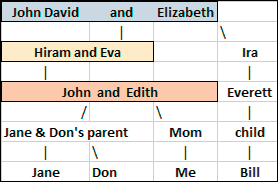
Let’s say I match my first cousin, Jane, and her brother, Don, on a particular segment. I know that segment
descended to all three of us from our common grandparents, John and Edith.
Who contributed that segment, or parts of that segment to our grandparents? Which grandparent gave
that segment to us, or, is it a combination of segments from both grandparents?
Next, I match Bill on that same segment, and so do Jane and Don. We know that Jane, Don, and I are
all related to Bill through the ancestor who contributed that segment to all four of us. But Bill doesn’t
descend from our grandparents so that common ancestor has to be further back than John and Edith.
Bill descends from my great-great-grandparents, John David and Elizabeth, through their son, Ira.
Therefore, we know that our shared segment with Bill descends from John David and Elizabeth through
their son Hiram through their son John’s two children to Jane, Don and me.
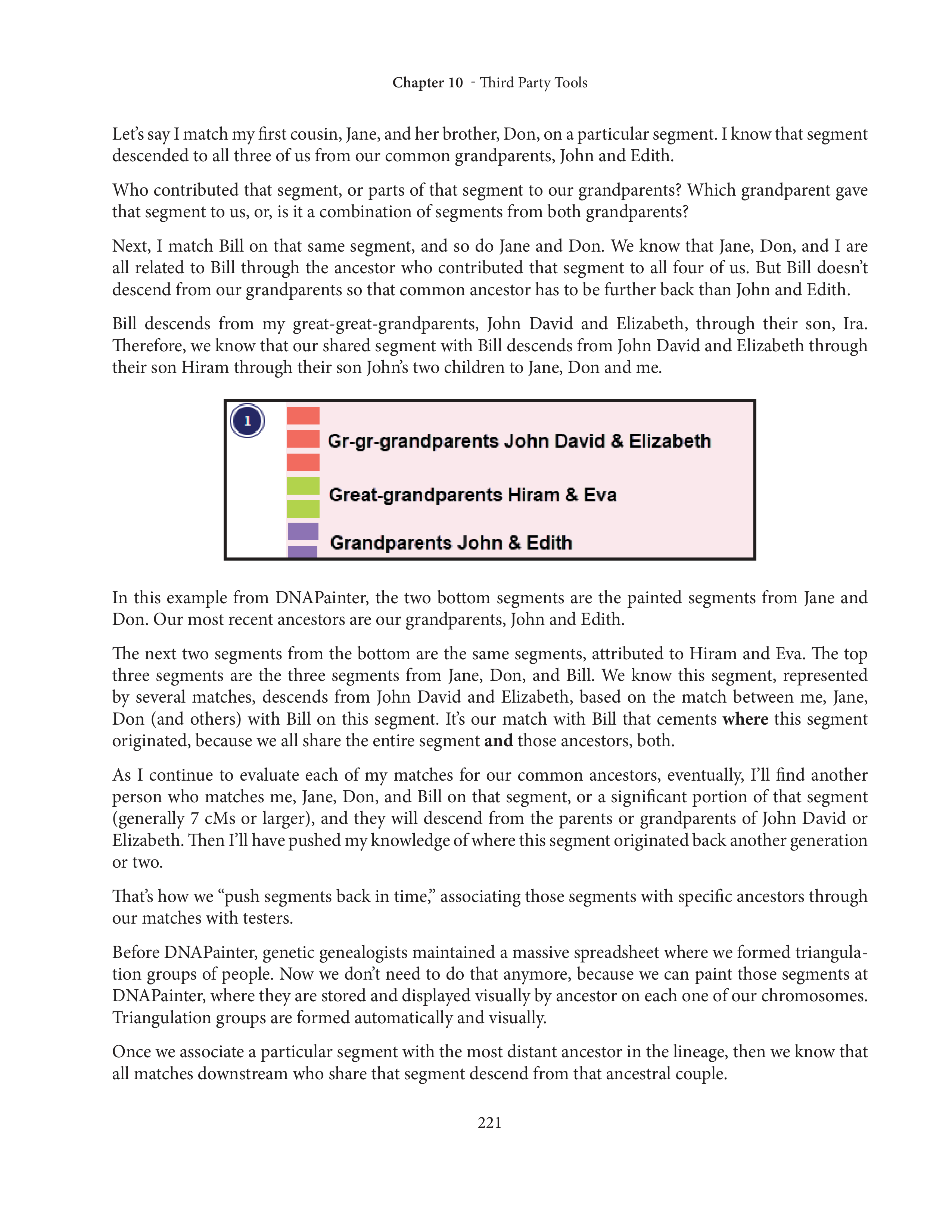
In this example from DNAPainter, the two bottom segments are the painted segments from Jane and
Don. Our most recent ancestors are our grandparents, John and Edith.
The next two segments from the bottom are the same segments, attributed to Hiram and Eva. The top
three segments are the three segments from Jane, Don, and Bill. We know this segment, represented
by several matches, descends from John David and Elizabeth, based on the match between me, Jane,
Don (and others) with Bill on this segment. It’s our match with Bill that cements
where
this segment
originated, because we all share the entire segment
and
those ancestors, both.
As I continue to evaluate each of my matches for our common ancestors, eventually, I’ll find another
person who matches me, Jane, Don, and Bill on that segment, or a significant portion of that segment
(generally 7 cMs or larger), and they will descend from the parents or grandparents of John David or
Elizabeth. Then I’ll have pushed my knowledge of where this segment originated back another generation
or two.
That’s how we “push segments back in time,” associating those segments with specific ancestors through
our matches with testers.
Before DNAPainter, genetic genealogists maintained a massive spreadsheet where we formed triangula-
tion groups of people. Now we don’t need to do that anymore, because we can paint those segments at
DNAPainter, where they are stored and displayed visually by ancestor on each one of our chromosomes.
Triangulation groups are formed automatically and visually.
Once we associate a particular segment with the most distant ancestor in the lineage, then we know that
all matches downstream who share that segment descend from that ancestral couple.