05
The Machine — Market Research and the Brand Man,
1900–1945
Between
the
death
of
the
founders
'
generation
and
the
end
of
the
Second
World
War
,
P
&
G
transformed
itself
from
a
company
with
one
famous
product
into
an
organization
built
to
produce
famous
products
on
a
production
line
.
The
first
major
step
was
technological
.
In
1911,
P
&
G
introduced
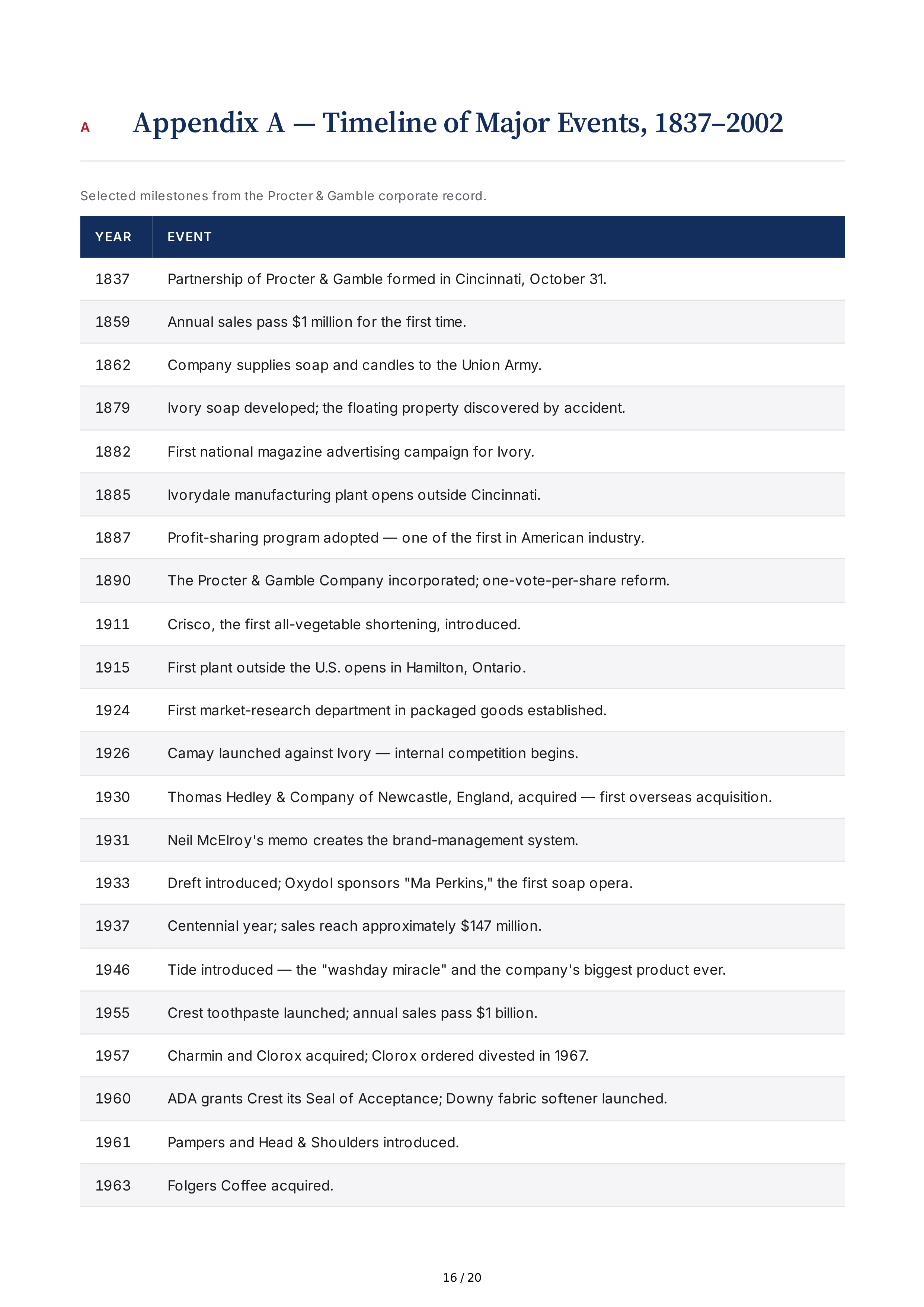
Crisco
,
the
first
all
-
vegetable
shortening
,
made
possible
by
the
hydrogenation
of
cottonseed
oil
.
Crisco
was
a
scientist
'
s
product
,
but
the
company
sold
it
as
a
cook
'
s
product
—
free
recipe
booklets
,
cooking
schools
,
and
advertising
that
taught
housewives
a
new
way
to
cook
.
Crisco
established
the
pattern
of
building
a
brand
around
a
patent
-
protected
technology
,
and
it
made
P
&
G
'
s
laboratories
central
to
the
company
'
s
future
.
The
second
step
was
geographic
.
In
1915,
P
&
G
opened
its
first
plant
outside
the
United
States
,
in
Hamilton
,
Ontario
.
International
expansion
thereafter
was
steady
rather
than
spectacular
—
P
&
G
entered
markets
when
it
could
staff
them
with
its
own
people
and
its
own
standards
,
a
discipline
that
would
distinguish
it
from
competitors
who
expanded
by
license
and
lost
control
.
The
third
step
—
and
the
most
consequential
—
was
organizational
.
In
1924,
P
&
G
established
the
first
market
-
research
department
in
the
packaged
-
goods
industry
,
sending
trained
interviewers
into
American
kitchens
to
ask
housewives
how
they
washed
,
cooked
,
and
cleaned
.
The
findings
were
not
academic
.
They
drove
product
decisions
and
advertising
messages
,
and
they
gave
P
&
G
a
systematic
,
rather
than
intuitive
,
understanding
of
the
consumer
.
In
1926,
the
company
launched
Camay
—
a
second
soap
brand
positioned
deliberately
against
its
own
Ivory
—
institutionalizing
the
idea
that
brands
within
the
same
house
should
compete
as
if
they
were
independent
companies
.
Let one man be responsible for one brand — its advertising,
its sales, its profits — and let him scheme and plan and fight
for it as if it were his own business.
Paraphrase
of
the
May
1931
brand
-
management
memo
by
Neil
H
.
McElroy
The
decisive
moment
came
in
1931,
when
a
27-
year
-
old
advertising
manager
named
Neil
H
.
McElroy
wrote
what
became
the
most
famous
memo
in
marketing
history
.
Facing
the
problem
of
administering
a
growing
stable
of
brands
,
McElroy
proposed
that
each
brand
be
assigned
a
single
"
brand
man
"
with
total
responsibility
for
that
brand
'
s
advertising
,
sales
,
pricing
,
and
profitability
—
a
miniature
general
manager
who
would
compete
against
every
other
brand
in
the
building
with
the
ferocity
of
an
outside
rival
.
The
6 / 20