E
I
N
T
R
O
D
U
C
T
I
O
N
Why
the
Young
King
Matters
Beginnings in Atlanta · Formation before fame
very public life has a private beginning, and the story of Martin Luther King Jr. is usually told as a
story of marches and platforms — Montgomery, Birmingham, Washington, Memphis. Those
moments deserve their place in history, and they will have it in the pages that follow. But the man
who stood on those platforms was assembled long before the cameras arrived. He was shaped on
Auburn Avenue, in a neighborhood famous for its optimism, in a church his grandfather had built and
his father had inherited, and in libraries where a student wrestled with questions that most young men
his age never thought to ask.
This biography is called
The Making of Martin Luther King Jr.
, and its central conviction is simple: the
movement made the leader, and the leader was made before the movement began. The title also carries
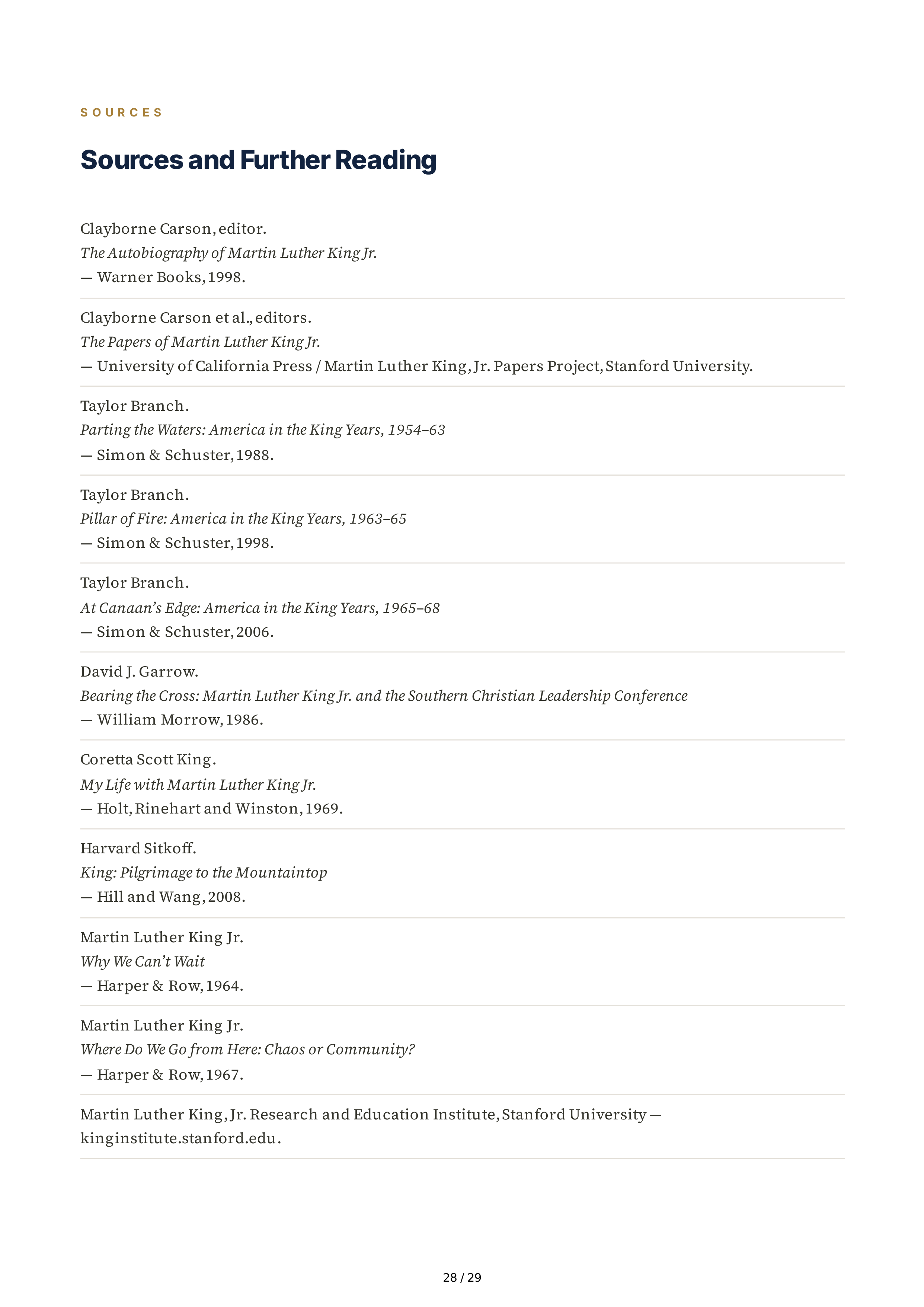
a deliberate nod to a landmark scholarly effort — the Martin Luther King, Jr. Papers Project, founded at
Stanford University in 1985 and led for decades by the historian Clayborne Carson. The Stanford editors
gathered thousands of King’s letters, sermons, essays, and student papers, and devoted their earliest
published volumes to the figure they called the “young King”: the Morehouse sophomore, the Crozer
seminarian, the Boston doctoral candidate. Those volumes changed the way historians understood
King, because they revealed how much of his later genius was, in fact, preparation.
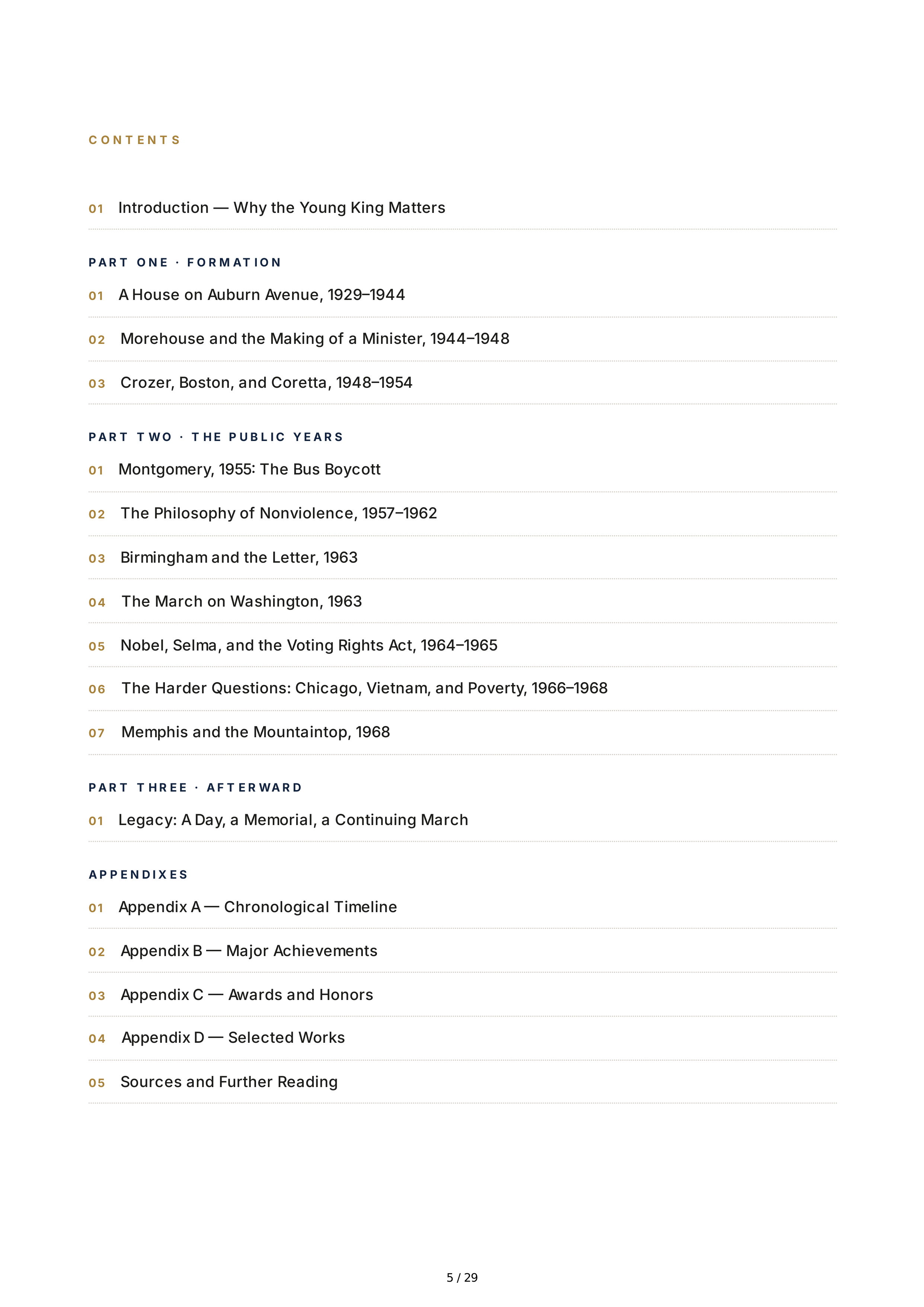
The chapters that follow move through the life in order. The first half of the book lingers on formation
— family, faith, schooling, marriage, and the intellectual pilgrimages that turned a gifted young
minister into a movement theorist as much as a movement speaker. The second half follows the public
career: the Montgomery bus boycott that made him famous; the Southern Christian Leadership
Conference he helped to found; the hard campaigns in Birmingham and Selma; the Nobel Peace Prize;
the widening of his agenda to poverty and war; and the final stand among striking sanitation workers
in Memphis.
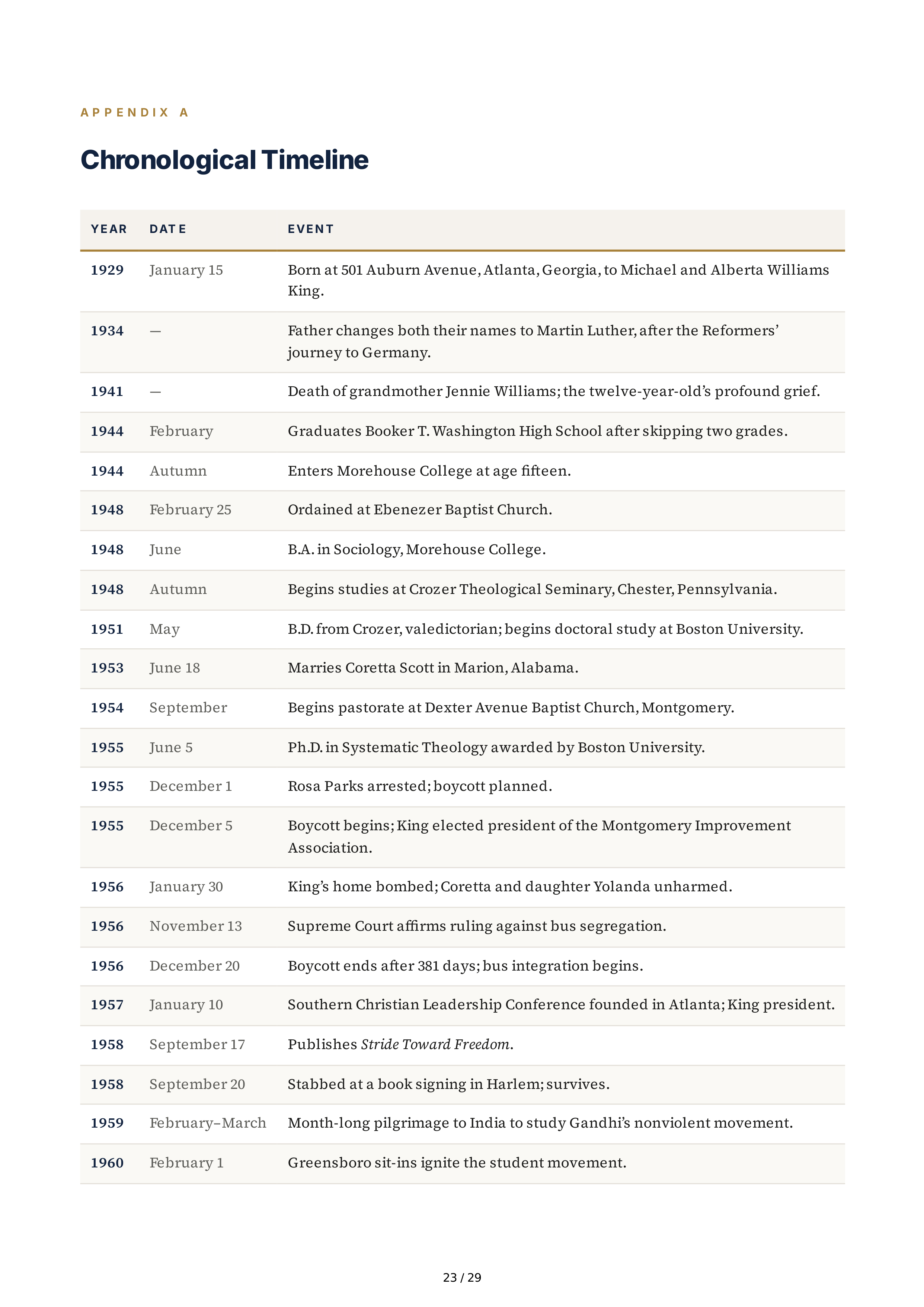
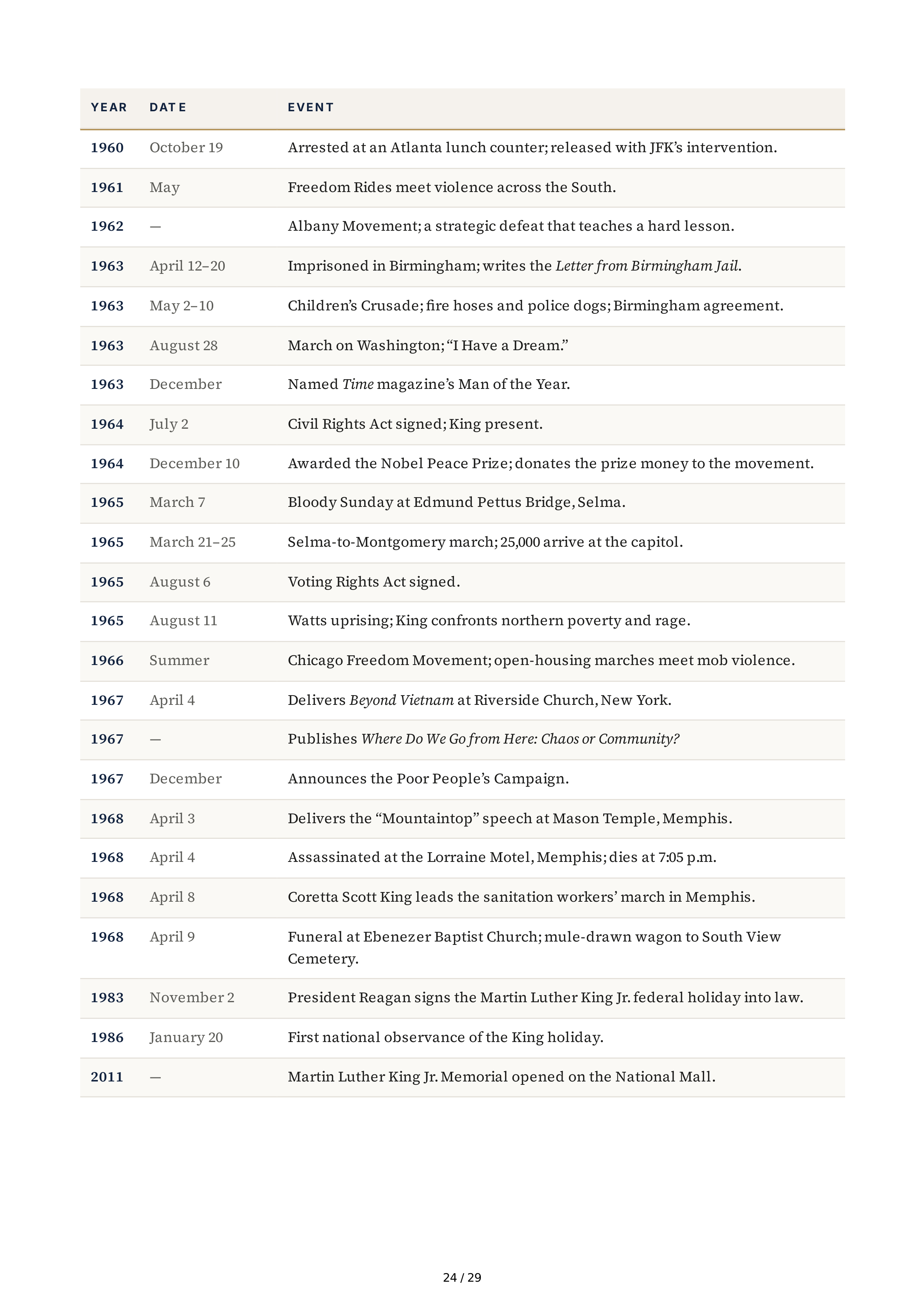
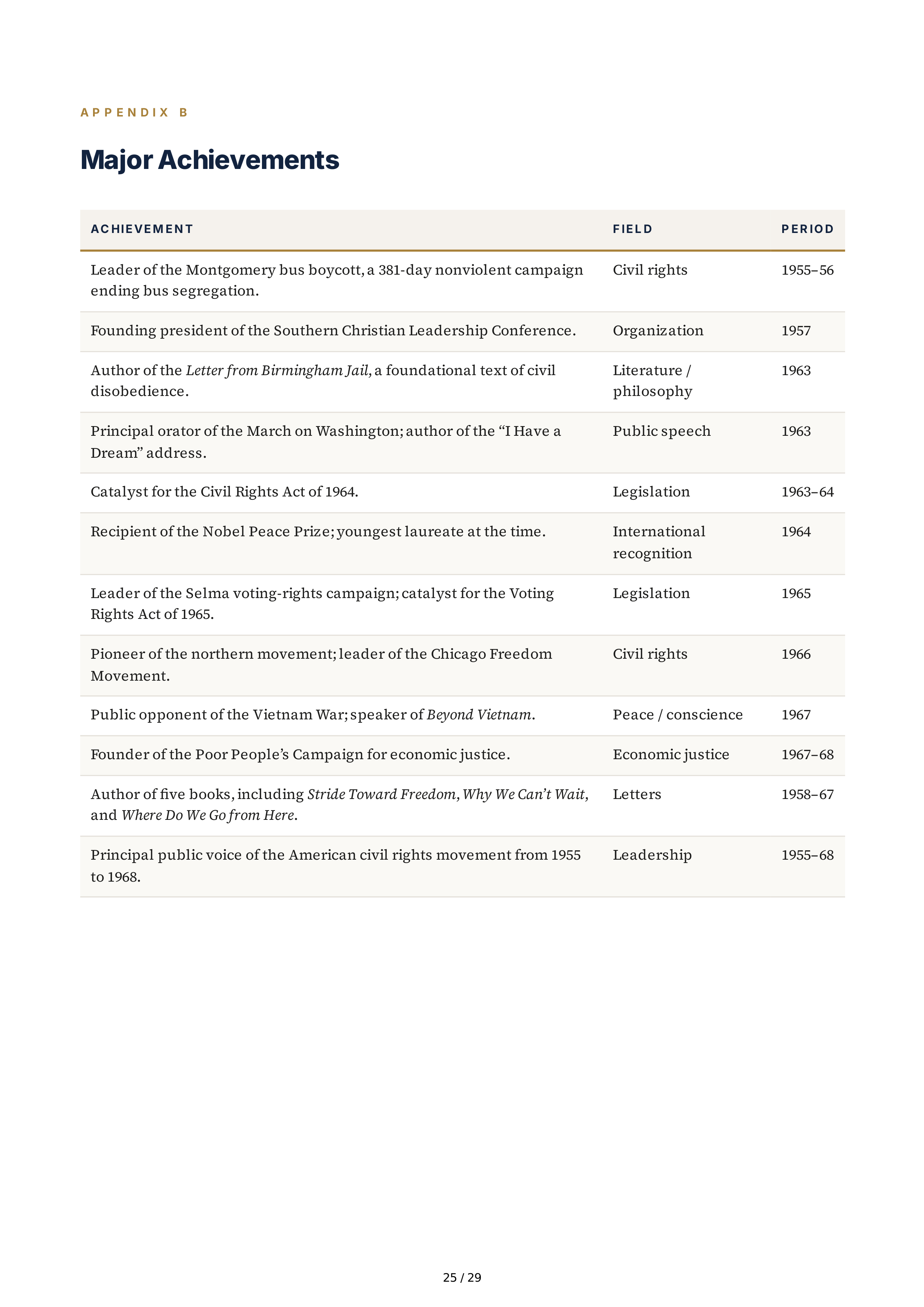
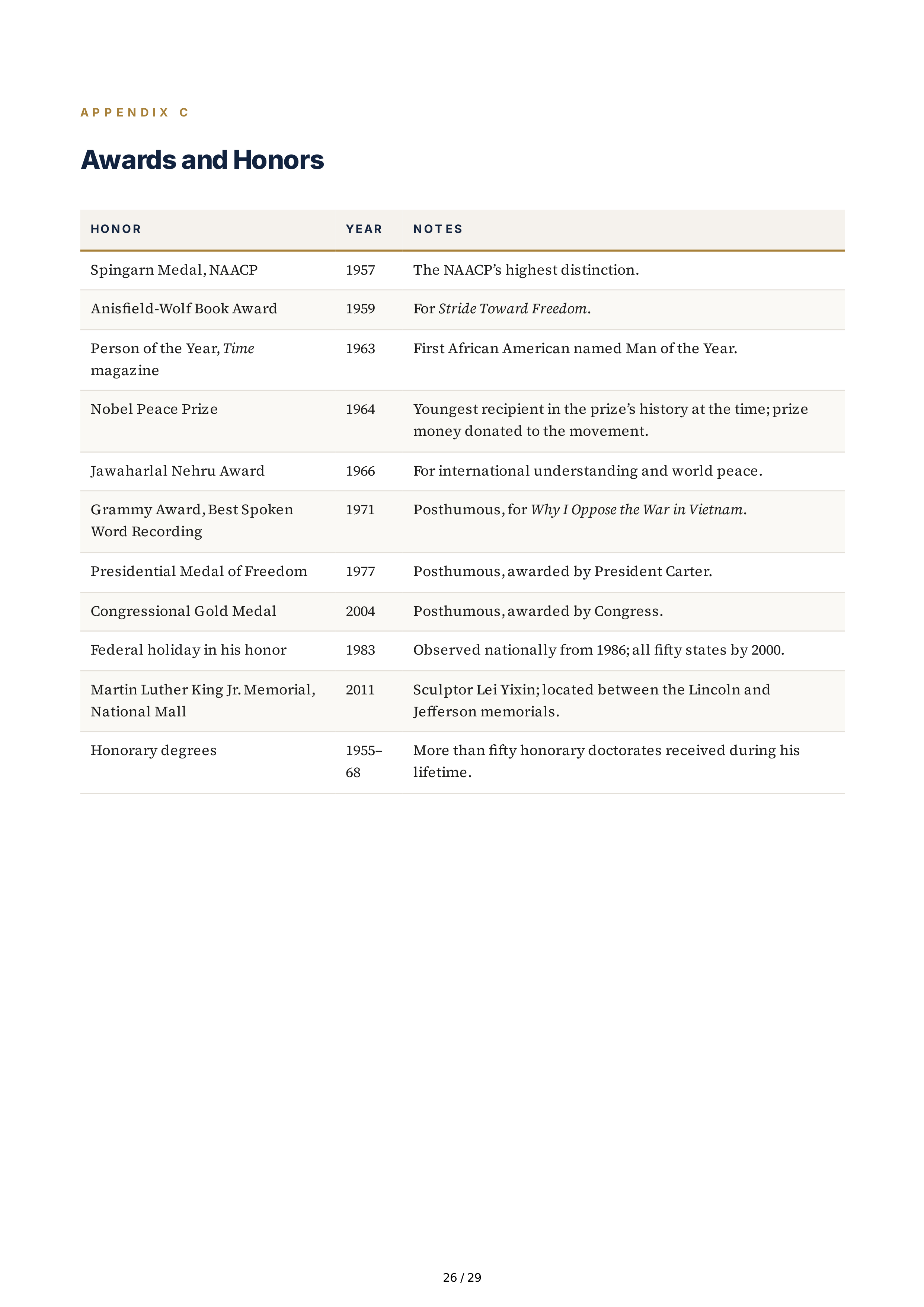
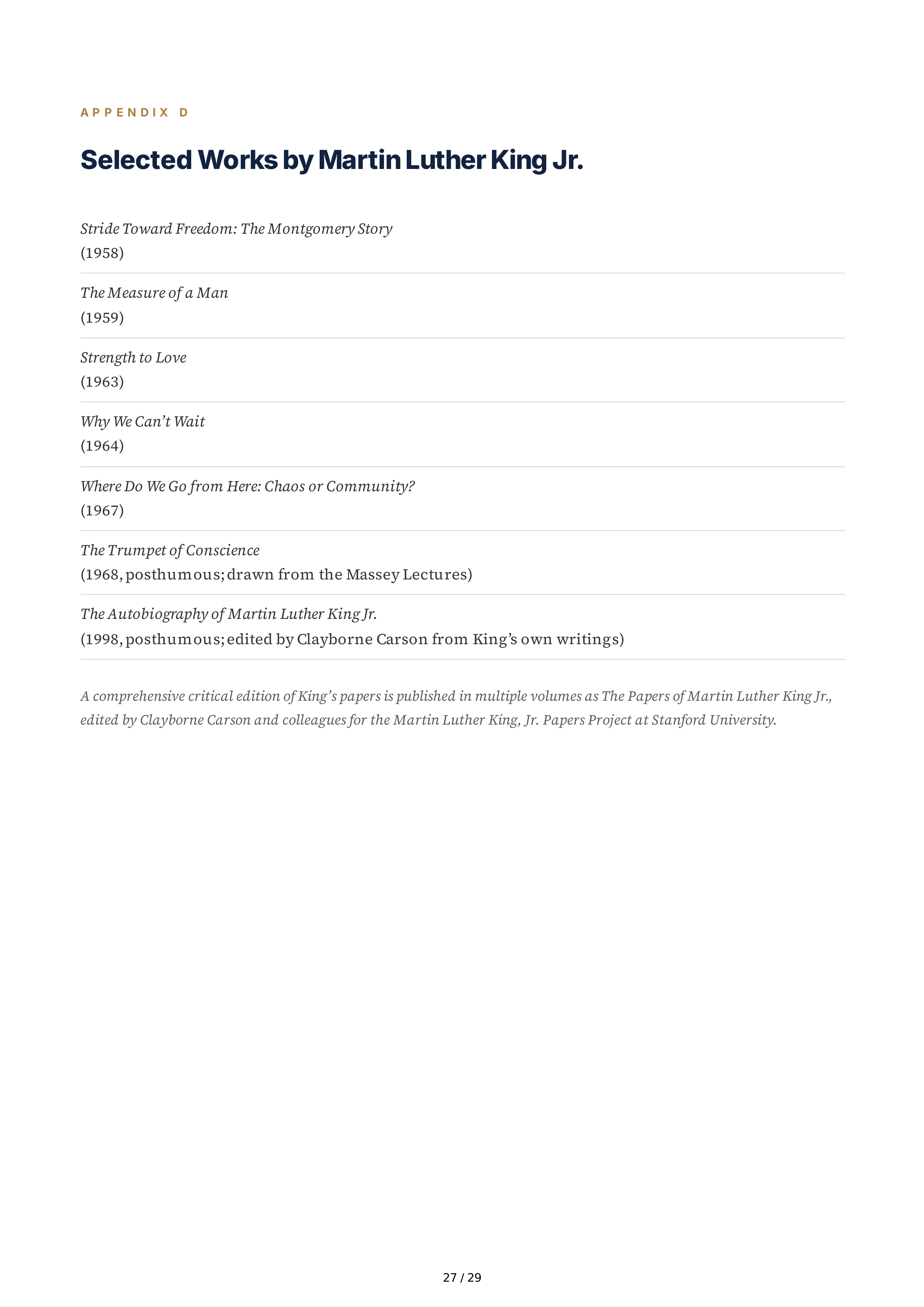
A set of appendixes gathers the record of that life in compact form — a full chronology, a roster of
achievements, a list of honors, and a guide to his published writings — so that the book may serve
equally as biography and as reference.
One caution belongs at the outset. Martin Luther King Jr. has become, in the years since 1968, a familiar
statue: a phrase quoted on a holiday, a face on a street sign, a paragraph in a history textbook. The aim
of this book is to restore motion to that statue. Here is a young man asking hard questions, changing
his mind, doubting, growing, and being changed by the very people he set out to lead. Some of the
material in the chapters that follow — his early doubts, his missteps, his private struggles — is less
familiar than the speeches. It is included because the making of a leader is rarely neat, and because the
historical record is more honest, and more useful, when it is complete.
6 / 29