T
C O M PAN IO N
T O
T H E
N E T F L IX
D O C UM E N T AR Y
Our Brother, Hillel
The Life and Legacy of Hillel Slovak · Red Hot Chili Peppers · 1962–1988
A
companion
biography
to
The
Rise
of
the
Red
Hot
Chili
Peppers
Prepared
for
editorial
and
archival
reference
·
Los
Angeles
· 2025
C O N T E N T S
01
Prologue
:
A
Brother
Remembered
02
Haifa
to
Los
Angeles
, 1962–1967
03
Fairfax
High
School
, 1978–1980
04
Anthem
and
What
Is
This
?, 1980–1983
05
The
Band
That
Started
as
a
Joke
,
1983–1984
06
Debut
and
Freaky
Styley
, 1984–1985
07
The
Uplift
Mofo
Party
Plan
, 1987
08
The
Long
Darkness
, 1986–1988
09
June
25, 1988
10
Aftermath
and
Mother
’
s
Milk
, 1988–
1989
11
Legacy
:
The
Guitarist
and
the
Brother
12
Discography
and
Timeline
13
Sources
and
Notes
01
Prologue: A Brother Remembered
here
is
a
before
and
an
after
in
the
story
of
the
Red
Hot
Chili
Peppers
,
and
the
difference
between
them
is
one
person
.
Before
,
there
was
a
quiet
guitarist
from
Los
Angeles
whose
playing
sounded
like
five
people
arguing
joyfully
inside
one
amplifier
.
After
,
there
was
a
band
that
spent
the
next
four
decades
trying
,
in
the
best
possible
way
,
to
keep
hearing
him
.
Hillel
Slovak
was
twenty
-
six
years
old
when
he
died
on
June
25, 1988,
of
a
heroin
overdose
in
his
Los
Angeles
apartment
.
He
had
played
on
three
albums
,
helped
invent
a
style
that
had
no
name
yet
—
punk
-
funk
,
funk
-
rock
,
whatever
the
critics
called
it
—
and
taught
his
best
friend
how
to
play
bass
.
The
Red
Hot
Chili
Peppers
were
,
at
that
moment
,
a
cult
band
with
a
ceiling
nobody
could
see
.
His
death
nearly
removed
the
floor
instead
.
The
people
who
loved
him
have
spent
the
years
since
speaking
about
him
the
way
you
speak
about
a
brother
.
Flea
calls
him
the
person
who
shaped
his
life
.
Anthony
Kiedis
wrote
“
My
Lovely
Man
”
and
has
1 / 9
sung
it
,
with
visible
ache
,
for
thirty
years
.
Jack
Irons
walked
away
from
the
band
entirely
rather
than
play
without
him
.
And
in
2025,
the
story
of
those
early
years
reached
a
new
generation
through
the
Netflix
documentary
The Rise of the Red Hot Chili Peppers
—
a
film
that
is
,
at
its
heart
,
about
the
friendship
that
held
four
teenagers
together
and
the
one
they
lost
.
This
biography
is
a
companion
to
that
film
.
It
follows
Hillel
from
the
port
city
of
Haifa
to
the
stages
of
Hollywood
,
through
the
invention
of
a
band
,
the
making
of
three
records
,
and
the
long
,
quiet
struggle
he
could
not
win
.
It
is
the
story
of
a
brother
—
remembered
.
02
Haifa to Los Angeles, 1962–1967
Hillel
Slovak
was
born
on
April
13, 1962,
in
Haifa
,
Israel
—
a
city
built
on
the
slope
of
Mount
Carmel
,
looking
out
over
the
Mediterranean
.
His
family
was
Jewish
,
and
when
Hillel
was
five
they
emigrated
to
the
United
States
,
joining
the
great
postwar
wave
of
families
trading
one
coastline
for
another
.
They
settled
in
Los
Angeles
.
California
in
the
late
1960
s
was
a
strange
and
dazzling
place
for
a
young
immigrant
.
Hillel
grew
up
quiet
,
observant
,
and
intense
.
He
painted
before
he
played
guitar
—
ink
drawings
,
collage
,
notebooks
full
of
half
-
finished
portraits
.
Art
was
his
first
language
,
and
it
never
left
him
.
Even
at
the
height
of
the
Chili
Peppers
’
chaos
,
there
were
always
sketchbooks
in
his
bag
.
The
guitar
arrived
in
his
early
teens
and
changed
the
direction
of
everything
.
He
learned
by
wearing
out
records
:
Jimi
Hendrix
for
freedom
,
Frank
Zappa
for
strangeness
,
Black
Sabbath
and
Led
Zeppelin
for
weight
.
Then
punk
arrived
—
the
Ramones
,
and
the
Los
Angeles
scene
of
the
Germs
and
Fear
—
and
punk
taught
him
that
you
didn
’
t
need
permission
.
He
would
sit
in
his
room
for
hours
,
hunting
for
sounds
he
had
never
heard
anybody
make
.
His
family
remembers
a
kid
who
was
never
without
a
pencil
or
a
pick
.
03
Fairfax High School, 1978–1980
Everything
that
matters
about
Hillel
Slovak
’
s
story
can
be
traced
to
one
public
school
on
Melrose
Avenue
.
Fairfax
High
School
in
the
late
1970
s
was
an
unlikely
crossroads
—
a
working
Los
Angeles
high
school
where
the
children
of
the
entertainment
industry
mingled
with
kids
from
everywhere
else
,
and
where
the
music
program
happened
to
be
excellent
.
Hillel
fell
in
with
three
boys
who
would
define
his
life
.
Michael
“
Flea
”
Balzary
was
a
trumpet
player
with
a
wild
streak
,
recently
arrived
from
the
jazz
world
.
Anthony
Kiedis
was
the
son
of
a
Hollywood
bit
actor
,
already
outrageous
,
already
dressed
like
no
one
else
in
class
.
Jack
Irons
was
a
drummer
with
perfect
time
and
a
gentle
soul
.
The
four
of
them
—
Hillel
the
artist
,
Flea
the
noise
-
maker
,
Anthony
the
showman
,
Jack
the
engine
—
formed
a
whole
person
between
them
.
2 / 9
Hillel
was
the
quiet
one
,
and
the
most
magnetic
because
of
it
.
He
didn
’
t
perform
offstage
;
he
observed
.
Onstage
,
the
switch
flipped
.
At
school
talent
shows
and
parties
,
Hillel
’
s
guitar
playing
was
already
a
thing
people
talked
about
—
long
hair
,
headband
,
a
borrowed
Stratocaster
slung
low
,
fingers
flying
into
tones
no
one
in
the
room
could
name
.
The
most
important
lesson
of
Fairfax
happened
in
a
garage
.
Flea
had
never
touched
a
bass
guitar
.
Hillel
handed
him
one
,
showed
him
the
frets
,
and
told
him
to
pluck
hard
.
Within
months
,
Flea
’
s
style
—
the
slapping
,
melodic
,
almost
vocal
bass
that
would
become
the
signature
of
alternative
rock
—
was
emerging
from
an
instrument
he
had
never
planned
to
play
.
Hillel
didn
’
t
just
make
a
bandmate
;
he
made
a
musician
.
FA IRFA X
, 1 9 7 9
Hillel
taught
Flea
to
play
bass
.
Flea
has
repeated
this
for
four
decades
:
the
first
bass
guitar
that
ever
mattered
was
handed
to
him
by
Hillel
Slovak
.
And
the
music
they
traded
was
sacred
.
Hillel
brought
Sly
Stone
and
Parliament
-
Funkadelic
into
the
rotation
.
Flea
brought
jazz
.
Anthony
brought
glam
rock
and
rebellion
.
Jack
brought
the
backbeat
.
Nobody
at
Fairfax
had
heard
the
four
of
them
together
the
way
the
four
of
them
heard
it
.
04
Anthem and What Is This?, 1980–1983
Before
the
Chili
Peppers
,
Hillel
was
already
a
serious
musician
.
With
Flea
and
Jack
Irons
,
he
formed
a
band
called
Anthem
—
garage
rock
,
loud
and
fast
.
Then
he
and
Jack
joined
guitarist
Alain
Johannes
and
singer
Chris
Hutchinson
in
a
more
ambitious
project
called
What Is This?
,
an
art
-
rock
band
with
complicated
songs
and
serious
chops
.
What Is This?
got
signed
.
A
record
deal
with
MCA
followed
.
At
nineteen
,
Hillel
had
options
—
and
no
idea
that
his
real
life
was
waiting
two
exits
away
.
Flea
had
moved
on
from
What Is This?
,
restless
for
something
looser
.
Anthony
Kiedis
,
who
had
been
drifting
through
the
Los
Angeles
scene
,
wanted
more
than
the
sidelines
.
Together
they
started
talking
about
a
band
that
would
mix
the
two
things
Los
Angeles
did
best
:
punk
’
s
violence
and
funk
’
s
swagger
—
with
rap
vocals
,
which
almost
nobody
was
doing
over
live
instruments
yet
.
Hillel
and
Jack
Irons
had
to
be
in
.
There
was
never
a
real
question
.
The
four
rehearsed
wherever
they
could
.
The
chemistry
was
instant
.
Hillel
’
s
guitar
was
the
glue
:
funky
enough
for
Flea
to
slither
over
,
noisy
enough
for
Anthony
to
scream
over
,
musical
enough
to
make
all
of
it
sound
like
one
thing
.
They
gave
themselves
a
ridiculous
name
for
a
one
-
off
show
—
Tony
Flow
and
the
Miraculously
Majestic
Masters
of
Mayhem
—
and
wrote
a
single
song
, “
Out
in
L
.
A
.,”
to
play
that
night
.
3 / 9
05
The Band That Started as a Joke, 1983–1984
The
first
show
was
booked
,
by
legend
,
to
raise
money
for
a
demo
tape
:
one
night
at
a
small
Los
Angeles
club
,
four
friends
playing
one
song
. “
Out
in
L
.
A
.”
was
a
joke
about
their
hometown
—
sarcastic
,
funky
,
fast
.
They
had
no
setlist
,
no
plan
,
no
way
to
fill
the
time
they
had
been
given
if
the
crowd
didn
’
t
respond
.
The
audience
lost
their
minds
.
They
played
“
Out
in
L
.
A
.”
once
,
twice
,
three
times
—
it
was
the
only
song
they
had
—
and
the
room
behaved
as
if
they
had
a
full
set
.
The
club
demanded
they
come
back
.
They
kept
the
gig
,
took
a
better
name
—
the
Red
Hot
Chili
Peppers
,
a
phrase
that
sounded
like
the
music
:
loud
,
spicy
,
ungovernable
—
and
began
a
residency
that
turned
into
a
movement
.
The
shows
became
events
.
Kiedis
sang
with
his
shirt
off
and
his
spine
fully
engaged
;
Flea
played
bass
like
it
was
a
martial
art
;
Jack
Irons
held
the
rhythm
together
with
both
fists
;
and
Hillel
leaned
into
his
solo
spotlights
with
his
eyes
closed
,
making
a
Fender
Stratocaster
say
things
it
had
never
said
before
.
The
Chili
Peppers
were
not
a
punk
band
,
not
a
funk
band
,
not
a
rap
band
.
They
were
the
allergic
reaction
of
the
Los
Angeles
scene
to
itself
—
and
Hillel
was
the
element
that
made
the
reaction
possible
.
06
Debut and Freaky Styley, 1984–1985
In
1984,
EMI
signed
the
Red
Hot
Chili
Peppers
,
and
the
band
entered
the
studio
with
producer
Andy
Gill
of
Gang
of
Four
.
The
sessions
were
a
collision
.
Hillel
,
still
bound
to
What Is This?
and
its
MCA
contract
,
split
his
time
between
two
bands
.
He
and
Jack
Irons
both
withdrew
from
the
recording
,
and
EMI
brought
in
guitarist
Jack
Sherman
and
drummer
Cliff
Martinez
to
finish
the
album
.
Released
on
August
10, 1984,
the
self
-
titled
debut
was
promising
and
frustrating
in
equal
measure
—
the
funk
and
the
fury
were
audible
,
but
the
live
chaos
that
defined
the
band
resisted
capture
.
A
year
later
,
everything
changed
.
What Is This?
dissolved
,
and
Hillel
chose
the
Chili
Peppers
—
deliberately
,
permanently
.
Reunited
with
the
band
,
he
went
into
the
studio
with
George
Clinton
,
the
architect
of
Parliament
-
Funkadelic
,
to
record
Freaky Styley
.
Clinton
treated
the
band
like
beautiful
trouble
,
and
it
worked
.
Released
in
August
1985,
Freaky Styley
is
where
Hillel
learned
to
put
his
strangeness
on
record
:
the
wah
-
wah
growl
of
“
Catholic
School
Girls
Rule
,”
the
psychedelic
swagger
of
“
American
Ghost
Dance
,”
the
tight
pocket
of
the
Sly
Stone
cover
“
If
You
Want
Me
to
Stay
.”
The
album
’
s
signature
moment
, “
Jungle
Man
,”
was
written
about
Hillel
.
Anthony
’
s
lyrics
describe
a
beautiful
,
untamed
creature
moving
through
the
city
on
pure
instinct
—
which
is
exactly
what
Hillel
’
s
playing
sounded
like
,
and
exactly
how
his
friends
saw
him
.
It
is
the
only
song
in
the
catalog
,
before
or
since
,
that
functions
as
a
direct
portrait
of
the
man
.
4 / 9
P O RT RA IT
O F
A
P LAY E R
“
Jungle
Man
” (
Freaky Styley
, 1985)
was
written
by
Anthony
Kiedis
about
Hillel
—
the
“
jungle
man
”
of
the
title
,
a
creature
of
pure
musical
instinct
.
07
The Uplift Mofo Party Plan, 1987
By
1986,
the
band
’
s
rise
had
a
shadow
attached
to
it
.
Heroin
—
the
drug
that
had
already
hollowed
out
so
much
of
the
Los
Angeles
music
scene
—
arrived
quietly
in
the
Chili
Peppers
’
circle
.
Hillel
and
Flea
used
together
.
Anthony
fell
into
his
own
erasures
.
The
music
stayed
brilliant
;
the
margins
around
it
frayed
.
In
the
summer
of
1987,
the
original
four
—
the
lineup
from
Fairfax
—
finally
got
back
into
a
studio
together
,
recording
with
producer
Michael
Beinhorn
in
Hollywood
.
Released
on
September
29, 1987,
The
Uplift Mofo Party Plan
remains
the
only
studio
album
with
the
complete
original
lineup
:
Kiedis
,
Slovak
,
Flea
,
Irons
.
It
is
also
the
record
where
Hillel
’
s
playing
is
at
its
absolute
peak
.
Listening
again
,
you
can
hear
every
side
of
him
:
the
punk
aggression
of
“
Fight
Like
a
Brave
,”
the
psychedelic
wah
-
wah
meditation
of
“
Behind
the
Sun
,”
the
pure
-
Fairfax
joy
of
“
Me
and
My
Friends
.”
The
tour
that
followed
should
have
been
a
victory
lap
.
Instead
,
it
was
an
endurance
test
.
Hillel
’
s
addiction
deepened
;
he
began
disappearing
between
shows
,
missing
soundchecks
,
arriving
onstage
with
seconds
to
spare
and
then
playing
as
if
possessed
.
Nobody
who
saw
him
in
1987
doubts
that
he
was
brilliant
.
But
the
machinery
around
him
was
failing
,
and
the
people
closest
to
him
were
too
deep
inside
their
own
struggles
to
see
it
fully
.
A
B A ND
D O C U M E NT
The Uplift Mofo Party Plan
is
the
only
Red
Hot
Chili
Peppers
studio
album
to
feature
the
original
Fairfax
High
lineup
—
Kiedis
,
Slovak
,
Flea
,
and
Irons
—
playing
together
on
every
track
.
08
The Long Darkness, 1986–1988
The
months
between
the
Uplift
tour
and
Hillel
’
s
death
are
the
hardest
part
of
his
story
to
tell
,
because
so
much
of
it
happened
in
private
.
Hillel
was
quiet
about
suffering
—
that
was
part
of
his
nature
.
The
band
,
touring
and
recording
and
fighting
,
existed
in
a
haze
where
the
normal
rules
of
looking
after
each
other
did
not
always
apply
.
There
were
bright
points
.
Flea
and
Hillel
tried
,
at
various
moments
,
to
quit
together
—
partners
in
recovery
as
they
were
partners
in
music
.
In
the
spring
of
1988,
Hillel
seemed
lighter
.
He
talked
about
the
next
record
,
about
painting
again
,
about
the
future
.
The
band
was
scheduled
to
return
to
the
studio
later
that
year
with
a
handful
of
new
songs
,
and
Hillel
was
at
rehearsals
,
playing
brilliantly
.
5 / 9
Addiction
is
patient
,
though
.
It
waits
for
the
good
days
to
end
.
In
the
late
spring
of
1988,
after
what
everyone
believed
was
a
real
stretch
of
sobriety
,
Hillel
relapsed
.
This
time
,
there
was
nobody
left
to
catch
him
.
09
June 25, 1988
On
the
morning
of
June
25, 1988,
friends
found
Hillel
Slovak
dead
in
his
apartment
in
Los
Angeles
.
He
was
twenty
-
six
years
old
.
The
cause
of
death
was
a
heroin
overdose
—
alone
,
in
the
place
he
lived
.
The
phone
calls
went
out
in
the
small
,
terrible
way
such
news
travels
.
Flea
collapsed
.
Anthony
Kiedis
felt
the
world
tilt
.
Jack
Irons
made
the
decision
that
would
define
the
next
year
of
his
life
—
he
could
not
sit
behind
a
drum
kit
without
Hillel
,
and
he
left
the
band
.
The
Red
Hot
Chili
Peppers
had
lost
their
founding
guitarist
,
and
for
a
long
moment
it
looked
as
though
they
had
lost
the
band
itself
.
A
funeral
brought
together
the
full
strange
family
Hillel
had
assembled
around
himself
:
high
-
school
friends
,
punk
kids
from
the
clubs
,
musicians
from
the
Parliament
-
Funkadelic
orbit
,
and
three
shattered
bandmates
.
The
service
was
quiet
,
private
,
and
devastating
.
Hillel
Slovak
—
the
beautiful
boy
from
Haifa
who
had
taught
Los
Angeles
how
to
play
loud
—
was
laid
to
rest
in
the
city
that
had
become
his
.
10
Aftermath and Mother’s Milk, 1988–1989
In
the
months
after
Hillel
’
s
death
,
the
Chili
Peppers
existed
in
name
only
.
Kiedis
and
Flea
both
considered
ending
it
.
What
pulled
them
back
,
in
every
retelling
,
was
the
example
of
Hillel
himself
:
the
music
had
to
continue
because
the
music
was
the
point
.
He
had
believed
it
harder
than
anyone
.
They
found
an
eighteen
-
year
-
old
guitarist
named
John
Frusciante
,
a
prodigy
and
a
superfan
who
had
learned
the
band
’
s
entire
catalog
note
for
note
—
including
every
one
of
Hillel
’
s
solos
.
Frusciante
had
idolized
Hillel
;
joining
the
band
meant
completing
the
music
his
hero
had
left
unfinished
.
Around
the
same
time
,
drummer
Chad
Smith
arrived
,
with
a
backbeat
like
a
cannon
.
The
new
quartet
—
Kiedis
,
Flea
,
Frusciante
,
Smith
—
recorded
Mother’s Milk
,
released
in
August
1989.
The
album
is
dedicated
to
Hillel
Slovak
.
Its
most
naked
song
, “
Knock
Me
Down
,”
was
written
in
Hillel
’
s
memory
—
a
warning
about
ego
and
self
-
destruction
wrapped
in
the
funkiest
riff
the
band
had
made
yet
.
Two
years
later
,
on
Blood Sugar Sex
Magik
,
came
the
song
that
would
become
the
band
’
s
permanent
tribute
: “
My
Lovely
Man
,”
Anthony
’
s
open
letter
to
Hillel
.
Sung
at
nearly
every
Chili
Peppers
show
since
,
it
functions
as
a
memorial
the
band
carries
on
tour
.
6 / 9
D E D IC AT IO NS
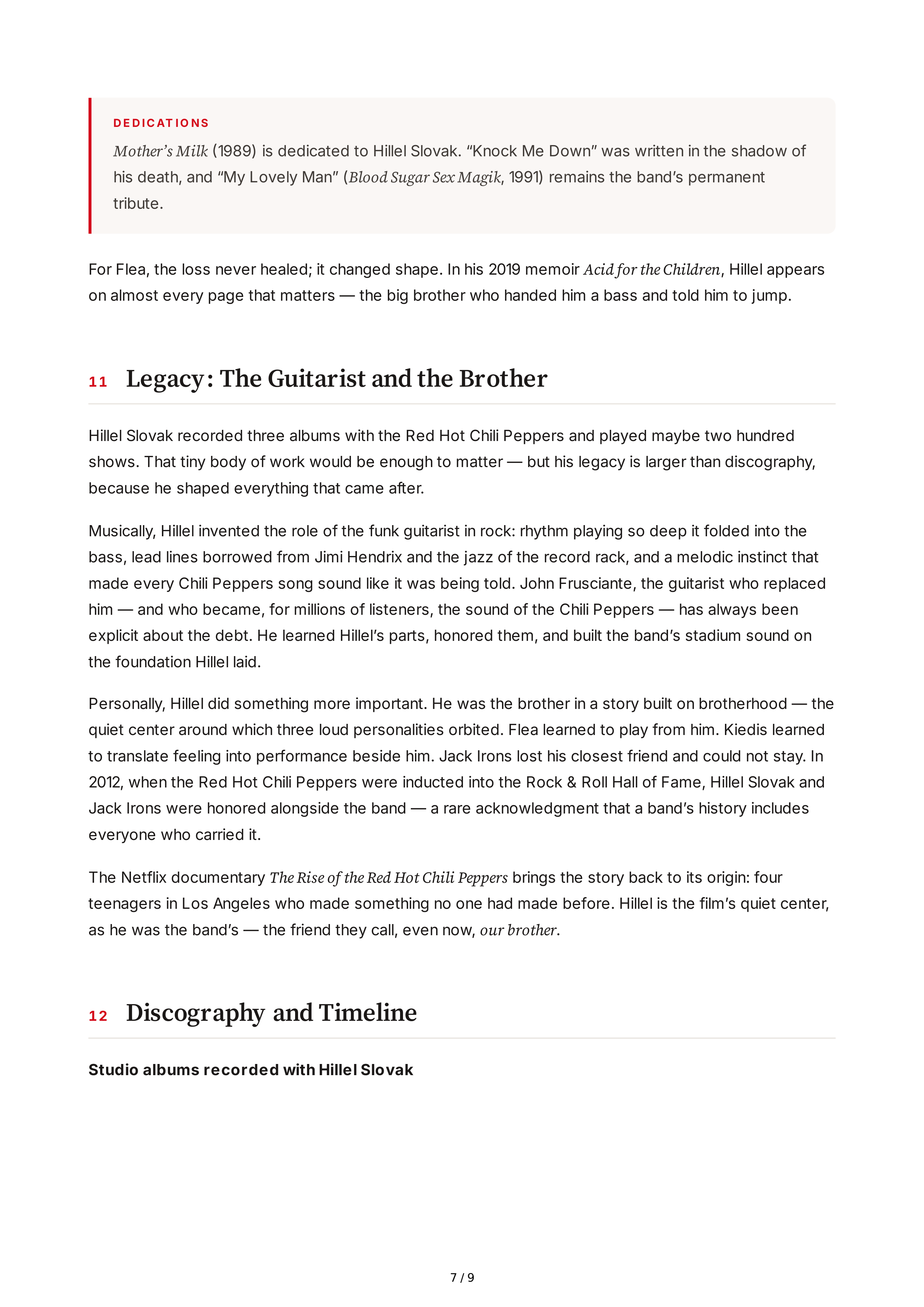
Mother’s Milk
(1989)
is
dedicated
to
Hillel
Slovak
. “
Knock
Me
Down
”
was
written
in
the
shadow
of
his
death
,
and
“
My
Lovely
Man
” (
Blood Sugar Sex Magik
, 1991)
remains
the
band
’
s
permanent
tribute
.
For
Flea
,
the
loss
never
healed
;
it
changed
shape
.
In
his
2019
memoir
Acid for the Children
,
Hillel
appears
on
almost
every
page
that
matters
—
the
big
brother
who
handed
him
a
bass
and
told
him
to
jump
.
11
Legacy: The Guitarist and the Brother
Hillel
Slovak
recorded
three
albums
with
the
Red
Hot
Chili
Peppers
and
played
maybe
two
hundred
shows
.
That
tiny
body
of
work
would
be
enough
to
matter
—
but
his
legacy
is
larger
than
discography
,
because
he
shaped
everything
that
came
after
.
Musically
,
Hillel
invented
the
role
of
the
funk
guitarist
in
rock
:
rhythm
playing
so
deep
it
folded
into
the
bass
,
lead
lines
borrowed
from
Jimi
Hendrix
and
the
jazz
of
the
record
rack
,
and
a
melodic
instinct
that
made
every
Chili
Peppers
song
sound
like
it
was
being
told
.
John
Frusciante
,
the
guitarist
who
replaced
him
—
and
who
became
,
for
millions
of
listeners
,
the
sound
of
the
Chili
Peppers
—
has
always
been
explicit
about
the
debt
.
He
learned
Hillel
’
s
parts
,
honored
them
,
and
built
the
band
’
s
stadium
sound
on
the
foundation
Hillel
laid
.
Personally
,
Hillel
did
something
more
important
.
He
was
the
brother
in
a
story
built
on
brotherhood
—
the
quiet
center
around
which
three
loud
personalities
orbited
.
Flea
learned
to
play
from
him
.
Kiedis
learned
to
translate
feeling
into
performance
beside
him
.
Jack
Irons
lost
his
closest
friend
and
could
not
stay
.
In
2012,
when
the
Red
Hot
Chili
Peppers
were
inducted
into
the
Rock
&
Roll
Hall
of
Fame
,
Hillel
Slovak
and
Jack
Irons
were
honored
alongside
the
band
—
a
rare
acknowledgment
that
a
band
’
s
history
includes
everyone
who
carried
it
.
The
Netflix
documentary
The Rise of the Red Hot Chili Peppers
brings
the
story
back
to
its
origin
:
four
teenagers
in
Los
Angeles
who
made
something
no
one
had
made
before
.
Hillel
is
the
film
’
s
quiet
center
,
as
he
was
the
band
’
s
—
the
friend
they
call
,
even
now
,
our brother
.
12
Discography and Timeline
Studio
albums
recorded
with
Hillel
Slovak
7 / 9
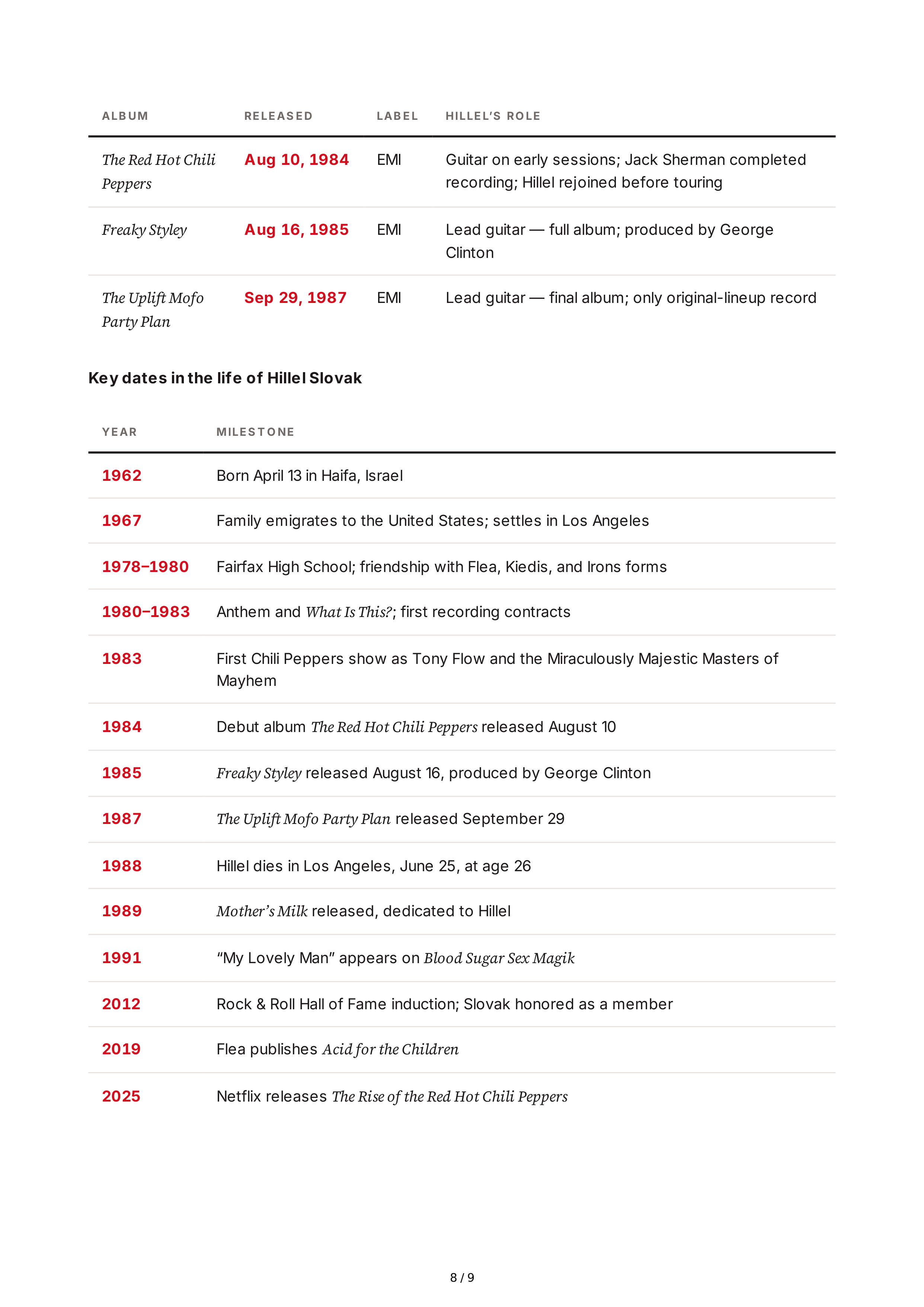
ALB UM
RE LE AS E D
LAB E L
HILLE L
’
S
RO LE
The Red Hot Chili
Peppers
Aug
10, 1984
EMI
Guitar
on
early
sessions
;
Jack
Sherman
completed
recording
;
Hillel
rejoined
before
touring
Freaky Styley
Aug
16, 1985
EMI
Lead
guitar
—
full
album
;
produced
by
George
Clinton
The Uplift Mofo
Party Plan
Sep
29, 1987
EMI
Lead
guitar
—
final
album
;
only
original
-
lineup
record
Key
dates
in
the
life
of
Hillel
Slovak
YE AR
MILE S T O NE
1962
Born
April
13
in
Haifa
,
Israel
1967
Family
emigrates
to
the
United
States
;
settles
in
Los
Angeles
1978–1980
Fairfax
High
School
;
friendship
with
Flea
,
Kiedis
,
and
Irons
forms
1980–1983
Anthem
and
What Is This?
;
first
recording
contracts
1983
First
Chili
Peppers
show
as
Tony
Flow
and
the
Miraculously
Majestic
Masters
of
Mayhem
1984
Debut
album
The Red Hot Chili Peppers
released
August
10
1985
Freaky Styley
released
August
16,
produced
by
George
Clinton
1987
The Uplift Mofo Party Plan
released
September
29
1988
Hillel
dies
in
Los
Angeles
,
June
25,
at
age
26
1989
Mother’s Milk
released
,
dedicated
to
Hillel
1991
“
My
Lovely
Man
”
appears
on
Blood Sugar Sex Magik
2012
Rock
&
Roll
Hall
of
Fame
induction
;
Slovak
honored
as
a
member
2019
Flea
publishes
Acid for the Children
2025
Netflix
releases
The Rise of the Red Hot Chili Peppers
8 / 9
13
Sources and Notes
This
companion
biography
is
an
independent
reference
document
prepared
for
editorial
and
archival
use
.
It
is
not
an
official
publication
of
Netflix
,
the
Red
Hot
Chili
Peppers
,
or
the
Slovak
family
,
and
it
has
not
been
authorized
by
them
.
Details
are
drawn
from
the
published
memoirs
,
interviews
,
and
archival
reporting
cited
above
,
which
occasionally
differ
on
minor
points
;
where
sources
conflict
,
this
text
follows
the
account
given
in
the
Netflix
documentary
and
the
band
’
s
published
memoirs
.
OUR
BROTHER
,
HILLEL
The
Life
and
Legacy
of
Hillel
Slovak
, 1962–1988
Companion
to
The
Rise
of
the
Red
Hot
Chili
Peppers
·
Netflix
· 2025
Anthony
Kiedis
with
Larry
Sloman
,
Scar Tissue
—
Hyperion
, 2004
(
memoir
;
primary
account
of
the
band
’
s
early
years
and
Hillel
’
s
friendship
with
Kiedis
)
Michael
Balzary
(
Flea
),
Acid for the Children
—
Grand
Central
Publishing
, 2019
(
memoir
;
primary
account
of
Hillel
teaching
Flea
to
play
bass
)
The Rise of the Red Hot Chili Peppers
—
Netflix
documentary
, 2025
(
archival
footage
and
new
interviews
covering
the
band
’
s
formation
and
Hillel
’
s
life
)
Contemporary
reporting
and
reviews
—
Rolling
Stone
,
Los
Angeles
Times
,
Guitar
World
, 1984–1988
Red
Hot
Chili
Peppers
official
archives
and
Rock
&
Roll
Hall
of
Fame
induction
records
(2012)
9 / 9