T
P A
R
T
T
W O
·
T
H
E
A
B
O
L
I
T
I
O
N
I
S
T
VI. From Words to War
1856–1860
“If there is no struggle, there is no progress.”
— “
West
India
Emancipation
” (
Canandaigua
,
August
1857)
he late 1850s were a hard school for every American who hated slavery. In 1856 the territory
of Kansas bled as pro-slavery and free-state settlers fought for its future. In the Senate, the
abolitionist Charles Sumner was beaten nearly to death at his desk by a South Carolina
congressman. In 1857 the Supreme Court, in
Dred Scott v. Sandford
, ruled that no Black American,
free or enslaved, could be a citizen of the United States, and that Congress had no power to exclude
slavery from the territories. For Douglass the decision was a confirmation of everything he had
said about the reach of the slave power into the very architecture of the government; he called it
the triumph of proslavery doctrine in the robes of the Court, and insisted that its logic, carried to
its end, would make slavery national and freedom sectional.
Douglass watched the rise of the Illinois lawyer Abraham Lincoln with wariness and hope. He
shadowed the great debates of 1858 between Lincoln and Stephen A. Douglas, answering the “Little
Giant’s” arguments against Black citizenship in the columns of his paper, while his own name —
shared in part with Douglas — placed him at the center of the nation’s most conspicuous political
rivalry. But the decisive relationship of these years was with John Brown.
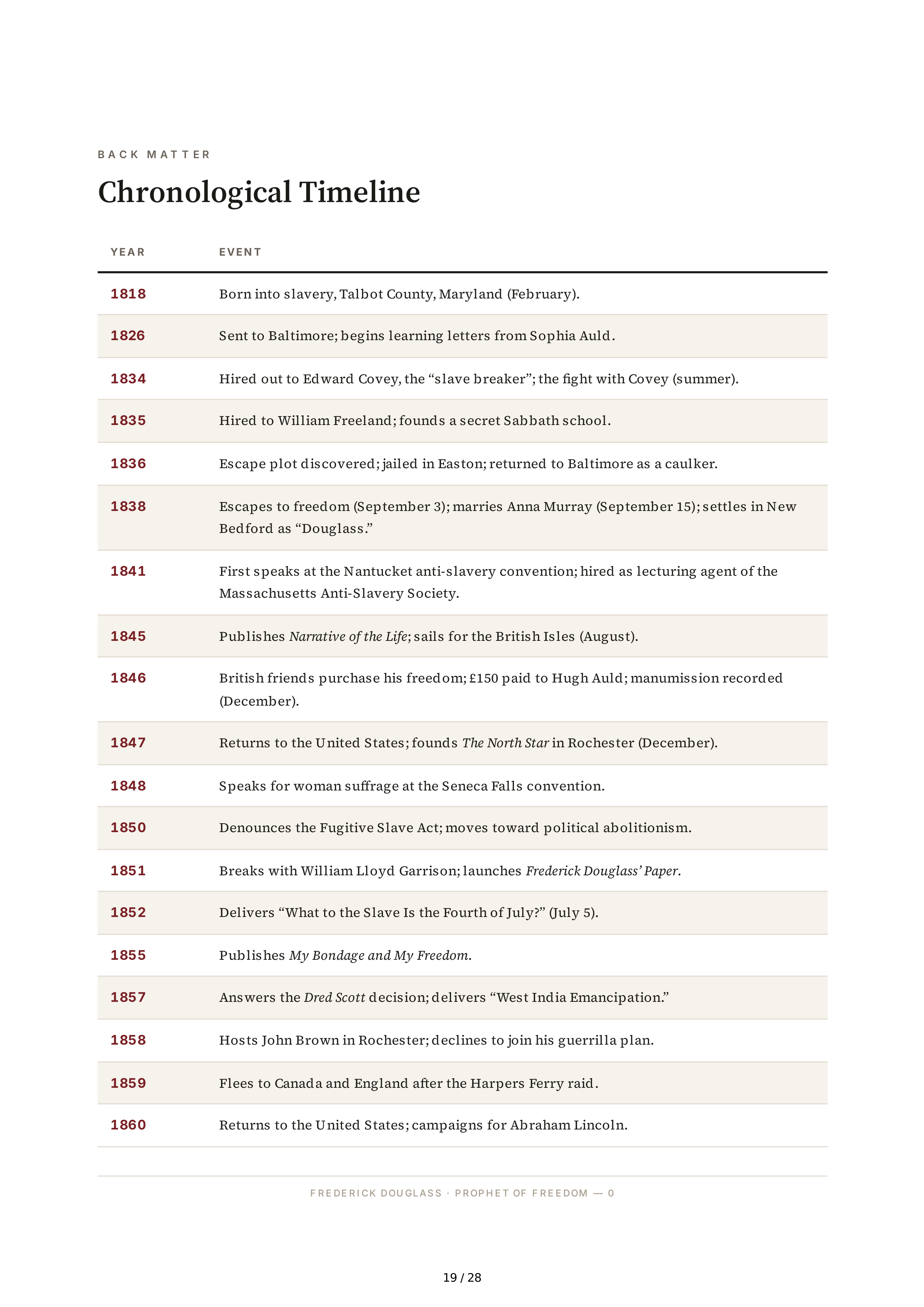
Brown had first sought Douglass out in 1848, in Springfield, Massachusetts, and again in 1858
stayed in his Rochester home, unfolding a plan for a guerrilla war against slavery from a
mountain stronghold in Virginia. Douglass refused. He loved Brown, respected his sincerity, and
considered his plan suicidal. In August 1859, at a quarry near Chambersburg, Pennsylvania, Brown
revealed the actual design: an armed seizure of the federal arsenal at Harpers Ferry as the spark of
a slave insurrection. Douglass argued against it with all his force, warned that Brown was walking
into a trap, and declined to join. The raid failed, and Brown was hanged. But in failure he shook the
nation to its foundations, and Douglass, sought by the authorities in the hysteria that followed, fled
to Canada and then to England, returning in the spring of 1860.
The election of 1860 brought Lincoln to the White House on a platform of containing slavery’s
expansion; the secession of the Southern states brought the crisis to war. Douglass, from his
return, urged the North to understand what it was fighting: not a dispute over tariffs or
constitutional forms, but the question of whether the republic could survive half slave and half
free. He pressed — insistently, from every platform — for emancipation as a war measure. The war,
he argued, would be won not by the generals alone but by the principle for which the nation was
willing to fight; if slavery were spared, the Union would be worse than lost.
F R E DE R I CK
DOU GL AS S
·
P R OP H E T
OF
F R E E DOM
— 0
13 / 28