

Honor Thy Father


Gay Talese

FOR
Charles, Joseph, Tory, and Felippa in the hope that they will understand their
father more, and love him no less…

Contents
Foreword
Author’s Glossary
Part One
The Disappearance
Part Two
The War
Part Three
The Family
Part Four
The Judgment
Afterword
Searchable Terms
About the Author
Other Books by Gay Talese
Copyright
About the Publisher
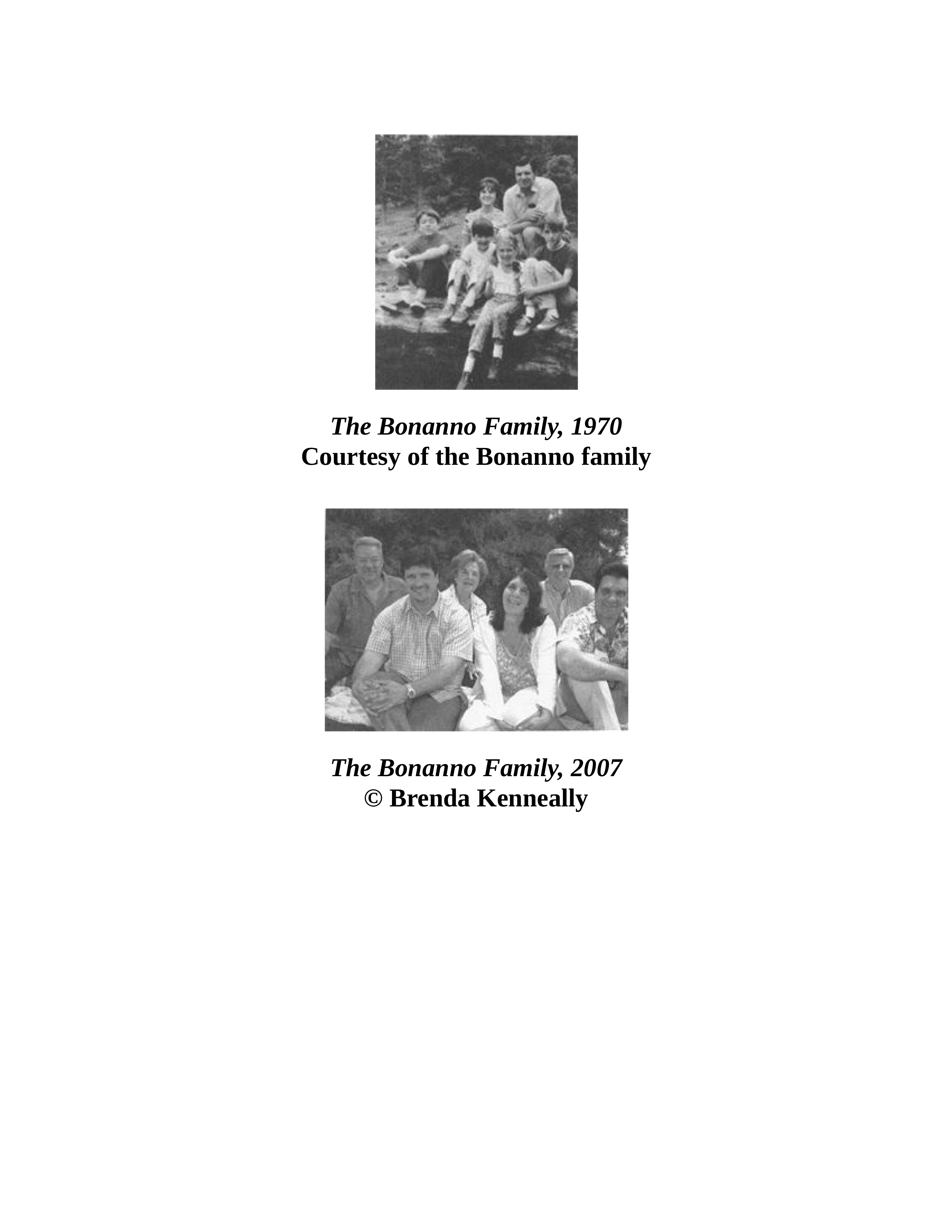
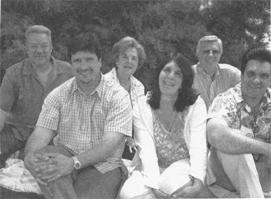
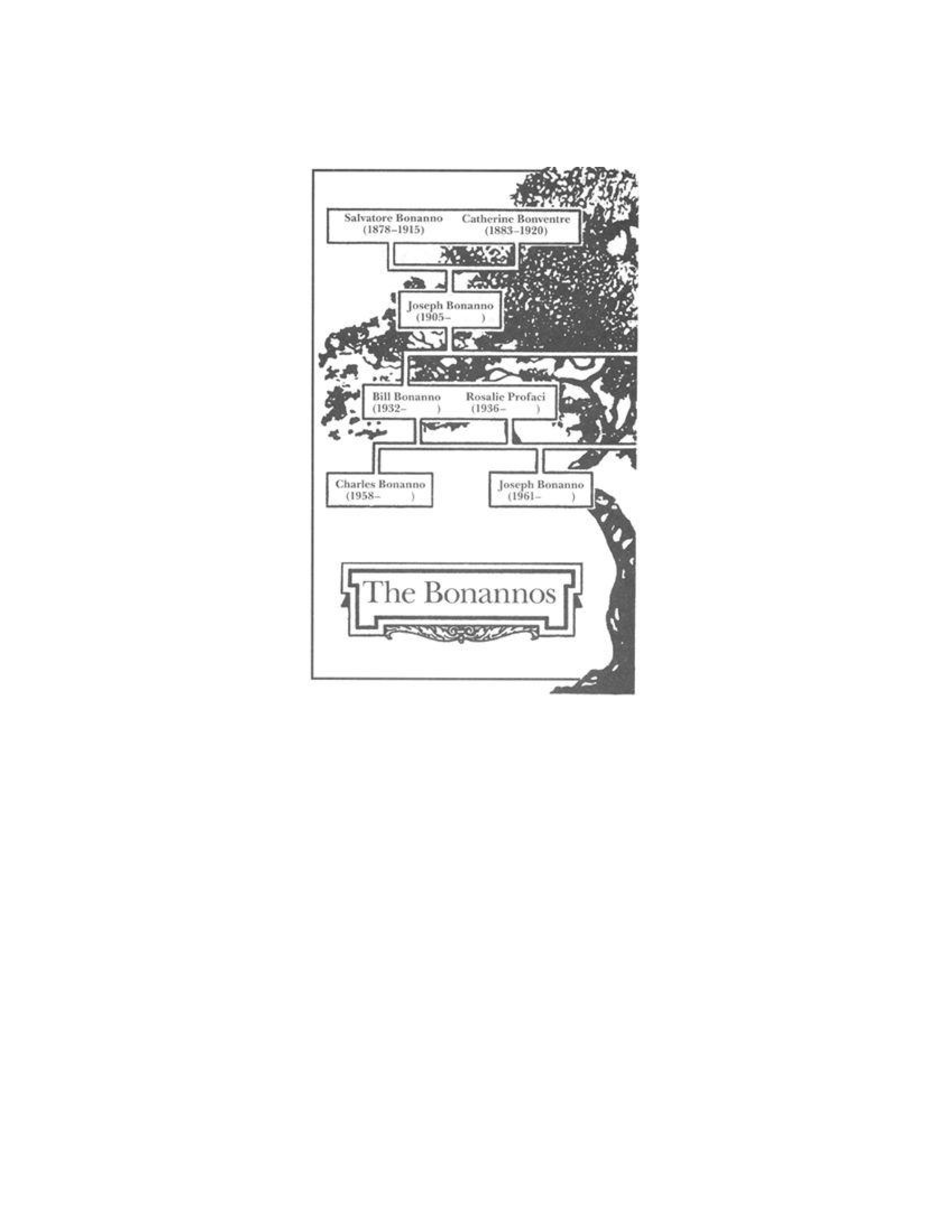
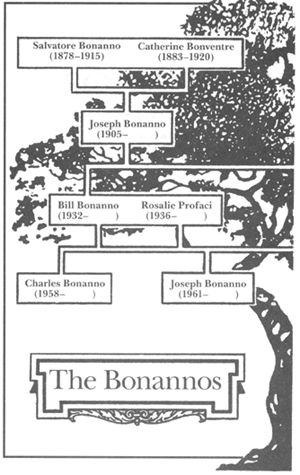
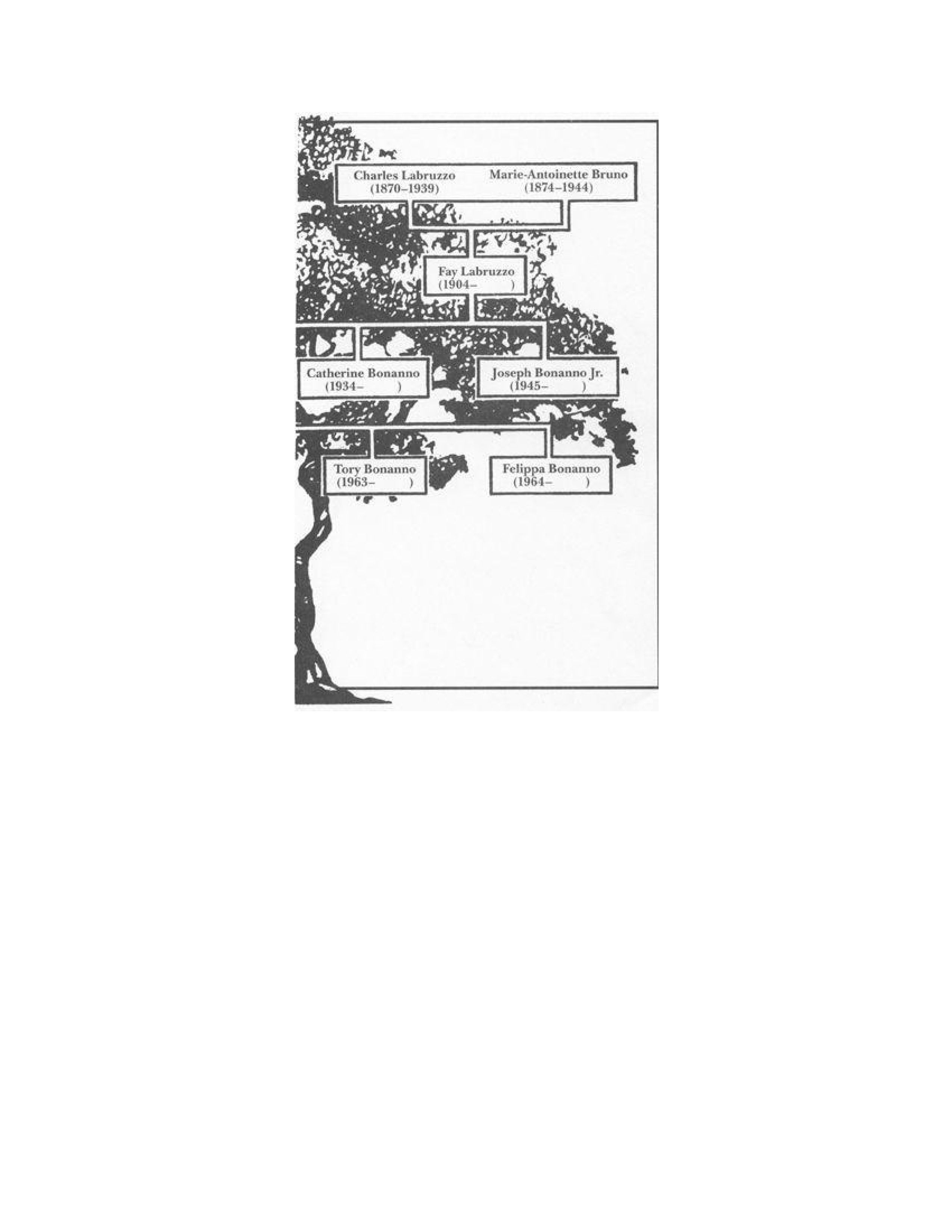
The Bonanno Family, 1970
Courtesy of the Bonanno family
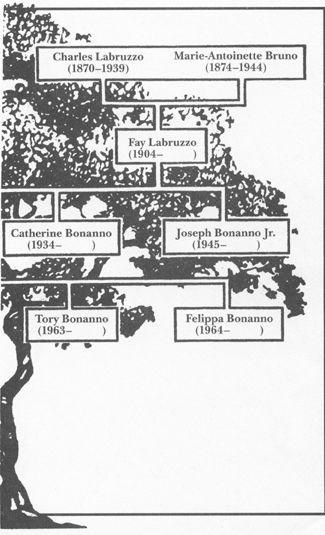
The Bonanno Family, 2007
© Brenda Kenneally
FOREWORD
I
KNEW GAY TALESE BEFORE I EVER MET HIM. THE YEAR WAS
1958. I was twenty-three, living on the Lower East Side of Manhattan, employed
as an advertising designer, and trying to teach myself to write.
This was not easy. I had taken a few courses in what was then called
“English composition” while attending art school at Pratt Institute and in Mexico
City, and I soon abandoned painting because the need to write stories kept
getting in the way. Something in me demanded sequence and narrative, a
primitive urge to say that this happened, and that happened, and
as a result
, still
another event happened. My classrooms in this other art were the books of great
writers. Taunted and inspired by Hemingway, Fitzgerald, John O’Hara, and
others, I began writing my own imperfect stories on an old Royal typewriter. I
even had a plan. In art school, a teacher named Burne Hogarth told us that there
were four stages in every artist’s attempt at mastery: imitate, emulate, equal,
surpass. I was still so young that I thought I could do the same with writing.
At the same time, I was reading about six newspapers a day, devouring them
for information, news, fight results (for I was an avid boxing fan), comic strips,
and political opinions. I loved the work of Murray Kempton (even when I did
not understand it), Jimmy Cannon, Red Smith, Frank Graham, Dave Anderson.
In magazines I soaked up the work of W. C. Heinz and A. J. Liebling.
In early 1958, I became friends with a wonderful young middleweight
named Jose (Chegui) Torres. He trained in the Gramercy Gym on Fourteenth
Street, five blocks from where I was living. As a fighter, Jose was a terrific
puncher, with blurring hand speed, superb defense, and high ring intelligence.
He was funny, too, in English and Spanish, laughing at his own jokes,
occasionally bursting into song. One late afternoon, I walked up the two flights
to the Gramercy, and went in. The gym was packed. Jose abandoned the speed
bag and hurried to me.
“You see it?” he said. “You see the story in the
Times
? You see it?”
“What story?” I said.
“The story about
me
!” No, I said. Jose turned and hurried into the small
office where his manager, Cus D’Amato, sometimes slept on a cot, with a
German shepherd as protection against enemies, real and imagined. Then he
came back waving a folded section of
The New York Times
in a gloved hand.
“Read it,” Jose said. “It’s beautiful.”
So it was. An elegantly written portrait of a young fighter, full of exact
details about where he lived in Brooklyn, and how he trained, and what he was
like in the prize ring. Jose’s name wasn’t mentioned until the last paragraph.
The piece was written by Gay Talese.
After that, I began looking in the
Times
for new stories by this fellow Talese and
was always impressed. He wrote in a deceptively simple style that reminded me
in some way of the Latin prose I had studied in high school. The sentences were
classically designed, made of concrete nouns and active verbs. They seemed
always to end with a hard word, so that a period was not even necessary. Long
sentences alternated with short blunt sentences. The effect was sometimes
lyrical, tempered by subtle ironies. The paragraphs were as solid as good
brickwork. Those smooth paragraphs reminded me of the short stories of Irwin
Shaw.
But even in the tight, confined spaces of a daily newspaper, the surface style
always was rooted in Talese’s reporting. He knew how to take a reader into a
place, revealing what it looked like, and smelled like, where the light came from,
and what made up the sound track. He was aware of the way clothes could
convey class and taste. The quotes were also used with precision, at once
revealing character and moving the story forward. These early pieces for the
Times
were sketches by a fine draftsman. Later, in his full-length magazine
articles and in his books, the work attained the depth and elegance of full-scale
paintings.
In 1958, Talese was twenty-six years old. He was born in Ocean City, New
Jersey, just south of Atlantic City. His father was a tailor, and the Taleses were
one of the few Italian American families among many Irish Americans. He was a
shy, wary kid in school and, by his own account, a poor student. But he was
learning to observe the world, to read it for signs of danger or the presence of
social slights. In high school, he found his way to the school newspaper, which
gave him his life. Some lessons taught by the example of his father remained
with him for all the years that followed. Gay Talese (named for his stonemason
grandfather, Gaetano) would write the best-tailored prose of his generation of
journalists.
The Ivy League was beyond him, in those days still rheumy with nasty
strains of anti-Italian class prejudice. Talese ended up far from home, at the
University of Alabama. There he majored in journalism, with growing ambitions
to make his nonfiction as vital and deep as great works of the imagination. Like
all of us, he was reading Hemingway, Fitzgerald, O’Hara, and (yes, I learned
later) Irwin Shaw. They had many lessons to teach.
After graduating in 1953, Talese landed a job as a copy boy at
The New York
Times
. He managed to have several pieces published in the
Times
, and then was
called up by the U.S. Army. The Korean War had ended in a cease-fire, but while
in the university, Talese was a member of the ROTC. Now they came knocking
at his door. Off he went, to serve as a public information office at Fort Knox,
Kentucky, longing to return to
The New York Times
. For any writer, boredom has
its uses. He continued reading, writing, and imagining. When he returned to the
Times
in 1956, he was bursting with energy and journalistic visions. Literature
had taught him that ordinary lives could be as dense, complicated, even heroic as
those of people who ended up as statues in parks. He wanted to be their
chronicler.
The path he followed at the
Times
led him into sports, with a focus on
boxing. The prize ring offered primordial drama, one man against another, where
the difference between triumph and defeat was often determined by will. Even in
those days, when
The New York Times
was a rigidly edited, calcified newspaper,
it was possible in sports to write more freely. That’s why they called it
sportswriting. Talese began to excel at the craft, while embracing one huge
lesson that he had already sensed: the best stories were usually in the losers’
dressing rooms.
At the same time, he was trying to write stories about ordinary people, many
of whom were glibly dismissed as “losers.” At the
Times
, too many of those
stories ended up on “the spike,” literally a spike soldered into a flat slab of metal
and placed on an editor’s desk. It was the ultimate destination for rejected
stories. Talese kept copies of his own rejected stories, reworked them, and
started assembling his first book:
New York: A Serendipiter’s Journey
. Here were
glimpses into the lives of people you might pass in the streets, or who were
sitting beside you on the subway, or working at mean jobs far from the bright
lights of Broadway. That first book (with photographs by Marvin Lichtner) was
published in 1961, and the lyrical opening section was the first piece of writing
by Talese to appear in
Esquire
. It would not be his last.
In the summer of that same year, I went to work for
The New York Post
, and
my life had truly begun. While serving an apprenticeship covering fires and
murders, I was happier than I had ever been. Among Hogarth’s laws of mastery,
I didn’t have time for the first stage: imitation. But I was a compendium of all I
had read and admired, along with the commandments of some tough old tabloid
editors. In the fall, I received two enormous gifts: my first byline, and my first
working press card.
And in the Gramercy Gym one afternoon, I met Gay Talese.
He was dressed, of course, in a perfectly cut suit and tie, highly polished
shoes, a coat draped over his forearm. Jose Torres introduced us, and Talese
smiled, and said something nice about a story I’d written the week before. I told
him how much I admired his work. He shrugged and smiled in a modest way.
The gym was noisy with shouts, and grunts, and a trainer yelling, “chin down,
chin down.” Talese turned for a moment to the ring, where two welterweights
moved fiercely against each other, their faces masked in thick headgear. His face
went blank for a beat, as if he were recording what he was seeing. Then he
turned back to me.
“I hope you’re having fun down there,” he said, meaning the
Post
.
“I love it.”
“Sometimes, that’s all you need,” he said, in that year before the Beatles.
And I would discover that he was right.
Across the decades that followed, we remained friends. To be sure, we
weren’t close; I was a downtown type, out of the bohemian tradition of the
newspaper craft; Talese was more uptown. We met covering fights, or in
restaurants, or at occasional parties. But I never lost my admiration for his
adherence to the highest principles of the reporter’s craft, his insistence on going
beyond the surface, the quick hit, the glib assumption. He is doing that as I write.
This book—originally published in 1971—is only one example among many
of the refusal of Gay Talese to take his discovered truths off the rack. He sets
aside all the melodramatic temptations of the literature of the Mafia, and sees his
cast as subjects, not objects. They exist in his pages as human beings, one at a
time, not as cartoons. Talese understands, as all good reporters do, that you can
never be certain about the truth. Human beings lie. They offer alibis. At their
best, they plead “guilty with an explanation.” At their worst, they blame others.
In the world of the Bonannos, they usually say nothing at all.
Talese somehow managed to gain access to that world, to write about it with
a certain degree of empathy, free of prosecutorial zeal. He is not exactly counsel
for the defense, but by refusing moral certainty, he tells us more about that world
than we knew before he published this book, and more than we have learned
since then. It is an essential document in the project of understanding the
American twentieth century. And it is more. Reading it again, I was reminded of
the words of the splendid Italian writer Italo Calvino: “Every rereading of a
classic is as much a voyage of discovery as the first reading.”

By that test,
Honor Thy Father
is a classic. With any luck, my ten-year-old
grandson will read it when Talese and I are both long gone. If he does, I hope he
will understand how much his grandfather cherished the work of this fellow
Talese, and the pleasure of his company.
—Pete Hamill
2009
AUTHOR’S GLOSSARY
JOSEPH
BONANNO
Patriarch of family. Born in 1905 in western Sicilian town
of Castellammare del Golfo. An anti-Fascist student
radical in Palermo after Mussolini came to power in 1922,
Bonanno fled Sicily and entered United States during
Prohibition. Decades later, a millionaire, Bonanno was
identified by U.S. government as one of top bosses in
American Mafia.
FAY
BONANNO
Wife of Joseph Bonanno. Born Fay Labruzzo in Tunisia of
Sicilian parents who later emigrated to United States and
settled in Brooklyn. There, in 1931, she married Joseph
Bonanno.
SALVATORE
(BILL)
BONANNO
Eldest son of Joseph and Fay Bonanno, born 1932.
CATHERINE
BONANNO
Daughter of Joseph and Fay Bonanno, born 1934.
JOSEPH
BONANNO,
JR.
Younger son of Joseph and Fay Bonanno, born 1945.
ROSALIE
BONANNO
Wife of Bill Bonanno, whom she married in 1956. Born
Rosalie Profaci in 1936; niece of Joseph Profaci.
Joseph
PROFACI
Millionaire importer of olive oil and tomato paste. Until
death from cancer in 1962, boss of Brooklyn organization
with close ties to organization headed by Joseph Bonanno.
Born Villabate, Sicily, 1897.
JOSEPH
MAGLIOCCO
His sister married to Joseph Profaci; after Profaci’s death,
Magliocco, a longtime aide, succeeded to leadership of
Profaci organization. Suffered fatal heart attack in
December 1963.
JOSEPH
COLOMBO
Succeeded Magliocco; negotiated uncertain peace within
factionalized Profaci organization following Gallo brothers
revolt of 1960, but organization never regained power it
had during 1950s and 1940s under Profaci. Colombo in
1970 started Italian-American Civil Rights League; in
1971, at League outdoor rally, Colombo was shot by black
man posing as photographer.
STEFANO
MAGADDINO
Boss in Buffalo area. Native of Castellammare del Golfo,
distant cousin of Joseph Bonanno, but enemy of Bonanno
since 1960s.
GASPAR
DI
GREGORIO
Magaddino’s brother-in-law, loyal member of Joseph
Bonanno
organization
for
years—until
in
1964,
disenchanted by elevation of thirty-two-year-old Bill
Bonanno in organization, led internal revolt that led in
mid-1960s to so-called Banana War. Magaddino, among
others, backed Di Gregorio’s cause.
FRANK
LABRUZZO
Brother of Fay Bonanno and loyal captain in Joseph
Bonanno organization.
JOSEPH
NOTARO
Loyal captain in Bonanno organization
JOHN
BONVENTRE
Cousin of Joseph Bonanno and veteran officer in
organization who in 1950s returned to native Sicily to
retire. In 1971, in Italian government’s anti-Mafia drive,
Bonventre was cited as leader and exiled with other alleged
mafiosi to small island off northeast coast of Sicily.
FRANK
GAROFALO
Loyal Bonanno captain; returned to peaceful retirement in
Sicily in 1950s, where he died natural death.
PAUL
SCIACCA
Bonanno member who quit organization in 1964 dispute,
joined Di Gregorio’s faction.
FRANK MARI
Bonanno member who joined Di Gregorio and became
identified as top triggerman against Bonanno loyalists
during Banana War in mid-1960s.
PETER
MAGADDINO
First cousin of Stefano Magaddino, the boss in Buffalo;
Peter Magaddino left Buffalo and supported Joseph
Bonanno, his boyhood friend in Sicily, in the dispute with
Di Gregorio’s faction.
SALVATORE
Old-time Sicilian boss from Castellammare del Golfo;
MARANZANO
friend of Joseph Bonanno’s father. In 1930, Maranzano
organized group of Castellammarese immigrants in
Brooklyn to fight against New York organization headed
by Joe Masseria, a southern Italian who wanted to
eliminate Sicilian clan. This feud, extending from 1928
until 1931, became known as the Castellammarese War
and is referred to in Chapter 12.
THE MAFIA
Called by several names—and never
Mafia
by members—
is of ancient origin in Sicily. In United States it became
organized along modern business lines after completion of
Castellammarese War in 1931. At that time it realigned
itself into a national brotherhood of approximately 5,000
men belonging to twenty-four separate organizations
(“families”) located in major cities in every region of the
United States. In New York City, where an estimated 2,000
of the 5,000 members were in residence, five “families”
were established, each headed by a family boss, or don. In
1931, at the age of twenty-six, Joseph Bonanno was the
youngest don in the national brotherhood.
THE
COMMISSION
Of the twenty-four bosses, nine take turns serving as
members of the commission, which is dedicated to
maintaining peace in the underworld; but it is supposed to
restrain itself from interfering with the internal affairs of
any one boss. Occasionally it cannot resist, and then—as
with the Bonanno affair in the mid-1960s—there is trouble.
Before the Bonanno affair, however, the commission
members subordinated their differences and kept the nine-
man membership in tact. The commission included the
following:
JOSEPH
BONANNO
New York
JOSEPH
PROFACI
New York
VITO
GENOVESE
Succeeded to leadership of New York-based organization
once headed by Lucky Luciano, who, after being sentenced
in 1936 to long prison term, was deported to Italy in 1946.
Frank Costello, who tried to take over the Luciano
organization, was discouraged when his skull was grazed
with a bullet in 1957.
THOMAS
LUCCHESE
New York. Took over leadership of organization headed by
Gaetano Gagliano, who died of natural causes in 1953.
CARLO
GAMBINO
New York. Close to Lucchese; their children intermarried.
Gambino heads organization formerly controlled by Albert
Anastasia, who was fatally shot in a Manhattan barbershop
in 1957.
STEFANO
MAGADDINO
Buffalo. Born in 1891 in Castellammare del Golfo, he is
senior member of commission.
ANGELO
BRUNO
Boss of organization centered in Philadelphia.
SAM
GIANCANA
Boss of organization centered in Chicago.
JOSEPH
ZERILLI
Boss of organization in Detroit.
ORGANIZED
CRIME
It is most often assumed by newspaper readers that the
Mafia is all there is to organized crime in America, when in
fact the Mafia is merely a small part of the organized crime
industry. There are an estimated 5,000 mafiosi belonging to
twenty-four “families”; but federal investigators estimate
that there are more than 100,000 organized gangsters
working full-time in the crime industry—engaged in
numbers
racketeering,
bookmaking,
loan-sharking,
narcotics, prostitution, hijacking, enforcing, debt collecting,
and other activities. These gangs, who may work in
cooperation with Mafia gangs or may be entirely
independent, are composed of Jews, Irish, blacks, Wasps,
Latin Americans, and every ethnic or racial type in the
nation.
Because the Mafia, made up almost entirely of Sicilians
and southern Italians, has since Prohibition been more
ethnically tight and cohesive than most other gangs, its
influence and notoriety has been considerable in organized
crime circles. But during the 1960s, as old-style Mafia
bosses became older and their sons lacked the interest or
talent to replace them and had better options in the larger
American society, the Mafia structure is now disintegrating
as have the great Irish gangs of the late 1800s and the great
Jewish cliques of the 1920s (of which only Meyer Lansky
remains supreme today). The blacks and Latin Americans
have shown signs of emerging in the 1960s as a dominant
force to overthrow the last vestiges of white rule of ghetto
rackets.
This book is a study of the rise and fall of the Bonanno organization, a
personal history of ethnic progression and of dying traditions.

PART ONE

THE DISAPPEARANCE
1
K
NOWING THAT IT IS POSSIBLE TO SEE TOO MUCH, MOST
doormen in New York have developed an extraordinary sense of selective vision:
they know what to see and what to ignore, when to be curious and when to be
indolent; they are most often standing indoors, unaware, when there are
accidents or arguments in front of their buildings; and they are usually in the
street seeking taxicabs when burglars are escaping through the lobby. Although a
doorman may disapprove of bribery and adultery, his back is invariably turned
when the superintendent is handing money to the fire inspector or when a tenant
whose wife is away escorts a young woman into the elevator—which is not to
accuse the doorman of hypocrisy or cowardice but merely to suggest that his
instinct for uninvolvement is very strong, and to speculate that doormen have
perhaps learned through experience that nothing is to be gained by serving as a
material witness to life’s unseemly sights or to the madness of the city. This
being so, it was not surprising that on the night when the Mafia chief, Joseph
Bonanno, was grabbed by two gunmen in front of a luxury apartment house on
Park Avenue near Thirty-sixth Street, shortly after midnight on a rainy Tuesday
in October, the doorman was standing in the lobby talking to the elevator man
and saw nothing.
It had all happened with dramatic suddenness. Bonanno, returning from a
restaurant, stepped out of a taxicab behind his lawyer, William P. Maloney, who
ran ahead through the rain toward the canopy. Then the gunmen appeared from
the darkness and began pulling Bonanno by the arms toward an awaiting
automobile. Bonanno struggled to break free but he could not. He glared at the
men, seeming enraged and stunned—not since Prohibition had he been so
abruptly handled, and then it had been by the police when he had refused to
answer questions; now he was being prodded by men from his own world, two
burly men wearing black coats and hats, both about six feet tall, one of whom
said: “Com’on, Joe, my boss wants to see you.”
Bonanno, a handsome gray-haired man of fifty-nine, said nothing. He had
gone out this evening without bodyguards or a gun, and even if the avenue had
been crowded with people he would not have called to them for help because he
regarded this as a private affair. He tried to regain his composure, to think clearly
as the men forced him along the sidewalk, his arms numb from their grip. He
shivered from the cold rain and wind, feeling it seep through his gray silk suit,
and he could see nothing through the mist of Park Avenue except the taillights of
his taxicab disappearing uptown and could hear nothing but the heavy breathing
of the men as they dragged him forward. Then, suddenly from the rear, Bonanno
heard the running footsteps and voice of Maloney shouting: “Hey, what the
hell’s going on?”
One gunman whirled around, warning, “Quit it, get back!”
“Get out of here,” Maloney replied, continuing to rush forward, a white-
haired man of sixty waving his arms in the air, “that’s my client!”
A bullet from an automatic was fired at Maloney’s feet. The lawyer stopped,
retreated, ducking finally into the entrance of his apartment building. The men
shoved Bonanno into the back seat of a beige sedan that had been parked on the
corner of Thirty-sixth Street, its motor idling. Bonanno lay on the floor, as he
had been told, and the car bolted toward Lexington Avenue. Then the doorman
joined Maloney on the sidewalk, arriving too late to see anything, and later the
doorman claimed that he had not heard a shot.
Bill Bonanno, a tall, heavy, dark-haired man of thirty-one whose crew cut
and button-down shirt suggested the college student that he had been in the
1950s but whose moustache had been grown recently to help conceal his
identity, sat in a sparsely furnished apartment in Queens listening intently as the
telephone rang. But he did not answer it.
It rang three times, stopped, rang again and stopped, rang a few more times
and stopped. It was Labruzzo’s code. He was in a telephone booth signaling that
he was on his way back to the apartment. On arriving at the apartment house,
Labruzzo would repeat the signal on the downstairs doorbell and the younger
Bonanno would then press the buzzer releasing the lock. Bonanno would then
wait, gun in hand, looking through the peephole to be sure that it was Labruzzo
getting out of the elevator. The furnished apartment the two men shared was on
the top floor of a brick building in a middleclass neighborhood, and since their
apartment door was at the end of the hall they could observe everyone who came
and went from the single self-service elevator.
Such precautions were being taken not only by Bill Bonanno and Frank
Labruzzo but by dozens of other members of the Joseph Bonanno organization
who for the last few weeks had been hiding out in similar buildings in Queens,
Brooklyn, and the Bronx. It was a tense time for all of them. They knew that at
any moment they could expect a confrontation with rival gangs trying to kill
them or with government agents trying to arrest them and interrogate them about
the rumors of violent plots and vendettas now circulating through the
underworld. The government had recently concluded, largely from information
obtained through wiretapping and electronic bugging devices, that even the top
bosses in the Mafia were personally involved in this internal feud and that
Joseph Bonanno, a powerful don for thirty years, was in the middle of the
controversy. He was suspected by other dons of excessive ambition, of seeking
to expand—at their expense and perhaps over their dead bodies—the influence
that he already had in various parts of New York, Canada, and the Southwest.
The recent elevation of his son, Bill, to the number three position in the Bonanno
organization was also regarded with alarm and skepticism by a few leaders of
other gangs as well as by some members of Bonanno’s own gang of about 300
men in Brooklyn.
The younger Bonanno was considered something of an eccentric in the
underworld, a privileged product of prep schools and universities whose manner
and methods, while not lacking in courage, conveyed some of the reckless spirit
of a campus activist. He seemed impatient with the system, unimpressed with the
roundabout ways and Old World finesse that are part of Mafia tradition. He said
what was on his mind, not altering his tone when addressing a mafioso of
superior rank and not losing his sense of youthful conviction even when
speaking the dated Sicilian dialect he had learned as a boy from his grandfather
in Brooklyn. The fact that he was six feet two and weighed more than 200
pounds and that his posture was erect and his mind very quick added to the
formidability of his presence and lent substance to his own high opinion of
himself, which was that he was the equal or superior of every man with whom he
was associating except for possibly one, his father. When in the company of his
father, Bill Bonanno seemed to lose some of his easy confidence and poise,
becoming more quiet, hesitant, as if his father were severely testing his every
word and thought. He seemed to exhibit toward his father a distance and
formality, taking no more liberties than he would with a stranger. But he was
also attentative to his father’s needs and seemed to take great pleasure in
pleasing him. It was obvious that he was awed by his father, and while he no
doubt had feared him and perhaps still did, he also worshiped him.
During the last few weeks he had never been far from Joseph Bonanno’s
side, but last night, knowing that his father wished to dine alone with his lawyers
and that he planned to spend the evening at Maloney’s place, Bill Bonanno
passed a quiet evening at the apartment with Labruzzo, watching television,
reading the newspapers, and waiting for word. Without knowing exactly why, he
was mildly on edge. Perhaps one reason was a story he had read in
The Daily
News
reporting that life in the underworld was becoming increasingly perilous
and claiming that the elder Bonanno had recently planned the murder of two
rival dons, Carlo Gambino and Thomas (Three-Finger Brown) Lucchese, a
scheme that supposedly failed because one of the triggermen had betrayed
Bonanno and had tipped off one of the intended victims. Even if such a report
were pure fabrication, based possibly on the FBI’s wiretapping of low-level
Mafia gossip, the younger Bonanno was concerned about the publicity given to
it because he knew that it could intensify the suspicion which did exist among
the various gangs that ran the rackets (which included numbers games,
bookmaking, loan-sharking, prostitution, smuggling, and enforced protection).
The publicity could also inspire the outcry of the politicians, provoke the more
vigilant pursuit of the police, and result in more subpoenas from the courts.
The subpoena was dreaded in the underworld now more than before because
of a new federal law requiring that a suspected criminal, if picked up for
questioning, must either testify if given immunity by the court or face a sentence
for contempt. This made it imperative for the men of the Mafia to remain
inconspicuous if they wanted to avoid subpoenas every time there were
newspaper headlines. The law also impeded the Mafia leaders’ direction of their
men in the street because their men, having to be very cautious and often
detained by their caution and evasiveness, were not always where they were
supposed to beat the appointed hour to do a job, and frequently they were
unavailable to receive, at designated telephone booths at specific moments,
prearranged calls from headquarters seeking a report on what had happened. In a
secret society where precision was important, the new problem in
communications was grating the already jangled nerves of many top mafiosi.
The Bonanno organization, more progressive than most partly because of the
modern business methods introduced by the younger Bonanno, had solved its
communications problem to a degree by its bell-code system and also by the use
of a telephone answering service. It was perhaps the only gang in the Mafia with
an answering service. The service was registered in the name of a fictitious Mr.
Baxter, which was the younger Bonanno’s code name, and it was attached to the
home telephone of one member’s maiden aunt who barely spoke English and
was hard of hearing. Throughout the day various key men would call the service
and identify themselves through agreed-upon aliases and would leave cryptic
messages confirming their safety and the fact that business was progressing as
usual. If a message contained the initials “IBM”—“suggest you buy more
IBM”—it meant that Frank Labruzzo, who had once worked for IBM, was
reporting. If the word “monk” was in a message, it identified another member of
the organization, a man with a tonsured head who often concealed his identity in
public under a friar’s robe. Any reference to a “salesman” indicated the identity
of one of the Bonanno captains who was a jewelry salesman on the side; and
“flower” alluded to a gunman whose father in Sicily was a florist. A “Mr. Boyd”
was a member whose mother was known to live on Boyd Street in Long Island,
and reference to a “cigar” identified a certain lieutenant who was never without
one. Joseph Bonanno was known on the answering service as “Mr. Shepherd.”
One of the reasons that Frank Labruzzo had left the apartment that he shared
with Bill Bonanno was to telephone the service from a neighborhood coin box
and also to buy the early edition of the afternoon newspapers to see if there were
any developments of special interest. As usual, Labruzzo was accompanied by
the pet dog that shared their apartment. It had been Bill Bonanno who had
suggested that all gang members in hiding keep dogs in their apartments, and
while this had initially made it more difficult for the men to find rooms, since
some landlords objected to pets, the men later agreed with Bonanno that a dog
made them more alert to sounds outside their doors and also was a useful
companion when going outside for a walk—a man with a dog aroused little
suspicion in the street.
Bonanno and Labruzzo happened to like dogs, which was one of the many
things that they had in common, and it contributed to their compatibility in the
small apartment. Frank Labruzzo was a calm, easygoing, somewhat stocky man
of fifty-three with glasses and graying dark hair; he was a senior officer in the
Bonanno organization and also a member of the immediate family—Labruzzo’s
sister, Fay, was Joseph Bonanno’s wife and Bill Bonanno’s mother, and
Labruzzo was close to the son in ways that the father was not. There was no
strain or stress between these two, no competitiveness or problems of vanity and
ego. Labruzzo, not terribly ambitious for himself, not driven like Joseph
Bonanno or restless like the son, was content with his secondary position in the
world, recognizing the world as a much larger place than either of the Bonannos
seemed to think it was.
Labruzzo had attended college, and he had engaged in a number of
occupations but had pursued none for very long. He had, in addition to working
for IBM, operated a dry-goods store, sold insurance, and had been a mortician.
Once he owned, in partnership with Joseph Bonanno, a funeral parlor in
Brooklyn near the block of his birth in the center of a neighborhood where
thousands of immigrant Sicilians had settled at the turn of the century. It was in
this neighborhood that the elder Bonanno courted Fay Labruzzo, daughter of a
prosperous butcher who manufactured wine during Prohibition. The butcher was
proud to have Bonanno as a son-in-law even though the wedding date, in 1930,
had to be postponed for thirteen months due to a gangland war involving
hundreds of newly arrived Sicilians and Italians, including Bonanno, who were
continuing the provincial discord transplanted to America but originating in the
ancient mountain villages that they had abandoned in all but spirit. These men
brought to the New World their old feuds and customs, their traditional
friendships and fears and suspicions, and they not only consumed themselves
with these things but they also influenced many of their children and sometimes
their children’s children—among the inheritors were such men as Frank
Labruzzo and Bill Bonanno, who now, in the mid-1960s, in an age of space and
rockets, were fighting a feudal war.
It seemed both absurd and remarkable to the two men that they had never
escaped the insular ways of their parents’ world, a subject that they had often
discussed during their many hours of confinement, discussing it usually in tones
of amusement and unconcern, although with regret at times, even bitterness.
Yes,
we’re in the wagon wheel business
, Bonanno had once sighed, and Labruzzo had
agreed—they were modern men, lost in time, grinding old axes. This fact was
particularly surprising in the case of Bill Bonanno: he left Brooklyn at an early
age to attend boarding schools in Arizona, where he was reared outside the
family, learned to ride horses and brand cattle, dated blonde girls whose fathers
owned ranches; and later, as a student at the University of Arizona, he led a
platoon of ROTC cadets across the football field before each game to help raise
the American flag before the national anthem was played. That he could have
suddenly shifted from this campus scene in the Southwest to the precarious
world of his father in New York was due to a series of bizarre circumstances that
were perhaps beyond his control, perhaps not. Certainly his marriage was a step
in his father’s direction, a marriage in 1956 to Rosalie Profaci, the pretty dark-
eyed niece of Joseph Profaci, the millionaire importer who was also a member of
the Mafia’s national commission.
Bill Bonanno first met Rosalie Profaci when she was a young student
attending a convent school in upstate New York with his sister. At that time he
had a girl friend in Arizona, a casual American girl with a flair for freedom;
while Rosalie was appealing, she also was demure and sheltered. That the young
couple would meet again and again, during summer months and holidays, was
largely due to their parents, who were very close and whose approval was
bestowed in subtle but infectious ways whenever Rosalie and Bill would
converse or merely sit near one another in crowded rooms. At one large family
gathering months before the engagement, Joseph Bonanno, taking his twenty-
year-old daughter Catherine aside, asked her privately what she thought of the
likelihood that Bill would marry Rosalie. Catherine Bonanno, an independent-
minded girl, thought for a moment, then said that while she was extremely fond
of Rosalie personally she did not feel that Rosalie was right for Bill. Rosalie
lacked the strength of character to accept him for what he was and might
become, Catherine said, and she was about to say something else when,
suddenly, she felt a hard slap across her face, and she fell back, stunned,
confused, then burst into tears as she ran, never before having seen her father
that enraged, his eyes fiery and fierce. Later he tried to comfort her, to apologize
in his way, but she remained aloof for days although she understood as she had
not before her father’s desire for the marriage. It was a wish shared by Rosalie’s
father and uncle. And it would be fulfilled the following year, an event that
Catherine Bonanno would regard as a marriage of fathers.
The wedding, on August 18, 1956, had been extraordinary. More than 3,000
guests had attended the reception at the Astor Hotel ballroom in New York
following the church wedding in Brooklyn, and no expense was spared in
embellishing the occasion. Leading orchestras were hired for the dancing, and
the entertainment included the Four Lads and Tony Bennett. A truckload of
champagne and wine was sent as a gift by a distributor in Brooklyn, and it was
arranged through Pan American Airways to have thousands of daisies flown in
from California because that flower, Rosalie’s favorite, was then unavailable in
New York. The guest list, in addition to the legitimate businessmen and
politicians and priests, included all the top men of the underworld. Vito
Genovese and Frank Costello were there, having requested and received
inconspicuous tables against the wall. Albert Anastasia was there (it was the year
before his murder in the barbershop of the Park-Sheraton Hotel), and so was
Joseph Barbara, whose barbecue party for nearly seventy mafiosi at his home in
Apalachin, New York, three weeks after the murder, would be discovered by the
police and would result in national publicity and endless investigations. Joseph
Zerilli had come with his men from Detroit, and so had the Chicago delegation
led by Sam Giancana and Tony Accardo. Stefano Magaddino, the portly old don
from Buffalo, cousin of Joseph Bonanno, was given an honored table in front of
the dais, and seated near him were other relatives or close friends of the
Bonannos and Profacis. All of the twenty-four semi-independent organizations
that formed the national syndicate were represented at the wedding, meaning that
there were men from New England to New Mexico, and the group from Los
Angeles alone totaled almost eighty.
Bill Bonanno, smiling next to his bride on the dais, toasting the guests and
being toasted in turn, often wondered during the evening what the FBI would
have done had it gotten its hands on the guest list. But there was little chance of
that since the list, in code, had been in the careful custody of Frank Labruzzo
and his men who were posted at the door to receive the guests and to escort them
to their tables. There were no intruders on that night. There was not really a great
deal of public concern over the Mafia in 1956. The Kefauver hearings of 1951
were already forgotten, and the Apalachin fiasco was one year away. And so the
wedding and reception proceeded smoothly and without incident, with Catherine
Bonanno as the maid of honor; and Joseph Bonanno, elegant in his cutaway,
presided over the gathering like a medieval duke, bowing toward his fellow
dons, dancing with the women, courtly and proud.
After the reception, during which the bridal couple had received in gift
envelopes about $100,000 in cash, Bill Bonanno and his bride flew to Europe for
a honeymoon. They stayed for a few days at the Ritz Hotel in Paris, then at the
Excelsior in Rome; they received special attention in each place and were
ushered quickly through customs at the airport. Later they flew to Sicily, and as
the plane slowly taxied toward the terminal building in Palermo, Bill Bonanno
noticed that a large crowd had gathered behind the gate and that a number of
carabinieri were among them, standing very close to Bonanno’s aging, bald-
headed uncle, John Bonventre, who seemed rather grim and tense. Bonanno’s
first thought was that Bonventre, who had once served in the United States as an
underboss in the Bonanno organization, was about to be deported from his native
Sicily, to which he had gone the year before to retire, having taken with him
from America a lifetime’s supply of toilet paper, preferring it to the coarse
brands produced in Sicily. After the plane stopped but before the door opened, a
stewardess asked that Mr. and Mrs. Bonanno please identify themselves. Slowly,
Bill Bonanno raised his hand. The stewardess then asked that the couple be the
first to leave the plane.
Walking down the ramp into the hot Sicilian sun, mountains rising in the
distance behind sloping villages of tan stone houses, Bonanno sensed the crowd
staring at him, moving and murmuring as he got closer. The old women were
dressed in black, the younger men had fixed dark expressions, children were
milling everywhere, and the statuesque carabinieri, flamboyantly dressed and
brandishing gleaming silver swords, stood taller than the rest. Then the uncle,
Bonventre, bursting with a smile of recognition, ran with arms outstretched
toward the bridal couple, and crowd followed, and suddenly the Bonannos were
surrounded by clutching kissing strangers, and Rosalie, blushing, tried without
success to conceal the awkwardness she felt in the center of swarming
unrestrained affection. Her husband, however, seemed to enjoy it thoroughly,
reaching out with his long arms to touch everyone that he could, leaning low to
be embraced by the women and children, basking in the adoration and
salutations of the crowd. The carabinieri watched impassively for a few
moments, then stepped aside, clearing a path that led toward a line of illegally
parked automobiles waiting to take the couple to the first of a series of
celebrations that would culminate with a visit on the following day to
Castellammare del Golfo, the town in western Sicily where Joseph Bonanno was
born and where the earlier Bonannos had long ruled as
uomini rispettati—
men of
respect.
Rosalie had hoped that they would also visit her father’s birthplace, a town
just east of Palermo called Villabate, but her husband, without ever explaining
why, indicated that this was impossible. Moments after he had landed at Palermo
his uncle had whispered a message just received from the United States from the
elder Bonanno insisting that the couple avoid Villabate. A number of friends and
distant relatives of the Profacis still living in Villabate were then struggling with
a rival gang for control over certain operations, and there had already been seven
murders in the past ten days. It was feared that the enemies of Profaci’s friends
in Villabate might seek revenge for their dead upon Bill Bonanno or his wife,
and although Rosalie persisted in her request to see Villabate, her husband
managed to avoid the trip after making endless excuses and offering a busy
itinerary of pleasant distractions. He was also relieved that Rosalie had not
questioned, nor had even seemed to notice, the quiet group of men that followed
them everywhere during their first day of sightseeing in Palermo. These men,
undoubtedly armed, were serving as bodyguards for the Bonanno couple, even
sitting outside the couple’s hotel door at night to guarantee that no harm would
come to them in Sicily.
The journey to Castellammare del Golfo, sixty miles west of Palermo, was
the highpoint of the Sicilian visit for Bill Bonanno. As a boy he had seen on the
walls at home framed photographs of his father’s town, and he later noted
references to it in history books and travel guides, although the references were
very brief and superficial—it was as if the writers, with few exceptions, had
quickly driven through the town without stopping, perhaps being intimidated by
one published report claiming that eighty percent of Castellammare’s adult male
population had served time in prison.
There was no social stigma attached to this, however, because most of the
local citizens regarded the law as corrupt, representing the will of invaders who
had long sought to control the islanders and exploit the land through the
conqueror’s law. As with most of Sicily, the history of Castellammare had been
turbulent for centuries, and Bonanno remembered reading that the island was
conquered and reconquered no less than sixteen times—by Greeks, Saracens,
and Normans, by Spaniards, Germans, and English, by various combinations and
persuasions ranging from Holy Crusaders to Fascists. They had all come to
Sicily and did what men do when away from home, and the history of Sicily was
a litany of sailor’s sins.
As the caravan of cars arrived at Castellammare, having driven for two hours
along narrow mountain roads above the sea, Bill Bonanno felt a sudden sense of
familiarity with the landscape that was beyond mere recognition from pictures.
He felt united with all that he had imagined for years, all that he had heard as a
boy from the reminiscing men gathered around his father’s dinner table on
Sunday afternoons. The town was actually quite beautiful, a tranquil fishing
village built along the bottom of a mountain, and at the very tip of the land, on a
jagged rocky edge splashed by waves, stood the old stone castle that gave the
town its name. The castle, built many centuries ago by the Saracens or Aragons,
no one was absolutely certain, had served as the town’s lookout for spotting
invading ships; but now it was a decaying structure of no purpose, and the elder
Bonanno and the other men had recalled playing in it as boys.
Near the castle, along the small beach, were the fishermen, weatherworn and
ruddy, wearing black berets; they were pulling in their nets as the Bonanno party
passed but were too busy to notice the line of cars. In the town square, near a
church built four hundred years ago, were many men walking slowly, arm in
arm, making many gestures with their hands. The stone houses, most of them
two or three stories high with balconies in front, were arranged in tight rows
along narrow cobbled roads over which was heard the clacking sounds of
donkeys pulling colorfully painted wagons between the motor traffic. Here and
there, sunning themselves in front of their doors, were groups of women, the
unmarried ones seated with their backs to the street, possibly following a fashion
inherited a thousand years ago when the Arabs occupied Sicily.
In front of one particularly well-constructed house on Corso Garibaldi, a
crowd had gathered. When the procession of cars was spotted, the people
stepped up to the curb, waiting. They were about thirty in number, dressed in
dark clothes except for the children, one of whom held a bouquet of flowers.
They were standing in front of the home where Joseph Bonanno was born, and
the arrival of his son was regarded as an event of historical proportions. An
indication of the Bonanno family status in Castellammare was the fact that the
ceremony surrounding Joseph Bonanno’s baptism in 1905 had marked the end of
a shooting war between the local mafiosi and those in the neighboring village of
Alcamo; and when Joseph Bonanno’s father, Salvatore Bonanno, died in 1915,
he was buried in the most prominent plot at the base of the mountain.
After the bridal couple was greeted by, and disentangled themselves from,
the embracing crowds and had coffee and pastry with their cousins and
compari
,
they went to the cemetery; and Bill Bonanno, standing before a large gravestone
that exhibited a proud picture of a man with a handlebar moustache, sensed
something more about his own father’s relationship to the past. The eyes looking
out from the gravestone were penetrating and dark, and Bill Bonanno could
readily accept what he had heard of his grandfather’s persuasive power, although
he found it difficult to believe that this authoritative-looking photograph was of a
man who had died at thirty-seven. His grandfather seemed to be a tall man—lean
and tall unlike Sicilians. Perhaps this is because the Bonannos were not Sicilian
by origin. Hundreds of years ago they had lived in Pisa, according to Joseph
Bonanno, and had left rather hastily following a dispute with the ruling family.
Joseph Bonanno, who kept a family coat-of-arms hanging in his home in the
United States, a shield decorated with a panther, had compiled a history of his
ancestry that claimed kinship with Charles Bonanno, engineer of the Leaning
Tower of Pisa.
After Bill Bonanno returned from his honeymoon in September 1956, he
urged his father to visit Castellammare. And a year later the elder Bonanno
visited the town. But the recollection of the pleasant experiences of that trip were
somewhat negated by certain events that followed in 1957 and other subsequent
events. There was the publicity attached to the Anastasia murder and the
Apalachin meeting, and in 1963 there was the Senate testimony of Joseph
Valachi, the Mafia defector, who identified Joseph Bonanno as his sponsoring
godfather and as the leader of one of New York’s five “families” as well as a
member of the nine-man national commission. Also in 1963 there was the
dissension within Bonanno’s organization, internal differences between a few old
friends who had left Castellammare forty years before. And now, in October
1964, hiding in the apartment, Bill Bonanno, the son, was a partner in the tension
and intrigue.
He was tired of it, but there was little he could do. He had not seen Rosalie
or his four young children in several days, and he wondered about their well-
being and wished that his relationship with his in-laws, the Profacis, had not
declined as it had in recent years. He and Rosalie had now been married for
seven years, and much had happened since their honeymoon, too much, and he
hoped that he could repair the damage. What was required, he felt, was a new
start, a second attempt in another direction, and he thought that they were
moving toward this earlier in the year, in February, when they moved into their
new home, a ranch-type house on a quiet tree-lined street in East Meadow, Long
Island. They had finally left Arizona, which Rosalie had come to hate for a
number of reasons, not the least of which was a certain woman in Phoenix, and
they came East to live for a few months in the mansion of Rosalie’s uncle Joe
Magliocco in East Islip, Long Island, before getting their own home. The time
spent at Magliocco’s place was hectic, not only for them but also for their
children.
The mansion was on a sprawling estate protected by high walls and trees and
by watchdogs and gunmen. After the death of Joseph Profaci in 1962, Joe
Magliocco, a muscular fat man weighing 300 pounds, had taken over the Profaci
operation, including its control over the Italian lottery in Brooklyn. (Rosalie’s
father, Salvatore Profaci, was also dead at this point; he was killed before her
wedding due to an explosion he had caused while working on an engine in his
motorboat.) Magliocco, an impulsive man who lacked organizational ability, had
also inherited many problems when he took over, the worst of which was an
internal revolt of younger members led by the Gallo brothers. The dissension
caused by the Gallo faction was still unresolved when Rosalie and Bill Bonanno
moved in with Magliocco in 1963, and they sensed that things were becoming
almost desperate for Magliocco in the late summer and fall of that year—men
were coming and going at odd hours, the dogs were on constant alert, and
Magliocco was rarely without his bodyguard even when walking short distances
through his estate.
One morning in December, as the Bonanno’s two-year-old son, Joseph, was
crawling through the dining room, he reached between the china closet and the
wall and pulled the trigger of a rifle that had been left standing there. The rifle
blast blew a hole in the ceiling, hitting through the upper floor not far from
where Magliocco lay sleeping. The fat man bolted out of bed, yelling, and
Rosalie, who had been feeding her newly born infant in another part of the
house, began to scream. The big house suddenly vibrated with a flurry of bodies
running in panic, chasing and shouting—until the little boy was discovered
downstairs, sitting on the rug wearing his red pajamas, stunned but safe, with a
smoking rifle at his feet. Two weeks later, Joe Magliocco died of a heart attack.
2
O
N HEARING FRANK LABRUZZO RING THE DOWNSTAIRS
bell, Bill
Bonanno pressed the buzzer and then watched through the peephole of the
apartment door. He saw Labruzzo step out of the elevator with newspapers under
his arm, and he could tell by the pale expression on Labruzzo’s face that
something had gone wrong.
Labruzzo said nothing as he entered the apartment. He handed the papers to
Bonanno. On the front page of every one in large headlines at the very top, was
the news:
JOE BANANAS—CALL HIM DEAD
JOE BONANNO IS KIDNAPED BY TWO HOODS IN NEW YORK
MOB KIDNAPS JOE BANANAS
FBI JOINS KIDNAPER SEARCH
Bill Bonanno felt feverish and dizzy. He sank into a chair, his mind racing with
confusion and disbelief. The headlines, large letters spreading across the entire
page, more prominent than the war in Vietnam and the social revolution in
America, seemed to be screaming at him and demanding a reply, and he wanted
to react quickly, to run somewhere to do something violent, hating the feeling of
being helpless and trapped. But he forced himself to sit and read every
paragraph. Most of the newspaper articles suggested that Joseph Bonanno was
already dead, possibly encased in concrete and resting in a river. There was some
speculation that he was being held hostage until he made certain concessions,
and there was even a theory that the kidnaping was a hoax arranged by Joseph
Bonanno himself as a way of avoiding an appearance before a federal grand jury
meeting in Manhattan later in the week.
The younger Bonanno discounted the last point as absurd. He was convinced
that his father had intended to appear before the grand jury as he had before
others in the past—revealing nothing, of course, but at least appearing and
pleading his innocence or seeking refuge in his constitutional rights. Bill
Bonanno also did not believe that his father would have attempted anything so
tricky as a staged kidnaping without first consulting with Labruzzo and himself.
He watched Labruzzo pacing back and forth through the room like a caged
animal. Labruzzo still had said nothing. Normally calm, he seemed at this
moment nervous and fearful. Aware that he was being observed, Labruzzo
turned and, as if trying to reestablish his position as a cool man under pressure,
said almost casually, “Look, if its true that he’s dead, there’s nothing we can do
about it.”
“If it’s true,” Bonanno replied, “they’re going to be looking for us next.”
Labruzzo was again silent. Bonanno got up to turn on the television set and
the radio for late news. He wondered if the location of their apartment was
known to outsiders, and he also tried to figure out which men from his own
organization might have collaborated in his father’s capture, feeling certain that
it had been handled partly from the inside. How else would they have known
that Joseph Bonanno had planned to spend the night at Maloney’s place?
Everything had been done so neatly, the two gunmen appearing on Park Avenue
just as the elder Bonanno stepped out of a cab, and Maloney, getting out first,
running ahead through the rain and not seeing anything until after it had
happened. Maloney might have been part of the deal, Bonanno thought, Maloney
or one of the lawyers in his firm who knew of Joseph Bonanno’s plans.
Bill Bonanno, like his father, was suspicious of most lawyers. Lawyers were
servants of the court, part of the system, which meant that they could never be
trusted entirely—or they were Mafia buffs, men who enjoyed being on the fringe
of the gangster’s world, who were fascinated no doubt by the occasional
glimpses they got into the secret society. Sometimes they even became involved
in Mafia intrigue, giving advice to one don or another, and shifting sides as the
odds changed—it was a kind of game with them. And no matter which faction
won or lost, the lawyers suryived. They lived to accompany their clients to the
courthouse, and they later made statements to the press—they were a privileged
clique, highly publicized, highly paid, often crooked but rarely caught,
they
were
the untouchables. Bonanno remembered having heard years ago of how the
Mafia dons had complained among themselves about the exorbitant fees charged
by certain lawyers after the police raided the Apalachin conference. A few dons
claimed to have paid about $50,000 each for their legal defense, and since much
of this was paid in cash, as the lawyers had requested, the mafiosi could only
guess at the amount on which no taxes were paid. While Bonanno did not know
Maloney or his legal partners personally or professionally, he nevertheless
suspected the worst until evidence proved otherwise—they were lawyers, after
all, they lived off other people’s misery.
As for the men who provided the muscle in the kidnaping, Bonanno assumed
that they had the approval of the Mafia’s national commission, which had
recently suspended Joseph Bonanno from its membership. He also assumed that
they acted under the personal direction of the Mafia boss in Buffalo, the senior
member of the commission, seventy-three-year-old Stefano Magaddino, his
father’s cousin and former friend from Castellammare. Magaddino’s apparent
bitterness toward the elder Bonanno was a subject often discussed within the
Bonanno organization in 1963 and 1964. It was believed to be based partly on
the fact that Magaddino, whose territory extended from western New York into
the Ohio Valley and included links with Canadian racketeers in Toronto, felt
threatened by Joseph Bonanno’s ambitions in Canada. For decades the Bonanno
organization had worked in partnership with a group of mafiosi in Montreal,
sharing most profitably in the importation of untaxed alcohol as well as in
gambling and other illegal activities, including the control of the pizza trade and
various protection rackets in Montreal’s large Italian community. In 1963, when
Joseph Bonanno applied for Canadian citizenship, Magaddino interpreted this as
further evidence that Bonanno’s Canadian interests were going to extend into
Magaddino’s territory, and he was overheard one day complaining of Bonanno:
“He’s planting flags all over the world!”
Even though Bonanno’s petition for Canadian citizenship was denied and
was followed by his expulsion, Magaddino’s suspicions persisted. The feeling
was not based on any one issue, Bonanno’s men believed, but was inspired by a
combination of fear and jealousy. They remembered Magaddino’s dark mood on
the night of Bill Bonanno’s wedding reception in 1956, how he had stood near
the dais surveying the great gathering of mafiosi who had come from all parts of
the nation out of respect for Joseph Bonanno, and Magaddino said in a loud
voice to a man at his table: “Look at this crowd. Who the hell’s going to be able
to talk to my cousin now? This will go to his head.”
Bill Bonanno also sensed how little Magaddino thought of him, and how
upset the Buffalo boss had become when the elder Bonanno sanctioned his
elevation to number three man in the Bonanno organization and overlooked a
member that Magaddino considered more worthy of promotion—Magaddino’s
own brother-in-law, Gaspar Di Gregorio. Di Gregorio had been a member of the
Bonanno organization for thirty years, and until recent months Bill Bonanno
believed that Di Gregorio was one of his father’s most loyal followers. He was a
quiet, unassuming gray-haired man of fifty-nine who ran a coat factory in
Brooklyn and was virtually unknown to the FBI. Born in Castellammare, he
fought alongside the elder Bonanno in the famous Brooklyn gang war of 1930,
and a year later he was the best man when Joseph Bonanno married Fay
Labruzzo. He was also Bill Bonanno’s godfather, a friend and adviser during the
younger Bonanno’s years as an adolescent and student, and it was difficult for
Bonanno to figure out when and why Di Gregorio had decided to pull away from
the Bonanno organization and lure others with him. Di Gregorio had always
been a follower, not a leader, and Bill Bonanno could only conclude that
Magaddino had finally succeeded after years of effort to use Di Gregorio as the
dividing wedge in the Bonanno organization. Di Gregorio took with him perhaps
twenty or thirty men, perhaps more—Bill Bonanno could only guess, for there
was no easy way to know who stood where at this point. Maybe fifty of the
three-hundred-man Bonanno family had defected in the last month, influenced
by the commission’s decision to suspend the elder Bonanno and encouraged by
Magaddino’s assurance that the commission would protect them from reprisals
by Bonanno loyalists.
No matter what the situation was, Bill Bonanno knew that he could only
wait. With his father gone, perhaps dead, it was important that he remain alive to
deal with whatever had to be done. To venture outdoors at this point would be
foolish and maybe suicidal. If the police did not spot him, Magaddino’s men
might. So Bonanno tried to suppress the fury and the despair that he felt and to
resign himself to the long wait with Labruzzo. The phone was ringing now, the
third code call in the past five minutes—the captains were reporting in from
other apartments, available for any message he might wish to leave with the
answering service. He would call in a few moments to let them know that he was
all right.
It was noon. Through the venetian blinds he could see that it was a dark,
dreary day. Labruzzo was sitting at the kitchen table drinking coffee, the dog at
his feet. The pantry was well stocked with canned goods and boxes of pasta, and
there was plenty of meat and sauce in the refrigerator. Bonanno, a fair cook,
would now have lots of practice. They could exist here easily for several days.
Only the dog would miss the outdoors.
Bonanno and Labruzzo lived in confinement for nearly a week, sleeping in
shifts with their guns strapped to their chests. They were visited at night by the
few men they trusted. One of these was a captain named Joe Notaro. He had
been close to the Bonannos for years and was respected for his judgment and
caution. But on his first visit to the apartment, Notaro admitted with regret and
embarrassment that he had probably been indirectly responsible for the elder
Bonanno’s capture.
He recalled that on the day of the kidnaping he was sitting in his car
discussing Joseph Bonanno’s plans for the evening with another officer,
speaking in a tone loud enough to be heard by the driver. Notaro’s driver was a
meek little man who had been with the organization for a number of years and
had never been taken seriously by the members. As Notaro was later astonished
to discover, the driver was then working as an informer for the Di Gregorio
faction. The driver had apparently held a grudge against the organization ever
since one of the captains had taken away his girl friend, and Joseph Bonanno
was too preoccupied at the time with other matters to intercede in the driver’s
behalf. The fact that the offending captain was later sentenced to a long jail term
on a conspiracy charge in a narcotics case had not soothed the driver’s wounded
ego. After Bonanno’s capture, the driver had disappeared, and Notaro just
learned that he was now driving for Di Gregorio’s group.
Among other bits of information picked up by Notaro and his fellow officers
from their sources around town—from bookmakers and loan sharks, from the
men who work in nightclubs and in related businesses linked socially to the
underworld—was that Joseph Bonanno was not yet dead and was being held by
Magaddino’s men at a farm somewhere in the Catskill Mountains in upstate New
York. The FBI and the police were reported to be concentrating their efforts in
that area, and they had also visited Bonanno’s home in Tucson and were keeping
watch on the late Joe Magliocco’s mansion, considering it an ideal hideaway
because of its protective walls and the private dock. As for the status of the
organization, Bonanno’s officers believed that more than 200 men were still
loyal and that their morale was high. Most of the men were remaining indoors,
the officers said, and were sleeping in shifts and doing their own cooking in their
apartments and rented rooms. Bonanno and Labruzzo were told that at one
apartment the men had complained at dinner the previous evening that the
spaghetti had a metallic taste—they later learned that the cook, while vigorously
stirring the meat sauce, had knocked his pistol out of his chest holster into the
pot.
With each visit the officers brought the latest papers, and Bonanno and
Labruzzo could see that the kidnaping episode was continuing to receive
enormous coverage. Pictures of the younger Bonanno appeared in several
papers, and there was speculation that he too had been taken by his father’s
enemies, or that he was hiding in New York or Arizona, or that he was in the
protective custody of federal agents. When a reporter had telephoned FBI
headquarters to verify this, an agency spokesman refused to comment.
The headline writers were having fun with the story, Bonanno could see
—YES, WE HAVE NO BANANAS—and reporters were also keeping a close
watch on his wife and children at home in East Meadow, Long Island. One paper
described Rosalie as leaning out of a window to reply to a reporter, in a
“trembling voice,” that she knew nothing of her husband’s wherabouts, and her
eyes were said to be “red-rimmed” as if she had been crying. Another
newspaper, describing her as very pretty and shy, said she had spent part of the
afternoon in a beauty parlor. A third paper reported that Bonanno’s
seven-year
-
old son, Charles, while playing on the sidewalk in front of the house, had been
approached by a detective asking questions about his father; but the boy replied
that he knew nothing. Bill Bonanno was very pleased.
He had trained his children well, he thought. He had cautioned them, as his
own father had once cautioned him, to be careful when speaking with strangers.
He did not want his children to be curt or disrespectful to anyone, including the
police, but he warned them to be on guard when asked about matters pertaining
to their home or parents, their relatives, or the friends of relatives. He had also
conveyed to his children his disapproval of tattletales. If they saw their brothers,
sisters, or cousins doing something wrong, he had said, it was improper for them
to go talebearing to adults, adding that nobody had respect for a stool pigeon, not
even those who gained by such information.
Sitting quietly in the apartment, after Notaro had left and Labruzzo was
sleeping, Bonanno remembered an incident earlier in the year when his advice to
his children seemed to boomerang. The family were spending the day at a
relative’s home in Brooklyn, and during the afternoon one of the aunts
complained that the little wagon she kept in the backyard for hauling laundry
had been taken and that the children, who had been playing with it earlier,
claimed not to know who had taken it out of the yard. Bonanno then approached
the children, lining them up for questioning, and when none gave any
information about the wagon, he said in a forceful tone that he was going to take
a walk around the block and that when he returned he wanted to see the wagon
back in the yard. He did not care who had taken it, there would be no
punishment; he just wanted it back. After his walk, Bonanno returned to the
yard. The children were out of sight, but the wagon had reappeared.
While Bonanno was not overly concerned about his children’s well-being
during his absence, knowing Rosalie’s capabilities as a mother, he was worried
about the loneliness and anxiety that she would undoubtedly feel each night after
the four children went to sleep. Her mother, who lived fortyfive minutes away in
Brooklyn, would certainly visit; but Mrs. Profaci did not drive a car, and it
would not be easy for her to arrange transportation. Her relatives, as well as most
relatives on the Bonanno side of the family, were hesitant about appearing at Bill
Bonanno’s home, fearing the publicity and the police investigation that might
follow. Bonanno’s sister, Catherine, who feared neither publicity nor the police,
would have been a great comfort to Rosalie but she lived in California with her
husband and young children. Bonanno’s mother was probably in Arizona, or else
living in seclusion with friends. And his eighteen-year-old brother, Joseph Jr.,
was a student at Phoenix College. Knowing Joseph, he doubted that he was
attending classes very often. Joseph was the wild one of the family, a drag racer,
a bronco rider, a nonconformist who was so thoroughly undisciplined that he
could never become a member of the organization, Bill Bonanno felt sure. The
elder Bonanno had been on the run during much of his younger son’s
adolescence, dodging the Kefauver committee or the McClellan committee or
some other investigation or threat; and Joseph Jr. had been left under the
supervision of his mother, who could not control him. In any case, Joseph Jr. was
now in Phoenix, and Rosalie was in Long Island, and Bill Bonanno only hoped
that she could manage things alone and not crack under the continued pressure
that she had been forced to face in recent years.
He knew that Rosalie would probably be surprised if she knew his thoughts
at this moment, having heard her accuse him so often of caring only about “those
men” and never about her. But he was sincerely concerned about her, and was
also aware of a certain guilt within himself which would be hard to admit, at
least to a wife. That he loved her he had no doubt, but the responsibilities that he
felt toward his father’s world, and all that had happened to him because of it, had
destroyed a part of him, perhaps the better part. He knew that he could not
justify much of what he had done with regard to Rosalie since their marriage,
nor would he try. To himself he saw it all as a temporary escape from the tight
terrifying world that he had inherited, an indulgence to his restlessness between
the brief moments of action and interminable hours of boredom, the months of
waiting and hiding and the machinations attached to the most routine act, like
making a telephone call or answering a doorbell—in such a strange and
excruciating world, he had done some damnable things, but now he could only
hope that his wife would concentrate on the present, forgetting the past
temporarily. He hoped that she would run the home efficiently, borrowing money
from her relatives if necessary, and not become overly embarrassed by what she
read in the newspapers, saw on television, or heard in the street. This was asking
a lot, he knew, particularly since she had not been prepared as a girl for the life
she was now leading. He remembered her description of how her family had
sought to protect her from reality and of how accustomed she had become as a
girl to finding holes in the newspapers around the house, sections cut out where
there had been photographs or articles dealing with the activities of the Profaci
organization.
His homelife as a boy had been different. His father had never seemed
defensive about any aspect of his life, seeming only proud and self-assured. The
elder Bonanno had somehow suggested the nature of his life so gradually and
casually, at least to Bill, that the ultimate realization of it was neither shocking
nor disillusioning. As a boy Bonanno had noticed his father’s rather odd working
hours. His father seemed either to be home all day and out at night or to be at
home constantly for weeks and then gone for weeks. It was very irregular, unlike
the routines of the fathers of the boys Bill had first gone to school with in Long
Island. But he was also aware that his father was a busy man, involved in many
things, and at first this awareness satisfied his curiosity about his father and
seemed to explain why his father kept a private office in the house.
During this period of Bill Bonanno’s life, in the 1940s, his father had a
cheese factory in Wisconsin, coat factories and a laundry in Brooklyn, and a
dairy farm in Middletown, New York, on which were forty head of cattle and
two horses, one named after Bill and the other after Catherine. The family’s
home was in Hempstead, Long Island, a spacious two-story red brick Tudor-
style house with lovely trees and a garden, not far from East Meadow, where
Rosalie and Bill now lived. The family moved to Hempstead from Brooklyn in
1938, and Bill attended school in Long Island for four years, until a serious ear
infection, a mastoid condition that required operations, led to his being
transferred to schools in the dry climate of Arizona. His father selected a
boarding school in Tucson and would come to Arizona with his wife to visit Bill
for the entire winter, renting an apartment there at first, later buying a house.
Within four or five years Bill gradually became aware of the many men who
frequently visited his father there, men who seemed respectful and deferential.
These were many of the same men he remembered seeing around the house as a
boy in Long Island; and he also recalled a particular cross-country automobile
trip that the Bonanno family had taken years before, when Bill was about eight
years old, traveling from New York to California, visiting the Grand Canyon and
other sites, and in every large city in which they stopped his father seemed to
know numbers of people, friendly men who made a great fuss over young Bill
and his sister.
After Bill Bonanno got his driver’s license, which was obtainable at sixteen
in Arizona, his father sometimes asked him to meet certain men arriving at the
Tucson train station or the airport, men Bill knew well now and had become
fond of—they were like uncles to him. When he eventually began to recognize
these same men’s photographs in newspapers and magazines and to read articles
describing them as thugs and killers, he concluded, after a brief period of
confusion and doubt, that the newspapers were uninformed and prejudiced. The
characterization of the men in the stories bore little resemblance to the men he
knew.
Perhaps his first personal involvement with his father’s world occurred while
he was a student at Tucson Senior High School in 1951, on a day when he was
called out of class and told to report to the principal’s office. The principal
seemed upset as he asked, “Bill, are you in any kind of trouble with the law?”
“No,” Bonanno said.
“Well, there are two men from the FBI in my outer office,” the principal
said, adding, “Look, Bill, you don’t have to talk to them if you don’t want to.”
“I have nothing to hide,” he said.
“Would you prefer that I be present?”
“Sure, if you want to.”
The principal led Bill Bonanno, who was seventeen, into the outer office and
introduced him to the agents, who asked if he knew anything about the
disappearance and possible murder of the Mafia boss Vincent Mangano. Bill
Bonanno said that he knew nothing about it. He had heard that name before, but
it had been in connection with James Mangano, who had an asthmatic daughter
and had rented the Bonanno’s Tucson home one summer when they were away.
The agents took notes, asked a few more questions, then left. Bill Bonanno
returned to his classroom somewhat shaken. He felt the eyes of the other
students on him, but he did not face anyone as he took his seat; he felt separated
from his classmates in a way that he had not felt before.
It was a feeling, he was sure, that Rosalie never had as a girl, and he even
wondered if she had it now. She seemed totally unaware and naïve about his
world. While he occasionally interpreted this as self-protectiveness on her part, a
determination to ignore what she disapproved of, he also believed sometimes
that his wife was genuinely remote from reality, as if her parents had really
fulfilled their ambition to separate Rosalie from the embarrassing aspects of their
past. But this could not be entirely true, for if they had really wished to separate
her from themselves they would never have condoned her marriage to him. Still,
for whatever reason, his wife’s quality of detachment irritated him at times, and
he hoped that now, following his father’s disappearance, she would respond to
the emergency and do nothing foolish or careless. He hoped, for example, that
when she left their house with the children she would remember to lock the front
and back doors and would be certain that all the windows were securely bolted.
He was worried that FBI men, posing as burglars, would break into the house
and infest the interior with electronic bugs. They often did this, he had heard.
They would enter a house and overturn a few pieces of furniture and plow
through the bureau drawers and closets, giving the impression that they were
thieves looking for valuables, but what they really were doing was installing
bugs. Once the agents got into a house, he knew, it was nearly impossible to
detect their little handiwork, conceding that in this area the FBI was very
creative and clever. He knew of a case in which the agents had even bugged a
house
before
the carpenters finished building it. It happened to Sonny Franzese,
an officer in the Profaci organization; the agents had apparently gone to the
construction site of Franzese’s new home in Long Island after the workmen had
left for the day, inserting bugs into the framework and foundation. Franzese later
wondered why the agents knew so much about him.
Bill Bonanno kept an electronic debugging device in his closet at home, a
kind of plastic divining rod with an antenna that was supposed to vibrate when
sensing bugs, but he was not sure how trustworthy it was. If the agents did get
into his house, he was sure that they could find some things that would serve as
evidence against him. They would find a few rifles in the garage and pistols in
his bedroom bureau. They might find a false identification card or two and
various drivers’ licenses and passports. They would discover his vast collection
of quarters, several dollars’ worth neatly packed in long thin plastic tubes that fit
into the glove compartment of his car and were used for long-distance calls at
telephone booths. The agents would probably help themselves to the excellent
Havana cigars that he remembered having left on the top of his bedroom bureau,
in a jar that also contained Q-tip cotton swabs on sticks that he used for draining
his left ear in the morning, the infected ear that had gotten him to Arizona, where
he wished he was at this moment. The agents might be interested in some of the
books in his library, which included three books on the FBI and all the books
about the Mafia, including ones by Senators Kefauver and McClellan. They
would find several other books that he suspected would be over the agents’ heads
—the Churchill volumes, books by Bertrand Russell, Arthur Koestler, Sartre,
and the poetry of Dante. But there was one book that they would surely like to
thumb through—the large photo album of his wedding. The album, which
consisted of several photographs of the reception, including the crowded
ballroom scene at the Astor, would identify most of the distinguished guests; and
what the album failed to reveal, the movie of the wedding, packed in a tin can at
the bottom of a bookshelf,
would
reveal. There was more than 2,000 feet of
home-movie film on the wedding, and he and Rosalie had enjoyed looking at it
from time to time during the past seven years. The wedding event, the
extravagance and splendor of it, probably marked the highpoint of Joseph
Bonanno’s life, the pinnacle of his prestige; and a social historian of the
underworld, should one ever exist, might describe the event as the “last of the
great gangster weddings,” coming before the Apalachin exposure and other
vexations had put an end to such displays.
One of the things that most fascinated Bill Bonanno about the film, after he
had seen it three or four times, was what it revealed about the caste-
consciousness of the mafiosi who attended, and no doubt the FBI would be
equally interested if it could review the film. By observing the way that a
mafioso dressed, one could determine his rank within the organization. The
lower-echelon men, Bonanno had noticed, all wore white dinner jackets to the
wedding, while the middle-level men, the lieutenants and captains, wore light
blue dinner jackets. The top men, the dons, all were dressed in black tuxedos,
except, of course, the principal males in the wedding party, who wore cutaways.
On November 5, which was Bill Bonanno’s thirty-second birthday and was
fifteen days after the elder Bonanno’s disappearance, five of the Bonanno
officers decided that they had had all the confinement they could stand—they
needed a short vacation. Bill Bonanno agreed. It did not appear that their
enemies planned an armed confrontation at this time, not with so many police on
the alert, and Bonanno also welcomed a change of scenery. He sent word to
Rosalie through one of his men that he was alive. He said no more than that, nor
did Rosalie expect more. The question facing Bonanno now was where to go to
find rest and relaxation and not attract attention. He and his men could not fly
south because the airports were too well patrolled and, even with their disguises,
they might be spotted. He also did not want to venture too far from New York
because there was always the chance of some new development concerning his
father. They would have to use their cars, traveling at night. After a few hours of
thought, Bonanno decided that they should visit the ski country of New England.
None of the men had ever been on skis, nor did they intend to try. They merely
wished to experience again the act of movement, to travel over open roads in the
brisk outdoors, to clear their minds, recharge the batteries of their cars, and walk
their dogs away from the repressive environment of New York.
They left that evening within the first hour of darkness. Two men to a car,
they planned to meet at a large motel near Albany. Bonanno’s green Cadillac
was parked a block away, under a lamplight. He approached it slowly and
carefully, alert for any movement or sound around the car or along the dark
street. Labruzzo followed several feet behind, holding the dog on a leash with
his left hand and keeping his right hand free for his gun.
Lowering a suitcase to the ground, Bonanno walked around the car, which
was covered with dust and a few fallen leaves. He examined the front fenders
and the hood for fingerprints, as he always did before unlocking the door, in an
attempt to detect any bombs planted within the vehicle. Confident that the car
had not been touched since he had left it, he got in and turned on the ignition.
The car started up immediately, which did not surprise him, for he had always
maintained it to perfection, changing the batteries and other engine parts long
before they ceased to function properly.
Sitting in the car waiting for Labruzzo, stretching his long thin legs and
pressing his broad back against the cold soft leather seats, he felt a renewed
sense of appreciation for the car, its powerful engine idling quietly, its gleaming
dashboard adorned with a stereo. It was a big comfortable car for a tall heavy
man of his size, and he guessed that his weight had increased by ten or fifteen
pounds during the last few weeks of tension, confinement, and overeating. He
was probably between 235 and 240 pounds, and he felt it. Though his legs were
still lean and though his large frame could easily support extra weight, his face
could not; and as he leaned toward the rearview mirror, he saw that he bore little
resemblance to his recent newspaper photos. His lower jaw and cheeks were
heavier, and with his beard, his plain glass horn-rimmed glasses, and the snap-
brim hat that he wore as part of his disguise, he imagined that he looked like a
jazz musician, a fat jazz musician. The image repulsed him. He hated being
overweight, imagining that almost every extra pound he put on over 225 went to
his face, especially the lower part of his face, making him jowly, squarish,
double-chinned; it emphasized his heavy beard and deemphasized his attractive
features, his strong cheek bones, his deep-set gentle brown eyes, his delicately
arched eyebrows. In his present condition, in fact, the upper portion of his face
seemed mismatched with the lower part—if a line were drawn across the middle
of his face below his nose, the upper part would appear to belong to a man ten
years younger than the part below: above the line the eyes were innocent,
trustworthy, and the skin was light and clear; below the line was the heavy dark
jaw, and the folds of flesh and puffiness of the middle-aged man that Bill
Bonanno would become should he live that long.
After Frank Labruzzo deposited the dog in the back seat and the gun under
the front seat, the two men began the slow ride through the side streets of
Queens that Bonanno knew so well. Within a half hour they were rolling
smoothly on the highway, saying little as they listened to the stereo, the lights of
the city behind them. Bonanno was delighted to be leaving New York. He had
never liked the city very much, and recently he had come to hate it. He often
wondered why so many mafiosi, men with roots in the sunny agrarian lands of
southern Europe, had settled in this cold polluted jungle crowded with cops and
nosy newsmen, with hazards of every conceivable nature. The Mafia bosses in
the South, or in the Far West, in places like Boulder. Colorado, undoubtedly
lived a much better life than any of the five dons with organizations centered in
New York City. The don in Colorado probably owned a trucking business or a
little nightclub and, with only ten or twelve men under his command, ran a few
gambling parlors or a numbers racket on the side. He worked regular hours,
probably played golf every afternoon, and had time in the evening for his family.
His sons would graduate from college, becoming business executives or lawyers,
and would know how to steal legally.
The five dons in New York each commanded forces of between 250 and 500
men, meaning that approximately 2,000 mafiosi—forty percent of the national
membership of 5,000—were in New York fighting the traffic and one another.
The New York dons never felt secure no matter how much power they had. Why
did they remain? Bonanno knew the answer, of course. New York was where the
big money was. It was the great marketplace, the center of everything. Each day
a million trucks came rolling into or out of New York—it was a hijacker’s
paradise, a town of tall shadows, sharp angles, and crooked people from top to
bottom. Most New Yorkers, from the police to the prostitutes, were on the take
or on the make. Even the average citizen seemed to enjoy breaking the law or
beating the system in some way. Part of the success of the numbers racket, which
was the Mafia’s most lucrative source of income, was that it was illegal. If the
lawmakers would legitimize numbers betting it would hurt business because it
would deprive customers of that satisfactory sense of having beaten the system,
of having outwitted the police and the august judiciary, with the mere placing of
a bet. It was the same satisfactory sense that people got forty years ago when
they dealt with their bootlegger or were admitted into an all-night speakeasy.
New York was also a marvelous place in which to hide. One could get lost in
the crowds of New York, could blend in with the blurring sights, movement,
shadows, and confusion. People tended to mind their own business in New York,
to remain uninvolved with the affairs of their neighbors, and this was a great
asset for men in hiding. Bonanno knew that one of his father’s captains, a man
named John Morale, had been hiding from federal authorities for twenty years
and was still in circulation, living most of the time at his home in a
neighborhood of nondescript houses in Queens. Morale came and went at odd
hours, never following a predictable routine, and his family had been trained in
ways that would not expose him by word or act.
Bonanno’s father once concealed himself for more than a year in Brooklyn,
during the gangland discord of 1929–1930, a time when a rival boss had issued a
“contract” for his death. Bill Bonanno was sure that if his father was still alive he
could hide indefinitely in New York because he possessed the necessary
discipline. Discipline was the main requirement. Disguises and hideaways, false
identification cards, and loyal friends were important, but individual discipline
was the essential factor, combining the capacity to change one’s routine, to
adjust to solitude, to remain alert without panicking, to avoid the places and
people that had frequently been visited in the past. When his father went into
hiding in 1929, a time when he had been actively courting Fay Labruzzo, he
suddenly and without explanation stopped appearing at her home. She heard
nothing from him for several months and assumed that their engagement was
terminated. Then one of her brothers-in-law noticed that the window shades of
the building directly opposite the Labruzzo home, on Jefferson Street in
Brooklyn, had been down for a long time, and later he saw the glimmer of rifle
barrels poised behind the small opening at the bottom of the shades, obviously
waiting for Bonanno to appear in front of the Labruzzo home.
Bill Bonanno was confident that, if he had to, he could hide in New York for
a very long time. He believed that he had discipline, that he would not panic if
the search parties were getting close, that he had a certain talent for elusiveness.
Even now, driving at night on the New York Thruway, obeying the speed limit,
he was aware of every car that followed him, the arrangements of their
headlights in his rearview mirror. Whenever he passed a car he observed its body
style, the license plate, tried to get a look at the driver, and his alertness
intensified whenever a car behind him gained speed to pass. He tried to maintain
a certain distance between himself and the others, shifting lanes or reducing
speed when necessary. Since he had carefully studied the road map before the
trip, as he did before every trip, he knew the exits, the detours, the possible
routes of escape.
Whenever he planned to remain in a single town or certain area for a few
days, he familiarized himself not only with the streets but also with the hill
formations and arrangements of trees along certain roads that might temporarily
obscure his car as he drove it from the view of drivers behind him. He actually
charted out zones of obscurity into which he would drive when he felt he was
being followed, particular places where the road dipped or curved and was
joined by an alternate route. Whenever he sensed that he was being tailed in
Long Island, for example, he led his possible pursuers into Garden City, where
he was intimately familiar with several short curving roads that linked with other
roads, and he knew several places where the roads dipped, then rose, then dipped
again, stretches where his car vanished from sight for several seconds if his
followers were keeping at a subtle distance. He also knew perhaps seven ways to
get into and out of Garden City, and anyone who followed him into that city—
whether federal agents or unfriendly
amici—
was almost sure to lose him.
Another reason that Bonanno had confidence in his ability to hide was that
loneliness did not bother him. He had adjusted to it as a teen-ager in Arizona
when he lived alone in a motel room, later in his parents’ home, each year
between fall and winter while his parents were in New York—an arrangement
made necessary by his eviction at the age of fifteen from his boarding school
dormitory because one day he had led a group of classmates, who were supposed
to be visiting a museum, into a film house showing the controversial
Forever
Amber
. He remembered how embittered he was by the punishment, which
permitted him to attend classes but prohibited his remaining on campus at night.
He was also surprised by his father’s lack of influence with the headmaster, who
had accepted generous gifts from the Bonannos in the past, including large
shipments of cheese for the school from the factory in Wisconsin, and also butter
when it was scarce because of World War II rationing. His parents, remaining in
New York because of his father’s activities, could do nothing after the eviction
but arrange for him to stay at the Luna Motel, which was owned by a friend of
the elder Bonanno and was close to a bus stop where Bill could get a ride to
school.
In angry response to his punishment, Bill withdrew his horse from the
school’s stable. He kept the animal in a yard behind the motel. The horse and a
miniature Doberman pinscher, the same type of dog that was in his car now as he
drove upstate, were his main companions during those months his parents were
away, and he became very independent and self-reliant. Each morning he got up
by himself and made his own breakfast. He spent many evenings alone in the
motel room listening to the radio. He remembered the sound of the fast-talking
Gary Moore on the Jimmy Durante show and the reassuring voice of Dr.
Christian. Occasionally at sunset he took long rides on his horse through the
Arizona desert, passing the ranches of the rich, the smoking mud huts of the
Zuñi tribesmen, the dusty wranglers and bronco riders who nodded toward him
as he passed.
He had first ridden a horse as a three-year-old boy in Long Island, riding on
weekends with his father and the other men. Many of Bonanno’s men were
superb horsemen, having ridden as small boys in Sicily where horses and
donkeys were the main means of transportation; and Bill had many photographs
of himself galloping with the mafiosi on weekends through the woods in Long
Island. His father insisted from the beginning that he ride a full-sized horse, not a
pony, and his pride in his equestrianship compensated to a degree for his lack of
achievement as an athlete when he got to high school.
It was not his ear ailment so much as his parents’ travel schedule that limited
his participation in organized sports. He wanted to join the football team at
Tucson Senior High School, but he was with his parents in New York when
football practice began in August. In the winter and spring, when his parents
were in Arizona, he spent considerable time with his father after school hours.
His life was one of extremes: either he was entirely alone, or he was encircled by
his family and his father’s friends. There were times when he wanted to escape
the extremities, and not long after his eviction from boarding school he took
some money and ran away. He boarded a bus for New York, a five-day journey,
and on arriving at the terminal on Forty-third Street off Broadway he took
another bus upstate to the family farm in Middletown, which was close to where
he was driving at this moment on the New York State Thruway, and he was
tempted now to pull off the main road and briefly revisit the farm that his father
had since sold. He resisted the temptation, although he continued to think about
his visit to the farm many years ago, remembering how upset the farmers were
when he arrived, saying that his father had telephoned and had just flown to
Tucson in an attempt to find him.
Within a few days the elder Bonanno arrived at the farm, angry at first, but
then his anger subsided. He admitted that he had also run away at fifteen, in
Sicily, and he thought that perhaps such experiences were part of a boy’s
growing up. He nevertheless talked his son into returning to school in Tucson,
where a new yellow jeep would await him.
Once back in Arizona, Bill also arranged to visit a doctor. He had had
stomach pains sporadically during the year, and after a medical examination it
was determined that he had an ulcer.
3
B
Y MOST PEOPLE’S DEFINITION THE TRIP BY BONANNO,
Labruzzo, and the other men through New York State into New England would
hardly qualify as a vacation: it consisted largely of driving hundreds of miles
each day and remaining in motels at night, watching television, and talking
among themselves.
After Albany they drove through Bennington, Vermont, and continued on up
to Burlington along Lake Champlain. They then headed east into New
Hampshire, then south two days later into Massachusetts. The travel route was
charted each morning by one of the men who was a native New Englander, and
they met each night at predetermined places before they registered, in pairs, at
separate motels which were close to one another and had suites with
kitchenettes.
They shopped for groceries at local stores and, after walking the dogs,
gathered at night in Bonanno’s suite where the cooking was done. Bonanno had
brought with him in his attaché case various spices and herbs and also a
paperback edition of James Beard’s cookbook. Each night he cooked and the
other men cleaned up afterward. He was impressed with the modernization of
motels since his boyhood days at the Luna—in addition to the streamlined
kitchenettes there were the ice-making machines, body vibrators installed in the
beds, wall-to-wall carpeting, color television, and cocktail lounges that provided
room service.
The most relaxing part of the trip for Bonanno was the act of driving—
moving for dozens of miles without pausing for a traffic jam or even a signal
light—and observing the tranquillity of small towns and imagining the peaceful
existence of those who occupied them. Occasionally he passed cars driven by
young people with skis strapped onto the roofs and college emblems stuck to the
windows and the Greek letters of fraternities that he could identify, and he was
constantly reminded of how far he had drifted from the campus life he had
known a decade ago.
It had been a gradual drifting, occurring so slowly over the years that he did
not really know when he had crossed the border into the father’s world. During
most of his college career, which had begun in the summer of 1951 and had
extended irregularly through 1956, he lived a kind of dual existence. At certain
times, particularly when his father seemed to be at odds with other bosses or to
be hounded by federal agents, he had felt both a desire and a responsibility to
stand by his father, to lend verbal and emotional support even though his father
had not requested it, saying instead that he wanted Bill to remain in school
concentrating on his studies. And there were times when Bill’s interests seemed
to be centered entirely around the campus—he attended classes punctually,
joined student groups, supported the football team. He was gregarious and
generous, was popular with his classmates; he always had a car and a girl.
But as a student he had limited powers of concentration, seeming to lose
interest in subjects that he could not master quickly. He had grown accustomed
in high school to making the grade with a minimum of effort because of his
superior education in boarding school, but in college this advantage did not exist.
He was also distracted by an increasing awareness of his father and by the
conflicts that he began to recognize in himself. While he did not want to inherit
his father’s problems, did not want to be identified with gangsterism and suffer
the social ostracism that resulted from exposure in the press, he also did not want
to separate himself from his father’s circumstances or feel apologetic or
defensive about his name, particularly since he did not believe that his father was
guilty of crimes against society. Sometimes the reverse was true, society was
using such men as Joseph Bonanno to pay for the widespread sins in the system.
In any case, no matter how damaging the consequences might be to himself, he
could not turn against his father, nor did he really want to. His emotional link
with his father was very strong, exceeding the normal bond of filial fidelity. It
was more intense, more unquestioning, there was a unity in the tension they both
shared and a certain romanticism about the risks and dangers involved, and there
was also a kind of religious overtone in the relationship, a combination of blind
faith and fear, formality and love. The many long periods of separation had in a
strange way drawn them closer, had made each visit an event, a time of reunion
and rejoicing, and during their months apart Bill’s youthful imagination and
memory had often endowed his father with qualities approximating a deity, so
impressive, absolute, and almost foreign was the elder Bonanno in person.
Joseph Bonanno was handsome in ways both strong and serene; he had soft
brown eyes, a finely etched face, and a benign expression that was evident even
in photographs taken by the police. Considering that police photographers and
the tabloid cameramen were rarely flattering and usually made Mafia suspects
appear grim and sinister, Bill thought it remarkable that his father seemed
gracious and composed in nearly every one of the hundreds of news photos and
police posters that were displayed in recent years—including the latest ones
circulated since his disappearance.
Never let anyone know how you feel
, Joseph
Bonanno told his son, and Bill tried to follow the advice. He remembered an
occasion years ago when he accepted an invitation to appear on Alumni Day at
his old boarding school: after he delivered a pleasant little speech to the students
expressing the hope that his own children might one day benefit from the
school’s fine principles, he walked across the stage smiling and shook the hand
of the headmaster who had evicted him from the dormitory.
During the drive through New England he remembered several incidents
from his past that had seemed inconsequential when they occurred, but now in
retrospect they revealed the double life he led as a boy, the private battles he
fought without knowing he was fighting. He knew then only that his life was
dominated by a soft-spoken man in silk suits who arrived in Arizona every
winter from New York and put an end to Bill’s loneliness, speaking in oracles,
offering ancient remedies for contemporary ailments. He remembered his father
directing him into the desert sun every afternoon to sit on a chair and tilt his head
in such a way as to expose his left ear to the heat, saying that it would stop the
draining; which it had. He remembered a summer day in Long Island when his
sister cut her leg badly climbing a fence, and his father carried her into the
house, placed her on a table, and squeezed lemon juice into the wound,
massaging it in a special way that stopped the bleeding, and after the wound
healed, there was no scar. He recalled how his father arranged with a judge to
free him without penalty after he was caught speeding without a license when he
was thirteen, and he remembered being extricated from other situations, too,
boyish pranks or minor crimes during his hot-rodding days in high school, which
was about the time he became curious and even intrigued by his father’s world.
He often wondered how he would measure up to the men around his father.
Sometimes he heard them speaking casually about the danger they faced, or the
jails that might await them, and he wondered if he would have been that calm in
the circumstances.
The idea of jail both worried and fascinated him in those days, and he
remembered when he was once arrested as a high school student. He and a group
of boys were at a football game, behaving boisterously throughout the afternoon.
They were pushing, shouting, and tossing paper cups which so irritated other
spectators that the police finally evicted them from the stadium and charged
them with disorderly conduct. They spent the night in jail, an experience that
Bill found interesting during the first hour, but then it quickly palled. And yet he
realized that his offensive behavior was deliberate, he really wanted to end up in
jail, and he was also somewhat satisfied later that he had remained cool and
controlled during confinement.
News of the incident did not reach his father, although his teachers learned
of it and were disappointed and surprised. Unlike some boys in the junior class,
Bill Bonanno was not thought of as troublesome or rebellious. He was regarded
as a student leader; he was president of the student antiliquor club, an organizer
of the blood drive, an editor on the magazine. He did not smoke cigarettes,
because of a promise he had made one day to an elderly woman he met in a café,
a tubercular recuperating in Tucson, that he would avoid the habit. After asking
for his pledge in writing on a paper napkin, she handed him a five-dollar bill; he
kept his word along with the money and napkin from that day on.
Despite the appearance of propriety and leadership in high school, there
were nights when he indulged his restlessness by traveling with a gang of
Mexican youths who specialized in stealing Cadillac hubcaps and other auto
accessories that could be resold to used-car dealers, junk yards, or to motorists.
Some gang members became involved in the summer of 1950 with an older
group of gunrunners along the Mexican border, a risky and exciting operation
that appealed to him, but he could not pursue it because he had to go East with
his parents in June.
He remembered that trip as a strange, tense journey of long silences and new
insights into his father’s way of life. He had expected his father to let him drive
much of the way through Arizona into Texas and onward toward New York, as
his father had done during previous trips to New York for the summer, but on the
trip in 1950 his father would not relinquish the wheel, and in addition to his
mother and baby brother, there was one of his father’s men in the car. The route
his father followed was different from what had been familiar in the past; they
drove through El Paso and Van Horn, avoiding the customary visit to Dallas, and
then remained for two days in Brownsville, Texas, where other men arrived to
speak with his father. He remembered while stopping for the night in St. Louis
that his mother and father were not registered together at the hotel; the elder
Bonanno and his companion took one room, and Mrs. Bonanno and the two sons
shared a suite elsewhere in the hotel. They left St. Louis in the middle of the
night and drove toward Wisconsin, not along the usual roads toward New York.
Through June and most of July they remained in Wisconsin, living in motels
or cabins near the lakes north of Green Bay, not arriving in New York until the
end of July. Then they settled in a house on the north shore of Long Island,
living in seclusion except for the visits of men. It was a mournful summer in
which conversations seemed leveled to a whisper and dinner was served every
night without the usual clattering of plates or rattling of silver. Bill asked no
questions. But he knew what was happening—his father and many of his father’s
friends were feeling the pressure of the Kefauver committee, and they were
trying to avoid subpoenas that would summon them to testify before the Senate
and the television cameras.
Although the main target of the committee was Frank Costello, whose
appearance was marked by his ill temper under the hot lights as the cameras
focused on his nervously tapping fingertips, other names were mentioned in the
press that Bill Bonanno was personally familiar with. Joseph Profaci was
prominently cited on the Senate crime charts, and so was Joseph Magliocco.
While Joseph Bonanno was also mentioned, he did not receive great
attention, and he successfully avoided an appearance before the investigators.
Nevertheless, Bonanno was deeply disturbed by the publicity he did get, because
it was the first time in years that he was openly associated with organized crime.
The elder Bonanno was especially upset because the exposure introduced his
daughter to the charges against him, and Catherine, who was then sixteen, broke
down and cried for days. But the revelation did not diminish her affection for
him. She, like Bill, was filled with compassion, and she actually felt closer to her
father than she had before.
After that summer Bill left New York to begin his final term at Tucson
Senior High. He borrowed a company car from the Bonanno cheese factory, and
accompanied by a school friend, he drove quickly across the country, loving the
buoyant sense of escape he felt behind the wheel. He arrived in Arizona a week
before classes began. Then he drove an additional 1,200 miles alone to San
Antonio to visit a girl he was fond of, the sister of a classmate from his boarding
school days. Her father, an industrialist in Michigan, raised polo ponies, and Bill
remembered riding them during the visit, galloping over the turf imagining the
good life of men in white helmets and jodhpurs, swinging mallets through the
sky.
His final year in high school dragged on listlessly, the single memorable
event being his father’s graduation gift, a new Chevrolet Bel Air hardtop. He
began at the University of Arizona that June, contemplating a degree in prelaw,
but soon he switched to agricultural engineering, believing it would provide a
useful background for the day when he would inherit part of his father’s share in
a large cotton farm north of Tucson. On reaching twenty-one, he would have in
his own name not only land but certain income-producing properties that his
father, a skillful real estate speculator, had acquired since coming to Arizona.
Bill looked forward to earning his own money, for his father had always been
tight about allowances, an inconsistent trait in an otherwise generous man. It was
typical of his father to buy him a new car but to provide so little spending money
that Bill was usually out of gas.
As a result Bill was compelled to take part-time jobs after school, which was
what his father wanted; the elder Bonanno abhored idleness, and one of his
favorite expressions was
the best way to kill time is to work it to death
. Bill had
begun working during his early teens, and during his college days he worked at
night at a drive-in hamburger stand, where he met a pretty blonde waitress, a
divorcee with whom he had his first sexual affair.
Before this time, his experience consisted largely of heavy petting with girls
like the one in San Antonio and quick ejaculations into a town tart who first
seduced him in the projection room of the Catalina movie house in Tucson on a
day no film was shown. Although he had had opportunities with other girls and
could have used his parents’ home, he never took full advantage of their many
absences. He was somewhat puritanical in those days, incapable of sexual
activity in his mother’s linen, and he did not even hold parties there with his
young friends because there was the possibility that outsiders might snoop
through his father’s things.
The affair with the divorcee was conducted at her apartment, continuing for
more than a year without his parents’ knowledge. While there had never been
talk of marriage he was very possessive of her, and he became infuriated when
he heard that she had dated, in his absence, a jockey who was in Arizona for the
racing season. The fear of losing her, the first girl he thought he had ever truly
had, and the shocking realization that she could make love to him and then date
other men filled him with despair. For the first time in his life he recognized his
capacity for violence.
He remembered waiting for her in the apartment, then seeing her come up
the path with two tiny men, both tailored to the toes in an expensive but flashy
way, their small suntanned faces drawn tight across their cheek bones. As she
opened the door, laughing at something one of them had said, Bill stepped
forward, towering over them, shouting. When one of the men yelled back, Bill
grabbed him and shook him, then began to slap him hard against the wall as the
girl screamed and the other jockey ran.
Soon the police arrived to arrest Bill for assault. Later in court, however, it
had somehow been arranged, perhaps through his father’s influence, to have the
case heard by a judge who was then rumored to be having an affair with another
man’s wife. Whether the judge feared that his own indiscretion might be exposed
if he ruled harshly in the case, Bill never knew; he knew only that the case
against him was dismissed.
The end of the romance was part of a depressing year in general. He was
doing poorly in college; the girl in San Antonio informed him that she was going
steady with a Texas football star; and then his father suffered a heart attack and
left Tucson to recuperate in a quiet spot near La Jolla, California. Bill was again
alone in the house through the winter and spring, and through another session of
summer school.
He spent part of the summer at an ROTC camp, preparing for a commission
in the army. He adapted easily to the routine of military discipline, and he was
soon promoted to drill sergeant in the cadets’ elite marching unit, the Pershing
Rifles. On the firing range he was a superb marksman with a rifle or pistol—he
had had previous target practice at boarding school and was on familiar terms
with guns since his boyhood days, when he noticed them bulging from beneath
the jackets of men who came to visit his father. But it was after leaving New
York for Arizona that he had become most aware of guns, seeing them carried
openly and casually by people in cars or on horseback by ranchers, wranglers,
and Indians, and he sometimes felt that he was on the set of a cowboy film. And
he liked the feeling.
He also liked the clothes, becoming quickly accustomed to wearing boots,
hip-hugging pants, and string ties, and his father did the same in Arizona. So did
some of his father’s men during their extended visits, although the fatter ones
always looked uncomfortable and comical in these clothes, their Western buckles
lost under their bellies. Nevertheless, a kinship of sorts probably did exist
between these men and the legendary American cowboy, Bill thought, impressed
by the similarity between the tales of the old West and certain stories he had
heard as a boy involving gun battles between mounted mafiosi in the hills of
western Sicily. He had heard that his grandmother in Castellammare sometimes
packed a pistol in her skirts, a kind of Ma Barker, and the Sicilians of that region
today still honor the memory of the bandit Giuliano, a leader of a gang of
outlaws who shared what they stole with the poor.
Although Giuliano was a hero in western Sicily he might easily be regarded
elsewhere as a common thief—it depended largely on one’s point of view, and
the same could be said when appraising the life of any man, the activities of any
group, the policies of any nation. If Bill Bonanno had learned anything from
reading the memoirs of great statesmen and generals it was that the line between
what was right and wrong, moral or immoral, was often thin indeed, with the
final verdict written by the victors. When he went to ROTC camp, and later into
military service with the Army Reserves, he was trained in the technique of legal
killing. He learned how to use a bayonet, how to fire an M-1 rifle, how to adjust
the range finder of a cannon in a Patton tank. He memorized the United States
military code, which in principle was not dissimilar from the Mafia’s,
emphasizing honor, obedience, and silence if captured. And if he had gone into
combat and had killed several North Koreans or Chinese Communists he might
have become a hero. But if he killed one of his father’s enemies in a Mafia war,
where buried in the issues was the same mixture of greed and self-righteousness
found in all the wars of great nations, he could be charged with murder.
In the Mafia today were many American veterans of World War II, one a
decorated infantryman who became Joseph Bonanno’s bodyguard. This veteran
wore a metal plate in his forehead and had several scars on his body as a result
of combat against the Germans. He had fought in the North African campaign
and also participated in the invasion of Sicily in which the Americans employed
local mafiosi as intelligence agents and underground organizers against the Nazi
and Fascist forces. Many such agents were rewarded with lawful authority by the
Allies after the war, a fact documented in many books about the Mafia that Bill
had read; some of them became the mayors of towns and officials in the regional
government because of their strong antifascism and hatred of Mussolini. During
the Fascist regime in Italy, Mussolini sponsored a campaign of terror against the
Mafia, torturing many Mafia suspects and without a fair trial killing many more.
When Mussolini himself was captured and killed, Bill remembered the satisfied
reaction of his father and his father’s friends. His father was forced out of Sicily
during his days as a student radical because he had opposed certain Fascist
policies, and as a result he settled in the United States. Otherwise he might have
remained in his native land, and Bill wondered what it would have been like if
he, too, had been born and had remained in Castellammare. Perhaps life would
have been better. Perhaps it would have been worse.
Although the trip through New England taken by Bill Bonanno, Frank
Labruzzo, and the other men was pleasantly uneventful and restful, there
gradually developed within Bonanno a slight nagging feeling that he could not
explain. It was as if he had forgotten something, was ignoring an obligation,
compromising a trust, was somehow failing to fulfill all that his father might
have expected of him. Whatever it was, he reasoned that it must be relatively
unimportant, otherwise he would have no difficulty in defining it; and yet it
continued to bother him as he drove south along Massachusetts Bay and then
headed west toward Concord.
It was getting dark. Soon he and Labruzzo would be stopping at a motel
where they would be joined later by the other men for dinner. They had now
been on the road for a week, and during that time there had been nothing in the
newspapers or on the radio to indicate that the situation had changed in New
York. The gangs apparently were still remaining out of sight. There had been no
message on Bonanno’s answering service requiring an immediate response. The
government’s search for his father had revealed no clues. Some police officials
believed that Joseph Bonanno was still hiding in the Catskills, others believed he
was dead. Bill did not know what to believe, and during the past few days he had
managed not to think too much about it. Maybe that was what was bothering
him. He did not know.
After dinner he wandered off by himself to walk the dog along a narrow dirt
road near the highway, leaving the men seated around the television set in his
suite. They were watching a crime serial called “The Untouchables,” which was
based loosely on the Mafia and had angered many Italo-Americans around the
nation because the scriptwriters tended to give Italian names to the gangster
roles. But the real-life gangsters enjoyed watching the show, Bonanno knew,
although they appreciated it on a different level than the producers had intended.
The gangsters saw this show, along with others like the FBI series and Perry
Mason, as broad comedy or satire. They laughed at lines that were not intended
to be funny; they mocked the dim-witted caricatures of themselves; they hooted
and jeered the characters representing the FBI or the police, turning television
watching into a kind of psychodrama. They seemed mostly to enjoy the Perry
Mason serial, whose murder mysteries they could usually solve before the
second commercial and whose courtroom scene at the end of each show—a
scene in which a prime suspect always collapses under cross-examination and
jumps to his feet proclaiming his guilt—they found ridiculously amusing.
Returning to the motel, uncomfortably cold and unaccustomed to eastern
climate after so many winters in Arizona, Bill thought of Rosalie and the
children, wishing that he could call them. If only Rosalie were reachable at a
phone that was not tapped, he would call her at this moment; and as he thought
about this he slowly became excited—he was clarifying what it was that had
been bothering him.
He recalled a conversation with his father four months ago in late July
immediately after the elder Bonanno had been evicted from Montreal and had
returned to the United States. At that time Joseph Bonanno recounted his legal
hassle with the Canadian immigration authorities, the frustration of appearing all
day in the Montreal courthouse and then not being able to reach Bill at night to
talk freely on an untapped phone, and he said that should they ever again be
separated for an extended period, they should have some system that would
permit them to communicate. Joseph Bonanno then devised a plan—a workable
system, Bill had thought at the time, but during the hectic months that followed,
culminating in his father’s disappearance, Bill had forgotten about his father’s
proposal. Now, on this November night in Massachusetts, it came back to him.
The plan specified that if they lost contact without explanation, Bill was to
go to a particular telephone booth in Long Island on each Thursday evening at
eight o’clock sharp until the elder Bonanno was able to call him there. The booth
was located next to a diner on Old Country Road between Hicksville and
Westbury, and Joseph Bonanno kept a record of that number as he had of dozens
of other booths that he had used in the past at prearranged times to speak with
one of his men. This specific booth was selected for his son because it was not
far from Bill’s home and because it had not been used so often in the past that it
was likely to be under police surveillance. The booth was also chosen because
there was a second telephone booth near it that could be used if the first was
busy.
Excitedly, entering the motel, Bill announced to the other men that he was
returning to New York early the next morning. He explained the reason, adding
that the next day, November 12, was a Thursday. But the men thought it unlikely
that the elder Bonanno would call; even if he was alive and unharmed and had
not forgotten his arrangement of four months ago, he would probably be too
cautious or otherwise unable to make the call, they said. Bill, however, would
not be discouraged. If his father was alive, he would make the call, Bill said. If
he did not make it this Thursday, then he would make it next Thursday, or the
Thursday after that, and Bill said he would be there every time, just in case, until
he was convinced that his father was dead. He also pointed out, in a low tone
that seemed almost self-accusatory, that when they had left New York a week
ago, on the night of November 5, it was a Thursday, and perhaps he had already
missed one of his father’s calls.
It was agreed that they would return to New York. The other men were to go
directly to their apartments, informing the subordinates that they were back in
town, while Bonanno and Labruzzo would go on to Long Island.
They arrived in New York shortly before 7:00 P.M., the distant skyline
glowing softly in the early-evening light, the last of the commuter traffic moving
swiftly out of the city. At a quarter to eight, Bonanno and Labruzzo arrived at the
diner on Old Country Road. They turned into the parking lot, stopping near the
booth. It was glass-paneled and trimmed in green aluminum, and it was empty.
They sat in the car for a few minutes, the motor running, the headlights off.
Then, at five before eight, Bonanno got out, walked into the booth, and stood
waiting.
He was relieved that the coin slot was not covered with the familiar yellow
sticker reading “out of order”; and after depositing a coin and getting the
reassuring sound of a dial tone, he replaced the receiver. The condition of
coinbox phones was of vital importance to him and the other men, and he knew
how infuriated they had all been at one time or another by malfunctioning
phones and how they swore vengeance on the petty thieves who tamper with
outdoor phones. Whenever they discovered one that was jammed or broken into,
they reported it to the telephone company and later checked back at the booth to
be certain that the repairs had been made and also to be sure that the number had
not been changed. If it had been, they recorded the new number on a private list
they kept in their cars—a list containing not only the telephone numbers and
booth locations, but also an identifying number that distinguished one booth
from another. These last numbers were memorized by the Bonanno men as
faithfully as baseball fans memorize the numbers on the backs of players, and
the system had greatly reduced the organization’s communications problem in
recent years. It had enabled the elder Bonanno, for example, to use his home
telephone, which was tapped, to call his son’s home, where the phone was also
tapped, and to engage his son in a folksy conversation in Sicilian dialect into
which he slipped two numbers that indicated he wished to speak privately with
Bill: the first number identified the locale of the booth that Bill was to go to, the
second established the hour to be there. Then, just before the appointed hour,
Joseph Bonanno would go to a booth, would dial his son at the other booth, and
they would speak freely without worrying about being tapped.
This system was similar to what Joseph Bonanno had proposed in July,
except that Bill had been told then to go automatically to booth number 27—the
one near the diner—each Thursday at 8:00 P.M. and to wait—as he was now
waiting on this night in November. He felt chilly and cramped within the four
glass walls that pressed him from all sides. He must go on a diet, he thought; he
was becoming too large for phone booths. Raising his left arm, he looked at his
watch, a diamond-studded gold watch given him months ago by a few of his
father’s men. It was 7:59.
The silence in the booth was intense, reminding him of boyhood moments
waiting in a confessional, fretful seconds before the stern priest slapped open the
sliding screen. At 8:00 his senses were so sharp and expectant that he could
almost hear ringing sounds piercing deep within his mind, and, looking down at
the green plastic instrument, he searched for the slightest sign of vibration. But it
hung motionless, quiet in its cradle.
He looked through the glass doors, seeing the parked car with Labruzzo
behind the wheel. Labruzzo sat perfectly still, but the dog was jumping in the
back, paws against the closed window. Bonanno then heard sounds coming from
behind him—three men were leaving the diner, talking and laughing, getting into
a station wagon. They did not look in his direction. Soon they were gone. He
waited. Finally, he looked at his watch.
It was 8:04. It was all over for tonight, he thought. If his father did not call
on the dot, he would not call at all. He also knew that his father would not want
him to linger and possibly attract attention. So he reluctantly pulled open the
door of the booth and walked slowly toward the car. Labruzzo flashed on the
headlights. They drove in silence back to the apartment in Queens.
The rest of the week and the weeks that followed through November into
December were for the most part monotonous. Bonanno and Labruzzo resumed
housekeeping in their hideaway. They ventured out at night, remaining indoors
during the day.
On Thursdays, however, their mood changed. Each Thursday was the
highpoint of their week; it began in the morning with a sense of anticipation and
it heightened during the late afternoon, building with each mile of the trip to the
booth. The trip was taking on a strange, almost mystical, meaning for Bonanno
and Labruzzo—it was becoming an act of faith, a test of fidelity, and the booth, a
solitary glowing structure in the vacant darkness, was approached almost
reverentially. They drove slowly up to it, neither man speaking. Then Bill, after
getting out of the car, would stand in the bright enclosure for two minutes—from
7:59 to 8:01. Conceding the silence, he would step out, betraying no emotion as
he walked to the car. There was always another Thursday ahead, another visit to
be made to the telephone booth that might finally link them to Joseph Bonanno.
The longer the government search continued without a trace of his father or
the discovery of a bullet-riddled body, the more encouraged Bill Bonanno
became. It was now six weeks since the disappearance, and if the elder Bonanno
had been killed, that fact would presumably have already circulated through the
underworld by his father’s ecstatic rivals, or it would at least have been hinted at
in Mafia gossip. But so far the speculation about Bonanno’s death was largely
limited to the newspapers, whose information came from the government, which
was no doubt becoming embarrassed by its inability to find Bonanno after so
much searching.
The younger Bonanno was also now encouraged by his own efforts during
his father’s absence. Quickly recovering from the initial shock, he assumed the
responsibility of trying to hold the organization together by eluding his potential
captors and by demonstrating always a sense of confidence and optimism. In
spite of his youth, he believed that he was now accepted by most of the men as
their interim leader; their attitude toward him had changed considerably from
what it had been when he first joined the outfit in the midfifties as “JB’s kid” and
when the respect shown him was in deference to the name. Aware of that
situation, his father had contemplated denying him a place in the “family” and
having him join the organization headed by Albert Anastasia. Anastasia, a close
friend of Joseph Profaci, came to know Bill during Bill’s summer vacations from
college, occasionally taking him to the Copacabana, and he would eagerly have
found a spot for him. It might have been advantageous for Anastasia, for it
would have fostered closer ties with both the Bonanno and Profaci groups and
perhaps ultimately formed a tight three-family alliance that could have
dominated the two larger gangs in New York, one headed by Vito Genovese, the
other by Thomas Lucchese.
But Joseph Bonanno finally decided that he wanted his son with him,
sensing perhaps the Mafia hierarchy’s growing dissatisfaction with Anastasia, an
autocratic and ambitious man with a tendency to overstep his boundaries—a
tendency that would cost him his life. So Bill Bonanno, having quit college
without a degree, followed in his father’s path, although he straddled two worlds
for a while—operating legitimate businesses in Arizona, including a wholesale
food market and real estate trading firms, while being affiliated with the
Bonanno organization, whose small southwestern branch was involved in
bookmaking and other illegal gambling activities.
Bill did not enjoy his involvement with his father’s world during these years;
he had no objection to it on moral grounds, but he resented his lowly status
among his father’s men. Whether Bill was in New York or Arizona, his father
gave him little to do, and he invariably dismissed Bill’s suggestions promptly.
His father seemed to be constantly second-guessing him, questioning him, and
Bill resented it. He remembered one occasion when he fought back, losing his
temper completely and screaming uncontrollably at his father; and he
remembered the look of shock on his father’s face. The elder Bonanno
apparently had never been shouted at before in such an unrestrained manner, and
he did not know how to react, at least not toward his own son. Bill quickly tried
to pass over the situation, saying, “Look, I was born to lead, not to follow.” After
a pause, his father replied with quiet firmness: “Before you can lead, you must
learn to follow.”
After that, Bill managed to control his temper in front of his father, and
although he did not refrain from disagreeing in private when he felt justified, he
learned to follow orders. When he was told to be at a certain place at a certain
time, he was there at the precise moment, remaining until he was instructed to
leave. He remembered one morning when he drove his father to a drugstore and
was told to wait outside. He waited for one hour, then a second hour. Then he
left the car and looked into the drugstore and saw his father seated at a booth
talking with another man, drinking coffee. Bill returned to the car and continued
to wait. The afternoon passed, extending into early evening. Finally, twelve
hours after he had entered the drugstore, his father walked out. He nodded
toward Bill but did not apologize or explain what had taken so long.
Now, years later, looking back on that incident and similar incidents, Bill
realized how his father had tested his patience and discipline, seeing how he
would respond to a condition that was necessary and common in the
organization and yet was unnatural to most men. In Bill’s case, however, waiting
had been no problem. He spent most of his life waiting, especially for his father,
waiting as a teen-ager in Arizona for his father’s reappearances each winter, as
expectantly and hopefully as he was waiting now. His past had prepared him for
the present, he thought, and he believed that he was now truly disciplined,
capable of withstanding the worst that might come along, and this possibility
pleased him very much.
He was also pleased by the behavior of the men during this ordeal. While it
was true that maybe fifty or even seventy members had defected to join Gaspar
Di Gregorio’s faction, that number was low considering the the fact that the
Mafia’s national commission had ousted his father and had urged a mass walkout
of the men and also the fact that none of the men knew for sure whether Joseph
Bonanno would ever return. Bill was particularly indebted to his uncle who
during the last six weeks had been a source of strength as well as a sensitive and
compatible friend.
Bill did not have to prove anything to Labruzzo, his mother’s brother, a man
who had become like his own brother, understanding by instinct. Though they
were twenty years apart and had lost touch during Bill’s years in Arizona, they
shared the knowledge of a similar past and were united on so many personal
levels. Bill was intimately familiar with the neighborhood in which Labruzzo
grew up, the Brooklyn house in which he lived, the almost exotic Sicilian exiles
that were Labruzzo’s parents, Bill’s grandparents. Labruzzo’s father,
domineering and proud, was not unlike the elder Bonanno in some ways, and
Bill sensed the conflict in Frank Labruzzo and recognized it in himself.
To be born of such foreign fathers and to remain loyal to them throughout
one’s lifetime, was to bear the burden of being an outsider and being alienated
from much of America. Bill thought that the only thing that might have
separated Frank Labruzzo and himself from their present circumstances would
have been total rebellion, a complete break with their fathers’ past and present,
but for the younger Bonanno and Labruzzo this was not possible. They were too
close, too involved, were the products of people who believed intensely in
family loyalty; and although they themselves were a generation removed from
the clannish hills of western Sicily and had both had the benefit of higher
education, they were still influenced by certain values of the old country and
they sometimes felt like strangers in their native land. They were fractional
Americans, not yet totally acceptable nor receptive to the American majority,
and Bill believed that they were also different from the sons of most other Italian
immigrants—they were less malleable, more deeply defined, more insular.
He remembered how insular Frank Labruzzo’s neighborhood in Brooklyn
had been. Except for the absence of a mountain, it could have passed for a
Sicilian village. The dialect and manner of the people were the same, the
cooking was the same, the interior of the homes seemed the same. The old
women wore black, mourning death on two continents, and the unmarried young
women lived under the watchful eyes of their parents, who missed nothing. Bill
recalled hearing from his mother and her sisters how strict his grandfather
Labruzzo had been during their courting days, not permitting them to wear
lipstick or eyebrow pencil or cut their hair in the contemporary fashion or smoke
or be outdoors after dark. Charles Labruzzo, who neither spoke nor wrote
English despite living in America for thirty-two years, made few concessions to
the modern world except for the purchase of an automobile, which he drove
without a license.
Charles Labruzzo was born in 1870 in the western Sicilian town of
Camporeale, in the hilly interior southeast of Castellammare, into a family of
sheepherders and cattle raisers. A strapping broad-shouldered man, he worked as
a blacksmith in Camporeale, married a local girl, and sired the first of his twelve
children. Then one night, after a violent fight with an uncle who tried to cheat
him of his inheritance, he abruptly left Sicily for Tunisia, thinking that he had
killed the uncle during an exchange of body blows. Later his wife joined him in
Tunisia, continuing to let him believe that he was wanted for murder in Sicily
though she was aware of his uncle’s recovery; she had had enough of Sicily and
knew that by withholding the information she could avoid going back.
After a few years in Tunisia—during that time was born their daughter Fay,
Bill’s mother—the Labruzzos immigrated to the United States. Industrious and
shrewd, Charles Labruzzo prospered in America in the butcher business and in
real estate investing. On Jefferson Street in Brooklyn, during the 1920s, he
owned a comfortable home with a large backyard in which he kept chickens and
a milk-bearing goat; a commercial building leased to a clothing manufacturer;
and a four-story tenement in which he rented apartments. His butcher shop was
on the ground floor of the tenement and under it was a pipeline through which
flowed wine from his home two doors away. He was the envy of several
Sicilians in the neighborhood, and his quick temper and touchiness contributed
to his unpopularity. The sight of his chasing someone down the street, swearing
in Sicilian, was not uncommon, and once after a painter standing on a ladder
yelled down an insult, Labruzzo grabbed a shotgun, aimed it at the painter and
forced him to jump thirty feet to the sidewalk. The panicked man, after landing
without injury, ran for cover.
Labruzzo was often intercepted and calmed down during his angry pursuits
by a soft-spoken young man who offered to settle his difficulties, wanting
nothing in return except peace and quiet in the neighborhood. The man was
Joseph Bonanno. Charles Labruzzo knew the Bonanno name from the old
country, and he liked the younger man’s style, his self-assurance, and he was
delighted later when Bonanno married his daughter—and in 1932 presented him
with a grandson, Salvatore Vincent Bonanno, who would be known as Bill.
The child was born during an otherwise miserable year in Labruzzo’s life.
He had just lost a leg during an operation for diabetes, and he became bitter and
depressed, drinking great quantities of wine and cursing his fate. He banged his
crutches angrily against the walls of his room when he wanted one of his
daughters to attend to his needs, and his only unintimidated companion during
this period was a pet chicken who followed him everywhere and slept on his bed
at night, often on his chest. Whenever the Bonannos came to visit and left young
Bill for a few days, the old man was pleased.
Bill remembered his grandfather as a heavy white-haired man sitting in the
sun in front of the house reciting Sicilian proverbs—ancient truths from a stoical
society—and occasionally the old man would send him to a nearby tavern for a
container of beer or into a drugstore for a single cigarette, which could be bought
for a penny. When his grandfather wished to go up to his room, Bill would tuck
his shoulder under the stump of his grandfather’s leg, and they would slowly
climb each step; although the weight was borne by the crutches, Bill was
providing moral support, and he liked the appearance of being needed and being
close.
Sometimes when the old man was asleep, the youngest son, Frank, would
take Bill for walks, looking after him as he would later in life. Frank Labruzzo
was then in his twenties, working at odd jobs during the Depression years,
including part-time work as an undertaker in a funeral parlor partly owned by
Joseph Bonanno. Bill remembered how horrified his grandmother was when she
heard that Frank had become a mortician and how she screamed whenever he
entered the house, warning him not to touch anything. Frank would merely shrug
in his casual way, not offended by her attitude or embarrassed by his work,
which he preferred to working in a butcher shop.
Frank Labruzzo never did work for his father; he was attracted instead to the
activities of his brother-in-law, Joseph Bonanno. Bonannos’ existence seemed
glamorous and exciting. He wore fine clothes, drove a new car. He was in touch
with the outside world.
On Thursday evening, December 17, Bill Bonanno and Frank Labruzzo paid
their weekly visit to the phone booth on Long Island. It was the sixth
consecutive Thursday they had gone there. In a week it would be Christmas Eve,
and on the way to the booth the two men wondered aloud if the holiday truce
would be observed by the various gangs this year as it had been in the past.
Under normal circumstances it would be—all organization members would
temporarily forget their differences until after January 1—but since the Bonanno
loyalists were technically suspended from the national union, neither Bill nor
Frank knew for sure whether the holiday policy would now be followed with
regard to their people. They would have to anticipate the worst, they decided,
and both men assumed that they would not be spending Christmas with their
wives and children.
At 7:55 P.M. they pulled into the parking lot near the diner and parked a few
feet away from the booth. It was a cold night, and Bill, turning off the radio, sat
waiting in the car with the window partly open. The sky was dark and cloudy,
the only reflection came from the big neon sign above the diner. There were
three cars parked in front of the diner, and except for a few customers seated at
the counter and an elderly couple at a table, it was empty. The food must be
terrible, Bill thought, for the diner had never seemed busy during any of his
visits, although he conceded the possibility that it had a late trade, maybe truck
drivers, which might explain the large parking lot. Many people thought that
places patronized by truckers must be serving good food, but Bill believed that
the opposite was probably true. He had eaten at hundreds of roadside places
during his many motor trips across the country, and most of the time he had
observed the truckmen eating chicken soup and salted crackers, and he was
willing to bet that most of them suffered from nervous stomachs and
hemorrhoids.
He looked at his watch. It was exactly 8:00. He and Labruzzo sat silently as
the seconds ticked away. He was about to conclude that it was another
uneventful Thursday. Then, the telephone rang.
Bill slammed against the door, bounced out of the car, ran into the booth
with such force that it shook. Labruzzo ran after him, pressing against the glass
door that Bill had pulled shut. Bill heard a woman’s voice, very formal, sounding
far away—it was the operator repeating the number, asking if it corresponded to
the telephone number in the booth.
“
Yes
,” Bill replied, feeling his heart pounding, “yes it is.”
He heard muffled sounds from the other end, then silence for a second, then
the sound of coins dropping into the slot,
quarters
, six or seven quarters gonging
—it was long distance.
“Hello, Bill?”
It was a male voice, not his father’s, a voice he did not recognize.
“Yes, who is
this?
”
“Never mind,” the man replied, “just listen to me. Your father’s OK. You’ll
probably be seeing him in a few days.”
“How do I know he’s OK?” Bill demanded, suddenly aggressive.
“Where the hell do you think I got this number from?” The man was now
irritated. Bill calmed down.
“Now look,” the man continued, “
don’t make waves!
Everything’s OK. Just
sit back, don’t do anything, and don’t worry about anything.”
Before Bill could respond, the man hung up.
4
T
HE EXCITEMENT, THE ECSTASY, THAT BILL BONANNO
felt was
overwhelming, and during the drive back to Queens he heard the conversation
again and again, and he repeated it to Labruzzo.
Your father’s OK, you’ll
probably be seeing him in a few days
. Bill was so happy that he wanted to go to
a bar and have a few drinks in celebration, but both he and Labruzzo agreed that
despite the good news they should remain as careful and alert as they had been
before. They would follow the advice of the man on the telephone, would sit
back and wait; in a few days Joseph Bonanno would reappear to make the next
move.
Yet, in the interest of efficiency, Bill thought that some preparation for his
father’s return was necessary; he felt, for example, that Maloney, his father’s
attorney, should be informed immediately of this development. Bill reasoned that
Maloney would be his father’s chief spokesman after the reappearance, an event
that would undoubtedly cause a circus of confusion and complex legal
maneuvering in the courthouse, and Maloney would have to plan the elder
Bonanno’s strategy for the interrogation by the federal grand jury. Bill also felt a
touch of guilt about Maloney, since Bill had been very suspicious of him after
the incident on Park Avenue. The veteran lawyer was forced to appear on five or
six occasions since then before the grand jury to defend himself against
government implications that he was somehow involved in the kidnaping, and
Bill imagined that Maloney’s reputation as a lawyer had suffered as a result. On
the following day, Bill Bonanno drove to a telephone booth and called
Maloney’s office.
“Hi, Mr. Maloney, this is Bill Bonanno,” he said, cheerfully, picturing the
old man jumping out of his chair.
“
Hey
,” Maloney yelled, “where are you?
Where’s your dad?
”
“Hold on,” Bonanno said, “take it easy. Go to a phone outside your office, to
one of the booths downstairs, and call me at this number.” He gave Maloney the
number. Within a few minutes the lawyer called back, and Bonanno recounted
all that he had been told the night before.
But Maloney was dissatisfied with the brevity of the details. He wanted
more specific information. He wondered on what day the elder Bonanno would
appear, where he would be staying, how he could be reached now and through
whom. Bill said he did not know anything other than what he had already told,
adding that as soon as he knew more he would contact Maloney at once. When
Maloney persisted with more questions, Bonanno cut him off. He had to run, he
said. He hung up.
He returned to the apartment. Labruzzo had arranged for certain men to be
there that evening, having already informed them of the news. The pace was
quickening, there was activity, anticipation, and Bill Bonanno was confident that
soon a few things would be resolved, soon he and the other men might get some
relief from the wretched routine of hiding. The reappearance of his father should
stabilize the organization to a degree and lessen the uncertainty. His father had
undoubtedly come to some terms with his captors or he would not be alive; the
next hurdle was the government. His father would appear before the grand jury,
and Bill and the other men who were sought would probably do the same. They
would come out of hiding, would accept their subpoenas, and after consulting
with their lawyers, they would present themselves in court. If their answers
displeased the judge, they might be sentenced for contempt, but at this juncture
they had few alternatives. Their terms could be for a month, a year, or more, but
it would not be intolerable so long as some stability was reestablished within the
organization and perhaps their status regained in the national brotherhood.
Hopefully they would not enter prison as underworld outcasts. Their existence
behind bars was much easier when they were known to be members in good
standing; they were accorded a respect not only by the other prisoners but also
by the prison guards and certain other workers, men for whom favors could be
done on the outside. The “man of respect” serving time also knew that during his
confinement he need not worry about his wife and children; they were being
looked after by organizational representatives, and if they required help they
received it.
While Bill Bonanno sat in the living room of the apartment reading the
afternoon papers, Labruzzo took a nap, undisturbed by the noise from the
television. It was too early for the evening news, and neither man had paid much
attention during the last few hours to the series of quiz shows, soap operas, or
comedies that monopolized the screen.
Suddenly, there was an interruption of the program—the announcement of a
special news bulletin. Bill Bonanno looked up from his newspaper. He expected
to hear that war was declared, Russian bombers were on the way. Instead he
heard the announcer say
Mafia leader Joseph Bonanno, who was kidnaped and
believed to have been killed by rival mobsters in October, is alive. Bonanno’s
attorney, William Power Maloney, made the announcement today. Maloney also
said that his client would appear before the federal grand jury investigating
organized crime, at 9:00 A.M. on Monday, and…
Bill Bonanno was stunned. Labruzzo came running in to watch. Bonanno
began to swear quietly. Maloney had not only called a press conference but had
also identified him as the source of the information. Bonanno buried his head in
his hands. He felt heat racing through his body, his sweat rising and seeping
through his shirt. He knew he had made a horrible mistake in talking to Maloney
in the first place, then in not swearing him to secrecy. Now he did not know what
was ahead for his father. He recalled the words of the man on the phone saying
don’t make waves…don’t do anything
. And, stupidly, he had done it. He had
possibly ruined everything, for the announcement would make page one all over
the country, would drive the elder Bonanno deeper into hiding, and it would
intensify the investigation, activating those agents who had been lulled into
thinking that Joseph Bonanno was dead.
The television set displayed a picture of Maloney, then a picture of the Park
Avenue apartment house, and suddenly Bill was sick of the whole episode—
reaching for a heavy glass ashtray on a nearby table, he threw it hard at the set,
hitting the screen squarely in the center. It exploded like a bomb. Thousands of
tiny pieces of glass sprayed the room, tubes popped, wires curled and burned in
varicolored flame, sparks flared in several directions—a remarkable little
fireworks show of self-destruction was playing itself out within the 21-inch
screen, and Bonanno and Labruzzo watched with fascination until the interior of
the set had nearly evaporated into a smoldering hole of jagged edges and fizzling
filament.
A week passed, nothing happened. Joseph Bonanno did not make the
appearance before the grand jury that Maloney had predicted, and the lawyer
was summoned to explain in court. The younger Bonanno and the other men
remained in hiding. On Thursday evening, Christmas Eve, Labruzzo and the
others slipped away to meet with their families at the homes of relatives or
friends most remote from police surveillance. Bonanno told Labruzzo that he
was meeting Rosalie at the home of one of the Profacis in Brooklyn, but this was
not true. He was sure that Rosalie’s movements would be carefully watched by
agents during the holidays, making it too risky to meet her, and he also felt so
miserable that he really preferred being alone.
At 8:00 P.M. he visited the telephone booth in Long Island, expecting it to
remain silent, and it did. Not wanting to return to the apartment, he kept driving
through Queens. It was snowing, and there were Christmas lights strung on
many of the houses that he passed. He decided to drive into Manhattan, to take a
walk through Times Square, lose himself in the crowd.
Finding a parking space on a side street east of Broadway, he locked the car,
began to walk through the snow and slush. He was glad that he had not forgotten
his rubbers but wished he had left his gun in the glove compartment. The gun
had become such a natural part of his anatomy in recent months that he was
usually unaware of carrying it. But he did not feel like returning to the car now;
so he continued to walk with the gun strapped to his chest under his jacket. His
blue cashmere overcoat was warm and light, and his gray fedora was slightly
forward on his head and pushed down so that it would not blow off in the wind.
He had never felt comfortable in hats; as a boy he hated them because they
messed up his long wavy hair, a source of great pride, and although his hair was
now short he still reacted negatively to hats, tolerating them only as part of a
disguise.
He walked uptown under the bright marquees of the Broadway cinemas, past
a noisy jazz band in the Metrodome bar. He smelled the hot dogs cooking on
Nedick’s sidewalk grill, felt the distant nearness of a thousand people all around
him, watched their faces changing color as they walked under the lights; their
tourist faces seemed satisfied, peaceful, unconcerned, so distant from the tiny
private province of hell that he had inherited. On Fifty-third Street, waiting for a
traffic light to change, a mounted policemen galloped within a few feet of him,
and he inhaled the familiar aroma of a horse. Then he crossed to the other side of
Broadway, walking downtown past Jack Dempsey’s and Lindy’s, then past the
Astor Hotel, where he paused momentarily.
The hotel seemed unchanged, even the red-coated doorman whistling for a
cab seemed familiar. Bill remembered again the wedding reception and
remembered, too, how excited and concerned his father was on the following
morning when he found out that a piece of Bill’s luggage was missing just as the
bridal couple’s car was being loaded on the sidewalk outside the hotel. Then
Frank Labruzzo quickly deduced that the doorman had mistakenly put that
suitcase in the limousine that had just pulled away from the curb with Joseph
Barbara and some of the men from upstate New York. Bill remembered the sight
of Labruzzo running after Barbara’s limousine, which had fortunately stopped
for a traffic light; Labruzzo rapped on the rear fender, inviting frowns from the
men within, but they stopped when they recognized him and graciously returned
the suitcase. They had no idea that it contained about $100,000 in gift envelopes.
Bill passed the Astor thinking of Rosalie—and, remembering that a Western
Union office was two blocks away, he walked to it and sent her a Christmas
telegram with flowers. Tired of walking in the slush, he approached a cinema on
Forty-second Street and, without looking up to see what was playing, bought a
ticket. He spent the next three hours watching a double feature, a slightly risqué
foreign film followed by a second-rate Western. When he came out at 1:00 A.M.,
it had stopped snowing but had gotten colder. Broadway was no longer crowded,
and the prostitutes and homosexual hustlers were more conspicuous.
He got into his car, drove along the West Side Highway toward the Battery
Tunnel, passing the hulking silhouettes of ocean liners docked along the piers. In
Queens he passed many houses with parties in progress, with people standing in
crowded rooms holding drinks, trimming trees, or dancing; his block, which was
in a Jewish neighborhood, was relatively quiet. He circled the block twice to be
sure he was not being followed. Then, locking his car, he crossed the street ready
to reach for his gun at the sound of movement behind the bushes or trees. But
everything was silent and still.
Unlocking his apartment door he could hear noise from the television set, a
new one that Labruzzo had bought. Bill always left the television on after
leaving the apartment, thinking the noise might discourage anyone from
breaking in. He watched a late-late show until 4:00 A.M. Then he went to bed.
He considered it the worst Christmas Eve of his life.
He woke up on Christmas Day shortly before noon. Hearing the dog’s
impatient growl, he got out of bed and opened a can of chopped meat. The
apartment seemed strangely empty without Labruzzo. He turned on the
television set, then peeked through the venetian blinds. It was cloudy, the streets
were covered with slush, and the small patches of snow along the sidewalk had
already been darkened by polluted air. He started to think about his children,
what they were doing at this very moment in East Meadow, but he quickly
blocked these thoughts from his mind.
He continued to look out the window at the few people on the street, bundled
up in coats and mufflers and boots, looking drab and unhealthy, and he wished,
as he so often did, that he were back in Arizona. And suddenly, he became
consumed with a desire to go there. It might seem absurd, but at this moment he
did not care. He had been existing in absurdity for several weeks, and a trip to
Arizona did not seem in the least irrational, the more he thought about it. There
was nothing for him to do in New York during the holidays, no one that he could
see, and he still considered Arizona his home. His younger brother would be
there, on holiday vacation from Phoenix Junior College, and a few of his father’s
friends would also be there. He could get some money while there, could also
check on the condition of his father’s house and various properties.
He decided to go. He went to a telephone booth and called a young man who
was available to the organization for odd chores and asked him to help with the
driving. Bill spent the rest of Christmas Day in the apartment. He went to bed
early and awoke at 4:00 A.M. Accompanied by his dog, Bill picked up the man
at a nearby corner and began the 2,600-mile journey to Arizona.
In more than twenty years of shuttling back and forth between New York
and Arizona, beginning in 1942 as a ten-year-old student in Tucson, Bill
Bonanno had gained an intimate sense of American geography, a familiarity with
winding back roads and small bridges and endless towns stretching from the
industrial marshes of the northeastern coast to the dusty flatlands of the West. He
had developed an ear for regional dialogue, an eye for the folkways of people, a
taste for the kitchen specialties of hundreds of roadside restaurants. He knew the
varying prices of gasoline, the tolls of tunnels, the graffiti on mountain rocks, the
prayers on billboards. He was attuned to the chatter of disc jockeys, the changing
rhythms of regional radio. Without consulting a map he could travel through
back roads in each state, knowing the best ways to avoid overpopulated centers,
rush-hour traffic, icy roads, radar traps.
The state he knew best, of course, was Arizona. He had covered every corner
of it by car, horse, or on foot, or in the small airplane that he had learned to fly
years ago, a plane owned by one of his father’s partners in a cotton farm that was
located forty miles north of Tucson. Bill had flown the plane low along the
Mexican border between mesas, skimming the tops of cactus plants and Indian
reservations, and he had flown westward to the California line, eastward toward
El Paso.
He had driven his car up into the White Mountains of northeastern Arizona
to go trout fishing, and he had gone deer hunting along the northern Arizona
border into Utah. After his marriage to Rosalie in 1956, he returned to Arizona
and lived during the next seven years in various parts of the state, beginning in
the high regions near the Grand Canyon, in the scenic city of Flagstaff. With an
altitude of nearly 7,000 feet, Flagstaff was a center for winter sports activity. It
also was the locale of Northern Arizona University, and shortly after Rosalie and
Bill settled in Flagstaff they registered for courses there. The people of Flagstaff
were outgoing and hospitable, and almost immediately the Bonannos made
friends with other couples, were being invited home to dinner, and were
reciprocating. And not long after Bill’s first few deposits in the local bank, the
word spread through the community of 15,000 that he was a man of means.
He invested in real estate and in a small radio station in the nearby town of
Holbrook. He joined the Kiwanis Club, was a leader in the March of Dimes
campaign and other charity drives, and in his entire life he had never felt more
relaxed and free. He was 260 miles from Tucson, was remote from New York in
every way. His calls and visits to his father were becoming less frequent, less
expected. The elder Bonanno, leading a relatively easy life of his own at this
time, was not very demanding.
In Tucson, where he listed his occupation as that of a retired cotton broker,
Joseph Bonanno went unchallenged. The limited publicity he had received
during the Kefauver days was now forgotten, and he was considered socially
acceptable by nearly everyone in town. He lived in a comfortable, unostentatious
home on East Elm Street, where he often entertained politicians, priests, and
business investors who sought his financial support. He was often seen walking
through the business district wearing Western clothes, smiling easily, and being
pleasant with everyone he met. His wife participated in civic activities and
charities, and she usually attended Mass each morning. Joseph Bonanno was
traveling out of state less often, his interests in New York, Wisconsin, and
elsewhere were adequately handled by partners or subordinates, and in October
1957 he found time for a short vacation in Sicily, where he revisited old friends
and relatives in Castellammare.
But shortly after his return to the United States, an event happened that
suddenly changed the life style and image of both Bonanno and his son, an event
that within hours of its public disclosure would destroy the tranquillity and social
acceptance that the Bonannos had enjoyed, replacing it with rejection and
national notoriety. It happened on November 14, 1957, in the upstate New York
village of Apalachin, with a police raid on a gathering of nearly seventy
“delegates” to a Mafia “summit meeting” held in the home of Joseph Barbara.
The purpose of the session, according to the later analysis of crime experts, was
to discuss pressing problems in the underworld—the tendency of some members
to become involved in narcotics despite the opposition of the dons (who opposed
it partly on moral grounds, partly from fear of long imprisonment, and also
because they wanted nothing to do with the erratic Cuban and Puerto Rican
gangsters and undisciplined youths who were running so much of the operation);
the unresolved issues following the murder of Albert Anastasia, who had
persistently intruded upon the Carribbean gambling enterprises that were in the
Florida Mafia’s domain; the practice of certain dons to initiate more members
into their “families” despite a national policy opposed to new membership in the
interest of maintaining balance between the individual organizations. There were
other subjects under discussion, too, but the whole session came to an abrupt end
when it was discovered that the police were observing Barbara’s home. Several
of the men ran out to their cars and drove quickly down the road toward the
highway but were intercepted by the police roadblock. Other men dashed into
the woods, ripping their clothes on tree branches and vines, and many managed
to escape. But most of them were caught, and while no guns were found, a
search of their pockets uncovered almost $300,000 in cash. The men’s
explanation that they had visited Barbara’s home because they had heard he was
ill and wished to cheer him up was jocularly reported in the press, and although
the conviction of twenty-one of the men was later reversed by the court of
appeals, it did generate months of highly publicized trials and editorial comment
that exposed and embarrassed the men. It also assisted the federal agencies in
their efforts to obtain more funds from Congress for combating organized crime
and more cooperation from the courts with regard to the use of wiretapping and
bugging.
Among those named by the police as having visited Barbara were Joseph
Profaci, Joseph Magliocco, and Joseph Bonanno. Rosalie was at home alone in
Flagstaff when word of the raid was announced; Bill had gone off for a weekend
of deer hunting near Utah, and the news was two days’ old when he returned to
his anxious wife waiting in seclusion. She had received numerous calls from
relatives during the weekend, including several cryptic messages from the elder
Bonanno, who had somehow slipped past the state police in New York and was
now waiting impatiently in Tucson, unknown to local authorities, for Bill’s
arrival.
When Bill reached Tucson that evening, he discovered his father at home
sitting in the brick-walled patio sipping brandy, a benign expression on his face.
As Bill got closer, his father stood, kissed him gently on both cheeks. Then the
elder Bonanno shook his head slowly and began to laugh. The whole idea of the
meeting was so stupid, so carelessly arranged, he said, that it was comical,
hilarious. The sight of grown men running frantically in all directions from the
barbecue pit as the police closed in was a scene out of burlesque. But, he
continued, the consequences of the gathering would not be so funny. There
would be the endless public hearings, the herd of photographers charging
through the corridors each day, the rhetoric of judges and investigators, the call
for reform by politicians, the legal fees and theatrics of lawyers, the defamation
of the defendants, who served as society’s scapegoats—this spectacle, he said, he
wanted to avoid at all cost. And so he planned to leave Tucson for an
undisclosed spot in California, and he would keep on the move, one step ahead
of the subpoena servers if possible, until the public clamor had subsided and he
knew what was ahead.
Bill could sense without having to be told what this meant for him. He
would have to look after his father’s interests during his absence. He would have
to look after his mother and the homes and property in Arizona and would also
take a more active role in his father’s affairs outside the state. He would do this
because he had to and because, in a strange way, he wanted to. It was an
interesting discovery, his awareness that he wanted to do it, wanted to become
deeply involved in what he knew was precarious. It meant giving up the life in
Flagstaff, the respectable conventional life that most Americans led and that he
thought he could lead, wanted to lead. But now he was not so sure, doubting that
he truly belonged even though he gave the appearance of belonging. He
probably did not belong anywhere except at his father’s side or in his father’s
shadow because, in spite of his education, he was not really qualified to do
anything important in the so-called legitimate world.
He had not studied hard in school, had not concentrated on any one subject,
had not passed the courses necessary for a degree. His attention span had been
too short, his ego had perhaps been too large, his father’s existence perhaps too
distracting for him to progress normally through the educational system—he did
not know or care. He did not know to what degree the system had failed him, or
he it. He did not know which of his failings were attributable to his background
and which to his inability or desire to rise above that background.
If he did not have his father’s resources to fall back on, he might be better
off, or worse off, depending on one’s point of view. He was confident that he
could earn a living on his own, although he suspected that in the legitimate
world he was at a tremendous disadvantage. With his name, with his incomplete
education, he would probably have to start off at the bottom without influential
family friends pulling him upward. He would be restricted to menial tasks in an
office, which would bore him, or he would work as a traveling salesman or
would punch a time clock in a factory. Or perhaps with his pilot’s experience he
could become a crop duster, but the money was not all that good and the work
was probably as dangerous as any in his father’s world—crop dusters had to fly
so slowly and so low that when their planes stalled, which was often, they
usually hit the ground before regaining power.
But all this reasoning was not the major factor in Bill Bonanno’s decision to
commit himself to his father. The main reason was that he loved his father, was
part of him, and could not, would not, disassociate himself from him during this
difficult period. This was a time when he was needed. It was the first time in his
life that his father really needed him, and Bill found this both flattering and
challenging. Also, he did not feel that his father’s activities, or the activities of
any of the men at Apalachin, were of a grave criminal nature. Most of the men
were primarily involved in gambling which, although illegal, was part of human
nature. The numbers racket, off-track betting, prostitution, and their other illegal
endeavors would go on whether or not there was a Mafia. The mafiosi were
really servants in a hypocritical society, they were the middlemen who provided
those illegal commodities of pleasure and escape that the public demanded and
the law forbade.
If people would obey the law, there would be no Mafia. If the police could
resist graft, if the judges and politicians were incorruptible, there would be no
Mafia because the Mafia could not exist without the cooperation of the others.
Before there was a Mafia in the United States catering to the crime market,
thriving first as bootleggers during Prohibition, there were other ethnic gangs
supplying illegal demands and gradually buying their own way out of slums.
When the Mafia dies out in a generation or two, by which time the grandsons of
mafiosi will have learned the art of tax dodging and legal subterfuge in large
American corporations, the key jobs in organized crime, which is a kind of
lower-caste civil service, will be occupied by Latin American gangsters or
blacks, the element that has already gained control of the lowest rung in the
criminal pecking order, the narcotics trade.
But all the sociological speculating by Bill Bonanno in 1957 did not improve
his situation—he was a member of a generation caught in the middle; he had
followed his father’s course, and now, after Apalachin, he felt as trapped as any
of the men cited by the police. Nevertheless he accepted his fate, and after his
father left for California, he disposed of the house in Flagstaff and returned with
Rosalie to Tucson.
As he had anticipated, the life there was suddenly difficult, not only for
himself but also for his wife, his mother, and anyone else who chose to remain
friendly. The Tucson newspapers, following the trend of the national press after
Apalachin, expanded its coverage of organized crime, focusing particular
attention on the Bonannos, and began a campaign to get them out of town. Bill
Bonanno’s presence in Tucson and his appearances at the local airport before or
after trips to New York were watched by the FBI and reported in the newspapers.
The tax agents began to investigate his income from the wholesale grocery
business he owned in Tucson and also from the property that he held in his own
name or in partnership with his father or other men. The Catholic parish to
which the Bonannos had made large contributions in the past asked Bill if it
could buy back the mausoleum he had bought near a statue of Christ in the Holy
Hope Cemetery; angrily, Bill agreed, refusing repayment.
His mother continued to attend Mass, but she went only to the early morning
service in order to minimize the embarrassment to herself and other parishioners
who might wish to avoid her. Rosalie despised Tucson, and she became resentful
toward Bill because of his insistence on remaining there. She had no friends,
and, except for visits to her mother-in-law, there were few places that she could
go and feel at ease. In her own home Rosalie had to be careful of her
conversation on the telephone, could not speak freely in front of the cleaning
lady who came occasionally. She could not open charge accounts in stores,
because her record of spending might be used against her husband by tax
investigators; she had to pay cash for everything, making it more difficult to
return purchases if she wished and requiring that she constantly go to Bill for
money.
She was also disillusioned by the direction her marriage had taken. She
thought that when she moved West after the wedding that she was escaping
forever the routine of secrecy that encircled her elders in Brooklyn. But now she
could see how naïve she had been, and she felt cheated, deceived. With Bill
traveling so often, she became increasingly lonely and even envious of the
strong bond that existed between her husband and his father. Then in October
1958 she sank deeper into depression and despair when her first child, a
daughter, died shortly after birth.
When she could not become pregnant again during the next year Rosalie
began to doubt her capability for bearing other children, and Bill decided they
should adopt one. He felt, however, that he could not apply to a regular agency,
not with the publicity he was receiving and with his reluctance to respond to the
extensive questioning; so, without consulting Rosalie, he contacted various men
he knew in California and Arizona and asked that they call him if they should
hear of the availability of a child. Soon he was told that a young woman in
Phoenix, who had left her home in Virginia, was about to have a child that she
wished to place with a family that would cherish and support him. Bill arranged
for her to enter the University of Colorado Medical Center at Denver; there,
within a week, her infant son was born, with green eyes and of Scotch-Irish
ancestry, and Bill returned with him to Tucson, exhilarated and proud, arriving
home at night after Rosalie had gone to bed. He woke her up and, without a
word of explanation, he placed the baby by her side.
They named him Charles, honoring Bill’s grandfather Charles Labruzzo, and
although Rosalie would soon become pregnant with a son and would have two
more children during the following two years, she would always be in certain
ways closer to Charles than to the others. But in spite of the presence of children,
which relieved her of much of her loneliness and feeling of unfulfillment, her
relationship with Bill remained in a state of tension during their time in Tucson.
She felt incapable of escaping this small town which alienated her and she
missed her mother and relatives in Brooklyn. She could not understand Bill’s
attachment to a town that seemed to reject and disown him. What she did not
know was that not everyone in Tucson had turned on Bill. There were a few of
his friends who, undeterred by the publicity after Apalachin, continued to treat
him with courtesy and did not shun his companionship. There was also a blonde
hostess in a Tucson cocktail lounge who was attracted to Bill, and she had a
blithe carefree attitude that he particularly welcomed now, a pleasant contrast to
the dispiriting atmosphere that prevailed at home with Rosalie.
She was in her midtwenties, was tall and graceful. She was born in Germany,
had met and married an American soldier there, but was now divorced. Not long
after she began dating Bill, the manager of the lounge told her that the FBI was
investigating her, and she was warned that if she did not break up with Bill she
would lose her job. She lost her job, found another one, and continued to see
Bill. She also brought him to her Tucson apartment to meet her two young sons,
who soon accepted him as part of the family and called him Daddy.
Bill was infatuated with her. She was undemanding yet seemed totally
involved with him. She was resigned to his marriage and, unlike Rosalie, she
was not embarrassed by the publicity that associated him with the underworld. If
anything she was intrigued by it, was fascinated by Bill’s description of his
father and the other men. She confided in Bill, telling him about her marriage
and her parents in Germany, how their town was destroyed by bombing raids and
they lived in damp cellars, how her father was taken prisoner by the Allies and
was later reported dead. After the war, after her mother had married again and
was widowed again, her father reappeared one day in front of the house, walking
slowly up the path carrying a cane, wearing a long white beard, and his daughter
thought that he was Jesus.
In 1961, Bill Bonanno conceded to himself that Tucson was too small a
place in which to live under present circumstances; so he moved to Phoenix,
finding a home for Rosalie and their two sons on the east side of town and a
home for his girl friend and her two sons on the west side of town. He supplied
each woman with a 1961 Falcon, and he divided his free evenings between the
two places. Although he continued to oversee the businesses in Tucson and
traveled often to New York, he also became actively engaged in managing a
Phoenix supper club that he partly owned. The club was called Romulus, and he
employed his girl friend as an assistant manager. When the Phoenix police began
to park outside the Romulus each night questioning the customers on their way
out, sometimes testing their alcoholic consumption, Bill’s business quickly
declined. He filed a $100,000 lawsuit against the Phoenix police contending that
his constitutional rights were being violated, but the suit was dismissed. The
decision angered him and he was determined in a desperate way to fight those
who wanted to drive him out of town. Yet the strain of the life he was leading,
his getting little sleep and supporting two households and traveling constantly,
began to take its toll. One day, mixing up bank accounts, he bounced a $1,930
check; though he made restitution, he was taken to court, received newspaper
publicity, and was placed on probation for three years. Later he was charged with
income tax evasion, the government agents claiming that he owed more than
$60,000 in back taxes for the years 1959–1960–1961. Then his girl friend
informed him that she had received a telephone call from one of Rosalie’s
brothers in New York, pleading with her to leave Bill, offering her money and an
airplane ticket back to Germany. She refused, but she and Bill were becoming a
bit uneasy. One night a few weeks later, Bill called her home and heard her say,
“Your wife is here.”
He slammed down the phone, drove quickly to the house. He discovered
Rosalie and the other woman seated quietly across from one another in the living
room with their children nearby. Rosalie shouted as he walked in, demanding
that he immediately choose between them, but he ignored her. He led her firmly
out to the car and drove her and the children home without discussing the
subject. Later he confessed to Rosalie that he was emotionally involved with the
other woman, although he did not admit that she was pregnant with his child and
was insisting on having it. Bill was incapable at this time of choosing between
the women—his whole life was in such a turbulent state that he needed them
both, one complemented the other. Each gave him something the other did not;
he respected and loved Rosalie, he said, but the other woman made him feel
alive, free, confident. All his life he had done what was expected of him; now he
had finally done as he pleased—his affair represented his first blatantly
rebellious act against the Sicilian family strictures that had shaped him and
sometimes sickened him. When Rosalie proposed that they separate, he said
firmly that he would not let her go.
The next day he was again with his girl friend, although he noticed a change
in her attitude. She had been more upset by the encounter with Rosalie than he
had imagined she would be, and now she agreed with Rosalie that it would be
better for all of them, including the children, if he made a choice—either leave
Rosalie or leave her. But Bill continued to procrastinate. A week later, on
arriving at her home, he was told by a baby-sitter that she had gone out for the
evening. Abruptly discharging the baby-sitter, Bill waited for her return. He shut
the lights in the living room and sat in the dark facing the door.
Shortly before midnight, hearing a car stop, he saw her with another man.
Then she walked alone up the path. When she flipped on the light switch she saw
Bill glaring at her. She was wearing a black off-the-shoulder evening dress, his
favorite, a dress he had recently bought her before a weekend trip they had taken
to Las Vegas. Seeing that dress now seemed to drive him berserk. He grabbed
the dress by the top, ripped it off, and began to tear it into several pieces. As she
screamed he charged into her bedroom closet and began to rip other dresses.
When she fought to stop him, he hit her, knocking her across the room. After the
floor was littered with shredded clothing, he left.
Still, the couple continued to see one another. They both lacked whatever it
took to end the relationship, even though both agreed that it must stop. Bill in
particular recognized the potential danger in continuing; he had heard that word
of his affair had gone beyond the Profaci family and had been mentioned by
some important figures in the underworld. Although the Profaci organization
was not as powerful as it once was, it was still part of the national network, and
Rosalie had relatives who had married into formidable families around the
nation. Two of her cousins, daughters of Joseph Profaci, had married into the
Zerilli and Tocco families of Detroit, and the Profacis were also kin to a family
in California. While infidelity was no more uncommon in the underworld than
anywhere else, great effort was always taken to protect a wife from
embarrassment, and Bill’s behavior was considered scandalous. His father
appeared one night and appealed to his sense of family honor. “Don’t be the first
to dirty our name,” Joseph Bonanno said. “Our name has been clean so long, for
so many generations, don’t be the first…”
But even his father’s visit did not immediately influence him, and Bill was
surprised by his own resistance, his independence, wondering if it was not a
good sign. Then Rosalie was again pregnant; and after the birth of a son, their
third, in March 1963, she took an overdose of sleeping pills and was ill for
several days. When a doctor described it as possibly a suicide attempt, it made
newspaper headlines, and when Bill returned home he was surprised to be
greeted at the front door by his sister Catherine, who had flown in from San
Mateo, and he was even more surprised when she told him that his mother-in-
law was in the bedroom with Rosalie.
“She is sleeping,” Mrs. Profaci said as Bill walked in, feeling very much the
intruder in his own bedroom. He stood silently for a moment. Mrs. Profaci sat
next to the bed. A large woman with dark hair, an angelic face, and a kindly
disposition under normal circumstances, she was at this moment cold and
distant. He removed his jacket, loosened his tie. He turned toward the closet for
something more comfortable to wear, wondering if his mother-in-law would
leave the room long enough for him to change. He slipped out of his shoes, took
off his shirt. Mrs. Profaci did not move. Then he began to unzip his trousers.
Mrs. Profaci abruptly stood and left. “I’ll be out in a minute,” he called after her.
“We’ll have coffee.”
Mrs. Profaci and Catherine remained for days, both wanting to help. But Bill
felt the tension every moment, particularly between him and his mother-in-law.
She clearly resented his treatment of her daughter, and every time he walked into
the bedroom she seemed to bristle; she was like a mother lion protecting her cub.
Even though Catherine was critical of her brother, she felt that Rosalie should
also share in the blame. She remembered at the convent her impressions of
Rosalie as a spoiled and sheltered young girl, and she remembered her
reservations about Rosalie before the marriage, thinking that Rosalie lacked the
strength to help her brother through the inevitably difficult life—and she recalled
how angry the elder Bonanno had become when she expressed this opinion. But
Catherine was certain that her brother would not have sought the companionship
of another woman during the last two years if Rosalie had fulfilled her role as a
wife, and when this viewpoint was subtly conveyed at various times during
conversations at dinner Mrs. Profaci was not pleased.
At one point Mrs. Profaci became so upset during an exchange with Bill that
she left the table in tears and ran to Rosalie in the bedroom, locking the door
behind her. Bill quickly followed, banging on the door. Rosalie woke up
screaming, her mother cried out, and Catherine tried to pull Bill away from the
door. When he yelled at her, Catherine answered sharply, “Don’t talk to
me
that
way! I’m not your wife, I’m not your mother…”
She continued to pull against him, a tall girl very much in control of her
emotions, and when she noticed her brother’s anger rising and thought that he
might slap her, she said, “Go ahead, do it! I dare you.”
Bill felt his sister’s breath upon him, heard the wailing and weeping from the
bedroom, felt suffocated by the encircling closeness, and in a fit of exasperation
he clenched his fist and smashed it through the wall. The house seemed to shake,
blood gushed from his knuckles, pain jolted through him. He felt piercing,
throbbing sensations and chills, he thought he was close to madness. His whole
life seemed to be crumbling with the falling plaster, and he was disgusted with
everyone around him, hated them, thought he could kill them, and understood
for the first time crimes of passion. Most murders were committed by relatives
or friends of the victim, and he remembered all the headlines he had read in
tabloids, MAN KILLS WIFE, CHILDREN, SELF, and now he understood why.
He bent in pain, clutching his wounded hand that would be scarred for life,
felt Catherine’s arms around him leading him toward a chair. She kissed him on
the cheek and held him close as he lowered his head and tears came into his
eyes. The room was still, there were no sounds from the bedroom. Catherine sat
next to her brother in silence, closer than she had ever felt before. She knew his
misery and thought about her father’s part in all this. Her father had ruined him,
she believed. Bill did not belong in that world, was not hard enough, cold
enough, although he tried to be; he was by nature easygoing, she thought, a kind
and giving man who wanted to be loved, desperately needed love. He was more
like his mother or his uncle Frank; he was by nature a Labruzzo. His father had
made him into a Bonanno, and now Catherine wondered and worried about what
would happen to him.
Two days later, emotionally spent, Bill consented to his mother-in-law’s
fervent request that Rosalie return to Brooklyn and recuperate under her care.
Bill would join Rosalie later. Their being apart for a while might be helpful to
him as well, allowing him time to think things over and perhaps arrive at a
decision. He knew that his days with two women were over, and he was relieved.
He drove them to the airport—Rosalie, Mrs. Profaci, and the three children,
Charles, five, Joseph, two, and the baby Salvatore, two months. After they had
gone, he returned home and spent the rest of the day and evening by himself. He
welcomed the quietude, not having to speak or listen to anyone. His right hand
was bandaged and painful but not broken. Within himself he felt empty, queasy,
filled with remorse for Rosalie.
On the following evening he had dinner with his girl friend, and she also was
distracted by a feeling of guilt and hopelessness. She sensed that Bill would
never leave his wife, nor would his wife leave him, because neither was fully in
control of their lives—other people had a hand in every move, and she believed
that the only sensible thing to do was to return with her children to Germany.
She could account for her third child, Bill’s child, by explaining to her relatives
in Europe that she had married again but that her husband had died—she could
use the surname of a bookmaker friend of Bill’s, a bachelor they both had liked
and who had recently died in Tucson. And so she made up her mind, she would
return to Germany, and when she suggested this to Bill he did not discourage her.
A week later, in early June, Bill called New York and told Rosalie that he
wanted to see her. She did not sound enthusiastic, but he found comfort in the
fact that Rosalie had not sounded enthusiastic about anything in years. He left
for New York and stayed at Frank Labruzzo’s home. The next day he asked two
of his aunts in Brooklyn to go to the Profaci home to get Rosalie and the
children; he did not know what sort of reception he might get from her family,
and he thought this way might be easier on his mother-in-law and himself. But
later his aunts called to say that Rosalie refused to come.
The next morning Bill and Frank Labruzzo, armed with guns, drove to the
Profaci home. Both men realized that the situation was almost farcical, almost
like an opera—an impassioned husband battles his in-laws to reclaim his wife. It
was absurd and anarchronistic, but it was also real, and Bill did not know how
else to deal with a situation that was potentially dangerous. For all he knew, half
the Profaci organzation might be waiting for him, eager to avenge the insult he
had brought upon Rosalie and her family, and even Labruzzo had recommended
that they be armed.
Pulling up in front of Mrs. Profaci’s home, which was next to the home of
Rosalie’s late uncle Joseph Profaci, Bill looked along the sidewalk for signs of
waiting men or for parked cars that he might recognize. Then he walked up the
stone steps and rang the bell.
The door opened slowly, and Bill saw Rosalie’s older brother, a man in his
thirties, sitting in the living room. He also saw Mrs. Profaci walking quickly
toward him, heard whispering in the background, but before he had a chance to
look around, Mrs. Profaci grabbed him by the lapels, began to shake him and
warn that her daughter was not going with him. When Bill demanded to know
where Rosalie was, he was told that she was not there. Mrs. Profaci’s eyes were
moist, her face red with emotion, and she continued to clutch his lapels and
pound his chest and repeat that Rosalie would not be going with him.
Bill did not know what to do. He looked at Rosalie’s brother sitting calmly
in the chair, making no effort to get involved, and Bill hated him for it. If he had
stood, Bill could have become aggressive with him, challenged him, done more
than he could do with his mother-in-law. Then Bill saw his son Charles coming
down the steps. Bill broke away from Mrs. Profaci, grabbed Charles and held
him in his arms. The little boy did not protest, seemed only confused.
“I’m leaving, but I’ll be back,” Bill said. “And when I come back, I want
Rosalie to be here and ready to leave.”
They said nothing as he left. He drove with the boy back to Labruzzo’s
home, and from there telephoned Joseph Magliocco in East Islip. Magliocco had
been in charge of the Profaci organization since the death of his brother-in-law in
June 1962, exactly one year ago. While Bill had found Joseph Profaci a bit
remote and difficult to talk to, Magliocco had always been approachable and
informal, and after Bill called, Magliocco invited him to come at once.
Magliocco’s twelve-acre estate in East Islip was protected by high stone
walls, and when Bill drove past the gate with Labruzzo several dogs began to
bark. Magliocco greeted them in front of the large house. He was wearing riding
breeches and boots and a white polo shirt that stretched across his enormous
stomach. He rode every day on his powerful white horse, and he was just
walking in from the stable when Bonanno and Labruzzo arrived. At sixty-two,
he was a virile figure, his shoulders strong, his arms thick and muscular.
“Uncle Joe,” Bill began, “I have a problem.”
“Yes I know about it,” Magliocco said, in his thick accent, leading them into
the house.
“In that case it makes it easier for me,” Bill said. “Since you know about it
and since I respect your intelligence, I’ll wait to see what you can do about it.”
“I already called them,” Magliocco said. He sat down heavily in a chair,
continuing, “I told them to be here this afternoon. Whatever is going on, I know
only one thing—Rosalie’s your wife, and you’re entitled to her.”
Bill was pleased by Magliocco’s attitude. Magliocco was an old-style
Sicilian. He believed that a man’s wife was his property. But Sicilians also
greatly respected wives, regarding them as objects of honor, and any husband in
Sicily who had been as indiscreet as Bill would undoubtedly have been shot to
death long ago. Bill also did not know how much Rosalie’s mother had told
Magliocco. Perhaps thinking it too indelicate or repulsive to reveal the fact of
Bill’s girl friend and illegitimate child, Mrs. Profaci had merely explained to
Magliocco that Rosalie was unhappy in Arizona, became ill, and wanted to
return East. Bill decided to say nothing more and see what happened.
During lunch, at which they were joined by Mrs. Magliocco, Joseph
Magliocco was a gracious host. There was a great variety of food, much wine
and cheese, and from the amount that Magliocco consumed Bill could readily
see why Magliocco weighed so much. Magliocco and his wife were childless,
and they were the only regular occupants of the fourteen-room house, although
there were servants and a caretaker and other men doing odd jobs around the
estate.
After coffee, they waited. Hours passed, and Magliocco finally walked
impatiently into his office and called the Profaci home. A moment later,
embarrassed and angry, he exclaimed, “My crazy relatives—they left for
Jersey!” Then turning to Bill, he said, “Look, give me a day. Come back
tomorrow. I promise you they’ll all be here.”
The next day, true to his word, Magliocco was standing in front of the house
with the Profaci family as Bill drove in. Rosalie stepped forward; she was
wearing a yellow dress, her hair was nicely done, and there was a glow about her
that he had not seen in a long time. She kissed him modestly, then walked with
him toward the others.
“Are you pregnant?” he asked softly, somehow certain that she was. During
all the problems of recent years she had never ceased to attract him, and though
they had a three-month-old child he knew that it was possible that she was again
pregnant. Rosalie blushed but did not reply to his question.
Inside the house, there was an atmosphere of formality. Mrs. Profaci had
nodded toward Bill but had not spoken. Every one took seats in the large room.
After the children were ushered out, coffee was served. Magliocco, smiled, tried
to make small talk. He passed a tray of Italian sweets around the room. The
awkwardness continued. Finally Bill spoke up.
“Let’s get to the main question,” he said. “Is my wife coming with me or
not?”
“Of course she’s coming with you,” Magliocco replied, as Mrs. Profaci
frowned.
Bill continued, “Because if she’s not…”
Magliocco cut him off, shouting, “What are you talking so silly for?”
“Because that’s the way I feel. If I don’t have a right to my wife, I want to
know it.”
“Nobody says you don’t have a right,” Magliocco continued.
But then Mrs. Profaci spoke up. “I am sure,” she said, “there must have been
a reason why Rosalie tried to commit suicide…”
She waited as the silence set in, and Bill wondered if she was going to
mention the fact of the other woman and the child. He looked at Magliocco to
see how he was reacting, but Magliocco did not seem surprised by the mention
of the possible suicide attempt and perhaps he knew the whole story. Mrs.
Profaci asked her daughter to leave the room. Rosalie turned toward Bill for
concurrence. Bill nodded for her to leave.
Then Mrs. Profaci suddenly became very emotional, almost shaking as she
focused on Bill. Her eyes were soft but there was a determination about her, a
strength of character that surprised and impressed him. She really loved her
daughter and would do anything for her.
“
I am warning you
,” she said slowly, solemnly, emphasizing each word,
“
that if anything happens to my daughter…
” This was clearly a serious threat,
and Bill did not doubt her intent.
“
Stop!
” Magliocco interrupted. “What are you talking about?”
“
He
knows what I’m talking about,” Mrs. Profaci quickly pointed toward
Bill. Magliocco moved toward her, put his big arms around her, began to make
sibilant sounds as he tried to quiet her, calm her. But she continued to glower at
Bill until he looked away. Magliocco then called in Rosalie, her brother, and the
children. More coffee was served and things became more relaxed.
When it was time to leave, Bill suggested what he felt would further ease the
situation. He asked Rosalie to spend another night at her mother’s home, saying
he would stop on the following day with their son Charles to get her and the
other children. Mrs. Profaci nodded her approval.
When Bill arrived, Rosalie was already packed; her suitcase at the bottom of
the stairs was the first thing he saw as he walked in. He was very happy. He had
gotten his way, thanks largely to Magliocco, and now he wanted to make a fresh
start with his wife and to make peace with his mother-in-law. He knew it would
take time and patience, but he also knew he wanted Rosalie back and to
accomplish this his mother-in-law’s support would be helpful. He did not hastily
leave with Rosalie from the Profaci’s home; he spent the afternoon there and
remained for dinner. The conversation was cordial and calm, even friendly,
between Bill and his in-laws, and when Mrs. Profaci suggested that they leave
the baby for the night, Bill and Rosalie agreed to it. They would stop for the
child on the following day.
Bill had reserved a suite for his wife and the two sons at the International
Hotel at the airport in Idlewild, Queens. He did not want to drive to Manhattan,
and it was too late for a trip out of the city, and he did not want to stay with
relatives. He had always liked the atmosphere of airports, the movement and
bustle, and thought the children would also respond to it.
They arrived at the airport shortly after ten o’clock, obtained the very best
suite, and Bill sent down for hors d’oeuvres and champagne. After the children
had gone to sleep in their room, Bill ordered more champagne, and he and
Rosalie sat together on a sofa in the soundproof suite overlooking the runway,
watching the planes come and go in the night.
They had dinner at Magliocco’s on the following evening, and it was then
suggested that the couple and their children live temporarily in the big house
until they decided on their next move. Rosalie was opposed to returning to
Arizona and Bill agreed, against his better judgment, to look for a house in New
York. Spending the summer at Magliocco’s would be pleasant in the meantime—
they would have their own apartment in the house, there were horses to ride, a
boat for fishing, servants, it would be like a resort; so Bill agreed to give it a try.
And he was glad that he did. Rosalie seemed much happier, the children became
acquainted with their young cousins who came to visit, and Bill was free to
come and go as he wished. It was also advantageous for him to be in New York
during the summer of 1963—his father was still living an elusive existence, and
the dissension within the organization was increasing.
Ever since the unfortunate gathering at Apalachin, the elder Bonanno
avoided meeting in groups with other dons, and they became offended by his
attitude. While Joseph Bonanno had always been individualistic in his thinking,
insisting for example that the “families” were autonomous and that the nine-man
commission, of which he was a part, could arbitrate disputes but could not
dictate policy to the individual heads of “families,” he now gave the impression
that he was drifting even further from his fellow dons. On the occasions when
his organization was represented at meetings with other organizations, it was
never Bonanno himself who attended but rather one of his captains—John
Morale, Labruzzo, or sometimes Notaro. But never Gaspar Di Gregorio. A
distance had developed in 1963 between Di Gregorio and Bonanno, due in part
to the presence of Bonanno’s son in New York, whose rise Di Gregorio saw as
inevitable, and due also to the elder Bonanno’s haughty attitude toward the
commission, whose senior member, Stefano Magaddino, boss of the Mafia in
western New York and the Ohio Valley, was Di Gregorio’s brother-in-law.
Stefano Magaddino, who had little tolerance for individuality and had for
years been suspicious of Joseph Bonanno’s ambition, encouraged Di Gregorio to
boycott the Bonanno family meetings and to spread the word that Joseph
Bonanno was due to be suspended and that his followers would either have to
switch their allegiance or suffer the consequences.
When Bonanno learned of this, he seemed unconcerned. He believed that the
commission was now composed of confused men and he did not intend to follow
their dictates, having lost faith in their collective judgment. When they should
have had the foresight to maintain ultrasecrecy, such as immediately following
Albert Anastasia’s death in 1957, they had foolishly scheduled the Apalachin
meeting. And when they should have demonstrated unified strength, such as
ordering the rout of the Gallo brothers for leading a revolt against their boss,
Joseph Profaci, in 1960, the commission had—despite Profaci’s and Bonanno’s
protests—voted to do nothing, to let Profaci handle his own internal problems.
Profaci, a member of the commission, became disillusioned and resentful. And
while the Gallo revolt was eventually crushed by Profaci’s loyal followers, it
was nonetheless achieved at a considerable loss in bloodshed and money, and in
prestige for Joseph Profaci. At one point in the dispute, the Gallo men had
succeeded in kidnaping Profaci’s chief aide, Joseph Magliocco, and three other
Profaci men, and in forcing Profaci himself to flee to Florida until concessions
were promised. Profaci’s organization never fully recovered from the internal
difficulties, and while the Gallo faction claimed that the trouble had begun
because Profaci had not adequately shared the profits with the underlings in the
family, Profaci himself believed that the revolt was inspired by two of his fellow
dons on the commission—Carlo Gambino and Thomas Lucchese. Profaci was
sure that these two dons had plotted the Gallo uprising, had encouraged the
Gallo men with the assurance that the rebellion would be unopposed from the
outside.
Profaci went to his grave despising Gambino and Lucchese, whose two
organizations in New York—closely related through the marriage of Lucchese’s
son to Gambino’s daughter—became stronger as Profaci’s became weaker; and
Profaci’s successor, Magliocco, whose sister was Profaci’s wife, carried on the
grudge against Gambino and Lucchese.
If Joseph Bonanno had not been on the run during the time of the Gallo
revolt, he might have openly supported Profaci’s cause with additional men, but
it would not have helped because what was really needed was a united front
against the Gallos by the commission; and Bonanno’s intervention could
possibly have led to a nationwide war within the underworld, and none of the
dons, including Bonanno, wanted that.
After Profaci’s death from cancer in 1962, Bonanno had no close ally on the
commission; and with the sixty-seven-year-old Vito Genovese serving a fifteen-
year jail term, the commission was coming increasingly under the influence of
Gambino, Lucchese, and Stefano Magaddino. None of the other members—
Giancana of Chicago, Zerilli of Detroit, Bruno of Philadelphia—had the power
or desire to counter-balance the first three, nor did any of them have a particular
fondness for Joseph Bonanno. They, like Magaddino, were wary of his
remoteness, and they were willing to accept Magaddino’s view that Bonanno
craved inordinate power and was waiting in semiexile for them to wither in the
heat of crime hearings or to die in jail—then, at an opportune moment, Bonanno
would return to New York, would consolidate the disunited forces and emerge as
the boss of bosses.
This theory gained substance in the summer of 1963 with word that
Bonanno’s son had moved to New York and was living with Profaci’s successor,
Magliocco, in East Islip, Long Island, where the younger Bonanno was perhaps
working on a plan to unify the Profaci-Bonanno organizations. Even if this last
point was not accepted as true by a majority of dons around the nation, they
waited with caution and watched the movements of the younger Bonanno. At
thirty-one Bill Bonanno was considered too young to lead, and from the way that
Stefano Magaddino and Gaspar Di Gregorio had described him, many dons had
reservations about him and felt that he was destined to cause trouble. His
treatment of Rosalie was known to the commission, and it was given wide
circulation by those men who sought to discredit Bill Bonanno.
Then in late July, Bonanno became involved quite inadvertently in an
incident that caused even greater damage to his image, as well as to that of his
father. It happened on an early Saturday afternoon when Joseph Magliocco,
whose driver had taken the weekend off, asked Bill to drive him to the railroad
terminal so that he could meet someone arriving by train. Magliocco told Bill to
bring a gun, and Magliocco entered the car carrying a shotgun.
Bill was apprehensive but he did not ask questions, thinking that Magliocco
would explain everything in the car. But Magliocco, sitting in the back with the
shotgun in his lap, said nothing as Bill drove to the Brentwood station. He
parked and remained in the car as the train pulled in. He saw a man, a stranger,
step from the train and head directly for Magliocco’s car. The man smiled when
he saw Bill Bonanno behind the wheel, said, “Hello, Bill,” then turned toward
Magliocco.
“Everything all right?” Magliocco asked.
“Yes,” the man said, “everything is being taken care of.”
“OK,” Magliocco said. “Go ahead.”
The man quickly turned and reboarded the New York-bound train.
Magliocco asked Bill to return home, still explaining nothing, which was fine
with Bill. He was not sure that he wanted to know what Magliocco was up to,
being bothered enough by the sound of it. He was also concerned by the manner
in which the man had greeted him at the station—the man had seemed surprised
and delighted to find Bill with Magliocco, concluding perhaps that Bill and the
Bonanno organization was part of whatever was about to take place.
Within a week or two, Bill began to notice Magliocco’s increasing
nervousness around the house, his pacing at night. Then one day in September,
Magliocco revealed what had happened. He had been summoned by the
commission, he said; he was fined $40,000 and was lucky to be alive.
Magliocco’s scheme to dispose of Gambino and Lucchese had failed. Someone
had leaked word to Gambino and Lucchese in advance, and now Magliocco was
panicked by the possibility of a vendetta.
Suddenly Bill became infuriated. He blamed Magliocco for getting him
involved. But Magliocco assured him that he had nothing to fear, insisting that
he had taken full responsibility before the commission and had made it clear that
the Bonannos played no part. Bill was unconvinced. Even if Magliocco had done
as he had claimed, Bill could not count on the commission’s giving him the
benefit of any doubt. He was sure that he and his father were in deep trouble, and
the first thing that he wanted to do was to move out of Magliocco’s house, which
was a likely target area.
But the home that Bill had found in East Meadow was not yet ready for
occupancy; so he was forced to keep Rosalie and the children at Magliocco’s for
three more months. It was a frenzied fall, grim and ominous as the leaves began
to cover the estate and winter moved in and Magliocco rarely ventured outdoors.
Then in mid-December, Magliocco’s nerves were further frayed when Bill’s
two-year-old son, Joseph, accidentally fired rifle bullets into the ceiling. Two
weeks later, on December 28, 1963, Joseph Magliocco died of what the police
called natural causes.
Suspense and uncertainty continued through the next year. Bill moved his
wife and children—now including a fourth child, a daughter—into the home in
East Meadow, but he kept the shrubbery trimmed low and installed bright lights
in front of the house hoping to discourage gunmen from hiding there at night.
The rumors of the Gambino and Lucchese plot spread quickly through the
underworld, and soon there were references to it in the newspapers. The reports,
most likely the result of government wiretapping, identified the late Joseph
Magliocco and the elder Bonanno as the suspects. It was also reported in the
press that the Profaci organization was now under the command of Joseph
Colombo, a man the government identified as one of Magliocco’s lieutenants
who had probably tipped off Gambino or Lucchese.
Bill Bonanno received several messages during the summer and fall of 1964
that the commission wanted to reach his father; but Joseph Bonanno was
constantly on the move, traveling with bodyguards between California and
Arizona, Wisconsin and New York and Canada. It was not only the anticipation
of being “hit” that kept him going; he was also trying to avoid the limelight of
government investigators conducting a national anti-Mafia campaign in the wake
of Joseph Valachi’s testimony before the Senate. Valachi had given special
prominence to Bonanno during the televised hearings in 1963, claiming that it
was Bonanno who initiated him into the Mafia, pricking fingers and exchanging
blood to symbolize their unity. This ceremony had supposedly occurred decades
ago, and Bonanno since then had been no more aware of Valachi than an army
general would be of a private; but Valachi’s revelations about the secret society
and Bonanno’s link to the traitor were embarrassing to Bonanno.
After being expelled from Canada in late July, Bonanno returned briefly to
Tucson, then reappeared in New York. He held secret meetings with his officers,
and he also conferred unofficially with emissaries from the commission—among
them Sam De Cavalcante of New Jersey—expressing willingness to meet with
the commission; but there was never an agreement on a time and place, and there
was suspicion and fear of an ambush on both sides. Bonanno also made an
attempt during the fall of 1964 to meet with Di Gregorio. Once he reached him
by telephone, but his old friend broke down in tears, confessing that he could not
meet with Bonanno because of instructions he had received from the
commission.
A few of Bonanno’s men wanted to dispose of Di Gregorio because of his
disloyalty, but Bonanno emphatically rejected the suggestion. It would
accomplish nothing, he said, and he was more saddened than angered by Di
Gregorio’s response. They had known one another nearly all their lives, had been
born in the same year within a few miles of one another in western Sicily, had
fought together as young men during the Brooklyn feuds. Bonanno blamed
Stefano Magaddino for corrupting the friendship; Magaddino’s jealousy, the
sickness of so many Sicilians, had slowly infected Di Gregorio in later years,
Bonanno felt, and while there was no logic to this there was also no cure.
Bonanno’s ruling against those who wished to harm Di Gregorio was one of
the last decisions that he made in 1964. It was a few nights later that Joseph
Bonanno dined with Maloney.
5
A
FTER BILL BONANNO’S LONELY CHRISTMAS EVE IN TIMES
Square and his impulsive decision to escape the grim holiday week in New York,
he spent nearly three days and nights on the road to Arizona; then at noon on
December 28, 1964, a clear and balmy day, he arrived on the outskirts of Tucson
and checked into the Spanish Trail Motel. He was accompanied by his dog and
by the young man who had helped with the driving, a relative of Vito De Filippo,
whom the government had identified as a Bonanno lieutenant operating a
gambling casino for the elder Bonanno in Port-au-Prince, Haiti.
Bill was not tired after the 2,600-mile ride; he was in fact charged with
energy and exhilaration, was delighted to be out of New York and back in
Tucson, and the first thing he wanted to do upon arrival was to head straight into
the center of town to revisit certain places and people, to bask in the familiarity
of this small city where he had once felt so much at home. Even now, despite all
that had happened, he was confident that he could walk through the main streets
of Tucson, could wave and talk to the people he had known for years, and,
unless the police stopped him, he could continue in freedom. He did not think
that the average citizens of the city were against him, even those few quoted in
local newspapers advocating that the Bonannos be ejected; they had been
prompted into saying those things by the reporters, he felt sure, certain that it had
been largely the newspaper publishers, together with the politicians and a
publicity-seeking police chief, who had inspired the whole campaign against his
family in recent years. They were hypocrites, he thought, particularly the
politicians and a few priests, remembering how often they had come in the past
to the Bonanno home, had been dined and wined, and had never once questioned
the source of the money that they had quickly pocketed.
Thinking about this embittered him, and he was aware of how personally he
had taken each slight in Tucson. What had been said or written about the
Bonannos in Phoenix or in Flagstaff or in New York or anywhere else in
America did not greatly concern him. But his acceptance in Tucson seemed
fundamental to his pride; it was his only home, he had come to it as a boy and
had remained for twenty years, had gone to school there, made friends there, and
wanted to believe that those friends would not blow the whistle on him now
should he walk through the streets of the city. But he had no intention of testing
his popularity at the moment.
After settling himself in the motel, he made plans to look up his brother, to
drive during the evening past his property, to contact his father’s associates. One
of the first people he reached was Charles Battaglia, whom the government
listed as Joseph Bonanno’s top aide in Tucson. Battaglia quietly visited Bill at
the motel, and they spent several hours together. Afterward Bill was fatigued,
too tired to go out; so he went to bed.
He slept late the next morning, had breakfast with his companion, then went
outside to walk the dog. It was another fine day, and he enjoyed the clear air and
seeing the great spaciousness of this desert city. He continued to walk for a few
minutes with the dog, wondering how difficult it would be to reach his brother;
he had not seen him in a very long time but, according to what he had heard, Joe
Jr. was as outlandish as ever. His brother was said to be traveling with assorted
odd characters between Phoenix and Tucson—long-haired musicians, bronco
riders, drag racers, television actors. Anyone who was a bit off-beat would
appeal to his teen-age brother, and his brother appealed to them, too, because he
was funny and handsome and willing to do anything crazy on a moment’s notice,
anything to gain attention. Bill remembered how his kid brother had cavorted as
a child on the edge of Niagara Falls during a family visit and had nearly fallen;
how he had once hidden in an ice truck at the age of three and would have frozen
to death if the driver had not discovered him; how he used to shock his mother
by bringing home stray animals, once a hamster, once a bobcat, and worms to
put in the holy water. Joe Jr. was sent to military school, but had quit, had been
to several schools since then, and now was presumably in college, although Bill
had heard that his brother was training horses and was appearing as a cowboy
actor on television. One of the scheduled shows was NBC’s “High Chaparral,”
which was to be filmed about fifteen miles west of Tucson, and Bill smiled at the
thought of network executives in New York sitting in a screening room watching
dusty gun scenes that included, unknown to them, the youngest son of Joseph
Bonanno.
Bill walked the dog further along the road, his mind wandering pleasantly,
and then suddenly he stopped and quickly turned around. He expected to find
someone standing behind him or someone observing him through binoculars
from the roof of the motel. But he saw no one. There was no sign of movement
along the road, nobody was seated in the car parked in the lot, and yet he was
sure he was being watched, trusting his instinct for sensing such things. Without
waiting for further confirmation, he headed back to the motel.
His room was as he had left it, the television set was on. In the adjoining
room his companion sat reading the morning newspaper. Bill related his
suspicions; then he decided to test his instincts immediately—he would hang
around in front of the motel for a while, would make himself obvious, and if he
was being followed or sought he would soon know it.
It was an odd decision, and it surprised him at first, causing him to wonder if
being back in Arizona had made him more lax or careless. But he finally
concluded that after so many months of hiding, there was no longer any
advantage in it. In New York, hiding had been necessary, especially after the
disappearance of his father more than two months ago; it had then been his duty
to remain free for the morale of the men and for whatever contribution he could
make during his father’s absence. Now, however, that situation had changed. His
father was said to be alive, and there was nothing for him to do until his father’s
return. If the FBI or the Tucson police had just spotted him, it was no tragedy
because they could not prove he had committed a crime. The worst that they
might prove was that he had been hiding, and if forced to explain why, he could
say he had become apprehensive over the threats to his safety that he read about
in the newspapers.
He walked casually from his room in the rear of the large motel to the front
of the place, standing near the office along the road. His friend accompanied
him, and they stood talking for a few minutes in the sun. Then Bill noticed a
barbershop nearby, and, deciding he could use a light trim, he walked in, his
friend following. It was a three-chair shop, was not very busy, and a white-haired
barber stood smiling and said, “You’re next.”
Bill did not recognize anyone in the shop. He picked up a magazine and sat
in the chair. His friend took a seat near the door.
“You visiting?” the barber asked, cheerfully, tossing a sheet around his
shoulders. Bill nodded.
“You planning to stay long?”
“Yes, if I like the place, I’d like to stay,” Bill said.
A manicurist approached him, but Bill shook his head, continued to flip
through the magazine, looking up every few moments into the large mirror
reflecting the road. He saw a car pull up, then another, then a police car. Two
more police cars arrived, also press cars with photographers.
“Hey, what’s all the commotion outside?” one of the barbers asked.
Bill’s barber turned toward the window, whistled softly as he continued to
snap the scissors over Bill’s head. Bill said nothing. Then he spotted a local FBI
agent that he had known from the past, Kermit Johnson, walking into the
barbershop, followed by other men. Bill forced a smile, waved, and called out:
“Hi, Kermit.”
Kermit Johnson seemed embarrassed by the sign of familiarity, but then he
softened and replied, “Hello, Bill, how are you?” Johnson stood awkwardly in
front of the chair for a moment, and the barber looked at him and said, “Won’t be
long, sir. You’ll be next.”
Johnson, looking straight at Bill, asked, “You know why I’m here?”
“Yes, I know,” Bill said. “Can I finish my haircut? Or are you going to make
a scene?”
“No, I’m not going to make a scene,” Johnson said. “Are you armed?”
Bill replied, in a tone of mock innocence, “Kermit, don’t be silly.”
The barber was becoming nervous.
“Excuse me,” the barber finally interrupted, pointing toward the crowd of
policemen and photographers gathered along the sidewalk, “what are all those
gentlemen doing outside?”
“Those
gentlemen
, Bill said, “are waiting for
me
.”
The barber said nothing for a moment, the words setting in; then his hands
began to shake, and he could barely hold onto the scissors.
Bill was taken to the sheriff’s office of Pima County, was arrested on a
material-witness warrant issued by a federal judge in New York. He received a
subpoena to appear before the grand jury in Manhattan that was investigating
organized crime and his father’s disappearance, was held on $25,000 bail
pending that appearance, and was forced to relinquish the $215 he carried in his
pocket, and also his 1964 Cadillac, toward the tax lien on his Arizona property.
Before entering the jail cell, where he would spend two days, he shook hands
with the police, waved and smiled at the photographers. Like his father, he was
determined not to give them the grim, guilt-ridden picture that he felt sure they
wanted.
6
O
N THE MORNING OF JANUARY 5, 1965, BILL BONANNO
climbed
the stone steps of the massive gray federal courthouse in lower Manhattan to
appear before the grand jury. He was carefully dressed in a dark suit, white shirt,
and striped silk tie under his blue cashmere overcoat and new gray hat; and he
was clean-shaven, having discarded the disguise. He was neither tense nor
worried as he entered the building, was actually quite calm, relieved that things
were finally becoming resolved, and confident that he could handle himself well
in court. He had spent the weekend reviewing his case, guessing which questions
he would be asked, deciding which cuestions he would answer and which he
would not, and he vas prepared for the consequences if his limited cooperation
displeased the jury.
He was accompanied by his attorney, Albert J. Krieger, one of the best
young criminal lawyers in New York. Krieger was a broad-shouldered man in
his early forties who wore horn-rimmed glasses and had shaved every hair off
the top of his head in the style of actor Yul Brynner; but there was nothing
theatrical about Krieger in a courtroom. He avoided dramatic gestures, lengthy
oratory, or tactics that merely delayed the proceedings, which was one reason
why he was popular with judges, and he was always well prepared and alert for
every legal advantage, which had contributed to his high standing among his
colleagues in the profession. Bill Bonanno considered himself fortunate to have
Krieger on his side.
As they stepped toward the elevator on the fourteenth floor, photographers
rushed toward them with flashbulbs popping, and reporters asked:
“Is your father alive?”
“Where do you think he’s hiding?”
“Who’s behind the kidnaping?”
Bill Bonanno continued to walk in absolute silence, impassive, while
Krieger shook his head, saying, “Neither I nor my client has anything to say at
this time. We will make no comment whatsoever.”
In the grand jury room on the fourteenth floor, which was barred to the
press, it was quickly apparent to the younger Bonanno that the government had
invested considerable time and money in its investigation of him, and he could
not help but be impressed by the depth of its research. It was not the
government’s probing into his illegal activities that surprised him or its evidence
that revealed he was part of his father’s organization or its knowledge of his
hideaway in Queens (the exact location was not yet known); it was rather the
government’s close scrutiny of his private life that impressed him; irritated him.
From the questions he was asked he could deduce that the government was
aware of his extramarital affair, his illegitimate child, his problems with Rosalie;
it knew about his own problems as a young man and college student, his
business ventures in Flagstaff and Phoenix, his pilot training in Tucson, which
had led some government attorneys to suspect that he had been flying his father
back and forth between various secret places in recent months.
While he issued a denial, he was intrigued by the possibilities of such
methods of escape and reminded himself that he should keep up with his flying.
In nearly all of his testimony, he was as candid as he could be, admitting for
example that he was acquainted with Sam Giancana, having met him at the
Desert Inn in Las Vegas, and that he knew Stefano Magaddino, describing him
as a “distant cousin.” He would not state if he had ever met Carlo Gambino or
Thomas Lucchese and said he had never met Vito Genovese. He said that his
business interests in New York were in real estate investing, and in his pocket he
carried business cards listing himself as an executive vice-president of the
Republic Financial Corporation of 140 Cedar Street. Regarding his personal life,
he admitted being the father of his mistress’ child, adding that he felt a moral and
financial responsibility to them both but that Rosalie and his four children came
first. He had no idea where his father was, he said, or if his father was indeed
alive; beyond that, he would not comment on his father’s disappearance,
including the fact that it was he who had telephoned Maloney on December 18
with word that his father was alive.
It was Bill Bonanno’s contention that the conversation with Maloney was
privileged information protected by the rights of a client-attorney relationship—
he felt that Maloney at the time of the call was not merely the elder Bonanno’s
lawyer but also the legal representative for Bill and his sister, Catherine, who
had also been summoned to testify before the grand jury. In her instance,
Maloney’s role was not contested; he in fact submitted reports from West Coast
physicians that Catherine’s small children were suffering from tonsilitis, that she
herself was undergoing treatment for an intestinal ailment and sinusitis, and
therefore could not serve as a witness. (The judge countered by appointing
another physician in California to examine Catherine and verify her incapability
of appearing in New York.) But the legal argument over Bill’s relationship with
Maloney went on for days, during which several other developments were
reported to be occurring on the outside.
There was the announcement in Rome by the news agency Italia that Joseph
Bonanno was believed to be hiding out in Sicily; attributing its information to
unidentified sources within the police department, the agency stated that FBI
agents were now searching the island and it suggested that the elder Bonanno
had sailed from the United States on a Panamanian merchant ship under an
assumed name and went ashore on a fishing boat.
There were also news reports about an underworld meeting in a Long Island
restaurant that had been held to discuss the Bonanno situation; among those
present were Sam Giancana of Chicago, Thomas Eboli, reputed leader of the
Vito Genovese organization during Genovese’s imprisonment, and Carmine
Tramunti, an officer in the Lucchese organization. The restaurant in Cedarhurst
was closed to regular patrons on the night of the meeting, and as a result the
proprietor was subpoenaed along with the others to testify before the grand jury.
Although nothing of great significance seemed to emerge from their
testimony, the exposure of that gathering and similar ones in 1965 kept
organized crime in the headlines and focused constant attention on such men as
Sam Giancana, who had once been able to travel freely between fashionable
gambling casinos and night spots in the United States and overseas without
interruptions and questioning from agents. But as the media accelerated its
coverage of the Mafia, a trend concurrent with the intensified anti-Mafia
campaign begun initially at the Justice Department under Attorney General
Robert F. Kennedy and gradually endorsed by J. Edgar Hoover, there was no
longer much privacy for Giancana and other reputed dons; almost everything
they did was observed and made available to the press, and the publicity not only
affected them but anyone with whom they were seen in public. Giancana’s
travels with singer Phyllis McGuire were widely reported, as was his
acquaintance with Frank Sinatra. Giancana’a relationship with Sinatra,
specifically his presence at Sinatra’s Cal-Neva lodge at Lake Tahoe and his
inclusion elsewhere in Sinatra’s entourage, caused a dispute between Sinatra and
the Nevada gambling authorities and was believed to have been instrumental in
Sinatra’s decision to sell his interst in the Cal-Neva lodge and in The Sands
motel in Las Vegas. But the pursuit of the slim, dapper Giancana continued,
haunting him even on the golf course as agents trailed him from tee to green,
causing him finally to file charges against the agents in a Chicago court. The
judge ordered the agents to stay at least one foursome behind Giancana, but a
United States appeals court later overruled the judge’s surveillance restrictions.
The Supreme Court meanwhile had rejected an appeal by the family of the
late Al Capone on their invasion of privacy complaint against the CBS television
series “The Untouchables,” which dramatized Capone’s activities during the
heyday of Chicago gangsterism. However, Capone’s fourty-eight-year-old son,
Albert Francis Capone, Jr., of Fort Lauderdale, Florida, did suceed in having his
name legally changed to Albert Francis, claiming that his father’s reputation
“pushes me into the glare of publicity for even minor violations of the law.”
Bill’s brother also changed his name, though never legally or consistently,
when he was concerned about getting part-time work on television Westerns or
in rodeos or was trying to arrange bookings for the teen-age musical groups he
sometimes managed. Nevertheless he, too, was subpoenaed in January 1965 by
the grand jury to testify about his father’s disappearance, and his photograph was
printed in
The New York Times
and other publications. Joseph Bonanno, Jr.,
remained in New York for one day, during which he had no comment to make to
the jury or the press, and he did not smile as the camera lights flashed into his
face while he stood waiting outside the courtroom door. After he was released
from further questioning, he returned quietly to Phoenix College.
Bill Bonanno appeared twenty-one times before the grand jury during
January and February, contending throughout that what he had said on the
telephone to Maloney was privileged information that should be legally withheld
from the jury. But the government attorneys disagreed, and the Assistant United
States Attorney, Gerald Walpin, insisted that “the unanswered questions are of
vital importance in our efforts to learn what happened to and the whereabouts of
Joseph Bonanno.”
Bill remained adamant. He had already made one big mistake in calling
Maloney, disregarding the warning
don’t make waves, don’t do anything
, and he
feared that his father’s life might be in greater jeopardy if he again ignored the
advice and discussed the substance of the call he had received at the phone booth
and the call he had made to Maloney afterward. So he persisted in his silence as
the government interrogators became increasingly irritated, and finally the
question of what to do next was placed before Judge Charles H. Tenney.
On March 1 the judge announced his ruling—a client-attorney relationship
had not existed between Maloney and the younger Bonanno at the time of the
call in December, and the judge therefore ordered Bonanno to reveal the
substance of the conversation. Bonanno, facing the judge, replied, “With all due
deference and respect to the court, I decline to answer on the grounds of
attorney-client relationship.” Judge Tenney, suddenly impatient, cited Bonanno
for contempt of court. He sentenced him to jail immediately, for an indefinite
term, and denied bail pending appeal.
Bill Bonanno displayed no sign of emotion as he was led by court authorities
out of the room to the elevator, then down to the basement where, in a large
dimly-lit room, several handcuffed prisoners sat waiting to be driven across town
to jail. Bill was searched and relieved of his wristwatch, ring, pocket hankerchief
and other personal possessions by a guard who noted the contents on a document
that Bill signed. Then he was handcuffed to a large black man with facial scars
and a vague expression about the eyes. The black man did not speak, did not
even look at Bill as their wrists were linked.
Soon they were lined up with the other prisoners and marched through a
corridor up a ramp into a faded green bus. The crosstown ride over the narrow
cobblestone streets of downtown Manhattan was slow and bumpy. Bill looked
out the window at the crowds of people going home from work, jamming
themselves into subway kiosks, waving at cabs. The other prisoners paid no
attention to the street; they sat looking at the floor or straight ahead and Bill
guessed that they had taken this ride before.
Many of the prisoners were black, a few were Puerto Rican, a few were
white and had hard aging faces and hollow eyes common on the Bowery, except
these men did not have the shakes and their hands were strong and steady, hands
of a safecracker. Most of the men were probably small-time thieves and dope
pushers, pimps and numbers runners, rapists and maybe even killers, but Bill did
not sense any great strength of character about them; they were doubtless part of
the anonymous mass of criminals who dominate the national statistics but never
make a name. Bill was the only one in the bus who was well dressed; the rest
wore shirts without ties, tattered coats or leather jackets over rumpled trousers
and scuffed shoes, and they sat slumped in the bus looking tired and hopeless, a
team of losers after the game.
The bus turned into West Street near the waterfront along the Hudson River,
a neighborhood of warehouses, loading ramps, and trailer trucks parked for the
night under the elevated roadway still busy with commuter traffic. The bus
stopped in front of one sturdy-looking stone building that looked like a
warehouse but was in fact the jail, although it was too dark for Bill to see the
building clearly from the outside. He heard a guard yelling in the front of the
bus, heard the clicking sound of handcuffs as the prisoners filed out in twos, then
walked with his companion past large steel doors that clanged quickly behind
them after they entered the Federal House of Detention.
They passed through small rooms with barred windows; then, in a large
room, they were halted, uncuffed, lined against the wall. They waited in line for
at least an hour as guards and an orderly inspected each newly arrived prisoner,
forcing each prisoner to remove his clothes and stand naked for inspection.
While certain guards examined the shoes, particularly the heels where hollow
portions might contain drugs, other guards probed between the prisoners’ toes,
teeth, into the ears, anus, under the testicles. The shoes were returned to the
prisoners, although the clothing was confiscated for the term of confinement;
cotton robes were issued, and the men, wearing their shoes without socks, were
led into the record room. There they were interrogated by desk clerks who
collected personal data for the files, then they were fingerprinted and given
medical examinations, finally they were led past stock clerks who issued each
prisoner a pillowcase and a single sheet for a cell bunk.
Bill noticed that several uniformed prisoners were assisting the jail staff in
processing the incoming men—the clerk typists were prisoners, the medical
orderlies were prisoners, so were the men in the stock room. These prisoners
were more lively and alert than the group Bill had come with, and he also
assumed that the holders of these positions held a certain power over the other
inmates. But what impressed him most at this point was the deferential manner
in which these men were treating him. They had been noticeably attentive as he
moved through the lines, a few had smiled at him, and one prisoner—confined to
a cell near the corridor—had called out his name, saying, “Hi, Bill, we heard you
were coming.” The man looked vaguely familiar. He was a white man in his
fifties who seemed healthy and relaxed, possessing an air of innocence.
Bill returned the greeting and moved on, following in line up to the second
floor, to the captain’s office, where cell assignments were announced. Bill was
given a cell in the maximum-security section. He was escorted to it by a guard
who was formal but not abrupt and who, after Bill had entered the cell, closed
the steel door gently. The cell was more heavily fortified with steel than the
others he had seen, and it was located in an isolated corner near a staircase. It
was small, damp, and depressing, with a bunk in one corner and a toilet and tiny
sink in the other. The cell next to it was unoccupied. The place was intensely
quiet.
He stood for a few moments, but his feet without socks felt clammy in his
shoes. He sat on the edge of the bunk. It was cold and he thought of covering
himself with the bunk blanket but decided for no particular reason that he had
better wait. It was probably 8:00 P.M. He had not eaten since lunch and was
hungry. Now he heard voices echoing in distant corridors along with the
clanging metallic sounds of heavy doors opening and closing. He sat for what
seemed like an hour thinking about where he was, almost doubting it, and
wondering how Rosalie had taken the news that he was in jail. When he left the
house in East Meadow in the morning, it was assumed that he would return by
evening, a routine he had followed since he had begun appearing in court two
months ago. Neither he nor Krieger had ever anticipated that he would be sent to
jail without being able to post bond and to remain free pending appeal. Bill knew
now that he could remain in prison until the expiration date of the grand jury in
April 1966, more than a year away, unless he agreed to answer the questions
about the phone calls. Although Krieger planned to file papers immediately with
the United States Circuit Court of Appeals asking that bail be set, Bill was not
optimistic. He felt that the government intended to press him hard now, and he
expected no favors from the court.
After hearing the sound of approaching footsteps, Bill saw a guard peeking
into his cell holding up a few magazines, newspapers, and a chocolate candy bar.
“Bill,” he said, “Harold would like you to have these.”
Bill did not reply. Harold? He was confused but did not want to show it. He
also did not want to indicate that he knew who Harold was.
“Harold,” the guard went on, “you know—the one you saw when you came
in.”
Bill recalled seeing one effeminate creature among the medical orderlies
who had smiled at him, and he remembered the other uniformed prisoners, too,
including the gregarious one in the corner cell who had seemed familiar. Then he
suddenly remembered that this man
was
named Harold—Harold (Kayo)
Konigsberg, the so-called king of the loan sharks. Bill had met him briefly a few
years ago in New Jersey, and he also remembered reading in newspapers about
Konigsberg as a privileged inmate in a Jersey prison in which guards were
accused of allowing women into the cells for brief sexual interludes. Bill was
amused and impressed that Konigsberg apparently still knew how to make the
best of things behind bars, but he did not reveal any sign of recognition to the
guard. He thanked him and accepted the magazines, newspapers, and candy, and
he was relieved when the guard walked away.
Bill was now extremely suspicious of the special treatment he was receiving,
and he certainly had no intention of eating the candy, although he craved it. If his
father’s enemies wished to dispose of him in jail there was no easier method than
poison. For all he knew, Konigsberg and the others who had been friendly,
including the guards, might be involved in a contract with the commission. He
remembered reading once how Gaspare Pisciotta, the alleged betrayor and
assassin of Giuliano, died of poison in a Palermo jail in spite of the extraordinary
precautions Pisciotta had taken. Pisciotta’s mother was permitted to bring him
food, Pisciotta was allowed to make his own coffee in jail, and he also fed bits of
everything to his pet sparrow before consuming it himself. Then one day
Pisciotta complained to a prison doctor of chest trouble; vitamin concentrate was
prescribed, and Pisciotta added a teaspoon of it to his coffee. Two minutes later
he was on the ground writhing in pain, and within a half hour Pisciotta was dead.
Bill put the candy aside and sat reading the newspapers. There was no
mention of him in these editions, the grand jury ceasing to be news at this point,
although he was sure there would be a story in tomorrow’s editions about his
imprisonment. Perhaps word of his refusal to talk would make points with his
father’s captors, would perhaps contribute to his father’s well-being. Bill was
anxious to see what effect, if any, his going to jail would have on the outside. If
nothing positive resulted after a month or two, if he saw no reason for remaining
behind bars and thought he could be more useful back in circulation, despite
having to spend most of each weekday in court, he could inform the warden that
he wanted to resume testifying before the grand jury. Judge Tenney had
guaranteed his immediate release under these conditions.
In court Bill could tell the jury all about the phone calls, explaining the
coinbox system his father had devised, relating the call from the stranger, the
substance of his own call to Maloney—things he now considered too risky to
discuss. If his father was still missing months from now he might decide that he
had nothing to lose by talking. The whole telephone episode, after all, revealed
nothing about his father’s whereabouts or the men who took him there. The
government thought the calls were significant, but Bill knew they were not—in
any case his decision about discussing them was something he could consider in
the months ahead. Meanwhile he would remain in jail. He thought that jail was
perhaps not such a bad place for him at this time. It offered him the luxury of not
hiding, not running; he could relax for a while and think about his future. The
only thing he had to worry about in jail was staying alive.
Bill Bonanno heard hissing sounds through the bars and looked up. He saw a
skinny, nervous dark-eyed prisoner motioning toward him.
“You got any clothes?” the man asked in a whisper.
Bill shook his head, saying he had only the robe that he wore.
“Let me see what I can do,” the prisoner said, adding that his name was Joe
and that he was a friend of one of the Bonanno organization’s bookmakers on the
Lower East Side. Joe then disappeared quietly up the steps to the third floor.
Within a half hour, Joe returned carrying a freshly laundered T-shirt and pair
of shorts, a blue denim shirt and trousers, and a pair of woolen socks. After Bill
thanked him, Joe again disappeared upstairs.
Although the trousers and shirt were small, Bill managed to squeeze into
them. His was curious not only about Joe but about the whole way of life in
prison. There was obviously a small society and specal pecking order within this
thick-walled world and he wanted to learn more about it, but he had to be
careful, he reminded himself. He began to feel warmer and more comfortable in
the clothes. Later he wrapped himself in the blanket and went easily to sleep.
A guard banging on the bars woke him up early the next morning. While
other prisoners were escorted to a mess hall, he was confined to his cell where a
breakfast tray was soon shoved through a slot in the door. It consisted of
oatmeal, toast, and coffee. After he finished, he stood waiting, thinking that soon
he would be led out for a shower and shave. He waited for a few hours but no
one came. He had noticed that his toilet did not flush, the sink did not work, and
he planned to mention this to the guard, but then he decided he had better wait
until he understood more about the place before making complaints.
Most of the afternoon passed before a guard appeared. Under his arm the
guard carried a folded sheet of paper, and, peeking into the cell, he said to Bill,
almost confidentially, “Look, this is not a very good cell. I don’t think you’re too
comfortable here. Why don’t you fill out this sheet—its called a ‘cop-out
sheet’—and tell the warden you’d like something better…”
Bill looked at the guard, astonished. But the guard seemed sincere. Bill took
the sheet, thanked him, and returned to his bunk, not even reading the paper. If
he signed it he was sure it would somehow be used as evidence against him,
would mark him as a chronic complainer on his first full day in jail, might even
justify some special punishment they had in store for him. If he got out of this
cell, he might be given something worse, if that were possible, might be placed
in some special room designed to break him down or otherwise subject him to
incriminating temptations. His imagination raced with dire possibilities. He
waited until the guard had turned away and was gone, then he placed the “cop-
out sheet” on a ledge next to the newspapers and the unopened candy bar.
The dinner tray that night contained food barely edible, although he admitted
to himself that nothing would seem palatable while he was in his current state of
mind. Later Joe reappeared outside the cell holding three hard-boiled eggs in a
paper napkin. He handed them quickly to Bill, explaining that they had been
smuggled from the commissary, then he was gone. Bill was sorry he had taken
the eggs. If he ate them, he might die; if he did not, he might get caught with
them by a guard and be charged with smuggling, or at least have to explain
where he got them. Quickly he crushed the eggs into tiny pieces which he
deposited into the toilet. He waited, but the guard did not come. He suspected
that Joe might be a prison spy, having heard that such men are commonly found
in jails, lessening their own term as they reported on fellow inmates. Bill also
thought it possible that his cell was bugged, that some hidden camera might be
focused on him, but he was almost accustomed to that feeling, and it did not
bother him.
On the following day the guard returned with another “cop-out sheet.” Again
Bill took it but did not sign it, and the same thing happened on the third day.
There was no exchange of words or emotions between them, it was all
impersonal, automatic—the guard shoved the form through the bars, Bill took it,
said thank you, then placed it on the ledge with the other unsigned forms. But he
was becoming increasingly uncomfortable now without having had a shower or
a shave since his arrival, and he could not escape the odor of his own excrement
and the smell of the eggs.
During the next morning, his fourth day in the cell, he was escorted to an
outside bathroom and told to shave—his lawyer, Krieger, was waiting to speak
to him in the warden’s outer office. Krieger had come to say that the legal papers
were filed with the court of appeals but that the process would be slow. Krieger
noticed that Bill seemed rumpled, unkempt, and he was shocked to hear that Bill
had not been permitted to shower in four days and that the toilet was not
functioning. Krieger wanted to report this immediately to Judge Tenney, but Bill
begged him not to, saying it would only cause more trouble for him in jail. If
Krieger insisted on doing something, Bill suggested that he might drop a hint to
the warden but that under no circumstances was Krieger to convey the
impression that Bill was complaining.
Three days later a guard came for Bill, led him out of the maximum-security
cell and escorted him through a long corridor into a large cell in which there
were a dozen or more bunks on each side and a number of prisoners standing
around and talking. The place was brighter and obviously less restrictive; in the
parlance of prison life, Bill Bonanno was now “in population.” Harold
Konigsberg and Joe were not there but he recognized a few faces from the first
day, and after the guard had gone the men introduced themselves and a few
seemed very intelligent. At dinner time Bill accompanied them in line to the
mess hall, sitting at one of the long tables and noticing that there were spoons
and forks on the tables, but no knives. He also noticed that the salt and pepper
was sprinkled on tiny pieces of paper in front of each plate; one prisoner
explained to Bill that there had once been salt and pepper shakers but that all had
been stolen.
When the prisoners were not eating or sleeping, they were kept busy at
various tasks; and as Bill had suspected, the prison was in many ways run by the
inmates. The chefs were prisoners, as were the bankers, plumbers, launderers,
carpenters. The blue denim uniforms worn by the men—Bill had finally received
clothes that fit him properly—were made by female prisoners in a women’s
penitentiary. The library was staffed by prisoners, whose taste was dominated by
escape literature—science fiction, mysteries, but sex novels were prohibited.
Prisoners also were in charge of the movie projector—on evenings when films
were allowed. Bill was often bored by the films that could be shown—light
comedy, Doris Day, Lassie, Tarzan; no gangster films, no violent Westerns,
nothing sexually suggestive. The magazines included
The Reader’s Digest
, trade
publications dealing with automobiles and sports, comic books but not
Playboy
.
It was apparently prison policy to try to curb masturbation by denying access to
photographs of naked women, but Bill noticed that several advertisements
evidently featuring young women had been torn out of the available magazines,
possibly by guards, most likely by inmates. Homosexuals were obvious around
the prison, but they tended to keep to themselves, being available if desired
outside their circle although fearing the brutality that often accompanied the risk.
Bill’s first job, that of a painter in a crew assigned to wainscot the walls of
several rooms and corridors, permitted him to move widely through the maze of
prison life and to observe and overhear much of what was said and done.
Although the guards were always nearby—sitting in the visitors’ room, standing
with carbines on the rooftop enclosure when prisoners were permitted outdoors
—Bill realized that the prisoners were nonetheless able, through skill and
imagination, through begging, borrowing, stealing, and bartering, to achieve a
degree of independence and to obtain certain commodities that were officially
forbidden. For example, while it was against regulations to drink coffee in the
cells or to drink whiskey anywhere in prison, certain inmates managed to do
both by fashioning their own heating apparatus for instant coffee and by making
their own whiskey from ingredients they smuggled in from the kitchen.
The coffee-making process was relatively simple: they cut off a piece of
cord from the electric floor polisher that was kept in the hall closet, and, after
attaching wire from the cord to the metal handles of two broken spoons and
lowering the spoons into a cup of water, the men inserted the plug into an outlet
in the cell to heat the water. Then they added the stolen coffee, sugar, and milk.
The whiskey making, however, required more planning and patience. The
prisoners began by stealing ajar or vase and putting into it pieces of apple,
cucumber, potato, and also raisins that they had picked out of the raisin bread at
breakfast. They added yeast, which they obtained from the prison baker in
exchange for packs of cigarettes. (From the size of the bread on the breakfast
table each morning, Bill could tell whether or not the yeast content was low; if it
was, he assumed that somewhere in the prison whiskey was being processed.)
The yeast and the other ingredients were kept in a jar half-filled with water for
nearly a week, hidden behind brooms and mops in closets that had air vents that
permitted the smell of fermentation to escape. When the brewing process was
considered complete, a prisoner would pour the liquid in the jar through a towel
into another jar, and the men would drink it. Bill had tried it only once, and his
stomach burned for days.
The drink was consumed mostly by black and indigent white prisoners, not
inmates who had money or influence on the outside. These men could often
bribe the guards into smuggling in name-brand whiskey in the tiny bottles served
on airplanes. Equality among men, Bill quickly learned, was as varied in jail as it
was outside; money signified power on either side of the wall—prisoners with
money could have favors done for guards on the outside in return for privileges
within; and these prisoners could also have money deposited with the
commissary each month in the name of indigent prisoners who would kick back
part of the amount in items purchased, such as cigarettes, or would repay the
debt by relieving their benefactors of prison chores, such as cleaning the cell or
stealing extra clothing from the stockroom. While the amount of money was
small—no prisoner was allowed to exceed fifteen dollars a month credit in the
commissary—there were several prisoners whose family or friends on the
outside could not afford to send even fifteen dollars, and it was these prisoners
who became the servants of the more affluent.
There were social levels within a society of imprisoned men, and while Bill
Bonanno tried to avoid becoming part of any clique, he tended to associate more
with the affluent white-collar criminals—the stock swindlers, the crooked
lawyers, the business executives who had misappropriated company funds.
These men were more articulate and interesting than the others, and during
leisure time in the evenings Bill learned many thing, including how to play
chess. But he also sensed about them a quality of deceit and hypocrisy that went
beyond any he had felt in his father’s world—these men knew crime on its most
genteel level, perpetrating their corporate vices on carpeted floors in paneled
offices, and even their presence in jail did not seem to tarnish their veneer of
respectability. They suggested what they were underneath, however, by their
interest in him, their expressed desire to see him when they all were again free.
They said they had propositions that might interest him, and he could imagine
what these propositions were, consisting no doubt of intimidating one of their
business competitors or subtly threatening a stubborn labor leader or harassing a
landlord who refused to sell out to a big land developer or avenging a personal
insult or a social snub or beating up a wife’s lover.
The newspapers usually described these men as “respectable” executives
who had been corrupted by mobsters, but Bill thought that just as often it was the
executives who lured others into doing the dirty work. In any case, Bill Bonanno
was not interested in any of their propositions. He enjoyed their company while
in confinement, was curious about how their minds worked, but once he was
released from jail he did not care if he saw any of them again.
Rosalie visited the prison every week, bringing a different son each time.
The boys were growing up and already having problems of their own. The
eldest, Charles, was doing poorly in school. The second boy, Joseph, was very
competitive with Charles; he seemed extremely intelligent and alert but was
frequently ill with asthmatic bronchitis and often bedridden. The youngest son,
Salvatore, who reminded Bill of his own childhood photographs, was a
determined boy with a hot temper and Rosalie found it difficult to control him.
The only glowing reports that Bill received in jail concerned his one-year-old
daughter, Felippa, who was beginning to walk and had dark hair, bangs, and
whose ears were pierced to hold tiny diamond earrings.
Seeing Rosalie in the visitors’ room, her reddish hair stylishly arranged, her
large brown eyes very expressive, her trim figure attired in her most becoming
clothes, reminded Bill of how pretty she was and made him wonder why he had
strayed as he had in Arizona. Of couse it was difficult in jail for him to feel what
he had felt during his final years in Tuscon and Phoenix, to remember exactly
how maddening his life had been and how necessary his affair had then seemed.
Now Rosalie seemed more understanding and aware of his commitments to his
father, although she still was reserved and remote, having undoubtedly not
forgiven him for what he had done to her. Her visits seemed more an act of duty
than anything else, and yet he reminded himself that he should expect no more
from her in this place—the visitors’ room was strange and inhibiting, with
Rosalie and Bill forced to sit facing one another between a glass wall and to
speak through telephones. The boys were completely confused by the
surroundings, could not understand why their father was living there. During one
visit Rosalie repeated to Bill what their younger sons had replied when asked by
a neighborhood child where their father was. He was living in a phone booth,
they said, a very large glass booth where they talked to him through a telephone
without paying a dime.
7
O
N THIS DAY, AS ON SO MANY OTHERS, ROSALIE BONANNO
felt a
sense of loneliness without a sense of privacy; she believed that her telephone
was tapped, suspected that her home was being watched sometimes by men with
binoculars, that even the sound of her footsteps was being recorded by tiny
hidden gadgets and if she ventured beyond her door she might become exposed
still further to strangers and to herself, for what she was and was not, by the
lights of the cameramen who occasionally cruised by.
Her past had not prepared her for the present. As a girl the reality of her
family’s world was kept from her; the first of three daughters, she was protected
like a precious jewel, closely observed, polished, admired, displayed on special
occasions. She was sent at seven to a convent school on a gentle hill in upstate
New York to dwell in a state of grace and innocence, to learn about God and
man from the Dominican nuns. She was awed by the beauty of the place, its
atmosphere of obedience and its identity with virtue, and she was saddened
when her parents reclaimed her during her twelfth year so that her approaching
womanhood could be attained under her mother’s guidance.
At home in Brooklyn she continued to live a sheltered existence, attending
school during the day within the walls of Visitation Academy, taught by
cloistered nuns, and never going out at night except in the company of a member
of her family. It was one of the ironies of her life that she had never slept alone
until after she was married. At the convent upstate, there was either a nun or
classmate sharing the bedroom, and when she returned to live in Brooklyn there
was always one of her sisters. After her marriage to Bill, however, she
experienced nocturnal solitude for the first time, and she began to dread the night
as she never had as a child, and she remained awake pondering the uncertainties
of her adult life—the fact that when her husband left the house in the morning
she never knew what time he would return or
if
he would return; the unexplained
origin of her first son, Charles; the mysterious disappearance of her father-in-
law. She did not know why the monthly payments on the home in East Meadow
were made in the name of a stranger or why the mailman frequently left letters
addressed to people she did not know or whether the various men she had seen
across the street observing the house were detectives or reporters or gangsters or
merely neighbors whose curiosity had been aroused by photographs of the house
in the Long Island press.
On the exterior, the house was not unlike the other modern ranch-type
structures along Tyler Avenue, except that the shrubbery was trimmed lower and
at night the lighting outside was brighter. There was a patio in the rear and a
swimming pool which was boarded over because Rosalie feared that one of the
younger children might fall in. The house had eight newly furnished rooms, an
enormous basement, and a two-car garage cluttered with bicycles, baby
carriages, golf clubs, a lawn mower, old furniture, and cardboard cartons that
Rosalie had not yet unpacked. What distinguished the home on the interior from
ordinary suburban dwellings was not immediately obvious, although there were
items here and there that suggested a preparedness for danger and confinement.
There were rifles among the paraphernalia in the garage, and also a rifle in the
guest room behind a bureau on which was a statue of the Christ child. A storage
room in the basement was lined with shelves packed with canned goods, boxes
of pasta, tins of coffee, bottles of wine—there was enough food and drink there
to make it unnecessary to shop for months. There was an unloaded pistol on top
of Bill’s bureau in the master bedroom along with a plastic tube of quarters.
There was the debugging device in one of the lower drawers. Rosalie knew that
her husband kept other tubes of coins and private possessions and papers in his
bureau, too, but she did not pry. His bureau was off limits to her and the children
—whatever was on the bureau could be touched by none but himself, and
Rosalie always placed his freshly laundered shirts, underwear, and socks at the
foot of the bed for him to put away himself. If the children were squabbling over
a toy, he threatened to “put it on the bureau,” which meant they could not again
touch it until he returned it.
He was a good father, strict but also attentative and warm-hearted, and,
except for the privacy of his bureau, he did not believe in obscuring any part of
his life from them, be it a pistol or a newspaper featuring his picture. He had
disagreed with the way Rosalie had been reared, and he told her that as soon as
the children were old enough to understand, he would attempt to explain his life
to them. Rosalie knew that one of the boys had already asked him why he carried
a pistol, and Bill had replied that there were certain people who might wish to
harm him, or to harm people he knew, and that a pistol was one way to
discourage them. The two older boys now accepted the fact of his carrying a gun
as readily as they accepted Hopalong Cassidy or the other cowboys, detectives,
or soldiers they watched each day on television. Someday they would demand a
fuller explanation, but Rosalie did not want to worry about that now any more
than she wanted to explore her own bewilderment. She sometimes felt that her
sanity and security depended on her not knowing and not wanting to know: she
did not want to know where her father-in-law was, what her husband did when
he was not at home, where her son Charles had come from. She was only too
thankful to have Charles, and if she had any regrets about him it was in not
having had him sooner, in not having been able to send out birth announcements,
although she had done the next best thing—with the birth of her son Joseph in
January 1961, she had sent cards to friends and relatives announcing with
pleasure “the birth of a brother for Charles.”
Rosalie was surprised by her emotional attachment to her children because
for years she had not contemplated marriage or a family, considering that her
vocation was to become a nun. She felt she was incapable of close human
relationships, wanting love on an ethereal level, not a physical one. It was not an
escape from reality that made the nunnery seem desirable but rather a longing to
remain within the walled-in world that she recognized as reality. She felt safe
within the walls, felt comfortable with rules, obedience; she would not have to
make any more decisions as a nun than she had as a young woman—the
questions were all answered, the path was defined, the rewards guaranteed. She
was accustomed to restrictions and denial.
As a teen-age girl she was not permitted to date boys. The only boys she saw
aside from her brothers were the cadets that her older brother sometimes brought
home from military school. She remembered one she found attractive in manner
and appearance, a wealthy South American boy whose parents lived in
Acapulco. She liked talking with him, overcoming her natural shyness, and when
he wrote her a letter a correspondence had begun. Because of him she learned
Spanish in school, thinking that some day they might wish to express things in
letters that her parents should not read, but their acquaintanceship never got that
far, and during the summer of 1953 she became aware of the presence of Bill
Bonanno.
Her parents had been friendly with the Bonannos for years, and Rosalie had
always sensed that there was something special about the Bonannos by the extra
effort that was made whenever they came to visit the Profaci home. Mrs. Profaci
would spend most of the day in the kitchen preparing an elaborate meal, and the
table would be set with the best china and silver, and the finest wine would be
served. Her father seemed honored whenever the elder Bonanno was in his
home, and Rosalie felt the need to respond to these occasions in a certain way,
but unable to decide which way was appropiate, she usually became more shy
and hesitant than before. Mr. Bonanno was so different from her father, even
different from her rich uncle, to whom she compared many older men.
Her father, who was not poor, seemed poor. Though he had interests in real
estate, a clothing factory, and a shoe business, he was endlessly frugal and
humble, allowing himself one luxury, a modest-sized cabin cruiser, on which he
lived during the hay fever season. He dressed in a casual haphazard way that
Rosalie knew was embarrassing at times to her older brother in military school,
particularly when her father would arrive at the academy to bring her brother
home for the holidays in a battered car, wearing a shirt without a tie under a
faded Eisenhower jacket and needing a shave. Her father had once bought a farm
in upstate New York not far from the convent to which she returned after three
years at Visitation, but Rosalie remembered the farm house as a ramshackle
place on a hill with a lopsided porch and an even more lopsided picnic table
across which wine that was spilled would flow from one end to the other.
By way of contrast, her uncle Joseph Profaci, then the largest single importer
of olive oil and tomato paste in the nation, displayed his wealth with ostentation.
He adorned his family and himself with jewelry and expensive clothes, and in
addition to his comfortable home in Brooklyn, he had a winter place in Miami
and a gigantic hunting lodge on a 328-acre estate in New Jersey that was once
the summer retreat of President Theodore Roosevelt. Rosalie remembered
summers there as a girl with dozens of her cousins, uncles, aunts, and friends of
the family, remembered the tremendous feasts and the many children frolicking
through the thirty-room house, and how shocked she was when a few young
boys sneaked into Joseph Profaci’s private chapel and drew moustaches and
nipples on the statues of saints.
Joseph Bonanno had somewhat the same aura of opulence as her uncle, but
in a more quiet and discreet way. Rosalie could see that Mr. Bonanno liked
carefully tailored suits and fine automobiles, but there was a cosmopolitan
quality about him and his family that was not so evident in the Profacis. She
knew from attending the convent with Catherine Bonanno that the Bonannos
frequently took family trips all over the country, read books, went to the theater,
were interested in world affairs. Mr. Bonanno spoke French, having lived briefly
in France where one of his cousins was a successful painter, and he had also
traveled extensively throughout Latin America. Rosalie knew that the Bonannos’
eldest son was attending school in Arizona, which she thought of as some exotic
place in another world, and when she saw Bill during the summer of 1953 in
New York she found it hard to believe that he was, like her, of Sicilian origin—
he seemed so American in a lanky casual way, so tall in his Western clothes, he
looked like a cowboy, a rancher, there was an inexplicable manner about him
that she found different and exciting.
The couple saw a lot of one another that summer, but always in the company
of relatives. One day her parents arranged for her to take a motor trip with the
Bonannos to Albany and Syracuse, and during the Christmas holidays Rosalie
and her older brother were flown to Arizona to visit the Bonannos. In June 1954
she graduated from the convent, but later that summer her father was killed in an
accidental explosion of his boat, and she did not go directly into college in the
fall. The guardian of her family became Joseph Profaci, who removed the wall
dividing the backyards of their neighboring houses in Brooklyn, and Rosalie was
then answerable to her uncle, finding him as strict and puritanical as her father
had been. When Bill was in town to take her out to a movie or show, it was
expected that one of her sisters or cousins sould also go along; Bill had to buy
tickets not in pairs, but in threes.
Bill gradually began to resent this custom, and one night he spoke privately
to her uncle about it. Although Rosalie never knew what was said, the next night
she went out with Bill alone. She was proud of him, impressed by his ability to
deal with her uncle, and she was never more happy than on the summer evening
in 1955 when, before an assembled gathering of Profacis, in the center of which
sat Joseph Profaci in a high-backed red chair, Bill spoke in Sicilian of his
“intentions” toward her. Their engagement was formally announced on January
1, 1956, and Rosalie left Finch College during her freshman year to prepare for
the wedding in August. She designed her wedding gown and those of the
bridesmaids and accompanied Bill to various hotels to meet with banquet
managers to select a ballroom large enough to accommodate the 3,000 reception
guests.
Rosalie remembered going from the Plaza to the Pierre, from the Sherry-
Netherland to the Waldorf-Astoria, standing in the palatial splendor of empty
ballrooms hearing her comments echoing from above. She was impressed with
the grand ballroom of the Waldorf, but she and Bill agreed that the gilded boxes
of the balcony were too remote from the main floor and that guests occupying
them would undoubtedly feel isolated. Rosalie rejected the St. George Hotel
without inspecting it because it was in Brooklyn.
I no longer want to be a girl
from Brooklyn
, she thought to herself, and she was opposed to the Commodore
Hotel’s ballroom because that was where Joseph Profaci’s two daughters had
held their receptions, a reaction she revealed somewhat shamefully to Bill, who
seemed to understand. Through most of her lifetime she had been aware of how
her father and his other brothers had been overshadowed by her uncle Joseph,
and how his branch of the family seemed always to be the first in the Profaci
clan with anything new—the first with a new seasonal wardrobe, the first with a
television set when such things were not common in homes; and Rosalie was
determined that on her wedding day she would not follow her cousins to a
“Profaci hotel,” which is how she described the Commodore to Bill. Her
wedding would be unique and her own: the priest would be flown in from
Arizona, thousands of daisies would be sent from California, and she would
marry a tall thin man whom she liked to think of as an American cowboy.
When they finally saw the ballroom of the Astor, noting how intimate the
large room seemed, its low balcony close to the main floor, they both decided
that it would be ideal. And it was. The wedding and the reception was everything
that Rosalie had hoped for, as was the honeymoon in Europe and their first year
together in Arizona. Even when things began to change, when Bill began to
spend more time away from home and Rosalie knew that she had not married a
cowboy, it took a while for her to recognize the deterioration of her dream
because at first his frequent absences merely added to his mystique, accentuated
his separateness from the simplicity of her past.
But after the government began its campaign following Apalachin and after
the Arizona press focused on her husband and father-in-law, Rosalie suddenly
felt exposed and vulnerable. In the vast open spaces of Arizona there was no
place to hide, there was no large family within which to lose herself, and she
began to yearn for the protectiveness she once had. When Bill was away she felt
not only lost but resentful, and when Bill was home she complained incessantly.
The arrival of her son Charles was her salvation for a while, but then after they
moved from Tucson to Phoenix she slowly began to suspect that Bill had another
woman. She sensed this initially by certain small remarks he made: once he said
that her body, which she had always pridefully maintained, was getting soft; and
on another occasion he observed that she was rather short, a remark that she let
pass, but she felt sure that she was being compared with some tall, lean woman.
One day while visiting her husband’s supper club, the Romulus, Rosalie
noticed the German girl behind the cash register, and from the way the girl
looked at her, awkwardly, nervously, Rosalie decided that she was the one Bill
was seeing. Rosalie’s suspicions were later confirmed when she impulsively
visited the girl’s apartment, noticed Bill’s clothing in the closet, heard the phone
ring and the girl whisper, “Your wife is here.”
Rosalie learned much about her husband on that day but she learned more
about herself. She became aware of her aggressiveness in pursuing the girl—it
was so out of character for her to find out where the girl lived, to boldly appear
at her door, and to walk directly into the living room expecting to find Bill. She
knew that she must have been driven by sheer desperation—her marriage was
breaking up, another woman was replacing her, she saw herself abandoned and
humiliated, but instead of accepting these grim circumstances, submitting like
the stoical convent creature she imagined she was, she had angrily fought back
to reclaim her husband. For one who had no experience in the maneuvers of
love, she had been remarkably decisive and deft; and after she won her husband
back, after he admitted that he did not want to lose her, she surprised herself still
further by her coolness and aloofness, deciding that she did not want him after
all, at least not immediately. She wanted him to pay for his indiscretion, to linger
in doubt for a while. She had suffered too much, had become ill from an
overdose of sleeping pills, and after her recovery she awoke in a state of
alienation, and it was in that state that she left him and returned to Brooklyn with
her children and mother, vowing
the only way I am going back to Arizona is in a
box
.
Now, nearly two years later, Rosalie knew that the bitterness was still with
her, and she made no secret of her dissatisfaction with Bill in the letters she
wrote to Catherine in California during 1963 and 1964, and frequently referring
to him as “your brother,” as if she wished to disclaim any relationship with him.
Catherine did not reply in her own letters to Rosalie’s ill temper; Catherine’s
replies were warm and friendly, stressing the need for love and loyalty
particularly now, reminding Rosalie of the burdens that Bill had borne from
boyhood because of his name and his ties to his father.
There were times when Rosalie agreed with Catherine’s reasoning and
conceded the possibility that she had perhaps failed him in ways as a wife in
Arizona and that the additional trouble he was involved in since his return to the
East was in part related to her. While the newspapers, the FBI, and the Mafia
perhaps all believed that Bill had returned to live in New York solely because of
the activities of the Bonanno organization, Rosalie knew that one compelling
reason for his return to a city he disliked and his willingness to move into the
house of Magliocco was that he wanted to win her back, a fact that his Sicilian
pride would probably not allow him to admit. If he had not moved East in 1963,
he might not be where he was now, in jail, although Rosalie sometimes thought
that jail was the best place for him. At least she knew where he was at night, and
as she thought about this she was amused—for the first time in seven years of
marriage, she knew where her husband was each and every night of the week.
She also thought that her husband looked very well in jail—during her recent
visits she had noticed that he had lost weight and seemed quite relaxed, calm,
and self-assured. She sensed a pride in his manner, he was doing his duty, was
doing
not what he wanted to do but what he had to do
—one of his favorite
phrases—and Rosalie came away from each visit thinking that her husband was
becoming increasingly like his father, proud, philosophical, preoccupied with
and strengthened by values of another world at another time. And yet she
responded to this, as much as one could respond through the glass wall in the
visitors’ room, and she found herself physically attracted to him in a way she had
not been in years. His hair was longer and he had lost so much weight that he
now looked like the man she had married. He weighed 245 pounds when he was
arrested in the barber shop in Tucson last January; by March, partly as the result
of an attack of mononucleosis, his weight had fallen to 218, and now after two
months in jail it was 203.
He said that his weight had dropped because he was getting plenty of rest in
jail, but Rosalie thought that perhaps the opposite was true—in jail he was not
allowed to rest, he had to walk a lot, lift things, burn up energy; he did not have
people like herself waiting on him constantly, getting him a sandwich, turning
off the television set, bringing him a glass of water. He had to get his own water
in jail, which meant getting up and walking to a distant fountain, and on the
assumption that he was too proud and lazy to do this, even though he normally
drank enormous amounts of water, he had cut down on his water consumption in
jail, thus losing weight.
Rosalie kept this little theory mainly to herself, however, not because her
husband lacked the humor to appreciate it but because it was yet another
example of her carping, a habit she had fallen into that she hoped to correct. She
did not like herself when she was this way, even when she repressed it, nor was
she tolerant of this trait in others. And yet there had been times when her
unrelieved frustration turned her into a chronic complainer, but she felt justified
because, unlike most chronic complainers, she really had something to complain
about. Of all the tearful heroines in the television dramas she had watched to
help escape the loneliness, none could match the misery and tension of the life
she had led in recent years and was still leading now in East Meadow, snugly
trapped on a tidy block of ranch houses that resembled her own except that they
were not bugged, not tapped, not ambush-trimmed, not equipped with arsenals,
did not have a private grocery store in the basement, plastic tubes of quarters in
the bedroom, did not have a jailed husband, a vanished father-in-law, and strange
men scrutinizing the property from across the street. It was weird, incredible, she
was a marked woman in her own home, she acted like a house guest, always
properly dressed when not in the bedroom, never in her bathrobe or with curlers
in her hair because she could never be sure who was watching her or who might
intrude at any moment of the day or night.
Although the press had reported that her husband and father-in-law were
millionaires, no one could prove it by her. She was forced to borrow from her
mother this year and she was constantly unnerved by the uncertainty of money.
She wondered who would provide for her and the children if something
happened to her husband, and she thought often about Anastasia’s young widow,
whom she had met years ago through her family. Rosalie sometimes thought of
herself as a young widow, devoting herself to her children, living with the
memory of a husband that in many ways she did not know. If only she could go
out and get a job, she would be more financially independent. At twenty-nine
she felt sufficiently young and qualified and even eager to go out into the world
and earn money, but she could not have live-in help at this time; she had not had
anyone since the birth of Felippa. Rosalie remembered with fondness the last
mother’s-helper she had, a Puerto Rican girl named Elisa, a very gentle and
capable person with whom she had been so compatible. Since Elisa did not
understand English, Rosalie spoke in Spanish, making use of the language she
had studied years ago to communicate with the cadet that her brother had
brought home. But after the disappearance of Joseph Bonanno, the agents began
to approach Elisa as she waited for the bus at the corner, using Puerto Rican
detectives to interrogate her. Elisa knew nothing about the elder Bonanno or his
son, and she presumably told the agents little of interest, but not long afterward
Elisa left Rosalie for another job.
Now whenever Rosalie had to go out, taking one of the children to the
doctor or visiting Bill, she relied on the babysitting of a teen-age daughter of a
family friend who lived a few miles away. But during the winter of 1965 Rosalie
had rarely gone out. With four young children to care for, with a new house that
was not yet organized, she was kept constantly busy indoors. She had begun to
unpack the cardboard cartons in the garage that had been sent from Arizona,
containing such things as the holiday china her mother had given her and the
dolls from the many weddings at which she had been the maid-of-honor and
other mementos from happier days. She needed a carpenter to build shelves in
the children’s rooms, and she wanted a new dining room table—the old one
belonging to Mrs. Bonanno was in the basement, too large and sturdy for the
dining area that adjoined the sunken living room with its modern furniture and
gold-colored draperies. The living room, which had wall-to-wall carpeting and
an impressive polished driftwood sculpture done by an artist Bill knew in
California, also contained a large Sylvania, stereophonic high-fidelity record
player that her husband had brought home within the last year despite her
protests. She thought it was absurd of him to spend close to $1,500 on a stereo
when so many more important things were needed for the house, such as a
dining room table, and even now her anger was renewed every time she looked
at the stereo.
It was typical of him to spend large sums of money on nonessentials, she
thought, reminding herself of the life-sized toy bear on wheels that he had
brought home one day from F. A. O. Schwartz. As he later explained it, he had
been walking along Fifth Avenue when he noticed in the toy store’s window a
huge giraffe and wondered how much it was. The clerk inside told him it was
$300 and spoke in a manner that Bill took to imply the price was beyond his
means. Bill then spotted the bear, which seemed smaller than the giraffe and was
presumably cheaper—and was told that it, too, was $300. Whether it was the
clerk’s manner or Bill’s hypersensitivity that made him react, Rosalie never
knew; she just remembered him opening the front door one day for delivery men
rolling in an enormous toy bear on wheels. The bear was now in the basement
next to the three-horse merry-go-round that took up nearly half the floor space
and had been given to the children by Bill’s father.
Rosalie endured the winter. She nursed her children through three rounds of
colds each. She resigned herself to the fact that her son Charles would not be
promoted at the end of the school term to the second grade. Charles was
marvelous with his hands, creative in the way he constructed huts in the yard out
of broken branches and built igloos out of hardened snow blocks collected in the
neighborhood and loaded on his sleigh; but he was failing in reading and
spelling.
Hoping to break the monotony of her depression, Rosalie dyed her hair
blonde, having heard on television commercials that blondes had more fun. But
her life did not change. It was still governed by the needs of her children, the
ritual of her visits to Bill, and the endless cycle of birthdays, anniversaries, feast
days, name days, and reminders of death that she had noted on the calendar that
hung on the kitchen wall. With so many aunts and uncles, cousins and nephews
and nieces around the nation, to say nothing of her married sister, brothers, and
in-laws, there seemed hardly a day that was not in some way associated with a
person she knew. Although she had not seen most of these kin and
compare
in
years, they kept in touch through the mail, exchanging snapshots of their
children, mourning the passing of their old folks, commenting on the
commonplace happenings of their lives, but revealing little that would be of
interest—or use—to outsiders.
8
B
ILLBONANNO WAS RELEASED FROM PRISON ON JUNE
5, 1965,
after he decided to tell the federal grand jury what he had told Maloney on the
telephone during the previous December. Bill had been in jail for three months,
and he saw no reason why he should remain longer. There was no further word
about his father during that time, he received no sign indicating that his secrecy
and imprisonment was acknowledged or appreciated by anyone, and he no
longer considered it a risk or violation of confidence to reveal to the jury that on
a Thursday night in December he had received a call from a stranger at a
coinbox in Long Island reporting that Joseph Bonanno was alive and that he had
relayed this information to Maloney on the following day. Bill had made a
second call a day later to Maloney, after the lawyer’s ill-advised news
conference, urging him to say nothing more to the press until the elder
Bonanno’s safety was assured.
This was the substance of the whole telephone episode, Bill Bonanno told
the grand jury during the first week in June, and after the questioning was over
—even though the whereabouts of the elder Bonanno remained as much a
mystery as before—Judge Tenney ruled that the younger Bonanno had purged
himself of contempt, and Krieger asked that his client be released from prison.
The judge agreed to do so, overruling objections by legal representatives of the
United States Attorney, and Bill Bonanno walked out of the courtroom a free
man. He was still subject to recall, however, and the judge reminded him that he
could face contempt charges again if he refused to answer grand jury questions.
Bill telephoned Rosalie from Krieger’s office, and although the tone of her
voice was unchanged after hearing that he was free, he was confident that she
was pleased. She promised to convey the news to certain relatives and friends,
and on the following evening, a Saturday, a dozen people were invited to the
Bonanno home in East Meadow for a celebration dinner.
Bill Bonanno stood in the living room greeting people as they walked in and
embraced him, kissed him, and told him how well he looked. One of his aunts,
his mother’s oldest sister, had cried when she saw him, but now she was drying
her tears in her handkerchief, standing in the kitchen with Bill’s other aunts and
his mother-in-law, who were preparing the large dinner. The women, gray-haired
and with matronly figures, were making soup and pasta, roasting a variety of
meat, and cooking stuffed peppers and mushrooms with side dishes of string
beans and other vegetables. Rosalie moved between the kitchen and dining
room, setting the table, having put a heavy linen cloth over two sizable folding
aluminum tables that had been placed end to end. She wore a bright yellow
dress, had a flower in her hair, and she seemed sprightly and in concert with the
excitement around her.
She heard her husband in the living room recounting his jail experiences to
the other men, and she knew that he was enjoying the attention he was receiving,
the laughter he was provoking by his comic descriptions of the characters he had
met. She was privately elated that he was home, had liked waking up in the
morning and finding him beside her, and when one of the men in the living room
called to her, “How you feeling, Rosalie?” she smiled and replied, “Like a
bride.”
As the aroma from the kitchen carried through the house, the children ran
freely from room to room, pushing wagons, waving plastic guns, riding the giant
bear, competing for their father’s attention. The color television set in the den
was loudly tuned to the “Lawrence Welk Show,” which no one was watching,
and in one corner of the dining room sat an elderly white-haired uncle, a tailor,
sewing up the seams of Bill’s trousers that had been reduced in girth. The only
young person among the guests was Rosalie’s teen-age sister, Josephine, who
was being sent in the fall to college in Santa Clara, California, a Jesuit school
about which Josephine already had some doubts.
Josephine was a serene brown-eyed girl who wore her long dark hair in a
ponytail, and she possessed, but managed to conceal in front of her elders, an
inquiring mind. She was beginning to question certain edicts of the Catholic
church and certain values and goals that her two older sisters and brothers and
her other relatives had accepted unquestioningly—namely, the quest for financial
security and middle-class respectability. Josephine, who was eleven years
younger than Rosalie, was only seven when her father had died, and she had not
been subjected to the insularity and strictness as Rosalie had or her other sister,
Ann. who was now married to a young man of Sicilian origin and living near
Santa Clara. Josephine was beginning to identify with the style of a new
generation. She was reading books and thinking thoughts that she was sure her
family would neither understand nor appreciate; she could not accept the
submissive role of women and all the prerogatives of men in the Italo-American
society she had observed at close range, and she did not wish to condone the
hardship and suffering that had been experienced by her mother and her sister
Rosalie.
Josephine had been acutely aware of the marital difficulties between Rosalie
and Bill, and she remembered how frightened she was two years ago on the
night that Bill and Labruzzo came to the Profaci home to reclaim Rosalie.
Hearing the shouting and commotion after Bill was told by her mother that
Rosalie was not at home and would not be going with him, Josephine locked
herself in the upstairs bathroom with Bill’s two-year-old son, Joseph; when she
heard Bill climbing the steps, she quickly turned on the bathtub tap, answering
his angry pounding against the door with cries that she was bathing, begging him
to leave her alone, and praying meanwhile that the little boy would remain silent.
Josephine did not again breathe easily until long after Bill had left the house.
Josephine’s opinion of Bill was far from flattering even now, but she veiled
her emotions as she helped Rosalie set the table, and she was as friendly to Bill
as she was capable of being. She knew how much her mother wanted to end the
family friction, to stand behind Rosalie and Bill and forget the past. Watching
her mother in the kitchen, a large smiling woman of great generosity and
warmth, Josephine was again impressed by her mother’s capacity to withstand a
lifetime of ordeals; she had been an orphan as a young girl after both parents had
died in an accident, a widow before she was forty, a woman who had moved
through life without bitterness with a controversial name that one of her sons
would change and that another of her sons would keep in public circulation by
being charged with gambling in Brooklyn. Her daughters had also been a source
of suffering—Rosalie, the model child, nearly dying from an overdose of pills,
and Ann, the second girl, rebelling as a teen-ager after the death of her father,
keeping her own hours until her mother in a rare moment of frustration threw a
plate of spaghetti at her—an incident that the family now considered amusing,
one of the few amusing incidents that Josephine could recall from her childhood.
After the table was set for dinner and Bill had opened the wine and the
women had come in from the kitchen carrying steaming plates, everyone sat
down, and one of the aunts looked at Bill adoringly, and said, “Oh, Bill, you look
wonderful,” to which he smiled and said, “In jail the food was terrible.”
“Did you have any Italian cooks in there?” one of the men asked.
“We had one,” Bill said. “He was an illegal entry from Naples. For the few
weeks he was there, the food was better, but then they shipped him back and it
suddenly got worse. It was so bad that there was a hunger strike for two and half
days, and then it got better, but not much better. There was one dish in jail called
Baked Manzanetti, which was macaroni and wasn’t bad—years ago there was a
cook named Manzanetti who used to make it, and he put his name on the menu
and its still there. But the conditions were so bad, the filth, the rats, that
sometimes you just couldn’t eat no matter what they were serving.”
“Rats!” one of the women exclaimed.
“Yes, rats,” Bill repeated. “They were all over. I had one rat that used to
come into my cell at night, and I’d tie a piece of food on a string and play with
him, and…”
“
Bill
,” Rosalie interrupted, wanting to change the subject.
“Some of the men really got depressed in that place,” Bill continued,
“especially the junkies, and we had plenty of them. We also had a few suicides
when I was there—one night this Puerto Rican fellow climbed up on a stool, tied
his belt around his neck and hooked it to the ceiling, and told his cellmate—who
was playing solitaire—that he didn’t want him to call anybody or do anything.
The cellmate looked up from his game and said, ‘Don’t worry.’ The guy on the
stool tightened the belt, waited for a few moments, then again looked at his
cellmate and said, ‘Now don’t cut me down.’ The guy playing solitaire became
irritated, and he said, ‘Look, you want to talk or you want to jump?’ The guy
jumped. After he was dead, the cellmate called the guards.”
“Oh, how terrible,” one of the women said, “how could he do such a horrible
thing?”
“In jail,” Bill said, “you do things. And you don’t care.”
As they continued to eat, Bill felt something poking him in the back.
Turning, he saw his son Salvatore, smiling, wearing a cowboy hat, pointing a toy
gun at him.
“Hey, cut that out!” Bill shouted, laughing, and the little boy ran giggling
into the kitchen. Bill then resumed talking, telling his guests that there were
many interesting aspects to his jail experience, such as how naturally the
prisoners seemed to divide themselves into social classes that were roughly
equivalent to the level of social acceptability that they had enjoyed in the outside
world: the crooked lawyers in jail associated with other crooked lawyers or stock
swindlers; the pimps associated with other pimps or smalltime pushers; and the
same was true of the truck hijackers and other thieves.
“Birds of a feather stick together,” somebody said, and one of the men
asked, smiling, “And where did you fit in, Bill?”
Bill lifted his wine glass in a mock toast and said, “I enjoyed great social
mobility.” He then added, “Shortly after I arrived in prison, an interviewer who
was responsible for assigning us jobs asked me what I did on the outside, and I
said, ‘Nothing that would be of any use in here.’ But I did tell him I could type,
thinking he might put me in the records room, but that didn’t work. Later on,
after I’d worked as a painter, I got to work in the library, which I enjoyed,
although there was not much to read in there. They had books by Mark Twain
and Thomas Hardy that I’d read in school, but the reading level was very low. I
did reread Barry Goldwater’s
Conscience of a Conservative
, and I agree with a
lot of points he makes—especially his point that the federal government today
has entirely too much power, and the individual citizen’s rights are being
ignored…” There were nods of agreement from around the table, although none
from Josephine who had listened quietly throughout dinner but had not offered a
comment or revealed in any way what she was thinking. Mrs. Profaci smiled
often at Bill during the evening, and no one would have guessed that their
relationship had been strained in the recent past. Rosalie also continued to be in
good spirits, listening attentatively and keeping her husband’s water glass filled
and the food within his reach.
Although they sat for nearly two hours and discussed many subjects, there
was never a mention of Bill’s father during the entire evening. It was as if the
subject was too delicate, too private to be raised in front of so many people, too
awkward or implicating. Perhaps they were also aware that the house might be
bugged. Bill’s mother, who had been reported missing immediately after the
incident and was later speculated to be living with friends or relatives in Arizona
or California, was now at her home in Tucson with her son Joseph. Bill said that
his mother was ill and rarely left the house. He had no idea what his brother was
doing these days; he had not received a letter from him in jail, and although Bill
had written Catherine inquiring about Joseph he had received no word of him in
her reply, and he was worried. Bill also felt a certain guilt with regard to his
younger brother. Shortly before his father had disappeared, the subject of Joseph
came up and Bill sensed that his father held him partially responsible for
Joseph’s drifting existence and the long-haired youths Joseph often associated
with in Arizona, an element that neither the elder Bonanno nor Bill could relate
to. Bill had been too busy with his own problems in the last few years to worry
about Joseph, and still he did worry about him and wonder about him; but on this
evening Bill did not seek information from his aunts about his brother—he was
in a festive mood and wanted to remain so, and he preferred to divert his guests
and himself with general conversation related to his experiences in prison. He
described for them his caution after receiving the gift candy bar from Kayo
Konigsberg, he repeated words that were part of prison parlance, and he told of
his acquaintanceships with such varied prisoners as Lowell M. Birrell, the stock
swindler; with an oil executive from Long Island accused of selling secrets to the
Russians; with three black militants suspected of plotting to blow up the Statue
of Liberty; and with a movie producer who had recently fled Mexico, where he
was sought for questioning in the murder of a cast member with an underwater
fishing spear. It was this producer, Bill said, who had taught him how to play
chess.
Bill also told how the inmates made coffee and whiskey in jail and described
the night when an explosion was caused because the whiskey makers neglected
to let sufficent air into the jar during fermentation.
“It sounded like muffled gun shots,” Bill recalled, “and suddenly the red
telephones lit up, the guards started yelling through the intercom, and all the
steel doors slammed shut. The prison-break warning was sounded and any
prisoner caught outside his cell was in real trouble. We all waited to see what
would happen. Soon we saw about nine guards with billy clubs dragging some
Negroes away with their buckets and broken jars.”
“Oh how awful,” one of the aunts said.
“It’s so terrible,” another said, “that they would risk their lives just to make
liquor.”
“What’s the difference?” Rosalie asked. “Bill smuggled in provolone and…”
There was silence around the table. Every one looked toward Bill, who
looked at his plate, neither laughing off her remark nor elaborating upon it.
Finally one of the aunts spoke up.
“That was
food
,” she said. “That was different.”
“Yes,” another woman agreed, “That was different.”
Rosalie shrugged, got up to get more coffee. Bill then continued to talk,
changing the subject to religion in jail, remarking on how surprised he was by
the great variety of Bibles that were available to the inmates—there were dozens
of different Bibles, he said, Jewish Bibles, Christian Bibles, even the Koran.
Every week or so, members from Bible societies would arrive in prison to preach
to those inmates willing to listen. Bill said he always attended these lectures,
welcoming the opportunity of seeing new faces behind bars, and he was about to
say something more when his four-year-old son, Joseph, came running into the
room crying, complaining of something that his older brother, Charles, had done
to him. But Bill quickly cut him off, demanding, “You want to grow up and
become a stool pigeon?”
The little boy stopped whimpering.
“No,” he said, “no!”
“All right then,” Bill said, “so don’t go telling on your brother that way.”
9
A
LTHOUGH JOSEPH BONANNO CONTINUED TO ELUDE THE
hunt
of the FBI and the police during 1965 and was still hiding as winter turned to
spring in 1966, the government claimed it was making progress in its national
campaign against organized crime. It had greatly increased its knowledge of the
secret society, had intensified public awareness through the cooperation of the
press, and it had succeeded in harassing and arresting, if not always convicting,
many mafiosi and other gang members of varying ethnic and religious
backgrounds who were either employed by the Mafia or were working with it.
In New York City alone in 1965, more than 400 arrests were made in
organized crime, and throughout the nation there were continuous raids against
bookmakers and loan sharks, operators of illegal gambling casinos and other
enterprises that the government called “mob-controlled.” Fourteen bolita
operators were arrested in Tampa, Florida, by the Internal Revenue Service; 34
pimps, prostitutes, and gamblers were arrested in Columbus, Ohio, by the local
police; 68 persons were arrested for illegal gambling in Chester, West Virginia,
by the state police. Sixty gamblers were convicted in Nashville, 34 gamblers
were arrested in St. Paul, 31 in Denver, 24 in St. Louis. The FBI relayed 180,000
items of criminal information to various investigative units on the federal, state,
or municipal level, and there was also cooperation between law enforcement
officials in the United States and overseas. The police in Sicily interrogated
many Mafia suspects in Castellammare about the Bonanno case, and in
Germany, agents from Interpol, the international police organization, looked up
Bill Bonanno’s former girl friend to ask if she knew anything about the elder
Bonanno’s disappearance. She said she did not, never having met Joseph
Bonanno, although she did admit having seen him once a few years ago sitting
with another man in the cocktail lounge in Arizona where she had worked. She
guessed that he had come to see for himself the woman who had attracted his
son, and after he had finished his drink he left the lounge without comment and
with a generous tip.
Although the government contended that organized crime was the most
lucrative business in America, experts quoted in newspapers and magazines
were unable to agree on how many billions of dollars were derived each year
from illegal enterprises run by gangs. Their estimates ranged from $10 billion to
$40 billion annually; and even the more conservative reports conceded that
organized crime probably netted more profit each year than the combined
earnings of United States Steel, AT&T, General Motors, Standard Oil of New
Jersey, General Electric, Ford, IBM, Chrysler, and RCA.
About three-quarters of the crime revenue was contributed by citizens who
bet on horse races and other sports events with bookmakers, or played the
numbers. While the typical numbers bettor might be a Harlem housewife on
welfare who deposits 25 cents each morning with a neighborhood “runner,”
hoping to overcome 1,000—to—1 odds and “hit” the daily number, which by
prior agreement might be the last three digits of the total money bet at the local
track that day, and while the typical patron of a bookmaker might be an auto
mechanic or a porter who invests $2 on a horse each day, there are enough of
these gambling citizens in America—millions to whom a small bet is a daily
tonic and who cannot afford to go in person to a track—to support the fabulous
industry of illegal gambling, an industry that has been flourishing for many
decades despite the tactics of crime busters and the will of puritanical
lawmakers.
The numbers game is the national pastime of city slums, is a source of hope,
however small, for the urban poor crowded into blocks of 10,000 people, living
in teeming tenements each with its “runner,” each with its corner store that may
be a “drop” for numbers slips that are later picked up by “collectors” and
delivered to “controllers” who record the data and later pay the winners. The
controllers, who usually work with their aides in private apartments that are
protected by alarm systems and lookouts, are answerable to the neighborhood
“banker,” who represents the mob that oversees the whole network and covers
the bets. If a “runner” or other employee is caught by the police, it is the
controller’s responsibility to pay for the bail and legal fees out of his profit; but
the bribery of the police, whose cooperation is essential for numbers
racketeering to function, is handled by a representative of a Mafia “family” or
whatever ethnic gang is backing the “bank” in a particular section of the city.
While police graft is expensive, with gangsters complaining that the police
sometimes take almost half of the profit (and more when there is pressure from
headquarters to “clean up” crime), there nevertheless is enough money after the
payoffs and other operational costs to keep hundreds of numbers couriers
running each day and the “banks” booming with business. It was estimated in
The New York Times
that the numbers lotteries in Harlem alone earned $ 1 billion
a month in profits and that the Vito Genovese “family,” which was heavily
involved in several Harlem banks, had twenty-seven millionaires among its
“soldiers.”
The Lucchese “family” was also active in the Harlem numbers, and so was a
Puerto Rican syndicate under the leadership of Raymond Marquez, known in the
newspapers as “Spanish Raymond.” Marquez’s father many years ago was a
runner for Genovese’s men, but Marquez is his own boss, has his own gang, and
reportedly earns more than $3 million a year from his banks, although a few are
believed to be affiliated with mafiosi and sharing the profits. The numbers kings
in the South Bronx are Jewish—Samuel and Moishe Schlitten, whose banks are
said to be even more profitable than Raymond Marquez’s, but the Schlitten
brothers, too, are reportedly in partnership in certain areas with members of the
Genovese and Lucchese organizations.
There is probably not a densely populated lower- or middle-income
neighborhood in New York that does not support numbers racketeering; and the
bookmakers are everywhere. Some of the more respectable business firms in the
city have a bookmaker or two among its employees, men who do their jobs and
book bets on the side—and it has long been possible to bet through bookies even
in courthouses, law offices, and the New York Times Building, where the
editorial writers denounced racketeering in print while certain staff members and
editors supported it with their betting.
Many bookies in midtown Manhattan, particularly on the West Side and in
the Garment Center, were linked to the Lucchese and Bonanno organizations,
and the Bonanno men also worked with Jewish and Puerto Rican racketeers in
bookmaking and numbers on the Lower East Side. All the “families,” including
the Bonannos and the Profacis, had well-coordinated numbers networks in
Brooklyn and parts of Queens, and their most persistent bettors were not only the
blacks but also Italians and Latin Americans, many of whom had begun playing
numbers in their native countries where lotteries were usually legal. While many
black Americans worked in organized crime as runners, and a few became
controllers, it was largely in the wake of the civil rights movement that black
gangsters finally began to demand and achieve equal opportunities. By the early
1960s, the police were able to conclude that a few banks in the black ghettos of
Brooklyn were being run by black men, some with Mafia ties, some not.
A second source of revenue for organized crime was loan-sharking, which
most crime spokesmen estimate earns more than $1 billion in annual profits.
Though the interest rates might be twenty percent, customers are always
available because several thousand Americans, many of them black, can not
borrow from legitimate sources, since they have poor credit ratings. Some of
these people are on welfare, some are gamblers down on their luck, others are
small businessmen struggling because of mismanagement or other personal
failings. To such people the loan shark represents the primary source of quick
relief.
If they do not repay the debt, however, they will undoubtedly receive
threatening phone calls, and they might then seek expiation by going to work in
the crime industry. If they have a business, they might accept a gang member for
a partner, under whom the business most likely would go bankrupt because the
assets were drained. Occasionally a victim of loan-sharking, rather than try to
pay or become more deeply involved, will go to the police and become an
informer, but such men sometimes pay with their lives.
Another source of money for organized crime in the 1960s was narcotics,
which while said to be less than half as profitable as loan-sharking and more
risky in every way, nonetheless attracted many members of the criminal
establishment in spite of the disapproval of most Mafia dons. The dons could not
govern the behavior of each underling any more than a general could control the
acts of every soldier, and if the underlings managed to smuggle in a large heroin
shipment without getting caught and if they shared the profit with their
superiors, questions might not be asked. But a permissive policy toward
narcotics by a Mafia boss sometimes backfired when the smugglers were caught,
and in 1959 the federal agents were able to link Vito Genovese with a narcotics
case and he was sentenced to fifteen years in prison. Joseph Bonanno had a
strong policy against narcotics trafficking, once vowing that if any of his men
were caught they would be put in one of the ovens of a bakery he owned;
however, during one of his extended absences from New York, a key officer in
his organization, Carmine Galante, was charged with involvement in a narcotics
ring, and Galante was convicted and given a twenty-year sentence.
The marijuana market, according to federal agents, had not enticed the Mafia
or their associates because marijuana was too easily gotten through the Mexican
border and because the trade was overrun with free-lance gangsters and youthful
adventurers. But if government agents succeeded in limiting the supply, if
tougher laws inhibited and lessened the number of importers and drove up the
price, the expert smugglers in organized crime might flock to marijuana as they
had to bootlegging during Prohibition. Meanwhile, they had all they could
handle in their present endeavors, reportedly making so much money that their
main problem was hiding the money or investing it in places that would return a
profit but would not expose them to charges of tax evasion. One favorite outlet
for such investments was in real estate, where it was not uncommon for the
owners of property to function behind “fronts.” It was long suspected by the
government, for example, that Frank Costello was the secret owner or part owner
of the Lucayan Beach Club in the Bahamas as well as the Copacabana nightclub
and the Pompeii Restaurant in New York; and there was hardly a name in crime
that was not listed in government files as owning either a bowling alley or bar, a
trucking company or food-packing concern, a laundry or stretches of
undeveloped land.
Carlos Marcello, the New Orleans don, was said to own tracts of land in the
path of a federal highway soon to be constructed; and Carlo Gambino, the New
York don, was allegedly the owner of several million dollars’ worth of real estate
in New York City. Newspaper reporters in 1965 were told privately by the
United States Attorney, Robert M. Morgenthau, that his office had information
indicating that Mafia groups owned the downtown property in which
The Wall
Street Journal
was published, owned the midtown building in which
Vogue
was
published, owned the building on East Sixty-ninth Street where the FBI had its
headquarters, and owned the Chrysler Building. Although an extensive job of
research by
New York Times
reporters failed to produce the evidence to support
the disclosures, the
Times
did quote in one article a federal investigator who said:
“If the black flag of the underworld were to unfurl atop one of the tallest
skyscrapers in New York, it would be a fit symbol of how the Mafia has gained
control of that building and many other real estate holdings.”
Morgenthau had three grand juries probing into organized crime during 1965
and 1966. One jury focused on the overall picture of the syndicate, the
relationships between “families,” a second jury delved exclusively into the
affairs of the Lucchese family, and a third jury concentrated on the Bonanno
family and its missing leader. Hundreds of witnesses were subpoenaed, most of
them uncooperative, but the government nevertheless amassed enormous
amounts of information that gave new insight into the life style of the men who
dominate the crime charts of the McClellan committee and other investigative
units. The government files noted certain gangsters’ mannerisms, their styles in
dress, their favorite hangouts and restaurants, their hobbies, the great efforts that
some took with their lawns and in being good neighbors, and the efforts that
such men as Thomas Lucchese made in keeping agents and other interlopers
from invading the privacy of his home in Lido Beach, Long Island. All windows
of his residence were wired by the Supreme Burglar Alarm System. There was a
large two-way mirror in the front door, and a large mirror on a pole in front of
the house which allowed anyone looking through the two-way mirror at the
mirror on the pole to observe all vehicles entering or leaving Royatt Street from
Lido Boulevard. There was a photoelectric eye in the windows and anyone
walking by the windows could set off an alarm. There was a large bell alarm
system on one side of the house under the eaves. There were spotlights on all
sides of the residence.
The government’s special probe into the Bonanno organization was
becoming increasingly irritating to many of the members; while they proclaimed
their innocence or ignorance of organized crime in their testimony, they were
constantly being recalled to answer more questions every time the government
produced a morsel of new information or conjecture about increasing dissension
within the Bonanno “family.” Since the government did not always know which
gang members were Bonanno loyalists and which had joined the Di Gregorio
faction—indeed, many of the men themselves did not know, since there was so
much fence-straddling, suspected disloyalty, and confusion—the government
agents paid particular attention to the mannerisms of the men gathered in the
courtroom corridor waiting to testify, looking for hints that might reveal which
men were friendly and which were hostile. Aware of this, the gang members
tried to conceal their feelings, and a few proved to be good actors, although
many were not.
The government also gained further evidence about the dissension, which
the tabloids liked to refer to as the Banana Split, through the use of a hidden
camera focused on the wedding reception of Di Gregorio’s daughter at the
Huntington Townhouse in Long Island on November 14, 1965. Among those
identified as attending the wedding was the Buffalo don, Stefano Magaddino,
senior member of the commission and Di Gregorio’s most powerful ally.
Magaddino was quickly subpoenaed, but his lawyer said he would be unable to
appear because he was confined to his home with a heart ailment. As the
government prepared to appoint a doctor to determine Magaddino’s condition,
several other subpoenas were issued to men who had attended the reception, and
subpoenas were also served to men who had been friendly with Di Gregorio in
the past but had not gone to the wedding, or perhaps had not been invited.
A week before Christmas there was a rumor that certain members of Di
Gregorio’s faction were trying to promote a truce with the Bonanno men,
because they felt that the bitterness and mutual mistrust had lessened the
effectiveness of both groups and made them more vulnerable to police
surveillance and intrigue: the police were in a position to play one group off
against the other, to attribute schemes to one group and leak the word to the
press, and the other group had no way of knowing whether or not it was being
deceived. It was also rumored that Di Gregorio was not happy with the
responsibilities of leadership, was unnerved by the publicity he was receiving
and by being followed by detectives whenever he left his home in West Babylon,
Long Island. At sixty-three years old, he had already had three heart attacks, and
his men believed that he would soon retire to be replaced by a subordinate
officer, Paul Sciacca, who was acceptable to Magaddino and the other members
of the commission.
Frank Labruzzo heard about Di Gregorio’s situation and the rumored desire
for a truce from an informant in the Di Gregorio camp. In January Labruzzo
received a message that Di Gregorio’s men wanted to have a “sit down” with
Bonanno representatives in hopes of reaching some agreement, and Labruzzo
relayed the word to Bill Bonanno. Bill was skeptical. He saw no reason why Di
Gregorio should be more conciliatory now than he had been during the past two
years, and he also sensed the possibility that he was being “set up” to be shot or
captured, which he had assumed was part of the opposition’s plan since he had
gotten out of jail in June. As a precaution since then, Bill had never traveled
alone, had avoided predictable routines, had never arranged a meeting in a place
that had not been surveyed in advance by his men, who then, hidden, stood
guard. He had been wary of sniper’s bullets even as he drove from Long Island
with his lawyer each morning to appear in court in Manhattan, never following
the same route two days in a row. He had mapped out approximately thirty
different ways of traveling between East Meadow and lower Manhattan, some
direct, some circuitous.
Labruzzo agreed that Bill was wise to do this, and he shared Bill’s
skepticism about the peace meeting. There was no explanation for a change in
attitude from Di Gregorio or Magaddino unless they had reached some private
agreement with Joseph Bonanno, and if this were true the elder Bonanno would
have somehow communicated this to his own people.
A few days later, Labruzzo received another message, assuring him that the
proposed meeting was a sincere attempt to make life more livable for both
groups, even agreeing to meet in a place appointed by the Bonanno loyalists.
Labruzzo was swayed by the last point. He discussed it with Bill, and within the
week Labruzzo sent back word—they would meet at the home of one of Bill’s
relatives on Troutman Street in Brooklyn, a block which both Labruzzo and Bill
Bonanno were intimately familiar with, since it was in the neighborhood where
Labruzzo had been reared as a boy and where Bill used to come to visit his
grandfather. The German bar where Bill bought containers of beer for his one-
legged grandfather was near Troutman Street, and Bill had returned to the
nieghborhood regularly in recent years to visit relatives and friends who still
lived in the area, which was almost exclusively Italian. Along here, forty years
ago, Joseph Bonanno had built up his organization, recruiting young men from
the crowded tenements occupied by immigrants from Castellammare and
neighboring Sicilian villages—men like Gaspar Di Gregorio—and it seemed
appropriate now, in 1966 on this bitterly cold Friday night of January 28, that
Bill Bonanno and his companions would return to the scene of past unity to meet
with other members of the quarreling family.
Bill and his men arrived shortly before eleven o’clock, parking a few blocks
away from the appointed place and walking cautiously along the sidewalks of
the narrow streets lined with rows of brick buildings. It was very quiet and
bleak; few lights were burning in the apartments and houses, and Bill assumed
that the elderly Italian residents were already asleep, unlike the residents of the
Negro and Puerto Rican neighborhoods that Bill had driven through about five
minutes ago. There the bars were crowded, the jukeboxes blared in the clamor of
Friday night, the people were younger, livelier, newer to New York. But here in
the Italian quarter where there had not been an influx of new people in years, it
was as quiet and still as a square in western Sicily late at night, and the old
people slept in houses that they had probably moved into not long after landing
in Brooklyn’s Ridgewood district early in the century, replacing the Germans
who had moved out. Bill remembered many of these houses and stores from his
boyhood visits, and he was sure that they had looked the same during his
parents’ childhood days along these blocks. The nearby church where his parents
were married in 1931 was unchanged, although the parish had become smaller
and poorer; and the grade school that Joseph Bonanno attended as a boy in knee
pants was still there, although the elder Bonanno had only vague recollections of
his education there since it was hastily interrupted in 1911 by
his
father’s
decision to return to Castellammare, where there was “trouble” in the hills.
Bill and his companions continued to walk slowly toward the Troutman
Street address, passing certain buildings that had been “drops” many years ago
for numbers runners, and he noticed a birdbath on the tiny front lawn of a house
that he had played around as a boy, a birdbath that was covered with ice on this
evening. He guessed that the temperature was below twenty degrees, too cold to
talk as he hunched his shoulders and walked with his ungloved hands in the
pockets of his overcoat, his right hand clutching the cold metal of a gun.
Suddenly Bill felt a companion’s arm shove him abruptly to one side, and he
heard the frantic yell: “Bill,
Bill
, watch out!”
A shotgun was being extended through the slowly opening front door of one
of the houses, and as Bill leaped toward the sidewalk, falling beside a parked car,
he heard gun blasts and sharp-sounding bullets pierce the icy street, striking the
stone walls of buildings around him. He and his men fired back at the sniper,
who quickly retreated into the building, but bullets continued to come from
another direction, perhaps from an upper floor of one of the buildings across the
street, hitting where Bill had been standing a few seconds before.
He crouched lower against the fender of the car while the other men,
including Labruzzo and Notaro, dashed ahead for cover, firing as they ran,
twisting and turning in frantic formation as they sought to escape the ambush.
Bill, separated from his companions, knew that if he followed them he would be
in the line of fire; so he remained where he was, tense and angry, swearing
silently at Di Gregorio. He turned to see if the sniper had reappeared in the
doorway; then he turned back toward the street, rising slightly on his toes as he
peeked through the windshield of the car, over the dashboard statue of a plastic
saint, trying to see from which building the other snipers were firing. He could
not tell. He did not see anyone on the roof ledges, and the only figures in the
windows were those people who had just turned on their lights and lifted their
shades in response to the noise below.
Bill remained absolutely still for a few moments, breathing into his overcoat
so that the visibility of his exhalation on this freezing night would not mark him.
Then, pistol in hand, he jumped up from his crouched position and began to run,
head down, close to the line of parked cars, running faster than he knew he
could, concentrating so intently on his escape that he no longer heard the
shooting, did not know whether or not he was being observed and shot at. He
headed south along Troutman Street toward Knickerbocker Avenue, and at the
corner of Knickerbocker he leaped to the right and, without looking back, ran
past Jefferson Street, where his grandfather’s house had been, then past Melrose
Street, up George Street to Central Avenue, right on Central, left on Flushing
Avenue, where he quickly turned around; but no one was following him. He
slowed down to catch his breath, leaning against a wall in the shadows. He saw a
diner on Flushing Avenue and headed toward it, intending to use the phone, but
as he was about to enter he spotted a policeman at the counter drinking coffee.
Bill turned around and walked quickly to Bushwick Avenue, where there was a
tavern on the corner with a coinbox inside; there he called one of his men, Sam
Perrone, who supervised some of the bookmaking operations on the Lower East
Side and was at this moment sitting in a Bonanno organization hangout on
Second Avenue and Nineteenth Street, in lower Manhattan, called the Posh
Place. Perrone said he would come immediately.
As Bill waited in the bar for Perrone he heard the sirens of police cars, saw
them speeding through the intersection, red lights twirling. He looked at his
watch and knew that Perrone could drive across the Williamsburg Bridge and
reach Bushwick Avenue in twelve or fifteen minutes if there were no delays. Bill
ordered a beer and stood at the bar, not far from where a few middle-aged
couples sat watching television, oblivious to the distant sound of sirens. He felt
his heart pounding, his body exhausted from the run. He wiped his face with his
handkerchief and blew his nose, still feeling the frost in his nostrils, and he
wanted to sit but remained standing so that he could get a full view of the street.
He sipped the beer and watched television for a while, and then he saw Perrone’s
car pulling up at the curb, and he quickly ran out and got in.
On the way to East Meadow, Bill told Perrone what had happened, and
Perrone listened gravely. Labruzzo and the others appeared to have escaped, Bill
said, but he was not sure about injuries. He also did not know which of Di
Gregorio’s men had tried to kill him but he vowed he would find out. The whole
thing had been a fiasco, and he conceded to Perrone that he had been very naive
in thinking that Di Gregorio and his men could be trusted. But Di Gregorio was
in deep trouble now for bungling the job, and an explanation to the commission
was perhaps the least of Di Gregorio’s problems. He had set off a shooting war;
it might be costly and brutal, and the inevitable headlines arising out of tonight’s
escapade would undoubtedly result in tremendous pressure from the police,
tougher decisions from the courts, and longer jail terms for those convicted. Bill
was not so angry as he was disgusted and depressed.
Approaching East Meadow, Perrone stopped the car so that Bill could use a
pay phone and tell Rosalie to turn on the outside lights of the house. Five
minutes later, Perrone’s car pulled into the brightly lit driveway. Both men
smiled forcibly as they entered the house and greeted Rosalie. She made coffee
and they sat around the kitchen table for a while speaking in a general way,
keeping their voices low so as not to disturb the children. Rosalie had no idea
where Bill had been during the evening, nor would she ask, nor would he tell
her. From his easy unconcerned manner, she could have assumed that he had
spent Friday night playing pinochle with the boys or had gone bowling.
10
T
HE NEXT DAY BILL HEARD FROM LABRUZZO THAT EVERY
one
had gotten home safely but that the police might have found some discarded
weapons along Troutman Street and perhaps also the car that Bill had left parked
in the neighborhood. The car was parked legally, however, and there was a
chance that one of the men could retrieve it before it was ticketed and towed
away on Monday, if the area was not surrounded all weekend by the police.
Labruzzo, speaking from a telephone booth in Queens to Bill in a booth in Long
Island, with Perrone standing guard outside, said he had no idea what the police
were now doing or what conclusions they had come to—there was nothing in the
morning newspapers or on the radio about the shooting, but Labruzzo felt sure
that a police statement would be issued later in the day, and after that the
Bonanno men would be in a better position to decide on their next move.
Bill left the booth quickly and returned home with Perrone. They spent the
rest of the afternoon listening to the radio, watching television, and playing with
the children. Bill was not overly concerned that Di Gregorio’s men would make
another attempt on his life right away, not with so many people on the alert; and
the presence of Perrone in the house through the day and night did not strike
Rosalie as being particularly unusual. Her husband’s friends often spent the
night, sometimes several nights in East Meadow, using the room that Elisa had
used or sleeping on cots in the basement, and Rosalie found Perrone far more
acceptable as a houseguest than most of the other men. He was neater, more
cheerful, and he amused the children. A few years older than Bill, with whom he
was in partnership in a trucking business in Brooklyn, Perrone was a short,
stocky, pleasant-looking man with dark hair and a wide smile. Like most of
Bill’s friends, Sam Perrone chain-smoked; unlike them, he was attentative and
tender toward Rosalie, to a degree that made her slightly uncomfortable at times.
He had a habit, when arriving at the house to pick up Bill, of greeting her with a
kiss—not on the cheek but on the mouth. Though she knew it was an innocent
gesture, it nonetheless unsettled her. It was too trivial to mention to Bill, who
had witnessed it anyway and seemed unabashed, but the fact remained that
whenever Rosalie opened the front door for Perrone she instinctively leaned to
one side as he entered; but she never seemed out of range for Sam Perrone.
Bill and Perrone spent the rest of the evening indoors; they were visited by
other men and listened to each hourly news broadcast. There were no references
to the shooting. On the following day, Sunday, when there was still nothing in
the press, Bill began to wonder. It was as if the explosive experience on Friday
night had been merely a nightmare, a grade-B gangster movie conceived in his
own mind. He could not understand how the newspapers, which had been so
aggressive in recent years in its coverage of the Mafia, devoting unlimited space
to the most infinitesimal facts and unconfirmed rumors about underworld
characters, publishing sneak pictures of alleged mafiosi eating in restaurants or
attending weddings, printing complete transcripts of tapped telephone talks
between reputed dons discussing the weather, he could not understand how the
press could miss this story, which was one of the few legitimate gangland stories
in several years. Two rival factions did indeed wake up a Brooklyn
neighborhood with bullets flying in every direction; yet now, two nights later,
not a line had been published about it in any newspaper and not a word about it
on any radio station in New York, the communications capital of the nation.
The only conclusion that Bill could come to was that on weekends the media
was lazy. Or that newsmen were totally dependent on government spokesmen for
news leads and these spokesmen had taken the weekend off. Or—and this
possibility bothered Bill—it might be that the police were deliberately keeping
everything quiet until Di Gregorio’s men could get another shot at him. As
improbable as it seemed at first, Bill decided that Di Gregorio or someone higher
up could very likely have bought off the desk sergeant or a lieutenant in the
precinct that covered Troutman Street, assuring laxity from the police. And yet
Bill himself had heard the sirens on Friday night, knew that the police had
arrived promptly, and he assumed that there must have been witnesses in the
neighborhood who might have called a newspaper or radio station during the
weekend. Bill was mystified.
When Monday morning came and went with nothing reported, Bill decided
to leak the news to the press himself. It was to his own advantage to do this. He
wanted word of Di Gregorio’s blunder to be known to every don in the nation,
and he also wanted to force the police to stop playing games and to patrol the
streets and inhibit Di Gregorio’s gang from arranging another ambush.
Bill had become acquainted with several New York newspapermen during
his court appearances since 1964, individuals who had often tried to interview
him about his father. One of the more persistent ones had worked for
The New
York Times
, and it was this man that Bill contacted, and he in turn relayed the
information to the
Times
’s metropolitan editor. On the following day, Tuesday,
February 1, after the
Times
had confirmed only part of Bill Bonanno’s story with
the police in Brooklyn, an article was published under the headline GUN FIGHT
LEAVES POLICE PUZZLED.
A gang shot up a Brooklyn street Friday night, leaving behind seven guns
of various kinds, bullets imbedded in buildings, and a mystery that had police
still puzzled yesterday after questioning more than a hundred persons in the
neighborhood.
Although residents of Troutman Street, between Knickerbocker Avenue
and Irving Avenue, heard more than twenty shots around 11:00 P.M.,
detectives and patrolmen who rushed to the scene from the Wilson Avenue
station house, six blocks away, found no victim and not a single bloodstain.
Nor has any complaint appeared.
Detective Lieutenant John W. Norris discounted rumors yesterday that the
shoot-up may have been a skirmish between Mafia factions seeking to take
over the underworld “family” of Joseph (Joe Bananas) Bonanno…
“If this was meant to be a professional job, they need a refresher course in
shooting,” Lieutenant Norris said. “It doesn’t have the earmarks of organized
activity. It doesn’t make sense the way they abandoned all those guns. In all
my twenty-three years in the police I’ve never seen such an erratic action.”
Bill was amused on reading this in the
Times
, and he was also interested in
the fact that none of the residents in the neighborhood would admit to the police
that they had heard guns blasting in the street. Some said they had been sleeping.
Others, like Joseph Taranto, who identified himself as a demolition worker, said
he thought the noise was from firecrackers. Another resident of Troutman Street,
John Bosco, a handyman, was quoted in the
Times
as explaining, “We go to bed
early on this street. We’re working people who have to get up early.”
The only person among the more than the one hundred interviewed who
would admit to an unusual occurrence on Troutman Street was Mrs. Joseph
Cipponeri. It was she who had telephoned the police on Friday night, saying that
a man had just broken her door and had run through her living room and kitchen
and out into the backyard, smashing the glass of a storm door. When the first of
five carloads of police had arrived, they found two revolvers in Mrs. Cipponeri’s
hallway and another gun at the kitchen door. Mrs. Cipponeri could not describe
the interloper because her rooms were dark; all she saw from her bed was a
blurred figure of a man racing wildly through her apartment.
The article in the
Times
quickly led to several follow-up stories in all the
newspapers and networks, and this put pressure on the police to unravel the
mystery and to supply more information to the press, to the public, and of course
to Bonanno’s men. Within a few days it was fairly well established by the
newspapers that Bill Bonanno had been the primary target and that Di Gregorio’s
men were involved, although the police preferred to hedge a bit because the
weapons they found had not been registered in the New York area and they were
not listed in FBI files as stolen.
Soon the district attorney in Brooklyn began a wide investigation of the case,
and among those sought for questioning was Gaspar Di Gregorio. When the
police arrived at Di Gregorio’s home in West Babylon, his relatives insisted that
he was not there. The police waited, however, and within an hour an ambulance
arrived with a doctor, and Di Gregorio was wheeled out of the house on a
stretcher. He was said to be suffering from a heart attack. The police served him
with a subpoena.
The police also visited the Bonanno residence, but Bill, after recovering the
car one morning before daybreak, had disappeared. Having taken the heat off
himself by leaking the news of the gun battle to the
Times
, he decided to vanish
until he could learn more about the fate of his adversary, Gaspar Di Gregorio.
Within a few weeks Bill heard that the commission was infuriated at Di
Gregorio for the Troutman Street failure and the unwanted publicity that had
followed, and the next thing that Bill heard was that Di Gregorio was stepping
down as the leader of the dissident faction and was being replaced by Paul
Sciacca.
During the winter and spring of 1966, as dozens of reluctant witnesses
appeared before a Brooklyn grand jury to answer questions about the shooting,
Joseph Bonanno was reported to be living in Tunis, the North African birthplace
of his wife and a traditional hiding place for Sicilian fugitives. For many
generations there had been a large Sicilian colony in Tunis, a city accessible
across the sea, and sources in Palermo were quoted in
The New York Times
as
saying that the elder Bonanno was residing in North Africa under the aegis of the
Sicilian Mafia. One of his visitors there was identified as Frank Garofalo, an
elderly distinguished-looking man from Castellammare who was once an officer
in the Bonanno organization in the United States. Garofalo had left the United
States on a visit to Sicily before the Apalachin exposure of 1957 and had decided
to remain there.
Before the agents could verify that Bonanno was really in Tunis, there were
other reports claiming that he was elsewhere. During the year various newspaper
accounts placed him in Canada, Mexico, Haiti, and other countries. On May 11,
a United States government spokesmen said in
The New York Times
that
Bonanno was definitely hiding in Europe, although declining to specify where.
A week later, on Tuesday morning May 17, as Bill Bonanno was driving
across the Williamsburg Bridge into Manhattan planning to meet one of his men
at a café, he heard a radio bulletin announcing that Joseph Bonanno was in New
York City. Bill was about to discount this as another fanciful rumor. But then,
amazingly, the announcer went on to say that Joseph Bonanno, accompanied by
an attorney, had during the previous hour surprised everyone by walking into the
courthouse.
11
J
OSEPH BONANNO, SUNTANNED AND RELAXED, WEARING A
gray
silk suit, a dark gray hat, white shirt and dark tie, stepped out of a car on Pearl
Street and slipped into a side entrance of the federal courthouse on Foley Square.
While one of his lawyers ran ahead to push the elevator button, the other lawyer
remained close to Bonanno, anxious that they get into the building and into the
courtroom on the third floor before being spotted by the police or the FBI. If the
agents got Bonanno before he was in the custody of the courtroom, where
procedure was prescribed and the law precise, there was no telling what might
happen; at the very least the agents would probably take Bonanno to their
uptown headquarters, would hold him as long as they could, would claim credit
for his capture, and would attempt to force concessions and make other face-
saving gestures to compensate for their inability to find him during their nineteen
months of searching.
But none of these things seemed to concern Joseph Bonanno as he walked
casually across the marble-floored corridor at 10:30 A.M. toward the elevator,
removing his horn-rimmed glasses and tucking them into the breast pocket of his
jacket. Soon he would be facing news cameras and he preferred being
photographed without his glasses. He was a handsome man, and he knew it; the
reasons for his handsomeness were his softly expressive eyes, his arched
eyebrows, the strong lines of his face—features he did not wish to have
diminished by spectacles, particularly since he believed that they tended to
accentuate his broken nose, a present from the police force many years ago. He
had often thought of having the nose fixed but had always decided against it,
unwilling to concede such a blatant admission to vanity.
Across the corridor he could see one of the lawyers, Albert Krieger—who
had been hired in Maloney’s place because of Maloney’s awkward involvement
with the case—standing in a phone booth trying to reach the United States
Attorney, Robert M. Morgenthau. Krieger wanted to inform Morgenthau of
Bonanno’s presence in the building. But Morgenthau’s line was busy. Before
Krieger could get out of the phone booth, the door of the elevator containing
Bonanno slammed shut; so Krieger dashed up through the back steps to
Morgenthau’s office on the fourth floor to inform him that Joseph Bonanno was
en route to the courtroom.
Bonanno removed his hat as he entered room 318, a large chamber with high
ceilings and rows of wooden pews and with jury boxes on both sides of the high
polished bar of the judge. The courtroom activity was characteristically quiet and
humdrum, and in the pews sat a scattering of spectators, a few of them sleeping.
Even the federal judge, Marvin E. Frankel, appeared to be listening almost
listlessly to the routine cases being processed below his bench. When the judge
noticed the gray-haired man in the gray silk suit walking up the center aisle
toward him, he did not recognize him, and he was visibly startled a few moments
later when the man, after an appropriate apology for interrupting, said, “Your
Honor, I am Joseph Bonanno. I understand that the government would like to
talk to me.”
Judge Frankel slowly pushed his glasses down to the bridge of his nose and
peered over them.
“
You
are Joseph Bonanno?”
Suddenly the stenographer, the clerk, and others in the courtroom, hearing
the name, all turned quickly toward Bonanno, then turned toward the judge, then
back to Bonanno, who stood calmly holding his hat.
“Yes, Your Honor,” Bonanno said.
The judge hesitated, looked around the room. Then, pointing to an
unoccupied area in the front row, he said to Bonanno, “Please be seated.”
Bonanno, followed by a tall large lawyer named Robert Kasanof, turned and sat
down. Soon Krieger joined them, and then Robert Morgenthau, in shirt sleeves,
appeared in the courtroom to take a hard look at Bonanno. Satisfied that this was
indeed the man, Morgenthau turned without comment and left the courtroom,
which now was being entered by other men as word of Bonanno’s presence
spread through the building. Reporters from the pressroom below came rushing
up to claim front-row seats in the courtroom, and detectives and office
secretaries and off-duty elevator operators came in too, and within ten minutes
the courtroom was packed and everyone was waiting to see what would happen.
Fifteen minutes passed, a half hour passed. Bonanno, his lawyers, and the
crowd of onlookers sat through the tedium of the other cases, wondering when
the show would begin. Another fifteen minutes passed; soon it would be
lunchtime, and still the government had not made its move. It was as if the
government, after investing so much time, effort, and money in its worldwide
search for Bonanno, did not really know what to do with him now that it had
him.
Finally, at 11:40, two federal marshals walked into the courtroom and took a
seat behind Bonanno, and one of them whispered to Krieger, “Albert, we have to
arrest your client.”
“No problem,” Krieger said, relieved that something was finally being done.
“Do you have a warrant?”
“Yes.”
“Fine,” Krieger said, “where do you want us to go?”
“Downstairs,” the marshal said, meaning the detention pen on the ground
floor of the building.
“Fine,” said Krieger, and with Bonanno he followed the federal marshals out
of the courtroom. The spectators remained seated awaiting Bonanno’s return,
noticing, too, that Robert Morgenthau, wearing a jacket this time, had now
reappeared in the courtroom accompanied by his staff. Morgenthau handed
Judge Frankel a sealed envelope that contained the government’s case against
Joseph Bonanno. Morgenthau waited.
As Bonanno was downstairs being fingerprinted, palm-printed, and
completing other paperwork associated with the arrest, two FBI agents walked
into the consultation room of the detention pen, and one of them asked Krieger,
“Can we talk to your client?”
“Help yourself,” Krieger said.
The agents, Robert Anderson and Ed Walsh, sat in chairs across from
Bonanno and proceeded to scrutinize him, seemingly searching for some sign in
his hair style, his skin coloring, or the cut of his clothes that would indicate
where he had been during the last nineteen months. When one of the agents,
Anderson, asked Bonanno where he had been, Bonanno did not reply. Then
Anderson stood up and circled around Bonanno, picked up Bonanno’s hat and
looked inside at the label hoping to find out where it had been purchased.
Anderson also looked at the label of Bonanno’s jacket, the reverse side of his tie,
the shoes he wore. Bonanno cooperated fully, seeming neither irritated nor
worried. What the FBI agent did not know was that Joseph Bonanno was
wearing exactly the same shoes, the same suit, shirt, tie, and socks that he had
worn on the night of October 21, 1964, when he had disappeared on Park
Avenue.
In the courtroom, after Joseph Bonanno’s return, an indictment was read
charging him with obstruction of justice for willfully failing to appear before a
federal grand jury investigating the five Mafia “families” in the New York area.
When Judge Frankel asked how he pled to the charge, Bonanno answered firmly,
“Not guilty.”
Judge Frankel then nodded toward Morgenthau, a lean soft-spoken
bespectacled man who had been the United States Attorney since 1961.
Morgenthau wished to read into the record a description of the defendant’s
criminal past that might justify the high bail that Morgenthau sought against
Bonanno.
“Joseph Bonanno was born on January 18, 1905, in Sicily, Italy,”
Morgenthau began, “and he is married to Fay Bonanno, and they have three
children. He has no known legitimate occupation, and…” A look of pain creased
Bonanno’s face, and he turned toward Krieger, who frowned but did not interrupt
Morgenthau as he continued: “He has a criminal record, which includes arrests
in connection with attending a meeting in Apalachin, New York, together with
major criminal figures from throughout the entire United States. He was also
arrested in Tucson, Arizona, in 1956 for failing to appear before a grand jury. He
was arrested in Brooklyn for two violations of the Wage and Hour Law. He was
also arrested and convicted in Canada in 1964 for making a false statement to the
immigration authorities in connection with an application for permanent
residence in Canada. The government started to look for Joseph Bonanno in the
summer of 1963 in order to serve him with a grand jury subpoena. He was not
found in Arizona or in New York, and was finally located in Canada after he had
filed his application for permanent residence. After his arrest and conviction in
Canada he was then deported to the United States, and upon his arrival in
Chicago was served with a grand jury subpoena from this District. He did appear
before a grand jury in August of 1964 and was directed to reappear on October
21. According to reports from his attorney, he was allegedly kidnaped in the
early hours of the morning…”
The crowded courtroom was very silent, and Bonanno listened impassively
as Morgenthau went on to describe the extensive but futile efforts of the FBI and
other law enforcement agencies to uncover him. Even now Morgenthau had no
idea where Bonanno had been during the last nineteen months, and Bonanno,
who would not have to testify against himself, did not intend to volunteer the
information. It would be the government’s burden to prove at an upcoming trial
that Bonanno had willfully failed to appear before the grand jury and to disprove
the defense’s story that Bonanno had been kidnaped by unknown abductors.
“We believe,” Morgenthau continued, “that he is a man who has shown that
he has complete disregard for the processes of the court and for the law. And we
believe that at least since December 19, 1964 [the day after Bill Bonanno’s call
to Maloney], he has been free and able to come into the court at any time that he
wished, and he is only coming in now because it suits his own personal
convenience. Under all of these circumstances, we ask for bail in the amount of
$500,000.”
Bonanno’s eyebrows shot upward in a look of astonishment, the courtroom
responded with a murmur, and Krieger shook his bald head in objection and
removed his glasses.
“If Your Honor please,” Krieger said in a loud voice, standing, “I think that
first it is incumbent upon me to correct some of the information which has been
given to Mr. Morgenthau concerning the so-called criminal record of the
defendant Bonanno. In the first instance, Your Honor, he has only been
convicted of one crime, and I think I am misusing the word ‘crime’—offense
would be more appropriate. That dealt with a violation of the Wages and Hours
Act in the early forties, dealing with nonpayment of some overtime to some
employees in a dress firm in which he had a one-third interest. The principals
pleaded guilty and were fined $50. That is the extent of his record insofar as
convictions are concerned, so I am informed.
“In regard to the Canadian situation, Your Honor, on his application for
permanent residency there was a question, ‘Have you ever been convicted of a
crime?’ His answer was, ‘No.’ This was the basis for a rather complicated
perjury prosecution up there. The prosecution was terminated by a withdrawal of
the action against him, and he was allowed to leave Canada just as any other
person could. He was not deported nor was there an order of voluntary
deportation entered. He was allowed to go to the airport, purchase his own ticket,
and fly to Chicago.
“On his landing in Chicago he was then served with a subpoena to appear
before a grand jury sitting in this District. He did appear here in response to that
subpoena. As far as his occupation is concerned…”
“He did not reappear as directed, did he?” asked Judge Frankel.
“Well, Your Honor,” said Krieger, “that is one of the issues which will be
litigated in the prosecution of this obstruction of justice indictment. The query
immediately is posed as to whether he was under a duty to appear. The grand
jury in front of which he had appeared in August had expired and the grand jury
was excused. He was requested to appear before a brand-spanking-new grand
jury. Query as to whether the government was perhaps remiss in not
resubpoenaing him. But that is one of the legal issues which would be at the
heart of a defense to this indictment.
“Now, as far as his occupation is concerned, Your Honor, it is almost
disingenuous for the government to argue that he has no legitimate sources of
income. The government levied against his property in December of 1964 in
some astronomical figure. Those levies were promptly removed after application
was made by counsel representing him in tax matters, because he has
scrupulously filed accurate and detailed income tax returns over many, many,
many years. The most painstaking audits conducted by Internal Revenue Service
have failed to reveal any discrepancy even for a civil levy.
“He has very substantial real estate holdings in his own name and jointly
with his wife in Arizona. His wife has interests in a very successful cheese
company, the Bella Cheese Company. He is a man of comparative means. He is a
man of legitimate income, which has been proved time and time again at least to
the satisfaction of the Internal Revenue Service. Now, Your Honor, as far as bail
being requested in the sum of $500,000 is concerned, that is almost a request for
no bail. It is a complete disregard for one of the basic considerations which a
court must face when fixing bail. Certainly the fact that the defendant has
surrendered here to the court is an indication that he has returned or presented
himself before the court to face whatever charges the United States Attorney
chooses to bring against him.”
Judge Frankel interrupted, asking, “Mr. Maloney was his lawyer at the time
of the press conference to which the United States Attorney referred?”
“That is correct, Your Honor.”
“So there was a public representation a year and a half ago that he would
turn up in court.”
“Well, unfortunately, Your Honor, I think that the circumstances surrounding
this most unfortunate situation between Mr. Maloney and the press and also
between Mr. Maloney and Mr. Morgenthau came about, as I understand it,
through misunderstandings,” Krieger said. “There is testimony before a grand
jury which was adduced from the person who called Mr. Maloney. That was the
son of the defendant Joseph Bonanno, Salvatore. He testified, I am informed,
that he had received a phone call at a certain phone booth, and the voice was not
that of his father, but the voice said, ‘Your father is all right,’ or words to that
effect. Salvatore contacted Mr. Maloney and advised him of this.”
“Let me ask you,” the judge cut in again, “is there some question of privilege
or other confidential problem that makes it difficult for you to enlighten me
about this year and a half of absence in the face of the press conference?
Because this is highly relevant on the question of bail and ensuring the
appearance of this gentleman, if there was a notorious awareness that he was
expected, on request or otherwise, to come here and that his lawyer then
representing him announced that he would come here. It leaves a large question
in the court’s mind. What happened? Why didn’t he come?”
“I appreciate that, Your Honor,” Krieger said, “and I am glad that you cut
right to the heart of it there. There are many questions which you pose in answer
to which I would have to invoke the privilege.”
“You mean your pleasure in the question is mitigated by your inability to
give me useful answers.”
“Yes, sir.”
“Well, I understand that,” Judge Frankel said, “but it seems to me that the
government makes out a rather cogent case for its view that one does not have a
solid certainty that this gentleman appears when he is expected in court.”
“Why would he be here today, Your Honor?” Krieger replied. “He walked
into this courtroom at 10:35, and he sat there waiting and waiting and waiting,
until finally the marshals effected an arrest warrant at about twenty minutes to
twelve. Why would he be here if he intended to abscond? He certainly would
need no permission to abscond.”
“I don’t understand that, Mr. Krieger,” said the judge. “If we expect him
back next month and he comes voluntarily in 1968, that won’t be satisfactory.”
“No, that would not be satisfactory, Your Honor,” Krieger agreed. “That is
why I cannot argue that a bail should be set. I am not asking for his parole. I
think that the court does need some assurance in a realistic figure as to his future
appearances before the court, but bail must be realistic, and bail must be
sufficient to assure the government and the court of the return of the defendant,
but not so unrealistic that it amounts to a request for no bail.”
“Are you saying that he can’t make $500,000?” the judge asked.
“He cannot, Your Honor. He cannot.”
“With the property you have described, what bail would you recommend?”
“I would recommend this——that is a twofold question, Your Honor. One,
you are asking me how much bail could he possibly put up, and the other
question is how much bail do I think would be reasonable here.”
“Why don’t you answer them both?”
“Well, I think that $25,000 bail, Your Honor, would be reasonable and
realistic.”
“And the other part: what would be possible?”
“In all candor, he could make a somewhat larger sum than that, Your
Honor.”
“You realize that I am liable to set it somewhat larger and I wanted…”
“I realize that possibility, Your Honor.”
“Whatever help you could give me on that,” the Judge said, turning before
he finished toward the United States Attorney and asking, “Mr. Morgenthau, you
mentioned a grand jury problem. You are not asking for bail for his appearance
as a witness, I take it?”
“No, we are not, Your Honor.”
“What about Mr. Krieger’s point that it is questionable whether this witness
was under compulsion to appear before that grand jury?”
“I believe that is a problem, Your Honor,” Morgenthau said, “but this is the
first time that Mr. Krieger has raised that as a reason for his not appearing.
Certainly Mr. Krieger has known for many, many months during which he has
represented Mr. Bonanno that we have been looking for him. He certainly has
not been with his family or at his residence for that period of the last year and a
half. And I would like to repeat again that for the years from approximately the
summer of 1963 to the summer of 1964 the FBI and the Internal Revenue
Service were looking for Mr. Bonanno, and he was not present in his home or in
any of the usual places that he frequented.
“When he went to Canada, he went there for the purpose of trying to
establish a permanent residence. He applied to the Canadian immigragion
authorities for permanent residence. He has, I think without doubt, been a
fugitive for about a year and a half. He had full knowledge that the processes of
the court were seeking him. Why he has come in at this particular time of course
we don’t know in detail, but I don’t think that anybody who is under a grand jury
subpoena should be permitted to select the time in which he wants to come in
and appear before a grand jury or before the court.”
“Your Honor,” Krieger said, “Mr. Morgenthau is in effect arguing his
summation after conviction. He is charged with a specific crime. I am not going
to argue a defense for that crime here at the time of arraignment. I think Your
Honor is faced with a crime the maximum punishment for which is five years. It
is not the most serious or heinous of offences. I can cite to Your Honor instances
where defendants have been convicted of much more serious offences, have
been sentenced to fifteen years in jail, and $100,000 was continued as sufficient
bail pending appeal. In the present posture of this case, Your Honor, I again
request something in the neighborhood of $25,000.”
“I think,” Morgenthau said, “you have got to consider the resources of the
defendant, Your Honor, and these resources are very, very large.”
“The defendant’s wife is ill,” Krieger interjected, “he does have children, he
has grandchildren—if he has been a fugitive for a year and a half, as indicated,
he hasn’t seen them for a considerable period of time. He is a human being.
Regardless of any charges against him, he is a human being and he is entitled to
simple, basic…”
“I appreciate that, Mr. Krieger,” said the judge, abruptly. “The question is,
what amount of bail will ensure the appearance of this human being in the court
when he is expected.”
“Yes, Your Honor,” Krieger said, gently, as if aware that he may have pushed
a bit too hard.
“I will set bail in the amount of $150,000,” Judge Frankel said. Krieger and
Bonanno did not react; only Morgenthau seemed disappointed.
“Judge,” Morgenthau said, after a few moments of silence, “may the
government ask that he surrender his passport in whatever name he holds it to
the clerk of the court? And also that he be directed not to enter any railroad
station, pier, dock, or airport and that if he is going to be away from whatever
residence that he gives you for a period of more than twenty-four hours, that he
so advise the United States Attorney’s office that he will be away and the
location that he will be at?”
“Your Honor,” Krieger said quickly, “I would request this: in the event that
he does make bail, that the bail limits be extended to include the Eastern District
of New York. My reason for that is that his son has maintained a residence in
Nassau County for about two years plus. He probably will be staying there. I
would also request, Your Honor, that the bail limits be extended to include the
District of Arizona so that he may visit with his wife. She has resided at their
home in Tucson for many, many, many years. She is not well. This is known to
the government. A trip from Tucson to here could well be injurious to her health.
I would have no objection to the last request, of advising the government as to
where he is staying.”
“And as to surrendering his passport, if any?” the judge added.
“I understand the passport has expired,” Krieger said, “but we will surrender
the passport.”
“He will surrender the expired passport,” the judge repeated.
“It has to be renewed after three years, I believe,” Krieger said.
“Whatever passport he has will be surrendered,” said the judge, with
insistence.
“Surely,” Krieger said, “no problem.”
“And if he has any other passport other than an expired passport,”
Morgenthau added.
“Any passport he has he will be ordered to surrender,” the judge assured.
“Any passport he ever had was in his own name, and that one will be
surrendered,” Krieger said, pointedly, reacting to Morgenthau’s inference that
Bonanno used false passports.
“Well,” the judge replied, trying to conclude the whole exchange, “the
government certainly ought to be able to check on that.” After a pause, the judge
continued, “Now on the other conditions on which you are not together, would
the government feel secure, Mr. Morgenthau, if it were provided, as you
requested, that he not enter railroad stations and other such places except for the
purpose, on notice to the United States Attorney, of going to and from the
District of Arizona to visit his wife?”
“Yes, Your Honor.”
“Could you gentlemen formulate that in a way that accomplishes the result;
that is, that he is not to go to piers, docks, and so forth, but he is permitted, on
notice to the government, to travel to the District of Arizona and return, and to
give notice on the occasions of such trips as to when and by what means he will
be proceeding to and from Arizona?”
“Yes, Your Honor,” said Krieger.
“Mr. Morgenthau, is there any objection to extending the bail limits to the
Eastern District of New York?”
“No, Your Honor.”
“May we use the ordinary consent form, Your Honor, to the Eastern District
of New York?”
“No,” Morgenthau interrupted, “I would like you to prepare an order on
that.”
Judge Frankel concurred, and Krieger said, “All right.”
“Will you collaborate in preparing such an order? And I will sign it.” the
judge said to Krieger.
“Yes, Your Honor.”
“Is there anything else?” the judge asked.
“No, Your Honor,” Morgenthau said.
“Is there any problem of scheduling for motions and so on?”
“Your Honor, I would like about a month for motions, please,” Krieger said.
“That is agreeable, Your Honor,” Morgenthau said.
“Is June 20 all right?” Judge Frankel asked, lifting his pencil to his pad.
“Fine,” said Krieger.
“That is agreeable,” said Morgenthau.
“All right, gentlemen,” the judge said, standing.
“Thank you, Your Honor,” they said, and Krieger led Bonanno to a place in
the building where he would wait while the bail was arranged.
Later in the afternoon, a $150,000 bond was posted by the Stuyvesant
Insurance Company of the Bronx at a cost of $4,-530 premium, using as
collateral Frank Labruzzo’s home in Queens and two parcels of real estate in
Tucson in the name of Bonanno’s wife and one of her sisters. But a document
filed with the bond in court revealed an interesting disclosure: it showed that
Bonanno or one of his representatives had begun to make bail arrangements
more than a week ago, on May 9, and that the insurance company had sufficient
collateral to authorize a bond up to the amount of $500,000—the very figure that
Morgenthau had requested and that Bonanno had reponded to in court with a
look of pain and astonishment.
After Bonanno had stood before the United States Commissioner and
solemnly swore that while on bail he would refrain from entering any embassies
or legations of governments other than those of the United States and after he
had returned to him those items that the arresting officers had confiscated as
possibly lethal—a silver pencil and a comb—he was free to leave the federal
courthouse, which he did at 4:20 P.M.
He smiled as he walked through the corridor, flashbulbs popping in front of
him, but neither he nor his attorneys would answer questions that the reporters
were asking: Where had he been? Was the kidnaping a hoax? Why did he return?
“I have nothing to say,” Bonanno said, repeating it several times as he
walked and occasionally shook hands with passersby.
“Well, how do you feel?” one reporter asked.
“Under the circumstances,” Bonanno said, cautiously, “as well as could be
expected.”
At the bottom of the steps in front of the courthouse, Bonanno waved good-
bye and walked with Krieger half a block to a parking lot. There he climbed into
a 1965 white Lincoln and Krieger drove away.
Ten minutes later they pulled into a lot next to a tall building at 401
Broadway, the location of Krieger’s firm, and arriving in the office lobby
Bonanno saw his son waiting for him. The two men moved quickly toward one
another and embraced for several moments. Then other men who had been
waiting also embraced the elder Bonanno. Among the men were Labruzzo,
Joseph Notaro, and Notaro’s cousin Peter Notaro. There were affectionate
exchanges in Sicilian, tears in the eyes of Joseph Bonanno, and awkward
moments of silence. Then someone suggested that they all go uptown to La
Scala Resturant on Fifty-fourth Street to have a few drinks and perhaps dinner.
The elder Bonanno agreed. La Scala had long been one of his favorite
restaurants. But first he wanted to go to a barbershop to get his long gray hair
trimmed, wanted also to have hot towels on his face and a shoeshine. The men
knew of a barbershop on West Forty-eighth Street that was on the second floor,
making it easier for them to protect against a rival gang’s “hit” man.
The men drove uptown in a three-car tandem. It was after 5:00 P.M. now,
and the streets were crowded with office workers returning home; cars were
bumper to bumper and horns were honking. Bonanno looked out with
fascination at the pedestrians as he was driven slowly uptown; he noticed how
fashion had changed during the months he was out of New York, and he told one
of the bodyguards in his car that he would have to go to a tailor soon—his
trousers had cuffs, and he noted that the prevailing trend was cuffless trousers.
He also observed that the lapels of men’s jackets were wider, and the shorter
skirts that he saw some women wearing along the avenue amazed him.
As Bill sat in the car with his father, he could not help but wonder where he
had been all those months, but he doubted that his father would ever discuss it
with him. After all, a trial would be coming up sooner or later, although it might
take years because of various delays; in any event Bill would surely be
summoned to testify, and the less he knew the easier it would be. Still, Bill was
intensely curious about whether his father had moved around from place to place
—and how he had done it—or whether his father had remained generally in one
place, and he wondered how close his father had come to getting caught, and
how he had managed to avoid foolish mistakes during the interminable weeks of
tension and solitude. His father now had a deep suntan, and he might well have
been in North Africa or Haiti as the newspapers suggested, or even in any of a
dozen other places beyond the hot sun—knowing his father, it was possible that
the elder Bonanno had gotten the tan from a sunlamp as a ploy to mislead the
FBI in court today.
Half of the men got out at the barbershop on Forty-eighth Street, while the
others went to park the cars. As Bonanno sat in the barber’s chair, a bodyguard
sat waiting inside the shop and another man was posted outside the door at the
top of the steps. Both men were armed.
Less than an hour later, they assembled at La Scala; they were given a large
table, and drinks were quickly ordered and delivered. Most of the waiters
seemed to know him and shook his hand, and other people in the restaurant
recognized him from his photographs and stretched to get a look at him. He sat
at the head of the table, made several toasts in Sicilian, and thanked the men for
their loyalty. After a second round of drinks, there was much laughter at the
description of how the FBI agent had grabbed Bonanno’s hat in the detention
pen and had looked without luck for labels or dry cleaner’s markings that might
serve as a tip-off as to where he had been. There was more laughter with the
description of Morgenthau’s crestfallen face on being told that Bonanno had just
walked into the courthouse, and the stories continued for nearly an hour—then,
suddenly, the laughter stopped. Joseph Notaro, one of Bonanno’s most trusted
captains, an individual who had devoted himself tirelessly to the organization
throughout the chaos, sat slumped forward at the table. The men could not revive
him. Notaro had just had a heart attack and was dead.

PART TWO

THE WAR
12
N
OTARO’S FUNERAL IN THE BRONX WAS ATTENDED BY
dozens of
members of the organization and also by several detectives and FBI agents who
recorded the license plates of the cars and took photographs of the mourners.
Joseph Bonanno swore silently as he passed the agents on his way to the casket
but he did not display his feelings openly. He was overcome with grief. His old
friend, Notaro, dead at fifty-six, had been suffering from a heart ailment for
years and yet his energy and loyalty remained constant throughout the ordeal
following Bonanno’s disappearance. On ten occasions Notaro had been
summoned before the grand jury and asked questions about Bonanno and the
organization, and each time Notaro was worried by government agents’ hints that
if he did not cooperate, his son, a young lawyer, might suffer the consequences,
might possibly be disbarred from New York State; but Notaro held out against
the pressure, saying nothing for which he would later be ashamed and not
weakening as he continued to receive notices from the jury ordering him to
reappear and to testify again. Notaro was scheduled to testify on the day
following his death.
When the funeral ceremony was completed, Joseph Bonanno returned to his
car and was driven to his son’s home in East Meadow. The elder Bonanno
traveled under heavy protection—armed men sat on each side of him in his car;
two cars with other men drove to the front and rear along the highway; and two
men also accompanied him inside his son’s home, sleeping there at night and
remaining on the alert there through the day. The newspapers that had given
frontpage coverage to his surprise visit to Judge Frankel also reported the
omnipresent threat of rival gunmen:
The New York Daily News
’s headline read
BANANAS BACK, FEARED RIPE FOR KILLING. There was also speculation
in the press that Bonanno had chosen to return at this time to direct a full-scale
battle against the opposition, realizing, after his son’s experience on Troutman
Street, that there was no peaceful way in which to deal with Di Gregorio’s
faction or the Mafia commission led by Stefano Magaddino.
Oddly, one of Bonanno’s bodyguards in his son’s home was Stefano
Magaddino’s first cousin, Peter Magaddino, a stocky gray-haired man who was
once close to the Buffalo don, but after repeated disagreements with his older
cousin, whom he came to regard as overbearing, he moved to New York City
and became reassociated with Joseph Bonanno. It was Peter Magaddino who had
concurred in Bonanno’s worst suspicions about Stefano Magaddino during
1963–1964—that is, Stefano’s aim to control the Bonanno organization through
the puppet leadership of his brother-in-law, Gaspar Di Gregorio.
Peter Magaddino met Gaspar Di Gregorio many years ago in Buffalo after
Di Gregorio had married Stefano’s sister, and he concluded then that Di
Gregorio was completely dominated by Stefano and would never be otherwise.
Since Peter Magaddino had little respect for Di Gregorio and was appalled by
what he considered his cousin’s avariciousness, it was a simple decision in 1964
for Peter Magaddino to side with Bonanno—he admired Bonanno, whom he had
grown up with and had known intimately as a young man in Castellammare del
Golfo.
They were born in neighboring hillside houses, which overlooked the sea, to
families that had intermarried in the past and had been allies in the feuds with
the mafiosi in nearby towns. The Bonannos and Magaddinos were both large
families with many branches, and for several generations they influenced the
order by which people lived in that section. They subsisted from their farms,
producing grain, olives, tomatoes, and other vegetables, and they raised sheep
and cattle for slaughter or trade. They controlled jobs for which the government
appropriated small funds, and they had influence along the pier and among the
merchants, receiving tribute for their protection. They literally controlled the
towns in that area as surely as had the ancient princes and viceroys before them,
taxing their subjects for services rendered, services that included the arbitration
of neighborly disputes, the recovery of stolen property, personal assistance in all
family problems, personal redress for wrongs to one’s honor or one’s wife. They
interceded with the judge at the trials of their countrymen and received favors
from the politicians in Palermo in return for solid support in the hills. They often
did things illegally, but their law was largely their own. For centuries their
region’s poverty and pestilence was ignored by the Sicilian government, by the
parliament in Rome, by dozens of previous rulers overseas; so finally they took
the law into their own hands and bent it to suit themselves, as they had seen the
aristocrats do.
They believed that there was no equality under law; the law was written by
conquerors. In the tumultuous history of Sicily, going back more than two
thousand years, the island had been governed by Greek law, Roman law, Arab
law, the laws of Goths, Normans, Angevins, Aragonese—each new fleet of
conquerors brought new laws to the land, and no matter whose law it was, it
seemed that it favored the rich over the poor, the powerful over the weak. While
the law opposed vendettas among villagers, it allowed organized brutality and
killing by government guardsmen or king’s armies—wars were allowed, feuds
were not—and the first to be conscripted into the king’s armies were the sons of
the soil. The laws regulating food, drink, dress, drugs, literature, or sexual
behavior were usually extensions of the life style of the nobleman in power.
They reflected his past, they varied if his background was prudish or permissive,
if he was Christian or Moslem, if he was of an Eastern or a Western culture, if he
was merciful or mad. The Germanic tyrant King Frederick II decreed that
adulterous women should have their noses cut off, whereas other despots, lax
and licentious, condoned concubines in court and the pursuit of other men’s
wives at will. The fact that the law was often inconsistent from generation to
generation and was sometimes even contradictory to existing laws seemed of
mild concern to the lawmakers, who were mainly interested in controlling the
masses and remaining in power.
Under such an unenlightened leadership, feudalism was permitted to exist
until the nineteenth century, and illiteracy prevailed in much of Sicily through
the midtwentieth century, particularly in the barren mountain villages of the
western region. Here in an atmosphere of neglect and isolation, families became
more insular, more suspicious of strangers, held to old habits. The official
government was often the enemy, the outlaw often a hero; and family clans such
as the Bonannos, the Magaddinos, and numbers of other large families in
neighboring seaside villages or interior towns were held in awe by their
townsmen. Though certain of these leaders were vengeful and corrupt, they
identified with the plight of the poor and often shared what they had stolen from
the rich. Their word was nearly always good, and they did not betray a trust.
Usually they went about their business quietly, walked arm in arm with the
village priest through the square, or sat in the shade of cafés while lesser men
stopped to greet them and perhaps seek a favor. While they bore the humble
manner of other men in the town, there was nevertheless an easy confidence
about them, a certain strength of character. They were more ambitious, shrewder,
bolder, perhaps more cynical about life than their resigned
paesani
, who relied
largely upon God. They were often spoken of in hushed tones by other men but
were never called mafiosi. They were usually referred to as the
amici
, friends, or
uomini rispettati
, men of respect.
Since the ancestors of Joseph Bonanno and Peter Magaddino had long been
part of the
amici
in Castellammare, the two men had a certain status at birth, and
they were courteously treated wherever they went in the town. As a boy, Joseph
Bonanno particularly liked to travel through the town on horseback, to swim
near the old castle, to sometimes ride beyond the mountain through the wild
pastures to his father’s farm near the ancient temple of Segesta, a majestic
structure with its thirty-six columns still intact though built during the classical
period of the Greeks.
He also traveled once to the city of Monreale to see the great cathedral that
was constructed in the twelfth century under the Norman ruler William II, a
cathedral whose interior was covered with seventy thousand square feet of
exquisite mosaics and whose tremendous bronze doors were sculptured by
Bonanno of Pisa. He read and reread the history of Sicily as a student, and he
often wondered, on seeing such grandeur in towns of such poverty, why there
had not been more citizens’ revolts against the extravagance of the nobility and
the church. But he knew how successful the church was in convincing the people
that the reward for their suffering would be found in heaven. He was also aware
that those who were capable of organizing the masses were often absorbed into
the ranks of the
amici;
and the
amici
were not reformers. They did not seek the
overthrow of the system, which they doubted they could do even if they wanted
to. They had learned to work within the system, to exploit it while it exploited
the country. There was only one dramatic example in Sicilian history where the
island’s impoverished, embittered population was able to organize a successful
national revolt against their oppressors, who in this instance were the French.
The cause of the revolt occurred on Easter Monday in 1282, when a French
soldier raped a Palermo maiden on her wedding day. Suddenly a band of
Sicilians retaliated by butchering a French troop, and as word of this reached
other Sicilians, more French soldiers were killed in town after town—a frenzied
spree of xenophobia quickly spread through the island as gangs of men wildly
attacked and murdered every Frenchman in sight. Thousands of Frenchmen were
murdered in a few days, and it was claimed by some local historians that the
Mafia was begun at this point, taking its name from the anguished cry of the
girl’s mother running through the streets shouting
ma fia, ma fia
, my daughter,
my daughter.
This story was told to Joseph Bonanno as a boy in Castellammare by his
father, who had heard it from
his
father, and while certain historians consider
many aspects of the incident to be highly romanticized or exaggerated, there was
no doubting that the massacre abruptly terminated French rule of the island. But
the French were soon followed by other rulers like themselves, corrupt,
exploiting the land and inhabitants, and giving nothing in return except to the
Sicilian aristocracy, who were the most corrupt of all. For hundreds of years
Castellammare was a feudal estate, part of a dowery that noble families
transferred from generation to generation, and even Sicily’s unification with
Italy in the mid-1800s did not improve living conditions for the average citizens
—most continued to live in stone hovels without water or sanitation facilities,
and with so many children they were unable to afford more than two meals a
day. The only escape was through immigration, and by the early 1900s more
than a million Sicilians had left the land, some going to South America or
Canada and many more going to the United States.
Among those to leave was Joseph Bonanno’s father, Salvatore Bonanno, a
lean six-footer with a handlebar moustache who was one of the few whose
departure was not provoked by poverty. Salvatore Bonanno was extremely bored
and restless with life in Castellammare. As a young man he had given serious
thought to becoming a priest, a career pursued by many ambitious youths in
quest of wealth and social prestige (one of Bonanno’s granduncles had been a
bishop); but before Salvatore progressed very far, he became disenchanted with
the church, resentful of the great treasury it hoarded, and one day he decided to
reduce that treasury a bit by stealing several jeweled chalices, gold sacramental
plates, and an ornate gold candelabrum. Then he left the monastery with his
booty and returned home without guilt.
Soon he was helping to run the family cattle business, which included
smuggling animals from North Africa, and he also supervised a family farm and
vineyard that produced figs and grapes. At the age of twenty-five, he was
cheered by the birth of a son, and he might have resigned himself to life in
Castellammare if he had not heard so many enticing tales about America from
those immigrants who sent back word. In 1906, at the age of twenty-six, with his
twenty-one-year-old wife, Catherine, and his one-year-old son Joseph, Salvatore
Bonanno sailed for New York. Upon arriving he was met by numbers of
Castellammarese, who took the couple to the Williamsburg section of Brooklyn
where hundreds of Sicilians had settled before the turn of the century. Soon
Salvatore obtained an apartment and purchased a restaurant and bar on the
corner of Roebling Street and North Fifth. The
amici
had already established
themselves in small numbers in Brooklyn, operating an Italian lottery, trying to
control the cheap labor market that their countrymen were providing American
business, and selling their “protection” service wherever they could. But none of
the
amici
tried to extort money from Salvatore Bonanno; his family’s position in
Sicily was well known, and the New York
amici
were hopeful that Salvatore
might bring whatever skills and cunning that he possessed to their Brooklyn
operation.
But the Sicilian and Italian gangsters were of little significance at this period
in New York, and Salvatore Bonanno did not greatly concern himself with their
affairs. The big gangs in New York and other eastern cities were predominantly
Irish or Jewish. The same elements were powerful in Chicago, and further to the
West and Southwest, the big names in crime were Anglo-Saxon, spiritual
descendants of the James boys, the Barkers, and Pretty Boy Floyd. Although
some
amici
were receiving kickbacks and other considerations along San
Francisco’s Fishermen’s Wharf, where many of the fishermen were Sicilian
immigrants, the only city in which Sicilian or Italian gangs had made headlines
was in New Orleans in 1890, and that episode turned out horribly for the
gangmen. The headlines concerned two Sicilian factions battling for control of
illegal waterfront operations in New Orleans and the efforts of a vigilant police
chief to expose the racketeers. After the chief had ignored bribes and the
threatening advice that he not probe further, he was shot in the street one night
and died shortly after. A grand jury investigation blamed the murder on a “secret
organization known as the Mafia,” and nineteen Sicilian immigrants were
brought to trial as principals or conspirators. When the suspects were not
convicted, a group of enraged citizens, including the mayor and the press, voiced
their disapproval, and many people suspected that the jury had been bribed. A
large group of protesters marched to the jailhouse, and many of these citizens
later broke into the prison where, while the guards were occupied elsewhere,
they lynched or shot to death eleven of the Sicilians. News of this traveled
around the world, and the Italian government severed diplomatic relations with
the United States; although relations were later restored when President Harrison
apológized and authorized an indemnity of approximately $30,000, it was many
years before law-abiding Sicilian and Italian immigrants felt at home in New
Orleans.
In New York City, however, Salvatore Bonanno remained aloof from gang
activity and concentrated on learning English, traveling around the city, and
operating his restaurant. When his son Joseph was old enough, he entered the
first grade at the public school on Roebling Street. A year later, in 1911,
Salvatore Bonanno was summoned home by his brothers in Castellammare. A
dispute had erupted among various gangs in western Sicily, and while the
Magaddino and Bonanno factions were still united, other large local families,
such as the Buccellatos, were not and were suspected of conspiring with outside
amici
to take over control of the piers and other operations in Castellammare.
Salvatore’s land and cattle interests were threatened, he was told; so as soon as
he and his wife could pack and board a steamer, they began the voyage back to
Sicily. Joseph Bonanno was six years old and was speaking Sicilian with a
Brooklyn accent.
By the time the family arrived in Castellammare, the threat of a widespread
battle and series of vendettas had simmered down, and it was soon obvious to
Salvatore that his trip home was something of a false alarm. He was initially
angry with his brothers but decided to postpone his return to America for a while
until he was absolutely certain that the disputes and misunderstandings were
settled to everyone’s satisfaction.
There was obviously great unrest throughout the island, particularly in the
western region, and Salvatore Bonanno was more aware than ever of the
divisiveness of the people. Sicily seemed to be an island of many islands, a
mixture of individualists united only in their poverty, and their lives were so very
different from those immigrants who had settled in Brooklyn and elsewhere in
America. Salvatore noticed that no man in western Sicily ventured along the
open road beyond the town without a shotgun in his saddle or a pistol in his
pocket, which had not been the case in New York, although it might have been in
the cowboy country of western America. Salvatore became increasingly aware,
too, of the hostility of western Sicilians toward eastern Sicilians, especially since
the western capital of Palermo had been overtaken in overseas trade by the
eastern port of Catania, resulting in dwindling profits for the
amici
and everyone
else who had linked their fortunes to Palermo.
The plight of western Sicily continued to be ignored by the Italian
government in Rome, except in instances that were embarrassing to Sicilians—
such as the impeachment from the Senate of a popular representative from
Trapani, capital of the western province of which Castellammare was a part,
because he was charged with padding municipal payrolls, installing his friends
and the
amici
in political jobs, misappropriating certain funds for personal use or
patronage, doing things that Sicilians believed all politicians did, including those
in Rome. When the Italian government would not drop its charges against the
Trapani representative, there were protests throughout Sicily, especially in the
western region; the Italian king’s picture was publicly burned, a local street was
named in honor of the defamed politician, and a French flag was flown in the
town square, suggesting that the Roman bureaucrats were no less hypocritical or
despicable than the French had been centuries ago, and a few Sicilian citizens
advocated a bloody revolt similar to the one that had occurred in 1282.
The Italian government was not surprised by this response since many of its
membership had long felt that Sicilians were incorrigible, impossible to
understand, and perhaps even criminal by nature. The Italian criminologist
Cesare Lombroso came close to suggesting this in pointing out that while eastern
Sicilians had been greatly influenced by Greek colonization, the western
Sicilians had been more influenced by the Arabs, many of whom in the
thirteenth century were driven into the hills behind Palermo and were forced to
survive through their cunning and deception. Other Italian theorists suggested
that western Sicilians living in or near Palermo were generally lazy and
unambitious because they had been ruled for hundreds of years by the lax
administration of the medieval Spanish. And there were other explanations, too,
that were equally unflattering to western Sicilians.
Salvatore Bonanno resented the aspersions cast upon his region, particularly
since he had seen for himself in America how hard western Sicilians were
willing to work if given a chance. Not only did they work hard but they earned
extra money to send back to their relatives in Sicily, and this financial bonus was
a boon to the sagging Sicilian economy. Another benefit provided by their
immigration was in making more jobs available to those who remained at home,
and Sicilian landowners were often heard to complain of their inability to find
sufficient numbers of farm workers.
But Salvatore Bonanno saw no change with regard to violence in Sicily—
hardly a day passed without a few people being shot in the streets because of one
vendetta or another, and there was endless cattle stealing and kidnaping for
ransom. Among the many murders during the early 1900s in Sicily was the fatal
shooting of an American detective who had come to the island to learn what he
could about the Mafia. His name was Petrosino. He was born in Italy and had
immigrated at thirteen to the United States. Eventually he became a member of
the New York City Police Department and then was selected to work with the
Italian Squad, a secret unit established in 1904 to help curb the extortion racket
that was growing in New York and was believed to be run by the Mafia, or, as it
was also called, the Black Hand or the Unione Siciliane. Petrosino thought that
he would be better equipped to fight the Mafia in America if he learned more
about its origins in Sicily, and gradually he convinced his superiors to send him.
He traveled there under an assumed name, and his mission was confidential, but
as he strolled through a piazza in Palermo on the day of his arrival, he was
approached from behind and was shot four times in the head and back. Petrosino
fell dead in the street. His killer or killers disappeared into the crowds in the
square and escaped.
Salvatore Bonanno’s presence had a restraining effect on the mafiosi of
Castellammare and neighboring towns and villages in the province of Trapani.
Since he had been in America during the five years in which there had been
much dissension among the gang leaders, much infiltration of traditional
boundaries, and unauthorized brigandage, he was able to avoid taking sides with
one faction or another; as a result, he could arbitrate disputes with apparent
objectivity. Though he was young, he commanded respect from his elders; and
though he was soft-spoken, he could be vengeful if necessary, and more than one
corpse was found along the narrow hilly roads of Castellammare after his
judgments and warnings had been ignored. Tall and formal of manner, he was a
conspicuous figure wherever he went, and the people of the town were
beginning to extend to him the deference that custom required.
But in 1915, in his thirty-seventh year, he became ill with a respiratory
ailment that was not adequately treated, and in November of that year, while he
sat at home writing a letter, he quietly died. He still held the pen in his hand and
seemed to be meditating at his desk when he was discovered in that position by
Peter Magaddino, then thirteen, who had entered the house looking for his friend
Joseph.
The death of Salvatore Bonanno was recognized throughout the province of
Trapani, and several hundred people followed the horse-drawn casket through
the town toward the cemetery near the base of the mountain. In the procession
were all the important families of the area—the Magaddinos and Buccellatos, the
Vitales, the Rimis, the Bonventres (Mrs. Bonanno’s family), and dozens of other
clans together with the priests and politicians. At the head of the cortege walked
Joseph Bonanno, eleven, with his mother, thirty-one, dressed from head to toe in
black, the color she planned to wear for the rest of her life.
Weeks after the death of his father, Joseph Bonanno returned to school,
deeply depressed but finding comfort in his close companionship with Peter
Magaddino. It was to Magaddino that he confided things that he withheld from
his many cousins and uncles, and one recurring dream that possessed Joseph
Bonanno as a boy was to run away from home and become a sea captain of a
large ocean liner like the one in which he had crossed the Atlantic with his
parents. Sometimes he awoke in the middle of the night screaming with visions
of himself sinking with his ship, seeing the bow slowly submerging into the sea.
Much of his boyhood was preoccupied with death, not only his own but the
death of people he did not know in distant places. He overheard people speaking
in Castellammare about the many Sicilians killed fighting in Europe for the
worthless Italian government in World War I, and he saw many servicemen
returning to the town with amputated limbs or with strange ailments due to
inhaling gas on the battlefield. He saw pieces of black cloth on the doors of
numerous homes, signifying that there had been a death in the family, and it
seemed sometimes that every woman he passed on the street was wearing a
black dress, and every man wore a black band around his sleeve or on his lapel.
Death was the obsession of Sicilians, they paraded their mourning colors almost
with pride, and even on bright sunny days, Castellammare seemed black. Among
the few vivid recollections of gaiety that Joseph Bonanno had as a boy was the
ship’s voyage from New York on which were many
Americani
in brightly
colored clothes laughing among themselves, singing in the bar.
In 1920, when she was thirty-seven, his mother died. Joseph Bonanno was
an orphan at fifteen. He was left with the large house and other property in
addition to the farm, cattle, and interests in other businesses. In a town where the
great majority of the 14,000 population was destitute, Joseph Bonanno was an
individual of rare wealth, and his uncles vied to become his official guardian.
They argued endlessly among themselves and bitterness ensued; it lasted for
more than a year as young Joseph Bonanno shifted between their homes, feeling
embarrassment and disgust as the squabbling continued. Finally he made up his
mind to leave Castellammare. He arranged for his uncles to have enough money
sent each month so that he could support himself, and he left to them the
problem of dividing the property and other valuables to their own satisfaction.
He was going to live in Palermo to attend a nautical college, and his friend Peter
Magaddino went with him.
The two young men lived for two years in the capital, and it was a time of
great excitement and confusion in Sicilian history. Mussolini had risen to power
in Italy in 1922, and he had made trips to Sicily where he delivered speeches
promising improvements and reform. In the beginning, Mussolini was cheered
by most elements of Sicilian society—the aristocrats applauded his call for the
restoration of grandeur, the masses responded to his program for a better life,
even the mafiosi were impressed with his valorous demeanor and flamboyant
oratory. The mafiosi also assumed that he would work with them, as other
politicians had done, in return for their assurance of political support. But the
Mafia bosses in Sicily greatly underestimated Mussolini’s ego. He was not the
sort of man who could tolerate secret groups that he could not control, and a few
incidents occurred during his visits to Sicily that sharpened his indignation
against the Mafia’s traditional independence and lawlessness.
On one occasion, while Mussolini was attending a meeting, someone stole
the hat that he had left in an outer room; the police could not recover it, and then
someone suggested, to Mussolini’s chagrin, that perhaps the Mafia’s aid might
be sought. On another trip to Sicily, Mussolini was touring a town in the
province of Palermo with the mayor who was also the local Mafia chief. When
the mayor observed the many policemen in Mussolini’s entourage, he expressed
surprise, informing Mussolini with obvious pride: “As I have the whole of this
district under my orders, Your Excellency has nothing to fear when you are by
my side.” Then the mayor, turning to some of his men standing nearby, added:
“Let no one dare touch a hair of Mussolini’s head. He is my friend and the best
man in the world.” Mussolini could barely contain his fury. When he returned to
Rome he initiated plans to arrest the mayor and to begin a campaign to eliminate
the Mafia, which he regarded as the scourge of Sicily and a tremendous
impediment to the island’s progress and control.
The man assigned to confront the Mafia was a ruthlessly efficient Fascist
and former police officer named Cesare Mori; and if Mori, as the prefect of
Palermo, did not totally destroy the Mafia in the next few years, he most
assuredly did drive it underground. Unhindered by the strictures of justice,
Mori’s police units arrested hundreds of mafiosi or suspected members, tortured
them with electric wires, cattle whips, fire, and stretched and squeezed them on
the medieval rack. That many innocent people were condemned unjustly did not
concern Cesare Mori, who was backed solidly in the campaign by Mussolini.
Most of the island’s aristocracy were generally pleased by Mori’s results, for
now they no longer had to worry so much about the plundering of their property.
Joseph Bonanno, however, was appalled by what was happening, and
together with Peter Magaddino and other students in Palermo, he joined a young
radical organization that circulated anti-Fascist literature, denounced Mussolini
in billboard posters, and stole or damaged the photographs of him on display in
public buildings. This activity soon came to Mori’s attention, and arrest warrants
were issued against the students. But Bonanno, Magaddino, and five others with
Mafia connections in western Sicily went into hiding, and later in 1924 they
were smuggled on a freighter bound for Marseilles.
They remained briefly in Marseilles, went next to Paris. There Joseph
Bonanno visited one of his cousins, who was an artist, and he marked time while
arrangements were being made in Castellammare by the
amici
for the seven
young men to be smuggled into the United States. There was considerable
communication between the mafiosi of Sicily and the United States at this time
due largely to the fabulous smuggling and bootlegging business created in the
United States in 1920 by the passage of the Eighteenth Amendment banning the
manufacture and sale of alcoholic drinks. Mafiosi were traveling back and forth
between the two countries carrying messages and recruiting men in Sicily to
come to America to work in the vast illegal industry generated by Prohibition.
Many people from Castellammare were now rising in the ranks of the American
underworld as organizers or enforcers, and many others were contributing their
services to the bootlegging industry by driving trucks that delivered the product
to speakeasies, by working as smugglers along American piers, by
manufacturing homemade whiskey and wine in their stills at home, as they had
done in the old country, and selling it to central organizations. Among these
people were several friends of the Bonannos, and when they heard that the son
of Salvatore Bonanno was coming to America they pledged to help him in every
way possible.
Leaving France, Bonanno and his young friends sailed first to Cuba, where
they were met by
amici
and provided with a small boat and a pilot who took
them at night to the western shore of Florida, slipping them in through a private
dock in Tampa. Tampa was a smuggler’s paradise during Prohibition, with its
many inlets offering a variety of entrances and its low-hung tropical foliage and
abundant trees providing excellent concealment as swift motorboats arrived to
deliver whiskey or people. Waiting to greet Bonanno and the others at the dock
was a man named Willie Moretti, the Florida representative of the Jewish
gangster who controlled the rackets in New Jersey, Abner (Longy) Zwillman.
It was not uncommon in the twenties for mafiosi to be working in
organizations controlled by Jews; the Mafia was not yet the homogeneous
syndicate it would become, and mobsters of Irish, Jewish, and other origins were
still big names in organized crime. Dutch Schultz controlled the numbers rackets
in Harlem and the distribution of beer. Louis Lepke and Jake Shapiro were top
labor extortionists, and they had trucks transporting stolen or contraband
merchandise around the nation, and their enforcement gangs were under Bugsy
Siegel and Meyer Lansky. There were other figures such as Arnold Rothstein in
New York, Charles (King) Solomon in Boston, and Frank Erickson in Florida.
Erickson worked closely with Frank Costello, who was one of the first Italo-
American gangsters to make a fortune during Prohibition. Costello, who had
immigrated to the United States from southern Italy at the age of four with his
parents, was a prominent rumrunner in 1923 under Bill Dwyer, who commanded
a fleet of twelve steel-plated speedboats, armed with machine guns, that carried
whiskey from Canada to the eastern seaboard and Chicago.
It was perhaps in Chicago that the mafiosi were making their strongest
impact at the time of Joseph Bonanno’s arrival in the United States. The gang of
Johnny Torrio, composed of several Sicilians like himself, was beginning to
overpower the Irish gangs that had been preeminent for years. Torrio’s chief
assistant was Al Capone, a Neapolitan, and it was said that they were each
earning about $50,000 a week during the early period of Prohibition, although it
was a risky business with street murders almost daily. After the Torrio—Capone
men killed Dion O’Banion in November 1924, O’Banion’s backers retaliated
and came close to killing Torrio. Although he recovered from gunshot wounds in
the hospital, he decided to abdicate the leadership to Capone. This decision was
received unenthusiastically by some Sicilians in the outfit, who would have
preferred to work under one of their own, but since there was no Sicilian to
match Capone’s organizational ability, his political connections throughout
Illinois, and his personal acquaintanceship with mobsters around the country,
there was no choice. And during the next five years, despite the almost constant
warfare with lesser rivals, the Capone gang prospered as had few gangs before it,
earning about $50 million a year from bootlegging, according to tax agents,
about $25 million from gambling, and close to $10 million each from
prostitution and narcotics. Capone’s operating expenses were also high; they
included an estimated $15 million a year in contributions to the Chicago police
and to other city and state officials.
In New York City at this time, the top Mafia figure was a short, squat old-
style southern Italian with a moustache named Joe Masseria, who was known as
Joe the Boss. Though he did not possess Capone’s talent for organization,
Masseria was shrewd and fearless, and in his gang were several ambitious young
men who would achieve great notoriety in the future. Among them was his chief
aide, Lucky Luciano, twenty-seven, who had come to the United States at nine
from a town east of Palermo, Lercara Friddi, where his father had labored in the
sulfur pits. There was also the twenty-seven-year-old Vito Genovese, another
laborer’s son, who had immigrated at fifteen from the village of Nola, near
Naples.
Joseph Bonanno, who was nineteen when he arrived, did not immediately
associate himself with Luciano, Genovese, or other followers of Masseria who
gathered in certain hangouts in Greenwich Village and the Lower East Side of
Manhattan. Bonanno instead went directly to the Brooklyn neighborhood where
he had lived as a boy with his parents more than thirteen years ago, and he was
pleased and surprised at how many people from Castellammare were now
clustered within the teeming blocks of Roebling and Havemeyer Streets, Grand
Street and Metropolitan Avenue, North Fourth and Fifth Streets. During his first
few weeks in Brooklyn, as the entire neighborhood welcomed him, he heard
again the familiar accent of western Sicily, recognized the surnames, saw in their
faces a resemblance to relatives still in Castellammare. He also had relatives of
his own living in Brooklyn at this time, as did his young traveling companions,
all of whom found lodging in the neighborhood except for Peter Magaddino,
who had made previous arrangements to join his cousin Stefano and the other
Magaddinos who had settled in Buffalo.
Joseph Bonanno lived in the home of his mother’s oldest brother, Peter
Bonventre, who owned a barbershop. Peter Bonventre was a generous and
kindly man who was earning an honest if unimpressive livelihood from
barbering. Like the majority of immigrants from Sicily and Italy, Bonventre was
a law-abiding, humble man to whom the journey to the New World was the
highpoint of his life, the fulfillment of a dream, and he was willing to begin at
the bottom and work his way slowly upward. He saw his life as a step in a new
direction that would hopefully be followed and improved upon by the next
generation, but he was not driven by any desire to achieve for himself great
wealth, power, or prestige. He had a younger brother who was smitten by these
things, and this brother was now a member of the neighborhood mafiosi. Peter
Bonventre wondered whether his nephew would also become a member of
whether he could work within the law; and after Joseph Bonanno had been in
Brooklyn for a while, Bonventre asked him if he would possibly consider a
career as a barber, perhaps one day acquiring a shop of his own. Bonanno smiled
and thanked his uncle for his concern, saying that he would give it some thought.
But privately Bonanno was surprised by his uncle’s lack of insight—not in a
thousand years would Bonanno become a barber or anything of the sort. He did
not sail thousands of miles across the sea, and slip through the dragnet of
American security, to devote himself to the trimming of other men’s hair. Even at
nineteen, though he had no specific goal in mind, Bonanno envisioned himself a
leader of men, an individual destined to face great challenges, to assert himself,
to prosper and become a man of respect in a new land. While he was quite
certain that he could not attain the respect he sought within the legal confines of
an American society that was dominated by Anglo-Saxons, that was governed by
men whose grandfathers had muscled their way to the top and had rigged the
rules to their own advantage and had learned all the loopholes, he did believe
that the ruling classes in America as in Sicily had great respect for two things—
power and money—and he was determined to get both in one way or another.
The perfect time to do so, of course, was right now, when possibly most of the
nation’s citizens were breaking the law and making the bootleggers rich. So in
his first year in Brooklyn, Bonanno affiliated himself with the neighborhood
mafiosi, who were obviously doing very well; they were driving new cars and
wearing finer clothes than their humble countrymen who got up each day at
dawn to toil in factories or work in construction gangs.
The mafiosi, who slept late in the morning, usually met each afternoon in
their private storefront club on Roebling Street, and they would sit drinking
black coffee or playing cards. A few doors away from their club was a large
bakery that was also a front for a bootlegging business, and after dark the bakery
trucks would travel through the city delivering pastries and bread, whiskey and
wine, to certain speakeasies and restaurants. The trucks sometimes also drove to
freight yards or piers with boxloads of machine guns to be shipped to Al Capone
to help fight his rivals in Chicago.
Within a remarkably short period of time, Bonanno was regarded by the
other men in Brooklyn as a potential leader. They had initially accepted him
because of his name, but soon they recognized his precocious talent for
organization and his quick instinct for seizing opportunities. He greatly
expanded their whiskey business after having personally visited the owners of
speakeasies, and he did this without resorting to threats or pressure; his polished
manner and pleasant appearance were assets and he extended easy credit to those
speakeasies raided by the police. He expanded the Italian lottery to other areas of
Brooklyn, and he invested the money that he earned in several businesses—
clothing factories, cheese shops, a funeral parlor—and he covered his total
earnings so adroitly that he would never be convicted of tax evasion.
His name and maneuverings soon became known to Joe Masseria in
Manhattan, who was becoming increasingly suspicious of the growing number
of Castellammarese in Brooklyn. Masseria sensed that the Castellammarese were
gradually disassociating themselves from his overall leadership, and in 1928 he
demanded higher tribute as a test of their loyalty. When they did not agree to his
terms, Masseria had one of their men shot to death on a Brooklyn street and
another was captured and held in a hangman’s noose until the prisoner’s friends
raised $10,000 in ransom.
But these incidents did not achieve Masseria’s desired results—the
Castellammarese became hostile and more clannish—and finally Masseria lost
his patience and decided to annihilate the entire group. His campaign started
slowly with the destruction of alcohol trucks and with sniper’s bullets fired from
cars moving fast through the Brooklyn neighborhood, and by 1930 there were a
number of murders committed by both sides, and the “Castellammarese War”
became a national issue in the underworld as top gangsters in other cities either
supported or opposed Masseria’s plan to destroy the Castellammarese. Some
gang leaders sent money or guns to the faction they were backing, others sent
cars and men. Joe Masseria had, in addition to Lucky Luciano and Vito
Genovese, such underlings and advisers as Joe Adonis and Carlo Gambino,
Albert Anastasia and Frank Costello. Even though Al Capone was having battles
of his own in Chicago, he was sympathetic to Masseria’s cause; and in 1930
Capone’s men were credited with killing a Chicago boss named Joseph Aiello
who had been sending $5,000 a week to the Castellammarese in Brooklyn.
The boss of the Castellammarese during the war was not Joseph Bonanno,
who was twenty-five, but an older man of forty—Salvatore Maranzano, a lean,
tall, pensive Sicilian with a receding hairline and severe almost ascetic features.
Maranzano had been a close friend in Sicily of Joseph Bonanno’s father; and,
like Bonanno
père
, and Bonanno
fils
, he was an avid student of ancient history.
Maranzano was particularly interested in the Roman Empire under Julius Caesar,
and Maranzano’s apartment in Brooklyn contained many volumes about
Caesar’s wars and tactics. Maranzano’s chief aides in 1930 included Bonanno
and Joseph Profaci, Thomas Lucchese, and Joseph Magliocco. Maranzano also
had an important ally in Gaetano Gagliano, who had been an officer in another
gang whose leader Masseria had eliminated; Gagliano not only shifted his men
to Maranzano’s side but Gagliano himself contributed several thousand dollars to
the fight against Masseria. Another powerful force behind Maranzano were the
Castellammarese in Buffalo, led by Stefano Magaddino, who was sending
Maranzano $5,000 a week as well as supplies and vehicles.
It became apparent by 1931 that the momentum had shifted against Joe
Masseria, who had lost approximately fifty men during the first year of the
fighting and whose followers were slowly realizing that their cause was hopeless
and unnecessary. The Castellammarese were better organized, more unified than
Masseria’s people, and they also had a force of approximately 400 men, which
was larger than Masseria’s group, some of whom were now defecting.
Masseria’s advisers, Luciano and Genovese, angry because their profitable
bootlegging business and other enterprises had declined during the prolonged
feud, began to urge Masseria to make peace with Maranzano—or, if not peace,
to at least apply more pressure on Maranzano by enlisting the aid of Jewish
gangs and other ethnic organizations. But Masseria, a victim of his own pride,
stubbornly refused.
As more of Masseria’s men were injured or killed during the winter of 1931
and as more alcohol trucks were stolen by Maranzano’s hijackers, Luciano and
Genovese and three of their colleagues secretly visited Maranzano and made a
deal. They would have Masseria murdered if Maranzano would guarantee their
safety and status in the underworld after the deed was done. Maranzano agreed.
And so on the afternoon of April 15, 1931, at Scarpato’s Restaurant on Coney
Island, after Lucky Luciano excused himself from the table at which he had
lunched with Masseria and walked into the men’s room, gunmen entered the
restaurant and blasted bullets at Masseria, hitting him in the back and the head.
Masseria fell heavily to the floor and died instantly. When the police arrived,
Luciano told them that he had seen nothing, having only heard the noise; and the
restaurant employees, confirming that Luciano had indeed been in the men’s
room at the time of the shooting, were unable to identify the killers.
After Masseria’s funeral, Maranzano presided at a meeting attended by 500
people in a hired hall in the Bronx and explained that the days of shooting were
over and that a period of harmony was about to begin. He then presented them
with his plan of reorganization, one loosely based on Caesar’s military command
—the individual gangs each would be commanded by a
capo
, or boss, under
whom would be a
sottocapo
, underboss, and beneath the underboss would be
caporegimi
, lieutenants, who would supervise the squads of soldiers. Each unit
would be known as a family and would operate within prescribed territorial
areas. Over all the family bosses would be a
capo di tutti capi
, a boss of all
bosses, and it was this title that Maranzano bequeathed to himself.
Luciano, Genovese, and other former members of Masseria’s gang were
unhappy about this last point. They saw boss rule as obsolete, an anathema to the
effectiveness of a large organization; they feared that Maranzano had become,
like Masseria before him, obsessed with a sense of singular power, and they saw
no solution but to plot against him.
They moved with extreme caution, for Maranzano was a formidable figure
after Masseria’s death, and quite prosperous, too, as gangsters from around the
nation made sizable contributions to fund-raising benefits held in Maranzano’s
honor. At one such banquet in Brooklyn, Maranzano was believed to have
received more than $100,000. But Maranzano was not quick to share the profits
with his underlings, nor did he return many of the trucks that had been stolen
from men like Luciano; he was also said to have shared in merchandise stolen
from a man who was on his side, Thomas Lucchese.
And so while Maranzano basked in glory through the summer of 1931,
Luciano intrigued against him, slowly succeeding in convincing even such
loyalists as Bonanno and Profaci that Maranzano was in reality an old-fashioned
tyrant, not much better than Masseria, and certainly ill equipped to unify the
diverse groups in organized crime into a large modern syndicate. When
Maranzano learned of Luciano’s campaign against him, he hired men to kill him.
But before Maranzano’s mercenaries could do the job, Luciano’s own hired
assassins—four Jewish gangsters, posing as detectives, who were affiliated with
the Siegel-Lansky mob that was friendly with Luciano—walked into the real
estate office that was Maranzano’s “front” in the Grand Central Building, at Park
Avenue and Forty-sixth Street, where they flashed their badges at the men who
sat in the outer room, entered Maranzano’s suite and, catching him by surprise,
shot him four times and stabbed him six times in the abdomen.
There would be several other deaths on that day—September 11, 1931—and
also on the following day, most of the victims being old-style gangsters referred
to as Moustache Petes or greasers, men considered too stubborn, illiterate, and
incapable of fitting into the modern scheme of things.
The modern scheme, as outlined by Luciano at later meetings, would
abandon Maranzano’s “boss of bosses” position but would preserve most of
Maranzano’s other ideas on the organization of “families.” Luciano urged that
mafiosi no longer seek power through threats and vendettas, but instead adopt
the more subtly aggressive tactics of large modern corporations, some of which
had been founded by robber barons but were quietly committed to profiteering
within a free-enterprise code of rules and restrictions. While Luciano hoped that
the mafiosi would continue to work with other ethnic gang leaders, particularly
with men like Meyer Lansky, who was a genius at finding profitable investments
for Mafia money in legal as well as illegal enterprises, Luciano also believed that
membership in the Mafia itself should still be limited to men of Sicilian or
Italian origin. Despite their many differences and jealousies, the Sicilian-Italian
element felt a rapport with one another that they did not feel with outsiders.
Though its membership of perhaps 5,000 was a small percentage of the more
than 100,000 individuals that law enforcement officials estimated to be involved
in organized crime, it was tighter ethnically at this time than were members of
Jewish gangs, Irish gangs, hybrid gangs, or the numerous cliques and free-
lancers around the country. If it could remain cohesive, it could dominate the
underworld.
Luciano was not alone in advocating less violence—Frank Costello had
spoken similarly at a gathering of gangsters at Atlantic City in 1929—but
Luciano was now a most persuasive figure. At thirty-four, living up to the
nickname that had been inspired by his luck at gambling, he had managed to
dispose of both Masseria and Maranzano, and yet, partly because he had resisted
the top job himself, he was able to convince the surviving leaders of his sincerity
for solidarity and peace. Without tactlessly denigrating the life of Maranzano,
Luciano nonetheless deglamorized him in the eyes of most Castellammarese by
depicting him as a victim of excessive power, a follower of Caesar in an era of
the organization.
Lucky Luciano was a consummate organization man, and while younger
men like Bonanno and Profaci remained individualistic in outlook, they had no
difficulty in relating to Luciano, a fellow Sicilian whose astuteness and forward-
looking approach they quickly respected. Bonanno was in agreement with
Luciano that the “boss of bosses” title should be eliminated and that no one boss
should have the right to dictate to other bosses—the individual bosses would be
largely autonomous in their designated areas. Bonanno was somewhat
concerned, however, about the future role of the commission and the specific
steps the commission could take in the interest of maintaining peace within the
national brotherhood. During the five months that Maranzano had been the boss
of bosses, Bonanno worked with Maranzano on a concept of the commission,
but neither Maranzano nor Bonanno had been entirely satisfied with the result.
Bonanno still felt that a commission might develop into a policy-making body
that could intrude upon the autonomy of individual bosses, and Bonanno urged
at the meetings that the commission be clearly designed to serve as a forum for
debate or explanation but not as an agency with power. Other Mafia leaders, less
independently minded, were not opposed to the prospect of an authoritative
commission, although they did not wish to argue for it. There had been so much
disagreement among the mafiosi in recent years that they now wished to avoid
delving into another controversial issue.
There was rather quick agreement to Luciano’s general proposals, and soon
the twenty-four separate groups of mafiosi around the nation each elected their
own boss and received the proper recognition and respect accorded a Mafia
“family.” Many of the twenty-four families were widely scattered in cities
through the Far West and the South and had memberships of only twenty or
thirty each, while other families, concentrated in the industrial centers of the
Midwest and the Eastern Seaboard, had memberships of between 300 and 500.
In New York City, the largest market for illegal activity, five Mafia families
were established. Luciano was the head of one family, and the other charter-
member dons were Vincent Mangano, Gaetano Gagliano, Joseph Profaci, and
Joseph Bonanno. At twenty-six, Bonanno was the youngest don in the national
syndicate.
On November 15, 1931, two months after Maranzano’s death, Joseph
Bonanno was married to Fay Labruzzo. The elaborate wedding reception was
held at the Knights of Columbus Hall at Prospect Park in Brooklyn and was
attended by an impressive gathering that included all the New York bosses and
several from out of town.
After the party, the bridal couple left in Bonanno’s new Chrysler Imperial for
a honeymoon in Niagara Falls, and thus began a period of tranquillity and
prosperity that would dominate the next twenty years. Bonanno’s large cash
reserve permitted him to make many profitable real estate investments during the
Depression; and unlike the other bosses, Bonanno seemed to have a sure instinct
for avoiding controversy and trouble.
Al Capone was convicted in 1931 for income tax evasion and served seven
years in prison. In 1934, Vito Genovese, an underboss in Luciano’s family,
became involved in a murder charge and fled the country. Luciano himself was
sentenced in 1936 to serve a thirty-to-fifty-year term because of his prostitution
business, a conviction obtained largely through the efforts of an aggressive
prosecutor named Thomas E. Dewey. Other mafiosi, despite their previous
endorsement of a policy against violence, were again shooting at one another as
disputes arose over the territorial boundaries of certain book-making and
numbers rackets, for these two enterprises had replaced bootlegging as the
primary source of revenue after the repeal of Prohibition.
The single encounter Joseph Bonanno had with the law during this period
occurred when a Brooklyn clothing factory that he partly owned was charged
with violating the Federal Wage and Hour Law; he was fined $50. He was in the
process then of becoming an American citizen, having left the country in 1938
and reentered it legally at Detroit from Canada. He became naturalized in 1945,
by which time he was a multimillionaire.
He owned a home in Long Island, another in Tucson. He was respected
member of both communities, a major contributor to charities and to the church.
His organization of slightly more than 300 members was one of the smaller New
York families, but it was probably the most unified and coordinated—it had
virtually no internal dissension and little harassment from rival gangs or the law.
Bonanno’s principal officers, all from Castellammare, included Frank Garofalo,
a persnickety white-haired bachelor in charge of management details; John
Bonventre, an equanimous elder who handled personnel problems bucked up
from the captains; and Carmine Galante, a tough cigar-smoking underboss who
dealt with representatives of other gangs when there were issues to be resolved
or cooperative ventures to be planned. Among the eight captains, each
commanding a crew that might consist of thirty or more soldiers, the closest to
Bonanno was Gaspar Di Gregorio. Bonanno also had what was unique in the
national syndicate—a kind of alumni association comprising a dozen retired
mafiosi in their seventies who had known Bonanno’s father or grandfather and
who were now invited by Joseph Bonanno to attend meetings and offer advice or
even to arbitrate minor differences within the family.
The Bonanno organization’s bookmaking and numbers businesses in
Brooklyn and on Manhattan’s Lower East Side, far from declining during the
Depression, actually became more lucrative; people seemed to be gambling
more during hard times, and none of the twenty-four families in the syndicate
was an economic victim of the thirties. With the coming of World War II,
conditions became even better as the Mafia expanded into black-marketing
enterprises to meet the public’s demand for war-rationed food products, gasoline
stamps, and similarly controlled items.
The war also restored to prominence several Sicilian dons whose careers
abroad had been diminished by Mussolini and such American dons as Lucky
Luciano who had been removed from circulation by law enforcement officials in
the United States. As the war began, Luciano was serving what seemed to be a
lifetime sentence at the New York State Penitentiary at Dannemora. He was
treated regally by the prisoners there and was able to send out messages and
orders to his organization through visitors and convicts who were being
discharged, but he had no expectation of regaining his own freedom in the
immediate future.
Then in 1942, as incidents of German sabotage were believed to be
increasing along the New York waterfront and after the huge French liner
Normandie
caught fire and capsized at her West Side berth in Manhattan just
prior to becoming an Allied troopship, the Bureau of Naval Intelligence and
other federal agencies decided, after much debate and soul-searching, to seek the
aid of mob-controlled longshoremen, truckmen, and watchmen in guarding
against future sabotage or infiltration by enemy spies. The man the navy
contacted was Joseph (Socks) Lanza, a dock leader whose men worked along the
East River piers in lower Manhattan and in the Fulton Fish Market. Though
Lanza was under indictment for extortion at the time, the investigators for the
navy saw him as a patriotic American, and thus he was entrusted to help
organize the program.
Within a year, since no other suspicious incidents occurred, the navy
concluded that the program was working, and it wished to expand it to include
the dock workers on the West Side. But Lanza could not get their cooperation on
that side of town—the West Side was Luciano’s territory, and only he could
guarantee their compliance. So the naval representatives traveled to Dannemora
and visited Luciano in jail. When he promised to cooperate, he was transferred
to more comfortable quarters in a prison near Albany. There he soon played host
to numbers of visitors, not only naval officers but also individuals from the ranks
such as Frank Costello, Meyer Lansky, and Willie Moretti. And, as on the East
Side, the navy believed that the West Side waterfront was made more secure by
the vigilance of the dock workers.
What specifics were discussed in the many meetings with Luciano, what
precise contributions he and other mafiosi made, were never fully revealed and
would remain a mystery long after the war had ended. Even Senator Estes
Kefauver in 1951 was unable to gain access to the Pentagon’s secret files on the
subject. The navy was then apparently embarrassed about its dealings with
gangsters, although during the uncertain period of the early forties when German
submarines were considered capable of slipping through the defense of the port
of New York, it had seemed both a practical and wise thing to do.
The United States Army also fostered a relationship with the Mafia during
the war, a fact documented years later in several articles and books that cited the
names of certain American officers and mobsters; and again a significant role
was said to be played by Luciano. He reportedly sent messages through his
henchmen to his fellow dons in western Sicily, where bands of mafiosi were
organized to serve as underground agents and guides for the arriving Allied
armies. After invading the southern shore of Sicily in the summer of 1943, the
Allies moved quickly from one village to another, retracing the steps of a
thousand conquerors before them, but this time being greeted by cheering
crowds particularly in western cities like Castellammare. Although the British
and Canadian troops that moved through eastern Sicily did engage in battles with
the retreating German and Italian armies, the resistance was short-lived and
undermined by incidents of civilian sabotage. The entire island of Sicily was in
Allied hands in approximately five weeks; and then, as the Allied officers
advanced the war to the Italian mainland, they appointed to key positions in
many villages and towns men who were militant anti-Fascists and, in most cases,
also members of the Mafia.
As the Allied armies moved into Naples, there was working within their
ranks an Italian civilian who served as a translator and liaison official. This man
was knowledgeable and helpful, but he refused to accept money from the
Americans, a gesture they had rarely encountered. They were further impressed
by his awareness of several cases of bribery and black-marketeering among
civilian personnel and his willingness to report these to the officers in charge.
Three American officers wrote letters of commendation for the man—Vito
Genovese—a master in the art of success through shifting, who during the
previous year, 1943, had been working with the Fascists.
When Genovese left the United States hurriedly in 1934 after being linked to
the murder of a hoodlum named Ferdinand Boccia, he had with him about
$750,000 in cash that enabled him to buy favor with Fascist leaders in the region
of his birth near Naples. Genovese contributed $250,000 to the construction of a
municipal building in that area, bought a power plant, and soon he received from
Mussolini the government’s highest civilian title of commendatore. Genovese
was believed to have further ingratiated himself with Mussolini by arranging for
the fatal shooting in January 1943, on Fifth Avenue and Fifteenth Street in New
York, of Mussolini’s most vitriolic critic in the United States, an Italian-language
newspaper editor named Carlo Tresca.
But Genovese’s charmed life in Italy seemed to be coming to an end in the
spring of 1944 when an American agent in the army’s Criminal Investigation
Division, while gathering information about the black market in the Foggia—
Naples area, learned that Genovese was at the center of it, a situation that had
somehow escaped the Allied officers Genovese had worked with so closely as a
translator and liaison man. Then the agent was further surprised to discover, after
urging that Genovese be brought to trial and exposed, that higher authorities
were reluctant to do so. Genovese obviously had many friends in important
places in the local Allied command, and he was possibly in a position to
implicate a few of them as accomplices in black market operations if the
investigation deepened. The agent did succeed, however, in arresting Vito
Genovese and in informing the FBI of Genovese’s situation in Italy; and, to the
relief of the Allied military, the FBI responded with little interest in Genovese’s
black market dealings, preferring to focus attention on Genovese’s ties to the
unsolved murder in 1934 of Ferdinand Boccia.
Genovese as a result was returned to the United States to stand trial, and the
case against him seemed strong—until the chief corroborative witness against
Genovese was fatally poisoned in a Brooklyn jail where he was being held in
protective custody. The witness, a cigar store salesman with racket connections
who had supposedly seen the Boccia murder, died suddenly after drinking a
glass of water containing pain-relieving tablets he was accustomed to using for
his gallstones—tablets that a New York toxicologist later claimed were sufficient
“to kill eight horses.”
So the case against Genovese was dropped; he was a free man in America.
And inasmuch as Lucky Luciano had just been deported to Italy—Luciano’s
release from prison being more or less a reward for his war work, though he
would never be allowed to reenter the United States—Genovese, as Luciano’s
number two man, was now in line for the top job in the Luciano family. But
securing it would not be easy, for during Genovese’s ten years of exile in Italy
and Luciano’s seven years in jail, the family’s acting boss, Frank Costello, had
earned the respect of the dons and had developed close relationships with certain
captains and crews; he had also, through his own initiative, achieved political
influence in New York through contributions to Tammany Hall and friendships
with district leaders, judges, and a man who would become mayor of New York,
William O’Dwyer.
While Genovese was welcomed back with cordiality by Costello and the
other subordinate officers, it was soon apparent to Genovese that the lines of
loyalty and the family’s management style had changed somewhat during his
absence. Costello had ruled gently, had allowed maximum authority to the
captains—Genovese wanted tight control under himself. Costello believed that
power could be attained without violence, preferring bribes to bullets, while
Genovese believed that when it came to gaining compliance, nothing worked
faster than fear. Costello opposed members’ involvement in drug trafficking;
Genovese endorsed this in principle, but he was not averse to sharing in
narcotics profits if he felt that his connection was untraceable—indeed, Lucky
Luciano himself, after his deportation from the United States, had a hand in the
international smuggling ring that moved drugs through the Mediterranean from
Turkey.
Given these and other differences between Genovese and Costello, it was
inevitable that there would be conflict; and soon after Genovese had returned, he
began to chip away, slowly and methodically, at the stature of Frank Costello. He
began with a whispering campaign among his clique in the family that dwelled
on Costello’s presumed failings, stressing that Costello, a millionaire, was no
longer hungry, no longer eager to take risks in search of new fortunes in which
the underlings might share. Genovese questioned Costello’s judgment in
associating with such sidekicks as Willie Moretti who, while once competent,
was now detrimental to the brotherhood. Genovese hinted that Moretti was
suffering from brain damage resulting from advanced syphilis, a condition that
drove Moretti to excessive verbalizing and boasting that might inadvertently
reveal Mafia secrets to outsiders. In October 1951, after Costello had been
subjected to the spotlight of the Kefauver hearings—the result of which he
would receive an eighteen-month sentence for contempt of the Senate—Willie
Moretti was shot to death in a New Jersey restaurant by men close to Genovese.
During the following year, Genovese ordered the murder of a narcotics
peddler who was believed to be a federal informer. Nine months later, feeling
betrayed by a man with whom he had once been in partnership in nightclubs,
Genovese had him strangled to death. Genovese continued his tactics of terror
and intrigue through that year and the next, while Costello—named the “number
one racketeer in this country” by a Senate committee report in November 1953
—remained preoccupied by court cases that threatened him with deportation and
charges of income tax evasion.
Costello was convicted of a tax evasion charge in 1954 as investigators dug
deeply into his past spending—the $18,000 in cash for his parents’ mausoleum,
the charge accounts of his wife at Saks Fifth Avenue and Lord & Taylor—and
determined that he was living above the $39,000 annual income he reported he
earned from real estate investments and partnerships in such businesses as the
Beverly Club in Louisiana. Costello was accused of evading $28,000 in taxes
during a two-year period, for which he was sentenced to five years in prison.
After various appeals had failed, he went to jail in May 1956 but was released on
$25,000 bail in March 1957 when his lawyers convincingly contended that his
conviction was based on illegal wiretap evidence.
One night two months later, as Costello returned in a cab to his apartment
building at 115 Central Park West, after having dined at a restaurant, a black
limousine pulled up behind him and a large man with a pistol followed him into
the lobby, then said, “This is for you, Frank.” Turning as the gunman pulled the
trigger, the bullet grazed Costello’s scalp—there was bleeding but no serious
injury. Costello fell back into a leather couch. The gunman turned and rushed
toward the street, got into the car and his driver sped away.
Costello later told the police that he had seen nothing and could not imagine
why anyone would wish to shoot him, but the doorman on duty that night
admitted to having witnessed the scene and, with the aid of police photographs,
he identified the gunman as Vincent (The Chin) Gigante, a former prizefighter
who was one of Genovese’s men. But when the doorman testified in court, he
seemed nervous and uncertain, and Gigante’s lawyer easily shattered his
credibility. Gigante went free, although he was immediately rearrested on
scofflaw charges and he pleaded guilty to ten traffic tickets. The doorman, who
had received wide publicity in newspapers and whose wife had received
threatening phone calls during the trial, returned timidly to his post and often had
the smell of liquor on his breath; soon after, he was fired from his job, his wife
gained a separation, and he drifted away and was not seen again by the tenants.
Vito Genovese had of course anticipated Costello’s revenge; and when
Genovese was informed that Costello had been meeting privately with Albert
Anastasia, one of the most feared men in the syndicate, and was presumably
arranging details for Genovese’s murder, Genovese made his move quickly, after
first gaining the support of other dons, which in this case was not difficult.
Anastasia was a controversial figure in 1957. Volatile and violent, identified with
many murders, he lived in a large home in Fort Lee, New Jersey, that overlooked
the Hudson River and was protected by walls and vicious dogs. He controlled,
among other things, the Brooklyn waterfront, and at this point he was one of the
five dons in New York City. He had seized that position after the mysterious
disappearance in 1951 of Vincent Mangano, one of the original family leaders
selected in 1931 after the Castellammarese War. The persistent rumor in the
underworld was that Anastasia, after much bickering with Mangano, had had
him quietly assassinated and buried in a concrete foundation of a housing project
in Nassau County, Long Island.
The Mangano murder, as despicable as it may have been to other leaders in
the national syndicate, was nonetheless a family affair and did not easily justify
outside interference. But other acts by Anastasia since then had clearly violated
the jurisdiction of other families or had ignored national policy, and it was for
these reasons that Anastasia was in a precarious position in 1957. He had
mistakenly assumed that he could move his men into the gambling casino
business and related lucrative enterprises in Florida, Cuba, and other Caribbean
resorts—areas under the province of Meyer Lansky, Luciano’s friend, and Santo
Trafficante, Jr., who with his Sicilian father had been for many years on intimate
terms with leading Mafia figures both in the United States and abroad. Anastasia
was also charged with ignoring the commission’s policy against initiating new
members without commission clearance, a policy designed to maintain the
balance of power among the larger families.
So in the summer and fall of 1957, various secret meetings were held to
discuss the Anastasia situation, and the police became aware of some of these
through wiretapping and electronic bugging. Genovese was known to have
communicated with one of Anastasia’s lieutenants, Carlo Gambino, and also
with Thomas Lucchese, who became a New York don in place of Gaetano
Gagliano, who died of natural causes in 1953. The police also became aware of
Joseph Bonanno’s trip to Sicily in 1957, where, beginning on October 12, there
were alleged hotel conferences in Palermo attended by Lucky Luciano,
Bonanno, and such Bonanno associates as Garofalo, Bonventre, and Carmine
Galante. Bonanno was also observed during that week in Castellammare
receiving a hero’s welcome from his townsmen, and later conferring with some
of the top-ranking
amici
of western Sicily at a hillside café.
On October 25, as Albert Anastasia reclined under hot towels in the Park-
Sheraton Hotel barbershop on Seventh Avenue and Fifty-sixth Street in
Manhattan—his bodyguards were paying little attention—two gunmen walked in
and riddled Anastasia’s body with bullets, which killed him instantly.
Three weeks later on November 14, at Genovese’s suggestion, the Apalachin
conference was held. Genovese preferred having it in Chicago, but Stefano
Magaddino, citing the fact that a secret meeting had been held in Apalachin the
year before without interruption, thought it was better to hold it there again. The
upstate New York community was also more convenient for the senior
commissioner, who at sixty-six did not like to travel great distances, and there
was ample room on the large estate of Magaddino’s fellow Castellammarese,
Joseph Barbara, to accommodate the many visitors.
Most of the delegates represented families in the Northeast, the center of
many of the current problems. Twenty-three men were from New York City or
New Jersey, nineteen were from other parts of New York State, only eight had
come from the Midwest, three from the West, two from the South, and three
from overseas—two from Cuba, one from Sicily. Among the major items on the
agenda was the reaffirmation of Genovese’s position as the head of his family,
with the assurance that Costello and his friends had nothing to fear so long as
they did not challenge Genovese; the reiteration of the commission’s policy
against drugs and new memberships; and the clarification of any questions with
regard to the Anastasia family, which would now be headed by Carlo Gambino.
But before the sessions could begin, the New York State Police launched
their surprise raid that would prove to be disastrous to the national syndicate and
would terminate the many years of relative tranquillity enjoyed by such dons as
Joseph Bonanno. For Vito Genovese, the Apalachin meeting was merely a
precursor of other bad news.
Federal narcotics agents had just arrested a Puerto Rican dope peddler on the
West Side of Manhattan who, after being sentenced to a four-to-five-year term
and feeling double-crossed because the organization had not fixed the case in
court, decided to turn informer. One man that he informed against was Vito
Genovese. It did not seem possible at first that the testimony of the informer,
Nelson Cantellops, could lead to convictions; but like so many racketeers who
have trained themselves to put nothing in writing, Cantellops had almost total
recall, and he recited names, places, and incidents that linked the Genovese
family with narcotics, and he also described a time when he had personally
overheard Genovese discussing a narcotics deal with other men in the Bronx.
In 1958 a federal grand jury in New York returned an indictment against
twenty-four individuals who Cantellops swore were involved in narcotics
trafficking, and among the names on the list were Carmine Galante of the
Bonanno family, John Ormento of the Lucchese family, Joseph Valachi of the
Genovese family, and Genovese himself. Genovese and fourteen others were
brought to trial in the spring of 1959, and by 1960 he was in the Atlanta
Penitentiary beginning a fifteen-year sentence for narcotics smuggling.
Even in jail, where his mere presence instilled fear in the other prisoners
who did not address him unless he spoke first, Genovese dictated orders to his
captains beyond the walls and fomented tension in the underworld. Suspecting
one of his officers, Anthony Strollo, of double-dealing and cheating him of
money, Genovese is supposed to have ordered his death in 1962. Genovese at
this time also suspected, incorrectly, that his fellow prisoner in Atlanta, Joseph
Valachi, a veteran associate, had become a government informer; and when
Valachi himself sensed that he was marked for extinction, he wildly bludgeoned
to death with a pipe an innocent inmate who he thought was his potential
assassin.
Faced with the death penalty for the brutal slaying, Valachi decided to
cooperate with the federal government to save his own life, and in so doing he
made life miserable for every don in America. What little privacy they had after
the endless investigations and publicity in the wake of Apalachin was invaded by
Valachi. Testifying before the Senate on nationwide television, and with his
words also disseminated through national magazines and a best-selling book by
Peter Maas, Valachi described the organizational structure of the Mafia,
unmasked many of its leaders, and recalled old feuds and murders. He told how
he had been recruited in 1930 to fight on Maranzano’s side in the
Castellammarese War and how he later was initiated into the brotherhood with
Joseph Bonanno performing the ritual. After the death of Maranzano, Valachi
was absorbed into the Luciano family, where, even though he never rose higher
than the rank of soldier, he managed to prosper and survive for many years until
the recent terror tactics of Genovese influenced his fate and that of many other
mafiosi.
It was during this period, in the early 1960s, that Joseph Bonanno seriously
contemplated his retirement as the head of his family and as a member of the
commission. He was disgusted with the way things had gone in the past few
years, and he doubted that the situation would or could improve. The decline of
the Profaci family was particularly upsetting because he believed that two
members of the commission, Lucchese and Gambino, had encouraged the Gallo
brothers’ revolt against Profaci, violating the commission’s own policy against
interference in the internal affairs of a family. With the death of Joseph Profaci in
1962, and Joseph Magliocco a year later, Bonanno lost two strong allies.
Bonanno also felt that he had nothing to gain and much to lose by remaining
in the chaotic atmosphere of the Northeast in the company of fellow dons that he
could no longer trust. He was approaching sixty, and he had been a don for thirty
years. He would be happier living in retirement in Arizona or Canada or
Wisconsin or California and letting younger men assume the role of leadership
over his organization. The only problem was in finding a younger man capable
of succeeding him. Unfortunately for Bonanno, he realized too late that the
experienced men upon whom he had most relied during the last decade were
either his own age or older—such men as Garofalo, Bonventre, Angelo Caruso,
the imprisoned Carmine Galante, Gaspar Di Gregorio, and John Tartamella, who
had just had a heart attack. And the younger officers in the family were not that
much younger: John Morale was in his fifties, as was Frank Labruzzo Vito De
Filippi, Thomas Di Angelo, Paul Sciacca, and the ailing Joseph Notaro. Charles
Battaglia was in his forties, but he was in the Arizona branch of the family and
Bonanno liked having him there.
Among the ranks of soldiers, there were few who had particularly impressed
Bonanno by their leadership potentialities; in fact, Bonanno felt that the average
Mafia soldier today, not only in his own family but also throughout the national
syndicate, was far less disciplined than were the soldiers he had known thirty
years ago in Maranzano’s time. The younger men today were for the most part
American-born, were not as cool or quick under pressure as the men from the
old country had been, not as driven or alienated; and Bonanno believed that just
as Italian prizefighters were now declining after years of prominence in the
American ring, so too would the Italian and Sicilian gangsters soon be replaced
by a tougher breed of men. Twice during the past year Bonanno had heard his
captains complain that soldiers had asked to be relieved of an assignment
because they had to be with their wives on that particular evening.
The younger members, or the associate members—those men awaiting a
family vacancy or commission approval of their initiation—were too often the
dregs of the second generation, the element left behind at the bottom of the
barrel. They were not suited to an executive career in the legitimate world—such
as Notaro’s son, who became a lawyer, or Lucchese’s son, who graduated from
West Point and helped to run his father’s large garment manufacturing business
—nor were they sufficiently authoritative and shrewd and motivated to become a
Mafia don. And so if they gained admission into a Mafia family, perhaps having
had a father or uncle who had been a member, they usually spent the best years
of their lives taking orders from aging superiors, doing the dirty work as gunmen
and hijackers; or they worked as managers of nightclubs, as second-echelon
labor organizers, or overseers of numbers networks and bookmaking rings. In
any case, they would never acquire the qualities of leadership that Bonanno
sought in the younger generation; in fact, in his whole organization there was
perhaps only one individual he considered bright enough, bold enough—and
trustworthy enough—to someday become a don, and that was the person about
whom he had the most reservations, his son Bill.
Bill Bonanno at this time had just moved East from Arizona to tidy up his
problems with Rosalie and to help look after his father’s interests while his
father kept on the move to escape the notoriety of the Valachi testimony and
other rumblings rising out of rumors linking him to Magliocco’s alleged scheme
to murder Lucchese and Gambino for their part in the Gallo brothers’ revolt.
While Joseph Bonanno was comforted by his son’s presence in New York and
was relieved of various responsibilities, he regretted that his son was now
becoming more deeply involved in the management affairs of the secret society
at a time when the elder Bonanno saw grave problems ahead. And he was even
more apprehensive, and yet strangely proud, when he was informed in Canada in
February 1964 that his captains, following his suggestion, had held a meeting to
elect an officer to take over the number three position vacated by John
Tartamella, who had just suffered another stroke that left him partially paralyzed
and restricted him to a wheel chair. Tartamella’s successor was his son Bill.
The number three job in a Mafia family, often referred to as the
consigliere
or counselor, was an advisory as well as strategy-planning position that
coordinated the proposals and tactics emanating from the captains and presented
these to the boss and underboss for final approval. While the scope of the
consigliere
varied from family to family, depending largely on the management
style of the boss—in some families the
consigliere
was merely an amiable
confessor, in others he was a strong buffer between the two top men and the rest
of the subordinates—the
consigliere
in the Bonanno family was of real
significance, was perhaps more important than even the underboss, because of
the closeness between father and son. It meant that the underboss, John Morale
—who had recently been appointed by Bonanno to take over for the retired
Garofalo—was now almost a supernumerary, since the captains and crews would
assume that what Bill Bonanno said or did had the approval of his father. Thus
the role of Morale, who would normally be the boss’s spokesman in the boss’s
absence, was diminished.
But if John Morale was upset by this, he gave no hint of it at the secret
meeting of the captains; in fact, he, together with Labruzzo and Notaro, strongly
supported Bill Bonanno’s nomination as
consigliere
after it had been proposed in
a loquacious speech delivered in Sicilian by the patriarchal Angelo Caruso, an
old intimate of Maranzano. Caruso had used the nomination speech to recall at
length the tradition of the Bonannos in Sicily and to recount the three decades of
outstanding leadership in New York under Joseph Bonanno, whom he referred to
reverentially as Don Peppino; and nothing would be more appropriate, Caruso
continued, than to elevate to the rank of leadership the courageous young man
who bore the same name and heritage.
The response to Caruso’s suggestion was unanimous except for one man,
Gaspar Di Gregorio, who could not conceal the look of disappointment on his
face. For a moment he seemed stunned, speechless. Then he recovered his
composure, stood before his fellow captains and made a motion that the
nomination be seconded. And it was.
It was not until many months later that the depth of Di Gregorio’s
disapproval became known to the membership in the Bonanno family. Joseph
Bonanno learned of it from his friend Peter Magaddino, who had left Buffalo in
1964 and returned to live in New York. Bonanno was also in New York in the
fall of 1964, having abandoned Canada after a summer of problems with the
immigration authorities. Di Gregorio was embittered; but besides that, Bonanno
heard, Stefano Magaddino was now using the unhappiness of his brother-in-law
as an excuse to force Joseph Bonanno into coming before the commission to
explain the -procedure by which Bill Bonanno had been selected and to respond
to charges that the nomination had been so quickly contrived that no other
member had had a chance. Joseph Bonanno believed that these charges were
false, and in any case he did not intend to appear before his fellow
commissioners to explain a situation that was none of their business.
Another part of Stefano Magaddino’s strategy, Bonanno heard, was the
spreading of stories that disparaged the character of Bill Bonanno and focused
upon his controversial past—his Arizona mistress and the child, Rosalie’s
alleged suicide attempt, his being in Magliocco’s car when the contract was
given for the murder of Gambino and Lucchese. If these and other issues were
successfully exploited by Magaddino, the commission might recognize as valid
the objection to the younger Bonanno’s elevation to
consigliere
, and then the
elder Bonanno might be pressed to defend his son and to answer other questions
as well—Joseph Bonanno would be on the defensive, which was precisely where
Magaddino wanted him to be.
Joseph Bonanno had much to answer for, in Magaddino’s view: Bonanno
had lived safely and elusively for years, skillfully side-stepping the government
and the commission while other dons had squirmed uncomfortably in the public
eye. Magaddino felt uneasy about Bonanno’s presence in Canada, circulating
close to Magaddino’s territory that was centered in Toronto, and Magaddino also
suspected, as he had for years, that Joseph Bonanno was slowly angling to take
over the entire underworld, to become the boss of bosses. Having placed his
organization under his son, Joseph Bonanno was now free to float around the
country to rally support for his higher ambition. It was a propitious time for such
dreaming, for there was suddenly a power vacuum in New York. Vito Genovese,
sixty-seven, was serving a fifteen-year term in prison, and the Genovese family
was without a strong successor. The Profaci family, not yet disembroiled from its
internal difficulties, was reportedly under a new untested leader named Joseph
Colombo. Although the plot to eliminate Gambino and Lucchese had failed,
there was no guaranteeing that another attempt would not be made. The big
bosses in other cities—Giancana of Chicago, Zerilli of Detroit, Bruno of
Philadelphia—either were facing jail terms or were inhibited by the close
scrutiny of the police. Magaddino himself could not wander far from his front
door without attracting patrol cars, which followed his every move.
But with the help of his brother-in-law in New York—the despondent Di
Gregorio—Magaddino saw a way of neutralizing Bonanno’s position by
splintering the family. Magaddino began by sending coded messages to Di
Gregorio to boycott Bonanno family meetings, inasmuch as Bonanno had
repeatedly ignored the commission’s request that he meet with its
representatives. Di Gregorio was later informed that Bonanno and the son were
due to be suspended from leadership, and Di Gregorio was to organize an anti-
Bonanno group among the members which the commission would support and
protect from reprisals. A few dozen members responded immediately, and many
more men joined Di Gregorio’s faction when the commission, working through
the labor unions in which it had influence in New York and New Jersey, ordered
all of Bonanno’s soldiers who were on the payroll as union workers or officials
to be deprived of earnings unless they affiliated themselves with Di Gregorio.
Despite the economic squeeze, most members continued to be loyal to Bonanno
through the fall of 1964; and Bonanno stubbornly refused to meet with the
commission, insisting that it had no authority to interfere in his affairs. He was
aware that if he agreed to a meeting he might be setting himself up to be “hit.”
So he kept on the move through the month of October as rival gangs tried to
learn where he was living and as the government sought to bring him before the
federal grand jury to testify. But his exact whereabouts remained a mystery until
the dramatic announcement of October 22 that he had been kidnaped the night
before by two gunmen on Park Avenue and was presumed to be dead.
Then nineteen months later, after an attempt on his son’s life had failed and
with the underworld as tense as ever, Joseph Bonanno had made his remarkable
reappearance. Now, free on $150,000 bail, he was living at his son’s home in
East Meadow, Long Island. It was spring and the flowers and trees were in
bloom along Tyler Avenue, and Bonanno’s four young grandchildren played on
the swing in the yard under the watchful eye of bodyguards who squinted
through the lace-curtained windows. Occasionally an automobile would pull into
the driveway, and men would be admitted into the house to confer briefly with
Bonanno in the living room, speaking softly before the sound of the ever-playing
stereo. Then the men would leave, and the children would receive Joseph
Bonanno’s full attention, being bounced on his knee, being held high in his arms.
Sometimes neighbors would stop on the front lawn and attempt to get a look at
the man who had received so much publicity; but he did not venture outdoors,
and, except for visits of various men during the day, there was nothing about the
quiet ranch-style house that would mark it as the new headquarters of the
Bonanno organization.
13
J
OSEPH BONANNO, HIS EYES HALF-CLOSED, RECLINED IN A
soft
chair in the living room listening to the soothing sounds of Mantovani on the
stereo. He wore a gray zippered cashmere sweater over his tan silk shirt; his feet,
shod in doeskin Indian slippers from Arizona, hung limply over a footstool, and
within easy reach on a small table was a snifter of brandy. It was nearly three in
the afternoon, a mild cloudy day in the middle of June, and Joseph Bonanno was
getting a few moments of rest before having to get up, put on a tie, and greet the
arriving guests.
Rosalie, after spending the last two hours in the kitchen with her mother
preparing dinner for a dozen people, was now moving about the dining room in a
sullen mood, rattling the stacks of dishes she carried and the silverware in a way
she hoped would distract the burly bodyguard, Carl Simari, who sat smoking a
cigar at one end of the table reading a newspaper spread out before him. She
wished that Simari would take himself and his smelly cigar into another room or,
better yet, would go out to the patio where the children were watching her
husband light the charcoal burner. But no subtle hints were getting through to
Carl Simari on this afternoon, and Rosalie did not yet feel that she could
complain openly—her father-in-law and his men had been living there less than
a month—still, she did not know how much more she could take. Since their
arrival in May, it had been a daily routine of endless cooking, of men coming
and going at odd hours, sometimes taking naps on her sofa; and she was often
awakened in the middle of the night by the sound of heavy snoring soaring up
from the basement where the bodyguards slept on cots directly below her own
bedroom.
She preferred to believe that the snoring was not coming from Carl Simari,
who, despite his cigars and the moments of minor irritation he caused her, she
found to be ruggedly handsome, with interesting blue eyes and an engaging
manner, a man who was not above looking after the children once in a while,
during which time they behaved ideally. The supersnorer, she believed, was
probably none other than her father-in-law’s old sidekick, Peter Magaddino, a
stocky man with a sizable nose and a gravel voice who chain-smoked all day,
alternating between Marlboros and Kents, and doubtless had difficulty breathing
at night. What made Magaddino’s snoring particularly bothersome was not that it
was loud, which it was, but rather that it lacked a familiarizing rhythm, a
consistent noise pattern that one could eventually adjust to. Sometimes his
snoring would be punctuated by abrupt snorts and gasps, at other times it was
characterized by elongated flowing sounds under which could be heard elaborate
little hisses and whistles. Not surprisingly, her husband was never disturbed by
it; nor, she was sure, was her father-in-law, the sole occupant of the guest room
down the hall, out of range.
As if by agreement, the men appeared for breakfast each morning at
precisely 8:40. This was ten minutes after Rosalie’s three sons left for school.
During this reprieve, she usually managed, though not always, to clear the
children’s dishes, to release two-year-old Felippa from the high chair, and to
reset the table for the second shift. The men were invariably cheerful in the
morning, clear-eyed, smelling of her husband’s Aqua Velva, and usually fully
dressed in business suits and ties. They looked like commuters, except that they
did not commute. Their completeness in dress, which reflected the propriety of
her father-in-law, who would never have tolerated his men appearing in front of
Rosalie in their bathrobes, meant that she too was influenced by the demands of
modesty, and she therefore did not venture beyond her bedroom door in her robe,
or display her hair in curlers, or reveal her legs uncovered by hose. The sense of
formality and preciseness reminded her of her days in the convent, and she
recognized, beneath her irritation, a feeling that was strangely comforting.
Although she had been married to Bill for nearly ten years, she still regarded
her father-in-law as a distant, almost occult, figure, one whom she most
comfortably referred to not as Dad but as Mister B. Having assumed until
recently that he was dead and having prayed for the redemption of his soul, she
now could not quite take casually his presence around the house. He moved
quietly, spoke softly, was immaculate about his appearance, orderly in every
way. She had never known him to lose his composure or to utter a word of
profanity. Everything on the top of his bedroom bureau was carefully arranged,
as were the clothes in his closet, which she imagined was one of the habits he
passed down to her husband. Both men stuffed the shoes they were not wearing
with wooden shoe trees, both adorned their pinky fingers with beautiful rings,
neither man smoked cigarettes.
By ten thirty each morning, her husband and Carl Simari usually left the
house for some unknown destination, possibly to make phone calls, and as
Rosalie cleaned up in the kitchen or changed Felippa’s diapers, she could
overhear the conversation in the living room. Her father-in-law and Peter
Magaddino, having read
The New York Times
that was delivered each morning to
the door, were often engrossed in discussions about the latest news, about which
they were keenly interested but emotionally detached. They sometimes talked
about the war in Vietnam, but not in the passionate, contemporary terms that she
heard on the television debates. To her father-in-law and Peter Magaddino,
Vietnam was just another invasion in many centuries of invasions, a situation in
which official governments professing peace at home committed atrocities
beyond their borders, and justified it. It was an old story.
Oddly, though the word “Mafia” was in newspaper headlines nearly every
day, she never heard mention of it in conversations around the house. If and
when the men were dealing with the subject, it was obscured in such a way that
she was never sure what they were specifically discussing. They seemed to have
a language all their own; it was a mixture of certain English phrases and Sicilian
phrases that, though she understood Sicilian, she could not translate, and she
assumed that they had turned their vocabulary around in such a way that
necessitated being familiar with things other than those expressed in order to
achieve understanding.
What she could understand and enjoyed overhearing were the lengthy
reminiscences of her father-in-law and Peter Magaddino about their youth in
Castellammare, their student days in Palermo, and the elder Bonanno’s nautical
training and his dreams of piloting a great sinking ship and dying a captain’s
death. He seemed as preoccupied with death as the eighteenth-century English
poets she had read in school, and more than once he expressed the wish that he
would live long enough to return once more to Castellammare to visit his
parents’ grave. He was remarkably unembarrassed at admitting to certain fears
and doubts, even in front of her, although she concluded that this was probably
his way of trying to convince her that he was as normal as anyone else and was
not the mystical creature she might imagine him to be or the murderous monster
that was portrayed in the press.
Still, she felt shy and awkward when she was alone with him, confused by so
many things about him. He was so unlike her own diffident father, nor was he
like her more blusterous uncles, Magliocco and Joseph Profaci, whose notoriety
in the newspapers was so carefully clipped and concealed from her innocent
eyes. Joseph Bonanno seemed open, proud of what he was, except Rosalie did
not know exactly what he was. She would sometimes see his softly smiling
photograph in
The New York Times
resting on the breakfast table, a celebrity of
sorts given equal space with General de Gaulle and the president of General
Motors. Occasionally she heard the Bonanno name referred to on WINS’ radio
news show that was played continuously through the day, items concerning
private wars, midnight shootings on the streets of Brooklyn, missing bodies.
Then she would hear her father-in-law’s gentle voice coming from the living
room, would see him sitting comfortably across from Peter Magaddino and
recalling, as might old men in a cafe, the simple pleasures of the past. And then
her children would return from school, would run toward their grandfather,
embracing him warmly, freely, feeling none of the restraint and confusion that
she felt.
She was neither so naïve nor personally unaware to fail to admit privately
that some of her reservations about him were based on envy, envy of that part of
his relationship with her husband that excluded her. She was also deeply
resentful of the ruinous effect that that relationship had on Bill, although the
degree that she felt this varied from day to day. There were moments when she
truly hated her father-in-law for failing to keep his son out of his world. At other
times she was not ashamed of his way of life or Bill’s—the larger world outside,
blind to its own worst ills, used such men as the Bonannos as its scapegoats. Bill
had said this, and she believed him. Yet she frequently wished that she and her
children were free of the pressure of being a Bonanno. She wished that he
children could be spared the embarrassment of going to school and hearing from
other students that their father was a gangster, an event that had not occurred but
was sure to happen when they were a bit older. She also wished that, at the age
of thirty, she did not contemplate and fear the prospect of widowhood, and also
see it as a certain escape.
It would be an escape not only from the strange men coming and going in
her house but also from her father-in-law who somehow created tension within
her by merely speaking to her for a few moments. When he asked her a question
she felt the necessity of answering intelligently, wisely, carefully—it was almost
as if she were being tested. She remembered hearing her husband speak of his
days as a schoolboy and how his father would sometimes help Bill and his sister
Catherine with their homework—and then, days later, when they least expected
it, their father would suddenly quiz them, demanding the precise answer to the
lessons they had studied a few nights before. Rosalie was also conscious, when
speaking with her father-in-law, of the possibility that he would detect any sign
of insincerity in her words, her private thoughts about him, her mixed emotions.
And thus she marveled at the ease with which her eight-year-old son, Charles,
responded to Joseph Bonanno’s teaching him Italian. Each evening at the dinner
table, if there were not other guests, Charles sat next to his grandfather and
proudly recited an Italian prayer of thanks which the elder Bonanno had taught
him.
All the places at dinner were somehow prearranged, as if there were place
cards: Joseph Bonanno and Bill sat at either end of the table; to the elder
Bonanno’s left was Charles, and next to Charles sat his six-year-old brother,
Joseph, and to the left of young Joseph was Rosalie. Between Rosalie and Bill
was the baby Felippa, and on Bill’s right was Carl Simari. On Simari’s left was
Bill’s third son, Salvatore, not quite three and a half, and next to him was Peter
Magaddino.
Young Salvatore had insisted from the beginning that he be allowed to sit
between the thick-armed bodyguards, whose rugged features attracted him, or so
it was interpreted by Bill Bonanno, who believed that Salvatore was by nature a
tough, strong-willed little boy, and that if any of his sons would follow in his
footsteps, it would be Tory. Charles, the adopted son, seemed too easygoing and
unrebellious for a life outside the legitimate system. The six-year-old, Joseph,
thin and weak from childhood ailments, was intense, alert, and bright in school
—he was Bill’s top candidate in the family for a full-time legitimate career. Tory
was different in that he was bold and fearless, was unafraid of the dark, was
always into some household mischief, and was already trying to give orders to
his older brothers.
When Bill looked at Tory, he was reminded of his own childhood
photographs—the boy had large brown eyes, broad shoulders, and a round
innocent-looking face that belied a quick temper. Bill sometimes admitted,
though never to Rosalie, that if Tory became a mafioso in twenty years or so—if
there was a Mafia then; Bill had his doubts—he would not be disappointed. Bill
would not concede, even to himself, that what he did in life was morally wrong.
He was no more wrong than an American combat officer in the jungles of
Southeast Asia or at the Berlin Wall—except that his main enemy at the moment
was not Ho Chi Minh or the Soviets but the Mafia’s national commission. If his
son Tory someday believed that there was an issue worth fighting for, and
risking his life for, then Bill thought that his son should fight and take his
chances.
Bill had high hopes for Tory. So did Simari and Peter Magaddino, who liked
to wrestle on the rug with Tory, tease him a bit, and watch his temper flare up.
Magaddino could always provoke Tory by referring to him as a little girl,
sometimes calling him Josephine. “You have a brother named Joseph, and your
name is Josephine,” Magaddino would say, as Tory would frown and make
threatening gestures with his little fist. One evening before dinner when
Magaddino called him Josephine, Tory suddenly dropped his pants to the floor,
grabbed his penis, thrust it at Magaddino and said, “
I’m
not a little girl!”
As the guests arrived for Sunday dinner, Joseph Bonanno, wearing a white
shirt and gray silk tie, stood greeting them as they entered the living room. Bill
was outside on the patio stoking the charcoal fire, and he had not heard the front
doorbell ringing because his son Charles was noisily hammering nails,
constructing a small shed out of orange crates. Bill was proud of Charles’s skill
at carpentry. It was the one thing, the only thing, that Charles excelled at, and
Bill did not have the heart to complain about the noise, although it was slowly
giving him a headache.
Carl Simari, who had opened the door and escorted the people into the living
room, was now back at the dining room table, sitting in Joseph Bonanno’s place,
reading the Sunday
Times
and smoking a cigar. Simari believed in smoking a
cigar until the lighted end almost burned his lips, and, having reached that point
now, he crushed the butt into an ashtray and was about to light up a fresh cigar
when, from the kitchen, Rosalie appeared with two bottles of wine for him to
uncork. Simari took the wine but, before removing the corks, he lit the new
cigar.
Rosalie stepped down into the living room, smiling, embracing the middle-
aged women and men from Brooklyn and Long Island who stood around her
father-in-law. Most of them were relatives or friends of the Profaci side of the
family, being merely acquainted with Joseph Bonanno, but Rosalie invited them
to dinner because she had not seen them in a long time. They had been very
considerate of her and her children during the many disruptions of the past two
years, and she also had grown tired of seeing only her husband’s and father-in-
law’s friends around the house. On this Sunday, except for Carl Simari, the men
were told to stay away until evening, canceling the afternoon card game usually
held in the basement.
Seeing the people in the living room, Bill Bonanno came in from the patio,
wiped his hands in the kitchen, then came in to shake hands with everyone. The
children followed shyly, facing people they did not know, but they were quickly
met by delighted shrieks from the women who rushed to embrace them, kiss
them, and exclaim on how much they had grown, especially Felippa, who had
not even been walking when they had last seen her, before the elder Bonanno’s
disappearance. Joseph Bonanno, smiling, reached down and grabbed Tory. He
tossed him high in the air, and asked in his soft accented voice, “You like-a me?”
“Yes,” Tory said, grinning, as his grandfather bounced him in the air.
“You like-a me?” Joseph Bonanno repeated, holding him higher, bouncing
him faster.
“Yes,” Tory giggled, “
yes
.” Bonanno let him drop, caught him again, hugged
him, kissed him.
Everyone sat down and drinks were served. As Bill returned to the patio to
put the chicken on the broiler, one of the visiting men said that he had recently
been to California and had seen Joseph Bonanno’s daughter, Catherine. Bonanno
suddenly seemed almost misty-eyed.
“You have
seen
my daughter?” he asked in a voice filled with wonder,
tenderness. He himself had not seen Catherine in nearly two years, and while he
was immediately curious as to how this man had met her, a man he was now
meeting for the first time, he waited patiently for an explanation.
The man said that they had met through mutual friends in San Mateo, that
they had gone one night to Catherine’s house for cocktails, and that she and her
husband had later been among the crowd that had gone to dinner in a restaurant.
Catherine was a charming, bright and lovely girl, the man continued, as Joseph
Bonanno remained silent. Fie seemed to be many miles away, drifting in some
private memory; and when the man perceived the effect he was having on
Bonanno, he stopped talking, and there were moments of awkward silence.
Finally one of the women, pointing to Bill standing in the smoke of the charcoal
burner, added that the elder Bonanno also had a right to be proud of his son.
Bonanno looked at her, looked at his son, and slowly nodded. Then in a
voice still choked with emotion, he said slowly and in a special and formal way:
“The mother, the mother—she is responsible for my wonderful family. All credit
to the mother. My wife. Fay. She is to be thanked for these children.” He paused
for a moment, and looking at the woman who had spoken, he added: “Also, I
appreciate it to hear this about my son. My son and I, he is my little brother.”
There were smiles around the room, the lifting of glasses in a toast. Then Bill
came in to the living room again, and, noticing that his father’s brandy snifter
was empty, he poured him another drink.
“Thank you, little brother,” said Joseph Bonanno. “Thank you.”
Outside it was becoming suddenly darker, windier, and Bill returned to the
patio to look up at the sky. Clouds were forming, and the sun was no longer
visible.
“It looks like rain,” Bill said. “Maybe I’d better move everything inside.”
His father appeared on the patio, looked up at the sky, studied the cloud
formations for several moments with his navigator’s knowledge.
“It will not rain,” the elder Bonanno said, still squinting at the sky. “It will
not rain,” he repeated. And it did not.
14
T
HE SUMMER PASSED SLOWLY AND SOMBERLY FOR ROSALIE
, as
summers for her always had, evoking girlhood memories of stagnant lakes at
inland resorts, of hot afternoons at her father’s farm in Newburgh with horseflies
buzzing around the lopsided picnic table, of weekends spent in the kitchen
helping her mother prepare food for the omnipresent guests. Her life had not
changed much in twenty years; except now, during the summer of 1966, she
barely had an opportunity to get out of the house and had no chance of escaping
the rising tension within it.
She did not know precisely what was happening, but the men suddenly
seemed more restless, ill-tempered, anxious. They were smoking more, as she
could see from the ashtrays filled to the brim each night with cigarette butts of
almost every major brand. Sam Perrone seemed to be averaging close to three
packs of Chesterfields a day, or so the rumpled wrappers he left behind
indicated. Peter Magaddino, who had switched from Marlboros exclusively to
Kents, was up to two packs a day. Frank Labruzzo, who had been suffering from
emphysema and should not have been smoking at all, was unable to stop. Even
when he was admitted to a hospital in late July and was known to have cancer,
Labruzzo arranged to have cigarettes smuggled in to him by members of his
crew.
Although Bill managed to resist cigarettes, he was eating more, and his
weight was now about 230 pounds. The elder Bonanno displayed no signs of
physical change and appeared to be as controlled as ever, and yet his customary
sense of caution now bordered on obsession. When a tube burned out in the
color television set, he would not have it sent out to be repaired—it was as if he
feared that it might be returned containing electronic bugging devices, or maybe
a time bomb. He temporarily borrowed the portable set from Rosalie’s bedroom,
returning it after the men had appeared one night with a new color set. Then the
malfunctioning set was placed in a corner of the library, remaining there through
the summer and fall.
From what Rosalie could gather from the newspaper and radio reports, and
from what she overheard around the house, the Bonanno organization was
suffering from a series of recent defections by members responding to the
economic pressures of the unions. There were also references to gunfighting—
Frank Mari, who was said to have been Di Gregorio’s top triggerman in the
Troutman Street ambush attempt on Bill Bonanno in January, was himself set up
to be “hit.” He was trailed and trapped in the crossfire of the Bonanno gunmen in
the Bay Ridge section of Brooklyn, was shot in the left shoulder and grazed on
the temple, but Mari managed to escape. Another defector from the Bonanno
organization, Angelo Presenzano, who was in University Hospital in Manhattan
for surgery, was reported in the
Times
to have been discovered by a nurse to be
keeping a loaded .38-caliber revolver in his night table—protection he
apparently thought he needed in the hospital against uninvited visitors. The gun
was removed, but a police guard was stationed outside of Presenzano’s room.
In August, the Bonanno household was grieved by the death of Frank
Labruzzo. He had been in a Brooklyn hospital for weeks; his cancer was found
to be incurable, and he died quickly. He was fifty-five. Among the membership
Bill was the most shaken by Labruzzo’s death. In many ways nobody had been
closer to him than Labruzzo, with whom he had had an intellectual rapport that
was uncommon among men in the underworld. Labruzzo was the only individual
that Bill had ever known who could pass the idle hours between dangerous
assignments reading worthwhile books, fiction by J. D. Salinger, essays by Mark
Twain, William Shirer’s
The Rise and Fall of the Third Reich
. Labruzzo, like
himself, was a kind of misfit, an outsider in a secret society, a man born into a
special way of life from which he had not chosen to escape but in which he did
not entirely belong, particularly in its present condition of deterioration.
Bill felt embittered and betrayed at the time of Labruzzo’s passing—many
low-echelon men had just gone over to Di Gregorio’s side because they no
longer wished to be deprived of the money they earned as supervisors or workers
in trucking firms, or on the waterfront, or in factories, or in utility trades whose
union leaders were abiding by the commission’s request to keep the Bonanno
loyalists idle. In the old days, Bill was sure, loyalty was based on more than
money, and he wondered, as he stood among his men at Labruzzo’s funeral,
which of the remaining members would be the next to defect. Those who had
already defected had not really been starving—true, their illegal operations had
declined during the months of unrest, and they were undoubtedly hard-pressed
because of the loss of their legitimate income, but Bill was nonetheless
depressed and angered by their unwillingness to make sacrifices.
This thing of
ours is absolutely going to the dogs
, he thought.
With Labruzzo gone, and with Joseph Notaro having died three months
before, the Bonanno organization had lost two officers for which it had no
comparable replacements. Its membership was now perhaps less than 200—it
was impossible to know the exact figure because many men had recently
disappeared from sight, taking prolonged summer vacations rather than remain
in New York and face the problem of choosing sides. The six remaining captains
were, like Bill, still under John Morale, the number two man, although Morale
was rarely reachable at the Brooklyn tavern that he owned, and Bill began to
sense a distance between Morale and himself when they were together. Bill
wondered if John Morale felt that he had somehow been shelved or had lost
some of the respect of the membership since the elder Bonanno had returned to
live in East Meadow and was relying more closely on Bill. But Bill could not
believe that Morale would be that sensitive to the tight father-son relationship
that was part of a temporary emergency arrangement. Bill wanted to believe that
Morale had been an intimate part of the Bonanno family for too many years to
ever feel left out, or to want to get out; he had joined the organization as a young
man in Brooklyn during the Castellammarese War, had lived for long periods in
the elder Bonanno’s homes in Brooklyn and Long Island, and during much of his
boyhood Bill thought of John Morale as his brother. Later, Morale married the
daughter of Vito Bonventre, Joseph Bonanno’s mother’s brother.
After the elder Bonanno’s disappearance in 1964, Morale’s home in Queens
was under constant watch by the police, and in September 1965—after Morale
had successfully evaded federal interrogators for twenty-two years—he was
caught by the FBI near his home and was held on $50,000 bail. He appeared
before the grand jury on several occasions since then and was subjected to close
police observation wherever he traveled; and Bill preferred to believe that it was
Morale’s ultracaution and the continuing tension that were responsible for
changes in his manner.
The tension and pressure continued unabated through the summer into the
fall. While the feuding factions headed by Bonanno and Di Gregorio felt haunted
and hunted by each other, they were pursued indiscriminately by federal agents
and the police, as the government’s campaign against the Mafia remained a
national policy, a political issue, and a subject for headlines. Even the mayor of
New York, John V. Lindsay, became involved in Mafia news in 1966 because
two of his Youth Board officials had solicited the help of the Gallo brothers’
gang in suppressing racial disorders between whites and blacks in a Brooklyn
neighborhood. Albert Gallo met with white youths in a predominantly Italian
area of South Brooklyn and warned them to “cool it” with regard to forays with
the neighboring blacks—and it worked. But despite the positive results, the
Gallo role was protested by a Brooklyn civic group, by the Brooklyn District
Attorney, and by the Patrolmen’s Benevolent Association, all of which
denounced the impropriety of employing mafiosi as peacemakers. Mayor
Lindsay disagreed, saying that when it came to preventing the escalation of
rioting in a neighborhood where there had already been one death and
considerable hostility, “you can’t always deal with people who are leaders in the
Boy Scout movement.” The Brooklyn District Attorney, Aaron E. Koota,
nevertheless insisted that the decision represented a “deplorable abdication of
official responsibility,” and he began an investigation of Albert and Larry
Gallo’s relationship with the Youth Board officials who had approached them.
But before this investigation progressed very far, the headlines shifted
suddenly to the Queens District Attorney’s office, where it was announced that
thirteen Mafia figures were subpoenaed to appear before a special grand jury
after being caught in the basement dining room of La Stella Restaurant in Forest
Hills. The men were in the middle of lunch when the police arrived to break up
what Chief Inspector Sanford D. Garelik called a Little Apalachin Meeting,
adding that the raid was part of the police department’s campaign “to rid the city
of top hoodlums.”
The men, though surprised by the intrusion, offered no resistance, and a few
continued to eat. But they were forced to leave the table, and to enter the police
cars outside, neglecting to pay the check. Though they did not carry guns, the
police search revealed that they carried considerable cash—the least amount in
anyone’s pocket being $600, most of it in $50 and $ 100 bills. They were at first
charged with consorting with known criminals—that is, themselves—but this
was then changed by the Queens District Attorney, Nat H. Hentel, who, fearing
that it might permit the men to go free on low bail, decided to hold them each as
a material witness in a grand jury investigation, and bail was set at $100,000
each. Among the thirteen diners identified by the police were Santo Trafficante
of Miami, Carlos Marcello of New Orleans, and such men from New York as
Carlo Gambino, Joseph Colombo, and two ranking officers from the Vito
Genovese family, Thomas Eboli and Mike Miranda. They had assembled,
according to law enforcement officials, to discuss pressing problems in the
underworld—particularly, the Bonanno situation, certain dissatisfactions in the
Genovese family since their leader went to jail, and the question of the most
capable candidate to replace the ailing Thomas Lucchese, who was now in a
coma with a brain tumor at the Columbia-Presbyterian Medical Center.
When they appeared before the Queens grand jury, the men refused to
testify, pleading the First, Fourth, Fifth, Eighth, and Fourteenth amendments to
the Constitution. Outside the jury room, their attorneys complained to the press
that their clients’ rights to assembly had been violated, that they had been
arrested unlawfully without a probable case, that their bail was excessive, and
that they had been denied counsel while being detained for thirteen hours.
Although their clients’ personal possessions seized by the police had been
returned, the attorneys said that their money was still in the hands of detectives
and that legal action would be forthcoming to determine which detectives took
the money so that it might be recovered. The attorneys’ complaints were
supported in several instances by the New York Civil Liberties Union, which
accused the Queens District Attorney and the police of flagrant violations of
civil liberties and suggested that Hentel, who was up for reelection in November,
was using the grand jury hearings for personal publicity. Hentel indignantly
denied this.
Eight days after the raid, five of the men returned at lunchtime to La Stella
Restaurant to try again. This time they brought two lawyers with them, and they
also invited to their table two plainclothesmen who were following them. But the
detectives refused, choosing to sit solemnly two tables away. News
photographers and three reporters also observed the luncheon, and the mafiosi
cooperated by posing for pictures as they consumed linguine with white clam
sauce, striped bass, baked clams, fresh fruit, and espresso coffee. The bill for the
seven men came to $49.05, and they left a $10.95 tip. When asked by the
reporter how long the grand jury hearings would continue, one of the lawyers
replied, “Until the election is over.”
By the time the election was over—Hentel had lost—Bill Bonanno was in
jail. He was serving a thirty-day sentence for contempt of court because, during
a Brooklyn grand jury session held in July, he had refused to talk about the
Troutman Street shooting that occurred on the night of the previous January 28.
He began serving this sentence in mid-October; and of all his jailhouse
experiences, he was finding this one the most tolerable. The quarters were clean
and un-crowded and without the rats and the nonworking toilets and washbasins
that had characterized his stay in the Federal House of Detention on West Street
during the winter of 1965. Located on West Thirty-seventh Street in Manhattan,
this civil jail was largely populated by men refusing to pay alimony. The guards
here seemed almost sympathetic to the inmates, and they were also polite to
Rosalie when she came to visit. They did not object to her slipping to Bill
through the gate a book that he wanted to read—a new book on the Mafia,
The
Secret Rulers
by Fred J. Cook. They also did not object when Sam Perrone
brought Bill a hero sandwich that Perrone had gotten from Manganaro’s
Restaurant on Ninth Avenue. Perrone even succeeded in getting a few bottles of
wine and chunks of imported cheese to Bill, a violation of prison policy that
would never have been condoned had Bill not recently done a favor for one of
the resident prison officials.
Bill had overheard, shortly after his arrival, that the official was rudely
awakened early each morning by the clanging of garbage cans and the grinding
of truck gears by the private collection agency that serviced an all-night diner
across from the officer’s home in Queens. When Bill informed one of the guards
that he might be able to solve the officer’s problem and was given permission to
try, he telephoned Sam Perrone, who quickly sent a few men to visit the garbage
collectors. On the following morning, the cans were handled with incredible
delicacy and silence.
A second privilege that Bill obtained through the favor was the acquisition of
practically the entire third-floor prison space for himself and seven other
members of the organization who were also serving thirty-day sentences for their
refusal to testify about the Troutman Street incident. One of these was John
Morale. Morale was friendly to Bill, but Bill again felt an undercurrent of
resentment on Morale’s part. It was not from anything that Morale said—indeed,
none of the men said anything in jail about the organization, aware of the
possibility of bugging—but there was nonetheless a remoteness about Morale
that was disquieting to Bill. Morale seemed more pensive than usual, perplexed,
perhaps searching for an explanation to the problems that had suddenly befallen
the organization, an organization that had existed for decades without serious
problems. Perhaps Morale blamed Bill for what had happened, tracing all trouble
from the moment Bill came East from Arizona in 1963, blaming Bill because he
could not bring himself to blame Joseph Bonanno, the man who had been his
boss for more than thirty years.
On November 10, when Bill was released from jail, he went to his father and
said that he was afraid that John Morale had left them. When the elder Bonanno
suddenly turned pale, disbelieving, Bill did not pursue the discussion. He and his
father would probably know soon enough, and his father meanwhile was
informing the United States Attorney’s office that he would be leaving New
York for a while, would be returning to Tucson to spend the Thanksgiving and
Christmas holidays with his wife and younger son, whom he had not seen for a
very long time.
A large crowd of people, including federal agents, newsmen, and dozens of
curious citizens of Arizona, watched Joseph Bonanno step out of a jet at Tucson
International Airport. If he had bodyguards with him, they were keeping their
distance, and the impeccably dressed gray-haired Bonanno gave the appearance
of a typical corporation executive traveling first-class—except in place of a
briefcase he carefully carried in his right hand a white cardboard box containing
Italian cookies. Bonanno was amazed by the size of the crowd, which had been
alerted to his arrival either by a news report or by the presence of the many
policemen and photographers waiting at the gate near the landing field. As the
flashbulbs began to pop, Bonanno smiled and waved. When one reporter, trying
to start Bonanno talking, asked what he was carrying in the box, there was
laughter at Bonanno’s almost sheepish reply: “Cookies.”
Bonanno declined to comment on the latest speculation that he had spent
most of his hiding months in Haiti, and he avoided answering other important
questions, saying only that he was happy to be back again in Tucson. Then,
spotting a taxicab that awaited him, he slowly made his way through the crowd
toward the front of the terminal building, carrying only the box, his luggage
evidently coming later with someone else. But before he got into the cab, he
overheard a teen-age girl standing several feet away asking her friend, “Say, who
was that guy, anyway—a movie star?”
Unable to resist replying, Bonanno turned toward her and said with a smile,
“I’m Errol. Flynn’s younger brother.”
The casual return of Joseph Bonanno to Tucson, and the almost friendly
greeting that he received at the airport, offended some of the leading citizens of
the city. Among the most outraged was the editorial board of the Tucson
Daily
Citizen
, which quickly made clear its position on the reappearance of its highly
publicized resident. Under the headline BONANNO is NOT WELCOME
HERE, the editorial read:
Reputed Mafia king Joseph Bonanno is in Tucson this week for his first
extended visit to his home in more than five years.
His arrival at Tucson International Airport and the later arrival of Mafia
associate Pete Magaddino were well attended by the news media and Tucson
Police Department intelligence unit officers.
Lest anyone—and especially the shadowy characters Bonanno and
Magaddino themselves—be misled that news stories of their arrivals indicate
that Tucson is proud to welcome them, let us set the record straight.
Tucson does not want Joe Bonanno. He is not welcome here. Neither is
Magaddino or any other of Bonanno’s henchmen.
Nor should anyone be misled by the dapper Bonanno’s jovial appearance
when he arrived to spend the holidays at his home at 1847 East Elm Street.
Joe Bonanno is hardly spending a jovial holiday. He is marking time in
the brick home whose Christmas manger scene in the front yard belies the
underworld character who may look upon it only by peeking out through
tightly drawn curtains. His is a furtive existence at best.
There was only one reason certainly for the
Citizen
and presumably for
the other news media to publicize the return of the man whom gangland
informer Joe Valachi named as “his godfather or sponsor” in the Cosa Nostra
—the Mafia organization.
That reason is publicity. Be they big shots or not, one thing the
underworld figures do not seek or want is publicity, no matter how broad
their smiling masks may appear in a front-page news photo.
Bonanno, Magaddino, Pete Licavoli, another underworld figure who
frequently has lived in Tucson, and others of their ilk fear and shun publicity.
In 1960, the
Citizen
told Licavoli editorially that his presence here, and
the presence of other underworld figures in Tucson, at any time would be
news and would continue to be news. Their arrivals, departures, and activities
in Tucson would be duly reported. The glare of publicity would be kept on
them.
There are those in Tucson who prefer the ostrich approach. Ignore the
Licavolis, Bonannos, Magaddinos, and others and they will go away, or, at
least, pretend there are no underworld characters in Tucson. Fortunately, most
Tucsonians are concerned.
Bonanno was quoted as saying the attention he received by the press at
the airport was all “very confusing.”
It shouldn’t be.
It’s Tucson’s way of saying we’re watching you, and we’re looking
forward to saying farewell with much more enthusiasm than our
representatives, the police, said hello.
15
F
OR ROSALIE BONANNO, THE COMING OF THE NEW YEAR
—1967
—promised no relief from the grim reality of life as she had come to know it.
Once the holidays were over, the men returned from their families to her home;
and with their reappearance came the tension, the chain smoking, the nocturnal
snoring. Sometimes as many as eight men were there, a few sleeping on the
floor, and her children tripped over them in the morning on the way out to
school. When the children were as disturbed as she by the snoring, they would
often come into her bedroom, climb into bed beside her. One night Charles
tripped in the darkness, hit his head on a piece of furniture, and in the morning
Rosalie found blood all over the rug.
Bill was rarely home except on weekends, and she did not know exactly
where he spent the nights, nor would she ask. She had become resigned, because
she had little choice, to the fact that something strange and extraordinary was
going on. It was a private war that had placed her and the men in the house under
a kind of martial law. Fear and confusion dominated her emotions, her will to
scream or run was stifled. She could not protest as she saw other people do on
the nightly television news, marching through open streets demanding or
denouncing; she could only try to endure this secret ordeal that encircled her and
these men, although she sought refuge at night in her bedroom and sought a
modicum of comfort during the day from the words uttered softly by her father-
in-law, who seemed to be reading her mind when he said
pazienza
, patience,
coraggio
, courage. He spoke these words almost in the form of an exhortation,
spoke them as a high priest might at benediction; but she could not respond to
her father-in-law. At night, in bed, she quietly cried.
She was terrified, fearful for her husband’s life. She hated him, loved him,
worried, and prayed. She wondered why he and not one of the other men went
on these mysterious missions that took several days. She knew that he had
recently been in Montreal because there was an article in the paper reporting that
he and five of his men were spotted by the Canadian police and were held on
suspicion of having a conference with Montreal mafiosi. Bill and his men were
deported from Canada after receiving a suspended sentence for illegal possession
of firearms.
He returned briefly to East Meadow, explaining nothing, and then he was
gone again, behaving in a way she had never seen before; he was totally
preoccupied, desperate, a man possessed. At unexpected moments she would be
notified that he wanted to talk to her, and, leaving the children in care of the
men, she would drive to a certain telephone booth at a shopping center in Long
Island or to a particular booth in Macy’s in Manhattan where at a precise
moment he would call. His calls were sometimes for mere conversation,
sometimes for arranging a place where they could meet in person; and
sometimes, if he wanted to make love, which was often, he would ask her to
meet him at a certain motel.
Once she remembered meeting him and, after getting into his car, hearing
him request that she get into the back and lay on the floor. He did not want her to
see where he was taking her. They drove for fifteen or twenty minutes through
the dark streets of Long Island or Queens; then the road seemed suddenly softer,
smoother, quiet, and she got the impression, though she did not know why, that
they were somewhere close to the World’s Fair grounds, perhaps inside the
grounds, which would have been vacant and clustered with empty buildings at
this time, long after the fair had closed. He stopped the car, told her to cover her
eyes with her hands. Then he led her into a building, up steps, through a long
corridor, turned left and stopped. She heard a door latch click and, when she
opened her eyes, she was standing in a dimly lit room that was sparsely
furnished but had a bed.
One night much later, in East Meadow as she slept in her room, she was
abruptly awakened in the middle of the night by hands caressing her body. She
felt someone kissing her, and was about to scream. Then she realized that it was
Bill. He wanted her almost desperately, more than she had ever remembered him
wanting her before, and he did not even take the time to remove all of his
clothes. In the middle of their lovemaking, she felt against her breast an object
that was cold and heavy. After a few seconds, she realized that it was a gun. It
must have fallen out of his pocket or holster, and she knew it must be loaded.
She waited, holding her breath; she had never been more frightened.
After he left her that night she lay awake until daybreak, her heart pounding,
her head throbbing with shock and disbelief.
Winter extended slowly, uncertainly, maddeningly. She never knew what to
expect or what was expected of her. There was great excitement one afternoon
when a suit that was believed to be Bill’s was discovered in the back seat of one
of the men’s cars, but nobody remembered who put it there or why it was there
or if the suit had been placed there by the enemy as a way of announcing that the
owner of the suit would no longer be needing it. Rosalie was in her room when
she heard the men’s frantic conversation, and then her father-in-law hurriedly
approached her door and asked her what color suit Bill had been wearing when
he last left the house. Rosalie said she did not know. There was shocked silence
from the elder Bonanno, and also from the men who stood behind him in the
hall.
She did not know!
It was as if she were guilty of some atrocious act of
carelessness and neglect, and as she watched their faces register signs of
disappointment or disapproval, she wanted to shout at them
How in God’s name
am I to know what he was wearing? I hardly see him anymore because of you
people!
and she was tempted to tell them to leave her house immediately, she
had had enough of their damnable little war and their endless intrigue. But she
said nothing. She too was overcome with fear that something had happened to
Bill.
Late that night, Bill returned safely with Carl Simari, seeming casual and
unconcerned. He spent the following afternoon at home, conversed at length
with his father, then he was gone again. Nobody mentioned the suit, and she did
not question him about it during the few moments they were alone together in
the bedroom. She was determined to avoid becoming a victim of the madness in
this house, the manias, the obsessions with tiny details, the things that
preoccupied her father-in-law more than anyone else—his mind seemed always
in motion, he was always talking to the men in a strange oracular manner that
confused her, he missed nothing that was going on. He was even aware that one
of her husband’s watches was missing from Bill’s top bureau drawer, and he
asked her about it. Rosalie had been carrying the jeweled watch around with her
in her purse, explaining to her father-in-law that her own watch was in need of
repair. But she wondered what her father-in-law was doing in her husband’s
bureau, in her bedroom; and she also wondered if he suspected that she intended
to hock the watch, which was one of four expensive ones that Bill owned. And if
she had the nerve to do such a thing, she would have felt justified, for with Bill
away so much she was always short of cash, lacking the money for personal
things that she and the children needed, and not being able to ask her father-in-
law for money because this would have embarrassed her husband, would have
reflected poorly on his efficiency and capacity as a provider. She also knew that
she could not relay hints to her father-in-law through Carl Simari because, as she
already had discovered, it was a violation of protocol for Carl to go to the elder
Bonanno directly without first clearing it through Bill. Protocol and male ego
were driving Rosalie Bonanno to a breaking point, and yet only once during the
winter did she lose control and complain openly about her shortage of spending
money.
This occurred early one evening as a friend of Rosalie’s, a woman of about
her own age, stopped by the house to accompany Rosalie to a movie. As Rosalie
was leaving, she informed her father-in-law that she would be going in her girl
friend’s car because “her car has gas in the tank.” When Rosalie returned home
that night, the elder Bonanno was there to meet her, furious. She had humiliated
him in front of the other woman, he said, embarrassed him, and had
inadvertently revealed personal matters that should never have been discussed
outside the family. Rosalie began to tremble as she stood facing him—never
before had she been directly criticized by him—and as he perceived the effect he
was having on her, he quickly softened his tone, became conciliatory.
Life had been very difficult for her, he conceded, and he said he understood
her frustrations and grievances. But he reminded her that these conditions were
temporary; things would improve. He pleaded with her to not crack under the
pressure, saying that when she was a young girl he sensed that she had the
character and strength to withstand adversity, and that was why he had been
pleased by her marriage to his son.
Pazienza
, he repeated, slowly stressing each
syllable.
Coraggio
.
She nodded, forcing a smile. He offered to give her money, but she refused,
backing away.
In the spring, there was a front-page article in
The New York Times
with a
photograph of Joseph Bonanno and a headline that read BONANNO REGAINS
POWER IN MAFIA GANG.
Joseph (Joe Bananas) Bonanno has returned to a position of influence and
profit in the Mafia gang from whose leadership he was forced at gunpoint two
and a half years ago, according to local and federal law enforcement officers.
They say that the sixty-two-year-old underworld chieftain’s comeback
was maneuvered by his eldest son and heir apparent, thirty-four-year-old
Salvatore, sometimes called Bill…
The transition has taken place against a background of shifting
allegiances that turned cousin against cousin, godfather against godson; a
plague of heart attacks that killed one interregnum caretaker and inactivated
several adversaries; international underworld intrigue; financial lures; and
vengeful passions in the gang of more than 250 members.
Law enforcement officers say that they have confirmed Bonanno’s
emergence from exile through underworld informers, around-the-clock
surveillance of key mafiosi and the observation of such changes as new
“street men” taking bets for bookmakers or handling collections for loan
sharks in scattered areas…
Precise information is lacking about the new ranking order and on how
the income from the rackets is divided. Inspector Louis C. Cottell, the head of
the Police Department’s Central Investigating Bureau, said in an interview:
“The situation has not jelled fully. We fit together pieces of information
and get a general picture, but you must remember that the Mafia does not
publish annual reports nor does it announce its personnel promotions and
departures in the business-news pages of
The New York Times
.”
The elements in the present situation are still volatile, and other changes
may follow, according to investigators. They do not rule out the possibility of
further gunplay…
The elder Bonanno and the men seemed genuinely pleased by the article,
and there were four copies of the
Times
around the house that day. But if the
situation had indeed improved for the Bonanno organization, Rosalie could see
no convincing signs of it at home. There was no less tension, no fewer men, no
lessening of security arrangements. Her father-in-law rarely left the house except
to make a phone call. Bill also continued to be away most of the time, and
Rosalie was forced to borrow money from her mother.
The prolonged pressure and newspaper publicity now also seemed to be
having some effect on her children, who came home from school complaining of
small fights and the fact that the other children insisted on calling the Bonanno
boys “banana.” Of her sons, only Tory seemed to adjust completely to the
overcrowded conditions at home and to accept as normal the presence of
bodyguards such as Carl Simari in the family. One afternoon when Tory, Felippa,
and a young cousin were sitting on the floor in the library, having decided to
play “house,” Tory was overheard to say: “OK, you play the mommy… you play
the daddy… and I’ll play Carl.”
The prospect of another hot summer spent in the house in East Meadow
began to depress Rosalie before the summer had even begun. She did not want
the children to be secluded with the men and cigar smoke from June to
September, and she did not want to spend hours every day over the sink and
stove. She showed symptoms of her growing tendency toward rebellion during
May when on two occasions she deliberately returned late from shopping, letting
her father-in-law and his aides wait for their dinner. She surprised herself by
staying away until eight and nine in the evening, and in June she was again late
on two more occasions, forcing the men to cook for themselves. Peter
Magaddino had often talked proudly about his career as an army cook in the
Pacific during World War II, and Rosalie decided to let Magaddino display his
talents in her kitchen. On returning home she would explain that she had been
visiting her mother, who was not feeling well, or that she had taken a long ride in
the car in an attempt to calm her nerves, which in most instances was the truth;
except that Rosalie discovered that she usually ended up in commuter traffic
jams when driving, and this made her more nervous. The men seemed
sympathetic, and Magaddino evidently proved to be an adequate substitute.
But what happened in July to provoke her to a point of doing the wildly
dramatic thing that she did had nothing to do with the men. It had to do with a
woman. Rosalie was in the kitchen in the early afternoon when the phone rang,
and a woman’s voice asked for Bill. Rosalie recognized the German accent
immediately, and she felt her right hand shaking as she held the phone, her palm
perspiring. It was Bill’s former girl friend from Arizona, now back in the United
States on a visit from Europe, calling to say hello. Rosalie was stunned by the
woman’s cool and casual approach, and she felt threatened by the woman’s
return. As calmly as she could, Rosalie said that Bill was not home and was not
expected home at any specific time. Then, not knowing what else to add, Rosalie
said good-bye and hung up.
Within an hour of the call, Rosalie saw Bill’s car pull up in the driveway.
She was surprised that he was home at this time of day, not yet 3:00 P.M., but
she did not tell him about the call when he walked in, followed by Carl. She
hoped that Bill would not notice how disconcerted she was, but in a way she
hoped that he would; at least that would indicate that he was paying attention to
her, was aware of her, cared about her, a feeling that at this moment she needed
very much. Instead, Bill informed her that a man would be coming in from
California later in the evening and would probably be spending the night on the
sofa. Rosalie said nothing. She waited until Bill had tended to a few details in
the house and then left again in his car with Carl.
Rosalie went into the bedroom and calmly wrote Bill a note, saying that she
was leaving him. Then, after putting into her purse the $350 that she had
miraculously managed to save and borrow during the last year, and after packing
a few things in paper shopping bags and a small suitcase and carrying them
through the kitchen door to the garage, she gathered the children and told them
she was taking them for a ride. None of the men seemed to be paying any
attention to her as she walked out with the children, started up her 1964 Comet,
and headed for the highway toward Manhattan.
She had no idea where she was going, and she did not care. The children
must have sensed something different in her manner, a firmness, a cold-eyed
vengeance, for they remained very quiet and did not even ask where she was
taking them. It was 4:00 P.M., the roads to New York were relatively
uncongested. It was a warm sunny afternoon but there was a fine breeze in the
air and she felt free and oddly in control. Felippa sat beside her, with Charles
also in the front seat; in the back were Joseph and Tory.
Within an hour Rosalie had driven past the Triborough Bridge in Manhattan
and was heading upstate on the thruway. She was in heavy traffic now, had to
stop a few times as cars jammed up at intersections or toll gates, but she
remained calm, relaxed, listening to the rock ‘n’ roll music coming from her car
radio and the radios of other cars moving slowly next to her with their windows
open or their convertible tops down. Convertibles were rare in the world that she
knew, and the sight of people driving with the tops down, people who did not
fling anxious glances into the rearview mirror every few seconds, reminded her
of the reality that she had missed. She also noticed that many people were
carrying vacation equipment in their cars—inflatable rubber floats, fishing rods,
surfboards—and, suddenly, Rosalie wanted to go to a beach, to inhale the salt air
of a seashore town, to walk on soft white sand. In her whole lifetime of
miserable summers she could recall only one summer at the shore, and that had
been about fifteen years ago at a north Jersey resort when her father was alive.
She remembered the soothing sound of the ocean at night, the crashing of the
waves, the noise of crickets. She remembered going out on her father’s boat with
her brothers and her sister Ann and how her father used to push them into the
water to force them to swim; and they all had learned to swim in this manner,
except for her. She had been too afraid of the water then, and still was, but this
did not make the idea of going to the seashore now seem less enticing. During
her years with Bill in East Islip and East Meadow she had noticed the long line
of cars on summer weekends heading slowly toward the Hamptons and
Montauk, but when she went away for weekends, it seemed always in another
direction—away from the ocean toward the interior hills and mountains,
possibly because Bill and his friends would have felt trapped on an island resort
where the exits and entrances were limited.
Now, as Rosalie continued to drive with her children, it gradually occurred
to her that at this very moment she was retracing the familiar route that she had
often taken with Bill and her parents: she was headed upstate on the New York
Thruway toward Newburgh, where her father’s hillside farmhouse had been,
where the convent she had attended still was. Unknowingly, as if driving by rote,
she had been on the road for nearly two hours moving back to her past, lured
perhaps by the sense of security she once felt within convent walls. As soon as
she realized where she was heading, she decided to change her direction. Taking
the first exit she saw, she circled around to an opposite route and stopped when
she spotted a large luxurious motel with a swimming pool in which people were
splashing and diving.
After registering for the night and handing the children their bathing suits,
Rosalie sat under a poolside umbrella watching her children play in the shallow
end. She ordered a gin and tonic and knew that in a few hours’ time she had
come a very long way.
In the morning she checked out and, after consulting a road map, decided
that the most convenient beaches for her were back in Long Island. New Jersey
seemed too far, New England too unfamiliar, and while she had no specific place
in mind on Long Island, she thought she would merely drive through the towns
with beaches and stop when she found a place that she liked and a cottage she
could afford.
Reentering the thruway, she spent the morning on the road, crossing the
Throgs Neck Bridge and headed for the southern shore of Long Island. She soon
realized that she was drifting back in the general direction of East Meadow; but
having already made one wrong turn on the Bronx Expressway and another on
the Cross Island Parkway, she decided that it was wiser for her to remain on
those few roads she was familiar with. There was absolutely no chance of her
returning to the chaotic atmosphere of her home, her boarding house, and there
was little possibility of Bill’s locating her no matter how close she was to him—
she doubted that he would even look for her. So she ventured through the beach
towns that she knew to be within fifteen to twenty-five miles of her home,
stopping at several real estate offices in Atlantic Beach, East Atlantic Beach, and
Long Beach. She was astonished at the prices for small houses near the water,
rentals of close to $1,000 and more a month, and after a long and discouraging
afternoon she considered herself fortunate to have gotten a damp basement
apartment for $225 a month in a house within walking distance of the beach.
There were no cooking utensils in the kitchen, no linen or pillows in the
bedroom, but Rosalie discovered a few faded bedspreads and sofa pillows in the
vacant apartment upstairs, and she bought cheap spoons, forks, and plates at a
nearby five-and-ten. From the supermarket she purchased several frozen TV
dinners for supper that night, planning to use the tins in which they came for
pans later on.
The weather during the first week was sunny and warm, without a drop of
rain, and Rosalie was getting a suntan and feeling healthier than she had ever
remembered feeling. She lost the two or three pounds that she had gained during
the winter; and as she looked in a mirror at herself wearing a bathing suit, she
was pleased and impressed with her trim figure. She had always been conscious
of gaining weight, which was the tendency among women in her family, a
tendency that she resisted through careful dieting. Although she would not easily
admit it to others, she was vain and secretly proud of her vanity. Beginning with
her sheltered Brooklyn girlhood as the protected pearl of the Profaci family, she
had been very aware of herself, sensitive to the impression she was making on
others, and she carried within her a mental image of each of her movements. She
lived in horror of looking foolish—which was why she had never learned to
swim—and she resented being taken for granted or feeling abused—which was
why she had left her husband twice in the last four years. In each instance she
had determinedly felt no guilt, convinced that her husband’s brazen behavior or
the intolerable conditions he imposed upon her were such an affront that they
had forced her to leave.
Still, after her first week at Long Beach, she began to wonder when, or if, he
would begin to look for her. From a drugstore she telephoned her mother, the
only person who knew of her whereabouts, but learned that Bill had not called.
Though not surprised, she was nonetheless disturbed and hurt; and even more so
when she contemplated the possibility that the German girl was seeing Bill,
perhaps sleeping with him, although Rosalie knew that such philandering would
never be allowed in East Meadow as long as Mister B. was in residence—and
Mister B., she thought petulantly, might be in residence forever.
During the weeks in the sun, with the children playing freely around her on
the beach, she looked back on the life she had been forced to live during most of
her marriage and she considered it absolutely incredible. She doubted that there
was another women in her family or among her in-laws or distant relatives who
would have survived such a marriage as long as she had, and this included her
heralded sister-in-law, Catherine. Rosalie felt that when Catherine was spoken of
in exalted terms, she, Rosalie, indirectly suffered by being unfavorably
compared, even though she found no basis for comparison: Catherine, while
extremely loyal to her father and brother, and unintimidated by the bad publicity,
nevertheless had not married a man who was in and out of jail, who was shot at
in the street, who allowed strangers to live in his house while he disappeared for
weeks at a time. Catherine had married a hard-working, prosperous dentist, a
man whose father had come from Castellammare and had known the Bonannos
but who had somehow managed to avoid a career of notoriety. Catherine’s
husband led a normal life, came home at predictable hours, and her children
would never fret over the word “banana.” Rosalie wondered what Catherine’s
reaction would be if she learned of this runaway summer, and she was tempted
to write to her, but decided against it. She had already written too many letters
complaining and justifying herself to Catherine, and now she wanted to keep this
time of independence to herself. She felt free now and less concerned with what
people thought. And until she felt differently, she decided to enjoy the summer
with her children; to share only with them the sun, the hot dogs on the beach, the
unclocked hours of the day.
Rosalie was awakened one night by the sounds of men’s voices and their
footsteps in front of the house. She sat up immediately, tense and apprehensive,
pulling the bedspread around her, waiting to hear any second the thumping of
heavy knuckles against the flimsy screen door. She feared that men had been
sent to bring her back, and for the first time since she had left she was afraid of
facing Bill again, confronting his explosive temper.
She listened intently to the voices outside, but none seemed familiar. Then
she heard the men climbing the staircase along the side of the building, opening
the upstairs door, dropping their luggage heavily. Rosalie breathed more easily.
They were apparently the new tenants in the upper apartment, and from the noise
they made Rosalie guessed that there were four or five of them.
Men
, she
thought,
gangs of men. I cannot escape them
.
In the morning, hearing them coming down the steps, Rosalie peeked out
from behind her drawn window shade and noticed that these men were not the
sort that she was most accustomed to having under her roof. These were
obviously college boys, husky young men who were bare-chested and wearing
Bermuda shorts and bathing trunks. Two of them were drinking beer out of cans.
Later that afternoon, as Rosalie and the children were walking slowly back
from the beach, she noticed them sitting on the upper porch with their bare feet
on the railing, again drinking beer. One of them said hello to her, and she looked
up, smiled, and returned the greeting. Charles and Joseph, Tory and Felippa, also
said hello, and a brief conversation followed in which the young men asked
Rosalie if she would like to come up and join them for a beer. She politely
refused, and taking Felippa’s hand she entered her apartment.
As she quickly rinsed the sand and salt water off Felippa and instructed the
boys to do the same for themselves, she felt pleased and light-hearted. Later,
having showered and put on a cotton dress, she prepared a dinner from cans and
containers that would hardly have been considered sufficient in her parents’
home or in East Meadow, and she marveled at the joy and simplicity of the
exchange with the new tenants. There was nothing to hide from them, nothing to
fear, which was ironic, considering that this was the first time in her life that
she
was hiding. She even reveled, as she never had before, in her shortage of money,
her limited wardrobe, and the transient condition of her existence. Here she was
answerable to no one; and there were no men in the next room waiting
expectantly for her to set the table, cook their meals, and wash their dishes while
they retired to a smoke-filled living room. Here she did not have to put on
stockings each morning or hear snoring at night. The children also seemed
happier; and although she did not ignore disciplining them, she was more
relaxed, less nagging, permitting them to run barefoot much of the time and to
play louder games than she would have allowed at home. They also met other
young children on the beach, and the college men upstairs proved to be polite
and friendly with her and the children, treating them to ice cream from the Good
Humor truck and sometimes taking Charles for rides in their car. It was all a new
experience for Rosalie and the children—they were indulging in a kind of
American childhood that none of them had had before.
Rosalie often wished that it could continue indefinitely, but it ended abruptly
in the middle of August, which was when young Joseph and Felippa were
stricken with asthma. Wheezing, struggling to breathe, they were unable to sleep
at night, and their crying kept the other children awake. What made matters
worse was the change in weather—there had been rain this week and a series of
cloudy days that accentuated the dampness and darkness of the apartment,
creating an atmosphere that was unrelievedly depressing.
Rosalie held out for a while, nursing the children with medicine from the
drugstore, but she knew that Joseph in particular required a doctor’s care. Not
wanting to call her mother, who did not drive anyway, Rosalie thought she had
no alternative than to notify Bill. She was nearly out of cash and, as galling as it
would be for her, returning home was now in the children’s best interest.
She did not telephone Bill in the morning, not wanting to talk to her father-
in-law or whoever else might answer; she waited until the afternoon and called
the warehouse and trucking company on Leonard Street in Brooklyn that was
jointly owned by Bill and Sam Perrone. It was where Bill received messages and
was sometimes reachable.
Perrone answered and was as cordial as usual; and after a pause during
which he went to get Bill, Perrone returned to say, apologetically, that Bill did
not want to talk to her. Rosalie became almost hysterical, pleading, telling
Perrone that it was an emergency concerning the children. Perrone left the phone
again, and after a few moments Bill was on the other end. He sounded sullen and
irritable. She had left him, he stated formally, and added that insofar as he was
concerned she could stay away forever. Rosalie began to cry, imploring him to
consider the children’s condition, and after several minutes of reasoning and
beseeching, he finally agreed to come to Long Beach to take the children to a
doctor. But she could not return to East Meadow right away, he quickly added;
he had had all the locks changed on the house, and he would arrange for her to
stay at a motel with the children until he could properly prepare his father for her
return.
Rosalie was stunned by the remark, too confused and infuriated to reply.
After he had hung up, and as she packed the few belongings she had and awaited
his arrival, she sat on the edge of the bed feeling humiliated. His logic was
absurd, she thought, it was nauseating—first he turned her home life into a
private hell, and now he wanted her to linger in limbo for a while until she had
paid a kind of penance! And his
father
had to be properly prepared for
her
return. What did his father have to do with all of this? And in what manner was
he to be prepared? It was as if she, a fallen angel, a sullied soul, had to be
decontaminated before regaining her privileged position as the cook and
bottlewasher. The Bonannos, she thought, scornfully, are simply unbelievable.
When Bill arrived he looked pale and fatigued, in need of a shave. Though
he was kindly with the children he was cool toward her. He handed her $250 and
told her that he had made reservations for her and the children at a motel on
Hempstead Turnpike, not far from their home, adding that she should take the
children to see a doctor and that he would let her know when she could return to
the house. He was obviously preoccupied, and Rosalie did not press him, did not
argue or ask questions, knowing that to do so at this time would probably make
things worse.
The motel, which had a swimming pool, was comfortable and bright, and the
children seemed to enjoy staying there. Joseph’s condition improved, and within
a week Bill came to bring them home. He seemed more relaxed now, and
whatever trepidation Rosalie had with regard to the reception of her father-in-
law quickly ended when he greeted her at the door as naturally and warmly as if
she had never gone away. The other men, taking their cue from him, also
expressed pleasure at seeing her, but concentrated their attention mainly on the
children, who responded immediately. My children, she thought, are the most
adjustable little creatures in the world.
Going into the bedroom, Rosalie found nothing to indicate that other people
had slept there or had even entered there during her absence, a condition that
pleased her until she reminded herself that, when it came to concealing evidence,
her husband was undoubtedly an artist. Still, she was glad to be home, for
reasons that she was sure were illogical. Home sweet home, she thought, wryly,
listening to Tory tumbling on the rug in the living room, giggling as Peter
Magaddino wrestled with him and tickled him. She heard that Peter Magaddino
had done the cooking during her time away, which was one of the few subjects
that Bill had discussed at length during a visit to the motel, adding that
Magaddino had a mania about cleanliness, had emptied the garbage pail
whenever it was half-full, had never left potato peelings in the sink or clogged
the drain with garlic and onion skin. Rosalie, getting the hint, had changed the
subject, but now on returning to her kitchen she was impressed with how
spotless it was.
In September the children returned to school, and as the fallen leaves littered
Tyler Avenue and the cooler breezes swept through the yard and kicked up the
ashes in the outside grill, Rosalie felt that life was again closing in around her.
The men seemed once more on edge, and there were times when tension filled
the rooms as if it were a tangible substance. The feud that the press referred to as
the “Banana War” was being reported in the newspapers more frequently and in
more detail. It had obviously reached some kind of climax, with men being
hunted and fired upon in the streets.
In late October, Vincent Cassese was shot in the chest and arms, and Vincent
Garofalo was hit by a bullet on his left side, although both men lived. Two weeks
later, in what the police speculated was perhaps an act of retaliation by a
Bonanno loyalist, three men were shot to death while having dinner at the
Cypress Garden Restaurant in Queens by a short, stocky man who seconds
before had entered the restaurant from a rear door and walked casually through
the kitchen down the aisle along the tables carrying a submachine gun under his
black raincoat. Approximately twenty patrons were in the restaurant at the time,
but no one paid attention to the gunman except the three marked men, who,
apparently recognizing him, jumped up from their table, upsetting their chairs.
The gun was pointed directly at them, however, and a burst of twenty bullets hit
them at close range. They fell dead to the floor.
As the killer turned and headed back toward the kitchen the other people in
the restaurant dove under their tables, cowered in corners, raced toward the front
door. At one empty table a fork with spaghetti wrapped around it was resting on
a plate.
The police later identified the victims as Thomas Di Angelo, James Di
Angelo, and Frank Telleri, once affiliated with the Bonanno organization but
most recently associated with the Di Gregorio faction. The killer was not
immediately identified, but from the description of a few witnesses who were
shown police photographs, the prime suspect was Peter Magaddino’s, younger
brother from Castellammare, Gaspare Magaddino, who was also being sought at
this time by Sicilian police in connection with other activities.
An international hunt was organized by the police, but it would take them
more than a year to find him, and when they did locate Gaspare Magaddino he
was dead—killed by a shotgun blast on a Brooklyn sidewalk. On his body was
found a newly acquired bricklayers union card, but a detective said, “His hands
were smooth. This man wasn’t a bricklayer.”
16
A
N UNSETTLING CALM FOLLOWED THE TRIPLE MURDER
at the
Cypress Garden Restaurant as the men from the feuding factions remained off
the street, and the headlines shifted in December to a scandal at City Hall. James
L. Marcus, the water commissioner, a personal friend of Mayor Lindsay and son-
in-law of former Governor John Davis Lodge of Connecticut, was arrested on
FBI evidence that he had received $16,000 of a $40,000 kickback on a city
reservoir contract that involved, among other people, two lawyers, a bakery
unionist, a bank director, and a mafioso from the Lucchese organization named
Antonio Corallo.
The case—which would result in jail terms for Marcus and Corallo and
would also implicate onetime Democratic leader Carmine G. De Sapio—
provoked pious indignation from certain citizens and editorial writers, but it
reminded others of New York’s long history of political corruption and of the
fact that while politicians usually denounced organized crime in public, they
often profited from it privately.
During this period, in which the Mafia’s national commission was trying to
determine its next move toward dealing with the Bonanno organization, Bill
Bonanno quietly left New York for Arizona, where in late February he was
scheduled to defend himself in court against a government claim that he and his
wife owed $59,894 in back taxes for the years 19591960–1961. He was
accompanied on the motor trip by Peter Notaro, cousin of the late Joseph Notaro,
and by Vincent Di Pasquale, an uncle of Bill’s who was married to his mother’s
eldest sister. The three men left New York in mid-February and took a leisurely
journey across the country, traveling through Indiana into Illinois, crossing the
Mississippi River at St. Louis, and heading through Joplin into Elk City,
Oklahoma, where they were briefly stalled in a snowstorm. A day later they
passed through New Mexico into Arizona, arriving in Tucson almost five days
after leaving New York, which was twice as long as Bill had taken on some
previous occasions. But he was using this trip almost as a pleasure excursion,
and for once he did not carry large amounts of cash in his pocket, paying for gas,
food, and lodgings with a Diners’ Club credit card that Sam Perrone had loaned
him.
Perrone had handed the card to Bill in lieu of Bill’s share of their monthly
income from their trucking business, explaining that he, like Bill, was suddenly
short of cash. Perrone’s problem stemmed largely from a run of bad luck in his
gambling operations—a few big “hits” by numbers players combined with the
defection of certain bookmakers to Di Gregorio’s side. There was also the on-
going expense of police graft and the general difficulty of trying to earn a
dishonest dollar while the underworld was in ferment and members of the
brotherhood were shooting at one another. Bill’s difficulties, while inevitably
related to the problems of Sam Perrone and other income-producing
subordinates, were on a much grander scale. He and his father were having
trouble financing the Banana War, an expensive campaign that included the
subsidizing of soldiers who were kept out of work by the unions, the leasing of
apartment hideaways and getaway cars, the expense of bail bondsmen and
lawyers for members taken into custody, the payoffs to informers in rival camps.
Some gang members, unable to supplement their income in any other way,
resorted to hijacking trucks, a risky and complicated undertaking that involved
kickbacks to the company dispatchers who pinpointed the travel routes of trailer
trucks carrying cargo worth stealing, the renting of garage space large enough to
hide a “hot” trailer, and the contacting offences” to dispose of the stolen
merchandise. Because of the great haste with which information was often now
obtained, a team of hijackers recently captured the wrong truck, discovering that
instead of stealing a vanload of television sets they had stolen thousands of
boxes of Ping-Pong balls, which they quickly abandoned in embarrassment and
disgust. Another revealing sign of the hard times confronting the Bonanno men
was the fact that many were economizing on their telephone calls—they made
long-distance pay phone calls only when necessary, they limited the length of
each call, and they were reduced to using dimes for local calls, which contrasted
with their former practice of carrying nothing smaller than quarters.
It was in such a state of austerity that Bill Bonanno found himself in the
early fall of 1968, forcing him to go to Perrone and other men in the hope of
collecting old debts or loans or of obtaining an advance against anticipated
earnings; and it was with gratitude and relief, if not with his customary caution,
that Bill accepted the Diners’ Club card from Perrone and agreed to sign all
charge slips not in the name of Bonanno or Perrone but in the name of the person
to whom the card was registered—Don A. Torrillo.
Perrone had introduced Torrillo during the previous year as a friend of his, a
young man with whom he had a “few deals” going and for whom he had done a
few favors. While Torrillo was not a member of an organization, Bill was given
to believe that he was the type of man commonly found on the edges of
organized crime, a fringe character who got some peculiar thrill or sense of
power through his shady connections. Bill would never trust a Torrillo when
situations were particularly dangerous, suspecting that types like Torrillo usually
collapsed under pressure and could often be coerced by the police into turning
informer, but Bill was nevertheless pleased to have Torrillo’s help at this point,
as Bill had had twice in the past.
Fifteen months ago, while Bill was serving a thirty-day sentence in
Manhattan, Perrone visited him at the West Thirty-seventh Street jail and
reported that the mortgage holders of Bill’s East Meadow house, disturbed by
the newspaper publicity and considering Bill a poor business risk, were
threatening to discontinue the financing of the house. Perrone said that his friend
Torrillo, who was in the real estate business and had good credentials with the
Dime Savings Bank, would take over title to the property and Bill could make
future payments through Torrillo, which Bill did. A year later, when Bill and
Perrone made a quick trip to California, Bill noticed that Perrone had purchased
the plane tickets with Torrillo’s credit card. And so in February 1968, when
Perrone offered the card to Bill for the Arizona trip, with the stipulation that Bill
sign Torrillo’s name, Bill did not question the procedure, being in no position to
be particular.
Bill had high hopes that after a few weeks or a month in Arizona, after
settling his tax case, he would be able to regain some of his property that the
government had confiscated and he would then be able to sell it at a price that
would relieve his financial burdens. Bill was an optimist, a quality that he had
cultivated long ago, recognizing it as essential to successful leadership; and
while he had no reason to be optimistic about anything in 1968, he exuded even
more buoyance than usual during his cross-country ride to Arizona, and on
arriving in Tucson he charmingly entertained various friends at restaurants and
cocktail lounges, often paying the bill with Torrillo’s credit card. He signed
Torrillo’s name after taking five people to dinner at the Pancho Mexican
Restaurant in Tucson, and he used the card during a trip to San Diego. He
experienced no difficulty until the afternoon of March 11, 1968 when he and his
companions walked into the David Bloom & Sons shop in Tucson and submitted
the card after purchasing about two hundred dollars’ worth of men’s wear and a
bottle of cologne. While he waited and continued to browse through the store, an
assistant manager telephoned the Diners’ Club collection office in Los Angeles
to check on the credit rating of Don A. Torrillo, and it was learned that certain
past bills had not been paid. The Diners’ Club spokesman in Los Angeles asked
to speak to Mr. Torrillo, and when Bill came to the telephone and replied
incorrectly to a few personal questions that were asked about Torrillo, the man
suspected that the card was in fraudulent hands, and he ordered the store
manager to destroy it. Bill protested, explaining how he had gotten the card and
wanted it back; but the manager of the store refused. Bill did receive permission
to place a collect call from the store to New York; reaching Perrone at the
trucking firm, he loudly complained about the unpaid bills on Torrillo’s card.
Perrone apologized, but said that there was nothing to worry about—Don
Torrillo would take care of the situation right away. After Bill had hung up and
left the store and after he had kept an appointment with a man who was helping
him to compile various records and receipts for the tax case, he met with friends
at the Tidelands cocktail lounge. There he received a call from his uncle, Vincent
Di Pasquale, who was at the elder Bonanno’s Tucson home, saying that Carl
Simari had just telephoned from East Meadow and wanted Bill to contact him
immediately; it was very important.
Bill dialed East Meadow, and Simari picked up on the first ring. He asked
Bill for the number of the cocktail lounge so that he could call Bill back from an
outside phone. Within five minutes, Simari was back saying that he had bad
news. Sam Perrone had just been shot in Brooklyn and he was dead.
Bill stood holding the phone, stunned, silent, as Simari gave additional
details. Perrone, accompanied by another man, was walking out of his Brooklyn
warehouse, was crossing the street to buy a pack of cigarettes, when two men
suddenly jumped out of a car, fired at least eight bullets at Perrone at close
range, then sped away in the car. Bill leaned against the wall for support, still
saying nothing. He looked at his watch. It was 5:31 in Tucson. Less than five
hours ago, he had spoken to Perrone.
Bill’s father later sent word from East Meadow that Bill was to remain in
Tucson and under no conditions was he to return to New York. The rumor
circulating was that Bill was the next target. The Di Gregorio gang’s top
triggerman, Frank Mari—the one who had led the Troutman Street ambush—had
been spotted a few days ago sitting in a parked car with two other men, all three
carrying guns; and it was believed that Mari had had the contract to dispose of
Perrone.
The newspapers, quoting the police, said that Perrone’s murder was partly in
reprisal for the shooting earlier in the month of an officer in Di Gregorio’s group,
Peter Crociata, who survived even though he had been hit by six bullets as he
parked his car near his Brooklyn home.
The death of Perrone was extremely painful for Bill. The newspapers
described Perrone as his bodyguard and chauffeur, but Perrone had been much
more than that. Since the death of Frank Labruzzo, Perrone had been his closest
friend and companion, a man his own age with whom he had communicated
easily, whose humor he had enjoyed, and whom he had trusted absolutely. It was
Perrone who had driven to Bill’s rescue on the night of the Troutman Street
shooting, and now that Perrone had been murdered Bill felt personally
responsible for avenging the death. He was strongly tempted to disobey his
father and return to New York. He stayed up all night in his father’s home,
pacing the room like a wild creature in a cage, swearing, vowing, sobbing softly.
He was still visibly distraught on the following day, as his uncle and Peter
Notaro tried to calm him down, saying at 1:30 P.M. that the FBI was at the door
wishing to speak with him. Bill yelled to Notaro to tell the agents to go around to
the back door. Then, rising from his chair in the living room, Bill walked
through the house to the yard, where, after opening the back door gate, he saw
two men wearing suits and ties, seeming very officious. Bill invited them into
the patio and asked them to be seated. The taller agent, who introduced himself
as David Hale, began abruptly, “Well, I see your friend got it.”
Bill glared at him. “Are you gentlemen here on official business,”he asked,
sarcastically, “or is this a social call?”
“You know damned well we’re here on official business,” Hale said.
“Look you son of a bitch,” Bill said, standing up, pointing a finger down at
Hale, “either you’re going to conduct yourself properly, or you’re going to get
the hell out of here right now!”
Hale looked hard at Bonanno, turned to the other agent, who said nothing,
then looked back toward Bonanno. Hale then asked, more softly, “Well, are you
going to be rushing back to New York?”
“I’m going back to New York when I feel like it,” Bill said, sharply, and
after that he refused to say much of anything, professing ignorance to the
questions or saying he would have to consult with his attorney before replying.
The agents remained for another moment, then stood and left.
Bill Bonanno was back in New York within two weeks; and on Monday,
April 1, accompanied by an attorney, he answered a subpoena to appear at the
Supreme Court in Brooklyn with several other gang members and defectors who
were again being questioned, as they had been on many previous occasions,
about the Troutman Street incident, which was now more than two years old but
still an unsolved mystery insofar as the government was concerned.
Most of the mafiosi who appeared in court on this day had already served
terms in jail for previous unresponsive-ness on the Troutman Street issue, and
they now were again threatened by contempt of court citations. But if they were
concerned about this, or were worried about anything at all on this day, they did
not show it as they entered the Supreme Court Building and waited in the
corridor to testify. They were aware that their every gesture was being observed
by detectives and federal agents, who were attempting to assess the relative
strength and relationships between members of the feuding factions. What the
law enforcement men did not know was that the mafiosi were now as confused
as everybody else with regard to which men were on which side.
For example, when Bill saw John Morale in court, whom he greeted in a
manner that was polite but unrevealing, he was quite sure that Morale had left
the Bonanno organization, but he was not sure whether Morale had become part
of a third force that was rumored to have splintered off from sections of the Di
Gregorio and Bonanno units. At the same time Bill was very cordial to Michael
Consolo, a sixty-four-year-old veteran of the Bonanno organization who Bill
knew had recently joined Di Gregorio’s men. It was only when Bill learned later
that night that Consolo had just been found in the street, lying next to his car,
with two bullets in his head and four in his back, that he realized how confused
everyone had become. Consolo must have been murdered by his own men,
possibly through misinterpretation of orders or possibly because he was seen
conversing so amiably with Bill during the day in court, and this must have
misled some people into thinking that Consolo had gone back to the Bonanno
side. Or maybe Michael Consolo was killed by the third group for some other
reason; Bill did not know. But both he and his father agreed on the following day
that the war had now reached a level of insanity—nobody could tell from which
direction the next volley of bullets would be coming, and Bill was concerned
about the safety of Rosalie and the children in a way that he had not been before.
If a man was just murdered because he was observed speaking in a friendly
manner with Bill, then Bill Bonanno had seriously underestimated how intensely
some people hated him, and it was not inconceivable that his East Meadow home
could become a target, that a bullet or bomb would soon penetrate the thin-
walled residence that was located close to the street.
Bill wanted to move to another house. Safety was not the only reason to
relocate, for there was a possibility that he would soon be evicted from the East
Meadow house. According to Perrone’s plan of more than a year ago, Bill’s
monthly payments were made through Don Torrillo, whose credit card Bill had
been forced to surrender; and since Perrone’s death, Bill had been unable to
reach Torrillo. Bill could not sell the East Meadow house, in which he had
already invested $15,000, without making the necessary arrangements with
Torrillo, and Torrillo now seemed to be ignoring the efforts of Bill’s attorneys to
communicate with him through the mail, telephone, or telegrams.
Then one of Bill’s attorneys learned through a courthouse source that
Torrillo had been conferring with detectives and was believed to be in some deep
legal difficulty, perhaps because of gambling or other crimes; and what most
worried Bill now was that Don Torrillo, in return for the lessening of whatever
criminal charges were being brought against him, was going to serve as the
government’s key witness in establishing a case against Bill Bonanno in the
credit card situation. Torrillo might claim that Bonanno and Perrone had stolen
the card from him or had forced him to relinquish it. As optimistic as Bill was
about most things, he knew that he would probably have a tough time in court
disputing Torrillo. Without Perrone to testify, it would be Bill’s word against
Torrillo’s, and Bill suspected that a jury’s sympathies would be with Torrillo, an
unknown figure, rather than with a highly publicized Mafia leader.
Still his main concern at the moment was not reaching Torrillo but the
immediate problem of remaining alive and moving his wife and children to a
safer place. Bill discussed the situation with Rosalie, and he was surprised by her
quick reply, suggesting that she had given thought to the subject. She wanted to
move to northern California, she said, preferring to settle near her married sister,
Ann, who was in San Jose; her sister Josephine, a college student who had
transferred from Santa Clara to Berkeley; and also Bill’s sister, Catherine, who
lived in the community of Atherton, south of San Francisco.
After reviewing it with his father, Bill decided that Rosalie’s going to
California was a sound idea and that the sooner it was done the better. His father
concurred, saying that it was foolish for any of them to remain in the East much
longer. The organization was in a quandary, as was the opposition.
Nobody was sure anymore who the enemy was. As a result, most of the
soldiers were in hiding, although there were a number of Bonanno loyalists who
were determined to fight until the end, settling old scores.
The elder Bonanno nevertheless felt that the hostility and confusion would
subside if he and Bill left town for a while, since it was they who were the main
source of controversy. Joseph Bonanno planned to take some of his men with
him to Tucson, in time to spend Easter with his wife, and he suggested that Bill
should leave immediately with Rosalie and the children for California. After
they were settled there, Bill could come alone to Arizona. Bill agreed; and on
April 10, packing the car with only the most essential household equipment, and
leaving the furniture behind to be collected later, he left with his family for
California, planning to go first to Catherine’s.
Along the way he kept in touch by telephone with events in New York, and,
contrary to his father’s expectations, the shooting did not stop. One of Perrone’s
warehouse employees was injured, though not fatally, by one of five bullets fired
into his Cadillac; and then one of the Di Gregorio men was shot three times as he
sat in a Democratic club in Brooklyn, but he too survived. Also in April, in a
Brooklyn luncheonette, there was the fatal shooting of Charles LoCicero, who
was not affiliated with the Bonanno or the Di Gregorio faction but with the
Joseph Colombo family, a fact that puzzled the police at first. But later, on the
basis of a report by an underworld informant, the killing was said to have been
done by one of Bonanno’s men in response to the elder Bonanno’s alleged
remark, following his family’s most recent casualty: “The next time they hit one
of my men, they lose one of their
capos
[captains], first in one family, then in
another.”
17
N
OT LONG AFTER HIS ARRIVAL IN TUCSON, JOSEPH
Bonanno
complained of pains in his chest, neck, and left arm. After consulting a
physician, he was sent to St. Joseph’s Hospital for treatment of what was
diagnosed as a mild heart attack. But word of Bonanno’s ailment was received
skeptically in New York by agents and the police, who suspected that Bonanno
was merely making excuses to avoid appearing before a Brooklyn grand jury
investigating the Banana War, and a physician was appointed by the court to
examine Bonanno in Tucson. This examination, however, apparently confirmed
the illness because Bonanno was not forced to fly to New York. He remained in
the hospital for a week, leaving after a switchboard operator reported receiving a
call at 5:40 P.M. from a man who refused to give his name but who said, slowly
and precisely: “I am calling from Sky Harbor Airport in Phoenix. We are going
to assassinate Mr. Bonanno.”
Accompanied by bodyguards, Bonanno was moved slowly by wheelchair on
the following morning to an awaiting Cadillac driven by his son Bill, who had
left Rosalie and the children in an apartment in San Jose, California. The elder
Bonanno’s companions also included Peter Magaddino, Peter Notaro, and a few
men who were strangers to Tucson, although the police later indentified one of
them as a Mafia “muscle man” from New York named Angelo Sparaco, whose
last arrest was on charges of assault with brass knuckles. Carl Simari was not
seen in Tucson and it was assumed that he was still in New York, where a few
dozen Bonanno loyalists were engaged in guerrilla tactics with the Di Gregorio
followers led by Paul Sciacca.
Tight security arrangements existed at the elder Bonanno’s home on East
Elm Street, with guards posted through the day and night behind the high brick
wall in the rear of the house and with additional men stationed near the front of
the house between bushes and trees and equipped with walkie-talkies so that
they could alert the men in the house if anything suspicious happened. Bill
Bonanno, who was in charge of security, was concerned not only about the
telephone threat but also by some letters that he had recently received, letters
that predicted his father’s death and his own and seemed to have been written by
someone who had an insider’s knowledge of the organization. There were
references to men who had worked under the late Joseph Notaro in the Bronx,
hints about some of Sam Perrone’s activities that had not appeared in the press.
The letters were not the typical hysterical illiterate notes that self-appointed
vigilantes frequently sent to mafiosi whose addresses were published in
newspapers, and for this reason Bill took them seriously and arranged for
around-the-clock protection of his father’s home.
The men slept in shifts through June and July, constantly on the alert for any
intrusion, but nothing happened. The monotony, Bill thought, the monotony is
maddening, and he was tempted at times to leave again for California; but each
time he resisted, fearful that a disaster would strike moments after his departure.
Then on Sunday night, July 21, he heard on the radio that two explosions had
shattered a shed and damaged four vehicles on the ranch of Peter Licavoli, a
part-time Tucson resident who was a Mafia leader in Detroit. Licavoli and the
elder Bonanno had been friends for years, and yet after the explosions the
newspapers reported the police suspected that trouble might be simmering
between some of Licavoli’s men and Bonanno’s.
This made little sense to anyone in the Bonanno household, but on the
following evening, Bill Bonanno decided to stand guard himself at the rear of the
house, since this was where his parents’ bedrooms were located and since he was
considered the most accurate marksmen among the men. After loading his
shotgun, he climbed the makeshift stone steps that had been piled against a large
tree in the backyard from which he could observe the motor traffic and
pedestrians coming and going along Chauncey Lane, which bordered the back of
the property.
Bill remained in the tree for more than an hour; it was a warm night with a
bright sky, and the faint noises that he heard were coming from a television set in
the living room, where his father and another man were sitting, and from the
German shepherd watchdog, Rebel, who paced about in the patio, digging in the
dirt, shaking off flies. Bill’s mother, who had been ill with a nervous condition
for months, was already asleep. Having seen so little of her in recent years, he
was appalled on returning to Arizona this summer to discover how quickly she
had aged, although it was understandable. In fact, it was remarkable that she had
endured as well as she had during the years of uncertainty and solitude,
remaining loyal to her husband and sons despite a multitude of accusations
against them, never running away, rarely complaining. Bill thought that his
mother had been well prepared for life’s difficulties by her stern and demanding
father, Charles Labruzzo, a man who seemed to have spent so much of his
energy warring with the wind. Once in the early 1930s, Joseph Bonanno brought
Labruzzo to an organizational meeting, thinking that he might wish to become
affiliated; but on entering a crowded clubroom, and after spotting a man he
intensely disliked, Labruzzo shouted an insult and left the room, declaring that
any group that tolerated such a creature was unworthy of consideration. Another
man would have been shot for such behavior. But not Charles Labruzzo. His
alienation was so total that the mafiosi felt no special disrespect.
Shortly after 9:00 P.M., hot and thirsty, Bill climbed down from the tree to
go into the house for a drink of water. But before he entered, he heard a car
passing through Chauncey Lane, and so he waited, his right hand on the
doorknob, his left holding the shotgun. He looked at his watchdog standing at his
side, growling softly; then suddenly Rebel’s fur bristled, he leaped forward and
charged toward the gate, barking, and Bill followed with his shotgun ready—but
he quickly stopped as he saw flying through the air a black object that landed
heavily in the barbecue pit.
Bill heard a sizzling sound, smelled burning tar. Running up the steps to the
high branch of the tree, he saw a man running away from the gate. Bill took aim,
fired. The man staggered and fell. But then Bill felt the explosive impact of a
bomb knocking him loose from the tree, flinging him to the ground. He had
fallen about fifteen feet, but was not hurt, although bits of glass and parts of the
garage roof were crashing to the ground around him.
As he got to his feet, a second explosion knocked him off balance again, the
force of the blast turning him around, tossing him against a lemon tree near the
wall. He was stunned, yet conscious of everything around him, hearing the house
windows crack, the bricks bouncing and breaking, and he saw a portable grill
skidding at great speed across the patio floor, banging into a wall. His father
came running out of the house yelling, “Are you OK? Are you OK?”
“Yes,” Bill said, finally sitting on the ground, looking at the large hole in the
brick wall. The hole was wide enough to drive a truck through, and the rear door
of the house and the garage door were knocked loose and splintered. “But I think
I hit somebody,” Bill said, getting up. “I’d better get out of here quick.” The
other men and his mother were now all around him, asking him how he felt,
wiping off the dirt and dust that covered him. But he insisted that he had
probably hit and killed a man and that he had to leave; if the police arrived, he
might be held for homicide, might be confined for months. So he ran through the
house out the front door, across the gravel yard toward Martin Avenue where
there were many large oleander bushes. He hid behind them for a few moments,
watching lights turn on in neighboring houses, but he was confident that no one
in those houses had seen him leave. He was excited, very tense, but miraculously
unharmed by the explosions. He crouched behind the bushes for a few moments,
then made his way carefully to Warren Avenue, then Mable Street. He was
wearing dark slacks and a black polo shirt, his tree outfit, but he had of course
left his shotgun at home, knowing that the men would clean it and hide it.
He ran across Speedway Boulevard and soon entered the central campus
grounds of the University of Arizona, which was not far from his home and
which he had attended less than fifteen years ago. He knew that at this hour,
close to 10:00 P.M., there would be many summer students strolling around the
grounds, some couples walking arm in arm, some students returning home from
the library.
Soon he was among them, and he stopped running. He could not see anyone
clearly in the semidarkness, and nobody seemed to be paying any attention to
him as he walked along familiar paths, past familiar buildings. He wiped the
perspiration from his forehead, breathing more easily as he walked, feeling again
some of the peace and security that had been his when he belonged here. The
students who now sat talking on the stone steps where he had once sat were as
casually dressed as he was at this moment, and it was suddenly strange for him
to be back—in a matter of minutes he had been blown out of a tree and had been
swept back into the 1950s.
He was also aware that his reason for returning tonight was to be among
strangers, to lose himself by moving with people in open spaces. A distinguished
alumnus returns, he thought, savoring the absurdity, and then he paused briefly
as he came to the Student Union Building, where he had once spent the hours
between classes; and then he walked past the ROTC Building, from which he
had led squads of Pershing riflemen wearing silver helmets and spit-polished
boots. In those days, he remembered, he had been conditioned to shoot at
Communists in Korea, and he had been able to display his rifle proudly before
thousands of people as he and the other cadets marched into the football stadium
to hang the flag before the game.
He continued on, seeing the Agriculture Building, where he had taken
courses in agricultural engineering to prepare himself to run the family cotton
farm that the government now controlled; and he also saw the tri-Delt sorority
house, where he had dated a girl whose name he could not remember.
Then slowly but determinedly, he made his way to the Standard Oil Gas
Station on University Street, where he knew there was a telephone booth, and
there he called a man who would soon pick him up.
Bill hid for nearly a week, reading the newspapers and listening to the radio,
but there was nothing about the death or injury of the bomber. Even if the police
were deliberately keeping this fact secret, the Bonanno men had sources in
hospitals who would probably have overheard talk of a death from shotgun
wounds; but so far there were only discussions about the bombings. And while
no one in the Bonanno house had any idea who was behind the destruction, the
police seemed certain that the Banana War had extended to Tucson. The Tucson
Daily Citizen
, which in the past had published editorials urging Bonanno and his
friends to leave town, was indignant over the bombs in its latest editorial.
Has gangland warfare come to Tucson?
We join all the decent residents of this area in hoping that it has not. But
the blasts which rocked Pete Licavoli’s Grace Ranch and Joe Bonanno’s patio
on successive nights this week make us wonder.
Sheriffs officers hinted that at least the Grace Ranch explosions may be
related to infighting among gang leaders.
Licavoli, a Detroit leader of the Mafia, is a part-time Tucson resident who
has legitimate business interests here and in Phoenix. His record reveals
several arrests in the Detroit area and a two-year sentence to federal prison.
Tucson’s biggest underworld figure is Joe Bonanno, whose patio was
bombed Monday night. Last spring he brought several bodyguards to Tucson
to protect him and his son Bill from a rival faction headed by Paul Sciacca,
his former lieutenant.
In so doing he may have moved the Mafia war to Tucson from New York,
where several of his followers were gunned down last winter.
There may be no connection between the bombings and fighting within
the Mafia. One wonders, though, whether Tucson is not beginning to reap the
bitter harvest which may follow having notorious underworld figures as part-
time Tucsonians.
A little more than two weeks after the publication of the editorial, there were
two explosions in the rear of Peter Notaro’s home, splintering a patio gate and
breaking two windows, but no one was injured. Neighbors told the police that
two men had fled from the scene in a blue or green getaway car shortly before
10:15 P.M., but it was then too dark to see them clearly. When Notaro returned
home, finding his wife and daughter frightened but unharmed, he assured the
police that he had no idea who might be directing the bombings, although the
police and local politicians continued to attribute the damage to a gangland war.
Tucson’s mayor, James R. Corbett, Jr., announced publicly that he would be
“happy if underworld figures chose to live elsewhere.” The Democratic
congressman, Morris K. Udall, appealed to J. Edgar Hoover to send more FBI
agents to Tucson to deal with the Mafia, and Hoover promised that he would
cooperate in every way possible. Former Senator Barry Goldwater, in a speech
delivered to members of the Pima County Republican Club, criticized the
Lyndon Johnson administration in general, and Attorney General Ramsey Clark
in particular, for failing to deal adequately with organized crime in America, and
Goldwater demanded that the “reign of the princes of the Cosa Nostra must
end.”
In September 1968 there were four more bombings in Tucson: one was at an
automobile company said to be patronized by hoodlums; a second was at a
women’s wig salon that employed Mrs. Charles Battaglia; a third was at the
home of a man associated with a mob-connected vending machine distributor; a
fourth was at the home of an individual who had been one of Joseph Bonanno’s
character witnesses in Bonanno’s citizenship case in 1954.
By October, as the anti-Mafia campaign continued and a citizen’s crime
commission was formed, it was estimated that at least one fourth of Tucson’s
250,000 residents had heard at least one blast. Among the many speeches by
politicians expressing alarm, only one man publicly doubted that the Mafia was
involved in the bombings: he was G. Alfred McGinnis, a Republican candidate
for Congress from the Second District, who postulated that youths might be
responsible, using the situation for the bizarre kick of playing cops and robbers.
McGinnis explained that he had lived in New York and Chicago during periods
of Mafia warfare, “and I can tell you this—those guys are pros and when they
bomb a home or a neighborhood, it does not result in a few broken windows or a
damaged patio.”
None of Bonanno’s men or Licavoli’s offered any comment on McGinnis’s
theory, although they did know at this time that the bombing missions were
being directed not by mafiosi or thrill-seeking youths but rather by a private
agency of some sort whose personnel included a dark-haired woman. It was Bill
Bonanno who discovered this toward the end of the summer after one of his
men, equipped with a walkie-talkie and hiding behind a bush one night, saw a
slow-moving car with its lights offheading up East Elm Street. On receiving the
warning, Bill ran out of the house with his shotgun, crouched in the shadows,
and waited as a cream-colored 1967 Chevrolet sedan came closer. The car
almost slowed to a stop in front of the Bonanno home, and, after the window
opened on the passenger’s side, Bill saw the woman toss out a package that
rolled under one of the cars that was parked at the curb.
Because it was a woman, Bill did not shoot; but he did get a look at the car’s
license number and a quick glimpse of the woman and man as they drove away.
He waited, flat against the ground, expecting the package to explode at any
second. When it did not, he jumped to his feet and dashed into the house. He
waited with the other men for several minutes, but it still did not go off.
Later one of the neighbors on East Elm Street saw the package, picked it up,
and, without looking inside to examine its contents, brought it to the Bonanno’s
front door and presented it to Mrs. Bonanno. She accepted it with thanks, saying
that she had probably dropped it out of her shopping bag as she returned from
the market earlier. Inside, bound with tape, were six sticks of dynamite. The
fuse, apparently lit in great haste, had burned out too early to cause detonation.
One of the men disposed of the dynamite outside the house, and no report was
made to the police.
But on the following day, after checking the license number with a Bonanno
source in the motor vehicle bureau in Phoenix, it was determined that license
number JBW-110 registered a 1967 Chevrolet sedan owned by the Deluxe
Importing Company of 5001 North 40th Street in Phoenix. Bill sent his brother,
Joseph, to Phoenix to learn what he could about the company, but his brother
returned late that afternoon from the 260-mile round trip complaining that there
was no such address in Phoenix. All that he could find in the approximate area
was a vacant lot.
This was when Bill began to suspect that a private agency was behind the
bombings; and he became even more strongly convinced of this a week later
when Peter Notaro called to say that, while having a beer at Gus & Andy’s Bar,
he overheard two strangers knowledgeably discussing the bombings, and he
noticed that the car they were driving was a cream-colored 1967 Chevrolet.
However, the license number was JBW-109, one number lower than the one Bill
had seen.
After checking this number with the source in Phoenix, Bill was told that it,
too, was registered to the Deluxe Importing Company, but the address was given
as 4008 North 48th Street. Bill again sent his brother to Phoenix to see what was
at that address, and when Joseph returned he reported that the only thing he saw
near the address was Camelback Mountain.
Still later, Bill learned from his friend in the license bureau that there were a
series of license numbers registered to the Deluxe Importing Company, and Bill
no longer had any doubts that he was facing formidable opposition. He
suspected that the Deluxe Importing Company was a front for the CIA or FBI.
But both he and his father agreed that they should do nothing with the
information at this time; they should remain calm, alert, and try not to overreact,
although that was admittedly difficult under the circumstances.
A few weeks before, in late September, Bill, apprehensive and suspicious,
had pointed a gun at a man who sat in a car parked outside Peter Notaro’s home.
The man was a policeman in an unmarked car. Bill was arrested. Freed on $300
bond, Bill returned home, furious at what he regarded as police harassment; and
then a week later he was arrested again, this time for speeding. Bill emphatically
denied the charge, telling the policeman that he had been driving cautiously
because he was aware that the policeman had been following him for several
miles. But when the case came up in city court in late November, Bill Bonanno
was found guilty by Magistrate Hyman Copins, who fined him $ 15 and said that
Bonanno had been so intent on being “tailed” that he had failed to pay attention
to the traffic signs and to a second police vehicle that was following him and
clocking his speed.
Bill’s problems with the law became exceedingly worse in December when
he learned that he was being charged in a federal indictment with having stolen
Don A. Torrillo’s Diners’ Club card to finance the trip that Bill had made to the
West during the previous February with his uncle Di Pasquale and Peter Notaro.
The indictment accused Bill Bonanno and Notaro of conspiracy, perjury, and
fifty counts of mail fraud. The multiple charges of mail fraud had been compiled
because each charge slip bearing Torrillo’s name, forged by Bonanno or Notaro,
traveled by mail between the locale of the business transaction and the Diners’
Club office that paid the bills. A government spokesman was quoted in the
newspapers as saying that if Bonanno were found guilty of each count, he could
get up to 220 years in prison and fines of $65,000; and Notaro could receive 215
years and fines of $63,000. The late Sam Perrone, who had obtained the card
from Don Torrillo and had assurred Bill that Torrillo had willingly agreed to its
use, was cited in the indictment as a coconspirator.
Bill was depressed but not surprised by the news. When his lawyers had
been unable to reach Torrillo after Perrone’s murder and when Bill had learned
that Torrillo was conferring with detectives, Bill sensed that his legal position
was precarious. All in all, 1968 had been a very bad year. He had lost his
Arizona tax case and owed the government about $60,000; he had almost no
chance of regaining his Arizona property or his home in East Meadow; he was
involved in a war in New York, bombings in Arizona, and was facing a federal
case in which the newspapers claimed he could get 220 years. It was so
preposterous it was laughable, except it was not very funny to him.
Among other developments in 1968 was the report from New York that
Frank Mari, Di Gregorio’s triggerman, the man who had allegedly led the
fusillade on Troutman Street and had accomplished the murder of Sam Perrone,
had suddenly vanished in mid-September with his bodyguard and another man,
and now all three were presumed to be dead.

PART THREE

THE FAMILY
18
T
HE RED RANCH-STYLE HOUSE THAT ROSALIE BONANNO
rented
in San Jose was not unlike the one that she had left in East Meadow, but her new
neighbors in California seemed to be more friendly and open-minded, not the
type that would ostracize her and the children because of the notoriety attached
to the Bonanno name. At first she suspected that they did not associate her with
the name in the headlines; but then, shortly after she had settled in San Jose, the
local newspapers reported, prominently, that Bill Bonanno, who with his wife
and children was renting a house at 1419 Lamore Drive, had been charged with
stealing and illegally using a Diners’ Club card, and was believed to be engaged
in gangland activities in the East and West. Rosalie was initially worried by the
publicity, fearing that the short-term lease on the house might now be canceled,
that her children’s new friends might turn on them, and that the teen-age girl
who lived a few doors away, and had been babysitting, might be prohibited by
her parents from returning.
But none of these things happened, and it was not because the people in San
Jose were unaware of who she was; in fact on the evening after the newspaper
articles had appeared, Rosalie attended a class in computer programming that
she had just joined, and the students asked her questions about it, displaying not
disapproval, as she would have expected, but curiosity and friendship toward
her. She was surprised and pleased.
She enjoyed the computer class, which she was attending on Tuesday and
Thursday evenings, not only because she had long felt the need to get out of the
house and meet new people, but because she was now finally preparing herself
for a career. If her husband was to be convicted on the credit card case, a case
that would surely come to trial within the year, she might have to help support
herself and the children after Bill had gone to jail. Computer programmers were
in demand in the San Jose area, a busy center of modern corporations—IBM,
Ford, General Electric’s atomic power department, Lockheed’s Polaris missile
project, and several other companies with defense contracts and ties to the
Pentagon. It was an ultranew, almost futuristic community that had been built
over what had once been a Spanish pueblo, later a dried-fruit-packing center at
the foot of the San Francisco peninsula; but now it was populated by electronics
technicians, nuclear physicists, engineers, aircraft workers; and at night, as
Rosalie drove along the highway between San Jose and San Francisco, she could
see large glass-walled factories with bright lights glowing in rooms without
people, and she could imagine the soft clicking sounds of busy computers.
The wide highways that she used were newly paved and without the cracks
and potholes that had characterized the roads in New York; the commuter traffic
in the late afternoon seemed to consist entirely of new cars, and the ranch-style
houses that lined the quiet streets back from the highways were freshly painted
and equipped with the latest modern gadgets, fixtures, and appliances. Rosalie
wanted to own such a house, and recently she had visited sample houses in a
new development and had been awed by the freshness and glow of everything
she had seen—the polished brass doorknobs, the aluminum sash windows, the
sliding glass doors to the patio and pool, the elegant modern furniture with
colorful cushions that had filled her with a sense of opulence and comfort. She
had also been amazed, while walking from house to house along the sample
block, that no guards were standing by to prevent visitors from damaging or
stealing the transportable furniture, the silverware, china, and delicately shaped
wine glasses that she had seen on a dining room table set for a dinner party of
eight—she remembered leaning over and picking up one of the glasses, half
expecting it to be attached by wire or otherwise linked to the table; but it was
not. The linen napkins, the brass ashtrays, the pans and pots in the kitchen also
were free to be handled, as were the lamps on the tables in the living room and
everything else in the house. This would not have been the case in New York,
she knew, recalling a visit she had made years ago to a sample house in Long
Island and discovering that the lamps were bolted to the floors, that every
movable object was somehow secured to the floors or tables, and that the rugs
and furnishings were covered with transparent plastic.
The people that Rosalie had seen in this computerized community in
California, those she had observed in shopping centers or at the McDonald
Hamburger and Kentucky Fried Chicken stands that she visited with the children
on Saturday afternoons, also seemed to radiate a special freshness and health;
they smiled often, displaying good teeth, and there was never a whiff of garlic on
their breath. Rosalie had finally arrived in a portion of America that seemed right
out of the television commercials—it was Reynolds-wrapped, polished with
Johnson Wax, filmed in Kodacolor; it all seemed tidy and tradition free. And
although no one seemed very rich or ambitious, they gave the appearance of
contentment as they lived peacefully in their new houses, greeted their new
neighbors, and drove their new cars each morning to work in industries that were
geared for the preservation of big business, the conquest of outer space, and the
logistics of international war. It was a rather odd place for Rosalie to be awaiting
her husband’s return from the feudal world of his father.
Bill left Arizona after the bombings had subsided and returned to San Jose in
time for Christmas, 1968; and he remained there through the next few months. It
rained during most of February, but the California experience continued to
please Rosalie, and for the first time in many years she saw her husband drive a
car without bodyguards, a sure sign of change.
He seemed moody and restless, however, and he had a calendar of court
appearances confronting him in 1969, meaning that he had to remain close to
home in anticipation of his attorney’s call notifying him of the time and place.
Since the courts in New York and Arizona never gave Bill much advance
warning and since he was usually given a maximum of forty-eight hours in
which to get there if he did not wish to forfeit bail, he was kept constantly on
edge and could never make plans.
Among other things, he would have to stand trial in Arizona for having
pointed a gun at the police officer who was parked outside Notaro’s house, and
he would probably also be summoned to testify about the bombings when and if
the investigators ever discovered who was responsible. So far he was displeased
with the progress made in the bombing inquiry; the FBI’s customary vigilance in
prosecuting crime seemed a bit slow in this instance, since the agency had
possibly discovered what he already knew—the Mafia was not involved. But
aside from the fact that he had traced the license plates to the mysterious Deluxe
Importing Company and had seen the woman toss the dynamite in front of his
father’s house, Bill had been unable to learn anything more about the Arizona
bombings in the last two months.
In New York, Bill was due to make further appearances before the grand
jury that was still delving into the Troutman Street shootings, the Banana War,
and organized crime in general; and he also knew that sooner or later he would
have to go to trial on the credit card case, a subject that he preferred not to think
about. From his daily reading of
The New York Times
, which he purchased at a
newsstand not far from his sister’s home in Atherton, and from the clippings that
someone in New York mailed him occasionally from
The Daily News
and
Newsday
, he could see that the editorial writers were still depicting the Mafia as
the main corruptor of society, that the federal government was appropriating
large sums of money for the fight on organized crime, and that the smalltime
mafiosi were struggling as usual, shooting at one another in the street and
attempting to scratch out a living.
The FBI announced the arrest of three alleged Bonanno soldiers in
connection with the armed hijacking of two trailer trucks loaded with $120,000
worth of cigarettes and other merchandise, and a later search of the suspects’
homes uncovered a high explosive bomb and 2,000 rounds of ammunition for
rifles, pistols, and shotguns. The death from natural causes of seventy-seven-
year-old Matteo Di Gregorio, brother of the ailing Gaspar Di Gregorio, was also
given wide coverage in the press, and among the 800 mourners in Lindenhurst,
Long Island, were several plainclothesmen and agents who claimed to recognize
more than twenty major Mafia figures. The most prominent among them was
Carlo Gambino, whose family of more than 700 members was now said to be the
largest in New York and in the nation; and the police also spotted men they
believed to be affiliated with the Colombo family, the Stefano Magaddino
family, and—Bill was not surprised to read—-John Morale.
The latest casualty in the continuing Banana War was identified as one of Di
Gregorio’s men—Thomas Zummo, twenty-nine, who the police said died in a
blaze of gunfire on February 6, at about 5:00 A.M. as he entered the lobby of his
girl friend’s apartment house in Queens. His friend, a model, notified the police
moments after she heard the shooting, but Zummo apparently died instantly,
having been hit by four bullets with five others stuck in the lobby walls. A week
later, Bill read that Vito Genovese, seventy-one, had just died of a heart ailment
at the Medical Center for Federal Prisoners in Springfield, Missouri.
Genovese, who had begun a fifteen-year sentence in 1960 for narcotics
smuggling, would have been eligible for parole in March 1970. He had been
transferred to the medical center from the federal prison at Leavenworth two
weeks ago, and there was now considerable speculation in the press as to
Genovese’s successor, the three most likely candidates being Jerry Catena, sixty-
seven, the alleged acting boss during Genovese’s imprisonment; Michele
Miranda, seventy-two, the family’s
consiglieri;
and Thomas Eboli, fifty-eight, a
onetime prizefight manager who in 1952, after his fighter Rocky Costellani had
been ruled knocked out, had jumped into the ring and hit the referee. This
triumvirate was said to be directing the Genovese family at present, but there
was a fourth contender who might seize control, according to a Mafia expert
named Ralph Salerno, a former New York City policeman and currently a
consultant to the National Council on Crime and Delinquency. This fourth
individual, whom Salerno described as “young and ambitious,” was Salvatore
(Bill) Bonanno.
Reading this in the San Jose
Mercury
, which had gotten it from the New
York wire services, Bill was almost flattered but at the same time irritated: he
knew that Salerno’s naivete could cause him additional trouble once he arrived
in New York. He knew, as Salerno should have known, that he had absolutely no
influence with Genovese’s men; and, indeed, Bill had reason to wonder at this
time if he had any influence with his
own
men. Nevertheless, Salerno’s statement
might be believed by a few of Genovese’s unhappy triggermen in New York—in
this current state of confusion in the underworld,
anything
might seem plausible;
and the last thing that Bill wanted to do was to arouse more envy and resentment
among the men in the street.
Still he could not help but be affected by the status accorded him by the
Mafia expert Salerno; it was something that Bill might even be able to trade on
in this secret society where status, power, and the illusion of power were
intertwined, flaunted, fought over. During the last year Bill had become sensitive
to newspaper reports emphasizing the deterioration of the Bonanno organization
and his own decline, and it had occurred to him recently that in the past two
years he had not been asked by any relative or friend to serve as their children’s
godfather. This meant nothing and everything to him, for it symbolized the
esteem in which he had once been held by other people, deservedly or
undeservedly, and was no longer. And yet he knew that in this shifting, unstable
little society of which he was a part, his status could rise overnight, could change
on the basis of such public comments by men like Ralph Salerno.
Already Bill had sensed the influence of Salerno’s words on the men who
visited the house earlier in the day to say hello and to ask if there was anything
that they could do for him. These men had known the elder Bonanno and had
been helpful to Rosalie after she had moved to San Jose with the children, but
they had not stopped by in several weeks. Now they had returned, interrupting
his breakfast on this Saturday with their good cheer and supplicant manner and
the affection they showed the children in the living room. As they waited for Bill
to finish breakfast, they sat watching the children playing with plastic airplanes
and rockets, and Bill heard his daughter Felippa telling them that when she
became older she was going to work as an airline stewardess. Tory, Bill’s six-
year-old son, announced to the men that he planned to become an astronaut—or
a dentist.
“A dentist?” one of the men repeated.
“Yes,” said Tory. “My uncle Greg’s a dentist, and he knows a lot.”
“Well, your father knows a lot too,” the man said.
“Yes,” Tory agreed, “but he doesn’t know the square root of ten.”
“Yes he does,” said Charles, the eldest son, as Felippa quickly agreed.
“Well,” Tory said, “he isn’t a dentist.”
“What is your father then?” the man asked. In the breakfast room, Bill
stopped eating, listened carefully.
“He’s a driver,” Tory said.
“A
driver?
”
“Yes, he drives a car.”
“He does more than that,” the man said, egging Tory on.
“He watches television and he drives,” Tory said with finality, as the men
laughed. Bill was also amused, but not entirely. He thought it very coincidental
that the subject of his occupation should be discussed by his children at a time
when he, too, had been giving considerable thought as to how he would or could
explain his life to them. Sooner or later, particularly if he went to jail for a long
term, he would attempt to explain himself to his children, which was something
that his own father had never done with him. Bill recalled that he had been in his
teens before he had understood why his father had been treated with such
formality and respect. Before he understood this Bill had thought of his father as
merely a successful businessman, the owner of a cheese factory in Wisconsin, a
laundry in New York, a dairy farm upstate, land in Arizona. Would it have made
any difference if he had known the “truth” about his father earlier than he did?
Bill doubted it. He had been magnetized by his father, would have followed him
through hell, and when he finally had perceived the full range of his father’s
power he had been even more impressed and proud. But Bill did not expect to be
that persuasive with his own children—he would never be the towering figure to
them that his father had been to him; times had changed, the dynasty was
disintegrating, the insularity of Italian family life would most likely not survive
the third generation, which was probably a good thing for his children. Bill
remembered how angry he had become the other night when, while Rosalie was
in computer class, he had returned home to be told by the baby-sitter that the
children had behaved badly; and he had immediately announced that they would
be punished—no toys or television watching for two days. But later, after they
had gone to sleep, he wondered what right he really had to tell them anything.
He thought that perhaps the less they listened to him, the better off” they would
be. He was not sure that he really believed this, but the thought had occurred to
him, briefly, an infrequent acknowledgment of disquieting self-doubt; and now
again, as he overheard the conversation in the living room, he wondered about
his children and was curious to know their thoughts about him, what they
suspected, what they knew, what they would admit to knowing.
Later in the day, after the men had left and while Rosalie was shopping, Bill
decided to find out. Opening the patio door, he called to his eleven-year-old son
Charles, who was building a new rabbit cage out of orange crates and chicken
wire. Charles was constantly improving his skills as a carpenter and maintenance
man; he was the one who fixed the flat tires on the bicycles, tightened the loose
wheels of Felippa’s toy baby carriage, mowed the lawn and uprooted the weeds.
With the Blue Chip trading stamps that he received from his mother and his aunt
Catherine, he was saving toward an electric lawnmower, planning to earn extra
money by tending to neighbors’ lawns. Although Charles was a year older than
his classmates in the fourth grade, having been left back once in Long Island, he
seemed neither embarrassed nor contrite when he brought home his latest
unimpressive report card for Rosalie to sign. He possessed almost no
competitive spirit as a student, caring mainly about things for which he would
not be tested or graded. He was interested in animals, birds, and the insects that
he was endlessly catching. He was always polite and patient; and though he was
the adopted child and was aware of it, he was the one who seemed most at home
in the Bonanno household.
When he heard his father calling him, Charles did not frown or fret as his
brothers might have done; he came immediately, followed his father into the
television room and remained standing as his father closed the door. Tall and
thin, with green eyes and a lighter complexion than his brothers, Charles’s gentle
good looks were not marred by the fact that his upper left eyelid drooped
slightly, a congenital defect that did not impair his vision and that a doctor said
could easily be corrected with minor surgery when the boy was older.
Bill sat down in a black Barcalounger against the wall, looked at Charles,
whom he called Chuckie, and asked: “Chuckie, do you know what I do for a
living?”
“No,” the boy said, seeming slightly confused but not upset.
“Does your teacher ever ask you what I do for a living?”
“No,” said Charles.
“Do you ever wonder yourself?”
“No,” Charles said, casually.
“You don’t give a darn, do you?” Bill asked, lightly.
Charles paused, then said, “Well, in New York you used to work in a
hardware store.”
“A
hardware
store!” Bill repeated.
“Well, didn’t you?”
“Don’t you mean a
warehouse?
” Bill asked.
“Oh, yes, that’s what I mean, a warehouse.”
“Suppose one of your teachers or someone you know at Cub Scouts asks,
‘What does your father do all day?’ What would you answer?”
“I’d say that he sits around and watches TV.”
Bill smiled. Then he asked, “Do you remember Uncle Hank?” referring to
the late Sam (Hank) Perrone.
Charles nodded, and Bill asked, “What did he do for a living?”
“I forget.”
“You’re not a very cooperative witness,” Bill said, raising an eyebrow in
mock disapproval. Then Bill continued, “Suppose your scoutmaster asks you a
direct question, Chuckie, wanting to know what I do—what would you tell
him?”
“I wouldn’t tell him anything.”
“Why?”
“Because I don’t know what you do.”
“Why don’t you know?”
“You never told me.”
“What about money—if you had none, wouldn’t you be worried?”
“Yes, kind of.”
“But you think I have money, don’t you?”
“Yes.”
“How do you know?”
“Because lots of times, when I go in your room with mommy, I see a lot of
money.”
“You do?” Bill asked, surprised. “Where?”
“On your bureau.”
“A lot of money?”
“Sure. Quarters, dimes, I’ve even seen ajar full of coins.”
“You think that’s a lot of money?”
“Sure,” Charles said, adding, “and you said you were going to buy me some
big cages for more rabbits….”
“Next witness,” Bill interrupted, telling Charles to send in Joseph.
Joseph was thin and frail, had large brown eyes and long lashes. He was
competitive by nature and there would have probably been continuous discord
between Joseph and his older brother if Charles were less conciliatory. The fact
that Joseph was so often ill with asthma and unable to exert himself physically
influenced their relationship, and much of Joseph’s discontent was no doubt
attributable to the frustration of having to gasp for each breath.
But despite Joseph’s condition and his frequent absences from school, he
seemed to have no difficulty in keeping up with his class. He read constantly
when confined to bed, and he spent hours working on crossword puzzles. He
was curious and aware and had already expressed confusion about Bill’s unusual
business hours and unpredictable routine. Joseph had not yet asked direct
questions about it, but Bill suspected that when the time came for him to explain
his way of life, Joseph would have already figured it out; and Bill wondered at
this moment whether it was desirable to pursue this little game with his most
sensitive son, who now stood before him, unsmiling. Bill decided to proceed
with caution.
“What grade are you in, Joey?” Bill asked.
“Third.”
“Do your teachers ever ask what I do?”
“Yes,” he said.
Bill hesitated for a moment; but then he went on, “What do you tell them?”
“Mom once told me you were in the trucking business,” Joseph said. “That’s
what I tell them.”
“What do you mean by trucking business—do you know what I do?”
“You drive around, I guess.”
“Did you ever see me in a truck driving around?”
“No,” Joseph answered, “but Tory said once you gave him a ride in a truck.”
“Yes, that’s true,” Bill said. “We went to the warehouse one day. But what do
I do now?”
“I don’t know,” Joseph said, slowly, seeming suddenly tense. “But I know
you’re not in the trucking business.”
Bill looked at Joseph standing uncomfortably in the middle of the room. Bill
stopped the questioning. He was sorry he had indulged his curiosity in this
manner, but decided to finish what he had started with his children as hastily as
he could. Abruptly thanking Joseph, he asked that Tory be sent in.
Tory, six years old, had a round angelic face and bright brown eyes, and of
the four Bonanno children he was clearly the most personable and entertaining.
He was also clever, and he could worm his way out of punishment he deserved
by offering ridiculous, funny excuses. One recent evening after supper, Tory
asked his mother if he could go outside and play, to which Rosalie replied,
sharply, “It’s seven o’clock!” Later, after Rosalie caught a glimpse of Tory
playing on the sidewalk with other boys and rushed out to grab him and scold
him for disobeying her, he pleaded innocently, “But you didn’t say I couldn’t go
out—you just told me what time it was!”
Tory was also skillful at finding loopholes in the family rules that were an
attempt to regulate his rough behavior toward Felippa, who was one year
younger and was constantly provoking him, secure in her knowledge that her
father had warned Tory against ever laying a hand on her. Invariably, on leaving
the house for an overnight trip, Bill would remind Tory: “Now remember, I don’t
want you to be hitting your sister while I’m away,” and Tory would usually nod
in agreement. But a few weeks ago, shortly after Bill returned from a weekend
out of town, he saw Tory swatting Felippa on the head because she had
deliberately scribbled across his coloring book. Bill grabbed Tory, but before Bill
could say anything, Tory blurted out his explanation: “You said I couldn’t hit her
when you were away—well,
now
you’re home.”
As Tory walked into the room wearing a football helmet, with dirt on his
face, Bill was reminded of the comic strip character Sluggo. Bill smiled and
asked: “Tory, did anybody ever ask you what I do for a living?”
“No,” Tory said.
“Did you ever think of what kind of work I do?”
“No.”
“Do you remember Uncle Hank?”
“Yes.”
“What kind of work did he do?”
“I don’t know.”
“Don’t you remember the warehouse?”
“Oh, yeah.”
Tory started to pick his nose, and Bill told him to stop it, to stand up straight.
“You remember the trucks, don’t you?”
“Yes,” Tory said.
“Remember when we took a ride?”
Tory nodded.
“Well, where do you think Daddy gets his money from?”
“People give it to you.”
“Do people give you money?”
“No.”
“Why not?”
Tory shrugged, nonchalantly.
“Suppose your teacher asked you what your Daddy did—what would you
answer?”
“I’d say I didn’t know.”
“Right.” Bill said. “Now send in your sister.”
Felippa, who is called Gigi around the house, walked in carrying a doll. Her
reddish brown hair was cut in bangs, she wore small gold earrings, and she was
very self-assured. She seemed to know, even at the age of five, that there was
nothing her father would not do for her. If she was spoiled, and there was little
evidence to refute it, Bill held himself completely responsible, and he would
have it no other way. He was totally enchanted with her and he knew that what
he would most miss about home—if he had to face a long stretch in jail—would
be the uncritical acclaim he always received from his daughter.
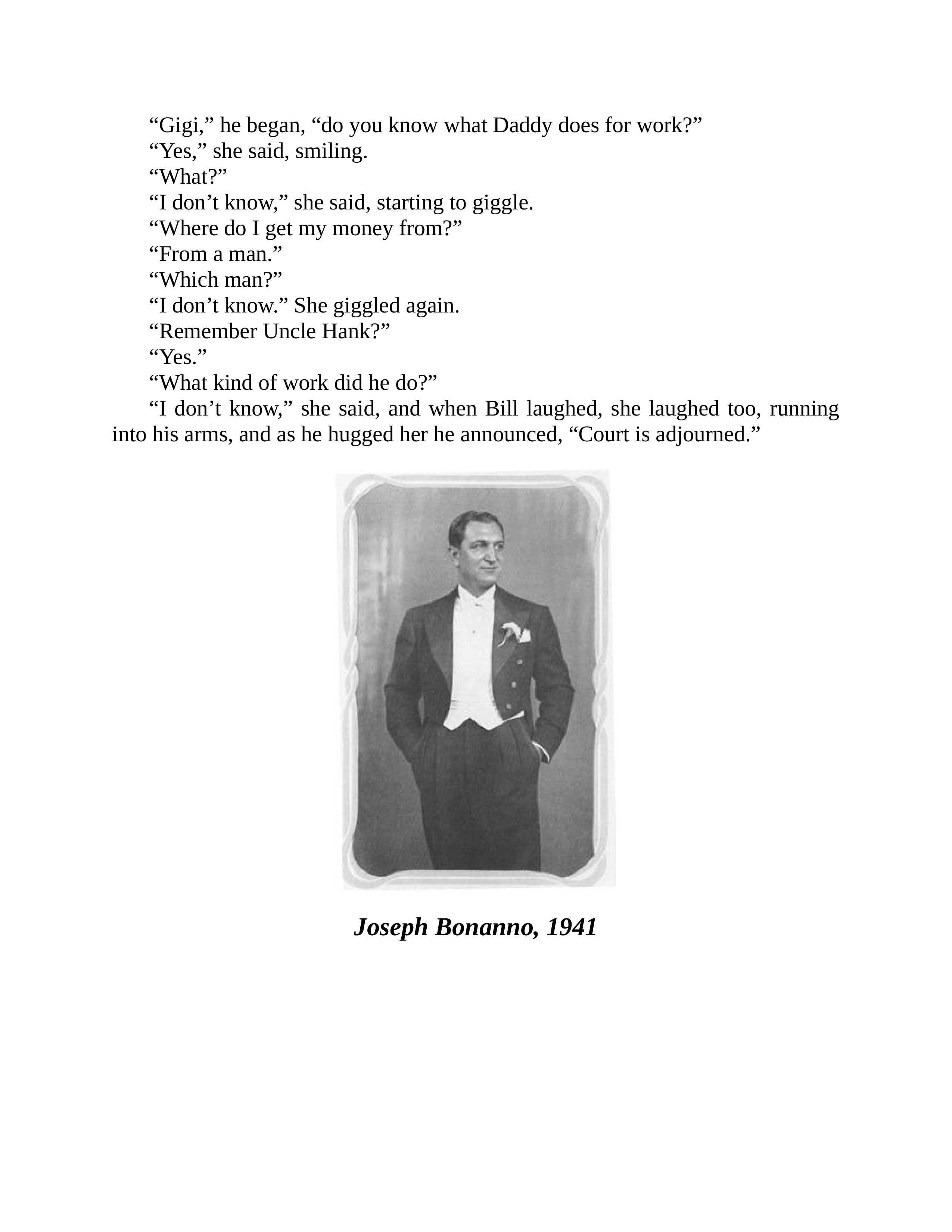
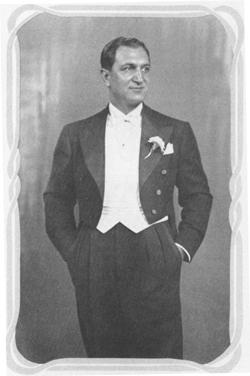
“Gigi,” he began, “do you know what Daddy does for work?”
“Yes,” she said, smiling.
“What?”
“I don’t know,” she said, starting to giggle.
“Where do I get my money from?”
“From a man.”
“Which man?”
“I don’t know.” She giggled again.
“Remember Uncle Hank?”
“Yes.”
“What kind of work did he do?”
“I don’t know,” she said, and when Bill laughed, she laughed too, running
into his arms, and as he hugged her he announced, “Court is adjourned.”
Joseph Bonanno, 1941
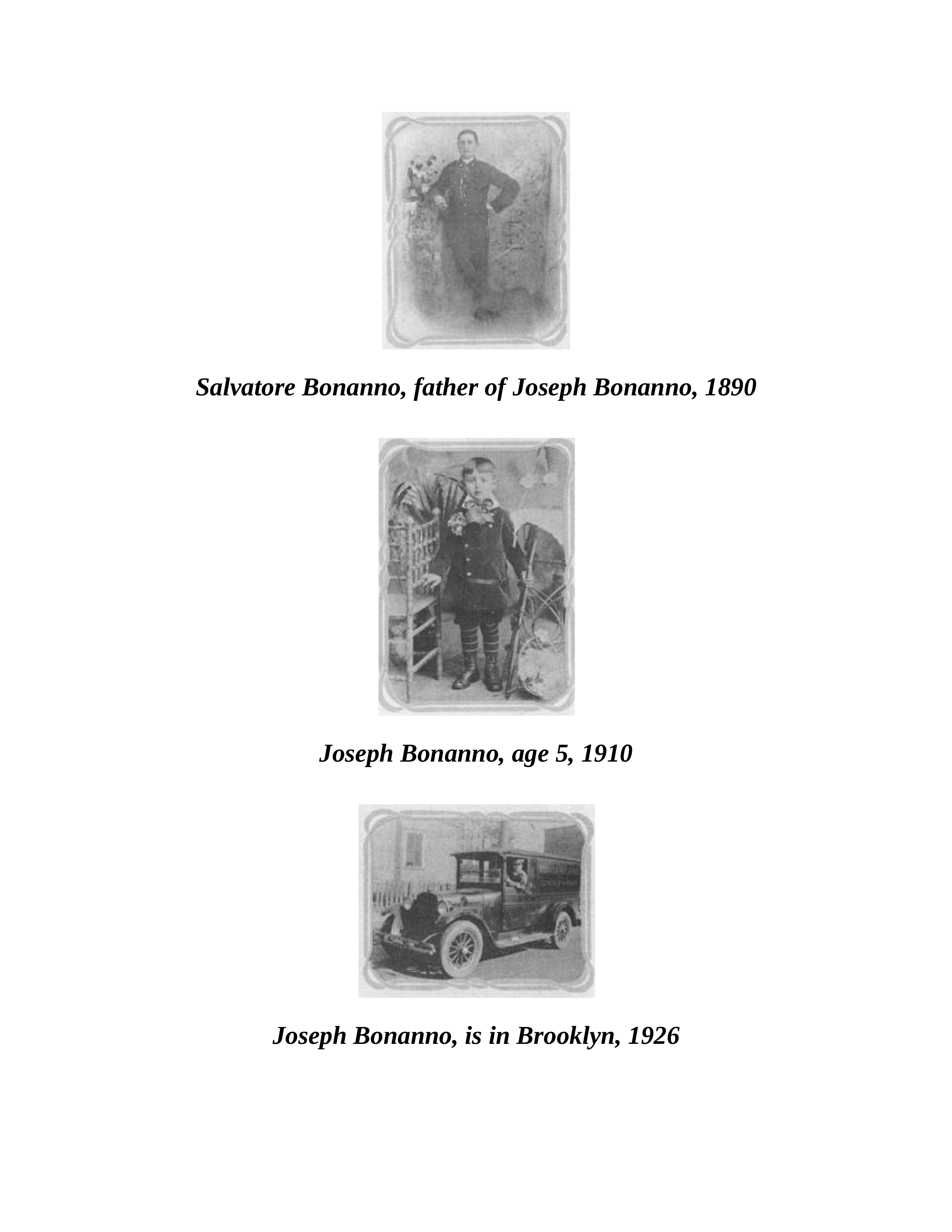
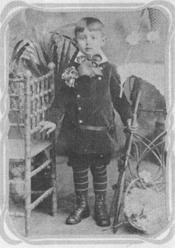
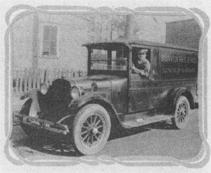
Salvatore Bonanno, father of Joseph Bonanno, 1890
Joseph Bonanno, age 5, 1910
Joseph Bonanno, is in Brooklyn, 1926
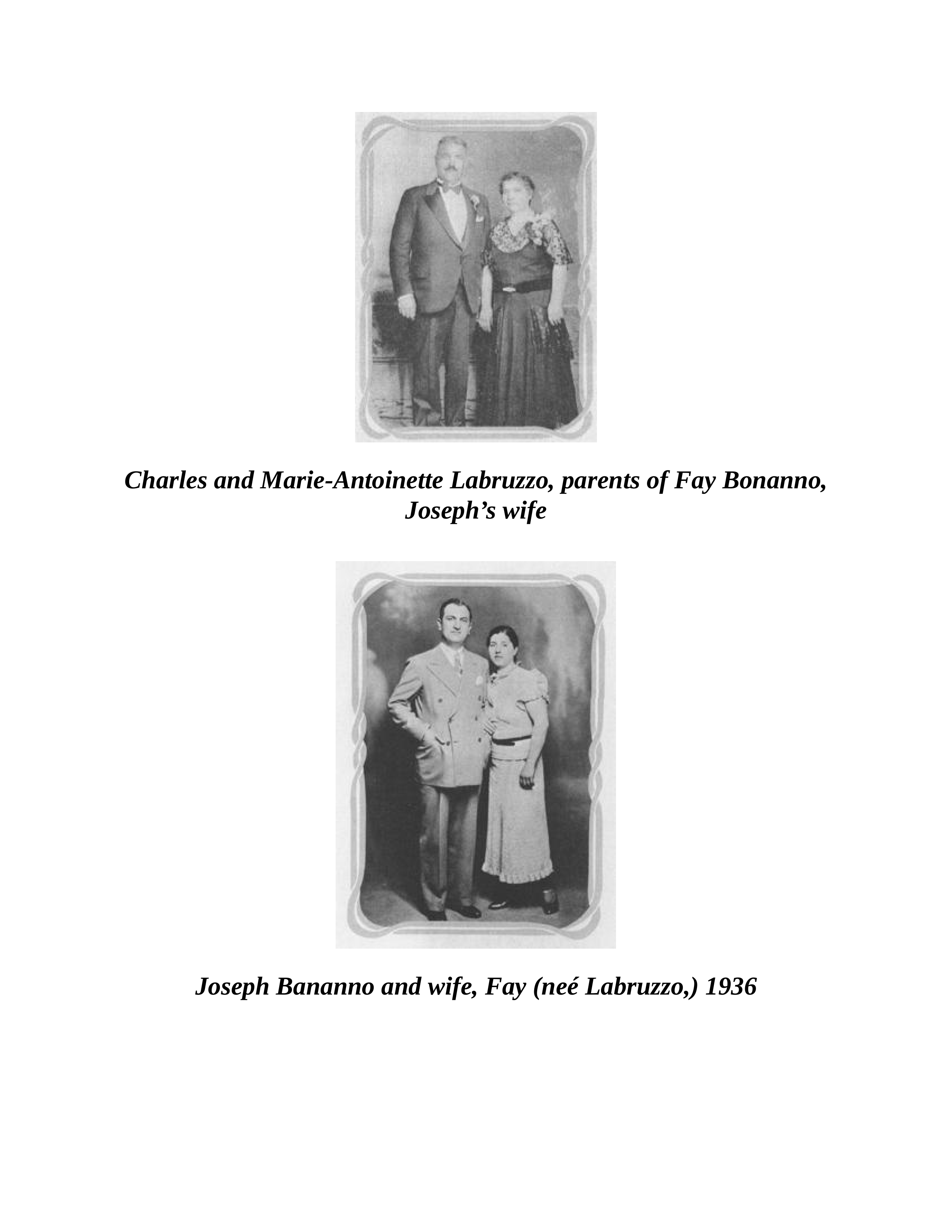
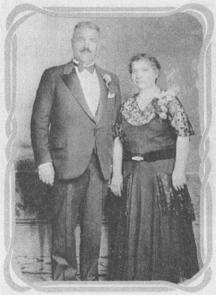
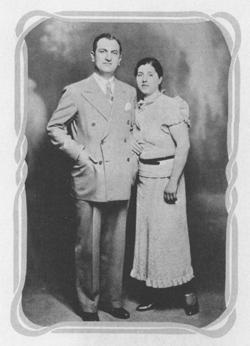
Charles and Marie-Antoinette Labruzzo, parents of Fay Bonanno,
Joseph’s wife
Joseph Bananno and wife, Fay (neé Labruzzo,) 1936
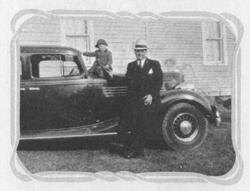
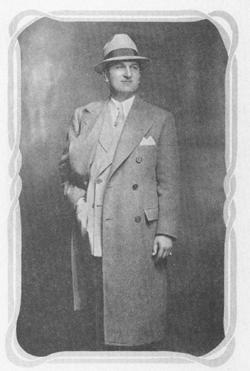
Joseph Bonanno and son Bill (age 4,) 1936
Joseph Bonanno, 1936
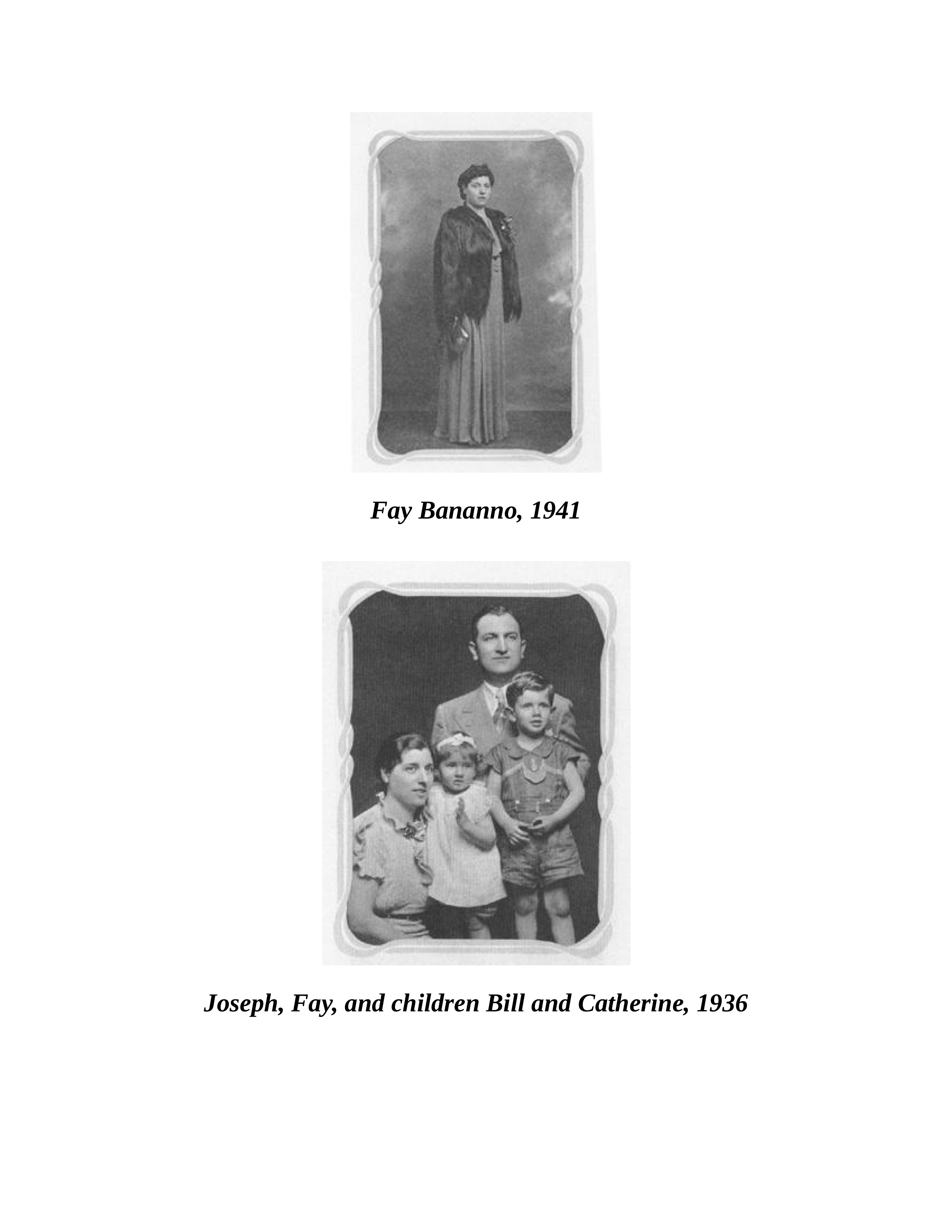
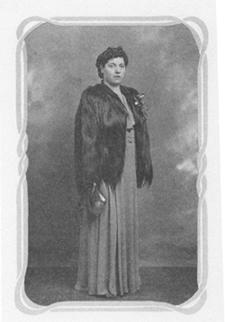
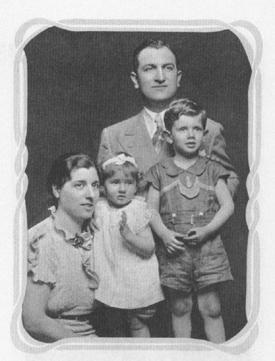
Fay Bananno, 1941
Joseph, Fay, and children Bill and Catherine, 1936
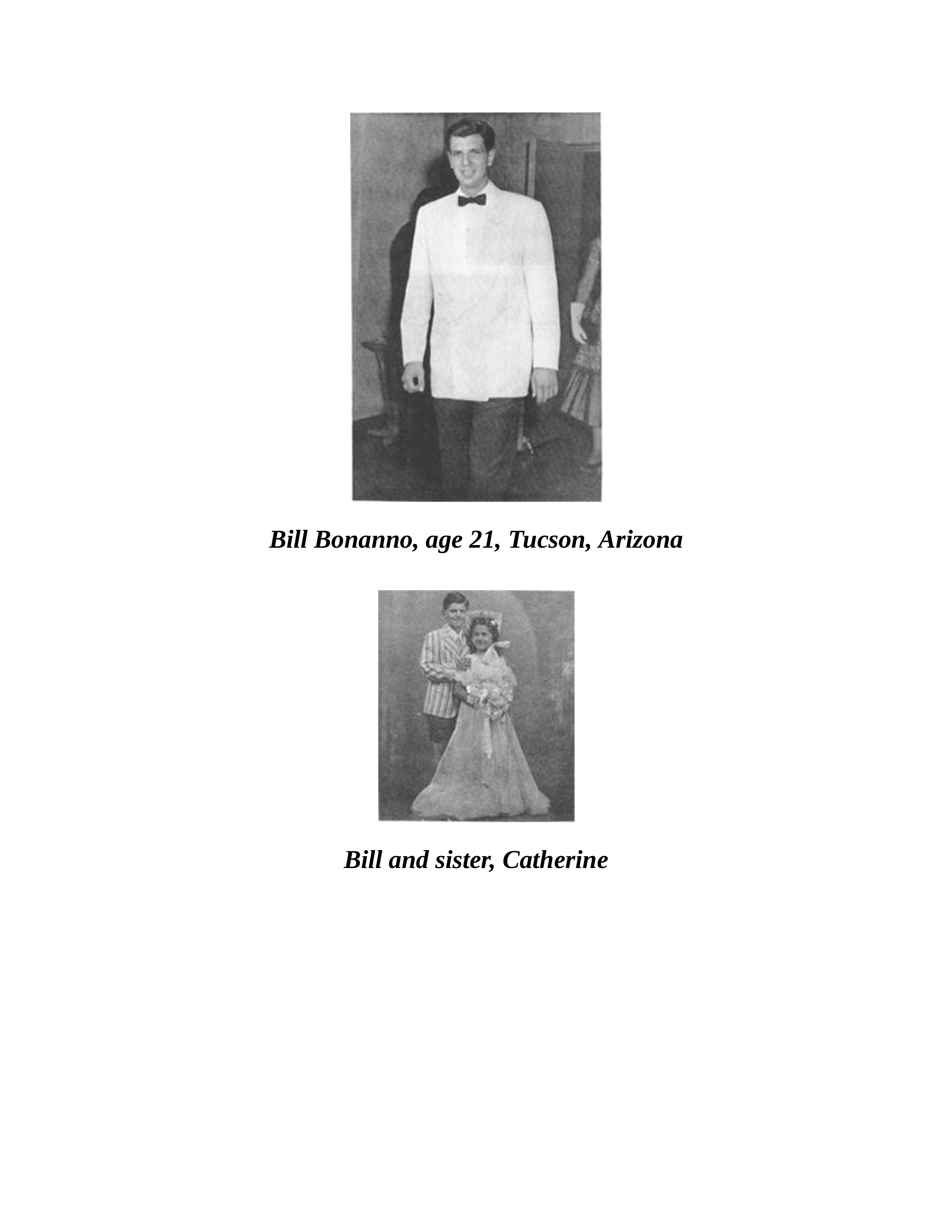
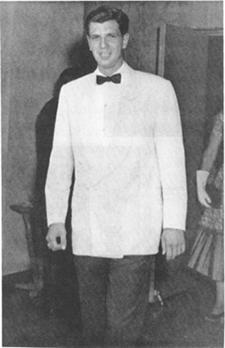
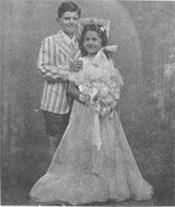
Bill Bonanno, age 21, Tucson, Arizona
Bill and sister, Catherine
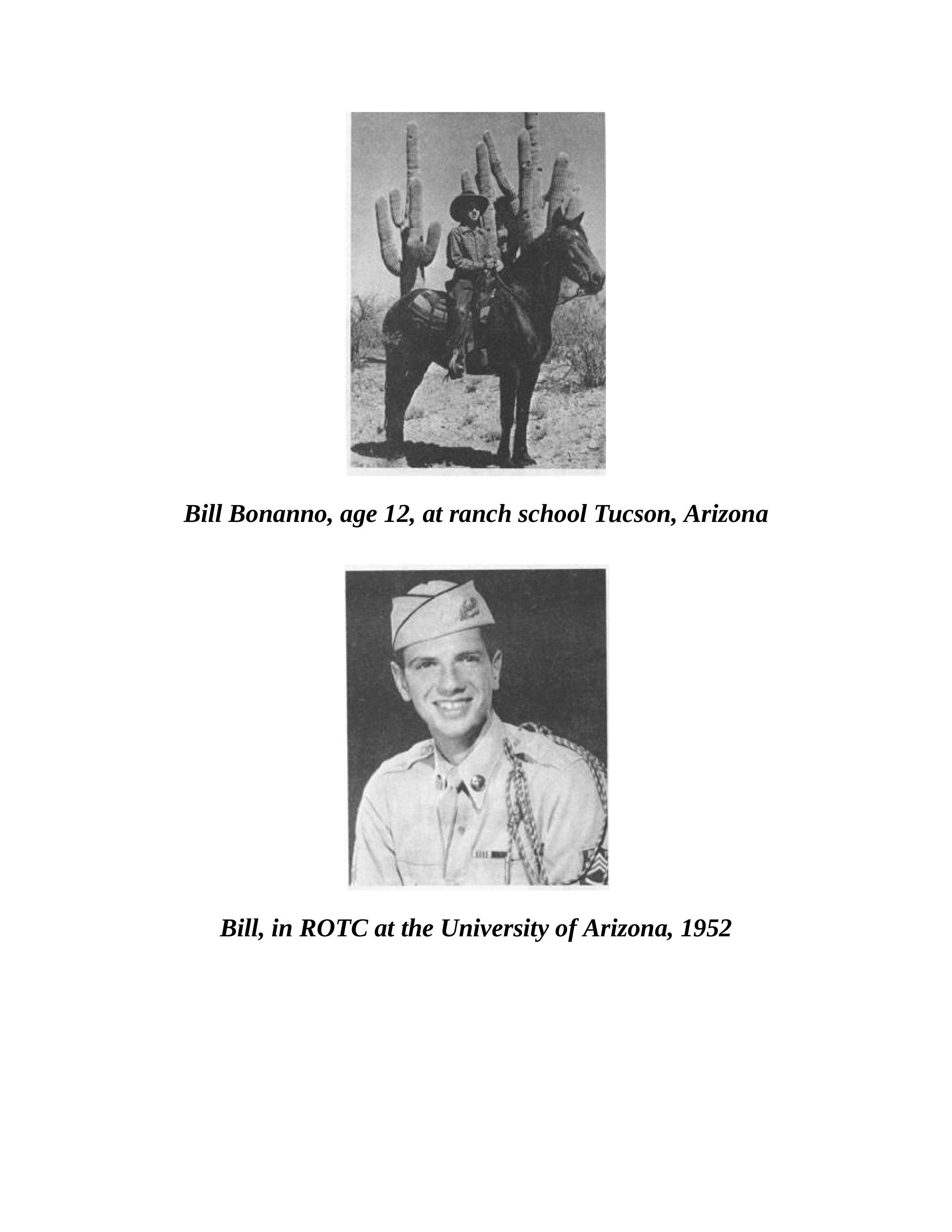
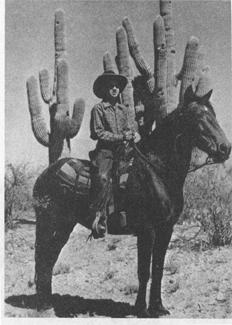
Bill Bonanno, age 12, at ranch school Tucson, Arizona
Bill, in ROTC at the University of Arizona, 1952
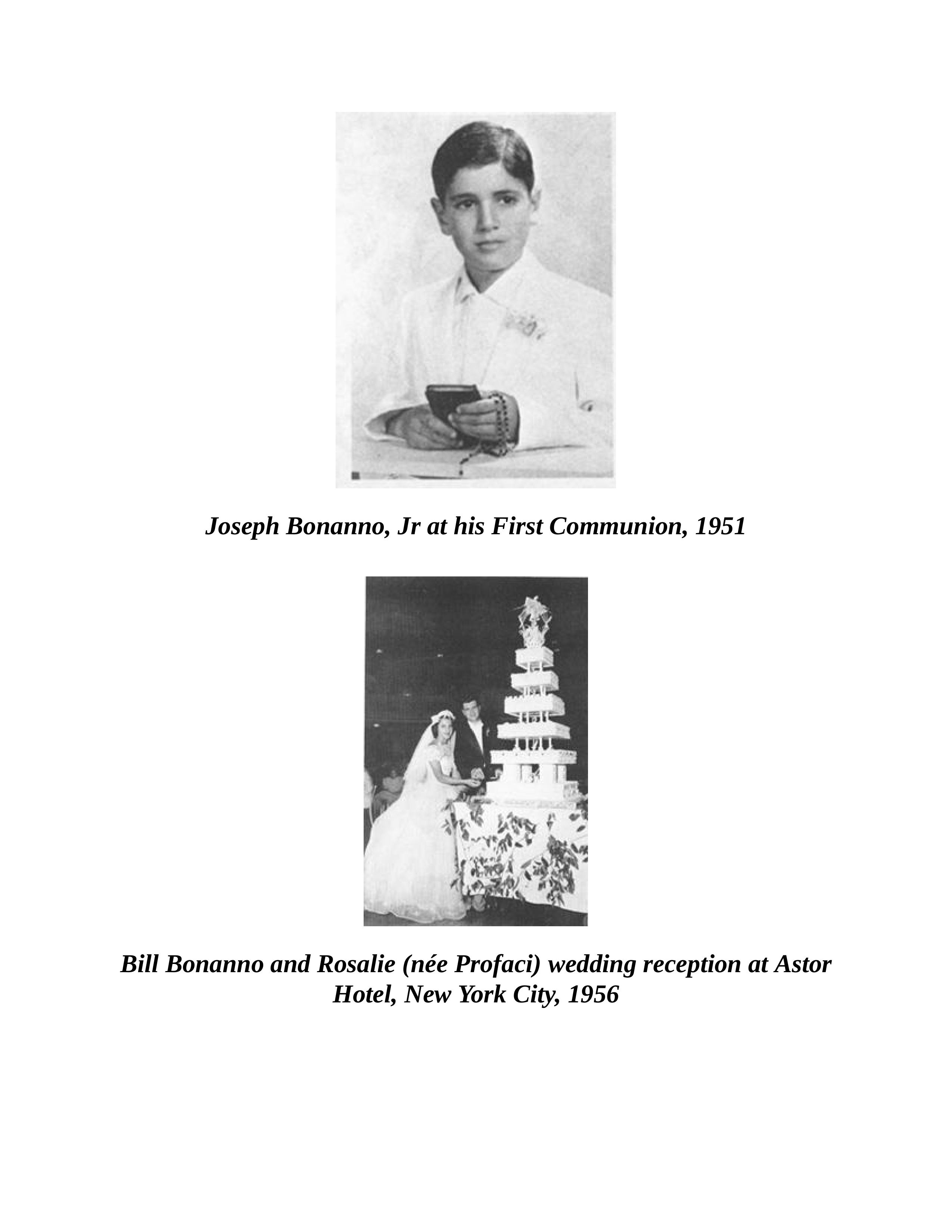
Joseph Bonanno, Jr at his First Communion, 1951
Bill Bonanno and Rosalie (née Profaci) wedding reception at Astor
Hotel, New York City, 1956
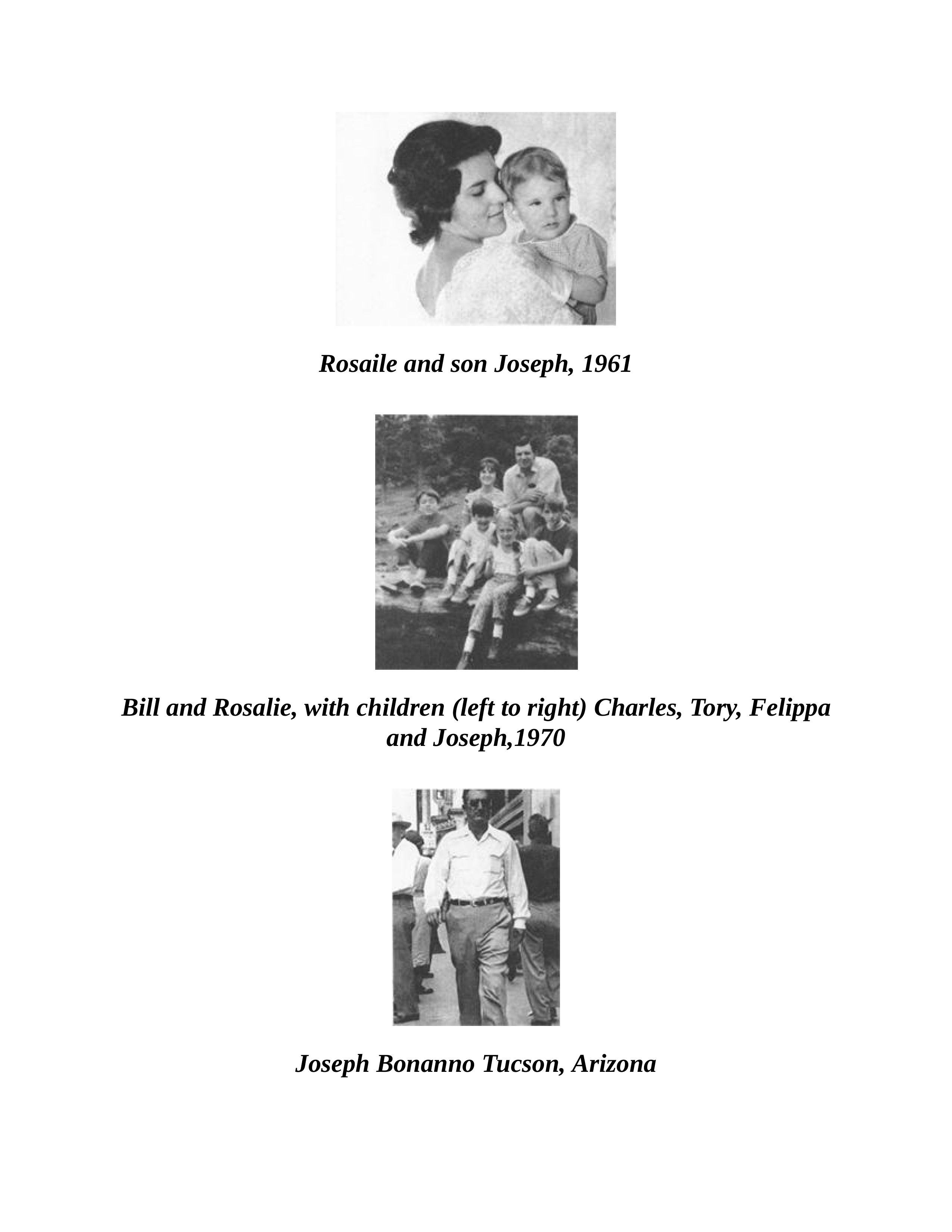
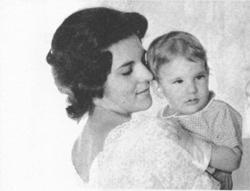
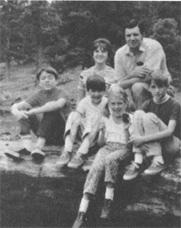
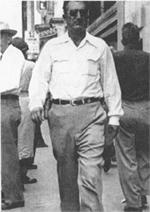
Rosaile and son Joseph, 1961
Bill and Rosalie, with children (left to right) Charles, Tory, Felippa
and Joseph,1970
Joseph Bonanno Tucson, Arizona
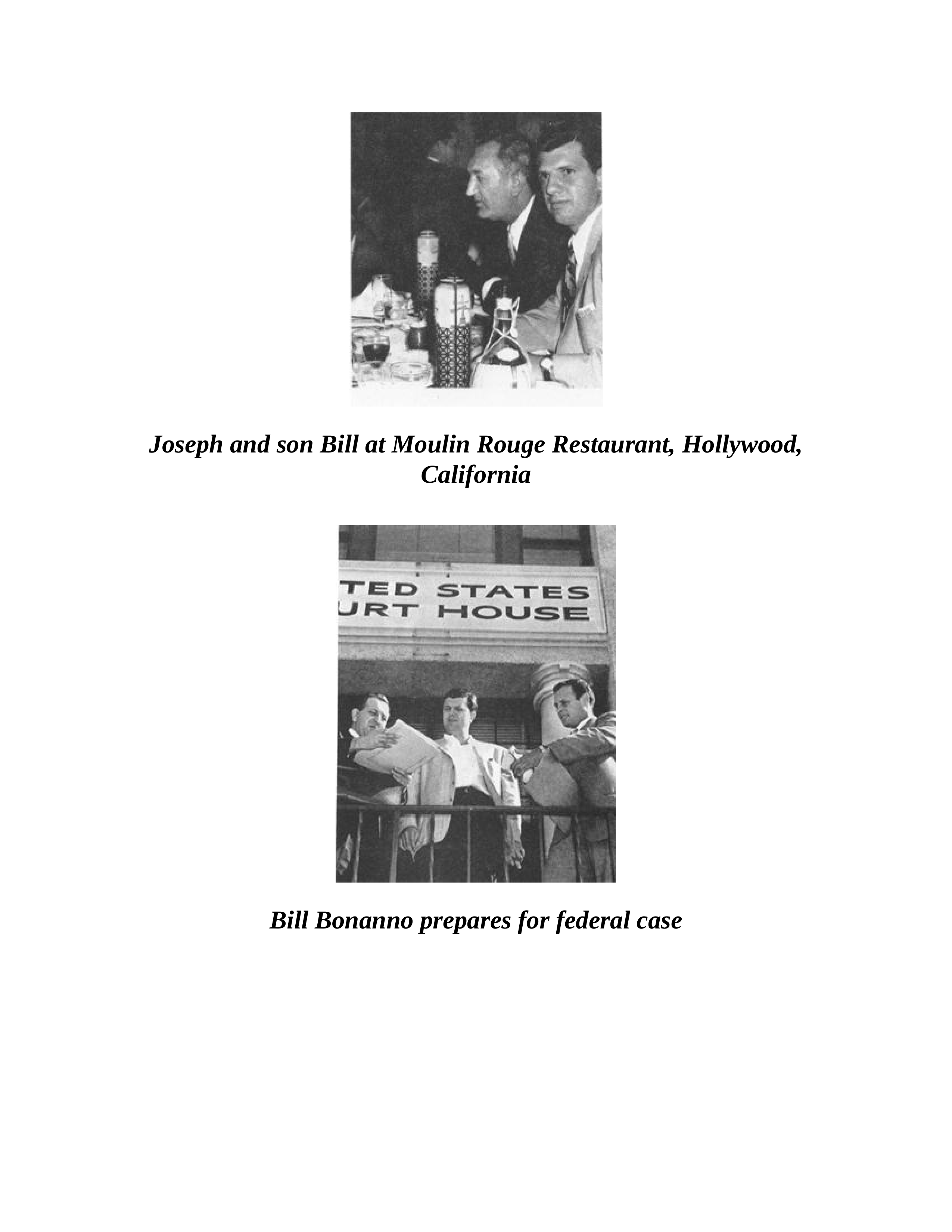
Joseph and son Bill at Moulin Rouge Restaurant, Hollywood,
California
Bill Bonanno prepares for federal case
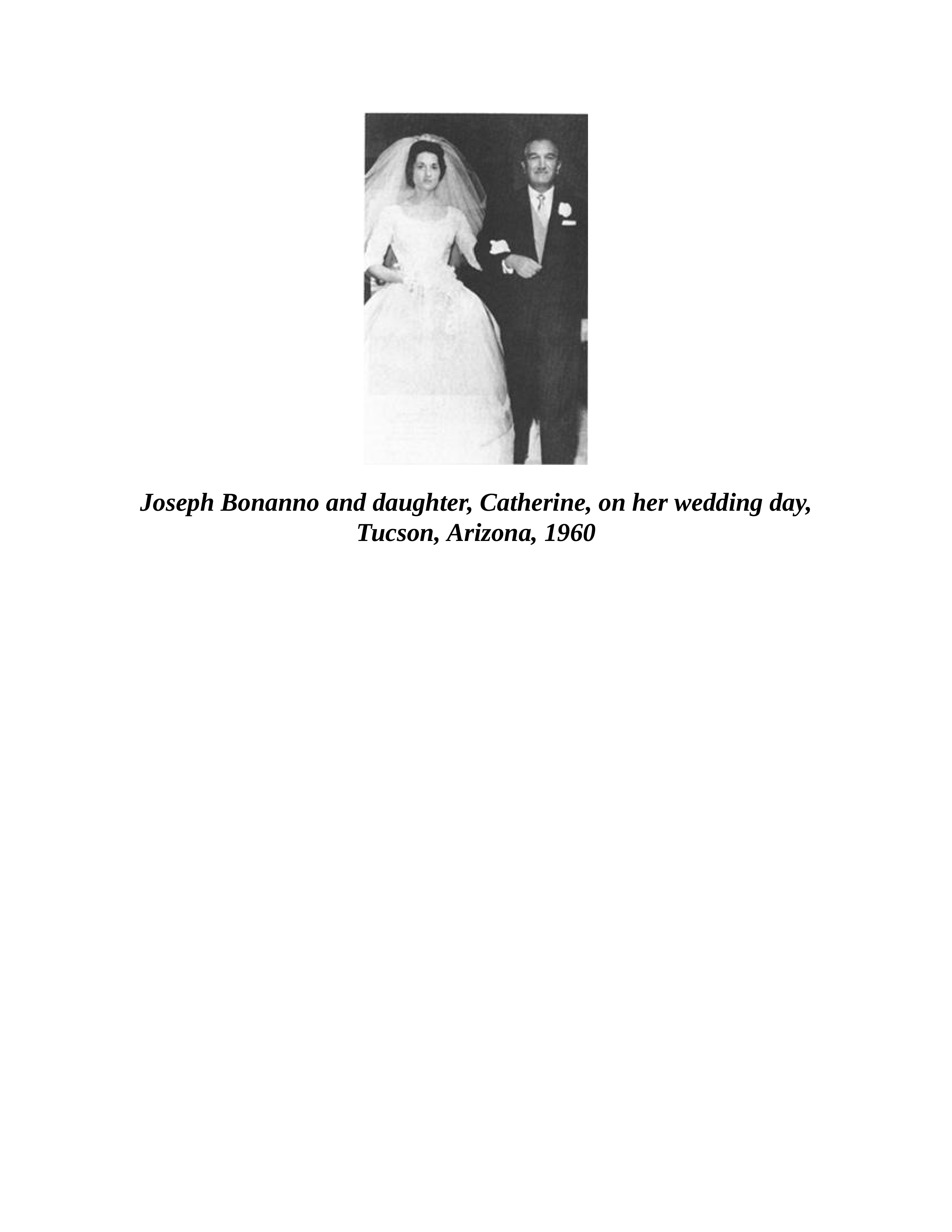
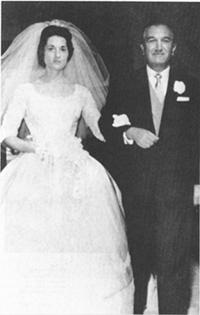
Joseph Bonanno and daughter, Catherine, on her wedding day,
Tucson, Arizona, 1960
19
A
FEW DAYS LATER, ROSALIF’S MOTHER FLEW TO SAN
FRAN
cisco from New York carrying among her luggage a box of live snails that
she had personally selected at a Brooklyn fish market, live lobsters from Maine,
special Italian sausages stuffed with cheese, and other delicacies that were rare in
California and that she intended to serve at a large family gathering on the
following day, the first Sunday in March.
The dinner, to be attended by a dozen people, would be held at the home of
her daughter Ann, who was in her seventh month of pregnancy, and with whom
Mrs. Profaci would be staying in San Jose until after the birth; she would help
with the cooking, would look after Ann’s two young children, and would also be
available for whatever assistance she might provide her eldest daughter, Rosalie,
and her youngest daughter, Josephine, who was twenty-one and would be getting
married in June, shortly after her graduation from Berkeley.
Josephine would be married in the chapel on the Stanford campus to a non-
Catholic, non-Italian, hazel-eyed young man with long blond hair named Tim
Stanton, the son of an upper-middle-class family in Westchester County, New
York. Josephine had met Tim Stanton at a college barbecue exchange in the
spring of 1966 when she was a student at Santa Clara, and during that summer in
New York she went with him to the suburbs to meet his parents, an encounter
she had dreaded in advance even though, early in their dating, she made it clear
to him who her relatives were, learning to her surprise and relief that this
precaution was unnecessary; he already knew. The meeting with his parents
turned out to be unexpectedly pleasant, because the Stantons succeeded in
making her feel welcome and comfortable.
During the next two years, after Josephine had transferred to Berkeley and as
her relationship with Tim Stanton became closer and there were plans for
marriage, it was not Tim’s family, but Josephine’s, that seemed the more
concerned. That it was to be a non-Catholic wedding ceremony was most
disappointing to Josephine’s mother and older brother; but when they sensed
how determined Josephine was and how inseparable the young couple obviously
were, they accepted the inevitable and Josephine’s brother agreed to escort her
up the aisle on her wedding day.
The extended family, however, which included Bill Bonanno and his friends
in addition to other in-laws and relatives of the Profacis’, still expressed doubts
about the wisdom of such a marriage; and by the time of the large family dinner,
Tim Stanton had been the subject of several conversations and debates in
Brooklyn and San Jose. They had all met him by now, inasmuch as Josephine
had introduced him at various times during the last year; and since he was so
different from anyone who had ever approached the family threshold before, he
was a subject of both fascination and confusion.
Some of Bill’s friends, reacting to Stanton’s long hair and his casual style of
dress, and having heard him denounce the war in Vietnam and hint at his own
refusal to fight if drafted, regarded him quickly if incorrectly as part of a radical
new generation that wished to overthrow the system; and in any showdown with
the new generation, Bill’s men would be curiously on the side of the system—
the government, the police, and “law and order.” These men did not want the
system to collapse, for if it collapsed they would topple with it. While they
recognized the government as flawed, hypocritical, and undemocratic, with most
politicians and the police corrupt to a degree, corruption was at least something
that could be understood and dealt with. What they were most wary of and what
centuries of Sicilian history had taught them to mistrust were reformers and
crusaders.
Bill Bonanno’s view of the younger generation, however, was less rigid, and
he agreed with Tim Stanton on many issues—except when he learned that
Stanton was thinking of registering as a conscientious objector or of joining the
Peace Corps and serving in Malaysia with Josephine after the marriage. Bill
believed that joining the Peace Corps was “copping out” since it was subsidized
by the same government leaders who were fomenting war in Vietnam. If Stanton
did not wish to engage in an immoral war, then, according to Bill, he should be
willing to pay the price and should go to jail. Jail was the place for many
honorable men these days, Bill believed, including himself in such company.
Rosalie was not upset by any of Stanton’s political views, but she was
distressed that Josephine was marrying outside the church; she preferred that her
youngest sister agree to “go along” with the Catholic wedding and the religious
beliefs that she had grown up with and ostensibly had accepted until recently.
But in this instance, Bill supported Josephine’s decision not to give the
appearance of believing what she did not; and yet Bill was bothered by
Josephine for other reasons, vaguely definable ones that were inspired by his
suspicion that Josephine privately detested him. He was perceptive enough to
sense that Josephine remembered well certain raging scenes between himself and
the Profaci family after Rosalie had left him in Arizona in 1963 and had returned
to New York. Josephine had since then seemed quiet in his presence,
occasionally suggesting her disapproval by certain gestures and remarks; and
Rosalie herself recently said that Josephine had probably decided on a different
course with regard to marriage and religion because Josephine had seen how
Rosalie had suffered by following the ways of the past. Bill knew of course that
he could count on Rosalie not to miss an opportunity to portray herself as some
sort of martyr; but he also knew and took pride in the fact that Rosalie’s sister
Ann had never held a grudge against him—Bill and Ann always got along
splendidly, and he had often said in jest at family gatherings that he had married
the wrong Profaci.
Ann, though a bit heavy like her mother, had a beautiful face, expressive
eyes, and, uncharacteristic for a Profaci, a sense of humor. Ann was an efficient
homemaker, a wonderful mother, and, while she was intelligent, she deferred to
her husband’s judgment; her husband was clearly in charge. But Josephine, Bill
was sure, would lead a different life, she was the product of another time. She
was the first daughter to finish college, and, without being a feminist, she
undoubtedly identified with the cause of modern women seeking greater
liberation, which was probably one reason, Bill thought, why she disliked him,
for he typified everything that she as a modern young woman undoubtedly
rejected—he was the dominant Sicilian male who did as he pleased, came and
went as he wished, unquestioned, the inheritor of the rights of a one-sided
patriarchal system that the Bonannos and Profacis had lived under for
generations.
But at this point, in March 1969, with his mother-in-law visiting San Jose,
Bill Bonanno was not eager for any further friction with the Profacis; and at the
Sunday dinner that Mrs. Profaci was preparing, and at which Josephine would be
present and perhaps also Tim, Bill decided that he would be on his best behavior.
In the morning, however, Bill woke up with a mild headache, and as he went
out to the patio with the Sunday newspapers and a book under his arm he noticed
that two of Charles’s rabbits had broken out of their pens, had dug into the
flower garden, and were now chasing one another wildly around the backyard.
The yard was also littered with toys and pieces of wood.
“Rosalie!” Bill yelled to his wife in the kitchen. “Is Chuckie getting out of
bed today?”
“He’s not feeling well, and I thought I’d let him sleep for a while.”
“I want him to clean up this mess out here and catch these rabbits!”
“He’s not feeling too well,” she repeated, her voice rising. “What do you
want me to do?”
“I told him three times this week I wanted this place fixed up,” Bill said,
sitting down on a patio chair in the midmorning sun and putting on his dark
glasses. He had stayed up half the night reading the book that he held in his
hands, a new novel about the Mafia called
The Godfather
. He was half-finished,
and so far he liked it very much, and he thought that the author, Mario Puzo, had
insight into the secret society. Bill found the central figure in the novel, Don Vito
Corleone, a believable character, and he wondered if that name had been partly
inspired by “Don Vito” Genovese and by the town of Corleone, which was in the
interior of western Sicily southeast of Castellammare. Bill believed that his own
father possessed many of the quietly sophisticated qualities that the writer had
attributed to Don Vito Corleone, and yet there were also elements in the
character that reminded Bill of the late Thomas Lucchese. Lucchese in real life,
like Don Vito Corleone in the novel, had influential friends in Democratic
political circles in New York during the 1950s, men who reportedly performed
special favors for generous political contributions; and in 1960, Lucchese went
to Los Angeles to mingle with some of these friends who were attending the
Democratic National Convention. Lucchese favored the nomination of John F.
Kennedy, but other dons such as Joseph Profaci, influenced partly by an
immigrant Sicilian’s traditional suspicion of the Irish, were against Kennedy.
Most Irish politicians, like Irish priests and cops, would do no favors for the
Italians, whom, in Profaci’s view, they privately abhorred—a view that Lucchese
did not share, nor did Frank Costello, who had been on intimate terms with
William O’Dwyer. But after Kennedy became president and after the Irish Mafia
rose to power, and when only Valachi among Italians achieved fame in
Washington, many mafiosi asserted that Profaci had been right.
The Sicilians described in
The Godfather—
not only Don Vito Corleone and
his college-educated son Michael (with whom Bill identified) but other
characters as well—were endowed with impressive amounts of courage and
honor, traits that Bill was convinced were fast deteriorating in the brotherhood.
The novel was set in the years following World War II, and in those days the
Mafia was probably as the novelist described it; and as Bill continued to read the
book, he became nostalgic for a period that he had never personally known. He
read on the patio for nearly an hour, then was interrupted by the sound of
Rosalie’s impatient voice coming from the kitchen.
“Joseph,” she yelled, “stop blowing that balloon—I don’t want you exerting
yourself today!”
Bill resumed his reading, but was interrupted again by Rosalie who stood at
the patio door saying that she was going with the children to Ann’s house to help
prepare dinner. Bill, who had an appointment with a man at noon, would join her
there later.
“Now don’t be late,” she called, as she turned to leave.
“I won’t,” he said, waving at the children, and saying nothing to Charles
about the condition of the yard or the fact that the rabbits were running loose
somewhere behind the small bushes and plants. Bill would deal with that
tomorrow.
He read for another half hour, then got up to shave and get ready for his
appointment. He was dressed casually on this Sunday, looking as if he were
headed for the golf course. He wore light blue slacks and brown loafers, and
glaring from under his gray sweater was a Day-Glo orange shirt. In the kitchen,
after pouring himself a cup of coffee, he decided to telephone Brooklyn and say
hello to his aunt Marion and his uncle Vincent Di Pasquale, with whom he
would again be staying when he reappeared before the Kings County grand jury
in a few weeks. That the phone was tapped was of no concern to him now, since
he would be saying nothing of importance on this call; but after his aunt Marion
had picked up the receiver, Bill heard a series of clicking sounds and various
extensions being picked up, and he called out, “Hey, how many people are on
this phone?”
“Hello,” his aunt said in a voice he could barely hear, and he also heard his
cousin Linda on the bedroom extension in the Brooklyn house, with a child
crying in the background.
“Is that you, son?” his aunt Marion asked, a childless woman who had
always called him son. “Is that you?”
“Yes,” Bill said, “its me and the FBI on my end, and on your end its you and
Linda and the baby and probably Aunt Jeanne upstairs and the New York
detectives, right?”
“Hello,” said Linda, “how’s everybody there?”
“Fine,” Bill said. But before he could say much to Linda, his aunt Marion, a
woman in her late sixties who kept abreast of nearly every trivial detail
concerning the several relatives of the Bonannos, the Labruzzos, the Bonventres,
and other kin and
compare
at home and overseas, had several things to say;
among them was that her back ailment was improving, that Bill’s uncle’s cold
was no better, that her nephew was doing well in art class, that the weather was
chilly, that the television set needed a new tube, and other bits of vital
information that Bill knew would fascinate the federal eavesdropper who was
recording this conversation for posterity.
Mrs. Profaci stood at the stove cooking the snails, the lobsters, and preparing
the ravioli, while Rosalie and Ann helped her, and Josephine sat in the living
room with the men. Ann’s husband, Lou, was serving drinks, and the six
children were running through the house, which was handsomely furnished and
had a guitar near the fireplace that Lou used to play, along with the bass, when
he sang professionally in small clubs where he was thought of as a second Russ
Colombo. A relaxed, genial man approaching forty, Lou was now in business
and sang only in the shower. But he appeared to have no regrets, was happily
married and on good terms with his mother-in-law, delighted that another child
was expected, and seemed to be unaware of the noise the children were now
making as they scampered through the room out toward the patio. Lou noticed
that his little son Lawrence was waving a toy pistol that Bill had given him; and
while Lou knew that his wife did not like even toy guns in the house, he said
nothing.
Bill was not yet at the house, nor was Tim Stanton. Tim would probably be
late and they would not wait for him before starting dinner; but there was no
question of going ahead without Bill. Until he arrived and greeted the
assemblage, all would wait and talk among themselves, never thinking of sitting
around the table without him, for in many subtle ways Bill was regarded as the
head of the family.
He walked in shortly before 2:00 P.M., followed by another man and also by
Catherine’s husband. Catherine was in Tucson with her children visiting the
elder Bonannos; she would be returning by plane later in the evening. Bill
greeted his mother-in-law and Ann cordially in the kitchen, nodded toward
Rosalie, then continued into the living room, where Lou got up to pat him on the
back and mix him a drink. Josephine, who sat wearing bell-bottomed trousers, a
white sweater, and the round-toed shoes that were the latest fashion, focused her
dark eyes on Bill momentarily, then announced with just the slightest edge,
“Well, the man has arrived, and now we can eat.”
Bill forced a smile, ignoring a reply, and then Rosalie, removing her apron,
came in and sat down, and Lou fixed her a drink. From the kitchen could be
heard the rattling sound of snail shells cooking in the pot, reminding Rosalie of
the large family feasts from her girlhood days when her uncles Joseph Profaci
and Magliocco had been alive, and she remembered that when the live snails
were left in the sink and ignored while other food was being prepared, they
would sometimes slowly crawl up from the sink and would begin to climb the
walls. Bill reminisced about those days too, about Magliocco’s voracious
appetite, and the extraordinary sight of Magliocco, who weighed about 300
pounds and was not very tall, gracefully mounting a horse each morning and
galloping around the estate at East Islip.
When Mrs. Profaci stood smiling in the doorway, indicating that dinner was
ready, everyone was seated, and steaming plates were passed around the table.
Bill inhaled the aroma of the food spread before him, and after tasting the snails,
he complimented Mrs. Profaci and lifted his wine glass in a toast. Then he
proceeded to tell everyone about the new book that he was reading,
The
Godfather
, which none of the others had heard of; and after describing a few
dramatic passages, Ann said, “Boy, that sounds like a wonderful organization—
I’d like to join it as a gun moll.”
“You should,” Bill said, “you’ve got good recommendations.”
Everybody laughed except Josephine, who did not look up from her plate.
Mrs. Profaci said that she had recently seen
The Brotherhood
at Radio City,
starring Kirk Douglas, but before she could offer her opinion of it, Bill
interrupted to say that it was one of the most stupid films ever made.
“There’s this ridiculous scene in the end where two brothers kiss, and then
one brother takes a gun and shoots the other,” Bill said. “Its real Hollywood
crap.”
Mrs. Profaci, without refuting him, said nonetheless that she had been
moved to tears during one scene when a character was identified as Turiddu,
which was what her late husband had been called. Even as she repeated the name
now, at the table, her voice became soft, and she said, “May his soul rest in
peace.”
Her husband had been a kind and loving man, Mrs. Profaci continued, after a
pause, although she did admit that he had been extremely strict and that his rules
had been especially hard on Rosalie, the first-born daughter. Mrs. Profaci
remembered one evening many years ago when, because her husband was
expected to be out of town for a few days, she permitted Rosalie to accept a date
to attend a dance with a West Point cadet. But just as Rosalie was about to leave
the house, dressed in a beautiful gown, her father unexpectedly appeared, and he
immediately demanded to know where she was going. Mrs. Profaci, trying to
seem casual, had explained that Rosalie was joining other young girls at a dance,
adding that she would be home early; but Mr. Profaci, furious, insisted that his
daughter return to her room and change her clothes—she would be going
nowhere on this evening.
As Mrs. Profaci recounted the incident now, more than fifteen years later,
there was silence at the table. Then Rosalie stood and turned toward the sink,
carrying a few dishes.
The next course was ravioli, and Lou poured red wine in the glasses as Bill
tasted the ravioli. His expression changed slightly, and he said to Lou, who sat
next to him. “I think it’s not cooked enough. Mine is a little hard.”
Lou tasted the ravioli from his plate, and agreed that it was hard. Mrs.
Profaci, who did not seem at all perturbed, offered to cook the ravioli a bit
longer, but Josephine from the opposite side of the table disagreed, saying after
she had sampled it, “It’s very good, Mom. I like it hard.”
Bill looked at Josephine, measuring her for a moment, and then he said with
a grin, “Oh, you like it
hard
, do you?”
Josephine looked directly at Bill, having caught the double entendre
immediately, and she replied, “Yes, Bill, I like it hard.”
Ann laughed and then changed the subject by focusing on Bill’s Day-Glo
orange shirt: “That’s some shirt you’re wearing, Bill, that’s quite a color.”
“Its designed for men who stand on aircraft carriers, and flag down planes,”
he said, “It makes a wonderful target, which is why I don’t wear it in New
York.”
This got a laugh around the table, and then Bill asked one of the men if he
had heard any news from New York. When the man said he had not, Bill
frowned and said, “I’m going to make a call.”
Ann again addressed Bill, asking in a good-humored chiding way, “Why do
you people spend so much money on phone calls? Why don’t you write a letter
once in a while?”
“
What
, “Bill exclaimed, laughing, “and put it in writing!”
They continued to eat the ravioli, which Bill had not permitted his mother-
in-law to cook longer, preferring to drop the subject. And then Mrs. Profaci
noticed a car pulling up in the driveway—Tim had arrived, and Josephine stood
to greet him at the door. While the others continued to eat and Bill told a joke,
the young couple spoke between themselves for a few moments in the vestibule;
then Josephine, followed by Tim, returned to the table. Lou and Bill and the
other men stood to shake hands, and Tim greeted them by name. He had met Bill
and Lou many times before and he seemed poised and particularly pleased to see
Mrs. Profaci, who had already met his parents and was on friendly terms with
them. A chair was obtained for Tim, and he squeezed in next to Josephine. He
was wearing chinos and boots, and a button-down shirt under his sweater, and
his blond hair was long but neatly barbered. As Bill looked across the table at
Tim, he was reminded of the fact that Tim resembled the photographs of Robert
F. Kennedy years ago when Kennedy had been the attorney general.
As Mrs. Profaci got Tim a plate of food, and Lou poured him a glass of
wine, the conversation became more general; but Josephine, who was holding
Tim’s hand underneath the table, turned to him and soon they were speaking
softly to one another, ignoring the other conversations. They were a typical
young couple about to be married, completely absorbed in themselves and only
remotely aware of the rest of the family around them. Occasionally Mrs. Profaci
or Rosalie or Ann would pass a serving dish of food toward Tim but they tried
not to interrupt the private conversation. They were very happy that Josephine
seemed happy, were pleased about the coming marriage despite whatever
reservations that they had once expressed. Josephine Profaci was going off in a
new direction, was breaking with many traditions and customs of her family, but
her older sisters and her mother were secure in their belief that the love they
shared with Josephine would keep them close no matter how far she moved in
the future from the familiarity of their past.
After coffee was served, Josephine and Tim stood and said that they had to
be getting back to their respective campuses. Both had schoolwork to do that
night, they said, and Tim, an English major, further explained his hasty departure
to the Bonannos and Profacis: “I’ve got a paper due on Lear.”
20
D
ESPITE THE FACT THAT HE OWED THE GOVERNMENT A
small
fortune in back taxes and claimed to be bankrupt because all his property and
other assets had been confiscated by Internal Revenue agents, Bill Bonanno
walked into the Brooklyn Supreme Court Building on Monday morning, April
14, wearing an expensive pair of alligator shoes, a new green suit that had cost
$250, and displaying a broad smile and a deep suntan. Should anyone remark on
his tan, he would reply that he had been playing golf every afternoon at Pebble
Beach in California; but this explanation would be as false as the front he was
presenting at this moment as he strolled jauntily out of the elevator on the sixth
floor and headed toward the courtroom, seeing ahead of him at the end of the
corridor the pale, grim face of John Morale and other dour-looking men from the
Di Gregorio camp who reportedly had spent a miserable winter hiding indoors in
New York. Bill hoped that he would make them more miserable by presenting to
them today his own sunny portrait of good health and prosperity.
There was little else that could be accomplished during this visit to
Brooklyn, for he had known even before leaving California that his attorney,
Albert Krieger, would be occupied for weeks with a trial in Staten Island, which
would result in the rescheduling of Bill Bonanno’s appearance until sometime in
May; but even so, he was ordered by the court to come in person to Brooklyn to
deliver the affidavit that Krieger had signed. While Bill had no choice in the
matter, he decided that he would at least make an impressive entrance in
Brooklyn, and he had begun during the previous week by sunning himself in his
backyard in San Jose, by selecting his most flamboyant wardrobe to wear in
court, and by planning to exhibit in the corridor a carefree spirit that might
perturb those codefendants who had defected but who, according to the latest
rumors, were now unhappy with the shortage of money and weak leadership that
they were experiencing under Di Gregorio’s successor, Paul Sciacca. The
sidewalk shooting in the Bonanno feud had stopped, the cold war phase had now
begun.
When Bill was almost to within speaking distance of Morale and the others
huddled in the corner, he heard a girl’s voice calling out his name. Turning, he
saw Krieger’s pretty young secretary carrying the legal papers that Bill was to
take in to the clerk or the judge. Bill greeted her warmly, putting an arm around
her. Then he asked in a voice loud enough to be heard across the corridor, “Jane,
how long do you think this’ll take?”
“It shouldn’t take more than a few minutes,” she said.
“Good,” he said, “because I really want to get out of here.”
“What’s ycur hurry?” she asked, lightly. And it was the question he had
hoped for.
“I have this golf date tomorrow at Pebble Beach,” he said, casually, “and I’d
like to keep it.” He perceived through the corner of his eye that the men were
listening and were pretending that they were not.
“Well, Bill, you really look great,” Jane went on, looking at his new suit and
his silk tie and the white shirt that accentuated his tan.
“Why shouldn’t I?” he asked, shrugging his shoulders. “I don’t have a care
in the world out there. No responsibilities, no worries. The biggest problem I
have, really, is getting to the course on time.”
She laughed, and stood waiting for another moment. Then, looking at her
watch, she said that she had better be getting back to the office.
“Listen,” he said quickly, “why not wait for me for a minute? I’ve got to go
to the city anyway, and I’ll drop you off.”
“I can’t be late, Bill,” she said. “Al will be calling in, and I have a thousand
things to do.”
“Don’t worry about Al,” he insisted. “I’ll be quick.” He turned and headed
toward the courtroom, the papers in hand, and with a smile he called over to the
men, pleasantly, “Good morning, gentlemen.”
They looked up, startled, and two of them replied, less pleasantly, “Good
morning.”
Bill was not detained for more than five minutes at the clerk’s counter, and
after he left the courtroom he put his arm around Jane and escorted her down the
corridor toward the elevator, pausing only to say, “Good-bye, gentlemen.” There
was no reply. The trip from California had been worth it.
A man was waiting for Bill at the elevator, and another sat waiting in a car
outside the court building. They drove over the bridge to Manhattan and left Jane
at Krieger’s office on lower Broadway; then they drove uptown.
Bill had little fear of being followed and fired upon by his enemies in New
York on this sunny spring day because he and they knew that they were
undoubtedly being closely observed by government agents and detectives.
Dozens of investigators were now assigned to the Banana War in an attempt to
solve the murders and shootings of the past three years; and because of this tight
police surveillance, the men knew it was unwise to carry guns, and they recently
had recognized a temporary unofficial truce.
One of the vexations of membership in a declining and divided Mafia family
was that the FBI and police maximized their efforts on it. as they minimized the
pressure on the stronger organizations—the weaker ones offered greater
opportunities for infiltration, arrests, ultimate convictions. A declining
organization had many unhappy, disillusioned members who felt betrayed and
frantic, and such men might be converted into informers if the right deal was
offered by law enforcement authorities.
Bill Bonanno did not know how many men could be trusted among the
Bonanno loyalists in New York at this point, a group of indeterminate size under
an old friend of his father’s named Natale Evola, who had been an usher at the
elder Bonanno’s wedding in 1931. The Di Gregorio—Sciacca faction and a third
group said to be under Philip Rastelli were also of uncertain size and were
equally determined to remain out of sight and out of the headlines during this
period that they regarded as a government inquisition. And so Bill felt very
secure after leaving the courthouse in Brooklyn and crossing the bridge into
Manhattan, believing that he was undoubtedly being followed by an unmarked
government car that he would not try to avoid. Since he had no intention of
meeting with any of his father’s men on this trip and since the few friends and
relatives that he would be seeing in New York could not be linked to the Mafia,
he had nothing to hide and little to fear if he remained cautious and alert.
Parking the car in a garage near Thirty-fourth Street and Fifth Avenue, Bill
Bonanno walked into Altman’s department store, where he had promised to buy
a dress that Rosalie saw advertised in Sunday’s
New York Times
. He had in his
pocket the advertisement that Rosalie had clipped, and also her attached note
that read: “Size 12-M, blue-orange print, V-neck, long sleeves. Sixth floor at
Altman’s in Misses Dress Dept.”
On the sixth floor, Bill Bonanno was greeted by a perfumed atmosphere and
dim blue light and the sight of mini-skirted salesgirls standing among the racks
of clothes. The decor resembled a discotheque, with multicolored lights racing
along one wall and rock’n’roll music blaring from a large stereo jukebox in the
corner. Bill paused momentarily, then walked slowly toward the jukebox. He
studied it for a second, bent down, and looked along the sides to see if it bore a
label that would mark it as one of Thomas Eboli’s machines. Eboli had
jukeboxes in Greenwich Village bars and in several places uptown, but
apparently, he had not yet made it with the Misses Dress Department at
Altman’s.
As Bill turned around, he saw a middle-aged woman standing behind him,
glaring at him through her rhinestone harlequin-framed glasses, and she said to
him curtly, “May I help you, young man?” It’s just my luck, he thought—in a
store filled with sexy young salesgirls, I attract the one old battle-ax who has
been at Altman’s since the First World War.
“My wife wants this dress,” he said, handing the woman the advertisement.
“She wants it in a size 12-M and blue-orange print.” The woman took the
advertisement, and within a few moments she returned with a flimsy garment
draped over her arm.
“This is it,” she said, holding it up for Bill to see. It was really a dress with
pants, which Bill had not realized, and he did not think that Rosalie would look
well in it. It was an imitation Pucci print, and the whole outfit looked to Bill like
a pair of pajamas; but he told the woman to wrap it, and he was mildly offended
by the direct manner in which the woman replied: “Would you pay me first,
young man?”
“You don’t trust me?”
“Store policy,” she said.
He reached into his pocket and handed her two twenty-dollar bills and
watched her disappear with the money and the dress. As he stood waiting he
thought it odd that he was supposed to trust her when she obviously did not trust
him; she had now gone off with his money and the merchandise presumably to
record the sale and wrap the garment, leaving him with no proof that he had paid
her, and while he realized that he was stretching a point, he was nonetheless
irritated by the woman’s attitude. If he were dealing in
his
world, he knew that
he would never have parted with the money until he had the merchandise in
hand; it would have been a simultaneous exchange. But as he thought more
about it, he suspected that he was exaggerating the saleswoman’s suspicion of
him. Or perhaps he was reacting automatically to salespeople, remembering his
unhappy experience with Torrillo’s credit card at Bloom’s store in Tucson. He
stopped his brooding when he saw the woman returning with the package; and as
he left Altman’s he decided that the next time Rosalie wanted a dress, she would
buy it herself.
It was mild and sunny along the sidewalk, and since Bill had little to do for
the next hour he decided to leave the car in the garage and to take a leisurely
stroll through midtown Manhattan, which he had not done in years, and which if
he had tried to do a year ago would surely have been suicidal. Although it was
not quite noon, he could see that the early-lunch crowd was moving toward
luncheonettes and restaurants, and there were people standing at the curb waving
and whistling at cabs. There was a pace and pressure about New York that did
not exist in San Francisco, Los Angeles, or any other city, and although he had
always hated New York, he was at this moment pleased to be back, briefly,
knowing that tomorrow he would be gone. He was now a tourist, and as he
walked up Fifth Avenue he recited the tourists’ favorite cliché, hoping that he
would never have to live here again, not as a resident nor as an inmate in a
prison.
Everything about New York was more difficult, more expensive, more
exhausting. The town was tougher on everyone—cabbies and truckmen,
businessmen and waiters, secretaries, and cops and gangsters. People came to
New York looking for big money and big deals, but they usually died early as a
result—it was a killer town, no less lethal to cops than robbers. Bill guessed that
the life expectancy of the mafiosi in New York was less than in other places;
those men lucky enough to escape the bullets usually died prematurely of heart
ailments. Bill had recently read that Thomas Eboli, fifty-eight, reputed aspirant
to Vito Genovese’s title, had collapsed at a crime hearing and had been taken by
stretcher to a hospital, and Bill was almost willing to bet that there was not a don
or underboss approaching sixty in New York who was not suffering from a heart
condition or from high blood pressure. Whenever the police searched Mafia
officers for concealed weapons, they usually discovered instead small bottles of
heart-stimulant pills. Carlo Gambino had a chronic cardiac ailment, and Bill had
just heard that Paul Sciacca, fifty-nine, was also suffering from heart trouble,
which was one reason why Sciacca was a poor replacement for the ailing Di
Gregorio. In the final analysis, it was not only the government that was
bothering the Mafia—it was more the day-to-day pressure of living in New
York, a pressure unknown to seventy-seven-year-old Stefano Magaddino in
Buffalo, or seventy-two-year-old Zerilli in Detroit, or seventy-one-year-old Paul
De Lucia in Chicago.
On Forty-second Street Bill headed west toward Times Square, and he was
soon surprised to discover how many familiar buildings had been demolished or
refaced in this ever-changing city. The Paramount theater, which he remembered
as a boy, was gone, and he also regretted that a new building was replacing the
once-elegant Astor where his wedding reception had been held.
Turning east again along Forty-second Street, heading back toward the
garage, Bill noticed ah upper-story sign that identified a travel agency that was
partly owned by an old friend, and he decided to go up and say hello. In past
years his friend had often tried to interest Bill in certain propositions in the
Caribbean and elsewhere, but Bill had always been too busy. But now he was
curious whether the offers were still open—in fact, he was more curious about
the offers than about specific proposals, realizing that because of the court
restrictions on his travel he was really in no position to accept anything; and yet
he still wanted to hear what his friend had to say, to know whether or not he was
still a friend.
But after he had approached the receptionist, he was told that his friend was
out of the city and would not return until the following week. Bill was
disappointed but did not show it.
“Is there any message?” she asked.
“Tell him that Bill from California was here, and I’ll get in touch with him
later.”
“Any last name, sir?” she asked, writing on a pad.
“It’s not necessary,” he said. “Just say that Bill stopped by. From California.
He’ll know.”
The receptionist smiled at him, seemed to be impressed by his suntan, his
suit, his manner, the mystery of his name. Bill from California. He smiled back
and left.
Less than an hour later, he was in Brooklyn, in another world. The buildings
were lower, the sky larger, there was no glamour or mystique about the place—it
was a has-been borough of old whites and young blacks, of brownstones gone to
seed, and of women sitting in rooms with the shades down, watching television
in the middle of the afternoon.
Bill stopped the car in front of a corner brick house on DeKalb Avenue
where his uncle and aunt Di Pasquale lived, and he walked up the path to knock
on a double-locked door. His aunt Marion, after peeking from behind a curtain,
let him into the living room, where his uncle, a slim and distinguished-looking
man of about seventy, sat in a soft chair watching television. The uncle stood,
quickly put on his jacket, and left with Bill, pleased to be getting out of the
house on this sunny afternoon; he was grateful to his nephew for having called
and suggested a ride out to Long Island.
Bill wanted to get a look at the East Meadow property, to scrutinize its
condition and see if anyone was occupying it. Whether the house was still his
was a complex issue not yet resolved by the courts, but Bill did not much care at
this point one way or the other, knowing that he would never reoccupy it and
knowing that if he were permitted to sell it the government could claim every
penny. His trip to Long Island was more in the nature of a personal sightseeing
trip, a pleasant way to pass the afternoon. Although he was committed to spend
the evening with the Di Pasquales, where he would be joined for dinner by Frank
Labruzzo’s widow, he would be leaving tomorrow morning for California, and
after that he might not be seeing much of his Brooklyn relatives. It was possible
that on his next visit to New York he would be preoccupied with the credit card
trial, and he would then be staying in a hotel with his codefendant, Peter Notaro,
and would spend most of the time that he was not in court with his attorneys. So
he wanted to share what was left of this trip with those few close relatives he had
in New York and to revisit certain places where he had once lived and where he
had once nearly died. He was no less romantic than many soldiers about the
battlefields of the past—except that his were made of concrete and were
entrenched with tenements—and a few minutes after he pulled away from the
curb at the Di Pasquale house, he approached the block that evoked for him the
most haunting memory of his life.
“Remember this place?” his uncle asked, facetiously, as Bill paused at a stop
sign, then moved slowly and cautiously forward. It was Troutman Street. At this
time of day, in the early afternoon, it seemed abandoned, not a pedestrian in sight
or even a car parked at the curb; and because the street was narrow and the tight
row of brick and frame houses had no trees in front or much vegetation of any
sort, there was something artificial and lifeless about the street—it looked almost
like an old movie set. But when Bill reached the end of the block and looked to
his right at a store on the corner, he was suddenly aware of the grim reality of
Troutman Street. There, along a side wall covered with metal sheeting, were
holes made by bullets that had been aimed at him on that freezing January night
more than three years ago. He saw other traces of bullets along the sidewalk he
remembered running over, running for his life, dashing south toward
Knickerbocker, several bullets pounding into the pavement, ricocheting wildly,
and as he looked at the street now he was reminded of how narrow it was, and he
was amazed that the snipers had missed him from such close range. He felt his
palms moist on the steering wheel, and, turning off Troutman Street, he
continued to drive through other streets, following no particular direction while
he carried on a conversation that he was paying little attention to.
He cruised past the Cypress Garden Restaurant, scene of the triple murder in
1967, and as he paused in front of it now he could see more bullet holes on the
sidewalk, and also a sign in the window announcing that the restaurant was
closed because its liquor license had been revoked. Continuing on to Roebling
Street, Bill saw the spot where his grandfather, Salvatore Bonanno, had opened a
bar shortly after arriving from Sicily in 1906, and he saw the public school that
his father attended for one year, in 1911, at the age of six. On nearby Havemeyer
Street and Metropolitan Avenue were the storefront clubs in which Joseph
Bonanno had hung out as a young man in the 1920s, ready to join forces behind
Maranzano in the Castellammarese War; and on Suydam Street, Bill drove past
the church where his parents were married in 1931; and on Union and
Havemeyer was the church where he himself was baptized in 1932, at four
months of age. It was remarkable, Bill thought, how it was all here, clustered
within so few blocks, the landmarks in the lives of three generations of
Bonannos. These were the blocks to which thousands of Sicilian and Italian
immigrants had come at the turn of the century to fulfill whatever fantasy they
had about the American dream, and Bill remembered from his early boyhood in
Brooklyn how noisy and crowded these blocks had been, remembered the
pushcarts and games in the street and the mothers calling from tenement
windows to their children below; but now, in 1969, the Italian neighborhoods in
this area of Brooklyn were no longer characterized by noisy young people in the
street but rather by the elderly who remained indoors, securing with locks what
was left of their lives. There were still a few mafiosi here, but they too were old,
and their children had moved to Queens or to the suburbs to avoid the
encroaching blacks and Puerto Ricans and other newcomers who would perhaps
find hope and opportunities along these streets that to Bill Bonanno seemed
dated and dead.
As he drove, his uncle pointed to a building where he had once been in
partnership in a coat factory, explaining that that was where he had met Marion
Labruzzo, a seamstress, whom he had married in 1922. They later opened a
factory of their own on Jefferson Street, he continued, eventually employing
about forty people; he added that this building still existed in its original form
and was flanked by what had been Charles Labruzzo’s butcher shop and the
home that the Labruzzos occupied when Joseph Bonanno began courting Bill’s
mother, Fay. In those days, the uncle recalled, his eyes lighting up, Joseph
Bonanno was driving a new Graham-Paige car. Bill remembered snapshots of
that car, and he also remembered very well the Labruzzo house from his
boyhood visits to his grandparents’; and, though he was now headed in the
opposite direction, he turned around and headed back toward Jefferson Street.
Soon Bill was parked in front of the red-brick house where he used to sit on
summer days with his one-legged grandfather, and he remembered how the old
man basked in the sun sipping beer, speaking Sicilian to the people who passed,
and how when he hobbled up the street on crutches he would be followed by a
pet chicken. On the opposite side of the street, where there was once a row of
houses—in one of which snipers waited for several weeks in 1929 hoping to get
a shot at Bill’s father—there was now only a high wall that blocked from view
what appeared to be a commercial trucking firm or brewery or warehouse of
some sort. To the right of the old Labruzzo house was the onetime coat factory,
as his uncle had said, and next to the factory was the building in which
Labruzzo’s butcher shop was located. Both buildings were now obviously
vacant, with the windows of the shop painted black; but the six-bedroom
Labruzzo house, which the family sold in 1947 for not much more than the
$5,000 that Charles Labruzzo had paid for it in 1923, had curtains on the
windows and seemed to be occupied.
Bill got out out of the car and walked to the door. Near the bell he saw the
name Malendez. He rang the bill, which did not work, and so he knocked on the
door. Within a few moments a thin dark man opened the door, looked at Bill,
then at the car, his face crinkling with confusion.
“We used to live here,” Bill began, awkwardly, trying to smile in a
reassuring way.
“Yes?” the man said.
“Many years ago,” Bill said, “and we’re just visiting New York. I
wondered,” he continued, “if we could take a look inside.”
The man hesitated for just a fraction of a second before saying, “Yes,” and
then he stepped aside. Bill, who was surprised by the man’s lack of skepticism,
introduced himself, extending his hand. The man shook it, saying his name was
Malendez. Speaking almost perfect English, Malendez explained that the house
was now divided into apartments, and that since he was the only person at home
now, Bill would only be able to see one apartment. Bill thanked him and took
only a quick look into Malendez’s apartment, failing to find anything familiar
about the room. Bill walked through the dark outside hallway, where he noticed
the familiar staircase and the smooth banister that he used to slide down as a
boy; and looking through a window at the rear of the hallway, he saw the yard
where his grandfather kept a goat and several chickens. The yard, littered now
with old tires and pieces of scrap metal, seemed smaller than Bill remembered it
from his boyhood, and so did the house; but then he guessed that the memories
from one’s youth magnified everything.
Bill turned and, thanking Malendez again, he departed. When he stepped
onto the sidewalk he saw his uncle peering through the windows of the dark
empty factory. They both walked to the corner, trying to peek through the
blackened windows of what had been the butcher shop, but they could see
nothing inside. They were about to turn around and head back to the car, when
Bill saw two young Puerto Rican boys walking up Jefferson Street. They were in
their early teens, lean and graceful.
“Do you live around here?” Bill asked.
One of them nodded.
“Do you know what’s inside this place?”
“I think they make records,” one of the boys said.
“What kind of records?”
“You know, music, man. Rock.”
“But the place is closed,” Bill said. “Nobody’s there.”
One of the youths regarded Bill suspiciously, looked at the way he was
dressed, and then asked, “Hey, man, you a cop?”
Bill said that he was not, and then as they kept walking, he turned toward the
car. It was nearly 3:00 P.M. now and Bill knew that he had better start toward
Long Island if he intended to be back in Brooklyn before darkness. He did not
want to press his luck at night. He drove without delay through several blocks in
Brooklyn, crossing quite unintentionally the corner of Leonard and Scholes
streets near the spot where Perrone was shot. It has already been more than a
year, Bill though—March 11, 1968, three days after Perrone’s thirty-ninth
birthday. Perrone’s birthday was the same as that of Bill’s daughter, Felippa, and
Bill knew that from now on he would never be able to look at his daughter’s
birthday cake without also remembering Hank Perrone.
Within a half hour Bill was in Garden City, moving through the familiar
streets that he had so often used in recent years to shake the police or FBI; and
then he was in Hempstead, paused in front of the Tudor-style house at 61
Clairmont Street that his father had owned between the years 1936 and 1949.
This house, which had obviously been kept in good repair by its present
occupants, still had the vacant lot next door where Bill and Catherine had
played, and also the birdbath that his father had bought, as well as the row of
Christmas trees that his father had planted, uprooting one each December as he
replanted another—trees that now were forty feet high.
“That house on the other side, the white one with the shutters, was where my
scoutmaster used to live,” Bill said, pointing it out to his uncle. And then he
inquired with a smile, “You didn’t know that
I
was once an honorable Cub
Scout, did you?” He continued to reminisce for a moment, the motor idling.
Then he stopped talking as his attention was drawn to his rearview mirror, and
the car that was coming up the street with two men. It was a tan Chevrolet, and
Bill and the others in his car were suddenly alert and waiting silently. But then
the other car cruised past, its passengers paying no attention, and so Bill made a
U-turn and proceeded on toward East Meadow.
Soon he reentered the quiet residential community that had been his official
residence between 1963 and 1968, and moments later as he made a left turn on
Tyler Avenue he saw his house. It had been ignored since he left it; the lawn was
sprouting weeds and high grass, the bushes grown wild. The lawn had not been
cut since Chuckie cut it more than a year ago, Bill thought, and the windows had
not been washed in at least that length of time. He was half-tempted to get out
and peek in, but when he saw a few neighborhood women walking with their
children in his direction, he decided against it. He did not want it known that he
had returned; and he was now not as curious about the house as he had been
earlier in the day. He guessed that he had already seen too much of his past for
one day; and as he looked at it he realized for the first time that he hated this
house on Tyler Avenue. It had never been a happy home; in fact, of all the
houses he had owned, this had been the center of the most tension and trouble,
and it was possible that his troubles with it were not yet over. Bill had heard that
the government might try to indict him for tax evasion on this property,
inasmuch as he had arranged through Perrone to have the house payments made
in Don Torrillo’s name, which could be defined as a fraudulent transferal of
ownership. What he least needed now was another court case, and because of
this house he might have one.
Without regret he left East Meadow, heading back to Brooklyn in silence as
his uncle slept in one corner of the back seat. Bill was also tired, emotionally
weary. He felt almost as if he had spent the afternoon roving through a
graveyard, stepping between withered flowers and headstones bearing the names
of his family, his friends, and himself.
At dinner he continued in a quiet mood, despite his best efforts to appear
cheerful in front of Frank Labruzzo’s widow, and finally his aunt Marion
commented on it, saying, “Son, you’re so serious—what’s the matter with you
tonight?” He made a feeble excuse, but she continued to berate him in a way she
felt was jovial and not offensive, unaware that she was bothering him,
particularly when she said, tossing up her hands, “Oh, you used to be such fun
when you came to town. You used to tell jokes and cut up and be the life of the
party. What happened?” He continued to deny that he had changed, and after
standing up to fill everyone’s glass with more wine, he tried to switch the
subject. He commented on his aunt’s cut-glass wine goblets, saying that they
were nicely designed and that his mother in Arizona had a set of glasses similar
to these.
His aunt said that she was aware of that, recalling that they had bought the
wine glasses from the same place many years ago. But his aunt added that his
mother no longer had her set, having written in a recent letter that the glasses
were destroyed when the home in Tucson was bombed.
After a late breakfast on the following morning, Bill was driven to the
airport to catch the TWA noon flight for San Francisco. Included in his luggage
was the dress he had bought for Rosalie at Altman’s. As usual, he traveled in the
first-class compartment; while he might be able to save between $30 and $40 by
traveling tourist-class, a saving that he might apply to the overdue milk bill or
some other household expense, it would not occur to him to travel in any other
way. Until he was down to his last dime, he would not economize in small ways,
or live in the style of ordinary people. He was not an ordinary person. He might
be many things both good and bad, but he assured himself that he was not
ordinary, and he would not even allow himself to
appear
before a planeload of
strangers as a man who might be interested in saving $30 or $40. On his epitaph
he wanted no ordinary inscription, no hint that he had been a member in good
standing with the anonymous multitudes during the midtwentieth century or that
he had saved his pennies for a rainy day. He saved coins only for long-distance
calls, and it occurred to him at this moment that an appropriate headstone for his
grave would be a granite replica of a telephone booth.
Entering the 707 jet, he removed his jacket and handed it to a stewardess;
then he sat back in a soft seat in the front row where there was maximum leg
room and loosened his tie. After buckling his seat belt, he looked at his watch—
it was exactly noon; 9:00 A.M. in California, and Rosalie and the children were
up and about, and he was sure that Chuckie’s rabbits were still running wild in
the yard. Bill was looking forward to getting home, cognizant of the fact that
“home” now was a place that he did not know well, San Jose; and he also
reminded himself that during his thirty-seven years he had never been in one
house for very long. As a child he had moved from place to place like an “army
brat”—an infancy in Brooklyn, an early boyhood in Hempstead, then at the age
of ten to Tucson where he lived alone in motels, later in the winter homes that
his father had rented or bought there at various times, homes that were
abandoned during the summers as Bill returned with his family to New York.
Perhaps the only home with which he had identified personally was the one in
Flagstaff that he and Rosalie had moved into on returning from their honeymoon
in 1956. That was the one year in his adult life when he had tried to blend in
with what he regarded as conventional society, joining Kiwanis, investing in a
small radio station, associating with people who worked nine-to-five. During
that period he had gone weeks, sometimes months, without being reminded of
his father’s activities or his own dark secret. But then the scandal of Apalachin
the following year abruptly terminated his masquerading in middle-class
America; and since that year, with all his traveling and shifting from one address
to another, he began to identify his “home” not in the strict terms of a particular
house but rather with the airport in the town in which he was residing. After
leaving Flagstaff he was “home” every time his plane landed at the airport in
Tucson or Phoenix; or, after 1963, at La Guardia or Kennedy; and now it was the
terminal in San Francisco or San Jose.
But at this moment he was obviously going nowhere; his plane was
immobile on the runway at JFK, and the stewardess had just announced that
there would be a delay due to the excessive air traffic. Bill looked out the
window and counted at least a dozen planes lined up ahead of the one he was in,
flight 41, and he knew that it might be another hour before takeoff. He thought
again of his aunt Marion’s remark at the dinner table last night, and he was still
bothered by it.
Oh, you used to be such fun when you came to town. What
happened?
He knew the time she was referring to—it was before East Meadow,
a period in the late fifties and early sixties when the Bonanno organization was
thriving, when he had more cash that he knew what to do with, and more
problems than he recognized. He would fly into New York from Phoenix every
few weeks on one pretense or another, and would take his aunt and other
relatives to the Copacabana, to Broadway shows, to expensive restaurants. He
recalled one night when his bill at the Copacabana was approximately $900,
which he casually paid out of a thick wad in his pocket, loving the feeling at that
moment. It was not a sense of opulence, power, egotism, or a satisfaction in
having so much cash; it was almost a contempt of money that he had felt, a
wanton disregard for the thing that others craved, an easy-come-easy-go attitude
that mocked the miser in mankind and demonstrated a recklessness about life
and a fearlessness about the future—all this and more had contributed to the
private joy that Bill felt on that night when he had placed nine hundred-dollar
bills and a hundred-dollar tip on a silver tray at the Copacabana, not caring that
the lights were dim and that nobody was watching except the waiter. Fun. His
father had undoubtedly felt the same thing a thousand times during his lush
years, and Bill remembered hearing of an occasion when, after another man had
beaten his father to a check in a restaurant, a rare instance, his father
nonchalantly took the hundred-dollar bill that he held, ripped it up, and left it in
an ashtray.
What piqued Bill about his aunt’s remark was the inference that without his
pockets full of money he had lost something of his character, his humor, his
impulsiveness, or whatever it had been that had made him different from the
ordinary people that were most of his relatives and friends. He thought that his
aunt was wrong—he had not lost his humor, and the fact that he was officially
bankrupt did not bother him. It merely required that he be extremely careful in
how he spent whatever income he still received from private sources; it meant
that he had to borrow money for his air fare, being always prepared to identify
the relatives or friends who lent it to him; and it meant that he could leave no
trace of his other expenses, could not even patronize the same gas station too
often lest the attendant become a witness to the amount that Bill spent on his car.
Without a sense of humor Bill knew that he could never have slept peacefully at
night with the absurd knowledge that at the end of every day the government
added $168 in interest and penalties to the nearly $100,000 it claimed he owed in
various tax suits in Arizona and New York.
After nearly a two-hour delay, the plane was in the air; and as it rose higher
Bill watched the city fading below the clouds, and one of the last things he saw
was a section of Queens that was once considered Bonanno territory. But now,
like so many neighborhoods in Queens and Brooklyn, it was splintered into
blocks of confusion. He could not remember a time in New York when there
seemed to be so few mafiosi in sight, when hundreds of men had apparently
been driven underground, which had made it possible for him to do such
sightseeing as he had done yesterday. If he had done that even a few months
before, he reminded himself that it would probably have been fatal.
The plane ride was smooth and pleasant, and Bill sat reading
Time
and
Newsweek
and sipping Chevas Regal Scotch. He also flipped through a glossy
magazine distributed by the airlines and was amused by one item in a column of
jokes and oddities.
The earth is degenerating these days. There are signs civilization is
coming to an end. Bribery and corruption abound. Violence is everywhere.
Children no longer respect and obey their parents.
—
From an Assyrian tablet, circa 3000 B.C.
After a lunch of filet mignon, he watched the film
Bullitt
, starring Steve
McQueen, in which McQueen played a detective in a murder mystery that also
featured a few Mafia types, one of whom reminded Bill very much of Sonny
Franzese. Unlike such films as
The Brotherhood
, this film captured certain
scenes of violence that Bill found to be impressively realistic, such as when a
mob informer is riddled with machine-gun bullets in a hotel room. The most
awesome scene in the movie featured a wild car chase up and down the hilly
streets of San Francisco, with bullets flying and tires screeching, and Bill was
aware throughout the picture of how intently the other passengers were
engrossed in the film. This is what these business executives really like, he
thought—bullets in the air, murder at high speed.
Bill was met at the airport, and on the way back to San Jose he stopped at his
sister Catherine’s house in Atherton. He wanted to know what Catherine thought
of their father’s recently expressed deliberations about leaving Tucson and
buying a house in Atherton, a move prompted by Mrs. Bonanno’s anxiety over
the prospects of more bombings in Arizona in the future. Even if his father could
obtain court permission to leave Arizona, Bill knew that his moving to the
exclusive community of Atherton would undoubtedly provoke controversy
among certain citizens in Atherton, and it could seriously influence Catherine’s
social position there, as well as the continued acceptance of her children and
husband.
Catherine’s husband had through hard work built up a large, prosperous
dental practice in suburban San Francisco, and because of his success he had
recently gained entrance into social organizations, friendships with the more
affluent elements in town, and he had been able to purchase an impressive home
surrounded by acres of verdant land and trees. But because of his marriage and
his friendship with Bill and the elder Bonanno, his income tax returns were
regularly audited, his home and office telephones were believed to be tapped—a
supposition more or less confirmed by a friend claiming to be in a position to
know—and he and his wife had received considerable unwanted publicity in the
press. Both had been subpoenaed by federal investigators after the elder
Bonanno’s disappearance in 1964, with Catherine being referred to in headlines
as the “gangster’s daughter”; and both were somewhat concerned about the
effect this sort of publicity, if it continued, would have on their three young
children.
Still their concern up to now had not prompted either of them to shy away
from Bill or any other publicized family member or friend. Since Bill had moved
to San Jose, he had been in almost daily contact with Catherine on the telephone
or in person, and if a few days passed without her hearing from him she usually
took the initiative to find out why. Bill enjoyed a compatibility with her that he
had with no other woman. She understood him as Rosalie could not, and she
understood his relationship with his father from a position that was curiously
both loving and detached. She was a perceptive and wise young woman.
When Bill arrived at her home, passing through two white stone posts and
rows of flowers along the driveway, he rang the bell a few times, and after a
short delay he heard her voice through the outside intercom. After he identified
himself, she came to the door, expressed delight on seeing him, and kissed him
on the cheek. Tall, lean, her dark reddish hair teased and coiffed, her dark eyes
alert and alive, she explained apologetically that she had been playing the piano
as he rang, adding that she had been surprised to discover earlier in the piano
bench certain pieces of old sheet music that she and Bill had played at school
concerts in Long Island back in 1940 and 1941. Bill was nine years old at the
time, and Catherine seven, and as she now led her brother into the large step-
down living room he noticed that the piano on which she had been playing was
the one from the Hempstead house on which he had taken lessons for five years.
He had stopped after leaving for boarding school in Arizona in 1942, but his
sister had continued with her music through most of her school years, and she
played very well.
“Do you remember these?” she asked, handing him two programs from
children’s concerts at which they had played a duet.
“How could I forget?” he said, smiling, recognizing them immediately. “It
was the highpoint of my career.” He scanned through the programs, noting that
on the back page among the list of sponsors were the names Mr. and Mrs. Joseph
Bonanno. “I remember walking into the Garden City Hotel wearing my navy
blue jacket, white flannel pants, white shoes, and you were wearing a long white
dress. I remember the applause after we finished, how nervous and excited we
were, and how proud mom and dad seemed afterward. I never wanted to take
piano lessons, really hated it at first, but he made me do it; and I wish that he
hadn’t stopped.”
Bill bent over the keyboard, pressing a few chords; but failing to get the
desired results, he stopped and backed away.
“Rusty,” he announced, “rusty and too old for a comeback.”
As Catherine went into the kitchen to get coffee, he was greeted by two of
his nephews who had been in the den watching television. Bill grabbed them one
at a time, tossed them in the air as they shrieked with pleasure. Then, after he put
them down, they hurried back to their television show, and Bill stood in the large
room pacing slowly across the thick soft carpet, looking around. Through the
sliding glass doors he could see the sprawling lawn and trees that the gardeners
were now trimming and clipping, as another workman was skimming the pool.
The maintenance and taxes on this property must be tremendous, he thought,
which was probably why his brother-in-law, Greg, was working this weekend,
drilling teeth at his clinic while the slow-moving gardeners were soaking up the
California sunshine and earning $20 an hour. Bill wished that his brother-in-law
would relax and enjoy himself more, and he had often thought of urging him to
change his routine, but Bill had finally decided against giving advice to the one
member of the family who was obviously doing well. Bill remembered from his
college days at Arizona that Greg had always been hard-working and industrious
in his studies, never so popular with the girls as Bill had been but always with an
eye to the future. Through their fathers’ acquaintanceship that went back to
Sicily, Bill and Greg had become quick friends years before Catherine had taken
an interest in Greg; in fact, she had deliberately avoided him during the period
when they attended classes concurrently on the Arizona campus, not because she
found the thin, dark-haired man unattractive but because she regarded him
merely as a friend of Bill’s. Later Catherine had nearly become engaged to
another man whose Italian family was known to Joseph Bonanno, and Bill
thought that the wedding plans had met with everyone’s approval,
underestimating the private power of his mother, Fay. Fay Bonanno waited until
her husband had gone out of town on a trip, which was one month before
Catherine was to announce her engagement formally, when she boldly told
Catherine that she did not want to see the young man in the Bonanno home
again. She offered no explanation but hinted that she knew something about him
that was too distasteful to mention. Catherine, confused and hysterical,
demanded to know why her mother had not spoken up sooner, why her father
had not been informed before his trip; but Mrs. Bonanno remained adamant,
almost tyrannical in her sudden control over her daughter. Catherine became
silent, and angrily determined that she would wait for her father’s return.
Catherine’s relationship with her mother had always been remote when
compared with the demonstrative affection she exchanged with her father, and
Bill wondered if there might not have been a subconscious mother-daughter
rivalry. While his mother had always put her husband ahead of the children, she
had permitted Bill and his younger brother almost total freedom during their
adolescence, while Catherine as the only daughter had been bound by a strict
code of behavior, not allowed to date boys unchaperoned until after she had
entered college. Bill remembered that Catherine was a tomboy during her
girlhood, playing with the neighborhood boys in Hempstead and resenting her
exclusion from her father’s male companions who had come to the house and
had invariably included Bill in their circle of conversation. These men used to
wrestle and play with Bill in those days as Bill’s men played with Tory now; and
Bill remembered one Christmas Eve in 1940 when his father’s men arrived
carrying an enormous train set, and as he sat waiting with wild anticipation the
heavy-set men crawled uncomfortably along the floor for hours, hooking pieces
of track together, linking various pieces that formed the station platform and the
cantilever bridge.
Catherine had felt abandoned when she was forced to remain in the convent
in upstate New York while her parents spent the winters with Bill in Arizona,
and it was during this time that she regularly wrote her father letters that he had
saved to this day. Catherine’s girlhood in the convent was not unlike Rosalie’s,
except that Rosalie submitted to it and was comforted by it, while Catherine had
rebelled, and she was never to lose her spirit of individuality and independence.
The fact that she did not marry the man to whom she was to become engaged
was not due to her mother’s objection, but rather to her own disappointment with
him in not having stood up to her mother during the weeks that her father was
away. Catherine could never have married a man who could be intimidated by
her mother, and so she broke the engagement of her own will, and when her
father returned she did not even mention the conflict. Since that time Mrs.
Bonanno respected Catherine’s independence and never again challenged it. She
often visited her daughter in Atherton, as she had after the bombings, but both
women took great care to avoid another confrontation.
Catherine returned with the coffee; and after she and Bill discussed at length
the possibility of her parents’ moving to Atherton, Bill was pleased and not
surprised to learn that Catherine favored the move, and she suggested that they
live with her until they found a home of their own in Atherton or in a nearby
community. As for the adverse publicity or the potential loss of her friends in the
town, Catherine was unconcerned, saying that if her friends dropped her because
she opened her home to her parents, then good riddance to the friends.
Bill and Catherine talked for a while longer, then he stood to leave. He had
called Rosalie from the airport more than an hour ago, and she was expecting
him for dinner. He walked into the den to say good-bye to his nephews, and
Catherine told them to get up and turn off the television set, and to get washed
and ready for dinner. One of her boys protested, saying, “But I want to see the
FBI!”
“Turn it off,” she insisted, “you’ll be seeing the FBI soon enough.”
21
O
N THETUESDAY MORNING AFTER BILL’S RETURN, ROS
alie
reminded him that they were expected to take the two older boys to a music
school that afternoon where several local youths were to receive an aptitude test
in guitar playing. Bill had been vaguely aware of Rosalie’s driving Charles and
Joseph to the school several times during the past month, having been invited to
do so by a woman who had come to the door and announced that the school,
anxious to promote music appreciation among young Californians, was willing
to loan them guitars for a few dollars and to give them free lessons in the hope of
discovering and encouraging musical talent. Now, Rosalie explained, their two
sons were among a group to be examined by instructors, and all parents had been
requested to observe the test and to witness the awarding of trophies to those
students who made a passing grade.
While Bill was not particularly anxious to spend the afternoon in the
company of a noisy pack of guitar-strumming pupils, he had nothing better to do,
and he also felt obligated to attend because he had been away from the children
so often this month and because on the following Thursday he would again be
leaving home to visit his father in Tucson. Bill also sensed how excited his sons
had seemed today about the test, and as soon as they returned home from their
regular school they proceeded to drill one another on the material from which
the examination would be drawn. Bill thought it odd that the instructors would
give the students the answers in advance, but when he was assured by Charles
and Joseph that they were not reading from a stolen test and that all the students
had been issued the same preexamination sheets, he said nothing more.
Now in the car, driving toward the school, Bill could detect increased
anticipation in the back seat, where Charles and Joseph were jumping up and
down as they recited their answers to the questions, arguing, singing, and
chanting.
One banana
,
Two banana
Three banana
Four…
Five banana
Six banana
Seven banana
More…
“OK, OK,” Bill called back to them, after Tory and Felippa began to join in,
“calm down. I’m trying to drive.”
They remained quiet for a few moments as Bill continued slowly through a
crowded business district that was congested with the first waves of homeward-
bound commuter traffic. Rosalie sat next to him, her head bent forward as she
read from a textbook in preparation for her computer class later this evening.
The children soon began to bounce on the seats again, whistling, pushing, and
then Charles and Joseph burst into a song that they had obviously rehearsed
together.
Write me a letter
Send it by mail
Send it in care of
Birmingham jail
Oh Birmingham jail…
“Stop it, will you please!” Bill shouted, as Rosalie also turned, frowning at
the children.
“It’s one of the songs we play in class,” Charles said. “I don’t care,” Bill
replied. “I’m trying to drive, and you’re giving me a headache. I don’t want any
more noise back there or I’m turning around and we’re going home.”
The boys maintained their silence for the few remaining miles until they had
arrived at the place where they were to be tested. The building was actually a
large music store, with wide display windows in the front showing photographs
of Glen Campbell, Elvis Presley, and other television personalities, in addition to
a number of glittering and colorful electric guitars. As Bill entered the store,
following Rosalie and the children, who knew the way to the audition rooms in
the rear, he saw many long-haired teen-agers standing around, and from the
ceiling dangling from thin strands of wire were electric guitars and instruments
of every variety.
At the end of a corridor, seated along a row of folding chairs against the wall
were a dozen children with their parents, and in one corner behind a desk a
middle-aged blonde was writing down the names and addresses of the people as
they arrived. Above her head was a sign THE RICHEST CHILD IS POOR
WITHOUT MUSIC and to her right was a large bulletin board on which were at
least fifty individual photographs of smiling young people holding guitars or
displaying their trophies. There was also a sign on the bulletin board LESSONS
MUST BE PAID FOR IN ADVANCE.
As Rosalie and the children sat waiting and Bill wandered through the store
looking at the instruments, the doors of the audition rooms in the rear were
opening and closing, while pupils came and went with their parents and the
instructors waved good-bye or said hello to the participants in this musical crash
course. None of the children who had completed their test seemed unhappy; on
the contrary, they left the room smiling, receiving a pat on the head from the
instructor, and their parents followed carrying guitar cases and amplification
boxes.
Within ten minutes, the woman behind the desk called out: “Will Mr. and
Mrs. Bonanno come in, please, with Joseph.” Charles waited outside with
Felippa and Tory, as Joseph and his parents entered one of the small rooms,
where they were greeted effusively by a short man of about forty-five who had a
southern accent and wore his reddish hair in a crew cut on top but long and
slicked back on the sides. The man shook hands with Bill and Rosalie, waved
them into the chairs next to his desk, and then, turning to Joseph, said, “Young
man, its been a pleasure having you here these past weeks, and I’d like mother
and dad to know that you’re one of our best students, and we think you have
what its takes to go on with your music. Music is a rare and good quality to
develop among young folks like yourself, and if we had more music among our
youths today there would not be so much rioting, not be so much anger, there
would be more respect for one another in the streets and campuses. It is through
music that many young men have gone on to bigger and better things, to
television and to movies, and they all began, Joseph, as you have, by taking
lessons. Elvis Presley had to take lessons at one time just as you did this month,
and now, Joseph, I’m going to give you a little oral test to see how well you can
reply to the basic questions.”
Joseph stood in front of the man’s desk, his hands at his side, not looking at
his parents as the man asked, “Now, Joseph, which finger picks the first string?”
“The second finger or middle finger,” Joseph replied.
“Good,” the man said, and continued, “which finger picks the second
string?”
“First finger or index finger.”
“Fine, and which do you use on the three, four, five, and sixth strings?”
“The thumb,” Joseph said.
“Good, and what is the rule for tuning your guitar?”
“Playing the taps.”
“Good, and how do we stop the rattle of the strings?”
“By putting the fingers down on the strings behind the bar.”
“Bright boy,” the man said, turning to the Bonannos and shaking his head in
a look of mild amazement. “And when the thumb is pushed across the strings,
it’s called what?”
“A strum,” Joseph said.
“Yes, and where is the proper place to pick or strum the guitar?”
“Around the sound hole.”
“
Yes
, ” the man said quickly, his blue eyes flashing, “and what do we call
this sign?”
“A treble cleffsign.”
“
Yes
, Joseph, very good, Joseph,” the man said, turning to the Bonannos for
confirmation. Rosalie seemed to be blushing with pleasure, while Bill sat
watching his eight-year-old son standing in front of the instructor’s desk,
appearing to be enjoying this moment. There had been no wheezing or coughing
from Joseph, and this pleased Bill most of all.
The instructor asked Joseph to be seated next to Rosalie while Charles was
brought in. Charles tried without success to keep Tory from entering, too, and
after an exchange of pushing and shoving at the door, the instructor invited both
Tory and Felippa to come in and be seated, asking only that they sit quietly. Then
the instructor smiled at Charles and delivered the same introductory speech that
Joseph had heard, and soon Charles was being asked the same questions. While
Charles’s replies were not as precisely accurate as Joseph’s had been, the
instructor seemed no less ecstatic, and at the conclusion of the questioning he
turned to Bill and Rosalie and said, “In all sincerity, Mr. and Mrs. Bonanno, I
think your boys here are truly gifted, truly gifted. Does either of you have a
musical background?”
“I played the piano,” Bill said.
“Ah,
yes
, ” the man said, nodding, “that’s it,
that
’s where it must come
from.”
The man then stood up, reaching into the drawer of his desk, and held up
two small gold-colored plastic trophies.
“Boys,” he said, almost solemnly, “I now want to formally present a token of
congratulations to you both. You have demonstrated not only an ability with
rhythm in your previous instruction, but now you have shown an understanding
of the fundamentals, and I’d like to give you these trophies which mean that
you’ve both made 100 in your examination, the highest mark.” The boys,
smiling, accepted the trophies and stood silently.
“And now, Mr. and Mrs. Bonanno,” the instructor said, “the next step is up
to you. We have determined that your sons have what it takes to go on with their
music, and we wonder if you can see your way clear to allow them to continue.”
“What can we do?” Bill asked, sensing the sales pitch coming, the whole
reason for today’s production.
“We will give your boys advanced lessons in guitar once a week for three
years, including the sheet music free, with the purchase of an electric guitar for
each boy. They are now ready to expand their talents with an electric guitar,
which we will provide for a special low price of $495, and the boys will also be
allowed to join our junior band. Our first band meeting is tonight at seven
o’clock, and so you’re just in time to start. With a down payment, we’ll extend
the credit to pay for the guitars and amplifiers. All you have to do is look over
this application form here and list the banks and stores where you keep an
account, and we’ll get your boys started without delay.”
The man handed Bill the application blank. Bill took it but did not look at it,
and he certainly had no intention of signing it. And yet, while he recognized this
whole program as a gimmick to sell guitars, he did not necessarily think that an
investment of $495 for each boy’s instrument, plus three years of weekly
lessons, was unreasonable. Bill assumed that his father had spent at least that
much money on his piano lessons, and Bill had often wished, while listening in
nightclubs to skilled musicians, that he had mastered an instrument. Although
Bill did not now have the thousand dollars to spare on two electric guitars, this
did not mean that he could not somehow raise the money. He hated to find
himself in a position where a shortage of money prevented him from following
his instincts, which at this moment urged him to enroll both sons in the guitar
class, but he knew that he needed more time to figure out where the money
might come from. He looked at Charles, skeptically, and asked, “Are you sure
you’ll practice every day if I decide to buy these guitars?”
“Yes,” Charles said. Joseph also nodded. Bill then turned to Rosalie, who
was busily buttoning Felippa’s coat and adjusting Tory’s hat, avoiding his
glance. Bill looked at his watch, and then said quickly to the man, “Look, my
wife has to get to computer class right now, and I have to drive her. Let me get
her there, and I’ll bring the boys back at seven o’clock and we can handle this
then.” Bill knew he would not return at seven, for he had a meeting with a few
men, and the older boys were going to Cub Scouts while Rosalie went to
computer class; but he wanted to get out of the music store as quickly as
possible, finding the situation suddenly awkward and embarrassing.
“Fine,” the man said, smiling. Bill turned to leave with the children; but
before he was halfway to the door, he heard the man calling after him, “One
moment, sir, take these with you.” The man was carrying two silver cases
containing new electric guitars, and also the amplifiers. Bill hesitated, but the
man insisted that he take them, explaining, “Let the boys see how they like them.
They can practice at least a half hour before you come back, and they’ll be better
prepared for the band.”
Charles and Joseph exclaimed their approval, and Bill accepted the
instruments with thanks; he carried them but to the car and carefully placed them
in the trunk.
“Bill,” Rosalie said softly, urgently, “we can’t afford to do this.”
“We’ll talk about it later,” he said, sharply, not wanting to discuss it in front
of the children. As Bill got into the car, he waved at the man who stood watching
from the store window, and headed for home.
The children talked excitedly, and Rosalie sat quietly next to Bill, feeling
frustration and guilt. She wished that she had found out ahead of time the main
reason why both parents had been invited; if she had, she might have protected
Bill from that which made him most vulnerable, his ego. Rosalie did not doubt
that if Bill had had a thousand dollars in his pocket five minutes ago, he would
have handed it to the man in the music store, and at this moment he would be as
happy as the children seemed to be, riding home with two electric guitars that
soon would be vibrating noisily through the house and the neighborhood.
Bill pulled into the driveway and, after carrying the amplifiers and guitars
into the living room, he inserted the plugs into the electric sockets and flicked
his fingers over the strings, hearing the twang and piercing echo. He strummed
the strings a number of times, turning the knobs and admiring the sleek design of
the red and silver instrument. Then he handed the guitars to the boys, who had
been waiting impatiently, and walked into the kitchen, where Rosalie was
preparing the children’s dinner. It was after 6:00 P.M. and the baby-sitter would
be arriving soon.
“Bill, I’m sorry,” Rosalie said, standing in front of the stove. “It was a
mistake. It’s an impossible situation.”
“Don’t worry,” Bill said, in a jocular way, “the difficult I do immediately, the
impossible takes me a little longer.”
“Let’s be serious,” she said. “We can’t afford it.”
“We can’t afford
anything
if you look at it that way,” he said. “I can’t afford
to fly to New York, I can’t afford to drive to Arizona, I can’t afford or justify any
of the things I do. And if I can’t justify what I do, what right do I have in not
letting them have music lessons.”
“Yes,” Rosalie said, “but we have so many others things to do. We have the
house to worry about.”
“Don’t worry about the house. I’ll get the money for the house.”
“Where?”
“Don’t worry.”
“I
am
worried. We’re talking here about a thousand dollars’ worth of
equipment. Before I put that money toward that, I’d rather put it toward the
house.”
“Look,” he said, “where there’s a will there’s a way. When you want
something badly enough, you always find a way to get it, right? Just like you
somehow managed to find the money for your computer class.”
He was touching on a sensitive subject now, and Rosalie said nothing. He
had never encouraged her to go to computer school, had tried to avoid the
subject whenever she mentioned it during the previous summer. But in the fall,
with no financial help from him, she came up with the $1,250. He could only
assume that she had gotten it from her mother, not knowing who else could have
given it to her, and not really wanting to know.
“Look,” he said finally, more softly, “I’m not saying you did anything wrong
in taking these computer classes. I’m just saying that when you want to do
something, you do it. You find a way. You wanted a career, and now you’re
getting one, right?”
“I’m doing it because I need the money,” she said.
“You’re going to be spending more money than you’ll ever make out of this
career,” he said, “when you consider the cost of the baby-sitter every day, the
cost of your clothes, and the transportation, and all the extras—it’d be cheaper if
you didn’t work.” It was an old argument that she had heard before, and she was
tired of talking about it.
“Who’s going to pay for the things I need?” she asked. “I need fifty dollars a
week for myself. I want…”
“You want…” he interrupted.
“I’m tired of
asking
for everything,” she cried out.
“And I’m tired of hearing this,” he said. He paced through the kitchen as
Rosalie took dishes from the cabinet and placed them around the kitchen table
where the children would eat supper.
“Rosalie,” Bill said, calmly and authoritatively, “stop worrying. You don’t
see me worrying do you? After all I’ve been through these past few years, you
think
this
is worth worrying about? After all I’ve been through, I’m now
supposed to worry about a guitar school? I’ll get the money. I’ll beg, steal, or
borrow it, but I’ll get it. I’ve been living on borrowed time for years, and I’ve
learned to survive in dangerous situations, and I’ve lived with bullets flying
around, with bombs going off, with cars coming at you, and
I have survived
.
And you think I’m going to worry now about two lousy electric guitars?”
“Who,” Rosalie asked, wearily, “is going to pay?”
“I said I’d get the money.”
“How?”
“Somehow I’ll get it. Have I ever failed you before?”
She looked at him with astonishment.
“Sure,” he said, sharply, “sure you always can remember the bad times, can’t
you? You never remember all the times I’ve come through, but you sure can
remember any little failure!”
“All right,” she said, after a pause, “but suppose you have to go away to jail,
then what? Who will meet the monthly payments for the music school if you’re
in jail?”
Before he could reply, a child’s voice cried out, “
Jail?
”
Bill and Rosalie both turned suddenly toward the door between the kitchen
and dining room and saw Joseph standing there. He appeared pale, shaken, and
behind him stood Tory, confused. Charles was still in the living room playing the
guitar.
“Daddy’s only kidding,” Rosalie said, trying to smile. “We’re just talking,
but we’re kidding.”
“Daddy said there was shooting in the street,” Joseph repeated, solemnly.
Bill said nothing. He wanted to say
Yes, there is shooting in the street, and
that’s the way it is
, but he could see how upset Rosalie and the boys were now,
and he did not interrupt her as she repeated, “Daddy was kidding—there is no
shooting in the street.”
“There’s shooting in the hills on television,” Tory said, nodding.
“There is shooting in the street,” Joseph said.
“Look,” Bill said, finally, “you kids are supposed to be going to Cub Scouts,
right? So why aren’t you getting dressed? And,” he added, looking at Joseph,
“before you and Chuckie go out, I want those guitars to be put away in their
cases and put in the closet. And you, Tory, I don’t want you to touch anything,
you understand?”
“Yes,” Tory said.
After the children left, Bill said to Rosalie, “Let’s end this, OK? I’ll get the
money for the music lessons somehow and let’s just not talk anymore.”
“And the house?” she asked. “What about the house?”
Bill was surprised by her persistence. Years ago, he thought, she would not
have been talking back to him this way; but years ago, he reminded himself, he
had not been home so often.
“What house are you talking about?” he asked.
“The one I asked you to look at, on Forest Ridge Drive, the one with five
bedrooms.”
“Is that the house with the lot next door to it?”
“What do I know about a lot next door?”
“You don’t,” he said, “but I do. It has a lot next door and too many bushes all
around the place.
“You always think of yourself,” she said, “but
I’m
the one that has to live
there.”
“I’ll be living there, too,” he said.
“For how long?”
“Rosalie,” he said, insistently, “those
bushes
.”
“Its a five-bedroom house,” she said, “and I’ve looked around, and its the
best I’ve seen, and we don’t have much time left to look.”
“I don’t like it,” he said.
“Oh, I’d like my
own
house for a change, I’m sick and tired of renting,” she
said, shaking her head slowly. “I want the security of my own house if you have
to go away.”
“There is no security in things like a house,” he said. “A house is not
security. Money is not security.
You
measure security in dollar signs, but it
doesn’t work that way. If you ever think you’ve found security in life, you’re
dying. When you feel secure, you’re receding. Security is boring. I’ve never
known security, and so far…”
The doorbell rang. It was the baby-sitter. Rosalie and Bill stopped talking.
Rosalie called the children to come in to eat, and while the baby-sitter took over
in the kitchen, Rosalie went to her room to dress for class. Bill watched the news
on television for a while, and then a man came by to pick him up. Without
saying good-bye Bill left the house.
On the following day, the telephone rang several times but Rosalie did not
answer it. Some of the calls might have been from real estate agents responding
to her previous inquiries about homes advertised in the newspaper, but she felt
sure that the music store was also calling and she did not want to face the
situation. The children were in school, and Bill had taken the car earlier in the
morning and, as usual, had not told her when he would return. They had not
discussed the guitars at breakfast but she had refused to let the boys play with
them before going to school. She did not want the instruments scratched because
she knew—and imagined that Bill also knew even though he would not express
it in words—that the guitars would be returned to the store. Bill was going to
Arizona early tomorrow morning and Rosalie hoped to settle the situation before
that, but she preferred waiting until Bill returned today before daring to answer
the telephone. She did not want the music store to reach her when she was alone.
Bill returned shortly after 5:00 P.M., and they sat down to an early dinner
with the children because he would start the drive to Tucson at dawn, wanting to
reach at least Phoenix before nightfall. Dinner was very quiet, and the boys also
seemed to sense and to accept the fact that they would not be keeping the guitars,
for neither of them had asked for the instruments after they came home from
school. Bill was preoccupied at the table and irritable; twice he corrected Tory’s
manners, and he was unresponsive to most of what Rosalie said about a number
of different subjects.
As she was pouring the coffee, the phone rang, and she could not resist
saying, “Oh, I’ll bet its the music man.”
“Well, answer it,” Bill said.
She walked into the kitchen, picked up the phone, and after a few moments
of silence Bill could hear her saying, softly, “I’m sorry about that, but I just
wasn’t able to arrange for the transportation. And I’m going to have to return
them.” There was another pause before Rosalie said, “Yes, yes—I’ll get them
there tonight, before nine.” She hung up and returned to the table, saying, “Well,
that’s taken care of.” Nobody said anything.
22
S
HORTLY AFTER 6:00 A.M. BILL BONANNO DROVE through the San
Joaquin Valley in central California heading southeast toward Bakersfield,
planning to turn east near Burbank past the San Bernadino Mountains into the
desert at Palm Springs toward Phoenix. It was a beautiful drive over smooth
wide roads through green hills and valleys, and as the sun began to rise in a
cloudless sky Bill Bonanno felt very remote from the trivial tensions of his home
in the town he had left behind. The automobile was his true home, his opiate,
and long trips like this filled him with a sense of pleasure and movement in a life
that was standing still.
Nothing seemed to be happening now; he had no immediate goals or plans,
days passed uneventfully, the hours were long, yet he never felt that his time was
his own. Within a day or week or month he would be notified again to appear in
court, and as always he had to be free and available, but this time it was the
summons he dreaded most, for it would ultimately lead to the moment when he
would learn whether or not he was going to prison. He imagined that it was the
same now with his father, and Peter Notaro, and dozens of others who had made
headlines during the Banana War but were presently inactive, waiting or hiding,
pondering an uncertain future.
When the average American citizen thought about the Mafia, he usually
contemplated scenes of action and violence, of dramatic intrigue and million-
dollar schemes, of big black limousines screeching around corners with machine
gun bullets spraying the sidewalk—this was the Hollywood version and while
much of it was based on reality it also wildly exaggerated that reality, totally
ignoring the dominant mood of Mafia existence; a routine of endless waiting,
tedium, hiding, excessive smoking, overeating, lack of physical exercise,
reclining in rooms behind drawn shades being bored to death while trying to stay
alive. With so much time and so little to do with it, the Mafia man tended to
become self-consumed and self-absorbed, focusing on minutiae and magnifying
them, overreacting to each sound, overinterpreting what was said and done
around him, losing perspective of the larger world beyond and his very small
place in that world, but nonetheless being aware of the exaggerated image that
the world had of him. And he responded to that image, believed it, preferred to
believe it, for it made him larger than he was, more powerful, more romantic,
more respected and feared. He could trade on this and profit from it in
neighborhoods where he ran the rackets and in other areas where he hoped his
inflated ego would allow him to expand; he could, if he was sufficiently bold and
lucky, exploit the fact and fantasy of Mafia mythology as effectively as the FBI
director did at budget time, and the politicians before election day, and the press
whenever organized crime was topical, and the movie makers whenever they
could merchandise the myth for a public that invariably wanted its characters
larger than life—tough-talking, big-spending Little Caesars.
No less than anyone else, Bill Bonanno was influenced by the myth and
often chose to live the lie. It fed his compulsion to travel first-class on airplanes,
to lease a Cadillac when he could barely afford payments on a Volkswagen, to
stroll into a courtroom with a suntan that he claimed to have gotten while
playing golf at Pebble Beach. It was essential, if one wished to succeed in the
secret society, to at least give the appearance of prosperity and power, to exude
confidence and a carefree spirit; although in so doing, the Mafia man’s life
became more difficult for him in the larger world where government agents were
watching him, tapping his phone, bugging his home, seeking to determine the
source of his illegitimate income so that he might be indicted for income tax
evasion. The Mafia man was consequently forced into an almost schizophrenic
situation—while he was pleading poverty to Internal Revenue and was
attempting to conceal his resources, he was also attempting to impress his
friends by picking up checks, driving a new Cadillac or Lincoln, and by
otherwise living beyond his means. But he really had no alternative if he wanted
to maintain the respect of his colleagues in the underworld, or indeed in the
larger world of American capitalism, where there has traditionally existed a
grudging admiration for the truly wealthy gangsters, possibly because their
success reaffirmed every tycoon’s belief in the free-enterprise system or possibly
because the gangster’s shrewdness and initiative reminded some industrialists,
bankers, and statesmen of how their grandfathers had begun. Thus it was not
difficult to understand why Frank Costello had been on friendly terms with the
Wall Street leaders and merchant princes with whom he took his daily steam
bath at the Bilt-more, or why Lucky Luciano had been a respected resident of the
Waldorf, or why such an avowed enemy of the Mafia in Italy as Benito
Mussolini would have bestowed the title of commendatore on a fugitive from
America, Vito Genovese, after Genovese had made generous contributions to
municipal construction projects near Naples.
But there were undoubtedly other Mafia veterans who had been portrayed in
the press as millionaires but who were relatively impecunious, adroitly
concealing this fact behind a pretense of Old World modesty or a convincing
aura of effrontery. He remembered from his boyhood the many well-dressed men
who used to visit his father, men who drove up in big cars and wore diamond
rings on their pinkies, and he wondered if he had been beguiled as a boy merely
by their appearance or if they had indeed been substantial men of power. He
would never know. But he was aware through his personal knowledge that the
newspapers invariably overestimated the value of the homes of nearly all reputed
Mafia leaders, describing most of the dwellings as “palatial.” His father’s rather
modest brick home in Tucson, worth in the neighborhood of $40,000, was in no
sense palatial though it was often called that; and the same was true of the
residences of most other prominent dons in the 1960s, including Genovese.
Those who preferred a more ostentatious hermitage, such as Magliocco and
Joseph Profaci, were both proprietors of several successful legitimate businesses,
principally in beverages and foods, and they lived on a scale and style roughly
comparable to that of the New York head of a large corporation. Bill Bonanno
also believed that newspapers had a fixation about building up all Mafia feuds
into “wars,” and, in the case of
The New York Times
, of sometimes giving as
much space to a Mafia “war,” which rarely produced two corpses a week, as to
the Vietnamese war that produced thousands. The Banana War, beginning with
the shooting on Troutman Street in 1966 and extending into 1969, had so far
produced only nine deaths; and the Profaci-Gallo rivalry in Brooklyn between
1961 and 1963 accounted for only a dozen murders, which Bill assumed was
probably less than the number of murders each month among married American
couples. If compared with some of the publicized atrocities by Allied troops on
civilians in Southeast Asia or with the intrigues of the CIA or the tactics of
Green Berets (which in 1969 disposed of one disloyal spy by weighting him with
chains and tire rims and dumping him into a river), the exploits of the Mafia
would hardly seem to justify the elaborate news coverage that it received. And it
would not be receiving it were it not for the mythology factor, the George Raft
reality, the fact that the Mafia in the sixties, like Communism in the fifties, had
become part of a national illusory complex shaped by curved mirrors that gave
an enlarged and distorted view of everything it reflected, a view that was widely
believed because it filled some strange need among average American citizens
for grotesque portraits of murderous villains who bore absolutely no
resemblance to themselves.
Bill Bonanno’s ponderings on this subject during his twelve-hour trip to
Phoenix was partly inspired by the radio news reports that he had been listening
to, the announcement of President Nixon’s message to Congress requesting $61
million to combat the Mafia and other elements in organized crime. Nixon told
Congress that the Mafia was now “more secure than ever before,” had “deeply
penetrated broad segments of American life,” and was causing the “moral and
legal subversion of our society.” The annual “take” from illegal gambling, Nixon
said, was between $20 billion to $50 billion—a figure that impressed Bill
Bonanno mainly for its lack of preciseness—and it was the president’s wish that
the federal government be given wider power in law enforcement, extending into
jurisdictions now largely run by state and local authorities. The president called
for the establishment of twenty federal racketeering field offices, to be known as
“strike forces,” in major cities, and also the creation of a special federal-state
racket squad in the Southern District of New York State to focus on the “heavy
concentration of criminal elements in the nation’s largest city.” In requesting a
budgetary increase of $24.7 million over the $36 million that former President
Johnson had requested for the fight on organized crime, President Nixon
explained that about $9 million of the new money would go mainly for more FBI
agents, Justice Department lawyers, and federal marshals; and that
approximately $8 million would be added to the Internal Revenue Service to
strengthen its attack on tax evasion by criminals.
As Bill Bonanno listened to the various broadcasts, and later read the
newspapers at roadside restaurants, he was awed by the government’s escalating
crusade against an organization whose demigods were a half dozen tired old
dons trying to think big, and he could not help but speculate that the main
problem of the government was not that the Mafia was alive but that it may well
be dying and that perhaps the only thing that might save these rare creatures
from extinction would be a government subsidy of some sort. Since great
cathedrals could not have been built without devils and since to diminish the size
of the antihero was to diminish the size of the hero, it would be in the interest of
future crime-busting budgetary increases to preserve the dons and underbosses
from the natural forces of attrition; unless of course some other group like the
Black Panthers, or societies of radical students, could be magnified into such
proportions to replace the menacing image of the Mafia. But Bill Bonanno
doubted that this could be done.
The Panthers were too rootless ever to unify, too small in number to ever
amount to much, and its leadership had already exaggerated its power so much
that it could not really stand any further stretching or inflating from the
government. Most student radicals were too soft to be heavies, and while their
membership was potentially large, they were too self-centered to cooperate for
long in the kind of national syndicate that Bill believed was necessary to survive
outside the system. Their greatest vice, marijuana, which many of them imported
and distributed along with hard drugs without Mafia affiliation, would in time
become a less punishable crime, perhaps no crime at all. Since so many sons of
politicians and prominent citizens had been arrested for its possession, the ruling
class in America would undoubtedly use its influence to try to change the law
rather than to enforce it. Marijuana use had become a crime of the middle class
and upper middle class, and it would not be enforced so strictly as the lower-
class crime of betting on the numbers.
So for the present, Bill thought, the government was stuck with the Mafia as
a national symbol of sin, and most members of the brotherhood were doing their
best to live up to their roles, brandishing their bravado in public and
contemplating their private domain in universal terms, as Stefano Magaddino
was doing when he complained about the elder Bonanno: “He’s planting flags all
over the world!” Even when talking with one another on the telephone, it seemed
that the men conversed in an unnatural way, faking their voices to sound more
gruff or affecting a Brooklynese speech that was characterized by double
negatives and a coarseness that seemed befitting a grade-B gangster film but
which Bill knew was not the way they normally spoke in person to their wives or
nonprofessional friends. Their hoodlumlike speech pattern seemed to be a
subconscious mannerism, and it had nothing to do with trying to conceal their
identity from the wiretappers. When they wished to do that, they were marvels
of confusion, mixing Sicilian metaphors and slang with pidgin English and
obscure references, and no one was more skilled at this than his father. In fact,
one reason why Bill was driving to Arizona now was that his father had been so
vague and incomprehensible on the telephone the other night that Bill had no
idea what he was talking about, and he therefore decided that a personal visit
was in order.
By midafternoon Bill had crossed the California border into Arizona at
Ehrenberg, a small town near an Indian reservation on the Colorado River. It had
been a smooth journey interrupted only by a brief sandstorm outside Palm
Springs, and by 6:00 P.M. he was driving into Phoenix, deciding to spend the
night at the Desert Sky Motel. He could have gone on to Tucson, but there was a
favorite little restaurant of his in Phoenix where he knew he would meet a few
friends, and that was where he went after showering and changing clothes at the
motel.
The headwaiter greeted him cordially at the door, patting him on the back,
and then the owner joined Bill at the bar and bought him a drink. Three other
dapper dark-haired men, accompanied by two blondes, also stopped by to say
hello, and one of them expressed regret that Bill was not going to be in town
longer because he had something he wanted to discuss. Bill said he would get in
touch the next time he was passing through.
After dinner Bill drove to a supper club where the buxom waitresses wore
leather shorts and black net stockings. The proprietor smiled as Bill walked in.
They talked for a half hour at the bar, which glowed under pale blue light, and in
one corner of the room a jazz quintet entertained the customers who sat at small
tables and banquettes.
During the intermission the musicians came by to say hello to Bill, and one
of them asked to be remembered to a mutual friend in San Francisco. Bill asked
the musician how his bookings were going, and when he said that things could
be better Bill suggested that if he planned to be in northern California to give
him a call.
Bill was the central attraction at the bar, and he was reminded of the days
when he had his own club in Phoenix, the Romulus, and he lived in a house on
Camelback Mountain that had a swimming pool and six telephones. That was
back in 1961, two years before he had left Phoenix in an embittered mood and
with the lingering memory of patrol cars parked outside the Romulus and the
police interrogating the customers each night as they left. But now he felt good
about being back, surrounded by those who accepted him; and, on leaving, the
proprietor shook his hand and asked him to stop in again on his return to
Phoenix. Bill said he would. It was like old times; the old mystique was still
there.
Bill woke up late the next morning, and after breakfast in the coffee shop, he
went for a swim in the motel’s pool. It was a warm sunny day in Phoenix and he
felt refreshed after the swim. Later, as he sat under an umbrella at poolside
relaxing with the previous day’s edition of
The New York Times
, the cool and
pleasant feeling began to leave him as he read the text of President Nixon’s anti-
Mafia speech. The story of the speech was at the top of page one under the
headline NIXON REQUESTS WIDE u.s. POWERS TO COMBAT MAFIA, and
it was featured above a story announcing the seizure of the Biafran capital by
Nigerian troops, and above the North Korean government’s castigation of Nixon
for continuing to send American spy planes over North Korean territory and for
permitting American forces in South Korea to fire heavy weapons into areas in
violation of the Korean armistice agreement. Although Bill Bonanno was
familiar with the high points of Nixon’s speech from yesterday’s radio reports
and the local press, the thrust of the President’s attack seemed somehow more
preponderant in the sober gray columns of the
Times
. As Bill read and reread
certain paragraphs from the text, he became irritated by its naïveté and
somewhat defensive. To the president’s statement that “many decent Americans
contribute regularly, voluntarily, and unwittingly to the coffers of organized
crime,” Bill Bonanno objected to the term
unwittingly
, convinced that anyone
who dealt with a bookmaker was well aware of what was going on. In fact, the
horseplayer or numbers bettor had to take the initiative to place an illegal bet,
had to seek out the bookie, an individual who did not advertise and who was
wary of customers he did not know personally or had not met through a
trustworthy contact.
To the president’s statement that the Mafia’s victims included such divergent
groups as the suburban housewife and the college student, the secretary and the
bricklayer, and “the middle-class businessman enticed into paying usurious loan
rates,” Bonanno again took exception to the term
enticed
and he also wondered
if the president knew that most citizens who sought money from loan sharks
were individuals who had failed to pay off debts in the past, were wheeler-dealer
types and chronic gamblers, were the sort who would accept money and agree to
the terms and then, rather than pay it back would go to the police and inform on
the loan shark. If the so-called victims of loan sharks were reliable people, Bill
thought, they would undoubtedly have found a banker at Bankers Trust, or a
friend at Chase Manhattan, or a benefactor in government, and would not have
sought out a loan shark in Harlem or Brooklyn.
The general tone of the president’s speech that Bonanno quarreled with was
the notion that most of the citizens who contributed to the multibillion-dollar
crime industry were mindless individuals who had no will of their own, no
responsibility for their own acts, they were innocent and pure and had been
corrupted by mobsters. Among those “corrupted” in the president’s speech were
the police who took bribes, as if the mob had to force money into the pocket of
the policeman. There was also the suggestion that illegal gambling flourished
because the public was “apathetic,” when in fact, Bill felt that the public found
nothing immoral in such gambling, it being the one form that they could easily
afford; they could wager a few dollars every day of the week and still find it
cheaper than the expense of one afternoon at Aqueduct or a night at the trotters.
Also if they hit the number or scored heavily with the bookie, they could avoid
the taxes, it being one of the few loopholes for the workingman who could not
write off winter business trips to Florida that coincided with the opening of
Hialeah.
By the middle of the afternoon Bill was on the road to Tucson, driving for
two hours over a desert highway at great speed, seeing no cars behind him and
nothing around him but cactus plants, distant mesas, and wide stretches of
copper-colored sand reflecting in the sun. Though he drove with the windows up
and the air-conditioner turned to “super cool,” he could feel the intense desert
heat from memory, recalling the many afternoons that he had spent as a boy
following his father’s instructions and sitting with his left ear cocked toward the
sun to stop the draining, and he reminded himself now that Arizona no longer
offered any cure for his problems—it merely seemed to add to them.
His Tucson visits in recent years had invariably produced confrontations
with the police, and during his last extended stay he was arrested twice and was
blown out of a tree by bomb blasts. Although there had been no explosions since
September 1968, seven months ago, the FBI and the police had failed so far to
identify the bombers, not even the woman Bill saw throwing a package of
dynamite from a car as it cruised past his father’s home last summer. Perhaps his
father now had new information, Bill thought, and maybe that was what he was
attempting to convey during the incomprehensible telephone talk a few days ago.
As Bill approached the city he could feel his muscles tensing; the long road
trip from San Jose had been marvelously relaxing, but now with his destination
in sight he felt his freedom constricted, and slowing down below the speed limit
he automatically began to dart glances at the rearview mirror. It was not only
being in Tucson that alerted him, but approaching his father, returning to live for
even a few days in a house where he would become again the son, subjected to
another man’s rules, even a man whom he deeply loved; his reaction being new,
he did not pretend to understand it fully, for he had felt it only occasionally and
briefly since his father’s reappearance in 1966. It might have evolved out of their
sudden and increased interdependence on one another after the years of separate
solidarity in better times, but Bill was aware that he was now more self-
conscious in his father’s presence, more on guard.
Nearing his father’s house on the corner of East Elm Street, Bill saw his
younger brother Joseph leaning against a car parked at the curb talking with a
few girls and young friends. Bill waved as he passed, noticing Joseph’s long hair
and thinking how characteristic that before leaving San Jose he had had his own
hair cut. As he turned the corner to enter the garage, his father came out to greet
him, and the watchdog was barking.
The elder Bonanno was deeply tanned, and his bright dark eyes and silver-
gray hair accentuated his handsome features. He wore tan linen trousers, Indian
moccasins, and a green knit turtleneck shirt through which could be seen the
outline of a gold medal and chain around his neck. Bill was pleased and
surprised at how well he looked. Bill noticed that the portions of the brick wall
that had been destroyed by bombs had now been rebuilt, and he also noticed,
after entering the house and kissing his mother, that certain furniture had been
rearranged and that his father’s office was undergoing a kind of spring cleaning
—books were stacked on the floor, drawers were open, and on top of the desk
were framed photographs, documents from the filing cabinet, several old photo
albums, personal mementos and letters.
“Look,” his father said, leading Bill by the arm into the office, “I want to
show you something I found.” The elder Bonanno flipped through a pile of
papers and, smiling, held up a report card from his grammar school days more
than a half century ago. Pointing to a grade in arithmetic, he announced,
“Ninety-eight,” and he added in what was typical of his humor, “not bad for an
Italian.”
Bill also saw several photographs showing his father posing with politicians,
priests, and Tucson businessmen at banquets years ago, and there was one large
inscribed photograph of a powerful minister in the Italian government named
Bernardo Mattarella, a native of Castellammare and a boyhood friend of Joseph
Bonanno. There were photographs, too, of the elder Bonanno’s parents, and on
the wall a framed map of Castellammare, and a small colored postcard that
Bonanno had recently received showing an aerial view of the Sicilian town as it
looks today. “Castellammare has not changed at all,” Joseph Bonanno said, “and
that is what I like about it, and why I wish that before I die I could see it once
more. How nice it is to go back to the place where you were young and to see
that it has not changed.”
Bill excused himself a moment and went into his bedroom to unpack the
small suitcase that he carried. The room was now as it had been when he lived in
this house twenty years ago, and the window next to his bed was secured by the
lock that he had occasionally unhitched in the middle of the night when sneaking
out to keep a date with a young woman whom he had never dared to introduce to
his father. In such situations Bill behaved so differently than his brother Joseph
did, who made no secret of his private life, coming and going as he wished, and
if the elder Bonanno objected, Joseph Jr. would express indignation and would
argue with his father in ways that Bill never would have done, and would still
not do. His twenty-three-year-old brother had essentially grown up without a
father, for the elder Bonanno was on the move so much during young Joseph’s
formative years, although young Joseph did carry the burden of the name. Once,
in military school, Joseph took a swing at an instructor who asked while
reprimanding him: “Are you going to grow up to become a gangster like your
father?” Joseph soon left that school without protest from the faculty, and in
recent years, failing to complete college, he divided his time between bronco
riding and car racing, managing a rock group and having his own difficulties
with the law.
A year ago in Beverly Hills he and the twenty-two-year-old son of Peter
Licavoli of Detroit and Tucson were arrested on suspicion of car theft and armed
robbery, an incident that made national headlines but was later dismissed for lack
of evidence. The car was registered to Sam Perrone, and Joseph Jr. complained
after the case that the Los Angeles police had been tailing him constantly, trying
to provoke an incident. It would not be difficult for the police to provoke Joseph
because, as Bill knew, his brother was very sensitive to caustic remarks or
innuendos from the authorities, and with the anti-Mafia campaign so rampant in
the nation now, particularly in Tucson, it was inevitable that Joseph Bonanno, Jr.,
would have problems.
Bill often thought that it would be better if Joseph left Tucson, but he had no
idea where he might go to settle down; he had already left home once or twice
after disputes with his father, and these had been bitter experiences for the elder
Bonanno, who after Joseph’s departure would ritualistically remove all pictures
of his youngest son from the wall and would turn facedown those that were on
bureaus or tables.
While Joseph had many girl friends, one a tobacco heiress from North
Carolina, he had so far terminated every relationship that might have led to
marriage, which pleased his mother. She liked having him home. Joseph’s
interest in car racing, which had once kept him traveling, now seemed to have
subsided although Joseph still kept his trophies on display in the house. Perhaps
one reason that Joseph had stopped, which might also partially explain why he
was now living with his parents, was that his driver’s license had been
suspended after his conviction on eleven traffic violations. Bill remembered
hearing that when the motor vehicle inspector came to the Bonanno home
looking for Joseph, the inspector was attacked by the German shepherd, who bit
him on the leg, thereby producing another summons for the Bonanno family. It
was the second such summons for the dog, and Bill thought that the animal was
a very compatible pet.
In the living room, Bill joined his parents for a drink. It was close to dinner
time now, and Mrs. Bonanno turned on more lights, including those that focused
on the painted protraits of herself and her husband that hung on the wall behind
the television set. Bill noticed that his father had smiled for the artist in the same
serene way that he had for so many newspaper photographers, while his
mother’s portrait was more formal, her dark eyes and lean face pensive if not
melancholy and her hair less gray than it was now. Still, Bill thought, his mother
had now regained the poise that she had temporarily lost during the bombing
incidents of last summer, and she also was spry and quick as she moved about
the room.
The conversation in the living room was general, centered around references
to Bill’s children in San Jose and the forthcoming wedding in June of Rosalie’s
sister Josephine—which Mrs. Bonanno, who was Josephine’s godmother,
planned to attend. Then Bill remembered that he had brought with him a book
about the Mafia, called
Theft of the Nation
, that his father had wanted to read;
the book was written by a professor of sociology named Donald R. Cressey, who
had been a national crime consultant in Washington. The elder Bonanno, like his
son, read books about organized crime as avidly as people in show business read
Variety;
and while Joseph Bonanno believed that much of the reporting about the
Mafia was fictitious he nonetheless was interested in references to himself, a
subject that he did not find unfascinating.
In handing the book to his father, Bill indicated that his father came off
perhaps better than most who were mentioned in the book, although Bill knew
that there was a reprint of an FBI transcript quoting a Rhode Island don as
saying that the elder Bonanno “was the cause of his own downfall because he
was so greedy.” Joseph Bonanno inspected the book’s black jacket momentarily,
the red letters of the title on top and below a white drawing of the Capitol dome
in Washington smeared with big black fingerprints obviously meant to represent
the Mafia. Bonanno smiled softly, shook his head. He flipped through the book,
noting that it contained no photographs but that it did contain charts of the five
New York “families” that were organized after the Castellammarese War in
1931. Of the five charter member dons of 1931 in New York—Luciano,
Mangano, Gagliano, Joseph Profaci, and Joseph Bonanno—only Bonanno was
still alive. Bonanno placed the book gently on the table next to his chair,
thanking Bill for bringing it. Bill was almost sorry that he had, for on page 156
there was an insulting reference to himself; the author had reported Bill as being
“rather stupid and eccentric,” which prompted Bill to conclude that Cressey was
rather stupid and eccentric, but Bill did not cite the reference to his father.
A moment later, Joseph Jr. walked into the living room, followed by a tall
handsome young man with long blond hair named David Hill, Jr. He was from
San Antonio, was twenty-two, and had been a friend of Joseph’s for more than a
year. Hill’s father was a retired army general, a war hero. But the son was a
connoisseur of art who had studied in Paris, was a young man with strong views
on politics and hypocrisy in America who shared with the Bonannos a
conviction that the family had been much maligned in the press. When Bill
Bonanno had first met David Hill during the previous summer he had been
skeptical, concerned that his brother Joseph, who in the past had attracted many
unusual and interesting friends, had on this occasion possibly attracted an FBI
protégé or a spy of some sort. But Bill soon altered his thinking, being guided
largely by his father, who took an instant liking to the young Texan, admiring his
independence and intelligence and appreciating his friendship at a time when
friends were rare. Now David Hill, Jr., stayed at the Bonanno home, and he
occasionally drove the elder Bonanno around town on errands, accompanying
him and assisting him almost in the manner of an aide-de-camp. He received no
financial remuneration for this, being in fact quite wealthy—which young
Joseph confirmed after a visit to Texas in Hill’s company—but Hill claimed to
be gaining something of value from his closeness to Joseph Bonanno, namely an
insight into an unusual mind, a broadening awareness of life from another point
of view.
When the FBI became aware of Hill’s living in the Bonanno home, word
was quickly sent to the Hill family in San Antonio, and the young man himself
was asked to appear at the FBI office in Tucson. When David Hill arrived, he
met with an agent who expressed shock and dismay at Hill’s choice of friends,
but said that Hill might be able to compensate for his faulty judgment by
assisting the federal government in compiling data about the habits of the
Bonanno family. When Hill refused, and when he emphatically stated that he
would not reconsider the FBI’s proposition, the agent proceeded to insult him,
calling him a disgrace to his family and to his country, adding that young Hill
would never be able to hold a position with the United States government, a
threat that Hill accepted without appearing to be distraught.
David Hill, Jr., and Joseph Bonanno, Jr., were sitting in the Bonanno living
room, equally at home, listening to the elder Bonanno speaking softly on a wide
range of subjects, and the elder Bonanno continued to speak freely about his life
and times throughout dinner. Dinner was not served in the dining room that
adjoined the living room, but rather at the long table in the sun porch to the rear
of the house. Mrs. Bonanno did the serving, assisted by a middle-aged Tucson
woman who was a close friend of hers, while Joseph Bonanno, encouraged by
David Hill’s interest, spoke elaborately about his boyhood background, about the
history of Sicily, and about his travels to Paris, his recollections of the United
States during the thirties when there was more individual freedom than there was
now in the sixties, the era of big government. David Hill interrupted freely to
express his own opinions, or to ask for a larger explanation from the elder
Bonanno, which Bonanno did with apparent satisfaction.
While Bill had heard all these stories before, he was aware of how animated
his father seemed in retelling them now to someone new, an outsider with long
blond hair who had a rapport with Bill’s father that was not obstructed by their
difference in age or the complications of a father-son relationship.
Mrs. Bonanno, standing to unset the table and warm the coffee, seemed
pleased that her husband was enjoying the discussion; and young Joseph
complimented his friend’s ability to put into words what he, Joseph, felt—and
Joseph was also privately satisfied with his own role in introducing his father to
David Hill, one of the few things that he had done recently that had not resulted
in a summons.
After dinner, throughout which Bill had been rather quiet, cheese and fruit
were passed around, and also brandy. The elder Bonanno remained seated at the
table for another hour, even after the dishes and silverware had been removed.
He was in an expansive mood, wanting to talk for hours, and Bill thought how
lonely it must have been for his father during the past winter in Tucson. His
father had been restricted to the companionship of a few men, and if he left the
house he was usually followed by the police. He could not take a short vacation
trip out of town, for if he requested it the government might seek to counter the
doctor’s opinion that Joseph Bonanno’s heart ailment and the damage that might
arise from additional tension justified Bonanno’s failure to appear before juries
in New York or elsewhere. He was still free on $150,000 bond on the three-year-
old federal charge of obstructing justice, although he was essentially a prisoner
in his home, and Bill could appreciate how diverting an evening such as this was
for his father.
Still, as the discussion at the table continued and as David Hill remained
deeply engrossed in whatever the elder Bonanno was saying, Bill could not
conceal his restlessness and fatigue. He was beginning to feel the effect of the
long motor trip, and he also complained of a mild toothache. He excused himself
briefly and walked into the living room where the television was on; he walked
out to the front lawn, looking up at the stars and the promise of a clear day
tomorrow. He returned later, and took his seat to the right of his father at the
table, listening absently for another half hour. His hand rested on a brandy bottle
in front of him; and soon, with the nail of his right thumb, he began to scratch
into the red wax seal on the neck of the bottle. He did not seem to be conscious
of it, but his nail was picking determinedly at the seal, cutting into it, chiseling it
down, and tiny pieces of hard red wax began to fall along the tablecloth.
His father continued to talk, and nobody seemed to notice what Bill’s hand
was doing, except his mother. She stood in the doorway to the kitchen, holding a
tray of glasses, watching him for several moments. She frowned slightly, but said
nothing until she finally got his attention. Then she spoke softly, directly, her
words intended only for his hearing.
“Do you want a scissor,” she asked, “or a knife?”
Bill slept late the next day, and when he woke up and went in for breakfast
he discovered that his father had waited to have breakfast with him. His father
asked about his toothache, seeming concerned and conciliatory.
Later, with Joseph Jr. and David out for the afternoon, Bill spoke with his
father without interruption. They dealt with many of the things they had been
unable to discuss during the months they had not seen one another, including
Bill’s court case over the credit card, which would probably go before the jury in
the fall. Bill relayed one of his lawyer’s opinions that if convicted on all counts
of mail fraud, perjury, and conspiracy, he could expect a minimum sentence of
ten years in jail. He thought that that was a heavy price to pay for having spent
not much more than $2,000 with Torrillo’s credit card; but the lawyer had
reminded Bill that the government had a strong case and that things might even
be worse if Bill took the witness stand in his own defense. The government
prosecutor could then interrogate him about subjects other than the credit card
incident, and Bill’s reluctance to answer could make him seem even more
sinister before the jury. It was Bill’s assumption now that his lawyers would
probably not put him on the stand.
The elder Bonanno strongly urged his son not to concern himself at this time
with such eventualities; things often took care of themselves in time, and the
government’s case might not really be as strong as it seemed. It would have been
unfortunate if the case were before the jury now, with public opinion so strongly
aroused about organized crime—it was reminiscent of Mussolini’s witch-hunt
against alleged mafiosi in the 1920s in Sicily. But in six or eight months, there
might be a swing back to more rational thinking, and less flailing of the dead
horse that the Mafia had become.
As for the Tucson investigation of who had bombed the Bonanno house,
there was not much that the elder Bonanno could say that Bill did not already
know or suspect. They both knew that it was not a Mafia job. And yet it was
somehow organized and well planned, as had also been the bombing of the
Licavoli ranch, Notaro’s house, the wig salon where Mrs. Charles Battaglia had
worked, and the others. Bill’s guess was that a citizens committee of vigilantes,
or some kind of political agency, was sponsoring the destruction; but aside from
knowing about the mysterious sedans registered to the Deluxe Importing
Company, he had made no further progress—and neither he, his father, nor any
of their friends could risk pursuing the bombers. They had to leave it to the FBI
and police, for if they became involved it might make matters worse; it was
perhaps precisely what their adversaries were seeking—a confrontation with the
Mafia or a plot portending a scandal or newspaper publicity charging mafiosi
with threatening the lives of innocent citizens.
What the Bonannos wanted least in Tucson now was publicity, which was
why Bill chose to remain indoors during the day for the entire weekend. He kept
the car locked in the garage, did not even stand near the windows during
daylight hours. He was fairly certain that the local police were unaware of his
presence; if they had known of it, he was sure that they would have invented an
excuse to visit the house and ask questions, and then there would have probably
been stories in the press speculating on this visit, implying that within the house
a secret conclave, with far-reaching underworld implications, was being held.
There were no stories that weekend, but the publicity that the Bonannos had
successfully avoided would reach them six weeks later.
23
O
N JUNE 10, 1969, MANY OF THE INNER SECRETS, IN
TRIGUES, and
events leading up to the Banana War—together with a preponderance of data and
gossip about the Mafia in general—were revealed by the FBI, which between
1961 and 1965 had been recording private conversations through the use of
hidden microphones placed in three locations frequented by alleged mafiosi. One
of the mafiosi was a rather jaunty man of fifty-nine with wavy gray hair named
Samuel Rizzo De Cavalcante, who was the boss of a sixty-man “family” in New
Jersey and who, in the interest of peace and harmony in the underworld, served
as the Mafia national commission’s messenger in its troubled negotiations with
the Bonanno organization between 1964 and 1965.
It was a thankless task at times, and Samuel De Cavalcante’s frustrations in
the 2,300-page FBI log testify to how his hopes were usually unfulfilled and how
finally he himself realized the futility of his efforts. But it was also evident that
De Cavalcante, an obscure New Jersey don who had limited prestige in the
national society, truly enjoyed his mission, was challenged by its possibilities of
success, liked to brag to his underlings about his being on the inside with the top
dons, even as a courier, and did not mind shuttling back and forth between New
York, New Jersey, and Pennsylvania to meet secretly with such commission
members as Joseph Zerilli of Detroit and Angelo Bruno of Philadelphia as well
as with Bill Bonanno and other representatives of the loyalist and separatist
groups.
By all standards of the underworld, and even the larger world beyond,
Samuel De Cavalcante was a patient well-meaning man trying to do his duty, a
man who listened for hours to the dictates of men whose words were really
intended for someone else, someone who was never there, Joseph Bonanno; and
yet De Cavalcante, responsive to the task, remained always available even after
he knew he was wasting his time—time that he might otherwise have devoted to
his plumbing business in New Jersey, to his numbers and loan-sharking and
other enterprises, to the wife and children that he loved, and to the mistress that
he frequently missed.
The romantic diversions of De Cavalcante, which he alluded to in the
privacy of his office to confidantes or in telephone conversations, did not evade
the sensitive microphones of the FBI any more than later did they evade the
newspapers, the magazines, or the two paperback books that gave national
circulation to his words after the FBI released them in June 1969.
The New York
Times
for days gave as much space to the De Cavalcante dialogues as it did to
the Ecumenical Council in Rome, gaining no doubt a higher rate of readership;
and among the
Times
’s regular subscribers, none read with more interest than
Joseph Bonanno, whose photograph had appeared with the first article (a rare
photograph, for he was not smiling), and Bill Bonanno, who had learned for the
first time what certain mafiosi were saying about him behind his back. The
paperback books went into even greater detail, and it was also possible to obtain,
as Bill later did, the full thirteen volumes of the FBI transcripts, which federal
authorities gave to certain friends and reporters and which could be purchased
for $95 at the federal courthouse in Newark.
One of the first admissions by De Cavalcante that difficulty existed in the
Bonanno organization was recorded on August 31, 1964—two months before
Joseph Bonanno’s disappearance. The recording was made by an electronic
device emplanted somewhere on or near De Cavalcante’s desk in his office in the
one-story cinder block building in Kenilworth, New Jersey, where, with a Jewish
partner with whom he could speak fairly fluent Yiddish, he operated an air-
conditioning and plumbing supply business. Shortly before noon on August 31,
De Cavalcante was visited by one of the captains in his “family,” Joe Sferra, who
was also the business agent for a hod carrier’s union in Elizabeth, New Jersey.
“I’ve been busy with the commission,” De Cavalcante complained.
“Who’s giving you problems?” Sferra asked.
“It’s nothing with us,” De Cavalcante replied. “More lousy meetings!”
“Yeah?” Sferra asked.
“They don’t want nobody to know about it,” De Cavalcante said, and he
paused momentarily, as if hesitant about saying anything more even to his
captain. But Sferra’s curiosity was aroused, and he asked, “So, what’s new?”
“Oh,” De Cavalcante said, “a little trouble over there, in New York.”
“New York?”
“Yeah,” De Cavalcante said. Then he told Sferra, “Close the door. Nobody’s
supposed to know.”
After he closed the door, Sferra seemed to have second thoughts about
wanting to pry into commission affairs, and he said, “Sam, if you don’t want to
tell me you don’t have to tell me.” But Sam De Cavalcante wanted to tell him.
“It’s about Joe Bonanno’s
borgata
[family],” he said. “The commission don’t
like the way he’s comporting himself.”
“The way he’s conducting himself, you mean?”
“Well, he made his son
consigliere
,” De Cavalcante explained, “and it’s been
reported, the son, that he don’t show up. They [the commission] sent for him and
he didn’t show up. And they want to throw [Joe Bonanno] out of the
commission. So—just now they figure that the coolest place is Rhode Island.
You know what I mean? It’s a pain in the neck. I feel sorry for the guy, you
know. He’s not a bad guy.”
“How old is he?” Sferra asked.
“Sixty, sixty-two.”
A month later, after De Cavalcante had had unsatisfactory meetings with Bill
Bonanno, John Morale, and others, De Cavalcante sat in his office telling one of
his subordinates, Frank Majuri, and unknowingly also telling the hidden
microphone, how difficult it was to deal with Bill Bonanno, adding that he was
more fearful of the younger Bonanno than the elder.
“His son is a bedbug,” De Cavalcante said, continuing, “I had an
appointment…”
“You went to see him?” Majuri cut in.
“Yeah,” De Cavalcante said, adding that he had been accompanied by Joseph
Zicarelli, a Bonanno member residing in New Jersey. “They got one car in front
and one in the back. I said, ‘What’s going on here? Are we being followed?’ He
[Zicarelli] said, ‘No, don’t worry.’ ” But De Cavalcante realized that while en
route to the meeting he was surrounded by Bonanno cars, and that Bill “made
sure like I didn’t have nobody to set him up.”
Although not speaking personally to the elder Bonanno, De Cavalcante did
talk to him by telephone, recalling how indignant Joseph Bonanno was that the
commission was interfering in Bonanno’s family affairs and was protecting
Bonanno’s disloyal captain, Gaspar Di Gregorio, from reprisals.
“ ‘Where do they come off protecting him?’ ” Bonanno is supposed to have
demanded of De Cavalcante, as De Cavalcante recalled it in his office for
Majuri. “ ‘This is a Cosa Nostra family!’ He’s telling me over the telephone.
‘The commission told me not to try anything with this guy [Di Gregorio]
because the commission is responsible for him!’ He [Bonanno] don’t care, he
thinks nobody is responsible, [Di Gregorio] belongs to
his
family…. They [the
Bonanno organization] took an attitude he was thrown out of their family and
that nobody should have anything to do with him, and where are they coming off
protecting him…”
“Maybe the guy wasn’t wrong, right?” Majuri asked De Cavalcante.
“Who?”
“The guy they threw out,” Majuri said, quickly asking what the Bonanno
man in New Jersey, Zicarelli, thought about the situation.
“He don’t think,” De Cavalcante said, explaining that Joseph Bonanno was
Zicarelli’s boss. Then De Cavalcante, as if pondering the disastrous
consequences that would befall the Mafia if this dispute were not settled, said
“That’s all the government would want—a thing like this to happen!”
“It would be all over,” Majuri agreed. “It wouldn’t be like it was with the
Gallo boys. This would be an entirely different affair now.”
“It would be,” De Cavalcante said, conjuring up global visions, “like World
War III!”
It was around this period, still a month before Joseph Bonanno’s
disappearance, that Sam De Cavalcante learned that the commission had lost all
patience with Bonanno’s independent attitude and had voted to remove him from
membership. While the FBI transcripts contain no details on whether the vote
was unanimous or even whether all eight of the nine commissioners (excluding
Bonanno) participated in the voting, the FBI listed as commission members in
1964 the following: Stefano Magaddino of Buffalo, Joseph Zerilli of Detroit,
Angelo Bruno of Philadelphia, Sam Giancana of Chicago, Joseph Colombo of
New York (who reportedly succeeded to the leadership of the Profaci-Magliocco
family), Carlo Gambino of New York, Thomas Lucchese of New York, and the
imprisoned Vito Genovese of New York.
While De Cavalcante was under no formal obligation to do so, he decided to
inform the New Jersey-based Bonanno member, Joseph Zicarelli, of the
commission’s edict mainly because he liked Zicarelli personally and because he
wanted Zicarelli to start thinking quickly about his own interests.
“Joe,” De Cavalcante began, after Zicarelli had entered his office, “this is
strictly between you and I.”
“Yeah?” Zicarelli said.
“If I didn’t do this,” De Cavalcante confessed, “I’d feel like a lousy bum.”
Then he said, “The commission doesn’t recognize foe Bonanno as the boss any
more.” Zicarelli said nothing, and De Cavalcante continued, “I don’t know
what’s the matter with this guy, Joe. I done everything possible.”
As Joe Zicarelli continued to be speechless, De Cavalcante said, “Well, Joe,
I’d feel bad if I didn’t tell you. Tomorrow I don’t want you to say, ‘What the
hell, we’re so close and he couldn’t tell me!’… They [the commission] can’t
understand why this guy’s ducking them… They respect all your people as
friends of ours, but they will not recognize Joe, his son, and Johnny [Morale].”
Zicarelli seemed incredulous, repeating, “Joe, his son,
and
Johnny?”
“Yeah,” De Cavalcante said, “when they don’t recognize a boss…”
“Then all three goes,” Zicarelli finished the sentence.
“The whole three,” said De Cavalcante, but on the brighter side he explained
that “the commission has no intention of hurting anybody, either. That’s most
important for me to tell you.” But Zicarelli countered that Joseph Bonanno also
had no intention of harming anyone, “as far as I know.”
“Well,” De Cavalcante said, “he might hurt people in his own outfit to cover
up some of his story,” though he emphasized, “the commission is out to hurt no
one—not even Joe Bonanno. But they don’t want no one else hurt either.”
“Who?” Zicarelli asked.
“Right in your own outfit,” De Cavalcante said, meaning Gaspar Di
Gregorio and anyone choosing to follow Di Gregorio. “When Joe defies the
commission,” Sam De Cavalcante went on, grandly, “he’s defying the whole
world.”
It was not a simple matter for Zicarelli to suddenly accept the verdict about
his boss; while Zicarelli had never been in a position to observe the Mafia
hierarchy intimately, being merely a Bonanno soldier—or, as he described
himself to De Cavalcante elsewhere on the FBI tape, “a lousy little peasant”—
Zicarelli was aware that Joseph Bonanno had been a respected don since 1931,
had been a member of the nine-man commission for several years, and it seemed
odd that Bonanno would almost overnight be found unfit. Zicarelli also, though
only a soldier, had been influenced by the independent style with which
Bonanno had long presided as a “family” boss, being fair and personally close to
the men but condoning no interference from other dons. From the formative days
of the commission in 1931, following Maranzano’s murder, Bonanno had
defined the commission as a peacekeeping body that should not intrude into the
internal affairs of a family, and since no one had challenged his concept for more
than thirty years, why anyone was seeking to do so now confused Zicarelli.
When De Cavalcante sought to explain that the commission was justified in
protecting Gaspar Di Gregorio and any other family members who had defected
because of the elevation of Bill Bonanno, or for other reasons, Zicarelli kept
insisting that all this was an internal matter and that Joseph Bonanno was not
obliged to answer for his actions to the other dons on the commission. As to De
Cavalcante’s point about the elder Bonanno’s not appearing before the
commission or its representatives as requested, Zicarelli noted that Gaspar Di
Gregorio had been boycotting meetings of the Bonanno organization, and
Zicarelli asked, “Why didn’t Gasparino [Di Gregorio] come in when all the
captains assembled?”
“Well,” De Cavalcante said, “he probably had his own rights.”
“Where does this make sense, Sam—where can he have his own rights?”
Zicarelli asked, citing as an example, “You’re my boss, you say ‘Come in.’
Where is my right? I don’t have no rights!” Then Zicarelli, speculating darkly
about Caspar Di Gregorio’s reasons for staying away, asked, “Is he afraid he’s
gonna get hit? This guy [Di Gregorio] gotta be guilty of something! Why didn’t
he come?…He was told! From what I understand, he was given all the
extensions in the world, that nobody meant no harm or nothing. There was just
some misunderstanding and they’re holding a meeting. The guy’s a captain!
What kind of example is he?”
“Well,” De Cavalcante said.
“Right or wrong, you go!” Zicarelli said, quickly. “I guarantee you one thing
—this guy here is my boss. Right or wrong, if he calls me—I’m going! If I’m
gonna get hit—the hell with it! I get hit and that’s the end of it. It don’t make no
sense to me!”
“This guy refuses to go, right?” De Cavalcante asked, seeking to clarify Di
Gregorio’s position.
“Yeah.”
“And he was put on the shelf.”
“Temporarily,” Zicarelli corrected.
“All right,” De Cavalcante said, “so how about Joe? Joe knows better than
this. This guy [Di Gregorio] is only a
capo
. Joe is supposed to be chief justice—
one of the chief justices.”
“Fine,” Zicarelli said.
“Wait a minute,” De Cavalcante cut in, “now he puts this guy on the shelf, so
why shouldn’t the commission put Joe Bonanno on the shelf!” Although De
Cavalcante conceded that he had finally reached the elder Bonanno and had
arranged to deliver the commission’s message in person, De Cavalcante added
that Bonanno, getting very technical, wanted
three
commission members to
deliver the message.
“Why don’t you use three people for it?” Zicarelli asked. “To make it
really
right?
“What’s the difference?” De Cavalcante said. “I’m a responsible person…”
Anyway, De Cavalcante went on, as the commission was about to officially
demote Bonanno, he, De Cavalcante, interceded and said, “ ‘Wait a minute,
boys. Give me an opportunity. I want to see this man on my own. I’ll take full
responsibility.’ That’s when you took me over to New York, right?” he asked
Zicarelli. “At that time I talked to him. For an hour and a half he kept telling me
what a nice guy he was! ‘Well, why don’t you do the right thing for your family?
These people are not looking to harm anybody. They’re all embarrassed. You’re
putting them to a point where you’re aggravating the whole situation.’ People
will start to wonder what the hell has this guy done? You understand what I
mean?”
“Yeah,” Zicarelli said, conceding, “maybe there’s something here that you
and I don’t know about.”
“I know a little more,” De Cavalcante said. “There’s a lot of questions they
want to ask. Some of them are pretty serious—but the guy can either say yes or
no, that’s all. But now they figure there’s something in this that’s not kosher. So
they wanted me to go back and tell him to tell these
caporegimas
in his
administration that ‘We recognize you but not him. Don’t let this man lead you
to where you’re all involved. This man has made a mistake.’ Its a bad situation,”
De Cavalcante said, “and I’ve stuck my neck out all the way.”
“This is a rough one,” Zicarelli said.
“You know this could smash up the whole country again,” De Cavalcante
said.
Zicarelli, while not disputing him, still did not understand what, if anything,
Joseph Bonanno had done that was a violation of the brotherhood’s rules. And it
could also be that Bonanno had been a good boss and that the membership
wished to stay behind him.
“I want to tell you something,” De Cavalcante said. “You’re a soldier.”
“That’s all I am!”
“You see,” De Cavalcante said, “these people [Bonanno’s officers], none of
them want to open their mouth about him. There isn’t one man in that group
that’ll challenge him [except Di Gregorio].” But, De Cavalcante said, he hoped
disaster could be avoided, pointing out to Zicarelli: “…there’s nobody that wants
peace and harmony more than me, you know that.”
“I’m with you.”
“I’m telling you because tomorrow I don’t want to see you get involved in
anything. I want you to know that the commission has nothing against any of
you people.”
“Sam, maybe I don’t understand…”
“Cause this is strictly off the record,” De Cavalcante continued. “It’s
between you and I, but tomorrow I don’t want you to say, ‘Jesus Christ, I hold
this guy as a friend and he don’t let me know!’ ”
“I understand that, Sam,” Zicarelli said. “But,” he added, “you’re only as
good as the team you’re on. You’re with the team—win, lose, or draw! How can
I go the other way?”
“Wait a minute,” De Cavalcante said, “I’m not asking…”
“I know that! You say to me that in the event something happens I don’t
want to see you involved. How do I duck? What kind of jerk would I be to
duck?”
“Well, you see,” De Cavalcante said, “as long as nobody gets hurt…”
“See what I mean?” Zicarelli said. “Maybe I don’t understand you!”
Undiscouraged, Sam De Cavalcante persisted with his view that Joseph
Bonanno was unreasonable. “This guy don’t want to listen to reason,” De
Cavalcante said, “he don’t want to be kind. He’s causing so much friction
amongst everybody! They been looking for this man for over a year!”
“Over a year?”
“Yeah!” De Cavalcante cried. “He said he never got the message. Now
they’re gonna prove to him that messages were sent and that he received them.”
“Well,” Zicarelli said, “the man should be at least entitled to the chance to
clear himself.”
“Well, does he expect the commission to come to him, right or wrong? His
own uncle, who is the most respected of the commission, has pleaded with him
to come up and see him.”
“Who’s his uncle?” Joseph Zicarelli asked.
“Stefano Magaddino.”
“He’s Joe’s uncle?”
“Yeah,” De Cavalcante said, “there’s a relationship. I think it’s uncle. And
they treated him like dirt! This guy was crying to me—the old guy [Magaddino].
He said, ‘Sam, now you tell me this guy’s a nice guy. I sent for him. He didn’t
know if I needed him to save my neck.’ Understand what I mean? Joe, if I call
you up in an emergency, and you don’t show up—you don’t know why I’m
calling. There might be two guys out there looking to kill me, right? And your
presence could save me.”
“Yeah, right,” Zicarelli said.
“You can’t take it upon yourself to ignore these things,” De Cavalcante said.
“Joe, if you called me, no matter what time, I’m gonna be down there. And if
you’re gonna go down, we’ll go down together, right?”
“That’s right,” Zicarelli agreed. “But in the same sense—if your boss is your
friend and you have committed yourself to him, right or wrong, where are you
going?”
“That’s why the commission feels bad,” De Cavalcante said. “Because they
know that he lied to them. The commission wants your people to know the truth.
Then decide if you still want him.”
Zicarelli said that the commission should convey this to the officers in the
Bonanno family, which De Cavalcante acknowledged was the right thing to do
except that the officers were still under Bonanno’s control.
“That proves they still recognize him as the boss,” Zicarelli deduced.
“I understand that!” De Cavalcante said. “Hey, I’m not saying they didn’t do
the right thing. The commission also knows that it’s under Joe Bonanno’s
orders…But the commission supersedes any boss.”
“He ought to know that,” Zicarelli finally conceded.
“Better than anybody,” said Sam De Cavalcante.
On October 16, 1964—five days before Joseph Bonanno disappeared on
Park Avenue—Sam De Cavalcante was again in his office discussing
developments with his own man, Majuri. De Cavalcante was upset about a
meeting he said he had in Brooklyn with Joseph Colombo, who had somehow
failed to impress him, and De Cavalcante wondered aloud at how Colombo
could have been elevated to a place on the commission.
“What experience has he [Colombo] got?” De Cavalcante asked. “He was a
bust-out guy all his life.”
Majuri had no comment.
Despite his closeness to the situation, De Cavalcante seemed no less
surprised than the average newspaper by the headlines concerning Bonanno’s
disappearance on October 22, 1964; and a month later the FBI recorded a
conversation in which De Cavalcante was asked by one of De Cavalcante’s men,
Joseph La Selva, to explain the Bonanno mystery.
“So what happened?” La Selva asked.
“He [Bonanno] pulled that off himself,” De Cavalcante said.
“That figures,” said La Selva.
“Well, who the hell is he kidding?” De Cavalcante asked. And then
answered his question, “He kidded the government.”
“Yeah,” La Selva agreed.
“It was his own men,” De Cavalcante said. “We figure it was his kid and
Vito [possibly meaning Vito De Filippo, his captain with gambling concessions
in Haiti].” De Cavalcante went on, “This guy [Bonanno] has got a lot of
government appearances…but he left everybody in trouble.”
“Yeah,” said La Selva.
It was to La Selva that De Cavalcante also confided that Joseph Bonanno in
1963 had been the mastermind behind Joseph Magliocco’s scheme to dispose of
the two commission dons, Carlo Gambino and Thomas Lucchese, and that when
the plot failed, the commission was convinced that Joseph Bonanno arranged for
the murder of Magliocco.
“They feel that he poisoned Magliocco,” De Cavalcante told La Selva.
“Magliocco didn’t die a natural death,” he added, disregarding the medical report
that Magliocco had died of a heart attack—Bonanno poisoned him because
Magliocco was the only one who could accuse him of plotting against Gambino
and Lucchese.
“See,” De Cavalcante went on, “Magliocco confessed to it. But this Joe
[Bonanno] didn’t know how far he went. Understand? So they suspect he used a
pill on him—that he’s noted for it. So he knows the truth of all the damage he
done…”
La Selva listened without comment as De Cavalcante continued to regale
him with tales learned from the highest authorities in the secret society, tales that
seemed right out of medieval Florence, but all that La Selva could finally
express was a sense of remorse for the dishonored Bonanno.
“It’s a shame,” La Selva said. “What was he, fifty-eight, fifty-nine years old?
And the prestige he had! What was he looking for anyway?”
De Cavalcante had no answer.
“It’s really bad for the morale of our thing, you know?” La Selva continued.
“When they make the rules and then break them themselves. He’s been in twenty
years.”
“Thirty-three years he’s been in,” said De Cavalcante.
By December 30, 1964, with the elder Bonanno still vanished after five
weeks, with many people believing him dead, and with the commission now
applying increased pressure on certain labor unions to keep Bonanno followers
out of work, it was apparent to Sam De Cavalcante that his friend, Zicarelli, had
achieved a certain wisdom rather quickly. Zicarelli, who had during the previous
month been so staunch in his loyalty to his boss, Joe Bonanno, was now on
Caspar Di Gregorio’s side.
Entering De Cavalcante’s office, Zicarelli said, “Gasparino sends you his
regards.”
“Yeah?” De Cavalcante said. “Did you tell him you saw me?”
“I told him, ‘Sure, I see him three or four times a week!’ ”
While apparently pleased that Caspar Di Gregorio was gaining additional
support from such former Bonanno soldiers as Zicarelli, De Cavalcante could
not resist reminding Zicarelli of his recently expressed pledge to die for Joseph
Bonanno.
“I said until I see different!” Zicarelli corrected him. Zicarelli asked, “What
do you mean, I want to die? I said if somebody looks to hurt him before I get a
chance to see different, certainly I’m gonna help him.” Then, switching the
subject to Bill Bonanno, Zicarelli ventured that he thought Bill was a little crazy,
or else “he’s immature to a point where from being born with a silver spoon.”
And Bill “don’t know what hardship is—he thinks he’s running a cowboy camp
here. A Wild West show!”
“You can’t,” Zicarelli went on, “take a kid out of a cradle and put him in a
tuxedo and let him boss people in the gutter if he can’t talk their language.”
As De Cavalcante continued to listen, Zicarelli announced: “I told him one
time to his face—I said, ‘You got three strikes against you, kid.’ He said, ‘What
are they?’ I said, ‘One, you can’t talk to everybody on
their
level. Number two,
you’re the boss’s son. And number three, you’re too young and inexperienced.
These are the three strikes that are gonna destroy you.’ I told him this the day
they made him
consigliere
. We were sitting in Wentworth Restaurant.
“He went and told his father, and his father sent for me. [He said] ‘What do
you mean and this and that.’ You know, it took me until five one morning to get
out of that. I told him, ‘This is the way I feel. Now if I can see this picture, you,
who came up the hard way from all the wars you say you’ve been through, you
should see it too. If it was my son, I’d never put him in—in a million years! I
wouldn’t even make him a friend.’ ”
“That’s right,” De Cavalcante agreed.
“Unless the kid was a wayward kid,” Zicarelli amended, “and I knew that he
knew all the angles.”
Near the end of February 1965, however, the luster that Caspar Di Gregorio
seemed to have as a leader of men was no longer so obvious to Sam De
Cavalcante, who had been witness to complaints and who had himself noticed
negative qualities about Di Gregorio in recent weeks.
“I think it’s going to his head,” De Cavalcante said, speaking with one of his
underlings, Louie Larasso, in the plumber’s office.
“Well,” Larasso said, “He’s no kid. What is he, sixty-two or sixty-three years
old? He’s been around a long time that guy.”
“He’s been around as long as Peppino,” De Cavalcante said. “He’s done as
much work for that outfit as Peppino did.” But Larasso agreed with De
Cavalcante’s declining opinion of Di Gregorio.
“Gasparino looks…no good,” Larasso said. “They should have waited a long
time before they made a boss. Cause there’s too much undercurrent.”
These recorded revelations, which represent a small fraction of the tonnage
of tape that the FBI has drawn from Mafia privacy might have remained beyond
the reach of public scrutiny had it not been for a strategic error on the part of De
Cavalcante’s attorney in 1969 before the trial of De Cavalcante and two
codefendants in an extortion-conspiracy case in federal court in Newark.
Contending that the indictments against De Cavalcante and the other
defendants had been obtained illegally through wiretapping, the defense attorney
called for a bill of particulars and disclosure as to whether or not electronic
eavesdropping had been used. The attorney, who had once served as an Assistant
United States Attorney in New Jersey, believed that the government would, as
usual, refuse to release the transcripts and thus be forced to drop the indictments.
But the attorney, by his own admission, was astounded when the government
turned over to the court the 2,300 typewritten pages of recorded conversations,
which then became public property and accessible to the press and which by
their circulation would produce repercussions and debates that went far beyond
the issues in the case against De Cavalcante or even the Mafia. Many individuals
with no connection with the Mafia were mentioned in certain tapes released in
1969 and 1970; dozens of politicians, businessmen, public entertainers,
policemen, laborers, and even lawyers would be publicly linked to the Mafia
because of the tapes—some justifiably, some only because of the boasting of
small-time mafiosi, and some would protest. Among those who did complain
were Mayor Thomas Dunn of Elizabeth, New Jersey, who, while admitting
taking $100 or $200 from De Cavalcante during a 1964 mayoral campaign,
insisted that he had no idea that De Cavalcante was a mafioso. Representative
Cornelius E. Gallagher of Bayonne, New Jersey, issued a statement in
Washington denying any connection with Zicarelli, claiming that he was merely
a victim on tape of Zicarelli’s name-dropping.
Arguing in support of publicizing the wiretap disclosures were editorial
writers, law enforcement officials, and several members of the New Jersey
legislature who believed that the tapes were a valuable weapon against organized
crime and would prove to an otherwise skeptical or lethargic public that there
was indeed a Mafia. And New Jersey, which was presently sponsoring one of the
most enthusiastic anti-Mafia campaigns in the nation, permitted its state police to
pursue a policy of harassment, which included such tactics as ticketing the cars
of individuals who were visiting the homes or business offices of reputed
mafiosi and dispatching state police to the home in Deal, New Jersey, of a
mafioso, Anthony Russo, each night and turning their high-beam lights directly
on Russo’s bedroom.
While the disclosures revealed on the De Cavalcante tapes were said to be
inadmissible evidence in court, the publicity surrounding them established Sam
De Cavalcante as a national figure in crime—his face adorned the cover of a
paperback entitled
The Mafia Talks
; and he was profiled in
The New York
Times
’s “Man in the News” column on June 13, 1969. When his extortion-
conspiracy case came up in court, he was convicted and received the maximum
sentence permitted under law—fifteen years in prison.
He was visibly stunned by the decision, turning pale, his left cheek twitching
uncontrollably as the federal judge, Lawrence A Whipple, revoked the $50,000
bail and ordered him jailed immediately.
After the sentencing, De Cavalcante was interviewed by the press.
“What can I say?” he asked, still seemingly confused, shaken. “I don’t know
what happened. I tried to make things equal, and this is how it turned out.”
24
O
N READING THE TRANSCRIPTS IN SAN JOSE, BILL
. Bonanno was
immediately angered at being described so unflatteringly; but he also felt, after a
second and third reading, that the tapes clearly reconfirmed what he and his
father had concluded—the brotherhood was now overpopulated with braggarts
and mini-mafiosi, and if President Nixon needed $61 million from Congress to
combat such insignificant characters it surely must represent the greatest
example of law enforcement featherbedding in history.
There was also something sadly comical about the De Cavalcante dialogues,
suggesting to Bill an outdated parody of
Guys and Dolls
by inferior actors, or the
1940s cartoons of “Willie and Joe,” the two bedraggled GIs sitting in foxholes
philosophizing about the war and the generals. It was no wonder that his father
had become incompatible with the commission and had refused to be guided by
the dictates of old men approaching senility and middle-aged men hardly
competent.
And yet, long after Bill had put the transcripts aside, he sat in the living
room alone after Rosalie and the children had gone to sleep, feeling embittered,
thinking again about the situations that De Cavalcante had made reference to,
remembering the years that he wanted to forget—1963, 1964, the time of friction
in the organization after his elevation to
consigliere
. All of Bill’s hostility toward
De Cavalcante and Zicarelli after reading their comments, and all of Bill’s self-
justification and ego, did not belie the fact that the “trouble” had begun in 1963
after he had moved from Arizona to New York. And still Bill did not believe, as
Zicarelli apparently did, that he was merely a product of nepotism, that he owed
his position of leadership strictly to his father when in fact Bill had often felt
when he looked back on it that what he had inherited from his father was a
slowly sinking ship. His father had gone off to Canada in 1963, had disappeared
entirely in 1964, leaving Bill with a crew of mutineers led by Di Gregorio. If the
men had remained loyal, if Di Gregorio had not been so bitter and jealous, and if
Stefano Magaddino had tended to his own business, they might all be better off
today. Or maybe not. Bill was better off without them. Let them sink, he thought,
the hell with them.
But the sensational publicity generated by the De Cavalcante tapes would
undoubtedly keep the Mafia in the national headlines throughout the summer
and fall of 1969, and Bill anticipated more subpoenas and visits from federal
agents asking the same old questions, to which he would give the same old
answers. He would say that he had played no role in his father’s disappearance,
that he had absolutely no idea where his father had been during those many
months, and that he would make no effort to find out. When the case came to
trial—if the government could produce a witness claiming to have seen Joseph
Bonanno during the period he was allegedly kidnaped—Bill Bonanno wanted
nothing to do with the case. He had already told the grand jury everything he
swore he knew about that situation, and he had enough court problems of his
own to worry about.
The government in fact now claimed to know the elder Bonanno had been in
Haiti during the months it was searching for him.
Life
magazine had already
published this, and
True
magazine was about to report it in greater detail.
According to
True
, the CIA and the Justice Department had gathered “hard”
information earlier in the year that Joseph Bonanno personally knew President
François Duvalier of Haiti; he had had private talks at the palace in Port-au-
Prince with Duvalier in 1963 when he had acquired the Haitian casino
concession; and after he vanished on Park Avenue in October 1964, Bonanno
reappeared in Port-au-Prince and lived there under Duvalier’s protection for a
full year. The kidnaping, according to
Life
and
The New York Times
and other
publications, was legitimate and had been executed by gunmen working for the
commission who took Bonanno to a hideaway in the Catskills, where he met
with other dons and talked his way out of his assassination by vowing that his
death would start a national gangland war and also by promising to relinquish
his leadership in repayment for his life. He was believed to have been released
under these conditions in December 1964, whereupon he traveled to Haiti,
perhaps by ship, leaving unresolved the matter of his succession. Since the
United States had poor diplomatic relations with Duvalier, who suspected the
Americans of repeatedly attempting to overthrow his regime with guerrilla
infiltrators trained by Special Forces and spies, Joseph Bonanno found Haiti
ideal because it considered the CIA and FBI as archenemies.
Bill doubted that his father would ever confirm or deny these reports; he
believed that the circumstances surrounding his father’s disappearance, and the
place and manner in which his father had lived during the nineteen-month
period, was a dark fascinating secret that Joseph Bonanno would take to his
grave.
What most surprised Bill Bonanno about the De Cavalcante tapes was the
commission’s theory that Joseph Bonanno had poisoned Magliocco, which Bill
knew was absurd, having lived in Magliocco’s house with Rosalie and the
children at the time of his uncle’s death. Nevertheless, on the basis of De
Cavalcante’s statement the government ordered Magliocco’s body removed from
the vault where it had been for more than five years, and a second autopsy was
performed. It failed to show any trace of poison, and the Suffolk County District
Attorney’s office in Long Island announced that the inquiry into the death of
Joseph Magliocco was closed.
The taped references to Magliocco, however, as well as to some of
Magliocco’s relatives in the Profaci family caused much discomfort among some
of the second generation of that family—one such individual was Rosalie’s older
brother, Salvatore Profaci, a quiet stout man in his midthirties who lived in New
Jersey and was in the real estate business. The publicity that Profaci received in
the New Jersey press, though not incriminating in a legal sense, disturbed him,
and he was upset when he arrived in California on the second weekend in June
to attend the wedding of his youngest sister, Josephine.
Slumped in a patio chair at the home of his sister Ann, where Sunday dinner
was being prepared for a gathering of Josephine’s family on the day before the
wedding, Salvatore Profaci shook his head and said that the state of New Jersey
was conducting an inquisition, and he repeated, slowly and sadly, that the
association of his name with the De Cavalcante publicity would have a ruinous
effect on his business opportunities. Bill Bonanno, who sat casually, drink in
hand, with Profaci and some other men, disagreed, saying that his brother-in-law
was overreacting, that things were not that bad, and that public clamor over De
Cavalcante would eventually subside as the FBI and the media discovered
something else to exploit. But Bill realized that his attempt to comfort Sal
Profaci was having little effect—Profaci, unlike himself, was unaccustomed to
having his surname in the national press in recent years. The decline of the
Profaci organization in the early 1960s and the ascension of Joseph Colombo
after the death of Magliocco in 1963 had taken the focus off the nephews,
uncles, cousins, nieces, wives, and sons of the late Olive Oil King, Joseph
Profaci, or The Fat Man, Joseph Magliocco. Such people as Bill and his father
had replaced the Profacis in the headlines, and there were times in recent years,
at family gatherings, when Bill sensed that a few of Rosalie’s close and distant
relatives would have preferred to disown him. It had little to do with his
problems with Rosalie, though they might have justified it for that reason, but
rather with “what he stood for.” He could not prove this, he just felt it, believing
that he reminded them of a life style that they would prefer to forget. And so,
hearing the lamentations of his brother-in-law Sal Profaci, on the patio, Bill felt
along with sympathy a slight perverse sense of delight in Sal’s discomfort. It was
nice, for a change, not to be the house gangster; and he was strongly tempted to
gently poke fun at Sal, to mockingly complain at dinner in front of the
assembled Profaci clan that Sal was “giving us a bad name.” While prudence
triumphed in this instance, Bill was later unable to resist saying teasingly to
Josephine, the bride-to-be, that the next day the FBI might be among the
wedding guests. Josephine was repelled.
“They’d better not!” she snapped. She glared at him, and was not amused.
The sprawling green lawns of the campus were almost abandoned at 6:00
P.M. except for the people moving up the stone steps of the Stanford University
Memorial Chapel. It was bright and sunny at this hour, the air was clear and still.
It was a perfect day, a perfect time for a wedding.
Inside the high-ceilinged chapel the pews were empty row upon row, and
beyond the altar rail the wedding guests filed into the choir stalls flanking the
altar. On the left were the Profacis, formal, dressed in dark suits and silk dresses.
In the first pew, alone, was Mrs. Profaci, serene and maternal, wearing a well-
tailored pink damask dress. Behind her was her younger son, an attorney, with
his wife; her daughter Ann and her husband, Lou; Mrs. Joseph Bonanno and
Catherine, whose hair was elaborately curled and carefully coiffed; other
relatives, friends, children. As yet, Rosalie and Bill had not appeared, but since
one of their children was ill, they were expected to be a few minutes late.
On the right were the Stantons—tweedy, bright flowered or print dresses,
lean young women with long straight hair, long-haired college boys in sports
jackets, including one youth who attended the tape recorder at the right of the
altar from which the wedding music would come. The groom’s parents, in the
front row, were a handsome couple exuding the good health of the suburbs, and
with them was the groom’s grandmother, elegant in old age, looking very much
the dowager.
In the center of the altar stood the chaplain, a tall distinguished man with
gray hair, blue eyes, an eagle’s gaze. He stood waiting, eyes fixed on the long
empty aisle stretching ahead of him, although once he flashed a quick look to his
right at a noisy child on the Profaci side. It was not a sign of reproof but of
awareness.
Standing in front of the altar was the groom, Tim Stanton, wearing a new tan
suit, loafers, his long blond hair neatly combed, a pink carnation in his lapel.
Next to him was his best man, wearing the blue cornflower that Josephine had
intended for Tim.
As the music was turned on at the tape deck—it was the Latin American folk
Mass,
Misa Criolla—
Josephine Profaci, on the arm of her brother Sal, walked
slowly up the aisle, looking poised and lovely, her dark bright eyes and hair in
sharp contrast to the white veil and Juliet cap she wore. Her long white gown
was of silk organza, with single rows of lace running vertically, and while it
seemed to have been specially designed for her, she had in fact selected it in
twenty minutes, much to the dismay of her mother who had spent months with
Rosalie and Ann searching for their gowns. Josephine’s bouquet was of blue
cornflowers, pink carnations, and white baby’s breath, which she had made
herself, disliking the ones usually produced by florists.
Continuing up the aisle, Josephine felt a warm, deep attachment to her
brother Sal, who, possibly even more than her mother, had initially found it
difficult to accept her break with Catholicism; and if he had been part of the
typical bull-headed “over-thirty” crowd that she saw as abounding in America
today, he would never have come to this nondenomi-national ceremony. But she
felt at this moment that she was walking between two traditions—her own
family’s on the left, with which she still symbolically identified herself by
wearing a white wedding gown, and Tim Stanton’s on the right, which she saw
as closer to the independent spirit she felt as a modern young woman. Both of
Tim’s parents were democratic individuals in a suburban community that
revolved around the right school, the right church, the right clubs; and while
Tim’s brother and sisters seemed to have accepted the more traditional values of
that community, in the same way that Josephine’s brothers and sisters had
accepted the values of their’s, Tim had somehow remained remote from his
surroundings as Josephine had from her’s. Tim’s closest boyhood friends in
suburban New York had not been the sons of stockbrokers but rather the sons of
an actor, a well-driller, and a black garbage man who had since been driven out
of business by the Mafia. After Tim had gone West to attend Stanford, he
seemed to Josephine to be as lonely and as searching as she was herself; they
shared, in a quiet and un-dramatic way, a rebellion away from the values of their
parents’ societies, and yet they also shared an abundance of love and acceptance
from their parents. And so while Josephine recognized her own past as
provincial and dull, she had never been tempted to turn her back on her family or
to deny her origins, and the proof was right here, as she on the arm of her brother
Sal reached the altar, approaching Tim Stanton.
As the chaplain delivered a short sermon on the challenges and meaning of
marriage, Josephine looked at Tim, thought him very handsome, admired his
new tan suit, and noticed that he was wearing the wrong boutonniere. After the
vows and rings were exchanged, and the young man on the side of the altar
pressed the button on the tape deck, the sound of “O Happy Day,” a Negro
spiritual, was heard; and Mr. and Mrs. Tim Stanton turned and walked down the
aisle toward the vestibule of the church.
Outside, a photographer snapped pictures of the couple walking down the
steps, and soon all the guests gathered in front of the chapel, standing very close
but not really mingling. They nodded toward one another, shifted awkwardly
from foot to foot, but they continued to talk within their own circles along the
sidewalk. Only the bridal couple and their parents moved freely between the two
groups, kissing, shaking hands.
Mrs. Profaci appeared to be very much the mother of the wedding, a large
smiling woman who had just married off the fifth of her five children; she
seemed very comfortable in this situation, and she knew all the guests by name,
including the couple’s classmates from Berkeley and Stanford. Still, Mrs. Profaci
saw no sign of Rosalie and Bill; and when the only explanation that she could
get from one of Bill’s friends was that Bill’s home telephone did not answer, she
became worried and mildly irritated.
An hour later the guests reassembled at the Los Altos Country Club, passing
in the parking lot on their way to the reception a new Volkswagen camper that
was Mrs. Profaci’s gift to the couple. The reception was held on the lawn of the
club’s Tally Ho Restaurant, a picturesque setting surrounded by trees and rolling
hills and echoing with music from the orchestra that played under a canopy.
Waiters moved through the crowd carrying trays of food and champagne, and as
it became darker and the outdoor lights were turned on, Mrs. Profaci could no
longer contain her concern at Rosalie and Bill’s absence, and finally she
approached two men she knew to be close to Bill and demanded: “Are you
people holding something back from me?”
They said they were not, and one of the men excused himself to make
another telephone call, although it was only a ploy—he knew, as did others, that
Bill was boycotting the wedding and refused to let Rosalie attend because
Josephine had failed to invite a cousin of his, a man from Castellammare who
had recently moved to San Jose. When Bill had learned earlier in the day that his
cousin was not on the guest list he regarded it as an insult, attaching more
significance to this than to the fact that perhaps Josephine did not consider his
cousin close enough to be included. But Bill preferred to believe that his cousin
was not invited because, during the previous summer, while his cousin was in
East Meadow helping Rosalie move the last of the furniture from the house, he
had indiscreetly suggested in Josephine’s presence that Rosalie’s and Josephine’s
late father had been the “brains” behind the organization headed by the famous
Joe Profaci, the Olive Oil King. This view had certainly never been held by
anyone in Rosalie’s family, who believed their father’s association with Joseph
Profaci was merely a relationship between brothers. Bill saw the exclusion of his
cousin at the wedding as a rebuff by Josephine to the expression of an opinion
that Bill himself shared, and he conveyed this to Rosalie on the day of the
wedding. And during the afternoon as no invitation was extended, even
belatedly, Bill’s anger mounted and he finally forbade Rosalie to appear at the
church. Rosalie protested, crying, it was her
sister’s
wedding, but Bill was
adamant.
By eight that night they were hardly speaking to each other and the next day
when Mrs. Profaci learned the truth about their absence, she too became
incensed and refused to answer the phone when Rosalie tried to call to explain
and apologize. For days the hostility between Rosalie and Bill continued, and
Bill told friends that there might be a separation. But Rosalie’s one runaway
summer in Long Island in 1967 seemed to have been the limit of her capacity to
rebel, and gradually the energy to sustain the anger was too much and their life
in San Jose drifted back to its uneventful routine of household details, children,
waiting, and eventually forgiving.
25
O
N JULY 21, 1969, ONE YEAR AFTER JOSEPH BONANNO’S
home had
been bombed, the Tucson police arrested a suspect—a lean, spectacled twenty-
three-year-old electrical engineer employed in Tucson by the Hughes Aircraft
Company. His name was Paul Mills Stevens, and he had acquired a knowledge
of demolitions in the Marine Corps. At the time of his arrest, Stevens’s right
hand and arm still showed the effects of being hit by the shotgun blasts fired by
Bill Bonanno seconds after he tossed the bombs into the Bonanno backyard and
made his escape along a dark street where a getaway car was waiting.
But Stevens was not the only one involved in the bombings. Two days after
his arrest, a second man, William John Dunbar, twenty-six, was surrounded by
the police at a trailer camp on the Gila River Indian Reservation, where he had
been hiding out with a girl. He was returned to Tucson and, like Stevens, was
held on $10,000 bond. Dunbar was once a professional auto racer, a skilled
archer, a springboard diver; and though he was most recently employed in the
accounting department of an auto specialty shop, he still identified himself as a
car racer and kept in top physical condition through regular workouts at the local
YMCA. He was suspected by the police of having assisted Stevens with the
bombings, but both men were believed to have worked under the direction of
someone else, an individual whose name neither man would reveal.
And when it finally did become known, it was not through Stevens or
Dunbar but rather through a twenty-one-year-old girl who was a friend of their’s
and had been privy to their plottings, a girl who had been engaged to marry
Dunbar’s brother before his death in a motorcycle accident. Her allegations in
Superior Court caused sensational headlines in Arizona’s newspapers as well as
shock and disbelief in Tucson and embarrassment in Washington. The man who
instigated the bombings, who picked the targets and drove the getaway car, she
said, was an agent for the FBI.
While she did not give his full name, saying only that he was “an FBI agent
named Dave,” Bill Bonanno knew immediately who “Dave” was after the
newspapers reported the story—David O. Hale, the FBI’s Arizona expert on
Mafia affairs, an agent who had regularly tailed Bill around Tucson and who, on
the day that Hank Perrone was murdered in New York, had visited the elder
Bonanno’s Tucson home and told Bill, “Well, I see your friend got it.” Bill
recalled the angry exchange that had followed between Hale and himself, and he
also remembered that it was David Hale who had tried to induce the friend of
Joseph Jr., the young blond Texan who had been the Bonanno’s houseguest, into
informing the government on the routine of the Bonanno household.
When the press confronted David Hale with the charges against him, he
refused to comment; nor would anyone from the Justice Department or FBI
headquarters in Washington reveal any information. But as the press persisted in
its investigative reporting, the Tucson police finally acknowledged that David
Hale was a suspect, among other citizens, and before long Stevens and Dunbar
pleaded guilty to the bombings in court and told most of the story.
They testified that the bombing raids had been planned by Hale in the early
summer of 1968, which was an auspicious time for such a scheme in Tucson.
Editorials had already advocated that the Bonannos and other underworld figures
leave the city, and many influential citizens throughout the state were in
agreement with the national crusade against the Mafia—which, having reached a
peak under Attorney General Robert F. Kennedy, and having declined under
Attorney General Ramsey Clark (who thought that the Mafia was overrated), had
been revived by President Nixon and his Attorney General, John N. Mitchell. It
was not difficult in the charged atmosphere that existed in Tucson in 1968 for
David Hale to find citizens who shared his concern about Mafia infiltrators, and
he was thus able to interest the president of the Southern Arizona Bank in
sponsoring a series of crime seminars. He also received enthusiastic moral
support from such respected businessmen as Walter I. Prideaux.
Prideaux, fifty years old, a graduate of the University of Wisconsin, had
once taught school in Arizona and had briefly tutored Joseph Bonanno, Jr., so
that he could pass the entrance requirements for the University of Arizona.
Prideaux had been the general office manager of the Complete Auto Supply
Company in Tucson in 1968 when he was approached by Hale with a plan to
finally purge Tucson of the Mafia. Hale’s plot was to explode bombs on the
property of Mafia leaders, which he hoped would provoke a feud by making
them suspect that each was trying to eliminate the other. Since Hale’s plan might
at the very least drive mafiosi from Tucson, Prideaux agreed to help the FBI
agent carry out his mission. David Hale then approached Dunbar, another
employee of Complete Auto, whose participation was encouraged by Hale’s
promise that Dunbar’s record of a 1963 theft conviction—Dunbar’s only
encounter with the law but one which prevented him from getting higher-paying
jobs—would be cleared from his record. Dunbar then recruited Stevens, who he
knew had had experience with explosives while serving in the marines. Stevens
became an accomplice because, as his defense attorney later explained in court,
Stevens “was in awe of law enforcement.”
Stevens and Dunbar both testified that on the night of July 21, 1968, they
drove to Peter Licavoli’s ranch with David Hale and Walter Prideaux. Stevens
said that he accompanied Hale over fences and across a field to the ranchhouse,
but when Hale instructed him to bomb the house, which had a light burning that
indicated someone might have been inside, he refused; so Hale settled for
planting dynamite in the garage. They then hurried back to the car, and with
Prideaux driving they raced to a point three miles from the ranch before the first
of two explosions could be heard, damaging four vehicles and knocking a hole
into the roof of the carport.
On the following evening the four men drove to the Bonanno house, first
passing the front of the home on East Elm Street, then turning onto Chauncey
Lane, where Hale parked the car near a corner, leaving the motor running, and
dispatched Dunbar and Stevens with the dynamite to blow up Bonanno’s brick
wall. After they placed the dynamite at the wall and after Dunbar tossed a small
bomb over the wall, they turned to run; but Stevens was then hit by the shotgun
blasts, and, confused, he proceeded to run, staggering, in the wrong direction—
away from the car. Hale became nervous and impatient, Dunbar later recalled in
court, and wanted to drive off without Stevens; but Dunbar insisted that they get
Stevens, which they did, taking him first to Prideaux’s home and then to St.
Mary’s Hospital.
During the months that followed, Hale continuously assured the other men
that, since they were assisting the FBI and the government, they would be
protected from prosecution if they were arrested. Convinced that it was Peter
Notaro who had shot at Stevens the night of the Bonanno bombing, Hale
approached Dunbar with a plan to avenge Stevens’s injury by killing Notaro;
knowing that Dunbar was a skilled archer, Hale suggested that death by
crossbow would be an interesting method. Dunbar refused.
On August 16, Notaro’s house was bombed, and by then Hale had drawn up
a list of other locations to be hit, still convincing his accomplices that they were
acting under government orders. Stevens told the court that once Hale even
visited him in the hospital, carrying sticks of dynamite under his coat, asking
Stevens to “crimp a cap into a fuse”; but Stevens, without the use of one arm,
was unable to oblige.
Dunbar, Prideaux, and Stevens, however, were not Hale’s total cadre against
the Mafia, for he was sometimes joined on other raids by a pretty blonde
divorcee named Frances Angleman, who was completing her Ph.D. in
anthropology at the University of Arizona and who hoped to do an
anthropological study on the Tucson-based Mafia for her doctorate thesis. The
story about her relationship with Hale was revealed in an article in the Arizona
Republic
, which obtained its information from individuals in whom Frances
Angleman had confided.
According to her friends, she was with Hale on the evening of July 3, 1968,
when he used a shotgun to blast out the large picture window at the Oro Valley
home of Anthony Tisci, son-in-law of Chicago’s Sam Giancana. She frequently
wore a brunette wig when traveling with Hale, and she affected a Sicilian accent
while sitting with him in Tucson nightclubs she believed were frequented by
mafiosi. It had possibly been Frances Angleman seated in the cream-colored
Chevrolet that Bill Bonanno observed during the summer evening of 1968
cruising slowly with its headlights off in front of his father’s house when
dynamite had been tossed out the car window, but had failed to detonate.
But Bill would never be able to confirm this from her personally, because
before the FBI plot became public knowledge, she was found dead in her
apartment with a .22-caliber pistol in her right hand and a bullet in her head. The
police called it a clear case of suicide, noting that before her death—she was
discovered by her mother on May 14, 1969—she had left notes requesting that
certain books and other items be returned to their owners and that she had also
left a typewritten will and a diary. David Hale was mentioned in her will, a fact
confirmed by her father, a retired lawyer for Hughes Aircraft; and while her
friends believed that her diary contained notations about the bombings, her
father was quoted in the Arizona
Republic
as saying that he had thrown the diary
into the rubbish without reading it.
Not long before her death, she was reported to have been in an extremely
nervous state, believing, according to her friends, that the Mafia was following
her and was aware of her involvement in the bombings. She had also claimed to
have found, on the floor outside her apartment door, an empty shotgun shell.
On August 12, 1969, three weeks after the arrest of Dunbar and Stevens,
David Hale resigned from the FBI and quickly disappeared from town,
unavailable for comment to the press. His attorney later stated that United States
Attorney General John Mitchell had ordered Hale not to testify about anything
he had learned in his official FBI capacity or to disclose anything contained in
FBI records. Although the Arizona press was dissatisfied with this, it was unable
to reach by telephone cooperative spokesmen in Washington for either the
Justice Department or FBI. The editorial writers who had once been condemning
the mafiosi were now condemning federal law enforcement authorities, and the
columnist for the Arizona
Republic
, Paul Dean, expressed the sentiments of
many citizens of Tucson in his “Open Letter” column to J. Edgar Hoover dated
August 18, 1969:
Dear Mr. Hoover:
It has been some time since we traded letters. And time is too long. For I
enjoy our exchanges, reaching back years to when you commended an article
I wrote on the work of the FBI in Arizona.
Yours were kind words, expressing gratitude for my support of your
office and officers while hoping that the FBI’s “future efforts will continue to
merit” my approval.
That was June 1965. This is August 1969.
And today, a segment of the efforts of the FBI in Arizona no longer
merits my approval.
It concerns that hand grenade in your in-basket; that allegation made in
Tucson last week that your bureau, or at least one of its agents, attempted a
CIA-type fait accompli and tried to foment a Mafia war between those local
boys made bad, Pete Licavoli and Joe Bonanno.
Joe’s place was bombed. Pete’s ranch and trucks got blasted. Several
restaurants and businesses allied to both mobs suddenly found business
“booming.” Finally, two men were picked up and charged with the attacks.
And now, commenting on testimony from the state’s chief witness, you
have personally confirmed an FBI man was “allegedly involved” in the
bombing of Bonanno’s home and that this agent is no longer with the bureau.
My God. This is like finding out that Eliot Ness was on Al Capone’s
payroll, that the Taj Mahal was built from an erector set and the Apollo 11
moon landing was actually a simulation in Meteor Crater.
Worse, like Teddy Kennedy who crossed a bridge before he came to it,
your office is spreading the wound by offering no comment beyond empty
mumbles that “yup, it may have happened and we’re looking at it.”
Your senior agents refuse to discuss even the basics of the issue, the name
of the agent involved, the date his service ended, reasons for termination, and
why, if his exit was clouded, it took you so long to get around to investigating
him. Nobody under legal scrutiny, from traffic offender to accused mass
murderer, gets that kind of police protection.
Tucson agents (apparently forgetting who pays the rent) have refused to
allow a reporter for this newspaper into their front office. One has lied by
saying he didn’t know where the involved agent was or when he would be
coming back.
Reticence in search of discretion; reluctance for fear of false
condemnation; silence in the interests of national security. This has been the
FBI way for years and is a formula understood by the news media.
But this is ridiculous. Suddenly, the FBI is tangoing with the truth to save
face. This is children at play and third-grade public relations.
While politicians are steaming, the U. S. Attorney is on tippy-toe, and a
police chief is promising a sensational trial with blue-ribbon scandal, the FBI
is sitting back playing with its destruct button.
Strangely, Mr. Hoover, in this particular instance, I’m not kicking around
old arguments involving freedom of information, freedom of the press, and
the public’s right to know. There’s a more important issue at stake.
For, by this Tucson action, your fine, hand-crafted organization is playing
to the subversive, militant, extreme elements we have been fighting together
for years.
I’m a member of the establishment, right down to my mortgage, three-
year-old auto and sta-prest pants. So I’ve heard long-haired yelps about my
institution, my government, and my Federal Bureau of Investigation being
hypocritical, immoral, corrupt, and sprinkled with collusion, dishonesty, and
deceit. I haven’t bought ’em because I’ve witnessed, even envied, the FBI as
the world’s finest crime-cracking machine. And I used to be a Scotland Yard
man.
But now, with all this ducking, weaving, and swerving, there is some
support for the rabid claims. Suddenly, I have to ask myself questions.
Tragically, I can’t get any answers.
How long before the angry young minds start asking questions? When
they do, what do we tell them, Mr. Hoover?
Yours sincerely,
Paul Dean
P.S. I’d appreciate a reply of about column length.
The reply that Paul Dean received from J. Edgar Hoover was a few
paragraphs of formalized evasiveness; and when Dean wrote a second private
note to Hoover asking for something substantial, he received nothing at all.
Although David Hale was reported to have moved to Miami, where he was
said to be a security officer for Giffen Industries, Inc., he was served with a
subpoena to appear for the Superior Court trial of his involvement in the
bombings. When Hale did appear, he refused to testify. Walter Prideaux invoked
the Fifth Amendment. Neither man was held. The two who pleaded guilty,
Stevens and Dunbar, were freed, after being fined $286 each on misdemeanor
charges.
After the trial, the Bonannos had no comment to make to the press. That the
FBI was on the defensive was no cause for rejoicing in the Bonanno household,
where it was felt that the agents would retaliate like wounded lions, unrelenting
in their pursuit of revenge. The elder Bonanno and Peter Notaro had already felt
the backlash of the FBI shortly after the publication of the initial press reports
linking David Hale to the bombings—a simultaneous FBI raid at 7:00 A.M. was
directed at the Bonanno and Notaro homes in Tucson, arresting both men on
charges of plotting to get Bonanno’s
capo
Charles Battaglia out of jail through
the use of bribes, blackmail, and threats of death.
Battaglia was then serving a ten-year sentence in Leavenworth, having been
fined $10,000 because he was found guilty of threatening to force a Tucson
bowling alley manager to install a coin-operated pool table that would be
provided by a vending firm Battaglia represented. On the day of the arrest of
Bonanno and Notaro, the FBI contended that the imprisoned Battaglia had
sought to win a retrial on the basis of new evidence showing that his conviction
had been obtained by the illegal use of electronic eavesdropping equipment. The
FBI further alleged that Battaglia’s plot to free himself had been outlined in a
series of cryptic letters between himself and Bonanno, letters alluding to sums of
money and certain rewards to be made to citizens who might support and assist
Battaglia’s campaign for freedom, and death threats to those who would not. On
Bonanno’s death list, according to the FBI, was David Hale.
The FBI’s informant was a fellow prisoner of Battaglia’s at Leavenworth, an
inmate who worked as a clerk to a prison official and could send letters without
censorship, and claimed to have done so in Battaglia’s behalf. But when the
conspiracy case against Bonanno and Notaro came to trial in Tucson, a third
prisoner surprised the jury by testifying that the FBI’s informer had admitted
privately that he had lied—the government’s conspiracy case was a hoax. The
elder Bonanno and Notaro were acquitted—the FBI was embarrassed; and Bill
Bonanno, who was then in a New York court facing the possibility of spending
many years in jail, thought apprehensively to himself,
the government will get
me now. My father beat them in Arizona, but they’ll get even in this case
.
The case Bill was referring to was the credit card situation in Federal court
—his having taken Torrillo’s Diners’ Club card from Perrone, having signed
Torrillo’s name on more than fifty vouchers during the cross-country journey
from New York to Arizona during the heat of the Banana War, a time when Bill
seemed to be a most likely target in the East.
Now, almost two years after that misguided venture, he felt he was the
government’s target. Though he had stood before many judges and juries in
recent years, this latest court appearance was unlike any other in that it filled him
with a sense of impending doom. He knew that the government had Torrillo on
its side, that teams of federal agents had joined forces to fortify the prosecution’s
case, and that their combined efforts could incarcerate him for years.
When he said good-bye to Rosalie and the children in San Jose prior to his
flight, he was aware, and thought that they were also aware, though nothing was
said, that it might be a long time before they would see one another again.

PART FOUR

THE JUDGMENT
26
T
HE CREDIT CARD CASE AGAINST BILL BONANNO BEGAN
in
federal court in downtown Manhattan on Monday afternoon, November 10,
1969, with the Honorable Walter R. Mansfield presiding. At fifty-seven, Judge
Mansfield, a man with a full head of white hair, gentle blue eyes, and a smooth
pinkish complexion, seemed so self-assured in his courtroom manner that one
might have assumed that he had spent most of his life in magisterial robes;
whereas, in fact, he had only become a judge three years before. It was true that
he had been reared with the advantage of rank and position, and perhaps that
contributed to his aura of command. His father, the late Frederick W. Mansfield,
had been the mayor of Boston in the 1930s when the younger Mansfield was
attending Harvard Law School; and during World War II, Walter Mansfield
served as an officer in the Marine Corps, both in the European and Asiatic
theaters, including duty with the OSS—parachuting behind enemy lines in
Yugoslavia and working with guerrilla groups behind Japanese lines in China.
After the war, separated from the marines with the rank of major, he became
an Assistant United States Attorney for the New York Southern District, where
he prosecuted and tried a variety of criminal cases that included customs
violations, crimes of theft on New York piers, bankruptcy frauds, narcotics
activities, illicit still operations, counterfeiting, confidence swindles, and mail
frauds. In 1948, a year after his marriage at the age of thirty-five, he went into
private practice with the firm of Donovan Leisure Newton & Irwine, of 2 Wall
Street, remaining there until becoming a federal judge in 1966.
A skier, golfer, tennis player, swimmer, and gardener, hobbies he pursues
when he leaves his Park Avenue home on weekends for his residence in New
Canaan or his travels into New England, Walter Mansfield’s sedentary existence
as a judge has not diminished his vital energy, a fact that was apparent in the
spry manner with which he strode into the courtroom on this Monday in
November. Climbing the steps to the bench, acknowledging the assembled jury,
Judge Mansfield seemed anxious to begin the proceedings that had been delayed
the previous Friday by the task of selecting a jury that would not be prejudiced
by the notoriety of the Bonanno name. On that day, fifteen of the first twenty-
seven prospective jurors had been excused or challenged. But now the twelve
jurors were impaneled—eight women, four men—and the judge leaned back in
his chair waiting for the government prosecutor to walk to the rostrum to deliver
the opening statement. The judge momentarily looked toward the rows of
spectators, the reporters in the front row, and he also observed with apparent
satsfaction that the windows were partially open to let the cool November breeze
into his courtroom on the eleventh floor overlooking Foley Square. Mansfield, a
New Englander, relished fresh air and ran a cool courtroom.
The prosecutor, a tall, thin dark-haired man named Walter Phillips, who was
about forty and wore a gray suit and a thin blue-striped tie, was about to speak.
Bill Bonanno stopped whispering to his attorney, Albert Krieger. To Bill’s right
at the big table that was behind the government’s table, was the codefendant,
Peter Notaro, a burly man in his midfifties; and on Notaro’s right was his
attorney, a soft-spoken sandy-haired man in his forties named Leonard Sandier.
“May it please the Court, Mr. Foreman, ladies and gentlemen of the jury, Mr.
Sandier, Mr. Krieger,” Phillips began. “As His Honor has already stated to you,
my name is Walter Phillips, and I am an Assistant United States Attorney, which
means that I am representing the government in this prosecution of this case. I
say prosecution because this is a criminal case. There are criminal charges which
have been brought against this defendant or these defendants.”
“What happened,” he continued, looking at the jury seated to his left, “is that
a grand jury sitting in this courthouse made up of people just like yourselves
returned an indictment charging these defendants”—he nodded toward Bonanno
and Notaro—“with certain crimes, and they have pleaded not guilty to this
indictment, which is the reason that we are here today, and you have been chosen
as the triers of the fact. It is your function to determine the facts of this case.
How are facts proven? Facts are proven through witnesses, witnesses merely
being a fancy name for human beings who come here, take the witness stand,
and testify under oath to things that they have observed; that is, seen or heard.
“Facts are also proven by exhibits which are introduced into evidence and
which you can see. Now, this particular case, the indictment charges the
defendants with three separate crimes—conspiracy, mail fraud, and perjury.
“Now conspiracy merely, as His Honor will charge you in much more detail,
is merely an agreement to do an unlawful act. It is an agreement between two or
more people. In this case the agreement was to commit mail fraud by use of a
Diners’ Club credit card not belonging to either of these defendants, and not with
the permission of the true cardholder, the person who actually owned the card.
The mail fraud is the actual use of the Diners’ Club credit card.
“Now you ask yourselves, what does mail fraud or what does the use of a
credit card have to do with mail fraud? Well, the fraud is the scheme to defraud
Diners’ Club and/or other establishments who have contracts with Diners’ Club
out of money or property and that they do this by the use of the mails or that the
mails are incidental thereto…
“Now what is perjury? Perjury is a very simple thing. Perjury is merely
testifying willfully and falsely under oath before a competent tribunal such as in
this case the grand jury. In this particular case the grand jury was investigating
into the alleged fraudulent use of this particular credit card, and the two
defendants appeared before the grand jury and as you will see, and as I will
explain to you, they testified falsely when they did appear.
“Now the government, of course, has the burden of the proof, as it does in
every criminal case. It is necessary for the government to come forward with the
evidence, the proof. And what the government will prove in this particular case
is that the defendant Bonanno went into a Mexican restaurant in Tucson,
Arizona, and that he treated five other people, including Mr. Notaro, to a meal in
that Mexican restaurant, and you will hear from the cashier of that Mexican
restaurant. You will also hear testimony that Mr. Bonanno went into a
department store in Tucson, Arizona, and that he attempted to purchase almost
two hundred dollars’ worth of sweaters and clothes…
“You will hear that he was later called before the grand jury to testify
concerning the use of this credit card, which was in the name of Don Torrillo,
and he testified that he was given permission by a Mr. Samuel Hank Perrone to
use this card that was given to him by Mr. Perrone, and he said as soon as he
learned or immediately upon Mr. Perrone’s death, he stopped using the card. You
will hear testimony that this same Hank Perrone was killed, shot on March 11,
1968…”
“Your Honor!” cried Sandier, Notaro’s lawyer, getting quickly to his feet, “I
object to this statement and I move for a mistrial.”
“I join in that application, Your Honor,” said Krieger, furious that within the
first ten minutes of the trial, the prosecutor had suggested to the jury the vision
of a gangland murder.
Judge Mansfield, frowning, said, “I didn’t quite get the significance of it,”
and he permitted Krieger and Sandler to explain their objection to him at the
sidebar, beyond the jury’s hearing. “Your Honor,” Krieger said, “this is totally
irrelevant, this is just designed to prejudice these defendants before the jury.”
Mansfield paused, then agreed that the manner of Perrone’s death had nothing to
do with this credit card case, and so he instructed the jury to disregard Phillips’s
statement about the death. But the judge denied Sandler’s motion of a mistrial,
and asked Phillips to proceed.
“You will also hear,” Phillips continued calmly, innocently, “that Mr.
Bonanno testified that while he was in Tucson, Arizona, he asked certain
attorneys out there about the propriety of his using this particular credit card.
You will hear from each one of these attorneys that Mr. Bonanno didn’t discuss
this with them at all. And finally you will hear that Mr. Notaro also testified
before the grand jury and that he said before the grand jury that a certain
signature was not his, that he had not made the signature, and he had not seen
certain airline ticket envelopes. You will hear that this was false, too, from one
person who saw him make this signature.
“Now, finally, you will hear the testimony of Mr. Torrillo, Don Torrillo, the
person who owned this credit card. You will hear that early in January he
purchased airline tickets for Mr. Bonanno and Perrone to fly to the Coast and
that he was never paid for these tickets and that sometime at the end of January
of 1968 that Mr. Perrone came to his house and literally demanded from him the
credit card and that he turned over the credit card and thereafter started incurring
bills from all over the country.
“This is the government’s proof. I have said to you what the government will
intend to prove. In effect, in a way, I am indebted to you now—I owe you a debt
because it will be your function to determine whether I have lived up to my
word, whether I have in fact, whether the government has in fact, proved what
they said they were intending to prove…. I am sure at the conclusion of the case
you will be convinced not only beyond a reasonable doubt but beyond any
shadow of a doubt that these defendants are guilty of the crimes that they are
charged with. Thank you.”
Krieger then stood and walked toward the rostrum next to the jury box. “As I
am sure you recall,” he said, “I represent the defendant Salvatore Bonanno, and
my name is Albert J. Krieger.” Krieger’s head was still shaved bald in the
manner made famous by Yul Brynner, and he spoke in a loud voice, his broad
shoulders held firmly as he paced up and back in front of the jury. After
expressing confidence in the jurors’ capacity to render a fair verdict with regard
to Bonanno, “to drive from your minds the prejudices which we may carry with
us,” Krieger assured the jury that the defense was “not interested in taking up the
time of this court, in taking up your time, by engaging in any game of charades
as to who signed what on such and such a date.” Bonanno, he said, had already
appeared before a grand jury and had admitted that he had signed the name “Don
A. Torrillo” on numerous vouchers, having done so in the belief that the credit
card had been obtained for his use through legitimate means. “The issue which
you people will ultimately have to resolve,” Krieger said, “is, number one, was
the credit card extorted? A dirty word, extorted, but I think that it is what we are
going to get down to here. Was the credit card extorted?
“Two, if it was extorted, did Mr. Bonanno have anything to do with the
extortion? Number three: if it was extorted and he didn’t know it was extorted by
Perrone at the time that he started to use it, did he subsequently find out and use
some kind of illegal means to prevent a complaint being made about the use of
the card?
“This,” Krieger said, still pacing slowly back and forth, “is what we are
going to be dealing with, not whether he went to a restaurant some place in this
country and treated four or five people to dinner. That means absolutely nothing.
You will hear the stipulations in this court where he concedes use of the credit
card because the use is meaningless insofar as this case is concerned unless the
government can prove the fraudulent intent which we respectfully submit to you
the government cannot.
“The perjury count is window dressing. The perjury counts arise from
exactly the same circumstances as would come about if in the course of this trial
I, as a lawyer, decide that it’s pertinent and material for Salvatore Bonanno to get
on that witness stand and tell what his recollection is as to certain pertinent facts
here, and you reject that explanation. Is that perjury? I don’t think that it is.
“Ladies and gentlemen, I am very anxious and I believe that you are, to start
hearing the witnesses. I believe very, very strongly that any defendant who
comes into an American courtroom wants one thing, and that is justice. The
government never loses a case because whether the verdict is guilty or not guilty,
justice has been done so long as the jury has fulfilled its function.
“I am going to sit down, and look forward to this evidence. Please evaluate
the evidence as carefully and with the same attention, once again, to duplicate
some phraseology of His Honor, as if you were one side or the other. Pay that
same careful attention. Don’t let a word go by. Judge these witnesses, judge
Torrillo, because Torrillo is the keystone to the government’s case, not a bill in a
restaurant, not an airline ticket. Torrillo’s credibility is going to mandate your
verdict. Thank you.”
Leonard Sandler then stood, speaking in behalf of Peter Notaro, and
emphasized that when Notaro had taken the cross-country motor trip in February
1968 with Bonanno and Bill’s elderly uncle, Di Pasquale, that Notaro had no
knowledge of the credit card that Bonanno was using for gasoline, meals, and
lodgings; Notaro had merely gone to Arizona to help Bonanno with the driving
and to take a short vacation. Before the trip, Sandler said, Notaro had worked in
a trucking business that was going bankrupt, and since he was inactive at the
time, he welcomed the opportunity to accompany Bonanno to Arizona, which
Notaro had never visited.
“The facts will show,” Sandler said, “that [Notaro] did not use the credit card
on the trip, didn’t use the credit card for a month, during which period he was in
the company of Mr. Bonanno, who occasionally used the credit card with him,
occasionally used it when he was not present. Nothing is done by him with
regard to the credit card for virtually a month after its alleged original
acquisition. Finally, in March of that year, his vacation has been extended and he
is thinking of staying in Arizona and perhaps going into business there.
“Mr. Bonanno calls up the airport for a ticket for some other person who is
coming from Canada and a kind of invoice, a preticket invoice, is prepared, and
the name of Torrillo and the Torrillo credit card is given over the phone so it can
be ready when it is picked up, and Mr. Bonanno asked Mr. Notaro to accompany
him to the airport. When he gets to the airport he cannot park. He is a few feet
away. Rather than take a parking space, he says to Mr. Notaro, ‘Here, take this
credit card, pick up the invoice, sign the name,’ in substance. And he does so
without any feeling he is doing anything illegal, without any feeling that this is
so extraordinary a thing.
“This credit card is waiting, he signs the name. Maybe he looks at the two
documents, the credit invoice and the receipt he gets for five seconds, maybe ten,
maybe three, but surely no more than that, brings the credit invoice, brings the
receipt to Mr. Bonanno and that’s the end of it. A minor, insignificant detail in
his life of no consequence, nothing to alert him.
“Eight months later he is brought before a grand jury, questioned by U.S.
Attorneys and they show him not the two slips separately in the form in which
he may have seen them for three seconds, but together on a photostat, and he is
asked whether he saw these tickets, which they are not, and he does not at that
moment in time remember the occasion on which he signed Torrillo’s name and
he says he does not recall the tickets.
“That’s the perjury. That is the wicked, dreadful perjury, and the government
is going to say to you, ‘It is impossible, it is impossible that he could have
forgotten that episode seven, eight months before,’ and that will be the issue as to
perjury with regard to Mr. Notaro.
“Was it impossible for him to forget it eight months later? I submit that you
will have little difficulty using your common sense and experience in
understanding that a man could forget the episode, and if you see something you
wrote which is not your signature but another name which you never used before
and never used since, that you don’t necessarily recognize it as something that
you wrote, particularly if you are on the witness stand under oath confronted by
a group of jurors and under considerable personal attention.
“That will be the issue. I don’t think you will have any difficulty in
acquitting Mr. Notaro of everything in this case. Thank you very much.”
“All right,” Judge Mansfield said. “Mr. Phillips, call your first witness.”
“Jeanne Sands,” said Phillips.
Miss Sands, the hostess at Pancho’s Mexican Restaurant in Tucson, walked
into the courtroom from the door in front of the jury box. A fast-stepping
attractive woman in her thirties who seemed to have just been to a beauty parlor,
Miss Sands was duly sworn and was shown by the prosecutor a Diners’ Club
receipt signed by Don A. Torrillo.
“Do you remember the circumstances under which you made that receipt
out?” Phillips asked.
“Yes,” she said.
“What were they?”
“We were pretty busy,” Miss Sands recalled, “so the waitress who had
served the table brought it to me at the register and asked me if I would take it
back to the table for signature.”
“Did you take it back to the table for signature?”
“Yes, sir.”
“How many people were at that table?”
“Six.”
“Did somebody sign that receipt?”
“Yes, sir.”
“Do you see the person in the courtroom who signed that receipt?”
“Yes, sir.”
“Would you point him out, please?”
“Yes,” Miss Sands said, edging up on her chair, and looking toward the
defendants’ table. “The gentleman in the blue suit.”
“At which table, the first table or the second table?” Judge Mansfield
interrupted.
“The second table.”
“And as you look at the second table, going from right to left, which person
is it?” the judge asked.
“The second one.”
“The second person,” Judge Mansfield repeated, adding, “the record will
show that the witness has identified the defendant Bonanno.”
Bill Bonanno felt the eyes of nearly the entire courtroom focusing on him,
but he continued to look straight ahead toward the judge’s bench and the court
stenographer’s quick-tapping fingers. He was indeed in court, he thought, and he
reminded himself that, if convicted and unable to get bail, he could be sent from
this courtroom directly to a federal vehicle that would transport him to prison;
and it would not, as in the past, be for thirty or ninety days. As he was thinking,
half-listening to Miss Sands being cross-examimed by Krieger, Bill could faintly
hear the street traffic eleven floors below, the horns and trucks shifting gears, the
drilling of a construction gang, the gongs from a distant clock or church tower.
The gongs were loud, carrying into the courtroom, and the judge interrupted the
witness’s testimony to explain to the jury in a genteel manner: “We are listening
to the melodic tones of the bell from St. Andrew’s. Wait until it is completed. At
least it is more palatable than some of the tones you may be hearing.” The judge
added, smiling, “That last remark was not intended to mean either counsel or the
witnesses. I was speaking of the sounds from outside.”
The procession of government witnesses continued through the day. There
were the Diners’ Club employees who explained the company billing
procedures, its policy against nonholders’ using a card, and they also recalled the
day when the debt-laden Torrillo card had been removed from circulation—
March 11, 1968. There was the young salesman, the owner’s son, from Bloom’s
shop in Tucson who had waited on Bill on March 11 when Bill attempted to pay
for purchases worth $200 with Torrillo’s card. And there was the lady cashier
from Bloom’s who, because the bill was more than $50, had telephoned the
Diners’ Club credit office in Los Angeles, which in turn had telephoned New
York because Torrillo’s card was registered there.
As Bill sat in court listening to the cashier’s testimony he remembered that
he had not really been worried while waiting in Bloom’s that afternoon,
overhearing the conversations on the telephone—first the cashier, then the
manager talking to the Diners’ Club official, and then Bill himself was called to
the phone and asked bait questions by the man on the other end, questions
intending to trick him, and they had. Bill remembered, after admitting to the
name “Torrillo,” being asked if he still was employed by a certain firm, if he still
had a house at a certain address, and—since Torrillo had been affiliated with
several firms and had several properties, being a realtor of some sort—Bill
replied affirmatively, which was a mistake.
After that conversation, the store manager confiscated the card, cutting it
into two pieces, and now Bill heard the cashier telling the courtroom how he
behaved at that moment: “He didn’t seem real angry at Diners’…. He seemed
angry that a man in his firm in New York had neglected to pay the bill.” He
remembered calling Perrone, collect, from Bloom’s, reaching him at the
warehouse in Brooklyn; and Perrone, apologizing, assured him that there was
nothing to worry about, Perrone would talk to Torrillo, and Torrillo would take
care of it right away. Perrone had always presented himself to Bill as a kind of
partner of Torrillo’s—they had deals going together, Perrone had said, and so
when Perrone told Bill that he would get Torrillo to “take care of it,” Bill 424/>
assumed that he would and could. As proof of Perrone’s close relationship with
Torrillo, Bill had only to recall that it was Perrone who in 1966 had produced
Torrillo to take title to Bill’s East Meadow home in order to satisfy the Dimes
Savings Bank, which wanted someone less controversial than Bill liable under
the mortgage. The house was in Torrillo’s name during the period that Bill was
using the credit card; and Bill had even considered himself in a kind of remote
partnership with Torrillo, through Perrone, and thus he had no hesitancy about
taking the card and signing Torrillo’s name after Perrone said it was all right
with Torrillo.
Then, hours after Bill had spoken with Hank Perrone from Bloom’s store,
Perrone was dead. The next thing that Bill heard about Torrillo was that he was
in deep trouble with the law on something other than the credit card issue;
Torrillo was being questioned by detectives, Bill had heard, and was possibly
willing—in return for his own freedom—to become the government’s key
witness against Bill in a federal case alleging, among other things, credit card
theft.
And now on this Monday in November 1969 in federal court, Don Torrillo
represented the government’s main hope in putting Bill Bonanno behind bars.
Since Bill would most likely not take the stand, being in Krieger’s view too
vulnerable on many subjects that the government wanted to probe, the outcome
of the case would undoubtedly depend on Torrillo’s performance in front of the
jury and on whether or not Krieger and Sandler could destroy Torrillo’s
credibility as a witness. Before Krieger and Sandler left the courtroom on the
first day of testimony, they learned that they would soon have an opportunity to
test that credibility, for the prosecutor informed Judge Mansfield that on the
following day the government’s witness would be Don A. Torrillo.
27
A
T 10:30 A.M. ON NOVEMBER 11, THE SECOND DAY OF
testimony in
the case of
United States of America
vs.
Salvatore V. Bonanno and Peter Notaro
,
the government called its key witness, Don A. Torrillo. Torrillo was a thin, rather
short dark-haired man in his thirties wearing horn-rimmed glasses, a dark suit,
white shirt and striped tie; and as he took the stand he sat with his shoulders
hunched slightly forward and his hands loosely clasped in his lap.
He seemed calm and relaxed; and, after the prosecutor, Walter Phillips,
began the questioning, Torrillo’s responses were delivered in an unhesitating and
polished manner, suggesting an above-average education and a facility with
words. After having established that Torrillo was acquainted with Hank Perrone,
Phillips led Torrillo into describing a meeting that he had had in a barbershop
with Perrone in January 1968. At the time of the meeting, The Banana War was
very much in the headlines—it was two months after the triple murder in the
Cypress Garden Restaurant in Queens, and two months before Perrone was
killed; and the shop in which Don Torrillo met Perrone and Bonanno was in a
neighborhood where the Bonanno organization had gambling and other interests.
In the barbershop, Perrone asked Torrillo if he knew of a travel agent who would
accept a personal check in payment for airline tickets; after Torrillo said he did
not, Perrone asked if he knew of an agent who would accept a credit card. When
Torrillo said that he did, Perrone asked if he could use Torrillo’s card to charge
two airplane tickets to California. Torrillo agreed.
“Before you left the barbershop,” Phillips asked, “did anything unusual
occur?”
“There was an incident,” Torrillo said, explaining that as he was leaving the
shop with Perrone—Bonanno by this time having driven off in his own car—an
old man in the shop said something to Perrone, causing him to turn in a violent
rage and say, “You don’t tell me anything…”
“I object to this,” Krieger called out in the courtroom, “this is out of the
presence of the defendant”—meaning that Bonanno, who had left the
barbershop, was uninvolved with what Torrillo was now describing. But after the
attorneys conferred with Judge Mansfield at the sidebar and after Phillips argued
that the barbershop scene had a bearing on Torrillo’s fear of Perrone, the judge
allowed Phillips to pursue the questioning; and Torrillo, after recalling Perrone’s
anger, added that Perrone hit the old man and knocked him down.
Torrillo then testified that he proceeded to the travel agency, saying nothing
to Perrone about the old man, and that Bonanno was waiting at the agency when
they arrived. There the tickets were purchased with Torrillo’s card, and Perrone
promised to reimburse Torrillo after returning from California. Not only did
Perrone never do so, Torrillo said, but Perrone not long after his return from
California arrived at Torrillo’s home in Elmhurst, Queens, early one evening,
very angry, and said, “I have been calling you for a day and a half. What’s the
matter with you? Why don’t you return my calls?” Then Perrone said that he
needed the card again for two more tickets, demanding the card; and, Torrillo
testified, he gave it to him. As Torrillo walked to the door with Perrone on that
evening, Torrillo said he saw Peter Notaro sitting in the car parked in the
driveway.
“Did you thereafter receive any bills or receipts from the Diners’ Club?”
Phillips asked.
“Yes.”
“Where did they come from?”
“From all over the country,” Torrillo said.
Krieger interrupted, asking, “May we have when he received these?”
“Yes,” Judge Mansfield said, “fix the time.”
Torrillo said he did not exactly know when he began to receive the bills, but
that it was after Perrone had taken the card.
“Did you give Mr. Perrone permission to use your card or authorization?”
Phillips asked.
“No, I didn’t,” said Torrillo, adding that he had also not given permission or
authorization to Bill Bonanno or Peter Notaro.
“Did you pay any of these bills?” Phillips asked.
“No, I didn’t.”
“When did you first tell Diners’ Club that the card was being used without
your authorization?”
“Approximately a month after Mr. Perrone’s death.”
Phillips later asked Torrillo if he had seen Perrone in a bar called the Posh
Place, which was on Second Avenue some blocks from the barbershop, and was
a hangout for members of the Bonanno organization.
“Yes, I did,” Torrillo replied, and when asked by Phillips if he had noticed
anything unusual at that time—this being before Perrone’s visit to Torrillo’s
home to get the card—Torrillo recalled that in the Posh Place he had noticed that
Perrone was carrying a gun.
As Torrillo continued to testify, Bill Bonanno sat listening, looking toward
Torrillo but not directly at him, realizing that if he did he might suggest to the
jury, through a facial expression or gesture, his private thoughts about Torrillo,
which were not flattering, but which if sensed by the jury would certainly not
favorably reflect upon his own image, such as it was. Bill was in a peculiar
situation in the courtroom. While he was a defendant in an important case, and
while the trial coverage in the press associated him with the Mafia (and was
possibly being read or heard by the nonsequestered jury), he would not be
speaking in his own behalf to these eight women and four men in the jury box
who each day observed him, watched him sitting next to Krieger, noticed the
way he was dressed, the way he combed his hair, saw him whispering to Krieger
and occasionally writing notes on a yellow pad at the defense’s table. He felt that
he was on trial every second he sat in the courtroom—his every movement,
every twitch, might be under observation, might confirm in a juror’s mind what
he was or was not. While Bill did not dress any more conservatively for this trial
than he normally did, he kept reminding himself that his appearance was on trial,
his face and eyes were on trial, and so he was careful not to look too directly at
Don Torrillo.
After Phillips finished, Krieger stood to begin the cross-examination.
Krieger began slowly and calmly, his tone becoming slightly more sharp and
direct as he proceeded, and soon Bill became aware that Torrillo’s voice had lost
some of its steadiness and Torrillo’s responses were not as quick as they had
been when Phillips was asking the questions.
“Mr. Torrillo,” Krieger asked, “when did you meet Mr. Perrone for the first
time?”
“When did I meet him?” Torrillo repeated. “I met him approximately the
beginning of 1967, I believe.”
“1967?” Krieger asked, doubtfully.
“I believe,” Torrillo said. “It could have been 1966. The time sequence I
don’t remember but I can pinpoint it by certain other items that happened.”
“I see. Well, there was a certain real estate transaction, was there not, in
which Mr. Bonanno was involved, and Mr. Perrone was involved, and you were
involved?”
“Correct,” Torrillo said, recognizing it as the time when he had taken title to
Bill Bonanno’s house in East Meadow.
“And I suggest to you that that date was approximately November of 1966,”
Krieger said. “Now, did you know Mr. Perrone prior to that transaction?”
“Yes. I had met him about two weeks prior to that transaction, two weeks to
a month.”
“And you became rather friendly with Mr. Perrone after meeting him, just
taking a date arbitrarily, say October 1966?”
“Yes.”
“And you had some business relationships with him, did you not?”
“Yes.”
“And those business relationships continued up until the time of his death?”
“Yes.”
“Now, was Mr. Perrone in a trucking business, or warehousing?”
“Something like that,” Torrillo said. “Trucking business, I believe.”
“Well, you visited him from time to time at his place of business, did you
not?”
“Yes. I visited him before he even bought the business because I wrote an
appraisal up on the building for him.”
Krieger asked Torrillo about a letter that Torrillo had written to the Diners’
Club dated April 17, 1968—which was a month after Perrone’s death—and in
which Torrillo claimed to have lost his credit card. Krieger had a copy of the
letter in his hand, and in it Torrillo also stated that he had written two previous
letters to Diners’ Club concerning the “loss” of the credit card, complaining that
he had received no reply to those previous letters from Diners’ Club. Krieger
asked Torrillo if he had lied in the April 17 letter to Diners’ Club about the card
being lost and about having written twice previously. Torrillo, after lengthy
exchanges with Krieger and objections by Phillips, finally admitted that, yes, he
had lied in the letter.
The courtroom was intensely silent now as Torrillo, shifting in the chair and
adjusting his glasses, saw Krieger holding other documents in his hand, other
instances in which Torrillo had lied. There was a document of May 28, ten
weeks after Perrone’s death, which was an affidavit that Torrillo signed at the
request of Diners’ Club in which he said that he had lost the card. And there was
Torrillo’s testimony before a grand jury in July 1968—four months after
Perrone’s death—in which Torrillo held to the version that he had lost the card
and repeated the false statements that he had made in the letter of April 17 to
Diners’ Club.
“And that wasn’t true?” Krieger asked, referring to Torrillo’s grand jury
testimony.
“No,” Torrillo said, quietly.
Krieger paused momentarily, giving the jury time to consider what had just
been said—Torrillo had admitted to perjury
Peter Notaro looked straight at Torrillo, as did Notaro’s attorney, Sandier.
Notaro had been indicted for perjury because he had not recognized the charge
slip on which he had signed Torrillo’s name for the plane tickets at the Tucson
airport; whereas Torrillo’s grand jury testimony had not resulted in a perjury
indictment.
Bill Bonanno sat looking at the table, while Krieger continued, “Mr. Torrillo,
let me go to something else for a moment. Did you tell us on your direct
examination that you were a travel agent at the present time?”
“Yes.”
“And how long have you been a travel agent?”
“Well, I have been in the travel business just about two years.”
“Pardon? I’m sorry, please keep your voice up.”
“I have been in the travel business about two years,” Torrillo repeated.
“Two years?”
“Just about. Mainly it just started to take hold this year, the beginning of
1969.”
“Well,” Krieger said, “you weren’t a travel agent back in January of ’68,
were you?”
“Beg your pardon?”
“Were you a travel agent in January of ’68?”
“Yes.”
“And you didn’t have a place of business?”
“No,” Torrillo said, explaining that he was not the type of agent who sold
tickets but rather one who conducted travel tours, packaged the tours and sold
them.
“Now, that was your business in January of 1968?”—the time Torrillo met in
the barbershop with Perrone and Bonanno.
“Well,” Torrillo clarified, “I was getting out of the real estate business, and I
started picking up on this business.”
“Prior to that you had been in the real estate business?”
“Yes.”
“And what did your real estate business consist of?”
“I owned and operated rent-controlled apartment buildings.”
“How many?”
“Five.”
“Where?”
“Do you want the addresses?”
“Please.”
“446 East 116th Street; 416 East 116th Street; and 7 and 23 East Third; and
536 East Thirteenth Street.”
“These were all multiple dwellings?” Krieger asked.
“Yes.”
“Basically railroad flats?”
“Yes.”
“Now,” Krieger went on, “were you ever employed by Western Electric?”
“Yes.”
“When?”
“1960. In that area.”
“And in what capacity?”
“As an engineering associate.”
“What does that mean?”
Torrillo seemed confused.
“That means that I was an engineering associate,” Torrillo said, finally,
“whatever that means.”
“Well,” Krieger asked, “are you an engineer?”
“No.”
“Are you a graduate engineer?”
“No.”
“Did you ever go to college?”
“Yes.”
“And what degree did you get?”
“I didn’t finish.”
“Now, were you also at one time in the stock market business?”
“Yes, I was.”
“In what capacity?”
“Your Honor,” Walter Phillips said, rising, “I’m going to object. I don’t see
any relevance to this testimony.”
“I will tie it up, if Your Honor please,” Krieger said.
Judge Mansfield overruled Phillip’s objection, and Krieger asked Torrillo:
“What were you doing in the stock market?”
“I started in the Research Department and then as a salesman.”
“Now, you first got a Diners’ Club card in 1963, isn’t that so?”
“I believe so, yes.”
“And what was your income in 1963?”
“Oh, approximately $30,000. Thirty and change.”
“Pardon?”
“Approximately $30,000.”
“And in 1962?”
“It is hard for me to remember because there was a transition period between
Western Electric and the stock market, and I was also in the army for a time in
1962. So I don’t remember.”
“You didn’t make any $60,000 in 1962, did you?”
“No.”
“And did you make an application to Diners’ Club in 1963 where you
represented yourself to be—well, to have an annual income of $60,000?”
“Yes.”
“And characterized yourself as being the head of research of a brokerage
house?”
“I was at the time.”
“You weren’t making any $60,000, were you?”
“No.”
“What did you make?”
“I made thirty, I think, for a year, but that sixty was projected earnings.
That’s what I felt I would have made if I had finished it out.”
When Krieger asked Torrillo if he had any unpaid debts of his own in the
Diners’ Club account before receiving bills that were incurred by Perrone and
Bonanno, Torrillo admitted that he had—approximately $1,500 in bills, which
included monies due on a monthly installment plan he had with Diners’ Club in
addition to bills for Christmas gifts he had bought in 1967, and also one business
trip he had made.
“You didn’t clean up your account with Diners’ in January of 1968?” Krieger
asked, which was when Perrone had taken his card.
“No, not at all,” Torrillo admitted.
“Now the trip to which you just made reference, was that a trip that you had
arranged in your travel business?”
“Yes.”
“And to where was that?”
“To Haiti.”
“And was that a gambling junket?”
“Well,” Torrillo said, “no. It was more or less of a business trip in the sense
that we were thinking of going into that business. Instead of me being in the
travel tour business, I was thinking of going to the other side of the fence and
getting involved with the hotels and casino aspect, so I had four or five friends of
mine that were thinking of getting involved in that aspect of it and we went
down and came back with that in mind.”
“And that was the money that you owed at that time?”
“Yes.”
“And you found it difficult to pay that money, isn’t that so?”
“No.”
“Well, did you ever pay Diners’?”
“No.”
“So you did find it difficult to pay that money, isn’t that so?”
“Objection!” shouted Walter Phillips.
“Sustained,” said Judge Mansfield.
Torrillo remained on the stand through the entire morning, and as Bill
listened he thought that Krieger had scored decisively with the jury. Krieger had
not only impeached the government’s witness but he raised doubt about
Torrillo’s explanation that Torrillo’s relinquishing of the Diners’ Club card to
Perrone had been motivated by fear, and fear alone—a motivation presumably
inspired by having seen the gun in Perrone’s shoulder holster in the Posh Place,
by seeing Perrone knock down the old man in the barbershop, and by Perrone’s
publicized affiliation with the Mafia. If Torrillo was guided by fear of Perrone,
how did he explain his persistence in saying that his card was lost weeks and
months after Perrone’s death? Why had Torrillo lied to the grand jury in July—
four months after Perrone’s death—and then, at some unspecified date later, why
had he changed his whole story to assert that the card had been forceably taken?
Bill Bonanno had his theories, of course, and these were based on his and
Krieger’s knowledge that Torrillo had been involved, quite apart from the credit
card situation, with some unrelated legal entanglement, and perhaps the
government agents had made a deal with Torrillo—if he would help them nail
Bonanno they would help Torrillo with his other case, whatever that case was. At
this point in the trial, Krieger did not know precisely what the government had
on Torrillo. Krieger knew that Torrillo had been arrested three days after
Perrone’s death, and had been interrogated about the Perrone murder. But that
was all Krieger knew, and whether he could find out more through cross-
examination depended largely on Judge Mansfield’s rulings—if the judge
supported Phillips’s attempts to block Krieger from probing into Torrillo’s other
legal difficulties, then Krieger would be unable to exploit what he believed was a
vulnerable witness. Meanwhile, Krieger continued in the courtroom to
concentrate on the evidence that he had at his disposal against Torrillo, seeking
to establish before the jury that Torrillo was a man whose word could not be
trusted.
Krieger held up for the jury to see a small white business card. It was
Torrillo’s, and on it Torrillo had represented himself as possessing illustrious
degrees in a formal education. Handing the card to Torrillo, Krieger asked: “Is it
your business card?”
“Yes,” said Torrillo, sheepishly.
“And it was a business card which you had in 1966 and 1967, is that not
so?”
“Well, it is approximately correct.”
“Your Honor,” Phillips interrupted, “again I am going to object. I don’t see
any relevance to this at all.”
“I don’t see any relevance yet,” Judge Mansfield said, “but maybe he is
leading to something.”
“What does BSEE mean?” Krieger asked Torrillo.
“Beg your pardon?”
“BSEE, does that mean anything?”
“To me, yes,” said Torrillo. “Bachelor of Science, Electrical Engineering.”
“And MSEE?”
“Master of Science, Electrical Engineering.”
“And Ph.D.?”
“Doctorate.”
“Doctor of what?”
“It’s an educational term,” Torrillo said, “doctor of whatever it may be.”
“Well,” Krieger said, “did you represent yourself to be a Ph.D.?”
“Objection!” shouted Phillips.
“In 1966 or 1967,” Krieger continued, ignoring Phillips, “when you met
Bonanno?”
“Objection!” Phillips repeated.
“Overruled,” said the judge.
“Did I——beg pardon?” asked Torrillo, looking at Krieger, then toward
Phillips, then up to the judge.
“Yes, you may answer,” said the judge, nodding.
“Did you represent——”
“I didn’t represent myself as anything to Bonanno,” Torrillo replied, with
irritation.
“Did you give Bonanno Defendant’s Exhibit F for indentification?” Krieger
asked, meaning the business card.
“I didn’t give Bonanno anything,” Torrillo said, “I don’t know where he got
it, but…”
“This is your card?” Krieger asked quickly.
“Yes.”
“I offer it…”
“Your Honor,” Phillips said, “I object to this offer on the same basis as I
objected to the others as irrelevant.”
“Overruled,” said the judge.
“On your business card,” Krieger continued, “did you represent yourself to
be a Master of Science in Electrical Engineering?”
“Yes sir,” Torrillo said, quietly.
“A Bachelor of Science in Electrical Engineering?”
“Yes.”
“A Ph.D.?”
“Yes.”
“What does the Ph.D. mean that you were representing yourself to be?”
“I don’t understand your question,” Torrillo said. “I told you it was a
doctorate, doctorate title.”
“In what?”
“I don’t see where it makes any…” Torrillo caught himself, and said, “I
didn’t have any specific goal in mind. I didn’t give out any cards, by the way. I
thought it was a bad ploy to use. I had them with me, but I never represented
myself as anything.”
“Did you have offices in 1966 and 1967 at 15 Park Row?”
Phillips stood to say, “In view of the witness’s last answer, I again object to
the admission into evidence of this.”
“Overruled.”
“Did you have offices in 1966 and 1967 in 15 Park Row?” Krieger repeated.
“I had an office in a suite of offices.”
“Did you have an office at the San Jeronimo Hilton at San Juan, Puerto
Rico?”
“Well, I had set up temporary——I had set up a temporary room in a hotel in
San Juan.”
“When?”
“In ’66 and ’67.”
“Forhow long?”
“Oh, on and offfor a period of about four or five months.”
“Do you recall when?”
“Do I recall——I beg your pardon?”
“Do you recall when you had this office in Puerto Rico?”
“In the early part of ’66, the middle six months.”
“The early part of ’66?”
“Yes.”
“And that was when you were in syndications and real estate and mortgages
and so forth?”
“Trying to get into that. I was involved with it, but I wanted to go in on my
own.”
“And you felt representing yourself to be an electrical engineer and a doctor
of something or other would help you?”
“Yes.”
Soon Krieger decided that the time had come to see what he could learn
about the circumstances surrounding Torrillo’s arrest on March 14, 1968, right
after Perrone’s murder.
“Now Mr. Torrillo, the first law enforcement officials to whom you spoke
about the matters concerning which you have given testimony on direct
examination were the New York police, isn’t that so?”
“Yes.”
“And that was after March 14, 1968, was it not?”
“After March 14,” Torrillo repeated, seeming somewhat confused.
“March 14, 1968,” Krieger said.
“Well, I didn’t hear the first part of your question, Mr. Krieger.”
“That was after March 14, 1968?”
“What was after March 14?”
“That you spoke to law enforcement officials for the first time concerning
the matters about which you have given testimony here on direct examination.”
“Yes.”
“And those law enforcement officials were New York City police?”
“Yes.”
“And you were speaking to them in relation to a problem that you had?”
“Objection, Your Honor,” said Phillips.
“Sustained,” said the judge.
Krieger shook his head and, turning toward the judge, said, softly, “I make
an offer here on motive, Your Honor, and bias.”
“All right,” said the judge.
But Phillips said, “Your Honor, I object to these remarks of Mr. Krieger’s.”
“Don’t make statements in the presence of the jury,” Judge Mansfield said.
“If you wish to take it up you may take it up at the sidebar.”
Krieger and Phillips, together with Notaro’s lawyer, Leonard Sandier,
gathered at the side of Judge Mansfield’s bench.
“Yes,” said the judge to Krieger, “what is your offer?”
“On March 14, 1968, Your Honor, this witness was arrested, I believe, at his
home in the County of Queens by police officers from the New York City Police
Department. That after his arrest he was interviewed at length by the CIB
[Central Intelligence Bureau of the New York City Police Department], officers
from the CIB; that those officers turned over the results of the interview to the
postal inspectors or to various officials of the United States government; and that
his position in regard to the credit card came about through those interviews.
And I would like to show to this jury, that he [Torrillo] was motivated by his
own sense of self-preservation for the criminal charges brought against him and
so he testified as to these events.”
“I don’t quite see any motivation,” Judge Mansfield said. “How can there be
any connection between the two?”
Krieger, not wishing to be too accusatory at this point, said, “There doesn’t
have to be a connection.”
“No, but what would motivate him to lie about this?” asked the judge. “How
could it help him in connection with the charges that were against him then?”
“To get the charges dismissed,” Krieger said, in a manner implying simple
logic.
“The charges that were against him, Your Honor,” interjected Phillips, “were
trumped-up charges. About twenty police officers came to Mr. Torrillo’s home
the day after Mr. Perrone was killed and they arrested him on three phony
charges, such as possession of heroin on the basis of some white powder that he
had in his garage, and I am going to ask the court for a ruling directing Mr.
Krieger not to ask any questions with respect to that particular arrest because the
charges were dismissed. They were trumped-up charges, and the police came in
because of all the confusion about Perrone.”
“Came in as a result of
what?
” Krieger asked, suspiciously.
“Let me say this,” Judge Mansfield cut in, “I think that you are going too far
afield into collateral matters. You may bring out anything that has to do with a
prior statement or a prior conviction, but I don’t think that I’m going to get off
on a wild-goose chase as to whether or not a charge that was ultimately
dismissed against him was dismissed because he had furnished the police
information that incriminated Bonanno and Notaro. It seems to me that this is
too remote, too flimsy, inadequate, and, in the absence of a greater showing than
what you made here, I sustain the objection.”
“Your Honor,” Krieger persisted, “I have an application to the court, and in
the interest of that application let me rephrase or restate my offer because I think
that Your Honor may make a ruling partially upon a misapprehension of the
thrust of my argument. Number one, Your Honor, particularly in light of what
Mr. Phillips has just said, at least twenty officers came to this man’s apartment,
and apparently he has no prior criminal record, I have no knowledge of any prior
criminal record, and he is put into the most fantastically pressured situation in
regard to trumped-up charges, as Mr. Phillips categorized this. These charges
were dismissed, according to the transcript in Queens County, in October [seven
months after Perrone’s death], after he had testified before the grand jury. If, as a
result of the pressure of these trumped-up charges, he testified in this fashion, I
am, I respectfully submit, under Wigmore, under McCormak, under Gratheks,
under Lester, entitled to bring out circumstances which might have motivated
him to testify in a fashion favorable to one side or to the other. The test, Your
Honor, which Your Honor has indicated in your previous ruling, is a much more
stringent test than the one which the cases indicate.”
“You have the right,” the judge said, “to ask the witness the straight question
whether or not, in making any statements with respect to any of the defendants
or Perrone, he was motivated by any desire to escape any prosecution by any law
enforcement authority. I will permit that, but what I will not permit is to go into
the collateral issue of whether the dismissal of the other charges was due to the
inadequacies of the government’s evidence in those charges or because he
furnished some useful information. If he went into that I would end up by trying
the other cases, so I have ruled, and that’s my ruling.”
“But, Your Honor,” Krieger continued, “I don’t intend to go into that portion
of it.”
“The government will then want to go into it in order to show that those
charges couldn’t possibly have been sustained, and then we get into the trial of
those charges, and whether the witness could have possibly been motivated by
what are called specious charges. So, I have ruled.”
Krieger turned and walked slowly back to the witness stand, and Bill
Bonanno could tell from Krieger’s expression that he was disappointed and
dissatisfied. After five more minutes of cross-examination, Krieger told the
judge that he had nothing further to ask Torrillo at this time, but he reserved the
right to cross-examine him later in the trial on questions that might arise if
Krieger could obtain the written notes or tape recordings that had been made by
the police during their interviews with Torrillo after his arrest. While Phillips
said he was uncertain that such material existed, the judge agreed that Krieger
was within his rights to seek it if it did exist, and subpoenas were served on
various individuals who had talked to Torrillo.
As the court recessed for lunch, Judge Mansfield directed that Torrillo return
on the following day at 10:00 A.M. The remainder of the day’s session would be
devoted to other government witnesses, several of whom had been flown in from
Arizona to testify against Bill Bonanno.
During the lunch recess Bill went to a telephone booth in the corridor and
called his father in Arizona, saying that Krieger had done well but that it was
impossible at this point to know how the jury was reacting. He spoke for only a
few minutes, explaining that Krieger was waiting and that they were due back in
court in one hour.
On the way out of the federal courthouse, several reporters greeted Bill by
name and stopped to exchange a few words. Some of the reporters had come to
court on that day to cover the bribery trial of the city’s former water
commissioner, James I.. Marcus, which was being heard on the ninth floor, two
floors below fudge Mansfield’s courtroom; and as they talked to Bill they
wanted to know how his case was going, and they smiled and seemed
conciliatory. The press is friendly in person, Bill thought, but they kill you in
print.
The restaurant, a few blocks from the courthouse, was crowded, as were all
the restaurants in the area at this hour, and Bill and Krieger had to wait standing
for several moments. At various tables Bill recognized a few judges, defense
attorneys,
prosecutors,
FBI
agents,
alleged
mafiosi,
convicts,
court
stenographers, bail bondsmen. They were all here having lunch in the same big
room—the accused and the accusers. They were co-workers in the crime
industry, they kept the wheels turning in the big gray court buildings in Foley
Square where decisions were hammered out five days a week, supplying jobs for
jail keepers and magistrates, barristers and bondsmen, providing news for the
press and customers for restaurants—they all fed off one another.
After lunch, which was barely digestible, Bill returned to the courtroom; and
soon there was the rap of the gavel, the arrival of the judge, and the first of a half
dozen witnesses who would testify during the afternoon. The first witness, a co-
owner of a cocktail lounge in Tucson, testified that he had accompanied Peter
Notaro to a Tucson travel agency where Notaro, at Bill Bonanno’s request,
ordered five Montreal-Tucson airplane tickets to be billed to Torrillo’s card. The
second witness was the travel agent who booked the reservations with American
Airlines, and the third witness was the man behind the counter at the Tucson
airport who identified Peter Notaro as the individual who signed for the tickets
in Torrillo’s name. The government’s witnesses also included a secretary from
the Southern Arizona Bank, who testified that Notaro had opened an account
there under the name of Peter Joseph; and a Long Island mailman who said that
he had delivered letters in the past to the Bonanno’s East Meadow home that
were addressed to Carl Simari and also to William Levine. Among the mail
addressed to Levine, who had occupied and owned the East Meadow house
before selling it to Bill Bonanno, was a Mobil Oil credit card that Bill had
occasionally used at gas stations, paying the charges through 1967 until July
1968, by which time Bill had left New York and had moved West. Since July
1968, according to another government witness—a Mobil Oil credit
representative who had been flown in from Missouri—the Levine account was
currently $329.90 in arrears. But the next witness, William Levine himself, a
genial middle-aged man, testified under cross-examination that he had no
qualms about Bill’s using the Mobil Oil card because Levine had never
requested the card, did not know it had been sent to the East Meadow home, and
felt no responsibility for its use—the card had apparently been mailed by Mobil,
unsolicited, to many people in the hopes of luring them to Mobil gas stations.
Levine also admitted that when he sold the East Meadow property to Bill that the
mortgage payments continued to be made under the name of Levine, with Bill’s
money; and Levine had also allowed the lighting and heating to be paid by
Bonanno under Levine’s existing account. Bill’s home telephone number during
those years, which was unlisted, was under the name of William Levine.
The government’s parade of witnesses continued to appear during the next
day, and among them were three Tucson attorneys who had handled legal
matters for Bill in the past but who now were in New York for the government to
refute statements that Bill previously made to the grand jury—statements
contending that, after he obtained Torrillo’s card from Perrone, he consulted with
the Tucson attorneys about the legality of using it since he was then having some
second thoughts; and, according to Bill’s grand jury testimony, the attorneys told
him in substance that as long as Torrillo knew that Bill was using the card and
had given his permission, there was nothing illegal about it.
One after another, the attorneys took the stand, were sworn in, and were
questioned by Assistant United States Attorney Phillips. The first attorney,
Garven W. Videen, who had represented Bill on two tax cases in Arizona, told
Phillips emphatically that Bill had not consulted with him about Torrillo’s card.
The second attorney, William E. Netherton, who was Bill Bonanno’s
representative in 1968 when Bill was charged and convicted with exceeding the
speed limit by five miles, conceded that Bill may have asked him about
Torrillo’s card. “It strikes a chord,” Netherton recalled, during cross-
examination, “it strikes a chord.” But Netherton, when further questioned by
Judge Mansfield, said he could not “recall specifically” a conversation in which
he had told Bill Bonanno that it was all right to use a card in another man’s
name.
The third attorney, Joseph Soble, who had represented Bill in various matters
in Arizona beginning in 1961, admitted to having met with Bill and Hank
Perrone in Tucson in February 1968—a month before Perrone’s death—and
having told Bill at that time to be careful about using Torrillo’s card because “it
could be a forgery problem,” to which Bill had replied in essence, according to
Soble, that there was nothing to worry about because Torrillo owed Bonanno
approximately $3,000, and “that was the way it was going to be taken care of.”
Soble also testified that Bonanno later in 1968 charged about $500 in airplane
tickets to the account of Soble’s law firm, which Bonanno had attributed to an
office mix-up, but which had nevertheless angered Soble, had caused “strong
language” between the two men, and had ended their long social relationship.
Soble added in court that while no one in his firm had paid for those tickets, and
while he was not sure that the tickets had ever been totally paid for, he did admit
to hearing about a partial payment.
As Bill Bonanno sat listening to his former attorneys testifying against him,
his reactions varied between bitterness and frustration, dejection and a sense of
betrayal. He was most frustrated because now in court he could not defend
himself against their versions of the past, could not differ with them, remind
them of things that they had not told the court. He was forced to sit silently,
revealing no emotion, as the government sought to prove its perjury counts
against him with the help of Tucson men who had once been his defenders and
friends. Bill found it extremely difficult to appear unemotional at this point in
the trial—he felt somehow that he had been deceived, used, sold out, and he
suddenly had a vision of himself as the star of a sardonic and satirical showing
of
This Is Your Life
, a production in which his old friends and associates were
assembled to tell him in public what an abominable person he was.
Later in the afternoon, in response to a subpoena issued on behalf of Krieger
requesting the right to read the tape recordings or written notes of the interviews
that the police had with Torrillo following his arrest, three members of the New
York City Police Department appeared in court with transcripts of two lengthy
sessions with Torrillo—the first was conducted on June 25, 1968, the second on
July 9, 1968. While the police department was initially reluctant to release the
transcripts of the two taped interviews, Judge Mansfield determined that the
defense attorneys had a right to read those portions relating to this case; and
immediately after the material was made available, Krieger and Sandler quickly
read it, reread it, and underlined those paragraphs that they would use in their
continuing cross-examination of Don Torrillo.
What they hoped to prove to the jury was that Torrillo had somehow been
intimidated by the police into changing his story about the card being lost to its
being stolen by Perrone and Bonanno; and in return for his cooperation, Torrillo
would be spared the legal penalties of harassment that he could otherwise
anticipate from law enforcement authorities. If the defense could prove this or
even if it could suggest this to the jury, it still might not help the cause of
Bonanno or Notaro; and yet Krieger and Sandler were as convinced now as they
had been before the trial began that their only chance of success was in
destroying Torrillo’s credibility as a witness.
So Torrillo was called back to the witness stand, and Krieger, reading from
the transcripts of Torrillo’s interviews with the police, proceeded to question the
witness about what he had said and what had been said to him. Torrillo appeared
timid on the stand now, his hands clasped tightly in his lap; and among the
spectators in the courtroom, he could see Detective Frank Goggins and Sergeant
Robert J. O’Neil, two of the men who were quoted on these transcripts.
Detective Goggins and Sergeant O’Neil sat grim-faced in the second row.
“Do you remember this?” Krieger asked, pacing slowly before the jury,
holding a copy of the transcript in his right hand, “do you remember making this
statement?”
“Which page?” demanded Phillips, who had a duplicate copy at his table.
“Thirty-nine,” said Krieger, who then quoted from a passage in which
Torrillo was being interrogated by Sergeant O’Neil.
SERGEANT: I realize your position, see, but don’t feel that I don’t know
what your role is. Naturally, you don’t want to get involved.
TORRILLO: Well, see, when you tell me that you are not going to see the
Diners’, that’s what I’m worried about because I signed an affidavit that I…
SERGEANT: Let me be very basic. We could arrest you right now. Do
you understand what I’m saying to you? There is a report in…that it’s stolen
or lost. I’m not interested in that, that is a very small part in the fiction. I want
those people…I want to put them in jail. I want to send them away. Do you
understand what I mean? Now, I’m not saying you are going to get on a
stand. I told you this before…but maybe there is something you can do for
me, you can tell me and put me in an area where I can get these guys. Right?
Do you understand what I’m trying to say to you? Enough of your hedging
here.
TORRILLO: The only thing that I hedged about was the Diners’ Club
card. You know that involves a lot of money.
SERGEANT: Allow us for knowing a little bit, will you please, because
there is a couple of things you said here, and I’m not coming back at you and
finding fault with a couple of your statements. But I know you haven’t told
me the whole truth. And you are either putting yourself in a good light or you
don’t want to deviate from your blank relationship with them….
“Your Honor!” Phillips said, standing in court, “I object at this point. I don’t
see any inconsistency whatsoever.”
“Yes,” Judge Mansfield agreed, turning to Krieger, “I fail to see that you
have established any relevancy of this on cross-examination. It fails to show
anything inconsistent with what the witness has previously testified. I’m
referring to this last question and answer.”
“Well,” Krieger said, “if Your Honor please, I respectfully submit that this
shows the motive of this witness to fabricate the story.”
“I object to the speeches by Mr. Krieger,” Phillips said quickly.
“Well, it is in before the jury now,” thejudge said, mildly piqued. “I will
allow it to stay.”
Krieger continued to question Torrillo and to quote from the transcripts for
nearly a full hour; and in one transcript Sergeant O’Neil was quoted as telling
Torrillo, at the end of a day’s interrogation: “We’ll see you at another date.…As
a matter of fact, to show that it is not one-sided, if we can do you a favor, and
maybe we can…” And Torrillo responded: “Look, I will tell you anything, Mr.
O’Neil, anything, because I haven’t committed any crime, so I’m not worried.
Do you understand?” The sergeant concluded: “As a matter of fact, I have you
on the credit card, you realize that?”
“Your Honor,” Phillips said, “I object to that statement by the sergeant.
That’s no question. There has been no answer in response to that.”
“Let’s see whether there is a response,” Judge Mansfield said. And nodding
to Krieger he added, “All right, read the response.”
“I am going to, Your Honor,” Krieger said, and turing back to Torrillo he
continued, “And you are responding, ‘…that was the only thing I was worried
about, but I leveled with you because you put it to me in such a way that I had to
level with you, you see. I didn’t know from’—something inaudible—‘if they
come all I can do is pay. I’m trying not to, you know.’ ”
Krieger stopped reading, and asked Torrillo: “Do you recall that?”
“Yes,” Torrillo said.
“Was it true?”
“Yes.”
Krieger began to read again, quoting Sergeant O’Neil as saying, “ ‘Well, you
don’t want to pay.’ And you are saying, ‘Well, if I can pay I will.’ And the
sergeant saying to you, ‘…if you pay them what you are doing is rebutting your
original statement. Like I say I am not particularly interested in that end of it.’ ”
Krieger asked Torrillo: “Do you recall that?”
“Yes.”
After Krieger completed his cross-examination, Leonard Sandler stood to
ask Torrillo additional questions, concentrating on a discussion that Torrillo had
had with another detective, named Doherty.
DOHERTY: Don, let me interrupt you a minute. Now you said that they
sort of bullied you into giving them the card, right?
TORRILLO: Right.
DOHERTY: Now why were you so willing to give them the card. Why
didn’t you just tell them that you didn’t want to get involved in that business?
TORRILLO: Well, I told them that. You know what I mean? But he had a
nice way about him, you know, and I was reading about what was going on,
and he [Perrone] says look this is important now, don’t worry, we’ll give you
the money, you know, as soon as he [Bonanno] comes back, it’s only two
separate tickets, right, so as soon as he comes back we’ll give you the money
and we’ll—I’ll give you the card back and everything will be all right, that’s
the way they, you know they told me to do and he says, don’t worry, he says,
look, we might be a little short of cash now but we’re going to get money
from something or other and I’ll give you back the money. He says, I don’t
want to hurt you in any way; so he conned me, but then I was—it’s easy for
me to go and do something and get them out of the way, you know what I
mean, or anything like that you know it’s always the easy way out. It’s stupid,
you know, but…
Sandler stopped reading, and asked Torrillo: “The ‘he’ in this answer—was that
Mr. Perrone?”
“Mr. Sandier, to be perfectly honest with you,” Torrillo replied, “I got lost.”
“I am reading
your
answer, Mr. Torrillo,” Sandler said.
“Oh,” Torrillo said, “could you pick out…”
“Didn’t I make that clear?” Sandler asked.
“I think,” Phillips said, “the witness should be permitted to look at the
answer.”
“Fine,” Sandler said, “I agree with you. I think Mr. Phillips made a very
good point.” After handing Torrillo a copy of the transcript and pointing to the
place where the long quotation appeared, Sandler asked Torrillo who the “he”
was in the statement “he had a nice way about him.”
“Perrone,” Torrillo answered, after handing the transcript back to Sandier.
“And did Mr. Perrone have a nice way about him?” Sandler asked.
“In a derogatory sense, yes,” Torrillo replied.
“I am sorry?” Sandler said, surprised. “Oh, you were being sarcastic when
you said that?”
“Yes,” Torrillo said.
“And the transcript does not reflect that, does it?” Sandler asked.
“Exactly,” said Torrillo, in a voice suddenly sharp and aggressive, revealing
an attitude that Torrillo had until now concealed from the jury.
28
O
N THE FOLLOWING MORNING, SANDLER CALLED HIS
client
Peter Notaro to the stand. Notaro, heavily built, thick-armed, with a workman’s
rugged features but soft brown eyes and thinning gray hair, sat straight-spined in
the chair. His dark suit, white shirt, and tie seemed almost too tightly drawn
around his thick neck and broad shoulders, and he was so soft-spoken as he
began to testify that the judge and Sandler both urged him to speak more
forcefully—he could not be heard in the courtroom, they said, and it was
apparent by the manner in which the spectators leaned forward that they wanted
to hear what he had to say. It was not often that a man identified in the press as a
Mafia soldier, a don’s bodyguard, appeared in court to testify. The spectators
wanted to hear every word; and from the way that Sandler began his
examination, he too seemed interested, for whatever reason, in documenting
Notaro’s biographical background in the courtroom record.
“How old are you?” Sandler began.
“Fifty-six.”
“Are you married?”
“Yes.”
“When were you married?”
“1948.”
“And where do you live with your wife?”
“Tucson, Arizona.”
“You have a child?”
“Yes.”
“And is that a girl or a boy?”
“Girl.”
“How old is she?”
“Eighteen.”
“Does she go to college?”
“Yes.”
“Where?”
“State University.”
“In Arizona?”
“That’s right.”
“Does your wife work for a living?”
“Yes, she does.”
“How does she work for a living?”
“Waitress work.”
“And has she worked for a living all of her life?”
“Yes, she has.”
“Where were you born, Mr. Notaro?”
“New York City.”
“Where in New York City?”
“The Lower East Side.”
“And where did you go to school in New York City?”
“P.S. 114 on the East Side.”
“How far did you get in school?”
“Eighth grade.”
“What did you do when you left school?”
“I went to work for my father.”
“What kind of work did he do?”
“Wholesale and retail produce.”
“How long did you work for your father?”
“About three, four years.”
“Did you then do something else?”
“Yes.”
Walter Phillips, who had been displaying signs of impatience for several
seconds, finally stood and said, “Your Honor, I am going to object at this time. I
think we ought to get to the point here rather than going through the entire
life…”
“Overruled,” Judge Mansfield said. “This is just background.”
Sandler continued, “What did you then do?”
“I bought a truck off my father.”
“How much did you pay for it?”
“One hundred dollars.”
“Thereafter, were you in the trucking business for a number of years?”
“Yes, I was.”
“How long?”
“Thirty-seven years.”
“And is that your own business?”
“That’s right, yes.”
“And what did you do yourself in connection with your business?”
“I drove a truck.”
“Did there come a time when you had more than one truck?”
“Yes, there was.”
“What was the most you ever had?”
“Six.”
“And do you recall about when you had six trucks?”
“Oh, around 1950, ’51.”
“Did there come a time when your business began to recede, contract?”
“Yes.”
“Do you understand that?”
“Yes.”
“About when was that?”
“Oh, about ’60, ’61. The year of ’60 or ’61.”
“Did there come a time when the business was reduced to two trucks?”
“Yes, there was.”
“Do you recall when that was?”
“That’s around ’62, the year of ’62.”
“And thereafter, did it require less of your time?”
“Yes.”
The questioning continued in this manner for several minutes, with Phillips
barely containing his impatience. The judge, leaning back in his chair, rocking
softly, listened without comment. Bill Bonanno also listened, becoming more
interested when Notaro reached the year 1964 and Notaro testified that he had
been introduced to the Bonannos through a cousin, the late Joseph Notaro. Then,
after admitting to the court that his trucking business had delcined in 1968, Peter
Notaro told of the trip to Tucson that he had taken with Bill Bonanno in
February 1968, adding that as he left New York he had no idea that Bill carried
Torrillo’s card, that he had never heard of Torrillo at that point, and that he
certainly had not—contrary to Torrillo’s previous testimony —gone to Torrillo’s
home with Perrone to procure the credit card. Notaro told the court that he first
became aware of the card after Bonanno, who had been driving all day and
wanted to rest, asked Notaro to take over for a while, and to use the card which
was in the sun visor, “in case you need gas…”
“I object to this as being hearsay,” Phillips said.
“Overruled,” Judge Mansfield said. “I will allow it.”
“Did you see the name on the card at that time?” Sandler asked.
“Yes,” Notaro said.
“What was the name on the card?”
“Don Torrillo.”
“Did you speak to Mr. Bonanno about that?”
“Yes, yes, I did.”
“Objection to what Mr. Bonanno said,” Phillips called in a loud voice,
“anything Mr. Bonanno said, Your Honor.”
“It seems to me that we are getting into an area here of hearsay,” the judge
agreed.
“I thought I was questioning the man about his criminal intent, Your Honor,”
Sandler explained.
“Yes,” Judge Mansfield said, adding, “I will instruct the jury as follows: I
am going to admit this evidence not to prove the truth of what Mr. Bonanno said,
but simply to prove the fact that it was said to this witness. I think you ought to
grasp the difference there,” the judge continued, now turning toward the jury. “It
is not being received in evidence to prove that what Mr. Bonanno said was true,
because Mr. Bonanno would have to be cross-examined on that. It is being
offered simply to prove that it was said to this witness.”
“If Your Honor please,” Krieger said, standing, seeming almost indignant. “I
would like to make an objection at the sidebar. May I?”
“Yes.”
With Sandler and Phillips standing next to him at the side of the judge’s
bench, Krieger said, “If Your Honor please, I have no quarrel with the instruction
as given in that it is, in my understanding, a correct statement of the law. But
what bothers me here is that it may well be construed as a comment upon the
failure of the defendant Bonanno to testify and to expose himself to cross-
examination here. I think that my obligation requires me to move for a mistrial
under these circumstances, Your Honor.”
“It certainly is not intended as any such comment,” Judge Mansfield said. “If
you desire in the instructions or at this time an instruction to the effect that the
failure of the defendant Bonanno to take the stand does not constitute a basis for
any inference or presumption against him, I will give it.”
“Well,” Krieger said, “I had assumed, Your Honor, that you would so charge
in the main body of your charge. I think, Your Honor, at this time I would
request that you instruct this jury now that in their consideration of the charges
against Salvatore Bonanno that they are to specifically exclude from their
consideration—they are to draw no inference one way or the other as to the fact
of his failure to testify and not to construe any of your remarks as a comment on
that, etc., without waiving any rights which may have accrued as a result of the
original statement.”
“I am not going to add that last,” said the judge.
“No, I am adding that as far as the record is concerned,” Krieger said.
The judge turned to the jury, and said, “Ladies and gentlemen, the defendant
Bonanno has rested without taking the witness stand. Under the law he has the
right to do that and I think I will instruct you more completely when the time
comes. At the present time, however, I give you this statement which will be
repeated in my instructions to you. No inference or presumption whatsoever is to
be drawn against the defendant Bonanno because of his failure to take the
witness stand or to testify in his own defense. He is not required to do that and
any comment made by me with respect to an evidentiary question here was not
intended to imply that any such inference should be drawn.”
With a nod from the judge, Sandler resumed his examination of his client,
and Peter Notaro told of his first months in Arizona during which he resided at
the elder Bonanno’s home, dined often with Bill Bonanno in restaurants where
Bill occasionally used the card, and Notaro also described the day that he had
accompanied Bill to the Tucson airport and, because Bill could not find a
parking place, Notaro had gone to the ticket counter to sign Torrillo’s name to a
voucher, doing as Bill had asked, and Notaro told the court that he had no idea at
that time that he was committing fraud.
Finally, Walter Phillips had his chance to cross-examine Peter Notaro,
holding in his left hand a pack of Diners’ Club receipts signed in the name of
Don Torrillo.
“Are you familiar with the Statler Hilton in Tucson, Arizona?” Phillips
asked.
“Yes.”
“Have you ever been to the Statler Hilton, have you ever stayed there or had
dinner there?”
“I have had dinner there.”
“Did you have dinner there with Mr. Bonanno?”
“Yes.”
“And at that time was the Don Torrillo credit card used to pay for the
dinner?”
“This I don’t remember.”
“I show you Government Exhibit 14A in evidence,” Phillips said, handing a
piece of paper to Notaro. “Does that refresh your memory?”
“No, I don’t remember how he paid it.”
“Are you familiar with the Tucson Desert Inn in Tucson?”
“No, I don’t remember it.”
“You don’t remember the Tucson Desert Inn?” Phillips repeated, seeming
surprised.
“No.”
“You don’t remember ever going there?”
“I can truthfully say no, I don’t remember going there.”
“I show you Government Exhibit 15 in evidence,” Phillips said, handing it to
Notaro. “Would you look at that and see if that refreshes your memory at all.”
“No,” Notaro said, “I don’t remember this.”
Reverting back to the New York—Tucson trip of February 1968, Phillips
asked, “Do you remember if you stayed at the Catalina Motel in Indianapolis,
Indiana?”
“No, I don’t remember the name of the motel, no.”
“I show you Government’s Exhibit 17 in evidence. Would you look at that
for a minute.”
Notaro squinted at the small piece of paper, saying finally, “No, I don’t
remember the hotel.”
“Do you remember eating at a place called the Zeno’s Steak House in Rolla,
Missouri?”
No, said Notaro.
The Imperial Motel in Las Cruces, New Mexico?
No.
The Airport Travel Lodge in San Diego?
No.
“When you went over to the travel agency [in Tucson] to purchase those
tickets from Montreal to Tucson, you went at Mr. Bonanno’s direction, is that
correct?” Phillips asked.
“He told me if I would do him a favor to go and get them for him.”
“And he gave you the Don Torrillo credit card, is that right?”
“He did,” said Notaro.
“When you arrived—you went over there with Mr. Pasley, is that right?”
Pasley, co-owner of a cocktail lounge, was a friend of Bill Bonanno’s.
Notaro admitted going with Pasley, saying that it was Pasley who had asked
the travel agent, Ruben Serna, for the tickets.
“And Mr. Serna then made a telephone call, did he not?” Phillips asked.
“Yes, he did.”
“And while he was on the telephone, did he turn to you and ask you, ‘How
do you spell your name?’ ”
“Yes.”
“And you pulled out the credit card and you spelled Torrillo?”
“No, sir, I didn’t spell it. I showed him the card.”
“You showed Mr. Serna the card?”
“That’s right.”
“Did you hear Mr. Serna testify here that you spelled the name for him?”
“But I didn’t spell the name for him,” Notaro insisted.
“You have a distinct recollection of that event, is that right?” Phillips asked.
“That’s right.”
Judge Mansfield turned toward Notaro and asked, for clarification, “When
you showed him [Serna] the card, you were indicating that you were Torrillo,
isn’t that what…”
“He introduced me as Don, Your Honor.”
“Well, when you were introduced by Mr. Pasley to Mr. Serna, the travel
agent, in March of 1968, you were introduced as Mr. Torrillo, weren’t you?”
asked the judge.
“Not to him I wasn’t,” Notaro said. “I was introduced to Ruben [Serna] as
Don. Then when he says, ‘Which credit card,’ that’s when I gave him the card
and that’s when he knew I was Don Torrillo. I was introduced to him as Don and
that’s all.”
“But you understood, did you not,” Judge Mansfield asked, “that you were
being introduced as the person Torrillo shown on the card, whether or not the
word Torrillo was used?”
“Yes, this I know,” said Notaro.
“Well now,” the judge said, “when that happened, you knew, did you not,
that you were not Don Torrillo?”
“Yes,” Notaro said, “I knew that.”
“Did you turn around and say to Mr. Pasley or anybody, ‘Look, I’m not
Torrillo’?” asked the judge.
“Mr. Pasley knew that because he knew me,” Notaro said.
There was laughter in the court, but Judge Mansfield, unsmiling, continued:
“Had you prior to the entry of Mr. Ruben Serna’s office discussed this matter
with anyone?”
“No,” Notaro said, “because there was nothing to fear. The card was good.
There was nothing to fear.”
29
T
HAT AFTERNOON, THE FOURTH DAY OF TESTIMONY
, after minor
procedural matters had been resolved by the judge, the jury heard the final
arguments from Krieger, Sandier, and Phillips.
Krieger, who spoke first, reminded the jury that at the start of the trial he had
said that the “credibility of Torrillo will mandate your verdict” and now, at the
completion of testimony, Krieger said he would not retreat from that position. If
anyone had engaged in fraud in this trial, Krieger said, it was not Bonanno—it
was Torrillo, whom he characterized as a deceiver, an exaggerator, and finally a
tool of the prosecution. After signing an affidavit that he had lost the credit card,
he changed his story, Krieger said, when the detectives began to visit him. “In
June of 1968 he is interviewed by the detectives, and then,” Krieger said, “I
believe we started to see the truth. The light comes out, the candle in the
darkness comes out—Torrillo is behind terribly in his bills, he can’t pay the
accumulated charges. He is worried. He had a house in his own name which
suddenly had gone over into his father’s name, and I think that you can draw an
inference there that he was seeking to conceal his assets from creditors such as
the various credit card agencies. He knows, because the detectives tell him, ‘You
are in trouble in this Diners’ Club thing. We could arrest you right now. You are
in trouble. You are in trouble. You are in trouble.’ ”
If Bonanno did not think that it was permissible to use Torrillo’s card, he
would surely have behaved in a more surreptitious manner than he did, Krieger
reasoned, and he would not have been so open and casual in displaying the card
in his hometown, Tucson, where he was so well known. When the card was
confiscated in Bloom’s store, Krieger continued, Bonanno had not reacted in a
violent manner, he had not run from the store and fled to the hills, which would
have been the predictable reaction of a man wishing to conceal what he believed
to be a serious crime. Bonanno had paid cash for the merchandise at Bloom’s,
Krieger reminded the jury, and later one of his Tucson attorneys, Netherton, had
called Bloom’s seeking without success the return of the card.
The government’s perjury charges against Bonanno were also unfounded,
Krieger said, being partly based on the issue of whether or not he had discussed
the matter of the credit card with his attorneys in Tucson. Quoting from
Bonanno’s grand jury testimony of October 24, 1968, which Krieger conceded
was not sufficiently clear and precise—Bonanno had said: “I may have
mentioned it to a few attorneys.”—Krieger nonetheless recalled that one of the
attorneys, Netherton, had admitted on the witness stand that the question of
Bonanno’s discussing the card with him “strikes a chord.” While Videen denied
that the subject had been discussed, a third attorney, Soble, had said, “Yes, there
was a discussion about a credit card,” cautioning Bonanno on that occasion that
“there might be a forgery.”
When Sandler stood to deliver his summation, he also focused on the
exaggerations, inconsistencies, and the admitted lies in Torrillo’s testimony,
adding: “He is a kind of a person who pretends to be a big shot when he is not,
who pretends to be more important than he is, to have more affluence, more
resources, more credit. Such a person met people who seemed to him important,
whether they were or not. And he was trying very hard to impress them with
how important he was so that he could use them ultimately for his interests. And
a time came when his bluff was called, when they said—when Perrone said, ‘We
are short of cash, we need help, can we use a credit card,’ and he says consistent
with the image he had presented, ‘Of course, I have twenty credit cards. Don’t
worry about it, we will straighten it out.’
“I suggest to you that he is the kind of person who could have done that. You
know he is the kind of person who could have lied about doing that and that
there is at least at the beginning a substantial possibility that this is what
occurred, that he led them to believe that it was all right with him, the bills
would be taken care of. I suggest that, at least that, is a reasonable possibility,
perhaps more.”
In conclusion, Sandler said: “I have no apologies whatever to offer to Mr.
Notaro, none whatever. He’s a man who has worked all of his life, and at the age
of fifty-six he has a wife whom he’s had for twenty years and a young daughter
who is going to school, to college in Arizona, and his wife is not ashamed to
work as a waitress, and when he buys a house in a new area of this country, a
$16,000 house and he puts down a down payment by borrowing against an
insurance policy and borrowing money from his daughter’s savings account, this
is not a man who has to be afraid to look anybody here in the eye. He is a man,
he is a decent worthwhile man. He is ten times in decency the man Torrillo is,
ten times. I think I am using a very small numeral when I make that kind of
comparison.
“We do not ask for sympathy. We do not ask for mercy. We ask for justice.
We ask you to do that which you were sworn to do. Apply your experience and
your common sense and your feeling for life to what happened in terms of the
court’s charge. If you do that you will acquit Peter Notaro. Thank you very
much.”
When it came Phillips’s turn to speak he quickly refuted Krieger’s
contention that the keystone of the government’s case was Don A. Torrillo; the
government’s case rests simply on the crimes that had been committed, Phillips
said, specifically the crimes of perjury, conspiracy, and fraudulent use of the
mail. Each and every time that Bonanno or Notaro were representing themselves
as Torrillo in a restaurant, a motel, or at an airlines counter, they were guilty of
fraud, and Phillips refused to accept the notion that Bonanno or Notaro were so
naive as to think otherwise. Phillips also dismissed as absurd the defendants’
explanation that Torrillo had given his card willingly to Perrone and had agreed
to its use by Bonanno.
“Now, ask yourselves,” Phillips appealed to the jury, “applying your
common sense, would Mr. Torrillo have given permission to Mr. Bonanno, or
anybody
for that matter, to take five people into Pancho’s Steak House and treat
them to a meal and pay for it on his credit card? Would Mr. Torrillo have given
Mr. Bonanno, or anybody, for that matter, permission to go into Bloom’s store,
charge up almost two hundred dollars’ worth of clothes on his credit card? Does
your common sense tell you that Mr. Torrillo would have given Mr. Bonanno, or
anybody, for that matter, permission to purchase airline tickets, two parties, first-
class, one way, San Francisco to John F. Kennedy, to New York? Two parties,
first-class, Phoenix to New York City? $300. Tucson to New York? $259. And
so it goes. Los Angeles, San Francisco-Phoenix, San Francisco-Phoenix? Do you
think that Mr. Torrillo would have, in his right mind, given him permission, or
anybody permission, to purchase these tickets on his credit card? Does your
common sense tell you that Mr. Torrillo would have given Mr. Bonanno, or
anybody, permission to charge up almost $2,500 in just over one month on this
card?
“But let’s look at what else we have. The bills weren’t paid. Not one single
bill that Mr. Bonanno used on this credit card was paid. If Mr. Torrillo had given
him permission why wouldn’t he at least have paid a bill or two? But this shows
you, that fact alone,…that he didn’t give him permission.”
Recalling Torrillo’s admitted fear of Hank Perrone, Torrillo’s having seen
Perrone carrying a gun and also hitting an elderly man in a barbershop, Phillips
asked the jury to put itself in Torrillo’s place on the evening in January 1968
when Perrone had come to Torrillo’s home and asserted his need for the card.
“What would you have done under those circumstances?” Phillips asked.
“Would you have denied him the credit card? I hardly think so. I think your
common sense tells you go get the credit card and you give it to him.”
On the following morning, Friday, November 14, a week after the trial had
begun, Judge Mansfield greeted the jury and explained that the time had come to
perform the final function in the administration of justice in this case.
“We have three kinds of charges here against the defendants,” the judge
explained. “The first is in count 1 charging a conspiracy to violate the federal
statute that prohibits mail frauds and use of a fictitious name or address in
furtherance of a scheme to defraud.
“Counts 2 through 52, inclusive, charge violation of the mail fraud statute.
Count 53 charges violation of the statute prohibiting use of a fictitious name in
furtherance of a mail fraud scheme. Counts 54 and 55 charge perjury against the
defendant Bonanno, and count 56 charges perjury against the defendant Notaro.
“Each of these counts, must be considered by you separately and made the
subject of a separate verdict as to each defendant named in the count…”
Bill Bonanno sat next to Krieger listening as the judge continued with his
instructions to the jury, which within the hour would begin their deliberation and
attempt to reach a verdict. Bill could see that Notaro seemed tense, his fingers
tapping lightly on the table, but Bill now felt calm and thought that he was
psychologically prepared for the worst. He had talked to Krieger the night before
about his chances for an acquittal, and Krieger had said candidly that his chances
were slim. The government’s case was strong, and Phillips’s summation
yesterday afternoon had seemed effectively presented and damaging to the
defense. If convicted, Bill thought he could expect at least a ten-year sentence;
and, even with time off for good behavior and other concessions, he would have
to serve about seven years, meaning that he would probably be in his midforties
when he got out. His children would then be in their teens: Charles nearly
twenty, Joseph sixteen, Tory fourteen, Felippa thirteen. Bill doubted that his
father would then be alive. What was most sickening about this whole credit
card episode to Bill was the amount of money involved—$2,400, which would
have seemed a paltry sum to him at one time. On his wedding day in 1956, as he
checked out of the Astor Hotel carrying a suitcase with $100,000 in cash gifts,
he would never have dreamed that he could be imprisoned for
years
in an
alleged fraud totaling $2,400.
Bill continued to listen to Judge Mansfield’s instructions to the jury. “…an
act is done willfully if it is done knowingly…an act is done knowingly if it is
done voluntarily and purposefully and not because of negligence…” Then Bill’s
mind drifted again, and he heard noises coming from Foley Square below. He
could hear a crowd of anti-Vietnam War protestors shouting in the square, could
hear a policeman with a bullhorn warning the protestors to remain behind the
barricades. Bill had seen the group forming when he entered the courtroom
earlier, a few of them carrying signs announcing MORATORIUM II and
denouncing NIXON’S WAR. The shouting now became louder, and finally
Judge Mansfield turned and asked that the window be closed. After this was
done, the judge resumed with his instructions.
The jury retired at 11:30 A.M., and it took three hours and twenty-five
minutes to conclude the deliberations. At 3:00 P.M. the jurors returned to the
courtroom, and, after a roll call, the clerk asked: “Mr. Foreman, have you arrived
at a verdict?”
“Yes, we have.”
Notaro edged up in his chair now, but Bill was lounging with his left arm
draped over the back of Krieger’s chair.
“As to the defendant Bonanno, what is your verdict as to count 1?” asked the
clerk, meaning the conspiracy charge.
“Count 1,” the foreman announced, “we find the defendant guilty.”
“As to counts 2 through 53, what is your verdict?” asked the clerk, referring
to the violations of the mail fraud statute.
“Guilty.”
Bill removed his arm from the back of Krieger’s chair and rested his left
hand under his chin. He still seemed calm, relaxed, but within him he felt a
sinking sensation and perspiration along his back and neck.
“Counts 54 and 55, what is your verdict?”
“Guilty.”
“As to the defendant Notaro,” the clerk continued, “what is your verdict as
to count 1?”
“Guilty.”
“Counts 2 through 53?”
“Guilty.”
Bill was stunned and further depressed on hearing Notaro’s verdict, and he
did not look at Notaro, who had been rubbing his hand back and forth across his
mouth.
“And count 56?” the clerk asked, meaning the perjury charge against Notaro.
“Not guilty.”
Well, Bill thought, at least they gave him one small break. Notaro remained
still, his face glistened with perspiration.
“Members of the jury,” the clerk said, “listen to your verdict as it stands
recorded. You say you find the defendant Bonanno guilty on count 1, guilty on
counts 2 through 53, and guilty on counts 54 and 55. You also say you find the
defendant Notaro guilty on count 1, guilty on counts 2 through 53, and not guilty
on count 56, so say you all.”
Krieger spoke up. “Could we have the jury polled, Your Honor?”
“Yes,” said the judge. “Will you poll the jury?”
The clerk, facing each of the eight women and four men, asked them
individually: “Is that your verdict?” Each answered affirmatively.
“Ladies and gentlemen,” the judge said, “this has been a fairly long week for
all of you and I know you paid most careful attention to the evidence and have
given it conscientious, thoughtful consideration. It is never a pleasant duty to
render a verdict finding anyone guilty of anything. On the other hand, under our
system of justice it is a most important and, I think I said earlier, probably the
most important singular function of citizenship besides voting, and that is to
serve on a jury and to make the decision fearlessly and objectively on the basis
of the evidence…”
After thanking the jury, Judge Mansfield excused them, and they filed out of
the jury box and walked in tandem past the table where Bill and Notaro sat
quietly with their attorneys.
Bill watched them, looked each one in the face. He noticed that ten of the
jurors looked away as they passed; but two women momentarily returned his
glance, and, seeming as self-conscious and embarrassed as the others, quickly
walked on.
30
A
FTER THE JURY LEFT THE COURTROOM, PHILLIPS MADE
application to the judge that Bonanno and Notaro be held in custody until the
day of sentencing.
“The basis of the government’s application in this particular case is as
follows,” Phillips said. “Mr. Salvatore Bonanno is the son of Joseph Bonanno,
who is the leader of the well-known family, the Bonanno family. Approximately
two or three years ago there was an intermural war within this family. As a result
of this war, there were twelve public shootings and of those twelve shootings, six
people were killed, six people were wounded. In addition to which, during that
time and subsequent to that time in Tucson, Arizona, where Mr. Joseph Bonanno
lives and where Mr. Salvatore Bonanno had been living, there were a number of
bombings, explosions of TNT in business establishments, residences, and other
places, other buildings.
“It is the government’s information that this was also a direct effect or cause
of this Bonanno war,” Phillips continued, as Krieger shook his head, amazed at
the outdated and incorrect information that the prosecutor was quoting. “The fear
that the people of Tucson live in of the Bonannos could have been reflected on
each of the witnesses’ faces,” Phillips went on, insistently, as the judge listened.
“Mr. Walters, for example [the ticket counter employee for American Airlines in
Tucson]. I submit that in addition to which Mr. Don Torrillo, who was a witness
here, will also be a witness in a case where the defendant Bonanno is under
indictment in the Eastern District for income tax evasion and that his safety is
endangered. Mr. Notaro was the bodyguard for Mr. Joseph Bonanno and is
presently or had been the bodyguard for his son, Salvatore Bonanno, and is
directly linked with these shootings as is Mr. Salvatore Bonanno.”
Krieger wanted to interrupt, but Judge Mansfield held up his hand signaling
Krieger to wait. And Phillips went on: “I submit that under all the circumstances
it would be in the best interests of justice and the best interests of the public and
society at large that Mr. Salvatore Bonanno and Mr. Notaro be remanded. I have
not mentioned the fact that Mr. Bonanno lives in California and Tucson and has
no roots whatsoever here in New York and neither does Mr. Notaro, as his home
is in Tucson, Arizona, at the present time.”
“I am not quite clear from what you said,” Judge Mansfield cut in, “how you
attribute any of this danger that you say exists to the community or to persons to
the defendants here.”
“The fact is of the bombings out in Tucson, Arizona,” Phillips replied, “Mr.
Joe Bonanno’s house was bombed at one time, there were other business
establishments which were bombed.”
“You think his son bombed his house?” the judge asked, facetiously.
The government has information,” Phillips said, “that some of the business
establishments that were bombed were bombed on orders of either Mr. Salvatore
Bonanno or Mr. Joe Bonanno, Jr., or Mr. Bonanno, Sr.”
Krieger and Bill Bonanno were both shaking there heads now, and Krieger
finally appealed to the judge loudly, “May I respond to something of my own
knowledge, Your Honor?”
“Yes.”
“As far as this Tucson, Arizona, situation is concerned, an FBI agent by the
name of Hale has been relieved of service as a result of charges leveled against
him by two people who were arrested and indicted in Tucson, Arizona, who have
also been charged with committing the bombings which Mr. Phillips just lavishly
lays at the door of the Bonannos.” Phillips seemed puzzled by the remark,
having heard nothing about the FBI’s involvement—that story, unlike the
previous bomb reports from Tucson that held the Mafia responsible, had not
been featured in
The New York Times
or other New York papers. Phillips was
hearing this now for the first time, and he did not interrupt as Krieger explained,
“Mr. Bonanno was home and Salvatore Bonanno was home when the Bonanno
home was bombed. It just does not stand to reason that he is planting bombs in
his own house to blow himself up.”
The judge listened patiently, though without great interest, to the story about
the Tucson bombings; he had already made up his mind to free Bonanno and
Notaro on bail until the day of sentencing, and merely wished to warn them that
this temporary freedom would be reconsidered “if there comes to the attention of
the court the slightest indication of any violence or harm to the community or
threatening or intimidation or tampering with witnesses who are likely to appear
in any other criminal proceeding.”
Bill Bonanno was released on $15,000 bail, Notaro on $10,000, and the day
of sentencing was put off until after the Christmas holidays.
Before Bill and Notaro turned to leave the courtroom, which was now nearly
empty, the judge turned to them and said, reassuringly, “Your counsel did
everything that could possibly have been done on your behalf. I just think the
government had a very strong case from what I see with respect particularly as to
the defendant Bonanno. So I don’t think when you start second-guessing this you
can say that your counsel moved the wrong way at some stage. They didn’t.”
The defendants nodded in agreement, and then, with Krieger and Sandier,
they left the courtroom. Bill and Notaro, excited and relieved that they were out
on bail, went directly toward telephone booths to relay the news of their
conviction to their families, and then to check out of the hotel and fly home for
the weekend. The attorneys planned to appeal the conviction and to remain alert
for new evidence that might benefit their clients’ cause, although they did not
anticipate anything specific, and they were both disappointed and dejected by the
jury’s decision.
Then suddenly and unexpectedly, on the following Monday, their hopes were
revived. Leonard Sandier, walking through the criminal courthouse on Monday
morning, met a friend of his, a lawyer, who during a brief conversation about the
Bonanno case asked if the witness, Don A. Torrillo, was the same individual
who was a codefendant in another case in which this lawyer’s client was also
involved. Sandler was surprised to hear that Torrillo had another case pending,
and when he asked what Torrillo’s indictment was about, his friend said it
concerned a “bucket shop”—a fraudulent brokerage house. Sandler quickly left
to check the records, and he soon discovered that Torrillo had been named a year
and a half ago in a 99-count indictment. The date on the indictment was May 25,
1968, which was a little more than two months after Perrone’s death; and it was
obvious from the docket entries that little legal action had been taken on
Torrillo’s case. If Sandler was prone to jumping to conclusions, which he was
not, he might assume that the government had exhibited considerably less
enthusiasm in prosecuting Torrillo than it had demonstrated in the Bonanno-
Notaro case. Bonanno had been indicted for the credit card episode in early
December 1968, six months after Torrillo had been indicted for federal securities
violations; and, if nothing else, it meant that when the government was
interrogating Torrillo during 1968–1969 about his credit card, it had more on
him than the mere fact of his arrest by twenty policemen immediately after
Perrone’s death—an arrest on the “trumped-up charges” of heroin possession
that Phillips had referred to the previous week in the courtroom.
Sandier called Krieger and also asked for an appointment with Judge
Mansfield. The request was granted, and at 5:00 P.M. on Wednesday, November
19, the two defense attorneys met with the judge and were joined by Walter
Phillips.
“What can I do for you gentlemen?” the judge asked after they had
assembled.
Sandier replied: “Your Honor, I asked your clerk if we could have a
conference as a result of something I learned on Monday morning, and the
purpose of the conference, as I see it, is not for me to make any motions but
simply tell the court, in the presence of Mr. Phillips, what came to my attention
which will, I assume, be the subject of a subsequent motion.”
After relating what he had learned, Sandler said that he wanted to be certain
before proceeding further that his information was factually correct.
“Well, what do you know about this?” the judge asked, looking at Phillips.
“I can verify, Your Honor,” Phillips said, “that this Mr. Torrillo, the same Mr.
Torrillo who testified in the trial last week, is under indictment in the Southern
District for a security violation, and so I don’t think that we need to go any
further. It is the same man. I gather that the reason that Mr. Sandler is bringing
this up is because he would have liked to have had that information last week in
order to cross-examine Mr. Torrillo about it. I would naturally have objected to it
since it would not be a felony conviction and therefore not proper to be brought
up for impeachment purposes in cross-examination. It is only an indictment and
it has not been brought to trial.”
“Well,” asked the judge, “what is the status of that other case?”
“I think motions have been decided in the case,” Phillips said. “It is awaiting
trial. That is the status of the case.”
“Your Honor,” Sandler said, “I don’t think that argument is appropriate at
this point, and having said that, I throw in one spear if Your Honor will indulge
me. In a fairly extensive experience, both as a prosecutor and as a defense
lawyer, I have never ever heard of a situation in which a witness is under
indictment and it was for the office where he is under indictment, in which there
was not discussion between that office and himself or his attorney with regard to
the effect on his case of his testimony, and I would find it hard to believe that
that did not exist in this case, that it was not something which ought to have been
furnished to us under the
Brady
v.
Maryland
rule, if no other rule.”
“I don’t know about Brady-Maryland,” said Judge Mansfield, “but it seems
to me—am I wrong?—that there was some questioning of some witness with
respect to whether he didn’t have an indictment pending?”
“I recall, Your Honor,” Sandler said, “because we had a minsunderstanding
about it, and I was very perplexed at the time, having…”
“Oh, I remember,” the judge interrupted, “you started to ask about whether a
fellow had been indicted for perjury.”
“Right,” said Sandler.
“And I thought you were just going to try to bring out an indictment which I
do not consider subject matter for impeachment. Then your twist was that you
were going to, in effect, imply that because he had not been indicted for perjury,
therefore certain inferences could be drawn. So then I said all right.”
“Yes,” Sandler agreed, “it was a misunderstanding between us.”
“You could put it in,” the judge continued. “But on this one, I will wait until
I see your motion. I can’t comment until I see it, I suppose.”
“For whatever informational value, Your Honor,” Krieger said, “my
recollection of that indictment number is 68 CR.471. Do you recall that Mr.
Sandier?” Sandler confirmed it.
“Well,” said the judge, “we will check. If I have that indictment, it is
unbeknownst to me because I wouldn’t have, I haven’t any recollection of seeing
an indictment against a fellow named Torrillo. The only time I ever heard of the
name Torrillo was in this case.” The judge turned toward his clerk, a tweedy
young man with a red moustache, and asked, “Isn’t that right?”
“No, I haven’t been here long enough, but we have never…”
The judge cut him off, saying “No, I don’t remember. I’d know if I had, I
would think, unless I got it by some curious quirk unbeknownst to me. So, we
will check.” Turning to his clerk again, the judge asked, “You have got the
number?”
“Yes.”
“I will await your papers,” the judge said to Sandler and Krieger. They
thanked him and left.
Judge Mansfield received the papers and reviewed them during the next two
months, with the day of sentencing meanwhile postponed from January 1970
until March. On February 3, a posttrial hearing was held in which, among other
people, Sergeant Robert J. O’Neil was called to testify about Torrillo’s
indictment, O’Neil being one of the police officers who had interviewed Torrillo
after Perrone’s death.
“At the time when you participated in those interviews,” Judge Mansfield
asked O’Neil at the posttrial hearing, “did you have any knowledge regarding an
indictment that had been filed in this court in late May naming Don A. Torrillo
and various others in connection with charges of alleged violations of the federal
securities laws?”
“Did I have knowledge of an indictment at that time? No, sir,” O’Neil said.
“No, I did not.”
Another witness, however, a postal inspector named William O’Keefe who
had participated prominently in the credit card case against Bonanno and Notaro,
testified that the subject of Torrillo’s pending indictment had once been
discussed in Phillips’s office before the Bonanno trial.
The subject had been raised by Torrillo himself, O’Keefe recalled, adding
that Torrillo had inquired about what could be done about his indictment. But
Phillips had “shut off” Torrillo, O’Keefe testified, explaining that “Phillips
simply told him [Torrillo] he didn’t want to know nothing about that trial until
after the [Bonanno] case.” Sandler received permission to question the witness,
and he asked O’Keefe: “At this conversation when Mr. Phillips said he didn’t
want to hear anything about the other indictment until after the trial, did he say
until after the Bonanno trial?”
“I may have phrased it incorrectly,” O’Keefe replied. “I believe he said that.
He said he would check with the attorney and find out about it, who had it, and
that he didn’t want to know anything about it. It was a very short conversation
where he shut him off and there was very little to it.”
“Did he say anything about possibly talking to Mr. Torrillo about the
indictment after the Bonanno trial?” Sandler asked.
“Negative, sir.”
“Never said that?”
“No, sir,” O’Keefe repeated.
“In your presence?”
“No, sir, he did not.”
“Did Mr. Phillips ever discuss with you the Torrillo indictment in the
absence of Mr. Torrillo?”
“He may have asked me if I knew anything about it or something in that
context,” O’Keefe said. “But beyond that, no sir.”
“Did he ever say to you that he didn’t want to have any conversation about it
because it would become the subject of cross-examination?”
“No, sir.”
“Nothing of that nature?”
“No, sir.”
“That’s all,” Sandler said, and then Phillips received permission to ask
O’Keefe one question.
“When the matter was brought up, did Mr. Torrillo bring it up in the context
of what his status was concerning traveling subsequent to the Bonanno trial in
view of the fact that his bail limits were confined to the Southern District of New
York and the Eastern District of New York?”
“Yes, he did, sir,” said O’Keefe.
“That’s all I have, sir,” Phillips said.
The day of sentencing for Bill Bonanno and Peter Notaro was Monday,
March 9, 1970. They arrived in Judge Mansfield’s courtroom shortly before
10:00 A.M. with their attorneys, took their places at the defense’s table, and
remained seated as the clerk called out: “Government ready?”
“The government is ready for sentencing, Your Honor,” said Phillips.
“Defendant ready?”
“Defendant Bonanno is ready, Your Honor,” said Krieger.
“Defendant Notaro is ready, Your Honor,” said Robert Kasanof, a large dark-
haired man who was filling in for Sandier.
“Is there anything the government wishes to say with respect to sentence
before sentence is imposed?” asked Judge Mansfield.
“No, Your Honor,” said Phillips. “I am sure Your Honor has a full
presentence report in this matter and the government has nothing to add to that
report, Your Honor.”
“All right,” said the judge, “let me take the two defendants seriatim.”
Nodding toward Bill, the judge said, “Mr. Bonanno, will you please stand.”
Bill stood, smoothing out the back of his jacket, seeming calm, unconcerned.
He appeared considerably overweight, perhaps 235 pounds, and his face was
round and full. His dark wavy hair, as always, was carefully combed, precisely
parted.
“Is there anything that you wish to say or that you wish to have your
attorney, Mr. Krieger say, or both of you want to say before sentence is imposed
by the court?” asked the judge.
“No, I haven’t anything to say,” Bill answered. “Mr. Krie-ger has
something.”
“Do you know of any reason whatsoever,” the judge asked, “why sentence
should not be imposed at this time?”
“None that I know of, Your Honor,” said Krieger, standing. Then, after he
had confirmed that the judge had denied all the postverdict motions made by the
defense, Krieger said: “Your Honor, I wish that Salvatore Bonanno could appear
before you today in reality facing a sentence which would be unaffected or
uncolored by really a life which has been stark. I know that the pretrial
applications and various relief which was afforded to the defendant during the
course of this trial had disclosed a rather unhappy and unfortunate history, at
least over the last ten years, Your Honor, concerning this defendant. On the one
hand there has been publicity of his allegedly running a criminal empire where
he is dealing in untold fortunes, and yet the government has through its
investigations, both legal and illegal, found out that there were times when he
could not pay his own telephone bill. The government knows that the roof over
his family’s home was lost from just nonpayment, foreclosure. The government
knows that he is living basically on the largesse of other members of his family.
“The government also knows, and I don’t know if this has ever turned up in
a presentence report, but it cannot really be contradicted—at the time of his
father’s kidnaping, alleged kidnaping, the government, in an effort to locate his
father, placed IRS liens in a comparatively large amount against both the father
and the son. Joe Bonanno at that time owned a piece of property in Tucson,
Arizona—it was income property, it was paying him a good few thousand
dollars a year in income up until that time. The government liened it, took the
proceeds; and despite repeated applications to apply the proceeds to the payment
of the mortgage to prevent a foreclosure, so that if the government’s lien was
upheld the government could at least obtain the value of the property rather than
just see the property go through foreclosure and have both the defendant and the
government ousted of any benefits of the property, the government stubbornly
saw to it that foreclosure was had and neither the government was paid the taxes
due, nor did the defendant receive any income from that property. The property
was subsequently obtained by the city of Tucson through eminent domain, and it
is my understanding that the amount received by the fortunate mortgagee would
have been sufficient to pay off a considerable portion, if not all, of the tax lien
levied against the defendant.
“Your Honor,” Krieger said, “this is the sort of thing which has haunted him.
His family—I am referring now to his wife and his four children—have paid an
enormous amount just through their blood association with Salvatore Bonanno
and I don’t think that the price which has been exacted from them is truly
founded upon criminal activity as such. It has been founded upon reputation.
Salvatore Bonanno, realistically, appears before the court as the dog who has
been given a bad name and has been beaten for it.
“I do not think—and I say this most advisedly—that the problem which
faces the defendant today is one necessarily of his own design and his making.
In the eavesdropping logs which Your Honor permitted me to hear prior to trial,
there was one statement made there by an uncle [Labruzzo] which I think best
sums up the situation insofar as Salvatore Bonanno is concerned. His uncle, who
is now dead, is quoted by the Federal Bureau of Investigation as saying, in
substance, ‘This poor kid, Bill, he was going to college, he was making
something out of himself, and they destroyed him.’
“I don’t know, Your Honor, as to whom the ‘they’ attaches, but I do know
that Salvatore Bonanno is a person of intelligence and of attainment and a person
whose life has literally been destroyed for one reason or the other. I don’t think
that the real reason which attaches to his own self-destruction is one of criminal
propensity as such.
“This credit card situation of which he stands convicted before the court—
and I think that it would be most advised to say that the indictment was obtained
in large measure as a result of the rejection of Salvatore Bonanno’s explanation
of the circumstances which gave rise to the possession and the use of the credit
card, the indictment does not speak of the type of criminal activity which
demands a quarantine of the defendant from the community.
“It does not speak of the sort of activity where the public screams for
protection, Your Honor,” Krieger said, his voice rising. “I think that in the
vernacular the defendant stands before you convicted of having committed a
white-collar crime and, having been convicted of a white-collar crime, Your
Honor, I most respectfully state to the court—and I suggest to the court that he
should be sentenced—in conformity with people who have been convicted of
white-collar crimes, and not being sentenced on the basis of his being Salvatore
Bonanno.”
The judge interrupted, saying, “Let me check a few facts that are in this
presentence report prepared by the Probation Department.” Turning to Bill, the
judge said, “Mr. Bonanno, this report shows that you are thirty-seven years old,
is that right?”
“Yes, sir,” Bill said.
“And that you have had three years of college—I think it was Tucson
University or the University of Arizona?”
“That is correct,” Bill said.
“Now it also shows a prior record,” the judge said. “First, a three-year
suspended sentence in January of ’62, and restitution, jury fees totaling $2,248
on a charge of bad checks, I guess insufficient funds on checks.”
“One check, Your Honor,” Bill said.
“One check?”
“Yes, sir.”
“It also shows,” Judge Mansfield went on, “upon your refusal to testify as to
the disappearance of your father here in the Southern District of New York, you
were held in civil contempt for a period of from March 2 to June 8, 1965, and
that you later testified and were released.”
“That is correct, Your Honor,” said Krieger.
“It also shows,” the judge said, scanning the document, “that in November—
the end of November of 1966, in Montreal, Canada, you were picked up in a car
charged with driving without registration, and that there were two cars—in one
of the other cars were Louis Greco, Vito De Filippo, and [Peter] Magaddino, and
in the other car were Carl Simari, Peter Notaro, and Pat De Filippo, and that
revolvers were found in Simari’s car and that Notaro and the others pleaded
guilty to possession of weapons and were sentenced to two days and deported,
and you were ordered deported on December 1, 1966.”
“That is not quite correct, Your Honor,” said Bill.
“In what respect then is it inaccurate?”
“In the matter of the detention—my detention—I was picked up in a
restaurant and that is all I know about it. After that I pleaded in the court there in
Montreal for failing to have a valid registration card, which was in the glove
compartment of the car, but in order to facilitate the deportation I agreed to plead
guilty so that we could facilitate the deportation.”
“The next charge,” the judge continued, without commenting on Bill’s
response, “is that on September 21, 1968, you took a rifle out of the trunk of an
automobile, loaded it, and pointed it at a police officer who apparently had been
following you. This apparently was done on more than one occasion and you
were with Peter Notaro and one Tony Mustakas at the time. You were charged
with possession of a deadly weapon with an attempt to assault and were fined
$150.”
“That is a rather odd one, Your Honor,” Krieger interjected, “because the
defendant was tried in absentia on a misdemeanor and it is impossible to really
explain the legal circumstances behind that, but certainly if anyone points a rifle
at a police officer he is going to be fined more than $150—that is, if the court so
believes it.”
“Well,” the judge said, skeptically, “I don’t know what happens down in
Arizona when you do that. Maybe you don’t get as stiff punishment as you
would in some other urban communities. Is there any basic dispute about the
substance of the facts and the fine?”
“No,” Krieger said, “the fine is correct, Your Honor. The defendant has
always denied doing that. The issue as to whether it was done was, as far as this
defendant is concerned, an absolute falsehood.”
“All right,” the judge said, looking down at the document again, “there is
also a statement here to the effect that in 1968 when you went to Arizona, using
the credit card that is the subject of the present prosecution, you rented a car in
New York, reregistered the car in Arizona, after it was repainted, new plates and
new ignition were put into the automobile. You then stopped paying the rental
bills, disposed of the car, rented another car, and never paid the bills on that car.”
“That is not true, Your Honor,” Bill said quickly. Then, amending his
statement, said, “Part of it is not true.”
“Well, what part is not true?”
“The automobile that was leased here in New York was leased by the
company that I was associated with,” Bill said. “I drove it to Arizona and the car
was never repainted, the keys were never changed on it, and I was advised in
Arizona that you could interstate the car. By that I mean the the state of Arizona
would allow you to have Arizona plates. In fact, they preferred that you have
Arizona plates, and that is all that was done. The bills were being paid from the
New York office. The person who leased the car, I believe Your Honor will
remember, Mr. Sam Perrone, is now deceased. That was an unfortunate
accident,” Bill said, pausing. “That is all I know about the car. The leasing
company also, by the way, Your Honor, was notified as to where the car was and
they were also notified as to what they wanted done with the car.”
“Well,” the judge said, “before I pass sentence in the case of the defendant
Bonanno, I think I will first hear from Mr. Notaro and his counsel. Let me state
that in this report with respect to Mr. Bonanno there is a reference to the fact that
his father is reputed to be a former Mafia chief in charge of one of the Mafia
families, and I in passing sentence give no consideration whatsoever to that
statement. As far as I am concerned, guilt is personal and I do not take into
consideration the charges or rumors with respect to people or their parents,
relatives, wives, or like.”
“Yes, Your Honor,” said Krieger.
Then focusing on Peter Notaro, who stood erect with his gray hair slicked
back, Judge Mansfield asked, “Mr. Notaro, do you know of any reason why
sentence should not be passed on you at this time?”
“No, Your Honor.”
“Is there anything you wish to say or you wish to have your counsel—your
counsel is changed, I see—Mr. Kasanof say, or both of you want to say at this
time before sentence is imposed by the court?”
“I have nothing to say, Your Honor,” Notaro said.
“Mr. Kasanof?”
“If Your Honor please,” Kasanof said, “Your Honor is in a position, actually,
of having a clearer picture of the trial, which I did not try, Your Honor, than I do.
Mr. Notaro testified and I am quite confident that having observed him as a
witness Your Honor will have come to some conclusions about him, what sort of
person he is, about his capacity, about his relationship to the offense charged, his
relationship to the codefendant and what relative roles, assuming, as I must at
this point, that the jury’s verdict—addressing myself entirely to the question of
clemency—their relative roles, their relative culpability. And if guilt is personal,
and I am sure it is, Your Honor, Mr. Notaro has suffered because of things that
have been said about him, things said about people who he knows.
“He now lives in Arizona. He is not employed, Your Honor. His wife is
employed. She works two jobs. He has a young daughter attending the
University of Arizona. His wife is required to work as a waitress at two different
jobs because he has found himself virtually unemployable because of things that
have been said about him.
“I think, Your Honor,” Kasanof continued, “judging him in the context of
this case and having an opportunity to have seen and heard him, I would prefer
then to reserve further remarks to anything that Your Honor would have to say. I
would make a motion similar to that made by counsel for the codefendant that if
there is any material in the probation report on which Your Honor is to rely, that
it either be disclosed to counsel in camera or, following Your Honor’s practice
with the codefendant, to give us an opportunity to meet it.”
“Is there anything you want to add to that, Mr. Notaro?” asked the judge.
“No, Your Honor.”
“Let me ask a few questions. The presentence report shows that you are
fifty-six years of age, is that right?”
Before Notaro could reply, Kasanof remembered something he had forgotten
a moment before, and he said: “Your Honor, let me say that there was some
significant question about who was in which car and where what weapons were
recovered [in Montreal, November 1966], and that case was disposed of by a
plea with the anticipation of a prompt deportation from Canada.”
“Well, that may be,” said the judge. Then, turning to Notaro, he asked, “But
are you now saying you were not guilty of the charge, but that you pleaded
guilty in order to be deported in a hurry? Is that about what you are saying?”
“It is not far,” Kasanof interjected. “There was a close question there, Your
Honor. I don’t think that it is a major matter. I am trying to give Your Honor a
fair picture of what had transpired.”
“I am only trying to make sure that in passing sentence I am not being
influenced by any misinformation, that is all,” said Judge Mansfield. “I don’t
think—let me add quickly—that the Probation Department would ever
consciously put anything in that was a misstatement, but I want to make
absolutely sure.”
“I am sure they wouldn’t,” Kasanof quickly agreed, “and that is not the
thrust of my remarks. The defendant tells me that the car in which he was there
were no weapons. In the other car, which was in proximity, there were,
apparently, some weapons. All of the participants were charged together and
they all pleaded guilty and were promptly thereafter deported.”
“Now I also see,” the judge said, looking at the document, “that it shows as
pending this case down in Tucson charging conspiracy to obstruct justice, but I
understand that has ended with an acquittal?”
“Yes, Your Honor,” said Notaro.
“Is that the same case?” the judge asked, referring to the one in which
Notaro and the elder Bonanno had been charged by the FBI with plotting to get
Battaglia’s sentence reduced in Leavenworth prison.
“That is the same case,” Kasanof said. “That was a jury acquittal on the
direct merits.”
“All right,” the judge said, putting the document aside, and looking at the
men who stood before him and also at the spectators in the courtroom. “I have
given quite a lot of thought to this. And with respect to the defendant Bonanno
you stand convicted on fifty-five counts of three different crimes, conspiracy,
and then the use of the Diners’ Club card, and, finally, perjury before the grand
jury. With all due respect to what your counsel has so eloquently said on your
behalf, I don’t think that you are a victim of circumstances.
“You have had a relatively good education,” the judge said, speaking slowly,
directly at Bill. “You have had comforts provided you in your youth, and there is
hardly any excuse for the type of conduct of which you were found guilty here.
This was a case where you didn’t just yield to a passing temptation but over a
period of time engaged in pretty extensive fraudulent use of this card. There is
no indication of any economic compulsion. You are not the product of a ghetto. I
don’t see that because of the family relationships to which Mr. Krieger referred
you were under any great handicap that required you to use these cards. You
could have gotten a job. There was no need to do what you did.
“Furthermore,” the judge continued, as Bill stood thinking that the sentence
was going to be a long one, “the record shows that this, apparently, is not exactly
an isolated use. You have used another card of Levine, the evidence in the case
showed, and then there is this reference to the use of the rental car, which you
say was paid for, but I don’t know whether it was completely paid for. You also
have a prior record of passing a bad check and your conduct in the use of a
weapon as charged and of which you were found guilty, as well as the
circumstances surrounding your being in Montreal, all indicate a proclivity
toward antisocial conduct.
“I have given a lot of thought to it,” the judge repeated, as the tension was
building within Bill, his mind racing with anticipation, though his face showed
nothing, “and I have decided, after listening to counsel, that the sentence in the
case of the defendant Salvatore V. Bonanno is that it is adjudged that he be
committed to the custody of the Attorney General or his authorized
representative for a term of four years on counts 1 through 55, the sentences to
run concurrently. In addition it is adjudged that the defendant pay a fine to the
United States pursuant to his conviction on count 1 of $10,000. That is the
sentence of the court. The fine is a committed fine.”
Bill, almost breathless, had been waiting for more years to be added on, and
when the judge turned to Notaro, Bill could barely conceal the sense of relief
that he felt, the ecstatic and grateful realization that it would be
four
years and
not
ten
as he had almost become resigned to and not the lifetime in prison that
had been predicted for him by some people he knew. Four years!—he thought,
trying to concentrate on what Judge Mansfield was saying to Notaro: “… it
seems to me that there are different influences in your case. You didn’t have the
advantages that the defendant Bonanno had. You have had a fairly hard life. You
haven’t had the education, and the part you played in these crimes was, without
minimizing the crimes, a relatively minor part. You were going along—and I
have no doubt well aware of what was being done. You, as I recall the evidence,
participated in obtaining airline tickets at the Tucson Airport from the American
Airlines representative there by signing the name of Torrillo, and using his
card…. There was evidence that you had opened up an account under ‘Peter
Joseph,’ as I recall it. After considering the whole picture and the fact that your
record is limited to this one instance in Quebec, the sentence of the court will be
that you are committed to the custody of the Attorney General or his duly
authorized representative for a term of one year, and you are adjudged to pay a
fine to the United States in the sum of $1,000.” Notaro lowered his head slightly.
He was neither pleased nor disappointed; he had thought that there was a chance
of an acquittal, but he accepted the judge’s verdict and was relieved that the
situation, the suspense, and was finally over.
“Your Honor,” Krieger said, “I have a notice of appeal here in the courtroom
which I would request my client file immediately upon leaving Your Honor’s
presence. I would also ask on his behalf, Your Honor, for a fixation of bail
pending appeal. The defendant presently is at large on a surety bond in the sum
of $15,000,1 believe it is, Your Honor. There has never been any problem
whatsoever in the defendant’s appearance here in response to the court’s
directions and in response to the mandates of the court and, needless to say, he
was here for sentence, Your Honor.”
“Your Honor,” said Phillips, “I take it that the same application is made on
behalf of Mr. Notaro?”
“Yes, sir,” said Kasanof.
“I would like to address myself to both applications at this time,” Phillips
said. “The government opposes the applications for the following reasons: Your
Honor has just imposed a substantial prison sentence on Mr. Bonanno and also,
Your Honor, on Mr. Notaro. Although Mr. Bonanno has appeared every time he
was required to do so, this prison sentence does substantially increase the
likelihood that he will not appear at the time that he is required to start serving
the sentence…”
The judge, however, disagreed and he said he would continue the defendants
in their present bail on two conditions: “First, if there comes to the attention of
the court any indication whatsoever that they are threatening, expressly or
impliedly, any third persons or witnesses, the government may immediately
apply for an increase in bail pending appeal; secondly, I do so on the condition
that there will be a diligent prosecution of the appeal so that we do not find, as I
have found in some cases, that years go by before the adjudication of the court
ever become effective.”
The defendants and their attorneys expressed agreement, and after the judge
dismissed them, they thanked him and left the courtroom. In the corridor,
newspaper reporters asked Bill what he thought of the sentence, but before he
could reply Krieger stepped in to say that there would be no comment and that
the decision would be appealed. While they questioned. Krieger further, Bill
pressed the elevator button and stood waiting with Notaro. Notaro smiled and
seemed satisfied, and although he said nothing, Bill was sure that Notaro held no
ill feelings toward him because of the credit card case. Notaro was not a
complainer. As the judge had said in the final remarks, Notaro’s life had not been
easy; and Notaro, who had long ago adjusted to that fact, was not the sort of man
who would be shattered or disillusioned by a higher authority’s verdict that he
should spend a year in jail.
As the elevator arrived, Krieger quickly left the reporters and departed
behind Bill, Notaro, and Kasanof. It was after one o’clock, and they decided to
have a leisurely lunch and a few drinks, and as they walked down the stone steps
of the federal courthouse they were almost in a festive mood. It was over, the
dreaded case was over, and Bill admitted to Krieger that the judge’s sentence
could have been a lot worse. Krieger quickly agreed and was pleased that Bill
was looking at the brighter side of the situation. Krieger was also appreciative of
Bill’s expressed gratitude for the legal efforts that had been made; Krieger was
fond of Bill personally, and while he knew that the sentence could have been
harsher, he still felt that four years was a heavy price to pay for what he
considered a $2,400 misunderstanding. While the case might be reversed on
appeal, Krieger was not optimistic, and so he was relieved that Bill seemed
prepared for jail.
In the restaurant Bill called Rosalie from a telephone booth, and after he had
relayed the news and had emphasized that the decision could have been worse,
she seemed more cheerful—although as she listened she was crying. She was
free to release her emotions now because the children were in school, it was
midmorning in California. He said that he had a few legal details to complete
with Krieger later in the evening and that he would return home on the following
morning. Rosalie said that she would call Catherine and others and that they
would have a large family dinner after he returned. She also said, reflecting
further on the prison term, that he would be only forty when released and that all
the children would most likely still be living at home then. He agreed, and he
was about to add that there was the pending appeal to consider, and that he might
also be free to spend the entire summer at home before having to surrender—but
he withheld these comments; his conversation was undoubtedly being recorded,
and he thought that perhaps one bonus accompanying his imprisonment was that
the FBI would stop tapping his phone.
Saying good-bye to Rosalie, he returned to the table, where the men were
laughing and finishing their first round of drinks. Bill picked up the Scotch that
had been ordered for him, held it up in a sign of toast, finished it in two
swallows, and ordered another.
He had dinner that evening in Brooklyn with the Di Pasquales, and on the
following morning boarded a plane for San Francisco, pleased that the flight was
not crowded. He preferred sitting by himself and not having to converse with
anyone who might recognize him because his photograph had been in the
morning editions of the
News
and the
Times
. He thought that he looked better in
the
News
—his face was thinner, it was an older picture, and he was not wearing
a hat as he was in the
Times
’s photograph. The
Times
’s picture had obviously
been taken by a cameraman bending low, and it emphasized his jowly look,
heavier face, and the shadows under his eyes. The
News
also gave him a better
play, a five-column headline reading COURT SLIPS YOUNG BONANNO A
FOUR-YEAR TERM; while the
Times
’s was a one-column head written from a
more patriarchal viewpoint BONANNO SON GETS FOUR YEARS IN
PRISON As the stewardess hung up his jacket, Bill sat against the window in the
front row, alone, flipping through the pages of the
Times
, reading the
international news, the financial section, the theater reviews, the sports page; but
then he again folded the paper back and reread what had been written about him.
Salvatore V. (Bill) Bonanno, the thirty-seven-year-old son of Joseph (Joe
Bananas) Bonanno, reputed to be a former head of a Mafia family here, was
sentenced yesterday to four years in federal prison for his part in a scheme
involving a stolen credit card….
31
S
PRING AND SUMMER CAME AND WENT QUICKLY, FOLLOWED
by a melancholy autumn during which Bill expected at any moment to be told
that he had two weeks left in which to surrender. His appeal had been rejected by
the higher court—and he was not surprised to learn that Torrillo, after pleading
guilty to the ninety-nine-count securities indictment, received a suspended
sentence. Such were the vagaries of justice—Torrillo was a free man; David
Hale, the FBI’s bomber, was free; the Green Beret’s assassin in Songmy was
free; and Tucson’s Charles Battaglia, who had allegedly tried to force a bowling
alley manager into installing a vending machine, received ten years. It was a
bizarre period, a time when the nation seemed pulled between its twin forces of
violence and puritanism, balanced by hypocrisy, and perhaps that was one reason
why Bill was unable to explain during the summer to his children, and to
himself, why he was going to be spending four years in jail.
He was in one sense going to jail because, desperate for cash in 1968, and
with the Banana War going badly and his life in danger (excuses he could hardly
offer in his own behalf in federal court) he had done the expedient thing and not
the wise thing in using Torrillo’s credit card; but that did not fully explain why
he would be going away for four years or why he had already been in and out of
jails: there were other important, complex factors that had shaped him, had
influenced what he had done and what had been done to him, and in order to
explain these to his children he would want to explain his whole life, beginning
with his birth in 1932 and the beat of the different drum to which he had
marched during most of his maturity. He would want to explain his father’s life,
the spirit of that loving and destructive father-son relationship, the period and
place in which it was set, beginning with his father’s arrival in America during
Prohibition, that glamorous, lush, lawless era in which fortunes had been made
by men who might otherwise have labored all their lives digging ditches or
driving trucks.
Bill remembered the story of how his father—shortly after being chased out
of Sicily by Mussolini and after sailing from Marseilles to Cuba—had settled in
Brooklyn and. was offered a job as a barber by an uncle named Bonventre, an
offer that Joseph Bonanno politely refused. If he had accepted it, the recent
history of the Bonannos would doubtless be quite different today—Bill almost
certainly would not now be going to jail; but if his father had accepted the job,
he would not have been Joseph Bonanno, the vain, proud, unusual man that Bill
had tried without success to emulate. Bill saw his father as a misplaced
masterpiece of a man who had been forged in a feudalistic tradition but had been
flexible enough to survive and prosper in midtwentieth-century America, albeit
not in the manner of which Judge Mansfield would approve.
Judge Mansfield, the Harvard-educated son of a former mayor of Boston,
saw the world through different eyes than did Joseph Bonanno of Castellammare
del Golfo; and Bill remembered from his own recent trial in federal court the
judge’s words on the day of sentencing:
There is hardly any excuse for the type
of conduct of which you were found guilty…. You are not the product of a
ghetto…. I don’t see that because of family relationships you were under any
great handicap…. you could have gotten a job
…
Yes, Bill thought, I could have gotten a job—but doing what? After all the
publicity that had been attached to the Bonanno name since the Kefauver
hearings twenty years ago —a time in which Bill himself had been called out of
a high school classroom to be questioned by the FBI about the Mangano murder
—he doubted that he could have gotten a job worthy of his intelligence; doubted,
for example, that he could have joined the training program of a large American
corporation and risen within the structure unless he had changed his name or had
disowned his father. And, if he had done that, he would not have been Bill
Bonanno, a son who deeply loved his father although recognizing that the
relationship had been destructive; curiously, more destructive to him than it had
been to his father, who had not spent time in jail, who had fewer legal problems
than Bill, and was no doubt more cunning, more careful, stronger, more selfish
perhaps, and less loving.
Joseph Bonanno, an orphan at fifteen, had been independent and self-reliant
and had never had a father to answer to except in a mystical sense—his father,
dead at thirty-seven, became an idealized figure preserved in a dozen sepia
photographs and religious cards and in the exalted, reverential collections of
Joseph Bonanno, recollections that were all part of his dated, idealized world rife
with ritual and rigidity. Bill Bonanno had been lured into that world through the
magnetism of his father, realizing too late that his father was a rare natural
inhabitant of that demanding state of mind; and it was not surprising now, in the
fall of 1970, that his father was one of that world’s few survivors. Most of the
powerful dons who had immigrated during the 1920s were now dead, decrepit,
or very old, and their Americanized sons were too smart, or not smart enough, to
replace them. Bill Bonanno was among the last of his generation to make the
attempt, and he would not have tried had his father not been so successful and
awesome, offering to Bill what appeared to be great opportunities and
advantages, a status at birth that had seemed almost regal.
But now those times were past; and the government, continuing its crime-
busting crusade reminiscent of Mussolini’s successful anti-Mafia campaign in
Sicily, disregarding civil rights as it invaded privacy and relied on shady
informers, recorded a series of highly publicized arrests of mafiosi and reputed
mafiosi, incarcerating many men who seemed ready for an old-age home. Before
his own conviction, Bill had read in the newspapers that sixty-eight-year-old
Gerardo Catena, alleged successor to the late Vito Genovese, was sent to jail for
an indefinite term for refusing to answer questions about organized crime; and
the sixty-seven-year-old New Jersey
capo
, Angelo De Carlo, a victim of FBI
eavesdropping, received a two-year sentence and $20,000 fine for conspiracy
and extortion. On his way to a federal penitentiary in Danbury, Connecticut, De
Carlo shrugged his shoulders at reporters and said, “I’ve got to die sometime, so
I might as well go this way.”
Carlo Gambino, a sixty-seven-year-old don of one of New York’s five
“families,” was surrounded and seized by FBI agents as he was with his wife and
daughter-in-law in a car in Brooklyn, and he was charged with conspiracy to
hijack an armored car carrying $3 million to $5 million in cash belonging to the
Chase Manhattan Bank. The FBI’s informant against Gambino was a veteran
bank robber from Boston, John Kelley, who had been arrested in May 1969 for
the $542,000 robbery of a Brinks truck in 1968 and who was awaiting trial in
that case. Gambino was furious over the FBI’s allegations, and after bail was set
at $75,000 Gambino refused to let a waiting bondsman post bail, declaring: “I’ll
stay in jail—I’m innocent from this accusation and I won’t put up five cents for
bail.” But after twenty minutes of persuasion by his son and his lawyer and after
the tiny white-haired don popped a heart-stimulant pill into his mouth, he
reluctantly signed the bail application.
In Miami, customs agents arrested Meyer Lansky, sixty-seven, the most
prominent Jewish gangster in organized crime, for carrying in his suitcase, as he
returned from Mexico, a quantity of Donnatal that he used for his nervous
indigestion, but for which he did not have a prescription. Angelo Bruno, sixty-
year-old don of Philadelphia and South Jersey, was jailed for an indefinite term
for refusing to testify before the New Jersey State Commission of Investigation,
and in New York it was reported, though not confirmed, that seventy-nine-year-
old Frank Costello was forced out of retirement to help fill the Mafia’s
leadership vacuum.
Bill Bonanno also read, as he awaited his notification to surrender, of the
arrest in New York of thirty-five underworld figures that had been carried out as
early as 6:00 A.M. by 100 men from the police department and the Brooklyn
District Attorney’s office. The arrested men, charged with refusing to testify
after they had been granted immunity from prosecution by the Kings County
grand jury, included the leaders of the dwindling dozen or so members still
linked to what was once the 350-member Bonanno organization: Natale Evola,
sixty-three, who had been associated with the elder Bonanno for thirty years, and
the ailing Paul Sciacca, who had recently relinquished the leadership of the
faction he inherited from Caspar Di Gregorio—who, on the day after the raid,
died of lung cancer, at sixty-five. Some of those sought in the raid could not be
found—among them was Frank Mari, the man believed to have murdered Hank
Perrone and to have led the Troutman Street ambush against Bill and who had
been listed as missing and probably dead since September 1968.
Perhaps the individual who received the most attention from the police, the
FBI, and the press during the summer and fall of 1970, and continued to receive
it in 1971, was an affable, neatly dressed, short dark-haired man named Joseph
Colombo, who, after being indicted by a federal grand jury in Brooklyn for
income tax evasion (in the total amount of $19,168 between 1963–1967), was
charged with criminal contempt by a Nassau County grand jury in Long Island
for refusing to answer questions about organized crime. At the same time, one of
his four sons, twenty-three-year-old Joseph Colombo, Jr., was arrested by federal
agents on charges of conspiring with other young men to melt United States
silver coins, profiting because the face value of the coins was less than the
intrinsic value of the metal. The government’s case against the younger
Colombo, which was again based on evidence from an opportunistic informer
with whom the FBI had made a deal, may have been one of the more imprudent
moves made by the government in its years of vigilant anti-crime crusading: the
case suddenly boomeranged against the FBI, as the elder Colombo, who
regarded his son as a legitimate young businessman who was being framed,
organized a group of protesters to picket FBI headquarters at Sixty-ninth Street
and Third Avenue in Manhattan, protesters who carried signs and shouted
slogans claiming that law enforcement authorities were waging a vendetta
against Italo-Americans, defaming an entire ethnic group of patriotic, law-biding
Italo-Americans by using such words as “Mafia” or “Cosa Nostra.” Spokesmen
for the FBI countered by saying that the protest was a Mafia-inspired ploy
designed to weaken the government’s attack on organized crime, and the press
quoted from government data in several articles identifying Joseph Colombo,
Sr., as a member of the Mafia commission and as the head of the “family” once
ruled by Joseph Profaci and Joseph Magliocco. Colombo had been a subordinate
officer in the Profaci organization, the articles said, when the Gallo brothers led
a revolt in 1960–61 and it was Colombo who had later arranged the concessions
with the Gallos that had ended the feuding.
The press also cited Colombo as the man who in 1963 tipped off Carlo
Gambino and Thomas Lucchese to Magliocco’s murder plot against them, a plot
that some reports stated was Joseph Bonanno’s idea; and while it had not been
carried out, Magliocco’s position was in jeopardy, and after his fatal heart attack
in December 1963 the Profaci “family” was taken over by Joseph Colombo, Sr.
The elder Colombo’s father, who was killed in 1938, was also described in the
press as a onetime member of the Profaci organization.
Little was known about Joseph Colombo’s boyhood except that he was born
in Brooklyn forty-eight years ago—making him by far the youngest don of any
importance—that he had attended two years of school at New Utrecht High, and
that from 1942 to 1945 he had served as an enlisted man in the Coast Guard,
being discharged with a disability allowance of $11.50 a month for a service-
connected nervous disorder. After the war, he was arrested on several occasions
on charges ranging from running crap games to consorting with known
criminals, and in 1966 he was among those arrested in the so-called Little
Apalachin Meeting held at La Stella Restaurant in Forest Hills. He was also
arrested later for dining in the House of Chan Restaurant in Manhattan in the
company of Carlo Gambino and Angelo Bruno.
Colombo was connected with several legitimate businesses, the principal
among them being his listed occupation as a real estate broker, with estimated
annual earnings of between $30,000 and $40,000. But because he had allegedly
lied about his criminal record when applying for his real estate broker’s license,
the government in 1970 brought a perjury indictment against him; this charge,
however, together with the many others that were widely publicized, did not
seem to hurt his popularity with hundreds of Italo-Americans who joined him
and his sons on the picket lines night after night outside FBI headquarters in the
summer of 1970. These protesters were the nucleus of a much larger
organization that Colombo was helping to form, a militant pressure group called
the Italian-American Civil Rights League.
The League, which hoped to do for Italo-Americans what the Jewish Anti-
Defamation League had done for Jews and similar organizations had done for
other minorities, was conceived as a national body that would appeal to a large
percentage of the estimated twenty-two million Americans of Italian ancestry, an
assumption that was initially greeted with skepticism by many Italo-American
politicians and leading citizens. They recalled that previous attempts to unify
Italo-Americans had failed or had proven to be ineffective, and they suggested
that Italians were inherently individualistic, were not group-oriented, were so far
removed from the melting pot and so integrated into the American mainstream
that they no longer identified with, or wished to be reminded of, their ethnic
past. Many of the Little Italys in large cities were disintegrating in the wake of
modern construction, a new mobile society, the flight to the suburbs; and it was
also pointed out that second-generation Italians were marrying non-Italians and
that what remained of the traditional clannishness and what Lampedusa in
The
Leopard
referred to as a “terrifying insularity of mind” was now dying with the
aging immigrants who had passed through Ellis Island a half century ago, was
dying with the Mafia.
It was therefore astonishing to such theorists to read on June 29, 1970, that
approximately 40,000 people gathered in New York’s Columbus Circle on
Italian-American Unity Day to proclaim their pride in their Italian heritage and
express deep resentment at the press and law enforcement authorities that
concentrated on the Mafia. The Mafia, some protesters said, was only a small
part of organized crime, while other protesters said there was no Mafia at all—it
was merely a creation of the media and the FBI. The gathering was attended
largely, but not exclusively, by Italo-Americans; in the crowd were
representatives from Jewish groups, black groups, who shared the view that the
government’s crime busters had gone too far with their harassing, their
eavesdropping and stereotyping. Representative Allard K. Lowenstein of Nassau
County, Long Island, was cheered when he said, “Anyone who doesn’t
understand what America owes to Italy doesn’t understand America.” Harlem’s
Adam Clayton Powell told the crowd, “This nation is for all, not just the Wasps,”
and former New York Controller Mario A. Procaccino said, “Don’t let anyone
imagine that when looters, arsonists, and bombers are being coddled and treated
like heroes, we are going to stand by and permit the smearing and harassment of
innocent people whose sole crime is that they are related, friends, or neighbors,
or just happen to be Italian-American.” But the greatest applause came near the
end of the program when the five-foot-six-inch, round-faced, unprepossessing
figure of Joseph Colombo stood to tell the crowd: “This day belongs to you—to
you the people.” Then he added, with a simple directness that struck a
responsive chord and loud cheering: “You are organized now, you are one. And
nobody can take you apart anymore.”
Colombo was not talking to people who necessarily justified the Mafia and
loathed the FBI—in fact Colombo himself said he respected the FBI, called it
“the greatest organization in the country” except when “they’re framing our
children and harassing our pregnant women”; Colombo’s audience was rather
part of America’s silent majority, its hardhats, and World War II veterans, its
civil servants, small-home owners, middleclass housewives who had apparently
felt, more than was previously realized, acute embarrassment and humiliation
during the last decade over the enormous publicity given to gangsters with
Italian names. And so, quite apart from any self-interest that Colombo may have
had in turning the spotlight off the Mafia, he was expressing a desire shared by
many thousands of citizens who had no personal stake in the Mafia, who had no
relatives connected with it, but who also felt unconnected from the larger
America that was the focus of their aspirations and identity. They were voiceless,
powerless, frustrated; most of them felt that they had been playing by the rules
and losing. They were unrecognized by the thousands of Italo-Americans who
had made it in America and who were climbing the social ladder behind the
Irish; and the media, which was largely influenced by Jews and was very
sensitive to anti-Semitism, was not nearly so sensitive to issues that the lower-
middle-class and middle-class Italians considered prejudicial.
In Washington, there was only one senator of Italian origin; in the House of
Representatives, only eleven of 435 members. There was not an influential Italo-
American in the Cabinet or White House, and among the protesters in Columbus
Circle listening to Colombo was one man carrying a sign announcing that there
were no Italians on the city’s board of education. While the federal government
passed laws to help the urban blacks escape substandard schools and ghetto
housing, it would not be the legislators or newspaper publishers or network
executives who would be personally affected by such legislation—the blacks
would never move in large numbers into the white legislators’ segregated
neighborhoods or into their children’s private schools or their country clubs.
After the son of New Jersey Governor William T. Cahill—who had campaigned
hard against organized crime—was twice arrested on marijuana charges, the
governor supported a bill reducing the penalty for possessors of small amounts
of marijuana, and this bill was passed by the New Jersey legislature into law. But
crimes committed by the sons of alleged mafiosi were vigorously prosecuted,
and it was this belief that caused many people to sympathize with Joseph
Colombo and to support his protest after his son had been arrested in what the
elder Colombo denounced as an “FBI frame-up.” And Colombo’s
characterization would eventually be substantiated in a Brooklyn federal court
when, on the fifth day of the trial in which his son was accused of plotting to
melt down silver coins into more valuable ingots, the government’s chief witness
—a former coin dealer named Richard W. Salamone—admitted that he had
falsely accused the younger Colombo. Salamone told a startled courtroom that
he had implicated him because the FBI, which was anxious to “get” the son, had
promised to help Salamone recover $50,000 that he had lost in a business
transaction, would help him find a job, and would return to him his confiscated
pistol permit. The FBI’s failure to back these promises influenced Salamone in
recanting his previous testimony, although it would quickly lead to his arrest,
and that of another government witness, after the jury acquitted Joseph
Colombo, Jr.
One month after the Columbus Circle rally, with the growing Italian-
American Civil Rights League showing promise of political influence, Attorney
General John N. Mitchell sent a confidential memorandum to all agency heads,
including the FBI director, instructing them to stop using the words “Mafia” and
“Cosa Nostra” because the terms offended “decent Italian-Americans.”
Encouraged by this decision, officers of the league—the elder Colombo was not
an officer but his eldest son, Anthony, was the vice-president—received similar
assurance after writing to the Ford Motor Company, which was one of the
sponsors of ABC’s television series, “The F.B.I.” The league also gained
concessions from advertising agencies whose commercials, in the league’s
opinion, portrayed Italians in a demeaning way. When a Staten Island
newspaper,
Advance
, published a series of articles on mafiosi residing on Staten
Island, noisy picketers from the league appeared outside the newspaper building,
interfered with delivery trucks, and urged that the author of the series be
dismissed and that future references to “Mafia” or “Cosa Nostra” be banned. The
Advance
, which did not comply with either demand, obtained an injunction
against the picketing, but not before a fracas had occurred between league
members and the police. Among those arrested was the league’s president,
Natale Marcone, a fifty-seven-year-old former union official who lives on Staten
Island.
The New York Times
’s plant on the West Side was also picketed, and
spokesmen for the league later met with
Times
’s executives to complain about
certain articles and the use of Italian “labels” to describe a portion of organized
crime. While the league’s representatives were told that under no circumstances
would the
Times
respond to pressure tactics, the managing editor A. M.
Rosenthal said that the newspaper was sensitive to all aspects of discrimination
in America and that it would review its performance with reference to Italo-
Americans to see if there were deficiencies.
In the months that followed, while “Mafia” still appeared in the
Times
’s
news columns, it did so with somewhat less frequency than before, being
alternated with such terms as “organized crime ‘family.’ “ The
Times
also
published certain articles that Joseph Colombo, Sr., approved of, one being a
lengthy article about the league itself. The article, though not ignoring the
criminal charges against Colombo, concentrated on the league’s growth, its aims,
and its fund-raising charity drives, hospital construction, its contributions to
black neighborhood groups, Spanish-speaking groups, antinarcotics education
programs, and its close liaison with the Jewish Defense League. It was estimated
to have 45,000 dues-paying members around the nation, and the most active
members in its various chapters were called “captains”: of the 2,000 captains,
200 were said to be Jewish and 90 were black. The league had raised about
$400,000 from members’ dues, and $500,000 from a charity show at which
Frank Sinatra and several other show business personalities entertained the
audience of 5,000 at the Felt Forum in New York. The audience included New
York’s deputy mayor, Richard R. Aurelio; Paul O’Dwyer, a prominent
Democrat; Ed McMahon, the television personality; and several hundred league
members among whom, of course, was Joseph Colombo, Sr. The joke that
received perhaps the biggest laugh was delivered by the black comedian Godfrey
Cambridge who told the crowd: “I got a strange invitation to this thing—a rock
came through my window.”
A few months after the show, Joseph Colombo was named “Man of the Year
for 1970” by
The Tri-Boro Post
, a weekly newspaper that circulates in Queens,
Brooklyn, and Staten Island. At a dinner marking the occasion—a $125-a-plate
affair that netted the league $101,000—Colombo received a bronze plaque
honoring him as the “guiding spirit of Italian-American unity.”
But despite such awards and the progress of the league, law enforcement
authorities continued to pursue Joseph Colombo; and Colombo believed that the
growth of the league and its persistent picketing of FBI headquarters had so
offended federal agents that they were more determined than ever to win a
conviction against him and to remove him from the scene by a long term in
prison. After the announcement of his Man of the Year award, he was arrested in
connection with a jewel theft that had occurred three years before in Garden
City, Long Island; he was accused of “mediating” between quarreling
participants in the $750,000 jewel robbery, and, for his services, he supposedly
received a fee of $7,500. Colombo was also arrested with several other men by
the FBI on charges of operating a $5-million-a-year gambling business. After he
was released on $25,000 bail, Colombo left the court and went directly to FBI
headquarters to join the picket line. While walking, he spoke with
newspapermen, repeating his often-expressed opinion that he was innocent of all
accusations, that there was no such thing as a Mafia in America, and that the
government’s law enforcement authorities were prejudiced against Italo-
Americans. In an interview he gave to a reporter from the
Times
, he pointed out
that when General Electric was proven guilty of price-fixing, its bosses were
merely fined; but when the government was dealing with Italo-Americans, it was
far less genteel.
Such pleas of persecution which Colombo repeated on radio programs and
also on television on the “Dick Cavett Show,” were considered ridiculous by
many Italo-Americans around the nation, and among this group was State
Senator John J. Marchi, a Republican of Staten Island. He criticized the producer
of
The Godfather
for agreeing to delete “Mafia” and “Cosa Nostra” from the
movie script, adding: “Apparently you are a ready market for the league’s
preposterous theory that we can exorcise devils by reading them out of the
English language.” Even some of the “devils” were said to be disconcerted by
Colombo’s campaign, although they were possibly envious of the publicity he
was receiving and the money that the league was accumulating. Carlo Gambino
was one of those rumored to be upset by Colombo’s tactics, seeing no wisdom in
publicly berating law enforcement authorities, without whose cooperation
organized crime could not exist. Gambino was of the old school, and like many
ancient Sicilians he was something of a stoic, a believer in patient suffering,
acting quietly, saying nothing.
Omertà
. Colombo, American-born and relatively
young, was suddenly breaking with tradition. Colombo had adopted the style of
the civil rights movement, was staging his campaign in the street in front of
television cameras; and Gambino, who had seen many young men come and go
in his lifetime, wondered.
Bill Bonanno, 3,000 miles away in California, carefully followed the
newspaper reports of Colombo’s pickets, but as yet he had no opinion, waiting to
see the final results. So far the lawyers had managed to keep Colombo free on
bail, except for two short terms in jail, and no one could doubt that Colombo’s
publicity had brought national attention and donations to the league, and perhaps
picketing FBI headquarters had not been a bad idea—for years the federal agents
had played a ruthless game, and, regardless of the manner in which the agents
might retaliate, they could not do much that they had not already done. Bill
recalled David Hale’s bombing escapades in Tucson, remembered Hale’s plan to
have Notaro killed with a crossbow, and Bill wondered what David Hale’s
counterparts in the FBI were planning in New York.
32
W
HEN BILL BONANNO FINALLY RECEIVED OFFI
CIAL word that he
was to report to prison on the following Monday—January 18, 1971—he was
relieved and even pleased. The waiting had been almost unbearable during the
last months of 1970. To make matters worse, he had received during that period
several calls from New York indicating an approximate date of surrender, then
later calls delaying that date
after
he had already been given farewell parties by
relatives and friends in California. There was nothing more embarrassing than to
be the central attraction in a crowded room laden with laughter, tension, and
sadness, a scene that culminated after dinner with toasting and tearful farewells
and embraces; and then, days later, to see many of those same people again.
This had occurred three times during the winter of 1970, and after the third
party and prison delay he told Rosalie to tell friends who might call that he had
already gone to jail; and for days afterward, he sat in the house with the shades
down watching television with the children, not coming to the phone, which
Rosalie answered, not venturing outdoors even at night. These had been the most
humiliating hours of his final weeks of freedom, a time when he had truly
withdrawn from the world, feeling useless and worthless, an emotional drain on
everyone close to him. He had long ago turned in the Cadillac that he had leased
for his final month, had solved every problem that he was capable of solving,
had said everything that he was going to say to Rosalie and the children. He was
psychologically ready for life behind bars; still, from September through
December, week by week, he had been inexplicably detained, tortured by time,
and it was slowly eroding the pleasant memories that he had planned to carry
into confinement.
He hoped to remember most of all the previous summer, during which he,
Rosalie, and the children had taken several long motor trips sightseeing through
California. They had also spent a week cruising on a large houseboat,
accompanied by his sister, Catherine, his sister-in-law Ann and their families. He
had driven down to Arizona to visit the elder Bonannos, and though his father
was restricted to the Tucson area, he assured Bill that he would look after
Rosalie and the children during Bill’s absence. Bill’s brother, Joseph, had
meanwhile moved from Tucson to an apartment in San Jose, and Rosalie’s
mother planned to fly to California for an extended stay as soon as Bill had gone
to jail.
Fortunately, with help from family and friends, Bill and Rosalie managed to
buy a ranch-style home in a new development near San Jose; it was a four-
bedroom house on a street with many children and friendly neighbors, and
Rosalie was as contented as she could be under the circumstances.
In the fall, the children returned to school and became more preoccupied
with their own activities. Bill’s oldest son, Charles, nearly thirteen, the most
ingratiating of the Bonanno boys, quickly made friends in the neighborhood and
he seemed to be doing better in the present school than he had in the last one.
Charles continued to build cages for the endless number of pets under his
custody, and he still collected Blue Chip stamps toward the acquisition of new
gadgets, having already gotten the electric lawnmower that he had saved for
during the previous year.
Joseph, almost ten, was as studious as ever, and his asthma had improved
somewhat since undergoing hypnotic treatments from a physician and since
Rosalie had asked that guests not smoke in the house. But Joseph was still
fundamentally a loner, and recently while playing in the garage he had
discovered a bullet, had tinkered with it until it exploded, burning his fingers.
Tory, seven, was becoming huskier and bolder, and Bill continued to see his
own boyhood image through Tory’s manner and appearance. Tory, like Charles,
had quickly made new friends, seemed adept at sports, and he had made his
debut on the block by hitting a baseball through a neighbor’s window. Felippa,
six, was becoming taller and thinner; she was no less attached to Bill, and he was
painfully aware in advance of how much he would miss her.
Though Rosalie was now qualified to work as a computer programmer, she
had been unable to find a job in the San Jose area that paid enough to cover the
expenses of full-time help at home. She also did not want the children to be
without her the first year Bill was away, and so she concluded, after awkward
discussions with Bill, that she would apply for welfare. Bill was unhappy at first,
but he was beyond such vanity at this point. The government claimed all his
assets, his car, his landholdings in Arizona; he was bankrupt, could not earn a
dime that was not subject to back taxes, and so he soon accepted the idea that,
since the government was taking him out of circulation, it could at least help
support his family while he was away.
He had several times planned to explain to the children why he was going to
jail, but during the entire summer and fall he managed to avoid it, partly because
the children never questioned him about it and partly because there seemed no
way of discussing the subject without degrading himself in their eyes. Bill’s
dilemma was that while he wanted his children to respect the law, he did not
want them to disrespect him.
He wanted them to understand that the law was created for the majority of
people, and that there were those who committed acts that the law opposed and
so those people were penalized; but he also wanted them to know that the law
often changed, that what was disallowed now might be permitted a few years
from now. He thought of how radically things had changed in his own lifetime
with reference to social mores and customs, marriage and sex, literature, films.
He remembered that once he had been expelled from boarding school because he
led a group of students into
Forever Amber
, a film that now, in a period of
permissiveness and nudity, was mild indeed. He had been born near the end of
Prohibition when moralists were still condemning the vices of alcohol, yet now
liquor was not only legal and acceptable but was a substantial source of income
to the government that prior to 1933 had opposed it. And Bill had just read that
New York State was going into the off-track betting business, attempting to
eliminate bookmakers and absorb the profits from this enterprise that generations
of district attorneys had called a racket, an exploiter of working men, a source of
deprivation to their families. Next, Bill was sure, the government would try to
take over the numbers game, and the drug market—it was already pushing
methadone as a heroin cure—and the point was not that lawmakers were
unjustified in doing what they deemed socially beneficial, but rather that they
were endorsing the very items that they had not long ago abhorred. They were
changing the laws with regard to acts that thousands of men long dead had been
arrested for doing—it was all a matter of timing, Bill thought morosely, sitting
behind lowered shades in his living room, it was a matter of being at the right
place, the right time, and being on the winning side of wars, and having enough
money to avoid using a credit card offered by Perrone, and having enough sense
to not sign the name “Don A. Torrillo.”
Bill had no quarrel with the jury that had convicted him. It had concentrated
on those months when he had carried Torrillo’s card, had weighed the evidence
against him during that time of retreat from New York with a “contract” on his
life, and his thoughts at that time had not been overly concerned with the
judiciousness of signing another man’s name on Diners’ Club charge slips. But
his acts during those months were related to the pressures of the Banana War,
which had its origins and sources of conflict years before he had moved to New
York, years before he had even been born—his whole life was interwoven with
the past, and for this past he would spend four years in prison; but there was no
simple way to explain all this to his children. The only thing for him to do was to
begin serving the sentence so that he could be done with it. And after his release
in 1974, he would hopefully begin again in another direction. He had no idea
what he would do when he got out of jail, at forty-one, but he had plenty of time
ahead to think about that.
And so after the many delays in the fall and winter of 1970, he was relieved
to learn that he was to surrender on Monday, January 18, to the federal marshal’s
office in downtown Los Angeles. It was finally definite, precise, real. He told
Rosalie, and she reacted quietly and made plans for a final family gathering on
the Sunday before his Monday flight to Los Angeles. Bill’s mother was then
staying at Catherine’s house, and the only person who would be unable to attend
the dinner would be Bill’s father in Arizona, which was why Bill flew to Tucson
on Thursday to say good-bye.
Bill was accompanied by his brother, and they were met at the Tucson
airport by Peter Notaro, who was driving the elder Bonanno’s 1970 Buick
Riviera. Notaro would also be surrendering in a few days, having been directed
to report to a prison in Texarkana, Texas. Notaro seemed casual and resigned; it
was only a year, and Bill kidded him about it, saying that if
he
had gotten only a
year he could have done it standing on his head.
At the Bonanno home on East Elm Street at the patio gate, Bill was
embraced by his father, who seemed thinner, somewhat drawn, but his tanned
face was still strong and handsome, and he wore trimly tailored Western pants, a
bright shirt, and cowboy boots. After a light lunch with wine, they drove to the
elder Bonanno’s government-liened 1,110-acre cotton farm beyond the town,
where they walked slowly and did not have to concern themselves with the
possibility of electronic bugging. Bill told his father of Rosalie’s plans to remain
at home with the children, and the elder Bonanno again assured him not to worry
about any problems that might arise. Bill explained that after surrendering in Los
Angeles he would probably be flown to New York to the federal prison on West
Street, where he would be available to stand trial on charges of having
fraudulently transferred the ownership of the East Meadow house. Bill would
plead guilty, and he thought that possibly more time would be added to his term
but that soon after the trial he might be shipped back to California to complete
his term at the federal prison on Terminal Island, in San Pedro. There he could
be visited regularly by Rosalie and the children, perhaps as regularly as twice a
month, and his separation from them and from the outside world would not seem
so distant and decisive.
The more Bill talked, the less depressing it all seemed, although he noticed
that his father was not saying much as they walked through the fields, with
Notaro and his brother walking a few paces behind. His father made general
comments, nodded often as Bill talked, but Bill had no idea what his father was
thinking or feeling until after they returned to the house. The sun was fading
then, the late-afternoon wind was blowing harder through the trees, kicking up
dust in the patio where they were sitting. Then, turning to his father, Bill said
that he had better begin packing certain things that he wanted to take with him; it
was getting close to the hour when Bill was due at the airport.
His father followed him into the hall and stood silently in the doorway of
what had once been Bill’s bedroom, watching Bill opening and closing drawers,
tying his necktie in front of the mirror, then putting on his jacket. His father
suddenly seemed shaken and pale as he watched, and Bill said finally, “Look, I
can cancel this plane, I can get a later reservation…” But the elder Bonanno
quickly shook his head.
“Then, let’s say good-bye here,” Bill said, not wanting to do so in front of
his brother and Notaro.
Joseph Bonanno stepped forward, put his arms around Bill and kissed him.
Then the elder Bonanno quickly turned with tears in his eyes; he walked into the
bathroom, closing the door gently. Bill stood in the middle of the room, feeling
numb and unsteady. He picked up the suitcase and, from the hall, told Notaro to
start up the car. After Notaro and Joseph Jr. left the house, Bill walked toward
the door, but stopped when he heard his father behind him crying softly,
Dio ti
binidici
, God should bless you,
Dio ti binidici
.
Bill paused but he did not look at his father. He left the house and walked
toward the car.
It was foggy and damp at daybreak on Monday, and the children had
breakfast with Bill and did not go to school. They knew that they would not be
seeing him again for a long time, but only Felippa cried. She had had nightmares
during the weekend and was so sick that Rosalie put her back to bed.
Though Rosalie pleaded with Bill to let her go with him to Los Angeles, or
to at least accompany him to the airport in San Francisco, Bill insisted that she
remain at home. After breakfast, his brother Joseph arrived, remaining in the car
as Bill said good-bye, kissing each of the children quickly, then kissing Rosalie,
who burst into tears as he left the house.
At the airport, because of the fog, his plane was delayed. Bill was wearing a
new yellow shirt, a silk tie, and his best suit, a well-tailored gray pin-stripe
which partially concealed his excessive weight; and, as he sat in the plane after
saying goodbye to Joseph, he would have passed for one of the many executives
flying to Los Angeles for a Monday-morning conference. It was a commuter
plane and the passengers had an easy familiarity with the stewardesses, the
plane, and each other, nodding and smiling as they sat down, but Bill was grim
and depressed, which he had never remembered himself being on an airplane,
and he ignored the man next to him who in a jovial way was trying to discuss the
Super Bowl football game played on the previous day.
Landing in Los Angeles, Bill walked through the terminal carrying one
suitcase and took a taxi to the federal building at North Spring Street in
downtown Los Angeles. A guard stood at the door, and Bill asked directions to
the federal marshal’s office; arriving, he saw two signs, one marked “civil” and
pointing to the left, another marked “criminal” and pointing to the right. Bill
headed to the right, stopping when he came to the desk of a deputy marshal on
whose uniform was a name tag reading “Ernest Newman.”
“I’m Salvatore Bonanno,” Bill said, and Newman nodded, unsmiling; he was
expecting him. Newman picked up the phone, and placed a call to New York.
Bill stood waiting. He heard Ernest Newman asking to speak to Walter Phillips,
the Assistant United States Attorney; and when Phillips came to the phone, Bill
heard Newman say, in a very official manner, “Salvatore Bonanno has
surrendered.”
AFTERWORD
T
his book evolved out of my father’s embarrassment, my Italian-born father’s
embarrassment over the fact that gangsters with Italian names invariably
dominate the headlines and most television shows dealing with organized crime.
My father, a proud and consummate custom-tailor who immigrated from Italy in
1920 and prospered on the resort island of Ocean City, New Jersey—where I
was born during the winter of 1932—always encouraged me to take pride in my
ethnic heritage, a heritage he identified with such names as Michelangelo and
Dante, Medici and Galileo, Verdi and Caruso. But as I grew up in the early
1940s, the Italian names I saw most frequently on the front pages were those
belonging to the reputed leaders of the Mafia—Charles (Lucky) Luciano and Al
Capone; Vito Genovese, Carlo Gambino, Frank Costello, Thomas (Three-Finger
Brown) Lucchese, and Joseph (Joe Bananas) Bonanno.
Whenever my father saw me reading articles about such individuals he
would shake his head and say things like: “It’s all exaggerated! The press will do
anything to sell newspapers.” At times he denied the very existence of the Mafia,
suggesting it was the creation of publicity-craving FBI agents, or Senate
committeemen seeking more attention, or Hollywood moguls and other
mythmakers pandering to the American public’s historic fascination with villains
and fugitives, with Little Caesars and Godfathers—all to the discredit of millions
of law-abiding Italian Americans like himself. Inevitably this aroused within me
a curiosity about the Mafia that would in time lead me to its doorstep, and
ultimately beyond the portal into the private world of one of the Mafia’s leading
families, that headed by Joseph Bonanno himself.
My first sight of a Bonanno family member occurred on the afternoon of
January 7,1965, when I-had been assigned as a
New York Times
reporter to cover
the arrest of thirty-two-year-old Bill Bonanno, a rising lieutenant in his father’s
organization. The mysterious disappearance of his father six weeks earlier had
brought pressure on Bill Bonanno to explain his father’s whereabouts (had the
elder Bonanno staged his own kidnapping in order to elude federal authorities
investigating his alleged plot to assassinate three rival bosses, or had he already
been killed and privately buried by his intended victims?); and when Bill
Bonanno failed to cooperate with the FBI, he was subpoenaed to appear before a
federal grand jury in lower Manhattan, and it was there that I got my initial
glimpse of him.
He was standing with his back to the wall in a dimly lit corridor of the gray
stone courthouse talking to one of his attorneys during a recess. Though he
seemed deeply engrossed in private conversation, nodding with his head bent
low as he listened, he also seemed to be watching through the corner of his eye
everyone who came and went along the marble-floored passageway, and he
seemed particularly aware of the detectives and news reporters who stood
talking in a circle near the door to the jury room. At one point he noticed I was
watching him. And, as if he knew me, he smiled.
I was then in my final year at the
Times
, which I had joined ten years earlier;
and, approaching the age of thirty-two and aspiring to be a self-employed writer
of subjects of my own choosing, I wondered what it must be like to be a young
man in the Mafia. Most of what I had read about organized crime in newspapers
and books was obtained through sources in the federal government and the
police; and this data, which mainly emphasized gangland slayings and grotesque
portraits of men with Runyonesque nicknames, did not satisfy my curiosity
about life within the secret society. I was more interested in how the men passed
the idle hours that no doubt dominated their days, about the role of their wives,
about their relationships with their children.
I continued to listen to the reporters and detectives huddled in the corner, but
my mind was wandering. Almost impulsively, I detached myself and walked
across the corridor toward the tall and clean-cut figure of Bill Bonanno, who was
wearing a dark blue suit with a white shirt and maroon silk tie. He was standing
next to his principal attorney, Albert J. Krieger, a bald-headed, broad-shouldered
man in his forties who was dressed in a gray shark-skinned suit and wore horn-
rimmed glasses. As I introduced myself Mr. Krieger quickly stepped forward to
declare that his client had nothing to say. I responded that I wanted no statement,
conceding that it was an inappropriate time for an interview; but someday, I said,
maybe months or years from now, I would like to sit down with Bill Bonanno
and discuss the possibility of writing a book about his boyhood. Mr. Krieger
repeated that his client had no comment, and Bill Bonanno remained absolutely
silent. But I sensed from his expression that he was responding. Perhaps the idea
intrigued him.
I called Mr. Krieger’s office in Manhattan several times after that, trying
without success or encouragement to arrange a private meeting. But later in the
winter, after I had written two letters to Bill Bonanno addressed to his lawyer’s
office and had left several messages by telephone, I received word that Mr.
Bonanno and his lawyer would meet me for dinner on the following week at a
steak house along Second Avenue near the United Nations building.
At dinner, although Bonanno was noncommittal about being the subject of a
book, we talked for a few hours and got along extremely well. He seemed to
enjoy recalling details from his boyhood, his school days in Arizona, the double
life he had led as a university student, escorting pretty coeds to parties on
football weekends and then driving alone to the Tucson airport to meet one of
his father’s men arriving from the East Coast. Undoubtedly he had never
discussed such things with an outsider before, so insular and guarded had his
personal life been. In the restaurant I felt that we were both hearing the story for
the first time.
Nearly everything in Bill Bonanno’s past had left a sharp, lasting impression.
He had almost total recall. He could remember minor incidents in precise detail,
could recreate past scenes and dialogue, could describe the places he had seen,
what he had felt. Yet he possessed a rare quality of detachment—it was as if a
part of him had remained outside of everything he had ever experienced.
Before our discussion ended that night, I asked if he would soon bring his
wife to my home for dinner. He said that he would, and he did. After that,
sometimes with our wives or children, we met on several occasions, gradually
establishing the rapport and trust that was essential to the book I hoped to write,
a book that would suggest the complexity of being a Bonanno, the special
atmosphere within the home, the pull of the past upon the present.
A year after we met, Bill Bonanno appeared unexpectedly one afternoon at
my home in mid-Manhattan. Unshaven and wearing a dark suit and black shirt
without a tie, he apologized for the manner of his arrival and then went on to
explain with remarkable calm that gunmen had been trying to kill him. He had
been “set up” on Troutman Street in Brooklyn three nights before—Friday,
January 28, 1966—by a rival faction. Although the entire neighborhood in
Brooklyn must have been awakened by the several gun blasts, there had not been
a line about it in the newspapers. He was surprised but disappointed. He actually
wanted press coverage of the incident, for reasons that I have discussed in this
book in Chapter 10. I was no longer working at the
Times
but I volunteered to
call an editor friend of mine, and it was this tip that broke the story. It also
brought me closer to Bill Bonanno.
Hearing that I was leaving that week for California on an
Esquire
assignment, Bill wrote a letter of introduction for me to his sister, Catherine, who
resided near San Francisco, saying that it was all right for her to discuss personal
aspects of his life with me. From Catherine I gained valuable insights not only
into Bill’s character but also into their father, who was still missing at this time
—and was never discussed by her in the present tense. Catherine was also
perceptive in her analyses of herself, her mother, and her mother’s family, the
Labruzzos.
Later, returning to New York, I was able to meet other family relatives and
friends through Bill, and they soon became vaguely aware that I hoped to write a
book touching on their lives. But if they were suspicious and skeptical—and
they undoubtedly were—they nevertheless accepted me as spoken-for by Bill
Bonanno and did not question me too closely. Nor did I question them: I was
sensitive to the situation, and at this juncture I was far more interested in the
domestic atmosphere and the style of people than in any specific information. I
was content to observe, pleased to be accepted. At night, after I returned home, I
described on paper what I had seen and heard, my impressions of the people.
Soon, as I reread certain scenes, I could see the book taking shape. It seemed to
suggest fiction, but each detail was true.
In May 1966 the organization’s leader, Joseph Bonanno, made his dramatic
reappearance in New York, surrendering himself to a federal judge without
explaining where he had been during the previous nineteen months; and, after
his attorneys had arranged for the posting of a $150,000 bond, he temporarily
regained his freedom and became a houseguest (along with his bodyguards) in
the residence of his son Bill in East Meadow, Long Island. While I was able to
meet with the elder Bonanno there and sit in on only a few family dinners,
resulting in such scenes as described in Chapter 13, I felt that he had serious
reservations about my plans for a book. Consequently Bill Bonanno began to
reconsider the project at this time: tension was now building in the underworld,
the so-called Banana War was expanding in Brooklyn and Queens, and Bill was
perhaps also concerned about my welfare, a concern that I was beginning to
share.
The feud intensified in 1967, with shootings and murders reported in the
press, and I lost touch with Bill for months at a time. His wife and four young
children were often living in tight security at the home in East Meadow. The
telephone, when answered at all, was answered by bodyguards who had little to
say. I was no longer able to visit.
I was then also concentrating on a book that I had begun in 1966, a history
of
The New York Times
entitled
The Kingdom and the Power
. I worked on this
through 1967, 1968, and into 1969. Occasionally, when I least expected it, I
would hear from Bill Bonanno, who called from a telephone booth to chat
briefly and say that he was all right. Once I met him for a drink, and he was then
in an angry mood, embittered by the disloyalty and fence-straddling of certain
men in his world. He was willing to concede that the great leaders from his
father’s era were either dead or now too old and that the younger men who
remained could neither lead nor follow.
The Banana War was essentially over in 1969. The feuding factions had
become so splintered that nobody knew who was on each side. Disillusioned, the
elder Bonanno retired to his winter home in Tucson, Arizona, and Bill settled his
family in northern California close to San Jose. During the winter of 1969—after
there had been a few bombing incidents on the elder Bonanno’s property in
Tucson, and after the federal agent who had allegedly organized the incidents
had retired from government service—I flew out to San Jose and spent much of
the winter and spring there. I saw various members of the family and their
children every day. I also spent time with Bill in New York when he made brief
court appearances before his conviction on the credit card case.
Although I had read several books about Sicily—profiting mostly from the
splendid volumes by the English author Denis Mack Smith—I found very little
useful information about the region where the Bonanno family came from; so,
after accepting an offer of family assistance, I flew to Palermo and then drove in
a rented car to Castellammare del Golfo.
There I was greeted by a handsome, gray-haired gentleman who identified
himself as my escort without giving me his name; and this man, among others,
took me through the town and pointed out such sites as the Bonanno family
home, the cemetery in which Joseph Bonanno’s parents and earlier ancestors
were buried, and also the ancient castle on the gulf that gives the town its name.
Back in the United States, in addition to my continuing visits to Bill
Bonanno’s residence in California, I also drove with him on a couple of
occasions to Arizona, where he met with some of his associates in Phoenix and
spent time with his father in Tucson. His father, always courtly and hospitable in
my presence, was no doubt still mildly confused by my relationship to his son
but I do not think he attempted to interfere. Bill was his own man now, no longer
merely the boss’s son and chosen successor. The deterioration of his father’s
organization had liberated him to a degree from the responsibilities that had
governed him during the Banana War, although sometimes I saw flashes of
bitterness. Bill still felt betrayed, but I believe that deep within himself he
harbored no great rancor toward the Mafia rivals who had tried to eliminate him
or the government agents who possibly tried to frame him. I think that the
sources of conflict within Bill Bonanno were much closer to home, and this
might explain why I was able to get close to him and write about him intimately.
He was feeling a tremendous need to communicate when I first met him. While
my initial proposal to write about him might have been flattering, particularly
since he then felt so misunderstood and had gone through life being his father’s
son, I do believe that later I served as an instrument through which he could
communicate to those closest to him. He could reveal through me, who related to
him on his own terms, thoughts and attitudes he did not wish to express directly
to his family, to his father. I sensed later that his wife, Rosalie, also confided to
me thoughts that she wished to have conveyed to Bill; and Bill’s sister,
Catherine, and other members of the family, too, were telling me what they
wished others to know. I had become a source of communication within a family
that had long been repressed by a tradition of silence.
When
Honor Thy Father
was published in 1971—it was Rosalie who
suggested its title—the book became an immediate bestseller and was soon
selected to become a CBS television miniseries. Although no one in the
Bonanno family had read the book prior to its publication, and at no point during
my research and writing did any family member seek to influence my approach
to the material—nor would I have submitted to it if any had—I did subsequently
learn from Bill that his father was not happy when the book went public. The
elder Bonanno was concerned that the vast amount of public attention the book
received in the media would encourage crime-fighting officials to seek headlines
by singling out the Bonannos, and he also envisioned himself receiving
disrespect within the underworld for having a son who, in talking to me, had
violated the Mafia’s traditional code of silence known as
omertà
.
Indeed,
Honor Thy Father
was the first book of nonfiction to penetrate the
secret society of the Mafia. Unlike such sagas as
The Godfather
and
The
Sopranos
, both inspired by the creative minds of writers and directors, there was
nothing imagined or made up in
Honor Thy Father
; it used real names, it
described scenes and situations that truly happened. It recounted the rise and fall
of the Bonannos from the inside, and thus the elder Bonanno could not denounce
it without refuting the credibility of his son, his daughter, his daughter-in-law,
and other intimates who had been among my sources. And even though Joe
Bonanno would not speak to his son for more than a year after the book’s
publication, his behavior did not affect my relationship with his son or the
others. I continued to see Rosalie and the children as well as Catherine while Bill
was serving a four-year prison term (from 1971 through 1974) for credit card
fraud. I had easy access to him, too, since he had added my name to his guest list
at the federal penitentiary on Terminal Island, near Los Angeles. And it was
convenient for me to visit him during these years because I was then spending
lots of time in the Los Angeles area interviewing people who would be featured
in my forthcoming book, which was about the redefinition of sexual morality in
contemporary America and would be called
Thy Neighbor’s Wife
.
Among my subjects were
Playboy
magazine’s publisher Hugh Hefner, who
occupied a mansion off Sunset Boulevard; Diane Webber, a figure model who
specialized in posing nude for art photographers along the sand dunes of
southern California; and Barbara and John Williamson, a married couple who
founded a free love community called Sandstone at their hillside estate in
Topanga Canyon overlooking Malibu. I would devote several chapters to the
Williamsons and their followers in
Thy Neighbor’s Wife
, and the fact that I was
able to remain at Sandstone for extended periods as a kind of writer-in-residence
was mainly due to the efforts of Barbara Williamson, who had read and liked
Honor Thy Father
and had convinced her husband and the others to cooperate
with me in interviews.
One day, saying she was curious about how Bill Bonanno was adjusting to
prison—he was then in the third year of the four-year term—I arranged for her to
accompany me to Terminal Island and speak with him in the visitor’s lounge. I
knew from experience that Bill Bonanno welcomed meeting friends and
acquaintances of mine, having associated agreeably with many of them when
(prior to his going to jail) I took him to such writer’s hangouts in New York as
Elaine’s restaurant. At Elaine’s one evening he was pleased to be seated next to
the Pulitzer Prize—winning journalist and author David Halberstam, listening as
the latter discussed the U.S. government’s failed strategy in the Vietnamese war.
Halberstam later mailed to Bonanno at Terminal Island a few inscribed copies of
his books.
During Barbara Williamson’s meeting with Bill Bonanno she was impressed
with how cheerful he seemed to be despite the confinements and deprivations of
prison life. While I myself could not quite get used to seeing him in prison garb
—wearing clumpy shoes and a khaki outfit with a drawstring waist rather than
the custom-made suits and expensive Italian-designer shoes that had been his
normal attire—I was not surprised when he told us that he was now healthier and
more relaxed than at any time in the past decade. With no drinking, no smoking,
no overeating, and getting plenty of exercise—playing tennis almost every day
—he claimed to have removed more than fifty pounds from his six-foot-two-
inch frame since coming to Terminal Island, and he proudly announced his
present weight at 198 pounds. He had recently turned forty-one. His main job in
prison was working in the library, where he had access to many fine books and
lots of time to read them, and he also said that he had cultivated friendships with
some interesting fellow inmates. He mentioned the ex—FBI agent, G. Gordon
Liddy, who was convicted for his role in the 1971 Watergate break-in case that
led in 1974 to the resignation of President Richard Nixon; and a former baseball
player named Jerry Priddy who was currently serving time for attempted
extortion but had first gained attention in 1941 as a second baseman with the
New York Yankees and a double-play partner with shortstop Phil Rizzuto.
Bonanno went on to say that he viewed his imprisonment as a retreat from his
problematic existence, a sabbatical from unrelenting stress: the threats of rival
hit men, the sleuthing of the Feds, the obligatory concealment of underworld
income in a hidden economy, and his complicated ties to his wife and children
while maintaining criminal links to his father and their dysfunctional Mafia
family. “The only time I can escape,” he told us, “is when I’m in prison.”
Still, he missed the frequency of seeing Rosalie and their four children, he
said, adding that they rarely visited Terminal Island more than once a month. For
his wife it was a long eight-hour car trip downstate from their home in San Jose,
where she held a full-time job as a computer programmer in an insurance firm
and where the children, when not in school, were employed part-time in fast-
food enterprises or other places in or near their local shopping mall. When Bill
was first sent to Terminal Island his children ranged in age from thirteen to
seven. The eldest was his green-eyed and fair-skinned adopted son, Charles (who
had been obtained at eighteen months of age from a cocktail waitress in San
Diego who had been abandoned by a U.S. Navy man); and next came Charles’s
brown-eyed Bonanno kinsmen: ten-year-old Joseph, a frail and sickly youth who
suffered from asthma; eight-year-old Salvatore, an outspoken and pugnacious
child who was difficult to control; and seven-year-old Felippa, who, as the only
girl, grew up doted upon and whose pierced ears held tiny diamond earrings.
When I had first met the children in the mid-1960s, the Banana War was in
progress, and the floors and sofas of their home in Long Island were regularly
occupied at night by snoring bodyguards whose outstretched legs the children
sometimes tripped over in the morning on their way to school. On one occasion
Charles went crashing to the floor and split open his head on a piece of furniture
and left a trail of blood along the rug.
Police cars regularly cruised through the neighborhood, and sometimes
members of the press gathered along the sidewalk taking pictures of the home
and approaching the children as they walked together toward the nearby school.
“Where’s your grandfather?” they would ask, usually directing the question at
Charles, who was then eight and unhesitatingly assumed the role of the senior
family spokesman. “We don’t know,” he would reply. “And where’s your
father?” “We don’t know,” he would repeat. I often wondered at the time, and I
would continue to wonder in the later years after the family moved to San Jose—
where Charles and his younger brother Salvatore would sometimes throw pieces
of fruit at the parked cars of Federal agents positioned across the street—what
would happen to the Bonanno children after they had become adults and perhaps
were married and had children of their own? Would they inhabit homes without
bodyguards? Would they change their surnames? Would they deny their
upbringing? To what degree could the offspring of the Mafia find social
acceptance if they conformed to the laws of the larger community?
As a source of continuing financial support, the Bonanno crime family was
clearly in a decline—this seemed clear to me in 1971 when
Honor Thy Father
was published; and it was then, after I knew that the book would become very
successful in a commercial sense, that I decided to divert a percentage of
Honor
Thy Fathers
film earnings and the book’s foreign sales toward an educational
trust fund that would cover the cost of the children’s college tuitions and other
school-related expenses. Not a nickel of the trust money was to be available to
the parents nor to anyone else who might presume to represent the children’s
interests. Only my attorney would control the assets, serving as the college
fund’s sole executor—he being Paul Gitlin, of the New York firm Ernst, Cane,
Berner & Gitlin. Schools would submit their bills directly to Mr. Gitlin, who,
after reviewing them, would pay them from the account established for this
purpose. It was my hope that the Bonanno children would have the chance, as I
phrased it in the trust agreement, “to be educated out of their tradition and ties to
the notoriety of their surnames.”
Of course it would be impossible to know in the early stages of the trust
whether or not its goals were being realized. I reminded myself that the
children’s father had received a higher education and
still
ended up in the Mafia.
It was also true, however, that there were now fewer financial opportunities for
Bonanno kinsmen in the crime world due to the outcome of the Banana War. In
any case I felt that since
Honor Thy Father
’s dramatic narrative had benefited
from the inclusion of the children’s stories—exploiting to a degree these
otherwise blameless children merely because they had been reared within the
Bonanno household—it was fair and appropriate for me to offer them something
in return, and the only thing that I could think of was a college trust fund. In
addition, I did list their names on the dedication page in the front of the book:
For Charles, Joseph, Salvatore, and Felippa—in the hope that they will
understand their father more, and love him no less…
In my early discussions with Mr. Gitlin I was concerned that Internal
Revenue agents would lay claim to the children’s education fund, identifying it
as income to the Bonanno family that should go toward repaying several
thousand dollars in unpaid taxes that Bill Bonanno allegedly owed the
government. It was for this reason that I did not consult with Bill or Rosalie
Bonanno prior to setting up the fund; to do so might have suggested a
cooperative arrangement between us, a trade-off or a partnership of some kind
that could have cast doubt on the fact that I was operating independently from
the Bonanno family. In my early appeal to Bill Bonanno for his cooperation on
the book I promised only that I would produce an honest and sensitive account
of his relationship with his wife, his children, his parents, and the family
business he had unwittingly committed to. While my book would remain
my
book, I assured him that it would not ignore
his
point of view, and it was
therefore a rare opportunity for him to enlarge upon the profile of his life that
would otherwise be narrowly defined by crime reporters, and eventually by
obituary writers, whose information about him would come mainly from federal
prosecutors and the police. I believe that my words made an impression upon
him, leading me in time to getting the “inside” story I wanted; but during my
years of research and writing I continuously reminded myself that I was an
“outsider,” a reportorial observer beholden only to my publisher and the readers,
and I was careful not to complicate my working relationship with my sources by
agreeing to potentially compromising arrangements, nor did I accept personal
gifts. When I first took my wife and two daughters out to Long Island for a
Sunday afternoon visit with the Bonannos, I was driving my white 1957 TR3
sports car, a British-made vehicle with a backseat barely large enough to
accommodate the very slender figures of our girls. After we had pulled into the
Bonanno driveway, which was lined with large sedans, we were greeted by the
bemused comments of Bill Bonanno regarding the tight fit of our “family car.”
The next day he called to tell me that there was a new Cadillac he had no use for,
and would I like to borrow it for a few months at no cost? I politely refused.
When he and I dined together in restaurants I never allowed him to pick up
the check, although he often volunteered to do so, especially on those occasions
when we were joined by some of his men. But I always explained that I was
writing them off as a “business expense,” and indeed after returning home I
would list their names on the back of the restaurant bill and then file it in a desk
drawer where I kept all my records of spending while interviewing people for
the book. At the end of the fiscal year I would total the figure and submit it via
my accountant to the IRS with the request that it be used to reduce my taxable
income. I also provided the IRS with receipts pertaining to my airplane trips to
California when I was visiting with Bill Bonanno and the gas I bought for his car
while we were traveling together in California and Arizona. I paid him a total of
nine thousand dollars for the exclusive use of his personal papers and some
documents from his father’s files as well as fifty photographs from Bonanno
family albums—such photos as those taken at Bill and Rosalie’s wedding;
childhood pictures of Bill, including several with his father; and photos of the
elder Bonanno and a few of his associates when he was a young man on the rise
within the Mafia. I resold many of these photos to magazines in the United
States and overseas in 1971 in connection with the printed excerpts from
Honor
Thy Father
. The sums of money involved in these transactions were of course
noted on my tax returns, and I also wrote letters to Bill Bonanno and his
attorney, Albert Krieger, reminding them that they should not forget to include
the nine thousand dollar income figure on Bill Bonanno’s tax returns. I did not
know whether or not this was done, but I kept on file copies of my letters to
Messrs. Krieger and Bonanno.
I always assumed that the day would come when I would be called upon to
testify with reference to Bill Bonanno’s tax problems—just as I assumed that the
FBI had been tapping my home phone ever since I had made the connection with
him; and I assumed as well that IRS agents were scrutinizing my tax returns
since I had begun claiming the names of illegitimate men as legitimate business
expenses when dining and wining them in restaurants. In 1970 and again in 1971
I had difficulty renewing my American Express card, which was the card I most
frequently used. In the past I had always received a new card prior to the
termination date of the older one, but during these two years there were extended
delays despite my repeated calls of complaint. I was told that my new card was
in the mail, but weeks would pass without my receiving it; and only once did I
get an explanation. It was said that the file containing my records seemed to
have been misplaced, which I took to mean that it was in the hands of
investigating agents. The agents were probably scrutinizing my signatures while
searching for examples of forgery, for allegations of forgery and mail fraud had
been levied against Bill Bonanno during the time he was using an unauthorized
Diner’s Club card and in this case would lead to his becoming (as he phrased it)
a “guest of the government” at Terminal Island between 1971 and 1974.
In late 1974, after he had been released from Terminal Island, Bill Bonanno
received and accepted a job offer in the public relations department of a large
construction firm in the San Jose area. The job paid $350 a week. He also
anticipated earning extra income after signing a contract with a national lecture
agency that promised to send him to campuses and other sites to deliver
speeches about prison reform, enlarging on an essay he had recently written for
the op-ed page of
The New York Times
. In his essay he had few positive things to
say about the correctional system. “The system’s interplay at every level—from
the lofty judiciary to the correctional officer walking the tiers and making bed
checks—is one of moral bankruptcy,” he wrote. After he had begun delivering
lectures and receiving checks for his appearances, Internal Revenue agents
visited the agency and directed that his fees be sent to them. They also laid claim
to a portion of his weekly salary at the construction firm. It was the contention of
the IRS that between the years of 1965 and 1967 Bill Bonanno had underpaid the
government in the amount of $165,471, and, with the addition of interest and
penalties, his bill was now $344,540. Bonanno countered by claiming
bankruptcy in the latter part of 1974, and it was then that my wife Nan and I
were told by our attorney Paul Gitlin that we were both required (since we filed
joint tax returns) to give depositions in the bankruptcy case, responding to the
government’s questions about the validity of the children’s education fund. The
matter was described in an article in
The New York Times
on February 9, 1975:
Mr. Bonanno’s attempt to be declared legally bankrupt has been held up by
Government objections that focus on his back taxes and the nature of a trust
set up for his children by Gay Talese, author of “Honor Thy Father,” a 1971
best seller about Mr. Bonanno’s father. According to transcripts of hearings
held in Federal Bankruptcy Court here [San Jose], Mr. Talese paid Mr.
Bonanno $9,000 in the late nineteen-sixties for information that helped
provide a portrait of his father, Joseph, the one-time leader of a powerful
Mafia family.
Sometime later, according to the transcripts, Mr. Talese set up a trust for
Bonanno’s four children to help with their education. Mr. Bonanno, 42 years
old, said in the hearing on Oct. llth that he learned of the trust from Mr.
Talese at Terminal Island penitentiary in Los Angeles where he served from
1971 to 1974 on the mail fraud conviction. Mr. Bonanno said that when Mr.
Talese started to talk about the trust, he stopped him, saying “I do not know
and I don’t care to know” how much money was in trust, because of problems
he was having with the Internal Revenue Service.
Additionally, he said, he “wouldn’t let” Mr. Talese tell him “why he was
creating the trust,” and that he “does not even open envelopes” from Paul
Gitlin, Mr. Talese’s attorney, who sends interest checks to the Bonanno
children here. The Government contends that Mr. and Mrs. Bonanno have
“concealed” money they are receiving from the trust, set up by Mr. Talese
from a percentage of the proceeds of the book. The children are the
designated beneficiaries.
In 1973, according to transcripts, the children received $3,216.43 in
interest. The precise value of the trust has not been made public. But
yesterday, Mr. Talese’s wife, Nan, an editor at Simon & Schuster, said that the
trust “is continuously being added to” and that its only source was foreign
book sales and the movie rights to the book. She said that her husband created
the trust so that the Bonanno children could “have a way out of that way of
life.”
Depositions from Mr. and Mrs. Talese were taken in New York last month
and have not yet been made public.
Mr. Bonanno and his wife, Rosalie, niece of Joseph Profaci, a deceased
Mafia chieftain, filed a joint bankruptcy petition here on July 18….
Martin Schainbaum, assistant United States Attorney, has filed suit here
to deny the Bonannos their discharge of debts. The Government contends that
Mr. Bonanno should not be allowed to escape the back-tax liability. Thus far,
three court hearings have been held, and a trial on the Government contention
is scheduled for June…
At the conclusion of the trial in June the court ruled that the government
could not invade the children’s education fund, which was then in excess of
$80,000 and was continuing to increase as a result of the ongoing sales of the
book overseas and distribution fees earned by the film; but Bill Bonanno’s
petition for bankruptcy was rejected, and in the years that followed new tax
offenses were brought against him, in addition to parole violations—and thus in
August 1978 he was returned to prison, this time being sent to the federal
penitentiary at McNeil Island, near Seattle, where he would remain for the next
two years.
Rosalie meanwhile continued her job at the insurance company and,
accompanied by one or more of her children, visited Bill as often as possible on
weekends. Twenty-year-old Charles, the oldest and least studious of the four
offspring, learned to become a welder after graduation from high school and he
found work in a local auto shop. The attorney Mr. Gitlin paid for Charles’s
welding school instructions as he did the tuition and related costs at the Jesuit-
run Bellermine prep school attended by seventeen-year-old-Joseph and fifteen-
year-old Salvatore. Joseph was the most academically inclined of the Bonannos,
having developed a fondness for reading and doing crossword puzzles during his
childhood when he was often bedridden with acute asthma; and because he had
been impressed by the care and dedication he received from the San Jose doctor
who had successfully treated him, Joseph planned to become a physician; and in
the fall of 1978 he enrolled at the University of Arizona as a pre-med student.
His brother Salvatore, who grew up with a keen interest in computers, would go
on to study business administration at San Diego State University, while the
fourteen-year-old Felippa (who had begun hiring herself out as a babysitter in
the neighborhood when she turned nine) would proceed to take community-
college courses in early child development, and eventually would operate a day-
care center and become a kindergarten teacher in a private school.
During the late 1970s into the 1980s the septuagenarian Joseph Bonanno
dwelled in enforced retirement at his home in the historical district of Tucson. It
was a walled-in adobe brick residence with beamed ceilings and extra rooms for
his guests, which included a full-time bodyguard and a flow of friends and
family relatives, including on special occasions and holidays his grandchildren.
In his heavily fortified basement, which in the 1950s had been converted into a
bomb shelter, he kept his private office. In his heyday, in addition to his earnings
from organizational activities, he oversaw several legitimate businesses (cheese-
manufacturing firms in Wisconsin and Canada, a dairy farm in upstate New
York, and real-estate investments in New York and Arizona); and at this point he
presented himself in public as a law-abiding citizen of modest means and
desires.
Still, his name remained in the headlines, since he was regularly being
sought for questioning by law-enforcement officials, including the United States
attorney in Manhattan, Rudolph W. Giuliani, who identified him as an
“important witness” in the trials of several mafiosi captains and soldiers who
were affiliated with one of the five crime families located in the New York
metropolitan area. Of the five family bosses who had retained their positions-
through the post-World War II era—Bonanno, Profaci, Genovese, Lucchese, and
Gambino—only Bonanno was still alive, and as a boss he had endured the
longest: from 1931 until 1965. And even though he had vacated his position
during the Banana War, being succeeded by a number of marginal men who
lacked both leadership abilities and long lives, the Bonanno trade name was
more or less franchised in perpetuity and appeared endlessly in print in
The New
York Times
and elsewhere through the 1980s into the twenty-first century: e.g.,
A struggle for power in the Bonanno clan led to the murder at a Brooklyn
social club of captains Dominick Trinchera, Philip Giaccone, and Alfonse
Indelicate on May 5, 1981. They were ambushed inside the club by a faction
led by former Bonanno boss Joseph Massino, who eventually took control of
the Bonanno family. The club used for the slayings was once run by Salvatore
(Sammy) Gravano, the former underboss to John Gotti.
Striving to stay out of courtrooms and jails while his name remained
newsworthy, Joseph Bonanno relied on a team of attorneys (among them the
prominent defense counselor William M. Kunstler) to help him dodge arrest
warrants and subpoenas on the pretext that he was no longer knowledgeable
about organized crime and was concerned only (as Mr. Kunstler explained to a
reporter) “with the precarious state of his health.” Although Joseph Bonanno’s
ailments in the 1980s were said to include heart trouble, he was known during
these years by his girlfriend, who was slightly more than half his age, to be in
vigorous condition for lovemaking.
His girlfriend was Theresa D’Antonio, who had begun having an affair with
him in Tucson in 1982, two years after the death of Bonanno’s wife, Fay, to
whom he had been married for 49 years. Theresa D’Antonio had met both
Joseph and Fay Bonanno in the mid-1970s when she was dating one of
Bonanno’s lawyers in Tucson, a man in his fifties named Lawrence D’Antonio.
The latter had been introduced to Joseph Bonanno in Brooklyn during the late
1940s while working his way through law school in a butcher shop owned by a
Sicilian who was friendly with Bonanno; and when D’Antonio decided to
practice law in Tucson, Bonanno bought him a custom-made suit and a set of
golf clubs, secured his membership in the El Rio Country Club, and became one
of his clients.
In the 1970s D’Antonio contracted cancer and was suffering from it in 1979
when he married Theresa in Tucson. The following year, at the age of sixty-one,
he was dead. A month later, in September 1980, Fay Bonanno also passed away;
and as Joseph Bonanno and Theresa D’Antonio spent lots of time consoling one
another during the next two years, they eventually became physically intimate,
and neither sought to conceal this from their relatives and friends. Theresa
D’Antonio often stayed overnight at Joseph Bonanno’s home, sometimes serving
as the hostess at birthday and holiday gatherings attended by Bonanno’s children
and grandchildren. The couple also traveled on vacations together, once to
Florida, once to Mexico, and it was during this time that Theresa began keeping
a written account of their relationship, a journal in which she included
descriptions of his courtly style, his cunning nature, his greed and generosity,
and, with words of admiration and astonishment considering his advanced age,
his sexual prowess.
It was her hope to someday write a book about her affair with Joseph
Bonanno, and when she tentatively mentioned this to him she was surprised
when he unhesitatingly gave his permission. “If you want it to sell you’d better
include lots of sex,” he told her. Theresa thought that he had changed
considerably from the man he had been when they met, remembering him
initially as humorless and aloof, serious and set in his ways; and she credited
herself for influencing these changes: getting him to laugh at her risqué jokes,
arguing with him in ways that he tolerated and that Fay would probably not have
dared, and also encouraging him to do things he normally would have avoided,
such as getting him (a nonswimmer) to accompany her into the ocean during
their Mexican vacation, an episode he did not rebuke her for, though his feet
were left bloody and swollen from the effects of a stingray.
Although he was understandably secretive due to the nature of his work, he
was quite candid with her, once volunteering the information that his highly
publicized “kidnapping” in 1964 had actually been staged by himself and two of
his subordinates (neither of whom was his son Bill, who was then unaware of the
ploy that enabled his father to avoid going to jail for failing to testify before a
federal grand jury).
Joseph Bonanno told Theresa that during his nineteen months in hiding he
lived in various secured sites in New York City, adding that he often strolled
through the streets in disguise, wearing tattered clothing and an eye patch and
allowing his beard to grow inches below his chin. He carried a cane, walked
slowly, and affected the posture of an elderly individual with back problems. He
was fifty-nine at the time, but he was convinced that if his fellow pedestrians
paid any attention to him they probably dismissed him as a harmless slow-
stepping vagrant in his mid-eighties.
Theresa was also surprised when Joseph Bonanno told her in 1982 that he
was planning to write his autobiography, being assisted by a Tucson journalist
named Sergio Lalli. The fact that Joseph Bonanno had condemned his son Bill
for cooperating with me on
Honor Thy Father
in 1971 obviously did not
dissuade the elder Bonanno from cashing in on his own notoriety. His book was
entitled
A Man of Honor
, and indeed most of what Bonanno wrote was self-
serving; still, it sold well and received much attention in the media. Mike
Wallace of CBS’s
60 Minutes
traveled to Tucson to interview him; but when
U.S. Attorney Rudolph Giuliani sought and failed to get Bonanno to talk about
the managerial methods of the Mafia’s national commission (a subject Bonanno
had alluded to in his book), Joseph Bonanno was cited for civil contempt. For
several months his attorneys were successful in delaying his imprisonment on
grounds of ill-health, but in the latter part of 1985, when Joseph Bonanno was
eighty-one, he was taken into custody and sent to a federal facility in Lexington,
Kentucky.
Although he would serve for less than fourteen months he was nonetheless
very upset because his jail time prevented him from attending, in May 1986, the
wedding of his twenty-five-year-old grandson and namesake, Dr. Joseph
Bonanno, the recently graduated medical school student who was Bill and
Rosalie Bonanno’s second son. The son had met his future bride years earlier
when they were fellow students at the University of Arizona in Tucson, and they
would make their home in Phoenix, where Dr. Joseph Bonanno would begin his
medical career as an intern in pediatrics at St. Joseph’s Hospital. While the
couple was receiving wedding toasts in a crowded banquet hall in Arizona, the
groom’s imprisoned grandfather in Kentucky somehow managed to gain access
to the warden’s telephone, and, in a prideful tone of voice, he said through a
speaker on the dais: “I regret that I cannot spend this glorious day with you…but
as you know I am still on vacation in the Mediterranean Sea.”
The groom’s father might have also missed the wedding had he not been
granted permission to attend it by a judge in Sacramento who was then
overseeing a trial in which Bill Bonanno and four codefendants stood accused of
running a mail-order business that was funneling part of its profits into organized
crime activities. Even though Bonanno would later be acquitted of all charges,
he remained a frustrated and resentful individual during this period of his life—a
man in his mid-fifties who thought that no matter what efforts he made toward
operating legitimately in the business world, he would never be legitimate
enough to convince legal authorities that he was not still in the Mafia. He
believed that being a Bonanno meant that his name would always be notoriously
presented in the headlines no matter how specious might be the charges brought
against him by prosecutors seeking publicity, or by some of his former business
partners and employees who had gotten into legal jams themselves but could
gain immunity from prosecution by naming him as a coconspirator.
After he had returned to California in 1980 from the McNeil Island
penitentiary—where he had served two years for parole violations and tax
offenses—he convinced his wife Rosalie that they should move to Mexico,
explaining that he had to distance himself from the “harassment tactics” of U.S.
investigators. But after he and Rosalie had lived in Mexico for a year he was
arrested by the Mexican police at the behest of U.S. lawmen wanting him to face
charges of violating a California conspiracy code and face ongoing allegations
that he was skimming thousands of dollars from businesses he was associated
with.
Meanwhile his oldest son, Charles—the adopted son who worked as a
welder in an auto shop—was taken into police custody on charges of being an
accomplice in a ring that traded in the sale of stolen auto parts. While free on
bail and waiting to be sentenced, Charles went to his father and confided his plan
to flee the country rather than going to jail. “You can run away,” Bill Bonanno
told Charles, “but you’re still young, and you’ll be spending the rest of your life
looking over your shoulder.” Charles Bonanno served two years in the
Jamestown correctional institution in northern California.
Bill Bonanno himself managed to stay out of jail most of the 1980s, thanks
to his lawyers’ legal maneuverings and skills in procrastination. But in 1989,
after his conviction on charges of belonging to a partnership that had given
fraudulent financial information to a bank, he was sent for a little more than
three years to the San Quentin penitentiary in California. He was released in
1993 at age sixty-one. Having earlier sold his house in San Jose, he now rejoined
Rosalie at their new home in Tucson, a few miles from his father’s residence.
Joseph Bonanno was now eighty-eight and still affectionately acquainted with
Theresa D’Antonio.
While Bill Bonanno had been away in prison Rosalie had worked for a while
as a real estate agent in Tucson and then opened her own business making bridal
veils. She had also written in collaboration with Beverly Donofrio a memoir
entitled
Mafia Marriage
that was published in 1990. In it Rosalie explained:
Bill and I were born into an ancient tradition that was carried to America
from Sicily. This tradition has meant different things and some of the same
things to both of us. For me it meant a large, warm family, where I was
protected by a strong father and lived so cloistered that I could venture into
the world only if escorted by a male of my own blood. I was educated by
pious nuns who contributed to my feelings of being protected and secure….
Bill was raised to be a warrior prince in a secret society. For him the
philosophy of life and the lifestyle he believes in and lives by stand for honor,
integrity, and loyalty. He has sworn his allegiance to his father and his fidelity
to a larger family…. I could never accept the lawlessness, violence, danger,
and death the tradition carries with it. I think in his way Bill would have liked
to share more with me, but I wouldn’t allow it. Bill knew I did not want to be
involved in this part of his life and he did not insist that I do so. I am grateful
to him for that, but my blindness has cost me a lot.
I wanted to be ordinary and to have people accept me for me.
In 1995 Rosalie joined her husband and the rest of the family in celebrating
the ninetieth birthday of Joseph Bonanno, a black-tie event attended by three
hundred guests at a ballroom in a Tucson hotel. I was among those invited by
Bill, who served as the master of ceremonies, and seated at the tables around me
was a local contingent of businessmen, priests, attorneys, bankers, bail
bondsmen, and morticians.
The
Arizona Daily Star
assigned a reporter and photographer to cover the
event, and on the following day the
Daily Star
published a second story
conceding that several readers had complained that the newspaper’s birthday
coverage had “glorified Bonanno” and were also upset to read that Governor
Fife Symington of Arizona and Senator John McCain, an Arizona Republican,
had sent birthday greetings. Joseph Bonanno had long claimed to be on friendly
terms with Arizona’s leading political figures, tracing such relationships back to
his earliest days as an Arizona property owner in the 1940s; but now in 1995,
following the
Daily Star
’s birthday article, the offices of the governor and
senator both released statements denying that personal greetings had been sent to
Joseph Bonanno, explaining that their pro forma acknowledgments had been
sent by staff members.
After listening to the tributes expressed by his children and grandchildren,
Joseph Bonanno stood at the dais to describe his life as both “romantic” and
“traumatic,” adding that his greatest disagreements had always been with the
U.S. government—“with your government, with my government; with the law,
the Department of Justice. All my life, I’ve believed that extreme justice is
extreme injustice. Since I was a boy, in good conscience, I learned that the grace
of God is before the law, [and that] will always stay in my mind until God calls
me.”
Joseph Bonanno lived another seven years, dying in 2002 at his home in
Tucson at the age of ninety-seven. He received a grand funeral in the local
Catholic church and major obituaries in leading newspapers around the country,
including
The New York Times
, and in several journals overseas, including
The
China Post
, published in Taiwan.
The China Post
’s headline read: JOSEPH BONANNO, MAFIA DON,
DEAD AT 97 FROM HEART FAILURE; and its story began:
Joseph Bonanno, the notorious gangster known as “Joe Bananas” who ran
one of the most powerful Mafia groups in the ’50s and ’60s, has died….
Bonanno fell from grace during the ’60s, reputedly for trying to become the
boss of bosses in what came to be known as “the Banana War.” The battle
among crime families resulted in his eventual exile in Tucson.
After the Bonanno funeral, Theresa D’Antonio left Arizona to make her
home in Louisiana, where she had relatives, while Bill and Rosalie Bonanno
remained in Tucson to dispose of the elder Bonanno’s home and possessions and
many of the burdens they had inherited as a result of their kinship to him. Bill
Bonanno felt, for the first time in his adult life, that he now had to answer only
for himself when questioned by law-enforcement authorities; and, to his pleasant
surprise, they rarely questioned him at all after the passing of his father.
While his wife continued to earn income from her bridal veil business in
Tucson, he hired himself out in Hollywood as a consultant and coproducer to
movie companies planning to make feature films or television shows dealing
with the endlessly popular subject of the Mafia. He also wrote a book entitled
Bound by Honor: A Mafioso’s Story
, and while promoting this and other projects
he was sometimes a guest on TV talk shows and even participated in a chat on
Time
magazine’s Web site:
TIMEHOST: We’re very pleased to be joined tonight by Bill Bonanno,
former consigliere of the Bonanno Family. He’s just written a book about his
life, and the life of his family, and his father Joe Bonanno. The book is called
Bound by Honor: A Mafioso’s Story
. Welcome, Mr. Bonanno.
BILL BONANNO: Thank you for having me here. This is my first time
online…
TIMEHOST: How did you join the Mafia?
BILL BONANNO: It wasn’t so much about joining… In my case it is
more that I come from a tradition and a philosophy of life…
TIMEHOST: Do you miss the excitement?
BILL BONANNO: What excitement? Contrary to public perception, this
lifestyle is more waiting and waiting for long periods of time for something to
happen, and then short bursts of activity… I can’t say that I miss the
excitement… Most of the times were negative times in my life.
Although I had not written anything about the Bonannos since the
publication of my own book in 1971, I did remain in regular contact with Bill
and Rosalie in the decades that followed, always seeing Bill whenever he was in
New York publicizing one of his projects, and on other occasions we dined
together in either California or Arizona.
In 2007, however, I received a call from the newly appointed managing
editor of
Newsweek
, Daniel Klaidman, who, after telling me that he had recently
reread
Honor Thy Father
, wondered if I would do an updated piece for his
magazine explaining how Bill and Rosalie’s four children were getting along
these days. I immediately telephoned Bill and Rosalie to see if they would
arrange a family reunion in Tucson for my benefit, and, after a date had been
agreed to in the middle of May, I flew to Tucson to be reintroduced to the four
younger Bonannos, whom I had not seen in several years.
The oldest of Rosalie and Bill’s three sons, Charles, was now forty-nine. He
was a six-foot-two, 240-pound bachelor employed as an interstate truck driver.
He told me that he carried all types of cargo coast-to-coast in an eighteen-wheel
vehicle in which he also stored his golf clubs, his fishing tackle, and clothing
appropriate for wearing on those rare occasions when he took women to dinner
in places more refined than the roadside diners and fast-food drive-ins that he
frequented when alone.
After serving his two-year prison term during the 1980s, he remained out of
trouble during the following decade while working in a Costco auto-repair shop
in Phoenix, and then he quit to become a long-distance trucker. But his surname
still shadowed him. One day, after being assigned to deliver merchandise from
Fresno to British Columbia, he informed the dispatcher that he was not carrying
a passport. “Oh, don’t worry,” came the reply, “you won’t need it.” At the
Canadian border, after submitting his driver’s license to a customs official who
checked his credentials though a computer, the official turned to him and asked:
“Are you in any way related to either Joseph Bonanno or Bill Bonanno?”
“They’re my grandfather and father,” Charles answered, and the response was:
“Well, then you’re on the nonentry list.”
Charles Bonanno returned across the border and, after notifying the
dispatcher, he lived in his truck for three days until a second driver arrived with a
packed van for him to deliver within the United States while the newly arrived
driver took over Charles’s van and proceeded with it into Canada.
Rosalie and Bill’s second son, Dr. Joseph Bonanno, often bedridden from
acute asthma as a schoolboy, made use of his isolation by preparing himself
academically for his future acceptance to college and medical school. Unlike the
frail youth he had been, Dr. Bonanno was now a robust 46-year-old individual
who stood nearly six foot two, weighted 230 pounds, and, physically favoring
his father, had deep-set brown eyes, dark hair, and broad shoulders. Since his
marriage in 1986, and during the birth of three sons now in their teens, Joseph
had practiced pediatrics at a hospital near his home in Phoenix. While treating
his young patients and listening to their complaints, he was invariably reminded
of how he had felt as an ailing youngster decades before, and he often came to
their bedside attired in clothing that he hoped would cheer them up—his shirts
and even his neckties depicting a cast of well-known characters from children’s
literature and Disney cartoons.
He told me that after he had been affiliated with the Phoenix hospital for a
year or more, he was approached one day by a senior medical colleague who,
after complimenting him on his work, said: “You know, we almost didn’t accept
you because of your name.”
“Well,” I commented, “I guess you’ve overcome your surname.”
“I’ve overcome it,” said Dr. Bonanno, “but I didn’t escape it.”
The third Bonanno son, Salvatore, was now a high-strung and muscular man
of forty-four who stood five-foot-eleven-inches tall, weighed 250 pounds, wore a
goatee, and had slightly graying neatly-trimmed brown hair. He resided in
Scottsdale, Arizona, working as a projects manager with a computer firm, and
had been twice married, most recently in 2003. He had four children, two with
each wife. His first-born child was now an 18-year-old woman attending college
in Oregon, his next a teenaged boy in high school, and his last two a son and
daughter of preschool age. Salvatore; his present wife, Christine; and the four
children were all at the Bonanno family reunion in Tucson, and, since the
gathering took place near the end of the final episode of the long-running
television series
The Sopranos
, I asked Salvatore and the others what they
thought of this fictional representation of family life within the Mafia.
Only Salvatore and his brother the doctor claimed to be regular watchers, if
not admirers, of the show; and this admission led Salvatore to remind me of how
furious he had become during the previous year when
The Arizona Republic
published an article comparing the program’s main character, Tony Soprano, to
his late grandfather Joseph Bonanno. Tony Soprano as depicted in the show was
a vulgar lowlife, Salvatore insisted, lacking any of the courtly shrewdness and
dignified demeanor of his grandfather. Salvatore went on to say that when the
story was published he was working as a senior projects manager with a
company under contract to install security systems within a casino located on an
Indian reservation in Arizona. On the day the article appeared, Salvatore said,
his boss informed him that he was being shifted from the casino job to another
assignment because someone who had read the article believed that it was bad
public relations for a casino to be serviced by a member of the Bonanno family.
Salvatore resigned immediately from his ninety-thousand-dollar-a-year
position, and would not reconsider his decision even after his employer had
offered him a raise.
Salvatore’s sister, Felippa, youngest of Rosalie and Bill’s four children, was
perhaps the only member of the family who seemed not to have experienced
personal humiliations as a consequence of having the surname Bonanno. As a
girl she had a somewhat sheltered existence, attending mass regularly with her
mother and devoting herself as she got older to Catholic teachings of the most
binding belief: she was decidedly pro-life. She and her husband, whom she met
when she was twenty and was operating a day-care center in a town near Lake
Tahoe, Nevada, had raised ten children together, and, at the age of forty-two,
Felippa was expecting another child a month after the reunion. She told me the
job she most enjoyed as a schoolgirl in San Jose was babysitting.
Never at odds with her faith, she attended mass and received communion
every day, she said, adding that she and her husband prayed together with the
children at home and as a family ventured out in the community to participate in
charitable and humanitarian activities. Although she was no longer known as a
Bonanno since taking her husband’s name in marriage, she had always been
guided by her mother’s often repeated warning to her and to her three brothers
when they were growing up in San Jose: “You are not ordinary children. You
have to try twice as hard to be good. You have to be better than everybody else.
The world won’t give you a second chance because of your name.”
Rosalie and Bill’s four children, with the exception of the bachelor Charles,
not only had children of their own (seventeen in total at the time of my visit in
May 2007) but a few grandchildren as well. And again, except for Charles, none
of the Bonanno offspring had ever been, as their father often referred to it, “a
guest of the government.”
At the conclusion of the family reunion, Rosalie and Bill escorted their
children outside the house and onto a grassy field across the street to pose for the
Newsweek
photographer. They arranged themselves in the same order they had
posed forty years before in a family snapshot that I had obtained in 1970 for use
in
Honor Thy Father
. This old photo, together with the one taken at the reunion,
illustrated my article that appeared in the June 25, 2007 issue of
Newsweek
.
I saw to it that copies of the recently posed photo were mailed to members of
the Bonanno family, and in the months that followed I called Tucson on two or
three occasions to chat with Bill Bonanno—the last time in late December to
thank him for the Christmas card that he and Rosalie had sent, and also for his
accompanying note in which he expressed satisfaction in our having known one
another for more than forty years. He said that he and Rosalie were planning to
be in New York sometime after the holidays—he would let me know when—but
first they would be driving up to northern California to spend time with their
daughter and her husband, adding that the couple’s hillside home fortunately was
large enough to accommodate their ten resident children
and
had private quarters
for the children’s grandparents.
Late in the afternoon of January 2, 2008, I received a call in New York from
Dr. Joseph Bonanno’s wife, Kathleen, in Phoenix. She said that Bill Bonanno
had died suddenly of a heart attack in the early morning of New Year’s Day. As I
listened in stunned silence and sadness she explained that he had felt well
enough on New Year’s Eve to dine with Rosalie and a few friends in Tucson,
then he had gone to bed and did not wake up. He was seventy-five. Kathleen
said that the funeral mass would be held on January 7 at the Saints Peter and
Paul Catholic Church in Tucson.
I flew to Tucson a day early in order to attend the evening viewing, and, on
the following morning, I joined hundreds of mourners in pews crowded with
people from Arizona as well as New York, California, other parts of the country,
and also Canada. Those in attendance belonging to the Bonannos’ immediate and
extended family amounted to nearly one hundred people. Some of the
grandchildren and the cousins served as gift bearers and pallbearers. Television
cameras were posted outside the church, and extra police were added to oversee
the arrival of lines of limousines at the curb and the steady stream of cars pulling
into the church’s parking lot.
Lengthy obituaries and articles about the funeral appeared in national
newspapers and weekly magazines.
The New York Times
’s correspondent, seated
with other reporters in the rear of the church, noted in the next day’s edition:
“There were several men in impeccable black suits, and some women wore fur
coats on a chilly, blustery day…. Mr. Bonanno’s widow, Rosalie, walked behind
the casket wearing a black lace veil to cover her face.” The
Los Angeles Times
printed above its obituary a subhead quoting Bill Bonanno: “When I got up in
the morning, my goal was to live to sunset. And when sunset came, my second
goal was to live to sunrise.”
Dr. Joseph Bonanno, who delivered one of the eulogies from a rostrum near
the altar, began his remarks with: “Well, Dad, you did it again. You managed to
get all of us to drop everything in our lives and come together to be with you
today.” After explaining that the name Bonanno means “Happy New Year” in
Italian, he said, “It is probably fitting that Dad was taken from us on New Year’s
Day. I will think of him always on this day for the rest of my life.” He then
concluded: “I don’t know why he had to go so soon. All I can say is that
Grandpa probably called and as usual Dad came running.”
—Gay Talese
2009
SEARCHABLE TERMS
Note: Entries in this index, carried over verbatim from the print edition of this
title, are unlikely to correspond to the pagination of any given e-book reader.
However, entries in this index, and other terms, may be easily located by using
the search feature of your e-book reader.
Note: References with page ranges may not be contiguous between pages;
however, all pages in a range will have relevant references.
A
Accardo, Tony, 12
Adonis, Joe, 205
Anastasia, Albert, 8, 12, 17, 57, 74, 93, 205, 218–220
Anderson, Robert, 169
Angleman, Frances, 404–405
Apalachin meeting, 12, 17, 21, 73–77, 92, 93, 219–220
Arizona bombings, 281–288, 363–364, 372, 400–409
FBI involvement, 401–409, 468–469
Arizona
Republic
, 404
B
Banana War, 250–277, 295, 354, 357, 489, 506–507
events leading to, 374–390
in Tucson, 278–288
unofficial truce, 319–320
Barbara, Joseph, 12, 70, 220
Battaglia, Charles, 100, 222, 408, 483
Battaglia, Mrs. Charles, 284
Birrell, Lowell M., 143
Black gangsters, 77
Black Hand, 195
Black market operations, 212, 214–215
Boccia, Ferdinand, 214, 215
Bonanno, Bill,
see
Bonanno, Salvatore Vincent
Bonanno, Catherine, 11–12, 44, 46–47, 83–85, 107, 128, 131, 237, 261–262,
276, 312, 335–340
Bonanno, Charles, 78, 86–87, 121, 125–126, 130, 135, 234–236, 297, 299–
301, 341–347
Bonanno, Fay (née Labruzzo), 9, 23, 36–37, 61, 78, 210, 237, 280, 327, 338–
339, 367, 369–370, 395
Bonanno, Felippa, 122, 134, 234, 236, 263–264, 302–304, 505
Bonanno, Joseph (father of Bill), 1–16, 61, 98, 126–128, 239–249, 368
appearance, 4, 43, 166–167
boss of bosses, 94
boyhood in Sicily, 40, 370
business interests, 28–29, 172, 204, 210
commission member, 93–94, 378–384
disappearance of, 3–5, 19–20, 24–25, 65, 107–108, 143, 146, 165, 385–
386, 392–393
early life, 191, 193–197, 202–204, 232, 326, 370, 490–491
family background, 14–17, 40, 189–197
leadership, 17, 203–204, 210, 254–255
marriage, 23, 210
organization,
see
Bonanno organization
reappearance, 166–181, 227, 364
suspension by commission, 21–23, 59, 92–93, 227, 374–390
Bonanno, Joseph, Jr. (brother of Bill), 27, 100–101, 109, 143, 286–287, 364–
371
Bonanno, Joseph (son of Bill and Rosalie), 18–19, 86, 96, 121, 126, 140,
144–145, 234, 263–264, 301–302, 341–347, 504–505
Bonanno, Rosalie (née Profaci), 10–18, 25–28, 30–33, 89–91, 106, 123–138,
158–159, 229–236, 239–240, 339, 478, 503–510
in Arizona, 72–73, 78–85
in California, 276–278, 291–293
early life, 123–127, 139
financial problems, 254, 348–353
home life, 250–267, 305–316
marital problems, 80–92, 139–140, 144, 257–264
wedding, 10–18, 22, 31–32, 70
Bonanno, Salvatore (father of Joseph Bonanno), 16, 190–196, 326
Bonanno, Salvatore Vincent (Bill), 5–18, 65–98, 173, 180–181, 250–267,
317–340, 387
appearance, 6, 34
attempts on life, 155–158, 160–164, 240;
see also
Troutman Street
shooting
business interests, 107
children, 25–26, 125, 144–145, 234–236, 297–304, 504–506
as
consigliere
, 22, 223–226, 376, 392
credit card case,
see
Credit card case
criminal record, 478–480
deportation from Montreal, 479–481
early life, 28–30, 38–40, 44–47, 61–62, 232
education, 10, 38–39, 42, 47–50, 76
extramarital affair, 80–85, 129, 147, 257
financial problems, 348–353
home life, 31–32, 229–238, 291–304, 306–315, 341–353
jail sentences, 110–122, 137–144, 245
leadership, 57
marital problems, 80–92, 106, 130–131
military service, 49, 50
relationship with father, 6–7, 42–44, 75–77, 233, 237, 298, 490–491, 507
role in organization, 75–76
trip to New England, 33–34, 41–42, 51
wedding, 10–18, 22, 31–32, 70
Bonanno, Salvatore Vincent, Jr. (Tory), 86, 121–122, 141, 234–237, 297,
302–303, 505
Bonanno organization, 25, 149, 221, 254–256, 467, 493
consigliere
role, 22, 223–226, 376, 392
decline of, 319–320
defections, 23, 58–59, 240–241, 269
dissension within, 92, 153;
see also
Di Gregorio faction
leadership of, 222–225
membership, 211, 222–223
Bonventre, John, 13, 211
Bonventre, Peter, 202–203, 219
Bookmaking, 7, 58, 146, 147, 148, 210, 362
Bootlegging, 199, 203
“Boss of all bosses (
capo di tutti capi
),” 94, 206, 208, 209
Brooklyn gang war (1929–1930), 9–10, 23, 36, 204–208
Brotherhood, The
, 313, 335
Brown, Three-Finger,
see
Lucchese, Thomas
Bruno, Angelo, 94, 226, 374, 378, 492, 495
Buccellatos clan, 192, 196
C
Cantellops, Nelson, 220
Capone, Al, 109, 201, 210
Caruso, Angelo, 222, 225
Cassese, Vincent, 266
Castellammare del Golfo, 14–17, 20, 49, 73
Castellammare immigrants, 22, 155, 165, 186–191, 195, 199, 202, 211, 267,
365
Castellammarese War, 204–206, 218, 221
Catena, Gerardo, 296, 492
Chicago gangs, 200–201
Clark, Ramsey, 284, 402
Colombo, Anthony, 498–499
Colombo, Joseph, Jr., 493–494, 498
Colombo, Joseph, Sr., 97, 226, 244, 277, 295, 378, 385, 394, 493–502
Commission,
see
National commission
Consolo, Michael, 275
Corallo, Antonio, 268
Costello, Frank, 11–12, 46, 151, 200, 215–218, 309, 356, 493
attempted murder of, 217–218
Masseria backed by, 205
on national commission, 208, 215–216
political influence, 215
tax conviction, 217
Credit card case, 269–272, 276, 287–288, 291–292, 371–372, 407–449, 506
appeal and jail sentence, 467–510
jury’s verdict, 464–66
Notaro defendant in, 414–415, 419, 426–427, 442, 461–466, 468, 475
Torrillo testimony, 425–441
Cressey, Donald R., 367–368
Crociata, Peter, 273
Cypress Garden Restaurant murders, 266, 326, 425
D
Dean, Paul, 405–407
De Carlo, Angelo, 492
De Cavalcante, Samuel R., 97, 374–390
FBI tapes, 374–390, 391
De Filippo, Pat, 479
De Filippo, Vito, 99, 222, 479
De Sapio, Carmine G., 268
Dewey, Thomas E., 210
Di Angelo, James, 267
Di Angelo, Thomas, 222, 267
Di Gregorio, Gaspar, 22–23, 59, 92, 94, 97–98, 186, 211, 295, 318, 320, 379–
381, 392, 493
alliance with Stefano Magaddino, 23, 92, 94, 97–98, 186, 378, 384, 392
disagreement with Joseph Bonanno, 225–227
See also
Troutman Street shooting
Di Gregorio faction, 5–7, 17, 23, 153–159, 240–242, 267, 274–277, 377–381,
387–388;
see also
Banana War
Di Pasquale, Vincent, 269, 272, 324, 419, 478
Di Pasquale, Mrs. Vincent (née Marion Labruzzo), 310–311, 324, 326–327,
331
Dunbar, William John, 400–404, 407
E
East Meadow (Long Island) Bonanno home, 17–18, 25, 29, 96, 133, 227,
250–267, 324, 330, 508
Joseph Bonanno at, 185–186, 229–238
mortgage held by Torrillo, 424–428
Eboli, Thomas, 108, 244, 296, 320–322
Erickson, Frank, 200
Evola, Natale, 320, 493
F
“Families” (Mafia), 74, 92, 169, 209–210
organization of, 206–209
Federal Bureau of Investigation (FBI), 30–32, 78, 169, 181, 287, 294, 355,
368–369, 408
De Cavalcante tapes, 374–390, 391
involvement in Arizona bombings, 401–409, 468–469
picketing by Italo-Americans, 494–496, 500, 502
Flagstaff, Arizona, 72–73, 78, 332
Frankel, Judge Marvin E., 167–179
Franzese, Sonny, 31, 335
G
Gagliano, Gaetano, 205, 210, 219
Galante, Carmine, 150, 211, 219, 220, 222
Gallagher, Cornelius E., 388
Gallo brothers, 18, 240–243
revolt of, 93–94, 222, 494
Gambino, Carlo, 93–94, 107, 151, 205, 219–220, 244, 295, 323, 378, 492,
495, 501
plot to murder Lucchese and, 7, 95–97, 224, 226, 386, 494
Gambling, illegal, 58, 77, 146–147, 269, 358, 363
Garofalo, Frank, 165, 211, 219, 224
Garofalo, Vincent, 266
Garelik, Sanford D., 243
Genovese, Vito, 11–12, 57, 94, 107–108, 201–202, 205–207, 210, 214–221,
226, 356, 378, 492
death of, 295–296
jail sentence, 150
organization, 148, 150, 221, 244, 296
Giancana, Sam, 12, 94, 106, 108–109, 226, 378, 404
Gigante, Vincent, 217–218
Godfather, role of, 296–297
Godfather, The
(Puzo), 309–310 motion picture, 501
Grand jury investigations, 20, 105–109, 168, 185, 244, 245–249, 278, 294,
493

Greco, Louis, 479
H
Hale, David O., 273–274, 401–405, 468, 489, 502
Hentel, Nat H., 243–245
Hijacking, 35, 260–270, 295
Hill, David, Jr., 368–371
Hoover, J. Edgar, 108, 284, 405–407
I
Interpol, 147
Irish gangs, 191, 200, 208
Irish Mafia, 310
Italian-American Civil Rights League, 495–500
1970 Unity Day, 496
Italian lottery, 204
Italo-Americans, FBI picketed by, 494–496, 500, 502
J
Jewish Defense League, 499–500
Jewish gangs, 101, 200, 208
Johnson, Kermit, 103
Johnson, Lyndon B., 358
K
Kasanof, Robert, 168, 475, 481–485
Kefauver committee, 27, 46, 213, 216
hearings (1951), 12, 490–491
Kennedy, Robert F., 108, 402
Konigsberg, Harold (Kayo), 113–114, 118, 143
Krieger, Albert J., 105–106, 317–319
credit card case, 414–429, 463–466, 468–470, 472, 475, 477, 478, 485
hearings on Joseph Bonanno disappearance, 105–106, 117–118, 137–138,
167–180
L
Labruzzo, Charles, 60–62, 79, 280, 327–328
Labruzzo, Frank, 5, 7–10, 12, 19–20, 33–35, 51, 55–56, 59–60, 62–66, 70–
71, 86–87, 92, 180, 222, 239–241
death of, 240–241
peace meeting with Di Gregorio faction, 154–155
Labruzzo, Marion,
see
Di Pasquale, Mrs. Vincent
Lansky, Meyer, 200, 207, 208, 218, 492
Lanza, Joseph (Socks), 212
Larasso, Louis, 388
La Scala Restaurant, New York City, 180–181
La Selva, Joseph, 385–386
La Stella Restaurant, Forest Hills, New York, 243, 244, 495
Lepke, Louis, 200
Levine, William, 442–443, 484
Licavoli, Peter, 248, 366
bombing of Arizona ranch, 279, 283–285, 402
Lindsay, John V., 242–243, 268
Little Apalachin Meeting, 243, 495
Loan-sharking, 7, 146, 149–150, 362
LoCicero, Charles, 277
Lombroso, Cesare, 194
Lucchese, Thomas (Three-Finger Brown), 5, 57, 93–94, 107, 223, 244, 309
Gallo revolt, 93, 222
Maranzano and, 205, 207
member of the national commission, 94, 378
organization, 57, 108, 148–149, 152, 221, 268
plot to murder Gambino and, 7, 95–97, 224, 226, 386, 494
took over from Gagliano, 219
relationship to Gambino, 93
Luciano, Lucky, 201–202, 356, 368
deportation of, 212–215
organization, 221
organizing ability, 208–209
rise to power, 206–210
role during World War II, 212–215
M
Maas, Peter, 221
McClellan committee, 27, 152
McGinnis, G. Alfred, 285
McGuire, Phyllis, 108
Mafia, 12, 32, 35, 77, 354–360
banning use of term, 498–499, 501
families,
see
“Families”
membership, 35, 74, 208–209
national commission,
see
National commission
organizational structure, 206–209, 221
origin of term, 190
Valachi’s revelations, 97
See also
Organized crime
Mafia Talks, The
, 390
Magaddino, Gaspare, 267
Magaddino, Peter, 186, 225, 479
association with Joseph Bonanno, 186, 196–197, 199, 266–267
Bonanno’s bodyguard, 186, 230–233, 239, 256, 266–267, 278
boyhood, 196–197
Magaddino, Stefano, 12, 106, 384
at Apalachin meeting, 219
bitterness toward Joseph Bonanno, 21–23, 92, 98, 225–226, 359
Buffalo territory, 12, 153, 205, 323, 378
Di Gregorio faction backed by, 23, 92, 94, 97–98, 153, 186, 225, 378, 384,
392
Mafia commission head, 12, 94, 153, 186
Magliocco, Joseph, 25, 46, 312–313, 494
at Apalachin meeting, 74, 92
Bonanno family and, 18, 90–93
Castellammarese War, 205
death of, 222, 386, 393
East Islip estate, 18, 87–93
plan to murder Lucchese and Gambino, 93, 95–96, 224, 226
Profaci organization commanded by, 18
Majuri, Frank, 377–378, 385
Maloney, William P., 3–4, 20–21, 65–68, 98, 107, 109–110, 137, 167, 173
news conference, 67–68
Mangano, James, 30
Mangano, Vincent, 30, 210, 218, 368
Mansfield, Walter R., 413–414, 426–449, 463–466, 468–486, 490
Maranzano, Salvatore, 205–210
Marcello, Carlos, 151, 244
Marcone, Natale, 499
Mari, Frank, 240, 273, 288, 493
Marijuana market, 151, 359
Marquez, Raymond, 148–149
Masseria, Joe (Joe the Boss), 201–208
Miranda, Michele (Mike), 244, 296
Mitchell, Attorney General John N., 399, 402, 405, 498–499
Montreal, Canada, 22, 52–53, 251
Morale, John, 36, 92, 222, 224–225, 241–242
member of Di Gregorio faction, 246, 275, 295, 317–318, 377
Moretti, Willie, 200, 213, 216
Morgenthau, Robert M., 151–152, 167–179
Mori, Cesare, 198–199
Mussolini, Benito, 51, 197–199, 212, 214, 490
Mustakas, Tony, 479
N
Narcotics trade, 74, 77, 150–151, 216, 220, 506
National commission (Mafia), 10, 17, 21, 92, 154, 158, 164, 209, 380
led by Stefano Magaddno, 12, 94, 153, 186
members, 94, 378
policy decisions, 220
suspension of Joseph Bonanno, 93, 164, 227, 374–390
National syndicate,
see
Organized crime
Netherton, William E., 444, 460
New Jersey, organized crime, 200, 374–376, 389–390
New Orleans, Italian gangs, 192
New York City, 35–37
early gangs, 191, 192, 201–207;
see also
Castellammarese War
Federal House of Detention, 111–122
five families, 17, 35, 210, 368
New York Times, The
, 162–163, 164, 165, 231, 254–255, 294, 357, 375, 469,
499
Nixon, Richard M., 358, 361–363, 391, 402
Notaro, Joseph, 24, 92, 180–181, 185, 222–224, 241
Notaro, Peter, 180, 269, 273, 278, 507–508
acquitted in conspiracy case, 408
Arizona bombings, 284, 286–288, 403
credit card case, 324, 414–415, 419, 426–427, 442, 461–466, 468, 475,
507–508
Numbers game, 7, 36, 77, 147–149, 210, 362, 506
O
O’Banion, Dion, 201
O’Dwyer, William, 215, 309
O’Keefe, William, 473–474
O’Neil, Robert J., 446–448, 473
Organized crime, 46, 77, 78
dislike of publicity, 7, 164, 248, 373, 492
investments of, 151–152
national campaign against, 74–75, 108, 146–147, 152, 240, 294–295, 358,
401–402, 491–492
national syndicate, 12
profits from, 147–148
See also
Mafia
P
Palermo, Sicily, 13–16
Perrone, Samuel, 157–159, 239, 245–246, 448–449
business interests, 264
credit card loaned by, 269–272, 416, 423–429, 444
murder of, 272–273, 288
Phillips, Walter, 414–415, 417, 425–449, 461–463, 467–468, 470, 473–487,
510
Phoenix, Arizona, 80–81, 359–361
Pisciotta, Gaspare, 114
Posh Place, New York City, 427, 434
Presenzano, Angelo, 240
Prideaux, Walter I., 402–404, 407
Profaci, Ann, 139, 140, 305–316
Profaci, Joseph, 46, 57, 83, 87, 127–129, 210, 309, 312, 368, 394, 399
Apalachin meeting, 74
death of, 222
Italian lottery, 18
Maranzano’s aide, 205
on national commission, 10, 209
organization,
see
Profaci organization
Profaci, Josephine, 139–140, 142, 305–316, 367
marriage of, 394–399
Profaci, Rosalie,
see
Bonanno, Rosalie
Profaci, Salvatore, 18, 127, 399
Profaci, Mrs. Salvatore, 83–85, 87–91, 126, 140, 305–316, 395–399
Profaci organization, 14, 18, 31, 83, 87, 149, 226, 399, 494
Colombo in command, 97, 378, 494
decline of, 222
Gallo brothers revolt, 18, 93–94, 222, 357, 494
Magliocco in command, 18
Prohibition, 77, 199–201, 506
Prostitution, 7, 76, 146, 210
“Protection” services, 5, 191
Puerto Rican syndicate, 148, 149
Puzo, Mario, 309
R
Rastelli, Philip, 320
Romulus Club, Phoenix, 81, 361
Rothstein, Arnold, 200
Russo, Anthony, 390
S
Salamone, Richard W., 498

Salerno, Ralph, 296–297
San Jose, California, 276–278, 291–294, 391–399, 503–510
Sandler, Leonard, 414–417, 419, 430, 438, 445, 449–464, 469–474
Sands, Jeanne, 421–422
Schlitten, Samuel and Moishe, 149
Schultz, Dutch, 200
Sciacca, Paul, 154, 164, 222, 279, 320, 323, 493
successor to Di Gregorio, 318
Serna, Don, 457–458
Sferra, Joe, 376
Shapiro, Jake, 200
Sicily, 59–60, 82
amici
, 188–189, 191
Bonanno family in, 15–17, 40
history of, 187–190, 193–199
mafiosi in, 49–50, 147
origins of Mafia, 186–199
visit by Bill and Rosalie Bonanno, 12–16
visit by Joseph Bonanno, 73
See also
Castellammare immigrants
Siegel, Bugsy, 200, 207
Simari, Carl, 229–231, 253, 256, 272, 279, 479
Sinatra, Frank, 108, 500
Smuggling, 7
Soble, Joseph, 444, 460
Solomon, Charles (King), 200
Sparaco, Angelo, 278
Stanton, Tim, 305–308, 312, 395–399
Staten Island
Advance
, 499
Stevens, Paul Mills, 400–404, 407
Strollo, Anthony, 221
T
Tartamella, John, 222
Telephone calls, code system, 5, 7–8, 53–56, 63–64, 115
Telleri, Frank, 267
Tenney, Charles H., 110, 115, 118, 137
Theft of the Nation
(Cressey), 367–368
Tisci, Anthony, 404
Tocco families, Detroit, 83
Torrio, Johnny, 201
Torrillo, Don A., 270–272, 275, 287–288, 408–409, 416–418, 421–423
credit card case, 425–441, 445–449, 459–466
mortgage on East Meadow property, 424, 428
securities violations, 470–474, 489
Trafficante, Santo, Jr., 218, 244
Tramunti, Carmine, 108
Tresca, Carlo, 214
Troutman Street shooting, 153–159, 160–164, 186, 240, 245–246, 273–274,
288, 294, 325, 357, 493
Tucson, Arizona, 29–30, 38, 47, 99–104, 278–288, 354–373
anti-Mafia campaign, 78, 80, 284–285
bombings, 279–288, 394–409;
see also
Arizona bombings
Bonannos residents of, 73, 78–85, 103–104, 177, 246–247, 357
Tucson
Daily Citizen
, 247–249, 283–284
U
Udall, Morris K., 284
University of Arizona, 10, 47, 282–283
“Untouchables, The” (TV series), 52, 109
V
Valachi, Joseph, 97, 310
sponsored by Joseph Bonanno, 97, 248
testimony of, 17, 221–222
Videen, Garven W., 443–444, 460
W
Walpin, Gerald, 109–110
Walsh, Ed, 169
World War II, role of Mafia, 211–215

Z
Zerilli, Joseph, 12, 83, 94, 226, 323, 374, 378
organization, 83
Zicarelli, Joseph, 377, 378–384, 386–389
Zummo, Thomas, 295
Zwillman, Abner (Longy), 200

About the Author
GAY TALESE is a bestselling author who has written eleven books and has
contributed to the
New York Times, Esquire, The New Yorker
, and
Harper’s
,
among other national publications. He lives in New York City.
Visit www.AuthorTracker.com for exclusive information on your favorite
HarperCollins author.

Books by Gay Talese
A WRITER’S LIFE (2006)
THE GAY TALESE READER (2003)
THE BRIDGE
(REVISED AND UPDATED EDITION, 2003)
THE LITERATURE OF REALITY
(WITH BARBARA LOUNSBERRY, 1996)
UNTO THE SONS (1992)
THY NEIGHBOR’S WIFE (1980)
HONOR THY FATHER (1971)
FAME AND OBSCURITY (1970)
THE KINGDOM AND THE POWER (1969)
THE OVERREACHERS (1965)
THE BRIDGE (1964)
NEW YORK—A SEREN DIPITER’S JOURNEY (1961)
Copyright
The article appearing on Afterword from the
New York Times
, February 9, 1975
© The New York Times. All rights reserved.
HONOR THY FATHER. Copyright © 1971, 1981, 2009 by Gay Talese.
Foreword copyright © 2009 by Deidre Enterprises, Inc. All rights reserved under
International and Pan-American Copyright Conventions. By payment of the
required fees, you have been granted the non-exclusive, non-transferable right to
access and read the text of this e-book on-screen. No part of this text may be
reproduced, transmitted, down-loaded, decompiled, reverse engineered, or stored
in or introduced into any information storage and retrieval system, in any form
or by any means, whether electronic or mechanical, now known or hereinafter
invented, without the express written permission of HarperCollins e-books.
Adobe Digital Edition Reader May 2009 ISBN 978-0-06-187200-6
10 9 8 7 6 5 4 3 2 1



About the Publisher
Australia
HarperCollins Publishers (Australia) Pty. Ltd.
25 Ryde Road (PO Box 321)
Pymble, NSW 2073, Australia
http://www.harpercollinsebooks.com.au
Canada
HarperCollins Publishers Ltd.
55 Avenue Road, Suite 2900
Toronto, ON, M5R, 3L2, Canada
http://www.harpercollinsebooks.ca
New Zealand
HarperCollinsPublishers (New Zealand) Limited
P.O. Box 1
Auckland, New Zealand
http://www.harpercollins.co.nz
United Kingdom
HarperCollins Publishers Ltd.
77-85 Fulham Palace Road
London, W6 8JB, UK
http://www.harpercollinsebooks.co.uk
United States
HarperCollins Publishers Inc.
10 East 53rd Street
New York, NY 10022
http://www.harpercollinsebooks.com